Danby Products Limited, Guelph, Ontario, Canada N1H 6Z9
Danby Products Inc. Findlay, Ohio, U.S.A. 45840
www.danby.com
Printed in China | Imprimé en Chine | Impreso en China
2024.07.25
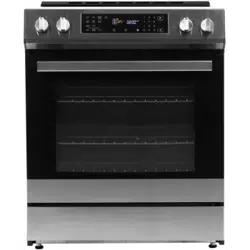
30” INDUCTION ELECTRIC RANGE
Owner’s Manual..........................................1 - 37
CUISINIÈRE ÉLECTRIQUE À INDUCTION 30”
Manuel du propriétaire...............................38 - 75
MODEL • MODÈLE
DIRC300BSS

1
Welcome to the Danby family.
We are proud of our quality products and we believe in dependable service. We suggest
that you read this owner’s manual before plugging in your new appliance as it contains
important operation information, safety information, troubleshooting, and maintenance tips
to ensure the reliability and longevity of your appliance.
You are entitled to the warranty coverage as described in the owner’s manual provided with
your new appliance.
1. Please write down your appliance information below. You must keep the original proof
of purchase receipt to validate and receive warranty services.
2. Register your product online and receive a FREE 2 MONTH WARRANTY EXTENSION
after filling out a product survey, at www.danby.com/support/product-registration/
Need Help?
1. Read your Owner’s Manual for installation help, troubleshooting, and maintenance
assistance.
2. Visit www.Danby.com to access self-service tools, FAQs and much more by searching
your model number in the search bar.
3. For the Quickest Customer Service, please fill out the web form at www.danby.com/
support. Your submission will go directly to an expert on your particular appliance.
Our average response times are between 20 minutes and 2 hours, during EST business
hours.
4. Call 1-800-263-2629 - please note that during peak hours, hold times can exceed one
hour.
Model Number: ____________________________________________________
Serial Number: ____________________________________________________
Date of Purchase: __________________________________________________
2
WARNING - TIP OVER HAZARD
• A child or adult can tip the appliance and be killed.
• Verify the anti-tip bracket has been properly installed to the floor or wall.
• Ensure the anti-tip bracket is re-engaged when the range is moved.
• Do not operate the range without the anti-tip bracket in place and engaged.
• Failure to follow these instructions can result in death or serious burns to children or adults.
ANTI-TIP DEVICE
To reduce the risk of the range tipping by abnormal usage or improper door loading, the range must be
secured by installing an anti-tip device.
Note: If the range is ever relocated the anti-tip bracket must be removed and installed at the new location.
WARNING
SUFFOCATION AND RISK OF CHILD ENTRAPMENT
To avoid the possibility of child entrapment please take the following
precautions before throwing out the appliance:
• Remove the oven door completely
• Never allow children to operate, play with or crawl inside the electric range
Important Safety Information
READ AND FOLLOW ALL SAFETY INSTRUCTIONS
SAVE THESE INSTRUCTIONS!
NOTICE - BEFORE FIRST TIME USE
Before use of this range for the first time, the heating elements have a protective coating, which must be
burned off before use. To do this:
• Remove all packaging from the inside of the oven
• Ensure door is closed
• Press the bake function on the control panel. The display screen will light up with the default
temperature and cooking timer.
• Set the temperature at 500°F (260°C) by pressing the number keypad on the control panel. If the
temperature is exceeded, the unit will beep when the Start Button is pressed.
• Click “Start” to begin the operation.
• Let the oven operate for 30 minutes with the door closed and the inside empty.
• Turn the oven off and open the door to allow it to cool.
NOTE
When the actual temperature inside the oven is less than 170°F (77°C), the digital display will show
“LO”. The display will show the actual temperature inside the oven until the set temperature is reached
and will then continue to display the set temperature.
NOTE
Any odor that may be detected during the initial set up is due to the evaporation of substances used to
protect the oven during storage.
2
DANGER - GREASE FIRES
In the event of a fire, never pick up a flaming pot
or pan. Turn the element off if it is safe to do so.
Extinguish the fire with a dry chemical or foam-
type extinguisher.
Do not use water on grease fires. Water will
spread the grease and will not extinguish the fire.
Smother the fire with a tight fitting pot lid, cookie
sheet or flat tray or use dry chemical or foam-type
extinguisher.
If there is a fire in the oven while in use, smother
the fire by closing the oven door and turning
the oven off or use dry chemical or foam-type
extinguisher.
DANGER - FIRE RISKDO NOT TOUCH HEATING ELEMENTS OR
AREAS NEAR THEM
Heating elements on the surface or in the interior
of the appliance may be hot even though they are
dark in colour. Areas near the heating elements
may become hot enough to cause burns. During
and after use do not touch or let clothing or
other flammable materials contact the heating
elements or areas near them until they have had
sufficient time to cool. Surfaces of the appliance
may become hot enough to cause burns, among
them are the cook top, oven vent openings and
surfaces near these openings, oven doors and
oven windows.
Important Safety Information
READ AND FOLLOW ALL SAFETY INSTRUCTIONS
SAVE THESE INSTRUCTIONS!
• It is recommended that this appliance be
connected to a separate circuit that is not
shared with any other appliance.
• Never clean appliance parts with flammable
fluids. These fumes can create a fire hazard
or explosion. Never use or store gasoline or
other flammable vapors or liquids inside or in
the proximity of this appliance, failing to do so
may result in a fire hazard or explosion.
• Before cleaning or servicing this appliance,
unplug the appliance completely from the
electrical outlet or disconnect the range power
supply at the household distribution panel by
removing the fuse or switching off the circuit
breaker. Failure to do so can result in electrical
shock or death.
• Do not attempt to repair or replace any part
of your appliance unless it is specifically
recommended in this manual. All other
servicing should be referred to a qualified
service technician.
• For your safety, this appliance should never be
used as a source of heat or as a space heater.
The cooktop elements should not be operated
without proper cookware.
• All openings in the wall behind the appliance
and the floor under the appliance shall be
sealed.
• Keep the area around the appliance clear
and free from combustible materials, gasoline
and other flammable vapors. Always keep
combustible wall coverings, curtains or drapes
a safe distance from the range.
• Do not obstruct the flow of air around the
appliance.
• Storage in or on the appliance: flammable
materials should not be stored in an oven or
near cooktop elements.
• Do not cover any slots, holes or passages in
the oven bottom or cover an entire rack with
materials such as aluminum foil.
3
GENERAL SAFETY REQUIREMENTS
Ensure the appliance is properly installed and grounded by a qualified technician.
Children should not be left alone or unattended in the area where the appliance is in use. Children should
never be allowed to sit or stand on any part of the appliance.
Do not store items of interest to children in cabinets above a range or on the back guard of a range.
Children climbing on the range to reach items could be seriously injured.
To eliminate the risk of burns or fire by reaching over heated surface units, cabinet storage space located
above the surface units should be avoided. If cabinet storage is to be provided, the risk can be reduced by
installing a range hood that projects horizontally a minimum of 5 inches (12.7 cm) beyond the bottom of
the cabinets.
Loose fitting or hanging garments should never be worn while using the appliance.
Use only dry pot holders. Moist or damp pot holders on hot surfaces may result in burns from steam. Do
not let the pot holder touch hot heating elements. Do not use a towel or other bulky cloth.
If power is lost to an electric cooktop while a surface element is ON, the surface element will turn back on
as soon as power is restored. In the event of power loss, failure to turn all surface element knobs to the OFF
position may result in ignition of items on or near the cooktop, leading to serious injury or death.
This range is designed and manufactured solely for the cooking of domestic (household) food and is not
suitable for any non domestic application and therefore should not be used in a commercial environment.
The range warranty will be void if the range is used within a non domestic environment.
WARNING
To reduce the risk of burns, do not move this
appliance while it is hot. To reduce the risk of
injury due to tipping of the appliance, verify
the re-installation of this appliance into the
anti-tipping device provided after returning the
appliance to the original installed position.
WARNING
The manufacturer declines all liability for injury to
persons or damage to property cause by incorrect
or improper use of the range.
Important Safety Information
READ AND FOLLOW ALL SAFETY INSTRUCTIONS
SAVE THESE INSTRUCTIONS!
4
SAVE THESE INSTRUCTIONS!
Important Safety Information
READ AND FOLLOW ALL SAFETY INSTRUCTIONS
5
COOKTOP SAFETY REQUIREMENTS
• Use the proper pan size. This appliance is
equipped with four burners of different sizes.
Select utensils that have flat bottoms large
enough to cover the surface of the heating
element. The use of undersized utensils will
expose a portion of the heating element to direct
contact and may result in ignition of clothing.
Proper relationship of utensil to burner will also
improve efficiency.
• Never leave the appliance unattended while in
use. Boil over causes smoking and greasy spills
can ignite.
• Never leave oil unattended while frying. If
allowed to heat beyond its smoking point, oil
may ignite resulting in fire that may spread
to surrounding cabinets. Use a deep fat
thermometer whenever possible to monitor oil
temperature.
• To avoid oil spillover and fire, use a minimum
amount of oil when shallow pan-frying and
avoid cooking frozen foods with excessive
amounts of ice.
• Only certain types of glass, ceramic,
earthenware or other glazed utensils are
suitable for range top service without breaking
due to sudden change in temperature.
• To reduce risk of burns, ignition of flammable
materials and spillage due to unintentional
contact, the handle of a utensil should be
positioned so that it is turned inward and does
not extend over adjacent burners.
• Do not cook on broken cooktop. If the cooktop
should break, cleaning solutions and spill overs
may penetrate the broken cooktop and create
a risk of electric shock. Contact a qualified
technician immediately.
• Do not use a griddle or long pan on more than
one burner at once.
• Clean Cook-Top With Caution - If a wet sponge
or cloth is used to wipe spills on a hot cooking
are, be careful to avoid steam burn. Some
cleaners can produce noxious fumes if applied
to a hot surface.
• Do not place metallic objects such as knives,
forks, spoons and lids on the cooktop surfaces
since they can get hot.
OVEN SAFETY REQUIREMENTS
Use care when opening the door. Allow hot air or
steam to escape before removing or replacing food.
Do not heat unopened food containers. Build up of
pressure may cause the container to burst and result
in injury.
Keep oven vents unobstructed.
Always place oven racks in the desired location
while the oven is cool. If the rack must be moved
while the oven is hot, do not let the pot holder
contact the hot heating element in the oven.
Do not use the oven if a heating element develops
a glowing spot during use or shows other signs
of damage. A glowing spot indicates the heating
element may fail and present a potential burn, fire,
or shock hazard. Turn the oven off immediately and
have the heating element replaced by a qualified
service technician.
Do not line the oven walls or racks with aluminum
foil.
Do not place shelves, pans, baking trays, broil trays
or other cooking utensils in the bottom of the oven
chamber. Always place on an oven shelf.
Never clean the oven with any high pressure steam
cleaning devices.
Do not leave anything on the top of the oven vent.
Never cover the oven vent opening with aluminum
foil or any other material.
Important Safety Information
READ AND FOLLOW ALL SAFETY INSTRUCTIONS
SAVE THESE INSTRUCTIONS!
6
This equipment has been tested and found to comply with the limits for Consumer ISM equipment, pursuant
to part 18 of the FCC Rules. These limits are designed to provide reasonable protection against harmful
interference in a residential installation.
This device complies with part 18 and 15 of the FCC Rules.
Operation is subject to the following 2 conditions:
1) This device may not cause harmful interference, and
2) This device must accept any interference received, including interference that may cause undesired
operation.
This equipment generates, uses and can radiate radio frequency energy and if not installed and used in
accordance with the instructions, may cause harmful interference to radio communications. However, there
is no guarantee that interference will not occur in a particular installation. If this equipment does cause
harmful interference to radio or television reception, which can be determined by turning the equipment off
and on, the user is encouraged to try to correct the interference by one or more of the following measures:
• Reorient or relocate the receiving antenna.
• Increase the separation between the equipment and the receiver.
• Connect the equipment to an outlet on a different circuit from that to which the receiver is connected.
• Consult the dealer or an experienced radio or TV technician for help.
Changes or modifications not approved by the party responsible for FCC and Industry Canada compliance
could void the user’s authority to operate the equipment.
This device complies with Canadian CAN ICES-001 / NMB-001.
This device complies with Canadian CAN ICES-003(B) / NMB-003(B).
SUPPLIER’S DECLARATION OF CONFORMITY
47 CFR § 2.1077 Compliance Information
Unique Identifier: DIRC300BSS
Danby Products Inc.
1800 Production Drive
Findlay, OH
45840
Danby.com
Important Safety Information
READ AND FOLLOW ALL SAFETY INSTRUCTIONS
SAVE THESE INSTRUCTIONS!
7
GROUNDING INSTRUCTIONS
This appliance must be grounded. Grounding reduces the risk of electrical shock by providing an escape
wire for the electrical current.
When this appliance is fitted with a power cord that has a grounding wire with a 4-prong plug. The power
cord must be plugged into an outlet that is properly grounded. If the outlet is is not a 4-prong plug, it must
be replaced with a properly grounded 4-prong wall outlet. The rating plate indicates the voltage and
frequency the appliance is designed for.
WARNING - Improper use of the grounding plug can result in a risk of electric shock. Consult a qualified
electrician if the grounding instructions are not completely understood, or if doubt exists as to whether the
appliance is properly grounded.
Do not connect the appliance to extension cords, adapters or together with another appliance in the
same wall outlet.
Do not splice the power cord. Do not under any circumstances cut or remove the ground prong from the
power cord.
If the power supply cord is damaged, it must be replaced by the manufacturer, its service agent or similar
qualified person in order to avoid hazard.
Note: Turning the appliance off does not disconnect the appliance from the power supply.
It is recommended that the power cord and the plug be placed parallel with the floor so that the cord runs
parallel with the floor.
8
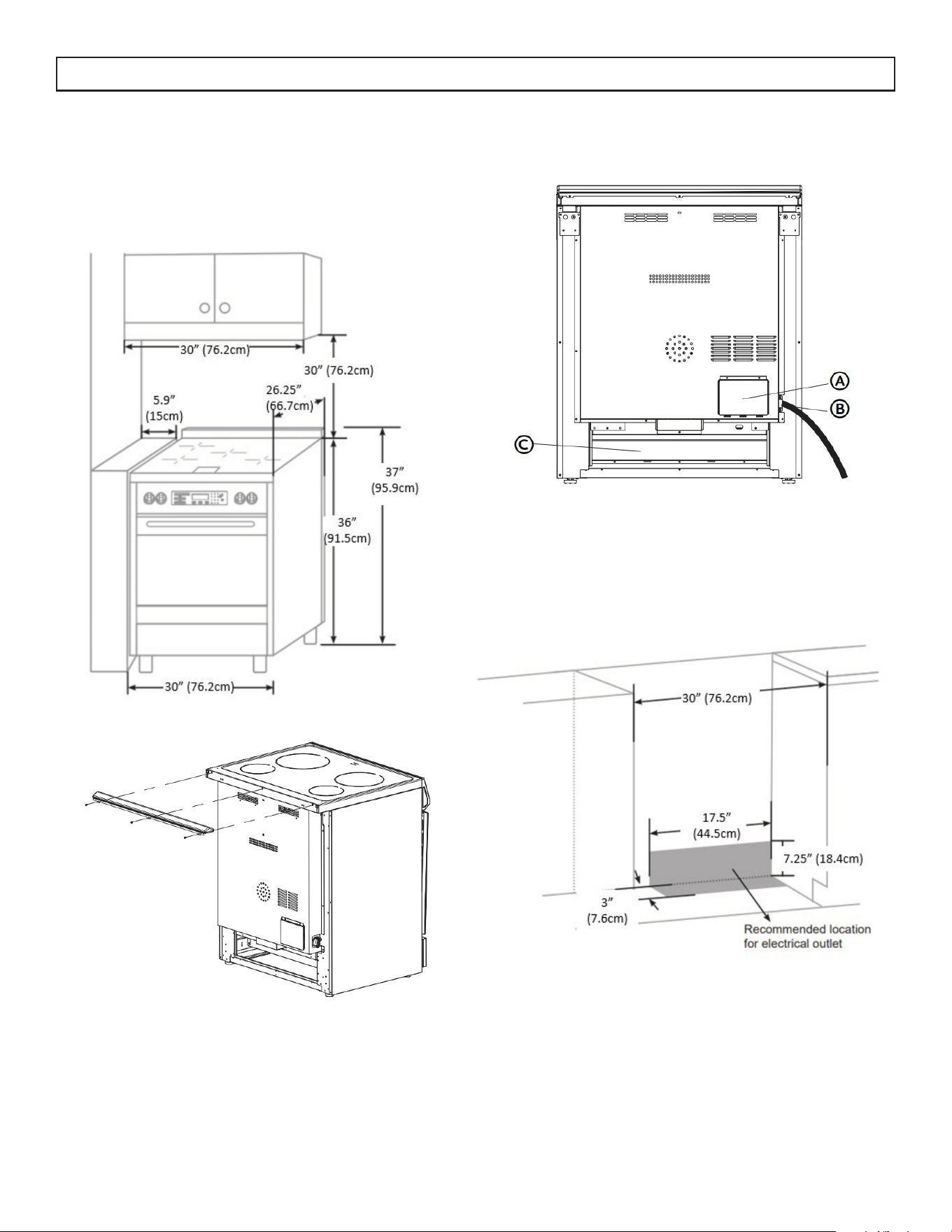
Installation Measurements
INSTALLATION INSTRUCTIONS
NOTE: Range can be raised approximately 1 inch
(2.5 cm) by adjusting the leveling legs. The front
of door and drawer may extend farther forward
depending on styling.
Power Supply
A: Access Panel to Electrical Supply Cord
B: Power Cord Opening
C: Recessed Area
NOTE: To connect to an outlet in the wall, the
electrical outlet must be recessed. If the electrical
outlet is on the floor, it must be either recessed or
surface mounted.
BACKSPLASH INSTALLATION:
Install the backsplash to rear of the range with the
screws provided.
9
INSTALLATION INSTRUCTIONS
IMPORTANT
Disconnect power before servicing. Improper connection of aluminum house wiring and copper
appliance leads can result in an electrical hazard or fire. If the home has aluminum wiring, only
use connections designed and UL listed for joining copper to aluminum and precisely follow the
manufacturer’s recommend procedure. Aluminum-to-Copper connections must conform with local
codes. Use 8-gauge copper or 6-gauge aluminum wire. Electrically ground range.
CONNECTION TO HOUSE ELECTRICAL SUPPLY
Be sure your appliance is properly installed and grounded by a qualified technician.
• A circuit breaker is recommended.
• The range can be connected directly to the circuit breaker box (or fused disconnect) through flexible or
nonmetallic sheathed, copper or aluminum cable.
• Allow at least 6 ft (1.8M) of slack in the line so that the range can be moved if servicing is every
necessary.
• A UL listed conduit connector must be provided at each end of the power supply cable (at the range
and at the junction box).
The wiring diagram is included with the range. This appliance is manufactured with the chassis connected
to a neutral by a green ground jumper wire. After making sure that the power has been turned off, connect
the flexible conduit from the range to the junction box using a UL listed conduit connector. The Grounded
Neutral and Ungrounded Neutral Graphics on the following pages and the instruction provided, present
the most common way of connecting the range. Your local codes and ordinances take precedence over
these instruction. Complete electrical connections according to local codes and ordinances.
PARTS NEEDED:
If using a power supply cord:
• UL listed power supply cord kit marked for use with ranges. The cord should be rated at 250V
minimum, 40 amps or 50 amps that is marked for use with nominal 1 3/8” (3.5 cm) diameter
connection opening and must end in ring terminals or open-end spade terminals with upturned ends.
• UL listed strain relief.
If direct wiring:
• Flexible Metal Conduit
• UL Listed Conduit Connector
• 4-wire or 3-wire Electrical Cable (where local codes permit a 3-wire connection)
• UL Listed Wire Connectors
NOTES:
• Check local codes.
• Check existing electrical supply.
10
INSTALLATION INSTRUCTIONS
IMPORTANT
Only for models sold in the United States. This model does not include a pre-installed power cord. Use
the following wiring instructions before using the range. The power cord is not provided. Follow all
local and national wiring codes and standards.
3-WIRE POWER CABLE INSTALLATION
WARNING: Use this method only if local codes permit connecting chassis ground conductor to neutral wire
of power supply cord.
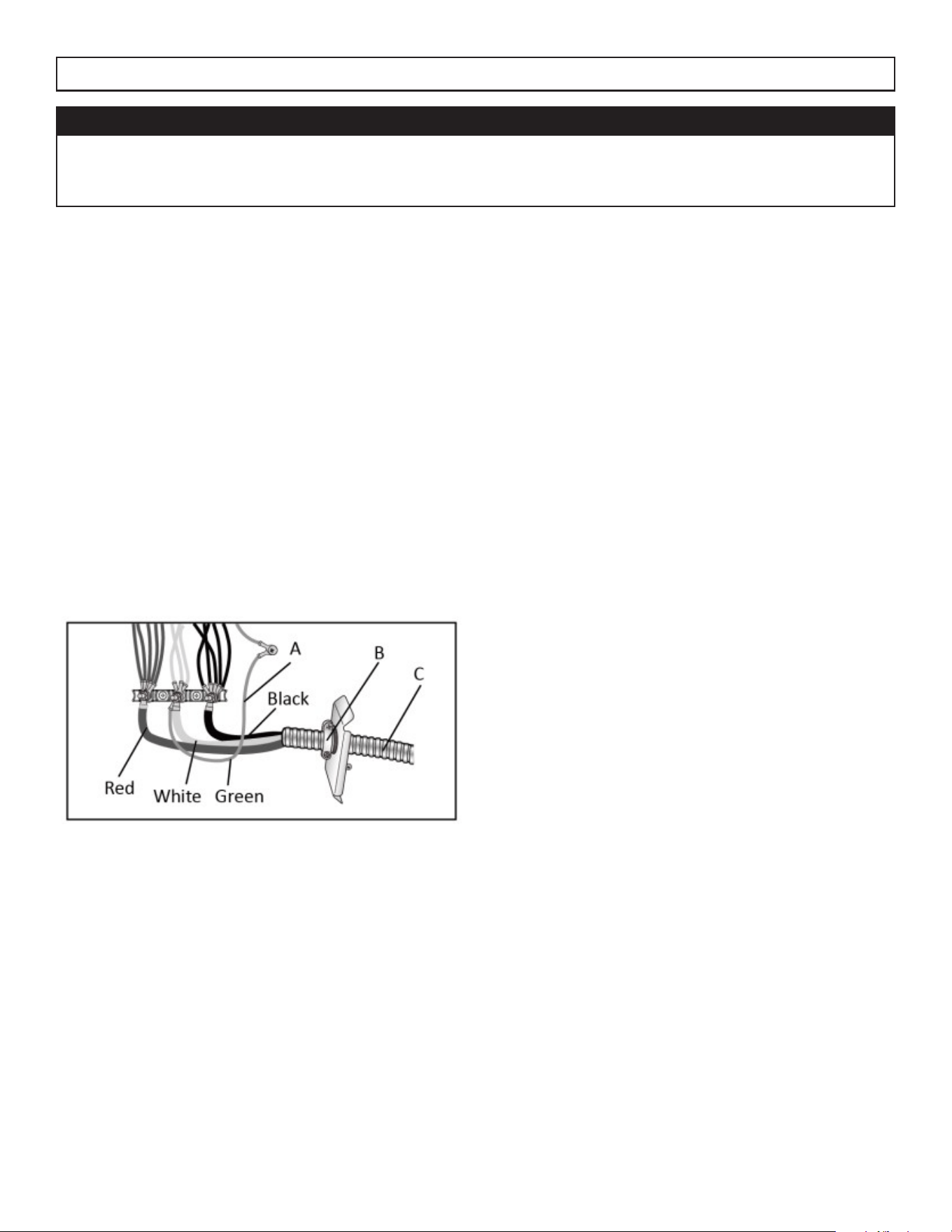
1. Feed the electric cable wires through the flexible metal conduit.
NOTE: Allow enough slack to easily attach the wires to the terminal block.
2. Remove the access panel located on the bottom righ-hand side of the back panel to uncover the
electrical terminal block.
3. Install a UL listed strain relief to the flexible metal conduit opening in the support bracket and fully
tighten the strain relief nut.
4. Feed the flexible metal conduit through the strain relief
NOTE: Allow enough slack to easily attach the wiring to the terminal block.
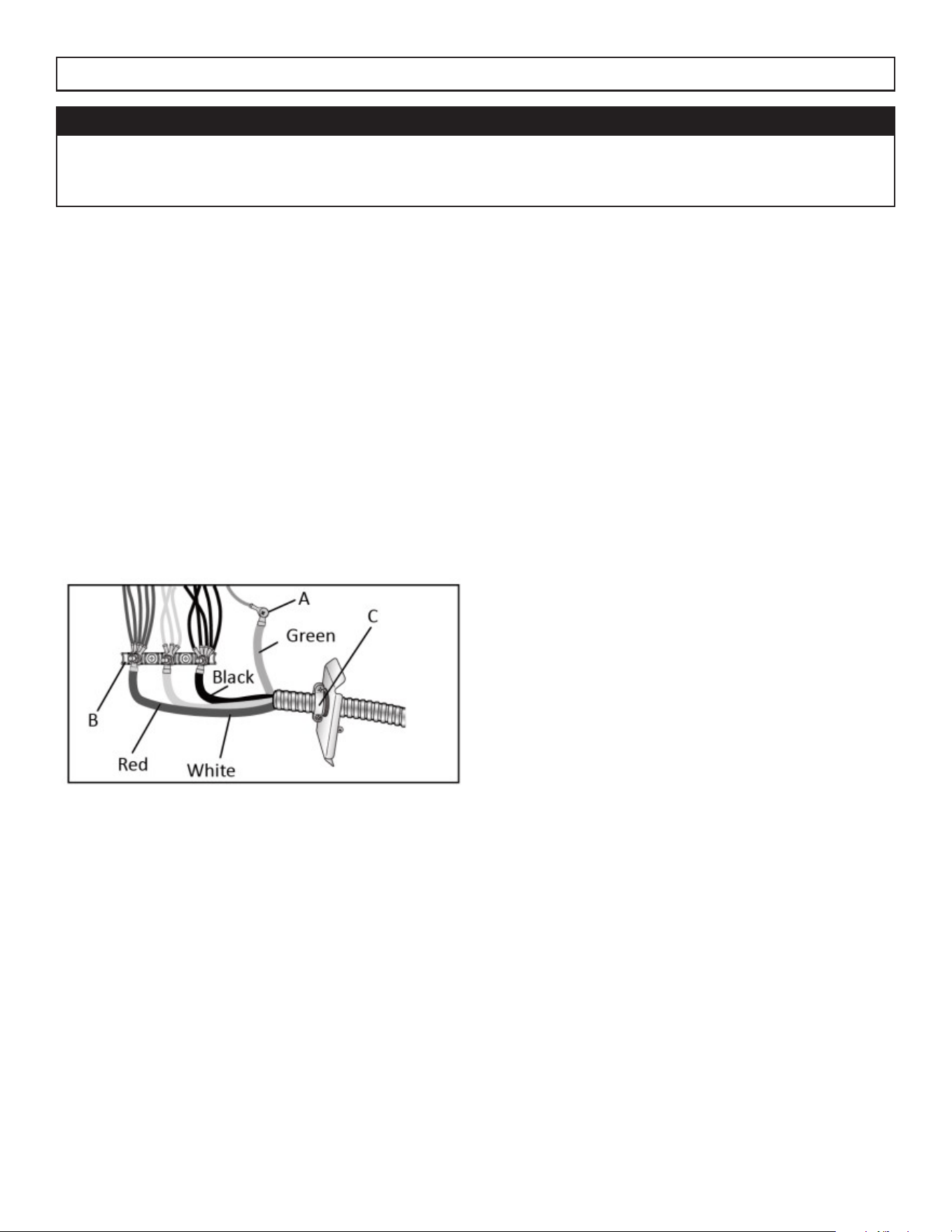
A: Jumper Wire (not provided)
B: UL Listed Strain Relief
C: Conduit
5. Using a 5/16” nut driver and one of the 10-32 hex nuts, connect the ground (green or bare) wire from
the flexible metal conduit to the center terminal block post along with the green jumper wire from the
range.
6. Using 10-32 hex nuts, connect the red and black wires from the power cord to the outer posts of the
terminal block with the corresponding red and black wires from the range.
7. Tighten the hex nuts completely and then verify the connection.
8. Position the lower part of the strain relief under the flexible metal conduit and tighten the strain relief
screws.
NOTE: Before tightening, make sure the strain relief is positioned over the flexible metal conduit and NOT
the wires.
9. Replace the electrical access panel.
10. Tuck excess conduit into the recessed are of the back panel.
11
INSTALLATION INSTRUCTIONS
IMPORTANT
Grounding through the neutral conductor is prohibited for new branch-circuit installations (1996 NEC);
mobile homes; and recreational vehicles, or in an area where local codes prohibit grounding through
the neutral conductor. For installations where grounding through the neutral conductor is prohibited,
see the Ungrounded Neutral graphic. Use grounding terminal or lead to ground unit. Connect neutral
terminal or lead to branch circuit neutral in usual manner.
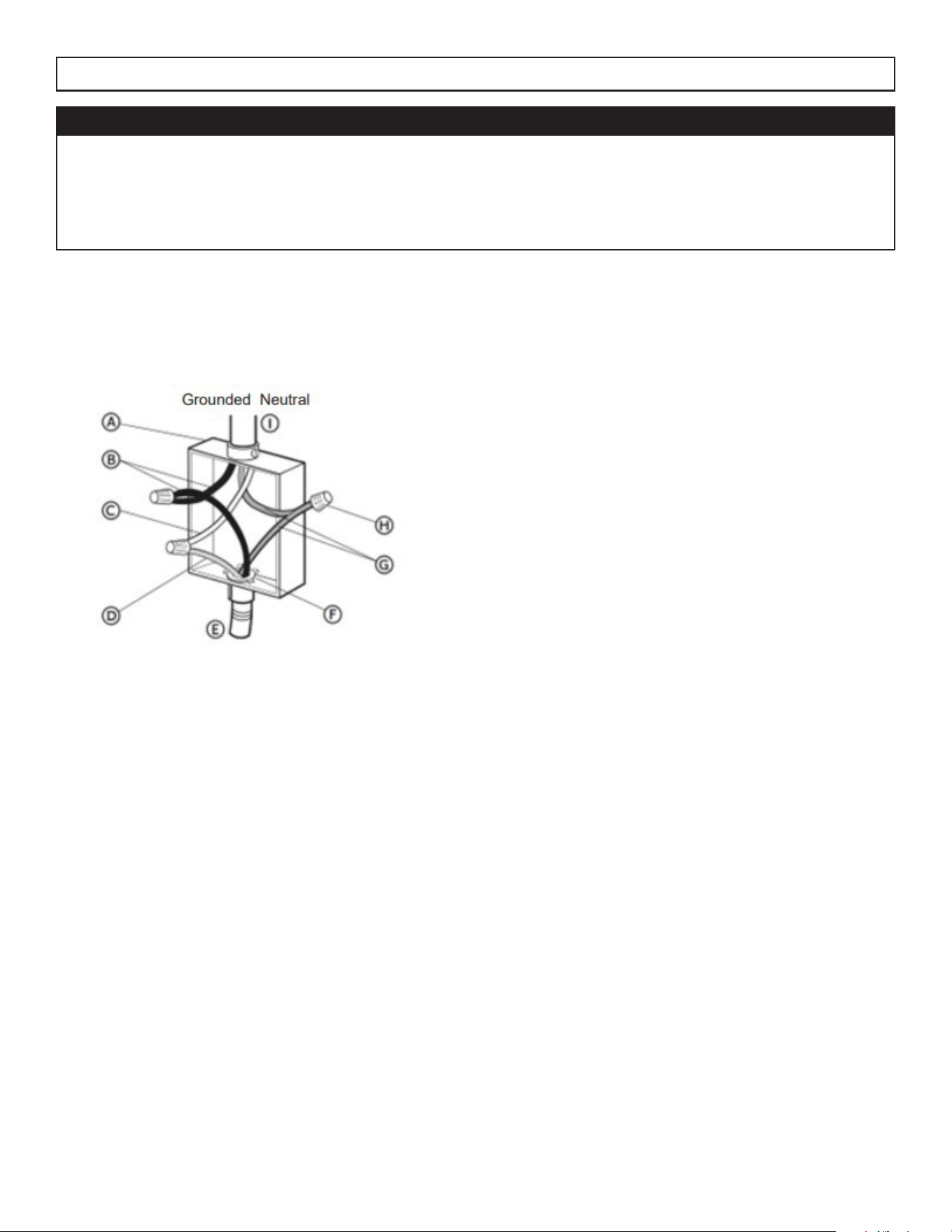
3-WIRE POWER CABLE CONNECTION TO HOUSE ELECTRICAL SUPPLY
NOTE: Use the 3-wire cable from home power supply where local codes permit a 3-wire connection.
1. Disconnect power.
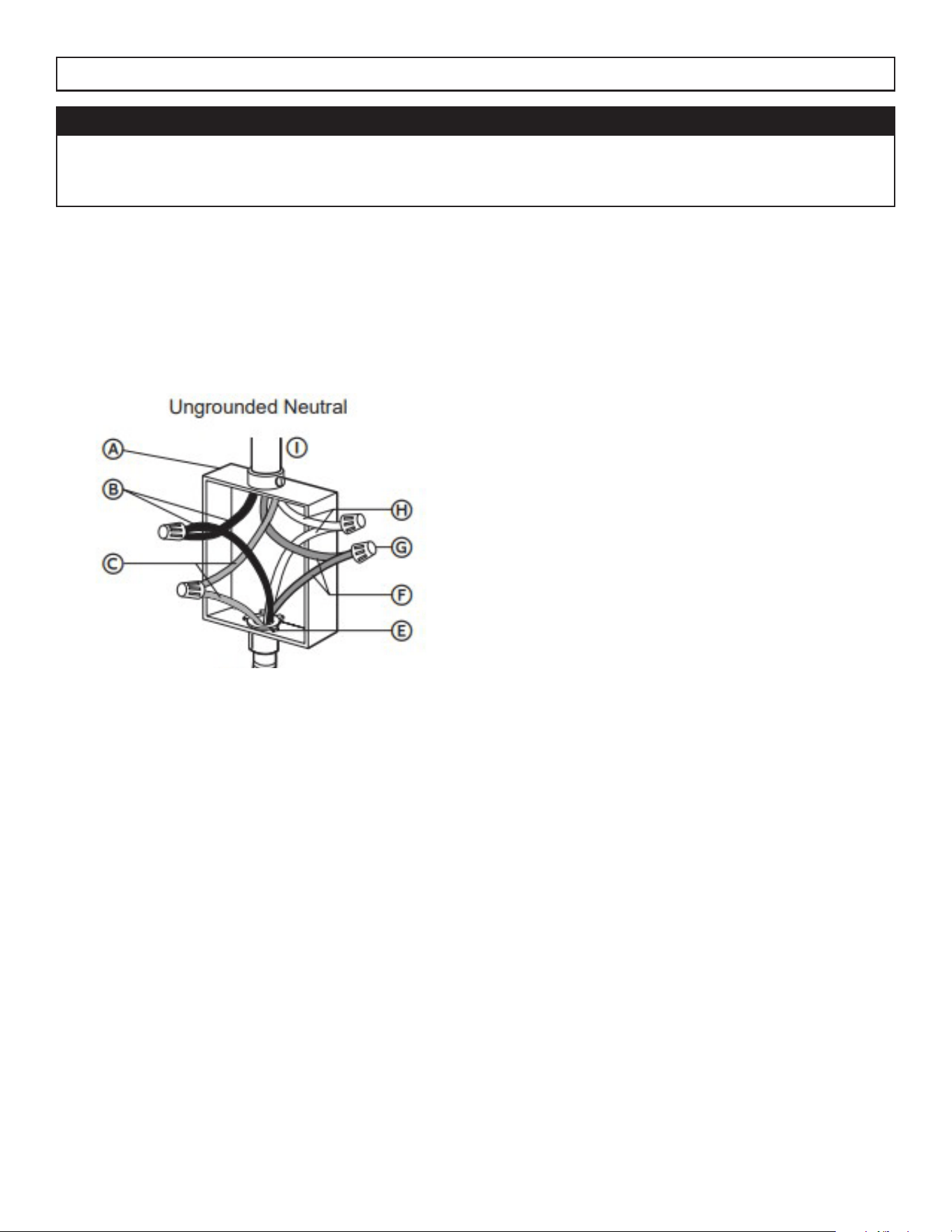
A: Junction Box
B: Black Wires
C: Neutral (white) Wire
D: Ground (green or bare) Wire
E: Cable from range
F: UL Listed Conduit Connector
G: Red Wires
H: UL Listed Wire Connectors
I: House Electrical Supply
2. Connect the 2 black wires together using a UL listed wire connector.
3. Connect the neutral (white) wire and the ground (green or bare) wire (of the range cable) using a UL
listed wire connector.
4. Connect the 2 red wires together using a UL listed wire connector.
5. Install junction box cover.
INSTALLATION INSTRUCTIONS
4-WIRE POWER CABLE INSTALLATION
NOTE: Use this method for new branch-circuit-installations (1996 nec), mobile homes, recreational
vehicles, or in an area where local codes prohibit grounding through the neutral wire.
1. Feed the electric cable wires through the flexible metal conduit.
NOTE: Allow enough slack to easily attach the wires to the terminal block.
2. Remove the access panel located on the bottom right-hand side of the back panel to expose the
electrical terminal block.
3. Install a UL listed strain relief to the flexible metal conduit opening in the support brack and fully tighten
the strain relief nut.
4. Feed the flexible metal conduit through the strain relief. Allow enough slack to easily attach the wiring
to the terminal block.
A: Ground Screw
B: Terminal Block
C: UL Listed Strain Relief
IMPORTANT
Only for models sold in the United States. This model does not include a pre-installed power cord. Use
the following wiring instructions before using the range. The power cord is not provided. Follow all
local and national wiring codes and standards.
5. Remove the green jumper wire from under the ground screw and replace with the green wire from the
power cord, tighten ground screw.from the flexible metal conduit and tighten ground screw.
6. Loop the green jumper wire removed from the ground screw back onto its end that is fastened to the
center post on the terminal block.
7. Use a 5/15” nut driver to connect the neutral (white) wire to the center terminal block post with one of
the 10-32 hex nuts.
8. Using 10-32 hex nuts, connect the red and black wires from the power cord to the outer posts of the
terminal block with the corresponding red and black wires from the range.
9. Tighten the hex nuts completely and then verify the connection
10. Position the lower part of the strain relief under the flexible metal conduit and tighten the strain relief
screws.
NOTE: Before tightening, make sure the strain relief is positioned over the flexible metal conduit and NOT
the wires.
11. Replace the electrical access panel.
12. Tuck excess conduit into the recessed area of the back panel.
12
13
INSTALLATION INSTRUCTIONS
IMPORTANT
Use the 4-wire cable from home power supply where local codes do not allow grounding through
neutral, new branch circuit installation (I996 NEC), mobile homes and recreational vehicles, new
construction6
4-WIRE POWER CABLE CONNECTION TO HOUSE ELECTRICAL SUPPLY
A: Junction Box
B: Black Wires
C: Ground (green or bare) Wires
D: Cable from range
E: UL Listed Conduit Connector
F: Red Wires
G: UL Listed Wire Connectors
H: Neutral (white) Wires
I: House Electrical Supply

14
INSTALLATION INSTRUCTIONS
REQUIRED TOOLS
1. Tape Measure
2. Flat Blade Screwdriver
3. Phillips Screwdriver
4. Level
5. Cordless Electric Drill
6. Hammer
7. Wrench or Pliers
8. Metal Saw
9. Metal Snips or Large Wire Cutters
10. 15/N6” Combination Wrench
11. 3/8” Nut Driver
12. 1/4” Nut Driver
13. 1/8” (3.2mm) Drill Bit (for wood floors)
14. Marker or Pencil
15. Masking Tape
Gather the required tools and parts before starting
installation.
LOCATION REQUIREMENT
Ventilation
It is the installer’s responsibility to comply with
installation clearances, if specified, on the model/
serial rating plate. The model/serial rating plate is
located on the rear side of the oven frame. See
label on the back panel of the range for additional
element and oven power ratings.
NOTE: Observe all governing codes and
ordinances.
Temperature
• The range should be located for convenient use
in the kitchen.
• Recessed installations must provide complete
enclosure of the sides and rear of the range.
• To eliminate the risk of burns or fire by reaching
over heated surface units, cabinet storage
space located above the surface units should be
avoided. If cabinet storage is to be provided, the
risk can be reduced by installing a range hood
or microwave hood combination that projects
horizontally a minimum of 5 inches (12.7 cm)
beyond the bottom of the cabinets.
• All openings in the wall or floor were the range
is to be installed must be sealed.
• Do not seal the range to the side cabinets.
• Ground electric supply is required. See
“Electrical Requirements” section.
NOTE: Some cabinet and building materials are
not designed to withstand the heat produced by
the oven for baking and self-cleaning. Check with
your builder or cabinet supplier to make sure that
the material used will not discolour, delaminate or
sustain other damage.
• Contact a qualified floor covering installer to
check that the floor covering can withstand at
least 200°F (93°C).
• Use an insulated pad or 1/4 inch (0.64cm)
plywood under range if installing range over
carpeting.
15
INSTALLATION INSTRUCTIONS
ANTI-TIP BRACKET
An anti-tip bracket kit is provided with the range.
WARNING: Tip Over Hazard
• A child or adult can tip the range and be seriously injured.
• Connect the anti-tip bracket to the rear foot of the range.
• Reconnect the anti-tip bracket if the range is moved.
NOTE: DO NOT completely remove the rear leveling leg. The anti-tip bracket uses either the right-hand or
left-hand rear leveling leg to secure the range to the floor or wall.
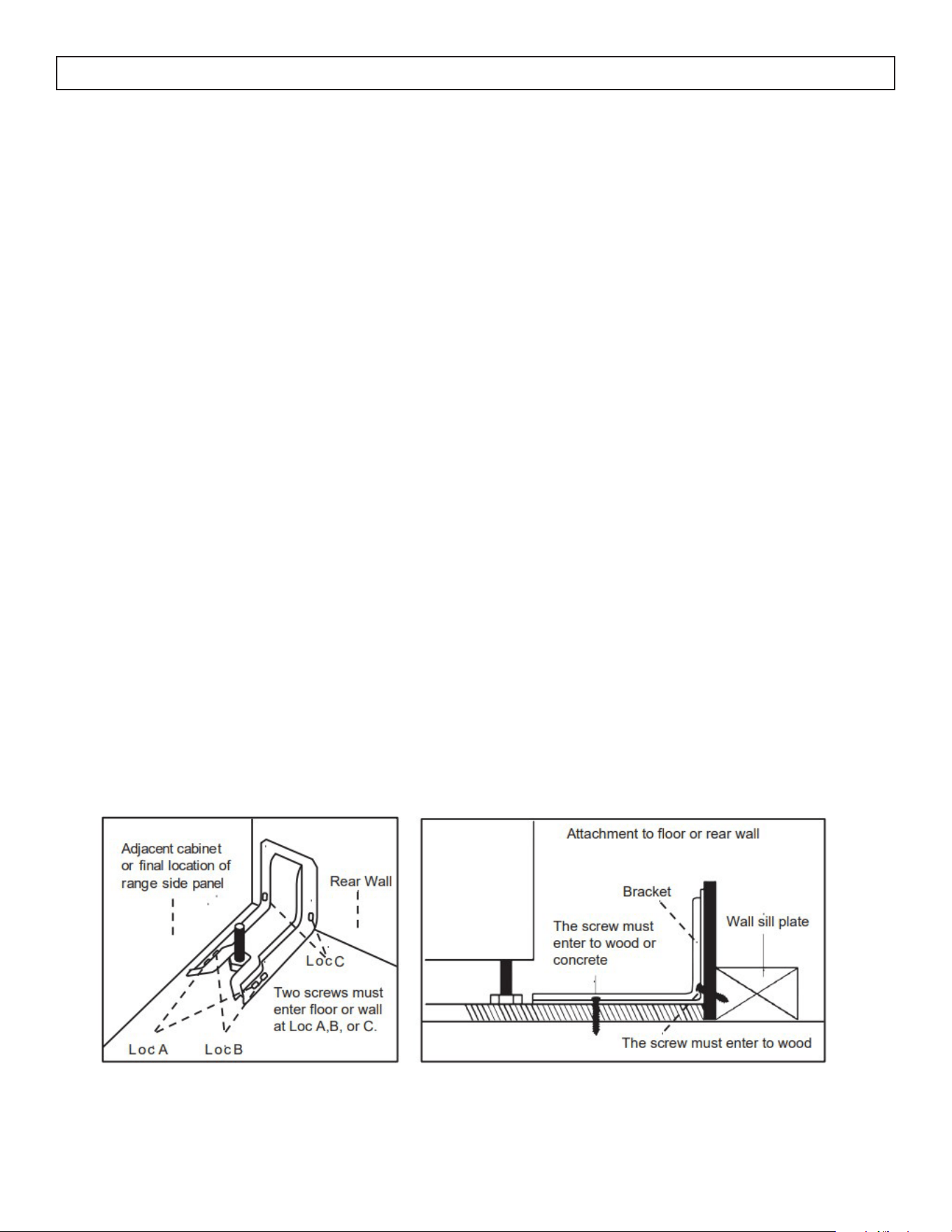
Bracket Location
Determine the final location of the range before attempting to install the bracket.
Place the bracket on the floor with the back edge against the rear wall. If the range does not reach the rear
wall, align the back edge of the bracket with the rear panel of the range in its final location.
NOTE: If the bracket does not touch the rear wall, you MUST screw the bracket to the FLOOR.
Position the site of the bracket against either the left or right cabinet. If there is no adjacent cabinet, align
the edge of the bracket with the side panel of the range in its final location. If the countertop overhangs the
cabinet, offset the bracket from the cabinet by the amount of overhang.
Mark the location for the pair of holes to be used (see illustration below).
NOTE: For FLOOR installation use either Loc A or B. For REAR WALL installation use Loc C.
16
INSTALLATION INSTRUCTIONS
Securing Bracket
The bracket must be screwed to either the FLOOR or REAR WALL.
Floor Installation
• Wood Floor: use the screws provided to secure the bracket using the pair of marked holes (either Loc A
or B).
• Concrete floor: Using a concrete drill bit, drill a 5/32 inch (0.4 cm) pilot hole 2 inches (5 cm) deep
into the concrete at the center of each of the marked holes (either Loc A or B). Use the screws provided
to secure the bracket into the floor.
Rear Wall Installation
Use the 2 screws provided to secure the bracket using the pair of marked holes at Loc C. The screws MUST
enter a wood sill plate. If the wall contains any metal studs or similar materials, then the floor must be used.
Checking Bracket
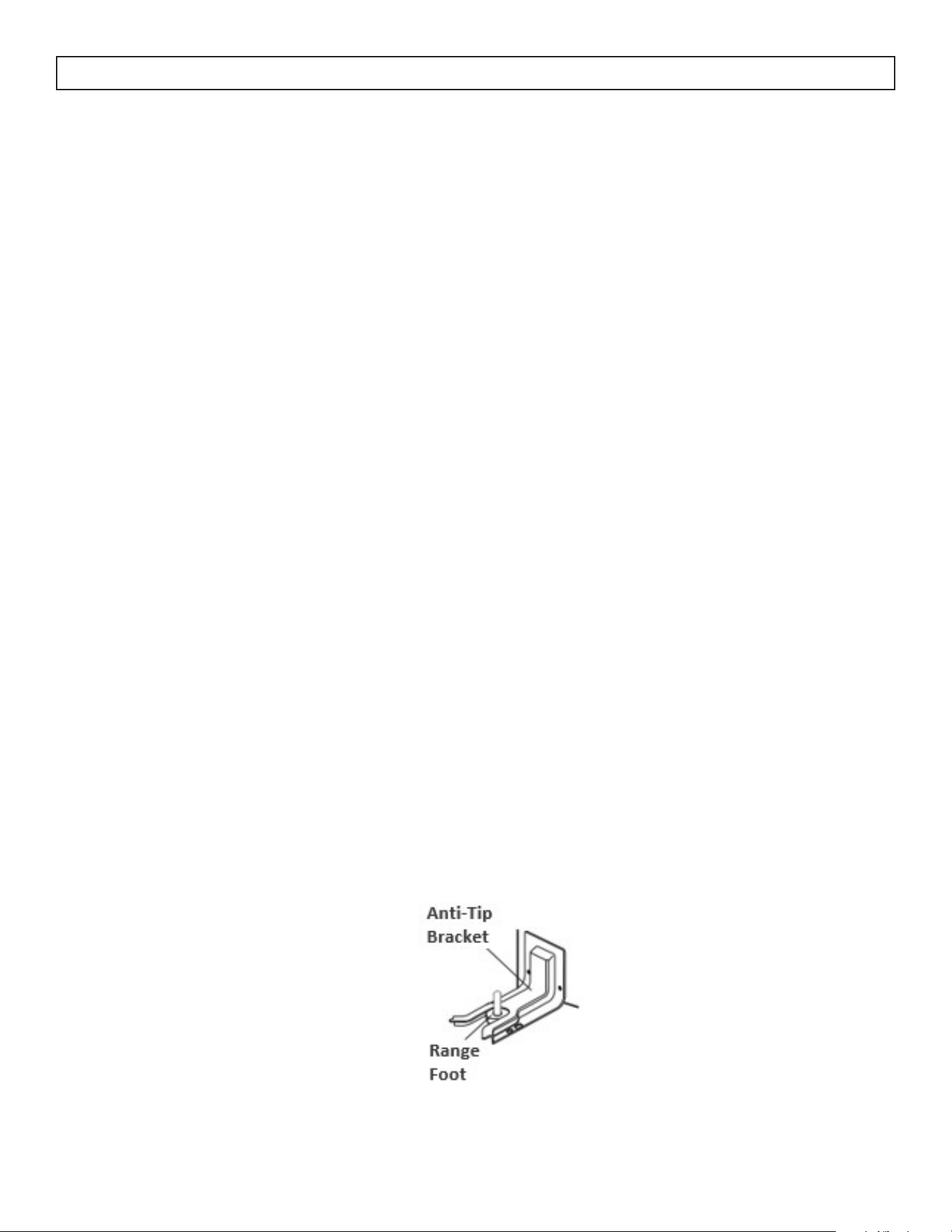
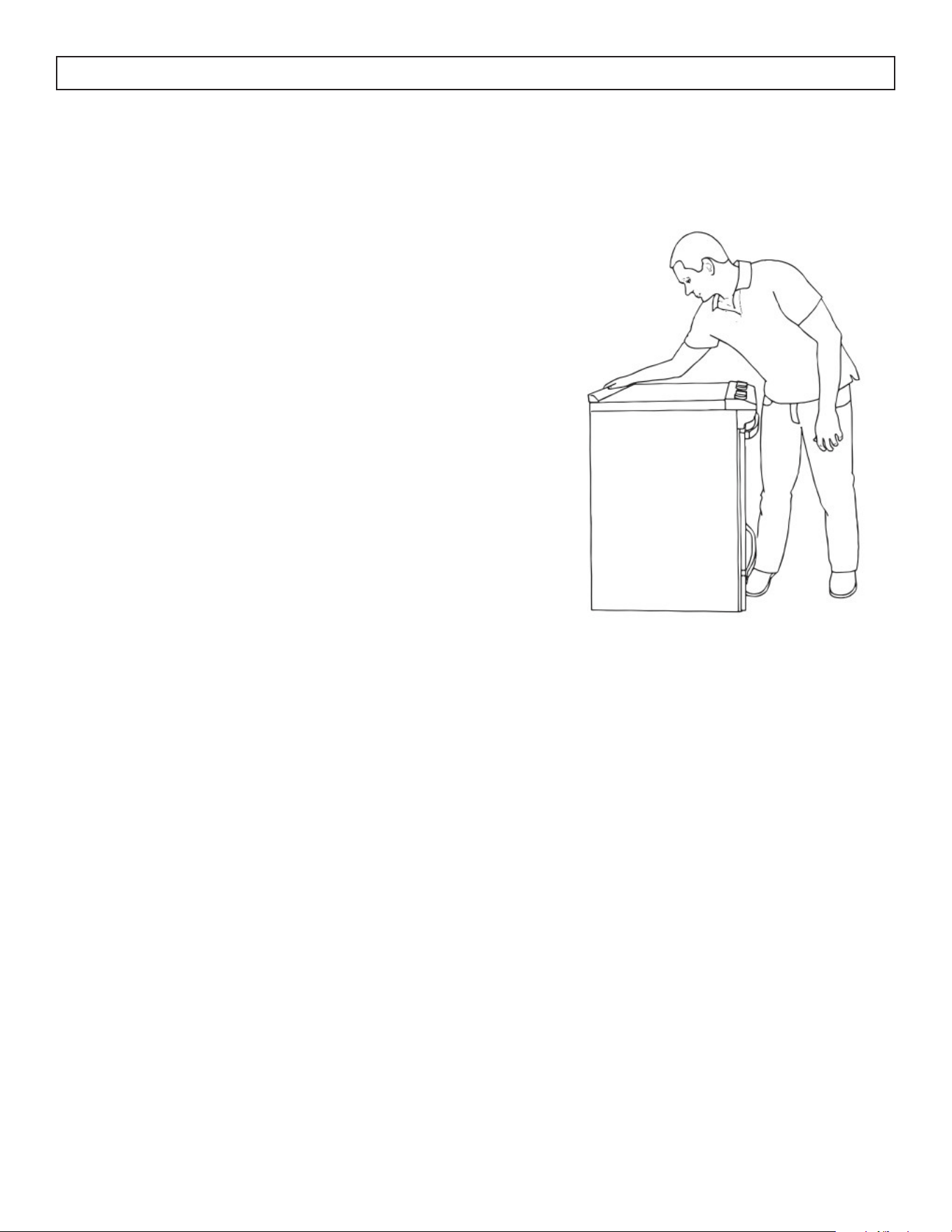
After installing the bracket, slide the range into its final location. The rear leveling leg must be fully inserted
into the ANTI-TIP bracket as shown below. To check if the bracket is installed and engaged properly, look
underneath the range to see that the leveling leg is engaged in the bracket. On some models, the storage
drawer or kick plate can be removed for easier inspection. If visual inspection is not possible, slide the
range forward, confirm the anti-tip bracket is securely attached to the floor or wall, and slide the range
back so the leveling leg is under the anti-tip bracket. If the range is pull from the wall for any reason,
always repeat this procedure to verify the range is properly secured by the anti-tip bracket.
NOTE: The anti-tip bracket must be PROPERLY INSTALLED, and the rear leveling leg must be FULLY
ENGAGED into the bracket to prevent the range from tipping. NEVER remove the leveling legs as this will
prevent the range from being secured to the ANTI-TIP bracket properly.
17
INSTALLATION INSTRUCTIONS
NOTE: If the range is moved to adjust the leveling legs, ensure
that when the range is moved back into the final location that the
anti-tip bracket is engaged by repeating steps 1 through 9.
1. Slide range into final location, making sure rear leveling
leg slides into ant-tip bracket. Leave a 1 inch (2.5cm) gap
between the back of the range and the back wall.
2. Place the outside of your foot against the bottom front to keep
the range from moving and then grasp the back of the range,
as shown.
3. Slowly attempt to tilt the range forward. If you encounter
immediate resistance, the range foot is engaged in the anti-tip
bracket. Go to Step 8.
4. If the rear of the range lifts more than 1/2 inch (1.3cm) off
the floor without resistance, stop tilting the range and lower it
gently back to the floor. The range foot is not engaged in the
anti-tip bracket.
NOTE: If there is a snapping or popping sound when lifting the
range, the range may not be fully engaged in the bracket. Check
to see if there are obstructions keeping the range from sliding to
the wall or keeping the range foot from sliding into the bracket.
Verify that the bracket is held securely in place by the mounting
screws.
INSTALLING RANGE
5. Slide the range forward and verify that the anti-tip bracket is securely attached to the floor or wall.
6. Slide the range back so the rear range foot is inserted into the slot of the anti-tip bracket.
7. Repeat steps 1 through 3 to ensure that the range foot is engaged in the anti-tip bracket. If the rear of
the range lifts more than 1/2 inch (1.3cm) off the floor without resistance, the anti-tip bracket may not
be installed correctly. Do not operate the range without anti-tip bracket installed and engaged.
8. Move the range into its final location. Check that the range is level by placing a level on the oven
bottom.
NOTE: The range must be level for optimum cooking and baking performance.
9. If needed, use a wrench to adjust the height of the leveling legs until the range is level from side to side
and back to back.
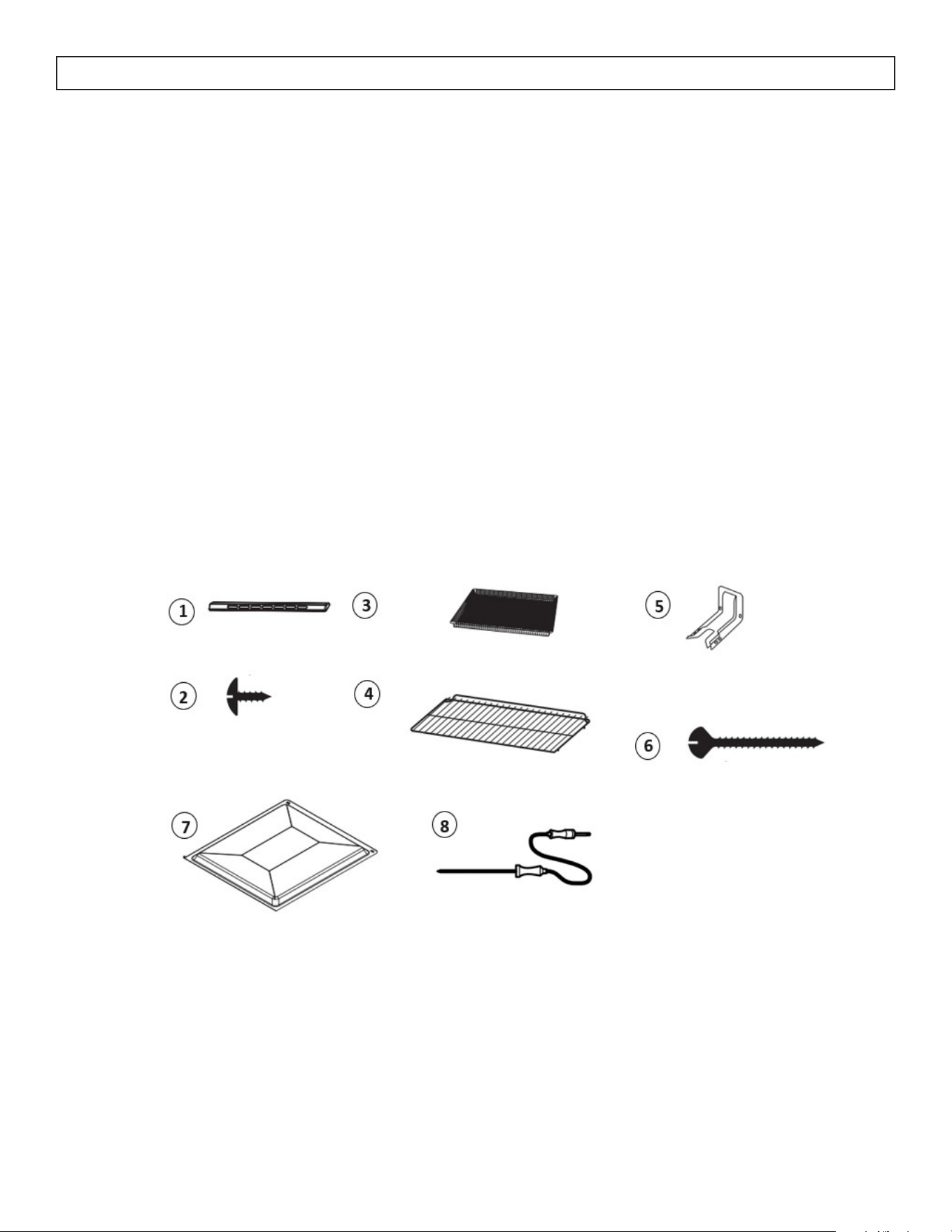
ACCESSORIES
1. Backsplash
2. M4*8 Screw for backsplash installation x5
3. Air Fry Basket
4. Racks x3
5. Anti-Tip Bracket
6. M5*45 Screw for anti-tip bracket x2
7. Tray used to collect the grease in the oven
8. Meat thermometer (probe)
OPERATING INSTRUCTIONS
18
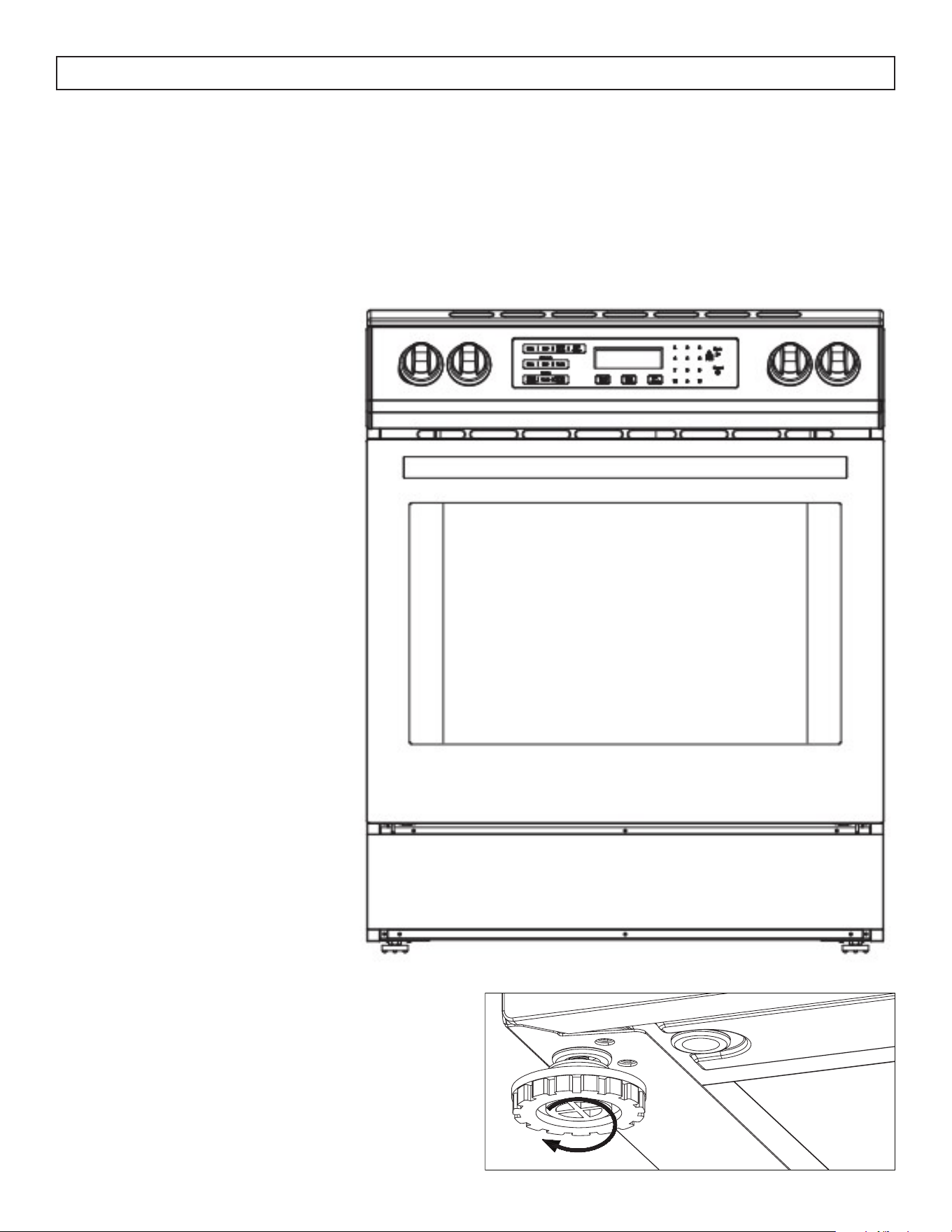
LEVELING INSTRUCTIONS
The appliance must be level to operate safely and
properly. There are four leveling legs located at
the corners of the bottom of the appliance. Adjust
the leveling legs until the appliance is level. Use a
carpenter’s level to confirm.
OPERATING INSTRUCTIONS
It is the installer’s responsibility
to comply with installation
clearances specified in the manual.
The minimum cabinet opening
dimensions and clearances must be
used. The minimum spacings must be
maintained between the appliance
cooking surface and the horizontal
surface above the cooktop.
30 inches (65 cm) is the minimum
clearance between the top of the
cooking surface and the bottom
of an unprotected wood or metal
cabinet.
19
DIMENSIONS
The dimensions of this appliance are:
A. 37.9 ~ 37.12 inches (96.3 ~ 94.3 cm) from the floor to the top of the cooktop
(with the backsplash installed).
B. 27.6 inches (70 cm) deep
C. 29.9 inches (76 cm) wide
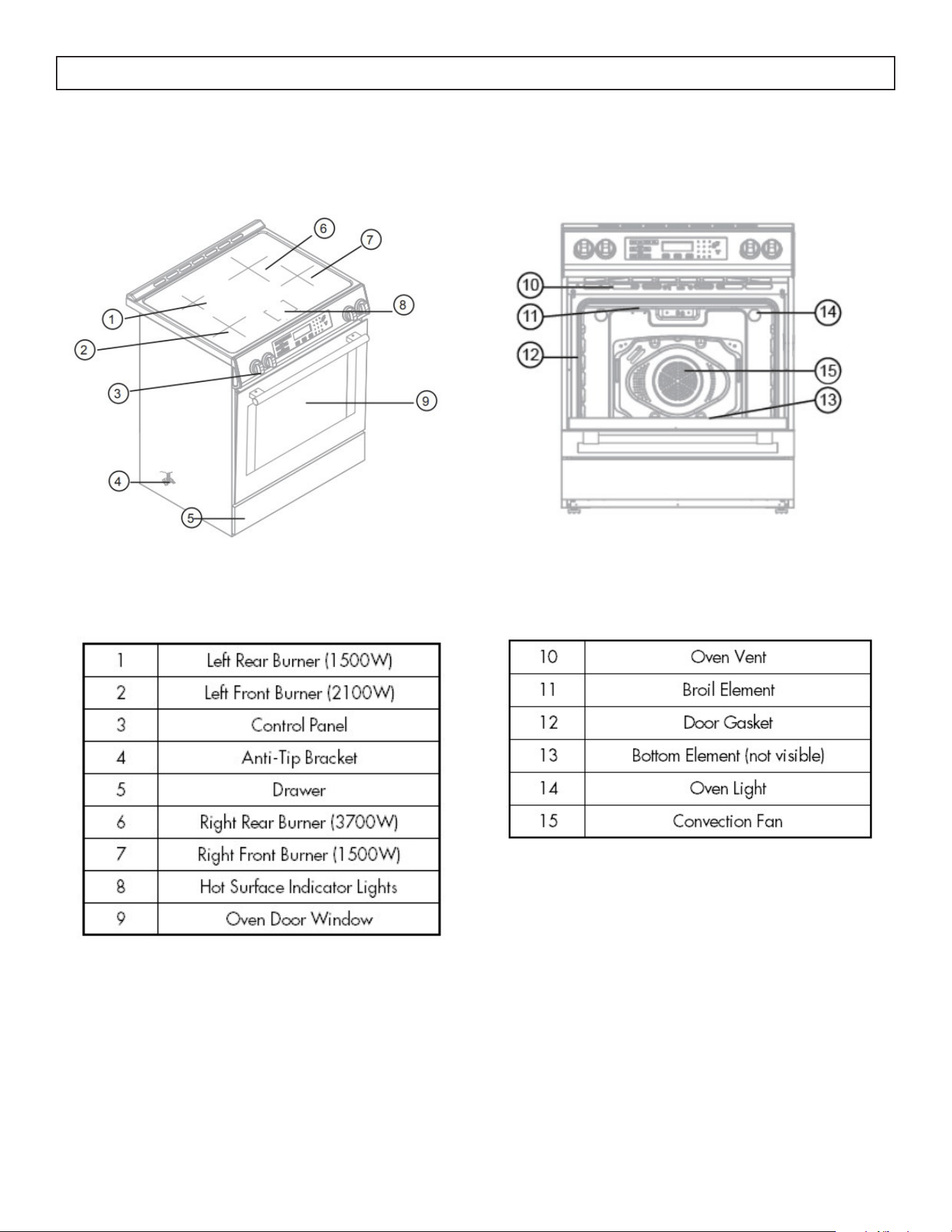
OPERATING INSTRUCTIONS
EXTERIOR PARTS INTERIOR PARTS
2019
OPERATING INSTRUCTIONS
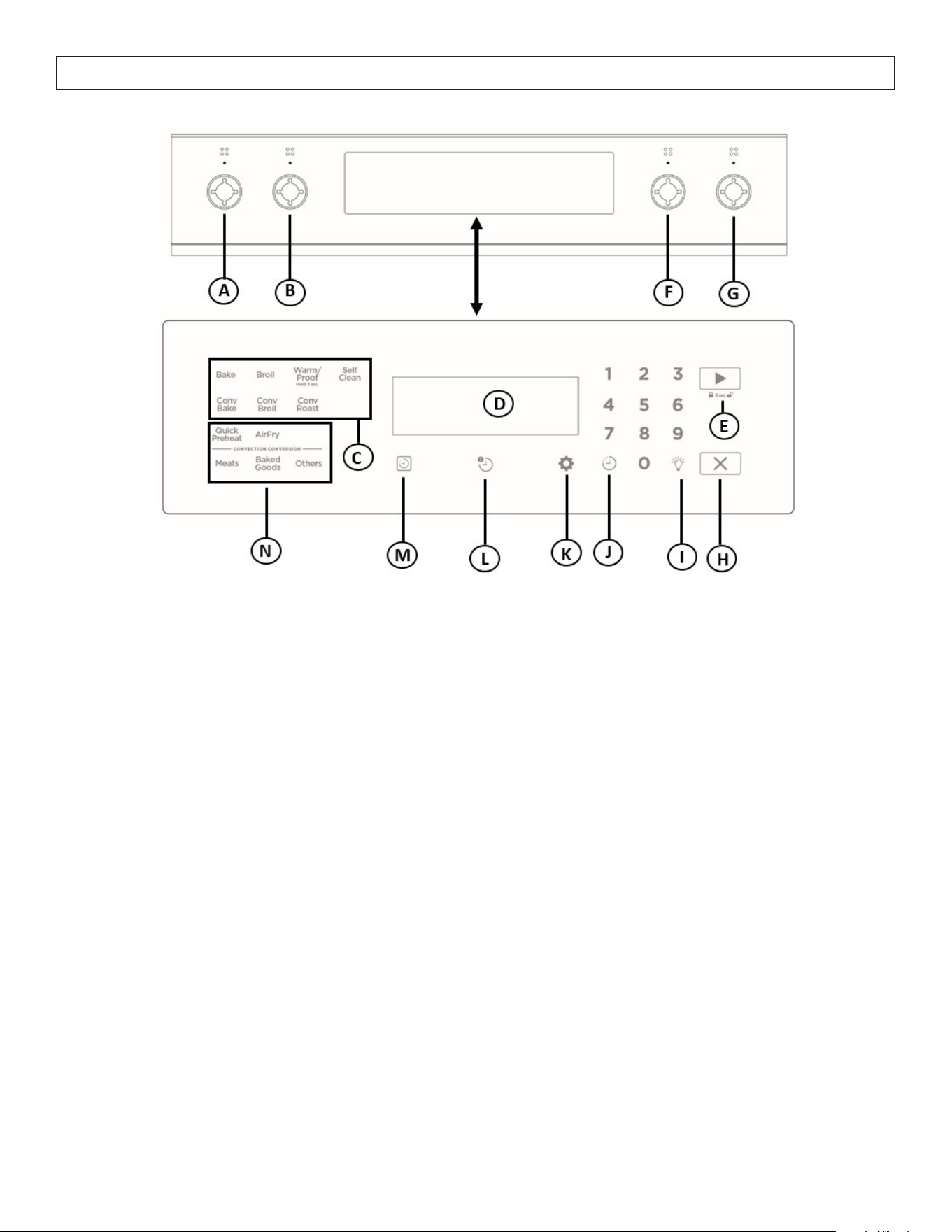
CONTROL PANEL
A. Front Left Burner
B. Rear Left Burner
C. Oven modes
D. LED display screen
E. Start / Control lock (hold for 3 seconds)
F. Rear Right Burner
G. Front Right Burner
Operation of Oven
• Ensure that the shelves are inserted at the correct height.
• Select the desired oven mode.
• Set the oven to the desired preheat temperature.
• Set the timer to activate and preheat the oven (time as necessary).
• Place bakeware with food on one or both of the shelves provided with the oven.
• Close the door.
NOTES:
• The timer affects the operation of the oven, if the timer is OFF, the oven will not work.
• The oven cannot be set with the door open.
• Do not place anything, including dishes, foil, and oven trays on the bottom of the oven when it is in
operation to avoid damaging the enamel finish.
• If there is a power outage/failure, the unit will retain the last setting with the exception of the time. The
time will have to be reset.
21
H. Cancel
I. Light
J. Timer
K. Settings
L. Delay Start
M. Cook Time
N. Preset Modes
OPERATING INSTRUCTIONS
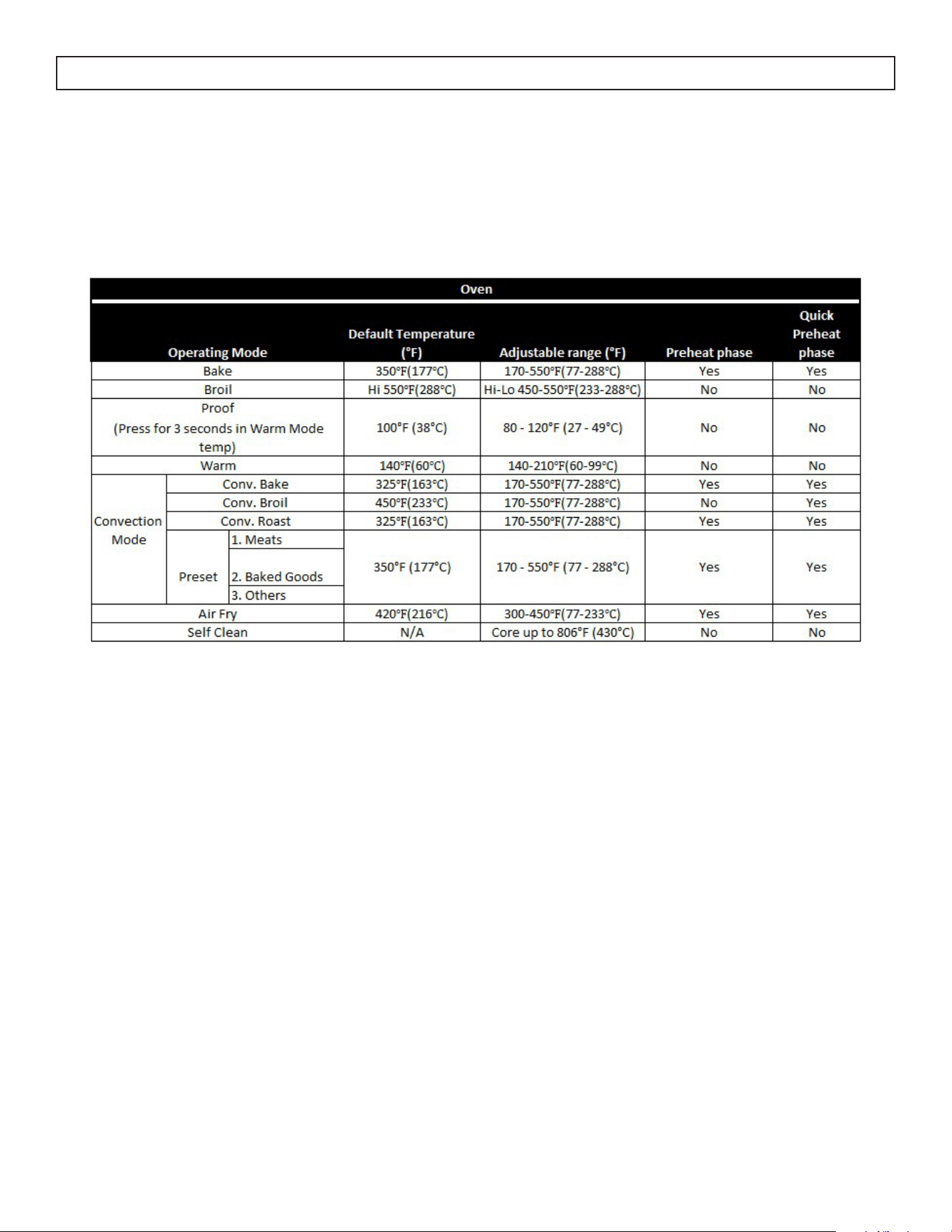
This oven combines the functions of traditional oven modes with the functions of modern, fan-assisted
convection modes in a single oven. Use the Cooking Mode control, located on the control panel, to select
the oven mode.
NOTE: During any cycle, the heating elements will turn off when the door is opened, and will remain off
until the door is closed. To maintain oven temperature, limit door openings during cooking.
NOTE: The preheating stage indicates whether real-time display of temperature is required.
• There is a preheating stage: when the actual oven core temperature is less than 170°F (77°C), the
interface displays LO.
• When the actual core temperature of the oven is greater than or equal to 170°F (77°C), the interface
displays the temperature in real time.
• When the actual oven core temperature reaches the set temperature, the interface always displays the
the set temperature value along with a long tone.
• Non-preheating stage: the set temperature value is always displayed on the heating interface of the
oven from the beginning.
OVEN OPERATIONAL MODES
22
QUICK PREHEAT INSTRUCTIONS:
The Quick Preheat function rapidly increases the oven temperature and is available for the modes of Bake,
Convect Bake, Convect Broil, Convect Roast, Baked Goods, Meats, Others, and Air Fry when the oven
temperature setting is above 230°F (110°C).
If the temperature settingis lower, pressing Quick Preheat will produce an invalid tone.
To use Quick Preheat, select an oven mode, press Start, and then press Quick Preheat. The Quick Preheat
icon will illuminate, indicating the oven is preheating. Once the set temperature is reached, the system will
emit a long tone, and the oven will switch to the selected mode. The Quick Preheat icon will then turn off.
24
OPERATING INSTRUCTIONS
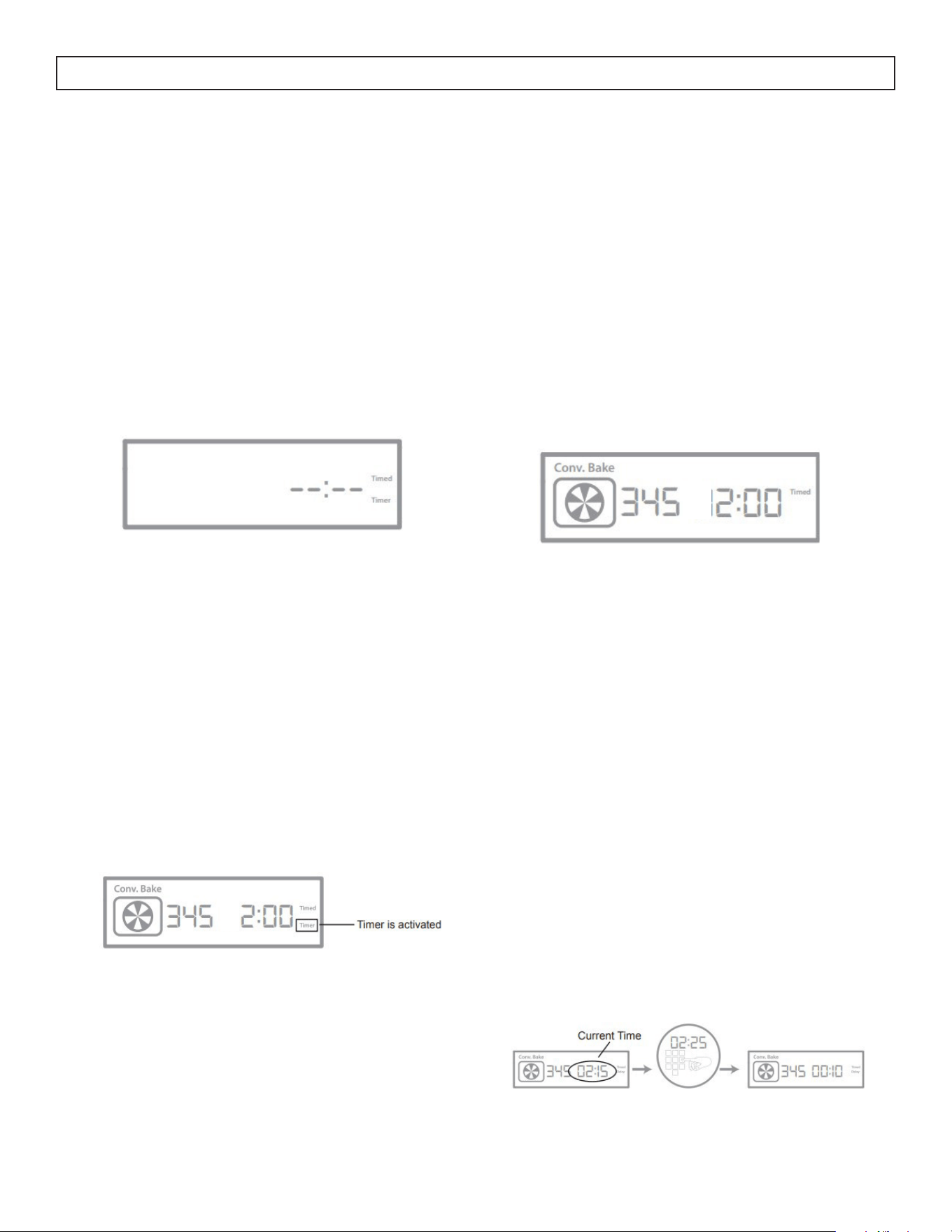
Kitchen Timer
The kitchen timer can be activated independently of
oven operation.
Set up as just a kitchen timer:
Press the “TIMER” button on the control panel, (--:--)
will appear on the display screen. Press the numbers
on the keypad to the time you wish to use, then
press TIMER button again to activate.
NOTE: The time can be set to a maximum of 12
hours.
Set up as kitchen timer while Cook Time is active:
• The timer can be set before or after the preheat.
If the timer is set after the preheat and food
is inside, press the “TIMER” button. (--:--) will
appear on the display screen. Press the numbers
on the keypad to the time you wish to use, then
press TIMER button again. “Timer” will display
on the screen.
NOTE: The timer will not automatically “shut off”
when it has reached the end of the time, it must be
manually shut off by pressing “Timer”.
• Press the Cook Time button.
• Set the time by using the number keypad.
• Press “Start” to begin.
NOTE: Once activated, the word “Timed” will
appear on the display screen.
NOTE: If the requested temperature exceeds the
allowed setting range, the next operation is not
allowed and the system makes two invalid beeps.
NOTE: If the timer has been set in the process
of preheating, the timer will be active once the
temperature has reached the set value.
Delay Start
Delay Start function only works when the oven is
being used. This function is not available for the
Cooktop
• Select the desired baking function.
• Press the “Delay Start” button, the current time
will be displayed.
• To start in 10 minutes, add 10 minutes to the
current time
• Press Start to activate the delay
The display will show the countdown from 10
minutes and it will begin to preheat.
Example:
If the time is 2:15pm, press 2:25pm. 00:10 will
appear on the display.
23
Cook Time
Cook Time has a similar functionality as a timer
however, the oven will automatically “Shut Off” the
unit. The Cook Time function is for the oven only.
The default cook time is set for 2 hours (2:00) which
can be re-set during or after preheating. If Cook
Time is set during the preheat, it will activate once
the temperature has reached the set value.
OPERATING INSTRUCTIONS
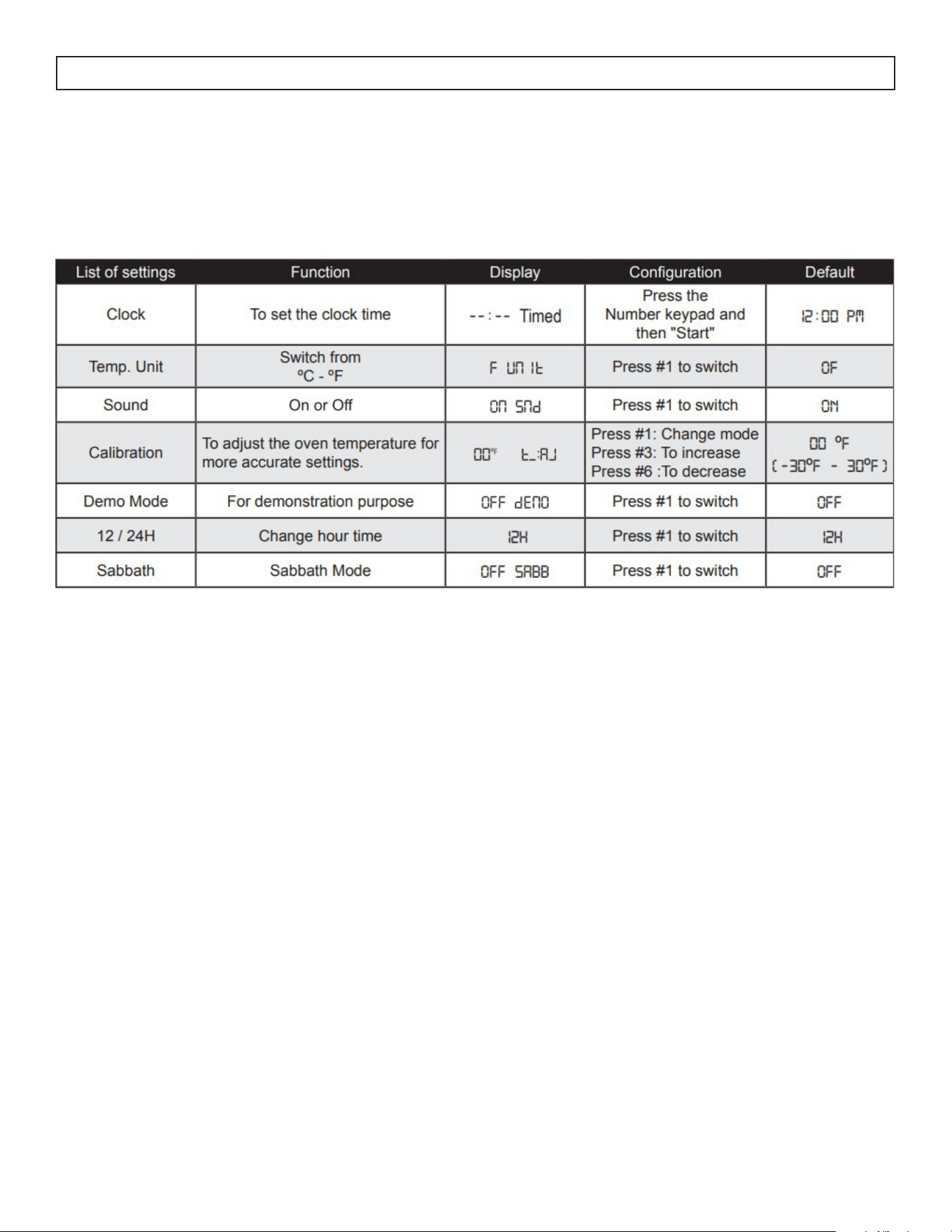
Settings
Press the “Setting” button on the control panel. To go through the selections, press the “Setting” button
repeatedly. The table below will provide the list of the 7 “Settings”, their functions and and how to
configure.
Child Lock Function
When the oven is on standby, press the “Start” button and hold for 3 seconds. The control panel is now
locked. If other buttons are touched, the Child Lock icon on the screen blinks and an invalid tone is heard
at the same time.
The Child Lock can be disabled by pressing the “Start” button and holding it for 3 seconds. The control
panel is now unlocked.
24

OPERATING INSTRUCTIONS
PREHEATING
When beginning a Bake, Convection Bake or Convection Roast cycle, the oven will begin preheating after
Start is pressed. The oven will take approximately 12 to 15 minutes to reach 350°F (177°C) with all of the
oven racks provided with the oven inside the oven cavity. Higher temperatures will take longer to preheat.
The preheat cycle rapidly increases the oven temperature which is used to offset the heat lost when the
oven door is opened to place the food on the rack. This ensures that cooking will begin at the proper
temperature.
NOTE: Do not open the door when in the preheat mode.
NOTE: When the oven has heated to the set temperature, a short tone will sound. The door can now be
opened and the food placed in the oven.
BAKE
Baking is cooking with heated air. Both upper and lower elements in the oven are used. Follow the recipe
or food direction for baking temperature, time, and rack position.
• Use one rack when selecting the bake mode.
• Occasionally check the oven to see if the food is cooked.
• Use metal bakeware (with or without non-stick finish), heatproof glass, glass ceramic, potter, or other
utensils suitable for the oven
• Leave at least 1-1.5 inches (2.5-4cm) of space between the bakeware and oven walls.
• Do not use aluminum foil or disposable aluminum trays to line any part of the ove as it will alter the
cooking performance and can damage the finish of the oven.
• If required a baking tray can be lined with foil and used on the bottom shelf.
• Avoid using the opened door as a shelf to place pans.
BROIL
Broiling uses direct radiant heat to cook food. The lower the temperature, the slower the cooking. The
temperature can be set from LO 450°F (232°C) to HI 550°F (288°C). It is recommended to use a 2 piece
broiling tray (not provided) as any liquids from the broiling process will gather in the bottom section of the
tray and not spill into the oven.
• Place rack in required position before turning on the oven.
• Select LO or HI for broiling temperature.
• Pull out oven rack to stop position before turning or removing food.
• Do not preheat the oven.
• Turn meats once halfway through the cooking time.
NOTE: The oven door remains closed during broil. When inspecting the food, open the oven door no more
than two inches.
NOTE: If Cook Time or Delay Start is used to set a cook time, the oven will turn off automatically.
25

WARM
The warm mode keeps hot, cooked foods at serving temperature. The temperature for “warm” can be set
from 140°F (60°C) to 210°F (99°C). The temperature for ”proof” can be set from 80°F (27°C) to 120°F
(49°C).
1. Press “WARM/PROOF” on the control panel. “WARM” will be displayed on the screen
2. Press “START” if you wish to warm food at 170°F (78°C) or enter the desired temperature by pressing
the number keypad and then press “START”. The temperature can be set from 140°F (60°C) to 210°F
(99°C).
3. Press CANCEL when finished and remove the food from the oven.
NOTE: The option to set a Cook Time is available.
OPERATING INSTRUCTIONS
PROOF
Proofing is a term used in baking to describe the process of allowing yeast dough to rise before baking.
The “Proof” setting provides a warm temperature specifically designed to create an ideal environment for
yeast to rise during the proofing process.
Before proofing, place the dough in a slightly greased bowl and cover loosely with wax paper that has
been coated with shortening. Place on second rack from the bottom and close the oven door.
1. Press “WARM/PROOF” and hold for 3 seconds until “WARM’ on the display screen switches to
“PROOF”.
2. Press START if you wish to proof dough at 100°F (38°C) of enter the desired temperature by pressing
the number keypad and then press “START”. The temperature can be set from 80°F (27°C) to 120°F
(49°C).
3. Let the dough rise until nearly double in size, checking after 20-25 minutes. Proofing may vary
depending on dough type and quantity.
4. Press CANCEL when finished.
5. Before second proofing, shape the dough, place it on baking sheets or pans and cover loosely with
plastic wrap coated with cooking spray. Follow steps 1 - 4.
6. Before baking, remove the plastic wrap.
NOTE: The option to set a Cook Time is available.
26

OPERATING INSTRUCTIONS
CONVECTION SETTINGS
During convection cooking, the fan provides hot air circulation throughout the oven. The movement of
heated air round the food can help to speed up cooking by penetrating the cooler outer surfaces. Food
cooks more evenly, browning and crisping outer surfaces while sealing moisture inside. When the oven
is set to the Convection function, the ring element, bake and broil elements, and the fan operate to heat
the oven cavity. If the oven door is opened during convection cooking or preheating, the fan turns off
immediately and the element(s) will turn off after 30 seconds. Once the door is closed, the element(s) will
automatically turn on.
Convection Fan
The convection fan operates during any convection mode. When the oven is operating in convection mode,
the fan will turn off automatically when the door is opened. The convection fan may run in non-convection
modes during the preheat time.
Convection Bake
Convection Bake adds the use of convection fan(s) to circulate heated air. Both the temperature and
cooking times may be slightly reduced.
• Use for single or multiple rack baking. Reduce standard recipe baking temperature by 25°F (15°C).
• Heatproof glass or ceramic can be used. Reduce temperature by another 25°F (15°C) when using
heatproof glass dishes for a total reduction of 50°F (30°C).
• Dark metal pans may be used however, food may brown faster when using dark metal bakeware.
NOTE: Do not try to convert recipes such as custard, quiches, pumpkin pie or cheesecakes as they do not
benefit from the convection-heating process. Use the regular Bake mode for these foods.
Convection Broil
Convection Broil adds the use of convection fan(s) to circulate heated air. Bring the rack to the middle of the
oven cavity to provide even cooking. It is recommended to use a 2 piece broiling tray as any liquids from
the broiling process will gather in the bottom section of the tray and not spill into the oven.
• Place rack in required position before turning on the oven.
• Use convection Broil mode with the oven door closed.
• Enter your normal broiling temperature.
• Do not preheat the oven.
• Turn meat once halfway through the cooking time.
27

Convection Roast
When convection roasting set the temperature to you normal roasting temperature. The roasting time
should be 15-30% less than in conventional cooking. It is not necessary to preheat the oven for Convection
Roast.
• Roast in a low-sided, uncovered pan.
• Use a 2-piece broil pan for roasting uncovered.
• It is recommend to use a probe or meat thermometer to determine the internal doneness of the meat.
• Large poultry may need to be covered with foil during a portion of the roasting time to prevent over
browning.
OPERATING INSTRUCTIONS
CONVECTION CONVERSION
When using a Convection Recipe, enter your normal cooking temperature and time. The Convection
Conversion mode will adjust the temperature and time for perfect cooking results.
• The oven door must be closed before selecting a Convection Conversion oven mode.
• Setting Cook Time is required for a Convection Conversion oven mode. If Cook Time was not set, the
control will prompt you to Set Cook Time.
NOTE: At the end of the set Cook Time, the oven will turn off automatically, the end of cycle tone will sound
and “End “ will appear on the display.
BAKED GOODS
1. Press BAKED GOODS among the Convection Conversion controls.
2. Set the oven temperature. The temperature can be set from 170°F (77°C) to 500°F (260°C).
3. Press START. “Set cooking time” will appear in the display.
4. Press the number keypad to enter the desired cook time. “Press START” will appear in the display.
NOTE: If a delayed start time is desired, press START TIME, and then press the number keypad to enter
the desired start time. “Press START” will appear on the display. Set Cook Time is mandatory for the
Convection Conversion oven mode. If Cook Time was not set, the control will prompt you to “Set Cook
Time”.
5. Press START. The oven will begin to preheat. Once the set temperature has been reached a tone will
sound.
NOTE: If the recipe requires the food to be cooked in a preheated oven, add 15 minutes to Cook Time to
allow time for the oven to preheat. Once the oven is heated to the set temperature and the tone sounds,
place food in the oven.
6. At the end of the set Cook Time the oven will turn off automatically, the end of cycle tone will sound and
“End” will appear in the display.
2827

AIR FRY
The preset operating temperature is 420°F (216°C) for a duration of 22 minutes. The time and temperature
settings can be manually adjusted before starting. Once the desired temperature has been set, the “Timer”
function will begin counting down as soon as the temperature reaches the set value.
Note: Adding a drip pan or tray under the fry basket when air frying is to catch any excess oil or
drippings that may occur during the cooking process is recommended. This can help prevent any mess or
smoke caused by the drippings and make the cleaning process easier.
OPERATING INSTRUCTIONS
MEATS
It is not necessary to preheat the oven for convection conversion MEAT option.
1. Press MEATS among the Convection Conversion controls.
2. Set the oven temperature. The temperature can be set from 170°F (77°C) to 550°F (288°C).
3. Press START. “Set cooking time” will appear in the display.
4. Press the number keypad to enter the desired cook time. “Press START” will appear in the display.
NOTE: Set Cooking Time is mandatory for the Convection Conversion oven mode.
5. At the end of the set Cook Time the oven will turn off automatically, the end of cycle tone will sound and
“End” will appear in the display.
OTHER FOODS
1. Press OTHER FOODS among the Convection Conversion controls.
2. Set the oven temperature. The temperature can be set from 170°F (77°C) to 550°F (288°C).
3. Press START. “Set cooking time” will appear in the display.
4. Press the number keypad to enter the desired cook time. “Press START” will appear in the display.
NOTE: If a delayed start time is desired, press START TIME, and then press the number keypad to enter
the time-of-day you want the oven to turn on. “Press START” will appear on the display. Set Cook Time is
mandatory for the Convection Conversion oven mode. If Cook Time was not set, the control will prompt
you to “Set Cook Time”.
5. Press START. The oven will begin to preheat. Once the set temperature has been reached a tone will
sound.
NOTE: If the recipe requires the food to be cooked in a preheated oven, add 15 minutes to Cook Time to
allow time for the oven to preheat. Once the oven is heated to the set temperature and the tone sounds,
place food in the oven.
6. At the end of the set Cook Time the oven will turn off automatically, the end of cycle tone will sound and
“End” will appear in the display.
29

OPERATING INSTRUCTIONS
TEMPERATURE PROBE
The oven has a temperature probe that can be inserted into the foods to ensure the internal temperature
reaches a desired value.
CAUTION: The probe and probe port will become hot during the cooking process. Use insulated oven mitts
or gloves when unplugging the probe from the oven receiver and when removing from the cooked food.
• Insert the thin end of the probe into the food to be cooked.
• Place the food onto the rack inside the oven.
• Insert the probe plug into the oven receptical located under a spring cover on the front left hand side of
the oven cavity near the door.
• Once inserted the probe icon will appear on the lower right of the display .
• Select the oven temperature.
NOTE: The cook time can not be set when using the temperature probe.
• Press the Cook Time button to set the desired internal temperature of the food.
NOTE: The oven will turn off when the desired internal temperature has been reached.
The current temperature of the oven will be displayed in orange on the left side of the display and the
internal temperature of the food will be displayed in white on the right hand side of the display.
Removing Food from Oven
Open then door completely.
Using insulated oven mitts or gloves, unplug the probe from the receptacle.
Remove the cookware from the oven.
Remove the probe from the food and place it on a heat-proof surface to cool.
NOTE: The temperature probe cord length may not allow for removing the food from the oven if left
connected to the receptacle. Please ensure to remove the probe from the receptacle before removing the
food and cookware from the oven to prevent spillage.
3029
OPERATING INSTRUCTIONS
COOKTOP
Suitable Cookware
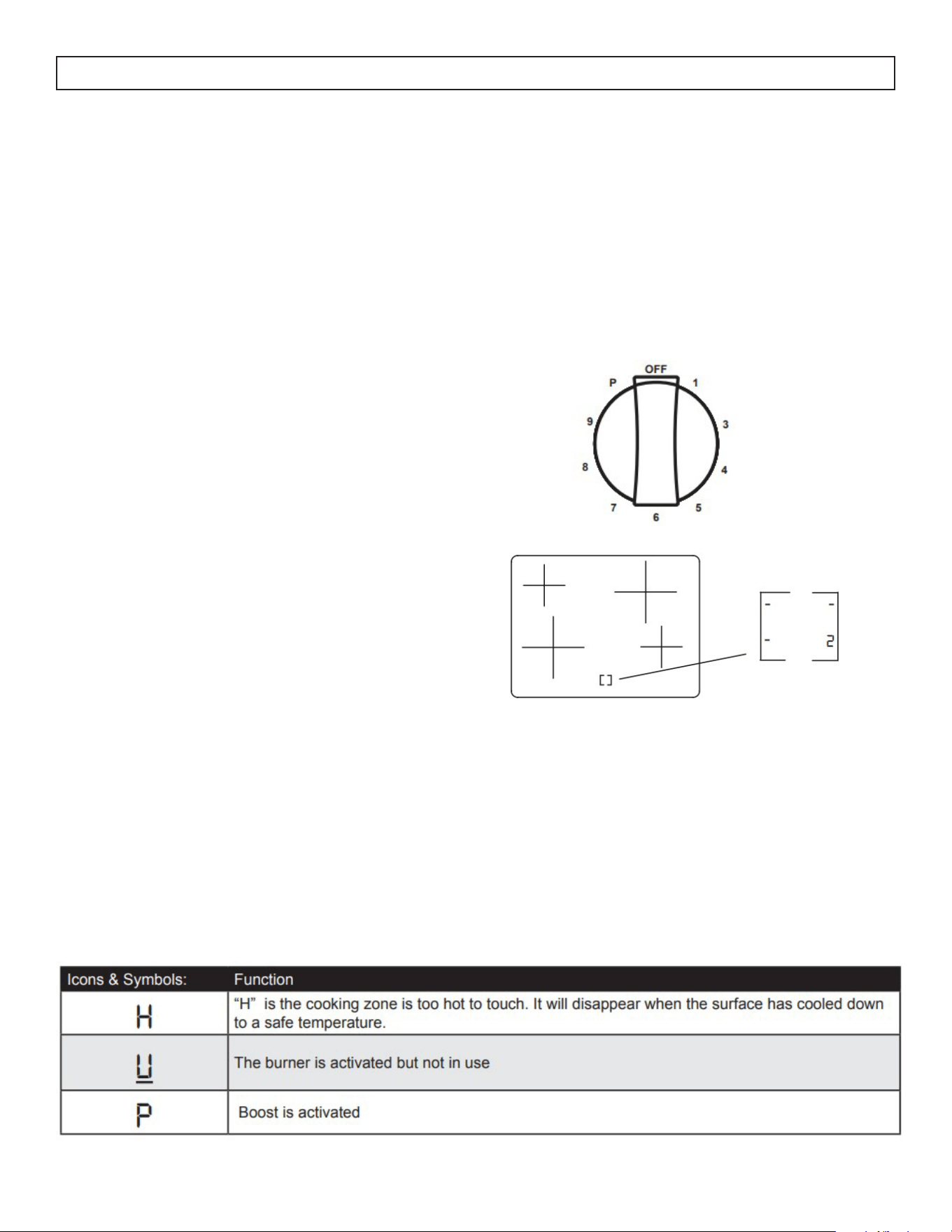
Induction cooktops are not suitable for all pots and pans. Place a magnet on the outside bottom of the
pan to see if it sticks. If the magnet does not stick to the pan then the pan is not suitable for the induction
cooktop.
NOTE: If a pan is not suitable for an induction cooktop, it will not work on the induction cooktop.
Heating Zone
Select the heating zone to be used. Ensure the
bottom of the pan or pot and the surface of the
cooking zone are clean and dry.
Turn the control knob clockwise to set the desired
power level. The power levels range from 1 (low) to
9 (high) and include a Boost (P) setting. The power
level can be adjusted at any time.
The relevant indicator on the cooktop will show the
power level selected in the small square in the mid-
lower section of the cooktop.
Boost Function
Turn the control knob clockwise al the way to “P”. The “P” will be activated and will display on the
indicator. The boost function will remain on for 5 minutes, after 5 minutes the zone will automatically set to
level 9.
To cancel the boost function, turn the knob anticlockwise to 9.
NOTE: Two boost functions can be activated at the same time, except for the Right Rear Burner (3700W).
31

CARE & MAINTENANCE
CLEANING
Before cleaning, make sure all controls are turned
off, and the oven and cooktop are cool. Always
follow label instruction on cleaning products. It is
recommended that soap, water and a soft cloth or
sponge is used first unless otherwise noted. Do not
use abrasive cleaning products.
Exterior Porcelain Enamel Surfaces
Food spills containing acids, such as vinegar and
tomato, should be cleaned as soon as the entire
appliance is cool. These spills may affect the finish.
Use glass cleaner, mild liquid cleaner or
nonabrasive scrubbing pad. Gently clean around
the model and serial number plate as scrubbing
may remove numbers.
Exterior Stainless Steel
Use liquid detergent or all-purpose cleaner. Rinse
well with clean water and dry soft, lint-free cloth.
Stainless Steel Cleaner and Polish Vinegar can be
used for hard water spots.
NOTE: Do not use soap-filled scouring pads,
abrasive cleaners, cooktop polishing cream, steel-
wool pads, gritty washcloths or some paper towels.
Damage may occur even with one-time or limited
use. Rub in direction of grain to avoid damaging.
Oven Door Exterior
Use glass cleaner and paper towels or nonabrasive
plastic scrubbing pad. Apply glass cleaner to soft
cloth or sponge, not directly on panel.
Ceramic Glass Cooktop
To avoid damaging the cooktop, do not use steel
wool, abrasive powder cleansers, chlorine bleach,
rust remover or ammonia. Ceramic cooktop
cleaning materials include cooktop cleaner, cooktop
scraper and cooktop cleaning pads available at
most grocery stores.
1. Remove food/residue with a cooktop scraper.
• For best results, use the cooktop scraper while
the cooktop is still warm but not hot to the
touch.
• It is recommended to wear an oven mitt while
scraping the warm cooktop.
• Hold the cooktop scraper at approximately
a 45° angle against the glass surface and
scrape the residue. It will be necessary to apply
pressure in order to remove the residue.
• Allow the cooktop to cool down completely
before proceeding to Step 2.
2. Apply a few dime-sized drops of cooktop
cleaner to the affected areas.
• Rub cooktop cleaner onto the cooktop surface
with a nylon or similar cooktop cleaning pad.
Some pressure is needed to remove stubborn
stains.
• Allow the cleaner to dry to a white haze before
proceeding to Step 3.
3. Polish with a clean, dry cloth or a clean, dry
paper towel.
Smudges from Aluminum Bottom Pans
Use a cloth dampened in vinegar.
Control Panel
Use glass cleaner and a soft cloth or sponge. Apply
class cleaner to soft cloth or sponge, not directly on
the panel. Do not use abrasive cleaners, steel-wool
pads, gritty washcloths or some paper towels as
damage may occur.
Cooktop Control Knobs
Use soap and water or dishwasher detergent.
• Pull knobs straight out from the control panel to
remove.
• When replacing knobs, make sure knobs are
turned to the Off position.
NOTE: Do not use steel-wool, abrasive cleansers or
oven cleaner. Do not soak knobs.
32

CARE & MAINTENANCE
Oven Cavity
Food spills should be cleaned when oven cools. At
high temperatures, foods react with porcelain so
staining, etching, pitting or faint white spots can
result.
Use mild detergent and warm water.
NOTE: Do not use oven cleaners.
Oven Racks
Use a steel-wool pad.
Self Cleaning Cycle
The Self Cleaning cycle uses very high temperatures
burning soil to a powdery ash.
• Self clean the oven before it becomes heavily
soiled. Heavy soil results in longer cleaning and
more smoke.
• Keep the kitchen well ventilated during the Self
Cleaning cycle to help get rid of heat, odours
and smoke.
• Do not clean, rub, damage or move the oven
gasket. The door gasket is essential for a good
seal.
• Allow the oven to cool to room temperature
before using the Self Clean feature. If your oven
cavity is above 170°F (77°C), “Oven Cooling”
will appear on the display and the Self Clean
cycle will not activate until it cools down.
• The oven light will not work during the Self
Cleaning cycle. On some models, the surface
elements will not work during the Self Cleaning
cycle.
• When “Lock” shows on the display, the oven
door cannot be opened. To avoid damage to
the door, do not force it open when “Lock” is
displayed.
NOTE: Do not touch the oven during the Self
Cleaning cycle. Keep children away from the oven
during the Self Cleaning cycle. Failure to do so can
result in burns.
Self Clean Preparing Oven
• Remove the broiler pan, cookware and
bakeware.
• Remove remove temperature prove from oven if
available on your model.
• Remove oven racks to keep them shiny and easy
to slide.
• Remove any foil from the oven as it may burn or
melt, damaging the oven.
• Hand clean inside door edge and 1.5 inch
(3.8cm) area around the inside oven cavity
frame, being certain not to move or bend the
gasket. This area does not get hot enough
during Self Cleaning to remove soil. Do not let
water, cleaner, etc. to enter slots on door frame.
Use a damp cloth to clean this area.
• Wipe out any loose soil to reduce smoke and
avoid damage. At high temperatures, foods
react with porcelain. Staining, etching, pitting
of faint white spots can result. This will not affect
cooking performance.
Setting Self Clean
The Cleaning time can be adjusted. Suggested
cleaning times are:
2 Hours - Light soil
3 Hours - Average soil
3.5 Hours - Heavy soil
1. Close the oven door.
NOTE: If the oven door is left open, this function will
not work.
2. Repeatedly touch the “Self Clean” icon to toggle
between self clean time duration options.
NOTE: The door will lock. “SELF CLEAN” will
appear on the display panel until the clean cycle is
finished.
NOTE: The Self Clean feature can be cancelled by
pressing the Cancel button however, if the door
has locked it will remain locked until the oven has
cooled sufficiently.
33
3. “End” appears on the display and the oven
door unlocks.
4. Open the oven door. Once the oven has
completely cooled, remove ash with a damp
cloth.
NOTE: To avoid breaking the glass, do not apply
a cool, damp cloth to the inner door glass before it
has cooled completely.
Oven Door Removal
For normal oven use, there is no need to remove the
oven door. However, should it become necessary,
please follow the instructions below.
NOTE:
• Make sure the oven is cool and power to the
oven has been turned off before removing the
door.
• The oven door is heavy and fragile as well as
the door front is glass. To avoid oven door glass
breakage, use both hands and grasp on the
sides of the oven door to remove.
• Be sure both levers are securely in place before
removing the door.
Door removal
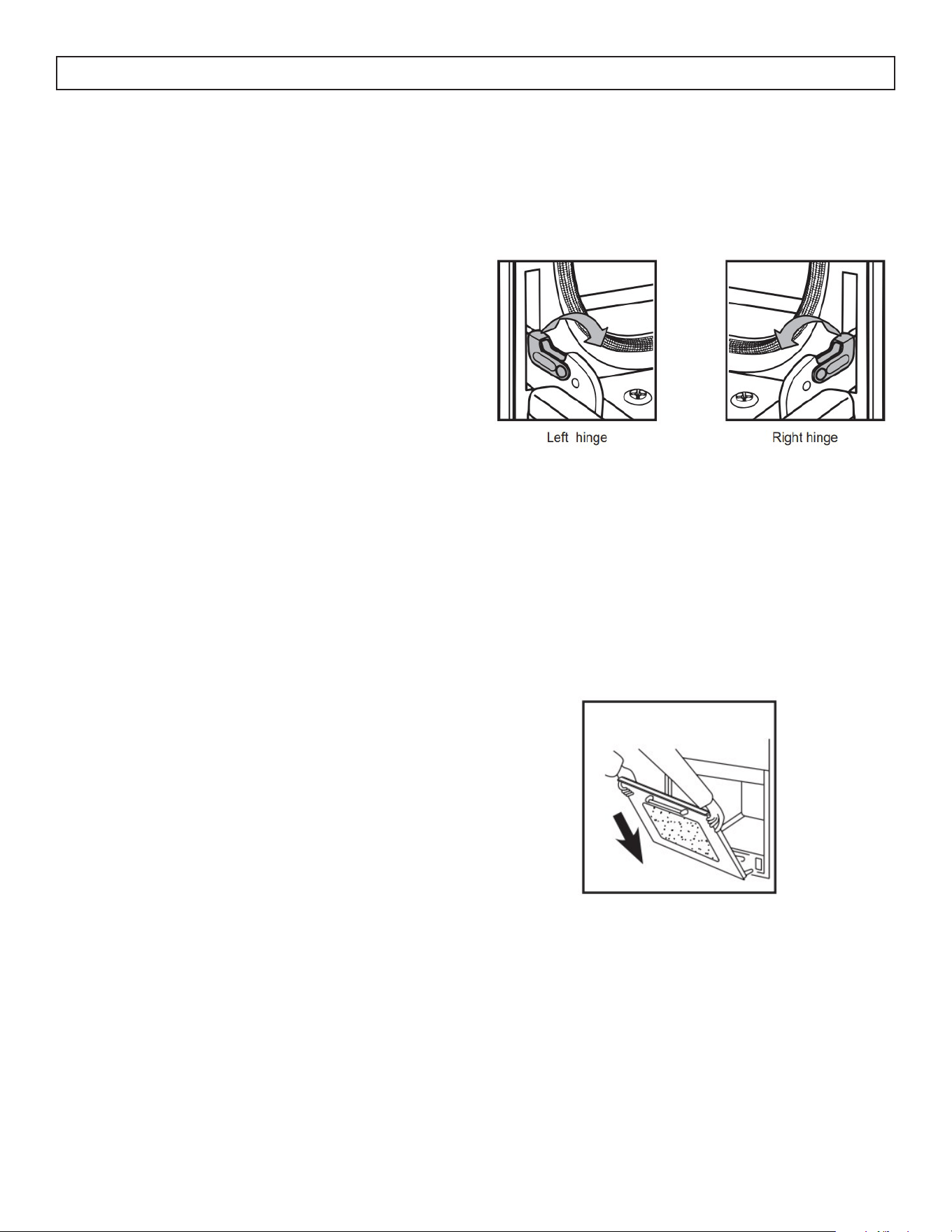
1. Open the oven door completely.
2. Lift up the hinge latch on each side.
CARE & MAINTENANCE
3. Close the oven door as far as it will shut.
4. While grasping both outside edges of the door,
lift up on the door.
5. Continue to push the top of the door closed
while pulling the bottom of the door out of the
hinge receivers in the door frame.
34
Door Reinstallation
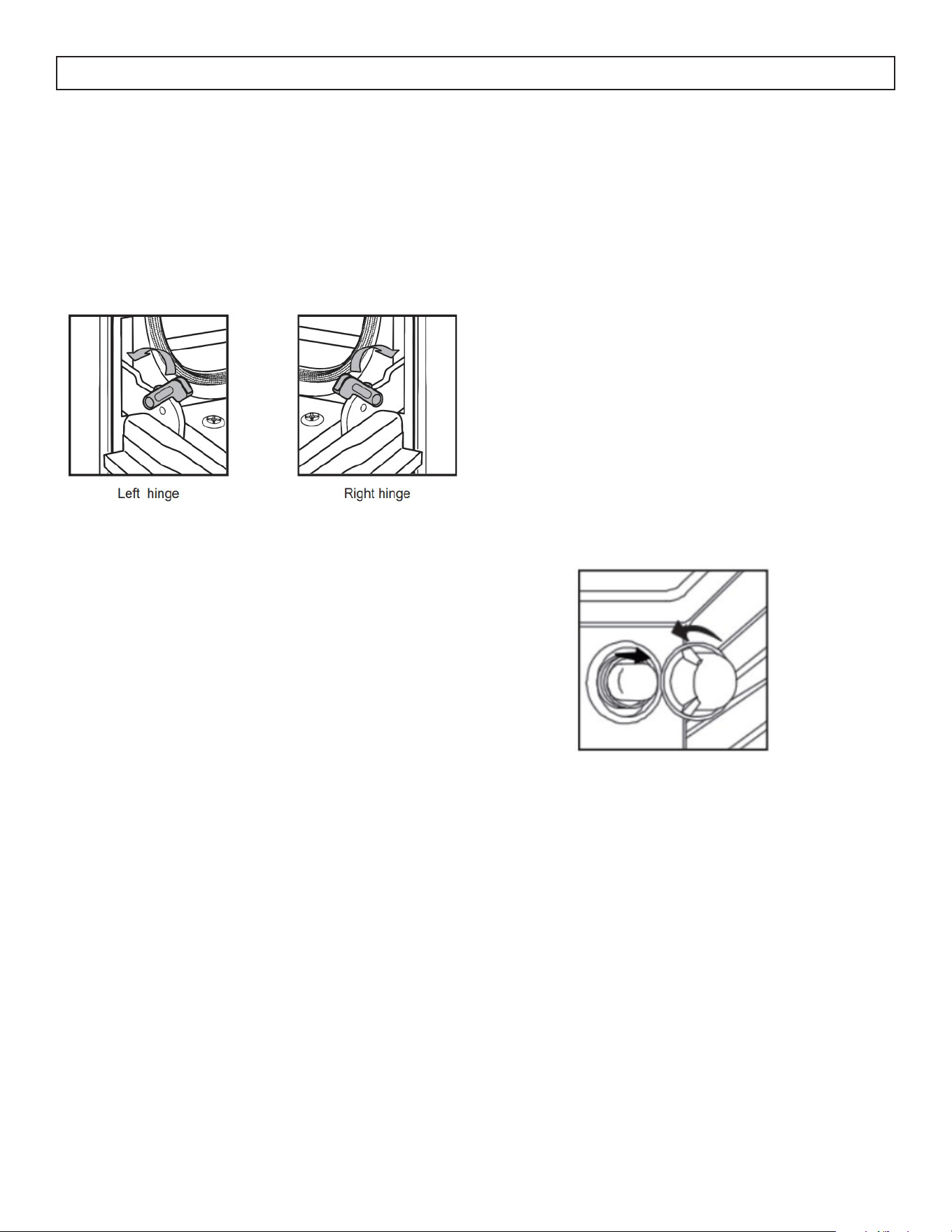
1. Insert both hanger arms into the hinge receivers
in the door frame.
2. Slowly open the oven door and you will feel the
door set into place.
3. Move the hinge latches back into the locked
position.
4. Check that the door opens and closes freely.
If it does not, repeat door removal and
reinstallation.
CARE & MAINTENANCE
Replacing Oven Light
The oven light is a standard 25-watt (G) appliance
bulb.
NOTE:
• Make sure the oven and lights are cool and
power to the oven has been turned off.
• The lenses must be in place when using the
oven. The lenses serve to protect the light bulb
from breaking.
• The lenses are made of glass. Handle carefully
to avoid breakage.
• Failure to do so could result in death, electrical
shock, cuts or burns.
1. Disconnect the power.
2. Remove the bulb by turning it anti-clockwise.
3. Remove the burned-out bulb from the socket.
NOTE: To avoid damage or decreasing the life
of the new bulb, do not touch the bulb with bare
fingers. Wear gloves or use a tissue when replacing
the light bulb.
4. Replace the bulb and then replace the bulb
cover.
5. Reconnect the power.
35

36
TROUBLESHOOTING
No power
• A fuse may be blown or the circuit breaker
tripped
• Plug not fully inserted into the wall outlet
Cooktop elements not working properly
• Improper cookware is being used
• No power
• Heating elements cycle off even when turned
to highest setting: temperature limiters are
temporarily shutting off the elements due to
exceding the maximum allowable temperature
• Glass ceramic surface is see through or appears
to be red in colour: Under direct or bright
lighting it may be possible to see through the
glass and it may have a red tint. This is normal
Oven mode and temperature controls
cannot be set
• Oven door is open
Cooling fan continues to run after oven is
turned off
• Electronic components have not yet cooled
sufficiently
Oven light
• Not working properly: Bulb is loose or burned
out
• Stays on: door is not closing completely
• Cannot remove lens cover: Soil build-up around
the lens cover
Error Alarm Message
Abnormal Temperature Sensor: Err1
In any state, if the temperature sensor is open or
short, the oven will give an alarm and display Err1.
In this case, cancel can be performed.
Abnormal Food Probe Sensor:Err2
If the pin port is shorted, the oven function will
alarm and display Err2. At this time, you can return
to the standby state by clicking the cancel key.
Abnormal Crystal Oscillator:Err7
If the display board crystal oscillator is short-
circuited or damaged, causing the clock and timing
function to fail, then the oven will alarm and display
Err7, and you can return to standby status by using
the cancel key.
Warning Cooktop Overheat: Hot
When the cooktop plate overheat indicator light
is on, at this time, if you start the self-cleaning
mode or in the self-cleaning mode, the oven will
be cooktop plate overheat warning and display
“Hot”, the electric heaters will stop working, at this
time, you can return to standby mode through the
“Cancel” button.
LIMITED IN-HOME APPLIANCE WARRANTY
This quality product is warranted to be free from manufacturer’s defects in material and workmanship, provided that the unit is used under the normal operating
conditions intended by the manufacturer.
This warranty is available only to the person to whom the unit was originally sold by Danby Products Limited (Canada) or Danby Products Inc. (U.S.A.) (hereafter
“Danby”) or by an authorized distributor of Danby, and is non-transferable.
TERMS OF WARRANTY
Plastic parts, are warranted for thirty (30) days only from purchase date, with no extensions provided.
First Year
During the rst twelve (12) months, any functional parts of this product found to be defective, will be repaired or replaced, at warrantor’s
option, at no charge to the ORIGINAL purchaser.
To obtain
Danby reserves the right to limit the boundaries of “In Home Service” to the proximity of an Authorized Service Depot. Any app liance
Service
requiring service outside the limited boundaries of “In Home Service” , it will be the consumer’s responsibility to transport the appliance (at
their own expense) to the original retailer (point of purchase) or a service depot for repair. See “Boundaries of In Home Serv ice”below.
Contact your dealer from whom your unit was purchased, or contact your nearest authorized Danby service depot, where service
must be performed by a qualied service technician.
If service is performed on the units by anyone other than an authorized service depot, or the unit is used for commercial appli cation, all
obligations of Danby under this warranty shall be void.
Boundaries of
If the appliance is installed in a location that is 100 kilometers (62 miles) or more from the nearest service center your unit must be
In Home Service
delivered to the nearest authorized Danby Service Depot, as service must only be performed by a technician qualied and certif ied for
warranty service by Danby. Transportation charges to and from the service location are not protected by this warranty and are t he
responsibility of the purchaser.
Nothing within this warranty shall imply that Danby will be responsible or liable for any spoilage or damage to food or other c ontents of this appliance, whether due
to any defect of the appliance, or its use, whether proper or improper.
EXCLUSIONS
Save as herein provided, Danby, there are no other warranties, conditions, representations or guarantees, express or implied, m ade or intended by Danby or its
authorized distributors and all other warranties, conditions, representations or guarantees, including any warranties, conditio ns, representations or guarantees
under any Sale of Goods Act or like legislation or statue is hereby expressly excluded. Save as herein provided, Danby shall no t be responsible for any damages
to persons or property, including the unit itself, howsoever caused or any consequential damages arising from the malfunction o f the unit and by the purchase of
the unit, the purchaser does hereby agree to indemnify and hold harmless Danby from any claim for damages to persons or propert y caused by the unit.
GENERAL PROVISIONS
No warranty or insurance herein contained or set out shall apply when damage or repair is caused by any of the following:
1) Power failure.
2) Damage in transit or when moving the appliance.
3) Improper power supply such as low voltage, defective house wiring or inadequate fuses.
4) Accident, alteration, abuse or misuse of the appliance such as inadequate air circulation in the room or abnormal operating con ditions
(extremely high or low room temperature).
5) Use for commercial or industrial purposes (ie. If the appliance is not installed in a domestic residence).
6) Fire, water damage, theft, war, riot, hostility, acts of God such as hurricanes, oods etc.
7) Service calls resulting in customer education.
8) Improper Installation (ie. Building-in of a free standing appliance or using an appliance outdoors that is not approved for out door application).
Proof of purchase date will be required for warranty claims; so, please retain bills of sale. In the event warranty service is required, present this document to our
AUTHORIZED SERVICE DEPOT.
Danby Products Limited
PO Box 1778, Guelph, Ontario, Canada N1H 6Z9
Telephone: (519) 837-0920 FAX: (519) 837-0449
Danby Products Inc.
PO Box 669, Findlay, Ohio, U.S.A. 45840
Telephone: (419) 425-8627 FAX: (419) 425-8629
04/09
1-800-263-2629
Warranty Service
In-home
Danby reserves the right to limit the boundaries of “In Home Service” to the proximity of an authorized service
depot. Any appliance requiring service outside the limited boundaries of “In Home Service”, will be the consumer’s
responsibility to transport at their own expense to the original point of purchase or a service depot for repair. If the
appliance is installed in a location that is 100 kilometers (62 miles) or more from the nearest service center, it must
be delivered to the nearest authorized Danby Service Depot by the purchaser.
Transportation charges to and from the service location are not protected by this warranty and are the
responsibility of the purchaser.
During the first twenty four (24) months, any functional parts of this product found to be defective, will be repaired
or replaced, at warrantor’s option, at no charge to the original purchaser.
Contact the dealer where the unit was purchased, or contact the nearest authorized Danby service depot, where
service must be performed by a qualified service technician. If service is performed on the unit by anyone other
than an authorized service depot, all obligations of Danby under this warranty shall be void.
First 24 months
To obtain service
Boundaries of
in-home service
LIMITED “IN HOME” WARRANTY
This quality product is warranted to be free from manufacturer’s defects in material and workmanship, provided that the unit is used
under the normal operating conditions intended by the manufacturer.
This warranty is available only to the person to whom the unit was originally sold by Danby Products Limited (Canada) or Danby
Products Inc. (U.S.A.) (hereafter “Danby”) or by an authorized distributor of Danby, and is non-transferable.
TERMS OF WARRANTY
Plastic parts are warranted for thirty (30) days from the date of purchase, with no extensions provided.
Nothing within this warranty shall imply that Danby will be responsible or liable for any spoilage or damage to food or other
contents of this appliance, whether due to any defect of the appliance, or its use, whether proper or improper.
EXCLUSIONS
Save as herein provided, by Danby, there are no other warranties, conditions, representations or guarantees, express or implied, made
or intended by Danby or its authorized distributors and all other warranties, conditions, representations or guarantees, including any
warranties, conditions, representations or guarantees under any Sale of Goods Act or like legislation or statute is hereby expressly
excluded. Save as herein provided, Danby shall not be responsible for any damages to persons or property, including the unit itself,
howsoever caused or any consequential damages arising from the malfunction of the unit and by the purchase of the unit, the
purchaser does hereby agree to indemnify and hold harmless Danby from any claim for damages to persons or property caused by
the unit.
GENERAL PROVISIONS
No warranty or insurance herein contained or set out shall apply when damage or repair is caused by any of the following:
1) Power failure.
2) Damage in transit or when moving the appliance.
3) Improper power supply such as low voltage, defective house wiring or inadequate fuses.
4) Accident, alteration, abuse or misuse of the appliance such as inadequate air circulation in the room or abnormal operating
conditions (ie. extremely high or low room temperature).
5) Use for commercial or industrial purposes (ie. If the appliance is not installed in a domestic residence).
6) Fire, water damage, theft, war, riot, hostility, acts of God such as hurricanes, floods etc.
7) Service calls resulting in customer education.
8) Improper Installation (ie. Building-in of a free standing appliance or using an appliance outdoors that is not approved for outdoor
application, including but not limited to: garages, patios, porches or anywhere that is not properly insulated or climate controlled).
Proof of purchase date will be required for warranty claims; retain bills of sale. In the event that warranty service is required, present
the proof of purchase to our authorized service depot.
Warranty Service
In Home
Danby Products Limited
PO Box 1778, Guelph, Ontario, Canada N1H 6Z9
Telephone: (519) 837-0920 FAX: (519) 837-0449
Danby Products Inc.
PO Box 669, Findlay, Ohio, U.S.A. 45840
Telephone: (419) 425-8627 FAX: (419) 425-8629
1-800-263-2629
04/17

38
Bienvenido a la familia Danby.
Estamos orgullosos de nuestros productos de calidad y creemos en un servicio
confiable. Le sugerimos que lea este manual del propietario antes de enchufar su nuevo
electrodoméstico, ya que contiene información importante de funcionamiento, información
de seguridad, solución de problemas y consejos de mantenimiento para garantizar la
confiabilidad y longevidad de su electrodoméstico.
Tiene derecho a la cobertura de la garantía como se describe en el manual del propietario
que se proporciona con su nuevo electrodoméstico.
1. Escriba la información de su aparato a continuación. Debe conservar el comprobante
de compra original para validar y recibir los servicios de garantía.
2. Registre su producto en línea y reciba una EXTENSIÓN DE GARANTÍA GRATUITA DE 2
MESES después de completar una encuesta sobre el producto, en
www.danby.com/support/product-registration/
Número de modelo: _______________________________________________
Número de serie: _________________________________________________
Fecha de compra: _________________________________________________
Necesitas ayuda?
1. Lea el manual del propietario para obtener ayuda con la instalación, resolución de
problemas y asistencia de mantenimiento.
2. Visite www.Danby.com para acceder a herramientas de autoservicio, preguntas
frecuentes y mucho más buscando su número de modelo en la barra de búsqueda.
3. Para obtener el servicio al cliente más rápido, complete el formulario web en www.
danby.com/support. Su envío irá directamente a un experto en su dispositivo en
particular. Nuestros tiempos de respuesta promedio son entre 20 minutos y 2 horas,
durante el horario comercial EST.
4. Llame al 1-800-263-2629; tenga en cuenta que durante las horas pico, los tiempos de
espera pueden exceder una hora.
AVIS - AVANT LA PREMIERE UTILISATION
Antes de utilizar esta cocina por primera vez, los elementos calefactores tienen una capa protectora que
debe quemarse antes de su uso. Para ello:
• Retire todo el embalaje del interior del horno
• Asegúrese de que la puerta está cerrada
• Pulse la función hornear en el panel de control. La pantalla se encenderá con la temperatura
predeterminada y el temporizador de cocción
• Fije la temperatura en 500°F (260°C) pulsando el teclado numérico del panel de control. Si se
sobrepasa la temperatura, el aparato emitirá un pitido al pulsar el botón “Start”
• Pulse “Start” para iniciar la operación
• Deje que el horno funcione durante 30 minutos con la puerta cerrada y el interior vacío
• Apague el horno y abra la puerta para que se enfríe
NOTA: Cuando la temperatura real dentro del horno sea inferior a 170°F (77°C), la pantalla digital
mostrará “LO”. La pantalla mostrará la temperatura real dentro del horno hasta que se alcance la
temperatura establecida y luego continuará mostrando la temperatura establecida.
NOTA: Cualquier olor que pueda detectarse durante la puesta en marcha inicial se debe a la evaporación
de las sustancias utilizadas para proteger el horno durante el almacenamiento.
Informacion de Seguridad Importante
LEA Y SIGA TODAS LAS INSTRUCCIONES DE SEGURIDAD
ADVERTENCIA - PELIGRO DE VUELCO
• Un niño o un adulto puede volcar el aparato y morir.
• Verifique que el soporte antivuelco se haya instalado correctamente en el piso o pared.
• Asegúrese de que el soporte antivuelco se vuelva a acoplar cuando se mueva la estufa.
• No opere la estufa sin el soporte antivuelco en su lugar y acoplado.
• El incumplimiento de estas instrucciones puede causar la muerte o quemaduras graves a niños o adultos.
DISPOSITIVO ANTIVUELCO
Para reducir el riesgo de que la estufa se vuelque debido a un uso anormal o a una carga incorrecta de
la puerta, la estufa debe asegurarse instalando un dispositivo antivuelco. Hay dos dispositivos antivuelco
diferentes incluidos con este aparato.
Nota: Si alguna vez se reubica la estufa, se debe quitar el soporte antivuelco e instalarlo en la nueva
ubicación.
ADVERTENCIA
ASFIXIA Y RIESGO DE ATRAPAMIENTO INFANTIL
Para evitar la posibilidad de que los niños queden atrapados, tome las siguientes precauciones antes de
desechar el aparato:
• Retire la puerta del horno por completo.
• Nunca permita que los niños operen, jueguen o gateen dentro de la estufa eléctrica.
¡GUARDA ESTAS INSTRUCCIONES!
PELIGRO - INCENDIOS CAUSADOS POR
GRASA
En caso de incendio, no recoja nunca una olla o
sartén en llamas. Apague el elemento si puede
hacerlo sin peligro. Apague el fuego con un
extintor químico seco o de espuma.
No utilice agua en incendios provocados por
grasa. El agua esparcirá la grasa y no extinguirá
el fuego. Apague el fuego con una tapa de olla
bien ajustada, una bandeja para galletas o una
bandeja plana, o utilice un extintor químico seco
o de espuma.
Si se produce un incendio en el horno mientras
está en uso, sofoque el fuego cerrando la puerta
del horno y apagándolo o utilice un extintor
químico seco o de espuma.
PELIGRO - RIESGO DE INCENDIONO TOQUE LOS ELEMENTOS
CALEFACTORES NI LAS ZONAS
PRÓXIMAS A ELLOS
Los elementos calefactores de la superficie o
del interior del aparato pueden estar calientes
aunque sean de color oscuro. Las zonas cercanas
a los elementos calefactores pueden calentarse lo
suficiente como para causar quemaduras. Durante
y después del uso, no toque ni deje que la ropa
u otros materiales inflamables entren en contacto
con los elementos calefactores o las zonas
cercanas hasta que hayan tenido tiempo suficiente
para enfriarse. Las superficies del aparato pueden
calentarse lo suficiente como para provocar
quemaduras, entre ellas la encimera de cocción,
las aberturas de ventilación del horno y las
superficies cercanas a estas aberturas, las puertas
y las ventanas del horno.
• Se recomienda conectar este aparato a un
circuito separado que no esté compartido con
ningún otro aparato.
• No limpie nunca las piezas del aparato con
líquidos inflamables. Estos vapores pueden
crear un peligro de incendio o explosión.
Nunca utilice ni almacene gasolina u otros
vapores o líquidos inflamables en el interior
o en las proximidades de este aparato; de
lo contrario, podría producirse un riesgo de
incendio o explosión.
• Antes de limpiar o reparar este aparato,
desenchúfelo completamente de la toma de
corriente o desconecte la alimentación eléctrica
de la cocina en el panel de distribución
doméstico quitando el fusible o desconectando
el disyuntor. De lo contrario, puede producirse
una descarga eléctrica o la muerte.
• No intente reparar o sustituir ninguna pieza
de su aparato a menos que se recomiende
específicamente en este manual. Cualquier otra
reparación debe ser realizada por un técnico
cualificado.
• Por su seguridad, este aparato no debe
utilizarse nunca como fuente de calor ni
como calefactor. Los elementos de la placa de
cocción no deben utilizarse sin los utensilios de
cocina adecuados.
• Todas las aberturas en la pared detrás del
aparato y el suelo debajo del aparato deben
estar selladas.
• Mantenga la zona alrededor del aparato
despejada y libre de materiales combustibles,
gasolina y otros vapores inflamables.
Mantenga siempre los revestimientos de
paredes, cortinas o cortinajes combustibles a
una distancia segura de la cocina.
• No obstruya el flujo de aire alrededor del
aparatol.
• Almacenamiento dentro o sobre el aparato: no
deben almacenarse materiales inflamables en
el horno ni cerca de los elementos de la placa
de cocción.
• No cubra ninguna ranura, orificio o paso del
fondo del horno ni cubra una rejilla entera con
materiales como papel de aluminio.
Informacion de Seguridad Importante
LEA Y SIGA TODAS LAS INSTRUCCIONES DE SEGURIDAD
¡GUARDA ESTAS INSTRUCCIONES!
REQUISITOS GENERALES DE SEGURIDAD
Asegúrese de que el aparato esté correctamente instalado y conectado a tierra por un técnico cualificado.
No deje a los niños solos o desatendidos en la zona donde se utiliza el aparato. No permita que los niños
se sienten o se pongan de pie sobre ninguna parte del aparato.
No guarde objetos de interés para los niños en armarios situados encima de una cocina o en la
protección trasera de una cocina. Los niños que se suban a la cocina para alcanzar objetos podrían sufrir
lesiones graves.
Para eliminar el riesgo de quemaduras o incendio por alcanzar objetos por encima de las unidades de
superficie calientes, debe evitarse el almacenamiento en armarios situados por encima de las unidades de
superficie. Si es necesario colocar armarios, el riesgo puede reducirse instalando una campana extractora
que sobresalga horizontalmente un mínimo de 5 pulgadas (12,7 cm) por encima de la parte inferior de
los armarios.
Nunca se deben llevar prendas sueltas o que cuelguen mientras se utiliza el aparato.
Utilice sólo agarraderas secas. Los soportes húmedos sobre superficies calientes pueden provocar
quemaduras por vapor. No deje que el agarrador toque los elementos calefactores calientes. No utilice
toallas ni otros paños voluminosos.
Si se interrumpe el suministro eléctrico a una placa de cocción eléctrica mientras un elemento de superficie
está ENCENDIDO, el elemento de superficie volverá a encenderse tan pronto como se restablezca el
suministro. En caso de pérdida de alimentación eléctrica, si no se giran todos los mandos de los elementos
de superficie a la posición OFF (apagado), pueden encenderse los elementos que se encuentren sobre la
placa de cocción o cerca de ella, lo que podría provocar lesiones graves o incluso la muerte.
Esta cocina está diseñada y fabricada exclusivamente para cocinar alimentos domésticos y no es
adecuada para aplicaciones no domésticas, por lo que no debe utilizarse en un entorno comercial. La
garantía de la cocina quedará anulada si se utiliza en un entorno no doméstico.
ADVERTENCIA
Para reducir el riesgo de quemaduras, no mueva
este aparato mientras esté caliente. Para reducir el
riesgo de lesiones debidas al vuelco del aparato,
verifique la reinstalación de este aparato en el
dispositivo antivuelco suministrado después de
volver a colocar el aparato en la posición de
instalación original.
ADVERTENCIA
El fabricante declina toda responsabilidad por
daños personales o materiales causados por un
uso incorrecto o inadecuado de la cocina.
Informacion de Seguridad Importante
LEA Y SIGA TODAS LAS INSTRUCCIONES DE SEGURIDAD
¡GUARDA ESTAS INSTRUCCIONES!
Informacion de Seguridad Importante
LEA Y SIGA TODAS LAS INSTRUCCIONES DE SEGURIDAD
¡GUARDA ESTAS INSTRUCCIONES!
REQUISITOS DE SEGURIDAD DE LA PLACA
DE COCCIÓN
• Utilice el tamaño de cacerola adecuado. Este
aparato está equipado con cuatro quemadores de
diferentes tamaños. Seleccione utensilios que tengan
fondos planos lo suficientemente grandes como
para cubrir la superficie de la resistencia. El uso de
utensilios de tamaño inferior expondrá una parte de
la resistencia al contacto directo y puede provocar
la ignición de la ropa. La relación adecuada entre
el utensilio y el quemador también mejorará la
eficiencia.
• No deje nunca el aparato desatendido mientras esté
en uso. El hervor produce humo y los derrames de
grasa pueden incendiarse.
• Nunca deje el aceite desatendido mientras fríe.
Si se permite que se caliente más allá de su punto
de humeo, el aceite puede inflamarse y provocar
un incendio que puede propagarse a los armarios
circundantes. Siempre que sea posible, utilice un
termómetro para controlar la temperatura del aceite.
• Para evitar derrames de aceite e incendios, utilice
una cantidad mínima de aceite al freír en sartén
poco profunda y evite cocinar alimentos congelados
con cantidades excesivas de hielo.
• Sólo ciertos tipos de utensilios de vidrio, cerámica,
loza u otros esmaltados son adecuados para el
servicio en la encimera de la cocina sin romperse
debido a un cambio brusco de temperatura.
• Para reducir el riesgo de quemaduras, ignición de
materiales inflamables y derrames debidos a un
contacto involuntario, el mango de un utensilio debe
colocarse de forma que quede girado hacia dentro y
no se extienda sobre los quemadores adyacentes.
• No cocine sobre una placa de cocción rota. Si la
encimera se rompe, las soluciones de limpieza y los
derrames pueden penetrar en la encimera rota y
crear un riesgo de descarga eléctrica. Póngase en
contacto inmediatamente con un técnico cualificado.
• No utilice una plancha o una sartén larga en más de
un quemador a la vez.
• Limpie la encimera de cocción con precaución - Si
utiliza una esponja o paño húmedo para limpiar
derrames sobre una encimera de cocción caliente,
tenga cuidado para evitar quemaduras por vapor.
Algunos limpiadores pueden producir vapores
nocivos si se aplican sobre una superficie caliente.
• No coloque objetos metálicos como cuchillos,
tenedores, cucharas y tapas sobre las superficies de
la placa de cocción, ya que pueden calentarse.
REQUISITOS DE SEGURIDAD DEL HORNO
Tenga cuidado al abrir la puerta. Deje salir el aire
caliente o el vapor antes de retirar o volver a colocar los
alimentos.
No caliente recipientes de alimentos sin abrir. La
acumulación de presión puede hacer que el recipiente
estalle y provocar lesiones.
No obstruya las rejillas de ventilación del horno.
Coloque siempre las rejillas del horno en el lugar
deseado mientras el horno esté frío. Si es necesario
mover la rejilla mientras el horno está caliente, no
deje que el soporte de la olla entre en contacto con el
elemento calefactor caliente del horno.
No utilice el horno si un elemento calefactor presenta
un punto brillante durante el uso o muestra otros
signos de daño. Un punto incandescente indica que el
elemento calefactor puede fallar y presentar un riesgo
potencial de quemadura, incendio o descarga eléctrica.
Apague inmediatamente el horno y solicite a un técnico
cualificado que sustituya la resistencia.
No forre las paredes del horno ni las rejillas con papel
de aluminio.
No coloque estantes, sartenes, bandejas de hornear,
bandejas de asar u otros utensilios de cocina en el fondo
de la cámara del horno. Coloque siempre en un estante
del horno.
No limpie nunca el horno con aparatos de limpieza a
vapor de alta presión.
No deje nada en la parte superior de la abertura de
ventilación del horno. Nunca cubra la abertura de
ventilación del horno con papel de aluminio o cualquier
otro material.
43
Informacion de Seguridad Importante
LEA Y SIGA TODAS LAS INSTRUCCIONES DE SEGURIDAD
¡GUARDA ESTAS INSTRUCCIONES!
Este equipo ha sido probado y se encontró que cumple con los límites para equipos ISM de consumidores,
de conformidad con la parte 18 de las Reglas de la FCC. Estos límites están diseñados para brindar una
protección razonable contra interferencias dañinas en una instalación residencial.
Este dispositivo cumple con la parte 18 y 15 de las normas de la FCC.
La operación está sujeta a las siguientes 2 condiciones:
1) Es posible que este dispositivo no cause interferencias dañinas, y
2) Este dispositivo debe aceptar cualquier interferencia recibida, incluidas las interferencias que puedan
provocar un funcionamiento no deseado.
Este equipo genera, usa y puede irradiar energía de radiofrecuencia y, si no se instala y usa de acuerdo
con las instrucciones, puede causar interferencias dañinas en las comunicaciones por radio. Sin embargo,
no hay garantía de que no se produzcan interferencias en una instalación en particular. Si este equipo
causa interferencias dañinas en la recepción de radio o televisión, lo que se puede determinar apagando
y encendiendo el equipo, se recomienda al usuario que intente corregir la interferencia mediante una o
más de las siguientes medidas:
• Reorientar o reubicar la antena receptora.
• Aumente la separación entre el equipo y el receptor.
• Conecte el equipo a un tomacorriente en un circuito diferente al que está conectado el receptor.
• Consulte al distribuidor o a un técnico experimentado en radio o televisión para obtener ayuda.
Los cambios o modificaciones no aprobados por la parte responsable del cumplimiento de la FCC e
Industry Canada podrían anular la autoridad del usuario para operar el equipo.
Este dispositivo cumple con CAN ICES-001 / NMB-001 de Canadá.
Este dispositivo cumple con CAN ICES-003(B) / NMB-003(B) de Canadá.
DECLARACIÓN DE CONFORMIDAD DEL PROVEEDOR
47 CFR § 2.1077 Información de conformidad
Identificador único: DIRC300BSS
Danby Products Inc.
1800 Production Drive
Findlay, OH
45840
Danby.com
44
Informacion de Seguridad Importante
LEA Y SIGA TODAS LAS INSTRUCCIONES DE SEGURIDAD
¡GUARDA ESTAS INSTRUCCIONES!
INSTRUCCIONES DE CONEXIÓN A TIERRA
Este aparato debe conectarse a tierra. La conexión a tierra reduce el riesgo de descarga eléctrica al
proporcionar un cable de escape para la corriente eléctrica.
Cuando este aparato está equipado con un cable de alimentación que tiene un cable de conexión a tierra
con un enchufe de 4 clavijas. El cable de alimentación debe conectarse a una toma de corriente con
conexión a tierra. Si la toma de corriente no tiene un enchufe de 4 clavijas, debe sustituirse por una toma
de corriente de 4 clavijas con toma de tierra. La placa de características indica el voltaje y la frecuencia
para los que está diseñado el aparato.
ADVERTENCIA - El uso inadecuado del enchufe de conexión a tierra puede provocar un riesgo de
descarga eléctrica. Consulte a un electricista cualificado si no comprende completamente las instrucciones
de conexión a tierra o si tiene dudas sobre si el aparato está correctamente conectado a tierra.
No conecte el aparato a alargadores, adaptadores o junto con otro aparato en la misma toma de
corriente.
No empalme el cable de alimentación. En ningún caso corte ni retire la clavija de toma de tierra del cable
de alimentación.
Si el cable de alimentación está dañado, debe ser sustituido por el fabricante, su servicio técnico o una
persona cualificada similar para evitar riesgos.
Nota: Apagar el aparato no lo desconecta de la red eléctrica.
Se recomienda colocar el cable de alimentación y el enchufe en paralelo al suelo para que el cable
discurra paralelo al suelo.
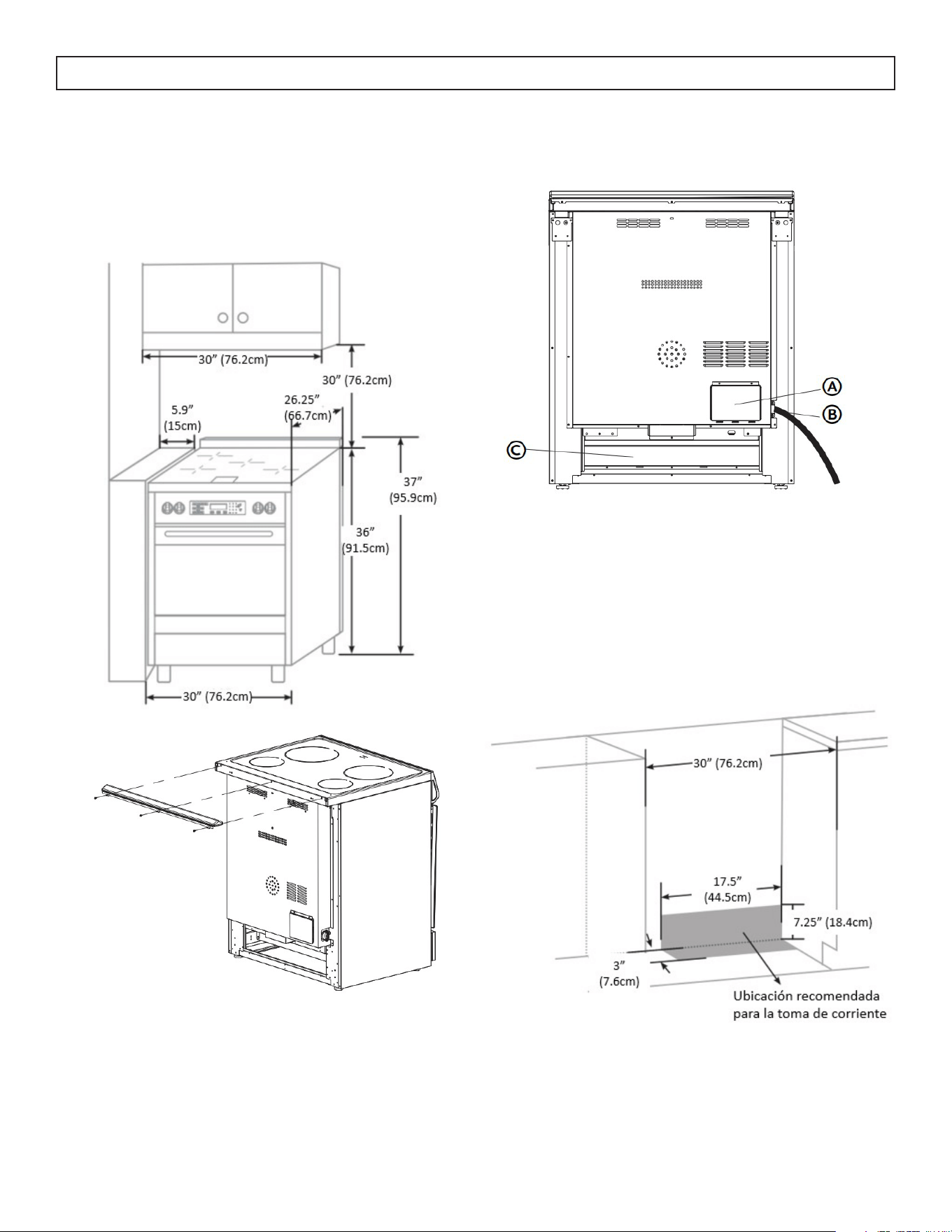
45
INSTRUCCIONES DE INSTALACIÓN
Medidas de instalación
NOTA: La cocina puede elevarse aproximadamente
2,5 cm ajustando las patas niveladoras. El frente de
la puerta y el cajón pueden extenderse más hacia
adelante dependiendo del estilo.
Fuente de alimentación
A: Panel de acceso al cable de alimentación
eléctrica
B: Abertura para el cable de alimentación
C: Zona empotrada
NOTA: Para conectar a una toma de corriente en
la pared, ésta debe estar empotrada. Si la toma de
corriente está en el suelo, debe estar empotrada o
montada en superficie.
INSTALACIÓN DEL SALPICADERO:
Instale el salpicadero en la parte trasera de la
cocina con los tornillos suministrados.

INSTRUCCIONES DE INSTALACIÓN
IMPORTANTE
Desconecte la alimentación antes de realizar el mantenimiento. La conexión incorrecta del cableado
de aluminio de la casa y los cables de cobre de los aparatos puede provocar un peligro eléctrico
o un incendio. Si la vivienda tiene cableado de aluminio, utilice únicamente conexiones diseñadas
y homologadas por UL para unir cobre con aluminio y siga con precisión el procedimiento
recomendado por el fabricante. Las conexiones de aluminio a cobre deben cumplir los códigos
locales. Utilice cables de cobre de calibre 8 o de aluminio de calibre 6. Conecte eléctricamente a tierra
la gama.
CONEXIÓN A LA RED ELÉCTRICA DOMÉSTICA
Asegúrese de que su aparato está correctamente instalado y conectado a tierra por un técnico cualificado.
• Se recomienda utilizar un disyuntor.
• El horno puede conectarse directamente a la caja del disyuntor (o al desconectador con fusibles)
mediante cable flexible o no metálico, de cobre o aluminio.
• Deje al menos 1,8 m (6 pies) de holgura en el cable para poder mover la cocina si es necesario
realizar tareas de mantenimiento.
• En cada extremo del cable de alimentación (en el horno y en la caja de conexiones) debe haber un
conector homologado por UL..
El diagrama de cableado se incluye con la gama. Este aparato se fabrica con el chasis conectado a un
neutro mediante un cable puente verde de tierra. Después de asegurarse de que la alimentación ha sido
desconectada, conecte el conducto flexible de la cocina a la caja de conexiones utilizando un conector de
conducto homologado por UL. Los gráficos de neutro conectado a tierra y neutro no conectado a tierra de
las páginas siguientes y las instrucciones proporcionadas, presentan la forma más común de conectar la
cocina. Los códigos y ordenanzas locales tienen prioridad sobre estas instrucciones. Realice las conexiones
eléctricas de acuerdo con los códigos y ordenanzas locales.
PIEZAS NECESARIAS:
Si utiliza un cable de alimentación:
• Kit de cable de alimentación homologado por UL y marcado para su uso con cocinas. El cable debe
tener una tensión nominal mínima de 250 V, 40 amperios o 50 amperios, estar marcado para su uso
con una abertura de conexión de 3,5 cm (1 3/8”) de diámetro nominal y debe terminar en terminales
de anillo o terminales de pala abiertos con extremos hacia arriba.
• Alivio de tensión aprobado por UL.
Si el cableado es directo:
• Conducto metálico flexible
• Conector de conducto homologado por UL
• Cable eléctrico de 4 ó 3 hilos (donde los códigos locales permitan una conexión de 3 hilos)
• Conectores de cable aprobados por UL
NOTAS:
• Compruebe los códigos locales.
• Compruebe el suministro eléctrico existente.
46
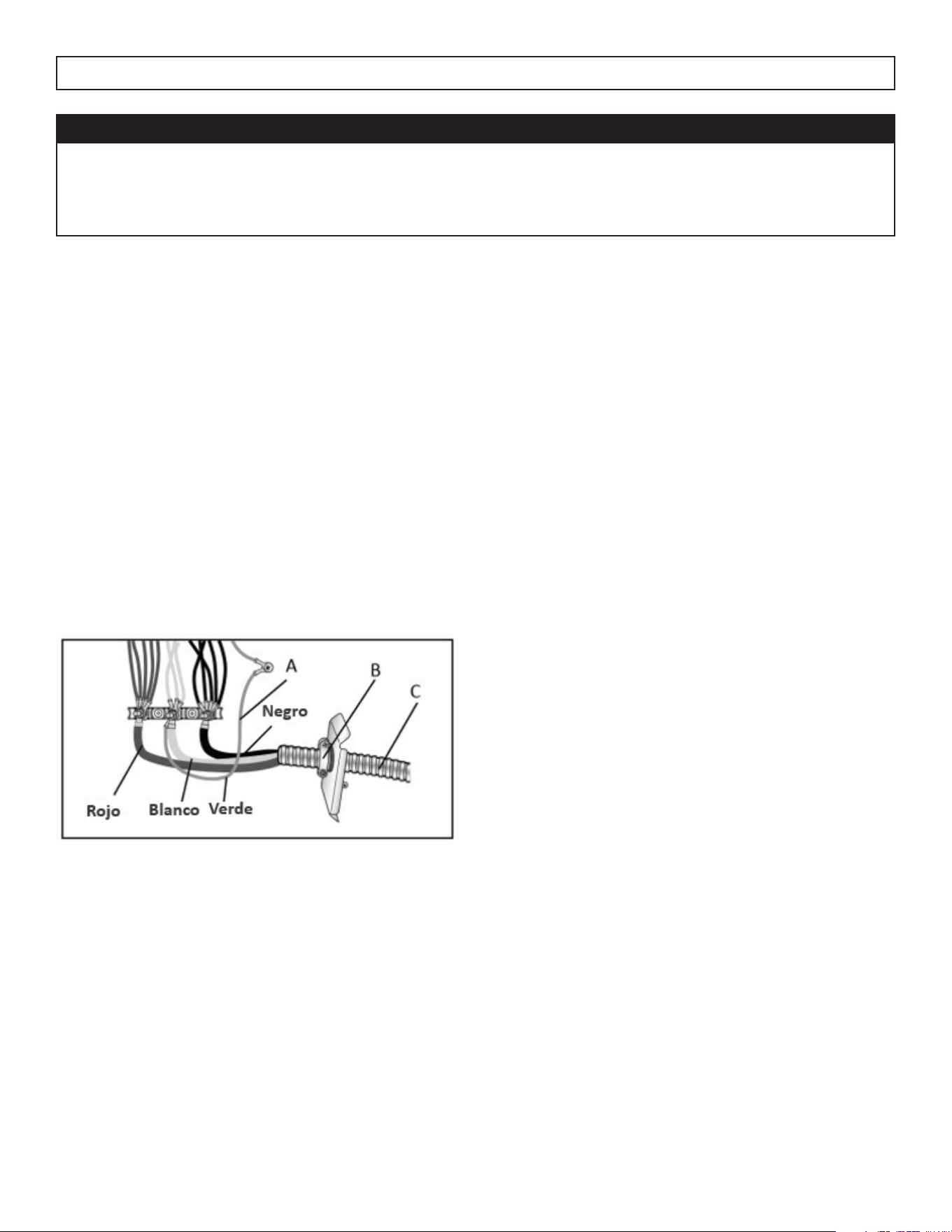
48
INSTRUCCIONES DE INSTALACIÓN
IMPORTANTE
Sólo para modelos vendidos en Estados Unidos. Este modelo no incluye un cable de alimentación
preinstalado. Siga las siguientes instrucciones de cableado antes de utilizar la cocina. No se
suministra el cable de alimentación. Siga todos los códigos y normas de cableado locales y
nacionales.
INSTALACIÓN DE CABLE DE ALIMENTACIÓN DE 3 HILOS
ADVERTENCIA: Utilice este método sólo si los códigos locales permiten conectar el conductor de tierra del
chasis al conductor neutro del cable de alimentación.
1. Pase los hilos del cable eléctrico por el conducto metálico flexible.
NOTA: Deje suficiente holgura para conectar fácilmente los cables al bloque de terminales.
2. Retire el panel de acceso situado en la parte inferior derecha del panel posterior para descubrir el
bloque de terminales eléctricos.
3. Instale un aliviador de tensión con certificación UL en la abertura del conducto metálico flexible en el
soporte y apriete completamente la tuerca del aliviador de tensión.
4. Pase el conducto metálico flexible a través del aliviador de tensión.
NOTA: Deje suficiente holgura para conectar fácilmente el cableado al bloque de terminales.
A: Cable de puente (no suministrado)
B: Alivio de tensión UL
C: Conducto
5. Con una llave de tuercas de 5/16” y una de las tuercas hexagonales 10-32, conecte el cable de tierra
(verde o desnudo) del conducto metálico flexible al poste central del bloque de terminales junto con el
cable de puente verde de la cocina.
6. Utilizando tuercas hexagonales 10-32, conecte los cables rojo y negro del cable de alimentación a los
postes exteriores del bloque de terminales con los correspondientes cables rojo y negro de la cocina.
7. Apriete completamente las tuercas hexagonales y compruebe la conexión.
8. Coloque la parte inferior del aliviador de tensión debajo del conducto metálico flexible y apriete los
tornillos del aliviador de tensión.
NOTA: Antes de apretar, asegúrese de que el aliviador de tensión está colocado sobre el conducto
metálico flexible y NO sobre los cables.
9. Vuelva a colocar el panel de acceso eléctrico.
10. Meta el conducto sobrante en el hueco del panel trasero.
47
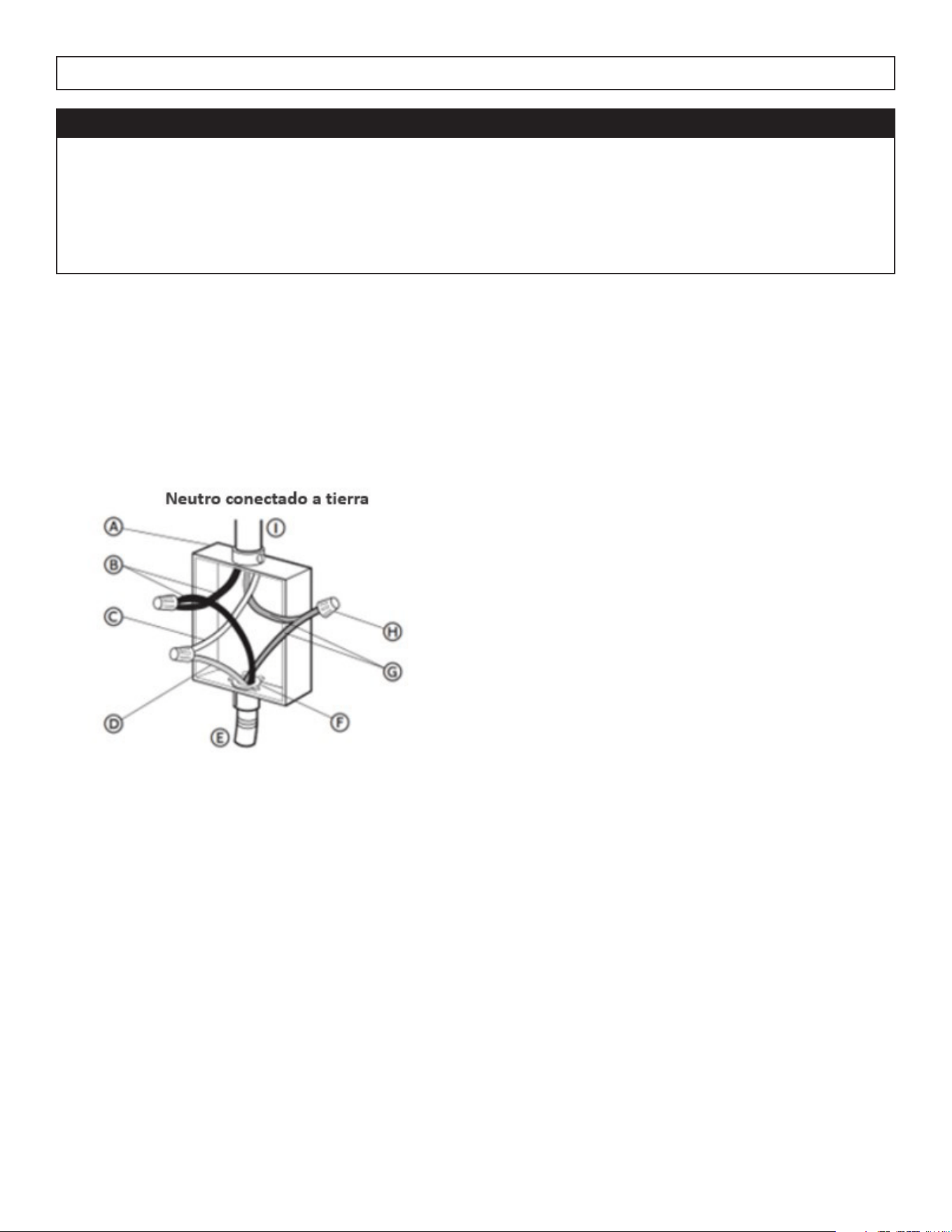
INSTRUCCIONES DE INSTALACIÓN
CONEXIÓN DEL CABLE DE ALIMENTACIÓN DE 3 HILOS A LA RED ELÉCTRICA DE LA CASA
NOTA: Utilice el cable de 3 hilos de la fuente de alimentación doméstica donde los códigos locales
permitan una conexión de 3 hilos.
1. Desconecte la alimentación.
2. Conecte los 2 cables negros entre sí utilizando un conector de cables homologado por UL.
3. Conecte el cable neutro (blanco) y el cable de tierra (verde o desnudo) (del cable de la cocina)
mediante un conector de cables homologado por UL.
4. Conecte los 2 cables rojos entre sí mediante un conector de cables homologado por UL.
5. Instale la tapa de la caja de conexiones.
A: Caja de conexiones
B: Cables negros
C: Cable neutro (blanco)
D: Cable de tierra (verde o desnudo)
E: Cable del horno
F: Conector de conducto aprobado por UL
G: Cables rojos
H: Conectores de cable aprobados por UL
I: Suministro eléctrico doméstico
48
IMPORTANTE
La conexión a tierra a través del conductor neutro está prohibida para las nuevas instalaciones
de circuitos derivados (NEC 1996); casas móviles; y vehículos recreativos, o en un área donde los
códigos locales prohíben la conexión a tierra a través del conductor neutro. Para instalaciones en
las que está prohibida la conexión a tierra a través del conductor neutro, consulte el gráfico Neutro
sin conexión a tierra. Utilice el terminal o cable de tierra para conectar la unidad a tierra. Conecte el
terminal o cable neutro al neutro del circuito derivado de la forma habitual.
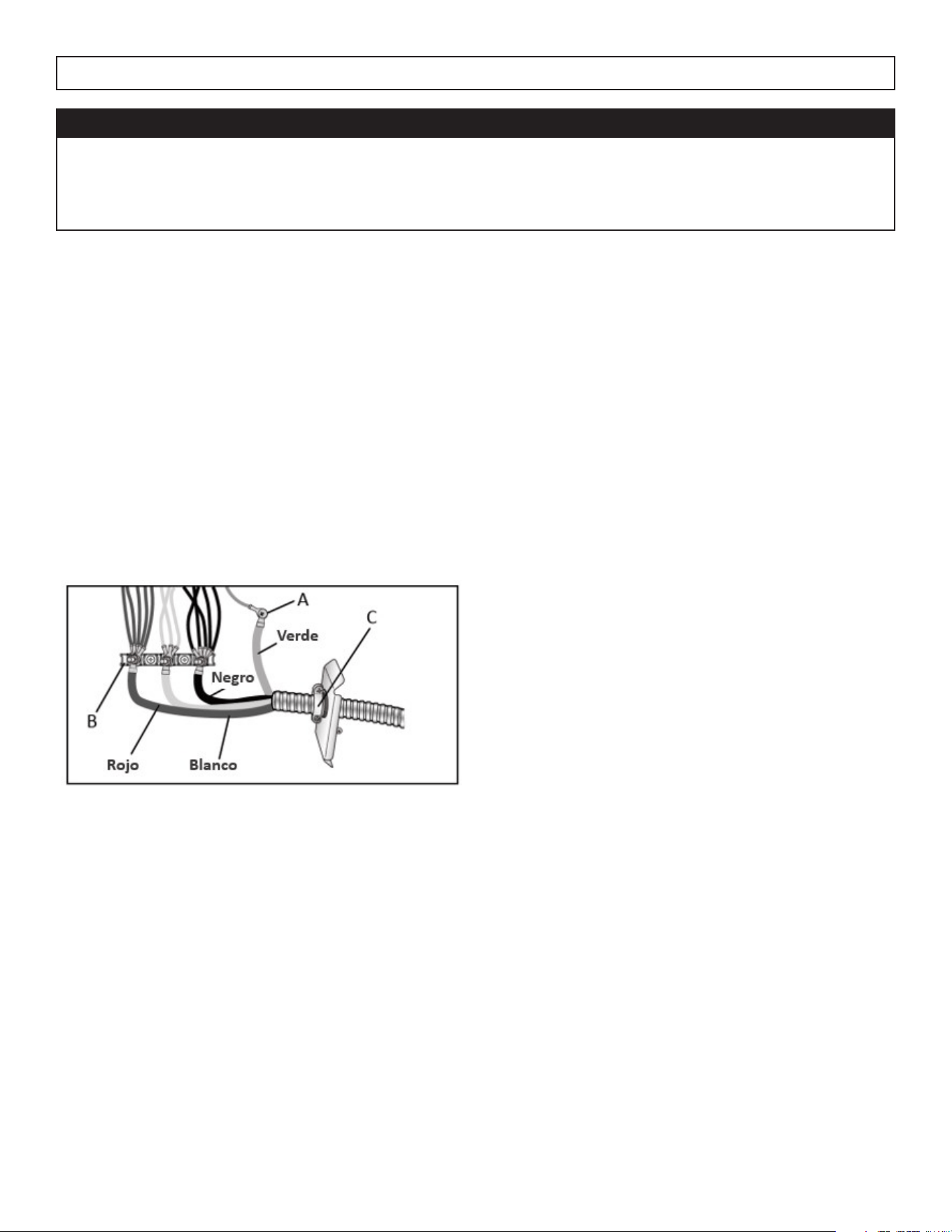
INSTRUCCIONES DE INSTALACIÓN
IMPORTANTE
Sólo para modelos vendidos en Estados Unidos. Este modelo no incluye un cable de alimentación
preinstalado. Siga las siguientes instrucciones de cableado antes de utilizar la cocina. No se
suministra el cable de alimentación. Siga todos los códigos y normas de cableado locales y
nacionales.
INSTALACIÓN DE CABLE DE ALIMENTACIÓN DE 4 HILOS
NOTA: Utilice este método para nuevas instalaciones de circuitos derivados (1996 nec), casas móviles,
vehículos recreativos, o en un área donde los códigos locales prohíben la conexión a tierra a través del
cable neutro.
1. Pase los hilos del cable eléctrico por el conducto metálico flexible.
NOTA: Deje suficiente holgura para conectar fácilmente los cables al bloque de terminales.
2. Retire el panel de acceso situado en la parte inferior derecha del panel posterior para exponer el
bloque de terminales eléctricos.
3. Instale un aliviador de tensión con certificación UL en la abertura del conducto metálico flexible en el
soporte y apriete completamente la tuerca del aliviador de tensión.
4. Pase el conducto metálico flexible a través del aliviador de tensión. Deje suficiente holgura para
conectar fácilmente el cableado al bloque de terminales.
A: Tornillo de tierra
B: Bloque de terminales
C: Alivio de tensión UL
5. Retire el cable de puente verde de debajo del tornillo de tierra y sustitúyalo por el cable verde del
cable de alimentación, apriete el tornillo de tierra. del conducto metálico flexible y apriete el tornillo de
tierra.
6. Enrolle el cable de puente verde retirado del tornillo de conexión a tierra en su extremo fijado al poste
central del bloque de terminales.
7. Utilice una llave de tuercas de 5/15” para conectar el cable neutro (blanco) al poste central del bloque
de terminales con una de las tuercas hexagonales 10-32.
8. Utilizando tuercas hexagonales 10-32, conecte los hilos rojo y negro del cable de alimentación a los
postes exteriores del bloque de terminales con los correspondientes hilos rojo y negro de la cocina.
9. Apriete completamente las tuercas hexagonales y compruebe la conexión
10. Coloque la parte inferior del aliviador de tensión debajo del conducto metálico flexible y apriete los
tornillos del aliviador de tensión.
NOTA: Antes de apretar, asegúrese de que el aliviador de tensión está colocado sobre el conducto
metálico flexible y NO sobre los cables.
11. Vuelva a colocar el panel de acceso eléctrico.
12. Introduzca el conducto sobrante en la zona empotrada del panel trasero.
49
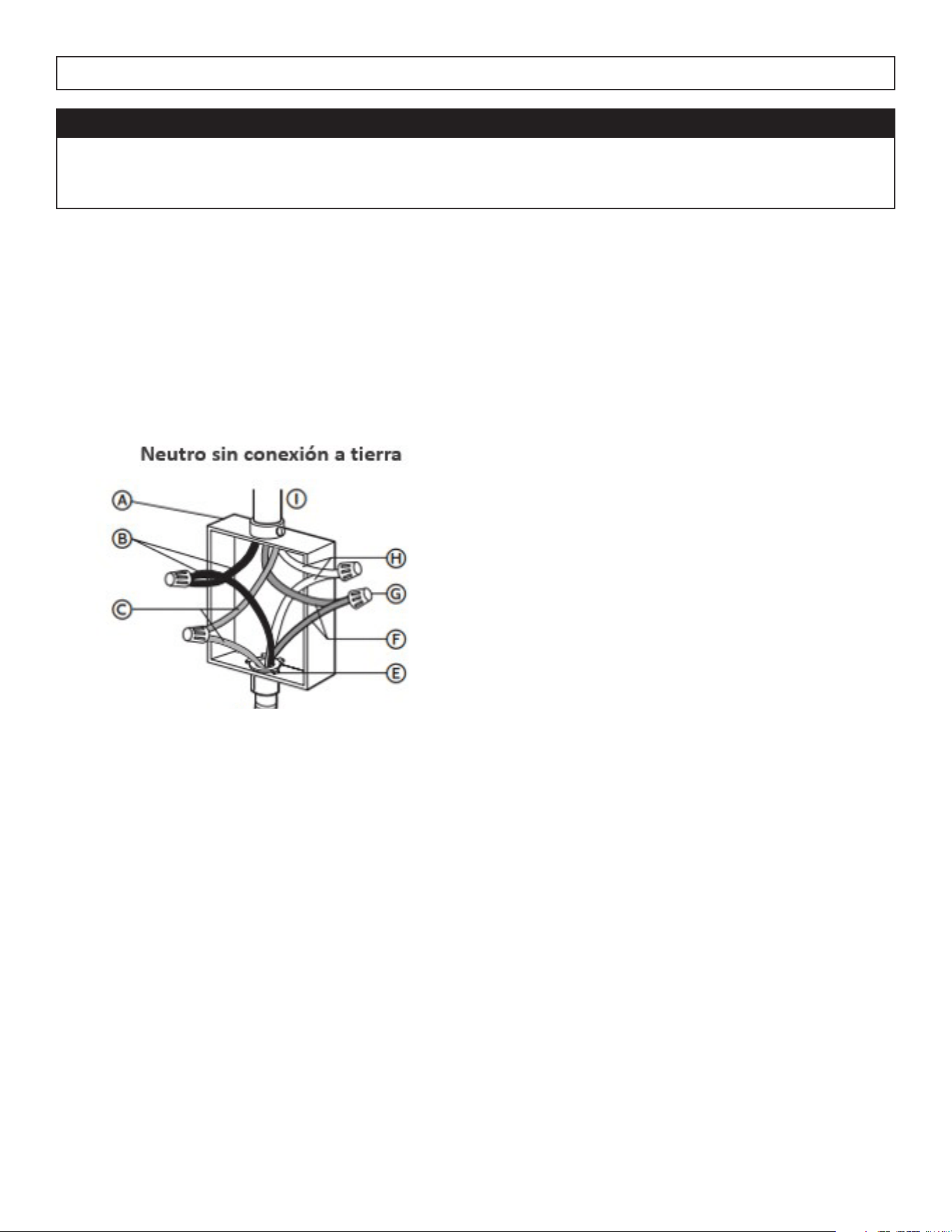
50
INSTRUCCIONES DE INSTALACIÓN
IMPORTANTE
Utilice el cable de 4 hilos de la fuente de alimentación doméstica cuando los códigos locales no
permitan la conexión a tierra a través del neutro, instalación de circuitos derivados nuevos (I996
NEC), casas móviles y vehículos recreativos, construcciones nuevas.
CONEXIÓN DEL CABLE DE ALIMENTACIÓN DE 4 HILOS A LA RED ELÉCTRICA DOMÉSTICA
A: Caja de conexiones
B: Cables negros
C: Cables de tierra (verdes o desnudos)
D: Cable de la gama
E: Conector de conducto aprobado por UL
F: Cables rojos
G: Conectores de cable aprobados por UL
H: Cables neutros (blancos)
I: Suministro eléctrico doméstico

51
Reúna las herramientas y piezas necesarias antes
de comenzar la instalación.
HERRAMIENTAS NECESARIAS
1. Cinta métrica
2. Destornillador plano
3. Destornillador Phillips
4. Nivel
5. Taladro eléctrico inalámbrico
6. Martillo
7. Llave inglesa o alicates
8. Sierra de metal
9. Tijeras de metal o cortaalambres grandes
10. Llave combinada 15/N6”
11. Destornillador para tuercas de 3/8”
12. Destornillador para tuercas de 1/4”
13. Broca de 1/8” (3,2 mm) (para suelos de
madera)
14. Marcador o lápiz
15. Cinta adhesiva
REQUISITO DE UBICACIÓN
Ventilación
Es responsabilidad del instalador cumplir con
las distancias de instalación, si se especifican, en
la placa de características del modelo/ serie. de
serie. La placa de características se encuentra en
la parte posterior del bastidor del horno. Consulte
la etiqueta en el panel posterior de la cocina para
conocer las del horno.
NOTA: Respete todos los códigos y ordenanzas
vigentes
Temperatura
• La cocina debe estar situada en un lugar
cómodo de la cocina.
• Las instalaciones empotradas deben
proporcionar un cerramiento completo de los
laterales y la parte trasera de la cocina.
• Para eliminar el riesgo de quemaduras o
incendios por alcanzar las unidades de
superficie calientes, debe evitarse el espacio
de almacenamiento en armarios situado por
encima de las unidades de superficie. Si es
necesario colocar armarios, el riesgo puede
reducirse instalando una campana extractora o
una combinación de campana extractora para
microondas que sobresalga horizontalmente un
mínimo de 5 pulgadas (12,7 cm) por encima de
la parte inferior de los armarios.
• Todas las aberturas en la pared o en el suelo
donde se vaya a instalar la cocina deben estar
selladas.
• No selle la cocina a los armarios laterales.
• El suministro eléctrico debe estar conectado a
tierra. Consulte la sección “Requisitos eléctricos.
NOTA: Algunos materiales de construcción y
armarios no están diseñados para soportar el
calor producido por el horno para la cocción y la
autolimpieza. Consulte a su constructor o proveedor
de armarios para asegurarse de que el material
utilizado no se decolore, deslamine o sufra otros
daños.
• Póngase en contacto con un instalador de
revestimientos de suelo cualificado para
comprobar que el revestimiento de suelo puede
soportar al menos 93°C (200°F).
• Si instala la cocina sobre una alfombra,
utilice una almohadilla aislante o madera
contrachapada de 0,64 cm debajo de la cocina.
INSTRUCCIONES DE INSTALACIÓN
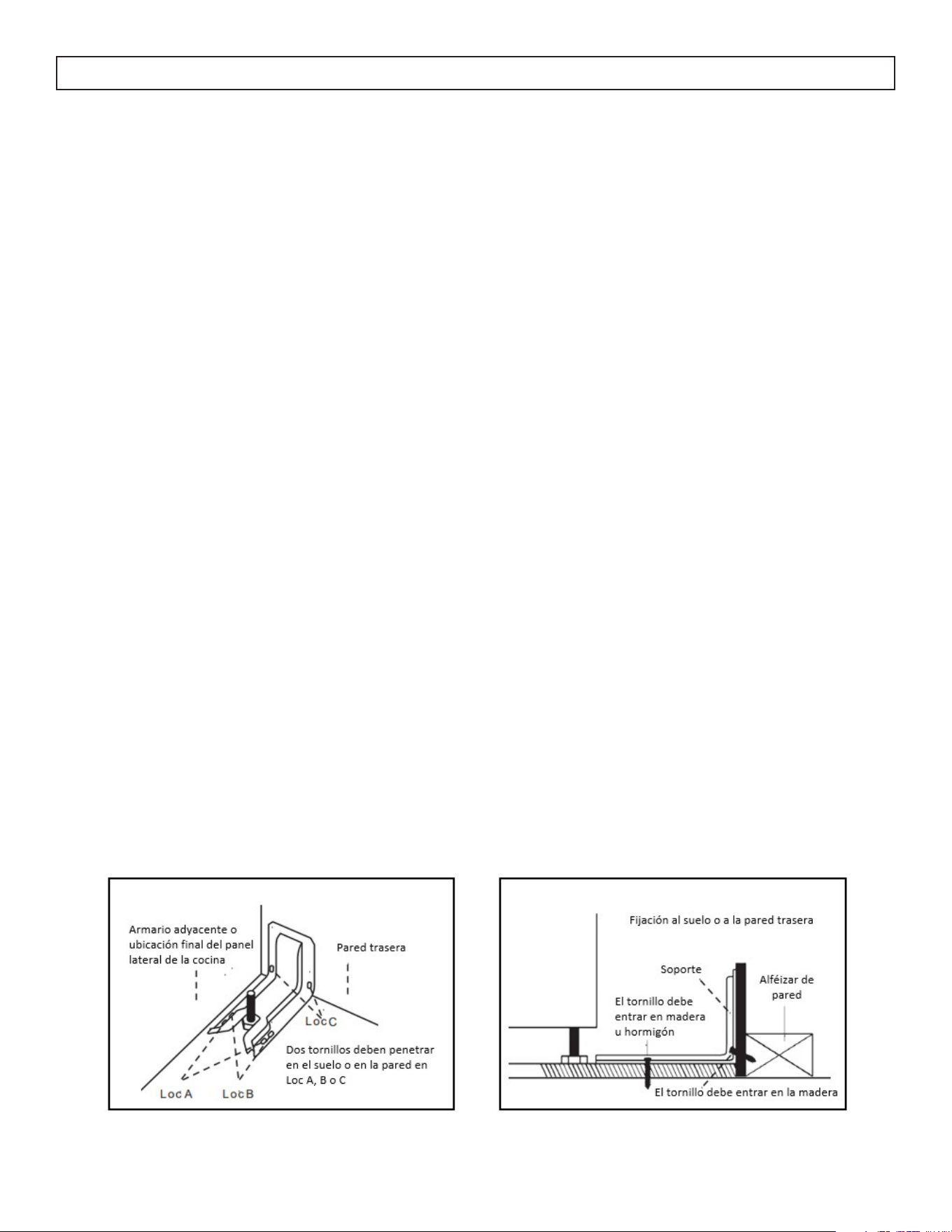
52
SOPORTE ANTIVUELCO
Con el horno se suministra un kit de soporte antivuelco
ADVERTENCIA: Peligro de vuelco
• Un niño o un adulto pueden volcar la cocina y sufrir lesiones graves.
• Conecte el soporte antivuelco al pie trasero de la cocina.
• Vuelva a conectar el soporte antivuelco si se mueve el horno.
NOTA: NO retire completamente la pata de nivelación trasera. El soporte antivuelco utiliza la pata de
nivelación trasera derecha o izquierda para fijar la cocina al piso o pared.
Ubicación del soporte
Determine la ubicación definitiva del horno antes de intentar instalar el soporte.
Coloque el soporte en el suelo con el borde posterior contra la pared trasera. Si el horno no llega a la
pared trasera, alinee el borde trasero del soporte con el panel trasero del horno en su ubicación definitiva.
NOTA: Si el soporte no toca la pared trasera, DEBE atornillar el soporte al SUELO
Coloque el emplazamiento del soporte contra el armario izquierdo o derecho. Si no hay armario
adyacente, alinee el borde del soporte con el panel lateral del horno en su ubicación final. Si la encimera
sobresale del mueble, separe el soporte del mueble en la misma medida que sobresalga.
Marque la ubicación del par de orificios que va a utilizar (véase la ilustración siguiente).
NOTA: Para la instalación en SUELO, utilice Loc A o B. Para la instalación en PARED POSTERIOR, utilice
Loc C.
INSTRUCCIONES DE INSTALACIÓN
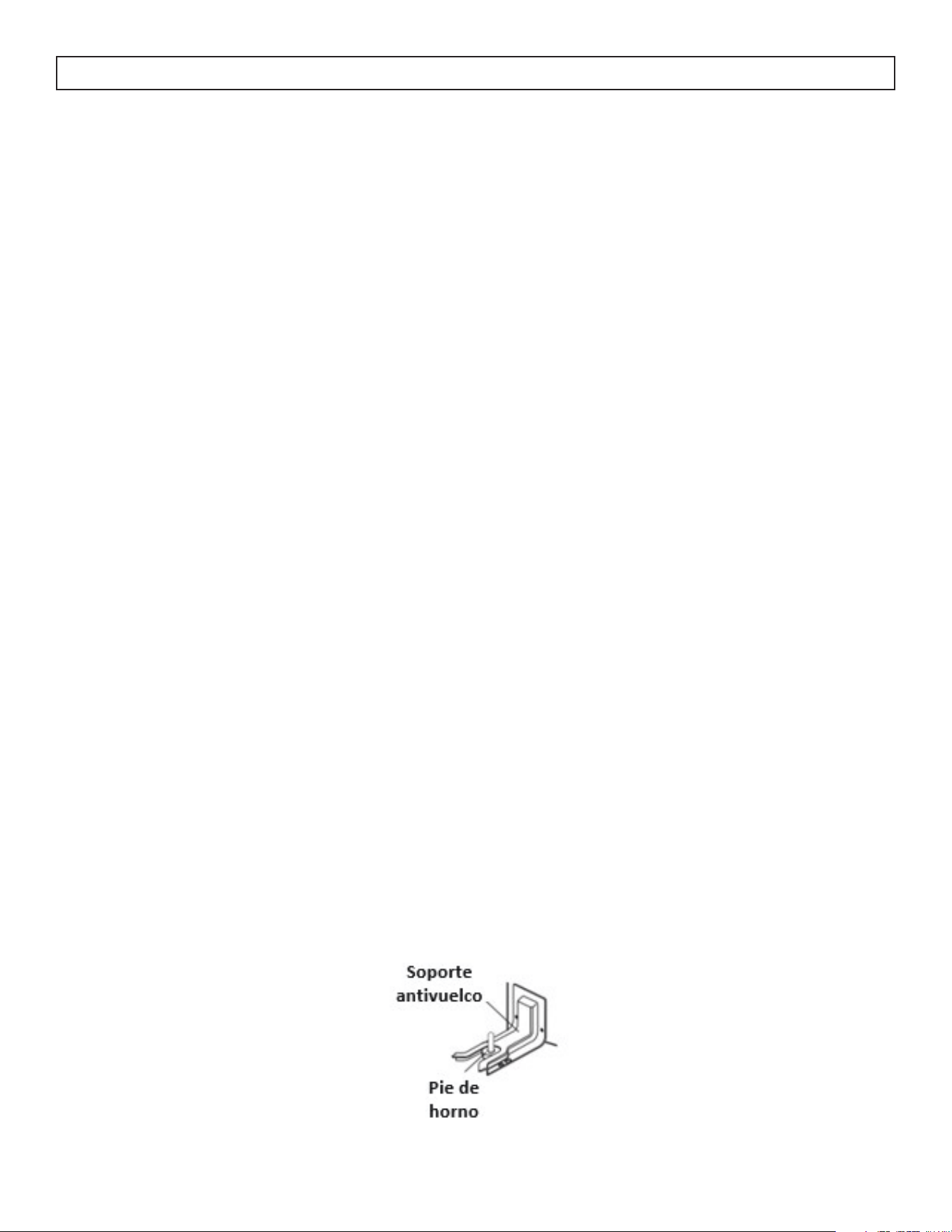
53
Soporte de fijación
El soporte debe atornillarse al SUELO o a la PARED TRASERA.
Instalación del suelo
• Suelo de madera: utilice los tornillos suministrados para fijar el soporte utilizando el par de orificios
marcados (Loc A o B).
• Suelo de hormigón: Utilizando una broca para hormigón, perfore un orificio piloto de 0,4 cm (5
pulgadas) de profundidad en el hormigón en el centro de cada uno de los orificios marcados (Loc A o
B). Utilice los tornillos suministrados para fijar el soporte al suelo.
Instalación en la pared trasera
Utilice los 2 tornillos suministrados para fijar el soporte utilizando el par de orificios marcados en Loc
C. Los tornillos DEBEN entrar en una placa de umbral de madera. Si la pared contiene algún montante
metálico o materiales similares, entonces se debe utilizar el suelo.
Soporte de control
Después de instalar el soporte, deslice la cocina hasta su ubicación definitiva. La pata de nivelación
trasera debe estar completamente insertada en el soporte ANTI-TIP como se muestra a continuación. Para
comprobar si el soporte está instalado y encajado correctamente, mire debajo de la cocina para ver si la
pata niveladora está encajada en el soporte. En algunos modelos, el cajón de almacenamiento o la placa
protectora pueden retirarse para facilitar la inspección. Si no es posible realizar una inspección visual,
deslice la cocina hacia delante, confirme que el soporte antivuelco está bien sujeto al suelo o a la pared
y deslice la cocina hacia atrás para que la pata niveladora quede debajo del soporte antivuelco. Si la
cocina se separa de la pared por cualquier motivo, repita siempre este procedimiento para comprobar
que el soporte antivuelco sujeta correctamente la cocina.
NOTA: El soporte antivuelco debe estar INSTALADO ADECUADAMENTE, y la pata niveladora trasera
debe estar COMPLETAMENTE ENCLAVADA en el soporte para evitar que la cocina se vuelque. NUNCA
retire las patas niveladoras, ya que esto impedirá que la cocina se fije correctamente al soporte antivuelco.
INSTRUCCIONES DE INSTALACIÓN
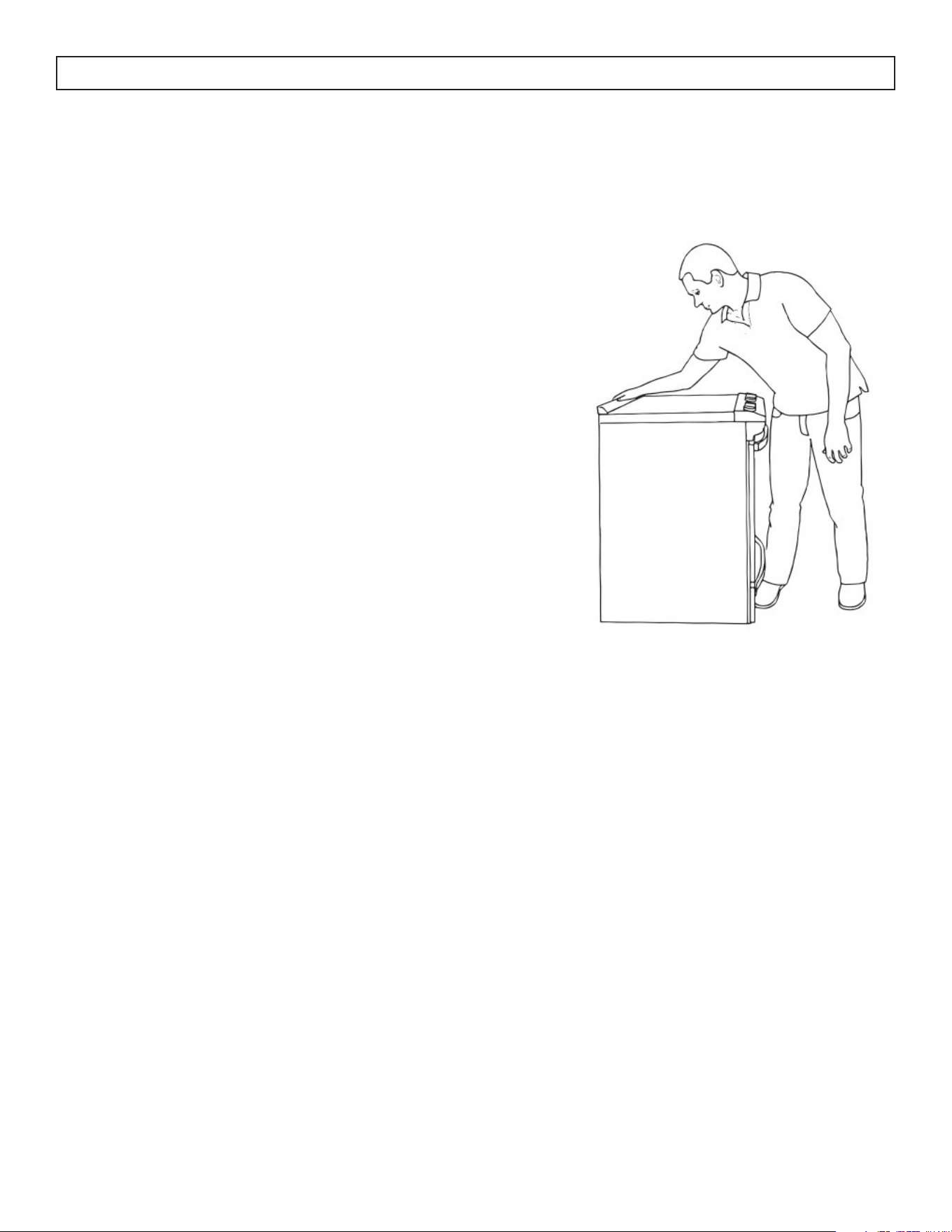
54
INSTALACIÓN DEL HORNO
NOTA: Si se desplaza el horno para ajustar las patas de
nivelación, asegúrese de que, al volver a colocar el horno en su
ubicación definitiva, el soporte antivuelco quede enganchado
repitiendo los pasos del 1 al 9.
1. Deslice la cocina en su ubicación final, asegurándose de que
la pata de nivelación trasera se desliza en el soporte de la
punta. Deje un espacio de 2,5 cm (1 pulgada) entre la parte
trasera de la cocina y la pared trasera.
2. Coloque la parte exterior del pie contra la parte inferior
delantera para evitar que la cocina se mueva y, a
continuación, agarre la parte trasera de la cocina, tal y como
se muestra en la figura.
3. Intente inclinar lentamente la cocina hacia delante. Si
encuentra resistencia inmediata, el pie de la cocina está
enganchado en el soporte antivuelco. Vaya al paso 8.
4. Si la parte trasera de la cocina se levanta más de 1,3 cm
del suelo sin resistencia, deje de inclinar la cocina y bájela
suavemente hasta el suelo. El pie de la cocina no está
enganchado en el soporte antivuelco.
NOTA: Si se oye un chasquido o un estallido al levantar el horno,
es posible que el horno no esté completamente encajado en el
soporte. Verifique si hay obstrucciones que impidan que el horno
se deslice hacia la pared o que impidan que el pie del horno se
deslice dentro del soporte. Compruebe que el soporte está bien
sujeto por los tornillos de montaje.
5. Deslice el horno hacia delante y compruebe que el soporte antivuelco está bien sujeto al suelo o a la
pared.
6. Deslice el horno hacia atrás para que la pata trasera de la cocina se inserte en la ranura del soporte
antivuelco.
7. Repita los pasos 1 a 3 para asegurarse de que la pata del horno esté enganchada en el soporte
antivuelco. Si la parte trasera del horno se levanta más de 1/2 pulgada (1,3 cm) del suelo sin
resistencia, es posible que el soporte antivuelco no esté instalado correctamente. No utilice el horno sin
el soporte antivuelco instalado y enganchado.
8. Coloque el horno en su ubicación definitiva. Compruebe que el horno está nivelado colocando un nivel
en la parte inferior del horno.
NOTA: El horno debe estar nivelado para que la cocción y el horneado sean óptimos.
9. Si es necesario, utilice una llave para ajustar la altura de las patas niveladoras hasta que el horno esté
nivelado de lado a lado y de atrás hacia atrás.
INSTRUCCIONES DE INSTALACIÓN
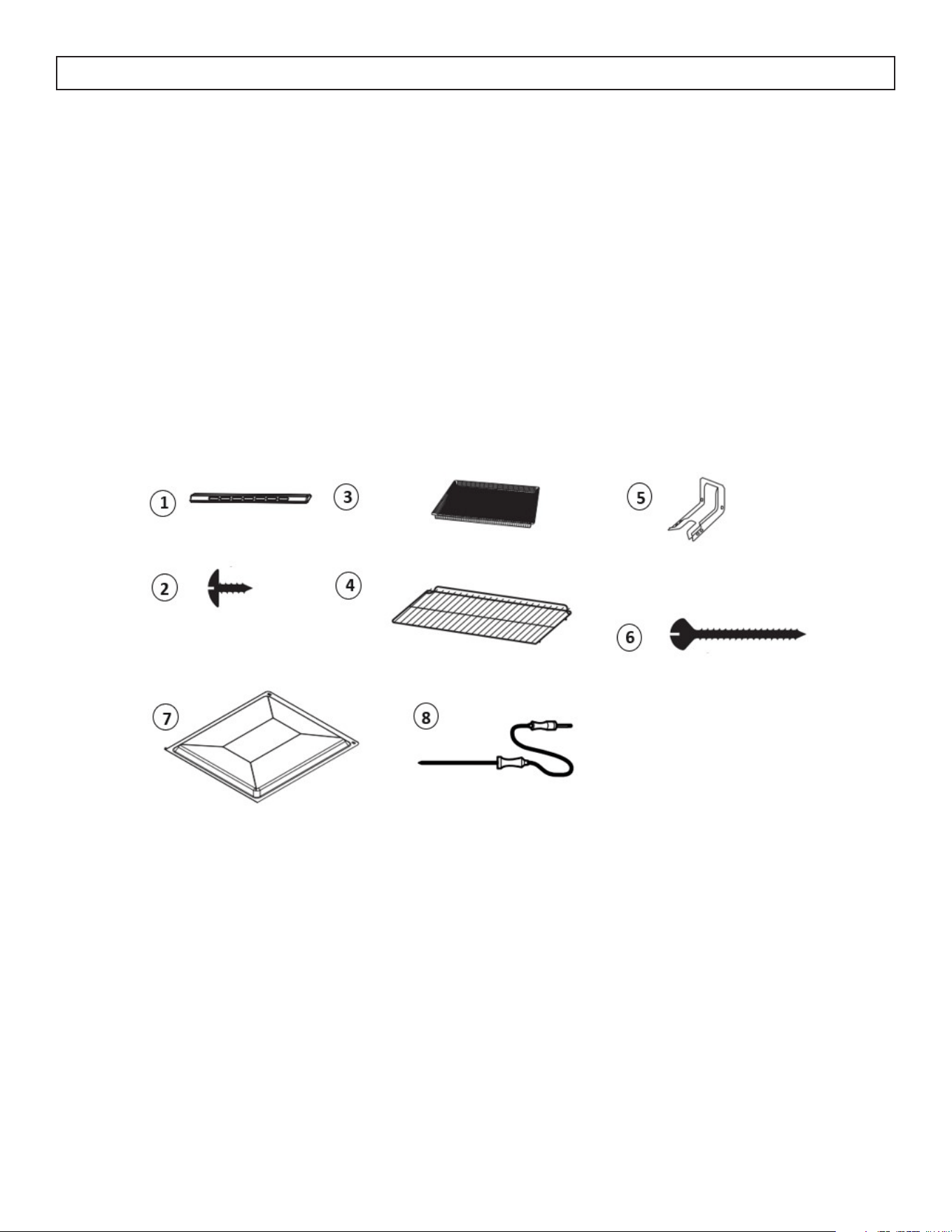
55
ACCESORIOS
1. Salpicadero
2. M4*8 Tornillo para la instalación del protector x5
3. Cesta para freír
4. Rejillas x3
5. Soporte antivuelco
6. M5*45 Tornillo para soporte antivuelco x2
7. Bandeja para recoger la grasa en el horno
8. Termómetro para carne (sonda)
INSTRUCCIONES DE OPERACIÓN
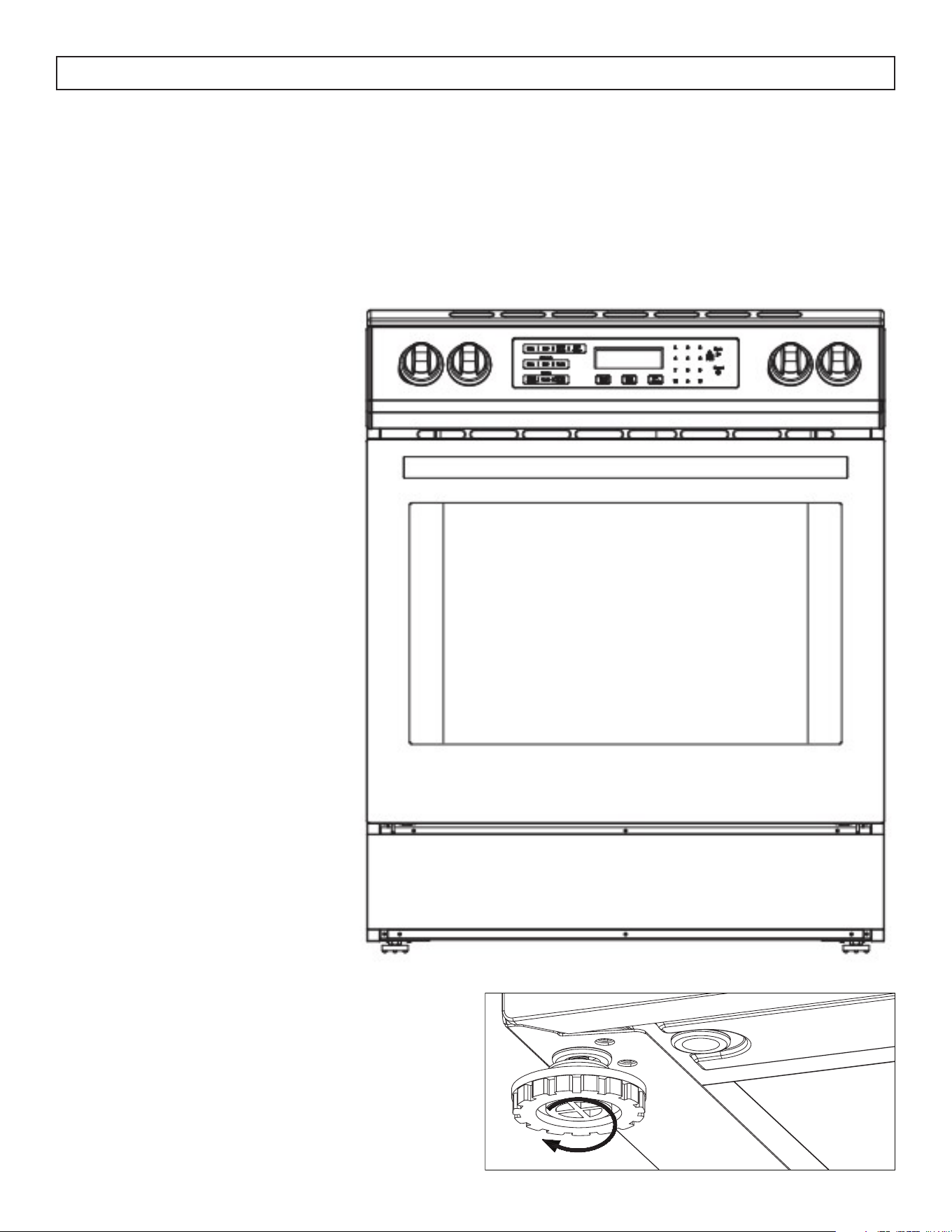
DIMENSIONES
Las dimensiones de este aparato son:
A. 37,9 ~ 37,12 pulgadas (96,3 ~ 94,3 cm) desde el suelo hasta la parte superior de la cocina
(con el salpicadero instalado).
B. 27,6 pulgadas (70 cm) de profundidad
C. 29,9 pulgadas (76 cm) de ancho
INSTRUCCIONES DE NIVELACIÓN
El aparato debe estar nivelado para funcionar
correctamente y con seguridad. Hay cuatro patas
de nivelación situadas en las esquinas de la parte
inferior del aparato. Ajuste las patas niveladoras
hasta que el aparato esté nivelado. Utilice un nivel
de carpintero para confirmar.
56
Es responsabilidad del instalador
cumplir con las distancias de
instalación especificadas en el
manual. Deben utilizarse las
dimensiones mínimas de apertura
del armario y las distancias mínimas.
Deben mantenerse las distancias
mínimas entre la superficie de
cocción del aparato y la superficie
horizontal por encima de la placa de
cocción.
30 pulgadas (65 cm) es la
separación mínima entre la parte
superior de la superficie de cocción
y la parte inferior de un armario de
madera o metal sin protección.
INSTRUCCIONES DE OPERACIÓN
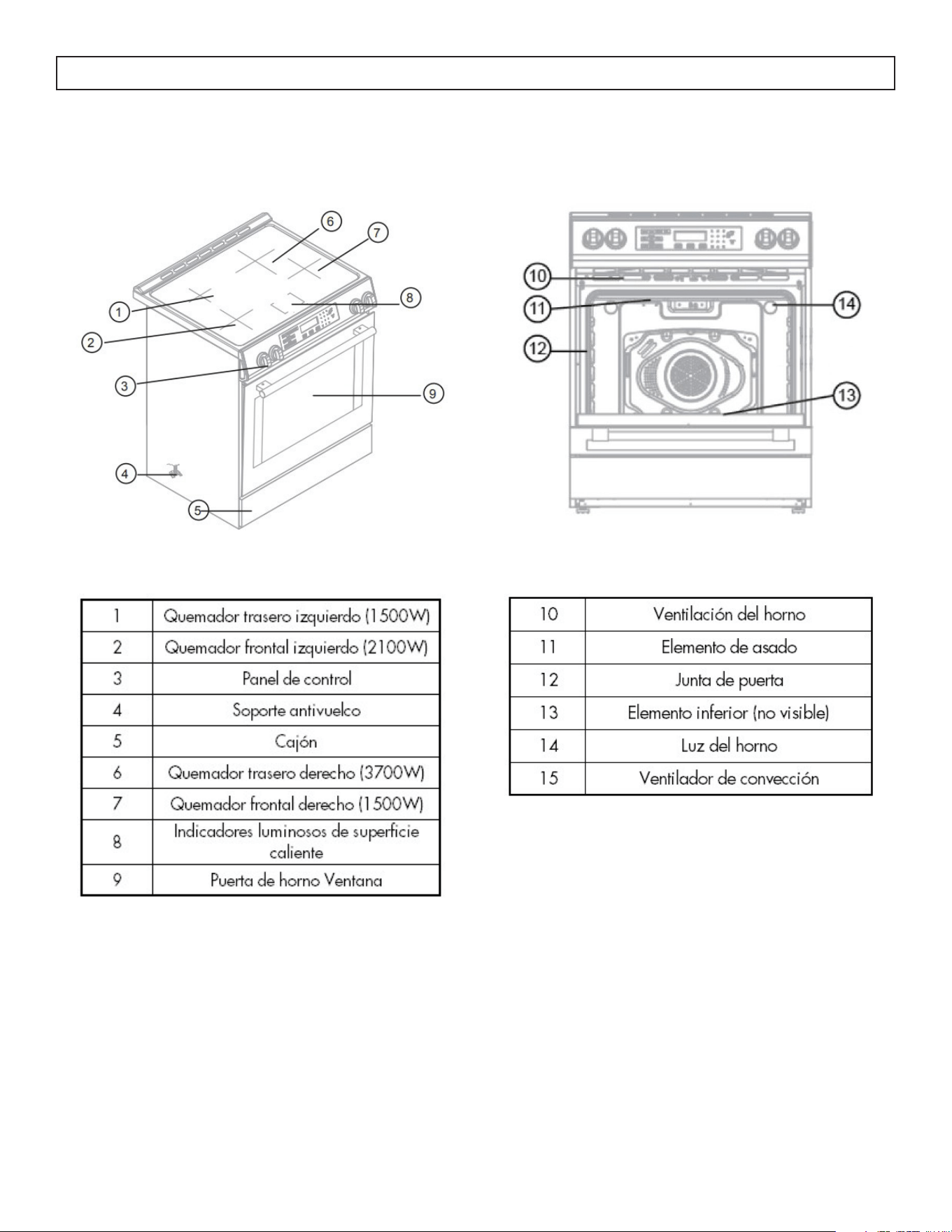
57
PIEZAS EXTERIORES PIEZAS INTERIORES
INSTRUCCIONES DE OPERACIÓN
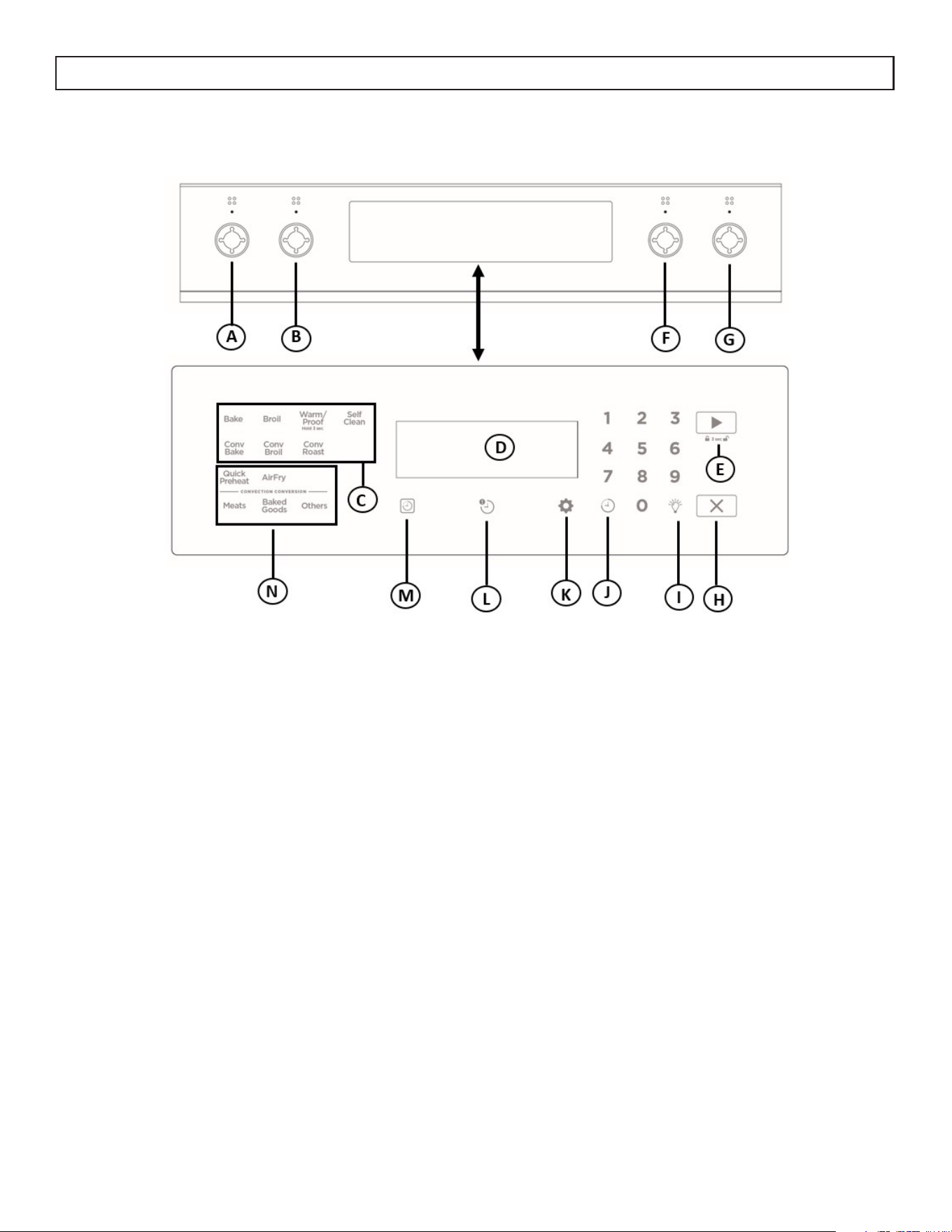
PANNEAU DE COMMANDE
A. Quemador delantero izquierdo
B. Quemador trasero izquierdo
C. Modos de horno
D. Pantalla LED
E. Inicio / Bloqueo de control (mantener durante
3 segundos)
F. Quemador trasero derecho
G. Quemador delantero derecho
Funcionamiento del horno
• Asegúrese de que los estantes están insertados a la altura correcta.
• Select the desired oven mode.
• Seleccione el modo de horno deseado.
• Ajuste el horno a la temperatura de precalentamiento deseada.
• Ajuste el temporizador para activar y precalentar el horno (el tiempo que sea necesario).
• Coloque los recipientes con los alimentos en uno o ambos estantes suministrados con el horno.
• Cierre la puerta.
NOTAS:
• El temporizador afecta al funcionamiento del horno, si el temporizador está en OFF, el horno no
funcionará.
• El horno no puede ajustarse con la puerta abierta
• No coloque nada, incluyendo platos, papel de aluminio y bandejas de horno en la parte inferior del
horno cuando esté en funcionamiento para evitar dañar el acabado del esmalte.
• Si se produce un corte o un fallo en el suministro eléctrico, la unidad conservará el último ajuste con la
excepción de la hora. Será necesario volver a ajustar la hora.
INSTRUCCIONES DE OPERACIÓN
H. Cancelar
I. Encender
J. Temporizador
K. Ajustes
L. Inicio retardado
M. Tiempo de cocción
N. Modos predefinidos
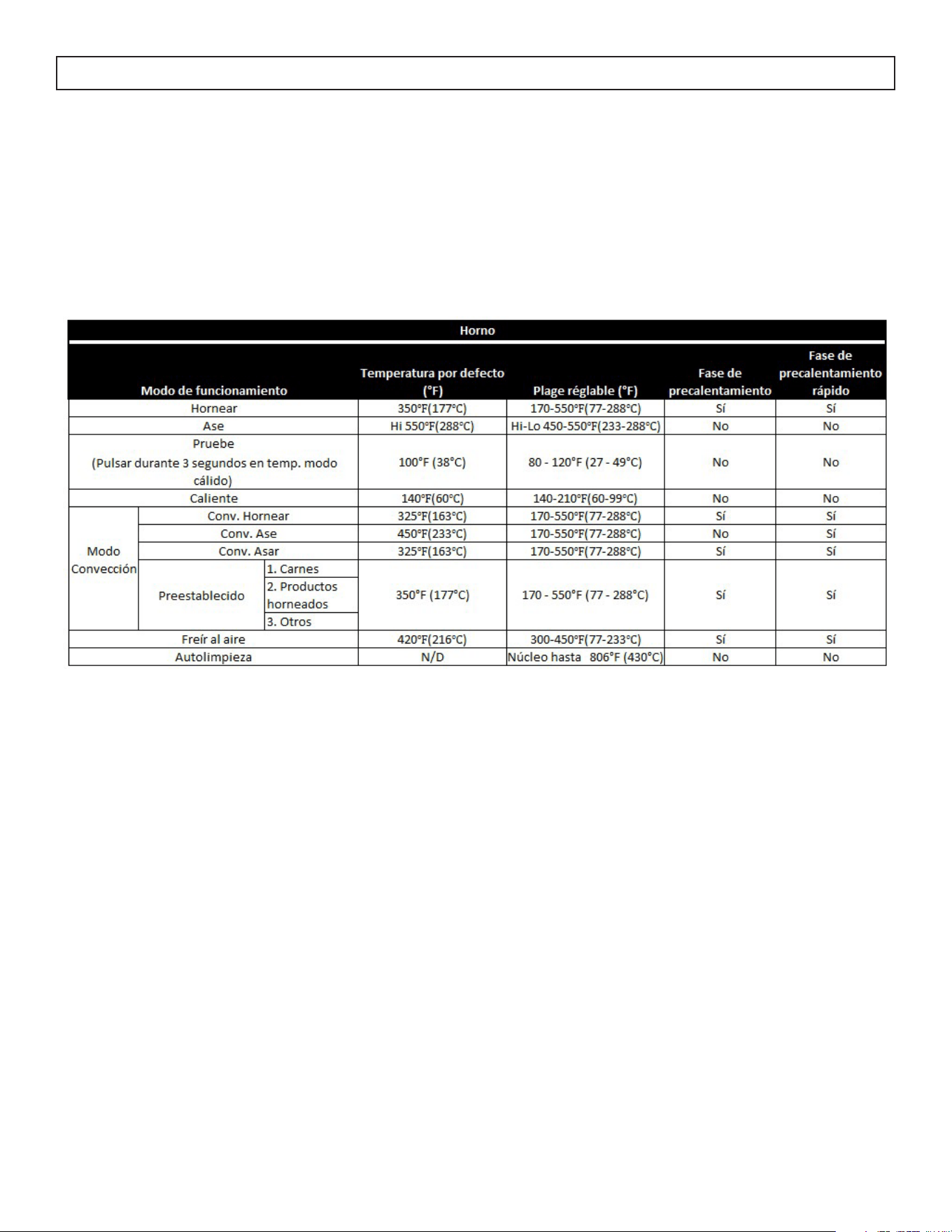
59
MODOS DE FUNCIONAMIENTO DEL ORNO
Este horno combina las funciones de los modos de cocción tradicionales con las funciones de los modernos
modos de convección asistida por ventilador en un solo horno. Utilice el control de modo de cocción,
situado en el panel de control, para seleccionar el modo de horno.
NOTA: Durante cualquier ciclo, los elementos calefactores se apagarán cuando se abra la puerta, y
permanecerán apagados hasta que se cierre la puerta. Para mantener la temperatura del horno, limite la
apertura de la puerta durante la cocción.
NOTA: La etapa de precalentamiento indica si es necesario visualizar la temperatura en tiempo real.
• Hay una etapa de precalentamiento: cuando la temperatura real del núcleo del horno es inferior a
170°F (77°C), la interfaz muestra LO.
• Cuando la temperatura real del núcleo del horno es mayor o igual a 170°F (77°C), la interfaz muestra
la temperatura en tiempo real.
• Cuando la temperatura real del núcleo del horno alcanza la temperatura establecida, la interfaz
siempre muestra el valor de la temperatura establecida junto con un tono largo.
• Etapa sin precalentamiento: el valor de la temperatura ajustada siempre se muestra en la interfaz de
calentamiento del horno desde el principio.
INSTRUCCIONES DE OPERACIÓN
INSTRUCCIONES DE PRECALENTAMIENTO RÁPIDO:
La función de Precalentamiento Rápido aumenta rápidamente la temperatura del horno y está disponible
para los modos de Hornear, Hornear por Convección, Asar por Convección, Asar por Convección,
Productos Horneados, Carnes, Otros y Freír con Aire cuando el ajuste de temperatura del horno es
superior a 230°F (110°C).
Si el ajuste de temperatura es inferior, al pulsar Precalentamiento Rápido se producirá un tono no válido.
Para utilizar Precalentamiento Rápido, seleccione un modo de horno, pulse Inicio y, a continuación, pulse
Precalentamiento Rápido. El icono de Precalentamiento Rápido se iluminará, indicando que el horno se
está precalentando. Una vez alcanzada la temperatura establecida, el sistema emitirá un tono largo y el
horno cambiará al modo seleccionado. El icono de Precalentamiento Rápido se apagará.
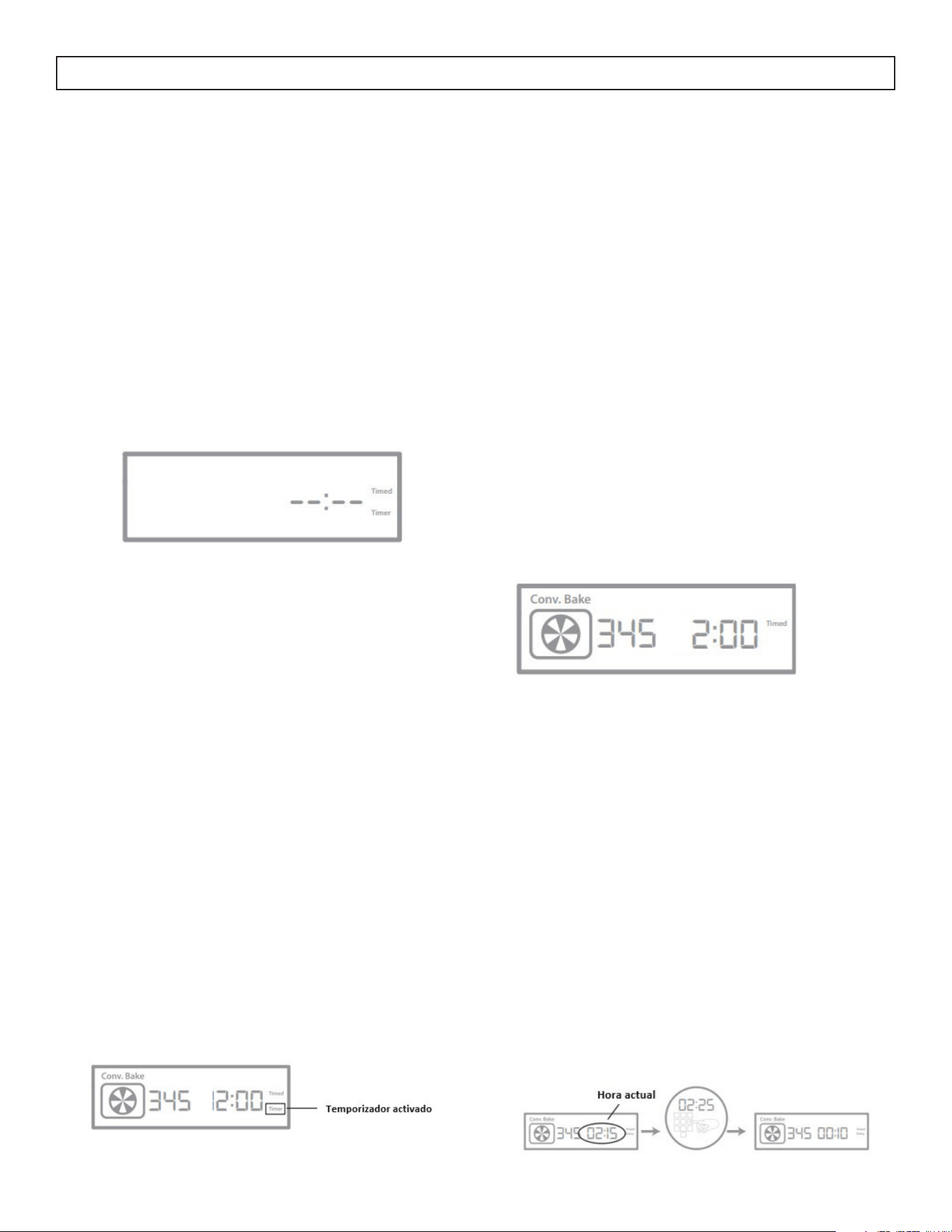
60
Temporizador de cocina
El temporizador de cocina puede activarse
independientemente del funcionamiento del horno.
Configurado como un simple temporizador de
cocina:
Pulse el botón “TIMER” en el panel de control,
(--:--) aparecerá en la pantalla. Pulse los números
del teclado hasta la hora que desee utilizar y, a
continuación, pulse de nuevo el botón “TIMER” para
activarlo.
NOTA: El tiempo puede ajustarse a un máximo de
12 horas.
Configurar como temporizador de cocina mientras
el tiempo de cocción está activo:
• El temporizador puede ajustarse antes
o después del precalentamiento. Si el
temporizador se ajusta después del
precalentamiento y la comida está dentro,
pulse el botón “TEMPORIZADOR”. (--:--)
aparecerá en la pantalla. Pulse los números del
teclado hasta la hora que desee utilizar y, a
continuación, pulse de nuevo el botón “TIMER”.
“Temporizador” aparecerá en la pantalla.
Si el temporizador ha sido ajustado en el proceso
de precalentamiento, el temporizador se activará
una vez que la temperatura haya alcanzado el
valor ajustado.
NOTA: El temporizador no se “apagará”
automáticamente cuando haya llegado al final del
tiempo, deberá apagarse manualmente pulsando
“Temporizador”.
Tiempo de Cocción
El Tiempo de Cocción tiene una funcionalidad similar
a la de un temporizador, sin embargo, el horno
“Apagará” automáticamente la unidad. La función
de Tiempo de Cocción es sólo para el horno.
El tiempo de cocción predeterminado es de 2 horas
(2:00) y se puede volver a ajustar durante o después
del precalentamiento. Si el tiempo de cocción se
ajusta durante el precalentamiento, se activará una
vez que la temperatura haya alcanzado el valor
ajustado.
• Pulse el botón Tiempo de Cocción.
• Ajuste el tiempo utilizando el teclado numérico.
• Pulse “Inicio” para comenzar.
NOTA: Una vez activado, aparecerá la palabra
“Temporizado” en la pantalla.
NOTA: Si el valor excede el rango de ajuste
permitido, no se permitirá la siguiente operación y el
sistema emitirá dos pitidos no válidos.
Inicio diferido
La función Delay Start sólo funciona cuando el horno
está siendo utilizado.
• Seleccione la función de horneado deseada..
• Pulse el botón “Inicio diferido”, se mostrará la
hora actual.
• Para comenzar en 10 minutos, añada 10 minutos
a la hora actual.
• Pulse Start para activar el retardo
La pantalla mostrará la cuenta atrás desde 10
minutos y comenzará a precalentarse.
Ejemplo:
Si la hora es 14:15, pulse 14:25. 00:10 aparecerá
en la pantalla.
INSTRUCCIONES DE OPERACIÓN
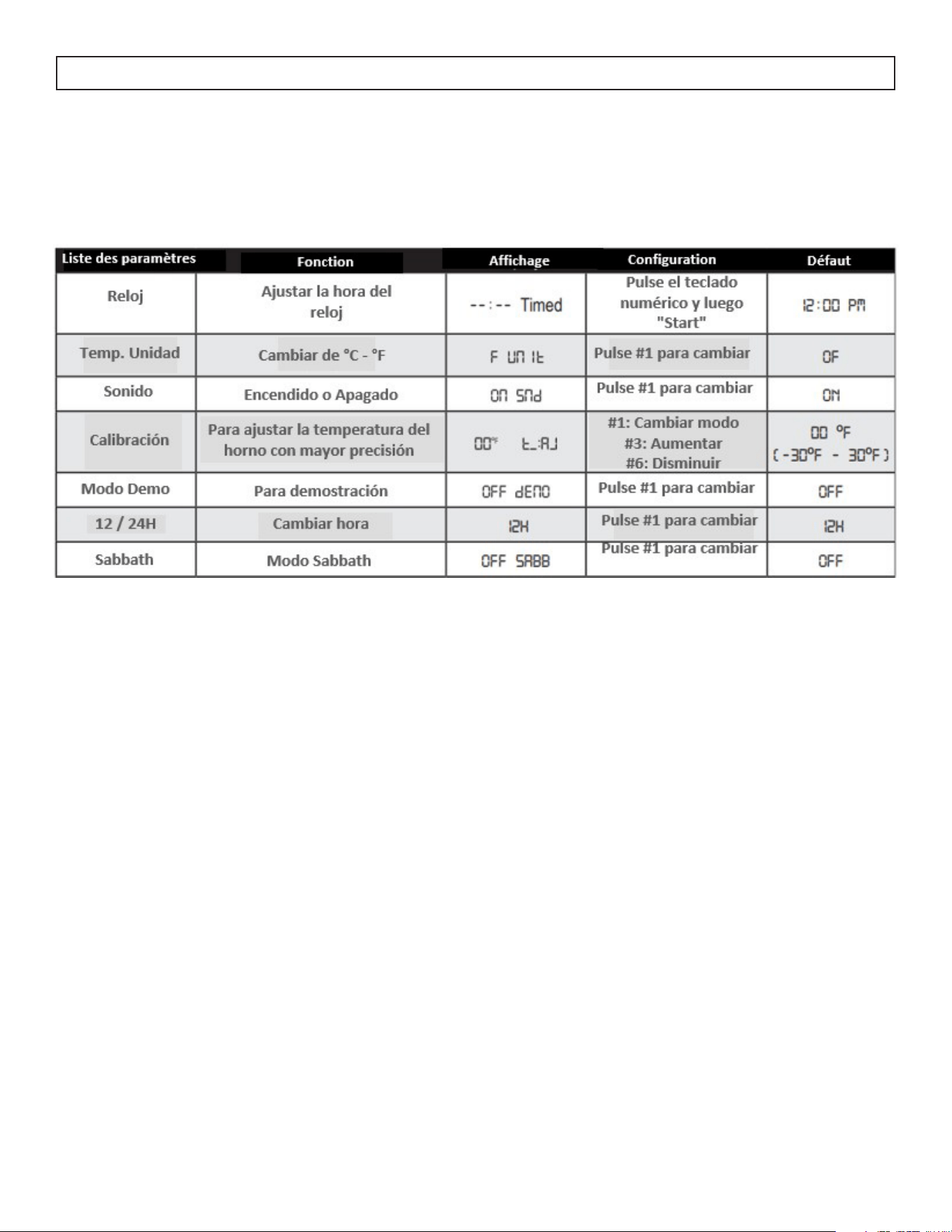
61
Ajustes
Pulse el botón “Ajustes” en el panel de control. Para pasar por las selecciones, pulse repetidamente
el botón “Ajustes”. En la siguiente tabla encontrará la lista de los 7 “Ajustes”, sus funciones y cómo
configurarlos.
Función Bloqueo Infantil
Cuando el horno esté en modo de espera, pulse el botón “Inicio” y manténgalo pulsado durante 3
segundos. El panel de control queda bloqueado. Si se tocan otros botones, el ícono de Bloqueo Infantil en
la pantalla parpadea y se escucha un tono no válido al mismo tiempo.
El Bloqueo Infantil puede desactivarse pulsando el botón “Inicio” y manteniéndolo pulsado durante 3
segundos. El panel de control está ahora desbloqueado.
INSTRUCCIONES DE OPERACIÓN

62
PRECALENTAMIENTO
Al comenzar un ciclo de Horneado, Horneado por Convección o Asado por Convección, el horno
comenzará a precalentarse después de presionar Inicio. El horno tardará aproximadamente de 12 a 15
minutos en alcanzar los 177°C (350°F) con todas las rejillas provistas con el horno dentro de la cavidad
del horno. Las temperaturas más altas tardarán más en precalentarse. El ciclo de precalentamiento
aumenta rápidamente la temperatura del horno que se utiliza para compensar el calor que se pierde
cuando se abre la puerta del horno para colocar los alimentos en la rejilla. Esto asegura que la cocción
comenzará a la temperatura adecuada.
NOTA: No abra la puerta cuando esté en el modo de precalentamiento.
NOTA: Cuando el horno se haya calentado a la temperatura ajustada, sonará un tono. Ahora puede abrir
la puerta e introducir los alimentos en el horno.
HORNEAR
Hornear es cocinar con aire caliente. Se utilizan tanto los elementos superiores como los inferiores del
horno. Siga la receta o las instrucciones del alimento para la temperatura de horneado, el tiempo y la
posición de la rejilla.
• Utilice una rejilla cuando seleccione el modo de horneado.
• Compruebe de vez en cuando si los alimentos están cocidos.
• Utilice utensilios de metal para hornear (con o sin acabado antiadherente), vidrio resistente al calor,
vitrocerámica, cerámica u otros utensilios adecuados para el horno.
• Laissez un espace d’au moins 1 à 1,5 pouces (2,5 à 4 cm) entre le moule et les parois du four Deje al
menos 2,5-4 cm de espacio entre los utensilios y las paredes del horno.
• No utilice papel de aluminio o bandejas de aluminio desechables para forrar ninguna parte del horno,
ya que alterará el rendimiento de cocción y puede dañar el acabado del horno.
• Si es necesario, se puede forrar una bandeja de horno con papel de aluminio y utilizarla en el estante
inferior..
• Evite utilizar la puerta abierta como estante para colocar cacerolas.
ASAR
La cocción a la parrilla utiliza calor radiante directo para cocinar los alimentos. Cuanto más baja sea
la temperatura, más lenta será la cocción. La temperatura puede ajustarse de 450°F (232°C) a 550°F
(288°C). Se recomienda utilizar una bandeja de asar de 2 piezas (no incluida), ya que los líquidos del
proceso de asado se acumularán en la parte inferior de la bandeja y no se derramarán en el horno.
• Coloque la rejilla en la posición deseada antes de encender el horno.
• Seleccione LO o HI para la temperatura de asado.
• Tire de la rejilla del horno hasta la posición de parada antes de girar o retirar los alimentos.
• Do not preheat the oven No precaliente el horno.
• Gire las carnes una vez a la mitad del tiempo de cocción.
NOTA: La puerta del horno permanece cerrada durante el asado. Cuando inspeccione los alimentos, abra
la puerta del horno no más de dos pulgadas.
NOTA: Si se utiliza Cook Time o Delay Start para ajustar un tiempo de cocción, el horno se apagará
automáticamente.
INSTRUCCIONES DE OPERACIÓN

63
CALIENTE
El modo tibio mantiene los alimentos cocinados calientes a la temperatura de servicio. La temperatura
para “tibio” puede ajustarse de 140°F (60°C) a 210°F (99°C). La temperatura para “prueba” puede
ajustarse de 80°F (27°C) a 120°F (49°C).
1. Pulse “WARM/PROOF” en el panel de control. Aparecerá “CALIENTE” en la pantalla.
2. Pulse “START” si desea calentar los alimentos a 170°F (78°C) o introduzca la temperatura deseada
pulsando el teclado numérico y, a continuación, pulse “START”. La temperatura puede ajustarse entre
60°C (140°F) y 99°C (210°F).
3. Pulse “CANCELAR” cuando haya terminado y retire los alimentos del horno.
NOTA: La opción de establecer un tiempo de cocción está disponible.
PRUEBA
La fermentación es un término utilizado en panadería para describir el proceso que permite que la masa
de levadura suba antes de hornear. El ajuste “Prueba” proporciona una temperatura cálida diseñada
específicamente para crear un entorno ideal para que la levadura suba durante el proceso de prueba.
Antes de la fermentación, coloque la masa en un bol ligeramente engrasado y cúbrala ligeramente con
papel encerado untado con manteca. Colóquelo en la segunda rejilla desde abajo y cierre la puerta del
horno.
1. Pulse “WARM/PROOF” y manténgalo pulsado durante 3 segundos hasta que “WARM” en la pantalla
cambie a “PROOF”.
2. Pulse START si desea fermentar la masa a 100°F (38°C) o introduzca la temperatura deseada pulsando
el teclado numérico y pulse “START”. La temperatura puede ajustarse entre 80°F (27°C) y 120°F
(49°C).
3. Deje que la masa suba hasta que casi doble su tamaño, comprobando después de 20-25 minutos. El
tiempo de fermentación puede variar según el tipo y la cantidad de masa.
4. Pulse CANCELAR cuando haya terminado.
5. Antes de la segunda fermentación, dé forma a la masa, colóquela en bandejas o moldes para hornear
y cúbrala sin apretar con film transparente untado con spray de cocina. Siga los pasos 1 - 4.
6. Antes de hornear, retire el envoltorio de plástico.
NOTA: La opción de establecer un tiempo de cocción está disponible.
INSTRUCCIONES DE OPERACIÓN

AJUSTES DE CONVECCIÓN
Durante la cocción por convección, el ventilador hace circular aire caliente por todo el horno. El
movimiento del aire caliente alrededor de los alimentos puede ayudar a acelerar la cocción al penetrar
en las superficies exteriores más frías. Los alimentos se cocinan de manera más uniforme, dorando y
crujiendo las superficies exteriores mientras se sella la humedad en el interior. Cuando el horno se ajusta a
la función de convección, el elemento de anillo, los elementos de hornear y asar, y el ventilador funcionan
para calentar la cavidad del horno. Si se abre la puerta del horno durante la cocción por convección o el
precalentamiento, el ventilador se apagará inmediatamente y la(s) resistencia(s) se apagará(n) después de
30 segundos. Una vez cerrada la puerta, la(s) resistencia(s) se encenderá(n) automáticamente.
Ventilador de convección
El ventilador de convección funciona durante cualquier modo de convección. Cuando el horno está
funcionando en modo de convección, el ventilador se apagará automáticamente cuando se abra la
puerta. El ventilador de convección puede funcionar en modos de no convección durante el tiempo de
precalentamiento.
Horneado por convección
El horneado por convección añade el uso de ventiladores de convección para hacer circular el aire
caliente. Tanto la temperatura como el tiempo de cocción pueden reducirse ligeramente.
• Utilícelo para hornear en una o varias rejillas. Reduzca la temperatura de horneado de la receta
estándar en 25 °F (15 °C).
• Se puede utilizar vidrio o cerámica a prueba de calor. Reduzca la temperatura en otros 25°F (15°C)
cuando utilice recipientes de vidrio a prueba de calor para una reducción total de 50°F (30°C).
• Se pueden usar cacerolas de metal oscuro; sin embargo, los alimentos se pueden dorar más rápido
cuando se usan utensilios para hornear de metal oscuro.
NOTA: No intente convertir recetas como natillas, quiches, tarta de calabaza o tartas de queso, ya que
no se benefician del proceso de calentamiento por convección. Utilice el modo de horneado normal para
estos alimentos.
Asar por convección
Convection Broil utiliza ventiladores de convección para hacer circular el aire caliente. Coloque la rejilla
en el centro de la cavidad del horno para conseguir una cocción uniforme. Se recomienda utilizar una
bandeja de asar de 2 piezas, ya que los líquidos del proceso de asado se acumulan en la parte inferior
de la bandeja y no se derraman en el horno.
• Coloque la rejilla en la posición deseada antes de encender el horno.
• Utilice el modo Asar por convección con la puerta del horno cerrada.
• Introduzca la temperatura normal de asado.
• No precaliente el horno.
• Gire la carne una vez a mitad del tiempo de cocción.
64
INSTRUCCIONES DE OPERACIÓN

Asado por convección
Cuando ase por convección, ajuste la temperatura a la temperatura normal de asado. El tiempo de asado
debería ser entre un 15 y un 30% inferior al de la cocción convencional. No es necesario precalentar el
horno para asar por convección.
• Asar en una sartén baja sin tapar.
• Utilice una sartén de 2 piezas para asar sin tapar.
• Se recomienda utilizar una sonda o un termómetro de carne para determinar el punto de cocción
interno de la carne.
• Puede ser necesario cubrir las aves grandes con papel de aluminio durante una parte del tiempo de
asado para evitar que se doren demasiado.
CONVERSIÓN POR CONVECCIÓN
Cuando utilice una Receta de Convección, introduzca su temperatura y tiempo de cocción normales.
El modo de Conversión de Convección ajustará la temperatura y el tiempo para obtener resultados de
cocción perfectos.
• La puerta del horno debe estar cerrada antes de seleccionar un modo de horno de Conversión de
Convección.
• Es necesario ajustar el Tiempo de Cocción para el modo de Conversión a Convección. Si el Tiempo de
Cocción no fue ajustado, el control le pedirá que Ajuste el Tiempo de Cocción.
NOTA: Al final del tiempo de cocción ajustado, el horno se apagará automáticamente, sonará el tono de
fin de ciclo y en la pantalla aparecerá “End“.
PRODUCTOS DE PANADERÍA
1. Pulse BAKED GOODS entre los controles de Conversión de Convección.
2. Ajuste la temperatura del horno. La temperatura puede ajustarse entre 170°F (77°C) y 500°F (260°C).
3. Presione START. “Set cooking time” aparecerá en la pantalla.
4. Pulse el teclado numérico para introducir el tiempo de cocción deseado. “Pulse START” aparecerá en la
pantalla.
NOTA: Si desea una hora de inicio diferida, pulse START TIME y, a continuación, pulse el teclado numérico
para introducir la hora de inicio deseada. “Press START” aparecerá en la pantalla. El ajuste del Tiempo de
Cocción es obligatorio para el modo de horno de Conversión de Convección. Si el Tiempo de Cocción no
fue ajustado, el control le pedirá que “Ajuste el Tiempo de Cocción”.
5. Pulse START. El horno comenzará a precalentarse. Una vez alcanzada la temperatura programada
sonará un tono.
NOTA: Si la receta requiere que los alimentos se cocinen en un horno precalentado, añada 15 minutos al
tiempo de cocción para dar tiempo a que el horno se precaliente. Una vez que el horno se haya calentado
a la temperatura establecida y suene el tono, introduzca los alimentos en el horno.
6. Al final del tiempo de cocción ajustado, el horno se apagará automáticamente, sonará el tono de fin
de ciclo y en la pantalla aparecerá “End”.
65
INSTRUCCIONES DE OPERACIÓN

CARNES
No es necesario precalentar el horno para la conversión por convección Opción CARNE.
1. Pulse CARNES entre los controles de Conversión de Convección.
2. Ajuste la temperatura del horno. La temperatura puede ajustarse entre 170°F (77°C) y 550°F (288°C).
3. Pulse START. “Set cooking time” aparecerá en la pantalla.
4. Pulse el teclado numérico para introducir el tiempo de cocción deseado. “Pulse START” aparecerá en la
pantalla.
NOTA: El Tiempo de Cocción ajustado es obligatorio para el modo de horno de Conversión de
Convección.
5. Al final del Tiempo de Cocción ajustado, el horno se apagará automáticamente, sonará el tono de fin
de ciclo y en la pantalla aparecerá “End”.
OTROS ALIMENTOS
1. Pulse OTROS ALIMENTOS entre los controles de Conversión de Convección.
2. Ajuste la temperatura del horno. La temperatura puede ser ajustada de 170°F (77°C) a 550°F
(288°C).
3. Presione START. “Programar tiempo de cocción” aparecerá en la pantalla.
4. Pulse el teclado numérico para introducir el tiempo de cocción deseado. “Pulse START” aparecerá en la
pantalla.
NOTA: Si desea una hora de inicio diferida, pulse START TIME y, a continuación, pulse el teclado numérico
para introducir la hora del día a la que desea que se encienda el horno. “Press START” aparecerá en
la pantalla. El ajuste del Tiempo de Cocción es obligatorio para el modo de horno de Conversión de
Convección. Si el Tiempo de Cocción no fue ajustado, el control le pedirá que “Ajuste el Tiempo de
Cocción”.
5. Pulse START. El horno comenzará a precalentarse. Una vez alcanzada la temperatura programada
sonará un tono.
NOTA: Si la receta requiere que los alimentos se cocinen en un horno precalentado, añada 15 minutos al
tiempo de cocción para dar tiempo a que el horno se precaliente. Una vez que el horno se haya calentado
a la temperatura establecida y suene el tono, introduzca los alimentos en el horno.
6. Al final del tiempo de cocción ajustado, el horno se apagará automáticamente, sonará el tono de fin
de ciclo y en la pantalla aparecerá “End”.
AIRE FRÍO
La temperatura de funcionamiento preestablecida es de 216°C (420°F) para una duración de 22 minutos.
Los ajustes de tiempo y temperatura pueden ajustarse manualmente antes de comenzar. Una vez ajustada
la temperatura deseada, la función “Temporizador” iniciará la cuenta atrás en cuanto la temperatura
alcance el valor ajustado.
NOTA: Se recomienda añadir una bandeja de goteo o bandeja debajo de la cesta de freír cuando se fríe
al aire para recoger cualquier exceso de aceite o goteos que puedan producirse durante el proceso de
cocción. Esto puede ayudar a prevenir cualquier suciedad o humo causado por los goteos y facilitar el
proceso de limpieza.
66
INSTRUCCIONES DE OPERACIÓN

SONDA DE TEMPERATURA
67
INSTRUCCIONES DE OPERACIÓN
El horno dispone de una sonda de temperatura que puede introducirse en los alimentos para garantizar
que la temperatura interna alcanza el valor deseado.
PRECAUCIÓN: La sonda y el puerto de la sonda se calentarán durante el proceso de cocción. Utilice
manoplas o guantes aislantes para horno cuando desenchufe la sonda del receptor del horno y cuando la
retire de los alimentos cocinados.
• Introduzca el extremo fino de la sonda en el alimento a cocinar.
• Coloque los alimentos en la rejilla del interior del horno.
• Inserte la clavija de la sonda en el receptáculo del horno situado bajo una cubierta de resorte en la
parte delantera izquierda de la cavidad del horno, cerca de la puerta.
• Una vez insertada, el icono de la sonda aparecerá en la parte inferior derecha de la pantalla.
• Seleccione la temperatura del horno.
NOTA: El tiempo de cocción no puede ajustarse cuando se utiliza la sonda de temperatura.
• Pulse el botón Cook Time para ajustar la temperatura interna deseada de los alimentos.
NOTA: El horno se apagará cuando se haya alcanzado la temperatura interna deseada.
La temperatura actual del horno se mostrará en naranja en la parte izquierda de la pantalla y la
temperatura interna de los alimentos se mostrará en blanco en la parte derecha de la pantalla.
Removing Food from Oven
• Abra completamente la puerta.
• Utilizando guantes o manoplas aislantes, desenchufe la sonda del receptáculo.
• Retire los alimentos del horno.
• Retire la sonda de los alimentos y colóquela sobre una superficie resistente al calor para que se enfríe.
NOTA: Es posible que la longitud del cable de la sonda de temperatura no permita retirar los alimentos
del horno si se deja conectada al receptáculo. Por favor, asegúrese de retirar la sonda del receptáculo
antes de retirar la comida y los utensilios de cocina del horno para evitar derrames.
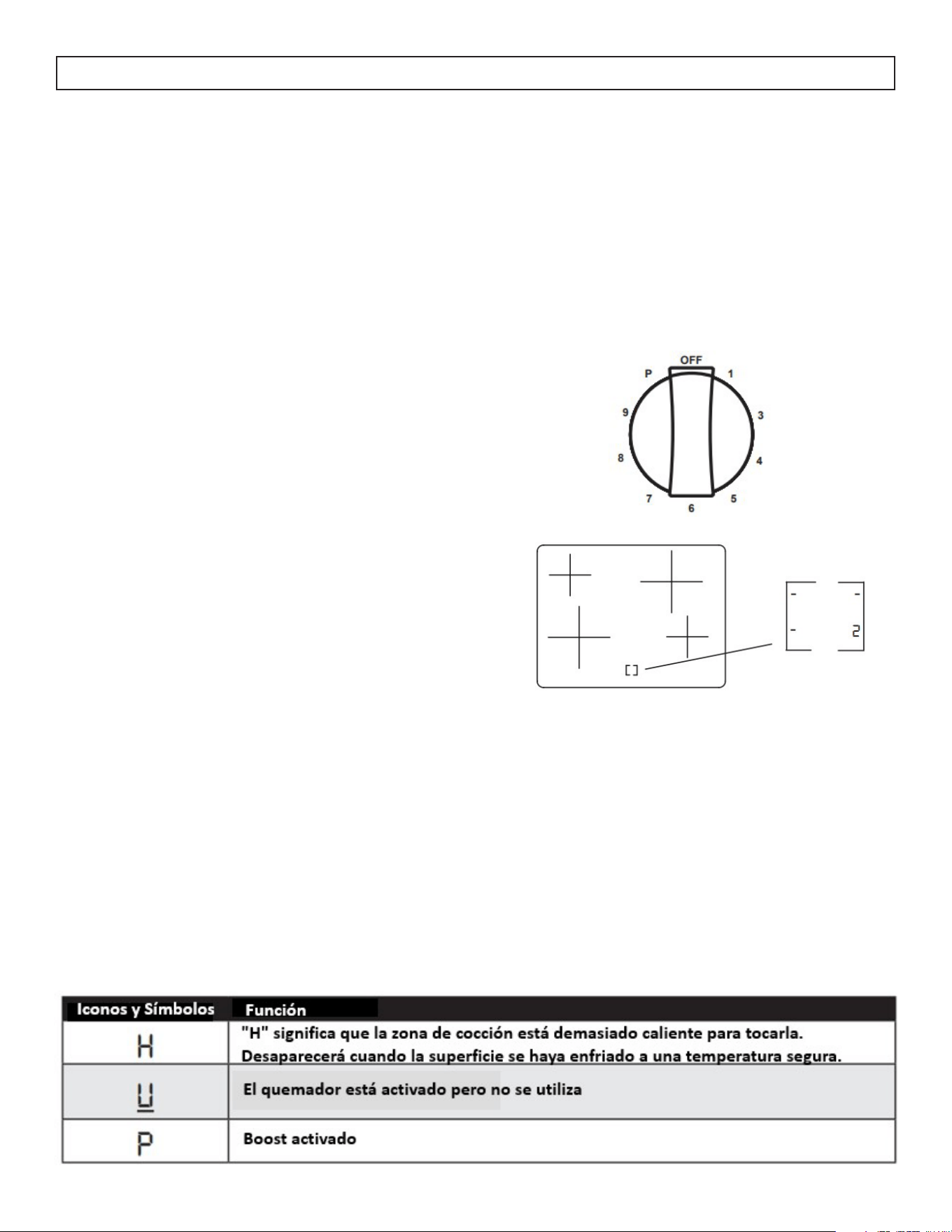
COCINA
Utensilios de cocina adecuados
Las cocinas de inducción no son adecuadas para todas las ollas y sartenes. Coloque un imán en el fondo
exterior de la sartén para ver si se pega. Si el imán no se pega a la sartén, ésta no es adecuada para la
placa de inducción..
NOTA: Si una sartén no es adecuada para una cocina de inducción, no funcionará en la cocina de
inducción.
Zona de calefacción
Seleccione la zona de calentamiento que vaya a
utilizar. Asegúrese de que el fondo de la sartén
u olla y la superficie de la zona de cocción estén
limpios y secos.
Gire el mando de control en el sentido de las
agujas del reloj para ajustar el nivel de potencia
deseado. Los niveles de potencia van de 1 (bajo) a
9 (alto) e incluyen un ajuste Boost (P). El nivel de
potencia puede ajustarse en cualquier momento.
El indicador correspondiente de la placa de cocción
mostrará el nivel de potencia seleccionado en el
pequeño cuadrado situado en la sección media
inferior de la placa de cocción.
Función Boost
Gire el mando de control en el sentido de las agujas del reloj hasta la posición “P”. La “P” se activará y
aparecerá en el indicador. La función boost permanecerá activada durante 5 minutos, transcurridos los
cuales la zona se situará automáticamente en el nivel 9.
Para cancelar la función boost, gire el mando en sentido contrario a las agujas del reloj hasta 9.
NOTA: Se pueden activar dos funciones boost al mismo tiempo, excepto para el quemador trasero derecho
(3700W).
68
INSTRUCCIONES DE OPERACIÓN

LIMPIEZA
Antes de limpiar, asegúrese de que todos los
controles estén apagados y de que el horno y la
cocina estén fríos. Siga siempre las instrucciones
de la etiqueta de los productos de limpieza. Se
recomienda utilizar primero jabón, agua y un
paño suave o una esponja, a menos que se indique
lo contrario. No utilice productos de limpieza
abrasivos.
Superficies exteriores de esmalte porcelánico
Los derrames de alimentos que contengan ácidos,
como el vinagre y el tomate, deben limpiarse en
cuanto se enfríe todo el aparato. Estos derrames
pueden afectar al acabado.
Utilice limpiacristales, un limpiador líquido suave
o un estropajo no abrasivo. Limpie suavemente
alrededor de la placa del modelo y del número
de serie, ya que el fregado puede eliminar los
números.
Acero inoxidable exterior
Utilice detergente líquido o limpiador multiusos.
Aclare bien con agua limpia y seque con un paño
suave y sin pelusas. El limpiador y abrillantador de
acero inoxidable Vinagre puede utilizarse para las
manchas de agua dura.
NOTA: No utilice estropajos llenos de jabón,
limpiadores abrasivos, crema abrillantadora para
encimeras, estropajos de lana de acero, paños
arenosos o algunas toallas de papel. Pueden
producirse daños incluso con un uso único o
limitado. Frote en el sentido de la veta para evitar
dañar.
Puerta exterior del horno
Utilice limpiacristales y toallitas de papel o
estropajo de plástico no abrasivo. Aplique el
limpiacristales sobre un paño suave o una esponja,
no directamente sobre el panel.
Manchas de las sartenes con fondo de aluminio
Utilice un paño humedecido en vinagre.
Panel de control
Utilice limpiacristales y un paño suave o una
esponja. Aplique el limpiacristales sobre el paño
suave o la esponja, no directamente sobre el panel.
No utilice limpiadores abrasivos, estropajos de
lana de acero, paños arenosos o algunas toallas de
papel, ya que podrían producirse daños.
Vitrocerámica
Para evitar dañar la placa de cocina, no utilice
estropajos de acero, limpiadores abrasivos en
polvo, lejía, antioxidantes ni amoniaco. Los
materiales de limpieza de la encimera de cerámica
incluyen limpiador de encimera, rascador de
encimera y almohadillas de limpieza de encimera
disponibles en la mayoría de las tiendas de
comestibles.
1. Retire los restos de comida con una espátula de
cocina.
• Para obtener los mejores resultados, utilice
el rascador mientras la placa de cocina esté
todavía caliente, pero no al tacto.
• Se recomienda usar un guante de cocina
mientras se raspa la placa caliente.
• Sujete el rascador de la placa de cocina en un
ángulo aproximado de 45° contra la superficie
de cristal y rasque los residuos. Será necesario
aplicar presión para eliminar los residuos.
• Deje que la placa de cocción se enfríe
completamente antes de pasar al paso 2.
2. Aplique unas gotas pequeñas de limpiador de
encimeras en las zonas afectadas.
• Frote el limpiador sobre la superficie de la
encimera con un estropajo de nylon o similar.
Se necesita un poco de presión para eliminar
las manchas difíciles.
• Deje que el limpiador se seque hasta formar
una neblina blanca antes de pasar a la etapa
3.
3. Pulir con un paño limpio y seco o una toalla de
papel limpia y seca.
69
CUIDADO Y MANTENIMIENTO

70
Mandos de la cocina
Utilice agua y jabón o detergente para lavavajillas.
• Tire de los mandos en línea recta hacia fuera
del panel de control para extraerlos.
• Cuando cambie los mandos, asegúrese de que
están en la posición de apagado.
NOTA: No utilice lana de acero, limpiadores
abrasivos ni limpiadores para hornos. No empape
los mandos.
Cavidad del horno
Los alimentos derramados deben limpiarse cuando
el horno se enfríe. A altas temperaturas, los
alimentos reaccionan con la porcelana, por lo que
pueden producirse manchas, grabados, picaduras
o tenues manchas blancas.
Utilice un detergente suave y agua tibia.
NOTA: No utilice limpiadores para horno.
Rejillas del horno
Utilice una almohadilla de lana de acero.
Ciclo de autolimpieza
El ciclo de autolimpieza utiliza temperaturas muy
elevadas que queman la suciedad hasta convertirla
en ceniza.
• Autolimpie el horno antes de que se ensucie
mucho. La suciedad intensa requiere más tiempo
de limpieza y más humo.
• Mantenga la cocina bien ventilada durante el
ciclo de autolimpieza para ayudar a eliminar el
calor, los olores y el humo.
• No limpie, frote, dañe ni mueva la junta del
horno. La junta de la puerta es esencial para un
buen sellado.
• Deje que el horno se enfríe a temperatura
ambiente antes de utilizar la función de
autolimpieza. Si la cavidad de su horno está
a más de 170°F (77°C), aparecerá “Enfriando
Horno” en la pantalla y el ciclo de Autolimpieza
no se activará hasta que se enfríe.
• La luz del horno no funcionará durante el ciclo
de Autolimpieza. En algunos modelos, los
elementos de superficie no funcionarán durante
el ciclo de Autolimpieza.
• Cuando aparezca “Lock” en la pantalla, la
puerta del horno no podrá abrirse. Para
evitar daños en la puerta, no la fuerce cuando
aparezca “Lock”.
NOTA: No toque el horno durante el ciclo de
autolimpieza. Mantenga a los niños alejados del
horno durante el ciclo de autolimpieza. De lo
contrario, pueden producirse quemaduras.
Horno autolimpiante
• Retire la bandeja de asar, los utensilios de
cocina y los utensilios para hornear.
• Retire el indicador de temperatura del horno si
está disponible en su modelo.
• Retire las rejillas del horno para mantenerlas
brillantes y fáciles de deslizar.
• Retire cualquier lámina del horno ya que puede
quemarse o derretirse, dañando el horno.
• Limpie a mano el borde interior de la puerta
y el área de 3,8 cm (1,5 pulgadas) alrededor
del marco interior de la cavidad del horno,
asegurándose de no mover ni doblar la junta.
Esta zona no se calienta lo suficiente durante
la autolimpieza para eliminar la suciedad.
No deje que entre agua, limpiador, etc. en las
ranuras del marco de la puerta. Utilice un paño
húmedo para limpiar esta zona.
• Limpie cualquier suciedad suelta para reducir el
humo y evitar daños. A altas temperaturas, los
alimentos reaccionan con la porcelana. Pueden
aparecer manchas, picaduras o manchas
blancas. Esto no afectará al rendimiento de la
cocción.
CUIDADO Y MANTENIMIENTO

Ajuste de autolimpieza
El tiempo de limpieza puede ajustarse. Los tiempos
de limpieza sugeridos son:
2 Horas - Suciedad ligera
3 Horas - Suciedad media
3,5 horas - Suciedad fuerte
1. Cierre la puerta del horno.
NOTA: Si la puerta del horno se deja abierta, esta
función no funcionará.
2. Toque repetidamente el icono “Autolimpieza”
para alternar entre las opciones de duración de
la autolimpieza.
NOTA: La función de autolimpieza puede
cancelarse pulsando el botón Cancelar; sin
embargo, si la puerta se ha bloqueado,
permanecerá bloqueada hasta que el horno se
haya enfriado lo suficiente.
NOTA: La puerta se bloqueará. «SELF CLEAN»
aparecerá en la pantalla hasta que finalice el ciclo
de limpieza.
3. Aparecerá “End” en la pantalla y la puerta del
horno se desbloqueará.
4. Abra la puerta del horno. Una vez que el horno
se haya enfriado completamente, retire la
ceniza con un paño húmedo.
NOTA: Para evitar romper el vidrio, no aplique un
paño húmedo y frío al vidrio interior de la puerta
antes de que se haya enfriado por completo.
71
CUIDADO Y MANTENIMIENTO
Extracción de la puerta del horno
Para un uso normal del horno, no es necesario
quitar la puerta del horno. Sin embargo, si fuera
necesario, siga las instrucciones a continuación.
NOTA:
• Asegúrese de que el horno esté frío y que se
haya apagado la alimentación del horno antes
de retirar la puerta.
• La puerta del horno es pesada y frágil y el
frente de la puerta es de vidrio. Para evitar que
se rompa el vidrio de la puerta del horno, use
ambas manos y agarre los lados de la puerta
del horno para quitarlo.
• Asegúrese de que ambas palancas estén
firmemente en su lugar antes de quitar la
puerta.
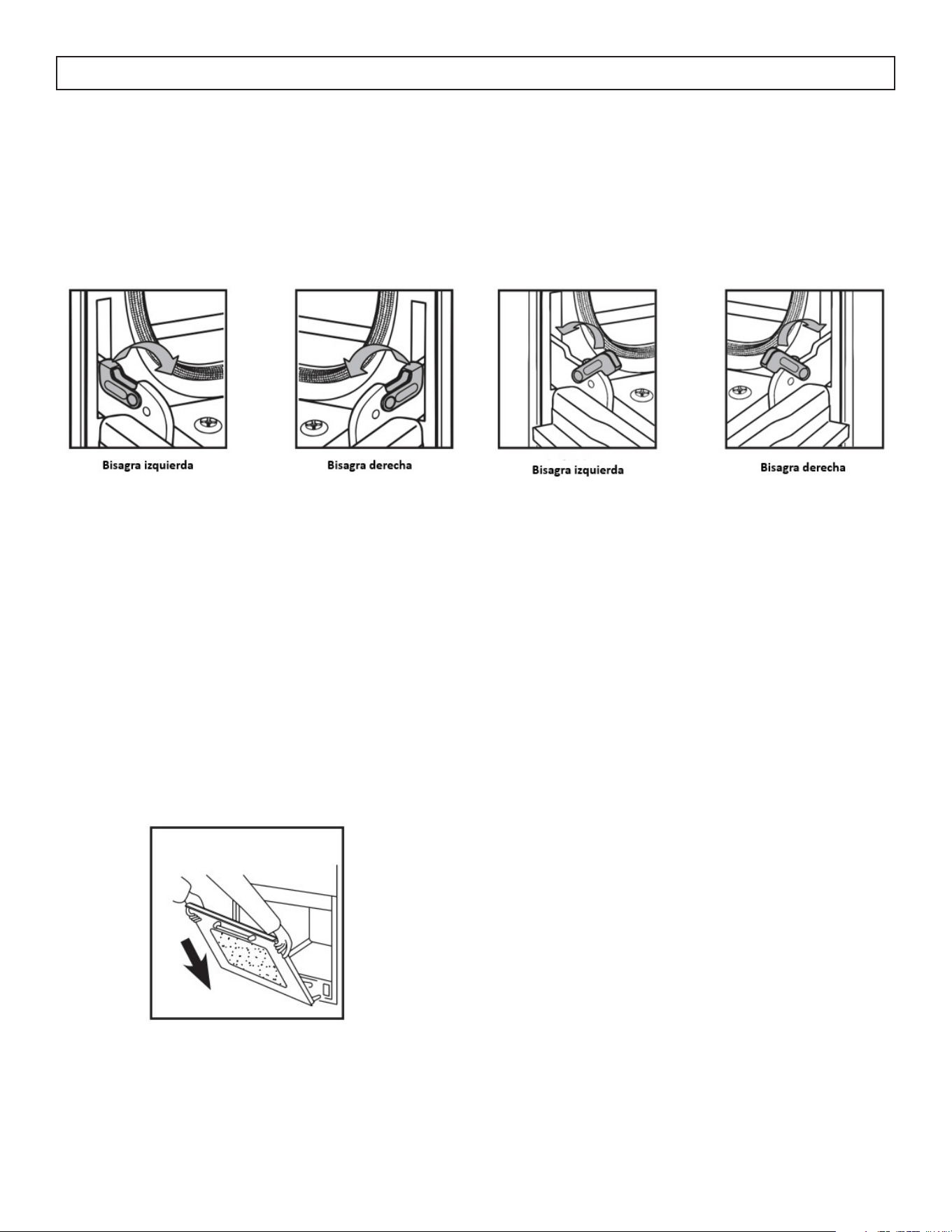
72
3. Cierre la puerta del horno hasta el tope.
4. Mientras agarra ambos bordes exteriores de la
puerta, levante la puerta.
5. Continúe empujando la parte superior de la
puerta para cerrarla mientras saca la parte
inferior de la puerta de los receptores de las
bisagras en el marco de la puerta.
Reinstalación de puertas
1. Inserte ambos brazos de suspensión en los
receptores de bisagra en el marco de la puerta.
2. Abra lentamente la puerta del horno y sentirá
que la puerta se coloca en su lugar.
3. Mueva los pestillos de las bisagras nuevamente
a la posición bloqueada.
4. Compruebe que la puerta se abre y cierra
libremente. Si no es así, repita el desmontaje y
la reinstalación de la puerta.
CUIDADO Y MANTENIMIENTO
Desmontaje de puertas
1. Abra la puerta del horno por completo.
2. Levante el pestillo de la bisagra a cada lado.
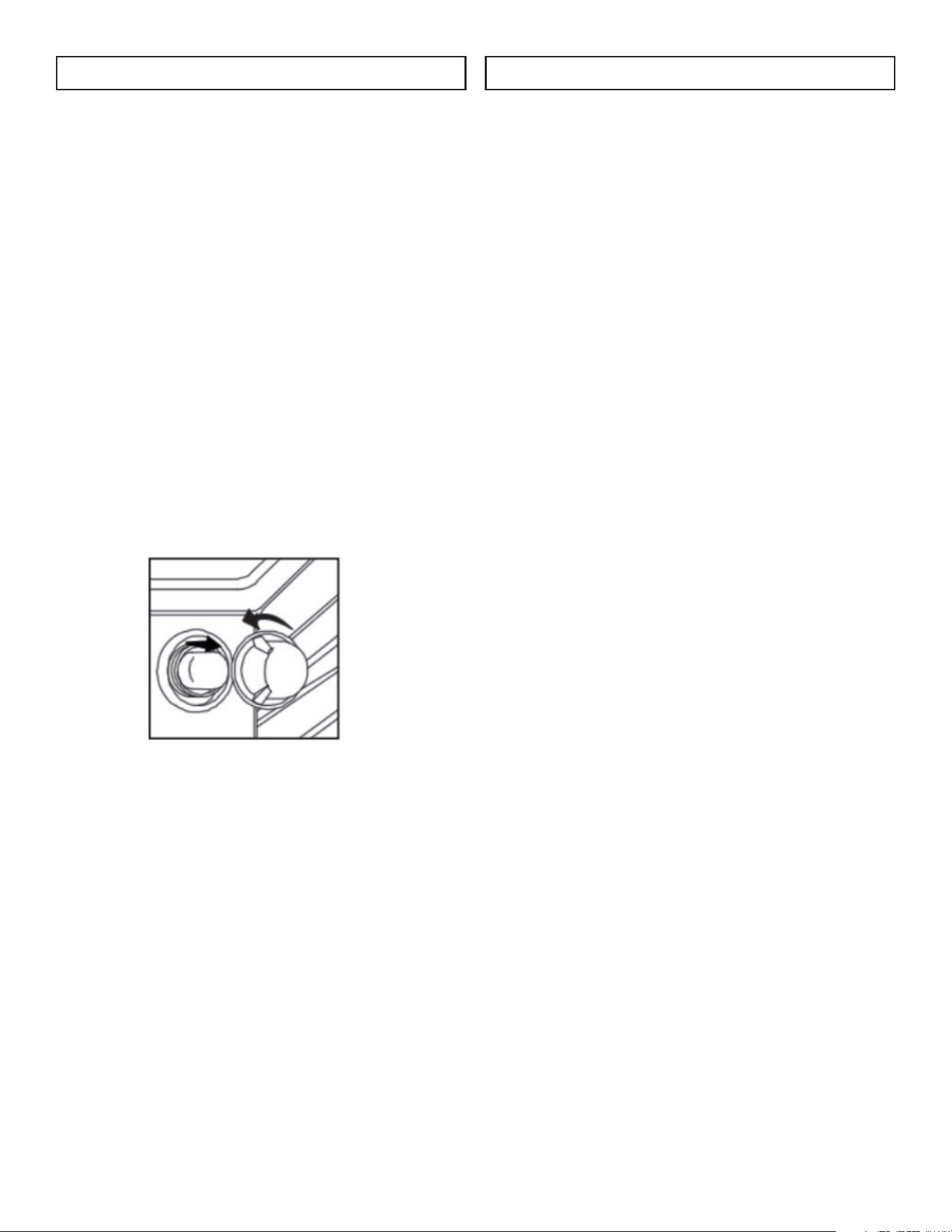
73
CUIDADO Y MANTENIMIENTO
Reemplazo de la luz del horno
La luz del horno es una bombilla estándar para
electrodomésticos de 25 vatios (G).
NOTA:
• Asegúrese de que el horno y las luces estén fríos
y que el horno esté apagado.
• Las lentes deben estar en su lugar cuando se
utiliza el horno. Las lentes sirven para proteger
la bombilla contra roturas.
• Las lentes están hechas de vidrio. Manipular con
cuidado para evitar roturas.
• De lo contrario, podría provocar la muerte,
descargas eléctricas, cortes o quemaduras.
1. Desconecte la energía.
2. Retire la bombilla girándola en el sentido
contrario a las agujas del reloj.
3. Retire la bombilla fundida del casquillo.
NOTA:
Para evitar daños o disminuir la vida útil de
la nueva bombilla, no la toque con los dedos
desnudos. Use guantes o use un pañuelo de papel
cuando reemplace la bombilla.
4. Reemplace la bombilla y luego reemplace la
tapa de la bombilla.
5. Vuelva a conectar la energía.
SOLUCIÓN DE PROBLEMAS
No hay corriente
• Puede que se haya fundido un fusible o se haya
disparado el disyuntor
• El enchufe no está bien insertado en la toma de
corriente
Los elementos de la cocina no funcionan
correctamente
• Se utilizan utensilios de cocina inadecuados
• No hay corriente
• Los elementos calefactores se apagan incluso
cuando están en la posición más alta: los
limitadores de temperatura están apagando
temporalmente los elementos debido a que
superan la temperatura máxima permitida
• La superficie de vitrocerámica es transparente
o parece de color rojo: Bajo una luz directa o
brillante, es posible que se pueda ver a través
del cristal y que tenga un tinte rojo. Esto es
normal
No se pueden ajustar los controles de
modo y temperatura del horno
• La puerta del horno está abierta
El ventilador de refrigeración sigue
funcionando después de apagar el horno
• Los componentes electrónicos aún no se han
enfriado lo suficiente
Luz del horno
• No funciona correctamente: La bombilla está
suelta o fundida
• Permanece encendida: la puerta no se cierra
completamente
• No se puede quitar la tapa de la lente:
Acumulación de suciedad alrededor de la tapa
de la lente

SOLUCIÓN DE PROBLEMAS
Mensaje de alarma de error
Sensor de temperatura anormal: Err1
En cualquier estado, si el sensor de temperatura está abierto o en cortocircuito, el horno emitirá una
alarma y mostrará Err1. En este caso, se puede cancelar.
Sensor de sonda de alimentos anormal:Err2
Si el puerto pin está en cortocircuito, la función del horno emitirá una alarma y mostrará Err2. En este
momento, puede volver al estado de espera pulsando la tecla cancelar.
Advertencia Sobrecalentamiento de la placa de cocina: Caliente
Cuando la luz indicadora de sobrecalentamiento de la placa de cocción está encendida, en este momento,
si usted inicia el modo de autolimpieza o en el modo de autolimpieza, el horno será la placa de cocción
de advertencia de sobrecalentamiento y la pantalla “Hot”, los calentadores eléctricos dejará de funcionar,
en este momento, puede volver al modo de espera a través del botón “cancelar”.
Oscilador de cristal anormal:Err7
Si el oscilador de cristal de la placa de la pantalla se cortocircuita o se daña, causando que la función de
reloj y cronometraje falle, entonces el horno emitirá una alarma y mostrará Err7, y usted podrá regresar
al estado de espera utilizando la tecla cancelar.
74
Advertencia de sobrecalentamiento de la placa de cocción: Caliente
Cuando la luz indicadora de sobrecalentamiento de la placa de cocción está encendida, en este momento,
si usted inicia el modo de autolimpieza o en el modo de autolimpieza, el horno será advertencia de
sobrecalentamiento de la placa de cocción y mostrará «Caliente», los calentadores eléctricos dejarán de
funcionar, en este momento, puede volver al modo de espera a través del botón «cancelar».
LIMITED IN-HOME APPLIANCE WARRANTY
This quality product is warranted to be free from manufacturer’s defects in material and workmanship, provided that the unit is used under the normal operating
conditions intended by the manufacturer.
This warranty is available only to the person to whom the unit was originally sold by Danby Products Limited (Canada) or Danby Products Inc. (U.S.A.) (hereafter
“Danby”) or by an authorized distributor of Danby, and is non-transferable.
TERMS OF WARRANTY
Plastic parts, are warranted for thirty (30) days only from purchase date, with no extensions provided.
First Year
During the rst twelve (12) months, any functional parts of this product found to be defective, will be repaired or replaced, at warrantor’s
option, at no charge to the ORIGINAL purchaser.
To obtain
Danby reserves the right to limit the boundaries of “In Home Service” to the proximity of an Authorized Service Depot. Any app liance
Service
requiring service outside the limited boundaries of “In Home Service” , it will be the consumer’s responsibility to transport the appliance (at
their own expense) to the original retailer (point of purchase) or a service depot for repair. See “Boundaries of In Home Serv ice”below.
Contact your dealer from whom your unit was purchased, or contact your nearest authorized Danby service depot, where service
must be performed by a qualied service technician.
If service is performed on the units by anyone other than an authorized service depot, or the unit is used for commercial appli cation, all
obligations of Danby under this warranty shall be void.
Boundaries of
If the appliance is installed in a location that is 100 kilometers (62 miles) or more from the nearest service center your unit must be
In Home Service
delivered to the nearest authorized Danby Service Depot, as service must only be performed by a technician qualied and certif ied for
warranty service by Danby. Transportation charges to and from the service location are not protected by this warranty and are t he
responsibility of the purchaser.
Nothing within this warranty shall imply that Danby will be responsible or liable for any spoilage or damage to food or other c ontents of this appliance, whether due
to any defect of the appliance, or its use, whether proper or improper.
EXCLUSIONS
Save as herein provided, Danby, there are no other warranties, conditions, representations or guarantees, express or implied, m ade or intended by Danby or its
authorized distributors and all other warranties, conditions, representations or guarantees, including any warranties, conditio ns, representations or guarantees
under any Sale of Goods Act or like legislation or statue is hereby expressly excluded. Save as herein provided, Danby shall no t be responsible for any damages
to persons or property, including the unit itself, howsoever caused or any consequential damages arising from the malfunction o f the unit and by the purchase of
the unit, the purchaser does hereby agree to indemnify and hold harmless Danby from any claim for damages to persons or propert y caused by the unit.
GENERAL PROVISIONS
No warranty or insurance herein contained or set out shall apply when damage or repair is caused by any of the following:
1) Power failure.
2) Damage in transit or when moving the appliance.
3) Improper power supply such as low voltage, defective house wiring or inadequate fuses.
4) Accident, alteration, abuse or misuse of the appliance such as inadequate air circulation in the room or abnormal operating con ditions
(extremely high or low room temperature).
5) Use for commercial or industrial purposes (ie. If the appliance is not installed in a domestic residence).
6) Fire, water damage, theft, war, riot, hostility, acts of God such as hurricanes, oods etc.
7) Service calls resulting in customer education.
8) Improper Installation (ie. Building-in of a free standing appliance or using an appliance outdoors that is not approved for out door application).
Proof of purchase date will be required for warranty claims; so, please retain bills of sale. In the event warranty service is required, present this document to our
AUTHORIZED SERVICE DEPOT.
Danby Products Limited
PO Box 1778, Guelph, Ontario, Canada N1H 6Z9
Telephone: (519) 837-0920 FAX: (519) 837-0449
Danby Products Inc.
PO Box 669, Findlay, Ohio, U.S.A. 45840
Telephone: (419) 425-8627 FAX: (419) 425-8629
04/09
1-800-263-2629
Warranty Service
In-home
Durante los primeros doce (12) meses, cualquier parte en buen estado de este producto que resulte defectuosa,
incluyendo cualquier sistema sellado, será reparado o reemplazado, a opción del
fabricante, sin cargo para el comprador ORIGINAL.
Danby se reserva el derecho de limitar la cobertura de "Servicio en Domicilio" sujeto a la proximidad de un
Taller de Servicio Autorizado. Para todo artefacto que requiera servicio fuera del área limitada de "Servicio en
Domicilio", el cliente será responsable por transportar dicho artefacto hasta el Taller de Servicio Autorizado
mas cercano. Si el electrodoméstico está instalado en un lugar que se encuentra a 100 kilómetros (62 millas)
o más del centro de servicios más cercano, se debe llevar la unidad al Centro de servicios Danby autorizado
más cercano, ya que dicho servicio sólo puede realizarlo un técnico calificado y certificado por Danby para
prestar servicios de garantía.
Los cargos por transporte desde y hacia el lugar en que se efectúe el servicio técnico no están cubiertos por
esta garantía y son de responsabilidad del comprador.
Primeros 12 meses
Para obtener
servicio
Límites del servicio
técnico a domicilio
GARANTÍA LIMITADA “A DOMICILIO”
Este producto de calidad está garantizado contra defectos de fabricación, incluyendo partes y mano de obra, siempre y
cuando la unidad se utilice bajo las condiciones normales de funcionamiento para las que fue diseñado.
Esta garantía está solamente disponible para la persona que haya comprado originalmente esta unidad directamente de Danby
Products Limited (Canada) o Danby Products Inc. (U.S.A.) (en adelante “Danby”) o uno de sus distribuidores
autorizados, y no es transferible.
CONDICIONES DE LA GARANTÍA
Las piezas plásticas, se autorizan por treinta (30) días solamente a partir de la fecha de la compra, sin las extensiones
proporcionadas.
Nada dentro de esta garantía implica que Danby será responsable por cualquier daño que hayan sufrido los alimentos u otros
contenidos de este aparato, ya sea debido a un defecto del aparato, o su uso, adecuado o inadecuado.
EXCLUSIONES
Salvo lo aquí indicado por Danby, no existen otras garantías, condiciones o representaciones, explícitas o implícitas, concretas o
intencionales por parte de Danby o sus distribuidores autorizados y todas las demás garantías, condiciones o representaciones,
incluyendo cualquier garantía, condiciones o representaciones bajo cualquier Acta de Venta de Productos o legislación o estatuto
similar, quedan de esta forma expresamente excluidas. Salvo lo aquí indicado, Danby no serán responsables por ningún daño a
personas o bienes, incluyendo la propia unidad, sin importar su causa, o de ningún daño indirecto causado por el desperfecto de la
unidad, y al comprar esta unidad, el comprador acepta por la presente, indemnizar y proteger a Danby contra cualquier reclamo
por daños a personas o bienes causados por la unidad.
CONDICIONES GENERALES
No se considerará ninguna de estas garantías o seguros cuando el daño o la necesidad de reparación sea el producto de los
siguientes casos:
1) Falla del suministro eléctrico.
2) Daños en tránsito o durante el transporte de la unidad.
3) Alimentación incorrecta, como bajo voltaje, instalación eléctrica defectuosa o fusibles inadecuados.
4) Accidente, modificación, abuso o uso incorrecto del artefacto, tal como insuficiente ventilación del ambiente o condiciones de
operación anormales (temperatura ambiente extremadamente alta o baja).
5) Utilización comercial o industrial (v.g., si el electrodoméstico no está instalado en una vivienda particular).
6) Incendio, daños por agua, robo, guerra, disturbios, hostilidades, actos de fuerza mayor como huracanes, inundaciones, etc.
7) Pedidos de servicio debido a desinformación del usuario.
8) Instalación inadecuada (v.g., instalación empotrada de un electrodoméstico diseñado como unidad independiente o uso de un
electrodoméstico al aire libre que no esté aprobado para dicho fin, incluyendo pero no limitado a: garajes, patios, porches o en
cualquier lugar que no esté bien aislado o controlado por el clima).
Se requerirá una prueba de la fecha de compra para reclamaciones de garantía; Retener las facturas de venta. En el caso de que se
requiera servicio de garantía, presente el comprobante de compra a nuestro depósito de servicio autorizado.
Servicio de Garantía
Servicio en Domicilio
Danby Products Limited
PO Box 1778, Guelph, Ontario, Canada N1H 6Z9
Telephone: (519) 837-0920 FAX: (519) 837-0449
Danby Products Inc.
PO Box 669, Findlay, Ohio, U.S.A. 45840
Telephone: (419) 425-8627 FAX: (419) 425-8629
1-800-263-2629
04/17
Comuníquese con el distribuidor donde haya comprado la unidad, o llame al Taller de Servicio Autorizado más
cercano, donde debe ser reparada por un técnico calificado. Si esta unidad es reparada en otro lugar que no
sea un Taller de Servicio Autorizado, o si la unidad se utiliza para aplicaciones comerciales, Danby no se hará
responsable de ninguna forma y la garantía será anulada.
