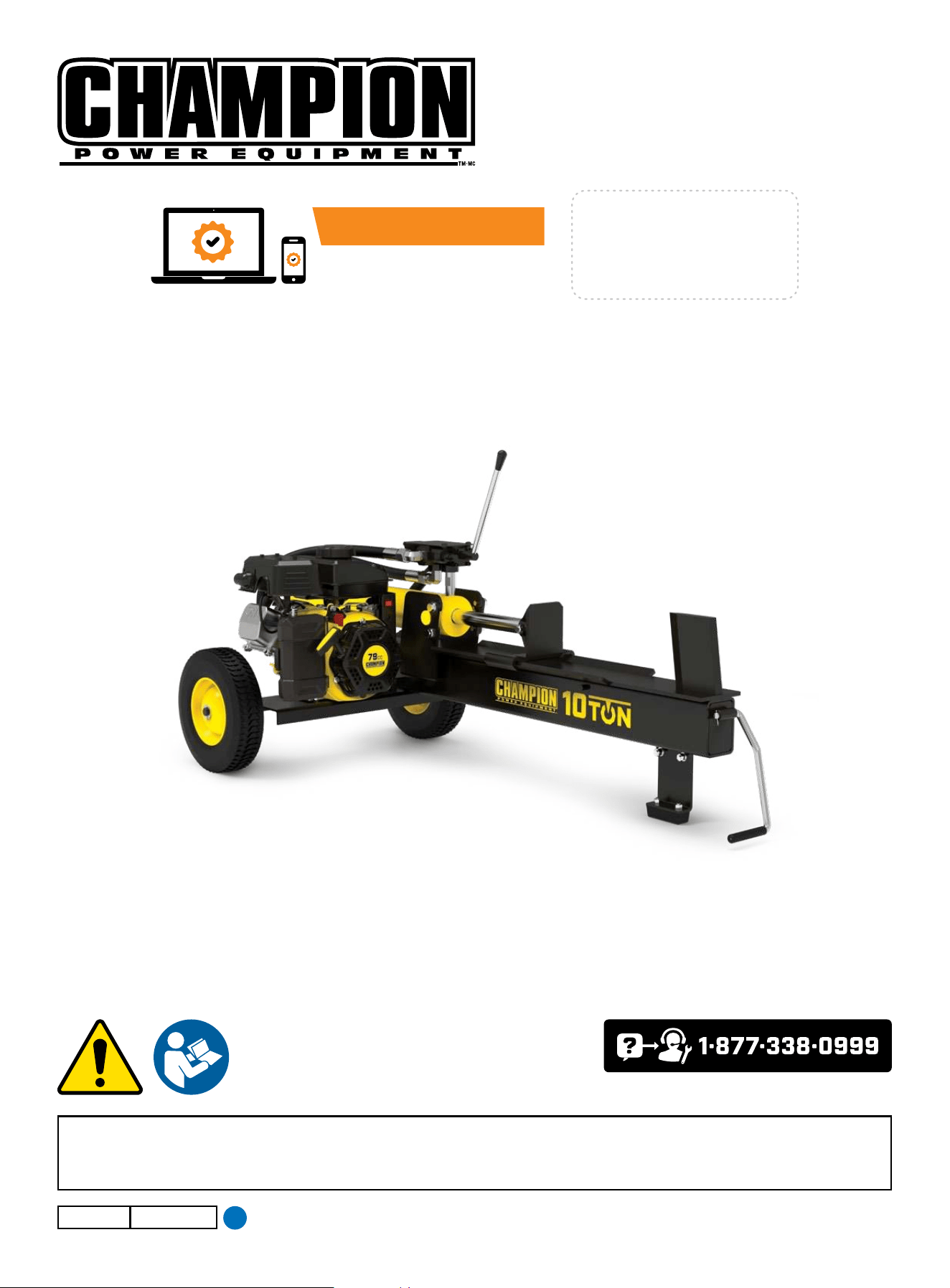
OPERATOR'S MANUAL
MODEL #201533
10 TON LOG SPLITTER
Champion Power Equipment, Inc.
or visit championpowerequipment.com
READ AND SAVE THIS MANUAL. This manual contains important safety precautions which should be read and understood before operating the product. Failure to
do so could result in serious injury. This manual should remain with the product.
Specifications, descriptions and illustrations in this manual are as accurate as known at the time of publication, but are subject to change without notice.
ACTIVATE YOUR WARRANTY
by registering your product:
championpowerequipment.com
SERIAL NO.
5434-M-OP RE V 20241125
EN

2
201533 - 10 TON LOG SPLITTER
TABLE OF CONTENTS
TABLE OF CONTENTS
Introduction
................................................... 3
Safety Definitions
.......................................... 3
Important Safety Instructions
....................... 4
Fuel Safety .........................................................5
Training Instructions ...............................................6
Preparation .........................................................7
Operation ...........................................................7
Maintenance ........................................................ 8
Safety and Dataplate Labels .......................................9
Safety Symbols ................................................... 10
Operation Symbols ............................................... 12
Quickstart Label Symbols........................................ 12
Controls and Features ................................. 13
Log Splitter ....................................................... 13
Engine ............................................................ 14
Parts Included .................................................... 15
Parts Not Included ............................................... 15
Assembly ..................................................... 16
Open Shipping Crate ............................................. 16
Install the Wheels ................................................ 16
Install the Support Leg ........................................... 16
Install the Beam .................................................. 16
Install the Engine ................................................. 17
Install the Cylinder ............................................... 17
Install the Bracket ................................................ 17
Install the Handle ................................................. 17
Install the Hoses ................................................. 17
Add Engine Oil .................................................... 19
Add Fuel .......................................................... 20
Add Hydraulic Oil ................................................. 21
Operation ..................................................... 21
Before Each Use Inspect the Log Splitter ....................... 21
Log Splitter Location ............................................. 22
Starting the Engine ............................................... 22
Stopping the Engine .............................................. 22
Log Splitter Operation ............................................ 23
Maintenance ................................................ 23
Cleaning the Log Splitter ......................................... 23
Changing the Engine Oil ......................................... 24
Cleaning and Adjusting the Spark Plug(s) ....................... 24
Cleaning the Air Filter ............................................ 24
Changing the Hydraulic Oil ....................................... 25
Maintenance Schedule ........................................... 25
Storage ........................................................ 26
Log Splitter Storage .............................................. 26
Engine Stored for Less than 30 Days ........................... 26
Engines Stored for Over 30 Days ................................ 26
Specifications .............................................. 27
Log Splitter Specifications ....................................... 27
Engine Specifications ............................................ 27
Engine Oil Specifications ......................................... 27
Hydraulic Oil Specifications ...................................... 27
Fuel Specifications ............................................... 27
Spark Plug Specifications ........................................ 27
Valve Specifications .............................................. 27
Important Message About Temperature......................... 27
Troubleshooting ........................................... 28
FOR PARTS BREAKDOWN
Search by model number at
championpowerequipment.com

3
201533 - 10 TON LOG SPLITTER
INTRODUCTION
INTRODUCTION
Congratulations on your purchase of a Champion Power Equipment
(CPE) product. CPE designs, builds, and supports all of our
products to strict specifications and guidelines. With proper
product knowledge, safe use, and regular maintenance, this
product should bring years of satisfying service.
Every effort has been made to ensure the accuracy and
completeness of the information in this manual at the time of
publication, and we reserve the right to change, alter and/or
improve the product and this document at any time without prior
notice.
Since CPE highly values how our products are designed,
manufactured, operated and are serviced, and also highly value
your safety and the safety of others, we would like you to take the
time to review this product manual and other product materials
thoroughly and be fully aware and knowledgeable of the assembly,
operation, dangers and maintenance of the product before use.
Fully familiarize yourself, and make sure others who plan on
operating the product fully familiarize themselves too, with the
proper safety and operation procedures before each use. Please
always exercise common sense and always err on the side
of caution when operating the product to ensure no accident,
property damage, or injury occurs. We want you to continue to use
and be satisfied with your CPE product for years to come.
When contacting CPE about parts and/or service, you will need to
supply the complete model and serial numbers of your product.
Transcribe the information found on your product’s nameplate
label to the table below
CPE TECHNICAL SUPPORT TEAM
1-877-338-0999
MODEL NUMBER
201533
SERIAL NUMBER
DATE OF PURCHASE
PURCHASE LOCATION
SAFETY DEFINITIONS
The purpose of safety symbols is to attract your attention to
possible dangers. The safety symbols, and their explanations,
deserve your careful attention and understanding. The safety
warnings do not by themselves eliminate any danger.
The instructions or warnings they give are not substitutes for
proper accident prevention measures.
DANGER
DANGER indicates a hazardous situation which, if not avoided,
will result in death or serious injury.
WARNING
WARNING indicates a hazardous situation which, if not
avoided, could result in death or serious injury.
CAUTION
CAUTION indicates a hazardous situation which, if not avoided,
could result in minor or moderate injury.
NOTICE
NOTICE indicates information considered important, but not
hazard-related (e.g., messages relating to property damaged).
4
201533 - 10 TON LOG SPLITTER
IMPORTANT SAFETY INSTRUCTIONS
IMPORTANT SAFETY INSTRUCTIONS
WARNING
Cancer and Reproductive Harm – www.P65Warnings.ca.gov
DANGER
Engine exhaust contains carbon monoxide, a colorless,
odorless, poison gas. Breathing carbon monoxide will cause
nausea, dizziness, fainting or death.
If you start to feel dizzy or weak, move to fresh air immediately.
Operate log splitter ONLY outdoors in a well ventilated
area.
DO NOT operate the log splitter inside any building, including
garages, basements, crawlspaces, sheds, or enclosure.
DO NOT allow exhaust fumes to enter a confined area through
windows, doors, vents or other openings.
DANGER
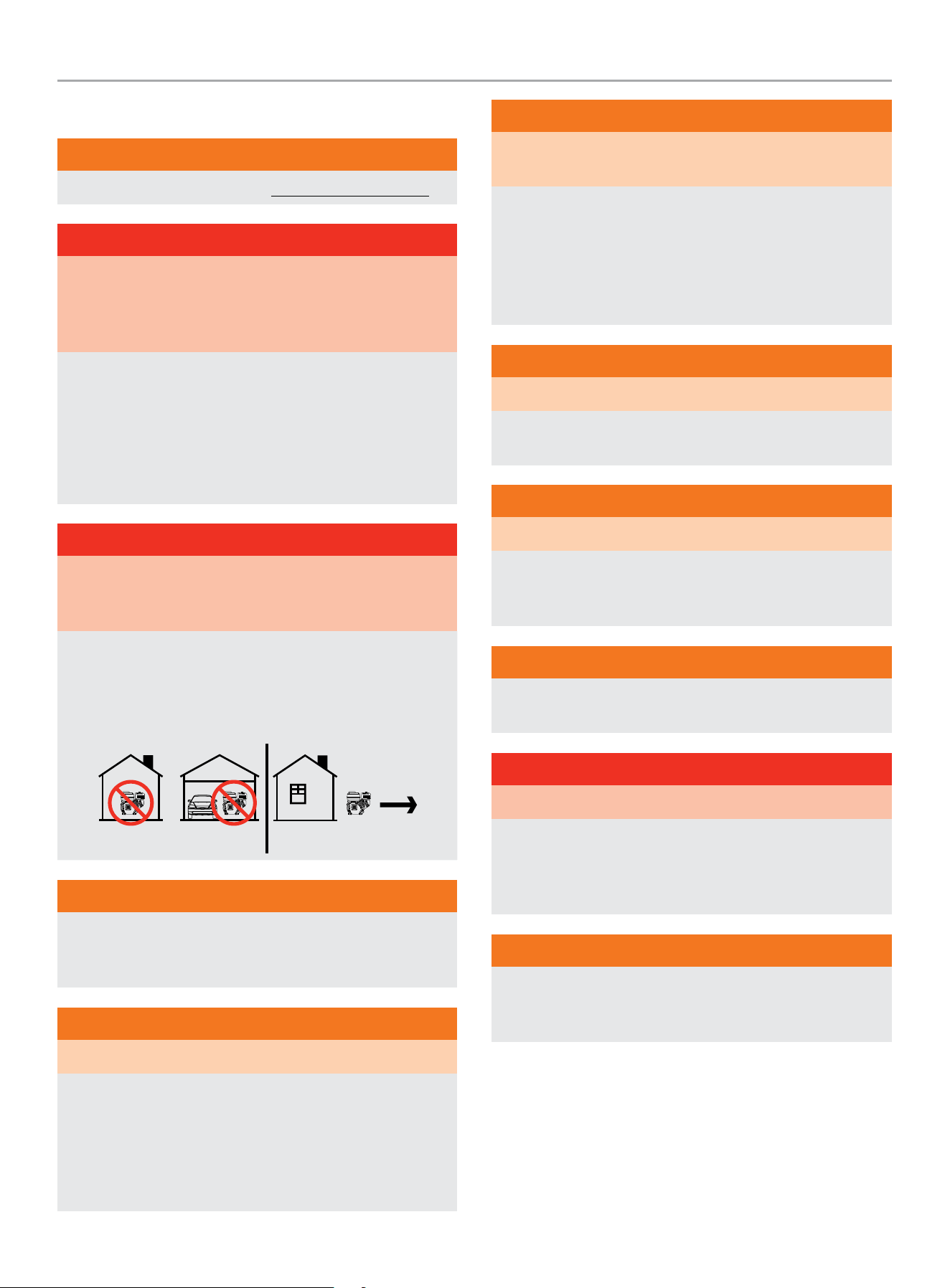
Using an engine indoors CAN KILL YOU IN MINUTES. Engine
exhaust contains carbon monoxide. This is a poison you cannot
see or smell.
NEVER use inside a home or garage, EVEN IF doors and
windows are open.
ALWAYS use OUTSIDE and far away from windows, doors,
and vents.
WARNING
Although the log splitter contains a spark arrester, maintain
a minimum distance of 5 ft. (1.5 m) from dry vegetation to
prevent fires.
WARNING
Sparks can result in fire or electrical shock.
When servicing the engine:
Disconnect the spark plug wire and place it where it cannot
contact the plug.
DO NOT check for spark with the plug removed.
Use only approved spark plug testers.
WARNING
Running engines produce heat. Severe burns can occur on
contact. Combustible material can catch fire on contact.
DO NOT touch hot surfaces.
Avoid contact with hot exhaust gases.
Allow equipment to cool before touching.
Maintain at least 3 ft. (91.4 cm) of clearance on all sides to
ensure adequate cooling.
WARNING
Crush Hazard
Wedge can cut through skin and break bones. Keep all limbs
away from wedge and endplate.
WARNING
Projectile Hazard
Pieces of log may be ejected from the log splitter while
operating. Always wear ANSI approved safety glasses when
operating. Be alert.
WARNING
Keep operator work zone clear of debris while working to
ensure safe footing.
DANGER
Skin Injection Hazard.
Hydraulic oil escaping under high pressure can penetrate skin
and cause serious bodily injury. In the event that hydraulic oil
may penetrate the skin and to avoid serious infections such as
gangrene, seek proper medical attention immediately.
WARNING
Always make sure all hydraulic oil connections are tightly
secured and hydraulic hoses are in good condition, no cuts,
tears, or damage before applying pressure to the system.

5
201533 - 10 TON LOG SPLITTER
IMPORTANT SAFETY INSTRUCTIONS
WARNING
Always keep hands and body parts away from nozzles or
pinholes that could eject hydraulic oil under high pressure in
the event of an oil leak.
NEVER use bare hands to search for leaks. Leaks can be
detected by using cardboard, paper or scrap wood over the
suspected area.
WARNING
Rapid retraction of the starter cord will pull hand and arm
towards the engine faster than you can let go. Broken bones,
fractures, bruises or sprains could result.
When starting engine, pull the starter cord slowly until
resistance is felt and then pull rapidly to avoid kickback.
CAUTION
Parts of the hydraulic circuit (cylinder, pump, valve-body,
hoses) can become very hot during operation.
WARNING
Improper treatment or use of the log splitter can damage it,
shorten its life and void your warranty.
ALWAYS use the log splitter for its intended use.
ALWAYS operate only on level surfaces.
DO NOT expose log splitter to excessive moisture, dust,
or dirt.
DO NOT allow any material to block the cooling slots.
DO NOT use the engine if:
– Equipment sparks, smokes or emits flames
– Equipment vibrates excessively
Fuel Safety
DANGER
GASOLINE AND GASOLINE VAPORS ARE HIGHLY
FLAMMABLE AND EXPLOSIVE.
Fire or explosion can cause severe burns or death.
Gasoline and gasoline vapors:
– Gasoline vapors are highly flammable and explosive.
– Gasoline vapors can cause a fire or explosion if ignited.
– Gasoline is a liquid fuel and the resulting gasoline vapors can
ignite and cause a fire or explosion.
– Gasoline is a skin irritant and needs to be cleaned up
immediately if spilled on skin or clothes.
– Gasoline has a distinctive odor, this will help detect potential
leaks quickly.
– In any petroleum gas fire, flames should not be extinguished
unless by doing so the fuel supply valve can be turned OFF.
This is because if a fire is extinguished and a supply of fuel is
not turned OFF, then an explosion hazard could be created.
– Gasoline vapors expand and contract with ambient
temperatures. Never fill the gasoline tank past the red FULL
indicator on the fuel filter, as gasoline vapors needs room to
expand if temperatures rise.
WARNING
When adding or removing gasoline:
Do not light or smoke cigarettes.
Always stop the engine and allow to cool for a minimum of two
minutes before refueling.
Always loosen gasoline cap slowly to release vapor pressure
and to keep fuel from escaping around the gasoline cap.
Always replace and tighten the gasoline cap securely after
fueling.
Never remove the gasoline cap or add gasoline while the
engine is running or when the engine is hot.
Always fill or drain gasoline outdoors in a well-ventilated area.
Do not pump gasoline directly into the log splitter at the gas
station.
Always store gasoline in an EPA/CARB compliant container or
to transfer the gasoline to the log splitter.
Do not overfill the gasoline tank.
Always keep gasoline away from sparks, open flames, pilot
lights, heat and other sources of ignition.
WARNING
When starting the log splitter:
Do not attempt to start a damaged log splitter.
Always check that the gasoline cap, air filter, spark plug, fuel
lines and exhaust system are properly in place.
Always allow spilled gasoline to evaporate fully before
attempting to start the engine.
Always be certain that the log splitter is resting firmly on level
ground.

6
201533 - 10 TON LOG SPLITTER
IMPORTANT SAFETY INSTRUCTIONS
WARNING
When operating the log splitter:
Do not move or tip the log splitter during operation.
WARNING
When transporting or servicing the log splitter:
Always check that the fuel valve is in the OFF position and the
gasoline tank is empty.
Disconnect the spark plug wire.
WARNING
When storing the log splitter:
Store away from sparks, open flames, pilot lights, heat and
other sources of ignition.
Do not store log splitter or gasoline near furnaces, water
heaters, or any other appliances that produce heat or have
automatic ignitions.
DANGER
Never place a gasoline container, gasoline tank, or any
combustible material in the path of the exhaust stream during
operation of the engine.
WARNING
Never use a gasoline container, gasoline tank, or any other fuel
item that is broken, cut, torn or damaged.
Training Instructions
CAUTION
1. Read the Operator’s Manual completely before attempting
to use this log splitter.
2. Do not allow anyone to operate your log splitter who has
not read the Operator’s Manual or has not been instructed
on the safe use of the log splitter.
3. Never allow children or untrained adults to operate this
machine.
4. Accidents occur when more than one (1) person operates
the log splitter. If a helper is assisting in loading logs to
be split, never actuate controls until helper is clear of the
area.
5. Never transport cargo on the log splitter or ride on the
machine.
6. High fluid pressures develop in hydraulic log splitters.
Pressurized hydraulic fluid escaping through a pin hole
opening can puncture skin and cause severe infections or
blood poisoning. Therefore, these instructions should be
followed at all times.
– Do not operate the unit with frayed, kinked, cracked
or damaged hoses, fittings, or tubing.
– Stop the engine and relieve hydraulic system pressure
before changing or adjusting fittings, hoses, tubing, or
other system components.
– Do not adjust the pressure settings of the pump or
valve.
– Do not check for leaks with your hand. Leaks can
be detected by passing cardboard or wood over the
suspected area. Look for discoloration. If injured by
escaping fluid, see a doctor at once. Serious infection
or reaction can develop if proper medical treatment is
not administered immediately.
7. Keep the operator zone and adjacent area clear for safe,
secure footing.
8. Your log splitter is equipped with an internal-combustion
engine and is not intended for use near any unapproved
regulated and controlled forest, brush, or grass covered
land. Always check with your local municipality, state and
federal regulations prior to use.
9. Log splitters should be used only for splitting wood.

7
201533 - 10 TON LOG SPLITTER
IMPORTANT SAFETY INSTRUCTIONS
Preparation
CAUTION
1. Be thoroughly familiar with all controls and with proper
use of the equipment.
2. Safety Gear:
– Always wear safety shoes or heavy boots when
operating the machine.
– Always wear safety glasses or goggles when
operating the machine.
– Never wear jewelry or loose-fitting clothing that might
become entangled in moving or rotating parts of the
machine.
3. Make sure the log splitter is on a level surface. Block tires
and ensure support leg is secure to prevent unintended
movement of the log splitter during operation.
– Always operate the splitter from the manufacturer’s
indicated operator zone.
4. Logs to be split on ram-type units should be cut as
squarely as possible.
Operation
CAUTION
1. Before starting this log splitter, review all safety
instructions. Failure to follow these instructions may
result in serious injury to the operator or bystanders.
2. Be sure to confirm all hose clamp connections are tight
before each use. It is possible for clamp connections to
vibrate loose over time.
3. Never leave the machine unattended with the power
source operating.
4. Never operate the machine when under the influence of
alcohol, drugs or medication.
5. The machine owner should instruct all operators in safe
log splitter operation.
6. Always operate the log splitter with all safety equipment
in place and all controls properly adjusted for safe
operation.
7. Always operate the log splitter at manufacturer’s
recommended speed.
8. Always keep hands and feet clear of moving parts.
9. When loading a ram-type log splitter, place your hands on
the sides of the log, not the ends. Never place your hands
or any part of your body between a log and any part of the
log splitter.
10. On ram-type log splitters, never attempt to split more
than one (1) log at a time unless the ram has been fully
extended and a second log is needed to complete the
separation of the first log.
11. On ram-type log splitters on which the logs are not cut
square, the longest portion of the log should be rotated
down and the most square end placed against the ram.
12. Always split logs with the grain of the wood.
13. Never split perpendicular to the grain of the wood.
14. Use only your hand to operate the log splitter controls.
15. Never add fuel to a running or hot engine.
16. Always turn the engine off and wait a minimum of 2
minutes to cool engine before removing gasoline cap prior
to refueling.

8
201533 - 10 TON LOG SPLITTER
IMPORTANT SAFETY INSTRUCTIONS
Maintenance
CAUTION
1. Always shut off the power source while repairing or
adjusting the log splitter except as recommended by the
manufacturer.
2. Clean debris and chaff from the engine cylinder, cylinder
head fins, recoil starter cover, and muffler areas. The
engine is equipped with a spark arrestor muffler, clean
and inspect it regularly (follow manufacturer’s service
instructions). Replace, if damaged.
3. Check to be sure all nuts and bolts are tight to assure
the equipment is in safe working condition before next
operation.
9
201533 - 10 TON LOG SPLITTER
SAFETY DEFINITIONS
Top Side
A
B
Safety and Dataplate Labels
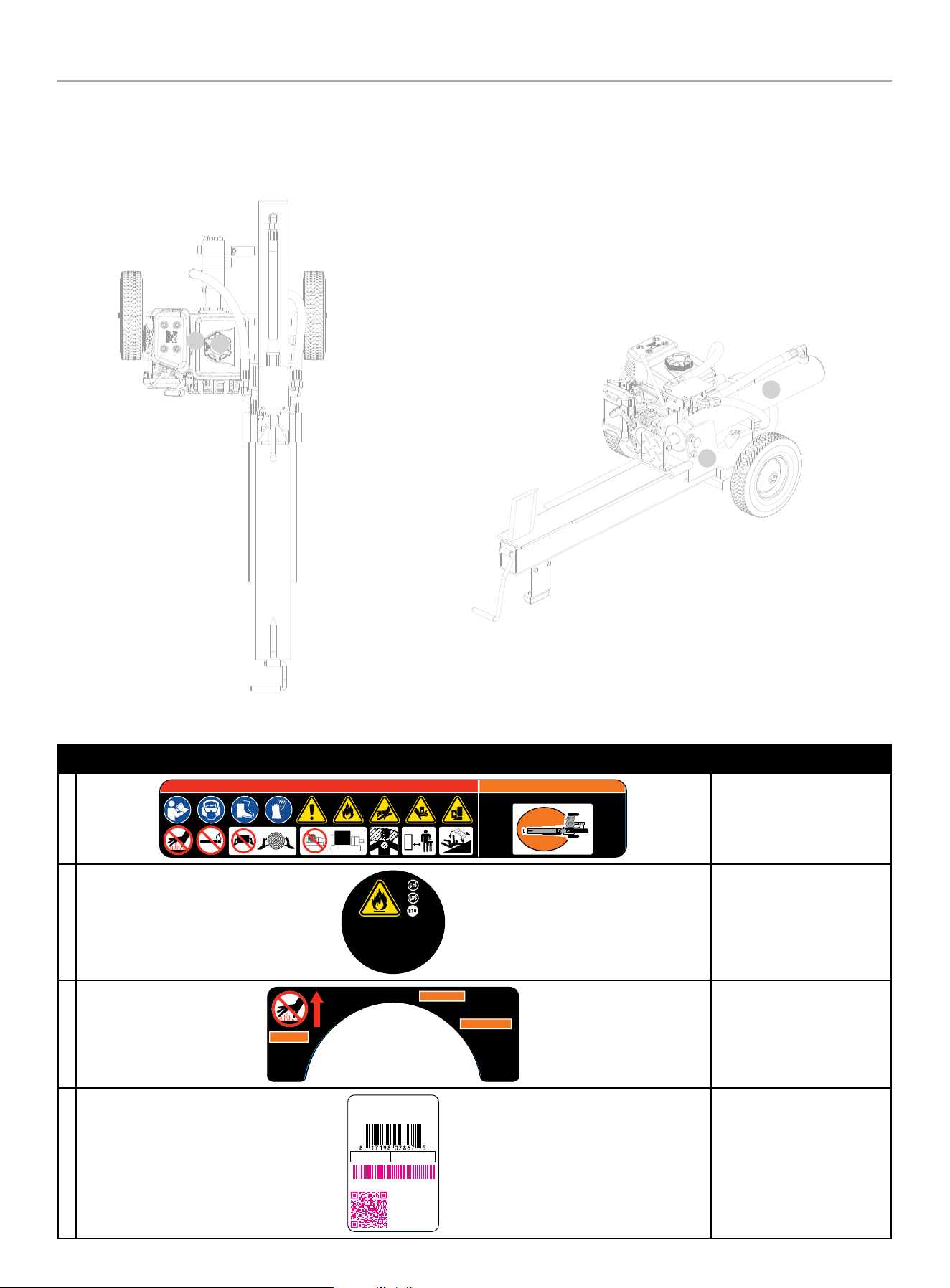
These labels warn you of potential hazards that can cause serious injury. Read them carefully.
If a label comes off or becomes hard to read, contact Technical Support Team for possible replacement.
C
LABEL DESCRIPTION
A
2897-L-SF-B
DANGER PELIGRO
WORK ZON E - AREA DE T RABA JO - ZONE DE TR AVAIL
WARNING ADVERTENCIA AVERTISSEMENT
DANGER
Safety Symbols/
CO Danger
B
1110-L-OP-B
UNLEADED F UEL ONLY. Minimum octane
rating of 87. Maximum 10% ethanol.
GASOLINA REGULAR SOLAMENTE. 87 octanos
como mínimo. Máximo de etanol de 10%.
ESSENCE SAN S PLOMB SE ULEMENT.
Indice d’octane minimal de 87.
Maximum 10 % d'éthanol.
Fuel
C
AVERTISSEMENT
ADVERTENCIA
WARNING
DO NOT TOUCH!
Exhaust gases, muffler
and engine
components are
extremely HOT and
cause burns.
¡NO TOCAR! Los gases de
escape, el silenciador y los
componentes del motor están
extremadamente C ALIENTES
y causan quemaduras.
NE TOUCHEZ PAS! Les ga z
d’échappement, le silencieux
et les pièces du moteur
sont extrêmement
CHAUDS et peuvent
causer des brûlures.
2242-L-SF-A
Hot Surface
D
CHAMPION POWER EQUIPMENT, INC.
6370 S PIONEER WAY, UNIT 101
LAS VEGAS, NV 89113
USA / É.-U. • 1-877-338-0999
WWW.CHAMPIONPOWEREQUIPMENT.COM
MADE IN CHINA / FABRIQUÉ EN CHINE
5410-L-PR-A
SERIAL NO.
N° DE SÉRIE
MODEL
MODÈLE
201533
REGISTER TO
ACTIVATE YOUR
WARRANTY
ENREGISTREZ-VOUS POUR
ACTIVEZ VOTRE
GARANTIE
XXXXXXXXXXXX
Dataplate
D
10
201533 - 10 TON LOG SPLITTER
SAFETY DEFINITIONS
Safety Symbols
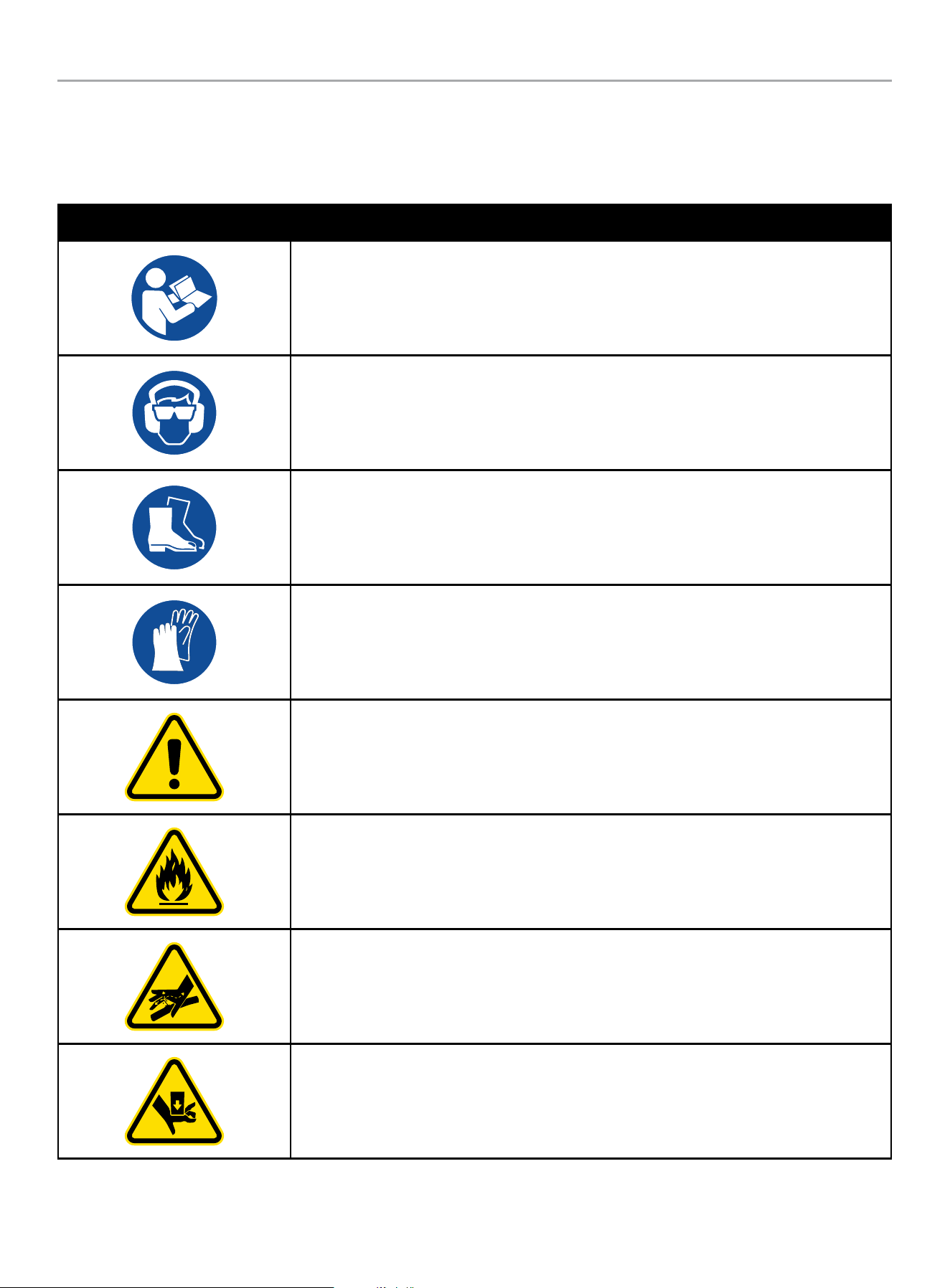
Some of the following symbols may be used on this product. Please study them and learn their meaning. Proper interpretation of these
symbols will allow you to more safely operate the product.
SYMBOL MEANING
Read Operator’s Manual. To reduce the risk of injury, user must read and understand operator’s
manual before using this product.
Eye and Ear Protection. Always wear safety goggles or safety glasses with side shields, and as
necessary a full face-shield as well as full ear protection when operating this product.
Footwear. Always wear safety shoes or heavy boots when operating the machine.
Gloves. Always wear nonslip, heavy-duty protective gloves when operating this product.
Safety Alert. Precautions that involve your safety.
Risk of Fire. Fuel and its vapors are extremely flammable and explosive. Fire can cause severe
burns or death. Do not add fuel while the product is operating or still hot.
Skin Injection Hazard. High pressure hydraulic oil can inject under your skin.
Make sure all fittings are tightly secure before applying pressure. Relieve system
pressure before servicing.
Always keep hands away from the wedge and the ram. Moving parts can crush or cut.
11
201533 - 10 TON LOG SPLITTER
SAFETY DEFINITIONS
SYMBOL MEANING
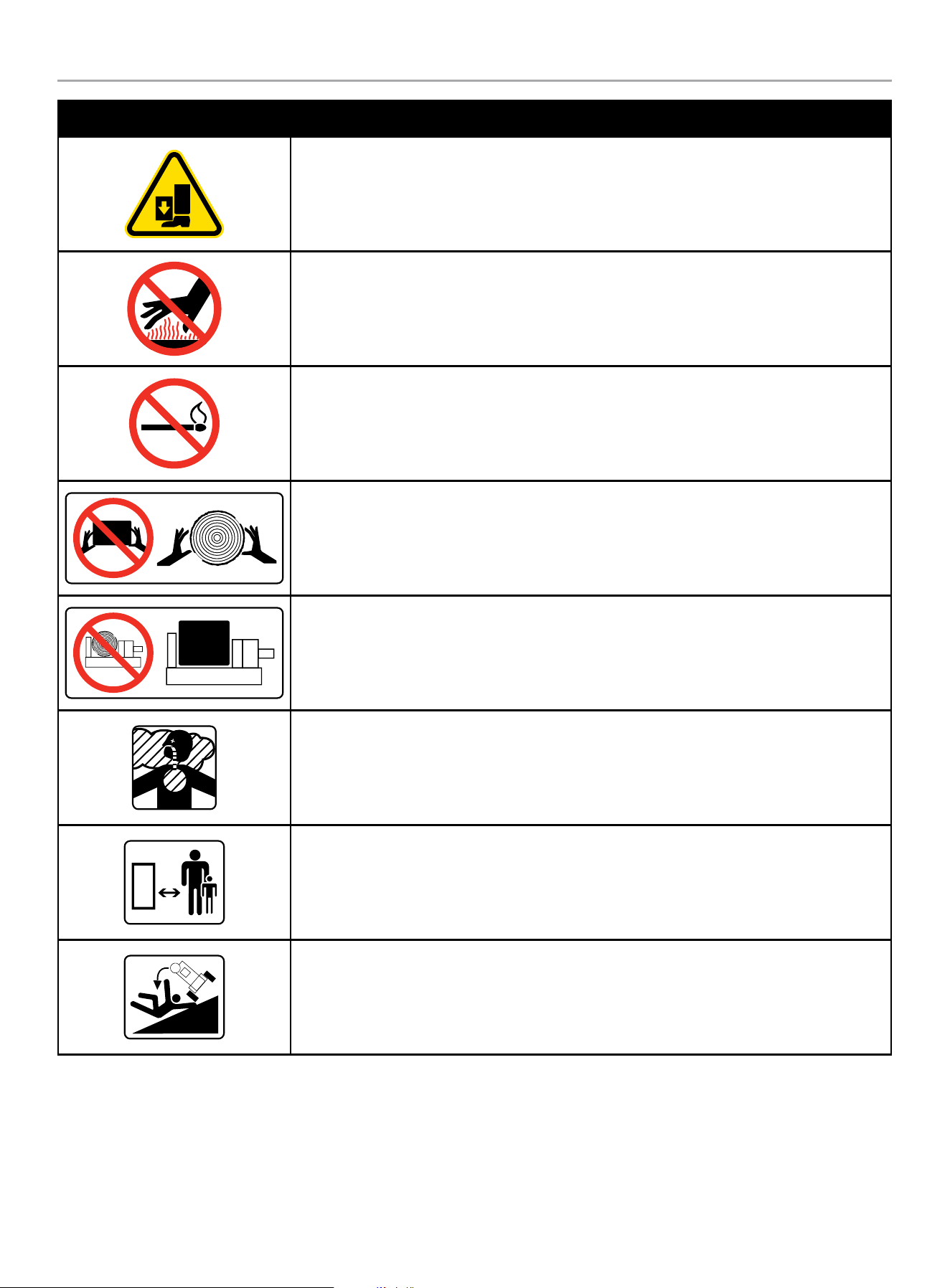
Always keep feet away from the wedge and the ram. Moving parts can crush or cut.
Hot Surface. To reduce the risk of injury or damage, avoid contact with any hot surface
Open Flame alert. Fuel and its vapors are extremely flammable and explosive. Keep fuel away
from smoking, open flames, sparks, pilot lights, heat, and other ignition sources.
Hold logs on sides when loading. Keep hands and feet away from cylinder, wedge,
and partially split logs.
Never place hands or any part of the body between a log and any part of the log splitter.
Do not split logs against the grain. Split logs end to end in the direction of the grain only.
Toxic Fumes. The engine exhaust from this product contains chemicals known to the state of
California to cause cancer and birth defects and other reproductive harm.
Risk of Asphyxiation. This engine emits carbon monoxide, an odorless, colorless poison gas.
Breathing carbon monoxide can cause nausea, fainting or death. Use only in a well ventilated
area.
Clearance. Keep all objects including others at least 10 feet (3m) from this machine.
Only one person should operate the log splitter and load the logs
Never operate on an incline. Make sure the splitter is on a level surface. Block tires and ensure
support leg is secure to prevent unintended movement of the log splitter during operation.
12
201533 - 10 TON LOG SPLITTER
SAFETY DEFINITIONS
Operation Symbols
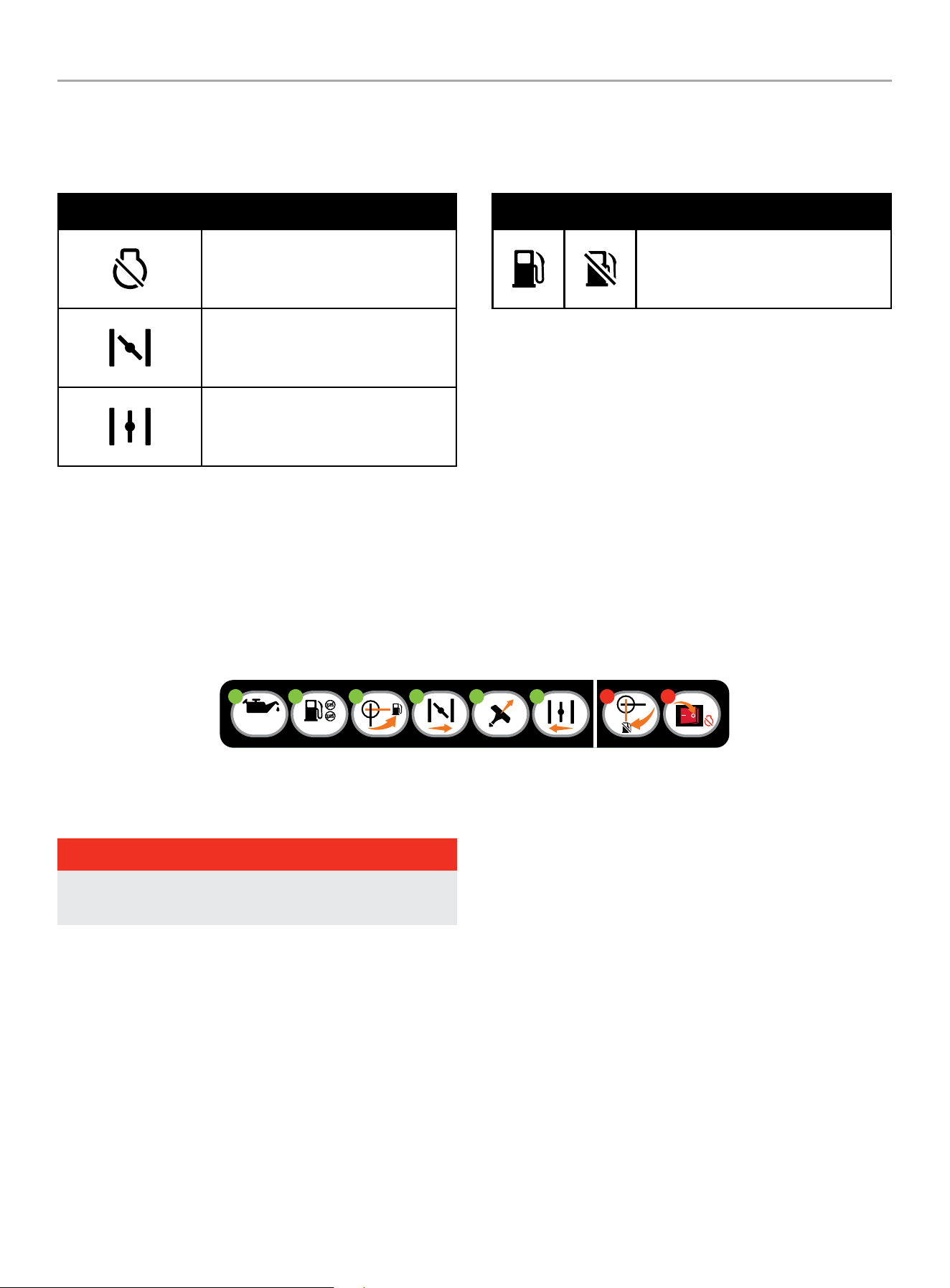
Some of the following symbols may be used on this product. Please study them and learn their meaning. Proper interpretation of these
symbols will allow you to more safely operate the product.
Quickstart Label Symbols
Some of the following symbols may be used on this product. Please study them and learn their meaning. Proper interpretation of these
symbols will allow you to more safely operate the product.
SYMBOL MEANING
STOP or OFF
Choke
Run
SYMBOL MEANING
Fuel Valve ON/OFF
Starting the Engine
DANGER
Move log splitter outside and far away from windows,
doors and intake ventilation covers.
1. Check oil level.
Recommended oil is 10W-30.
2. Check gasoline level.
When adding gasoline, use a minimum octane rating of 87
and an ethanol content of 10% or less by volume.
3. Turn the fuel valve to “ON” position.
4. Move choke lever to “CHOKE” position.
5. Pull the recoil cord.
6. Move the choke lever to “RUN” position.
Stopping the Engine
1. Turn the fuel valve to “OFF” position.
2. Press engine switch to the “OFF” position.
1
10W-30
4 5 62
23 1
13
201533 - 10 TON LOG SPLITTER
CONTROLS AND FEATURES
CONTROLS AND FEATURES
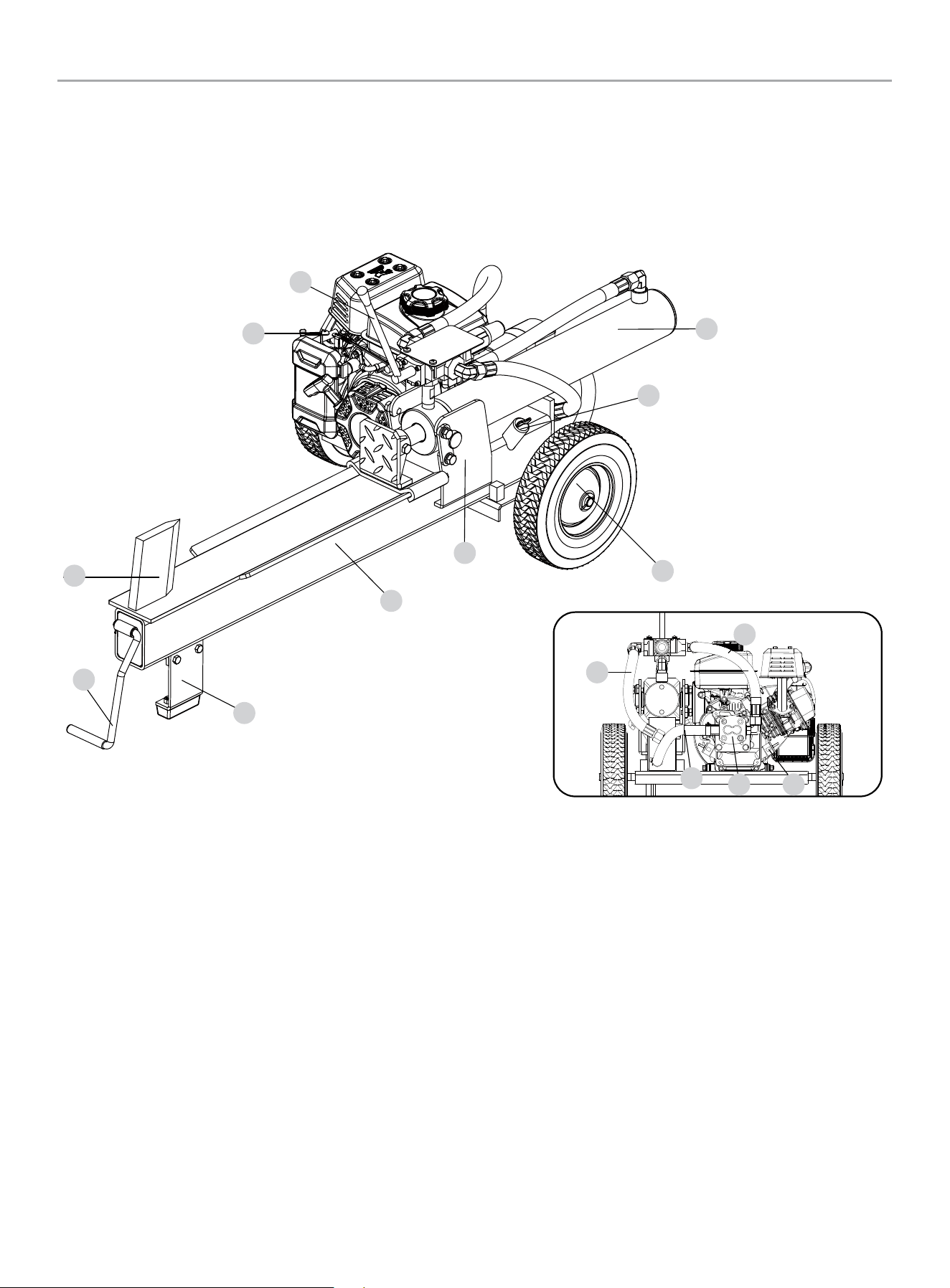
Read this operator’s manual before operating your log splitter. Familiarize yourself with the location and function of the controls and
features. Save this manual for future reference.
Log Splitter
1. Handle
2. Wedge
3. Support Leg – Supports log splitter while operating.
4. Splitting Beam / Log Cradle – Prevents log from rolling off
the beam.
5. Mounting Plates – Holds hydraulic cylinder in place.
6. Wheels
7. Hydraulic Oil Dipstick – Check and add Hydraulic oil.
8. Hydraulic Cylinder – Converts hydraulic pressure into linear
force.
9. Control Valve Handle – Controls the movement of the thrust
plate.
10. Engine – 79cc, OHV, 4-stroke, air cooled.
11. Oil Return (Low pressure) Hose – Feed hydraulic oil back
into the hydraulic tank.
12. Suction Hose – Pulls hydraulic oil from the tank into the
pump.
13. Hydraulic Pump – Pumps hydraulic oil through the system.
14. Engine Oil Fill Cap / Dipstick – Add or check the engine oil.
15. Oil Inlet (High Pressure) Hose – Feeds hydraulic oil into the
hydraulic cylinder.
1
10
2
9
4
3
8
7
6
Back View
5
11
15
12
13 14
14
201533 - 10 TON LOG SPLITTER
CONTROLS AND FEATURES
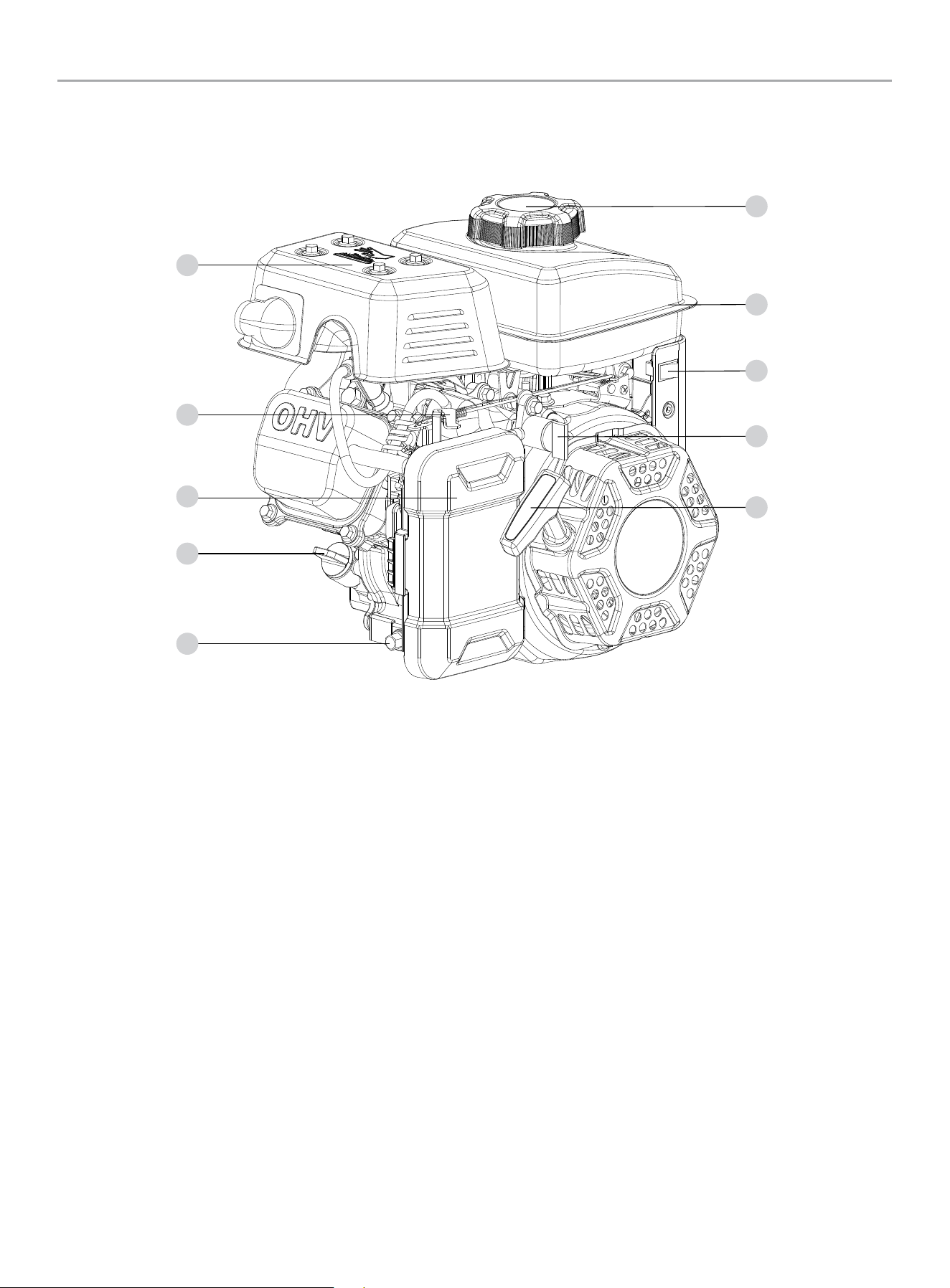
Engine
1. Muffler
2. Choke
3. Air Filter
4. Engine Oil Fill Cap / Dipstick (on each side)
5. Oil Drain Bolt (on each side)
6. Recoil Starter
7. Fuel Valve
8. Engine On / Off Switch
9. Gasoline Tank – 0.3 gal. (1.29 L)
10. Gasoline Tank Cap
1
2
3
5
4
9
10
8
7
6

15
201533 - 10 TON LOG SPLITTER
CONTROLS AND FEATURES
Parts Included
Part Part Qty. Hardware Needed
Hardware
Qty.
Tool Needed
Wheels 2
Cotter Pin Ø2.5 × 25 2 Needle nose pliers
Washer Ø16 2 n/a
Support Leg 1
Bolt M8×25 2 2× 14mm wrench or socket
Washer Ø8 2
n/aLock washer Ø8 2
Nut M8 2
Handle 1 Cotter Pin Ø2 × 20 1 Needle nose pliers
Engine 1
Bolt M8 × 20 4 1× 13 mm wrench or socket
Washer Ø8 4
n/a
Lock washer Ø8 4
Engine Oil Funnel 1 n/a n/a
Beam 1
Bolt M10 × 20 4 1× 8mm allen wrench
Lock Washer Ø10 4 n/a
Ram Bracket 1
Bolt M10 × 60 1 1× 16mm wrench or socket
Lock nut M10 1 1× 17mm wrench
Cylinder 1
Bolt M10 × 20 4 1× 17mm wrench or socket
Washer Ø10 4
n/aLock washer Ø10 4
Cylinder Fixing Plate 2
Oil Return (Low
Pressure) Hose
1 n/a 27mm open-end wrench
Oil Inlet (High
Pressure) Hose
1 n/a 27mm open-end wrench
Suction Hose 1 C-Clamp 2
1× Cross head screw driver or 6mm
socket
Spark Plug Socket Tool 1 n/a n/a
Parts Not Included
– Engine Oil (10W-30): 11.8 fl. oz (350 ml)
– Hydraulic Oil (ISO 32): 1.5 gal. (5.7 L)
16
201533 - 10 TON LOG SPLITTER
ASSEMBLY
ASSEMBLY
If your log splitter is already assembled, skip the assembly
instructions in this manual.
If unassembled, please read and follow these instructions.
If you have any questions regarding the assembly of your log
splitter, call our Technical Support Team at 1-877-338-0999.
Please have your serial number and model number available.
Open Shipping Crate
1. Set the shipping crate on a solid, flat surface.
2. Carefully cut the shipping bands and remove lid of shipping
crate.
3. Locate all hardware before beginning assembly.
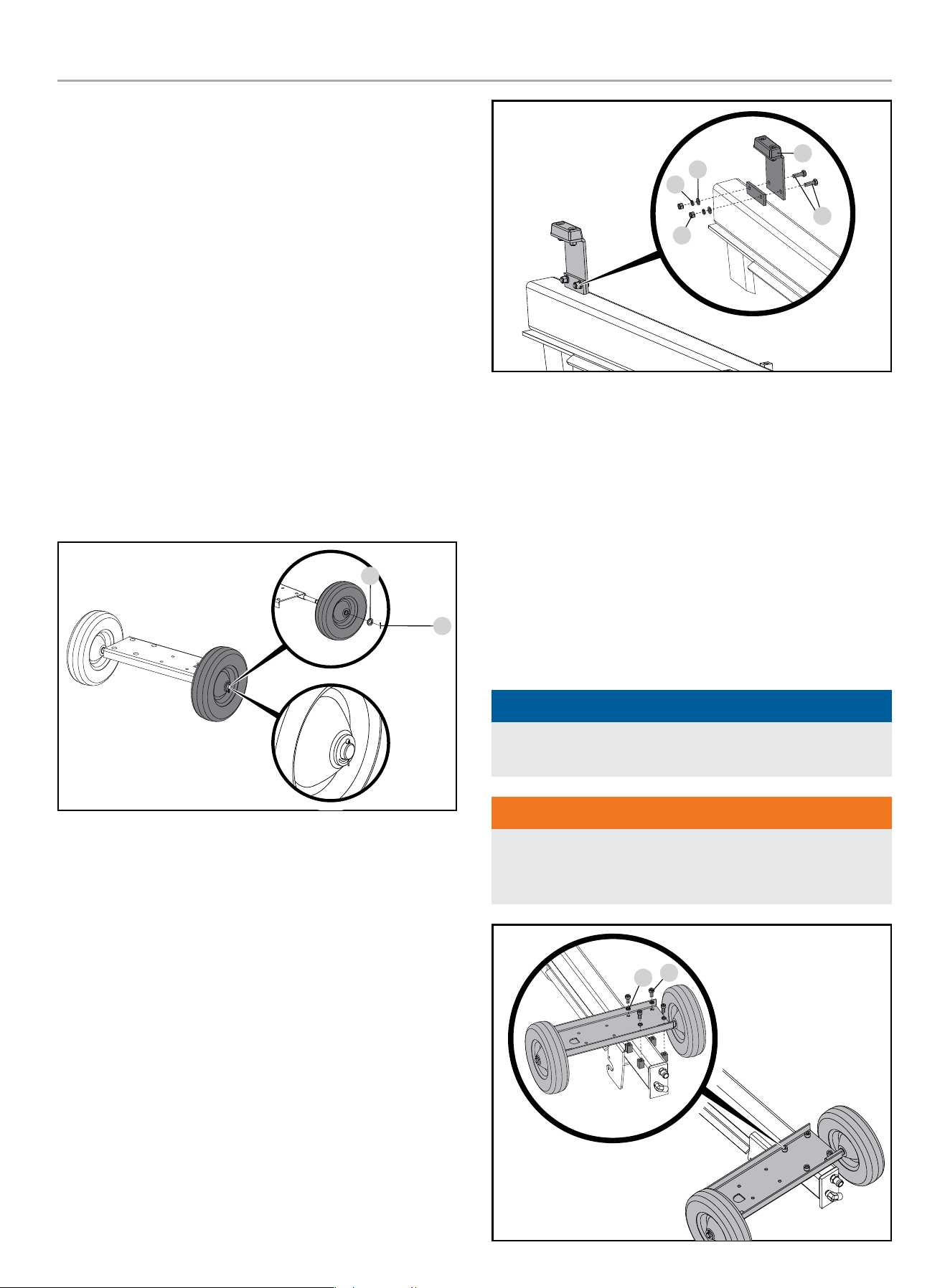
Install the Wheels
1. Slide the wheel onto the axle.
2. Install the washer (38) and cotter pin (39) through the axle.
38
39
Install the Support Leg
1. Place the beam on a flat, level surface resting on the wedge
and cylinder brackets.
2. Align the support leg (28) with the mounting holes on the
beam bracket.
3. Place the M8×25 bolt (24) through the hole.
4. Place a Ø8 washer (27) and Ø8 lock washer (26) on the end
of the bolt.
5. Install the M8 nut (25) on the bolt and tighten. Do not over
tighten.
24
28
27
26
25
Install the Beam
1. With the beam still resting on the wedge and cylinder
brackets, align the 4 larger holes on the wheel mount base
plate with the threaded blocks on the beam.
2. Thread an M10×20 bolt (34) through a Ø10 washer (22).
3. Thread the bolt and washer through the hole on the base
plate and into the threaded blocks on the beam and tighten
4. Repeat steps 1-3 for the remaining 3 bolt and washer sets to
complete the mounting of the beam to the wheel mount.
5. Once all bolts are tightened, flip the assembly over to rest on
the wheels and support leg.
NOTICE
The beam should extend to the opposite side of the wheel
mounts as shown.
WARNING
The beam is extremely heavy and should only be handled
with 2 or more people. DO NOT try and lift or handle the beam
without assistance.
3 pt
34
22
17
201533 - 10 TON LOG SPLITTER
ASSEMBLY
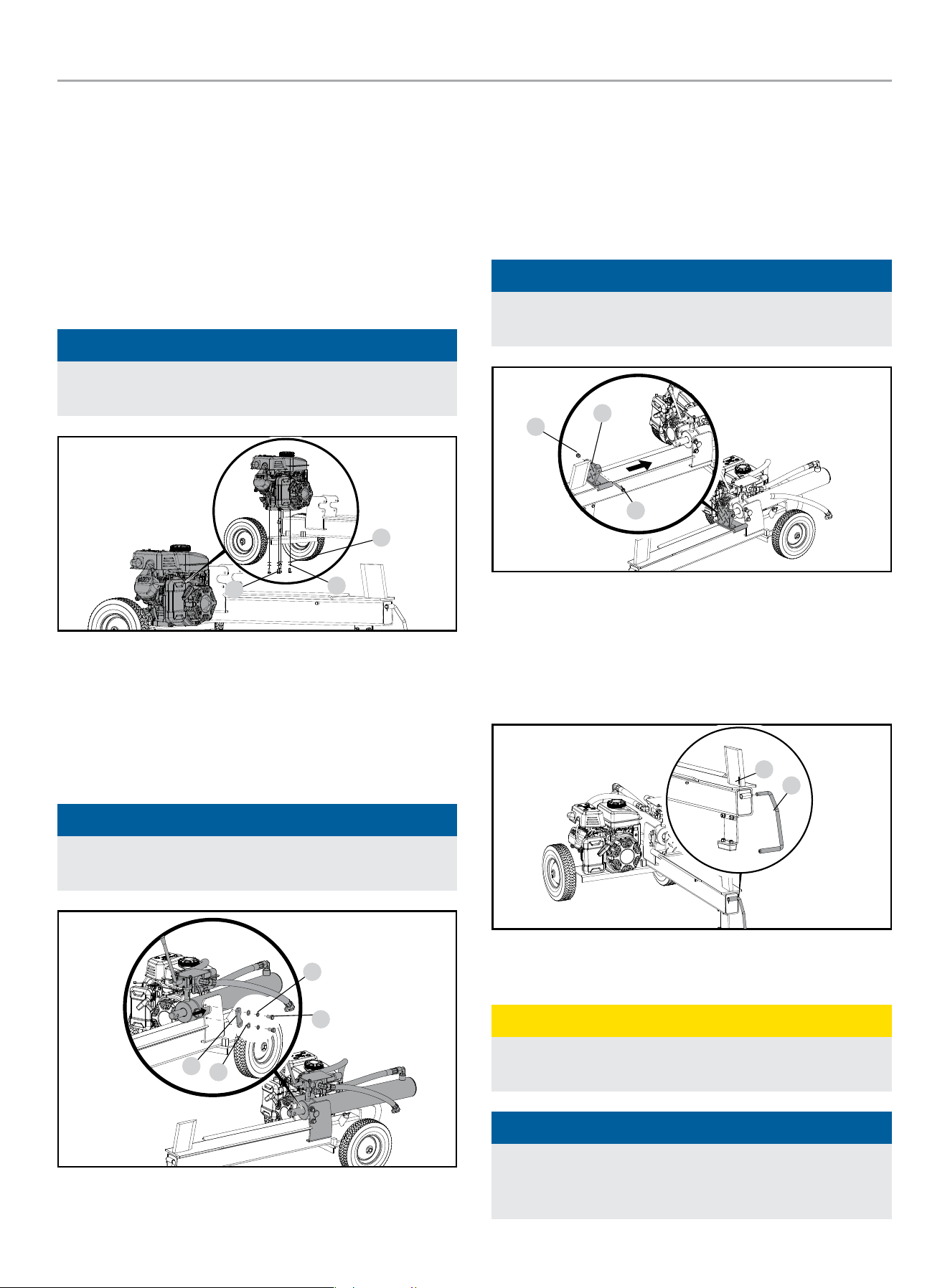
Install the Engine
1. Align the 4 holes on the base of the engine with the 4 smaller
holes on the wheel mount.
2. Thread an M8×20 bolt (36) through an Ø8 Lock Washer (26)
and Ø8 Washer (27).
3. Thread a bolt and washers set through a hole on the bottom
of the wheel mount into the engine and tighten.
4. Repeat steps 1-3 for the remaining 3 bolt and washer sets to
complete mounting of the engine to the wheel mount.
NOTICE
The recoil side of the engine should point the same direction
as the beam as shown.
36
27
26
Install the Cylinder
1. Slide the cylinder pegs into the cylinder mounting slots on the
top of the beam.
2. Secure the cylinder retention plates (20) with M10×20 bolts
(23), Ø10 Lock Washers (22) and Ø10 Washers (21).
NOTICE
The recoil side of the engine should point the same direction
as the beam as shown.
20
23
22
21
Install the Bracket
1. Slide the ram bracket (2) over the rod on the cylinder being
sure to align the bolt holes.
2. Insert the M10×60 bolt (3) through the ram bracket and
cylinder rod.
3. Secure the bolt with M10 lock nut (1). Do not over tighten.
NOTICE
A screwdriver can be inserted into the cylinder rod’s bolt hole
to rotate to proper position prior to installing the ram bracket.
1
2
3
Install the Handle
1. Slide the handle (31) into the tube bracket on the end of the
beam.
2. Secure with cotter pin (32).
32
31
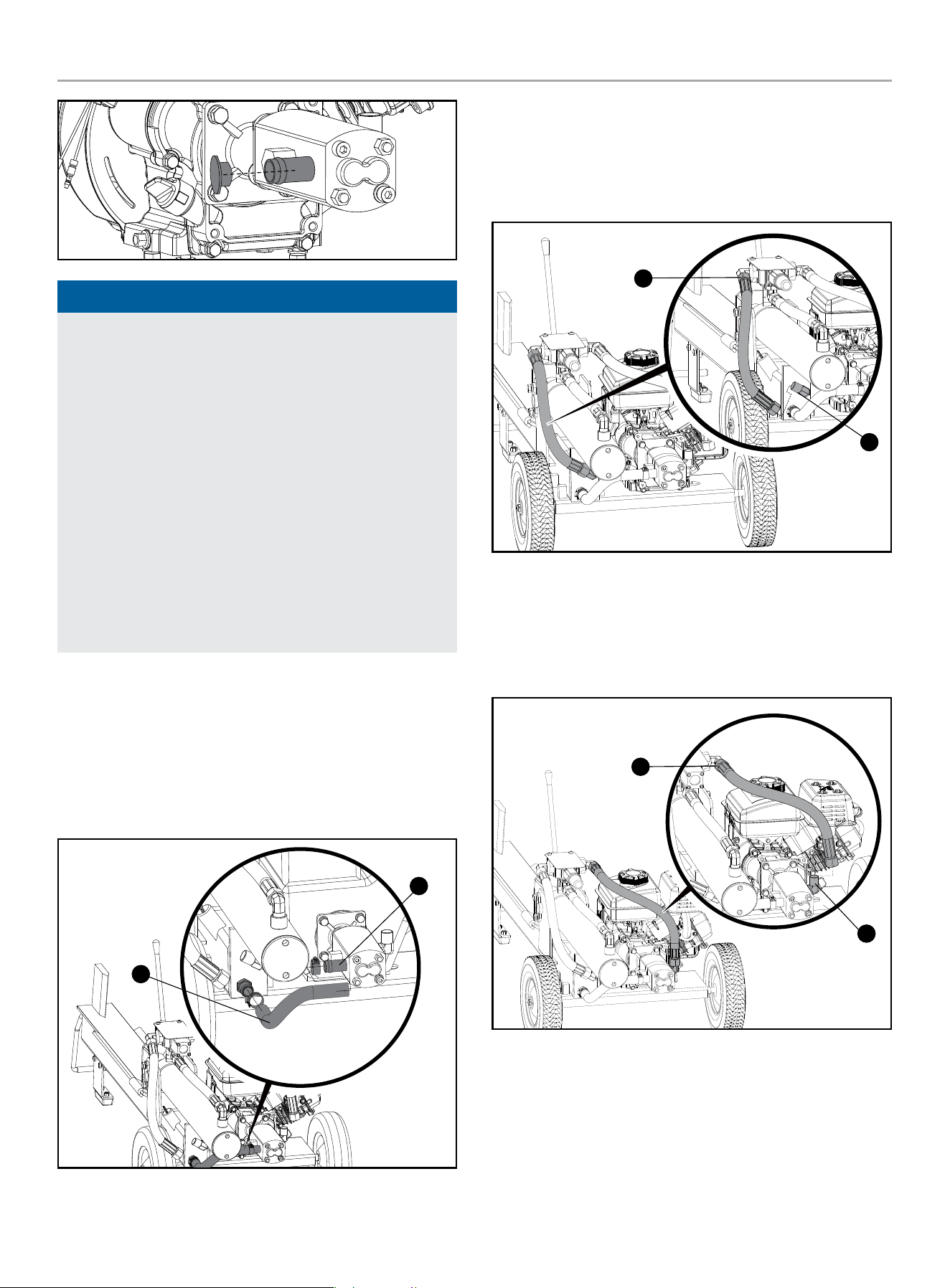
Install the Hoses
CAUTION
Red shipping plugs must be removed from hydraulic pump
prior to installing hoses.
NOTICE
Hydraulic pump may contain residual oil from testing
procedures during production. We recommend using an oil tray
under the pump before removing the shipping plugs.
18
201533 - 10 TON LOG SPLITTER
ASSEMBLY
NOTICE
Some hoses may be preassembled by the factory, check your
hoses per below instructions to ensure proper assembly.
Oil Inlet (High Pressure) and Oil Return Hoses
– These hoses are black and have swivel nuts on both ends.
– The oil inlet hose sends hydraulic oil from the pump to the
control valve/cylinder.
– The oil return hose returns hydraulic oil from the control
valve/cylinder to the tank.
– Hose connections do NOT require thread seal tape.
Suction Hose
– This is the clear hose that connects the hydraulic tank to
the pump inlet.
– Secure both ends of hose with hose clamps.
Suction Hose
1. Using the provided hose clamps, connect one end of the clear
oil hose to the hydraulic oil tank (C) just beneath the beam
and the other end to the pump inlet on the side of the pump
(D). Securely tighten the clamps on both ends of the clear
hydraulic hose with either a flat head screw driver or 6mm
socket (tighten to 3.65 ± 1.5 lbf-ft [4.95 ± 1.02 Nm]).
C
D
Oil Return (Low Pressure) Hose
2. Connect one end of hose to the control valve outlet (E).
Connect the other end of the hose to the oil filter inlet (F).
Securely tighten both ends of the hydraulic hose with a 27mm
wrench (tighten to 48 ± 4 lbf-ft [65.1 ± 5.4 Nm]).
E
F
Oil Inlet (High Pressure) Hose
3. Connect one end of high pressure hose to the control valve
inlet (A). Connect the other end of the hose to the pump outlet
(B). Securely tighten both ends of the hydraulic hose with a
27mm wrench (tighten to 48 ± 4 lbf-ft [65.1 ± 5.4 Nm]).
A
B
19
201533 - 10 TON LOG SPLITTER
ASSEMBLY
Add Engine Oil
WARNING
DO NOT attempt to crank or start the engine before it has been
properly filled with the recommended type and amount of oil.
Damage to the log splitter as a result of failing to follow these
instructions will void your warranty.
NOTICE
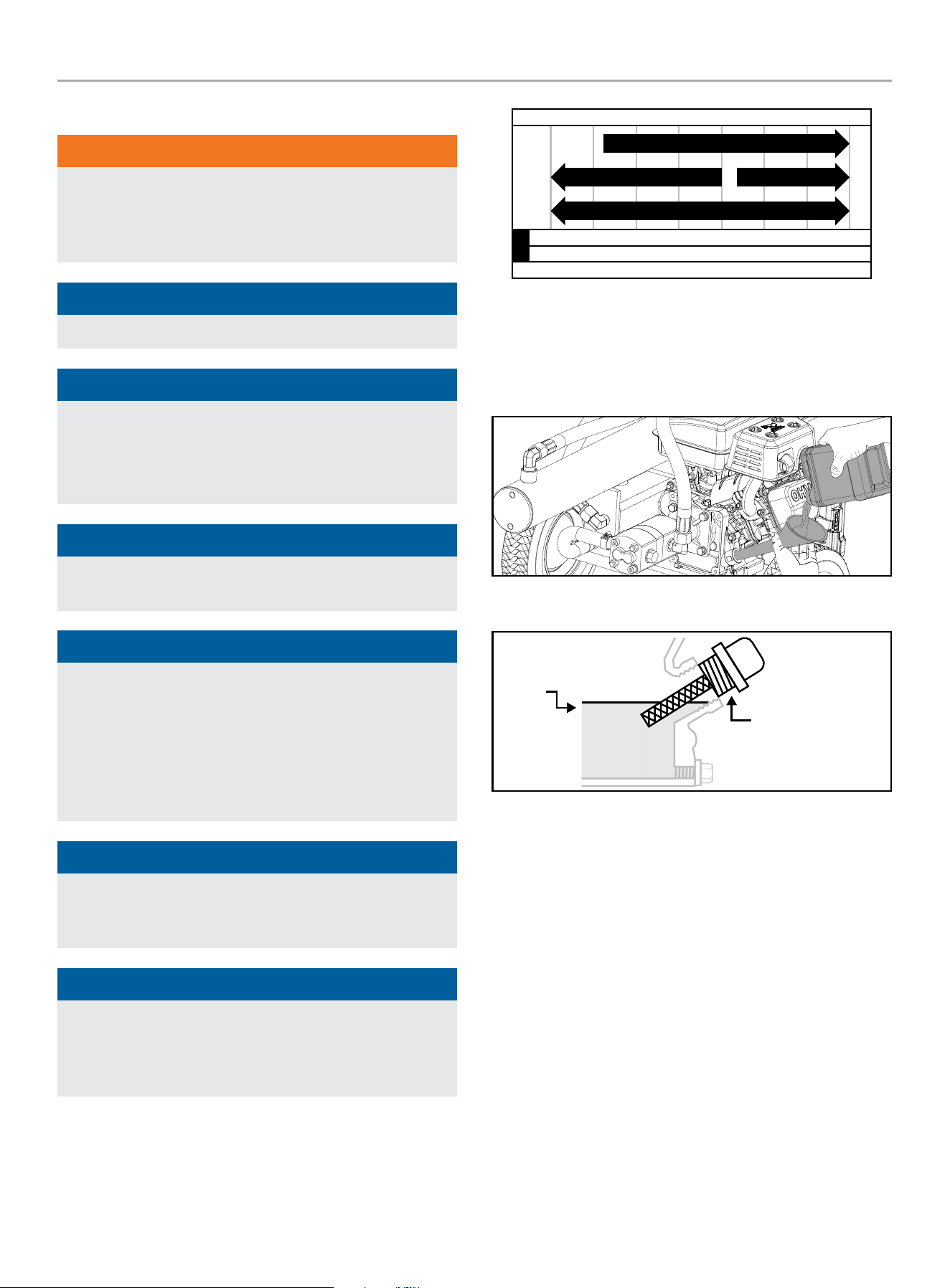
The recommended oil type is 10W-30 automotive oil.
NOTICE
Once oil has been added, a visual check should show oil about
1-2 threads from running out of the fill hole.
If using the dipstick to check oil level, DO NOT screw in the
dipstick while checking.
NOTICE
Check oil often during the break-in period. Refer to the
Maintenance section for recommended service intervals.
NOTICE
We consider the first 5 hours of run time to be the break-
in period for the engine. During the break in period we
recommend using standard automotive non-synthetic blended
oils. After the break in period synthetic lubricant can be used
but is not required. Avoid bogging or lugging the engine down
and avoid prolonged running at constant RPM. After the 5 hour
break-in period, change the oil.
NOTICE
Temperature will affect engine oil and engine performance.
Change the type of engine oil used based on temperature
shown in Recommended Engine Oil Type table.
NOTICE
Synthetic oil may be used after the 5 hour initial break-
in period. Using synthetic oil does not decrease the
recommended oil change interval. Full synthetic 5W-30 oil will
aid in starting in cold ambient < 41ºF (5ºC).
-20 0 20 40 60
Ambient temperature
Recommended Engine Oil Type
80 100 120
-28.9
°F
°C
-17.8 -6.7 4.4 15.6 26.7 37.8 48.9
10W-30
5W-30 Full Synthetic
10W-405W-30
1. Place the log splitter on a flat, level surface.
2. Remove oil fill cap/dipstick to add oil.
3. Using a funnel, add up to 11.8 fl. oz (350 ml) of oil and
replace oil fill cap/dipstick. DO NOT OVERFILL.
4. Check engine oil level daily and add as needed.
MAX
OIL DIP STICK
20
201533 - 10 TON LOG SPLITTER
ASSEMBLY
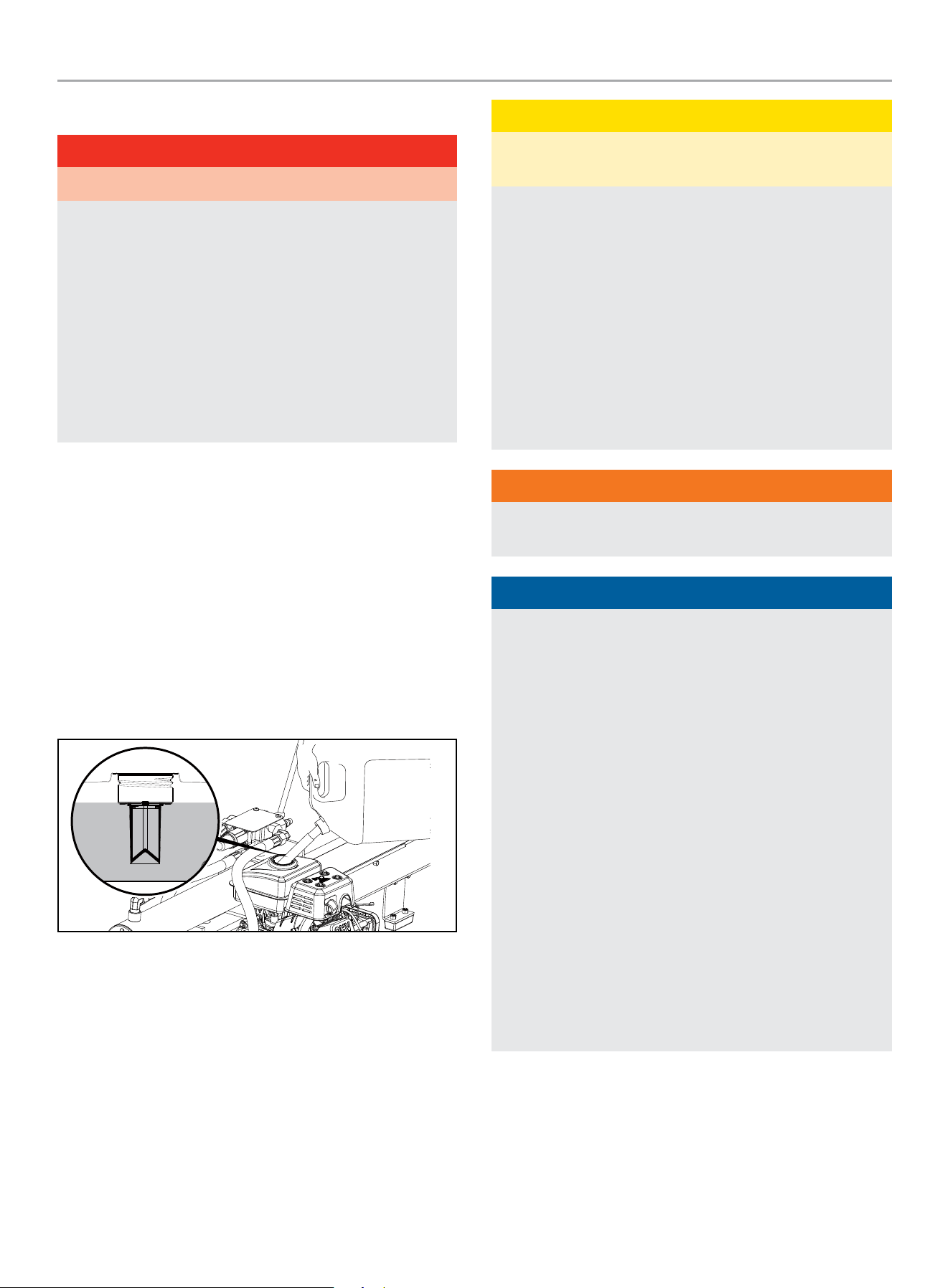
Add Fuel
DANGER
Gasoline vapors are highly flammable and extremely explosive.
DO NOT light or smoke cigarettes. Fire or explosion can cause
severe burns or death.
Always fill or drain fuel outdoors in a well-ventilated area.
DO NOT pump gasoline directly into the log splitter. Use an
approved container to transfer the fuel to the log splitter.
Never use a gasoline container, gasoline tank, or any other fuel
item that is broken, cut, torn or damaged.
DO NOT overfill the gasoline tank. Always keep fuel away from
sparks, open flames, pilot lights, heat and other sources of
ignition.
Use clean, fresh, regular unleaded gasoline with a minimum
octane rating of 87 and an ethanol content of less than 10% by
volume. ybc
DO NOT mix oil with gasoline.
1. Remove the gasoline cap.
2. Slowly add gasoline to the tank. DO NOT OVERFILL. Gasoline
can expand after filling. A minimum of ¼ in. (6.4 mm) of
space left in the tank is required for gasoline expansion,
although more than ¼ in. (6.4 mm) is recommended. Gasoline
can be forced out of the tank as a result of expansion if
overfilled, and can affect the stable running condition of the
log splitter.
3. The approximate fuel level is shown on the fuel gauge on top
of the fuel tank.
CAUTION
Use regular unleaded gasoline with a minimum octane rating
of 87 and an ethanol content of less than 10% by volume.
DO NOT light cigarettes or smoke when filling the tank.
DO NOT mix oil and gasoline.
Fill tank to approximately ¼ in. (6.4 mm) below the top of the
tank to allow for gasoline expansion.
DO NOT pump gasoline directly into the log splitter at the
pump. Use an approved container to transfer the gasoline to
the log splitter.
DO NOT fill tank indoors.
DO NOT fill tank when the engine is running or hot.
DO NOT overfill the tank.
WARNING
Pouring gasoline too fast through the fuel screen may result in
blow back of gasoline at the operator while filling.
NOTICE
The engine works well with 10% or less ethanol blended
gasoline. When using ethanol-gasoline blends there are some
issues worth noting:
– Ethanol-gasoline blends can absorb more water than
gasoline alone.
– These ethanol blends can eventually separate, leaving
water or a watery goo in the tank, fuel valve and
carburetor. The compromised gasoline can be drawn into
the carburetor and cause damage to the engine and/or
create potential hazards.
– If a fuel stabilizer is used, confirm that it is formulated to
work with ethanol-gasoline blends.
– Any damages or hazards caused by using ethanol blended
gasoline higher than 10% by volume, improperly stored
gasoline, and/or improperly formulated stabilizers, are not
covered by manufacturer’s warranty.
It is advisable to always shut off the gasoline supply and
run the engine to starvation after each use. See Storage
instructions for extended non-use.
21
201533 - 10 TON LOG SPLITTER
OPERATION
Add Hydraulic Oil
WARNING
DO NOT remove the hydraulic oil fill cap when the engine
is running or hot. Hot oil can escape causing severe burns.
Always allow the log splitter to cool completely before
removing the hydraulic oil cap.
High fluid pressure and temperatures are created in the
hydraulic log splitters. Hydraulic fluid will escape through a
pin-size hole opening and can puncture skin.
Inspect hydraulic system regularly for possible leaks.
Never check for leaks with your hand while the system is
pressurized. Seek medical attention immediately if injured by
escaping fluid.
NOTICE
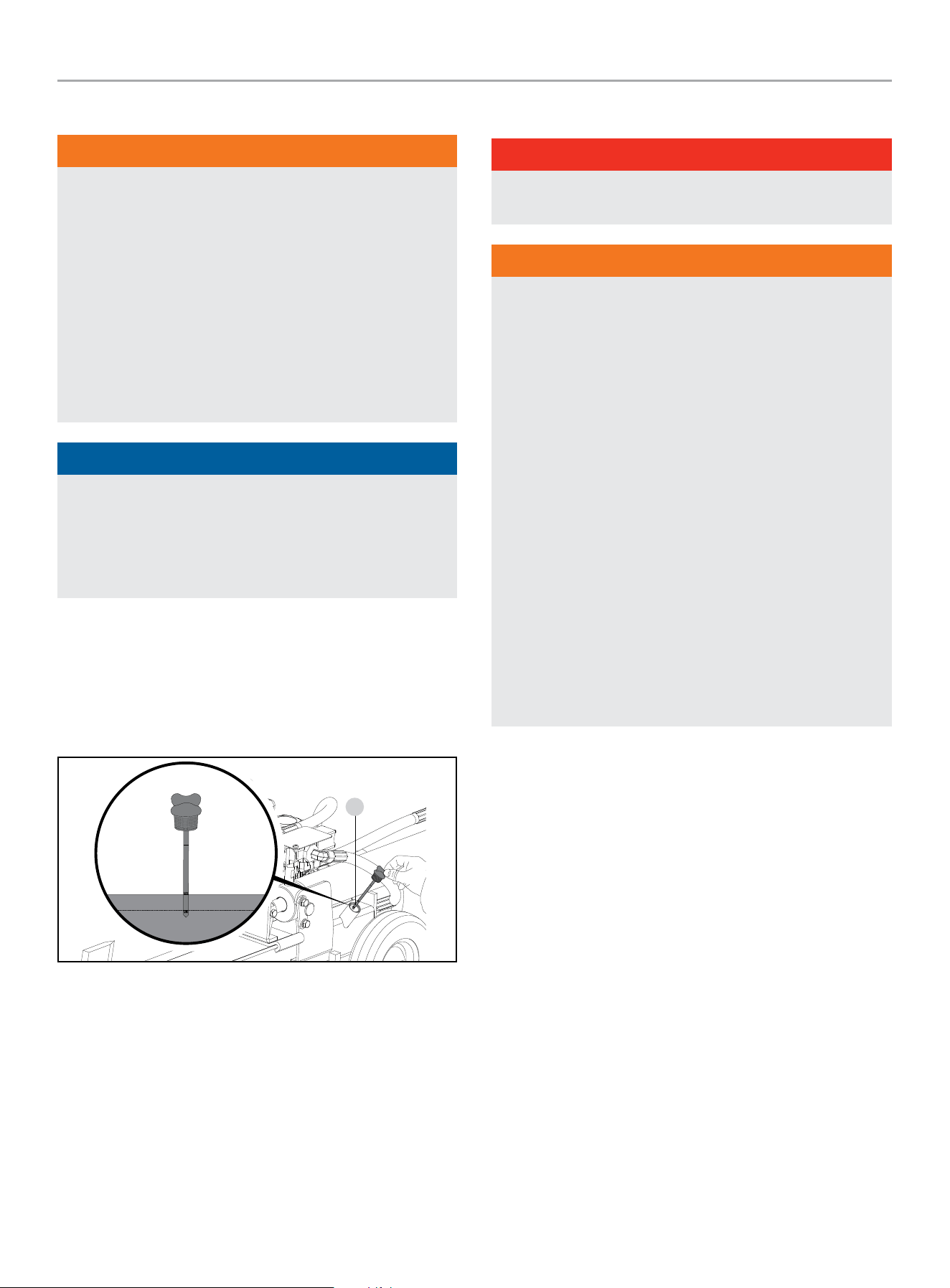
To check oil level, insert the dipstick into fill neck until it stops.
Remove and read level. Do not thread dipstick into fill neck
when checking oil.
When the outdoor temperature is below 32°F (0°C), Dexron III
transmission fluid can be used.
1. Make sure the log splitter is on a flat, level surface.
2. Remove the dipstick (A) from the oil tank.
3. Add 192.7 fl. oz (5.7 L) of hydraulic oil - SAE10W / ISO 32
4. Check the hydraulic oil level using dipstick. Oil level should be
between the two marks on the dipstick. (A)
MAX
MIN
A
5. Replace and tighten the dipstick.
6. Start engine (see Starting the Engine in the Operation
section).
7. Extend and retract the cylinder to purge air from the hydraulic
system. Cylinder motion should be smooth and continuous.
8. Shut-off engine (see Stopping the Engine in the Operation
section).
9. Check the hydraulic oil tank dipstick. Add additional hydraulic
oil if needed.
10. Check oil level daily and add as needed.
OPERATION
DANGER
Always operate log splitter outdoors and far away from
building, windows, doors and intake ventilation covers.
WARNING
ALWAYS use the log splitter for its intended use. The log
splitter should only be used to split wood logs, length wise
with the grain.
NEVER modify, alter or change the log splitter in anyway.
Modifications will void the warranty.
NEVER attach a rope, cable or other device to the control lever
on the log splitter.
DO NOT modify or change the engine and operating speeds or
pressure settings. These changes can cause safety issues.
ONLY operate the log splitter in daylight.
NEVER operate, or let anyone else operate, the log splitter
while under the influence of alcohol, drugs, or medication.
NEVER leave the log splitter unattended while the engine is
running.
DO NOT change the splitting position with the engine running.
Contact with the muffler can cause serious burns.
DO NOT let the beam drop as it could crush fingers or cause
damage to the log splitter.
Before Each Use Inspect the Log Splitter
1. Check the hydraulic oil level and visually inspect all hoses,
attachments and cylinder for loose fittings, leaks, cracks,
fraying or other damage.
2. DO NOT operate the log splitter if there is any indication of
damage.
3. Inspect the engine and make sure the oil level is correct
before operating. If the engine is equipped with a spark
arrestor, clean and inspect it regularly (follow spark arrestor
maintenance schedule).
22
201533 - 10 TON LOG SPLITTER
OPERATION
Log Splitter Location
WARNING
ALWAYS operate the log splitter outdoors.
NEVER place or operate the log splitter near windows, doors,
vents, air intakes or other openings where poisonous engine
exhaust fumes could be drawn into occupied building spaces.
Always maintain a minimum distance of 5 ft. (1.5 m) from dry
combustible vegetation to prevent fires when operating this log
splitter.
Always leave a minimum of 3 ft. (0.9 m) of clearance on all
sides of the log splitter to allow for safe operation, adequate
cooling, maintenance and servicing.
Always place the log splitter on a firm level surface to provide
for good operational footing.
DO NOT work on mud, ice, or in tall grass, brush or snow.
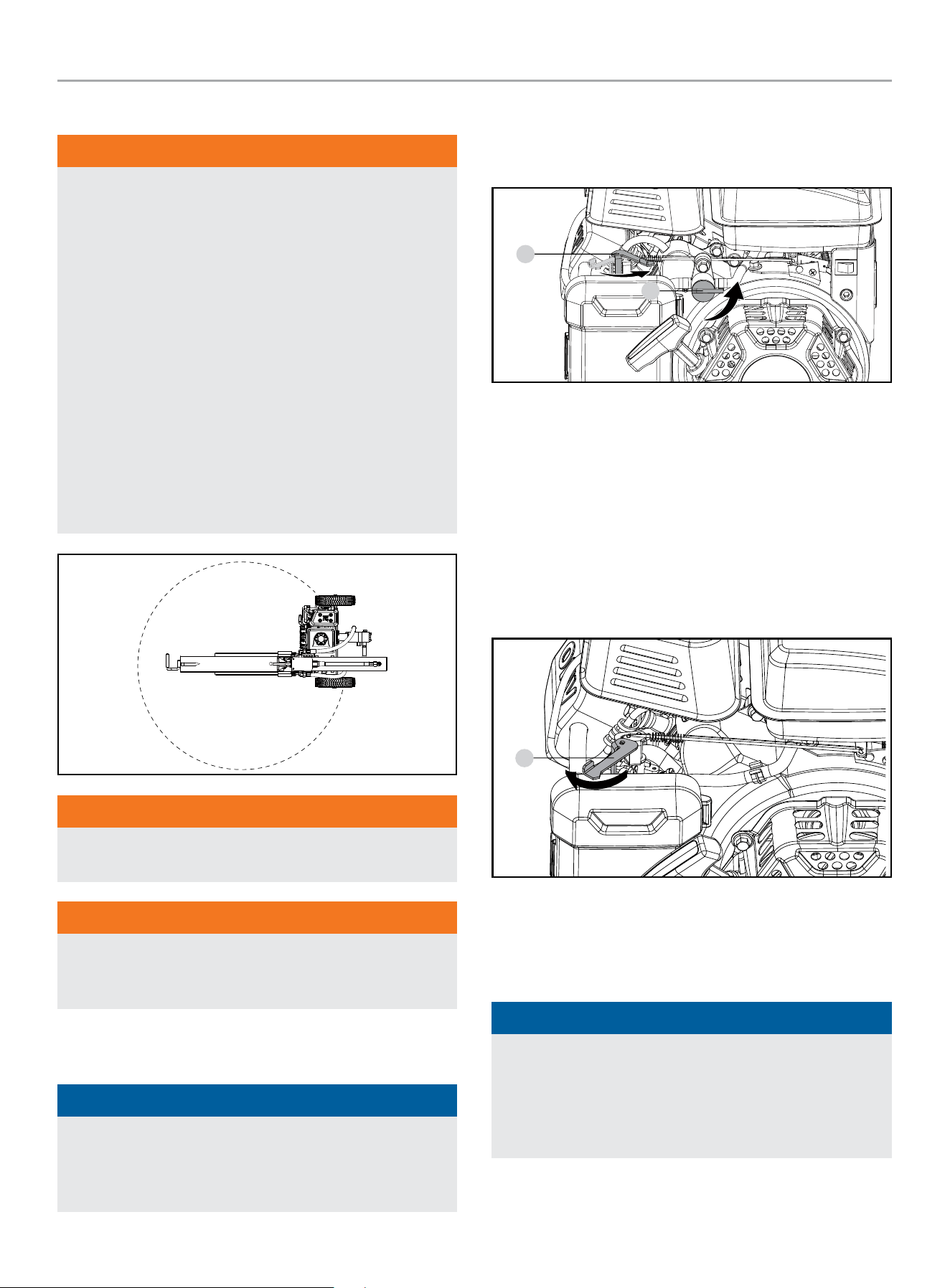
ALWAYS operate log splitter around work zone as shown
below.
W
o
r
k
Z
o
n
e
WARNING
Never place your hand on the ends of the log, between the log
and end plate or the log and the splitting wedge.
WARNING
Only one operator permitted. The adult who loads and
stabilizes the log, must be the person who operates the control
handle.
Starting the Engine
NOTICE
If the engine starts but does not run make certain that the log
splitter is on a flat, level surface. The engine is equipped with
a low oil sensor that will prevent the engine from running when
the oil level falls below a critical threshold.
1. Make certain the log splitter is on a flat, level surface.
2. Rotate the fuel valve (A) to the “ON” position.
3. Move the choke lever (B) to the “CHOKE” position.
B
A
4. Pull the starter cord slowly until resistance is felt and then
pull rapidly.
5. Keep choke lever in “CHOKE” position for 2 pulls of the recoil
starter. After second pull, move choke lever to the “RUN”
position for up to the next 3 pulls of the recoil starter. Too
much choke leads to spark plug fouling/engine flooding due
to the lack of incoming air. This will cause the engine not to
start.
6. As engine warms up, move the choke lever (B) to the “RUN”
position.
B
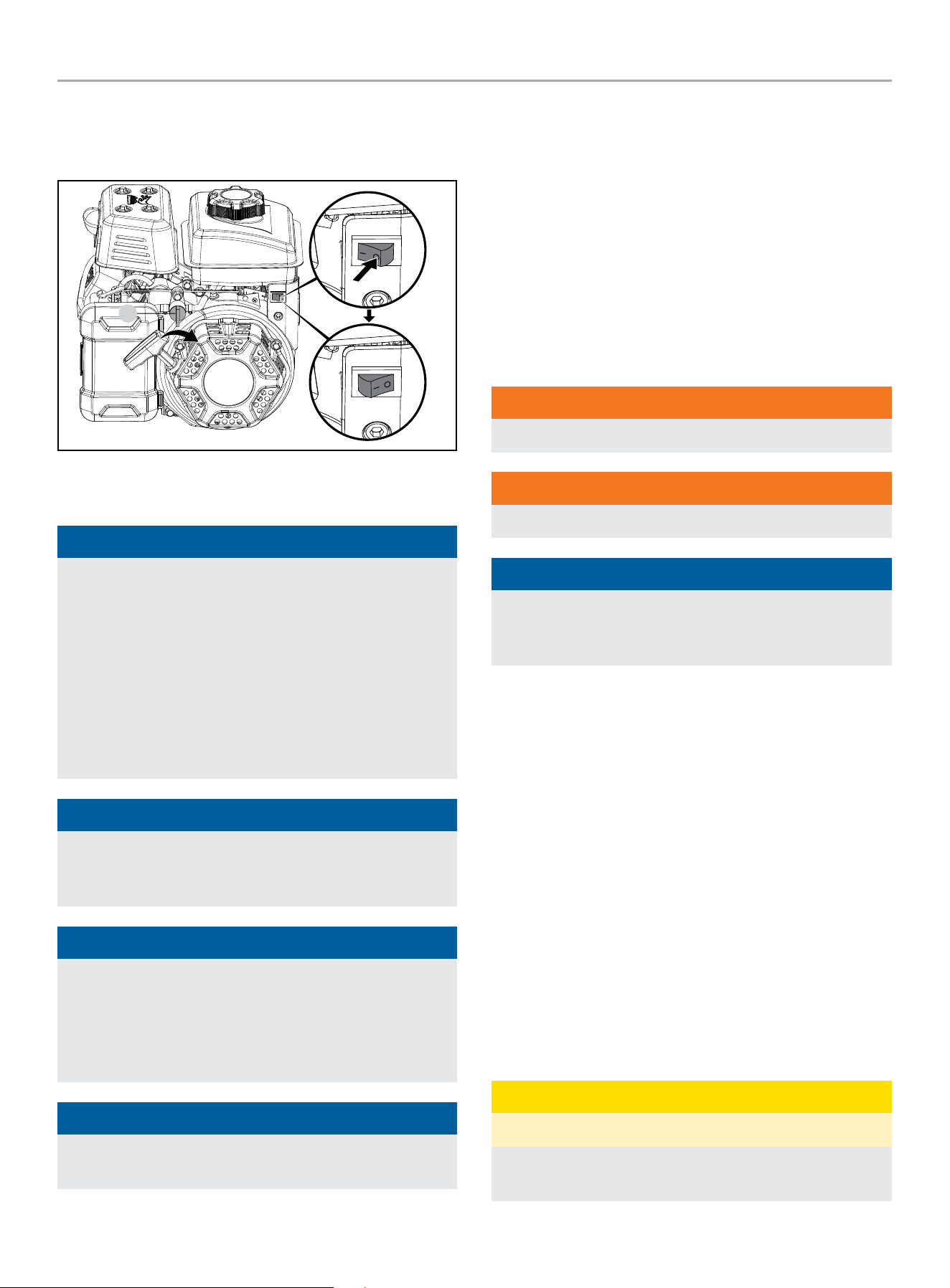
Stopping the Engine
In an emergency, turn the engine switch to the “OFF”
position.
NOTICE
Always ensure that the fuel valve and the engine switch are in
the “OFF” position when the engine is not in use.
If the engine will not be used for a period of two (2) weeks or
longer, please see the Storage section for proper engine and
fuel storage.
1. Turn the fuel valve (A) to the “OFF” position.
23
201533 - 10 TON LOG SPLITTER
MAINTENANCE
2. Let the engine run until fuel starvation has stopped the
engine. This usually takes a few minutes.
3. Turn the engine switch to the “OFF” position.
A
Log Splitter Operation
NOTICE
Back injury can result from lifting logs onto the log splitter if
proper lifting techniques are not used.
Always wear safety goggles or safety glasses with side
shields, and as necessary a full face-shield as well as full ear
protection when operating this product.
Always wear safety shoes or heavy boots when operating the
machine.
Always wear nonslip, heavy-duty protective gloves when
operating this product.
NOTICE
It is normal for the hydraulic fluid to appear foamy/frothy
during operation. This can be caused by agitated oil in the tank
collecting air.
NOTICE
If a log gets stuck, embedded or will not split completely, push
the control handle in the reverse direction and allow the log
splitter to strip the log from the wedge.
ALWAYS keep hands clear of the log and wedge while it is
retracting.
NOTICE
The cylinder stroke is designed so the wedge stops
approximately 1.5 in. (3.8 cm) from the end plate.
1. Block tires and ensure support leg is secure to prevent
unintended movement of the log splitter during operation.
2. Load a log onto the beam against the end plate.
3. Make sure all limbs are clear of crush zones.
4. Push the control valve handle forward (towards the endplate)
to split the log.
5. Push the auto control valve handle backward to return the
wedge to its original position.
6. Clear the split wood from the work zone.
MAINTENANCE
WARNING
Never operate a damaged or defective log splitter.
WARNING
Improper maintenance will void your warranty.
NOTICE
For Emission control devices and systems, read and
understand your responsibilities for service as stated in the
Emission Control Warranty Statement of this manual.
Make certain that the log splitter is kept clean and stored
properly. Only operate the unit on a flat, level surface in a clean,
dry operating environment. DO NOT expose the unit to extreme
conditions, excessive dust, dirt, moisture or corrosive vapors.
Inspect all air vents and cooling slots to ensure that they are clean
and unobstructed.
Clean spark arrester every 100 hours.
Check and tighten all bolts and nuts before operating the log
splitter.
The owner/operator is responsible for all periodic maintenance.
Complete all scheduled maintenance in a timely manner.
Correct any issue before operating the log splitter.
For service or parts assistance, contact our
Technical Support Team at 1-877-338-0999.
Cleaning the Log Splitter
CAUTION
DO NOT spray engine with water.
Water can contaminate the fuel system and can enter the
engine through the cooling slots and damage the engine.
24
201533 - 10 TON LOG SPLITTER
MAINTENANCE
Clear the debris from the beam, wedge and endplate.
Use a damp cloth to clean exterior surfaces of the engine and log
splitter.
Use a soft bristle brush to remove excess dirt and oil.
Use an air compressor (25 PSI) to clear dirt and small debris.
Wipe all metal parts with an oily rag to help prevent rust and
corrosion.
Changing the Engine Oil
NOTICE
Once oil has been added, a visual check should show oil
about 1-2 threads from running out of the fill hole. If using the
dipstick to check oil level, DO NOT screw in the dipstick while
checking.
Change oil when the engine is warm. Refer to the oil specification
to select the proper grade for your operating environment.
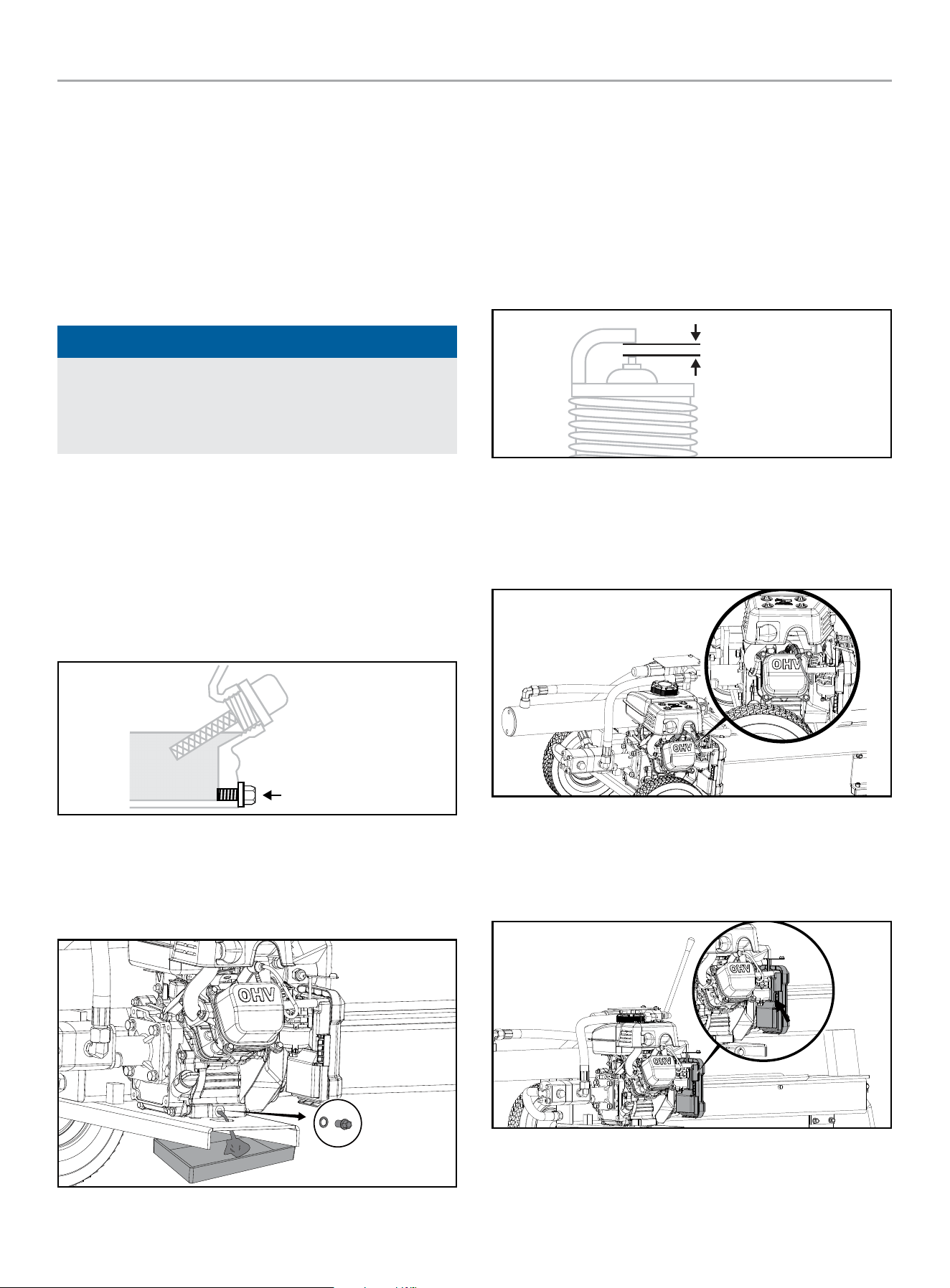
1. Remove the oil drain plug with a 10 mm socket
(not included) and extension.
2. Allow the oil to drain completely into an appropriate container.
3. Replace the oil drain plug.
4. Remove the oil fill cap/dipstick to add oil.
DRAIN BOLT
5. Using a funnel, add up to 11.8 fl. oz (350 ml) of oil (not
included) and replace oil fill cap/dipstick. DO NOT OVERFILL.
6. Dispose of used oil at an approved waste management
facility.
Cleaning and Adjusting the Spark Plug(s)
1. Remove the spark plug cable from the spark plug.
2. Use a spark plug socket tool (included), or a 5/8 in. (16 mm)
socket (not included) to remove the plug.
3. Inspect the electrode on the plug. It must be clean and not
worn to produce the spark required for ignition.
4. Make certain the spark plug gap is
0.024-0.031 in. (0.6-0.8 mm).
SPARK PLUG GAP
5. Refer to the spark plug types in Specifications when replacing
the plug.
6. Firmly re-install the plug.
7. Attach the spark plug cable to the spark plug.
Cleaning the Air Filter
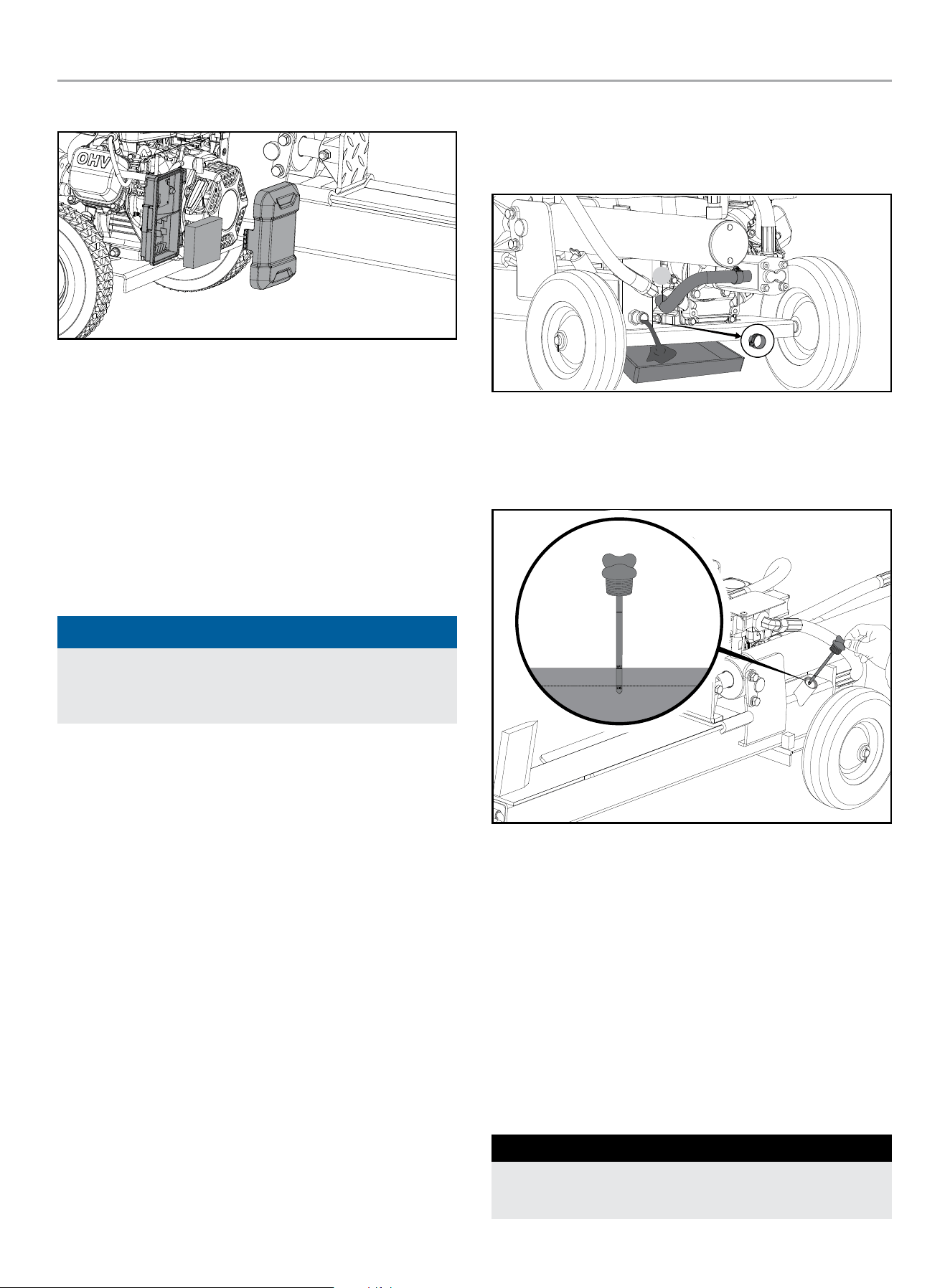
1. Remove the plastic cover by pressing the snap on the side of
the cover closest to the wheel, indicated by the arrow.
25
201533 - 10 TON LOG SPLITTER
MAINTENANCE
2. Remove the foam element.
3. Wash in liquid detergent and water. Squeeze thoroughly dry in
a clean cloth.
4. Saturate in clean engine oil.
5. Squeeze in a clean, absorbent cloth to remove all excess oil.
6. Place the filter in the assembly.
7. Reattach the filter cover by inserting the tabs on the side
closest to the fuel tank then pivot the other side into place.
Ensure that the filter cover snaps into place
Changing the Hydraulic Oil
NOTICE
When log splitters are not used for extended periods of time
and they are exposed to changing temperature conditions,
moisture through condensation can build up inside the tank.
Always shut off the engine, disconnect the spark plug.
1. Begin with the cylinder retracted.
2. Release any stored pressure by moving the valve lever
forward and backward several times.
3. Place a container under the hydraulic tank. Make sure
it is large enough to hold the contents of the tank.
See model specification section of this manual for hydraulic
oil capacities.
4. Disconnect the clear suction hose from the pump inlet. (A)
5. Drain oil into a collection pan or proper container.
6. Reattach the clear suction hose to the pump. (A) Securely
tighten the clamp of the clear hydraulic hose with either a flat
head screw driver or 6mm socket (tighten to 3.65 ± 1.5 lbf-ft
[4.95 ± 1.02 Nm]).
A
7. Remove dipstick and add up to 192.7 fl. oz. (5.7 L) of
hydraulic oil - SAE 10W / ISO 32. Check the hydraulic oil level
using dipstick. Oil level should be between the two marks on
the dipstick.
MAX
MIN
8. Start engine and purge air from hydraulic system. Extend and
retract the cylinder to purge air from the hydraulic system.
Cylinder motion should be smooth and continuous.
Maintenance Schedule
Follow the service intervals indicated in the following maintenance
schedule.
Service your log splitter more frequently when operating in
adverse conditions.
Contact our Technical Support Team at 1-877-338-0999 to locate
the nearest CPE certified service dealer for your log splitter or
engine maintenance needs.
EVERY 8 HOURS OR DAILY
Check engine and hydraulic oil levels
Clean around air intake and muffler

26
201533 - 10 TON LOG SPLITTER
STORAGE
FIRST 5 HOURS
Change engine oil
EVERY 50 HOURS OR EVERY SEASON
Clean air filter
Change engine oil and hydraulic oil if operating under
heavy load or in hot environments
EVERY 100 HOURS OR EVERY SEASON
Change oil
Clean/adjust spark plug
Check/adjust valve clearance*
Clean spark arrestor
Clean fuel tank and filter*
Change hydraulic oil
EVERY 250 HOURS
Clean combustion chamber*
EVERY YEAR
Inspect wheel bearings and repack bearing grease as
needed.
EVERY 3 YEARS
Replace fuel line*
* To be performed by knowledgeable, experienced owners or CPE certified service
centers.
STORAGE
Refer to the Maintenance section for proper cleaning instructions.
WARNING
Never store the log splitter indoors next to appliances where
there is a source of heat or open flame, spark or pilot light
because they can ignite gasoline vapors. Even with an empty
gas tank, gasoline vapors could ignite.
DO NOT store a log splitter near fertilizer or any corrosive
material.
Log Splitter Storage
1. The log splitter needs to be cool for at least 5 minutes before
storing.
2. Clean the log splitter before storage according to the
Maintenance section.
3. Retract the wedge to protect the rod from corrosion.
4. Wipe the beam and wedge with an oily rag to prevent rust
and corrosion.
Engine Stored for Less than 30 Days
1. Allow the engine to cool completely before storage.
2. Clean engine according to the Maintenance section.
3. To extend the fuel storage life add a properly formulated fuel
stabilizer to the tank.
Engines Stored for Over 30 Days
1. Add a properly formulated fuel stabilizer to the tank.
2. Run the engine for a few minutes so the treated fuel cycles
through the fuel system and carburetor.
3. The engine needs to cool completely before cleaning and
storage.
4. Clean the engine according to the Maintenance section.
5. Change the oil.
6. Remove the spark plug and pour about
1
⁄2 oz (14.8 mL) of oil
into the cylinder. Using the Recoil, crank the engine slowly to
distribute the oil and lubricate the cylinder.
7. Reattach the spark plug.

27
201533 - 10 TON LOG SPLITTER
SPECIFICATIONS
SPECIFICATIONS
Log Splitter Specifications
Ram Force
...............................................10 US Tons
Cycle Time .............................................. 20 seconds
Hydraulic Tank Capacity ........................ 128.5 fl. oz.(3.8 L)
Max Log Length ....................................19.3 in. (49 cm)
Max Log Weight .................................... 50 lb. (22.7 kg)
Tire Size ............................................10 in. (25.4 cm)
Cylinder Size ..................... 3 in. × 17.7 in. (7.5 cm × 45 cm)
Cylinder Rod Size ......................................1.2 in. (3 cm)
Gear Pump ................................................... 2-stage
Max Pressure .............................................. 3000 psi
Max Flow Capacity ...........................................3 GPM
Control Valve .................................. Detent (auto-return)
Net Weight .........................................143.3 lb. (65 kg)
Height ...............................................18.1 in. (46 cm)
Height - Includes control valve handle ..............24 in. (61 cm)
Width ...............................................23.6 in. (60 cm)
Length ............................................ 53.1 in. (135 cm)
Engine Specifications
Model
........................................................R80-VP
Displacement .................................................. 79 cc
Type ................................................... 4-Stroke OHV
Start Type ................................................... Manual
Engine Oil Specifications
DO NOT OVERFILL.
Type
............................................ See Engine oil chart
Capacity ........................................ 11.8 fl. oz (350 ml)
NOTICE
Temperature will affect engine oil and engine performance.
Change the type of engine oil used based on temperature
shown in Recommended Engine Oil Type table.
-20 0 20 40 60
Ambient temperature
Recommended Engine Oil Type
80 100 120
-28.9
°F
°C -17.8 -6.7 4.4 15.6 26.7 37.8 48.9
10W-30
5W-30 Full Synthetic
10W-405W-30
Hydraulic Oil Specifications
Type
......................................... See Hydraulic Oil chart
Total System Capacity ......................... 192.7 fl. oz. (5.7 L)
NOTICE
Temperature will affect hydraulic oil and log splitter
performance. Change the type of hydraulic oil used based on
temperature shown in Recommended Hydraulic Oil Type table.
-20 0 20 40 60
Ambient temperature
Recommended Hydraulic Oil Type
Recommended Hydraulic Oil Type
80 100 120
-28.9
°F
°C
-17.8 -6.7 4.4 15.6 26.7 37.8 48.9
ISO 32 / SAE 10W / SAE 32 / ISO 46
Automatic Transmission Fluid
32˚F / 0˚C
Fuel Specifications
Use regular unleaded gasoline with a minimum octane rating of 87
and an ethanol content of less than 10% by volume. DO NOT USE
E15 or E85. DO NOT OVERFILL.
Gasoline Capacity
..................................0.3 gal. (1.29 L)
Spark Plug Specifications
OEM Type
.....................................................A5RTC
Replacement Type ........................... CR5HSA or equivalent
Gap ................................. 0.024-0.031 in. (0.6-0.8 mm)
Valve Specifications
Intake Clearance
............... 0.002-0.0059 in. (0.05-0.15 mm)
Exhaust Clearance ............. 0.002-0.0059 in. (0.05-0.15 mm)
NOTICE
A technical bulletin regarding valve adjustment procedures is
available at www.championpowerequipment.com.
Important Message About Temperature
Your product is designed and rated for continuous operation at
ambient temperatures up to 104°F (40°C). When your product is
needed it may be operated at temperatures ranging from
5°F (-15°C) to 122°F (50°C) for short periods of time. If exposed
to temperatures outside this range during storage, it should be
brought back within this range before operation. In any event, the
product must always be operated outdoors, in a well-ventilated
area and away from doors, windows and vents.

28
201533 - 10 TON LOG SPLITTER
TROUBLESHOOTING
TROUBLESHOOTING
Problem Cause Solution
Engine will not start.
No fuel. Add fuel.
Faulty spark plug. Replace spark plug.
Unit loaded during start up. Remove load from unit.
Engine will not start;
Engine starts but runs roughly.
Low oil level.
Fill crankcase to the proper level.
Place log splitter on a flat, level surface.
Choke in the wrong position. Adjust choke.
Spark plug wire loose. Attach wire to spark plug.
Engine shuts down during operation.
Out of fuel. Fill fuel tank.
Low oil level.
Fill crankcase to the proper level. Place log
splitter on a flat, level surface.
Engine cannot supply enough power or
overheating.
Insufficient ventilation.
Check for air restriction. Move to a well
ventilated area.
Wedge movement is slow or erratic.
Air in the hydraulic oil system.
Purge air by extending and retracting the wedge
several times until motion is smooth.
Debris lodged in beam guides. Clear debris from beam.
Low hydraulic oil. Check oil level and add as needed.
Oil leak from cylinder.
Faulty cylinder rod seal. Contact Customer Service.
Scored or bent cylinder rod. Contact Customer Service.
Loose hydraulic fitting. Tighten hydraulic fitting.
Faulty combination washer seal on
cylinder hydraulic fitting.
Contact Customer Service.
Wedge will not extend or retract.
Faulty control valve. Contact Customer Service.
Faulty hydraulic pump. Contact Customer Service.
Low hydraulic oil. Check oil level and add as needed.
Excessive bouncing while towing. Under-inflated tires.
Inflate tires to proper pressure. Refer to tire
sidewall.
For further technical support:
Technical Support Team
Toll Free 1-877-338-0999
support@championpowerequipment.com

WARRANTY*
CHAMPION POWER EQUIPMENT
2 YEAR LIMITED WARRANTY
Warranty Qualifications
To register your product for warranty and FREE lifetime call center
technical support please visit:
https://www.championpowerequipment.com/register
To complete registration you will need to include a copy of the
purchase receipt as proof of original purchase. Proof of purchase
is required for warranty service. Please register within ten (10)
days from date of purchase.
Repair/Replacement Warranty
CPE warrants to the original purchaser that the mechanical and
electrical components will be free of defects in material and
workmanship for a period of two years (parts and labor) from
the original date of purchase and 180 days (parts and labor) for
commercial and industrial use. Transportation charges on product
submitted for repair or replacement under this warranty are the
sole responsibility of the purchaser. This warranty only applies to
the original purchaser and is not transferable.
Do Not Return The Unit To The Place Of
Purchase
Contact CPE’s Technical Service and CPE will troubleshoot any
issue via phone or e-mail. If the problem is not corrected by
this method, CPE will, at its option, authorize evaluation, repair
or replacement of the defective part or component at a CPE
Service Center. CPE will provide you with a case number for
warranty service. Please keep it for future reference. Repairs or
replacements without prior authorization, or at an unauthorized
repair facility, will not be covered by this warranty.
Warranty Exclusions
This warranty does not cover the following repairs and equipment:
Normal Wear
Products with mechanical and electrical components need
periodic parts and service to perform well. This warranty does not
cover repair when normal use has exhausted the life of a part or
the equipment.
Installation, Use and Maintenance
This warranty will not apply to parts and/or labor if the product is
deemed to have been misused, neglected, involved in an accident,
abused, loaded beyond the product’s limits, modified, installed
improperly or connected incorrectly to any electrical component.
Normal maintenance is not covered by this warranty and is not
required to be performed at a facility or by a person authorized by
CPE.
Other Exclusions
This warranty excludes:
– Cosmetic defects such as paint, decals, etc.
– Wear items such as filter elements, o-rings, etc.
– Accessory parts such as hoses, storage covers, etc.
– Failures due to acts of God and other force majeure events
beyond the manufacturer’s control.
– Problems caused by parts that are not original Champion
Power Equipment parts.
Limits of Implied Warranty and
Consequential Damage
Champion Power Equipment disclaims any obligation to cover
any loss of time, use of this product, freight, or any incidental
or consequential claim by anyone from using this product.
THIS WARRANTY AND THE ATTACHED U.S. EPA and/or CARB
EMISSION CONTROL SYSTEM WARRANTIES (WHEN APPLICABLE)
ARE IN LIEU OF ALL OTHER WARRANTIES, EXPRESS OR IMPLIED,
INCLUDING WARRANTIES OF MERCHANTABILITY OR FITNESS
FOR A PARTICULAR PURPOSE.
This warranty gives you certain legal rights which may change
from state to state or province to province. Your state or province
may also have other rights you may be entitled to that are not
listed within this warranty.
Contact Information
Address
Champion Power Equipment, Inc.
6370 S Pioneer Way, Unit 101
Las Vegas, NV 89113 USA
www.championpowerequipment.com
Customer Service
Toll Free: 1-877-338-0999
info@championpowerequipment.com
Fax no.: 1-562-236-9429
Technical Service
Toll Free: 1-877-338-0999
tech@championpowerequipment.com
EMERGENCY 24 HOUR SUPPORT: 1-562-204-1188
*Except as otherwise stipulated in any of the following enclosed Emission Control System Warranties (when applicable) for the Emission Control System: U.S. Environment Protection Agency
(EPA) and/or California Air Resources Board (CARB).

CHAMPION POWER EQUIPMENT, INC. (CPE)
AND THE UNITED STATES ENVIRONMENTAL PROTECTION AGENCY (U.S. EPA)
EMISSION CONTROL SYSTEM WARRANTY
Your Champion Power Equipment (CPE) engine complies with U.S. EPA emissions regulations.
YOUR WARRANTY RIGHTS AND OBLIGATIONS:
The US EPA and CPE are pleased to explain the Federal Emission Control Systems Warranty on your 2024 small off-road engine (SORE)
and engine powered equipment. New engines and equipment must be designed, built and equipped, at the time of sale, to meet U.S.
EPA regulations for small off-road engines (SORE). CPE warrants the emission control system on your small off-road engine (SORE)
and equipment for the period of time listed below, provided there has been no abuse, neglect, unapproved modification, or improper
maintenance of your equipment.
Your emission control system may include parts such as the carburetor, fuel-injection system, the ignition system, catalytic converter and
fuel lines. Also included may be hoses, belts, connectors and other emission related assemblies. Where a warrantable condition exits, CPE
will repair your small off-road engine (SORE) at no cost to you including diagnosis, parts and labor.
MANUFACTURER’S EMISSION CONTROL SYSTEM WARRANTY COVERAGE:
This emission control system is warranted for two years, subject to provisions set forth below. If, during the warranty period, an emission
related part on your engine is defective in materials or workmanship, the part will be repaired or replaced by CPE.
OWNER WARRANTY RESPONSIBILITIES:
As the small off-road engine (SORE) owner, you are responsible for the performance of the required maintenance listed in your Owner’s
Manual. CPE recommends that you retain all your receipts covering maintenance on your small off-road engine, but CPE cannot deny
warranty solely for the lack of receipts or for your failure to ensure the performance of all scheduled maintenance.
As the small off-road engine (SORE) owner, you should however be aware that CPE may deny you warranty coverage if your small, off-road
engine (SORE) or a part has failed due to abuse, neglect, improper maintenance or unapproved modifications.
You are responsible for presenting your small off-road engine (SORE) to an Authorized CPE service outlet or alternate service outlet as
described in (3)(f.) below, CPE dealer or CPE, Las Vegas, NV. as soon as a problem exists. The warranty repairs should be completed in a
reasonable amount of time, not to exceed 30 days.
If you have any questions regarding your warranty rights and responsibilities, you should contact:
Champion Power Equipment, Inc.
Customer Service
6370 S Pioneer Way, Unit 101
Las Vegas, NV 89113
1-877-338-0999
tech@championpowerequipment.com

EMISSION CONTROL SYSTEM WARRANTY
The following are specific provisions relative to your Emission Control System (ECS) Warranty Coverage.
1. APPLICABILITY: This warranty shall apply to 1997 and later model year small off-road engines (SORE). The ECS Warranty Period shall
begin on the date the new engine or equipment is delivered to its original, end-use purchaser, and shall continue for 24 consecutive
months thereafter.
2. GENERAL EMISSIONS WARRANTY COVERAGE
CPE warrants to the original, end-use purchaser of the new engine or equipment and to each subsequent purchaser that each of its
small off-road engines (SORE) is:
2a. Designed, built and equipped so as to conform to U.S. EPA emissions standards for spark-ignited engines at or below 19 kilowatts.
2b. Free from defects in materials and workmanship that cause the failure of a warranted part to be identical in all material respects
to the part as described in the engine manufacturer’s application for certification for a period of two years.
3. THE WARRANTY ON EMISSION-RELATED PARTS WILL BE INTERPRETED AS FOLLOWS:
3a. Any warranted part that is not scheduled for replacement as required maintenance in the Owners Manual shall be warranted for
the ECS Warranty Period. If any such part fails during the ECS Warranty Period, it shall be repaired or replaced by CPE according
to Subsection “d” below. Any such part repaired or replaced under the ECS Warranty shall be warranted for any remainder of the
ECS Warranty Period.
3b. Any warranted, emissions-related part which is scheduled only for regular inspection as specified in the Owners Manual shall be
warranted for the ECS Warranty Period. A statement in such written instructions to the effect of “repair or replace as necessary”,
shall not reduce the ECS Warranty Period. Any such part repaired or replaced under the ECS Warranty shall be warranted for the
remainder of the ECS Warranty Period.
3c. Any warranted, emissions-related part which is scheduled for replacement as required maintenance in the Owner’s Manual shall
be warranted for the period of time prior to the first scheduled replacement point for that part. If the part fails prior to the first
scheduled replacement, the part shall be repaired or replaced by CPE according to Subsection “d” below. Any such emissions-
related part repaired or replaced under the ECS Warranty, shall be warranted for the remainder of the ECS Warranty Period prior to
the first scheduled replacement point for such emissions-related part.
3d. Repair or replacement of any warranted, emissions-related part under this ECS Warranty shall be performed at no charge to the
owner at a CPE Authorized Service Outlet.
3e. The owner shall not be charged for diagnostic labor which leads to the determination that a part covered by the ECS Warranty is in
fact defective, provided that such diagnostic work is performed at a CPE Authorized Service Outlet.
3f. CPE shall pay for covered emissions warranty repairs at non-authorized service outlets under the following circumstances:
i. The service is required in a population center with a population over 100,000 according to U.S. Census 2000 without a CPE
Authorized Service Outlet AND
ii. The service is required more than 100 miles from a CPE Authorized Service Outlet. The 100 mile limitation does not apply in the
following states: Alaska, Arizona, Colorado, Hawaii, Idaho, Montana, Nebraska, Nevada, New Mexico, Oregon, Texas, Utah and
Wyoming.
3g. CPE shall be liable for damages to other original engine components or approved modifications proximately caused by a failure
under warranty of an emission-related part covered by the ECS Warranty.
3h. Throughout the ECS Warranty Period, CPE shall maintain a supply of warranted emission-related parts sufficient to meet the
expected demand for such emission-related parts.
3i. Any CPE Authorized and approved emission-related replacement part may be used in the performance of any ECS Warranty
maintenance or repair and will be provided without charge to the owner. Such use shall not reduce CPE’s warranty obligation.
3j. Unapproved add-on or modified parts may not be used to modify or repair a CPE engine. Such use voids this ECS Warranty and
shall be sufficient grounds for disallowing an ECS Warranty claim. CPE shall not be liable hereunder for failures of any warranted
parts of a CPE engine caused by the use of such an unapproved add-on or modified part.

EMISSION-RELATED PARTS INCLUDE THE FOLLOWING: (using those portions of the list
applicable to the engine)
Systems covered by this
warranty
Parts Description
Fuel Metering System Fuel regulator, Carburetor and internal parts
Air Induction System Air cleaner, Intake manifold
Ignition System Spark plug and parts, Magneto ignition system
Exhaust System Exhaust manifold, catalytic converter
Miscellaneous Parts Tubing, Fittings, Seals, Gaskets, and Clamps associated with these listed systems.
Evaporative Emissions Fuel Tank, Fuel Cap, Fuel Lines (for liquid fuel and fuel vapors), Fuel Line Fittings, Clamps, Pressure
Relief Valves, Control Valves, Control Solenoids, Electronic Controls, Vacuum Control Diaphragms,
Control Cables, Control Linkages, Purge Valves, Gaskets, Liquid/Vapor Separator, Carbon Canister,
Canister Mounting Brackets, Carburetor Purge Port Connector
TO OBTAIN WARRANTY SERVICE:
You must take your CPE engine or the product on which it is installed, along with your warranty registration card or other proof of original
purchase date, at your expense, to any Champion Power Equipment dealer who is authorized by Champion Power Equipment, Inc. to
sell and service that CPE product during his normal business hours. Alternate service locations defined in Section (3)(f.) above must be
approved by CPE prior to service. Claims for repair or adjustment found to be caused solely by defects in material or workmanship will not
be denied because the engine was not properly maintained and used.
If you have any questions regarding your warranty rights and responsibilities, or to obtain warranty service, please write or call
Customer Service at Champion Power Equipment, Inc.
Champion Power Equipment, Inc.
6370 S Pioneer Way, Unit 101
Las Vegas, NV 89113
1-877-338-0999
Attn.: Customer Service
tech@championpowerequipment.com
