USER'S
INFORMATION
MANUAL
WARNING: If the information in this manual is not
followed exactly, a re or explosion may result causing
property damage, personal injury or loss of life.
Do not store or use gasoline or other ammable
vapors and liquids in the vicinity of this or any
other appliance.
WHAT TO DO IF YOU SMELL GAS
• Do not try to light any appliance.
• Do not touch any electrical switch; do not use
any phone in your building.
• Immediately call your gas supplier from a
neighbor's phone. Follow the gas supplier's
instructions.
• If you cannot reach your gas supplier, call the
re department.
Installation and service must be performed by a
qualied installer, service agency or the gas
supplier.
Do not use this boiler if any part has been under water. Immediately call a qualied service technician to
inspect the boiler and to replace any part of the control system and any gas control which has been under
water.
Should overheating occur or the gas supply fail to shut o, do not turn o or disconnect the electrical supply to
the pump. Instead, shut o the gas supply at a location external to the appliance.
Manufactured by:
ECR International Inc.
2201 Dwyer Avenue, Utica, NY 13501
Tel. 800 325 5479
www.ecrinternational.com
PN 240013741 REV. A [12/01/2022]
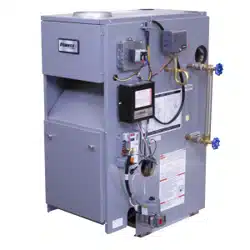
CAST IRON - GAS FIRED
RESIDENTIAL
STEAM BOILERS
2
Maintenance and Service must be completed by qualied
agency.
1- General
This boiler has few user serviceable parts. Maintenance
and Service must be completed by qualied agency.
Become familiar with symbols identifying Become familiar with symbols identifying
potential hazards.potential hazards.
NOTICE
Used to address practices not related to personal
injury.
CAUTION
Indicates a hazardous situation which, if not
avoided, could result in minor or moderate injury.
!!
WARNING
Indicates a hazardous situation which, if not
avoided, could result in death or serious injury.
!
DANGER
Indicates a hazardous situation which, if not
avoided, WILL result in death or serious injury
!
This is the safety alert symbol. Symbol alerts you to This is the safety alert symbol. Symbol alerts you to
potential personal injury hazards. Obey all safety messages potential personal injury hazards. Obey all safety messages
following this symbol to avoid possible injury or death.following this symbol to avoid possible injury or death.
WARNING
Fire, explosion, asphyxiation and electrical shock
hazard. Improper maintenance and service could
result in death or serious injury. Read this manual
and understand all requirements, including use of
qualied agency where directed.
!
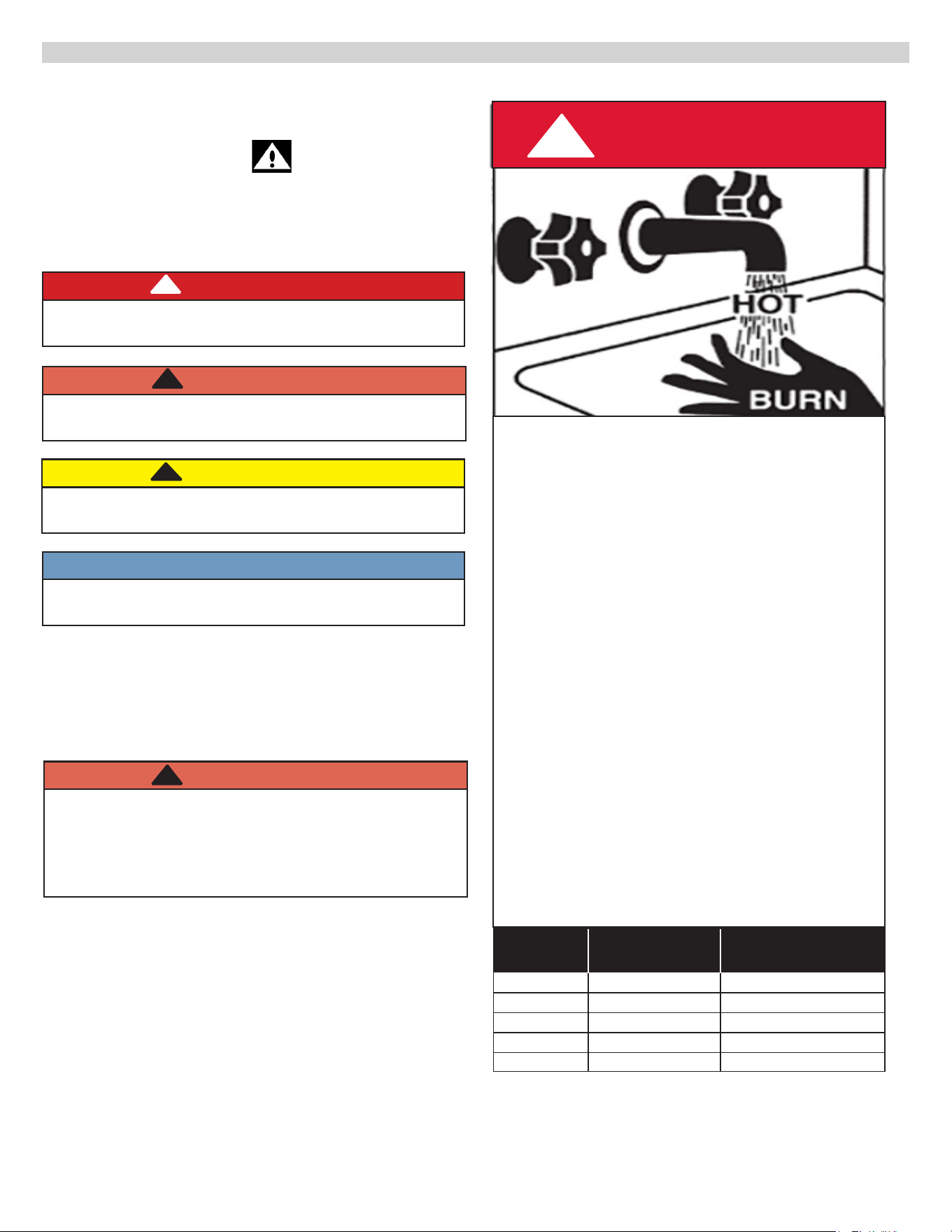
1- SAFETY INFORMATION
FOR YOUR SAFETY READ BEFORE OPERATING
Water
Temperature
Seng
1st Degree Burn
Exposure Time For
An Adult
2nd and 3rd Degree Burn
Exposure Time For An
Adult
120° F 1 minute 5 minutes
130° F 5 seconds 30 seconds
140° F 2 seconds 5 seconds
150° F 1 second 1.5 seconds
160° F Instantaneous 0.5 seconds
Note
:
Warning for Infants, Children, and Elderly:
Great c
are must be taken when exposing the
aforementioned groups to warm or hot water as they
can be badly burned in exposure times less than half of
the time for an adult.
Hot Water Can Scald!
Water heated to temperature for clothes
washing, dish washing and other sanitizing
needs can scald and cause permanent injury.
Children, elderly, and inrm or physically
handicapped persons are more likely to be
permanently injured by hot water. Never leave
them unattended in bathtub or shower. Never
allow small children to use a hot water tap or
draw their own bath.
If anyone using hot water in the building ts the
above description, or if state laws or local codes
require certain water temperatures at hot water
taps, you must take special precautions:
• Use lowest possible temperature setting.
• Install some type of tempering device, such
as an automatic mixing valve, at hot water
tap or water heater. Automatic mixing valve
must be selected and installed according
to manufacturer's recommendations and
instructions.
• Water passing out of drain valves may be
extremely hot. To avoid injury:
• Make sure all connections are tight.
• Direct water ow away from any person.
DANGER
!
KEEP THIS MANUAL NEAR BOILER
RETAIN FOR FUTURE REFERENCE
PN 240013741 REV. A [12/01/2022]
3
WARNING
Fire, explosion, and asphyxiation hazard. Before
lighting verify boiler contains water visible in gauge
glass. Failure to follow these instructions could result
in death or serious injury.
!
1- SAFETY INFORMATION
WARNING
Combustion chamber insulation in this product
contains ceramic ber material. Ceramic bers
can be converted to cristobalite in very high
temperature applications. The International Agency
for Research on Cancer (IARC) has concluded,
Crystalline silica inhaled in the form of quartz
or cristobalite from occupational sources is
carcinogenic to humans (Group1). Avoid breathing
dust and contact with skin and eyes. Use NIOSH
certied dust respirator (N95). This type of
respirator is based on the OSHA requirements
for cristobalite at the time this document was
written. Other types of respirators may be needed
depending on the job site conditions. Current
NIOSH recommendations can be found on the
NIOSH website https://www.cdc.gov/niosh/topics/
silica/. NIOSH approved respirators, manufacturers,
and phone numbers are also listed on this website.
Wear long-sleeved, loose tting clothing, gloves,
and eye protection. Apply enough water to the
combustion chamber lining to prevent dust. Wash
potentially contaminated clothes separately from
other clothing. Rinse clothes washer thoroughly.
NIOSH stated First Aid. Eye: Irrigate immediately.
Breathing: Fresh air.
!
WARNING
This prod
uct contains Fibrous glass. Fibrous
glass is a synthetic ber made from tiny particles
of glass. Fibrous glass has been classied as a
possible human carcinogen. When disturbed as a
result of servicing or repair, brous glass becomes
airborne and, if inhaled, may be hazardous to
your health. It can harm the eyes, skin, and the
lungs. Airborne bers from these materials have
been listed by the State of California as a possible
cause of cancer through inhalation. Adhere
to the following precautions and procedures.
Avoid breathing dust and contact with skin and
eyes. Use NIOSH certied dust respirator (e.g.,
N95). Other types of respirators may be needed
depending on the job site conditions. Current NIOSH
recommendations can be found on the NIOSH
website https://www.cdc.gov/niosh/. Approved
respirators, manufacturers, and phone numbers
are also listed on this website. Wear appropriate
personal protective clothing to prevent skin contact,
as well as gloves and eye protection. Wash skin
daily at end of each work shift, and prior to eating,
drinking, smoking, etc. Workers whose clothing
may have been contaminated should change into
uncontaminated clothing before leaving the work
premises. Wash potentially contaminated clothes
separately from other clothing. Rinse clothes washer
thoroughly. Follow all Local, State and Federal
guidelines for disposal.
NIOSH stated First Aid. Eye: Irrigate immediately.
Breathing: Fresh air.
!
WARNING
Fire, Explosion, Asphyxiation, Electrical shock
hazard! Flooding will result in damages such as
electrical problems, corrosion, inoperative parts,
mold and other unforeseen issues which can
occur over time. Any equipment determined by
a professional as damaged by a ood, dened
as excess of water or other liquid, shall be
replaced. Failure to follow these directions will
result in a Hazardous Situation.
!
CAUTION
Laceration, burn hazard. Metal edges and parts
may have sharp edges and/or may be hot. Use
appropriate personal protection equipment to
include safety glasses and gloves when installing
or servicing this boiler. Failure to follow these
instructions could result in minor or moderate injury.
!!
PN 240013741 REV. A [12/01/2022]
4
1.
What To Do Should Overheating Occur
Do not turn o or disconnect electrical supply to pumps.
Shut o gas supply at location external to appliance.
2.
What To Do If Boiler Or Any Part Has Been Under
Water
Do not use boiler if any part has been under water. Imme-
diately call a qualied service technician to inspect boiler
and to replace any part of control system and any gas con-
trol which has been under water.
3. This product burns gas to produce heat. The
appliance must be properly installed, operated, and
maintained to avoid exposure to appreciable levels
of carbon monoxide and the installer is required to
conrm that at least one carbon monoxide alarm
is installed in the living space before the appliance
is put into operation. It is important for the carbon
monoxide alarms to be installed, maintained,
and replaced following the alarm manufacturer's
instructions and applicable local codes.
1- SAFETY INFORMATION
CAUTION
WHAT TO DO IF YOU SMELL GAS
• Do not try to light any appliance.
• Do not touch any electrical switch; do not use
any phone in your building.
• Immediately call your gas supplier from a
neighbor’s phone. Follow the gas supplier’s
instructions.
• If you cannot reach your gas supplier, call the re
department.
!!
WARNING
If you do not follow these instructions
exactly, a re or explosion may result
causing property damage, personal injury
or loss of life.
• This appliance is equipped with an ignition device
which automatically lights burner. Do NOT try to
light this burner by hand.
• Before operating smell all around appliance area
for gas. Be sure to smell next to oor because
some gas is heavier than air and will settle to the
oor.
• Use only your hand to turn the gas shuto valve.
Never use tools. If valve will not turn by hand, do
not try to repair it, call a qualied service techni-
cian. Force or attempted repair may result in re
or explosion.
• Do not use this appliance if any part has been
under water. Immediately call a qualied service
technician to inspect appliance and to replace any
part of control system and any gas control which
has been under water.
• Do not operate boiler if hot water boiler and sys-
tem are not full of water to minimum pressure of
12 psi. Verify system is vented of air.
!
PN 240013741 REV. A [12/01/2022]
5
LIGHTING INSTRUCTIONS
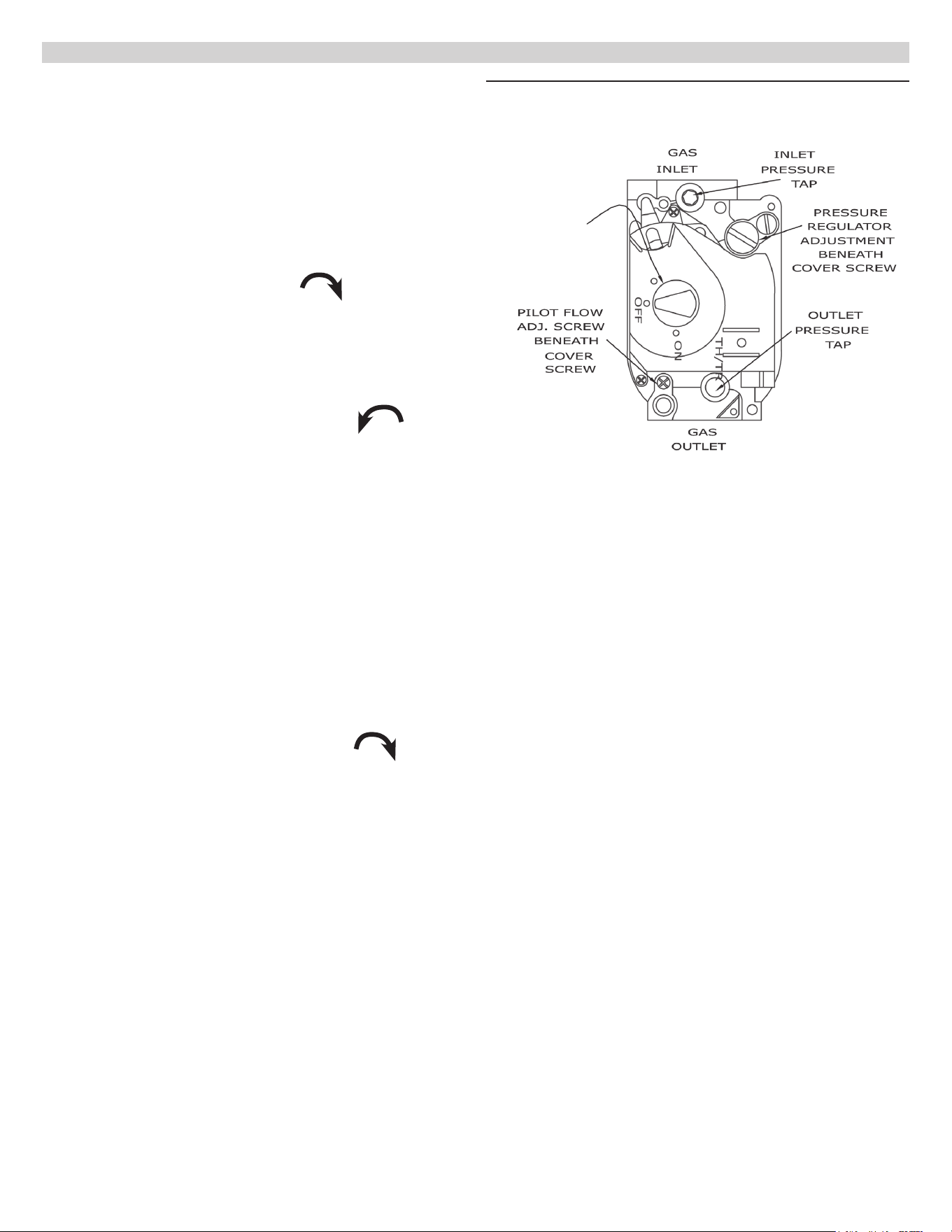
Figure 1- 1 - Gas Valve
2.1 Operating Instructions
Stop! Read Safety information above.
• Set thermostat to lowest setting.
• Turn "OFF" all electrical power to appliance.
• This appliance is equipped with an ignition device which
automatically lights the burner. Do not try to light
burner by hand!
• Lift and remove front door.
• Turn gas control knob clockwise to closed
position. See Figure 2-1
• Wait 5 minutes for any gas to clear. Smell for gas,
including near oor. If you smell gas, STOP! Follow
instructions on this page: “What To Do If You Smell
Gas.” If you do not smell gas, go to next step.
• Turn gas control knob counter clockwise to
open position.
• Turn "ON" electrical power to appliance.
• Set thermostat to desired setting.
• If the appliance will not operate, follow instructions TO
TURN OFF GAS TO APPLIANCE and call your service
technician or gas supplier.
2.2 To Turn O Gas To Appliance
• Set thermostat to lowest setting.
• Turn "OFF" all electric power to appliance if service is
to be performed.
• Remove access panel(s).
• Turn gas shuto control knob clockwise to
closed position.
• Replace access panel(s).
Gas Control Knob
(Shown in closed
position)
PN 240013741 REV. A [12/01/2022]
6
WARNING
Burn and scald hazard. Discharge of water, vapor
and steam may scald. Water and steam are under
pressure, open all valves slowly. Failure to follow
these instructions could result in death or serious
injury.
!
3 - GENERAL INSTRUCTIONS
3.1 Safety Features
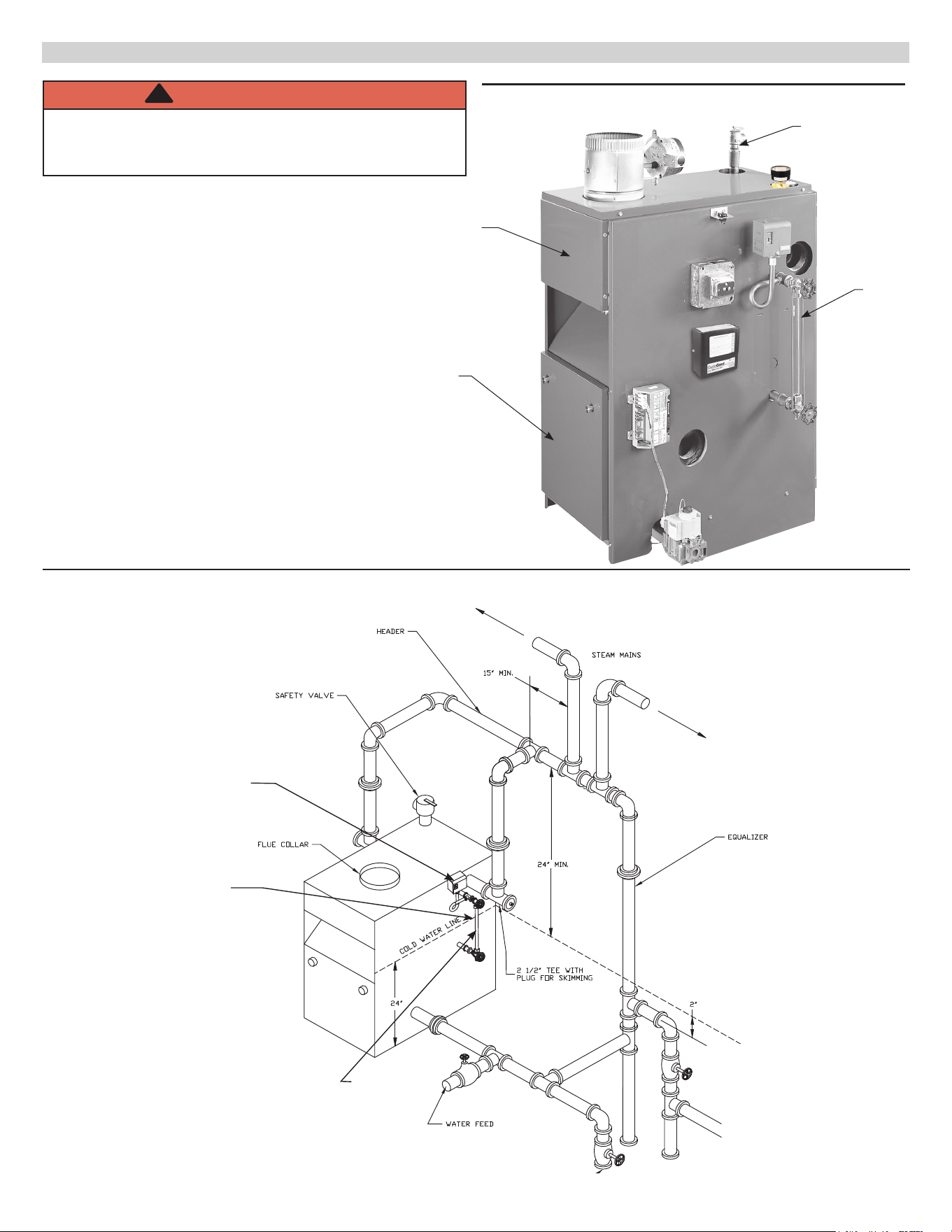
• In event the ow of combustion products through boiler
venting system becomes blocked, the blocked vent
safety switch will shut main burner gas o. See Figure
2. If this condition occurs, do not attempt to place
boiler in operation. Contact a qualied service
agency.
• If boiler ue-ways become blocked, ame rollout safety
switch will shut main burner gas o. See Figure 2. If
this condition occurs, do not attempt to place the
boiler in operation. Contact a qualied service
agency.
3.2 Continuous
• Keep boiler area free from combustible materials,
gasoline and other ammable vapors and liquids.
• Keep combustion air and vent terminations (outside
building) free from trash, vegetation and other items
capable of blocking ow.
• Insure water is present in the sight glass at all times.
The water level may rise and fall as the boiler cycles on
and o, this is normal. However, water must always
be visible in the sight glass (See gures 2 and 3).
WARNING
Burn and scald hazard. Verify Safety Relief Valve
discharge piping run to safe discharge location
before conducting maintenance procedure. Contact
qualied agency to correct improper piping.
!
3.6 Check According to Manufacturer’s
Instructions
Safety Relief Valve - Refer to manufacturer’s instructions.
3.7 End of Heating Season, if boiler is not used
for domestic hot water
• Follow instructions to TURN OFF GAS TO APPLIANCE.
See section 2.2.
• Contact qualied agency to drain heating system (if
system does not use antifreeze) if heating system is
exposed to freezing temperatures while out of service.
WARNING
Fire and Asphyxiation hazard. Do not attempt to
place boiler in operation if safety switches shut the
main burner gas o. Contact a qualied service
agency. Failure to follow these instructions could
result in death or serious injury.
!
3.3 Beginning of Each Heating Season
• Contact qualied service agency to perform maintenance
and cleaning per Installation, Operation and
Maintenance manual.
• Inspection will include examining all ue product
carrying areas, vent system, burner and pilot ames.
• Will also include lling boiler with water if drained as
part of End of Heating Season procedure.
3.4 Weekly Maintenance
• Boilers are equipped with safety valve (steam).
Refer to manufacture's instructions for operation and
maintenance.
• If valve leaks steam when boiler is operating at normal
pressure it must be replaced. Contact qualied service
agent to replace or repair.
3.5 Monthly
• Inspect combustion air, vent piping for deterioration,
leaks or sagging. Contact qualied agency, as neces-
sary.
• Inspect system piping for leaks. Contact qualied
agency, as necessary.
• Check air vent(s) for leakage.
• Follow OPERATING INSTRUCTIONS to return to normal
operation.
NOTICE
Boilers installed in residences commonly have an
automatic, not manual, low water cuto (unless
required by codes). Conrm with the installer the
type of low water cuto your boiler is equipped
with.
PN 240013741 REV. A [12/01/2022]
7
WARNING
Burn and scald hazard. Discharge of water, vapor
and steam may scald. Failure to follow these
instructions could result in death or serious injury.
!
GENERAL INSTRUCTIONS
Figure 3 - Steam Boiler – Optimum Water Level With Boiler OFF and COLD
Figure 2 - Boiler Flue Gas Passageways
Burner
Door
Sight
Glass
Safety
Relief
Valve
(Rollout switch
inside burner
door)
Blocked Vent
Safety Switch
(Inside upper
panel)
Sight Glass
Pressure Limit Control
Water Level
PN 240013741 REV. A [12/01/2022]
Name:
Address:
Phone: Email:
Installer Information
All specications subject to change without notice.
©2022 ECR International, Inc.
2201 Dwyer Avenue, Utica, NY 13501
Tel. 800 325 5479
www.ecrinternational.com