2001
© HONDA MOTOR CO., LTD. 2000
31ZW8600
00X31-ZW8-6000
KINKOS 100.2002.08
PRINTED IN U.S.A
EM3
BF8D/9.9D
BFP8D/9.9D
Owner’s
Manual
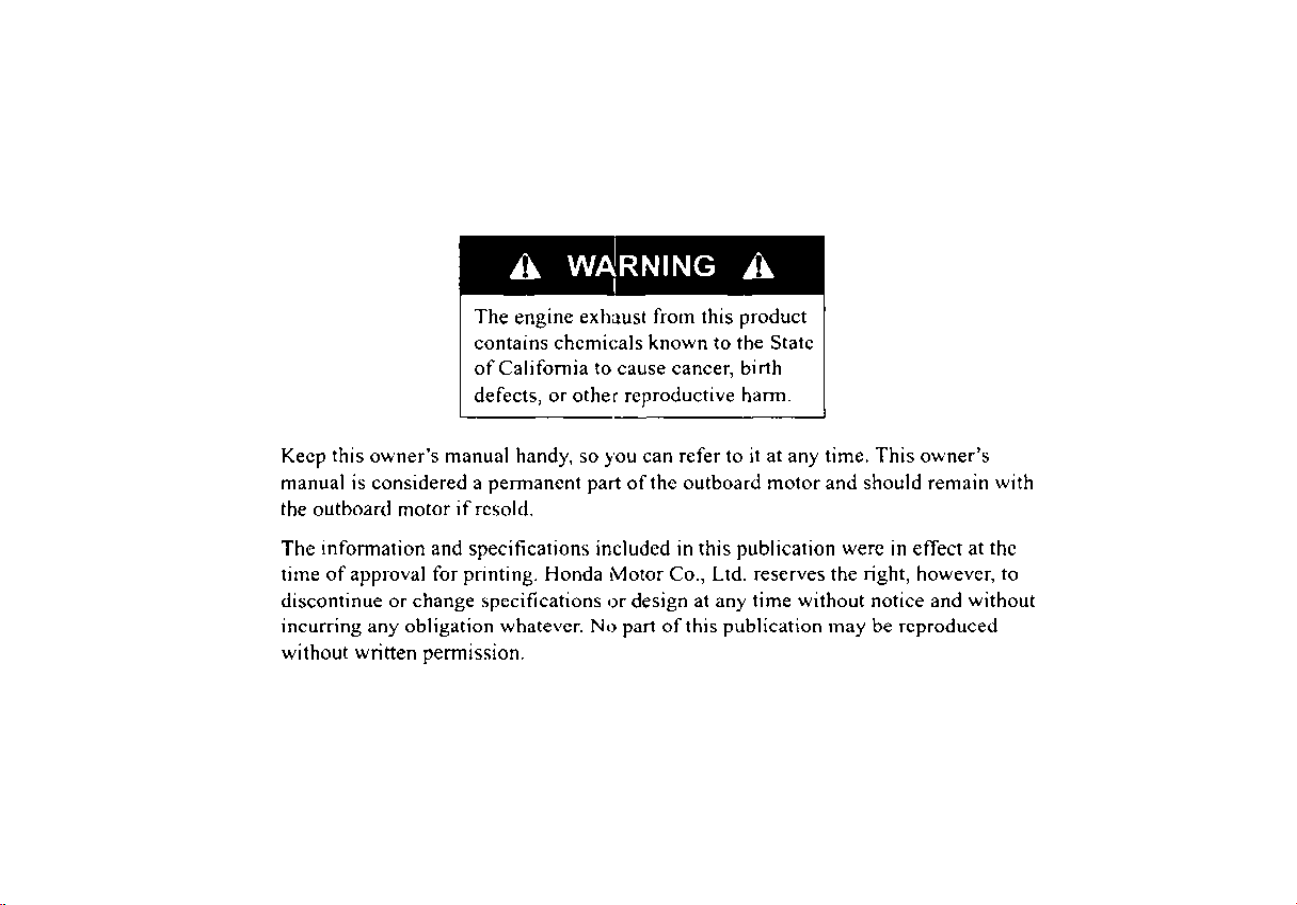
The engine exhaust from this product
contains chemicals known to the State
of California to cause cancer, birth
reproductive harm.
Keep this owner’s manual handy, so you can refer to it at any time. This owner’s
manual is considered a permanent part of the outboard motor and should remain with
the outboard motor if resold.
The information and specifications included in this publication were in effect at the
time of approval for printing, Honda Motor Co., Ltd. reserves the right, however, to
discontinue or change specifications or design at any time without notice and without
incurring any obligation whatever. No part of this publication may be reproduced
without written permission.
INTRODUCTION
Congratulations on your selection of a
Honda outboard motor. We are certain
you will be pleased with your purchase of
one of the finest outboard motors on the
market.
We want to help you get the best results
from your new outboard motor and to
operate it safely. This manual contains the
information on how to do that; please read
it carefully.
As you read this manual you will find
information preceded by a
IN~TICEI
symbol. That information is intended to
help you avoid damage to your outboard
motor, other property, or the environment.
We suggest you read the warranty policy
to fully understand its coverage and your
responsibilities of ownership. The
warranty policy is a separate document
that should have been given to you by
your dealer.
When your outboard motor needs
scheduled maintenance, keep in mind that
your Honda marine dealer is specially
trained in servicing Honda outboard
motors. Your Honda marine dealer is
dedicated to your satisfaction and will be
pleased to answer your questions and
concerns.
0 2000 Honda Motor Co., Ltd.
All Rights Reserved
INTRODUCTION
A FEW WORDS ABOUT SAFETY
Your safety and the safety of others are very
important. And using this outboard motor
safely is an important responsibility.
To help you make informed decisions about
safety, we have provided operating procedures
and other information on labels and in this
manual. This information alerts you to
potential hazard that could hurt you or others.
Of course, it is not practical or possible to warn
you about all the hazards associated with
operating or maintaining an outboard motor.
You must use your own good judgment.
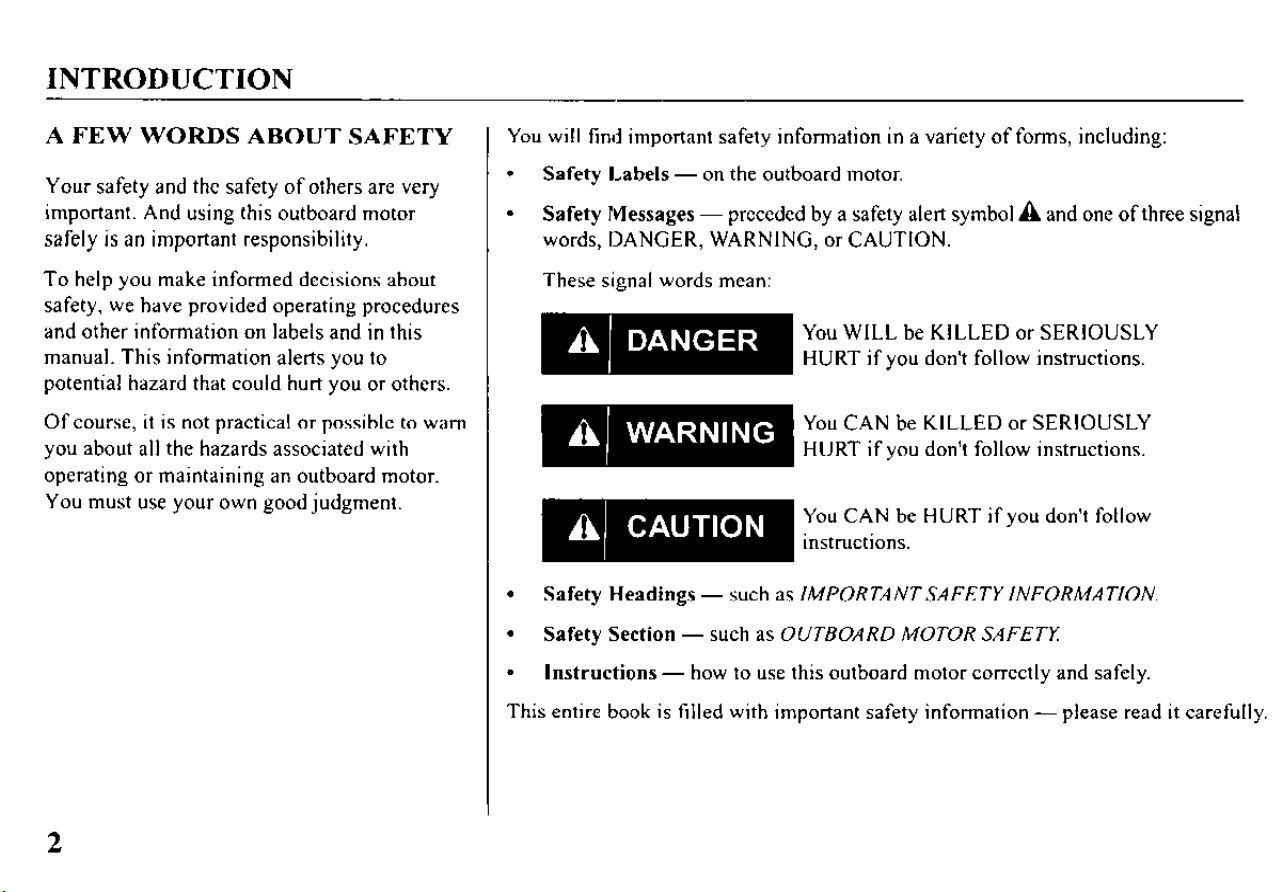
You will find important safety information in a variety of forms, including:
Safety Labels - on the outboard motor.
Safety Messages - preceded by a safety alert symbol a and one of three signal
words, DANGER, WARNING, or CAUTION.
These signal words mean:
Safety Headings - such as IMPORTANTSAFETY INFORMATION.
Safety Section - such as OUTBOARD MOTOR SAFETY
Instructions - how to use this outboard motor correctly and safely.
This entire book is filled with important safety information - please read it carefully.
2
CONTENTS
OUTBOARDMOTORSAFETY------------------- 7
IMPORTANT SAFETY INFORMATION- - - - - - - - - - - 7
SAFETY LABELLOCATIONS ----------------- 9
CONTROLSANDFEATURES -------------------lo
CONTROLS AND FEATURE
IDENTlFlCATlONCODES --------------------IO
COMPONENT AND CONTROL LOCATIONS - - - - - - I1
CONTROLS _ _ _ _ _ _ _ _ _ _ _ _ _ _ _ _ _ _ _ _ _ _ _ _ _ _ _ _ _ _ _ 14
H Type (tiller handle)
Engine Stop Switch and Switch Clip - - - - - - - - - - - - - - - 14
Choke Knob (H type manual choke) - - - - - - - - - - - - - - - 14
Throttle Grip _ _ _ _ _ _ _ _ _ _ _ _ _ _ _ _ _ _ _ _ _ _ _ _ _ _ _ _ _ _ _ 15
Throttle Friction Dial _ _ _ _ _ _ _ _ _ _ _ _ _ _ _ _ _ _ _ _ _ _ _ _ _ 15
Gearshift Lever _ _ _ _ _ _ _ _ _ _ _ _ _ _ _ _ _ _ _ _ _ _ _ _ _ _ _ _ _ 15
Recoil Starter Grip _ _ _ _ _ _ _ _ _ _ _ _ _ _ _ _ _ _ _ _ _ _ _ _ _ _ _ 16
Electric Starter Button (models equipped with
electric starter)- _ _ _ _ _ _ _ _ _ _ _ _ _ _ _ _ _ _ _ _ _ _ _ _ _ _ _ _ _ 16
R Type (remote control)
Ignition
Switch _ _ _ _ _ _ _ _ _ _ _ _ _ _ _ _ _ _ _ _ _ _ _ _ _ _ _ _ _ 16
Switch Clip and Emergency Stop Switch - - - - - - - - - - - 17
Fast Idle Lever _ _ _ _ _ _ _ _ _ _ _ _ _ _ _ _ _ _ _ _ _ _ _ _ _ _ _ _ _ 18
Gearshift/Throttle Control Lever - - - - - - - - - - - - - - - - - 18
Common Controls
Engine
Cover Latch- _ _ _ _ _ _ _ _ _ _ _ _ _ _ _ _ _ _ _ _ _ _ _ _ _ 20
Transom Angle Adjusting Rod - - - - - - - - - - - - - - - - - - 20
Steering
Friction Lever _ _ _ _ _ _ _ _ _ _ _ _ - _ _ - _ _ _ _ _ - _ 21
Tilt Lever- _ _ _ _ _ _ _ _ _ _ _ _ _ _ _ _ _ _ _ _ _ _ _ _ _ _ _ _ _ _ _ _
21
INSTRUMENTS _ _ _ _ _ _ _ _ _ _ _ _ _ _ _ _ _ _ _ _ _ _ _ _ _ _ _ _ _ 2 1
Fuel Gauge- _ _ _ _ _ _ _ _ _ _ _ _ _ _ _ _ _ _ _ _ _ _ _ _ _ _ _ _ _ _ _
21
INDICATORS- _ _ _ _ _ _ _ _ _ _ _ _ _ _ _ _ _ _ _ _ _ _ _ _ _ _ _ _ _ _ 22
Oil Pressure Indicator (R type) (H type) - - - - - - - - - - - - 22
Overheat Indicator (R type)- - - - - - - - - - - - - - - - - - - - - 22
Cooling System indicator - - - - - - - - - - - - - - - - - - - - - 23
OTHER FEATURES _ _ _ _ _ _ _ _ _ _ _ _ _ _ _ _ _ _ _ _ _ _ _ _ _ _ 23
3
CONTENTS
Ovcrrcv Limiter - - - - - - - - - - _ _ _ _ _ _ _ _ _ _ _ _ _ _ _ _ _ _
23
Automatic Choke (equipped type only)- - - - - - - - - - - - - 23
Anodes _ _ _ _ _ _ _ _ _ _ _ _ _ _ _ _ _ _ _ _ _ _ _ _ _ _ _ _ _ _ _ _ _ _ 23
portable Fuel Tank _ _ _ _ _ _ _ _ _ _ _ _ _ _ _ _ _ _ _ _ _ _ _ _ _ _
24
Fuel Cap Vent Knob _ _ _ _ _ _ _ _ _ _ _ _ _ _ _ _ _ _ _ _ _ _ _ _ _ 24
Fuel Priming Bulb- _ _ _ _ _ _ _ _ _ _ _ _ _ _ _ _ _ _ _ _ _ _ _ _ _ _ 24
INSTALLATION- _ _ _ _ _ _ _ _ _ _ _ _ _ _ _ _ _ _ _ _ _ _ _ _ _ _ _ _ 2 j
POWERREQUIREMENTS-------------------- 25
BOAR TRANSOM REQUIREMENTS - - - - - - - - - - - - 25
lNSTALLATlONPOSITION------------------- 26
ATJ-ACHMENT- ___ __ ___ _ ____ _____ _ _ _ _____ _ 26
TRANSOM ANGLE ADJUSTMENT - - - - - - - - - - - - - 27
BATTERYCONNECTlONS------------------- 27
BEFORE OpERAT[ON __ _ _ _ __ _ _ ___ _ _ _ ___ _ _ ___ _ 30
ARE YOU READY TO GET UNDER WAY? - - - - - - - 30
IS YOUR OUTBOARD MOTOR READY TO GO? - - - 30
OPERATION _ _ _ _ _ _ _ _ _ _ _ _ _ _ _ _ _ _ _ _ _ _ _ _ _ _ _ _ _ _ _ 32
4
SAFE OPERATING PRECAUTIONS - - - - - - - - - - - - - - 32
BREAK-IN PROCEDURE _ _ _ _ _ _ _ _ _ _ _ _ _ _ _ _ _ _ _ _ _ _ 32
TRANSOMANGLEADJUSTMENT---------------33
PORTABLE FUEL TANK _ _ _ _ _ _ _ _ _ _ _ _ _ _ _ _ _ _ _ _ _ _ 34
FUELHOSECONNECTIONS ------------------- 34
FUELPRIMING-----------------------------
STARTING THE ENGINE _ _ _ _ _ _ _ _ _ _ _ _ _ _ _ _ _ _ _ _ _ _ 35
f-j Type (tiller handle) _ _ _ - - _ _ _ _ _ _ _ _ _ _ _ _ _ _ _ _ _ _ _ 35
RType(remotecontrol)----------------------- 38
EMERGENCY STARTING _ _ _ _ _ _ _ _ _ _ _ _ _ _ _ _ _ _ _ _ _ 40
STOPPING THE ENGINE _ _ _ __ _ _ _ __ ___ ___ _ _ ___ _ 42
Emergency EngineStopping-------------------- 42
Normal Engine Stopping _ _ _ _ _ _ _ _ _ _ _ _ _ _ _ _ _ _ _ _ _ _ 43
GEARSHIFTING AND THROTTLE OPERATION - - - - - 44
H Type (tiller handle) - - - - - _ _ _ _ _ _ _ _ _ _ _ _ _ _ _ _ _ - _ 44
RType(remotecontrol)----------------------- 45
STEERING- _ _ _ _ _ _ _ _ _ _ _ _ _ _ _ _ _ _ _ _ _ _ _ _ _ _ _ _ _ _ _ _ 46
CONTENTS
H Type (tiller handle) _ _ _ _ _ _ _ _ _ _ _ _ _ _ _ _ _ _ _ _ _ _ _ -46
R Type (remote control) - - - - - - - - - - - - - - - - - - - - - -46
CRUISING _ _ _ _ _ _ _ _ _ _ _ _ _ _ _ _ _ _ _ _ _ _ _ _ _ _ _ _ _ _ _ -47
SHALLOW WATER OPERATION - - - - - - - - - - - - - - -48
MOORING, BEACHING, LAUNCHMG - - - - - - - - - - -49
SERVICING YOUR HONDA OUTBOARD MOTOR - - - - 50
THE IMPORTANCE OF MAINTENANCE - - - - - - - - - 50
MAINTENANCESAFETY --------------------51
TOOL KIT AND EMERGENCY STARTER ROPE - - - - 52
MAINTENANCESCHEDULE------------------
ENGINE COVER REMOVAL AND INSTALLATION - - - 55
Engine
Oil Level Check _ _ _ _ _ _ _ _ _ _ _ _ _ _ - _ _ _ _ - _ - -55
Engine Oil Change _ _ _ _ _ _ _ _ _ _ _ _ _ _ _ _ _ _ _ _ _ _ _ _ _ _ -56
Oil filter Change
_ _ _ _ _ _ _ _ _ - _ _ _ _ _ _ _ _ _ _ - _ - _ - _ _ _ 57
EngineOilRecommendations -------------------58
Gear Oil Level Check _ _ _ _ _ _ _ _ _ _ _ _ _ _ _ _ _ _ _ _ _ _ _ _ _ 58
Gear Oil
Change
_ _ _ _ _ _ _ _ _ _ _ _ _ _ _ _ _ _ _ _ _ _ _ _ _ _ _ _ 59
Lubrication points
_ _ _ _ _ _ _ _ _ _ _ _ _ _ _ _ _ _ _ _ _ _ _ _ _ _ _ 6 1
Spark Plug Service _ _ - _ _ _ _ _ _ _ _ _ _ _ _ _ _ _ _ _ _ _ _ _ _ _ -62
REFUELING _ _ _ _ _ _ _ _ _ _ _ _ _ _ _ _ _ _ _ _ _ _ _ _ _ _ _ _ _ -64
FUELRECOMMENDATIONS------------------
Fuel Pump Filter Inspection and Replacement - - - - - - - - 65
Portable Fuel Tank and Filter Cleaning - - - - - - - - - - - - - 67
Recoil Starter Rope Inspection - - - - - - - - - - - - - - - - - - - 68
Anode Replacement _ - _ _ _ _ _ _ _ _ _ _ _ _ _ _ _ _ _ _ _ _ _ _ _ -68
Propeller Replacement
_ _ _ _ _ _ _ _ _ _ _ _ _ _ _ _ _ _ _ _ _ _ _ -69
STORAGE- _ _ _ _ _ _ _ _ _ _ _ _ _ _ _ _ _ _ _ _ _ _ _ _ _ _ _ _ _ _ _ _ -70
ST(-JR,4(-jE PREpAuTlON _ _ _ _ _ _ _ _ _ _ _ _ _ _ _ _ _ _ _ -70
Fuel-------------------------------------72
Engine Oil
_ _ _ _ _ _ _ _ _ _ _ _ _ - _ - _ _ - _ _ - _ _ - _ _ _ _ _ _ -73
STORAGEPRECAUTIONS--------------------
REMOVALFROMSTORAGE------------------74
TRANSpORTR\IG _ _ _ _ _ _ _ _ _ _ _ _ _ _ _ _ _ _ _ _ _ _ _ _ _ _ _ -75
WITH OUTBOARD MOTOR INSTALLED ON BOAT - - - 75
5
CONTENTS
WITH OUTBOARD MOTOR REMOVED FROM BOAT-75
TAKING CARE OF UNEXPECTED PROBLEMS - - - - - -76
BATTERY WILL NOT CHARGE AND
ELECTRICAL STARTER WILL NOT OPERATE - - - - 8 I
OIL PRESSURE INDICATOR LIGHT GOES OFF AND
ENGINESPEEDISLIMITED ------------------82
OVERHEATING INDICATOR LIGHT COMES ON AND
ENGINE SPEED IS LIMITED (remote control type) - - - 83
SUBMERGED MOTOR _ _ _ _ _ _ _ _ _ _ _ _ _ _ _ _ _ _ _ _ _ -84
TECHNICAL AND CONSUMER INFORMATION - - - - -86
TECHNICALINFORMATION------------------
Serial Number locations _ _ _ _ _ _ _ _ _ _ _ _ _ _ _ _ _ _ _ _ _ _ 86
Carburetor Modification for High Altitude Operation- - -87
Oxygenated
Fuels- _ _ _ _ _ _ _ _ _ _ _ _ _ _ _ _ _ _ _ _ _ _ _ _ _ -88
Emission Control System Information - - - - - - - - - - - - - 89
STARLABEL-----------------------------
Specifications _ _ _ _ _ _ _ _ _ _ _ _ _ _ _ _ _ _ _ _ _ _ _ _ _ _ _ _ -93
CONSUMERINFORMATION------------------
WIRING DIAGRAMS _ _ _ _ _ _ _ _ _ _ _ _ _ _ _ _ _ _ _ _ _ _ _ _ -96
INDEX------------------------------------99
6
OUTBOARD MOTOR SAFETY
IMPORTANT SAFETY
INFORMATION
Honda BF8D/BFP8D/BF9.9D and
BFP9.9D outboard motors are designed
for use with boats that have a suitable
manufacturer’s power recommendation.
Other uses can result in injury to the
operator or damage to the outboard motor
and other property.
Most accidents can be prevented if you
follow all instructions in this manual and
on the outboard motor. The most common
hazards are discussed below, along with
the best way to protect yourself and
others.
Operator Responsibility
It is the operator’s responsibility to
provide the necessary safeguards to
protect people and property. Know
how to stop the engine quickly in
case of emergency. Understand the
use of all controls.
Stop the engine immediately if
anyone falls overboard, and do not
run the engine while the boat is near
anyone in the water.
Always stop the engine if you must
leave the controls for any reason.
Attach the emergency stop switch
lanyard securely to the operator.
Always wear a PFD (Personal
Flotation Device) while on the boat.
Familiarize yourself with all laws
and regulations relating to boating
and the use of outboard motors.
Be sure that anyone who operates the
outboard motor receives proper
instruction.
Be sure the outboard motor is
properly mounted on the boat.
Do not remove the engine cover
while the engine is running.
7
OUTBOARD MOTOR SAFETY
Refuel With Care
Gasoline is extremely flammable,
and gasoline vapor can explode.
Refuel outdoors, in a well-ventilated
area, with the engine stopped. Never
smoke near gasoline, and keep other
flames and sparks away.
Remove any portable fuel tank from
the boat for refueling. Keep the
portable fuel tank away from the
battery or other potential spark
sources.
Refuel carefully to avoid spilling
fuel. Avoid overfilling the fuel tank.
After refueling, tighten the tiller cap
securely. If any fuel is spilled, make
sure the area is dry before starting the
engine.
Carbon Monoxide Hazard
Exhaust gas contains poisonous carbon
monoxide. Avoid inhalation of exhaust
gas. Never run the engine in a closed
garage or confined area.
8
OUTBOARD MOTOR SAFETY
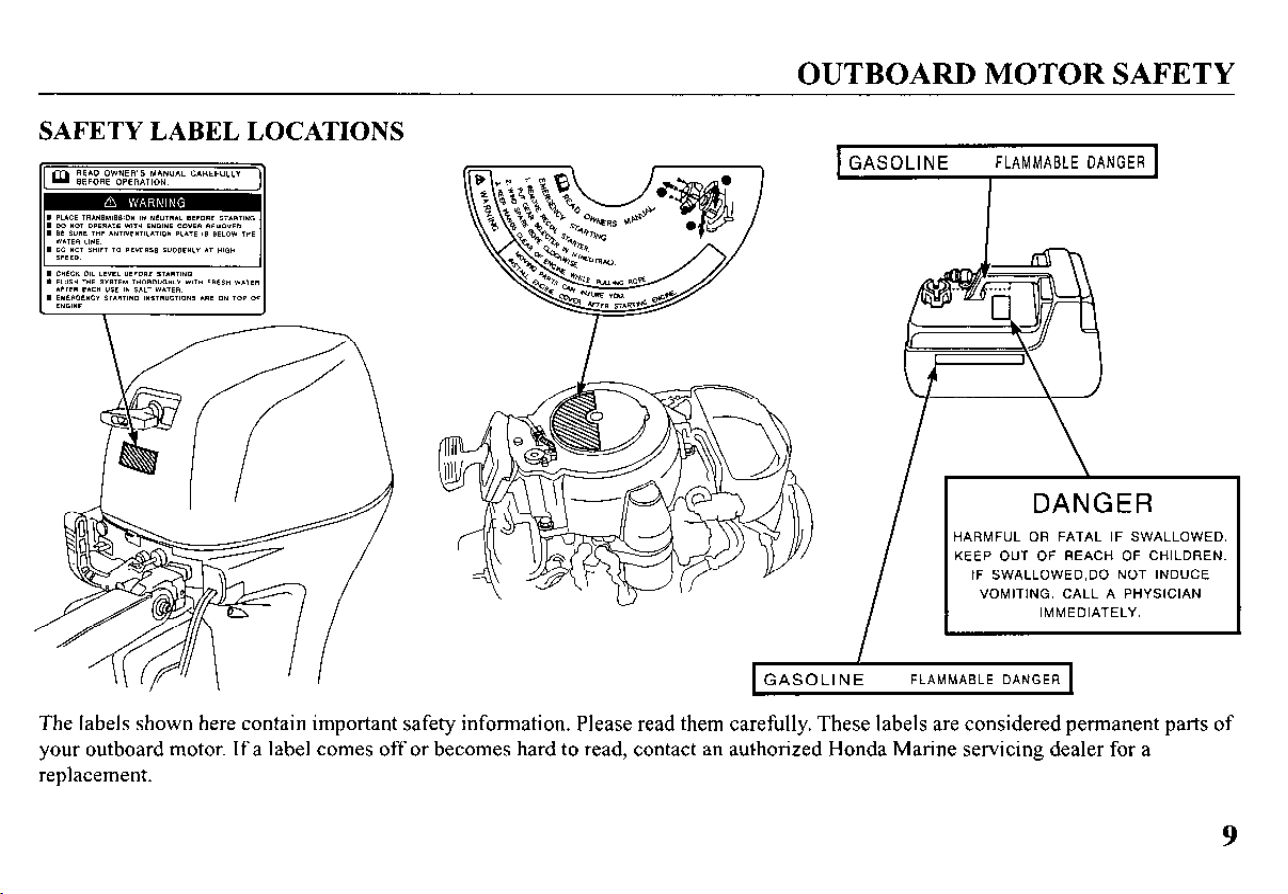
DANGER
HARMFUL OR FATAL IF SWALLOWED.
KEEP OUT OF REACH OF CHILDREN.
IF SWALLOWED.DO NOT INDUCE
VOMITING. CALL A PHYSICIAN
IMMEDIATELY.
GASOLINE
FLAMMABLE DANGER
The labels shown here contain important safety information. Please read them carefully. These labels are considered permanent parts of
your outboard motor. If a label comes off or becomes hard to read, contact an authorized Honda Marine servicing dealer for a
replacement.
9
CONTROLS AND FEATURES
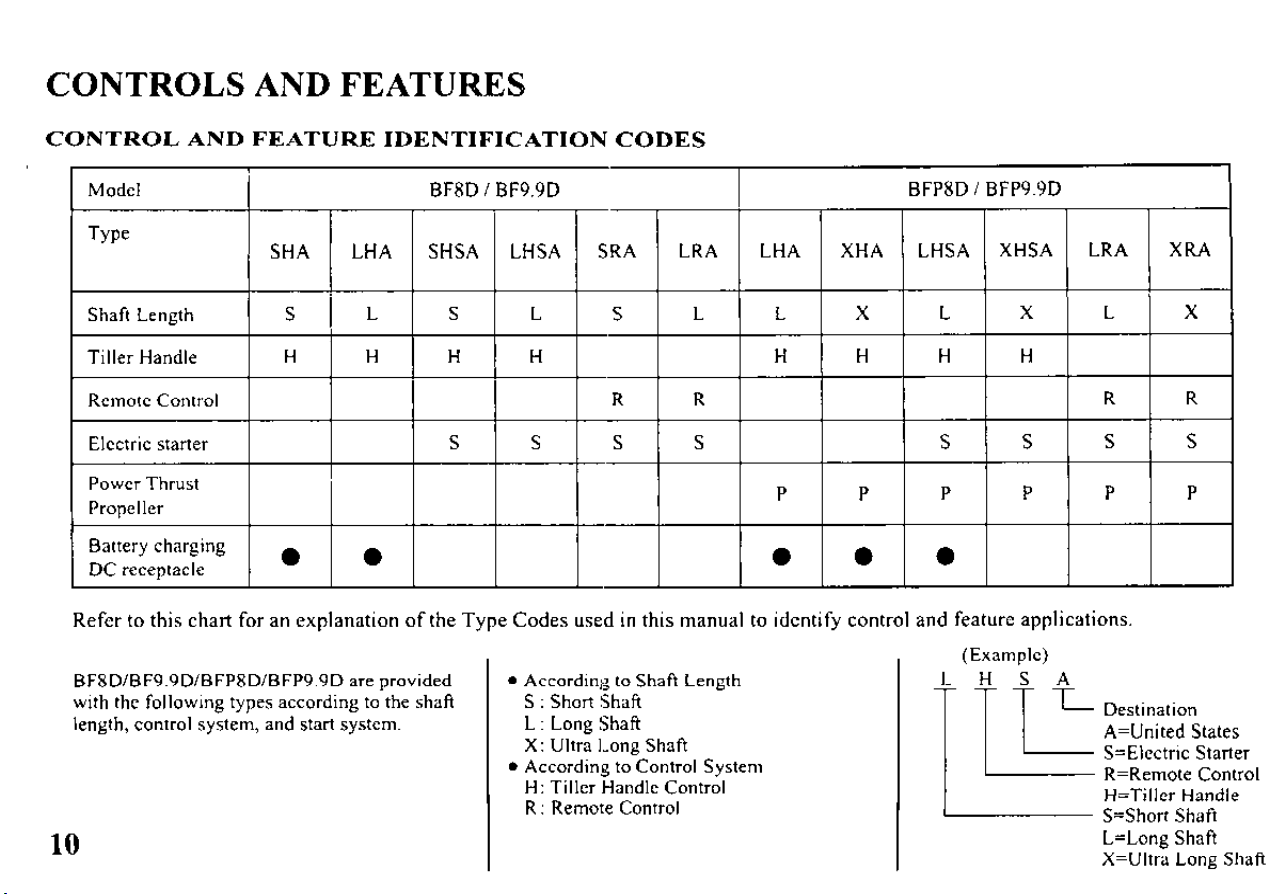
CONTROL AND FEATURE IDENTIFICATION CODES
Model
BF8D / BF9.9D
BFP8D I BFP9.9D
Type
SHA LHA
SHSA LHSA SRA LRA
LHA XHA
LHSA XHSA LRA XFb4
Shaft Length
SIL s L s L L x L x L x
Tiller Handle
H H H H
H
H H H
Remote Control
R
R
R R
Electric starter
S S
S S
S S S
S
Power Thrust
P P P P
Propeller
P P
Battery charging
DC receptacle
0 0
0 0 0
Refer to this chart for an explanation of the Type Codes used in this manual to identify control and feature applications.
BF8D/BF9.9D/BFP8D/BFP9.9D are provided
with the following types according to the shaft
length, control system, and start system.
10
l
According to Shaft Length
S : Short Shaft
L : Long Shaft
X: Ultra Long Shaft
l
According to Control System
H: Tiller Handle Control
R: Remote Control
(Example)
L H S A
-7-T-t-T
A=United States
S=Electric Starter
R=Remote Control
H=Tiller Handle
S=Short Shaft
L=Long Shaft
X=Ultra Long Shaft
CONTROLS AND FEATURES
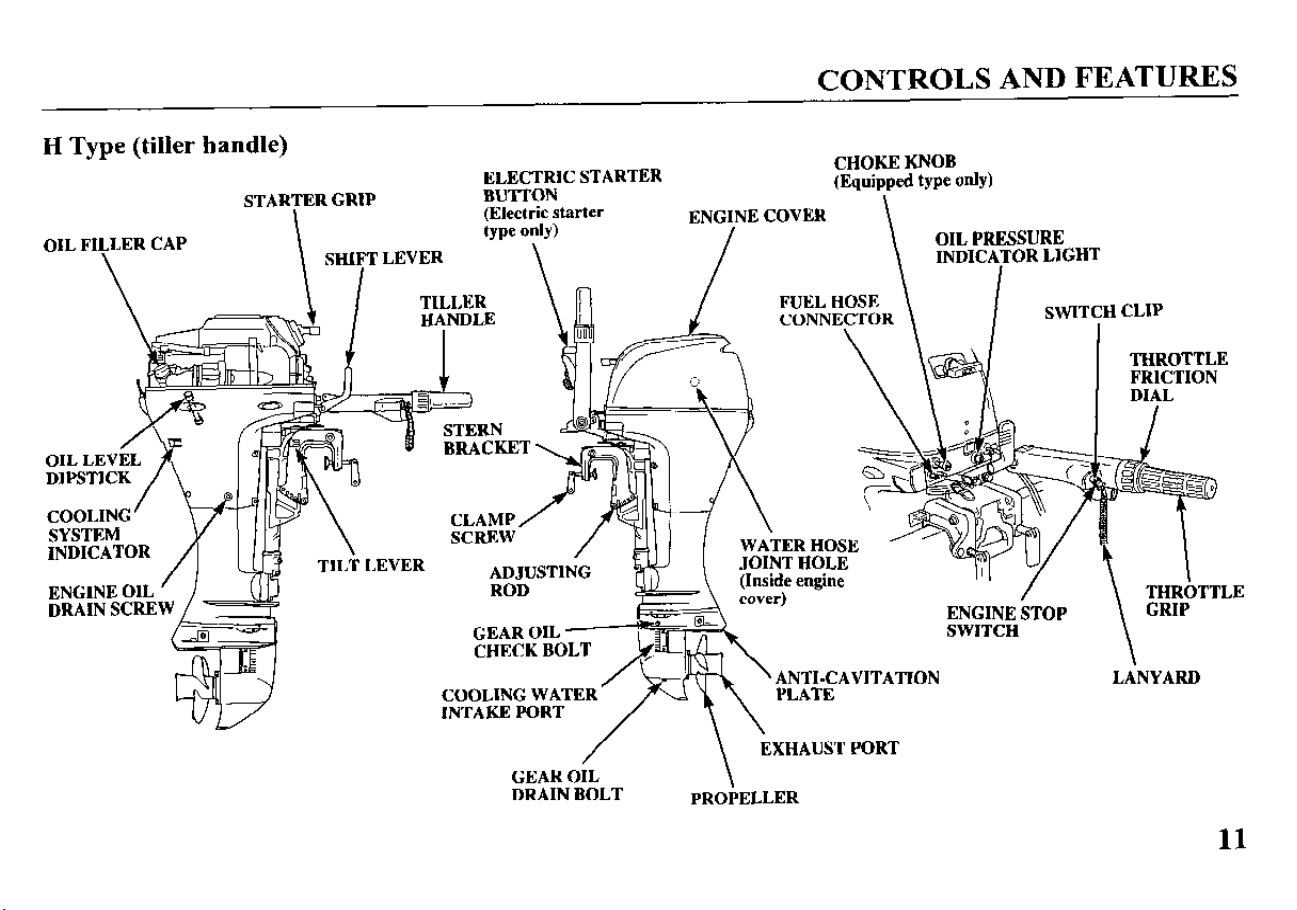
H Type (tiller handle)
C.-r &DTrn’D PDlD
;kE$;IC STARTER
CHOKE KNOB
(Equipped type only)
\
J
FUEL HOSE
CONNECTOR \ I
SWITCH CLIP
COOLING’
SYSTEM
INDICATOR
ENGINE OIL
DRAIN SCRE
\
TILT LEVER
SCREW
WATER HOSE
ADJUSTING
JOINT HOLE
ROD
GEAR 0
CHECK
COOLING WATER
INTAKE PORT
ANTI-CAVITATION
PLATE
/ \ EXHAUSTPORT
ENGINE STOP
SWITCH
!Y
\
THROT
GRIP
LANYARD
‘TLE
GEAR OIL
DRAIN BOLT
\
PROPELLER
11
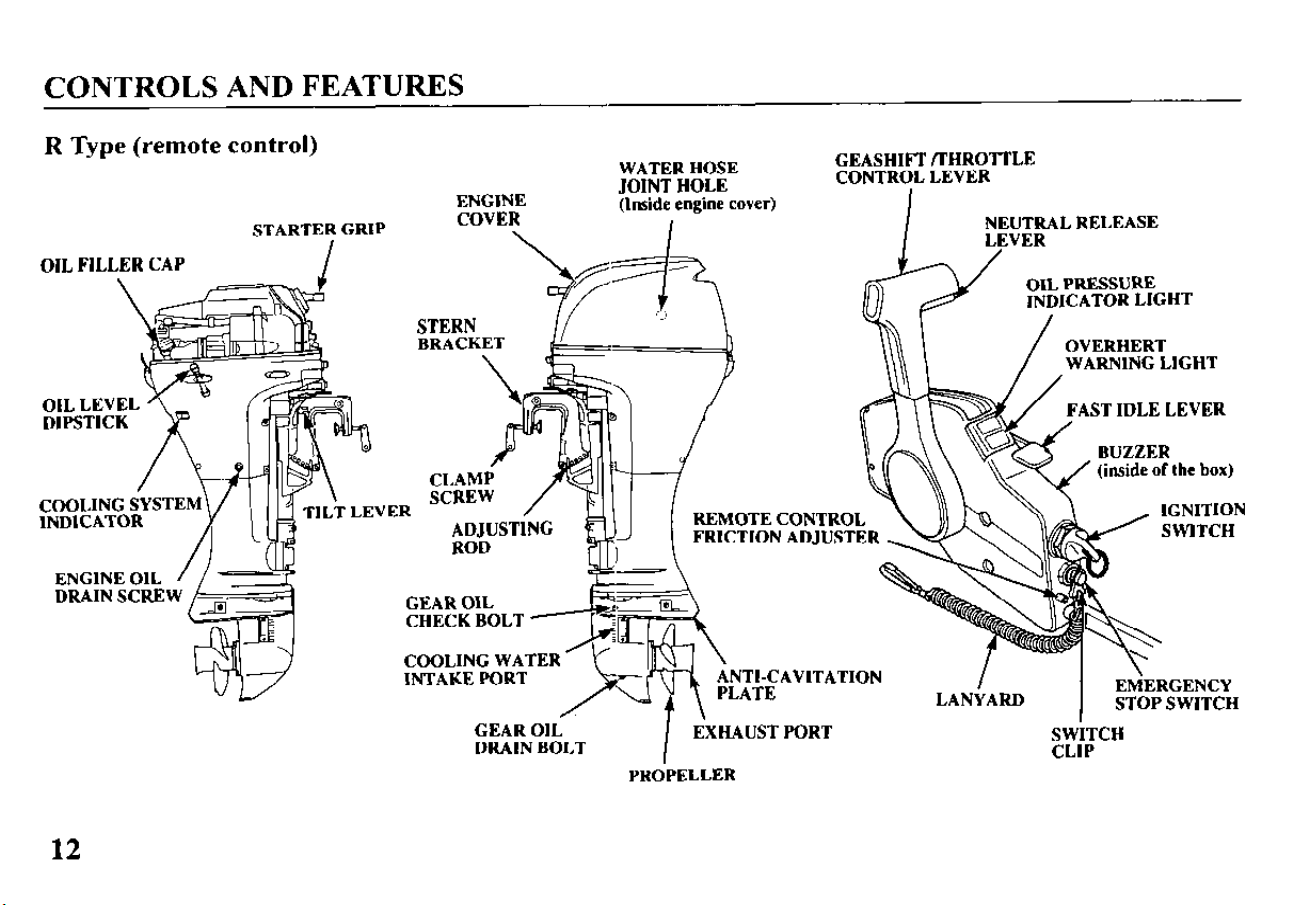
CONTROLS AND FEATURES
R Type (remote control)
STARTER GRIP
OIL FILLER CAP
/
ENGINE OIL
DRAIN SCREW
ENGlNE
COVER
WATER HOSE
JOINT HOLE
(hide engine cover)
I
REMOTE CONTRC -
FRICTION ADJUSTER
.$L!i’-
\
CEASHlm /THRO’l-l’LE
CONTROL LEVER
I
NEUTRAL RELEASE
LEVER
COOLING WATE
INTAKE PORT
NCY
ITCH
OIL PRESSURE
INDICATOR LIGHT
OVERHERT
WARNING LIGHT
FAST IDLE LEVER
GEAR Oli
DRAIN BOLT
I
EXHAUST PORT
SWiTCH
CLIP
PRbPELLER
12
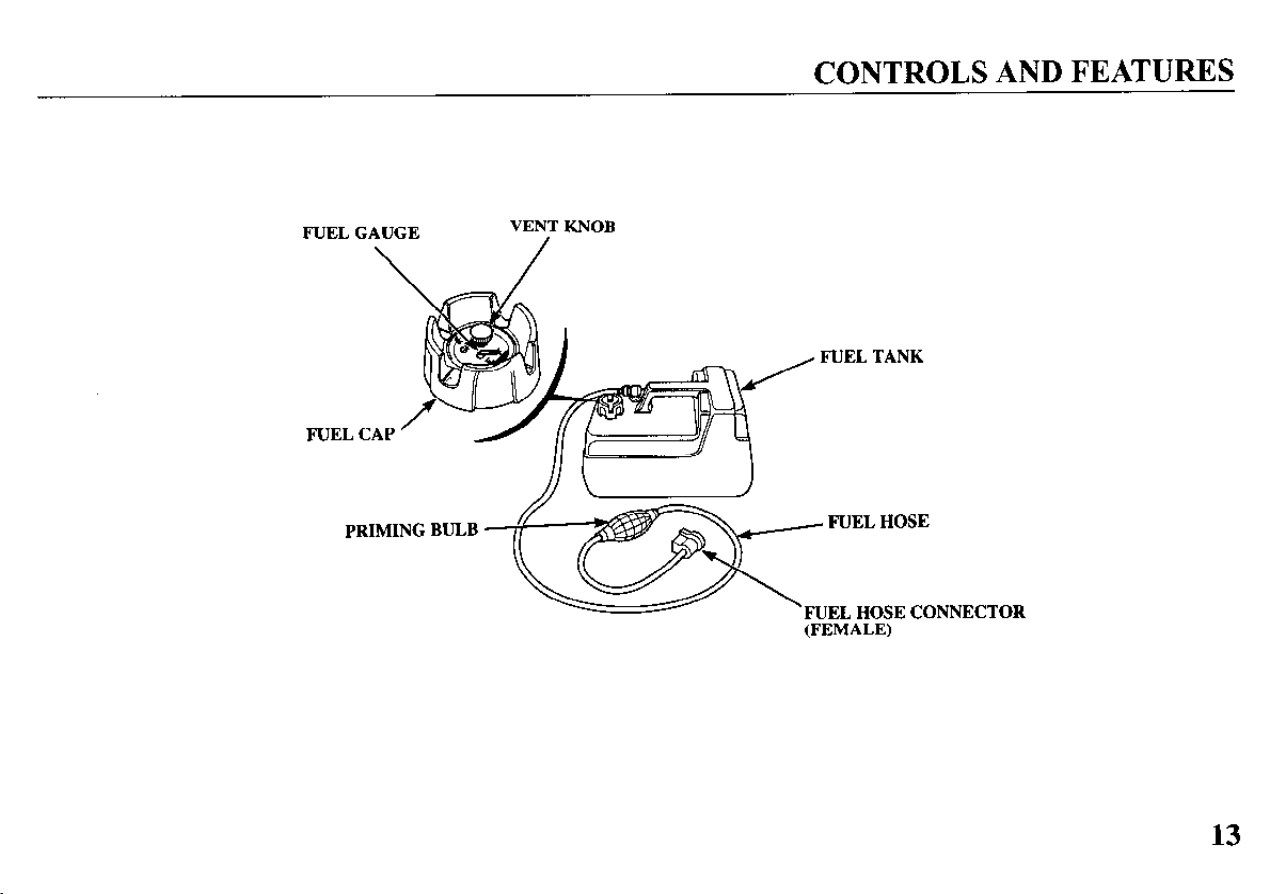
CONTROLS AND FEATURES
FUEL GAUGE
VENT KNOB
I
FUEL TANK
PRIMING BULB
FUEL HOSE
FUEL HOSE CONNECTOR
(FEMALE)
13
CONTROLS AND.FEATURES
CONTROLS
H Type (tiller handle)
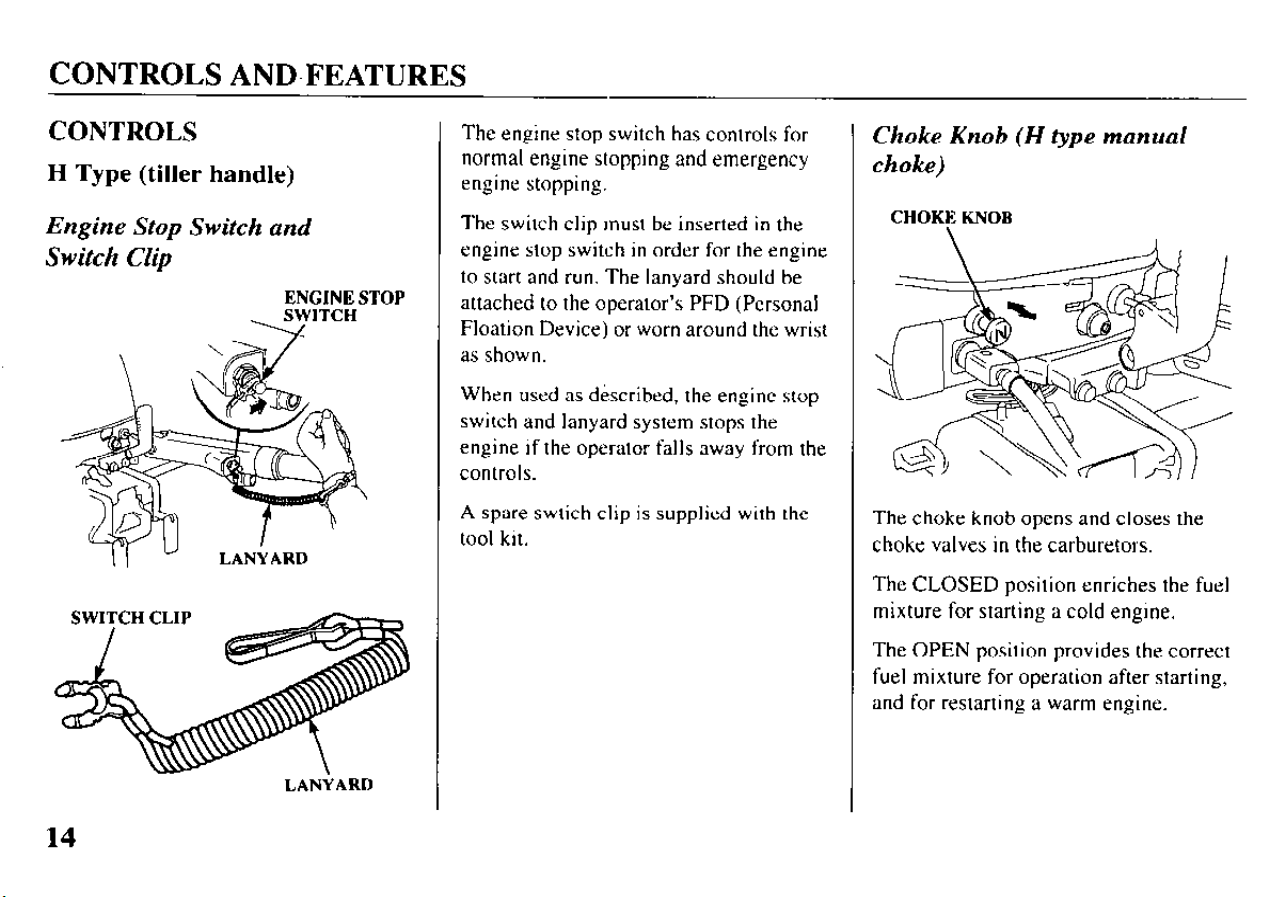
Engine Stop Switch and
Switch Clip
ENGINE STOP
LANYARD
The engine stop switch has controls for
normal engine stopping and emergency
engine stopping.
The switch clip must be inserted in the
engine stop switch in order for the engine
to start and run. The lanyard should be
attached to the operator’s PFD (Personal
Floation Device) or worn around the wrist
as shown.
When used as described, the engine stop
switch and lanyard system stops the
engine if the operator falls away from the
controls.
A spare swtich clip is supplied with the
tool kit.
Choke Knob (H type manual
choke)
CHOKE KNOB
The choke knob opens and closes the
choke valves in the carburetors.
The CLOSED position enriches the fuel
mixture for starting a cold engine.
The OPEN position provides the correct
fuel mixture for operation after starting,
and for restarting a warm engine.
CONTROLS AND FEATURES
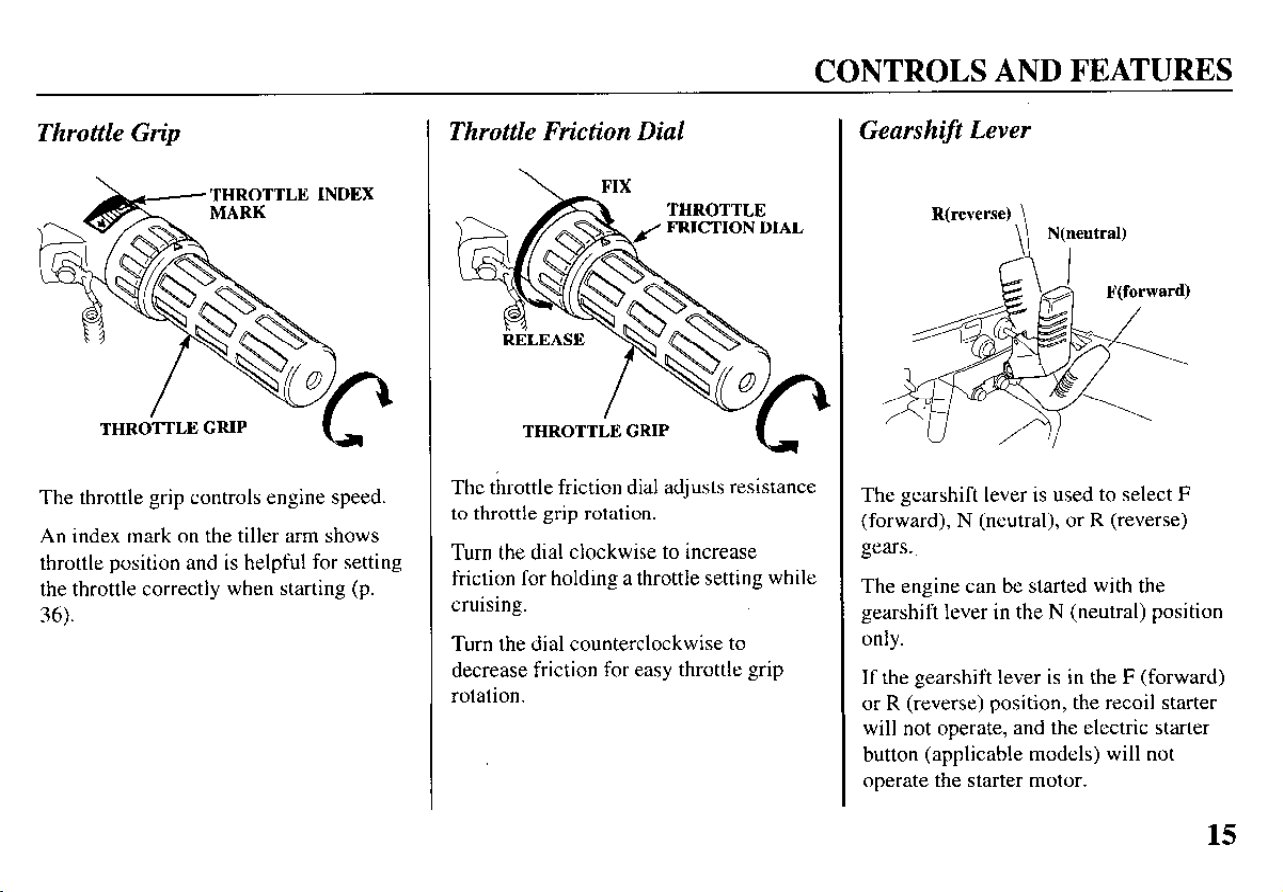
Throttle Grip
The throttle grip controls engine speed.
An index mark on the tiller arm shows
throttle position and is helpful for setting
the throttle correctly when starting (p.
36).
Throttle Friction Dial
THROTTLE
FRlCTlON DIAL
The throttle friction dial adjusts resistance
to throttle grip rotation.
Turn the dial clockwise to increase
friction for holding a throttle setting while
cruising.
Turn the dial counterclockwise to
decrease friction for easy throttle grip
rotation.
Gearshift Lever
R(reverse) \
\\ N(neutral)
The gearshift lever is used to select F
(forward), N (neutral), or R (reverse)
gears.,
The engine can be started with the
gearshift lever in the N (neutral) position
only.
If the gearshift lever is in the F (forward)
or R (reverse) position, the recoil starter
will not operate, and the electric starter
button (applicable models) will not
operate the starter motor.
15
CONTROLS AND FEATURES
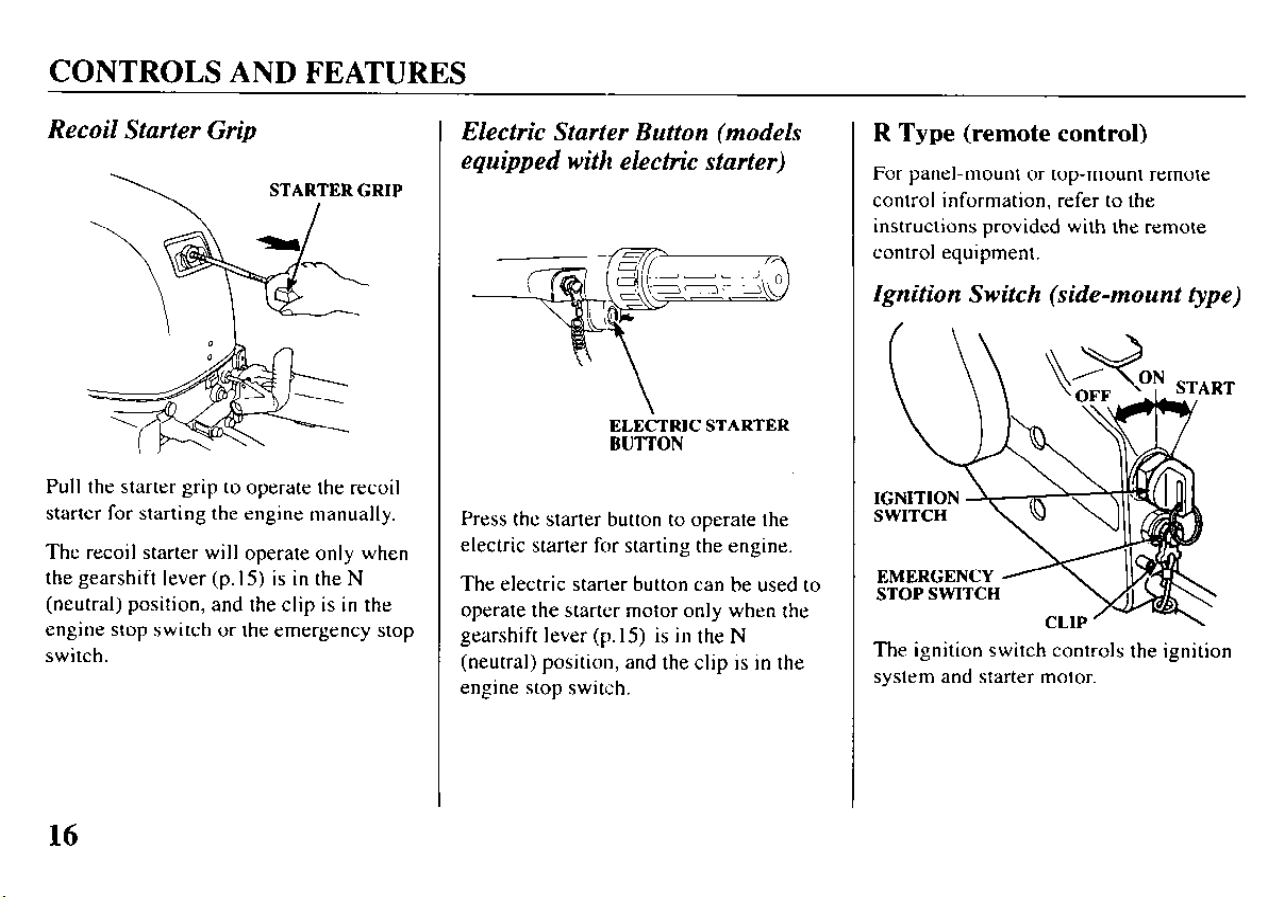
Recoil Starter Grip
STARTER GRIP
Pull the starter grip to operate the recoil
starter for starting the engine manually.
The recoil starter will operate only when
the gearshift lever (p. 15) is in the N
(neutral) position, and the clip is in the
engine stop switch or the emergency stop
switch.
Electric Starter Button (models
equipped with electric starter)
&(Lti&
1
ELECTRIC STARTER
BUlTON
Press the starter button to operate the
electric starter for starting the engine.
The electric starter button can be used to
operate the starter motor only when the
gearshift lever (p. 15) is in the N
(neutral) position, and the clip is in the
engine stop switch.
R Type (remote control)
For panel-mount or top-mount remote
control information, refer to the
instructions provided with the remote
control equipment.
Ignition Switch (side-mount type)
EMERGENCY
STOP SWlTCH
CLIP ’
-.\
The ignition switch controls the ignition
system and starter motor.
16
CONTROLS AND FEATURES
Turning the ignition switch key to the
START position operates the starter
motor. The key automatically returns to
the ON position when released from the
START position.
The ignition switch can be used to operate
the starter motor only when the gearshift
lever (p. 15) is in the N (neutral)
position, and the clip is in the emergency
stop switch.
Turning the ignition switch to the OFF
position stops the engine.
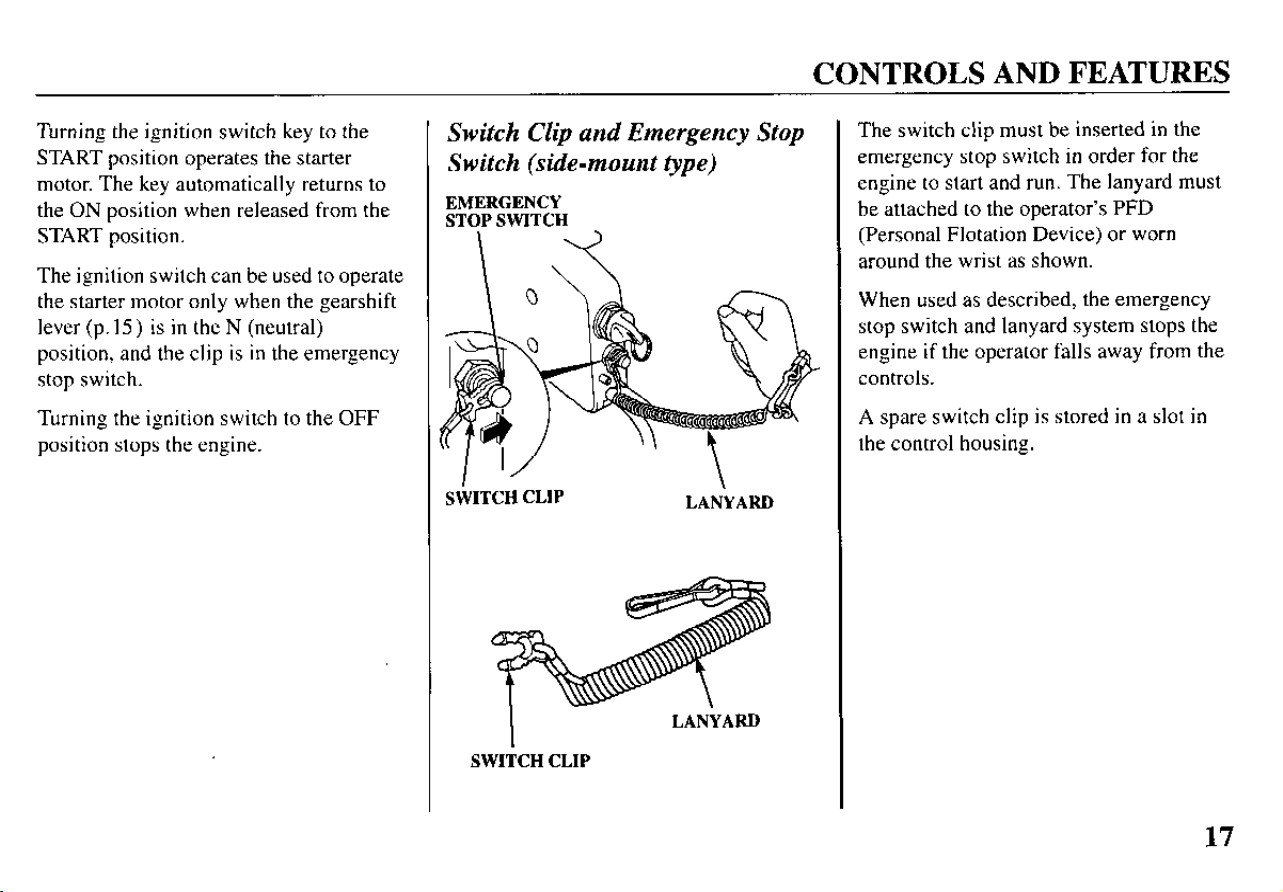
Switch Clip and Emergency Stop
Switch (side-mount type)
EMERGENCY
STOP SWITCH
SiVITCH CLIP
LANiARLl
LANYARD
SWITCH CLIP
The switch clip must be inserted in the
emergency stop switch in order for the
engine to start and run. The lanyard must
be attached to the operator’s PFD
(Personal Flotation Device) or worn
around the wrist as shown.
When used as described, the emergency
stop switch and lanyard system stops the
engine if the operator falls away from the
controls.
A spare switch clip is stored in a slot in
the control housing.
17
CONTROLS AND FEATURES
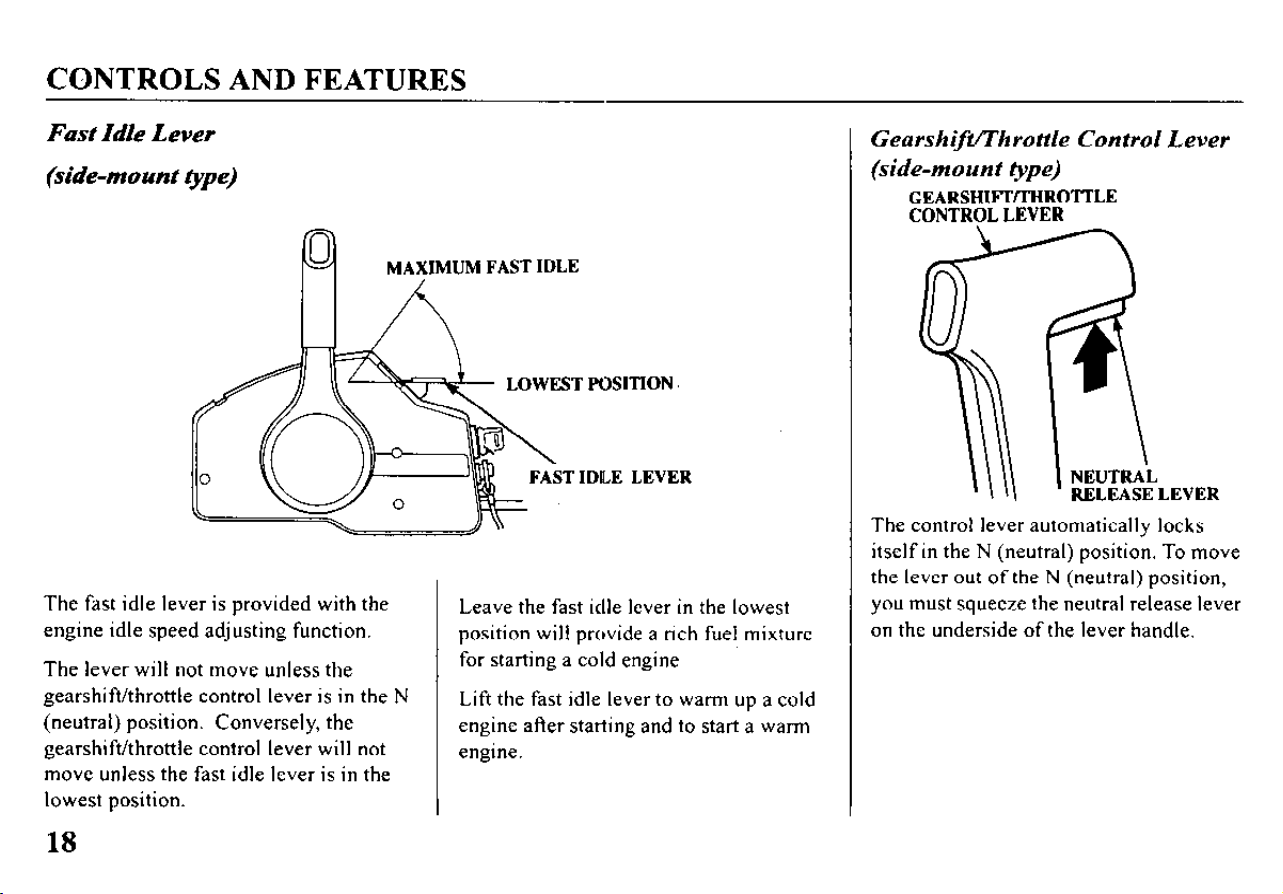
Fast Idle Lever
(side-mount type)
PI
MAXIMUM FAST IDLE
LOWEST I’OSI
The fast idle lever is provided with the
engine idle speed adjusting function.
The lever will not move unless the
gearshift/throttle control lever is in the N
(neutral) position. Conversely, the
gearshift/throttle control lever will not
move unless the fast idle lever is in the
lowest position.
18
TION
LEVER
Leave the fast idle lever in the lowest
position will provide a rich fuel mixture
for starting a cold engine
Lift the fast idle lever to warm up a cold
engine after starting and to start a warm
engine.
Cearshifi/Throttle Control Lever
(side-mount type)
GEARSHIF-IYI’HRO’ZTLE
CONTROL LEVER
NEUTRAL
RELEASE LEVER
The control lever automatically locks
itself in the N (neutral) position. To move
the lever out of the N (neutral) position,
you must squeeze the neutral release lever
on the underside of the lever handle.
CONTROLS AND FEATURES
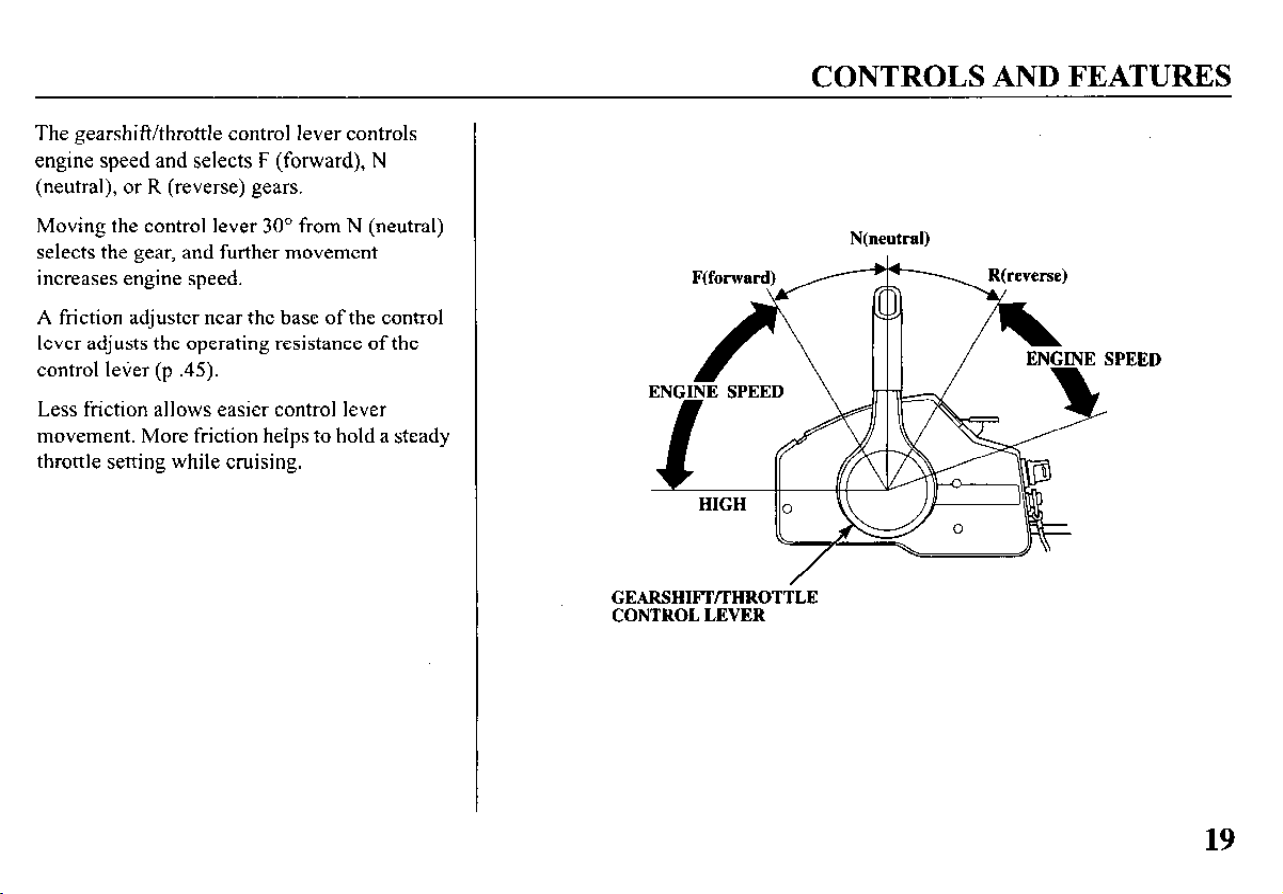
The gearshift/throttle control lever controls
engine speed and selects F (forward), N
(neutral), or R (reverse) gears.
Moving the control lever 30” from N (neutral)
selects the gear, and further movement
increases engine speed.
A friction adjuster near the base of the control
lever adjusts the operating resistance of the
control lever (p .45).
Less friction allows easier control lever
movement. More friction helps to hold a steady
throttle setting while cruising.
N(neutral)
GEARSHDWTHROTTLE
CONTROL LEVER
SPEED
19
CONTROLS AND FEATURES
Common Controls
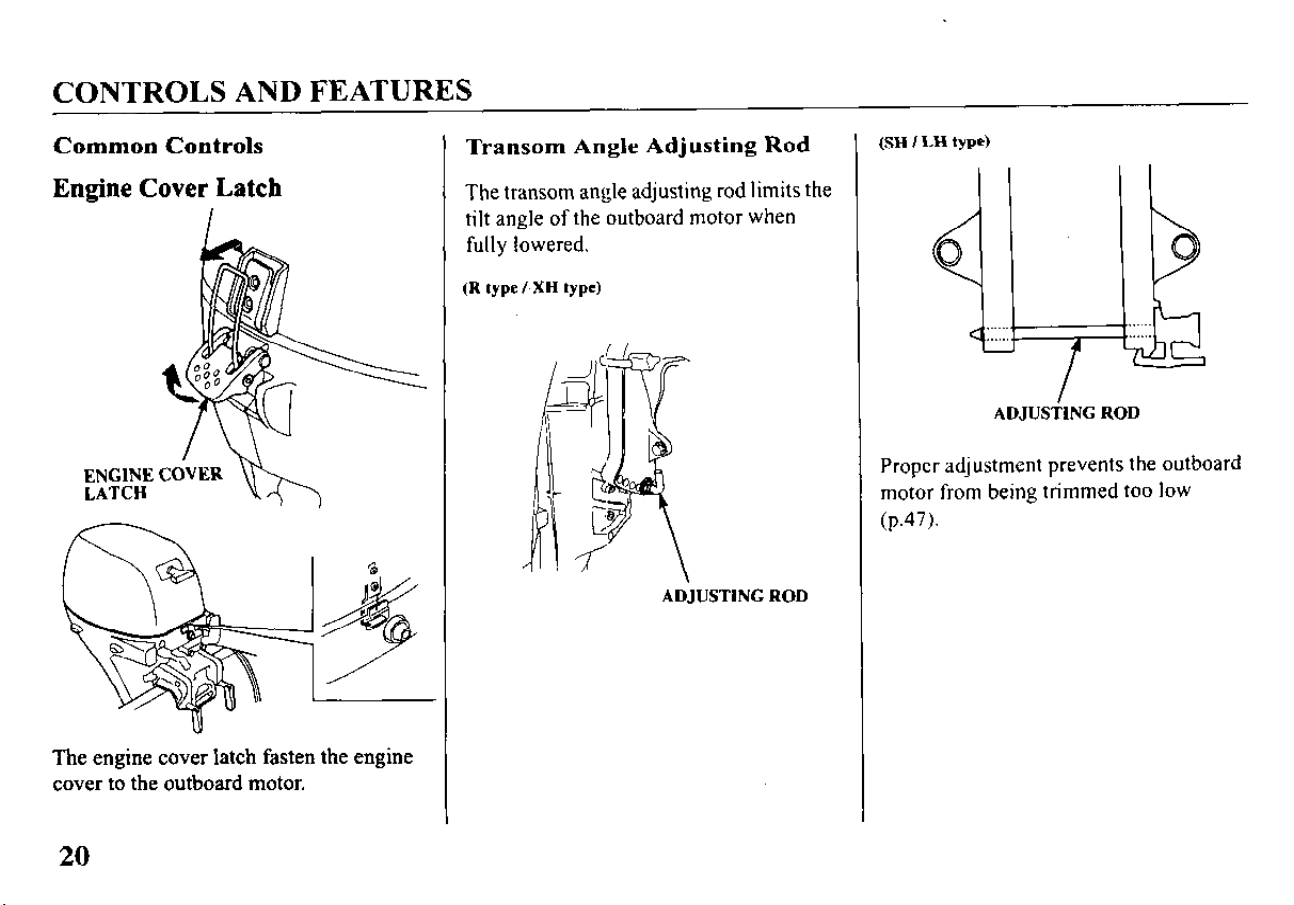
Engine Cover Latch
ENGINE
LATCH
The engine cover latch fasten the engine
cover to the outboard motor.
20
Transom Angle Adjusting Rod
The transom angle adjusting rod limits the
tilt angle of the outboard motor when
fully lowered.
(R
type
/.XH
type)
ADJUSTING ROD
(SH I LH type)
<
0
u
0
!I2
ADJUSiING ROD
Proper adjustment prevents the outboard
motor from being trimmed too low
(P.47).
CONTROLS AND FEATURES
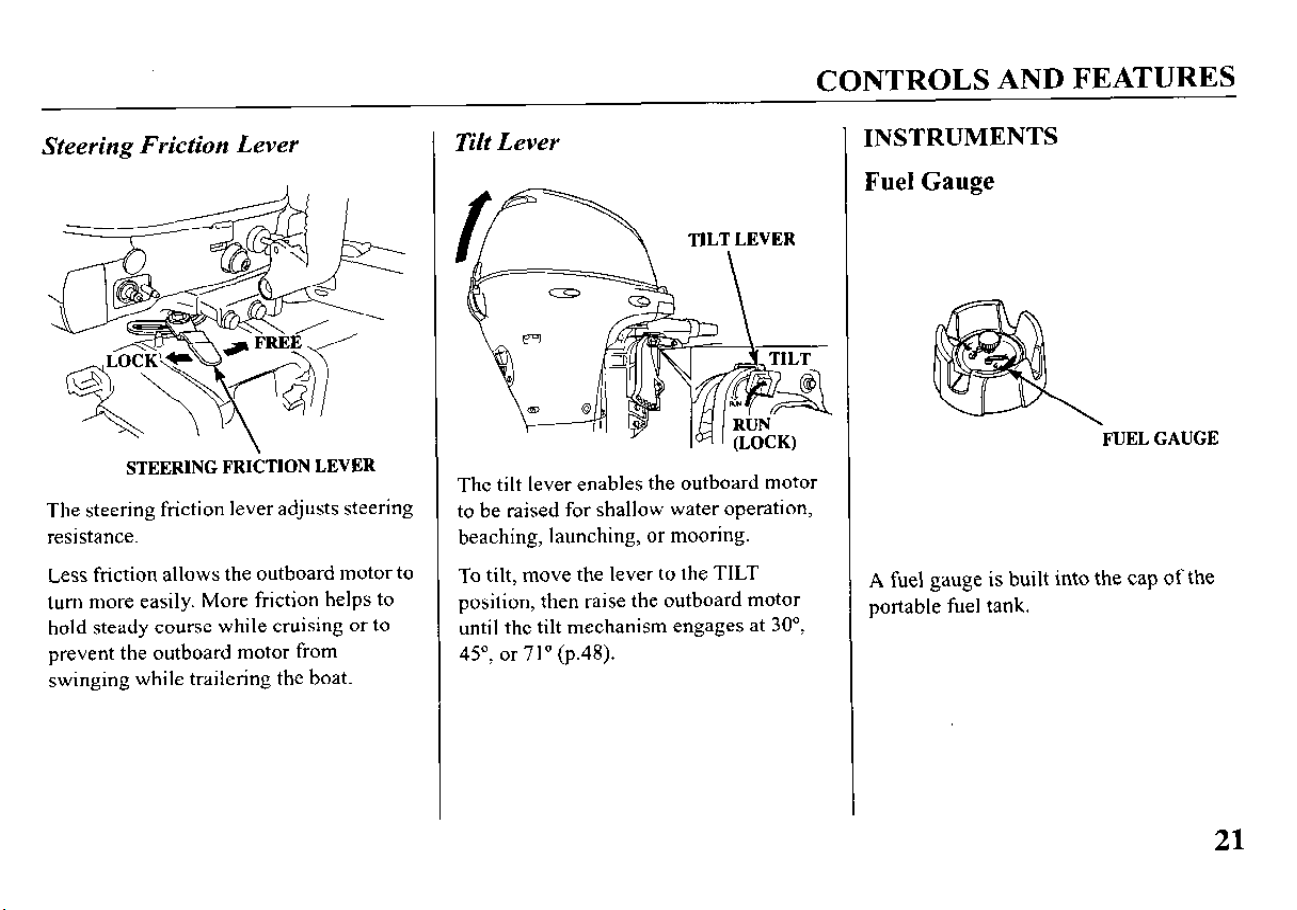
Steering Friction Lever
STEERING FRlkTlON
LEVER
The steering friction lever adjusts steering
resistance.
Less friction allows the outboard motor to
turn more easily. More friction helps to
hold steady course while cruising or to
prevent the outboard motor from
swinging while trailering the boat.
Tilt Lever
The tilt lever enables the outboard motor
to be raised for shallow water operation,
beaching, launching, or mooring.
To tilt, move the lever to the TILT
position, then raise the outboard motor
until the tilt mechanism engages at 30”,
45”, or 7 1’ (p.48).
INSTRUMENTS
Fuel Gauge
FUEL GAUGE
A fuel gauge is built into the cap of the
portable fuel tank.
21
CONTROLS AND FEATURES
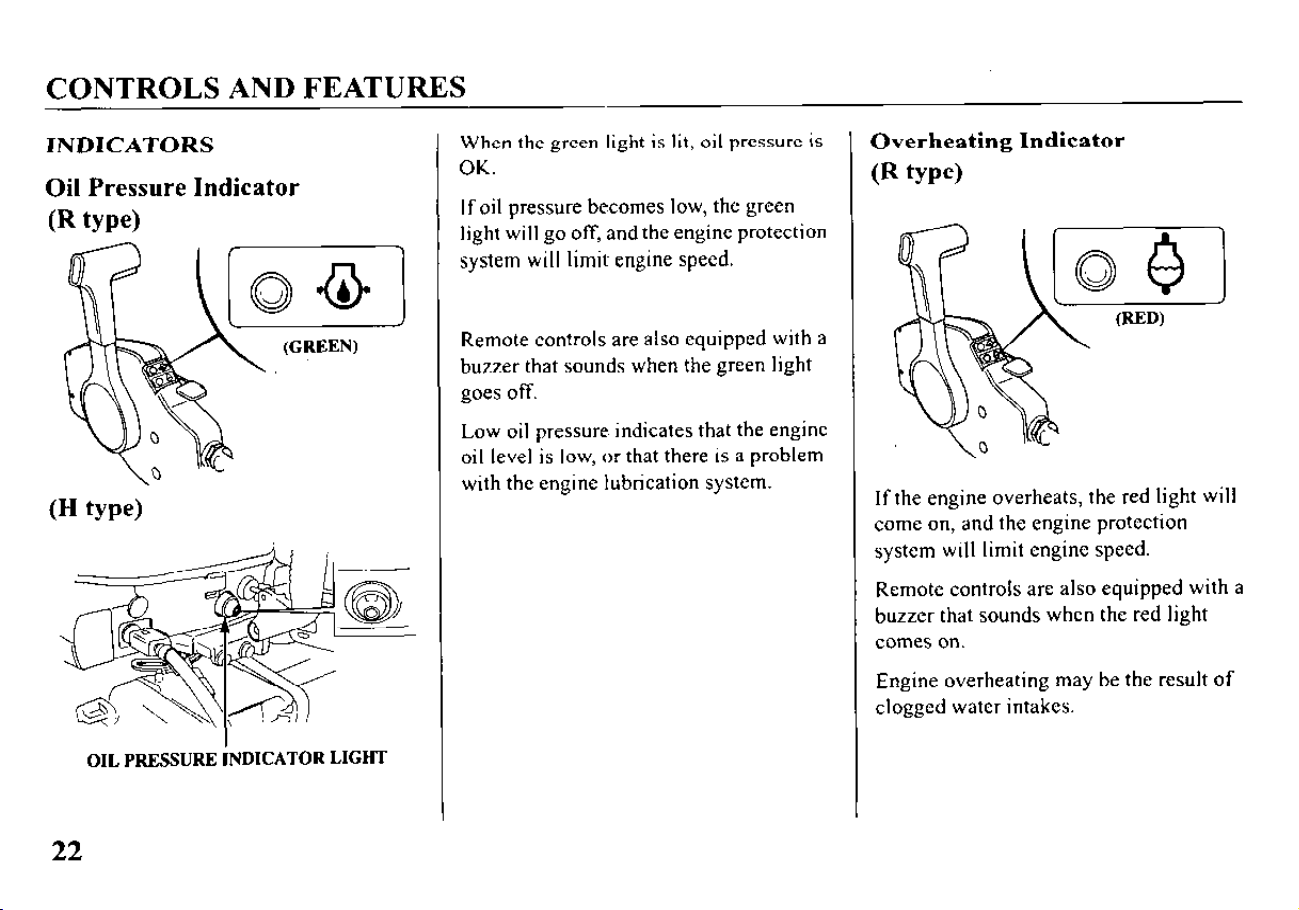
INDICATORS
Oil Pressure Indicator
(R type)
0-I type)
OIL PRESSURE
iNDICATOR LIGHT
When the green light is lit, oil prcssurc
is
OK.
If oil pressure becomes low, the green
light will go off, and the engine protection
system will limit engine speed.
Remote controls are also equipped with a
buzzer that sounds when the green light
goes off.
Low oil pressure indicates that the engine
oil level is low, or that there is a problem
with the engine lubrication system.
Overheating Indicator
CR type)
If the engine overheats, the red light will
come on, and the engine protection
system will limit engine speed.
Remote controls are also equipped with a
buzzer that sounds when the red light
comes on.
Engine overheating may be the result of
clogged water intakes.
22
CONTROLS AND FEATURES
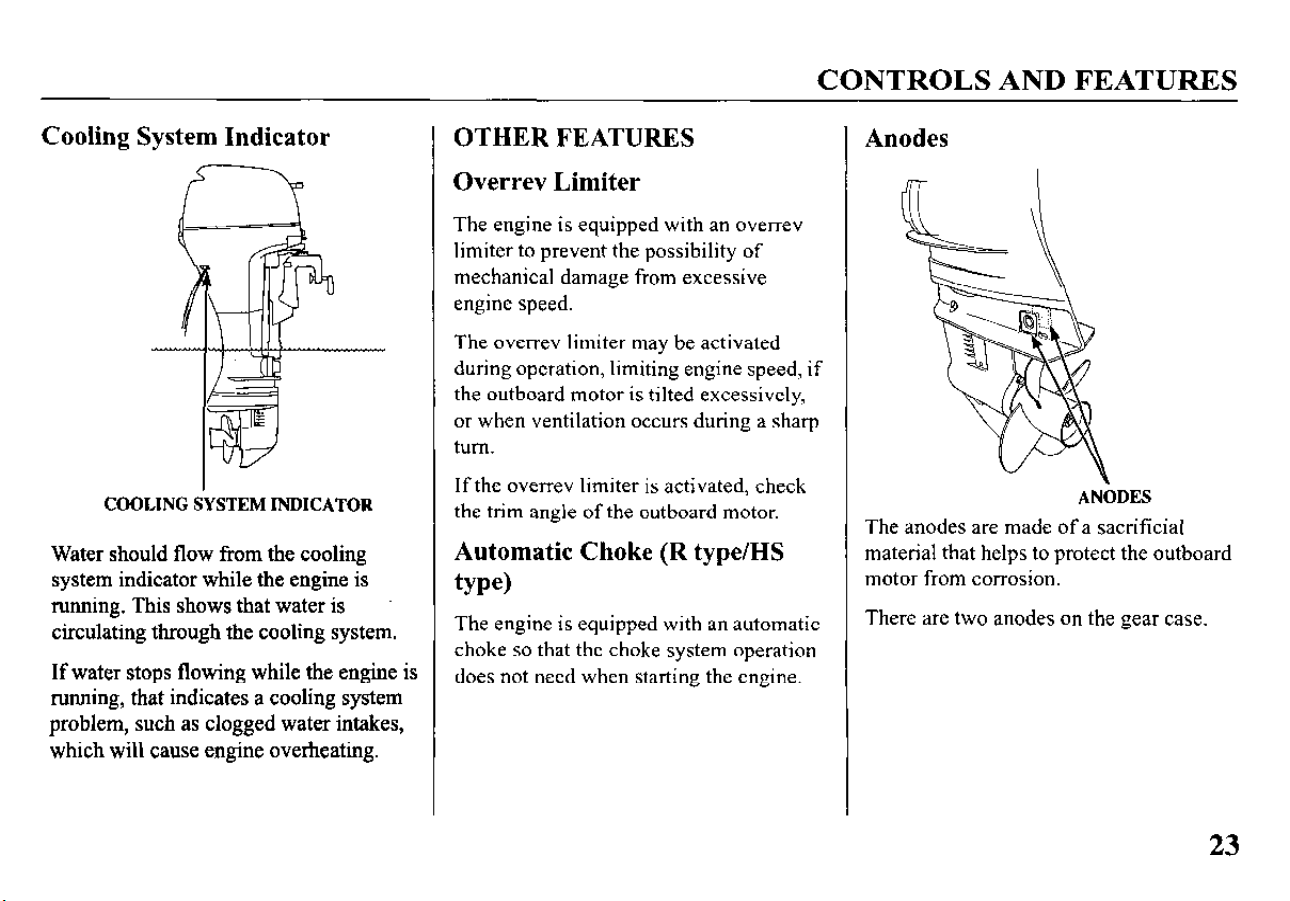
Cooling System Indicator
COOLING SYSTEM INDICATOR
Water should flow from the cooling
system indicator while the engine is
running. This shows that water is
circulating through the cooling system.
If water stops flowing while the engine is
running, that indicates a cooling system
problem, such as clogged water intakes,
which will cause engine overheating.
OTHER FEATURES
Overrev Limiter
The engine is equipped with an overrev
limiter to prevent the possibility of
mechanical damage from excessive
engine speed.
The overrev limiter may be activated
during operation, limiting engine speed, if
the outboard motor is tilted excessively,
or when ventilation occurs during a sharp
turn.
If the overrev limiter is activated, check
the trim angle of the outboard motor.
Automatic Choke (R type/HS
type1
The engine is equipped with an automatic
choke so that the choke system operation
does not need when starting the engine.
Anodes
ANODES
The anodes are made of a sacrificial
material that helps to protect the outboard
motor from corrosion.
There are two anodes on the gear case.
23
CONTROLS AND FEATURES
Portable Fuel Tank
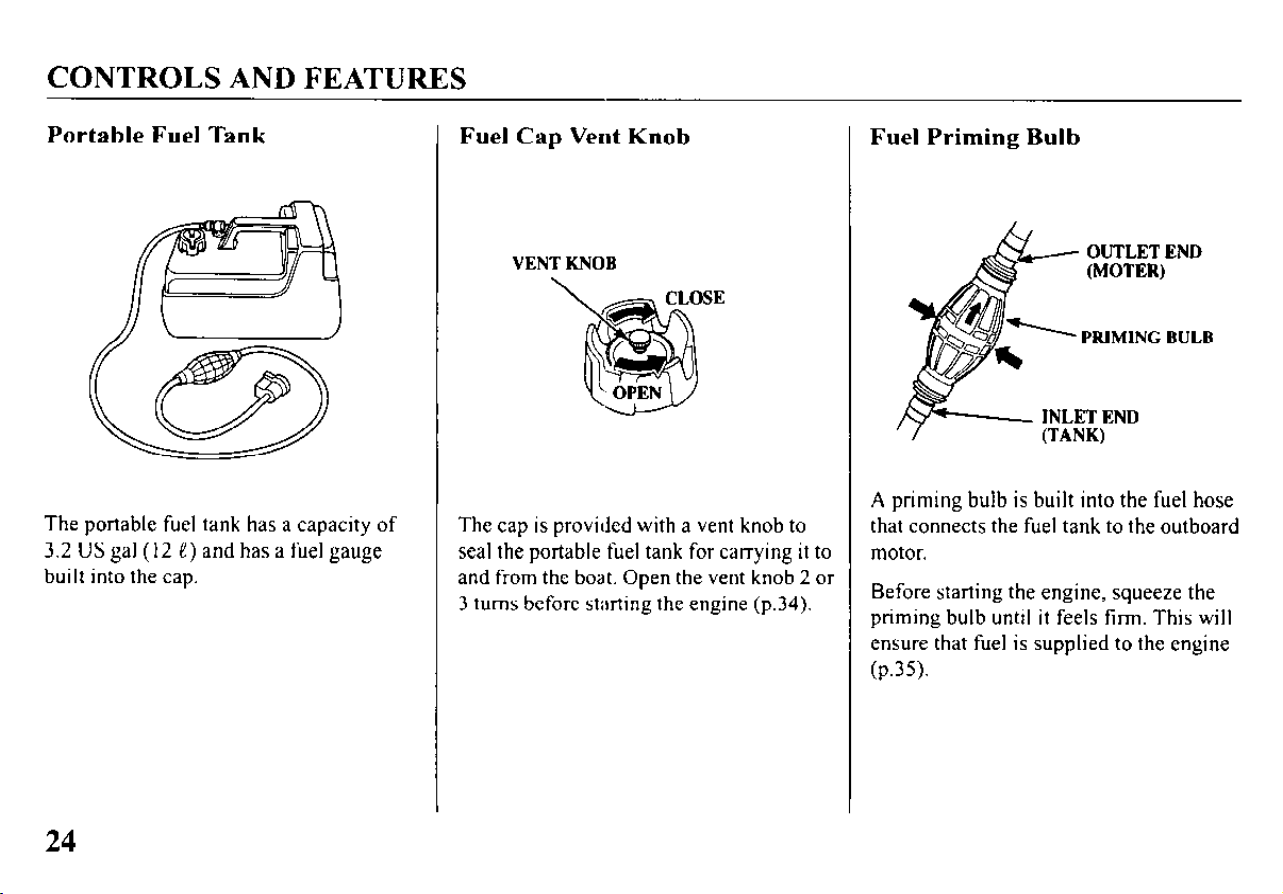
The portable fuel tank has a capacity of
3.2 US gal ( I2 a) and has a fuel gauge
built into the cap.
Fuel Cap Veut Knob
VENT KNOB
SE
The cap is provided with a vent knob to
seal the portable fuel tank for carrying it to
and from the boat. Open the vent knob 2 or
3 turns before starting the engine (p.34).
Fuel Priming Bulb
OUTLET END
A priming bulb is built into the fuel hose
that connects the fuel tank to the outboard
motor.
Before starting the engine, squeeze the
priming bulb until it feels firm. This will
ensure that fuel is supplied to the engine
(P.35).
24
INSTALLATION
Correct and secure installation is essential
for safe boating and good performance.
Follow the installation instructions
provided in this manual.
POWER REQUIREMENTS
Before installation, check to be sure that
the outboard motor does not exceed the
recommended maximum horsepower for
the boat on which it is to be installed.
Refer to the boat’s certification plate for
recommended maximum horsepower. If
the certification plate information is not
available, contact the boat dealer or
manufacturer.
For most applications, the outboard motor
should have a horsepower rating which
provides 80% of the maximum
recommended horsepower for the boat.
BOAT TRANSOM
REQUIREMENTS
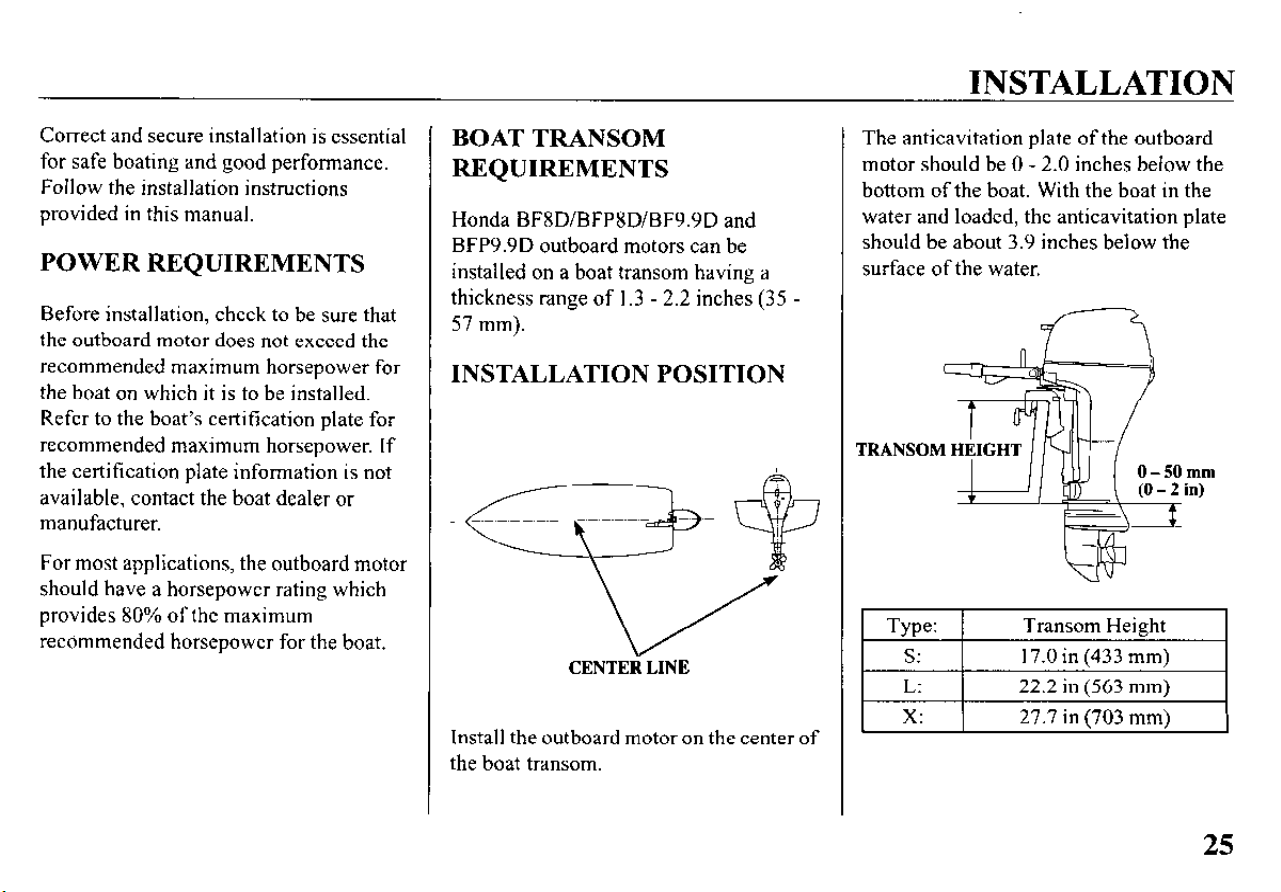
Honda BF8D/BFPgD/BF9.9D and
BFP9.9D outboard motors can be
installed on a boat transom having a
thickness range of 1.3 - 2.2 inches (35 -
57 mm).
INSTALLATION POSITION
CENTERLINE
Install the outboard motor on the center of
the boat transom.
The anticavitation plate of the outboard
motor should be 0 - 2.0 inches below the
bottom of the boat. With the boat in the
water and loaded, the anticavitation plate
should be about 3.9 inches below the
surface of the water.
mnl
in)
1 Type: 1
Transom Height 1
I s: I
17.0 in (433 mm) I
I L:
I
22.2 in (563 mm)
I
I x: I
27.7 in (703 mm)
I
25
INSTALLATION
If the outboard motor is installed too low,
the boat will squat and be hard to plane, it
will tend to porpoise, and high-speed
stability will be reduced.
lfthe outboard motor is installed too high,
that will cause ventilation.
Optimum installation height varies with
boat type and bottom shape. Contact the
boat manufacturer for any special
recommendations that arc unique to a
specific model of boat.
If the transom needs to bc modified to
accommodate the outboard motor, contact
the boat manufacturer and follow their
recommendations for corrective action.
ATTACHMElNT
I
t’
CLAMP SCREW CLAMP SCREW
MOUNTING HOLE MOUNTING HOLE
BOARD BOARD
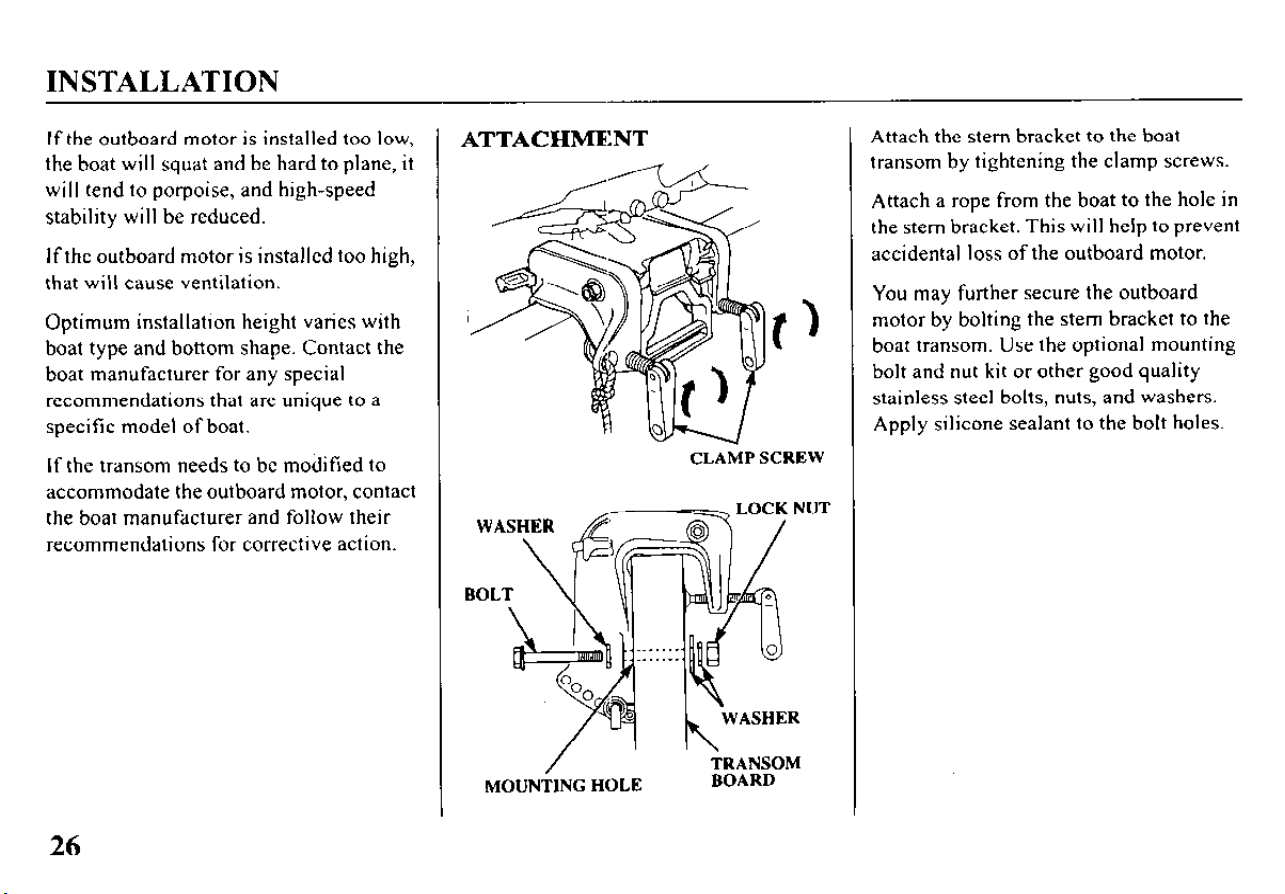
Attach the stem bracket to the boat
transom by tightening the clamp screws.
Attach a rope from the boat to the hole in
the stem bracket. This will help to prevent
accidental loss of the outboard motor.
You may further secure the outboard
motor by bolting the stem bracket to the
boat transom. Use the optional mounting
bolt and nut kit or other good quality
stainless steel bolts, nuts, and washers.
Apply silicone sealant to the bolt holes.
26
INSTALLATION
TRANSOM ANGLE
ADJUSTMENT
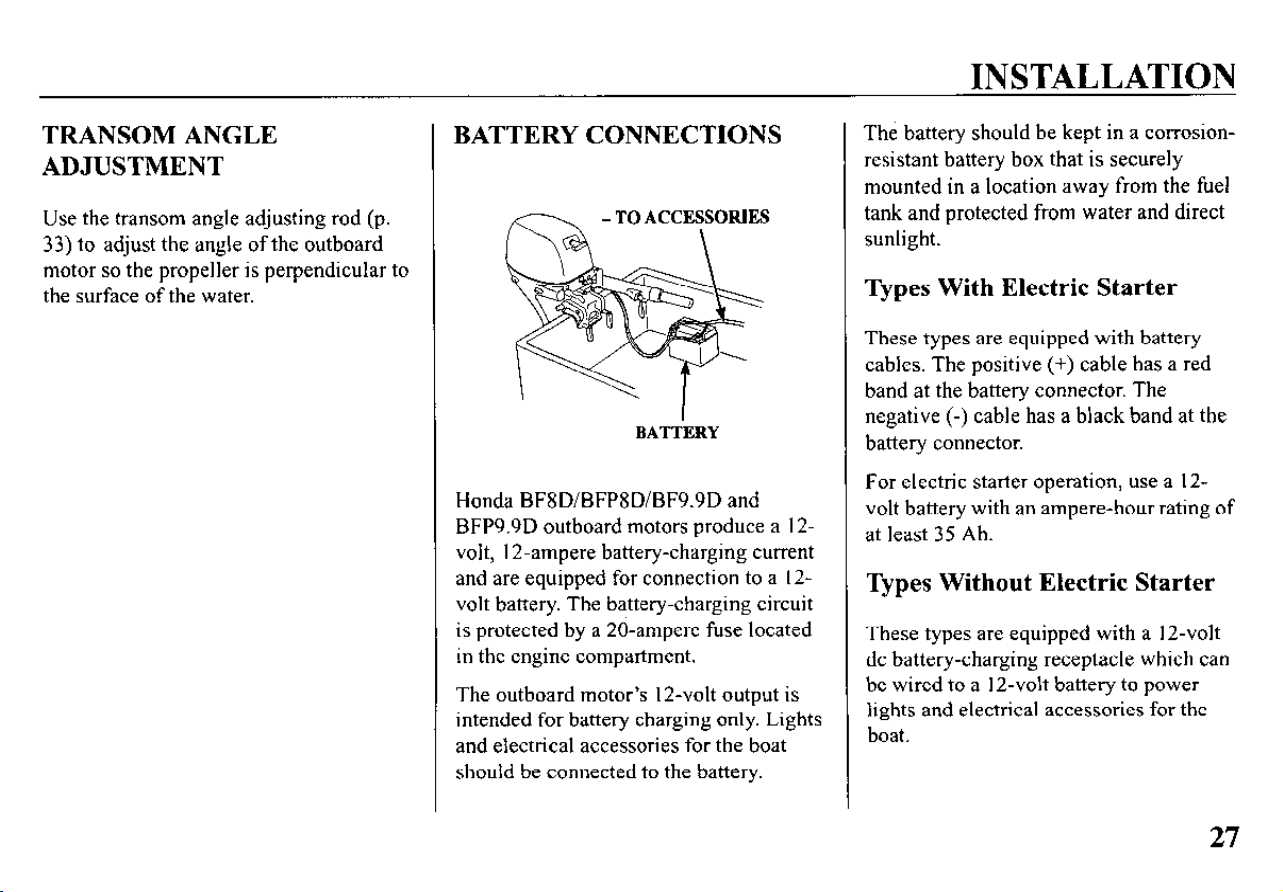
Use the transom angle adjusting rod (p.
33) to adjust the angle of the outboard
motor so the propeller is perpendicular to
the surface of the water.
BATTERY CONNECTIONS
BATTERY
Honda BF8D/BFP8D/BF9.9D and
BFP9.9D outboard motors produce a 12-
volt, 12-ampere battery-charging current
and are equipped for connection to a 12-
volt battery. The battery-charging circuit
is protected by a 20-ampere fuse located
in the engine compartment.
The outboard motor’s 12-volt output is
intended for battery charging only. Lights
and electrical accessories for the boat
should be connected to the battery.
The battery should be kept in a corrosion-
resistant battery box that is securely
mounted in a location away from the fuel
tank and protected from water and direct
sunlight.
Types With Electric Starter
These types are equipped with battery
cables. The positive (+) cable has a red
band at the battery connector. The
negative (-) cable has a black band at the
battery connector.
For electric starter operation, use a 12-
volt battery with an ampere-hour rating of
at least 35 Ah.
Types Without Electric Starter
These types are equipped with a 12-volt
dc battery-charging receptacle which can
be wired to a 12-volt battery to power
lights and electrical accessories for the
boat.
27
INSTALLATION
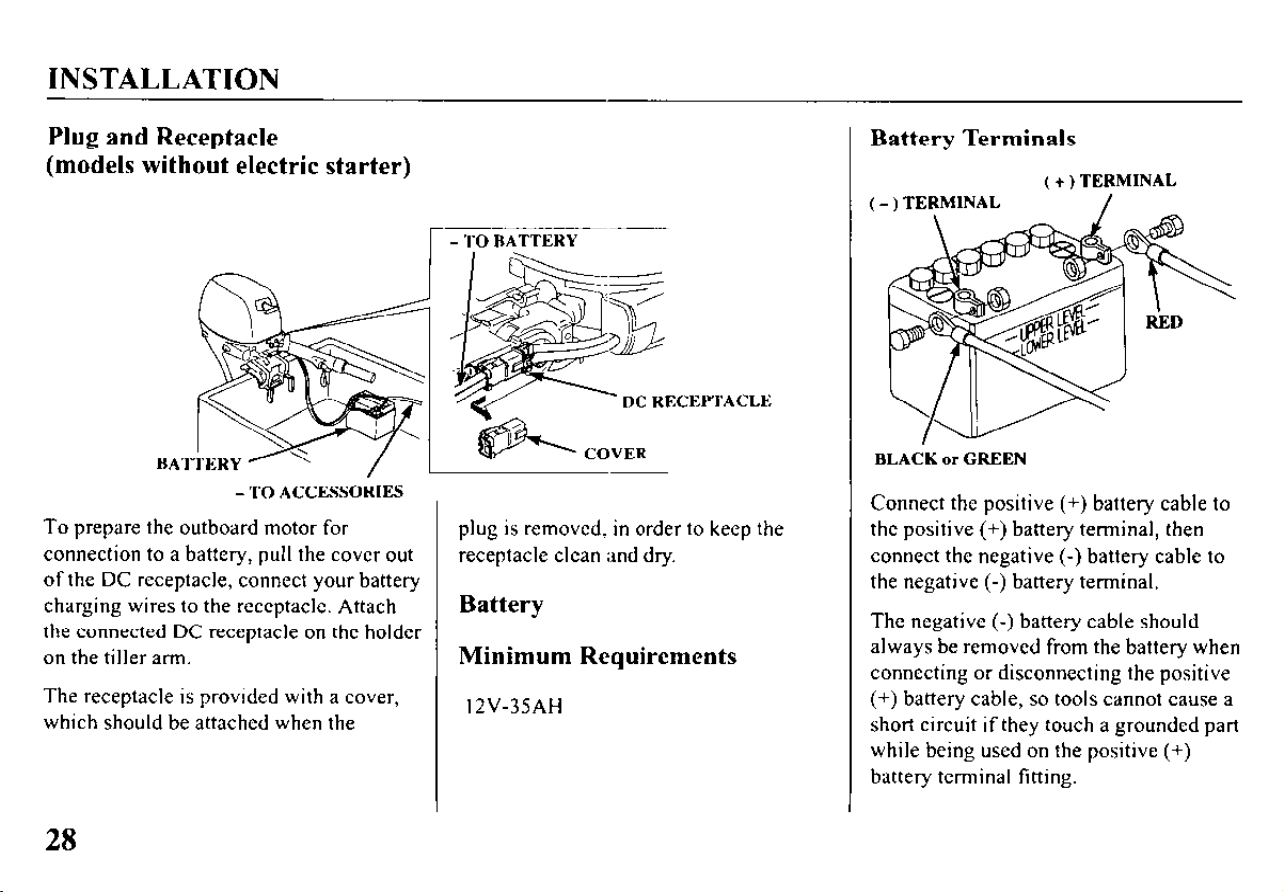
Plug and Receptacle
(models without electric starter)
- TO ACCESSORIES
To prepare the outboard motor for
connection to a battery, pull the cover out
of the DC receptacle, connect your battery
charging wires to the receptacle. Attach
the connected DC receptacle on the holder
on the tiller arm.
The receptacle is provided with a cover,
which should be attached when the
- TO BATTERY
DC RECEPTACLE:
& COVER
plug is removed, in order to keep the
receptacle clean and dry.
Battery
Minimum Requirements
12V-35AH
Battery Terminals
( + ) TERMINAL
( - ) TERMINAL
/
BLACK or GREEN
Connect the positive (+) battery cable to
the positive (+) battery terminal, then
connect the negative (-) battery cable to
the negative (-) battery terminal.
The negative (-) battery cable should
always be removed from the battery when
connecting or disconnecting the positive
(+) battery cable, so tools cannot cause a
short circuit if they touch a grounded part
while being used on the positive (+)
battery terminal fitting.
28
INSTALLATION
Be careful to avoid connecting the battery
in reverse polarity, as that will damage
the battery-charging system in the
outboard motor:
29
BEFORE OPERATION
ARE YOU READY TO GET
UNDER WAY?
Your safety is your responsibility. A little
time spent in preparation will
significantly reduce your risk of injury.
Knowledge
Read and understand this manual. Know
what the controls do and how to operate
them.
Familiarize yourself with the outboard
motor and its operation before you get
under way. Know what to do in case of
emergencies.
Familiarize yourself with all laws and
regulations relating to boating and the use
of outboard motors.
Safety
Always wear a (PFD) Personal Flotation
Device) while on the boat.
Attach the emergency stop switch lanyard
securely to your PFD or to your wrist.
IS YOUR OUTBOARD
MOTOR READY TO GO?
For your safety, and to maximize the
service life of your equipment, it is very
important to take a few moments before
you operate the outboard motor to check
its condition. Be sure to take care of any
problem you find, or have your
authorized Honda Marine dealer correct
it, before you operate the outboard motor.
Improperly maintaining this outboard
motor, or failing to correct a problem
before operation, could cause a
malfunction in which you could be
seriously injured.
Always perform a preoperation
inspection before each operation, and
correct any problem.
Before beginning your prcoperation
checks, be sure the ignition switch is in
the OFF position.
30
BEFORE OPERATION
Safety Inspection
Look around the outboard motor for
signs of oil or gasoline leaks.
If you are using the portable fuel tank,
make sure it is in good condition and
properly secured in the boat (p.34).
Check that the fuel hose is
undamaged and properly connected
(P.34).
Wipe up any spills before starting the
engine.
Check the stem bracket to be sure the
outboard motor is securely installed.
Check that all controls are operating
properly.
Replace any damaged parts.
Check that all fasteners are in place
and securely tightened.
Maintenance Inspection
Check the engine oil level (p.55).
Running the engine with a low oil
level can cause engine damage.
Check to be sure the propeller is
undamaged, and the castle nut is
secured with the cotter pin (p.69).
Check that the anodes are securely
attached to the gear case (p.68)
and are not excessively worn. The
an odes help to protect the outboard
motor from corrosion.
Make sure the tool kit and emergency
starter rope are onboard (p.52).
Replace any missing items.
Check the fuel level in the fuel tank
(p.64).
31
OPERATION
SAFE OPERATING
PRECAUTIONS
To safely realize the full potential of this
outboard motor, you need a complete
understanding of its operation and a
certain amount of practice with its
controls.
Before operating the outboard motor for
the first time, please review the
IMPORTANT SAFETY INFORMATION
on page 7 and the chapter titled BEFORE
OPERATION.
For your safety, avoid starting or
operating the engine in an enclosed area.
Your engine’s exhaust contains poisonous
carbon monoxide gas which can collect
rapidly in an enclosed area and cause
illness or death.
BREAK-IN PROCEDURE
Break-in period: 10 hours
Proper break-in operation allows the
moving parts to wear in smoothly for best
performance and long service life.
First 15 minutes:
Run the engine at trolling speed. Use the
minimum throttle opening necessary to
operate the boat at a safe trolling speed.
Next 45 minutes:
Run the engine up to a maximum of 2,000
to 3,000 rpm, which is about IO% to 30%
of maximum throttle opening.
Next 60 minutes:
Run the engine up to a maximum of4,OOO
to 5,000 rpm, which is about 50% to 80%
of maximum throttle opening.
Short full-throttle bursts are OK, but do
not operate the engine continuously at full
throttle.
For boats that plane easily, bring the boat
up on plane, and then reduce the throttle
opening to the recommended rpm range.
Next 8 hours:
Do not run the engine at full throttle for
more than 5 minutes at a time.
32
OPERATION
TRANSOM ANGLE
ADJUSTMENT
CR type/XH type)
UNLOCKED
POSITION
ADJUSTING ROD
LOCKED POSITION
TO L&K
(SH type/LH type)
ADJUSTING ROD
1
‘..... Ic-- 1
4L
0
.
.
.
LOCKED POSITION
t
PINCH
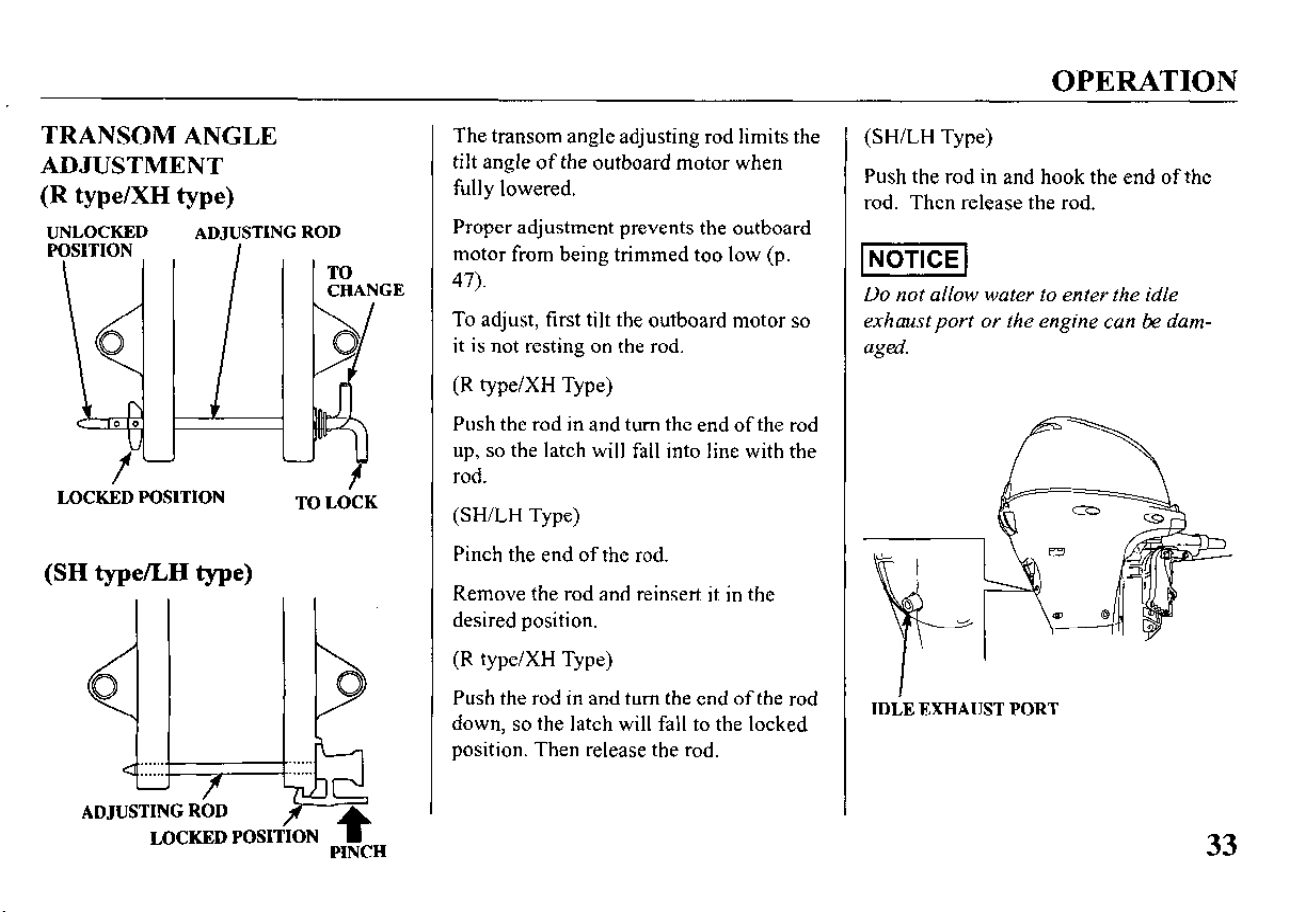
The transom angle adjusting rod limits the
tilt angle of the outboard motor when
fully lowered.
Proper adjustment prevents the outboard
motor from being trimmed too low (p.
47).
To adjust, first tilt the outboard motor so
it is not resting on the rod.
(R type/XH Type)
Push the rod in and turn the end of the rod
up, so the latch will fall into line with the
rod.
(SH/LH Type)
Pinch the end of the rod.
Remove the rod and reinsert it in the
desired position.
(R type/XH Type)
Push the rod in and turn the end of the rod
down, so the latch will fall to the locked
position. Then release the rod.
(SH/LH Type)
Push the rod in and hook the end of the
rod. Then release the rod.
lNoTlCEl
Do not allow water to enter the idle
exhaust port or the engine can be dam-
aged
IDiE EXHAUST PORT
33
OPERATION
PORTABLE FUEL TANK
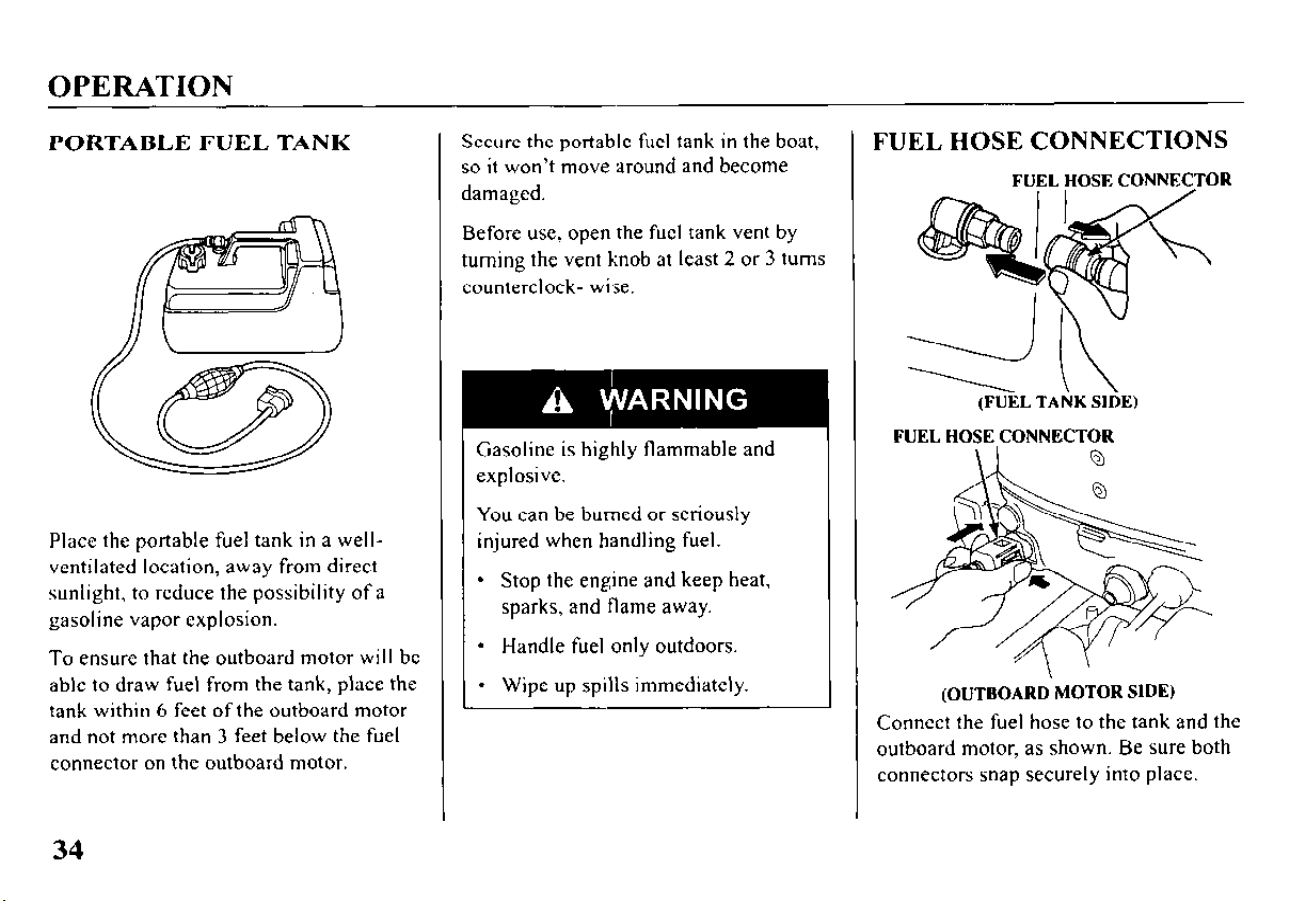
Place the portable fuel tank in a well-
ventilated location, away from direct
sunlight, to reduce the possibility of a
gasoline vapor explosion.
To ensure that the outboard motor will be
able to draw fuel from the tank, place the
tank within 6 feet of the outboard motor
and not more than 3 feet below the fuel
connector on the outboard motor.
Secure the portable fuel tank in the boat,
so it won’t move around and become
damaged.
Before use, open the fuel tank vent by
turning the vent knob at least 2 or 3 turns
counterclock- wise.
Gasoline is highly flammable and
explosive.
You can be burned or seriously
injured when handling fuel.
l
Stop the engine and keep heat,
sparks, and flame away.
l
Handle fuel only outdoors.
l
Wipe up spills immediately.
FUEL HOSE CONNECTIONS
FUEL HOSE CONNECTOR
(FUEL TANK SIDE)
FUEL HOSE CONNECTOR
(OUTBOARD MOTOR SIDE)
Connect the fuel hose to the tank and the
outboard motor, as shown. Be sure both
connectors snap securely into place.
34
OPERATION
FUEL PRIMING
OUTLET END
PRIMING BULB
(TANK)
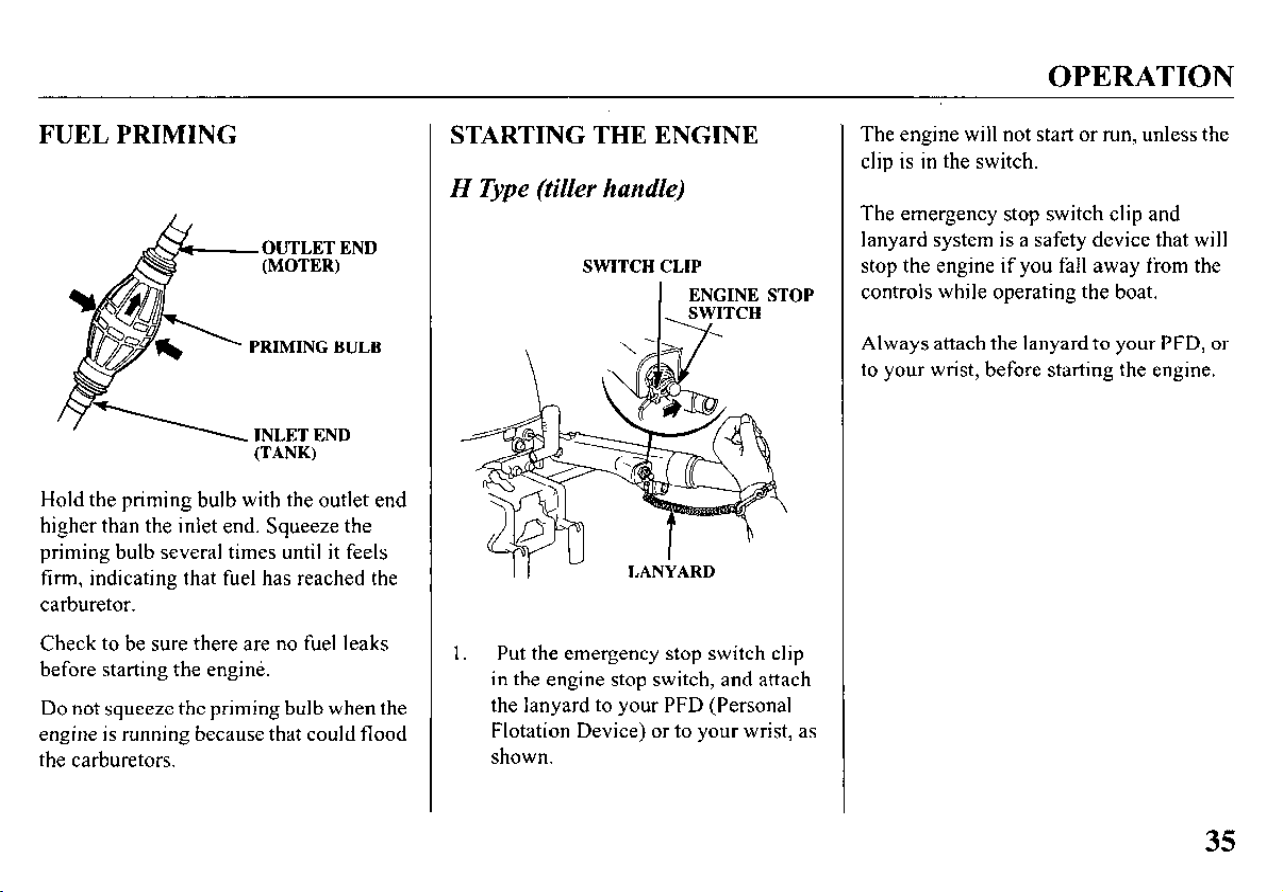
Hold the priming bulb with the outlet end
higher than the inlet end. Squeeze the
priming bulb several times until it feels
firm, indicating that fuel has reached the
carburetor.
Check to be sure there are no fuel leaks
before starting the engine.
Do not squeeze the priming bulb when the
engine is running because that could flood
the carburetors.
STARTING THE ENGINE
H Type (tiller handle)
II -
LANYARD
1. Put the emergency stop switch clip
in the engine stop switch, and attach
the lanyard to your PFD (Personal
Flotation Device) or to your wrist, as
shown.
The engine will not start or run, unless the
clip is in the switch.
The emergency stop switch clip and
lanyard system is a safety device that will
stop the engine if you fall away from the
controls while operating the boat.
Always attach the lanyard to your PFD, or
to your wrist, before starting the engine.
35
OPERATION
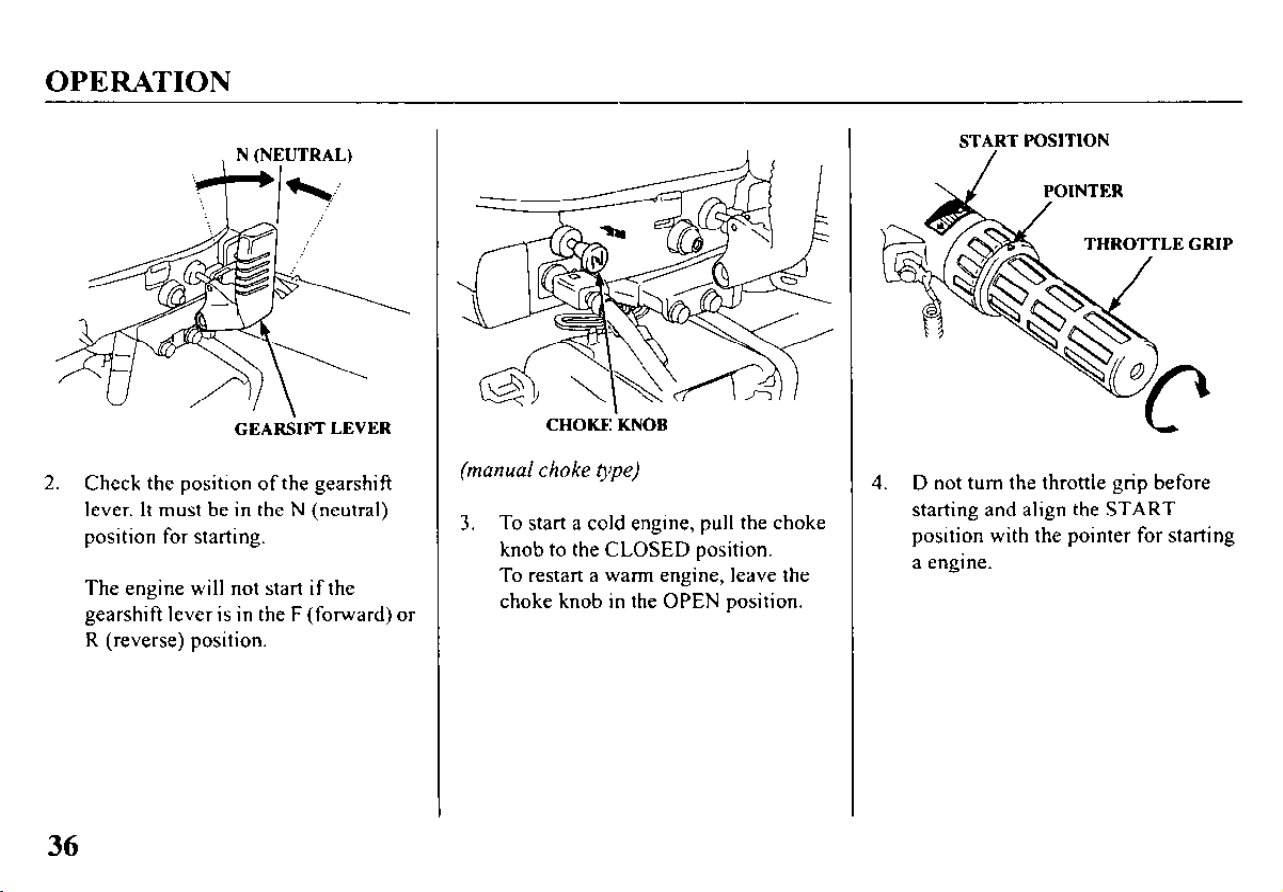
GEAR&T LEVER
2. Cheek the position of the gearshift
lever. It must be in the N (neutral)
position for starting.
The engine will not start if the
gearshift lever is in the F (forward) or
R (reverse) position.
CHOW: KNOB
(manual choke gjpe)
3. To start a cold engine, pull the choke
knob to the CLOSED position.
To restart a warm engine, leave the
choke knob in the OPEN position.
START POSITION
/
4. D not turn the throttle grip before
starting and align the START
position with the pointer for starting
a engine.
36
OPERATION
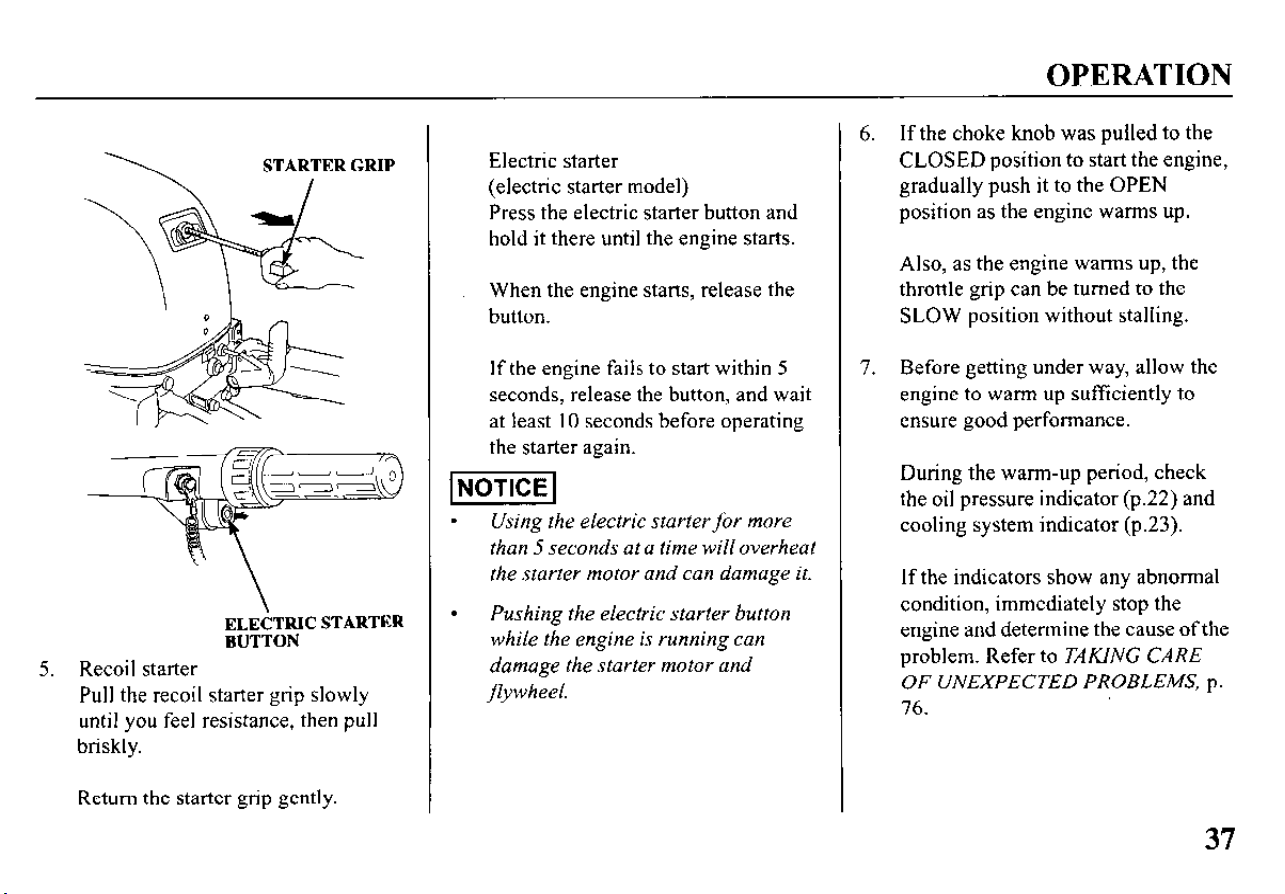
STARTER GRIP
5. Recoil starter
Pull the recoil starter grip slowly
until you feel resistance, then pull
briskly.
Return the starter grip gently.
Electric starter
(electric starter model)
Press the electric starter button and
hold it there until the engine starts.
When the engine starts, release the
button.
If the engine fails to start within 5
seconds, release the button, and wait
at least 10 seconds before operating
the starter again.
Using the electric starter for more
than 5 seconds at a time will overheat
the starter motor and can damage it.
Pushing the electric starter button
while the engine is running can
damage the starter motor and
flywheel.
If the choke knob was pulled to the
CLOSED position to start the engine,
gradually push it to the OPEN
position as the engine warms up.
Also, as the engine warms up, the
throttle grip can be turned to the
SLOW position without stalling.
Before getting under way, allow the
engine to warm up sufficiently to
ensure good performance.
During the warm-up period, check
the oil pressure indicator (p.22) and
cooling system indicator (p.23).
If the indicators show any abnormal
condition, immediately stop the
engine and determine the cause of the
problem. Refer to TAKING CARE
OF UNEXPECTED PROBLEMS, p.
76.
37
OPERATION
R Type
(remote control)
For panel-mount or top-mount remote
control information, refer to the
instructions provided with the remote
control equipment.
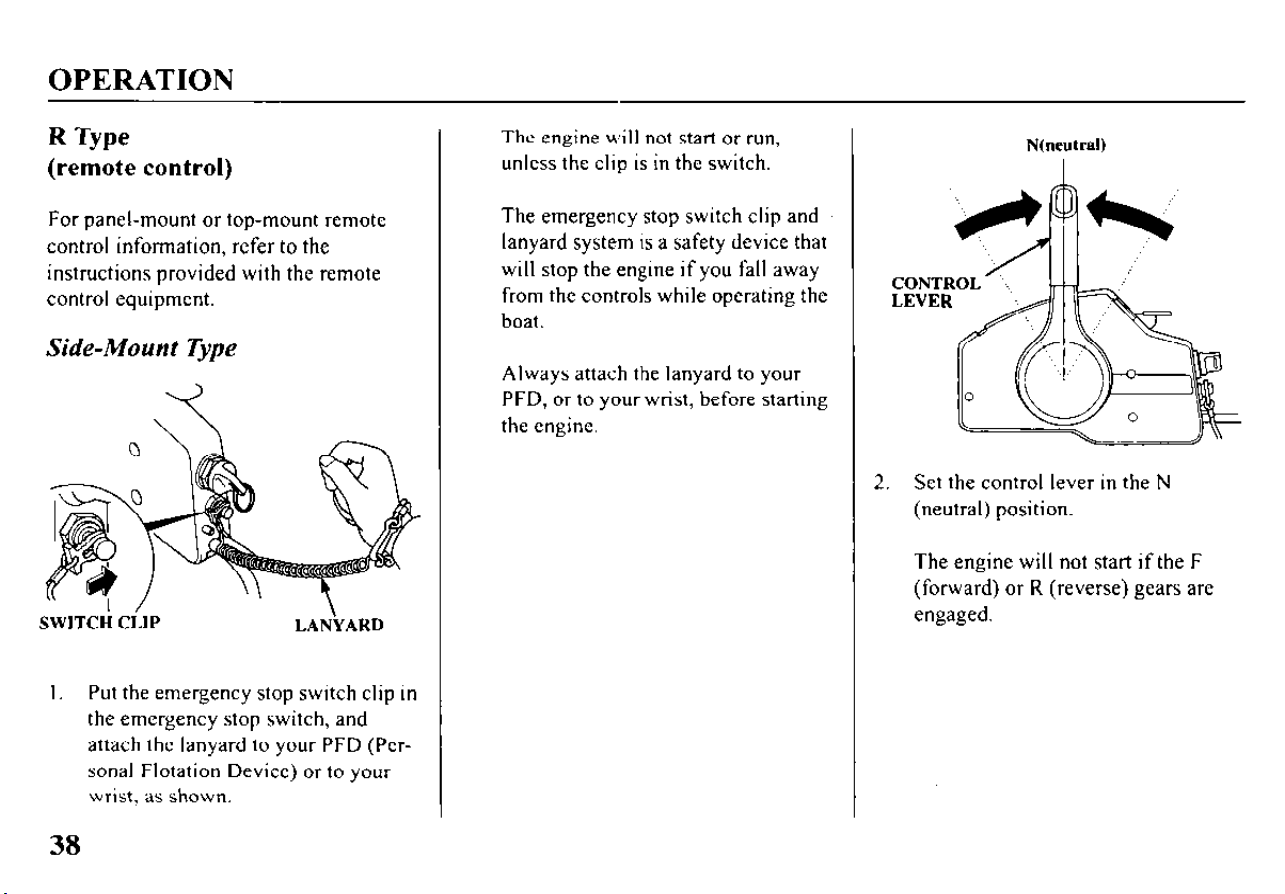
Side-Mom t Type
SWlTCti CilP
LAN; ARD
I. Put the emergency stop switch clip in
the emergency stop switch, and
attach the lanyard to your PFD (Pcr-
sonal Flotation Device) or to your
wrist, as shown.
38
The
engine will not start or run,
unless the clip is in the switch.
The emergency stop switch clip and
lanyard system is a safety device that
will stop the engine if you fall away
from the controls while operating the
boat.
Always attach the lanyard to your
PFD, or to your wrist, before starting
the engine.
N(neutral)
2. Set the control lever in the N
(neutral) position.
The engine will not start if the F
(forward) or R (reverse) gears arc
engaged.
OPERATION
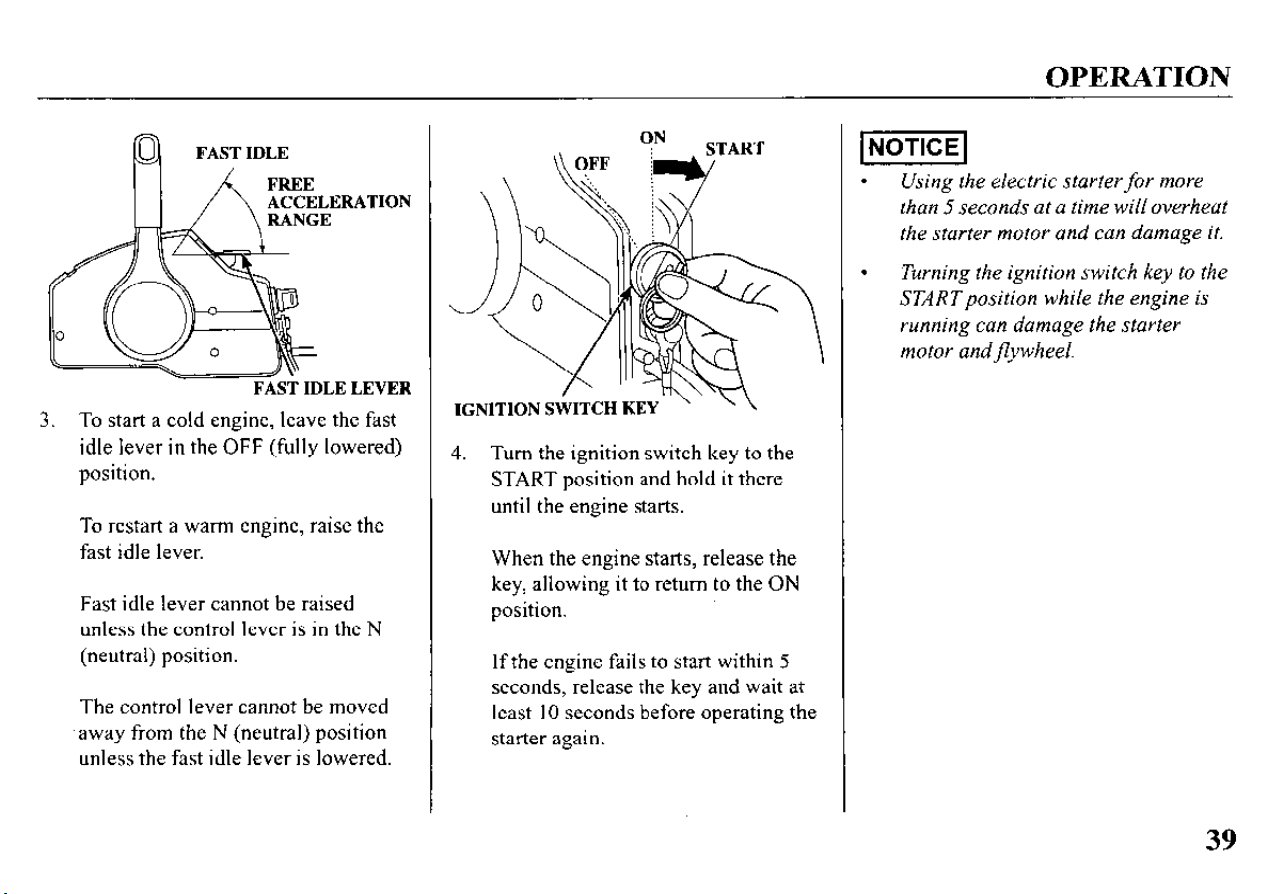
FAST IDLE
/
ACCELERATION
FAST IDLE LEVER
3. To start a cold engine, leave the fast
idle lever in the OFF (fully lowered)
position.
To restart a warm engine, raise the
fast idle lever.
Fast idle lever cannot be raised
unless the control lever is in the N
(neutral) position.
The control lever cannot be moved
away from the N (neutral) position
unless the fast idle lever is lowered.
4.
Turn the ignition switch key to the
START position and hold it there
until the engine starts.
When the engine starts, release the
key, allowing it to return to the ON
position.
If the engine fails to start within 5
seconds, release the key and wait at
least 10 seconds before operating the
starter again.
I
L
4
.
Using the electric starter for more
than 5 seconds at a time will overheat
the starter motor and can damage it.
.
Turning the ignition switch key to the
STARTposition while the engine is
running can damage the starter
motor andflywheel.
39
OPERATION
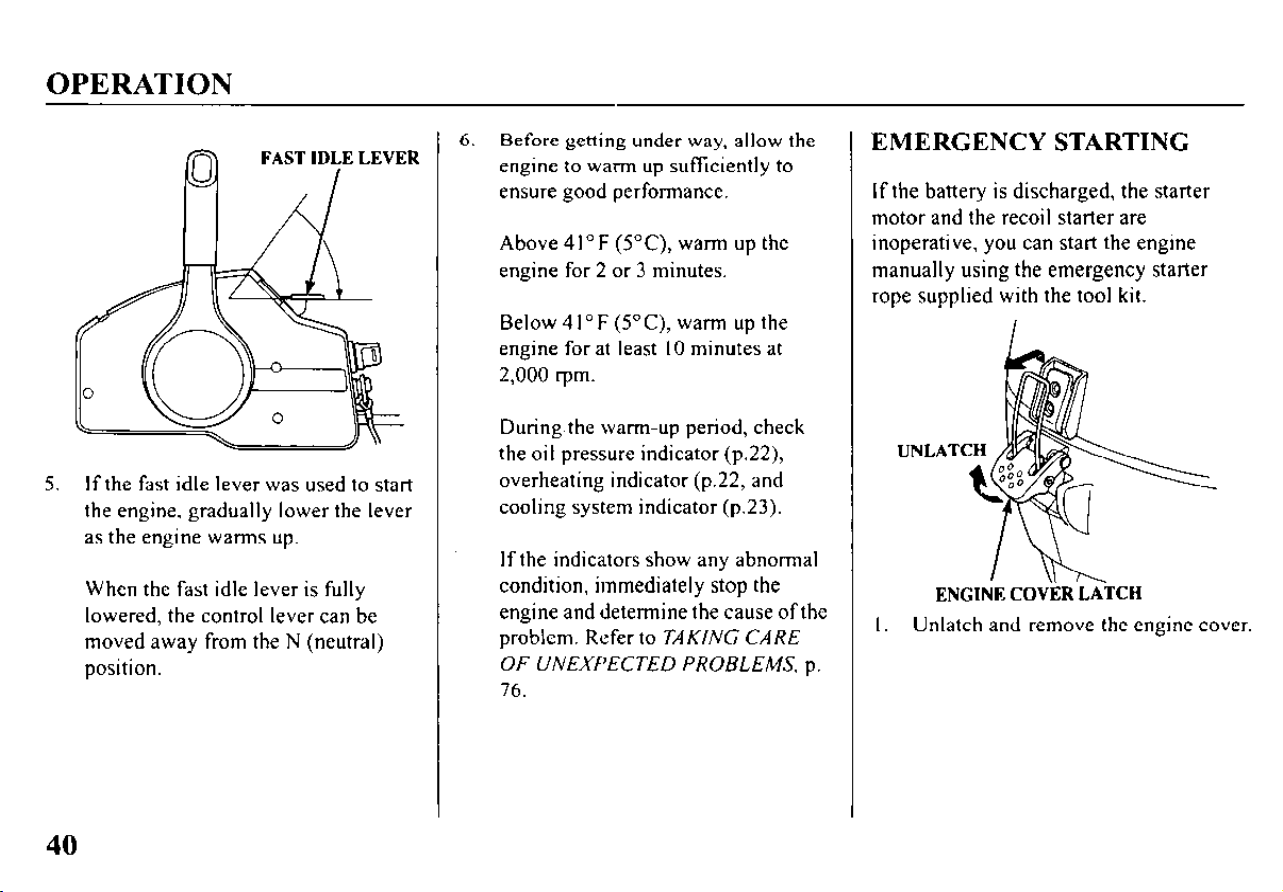
5. If the fast idle lever was used to start
the engine. gradually lower the lever
as the engine warms up.
When the fast idle lever is fully
lowered, the control lever can be
moved away from the N (neutral)
position.
6. Before getting under way, allow the
engine to warm up sufficiently to
ensure good performance.
Above 4 I o F (S’C), warm up the
engine for 2 or 3 minutes.
Below 4 I ’ F (S’C), warm up the
engine for at least IO minutes at
2,000 t-pm.
During the warm-up period, check
the oil pressure indicator (p.22),
overheating indicator (p.22, and
cooling system indicator (p.23).
If the indicators show any abnormal
condition, immediately stop the
engine and determine the cause ofthc
problem. Refer to TAKING CARE
OF UNEXPECTED PROBLEMS. p.
76.
EMERGENCY STARTING
If the battery is discharged, the starter
motor and the recoil starter are
inoperative, you can start the engine
manually using the emergency starter
rope supplied with the tool kit.
UNLAT
ENGINECOVERLATCH
I. Unlatch and remove the cnginc cover.
OPERATION
NEUTRAL START CABLE
I
‘RECOIL’STARTER
ASSEMBLY
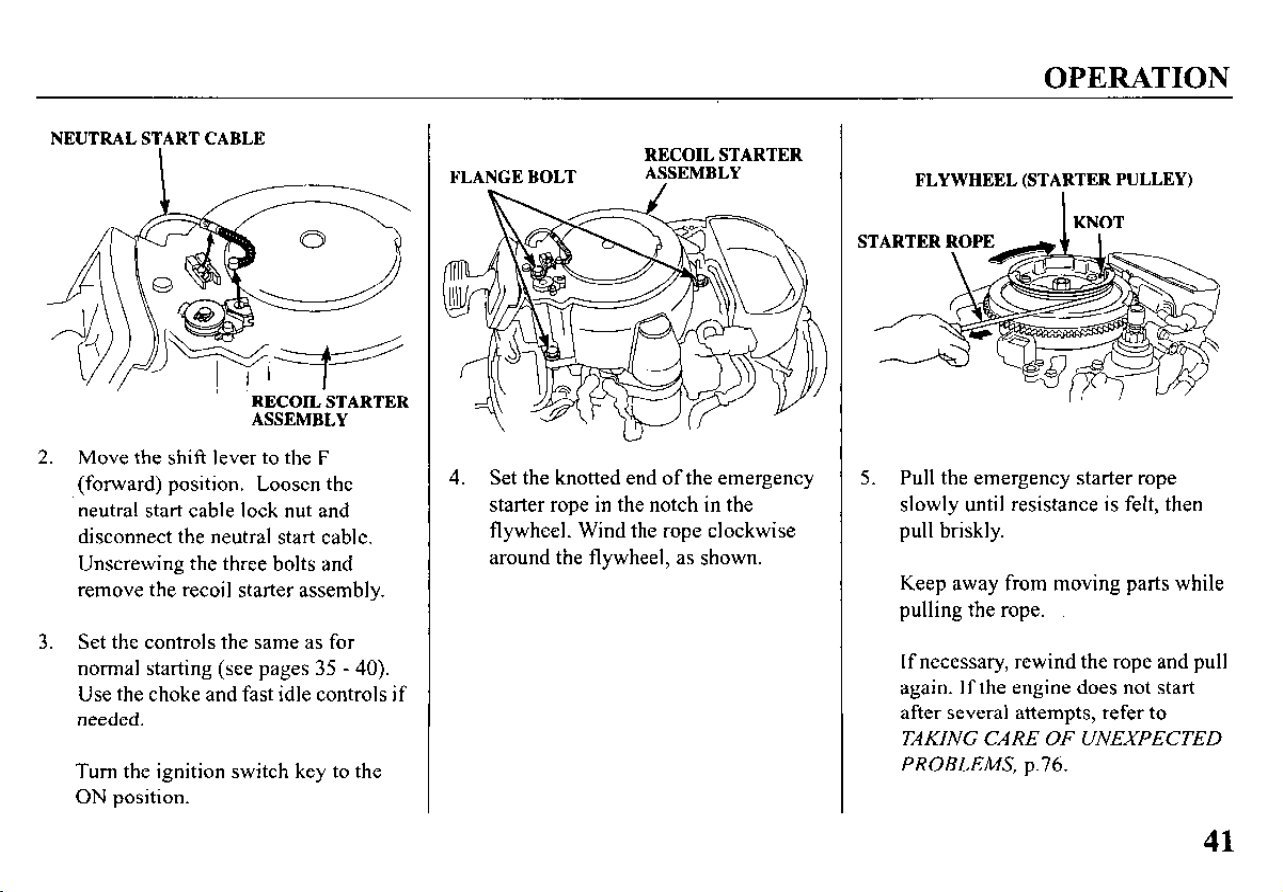
2. Move the shift lever to the F
.(forward) position. Loosen the
neutral start cable lock nut and
disconnect the neutral start cable.
Unscrewing the three bolts and
remove the recoil starter assembly.
3. Set the controls the same as for
normal starting (see pages 35 - 40).
Use the choke and fast idle controls if
needed.
Turn the ignition switch key to the
ON position.
RECOIL STARTER
FLANGE BOLT
ASSEMBLY
I
4. Set the knotted end of the emergency
starter rope in the notch in the
flywheel. Wind the rope clockwise
around the flywheel, as shown.
FLYWHEEL (STARTER PULLEY)
5.
Pull the emergency starter rope
slowly until resistance is felt, then
pull briskly.
Keep away from moving parts while
pulling the rope.
If necessary, rewind the rope and pull
again. If the engine does not start
after several attempts, refer to
TAKING CARE OF UNEXPECTED
PROBLEMS, p.76.
41
OPERATION
6. Ifthc choke and fast idle control(s)
was used to start the engine, rctum
the control(s) to the normal operating
position as the engine warms up.
During the warm-up period, check
the oil pressure indicator (p.22)
overheating indicator (p.22), and
cooling system indicator (p.23).
7. Leave the recoil starter assembly off,
but install the engine cover (p.20)
and lock it in place by latching the
engine cover latch.
Exposed moving parts can cause
injury.
l
Do not operate the outboard motor
without the engine cover
l
Use extreme care when installing
the engine covey.
If
it was necessary to remove the
emergency stop switch lanyard from
your wrist to perform the emergency
starting procedure, be sure the
lanyard is attached to your wrist
before operating the outboard motor.
Have your closest authorized Honda
marine dealer check your electrical
system and correct the problem, so
you can use the electric starter.
The recoil starter assembly (p.4 I)
should be reinstalled after the electric
starter is working again. Install the
recoil stareter assembly with the
engine stopped.
-
STOPPING THE ENGINE
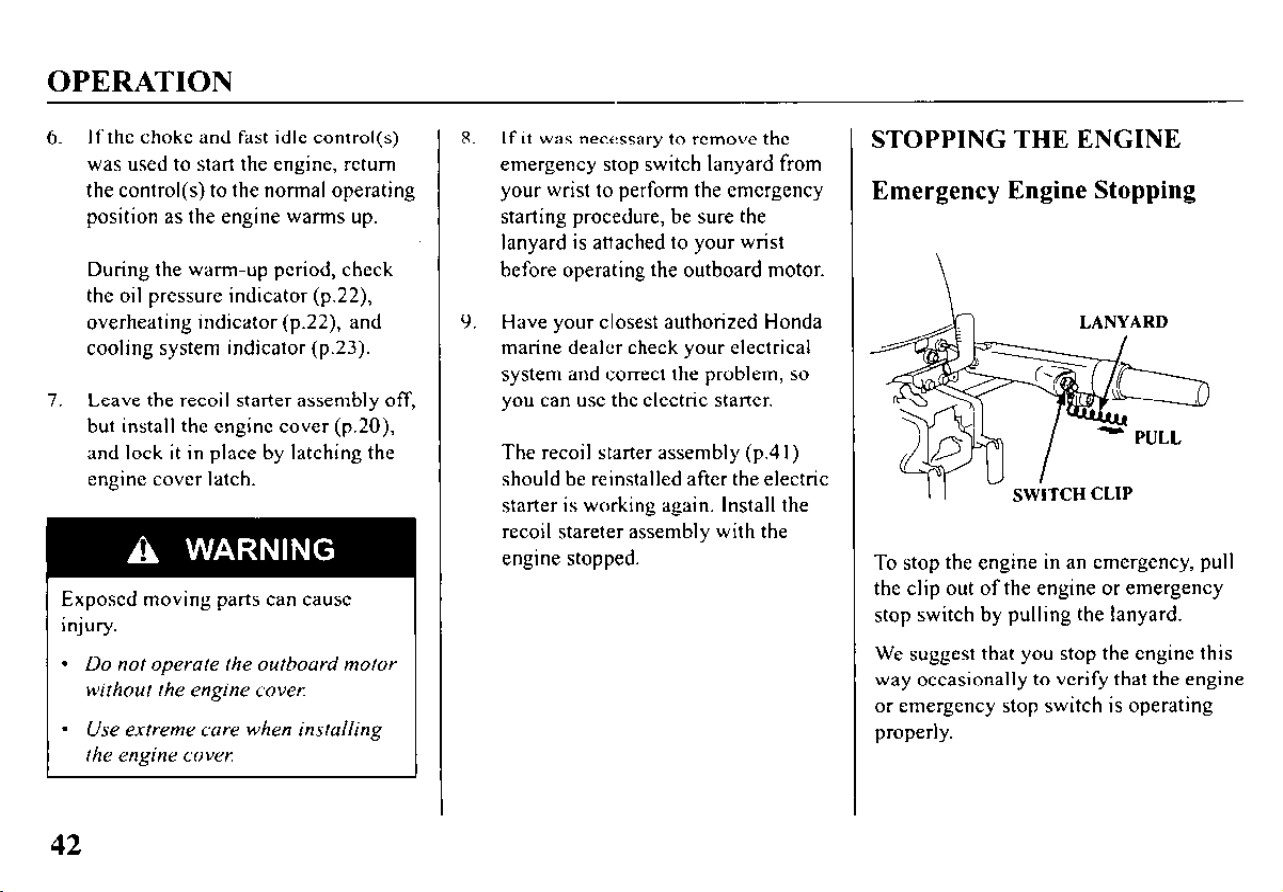
Emergency Engine Stopping
II -
SWiTCH CLIP
To stop the engine in an cmcrgcncy, pull
the clip out of the engine or emergency
stop switch by pulling the lanyard.
We suggest that you stop the engine this
way occasionally to verify that the engine
or emergency stop switch is operating
properly.
42
OPERATION
SWITCH CLIP
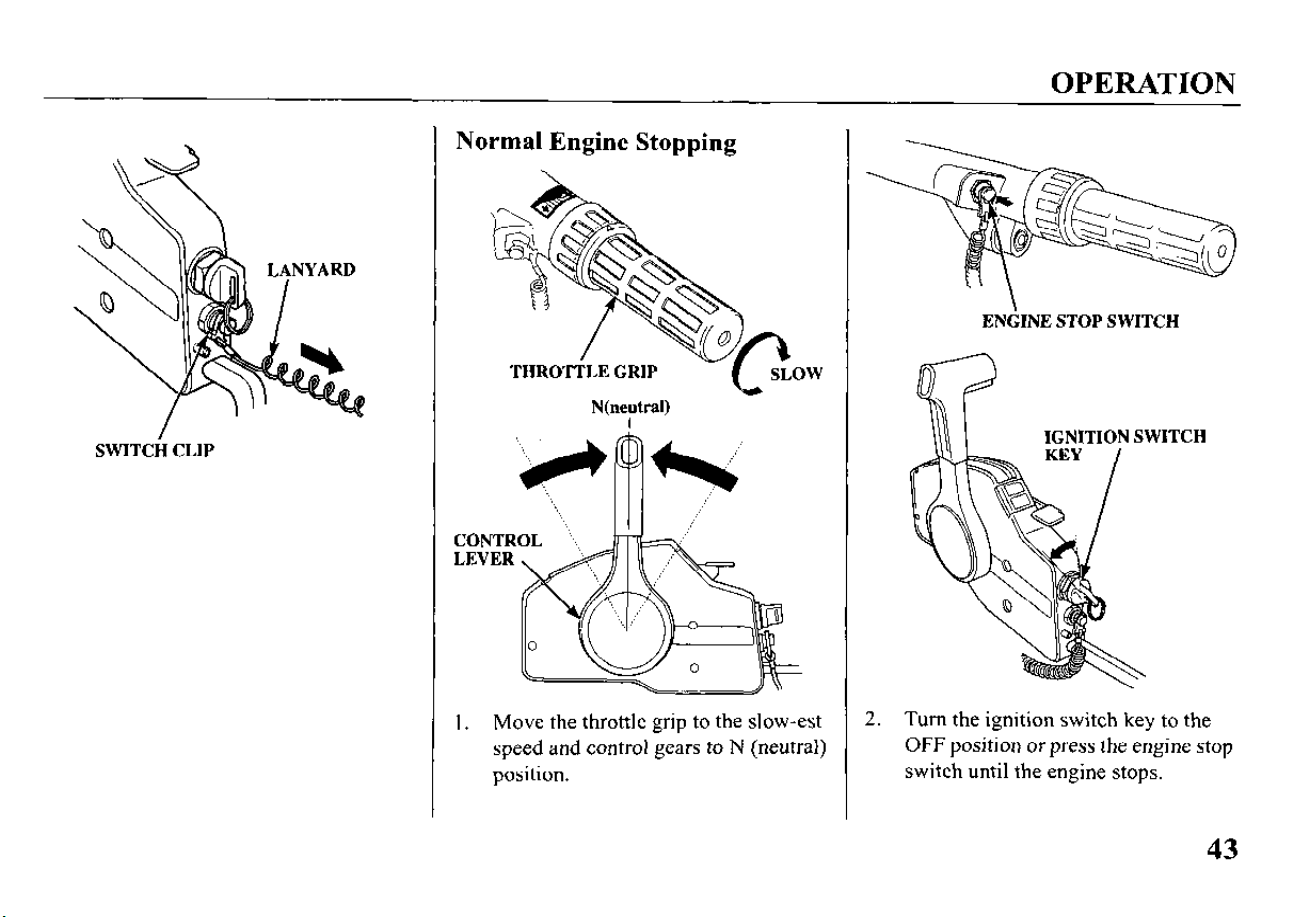
Normal Engine Stopping
THROTTLE GRIP
ow
L
N(neutral)
I.
Move the throttle grip to the slow-est
speed and control gears to N (neutral)
position.
EN&NE STOP SWITCH
IGNITION SWITCH
2.
Turn the ignition switch key to the
OFF position or press the engine stop
switch until the engine stops.
43
OPERATION
3. When the boat is not in USC, remove
and store the ignition key and the
emergency stop switch clip and
lanyard.
GEARSHIF’TING AND
THROTTLE OPERATION
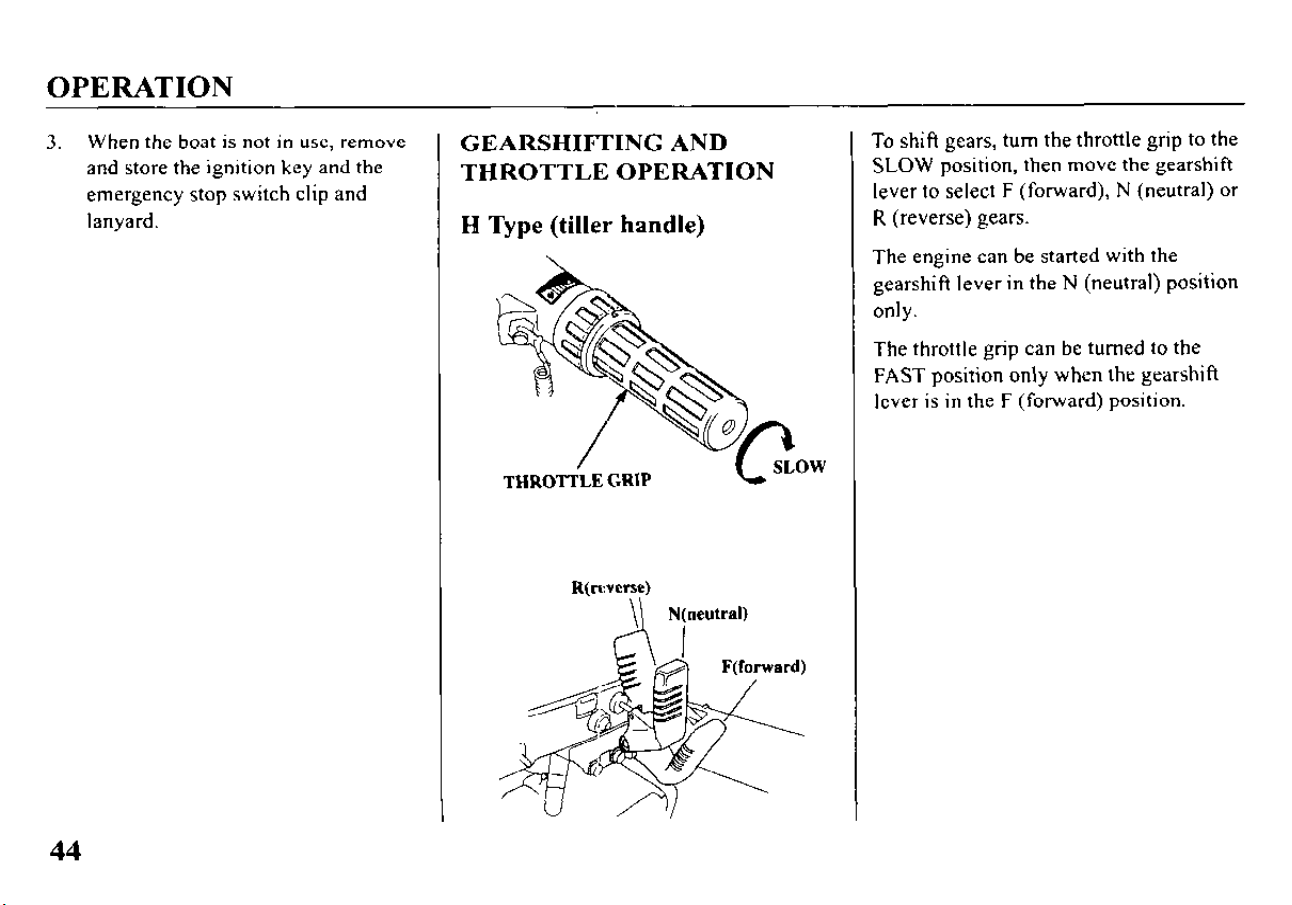
H Type (tiller handle)
R(rwersel
To shift gears, turn the throttle grip to the
SLOW position, then move the gearshift
lever to select F (forward), N (neutral) or
R (reverse) gears.
The engine can be started with the
gearshift lever in the N (neutral) position
only.
The throttle grip can be turned to the
FAST position only when the gearshift
lever is in the F (forward) position.
OPERATION
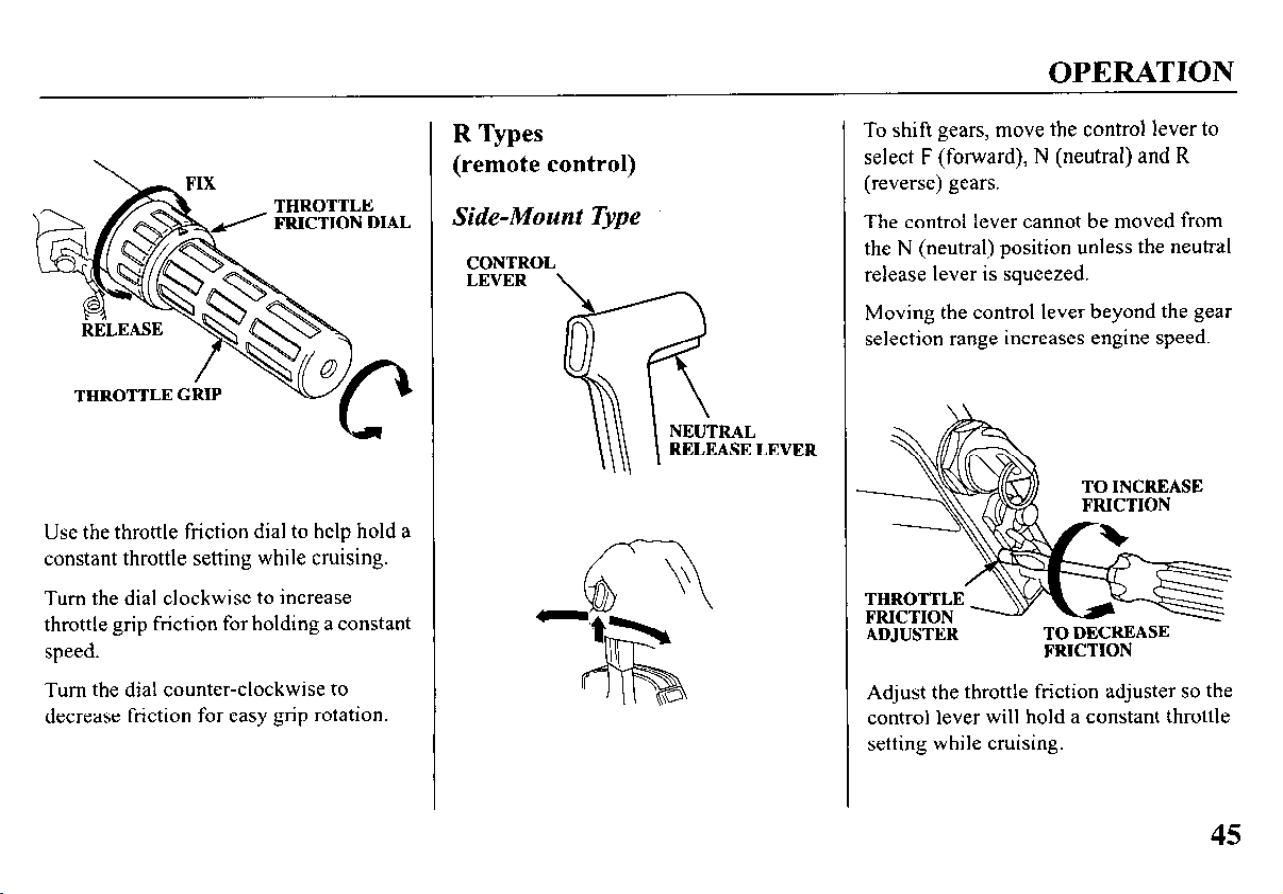
FRICTION DIAL
Use the throttle friction dial to help hold a
constant throttle setting while cruising.
Turn the dial clockwise to increase
throttle grip friction for holding a constant
speed.
Turn the dial counter-clockwise to
decrease friction for easy grip rotation.
R Types
(remote control)
Side-Mount Type
CONTROL
LEVER
RELEASE LEVER
To shift gears, move the control lever to
select F (forward), N (neutral) and R
(reverse) gears.
The control lever cannot be moved from
the N (neutral) position unless the neutral
release lever is squeezed.
Moving the control lever beyond the gear
selection range increases engine speed.
Adjust the throttle friction adjuster so the
control lever will hold a constant throttle
setting while cruising.
45
OPERATION
STEERING
H Type (tiller handle)
fl
.
@
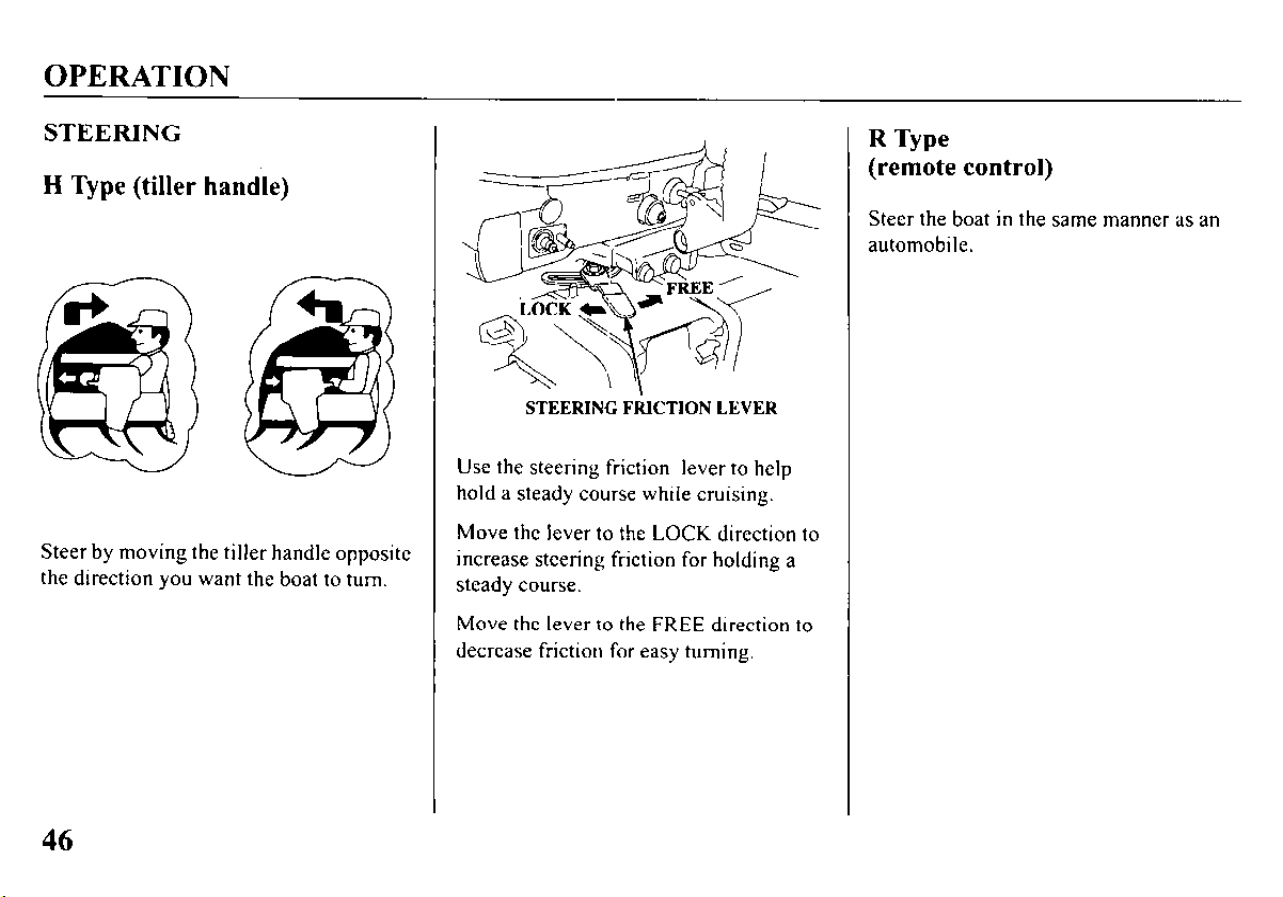
Steer by moving the tiller handle opposite
the direction you want the boat to turn.
STEERING FRICTION LEVER
Use the steering friction lever to help
hold a steady course while cruising.
Move the lever to the LOCK direction to
increase steering friction for holding a
steady course.
Move the lever to the FREE direction to
decrease friction for easy turning.
R Type
(remote control)
Steer the boat in the same manner as an
automobile.
46
OPERATION
CRUISING
Engine Speed
For best fuel economy, limit the throttle
opening to 80%. Use the throttle friction
control (p.45) to help you hold a steady
speed.
For rough water conditions or large
waves, slow down to prevent the
propeller from rising out of the water.
The engine is equipped with an overrev
limiter to prevent the possibility of
mechanical damage from excessive
engine speed.
If, for example, the outboard motor is
tilted excessively, or ventilation occurs
during a sharp turn, the engine may
overrev, activating the overrev limiter.
If engine speed becomes unstable at high
speed due to activation of the overrev
limiter, reduce speed and check the trim
angle of the outboard motor.
Trim
Install the outboard motor at the best trim
angle for stable cruising and maximum
power.
Trim angle too large: Incorrect causes
boat to “spuat”.
Trim angle too small: Incorrect causes
boat to “plow”.
It is necessary to trim the angle of the
outboard motor to compensate for
changes in boat load, weight distribution,
water conditions, or propeller selection.
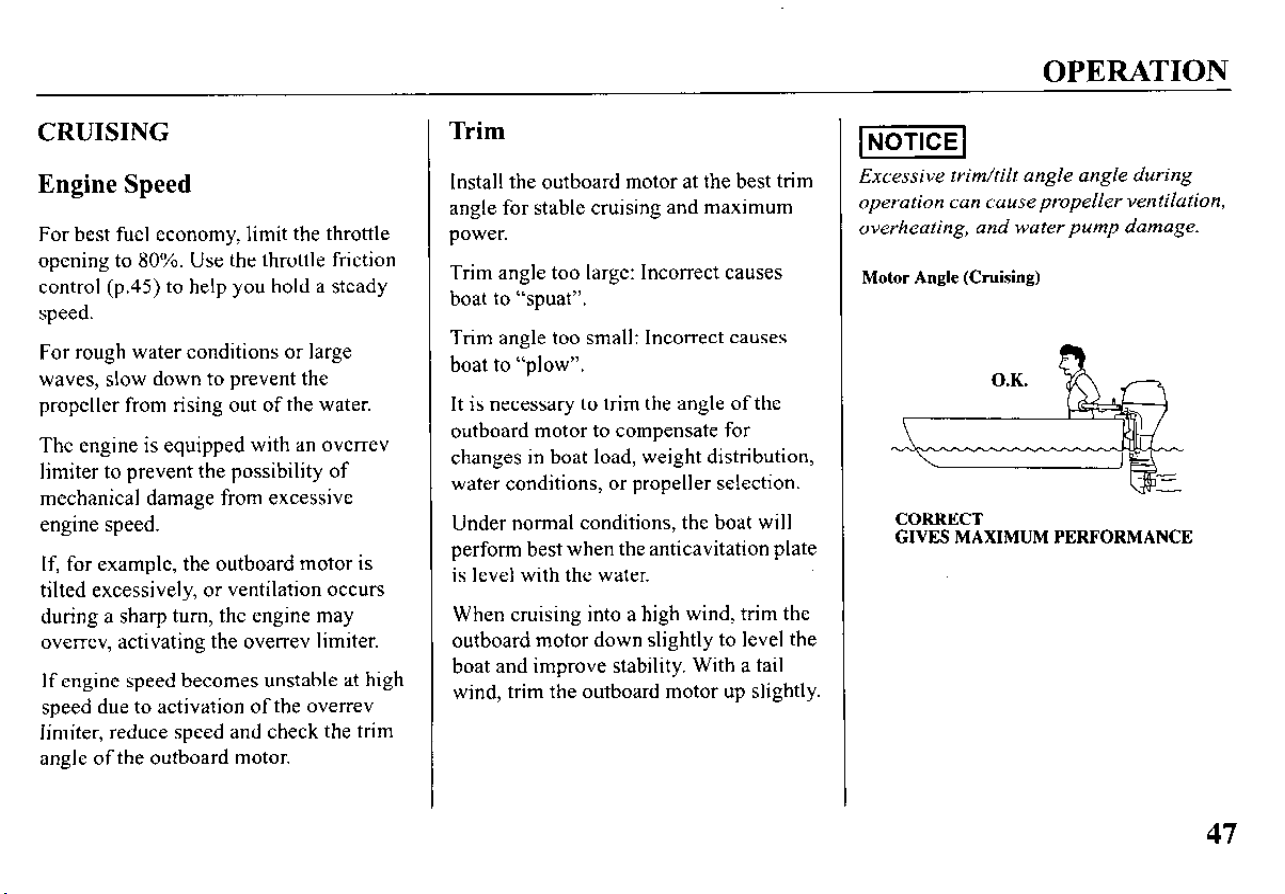
Under normal conditions, the boat will
perform best when the anticavitation plate
is level with the water.
When cruising into a high wind, trim the
outboard motor down slightly to level the
boat and improve stability. With a tail
wind, trim the outboard motor up slightly.
Excessive trim/tilt angle angle during
operation can cause propeller ventilation,
overheating, and water pump damage.
Motor Angle (Cruising)
CORRECT
GIVES MAXIMUM PERFORMANCE
47
OPERATION
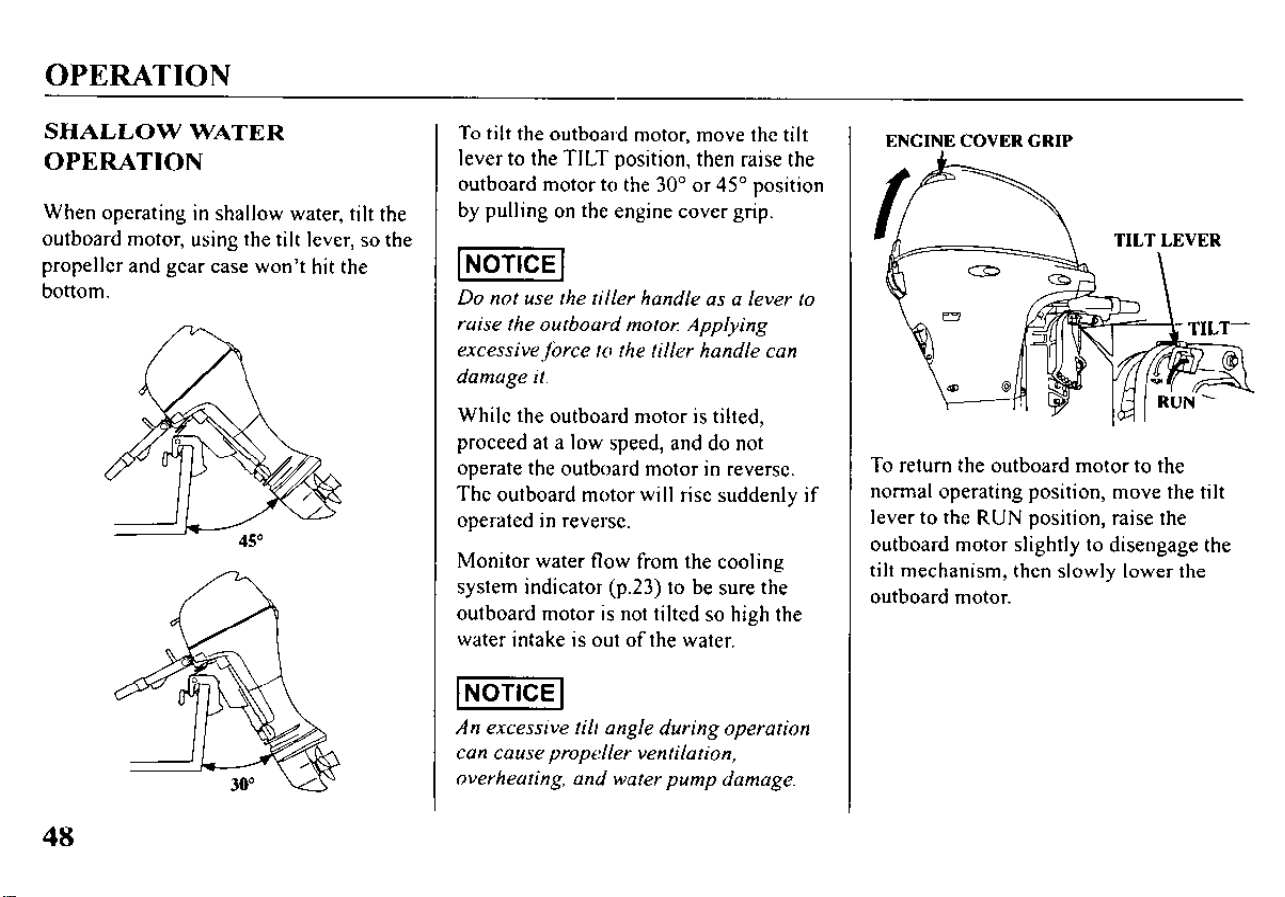
SHALLOW WATER
OPERATION
When operating in shallow water, tilt the
outboard motor, using the tilt lever, so the
propeller and gear case won’t hit the
bottom.
To tilt the outboard motor, move the tilt
lever to the TILT position, then raise the
outboard motor to the 30” or 45” position
by pulling on the engine cover grip.
Do not use the tiller handle as a lever to
raise the outboard mote,: Applying
excessive force to the tiller handle can
damage it.
While the outboard motor is tilted,
proceed at a low speed, and do not
operate the outboard motor in reverse.
The outboard motor will rise suddenly if
operated in reverse.
Monitor water flow from the cooling
system indicator (p.23) to be sure the
outboard motor is not tilted so high the
water intake is out of the water.
An excessive tilt angle during operation
can cause propeller ventilation,
overheating, and water pump damage.
ENGINE COVER GRIP
To return the outboard motor to the
normal operating position, move the tilt
lever to the RUN position, raise the
outboard motor slightly to disengage the
tilt mechanism, then slowly lower the
outboard motor.
OPERATION
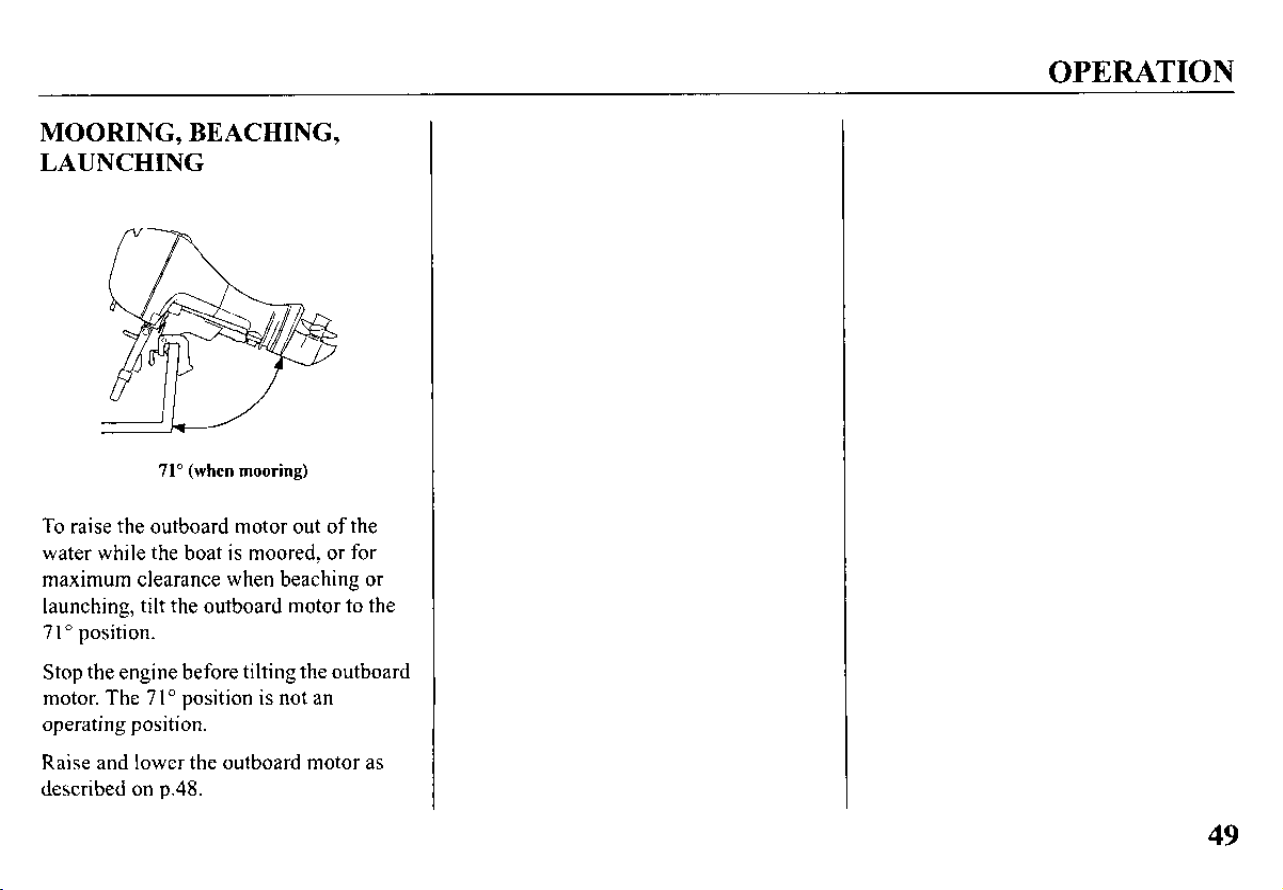
MOORING, BEACHING,
LAUNCHING
71” (when mooring)
To raise the outboard motor out of the
water while the boat is moored, or for
maximum clearance when beaching or
launching, tilt the outboard motor to the
7 I o position.
Stop the engine before tilting the outboard
motor. The 7 lo position is not an
operating position.
Raise and lower the outboard motor as
described on p.48.
49
SERVICING YOUR HONDA OUTBOARD MOTOR
THE
IMPORTANCE OF
MAINTENANCE
Good
maintenance is essential for safe,
economical, and trouble-free operation. It
will also help reduce air pollution.
Improperly maintaining this outboard
motor, or failure to correct a problem
before operation, can cause a
malfunction in which you could be
seriously hurt or killed.
Always follow the inspection and
maintenance recommendations and
schedules in this owner’s manual.
To help you properly care
for your
outboard motor, the following pages
include a maintenance schedule, routine
inspection procedures, and simple
maintenance procedures using basic hand
tools. Other service tasks that are more
difficult, or require special tools, arc best
handled by professionals and are
normally performed by a Honda
technician or other qualified mechanic.
The maintenance schedule applies to
normal operating conditions. If you
opcratc your outboard motor under
unusual conditions, consult an authorized
Honda marine dealer for
recommendations applicable to your
individual needs and use.
Remember that your authorized Honda
marine dealer knows
your outboard motor
best and is fully equipped to maintain and
repair it.
To ensure the best quality and reliability,
use only new, genuine Honda parts or
their equivalents for repair and
replacement.
Maintenance, replacement, or repair of
the emission control devices and
systems may be performed by any
marine engine repair establishment or
individual, using parts that are
“certified” to EPA standards.
50
SERVICING YOUR HONDA OUTBOARD MOTOR
MAINTENANCE SAFETY
Some of the most important safety
precautions follow. However, we cannot
warn you of every conceivable hazard
that can arise in performing maintenance.
Only you can decide whether or not you
should perform a given task.
Failure to properly follow
maintenance instructions and
precautions can cause you to be
seriously hurt or killed.
Always follow the procedures and
precautions in the owner’s manual.
Safety Precautions
.
Make sure the engine is off before
you begin any maintenance or
repairs. This will eliminate several
potential hazards:
- Carbon monoxide poisoning
from engine exhaust.
Be sure there is adequate
ventilation whenever you operate
the engine.
- Burns from hot parts.
Let the engine and exhaust system
cool before touching.
- Injury from moving parts.
Do not run the engine unless
instructed to do so.
Read the instructions before you
begin, and make sure you have the
tools and skills required.
To reduce the possibility of fire or
explosion, be careful when working
around gasoline. Use only a
nonflammable solvent, not gasoline,
to clean parts. Keep cigarettes,
sparks, and flames away from all
fuel-related parts.
Wear gloves when handling the
propeller to protect your hands from
sharp edges.
51
SERVICING YOUR HONDA OUTBOARD MOTOR
TOOL KIT
AND EMERGENCY
STARTER ROPE
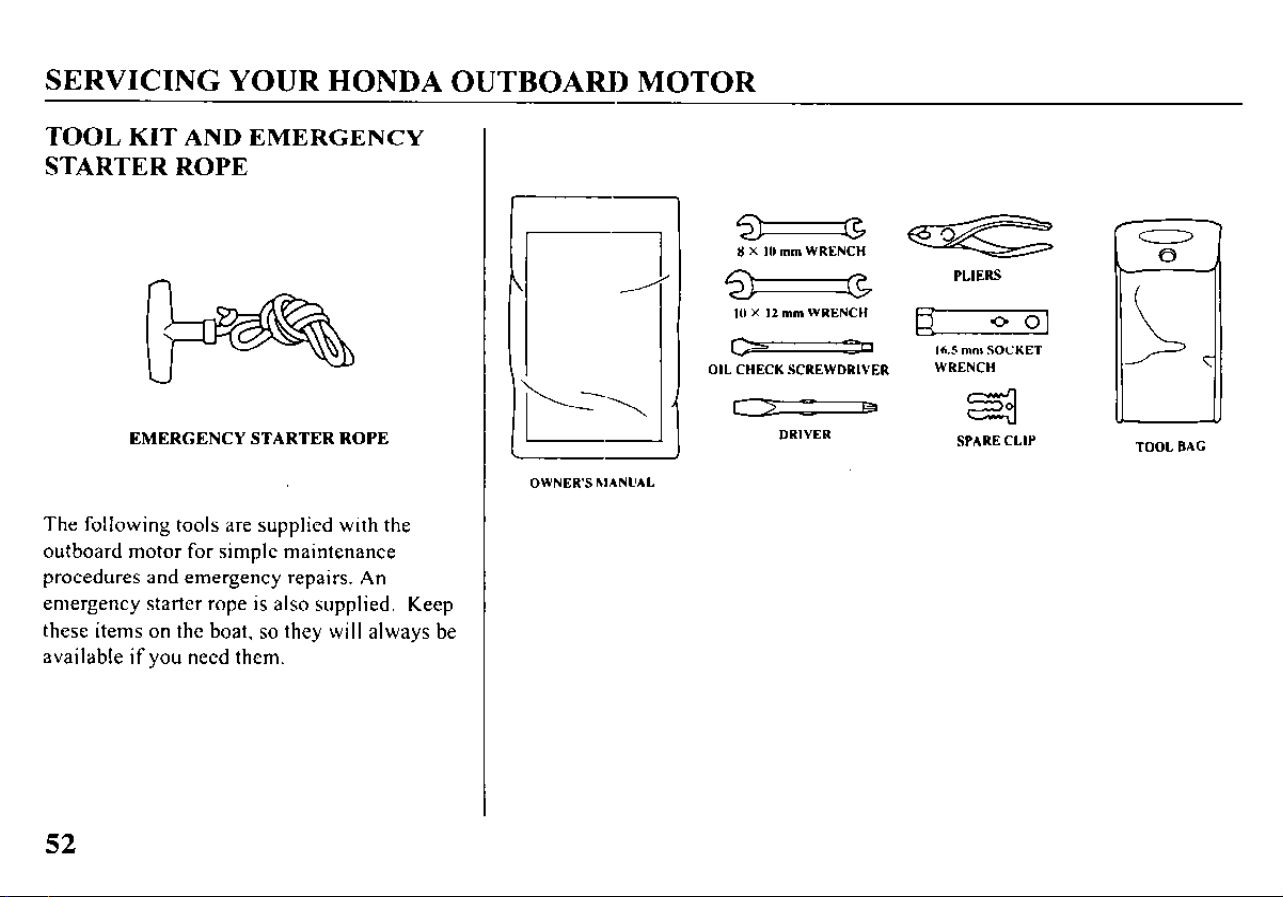
EMERGENCY STARTER ROPE
The following tools are supplied with the
outboard motor for simple maintenance
procedures and emergency repairs. An
emergency starter rope is also supplied. Keep
these items on the boat, so they will always be
available if you need them.
OWNER’S MANUAL
PLIERS
II, X 12 mm WRENCH
16.5 mm SOCKET
OIL CHECK SCREWDRIVER
WRENCH
DRIVER
SPARE CLIY
TOOL BAG
52
SERVICING YOUR HONDA OUTBOARD MOTOR
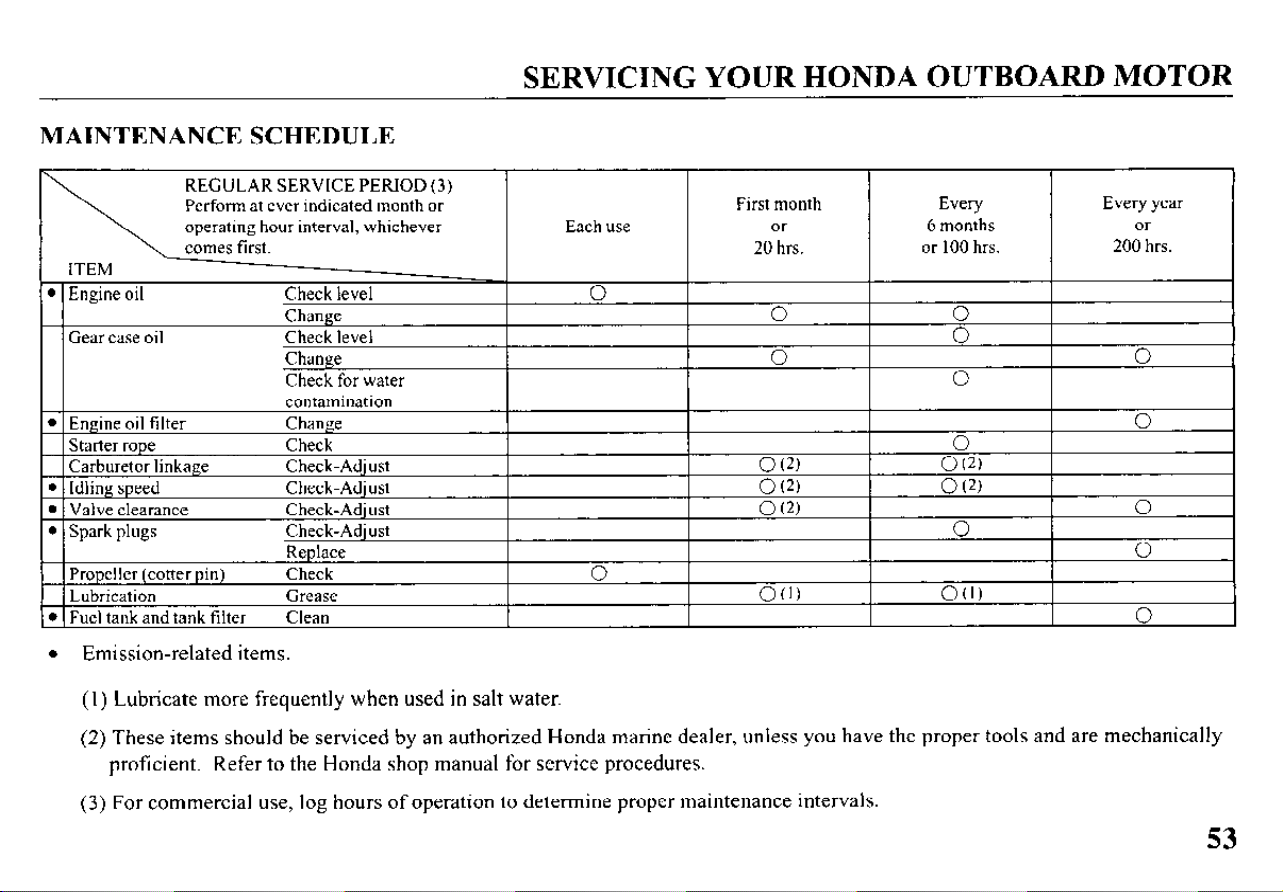
MAINTENANCE SCHEDULE
Change
Gear case oil Check level
Change
Check for water
contamination
l
Engine oil filter Change
Starter rope Check
Carburetor linkage Check-Adjust
l
Idling speed Check-Adjust
l
Valve clearance Check-Adjust
l
Spark plugs
Check-Adjust
Replace
Propeller (cotter pin) Check
Lubrication
Grease
l
Fuel tank and tank filter Clean
l Emission-related items.
Each use
First month
or
20 hrs.
Every
6 months
or 100 hrs.
Every year
Or
200 hrs.
(I) Lubricate more frequently when used in salt water.
(2) These items should be serviced by an authorized Honda marine dealer, unless you have the proper tools and are mechanically
proficient. Refer to the Honda shop manual for service procedures.
(3) For commercial use, log hours of operation to determine proper maintenance intervals.
53
SERVICING YOUR HONDA OUTBOARD MOTOR
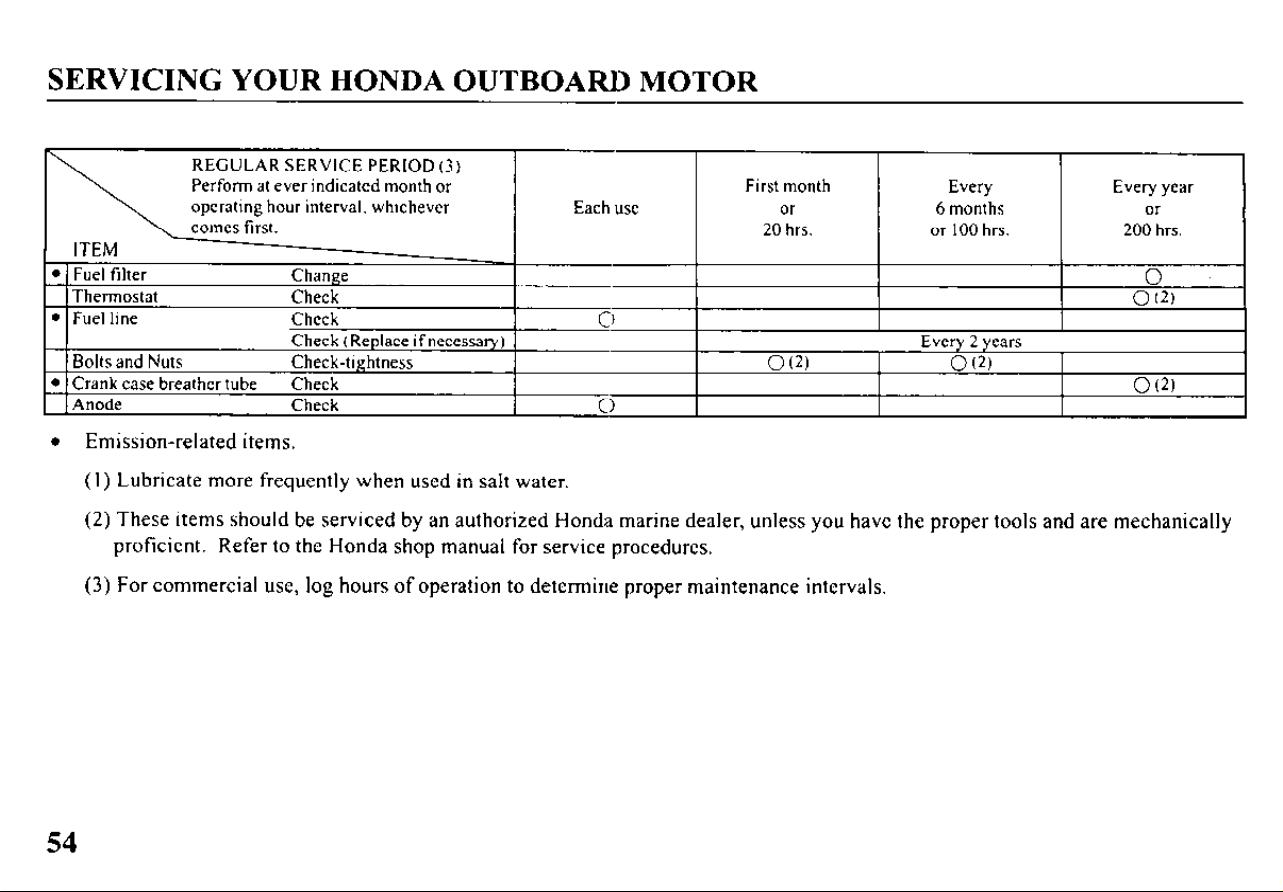
REGULAR SERVICE PERIOD (3)
Perform at ever indicated month or
operating hour interval, whichever
comes first.
ITEM
l
Fuel filter Change
Thermostat Check
l
Fuel line Check
Check (Replace if necessary)
Bolts and Nuts Check-tightness
l
Crank case breather tube Check
Anode
Check
l Emission-related items.
Each USC
0
0
First month
or
20 hrs.
0
(2)
Every
6 months
or 100 hrs.
Every 2 years
0(7-)
Every year
or
200 hrs.
0
0
(2)
0
(2)
(I) Lubricate more frequently when used in salt water.
(2) These items should be serviced by an authorized Honda marine dealer, unless you have the proper tools and are mechanically
proficient. Refer to the Honda shop manual for service procedures.
(3) For commercial use, log hours of operation to determine proper maintenance intervals.
54
SERVICING YOUR HONDA OUTBOARD MOTOR
ENGINE COVER REMOVAL
AND INSTALLATION
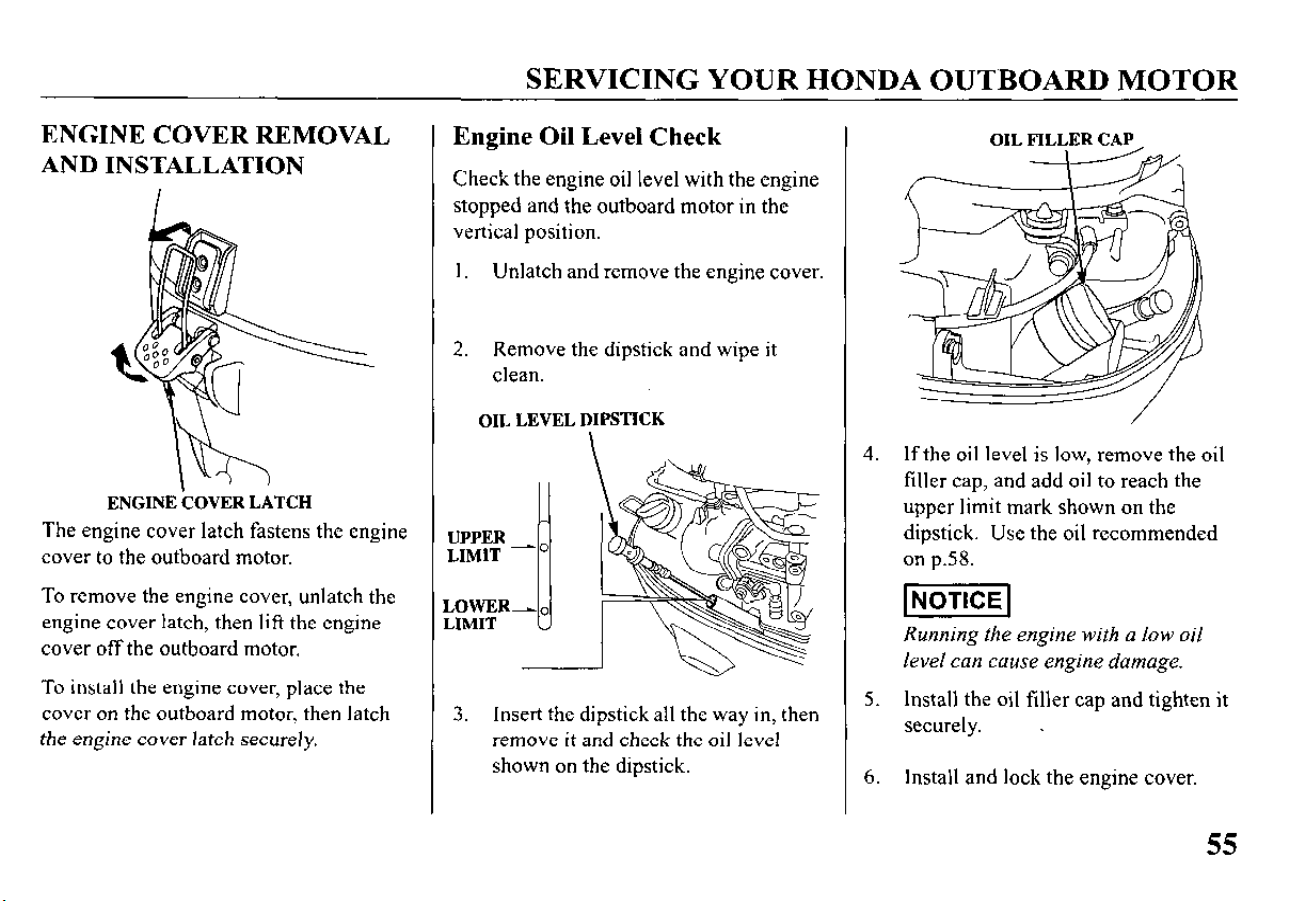
ENGINECOVERLATCH
The engine cover latch fastens the engine
cover to the outboard motor.
To remove the engine cover, unlatch the
engine cover latch, then lift the engine
cover off the outboard motor.
To install the engine cover, place the
cover on the outboard motor, then latch
the engine cover latch securely.
Engine Oil Level Check
Check the engine oil level with the engine
stopped and the outboard motor in the
vertical position.
I. Unlatch and remove the engine cover.
2. Remove the dipstick and wipe it
clean.
OILLEVELDIPSTICK
3. Insert the dipstick all the way in, then
remove it and check the oil level
shown on the dipstick.
OILFILLERCAP
r----LA*
If the oil level is low, remove the oil
tiller cap, and add oil to reach the
upper limit mark shown on the
dipstick. Use the oil recommended
on p.58.
piq
Running the engine with a low oil
level can cause engine damage.
Install the oil filler cap and tighten it
securely. ,
Install and lock the engine cover.
55
SERVICING YOUR HONDA OUTBOARD MOTOR
Engine Oil Change
An engine oil evacuation/filling device
may be used to remove/add the engine oil.
Drain the used oil while the engine is
warm. Warm oil drains quickly and
complctcly.
I. Unlatch and remove the engine cover
(P.55).
2.
3.
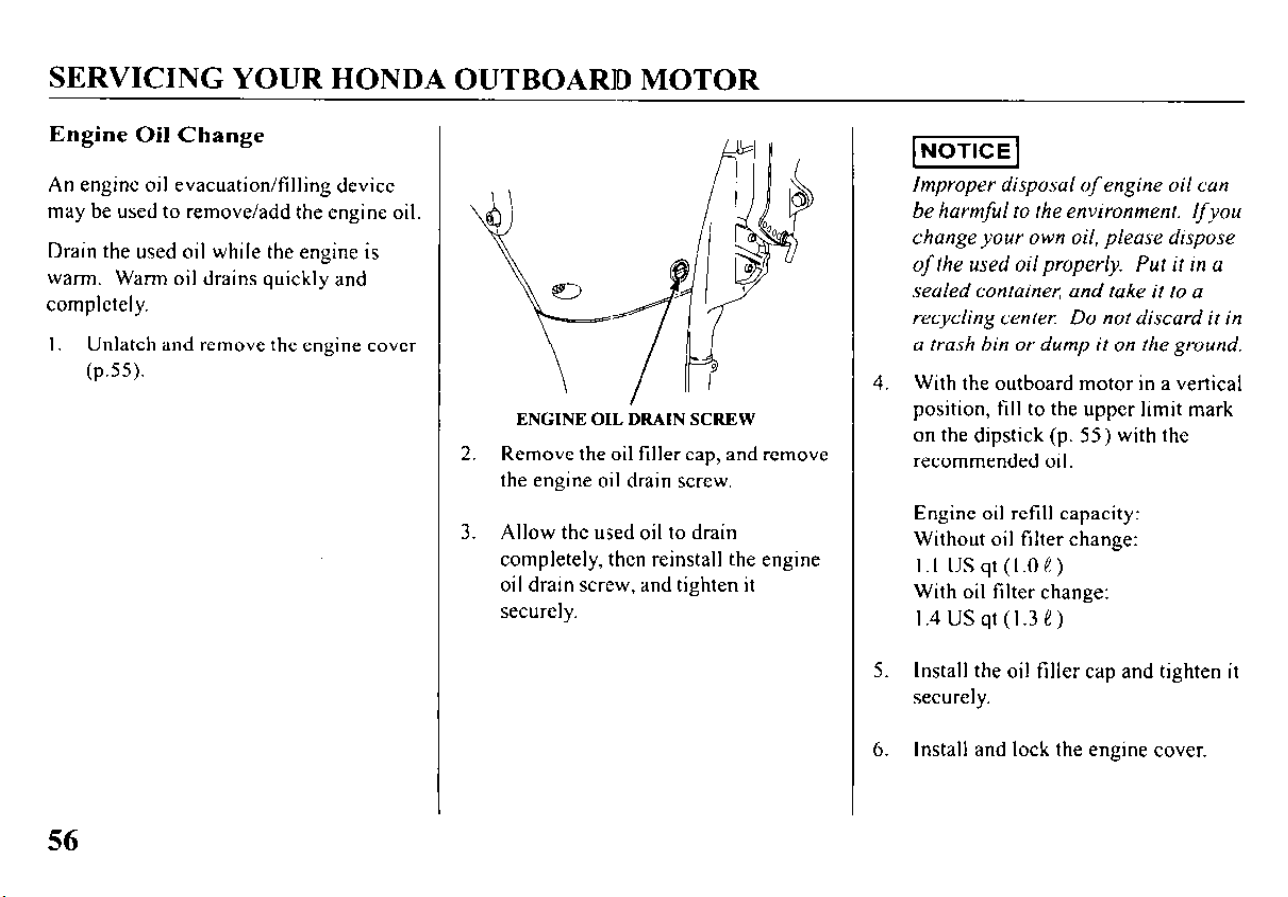
ENGINE OIL DRAIN SCREW
Remove the oil tiller cap, and remove
the engine oil drain screw.
Allow the used oil to drain
completely, then reinstall the engine
oil drain screw, and tighten it
securely.
Improper disposal of engine oil can
be harmful to the environment. lfyou
change your own oil, please dispose
of the used oil properly.
Put it in a
sealed container: and take it to a
recycling center
Do not discurd it in
a trash bin or dump it on the ground.
With the outboard motor in a vertical
position, till to the upper limit mark
on the dipstick (p. 55) with the
recommended oil.
Engine oil refill capacity:
Without oil filter change:
I.1 USqt(l.oe)
With oil filter change:
1.4USqt(l.3e)
Install the oil filler cap and tighten it
securely.
Install and lock the engine cover.
SERVICING YOUR HONDA OUTBOARD MOTOR
Oil Filter Change
1. Drain the engine oil, and reinstall the
drain screw (see Engine Oil Change
on p.56).
2. Unscrew the six bolts and remove the
R. engine under cover.
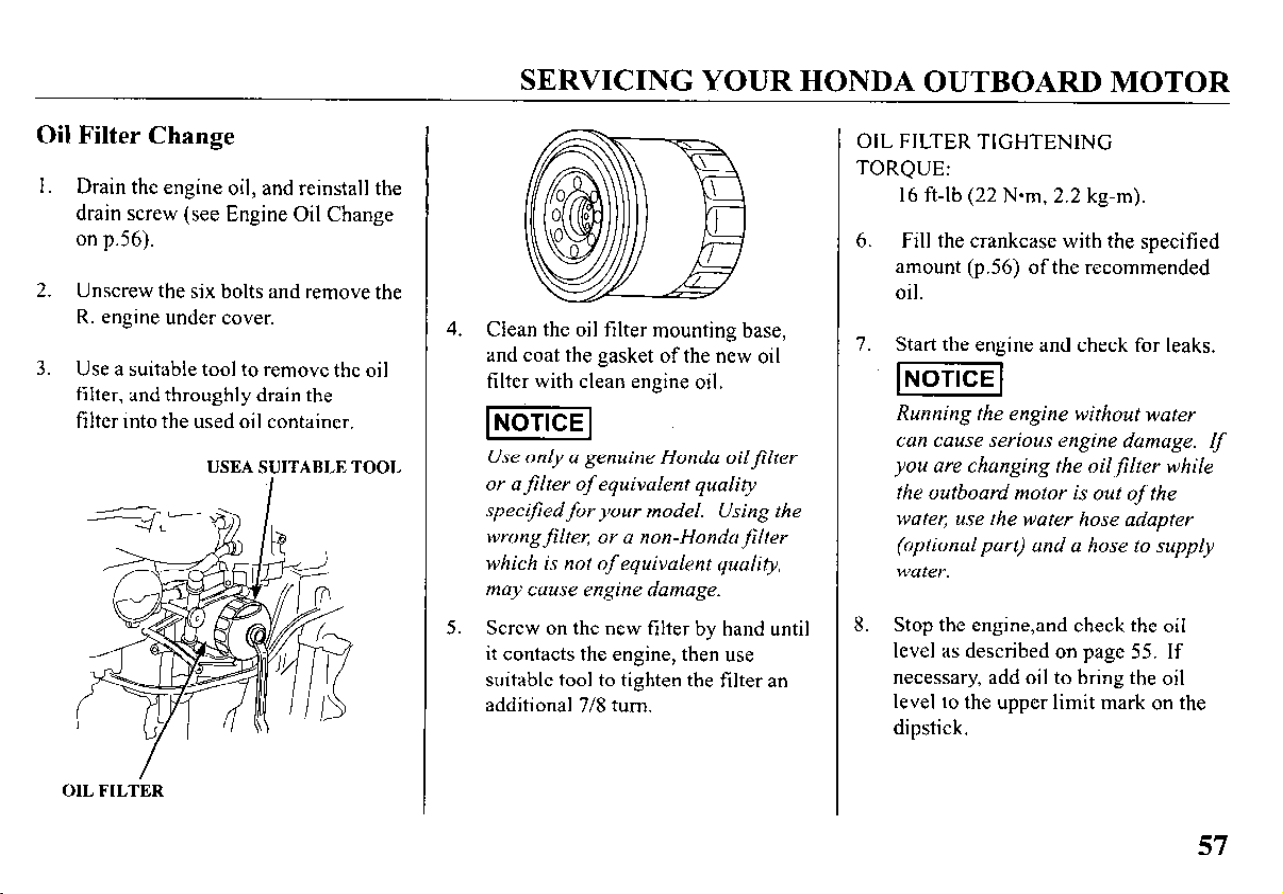
3. Use a suitable tool to remove the oil
filter, and throughly drain the
filter into the used oil container.
USEA SUITABLE TOOL
OIL FILTER
Clean the oil filter mounting base,
and coat the gasket of the new oil
filter with clean engine oil.
Use only a genuine Honda oilfilter
or a filter of equivalent quality
specifiedfor your model. Using the
wrongfilter; or a non-Honda filter
which is not of equivalent quality,
may cause engine damage.
Screw on the new filter by hand until
it contacts the engine, then use
suitable tool to tighten the filter an
additional 7/8 turn.
OIL FILTER TIGHTENING
TORQUE:
6.
7.
8.
I6 ft-lb (22 N-m, 2.2 kg-m).
Fill the crankcase with the specified
amount (p.56) of the recommended
oil.
Start the engine and check for leaks.
piEiq
Running the engine without water
can cause serious engine damage. If
you are changing the oilfilter while
the outboard motor is out of the
water, use the water hose adapter
(optional part) and a hose to supply
water.
Stop the engine,and check the oil
level as described on page 55. If
necessary, add oil to bring the oil
level to the upper limit mark on the
dipstick.
57
SERVICING YOUR HONDA OUTBOAR!D MOTOR
-
Engine Oil Recommendations
Oil is a major factor affecting
performance and service life. Use
4-stroke automotive detergent oil.
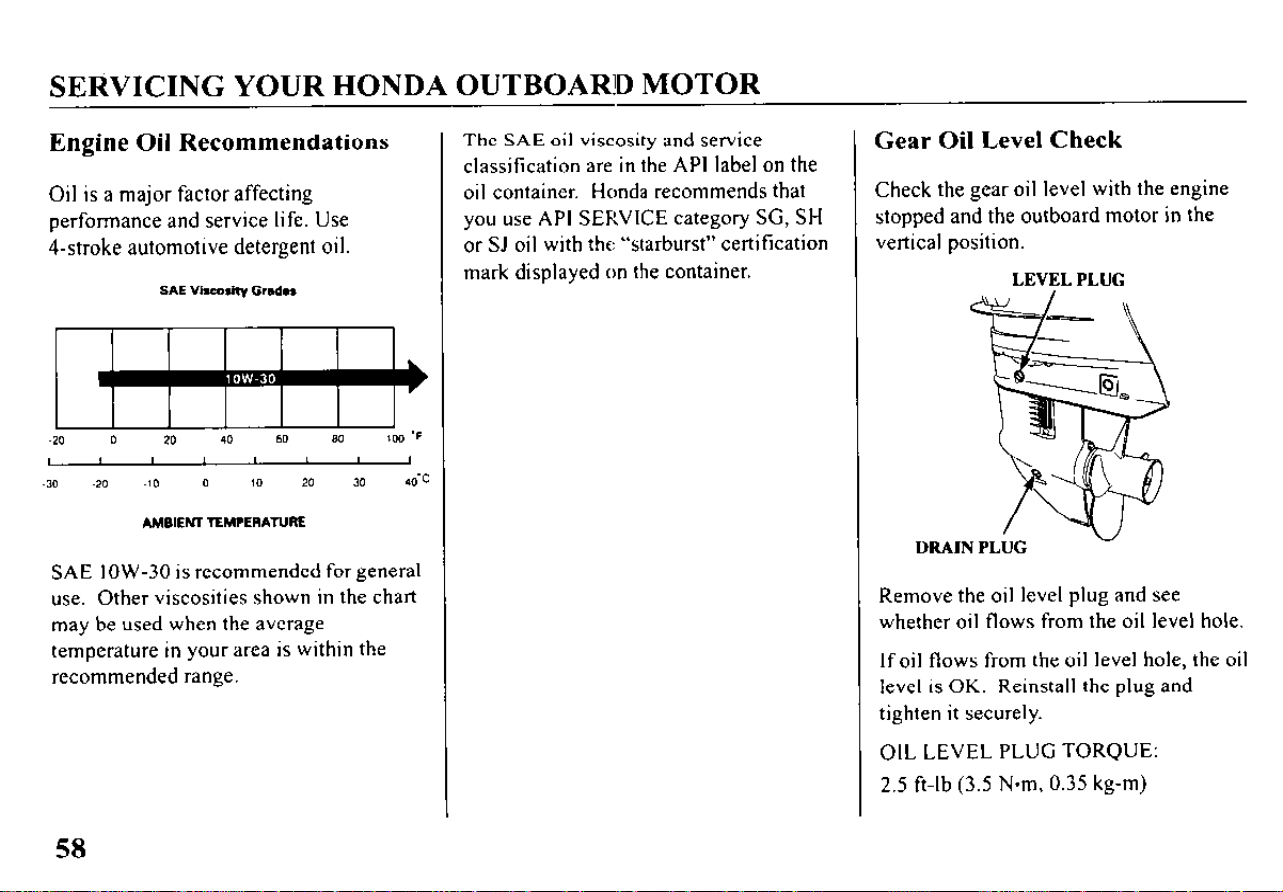
SAE Viscosity Grades
I
I
I I
I I
-20 0 20 40 60 80
100 'F
AMBIENT TEMPERATURE
SAE low-30 is recommended for general
use. Other viscosities shown in the chart
may be used when the average
temperature in your area is within the
recommended range.
The SAE oil viscosity and service
classification are in the API label on the
oil container. Honda recommends that
you use API SERVICE category SC, SH
or SJ oil with the “starburst” certification
mark displayed on the container.
Gear Oil Level Check
Check the gear oil level with the engine
stopped and the outboard motor in the
vertical position.
LEVEL PLUG
Remove the oil level plug and see
whether oil flows from the oil level hole.
If oil flows from the oil level hole, the oil
level is OK. Reinstall the plug and
tighten it securely.
OIL LEVEL PLUG TORQUE:
2.5 ft-lb (3.5 N-m, 0.35 kg-m)
58
SERVICING YOUR HONDA OUTBOARD MOTOR
If no oil flows from the oil level hole, add
the recommended oil following the
procedure described in Gear Oil Change.
Gear Oil Change
Change the gear oil with the engine
stopped and the outboard motor in the
vertical position.
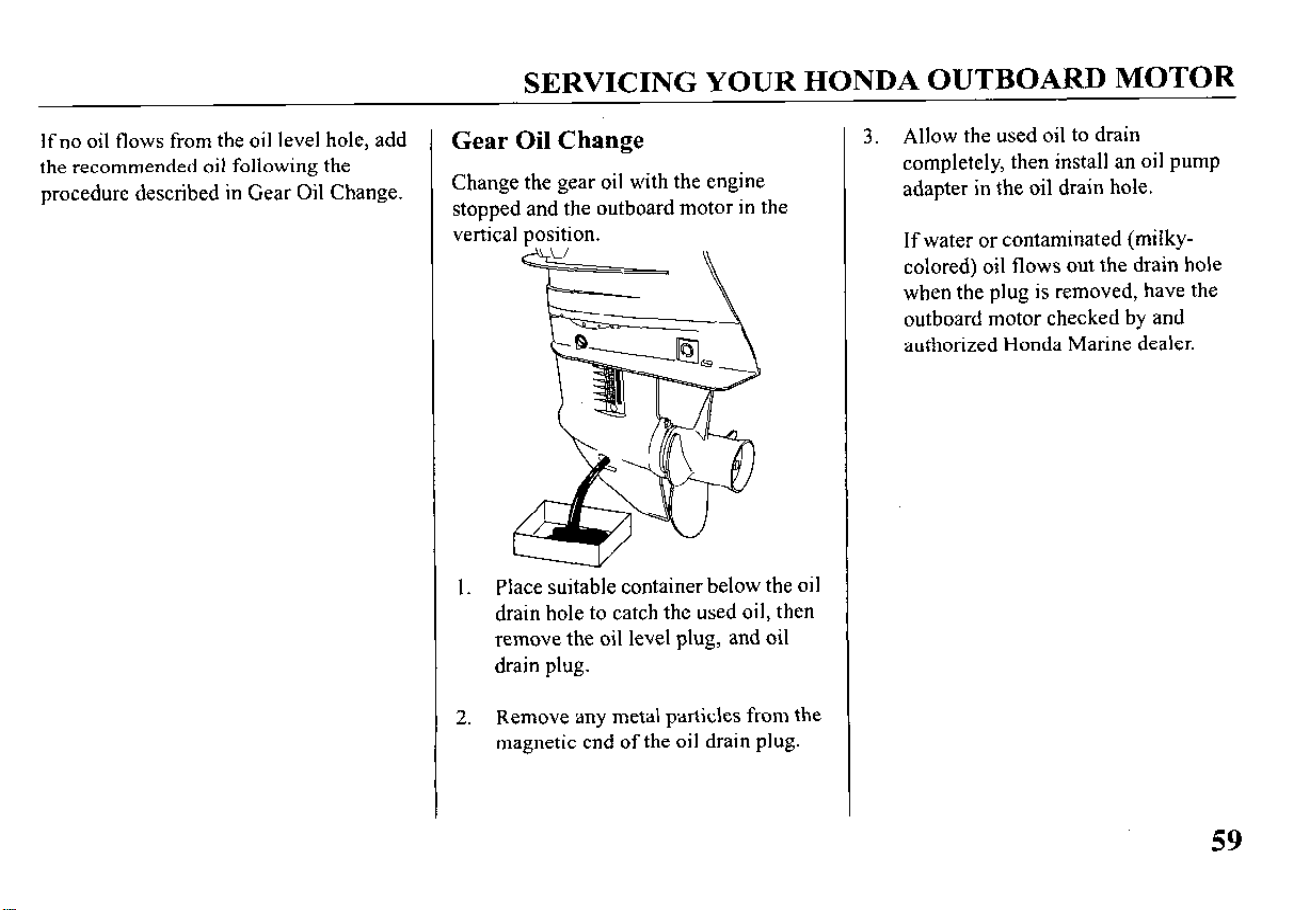
Place suitable container below the oil
drain hole to catch the used oil, then
remove the oil level plug, and oil
drain plug.
Remove any metal particles from the
magnetic end of the oil drain plug.
3. Allow the used oil to drain
completely, then install an oil pump
adapter in the oil drain hole.
If water or contaminated (milky-
colored) oil flows out the drain hole
when the plug is removed, have the
outboard motor checked by and
authorized Honda Marine dealer.
59
SERVICING YOUR HONDA OUTBOARD MOTOR
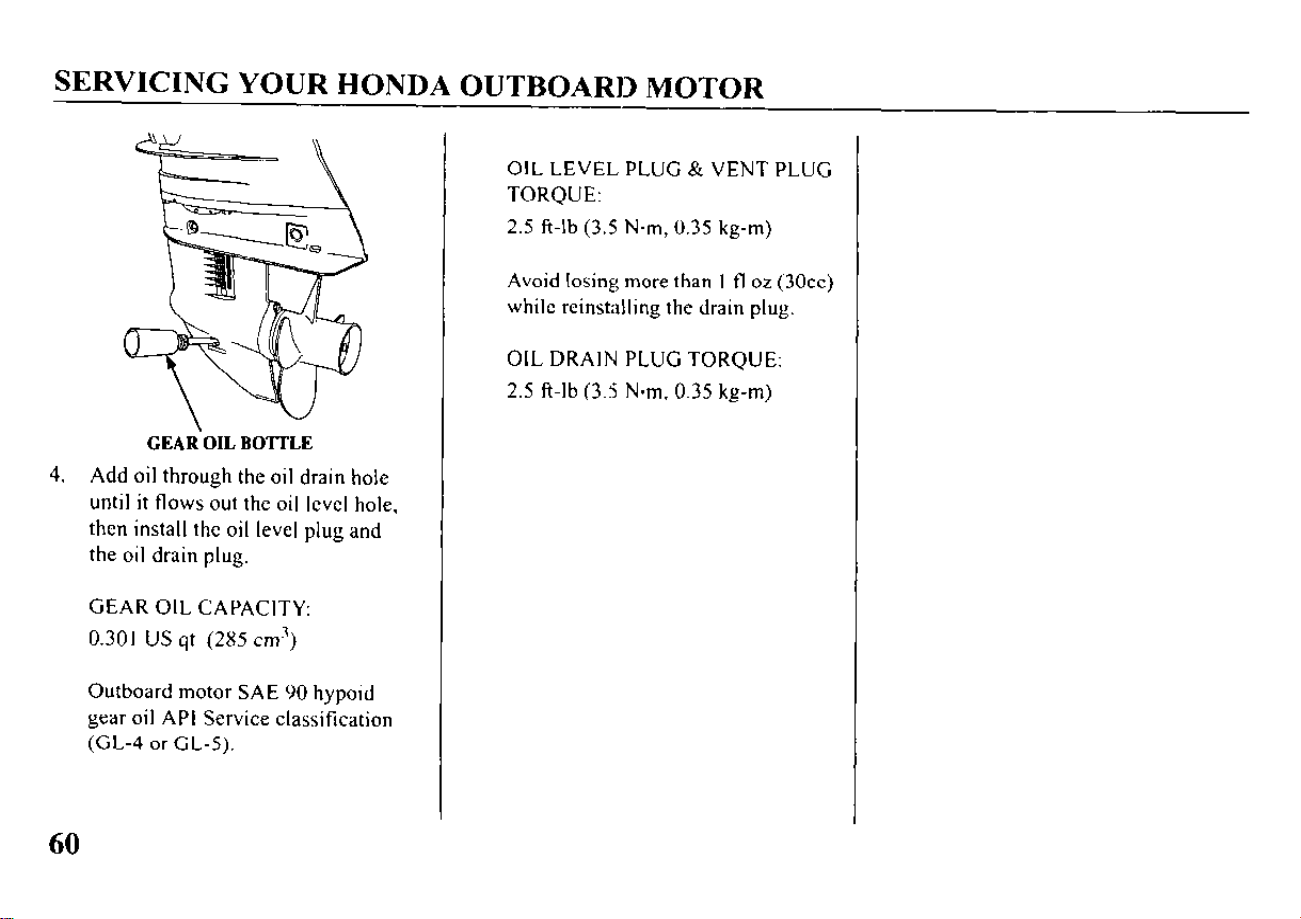
GEAR OIL BOTTLE
4.
Add oil through the oil drain hole
until it flows out the oil lcvcl hole,
then install the oil level plug and
the oil drain plug.
GEAR OIL CAPACITY:
0.301 US qt (2X5 cm3)
Outboard motor SAE 00 hypoid
gear oil API Service classification
(GL-4 or GL-5).
OIL LEVEL PLUG & VENT PLUG
TORQUE:
2.5 R-lb (3.5 N-m, 0.35 kg-m)
Avoid losing more than I fl oz (30~~)
while reinstalling the drain plug.
OIL DRAIN PLUG TORQUE:
2.5 ft-lb (3.5 N-m, 0.35 kg-m)
SERVICING YOUR HONDA OUTBOARD MOTOR
TILLER HANDLE
THROTTLE REEL
TILT STOPPER
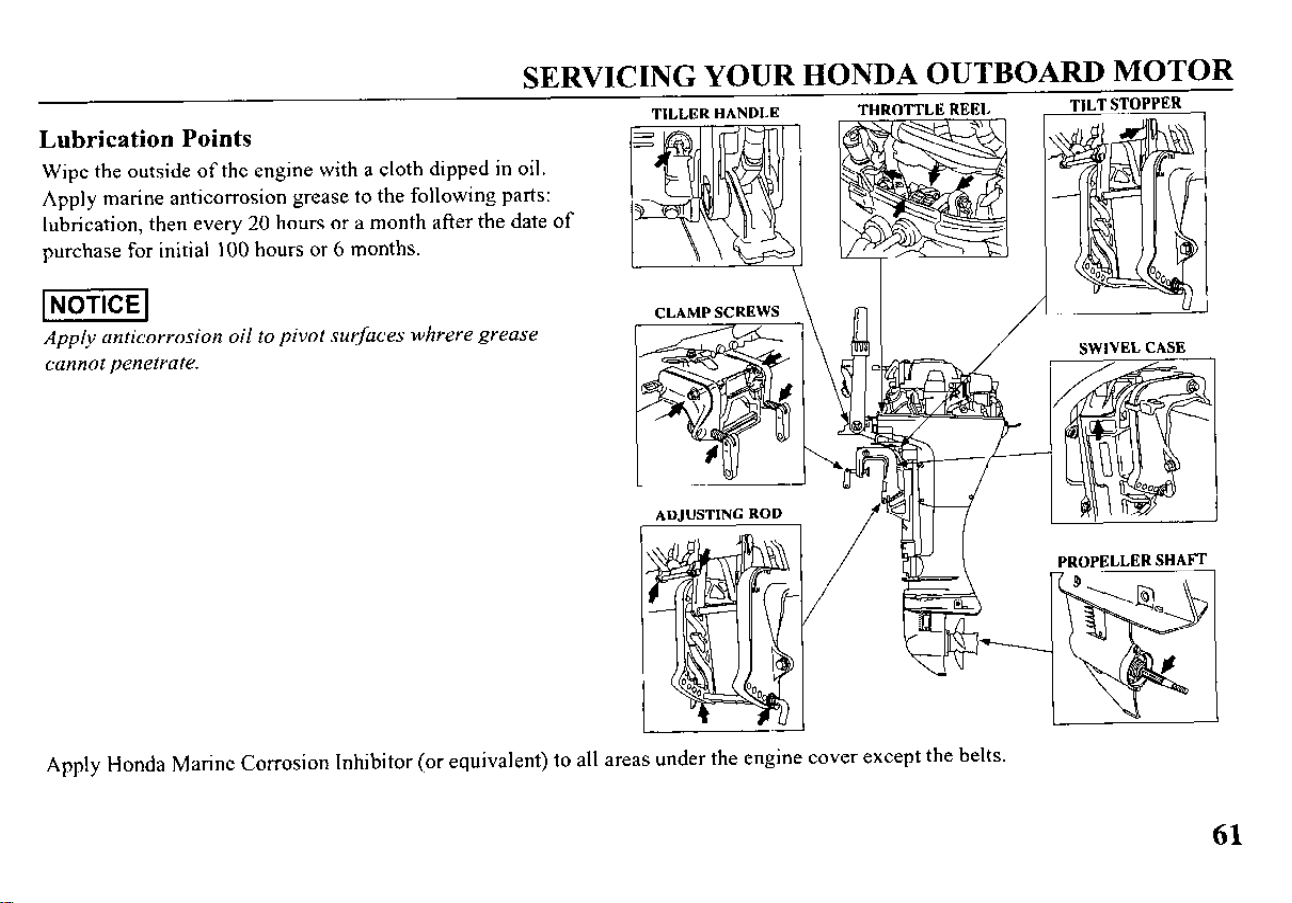
Lubrication Points
\
Wipe the outside of the engine with a cloth dipped in oil.
>
Apply marine anticorrosion grease to the following parts:
lubrication, then every 20 hours or a month after the date of
purchase for initial 100 hours or 6 months.
---I I
I-
u
INOT’CEI
Apply anticorrosion oil to pivot surfaces whrere grease
cannot penetrate.
SWlVEL CASE
PROPELLER SHAFT
Apply Honda Marine Corrosion Inhibitor (or equivalent) to all areas under the engine cover except the belts.
61
SERVICING YOUR HONDA OUTBOARD MOTOR
Spark Plug Service
RECOMMENDED SPARK PLUGS:
CRSEH-9 (NGK)
U I6FER9 (DENSO)
t 1
Incorrect spark plugs can cause engine
damage.
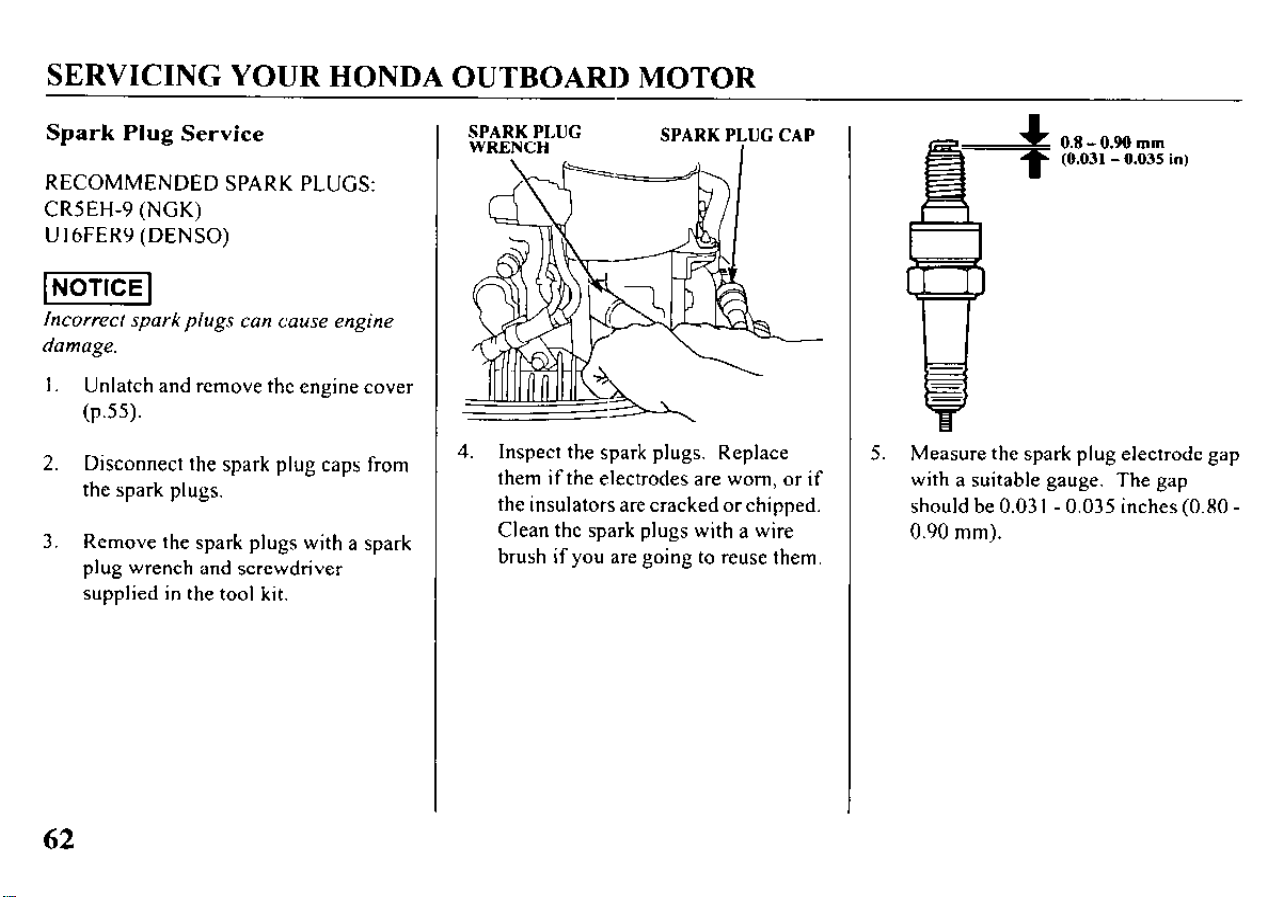
Unlatch and remove the engine cover
(P.55).
Disconnect the spark plug caps from
the spark plugs.
Remove the spark plugs with a spark
plug wrench and screwdriver
supplied in the tool kit.
4.
Inspect the spark plugs. Replace
them if the electrodes are worn, or if
the insulators arc cracked or chipped.
Clean the spark plugs with a wire
brush if you are going to reuse them.
5.
0.8 - 0.90 mm
(0.031
-
0.035
in)
Measure the spark plug electrode gap
with a suitable gauge. The gap
should be 0.03 1 - 0.035 inches (0.80 -
0.90 mm).
SERVICING YOUR HONDA OUTBOARD MOTOR
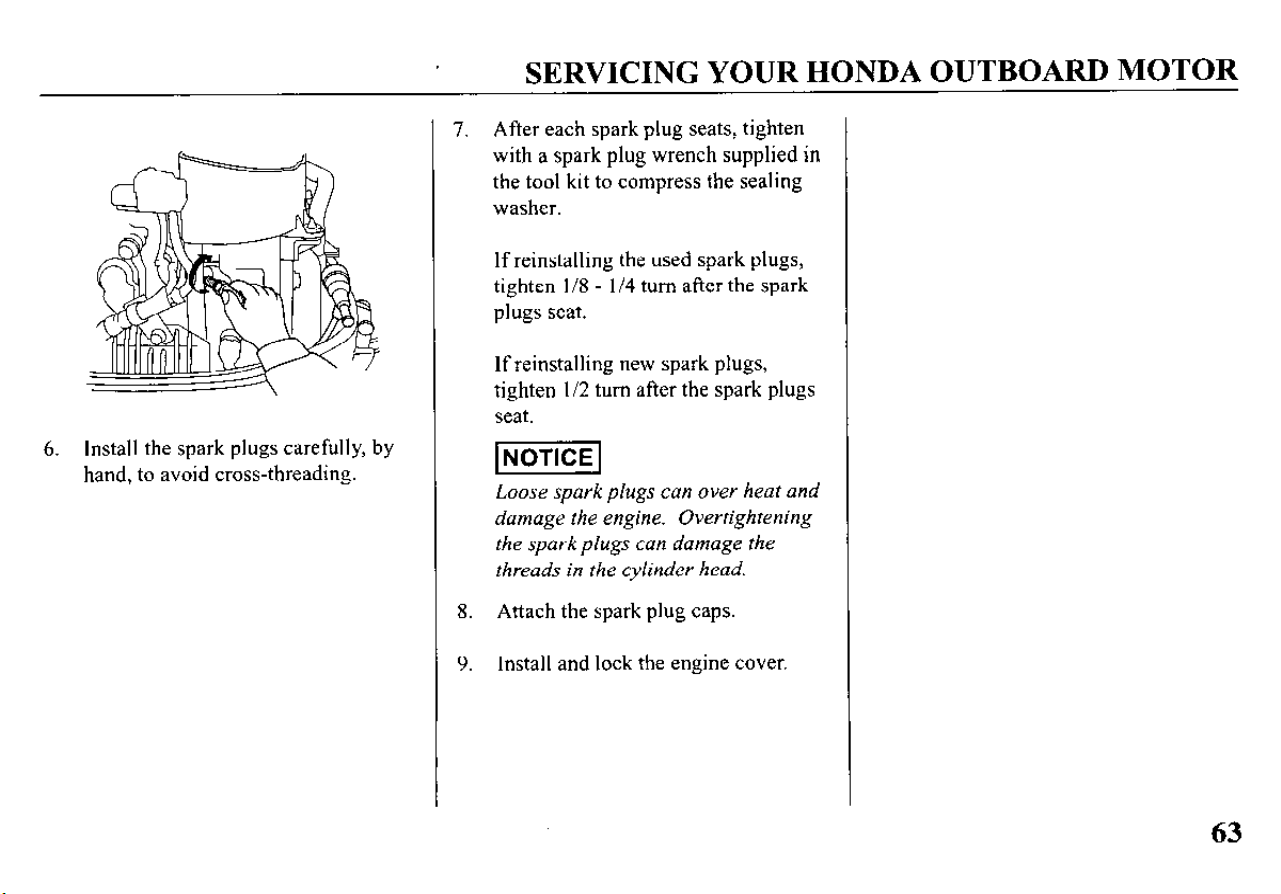
6.
Install the spark plugs carefully, by
hand, to avoid cross-threading.
7.
8.
9.
After each spark plug seats, tighten
with a spark plug wrench supplied in
the tool kit to compress the sealing
washer.
If reinstalling the used spark plugs,
tighten l/8 - l/4 turn after the spark
plugs seat.
If reinstalling new spark plugs,
tighten l/2 turn after the spark plugs
seat.
Loose spark plugs can over heat and
damage the engine. Overtightening
the spark plugs can damage the
threads in the cylinder head.
Attach the spark plug caps.
Install and lock the engine cover.
63
SERVICING YOUR HONDA OUTBOARD MOTOR
REFUELING
Portable Fuel Tank
(optional equipment)
FUEL TANK CAPACITY:
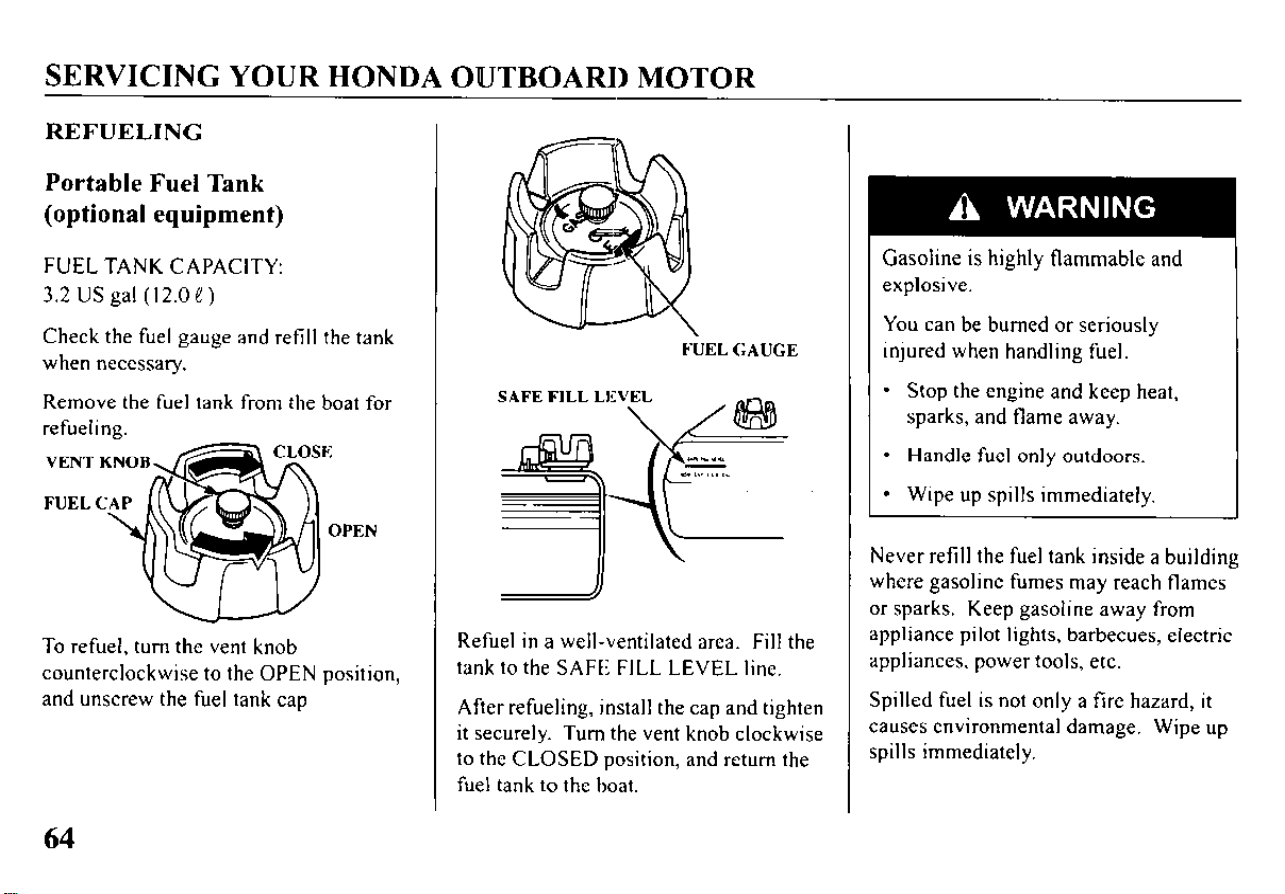
3.2 US gal ( 12.0 t )
Check the fuel gauge and refill the tank
when necessary.
Remove the fuel tank from the boat for
refueling.
OPEN
To refuel, turn the vent knob
counterclockwise to the OPEN position,
and unscrew the fuel tank cap
FUELGAUGE
Refuel in a well-ventilated area. Fill the
tank to the SAFE FILL LEVEL lint.
After refueling, install the cap and tighten
it securely. Turn the vent knob clockwise
to the CLOSED position, and rctum the
fuel tank to the boat.
Gasoline is highly flammable and
explosive.
You can be burned or seriously
injured when handling fuel.
l
Stop the engine and keep heat,
sparks, and flame away.
l
Handle fuel only outdoors.
l
Wipe up spills immediately.
Never refill the fuel tank inside a building
where gasoline fumes may reach flames
or sparks. Keep gasoline away from
appliance pilot lights, barbecues, electric
appliances. power tools, etc.
Spilled fuel is not only a fire hazard, it
causes environmental damage. Wipe up
spills immediately.
SERVICING YOUR HONDA OUTBOARD MOTOR
FUEL RECOMMENDATIONS
Use unleaded gasoline with a pump
octane rating of 86 or higher.
These outboard motors are certified to
operate on unleaded gasoline. Unleaded
gasoline produces fewer engine and spark
plug deposits and extends exhaust system
life.
Never use stale or contaminated gasoline
or an oil/gasoline mixture. Avoid getting
dirt or water in the fuel tank.
Occasionally you may hear a light “spark
knock” or “pinging” (metallic rapping
noise) while operating under heavy loads.
This is no cause for concern.
If spark knock or pinging occurs at a
steady engine speed, under normal load,
change brands of gasoline. If spark knock
or pinging persists, see an authorized
Honda marine dealer.
piq
Running the engine with persistent spark
knock or pinging can cause engine
damage.
Running the engine with persistent spark
knock or pinging is misuse, and the
Distributor ? Limited Warranty does not
cover parts damaged by misuse.
Fuel Pump Filter Inspection
and Replacement
The fuel pump filter is located under the
engine cover, on the right side of the
engine.
Water or sediment accumulated in the
filter can cause loss of power or hard
starting. To prevent engine malfunction,
inspect the filter and replace when
necessary.
Gasoline is highly flammable and
explosive.
You can be burned or seriously
injured when handling fuel.
l
Stop the engine and keep heat,
sparks, and flame away.
l
Handle fuel only outdoors.
l
Wipe up spills immediately.
65
SERVICING YOUR HONDA OUTBOARID MOTOR
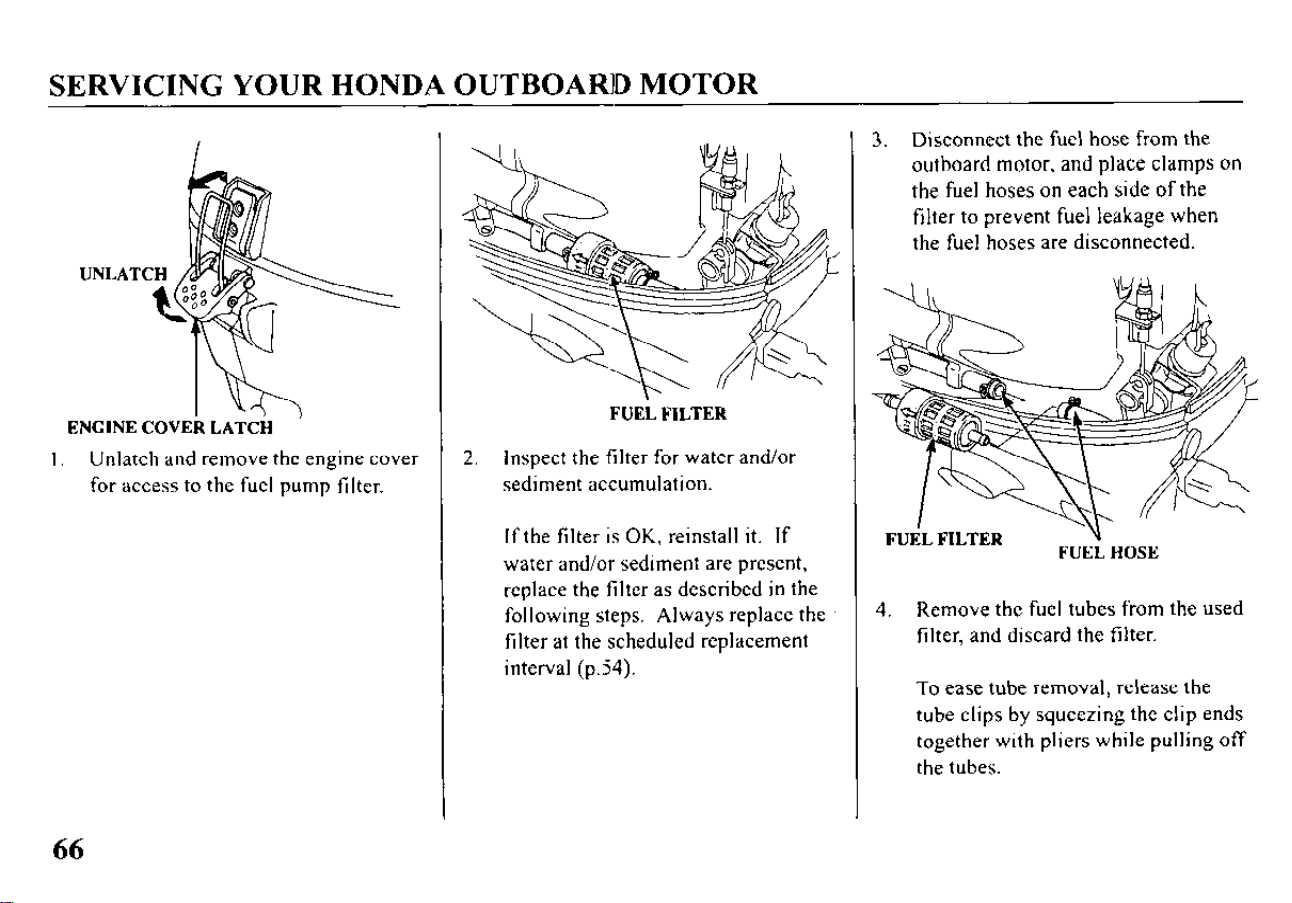
ENGINE COVEk LATCii
’
I Unlatch and remove the engine cover
for access to the fuel pump filter.
FUEL FILTER
2.
Inspect the filter for water and/or
sediment accumulation.
If the filter is OK, reinstall it. If
water and/or sediment are prcscnt,
replace the filter as dcscribcd in the
following steps. Always replace the
filter at the scheduled replacement
interval (p.54).
3. Disconnect the fuel hose from the
outboard motor, and place clamps on
the fuel hoses on each side of the
filter to prevent fuel leakage when
the fuel hoses are disconnected.
FUEL HOSE
4. Remove the fuel tubes from the used
filter, and discard the filter.
To ease tube removal, rcleasc the
tube clips by squeezing the clip ends
together with pliers while pulling off
the tubes.
66
SERVICING YOUR HONDA OUTBOARD MOTOR
. .
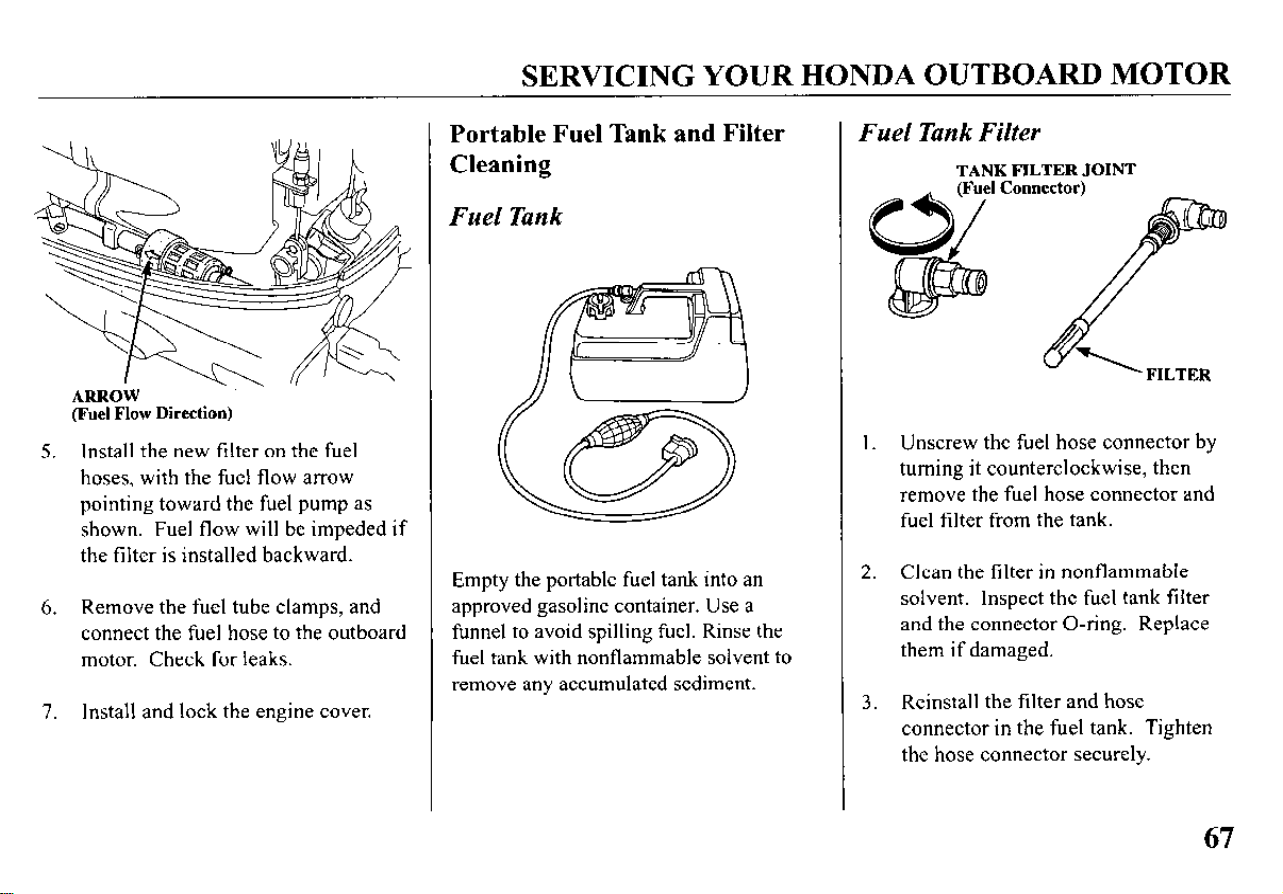
ARROW
(Fuel Flow Direction)
Install the new filter on the fuel
hoses, with the fuel flow arrow
pointing toward the fuel pump as
shown. Fuel flow will be impeded if
the filter is installed backward.
Remove the fuel tube clamps, and
connect the fuel hose to the outboard
motor. Check for leaks.
Install and lock the engine cover.
Portable Fuel Tank and Filter
Cleaning
Fuel Tank
Empty the portable fuel tank into an
approved gasoline container. Use a
funnel to avoid spilling fuel. Rinse the
fuel tank with nonflammable solvent to
remove any accumulated sediment.
Fuel Tank Filter
TANK FILTER JOINT
I Connector)
Unscrew the fuel hose connector by
turning it counterclockwise, then
remove the fuel hose connector and
fuel filter from the tank.
Clean the filter in nonflammable
solvent. Inspect the fuel tank filter
and the connector O-ring. Replace
them if damaged.
Reinstall the filter and hose
connector in the fuel tank. Tighten
the hose connector securely.
67
SERVICING YOUR HONDA OUTBOARD MOTOR
-
Recoil Starter Rope Inspection
\
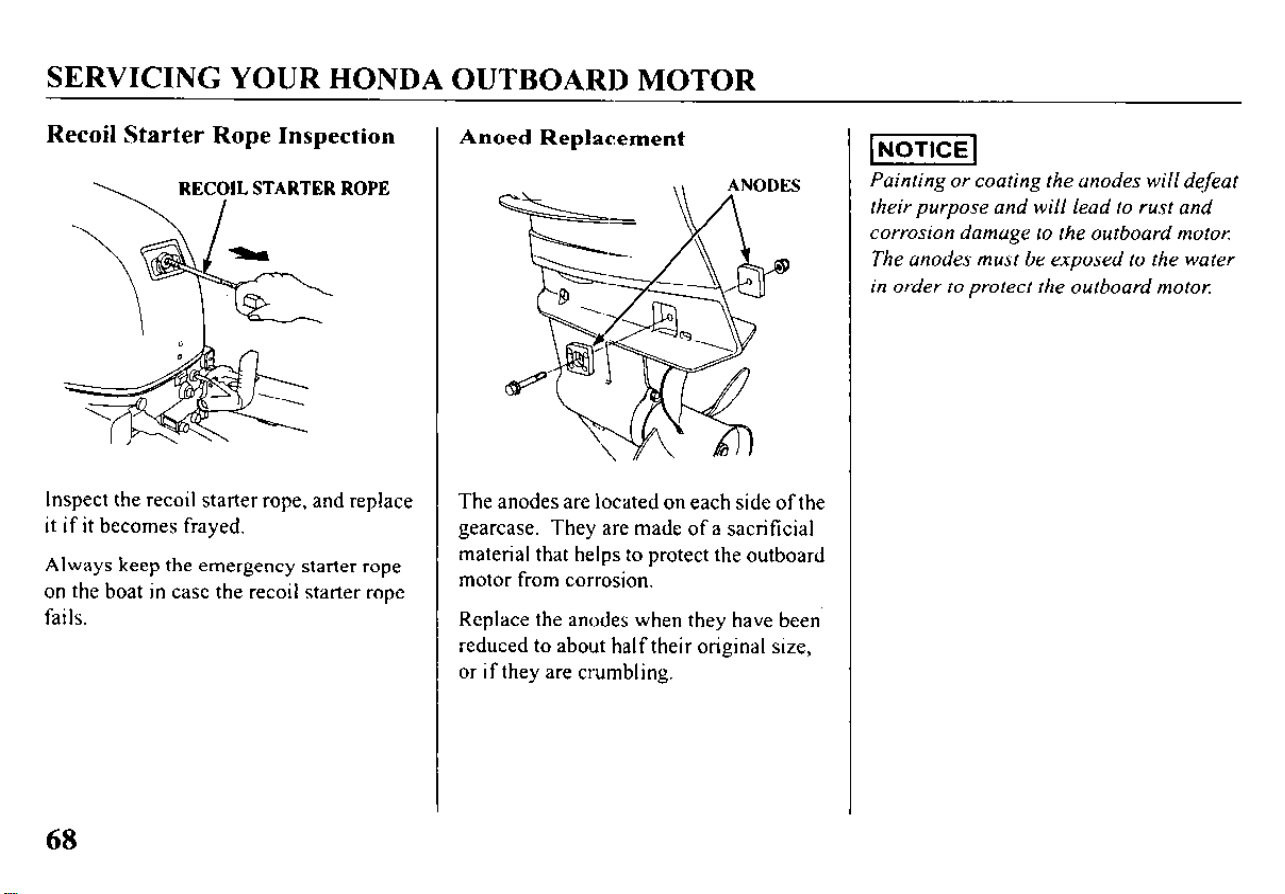
RECOIL STARTER ROPE
Inspect the recoil starter rope, and replace
it if it becomes frayed.
Always keep the emergency starter rope
on the boat in cast the recoil starter rope
fails.
Anoed Replacement
The anodes are located on each side of the
gearcase. They are made of a sacrificial
material that helps to protect the outboard
motor from corrosion.
Replace the anodes when they have been
reduced to about half their original size,
or if they are crumbling.
lNoTlCEl
I
I
Painting or coating the anodes will defeat
their purpose and will lead to rust and
corrosion damuge to the outboard motor.
The anodes must be exposed to the water
in order to protect the outboard motor:
SERVICING YOUR HONDA OUTBOARD MOTOR
Propeller Replacement
Removal
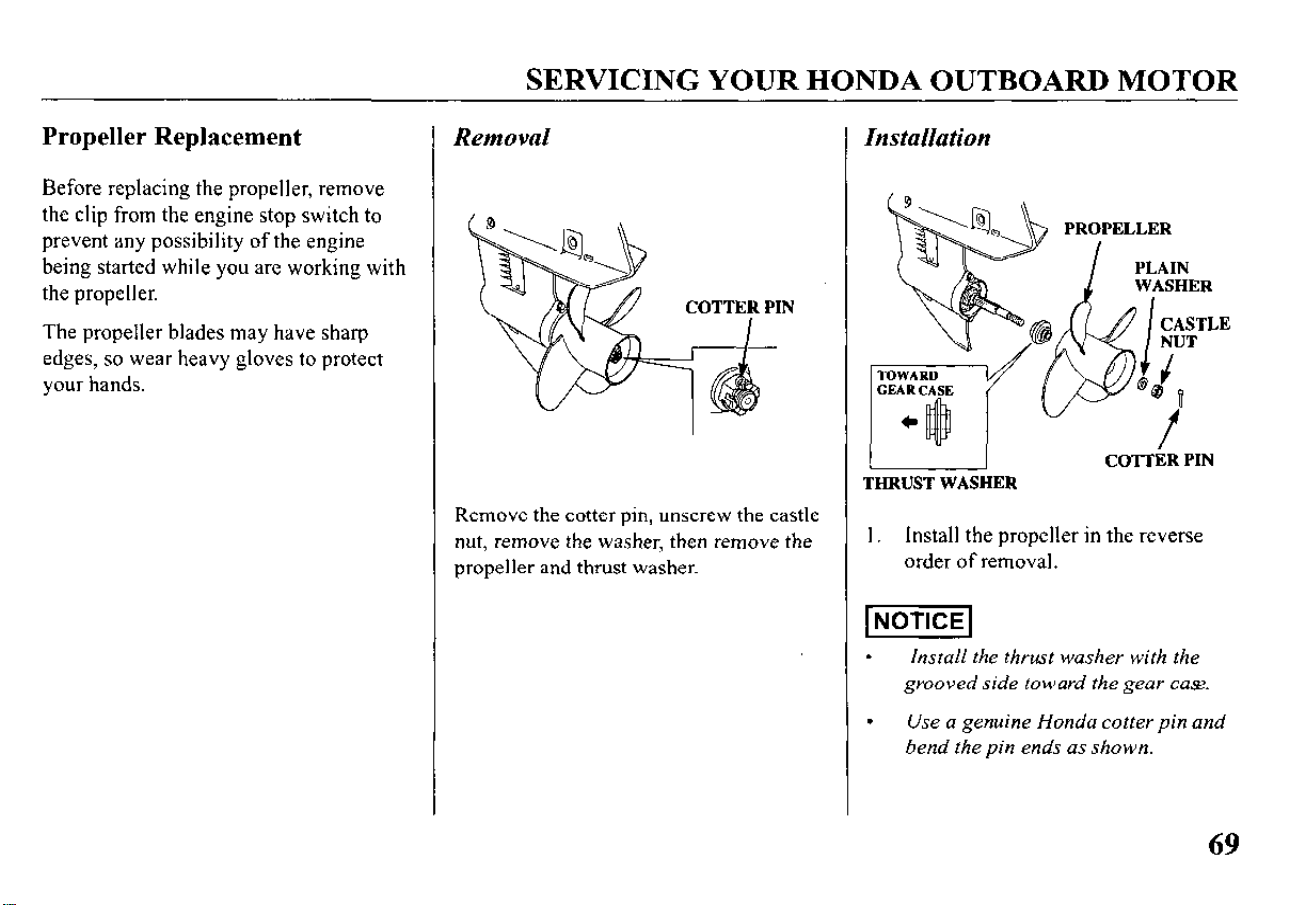
Before replacing the propeller, remove
the clip from the engine stop switch to
prevent any possibility of the engine
being started while you are working with
the propeller.
The propeller blades may have sharp
edges, so wear heavy gloves to protect
your hands.
Remove the cotter pin, unscrew the castle
nut, remove the washer, then remove the
propeller and thrust washer.
Installation
THRUST WASHER
COTTER PIN
I. Install the propeller in the reverse
order of removal.
.
Install the thrust washer with the
grooved side toward the gear case.
.
Use a genuine Honda cotter pin and
bend the pin ends as shown.
69
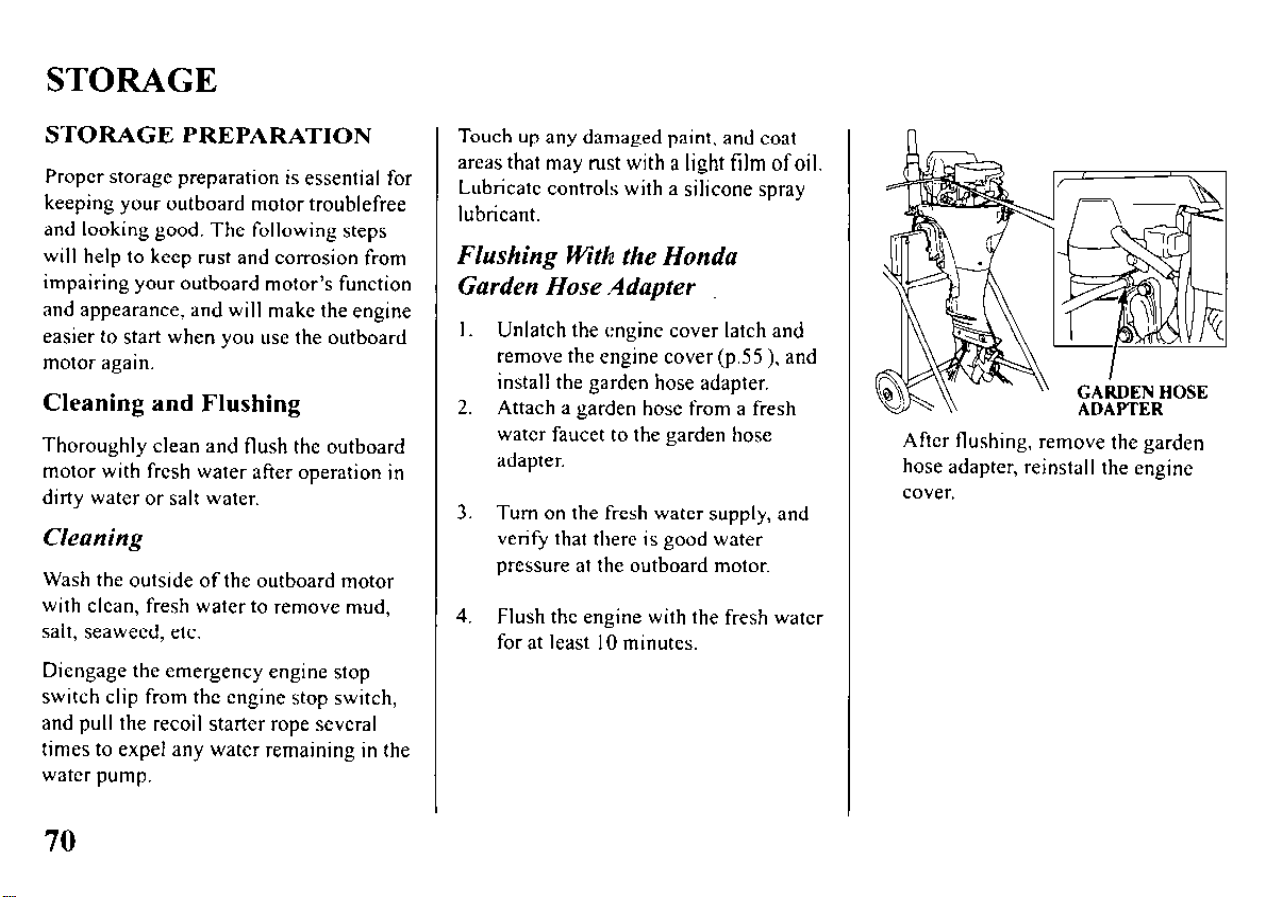
STORAGE
STORAGE PREPARATION
Proper storage preparation is essential for
keeping your outboard motor troublefree
and looking good. The following steps
will help to keep rust and corrosion from
impairing your outboard motor’s function
and appearance, and will make the engine
easier to start when you USC the outboard
motor again.
Cleaning and Flushing
Thoroughly clean and flush the outboard
motor with fresh water after operation in
dirty water or salt water.
Cleaning
Wash the outside of the outboard motor
with clean, fresh water to remove mud,
salt, seaweed, etc.
Diengage the emergency engine stop
switch clip from the engine stop switch,
and pull the recoil starter rope several
times to expel any water remaining in the
water pump.
70
Touch up any damaged paint, and coat
areas that may rust with a light film ofoil.
Lubricate controls with a silicone spray
lubricant.
Flushing with the Honda
Garden Hose .4dapter
Unlatch the cnginc cover latch and
remove the engine cover (p.55 ), and
install the garden hose adapter.
Attach a garden host from a fresh
water faucet to the garden hose
adapter.
Turn on the fresh water supply, and
verify that there is good water
pressure at the outboard motor.
Flush the engine with the fresh water
for at least 10 minutes.
GARDEN HOSE
ADAPTER
After flushing, remove the garden
hose adapter, reinstall the engine
cover.
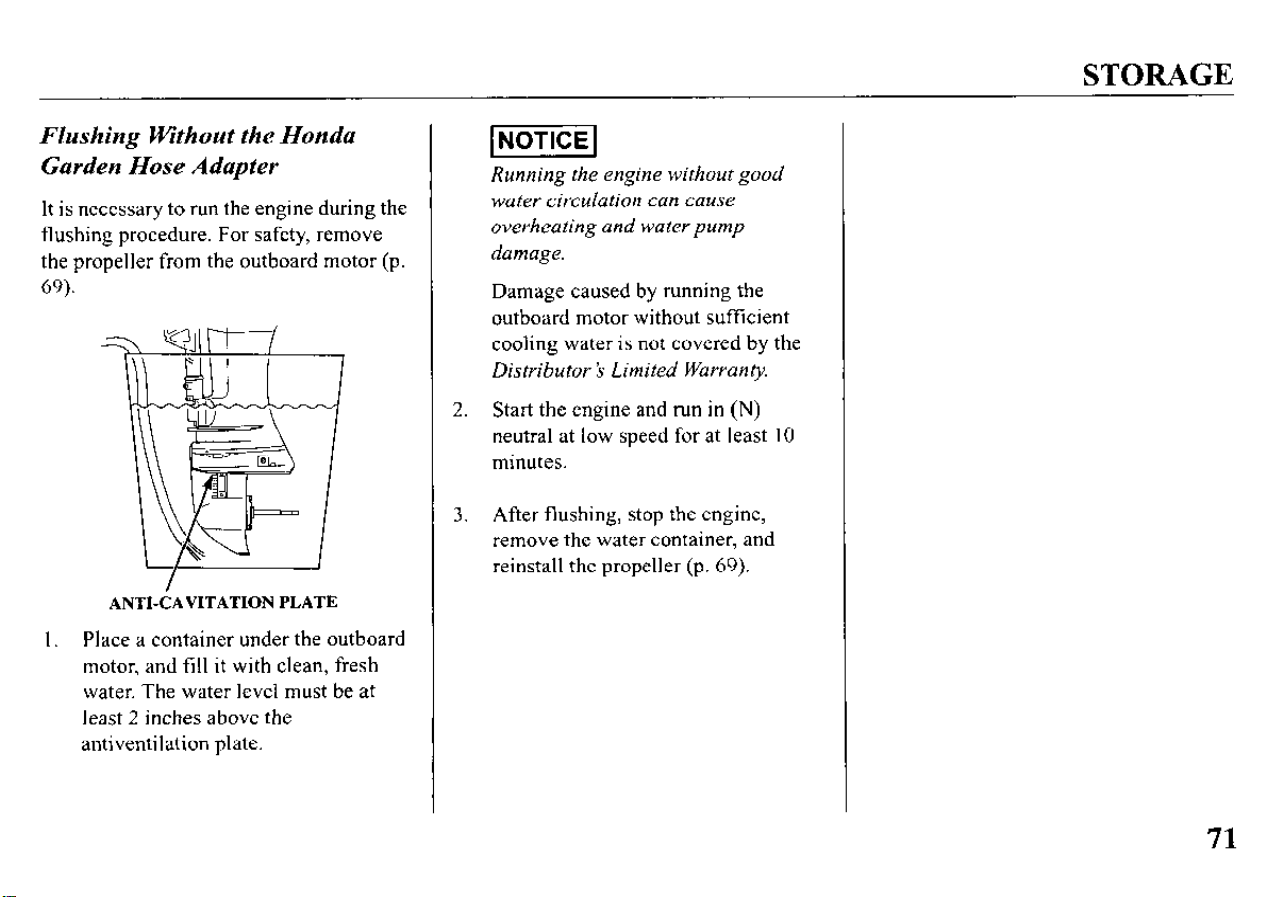
STORAGE
Flushing Without the Honda
Garden Hose Adapter
It is necessary to run the engine during the
flushing procedure. For safety, remove
the propeller from the outboard motor (p.
69).
ANTI-CAVITATION PLATE
I. Place a container under the outboard
motor, and fill it with clean, fresh
water. The water level must be at
least 2 inches above the
antiventilation plate.
1~0TlCEl
Running the engine without good
water circulation can cause
overheating and water pump
damage.
Damage caused by running the
outboard motor without suffkient
cooling water is not covered by the
Distributor k Limited Warranty.
2. Start the engine and run in (N)
neutral at low speed for at least
minutes.
IO
3. After flushing, stop the engine,
remove the water contamer, and
reinstall the propeller (p. 69).
71
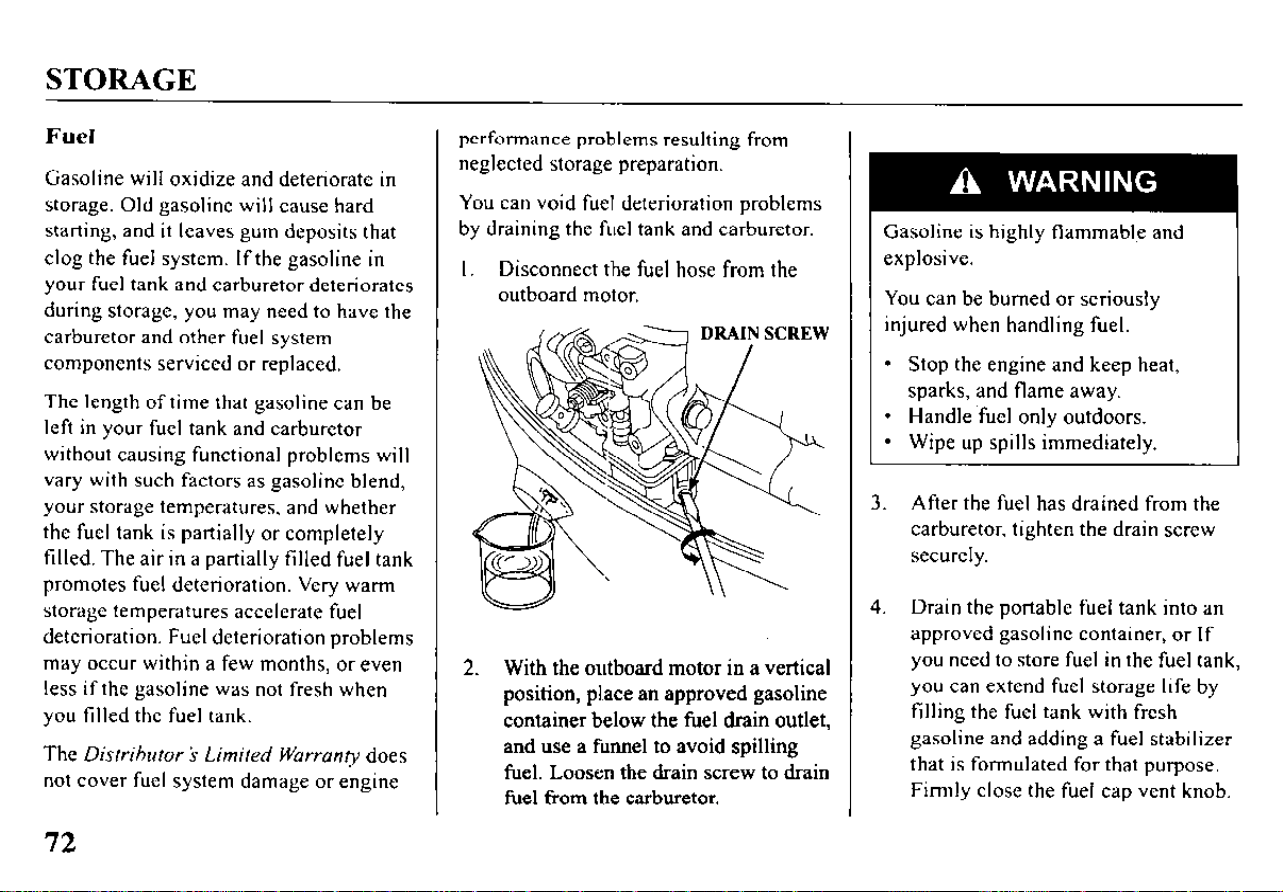
STORAGE
Fuel
Gasoline will oxidize and deteriorate in
storage. Old gasoline will cause hard
starting, and it leaves gum deposits that
clog the fuel system. If the gasoline in
your fuel tank and carburetor deteriorates
during storage, you may need to have the
carburetor and other fuel system
components serviced or replaced.
The length of time that gasoline can be
left in your fuel tank and carburetor
without causing functional problems will
vary with such factors as gasoline blend,
your storage temperatures, and whether
the fuel tank is partially or completely
tilled. The air in a partially filled fuel tank
promotes fuel deterioration. Very warm
storage
temperatures accclcrdte fuel
deterioration. Fuel deterioration problems
may occur within a few months, or even
less if the gasoline was not fresh when
you tilled the fuel tank.
The Distributor k Limited Warranty does
not cover fuel system damage or engine
72
performance problems resulting from
neglected storage preparation.
You can void fuel deterioration problems
by draining the fuel tank and carburetor.
I. Disconnect the fuel hose from the
outboard motor.
DRAIN SCREW
2. With the outboard motor in a vertical
position, place an approved gasoline
container below the fuel drain outlet,
and use a funnel to avoid spilling
fuel. Loosen the drain screw to drain
fuel from the carburetor.
3.
4.
Gasoline is highly flammable and
explosive.
You can be burned or seriously
injured when handling fuel.
l
Stop the engine and keep heat,
sparks, and flame away.
l
Handle fuel only outdoors.
l
Wipe up spills immediately.
After the fuel has drained from the
carburetor, tighten the drain screw
securely.
Drain
the portable fuel tank into an
approved gasoline container, or If
you need to store fuel in the fuel tank,
you can extend fuel storage life by
filling the fuel tank with fresh
gasoline and adding a fuel stabilizer
that is formulated for that purpose.
Firmly close the fuel cap vent knob.
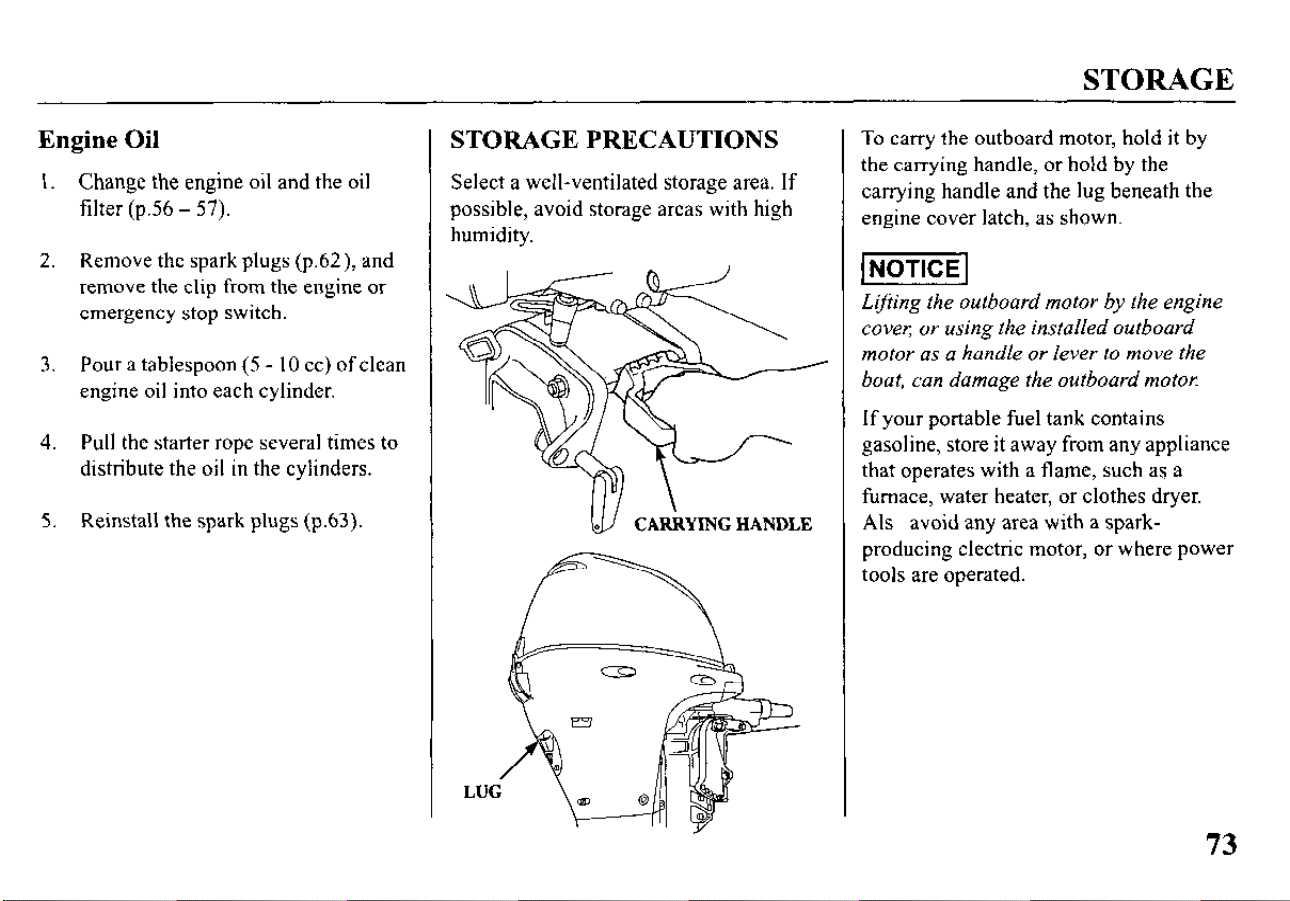
STORAGE
Engine Oil STORAGE PRECAUTIONS
I.
2.
3.
4.
5.
Change the engine oil and the oil
filter (p.56 - 57).
Remove the spark plugs (p.62), and
remove the clip from the engine or
emergency stop switch.
Select a well-ventilated storage area. If
possible, avoid storage areas with high
humidity.
Pour a tablespoon (5 - 10 cc) of clean
engine oil into each cylinder.
Pull the starter rope several times to
distribute the oil in the cylinders.
Reinstall the spark plugs (p.63).
u CARRYING HANDLE
To carry the outboard motor, hold it by
the carrying handle, or hold by the
carrying handle and the lug beneath the
engine cover latch, as shown.
Lifting the outboard motor by the engine
cover, or using the installed outboard
motor as a handle or lever to move the
boat, can damage the outboard motor.
If your portable fuel tank contains
gasoline, store it away from any appliance
that operates with a flame, such as a
furnace, water heater, or clothes dryer.
Als avoid any area with a spark-
producing electric motor, or where power
tools are operated.
73
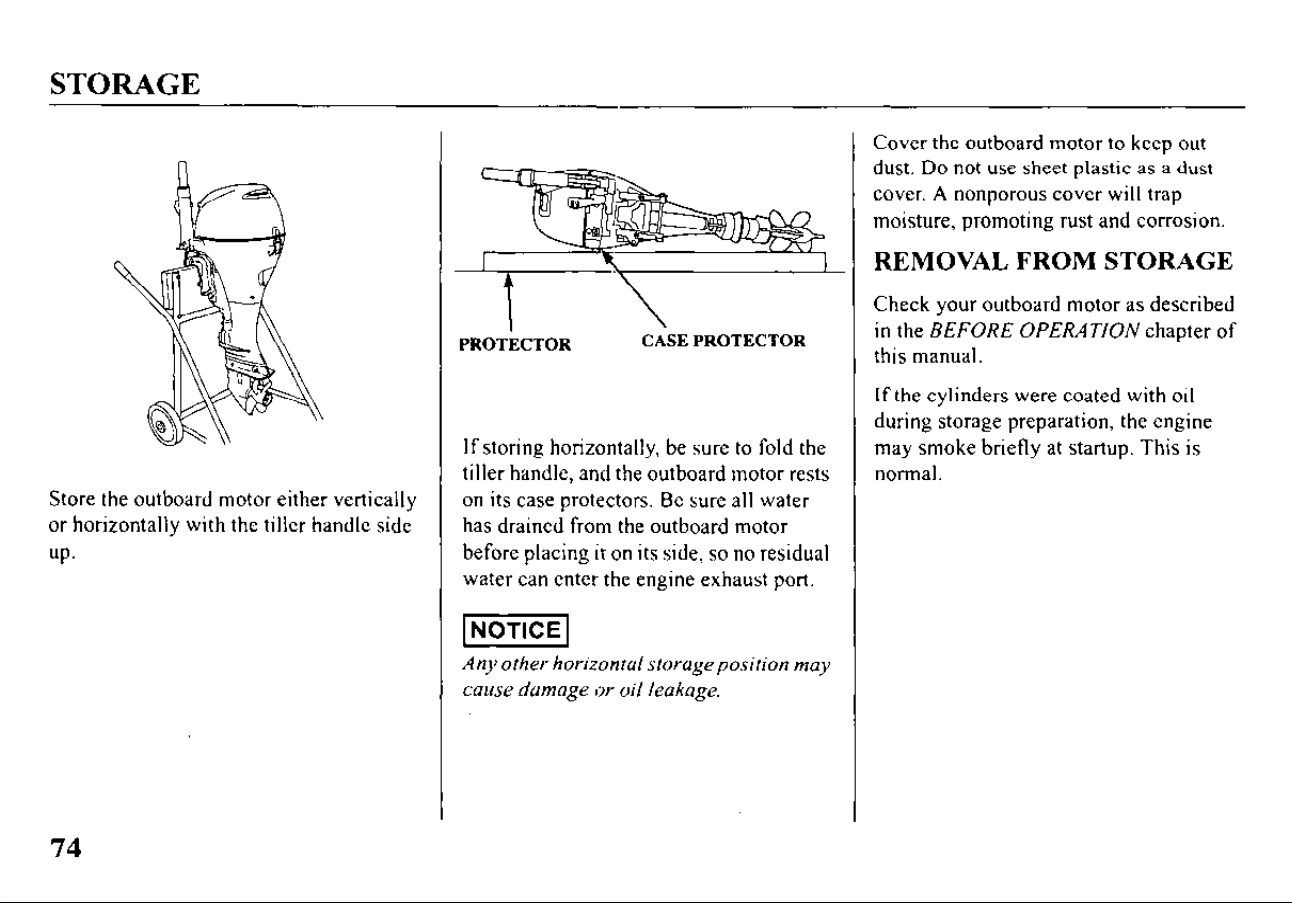
STORAGE
Store the outboard motor either vertically
or horizontally with the tiller handle side
up.
t\r-----
PROTECTOR
CASE PROTECTOR
If storing horizontally, be sure to fold the
tiller handle, and the outboard motor rests
on its case protectors. Be sum all water
has drained from the outboard motor
before placing it on its side, so no residual
water can enter the engine exhaust port.
Any other horizontal storageposition may
CUIISL’ damage lx- ail leakage.
Cover the outboard motor to keep out
dust. Do not use sheet plastic as a dust
cover. A nonporous cover will trap
moisture, promoting rust and corrosion.
REMOVAL FROM STORAGE
Check your outboard motor as described
in the BEFORE OPERATION chapter of
this manual.
If the cylinders were coated with oil
during storage preparation, the engine
may smoke briefly at startup. This is
normal.
74
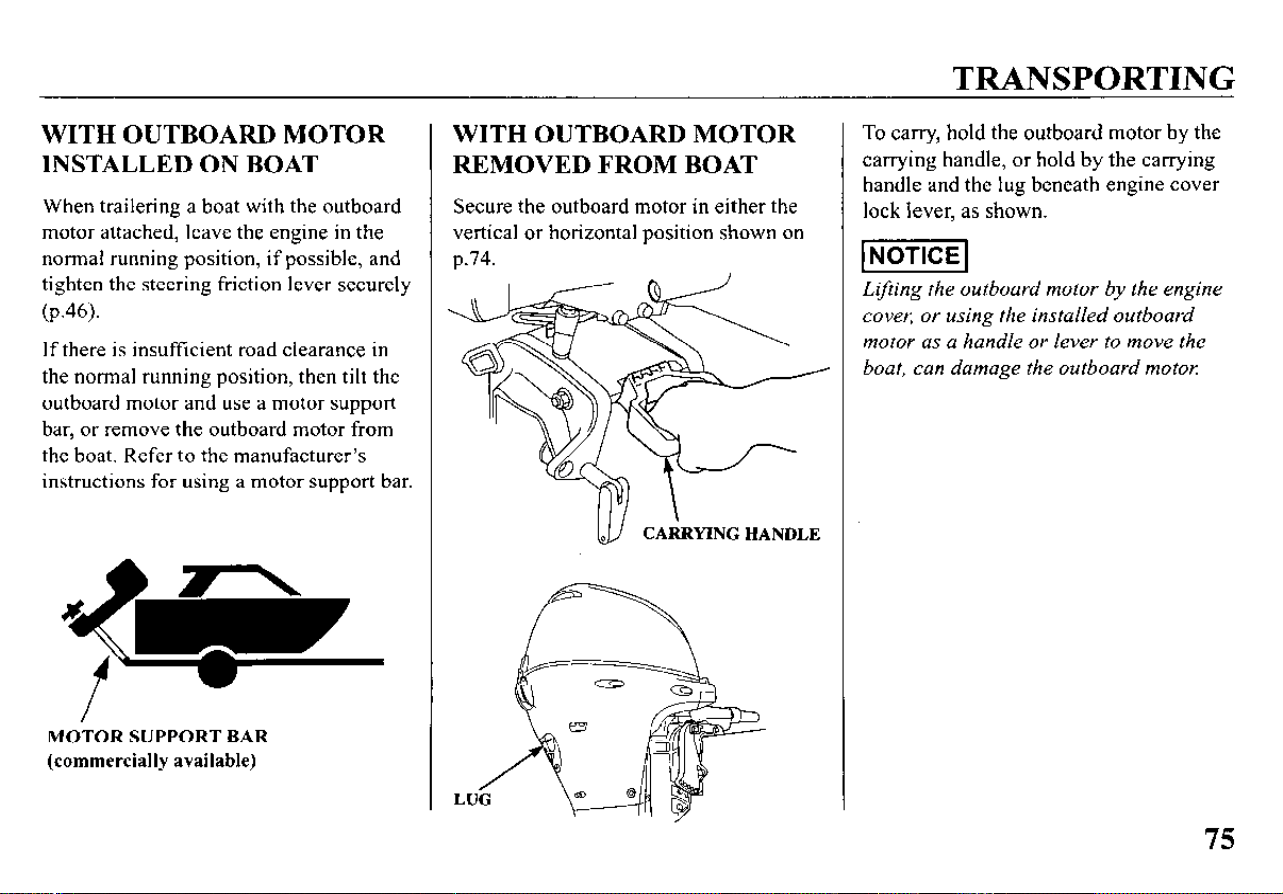
TRANSPORTING
WITH OUTBOARD MOTOR
INSTALLED ON BOAT
When trailering a boat with the outboard
motor attached, leave the engine in the
normal running position, if possible, and
tighten the steering friction lever securely
(p.46).
If there is insuffrcient road clearance in
the normal running position, then tilt the
outboard motor and use a motor support
bar, or remove the outboard motor from
the boat. Refer to the manufacturer’s
instructions for using a motor support bar.
MOTOR SUPPORT BAR
(commercially available)
WITH OUTBOARD MOTOR
REMOVED FROM BOAT
Secure the outboard motor in either the
vertical or horizontal position shown on
p.74.
- m -J
LLJ
CARRYING HANDLE
To carry, hold the outboard motor by the
carrying handle, or hold by the carrying
handle and the lug beneath engine cover
lock lever, as shown.
lNoTlCEl
I 1
Lifting the outboard motor by the engine
cover, or using the installed outboard
motor as a handle or lever to move the
boat, can damage the outboard motor:
75
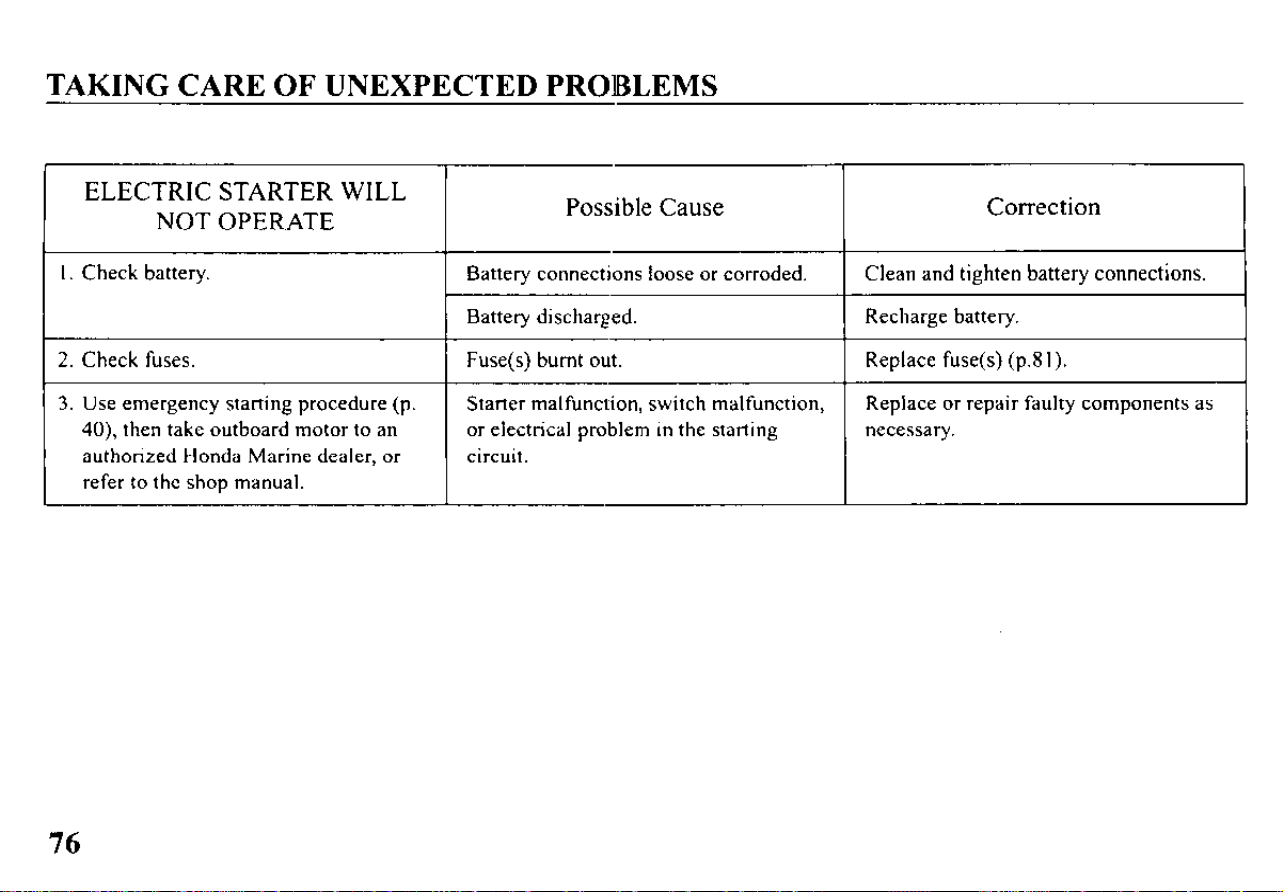
TAKING CARE OF UNEXPECTED PROIBLEMS
ELECTRIC STARTER WILL
NOT OPERATE
I. Check battery.
2. Check fuses.
3. Use emergency starting procedure (p.
40), then take outboard motor to an
authorized Honda Marine dealer, or
refer to the shop manual.
Possible Cause
Battery connections loose or corroded.
Battery discharged.
Fuse(s) burnt out.
Starter malfunction, switch malfunction,
or electrical problem in the starting
circuit.
Correction
Clean and tighten battery connections.
Recharge battery.
Replace fuse(s) (p.8 I).
Replace or repair faulty components as
necessary.
76
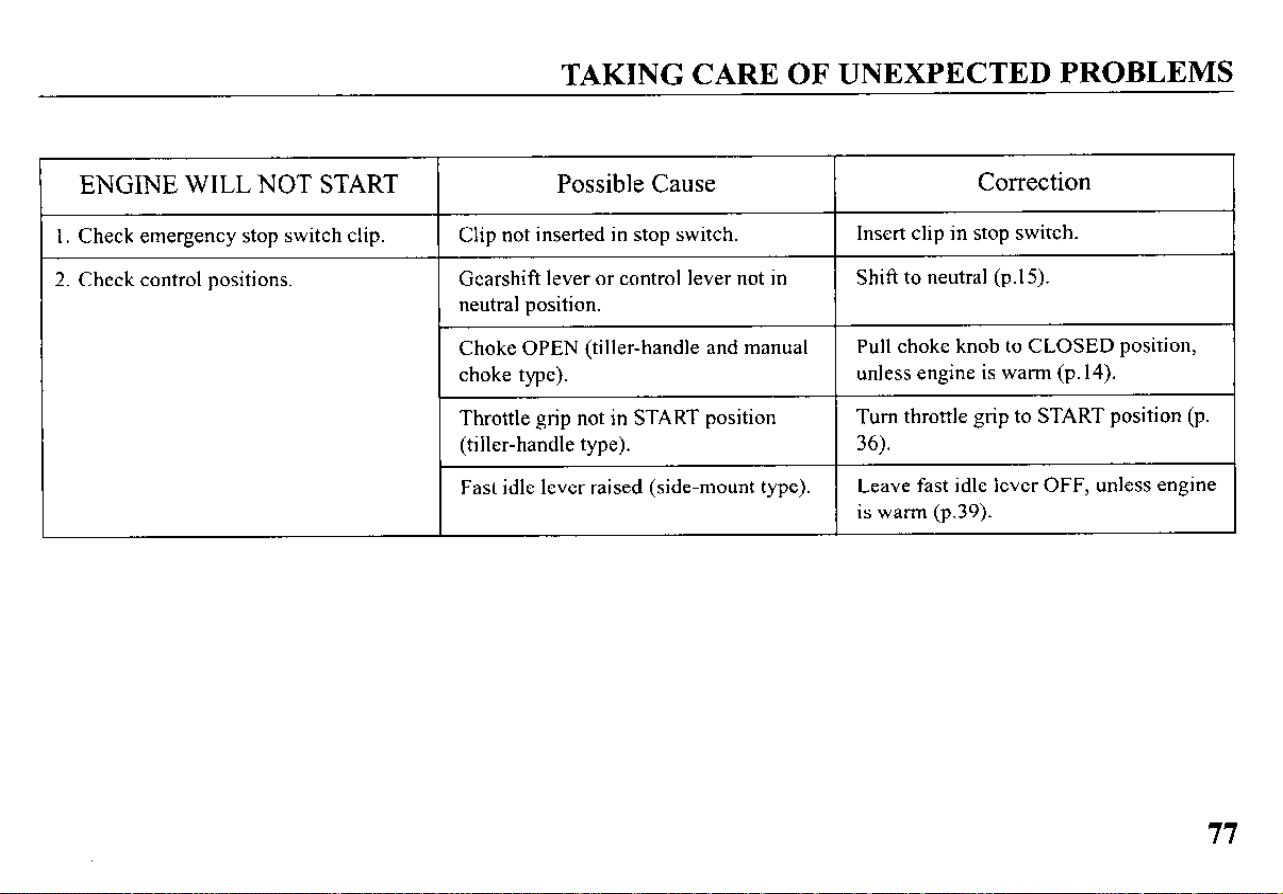
TAKING CARE OF UNEXPECTED PROBLEMS
ENGINE WILL NOT START
I. Check emergency stop switch clip.
2. Check control positions.
Possible Cause
Clip not inserted in stop switch.
Gearshift lever or control lever not in
neutral position.
Choke OPEN (tiller-handle and manual
choke type).
Throttle grip not in START position
(tiller-handle type).
Fast idle lever raised (side-mount type).
Correction
Insert clip in stop switch.
Shift to neutral (p.15).
Pull choke knob to CLOSED position,
unless engine is warm (p. 14).
Turn throttle grip to START position (p.
36).
Leave fast idle lever OFF, unless engine
is warm (p.39).
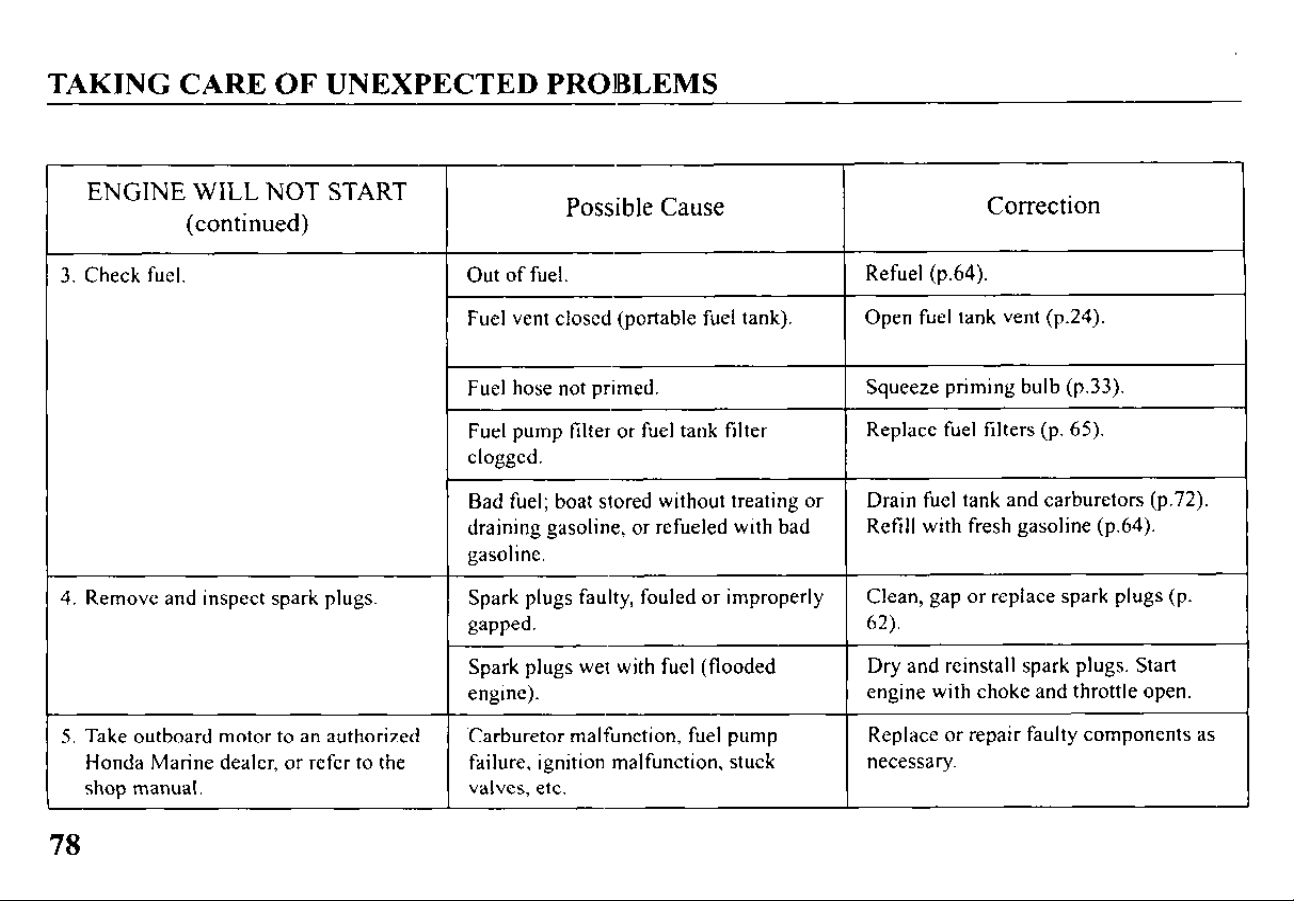
TAKING CARE OF UNEXPECTED PROIBLEMS
Fuel vent closed (portable fuel tank).
Open fuel tank vent (p.24).
Fuel hose not primed.
Fuel pump filter or fuel tank filter
clogged.
Squeeze priming bulb (p.33).
Replace fuel filters (p. 65).
Bad fuel; boat stored without treating or
draining gasoline, or refueled with bad
gasoline.
Drain fuel tank and carburetors (p.72).
Refill with fresh gasoline (p.64).
4. Remove and inspect spark plugs.
Spark plugs faulty, fouled or improperly
Clean, gap or replace spark plugs (p.
gamed.
62).
Spark plugs wet with fuel (flooded
engine).
‘Carburetor malfunction, fuel pump
failure, ignition malfunction, stuck
valve, etc.
Dry and reinstall spark plugs. Start
engine with choke and throttle open.
Replace or repair faulty components as
necessary.
5. Take outboard motor to an authorized
Honda Marine dealer, or refer to the
shop manual.
78
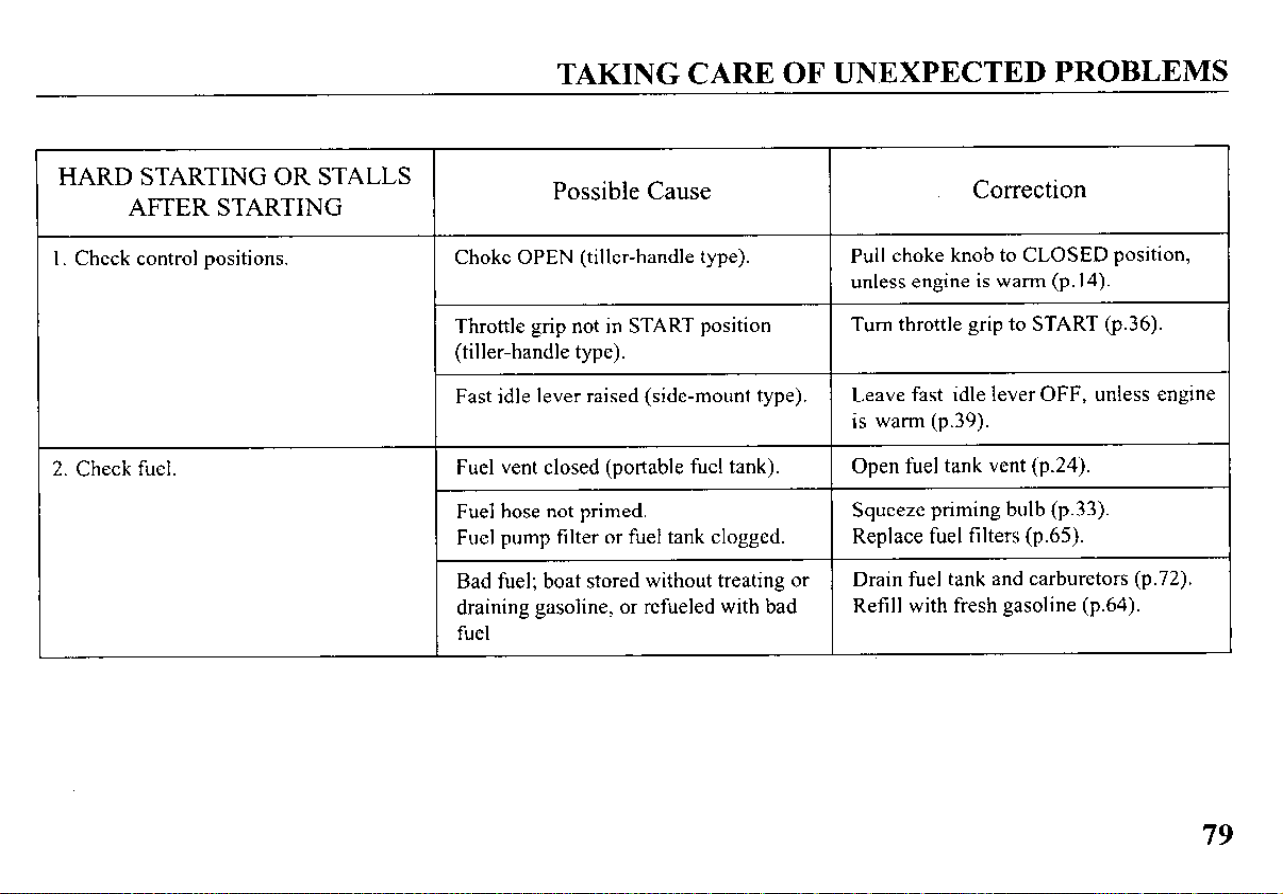
TAKING CARE OF UNEXPECTED PROBLEMS
HARD STARTING OR STALLS
AFI-ER STARTING
Possible Cause
Correction
1. Check control positions.
Choke OPEN (tiller-handle type).
Pull choke knob to CLOSED position,
unless engine is warm (p. 14).
Throttle grip not in START position
(tiller-handle type).
Turn throttle grip to START (p.36).
Fast idle lever raised (side-mount type).
Leave fast idle lever OFF, unless engine
is warm (p.39).
2. Check fuel.
1 Fuel vent closed (portable fuel tank).
1 Open fuel tank vent (p.24).
Fuel hose not primed.
Fuel pump filter or fuel tank clogged.
Bad fuel; boat stored without treating or
draining gasoline, or refueled with bad
fuel
Squeeze priming bulb (p.33).
Replace fuel filters (p.65).
Drain fuel tank and carburetors (p.72).
Refill with fresh gasoline (p.64).
79
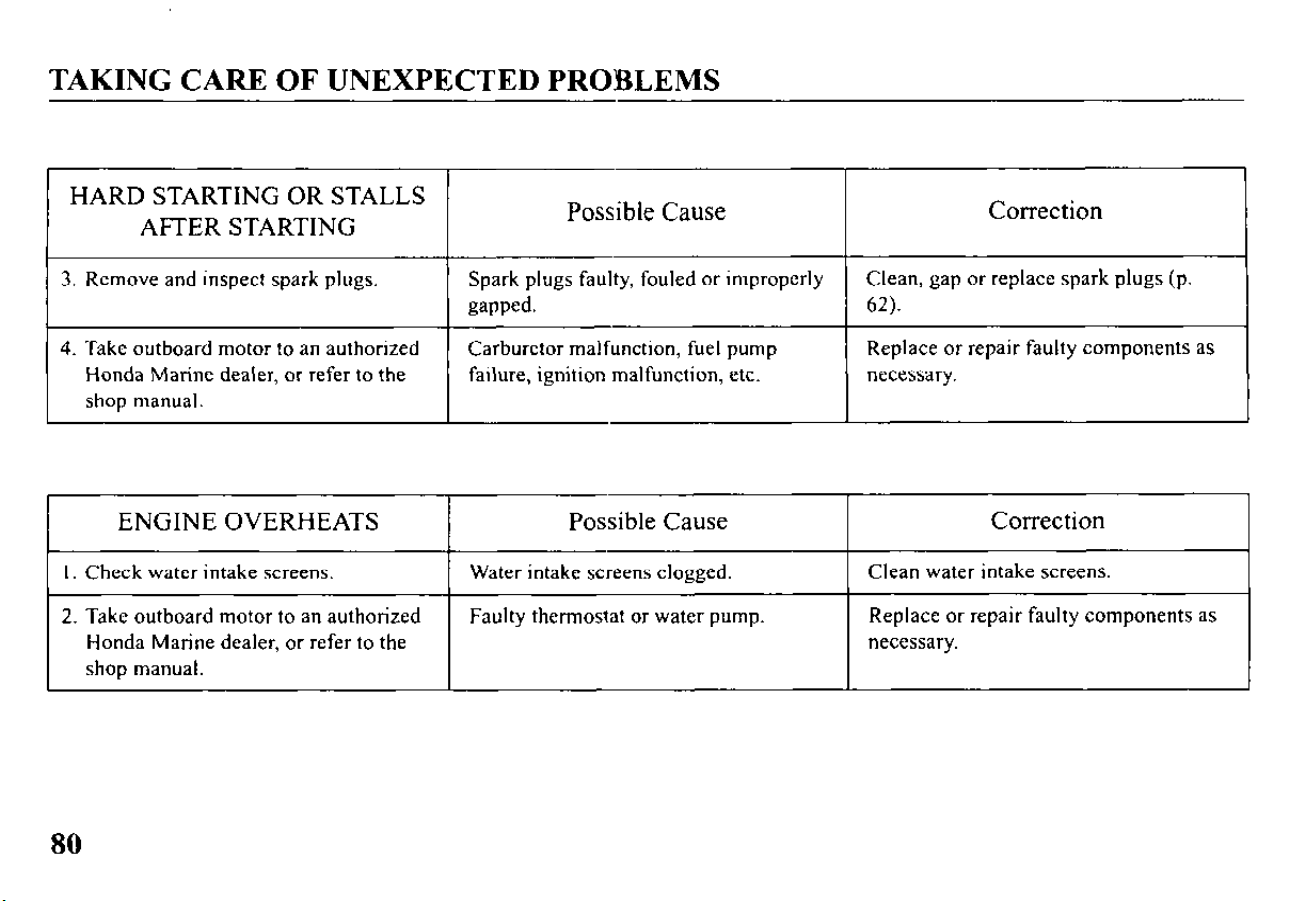
TAKING CARE OF UNEXPECTED PROBLEMS
HARD STARTING OR STALLS
AFTER STARTING
Possible Cause
3. Remove and inspect spark plugs.
Spark plugs faulty, fouled or improperly
Clean, gap or replace spark plugs (p.
gapped.
62).
4. Take outboard motor to an authorized
Honda Marine dealer, or refer to the
shop manual.
Carburetor malfunction, fuel pump
failure, ignition malfunction, etc.
Correction
Replace or repair faulty components as
necessary.
ENGINE OVERHEATS
Possible Cause
Correction
I. Check water intake screens. Water intake screens clogged.
Clean water intake screens.
2. Take outboard motor to an authorized
Honda Marine dealer, or refer to the
shop manual.
Faulty thermostat or water pump.
Replace or repair faulty components as
necessary.
80
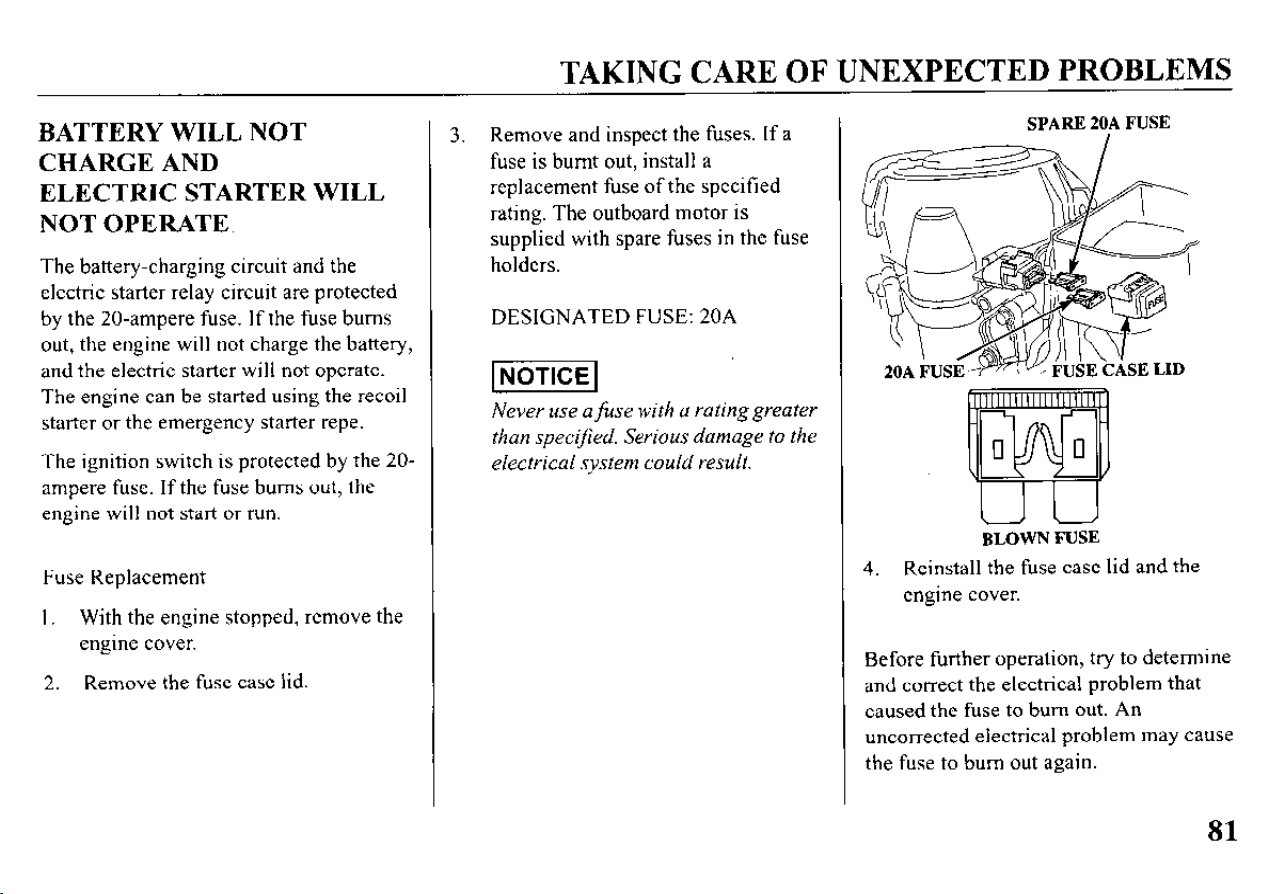
TAKING CARE OF UNEXPECTED PROBLEMS
BATTERY WILL NOT
CHARGE AND
ELECTRIC STARTER WILL
NOT OPERATE
The battery-charging circuit and the
electric starter relay circuit are protected
by the 20-ampere fuse. If the fuse bums
out, the engine will not charge the battery,
and the electric starter will not operate.
The engine can be started using the recoil
starter or the emergency starter repe.
The ignition switch is protected by the 20-
ampere fuse. If the fuse bums out, the
engine will not start or run.
Fuse Replacement
1. With the engine stopped, remove the
engine cover.
2. Remove the fuse case lid.
3. Remove and inspect the fuses. If a
fuse is burnt out, install a
replacement fuse of the specified
rating. The outboard motor is
supplied with spare fuses in the fuse
holders.
DESIGNATED FUSE: 20A
Never use a fuse with a rating greater
than specijied. Serious damage to the
electrical system could result.
SPARE 20,A
FUSE
BLOWN FUSE
4. Reinstall the fuse case lid and the
engine cover.
Before further operation, try to determine
and correct the electrical problem that
caused the fuse to bum out. An
uncorrected electrical problem may cause
the fuse to bum out again.
81
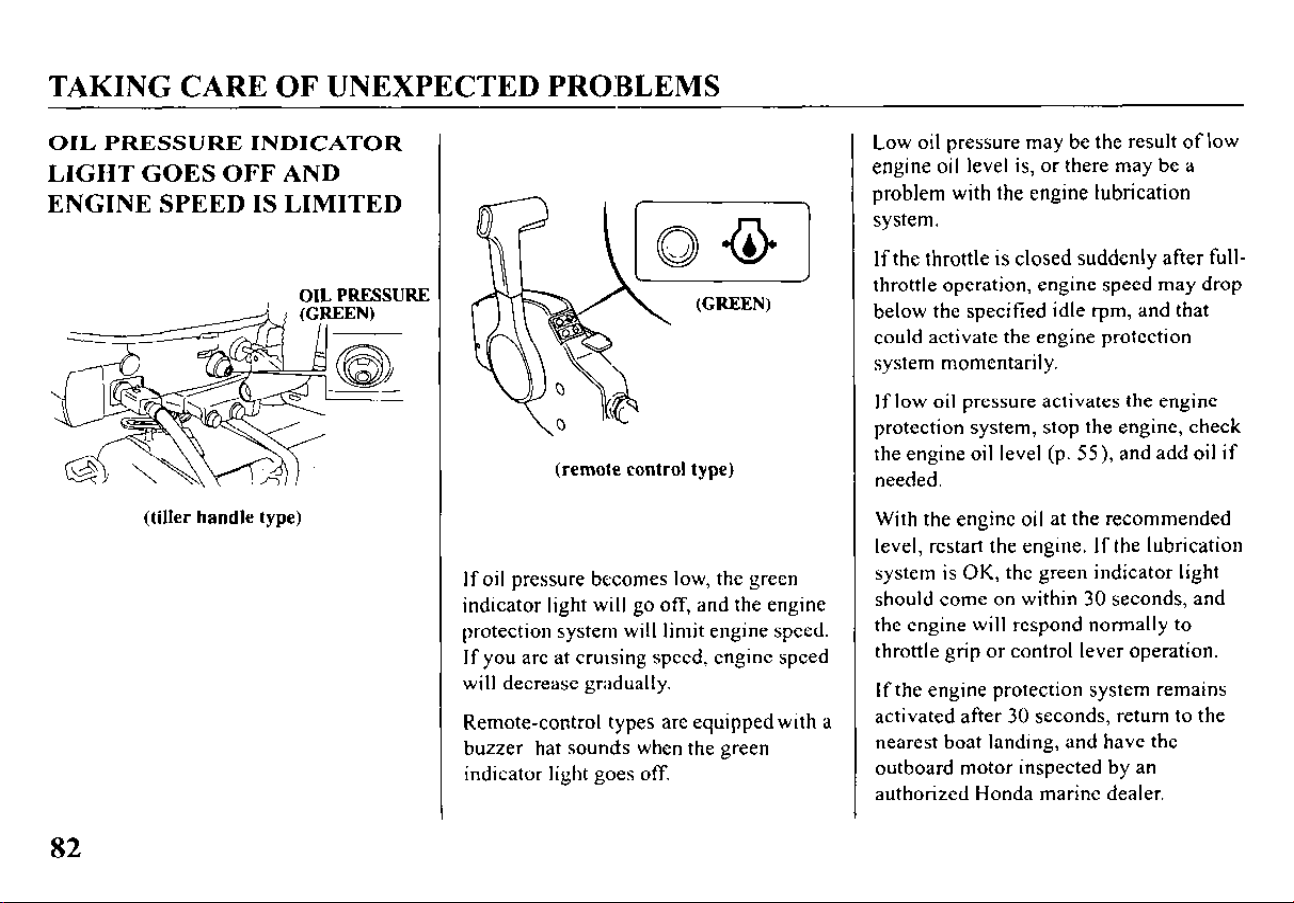
TAKING CARE OF UNEXPECTED PROBLEMS
OIL PRESSURE INDICATOR
LIGHT GOES OFF AND
ENGINE SPEED IS LIMITED
OIL PRESSURE
(tiller handle type)
(remote control type)
If oil pressure becomes low, the green
indicator light will go off, and the engine
protection system will limit engine speed.
If you arc at cruising speed, engine speed
will decrease gradually.
Remote-control types are equipped with a
buzzer hat sounds when the green
indicator light goes off.
Low oil pressure may be the result of low
engine oil level is, or there may bc a
problem with the engine lubrication
system.
If
the throttle is closed suddenly after full-
throttle operation, engine speed may drop
below the specified idle t-pm, and that
could activate the engine protection
system momentarily.
If low oil pressure activates the engine
protection system, stop the engine, check
the engine oil level (p. 55) and add oil if
needed.
With the engine oil at the recommended
level, restart the engine. If the lubrication
system is OK, the green indicator light
should come on within 30 seconds, and
the engine will respond normally to
throttle grip or control lever operation.
If the engine protection system remains
activated after 30 seconds, return to the
nearest boat landing, and have the
outboard motor inspected by an
authorized Honda marine dealer.
82
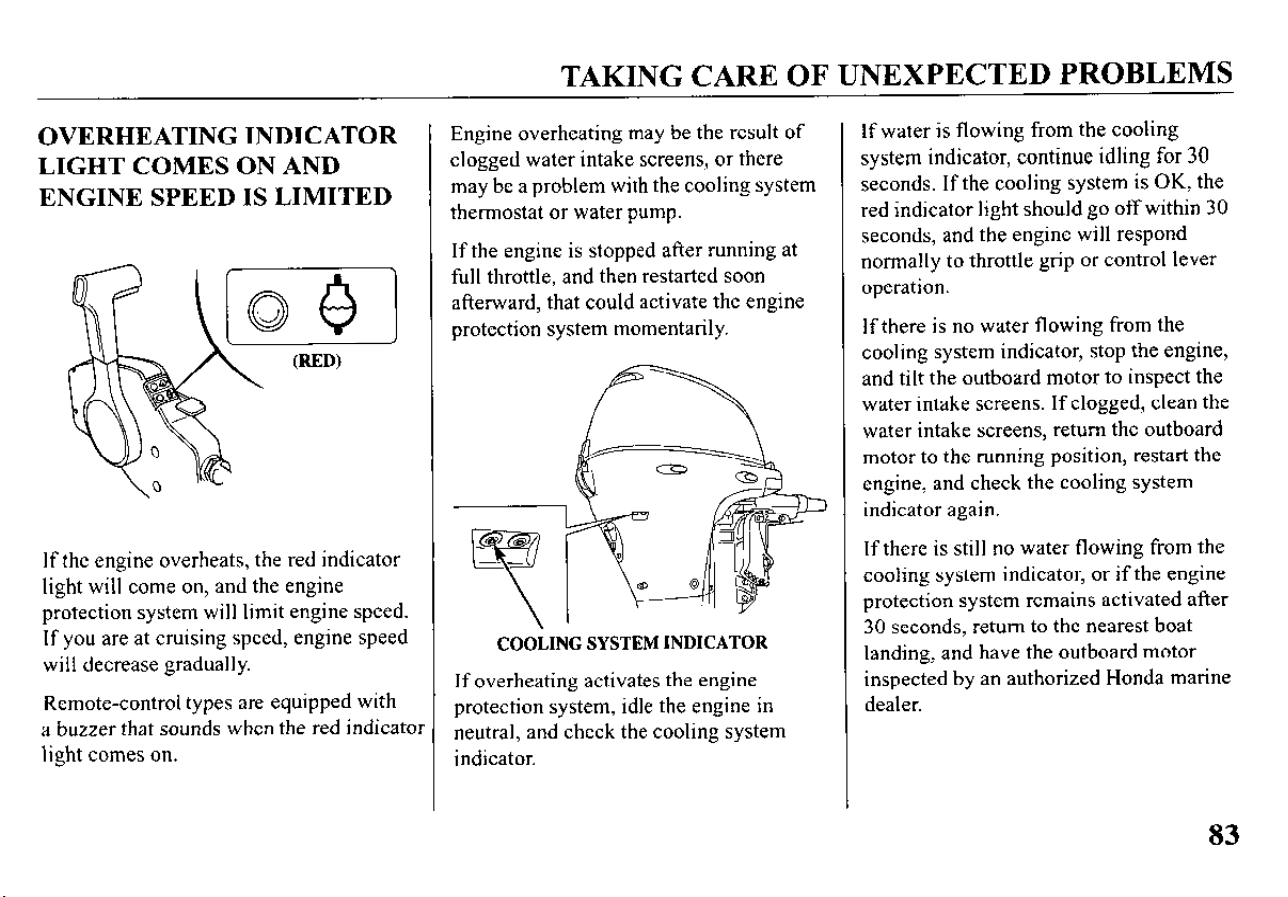
TAKING CARE OF UNEXPECTED PROBLEMS
OVERHEATING INDICATOR
LIGHT COMES ON AND
ENGINE SPEED IS LIMITED
If the engine overheats, the red indicator
light will come on, and the engine
protection system will limit engine speed.
If you are at cruising speed, engine speed
will decrease gradually.
Remote-control types are equipped with
a buzzer that sounds when the red indicator
light comes on.
Engine overheating may be the result of
clogged water intake screens, or there
may be a problem with the cooling system
thermostat or water pump.
If the engine is stopped after running at
full throttle, and then restarted soon
afterward, that could activate the engine
protection system momentarily.
COOiING SYSTEM INDICATOR
If overheating activates the engine
protection system, idle the engine in
neutral, and check the cooling system
indicator.
If water is flowing from the cooling
system indicator, continue idling for
30
seconds. If the cooling system is OK, the
red indicator light should go off within 30
seconds, and the engine will respond
normally to throttle grip or control lever
operation.
If there is no water flowing from the
cooling system indicator, stop the engine,
and tilt the outboard motor to inspect the
water intake screens. If clogged, clean the
water intake screens, return the outboard
motor to the running position, restart the
engine, and check the cooling system
indicator again.
If there is still no water flowing from the
cooling system indicator, or if the engine
protection system remains activated after
30 seconds, return to the nearest boat
landing, and have the outboard motor
inspected by an authorized Honda marine
dealer.
83
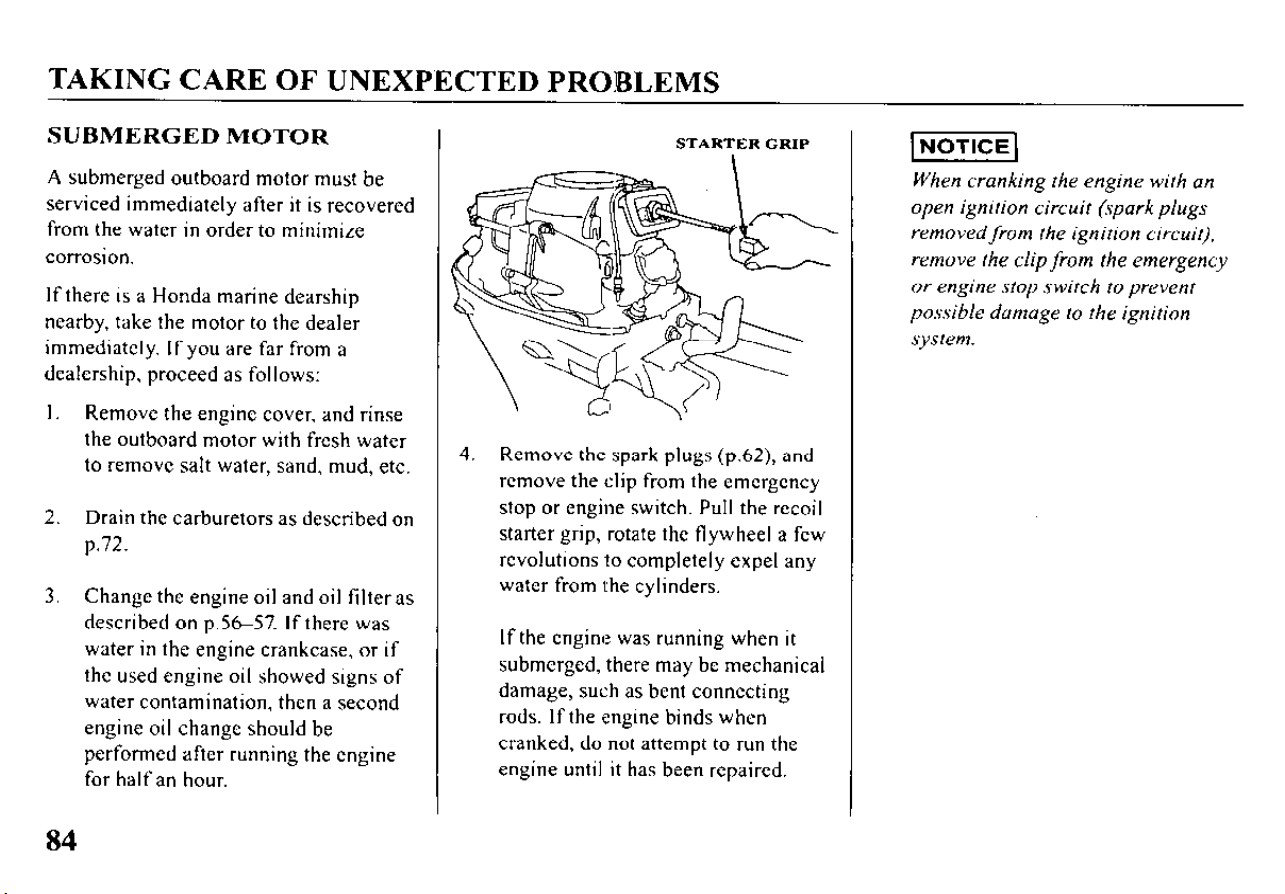
TAKING CARE OF UNEXPECTED PROBLEMS
SUBMERGED MOTOR
A submerged outboard motor must be
serviced immediately after it is recovered
from the water in order to minimize
corrosion.
If there is a Honda marine dearship
nearby, take the motor to the dealer
immediately. If you are far from a
dealership, proceed as follows:
I. Remove the engine cover, and rinse
the outboard motor with fresh water
to remove salt water, sand, mud, etc.
2. Drain the carburetors as described on
p.72.
3. Change the engine oil and oil filter as
described on p.5657. If there was
water in the engine crankcase, or if
the used engine oil showed signs of
water contamination, then a second
engine oil change should be
performed after running the engine
for half an hour.
84
STARTER GRIP
4. Remove the spark plugs (p.62), and
remove the clip from the emergency
stop or engine switch. Pull the recoil
starter grip, rotate the flywheel a few
revolutions to completely expel any
water from the cylinders.
If the engine was running when it
submerged, there may be mechanical
damage, such as bent connecting
rods. If the engine binds when
cranked, do not attempt to run the
engine until it has been repaired.
When cranking the engine with an
open ignition circuit (spark plugs
removedfrom the ignition circuit),
remove the clip from the emergency
or engine stop switch to prevent
possible dunrage to the ignition
system.
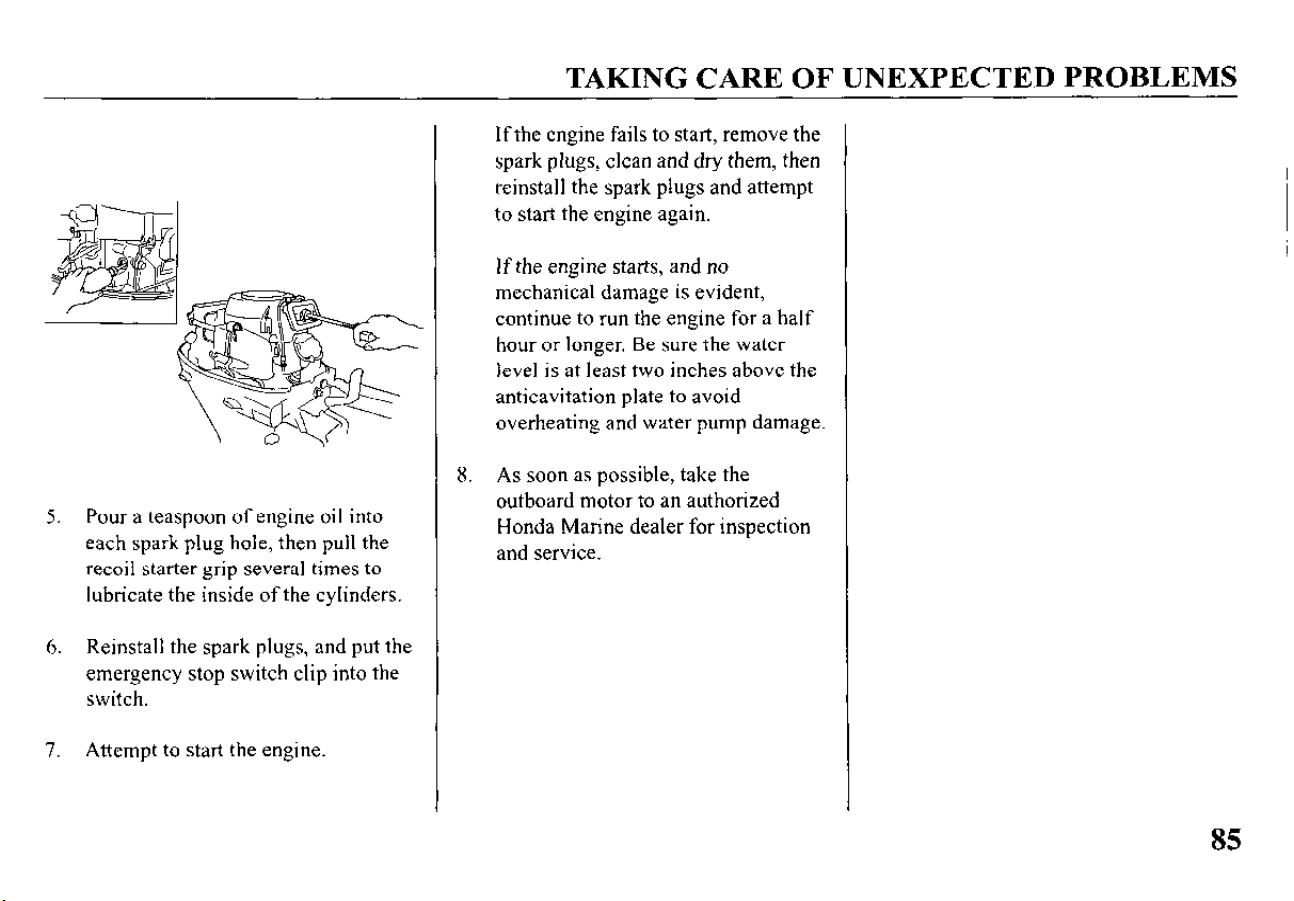
TAKING CARE OF UNEXPECTED PROBLEMS
5. Pour a teaspoon of engine oil into
each spark plug hole, then pull the
recoil starter grip several times to
lubricate the inside of the cylinders.
6. Reinstall the spark plugs, and put the
emergency stop switch clip into the
switch.
7. Attempt to start the engine.
8.
If the engine fails to start, remove the
spark plugs, clean and dry them,
then
reinstall the spark plugs and attempt
to start the engine again.
If the engine starts, and no
mechanical damage is evident,
continue to run the engine for a half
hour or longer. Be sure the water
level is at least two inches above the
anticavitation plate to avoid
overheating and water pump damage.
As soon as possible, take the
outboard motor to an authorized
Honda Marine dealer for inspection
and service.
85
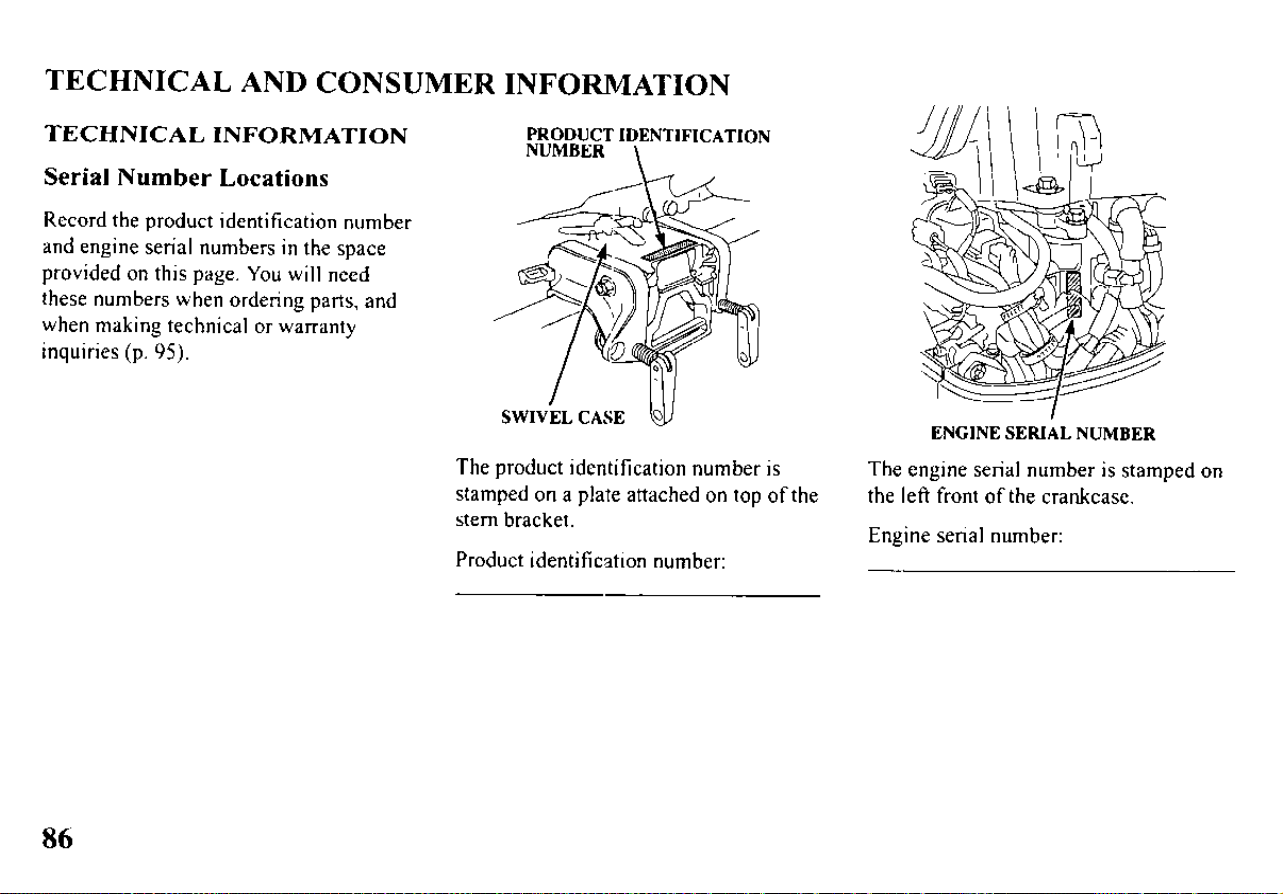
TECHNICAL AND CONSUMER INFORMATION
TECHNICAL INFORMATION
Serial Number Locations
Record the product identification number
and engine serial numbers in the space
provided on this page. You will need
these numbers when ordering parts, and
when making technical or warranty
inquiries (p. 95).
ENGINE SERIAL NUMBER
The product identification number is
stamped on a plate attached on top of the
stem bracket.
Product identification number:
The engine serial number is stamped on
the left front of the crankcase.
Engine serial number:
86
TECHNICAL AND CONSUMER INFORMATION
Carburetor Modification for
High Altitude Operation
At high altitude, the standard carburetor
air-fuel mixture will be too rich.
Performance will decrease, and fuel
consumption will increase. A very rich
mixture will also foul the spark plugs and
cause hard starting.
High altitude performance can be
improved by specific modifications to the
carburetors. If you always operate your
outboard motor at altitudes above 5,000
feet (I ,500 meters), have an authorized
Honda marine dealer perform this
carburetor modification.
Even with carburetor modification,
engine horsepower will decrease about
3.5% for each I ,OOO-foot (300-meter)
increase in altitude. The effect of altitude
on horsepower will be greater than this if
no carburetor modification is made.
I
I
When the carburetors have been mod$ed
for high altitude operation, the air-fuel
mixture will be too lean for low altitude
use. Operation at altitudes below 5,000
feet (1,500 meters) with modified
carburetors may cause the engine to
overheat and result in serious engine
damage. For use at low altitudes, have an
authorized Honda Marine dealer return
the carburetors to original factory
specifications.
87
TECHNICAL AND CONSUMER INFORMATION
Oxygenated Fuels
Some conventional gasolines are being
blended with alcohol or an ether
compound. These gasolines arc
collectively referred to as oxygenated
fuels. To meet clean air standards, some
areas of the United States and Canada USC
oxygenated fuels to help reduce
emissions.
If you use an oxygenated fuel, bc sure it is
unleaded and meets the minimum octane
rating requirement.
Before using an oxygenated fuel, try to
confirm the fuel’s contents. Some states/
provinces require this information to be
posted on the pump.
The following are: the EPA-approved
percentages of oxygenates:
ETHANOL: ethyl or grain alcohol; IO%
by volume.
You may use gasoline containing up to
10% ethanol by volume. Gasoline
containing ethanol may be marketed
under the name “Gasohol”.
MTBE: Methyl Tertiary Butyl Ether;
15% by volume.
You may use gasoline containing up to
15% MTBE by volume.
METHANOL: methyl or wood alcohol;
5% by volume.
You may use gasoline containing up to
5% methanol by volume, as long as it also
contains cosolvents and corrosion
inhibitors to protect the fuel system.
Gasoline containing more than 5%
methanol by volume may cause starting
and/or performance problems. It may also
damage metal, rubber, and plastic parts of
your fuel system.
If you notice any undesirable operating
symptoms, try another service station, or
switch to another brand of gasoline.
Fuel system damage or performance
problems resulting from the use of an
oxygenated fuel containing more than the
percentages of oxygenates mentioned
above are not covered under warranty.
88
TECHNICAL AND CONSUMER INFORMATION
Emission Control
System Information
Source of Emissions
The combustion process produces carbon
monoxide, oxides of nitrogen, and
hydrocarbons. Control of hydrocarbons
and oxides of nitrogen is very important
because, under certain conditions, they
react to form photochemical smog when
subjected to sunlight. Carbon monoxide
does not react in the same way, but it is
toxic.
Honda utilizes lean carburetor settings
and other systems to reduce the emissions
of carbon monoxide, oxides of nitrogen,
and hydrocarbons.
The U.S. Clean Air Act
EPA regulations require all manufacturers
to furnish written instructions describing
the operation and maintenance of
emission control systems.
The following instructions and
procedures must be followed in order to
keep the emissions from your Honda
engine within the emission standards.
Tampering and Altering
Tampering with or altering the emission
control system may increase emissions
beyond the legal limit. Among those acts
that constitute tampering are:
.
Removal or alteration of any part of
the intake, fuel, or exhaust systems.
.
Alterations that would cause the
engine to operate outside its design
parameters.
Problems That May
Affect Emissions
If you are aware of any of the following
symptoms, have your engine inspected
and repaired by your servicing dealer.
.
Hard starting or stalling after starting.
.
Rough idle.
.
Misfiring or backfiring under load.
.
Afterburning (backfiring).
.
Black exhaust smoke or high fuel
consumption.
.
Black exhaust smoke or high fuel
consumption.
89
TECHNICAL AND CONSUMER INFORMATION
Replacement Parts
The emission control systems on your
Honda engine were designed, built, and
certified to conform with EPA emission
regulations. We recommend the use of
genuine Honda parts whenever you have
maintenance done. These original-design
replacement parts are manufactured to the
same standards as the original parts, so
you can be confident of their
performance. The use of replacement
parts that are not of the original design
and quality may impair the effectiveness
of your emission control system.
A manufacturer of an aftermarket part
assumes the responsibility that the part
will not adversely affect emission
performance. The manufacturer or
rebuilder of the part must certify that use
ofthe part will not result in a failure ofthe
engine to comply with emission
regulations.
Maintenance
Follow the maintenance schedule on p.
53. Remember that this schedule is
based on the assumption that your
machine will be used for its designed
purpose. Sustained high-load operation,
or use in unusual conditions, will require
more frequent service.
90
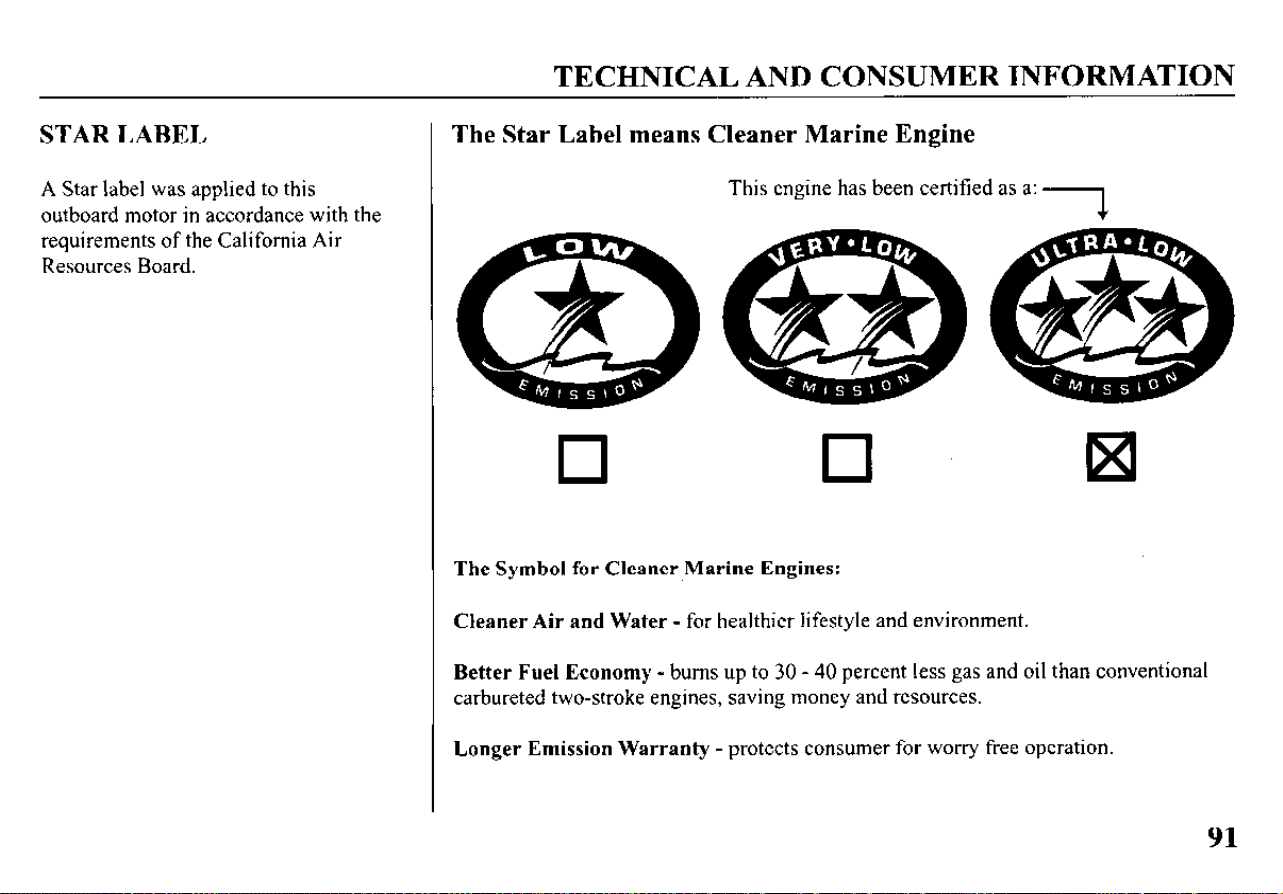
TECHNICAL AND CONSUMER INFORMATION
STAR LABEL
A Star label was applied to this
outboard motor in accordance with the
requirements of the California Air
Resources Board.
The Star Label means Cleaner Marine Engine
This engine has been certified as a: -,
c
a
.
0
0
The Symbol for Cleaner Marine Engines:
Cleaner Air and Water - for healthier lifestyle and environment.
Better Fuel Economy -bums up to 30 - 40 percent less gas and oil than conventional
carbureted two-stroke engines, saving money and resources.
Longer Emission Warranty - protects consumer for worry free operation.
91
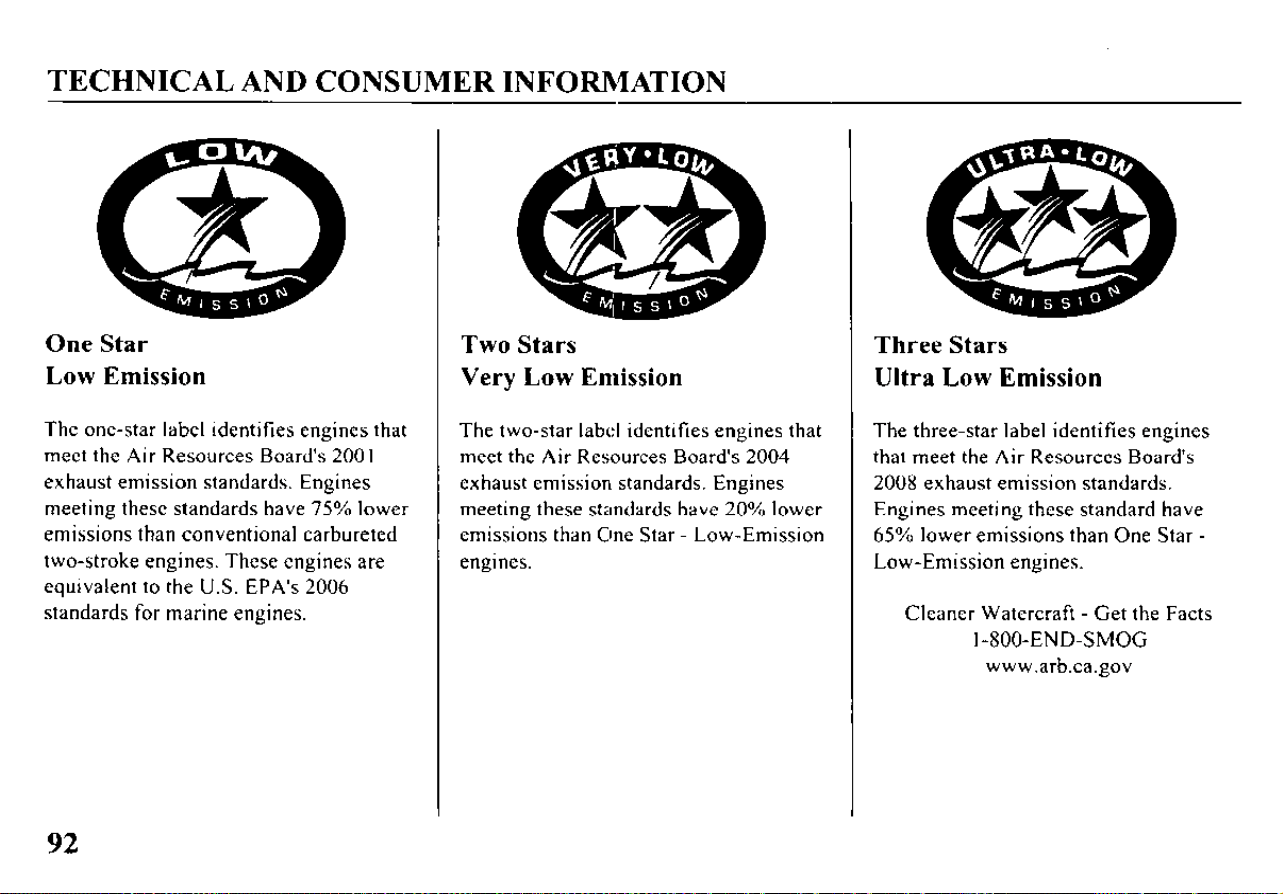
TECHNICAL AND CONSUMER INFORMATION
One Star
Low Emission
The one-star label identities engines that
meet the Air Resources Board’s 200 I
exhaust emission standards. Engines
meeting these standards have 75% lower
emissions than conventional carbureted
two-stroke engines. These engines are
equivalent to the U.S. EPA’s 2006
standards for marine engines.
Two Stars
Very Low Emission
The two-star label identifies engines that
meet the Air Resources Boards 2004
exhaust emission standards. Engines
meeting these standards have 20% lower
emissions than One Star - Low-Emission
engines.
Three Stars
Ultra Low Emission
The three-star label identities engines
that meet the Air Resources Board’s
2008 exhaust emission standards.
Engines meeting these standard have
65% lower emissions than One Star -
Low-Emission engines.
Clcancr Watcrcraft - Get the Facts
I-800-END-SMOG
www.arb.ca.gov
92
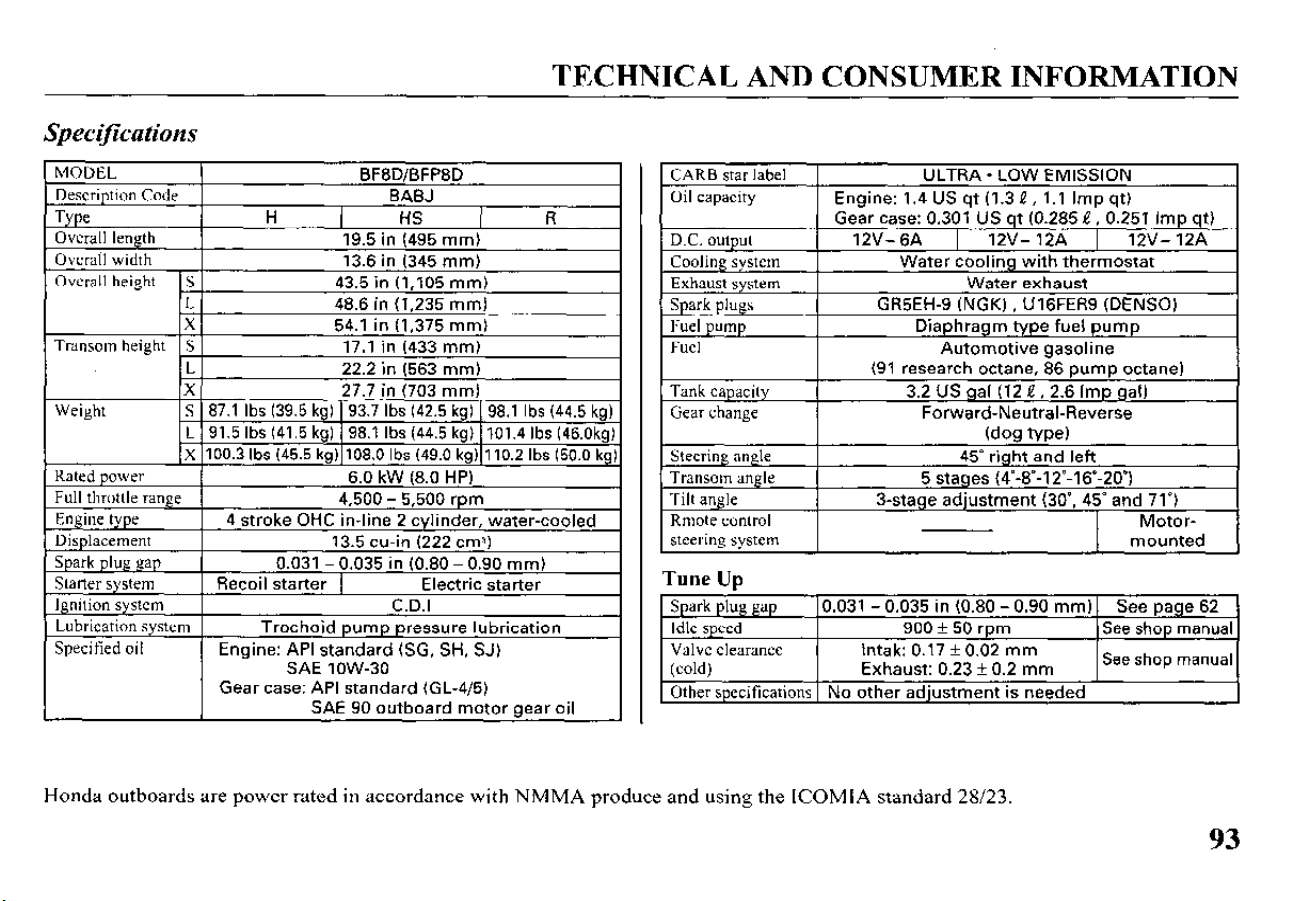
TECHNICAL AND CONSUMER INFORMATION
Specifications
MODEL
BF8D/BFP8D
Description Code
BABJ
Type
H
HS
I?
Overall length
19.5 in (495 mm)
Overall width
13.6 in (345 mm)
Overall height S
43.5 in (1,105 mm)
L
X
Transom height S
48.6 in (1,235 mm)
54.1 in (1,375 mm)
17.1 in (433 mm)
Weight
L
22.2 in (563 mm)
X
27.7 in (703 mm)
S 87.1 93.7 Ibs (42.5 kg) 98.1 Ibs (44.5 kg)
L 91.5 Ibs (41.5 kg) 98.1 Ibs (44.5 kg) 101.4 Ibs (46.0kg)
x 100.3 Ibs (45.5 kg) 108.0 Ibs (49.0 kg) 110.2 Ibs (50.0 kg)
Rated power
6.0 kW (8.0 HP)
Full throttle range
4,500 - 5,500 rpm
Engine type
4 stroke OHC in-line 2 cylinder, water-cooled
Displacement
13.5 cu-in (222 cm’)
Spark plug gap
0.031 - 0.035 in (0.80 - 0.90 mm)
Starter system
Recoil starter 1
Electric starter
Ignition system
C.D.1
Lubrication system
Trochoid pump pressure lubrication
Specified oil
Engine: API standard (SG, SH, SJ)
SAE low-30
Gear case: API standard (GL-4/5)
SAE 90 outboard motor gear oil
Tank capacity
Gear change
Steering angle
Transom angle
Tilt angle
(91 research octane, 86 pump octane)
3.2 US gal (12 e, 2.6 Imp gal)
Forward-Neutral-Reverse
(doa tvoe)
“,..
45’ right and left
5 stages (4--8*-l 2”-16’-20”)
3-stage adjustment
(30’. 45” and 71’)
Rmote control
steerine svstem
Motor-
mounted I
Tune Up
80 - 0.90 mm) 1 See page 62 1
Spark plug gap 0.031 - 0.035 in (0.1
Idle speed
900 + 50 rpm
See shop manual
Valve clearance Intak: 0.17 f 0.02 mm
(cold)
Exhaust: 0.23 +_ 0.2 mm
See shop manual
Other specifications No other adjustment is needed
Honda outboards are power rated in accordance with NMMA produce and using the ICOMIA standard 28123.
93
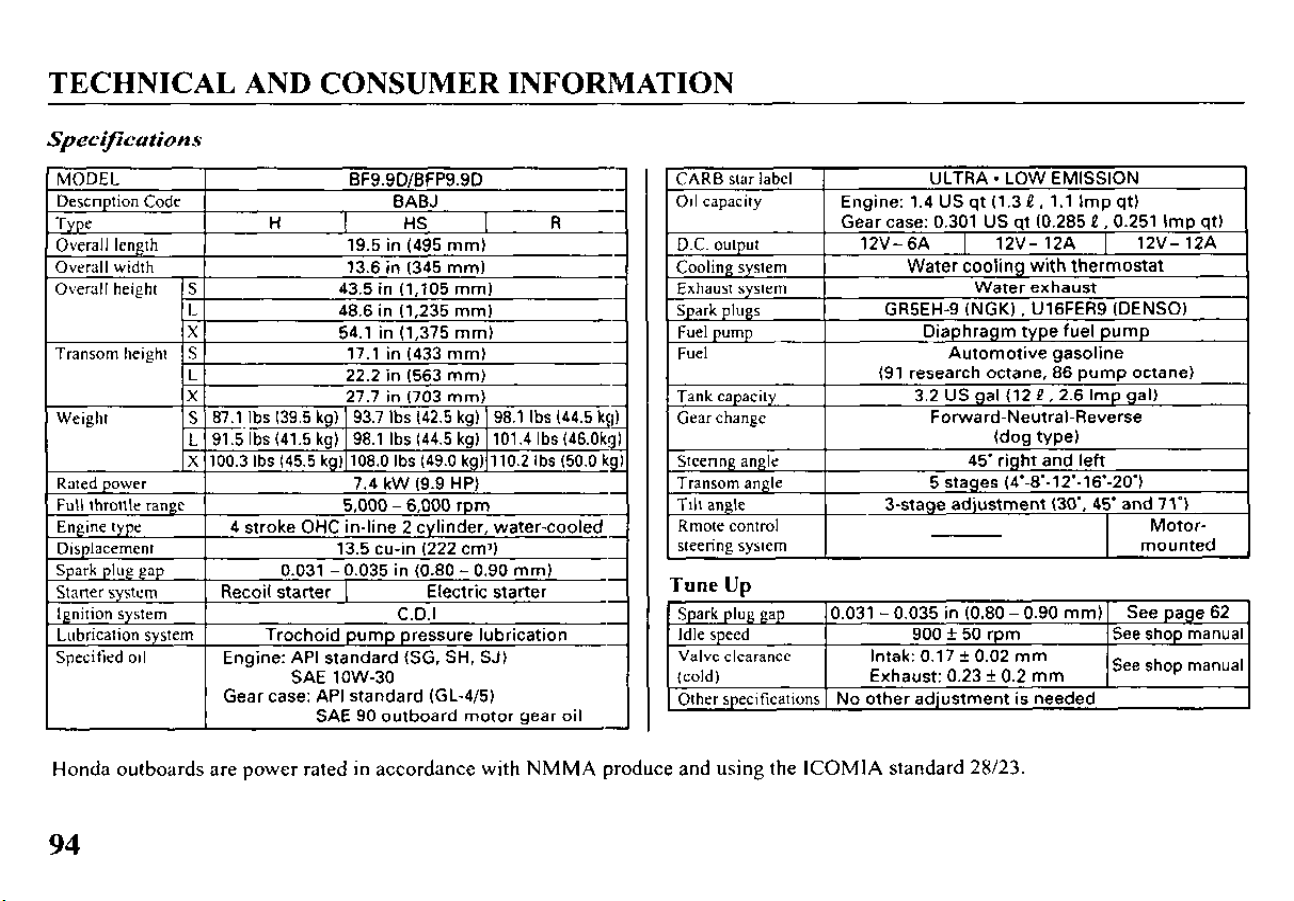
TECHNICAL AND CONSUMER INFORMATION
Specifications
MODEL
Descnption Code
-Type
Overall length
Overall width
Overall height S
L
X
BFS.SD/BFPS.SD
BABJ
Ii
HS
19.5 in (495 mm)
13.6 in (345 mm)
43.5 in (1,105 mm)
48.6 in (1,235 mm)
54.1 in (1,375 mm)
4 stroke OHC in-line 2 c linder water-cooled
~~1
Ignition system
C.D.1
Lubrication system
Trochoid pump pressure lubrication
Specitied 011
Enoine: API standard (SG, SH, SJ)
SAE low-30
Gear case: API standard (GL-4/5)
SAE SO outboard motor gear oil _]
CARB star label 1
ULTRA. LOW EMISSION
Oil capacity
1 Enaine: 1.4 US at (1.3 e, 1.1 Imp at)
_
D.C. output
Cooling system
Exhaust system
Spark plugs
Fuel pump
Fuel
I
Automotive gasoline
(91 research octane, 86 pump octane)
Tank capacity
3.2 US gal (12 .&Z, 2.6 Imp gal)
Gear change
Forward-Neutral-Reverse
Gear case: 0.301’ US qt (0.285 e’, 01251 Imp qt)
12V-6A 1 12V- 12A 1 12V- 12A
Water cooling with thermostat
Water exhaust
GR5EH-9 (NGK) , U16FERS (DENSO)
Diaphragm type fuel pump
Rmofe control
Motor-
steering system
mounted
Tune
UD
I
Spark plug gap
0.031 - 0.035 in (0.80 - 0.90 mm) See page 62
Idle speed
900 f 50 rpm See shop manual
Valve clearance Intak: 0.17 f 0.02 mm
(cold)
Exhaust: 0.23 f 0.2 mm
See shop manual
Other speclficatlons 1 No other adjustment is needed
Honda outboards are power rated in accordance with NMMA produce and using
the ICOMIA standard 28/23.
94
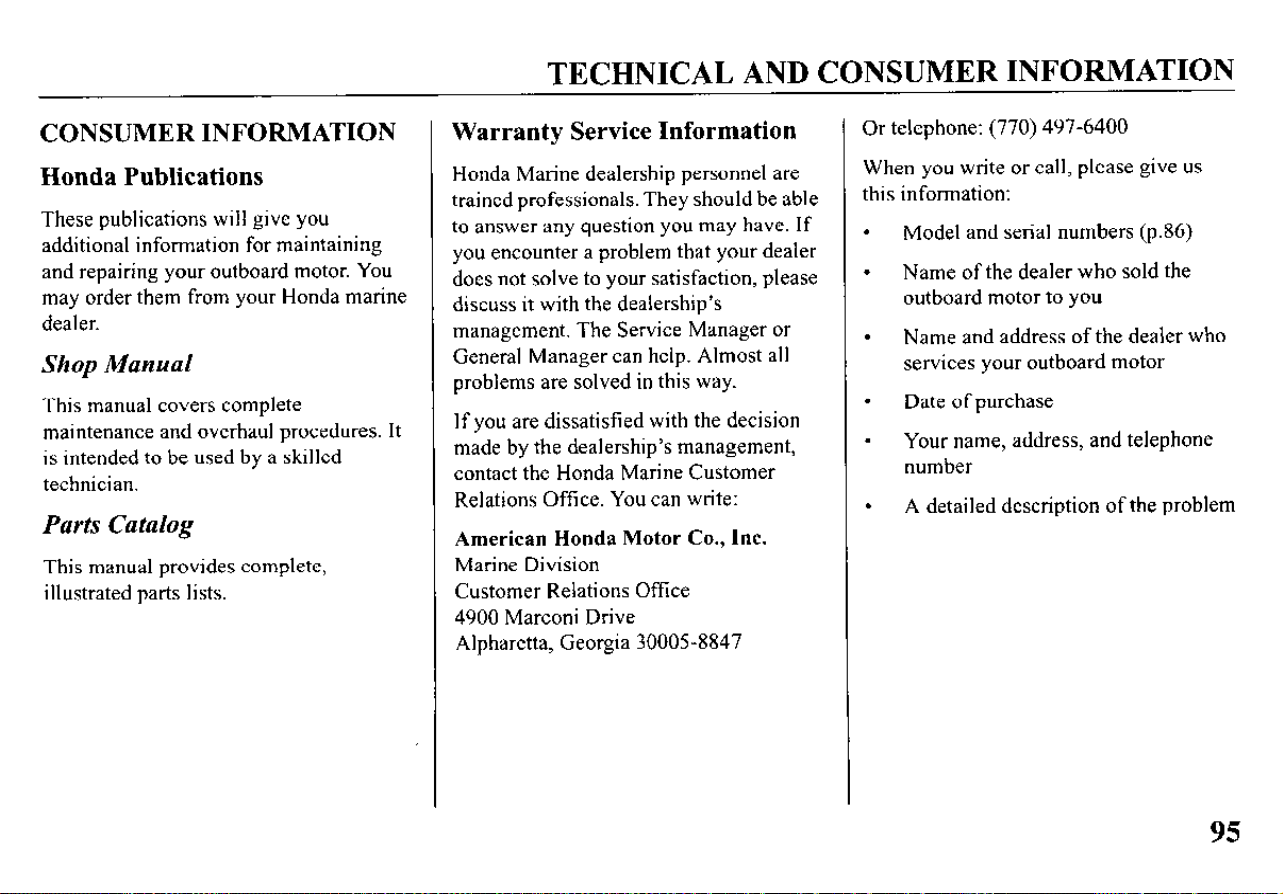
TECHNICAL AND CONSUMER INFORMATION
CONSUMER INFORMATION
Honda Publications
These publications will give you
additional information for maintaining
and repairing your outboard motor. You
may order them from your Honda marine
dealer.
Shop Manual
This manual covers complete
maintenance and overhaul procedures. It
is intended to be used by a skilled
technician.
Parts Catalog
This manual provides complete,
illustrated parts lists.
Warranty Service Information
Honda Marine dealership personnel are
trained professionals. They should be able
to answer any question you may have. If
you encounter a problem that your dealer
does not solve to your satisfaction, please
discuss it with the dealership’s
management. The Service Manager or
General Manager can help. Almost all
problems are solved in this way.
If you are dissatisfied with the decision
made by the dealership’s management,
contact the Honda Marine Customer
Relations Office. You can write:
American Honda Motor Co., Inc.
Marine Division
Customer Relations Offtce
4900 Marconi Drive
Alpharetta, Georgia 30005-8847
Or telephone: (770) 497-6400
When you write or call, please give us
this information:
Model and serial numbers (p.86)
Name of the dealer who sold the
outboard motor to you
Name and address of the dealer who
services your outboard motor
Date of purchase
Your name, address, and telephone
number
A detailed description of the problem
95
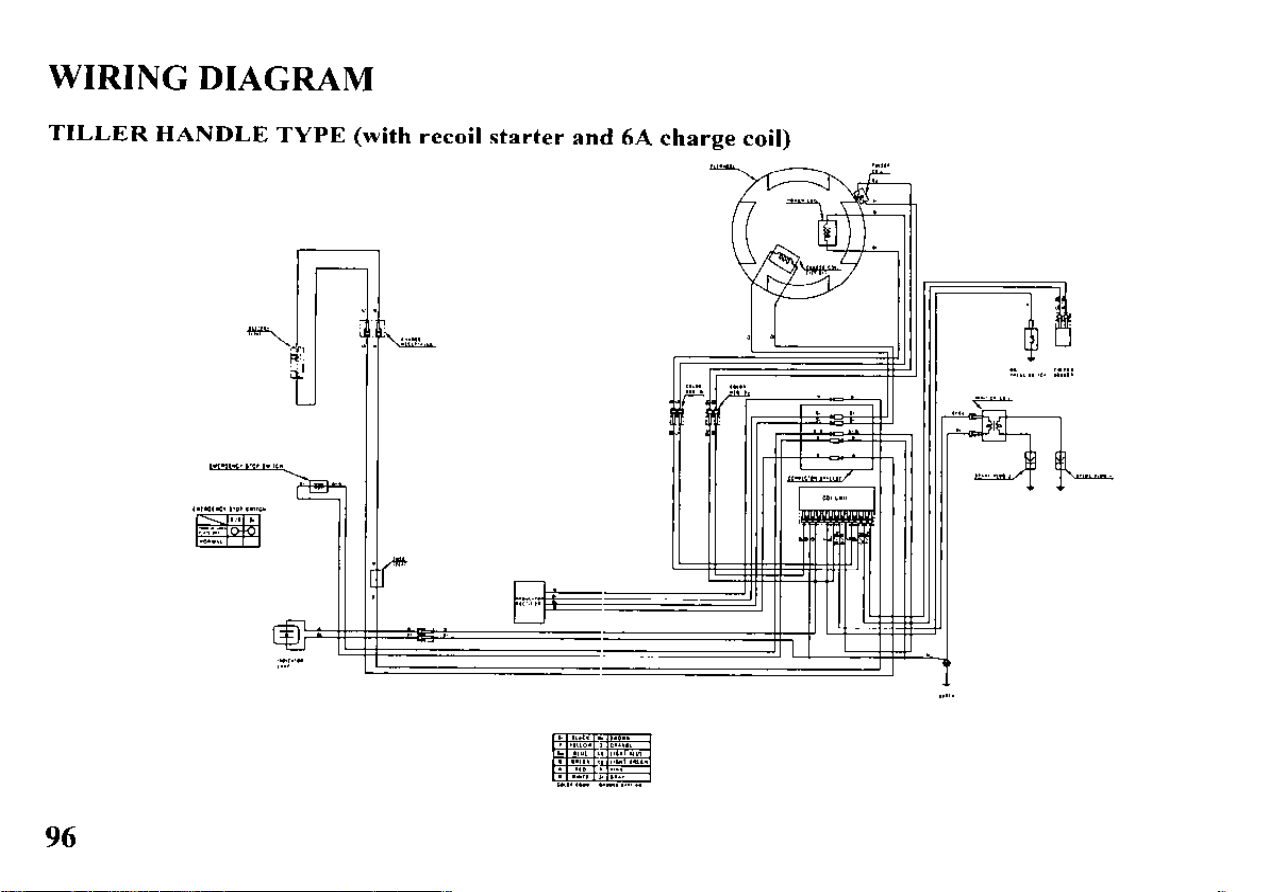
WIRING DIAGRAM
TILLER HANDLE TYPE (with recoil starter and 6A charge coil)
” .
\
” .
- . a
[
96
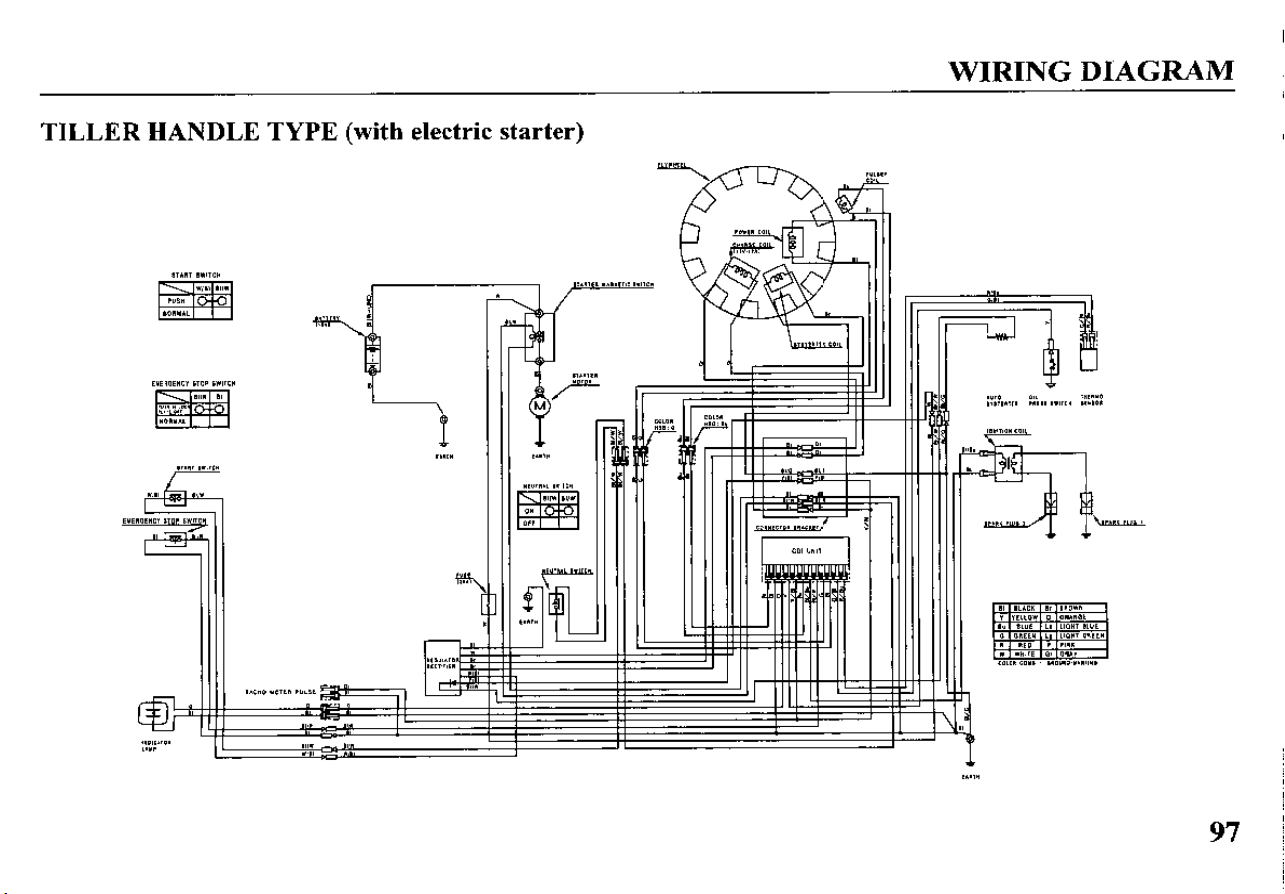
i
-
1
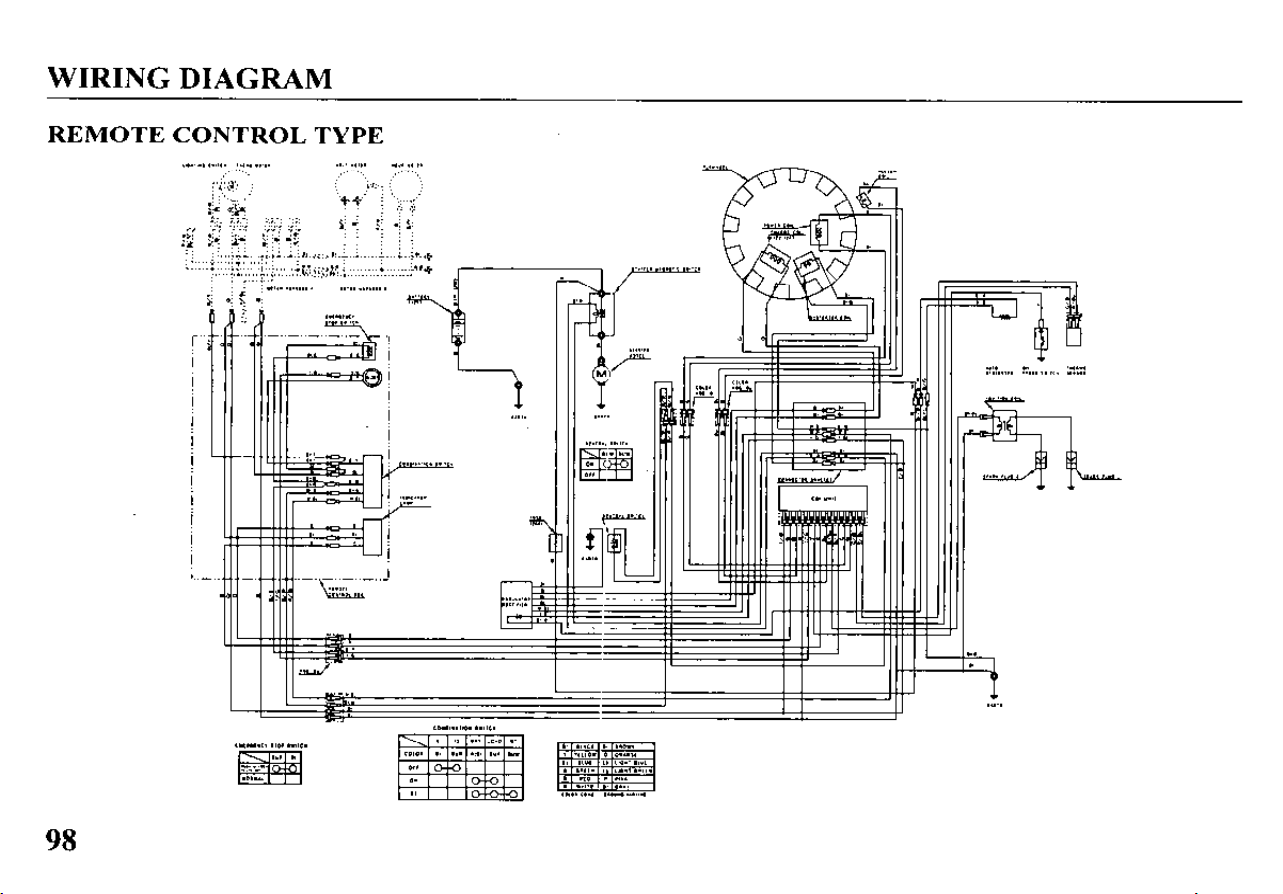
WIRING DIAGRAM
REMOTE CONTROL TYPE
L
L.
.
,“..
98
INDEX
Anodes
---------------------------------23
Anode Replacement - - - _ - _ _ _ _ _ _ _ _ _ _ _ _ _ _ _ _ _ _ _ _ -68
ARE YOU READY TO GET UNDER WAY? - - - - - - - -30
ATTACHMENT _ _ _ _ _ _ _ _ _ _ _ _ _ _ _ _ _ _ _ _ _ _ _ _ _ _ _ -26
Automatic Choke (equipped type only) - - - - - - - - - - - - -23
BATTERYCONNECTIONS--------------------
BATTERY WILL NOT CHARGE AND
ELECTRICAL STARTER WILL NOT OPERATE - - - - 8 1
BEFORE OPERATION _ _ _ _ _ _ _ _ _ _ _ _ _ _ _ _ _ _ _ _ _ _ -30
BOAT TRANSOM REQUIREMENTS - - - - - - - - - - - - -25
BREAK-IN PROCEDURE _ _ _ _ _ _ _ _ _ _ _ _ _ _ _ _ _ _ _ _ -32
Carburetor Modification for High Altitude Operation- - -87
CONTROLSANDFEATURES ------------------- 7
Choke Knob (H type manual choke) - - - - - - - - - - - - - - 14
COMPONENT AND CONTROL LOCATIONS- - - - - - - 11
CONSUMERINFORMATION ------------------95
CONTROLS _ _ _ _ _ _ _ _ _ _ _ _ _ _ _ _ _ _ _ _ _ _ _ _ _ _ _ _ _ _ -14
CONTROLS AND FEATURES
IDENTIFICATION CODES - - - - - - - - - - - - - - - - - - -10
Cooling System Indicator - - - - - - - - - - - - - - - - - - - - -23
CRUlS]NG _ _ _ _ _ _ _ _ _ _ _ _ _ _ _ _ _ _ _ _ _ _ _ _ _ _ _ _ _ _ _ -47
Electric Starter Button (models equipped with
electric starter) _ _ _ _ _ _ _ _ _ _ _ _ _ _ _ _ _ _ _ _ _ _ _ _ _ _ _ _ _ 16
EMERGENCY STARTING- _ _ _ _ _ _ _ _ _ _ _ _ _ _ _ _ _ _ _ -40
Emergency Engine Stopping - - - - - - - - - - - - - - - - - - -42
Emission Control System Information - - - - - - - - - - - - -89
Engine
Cover Latch _ _ _ _ _ _ _ _ _ _ _ _ _ _ _ _ _ _ _ _ _ _ _ _ -20
ENGINE COVER REMOVAL AND INSTALLATION - 55
Engine
Oil
Change-
_ _ _ _ _ _ _ _ _ _ _ _ _ _ _ _ _ _ _ _ _ _ _ _ _ 56
Engine Oil Level Check _ _ _ _ _ _ _ _ _ _ _ _ _ _ _ _ _ _ _ _ _ _
55
Engine Oil Recommendations - - - - - - - - - - - - - - - - - - 58
Engine Stop Switch and Switch Clip - - - - - - - - - - - - - - 14
Fast IdIe Lever- _ _ _ _ _ _ _ _ _ _ _ _ _ _ _ _ _ _ _ _ _ _ _ _ _ _ _ -18
Fuel Cap Vent Knob- _ _ _ _ _ _ _ _ _ _ _ _ _ _ _ _ _ _ _ _ _ _ _ -24
99
INDEX
FuelGauge----- -----_____________________ 21
FUELHOSECONNECTIONS------------------34
FUEL PRIMING _ _ _ _ _ _ _ _ _ _ _ _ _ _ _ _ _ _ _ _ _ _ _ _ _ _ _ -35
Fuel priming Bulb _ _ _ _ _ _ _ _ _ _ _ _ _ _ _ _ _ _ _ _ _ _ _ _ _ _ -24
Fuel Pump Filter Inspection and Replacement - - - - - - - -65
FUELRECOMMENDATIONS------------------
Gear Oil Change _ _ _ _ _ _ _ _ _ _ _ _ _ _ _ _ _ _ _ _ _ _ _ _ _ _ _ -59
Gear Oil Level Check- _ _ _ _ _ _ _ _ _ _ _ _ _ _ _ _ _ _ _ _ _ _ _ -58
GEARSHIFTING AND THROTTLE OPERATION - - - -44
Gearshift Lever _ _ _ _ _ _ _ _ _ _ _ _ _ _ _ _ _ _ _ _ _ _ _ _ _ _ _ _ 1 ‘j
Gearshift/Trottle Control Lever - - - - - - - - - - - - - - - - - IS
Ignition Switch _ _ _ _ _ _ _ _ _ _ _ _ _ _ _ _ _ _ _ _ _ _ _ _ _ _ _ _ 16
IMPORTANT SAFETY INFORMATION - - - - - - - - - - - 7
INDICATORS- _ _ _ _ _ _ _ _ _ _ _ _ _ _ _ _ _ _ _ _ _ _ _ _ _ _ _ _ -22
INSTALLATION- _ _ _ _ _ _ _ _ _ _ _ _ _ _ _ _ _ _ _ _ _ _ _ _ _ _ -25
INSTALLATION POSITION -------------------26
INSTRUMENTS _ _ _ _ _ _ _ _ _ _ _ _ _ _ _ _ _ _ _ _ _ _ _ _ _ _ _ -21
100
!
IS YOUR OUTBOARD MOTOR READY TO GO? - - - -30
Lubrication points _ _ _ _ _ _ _ _ _ _ _ _ _ _ _ _ _ _ _ _ - - - - - - -6 1
MAINTENANCESAFETY --------------------51
MAINTENANCESCHEDULE------------------
MOORING, BEACHING, LAUNCHING - - - - - - - - - - -49
Normal Engine Stopping _ _ _ _ _ _ _ _ _ _ _ _ _ _ _ _ _ _ _ _ _ -43
H Type (tiller handle) _ _ _ _ _ _ _ _ _ _ _ _ _ _ _ _ - _ - - - - - -44
R Type (remote control) - - - - - - - - - - - - - - - - - - - - - -45
Oil filter Change _ _ _ _ _ _ _ _ _ _ _ _ _ _ _ _ _ _ _ _ _ _ _ _ _ _ _ -57
Oil Pressue Indicator (R type) (H type) - - - - - - - - - - - -22
OIL PRESSURE INDICATOR LIGHT GOES OFF AND
ENGINESPEEDISLIMITED-----------------82
OPERATION _ _ _ _ _ _ _ _ _ _ _ _ _ _ _ _ _ _ _ _ _ _ _ _ _ _ _ _ _ _ _ -32
OTHER FEATURES _ _ _ _ _ _ _ _ _ _ _ _ _ _ _ _ _ _ _ _ _ _ _ _ -23
OUTBOARDMOTORSAFETY----------------- 7
Overheat Indicator (R type) - - - - - - - - - - - - - - - - - - - -22
OVERHEATING INDICATOR LIGHT COMES ON AND
ENGINE SPEED IS LIMITED (remote control type) - -83
INDEX
Overrev Limiter- _ _ _ _ _ _ _ _ _ _ _ _ _ _ _ _ _ _ _ _ _ _ _ _ _ _ -23
portable Fuel Tank _ _ _ _ _ _ _ _ _ _ _ _ _ _ _ _ _ _ _ _ _ _ _
24,34
Portable Fuel Tank and Filter Cleaning - - - - - - - - - - - - - 67
POWERREQUIREMENTS --------------------25
Propeller Replacement - - - - - - - - - - - - - - - - - - - - - - - 69
Recoil Starter Rope Inspection - - - - - - - - - - - - - - - - - -
68
REFUELING _ _ _ _ _ _ _ _ _ _ _ _ _ _ _ _ _ _ _ _ _ _ _ _ _ _ _ _ _ -64
REMOVALFROMSTORAGE------------------74
SAFE OPERATING PRECAUTIONS - - - - - - - - - - - - -32
SAFETY LABEL LOCATIONS- - - - - - - - - - - - - - - -‘-,- 9
SERVICING YOUR HONDA OUTBOARD MOTOR - - - -50
SHALLOW WATER OPERATION - - - - - - - - - - - - - - -48
Spark Plug Service---------------------------62
STAR LABEL _ _ _ _ _ _ _ _ _ _ _ _ _ _ _ _ _ _ _ _ _ _ _ _ _ _ _ _ -91
STARTING THE ENGINE _ _ _ _ _ _ _ _ _ _ _ _ _ _ _ _ _ _ _ _ -35
HType(tillerhandle)------------------------35
R Type (remote control) - - - - - - - - - - - - - - - - - - - - - -38
STEERING -------------------------------46
HType(tillerhandle)------------------------46
R Type ( remote cobtrol) - - - - - - - - - - - - - - - - - - - - - -46
Steering Fiction Lever _ _ _ _ _ _ _ _ _ _ _ _ _ _ _ _ _ _ _ _ _ _ -2 1
STOPPING THE ENGINE _ _ _ _ _ _ _ _ _ _ _ _ _ _ _ _ _ _ _ _ -42
STORAGE- _ _ _ _ _ _ _ _ _ _ _ _ _ _ _ _ _ _ _ _ _ _ _ _ _ _ _ _ _ _ _ _ 70
Fuel------------------------------------ 72
Engine Oil _ _ _ _ _ _ _ _ _ _ _ _ _ _ _ _ _ _ _ _ _ _ _ _ _ _ _ _ _ _ - 73
STORAGEPRECAUTIONS------------------- 73
STORAGEPREPARATION------------------- 70
SUBMERGED MOTOR- _ ___ ____ __ ___ ____ ___ m-84
Switch Clip and Emergency Stop Switch - - - - - - - - - - - I7
TAKING CARE OF UNEXPECTED PROBLEMS - - - - - 76
TECHNICAL AND CONSUMER INFORMATION - - - - -86
TECHNICAL INFORMATION - - - - - - - - - - - - - - - - - -86
Serial Number Locations _ _ _ _ _ _ _ _ _ _ _ _ _ _ _ _ _ _ _ _ _ -86
Oxygemted Fuels _ _ _ _ _ _ _ _ _ _ _ _ _ _ _ _ _ _ _ _ _ _ _ _ _ _ -88
101
INDEX
Spccifica[ions _ _ _ _ _ _ _ _ _ _ _ _ _ _ _ _ _ _ _ _ _ _ _ _ _ _ _ _ -93
THE IMPORTANCE OF MAINTENANCE - - - - - - - - -50
Throttle Friction Dial _ _ _ _ _ - _ _ _ _ _ - - _ _ _ _ _ - - - - - _ l’j
ThrottleGrip ____________-____------- ------I5
Tilt Lever ______________ _____-______--____ 21
TOOL KIT AND EMERGENCY STARTER ROPE - - - -52
Transom Angle Adjusting Rod - - - - - - - - - - - - - - - - - -20
TRANSOM ANGLE ADJUSTMENT - - - - - - - - - - 27,33
TRANSPORTING _ _ _ _ _ _ _ _ _ _ _ _ _ _ _ _ _ _ _ _ _ _ _ _ _ _ _ -75
WITH OUTBOARD MOTOR INSTALLED ON BOAT -75
WITH OUTBOARD MOTOR REMOVED
FROM BOAT _ _ _ _ _ _ _ _ _ _ _ _ _ _ _ _ _ _ _ _ _ _ _ _ _ _ _ _ _
-7:j
WlRlN(-j DIAGRAMS _ _ _ _ _ _ _ _ _ _ _ _ _ _ _ _ _ _ _ _ _ _ _ -96
102



2001
© HONDA MOTOR CO., LTD. 2000
31ZW8600
00X31-ZW8-6000
KINKOS 100.2002.08
PRINTED IN U.S.A
EM3
BF8D/9.9D
BFP8D/9.9D
Owner’s
Manual