−
The engine exhaust from this
product contains chemicals
known to the State of California to
cause cancer, birth defects, or
other reproductive harm.
Keep this Owner’s Manual handy, so you can refer to it at any time. This Owner’s
Manual is considered a permanent part of the outboard motor and should remain with
the outboard motor if resold.
The information and specifications included in this publication were in effect at the
time of approval for printing. Honda Motor Co., Ltd. reserves the right, however, to
discontinue or change specifications or design at any time without notice and without
incurring any obligation whatever. No part of this publication may be reproduced
without written permission.
2009 Honda Motor Co., Ltd. All Rights Reserved
09/06/24 16:07:11 31ZY9610_001

1
INTRODUCTION
Congratulations on your selection of
a Honda outboard motor. We are
certain you will be pleased with your
purchase of one of the finest
outboard motors on the market.
We want to help you get the best
results from your new outboard
motor and to operate it safely. This
manual contains information on how
to do that; please read it carefully.
As you read this manual you will
find information preceded by a
symbol. That information
is intended to help you avoid damage
to your outboard motor, other
property, or the environment.
We suggest you read the warranty
policy to fully understand its
coverage and your responsibilities of
ownership.
When your outboard motor needs
scheduled maintenance, keep in mind
that your Honda Marine dealer is
specially trained in servicing Honda
outboard motors. Your Honda
Marine dealer is dedicated to your
satisfaction and will be pleased to
answer your questions and concerns.
Best Wishes,
Honda Motor Co., Ltd.
09/06/24 16:07:16 31ZY9610_002
−
−
−
−
−
−
2
A FEW WORDS ABOUT
SAFETY
INTRODUCTION
Safety Messages
Safety Headings
Safety Labels
Safety Section
Instructions
IMPORTANT SAFETY INFORMATION.
OUTBOARD MOTOR SAFETY.
Your safety and the safety of others
are very important. And using this
outboard motor safely is an important
responsibility.
To help you make informed
decisions about safety, we have
provided operating procedures and
other information on labels and in
this manual. This information alerts
you to potential hazards that could
hurt you or others.
Of course, it is not practical or
possible to warn you about all the
hazards associated with operating or
maintaining an outboard motor. You
must use your own good judgment.
You will find important safety information in a variety of forms, including:
This entire book is filled with important safety information please read it
carefully.
preceded by a safety alert symbol and one of
three signal words, DANGER, WARNING, or CAUTION.
These signal words mean:
such as
on the outboard motor.
such as
how to use this outboard motor correctly and safely.
You WILL be KILLED or SERIOUSLY
HURT if you don’t follow instructions.
You CAN be KILLED or SERIOUSLY
HURT if you don’t follow instructions.
You CAN be HURT if you don’t follow
instructions.
09/06/24 16:07:26 31ZY9610_003

3
CONTENTS
...................................OUTBOARD MOTOR SAFETY . 7
................IMPORTANT SAFETY INFORMATION . 7
..................................SAFETY LABEL LOCATION . 9
..................................CONTROLS AND FEATURES . 13
CONTROL AND FEATURE IDENTIFICATION
..................................................................CODES . 13
....COMPONENT AND CONTROL LOCATIONS . 14
..............................................................CONTROLS . 22
LHT Type (tiller handle)
......................................................Ignition Switch . 22
Emergency Stop Switch Clip and Emergency
.......................................................Stop Switch . 22
..........................................................Throttle Grip . 23
.....................................Throttle Friction Adjuster . 24
.....................................................Gearshift Lever . 24
..........................................Steering Friction Knob . 24
LRT and XRT Types (remote control)
Side-Mount Type
..................................................Ignition Switch . 25
Emergency Stop Switch Clip and Emergency
...................................................Stop Switch . 25
......................Gearshift/Throttle Control Lever . 26
...................................................Fast Idle Lever . 27
Panel-Mount Type
..................................................Ignition Switch . 28
Emergency Stop Switch Clip and Emergency
...................................................Stop Switch . 29
......................Gearshift/Throttle Control Lever . 30
.................................................Fast Idle Button . 31
Top-Mount Type
..................................................Ignition Switch . 32
Emergency Stop Switch Clip and Emergency
...................................................Stop Switch . 32
......................Gearshift/Throttle Control Lever . 33
.................................................Fast Idle Button . 35
Common Controls
........................................Power Trim/Tilt Switch . 36
..................................................Power Tilt Switch . 37
.............................................Manual Relief Valve . 37
.....................................................Tilt Lock Lever . 38
...........................Engine Cover Latch (front/rear) . 38
................................................................Trim Tab . 38
09/06/24 16:07:30 31ZY9610_004

4
CONTENTS
.......................................................INSTRUMENTS . 39
Trim Meter [standard equipment (LHTC, LRTC
and XRTC types)], [optional equipment
...............(LHTA, LRTA and XRTA types)] . 39
Tachometer [standard equipment (LHTC, LRTC
and XRTC types)], [optional equipment
...............(LHTA, LRTA and XRTA types)] . 39
Digital Tachometer [optional equipment
......................................(LRT and XRT types)] . 39
Digital Speedometer [optional equipment
......................................(LRT and XRT types)] . 40
Fuel Gauge [standard equipment (LHTC type)],
...................[optional equipment (other types)] . 40
...........................................................INDICATORS . 41
...................................Alternator (ACG) Indicator . 41
...........................................Malfunction Indicator . 42
............................................Oil Pressure Indicator . 42
.................................................Overheat Indicator . 43
.....................................Cooling System Indicator . 44
................................................OTHER FEATURES . 45
........................................Water Separator Buzzer . 45
.....................................................Overrev Limiter . 45
Portable Fuel Tank [standard equipment
(LHTC type)], [optional equipment
.................................................(other types)] . 45
Fuel Filler Cap Vent Knob [standard equipment
(LHTC type)], [optional equipment
.................................................(other types)] . 46
Fuel Priming Bulb [standard equipment
(LHTC type)], [optional equipment
.................................................(other types)] . 46
...................................................................Anodes . 47
................................................BEFORE OPERATION . 48
.........ARE YOU READY TO GET UNDERWAY? . 48
IS YOUR OUTBOARD MOTOR
..............................................READY TO GO? . 48
Tiller Handle Height/Angle Adjustment
........................................................(LHT type) . 50
................................................................OPERATION . 51
....................SAFE OPERATING PRECAUTIONS . 51
.......................................BREAK-IN PROCEDURE . 51
PORTABLE FUEL TANK [standard equipment
(LHTC type)], [optional equipment
.....................................................(other types)] . 52
................................FUEL HOSE CONNECTIONS . 53
.......................................................FUEL PRIMING . 54
09/07/10 10:09:59 31ZY9610_005

5
CONTENTS
......................................STARTING THE ENGINE . 55
.......................................LHT Type (tiller handle) . 55
.................LRT and XRT Types (remote control) . 58
..............................................Side-Mount Type . 58
............................................Panel-Mount Type . 61
...............................................Top-Mount Type . 63
.....................................EMERGENCY STARTING . 66
.......................................STOPPING THE ENGINE . 69
................................Emergency Engine Stopping . 69
.......................................Normal Engine Stopping . 70
.....GEARSHIFT AND THROTTLE OPERATION . 72
...............................................................STEERING . 75
................................................................CRUISING . 76
........................SHALLOW WATER OPERATION . 78
...............MOORING, BEACHING, LAUNCHING . 79
..............SERVICING YOUR OUTBOARD MOTOR . 81
...........THE IMPORTANCE OF MAINTENANCE . 81
.....................................MAINTENANCE SAFETY . 82
...................TOOL KIT and OWNER’S MANUAL . 83
...........................EMERGENCY STARTER ROPE . 83
...............................MAINTENANCE SCHEDULE . 84
....................................TRIM TAB ADJUSTMENT . 86
....................................MANUAL RELIEF VALVE . 87
ENGINE COVER REMOVAL AND
..................................................INSTALLATION . 87
........................................Engine Oil Level Check . 88
................................................Engine Oil Change . 89
...................................................Oil Filter Change . 90
..............................Engine Oil Recommendations . 91
................................................Spark Plug Service . 92
.................................................Lubrication Points . 95
.............................................................REFUELING . 97
...............................FUEL RECOMMENDATIONS . 98
...............Water Separator Inspection and Service . 99
.............Fuel Filter Inspection and Replacement . 102
Portable Fuel Tank and Tank Filter Cleaning
[standard equipment (LHTC type)],
.............[optional equipment (other types)] . 105
............................................Anode Replacement . 106
........................................Propeller Replacement . 106
09/06/24 16:07:36 31ZY9610_006

6
CONTENTS
..................................................................STORAGE . 108
.................................STORAGE PREPARATION . 108
........................................Cleaning and Flushing . 108
......................................................................Fuel . 110
...........................................................Engine Oil . 112
..............HOISTING THE OUTBOARD MOTOR . 112
.................................STORAGE PRECAUTIONS . 112
.............................REMOVAL FROM STORAGE . 113
......................................................TRANSPORTING . 114
WITH OUTBOARD MOTOR
....................................INSTALLED ON BOAT . 114
WITH OUTBOARD MOTOR
................................REMOVED FROM BOAT . 114
..TAKING CARE OF UNEXPECTED PROBLEMS . 115
................................ENGINE WILL NOT START . 115
HARD STARTING OR STALLS AFTER
.........................................................STARTING . 118
.........................................ENGINE OVERHEATS . 119
.....................................................................FUSES . 120
........................Electric Starter Will Not Operate . 120
.....................................Battery Will Not Charge . 120
...............................................Fuse Replacement . 120
OIL PRESSURE INDICATOR GOES OFF AND
..........................ENGINE SPEED IS LIMITED . 122
OVERHEAT INDICATOR COMES ON AND
..........................ENGINE SPEED IS LIMITED . 123
........WATER SEPARATOR BUZZER SOUNDS . 125
...................WATER SEPARATOR INDICATOR . 125
........................................SUBMERGED MOTOR . 126
TECHNICAL AND CONSUMER
.................................................INFORMATION . 128
.............................TECHNICAL INFORMATION . 128
....................................Serial Number Locations . 128
.................................................................Battery . 129
...............Emission Control System Information . 129
............................................................Star Label . 132
......................................................Specifications . 134
.............................CONSUMER INFORMATION . 137
.............................................Honda Publications . 137
............................Customer Service Information . 137
...........................................Warranty Statements . 140
..........................Distributor’s Limited Warranty . 140
...................Emission Control System Warranty . 144
........................................Distributor’s Warranty . 148
.........................................................................INDEX . 151
09/06/24 16:07:40 31ZY9610_007
7
IMPORTANT SAFETY
INFORMATION
Operator Responsibility
OUTBOARD MOTOR SAFETY
Most injuries or property damage can
be prevented if you follow all
instructions in this manual and on the
outboard motor. The most common
hazards are discussed in this chapter,
along with the best way to protect
yourself and others.
It is the operator’s responsibility to
provide the necessary safeguards
to protect people and property.
Know how to stop the engine
quickly in case of emergency.
Understand the use of all controls.
Attach the emergency stop switch
lanyard securely to the operator.
Stop the engine immediately if
anyone falls overboard, and do not
run the engine while the boat is
near anyone in the water.
Always stop the engine if you
must leave the controls for any
reason.
Always wear a PFD (Personal
Flotation Device) while on the
boat.
Familiarize yourself with all laws
and regulations relating to boating
and the use of outboard motors.
Be sure that anyone who operates
the outboard motor receives proper
instruction.
Be sure the outboard motor is
properly mounted on the boat.
Do not remove the engine cover
while the engine is running.
The Honda BF75D/BF90D outboard
motors are designed for use with
boats that have a suitable
manufacturer’s power
recommendation. Other uses can
result in injury to the operator or
damage to the outboard motor and
other property.
09/06/24 16:07:49 31ZY9610_008

8
Carbon Monoxide HazardRefuel With Care
OUTBOARD MOTOR SAFETY
Gasoline is extremely flammable,
and gasoline vapor can explode.
Refuel outdoors, in a well-
ventilated area, with the engine
stopped. Never smoke near
gasoline, and keep other flames
and sparks away.
Refuel carefully to avoid spilling
fuel. Avoid overfilling the fuel
tank.
After refueling, tighten the filler
cap securely. If any fuel is spilled,
make sure the area is dry before
starting the engine.
Exhaust contains poisonous carbon
monoxide, a colorless, odorless gas.
Breathing carbon monoxide can
cause loss of consciousness and may
lead to death.
If you run the engine in an area that
is confined, or even partly enclosed,
the air you breathe could contain a
dangerous amount of exhaust gas.
Never run your outboard inside a
garage or other enclosure.
09/06/24 16:07:56 31ZY9610_009
9
SAFETY LABEL LOCATION
OUTBOARD MOTOR SAFETY
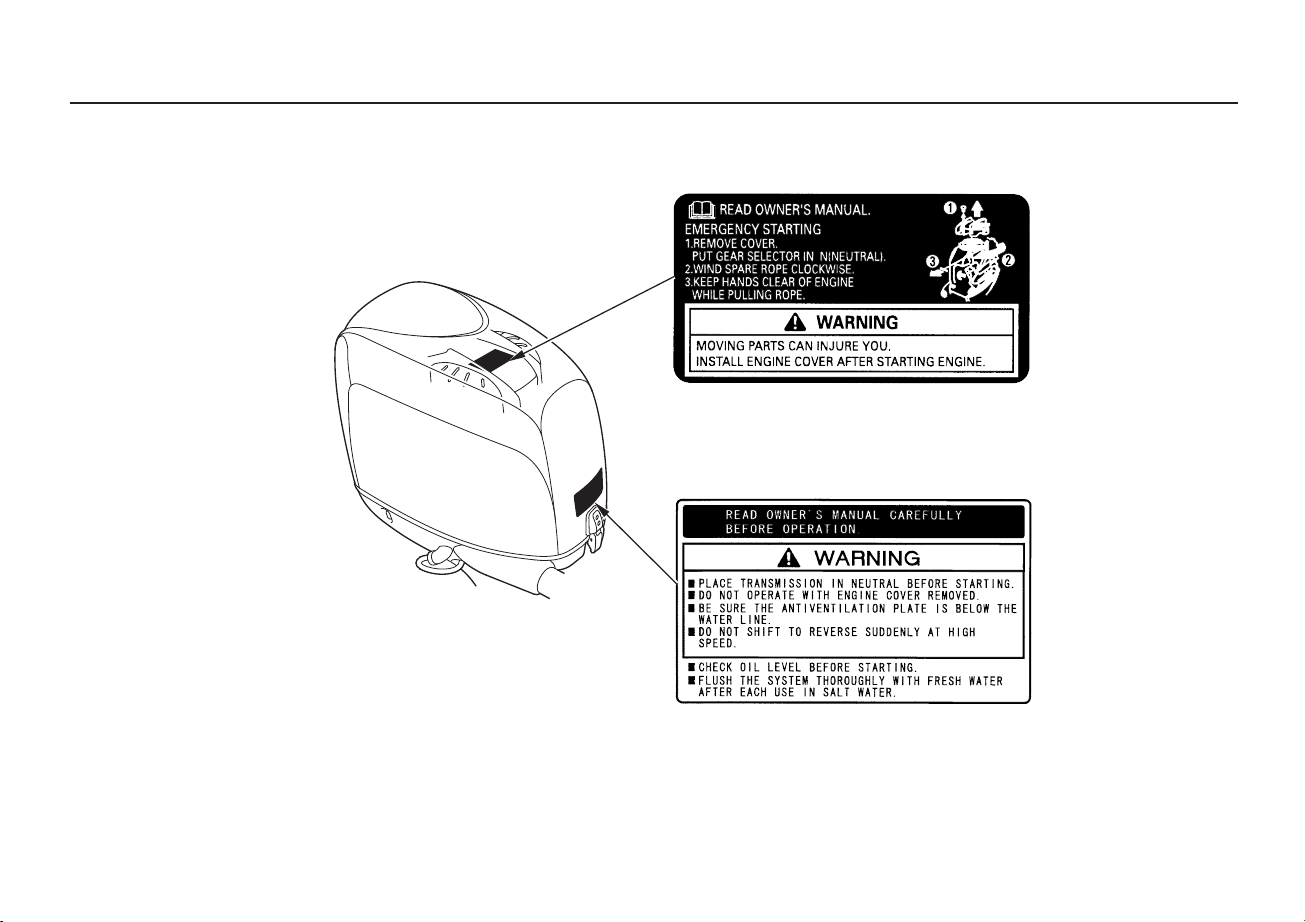
LHTA, LRTA and XRTA Types
The labels shown here contain important safety information. Please read them carefully. These labels are considered
permanent parts of your outboard motor. If a label comes off or becomes hard to read, contact an authorized Honda
Marine dealer for a replacement.
09/06/24 16:08:03 31ZY9610_010
10
SAFETY LABEL LOCATION
OUTBOARD MOTOR SAFETY
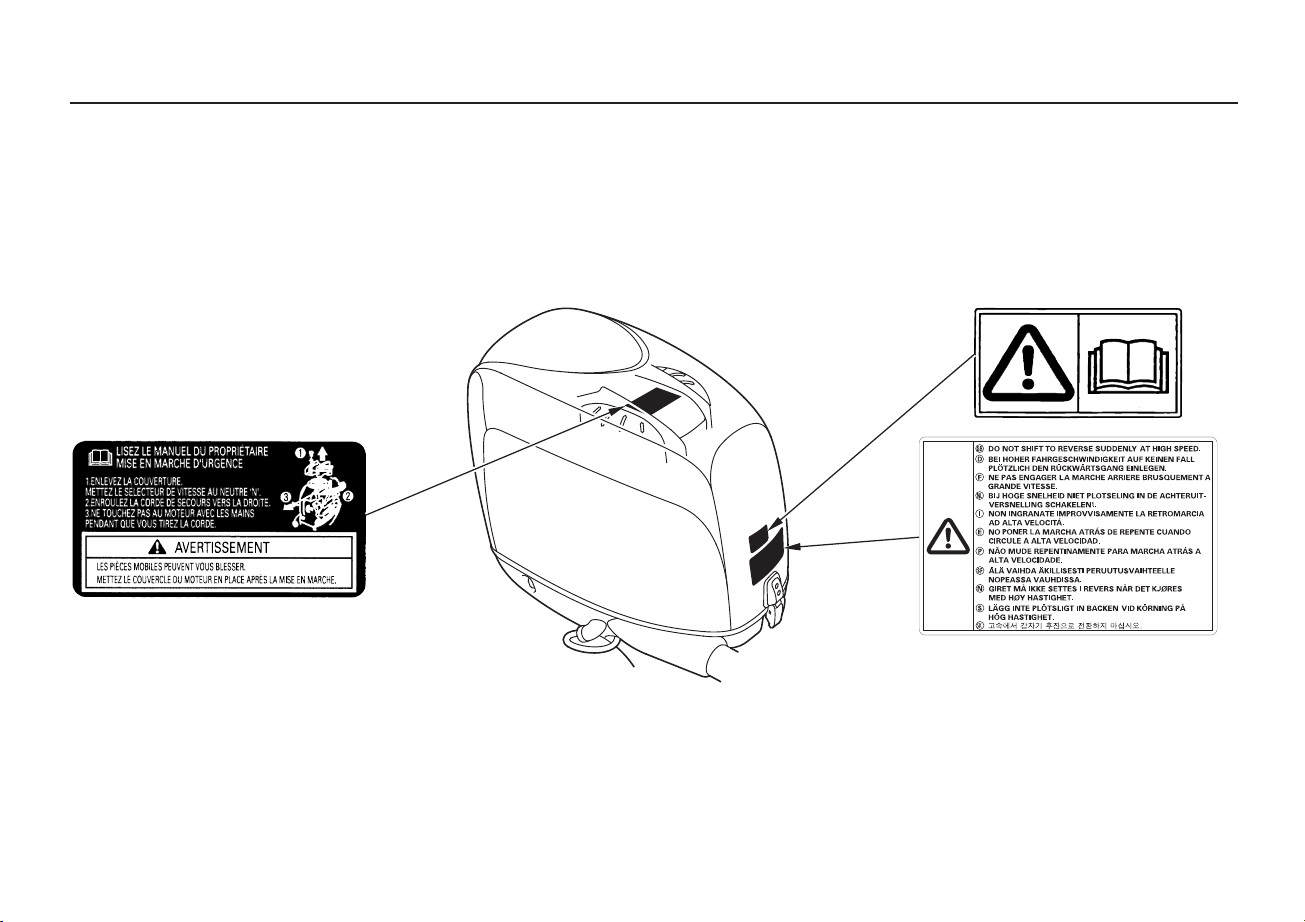
LHTC, LRTC and XRTC Types
READ OWNER’S MANUAL
The labels shown here contain important safety information. Please read them carefully. These labels are considered
permanent parts of your outboard motor. If a label comes off or becomes hard to read, contact an authorized Honda
Marine dealer for a replacement.
09/06/24 16:08:12 31ZY9610_011
11
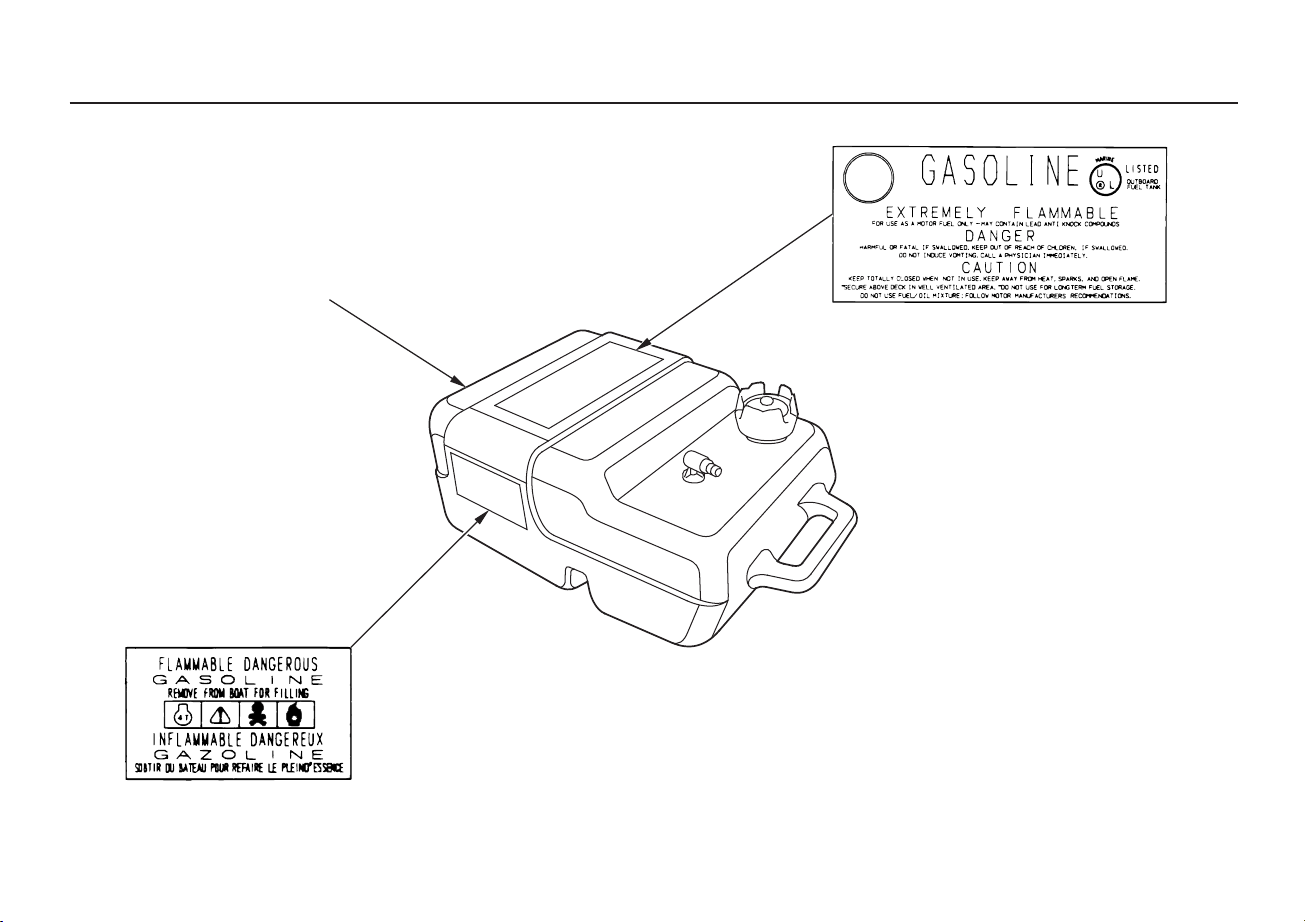
OUTBOARD MOTOR SAFETY
PORTABLE FUEL TANK
(equipped type or optional equipment)
(LHTC, LRTC and
XRTC types)
FUEL CAUTION
09/06/24 16:08:17 31ZY9610_012
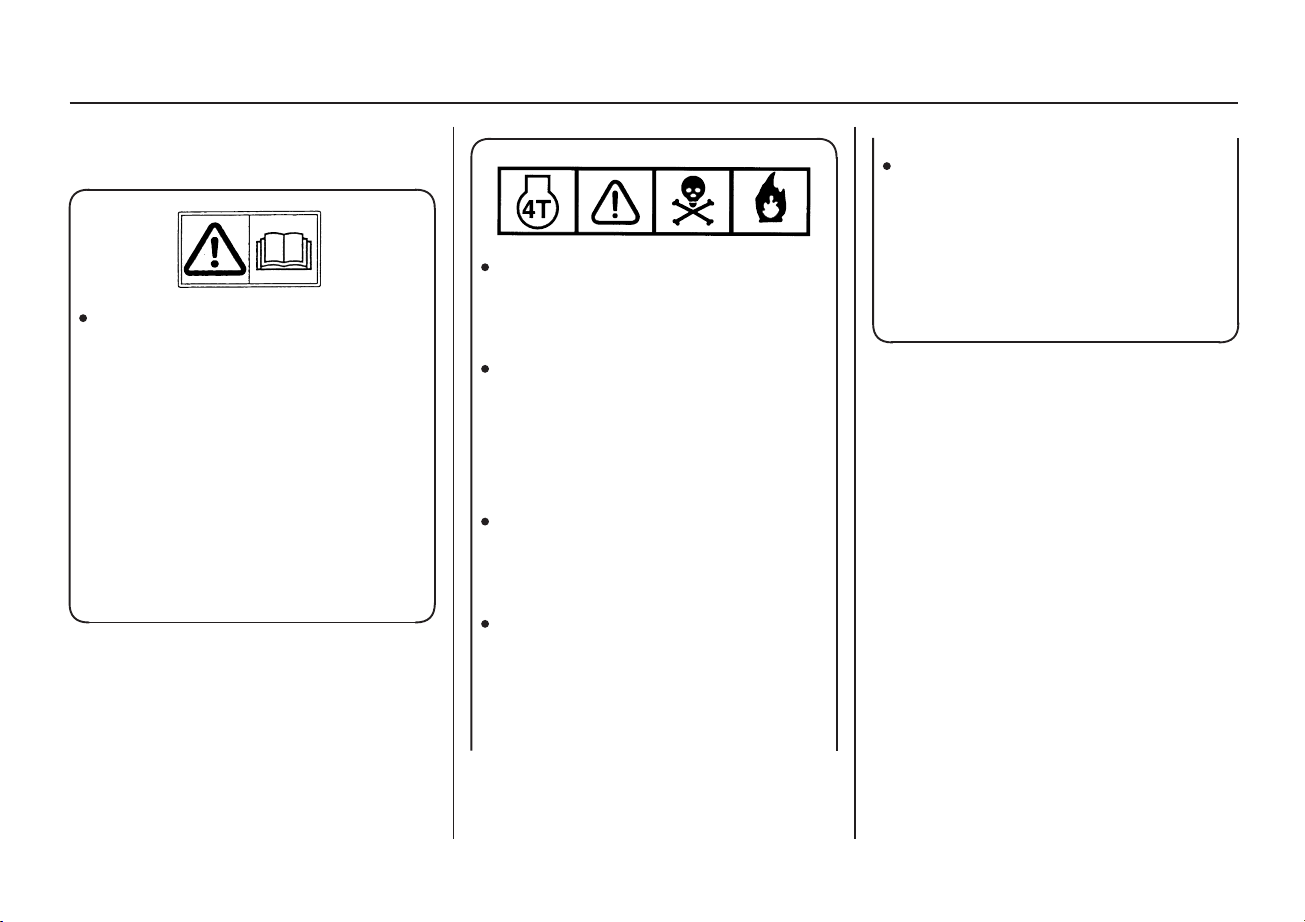
Honda outboard motor is
designed to give safe and
dependable service if
operated according to
instructions.
Read and understand the
Owner’s Manual before
operating the outboard
motor. Failure to do so
could result in personal
injury or equipment
damage.
Gasoline is harmful or fatal
if swallowed. Keep the fuel
tank out of reach of
children.
Gasoline is extremely
flammable and is explosive
under certain conditions.
Refuel in a well-ventilated
area with the engine
stopped.
Do not smoke or allow
flames or sparks where the
engine is refueled or where
gasolineisstored.
Do not overfill the fuel tank.
After refueling make sure
that the fuel tank cap is
closed properly and
securely.
Be careful not to spill any
fuel while refueling. Spilled
fuel or fuel vapor may
ignite. If any fuel is spilled,
make sure that the area is
dry before starting the
engine.
12
OUTBOARD MOTOR SAFETY
LHTC, LRTC and XRTC Types
09/06/24 16:08:25 31ZY9610_013
*
*
*
*
*
*
*
*
*
*
*
13
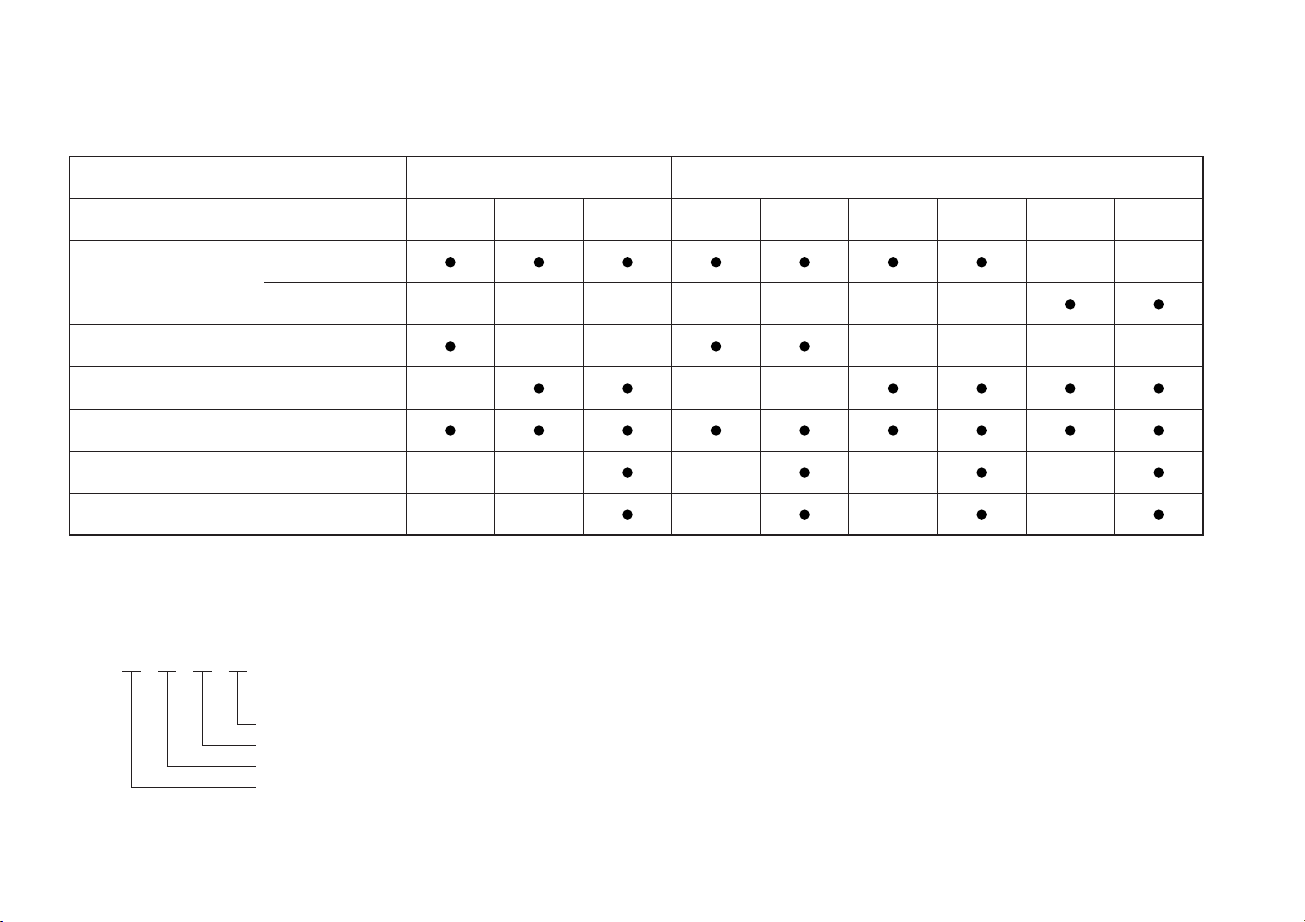
CONTROL AND FEATURE IDENTIFICATION CODES
CONTROLS AND FEATURES
Model
Type
Transom Height
(Shaft Length)
Tiller Handle
Remote Control
Power Trim/Tilt
Trim Meter
Tachometer
BF75D BF90D
LHTA LRTA LRTC LHTA LHTC LRTA LRTC XRTA
Optional equipment
XRTC
21.1 in (537 mm)
26.1 in (664 mm)
Refer to this chart for an explanation of the Type Codes used in this manual to identify control and feature applications.
LRT
TYPE CODE (example)
A
Tilt System: T= Power Trim/Tilt
Control System: H= Tiller Handle, R= Remote Control
Destination: A= American, C= Canadian
Transom Height (Shaft Length): L= 21.1 in (537 mm), X= 26.1 in (664 mm)
09/06/24 16:08:40 31ZY9610_014
14
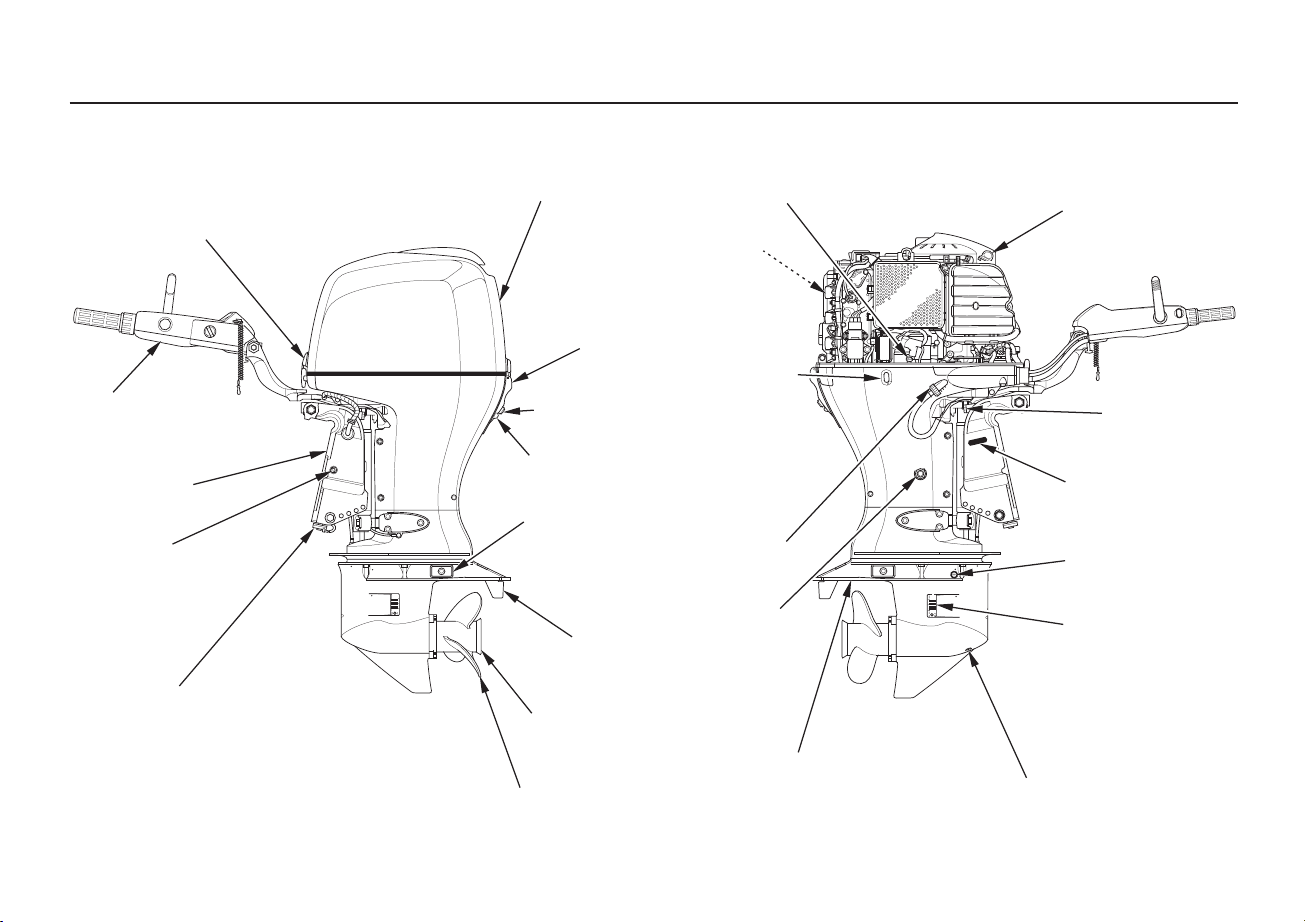
COMPONENT AND CONTROL LOCATIONS
CONTROLS AND FEATURES
LHT Type (tiller handle)
ENGINE COVER
LATCH (front)
TILLER
HANDLE
STERN
BRACKET
MANUAL
RELIEF VALVE
ANODE
ENGINE COVER
OIL LEVEL DIPSTICK
SPARK PLUG
(under coil)
ENGINE COVER
LATCH (rear)
IDLE PORT
POWER TILT
SWITCH
COOLING SYSTEM
INDICATOR
ANODE
(each side)
FLUSH PORT
CONNECTOR
ENGINE OIL
DRAIN BOLT
TRIM TAB
EXHAUST PORT/WATER
OUTLET PORT
PROPELLER
(optional equipment)
ANTIVENTILATION
PLATE
GEAR OIL DRAIN SCREW
COOLING WATER
INTAKE PORT
(each side)
GEAR OIL
LEVEL SCREW
PRODUCT
IDENTIFICATION
NUMBER
TILT LOCK
LEVER
OIL FILLER CAP
09/06/24 16:08:48 31ZY9610_015
15
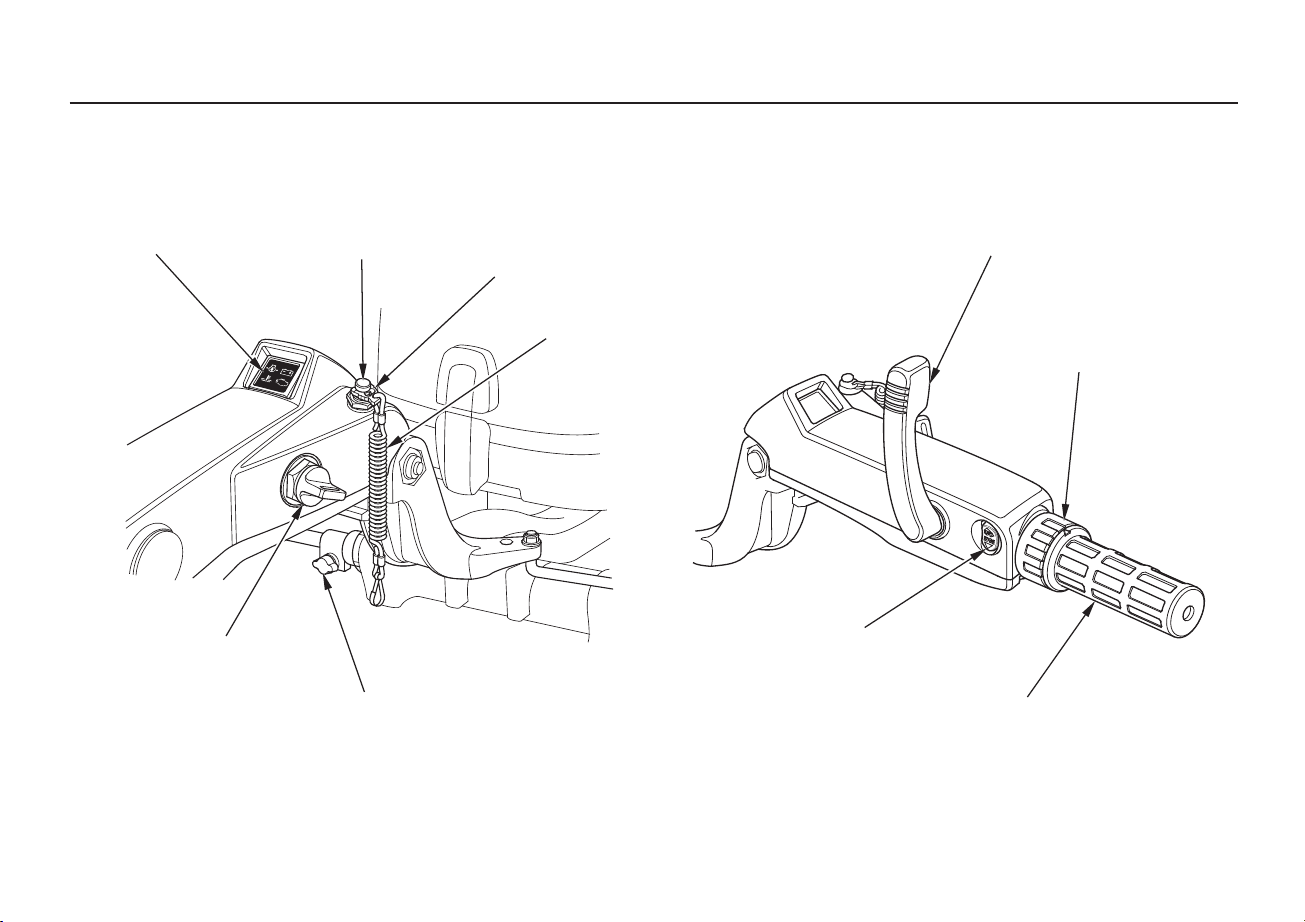
CONTROLS AND FEATURES
INDICATORS
(Oil pressure, Overheat,
Alternator, Malfunction)
EMERGENCY STOP
SWITCH
EMERGENCY STOP
SWITCH CLIP
EMERGENCY STOP
SWITCH LANYARD
IGNITION SWITCH
STEERING FRICTION
KNOB
POWER TRIM/TILT
SWITCH
THROTTLE GRIP
THROTTLE FRICTION
ADJUSTER
GEARSHIFT LEVER
09/06/24 16:08:52 31ZY9610_016
16
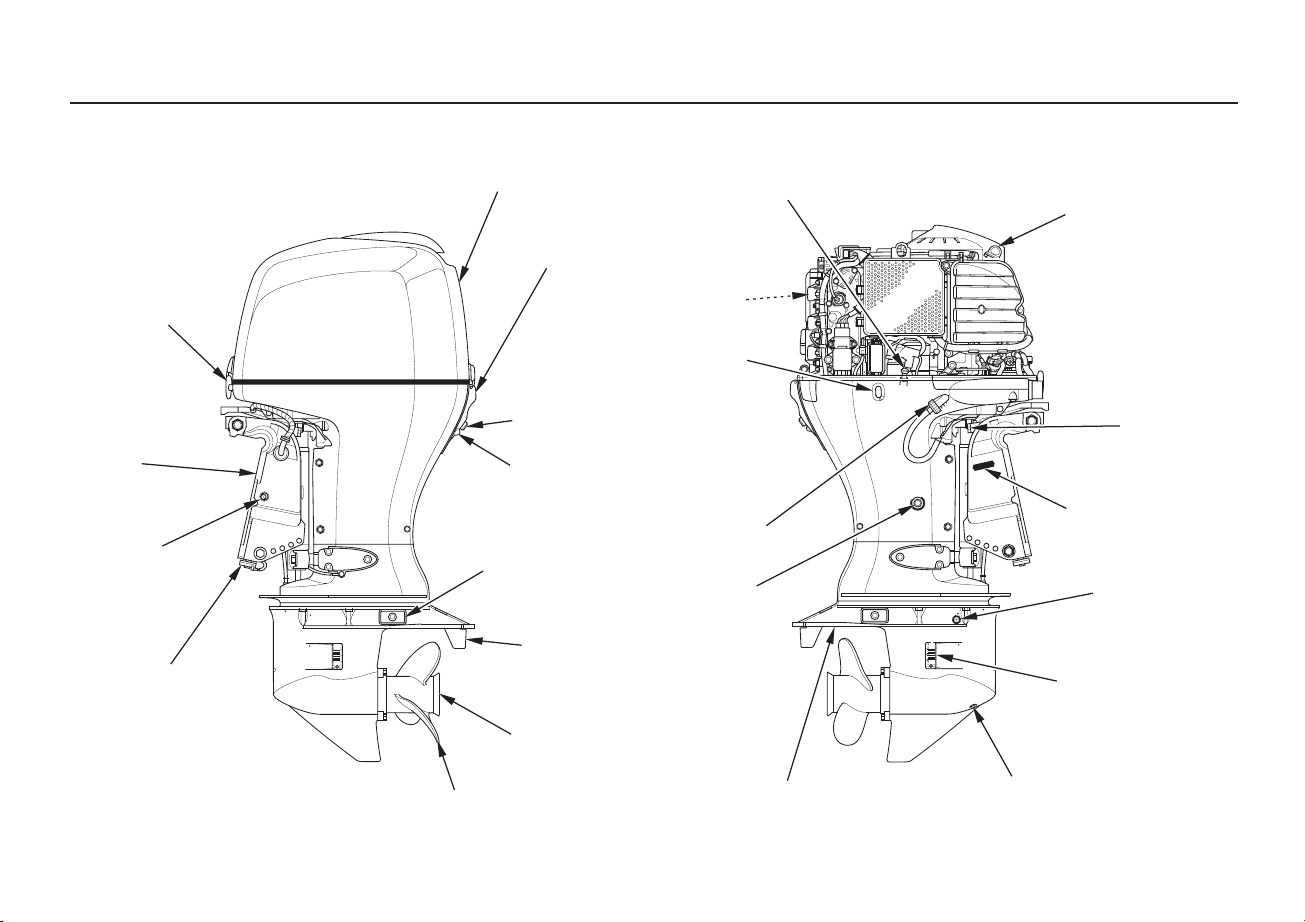
CONTROLS AND FEATURES
LRT and XRT Types (remote control)
FLUSH PORT
CONNECTOR
ENGINE OIL
DRAIN BOLT
ENGINE COVER
LATCH (front)
STERN
BRACKET
MANUAL
RELIEF VALVE
ANODE
PROPELLER
(optional equipment)
EXHAUST PORT/WATER
OUTLET PORT
TRIM TAB
ANODE
(each side)
COOLING SYSTEM
INDICATOR
IDLE PORT
POWER TILT
SWITCH
SPARK PLUG
(under coil)
ENGINE COVER
LATCH (rear)
ENGINE COVER
OIL LEVEL DIPSTICK
OIL FILLER CAP
TILT LOCK
LEVER
PRODUCT
IDENTIFICATION
NUMBER
GEAR OIL
LEVEL SCREW
COOLING WATER
INTAKE PORT
(each side)
GEAR OIL DRAIN SCREW
ANTIVENTILATION
PLATE
09/06/24 16:08:58 31ZY9610_017
17
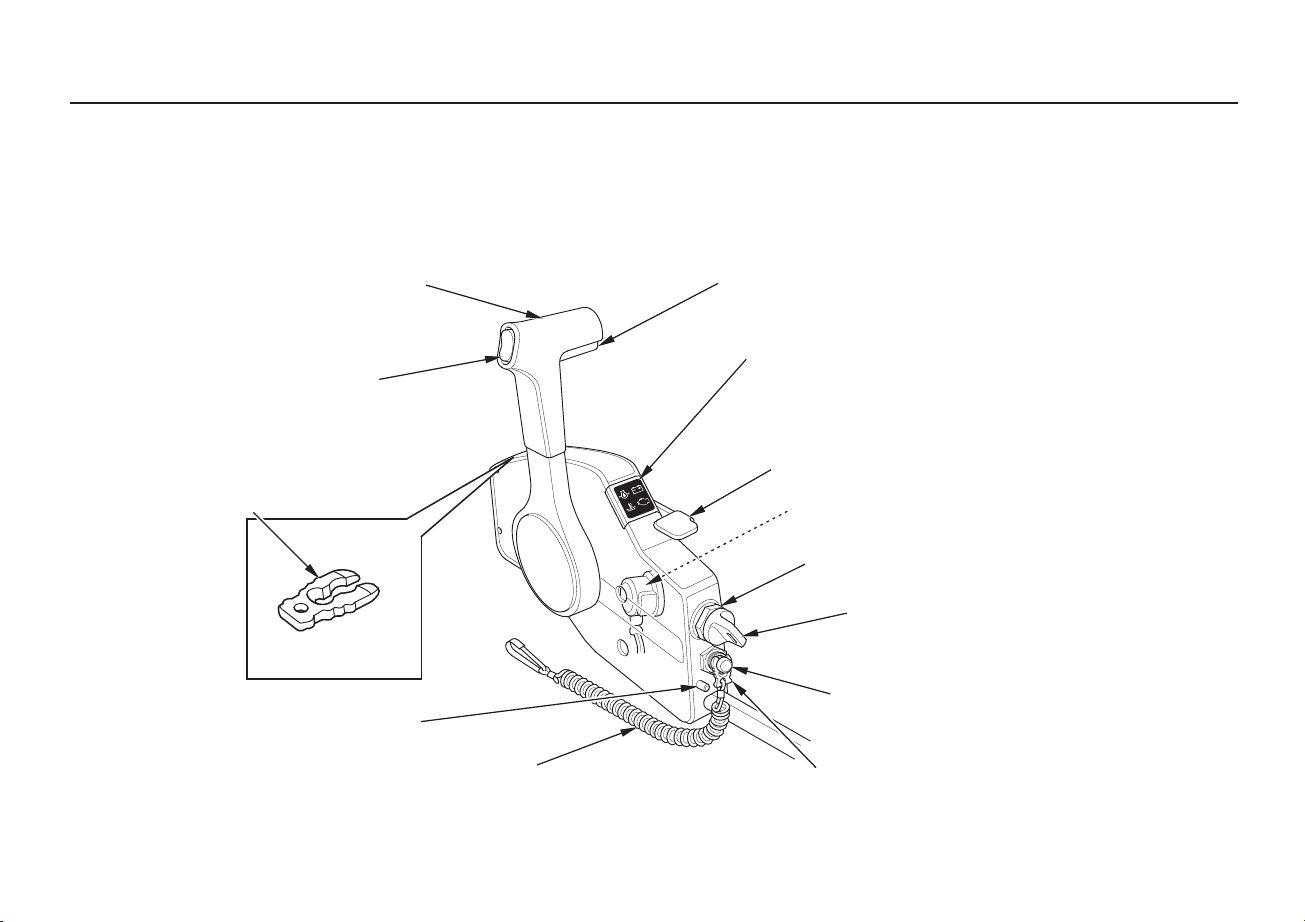
Remote Controls (equipped type or optional equipment)
CONTROLS AND FEATURES
GEARSHIFT/THROTTLE
CONTROL LEVER
POWER TRIM/TILT
SWITCH
SPARE EMERGENCY
STOP SWITCH CLIP
CONTROL LEVER
FRICTION ADJUSTER
EMERGENCY STOP
SWITCH LANYARD
EMERGENCY STOP
SWITCH CLIP
EMERGENCY STOP
SWITCH
IGNITION SWITCH
KEY
IGNITION SWITCH
BUZZER
(inside)
FAST IDLE LEVER
NEUTRAL RELEASE LEVER
INDICATORS
(Oil pressure, Overheat,
Alternator, Malfunction)
(SIDE-MOUNT REMOTE CONTROL)
09/06/24 16:09:03 31ZY9610_018
18
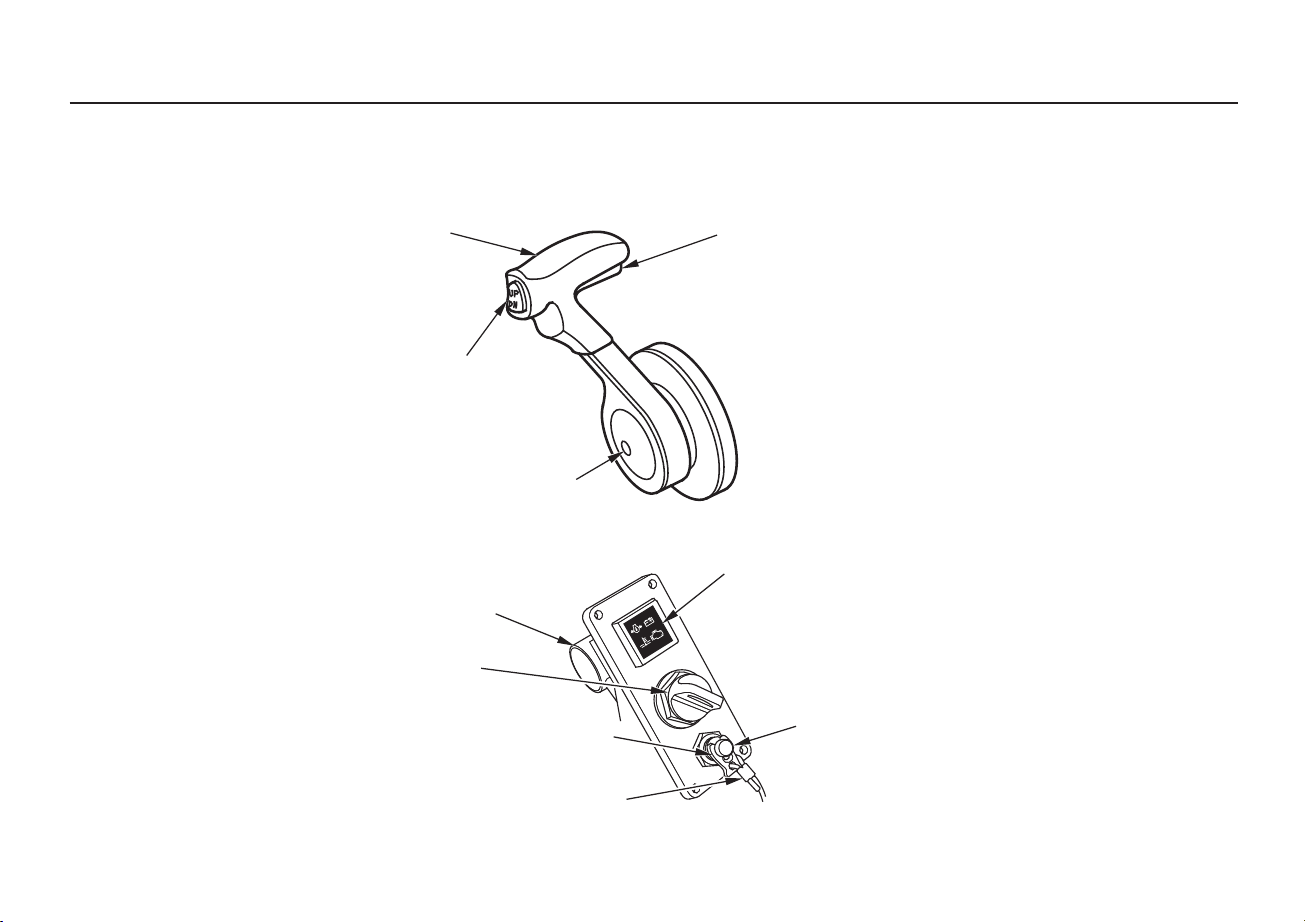
CONTROLS AND FEATURES
POWER TRIM/TILT
SWITCH
GEARSHIFT/THROTTLE
CONTROL LEVER
NEUTRAL RELEASE
LEVER
FAST IDLE BUTTON
IGNITION
SWITCH
EMERGENCY
STOP SWITCH
BUZZER
EMERGENCY STOP
SWITCH CLIP
EMERGENCY STOP
SWITCH LANYARD
INDICATORS
(Oil pressure, Overheat,
Alternator, Malfunction)
(PANEL-MOUNT REMOTE CONTROL)
CONTROL PANEL (for PANEL-MOUNT type)
09/06/24 16:09:08 31ZY9610_019
19
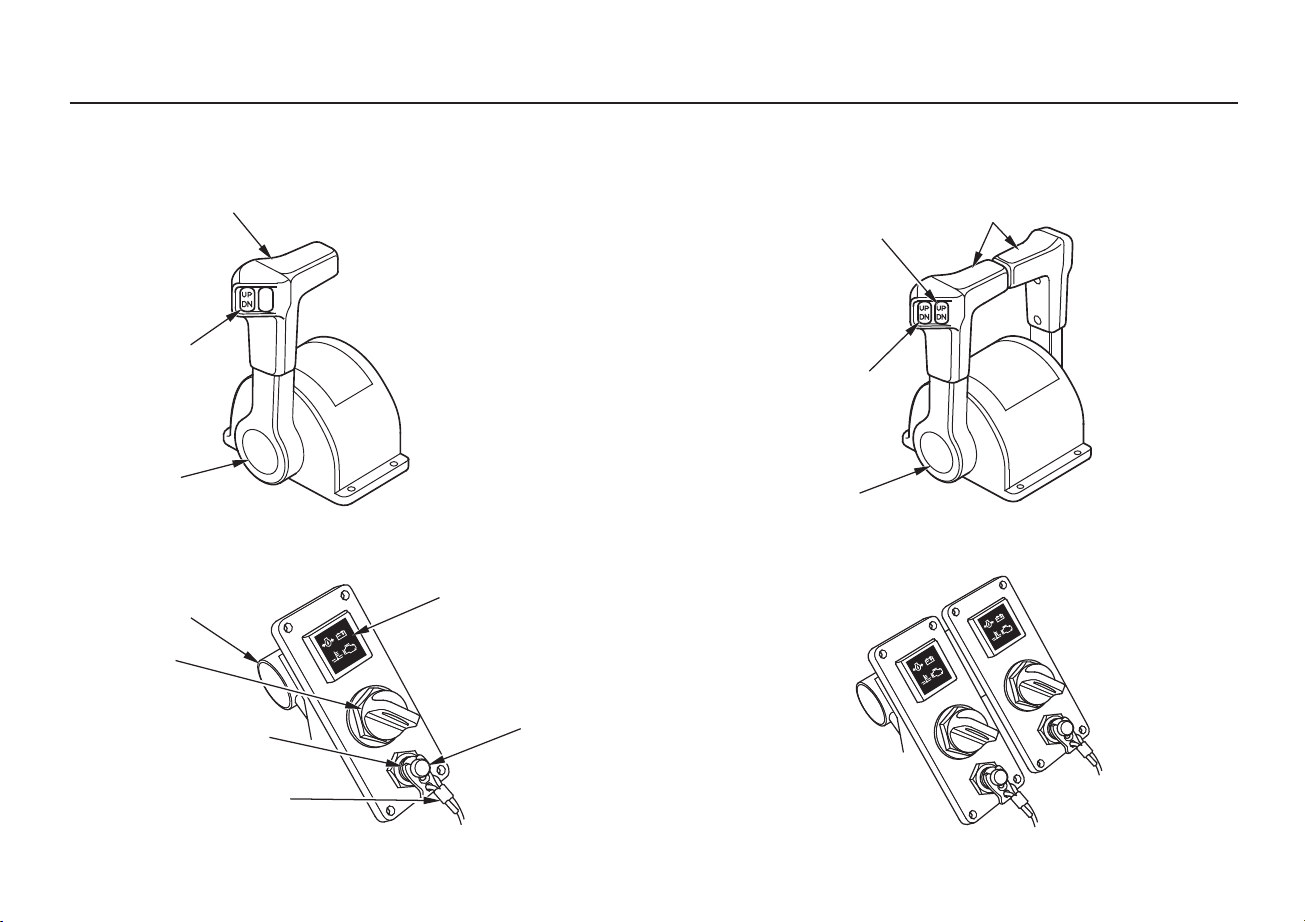
CONTROLS AND FEATURES
POWER
TRIM/TILT
SWITCH
POWER TRIM/TILT
SWITCH (RIGHT)
POWER TRIM/TILT
SWITCH (LEFT)
BUZZER
IGNITION
SWITCH
(SINGLE TOP-MOUNT REMOTE CONTROL) (DUAL TOP-MOUNT REMOTE CONTROL)
EMERGENCY
STOP SWITCH
FAST IDLE
BUTTON
FAST IDLE
BUTTON
GEARSHIFT/THROTTLE
CONTROL LEVER
GEARSHIFT/THROTTLE
CONTROL LEVERS
(for TOP-MOUNT DUAL type)
EMERGENCY STOP
SWITCH CLIP
EMERGENCY STOP
SWITCH LANYARD
CONTROL PANEL
(for TOP-MOUNT SINGLE type)
INDICATORS
(Oil pressure, Overheat,
Alternator, Malfunction)
09/06/24 16:09:14 31ZY9610_020
20
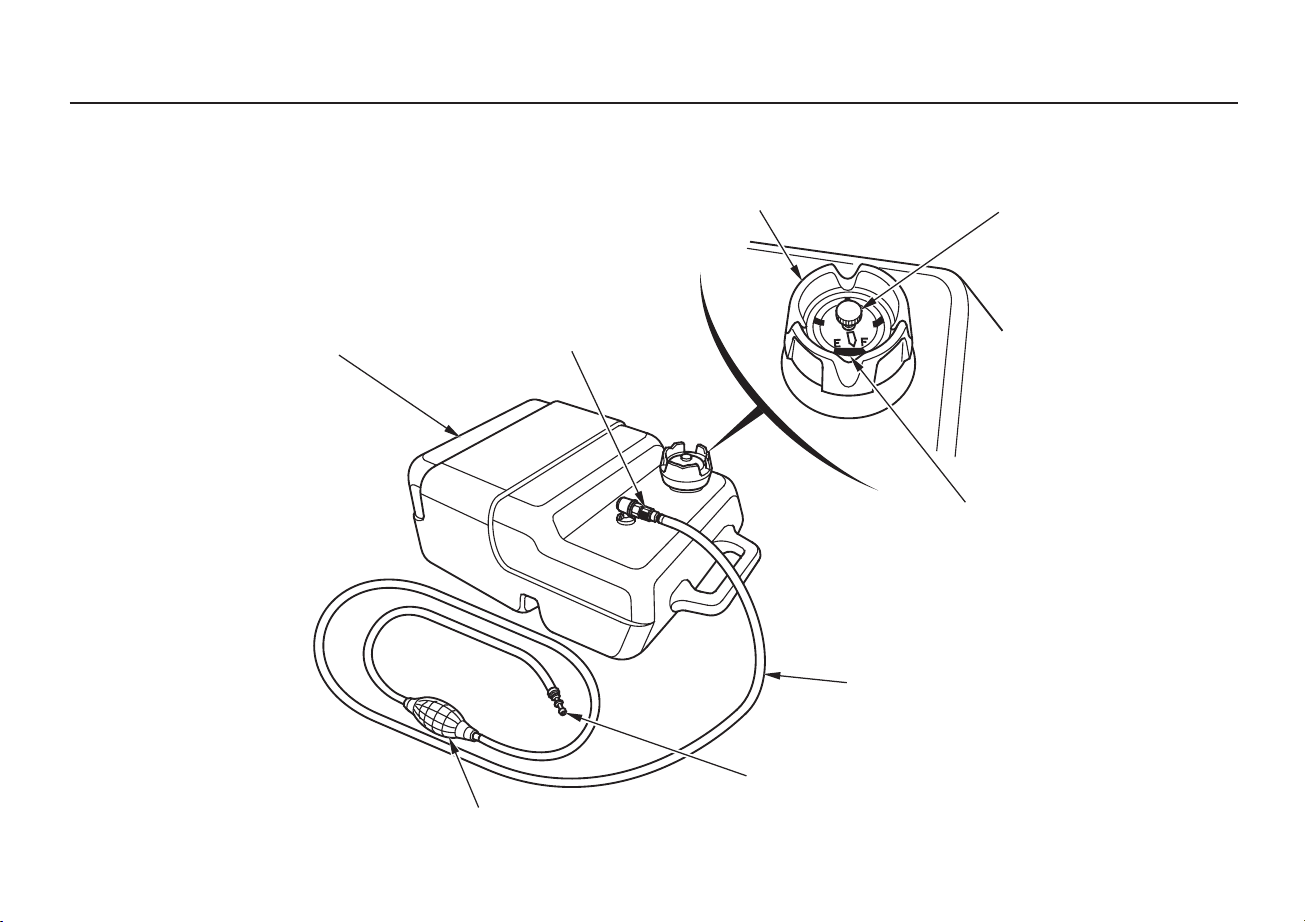
[standard equipment (LHTC type)]
[optional equipment (other types)]
CONTROLS AND FEATURES
Portable Fuel Tank and Fuel Tank Hose Assembly
FUEL FILLER CAP
VENT KNOB
FUEL TANK
FUEL HOSE
CONNECTOR
FUEL GAUGE
FUEL TANK HOSE
ASSEMBLY
FUEL HOSE JOINT
(motor side)
FUEL PRIMING BULB
09/06/24 16:09:19 31ZY9610_021
21
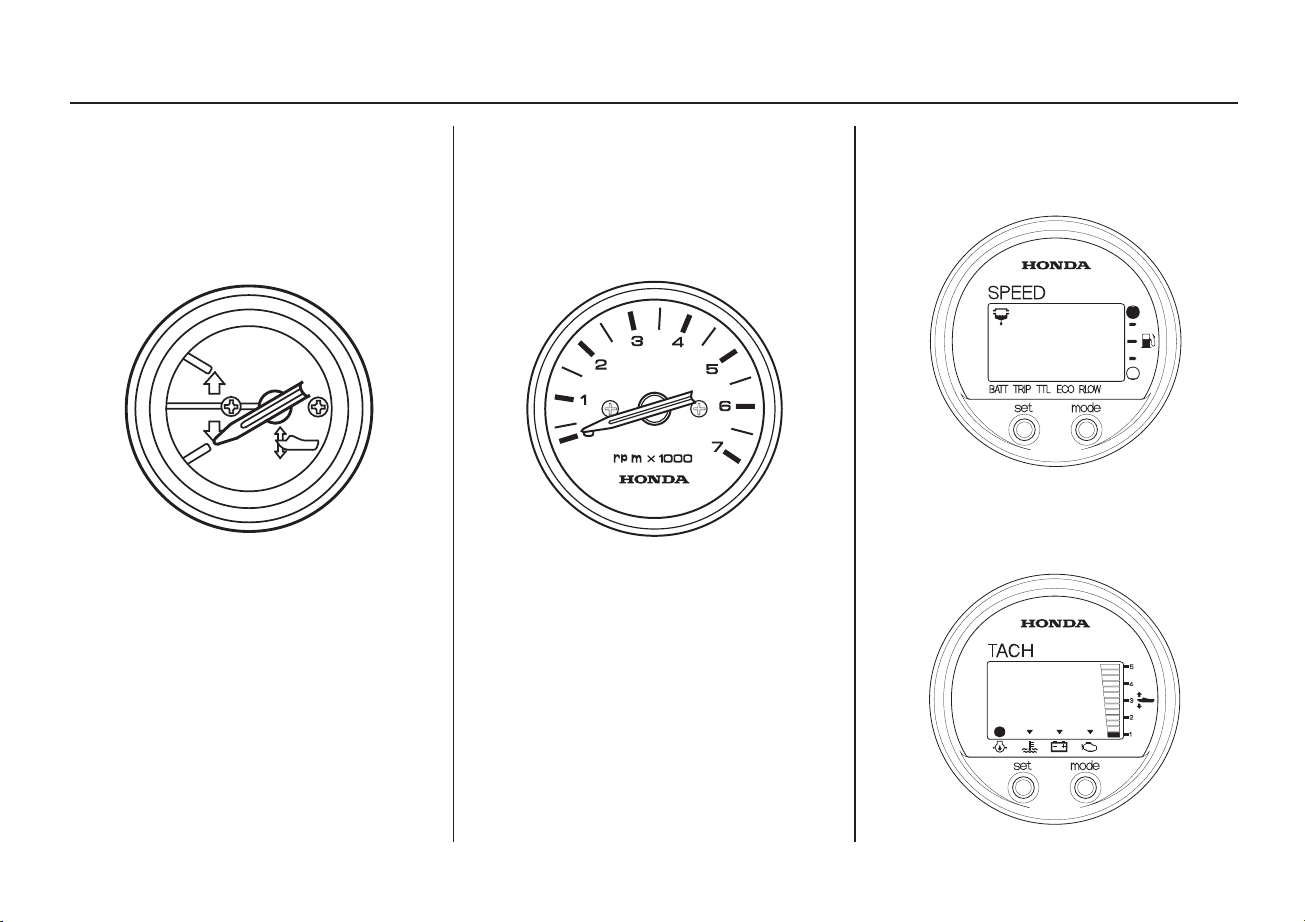
Trim Meter Tachometer Digital Speedometer
Digital Tachometer
[standard equipment (LHTC,
LRTC and XRTC types)]
[optional equipment (LHTA,
LRTA and XRTA types)]
[optional equipment (LRT and
XRT types)]
[optional equipment (LRT and
XRT types)]
[standard equipment (LHTC,
LRTC and XRTC types)]
[optional equipment (LHTA,
LRTA and XRTA types)]
CONTROLS AND FEATURES
09/06/24 16:09:28 31ZY9610_022
22
CONTROLS
LHT Type (tiller handle)
CONTROLS AND FEATURES
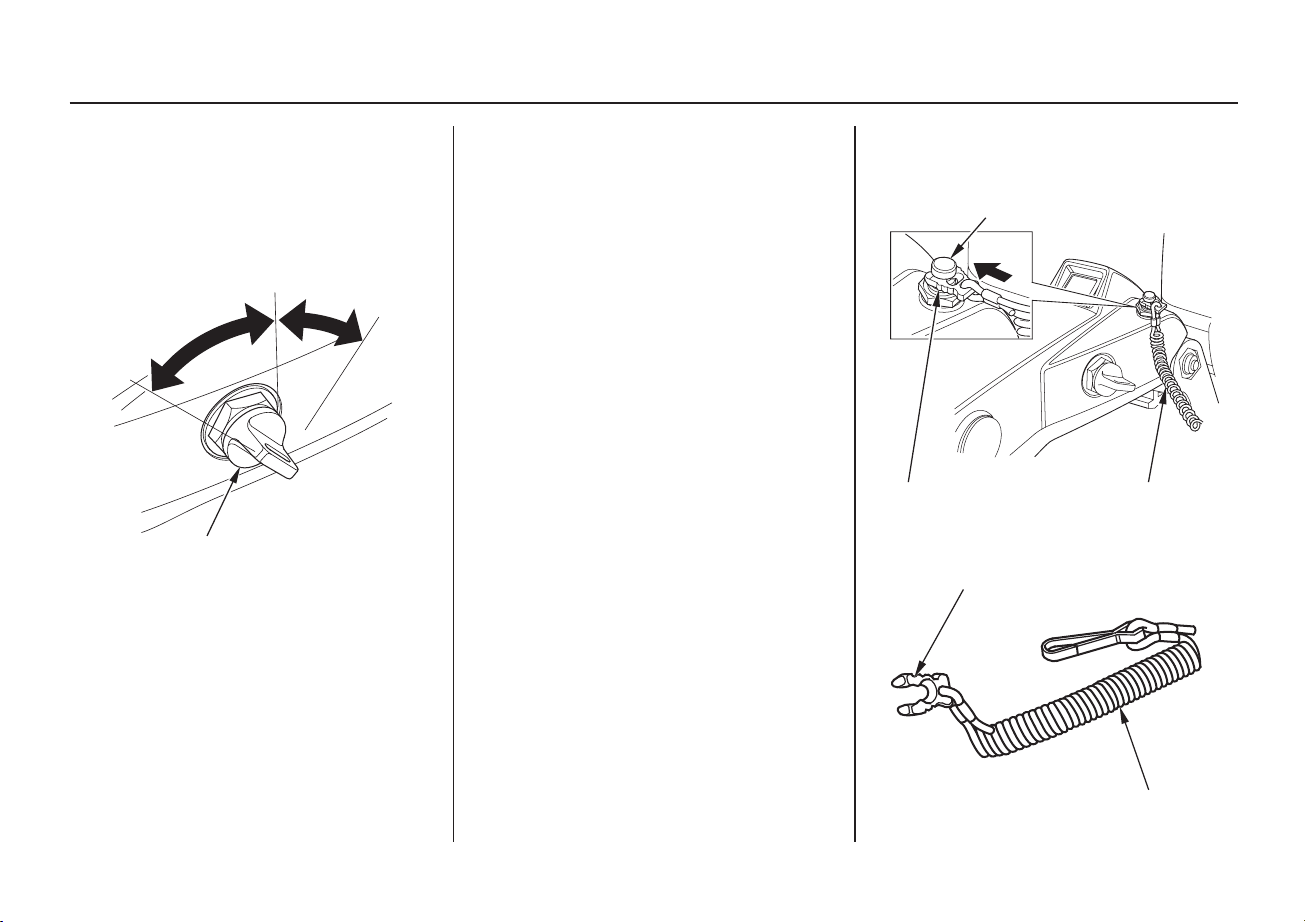
EMERGENCY STOP SWITCH
EMERGENCY STOP SWITCH CLIP
EMERGENCY STOP
SWITCH CLIP
OFF
ON
START
IGNITION SWITCH
EMERGENCY
STOP SWITCH
LANYARD
EMERGENCY STOP
SWITCH LANYARD
Ignition Switch
Emergency Stop Switch Clip and
Emergency Stop Switch
Turning the ignition switch key to the
START position operates the starter
motor. The key automatically returns
to the ON position when released
from the START position.
The ignition switch controls the
ignition system and the starter motor.
Turning the ignition switch to the
OFF position stops the engine.
The engine will not start unless the
gearshift lever is in the N (neutral)
position (p. ) and the emergency
stop switch clip is in the emergency
stop switch.
55
09/06/24 16:09:37 31ZY9610_023
23
CONTROLS AND FEATURES
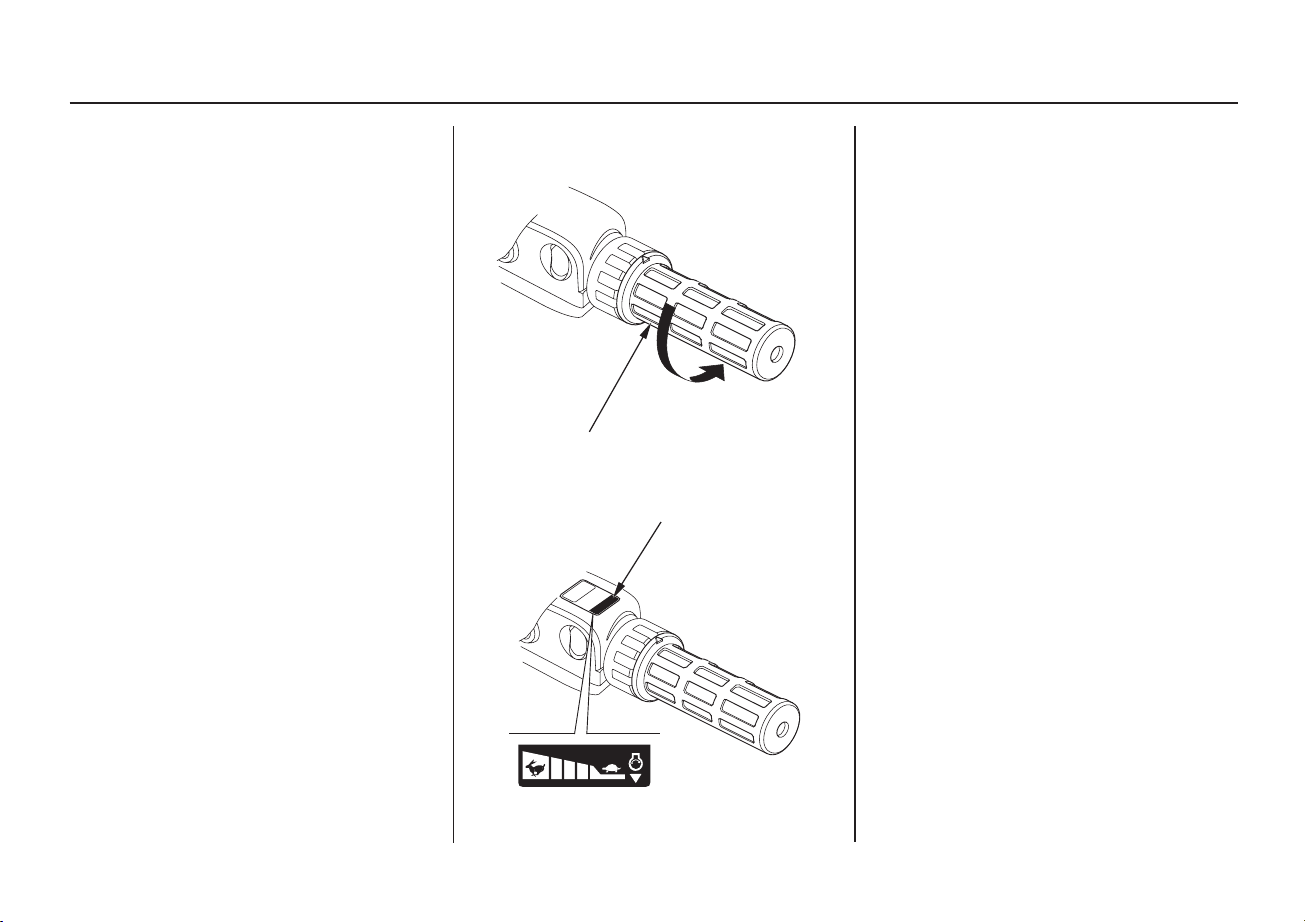
THROTTLE GRIP
INCREASE
THROTTLE INDEX MARK
Throttle Grip
The throttle grip controls engine
speed.
The emergency stop switch clip must
be inserted in the emergency stop
switch in order for the engine to start
and run. The emergency stop switch
lanyard must be attached securely to
the operator or to the operator’s PFD
(Personal Flotation Device).
A spare switch clip is provided in the
tool bag (p. ).
When used as described, the
emergencystopswitchand
emergency stop switch lanyard
system stops the engine if the
operator falls away from the controls.
The throttle index mark shows
throttle position and is helpful for
setting the throttle correctly when
starting (p. ).
83
72
09/06/24 16:09:44 31ZY9610_024
24
CONTROLS AND FEATURES
THROTTLE GRIP
RELEASE
FIX
THROTTLE FRICTION
ADJUSTER
F
(forward)
N (neutral)
R (reverse)
STEERING FRICTION KNOB
GEARSHIFT
LEVER
TO INCREASE
FRICTION
(FIX)
TTOO DDEECCRREEAASSEE
FFRRIICCTTIIOONN
((RREELLEEAASSEE))
Gearshif t LeverThrottle Friction Adjuster Steering Friction Knob
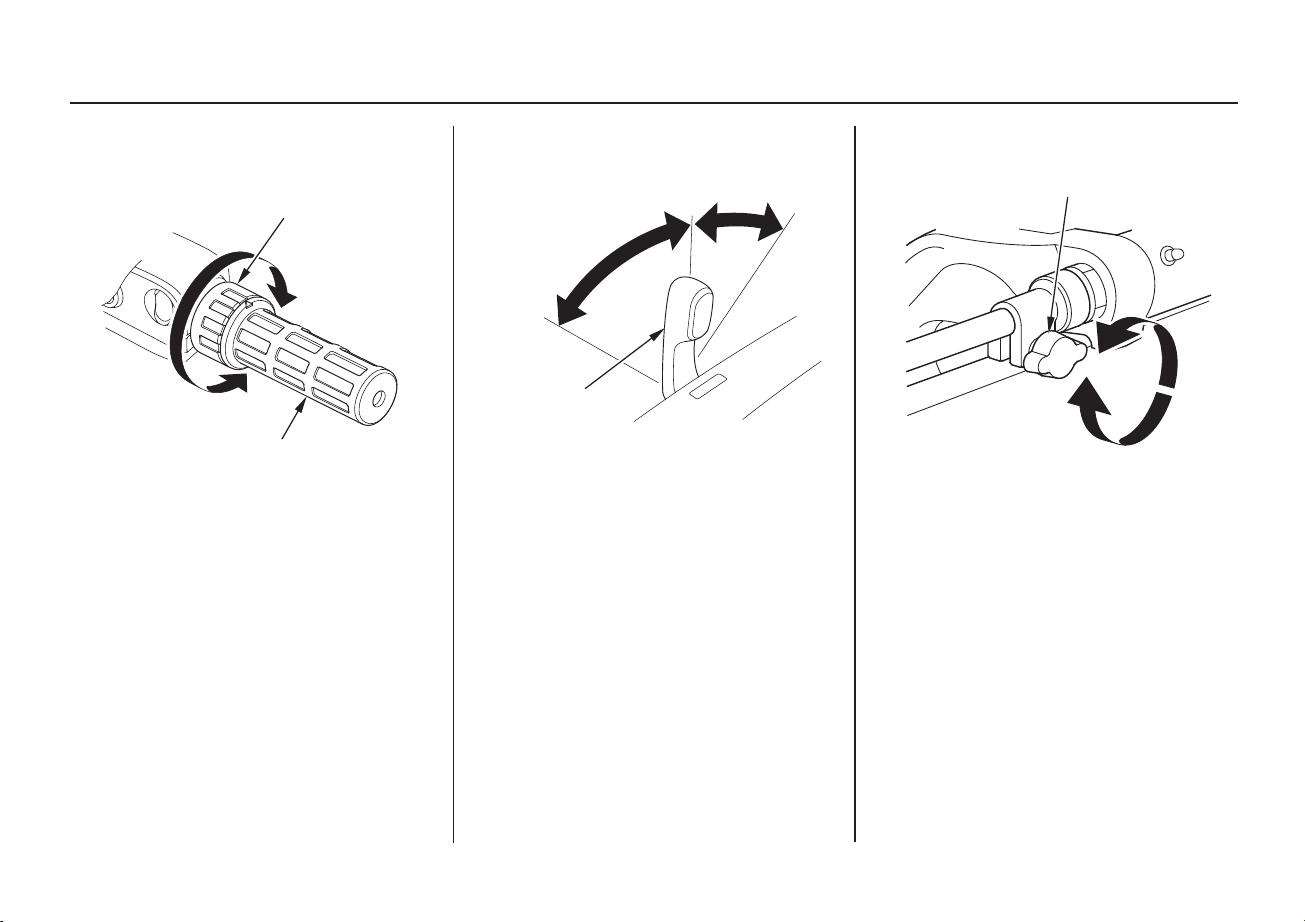
The gearshift lever is used to select F
(forward), N (neutral), or R (reverse)
gears.
The engine can be started with the
gearshift lever in the N (neutral)
position only.
The throttle friction adjuster adjusts
resistance to throttle grip rotation.
Turn the adjuster clockwise to
increase friction for holding a throttle
setting while cruising.
Turn the adjuster counterclockwise to
decrease friction for easy throttle grip
rotation.
Less friction allows the outboard
motor to turn more easily. More
friction helps to hold a steady course
while cruising or to prevent the
outboard motor from swinging while
trailering the boat.
The steering friction adjuster adjusts
steering resistance.
09/06/24 16:09:54 31ZY9610_025
25
Side-Mount Type
LRT and XRT Types
(remote control)
CONTROLS AND FEATURES
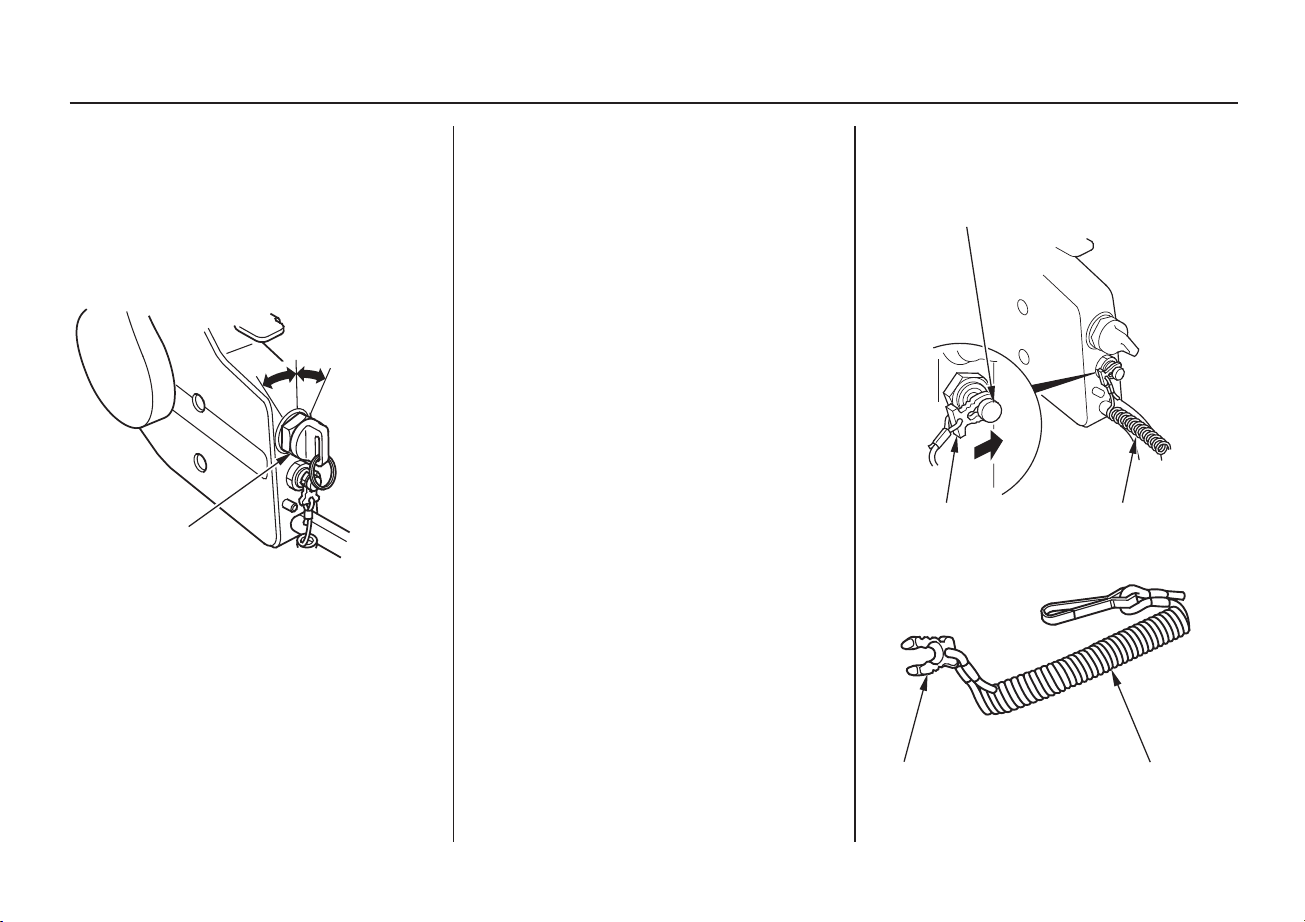
EMERGENCY STOP SWITCH
EMERGENCY STOP
SWITCH CLIP
EMERGENCY STOP
SWITCH CLIP
IGNITION
SWITCH
OOFFFF
ON
START
EMERGENCY
STOP SWITCH
LANYARD
EMERGENCY
STOP SWITCH
LANYARD
Ignition Switch
Emergency Stop Switch Clip and
Emergency Stop Switch
Turning the ignition switch key to the
START position operates the starter
motor. The key automatically returns
to the ON position when released
from the START position.
The ignition switch controls the
ignition system and the starter motor.
The ignition switch can be used to
start the engine only when the control
lever is in the N (neutral) position (p.
) and the emergency stop switch
clip is in the emergency stop switch.
Turning the ignition switch to the
OFF position stops the engine.
58
09/06/24 16:10:03 31ZY9610_026
26
CONTROLS AND FEATURES
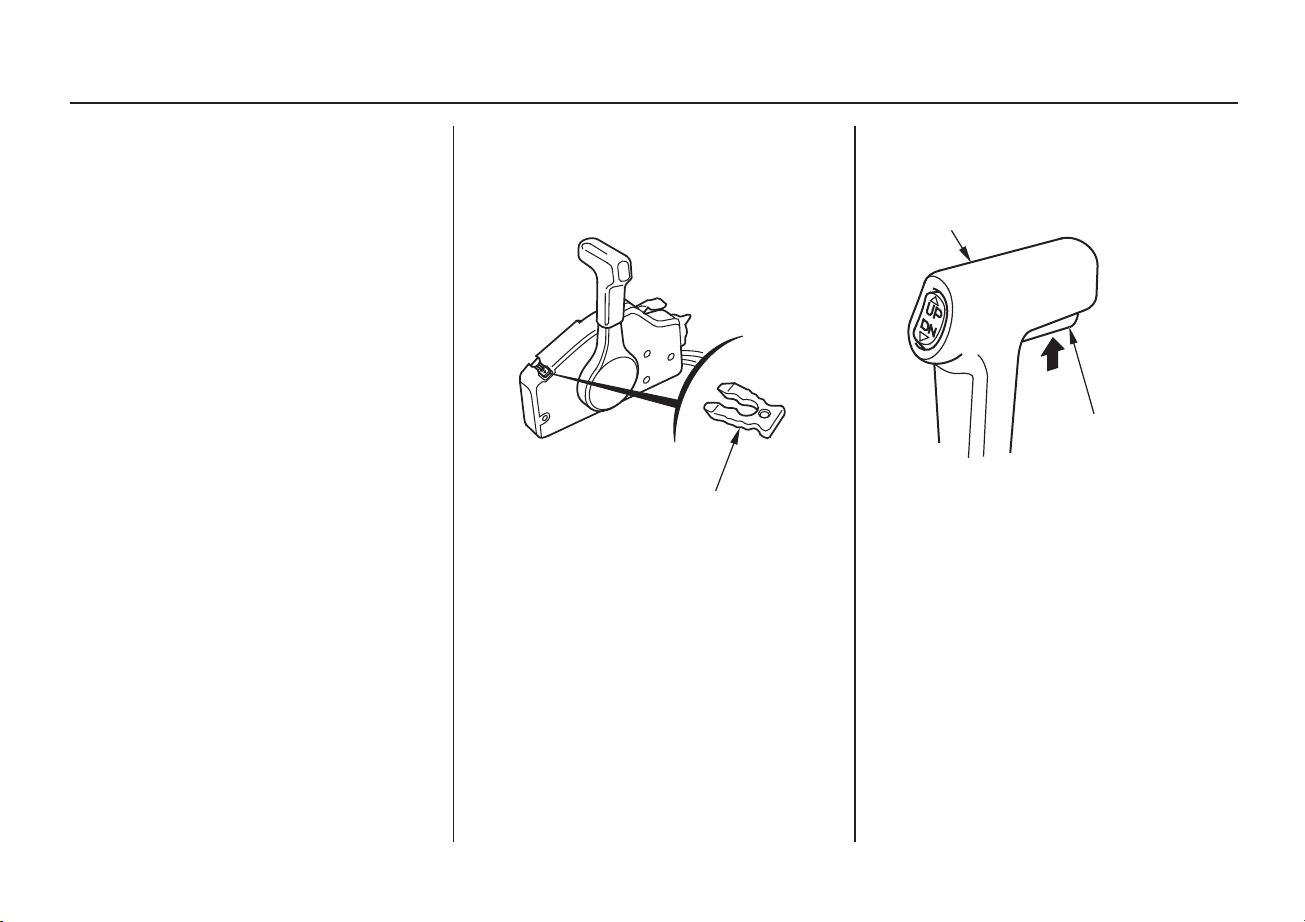
SPARE SWITCH CLIP
NEUTRAL RELEASE
LEVER
GEARSHIFT/THROTTLE
CONTROL LEVER
Gearshift/Throttle Control
Lever
The gearshift/throttle control lever
controls engine speed and selects F
(forward), N (neutral), or R (reverse)
gears.
A spare switch clip is stored in a slot
in the control housing and is
provided in the tool bag (p. ).
The emergency stop switch clip must
be inserted in the emergency stop
switch in order for the engine to start
and run. The emergency stop switch
lanyard must be attached to the
operator’s PFD (Personal Flotation
Device) or to the operator securely.
When used as described, the
emergency stop switch clip and
emergency stop switch lanyard
system stops the engine if the
operator falls away from the controls.
83
09/06/24 16:10:09 31ZY9610_027
27
CONTROLS AND FEATURES
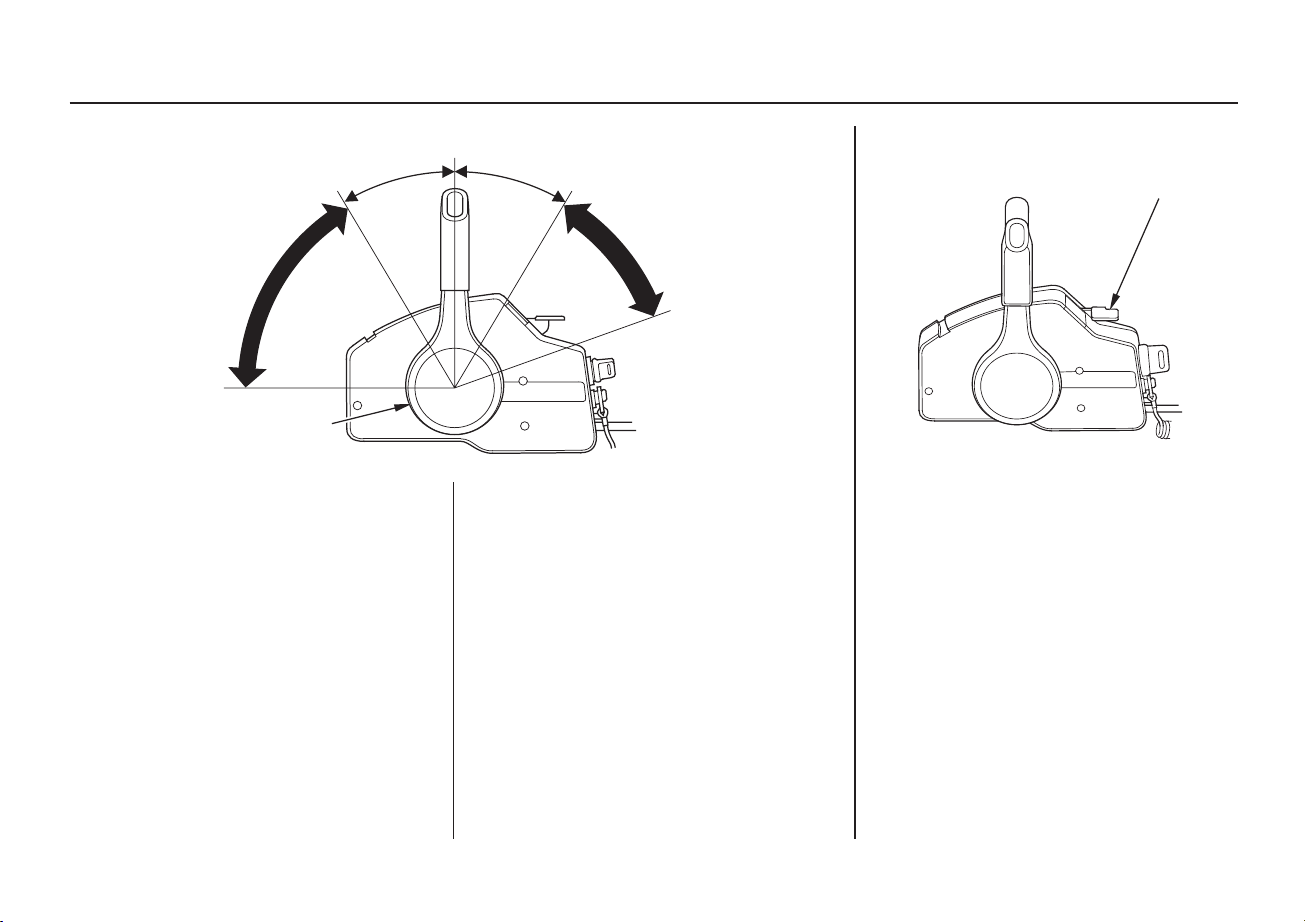
N (NEUTRAL)
F (FORWARD)
30° 30°
R (REVERSE)
SHIFT
SHIFT
MMIINNIIMMUUMM
MMIINNIIMMUUMM
TTHHRROOTTTTLLEE OOPPEENNIINNGG
TTHHRROOTTTTLLEE OOPPEENNIINNGG
MAXIMUM
GEARSHIFT/THROTTLE
CONTROL LEVER
MAXIMUM
FAST IDLE LEVER
Fast Idle Lever
A friction adjuster near the base of
the control lever(s) adjusts the
operating resistance of the control
lever(s). Refer to p. .
Less friction allows easier control
lever movement. More friction helps
to hold a steady throttle setting while
cruising.
Moving the control lever 30° from N
(neutral) selects the gear, and further
movement increases engine speed.
The control lever automatically locks
itself in the N (neutral) position. To
move the lever out of the N (neutral)
position, you must squeeze the
neutral release lever on the underside
of the lever handle.
Use the fast idle lever to accelerate
engine warm-up after starting the
engine. Do not use the fast idle lever
when starting the engine.
See page for engine warm-up
instructions.
74
60
09/06/24 16:10:18 31ZY9610_028
28
Panel-Mount Type
CONTROLS AND FEATURES
N (neutral)
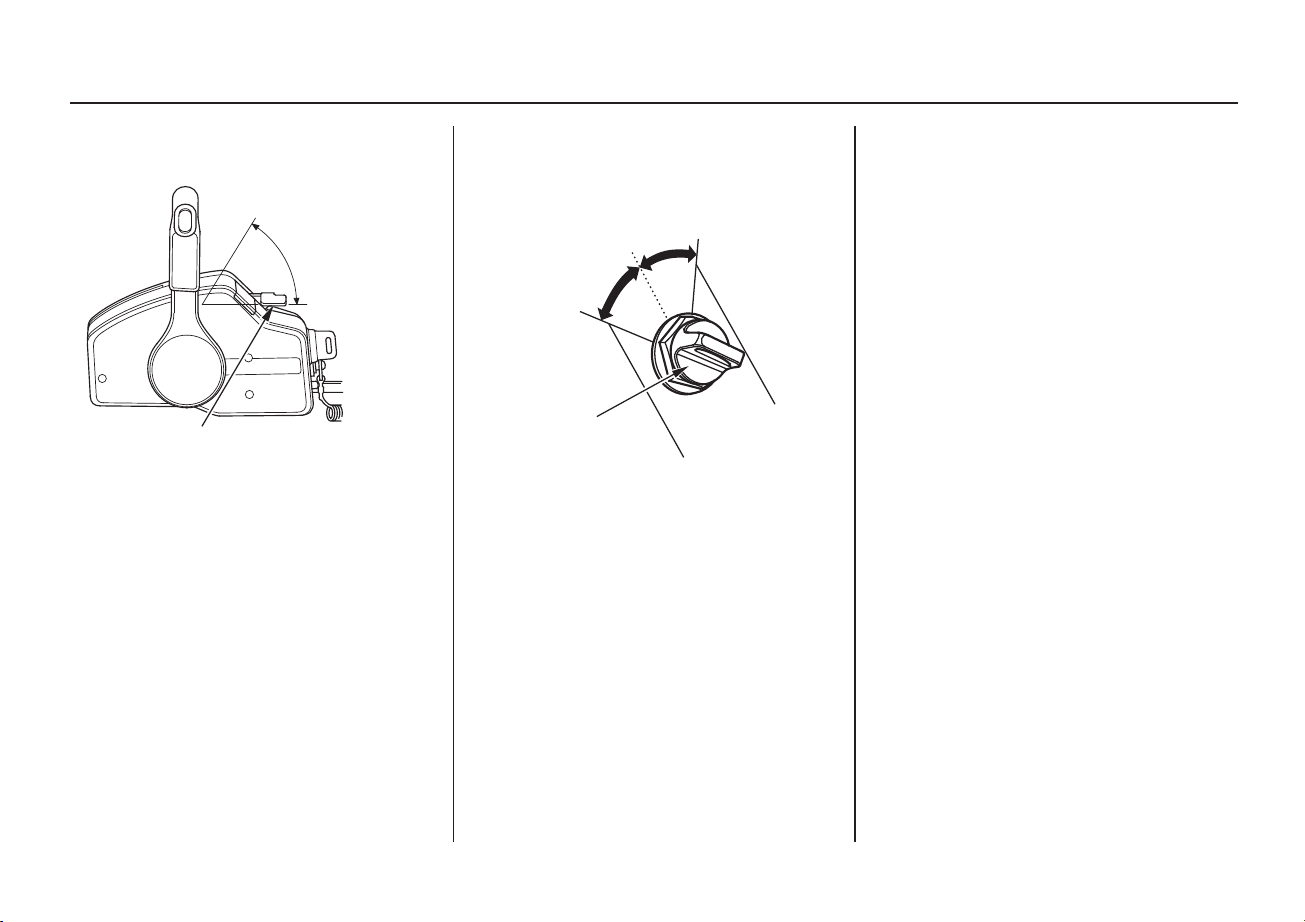
MAXIMUM FAST IDLE
LOWEST
POSITION
FAST IDLE LEVER
START
ON
OFF
IGNITION
SWITCH
Ignition Switch
The fast idle lever allows you to
increase the idle speed only when the
control lever is in the N (neutral)
position. Place the fast idle lever in
its lowest position to cancel the fast
idle and return the control lever to
normal operation.
The ignition switch controls the
ignition system and the starter motor.
Turning the ignition switch key to the
START position operates the starter
motor. The key automatically returns
to the ON position when released
from the START position.
The ignition switch can be used to
start the engine only when the control
lever is in the N (neutral) position (p.
) and the emergency stop switch
clip is in the emergency stop switch.
Turning the ignition switch to the
OFF position stops the engine.
61
09/06/24 16:10:26 31ZY9610_029
29
CONTROLS AND FEATURES
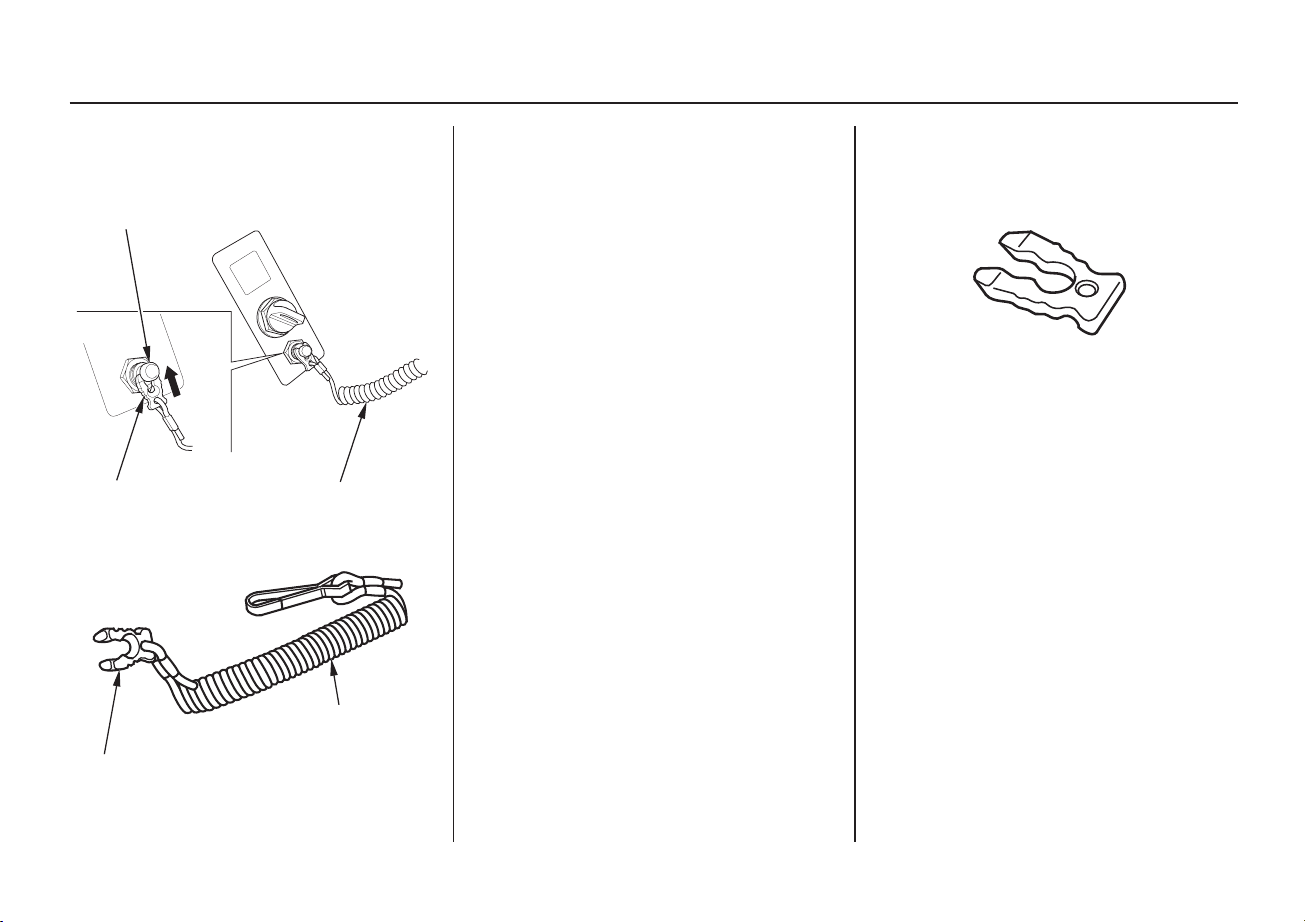
EMERGENCY STOP
SWITCH CLIP
EMERGENCY STOP SWITCH
EMERGENCY STOP
SWITCH CLIP
EMERGENCY
STOP SWITCH
LANYARD
EMERGENCY
STOP SWITCH
LANYARD
SPARE SWITCH CLIP
Emergency Stop Switch Clip and
Emergency Stop Switch
A spare switch clip is provided in the
tool bag (p. ).
The emergency stop switch clip must
be inserted in the emergency stop
switch in order for the engine to start
and run. The emergency stop switch
lanyard must be attached securely to
the operator or to the operator’s PFD
(Personal Flotation Device).
When used as described, the
emergency stop switch clip and
emergency stop switch lanyard
system stops the engine if the
operator falls away from the controls.
83
09/06/24 16:10:32 31ZY9610_030
30
CONTROLS AND FEATURES
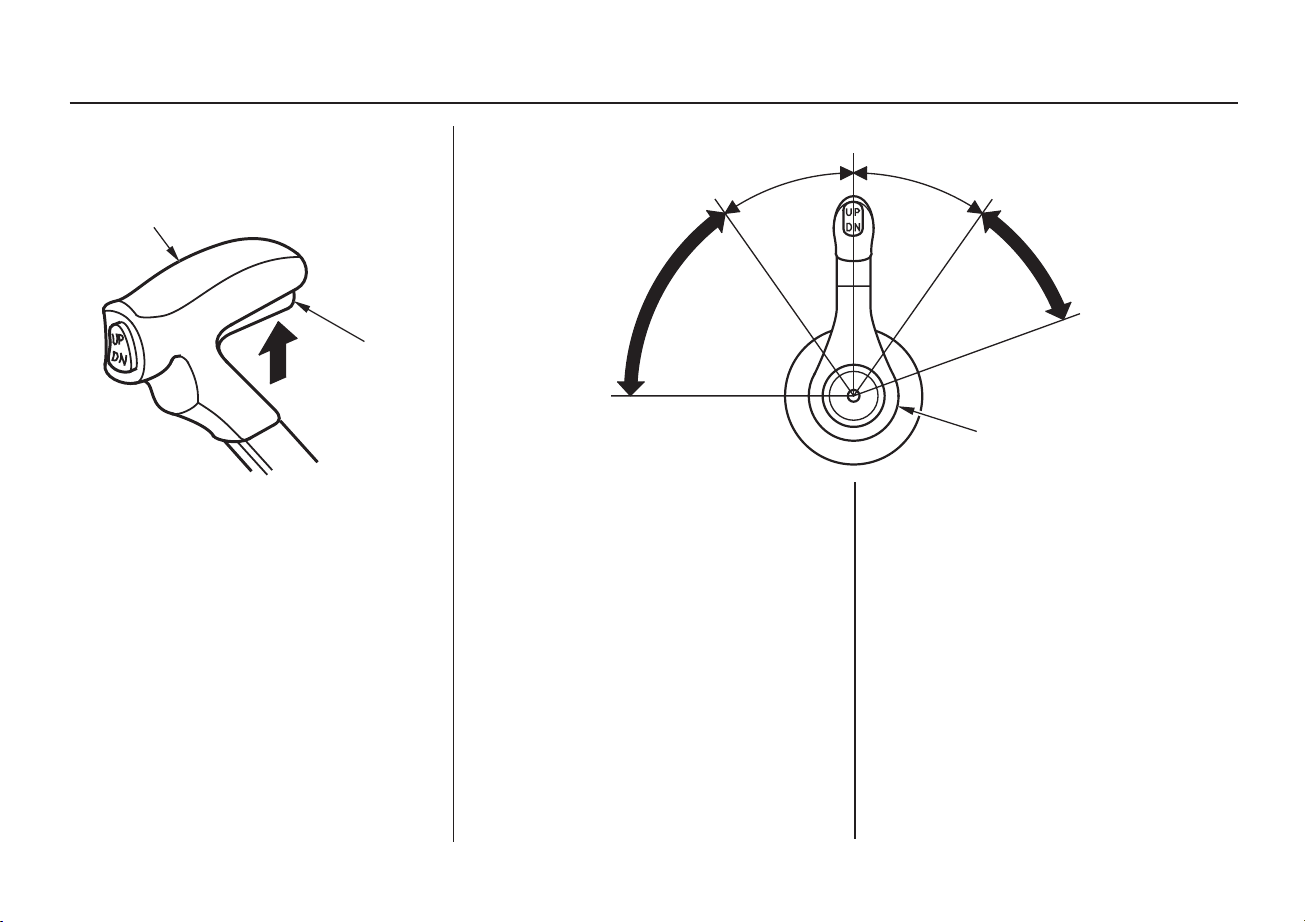
GEARSHIFT/THROTTLE
CONTROL LEVER
N (NEUTRAL)
35°
35°
F (FORWARD)
R (REVERSE)
SHIFT
SHIFT
MMIINNIIMMUUMM
MMIINNIIMMUUMM
TTHHRROOTTTTLLEE OOPPEENNIINNGG
MAXIMUM
TTHHRROOTTTTLLEE OOPPEENNIINNGG
MAXIMUM
GEARSHIFT/THROTTLE
CONTROL LEVER
NEUTRAL
RELEASE
LEVER
Gearshift/Throttle Control
Lever
Moving the control lever 35° from N
(neutral) selects the gear, and further
movement increases engine speed.
The control lever automatically locks
itself in the N (neutral) position. To
move the lever out of the N (neutral)
position, you must squeeze the
neutral release lever on the underside
of the lever handle.
A friction adjuster near the base of
the control lever adjusts the operating
resistance of the control lever. Refer
to p. .
Less friction allows easier control
lever movement. More friction helps
to hold a steady throttle setting while
cruising.
The gearshift/throttle control lever
controls engine speed and selects F
(forward), N (neutral), or R (reverse)
gears. 74
09/06/24 16:10:40 31ZY9610_031
31
CONTROLS AND FEATURES
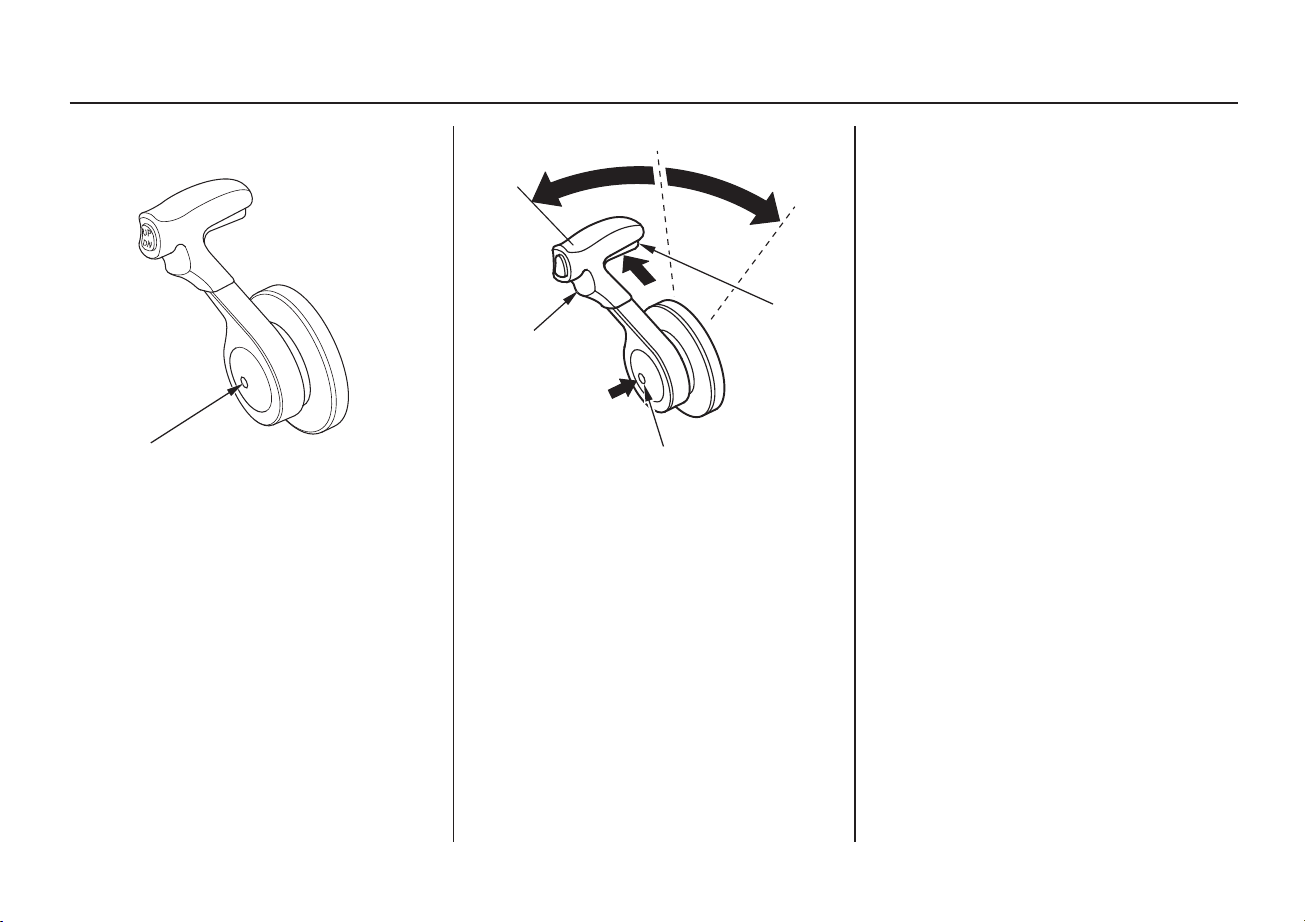
FAST IDLE BUTTON
F(forward)
N (neutral)
R (reverse)
CONTROL
LEVER
PPuullll uupp
NEUTRAL
RELEASE
LEVER
FAST IDLE BUTTON
Push
Fast Idle Button
It is necessary to position the control
lever in the N (neutral) position to
push in the fast idle button.
Return the control lever to N position
to cancel the fast idle operation.
Use the fast idle button to accelerate
engine warm-up after starting the
engine. Do not use the fast idle
button when starting the engine.
See page for engine warm-up
instructions.
The fast idle button allows you to
increase the idle speed without
engaging the drive gears. Move the
control lever toward the F (forward)
or R (reverse) position after pushing
in the fast idle button to increase the
idle speed.
62
09/06/24 16:10:48 31ZY9610_032
32
Top-Mount Type
CONTROLS AND FEATURES
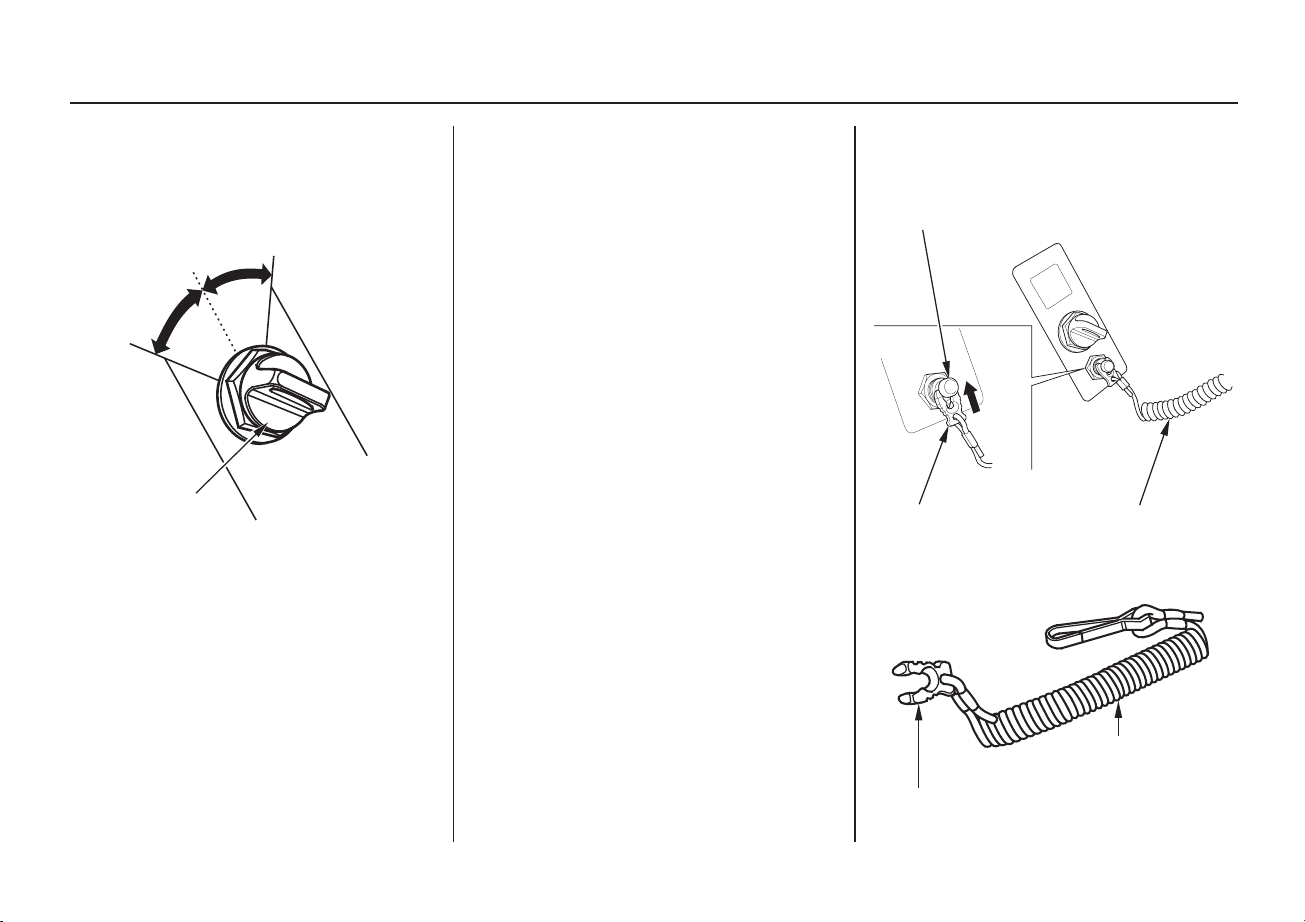
OFF
ON
START
IGNITION
SWITCH
EMERGENCY STOP SWITCH
EMERGENCY STOP
SWITCH CLIP
EMERGENCY STOP
SWITCH CLIP
EMERGENCY
STOP SWITCH
LANYARD
EMERGENCY STOP
SWITCH LANYARD
Ignition Switch
Emergency Stop Switch Clip and
Emergency Stop Switch
Turning the ignition switch key to the
START position operates the starter
motor. The key automatically returns
to the ON position when released
from the START position.
Turning the ignition switch to the
OFF position stops the engine.
The ignition switch controls the
ignition system and the starter motor.
The ignition switch can be used to
start the engine only when the control
lever is in the N (neutral) position (p.
) and the emergency stop switch
clip is in the emergency stop switch.
64
09/06/24 16:10:56 31ZY9610_033
33
CONTROLS AND FEATURES
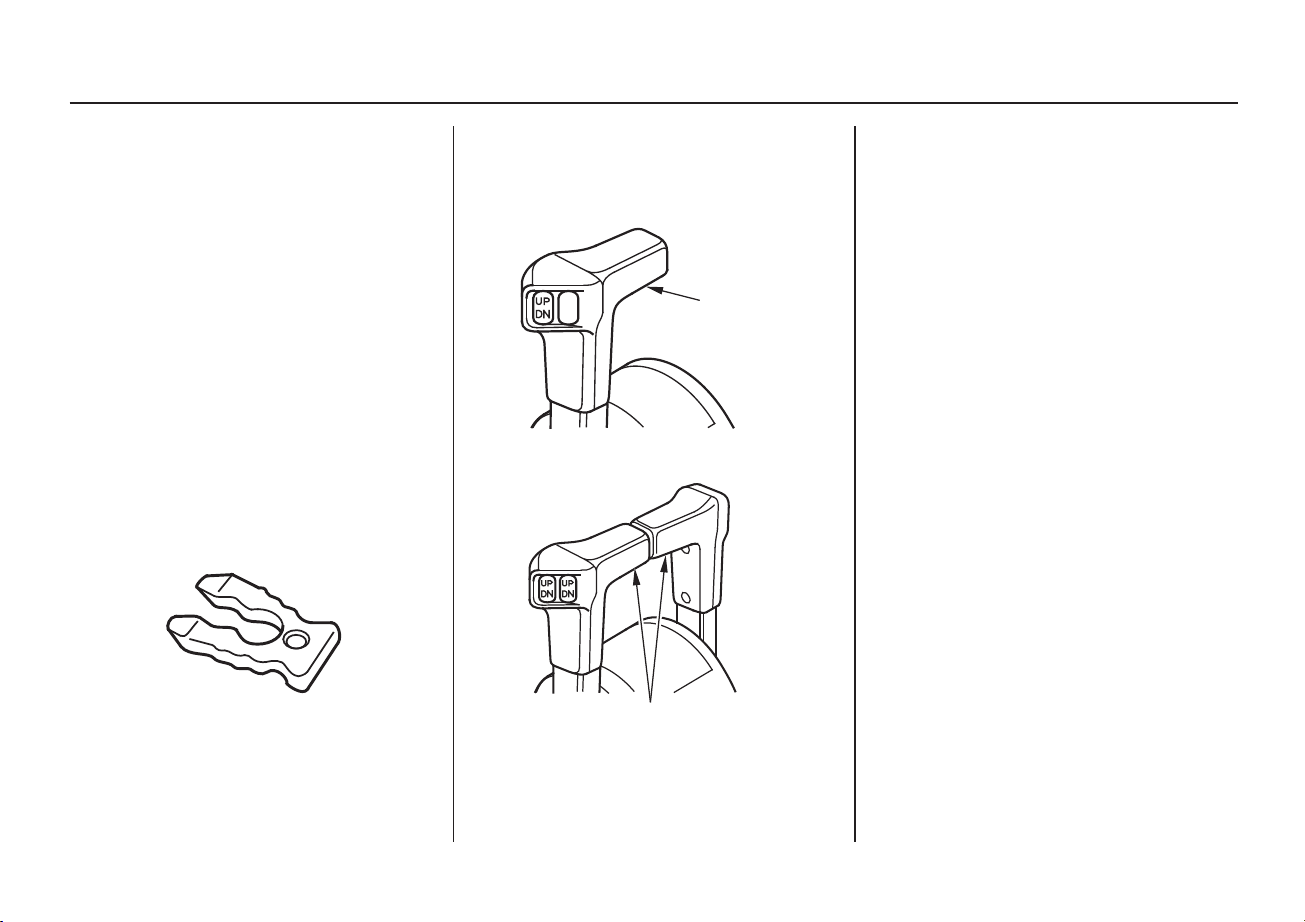
SPARE SWITCH CLIP
SINGLE TYPE
DUAL TYPE
GEARSHIFT/
THROTTLE
CONTROL
LEVER
GEARSHIFT/THROTTLE
CONTROL LEVERS
Gearshift/Throttle Control
Lever
The gearshift/throttle control lever(s)
controls engine speed and selects F
(forward), N (neutral), or R (reverse)
gears.
The emergency stop switch clip must
be inserted in the emergency stop
switch in order for the engine to start
and run. The emergency stop switch
lanyard must be attached securely to
the operator or to the operator’s PFD
(Personal Flotation Device).
A spare switch clip is provided in the
tool bag (p. ).
When used as described, the
emergency stop switch clip and
emergency stop switch lanyard
system stops the engine if the
operator falls away from the controls.
83
09/06/24 16:11:03 31ZY9610_034
34
CONTROLS AND FEATURES
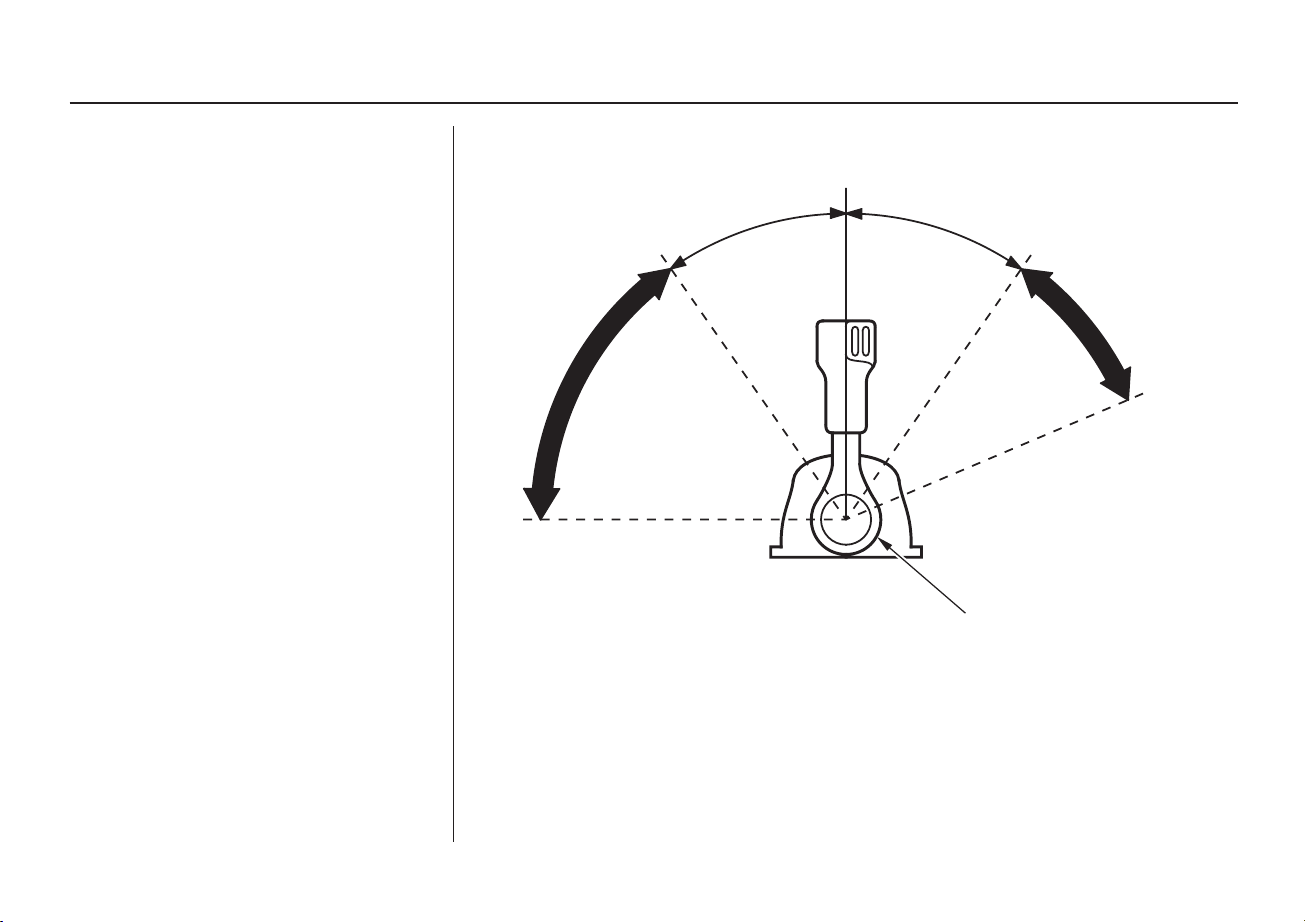
N (NEUTRAL)
35° 35°
F (FORWARD) R (REVERSE)
SHIFTSHIFT
MMIINNIIMMUUMM
MMIINNIIMMUUMM
TTHHRROOTTTTLLEE OOPPEENNIINNGG
TTHHRROOTTTTLLEE OOPPEENNIINNGG
MAXIMUM
MAXIMUM
GEARSHIFT/THROTTLE CONTROL LEVER
Moving the control lever 35° from N
(neutral) selects the gear, and further
movement increases engine speed.
A friction adjuster inside the control
box adjusts the operating resistance
of the control lever(s). Refer to
p. .
Less friction allows easier control
lever movement. More friction helps
to hold a steady throttle setting while
cruising.
74
09/06/24 16:11:08 31ZY9610_035
35
CONTROLS AND FEATURES
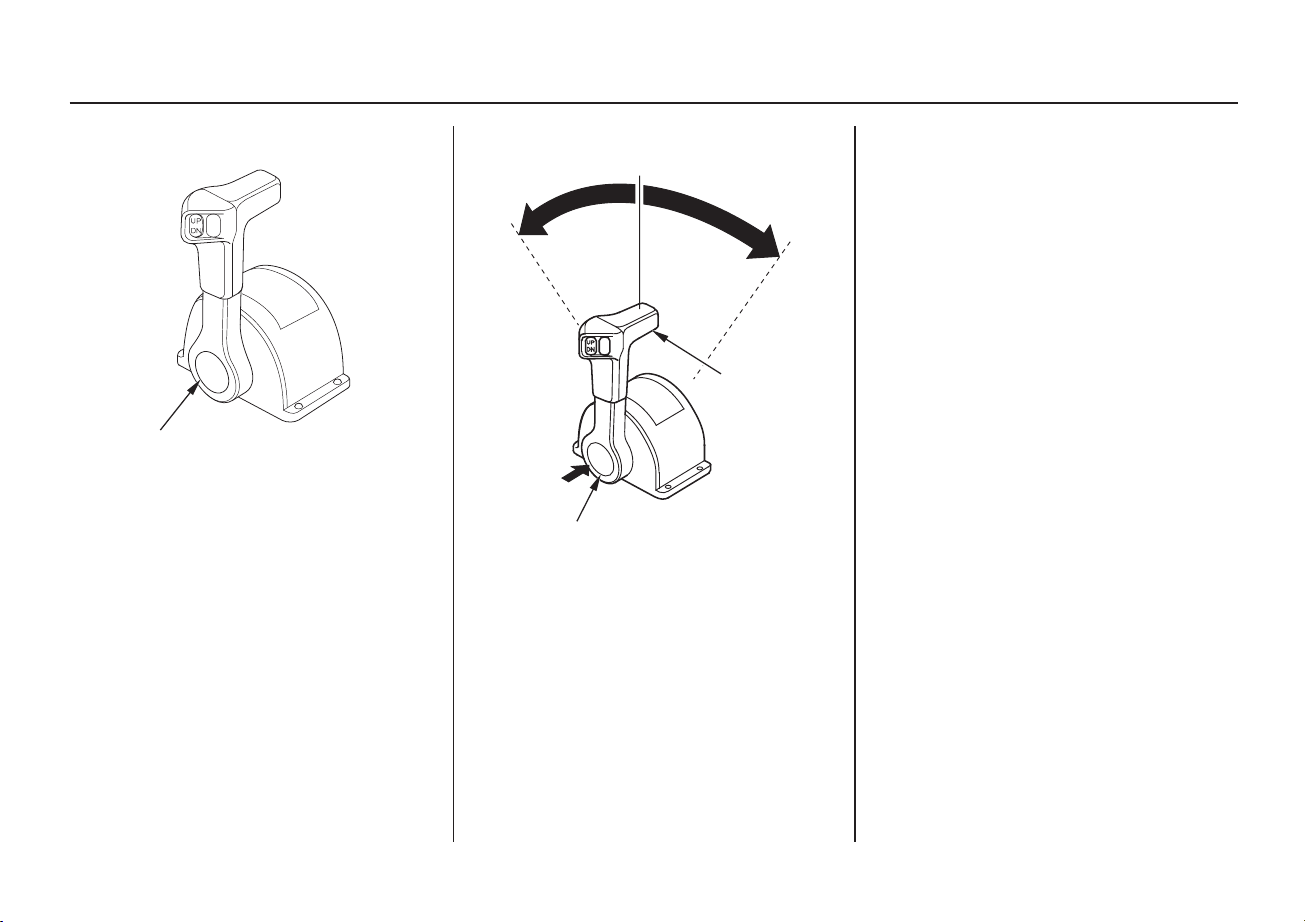
FAST IDLE BUTTON
F(forward)
N(neutral)
R (reverse)
CONTROL
LEVER
FAST IDLE BUTTON
Push
Fast Idle Button
Use the fast idle button to accelerate
engine warm-up after starting the
engine. Do not use the fast idle
button when starting the engine.
See page for engine warm-up
instructions.
Return the control lever to N position
to cancel the fast idle operation.
The fast idle button allows you to
increase the idle speed without
engaging the drive gears. Move the
control lever toward the F (forward)
or R (reverse) position after pushing
in the fast idle button to increase the
idle speed.
It is necessary to position the control
lever in the N (neutral) position to
push in the fast idle button.
65
09/06/24 16:11:16 31ZY9610_036
36
Common Controls
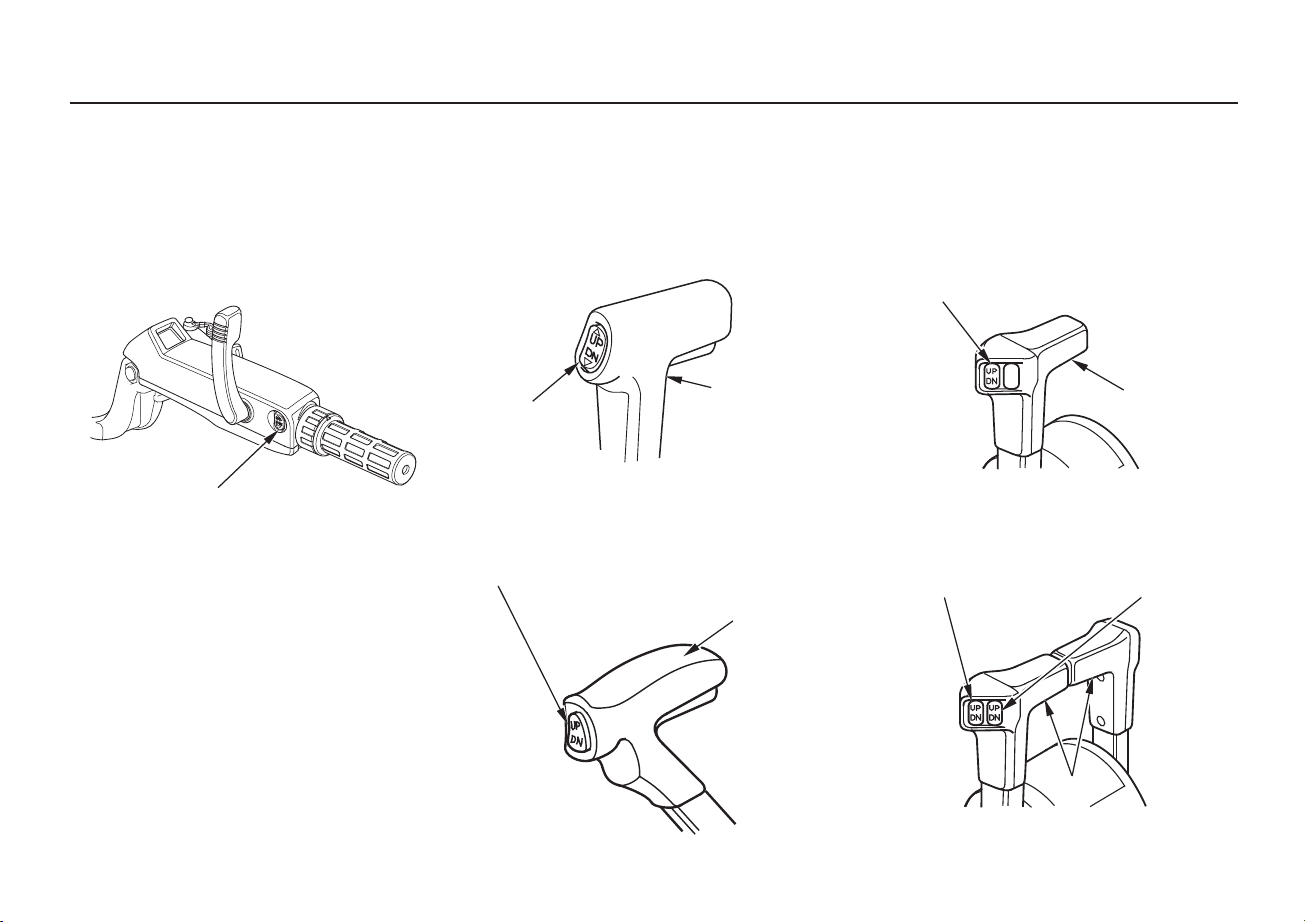
Power Trim/Tilt Switch
(tiller handle/control lever side)
CONTROLS AND FEATURES
CONTROL
LEVER
(LEFT) (RIGHT)
POWER TRIM/TILT SWITCH
CCOONNTTRROOLL
LLEEVVEERRSS
POWER TRIM/
TILT SWITCH
(side-mount type)
POWER
TRIM/TILT
SWITCH
CONTROL
LEVER
(panel-mount type)
POWER TRIM/TILT SWITCH
CONTROL LEVER
(top-mount single type)
(top-mount dual type)
POWER TRIM/TILT SWITCHES
LHT Type
LRTandXRTTypes
09/06/24 16:11:25 31ZY9610_037
37
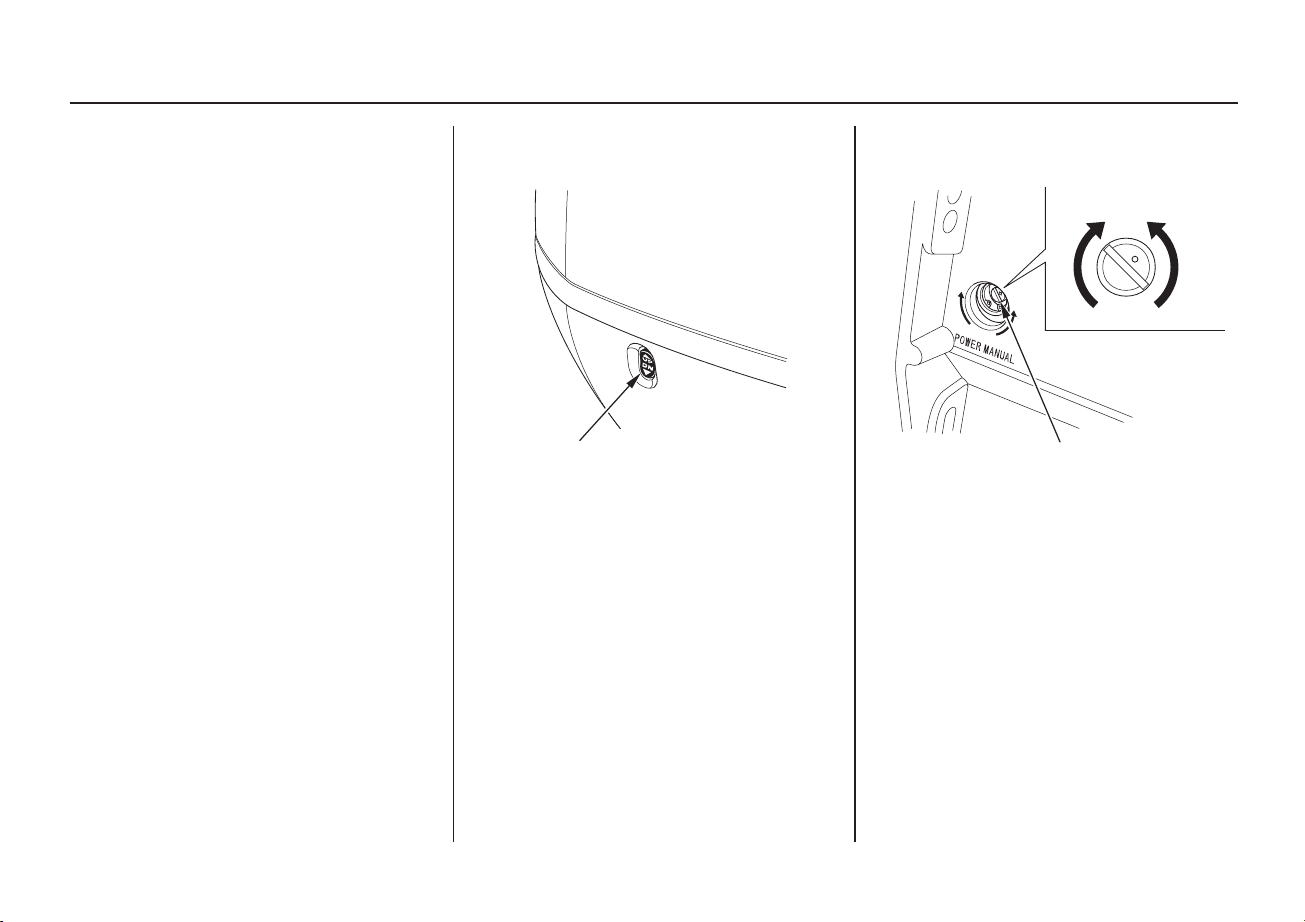
Manual Relief ValvePower Tilt Switch
(engine pan side)
CONTROLS AND FEATURES
POWER TILT SWITCH
MANUAL RELIEF VALVE
POWER
(To fix)
MANUAL
(To release)
The outboard motor can be tilted
manually after opening the manual
relief valve. This allows the outboard
motor to be tilted up or down when
no battery is connected.
Check that nobody is under the
outboard motor before opening the
manual relief valve. If the manual
relief valve is loosened (turned
counterclockwise) when the outboard
motor is tilted up, the outboard motor
will suddenly tilt down.
The power tilt switch is located on
the engine pan. It is a rocker switch
with UP and DN (down) positions
for changing the angle of the
outboard motor.
The power tilt switch will operate
without turning the ignition switch
ON.
This switch is used with the engine
stopped to raise the outboard motor
for mooring, trailering, or
maintenance.
The power trim/tilt switch is located
on the control lever. It is a rocker
switch with UP and DN (down)
positions for changing the angle of
the outboard motor.
You can use the power trim/tilt
switch anytime whether the boat is
underway, stopped, or the ignition
switch is in the OFF position. It is
necessary for the ignition switch to
be in the ON position for the trim
meter to indicate the motor angle.
Trim the outboard motor to obtain
the best performance and stability
(p. ).
Tilt the outboard motor for shallow
water operation, beaching, launching,
or mooring.
For dual mount outboard motors, tilt
them up at the same time.
76
09/06/24 16:11:35 31ZY9610_038
38
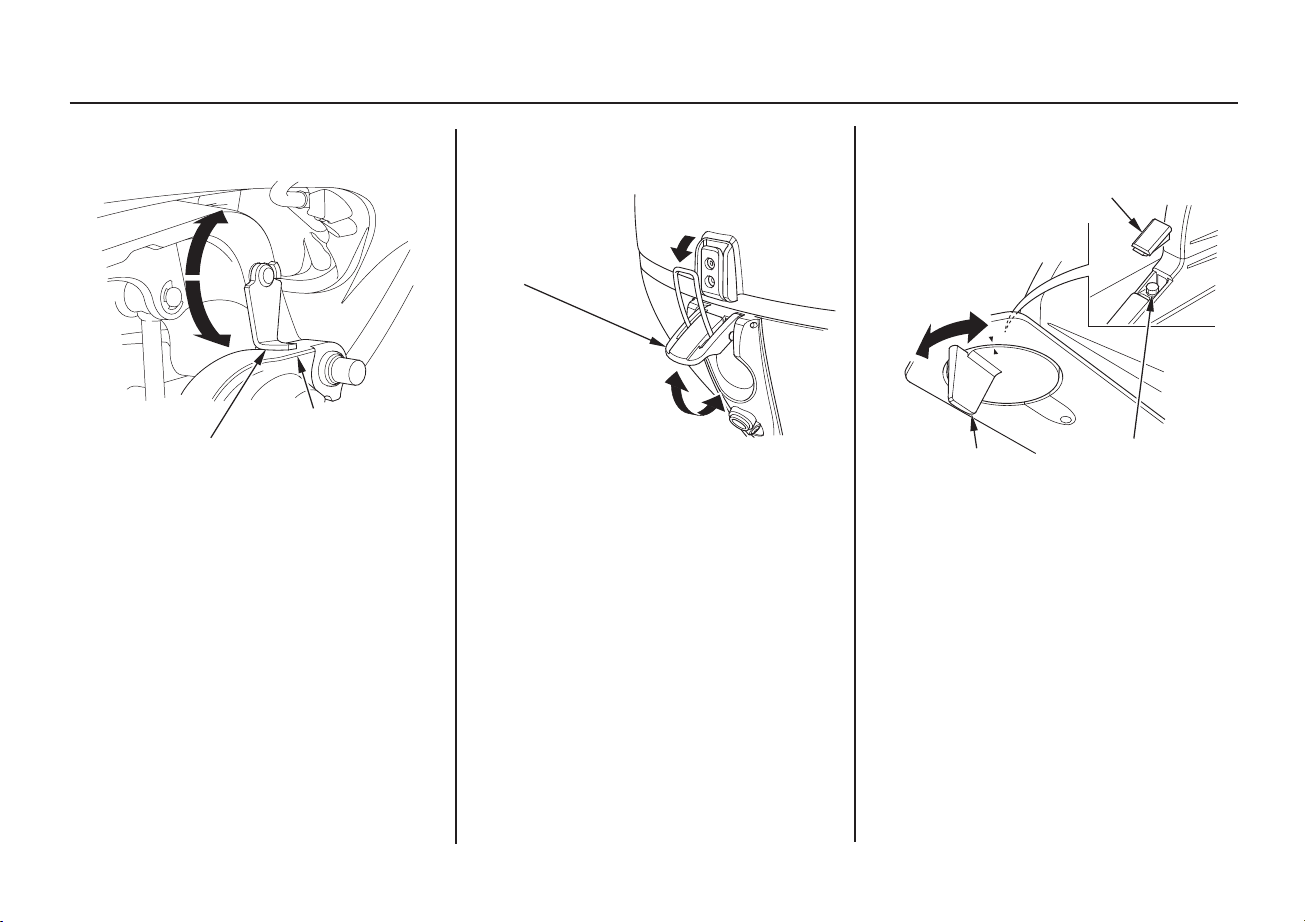
Trim TabEngine Cover LatchTilt Lock Lever
(front/rear)
CONTROLS AND FEATURES
FFRREEEE
LLOOCCKK
STERN BRACKET
TILT LOCK LEVER
ENGINE COVER
LATCHES
(front/rear)
UUNNLLAATTCCHH
TRIM TAB
TRIM TAB BOLT
FFIIXX
GEAR CASE
GROMMET
The trim tab compensates for
‘‘torque steer,’’ which is a reaction of
the outboard motor to propeller
rotation.
If uncompensated, torque steer would
make the outboard motor tend to turn
to one side.
When the trim tab is correctly
adjusted (p. ), steering effort is
equal in either direction.
The engine cover latch fastens the
engine cover to the outboard motor.
The tilt lock lever is used to support
the outboard motor in the fully-raised
position.
When the boat is to be moored for a
long time, tilt the outboard motor up
as far as it will go. Then move the tilt
lock lever to the LOCK position, and
gently lower the outboard motor until
the lever contacts the stern bracket.
86
09/06/24 16:11:46 31ZY9610_039
39
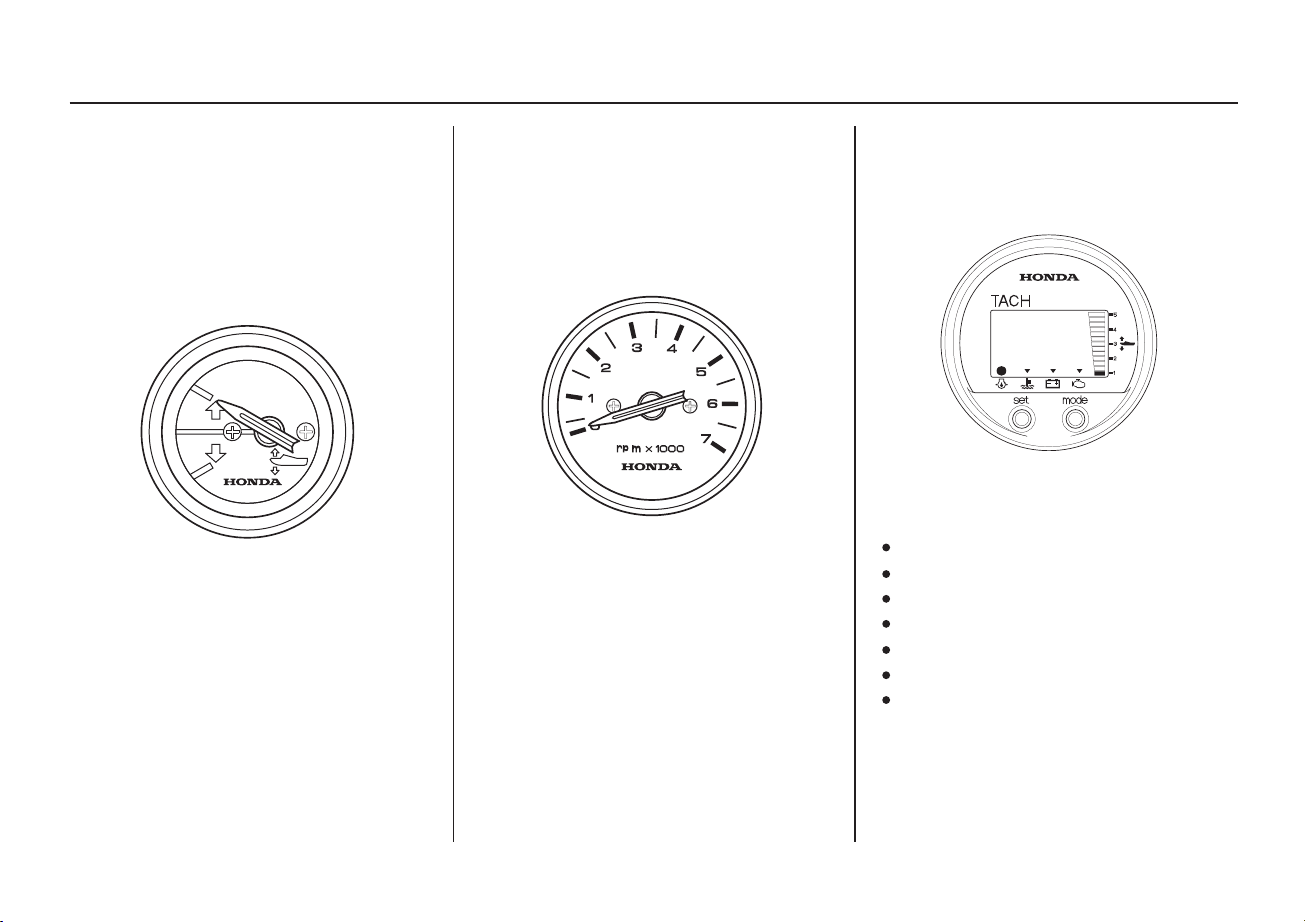
Digital TachometerTachometerINSTRUMENTS
Trim Meter
[standard equipment (LHTC,
LRTC and XRTC types)]
[optional equipment (LHTA,
LRTA and XRTA types)]
[standard equipment (LHTC,
LRTC and XRTC types)]
[optional equipment (LHTA,
LRTA and XRTA types)]
[optional equipment (LRT and
XRT types)]
CONTROLS AND FEATURES
Digital Tachometer includes the
following functions.
Tachometer
Hour Meter
Trim Meter
Oil Pressure Indicator
Overheat Indicator
ACG Indicator
Refer to the Operation Guide
included with the Digital Tachometer
for operation information.
The trim meter indicates the relative
trim angle of the outboard motor.
Refer to the trim meter when using
the power trim/tilt switch to achieve
the best performance from the boat. Malfunction Indicator
The tachometer shows engine speed
in revolutions per minute.
Refer to the tachometer when using
the throttle and power trim/tilt
controls to achieve the best
performance from the boat.
09/06/24 16:12:01 31ZY9610_040
40
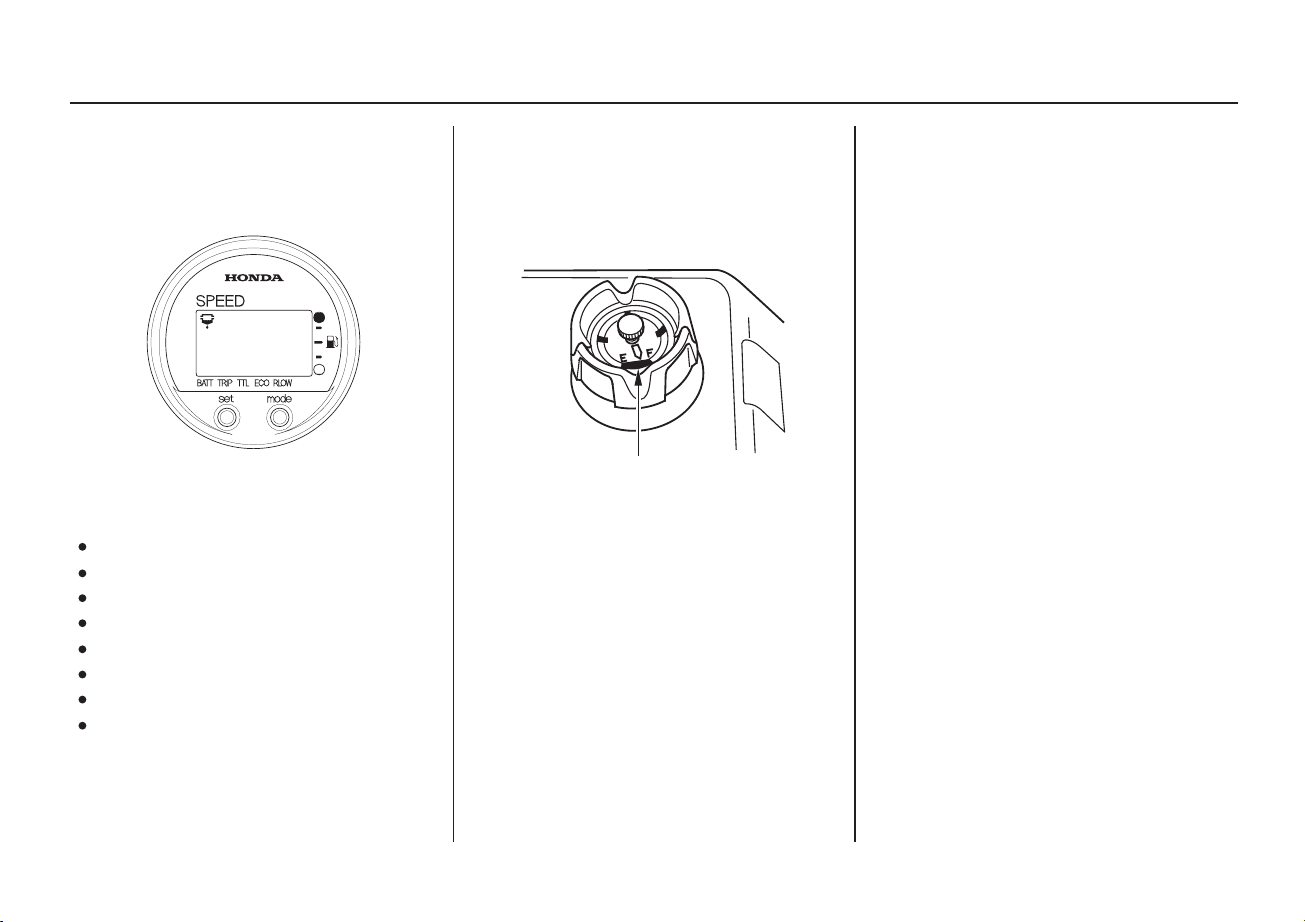
Digital Speedometer Fuel Gauge
[optional equipment (LRT and
XRT types)]
[standard equipment (LHTC
type)]
[optional equipment (other
types)]
CONTROLS AND FEATURES
FUEL GAUGE
Digital Speedometer includes the
following functions.
Speedometer
Fuel Level Meter
Voltmeter
Tripmeter
Fuel Integration Meter
Fuel Economy Meter
Fuel Flow Meter
Water Separator Indicator
Refer to the Operation Guide
included with the Digital
Speedometer for operation
information.
A fuel gauge is built into the cap of
the portable fuel tank.
09/06/24 16:12:14 31ZY9610_041
41
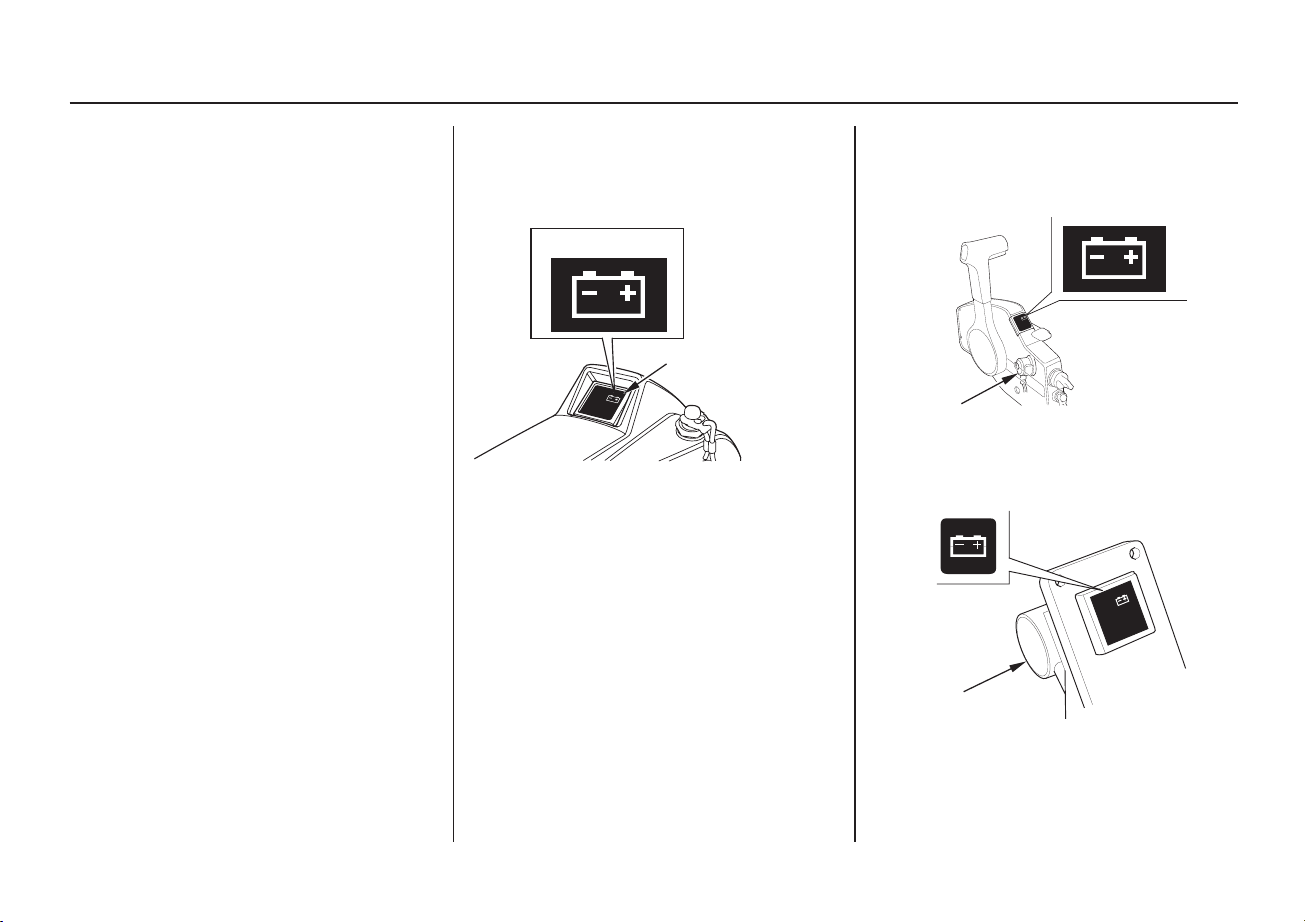
INDICATORS Alternator (ACG) Indicator
CONTROLS AND FEATURES
ACG INDICATOR
ACG INDICATOR
(RED)
(RED)
BUZZER
BUZZER
(panel-mount/top-mount types)
(side-mount type)
ACG INDICATOR
(internal buzzer)
(RED)
LRTandXRTTypes
LHT Type
The indicator lights come on and the
buzzer sounds when you turn the
ignition switch ON, allowing you to
see that they are working. If an
indicator does not light during this
test, it cannot alert you if that system
develops a problem. Have your
Honda Marine dealer check for
burned-out bulbs or other problems.
Under normal conditions, the
following occur when the ignition
switch is turned ON:
The ACG, Malfunction, Oil
Pressure, and Overheat indicators
light.
The buzzer will beep twice.
The Malfunction, Oil Pressure,
and Overheat indicators will go out
after the second beep.
The ACG indicator will go out
after the engine starts.
The Oil Pressure indicator will
light again after the engine starts
and will stay lit to indicate the oil
pressure is normal.
The ACG indicator turns on and the
buzzer sounds in one-second
intervals when the charging system is
faulty.
1.
2.
3.
4.
5.
09/06/24 16:12:26 31ZY9610_042
42
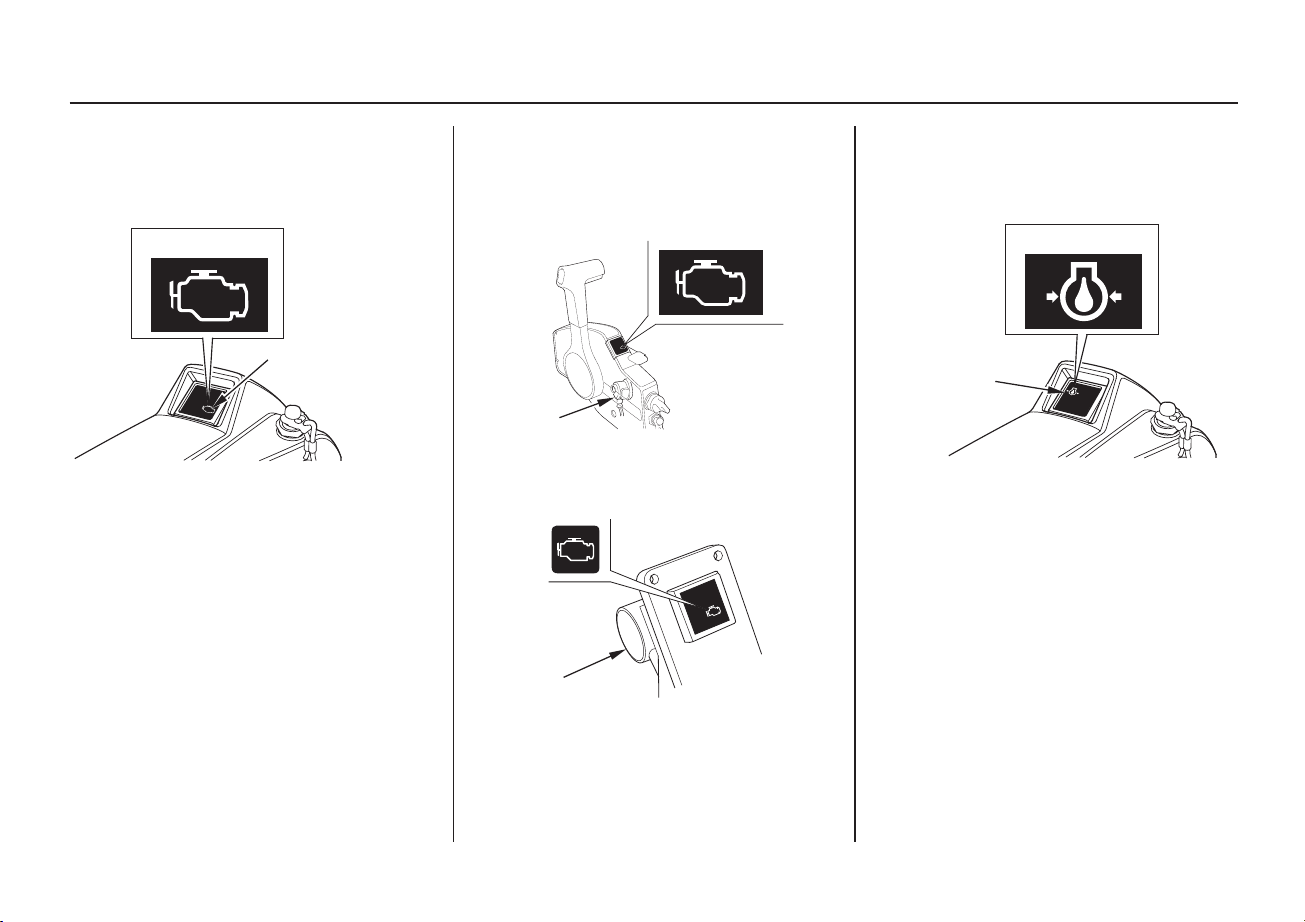
Malfunction Indicator Oil Pressure Indicator
CONTROLS AND FEATURES
(internal buzzer)
MALFUNCTION
INDICATOR
MALFUNCTION
INDICATOR
(panel-mount/top-mount types)
(side-mount type)
(GREEN)
(internal buzzer)
(RED)
BUZZER
(RED)
MALFUNCTION
INDICATOR
(RED)
BUZZER
OIL PRESSURE
INDICATOR
LRTandXRTTypes
LHT Type LHT Type
When the engine control system
detects an engine control system
malfunction, the malfunction
indicator turns on and the buzzer
sounds at one-second intervals.
09/06/24 16:12:35 31ZY9610_043
43
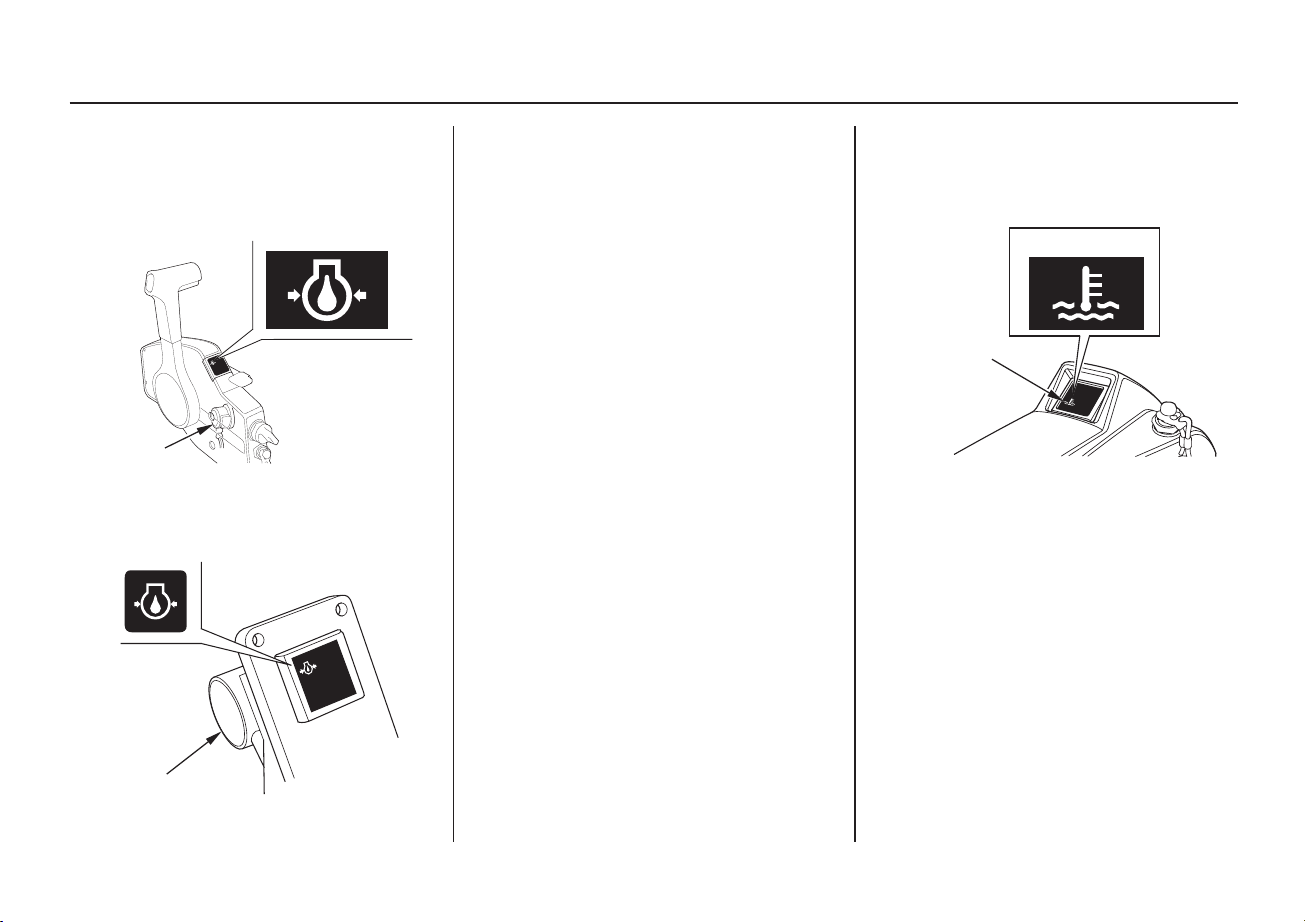
Overheat Indicator
CONTROLS AND FEATURES
(internal buzzer)
OVERHEAT
INDICATOR
(RED)
(side-mount type)
OIL PRESSURE
INDICATOR
(GREEN)
BUZZER
(panel-mount/top-mount types)
OIL PRESSURE
INDICATOR
BUZZER
(GREEN)
LRTandXRTTypes
LHT Type
TAKING CARE OF
UNEXPECTED PROBLEMS,
When the oil pressure indicator is lit,
oil pressure is OK.
If oil pressure becomes low, the
indicator will go off, and the engine
protection system will limit engine
speed. Refer to
on p. .
All models are equipped with a
buzzer that sounds continuously
when the oil pressure indicator goes
off.
Low oil pressure indicates that the
engine oil level is low or that there is
a problem with the engine lubrication
system.
122
09/06/24 16:12:44 31ZY9610_044
44
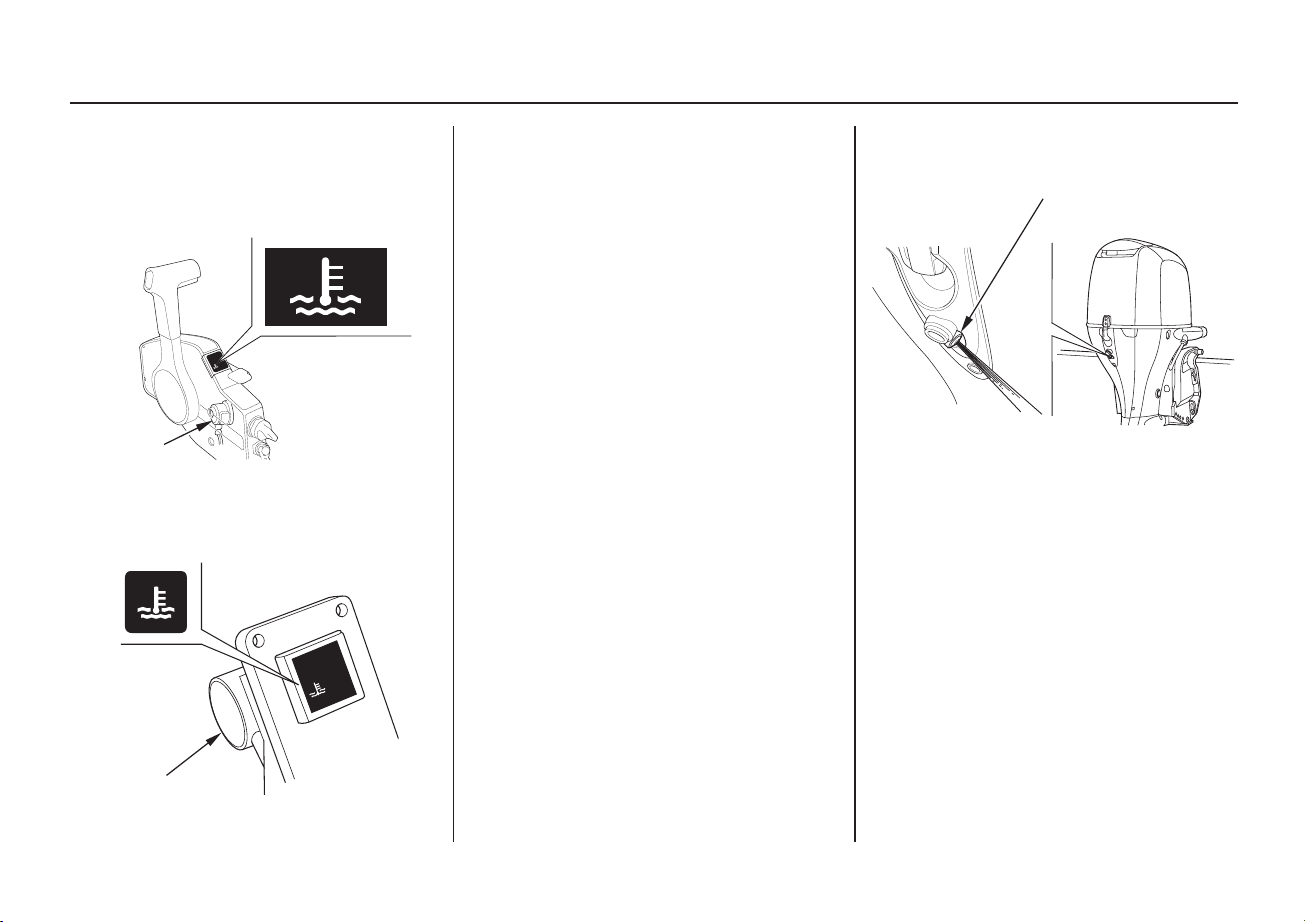
Cooling System Indicator
CONTROLS AND FEATURES
OVERHEAT
INDICATOR
(RED)
OVERHEAT
INDICATOR
(RED)
(side-mount type)
(panel-mount/top-mount types)
BUZZER
BUZZER
COOLING SYSTEM INDICATOR
LRTandXRTTypes
TAKING CARE OF
UNEXPECTED PROBLEMS
When the alert triggers, the overheat
indicator comes on and the buzzer
sounds a steady tone as the engine
speed is reduced to 1,800 rpm. If the
condition persists for another 20
seconds, the engine shuts off. Refer
to
,on
p. .
All models are equipped with a
buzzer that sounds continuously
when the red light comes on.
Engine overheating may be the result
of clogged water intakes.
Water should flow from the cooling
system indicator while the engine is
running. This shows that water is
circulating through the cooling
system.
If water stops flowing while the
engine is running, it indicates a
cooling system problem, such as
clogged water intakes, which will
cause engine overheating.
The cooling system indicator
discharge port can also become
plugged.
123
09/06/24 16:12:53 31ZY9610_045
45
OTHER FEATURES
Water Separator Buzzer
Overrev Limiter Portable Fuel Tank
[standard equipment (LHTC
type)]
[optional equipment (other
types)]
CONTROLS AND FEATURES
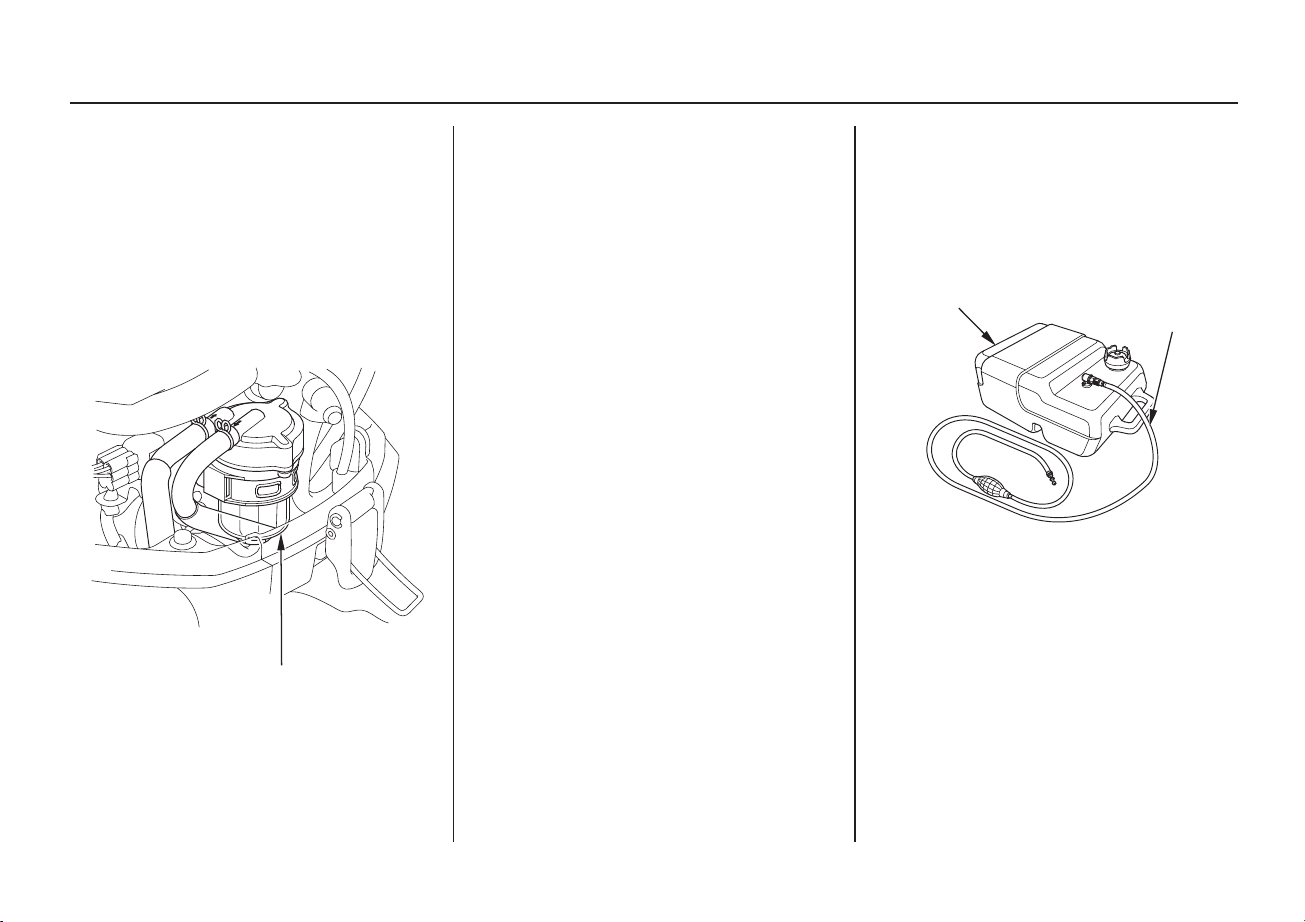
WATER SEPARATOR
FUEL HOSE
PORTABLE FUEL TANK
The water separator buzzer sounds a
rapid, repeating signal when water
has accumulated in the water
separator.
The engine is equipped with an
overrev limiter to prevent the
possibility of mechanical damage
from excessive engine speed.
The overrev limiter may be activated
during operation, limiting engine
speed, if the outboard motor is
trimmed or tilted up excessively, or
when propeller ventilation occurs
during a sharp turn.
If the overrev limiter is activated,
check the trim angle of the outboard
motor.
Check to see if the correct propeller
is installed.
The portable fuel tank has a capacity
of US gal ( L) and has a fuel
gauge built into the cap.
6.6 25
09/06/24 16:13:03 31ZY9610_046
46
Fuel Priming BulbFuel Filler Cap Vent Knob
[standard equipment (LHTC
type)]
[optional equipment (other
types)]
[standard equipment (LHTC
type)]
[optional equipment (other
types)]
CONTROLS AND FEATURES
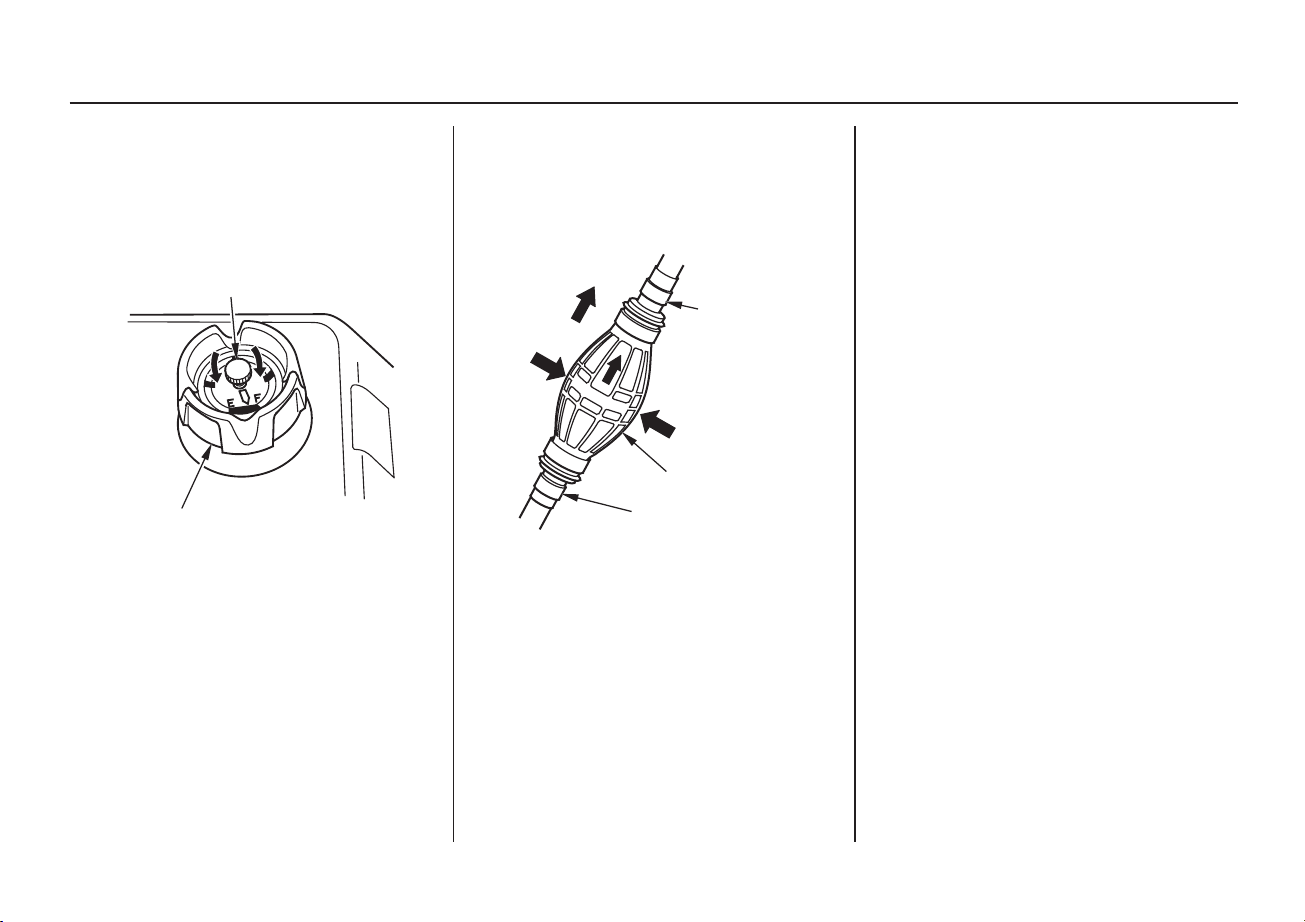
VENT KNOB
OOPPEENN
CCLLOOSSEE
FUEL FILLER CAP
UP
OUTLET END
(motor side)
PRIMING BULB
INLET END
(fuel tank side)
The fuel filler cap is provided with a
vent knob to seal the portable fuel
tank for carrying it to and from the
boat. Open the vent knob 2 or 3 turns
before starting the engine.
A priming bulb is built into the fuel
hose that connects the fuel tank to the
outboard motor.
Before starting the engine, hold the
priming bulb up in the direction of
the arrow; then squeeze the priming
bulb until it feels firm. This will
ensure that fuel is supplied to the
engine (p. ).54
09/06/24 16:13:11 31ZY9610_047
47
Anodes
CONTROLS AND FEATURES
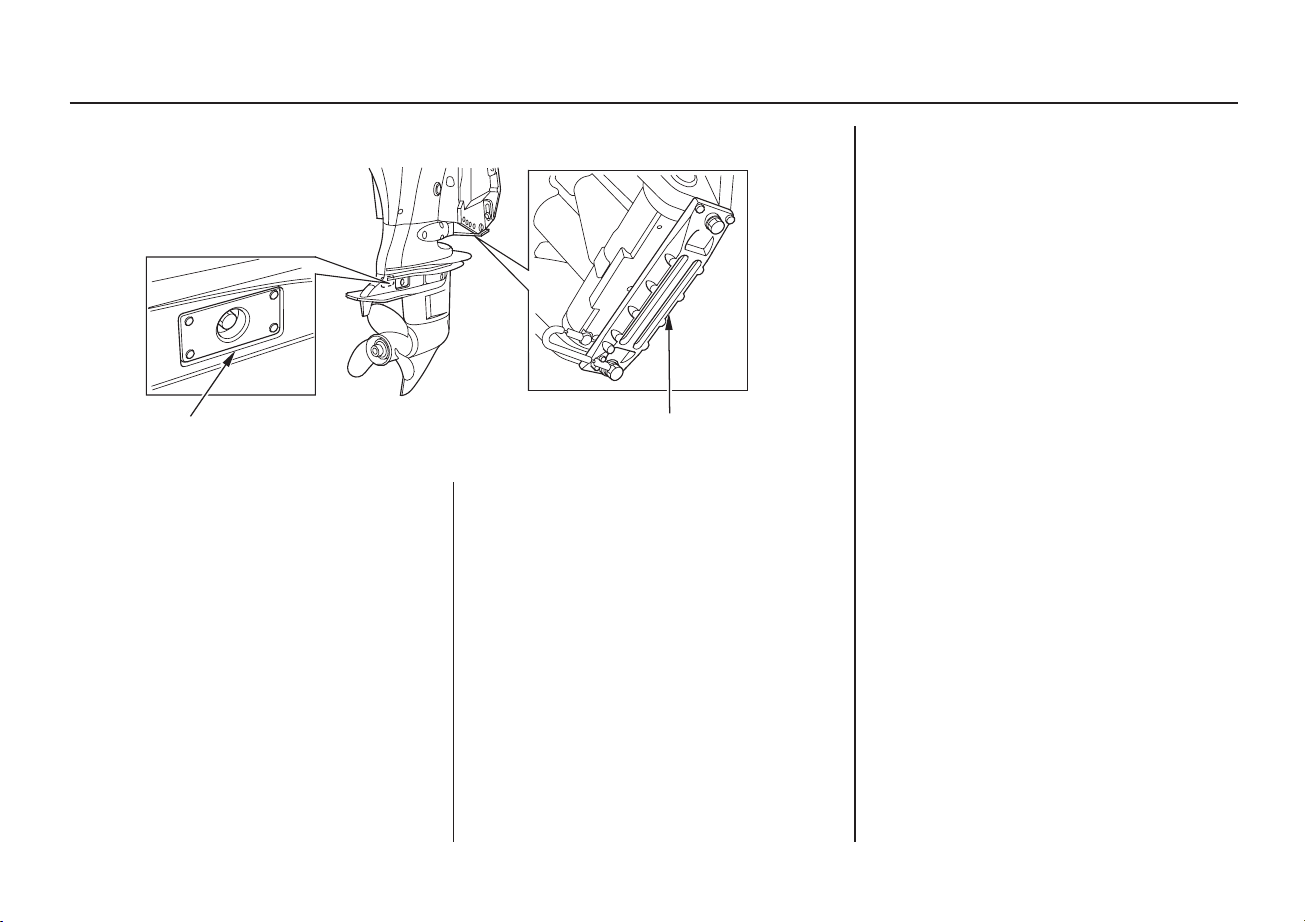
ANODE
(each side)
ANODE
(stern bracket)
The anodes are made of a sacrificial
material that helps to protect the
outboard motor from corrosion.
There are two anodes on the gear
case, one on the stern bracket and
two small anodes in the water
passages of the engine block.
09/06/24 16:13:16 31ZY9610_048
Improperly maintaining
this outboard motor or
failing to correct a problem
before operation can cause
a malfunction in which you
could be seriously hurt or
killed.
Always perform a pre-
operation inspection before
each operation, and correct
any problem.
48
ARE YOU READY TO GET
UNDERWAY?
Safety
Knowledge
IS YOUR OUTBOARD
MOTOR READY TO GO?
BEFORE OPERATION
Your safety is your responsibility. A
little time spent in preparation will
significantly reduce your risk of
injury.
Read and understand this manual.
Know what the controls do and how
to operate them.
Familiarize yourself with the
outboard motor and its operation
before you get underway. Know
what to do in case of an emergency.
Familiarize yourself with all laws
and regulations relating to boating
and the use of outboard motors.
Always wear a PFD (Personal
Flotation Device) while on the boat.
Before beginning your pre-operation
checks, be sure the ignition switch is
in the OFF position.
Attach the emergency stop switch
clip securely to the operator or to the
operator’s PFD (Personal Flotation
Device).
For your safety, and to maximize the
service life of your equipment, it is
very important to take a few
moments before you operate the
outboard motor to check its condition.
Be sure to take care of any problem
you find, or have your authorized
Honda Marine dealer correct it,
before you operate the outboard
motor.
09/06/24 16:13:26 31ZY9610_049
49
Safety Inspection
Maintenance Inspection
BEFORE OPERATION
Look around the outboard motor
for signs of oil or gasoline leaks.
Check that all fasteners are in
place and securely tightened.
Check that the fuel hose is
undamaged and properly
connected.
Wipe up any spills before starting
the engine.
Check the stern bracket to be sure
the outboard motor is securely
installed.
Check that all controls are
operating properly.
Replace any damaged parts.
Check that the battery fluid is
between the upper and lower levels,
and the battery leads are connected
securely.
Make sure a tool kit and the
emergency starter rope are
onboard (p. ). Replace any
missing items.
Check the fuel level in the fuel
tank (p. ).
Check the water separator for
water contamination (p. ).
Check that the anodes are securely
attached to the stern bracket and
the gear case (p. ) and are not
excessively worn. The anodes help
protect the outboard motor from
corrosion.
Check to be sure the propeller is
undamaged and the castle nut is
secured with the cotter pin
(p. ).
Check the engine oil level (p. ).
Running the engine with a low oil
level can cause engine damage.
Check the emergency stop switch
for proper operation. Start the
engine (p. , or ). Make
sure the engine stops by pulling
the emergency stop switch clip
from the emergency stop switch
(p. ).
If you are using the portable fuel
tank (standard or optional
equipment), make sure it is in good
condition and properly secured in
the boat (p. ).
29
69
88
107
106
83
97
99
3225
52
09/06/24 16:13:39 31ZY9610_050
×
×
×
50
Tiller Handle Height/Angle
Adjustment (LHT type)
BEFORE OPERATION
HANDLE ANGLE: 7°
HANDLE ANGLE: 13°
HANDLE ANGLE:
21°
11.7 in
(296 mm)
HEIGHT ADJUSTMENT
BLOCK
828mm
FLANGE BOLT
HANDLE ANGLE: 7°
Install the height adjustment block
so that the selected angle of the
tiller handle is in this position.
Reference point
HEIGHT
17.0 in
(433 mm)
14.1 in
(359 mm)
HANDLE ANGLE: 13°
HANDLE ANGLE: 21°
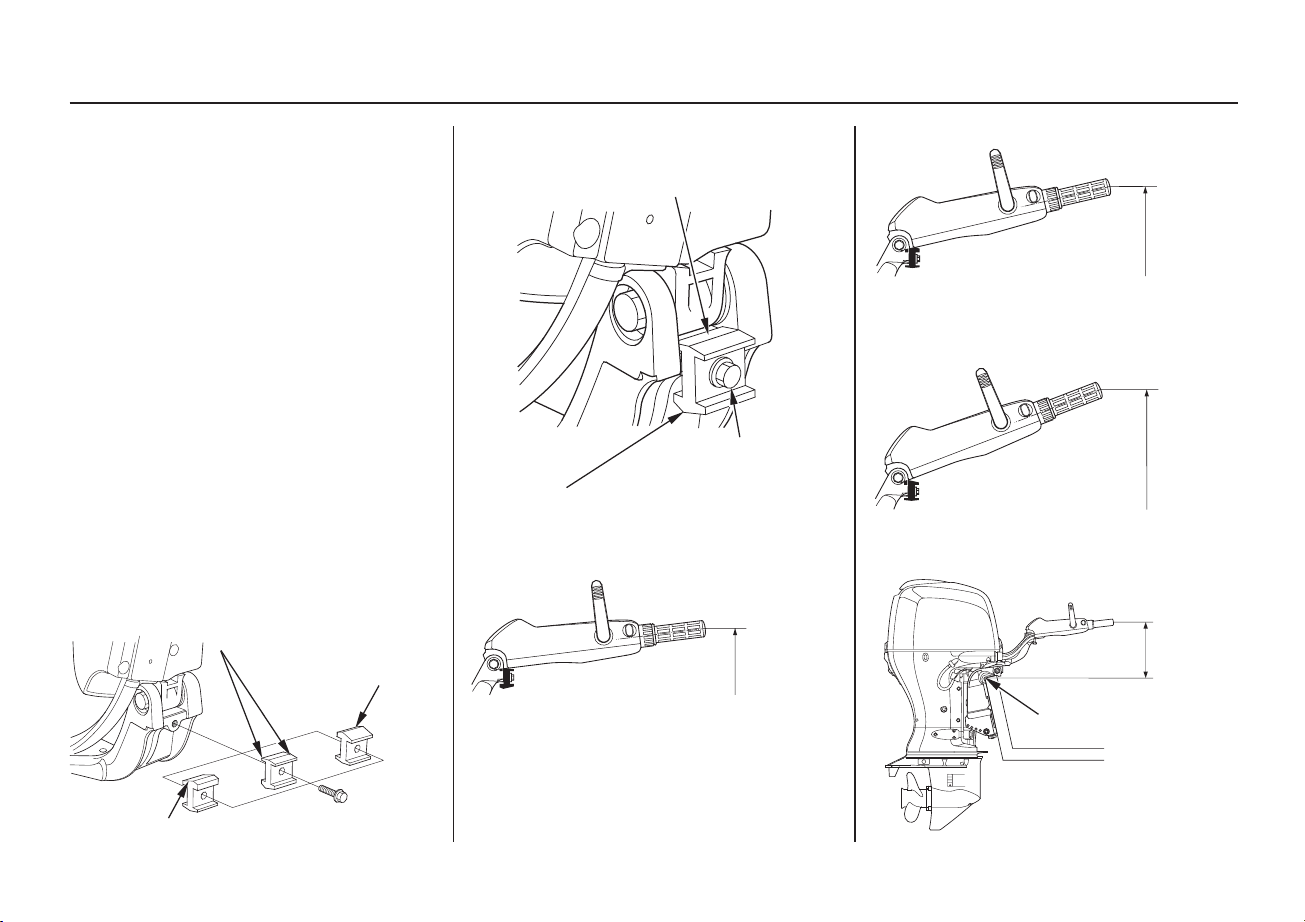
The tiller handle height and angle can
be adjusted to three positions by
changing the installation direction of
the height adjustment block. Select a
suitable height and angle for the
operator and secure the block.
Raise the tiller handle and remove
the 8 28 mm flange bolt and the
height adjustment block.
Pull down the tiller handle.
Determine the height adjustment
block installation direction and
secure the block with the 8 28
mm flange bolt.
2.
1.
09/06/24 16:13:48 31ZY9610_051

51
SAFE OPERATING
PRECAUTIONS
BREAK-IN PROCEDURE
Break-in period: 10 hours
First 15 minutes:
Next 45 minutes:
Next 60 minutes:
Next 8 hours:
OPERATION
IMPORTANT SAFETY
INFORMATION
BEFORE OPERATION.
To safely realize the full potential of
this outboard motor, you need a
complete understanding of its
operation and a certain amount of
practice with its controls.
Before operating the outboard motor
for the first time, please review the
on page and the
chapter titled
Proper break-in operation allows the
moving parts to wear in smoothly for
best performance and long service
life.
Run the engine at trolling speed. Use
the minimum throttle opening
necessary to operate the boat at a safe
trolling speed.
Run the engine up to a maximum of
2,000 to 3,000 rpm, which is about
10% to 30% of maximum throttle
opening.
Run the engine up to a maximum of
4,000 to 5,000 rpm, which is about
50% to 80% of maximum throttle
opening.
Short full-throttle bursts are OK, but
do not operate the engine
continuously at full throttle.
For boats that plane easily, bring the
boat up on plane, and then reduce the
throttle opening to the recommended
rpm range.
Do not run the engine at full throttle
for more than 5 minutes at a time.
For your safety, do not start or run
the engine in a confined or partly
enclosed area. Your engine’s exhaust
contains poisonous carbon monoxide,
a colorless, odorless gas that can
collect rapidly. Breathing carbon
monoxide can cause loss of
consciousness and may lead to death.
7
09/06/24 16:14:00 31ZY9610_052
Gasoline is highly
flammable and explosive.
You can be burned or
seriously injured when
handling fuel.
Stop the engine and keep
heat, sparks, and flame
away.
Handle fuel only
outdoors.
Wipe up spills
immediately.
52
PORTABLE FUEL TANK
[standard equipment (LHTC
type)]
[optional equipment (other
types)]
OPERATION
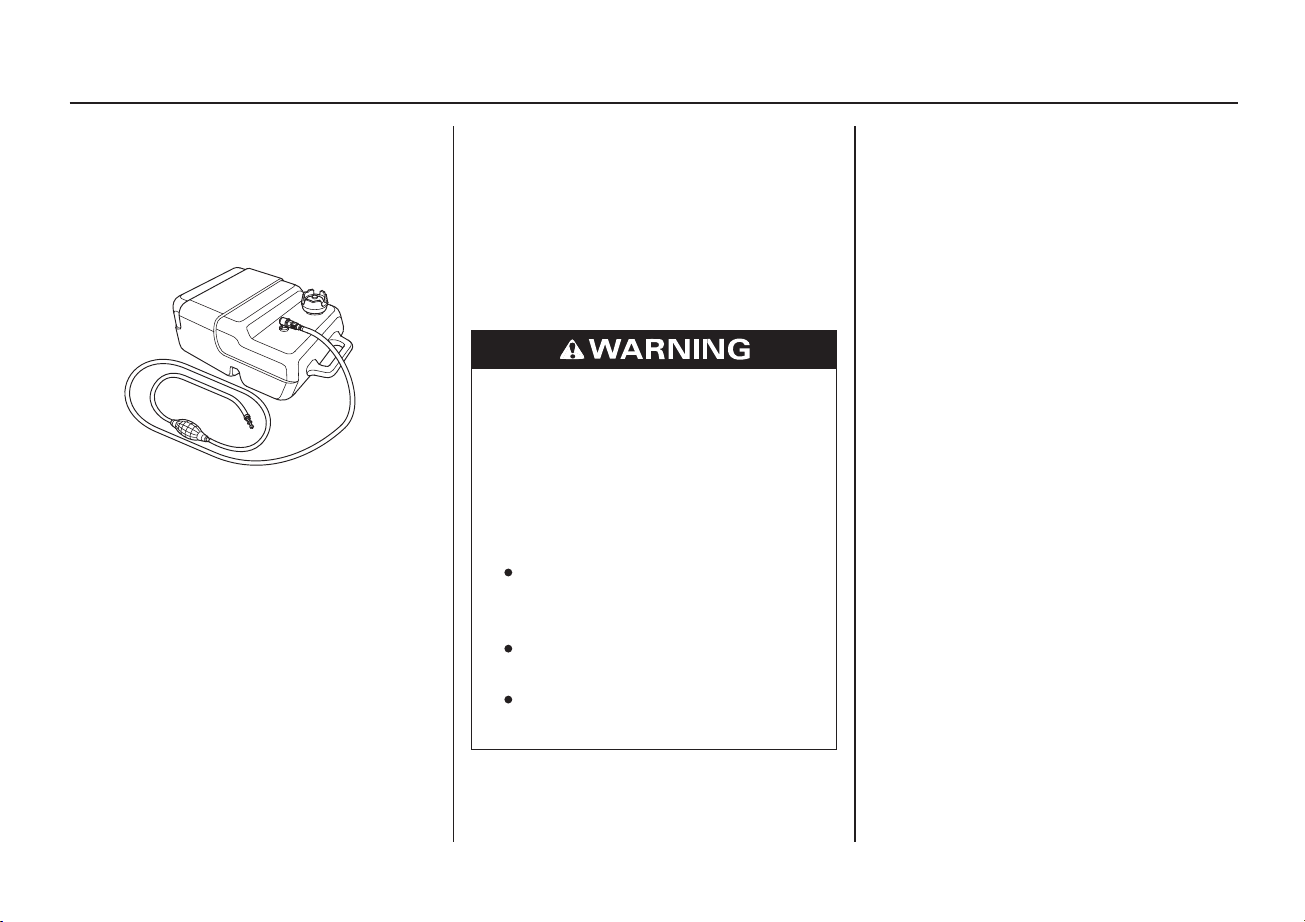
Secure the portable fuel tank in the
boat so that it won’t move around
and become damaged.
Before use, open the fuel tank vent
by turning the vent knob at least 2 or
3 turns counterclockwise.
Place the portable fuel tank in a well-
ventilated location, away from direct
sunlight, to reduce the possibility of a
gasoline vapor explosion.
To ensure that the outboard motor
will be able to draw fuel from the
tank, place the tank within 6 feet (2
m) of the outboard motor and not
more than 3 feet (1 m) below the fuel
connector on the outboard motor.
09/06/24 16:14:09 31ZY9610_053
53
FUEL HOSE CONNECTIONS
OPERATION
FUEL HOSE CONNECTOR
(fuel tank side)
HOSE PLUG
FUEL HOSE
ASSEMBLY
FUEL
HOSE
HOSE
CLAMP
FUEL HOSE
JOINT
FUEL HOSE
(motor side)
BARB
HOSE CLAMP
(stainless steel)
ARROW
PRIMING
BULB
(toward motor side)
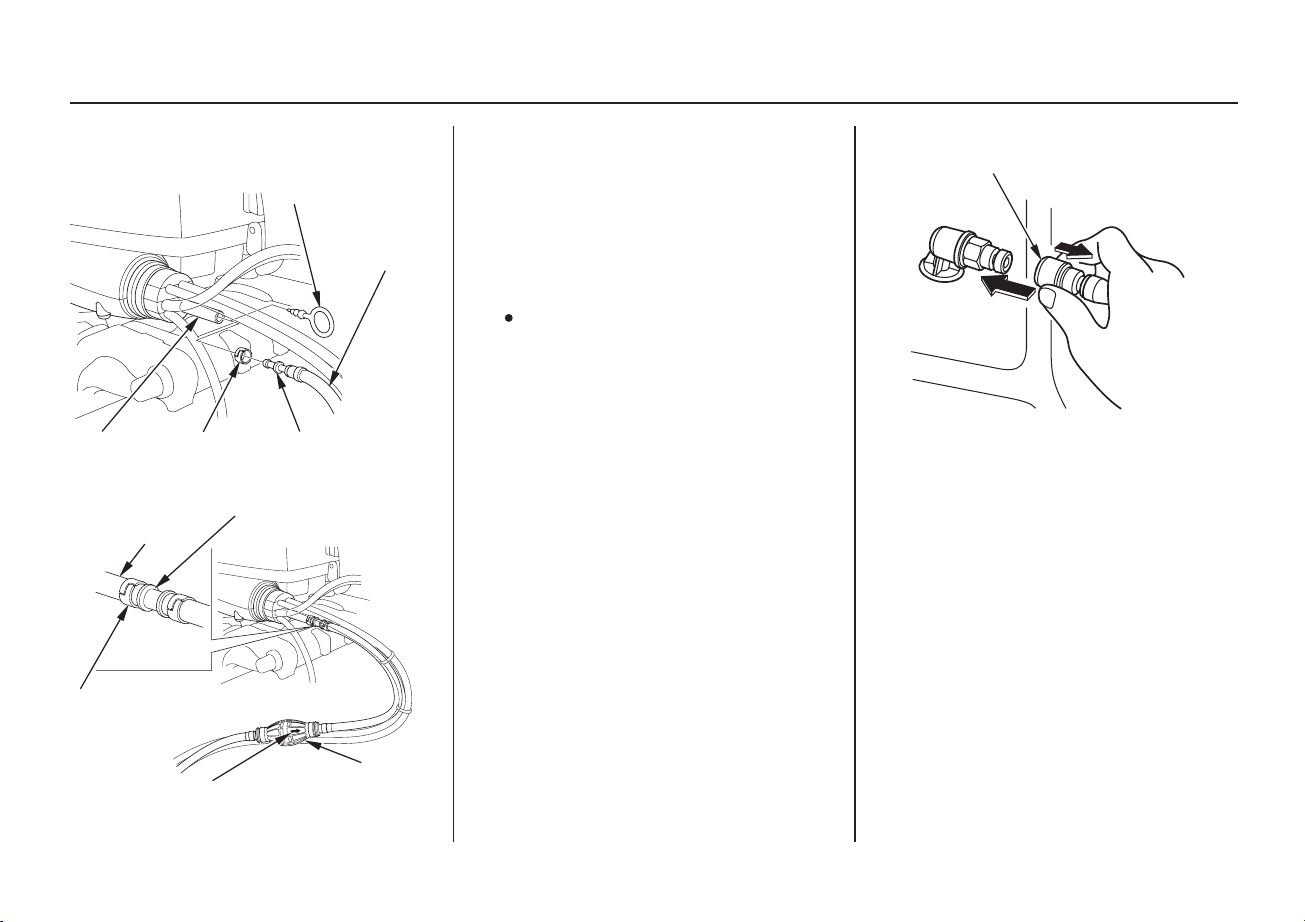
Connect the fuel hose to the tank,
as shown. Be sure the connectors
snap securely into place.
Remove the hose plug from the
motor side fuel hose. Insert the
fuel hose joint into the motor side
fuel hose and secure it with the
hose clamp. Make sure the arrow
mark on the priming bulb points
toward the motor side.
Store the hose plug in a secure
place.
2.
1.
09/06/24 16:14:17 31ZY9610_054
Gasoline is highly
flammable and explosive.
You can be burned or
seriously injured when
handling fuel.
Stop the engine and keep
heat, sparks, and flame
away.
Handle fuel only
outdoors.
Wipe up spills
immediately.
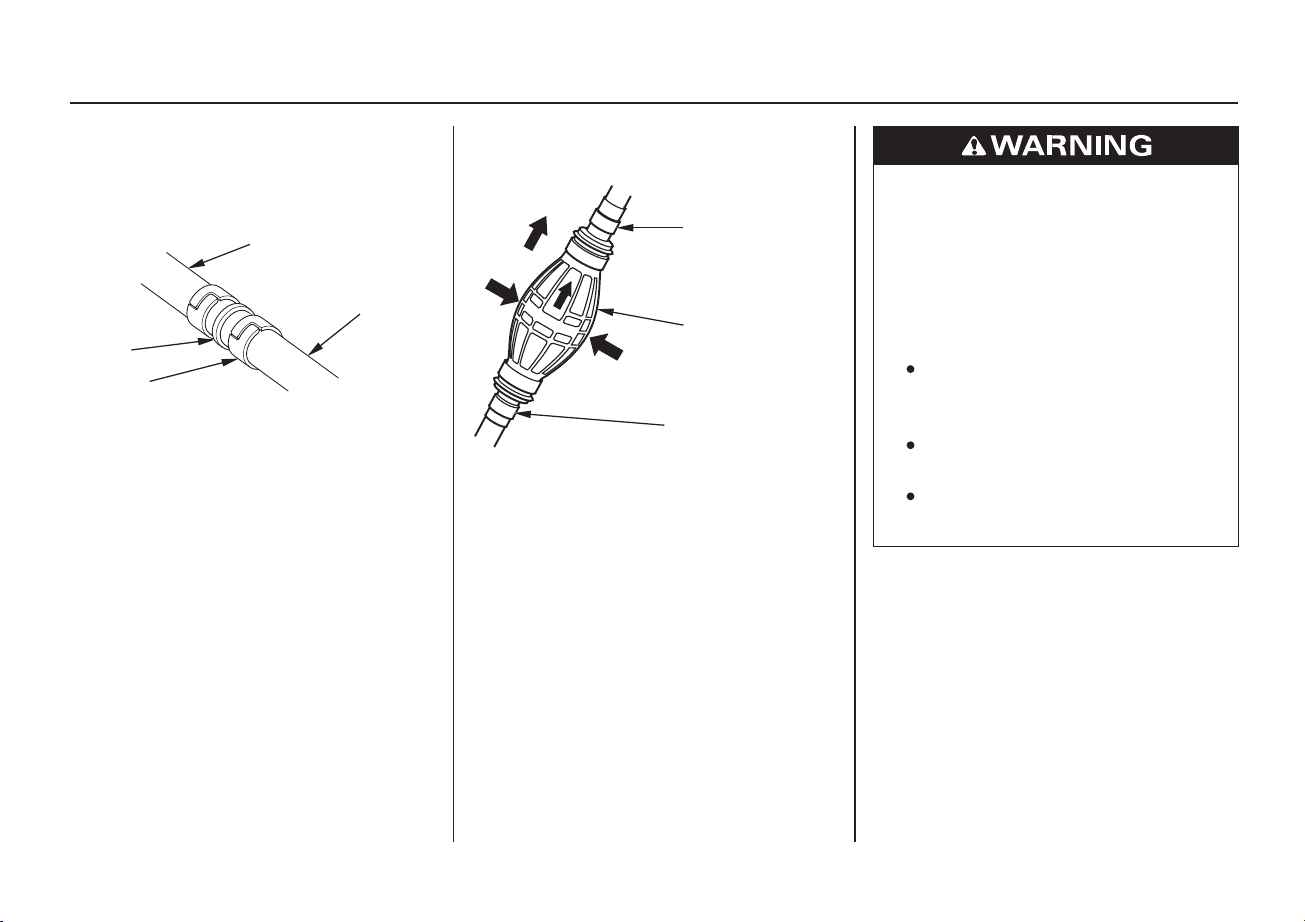
54
FUEL PRIMING(Using the fuel tank mounted on
the boat)
OPERATION
FUEL HOSE ASSEMBLY
(optional equipment)
(motor side)
BARB
HOSE CLAMP
(stainless steel)
FUEL HOSE
(fuel tank side)
UP
OUTLET END
(motor side)
INLET END
(fuel tank side)
PRIMING BULB
(fuel tank side)
Hold the priming bulb up in the
direction of the arrow; then squeeze
the priming bulb several times until it
feels firm, indicating that fuel has
reached the engine.
Check to be sure there are no fuel
leaks before starting the engine.
Do not touch the priming bulb with
the engine running or when tilting up
the outboard motor. The vapor
separator could overflow.
Remove the hose plug from the
motor side fuel hose. Insert the
fuel hose joint into the motor side
fuel hose and secure it with the
hose clamp (p. ).
Insert another fuel hose joint up to
the barb of the joint in the fuel
tank side and secure it with the
hose clamp (stainless steel type).
Refer to the owner’s manual for
the boat.
1.
2.
53
09/06/24 16:14:27 31ZY9610_055
55
STARTING THE ENGINE
OPERATION
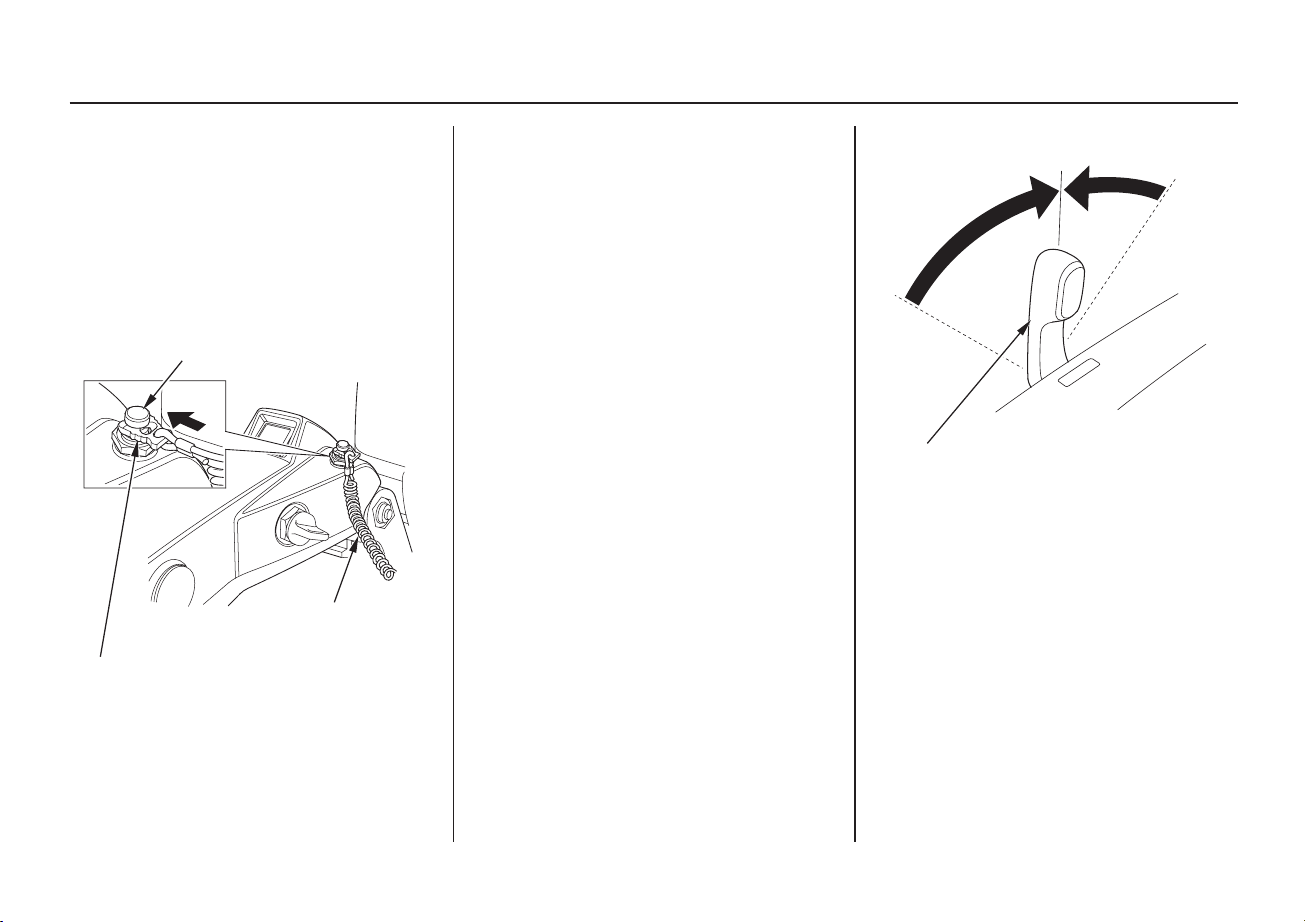
EMERGENCY STOP SWITCH
EMERGENCY STOP SWITCH CLIP
EMERGENCY STOP
SWITCH LANYARD
GEARSHIFT LEVER
N (neutral)
LHT Type (tiller handle)
The engine will not start or run
unless the emergency stop switch
clip is in the emergency stop
switch.
Check the position of the gearshift
lever. It must be in the N (neutral)
position for starting.
The engine will not start if the
gearshift lever is in the F (forward)
or R (reverse) position.
The emergency stop switch clip
and emergency stop switch lanyard
system is a safety device that will
stop the engine if you fall away
from the controls while operating
the boat.
Always attach the emergency stop
switch lanyard securely to the
operator or to the operator’s PFD
before starting the engine.
Put the emergency stop switch clip
in the emergency stop switch, and
attach the emergency stop switch
lanyard securely to the operator or
to the operator’s PFD (Personal
Flotation Device).
Control Page
........................Side-Mount Type . 58
......................Panel-Mount Type . 61
........................Top-Mount Type . 63
1.
2.
09/06/24 16:14:36 31ZY9610_056
56
OPERATION
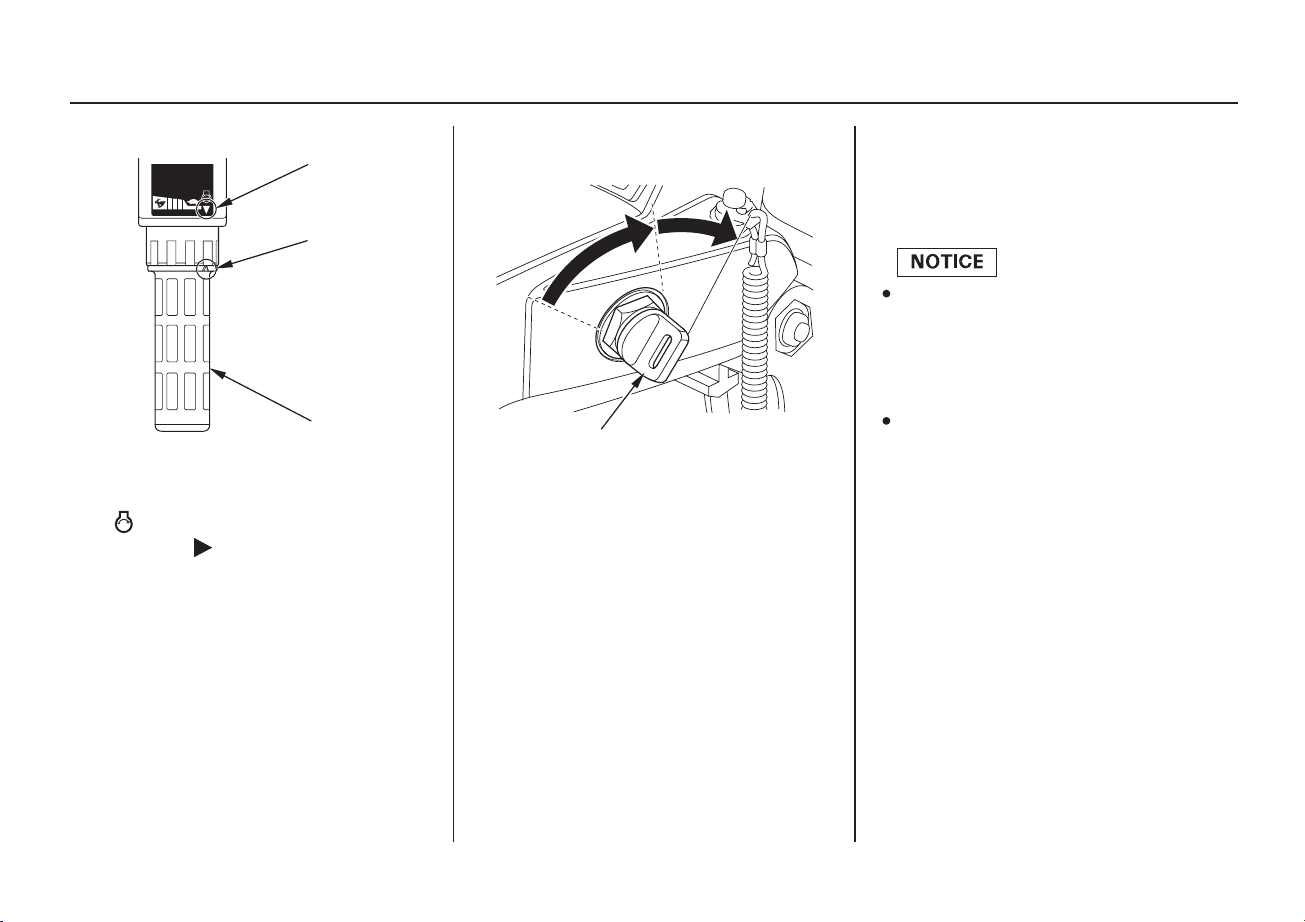
START
POSITION
POINTER
THROTTLE GRIP
SSTTAARRTT
OONN
OOFFFF
IGNITION SWITCH KEY
Turning the ignition switch key to
the START position while the
engine is running can damage the
starter motor and f lywheel.
Using the electric starter f or more
than 5 seconds at a time will
overheat the starter motor and can
damage it.
Align the engine start symbol
‘‘ ’’ on the tiller handle with the
pointer ‘‘ ’’ on the throttle grip.
Turn the ignition switch key to the
ON position; the buzzer will sound
twice.
Turn the ignition switch key to the
START position and hold it there
until the engine starts.
If the engine fails to start within 5
seconds, release the key and wait
at least 10 seconds before
operating the starter again.
Also, as the engine warms up, the
throttle grip can be turned to the
SLOW position without stalling.
When the engine starts, release the
key, allowing it to return to the ON
position.
3. 4.
5.
09/06/24 16:14:45 31ZY9610_057
−
57
OPERATION
TAKING CARE OF
UNEXPECTED PROBLEMS
If the engine is not properly
warmed up before raising the
engine speed, the buzzer and
overheat indicator may activate
and the engine speed will be
automatically reduced.
The cooling system may f reeze in
areas where the temperature
reaches 32°F (0°C) or below.
Cruising at high speed without
warming the engine up may cause
engine damage.
During the warm-up period, check
the oil pressure indicator (p. ),
overheat indicator (p. ), and
cooling system indicator (p. ).
If the indicators show any
abnormal condition, immediately
stop the engine and determine the
cause of the problem. Refer to
on
p. .
Before getting underway, allow
the engine to warm-up sufficiently
to ensure good performance.
Above 41°F (5°C), warm-up the
engine for at least 3 minutes.
Below 41°F (5°C), warm-up the
engine for at least 5 minutes at
2,000 rpm. Raise the fast idle lever
to achieve approximately 2,000
rpm.
6.
42
43
44
125122
09/06/24 16:14:51 31ZY9610_058
58
Side-Mount Type
OPERATION
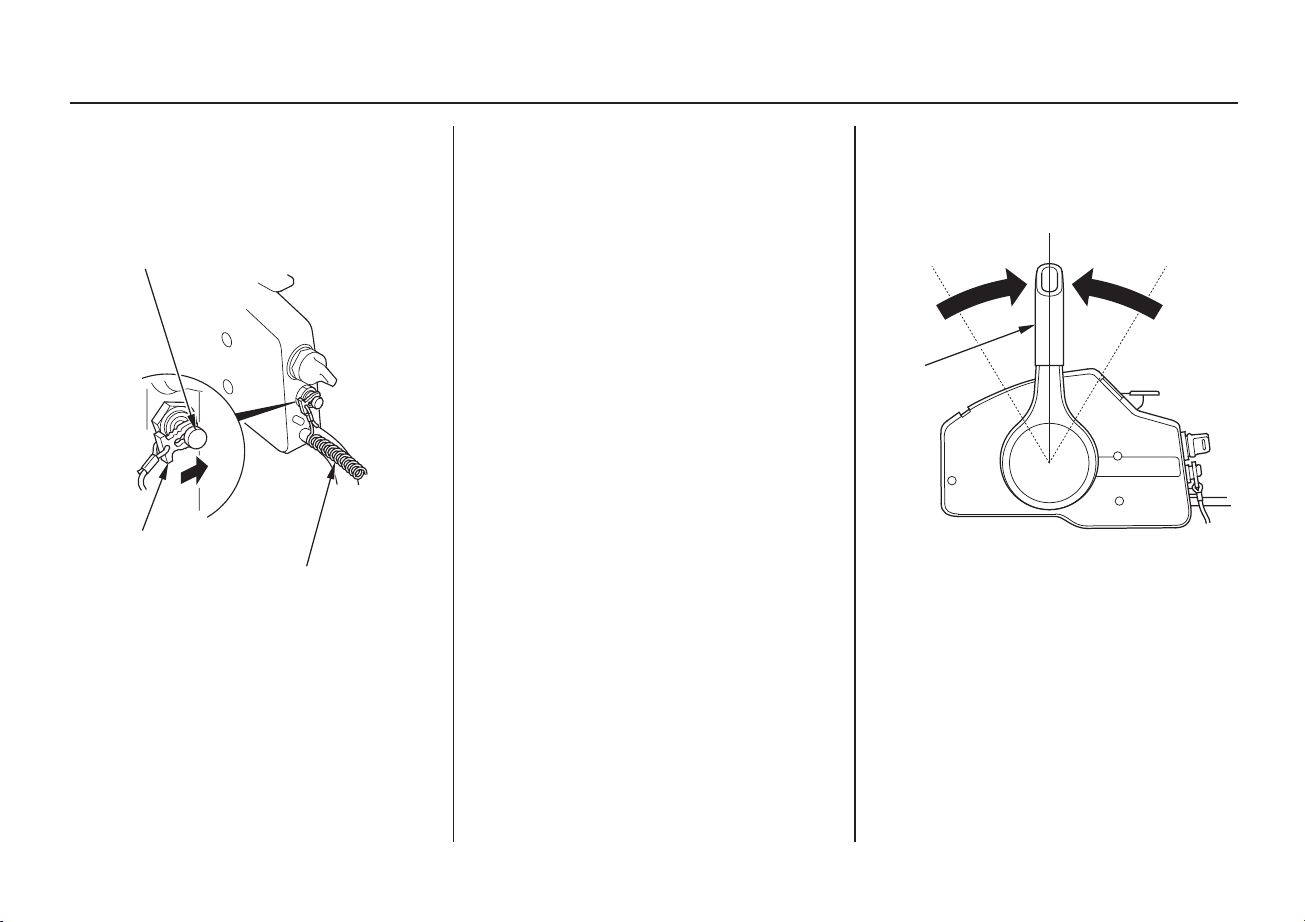
EMERGENCY STOP SWITCH
EMERGENCY STOP
SWITCH CLIP
EMERGENCY STOP
SWITCH LANYARD
N (neutral)
CONTROL
LEVER
LRTandXRTTypes
(remote control)
The engine will not start or run
unless the emergency stop switch
clip is in the emergency stop
switch.
Set the control lever in the N
(neutral) position.
The engine will not start if the F
(forward) or R (reverse) gears are
engaged.
Always attach the emergency stop
switch lanyard securely to the
operator or to the operator’s PFD
before starting the engine.
The emergency stop switch clip
and emergency stop switch lanyard
system is a safety device that will
stop the engine if you fall away
from the controls while operating
the boat.
Put the emergency stop switch clip
in the emergency stop switch, and
securely to the operator or to the
operator’s PFD (Personal Flotation
Device).
1.
2.
09/06/24 16:15:00 31ZY9610_059
59
OPERATION
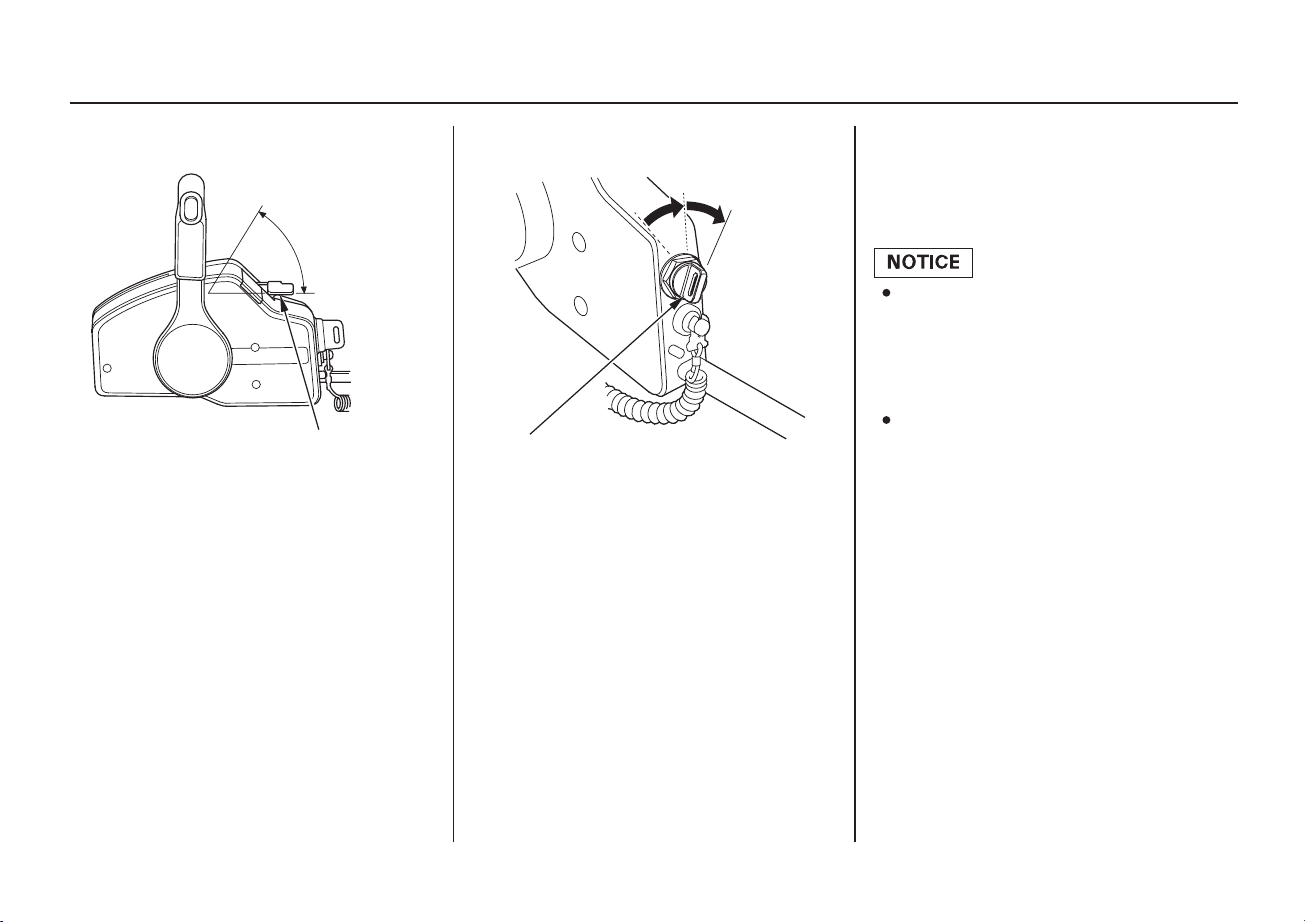
LOWEST
POSITION
FAST IDLE
RANGE
OOFFFF
ON
START
IGNITION SWITCH KEY
FAST IDLE LEVER
Using the electric starter f or more
than 5 seconds at a time will
overheat the starter motor and can
damage it.
Turning the ignition switch key to
the START position while the
engine is running can damage the
starter motor and f lywheel.Leave the fast idle lever in the
OFF (fully lowered) position.
The fast idle lever cannot be raised
unless the control lever is in the N
(neutral) position.
The control lever cannot be moved
away from the N (neutral) position
unless the fast idle lever is lowered.
If the engine fails to start within 5
seconds, release the key and wait
at least 10 seconds before
operating the starter again.
Turn the ignition switch key to the
ON position; the buzzer will sound
twice.
Turn the ignition switch key to the
START position and hold it there
until the engine starts.
When the engine starts, release the
key, allowing it to return to the ON
position.
3. 4.
5.
09/06/24 16:15:09 31ZY9610_060
−
60
OPERATION
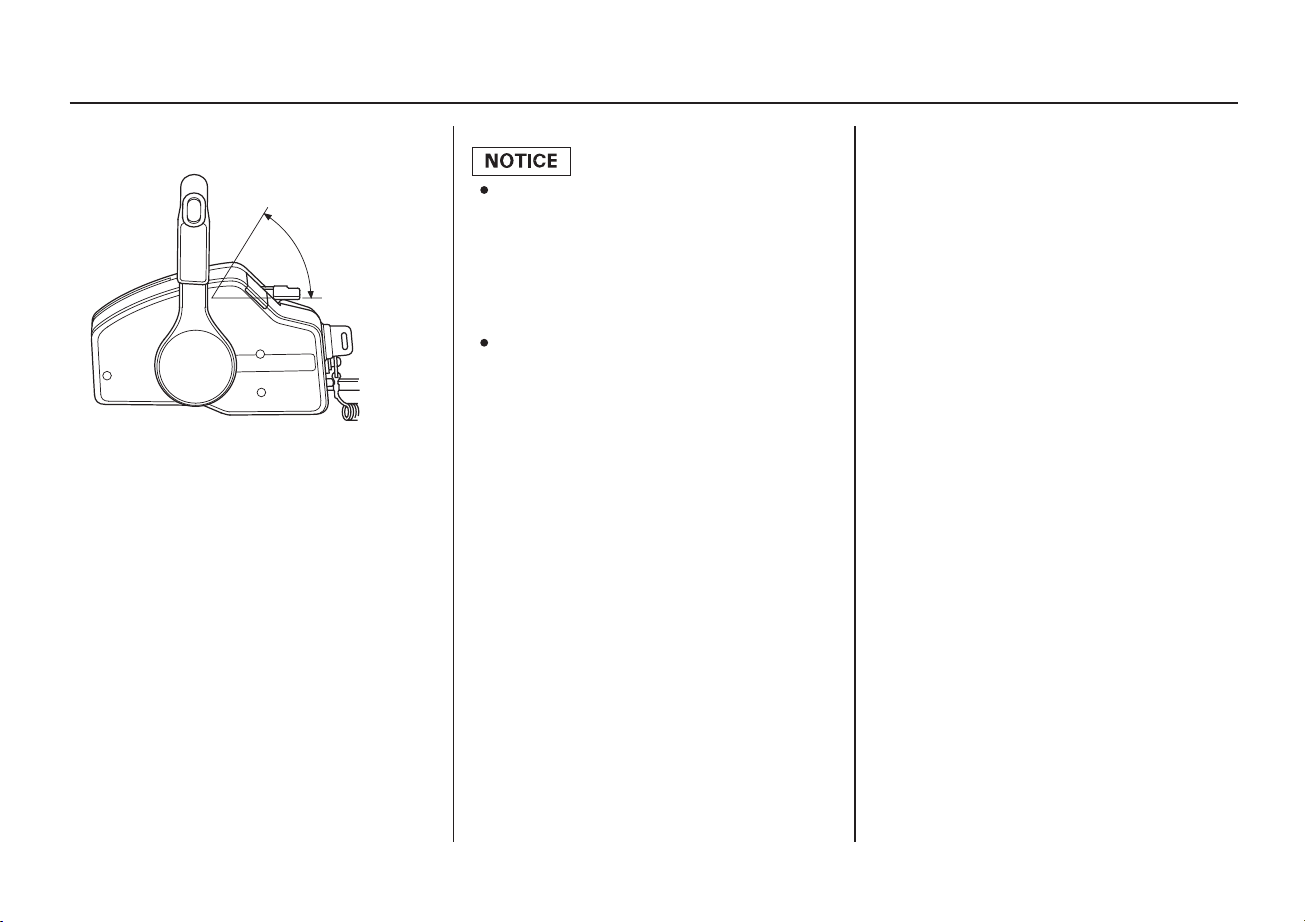
MAXIMUM FAST IDLE
FAST IDLE
RANGE
TAKING CARE OF
UNEXPECTED PROBLEMS
If the engine is not properly
warmed up before raising the
engine speed, the buzzer and
overheat indicator may activate
and the engine speed will be
automatically reduced.
The cooling system may f reeze in
areas where the temperature
reaches 32°F (0°C) or below.
Cruising at high speed without
warming the engine up may cause
engine damage.
Before getting underway, allow
the engine to warm-up sufficiently
to ensure good performance.
Above 41°F (5°C), warm-up the
engine for at least 3 minutes.
Below 41°F (5°C), warm-up the
engine for at least 5 minutes at
2,000 rpm. Raise the fast idle lever
to achieve approximately 2,000
rpm.
If the fast idle lever was used to
warm-up the engine, gradually
lower the lever as the engine
warms up.
When the fast idle lever is fully
lowered, the control lever can be
moved away from the N (neutral)
position.
During the warm-up period, check
the oil pressure indicator (p. ),
overheat indicator (p. ), and
cooling system indicator (p. ).
If the indicators show any
abnormal condition, immediately
stop the engine and determine the
cause of the problem. Refer to
on
p. .
6.
7.
43
44
42
125122
09/06/24 16:15:18 31ZY9610_061
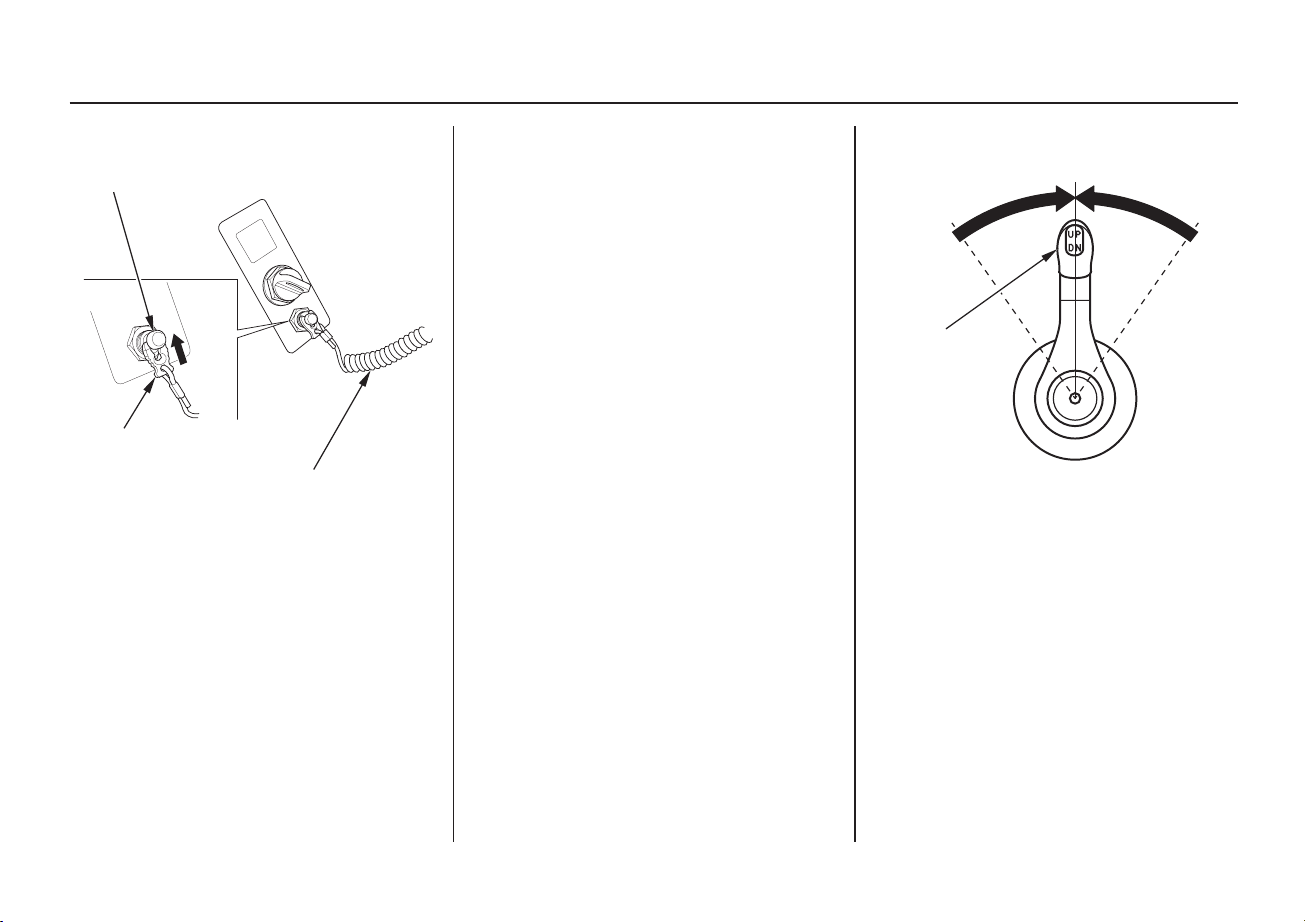
61
Panel-Mount Type
OPERATION
EMERGENCY STOP SWITCH
EMERGENCY STOP
SWITCH CLIP
EMERGENCY STOP
SWITCH LANYARD
N(neutral)
CONTROL
LEVER
The engine will not start or run
unless the emergency stop switch
clip is in the emergency stop
switch.
Set the control lever in the N
(neutral) position.
The engine will not start if the F
(forward) or R (reverse) gears are
engaged.
Always attach the emergency stop
switch lanyard securely to the
operator or to the operator’s PFD
before starting the engine.
The emergency stop switch clip
and emergency stop switch lanyard
system is a safety device that will
stop the engine if you fall away
from the controls while operating
the boat.
Put the emergency stop switch clip
in the emergency stop switch, and
attach the emergency stop switch
lanyard securely to the operator or
to the operator’s PFD (Personal
Flotation Device).
1.
2.
09/06/24 16:15:26 31ZY9610_062
62
OPERATION
START
ON
OFF
IGNITION
SWITCH
KEY
N (neutral)
CONTROL
LEVER
FAST IDLE BUTTON
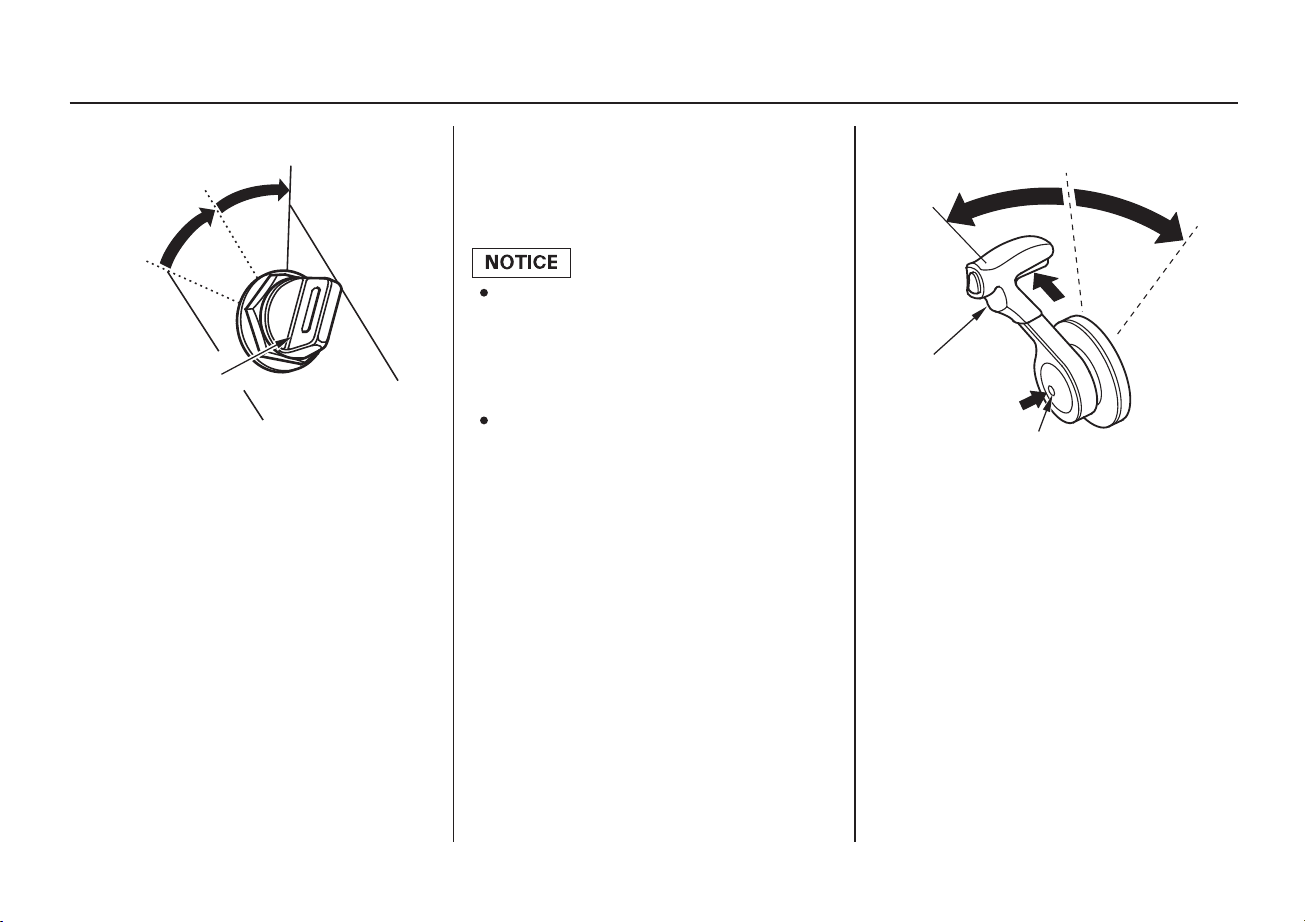
Turning the ignition switch key to
the START position while the
engine is running can damage the
starter motor and f lywheel.
Using the electric starter f or more
than 5 seconds at a time will
overheat the starter motor and can
damage it.
Before getting underway, allow
the engine to warm-up sufficiently
to ensure good performance.
Above 41°F (5°C), warm-up the
engine for at least 3 minutes.
Below 41°F (5°C), warm-up the
engine for at least 5 minutes at
2,000 rpm. Push the fast idle
button, and then move the control
lever forward or reverse to open
the throttle and achieve
approximately 2,000 rpm.
If the engine fails to start within 5
seconds, release the key and wait
at least 10 seconds before
operating the starter again.
When the engine starts, release the
key, allowing it to return to the ON
position.
Turn the ignition switch key to the
START position and hold it there
until the engine starts.
Turn the ignition switch key to the
ON position; the buzzer will sound
twice.
4.
5.3.
09/06/24 16:15:35 31ZY9610_063
−
63
Top-Mount Type
OPERATION
EMERGENCY STOP
SWITCH CLIP
EMERGENCY
STOP SWITCH
LANYARD
EMERGENCY STOP SWITCH
TAKING CARE OF
UNEXPECTED PROBLEMS
If the engine is not properly
warmed up before raising the
engine speed, the buzzer and
overheat indicator may activate
and the engine speed will be
automatically reduced.
The cooling system may f reeze in
areas where the temperature
reaches 32°F (0°C) or below.
Cruising at high speed without
warming the engine up may cause
engine damage.
During the warm-up period, check
the oil pressure indicator (p. ),
overheat indicator (p. ), and
cooling system indicator (p. ).
If the indicators show any
abnormal condition, immediately
stop the engine and determine the
cause of the problem. Refer to
on
p. .
If the fast idle button was used to
warm up the engine, gradually
return the control lever to the N
(neutral) position as the engine
warms up.
Put the emergency stop switch clip
in the emergency stop switch, and
attach the emergency stop switch
lanyard securely to the operator or
to the operator’s PFD (Personal
Flotation Device).
1.
6.
42
43
44
125122
09/06/24 16:15:43 31ZY9610_064
64
OPERATION
N (neutral)
CONTROL
LEVER
START
ON
OFF
IGNITION
SWITCH
KEY
Set the control lever in the N
(neutral) position.
The engine will not start if the F
(forward) or R (reverse) gears are
engaged.
The engine will not start or run
unless the emergency stop switch clip
is in the emergency stop switch.
The emergency stop switch clip and
emergency stop switch lanyard
system is a safety device that will
stop the engine if you fall away from
the controls while operating the boat.
Always attach the emergency stop
switch lanyard securely to the
operator or to the operator’s PFD
before starting the engine.
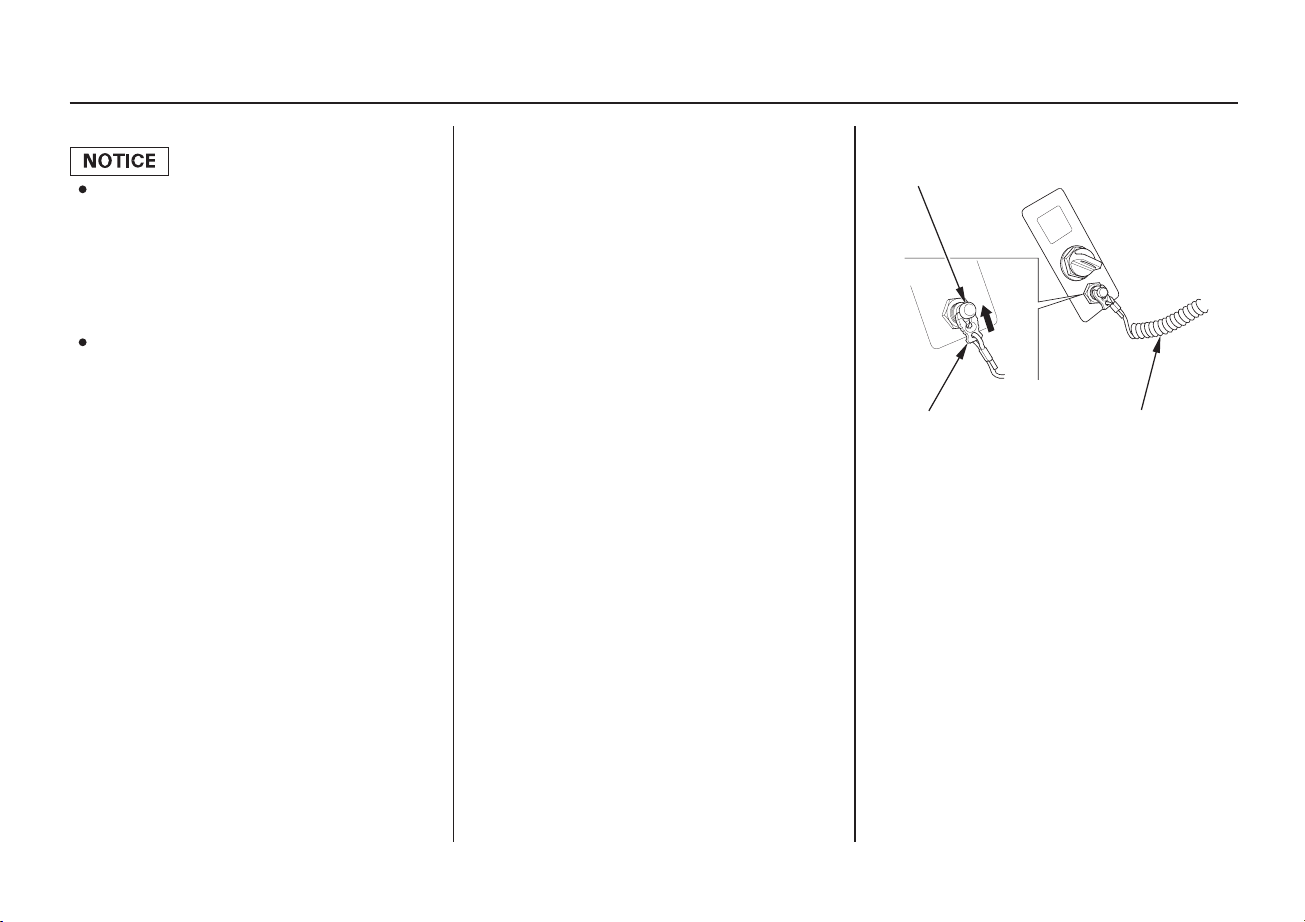
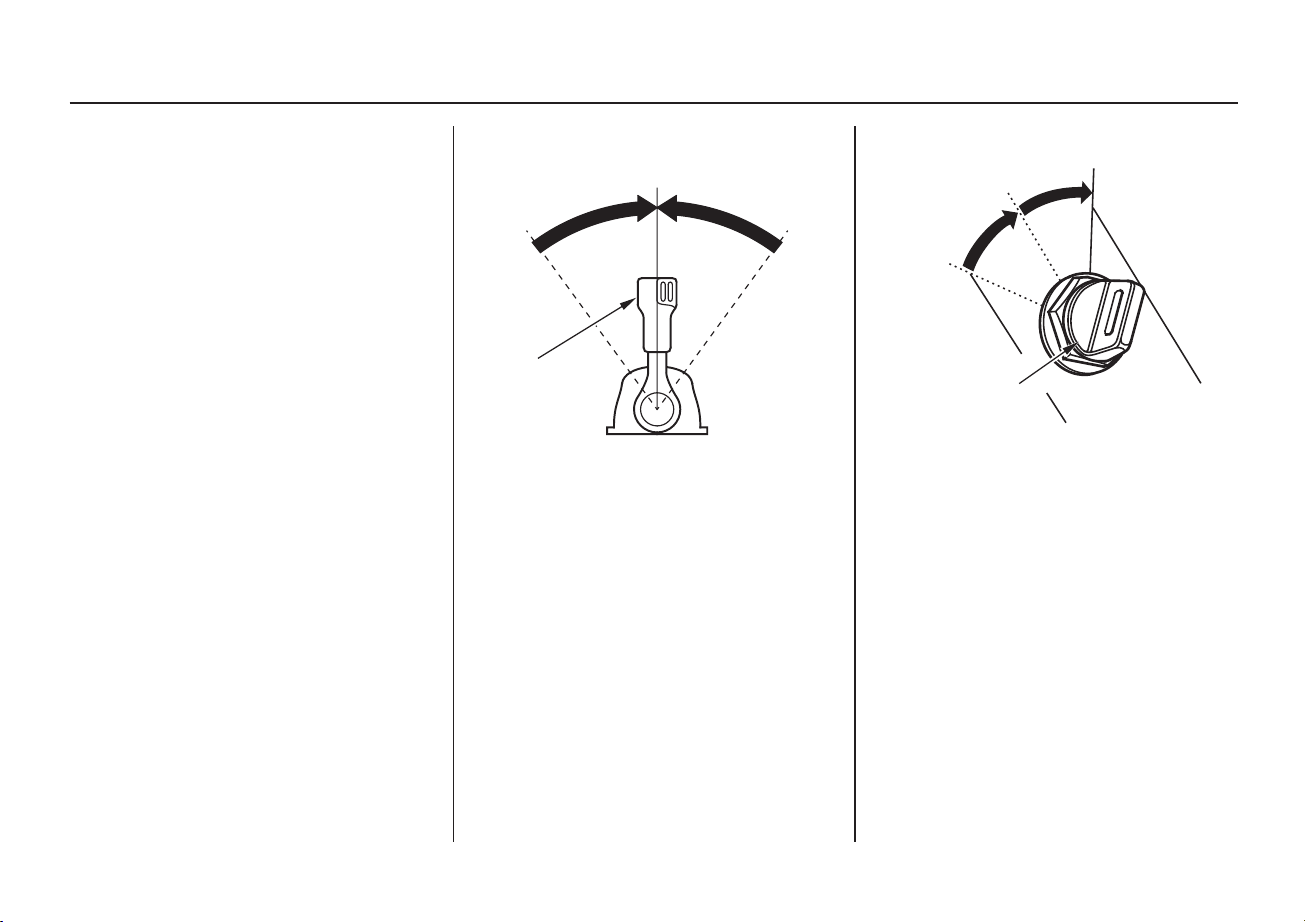
Turn the ignition switch key to the
ON position; the buzzer will sound
twice.
Turn the ignition switch key to the
START position and hold it there
until the engine starts.
When the engine starts, release the
key, allowing it to return to the ON
position.
2. 3.
4.
09/06/24 16:15:51 31ZY9610_065
65
OPERATION
N (neutral)
CONTROL
LEVER
FAST IDLE BUTTON
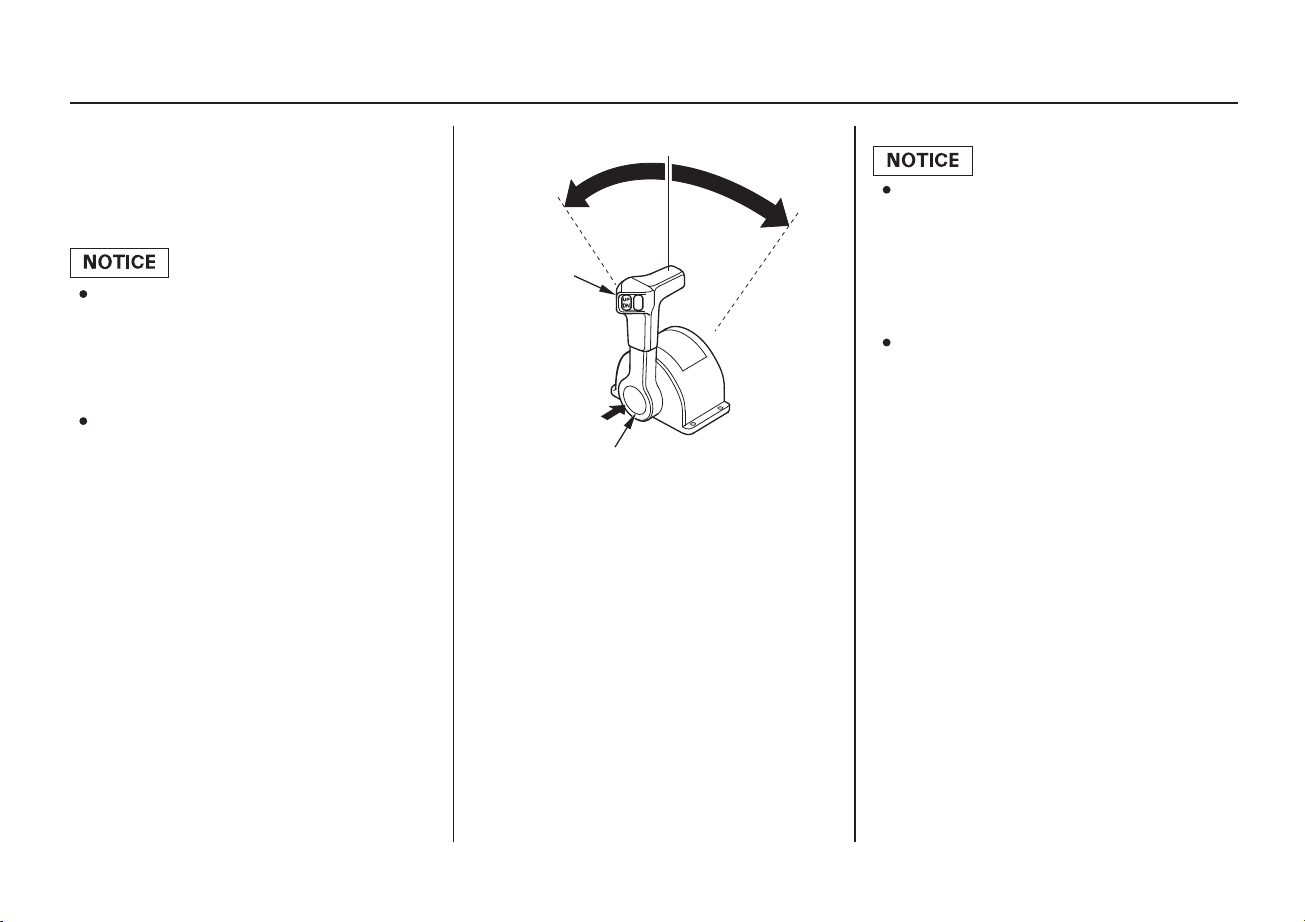
If the engine is not properly
warmed up before raising the
engine speed, the buzzer and
overheat indicator may activate
and the engine speed will be
automatically reduced.
The cooling system may f reeze in
areas where the temperature
reaches 32°F (0°C) or below.
Cruising at high speed without
warming the engine up may cause
engine damage.
Using the electric starter f or more
than 5 seconds at a time will
overheat the starter motor and can
damage it.
Turning the ignition switch key to
the START position while the
engine is running can damage the
starter motor and f lywheel. Before getting underway, allow
the engine to warm-up sufficiently
to ensure good performance.
Above 41°F (5°C), warm-up the
engine for at least 3 minutes.
Below 41°F (5°C), warm-up the
engine for at least 5 minutes at
2,000 rpm. Push the fast idle
button, and then move the control
lever forward or reverse to open
the throttle and achieve
approximately 2,000 rpm.
If the engine fails to start within 5
seconds, release the key and wait
at least 10 seconds before
operating the starter again.
5.
09/06/24 16:15:59 31ZY9610_066
−
×
×
66
EMERGENCY STARTING
OPERATION
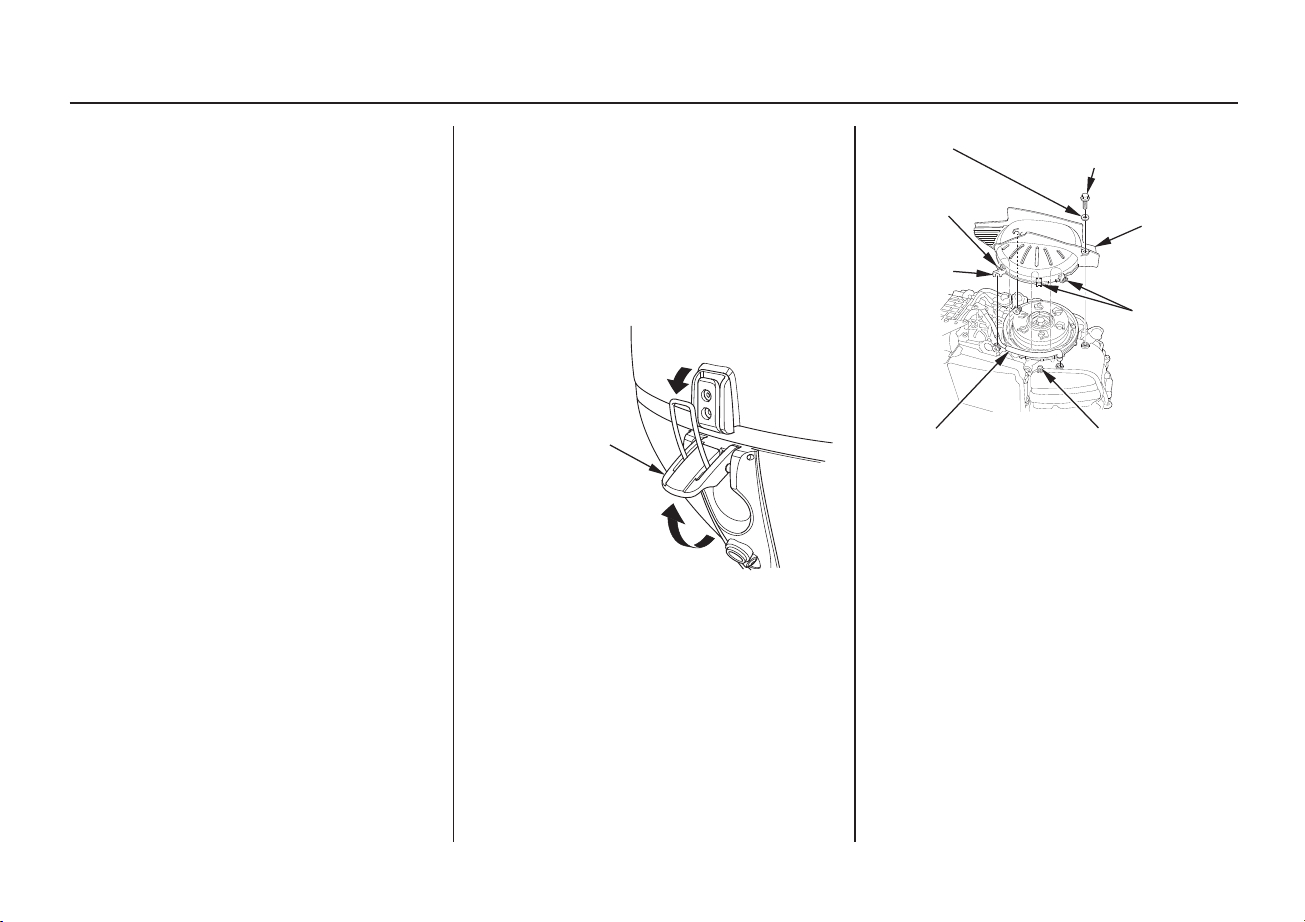
ENGINE COVER
LATCHES
(front/rear)
UNLOCK
HOOKS
6mmWASHER 6 25mm
FLANGE BOLT
CLAMP
ALTERNATOR
COVER
CLAMPS
BREATHER
TUBE
CLAMP
(on the silencer case)
TAKING CARE OF
UNEXPECTED PROBLEMS
During the warm-up period, check
the oil pressure indicator (p. ),
overheat indicator (p. ), and
cooling system indicator (p. ).
If the indicators show any
abnormal condition, immediately
stop the engine and determine the
cause of the problem. Refer to
on
p. .
If the fast idle button was used to
warm up the engine, gradually
return the control lever to the N
(neutral) position as the engine
warms up.
If the battery is discharged or the
starter motor is inoperative, you can
start the engine manually using the
emergency starter rope supplied with
the motor.
Release the breather tube from the
four clamps.
Secure the breather tube to the
clamp of the silencer case.
Take care not to lose the bolt and
washer.
Turn the ignition switch key to the
OFF position (p. ).
Unlatch the engine cover latches
and remove the engine cover.
Remove 6 25 mm flange bolt
and 6 mm washer, and then
remove the alternator cover.
5.
1.
2.
3.
4.
6.
42
43
44
125122
71
09/06/24 16:16:10 31ZY9610_067
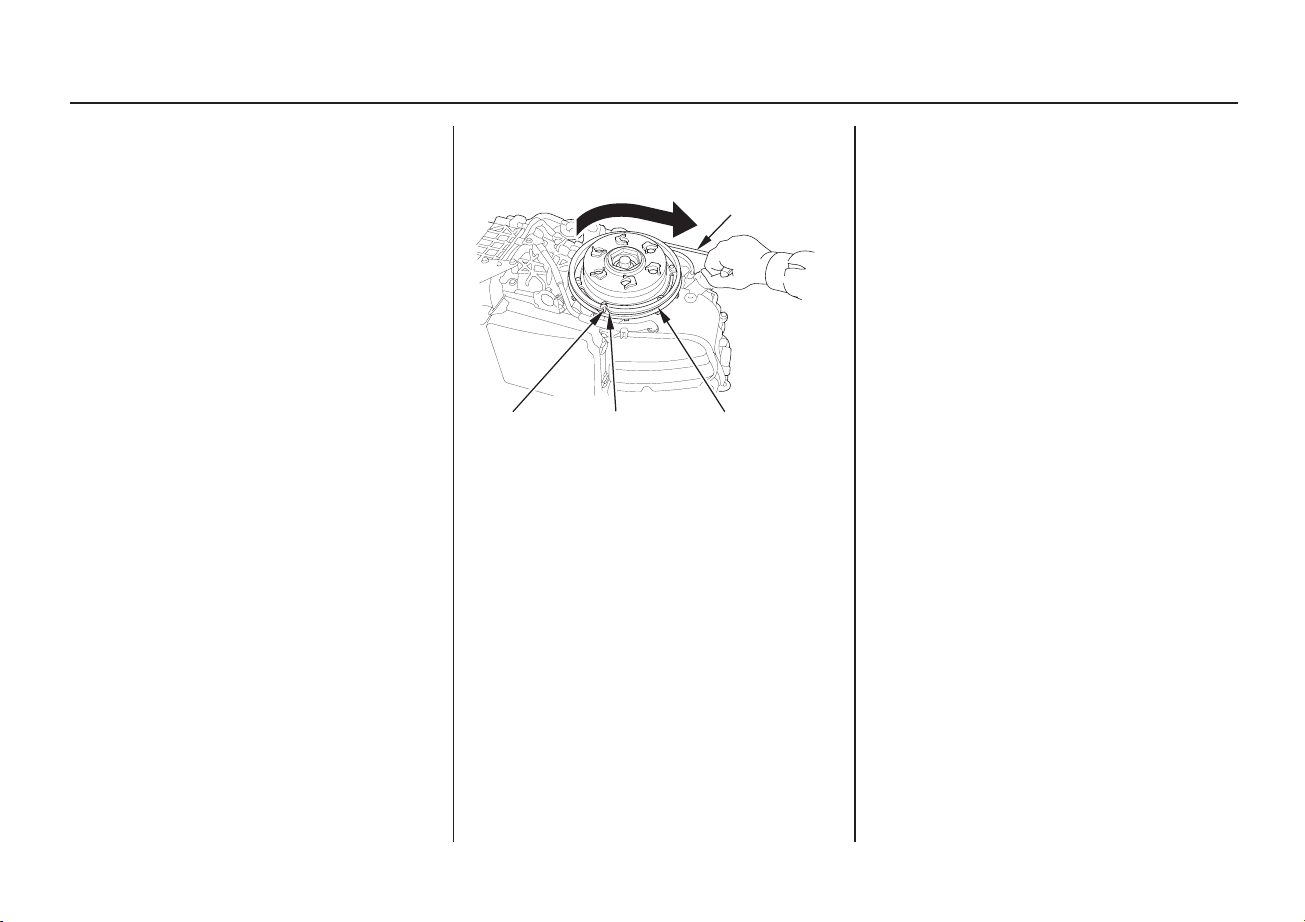
−
−
−
67
OPERATION
ALTERNATOR
PULLEY
KNOT CUTOUT
EMERGENCY
STARTER
ROPE
Direction
to pull
TAKING CARE OF
UNEXPECTED PROBLEMS
Pull the emergency starter rope
slowly until resistance is felt, then
pull briskly.
Keep away from moving parts
while pulling the rope.
Set the controls the same as for
normal starting (see pages
,,).Usethefast
idle control if needed.
Turn the ignition switch key to the
ON position.
Set the alternator pulley so the
cutouts are on the right and left
sides of the alternator pulley as
shown. Hook the knot at the end of
the starter rope (accessory) against
a cutout in the alternator pulley,
and wind the starter rope one and a
half turns clockwise along the
groove in the alternator pulley.
If necessary, rewind the rope and
pull again. If the engine does not
start after several attempts, refer to
on p.
.
6.
7.
8.
55
56 58 59 61
117115
09/06/24 16:16:17 31ZY9610_068
Exposed moving parts can
cause injury.
Do not operate the
outboard motor without
the engine cover.
Use extreme care when
installing the engine
cover.
68
OPERATION
If the fast idle control(s) was used
to start the engine, return the
control(s) to the normal operating
position as the engine warms up.
During the warm-up period, check
the oil pressure indicator (p. ),
overheat indicator (p. ), and
cooling system indicator (p. ).
If it was necessary to remove the
emergency stop switch lanyard
from you to perform the
emergency starting procedure, be
sure the lanyard is attached
securely to operator before
operating the outboard motor.
Have your closest authorized
Honda Marine dealer check your
electrical system and correct the
problem so that you can use the
electric starter.
Leave the alternator cover off, but
install the engine cover (p. )
and lock it in place by latching the
engine cover latches.
9.
10.
11.
12.
42
43
44
87
09/06/24 16:16:24 31ZY9610_069
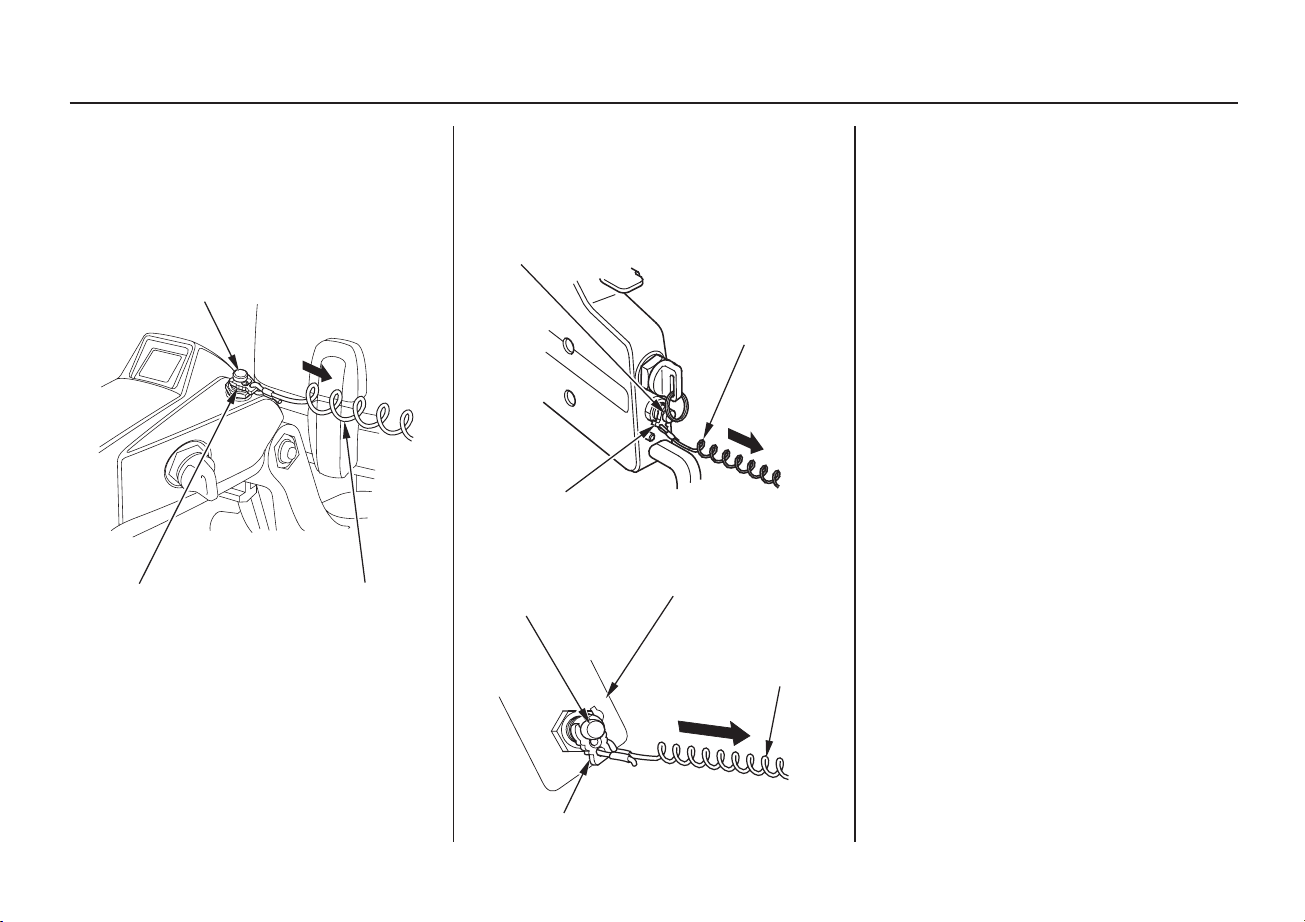
69
STOPPING THE ENGINE
Emergency Engine Stopping
OPERATION
PULL
EMERGENCY STOP SWITCH
PULL
EMERGENCY STOP SWITCH CLIP
EMERGENCY STOP SWITCH
PULL
EMERGENCY STOP
SWITCH CLIP
EMERGENCY
STOP SWITCH
LANYARD
EMERGENCY
STOP SWITCH
LANYARD
EMERGENCY STOP SWITCH CLIP
EMERGENCY
STOP SWITCH
CONTROL PANEL
EMERGENCY
STOP SWITCH
LANYARD
LHT Type (tiller handle)
Side-Mount Type
LRTandXRTTypes
(remote control)
Panel-Mount/Top-Mount Types
To stop the engine in an emergency,
pull the emergency stop switch clip
out of the emergency stop switch by
pulling the emergency stop switch
lanyard.
We suggest that you stop the engine
this way occasionally to verify that
the emergency stop switch is
operating properly.
Turn the ignition switch key to the
OFF position after verifying the
emergency stop switch operation.
09/06/24 16:16:34 31ZY9610_070
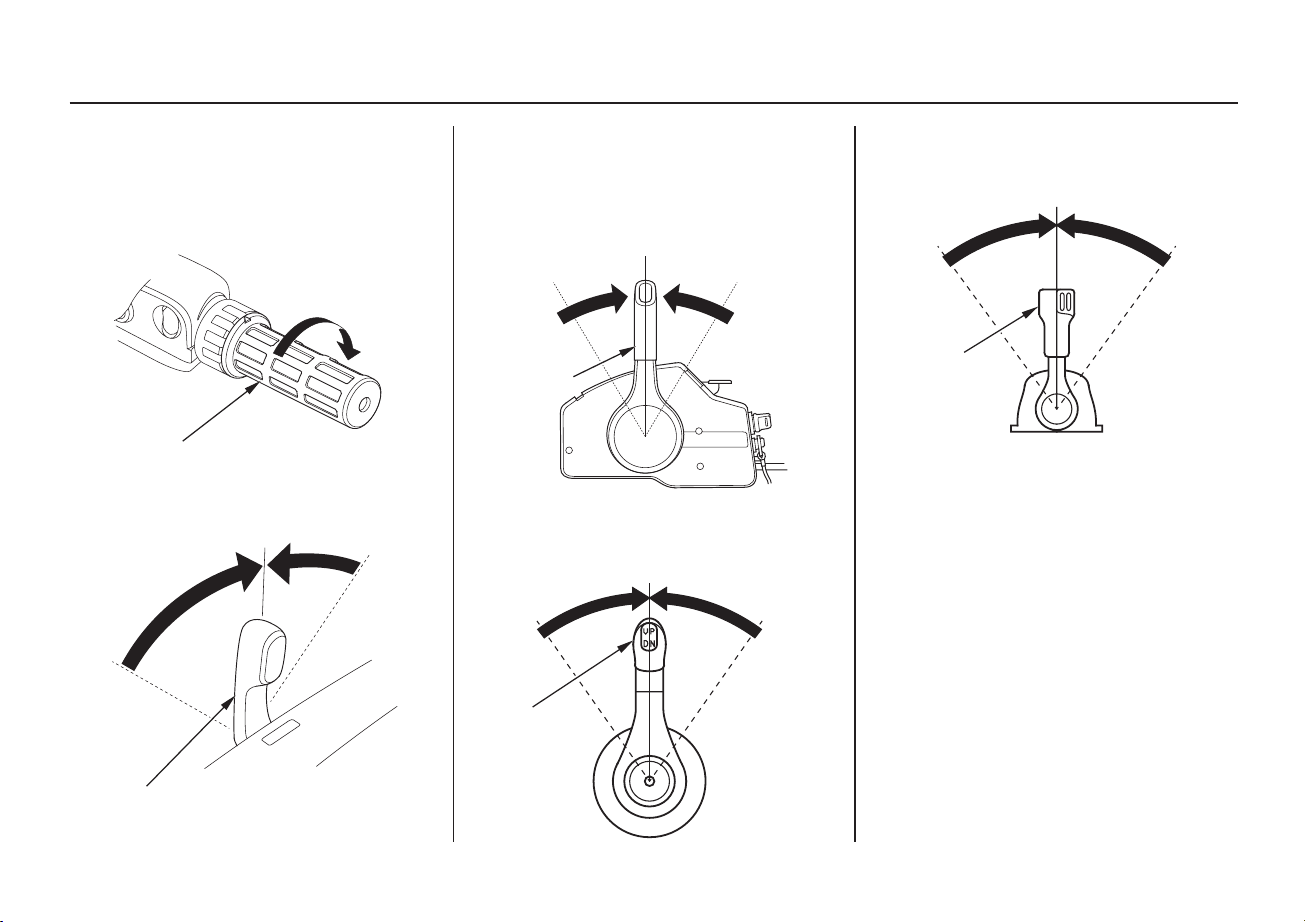
70
Normal Engine Stopping
Panel-Mount Type
Side-Mount Type
Top-Mount Type
OPERATION
THROTTLE GRIP
SLOW
N (neutral)
GEARSHIFT LEVER
N (neutral)
CONTROL
LEVER
N (neutral)
CONTROL
LEVER
CONTROL
LEVER
N (neutral)
LHT Type (tiller handle)
LRTandXRTTypes
(remote control)
Move the throttle grip to the
slowest speed and the gearshift
lever or control lever to the N
(neutral) position.
1.
09/06/24 16:16:44 31ZY9610_071
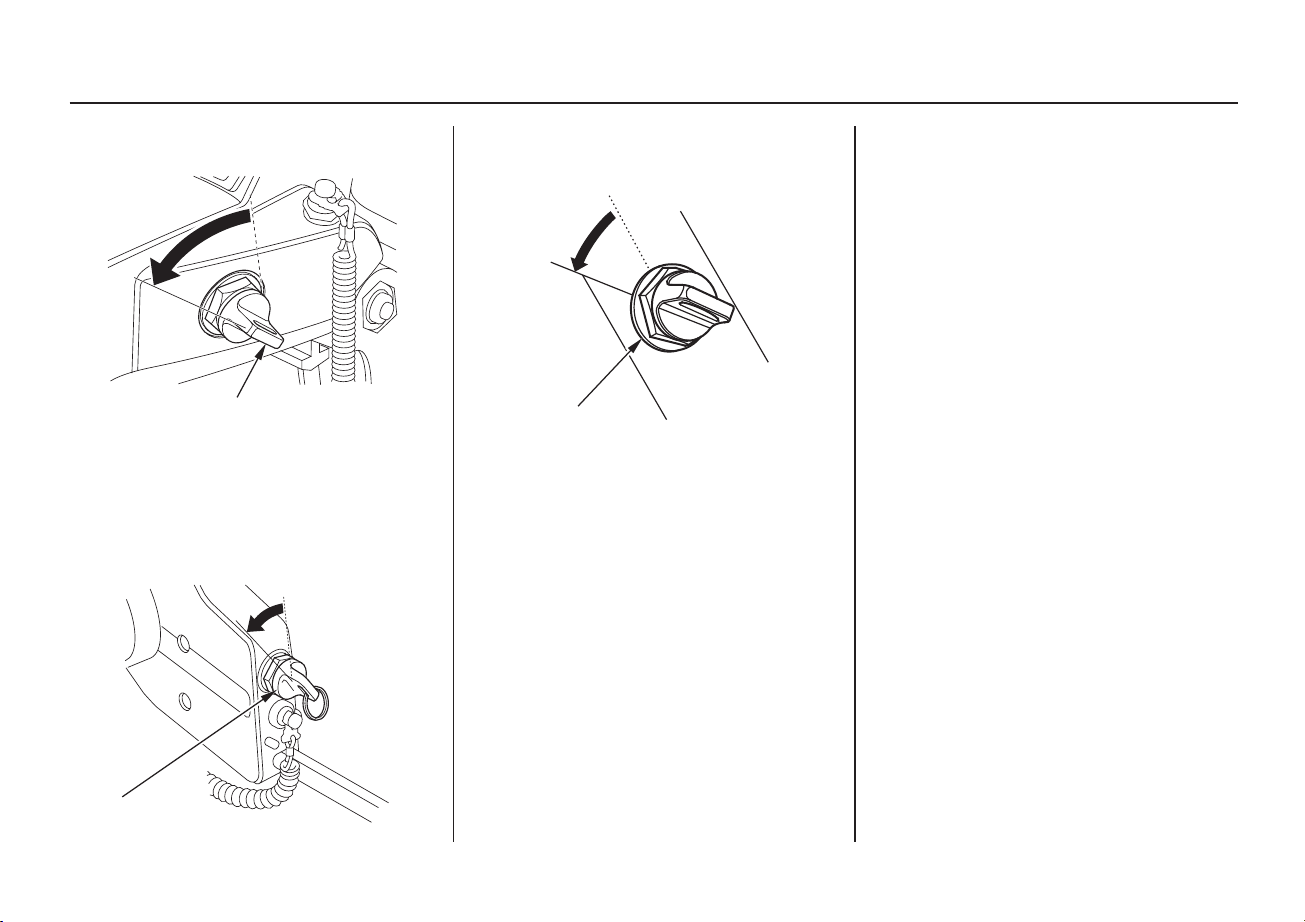
71
Panel-Mount/Top-Mount Types
Side-Mount Type
OPERATION
OOFFFF
IGNITION
SWITCH KEY
OFF
IGNITION
SWITCH KEY
OFF
IGNITION
SWITCH KEY
LHT Type (tiller handle)
LRTandXRTTypes
(remote control)
Turn the ignition switch key to the
OFF position to stop the engine.
In the event that the engine does
not stop when the ignition switch
key is turned to the OFF position,
pull the emergency stop switch
clip out of the emergency stop
switch by pulling the emergency
stop switch lanyard (p. ).
When the boat is not in use,
remove and store the ignition
switch key and the emergency stop
switch clip and lanyard.
2.
3.
69
09/06/24 16:16:53 31ZY9610_072
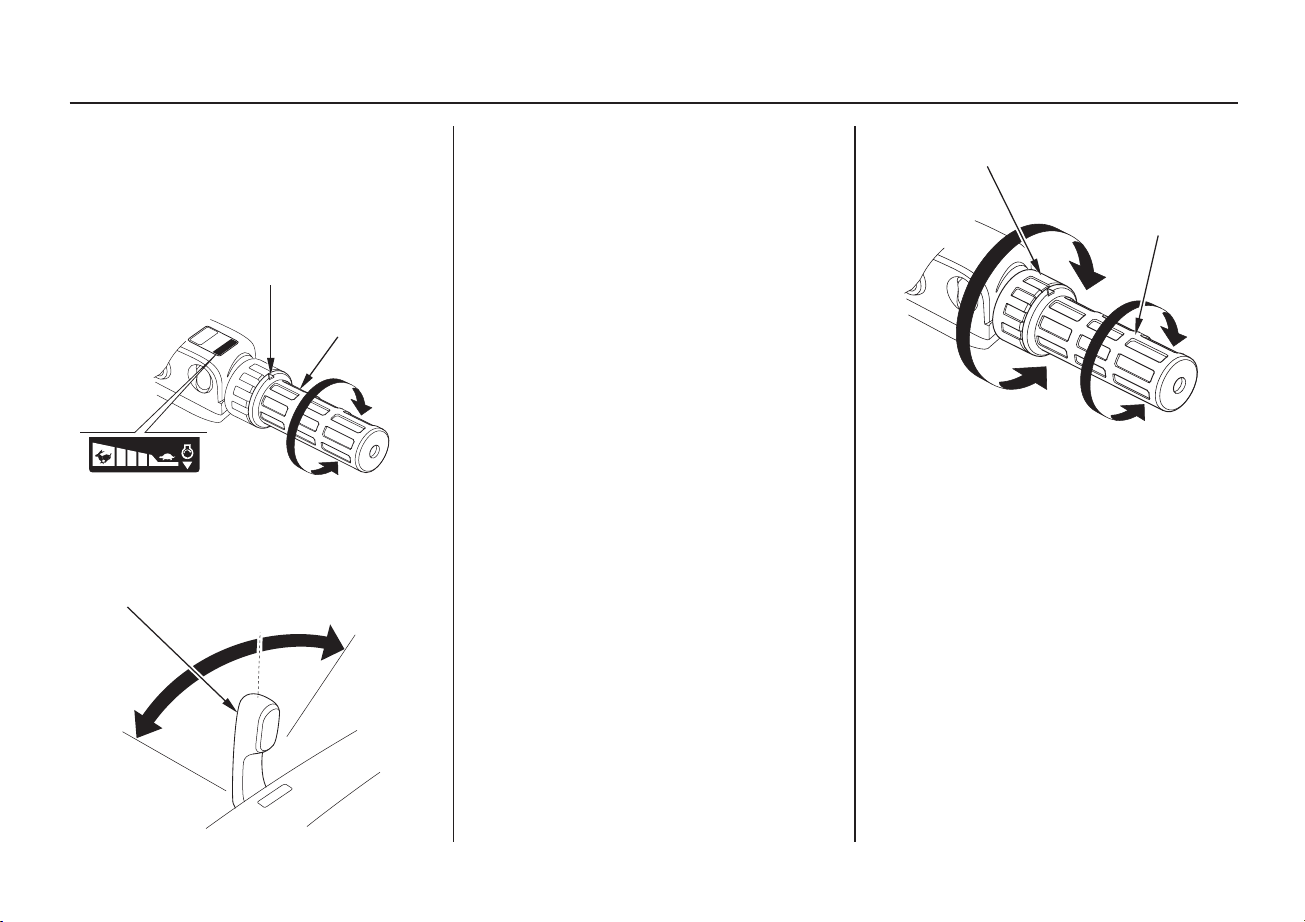
72
GEARSHIFT AND
THROTTLE OPERATION
OPERATION
POINTER
THROTTLE
GRIP
FAST
GEARSHIFT
LEVER
N
(neutral)
R
(reverse)
F
(forward)
SLOW
THROTTLE FRICTION ADJUSTER
THROTTLE
GRIP
FIX
RELEASE
LHT Type (tiller handle)
To shift gears, turn the throttle grip to
the SLOW position; then move the
gearshift lever to select the F
(forward), N (neutral), or R (reverse)
gears.
Use the throttle friction adjuster to
help hold a constant throttle setting
while cruising.
Turn the adjuster clockwise to
increase throttle grip friction for
holding a constant speed.
Turn the adjuster counterclockwise to
decrease friction for easy grip
rotation.
The engine can be started with the
gearshift lever in the N (neutral)
position only.
The throttle grip can be turned to the
FAST position only when the
gearshift lever is in the F (forward)
position.
09/06/24 16:17:02 31ZY9610_073
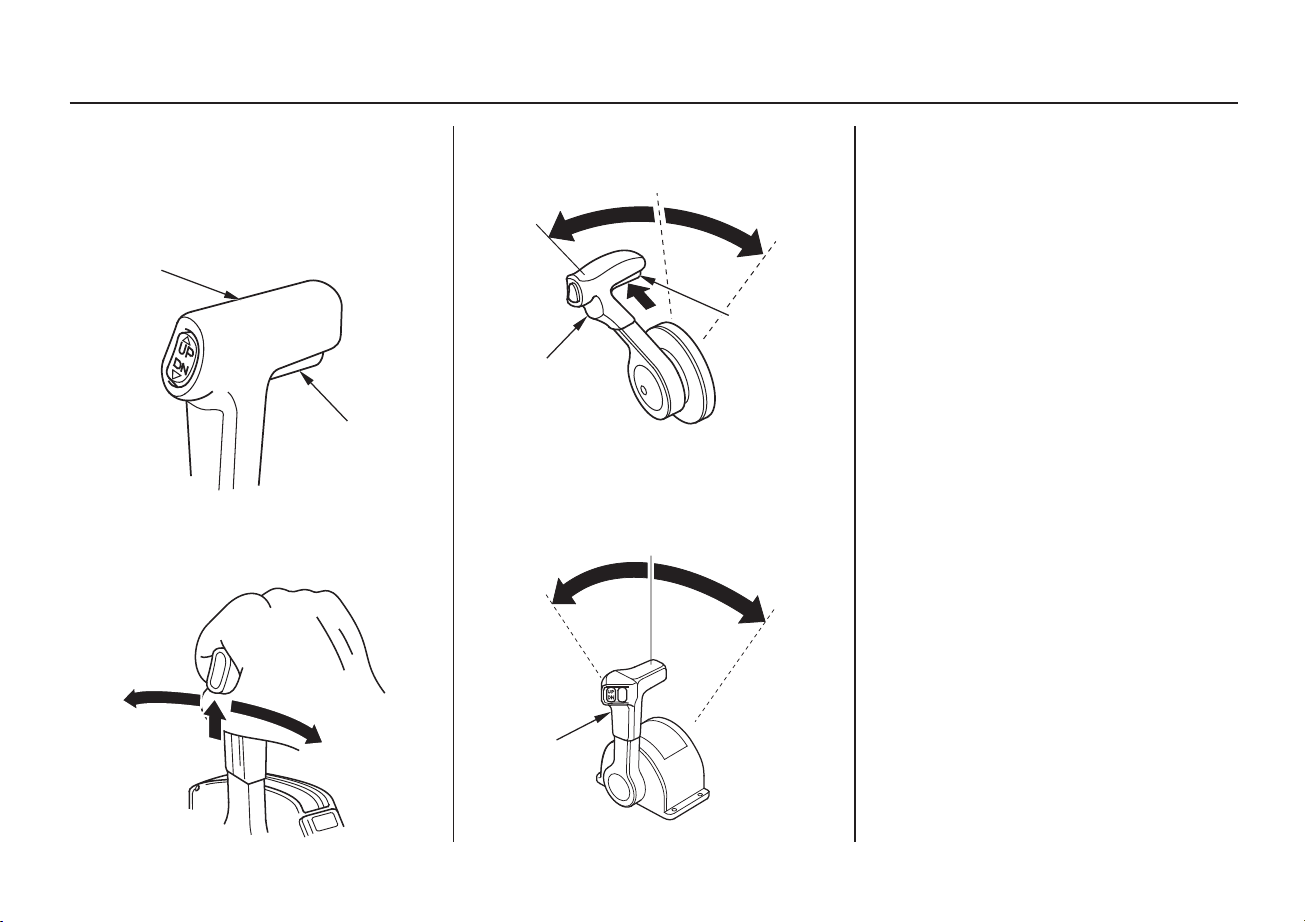
73
Panel-Mount Type
Top-Mount Type
Side-Mount Type
OPERATION
CONTROL LEVER
NEUTRAL
RELEASE
LEVER
F(forward)
R (reverse)
N (neutral)
N(neutral)
F(forward)
R (reverse)
CONTROL
LEVER
NEUTRAL
RELEASE
LEVER
F(forward)
N (neutral)
R (reverse)
CONTROL
LEVER
LRTandXRTTypes
(remote control)
To shift gears, move the control lever
to select the F (forward), N (neutral),
or R (reverse) gear.
Moving the control lever beyond the
gear selection range increases engine
speed.
The control lever cannot be moved
from the N (neutral) position unless
the neutral release lever is squeezed
(side-mount/panel-mount types).
09/06/24 16:17:11 31ZY9610_074
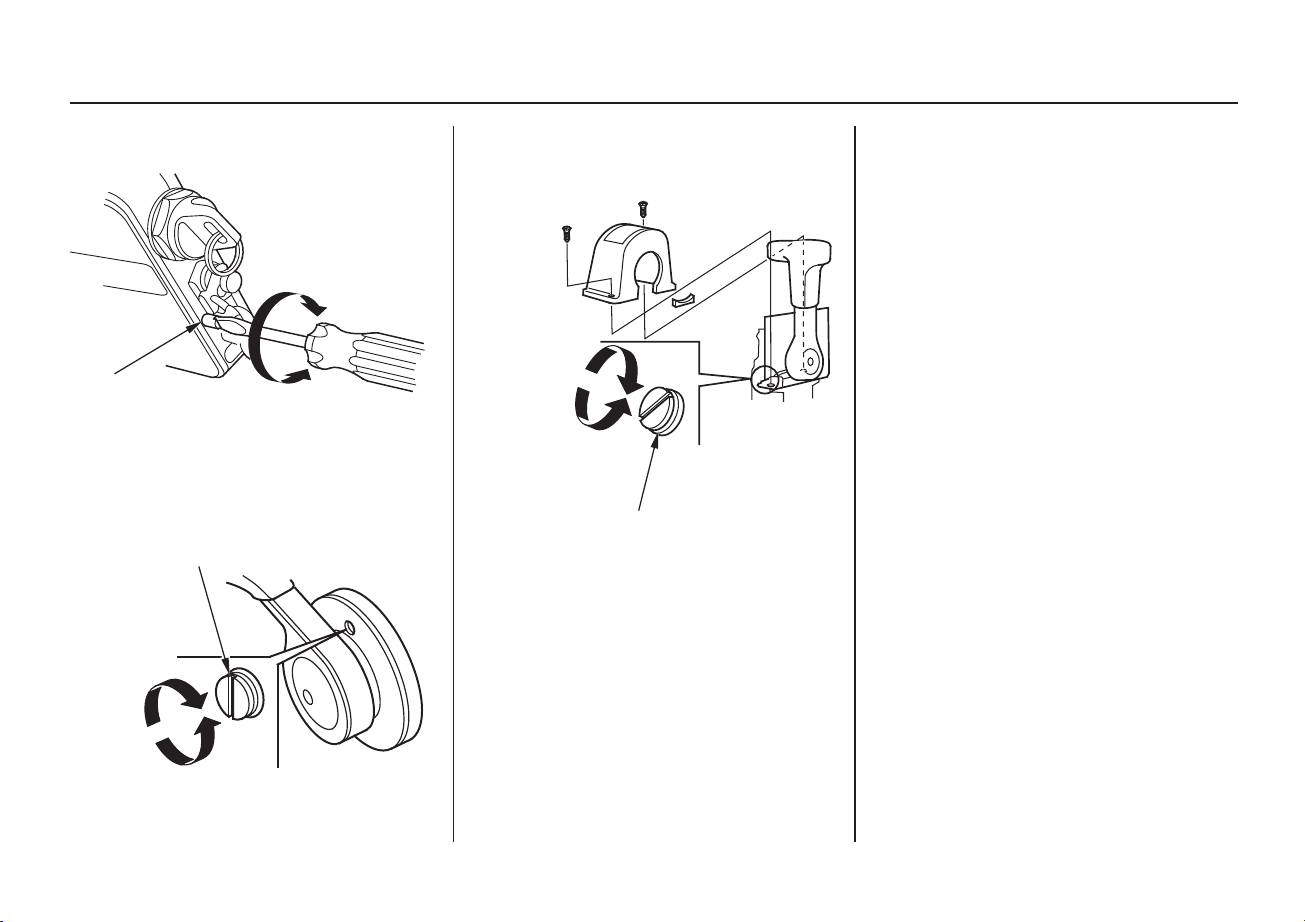
74
Side-Mount Type
Panel-Mount Type
Top-Mount Type
OPERATION
TO INCREASE
FRICTION
CONTROL
LEVER
FRICTION
ADJUSTER
TO DECREASE
FRICTION
CONTROL LEVER
FRICTION ADJUSTER
TO INCREASE
FRICTION
TO DECREASE
FRICTION
TO INCREASE
FRICTION
TO DECREASE
FRICTION
CONTROL LEVER
FRICTION ADJUSTER
Adjust the control lever friction
adjuster so the control lever will hold
a constant throttle setting while
cruising.
09/06/24 16:17:17 31ZY9610_075
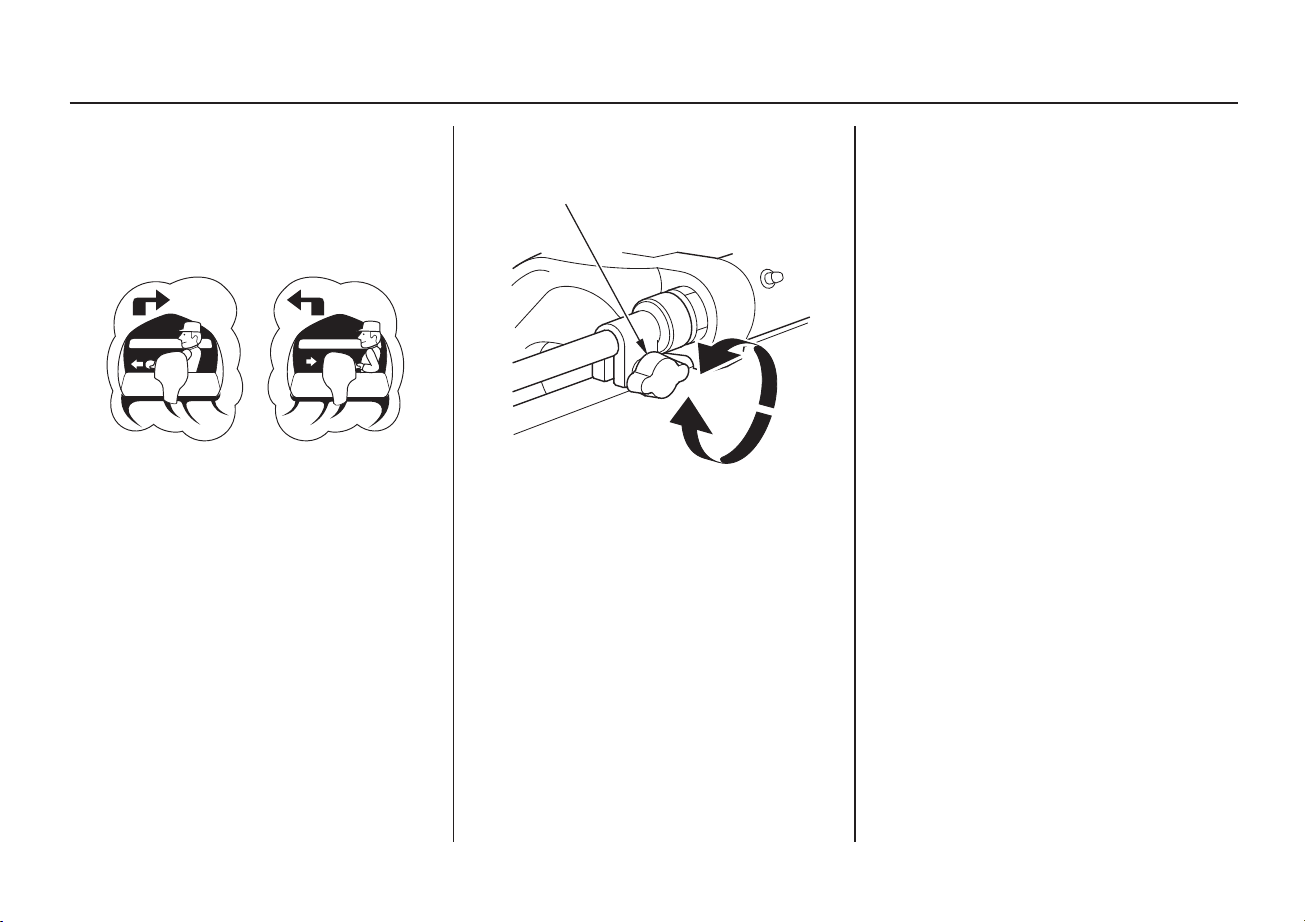
75
STEERING
OPERATION
RIGHT TURN LEFT TURN
Move the tiller
handle to the left.
Move the tiller
handle to the right.
STEERING FRICTION KNOB
TTOO DDEECCRREEAASSEE
FFRRIICCTTIIOONN
((RREELLEEAASSEE))
TO INCREASE
FRICTION
(FIX)
LHT Type (tiller handle)
LRTandXRTTypes
(remote control)
Steer the boat in the same manner as
an automobile.
Steer by moving the tiller handle
opposite the direction you want the
boat to turn.
Turn the knob counterclockwise to
decrease friction for easy turning.
Turn the knob clockwise to increase
steering friction for holding a steady
course.
Use the steering friction knob to help
hold a steady course while cruising.
09/06/24 16:17:27 31ZY9610_076
−
76
CRUISING
Engine Speed
Trim
OPERATION
Excessive trim/tilt angle during
operation can cause propeller
ventilation, overheating, and water
pump damage.
If, for example, the outboard motor
is tilted excessively or propeller
ventilation occurs during a sharp turn,
the engine may overrev, activating
the overrev limiter.
The engine is equipped with an
overrev limiter to prevent the
possibility of mechanical damage
from excessive engine speed.
For rough water conditions or large
waves, slow down to prevent the
propeller from rising out of the water.
For best fuel economy, limit the
throttle opening to 80%. Use the
throttle friction control (p. )
to help you hold a steady speed.
When cruising into a high wind, trim
the outboard motor down slightly to
level the boat and improve stability.
With a tail wind, trim the outboard
motor up slightly.
Under normal conditions, the boat
will perform best when the
antiventilation plate is level with the
water surface.
It is necessary to trim the angle of the
outboard motor to compensate for
changes in boat load, weight
distribution, water conditions, or
propeller selection.
Refer to the trim meter (p. ) for an
indication of whether the motor is
trimmed high or low.
Press the UP or DN (down) side of
the switch to adjust the angle of the
outboard motor.
You can use the power trim/tilt
switch at any time, whether the boat
is underway or stopped.
Use the power trim/tilt switch to trim
the outboard motor for the best
performance and stability.
If engine speed becomes unstable at
high speed due to activation of the
overrev limiter, reduce speed and
check the trim angle of the outboard
motor.
72 74
39
09/06/24 16:17:38 31ZY9610_077
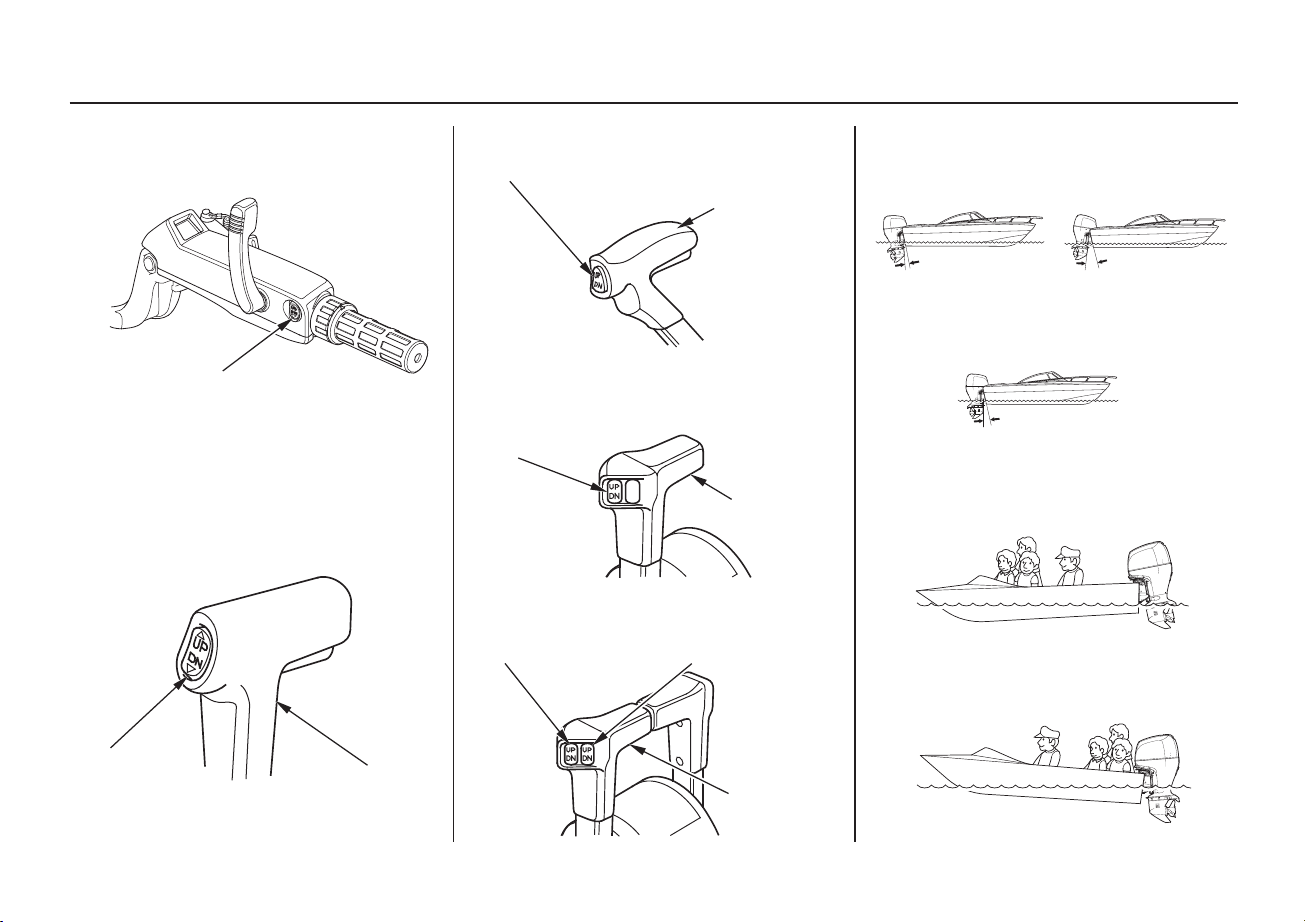
77
Panel-Mount Type
Side-Mount Type
Top-Mount Type
(single type)
(dual type)
OPERATION
POWER TRIM/
TILT SWITCH
POWER
TRIM/TILT
SWITCH
CONTROL
LEVER
POWER TRIM/TILT SWITCH
CONTROL LEVER
POWER TRIM/TILT
SWITCH
CONTROL
LEVER
POWER TRIM/TILT SWITCH
(LEFT) (RIGHT)
CONTROL
LEVER
MOTOR
TRIMMED TOO
LOW
MOTOR
TRIMMED TOO
HIGH
MOTOR TRIMMED
CORRECTLY
BOW TOO LOW DUE TO
1. LOAD IN THE FRONT
2. MOTOR TRIMMED TOO LOW
BOW TOO HIGH DUE TO
1. LOAD IN THE REAR
2. MOTOR TRIMMED TOO HIGH
LHT Type (tiller handle)
LRTandXRTTypes
(remote control)
09/06/24 16:17:50 31ZY9610_078
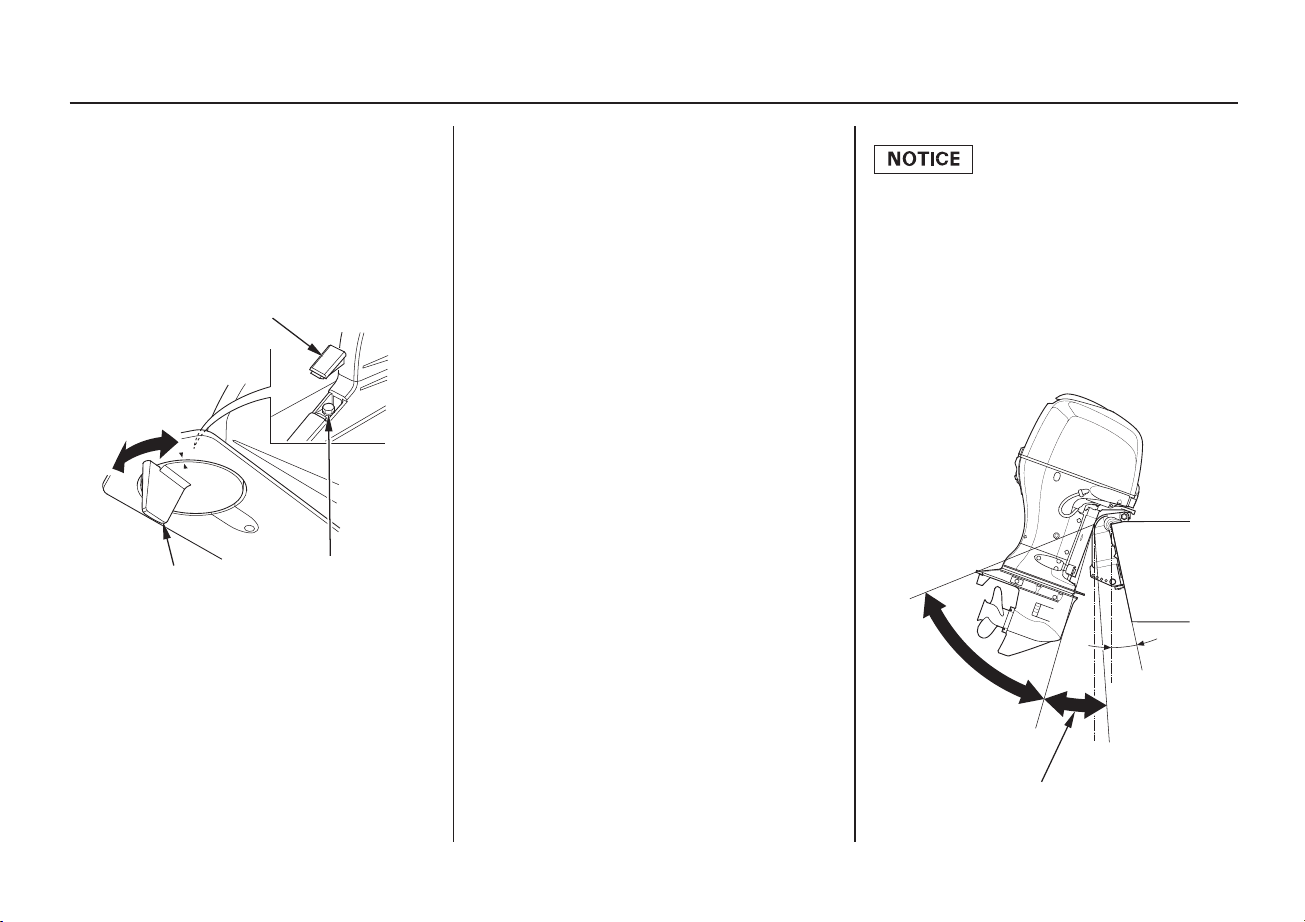
−
78
SHALLOW WATER
OPERATION
OPERATION
TRIM ANGLE
0°
GEAR CASE GROMMET
TRIM TAB
TRIM TAB BOLT
68°
12°
TILT
ANGLE
16°
0°
4°
(VERTICAL LINE)
(when transom angle at 12°)
An excessive trim/tilt angle during
operation can cause propeller
ventilation, overheating, and water
pump damage. This type of damage
is not covered by the
(p. ).
TRIM TAB ADJUSTMENT
140
If steering effort is not equal in both
directions, adjust the trim tab to
compensate for ‘‘torque steer,’’
which is the reaction of the outboard
motor to propeller rotation.
Distributor’s
Limited Warranty
Refer to
on p. .
When the trim tab is correctly
adjusted, steering effort will be equal
in both directions.
When operating in shallow water, use
the power trim/tilt switch (p. ) to
tilt the outboard motor so that the
propeller and gear case won’t hit the
bottom.
Proceed at low speed, and monitor
water flow from the cooling system
indicator (p. ) to be sure the
outboard motor is not tilted so high
that the water intakes are out of the
water.
Adjust the trim tab with the engine
stopped. Remove the gear case
grommet. Loosen the trim tab bolt
above the trim tab, turn the trim tab,
and then tighten the bolt and install
the gear case grommet securely.
86
77
44
09/06/24 16:18:00 31ZY9610_079
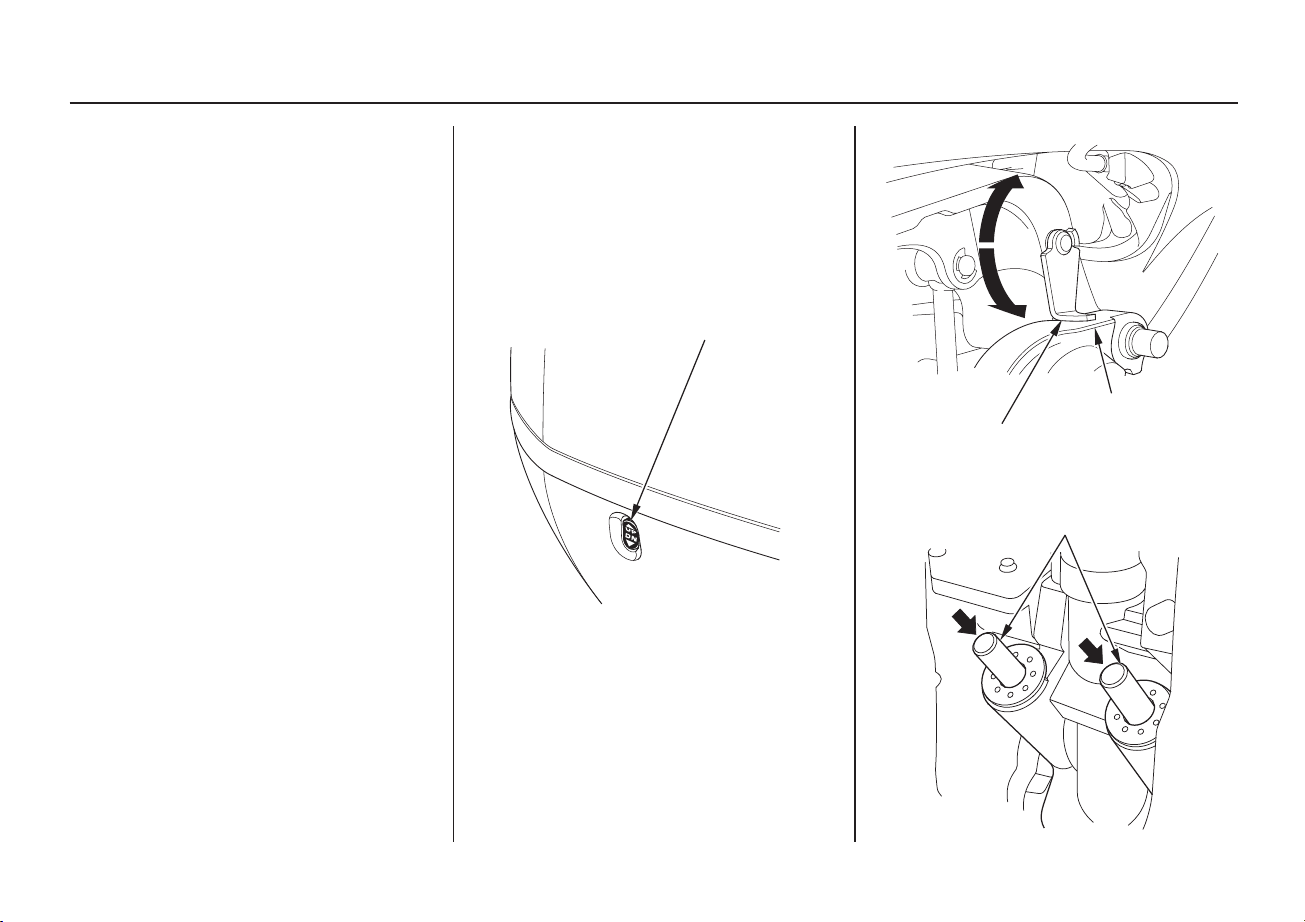
79
MOORING, BEACHING,
LAUNCHING
OPERATION
POWER TILT SWITCH
FFRREEEE
LLOOCCKK
TILT LOCK LEVER
STERN BRACKET
(lock position)
TRIM RODS
To raise the outboard motor out of
the water while the engine is stopped
and the boat is moored, or for
maximum clearance when beaching
or launching, use the power tilt
switch on the engine pan to tilt the
outboard motor up as far as it will go.
Move the tilt lock lever to the LOCK
position, and then gently lower the
outboard motor until the lever
contacts the stern bracket. Use the
power tilt switch to fully shorten the
trim rods.
Before tilting up, leave the outboard
motor in the running position for one
minute after stopping the engine to
drain the water from inside the
engine.
To lower the outboard motor, tilt up
using the power tilt switch, then
move the tilt lock lever to the FREE
position, and then lower the outboard
motor to the desired position.
09/06/24 16:18:06 31ZY9610_080
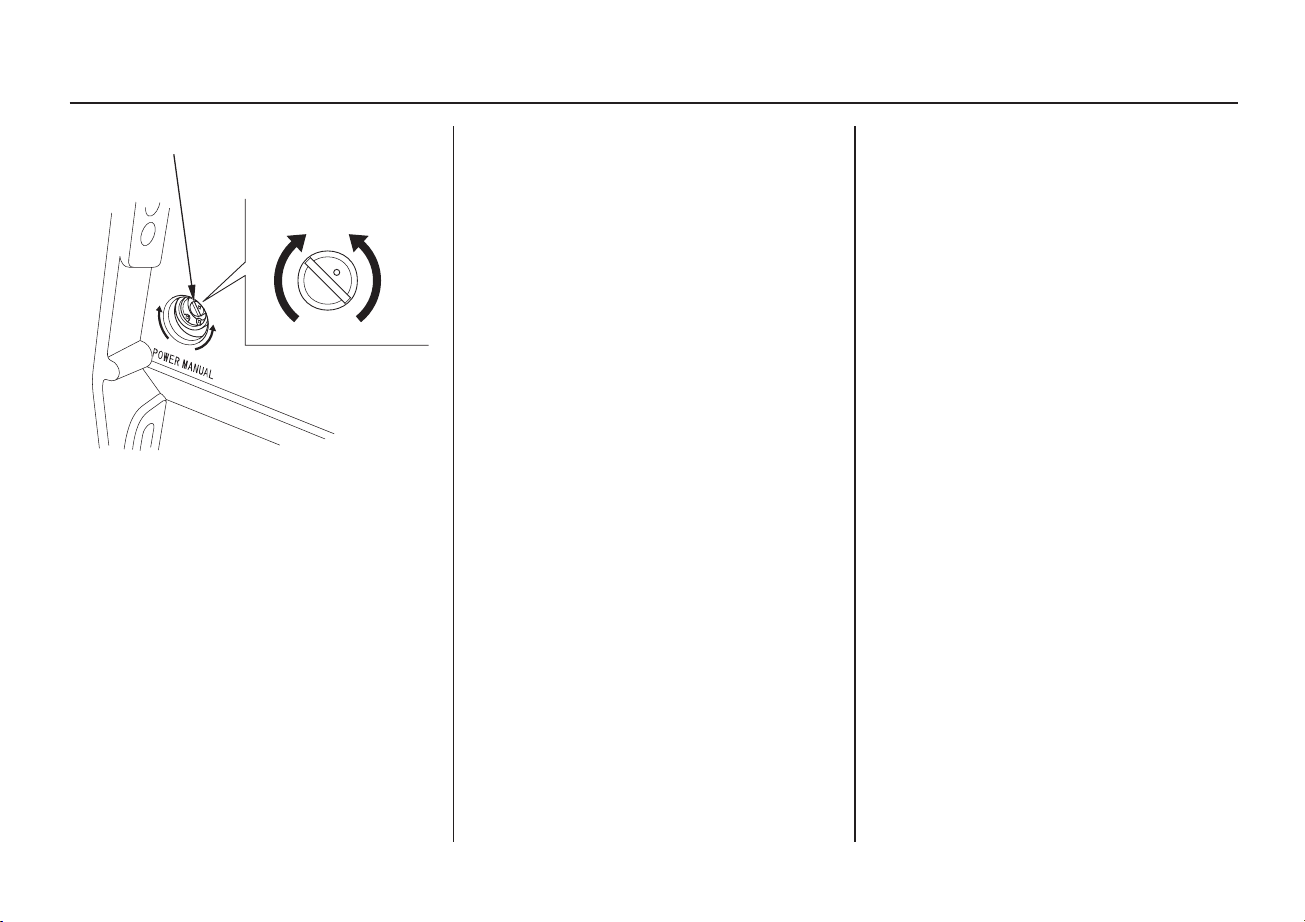
80
OPERATION
MANUAL RELIEF VALVE
POWER
(To fix)
MANUAL
(To release)
The outboard motor can also be tilted
manually after opening the manual
relief valve. This feature enables the
outboard motor to be tilted up or
down when no battery is connected.
For manual tilting, use a screwdriver
to turn the valve counterclockwise 1
or 2 turns. Close the valve firmly
after positioning the engine.
Be sure the valve is closed before
operating the outboard motor. If the
valve is not closed, the outboard
motor will tilt up when operated in
reverse.
Check that nobody is under the
outboard motor before opening the
manual relief valve. If the manual
relief valve is loosened (turned
counterclockwise) when the outboard
motor is tilted up, the outboard motor
will suddenly tilt down.
09/06/24 16:18:10 31ZY9610_081
Improperly maintaining
this outboard motor or
failure to correct a problem
before operation can cause
a malfunction in which you
could be seriously hurt or
killed.
Always follow the
inspection and
maintenance
recommendations and
schedules in this Owner’s
Manual.
81
THE IMPORTANCE OF
MAINTENANCE
Maintenance, replacement, or
repair of the emission control
devices and systems may be
performed by any marine engine
repair establishment or individual,
using parts that are ‘‘certified’’ to
EPA standards.
SERVICING YOUR OUTBOARD MOTOR
Proper maintenance is essential for
safe, economical, and trouble-free
operation. It will also help reduce air
pollution.
To help you properly care for your
outboard motor, the following pages
include a maintenance schedule,
routine inspection procedures, and
simple maintenance procedures using
basic hand tools. Other service tasks
that are more difficult or require
special tools are best handled by
professionals and are normally
performed by a Honda technician or
other qualified mechanic.
The maintenance schedule applies to
normal operating conditions. If you
operate your outboard motor under
unusual conditions, consult an
authorized Honda Marine dealer for
recommendations applicable to your
individual needs and use.
Remember that your authorized
Honda Marine dealer knows your
outboard motor best and is fully
equipped to maintain and repair it.
To ensure the best quality and
reliability, use only new, Honda
Genuine parts or their equivalents for
repair and replacement.
09/06/24 16:18:17 31ZY9610_082
−
−
−
Failure to properly follow
maintenance instructions
and precautions can cause
you to be seriously hurt or
killed.
Always follow the
procedures and
precautions in the Owner’s
Manual.
82
MAINTENANCE SAFETY Safety Precautions
Burns from hot parts.
Injury from moving parts.
Carbon monoxide poisoning
from engine exhaust.
SERVICING YOUR OUTBOARD MOTOR
Some of the most important safety
precautions follow. However, we
cannot warn you of every
conceivable hazard that can arise in
performing maintenance. Only you
can decide whether or not you should
perform a given task.
Make sure the engine is off before
you begin any maintenance or
repairs. This will eliminate several
potential hazards:
Read the instructions before you
begin, and make sure you have the
tools and skills required.
To reduce the possibility of fire or
explosion, be careful when
working around gasoline. Use only
a nonflammable solvent, not
gasoline, to clean parts. Keep
cigarettes, sparks, and flames away
from all fuel-related parts.
Wear gloves when handling the
propeller to protect your hands
from sharp edges.Let the engine and exhaust
system cool before touching.
Do not run the engine unless
instructed to do so.
Do not start or run the engine in
a confined or partly enclosed
area.
09/06/24 16:18:26 31ZY9610_083
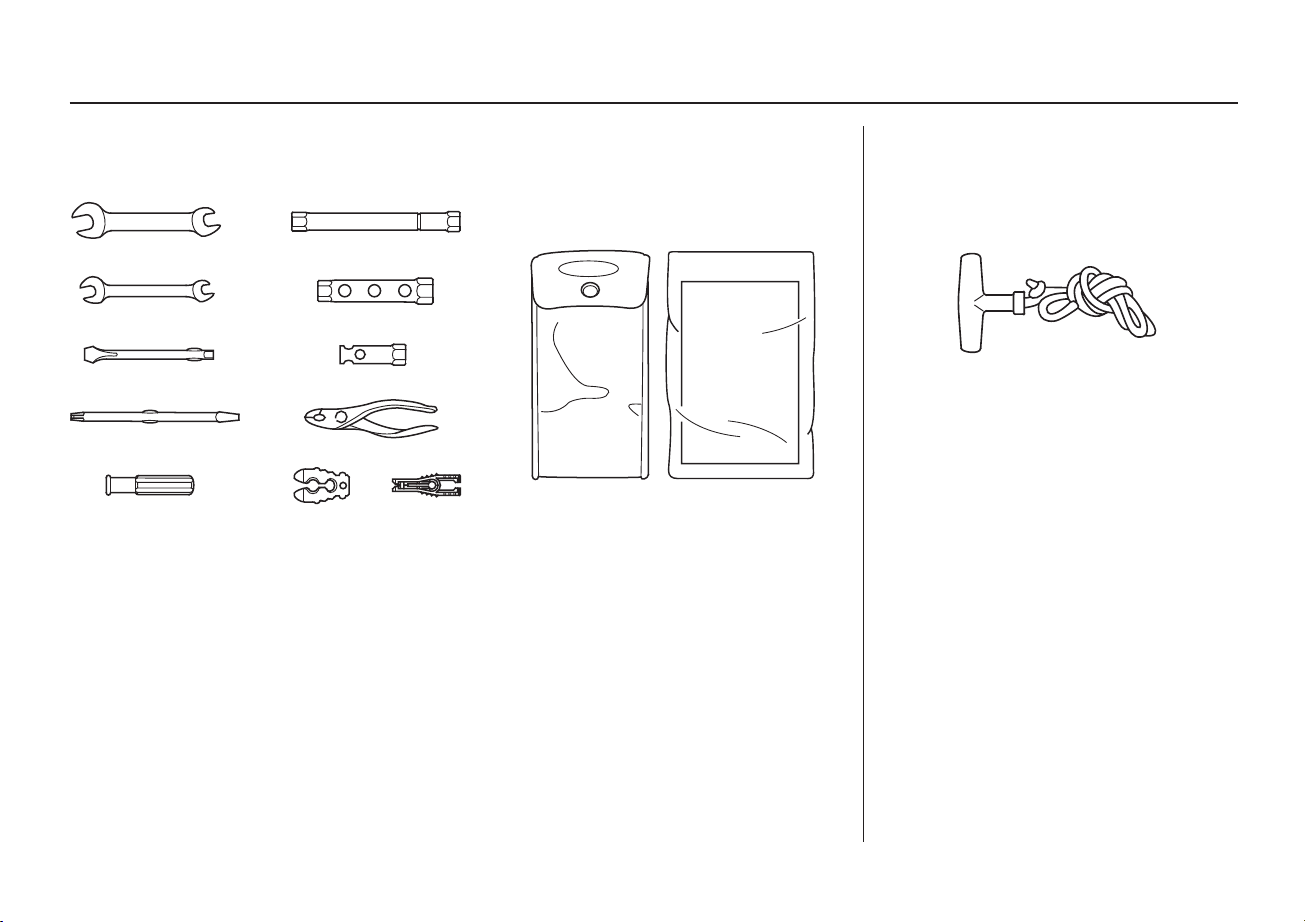
×
×
×
83
TOOL KIT and OWNER’S MANUAL EMERGENCY STARTER
ROPE
SERVICING YOUR OUTBOARD MOTOR
EMERGENCY STARTER ROPE
10 14 mm WRENCH SPARK PLUG WRENCH
8 12 mm WRENCH
18 19 mm BOX WRENCH
OIL CHECK
SCREWDRIVER
10 mm BOX WRENCH
PHILLIPS/FLAT
SCREWDRIVER
PLIERS
SCREWDRIVER
HANDLE
FUSE PULLER
SPARE EMERGENCY
STOP SWITCH CLIP
TOOL BAG OWNER’S MANUAL
The tool kit can be used for simple maintenance procedures and emergency
repairs. Keep these items on the boat so that they will always be available if
you need them.
Always carry a spare emergency stop switch clip onboard. The spare clip may
either be stored in the tool bag or in an easily accessible location on the boat.
If your tool kit needs replacement, it is not available as a kit and each item
must be ordered individually.
An emergency starter rope is
supplied. Keep the emergency starter
rope on the boat, so it will always be
available if you need it.
09/06/24 16:18:34 31ZY9610_084
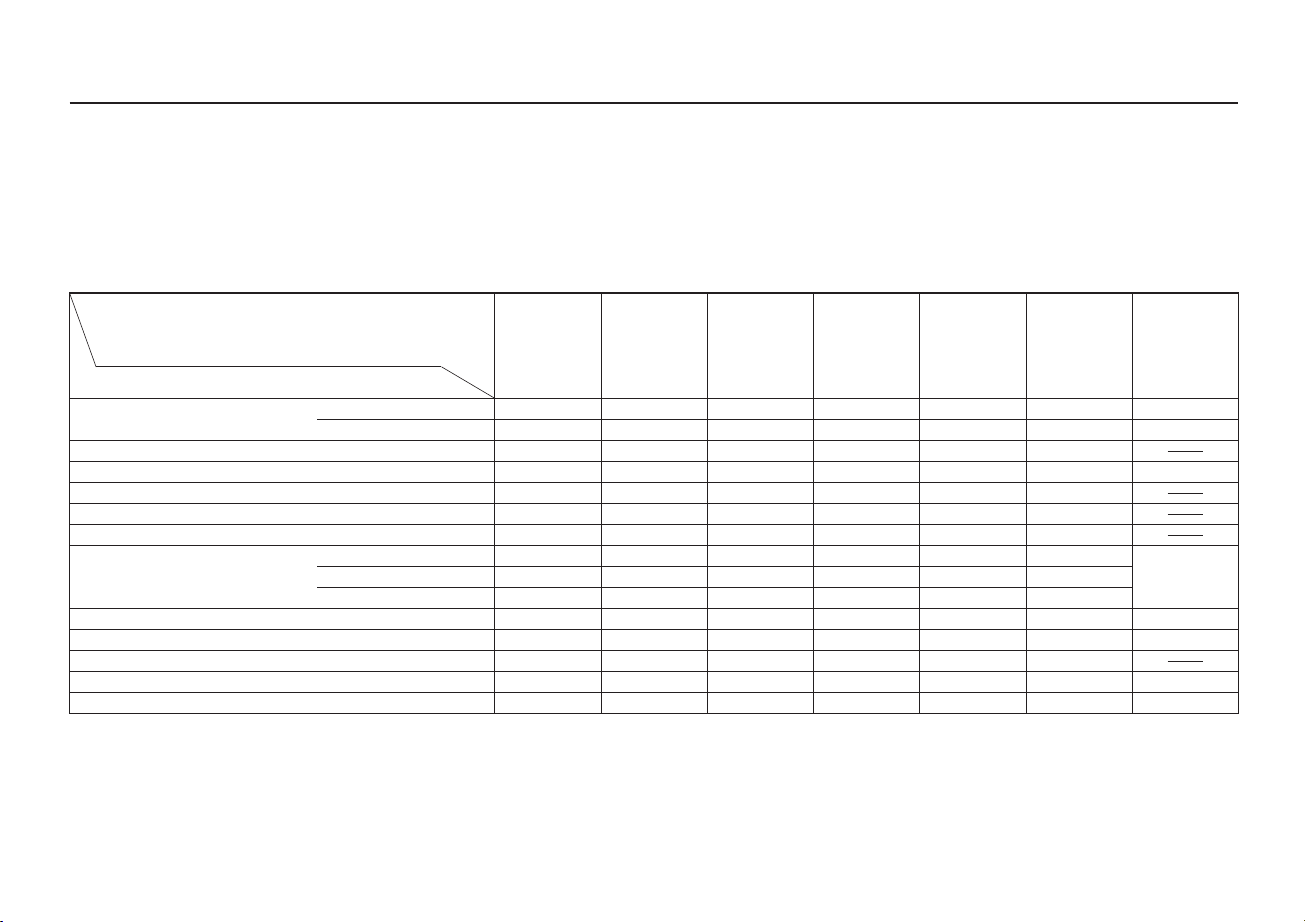
○
○
○
○
○
○
○
○
○
○
○
○
○
○
○
○
○
○
−
−
○
○
84
MAINTENANCE SCHEDULE
SERVICING YOUR OUTBOARD MOTOR
Distributor’s Limited Warranty
Follow the MAINTENANCE SCHEDULE table and service your outboard motor accordingly. Please note, a claim for
warranty coverage will not be denied simply because the maintenance schedule for your outboard was not followed.
However, any part(s) that fails specifically due to lack of maintenance, or improperly performed maintenance, would
not be covered under the .
ITEM
Perform at every indicated month or operating
hour interval, whichever comes first.
REGULAR SERVICE PERIOD
After use
Every year
or
200 hrs.
(2)
(2)
(2)
Check level
Change
Change
Replace
Check-adjust
Check-adjust
Check-adjust
Check
Clean
Replace
Check
Check
Check
Grease
Check
Engine oil
Gear case oil
Engine oil filter
Throttle linkage
Idle speed
Valve clearance
Spark plugs
Propeller and cotter pin
Anode metal (Outside engine)
Anode metal (Inside engine)
Lubrication
Water separator
Each use
First month
or
20 hrs.
(2)
(2)
(2)
(1)
Every 6
months or
100 hrs.
(2)
(2)
(2)
(1)
Refer
to page
88
89
90
92 94
107
106
95, 96
99 102
Every 2 years
or
400 hrs.
(2) (6)
(3)
Replace the anodes when they have been reduced to about one third their original size, or if they are crumbling.
For professional commercial use, log hours of operation to determine proper maintenance intervals.
These items should be serviced by an authorized Honda Marine dealer, unless you have the proper tools and are mechanically proficient.
Refer to the Honda shop manual for service procedures.
Lubricate more frequently when used in salt water.
(1)
(2)
(3)
(6)
09/06/24 16:18:46 31ZY9610_085
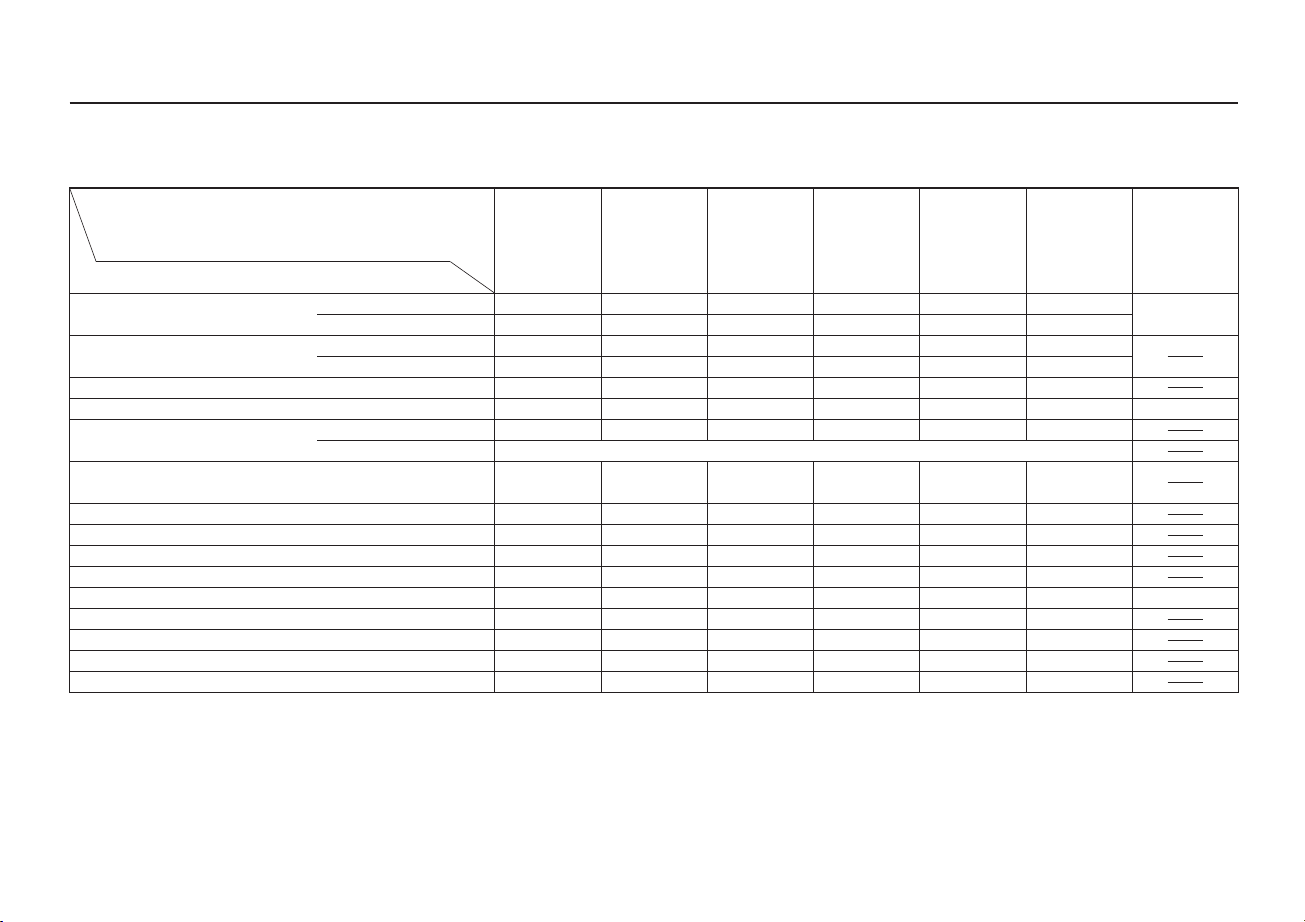
○
○
○
○
○
○
○
○
−
○
○
○
○
○
○
○
○
○
○
85
SERVICING YOUR OUTBOARD MOTOR
REGULAR SERVICE PERIOD
Perform at every indicated month or operating
hour interval, whichever comes first.
ITEM
After use
(4)
First month
or
20 hrs.
(2)
Every year
or
200 hrs.
(2)
(2)
(2)
Every 2 years
or
400 hrs.
(2)
Every 2 years (If necessary) (2)
Refer
to page
102 104
105
49
Check
Replace
Check
Replace
Check
Clean
Check
Replace
Check level-tightness
Check-tightness
Check
Clean
Check
Check
Check
Check
Check
Check
Each use
Every 6
months or
100 hrs.
(2)
(2)
(2)
Fuel filter
(Low pressure side)
Fuel filter
(High pressure side)
Thermostat
Fuel tank and tank filter
Fuel tube
Battery and cable
connection
Bolts and nuts
Breather tube
Cooling water passages
Water pump
Emergency stop switch
Engine oil leak
Each operation part
Engine condition (5)
Power trim/tilt
(3)
Upon starting, check for unusual engine sounds and cooling water flowing freely from the check hole.
When operating in salt water, turbid or muddy water, the engine should be flushed with clean water after each use.
For professional commercial use, log hours of operation to determine proper maintenance intervals.
These items should be serviced by an authorized Honda Marine dealer, unless you have the proper tools and are mechanically proficient.
Refer to the Honda shop manual for service procedures.
Lubricate more frequently when used in salt water.
(1)
(2)
(3)
(4)
(5)
09/06/24 16:18:58 31ZY9610_086
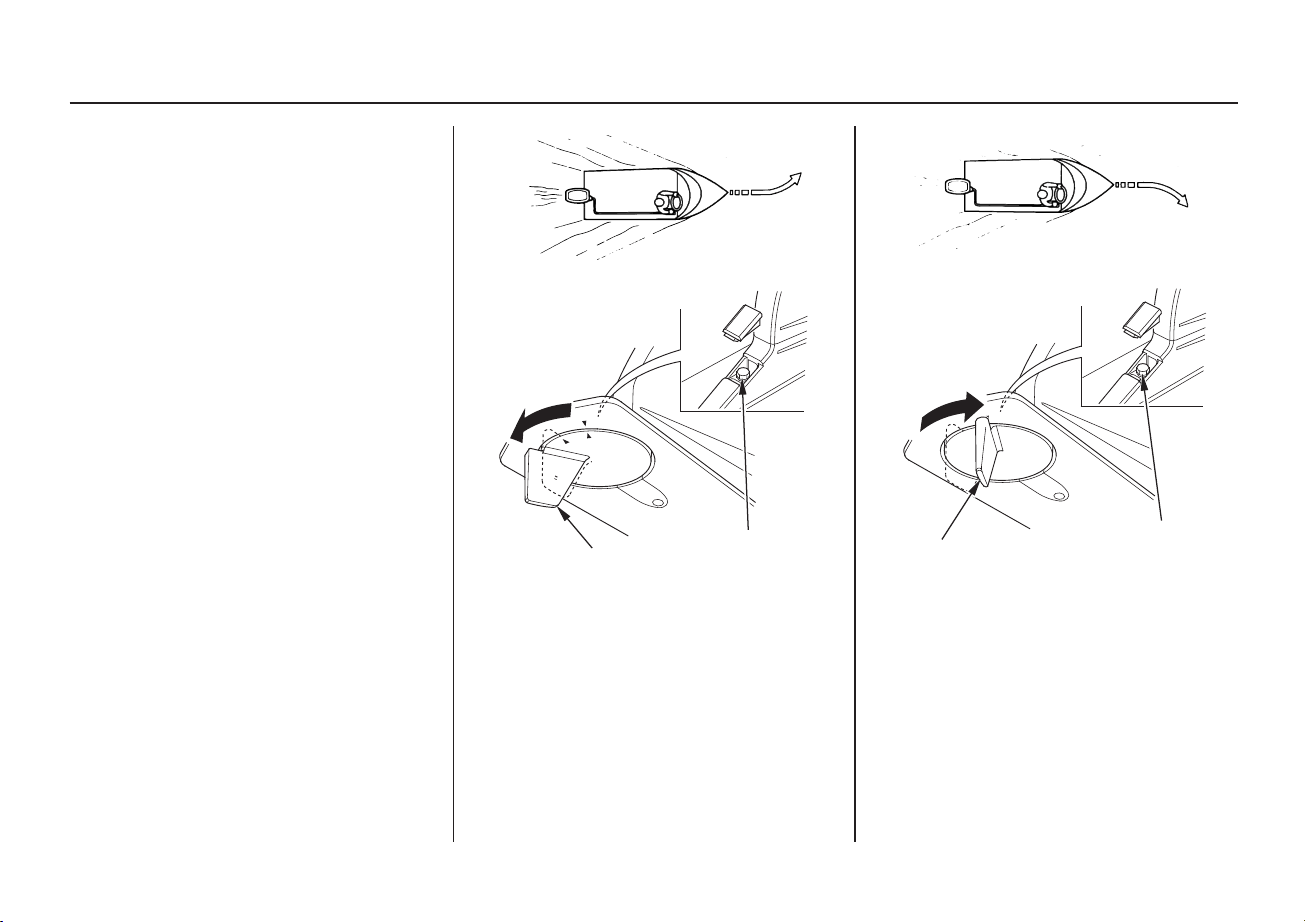
86
TRIM TAB ADJUSTMENT
SERVICING YOUR OUTBOARD MOTOR
LEFT
RIGHT
LEFT
RIGHT
TRIM TAB
TRIM TAB BOLT
TRIM TAB
TRIM TAB BOLT
The trim tab compensates for
‘‘torque steer,’’ which is a reaction of
the outboard motor to propeller
rotation.
If uncompensated, torque steer would
make the outboard motor tend to turn
to one side.
When the trim tab is correctly
adjusted, steering effort is equal in
either direction.
If less effort is required to make left
turns, move the back of the trim tab
left.
Adjust the trim tab in small
increments, and retest steering effort
with the boat evenly loaded and
running at cruising speed.
If less effort is required to make right
turns, move the back of the trim tab
right.
If steering effort is unequal, remove
the gear case grommet and loosen the
trim tab bolt then adjust the angle of
the trim tab. Retighten the trim tab
bolt and reinstall the gear case
grommet securely.
09/06/24 16:19:08 31ZY9610_087
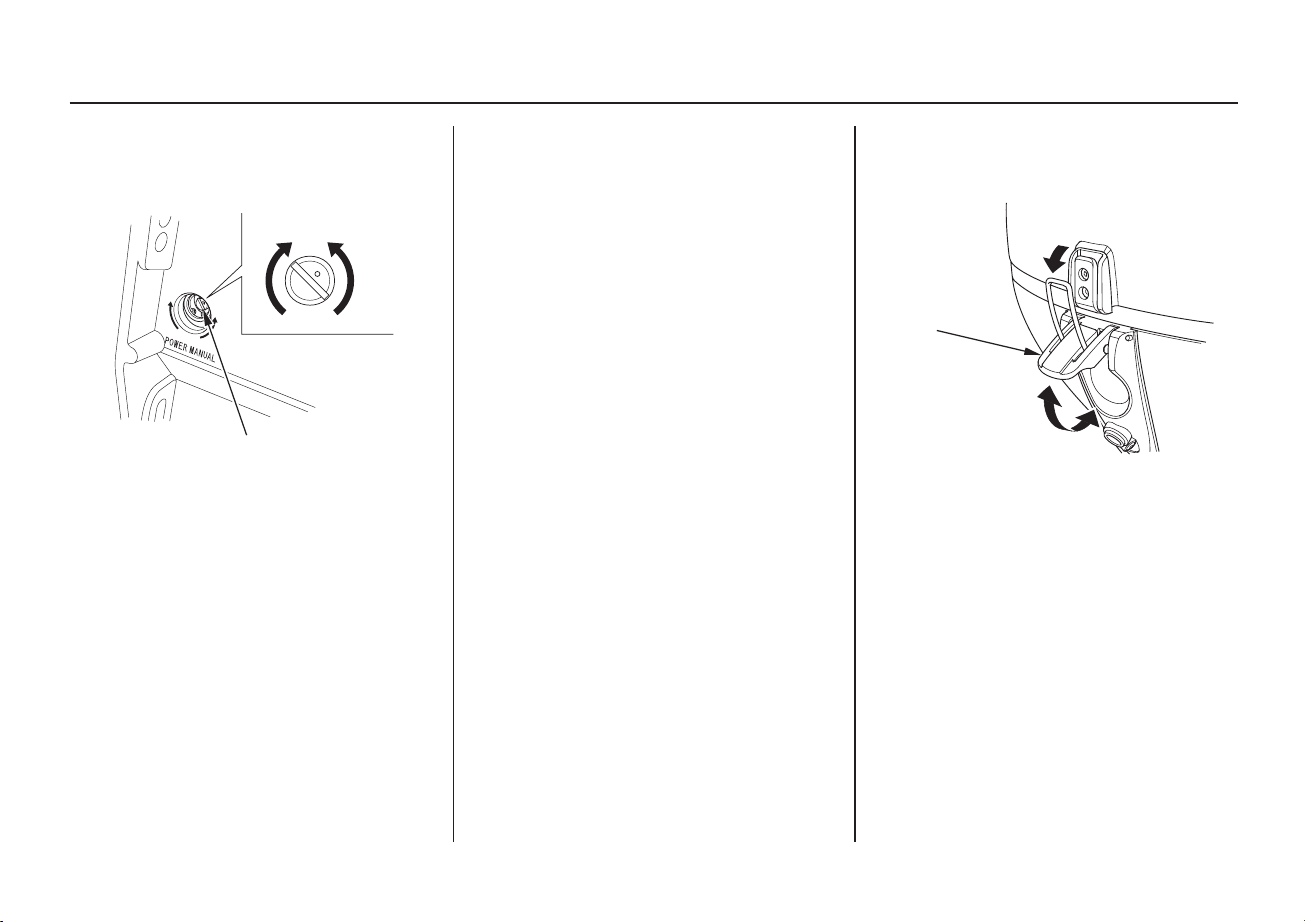
87
MANUAL RELIEF VALVE ENGINE COVER REMOVAL
AND INSTALLATION
SERVICING YOUR OUTBOARD MOTOR
POWER
(To fix)
MANUAL
(To release)
MANUAL RELIEF VALVE
ENGINE
COVER
LATCHES
(front/rear)
UNLATCH
FIX
The engine cover latches fasten the
engine cover to the outboard motor.
To remove the engine cover, unlatch
both front and rear latches, then lift
the engine cover off the outboard
motor.
To install the engine cover, place the
cover on the outboard motor, then
latch both front and rear latches
securely.
For manual tilting, use a screwdriver
to turn the valve counterclockwise 1
or 2 turns. Close the valve firmly
after positioning the outboard motor.
The outboard motor can be tilted
manually after opening the manual
relief valve. This feature enables the
outboard motor to be tilted up or
down when no battery is connected.
Check that nobody is under the
outboard motor before opening the
manual relief valve. If the manual
relief valve is loosened (turned
counterclockwise) when the outboard
motor is tilted up, the outboard motor
will suddenly tilt down.
Be sure the valve is closed before
operating the outboard motor. If the
valve is not closed, the outboard
motor will tilt up when operated in
reverse.
09/06/24 16:19:17 31ZY9610_088
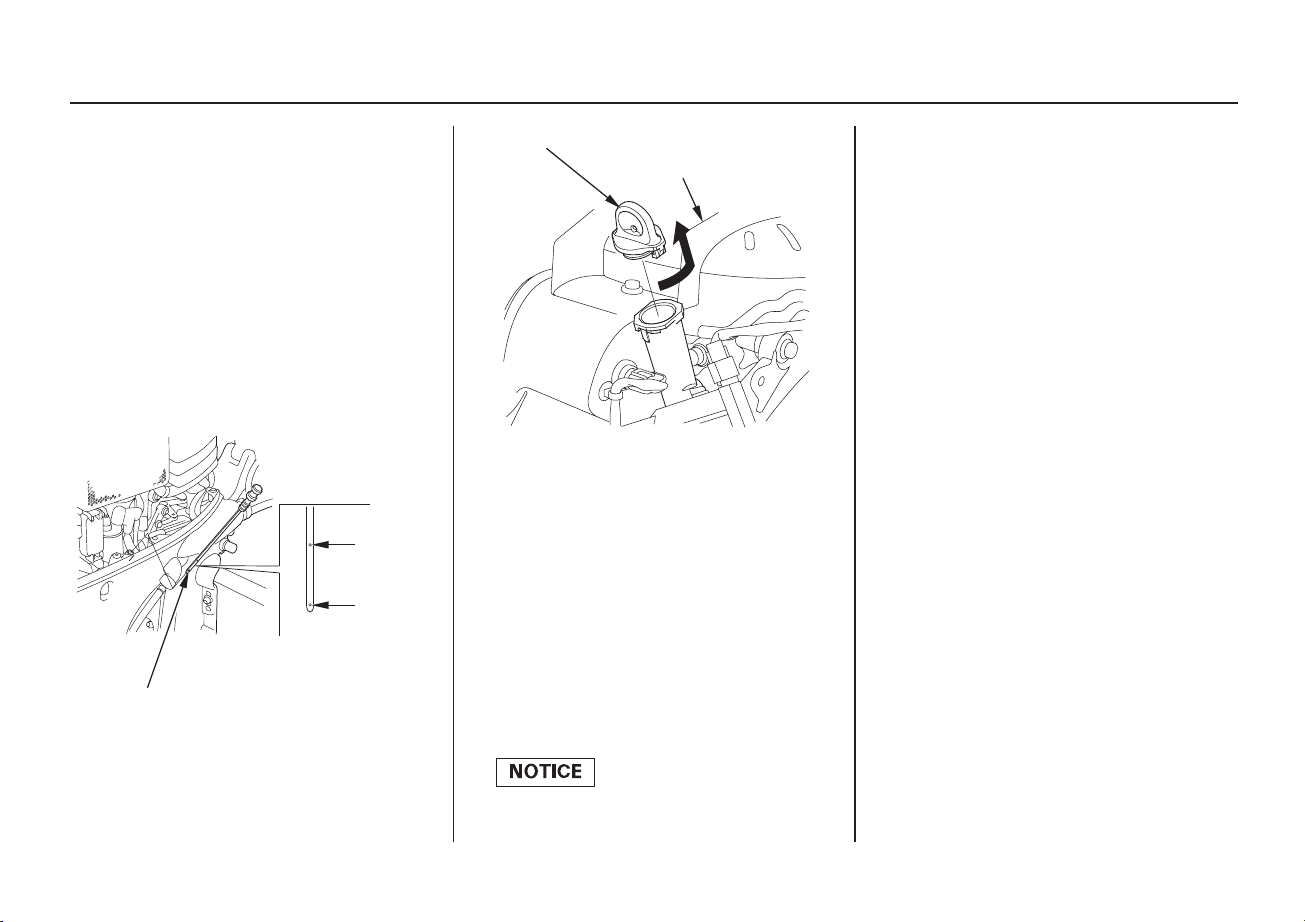
88
Engine Oil Level Check
SERVICING YOUR OUTBOARD MOTOR
UPPER
LIMIT
LOWER
LIMIT
OIL LEVEL DIPSTICK
OIL FILLER CAP
Rid of the alternator
cover
Running the engine with a low oil
level can cause engine damage.
Check the engine oil level with the
engine stopped and the outboard
motor in the vertical position.
Unlock and remove the engine
cover (p. ).
Remove the dipstick and wipe it
clean.
Insert the dipstick all the way in,
then remove it and check the oil
level shown on the dipstick.
If the oil level is low, remove the
oil filler cap, and add oil to reach
the upper limit mark shown on the
dipstick. Use the oil recommended
on p. .
Pull the cap to remove it.
Turn the oil filler cap 90°
counterclockwise so the lug of the
cap sets horizontally.
Oil filler cap removal (Unlock):
Install the oil filler cap and tighten
it securely. Do not overtighten.
Oil filler cap installation (Lock):
Insert the oil filler cap into the oil
filler port with the lug being set
horizontally.
Turn the oil filler cap 90°
clockwise so the lug of the cap is
in line with the rib of the alternator
cover. (It should click.)
Install and lock the engine cover.
1.
2.
3.
4.
5.
6.
1)
2)
2)
1)
87
91
09/06/24 16:19:30 31ZY9610_089
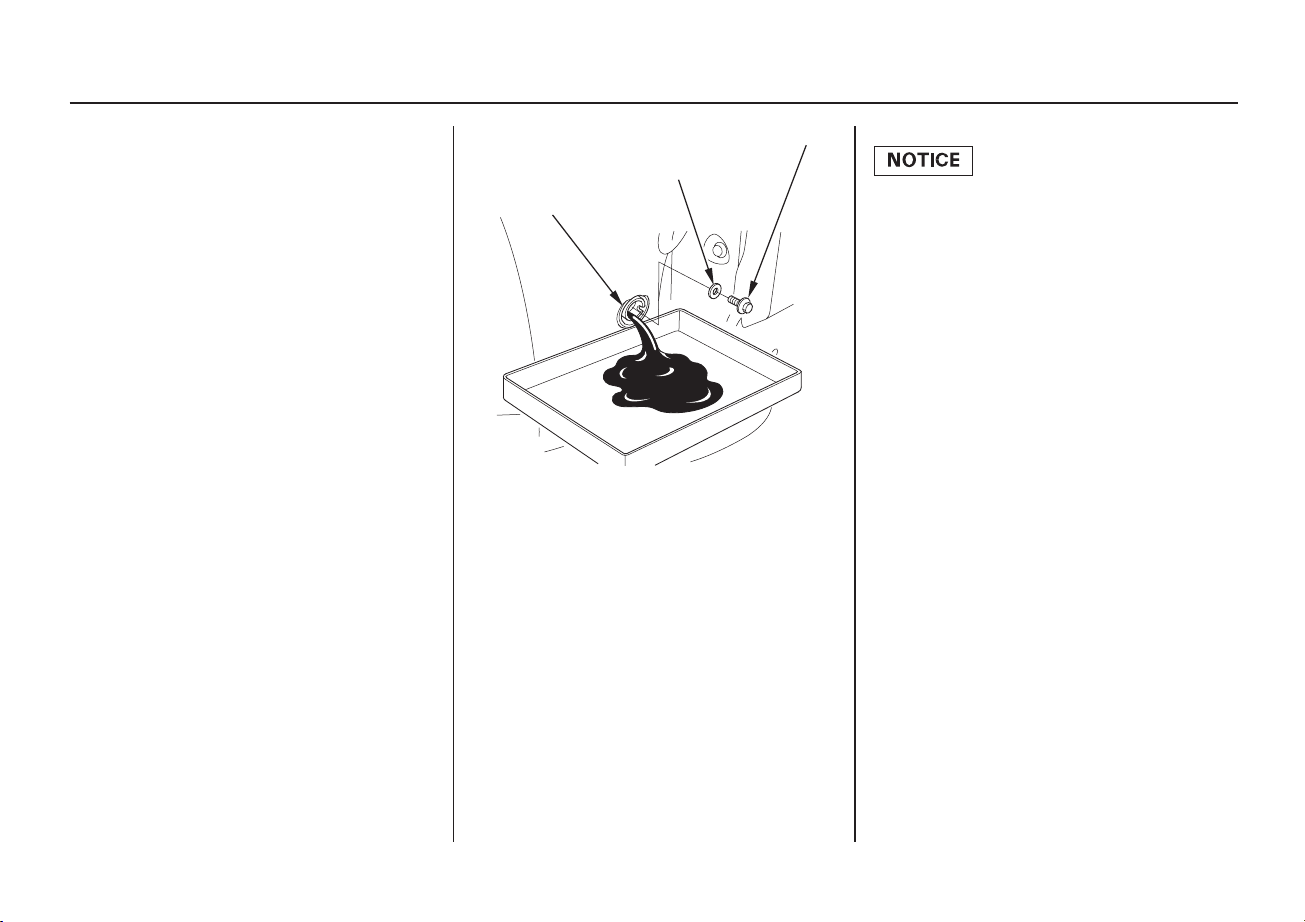
89
Engine Oil Change
SERVICING YOUR OUTBOARD MOTOR
DRAIN BOLT
SEALING WASHER
OIL DRAIN GUIDE
Improper disposal of engine oil can
be harmf ul to the environment. If
you change your own oil, please
dispose of the used oil properly. Put
it in a sealed container, and take it to
a recycling center. Do not throw it in
the trash, pour it on the ground or
downadrain.
Allow the used oil to drain
completely. Use a new sealing
washer, and then reinstall the
engine oil drain bolt and washer.
Tighten the drain bolt securely.
Place a suitable container below
the oil drain guide to catch the
used oil, and then remove the oil
filler cap (p. ) and the drain bolt.
An engine oil evacuation device may
be used to remove the engine oil.
Drain the used oil while the engine is
warm. Warm oil drains quickly and
completely.
Unlock and remove the engine
cover (p. ).
2.
3.
1.
87
88
09/06/24 16:19:38 31ZY9610_090
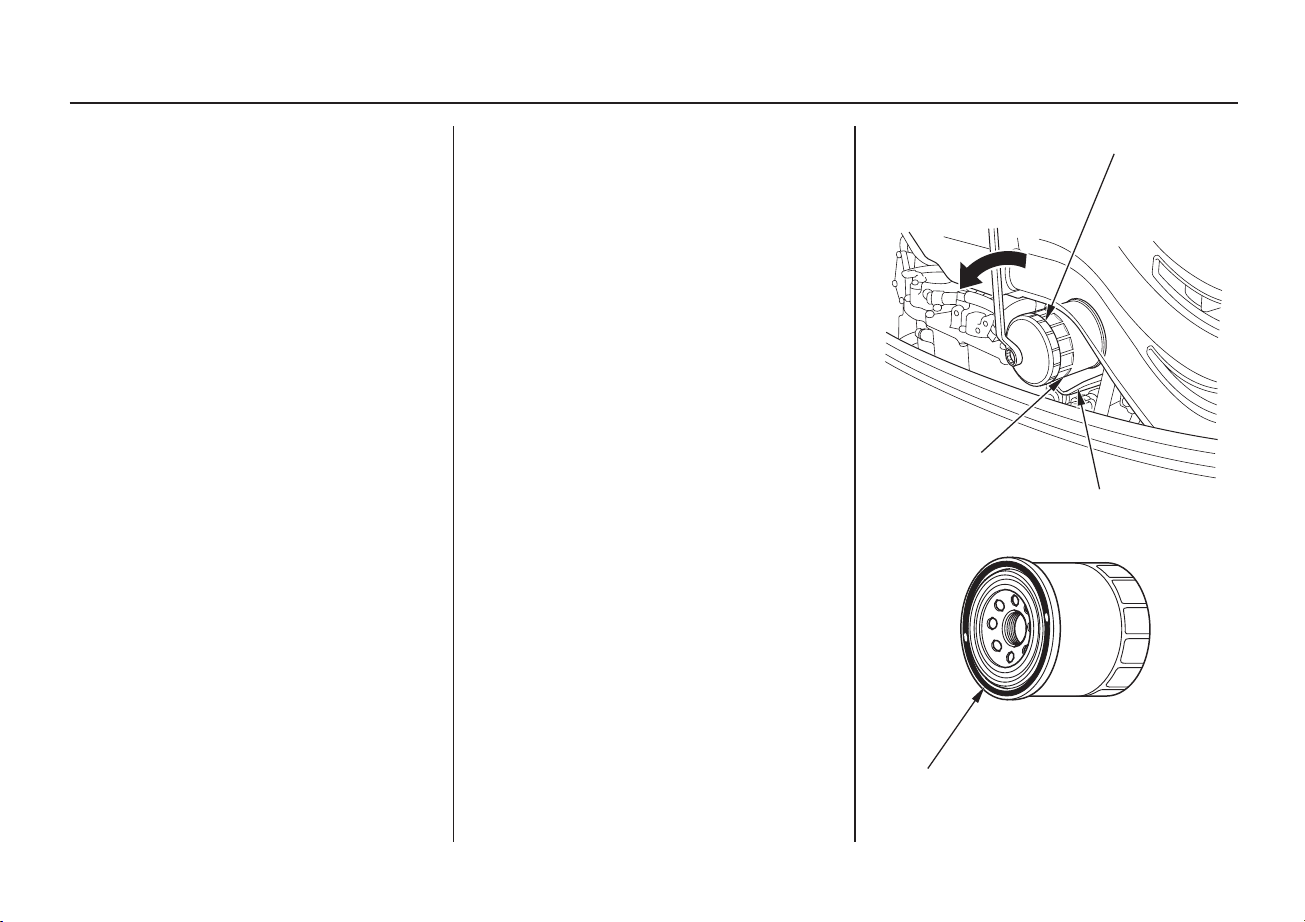
4.4 US qt (4.2 L)
4.6 US qt (4.4 L)
90
Oil Filter Change
SERVICING YOUR OUTBOARD MOTOR
OIL FILTER
OIL DRAIN GUIDE
RUBBER SEAL
64 mm FILTER WRENCH
Drain the engine oil, and reinstall
the drain bolt (see Engine Oil
Change on p. ).
Tilt the outboard motor, and place
a suitable container below the oil
drain guide to catch the used oil.
Use a suitable tool to remove the
oil filter, and thoroughly drain the
filter into the used oil container.
With the outboard motor in a
vertical position, fill to the upper
limit mark on the oil level dipstick
(p. ) with the recommended oil.
Engine oil refill capacity:
Without oil filter change:
With oil filter change:
Install the oil filler cap and tighten
it securely (p. ).
Install and lock the engine cover.
1.
2.
3.
4.
5.
6.
89
88
88
09/06/24 16:19:48 31ZY9610_091
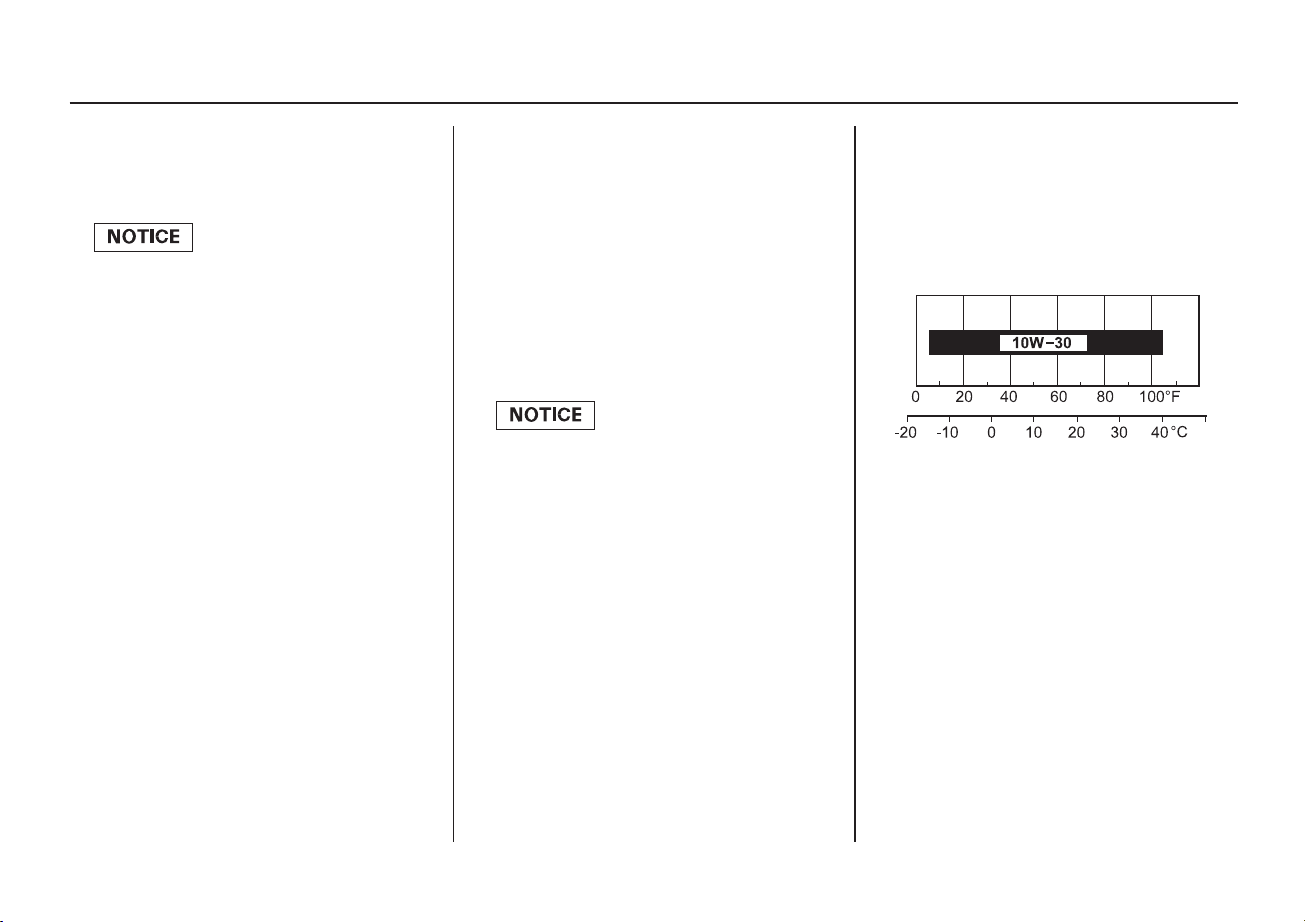
SAE Viscosity Grade
AMBIENT TEMPERATURE
9 lbf·ft (12 N·m , 1.2 kgf·m)
91
Engine Oil Recommendations
SERVICING YOUR OUTBOARD MOTOR
Use only a Honda Genuine oil
f ilter or a f ilter of equivalent
quality specified f or your model.
Using the wrong f ilter, or a non-
Honda f ilter which is not of
equivalent quality, may cause
engine damage.
Running the outboard motor
without suf f icient cooling water
will damage the water pump and
overheat the engine.
Oil is a major factor affecting
performance and service life. Use
4-stroke detergent oil.
Screw on the new filter by hand
until it contacts the engine, then
use a suitable tool to tighten the
filter an additional 7/8 turn.
OIL FILTER TIGHTENING
TORQUE:
Clean the oil filter mounting base,
and coat the rubber seal of the new
oil filter with clean engine oil.
If you are changing the oil filter
while the outboard motor is out of
the water, use commercially
available ear muffs and water hose
to supply water.
Stop the engine, and check the oil
level as described on page . If
necessary, add oil to bring the oil
level to the upper limit mark on the
dipstick.
Return the outboard motor to the
vertical position, and fill the
crankcase with the specified
amount of the recommended oil.
Honda 10W-30 FC-W outboard
motor oil is recommended for
general use.
If Honda 10W-30 FC-W oil is not
available, Honda recommends that
you use API service category SG, SH
or SJ oil. The SAE oil viscosity and
service category are in the API label
on the oil container.
Start the engine and check for
leaks (be sure the water level is at
least 2 inches (5 cm) above the
antiventilation plate).
7.
8.
4.
5.
6.
88
TM
09/06/24 16:19:59 31ZY9610_092
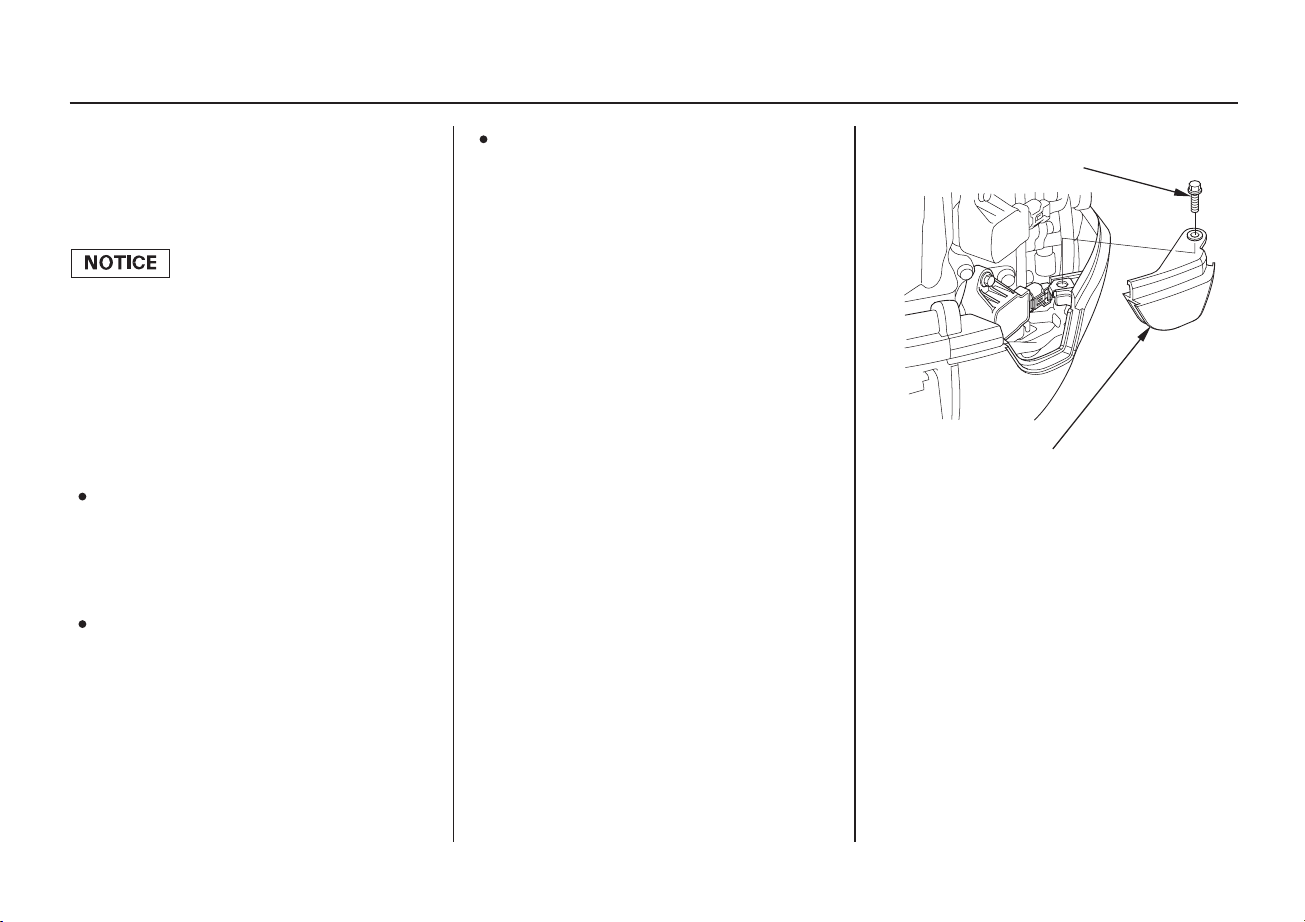
−
×
×
IZFR6K-11E (NGK)
92
Spark Plug Service
SERVICING YOUR OUTBOARD MOTOR
620mm
FLANGE SH BOLT
PLUG MAINTENANCE COVER
Incorrect spark plugs can cause
engine damage.
RECOMMENDED SPARK PLUGS:
Do not adjust the spark plug gap.
If the gap is out of specification,
replace the spark plug with a new
one.
Disconnect the battery negative
( ) terminal.
Unlock and remove the engine
cover (p. ).This outboard motor uses spark plugs
that have an iridium coated center
electrode. Be sure to observe the
following when servicing the spark
plugs.
Do not clean the spark plugs. If an
electrode is contaminated with
accumulated objects or dirt,
replace the spark plug with a new
one.
Use only a ‘‘wire-type feeler
gauge’’ to check the spark plug
gap if necessary. To prevent
damaging the iridium coating of
the center electrode, never use a
‘‘leaf-type feeler gauge.’’
Remove the 6 20 mm flange
SH bolt and remove the plug
maintenance cover.
1.
2.
3.
87
09/06/24 16:20:09 31ZY9610_093
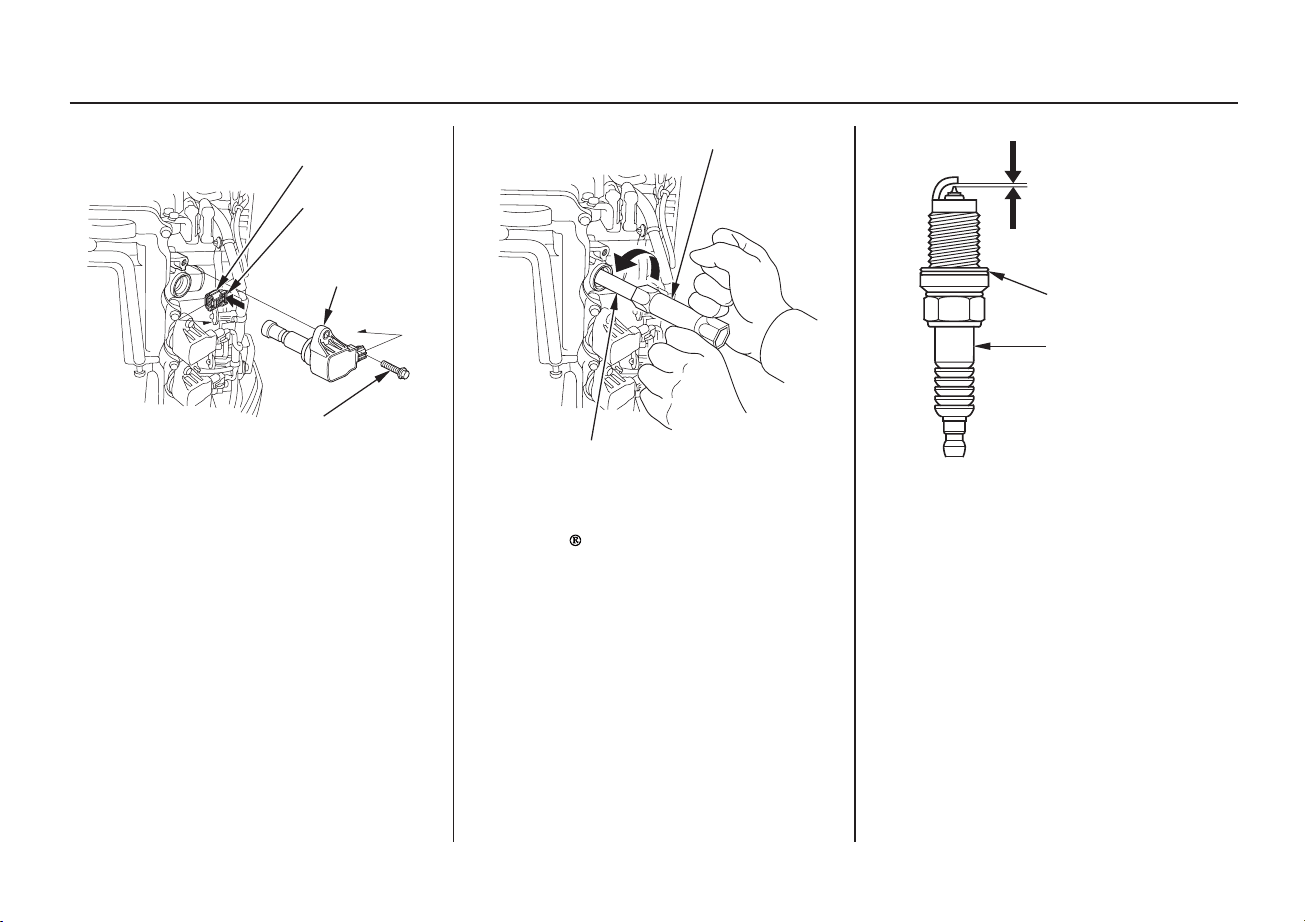
×
−
−
×
−
−
93
SERVICING YOUR OUTBOARD MOTOR
CONNECTOR
LOCK TAB
IGNITION
COIL
625mm
FLANGE BOLT
SEALING WASHER
INSULATOR
BOX WRENCH
PLUG WRENCH
0.039 0.043 in
(1.0 1.1 mm)
Remove the 6 25 mm flange
bolt.
Disconnect the connector by
pushing the lock tab and remove
the ignition coil.
Remove the spark plug using the
plug wrench, box wrench and the
Phillips /flat-tip screwdrivers
(accessories).
Inspect the spark plugs. Replace
them if the electrodes are worn, or
if the insulators are cracked or
chipped.
Measure the spark plug electrode
gap with a wire-type feeler gauge.
The gap should be 0.039 0.043
inches (1.0 1.1 mm). If the gap
is out of the specification, replace
the plug with a new one. Never try
to readjust the gap.
5. 6.
7.
4.
09/06/24 16:20:17 31ZY9610_094
−
×
94
SERVICING YOUR OUTBOARD MOTOR
Loose spark plugs can overheat
and damage the engine.
Overtightening the spark plugs
can damage the threads in the
cylinder head.
Install the spark plugs carefully,
by hand, to avoid cross-threading.
After each spark plug seats, tighten
with the spark plug wrench
supplied in the tool kit to compress
the sealing washer.
If reinstalling used spark plugs,
tighten 1/8 1/4 turn after the
spark plugs seat.
If installing new spark plugs,
tighten 1/2 turn after the spark
plugs seat.
Push the wire connector onto the
ignition coil. Make sure it locks in
place.
Repeat this procedure for the other
three spark plugs.
Reinstall the covers.
Install the ignition coil. Reinstall
the 6 25 mm flange bolt.
9.
8. 10.
11.
12.
13.
09/06/24 16:20:25 31ZY9610_095
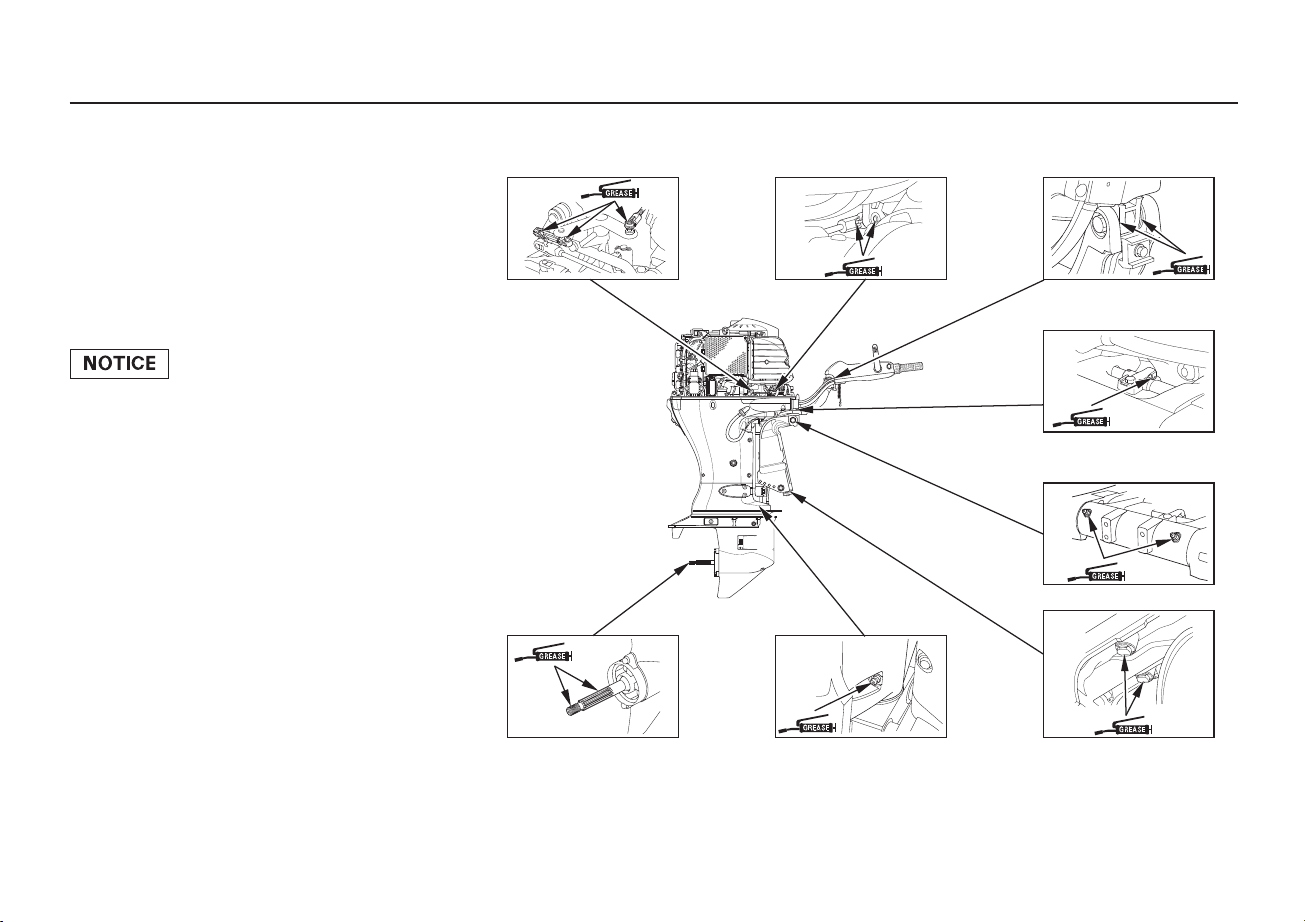
95
Lubrication Points
SERVICING YOUR OUTBOARD MOTOR
THROTTLE ARM/
LINK/PIVOT/PLATE
THROTTLE ROD/LINK
TILLER HANDLE
(LHT type)
TILT BRACKET
TILT SHAFT
THRUST RECEIVER
SWIVEL CASEPROPELLER SHAFT
Apply anticorrosion oil to pivot
surf aces where grease cannot penetrate.
Apply Honda Marine Corrosion Inhibitor (or equivalent) to all areas under the engine cover and any exposed metal
surfaces except the belts.
Lubrication interval:
After the first 20 hours or 1 month, then
every 100 hours or 6 months (refer to
the maintenance schedule on page ).
Apply Honda Marine waterproof grease
to the parts shown below:
84
09/06/24 16:20:36 31ZY9610_096
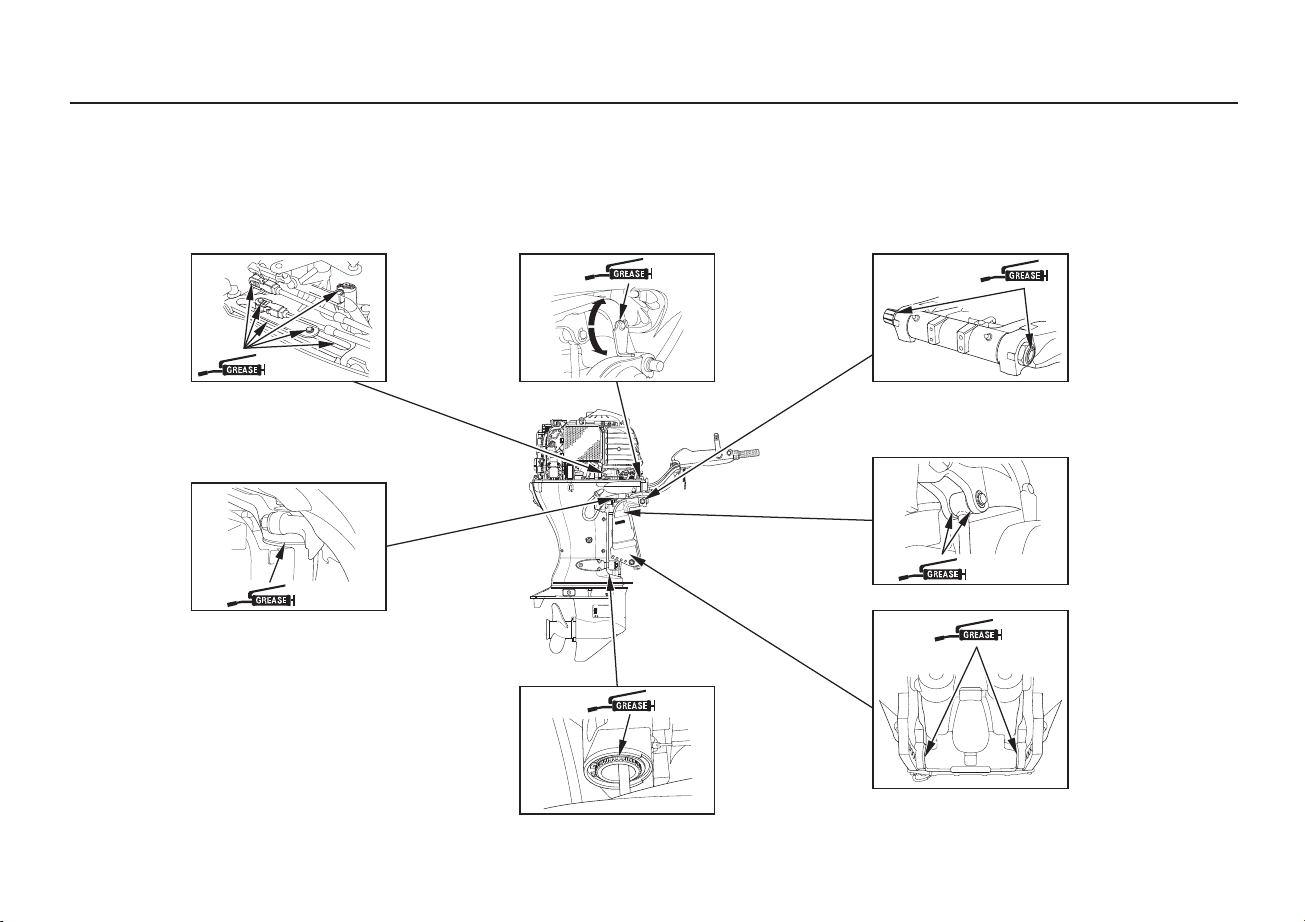
96
SERVICING YOUR OUTBOARD MOTOR
TILT LOCK LEVER
(each side)
TILT SHAFT THREAD
SWIVEL SHAFT
UPPER CYLINDER
PIN/BUSHING
LOWER CYLINDER
BUSHING/COLLAR
MOUNT FRAME
SHIFT LINK BRACKET/
SHIFT PIVOT/SHIFT ARM/
LINK PIN/PIVOT PLATE/
SLIDE PIVOT/
CLICK SPRING ROLLER
09/06/24 16:20:44 31ZY9610_097
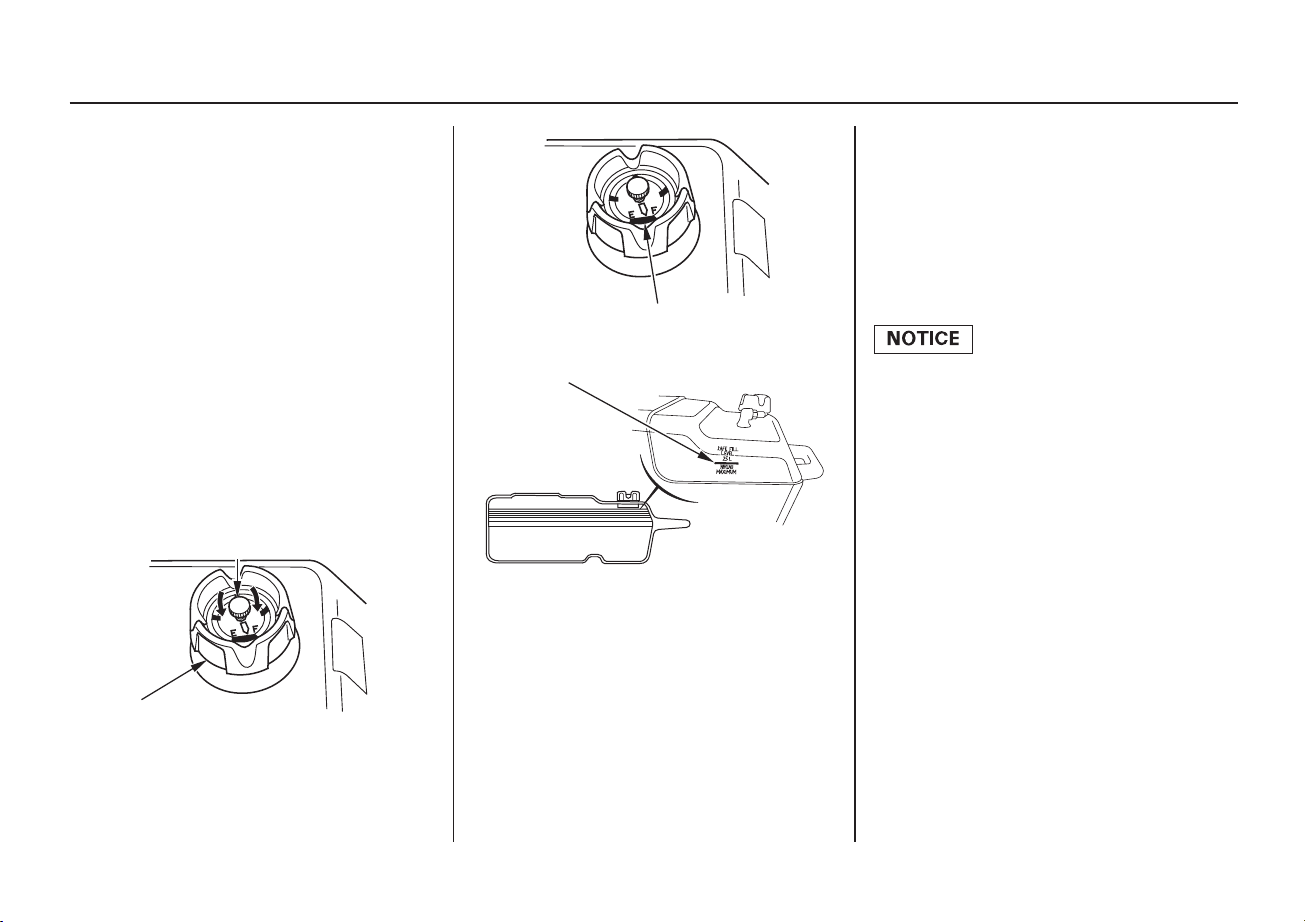
6.6 US gal (25 L)
97
REFUELING
Portable Fuel Tank
Using the fuel tank mounted in
the boat.
[standard equipment (LHTC
type)]
[optional equipment (other
types)]
SERVICING YOUR OUTBOARD MOTOR
VENT KNOB
CCLLOOSSEE
OOPPEENN
FUEL FILLER CAP
FUEL GAUGE
SAFE FILL LEVEL
Fuel can damage paint and plastic.
Be caref ul not to spill f uel when
f illing your f uel tank. Damage
caused by spilled f uel is not covered
under warranty.
After refueling, install the cap and
tighten it securely. Turn the vent
knob clockwise to the CLOSED
position, and return the fuel tank to
the boat.
Refuel in a well-ventilated area. Fill
the tank to the SAFE FILL LEVEL
line.
To refuel, turn the vent knob
counterclockwise to the OPEN
position, and unscrew the fuel filler
cap.
Check the fuel level and refill if
necessary. Do not fill the fuel tank
above the UPPER LIMIT. Refer to
the boat manufacturer’s instructions.
FUEL TANK CAPACITY:
Remove the fuel tank from the boat
for refueling.
Check the fuel gauge and refill the
tank when necessary.
09/06/24 16:20:55 31ZY9610_098
Gasoline is highly
flammable and explosive.
You can be burned or
seriously injured when
handling fuel.
Stop the engine and keep
heat, sparks, and flame
away.
Handle fuel only
outdoors.
Wipe up spills
immediately.
98
FUEL RECOMMENDATIONS
Use unleaded gasoline with a pump
octane rating of 86 or higher.
SERVICING YOUR OUTBOARD MOTOR
Never refill the fuel tank inside a
building where gasoline fumes may
reach flames or sparks. Keep
gasoline away from appliance pilot
lights, barbecues, electric appliances,
power tools, etc.
Spilled fuel is not only a fire hazard,
it causes environmental damage.
Wipe up spills immediately.
Your outboard motor is certified to
operate on unleaded gasoline.
Unleaded gasoline produces fewer
engine and spark plug deposits and
extends exhaust system life.
Never use stale or contaminated
gasoline or an oil/gasoline mixture.
Avoid getting dirt or water in the fuel
tank.
You may use unleaded gasoline
containing no more than 10% ethanol
(E10) or 5% methanol by volume. In
addition, methanol must contain
cosolvents and corrosion inhibitors.
Use of fuels with content of ethanol
or methanol greater than shown
above may cause starting and/or
performance problems. It may also
damage metal, rubber, and plastic
parts of the fuel system.
09/06/24 16:21:05 31ZY9610_099
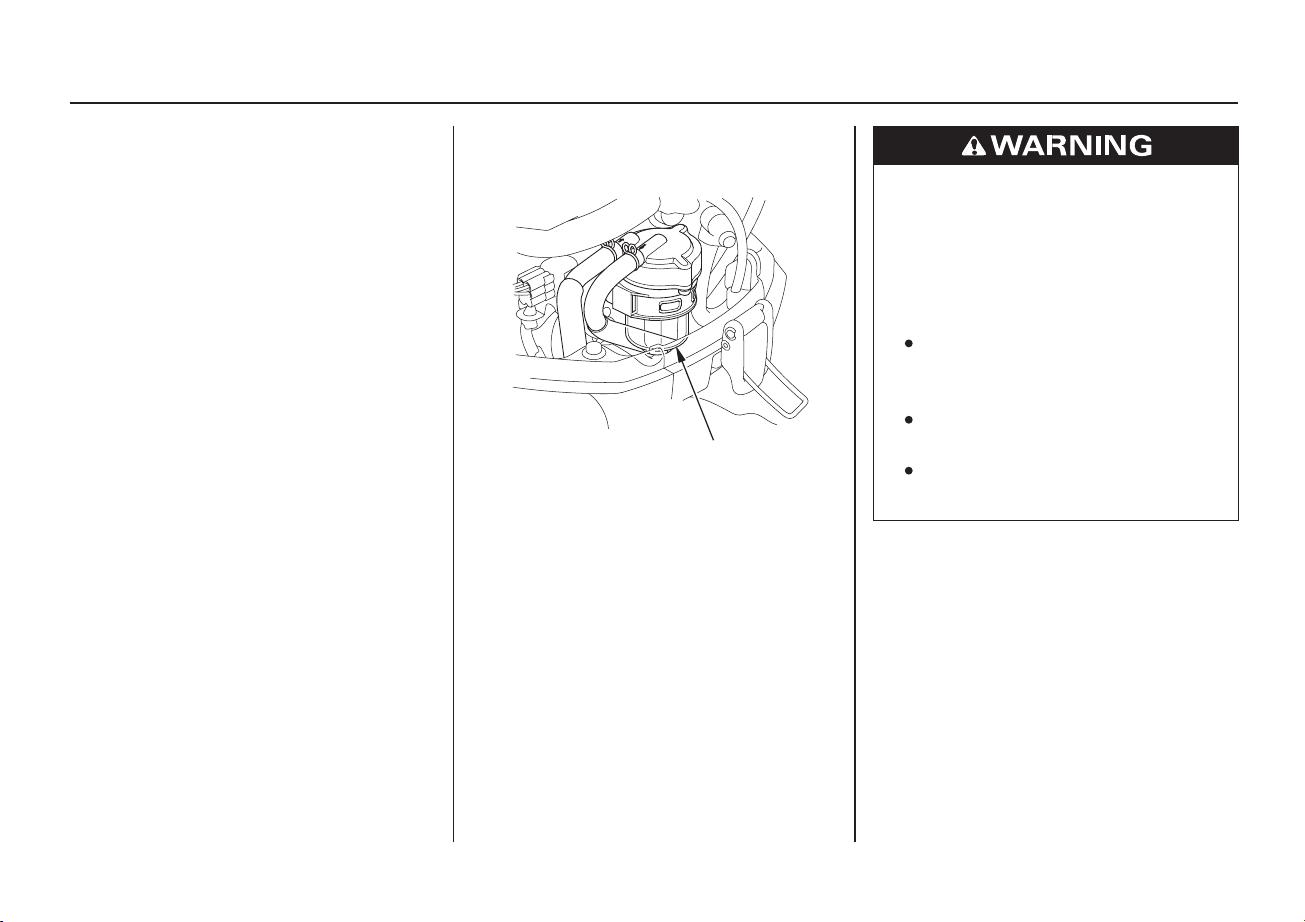
Gasoline is highly
flammable and explosive.
You can be burned or
seriously injured when
handling fuel.
Stop the engine and keep
heat, sparks, and flame
away.
Handle fuel only
outdoors.
Wipe up spills
immediately.
99
Water Separator Inspection and
Service
SERVICING YOUR OUTBOARD MOTOR
WATER SEPARATOR
Remove the engine cover (p. ).
Remove the separator assembly. If
it is difficult to remove the
separator assembly by yourself,
consult an authorized Honda
Marine dealer.
Water separator is located near the
engine cover latch on the boat side.
Water accumulation in the water
separator can cause loss of power or
hard starting. Check the water
separator periodically. Clean it or
consult with an authorized Honda
outboard motor dealer for cleaning.
Engine damage or performance
problems that result from using a fuel
with percentages of ethanol or
methanol greater than shown above
are not covered under warranty.
If your outboard will be used on an
infrequent or intermittent basis,
please refer to the fuel section of the
STORAGE chapter (p. ) for
additional information regarding fuel
deterioration.
1.
2.
110
87
09/06/24 16:21:14 31ZY9610_100
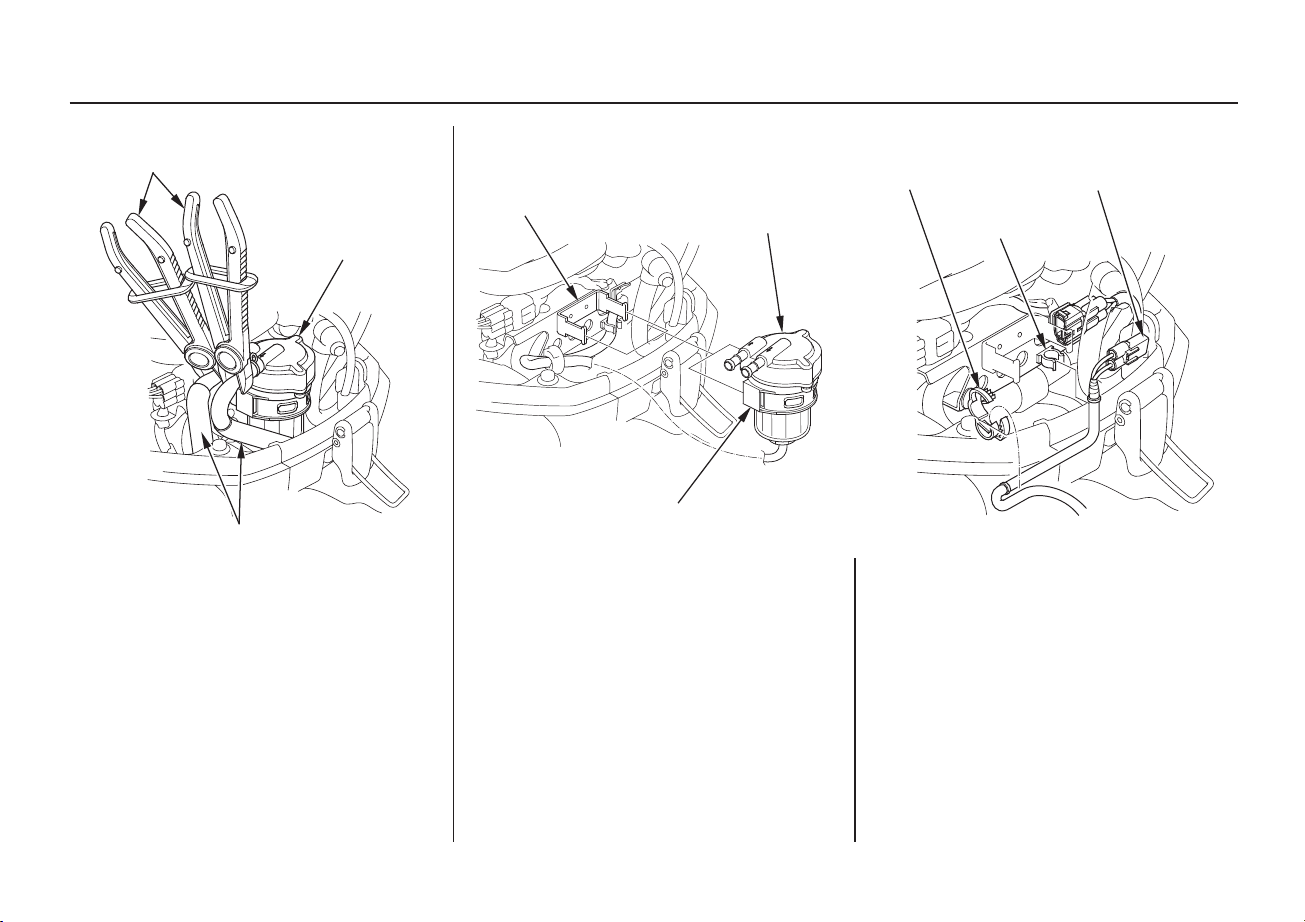
100
SERVICING YOUR OUTBOARD MOTOR
HOSE CLIPS
(commercially available)
WATER
SEPARATOR
FUEL HOSES
WATER
SEPARATOR
BRACKET
SUSPENSION STRAP
WATER
SEPARATOR
HARNESS
CLIP
WATER LEVEL SENSOR
2P CONNECTOR
CLIP C
Pinch the fuel hoses with hose
clips to prevent fuel leakage.
Remove the suspension strap from
the water separator bracket; then
remove the strap from the
separator assembly.
During removal of the separator
assembly, take care not to damage
the wire harness with the separator
bracket.
Disconnect the fuel hoses from the
water separator.
Open the harness clip and remove
the harness from clip C; then
disconnect the water level sensor
2P connector.
3. 4. 5.
6.
09/06/24 16:21:22 31ZY9610_101
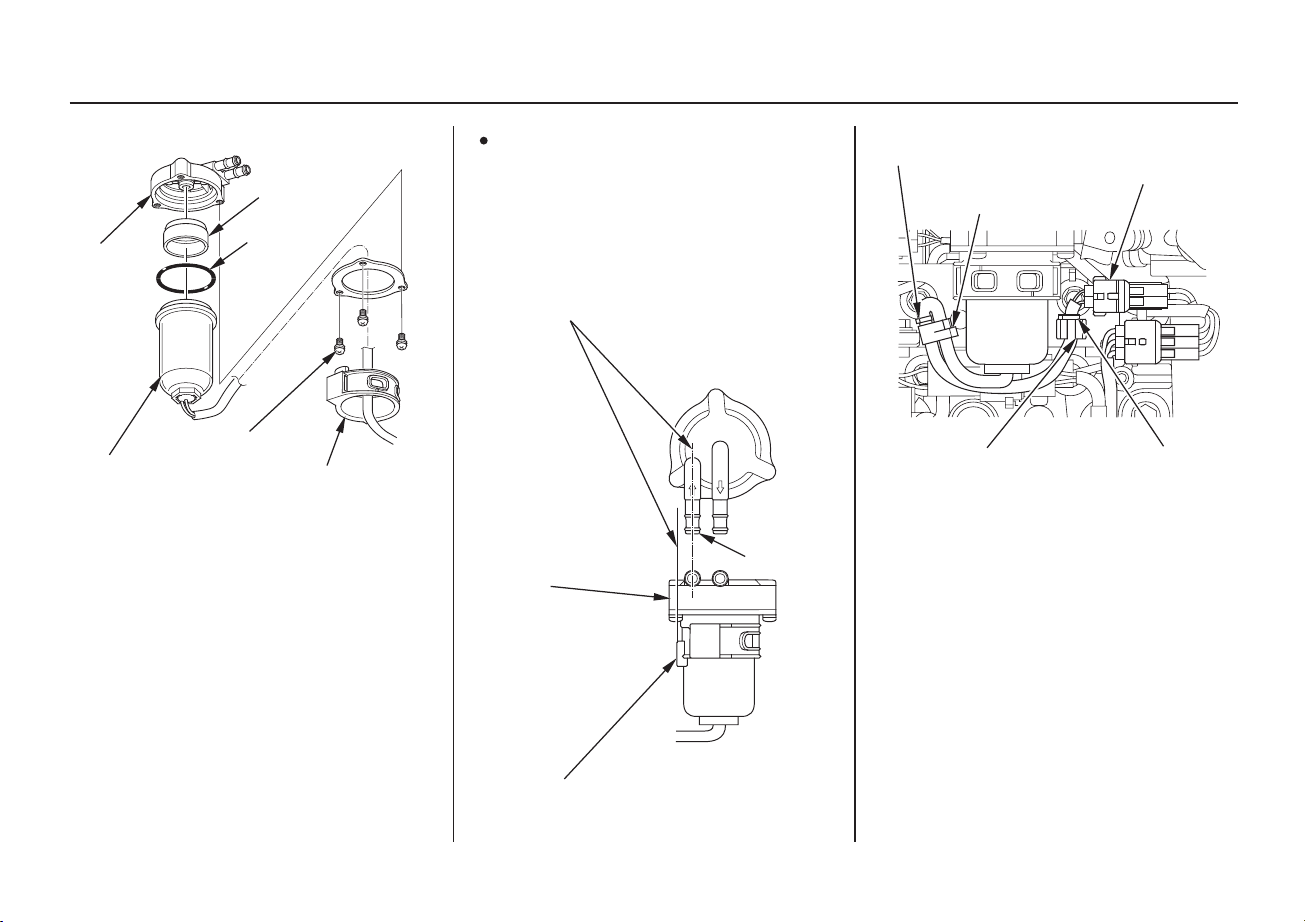
2.5 lbf·ft (3.4 N·m , 0.35 kgf·m)
101
SERVICING YOUR OUTBOARD MOTOR
BODY
O-RING
SCREW (3)
SUSPENSION
STRAP
BAFFLE
PLATE
WATER
SEPARATOR CUP
Assemble so the flat part of the
suspension and the water separator joint
are parallel to each other.
JOINT
WATER
SEPARATOR
FLAT PART ON BACK
OF SUSPENSION
POSITIONING
BAND
HARNESS
CLIP
WATER LEVEL
SENSOR 2P
CONNECTOR
CLIP C
POSITIONING
BAND
Connect the water level sensor 2P
connector. Install the harness to
clip C and the harness clip.
Align the positioning bands on the
harness with the end of clip C and
the harness clip as shown above.
Reinstall the water separator in the
reverse order of removal.
Assemble so the flat part on the
back of the suspension is parallel
to the water separator joint as
shown below.
Reassemble the water separator
body, baffle plate, O-ring and the
cup.
TIGHTENING TORQUE:
Thoroughly clean the water
separator cup.
Remove the three screws and
separate the water separator cup
from the body.
7.
8.
9.
10.
11.
09/06/24 16:21:32 31ZY9610_102
Gasoline is highly
flammable and explosive.
You can be burned or
seriously injured when
handling fuel.
Stop the engine and keep
heat, sparks, and flame
away.
Handle fuel only
outdoors.
Wipe up spills
immediately.
102
Fuel Filter Inspection and
Replacement
SERVICING YOUR OUTBOARD MOTOR
Water or sediment accumulation in
the filter can cause loss of power or
hard starting. To prevent engine
malfunction, inspect the filter and
replace when necessary.
The fuel filter (inside the strainer
cup) is located between the fuel
pump and the water separator.
Squeeze and release the priming
bulb to fill the vapor separator, and
check for leaks.
If the buzzer sounds or excessive
water or sediment accumulation are
found in the fuel filter, inspect the
fuel tank.
Clean the fuel tank and tank filter if
necessary. It may be necessary to
drain the fuel tank completely and
refill with fresh gasoline.
12.
09/06/24 16:21:40 31ZY9610_103
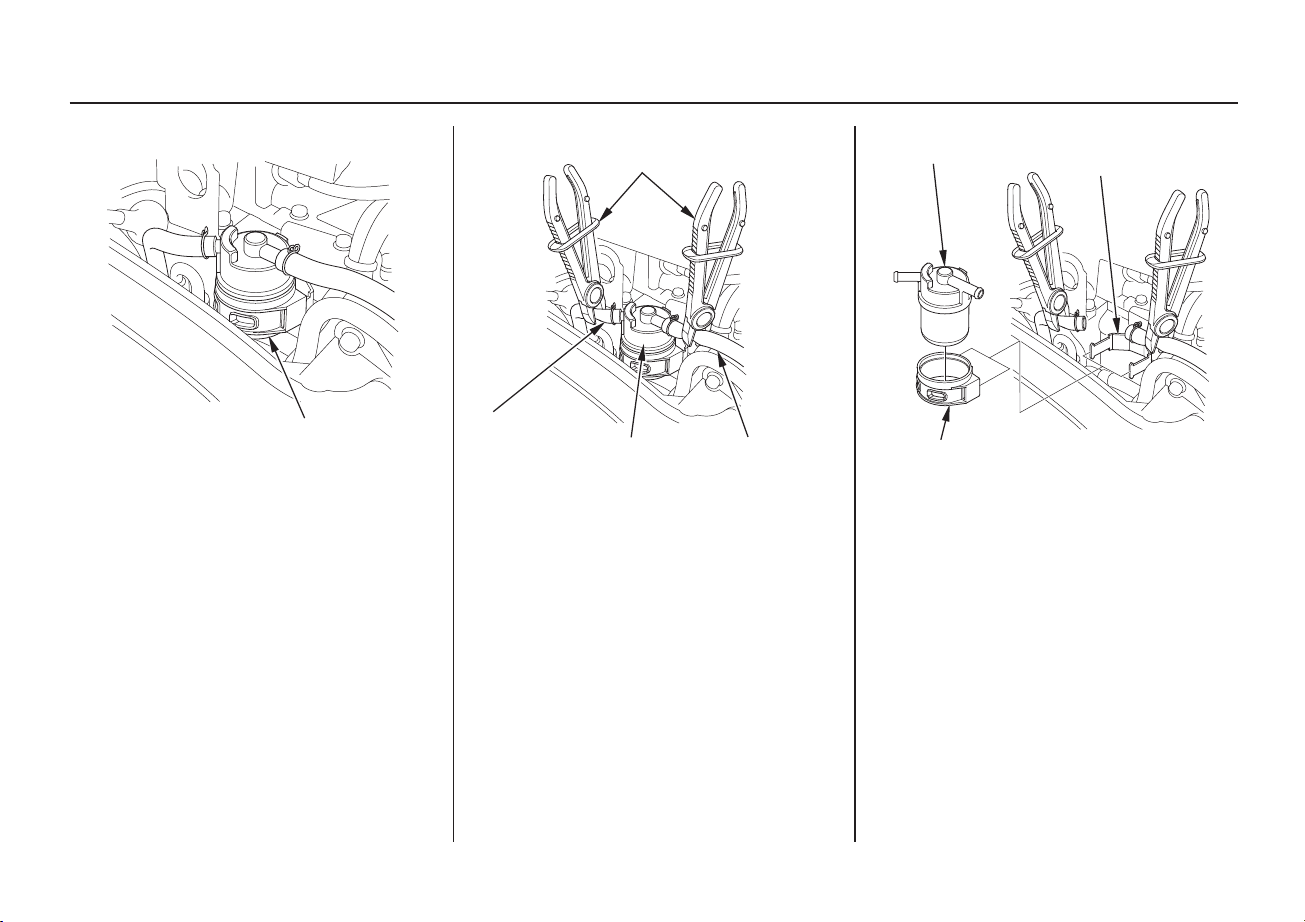
103
SERVICING YOUR OUTBOARD MOTOR
FUEL FILTER
(inside strainer cup)
HOSE CLIPS
(commercially available)
FUEL
HOSE
FUEL FILTER
FUEL HOSE
FUEL FILTER
STRAINER
BRACKET
SUSPENSION STRAP
Remove the engine cover (see
page ).
Looking through the translucent
strainer cup, check the fuel filter
for water accumulation and
clogging.
If necessary, replace the fuel filter
with a new one.
Before removing the fuel filter, to
prevent fuel leakage, place fuel
hose clips on the fuel hoses on
each side of the fuel filter.
Remove the fuel filter assembly
from the strainer bracket. If it is
difficult to remove the fuel filter
assembly by yourself, consult an
authorized Honda Marine dealer.
Disconnect the fuel hoses from the
fuel filter.
Remove the fuel filter from the
suspension strap.
3.
2.
1. 4.
5.
87
6.
09/06/24 16:21:49 31ZY9610_104
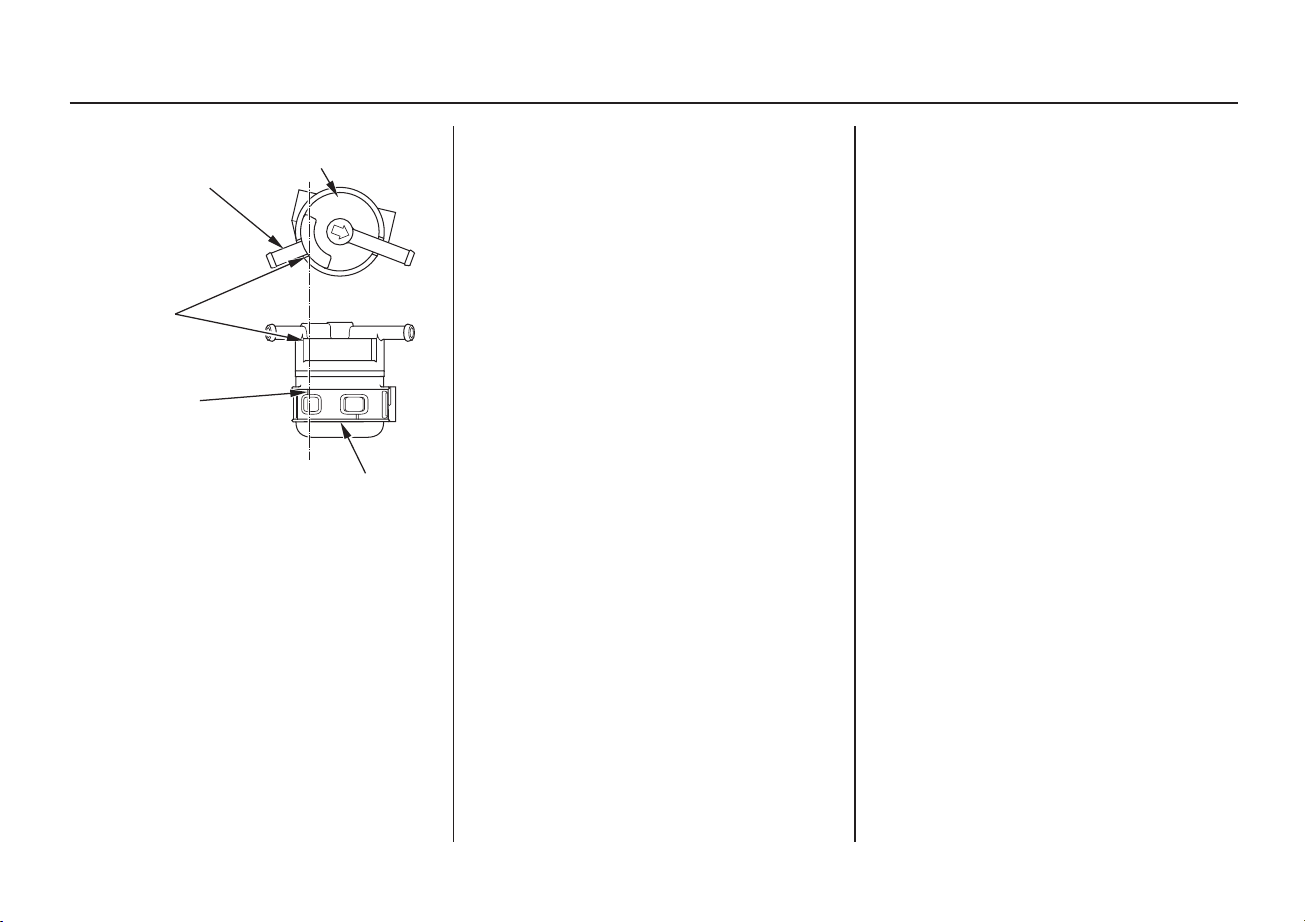
104
SERVICING YOUR OUTBOARD MOTOR
FUEL INTAKE
SIDE JOINT
EDGE AT
THE BASE
OF JOINT
ALIGNMENT
MARK ON THE
SUSPENSION
SUSPENSION STRAP
FUEL FILTER
(inside strainer cup)
Prime the engine using the priming
bulb (refer to page ). Check for
fuel leaks.
Repair any fuel leaks if necessary.
Install a new fuel filter. Assemble
the fuel filter by aligning the edge
at the base of the fuel intake side
joint of the fuel filter with the
alignment mark on the suspension
as shown above.
Install the engine cover.
If loss of power or hard starting are
found to be caused by excessive
water or sediment accumulation in
the fuel filter, inspect the fuel tank.
Clean the fuel tank and tank filter if
necessary. It may be necessary to
drain the fuel tank completely and
refill with fresh gasoline.
Connect the fuel hoses to the fuel
filter.
Install the fuel filter assembly into
the strainer bracket.
7.
8.
9.
54
10.
11.
09/06/24 16:21:56 31ZY9610_105
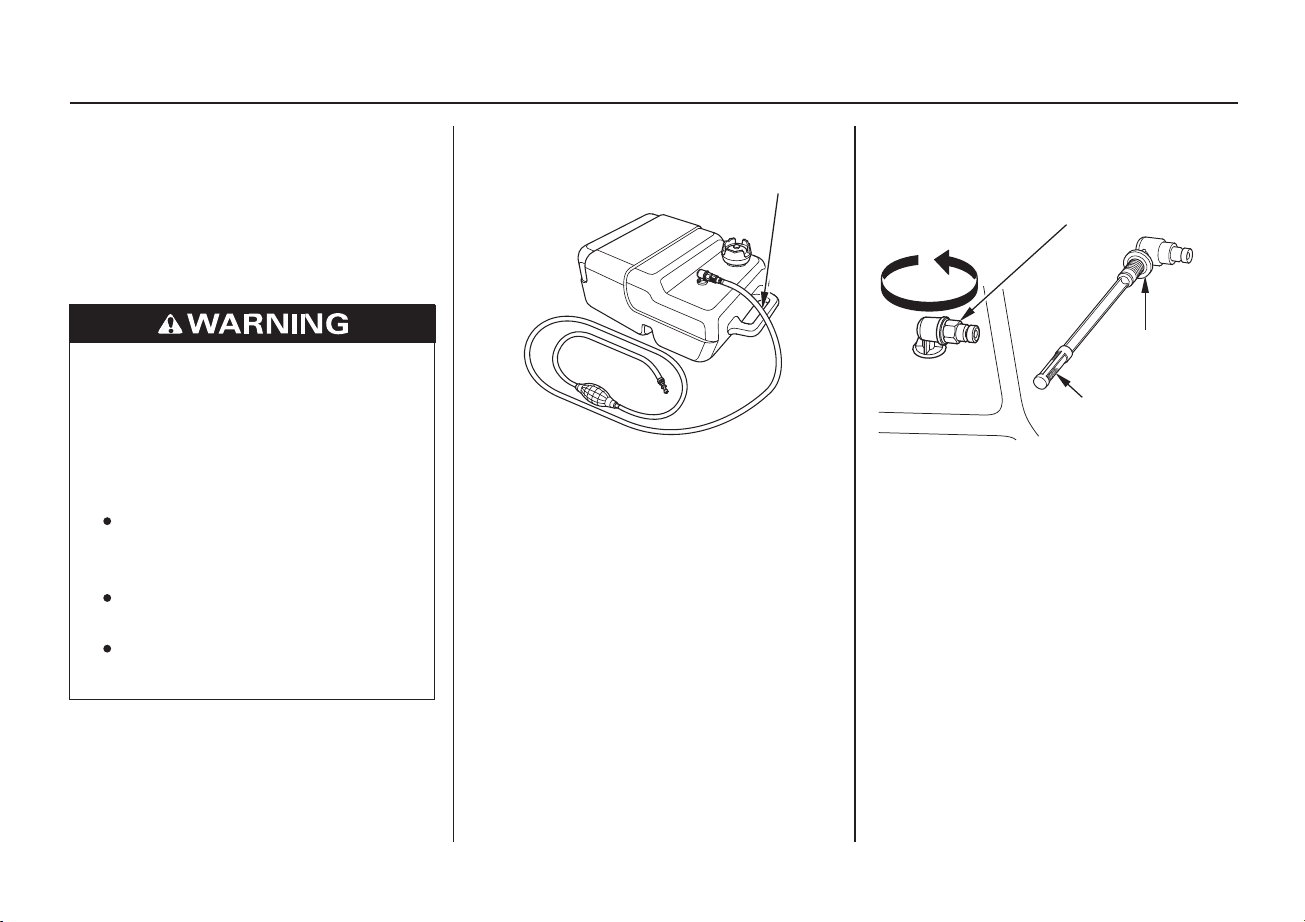
Wipe up spills
immediately.
Handle fuel only
outdoors.
Stop the engine and keep
heat, sparks, and flame
away.
You can be burned or
seriously injured when
handling fuel.
Gasoline is highly
flammable and explosive.
105
Portable Fuel Tank and Tank
Filter Cleaning
[standard equipment (LHTC
type)]
[optional equipment (other
types)]
SERVICING YOUR OUTBOARD MOTOR
FUEL HOSE
FUEL FILTER JOINT
(Fuel Hose Connector)
CONNECTOR
O-RING
FUEL TANK
FILTER
Fuel Tank Fuel Tank Filter
Empty the portable fuel tank into an
approved gasoline container. Use a
funnel to avoid spilling fuel. Rinse
the fuel tank with nonflammable
solvent to remove any accumulated
sediment.
Unscrew the fuel hose connector
by turning it counterclockwise;
then remove the fuel hose
connector and fuel tank filter from
the tank.
Clean the filter in nonflammable
solvent. Inspect the fuel tank filter
and the connector O-ring. Replace
them if damaged.
Reinstall the filter and hose
connector in the fuel tank. Tighten
the hose connector securely.
1.
2.
3.
09/06/24 16:22:09 31ZY9610_106
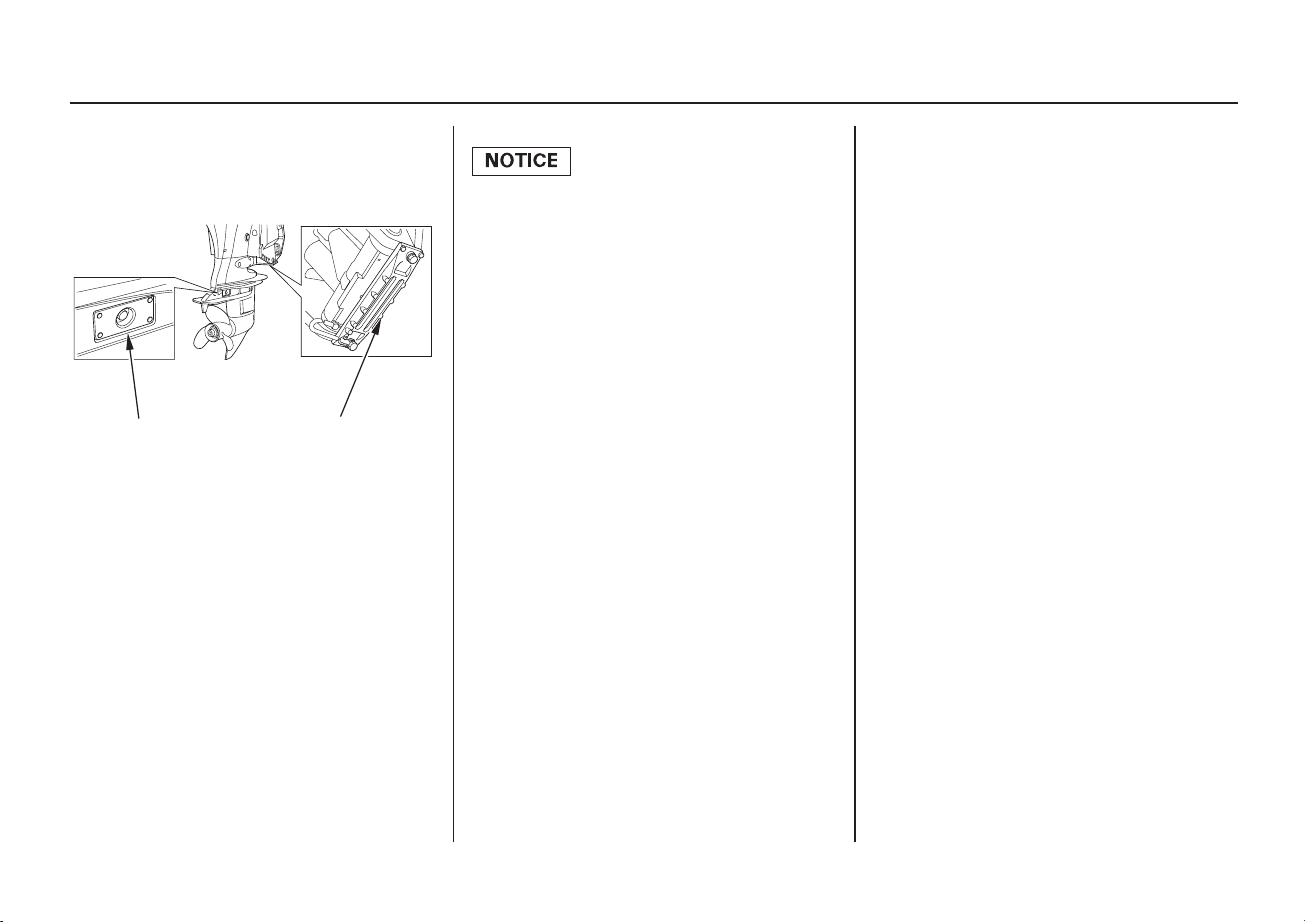
106
Anode Replacement Propeller Replacement
SERVICING YOUR OUTBOARD MOTOR
ANODE
(each side)
ANODE
(stern bracket)
Removal
Painting or coating the anodes will
def eat their purpose and will lead to
rust and corrosion damage to the
outboard motor. The anodes must be
exposed to the water in order to
protect the outboard motor.
Before replacing the propeller,
remove the emergency stop switch
clip from the emergency stop switch
to prevent any possibility of the
engine being started while you are
working with the propeller.
The propeller blades may have sharp
edges, so wear heavy gloves to
protect your hands.
Inspect the propeller shaft for any
fishing line or debris.
Operating the outboard motor at
higher altitudes will reduce available
power. This may require decreasing
the propeller pitch to maintain correct
engine RPM.
The anodes are located on each side
of the gear case and on the stern
bracket. They are made of a
sacrificial material that helps to
protect the outboard motor from
corrosion.
Replace the anodes when they have
been reduced to about half their
original size, or if they are crumbling.
Remove the cotter pin, unscrew
the castle nut, remove the 18.5 mm
washer, and then remove the
propeller and thrust washer.
1.
2.
09/06/24 16:22:18 31ZY9610_107
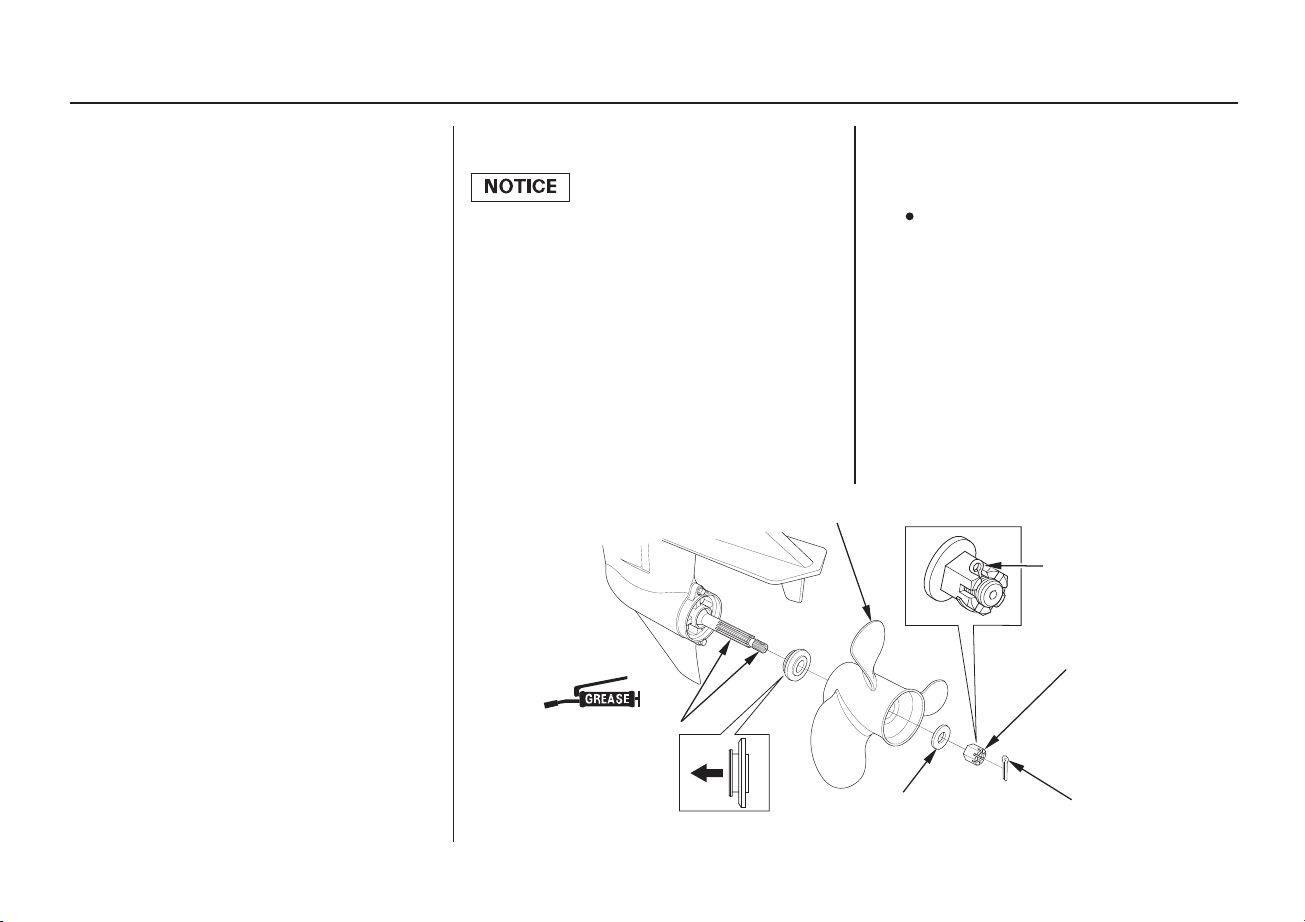
33 lbf·ft (44 N·m, 4.5 kgf·m)
0.7 lbf·ft (1 N·m, 0.1 kgf·m)
107
SERVICING YOUR OUTBOARD MOTOR
MARINE GREASE
PROPELLER (optional equipment)
THRUST WASHER
18.5 mm
WASHER
COTTER PIN
CASTLE NUT
COTTER PIN
Installation
Do not tighten the castle nut above
the TIGHTENING TORQUE LIMIT,
or the propeller and shaf t may be
damaged.
TIGHTENING TORQUE LIMIT:
Apply marine grade grease to the
propeller shaft.
Install the thrust washer with the
grooved side toward the gear case.
Install the propeller.
Lightly tighten the castle nut by
hand or wrench until the propeller
has no free play.
Tighten the castle nut using a
torque wrench.
Then, using a torque wrench,
tighten the castle nut until the first
available groove in the castle nut
aligns with the cotter pin hole. Do
not tighten past the first alignment
of the castle nut groove and the
cotter pin hole. Be sure to replace the cotter pin
with a new one.
Use a Honda Genuine stainless
steel cotter pin or equivalent
cotter pin and bend the pin ends
as shown.
Note that these wrenches are not
included with the tool set that comes
with the outboard motor. Contact
your authorized Honda Marine dealer
for additional tool information.
Install the 18.5 mm washer.
1.
2.
3.
4.
5.
8.
6.
7.
CASTLE NUT TIGHTENING
TORQUE:
09/06/24 16:22:29 31ZY9610_108
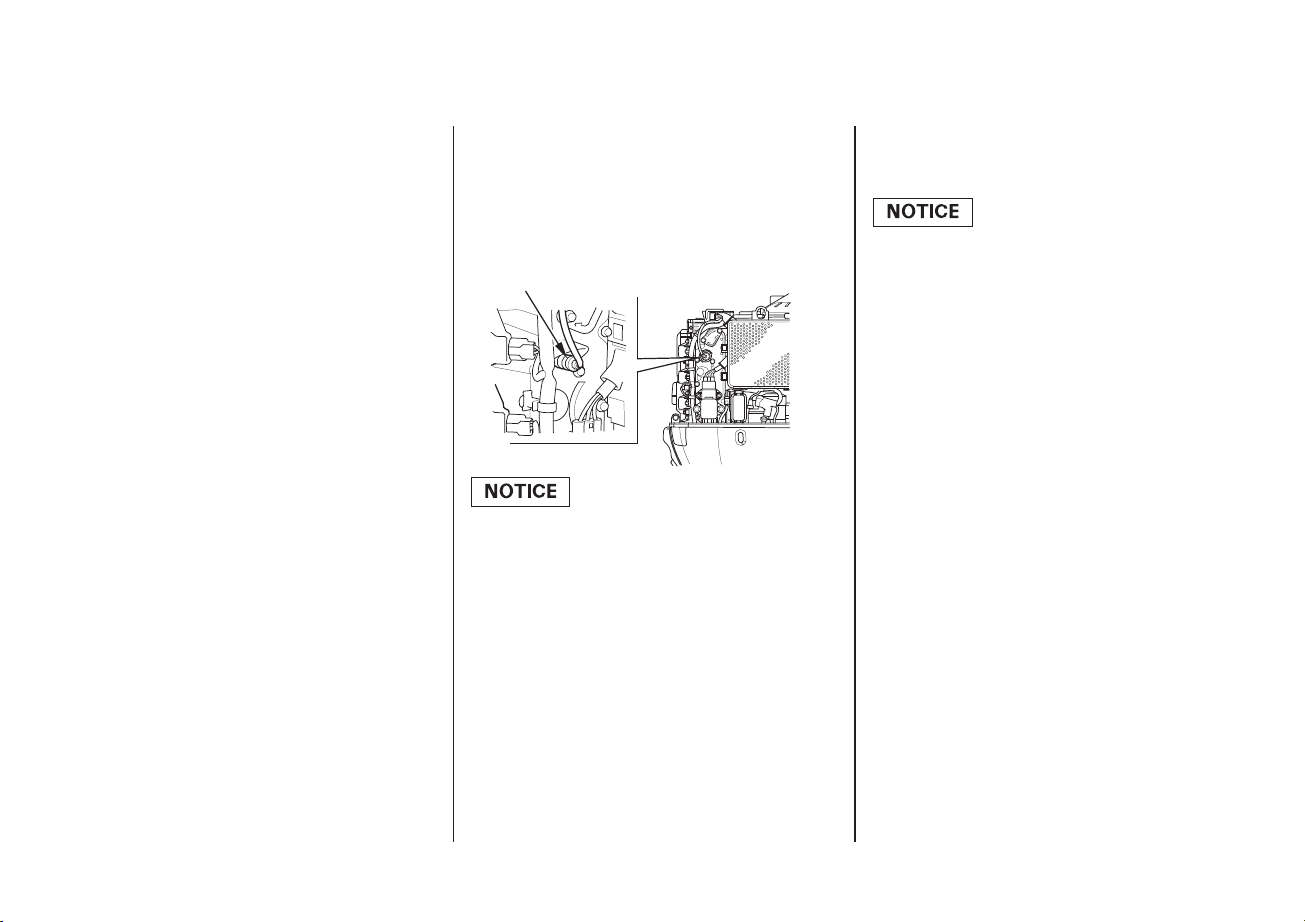
108
STORAGE PREPARATION
Cleaning and Flushing
STORAGE
HO2 SENSOR
Cleaning Flushing With a Garden Hose
(commercially available)
Do not run the motor when f lushing
the motor with a garden hose or the
motor may be damaged.
Do not apply water or corrosion
inhibitor directly to the electrical
components under the engine cover,
such as the HO2 sensor. If water or
corrosion inhibitor penetrates these
components, they may be damaged.
Bef ore applying a corrosion
inhibitor, cover the HO2 sensor with
a protective material to prevent
damage.
Proper storage preparation is
essential for keeping your outboard
motor trouble-free and looking good.
The following steps will help to keep
rust and corrosion from impairing
your outboard motor’s function and
appearance, and will make the engine
easier to start when you use the
outboard motor again.
Thoroughly clean and flush the
outboard motor with fresh water after
operation in dirty water or salt water.
Touch up any damaged paint, and
coat areas that may rust with Honda
Corrosion Inhibitor, or equivalent.
Lubricate controls with a silicone
spray lubricant.
Wash the outside of the outboard
motor with clean, fresh water, and
flush the cooling system as follows.
For safety, remove the emergency
stop switch clip so the engine cannot
be started while you are standing near
the propeller.
09/06/24 16:22:38 31ZY9610_109
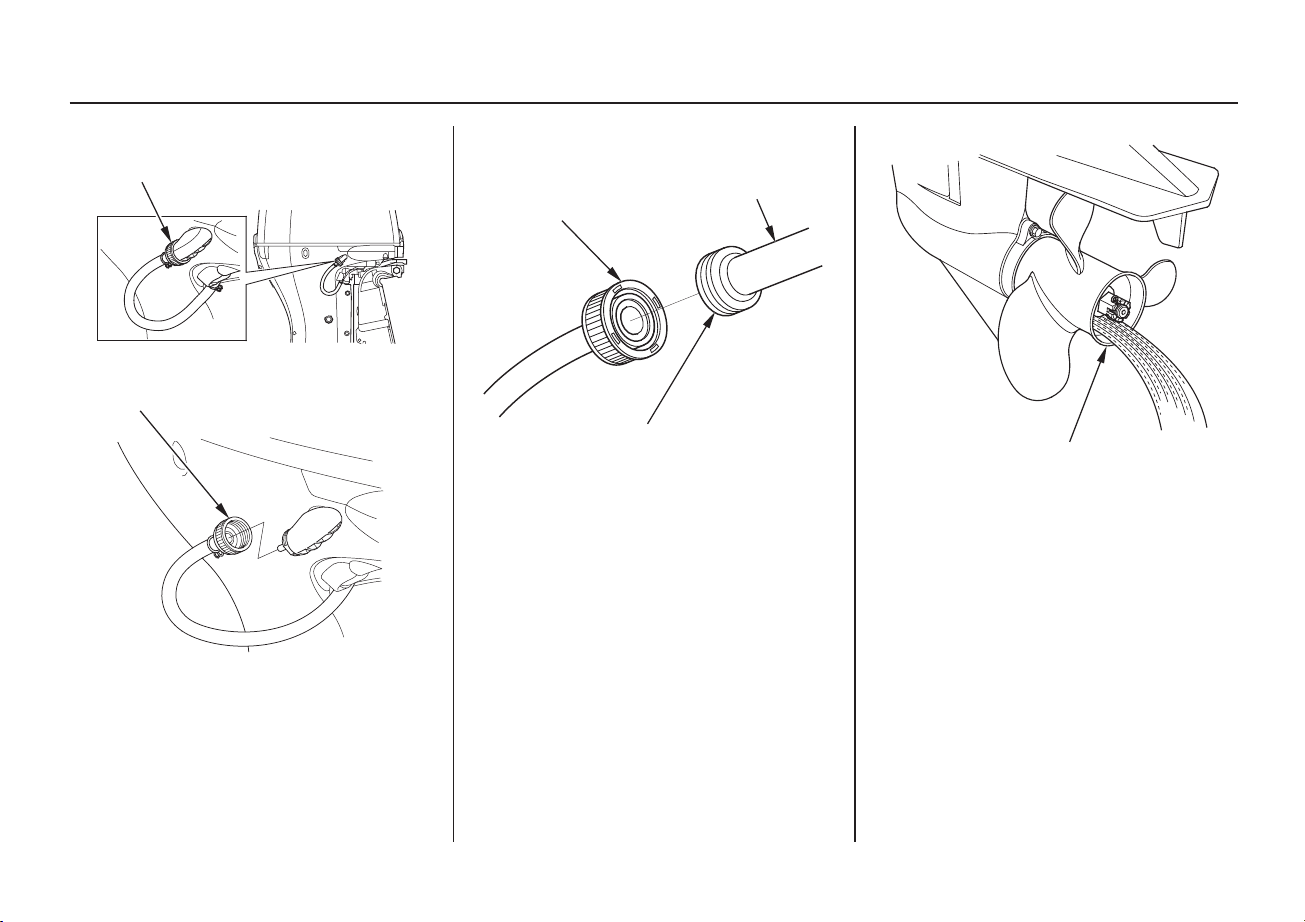
109
STORAGE
FLUSH PORT
CONNECTOR
FLUSH PORT
CONNECTOR
FLUSH PORT
CONNECTOR
GARDEN HOSE
EXHAUST PORT
GARDEN HOSE JOINT
(commercially available)
Turn on the fresh water supply and
flush the outboard motor for at
least 10 minutes.
After flushing, disconnect the
garden hose and reconnect the
flush port connector.
Screw the flush port connector
onto the garden hose.
Disconnect the flush port
connector.
2. 3.
4.
1.
09/06/24 16:22:45 31ZY9610_110

110
Fuel
STORAGE
Draining the Fuel System
Adding a Fuel Stabilizer
Distributor’s Limited Warranty
The length of time that gasoline can
be left in your fuel tank and vapor
separator without causing functional
problems will vary with such factors
as gasoline blend, your storage
temperatures, and whether the fuel
tank is partially or completely filled.
The air in a partially filled fuel tank
promotes fuel deterioration. Very
warm storage temperatures accelerate
fuel deterioration. Fuel deterioration
problems may occur within a few
months, or even less if the gasoline
was not fresh when you filled the
fuel tank.
You can avoid fuel deterioration
problems by draining the fuel tank
and vapor separator.
After adding a fuel stabilizer, run
the engine in water for 10 minutes
to be sure that the treated gasoline
has replaced the untreated gasoline
in the vapor separator.
Turn the engine OFF.
Gasoline will oxidize and deteriorate
in storage. Old gasoline will cause
hard starting, and it leaves gum
deposits that clog the fuel system. If
the gasoline in your fuel tank and
vapor separator deteriorates during
storage, you may need to have the
vapor separator and other fuel system
components serviced or replaced.
Add fuel stabilizer following the
manufacturer’s instructions.
Drain the vapor separator before
adding fuel stabilizer.
When adding a fuel stabilizer, fill the
fuel tank with fresh gasoline. If only
partially filled, air in the tank will
promote fuel deterioration during
storage. If you keep an additional
container of gasoline for refueling,
be sure that it contains only fresh
gasoline.
The
does not cover fuel system damage
or engine performance problems
resulting from neglected storage
preparation.
You can extend fuel storage life by
adding a gasoline stabilizer that is
formulated for that purpose, or you
can avoid fuel deterioration problems
by draining all the fuel from the fuel
tank and carburetor.
Remove the engine cover (p. ).
2.
3.
1.
4.
1. 87
09/06/24 16:22:55 31ZY9610_111
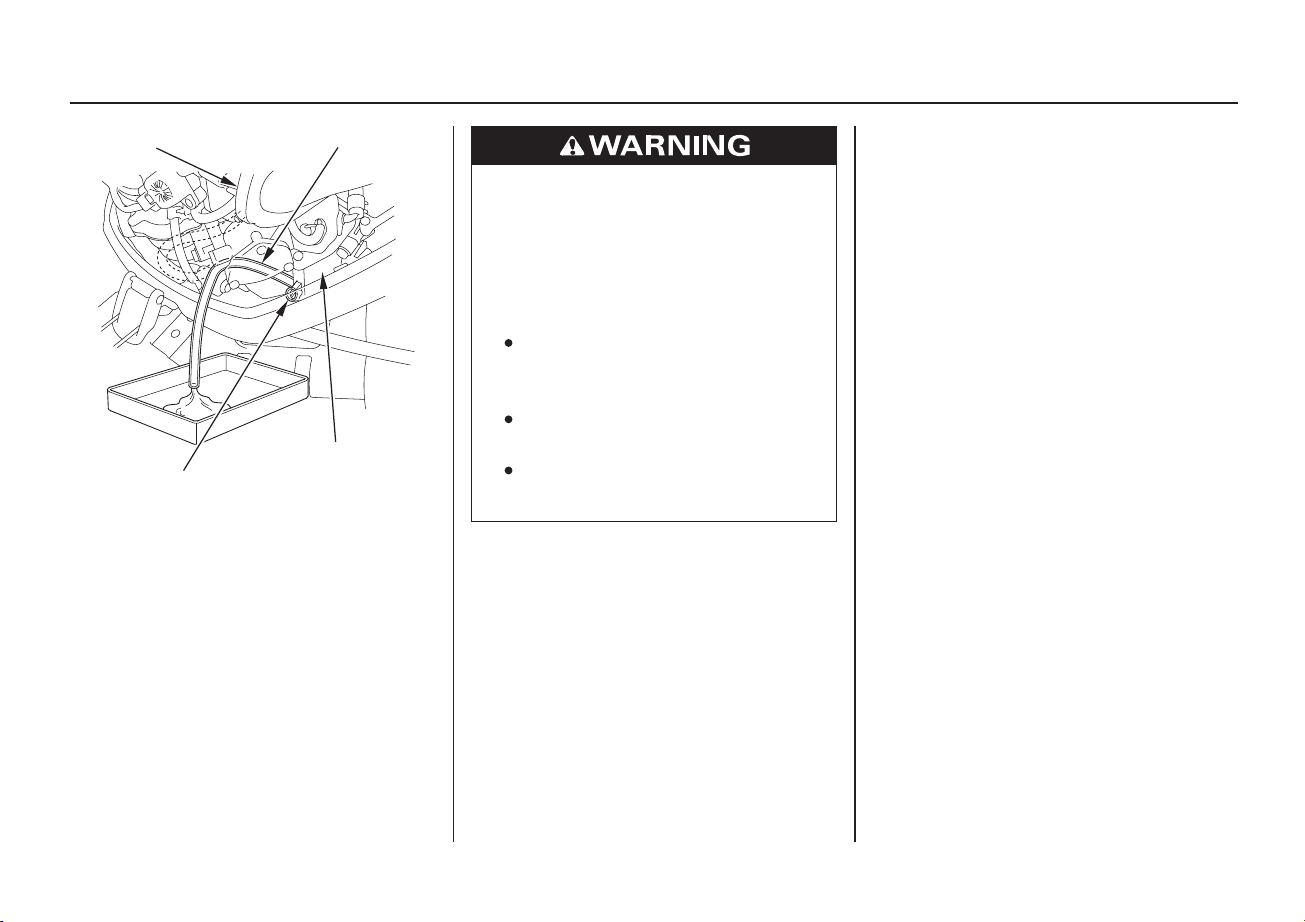
Gasoline is highly
flammable and explosive.
You can be burned or
seriously injured when
handling fuel.
Stop the engine and keep
heat, sparks, and flame
away.
Handle fuel only
outdoors.
Wipe up spills
immediately.
111
STORAGE
INTAKE MANIFOLD DRAIN TUBE
VAPOR SEPARATOR
VAPOR SEPARATOR
DRAIN SCREW
Tilt the outboard motor up all the
way. Leave the outboard motor
tilted up until the gasoline stops
flowing.
After thoroughly draining, tighten
the drain screw securely and return
the outboard motor to the vertical
position.
Secure the drain tube to the
projection of the intake manifold.
Drain the fuel tank into an
approved gasoline container or, if
you need to store fuel in the fuel
tank, you can extend fuel storage
life by filling the fuel tank with
fresh gasoline and adding a fuel
stabilizer that is formulated for
that purpose.Place an approved gasoline
container below the fuel drain
outlet, and use a funnel to avoid
spilling fuel.
Release the drain tube from the
projection of the intake manifold
and set the end of the tube toward
the outside of the engine undercase.
Loosen the vapor separator drain
screw.
4.
5.
6.
7.
2.
3.
09/06/24 16:23:05 31ZY9610_112
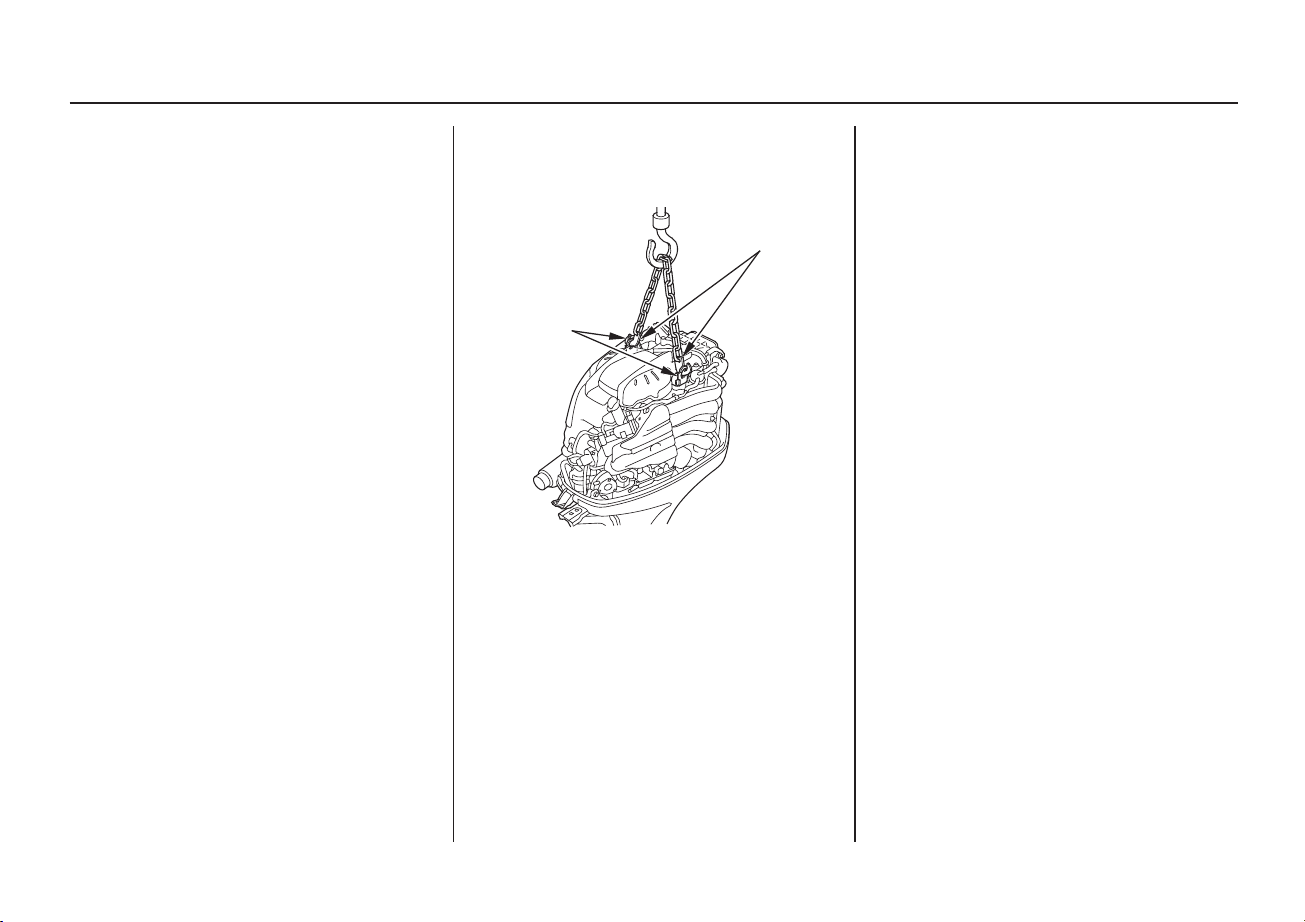
−
−−
112
STORAGE PRECAUTIONS
HOISTING THE OUTBOARD
MOTOR
Engine Oil
STORAGE
HOIST
HOOKS
ENGINE
HANGERS
After the outboard motor is placed
in storage and disconnected from
the hoist, install the engine cover.
Select a well-ventilated storage area.
If possible, avoid storage areas with
high humidity.
If storing a container of gasoline,
store it away from any appliance that
operates with a flame, such as a
furnace, water heater, or clothes
dryer. Also avoid any area with a
spark producing electric motor, or
where power tools are operated.
Change the engine oil and the oil
filter (p. ).
Remove the spark plugs (p. ),
and remove the emergency stop
switch clip from the emergency
stop switch.
Disconnect the outboard motor
from the boat, hoist the outboard
motor, and move it to the storage
area.
Unlock and remove the engine
cover (p. ).
Attach the hoist hooks to the
engine hangers.
Rotate the engine a few
revolutions to distribute the oil in
the cylinders.
Reinstall the spark plugs (p. ).
Pour 1 2 teaspoons (5 10 cm )
of clean engine oil into each
cylinder.
2.
3.
4.
1.
2.
3.
1.
4.
5.
89 91
92
8794
3
09/06/24 16:23:17 31ZY9610_113
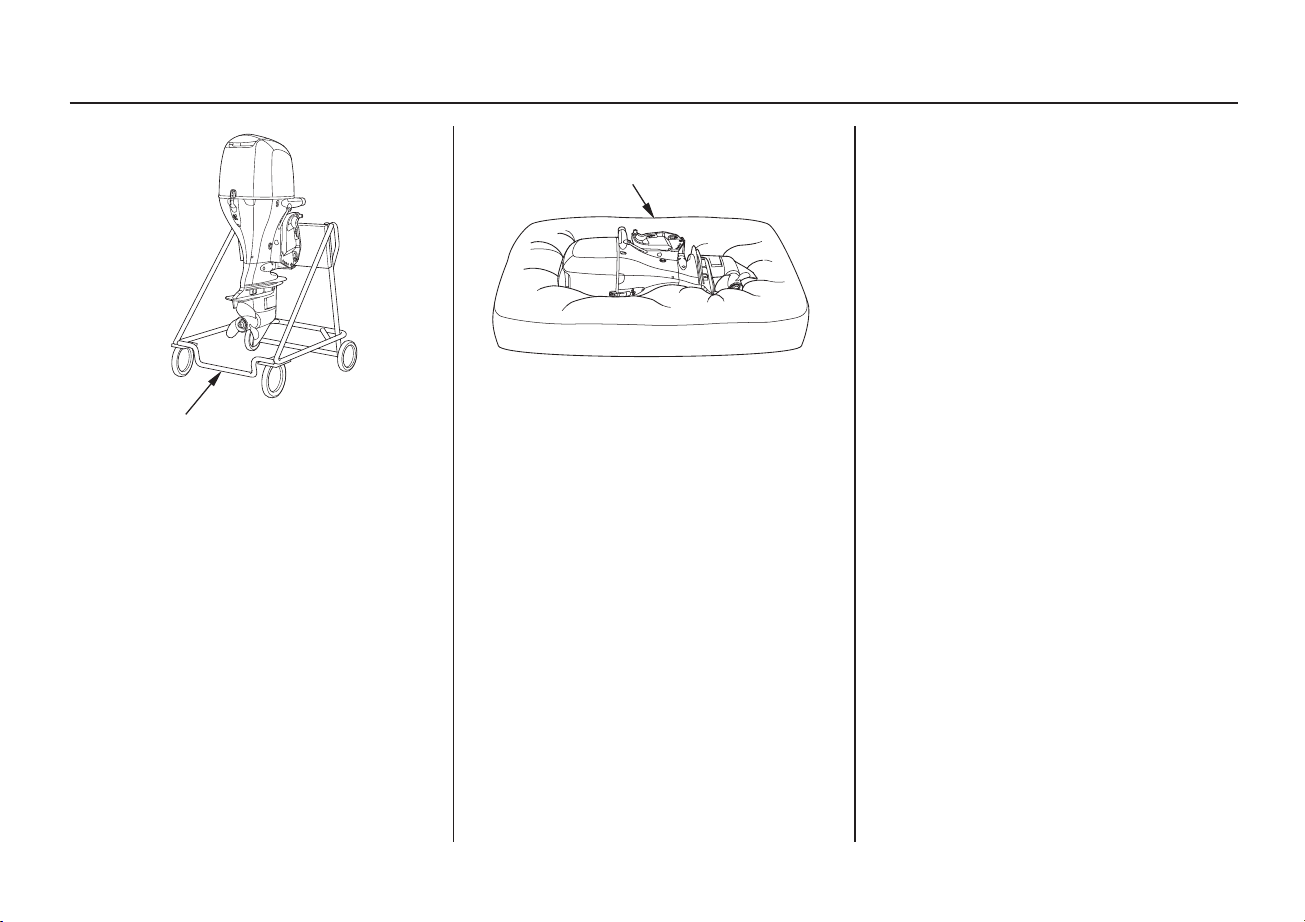
113
REMOVAL FROM STORAGE
STORAGE
OUTBOARD MOTOR STAND
(Port side turned down as shown.)
CUSHION
(protective material)
BEFORE
OPERATION
Check your outboard motor as
described in the
chapter of this manual.
If the cylinders were coated with oil
during storage preparation, the
engine may smoke briefly at startup.
This is normal.
Cover the outboard motor to keep out
dust. Do not use plastic sheet as a
dust cover. A nonporous cover will
trap moisture, promoting rust and
corrosion.
Rest the motor on a cushion of
protective material.
If it is necessary to store the outboard
motor horizontally as shown, drain
the vapor separator (p. ), and
drain the engine oil (p. ), before
removing the outboard motor from
the boat.
If the outboard motor will be
removed from the boat for storage,
we recommend storing it vertically
by mounting it on a commercially
available stand.
110
89
09/06/24 16:23:25 31ZY9610_114
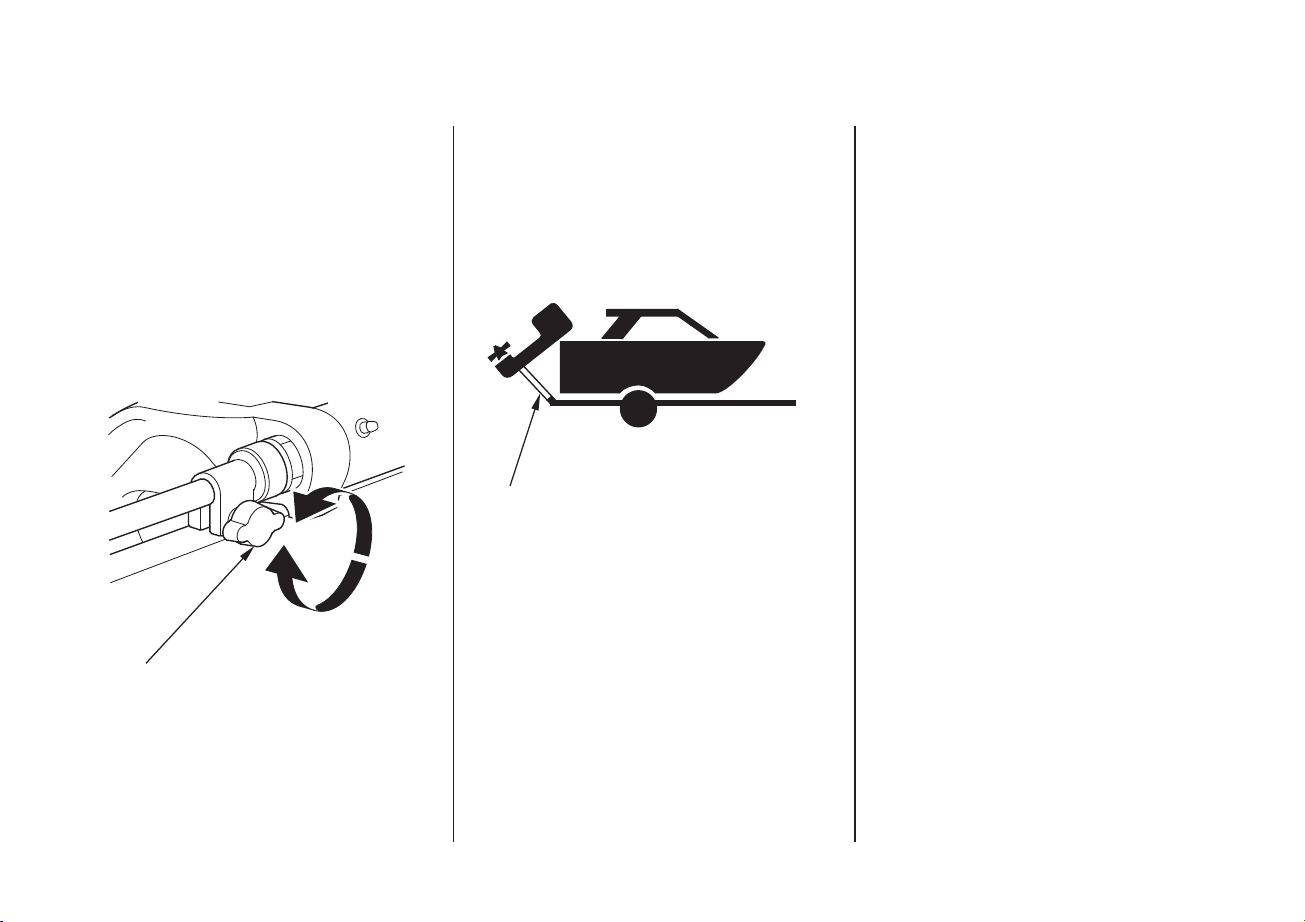
114
WITH OUTBOARD MOTOR
INSTALLED ON BOAT
WITH OUTBOARD MOTOR
REMOVED FROM BOAT
LHT Type (tiller handle)
TRANSPORTING
MOTOR SUPPORT BAR
(commercially available)
TO INCREASE
FRICTION (FIX)
STEERING FRICTION
KNOB
TTOO DDEECCRREEAASSEE
FFRRIICCTTIIOONN ((RREELLEEAASSEE))
When trailering a boat with the
outboard motor attached, leave the
engine in the normal running position,
if possible.
Secure the outboard motor in either
the vertical or horizontal position
shown on p. and .
Use a motor support bar to prevent
the outboard motor from moving
while trailering the boat. Refer to the
manufacturer’s instructions for using
a motor support bar.
Tighten the steering friction knob to
prevent the outboard motor from
moving while trailering the boat.
112 113
09/06/24 16:23:32 31ZY9610_115
115
TAKING CARE OF UNEXPECTED PROBLEMS
Check emergency stop switch
clip.
Clip not inserted in emergency
stop switch.
Insert clip in emergency stop
switch.
Possible CauseENGINE WILL NOT START Correction
Check control positions.
Fast idle lever raised (side-mount
type).
Shift to neutral.
Leave fast idle lever OFF (p. ).
Gearshift lever or control lever not
in neutral position.
1.
2.
59
09/06/24 16:23:40 31ZY9610_116
116
TAKING CARE OF UNEXPECTED PROBLEMS
CorrectionPossible CauseENGINE WILL NOT START
(continued)
Check fuel. Out of fuel. Refuel (p. ).
Fuel hose not primed. Squeeze priming bulb (p. ).
Replace fuel filters (p. ).
Bad fuel; boat stored without
treating or draining gasoline, or
refueled with bad gasoline.
Drain fuel tank and vapor
separator (p. ). Refill with
fresh gasoline (p. ).
Fuel filter or fuel tank filter
clogged.
3. 97
54
102
97
110
09/06/24 16:23:49 31ZY9610_117
117
TAKING CARE OF UNEXPECTED PROBLEMS
CorrectionPossible CauseENGINE WILL NOT START
(continued)
Check battery. Battery connections loose or
corroded.
Battery discharged.
Clean and tighten battery
connections.
Recharge battery.
Check fuses. Replace fuse(s) (p. ).
Remove and inspect spark plugs. Spark plugs faulty, fouled, or
improperly gapped.
Spark plugs wet with fuel (flooded
engine).
Dry and reinstall spark plugs. Start
engine with the throttle open.
Fuel system malfunction, fuel
pump failure, ignition malfunction,
stuck valves, starter malfunction,
switch malfunction, or electrical
problem in the starting circuit, etc.
Replace or repair faulty
components as necessary.
Fuse(s) blown.
Use starting procedure (p. ,
, , ); if engine still will
not start, then take outboard
motor to an authorized Honda
Marine dealer, or refer to the
shop manual.
Replace spark plugs (p. ).
4.
5.
6.
7.
61
55
58 63
120
92
09/06/24 16:24:02 31ZY9610_118
118
TAKING CARE OF UNEXPECTED PROBLEMS
CorrectionPossible CauseHARD STARTING OR STALLS
AFTER STARTING
Check control positions. Fast idle lever raised (side-mount
type).
Leave fast idle lever OFF (p. ).
Check fuel.
Bad fuel; boat stored without
treating or draining gasoline, or
refueled with bad fuel.
Fuel hose not primed.
Fuel filter or fuel tank clogged.
Squeeze priming bulb (p. ).
Replace fuel filters (p. ).
Drain fuel tank and vapor
separator (p. ). Refill with
fresh gasoline (p. ).
1.
2.
59
54
102
110
97
09/06/24 16:24:11 31ZY9610_119
119
TAKING CARE OF UNEXPECTED PROBLEMS
HARD STARTING OR STALLS
AFTER STARTING
(continued)
Take outboard motor to an
authorized Honda Marine dealer,
or refer to the shop manual.
Faulty thermostat or water pump. Replace or repair faulty
components as necessary.
Check water intake screens. Water intake screens clogged. Clean water intake screens.
ENGINE OVERHEATS Possible Cause Correction
Replace or repair faulty
components as necessary.
Take outboard motor to an
authorized Honda Marine dealer,
or refer to the shop manual.
Spark plugs faulty, fouled, or
improperly gapped.
Remove and inspect spark plugs.
Possible Cause Correction
Fuel system malfunction, fuel
pump failure, ignition malfunction,
etc.
Replace spark plugs (p. ).
2.
3.
4.
1.
92
09/06/24 16:24:23 31ZY9610_120
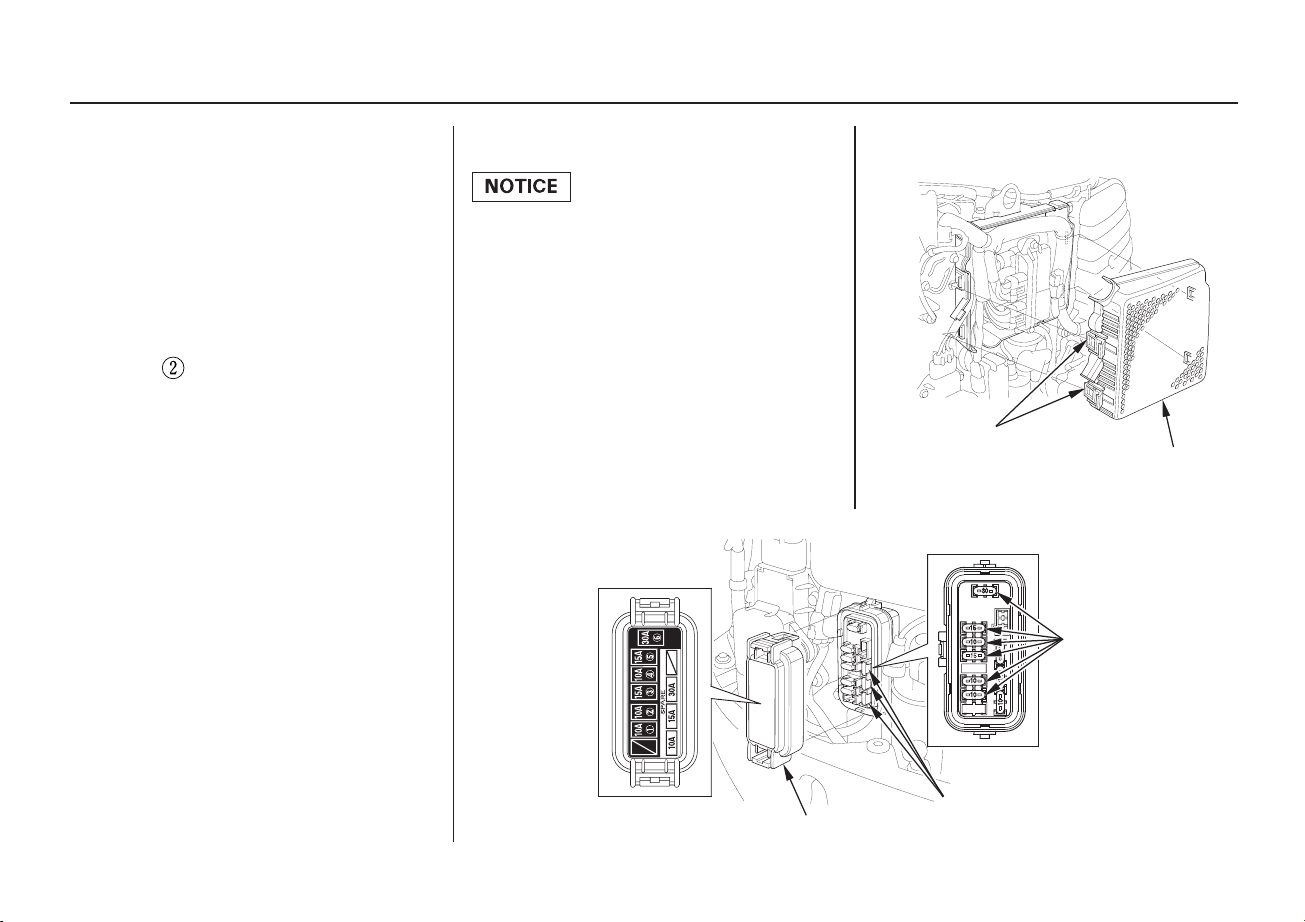
−
120
Fuse Replacement
Electric Starter Will Not
Operate
FUSES
Battery Will Not Charge
TAKING CARE OF UNEXPECTED PROBLEMS
FUSE CASE LID
FUSES
(10A,15A,30A)
SPARE FUSES
(10A,15A,30A)
ELECTRICAL PARTS COVER
LOCK TABS
Main Fuse
Disconnect the battery cable at the
battery negative ( ) terminal bef ore
replacing the f use.
Failure to do so may cause a short
circuit.
The 10A, 15A, and 30A main fuses
protect the electric starter relay and
related circuits.
Remove the electrical parts cover.
Remove the engine cover.
Stop the engine and disconnect the
battery cable.
The 10A main fuse protects the
ignition switch and related circuits. If
this fuse blows, the engine will not
start or run, and the power trim/tilt
switch will not activate the trim/tilt
mechanism.
A 70A ACG fuse protects the
alternator circuit. If the ACG fuse
blows, the engine will not charge the
battery. Refer to p. .
Remove the fuse case lid.
1.
2.
3.
4.
121
09/06/24 16:24:35 31ZY9610_121
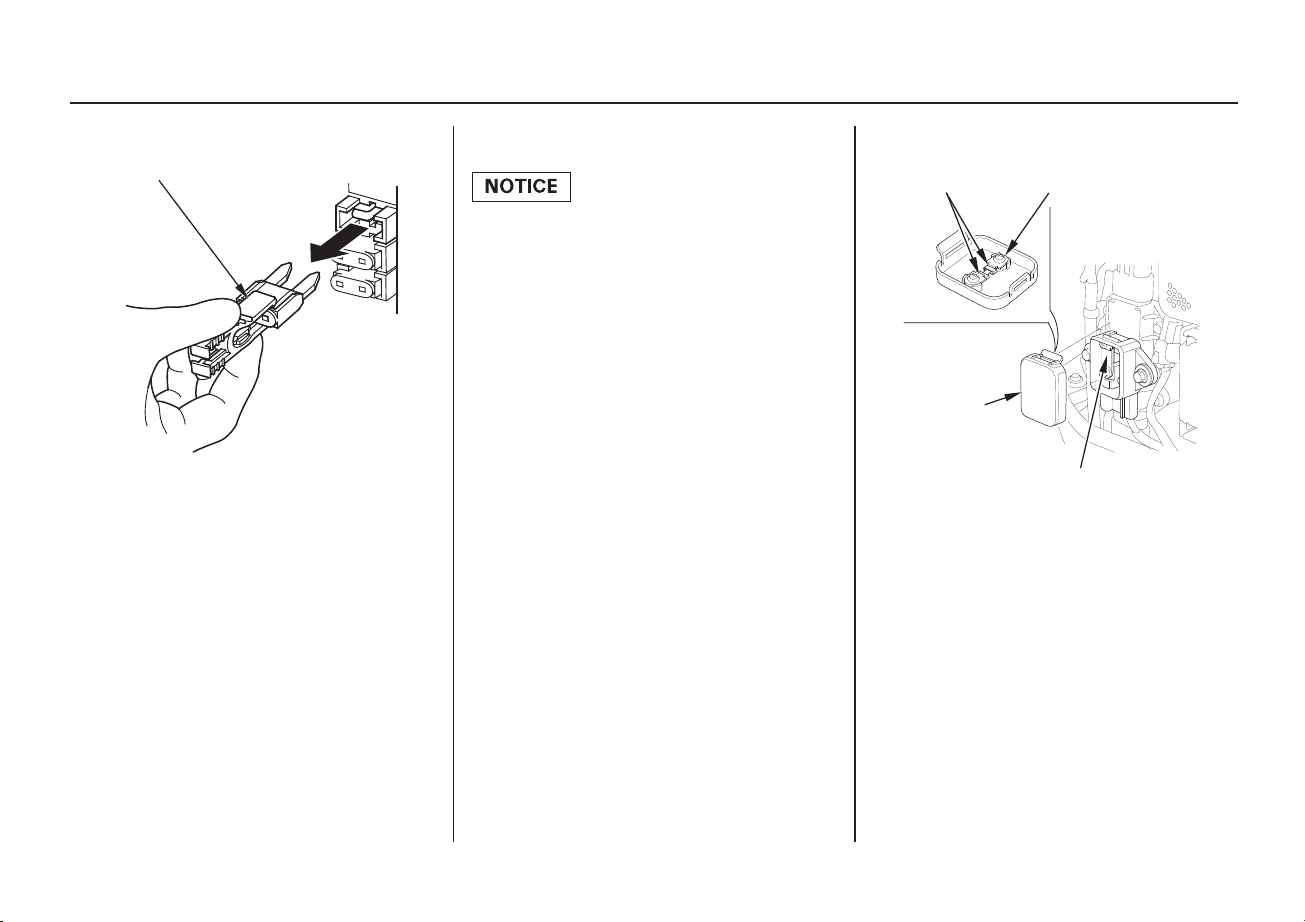
10A, 15A, 30A
121
TAKING CARE OF UNEXPECTED PROBLEMS
FUSE PULLER
FUSE CASE
LID
‘‘70A’’MARK
SPARE FUSE (70A)
ACG FUSE (70A)
ACG Fuse
Never use a f use with a rating
greater than specif ied. Serious
damage to the electrical system could
result.
Use the fuse puller from the tool
kit to remove the fuses. If a fuse is
blown, install a replacement fuse
of the same specified rating. The
outboard motor is supplied with
spare fuses in the fuse holder.
MAIN FUSE RATINGS:
Stop the engine and disconnect the
battery cable.
Remove the engine cover.
Remove the electrical parts cover.
Remove the fuse case lid.
Remove the old fuse by removing
two 5 mm screws.
Reinstall the fuse case lid,
electrical parts cover, and the
engine cover.
If fuses continue to blow, take the
outboard motor to an authorized
Honda Marine dealer for inspection
and service, or refer to the shop
manual.
If a blown fuse is found, try to
determine and correct the electrical
problem that caused the blown fuse.
An uncorrected electrical problem
may cause the fuse to blow again.
Reconnect the battery.
1.
2.
5.
6.
7.
3.
4.
5.
09/06/24 16:24:46 31ZY9610_122
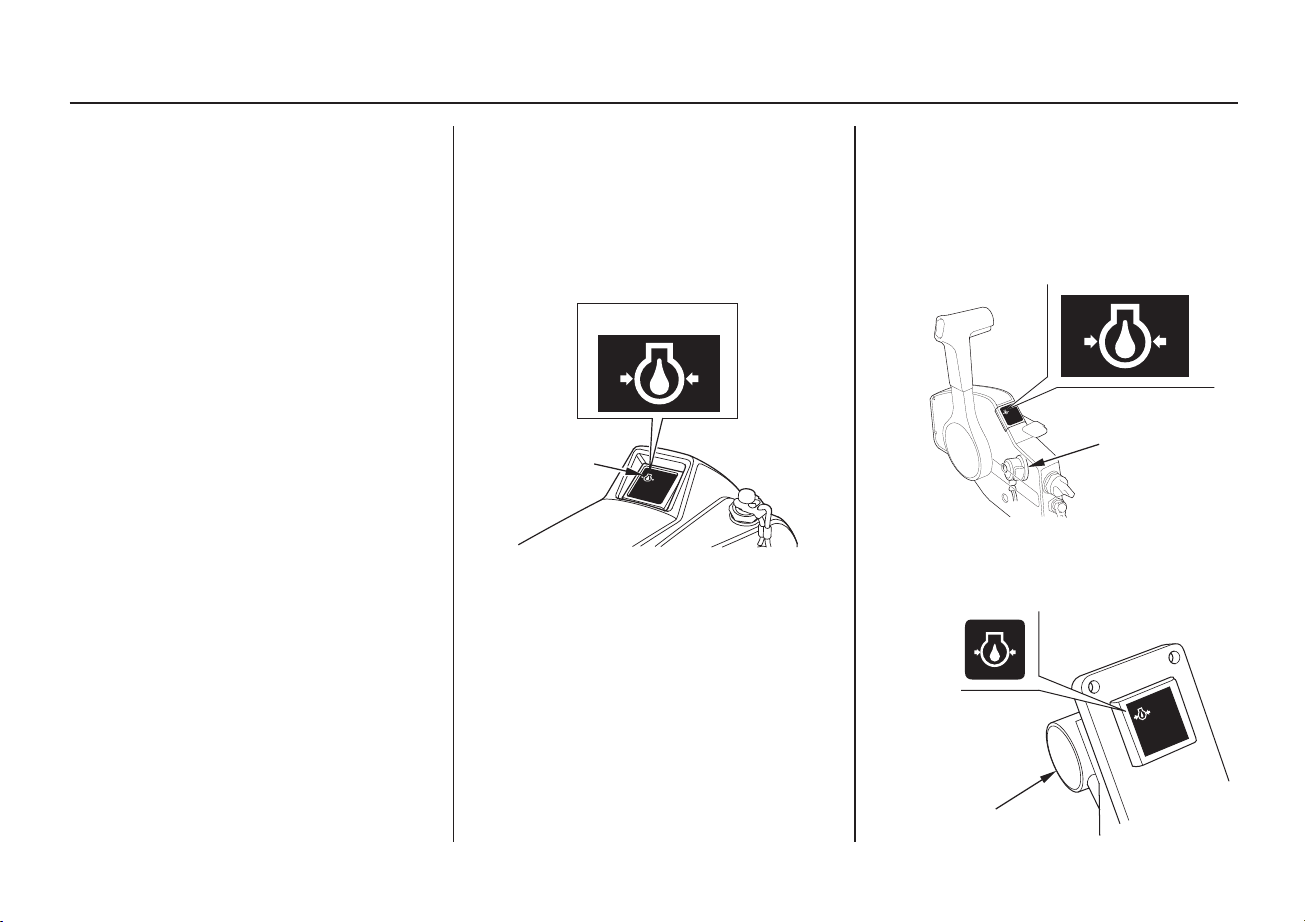
70A
122
OIL PRESSURE INDICATOR
GOES OFF AND ENGINE
SPEED IS LIMITED
Side-Mount Type
Panel-Mount/Top-Mount Types
TAKING CARE OF UNEXPECTED PROBLEMS
(internal buzzer)
(GREEN)
BUZZER
BUZZER
OIL PRESSURE
INDICATOR
OIL PRESSURE
INDICATOR
OIL PRESSURE
INDICATOR
(GREEN)
(GREEN)
LHT Type (tiller handle)
LRTandXRTTypes
(remote control)
Install a new fuse with the ‘‘70A’’
mark downward.
ACG FUSE RATING:
After finishing replacement, install
the fuse case lid with its hook
toward the engine side.
Be sure the fuse case lid is
securely locked.
Reinstall the electrical parts cover
and engine cover.
Reconnect the battery.
A spare fuse is located on the reverse
side of the fuse case lid and tightened
with two 3 mm screws.
When the new fuse is set as a spare
fuse on the reverse side of the fuse
case lid, set the fuse so that you can
see the ‘‘70A’’ mark on it.
6.
7.
8.
9.
10.
09/06/24 16:24:58 31ZY9610_123
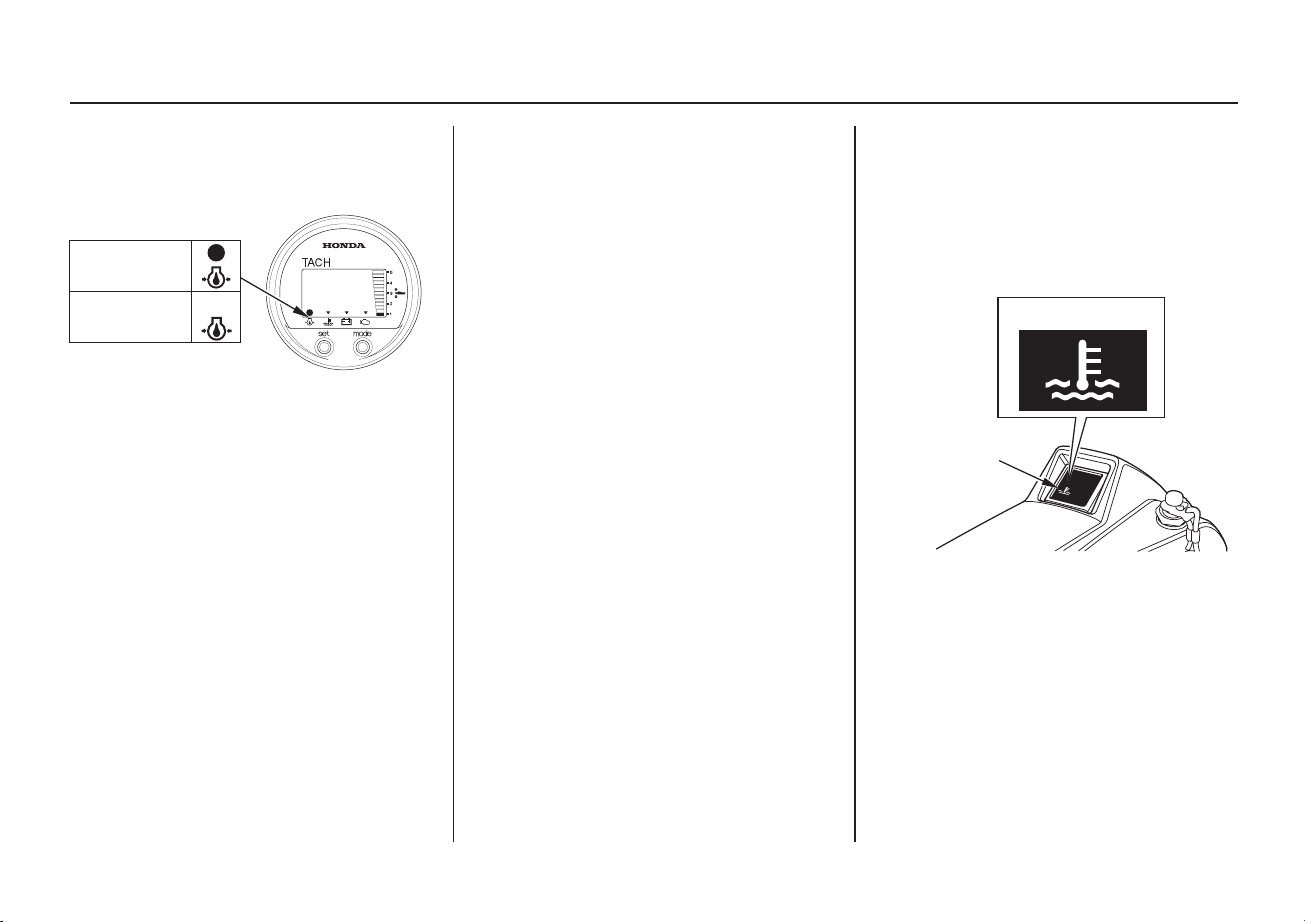
123
Digital Tachometer OVERHEAT INDICATOR
COMES ON AND ENGINE
SPEED IS LIMITED
TAKING CARE OF UNEXPECTED PROBLEMS
(internal buzzer)
(RED)
OVERHEAT
INDICATOR
LHT Type (tiller handle)
If oil pressure becomes low, the oil
pressure indicator will go off, and the
engine protection system limits
engine speed. If you are at cruising
speed, engine speed will decrease
automatically.
The oil pressure indicator is also
equipped with a buzzer that sounds
when the oil pressure indicator goes
off.
Low oil pressure may be the result of
a low engine oil level, or there may
be a problem with the engine
lubrication system.
If the engine protection system
remains activated after 30 seconds,
return to the nearest boat landing, and
have the outboard motor inspected by
an authorized Honda Marine dealer.
With the engine oil at the
recommended level, restart the
engine. If the lubrication system is
OK, the oil pressure indicator should
come on within 30 seconds, and the
engine will respond normally to
throttle control lever operation.
If low oil pressure activates the
engine protection system, stop the
engine, check the engine oil level
(p. ), and add oil if needed.
If the throttle is closed suddenly after
full throttle operation, engine speed
may drop below the specified idle
rpm, and that could activate the
engine protection system
momentarily.Normal
Abnormal
88
09/06/24 16:25:09 31ZY9610_124
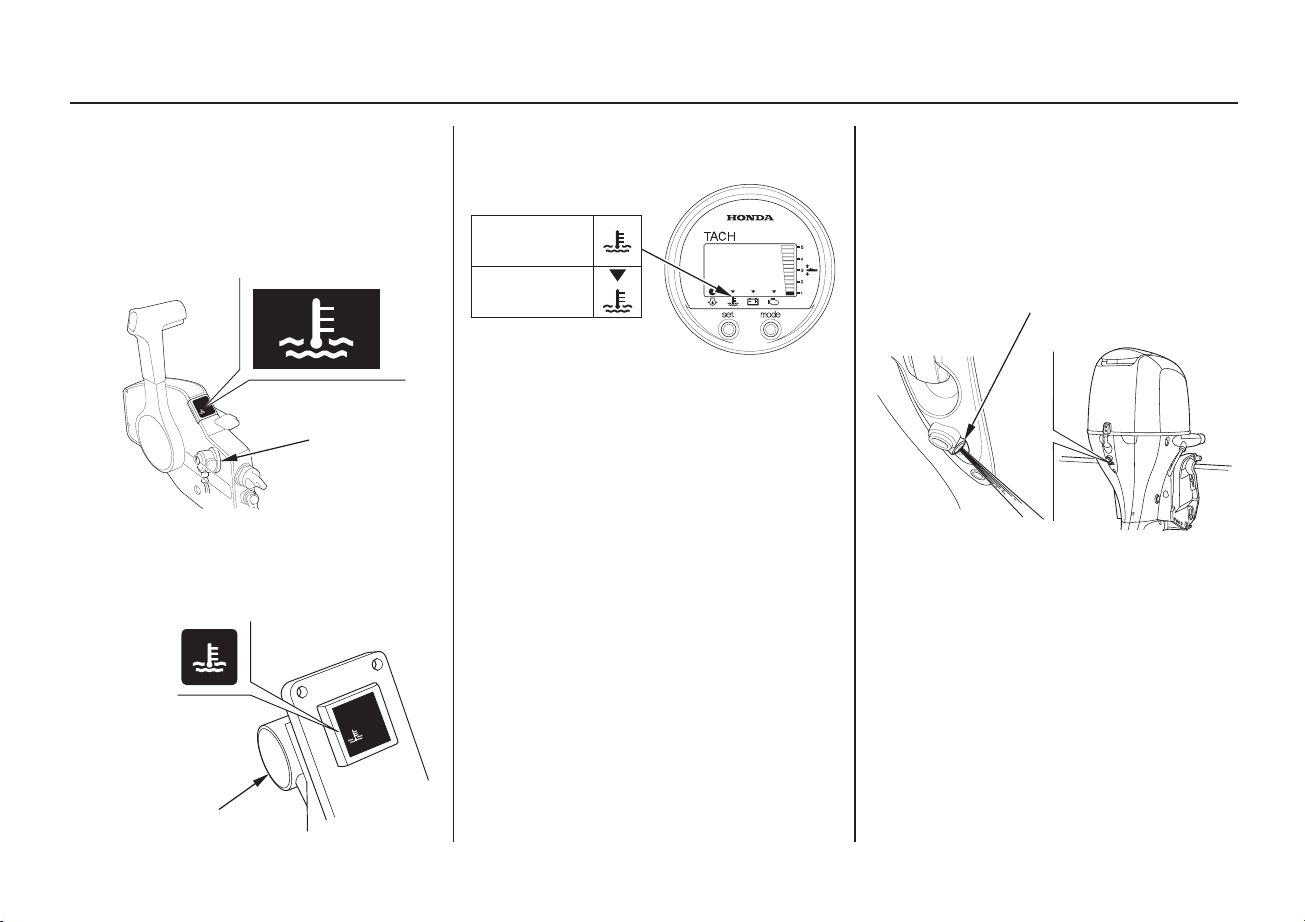
124
Digital Tachometer
Side-Mount Type
Panel-Mount/Top-Mount Types
TAKING CARE OF UNEXPECTED PROBLEMS
BUZZER
BUZZER
COOLING SYSTEM INDICATOR
OVERHEAT
INDICATOR
OVERHEAT
INDICATOR
(RED)
(RED)
LRTandXRTTypes
(remote control)
If the engine is stopped after running
at full throttle, and then restarted
soon afterward, that could activate
the engine protection system
momentarily.
If overheating activates the engine
protection system, idle the engine in
neutral, and check the cooling system
indicator.
If the engine overheats, the overheat
indicator will come on, and the
engine will stop in 20 seconds after
the engine protection system limits
engine speed. If you are at cruising
speed, engine speed will decrease
automatically.
All types are equipped with a buzzer
that sounds when the overheat
indicator comes on.
Engine overheating may be the result
of restricted water intake screens, or
there may be a problem with the
cooling system thermostat or water
pump.
Normal
Abnormal
09/06/24 16:25:20 31ZY9610_125
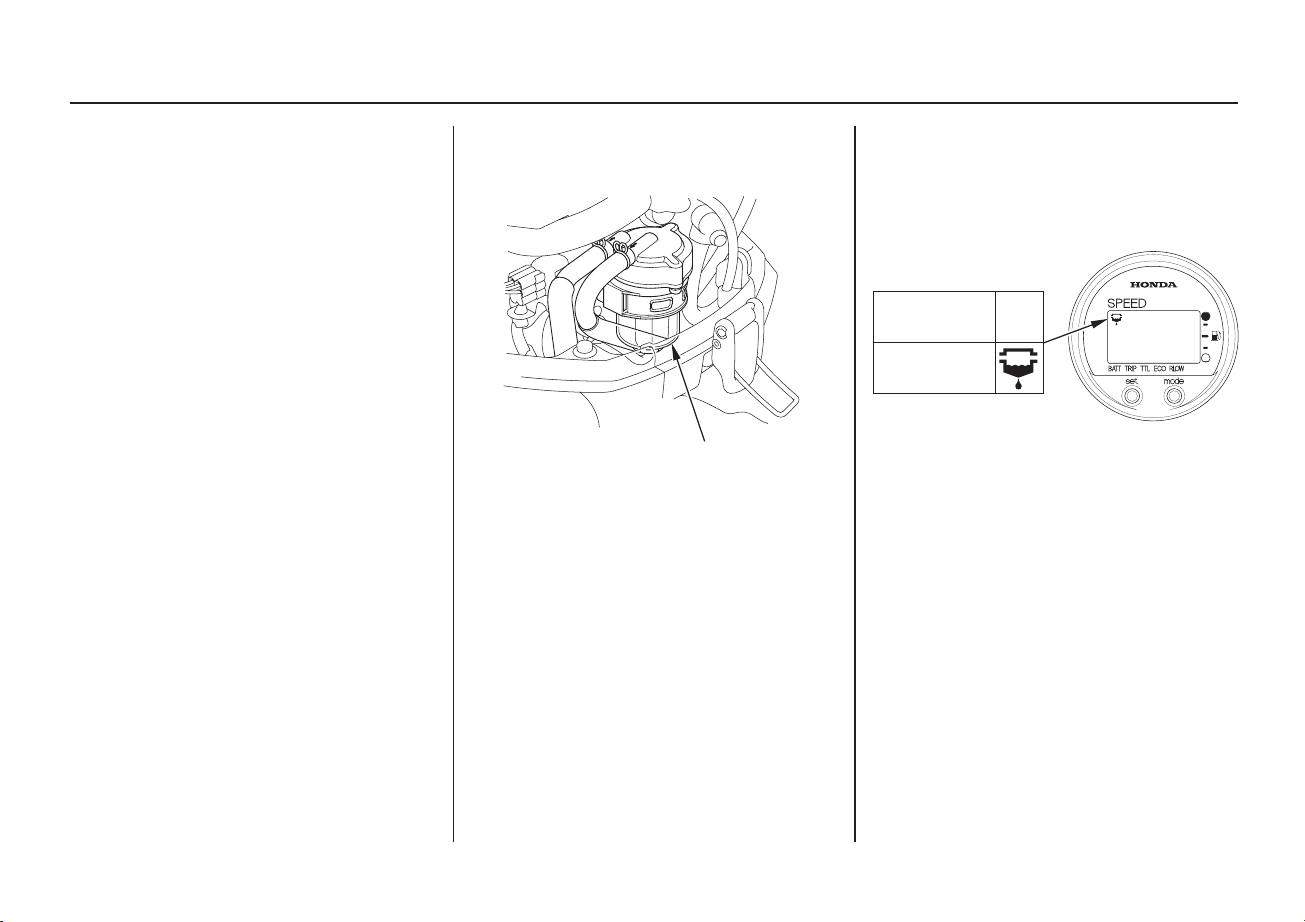
125
WATER SEPARATOR
INDICATOR
Digital Speedometer
WATER SEPARATOR
BUZZER SOUNDS
TAKING CARE OF UNEXPECTED PROBLEMS
WATER SEPARATOR
When the water separator indicator
blinks:
Check the water separator for water
contamination. If water has
accumulated, stop the engine, and
clean the water separator following
the instructions on page , or
consult with an authorized Honda
Marine dealer.
Check the water separator for water
contamination. If water is
accumulated, stop the engine, and
clean the water separator following
the instructions on page , or
consult with an authorized Honda
Marine dealer.
When the water separator buzzer
sounds (a rapid, repeating signal):
If water is flowing from the cooling
system indicator, continue idling for
30 seconds. If the cooling system is
OK, the overheat indicator should go
off within 30 seconds, and the engine
will respond normally to throttle
control lever operation.
If there is no water flowing from the
cooling system indicator, stop the
engine, and tilt the outboard motor to
inspect the water intake screens. If
restricted, clean the water intake
screens, return the outboard motor to
the running position, restart the
engine, and check the cooling system
indicator again.
If there is still no water flowing from
the cooling system indicator, or if the
engine protection system remains
activated after 30 seconds, return to
the nearest boat landing, and have the
outboard motor inspected by an
authorized Honda Marine dealer.
Normal
Abnormal
99 99
09/06/24 16:25:30 31ZY9610_126
−
−−
126
SUBMERGED MOTOR
TAKING CARE OF UNEXPECTED PROBLEMS
Running the outboard motor without
suf f icient cooling water will damage
the water pump and overheat the
engine.
Change the engine oil and oil filter
as described on p. . If
there was water in the engine
crankcase, or if the used engine oil
showed signs of water
contamination, then a second
engine oil change should be
performed after running the engine
for half an hour.
Remove the spark plugs (p. ).
Operate the starter to expel water
from the engine’s cylinder.
A submerged outboard motor must
be serviced immediately after it is
recovered from the water in order to
minimize corrosion.
If there is a Honda Marine dealership
nearby, take the motor to the dealer
immediately. If you are far from a
dealer, proceed as follows:
Remove the engine cover, and
rinse the outboard motor with
fresh water to remove salt water,
sand, mud, etc.
Drain the vapor separator as
described on p. .
Pour 1 2 teaspoons (5 10 cm )
(p. ) of engine oil into each
spark plug hole to lubricate the
inside of the cylinders. Reinstall
the spark plugs.
Attempt to start the engine. Be
sure the water level is at least 2
inches (5 cm) above the
antiventilation plate.
If you are changing the oil filter
while the outboard motor is out of
the water, use commercially available
ear muffs and water hose to supply
water.
If the engine was running when it
submerged, there may be
mechanical damage, such as bent
connecting rods. If the engine
binds when cranked, do not
attempt to run the engine until it
has been repaired.
6.3.
4.
5.
1.
2.
110
9189
92
112
3
09/06/24 16:25:40 31ZY9610_127

127
TAKING CARE OF UNEXPECTED PROBLEMS
If the engine fails to start, remove
the spark plugs and dry them, then
reinstall the spark plugs and
attempt to start the engine again.
If the engine starts, and no
mechanical damage is evident,
continue to run the engine for a
half hour or longer. Be sure the
water level is at least 2 inches (5
cm) above the antiventilation plate
to avoid overheating and water
pump damage.
As soon as possible, take the
outboard motor to an authorized
Honda Marine dealer for
inspection and service.
7.
09/06/24 16:25:44 31ZY9610_128
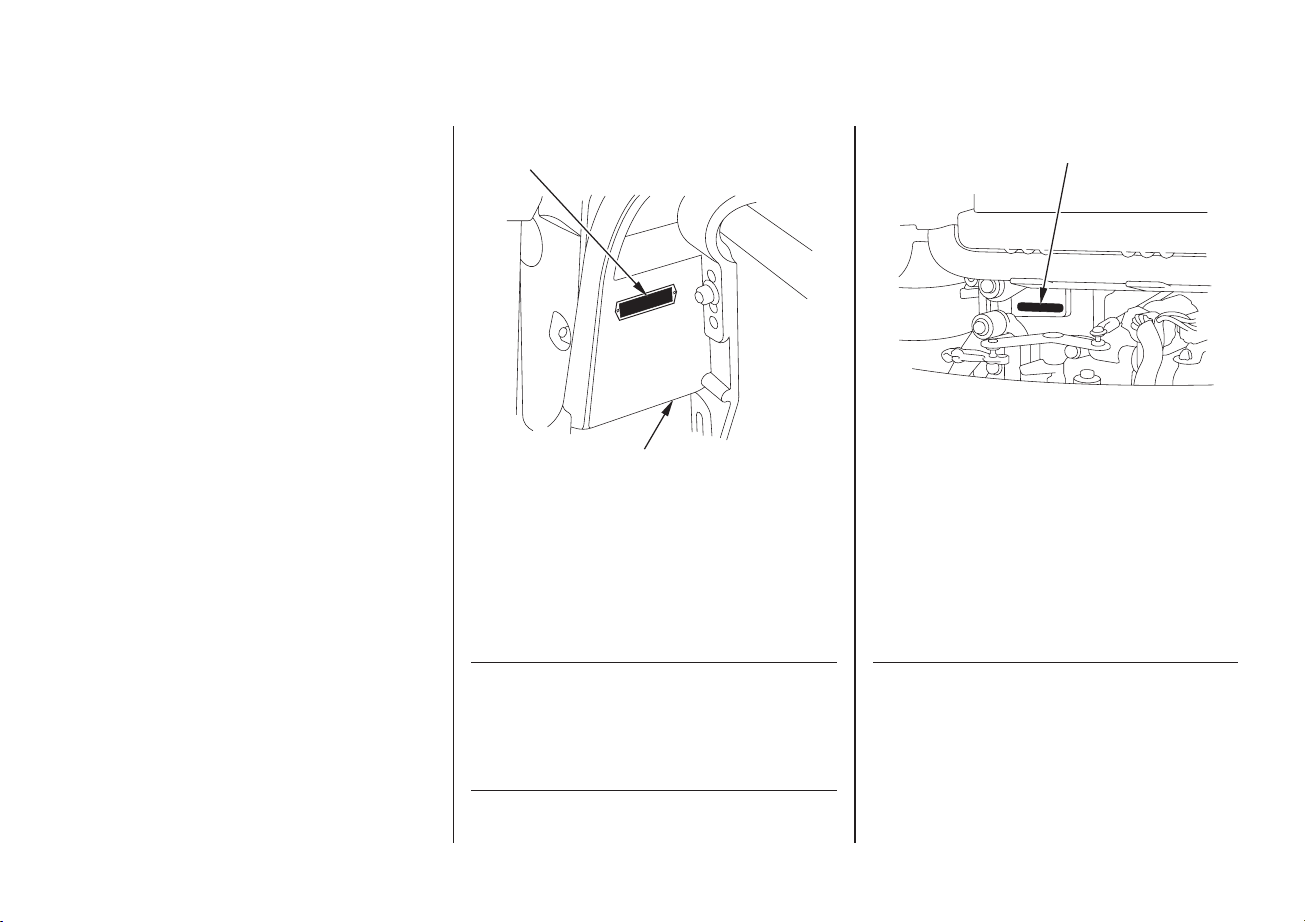
128
TECHNICAL INFORMATION
Serial Number Locations
TECHNICAL AND CONSUMER INFORMATION
ENGINE SERIAL NUMBER
RIGHT STERN BRACKET
PRODUCT IDENTIFICATION
NUMBER
Product identification number: Engine serial number:
The product identification number is
stamped on a plate attached on the
right stern bracket.
The engine serial number is
stamped on the upper right side of
the motor.
Record the product identification
number, the engine serial number,
and the date of purchase in the space
provided on this page. You will need
these numbers when ordering parts,
and when making technical or
warranty inquiries (p. ).
Date of purchase:
137
09/06/24 16:25:52 31ZY9610_129
−12V 55Ah/5HR (65Ah/20HR)
(CCA582A)
129
Battery
Minimum Requirements
Emission Control System
Information
WARNING:
Wash your
hands after handling.
TECHNICAL AND CONSUMER INFORMATION
Source of Emissions
Ignition Timing Control System
Be caref ul to avoid connecting the
battery in reverse polarity, as this
will damage the battery-charging
system in the outboard motor.
Do not disconnect the battery
cables while the engine is running.
Disconnecting the cables while the
engine is running will damage the
outboard motor’s electrical system.
Battery cable extension: Extending
the original battery cable will
cause the battery voltage to drop
due to the increased length of the
cable and number of connections.
This voltage drop may cause the
buzzer to sound momentarily when
engaging the starter motor and
may prevent the outboard f rom
starting. If the outboard starts and
the buzzer sounds momentarily,
there may be barely suf f icient
voltage reaching the engine.
For complete information, refer to
the battery manufacturer’s
instructions.
Battery posts, terminals,
and related accessories contain lead
and lead compounds.
The combustion process produces
carbon monoxide, oxides of nitrogen,
and hydrocarbons. Control of
hydrocarbons and oxides of nitrogen
is very important because, under
certain conditions, they react to form
photochemical smog when subjected
to sunlight. Carbon monoxide does
not react in the same way, but it is
toxic.
Honda utilizes various systems to
reduce the emissions of carbon
monoxide, oxides of nitrogen, and
hydrocarbons.
The system constantly adjusts the
ignition timing, reducing the amount
of HC, CO, and NOx produced.
09/06/24 16:26:02 31ZY9610_130
130
TECHNICAL AND CONSUMER INFORMATION
Tampering and AlteringThe U.S. and Calif ornia Clean
Air Acts
PGM-FI System
Tampering with or altering the
emission control system may increase
emissions beyond the legal limit.
Among those acts that constitute
tampering are:
Removal or alteration of any part
of the intake, fuel, or exhaust
systems.
Alterations that would cause the
engine to operate outside its design
parameters.
EPA and California regulations
require all manufacturers to furnish
written instructions describing the
operation and maintenance of
emission control systems.
The following instructions and
procedures must be followed in order
to keep the emissions from your
Honda engine within the emission
standards.
The PGM-FI system uses sequential
multiport fuel injection. It has two
subsystems: Engine Control, and
Fuel Control. The Engine Control
Module (ECM) uses various sensors
to determine how much air is going
into the engine. It then controls how
much fuel to inject under all
operating conditions.
09/06/24 16:26:09 31ZY9610_131

131
TECHNICAL AND CONSUMER INFORMATION
Replacement PartsProblems That May Af f ect
Emissions
Maintenance
If you are aware of any of the
following symptoms, have your
engine inspected and repaired by
your servicing dealer.
Hard starting or stalling after
starting.
Rough idle.
Misfiring or backfiring under load.
Afterburning (backfiring).
Black exhaust smoke or high fuel
consumption.
The emission control systems on
your Honda engine were designed,
built, and certified to conform with
EPA and California emission
regulations. We recommend the use
of Honda Genuine parts whenever
you have maintenance done. These
original-design replacement parts are
manufactured to the same standards
as the original parts, so you can be
confident of their performance. The
use of replacement parts that are not
of the original design and quality
may impair the effectiveness of your
emission control system.
A manufacturer of an aftermarket
part assumes the responsibility that
the part will not adversely affect
emission performance. The
manufacturer or rebuilder of the part
must certify that use of the part will
not result in a failure of the engine to
comply with emission regulations.
Follow the maintenance schedule on
p. . Remember that this schedule
is based on the assumption that your
machine will be used for its designed
purpose. Sustained high-load
operation, or use in unusual
conditions, will require more
frequent service.
84
09/06/24 16:26:19 31ZY9610_132
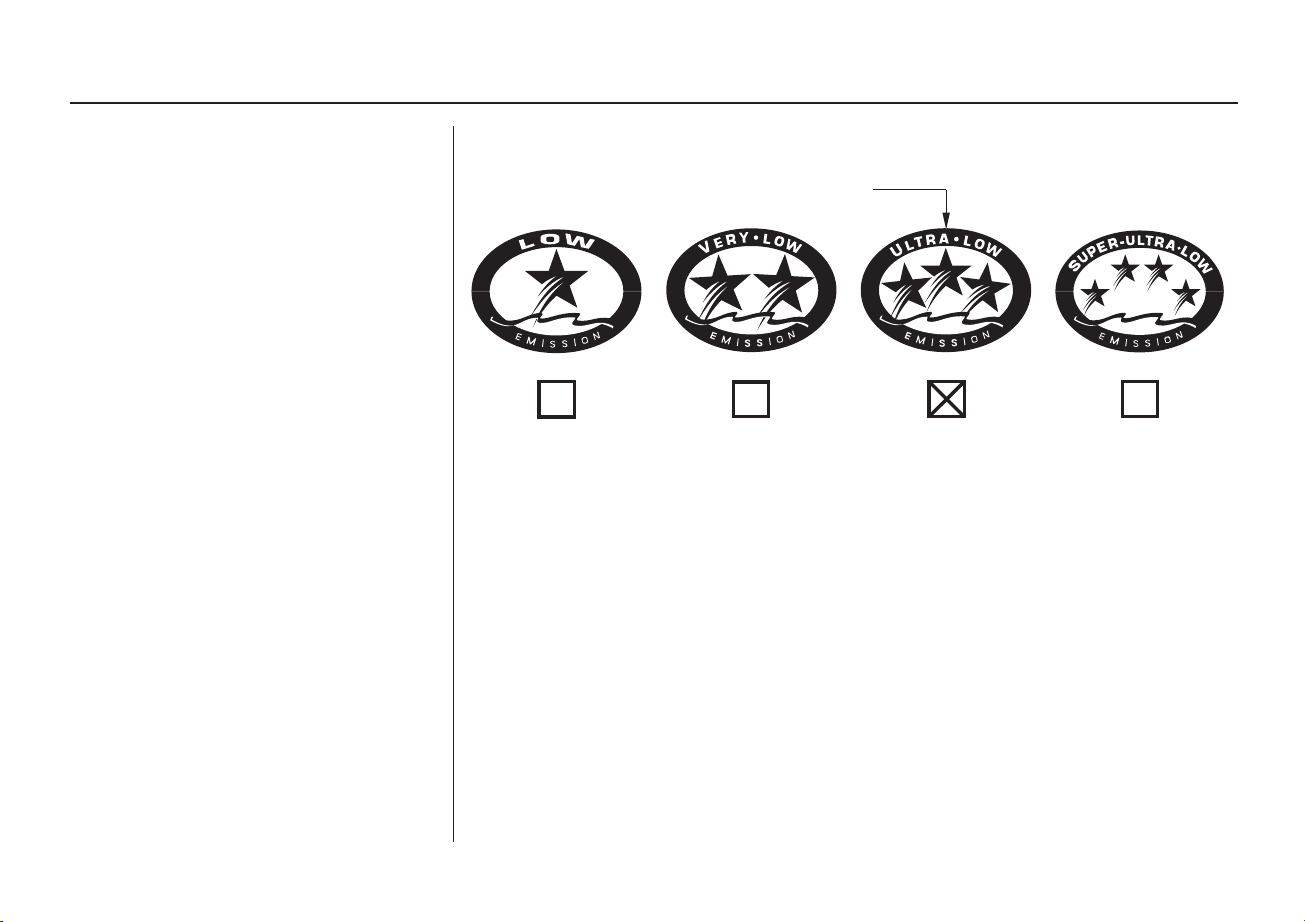
132
Star Label
The Symbol for Cleaner Marine Engines:
Cleaner Air and Water -
Better Fuel Economy -
Longer Emission Warranty -
US, Puerto Rico, and US Virgin
Islands
TECHNICAL AND CONSUMER INFORMATION
The Star Label means Cleaner Marine Engine
for healthier lifestyle and environment.
burns up to 30 - 40 percent less gas and oil than
conventional carbureted two-stroke engines, saving money and resources.
protects consumer for worry-free operation.
This engine has been certified as a:
A Star label was applied to this
outboard motor in accordance with
the requirements of the California
Air Resources Board.
09/06/24 16:26:28 31ZY9610_133
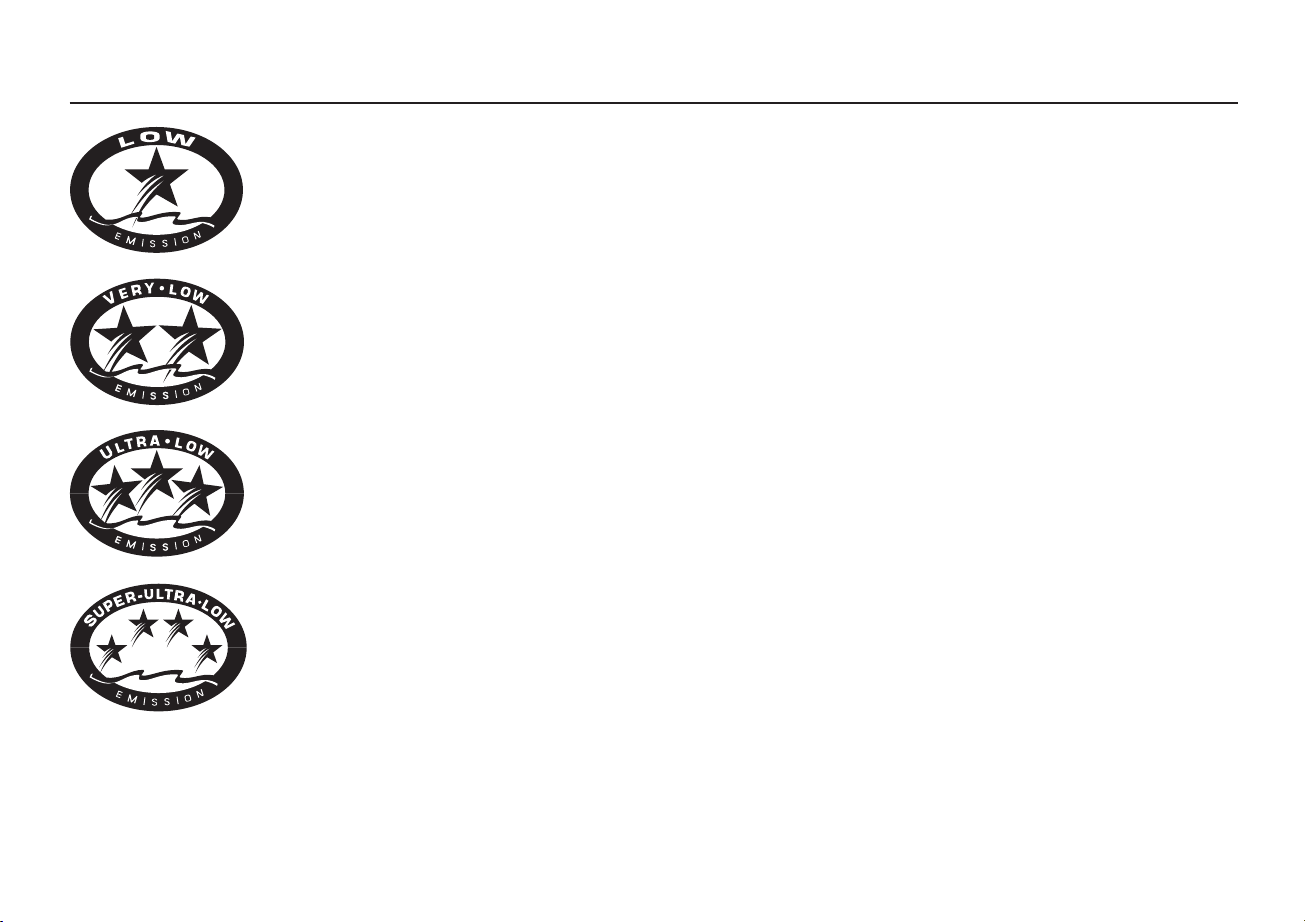
133
One Star
Low
Emission
Two Stars
Very Low
Emission
Three Stars
Ultra Low
Emission
Four Stars
Super Ultra
Low Emission
TECHNICAL AND CONSUMER INFORMATION
The one-star label identifies engines that meet the Air Resources Board’s
Personal Watercraft and Outboard marine engine 2001 exhaust emission
standards. Engines meeting these standards have 75% lower emissions than
conventional carbureted two-stroke engines. These engines are equivalent
to the U.S. EPA’s 2006 standards for marine engines.
The two-star label identifies engines that meet the Air Resources Board’s
Personal Watercraft and Outboard marine engine 2004 exhaust emission
standards. Engines meeting these standards have 20% lower emissions than
One Star-Low Emission engines.
The three-star label identifies engines that meet the Air Resources Board’s
Personal Watercraft and Outboard marine engine 2008 exhaust emission
standards or the Sterndrive and Inboard marine engine 2003-2008 exhaust
emission standards. Engines meeting these standards have 65% lower
emissions than One Star-Low Emission engines.
The four-star label identifies engines that meet the Air Resources Board’s
Sterndrive and Inboard marine engine 2009 exhaust emission standards.
Personal Watercraft and Outboard marine engines may also comply with
these standards. Engines meeting these standards have 90% lower
emissions than One Star-Low Emission engines.
Cleaner Watercraft - Get the Facts
1-800-END-SMOG
www.arb.ca.gov
09/06/24 16:26:38 31ZY9610_134
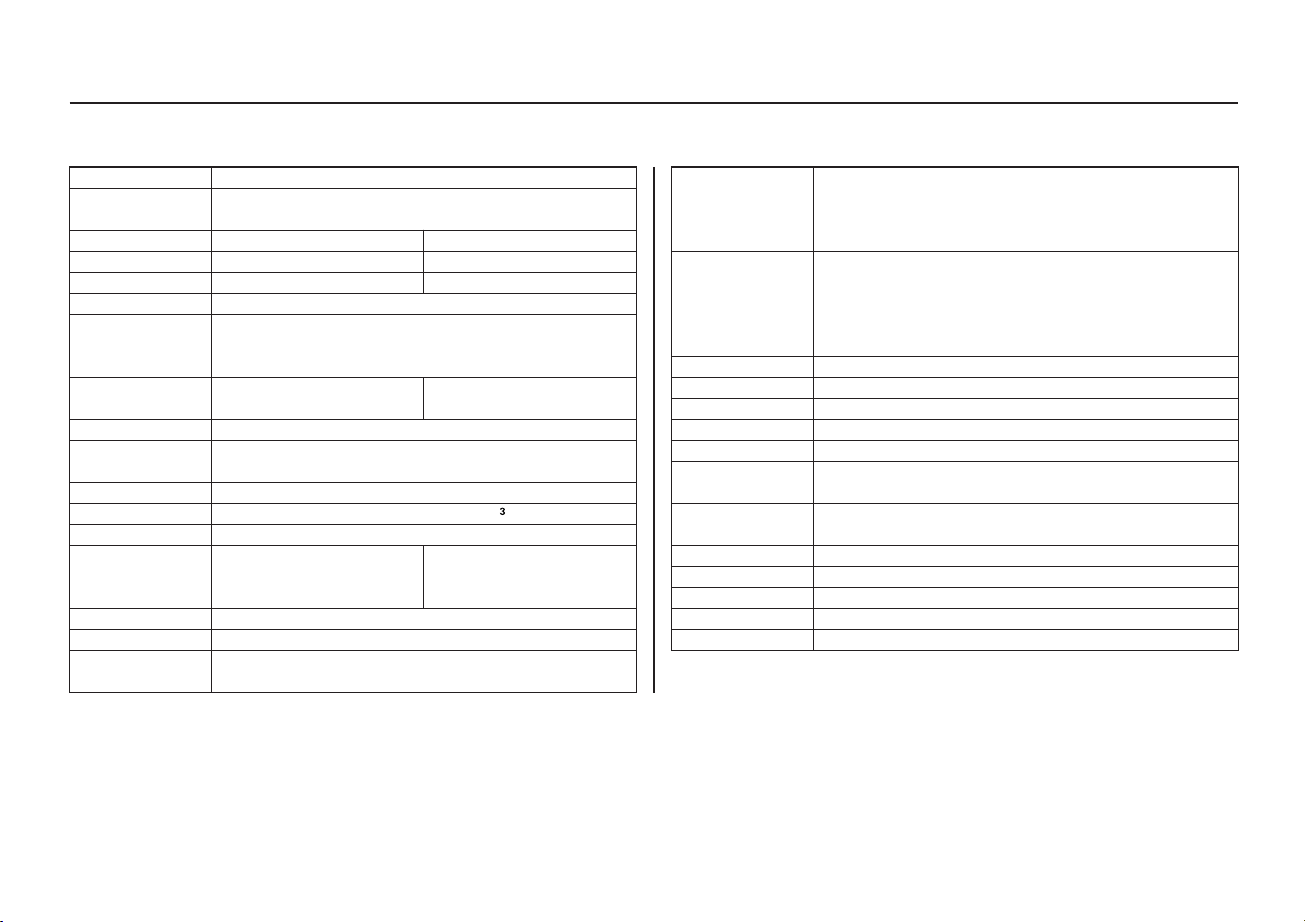
−
−
−−
−
*
*
BBAJ
BF75D
LHT
61.7 in (1,566 mm)
21.1 in (537 mm)
8°, 12°, 16°, 20°, 24°
68° (when Transom angle at 12°)
4° to 16° (when Transom angle at 12°)
30° right and left
Forward-Neutral-Reverse (dog type)
Unleaded gasoline
(86 pump octane or higher)
mechanical type
IZFR6K-11E (NGK)
Water exhaust
Water cooling with thermostat
12V 35A
ULTRA · LOW EMISSION
API standard (GL-4) SAE 90
outboard motor gear oilLRT
29.4 in (746 mm)35.6 in (904 mm)
17.7 in (449 mm)25.4 in (646 mm)
364 lbs (165 kg)377 lbs (171 kg)
electrical type
Trochoid pump pressure lubrication
Full transistor battery
Electric starter
Tiller handle
Motor-mounted,
remote control
0.039 0.043 in (1.0 1.1 mm)
91.3 cu-in (1,497 cm
)
4 stroke OHC in-line 4-cylinder
5,000 6,000 rpm
55.9 kW (75 HP)/5,500 rpm
4.4 US qt (4.2 L)
4.6 US qt (4.4 L)
1.00 US qt (0.95 L)
API standard (SG, SH, SJ)
SAE 10W-30
Gear case:
Engine:
Engine:
Gear case:
without oil filter change
with oil filter change
Low pressure side:
High pressure side:
134
Specifications
TECHNICAL AND CONSUMER INFORMATION
MODEL
Type
Description
code
Overall length
Overall width
Overall height
Transom angle
Steering angle
Gear change
Fuel
Fuel pump
Spark plugs
Exhaust system
Cooling system
D.C. output
CARB star label
Oil capacity
Specified oil
Trim angle
Tilt up angle
Transom height
(when transom
angle at 12°)
Lubrication
system
Ignition system
Starter system
Steering
control
system
Displacement
Engine type
Full throttle
range
Rated power
Dry mass
[weight]
Sparkpluggap
Honda outboards are power rated in accordance with NMMA procedures and using the ICOMIA standard 28/23.
With propeller
09/06/24 16:27:13 31ZY9610_135
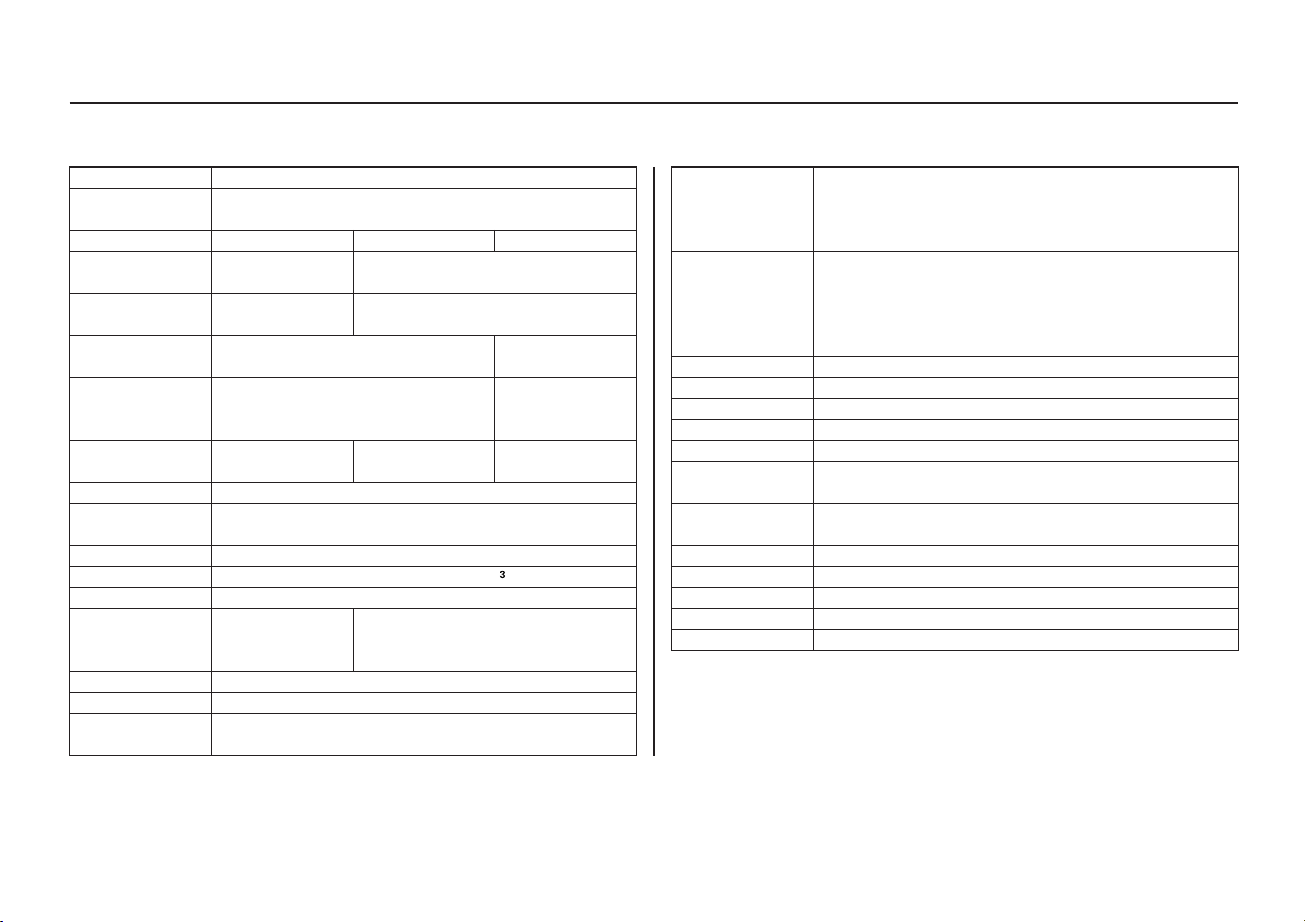
−
−
−
−−
*
*
ULTRA · LOW EMISSION
BF90D
BBCJ
LHT LRT XRT
66.7 in
(1,693 mm)
67.1 kW (90 HP)/5,800 rpm
5,300 6,300 rpm
4 stroke OHC VTEC in-line 4-cylinder
91.3 cu-in (1,497 cm
)
Electric starter
Full transistor battery
Trochoid pump pressure lubrication
API standard (SG, SH, SJ)
SAE 10W-30
API standard (GL-4) SAE 90
outboard motor gear oil
Unleaded gasoline
(86 pump octane or higher)
Forward-Neutral-Reverse (dog type)
30° right and left
8°, 12°, 16°, 20°, 24°
68° (when Transom angle at 12°)
4° to 16° (when Transom angle at 12°)
IZFR6K-11E (NGK)
Water exhaust
Water cooling with thermostat
12V 35A
electrical type
mechanical type
Tiller handle
35.6 in
(904 mm)
25.4 in
(646 mm)
26.1 in
(664 mm)
29.4 in
(746 mm)
17.7 in
(449 mm)
379 lbs
(172 kg)
366 lbs
(166 kg)
379 lbs
(172 kg)
61.7 in
(1,566 mm)
21.1 in
(537 mm)
Motor-mounted,
remote control
0.039 0.043 in (1.0 1.1 mm)
4.4 US qt (4.2 L)
4.6 US qt (4.4 L)
1.00 US qt (0.95 L)
Gear case:
Engine:
Engine:
Gear case:
without oil filter change
with oil filter change
Low pressure side:
High pressure side:
135
Specifications
TECHNICAL AND CONSUMER INFORMATION
MODEL
Displacement
Engine type
Full throttle
range
Rated power
Overall height
Overall length
Type
Description
code
Specified oil
Oil capacity
CARB star label
D.C. output
Cooling system
Exhaust system
Spark plugs
Fuel pump
Fuel
Gear change
Steering angle
Transom angle
Lubrication
system
Ignition system
Starter system
Steering
control
system
Overall width
Trim angle
Tilt up angle
Transom height
(when transom
angle at 12°)
Dry mass
[weight]
Sparkpluggap
Honda outboards are power rated in accordance with NMMA procedures and using the ICOMIA standard 28/23.
With propeller
09/06/24 16:27:50 31ZY9610_136
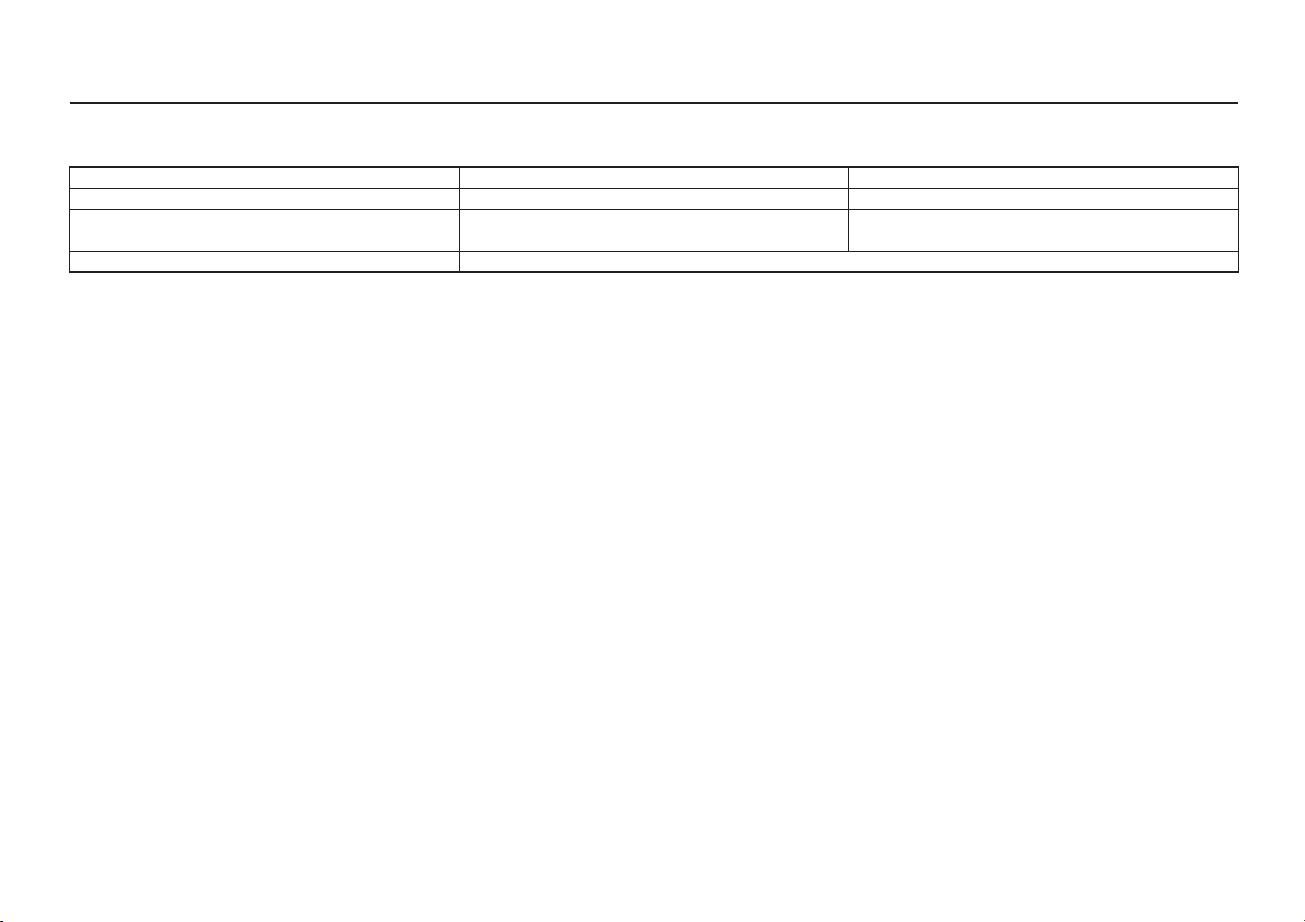
±
±
±
−−
No other adjustment is needed
0.17 0.02 mm
0.28 0.02 mm
750 50 rpm
0.039 0.043 in (1.0 1.1 mm) See page 93
See shop manual
See shop manual
Exhaust:
Intake:
136
TECHNICAL AND CONSUMER INFORMATION
BF75D/BF90D Tune up
Sparkpluggap
Idle speed
Valve clearance (cold)
Other specifications
(do not adjust)
09/06/24 16:27:58 31ZY9610_137

−
137
CONSUMER INFORMATION
Honda Publications
Customer Service Information
American Honda Motor Co., Inc.
Honda Canada Inc.
(United States, Puerto Rico, and
U.S. Virgin Islands)
TECHNICAL AND CONSUMER INFORMATION
Accessory Catalog
Parts Catalog
Shop Manual
Contacting Honda
This manual provides complete,
illustrated parts lists.
The catalog is available through your
Honda Marine dealer.
Available through your Honda
Marine dealer or through Helm Inc.
at
1 888-292-5395 or
visit www.Honda-marine.com
andclickonOWNERS.
This manual covers complete
maintenance and overhaul procedures.
It is intended to be used by a skilled
technician.
These publications will give you
additional information for
maintaining and repairing your
outboard motor.
Your authorized Honda Marine
dealer offers a wide selection of
accessories (optional equipment, oils,
and lubricants) to enhance your
boating experience.
Visit www.honda-marine.com and
click on accessories to see the entire
catalog of accessories.
Your Owner’s Manual was written to
cover most of the questions you
might ask about your Honda. Any
questions not answered in the Owner’s
Manual can be answered by your
Honda dealer. If your dealer doesn’t
have an immediate answer, they
should be able to get it for you.
If you have a difference of opinion
with your dealer, please remember
that each dealership is independently
owned and operated. That’s why it’s
important to work to resolve any
differences at the dealership level. If
the service personnel are unable to
assist you, please discuss your
concerns with the dealer management
such as the Service Manager or the
dealership’s owner.
If you need to contact American
Honda regarding your experiences
with your Honda product or with
your dealer, please send your
comments to the following address:
Marine Division
Customer Relations Office
4900 Marconi Drive
Alpharetta, GA 30005-8847
Telephone (770) 497 6400
M-F 8:30 am-7:00 pm (Eastern Time
Zone)
Customer Relations Office
Visit www.honda.ca for contact
information
Tel: 1-888-946-6329 (Toll free)
Fax: 1-877-939-0909 (Toll free)
09/06/24 16:28:11 31ZY9610_138
138
TECHNICAL AND CONSUMER INFORMATION
Warranty Coverage
Please include the following
information in your communication:
Model and complete serial number
Date of purchase
Name and location of selling
dealer
Name and location of servicing
dealer (if different)
A detailed description of your
concerns
Your new Honda is covered by the
following warranties:
Distributor’s Limited Warranty
Emission Control System
Warranty
Your name, address and telephone
number (complete with area code)
Please read the warranty statements
contained in this manual. There are
responsibilities, restrictions, and
exclusions that apply to these
warranties.
To obtain warranty service you must
take your Honda outboard engine,
together with proof of original retail
purchase date, at your expense, to a
Honda engine dealer or distributor
authorized to sell that product in the
United States, Puerto Rico, the U.S.
Virgin Islands or Canada.
It is important to realize that your
warranty applies to defects in
material or workmanship of your
Honda. Your warranty coverage does
not apply to normal wear or
deterioration associated with using
your Honda outboard.
Your warranty coverage will not be
voided if you choose to perform your
own maintenance. However, you
should have the proper tools and
service information and be
mechanically qualified. Failures that
occur due to modifications, improper
maintenance, or service are not
covered.
09/06/24 16:28:22 31ZY9610_139

139
TECHNICAL AND CONSUMER INFORMATION
Warranty Service
As the owner of a Honda product,
your servicing dealer may ask you to
authorize an inspection. If the
problem is covered under warranty,
your dealer will perform any
warranty repairs for you at no cost.
However, you may be responsible for
additional non-warranty charges.
If you have questions about warranty
coverage or the nature of the repair, it
is best to talk to the service manager
of your Honda dealer.
Sometimes, in spite of the best
intentions of all concerned, a
misunderstanding may occur. If you
aren’t satisfied with your dealer’s
handling of the situation, we suggest
you discuss your problem with the
appropriate member of the
dealership’s management team. If the
problem has already been reviewed
with the appropriate manager of the
Service, Parts, or Sales department,
contact the owner of the dealership or
their designated representative.
Please remember that recommended
maintenance interval servicing is not
included in your warranty coverage.
Additionally, your warranty does not
apply to the normal wear of items
(such as spark plug(s), water pump,
etc.).
09/06/24 16:28:27 31ZY9610_140
*
*
*
*
−
140
Warranty Statements
Distributor’s Limited Warranty
United states, Puerto Rico and Virgin Islands
What American Honda Will Repair or Replace Under
Warranty:
To Qualify for This Warranty:
TECHNICAL AND CONSUMER INFORMATION
The Honda Outboard Motor must be purchased from
American Honda or a dealer authorized by American
Honda to sell Honda Outboard Motors in the United
States, Puerto Rico, or the U.S. Virgin Islands. This
limited warranty applies to the first retail purchaser and
each subsequent owner during the applicable warranty
time period.
American Honda will repair or replace, at its option, any
part that is proven to be defective in material or
workmanship under normal use during the applicable
warranty time period. Warranty repairs and replacements
will be made without charge for parts or labor. Anything
replaced under warranty becomes the property of
American Honda Motor Company, Inc.
This warranty is limited to Honda Outboard Motors distributed by American Honda Motor Co., Inc., Power Equipment
Division, 4900 Marconi Drive, Alpharetta, Georgia 30005-8847.
The American Honda Distributor’s Limited Warranty applies to outboards purchased in the United States, Puerto Rico,
or the U.S. Virgin Islands. The Honda Canada Distributor’s Warranty applies to outboards purchased in Canada.
The product warranty is only valid in the country where the product was purchased.
Products Covered by Warranty:
NONCOMMERCIAL/
NONRENTAL
COMMERCIAL/RENTAL STATE/LOCAL/FEDERAL
GOVERNMENT
Length of Warranty: (from date of original retail purchase)
36 months
36 months
24 months
60 months
12 months
12 months
12 months
12 months
24 months
24 months
24 months
24 months
All Models: Model Year 2000 and Newer
Models BF115/BF130: All Model Years
Models BF2 BF90: Model Year 1999
and Earlier
All Models purchased after July 1, 2008
Models purchased prior to July 1, 2008 (unless previously purchased with True-5 warranty from a participating dealer).
09/06/24 16:28:38 31ZY9610_141
‘‘ ’’
’
141
To Obtain Warranty Service:
Exclusions:
TECHNICAL AND CONSUMER INFORMATION
Contacting Honda
All parts replaced under warranty will be considered as
part of the original product and any warranty on those
parts will expire coincidentally with the original product
warranty.
This warranty does not extend to the following:
Conditions caused by lack of routine maintenance (as
outlined in the Owner’s Manual)
Conditions caused by the use of propeller (s) that do
not allow the outboard motor to run in its
recommended full throttle rpm range
Operation inconsistent with the recommended
operation/duty cycle (as outlined in the Owner’s
Manual)
Parts affected or damaged by an accident, submersion
and/or collision
Normal wear and tear
Fuel contamination and water entering engine through
the fuel intake, air intake or exhaust system
Operation with fuels, oils, additives and lubricants
which are not suitable for use in the product
Use in an application for which the outboard motor
was not designed, such as racing or competitive use or
any other misuse or neglect
Incorporation of unsuitable attachments or parts
The unauthorized alteration, improper installation and/
or rigging, or any causes other than defects in material
or workmanship
Corrosion to steering system or electrical components,
corrosion due to electrolysis, water born foreign
chemicals, improper service or corrosion caused by
damage or abuse
Reimbursement for towing charges, in and out of
water charges, or technician travel time
Growth of marine organisms on motor surfaces,
external or internal
Any product that has ever been declared a total loss or
sold for salvage by a financial institution or insurer, or
that has been issued a salvage or similar title under
any state s law.
You must take your Honda Outboard Motor and proof of
the original purchase date, at your expense, to any dealer
who is authorized to service Honda Outboard Motors in
the United States, Puerto Rico, or the U.S. Virgin Islands,
during the dealer’s normal business hours.
If you are unable to obtain warranty service, or are
dissatisfied with the warranty service you receive, take
the following steps: First, contact the owner of the
dealership involved; normally this should resolve the
problem. However, if you should require further
assistance, write or call the Honda Marine Customer
Relations. Please see page 137 .
09/06/24 16:28:51 31ZY9610_142
142
To Qualify for This Warranty:
Accessories and Replacement Parts
What American Honda Will Repair or Replace Under
Warranty:
TECHNICAL AND CONSUMER INFORMATION
You must be the first retail purchaser. This warranty is
not transferable to subsequent owners.
This warranty is limited to Honda Power Equipment parts,accessories and apparel when distributed by American Honda
Motor Co., Inc., 1919 Torrance Blvd., Torrance, California 90501-2746.
American Honda will repair or replace, at its option, any
marine product accessories or replacement parts that are
proven to be defective in material or workmanship under
normal use during the applicable warranty time period.
Anything replaced under warranty becomes the property
of American Honda Motor Company, Inc. All parts
replaced under warranty will be considered as part of the
original product and any warranty on those parts will
expire coincidentally with the original product warranty.
Accessories and replacement parts, installed by a dealer
who is authorized by American Honda to sell them, will
be repaired or replaced under warranty without charge for
parts or labor. If installed by anyone else, accessories and
replacement parts will be repaired or replaced under
warranty without charge for parts, but any labor charges
will be the responsibility of the purchaser.
The accessories or replacement parts must be
purchased from American Honda, or a dealer,
distributor or distributor’s dealer authorized by
American Honda to sell those products in the United
States, Puerto Rico, and the U.S. Virgin Islands.
Installing parts and accessories on non-Honda products
or engines voids this warranty.
1.
2.
Products Covered by Warranty:
Accessories
Replacement Parts
Length of Warranty: (from date of original retail purchase)
Non Commercial Commercial/Rental Local/State/Federal
Government
12 months
6 months
3 months
3 months
3 months
3 months
09/06/24 16:29:01 31ZY9610_143

143
To Obtain Warranty Service:
Exclusions:
Disclaimer of consequential damage and limitation of
implied warranties:
TECHNICAL AND CONSUMER INFORMATION
This warranty does not extend to accessories or parts
affected or damaged by collision, normal wear, use in an
application for which the product was not designed or
any other misuse, neglect, incorporation or use of
unsuitable attachments or parts, unauthorized alteration,
improper installation, or any causes other than defects in
material or workmanship of the product.
Installing parts and accessories on non-Honda products or
engines voids this warranty.
You must take the Honda Outboard Motor product
accessory or replacement part or the outboard motor or
boat on which the accessory or replacement part is
installed, and proof of purchase, at your expense, to any
Honda Marine authorized service facility or dealer in the
United States, Puerto Rico, or the U.S. Virgin Islands,
during normal business hours.
American Honda disclaims any responsibility for loss of
time or use of the outboard motor, or the boat on which
the product is installed, transportation, commercial loss,
or any other incidental or consequential damage. Any
implied warranties are limited to the duration of this
written warranty. Some states do not allow limitations on
how long an implied warranty lasts and/or do not allow
the exclusion or limitation of incidental or consequential
damages, so the above exclusions and limitations may not
apply to you. This warranty gives you specific legal
rights, and you may also have other rights which vary
from state to state.
09/06/24 16:29:07 31ZY9610_144

144
Emission Control System Warranty
YOUR WARRANTY RIGHTS AND OBLIGATION
California
All States
MANUFACTURER’S EMISSION CONTROL
SYSTEM WARRANTY COVERAGE:
TECHNICAL AND CONSUMER INFORMATION
Your new Honda outboard engine complies with both the
U.S. EPA and State of California emission regulations.
American Honda provides the same emission warranty
coverage for outboard engines sold in all 50 states.
The California Air Resources Board and American
Honda Motor Co., Inc. are pleased to explain the
emission control system warranty on your 2001 and later
Honda outboard engine. In California, new outboard
engines must be designed, built, and equipped to meet
California’s stringent anti-smog emission standards in
addition to the U.S. EPA emissions standards.
Your emission control system may include such parts as
the carburetor or fuel injection system and catalytic
converter. Also included may be hoses, connectors and
other emission-related assemblies.
In all areas of the United States your outboard engine
must be designed, built, and equipped to meet the U.S.
EPA Emission Standard for spark ignited marine engines.
American Honda Motor Co., Inc. must warranty the
emission control system on your outboard engine for the
period of time listed below provided there has been no
abuse, neglect, or improper maintenance of your
outboard engine. Where a warranty condition exists,
American Honda Motor Co., Inc. will repair your
outboard engine at no cost to you including diagnosis,
parts and labor.
Your 2010 and later outboard engine is warranted for a
minimum of five years or 250 hours of operation,
whichever comes first, or the length of Honda Marine
Distributor’s Limited warranty, whichever is longer.
However, warranty coverage based on the hourly period
is only permitted for outboard engines equipped with
appropriate hour meters. If any emission-related part on
your outboard engine is defective under warranty, the
part will be repaired or replaced by American Honda
Motor Co., Inc.
09/06/24 16:29:15 31ZY9610_145

145
OWNER’S WARRANTY RESPONSIBILITY: WARRANTY COVERAGE:
TECHNICAL AND CONSUMER INFORMATION
Contacting Honda
As the outboard engine owner, you are responsible for
the performance of the required maintenance listed in
your owner’s manual. American Honda Motor Co., Inc.
recommends that you retain all receipts covering
maintenance on your outboard engine, but American
Honda Motor Co., Inc. cannot deny warranty solely for
the lack of receipts or for your failure to ensure the
performance of all scheduled maintenance.
As the outboard engine owner, you should, however, be
aware that American Honda Motor Co., Inc. may deny
you warranty coverage if your outboard engine or a part
has failed due to abuse, neglect, improper maintenance,
or unapproved modifications.
You are responsible for presenting your outboard engine
to a Honda Marine dealer as soon as a problem exists.
The warranty repair should be completed in a reasonable
amount of time, not to exceed 30 days.
If you have any questions regarding your warranty rights
and responsibilities, you should contact American Honda
Motor Co., Inc., Marine Division Customer Relations
Office. Please see page 137 .
Honda outboard engines certified to the CARB and EPA
2010 regulations are covered by this warranty for a
minimum of five years or 250 hours of operation,
whichever comes first, or the length of the Honda Marine
Distributor’s Limited warranty, whichever is longer from
the date of delivery to the retail purchaser. This warranty
is transferred to each subsequent purchaser for the
duration of the warranty period.
Warranty repairs will be made without charge for
diagnosis, parts and labor. All defective parts replaced
under this warranty become the property of American
Honda Motor Co., Inc. A list of warranty parts is on page
147 . Normal maintenance items, such as spark plugs and
filters, that are on the warranted parts list are warranted
up to their required replacement interval only.
American Honda Motor Co., Inc. is also liable for
damages to other engine components caused by a failure
of any warranted part during the warranty period.
Only Honda approved replacement parts will be used in
the performance of any warranty repairs and they will be
provided without charge to the owner. The use of
replacement parts not equivalent to the original parts may
impair the effectiveness of your engine’s emission
control system. If such a replacement part is used in the
repair or maintenance of your engine, and an authorized
Honda Marine dealer determines it is defective or causes
a failure of a warranted part, your claim for your engine
09/06/24 16:29:19 31ZY9610_146

146
TO OBTAIN WARRANTY SERVICE:
EXCLUSIONS:
DISCLAIMER OF CONSEQUENTIAL DAMAGE
AND LIMITATION OF IMPLIED WARRANTIES:
TECHNICAL AND CONSUMER INFORMATION
may be denied. If the part in question is not related to the
reason that your engine requires repair, your claim will
not be denied.
You must take your Honda outboard engine, along with
your sales registration card or other proof of original
purchase date, at your expense, to any Honda Marine
dealer who is authorized by American Honda Motor Co.,
Inc. to sell and service that Honda Marine product during
his normal business hours. Claims for repair or
adjustment found to be caused solely by defects in
material or workmanship will not be denied because the
engine was not properly maintained and used.
If you are unable to obtain warranty service, or are
dissatisfied with the warranty service you received,
contact the owner of the dealership involved. Normally
this should resolve your problem. However, if you
require further assistance, write or call the Honda Marine
Customer Relations Office of American Honda Motor
Co., Inc.
Failures other than those resulting from defects in
material or workmanship are not covered by this warranty.
This warranty does not extend to emission control
systems or parts which are affected or damaged by owner
abuse, neglect, improper maintenance, misuse, misfueling,
improper storage, and/or collision, the incorporation of,
or use of, unsuitable attachments, or the unauthorized
alteration of any part.
This warranty does not cover replacement of expendable
maintenance items made in connection with required
maintenance service after the item’s first scheduled
replacement as listed in the maintenance section of the
product owner’s manual, such as: spark plugs and filters.
American Honda Motor Co., Inc. disclaims any
responsibility for incidental or consequential damages
such as loss of time or the use of outboard engine, or any
commercial loss due to the failure of the equipment; and
any implied warranties are limited to the duration of this
written warranty. This warranty is applicable only where
the California or U.S. EPA emission control system
warrantyregulationisineffect.
09/06/24 16:29:26 31ZY9610_147
*
*
147
EMISSION CONTROL SYSTEM WARRANTY PARTS:
TECHNICAL AND CONSUMER INFORMATION
SYSTEMS COVERED BY THIS
WARRANTY:
Fuel Metering
Evaporative
Air Induction
Ignition
Lubrication system
Crankcase Emission Control
Exhaust
Valve Control System
Miscellaneous Parts
PARTS DESCRIPTION
Carburetor assembly, Throttle body, Fuel injector, Fuel pump, Fuel pressure
regulator, Throttle position sensor, Intake air temperature sensor, Engine temperature
sensor, Manifold absolute pressure sensor, Idle air control valve, Barometric pressure
sensor, Fuel line solenoid valve, Intake manifold, Intake valves, and Oxygen sensor
or Air fuel ratio sensor
Portable fuel tank, Fuel cap, Fuel hoses, Primer bulb, Fuel hose joint
Flywheel magneto, Ignition pulse generator, Ignition coil assembly, Ignition control
module, Engine control module, Crankshaft position sensor, Spark plug cap,
Spark plug , Knock sensor, and Camshaft position sensor
Oil pump and internal parts
Exhaust manifold and Exhaust valves
Rocker arm oil control valve
Tubing, fittings, seals, gaskets, and clamps associated with these listed systems.
Air intake duct, Vapor separator, Intake manifold tuning valve (Intake air bypass
control valve)
Crankcase breather tube, Positive crankcase ventilation valve, Oil filler cap
Covered up to the first required replacement only. See the Maintenance Schedule on pages 84 and 85.
09/06/24 16:29:35 31ZY9610_148
148
WARRANTY PERIOD RETAILED ON OR
AFTER APRIL 1, 2005:
THIS WARRANTY COVERS
Distributor’s Warranty
Canada
TECHNICAL AND CONSUMER INFORMATION
HONDA CANADA INC., for and on behalf of Honda
Motor Co. Ltd., Tokyo, Japan, gives the following
written warranty on each new marine product
manufactured by Honda Motor Co. Ltd., Japan,
distributed in Canada by Honda Canada Inc. and sold by
authorized Honda Marine dealers.
Whenever used herein, the word ‘‘Honda’’ refers to
Honda Canada Inc. and/or Honda Motor Co. Ltd., as
appropriate from the context.
HONDA WARRANTS THAT each new Honda marine
product will be free, under normal use and maintenance,
from any defects in material or workmanship for the
relevant warranty period set forth below. If any defects
should be found in a Honda marine product within the
relevant warranty period, necessary repairs and
replacements with a new part or the Honda equivalent
shall be made at no cost to the consumer for parts and
labour, when Honda acknowledges that such defects are
attributable to faulty material or workmanship at the time
of manufacture.
Any marine product on which required maintenance
services have been performed as prescribed in the
Owner’s Manual.
Any factory installed part (except normal maintenance
parts referred to in ‘‘THIS WARRANTY DOES NOT
COVER’’); and
Any Honda marine product purchased in Canada from
an authorized Honda dealer which has been registered
at the time of purchase on a form provided by Honda,
which has had set-up and pre-delivery service
performed by an authorized Honda dealer and which is
normally operated in Canada;
a)
b)
c)
Non-commercial
use
Commercial
use
All Honda Outboard
Models
36 Months 12 Months
09/06/24 16:29:44 31ZY9610_149

149
THIS WARRANTY DOES NOT COVER THE OWNER’S OBLIGATION
TO OBTAIN WARRANTY SERVICE
TECHNICAL AND CONSUMER INFORMATION
Any repairs required as a result of collision, accident,
striking any object, misuse or lack of required
maintenance;
Any repairs required as a result of any attachments,
parts or devices installed by or repairs done by a party
other than an authorized Honda dealer;
Any outboard that has been operated out of water,
(Run Dry) damaging the water pump and or engine
components due to insufficient cooling water.
Any marine products modified, altered, disassembled
or remodelled;
Normal maintenance services, including tightening of
nuts, bolts and fittings and engine tune-up and the
replacement of parts made in connection with normal
maintenance services including filters, spark plugs and
wires, fuses, belts, lubricants and other expendables
susceptible to natural wear;
Outboard propeller or shear pin.
All accessories or attachments.
In order to maintain the validity of this DISTRIBUTORS
WARRANTY, the required maintenance services as set
forth in the Owner’s Manual must be performed at the
proper intervals and detailed receipts and records retained
as proof.
You must take your Honda marine product, at your
expense, during normal service hours, to any authorized
Honda Marine dealership. If you are unable to obtain or
are dissatisfied with the warranty service you receive,
first contact the owner of the dealership involved; this
should resolve the problem. If you require further
assistance, contact Honda Canada’s Customer Relations
Department at:
HONDA CANADA INC.
Visit www.honda.ca for address/contact information.
TELEPHONE: 1-888-946-6329 TOLL FREE
FAX : 1-877-939-0909 TOLL FREE
a)
b)
c)
d)
e)
f)
g)
09/06/24 16:29:54 31ZY9610_150

150
REPLACEMENT PARTS AND ACCESSORY
WARRANTY
ENTIRE WRITTEN WARRANTY
DISCLAIMER
NOTICE TO CONSUMER
TECHNICAL AND CONSUMER INFORMATION
New genuine Honda replacement parts or accessories
sold to a consumer or installed by an authorized Honda
Marine dealer which are not covered by the
DISTRIBUTORS WARRANTY are warranted for a
period of one year from date of purchase, provided,
however, that this Replacement Parts and Accessory
Warranty does not apply to any replacement parts
modified, used with, or installed on a marine product for
which the replacement parts were not intended. Electrical
components that are not installed by the dealer (sold over
the counter) are not covered by warranty.
This DISTRIBUTORS WARRANTY and the
REPLACEMENT PARTS AND ACCESSORY
WARRANTY are the only and the entire written
warranties given by Honda for Marine engines. No dealer
or his agent or employee is authorized to extend or
enlarge on these warranties on behalf of Honda by any
written or verbal statement or advertisement.
To the extent the law permits, Honda disclaims any
responsibility for loss of time or use of the product,
transportation or towing costs or any other indirect,
incidental or consequential damage, inconvenience or
commercial loss.
The provisions contained in these written warranties are
not intended to limit, modify, take away from, disclaim
or exclude any warranties set forth in or the operation of
The Consumer Products Warranties Act, 1977
(Saskatchewan), The Consumer Product Warranty and
Liability Act (New Brunswick), The Consumer
Protection Act (Quebec), or any other similar provincial
or federal legislation.
09/06/24 16:30:01 31ZY9610_151

151
INDEX
...........................................Alternator (ACG) Indicator . 41
...........................................................................Anodes . 47
............................................................Replacement . 106
.............ARE YOU READY TO GET UNDERWAY? . 48
.........................................................................Battery . 129
......................................................Will Not Charge . 120
................................................BEFORE OPERATION . 48
...........................................BREAK-IN PROCEDURE . 51
.........................................................Common Controls . 36
........COMPONENT AND CONTROL LOCATIONS . 14
.................................CONSUMER INFORMATION . 137
CONTROL AND FEATURE IDENTIFICATION
......................................................................CODES . 13
..................................................................CONTROLS . 22
..................................CONTROLS AND FEATURES . 13
..............................................Cooling System Indicator . 44
....................................................................CRUISING . 76
....................................Customer Service Information . 137
Digital Speedometer [optional equipment
..............................................(LRT and XRT types)] . 40
Digital Tachometer [optional equipment
..............................................(LRT and XRT types)] . 39
...................................Distributor’s Limited Warranty . 140
................................................Distributor’s Warranty . 148
................................Electric Starter Will Not Operate . 120
EMERGENCY
......................................................STARTER ROPE . 83
...............................................................STARTING . 66
Emergency Stop Switch Clip and Emergency Stop
Switch
..................................................................LHT Type . 22
LRT and XRT Types
.................................................Panel-Mount Type . 29
..................................................Side-Mount Type . 25
...................................................Top-Mount Type . 32
.......................Emission Control System Information . 129
............................Emission Control System Warranty . 144
Engine
Cover
...................................................Latch (front/rear) . 38
...................REMOVAL AND INSTALLATION . 87
Oil
...................................................................Change . 89
.........................................................Filter Change . 90
..........................................................Level Check . 88
.................................................Recommendations . 91
.........................................................OVERHEATS . 119
................................................WILL NOT START . 115
09/06/24 16:30:06 31ZY9610_152

152
INDEX
Fast Idle Button
.....................................................Panel-Mount Type . 31
.......................................................Top-Mount Type . 35
...............................................................Fast Idle Lever . 27
Fuel
Filler Cap Vent Knob [standard equipment
(LHTC type)], [optional equipment
.....................................................(other types)] . 46
..........................Filter Inspection and Replacement . 102
Gauge [standard equipment (LHTC type)],
...................[optional equipment (other types)] . 40
...........................................HOSE CONNECTIONS . 53
..................................................................PRIMING . 54
Priming Bulb [standard equipment (LHTC type)],
........................[optional equipment (other types)] . 46
..........................................RECOMMENDATIONS . 98
.......................................................Fuse Replacement . 120
.........................................................................FUSES . 120
.........................................Gearshift Lever (LHT Type) . 24
Gearshift/Throttle Control Lever
(LRT and XRT Types)
.....................................................Panel-Mount Type . 30
......................................................Side-Mount Type . 26
.......................................................Top-Mount Type . 33
.........GEARSHIFT AND THROTTLE OPERATION . 72
HARD STARTING OR STALLS AFTER
.............................................................STARTING . 118
..................HOISTING THE OUTBOARD MOTOR . 112
.....................................................Honda Publications . 137
Ignition Switch
..................................................................LHT Type . 22
LRT and XRT Types
.................................................Panel-Mount Type . 28
..................................................Side-Mount Type . 25
...................................................Top-Mount Type . 32
....................IMPORTANT SAFETY INFORMATION . 7
...............................................................INDICATORS . 41
...........................................................INSTRUMENTS . 39
IS YOUR OUTBOARD MOTOR
......................................................READY TO GO? . 48
.........................................................Lubrication Points . 95
.........................................MAINTENANCE SAFETY . 82
...................................MAINTENANCE SCHEDULE . 84
...................................................Malfunction Indicator . 42
..................................MANUAL RELIEF VALVE . 37, 87
...................MOORING, BEACHING, LAUNCHING . 79
09/07/10 10:10:05 31ZY9610_153

153
INDEX
....................................................Oil Pressure Indicator . 42
OIL PRESSURE INDICATOR GOES OFF AND
..............................ENGINE SPEED IS LIMITED . 122
................................................................OPERATION . 51
....................................................OTHER FEATURES . 45
...................................OUTBOARD MOTOR SAFETY . 7
.........................................................Overheat Indicator . 43
OVERHEAT INDICATOR COMES ON AND
..............................ENGINE SPEED IS LIMITED . 123
.............................................................Overrev Limiter . 45
.................................................................REFUELING . 97
.................................REMOVAL FROM STORAGE . 113
PORTABLE FUEL TANK [standard equipment
(LHTC type)], [optional equipment
...................................................(other types)] . 45, 52
.........................................and Tank Filter Cleaning . 105
..........................................................Power Tilt Switch . 37
................................................Power Trim/Tilt Switch . 36
................................................Propeller Replacement . 106
........................SAFE OPERATING PRECAUTIONS . 51
......................................SAFETY LABEL LOCATION . 9
.............................................Serial Number Locations . 128
..............SERVICING YOUR OUTBOARD MOTOR . 81
............................SHALLOW WATER OPERATION . 78
........................................................Spark Plug Service . 92
..............................................................Specifications . 134
....................................................................Star Label . 132
..........................................STARTING THE ENGINE . 55
..................................................................LHT Type . 55
LRT and XRT Types
.................................................Panel-Mount Type . 61
..................................................Side-Mount Type . 58
...................................................Top-Mount Type . 63
.............................Steering Friction Knob (LHT Type) . 24
....................................................................STEERING . 75
...........................................STOPPING THE ENGINE . 69
.....................................Emergency Engine Stopping . 69
...........................................Normal Engine Stopping . 70
..................................................................STORAGE . 108
.....................................STORAGE PRECAUTIONS . 112
.....................................STORAGE PREPARATION . 108
............................................Cleaning and Flushing . 108
................................................................Engine oil . 112
..........................................................................Fuel . 110
............................................SUBMERGED MOTOR . 126
09/06/24 16:30:17 31ZY9610_154

154
INDEX
...................................................Warranty Statements . 140
................................................Water Separator Buzzer . 45
............WATER SEPARATOR BUZZER SOUNDS . 125
.......................WATER SEPARATOR INDICATOR . 125
.......................Water Separator Inspection and Service . 99
Tachometer [standard equipment (LHTC, LRTC
and XRTC types)], [optional equipment
.......................(LHTA, LRTA and XRTA types)] . 39
..TAKING CARE OF UNEXPECTED PROBLEMS . 115
TECHNICAL AND CONSUMER
.....................................................INFORMATION . 128
.................................TECHNICAL INFORMATION . 128
...............THE IMPORTANCE OF MAINTENANCE . 81
Throttle
...................................Friction Adjuster (LHT Type) . 24
.......................................................Grip (LHT Type) . 23
..Tiller Handle Height/Angle Adjustment (LHT Type) . 50
..............................................................Tilt Lock Lever . 38
........................TOOL KIT and OWNER’S MANUAL . 83
......................................................TRANSPORTING . 114
WITH OUTBOARD MOTOR INSTALLED
...........................................................ON BOAT . 114
WITH OUTBOARD MOTOR REMOVED
.....................................................FROM BOAT . 114
Trim Meter [standard equipment (LHTC, LRTC
and XRTC types)], [optional equipment
.......................(LHTA, LRTA and XRTA types)] . 39
........................................................................Trim Tab . 38
........................................TRIM TAB ADJUSTMENT . 86
09/06/24 16:30:20 31ZY9610_155
155
MEMO
09/06/24 16:30:22 31ZY9610_156
156
MEMO
09/06/24 16:30:24 31ZY9610_157