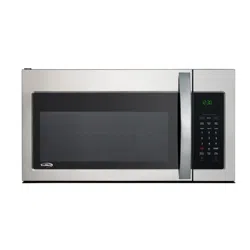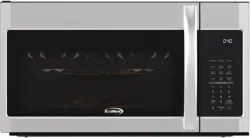
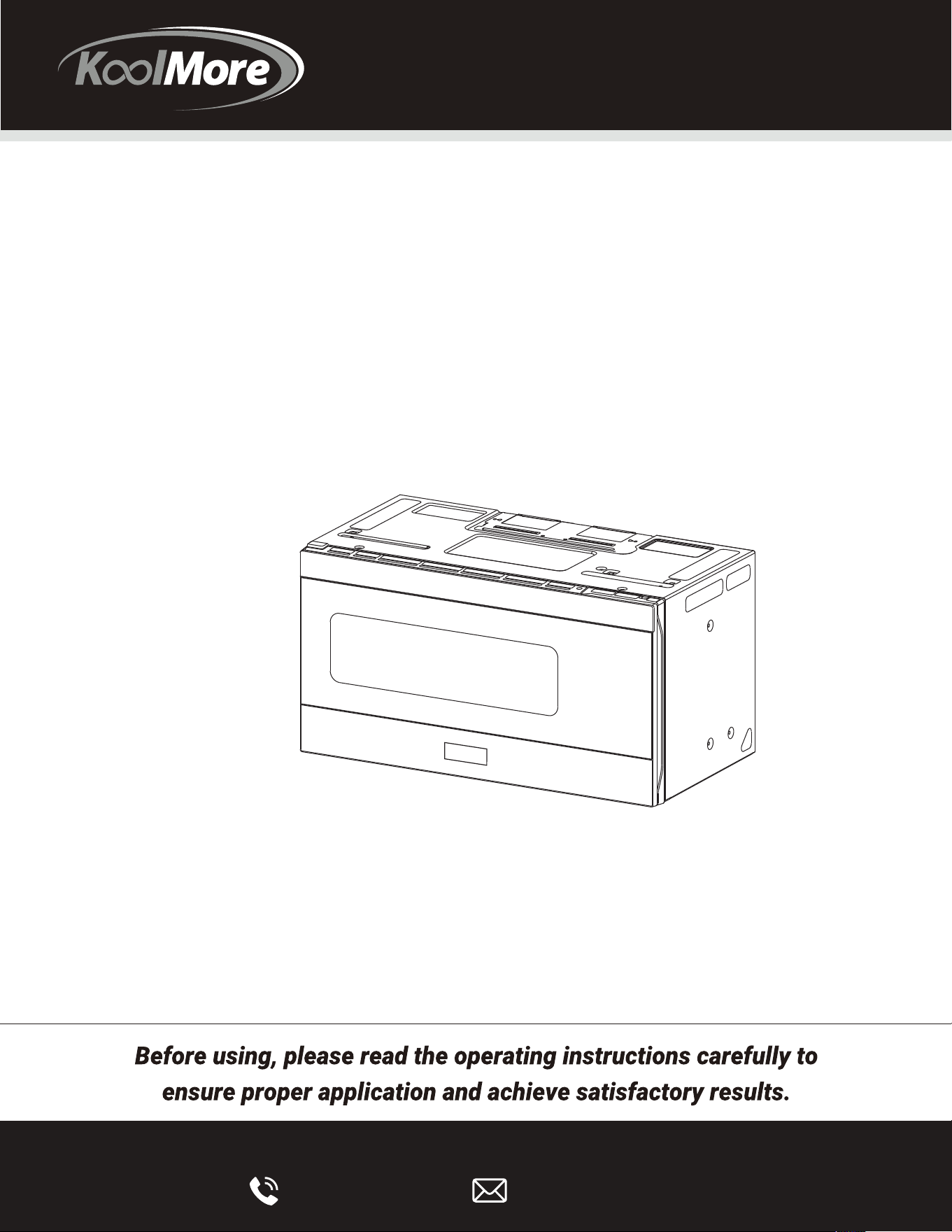
USER MANUAL
Microwave Oven
Model: KM-MOTSC-16BSS
KoolMore Stainless Steel Over
the Range Microwave Oven
With Sensor Cooking

Stay informed with the latest information
for your KoolMore Appliance.
If you need any assistance or have questions, our customer
support team is here to help.

• SAFETY INFORMATION
•
• For your safety, the information in this manual must be followed to minimize the risk of fire or
explosion or to prevent property damage, personal injury, or loss of life.
•
• Precautions to avoid possible exposure to excessive microwave energy:
•
• Do not attempt to operate this microwave with the door open because this can result in harmful
exposure to microwave energy. It is important not to defeat or tamper with the safety interlocks.
• Do not place any object between the microwave front face and the door or allow soil or cleaner
residue to accumulate on sealing surfaces.
• Do not operate the microwave if it is damaged. It is particularly important that the microwave door
closes properly and that there is no damage to the:
• (a) door (bent)
• (b) hinges and latches (broken or loosened)
• (c) door seals and sealing surfaces
• 4. The microwave should not be adjusted or repaired by anyone except properly qualified service
personnel.
•
• IMPORTANT SAFETY INSTRUCTIONS
•
• Warning
• WARNING indicates a potentially hazardous situation which, if not avoided, could result in death or
serious injury.
•
• Caution
• CAUTION indicates a potentially hazardous situation which, if not avoided, may result in minor or
moderate injury.
•
• READ ALL INFORMATION BEFORE USING
•
• Warning
• To reduce the risk of fire, burns, electric shock, injury to persons, or exposure to excessive micro-
wave energy when using your appliance, follow the basic precautions included in the following
sections.
•
• Read all instructions before using the appliance.
• Read and follow the specific “Precautions to avoid possible exposure to excessive microwave
energy:” on page 3.
• This appliance must be grounded. Connect only to a properly grounded outlet. See “Grounding
instructions” on page 4.
• Install or locate this appliance only in accordance with the provided installation instructions.
• Some products such as whole eggs and sealed containers — for example, closed glass jars — are
able to explode and should not be heated in this microwave oven.
• Use this appliance only for its intended use as described in this manual. Do not use corrosive chem-
icals or vapors in this appliance. This type of microwave oven is specifically designed to heat, cook,
or dry food. It is not designed for industrial or laboratory use.
• As with any appliance, close supervision is necessary when used by children.
• Do not operate this appliance if it has a damaged cord or plug, if it is not working properly, or if it
has been damaged or dropped.
• This appliance should be serviced only by qualified service personnel. Contact nearest Authorized
Servicer for examination, repair, or adjustment.
• Do not cover or block any openings on the appliance.
• Do not store or use this appliance outdoors. Do not use this product near water—for example, near a
kitchen sink, in a wet basement, or near a swimming pool, or similar locations.
• Do not immerse the cord or plug in water.
• Keep the cord away from heated surfaces.
• Do not let the cord hang over the edge of the table or counter.
• See door surface cleaning instructions on page 16.
• To reduce the risk of fire in the microwave oven cavity:
• Do not overcook food. Carefully attend to the appliance when paper, plastic, or other combustible
materials are placed inside the microwave oven or plastic bags cooking.
• Remove wire twist-ties from paper or plastic facsimile before placing the bag in the microwave
oven.
• If materials inside the microwave oven ignite, keep the microwave oven door closed, turn the micro-
wave oven off, and disconnect the power cord or shut off power at the fuse or circuit breaker panel.
• Do not use the cavity for storage purposes. Do not leave paper products, cooking utensils, or food in
the cavity when not in use.
• Liquids, such as water, coffee, or tea are able to be overheated beyond the boiling point without
appearing to be boiling. Visible bubbling or boiling when the container is removed from the micro-
wave oven is not always present. THIS COULD RESULT IN VERY HOT LIQUIDS SUDDENLY BOILING
OVER WHEN A SPOON OR OTHER UTENSIL IS INSERTED INTO THE LIQUID.
To reduce the risk of injury to persons:
• Do not overheat the liquid.
• Stir the liquid both before and halfway through heating it.
• Do not use straight-sided containers with narrow necks. Use a wide-mouthed container.
• After heating, allow the container to stand in the microwave oven for at least for 20 seconds before
removing the container.
• Use extreme care when inserting a spoon or other utensil into the container.
• Clean the ventilation openings and grease filters frequently. Grease should not be allowed to accu-
mulate on ventilation openings, louver, or grease filters.
• Use care when cleaning the louver and the grease filters. Corrosive cleaning agents, such as
lye-based oven cleaners, may damage the louver and the grease filters.
• When flaming food under the hood, turn the fan on.
• This appliance is suitable for use above both gas and electric cooking equipment 36" wide or less.
This device complies with part 18 of the FCC Rules.
SAFETY
2

• SAFETY INFORMATION
•
• For your safety, the information in this manual must be followed to minimize the risk of fire or
explosion or to prevent property damage, personal injury, or loss of life.
•
• Precautions to avoid possible exposure to excessive microwave energy:
•
• Do not attempt to operate this microwave with the door open because this can result in harmful
exposure to microwave energy. It is important not to defeat or tamper with the safety interlocks.
• Do not place any object between the microwave front face and the door or allow soil or cleaner
residue to accumulate on sealing surfaces.
• Do not operate the microwave if it is damaged. It is particularly important that the microwave door
closes properly and that there is no damage to the:
• (a) door (bent)
• (b) hinges and latches (broken or loosened)
• (c) door seals and sealing surfaces
• 4. The microwave should not be adjusted or repaired by anyone except properly qualified service
personnel.
•
• IMPORTANT SAFETY INSTRUCTIONS
•
• Warning
• WARNING indicates a potentially hazardous situation which, if not avoided, could result in death or
serious injury.
•
• Caution
• CAUTION indicates a potentially hazardous situation which, if not avoided, may result in minor or
moderate injury.
•
• READ ALL INFORMATION BEFORE USING
•
• Warning
• To reduce the risk of fire, burns, electric shock, injury to persons, or exposure to excessive micro-
wave energy when using your appliance, follow the basic precautions included in the following
sections.
•
• Read all instructions before using the appliance.
• Read and follow the specific “Precautions to avoid possible exposure to excessive microwave
energy:” on page 3.
• This appliance must be grounded. Connect only to a properly grounded outlet. See “Grounding
instructions” on page 4.
• Install or locate this appliance only in accordance with the provided installation instructions.
• Some products such as whole eggs and sealed containers — for example, closed glass jars — are
able to explode and should not be heated in this microwave oven.
• Use this appliance only for its intended use as described in this manual. Do not use corrosive chem-
icals or vapors in this appliance. This type of microwave oven is specifically designed to heat, cook,
or dry food. It is not designed for industrial or laboratory use.
• As with any appliance, close supervision is necessary when used by children.
• Do not operate this appliance if it has a damaged cord or plug, if it is not working properly, or if it
has been damaged or dropped.
• This appliance should be serviced only by qualified service personnel. Contact nearest Authorized
Servicer for examination, repair, or adjustment.
• Do not cover or block any openings on the appliance.
• Do not store or use this appliance outdoors. Do not use this product near water—for example, near a
kitchen sink, in a wet basement, or near a swimming pool, or similar locations.
• Do not immerse the cord or plug in water.
• Keep the cord away from heated surfaces.
• Do not let the cord hang over the edge of the table or counter.
• See door surface cleaning instructions on page 16.
• To reduce the risk of fire in the microwave oven cavity:
• Do not overcook food. Carefully attend to the appliance when paper, plastic, or other combustible
materials are placed inside the microwave oven or plastic bags cooking.
• Remove wire twist-ties from paper or plastic facsimile before placing the bag in the microwave
oven.
• If materials inside the microwave oven ignite, keep the microwave oven door closed, turn the micro-
wave oven off, and disconnect the power cord or shut off power at the fuse or circuit breaker panel.
• Do not use the cavity for storage purposes. Do not leave paper products, cooking utensils, or food in
the cavity when not in use.
• Liquids, such as water, coffee, or tea are able to be overheated beyond the boiling point without
appearing to be boiling. Visible bubbling or boiling when the container is removed from the micro-
wave oven is not always present. THIS COULD RESULT IN VERY HOT LIQUIDS SUDDENLY BOILING
OVER WHEN A SPOON OR OTHER UTENSIL IS INSERTED INTO THE LIQUID.
To reduce the risk of injury to persons:
• Do not overheat the liquid.
• Stir the liquid both before and halfway through heating it.
• Do not use straight-sided containers with narrow necks. Use a wide-mouthed container.
• After heating, allow the container to stand in the microwave oven for at least for 20 seconds before
removing the container.
• Use extreme care when inserting a spoon or other utensil into the container.
• Clean the ventilation openings and grease filters frequently. Grease should not be allowed to accu-
mulate on ventilation openings, louver, or grease filters.
• Use care when cleaning the louver and the grease filters. Corrosive cleaning agents, such as
lye-based oven cleaners, may damage the louver and the grease filters.
• When flaming food under the hood, turn the fan on.
• This appliance is suitable for use above both gas and electric cooking equipment 36" wide or less.
This device complies with part 18 of the FCC Rules.
3

SAVE THESE INSTRUCTIONS
Unpacking and examining your microwave
Open the bottom of the carton, bend the carton flaps back, and tilt the microwave oven over to rest
on the plastic foam pad. Lift the carton off the microwave oven and remove all packing materials,
including the User Guide, Installation Guide, templates (2), charcoal filter, and turntable (with ring).
SAVE THE CARTON AS IT MAY MAKE INSTALLATION EASIER.
Remove the feature sticker from the outside of the door, if there is one.
DO NOT REMOVE THE WAVEGUIDE COVER.
Read and SAVE the User Guide and Installation Guide.
Check the microwave oven for any damage, such as misaligned or bent door, damaged door seals
and sealing surfaces, broken or loose door hinges and latches, and dents inside the cavity or on the
door. If there is any damage, do not operate the microwave oven and contact your dealer or repair
center. See Installation Instructions for more details.
Grounding instructions
This appliance must be grounded. This microwave oven is equipped with a cord having a grounding
wire with a grounding plug. It must be plugged into a wall receptacle that is properly installed and
grounded in accordance with the National Electrical Code and local codes and ordinances. In the
event of an electrical short circuit, grounding reduces the risk of electric shock by providing an
escape wire for the electric current.
Warning: Improper use of the grounding plug can result in a risk of electric shock.
Electrical requirements
Check the Installation Instructions for proper location for the power supply.
The electrical requirements are a 120 volt AC, 60 Hz, 15 amp. or more protected electrical supply. It
is recommended that a separate circuit serving only the microwave oven be provided.
SETUP
4
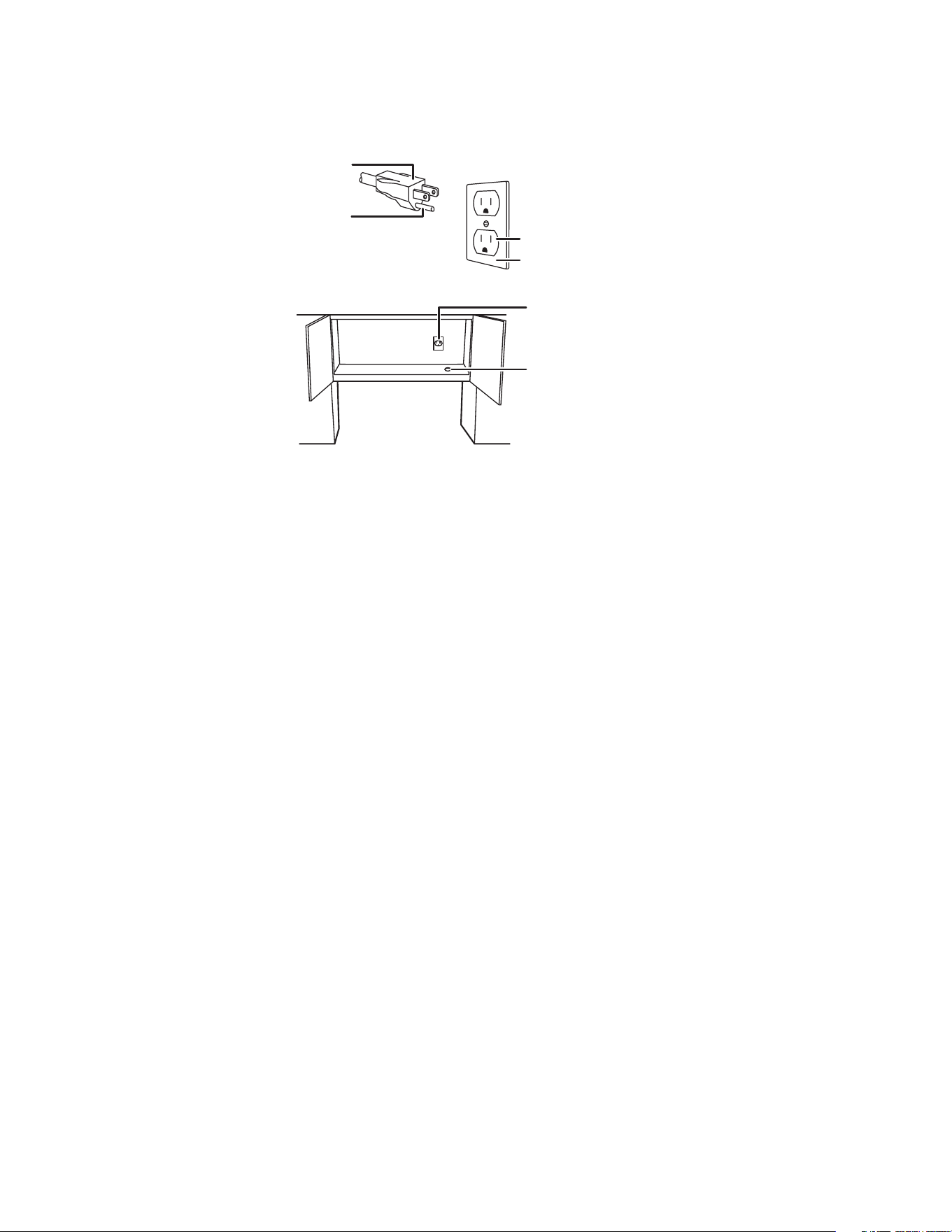
The microwave oven is equipped with a 3-prong grounding plug. It must be plugged into a wall
receptacle that is properly installed and grounded. DO NOT UNDER ANY CIRCUMSTANCES CUT OR
REMOVE THE GROUNDING PIN FROM THE PLUG. DO NOT USE AN EXTENSION CORD.
If the power supply cord is too short, have a qualified electrician or serviceman install an outlet near
the appliance.
The power supply cord and plug must be connected to a separate 120 Volt AC, 60 Hz, 15 Amp, or
more branch circuit, single grounded receptacle. The receptacle should be located inside the cabi-
net directly above the microwave oven mounting location as shown above.
Notes
If you have any questions about the grounding or electrical instructions, consult a qualified electrician or service person.
Does not accept any liability for damage to the microwave oven or personal injury resulting from failure to observe the
correct electrical connection procedures.
ABOUT YOUR MICROWAVE OVEN
• Read this User Guide and always save it for reference.
• A good microwave cookbook is a valuable asset. Check it for microwave cooking principles,
techniques, hints, and recipes.
• NEVER use the microwave oven without the turntable and support nor turn the turntable over so
that a large dish could be placed on the microwave oven. The turntable will not turn both clock-
wise and counterclockwise.
• ALWAYS have food in the microwave oven when it is on to absorb the microwave energy.
• When using the microwave oven at power levels below 100%, you may hear the magnetron
cycling on and off. It is normal for the exterior of the microwave oven to be warm to the touch
when cooking or reheating.
• Condensation is a normal part of microwave cooking. Round and smooth outside of food will
not cause as much amount of moisture that condenses in the microwave oven. Generally cov-
ered food dishes will cause a condensation wave uncovered. Ventilation openings must not be
blocked.
• The microwave oven is not for commercial use. It should not be used to dry clothes, newspa-
pers, or other materials. Your microwave oven is rated at 800 watts by using the IEC Test Proce-
dure. In using recipes or package directions, check food a minute or two before the minimum
time and add time accordingly.
3-prong plug
Grounding plug
Ground receptacle box
3-prong receptacle
Opening for power
cord
Ground receptacle
5

MICROWAVE COOKING
• Arrange food carefully. Place thickest areas towards outside of the dish.
• Watch the cooking time. Cook for the shortest amount of time indicated and add more as
needed. Food severely overcooked can smoke or ignite.
• Cover foods while cooking. Check the recipe or cookbook for suggestions, such as paper towels,
wax paper, microwave plastic wrap, or a lid. Covers prevent spattering and help foods to cook
evenly.
• Shield with small flat pieces of aluminum foil any thin areas of meat or poultry to prevent
overcooking before dense, thick areas are cooked thoroughly.
• Stir foods from outside to center of dish once or twice during cooking, if possible.
• Turn foods over once during microwaving to speed cooking of such foods as chicken and
hamburgers. Large items like roasts must be turned over at least once.
• Rearrange foods such as meatballs halfway through cooking both from top to bottom and from
the center of the dish to the outside.
• Add standing time. Remove the food from the microwave oven and stir, if possible. Cover for the
standing time which allows the food to finish cooking without overcooking.
• Check for doneness. Look for signs indicating that cooking temperatures have been reached.
Doneness signs include:
• Food steams throughout, not just at edge.
• Center bottom of dish is very hot to the touch.
• Poultry thigh joints move easily.
• Meat and poultry show no pinkness.
• Fish is opaque and flakes easily with a fork.
• Cookware and cooking materials
Warning: Personal Injury Hazard
Tightly-closed containers could explode. Closed containers should be opened and plastic pouches should be pierced
before cooking.
Cookware and other materials must fit on the turntable. Always use oven mitts or pot holders
because cookware may become hot.
Refer to “Materials you can use” on page 7 and “Materials to be avoided” on page 7 as a guide, then
test before using.
Cookware and Materials Test:
1. Fill a microwave-safe container with 1 cup (250 ml) of cold water, along with the cookware or
materials in question.
2. Cook on maximum power for one minute. Do not exceed one minute cooking time.
3. Carefully feel the cookware or material. If the empty cookware or material is warm, do not use it
for microwave cooking.
OPERATION
6
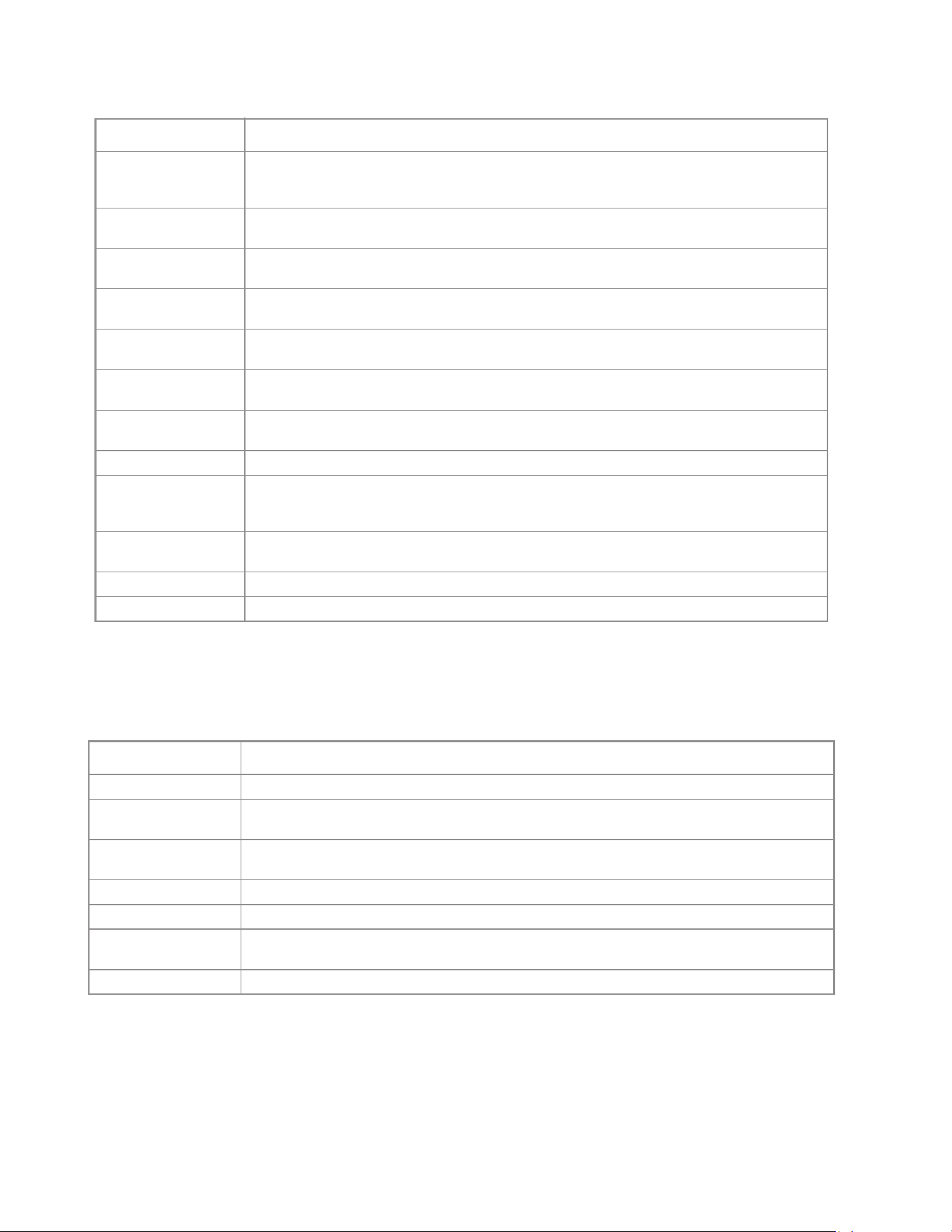
Materials you can use
Materials to be avoided
MATERIAL REMARKS
Browning dish
Follow the manufacturer’s instructions. The bottom of the browning dish must be at
least 3/16-in. (5mm) above the turntable. Incorrect usage may cause the turntable to
break.
Dinnerware
Use microwave-safe only. Follow the manufacturer's instructions. Do not use cracked or
chipped dishes.
Glass jars
Always remove the lid. Use only to heat food until just warm. Most glass jars are not heat
resistant and may break.
Glassware
Use heat-resistant oven glassware only. Make sure there is no metallic trim. Do not use
cracked or chipped
dishes.
Oven cooking bags
Follow the manufacturer’s instructions. Do not close with a metal tie. Make slits to allow
steam to escape.
Paper plates and
cups
Use for short–term cooking/warming only. Do not leave the oven unattended while
cooking.
Paper towels
Use to cover food for reheating and absorbing fat. Use with supervision for short-term
cooking only.
Parchment paper Use as a cover to prevent splattering or a wrap for steaming.
Plastic
Use only if labeled “Microwave Safe.” Follow the manufacturer’s instructions. Some
plastic containers soften as the food in
side gets hot. “Boiling bags” and tightly closed
plastic bags should be slit, pierced, or vented, as indicated on the package.
Plastic wrap
Use microwave-safe only. Use to cover food during cooking to retain moisture. Do not
allow plastic wrap to touch food.
Thermometers Use microwave-safe only (such as meat and candy thermometers).
Wax paper Use as a cover to prevent splattering and retain moisture.
MATERIAL REMARKS
Aluminum tray May cause arcing. Use a microwave-safe dish instead.
Food carton with
metal handle
May cause arcing. Use a microwave-safe dish instead.
Metal or metal
trimmed utensils
Metal shields the foo
d from microwave energy. The metal trim may cause arcing.
Metal twist ties May cause arcing and could cause a re in the oven.
Paper bags May cause a re in the oven.
Plastic foam
Plastic foam may melt or contaminate the liquid inside when exposed to high
temperature.
Wood Wood will dry out when used in the microwave oven and may split or crack.
7
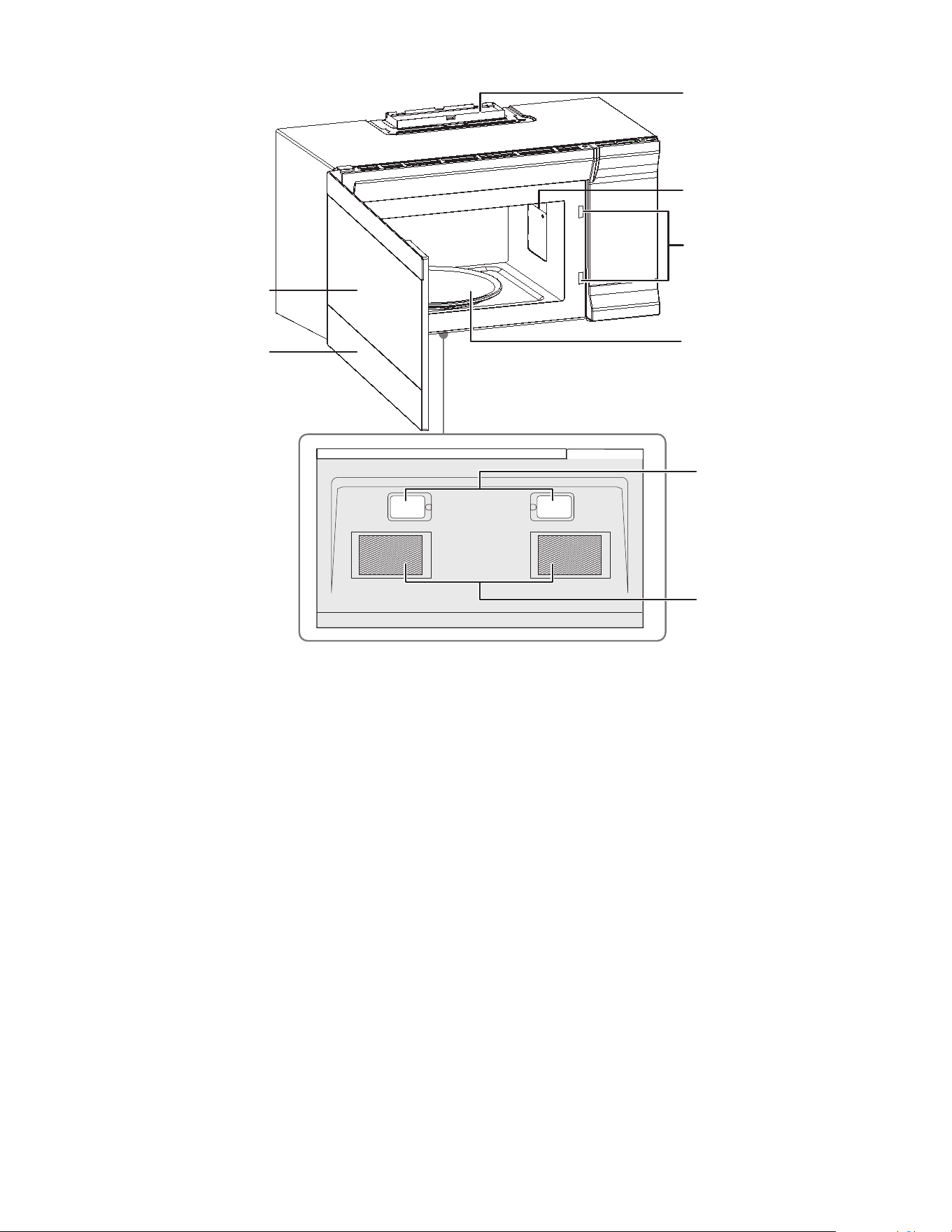
Window
Control panel
Safety interlock
system
Vent openings
Waveguide cover
DO NOT REMOVE
Turntable
Surface lights
Grease lters
BOTTOM
Features
• Sensor cooking
• 10 variable power levels
• Add 30 seconds and express cooking
• 1000W of power
• Exhaust fan with two speeds
• Task lighting
• Child lock
• Turntable
• Hidden vent
Package contents
• 1.6 cu. ft. over-the-range microwave oven
• Turntable (with ring)
• Installation hardware
• Grease filters (2)
• Installation Guide
• User Guide
Microwave oven
8
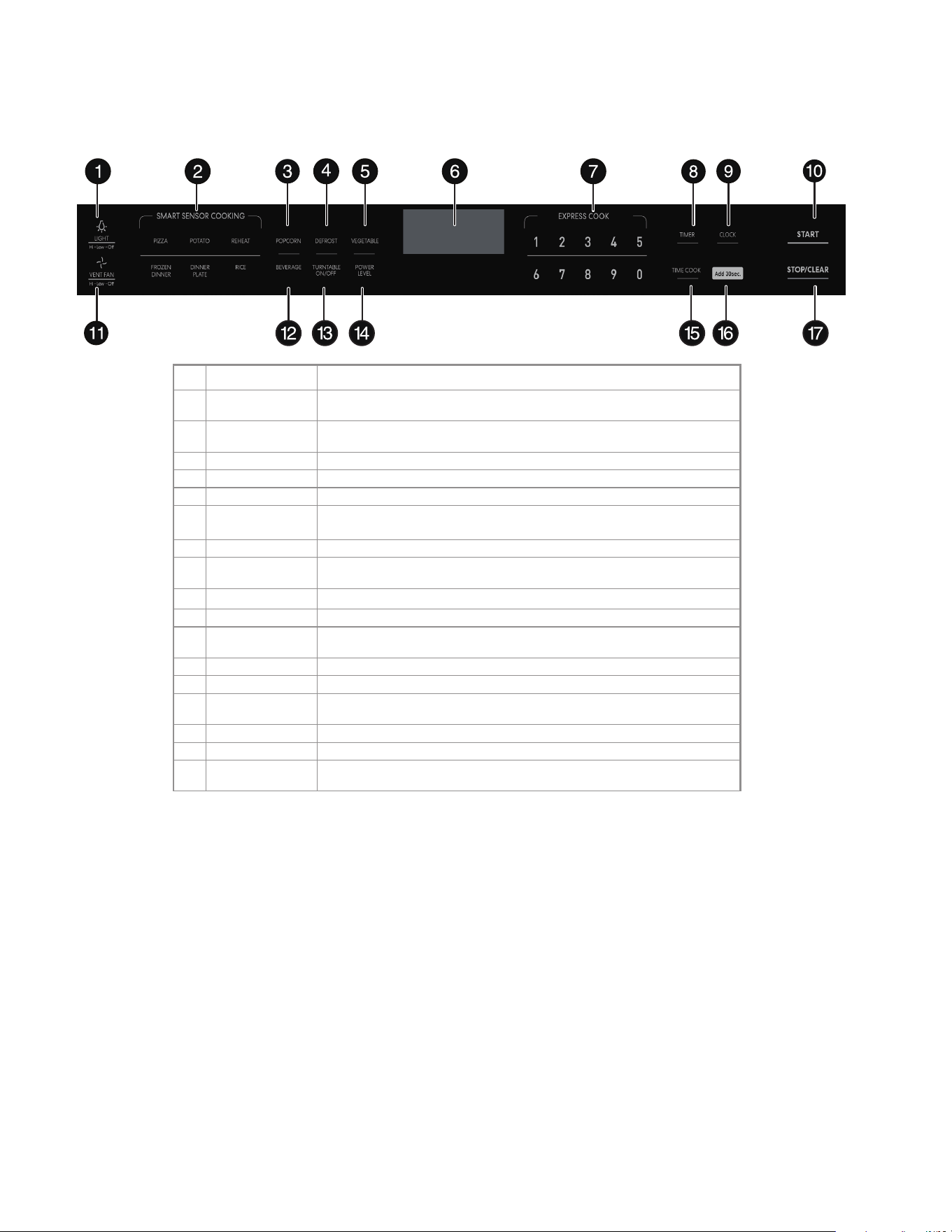
Control panel
Setting up your microwave oven
See the Installation Guide (included in your box) to install and set up your microwave. You can also nd the
Installation Guide online:
# ITEM DESCRIPTION
1 Light
Press to turn on/o the light underneath your microwave. See “Using the
light” on page 1
2 SENSOR COOKING
Detects the humidity released by your cooking food and adjusts the
cooking time based on the type and amount of food cooking.
3 Popcorn Press to cook popcorn. See “Popcorn” on page 1
4 Defrost Press to defrost frozen food. See “Defrosting in your microwave” on page 13.
5 Vegetable Press to cook vegetables. See “Vegetable” on page 14.
6 Display
In standby mode, displays the time. In cooking
mode, displays cooking time,
weight, and other information.
7 Number pad Press to enter cook time, defrost time, clock time, and other information.
8 Timer
Press this button, then enter the time you want to count down. See “Using
the kitchen timer” on page 12.
9 Clock
Press to set or check the clock. See “Setting the clock]” on page 13
10 START In standby mode, press this button to begin cooking.
11 Vent Fan
Press to turn on/o your vent fan and remove odors from cooking. See
“Using the vent fan” on page 1
12 Beverage Press to heat a beverage. See “Beverage” on page 1
13 Turntable on/o
Press to turn your turntable on or o. See “Using the turntable” on page 1
14 Power Level
Press to change your microwave’s power level (1-10). See “Cooking in your
microwave” on page 1
15 Time Cook Press to enter a cooking time.
16 Add 30 sec. While cooking, press this button to add 30 seconds to your cooking time.
17 STOP/CLEAR
Press to stop the cooking process. Press again to cancel the cooking
operation.
1 Go to .
2 Use the search bar to nd your model number ().3 Select Support & Downloads.
4 Next to Installation Guide, select the language you want.
6.
6.
6.
6.
6.
2.
9
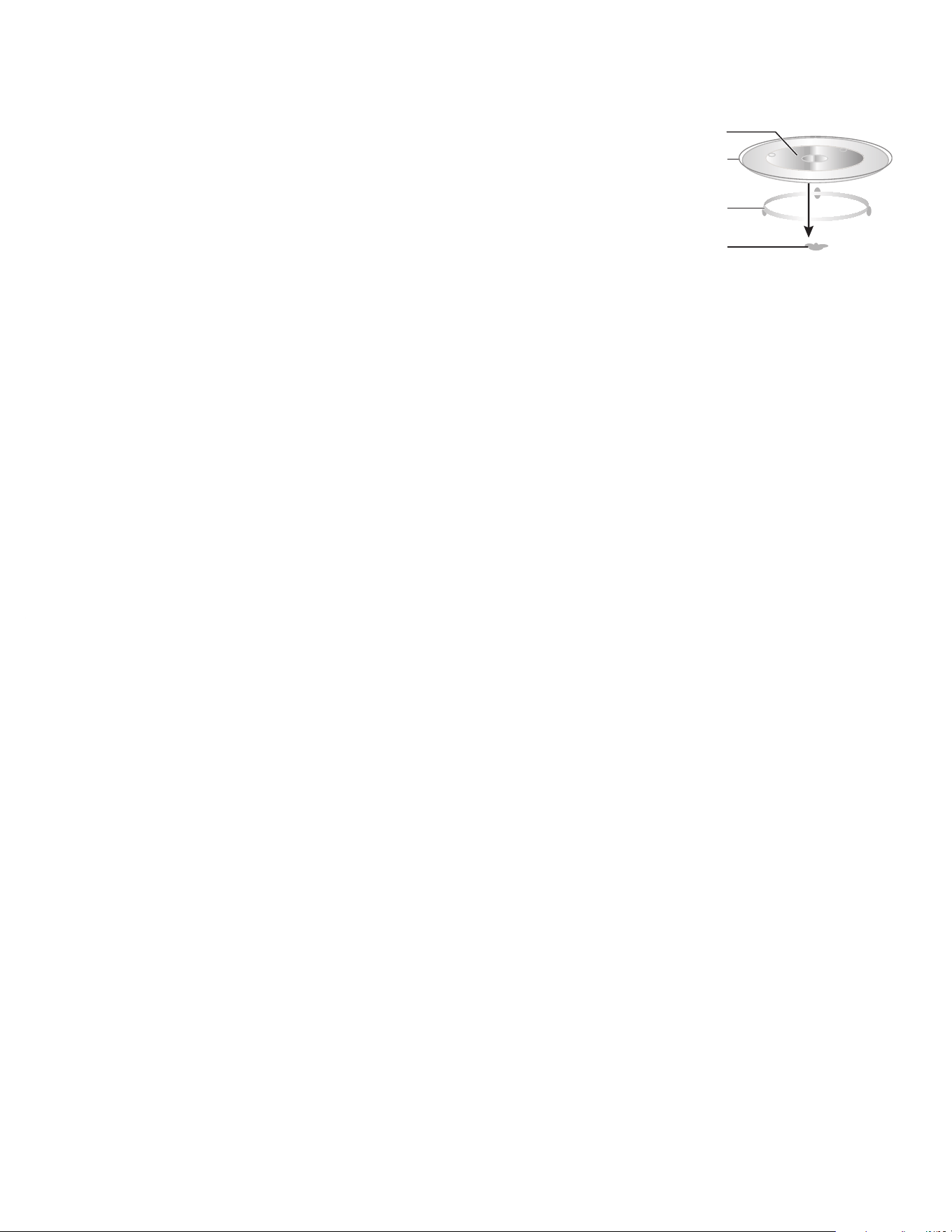
Installing the turntable
Hub (underside)
Glass turntable
Turntable ring
Turntable shaft
Notes
• Never place the glass tray upside down. The glass tray should never be restricted.
• Always place all food and containers of food on the glass tray during cooking.
• Both the glass tray and turntable ring must always be used for cooking.
• If the glass tray or turntable ring cracks or breaks, contact your nearest authorized
service center.
1. Place the turntable ring in the round depression in the bottom of the microwave oven so that it turns
freely.
2. Place the glass turntable (flat side up) on the turntable ring so that the hub engages the turntable
shaft in the bottom of the oven. The glass turntable should not turn freely when it is correctly
installed.
USING YOUR MICROWAVE
Tips for the best results
Storage temperature
Foods taken from the freezer or refrigerator take longer to cook than the same foods would at room
temperature.
Size
Small pieces of food cook faster than large ones. Pieces similar in size and shape will cook more evenly
when cooked together. For more even results, reduce the power levels when cooking large pieces of
food.
Natural moisture
Very moist foods cook more evenly because microwave energy heats water molecules very efficiently.
Stirring
Stir foods such as casseroles and vegetables from the outside to the center to distribute the heat more
evenly. This will allow the food to cook faster. Constant stirring is not necessary.
Turn over items
Turn over foods such as pork chops, roasts, or whole cauliflower halfway through the cook time. This
will help to expose all sides equally to microwave energy.
Food placement
Place delicate areas of food items, such as asparagus tips, toward the center of the turntable tray.
Food arrangement
Arrange unevenly shaped foods, such as chicken pieces or salmon, with the thicker or meatier parts
toward the outside of the turntable tray.
Let the food stand
After removing the food from the microwave, cover the food with foil or a casserole lid and let it stand to
finish cooking. This will help the food finish in the center and avoids overcooking the outer edges. The
length of stand time depends on the density and surface area of the food items.
10
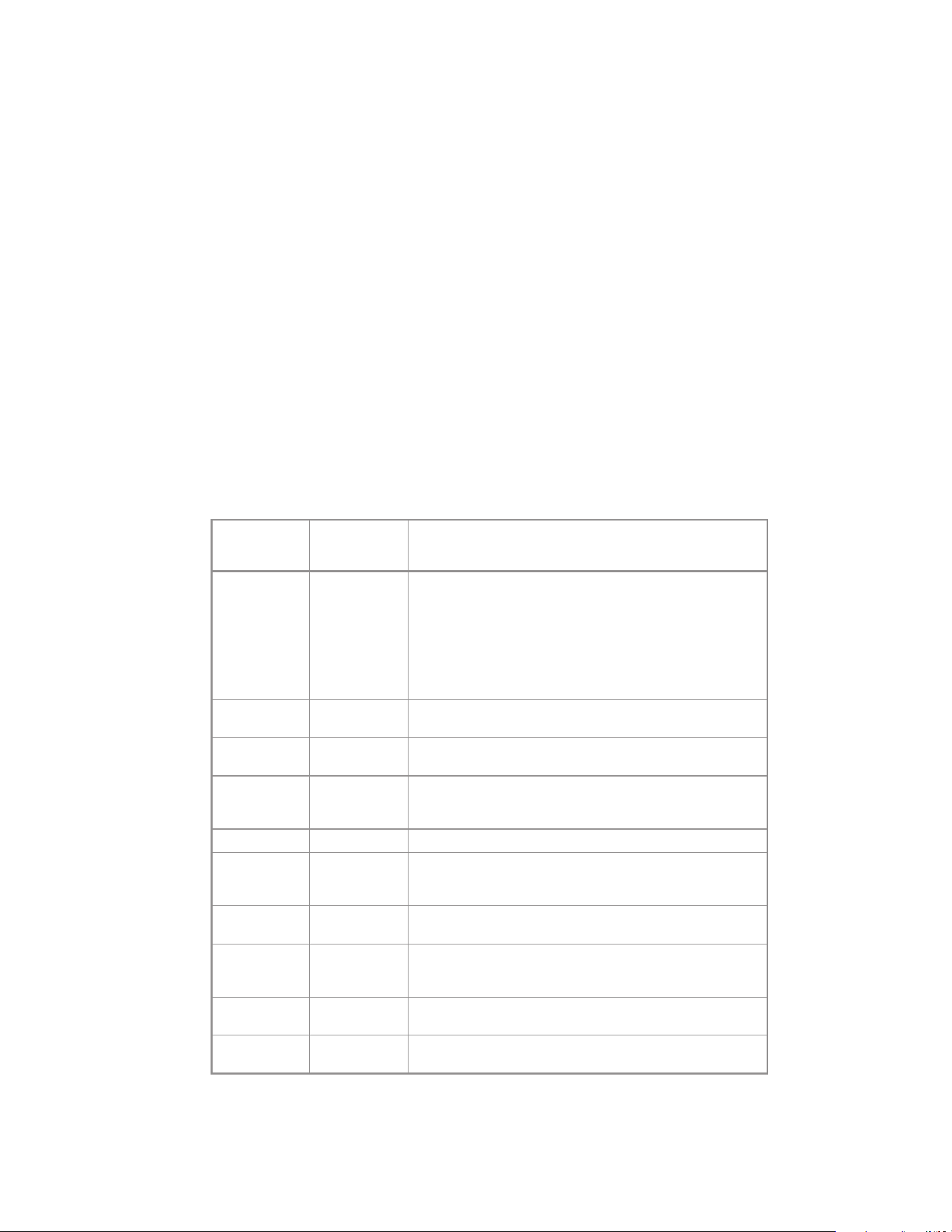
3 Press Start to begin heating.
POWER
LEVEL
OUTPUT RECOMMENDED WHEN...
10 100%
• Boiling water.
• Cooking ground beef.
• Making candy.
• Cooking fresh fruits and vegetables.
• Cooking sh and poultry.
• Preheating browning dish.
• Reheating beverages.
• Cooking bacon slices.
9 90%
• Reheating meat slices quickly.
• Sautéing onions, celery, and green peppers.
8 80%
• All reheating.
• Cooking scrambled eggs.
7 70%
• Cooking breads and cereal products.
• Cooking cheese dishes and veal.
• Cooking cakes, muns, brownies and cupcakes.
6 60% • Cooking pasta.
5 50%
• Cooking meats and whole poultry.
• Cooking custard.
• Cooking spare ribs, rib roast, and sirloin roast.
4 40%
• Cooking less tender cuts of meat.
• Reheating frozen packaged foods.
3 30%
• Thawing meat, poultry, and seafood.
• Cooking small quantities of food.
• Finish cooking casseroles, stew, and some sauces.
2 20%
• Softening butter and cream cheese.
• Heating small amounts of food.
1 10%
• Softening ice cream.
• Raising yeast dough.
Wrapping in paper towels or waxed paper
Sandwiches and many other food types containing pre baked bread should be wrapped prior to
placing in the microwave to help prevent the food items from drying out while heating.
Cooking in your microwave
1. Press Time Cook, then use the number pad to enter the cooking time that you want.
Note: For example, to enter 3 minutes and 15 seconds, press 3, 1, and then 5.
2. (Optional) Press Power Level, then enter the power level that you want (1-10).
Note:By default, your microwave cooks at 100% power.
Press Power Level while cooking to check the power level.
11

Cooking with multiple cooking stages
For best results, some microwave recipes call for different power levels or different lengths of time for
cooking. Your microwave may be set to change from one stage to another automatically (two stages
maximum).
1. Press Time Cook, then use the number pad to enter the cooking time that you want for the first
stage.
Note: For example, to enter 3 minutes and 15 seconds, press 3, 1, and then 5.
2. Press Power Level, then enter the power level that you want (1-10) for the first stage. The power level
(PL) is shown on the display.
3. Press Time Cook, then use the number pad to enter the cooking time for the second stage.
4. Press Power Level, then enter the power level that you want (1-10) for the second stage. The power
level (PL) is shown on the display.
5. Press Start to begin heating. When the microwave is done, it beeps and shows “END” on the display.
Setting the clock
Press Clock to check the time while cooking.
1. Press Clock.
2. Use the number pad to enter the current time (1:00–12:59), then press Start to confirm the setting.
Using the Timer
You can use the timer while the microwave is cooking.
1. In standby mode, press Timer.
2. Use the number pad to enter the time, then press Start. When the time reaches 0, your microwave
beeps.
Cooking quickly
• Press a number on the number pad to instantly start cooking. For example, to cook for two minutes,
press 2.
• From standby, press Add 30 sec. to instantly cook for 30 seconds.
• To increase the time in 30 second increments (except auto cook and defrost), press Add 30 sec.
repeatedly.
Note: You can not quick start when using the defrost feature.
12
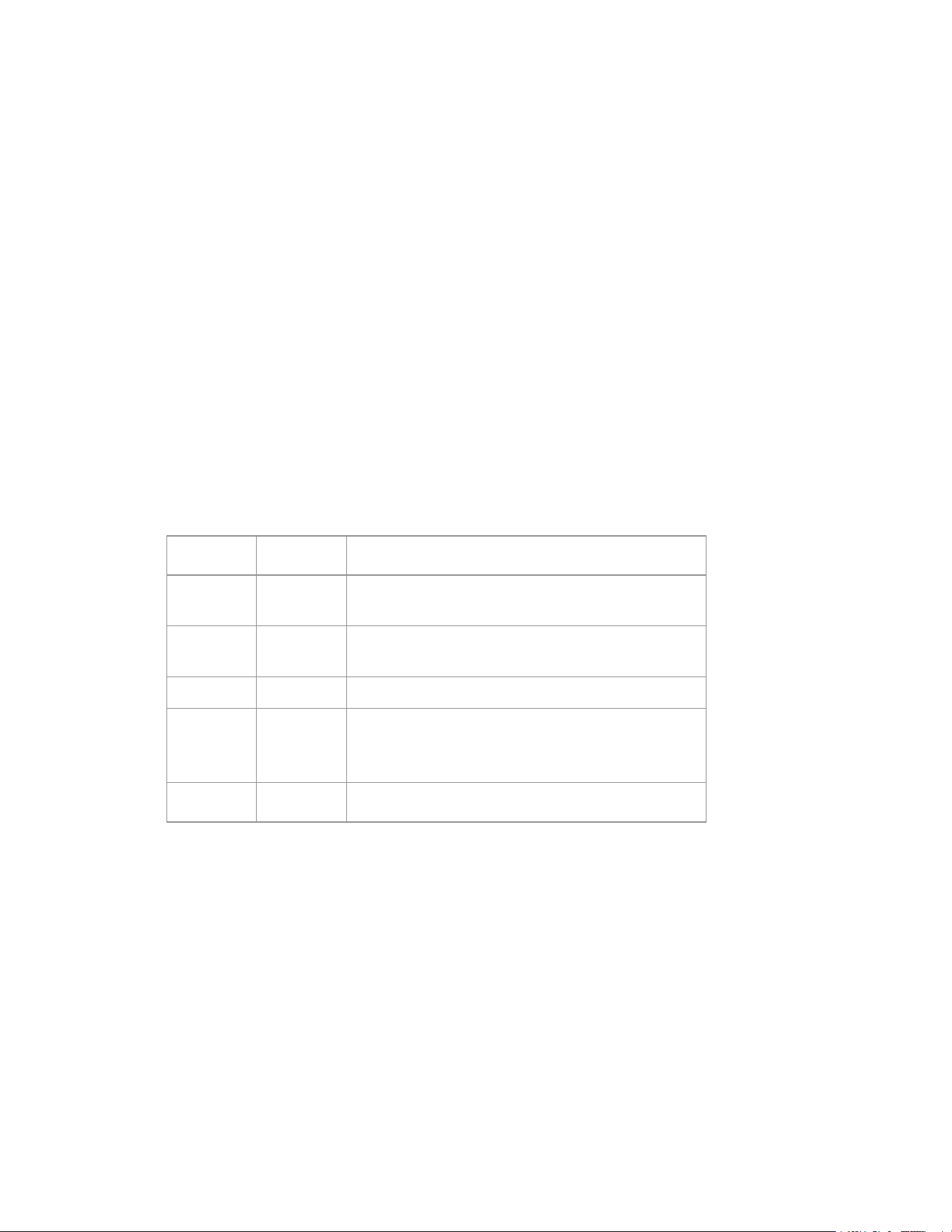
MEAT
NORMAL
WEIGHT
COOK TIME
Roast beef or
pork
2.5 to 6 lbs.
(40 to 96 oz.)
• Placed fat-side down.
• After each stage, turn the food over and shield any warm portions
with narrow strips of aluminum foil.
• Let stand, covered for 15-30 minutes.
Steaks, chops, or
sh
0.5 to 3 lbs.
(8 to 48 oz.)
• After each stage, rearrange the food. If there are any warm or thawed
portions of food, shield them with narrow at pieces of aluminum foil.
• Remove any pieces of food that are nearly defrosted.
• Let stand, covered for about 5 to 10 minutes.
Ground meat
0.5 to 3 lbs.
(8 to 48 oz.)
• Af
ter each stage, remove any pieces of food that are nearly defrosted.
• Let stand, covered with foil for 5 to 10 minutes.
Whole chicken
2.5 to 6 lbs.
(40 to 96 oz.)
• Remove giblets before freezing poultry.
• Start defrosting with the breast side down.
• After the rst stage, turn the chicken over and shield any warm
portions with narrow strips of aluminum foil. After the second stage,
again shield any warm portions with narrow strips of aluminum foil.
• Let stand, covered, for 30 to 60 minutes in the refrigerator.
Chicken pieces
0.5 to 3 lbs.
(8 to 48 oz.)
• After each stage, rearrange or remo
ve any pieces of food that are
nearly defrosted.
• Let stand for 10-20 minutes.
Defrosting in your microwave
1. Press Defrost repeatedly to select "MEAT," "POULTRY," or "FISH."
2. Press START.
3. Use the number pad to enter the weight of the item to be defrosted (in pounds). For example, 10
= 1.0 lbs.
Note: You may enter any weight from 0.1 to 6.0 lbs.
4. Press START to start defrosting. The remaining cooking time is displayed. Your microwave may
beep periodically to remind you to turn the food. Press START to continue.
Tips for best results:
• Use defrost only for raw food items.
• Defrosting gives best results when your food is taken directly from the freezer. If the food has been stored in a
refrigerator-freezer that does not maintain a temperature of 5°F (-15°C) or below, always program a lower food weight
or lower cook time to prevent cooking the food.
• Enter a reduced weight if the frozen food has been outside the freezer for more than 20 minutes.
• The shape of the food package alters the defrosting time. For example, a shallow, rectangular food package will
defrost more quickly than a deep block of food.
• Separate pieces as they begin to defrost.
Tips for defrosting meat
For the best results, use these suggestions when defrosting meat:
Cooking with the sensor
Sensor cooking detects the humidity released by your cooking food and adjusts the cooking time
based on the type and amount of food cooking.
• Press Reheat, then press START. Your microwave automatically sets the cook time.
• When using sensor cooking:
• Casseroles: Add 2-3 tablespoons of liquid, cover with a lid or vented plastic wrap. Stir when
instructed from the display.
• Canned foods: Place the contents into a microwave-safe dish and cover with a loose-fitting lid or
vented plastic wrap. Let it stand a few minutes before serving.
• Plates of food: Arrange food on the plate. Cover with a loose-fitting lid or vented plastic wrap. Let
it stand a few minutes before serving.
13

Note
If additional time is needed, continue to cook manually.
Pizza
The pizza setting cooks from one to two slices (6-8 oz.) of pizza automatically.
Press Pizza, then press START.
Potato
The potato setting cooks from two to four potatoes automatically.
Poke holes in your potatoes skin 5-6 times with a fork. Do not cover your potatoes.
Press Potato, then press START.
Let the potatoes stand for about five minutes after the microwave has finished to complete cooking.
Frozen dinner
The frozen dinner setting is designed for one frozen entree or frozen convenience foods (such as
frozen dinners) from 10 to 20 oz.
• Press Frozen Dinner, then press START.
• When cooking frozen dinners:
• Read the instructions on your frozen food for best results, if available.
• Make sure that moisture can escape from the packaging. All frozen dinner instructions should
specify holes in the plastic covering before cooking.
• Be careful when removing the plastic covering. Remove the side facing away from you to avoid
steam burns.
Dinner plate
The dinner plate setting is designed for one to two plates.
• Press Dinner Plate, then press START.
Rice
The rice setting cooks one to two cups of rice automatically (starting from room temperature).
• Press Rice, then press START.
Vegetables
The vegetable sensor feature cooks from one to four cups of fresh vegetables (when starting at
room temperature).
1. Press Vegetable repeatedly to select the number of cups:
SERVINGS PRESS VEGETABLE BUTTON...
1 cup Once
2 cups 2 times
3 cups 3 times
4 cups 4 times
1. Press START.
14
DO NOT leave the microwave unattended while popping popcorn.
Popcorn
1. Press Popcorn repeatedly to select your popcorn bag's weight:
WEIGHT | PRESS POPCORN BUTTON...
3.5 oz. | Once
3.0 oz. | 2 times
1.75 oz. | 3 times
2. Press START.
Beverage
The beverage setting heats one to three cups of a beverage. Use the table below to determine the setting
to use.
1. Press Beverage repeatedly to select the number of servings:
SERVINGS | PRESS BEVERAGE BUTTON...
1 cup | Once
2 cups | 2 times
3 cups | 3 times
2. Press START.
Using the stop/clear button
Press STOP/CLEAR to:
• Erase information that you entered incorrectly
• Cancel the timer
• Pause the microwave during cooking (press START to resume)
• Display the clock after cooking is completed
• Cancel a programming during cooking (press twice)
Using the light
• To use the light underneath your microwave, press Light repeatedly to cycle between high brightness,
low brightness, or off.
Note: To change a light bulb, see “Replacing the light” on page 19.
Using the vent fan
Your microwave's vent fan works as a range hood to filter out smoke and other odors from cooking.
• Press Vent Fan repeatedly to cycle between high speed, low speed, or off.
• The fan automatically starts when heat rises from range surface units or burners and stops once the
unit temperature decreases. It cannot be turned off manually during this time. This protects the micro-
wave from excessive temperatures.
Using the turntable
For best results, leave the turntable on. However, you can turn it off for large dishes.
• Press the Turntable on/off to turn your turntable on or off.
Using the child lock
• To lock the microwave, press and hold STOP/CLEAR for three seconds. The microwave beeps and a
lock indicator appears on the display.
• To unlock the microwave, press and hold STOP/CLEAR until the lock indicator disappears (about three
seconds).
15

DO NOT leave the microwave unattended while popping popcorn.
Popcorn
1. Press Popcorn repeatedly to select your popcorn bag's weight:
WEIGHT | PRESS POPCORN BUTTON...
3.5 oz. | Once
3.0 oz. | 2 times
1.75 oz. | 3 times
2. Press START.
Beverage
The beverage setting heats one to three cups of a beverage. Use the table below to determine the setting
to use.
1. Press Beverage repeatedly to select the number of servings:
SERVINGS | PRESS BEVERAGE BUTTON...
1 cup | Once
2 cups | 2 times
3 cups | 3 times
2. Press START.
Using the stop/clear button
Press STOP/CLEAR to:
• Erase information that you entered incorrectly
• Cancel the timer
• Pause the microwave during cooking (press START to resume)
• Display the clock after cooking is completed
• Cancel a programming during cooking (press twice)
Using the light
• To use the light underneath your microwave, press Light repeatedly to cycle between high brightness,
low brightness, or off.
Note: To change a light bulb, see “Replacing the light” on page 19.
Using the vent fan
Your microwave's vent fan works as a range hood to filter out smoke and other odors from cooking.
• Press Vent Fan repeatedly to cycle between high speed, low speed, or off.
• The fan automatically starts when heat rises from range surface units or burners and stops once the
unit temperature decreases. It cannot be turned off manually during this time. This protects the micro-
wave from excessive temperatures.
Using the turntable
For best results, leave the turntable on. However, you can turn it off for large dishes.
• Press the Turntable on/off to turn your turntable on or off.
Using the child lock
• To lock the microwave, press and hold STOP/CLEAR for three seconds. The microwave beeps and a
lock indicator appears on the display.
• To unlock the microwave, press and hold STOP/CLEAR until the lock indicator disappears (about three
seconds).
16

Cleaning the outside of your microwave
Exterior
The outside surfaces are pre-coated steel and plastic. Clean the outside with mild soap and water, then
rinse and dry with a soft cloth. Do not use any type of household or abrasive cleaner.
Door
Wipe the window on both sides with a damp cloth to remove any spills or spatters. Metal parts will be
easier to maintain if wiped frequently with a damp cloth. Avoid the use of spray and other harsh cleaners
as they may stain, streak or dull the door surface.
Control panel
If the control panel is dirty, clean the microwave door before cleaning. Wipe the panel with a cloth damp-
ened slightly with water only. Dry with a soft cloth. Do not scrub or use any sort of chemical cleaners.
Close the door and press STOP/CLEAR to clear any instructions you may have pressed.
Cleaning the inside of your microwave
Interior
Wipe with a soft cloth and warm water. Do not use abrasive or harsh cleaners or scouring pads. For
baked-on food, use baking soda or a mild soap, then rinse thoroughly with hot water.
To help loosen baked-on food particles or liquids, heat a cup of water (add lemon juice if you want to
keep your microwave from smelling) in a microwave-safe mug or bowl on high power for five minutes or
until boiling. Let it cool in the microwave, then wipe the interior with a soft cloth.
Waveguide cover
The waveguide cover located on the right wall inside your microwave. Keep the waveguide cover free of
any food material for performance. Carefully wipe with a damp cloth and keep free from the surface of
the cover. Remove carefully with a dry cloth. Be especially careful not to damage the cover or to allow
any liquid to enter the waveguide opening.
Removing odors
Occasionally, a cooking odor may remain in the microwave. To remove, combine one cup of water, lemon
juice, and several whole cloves in a two-cup glass measuring cup. Boil for several minutes at high power,
then let it cool in the microwave. The interior should smell fresh.
Cleaning the turntable
Turntable and turntable support
MAINTENANCE
17
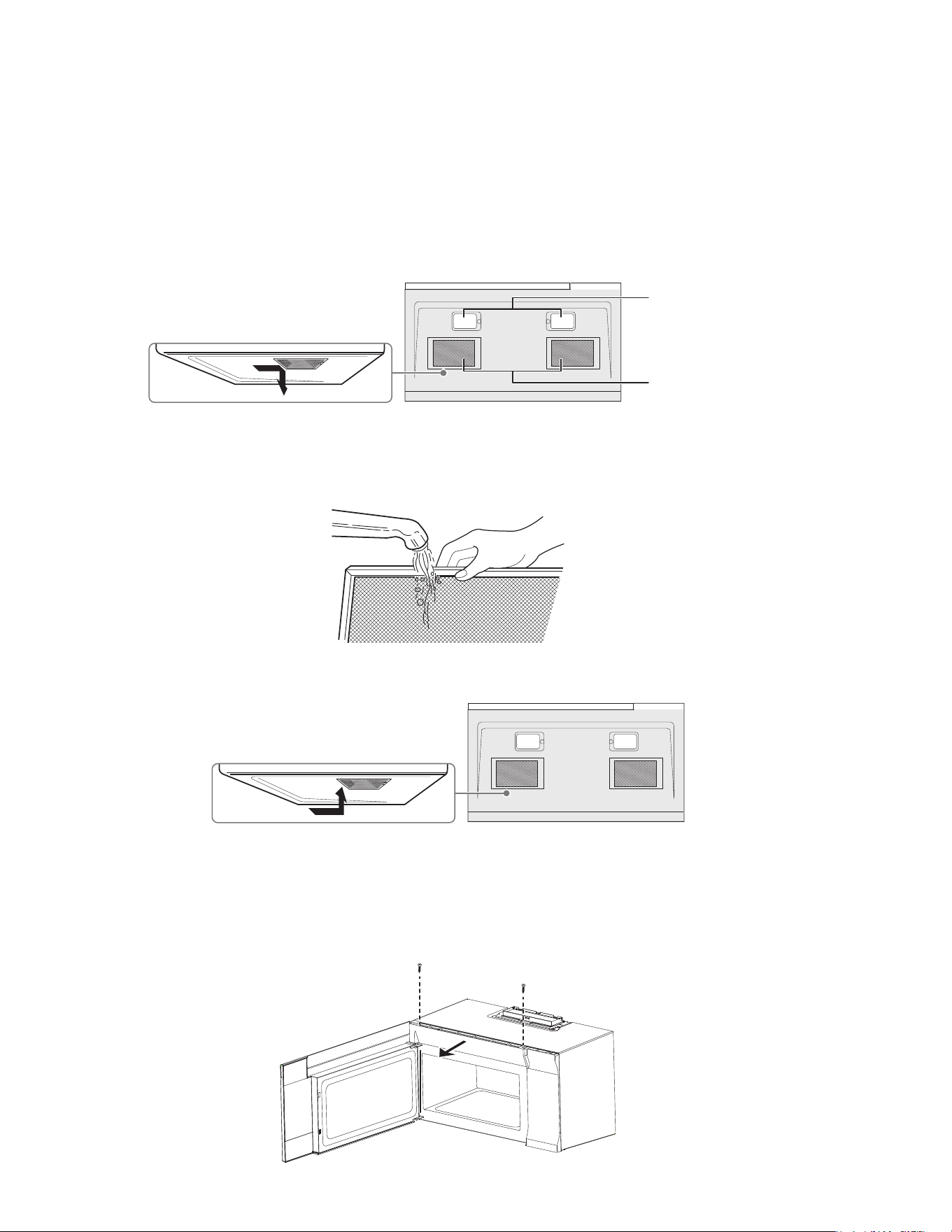
1 To remove the exhaust filters, slide the filter toward the back of the microwave, then pull it downward while
sliding it out of the side slot. Repeat for the second filter.
2 Soak the ventilation filters in hot water using a mild detergent or wash in a dishwasher. Rinse well and shake to
dry.
3 To reinstall the exhaust filter, slide it into the side slot
, then push up and toward the front of the microwave to
secure it. Repeat for the second filter.
Replacing the charcoal filter
The charcoal filter is used in non-vented, recirculated installations. The filter should be changed every 6 to 12
months depending on use.
1 Unplug the microwave oven or turn off power at the main circuit breaker.
2 Remove the vent grill screws.
3 Pull the vent grill away from the unit.
CAUTION: Do not use ammonia. The aluminum on the filter will corrode and darken.
Surface lights
BOTTOM
Ventilation lters
BOTTOM
• Remove the turntable and turntable support to wash them in mild, sudsy water. For stubborn stains,
use a mild abrasive cleaner or scouring pads. Rinse and turn to wash them then let them air dry
before using.
• Do not use the turntable if the turntable support roller ring is damaged. Do not wash the turntable
support roller ring in the dishwasher.
CAUTION: Do not operate the microwave without the turntable properly in place.
18
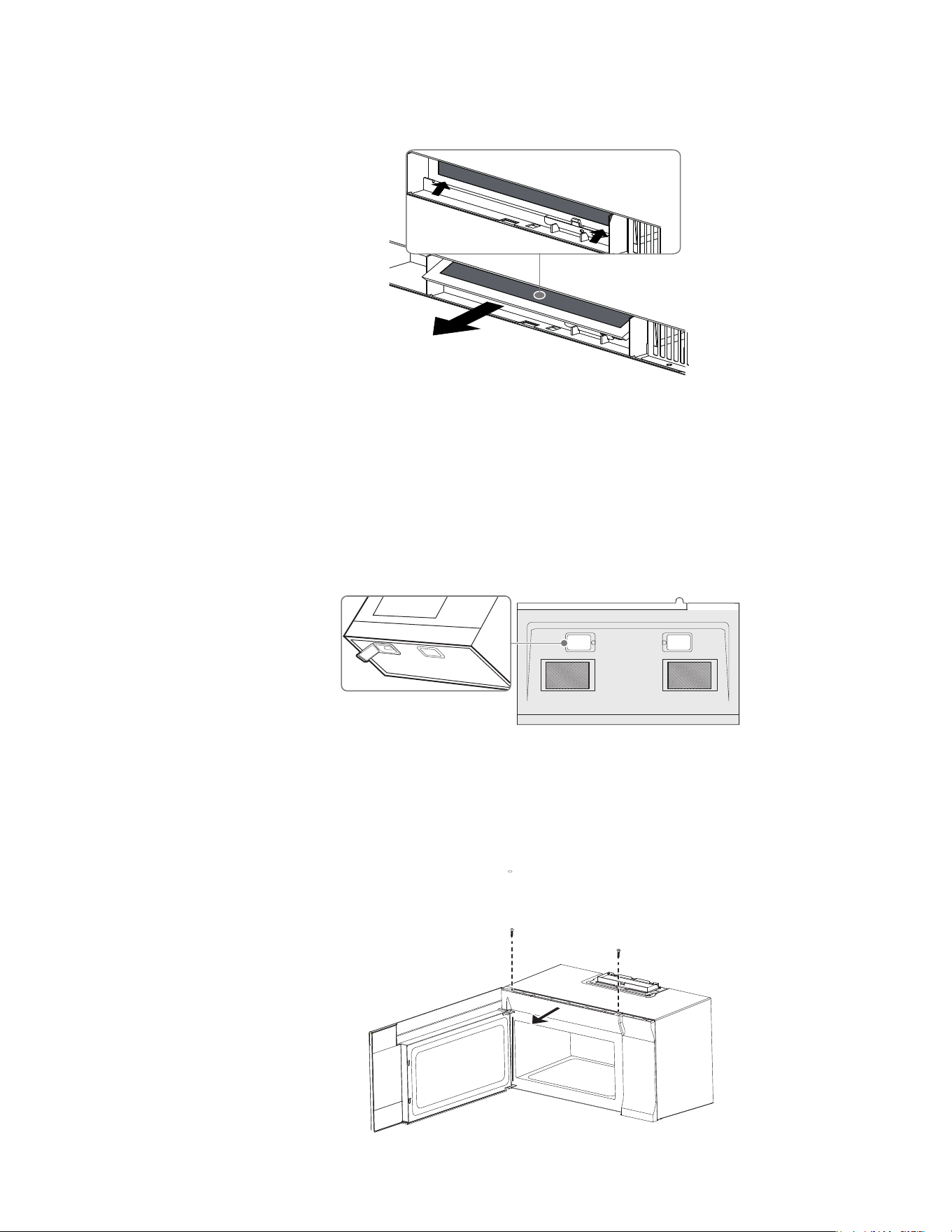
4 Remove the charcoal filter by pushing it inwards, then lift up and pull it out
of the microwave.
5 Insert the new charcoal filter, close the vent grill, and secure with the vent grill screws.
6 Plug the microwave back in or turn the power back on at the main circuit breaker.
Replacing the lights
Surface light (external)
1 Unplug the microwave oven or turn off power at the main circuit breaker.
2 Remove the light cover screws under the microwave.
3 Remove the old light bulbs and replace with new 1.2W LED lights.
4 Reinstall the light cover screws to secure the covers.
5 Plug the microwave back in or turn the power back on at the main circuit breaker.
Microwave light (internal)
1 Unplug the microwave oven or turn off power at the main circuit breaker.
2 Remove the vent grill screws.
3 Pull the vent grill away from the unit.
BOTTOM
19
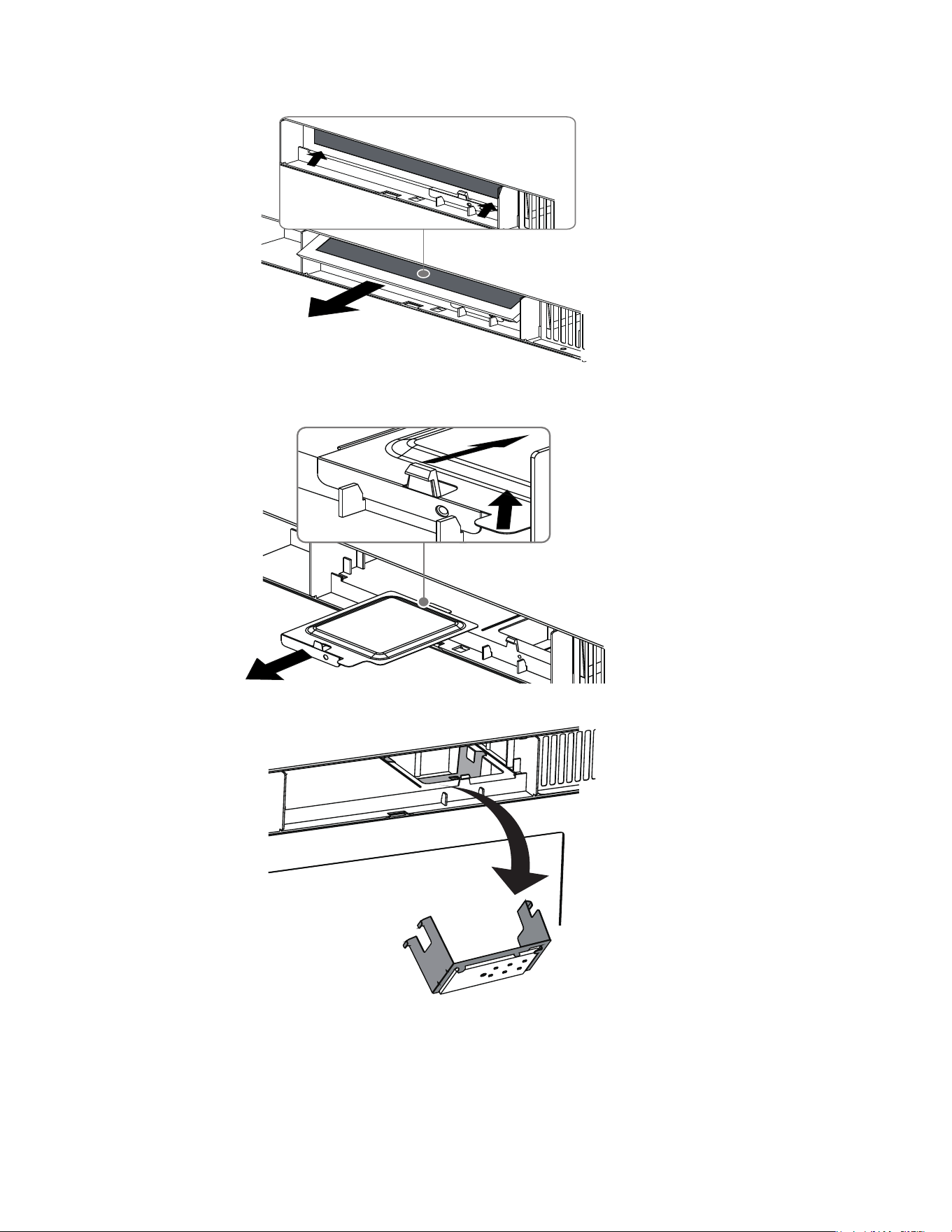
4 Remove the charcoal filter by pushing it inwards, then lift up and pull it out of the microwave.
5 Push the tab to release the light cover and carefully pull it up from the front edge.
6 Remove the LED module and replace only with an equivalent 1.2 watt LED bulb.
7 Carefully push the light cover back into place.
8 Replace the charcoal filter. Push the vent grill back into place (engaging both the bottom and
top tabs) and replace the vent grill mounting screws.
20
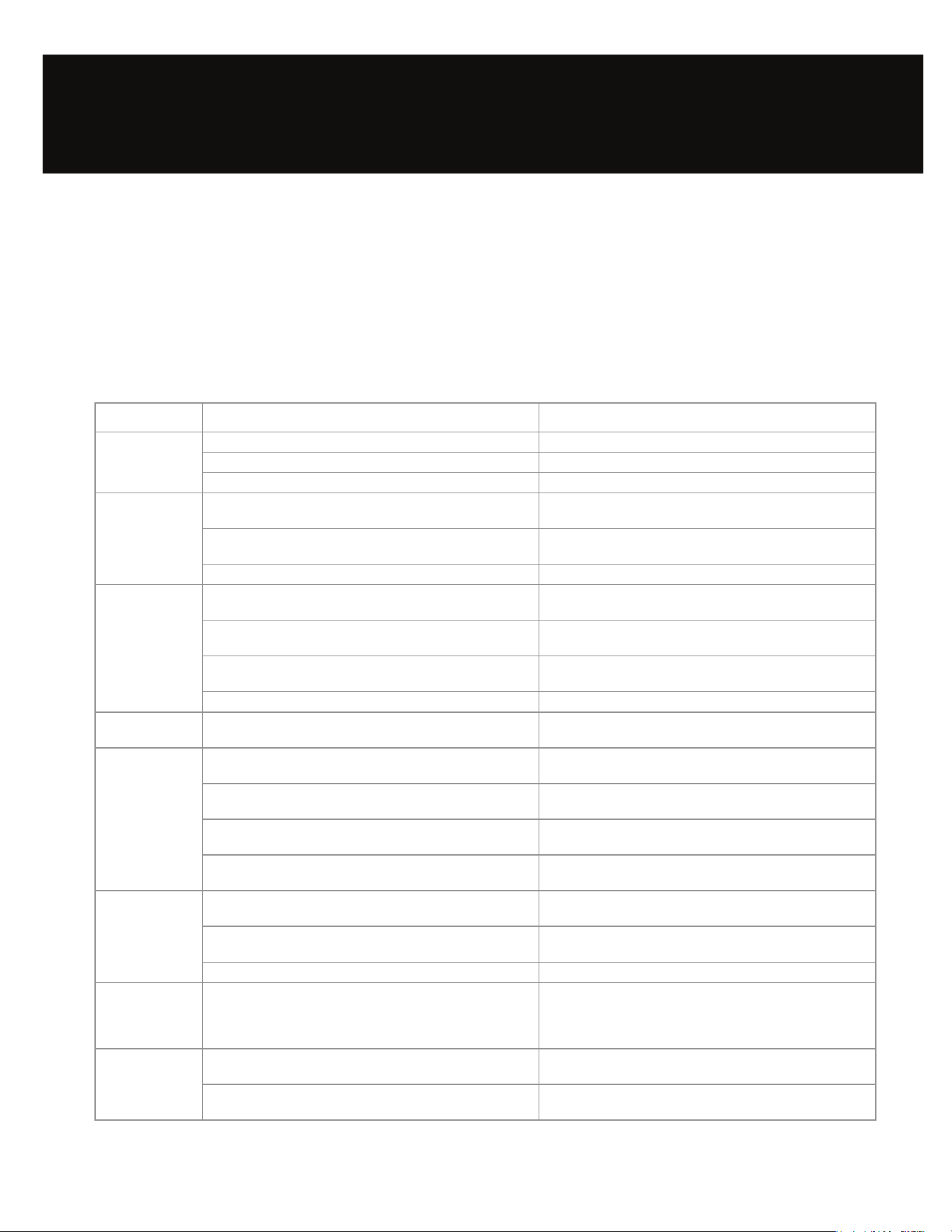
If you have a problem with your microwave, review the following chart for a possible solution.
If the microwave still does not work properly, contact the nearest authorized service center.
PROBLEM POSSIBLE CAUSE POSSIBLE SOLUTION
Microwave will
not start
The electrical cord is not plugged in. Plug in the electrical cord.
The door is open. Close the door and try again.
The wrong operation is set. Check the instructions and try again.
Arcing or
sparking in the
microwave
You are attempting to use incorrect materials in the
microwave.
Use only microwave-safe materials.
You are attempting to use the microwave when it’s
empty.
Do not operate the microwave when it’s empty.
Spilled food remains in the microwave. Clean the micro
wave with a wet towel.
Unevenly
cooked foods
You are attempting to use incorrect materials in the
microwave.
Use only microwave-safe materials.
The food is not defrosted completely.
Defrost the food completely before attempting to
cook it.
The cooking time or power level is not adequate to
cook the food.
Use the correct cooking time and power level.
The food is not turned or stirred. Turn or stir the food.
Overcooked
foods
The cooking time or power level is not adequate to
cook the food.
Use the correct cooking time and power level.
Undercooked
foods
You are attempting to use incorrect mater
ials in the
microwave.
Use only microwave-safe materials.
The food is not defrosted completely.
Defrost the food completely before attempting to
cook it.
The cooking time or power level is not adequate to
cook the food.
Use the correct cooking time and power level.
The microwave ventilation ports are blocked or
restricted.
Make sure that the ventilation ports are not blocked
or restricted.
Improper
defrosting
You are attempting to use incorrect materials in the
microwave.
Use only microwave-safe materials.
The cooking time or power level is not adequate to
cook the food.
Use
the correct cooking time and power level.
The food is not turned or stirred. Turn or stir the food.
The vent fan
turns on by
itself
The fan automatically starts when heat rises from
range surface units or burners and stays on until the
temperature decreases. This protects the microwave
from excessive temperatures.
Your microwave is operating normally. The fan
cannot be turned o manually during this time.
The turntable
will not move
The turntable is misaligned.
Make sure that the turntable is properly aligned on
the ring and shaft.
The turntable is turned o.
Press Turntable on/o
to turn your turntable back
on.
TROUBLESHOOTING
21
Obtaining replacement parts
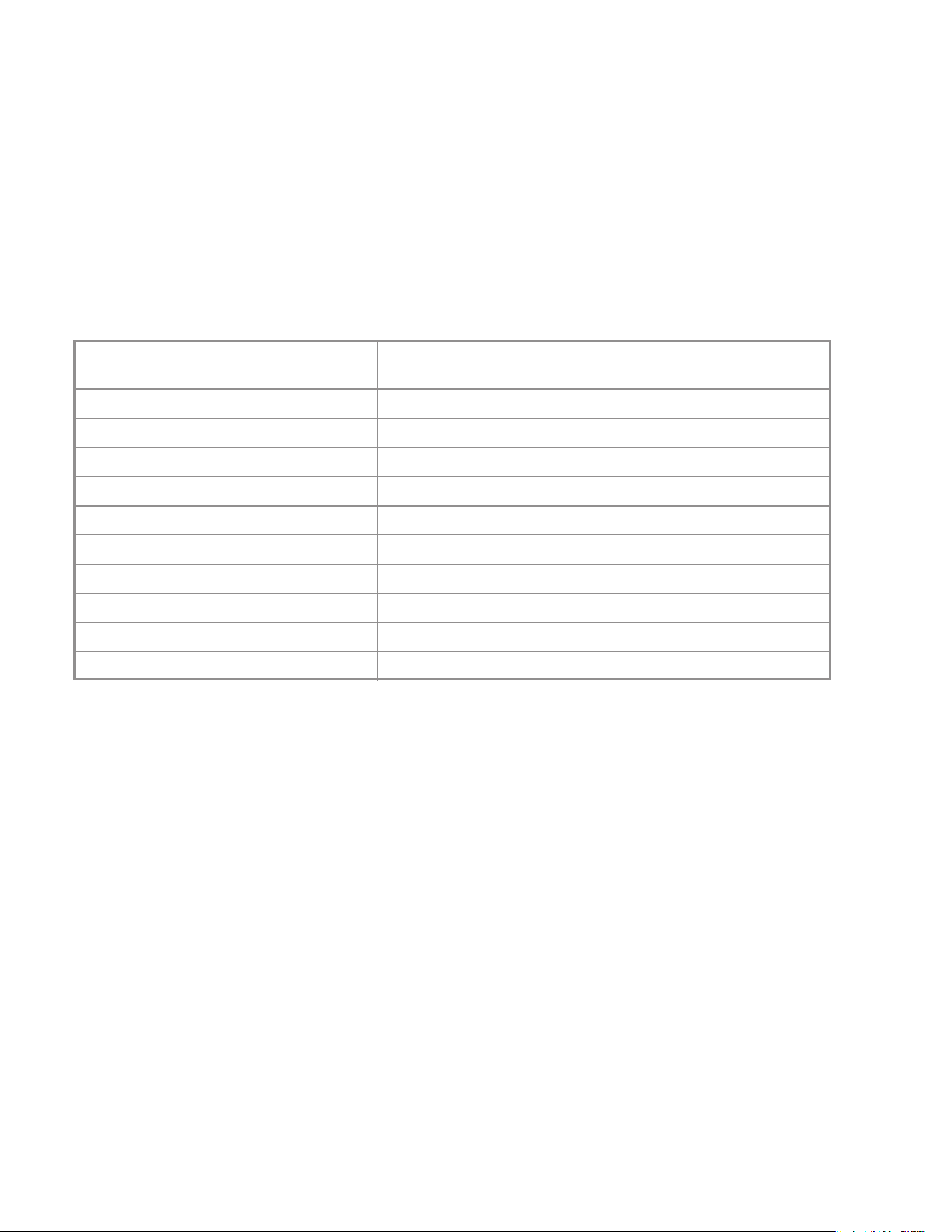
Specications
Model
Rated voltage 120V / 60 Hz
Rated input power 1550W
Rated output power 1000W
Microwave capacity 1.6 cu. ft.
Turntable diameter 13.5 in. (34.5 cm)
External dimensions (WxHxD) 31.3 × 16.4 × 15.0 in. (79.5 × 41.7 × 38.2 cm)
Internal dimensions (WxHxD) 20.24 × 9.25 × 14.41 in. (51.4 × 23.5 × 36.6 cm)
Certications UL approved
Power cord length 3.3 ft. (1 m)
Net weight 56 lbs. (25.4 kg)
22
Koolmore Supply, Inc. extends a limited warranty to the original purchaser, guaranteeing that this
Koolmore
product is free from manufacturing defects in material or workmanship for one year from the date of
purchase.
Should you discover any such defect within the warranty period, Koolmore Supply, Inc., reserves the
right to
repair or replace the product without charge, or to cover the cost of replacement parts and repair labor
needed
to correct defects present at the time of purchase or resulting from regular usage, when the appliance
has been
installed, operated, and maintained as per the instructions provided.
At its sole discretion, Koolmore Supply Inc. may decide to replace the product. In such an event, your
replacement
appliance will carry the warranty for the remaining term of the original unit's warranty period.
This warranty is valid exclusively to the original purchaser of the product and only applicable within the
United
States. The warranty commences from the date of original consumer purchase. Proof of the original
purchase
date will be required to obtain service under this warranty.
Under this limited warranty, your sole and exclusive remedy will be product repair, as outlined above. All
services must be provided by a Koolmore-designated service company.
To claim warranty or request repair service:
Email support@koolmore.com. Please include your name, address, phone number, warranty repair
request,
and a copy of your proof of purchase receipt. Alternatively, visit koolmore.com and use the contact us
page. A
Koolmore customer service representative will promptly arrange service for your appliance.
We thank you for choosing Koolmore.
This limited warranty will not cover:
1. Failure of the product to perform during power failures or interruptions,
or due to inadequate electrical service.
2. Damage incurred during transportation or handling.
3. Damage caused by accidents, vermin, lightning, winds, re, oods, or acts of God.
4. Damage resulting from accidents, alterations, misuse, abuse, improper installation, repair, or mainte-
nance.
This includes using any external device that alters or converts the voltage or frequency of
electricity.
5. Unauthorized product modications, repairs by unauthorized centers, or use of non-approved
replacement parts.
6. Abnormal cleaning and maintenance not aligned with the user's manual.
7. Use of incompatible accessories or components.
8. Any costs associated with repairs or replacements under these excluded circumstances shall be the
responsibility of the consumer.