

40V SV20 SERIES 35CM CORDLESS 2-IN-1
STRIMMER AND BRUSH CUTTER BODY ONLY
MODEL NO: CP40VBC
Thank you for purchasing a Sealey product. Manufactured to a high standard, this product will, if used according to these instructions,
and properly maintained, give you years of trouble free performance.
IMPORTANT: PLEASE READ THESE INSTRUCTIONS CAREFULLY. NOTE THE SAFE OPERATIONAL REQUIREMENTS, WARNINGS & CAUTIONS. USE
THE PRODUCT CORRECTLY AND WITH CARE FOR THE PURPOSE FOR WHICH IT IS INTENDED. FAILURE TO DO SO MAY CAUSE DAMAGE AND/OR
PERSONAL INJURY AND WILL INVALIDATE THE WARRANTY. KEEP THESE INSTRUCTIONS SAFE FOR FUTURE USE.
1. SAFETY
1.1. WORK AREA SAFETY
9 Keep work area clean and well lit. Cluttered or dark areas invite accidents.
8 DO NOT operate power tools in explosive atmospheres, such as in the presence of ammable liquids, gases or dust. Power tools
create sparks which may ignite the dust or fumes.
9 Keep children and bystanders away while operating a power tool. Distractions can cause you to lose control.
1.2. ELECTRICAL SAFETY
9 Power tool plugs must match the outlet. Never modify the plug in any way. DO NOT use any adapter plugs with earthed (grounded)
power tools. Unmodied plugs and matching outlets will reduce risk of electric shock.
9 Avoid body contact with earthed or grounded surfaces, such as pipes, radiators, ranges and refrigerators. There is an increased risk of
electric shock if your body is earthed or grounded.
8 DO NOT expose power tools to rain or wet conditions. Water entering a power tool will increase the risk of electric shock.
8 DO NOT abuse the cord. Never use the cord for carrying, pulling or unplugging the power tool. Keep cord away from heat, oil, sharp
edges or moving parts. Damaged or entangled cords increase the risk of electric shock.
9 When operating a power tool outdoors, use an extension cord suitable for outdoor use. Use of a cord suitable for outdoor use reduces
the risk of electric shock.
9 If operating a power tool in a damp location is unavoidable, use a residual current device (RCD) protected supply. Use of an RCD
reduces the risk of electric shock.
9 Power tools can produce electromagnetic elds (EMF) that are not harmful to the user. However, users of pacemakers and other similar
medical devices should contact the maker of their device and/ or doctor for advice before operating this power tool.
1.3. PERSONAL SAFETY
9 Stay alert, watch what you are doing and use common sense when operating a power tool. DO NOT use a power tool while you are
tired or under the inuence of drugs, alcohol or medication. A moment of inattention while operating power tools may result in serious
personal injury.
9 Use personal protective equipment. Always wear eye protection. Protective equipment such as a dust mask, non-skid safety shoes,
hard hat or hearing protection used for appropriate conditions will reduce personal injuries.
9 Prevent unintentional starting. Ensure the switch is in the o-position before connecting to power source and/or battery pack, picking
up or carrying the tool. Carrying power tools with your nger on the switch or energising power tools that have the switch on invites
accidents.
9 Remove any adjusting key or wrench before turning the power tool on. A wrench or a key left attached to a rotating part of the power
tool may result in personal injury.
8 DO NOT overreach. Keep proper footing and balance at all times. This enables better control of the power tool in unexpected situations.
9 Dress properly. Do not wear loose clothing or jewellery. Keep your hair and clothing away from moving parts. Loose clothes, jewellery
or long hair can be caught in moving parts.
9 If devices are provided for the connection of dust extraction and collection facilities, ensure these are connected and properly used.
Use of dust collection can reduce dust-related hazards.
8 DO NOT let familiarity gained from frequent use of tools allow you to become complacent and ignore tool safety principles. A careless
action can cause severe injury within a fraction of a second.
9 Always wear protective goggles to protect your eyes from injury when using power tools. The goggles must comply with local
regulations in force.
9 It is an employer’s responsibility to enforce the use of appropriate safety protective equipment by the tool operators and by other
persons in the immediate working area.
1.4. POWER TOOL USE AND CARE
8 DO NOT force the power tool. Use the correct power tool for your application. The correct power tool will do the job better and safer at
the rate for which it was designed.
8 DO NOT use the power tool if the switch does not turn it on and o. Any power tool that cannot be controlled with the switch is
dangerous and must be repaired.
9 Remove the battery pack from the power tool before making any adjustments, changing accessories, or storing power tools. Such
preventive safety measures reduce the risk of starting the power tool accidentally.
9 Store idle power tools out of the reach of children and DO NOT allow persons unfamiliar with the power tool or these instructions to
operate the power tool. Power tools are dangerous in the hands of untrained users.
9 Maintain power tools and accessories.
Refer to
instruction
manual
Wear eye
protection
Wear ear
protection
Wear protective
gloves
DO NOT
expose to rain
WARNING!
Thrown objects.
Keep
bystanders
away.
CP40VBC Issue 2 10/01/24Original Language Version
© Jack Sealey Limited

9 Check for misalignment or binding of moving parts, breakage of parts and any other condition that may aect the power tool’s
operation. If damaged, have the power tool repaired before use. Many accidents are caused by poorly maintained power tools.
9 Keep cutting tools sharp and clean. Properly maintained cutting tools with sharp cutting edges are less likely to bind and are easier to control.
9 Use the power tool, accessories and tool bits etc. in accordance with these instructions, taking into account the working conditions and
the work to be performed. Use of the power tool for operations dierent from those intended could result in a hazardous situation.
9 Keep handles and grasping surfaces dry, clean and free from oil and grease. Slippery handles and grasping surfaces do not allow for
safe handling and control of the tool in unexpected situations.
9 When using the tool, do not wear cloth work gloves which may be entangled. The entanglement of cloth work gloves in the moving
parts may result in personal injury.
1.5. BATTERY TOOL USE AND CARE
9 Recharge only with the charger specied by the manufacturer. A charger that is suitable for one type of battery pack may create a risk
of re when used with another battery pack.
9 Use power tools only with specically designated battery packs. Use of any other battery packs may create a risk of injury and re.
9 When battery pack is not in use, keep it away from other metal objects, like paper clips, coins, keys, nails, screws or other small metal
objects, that can make a connection from one terminal to another. Shorting the battery terminals together may cause burns or a re.
9 Under abusive conditions, liquid may be ejected from the battery; avoid contact. If contact accidentally occurs, ush with water. If liquid
contacts eyes, additionally seek medical help. Liquid ejected from the battery may cause irritation or burns.
8 DO NOT use a battery pack or tool that is damaged or modied. Damaged or modied batteries may exhibit unpredictable behaviour
resulting in re, explosion or risk of injury.
8 DO NOT expose a battery pack or tool to re or excessive temperature. Exposure to re or temperature above 130 °C may cause
explosion.
9 Follow all charging instructions and do not charge the battery pack or tool outside the temperature range specied in the instructions.
Charging improperly or at temperatures outside the specied range may damage the battery and increase the risk of re.
1.6. SERVICE
9 Have your power tool serviced by a qualied repair person using only identical replacement parts. This will ensure that the safety of the
power tool is maintained.
8 DO NOT service damaged battery packs. Service of battery packs should only be performed by the manufacturer or authorized service
providers.
9 Follow instruction for lubricating and changing accessories.
1.7. INTENDED USE
9 This tool is only intended for cutting grass, weeds, bushes and undergrowth.
8 DO NOT use for any other purpose such as edging or hedge cutting as this may cause injury.
1.8. GENERAL SAFETY
9 Never allow children, persons with reduced physical, sensory or mental capabilities or lack of experience and knowledge or people
unfamiliar with these instructions to use the machine, local regulations may restrict the age of the operator.
9 Before starting the tool, read this instruction manual to become familiar with the handling of the tool.
8 DO NOT lend the tool to a person with insucient experience or knowledge regarding handling of brushcutters and string trimmers.
9 When lending the tool, always attach this instruction manual.
9 Handle the tool with the utmost care and attention.
8 DO NOT use the tool after consuming alcohol or drugs, or if feeling tired or ill.
8 DO NOT attempt to modify the tool.
9 Follow the regulations about handling of brushcutters and string trimmers in your country.
1.9. PERSONAL PROTECTIVE EQUIPMENT
9 Wear safety helmet, protective goggles and protective gloves to protect yourself from ying debris or falling objects.
9 Wear ear protection such as ear mus to prevent hearing loss.
9 Wear proper clothing and shoes for safe operation, such as a work overall and sturdy, non-slip shoes.
8 DO NOT wear loose clothing or jewellery. Loose clothes, jewellery or long hair can be caught in moving parts.
9 When touching the cutting blade, wear protective gloves. Cutting blades can cut bare hands severely.
1.10. WORK AREA SAFETY
9 Operate the tool under good visibility and daylight conditions only. DO NOT operate the tool in darkness or fog.
8 DO NOT operate the tool in explosive atmospheres, such as in the presence of ammable liquids, gases or dust. The tool creates
sparks which may ignite the dust or fumes.
8 During operation, DO NOT stand on an unstable or slippery surface or a steep slope. During the cold season, beware of ice and snow
and always ensure secure footing.
9 During operation, keep bystanders or animals at least 15m away from the tool.
8 DO NOT operate the tool while people, especially children, or pets are nearby.
9 Before operation, examine the work area for stones or other solid objects. They can be thrown or cause dangerous kickback and result
in serious injury and/or property damage.
WARNING! Use of this product can create dust containing chemicals which may cause respiratory or other illnesses. Some examples
of these chemicals are compounds found in pesticides, insecticides, fertilizers and herbicides. Your risk from these exposures varies,
depending on how often you do this type of work. To reduce your exposure to these chemicals: work in a well ventilated area, and work
with approved safety equipment, such as those dust masks that are specially designed to lter out microscopic particles.
1.11. ELECTRICAL AND BATTERY SAFETY
8 DO NOT expose the tool to rain or wet conditions. Water entering the tool will increase the risk of electric shock.
8 DO NOT use the tool if the switch does not turn it on and o. Any tool that cannot be controlled with the switch is dangerous and must
be repaired.
9 Prevent unintentional starting. Ensure the switch is in the o position before installing a battery pack, picking up or carrying the tool.
Carrying the tool with your nger on the switch or energising the tool that have the switch on invites accidents.
8 DO NOT dispose of the battery(ies) in a re. The cells may explode. Check with local authorities for possible special disposal instructions.
WARNING! DO NOT open or mutilate the battery(ies). Released electrolyte is corrosive and may cause damage to the eyes or skin. It
may be toxic if swallowed.
8 DO NOT charge battery in rain, or in wet locations.
CP40VBC Issue 2 10/01/24Original Language Version
© Jack Sealey Limited
1.12. PUTTING INTO OPERATION
9 Before assembling or adjusting the tool, remove the battery cartridge.
9 Before handling the cutter blade, wear protective gloves.
9 Before installing the battery cartridge, inspect the tool for damage, loose screws/nuts or improper assembly. Sharpen blunt cutter blade.
If the cutter blade is bent or damaged, replace it. Check all control levers and switches for easy action. Clean and dry the handles.
8 DO NOT attempt to switch on the tool if it is damaged or not fully assembled. Otherwise serious injury may result.
9 Adjust the shoulder harness and hand grip to suit the operator’s body size.
9 When inserting a battery cartridge, keep the cutting attachment clear of your body and other object, including the ground. It may rotate
when starting and may cause injury or damage to the tool and/or property.
9 Remove any adjusting key, wrench or blade cover before turning the tool on. An accessory left attached to a rotating part of the tool
may result in personal injury.
9 The cutting tool has to be equipped with the guard. DO NOT run the tool with damaged guards or without guards in place.
9 Make sure there are no electrical cables, water pipes, gas pipes etc. that could cause a hazard if damaged by use of the tool.
1.13. OPERATION
9 In the event of an emergency, switch o the tool immediately.
9 If you feel any unusual condition (e.g. noise, vibration) during operation, switch o the tool and remove the battery cartridge. DO NOT
use the tool until the cause is recognized and solved.
9 The cutting attachment continues to rotate for a short period after turning the tool o. DO NOT rush to contact the cutting attachment.
9 During operation, use the shoulder harness. Keep the tool on your right side rmly.
8 DO NOT overreach. Keep proper footing and balance at all times. Watch for hidden obstacles such as tree stumps, roots and ditches to
avoid stumbling.
9 Always be sure of your footing on slopes. Walk, never run.
8 DO NOT work on a ladder or tree to avoid loss of control.
9 If the tool gets heavy impact or fall, check the condition before continuing work. Check the controls and safety devices for malfunction.
9 If there is any damage or doubt, ask our authorised service centre for the inspection and repair.
8 DO NOT touch the gear case during and immediately after operation. The gear case becomes hot during operation and can cause burns.
9 Take a rest to prevent loss of control caused by fatigue. We recommend taking a 10 to 20 minute rest every hour.
9 When you leave the tool, even if it is a short time, always remove the battery cartridge. The unattended tool with the battery cartridge
installed may be used by unauthorized person and cause serious accident.
9 If grass or branches get caught between the cutting attachment and guard, always turn the tool o and remove the battery cartridge
before cleaning. Otherwise the cutting attachment may rotate unintentionally and cause serious injury.
8 DO NOT touch moving hazardous parts before the moving parts have come to a complete stop and the battery cartridge is removed.
9 If the cutting attachment hits stones or other hard objects, immediately turn the tool o. Then remove the battery cartridge and inspect
the cutting attachment.
9 Check the cutting attachment frequently during operation for cracks or damages. Before the inspection, remove the battery cartridge and
wait until the cutting attachment stops completely. Replace damaged cutting attachment immediately, even if it has only supercial cracks.
8 DO NOT cut above waist height.
9 Before starting the cutting operation, wait until the cutting attachment reaches a constant speed after turning the tool on.
9 When using a cutting blade, swing the tool evenly in half-circle from right to left, like using a scythe.
9 Hold the tool by insulated gripping surfaces only, because the cutter blade may contact hidden wiring. Cutter blades contacting a “live”
wire may make exposed metal parts of the tool “live” and could give the operator an electric shock.
8 DO NOT start the tool when the cutting tool is tangled with cut grass.
9 Before starting the tool, be sure that the cutting tool is not touching the ground and other obstacles such as a tree.
9 During operation always hold the tool with both hands. DO NOT hold the tool with one hand during use.
8 DO NOT operate the tool in bad weather or if there is a risk of lightning.
1.14. CUTTING TOOLS
8 DO NOT use a cutting tool which is not recommended by the manufacturer.
9 Use an applicable cutting attachment for the job in hand.
9 Nylon cutting heads (string trimmer heads) and plastic blades are suitable for trimming lawn grass.
9 Cutting blades are suitable for cutting weeds, high grasses, bushes, shrubs, underwood, thicket, and the like.
8 DO NOT use other blades including metal multi-piece pivoting chains and ail blades. It may result in serious injury.
9 Only use the cutting tool that are marked with a speed equal or higher than the speed marked on the tool.
9 Always keep your hands, face, and clothes away from the cutting tool when it is rotating. Failure to do so may cause personal injury.
9 Always use the cutting attachment guard properly suited for the cutting attachment used.
9 When using cutting blades, avoid kickback and always prepare for an accidental kickback. See the section for Kickback.
9 When not in use, attach the blade cover onto the blade. Remove the cover before operation.
1.15. KICKBACK (BLADETHRUST)
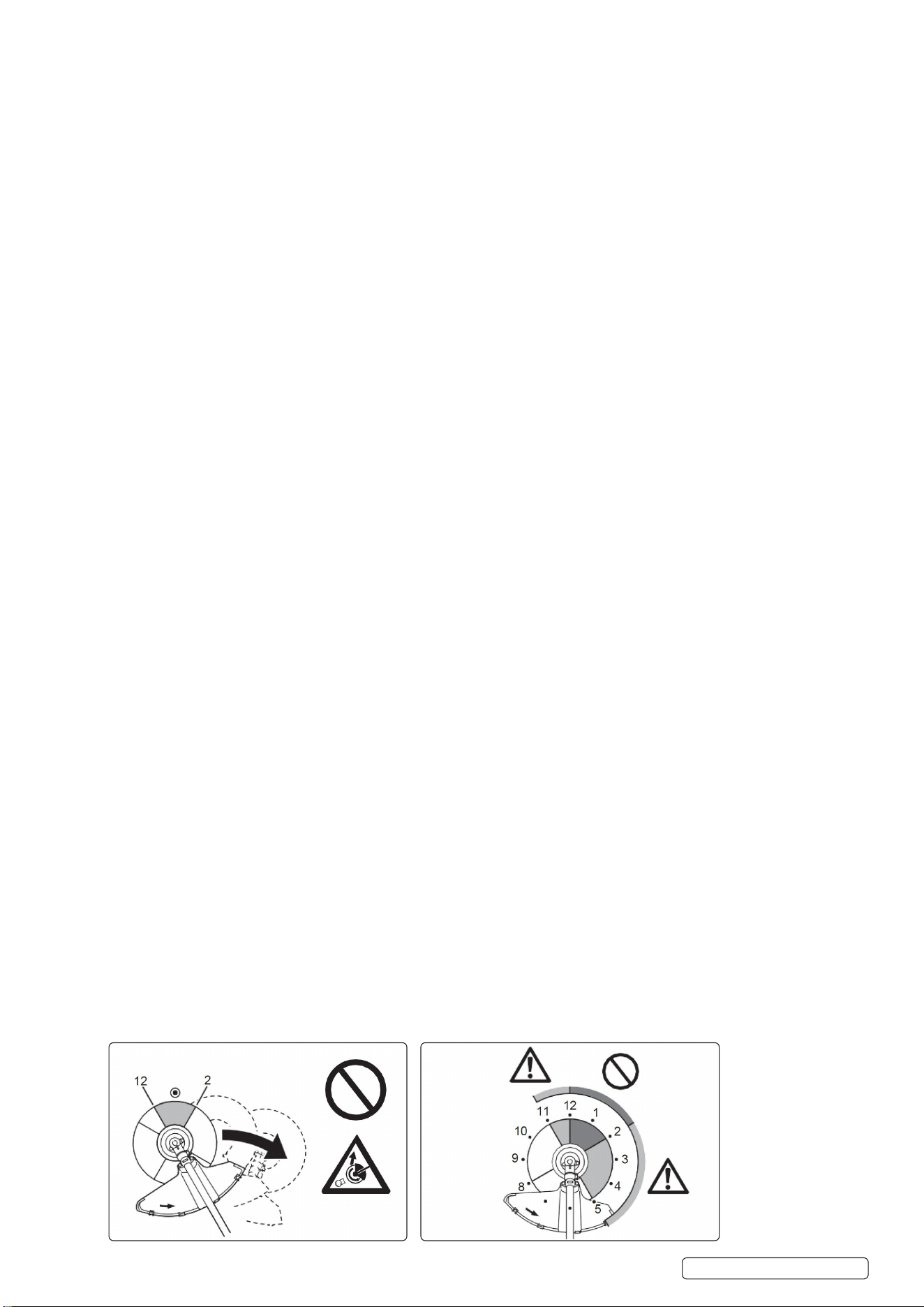
9 Kickback (blade thrust) is a sudden reaction to a caught or bound cutting blade. Once it occurs, the tool is thrown sideway or toward
the operator at great force and it may cause serious injury. Kickback occurs particularly when applying the blade segment between 12
and 2 o’clock to solids, bushes and trees with 3 cm or larger diameter.
CP40VBC Issue 2 10/01/24Original Language Version
© Jack Sealey Limited

9 To avoid kickback:
1. Apply the segment between 8 and 11 o’clock.
2. Never apply the segment between 12 and 2 o’clock.
3. Never apply the segment between 11 and 12 o’clock and between 2 and 5 o’clock, unless the operator is well trained and
experienced and does it at his/her own risk.
4. Never use cutting blades close to solids, such as fences, walls, tree trunks and stones.
5. Never use cutting blades vertically, for such operations as edging and trimming hedges.
1.16. TRANSPORT
9 Before transporting the tool, turn it o and remove the battery cartridge. Attach the cover to the cutting blade.
9 When transporting the tool, carry it in a horizontal position by holding the shaft.
9 When transporting the tool in a vehicle, properly secure it to avoid turnover. Otherwise damage to the tool and other baggage may result.
1.17. MAINTENANCE
9 Have your tool serviced by an authorised service centre, always using only genuine replacement parts. Incorrect repair and poor
maintenance can shorten the life of the tool and increase the risk of accidents.
9 Before doing any maintenance or repair work or cleaning the tool, always turn it o and remove the battery cartridge.
9 Always wear protective gloves when handling the cutting blade.
9 Always clean dust and dirt o the tool. DO NOT use gasoline, benzine, thinner, alcohol or the like for the purpose. Discolouration,
deformation or cracks of the plastic components may result.
9 After each use, tighten all screws and nuts.
8 DO NOT attempt any maintenance or repair not described in the instruction manual. Ask our authorized service centre for such work.
9 Always use our genuine spare parts and accessories only. Using parts or accessories supplied by a third party may result in the tool
breakdown, property damage and/or serious injury.
9 Request an authorized service centre to inspect and maintain the tool at regular interval.
9 Always keep the tool in good working condition. Poor maintenance can result in inferior performance and shorten the life of the tool.
9 Keep handles dry, clean and free from oil and grease. Keep all cooling air inlets clear of debris.
1.18. STORAGE
9 Before storing the tool, perform full cleaning and maintenance. Remove the battery cartridge. Attach the cover to the cutting blade.
9 Store the tool in a dry and high or locked location out of reach of children.
8 DO NOT prop the tool against something, such as a wall. Otherwise it may fall suddenly and cause an injury.
1.19. BATTERY CARTRIDGE
9 Before using battery cartridge, read all instructions and cautionary markings on the battery charger, battery and product using the battery.
8 DO NOT disassemble battery cartridge.
9 If operating time has become excessively shorter, stop operating immediately. It may result in a risk of overheating, possible burns and
even an explosion.
9 If electrolyte gets into your eyes, rinse them out with clear water and seek medical attention right away. It may result in loss of your eyesight.
8 DO NOT short the battery cartridge:
8 DO NOT touch the terminals with any conductive material.
8 DO NOT store battery cartridges in a container with other metal objects such as nails, coins, etc.
8 DO NOT expose battery cartridge to water or rain.
WARNING! A battery short can cause a large current ow, overheating, possible burns and even a breakdown.
8 DO NOT store the tool and battery cartridge in locations where the temperature may reach or exceed 50 °C (122 °F).
8 DO NOT incinerate the battery cartridge even if it is severely damaged or completely worn out. The battery cartridge can explode in a re.
8 DO NOT drop or strike battery.
8 DO NOT use a damaged battery.
9 The contained lithium-ion batteries are subject to the Dangerous Goods Legislation requirements. For commercial transports e.g. by
third parties, forwarding agents, special requirement on packaging and labelling must be observed.
9 For preparation of the item being shipped, consulting an expert for hazardous material is required.
9 Please also observe possibly more detailed national regulations.
9 Tape or mask o open contacts and pack up the battery in such a manner that it cannot move around in the packaging.
9 Follow your local regulations relating to disposal of battery.
9 Use the batteries only with the products specied by Sealey. Installing the batteries to non-compliant products may result in a re,
excessive heat, explosion, or leak of electrolyte.
1.20. TIPS FOR MAINTAINING MAXIMUM BATTERY LIFE
9 Charge the battery cartridge before completely discharged. Always stop tool operation and charge the battery cartridge when you
notice less tool power.
8 DO NOT recharge a fully charged battery cartridge. Overcharging shortens the battery service life.
9 Charge the battery cartridge with room temperature at 5 °C - 45 °C . Let a hot battery cartridge cool down before charging it.
9 Charge the battery cartridge if you do not use it for a long period (more than six months).
2. INTRODUCTION
Designed for the professional, offering heavy-duty, high performance, durable tools with lightweight composite designs for superior control
and comfort. Operates using 2 x 20V batteries from the Sealey SV20 Series (batteries must be of the same Ah rating). Wide cutting width
of 35cm (brush cutter) and 25cm (strimmer). 2-in-1 Function, supplied with line trimming cord for grass strimming and metal blade for
cutting heavy growth and weeds. Body strap and dual handles for comfort during prolonged use.
3. SPECIFICATION
MODEL NO: CP40VBC Voltage: 40V
Battery: 20V 2Ah - 6Ah Lithium-ion (not included) Vibration value: 1.154 m/s²
Cutting Mechanism: Bump Feed Line or Metal Cutting Blade Uncertainty: 1.5 m/s²
Cutting Width: 350mm Noise Power: 95 dB(A)
No-Load Speed: 7000rpm Noise Pressure: 87 dB(A)
CP40VBC Issue 2 10/01/24Original Language Version
© Jack Sealey Limited
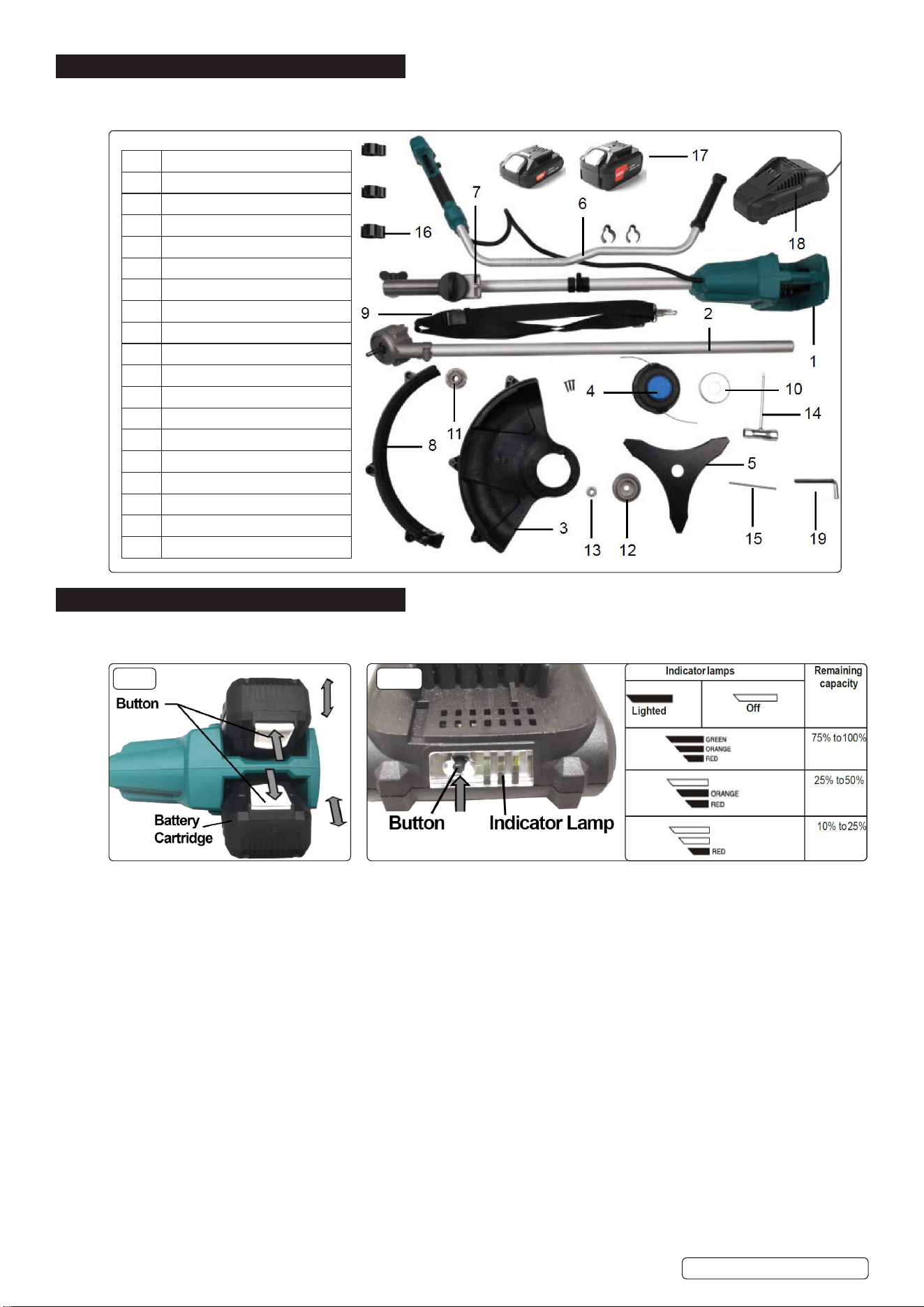
4. CONTENTS
Carefully remove the garden tool from its packaging and check if the following parts are complete: If parts are missing or damaged,
please contact your stockist.
1 Upper part assembly
2 Shaft (Lower part assembly)
3 Protector
4 Nylon cutting head
5 Cutting blade
6 U-shape handle
7 U-shape handle xture
8 Protector extension
9 Shoulder harness
10 Clamping Washer
11 Receive washer
12 Cup
13 Nut
14 Hexagon wrench
15 Pin rod
16 Cable clip
17 Battery cartridge (not included)
18 Charger (not included)
19 M5 Hex Wrench
5. FUNCTIONAL OVERVIEW
WARNING! Always be sure that the tool is switched o and the battery cartridge is removed before adjusting or checking function on
the tool. Failure to switch o and remove the battery cartridge may result in serious personal injury from accidental start-up.
FIG.1 FIG.2
5.1. INSTALLING OR REMOVING BATTERY CARTRIDGE (FIG.1)
CAUTION: Always switch o the tool before installing or removing of the battery cartridge.
CAUTION: Hold the tool and the battery cartridge rmly when installing or removing battery cartridge. Failure to hold the tool and the
battery cartridge rmly may cause them to slip o your hands and result in damage to the tool and battery cartridge and a personal injury.
5.1.1. To remove the battery cartridge, slide it from the tool while sliding the button on the front of the cartridge.
5.1.2. To install the battery cartridge, align the tongue on the battery cartridge with the groove in the housing and slip it into place.
5.1.3. Insert it all the way until it locks in place with a little click.
CAUTION: Always install the battery cartridge fully. If not, it may accidentally fall out of the tool, causing injury to you or someone around you.
CAUTION: DO NOT install the battery cartridge forcibly. If the cartridge does not slide in easily, it is not being inserted correctly.
NOTE: The tool does not work with only one battery cartridge.
NOTE: Pay attention to the position of your ngers when installing the battery. The button will be depressed unintentionally.
5.2. BATTERY CAPACITY (FIG.2)
5.2.1. Press the check button on the battery cartridge to indicate the remaining battery capacity. The indicator lamps light up for few seconds.
NOTE: Depending on the conditions of use and the ambient temperature, the indication may dier slightly from the actual capacity.
5.3. TOOL/BATTERY PROTECTION SYSTEM
The tool is equipped with a tool/battery protection system. This system automatically cuts o power to the motor to extend tool and
battery life. The tool will automatically stop during operation if the tool or battery is placed under one of the following conditions:
5.3.1. OVERLOAD PROTECTION
When the battery is operated in a manner that causes it to draw an abnormally high current, the tool automatically stops. In this
situation, turn the tool o and stop the application that caused the tool to become overloaded. Then turn the tool on to restart.
5.3.2. OVERHEAT PROTECTION
When the battery is overheated, the tool stops automatically. In this case, let the tool and battery cool before turning the tool on again.
CP40VBC Issue 2 10/01/24Original Language Version
© Jack Sealey Limited
5.3.3. OVERDISCHARGE PROTECTION
When the battery capacity is not enough, the tool stops automatically. In this case, remove the battery from the tool and charge the battery.
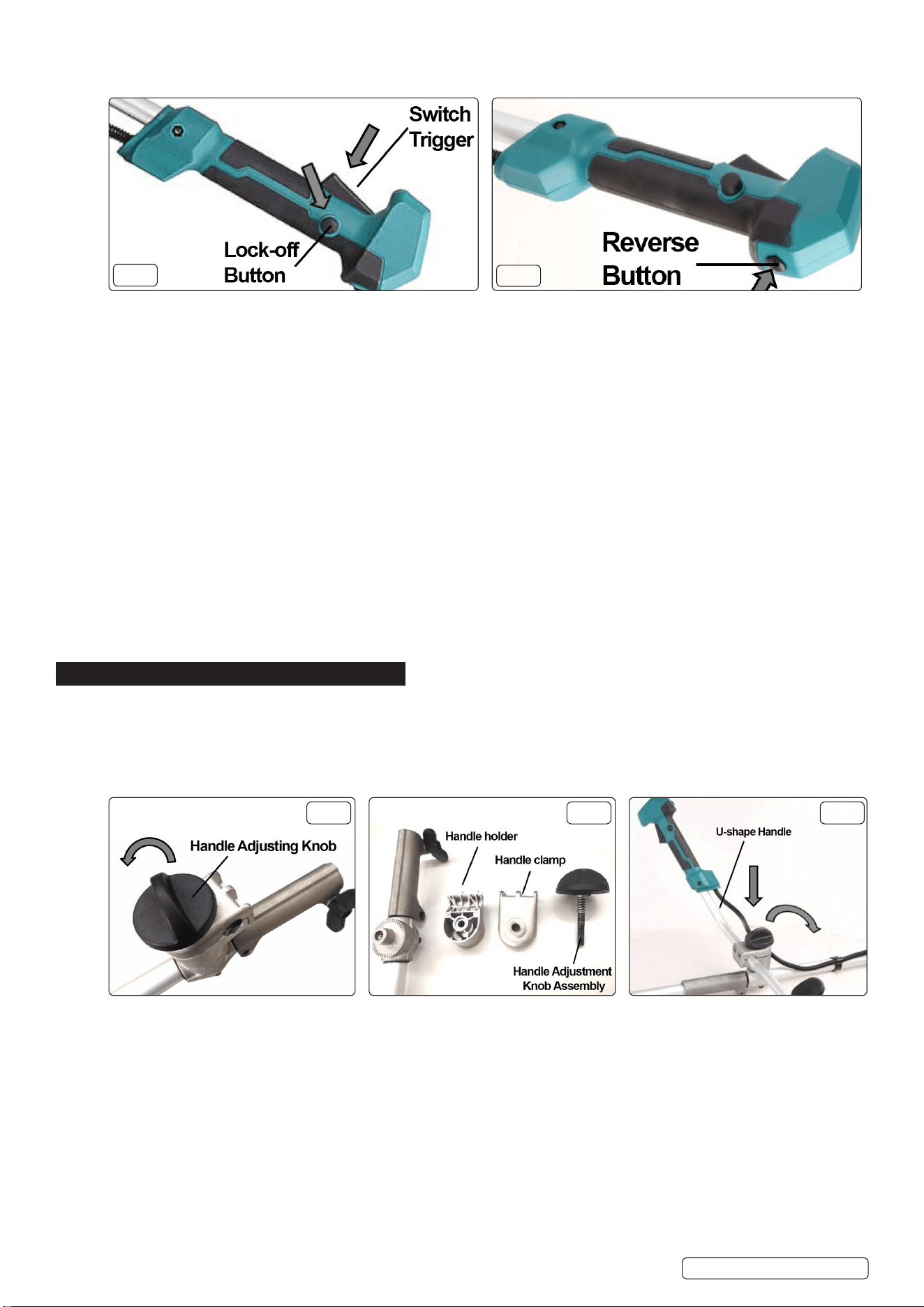
FIG.3
FIG.4
5.4. SWITCH ACTION (FIG.3)
WARNING! Before installing the battery cartridge into the tool, always check to see that the switch trigger actuates properly and returns
to the “OFF” position when released.
WARNING! For your safety, this tool is equipped with the lock-o button which prevents the tool from unintended starting. Never use
the tool if it starts when you pull the switch trigger without pressing down the lock-o button. Ask the Sealey Service Centre for repair.
WARNING! Never disable the lock function or tape down the lock-o button.
NOTE: DO NOT pull the switch trigger forcibly without pressing down the lock-o button. The switch may break.
5.5. REVERSE BUTTON FOR DEBRIS REMOVAL (FIG.4)
WARNING! Switch o the tool and remove the battery cartridge before you remove entangled weeds or debris which the reverse
rotation function can not remove. Failure to switch o and remove the battery cartridge may result in serious personal injury from
accidental start-up.
5.5.1. This tool has a reverse button to change the direction of rotation. It is only for removing weeds and debris entangled in the tool.
5.5.2. To reverse the rotation, press the reverse rotation switch button and pull the switch trigger while depressing the lock-o lever when
the cutting tool is stopped. The tool makes a long “Di Di” sound alarm after pressing the reverse button, and the cutting tool rotates in
reverse direction.
5.5.3. To return to regular rotation, release the trigger and wait until the cutting tool stops for about two seconds.
NOTE: Once the tool is stopped for about two seconds, the rotation returns to regular direction when you start the tool again.
5.6. ELECTRIC BRAKE
This tool is equipped with an electric brake. If the tool consistently fails to quickly stop after the switch trigger is released, have the tool
serviced at our service centre.
CAUTION: This brake system is not a substitute for the protector. Never use the tool without the protector. An unguarded cutting tool
may result in serious personal injury.
6. ASSEMBLY
WARNING! Always be sure that the tool is switched o and battery cartridge is removed before carrying out any work on the tool.
Failure to switch o and remove the battery cartridge may result in serious personal injury from accidental start-up.
WARNING! Never start the tool unless it is completely assembled. Operation of the tool in a partially assembled state may result in
serious personal injury from accidental start-up.
WARNING! After installing the U-shape handle, always make sure that it is secured rmly. Otherwise, it may suddenly separate from
the tool body and result in an serious personal injury.
FIG.5 FIG.6 FIG.7
6.1. INSTALLING OR UNINSTALLING THE U-SHAPE HANDLE (FIG.5, 6, 7)
6.1.1. Turn anticlockwise to unscrew the handle adjusting knob (g.5).
6.1.2. Take out the handle adjust knob assembly, handle clamp, handle holder in order (g.6).
6.1.3. Place the U-shape handle between handle clamp and handle holder, make sure all three parts are well secured. Then secure with the
handle adjust knob assembly rmly.
NOTICE: Note the install direction of the U-shape handle (g.7). Incorrect install direction will aect the operation.
6.2. ADJUST THE POSITION OF U-SHAPE HANDLE (FIG.8)
6.2.1. Use the M5 hex wrench to loosen the two hex bolts on the U-shape handle xture by turning it anticlockwise and then you can adjust
the position of the U-shape handle upwards or downwards to your desire position.
6.2.2. Adjust the handle to an position that provides a comfortable working and then secure the handle with the two hex bolts rmly.
6.3. ADJUST ANGLE OF THE U-SHAPE HANDLE (FIG.9 & 10)
CAUTION: After adjusting the angle of the U-shape handle, always make sure that it is secured rmly. Otherwise, it may suddenly
separate from the tool body and result in an serious personal injury.
6.3.1. Loosen the handle adjusting knob by turning it anticlockwise and then you can adjust the angle of the U-shape handle in both
horizontal and vertical direction by twisting it in the corresponding direction smoothly.
CP40VBC Issue 2 10/01/24Original Language Version
© Jack Sealey Limited
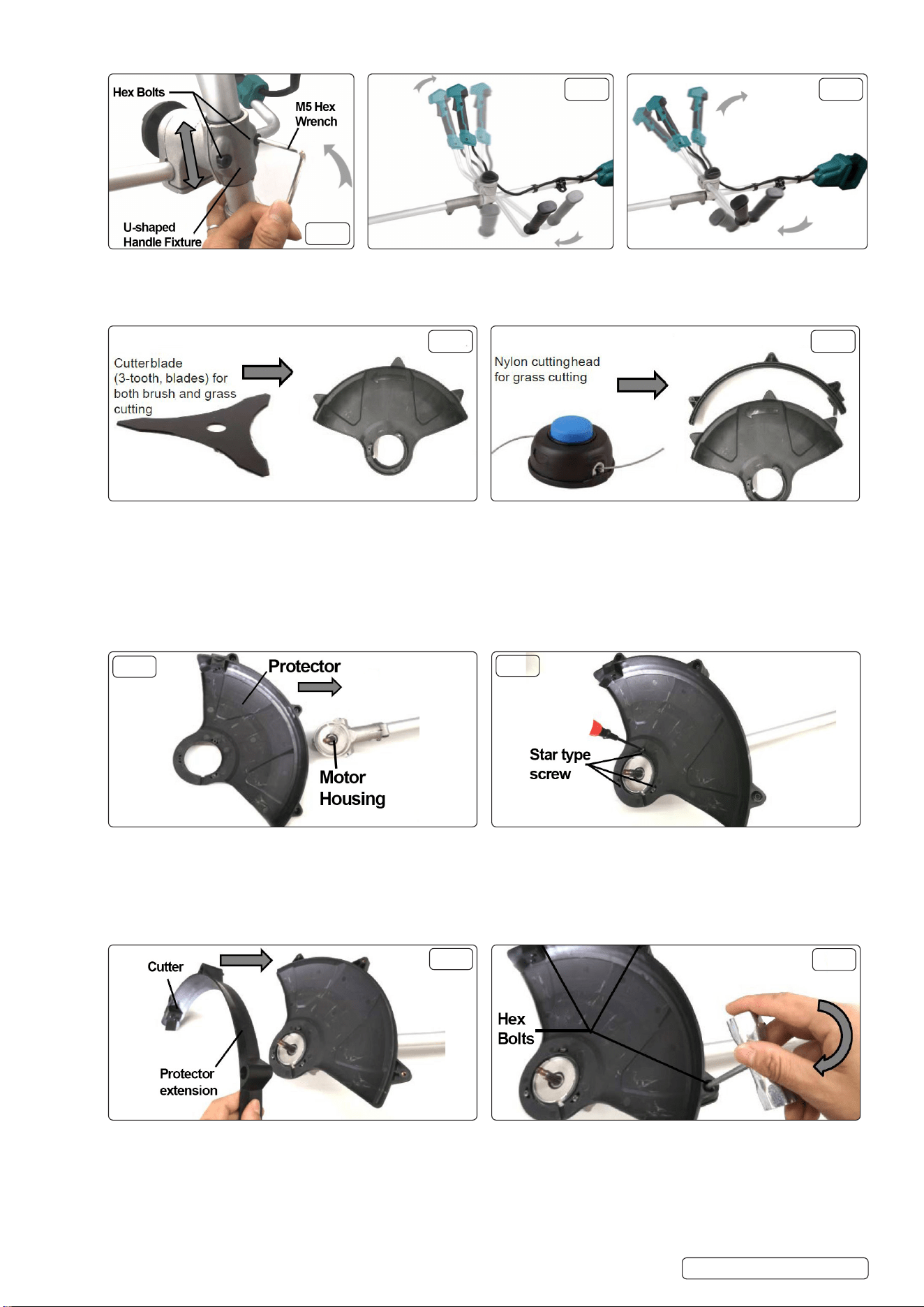
6.3.2. Adjust the handle to an angle that provides a comfortable working position, then secure with the handle adjustment knob rmly again.
FIG.8
FIG.9 FIG.10
6.4. CORRECT COMBINATION OF THE CUTTING TOOL AND THE PROTECTOR (FIG.11 & 12)
CAUTION: Always use the correct combination of cutting tool and the protector. A wrong combination may not protect you from the
cutting tool, ying debris, and stones. It can also aect the balance of the tool and result in an injury.
FIG.11 FIG.12
6.5. INSTALLING THE PROTECTOR
WARNING! Never use the tool without the guard or with the guard improperly installed. Failure to do so can cause serious personal injury.
NOTE: The type of the protector supplied as the standard accessory varies depending on the countries.
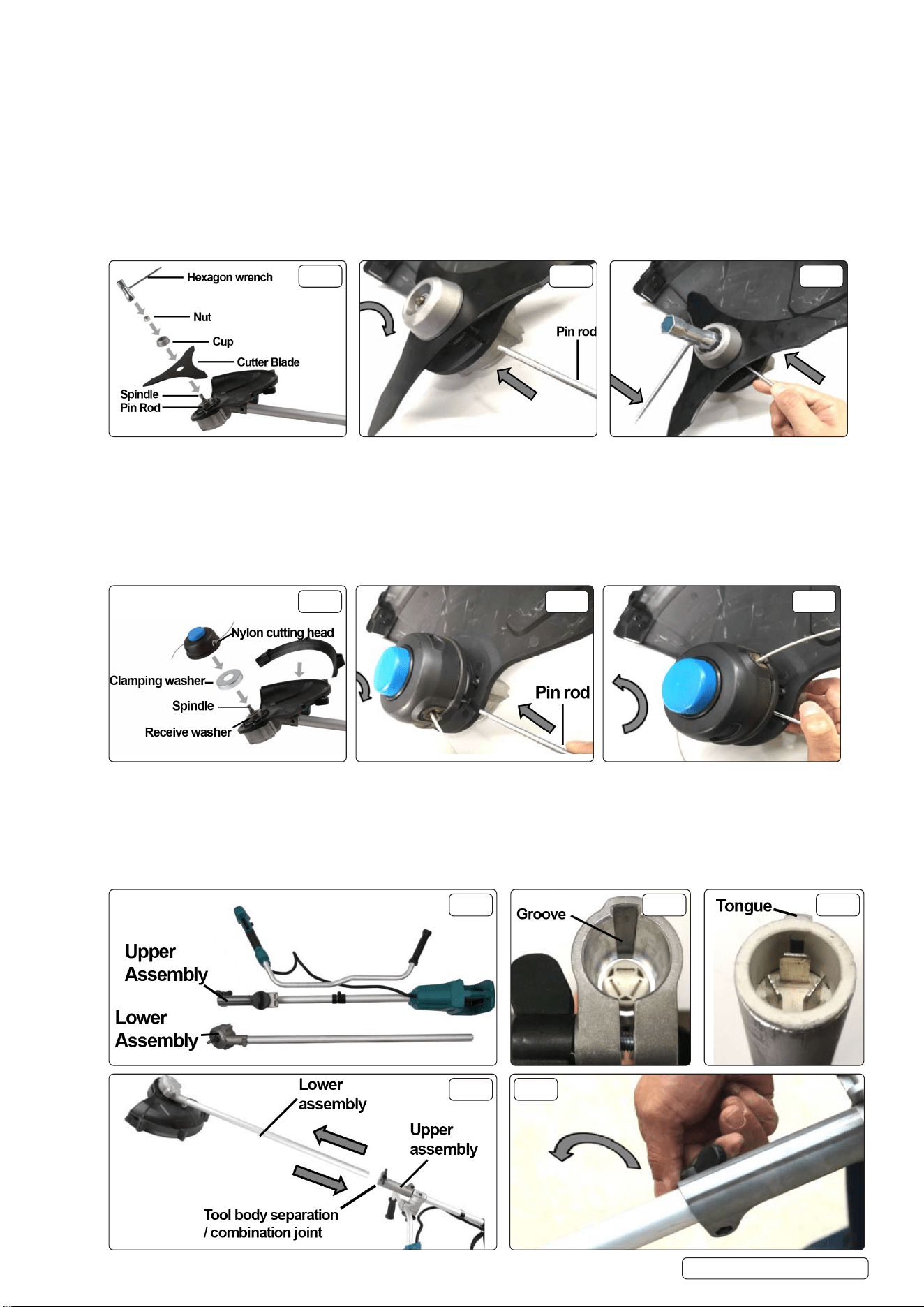
6.6. FOR CUTTERBLADE (FIG.13 & 14)
6.6.1. To install the protector, mount the protector by tting it on to the motor housing, and then secure it with three star type screws by
turning clockwise as orientation shown in the gure.
6.6.2. To uninstall the protector, perform the install steps in reverse.
FIG.13
FIG.14
6.7. FOR NYLON CUTTING HEAD (FIG.15 & 16)
CAUTION: Take care not to injure yourself on the cutter for cutting the nylon cord.
6.7.1. Mount the protector by tting it on to the motor housing, and then secure it with three star type screws by turning clockwise.
6.7.2. After that, install the protector extension. Mount the protector extension onto the protector and then secure it with three hex bolts by
using the hexagon wrench and turning clockwise.
6.7.3. To remove the protector extension from the protector, perform the install steps in reverse.
FIG.15
FIG.16
6.8. INSTALLING THE CUTTING TOOL
CAUTION: After installing the cutting tool, always make sure that it is secured rmly. Otherwise, it may suddenly separate from the tool
body and result in an serious personal injury.
CAUTION: Always use the supplied hexagon wrenches and pin rod to remove or to install the cutting tool.
CAUTION: Be sure to remove the hex wrench inserted into the tool head after installing the cutting tool.
NOTE: The type of the cutting tool(s) supplied as the standard accessory varies depending on the countries. The cutting tool is not
included in some countries.
CP40VBC Issue 2 10/01/24Original Language Version
© Jack Sealey Limited
NOTE: Turn the tool upside down so that you can replace the cutting tool easily.
6.9. CUTTERBLADE - FOR BRUSH AND GRASS CUTTING (FIG.17, 18 & 19)
CAUTION: When handling a cutter blade, always wear gloves and put the blade cover on the blade.
CAUTION: The cutter blade must be well polished, and free of cracks or breakage. If the cutter blade hits a stone during operation,
stop the tool and check the cutter blade immediately.
CAUTION: Always use the cutter blade with the diameter described in the section for specications.
To install the cutter blade, perform following steps:
6.9.1. Mount the receive washer, cutter blade, cup onto the motor housing in order as shown in the gure.
6.9.2. Rotate the cup so that the groove on the receive washer align to the groove on the protector and then insert the pin rod through both
grooves to the end to lock the spindle.
6.9.3. Hold on the pin rod by your right hand and anticlockwise secure them rmly with a nut by using the hexagon wrench.
6.9.4. Remove the pin rod from the groove. To remove the cutter blade, follow the installation procedures in reverse.
FIG.17 FIG.19FIG.18
6.10. NYLON CUTTING HEAD - FOR GRASS CUTTING (FIG.20, 21 & 22)
To install the nylon cutting head, perform following steps:
6.10.1. Mount the receive washer, clamping washer onto the motor housing in order and then screw the nylon cutting head onto the spindle by
turning it anticlockwise.
6.10.2. Rotate the nylon cutting head so that the groove on the receive washer align to the groove on the protector and then insert the pin rod
through both grooves to the end to lock the spindle. Hold on the pin rod by your right hand and secure the nylon cutting head rmly by
turning it anticlockwise with your left hand as far as it can go.
6.10.3. Remove the pin rod from the groove. To remove the nylon cutting head, follow the installation procedures in reverse.
FIG.20 FIG.21 FIG.22
6.11. SEPARATING /COMBINING TOOL BODY (FIG.23, 24, 25, 26 & 27)
CAUTION: Before separating or combining the tool body, be sure to switch o the tool and remove the battery cartridge from the tool.
Failure to do so may cause a personal injury.
CAUTION: After combining the tool body, make sure that the joint is rmly tightened and secured.
6.11.1. To combine the tool body, align the tongue of the lower part assembly with the groove in the upper part assembly and slip it into place
as far as it can go, then tighten the tool body separation/combination joint by twisting it clockwise rmly.
6.11.2. To separate the tool body, perform the combination procedure in reverse.
FIG.23 FIG.24 FIG.25
FIG.26 FIG.27
CP40VBC Issue 2 10/01/24Original Language Version
© Jack Sealey Limited
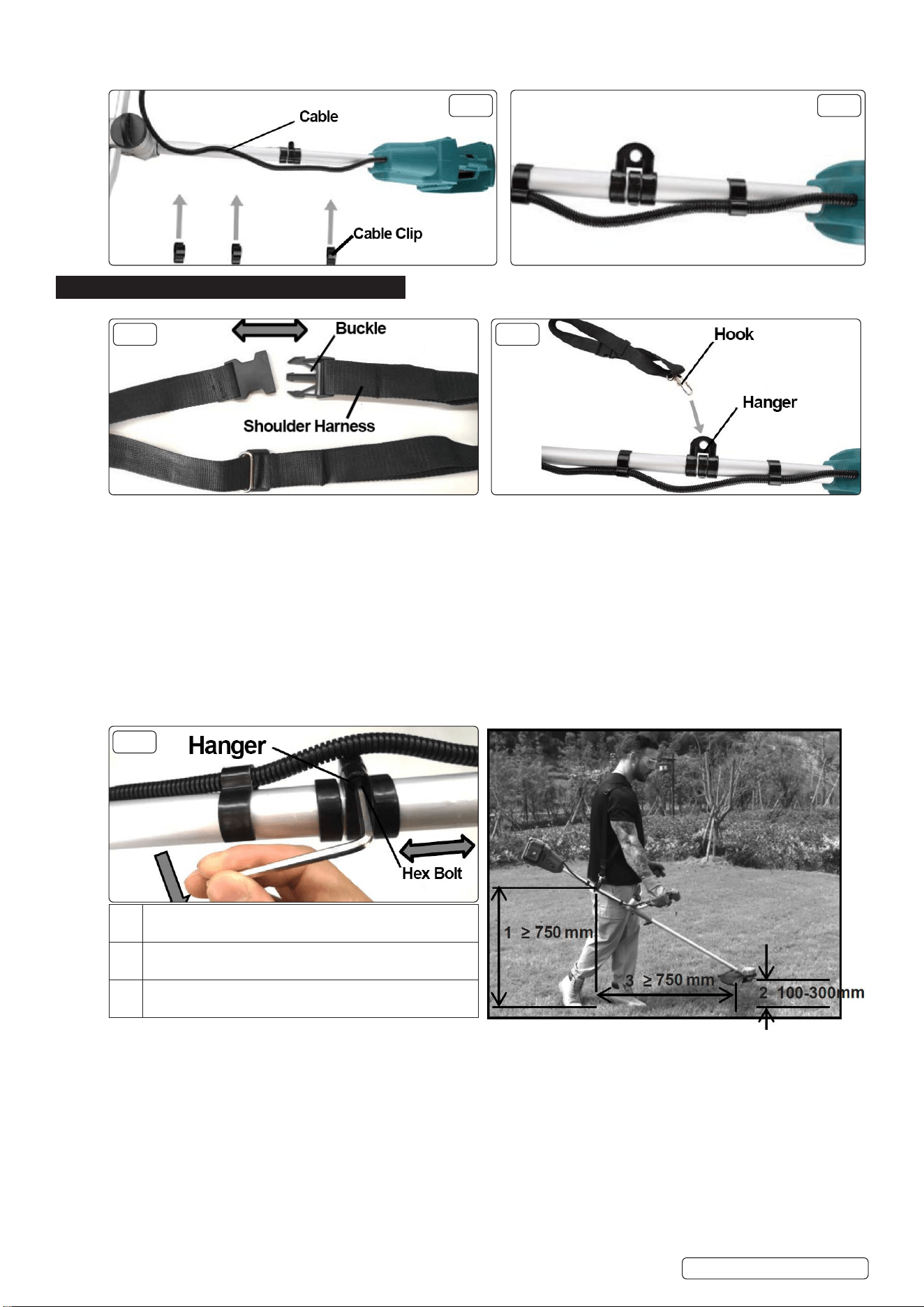
6.12. CABLE CLIP (FIG.28 & 29)
Make sure to x the cable onto the shaft rmly with the three cable clips provided.
FIG.28 FIG.29
7. OPERATION
FIG.31FIG.30
7.1. ATTACHING THE SHOULDER HARNESS (FIG.30 & 31)
CAUTION: Before operation, make sure that the shoulder harness is properly attached to the hanger on the tool.
CAUTION: Before operation, make sure that the buckle of the shoulder harness is fastened rmly.
CAUTION: Always use the shoulder harness dedicated to this tool. Do not use other shoulder harnesses.
To attach the shoulder harness onto the tool, perform following steps:
7.1.1. Fasten the buckle (g.30).
7.1.2. Clasp the hook on the shoulder harness to tool’s hanger (g.31).
7.1.3. Put the shoulder harness on the shoulder.
NOTE: When removing the shoulder harness, unlock the buckle and remove the shoulder harness.
7.2. ADJUSTING THE HANGER POSITION (FIG.32)
For more comfortable handling of the tool, you can change the hanger position.
7.2.1. Loosen the hex bolt on the hanger and slide it to a comfortable working position.
7.2.2. Adjust the hanger position and then tighten the hex bolt.
FIG.32
1 The hanger position from the ground
2 The cutting tool position from the ground.
3 The horizontal distance between the hanger and the
unguarded part of the cutting tool.
7.3. CORRECT HANDLING OF THE TOOL
WARNING! Always position the tool on your right-hand side. Correct positioning of the tool allows for maximum control and will reduce
the risk of serious personal injury caused by kickback.
WARNING! Be extremely careful to maintain control of the tool at all times. Do not allow the tool to be deected toward you or anyone
in the work vicinity. Failure to keep control of the tool could result in serious injury to the bystander and the operator.
WARNING! To avoid accident, leave more than 15m (50 ft) distance between operators when two or more operators work in one area.
Also, arrange a person to observe the distance between operators. If someone or an animal enters the working area, immediately stop
the operation.
CAUTION: If the cutting tool accidentally impacts a rock or hard object during operation, stop the tool and inspect for any damage.
If the cutting tool is damaged, replace it immediately. Use of a damaged cutting tool may result in serious personal injury. Correct
positioning and handling allow optimum control and reduce the risk of injury caused by kickback.
CP40VBC Issue 2 10/01/24Original Language Version
© Jack Sealey Limited
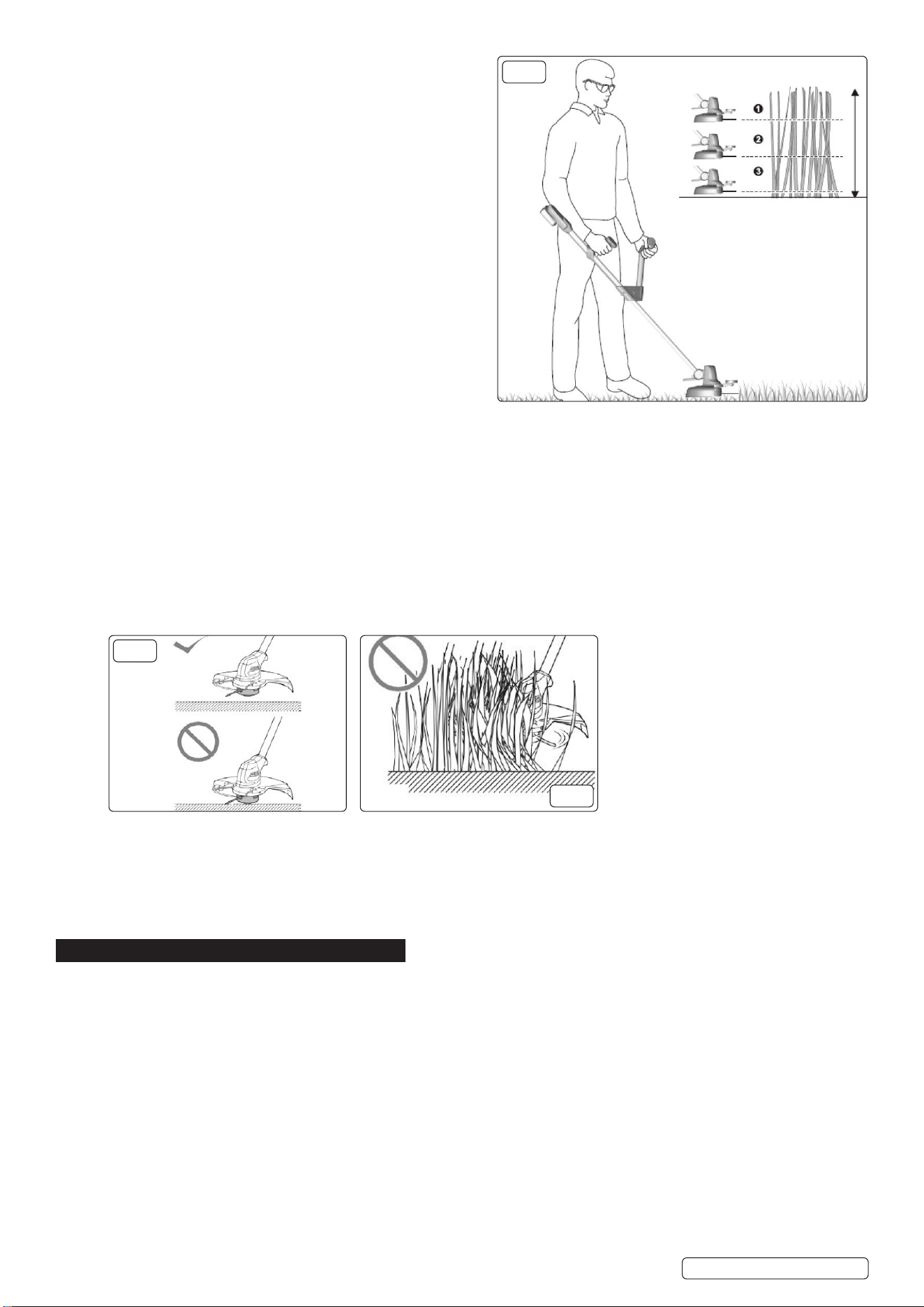
7.4. RECOMMENDED POSITION FOR CUTTING HIGHER GRASS
OR BRUSH (FIG.33)
7.4.1. Always cut higher grass or brush in steps so that to avoid the
cutter blade or nylon cord touching the tree or blocks, Below for
recommended position.
7.5. CUTTING BRUSH (USE AS BRUSH CUTTER)
NOTE: Use the brush cutter without getting the cutter blade into a
contact with the ground surface. Using the cutter blade contacting
the ground surface may cause the motor under overload resulting
in damage to the grass trimmer and injury caused by kickback.
7.5.1. Hold the brush cutter at the angle of about 50° to the ground. Move
the brush cutter from right to left slowly.
7.5.2. Cut the brush a few times from the bottom of the brush at the tip of
the cutter blade.
7.6. CUTTING THE BRUSH NEAR TREE, BLOCK, BRICK, OR
STONE
NOTE: When cutting the brush, move the brush cutter around the
tree or blocks so that the cutter blade does not touch the tree or
blocks. It is recommended to keep the tool more than 5 cm away
from the tree or block.
7.7. CUTTING GRASS (USE AS STRING TRIMMER)
The nylon cutting head is a dual string trimmer head provided with
a bump & feed mechanism. To feed the nylon cord, bump the cutting head against the ground while the tool is running. As the nylon cord is
feeding out, it will automatically be cut to the proper length by the cutter.
NOTE: The bump feed will not operate properly if the nylon cutting head is not rotating.
NOTE: If the nylon cord does not feed out while start running the tool each time, rewind or replace the nylon cord by following the
procedures in this manual.
7.7.1. Hold the String trimmer at the angle of about 50° to the ground.
7.7.2. Move the string trimmer from right to left slowly.
7.7.3. Cut the grass a few times from the top of the grass at the tip of the nylon cord .
NOTE: DO NOT cut high grass at a time. Cutting the high grass at a time near the root may cause the nylon cutting head to be
entangled by grass. This may cause the motor overload, resulting in damage to the string trimmer.
NOTE: Use the string trimmer without getting the spool into a contact with the ground surface (g.34). Using the spool contacting the
ground surface may cause the motor under overload resulting in damage to the string trimmer.
NOTE: DO NOT force the trimmer in densely growing grass (g.35).
FIG.34
FIG.35
7.8. CUTTING THE GRASS NEAR TREE, BLOCK, BRICK, OR STONE
7.8.1. Hold and tilt the grass trimmer at a height where the spool does not touch the ground.
7.8.2. Cut the grass using the nylon cord tip like knocking the ground.
NOTE: When cutting the grass, move the grass trimmer around the tree or blocks so that the nylon cord does not touch the tree or
blocks. It is recommended to keep the tool more than 5 cm away from the tree or block. If the nylon cord touch the tree or block, the
nylon cord may be torn rapidly. If the nylon cord is torn in the spool, set the nylon cord again referring to the replacement procedure in
this manual.
8. MAINTENANCE
WARNING! Always be sure that the tool is switched o and battery cartridge is removed before attempting to perform inspection or
maintenance on the tool. Failure to switch o and remove the battery cartridge may result in serious personal injury from accidental start-up.
NOTE: Never use gasoline, benzine, thinner, alcohol or the like. Discolouration, deformation or cracks may result.
9 To maintain product safety and reliability, repairs, any other maintenance or adjustment should be performed by authorised service
centres using Sealey replacement parts.
8.1. CLEANING
9 Clean the tool by wiping o dust, dirt, or cut o grass with a dry cloth or one dipped in soapy water and wrung out.
9 To avoid overheating of the tool, be sure to remove the cut o grass or debris adhered to the vent of the tool.
8.2. REPLACING THE NYLON CORD SET
WARNING! Use nylon cord that has the same diameter as the cord supplied. Never use heavier line, metal wire, rope or the like. Use
recommended nylon cord only, otherwise it may cause damage to the tool and result in serious personal injury.
WARNING! Make sure that the cover of the nylon cutting head is secured to the housing properly as described below. Failure to
properly secure the cover may cause the nylon cord set to y apart resulting in serious personal injury.
8.2.1. Depress the release button on both sides a little bit, then remove the cover and the old nylon cord set in order (g.36, g.37).
8.2.2. Replace the old nylon cord set with a new one (g.38).
8.2.3. Remount the new nylon cord set by tting it onto the original place with the nylon cord tip through the two grooves on both sides of the cover
(g.39).
FIG.33
CP40VBC Issue 2 10/01/24Original Language Version
© Jack Sealey Limited
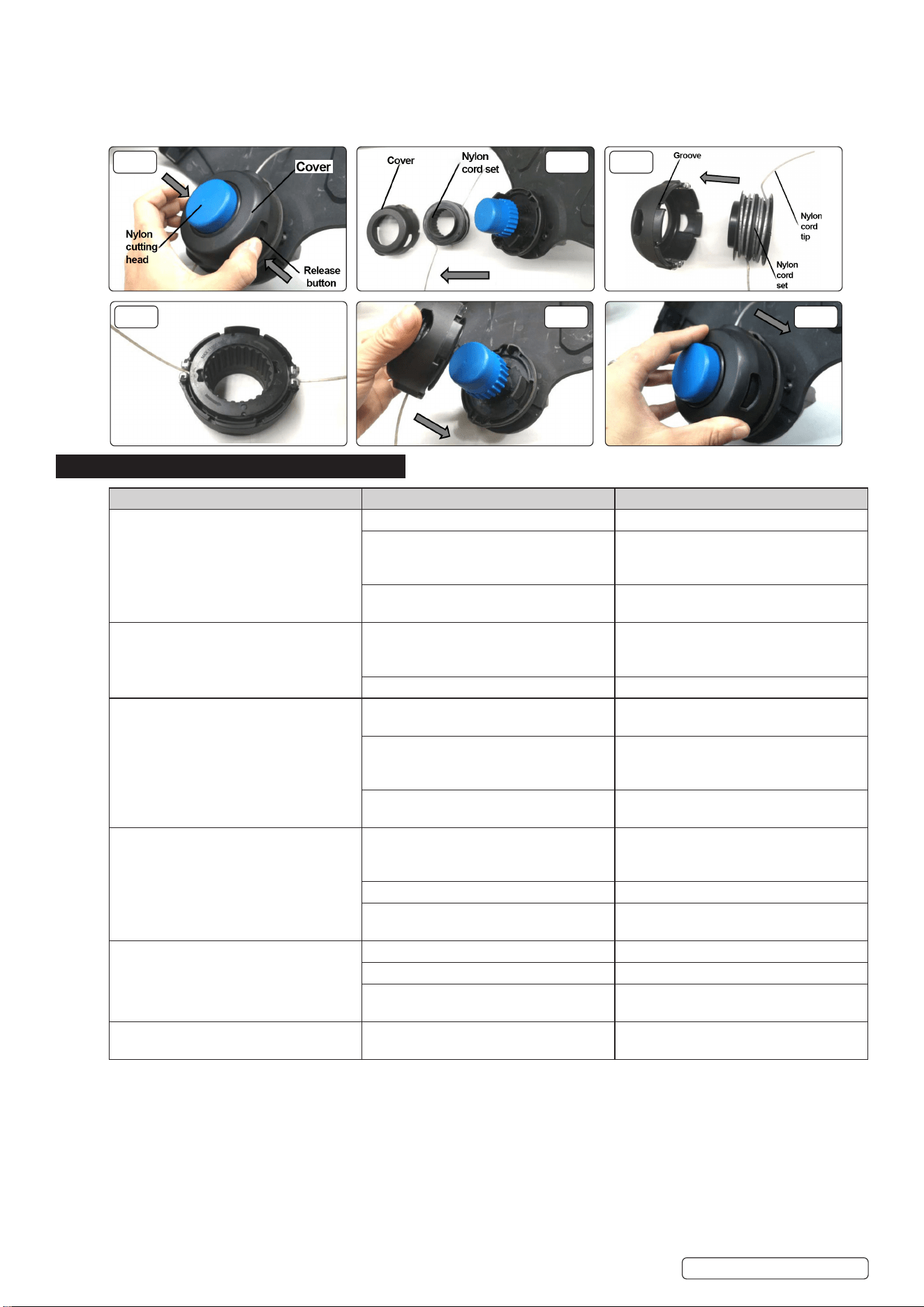
8.2.4. Remount the cover by tting it onto the original place until it locks in place with a little click (g.40).
8.2.5. Test to make sure that the bump & feed mechanism can operate normally (g.41).
8.3. STORAGE
9 Store the tool indoors in a cool, dry and locked place.
8 DO NOT store the tool and charger in locations where the temperature may reach or exceed 40 °C (104 °F).
FIG.36 FIG.37 FIG.38
FIG.39 FIG.40 FIG.41
9. TROUBLESHOOTING
PROBLEM CAUSE SOLUTION
Motor does not run. Battery cartridge is not installed. Install the battery cartridge.
Battery problem (under voltage) Recharge the battery cartridge. If
recharging is not eective, replace battery
cartridge.
The drive system does not work correctly. Contact authorised service centre for
repair.
Motor stops running after a little use. Battery’s charge level is low. Recharge the battery cartridge. If
recharging is not eective, replace battery
cartridge.
Overheating. Stop use of tool to allow it to cool down.
The tool does not reach maximum RPM. Battery cartridge is installed improperly. Install the battery cartridge as described in
this manual.
Battery power is dropping. Recharge the battery cartridge. If
recharging is not eective, replace battery
cartridge.
The drive system does not work correctly. Contact authorised service centre for
repair.
Cutting tool does not rotate:
Stop the machine immediately!
Foreign object such as a branch is
jammed between the guard and the cutting
tool.
Remove the foreign object.
Cutting tool is loosely attached. Tighten the cutting tool securely.
The drive system does not work correctly. Contact authorised service centre for
repair.
Abnormal vibration:
Stop the machine immediately!
Broken, bent or worn cutting tool Replace the cutting tool.
Cutting tool is loosely attached. Tighten the cutting tool securely.
The drive system does not work correctly. Contact authorised service centre for
repair.
Cutting tool and motor cannot stop:
Remove the battery immediately!
Electric or electronic malfunction. Remove the battery cartridge and contact
authorised service centre for repair.
CP40VBC Issue 2 10/01/24Original Language Version
© Jack Sealey Limited
HAND ARM VIBRATION
WARNING! – RISK OF HAND ARM VIBRATION INJURY
This tool may cause Hand Arm Vibration Syndrome if its use is not managed adequately.
This tool is subject to the vibration testing section of the Machinery Directive 2006/42/EC.
This tool is to be operated in accordance with these instructions.
Measured vibration emission value (a): 1.154m/s²
Uncertainty value (k): 1.5m/s²
Please note that the application of the tool to a sole specialist task may produce a dierent average vibration emission. We recommend
that a specic evaluation of the vibration emission is conducted prior to commencing with a specialist task.
A health and safety assessment by the user (or employer) will need to be carried out to determine the suitable duration of use for
each tool.
NB: Stated Vibration Emission values are type-test values and are intended to be typical.
Whilst in use, the actual value will vary considerably from and depend on many factors.
Such factors include; the operator, the task and the inserted tool or consumable.
NB: ensure that the length of leader hoses is sucient to allow unrestricted use, as this also helps to reduce vibration.
The state of maintenance of the tool itself is also an important factor, a poorly maintained tool will also increase the risk of Hand Arm
Vibration Syndrome.
HEALTH SURVEILLANCE
We recommend a programme of health surveillance to detect early symptoms of vibration injury so that management procedures can
be modied accordingly.
PERSONAL PROTECTIVE EQUIPMENT
We are not aware of any personal protective equipment (PPE) that provides protection against vibration injury that may result from the
Uncontrolled use of this tool. We recommend a sucient supply of clothing (including gloves) to enable the operator to remain warm
and dry and maintain good blood circulation in ngers etc. Please note that the most eective protection is prevention, please refer
to the correct use and maintenance section in these instructions. Guidance relating to the management of hand arm vibration can be
found on the HSE website www.hse.gov.uk - Hand-Arm Vibration at Work.
Sealey Group, Kempson Way, Suffolk Business Park, Bury St Edmunds, Suffolk. IP32 7AR
01284 757500 sales@sealey.co.uk www.sealey.co.uk
Note: It is our policy to continually improve products and as such we reserve the right to alter data, specications and component parts without prior notice.
Important: No Liability is accepted for incorrect use of this product.
Warranty: Guarantee is 12 months from purchase date, proof of which is required for any claim.
ENVIRONMENT PROTECTION
Recycle unwanted materials instead of disposing of them as waste. All tools, accessories and packaging should be
sorted, taken to a recycling centre and disposed of in a manner which is compatible with the environment. When
the product becomes completely unserviceable and requires disposal, drain any uids (if applicable) into approved
containers and dispose of the product and uids according to local regulations.
REGISTER YOUR
PURCHASE HERE
WEEE REGULATIONS
Dispose of this product at the end of its working life in compliance with the EU Directive on Waste Electrical and Electronic
Equipment (WEEE). When the product is no longer required, it must be disposed of in an environmentally protective way. Contact
your local solid waste authority for recycling information.
BATTERY REMOVAL
Under the Waste Batteries and Accumulators Regulations 2009, Jack Sealey Ltd are required to inform potential purchasers of products
containing batteries (as defined within these regulations), that they are registered with Valpak’s registered compliance scheme. Jack
Sealey Ltd Batteries Producer Registration Number (BPRN) is BPRN00705.
CP40VBC Issue 2 10/01/24Original Language Version
© Jack Sealey Limited
