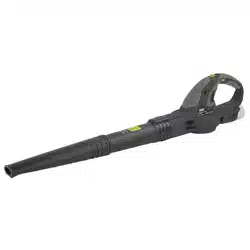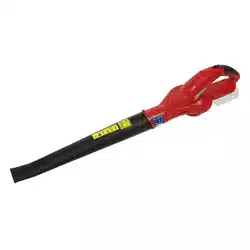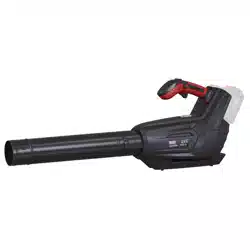

40V SV20 SERIES BLOWER BODY ONLY
MODEL NO: CP40VB
Thank you for purchasing a Sealey product. Manufactured to a high standard, this product will, if used according to these instructions,
and properly maintained, give you years of trouble free performance.
IMPORTANT: PLEASE READ THESE INSTRUCTIONS CAREFULLY. NOTE THE SAFE OPERATIONAL REQUIREMENTS, WARNINGS & CAUTIONS.
USE THE PRODUCT CORRECTLY AND WITH CARE FOR THE PURPOSE FOR WHICH IT IS INTENDED. FAILURE TO DO SO MAY CAUSE
DAMAGE AND/OR PERSONAL INJURY AND WILL INVALIDATE THE WARRANTY. KEEP THESE INSTRUCTIONS SAFE FOR FUTURE USE.
1. SAFETY
1.1. GENERAL SAFETY
8 DO NOT allow children, persons with reduced physical, sensory or mental capabilities or lack of experience and knowledge or people
unfamiliar with these instructions to use the machine, local regulations may restrict the age of the operator.
8 DO NOT operate the machine while people, especially children, or pets are nearby.
8 DO NOT overreach whilst using the machine, and keep balance at all times.
9 Always be sure of your footing on slopes and when walking with the machine. Never run.
9 Always wear substantial footwear and long trousers while operating the machine.
8 Never operate the machine with a defective guard or shield, or without safety devices
8 Avoid using the machine in bad weather conditions, especially when there is a risk of lightning.
9 Use hearing protection during use.
9 Dierent types of batteries or new and used batteries are not to be mixed.
9 Batteries are to be inserted with the correct polarity.
1.2. WORK AREA SAFETY
9 Keep work area clean and well lit. Cluttered or dark areas invite accidents.
8 DO NOT operate power tools in explosive atmospheres, such as in the presence of ammable liquids, gases or dust. Power tools
create sparks which may ignite the dust or fumes.
9 Keep children and bystanders away while operating a power tool. Distractions can cause you to lose control.
1.3. ELECTRICAL SAFETY
9 Avoid body contact with earthed or grounded surfaces, such as pipes, radiators, ranges and refrigerators. There is an increased risk of
electric shock if your body is earthed or grounded.
8 DO NOT expose power tools to rain or wet conditions. Water entering a power tool will increase the risk of electric shock.
9 Power tools can produce electromagnetic elds (EMF) that are not harmful to the user. However, users of pacemakers and other similar
medical devices should contact the maker of their device and/ or doctor for advice before operating this power tool.
1.4. PERSONAL SAFETY
9 Stay alert, watch what you are doing and use common sense when operating a power tool.
8 DO NOT use a power tool while you are tired or under the inuence of drugs, alcohol or medication. A moment of inattention while
operating power tools may result in serious personal injury.
9 Use personal protective equipment. Always wear eye protection. Protective equipment such as a dust mask, non-skid safety shoes,
hard hat or hearing protection used for appropriate conditions will reduce personal injuries.
9 Prevent unintentional starting. Ensure the switch is in the o-position before connecting to power source and/or battery pack, picking up or
carrying the tool. Carrying power tools with your nger on the switch or energising power tools that have the switch on invites accidents.
9 Remove any adjusting key or wrench before turning the power tool on. A wrench or a key left attached to a rotating part of the power
tool may result in personal injury.
8 DO NOT overreach. Keep proper footing and balance at all times. This enables better control of the power tool in unexpected situations.
9 Dress properly. DO NOT wear loose clothing or jewellery. Keep your hair and clothing away from moving parts. Loose clothes,
jewellery or long hair can be caught in moving parts.
8 DO NOT let familiarity gained from frequent use of tools allow you to become complacent and ignore tool safety principles. A careless
action can cause severe injury within a fraction of a second.
9 Always wear protective goggles to protect your eyes from injury when using power tools. The goggles must comply with local
regulations in force.
9 It is an employer’s responsibility to enforce the use of appropriate safety protective equipment by the tool operators and by other
persons in the immediate working area.
1.5. POWER TOOL USE AND CARE
8 DO NOT force the power tool. Use the correct power tool for your application. The correct power tool will do the job better and safer at
the rate for which it was designed.
8 DO NOT use the power tool if the switch does not turn it on and o. Any power tool that cannot be controlled with the switch is
dangerous and must be repaired.
9 Remove the battery pack, if detachable, from the power tool before making any adjustments, changing accessories, or storing power
tools. Such preventive safety measures reduce the risk of starting the power tool accidentally.
9 Store idle power tools out of the reach of children and do not allow persons unfamiliar with the power tool or these instructions to
operate the power tool. Power tools are dangerous in the hands of untrained users.
Refer to
instructions
CP40VB Issue 3 (6) 22/05/24
Original Language Version
© Jack Sealey Limited
Wear ear
protection
Wear eye
protection
DO NOT
expose to rain
WARNING!
Thrown objects.
Keep bystanders
away.

9 Maintain power tools and accessories. Check for misalignment or binding of moving parts, break- age of parts and any other condition
that may aect the power tool’s operation. If damaged, have the power tool repaired before use. Many accidents are caused by poorly
maintained power tools.
9 Use the power tool, accessories and tool bits etc. in accordance with these instructions, taking into account the working conditions and
the work to be performed. Use of the power tool for operations dierent from those intended could result in a hazardous situation.
9 Keep handles and grasping surfaces dry, clean and free from oil and grease. Slippery handles and grasping surfaces do not allow for
safe handling and control of the tool in unexpected situations.
9 When using the tool, do not wear cloth work gloves which may be entangled. The entanglement of cloth work gloves in the moving
parts may result in personal injury.
1.6. BATTERY TOOL USE AND CARE
9 Recharge only with the charger specied by the manufacturer. A charger that is suitable for one type of battery pack may create a risk
of re when used with another battery pack.
9 Use power tools only with specically designated battery packs. Use of any other battery packs may create a risk of injury and re.
9 When battery pack is not in use, keep it away from other metal objects, like paper clips, coins, keys, nails, screws or other small metal
objects, that can make a connection from one terminal to another. Shorting the battery terminals together may cause burns or a re.
9 Under abusive conditions, liquid may be ejected from the battery; avoid contact. If contact accidentally occurs, ush with water. If liquid
contacts eyes, additionally seek medical help. Liquid ejected from the battery may cause irritation or burns.
8 DO NOT use a battery pack or tool that is damaged or modied. Damaged or modied batteries may exhibit unpredictable behaviour
resulting in re, explosion or risk of injury.
8 DO NOT expose a battery pack or tool to re or excessive temperature. Exposure to re or temperature above 130°C may cause explosion.
9 Follow all charging instructions and do not charge the battery pack or tool outside the temperature range specied in the instructions.
Charging improperly or at temperatures outside the specied range may damage the battery and increase the risk of re.
1.7. SERVICE
9 Have your power tool serviced by a qualied repair person using only identical replacement parts. This will ensure that the safety of the
power tool is maintained.
8 DO NOT service damaged batteries. Service of batteries should only be performed by the manufacturer or authorised service providers.
9 Follow instruction for lubricating and changing accessories.
1.8. CORDLESS BLOWER SAFETY
9 Read the instructions carefully. Be familiar with the controls and the correct use of the blower.
8 DO NOT allow children, persons with reduced physical, sensory or mental capabilities or lack of experience and knowledge or people
unfamiliar with these instructions to use the blower. Local regulations may restrict the age of the operator.
8 DO NOT operate the blower while people, especially children, or pets are nearby.
9 Keep in mind that the operator or user is responsible for accidents or hazards occurring to other people or their property.
1.9. PREPARATION
9 Always wear substantial footwear and long trousers while operating the blower.
8 DO NOT wear loose clothing or jewellery that can be drawn into the air inlet. Keep long hair away from the air inlets.
9 Always wear protective goggles to protect your eyes from injury when using power tools.
9 It is an employer’s responsibility to enforce the use of appropriate safety protective equipments by the tool operators and by other
persons in the immediate working area.
9 To prevent dust irritation the wearing of a face mask is recommended.
9 While operating the machine, always wear non-slip and protective footwear. Non-skid, closed-toed safety boots and shoes will reduce
the risk of injury.
9 Use personal protective equipment. Always wear eye protection. Protective equipment such as a dust mask, non-skid safety shoes,
hard hat or hearing protection used for appropriate conditions will reduce personal injuries.
1.10. OPERATION SAFETY
WARNING! Wear ear protection.
WARNING! The noise emission during actual use of the power tool can dier from the declared value(s) depending on the ways in
which the tool is used especially what kind of workpiece is processed.
9 Switch o the blower and remove the battery cartridge and make sure that all moving parts have come to a complete stop:
(1) whenever you leave the blower, (2) before clearing blockages, (3) before checking, cleaning or working on the blower, (4) if the
blower starts to vibrate abnormally.
9 Operate the blower only in daylight or in good articial light.
8 DO NOT overreach and keep proper balance and footing at all times.
9 Always be sure of your footing on slopes. Walk, never run.
9 Keep all cooling air inlets clear of debris.
8 DO NOT blow debris in the direction of bystanders.
9 Operate the blower in a recommended position and on a rm surface.
8 DO NOT operate the blower at high places.
8 DO NOT point the nozzle at anyone in the vicinity when using the blower.
8 DO NOT block suction inlet and/or blower outlet.
8 DO NOT not to block suction inlet or blower outlet with dust or dirt when operating in dusty areas.
8 DO NOT use nozzles other than the nozzles provided by Sealey.
8 DO NOT use the blower to inate balls, rubber boat or the similar.
8 DO NOT operate the blower near open window, etc.
9 Operating the blower only at reasonable hours is recommended - not early in the morning or late at night when people might be disturbed.
9 Using rakes and brooms to loosen debris before blowing is recommended.
9 If the blower strikes any foreign objects or should start making any unusual noise or vibration, immediately switch o the blower to stop
it. Remove the battery cartridge from the blower and inspect the blower for damage before restarting and operating the blower. If the
blower is damaged, ask an authorised service centre for repair.
8 DO NOT insert ngers or other objects into suction inlet or blower outlet.
9 Prevent unintentional starting. Ensure the switch is in the o-position before inserting battery cartridge, picking up or carrying the
blower. Carrying the blower with your nger on the switch or energizing the blower that has the switch on invites accidents.
8 DO NOT Never blow dangerous materials, such as nails, fragments of glass, or blades.
Original Language Version
© Jack Sealey Limited
CP40VB Issue 3 (6) 22/05/24

8 DO NOT operate the blower near ammable materials.
8 DO NOT operate the blower for a long time in low temperature environment.
8 DO NOT use the machine when there is a risk of lightning.
9 When you use the machine on muddy ground, wet slope, or slippery place, pay attention to your footing.
9 Avoid working in poor environment where increased user fatigue is expected.
8 DO NOT use the machine in bad weather where visibility is limited.
8 DO NOT submerge the machine into a puddle.
8 When wet leaves or dirt adhere to the suction mouth (ventilation window) due to rain, remove them.
1.11. MAINTENANCE & STORAGE SAFETY
9 Keep all nuts, bolts and screws tight to be sure the blower is in safe working condition.
9 If the parts are worn or damaged, replace them with parts provided by Sealey.
9 Store the blower in a dry place out of the reach of children.
9 When you stop the blower for inspection, servicing, storage, or changing accessory, switch off the blower and make sure that all moving
parts come to a complete stop, and remove the battery cartridge. Cool down the blower before making any work on the blower. Maintain
the blower with care and keep it clean.
9 Always cool down the blower before storing.
8 DO NOT expose the blower to rain. Store the blower indoors.
9 When you lift the blower, be sure to bend your knees and be careful not to hurt your back.
8 DO NOT leave the machine unattended outdoors in the rain.
8 DO NOT wash the machine with high pressure water.
9 When storing the machine, avoid direct sunlight and rain, and store it in a place where it does not get hot or humid.
9 Perform inspection or maintenance in a place where rain can be avoided.
9 After using the machine, remove the adhered dirt and dry the machine completely before storing. Depending on the season or the area,
there is a risk of malfunction due to freezing.
1.12. ELECTRICAL AND BATTERY SAFETY
8 DO NOT dispose of the battery(ies) in a re. The cell may explode. Check with local codes for possible special disposal instructions.
8 DO NOT open or mutilate the battery(ies). Released electrolyte is corrosive and may cause damage to the eyes or skin. It may be toxic
if swallowed.
8 DO NOT charge battery in rain, or in wet locations.
8 DO NOT charge the battery outdoors.
8 DO NOT handle charger, including charger plug, and charger terminals with wet hands.
8 DO NOT replace the battery in the rain.
8 DO NOT wet the terminal of battery with liquid such as water, or submerge the battery. DO NOT leave the battery in the rain, nor
charge, use, or store the battery in a damp or wet place. If the terminal gets wet or liquid enters inside of battery, the battery may be
short circuited and there is a risk of overheat, re, or explosion.
9 After removing the battery from the machine or charger, be sure to attach the battery cover to the battery and store it in a dry place.
8 DO NOT replace the battery with wet hands.
9 If the battery gets wet, drain the water inside and then wipe it with a dry cloth. Dry the battery completely in a dry place before use.
9 Avoid dangerous environment. DO NOT use the machine in damp or wet locations or expose it to rain. Water entering the machine will
increase the risk of electric shock.
8 Non-rechargeable batteries are not to be recharged.
9 Rechargeable batteries are to be removed from the appliance before being charged.
9 Batteries are to be inserted with the correct polarity.
9 Exhausted batteries are to be removed from the appliance and safely disposed of.
1.13. SERVICE
9 Have your power tool serviced by a qualied repair person using only identical replacement parts. This will ensure that the safety of the
power tool is maintained.
9 Never service damaged battery packs. Service of battery packs should only be performed by the manufacturer or authorised service providers.
WARNING! DO NOT let comfort or familiarity with product (gained from repeated use) replace strict adherence to safety rules for the
subject product. Misuse or failure to follow the safety rules stated in this instruction manual may cause serious personal injury.
1.14. BATTERY CARTRIDGE SAFETY
9 Before using battery cartridge, read all instructions and cautionary markings on (1) battery charger, (2) battery, and (3) product using battery.
8 DO NOT disassemble or tamper the battery cartridge. It may result in a re, excessive heat, or explosion.
9 If operating time has become excessively shorter, stop operating immediately. It may result in a risk of overheating, possible burns and
even an explosion.
9 If electrolyte gets into your eyes, rinse them out with clear water and seek medical attention right away. It may result in loss of your eyesight.
8 DO NOT short the battery cartridge:
8 DO NOT touch the terminals with any conductive material.
9 Avoid storing battery cartridge in a container with other metal objects such as nails, coins, etc.
8 DO NOT expose the battery cartridge to water or rain.
9 A battery short can cause a large current ow, overheating, possible burns and even a breakdown.
8 DO NOT store and use the tool and battery cartridge in locations where the temperature may reach or exceed 50 °C (122 °F).
8 DO NOT incinerate the battery even if it is severely damaged or is completely worn out. The battery cartridge can explode in a re.
8 DO NOT nail, cut, crush, throw, drop the battery cartridge, or hit against a hard object to the battery cartridge. Such conduct may result
in a re, excessive heat, or explosion.
8 DO NOT use a damaged battery.
9 When disposing the battery cartridge, remove it from the tool and dispose of it in a safe place. Follow your local regulations relating to
disposal of battery.
9 Use the batteries only with the products specied by Sealey. Installing the batteries to non-compliant products may result in a re,
excessive heat, explosion, or leak of electrolyte.
9 If the tool is not used for a long period of time, the battery must be removed from the tool.
9 During and after use, the battery cartridge may take on heat which can cause burns or low temperature burns. Pay attention to the
handling of hot battery cartridges.
Original Language Version
© Jack Sealey Limited
CP40VB Issue 3 (6) 22/05/24
8 DO NOT touch the terminal of the tool immediately after use as it may get hot enough to cause burns.
8 DO NOT allow chips, dust, or soil stuck into the terminals, holes, and grooves of the battery cartridge. It may result in poor performance
or breakdown of the tool or battery cartridge.
9 Unless the tool supports the use near high-voltage electrical power lines, do not use the battery cartridge near a high-voltage electrical
power lines. It may result in a malfunction or breakdown of the tool or battery cartridge.
9 Keep the battery away from children.
1.15. TIPS FOR MAINTAINING MAXIMUM BATTERY LIFE
9 Charge the battery cartridge before completely discharged. Always stop tool operation and charge the battery cartridge when you
notice less tool power.
8 DO NOT recharge a fully charged battery cartridge. Overcharging shortens the battery service life.
9 Charge the battery cartridge with room temperature at 5 °C - 45 °C . Let a hot battery cartridge cool down before charging it.
9 When not using the battery cartridge, remove it from the tool or the charger.
9 Charge the battery cartridge if you do not use it for a long period (more than six months).
2. INTRODUCTION
Part of the SV20 Series designed for the professional, offering heavy-duty, high performance, durable tools with lightweight composite
designs for superior control and comfort. Operates using 2 x 20V batteries from the Sealey SV20 Series (batteries must be of the same
Ah rating). Variable speed controls to give superior battery life by using only the power required. Trigger lock for comfort during prolonged
use. Weighing on 2.5kg (without batteries).
3. SPECIFICATION
Model No: CP40VB
Battery: 20V 2Ah - 6Ah Lithium-ion (not included) Vibration value: 2.54 m/s²
Maximum Air Speed: 42m/s or 94mph Uncertainty: 1.5 m/s²
Maximum Air Volume: 648m³/hr Noise Power: 99 dB(A) L
WA
Voltage: 40V Noise Pressure: 82 dB(A) L
PA
4. CONTENTS
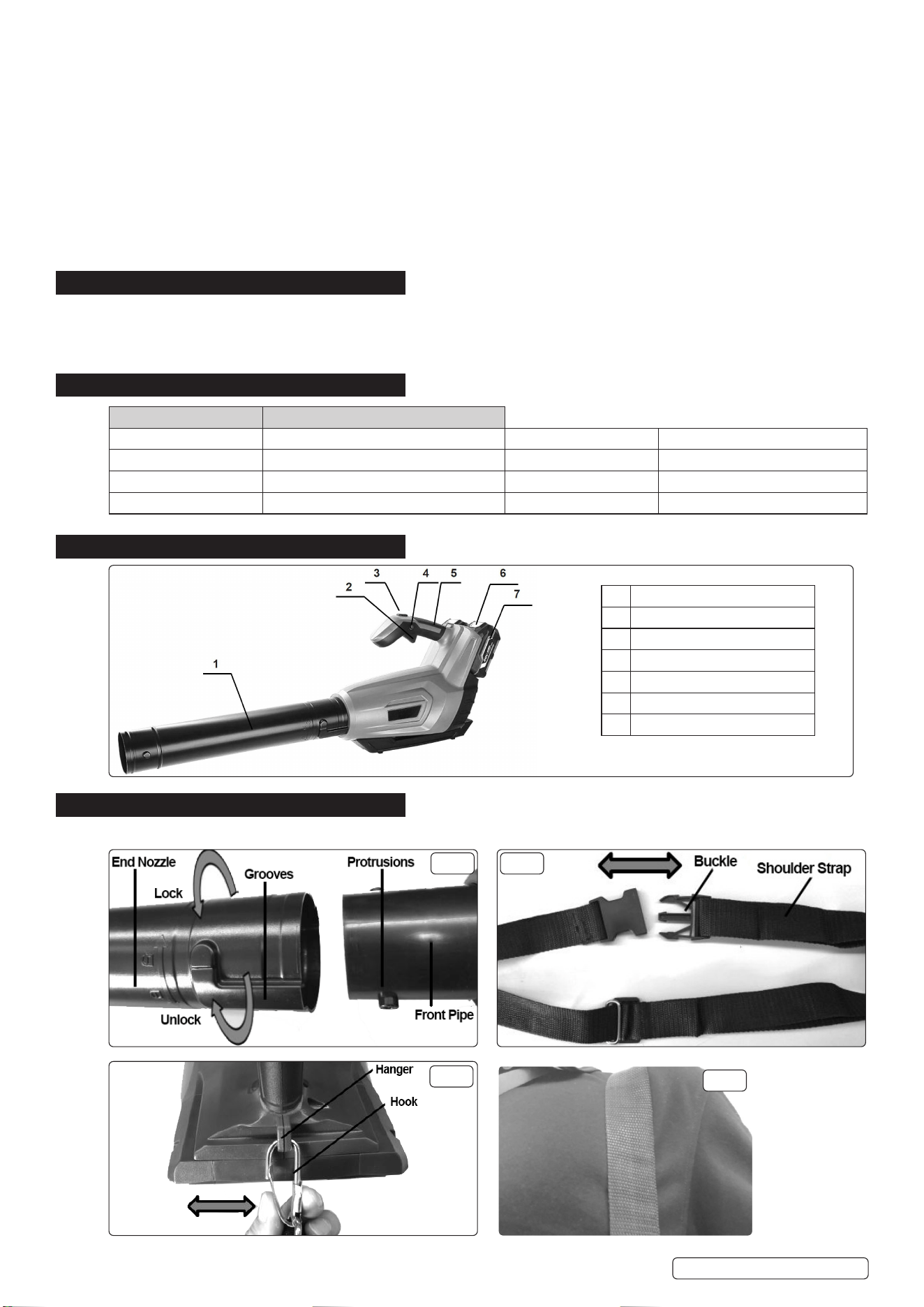
1 End Nozzle
2 Switch Trigger
3 Turbo Function On/Off Button
4 Switch Lock-on Button
5 Soft Handle
6* Button of Battery cartridge
7* Battery Cartridge
* not included
5. ASSEMBLY
WARNING! Remove batteries before assembling the blower or carrying out any work on the machine.
FIG.1 FIG.2
FIG.3
FIG.4
Original Language Version
© Jack Sealey Limited
CP40VB Issue 3 (6) 22/05/24
5.1. INSTALLING THE END NOZZLE (FIG.1)
5.1.1. To install the end nozzle, align the protrusions on the front pipe with the sliding grooves on the end nozzle and then slide it onto the front
pipe and turn it anticlockwise to lock. To remove the end nozzle, perform the installation in reverse.
5.2. ATTACHING THE SHOULDER STRAP (FIG.2, 3 & 4)
CAUTION: Be sure to attach the hooks of the shoulder strap to the machine securely. If the hooks are attached incompletely, they may come
off and cause an injury. Be sure to use the shoulder strap dedicated to this machine. Using other shoulder strap may cause an injury.
5.2.1. Fasten the buckle (fig.2).
5.2.2. Clasp the hook on the shoulder strap to tool’s hanger (fig.3).
5.2.3. Put the shoulder strap on the shoulder (fig.4)
6. OPERATION
CAUTION: DO NOT place the machine on the ground while it is switched on. Sand or dust may enter from suction inlet and cause a
malfunction or personal injury.
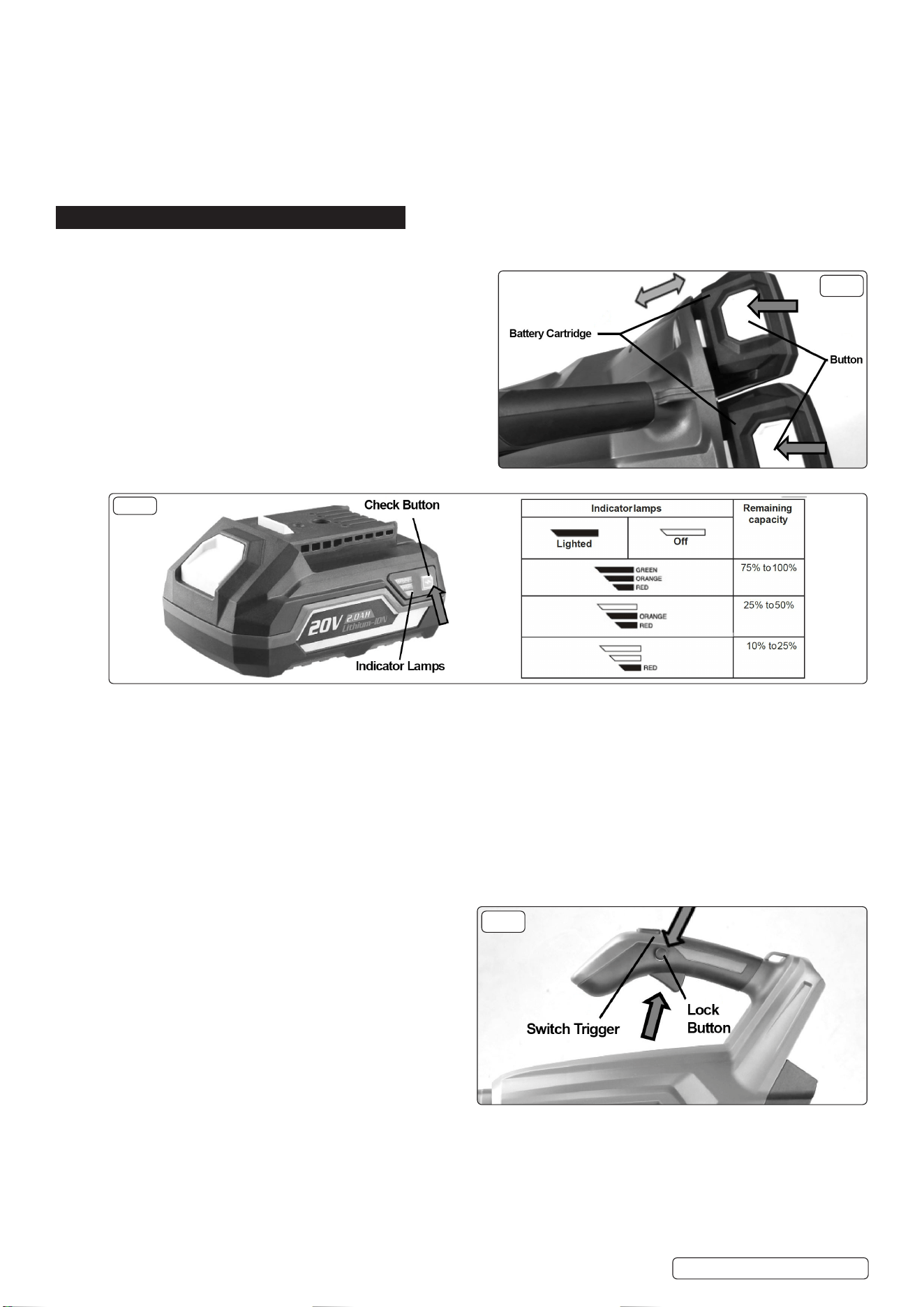
6.1. INSTALLING / REMOVING THE BATTERY (FIG.5)
CAUTION: Always switch off the tool before installing or removing
of the battery cartridge. Hold the tool and the battery cartridge firmly
when installing or removing battery cartridge.
CAUTION: Always install the battery cartridge fully. If not, it may
accidentally fall out of the tool, causing injury to you or someone around
you.
8 DO NOT install the battery cartridge forcibly. If the cartridge does not
slide in easily, it is not being inserted correctly.
NOTE: The tool does not work with only one battery cartridge.
NOTE: Pay attention to the position of your fingers when installing the
battery. The button will be depressed unintentionally.
FIG.6
6.2. BATTERY CAPACITY (FIG.6)
Press the check button on the battery cartridge to indicate the remaining battery capacity.
The tool is equipped with a tool/battery protection system. This system automatically cuts o power to the motor to extend tool and
battery life. The tool will automatically stop during operation if the tool or battery is placed under one of the following conditions:
6.3. OVERLOAD PROTECTION
When the battery is operated in a manner that causes it to draw an abnormally high current, the tool automatically stops without indication. In
this situation, turn the tool o and stop the application that caused the tool to become overloaded. Then turn the tool on to restart.
6.4. OVERHEAT PROTECTION
When the tool or battery is overheated, the tool stops automatically. In this situation, let the tool/battery cool before turning the tool on
again.
6.5. OVERDISCHARGE PROTECTION
When the battery capacity becomes low, the tool stops automatically. If the product does not operate even when the switches are
operated, remove the batteries from the tool and charge the batteries.
6.6. SWITCH ACTION (FIG.7)
WARNING! Before installing the battery cartridge into the tool,
always check to see that the switch trigger actuates properly
and returns to the “OFF” position when released.
WARNING! Switch can be locked in “ON” position for ease
of operator comfort during extended use. Apply caution when
locking tool in “ON” position and maintain rm grasp on tool.
6.6.1. To start the machine, simply pull the switch trigger. The speed
increases by increasing pressure on the switch trigger. Release
the switch trigger to stop.
6.6.2. The lock-on feature allows you to lock the switch trigger in the
on position. Locking the switch trigger on allows you to operate
the blower for extended periods of time.
8 DO NOT lock on the switch trigger if you might need to suddenly stop the blower.
6.7. TO LOCK ON (FIG.6)
6.7.1. Depress the switch trigger.
6.7.2. Depress down the switch lock-on button.
6.7.3. Release the switch trigger.
6.7.4. Release the switch lock-on button.
6.8. TO DISENGAGE THE LOCK (FIG.6)
6.8.1. Depress the switch trigger again and release.
FIG.5
FIG.7
Original Language Version
© Jack Sealey Limited
CP40VB Issue 3 (6) 22/05/24
8 DO NOT pull the switch lock-on button hard without pressing the switch trigger. This can cause switch breakage.
6.8.2. You can use the machine in the boost mode. In the boost mode, the air volume becomes larger than in the normal mode.
6.8.3. Depress the turbo function On/O button to use the machine in the boost mode and depress the button again to change back to the
normal mode.
6.9. BLOWER OPERATION
WARNING! DO NOT place the machine on the ground while it is switched on. Sand or dust may enter from suction inlet and cause a
malfunction or personal injury.
WARNING! DO NOT cover the suction inlet when working, or it may cause overheating and damage to the tool.
6.9.1. Attach the shoulder strap and hold the machine rmly with a hand and perform the blowing operation by moving it around slowly.
6.9.2. When blowing around building, big stone or vehicle, direct the nozzle away from them.
6.9.3. When performing an operation in a corner, start from the corner and then move to wide area.
6.10. TURBO BOOST FUNCTION
6.10.1. Press turbo button (Contents: 3) boost function operates for 2 seconds and returns to normal function. Boost function can be used
immediately afterwards.
7. MAINTENANCE
WARNING! Always ensure the machine is switched o and the battery is removed before attempting to perform maintenance.
NOTE: to maintain product safety and reliability, repairs, maintenance or adjustment should be performed by authorised service centres.
7.1. CLEANING
7.1.1. Wipe with a clean, dry cloth.
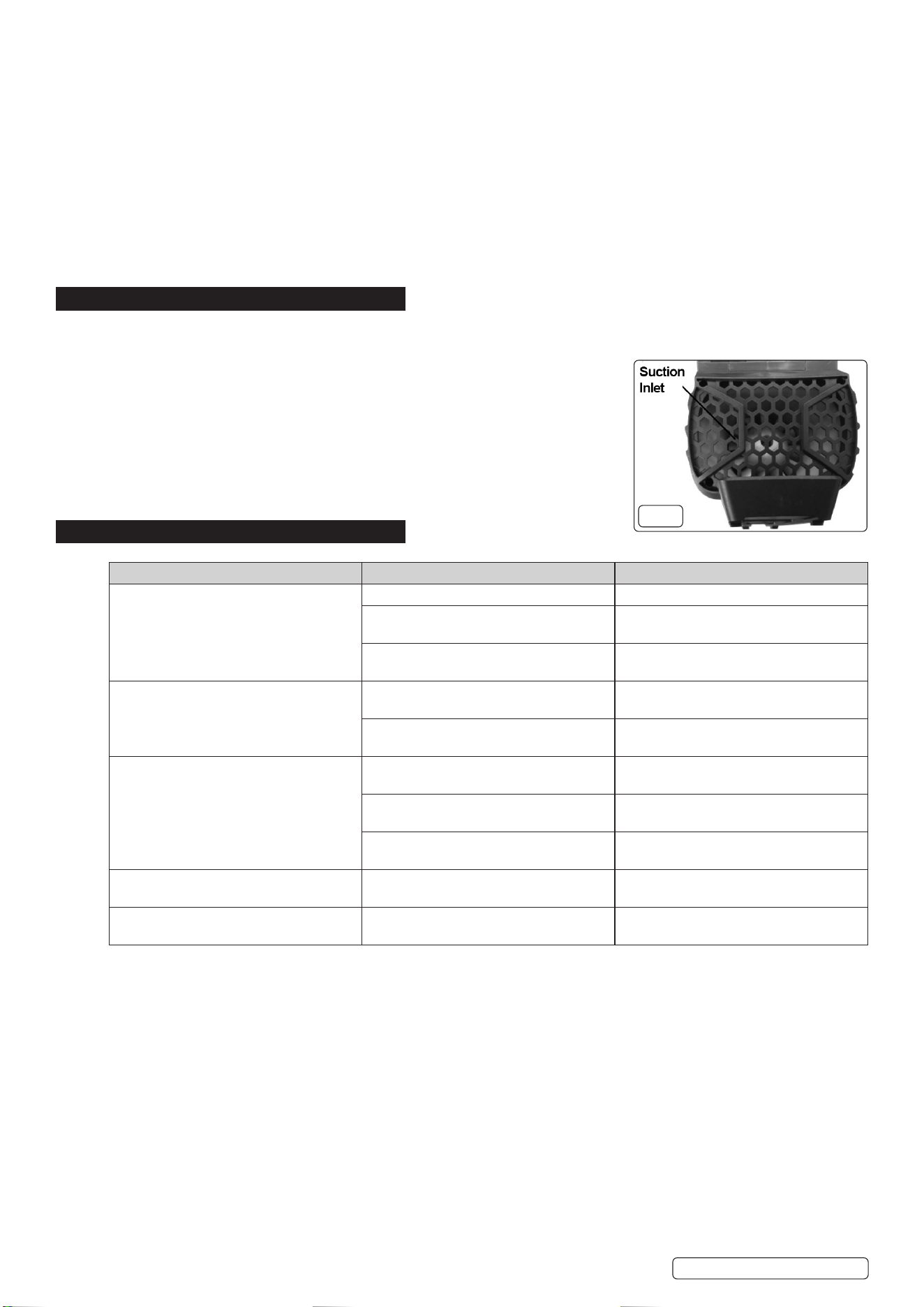
7.1.2. Remove dust or dirt from the suction inlet at the rear of the machine (fig.8).
8 DO NOT use gasoline, benzine, thinner, alcohol or the like. Discolouration, deformation or
cracks may result.
7.2. STORAGE
7.2.1. Remove the battery before storing the machine and performing any maintenance.
7.2.2. Store in a cool, dry place, away from moisture, rain or direct sunlight.
7.2.3. Keep out of the reach of children.
8. TROUBLESHOOTING
PROBLEM CAUSE SOLUTION
Motor does not run. Battery cartridge is not installed. Install the battery cartridge.
Battery problem (under voltage). Recharge the battery. If recharging is not
eective, replace battery.
The drive system does not work correctly. Ask your local authorized service centre
for repair.
Motor stops running after a little use. Battery’s charge level is low. Recharge the battery. If recharging is not
eective, replace battery.
Overheating. Stop using the machine to allow it to cool
down.
The machine does not reach the maximum
speed.
Battery is installed improperly. Install the battery cartridge as described in
this manual.
Battery power is dropping. Recharge the battery. If recharging is not
eective, replace battery.
The drive system does not work correctly. Ask your local authorized service centre
for repair.
Abnormal vibration:
Stop the machine immediately!
The drive system does not work correctly. Ask your local authorized service centre
for repair.
Motor cannot stop:
Remove the battery immediately!
Electric or electronic malfunction. Remove the battery and ask your local
authorized service centre for repair.
FIG.8
Original Language Version
© Jack Sealey Limited
CP40VB Issue 3 (6) 22/05/24
HAND ARM VIBRATION
WARNING! – Risk of Hand Arm Vibration Injury
This tool may cause Hand Arm Vibration Syndrome if its use is not managed adequately.
This tool is subject to the vibration testing section of the Machinery Directive 2006/42/EC.
This tool is to be operated in accordance with these instructions.
Measured vibration emission value (a): 2.54m/s²
Uncertainty value (k): 1.5m/s²
Please note that the application of the tool to a sole specialist task may produce a dierent average vibration emission. We recommend
that a specic evaluation of the vibration emission is conducted prior to commencing with a specialist task.
A health and safety assessment by the user (or employer) will need to be carried out to determine the suitable duration of use for each tool.
NB: Stated Vibration Emission values are type-test values and are intended to be typical.
Whilst in use, the actual value will vary considerably from and depend on many factors.
Such factors include; the operator, the task and the inserted tool or consumable.
NB: ensure that the length of leader hoses is sucient to allow unrestricted use, as this also helps to reduce vibration.
The state of maintenance of the tool itself is also an important factor, a poorly maintained tool will also increase the risk of Hand Arm
Vibration Syndrome.
HEALTH SURVEILLANCE
We recommend a programme of health surveillance to detect early symptoms of vibration injury so that management procedures can
be modied accordingly.
PERSONAL PROTECTIVE EQUIPMENT
We are not aware of any personal protective equipment (PPE) that provides protection against vibration injury that may result from the
Uncontrolled use of this tool. We recommend a sucient supply of clothing (including gloves) to enable the operator to remain warm
and dry and maintain good blood circulation in ngers etc. Please note that the most eective protection is prevention, please refer
to the correct use and maintenance section in these instructions. Guidance relating to the management of hand arm vibration can be
found on the HSE website www.hse.gov.uk - Hand-Arm Vibration at Work.
Sealey Group, Kempson Way, Suffolk Business Park, Bury St Edmunds, Suffolk. IP32 7AR
01284 757500 sales@sealey.co.uk www.sealey.co.uk
Note: It is our policy to continually improve products and as such we reserve the right to alter data, specications and component parts without prior notice.
Important: No Liability is accepted for incorrect use of this product.
Warranty: Guarantee is 12 months from purchase date, proof of which is required for any claim.
ENVIRONMENT PROTECTION
Recycle unwanted materials instead of disposing of them as waste. All tools, accessories and packaging should be
sorted, taken to a recycling centre and disposed of in a manner which is compatible with the environment. When
the product becomes completely unserviceable and requires disposal, drain any uids (if applicable) into approved
containers and dispose of the product and uids according to local regulations.
REGISTER YOUR
PURCHASE HERE
WEEE REGULATIONS
Dispose of this product at the end of its working life in compliance with the EU Directive on Waste Electrical and Electronic
Equipment (WEEE). When the product is no longer required, it must be disposed of in an environmentally protective way. Contact
your local solid waste authority for recycling information.
BATTERY REMOVAL
Under the Waste Batteries and Accumulators Regulations 2009, Jack Sealey Ltd are required to inform potential purchasers of products
containing batteries (as defined within these regulations), that they are registered with Valpak’s registered compliance scheme. Jack
Sealey Ltd Batteries Producer Registration Number (BPRN) is BPRN00705.
Original Language Version
© Jack Sealey Limited
CP40VB Issue 3 (6) 22/05/24