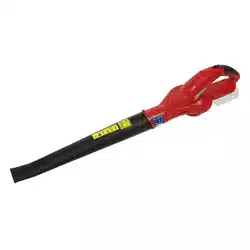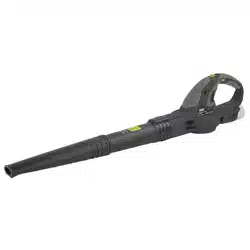
SV10.8 SERIES CORDLESS LEAF BLOWER
10.8V - BODY ONLY
MODEL NO: CP108VBBO
Thank you for purchasing a Sealey product. Manufactured to a high standard, this product will, if used according to these instructions,
and properly maintained, give you years of trouble free performance.
IMPORTANT: PLEASE READ THESE INSTRUCTIONS CAREFULLY. NOTE THE SAFE OPERATIONAL REQUIREMENTS, WARNINGS &
CAUTIONS. USE THE PRODUCT CORRECTLY AND WITH CARE FOR THE PURPOSE FOR WHICH IT IS INTENDED. FAILURE TO DO
SO MAY CAUSE DAMAGE AND/OR PERSONAL INJURY AND WILL INVALIDATE THE WARRANTY. KEEP THESE INSTRUCTIONS SAFE
FOR FUTURE USE.
1. SAFETY
1.1. GENERAL SAFETY
9 Maintain a safe working environment; keep children and pets out of the area.
8 Never allow children, persons with reduced physical, sensory or mental capabilities or lack of experience and knowledge or people
unfamiliar with these instructions to use the machine.
NOTE: local regulations may restrict the age of the operator.
8 Never operate the machine while people, especially children, or pets are nearby.
8 DO NOT overreach whilst using the machine, and keep balance at all times.
9 Always be sure of your footing on slopes and when walking with the machine. Never run.
9 Always wear substantial footwear and long trousers while operating the machine.
9 Remove the battery when the following occurs:
- the machine is left by the user
- before clearing a blockage
- before checking, cleaning or working on the machine
- after striking a foreign object to inspect the machine for damage
- if the machine starts to vibrate abnormally.
8 DO NOT use the machine in bad weather conditions, especially when there is a risk of lightning.
9 Use both hearing and eye protection during use.
9 Ensure that the appliance is correctly assembled before rst use.
9 Before each use carefully check the appliance for signs of damage. If you notice any defect, DO NOT operate it. Seek advice from a
qualied repair person.
9 Only work in daylight or suciently good articial light.
8 People unfamiliar with the operating instructions or anyone under the inuence of drugs or alcohol must NOT operate this appliance.
9 Ensure that your weight is evenly balanced over both feet, especially when working on slopes.
9 Only use the appliance at a walking pace.
IMPORTANT: if the appliance starts to vibrate abnormally, switch o the motor and the remove battery. DO NOT use. Get the appliance
checked by an authorised service agent. Vibration is generally a warning of a fault.
8 DO NOT expose the appliance to humid conditions.
8 DO NOT leave the appliance outside overnight.
9 Keep all the air intakes and the blower tube free of dust, lint, hair and other material that may cause a reduction in air ow.
1.2. RECHARGEABLE BATTERIES
9 Rechargeable batteries are to be removed from the appliance before being charged.
9 Batteries are to be inserted with the correct polarity.
9 If the appliance is to be stored unused for a long period, the batteries should be removed.
8 The supply terminals are NOT to be short-circuited.
9 To prevent the risk of electric shock, protect the battery charger from rain and moisture.
8 Recharge the battery only with the charger specied by the manufacturer.
NOTE: a charger that is suitable for one type of battery pack may create risk of re when used with another battery pack.
9 Before each use, check the battery charger, cable, and plug for signs of damage.
8 If the battery charger is damaged, DO NOT use it or try to repair it, instead take it to your local qualied specialist.
9 Suitable for outside use only.
8 Not suitable for commercial purposes.
1.3. RISK OF HAND ARM VIBRATION INJURY
This tool may cause Hand Arm Vibration Syndrome if its use is not managed adequately.
This tool is subject to the vibration testing section of the Machinery Directive 2006/42/EC.
This tool is to be operated in accordance with these instructions.
Measured vibration emission value (a): . . . . . . . . . . . 2.173m/s²
Uncertainty value (k): . . . . . . . . . . . . . . . . . . . . . . . . . . . 1.5m/s²
Please note that the application of the tool to a sole specialist task may produce a different average vibration emission. We recommend
that a specific evaluation of the vibration emission is conducted prior to commencing with a specialist task.
A health and safety assessment by the user (or employer) will need to be carried out to determine the suitable duration of use for each tool.
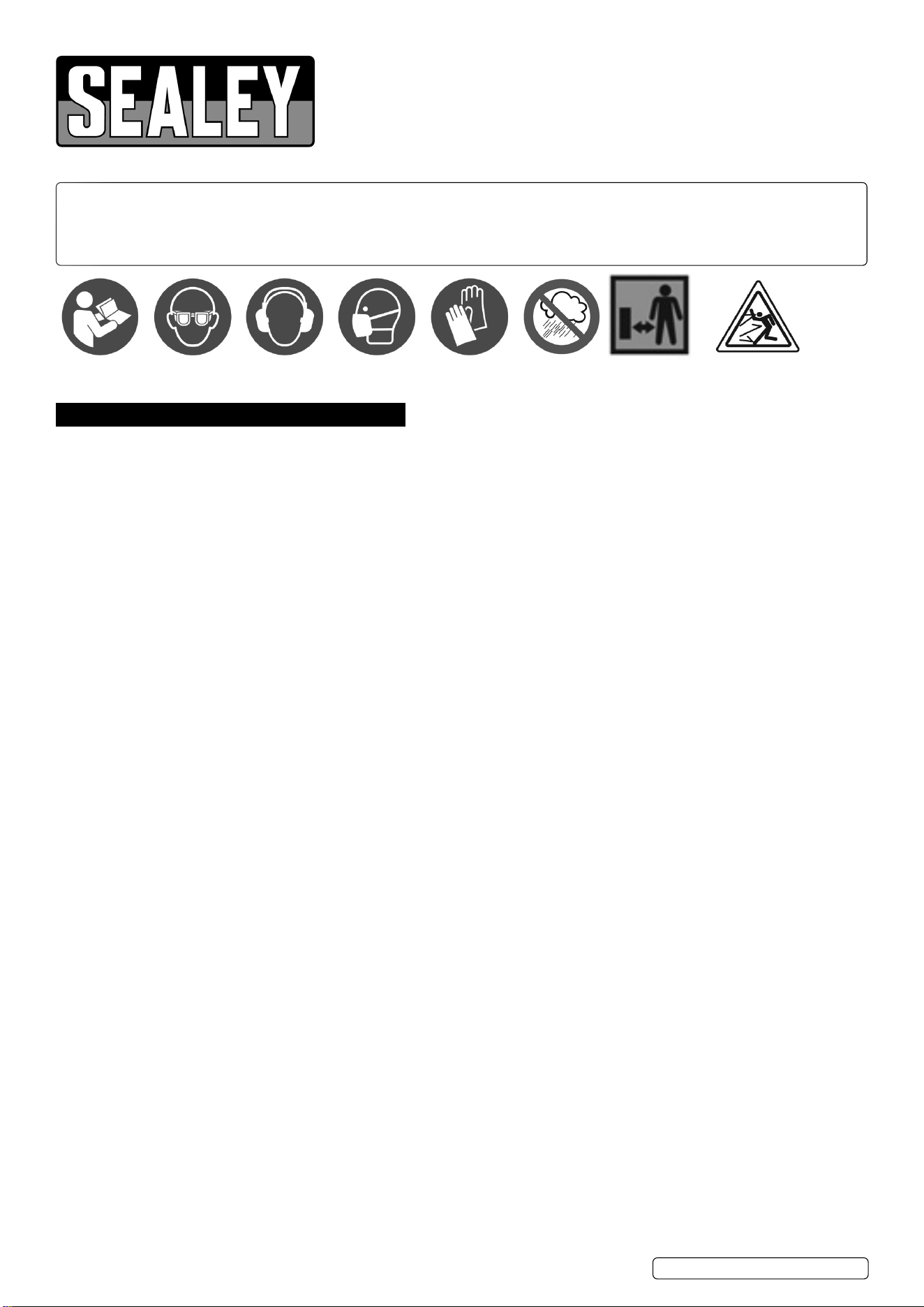
Refer to
instructions
Wear eye
protection
CP108VBBO Issue 1 17/12/2024
Original Language Version
© Jack Sealey Limited
Wear ear
protection
Take care of
objects being blown
by the appliance
Keep bystanders
away
Wear a mask
Wear protective
gloves
DO NOT
expose to rain
NB: Stated Vibration Emission values are type-test values and are intended to be typical.
Whilst in use, the actual value will vary considerably from and depend on many factors. Such factors include; the operator, the task and
the inserted tool or consumable.
NB: ensure that the length of leader hoses is sufficient to allow unrestricted use, as this also helps to reduce vibration.
The state of maintenance of the tool itself is also an important factor, a poorly maintained tool will also increase the risk of Hand Arm
Vibration Syndrome.
1.4. HEALTH SURVEILLANCE
We recommend a programme of health surveillance to detect early symptoms of vibration injury so that management procedures can be
modified accordingly.
1.5. PERSONAL PROTECTIVE EQUIPMENT
We are not aware of any personal protective equipment (PPE) that provides protection against vibration injury that may result from the
uncontrolled use of this tool. We recommend a sufficient supply of clothing (including gloves) to enable the operator to remain warm and
dry and maintain good blood circulation in fingers etc. Please note that the most effective protection is prevention, please refer to the
correct use and Maintenance section in these instructions. Guidance relating to the management of hand arm vibration can be found on
the HSE website, www.hse.gov.uk - Hand-Arm Vibration at Work.
2. INTRODUCTION
Lightweight, cordless garden leaf blower makes gardening easy, clean and effective. Ideal for removing leaves and waste from driveways,
patios and small gardens.
3. SPECIFICATION
MODEL NO: CP108VBBO
Battery: 10.8V 2Ah - 4Ah Lithium-ion (not included)
Consumable Parts: CP108VBP - 2Ah Battery
CP108VBP4 - 4Ah Battery
Maximum Air Speed: 55m/s or 124mph
Maximum Air Volume: 100m³/hr
Nett Weight: 1.22kg
Noise Power/Pressure: 95/82dB(A)
Replacement Parts: CP108VMC - Mains Charger (not included)
Vibration/Uncertainty: 2.173/1.5m/s²
Voltage: 10.8V Lithium-ion
4. ASSEMBLY
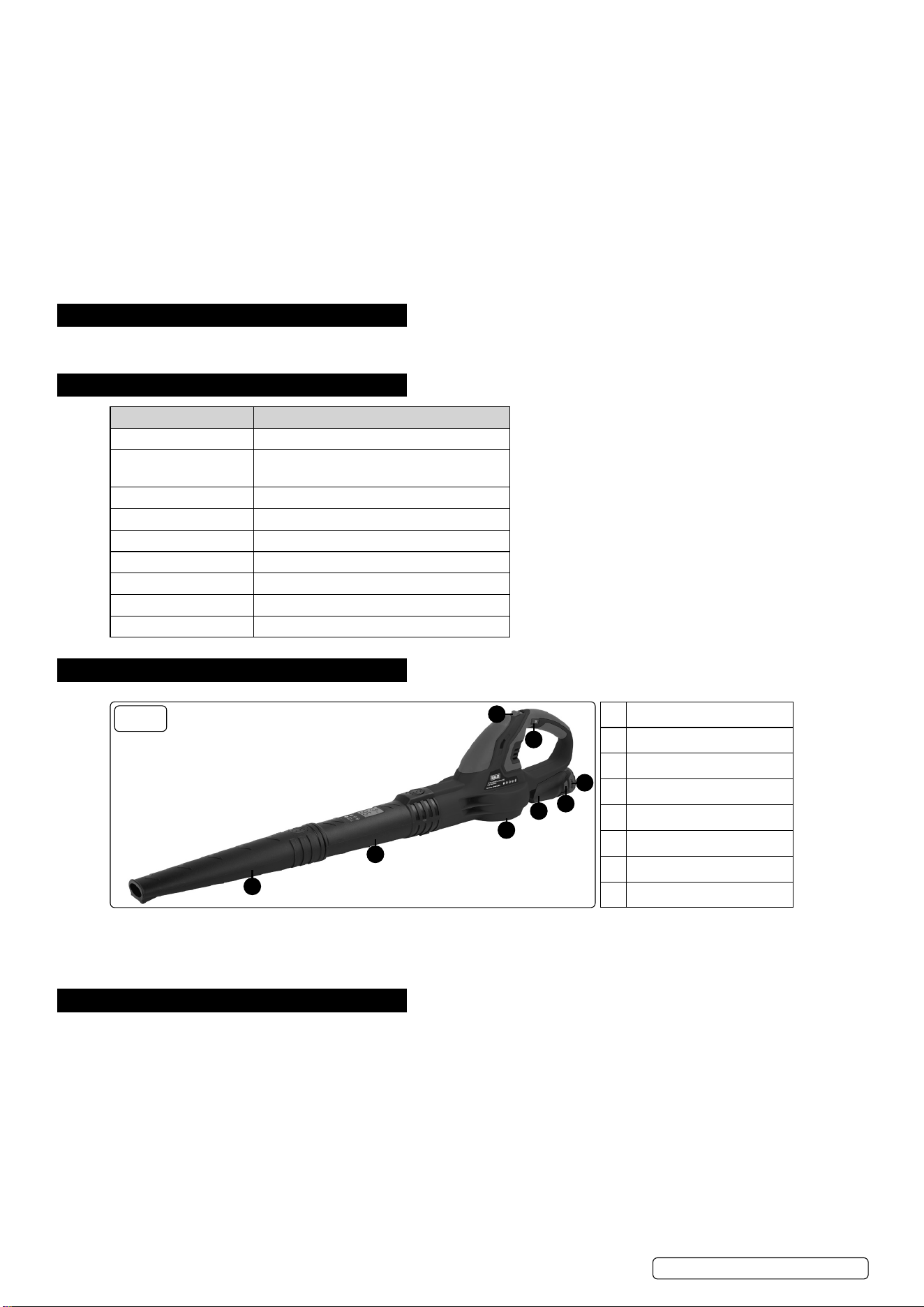
1 Motor Housing
2 Upper Tube
3 Lower Tube
4 Battery pack (not included)
5 On/O Switch
6 Speed control knob
7 Battery holder
8 Released button
1
FIG.1
2
3
4
5
6
7
8
4.1. Attach the top tube (2) onto the opening of the motor housing (1). You will hear a click when it locks into place.
4.2. Attach the lower tube (3) onto the open end of the top tube (2). You will hear a click when it locks into place.
4.3. Slide the battery pack (not included) (4) into the battery holder (7). You will hear a click when the battery lock engages.
4.4. To remove the battery pack (not included) (4), press and hold the battery release button (8), and pull it out of the battery holder (7).
5. OPERATION
5.1. USING THE LEAF BLOWER
NOTE: choose a dry day and preferably when leaves have had a chance to dry out.
5.1.1. Stand upright and hold the blower, using the handle. Use two hands for greater control.
5.1.2. Keep the blower approximately 10-15cm o the ground and aim it at the leaves.
5.1.3. Turn the on/o switch (5) on and choose the suitable speed by speed control knob (6).
5.1.4. Move the leaves towards a chosen point on a at surface. Swing the blower from left to right to get a better coverage.
5.2. BATTERY PACK CHARGING
5.2.1. Before rst use, please fully charge the battery pack (4).
5.2.2. Connect the charger plug to the power supply. The green LED on the charger will light up.
5.2.3. Insert the battery pack (4) into the docking station of charger (not included). The red LED on the charger will light up.
5.2.4. After the battery pack is fully charged, the green LED will light up.
NOTE: the charger’s docking station does not automatically turn o after the battery pack is fully charged. The charger may also
become warm when charging. This is normal and does not indicate a fault with the charger.
CP108VBBO Issue 1 17/12/2024
Original Language Version
© Jack Sealey Limited
Sealey Group, Kempson Way, Suffolk Business Park, Bury St Edmunds, Suffolk. IP32 7AR
01284 757500 sales@sealey.co.uk www.sealey.co.uk
Note: It is our policy to continually improve products and as such we reserve the right to alter data, specications and component parts without prior notice.
Important: No Liability is accepted for incorrect use of this product.
Warranty: Guarantee is 12 months from purchase date, proof of which is required for any claim.
ENVIRONMENT PROTECTION
Recycle unwanted materials instead of disposing of them as waste. All tools, accessories and packaging should be
sorted, taken to a recycling centre and disposed of in a manner which is compatible with the environment. When
the product becomes completely unserviceable and requires disposal, drain any uids (if applicable) into approved
containers and dispose of the product and uids according to local regulations.
REGISTER YOUR
PURCHASE HERE
CP108VBBO Issue 1 17/12/2024
Original Language Version
© Jack Sealey Limited
6. MAINTENANCE
6.1. GENERAL MAINTENANCE
9 Before each use check the leaf blower for any obvious defects such as loose, worn, or damaged parts.
9 Remove the battery before performing any maintenance work or removing blockages.
8 DO NOT use or submerge the leaf blower in water or use cleaning agents or solvents, these may damage the leaf blower.
8 DO NOT use the leaf blower if there is any sign of damage.
8 DO NOT try to service the leaf blower yourself. Always take it to a qualied repair person.
6.2. AFTER EACH USE
9 Remove battery.
9 Clean all parts, especially the ventilation slots.
9 Remove any moisture, debris or dust.
9 Store in a clean, dry environment.
6.3. LI-ION BATTERY CARE & MAINTENANCE
Read and follow the guidelines to safely use lithium-ion batteries and achieve the maximum battery life span.
NOTE: lithium-ion rechargeable batteries require routine maintenance and care in their use and handling. Rechargeable lithium-ion
batteries have a limited life and will gradually lose their capacity to hold a charge. As the battery loses capacity, the length of time it will
power the product (run time) will slowly decrease.
8 DO NOT leave batteries unused for extended periods of time, either in the machine or in storage.
9 When a battery has been unused for 3 months or more, check the charge status and charge or dispose of the battery as appropriate.
9 Routinely check the battery’s charge status. Lithium-ion batteries continue to slowly discharge when not in use or while in storage.
9 Consider replacing the battery with a new one if you note either of the following conditions:
- battery run time drops below 60% of the original run time.
- battery charge time increases signicantly.
NOTE: If a battery is stored or otherwise unused for an extended period, follow the storage instructions.
8 DO NOT attempt to use or recharge a damaged battery - they must be replaced by a battery specied by the manufacturer.
6.4. STORAGE
9 Charge or discharge the battery to approximately 50% of capacity before storage.
9 Charge the battery to approximately 50% of capacity at least once every six months.
9 Remove the battery and store it separately from the product.
9 Store the battery at temperatures between 5°C and 20°C (41°F and 68°F).
NOTE: higher temperatures (above 20°C or 68°F) reduce the battery storage life.
7. TROUBLESHOOTING
PROBLEM POSSIBLE CAUSE SOLUTION
The motor does not start. • Battery does not have enough charge.
• Defective on/o switch.
• Check battery charger is working.
• Re-charge battery.
• Arrange for repair by a professional.
Abnormal noises. • Blower pipe is jammed. • Switch o, remove the objects.
• Tighten all components.
WEEE REGULATIONS
Dispose of this product at the end of its working life in compliance with the EU Directive on Waste Electrical and Electronic
Equipment (WEEE). When the product is no longer required, it must be disposed of in an environmentally protective way. Contact
your local solid waste authority for recycling information.