– 1 –
Please read these instructions carefully before using this
product, and save this manual for future use.
Model No.
NN-CD87KS
Operating Instruction and Cook Book
Convection/Grill/Microwave Oven
Household Use Only
NN-CD87KS
– 2 –
We are glad you have chosen to purchase a PANASONIC microwave oven. Before operating this oven, please
read these instructions carefully and completely, and keep them for further reference.
If you have only used a microwave oven for reheating and defrosting, with Panasonic’s Inverter Technology you
can be reassured of excellent results when cooking a variety of foods, as the ‘soft’ penetration of microwave
energy to the centre of food helps prevent over cooking on edges and surfaces. Foods can now be gently
simmered without the concern of boil over.
After reading the introductory chapter, we are sure you will be able to master the basic techniques and thereby
develop a firm understanding of your new oven. This book includes recipes from starters to desserts. After trying
our recipes be sure to adapt your favourite recipes to microwave methods.
Start experimenting now, and enjoy the first class results you will achieve by using your new microwave oven.
The serial number of this product may be found on the
back of the oven. You should note the model number
and serial number of this oven in the space provided
and retain this book as a permanent record of your
purchase for future reference.
MODEL NUMBER _______________________
SERIAL NUMBER _______________________
DATE OF PURCHASE ____________________
Panasonic Australia Pty Ltd
1 Innovation Road
Macquarie Park
NSW 2113
Panasonic NZ Ltd
Customer Care Centre
18 Sir Woolf Fisher Drive
Highbrook, Auckland
Private Bag 14911
Panmure, Auckland
0178 272 (09) ... :Phone
0129 272 (09) ........:Fax

– 3 –
Table of Contents
Before Operation
Important Safety Instructions ........................................................................................................................ 8-9
Installation and General Instructions .........................................................................................................10-11
Microwaves and How They Work ...................................................................................................................11
Cookware and Utensils Guide .......................................................................................................................12
Cookware and Utensil Chart ...........................................................................................................................13
Feature Diagram .............................................................................................................................................14
Control Panel ..................................................................................................................................................15
Display Window ..............................................................................................................................................16
Dial Feature ....................................................................................................................................................16
INGREDIENT CONVERSION CHART ...........................................................................................................44
Operation and Hints
Quick Guide to Operation ............................................................................................................................. 4-7
Let’s Start To Use Your Oven! .........................................................................................................................17
To Use Child Safety Lock................................................................................................................................17
To Set Clock....................................................................................................................................................18
Operation Guide Setting .................................................................................................................................18
Cooking Modes ...............................................................................................................................................19
To Cook/Reheat/Defrost on Micro Power by Time Setting..............................................................................20
Defrosting Using Defrost Microwave and Time...............................................................................................21
To Defrost Using Turbo Defrost ................................................................................................................ 22-23
To Use the Add Time Feature .........................................................................................................................23
To Cook on Grill by Time Setting .............................................................................................................. 24-25
To Cook on Convection by Time Setting ................................................................................................... 26-27
To Cook on Combination by Time Setting................................................................................................. 28-31
To Use Timer (Kitchen Timer/Standing Time/Delay Start) ..............................................................................32
3-Stage Setting ...............................................................................................................................................33
One Push Reheating ................................................................................................................................ 34-35
Auto Weight Program Setting ................................................................................................................... 35-36
Cooking Guide
Auto Weight Programs ....................................................................................................................................37
Auto Weight Beverage Programs Setting .......................................................................................................38
Re-Bake Bread Programs...............................................................................................................................38
Junior menu programs ....................................................................................................................................39
Auto Combi/Roast Programs Setting ..............................................................................................................40
Auto Sensor Programs ............................................................................................................................. 41-43
Maintenance
Before Requesting Service ....................................................................................................................... 45-46
Care of your Microwave Oven ........................................................................................................................47
Technical Specifications..................................................................................................................................48
Panasonic Warranty (for Australia) .................................................................................................................49
Panasonic Warranty (for New Zealand) ..........................................................................................................50
– 4 –
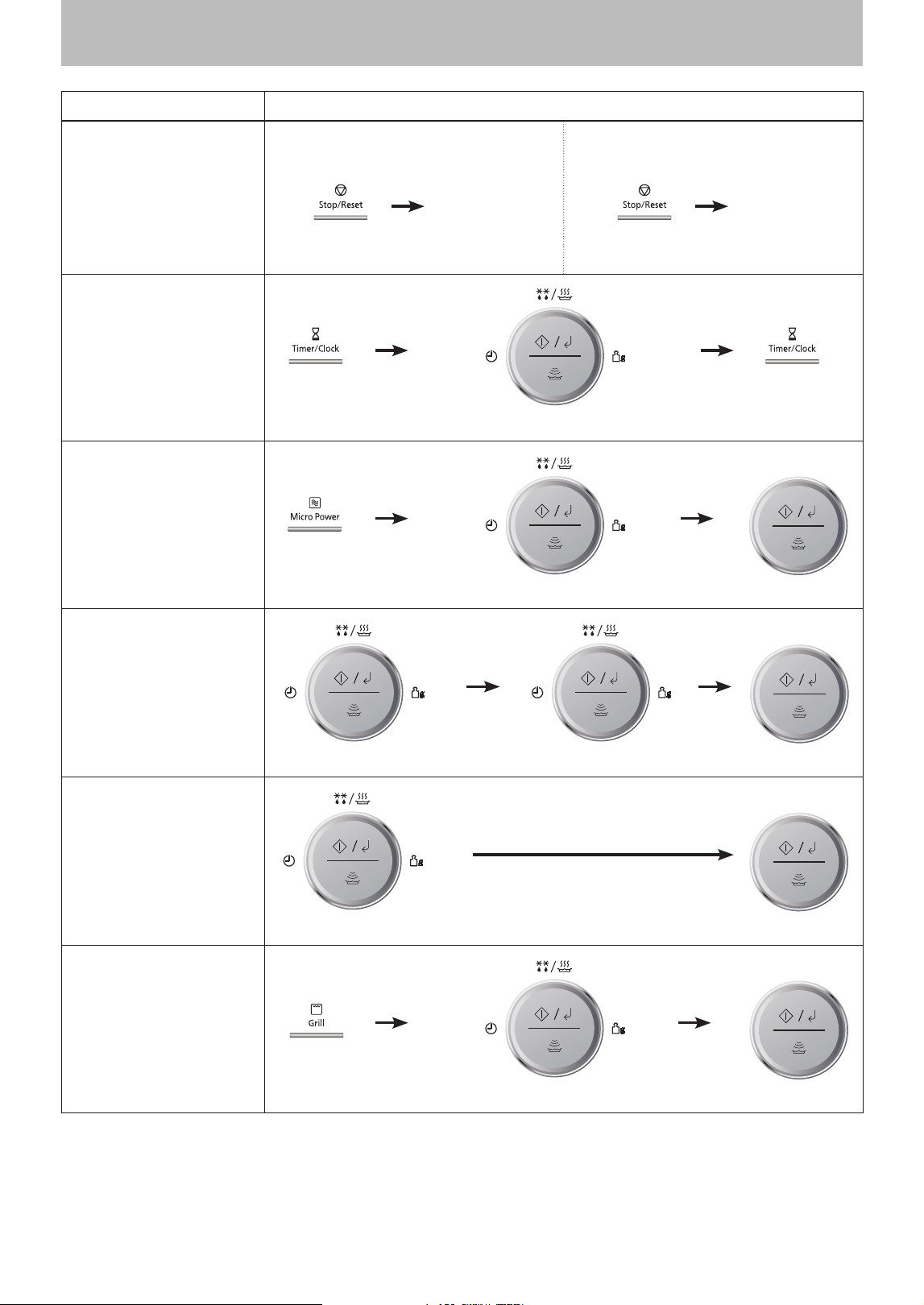
Quick Guide to Operation
Feature How to Operate
To Set/Cancel Child
Safety Lock
(page 17)
Key appears
in the display
window.
To set: Display:
Press 3 times
Press 3 times
To Cancel: Display:
Colon or time
of day appears
in the display
window
To Set Clock
(page 18)
Press twice Press onceSet time of day (12-hour)
To Use Micro Power
(page 20)
Select power level Press onceSet time
To Use Turbo Defrost
(page 22)
Select program
Press once
Select desired weight
To Use Add Time
(page 23)
Turn dial after cooking Press once
To Use Grill
(page 24-25)
Select power level Press onceSet time
– 5 –
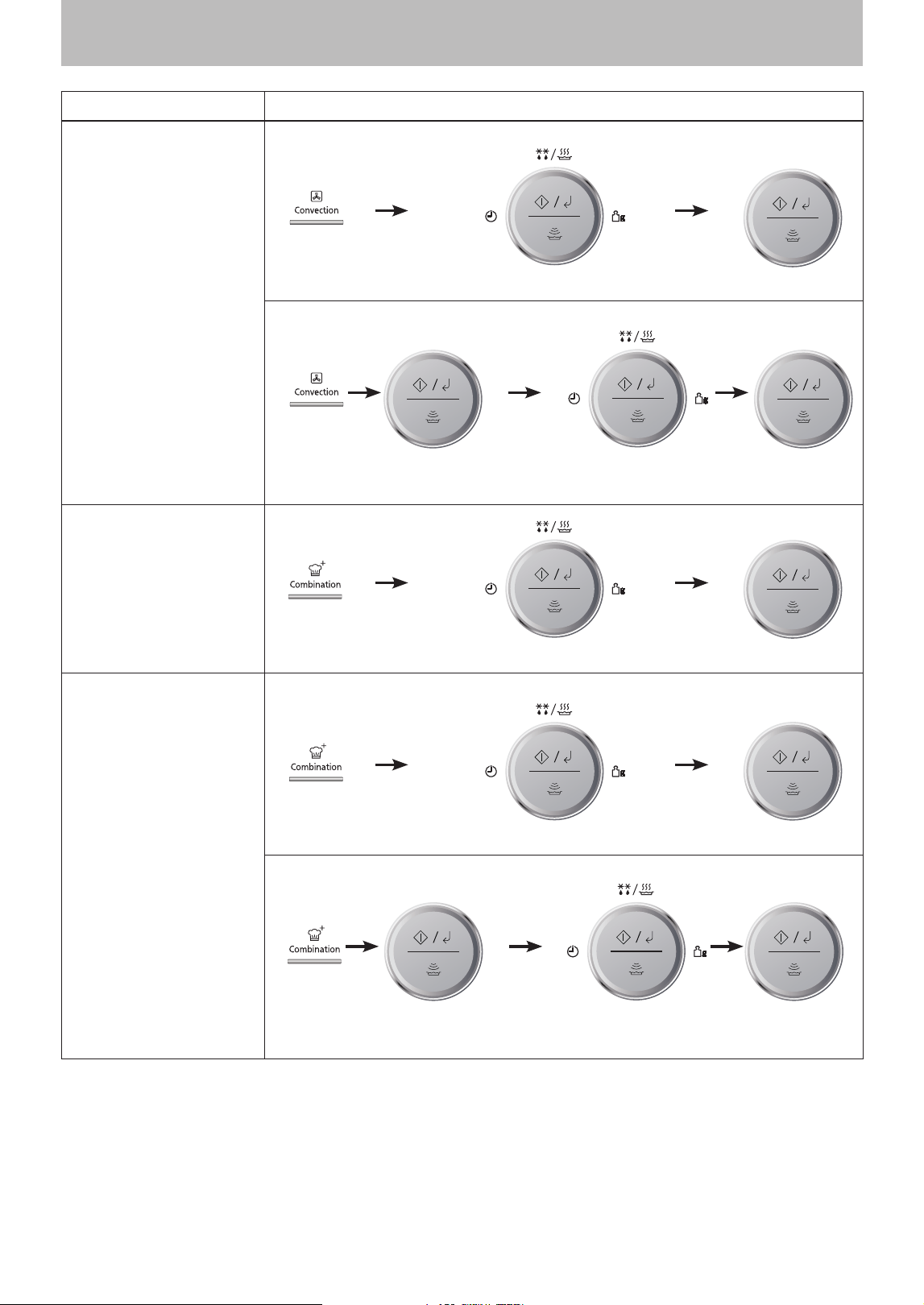
Quick Guide to Operation
(continued)
Feature How to Operate
To Use Convection
(page 26-27)
Without preheating:
Select temperature Press onceSet time
With preheating:
Select
temperature
Press once
Press once Set time
After
preheating,
the oven will
beep and the
“P” will flash.
To Use Combination
Combi 1
(Grill + Microwave)
(page 28)
Press once Press onceSet time
To Use Combination
Combi 2/3/4/5
(Convection + Microwave)
(page 29-30)
Without preheating:
Select power level Press onceSet time
With preheating:
Select power
level
Press oncePress once Set time
After
preheating,
the oven will
beep and the
“P” will flash.
– 6 –
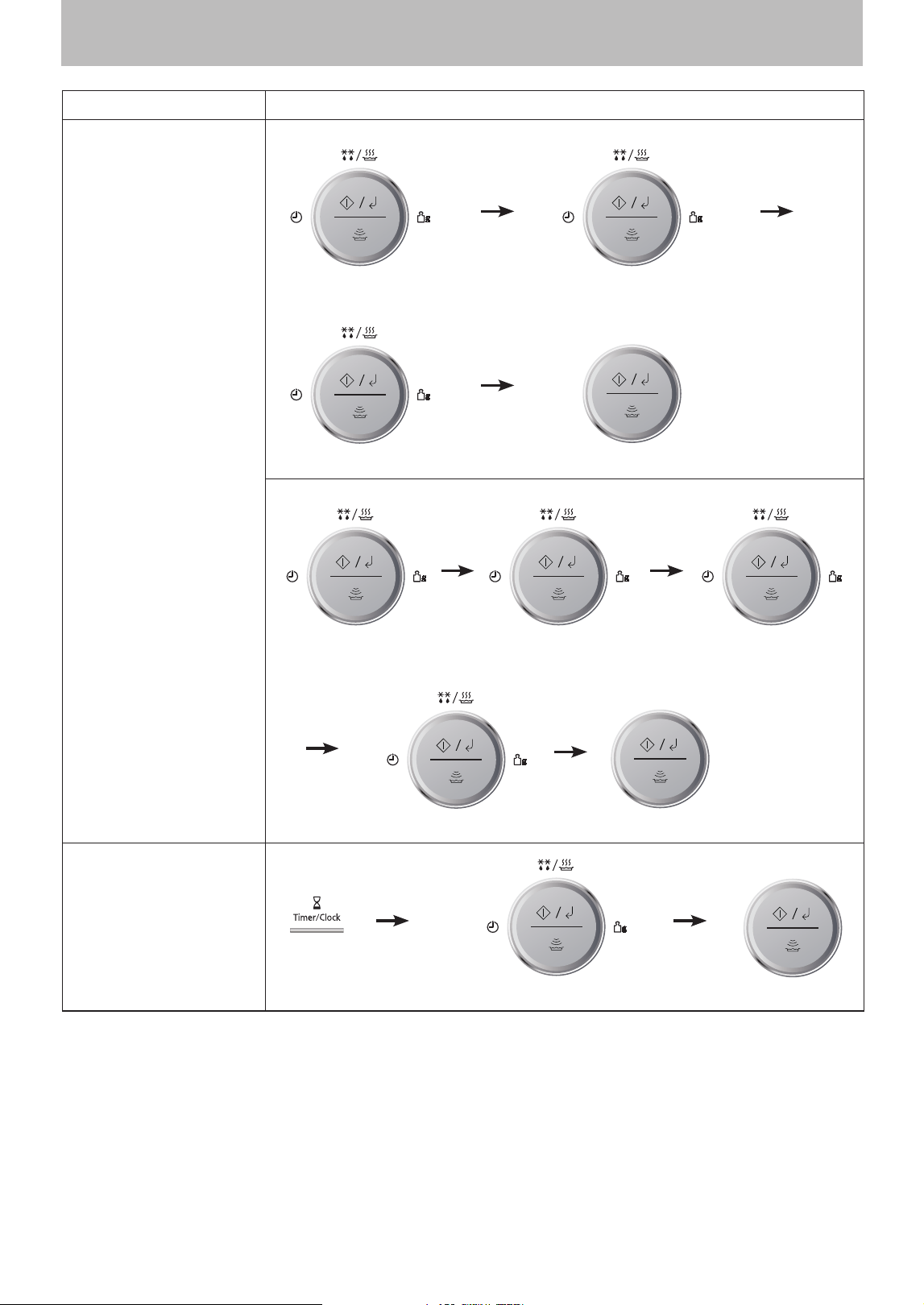
Quick Guide to Operation
(continued)
Feature How to Operate
To Use Auto program
(page 35-36)
Without preheating:
Press the dial to confirm
the program
Turn dial to select menu
Press onceSelect desired weight
With preheating:
Turn dial to select menu
Press once
Press the dial to confirm
the program
Press dial to preheat
the oven
Select desired weight
After
preheating,
the oven will
beep and the
“P” will flash.
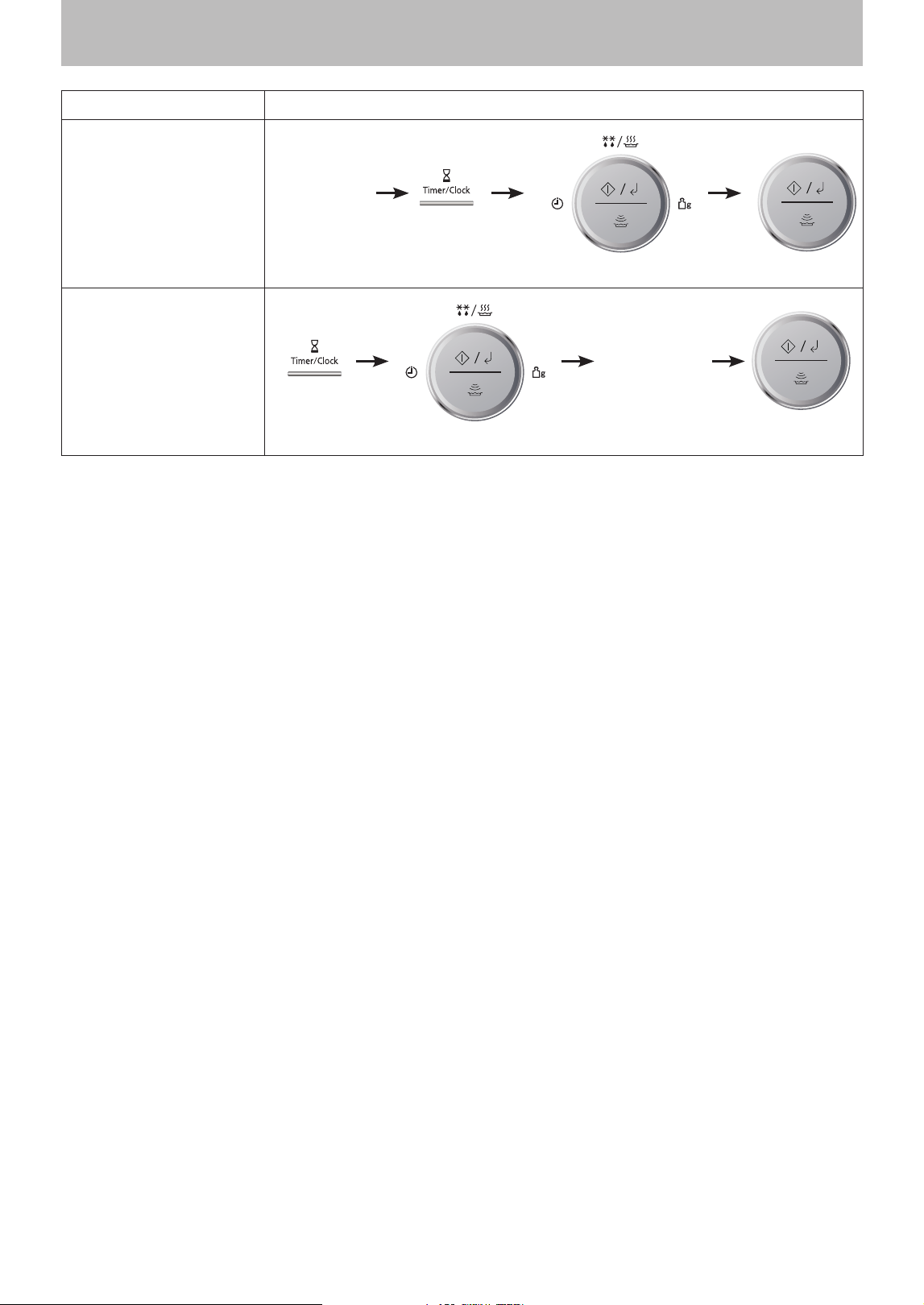
To Use as a Kitchen
Timer
(page 32)
Press once Press onceSet time
– 7 –
Quick Guide to Operation
(continued)
Feature How to Operate
To Set Standing Time
(page 32)
Press oncePress once Set time
Set the desired
cooking programme
(up to 2 stage).
To Set Delay Start
(page 32)
Press oncePress once Set time
Set the desired
cooking programme
(up to 2 stage).

– 8 –
Important Safety Instructions
Precautions to be taken when
using Microwave Ovens for
Heating Foodstuffs
INSPECTION FOR DAMAGE:
A microwave oven should only be used if an
inspection confirms all of the following conditions:
1. The grille is not damaged or broken.
2. The door fits squarely, securely and opens and
closes smoothly.
3. The door hinges are in good condition.
4. The metal plates of a metal seal on the door are
neither buckled nor deformed.
5. The door seals are neither covered with food nor
have large burn marks.
PRECAUTIONS:
Microwave radiation from microwave ovens can cause
harmful effects if the following precautions are not taken:
1. Never tamper with or deactivate the interlocking
devices on the door.
2. Never poke an object, particularly a metal object,
through a grille or between the door and the oven
while the oven is operating.
3. Never place saucepans, unopened cans or other
heavy metal objects in the oven.
4. Do not let other metallic articles, e.g. fast food foil
containers, touch the side of the oven.
5. Clean the oven cavity, the door and the seals with
water and a mild detergent at regular intervals.
Never use any form of abrasive cleaner that may
scratch or scour surfaces around the door.
6. Do not use harsh abrasive cleaners or sharp
metal scrapers to clean the oven door glass, since
they can scratch the surface, which may result in
shattering of the glass.
7. Always use the oven with the cookware
recommended by the manufacturer.
8. Never operate the oven without a load (i.e., an
absorbing material such as food or water) in the
oven cavity unless specifically allowed in the
manufacturer’s literature.
9. For horizontally hinged doors, never rest heavy
objects such as food containers on the door while
it is open.
10. Do not place sealed containers in the microwave
oven. Baby bottles fitted with a screw cap or a
teat are considered to be sealed containers.
11. This appliance is not intended for use by persons
(including children) with reduced physical, sensory
or mental capabilities, or lack of experience
and knowledge, unless they have been given
supervision or instruction concerning use of the
appliance by a person responsible for their safety.
12. Children should be supervised to ensure that they
do not play with the appliance.
13. It is hazardous for anyone other than a competent
person to carry out any service or repair operation
that involves the removal of a cover which gives
protection against exposure to microwave energy.
14. The surfaces are liable to get hot during use.
15. The appliance must not be installed behind a
decorative door in order to avoid overheating.
Practical Hints:
1. For initial use of GRILL, CONVECTION and
COMBINATION, if you see white smoke arise, it
is not a malfunction.
2. Exterior oven surfaces, including air vents on
the cabinet and the oven door will get hot during
GRILL, CONVECTION and COMBINATION. Use
care when opening or closing door and when
inserting or removing food and accessories.
Caution! Hot surfaces
3. The oven has a heating element situated in
the top of the oven. After using the GRILL,
CONVECTION and COMBINATION functions, the
ceiling will be very hot.
4. During use the appliance becomes hot. Care
should be taken to avoid touching heating
elements inside the oven.
5. The accessible parts may become hot when
GRILL, CONVECTION and COMBINATION is in
use. Children should be kept away.
6. Before using GRILL, CONVECTION and
COMBINATION functions for the first time,
operate the oven without food and accessories
on CONVECTION 220 °C for 5 minutes. This will
allow the oil that is used for rust protection to be
burned off. This is the only time that the oven is
operated completely empty.
Important Instructions
WARNING—To reduce the risk of burns, electric
shock, fire, injury to persons or excessive microwave
energy:
1. Read all instructions before using the microwave
oven.
2. Some products such as whole eggs and sealed
containers - (for example, closed glass jars and
sealed baby bottles with teat) - may explode
and should not be heated in the microwave oven.
3. Use this microwave oven only for its intended use
as described in this manual.
4. As with any appliance, close supervision is
necessary when used by children.
5. Do not operate this microwave oven, if it is not
working properly, or if it has been damaged or
dropped.
6. Do not store or use this appliance outdoors.
7. Do not immerse cord or plug in water.
8. Keep cord away from heated surfaces.
READ CAREFULLY AND KEEP FOR FUTURE REFERENCE
– 9 –
WARNING
a) The door seals and door seal areas should be cleaned with a damp cloth. The appliance should be
inspected for damage to the door seals and door seal areas and if these areas are damaged the
appliance should not be operated until it has been repaired by a qualified service technician trained by
the manufacturer.
b) If the door or door seals are damaged, the oven must not be operated until it has been repaired by a
competent person.
c) It is dangerous for anyone other than a service technician trained by the manufacturer to perform repair
service.
d) It is hazardous for anyone other than a competent person to carry out any service or repair operation that
involves the removal of a cover which gives protection against exposure to microwave energy.
e) If the supply cord is damaged, it must be replaced by the manufacturer, its service agent or similarly
qualified persons in order to avoid a hazard.
f) Before use, the user should check that whether the utensils are suitable for use in microwave ovens.
g) Liquids or other foods must not be heated in sealed containers since they are liable to explode, at the
same time it should avoid the boiling liquids splash.
h) Only allow children to use the oven without supervision when adequate instructions have been given so
that the child is able to use the oven in a safe way and understands the hazards of improper use.
i) When the appliance is operated in the GRILL, CONVECTION and COMBINATION modes, children
should only use the oven under adult supervision due to the temperatures generated.
j) Care should be taken not to displace the glass tray when removing containers from the appliance.
Important Safety Instructions
(continued)
9.
Do not let cord hang over edge of table or counter.
10. To reduce the risk of fire in the oven cavity:
(a) Do not overcook food. Carefully attend
microwave oven if paper, plastic, or other
combustible materials are placed inside the
oven to facilitate cooking.
(b) Heating therapeutic wheat bags is not
recommended. If heating, do not leave
unattended and follow manufacturers’
instructions carefully.
(c) Remove wire twist-ties from bags before
placing bag in oven.
(d) If materials inside the oven should ignite, keep
oven door closed, turn oven off at the wall
switch, or shut off power at the fuse or circuit
breaker panel.
(e) Never leave microwave unattended while
cooking or reheating.
11. Do not remove outer panel from oven.
12. Appliances are not intended to be operated by
means of an external timer or separate remote-
control system.
13. Failure to maintain the oven in a clean condition
could lead to deterioration of the surface that
could adversely affect the life of the appliance and
possibly result in a hazardous situation.
Circuits
Your microwave ovens should be operated on
a separate circuit from other appliances. The
voltage used must be the same as specified on this
microwave oven. Failure to do this may cause the
power board fuse to blow, and/or food to cook slower.
Do not insert higher value fuse in the power board.
Earthing Instructions
This microwave oven must be earthed. In the event
of an electrical short circuit, earthing reduces the risk
of electric shock by providing an escape wire for the
electric current. This microwave oven is equipped with
a cord having an earthing wire with an earthing plug.
The plug must be plugged into an outlet that is
properly installed and earthed.
WARNING—Improper use of the earthing plug can
result in a risk of electric shock.
WE CERTIFY THAT THIS MICROWAVE OVEN
HAS BEEN INSPECTED AND COMPLIES WITH
THE REQUIREMENTS OF REGULATION 3,
SUBCLAUSE(2), OF THE MICROWAVE OVENS
REGULATIONS 1982.
(This statement applicable only to New Zealand.)
We certify that this microwave oven has been
inspected and complies with the safety requirements
of government notice 466 of March 1981, and
complies with the Radio Regulation of government
notice 587 of March 1986.
(This statement applicable only to South Africa)
Fan Motor Operation after Cooking
After using this oven the fan may rotate to cool the
electric components. This is perfectly normal, and
you can take out the food from the oven while the fan
operates.

– 10 –
Installation and General Instructions
General Use
1. In order to maintain high quality, do not operate
the oven when empty. The microwave energy will
reflect continuously throughout the oven if no food
or water is present to absorb energy.
This can lead to damage to the microwave oven
including arcing within the oven cavity.
2. If smoke is observed, press the Stop/Reset
Button and leave door closed in order to stifle any
flames. Disconnect the power cord, and/or shut
off power at the fuse or circuit breaker panel.
3. The microwave oven is intended for heating food and
beverages. Drying of food or clothing and heating of
warming pads, slippers, sponges, damp cloth and
similar may lead to risk of injury, ignition or fire.
4. Do not dry clothes, newspapers or other materials in
oven. They may catch on fire.
5. Do not use recycled paper products, unless the
paper product is labelled as safe for microwave
oven use. Recycled paper products may contain
impurities which may cause sparks and/or fires
when used.
6. Do not use newspapers or paper bags for cooking.
7. Do not hit or strike control panel. Damage to
controls may occur.
8. POT HOLDERS may be needed as heat from
food is transferred to the cooking container and
from the container to the Glass Tray. The Glass
Tray can be very hot after removing the cooking
container from the oven.
9. Do not store flammable materials next to, on top
of, or in the oven. It could be a fire hazard.
10. Do not cook food directly on Glass Tray unless
indicated in recipes. (Food should be placed in a
suitable cooking utensil.)
11. DO NOT use this oven to heat chemicals or other
non-food products. DO NOT clean this oven with
any product that is labelled as containing corrosive
chemicals. The heating of corrosive chemicals in
this oven may cause microwave radiation leaks.
12. If Glass Tray is hot, allow to cool before cleaning
or placing in water.
13. When using the COMBINATION mode, never
place any aluminum or metal container directly
on the Wire Rack or Enamel tray. Always insert
a heat-proof and microwave safe, glass plate or
dish between the Wire Rack and the aluminum
container. This will prevent sparking that may
damage the oven.
14. It is recommended not to use the Wire Rack when
cooking in the MICROWAVE mode only.
15. During cooking, some steam will condense inside
and/or on the oven door. This is normal and safe.
Steam will disappear after the oven is cool down.
16. Do not leave the microwave unattended while reheating
or cooking food in disposable containers made of
plastic, paper or other combustible materials, as these
types of containers can ignite if overheated.
17. Metallic containers for food and beverages are not
allowed during microwave cooking.
18. Only use utensils that are suitable for use in
microwave ovens.
Placement of the Oven
1. The oven must be placed on a flat, stable surface,
more than 85 cm above the floor. For correct
operation, the oven must have sufficient air flow.
Allow 15 cm of space on the top of the oven,
10 cm at back. If one side of the oven is 5 cm
at one side, the other side or top must not be
blocked. Do not remove feet.
(a) Do not block air vents. If they are blocked
during operation, the oven may be overheated
and damaged. When using any cloth over
the oven, the air intake and exhaust should
not be blocked. Do not place a cloth on top
of the unit during GRILL, CONVECTION and
COMBINATION cooking as the top of the oven
gets very hot. Also allow sufficient space on
back and both sides of the oven.
(b) Do not place oven near a hot or damp surface
such as a gas stove, electric range or sink etc.
(c) Do not operate oven when room humidity is too
high.
2. This oven was manufactured for household use
only.
Building-in your oven
1. This oven is intended for counter-top and built-
in use only. It is not intended for use inside
a cupboard. This oven may be built into a
wall cabinet by using the proper trim kit (NN-
TK81KCSCP) which may be purchased from your
local Panasonic dealer.
2. In case of fitting into an oven housing, please use
Panasonic’s Trim Kit, NN-TK81KCSCP.
3. Microwave ovens should not be built into a unit
directly above a top front venting conventional
cooker. This may be a safety hazard and could
result in damage to your oven. This will invalidate
your one year guarantee.
4. A microwave which is built in must be more
than 850 mm above floor level. Read Trim-Kit
instructions carefully before installation. It is
recommended that the microwave oven is placed
below a conventional oven to avoid heat damage
to the facia of the microwave.
Food
1. Do not use your oven for home canning or the
heating of any closed jar. Pressure will build
up and the jar may explode. In addition, the
microwave oven cannot maintain the food at the
correct canning temperature. Improperly canned
food may spoil and be dangerous to consume.
2. Do not attempt to deep fat fry in your microwave
oven.
3. Eggs in their shell and whole hard-boiled eggs
should not be heated in microwave ovens since
they may explode, even after microwave heating
has ended.

– 11 –
Installation and General Instructions
(continued)
4. Potatoes, apples, egg yolks, chicken wings, whole
squash and sausages are examples of foods with
nonporous skins. This type of food must be pierced
before cooking, to prevent bursting.
5. When heating liquids, e.g. soup. sauces and
beverages in your microwave oven, overheating
the liquid beyond boiling point can occur without
evidence of bubbling. This could result in a
sudden boil over of the hot liquid. To prevent this
possibility the following steps should be taken:
(a) Avoid using straight-sided containers with
narrow necks.
(b) Do not overheat.
(c) Stir the liquid before placing the container in the
oven and again halfway through cooking time.
(d) After heating, allow to stand in the oven for
a short time, stirring again before carefully
removing the container.
(e) Microwave heating of beverages can result in
delayed eruptive boiling, therefore care must
be taken when handling the container.
6. DO NOT USE A CONVENTIONAL MEAT
THERMOMETER IN THE MICROWAVE
OVEN. To check the degree of cooking
of roasts and poultry use a MICROWAVE
THERMOMETER. Alternatively, a conventional
meat thermometer may be used after the food
is removed from the oven. If undercooked,
return meat or poultry to the oven and cook
for a few more minutes at the recommended
power level. It is important to ensure that meat
and poultry are thoroughly cooked.
7. COOKING TIMES given in the Cooking Guide
section are APPROXIMATE. Factors that may
affect cooking time are preferred degree of
moisture content, starting temperature, altitude,
volume, size, shape of food and utensils used.
As you become familiar with the oven, you will be
able to adjust for these factors.
8. It is better to UNDERCOOK RATHER THAN
OVERCOOK foods. If food is undercooked, it
can always be returned to the oven for further
cooking. If food is overcooked, nothing can be
done. Always start with minimum cooking times
recommended.
9. Extreme care should be taken when cooking
popcorn in a microwave oven. Cook for minimum
time as recommended by manufacturer. Use
the directions suitable for the wattage of your
microwave oven. NEVER leave oven unattended
when popping popcorn.
10. When heating food in plastic or paper containers,
keep an eye on the oven due to the possibility of
ignition.
11. The contents of feeding bottles and baby food jars
are to be stirred or shaken and the temperature
is to be checked before consumption, in order to
avoid burns.
Microwaves and How They Work
Microwaves are a form of high frequency radio waves
similar to those used by a radio, including AM, FM
and CB. They are similar to a television where the
radio waves are converted to a picture on the screen.
However, microwaves are much shorter than radio
waves; approximately twelve centimetres wave length.
Electricity is converted into microwave energy by the
magnetron tube (which is the heart of the microwave
oven).
From the magnetron tube, microwave energy is
transmitted to the oven cavity. The microwaves are
converted to heat in the food. The microwaves enter
from the outside of the food and travel through the
food losing half of their power every two to three
centimetres. Continued cooking to the centre occurs
by conduction.
Although pacemakers used to be affected by
microwaves (as well as by other radio waves), they
are now shielded and are not bothered by these
interferences. This allows people with pacemakers
to sit calmly by their radio or television and cook with
microwave ovens.
When microwaves come in contact with a substance,
any one or combination of three things may occur.
They can be:
1. REFLECTED
2. TRANSMITTED
3. ABSORBED
Reflection:
Metal substances REFLECT microwave energy and
because there is no absorption, there is no heating.
This is why the oven interior is either stainless steel or
epoxy-coated steel. This ensures that the microwaves
are kept inside the cavity and evenly distributed
throughout the food with the help of the Glass Tray.
Transmission:
Such substances as paper, glass and plastic
TRANSMIT microwave energy and do not become
hot except from food. Because these substances do
not reflect or absorb microwave energy, they are ideal
materials for microwave cooking containers.
Absorption:
Food contains moisture and will ABSORB microwave
energy, which causes the moisture molecules within
the food to vibrate at an incredible rate (2,450,000,000
times per second). Friction, created by the vibration,
produces heat energy which is conducted throughout
the food.

– 12 –
Cookware and Utensils Guide
It is important to use the correct container when
cooking in a microwave oven. The following will help
you make the right selection.
How to Test a Container for Safe
Microwave Oven Use
TO TEST A CONTAINER FOR SAFE MICROWAVE
OVEN USE: Fill a 1-cup glass measure with cool water
and place it in the microwave oven alongside the empty
container to be tested; heat one (1) minute at 1000 W.
If the container is microwave ovensafe (transparent
to microwave energy), the container should remain
comfortably cool, the water in glass measure should
be hot. If the container is hot, it has absorbed some
microwave energy and should NOT be used. This test
cannot be used for plastic containers.
Paper Products and Freezer Wrap
Waxed paper, paper plates, cups and napkins should
not be used for heating or cooking food. Freezer wrap
should not be used as it is not heat resistant and
may melt. Paper towel, greaseproof paper and bake
paper may be safely used for short periods of time for
covering or lining.
Glass, Ceramic and China
Heat-Resistant glass cookware is invaluable in
microwave cooking. Many of these items are readily
available in most homes: glass jugs, mixing bowls, loaf
dishes, covered casseroles, oblong baking dishes, pie
plates and round or square cake dishes. Examples of
this type of cookware are Pyrex
®
and Corningware
®
.
Dinnerware can be used for microwave heating.
Many brands of dinnerware are microwave safe.
Check the care information for reference to microwave
use for dinnerware and serving pieces. If dinnerware
is marked ovenproof, it frequently is safe to use in
the microwave oven. However, to be sure, check by
conducting microwave dish test previously mentioned.
Several types of glassware and dinnerware are not
recommended for use in the microwave oven. Do not
use dishes with metallic trim or containers with metal
parts. Do not use cups or mugs with glued on handles,
as they may fall off with continued heating. Do not use
delicate glassware. Although the glassware may be
transparent to microwave energy the heat from the
food may cause the glassware to crack.
Plastic
Plastic dishes, cups and some freezer containers
should be used with care in a microwave oven.
Choose plastic containers carefully, as some plastic
containers may become soft, melt and may scorch.
The majority of plastic dishes, even those designed
for use in the microwave oven, are not suitable for
cooking foods with high fat or sugar content, or for
lengthy cooking times. Most microwave plastic dishes
should not be used for longer than 3 to 5 minutes
on 1000 W. These dishes, although not suitable for
extended cooking, may be used successfully for
defrosting or for use on lower power levels.
Cooking Bags designed to withstand boiling,
freezing, or conventional heating are microwave safe.
Prepare bags according to manufacturer’s directions.
When cooking by microwave, DO NOT use wire twist-
ties to close bag. They can act as an antenna and
cause arcing (sparks).
DO NOT COOK IN PLASTIC FOOD STORAGE BAGS.
Plastic Wrap such as GLAD WRAP
®
can be used
to cover dishes in most recipes. Over an extended
heating time, some disfiguration of the wrap may
occur. When removing plastic wrap “covers”, as well
as any glass lid, be careful to remove it away from you
to avoid steam burns.
Loosen plastic but let dish stand, covered.
Jars and Bottles
Jars and bottles can be used to warm food to serving
temperature, if the lid is removed first. Cooking should
not be done in these containers since most are not
heat resistant and during extended heating times,
heat from food would cause cracking or breaking.
Metal
Metal cookware or utensils, or those with metallic
trim, should NOT be used in the microwave. Since
microwave energy is reflected by metal, foods in
metal containers will not cook evenly. There is also a
possibility of “arcing”.
Although metal utensils should be avoided in microwave
cooking, some metal can be helpful when used correctly.
Aluminum foil can be used safely, if certain guidelines
are followed, to prevent overcooking. Small pieces of
foil are used to shield areas such as chicken wings,
tips of roasts, or other thin parts that cook before
the rest of the recipe is finished. Make sure foil is
attached securely and doesn’t touch sides of oven,
otherwise arcing may occur. Foil lined containers,
either cardboard or plastic, should NOT be used in the
microwave oven as arcing could occur.
Metal twist-ties, either paper or plastic coated, should
NOT be used in the microwave oven. Frozen dinner
trays can be used in the microwave, if the container
is no deeper than 2 cm and is filled with food. Metal
skewers can not be used in microwave ovens as
arcing may occur. Wooden skewers are readily
available and give the same result.
Shells: Scalloped baking shells are best used during
reheating and for short periods of cooking time only.
Thermometers are available for use in microwave
ovens. DO NOT USE CONVENTIONAL MERCURY
TYPE CANDY OR MEAT THERMOMETERS in food
while cooking in the microwave oven.
Straw, Wicker and Wood
Straw and wicker baskets may be used in the
microwave oven for short periods of time to warm
rolls or bread. Large wooden utensils, such as bowls
or cutting boards should NOT be used for prolonged
heating as the microwave energy may cause the
wood to become dry and brittle.
– 13 –
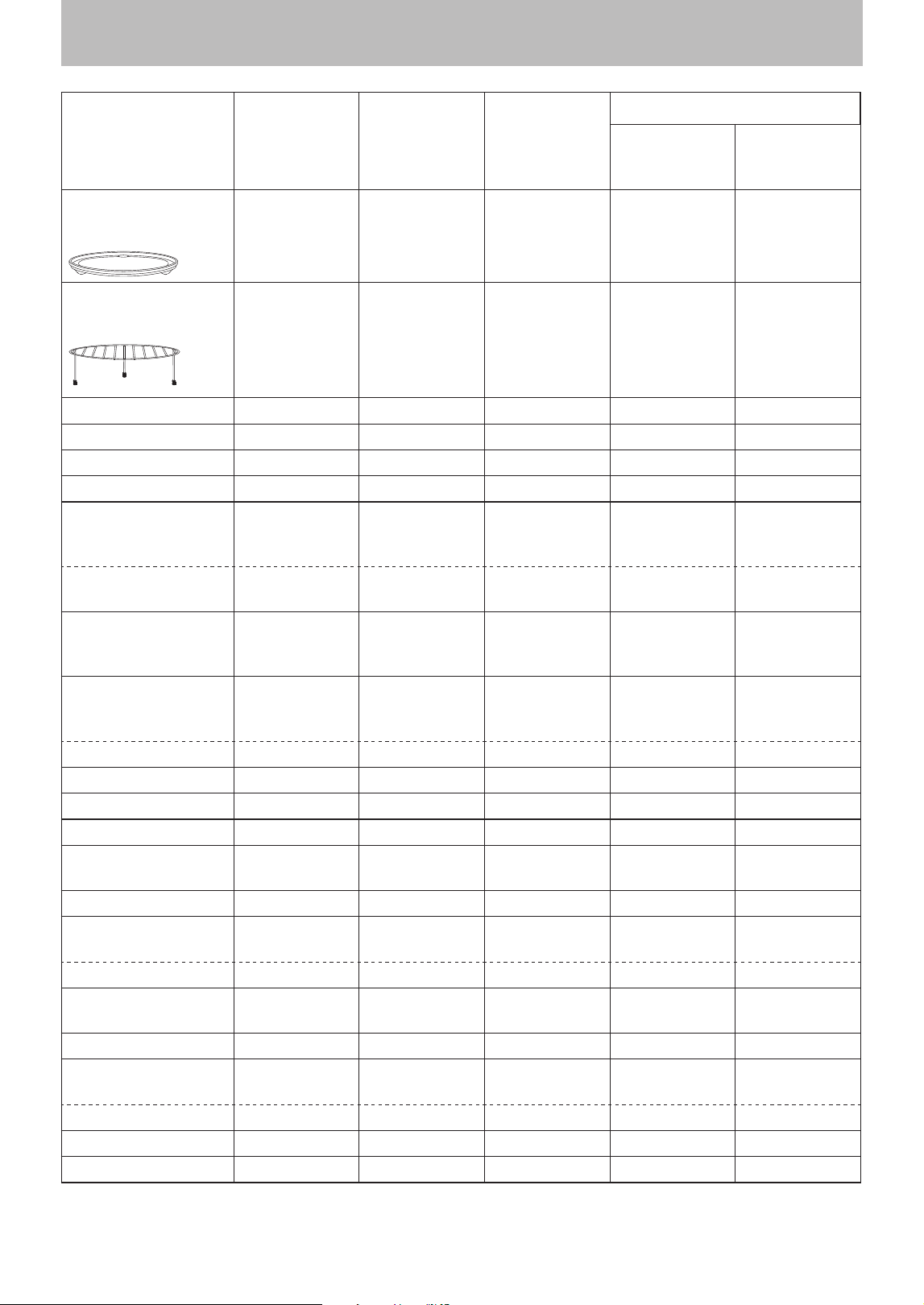
Cookware and Utensil Chart
Microwave Grill Convection
Combination
Combi 1
(Grill +
Microwave)
Combi 2/3/4/5
(Convection +
Microwave)
Enamel tray
(oven accessories)
no yes yes yes yes
Wire rack
(oven accessories)
no yes yes yes yes
Aluminium foil for shielding yes yes for shielding for shielding
Ceramic Plate yes yes yes yes yes
Browning Dish yes no no no no
Brown paper bags no no no no no
Dinnerware
oven/microwave safe
yes yes yes yes yes
non-oven/microwave
safe
no no no no no
Disposable
paperboard
containers
yes*
1
yes*
1
yes*
1
yes*
1
yes*
1
Glassware
oven glassware &
ceramic
yes yes yes yes yes
non-heat resistant no no no no no
Metal cookware no yes yes no no
Metal twist-ties no yes yes no no
Oven cooking bag yes yes*
1
yes*
1
yes*
1
yes*
1
Paper towels and
napkins
yes no no no no
Plastic defrosting rack yes no no no no
Plastic dishes
microwave safe yes no no no no
non microwave safe no no no no no
Microwave safe
plastic wrap
yes no no no no
Straw, wicker, wood yes no no no no
Thermometers
microwave safe yes no no no no
conventional no yes yes no no
Waxed paper yes yes yes yes yes
Silicon bakeware yes*
1
yes*
1
yes*
1
yes*
1
yes*
1
*1 Check manufacturers’ recommendation, must withstand heat or follow the recipe instructions.
*2 Follow the Cooking Guide section.
– 14 –
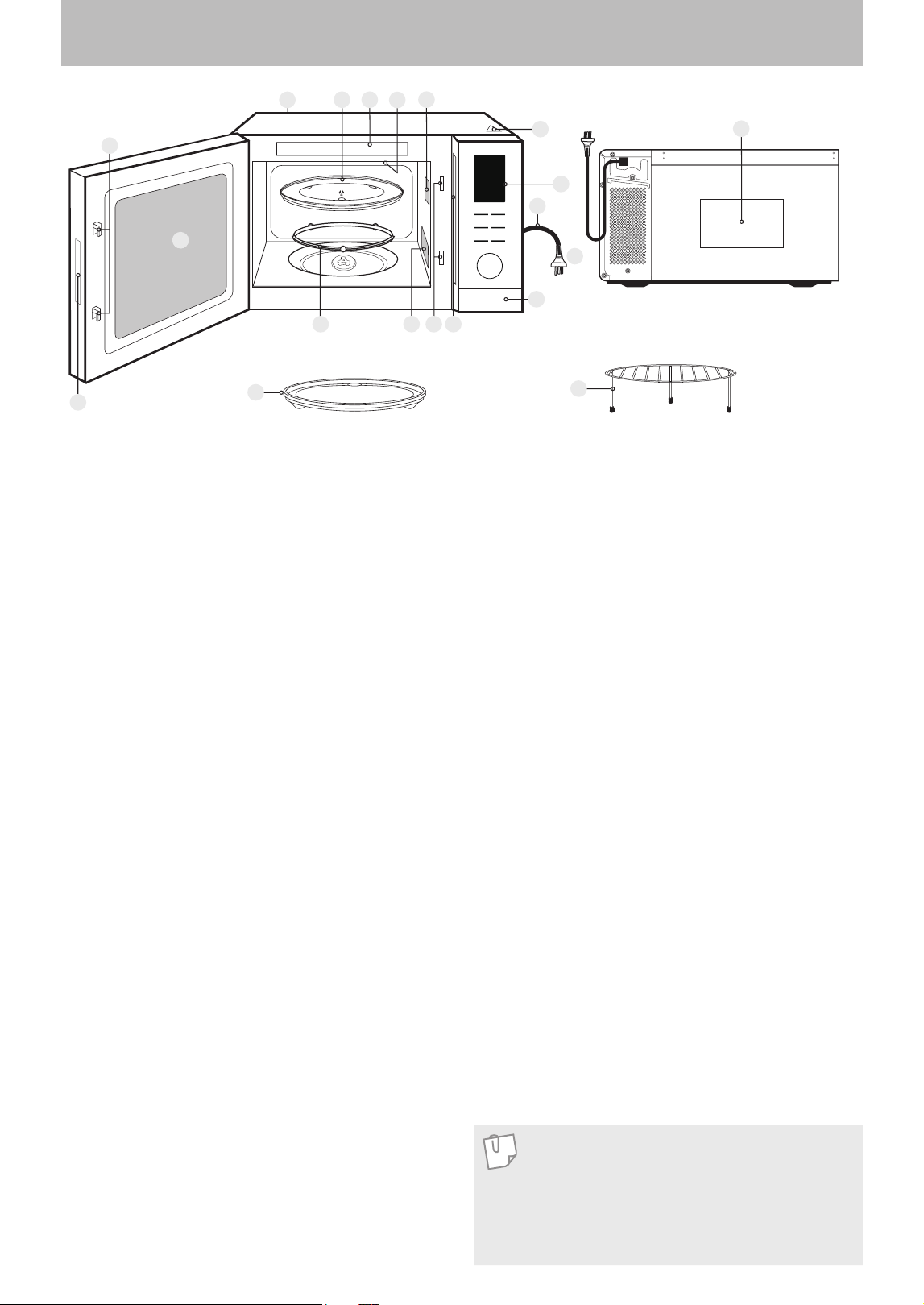
Feature Diagram
Door Release Button
Push to open the door. Opening the door during
cooking will stop the cooking process without
cancelling the program. Cook resumes as soon
as the door is closed and Start Button is pressed.
It is quite safe to open the door at any time
during a cooking program and there is no risk of
Microwave exposure.
Oven Window
Door Safety Lock System
Oven Light
Oven light will turn on during cooking and also
when door is opened.
Waveguide Cover (do not remove)
External Oven Air Vents
Control Panel
Power Supply Cord
Power Supply Plug
Identification Label
Glass Tray
a. DO NOT operate the oven without the Roller
Ring and Glass Tray in place.
b. Only use the Glass Tray specifically designed
for this oven. Do not substitute any other Glass
Tray.
c. If the Glass Tray is hot, allow to cool before
cleaning or placing in water.
d. Do not cook foods directly on the glass tray,
except when cooking jacket potatoes in
microwave mode. Always place food on a
microwave-safe dish, or on a rack set in a
microwave-safe dish.
e. If food or utensil on the Glass Tray touches
oven walls, causing the tray to stop moving,
the tray will automatically rotate in the opposite
direction. This is normal.
f. Glass Tray can rotate in either direction.
Roller Ring
a. Roller Ring should be cleaned regularly to
avoid excessive noise.
b. Roller Ring and Glass Tray should be used at
the same time.
Heating Elements
Warning Label
Menu Label
Wire Rack
a. The wire rack is used to facilitate browning of
small dishes and help with the good circulation
of the heat.
b. Wire Rack should be cleaned regularly.
c. When using Wire Rack in the manual GRILL,
COMBINATION and CONVECTION cooking
modes, be careful to choose heat-proof
containers; Containers made of plastic or
paper may melt or burn when exposed to the
heat radiating from the grill.
d. When using the COMBINATION mode, never
place any aluminum or metal container directly
on Wire Rack. Always insert a glass plate or
dish between Wire Rack and the aluminum
container. This will prevent sparking that may
damage the oven.
e. Do not use Wire Rack when cooking in the
MICROWAVE mode only.
Enamel Tray
a. The enamel tray is for cooking on grill,
convection and combination modes.
b. Do not use enamel tray in microwave mode
only.
c. The enamel tray must always be in place on
the glass tray (unless stated).
Warning Label
Notes
1. The illustration is for reference only.
2. The glass tray, wire rack and enamel tray
are the only accessories with this oven. All
other cooking utensils mentioned in this
manual must be purchased separately.
6
1
12
2
7
14
8
9
11 15
18
13 4
3
10
3
5
16
17
18
– 15 –
Control Panel
Notes
If an operation is set and Start button is not pressed, after 6 minutes, the oven will automatically cancel
the operation. This display will revert back to clock or colon mode.
Beep Sound
When a button is pressed correctly, a beep sound will be heard. If a button is pressed and no beep
is heard, the unit does not or can not accept the instruction. The oven will beep twice between
programmed stages. The oven will beep three times after preheating. At the end of any completed
program, the oven will beep 5 times.
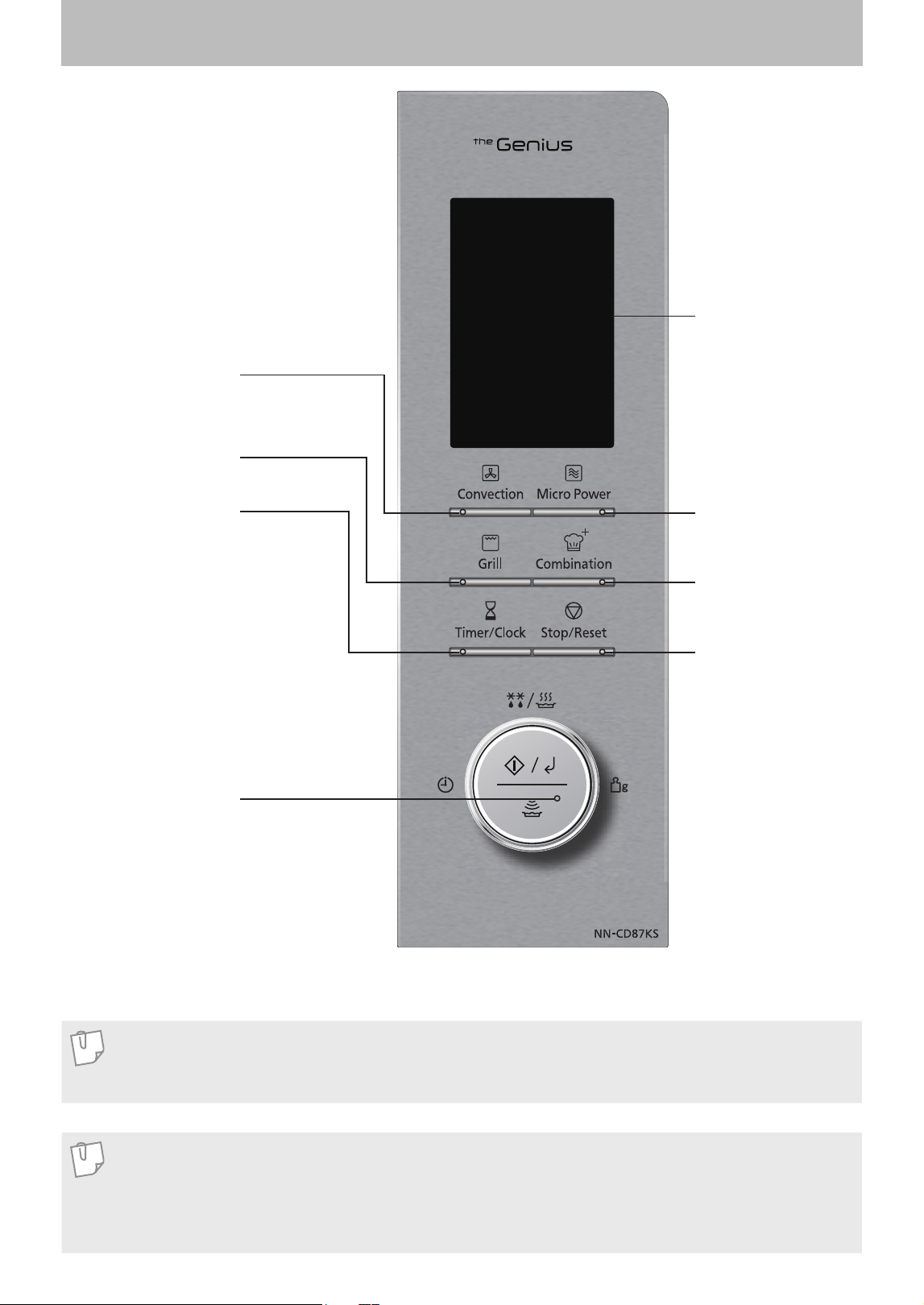
Grill Button (pg. 24-25)
Timer/Clock Button
(pg. 18, 32)
Stop/Reset Button
Before cooking: One
tap clears all your
instructions.
During cooking: One
tap temporarily stops
the cooking process.
Another tap cancels
all your instructions
and colon or time of
day appears in the
Display Window.
Dial (pg. 16)
Display Window
(pg. 16)
Convection Button
(pg. 26-27)
Micro Power Button
(pg. 20)
Combination button
(pg. 28-31)
– 16 –
Display Window
Dial Feature
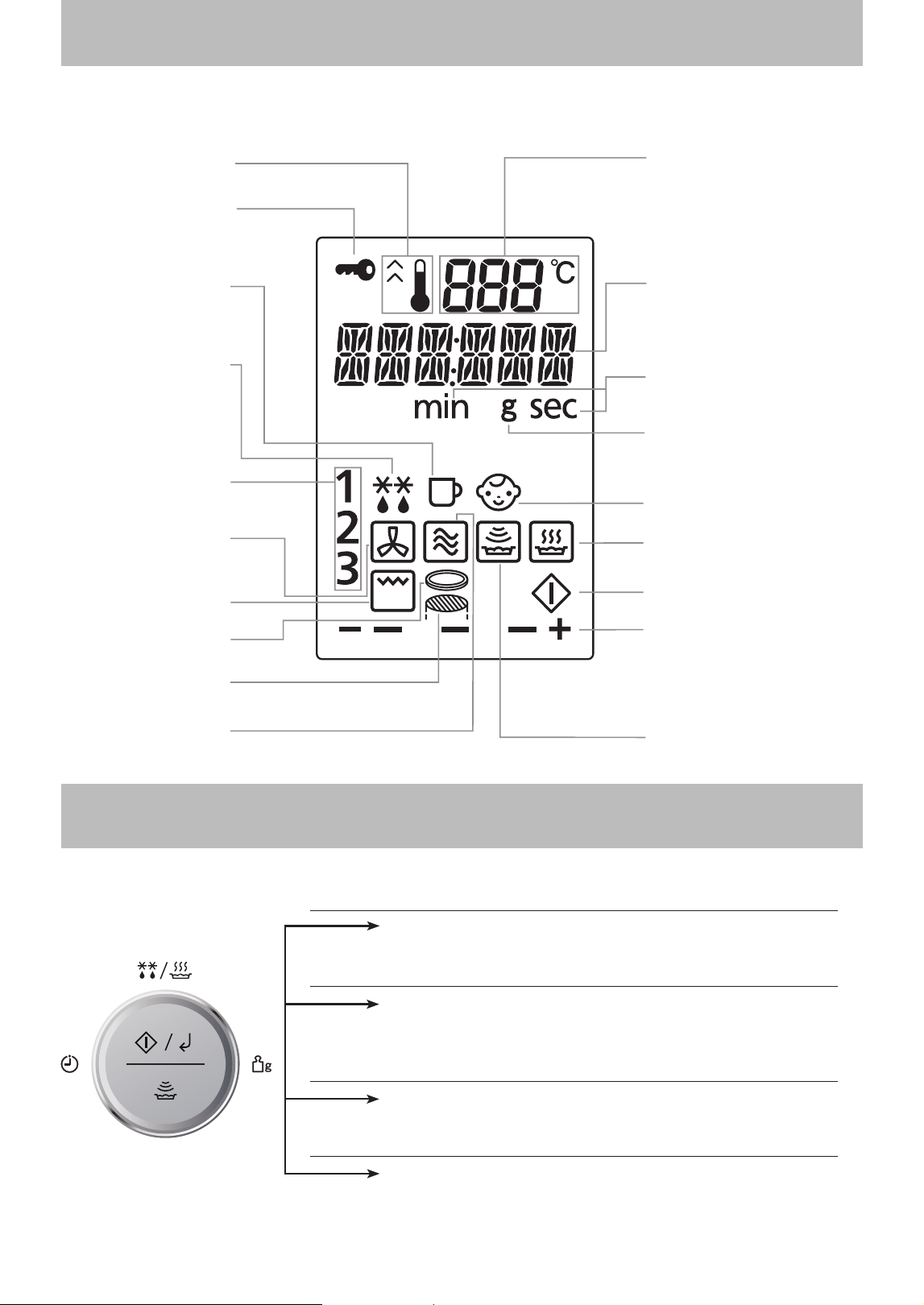
To help you operate the oven conveniently, the present state will appear in the display window.
Preheating
Child Lock Setting
Defrost Mode
Multistage Display
Convection Mode
Grill Mode
Enamel Tray
Wire Rack
Microwave Mode
Auto Beverage
Program
Temperature Display
Number/Character
Weight Display (g)
Junior Menu Program
Auto Weight Program
More/Less Display
Auto Sensor Program
Time Display
(Minute/Second)
Start
The dial has the following 4 functions:
Cooking time
After selecting a manual cooking mode, enter time by turning
the dial. Use the dial for the Add Time function (pg. 23)
Auto Programs
When clock mode is displayed, turn the dial to select auto
programs and weight (pg. 35-40)
One Push Reheating
When clock mode is displayed, press dial for quick start
reheating chilled meal (pg. 34-35)
Start/Confirmation
Press the dial to start operating the oven or confirm the setting.
If during cooking the door is opened or Stop/Reset is pressed
once, Start has to be pressed again to continue cooking.
– 17 –
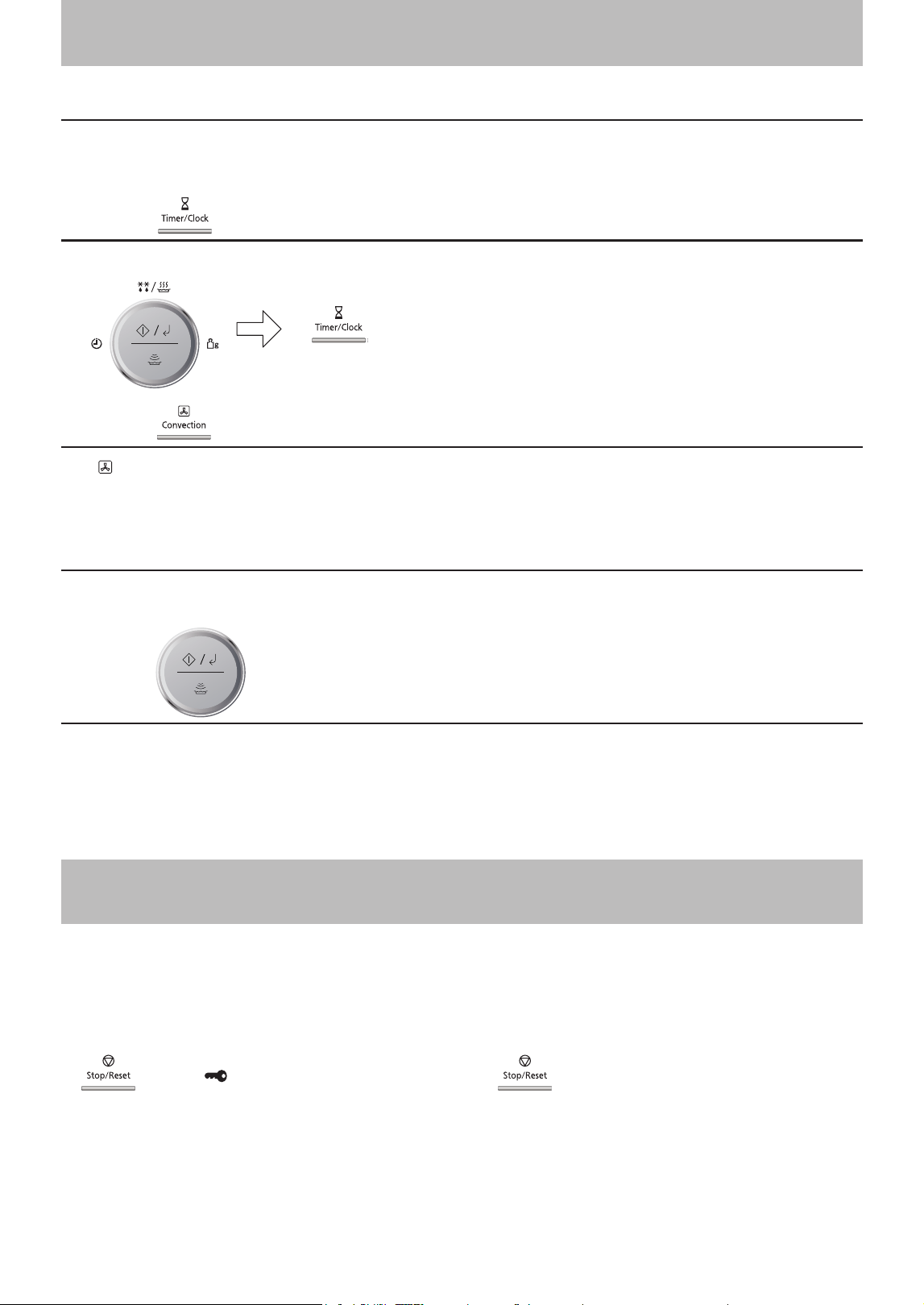
1. Plug in.
Plug into a properly earthed electrical outlet. "REFER TO OPERATING INSTRUCTIONS BEFORE USE" will
appear in the display window, then you can start to operate.
2. Press
twice to set clock.
Set clock as a 12 hour clock. Turn dial to select the time, then press Timer/Clock. (See page 18 for details)
3. Press .
“
” will appear in the display window with the oven temperature. This procedure is to burn off the oil
used for rust protection in the oven. Press Convection button until 220 °C appears in the display window.
Remove all accessories from the oven.
4. Turn Dial to Select Time.
Turn dial until 5 minutes is displayed in the window.
5. Press
.
The time will be displayed in the window and count down. The oven will beep at the end of the program.
The oven is now ready to use.
Caution: heating elements and oven will be hot.
Let’s Start To Use Your Oven!
To Use Child Safety Lock
This feature allows you to prevent operation of the oven by a young child; however, the door will open. This
feature can be set when colon or time of day is displayed.
To set: To cancel:
Press Stop/Reset button 3 times.
► “
” appears in the display
window.
Press Stop/Reset button 3 times.
► Colon or time of day appears in
the display window.
Press 3 times. Press 3 times.
To set or cancel child lock, Stop/Reset button must be pressed 3 times within a 10 second period. Child Lock
can be set when a colon or the time of day is displayed.
– 18 –
To Set Clock
1. Press twice.
“SET TIME” will appear in the display window, and the colon starts to blink.
2. Turn dial.
Enter the time by turning the dial. The time appears in the display.
3. Press .
The colon stops blinking. Time of day is now locked into the display.
Notes
1. If you want to reset time, please repeat step 1-3.
2. The clock will keep the time of day as long as oven is plugged in and electricity is supplied.
3. Clock is a 12-hour display.
4. Oven will not operate while colon is still blinking.
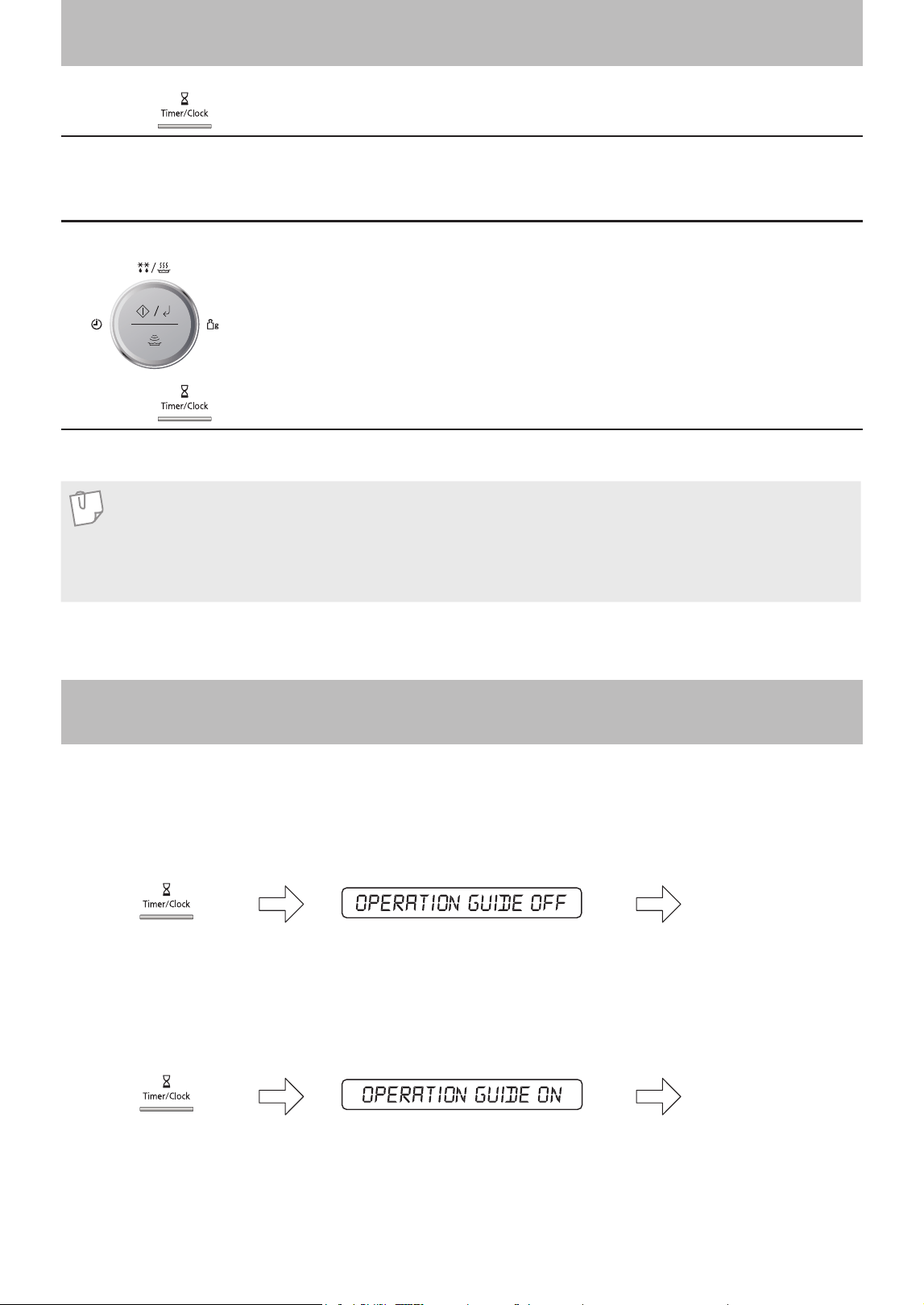
Operation Guide Setting
To assist you in programming your oven, the following operation will appear in the display window. When you
become familiar with your oven, the operation guide can be turned off.
Press Timer/Clock button
four times.
Press Timer/Clock button
four times.
Colon or time of
day appears in the
display window.
Colon or time of
day appears in the
display window.
Display window.
Display window.
To turn off:
To turn on:
– 19 –
Cooking Modes
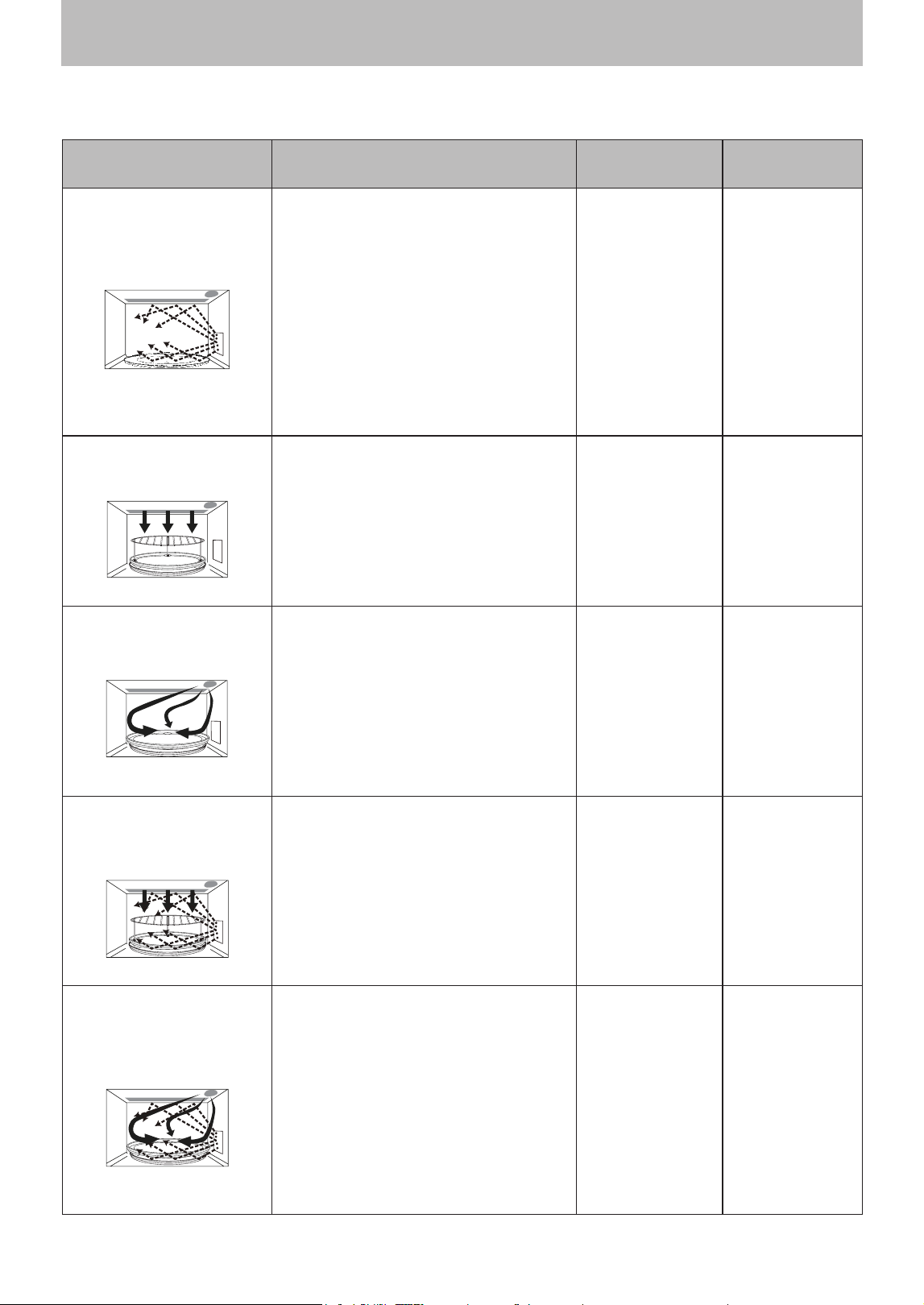
The diagrams shown below are examples of the accessories. It may vary depending on recipe/dish used.
Further information can be found in the Cooking Guide section.
Cooking Modes Uses
Recommended
Accessories
Containers
MICROWAVE
• Defrosting.
• Reheating.
• Melting: butter, chocolate, cheese.
• Cooking: fish, vegetables, fruits,
eggs.
• Preparing: stewed fruits, jam,
sauces, custards, choux, pastry,
caramel, meat, fish.
• Baking: cakes without colour.
No Preheating
_
Use your own
Pyrex
®
dishes,
plates or bowls,
directly on the
glass tray.
No metal.
GRILL
• Grilling of meat or fish.
• Toast grilling.
• Colouring of gratin dishes or
meringue pies.
No Preheating
Wire rack on
enamel tray
Use your own
Pyrex
®
dishes,
heat-proof plates
or bowls, directly
on the wire rack
on enamel tray on
glass tray.
CONVECTION
• Baking of small items with short
cooking times: puff pastry, cookies,
roll cakes.
• Special baking: bread rolls or
brioches, sponge cakes.
• Baking of pizzas and tarts.
Preheating Advised
Enamel tray
Heat-proof, metal
tin can be used
on enamel tray.
Do not place
dishes directly
on glass tray.
GRILL +
MICROWAVE
• Cooking lasagne, meat, potatoes or
vegetable gratins.
No Preheating
Wire rack on
enamel tray
Microwaveable
and heat-proof
dishes placed
directly on wire
rack on enamel
tray on glass tray.
No metal.
CONVECTION +
MICROWAVE
• Baking cakes.
• Puff pastry tarts.
Preheating If Necessary
Enamel tray
Microwaveable
and heat-proof
dishes can be
used on the
enamel tray.
Do not place
dishes directly
on glass tray.
No metal.
– 20 –
To Cook/Reheat/Defrost on
Micro Power by Time Setting
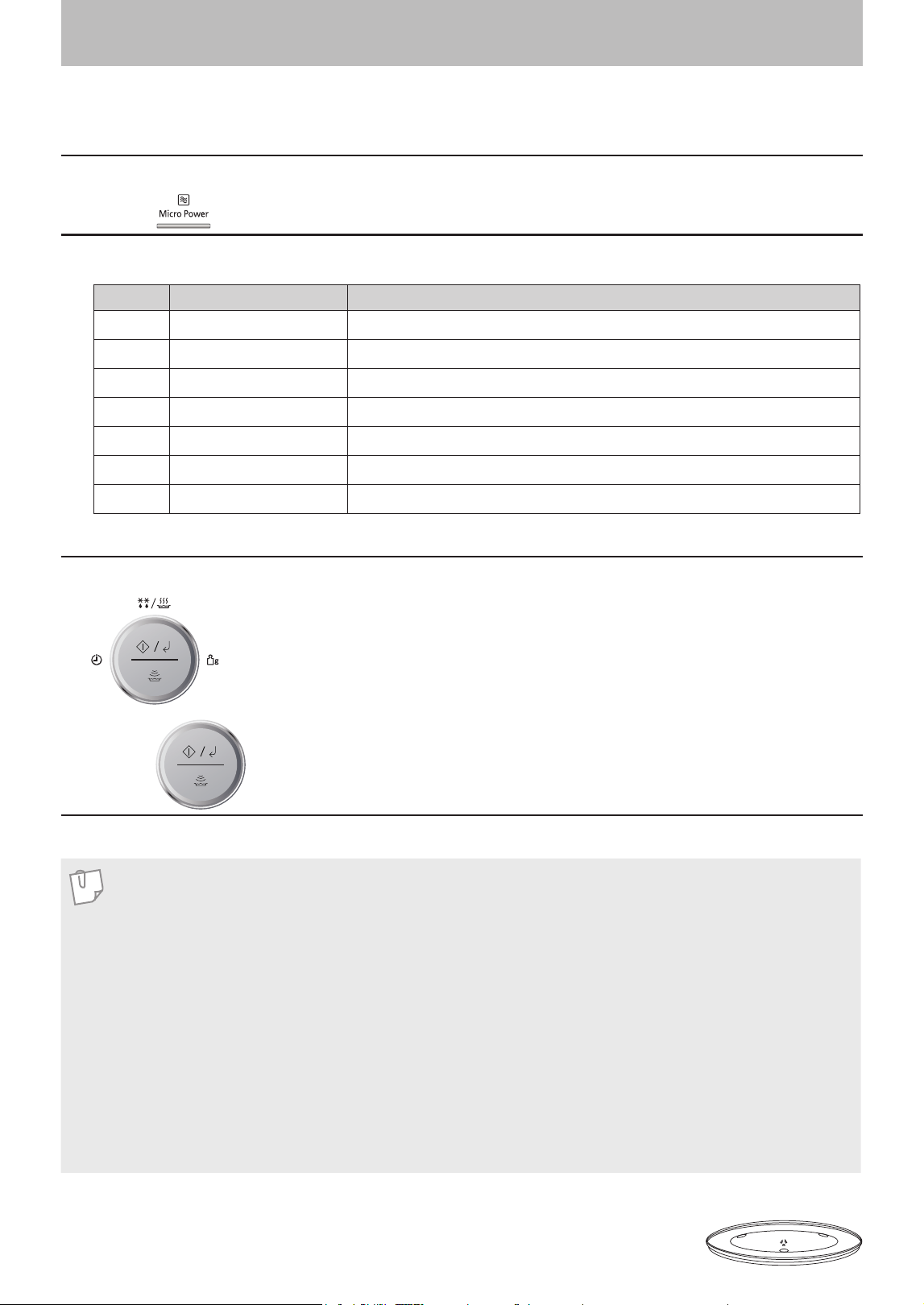
This feature allows you to set the desired power and time for cooking by yourself.
1. Open Door.
Open the door and place container with food on the glass tray. Then close the door.
2. Press
.
Press this button until the power you require appears in the display window. (see chart below)
Press Power Level Example of Use
Once 1000 W (High) Boil water. Cook fresh fruits, vegetables, preserved fruit and candies.
Twice 800 W (Medium-High) Cook poultry, meat, cakes, desserts. Heat milk
3 times 270 W (Defrost) Defrost meat, poultry or seafood.
4 times 600 W (Medium) Cook beef, lamb, eggs, fish and seafood. Melt butter.
5 times 440 W (Low) Simmer soups, stew and casseroles (less tender cuts).
6 times 300 W (Simmer) Cook tough meat, stew soup and soften butter.
7 times 100 W (Warm) Keep food warm and soften ice cream.
3. Enter Time.
Enter the cooking time by using the dial. (1000 W : up to 30 minutes; Other Powers : up to 1 hour 30 minutes)
4. Press .
The cooking time appears in the display window and begins to count down.
Notes
1. Three stages can be set continuously. This feature allows you to set only once for some different
stages without taking care during cooking. Please refer to page 33.
2. You can change the cooking time during cooking if required. Turn the dial to increase or decrease
the cooking time. Time can be increased/decreased in 1 minute increments up to maximum time of
10 minutes can be changed, turning the dial to zero will end cooking.
3. Do not attempt to use microwave only with any metal container in the oven.
4. Do not place food directly on the glass tray. Place in a microwaveable or glass dish. Foods reheated or
cooked by microwave only should be covered with a lid or pierced cling film, unless otherwise stated.
5. Stand time can be programmed after microwave power and time setting. Refer to using the timer
page 32.
6. After using the oven, the fan may rotate to cool the electric components and “HOT” appears in the display
window. This is perfectly normal, and you can take out the food from the oven while the fan operates.
7. When cooking time is longer than 60 minutes, the time will appear in hours and minutes.
8. For manual defrosting times, please refer to defrosting chart on page 21.
Oven Accessories to Use
When using your oven on microwave only, the glass tray provided must always be in
position.
– 21 –
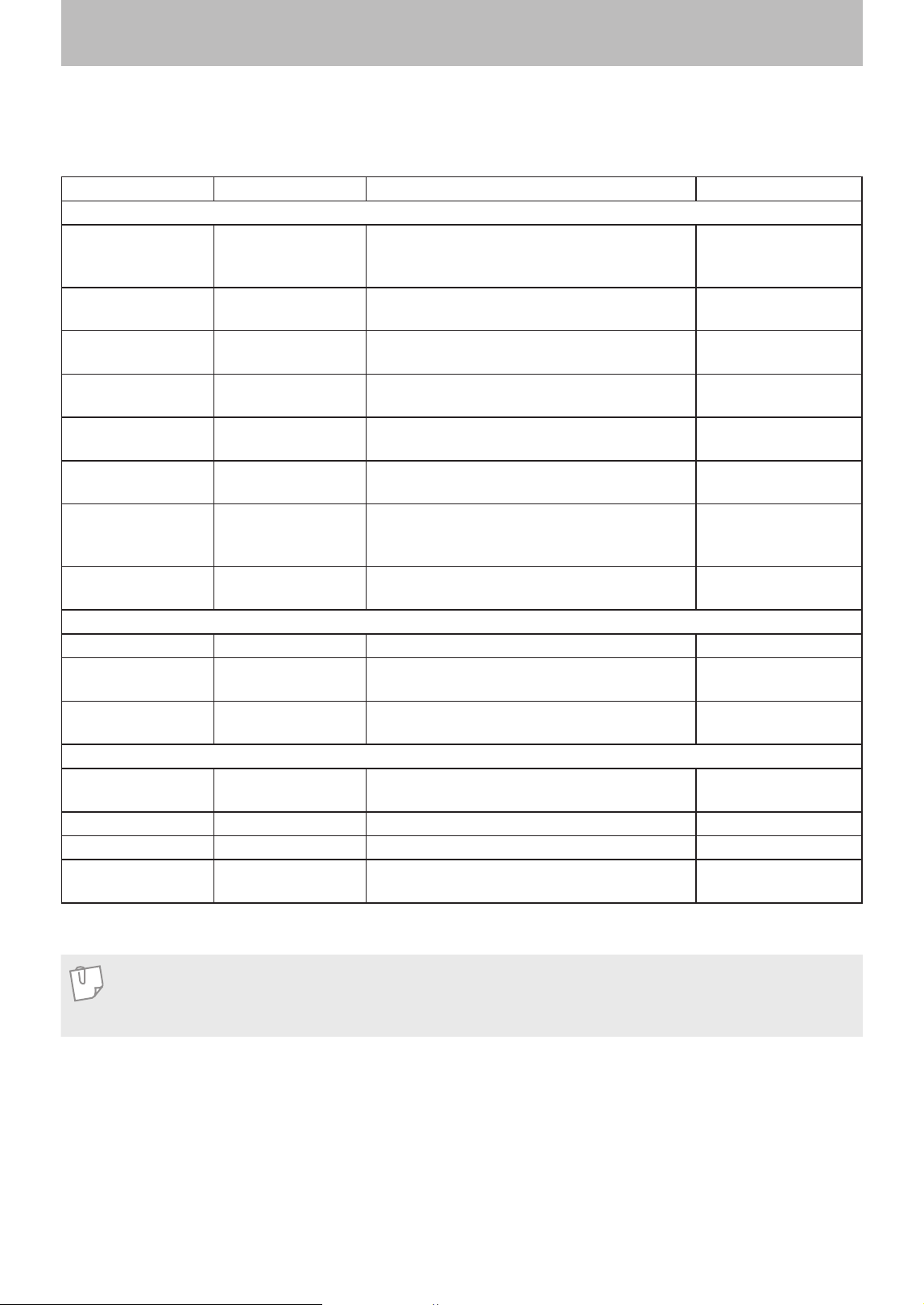
Defrosting Using Defrost Microwave and Time
Select Defrost microwave. The times given below are a guideline only. Always check the progress of
the food by opening the oven door and then re-starting.
For larger quantities adjust times accordingly. Food should not be covered during defrosting.
Food Defrosting Time Method Standing Time
Meat
Beef/Lamb/Pork
joint 500 g
8-9 mins
Place in a suitable dish or on an upturned
saucer or use a microwave safe rack. Turn
once. Shield.
30 mins
Minced beef 500 g 6 mins 30 secs
Place in a suitable dish. Break up and turn
once.
5 mins
Chops 450 g 6-7 mins
Place in a suitable dish in a single layer.
Turn once. Shield if necessary.
5 mins
Sausages 450 g 6 mins
Place in a suitable dish in a single layer.
Turn twice. Shield if necessary.
5 mins
Bacon rashers
500 g
4-6 mins
Place in a suitable dish. Turn and separate
twice. Shield if necessary.
3 mins
Stewing steak
450 g
6 mins Place in a suitable dish. Break up frequently. 5 mins
Whole chicken
500 g
6-8 mins
Place in a suitable dish on an upturned
saucer or use a microwave safe rack. Turn
once. Shield.
10 mins
Chicken portions
450 g
5-7 mins
Place in a suitable dish in a single layer.
Turn once. Shield if necessary.
10 mins
Fish
Whole 350 g 7-9 mins Place in a suitable dish. Turn once. Shield. 5 mins
Fillets/Steak 450 g 5-6 mins
Place in a suitable dish. Turn once, separate
and shield if necessary.
5 mins
Prawns 450 g 5-7 mins
Place in a suitable dish. Stir halfway during
defrosting.
5 mins
General
Bread sliced 400 g 4 mins
Place on a plate. Separate and rearrange
during defrosting.
5 mins
Slice of bread 45 g 20 secs-30 secs Place on a plate. 1-2 mins
Pastry 500 g 4 mins Place on a plate. Turn halfway. 5-10 mins
Soft fruit 450 g 5-6 mins
Place in a suitable dish. Stir once during
defrosting.
2 mins
Notes
Opening the door and taking out the defrosted parts during the operating time is recommended. Turn
over, stir or rearrange the parts which are still in icy.
– 22 –
To Defrost Using Turbo Defrost
This feature allows you to defrost meat, poultry and seafood automatically by just setting the weight. The serving/
weight is 0.1 kg to 3.0 kg. The weight can be programmed in grams. The weight starts from the minimum weight.
1. Turn
.
Select the desired program by turning the dial.
2. Pressthedialtoconrmtheprogramselection.
The microwave (
) and defrost ( ) symbol will also appear.
3. Select Desired Weight.
Select the weight of the food by turning the dial. Turning the dial slowly will count up in 10 g steps. Turning
the dial quickly will speed up this process.
4. Press .
Defrosting time appears in the display window and begins to count down.
Tips for Turbo defrost
Boneless meat always demands longer time to defrost than meat with bones, as to meat with bones, we
recommend to subtract 0.5 kg from total weight when it exceeds 2 kg, subtract 0.2-0.3 kg from total when it
weights under 2 kg.
Two buzz beeps
Turn over the meat, chicken, fish and shell fish. Separate the stewed meat, chicken pieces and meat loaf. Apart
the meat loaf from the hamburger. Shield the edge of chicken wings, roast, fat or bones.
Key to defrosting For evenly defrosting, turn over the foods or move the position of the foods in the
containers during the progress of defrosting.
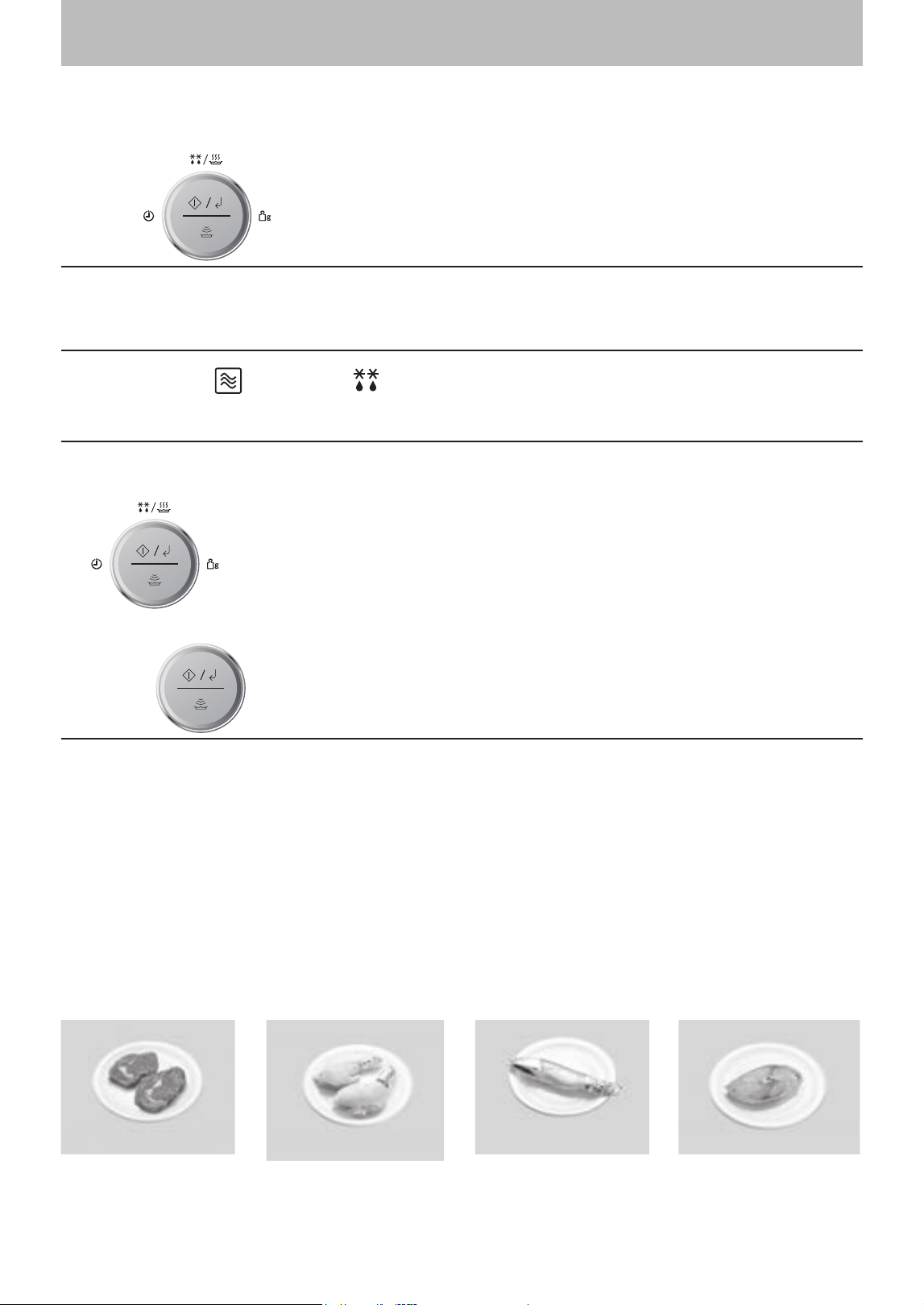
Remove the package of
the raw meat and place
it on the plate.
Shield the front part of
the chicken drumsticks
by using aluminum foil.
Shield the head and
tail of the whole fish by
using aluminum foil.
Remove the package of
the fish fillet and place it
on the plate.
– 23 –
To Defrost Using Turbo Defrost
(continued)
Defrosting Guidelines
For Best Results:
1. Place foods in a suitable container. Meat joints and chickens should be placed on an upturned saucer or on
a plastic rack if you have one.
2. Check food during defrosting, as foods vary in their defrosting speed.
3. It is not necessary to cover the food.
4. Always turn or stir the food especially when the oven “beeps’’. Shield if necessary (see point 6).
5. Minced meat/chops/chicken portions should be broken up or separated as soon as possible and placed in a
single layer.
6. Shielding prevents food cooking. It is essential when defrosting chickens and joints of meat. The outside
thaws out first, so protect wings/breast and fat with smooth pieces of aluminium foil secured with cocktail
sticks.
7. Allow standing time so that the centre of the food thaws out. (Minimum of 1 hour for joints of meat and whole
chickens).
This feature allows you to add cooking time at the end of previous cooking.
Notes
1. This feature is only available for Micro Power, Grill, Convection, Combination and Timer feature and
it is not available for Turbo Defrost and Auto programs.
2. The Add Time feature will not operate after 1 minute cooking.
3. The Add Time feature can be used after the 3-stage cooking and during cooking.
4. The power level is the same as the last stage.
2. Press Start button.
Time will be added.
The time in the display window will
count down.
1. After cooking, turn dial to select Add Time feature.
Maximum cooking time:
Micro Power: 1000 W up to 30 minutes;
other microwave powers: up to 1 hour 30 minutes;
Grill: 1 hour 30 minutes,
Convection, Combination and timer: 9 hours.
To Use the Add Time Feature
– 24 –
To Cook on Grill by Time Setting
The grill system on the oven gives fast efficient cooking for a wide variety of foods e.g. chops, sausages, steaks,
toast, etc. There are 3 different grill settings available. The glass tray must always be in position when using the
oven.
1. Press
.
Press to set the desired power level. (see chart below)
Press Power Level Suitable kinds of foods
Once Grill 1 (High) Toasting bread, muffins and teacakes etc.
Twice Grill 2 (Medium) Thin seafood.
3 times Grill 3 (Low) Slice of poultry or meat.
2. Enter Time.
Enter the cooking time by using the dial. (up to 1 hour 30 minutes)
3. Press .
The cooking time appears in the display window and begins to count down.
Notes
1. There is no microwave power on the grill only program.
2. Use the accessories provided, as explained.
3. Most meat items e.g. bacon, sausages, chops can be cooked on the hottest setting - Grill 1. This
setting is also suitable for toasting bread, muffins and teacakes etc.
4. Grill 2 and Grill 3 are used for more delicate foods or those that require a longer grill time e.g. fish or
chicken portions.
5. Never cover foods when grilling.
6. Do not attempt to preheat the grill.
7. The grill will only operate with the oven door closed. It is not possible to use the grill function with
the door open.
8. Most foods require turning halfway during cooking. When turning food, open oven door and
carefully remove wire rack using oven gloves.
9. Always use oven gloves when removing the food and accessories after grilling as the oven
and accessories will be very hot.
10. After turning, return food to the oven and close door. After closing oven door, press Start button.
The oven display will continue to count down the remaining grilling time. It is quite safe to open the
oven door at any time to check the progress of the food as it is grilling.
11. You can change the cooking time during cooking if required. Turn the dial to increase or decrease
the cooking time. Time can be increased/decreased in 1 minute increments up to maximum time of
10 minutes can be changed, turning the dial to zero will end cooking.
12. The grill will glow on and off during cooking - this is normal. Always clean the oven after using the
grill and before using the microwave or combination.
13. After grilling it is important that the grill accessories are removed for cleaning before reuse and that
the oven walls and floor are wiped with a cloth squeezed in hot soapy water to remove any grease.
Do not put accessories in dish washer.
– 25 –
To Cook on Grill by Time Setting
(continued)
Oven Accessories to Use
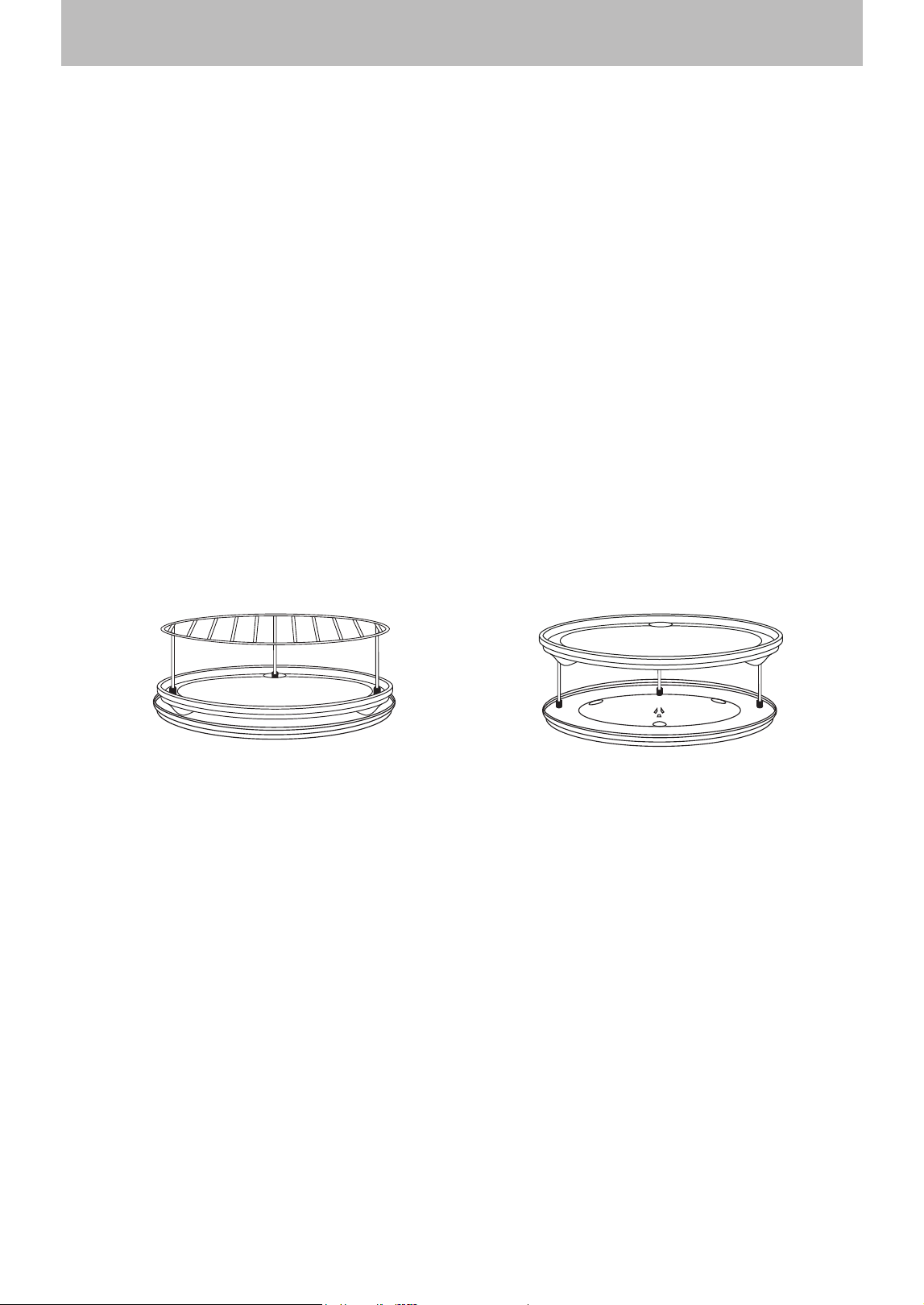
When grilling foods the glass tray should be in position, with the enamel tray and the wire rack on top.
Place food on wire rack on the enamel tray on the glass tray. The wire rack will allow fat to drip through into the
enamel tray to reduce excess splatter and smoke when grilling steaks, chops and other fatty foods.
Most foods require turning halfway during cooking. When turning food, open oven door and carefully remove the
enamel tray and wire rack by holding the accessories firmly. Use oven gloves when removing accessories as
they will be very hot, and so will the roof and walls of the oven.
After turning, return food to the oven, close door and press Start button. The oven will continue to count down
the remaining cooking time. It is quite safe to open the oven door at any time to check the progress of the food
as it is grilling.
If grilling fish or small items, place the enamel tray on top of the wire rack.
– 26 –
To Cook on Convection by Time Setting
Your microwave oven can be used in convection mode which incorporates a heating element with a fan. For best
results always place food in a preheated oven. The enamel tray must be on the glass tray when preheating.
Without Preheating:
1. Press
.
Press to select oven temperature. There is a choice of convection temperatures 40 °C and 100 °C - 220 °C.
Default temperature is 150 °C.
2. Enter Time.
Enter the cooking time by using the dial. (up to 9 hours)
3. Press .
The cooking time appears in the display window and begins to count down.
With Preheating:
1. Press
.
Press to select oven temperature. There is a choice of convection temperatures 100 °C - 220 °C. Default
temperature is 150 °C.
2. Press to Preheat Oven.
A “P” will appear in the display window. When the oven is preheated the oven will beep and the “P” will ash.
Then open the door and place the food inside.
Note: Open the door using the door release, because if the Stop/Reset button is pressed the program may
be cancelled.
3. Enter Time.
Enter the cooking time by using the dial. (up to 9 hours)
4. Press .
The cooking time appears in the display window and begins to count down.
– 27 –
To Cook on Convection by Time Setting
(continued)
Notes
1. For quick selection of the most commonly used cooking temperatures, the oven starts at 150 °C and
then for each press the temperature will count up in 10 °C stages to 220 °C, then to, 40 °C, 100 °C,
110 °C etc.
2. 40 °C is for dough fermentation, such as the pizza base or bakery dough when making bread.
3. The oven can not preheat to 40 °C.
4. Do not open the door during preheating.
5. The oven will maintain the selected temperature for approximately 30 minutes. If no food has been
placed inside the oven, then it will automatically cancel the cooking program “OPEN DOOR” will
appear in the display window. If no cooking time is set, oven will revert to time of day after 6 minutes.
6. After pressing Start button, the selected temperature can be recalled and changed. Press
Convection button once to indicate the temperature in the display window. While the temperature is
recalled in the display window, you can change the temperature by pressing Convection button.
7. You can change the cooking time during cooking if required. Turn dial to increase or decrease the
cooking time. Time can be increased/decreased in 1 minute increments, up to 10 minutes. Turning
the dial to zero will end cooking.
8. The accessories and the surrounding oven will get very hot. Use oven gloves.
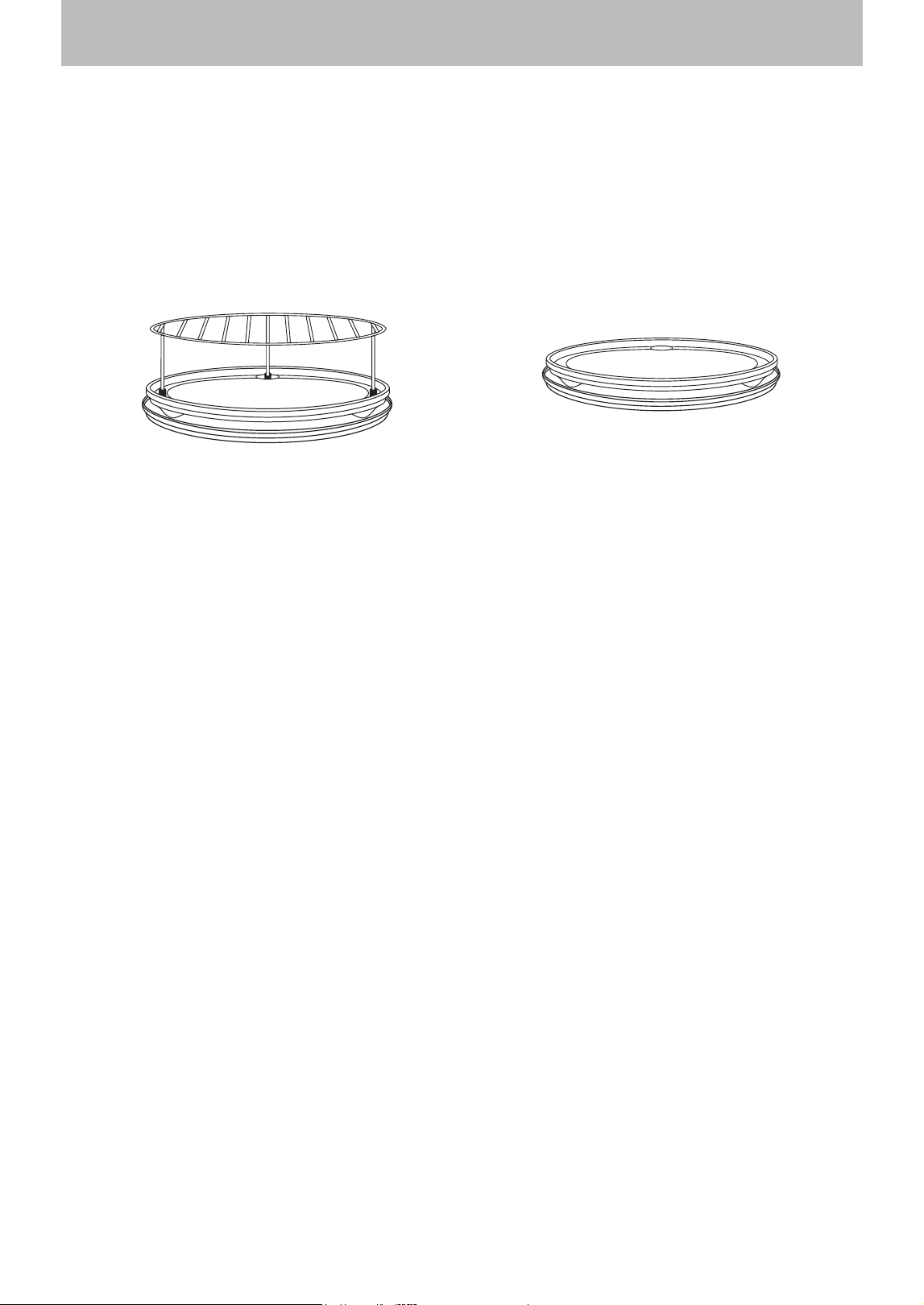
Oven Accessories to Use
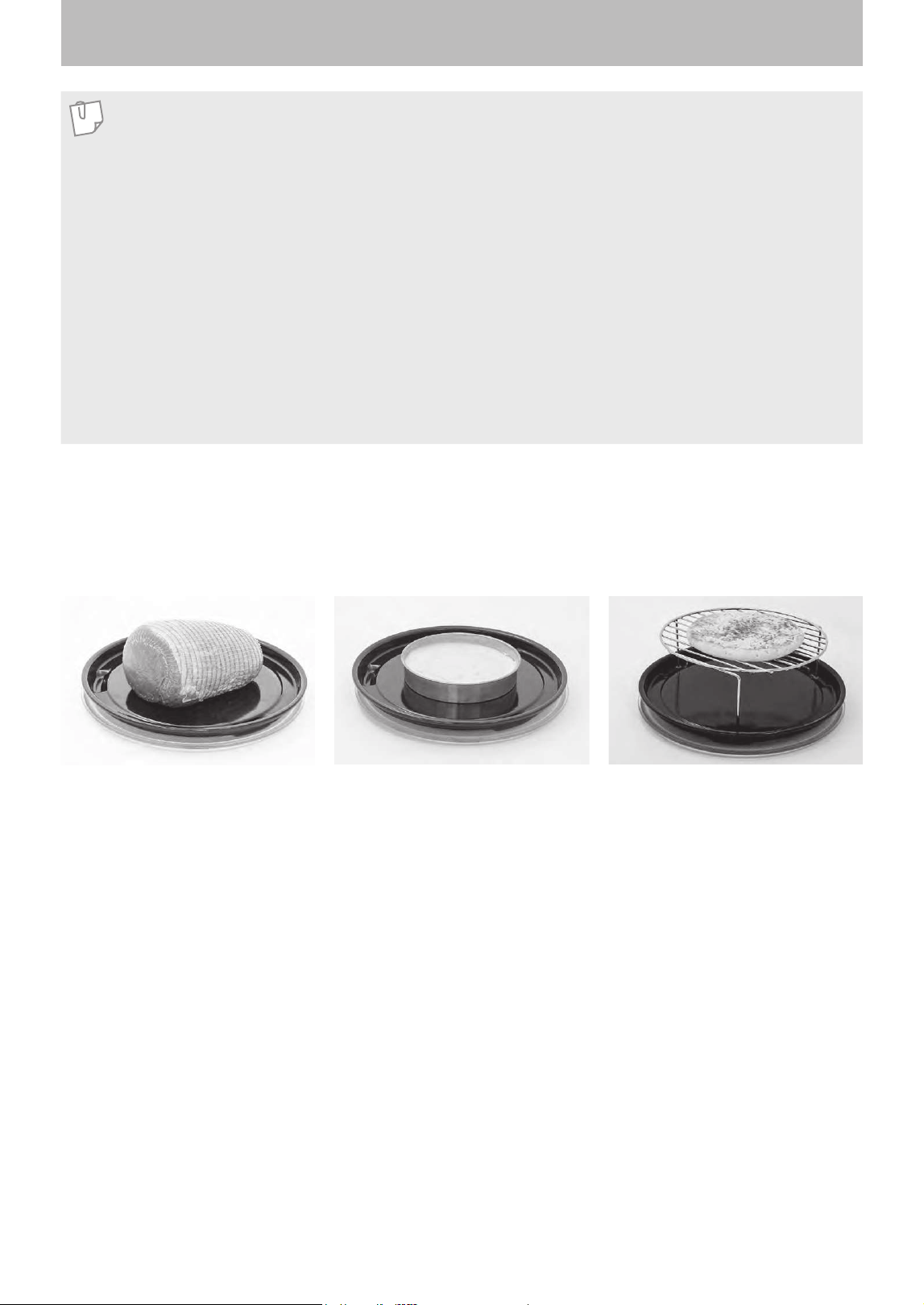
When using the Convection oven the glass tray should be in position and must have the enamel tray
placed on top.
The food is then placed onto the enamel tray. Follow your individual recipe guidelines.
Roasting meat: glass tray,
enamel tray.
Baking: glass tray, enamel tray. Baking: glass tray, enamel tray,
wire rack.
When using the oven as a convection oven, there is no microwave power, i.e. the oven is operating as a
conventional oven and you can use all your standard metal baking tins and ovenware.
It is not recommended to cook on more than one level when using the convection oven. When cooking 2 trays
of buns etc, cook in two batches.
– 28 –
To Cook on Combination by Time Setting
Your oven has two methods of cooking by Combination.
1. Grill and Microwave (preheat is not possible)
2. Convection and Microwave (with and without preheat)
Combination cooking is ideal for many foods. The microwave power cooks them quickly, whilst the convection
or grill gives the traditional browning and crispness.All this happens simultaneously resulting in most foods being
cooked in ½ - ⅔ of the conventional cooking time.
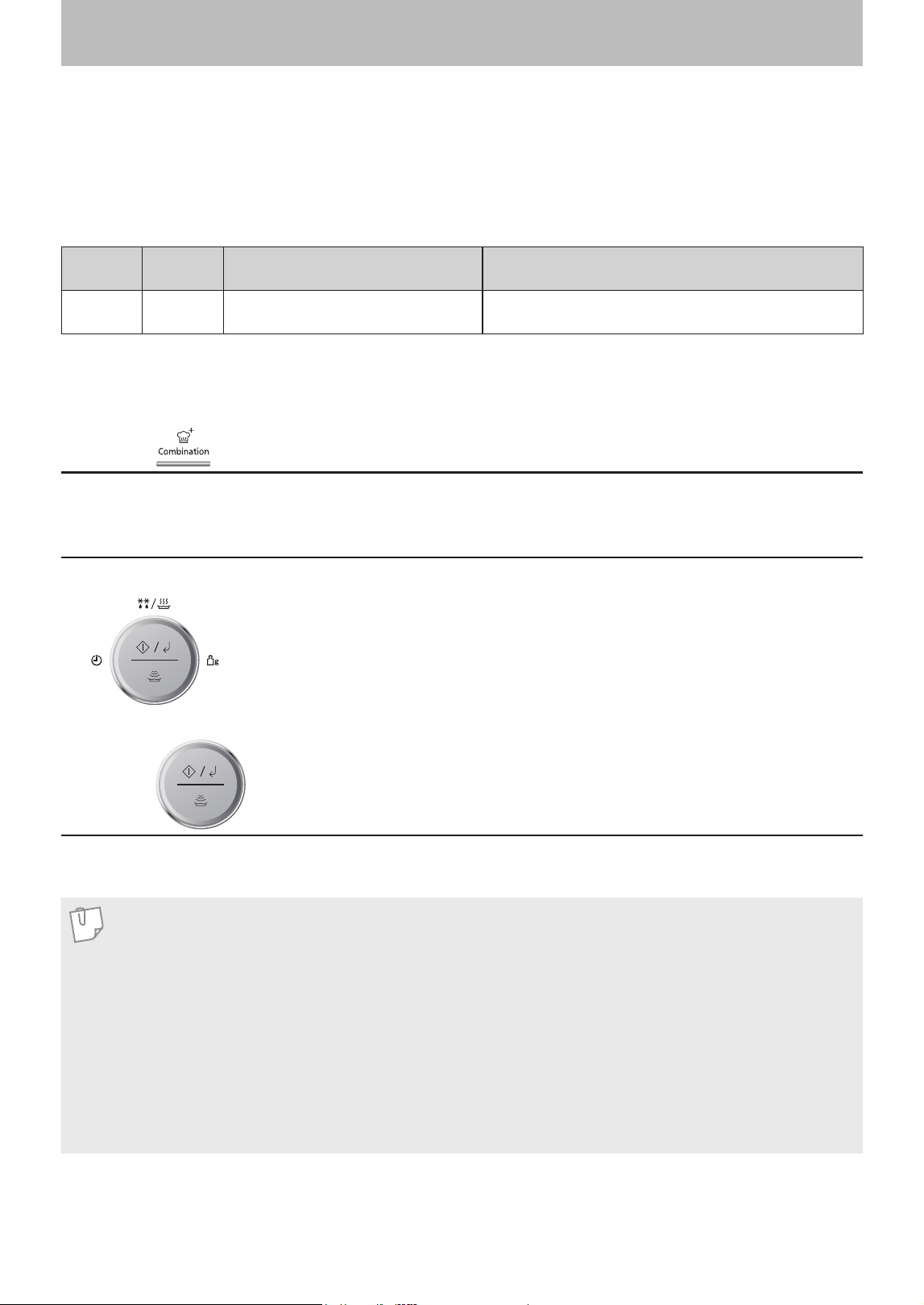
Press
Combi
Level
Combination Type Uses
Once Combi 1 Grill 1 (High) + MW 440 W
Breaded fish, breaded chicken, toasted sandwiches,
frozen croquettes, samosas, spring rolls
Grill + Microwave
This combination mode is suitable for foods which are normally grilled and for reheating small savoury items.
1. Press
.
Press once.
2. Enter Time.
Enter the cooking time by using the dial. (up to 9 hours)
3. Press .
The cooking time appears in the display window and begins to count down.
Notes
1. Do not use this program with less than 200 g of food.
2. It is not necessary to preheat when using this combination mode and food should always be cooked
uncovered.
3. The grill will glow on and off during cooking - this is normal.
4. To turn food just press the door release, remove the enamel tray and wire rack, turn the food,
return to the oven, close the door and press Start button. The oven will continue to countdown the
remaining cooking time.
5. You can change the cooking time during cooking if required. Turn dial to increase or decrease the
cooking time. Time can be increased/decreased in 1 minute increments, up to 10 minutes. Turning
the dial to zero will end cooking.
6. The accessories and the surrounding oven will get very hot. Use oven gloves.
– 29 –
To Cook on Combination by Time Setting
(continued)
Oven Accessories to Use
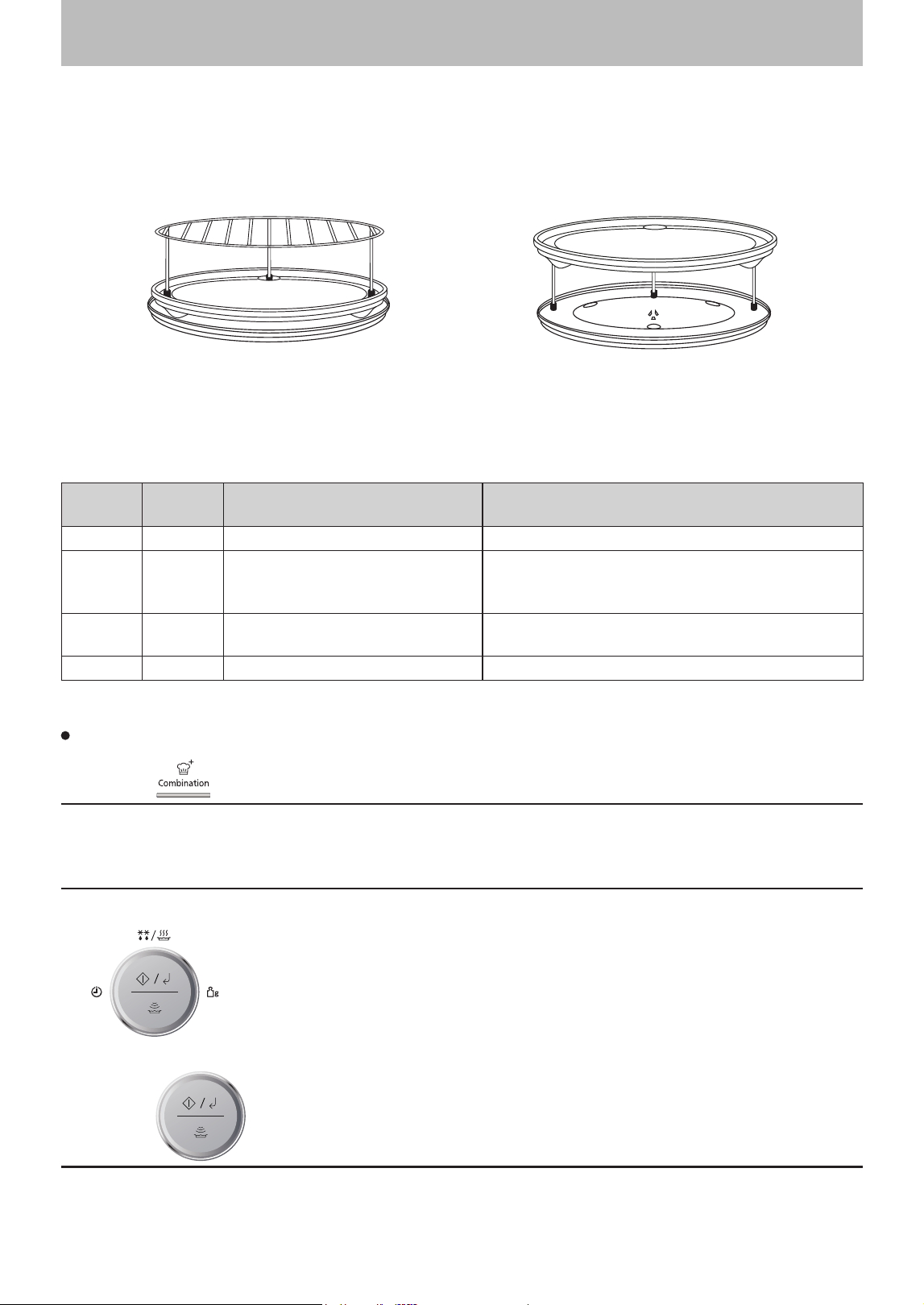
When using Combination cooking the glass tray should be in position and must have the enamel tray on top,
unless otherwise stated.
Food should be placed directly onto the wire rack on the enamel tray. This is then placed on the glass tray.
When cooking fish or small items, food can be placed directly on the enamel tray on top of the wire rack.
Convection + Microwave
This is the most popular combination mode combining Convection heat with Micro Power. Casseroles, meat
joints, jacket potatoes and pastries are very successful using this combination. Unsuitable foods are those which
contain whisked eggs, meringues, rich fruit cakes, biscuits and yorkshire puddings.
Press
Combi
Level
Combination Type Uses
Twice Combi 2 Convection 180 °C + MW 100 W Stews, casseroles and slow cooking roast meats
3 times Combi 3 Convection 220 °C + MW 440 W
Frozen potato products, quiches, part baked rolls
and baguettes, thin based pizzas, chilled gratins,
fruit pies, crumbles
4 times Combi 4 Convection 200 °C + MW 440 W
Pasties, meat pies, whole chicken, turkey crown,
frozen gratins
5 times Combi 5 Convection 160 °C + MW 440 W Joints of meat, croissants, thick based pizzas
Without Preheating:
1. Press .
Press to select combination levels. (There is a choice of 4 levels available).
2. Enter Time.
Enter the cooking time by using the dial. (up to 9 hours)
3. Press .
The cooking time appears in the display window and begins to count down.
– 30 –
To Cook on Combination by Time Setting
(continued)
With Preheating:
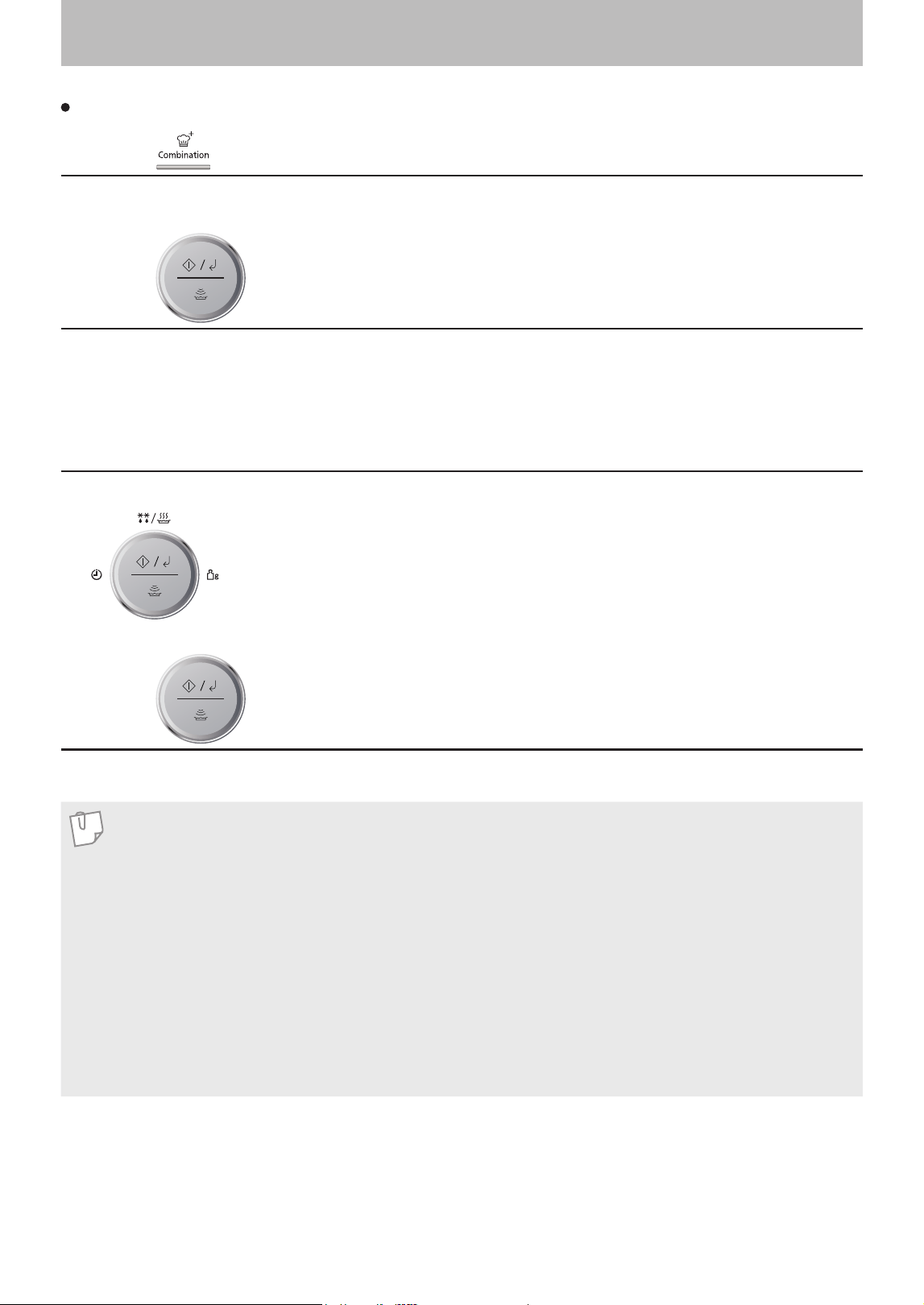
1. Press .
Press to select combination levels. (There is a choice of 4 levels available).
2. Press
to Preheat Oven.
A “P” will appear in the display window. When the oven is preheated the oven will beep and the “P” will ash.
Then open the door and place the food inside.
Note: Open the door using the door release, because if the Stop/Reset button is pressed the program may
be cancelled.
3. Enter Time.
Enter the cooking time by using the dial. (up to 9 hours)
4. Press .
The cooking time appears in the display window and begins to count down.
Notes
1. Do not use this program with less than 200 g of food.
2. Food is usually cooked uncovered.
3. You can change the cooking time during cooking if required. Turn dial to increase or decrease the
cooking time. Time can be increased/decreased in 1 minute increments, up to 10 minutes. Turning
the dial to zero will end cooking.
4. After pressing Start button, the selected temperature can be recalled and changed. Press
Convection button once to indicate the temperature in the display window. While the temperature is
recalled in the display window, you can change the temperature by pressing Convection button.
5. Foods should always be cooked until browned and piping hot.
6. The accessories and the surrounding oven will get very hot. Use oven gloves.
7. After cooking it is important that the accessories are removed for cleaning before re-use and that the
oven walls and floor are wiped with a cloth squeezed in hot soapy water to remove any grease. Do
not put accessories in the dishwasher.
– 31 –
To Cook on Combination by Time Setting
(continued)
Oven Accessories to Use
When using Combination cooking the glass tray should be in position and must have the enamel tray on top,
unless otherwise stated.
Items of food can be placed onto the wire rack on the enamel tray on the glass tray. Heatproof dishes of food
should be placed directly onto the enamel tray on the glass tray.
Joints and portions of meat should be placed on an upturned saucer on the enamel tray on the glass tray.
Alternatively they can be placed in a heatproof dish on the enamel tray on the glass tray.
Recipes using foil or metal containers e.g. cakes and pastries should be placed directly onto the enamel tray on
glass tray.
Containers to Use for Combination Feature
It is possible to use smooth seamed metal tins and foil containers on combination but they must be placed
directly onto the enamel tray on the glass tray. They must not be placed directly onto the wire rack, or arcing will
occur.
If you experience arcing, which is when you see blue sparks or hear crackling noises, the metal container is
unsuitable or you have insufficient food in the oven. You should stop the program immediately and change the
container or re-program to convection only.
Do not use plastic microwave containers on Combination programs (unless suitable for combination cooking).
Dishes must be able to withstand the heat of the top grill. Do not put dishes on wire rack directly under the grill,
place on enamel tray on glass tray.

– 32 –
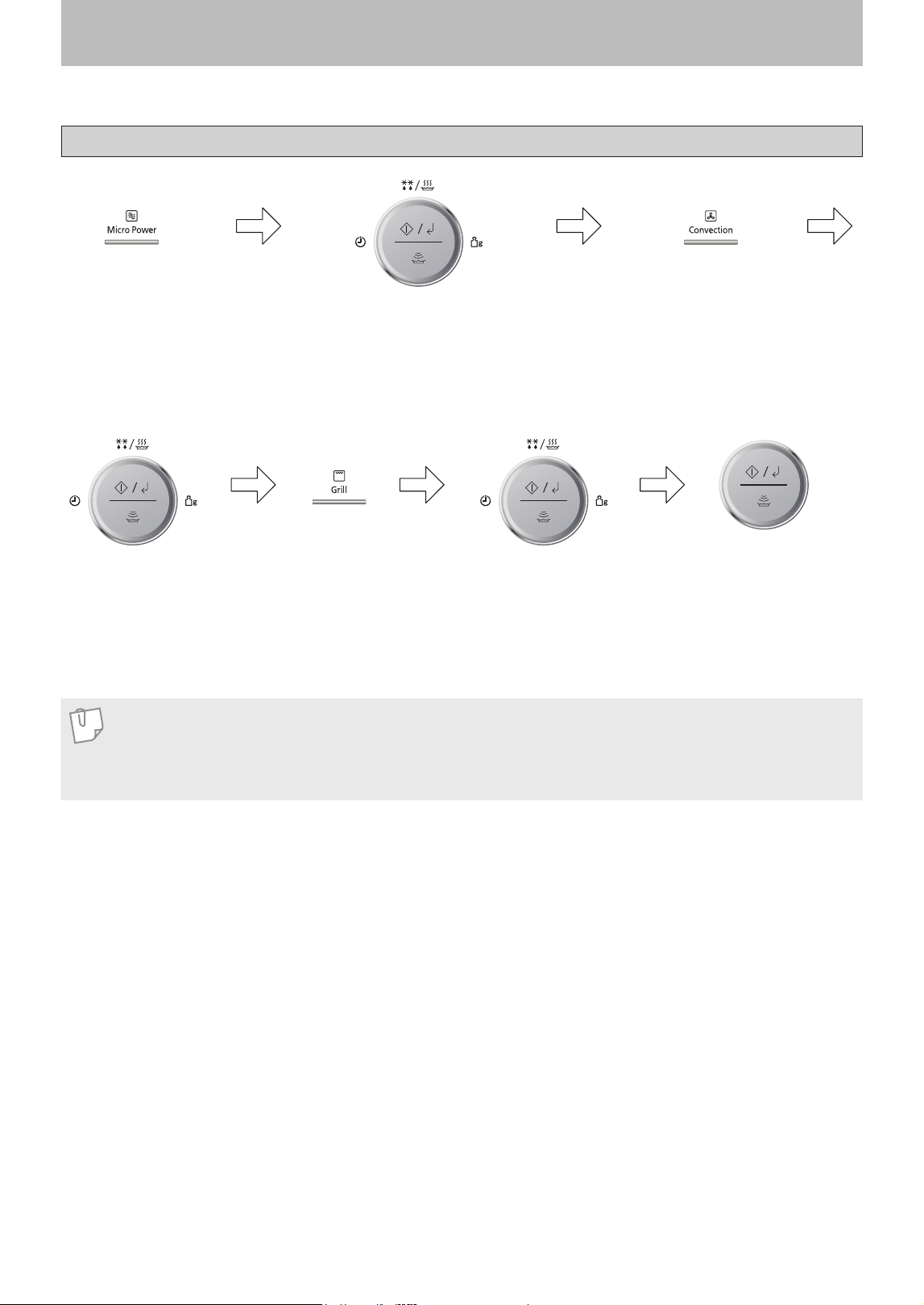
To Use Timer
(Kitchen Timer/Standing Time/Delay Start)
This feature allows you to program the oven as a kitchen timer. It can be also used to program a stand time after
cooking is completed or to program a delay start.
To Set Kitchen Timer.
Set desired amount of time by
using the dial. An “H” will appear
in the display to denote hours.
(up to 1 hour 30 minutes)
Press Start button.
Time will count down
without oven operating.
Press once.
To Set Standing Time:
Set desired amount of
time by using the dial.
An “H” will appear in the
display to denote hours.
(up to 1 hour 30 minutes)
Press Start button.
Cooking will start. After
cooking, standing time
will count down without
oven operating.
Press once.
Set the desired
cooking program.
(up to 2 stages)
To set Delay Start:
Set desired amount of time by
using the dial. An “H” will appear
in the display to denote hours.
(up to 1 hour 30 minutes)
Press Start button.
Cooking will start. After
cooking, standing time
will count down without
oven operating.
Press once.
Set the desired
cooking program.
(up to 2 stages)
Notes
1. If the oven door is opened during Kitchen Timer, Standing Time, Delay Start, the time in the display
window will continue to count down.
2. Standing Time and Delay Start can not be programmed together with Turbo Defrost and Auto
Programs and preheating. This is to prevent the starting temperature of food from rising before
defrosting or cooking begins. A change in starting temperature could cause inaccurate results.
3. When using Standing time or Delay Start, it’s up to 2 power stages.
4. If the programmed stand time exceeds one hour, the time will count down in units of minutes. If less
than one hour, the time will count down in units of seconds.
– 33 –
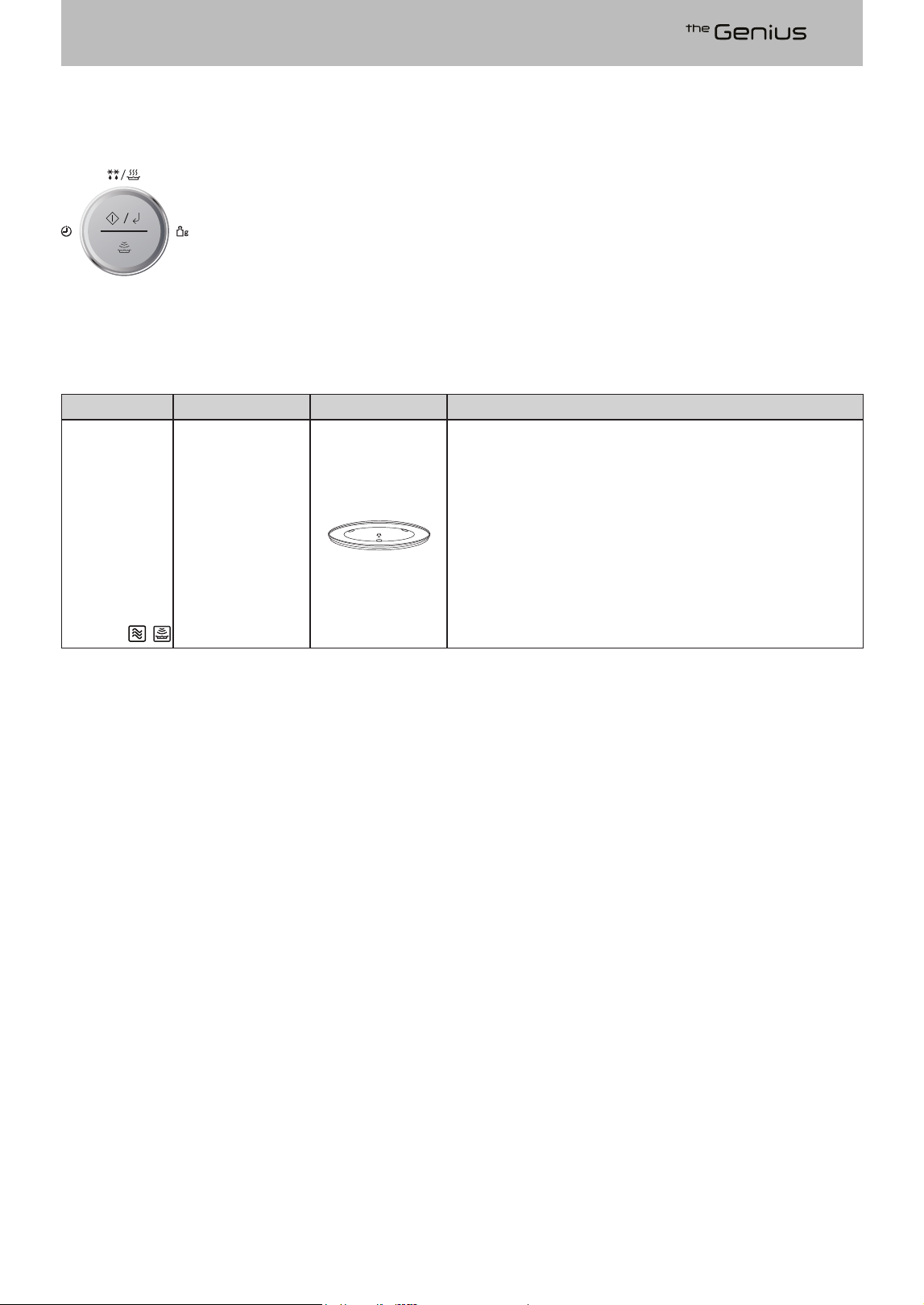
3-Stage Setting
This feature allows you to program 3-Stage continually.
E.g.: To cook on 600 W for 2 minutes, cook on 180 °C for 15 minutes and cook on Grill 1 for 10 minutes.
Press Micro Power
button 4 times to
select 600 W.
Press Convection
button 4 times to
select 180 °C.
Set the cooking time
to 2 minutes using
the dial.
Set the cooking
time to 15 minutes
using the dial.
Press Grill
button once to
select Grill 1.
Set the cooking
time to 10 minutes
using the dial.
Press Start button.
The cooking program will
start and the time in the
display will count down.
Notes
1. When operating, two beeps will sound between each stage.
2. Turbo Defrost, Auto Programs and preheating can not be used with 3-stages cooking.
3. Standing Time and Delay Start can be used in 3-stages cooking.
– 34 –
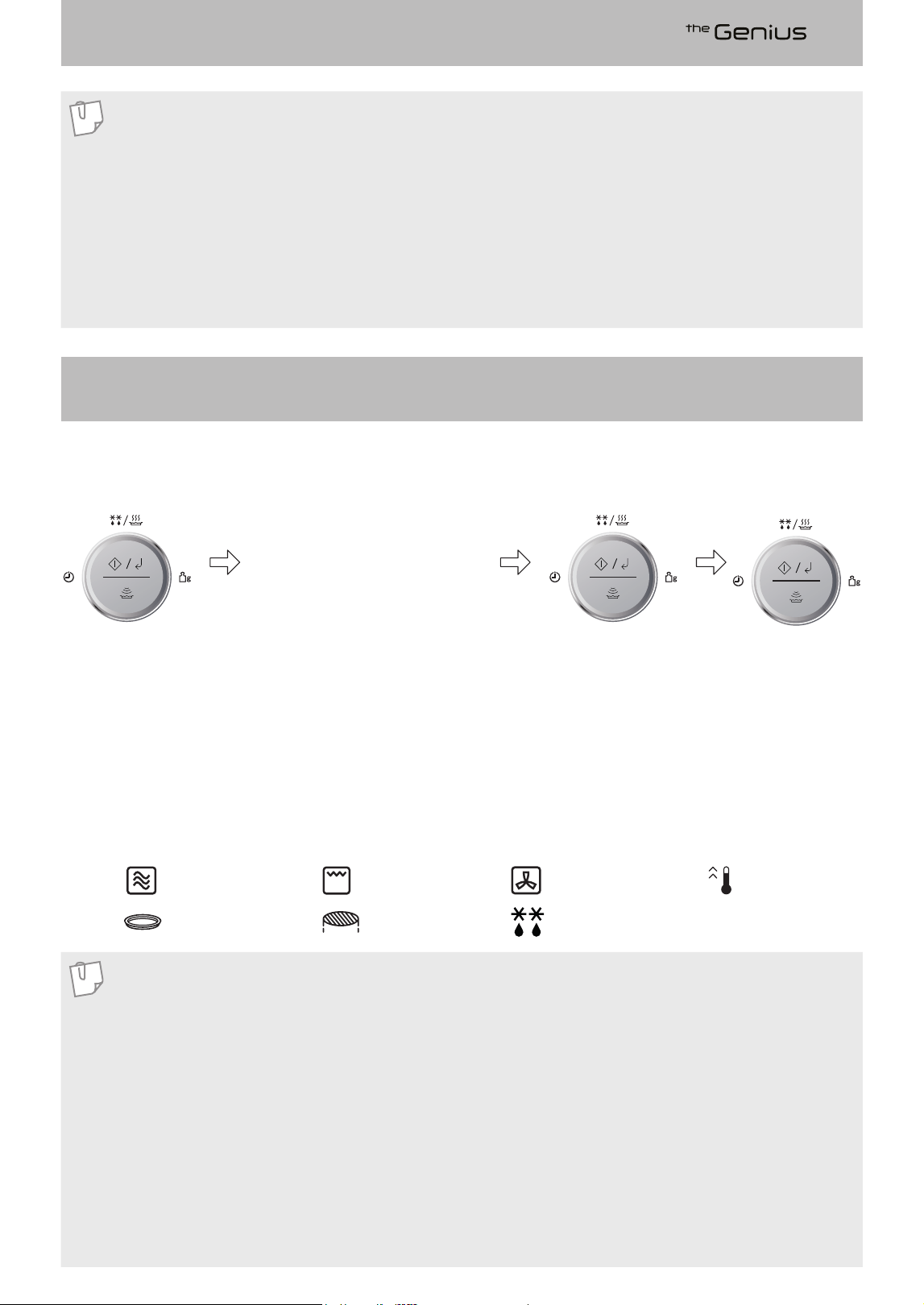
One Push Reheating
This unique feature ‘the Genius’ built in sensor allows you to reheat a chilled meal with one push of
the dial. It is not necessary to select the power level or cooking time. The built-in sensor measures the
humidity of the food and calculates the microwave power level together with a cooking time.
When clock mode is displayed,
press the dial to start. To reset
oven and return to clock mode,
press Stop/Reset.
Program Weight Accessories Instructions
Reheat a
fresh
pre-cooked
chilled meal
200-1000 g
All foods must be pre-cooked. Foods should be at
refrigerator temperature approx.+ 5 °C. Reheat in
microwavable container as purchased. Pierce covering
film with a sharp knife once in the centre and four times
around the edge.
If transferring food to dish, cover with pierced cling film.
Press dial to Start. Stir at beeps. Stir again at end of
program and allow a few minutes standing time.
Large pieces of meat/fish in a thin sauce may require
longer cooking. This program is not suitable for starchy
food such as rice, noodles or potatoes.
How it works
Once the One Push Reheating has been selected and Start is pressed the food is heated up. As food begins
to get hot, steam is emitted. When the food reaches a certain temperature and begins to cook, an even greater
amount of steam is released. The increase in steam emission is detected by a humidity sensor in the oven. This
acts as a signal for the oven to calculate how much longer the food needs to cook.
The remaining cooking time will appear in the display window after two beeps.
Whilst the Sensor program is still in the display window the oven door should not be opened. Wait until the
cooking time appears in the window, and then open the door if required, to stir or turn the food.
Adjust to Taste
The One Push Reheating reheats a chilled meal for average tastes. You are able to adjust the reheating
program to your own taste. After pressing Start, +/- symbol and flashing bar appears in the display, turn dial
clockwise for more time or anticlockwise for less time. This operation should be completed within 14 seconds.
Default mode is normal.
– 35 –
One Push Reheating
(continued)
Notes
1. This feature is not suitable for foods that cannot be stirred eg. lasagne / shepherds pie.
2. Do not reheat bread or pastry products (raw or uncooked), or beverages.
3. The oven automatically calculates the reheating time or the remaining reheating time.
4. The door should not be opened before the time appears in the display window.
5. To prevent any mistakes during One Push Reheating ensure that glass tray and the container are
dry.
6. The room temperature should not be more than 35 °C and not less than 0 °C.
7. If the oven has previously been used and it is too hot to be used on One Push Reheating, ‘HOT’ will
appear in the display window. After the ‘HOT’ disappears, the One Push Reheating may be used. If
in a hurry, cook food manually by selecting the correct cooking mode and cooking time yourself.
Auto Weight Program Setting
It is not necessary to preheat the oven for the remaining auto programs. Operate as below:
Auto Programs without Preheating
Select the weight of
the food by turning
the dial. Turning the
dial slowly will count up
in 10 g steps.
Press StartTo allow auto
program operation,
ensure the oven is in
Clock mode. Select
the desired Auto
Weight program by
turning the dial.
Pressthedialtoconrm
the program. Auto program
number appears in the display.
The microwave and /or grill or
convection and auto weight
symbols appear in the display
and frozen food symbol if
applicable.
When you select an automatic program symbols will appear in the display to show the cooking mode that will be
used and the accessories that are needed, in addition to the glass tray. These are what they mean:
Wire rack
Enamel tray
ConvectionGrillMicrowave
Frozen food
Preheat
Notes
The auto weight programs are designed to take the guesswork out of cooking or reheating your food.
They must only be used for the foods described.
1. Only cook foods within the weight ranges described (see page 37).
2. Only use the accessories as indicated on pages 38-40.
3. Beverage programs 2-4 and Junior programs 15-16, 21 use Microwave power only. Re-bake Bread
programs 5-6; Junior programs 17-20 and Combi programs 22-26 use a combination of Microwave
and Convection or Grill. Roast programs 27-30 use Convection.
4. Do not cover food unless stated, when using a Combination or Convection program, it will prevent
the food browning. The heat will also melt any plastic covering.
5. Most foods benefit from a standing time after cooking on an auto program, to allow heat to continue
conducting to the centre.
6. To allow for some variations that occur in food, check that food is thoroughly cooked and piping hot
before serving.
7. Always weigh the food rather than relying on the package weight information.
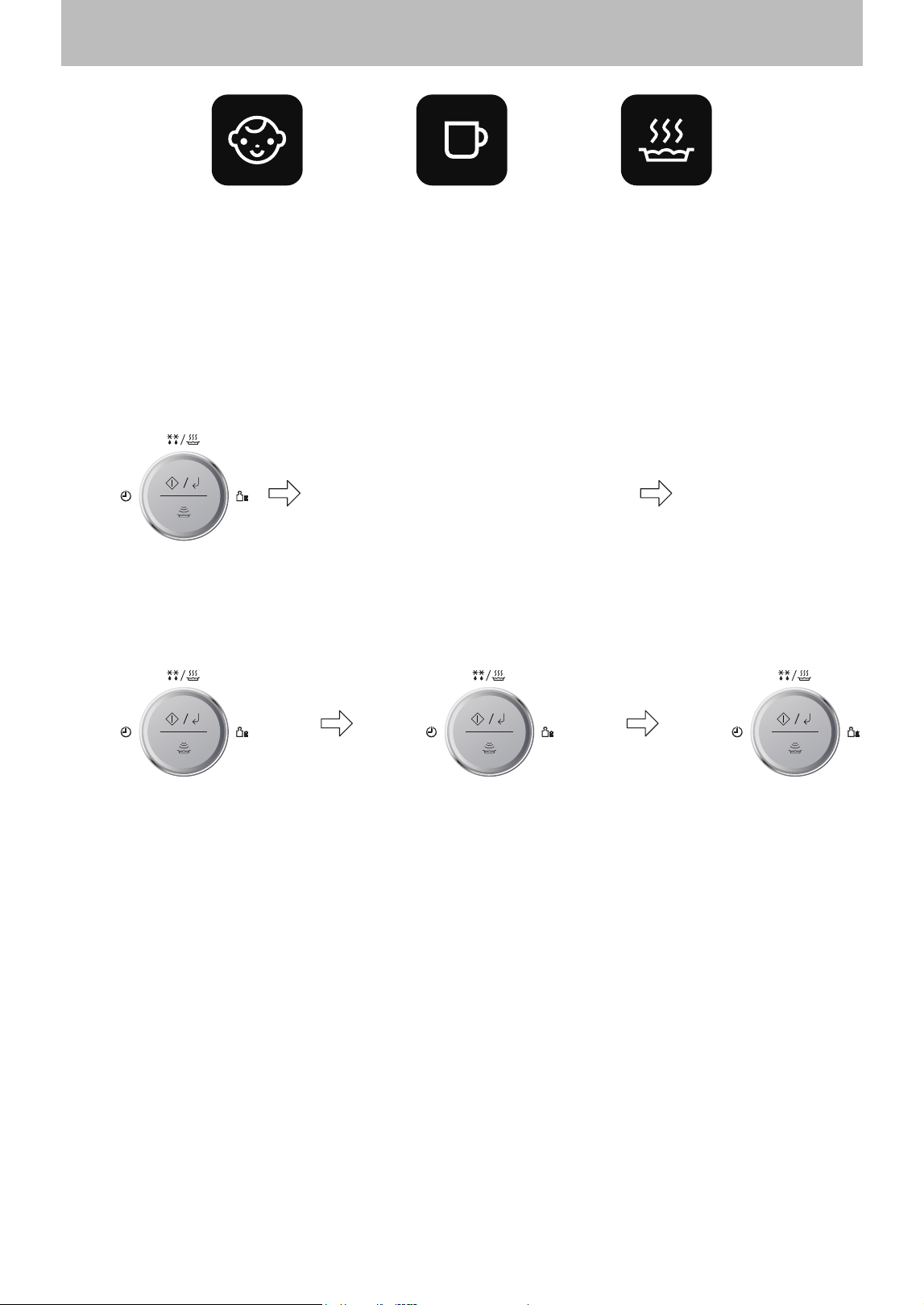
– 36 –
Auto Weight Program Setting
(continued)
This feature allows you to cook or reheat foods by setting the weight only. The oven determines the Microwave
power level and/or Convection and/or Combination setting, then the cooking time automatically. Select the
category of food and then just enter the weight. The weight will be entered in grams.
Auto Programs with Preheating
It is necessary to preheat the oven for Re-Bake Bread programs 5 (Baguette/Crusty Rolls), 6 (Croissants);
Junior Menu programs, 19 (Frozen Breaded Products), 20 (Fresh Vegetable Fries); Combi programs, 23 (Frozen
Potato Products), 25 (Fish and Chips), 26 (Whole Chicken).
Press dial to
preheat the oven.
Preheat with enamel
tray on glass tray.
After preheating, beeps sound and
‘P’ will ash in the display. Place the
food in the oven and set weight using
dial. Take care when handling the hot
enamel tray.
Press Start
To allow for Auto Weight
Program operation, ensure the
oven is in clock mode. Select
the desired program by turning
the dial. Refer to pages 38-40.
Pressdialtoconrmprogramselection.
Auto program number appears in the
display. The microwave and /or grill or
convection and auto weight symbols
appear in the display and frozen food
symbol if applicable.
– 37 –
Auto Weight Programs
Minimum/Maximum Weights for Auto Weight Programs
Program Minimum weight Maximum weight
2. Tea/Coffee 200 g 400 g
3. Milk/ Hot Chocolate/ Milky Coffee 200 g 600 g
4. Soup 200 g 1000 g
Program Minimum weight Maximum weight
5. Baguette/Crusty Rolls 100 g 500 g
6. Croissants 50 g 350 g
Program Minimum weight Maximum weight
15. Purée Vegetables 100 g 400 g
16. Purée Fruits 100 g 400 g
17. Junior Pasta Bake 250 g 800 g
18. Chilled Breaded Products 100 g 500 g
19. Frozen Breaded Products 100 g 500 g
20. Fresh Vegetable Fries 100 g 500 g
21. Mug Cake 1 mug
Program Minimum weight Maximum weight
22. Frozen Pizza 200 g 450 g
23. Frozen Potato Products 200 g 500 g
24. Roast Pork 500 g 2000 g
25. Fish and Chips 200 g 500 g
26. Whole Chicken 900 g 2000 g
27. Beef Rare 500 g 2000 g
28. Beef Medium 500 g 2000 g
29. Lamb Medium 1000 g 2000 g
30. Lamb Well Done 1000 g 2000 g
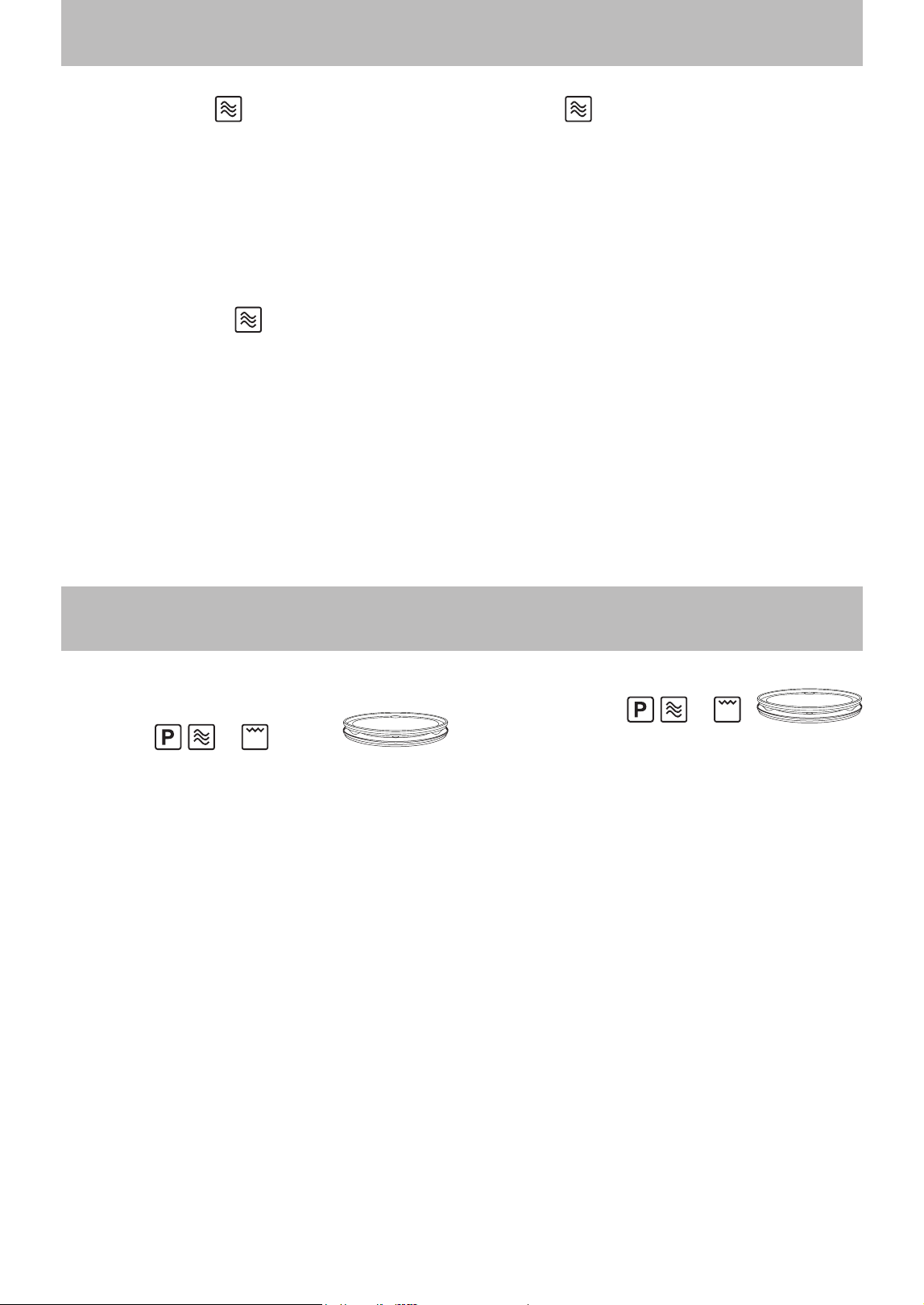
– 38 –
Auto Weight Beverage Programs Setting
2. Tea/Coffee
For reheating one beverage with a fixed weight of
200 g or two beverages of 200 g each from room
temperature eg. tea, coffee or hot chocolate. Turn
dial to select program 2, Tea/Coffee. Press the dial
to confirm the program. Select 200 g for 1 beverage
or 400 g for two beverages using the dial and press
Start. Stir before and after heating.
3. Milk/Hot Chocolate/
Milky Coffee
For reheating one mug of milk with a fixed weight of
200 g or one jug of milk with a fixed weight of 600 g
from fridge temperature. This program is suitable for
full fat, semi-skimmed and skimmed milk.
The hot milk can be used for making milky coffee or
hot chocolate. Turn the dial to select program 3, Milk/
Hot Chocolate/Milky Coffee. Press the dial to confirm
the program. Select 200 g for 1 mug or 600 g for 1
jug using the dial and press Start. Stir before and
after heating for one mug of milk. Stir at beeps during
heating for one jug of milk.
4. Soup
For reheating tetra, canned or homemade soups.
Soup should be at room or refrigerator temperatures.
Soup should be placed in a suitable sized
microwaveable bowl. It is preferable to cover with a
lid or plate or saucer. Turn the dial to select program
4, Soup. Press the dial to confirm the program. Turn
the dial to select weight and press Start. Stir before, at
beeps and after reheating. Final temperature of soup
may vary depending on thickness of soup, starting
temperature, sugar and fat content of soup.
Re-Bake Bread Programs
5. Baguette/Crusty
Rolls
+
To re-bake baguettes and crusty rolls. This program
is suitable for reheating, browning and crisping
pre-purchased baguettes and rolls from room
temperature. Ensure height of baguette/rolls is no
more than 5 cm. Turn the dial to select program 5,
Baguettes/Crusty Rolls. Press the dial to confirm
the program. Press Start to preheat the oven. After
preheating, beeps sound and ‘P’ will flash in the
display. Place baguette/crusty rolls on enamel tray
on glass tray. Turn the dial to enter weight and press
Start. After cooking place on a wire rack for a few
minutes.
6. Croissants
+
To re-bake croissants. This program is suitable for
reheating, browning and crisping pre-purchased
croissants from room temperature. Turn the dial to
select program 6, Croissants. Press the dial to confirm
the program. Press Start to preheat the oven. After
preheating, beeps sound and ‘P’ will flash in the
display. Place croissants on enamel tray on glass tray.
Turn the dial to enter weight and press Start. After
cooking, place on a wire rack for a few minutes.
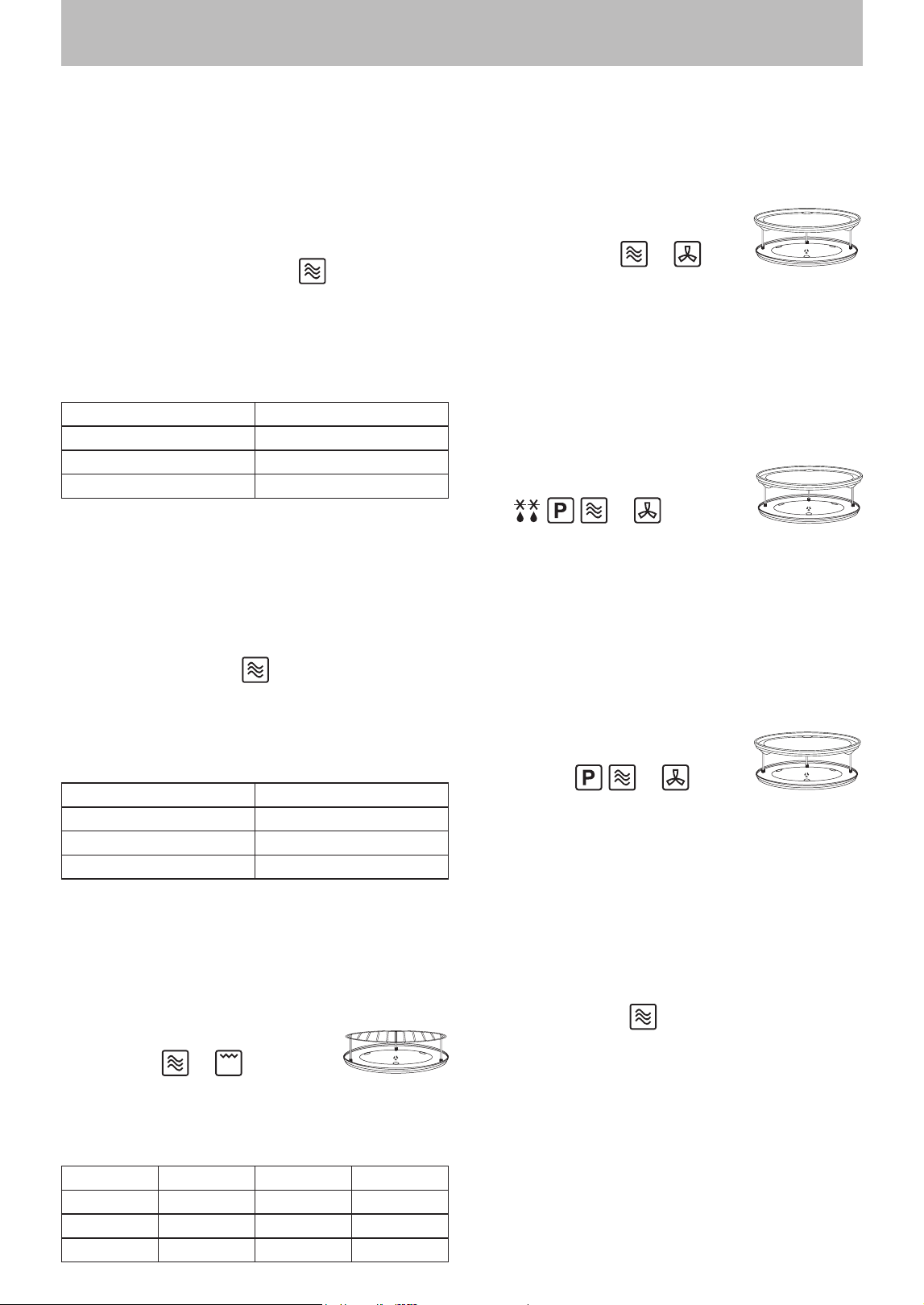
– 39 –
Junior menu programs
The Junior Menu offers a range of programs catering
for babies, toddlers and older children - great for time
saving and convenience. The fruit and vegetable
purées are ideal first foods for weaning babies.
Homemade purées taste like real food and cost less
than jars or packets. Extra portions can be frozen in
ice cube trays, then defrosted and reheated. Healthy
vegetable fries and pasta bakes are perfect for smaller
tummies. For operation refer to pages 35-36.
15. Purée Vegetables
This program is suitable for cooking parsnips,
potatoes, butternut squash, carrots, sweet potato and
swede. The cooked vegetables are then puréed and
suitable when weaning babies. Peel and chop the
vegetables into even sized pieces. Place in a Pyrex
®
dish. Add the following quantities of water:
Vegetables Water
100 g - 150 g 75 ml
155 g - 300 g 100 ml
305 g - 400 g 150 ml
Cover with lid. Turn the dial to select program 15, Purée
Vegetables. Press the dial to confirm the program.
Turn the dial to enter the weight of the vegetables.
Press Start button. Stir at beeps. After cooking allow
to stand for 10 minutes. Purée the vegetables with the
cooking liquid using a blender. If necessary adjust the
consistency with a little water to thin or baby rice to
thicken. Check the temperature before feeding.
16. Purée Fruits
This program is suitable for cooking apples, pears,
peaches, papaya and mango. The cooked fruit is then
puréed and suitable when weaning babies. Peel and
chop the fruit into even sized pieces. Place in a Pyrex
®
dish. Add the following quantities of water:
Fruit Water
100 g -150 g 75 ml
155 g - 300 g 100 ml
305 g - 400 g 150 ml
Cover with lid. Turn the dial to select program 16, Purée
Fruits. Press the dial to confirm the program. Turn the dial
to enter the weight of the fruit. Press Start button. Stir at
beeps. After cooking allow to stand for 10 minutes. Purée
the fruit with the cooking liquid using a blender. If necessary
adjust the consistency with a little water to thin or baby rice
to thicken. Check the temperature before feeding.
17. Junior Pasta
Bake +
For cooking fresh pasta bake using fresh pasta (penne,
spaghetti, fusilli), cheese or tomato based sauce and
grated mild cheddar cheese. Use a suitable square,
shallow Pyrex
®
container. Place on wire rack on glass
tray. Use the following quantities:
Pasta Sauce Cheese
250 g 70 g 140 g 40 g
500 g 150 g 300 g 50 g
800 g 250 g 500 g 50 g
Other ingredients may be added such as ham, tuna
and sweetcorn. In this case substitute some of the
sauce for the chosen added ingredients. Turn the dial
to select program 17, Junior Pasta Bake. Press the
dial to confirm the program. Turn the dial to enter the
weight - 250 g, 500 g or 800 g. Press Start button.
18. Chilled Breaded
Products
+
For preparing chilled breaded products such as
breaded chicken strips, fish goujons, popcorn chicken,
chicken bites or breaded chicken fillets. Turn the dial
to select program 18, Chilled Breaded Products. Press
the dial to confirm the program. Remove all packaging
and place the chilled breaded products on the enamel
tray on the wire rack. Turn the dial to enter weight of
food and Press Start button. Turn at beeps.
19. Frozen Breaded
Products
+
For preparing frozen breaded products such as frozen
popcorn chicken, frozen chicken nuggets, frozen
turkey drummers, frozen fish fingers, frozen scampi.
Turn the dial to select program 19, Frozen Breaded
Products. Press the dial to confirm the program. Press
Start to preheat the oven. After preheating, beeps
sound and ‘P’ will flash in the display. Remove all
packaging and place the frozen breaded products on
the enamel tray on the wire rack. Turn the dial to enter
weight of food and Press Start button. Turn at beeps.
20. Fresh Vegetable
Fries
+
For preparing fresh vegetable fries such as sweet
potato, white potato, carrots, parsnips and courgettes.
Peel and cut the vegetables into baton shapes. Toss
in a tablespoon of vegetable oil. Turn the dial to select
program 20, Fresh Vegetables Fries. Press the dial to
confirm the program. Press Start to preheat the oven.
After preheating, beeps sound and ‘P’ will flash in the
display. Place the vegetables on the enamel tray on
the wire rack. Turn the dial to enter weight of food and
Press Start button. Turn/Stir at beeps.
21. Mug Cake
For cooking one mug cake, either Chocolate Brownie,
Lemon or banana. Prepare the mug cake as in the
following recipes. Size of mug should be no smaller
than 300 ml. Turn the dial to select program 21, Mug
Cake. Press the dial to confirm the program. Press
Start. After cooking allow to stand for a few minutes
and serve warm in the mug with ice cream, custard or
cream.
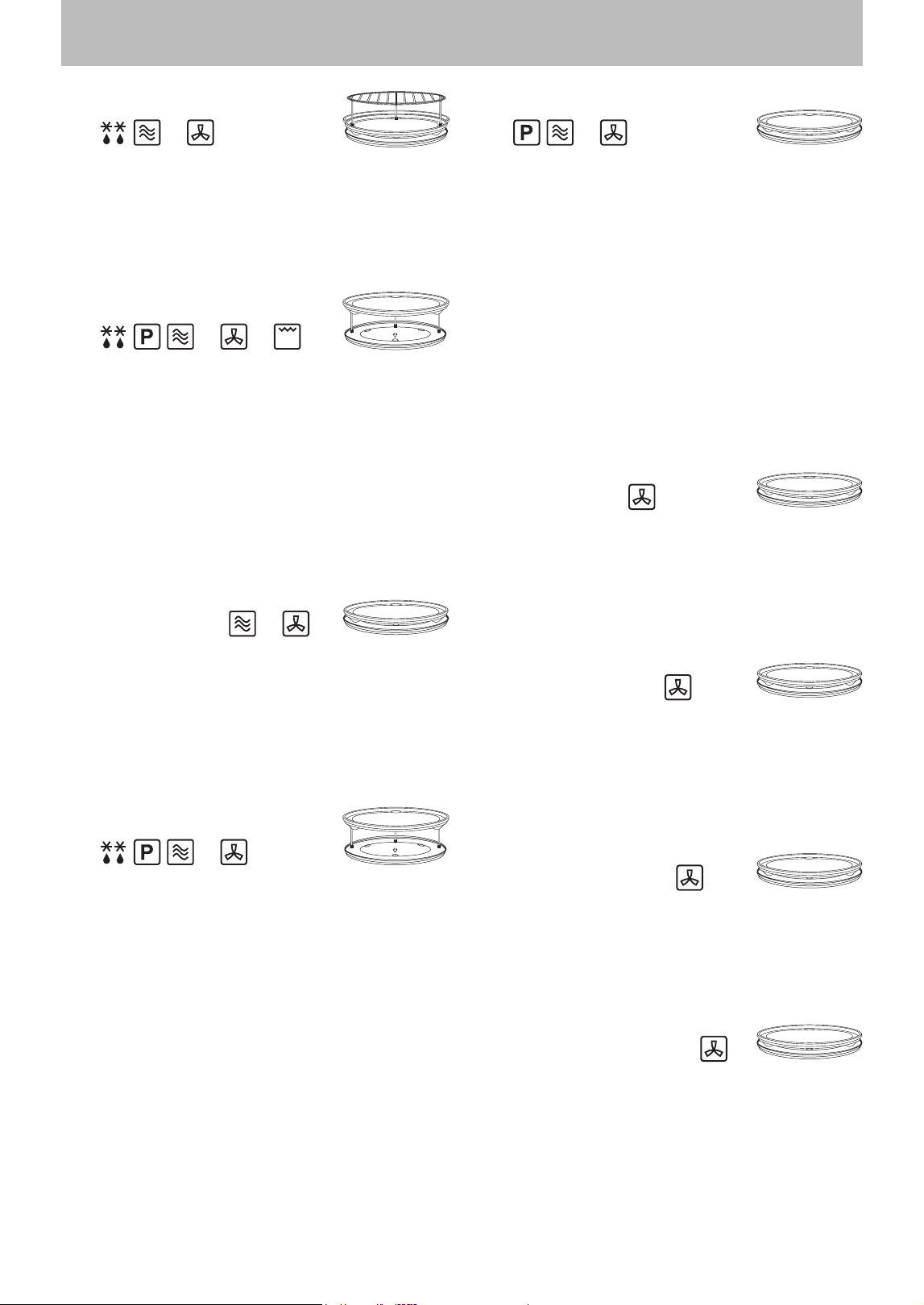
– 40 –
Auto Combi/Roast Programs Setting
22. Frozen Pizza
+
For reheating and browning frozen, purchased pizza.
Turn the dial to select program 22, Frozen Pizza.
Press the dial to confirm the program. Remove all
packaging and place pizza on wire rack on enamel
tray on glass tray. Turn the dial to enter weight and
press Start.
23.
Frozen Potato Products
+ +
To cook frozen potato products, e.g. hash browns,
croquettes, etc,. that are suitable for grilling. Turn the
dial to select program 23, Frozen Potato Products.
Press the dial to confirm the program. Press Start to
preheat the oven. After preheating, beeps sound and
‘P’ will flash in the display. Spread potato products
out on enamel tray on wire rack on glass tray. Turn
the dial to enter the weight. Press Start button. Turn
during cooking. For best results cook in a single layer.
Note: Potato products vary considerably. We suggest
checking a few minutes before the end of cooking to
assess levels of browning.
24. Roast Pork
+
Suitable for roasting joints of pork, leg, boned and
rolled loin, rib roast and shoulder. Score rind, brush
with lemon juice and rub liberally with salt. Place roast
rind side up on enamel tray and place on glass tray.
Turn the dial to select program 24, Roast Pork, enter
the weight of the food and press Start button. Turn
over at beeps. Do not use plastic wrap or lid.
25. Fish and Chips
+
This program is suitable for pre-purchased frozen
battered or breaded fish and pre-purchased frozen
oven chips. This program is suitable for 1 portion of
fish and chips. The fish must weigh between 100 g -
250 g and the chips must weigh between 100 g -
300 g. Turn the dial to select program 25, Fish and
Chips. Press the dial to confirm the program. Press
Start button to preheat the oven. After preheating,
beeps sound and ‘P’ will flash in the display. Spread
the fish and chips out on the enamel tray on wire rack
on glass tray. Turn the dial to enter the weight of the
fish and chips. Press Start button. Turn fish and chips
at the beeps. For best results cook in a single layer.
26. Whole Chicken
+
To cook whole fresh unstuffed chickens. Cook stuffing
separately. Turn the dial to select program 26, Whole
Chicken. Press the dial to confirm the program. Press
Start to preheat the oven. After preheating, beeps
sound and ‘P’ will flash in the display. Place chicken
on enamel tray and place on glass tray. Turn the
dial to enter the weight of the chicken, then press To
cook whole fresh unstuffed chickens. Cook stuffing
separately. Turn the dial to select program 25, Whole
Chicken. Press the dial to confirm the program. Press
Start to preheat the oven. After preheating, beeps
sound and ‘P’ will flash in the display. Place chicken on
enamel tray and place on glass tray. Turn the dial to
enter the weight of the chicken, then press Start button.
Start cooking breast side down and turn at beeps,
taking care with hot juices. Stand for 5 minutes.
27. Beef Rare
For cooking rare fresh roast beef (top side, rump or
silverside). Place on enamel tray on the glass tray.
Turn the dial to select program 27, Beef Rare. Press
the dial to confirm the program, Turn the dial to
enter the weight of the food and press Start button.
Turn over at beeps after cooking stand for 10 to 20
minutes.
28. Beef Medium
For cooking medium fresh roast beef (top side, rump
or silverside). Place on enamel tray on the glass tray.
Turn the dial to select program 28, Beef Medium.
Press the dial to confirm the program, Turn the dial to
enter the weight of the food and press Start button.
Turn over at beeps after cooking stand for 10 to 20
minutes.
29. Lamb Medium
For cooking medium fresh roast leg of lamb with bone.
Place on enamel tray on the glass tray. Turn the dial
to select program 29, Lamb Medium. Press the dial to
confirm the program. Turn the dial to enter the weight
of the food and press Start button. Turn over at beeps
after cooking stand for 10 to 20 minutes.
30. Lamb Well Done
For cooking well done fresh roast leg of lamb with
bone. Place on enamel tray on the glass tray. Turn the
dial to select program 30, Lamb Well Done. Press the
dial to confirm the program, Turn the dial to enter the
weight of the food and press Start button. Turn over at
beeps after cooking stand for 10 to 20 minutes.
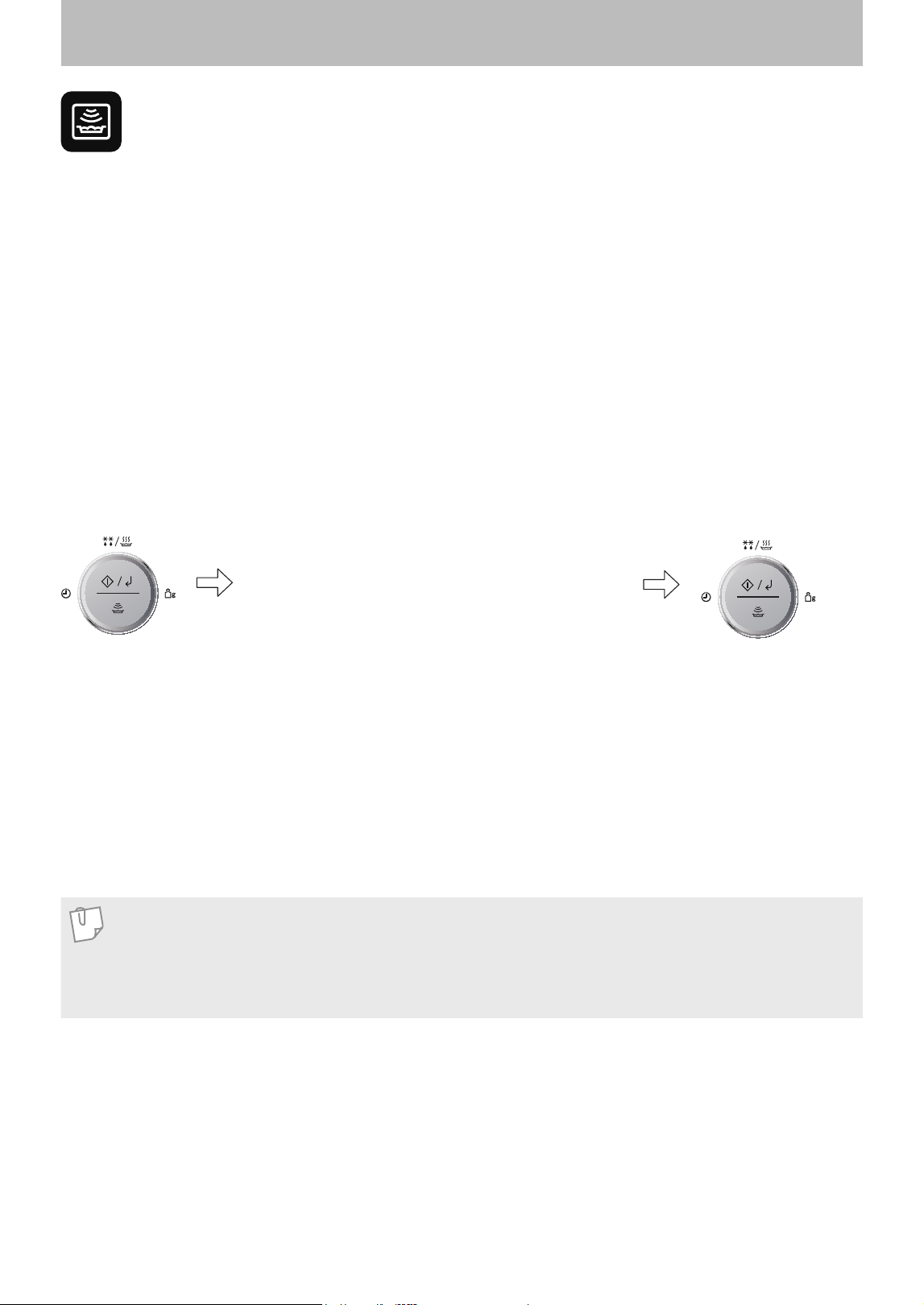
– 41 –
Auto Sensor Programs
This feature allows you to cook or reheat
foods without entering the weight. The built-in sensor
measures the humidity of the food and calculates the
recommended microwave power level together with a
suggested cooking time.
How it works
Once the food has been selected and Start pressed
the food is heated up. As food begins to get hot,
steam is emitted. When the food reaches a certain
temperature and begins to cook, an even greater
amount of steam is released. The increase in steam
emission is detected by a humidity sensor in the oven.
This acts as a signal for the oven to calculate how
much longer the food needs to cook.
The remaining cooking time will appear in the display
window after two beeps.
Whilst the Sensor program is still in the display
window the oven door should not be opened. Wait
until the cooking time appears in the window, and then
open the door if required, to stir or turn the food.
Adjust to Taste
The Sensor programs cook foods for average tastes. You are able to adjust the cooking programs to your own
taste. After pressing Start, turn dial clockwise for more time or anti- clockwise for less time. This operation
should be completed within 14 seconds. Default mode is normal.
To allow Auto Program
operation, ensure the
oven is in clock mode.
Select desired Auto Sensor
Program by turning the dial.
Press the dial to confirm the program.
Auto program number appears in the
display. The microwave and sensor
auto symbols appear in the display and
frozen food symbol if applicable.
Press Start. The food category will
be repeated in the display window
until the oven calculates the cooking
time after detecting a burst of steam.
Do not open the oven door until the
remaining cooking time appears in the
display window.
Notes
For best results the Sensor programs should only be used when the oven is cold. It is recommended
that the oven is allowed to cool between using the sensor programs, if one or more programs are being
used. If in a hurry, cook the food manually i.e. select the correct power level and cooking time. It is not
recommended to keep using the Auto Sensor Programs consecutively.
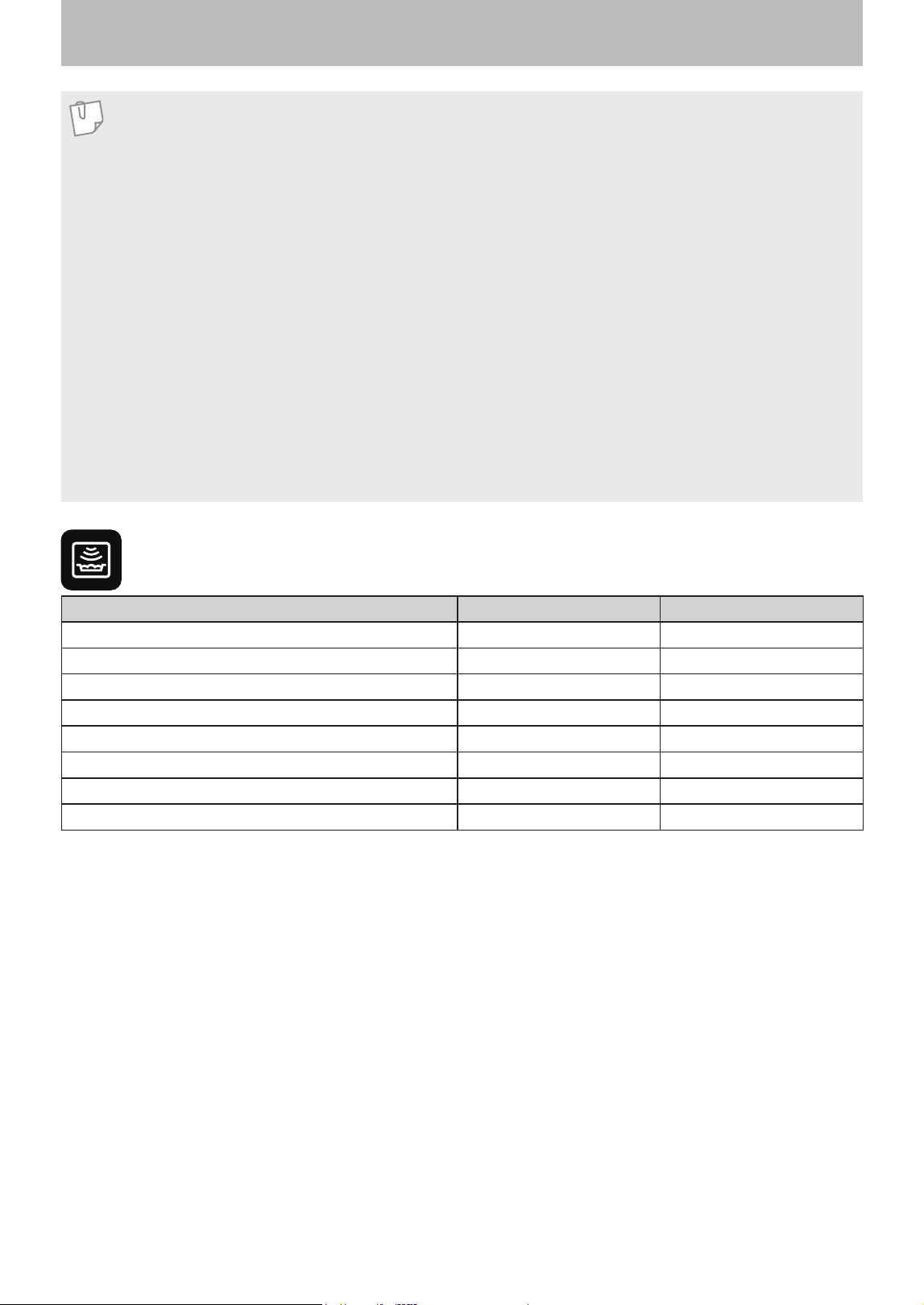
– 42 –
Auto Sensor Programs
(continued)
Notes
1. For the Auto Sensor Programs it is not necessary to enter the weight of the food. They must only be
used for foods described.
2. Only cook foods within the weight ranges described (See table below).
3. Only use the accessories as indicated on pages 43.
4. It is essential when using the auto sensor programs to cover the food.
The exception to this rule is jacket potatoes (see page 43). For auto sensor programs fresh
vegetables, frozen vegetables, fresh fish, cover with cling film. Pierce the cling film with a sharp knife
once in the centre and four times around the edge. For auto sensor program casserole, cover with a
lid.
5. For foods covered with cling film, pierce the film with a sharp knife, once in the centre and four times
around the edge. If the cling film is not pierced, steam can not escape and this could result in over
cooking.
6. Always choose a container size that is suitable for the quantity of food, ie. do not allow a large
headspace or food may not be cooked correctly.
7. For best results ensure that the oven is cold before using any Sensor program.
8. Most foods benefit from a standing time, after cooking on an Auto Program, to allow heat to
continue conducting to the centre.
9. To allow for some variations that occur in food, check that food is thoroughly cooked and piping hot
before serving.
Program Minimum weight Maximum weight
7. Fresh Vegetables 200 g 1000 g
8. Frozen Vegetables 200 g 800 g
9. Jacket Potatoes 200 g 1500 g
10. Casserole 900 g 2000 g
11. Fresh Fish 200 g 800 g
12. Rice 100 g 400 g
13. Dried Pasta 100 g 500 g
14. Fresh Pasta 200 g 800 g
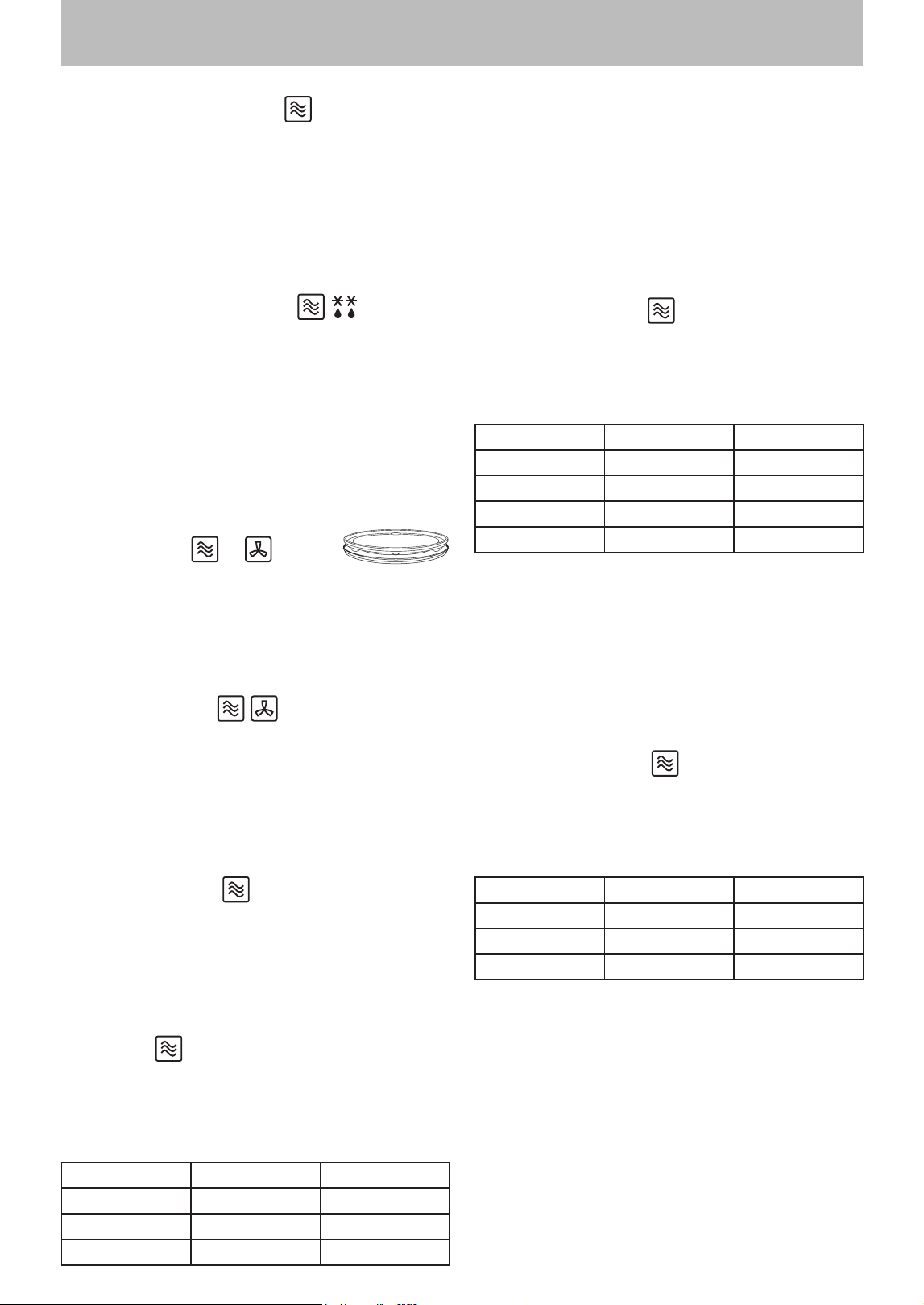
– 43 –
Auto Sensor Programs
(continued)
7. Fresh Vegetables
To cook fresh vegetables. Place prepared vegetables
into a suitable sized container.
Sprinkle with 1 tbsp water per 100 g vegetables. Cover
with cling film. Pierce cling film with a sharp knife once
in the centre and four times around the edge. Turn the
dial to select program 7, Fresh Vegetables. Press the
dial to confirm the program. Press Start button. Stir at
beeps. Drain after cooking and season to taste.
8. Frozen Vegetables
To cook frozen vegetables. Place vegetables into a
suitable sized container. Sprinkle with 1-3 tbsp water.
If cooking vegetables with high water content, such
as spinach or tomatoes, do not add water. Cover with
cling film. Pierce cling film with a sharp knife once in
the centre and four times around the edge. Turn the
dial to select program 8, Frozen Vegetables. Press the
dial to confirm the program. Press Start button. Stir at
beeps. Drain after cooking.
9. Jacket
Potatoes
+
To cook jacket potatoes with a crisper drier skin. Choose
medium sized potatoes 200 g - 250 g (7 oz - 9 oz), for
best results. Wash and dry potatoes and prick with a fork
several times. Place on enamel tray on glass tray. Turn
the dial to select program 9, Jacket Potatoes. Press the
dial to confirm the program. Press Start button.
10. Casserole
For cubed meat (e.g. braising steak, lamb, pork, not
chicken) and vegetables. Place in a suitable sized
casserole dish with stock. Use a minimum of 400 ml of
stock. If you use a cook-in sauce, also add the same
quantity of water. Cover with lid. Turn the dial to select
program 10, Casserole. Press the dial to confirm the
program. Press Start button. Stir at beeps.
11. Fresh Fish
To cook fresh fillets or steaks of fish. Place in a suitable
sized container, add 2 tbsp (30 ml) water. Cover with
cling film. Pierce cling film with a sharp knife once in the
centre and four times around the edge. Turn the dial to
select program 11, Fresh Fish. Press the dial to confirm
the program. Press Start button.
12. Rice
It is suitable for cooking short and long grain rice including
specialty rice. It is not suitable for cooking brown rice
or wild rice. Place rice with water at room temperature
in a suitable microwave safe dish. We recommend the
following proportions of rice to cold tap water:
Rice Water Dish size
100 - 200 g
200 - 350 ml 3 L
210 - 300 g
350 - 550 ml 3.25 L
310 - 400 g
550 - 700 ml 4 L
It may be necessary to adjust the water to your
personal preference. Soak in water for 10-15
minutes. Always allow at least ½ depth of volume for
evaporation to prevent boiling over. Do not cook rice
in plastic dishes as incorrect cooking times may result.
Cover partially with lid and place container at the
center of the glass tray. Turn the dial to select program
12, Rice. Press the dial to confirm the program. Press
Start button. Stir at beeps, at the end of the cooking,
let stand 5 to 10 minutes, covered.
13. Dried Pasta
It is suitable for cooking a variety of pastas such as
spaghetti, fettuccine, tagliatelle, macaroni, penne,
spiral and various pasta shapes. Place pasta in an
appropriate size microwave safe dish with boiling
water. Use the below chart as a guide:
Pasta Boiling water Dish size
100 - 200 g
1 - 1.2 L 3 L
210 - 300 g
1.2 - 1.5 L 3.5 L
310 - 400 g
1.5 - 1.8 L 4 L
410 - 500 g
1.8 - 2 L 5 L
Always allow at least ½ depth of volume for
evaporation to prevent boiling over. Add 1 tablespoon
of oil, if desired, before cooking to prevent pasta from
sticking together. Cover securely with lid and place
container at the center of the glass tray. Turn the dial
to select program 13, Dried Pasta. Press the dial to
confirm the program. Press Start button. At the end of
the cooking, cover and let stand for 5 to 10 minutes, if
required, before draining.
14. Fresh Pasta
Suitable for cooking fresh pasta such as fettuccine,
tagliatelle, tortellini, ravioli and agnolotti. (Gnocchi
should be cooked by manual MICRO POWER.) Place
pasta in an appropriate size dish with boiling water.
Use the below chart as a guide:
Pasta Boiling water Dish size
200 - 300 g
1 - 1.25 L 3 L
310 - 400 g
1.25 - 2 L 3.5 L
410 - 500 g
2 - 2.5 L 4 L
Add 1 tablespoon of oil, if desired, before cooking to
prevent pasta from sticking together. Cover dish
securely with plastic wrap. Turn the dial to select
program 14, Fresh Pasta. Press the dial to confirm
the program. Press Start button. At the end of the
cooking time, cover and let stand for 5 to 10 minutes,
if required, before draining.
– 44 –
INGREDIENT CONVERSION CHART
INGREDIENT CONVERSION CHART
¼
cup 60 ml
¼
teaspoon 1 ml
⅓
cup 85 ml
½
teaspoon 2 ml
½
cup 125 ml 1 teaspoon 5 ml
⅔
cup 165 ml 2 teaspoons 10 ml
¾
cup 190 ml 3 teaspoons 15 ml
1 cup 250 ml 1 tablespoon 20 ml
1
¼
cups 310 ml 1
½
tablespoons 30 ml
1
½
cups 375 ml 2 tablespoons 40 ml
2 cups 500 ml 3 tablespoons 60 ml
3 cups 750 ml 4 tablespoons 80 ml
3
½
cups 875 ml
4 cups 1 litre
6 cups 1.5 litre
8 cups 2 litre
All recipes are tested using standard measurement that appear in the above chart.
– 45 –
Before Requesting Service
ALL THESE THINGS ARE NORMAL:
The oven causes
interference with my TV.
Some radio, TV, Wi-Fi, cordless telephone, baby monitor, blue tooth
or other wireless equipment interference might occur when you cook
with the oven. This interference is similar to the interference caused
by small appliances such as mixers, vacuums, blow dryers, etc. It
does not indicate a problem with your oven.
Steam accumulates on the
oven door and warm air comes
from the oven vents.
During cooking, steam and warm air are given off from the food.
Most of the steam and warm air are removed from the oven by the
air which circulates in the oven cavity. However, some steam will
condense on cooler surfaces such as inside and/or on the oven door.
This is normal and safe. Steam will disappear after the oven is cool
down.
I accidentally operate my
microwave oven without any
food in it.
Operating the oven empty for a short time will not damage the oven.
However, we do not recommend this to be done.
There are humming and
clicking noises from my oven
when I cook by Combination.
These noise occur as the oven automatically switch the Grill or
Convection. This is normal.
The oven has an odour and
generates smoke when using
Combination, Convection and
Grill function.
It is essential that your oven is wiped out regularly particularly after
cooking by Combination, Convection and Grill function. Any fat and
grease that builds up on the roof and walls of the oven will begin to
smoke if not cleaned.
Some smoke will be given off
from the cavity when using grill,
Combination, Convection and
Grill for the first time.
It caused by the excessive oil in the cavity and oil used for rust
protection volatilizing.
– 46 –
Before Requesting Service
(continued)
PROBLEM POSSIBLE CAUSE REMEDY
Oven will not turn on.
The oven is not plugged in
securely.
Remove plug from outlet, wait
10 seconds and re-insert.
Circuit Breaker or fuse is tripped
or blown.
Reset circuit breaker or replace fuse.
There is a problem with the
outlet.
Plug another appliance into the outlet
to check if the outlet is working.
Oven will not start
cooking.
The door is not closed
completely.
Close the oven door securely.
Start button was not pressed
after programming.
Press Start button.
Another program has already
been entered into the oven.
Press Stop/Reset button to cancel
the previous program and program
again.
The program has not been
entered correctly.
Program again according to the
Operating Instructions.
Stop/Reset button has been
pressed accidentally.
Program oven again.
When the oven is turning
on, there is noise coming
from Glass Tray.
The roller ring and oven bottom
are dirty.
Clean these parts according to care
of your oven (See next page).
“H97” or “H98”, “H00”
appears in the display
window.
This display indicates a problem
with the microwave generation
system.
Contact the authorised service
centre.
“DEMO MODE PRESS
ANY KEY” or “D” appears
in the display window.
The oven is under demonstration
mode.
Press Micro Power button once,
then press Start button 4 times and
Stop/Reset button 4 times.
The “
” appears in the
Display Window.
The Child Lock was activated by
pressing Stop/Reset button 3
times.
Deactivate Lock by pressing Stop/
Reset button 3 times.
“HOT” appears in the
display window.
The fan is operating to cool the
electric components.
The word “COOL” will disappear after
the fan stops.
Demonstration mode is designed for retail store display. Cooking and other functions will not operate during the
demonstration mode. If it seems there is a problem with the oven, contact an authorized Service Centre.
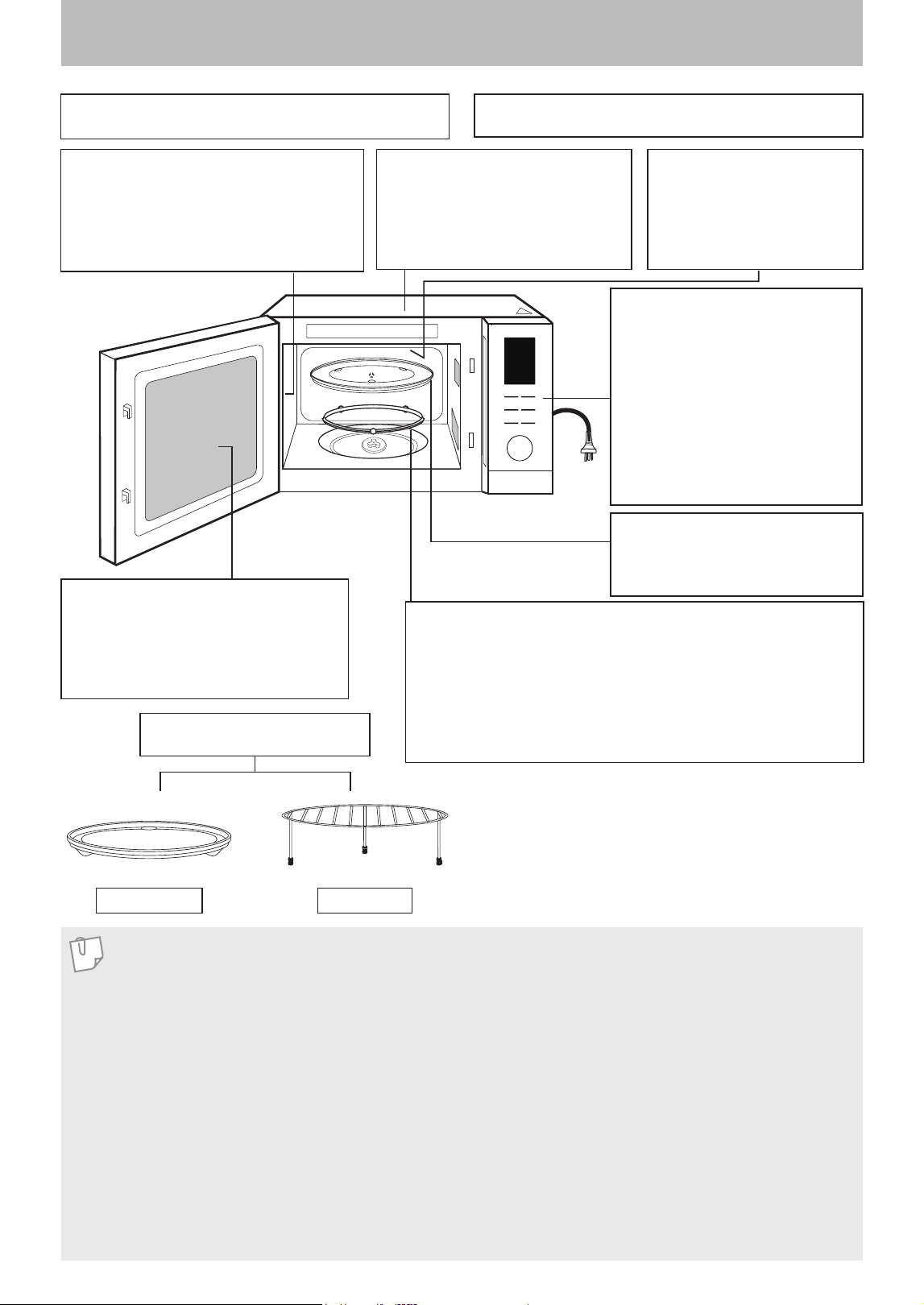
– 47 –
Care of your Microwave Oven
Turn the oven off and remove the power plug from
the wall socket before cleaning.
If steam accumulates inside or around
the outside of the oven door, wipe with
a soft cloth. This may occur when the
microwave oven is operated under
high humidity conditions and in no way
indicates malfunction of the unit.
Wire RackEnamel Tray
The outside oven surfaces should
be cleaned with a damp cloth. To
prevent damage to the operating
parts inside the oven, water
should not be allowed to seep into
the ventilation openings.
Do not allow the Control Panel
to become wet. Clean with a
soft, damp cloth. Do not use
detergents, abrasives or spray on
cleaners on the Control Panel.
When cleaning the Control Panel,
leave oven door open to prevent
oven from accidentally turning
on. After cleaning press Stop/
Reset button to clear display
window.
Clean the upper heater after
it is completely cold. Wipe
with a soft and damp cloth
carefully to avoid breaking
the heater and hurting your
fingers by the broken heater.
After using, clean it with a mild
detergent or dishwasher.
Notes
1. When using the Grill, Convection or Combination mode, some foods may inevitably splatter grease
on to the oven walls. If the oven is not cleaned, occasionally it may start to “smoke” during use. These
marks will be more difficult to clean later.
2. After Grill, Convection or Combination cooking, the ceiling and walls of the oven should be cleaned
with a soft cloth squeezed in soapy water. Particular care should be taken to keep the window
area clean particularly after cooking by Grill, Combination. Stubborn spots inside the oven can be
removed by using a small amount of microwave oven cleaner sprayed onto a soft damp cloth. Wipe
onto problem spots, leave for recommended time and then wipe off. This method can not be used to
clean the oven door.
DO NOT SPRAY DIRECTLY INSIDE THE OVEN.
A steam cleaner is not to be used for cleaning.
3. Failure to maintain the oven in a clean condition could lead to deterioration of the surface that could
adversely affect the life of the appliance and possibly result in a hazardous situation.
4. When it becomes necessary to replace the oven light, please consult the service center specified by
Panasonic.
The oven should be cleaned regularly and any food
deposits removed.
It is occasionally necessary
to remove the glass tray for
cleaning. Wash the tray in warm
sudsy water or in a dishwasher.
The roller ring and oven cavity floor should be cleaned
regularly to avoid excessive noise. Simply wipe the bottom
surface of the oven with mild detergent, water or window
cleaner and dry. The roller ring may be washed in mild sudsy
water or dish washer. Cooking vapors collect during repeated
use but in no way affect the bottom surface or roller ring
wheels. When removing the roller ring from cavity floor for
cleaning, be sure to replace in the proper position.
Keep the inside of the oven clean. When
food splatters or spilled liquids adhere to
oven walls, wipe with a damp cloth. Mild
detergent may be used if the oven gets
very dirty. The use of harsh detergent or
abrasives is not recommended.
– 48 –
TechnicalSpecications
Model
NN-CD87KS
Power Supply: 230 - 240 V, 50 Hz
Power Consumption*: Microwave 4.8 A 1110 W
Grill 5.7 A 1350 W
Combination
8.9 A 2130 W
Convection
5.7 A 1350 W
Power Requirement: (Maximum) 2130 W
Output power*: Microwave 1000 W
Grill 1300 W
Convection 1300 W
Outside Dimensions W × H × D (mm)
380
(W) × 228.4 (H) × 390 (D)
Oven Cavity Dimensions W × H × D (mm)
560
(W) × 343 (H) × 450 (D)
Overall Cavity Volume: 34 L
Operating Frequency: 2450 MHz
Net Weight Approx. 17.7 kg
* IEC Test Procedure
Specifications subject to change without notice.
As for the voltage requirement, the production date, manufactory and serial number, please refer to the name
plate on the microwave oven.
– 49 –
Panasonic Warranty
(for Australia)
– 50 –
Panasonic Warranty
(for New Zealand)