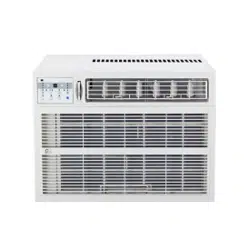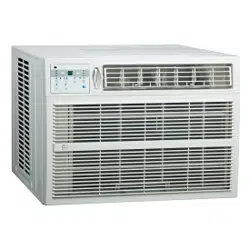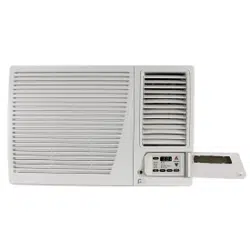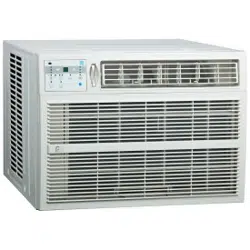
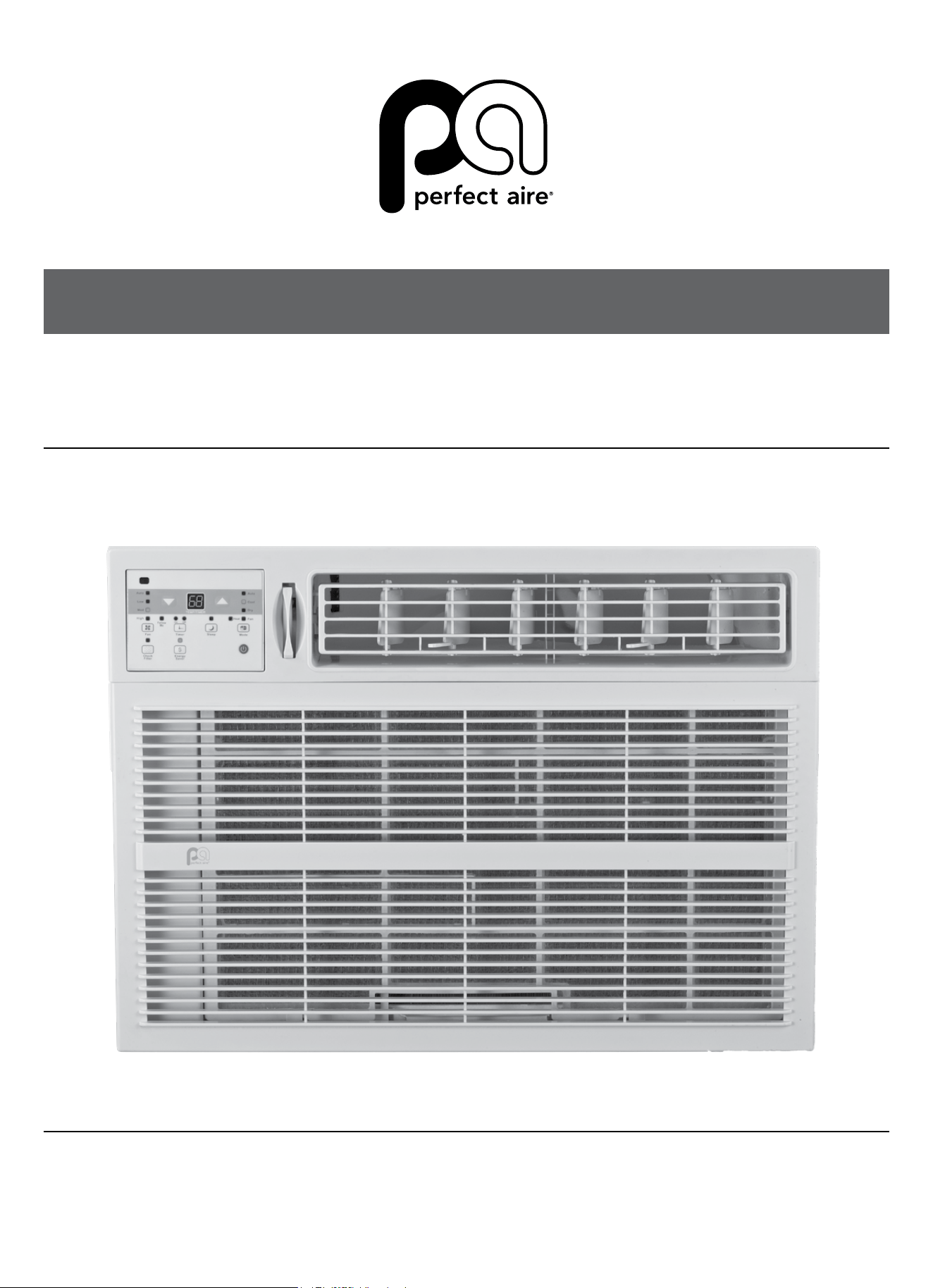
WINDOW AIR CONDITIONER
WITH SUPPLEMENTAL HEAT
MODELS 4PACH18000, 4PACH25000
OWNER’S MANUAL
For your own records, please attach a copy of your sales receipt to this manual and complete the following:
Model Number: _____________________________________ Serial Number: _______________________________________
Purchase Date: ____________________________________ Store Purchased: _____________________________________
Installation Date: ___________________________________ Installation Co.: _______________________________________
Installer Name: _____________________________________ Installer Phone No.: ___________________________________
CONSUMER PRODUCT INFORMATION
The design and specications are subject to change without prior notice for
product improvement. Consult with the sales agency or manufacturer for details.
SAFETY PRECAUTIONS .....................................................................1
IMPORTANT SAFETY INSTRUCTIONS ...........................................11
INSTALLATION INSTRUCTIONS .....................................................12
NORMAL SOUNDS ...........................................................................18
AIR CONDITIONER FEATURES .......................................................18
CARE AND CLEANING ....................................................................21
TROUBLESHOOTING .......................................................................22
CONTENTS
This manual provides the information needed for proper use and maintenance
of this air conditioner. Basic preventative care can help extend the life of
this unit. The “Troubleshooting” section in this manual contains a chart with
solutions to the most common problems. Referring to this section may save
time and prevent the need for a service call in the event of a problem.
CAUTIONS
● Contactanauthorizedservicetechnicianforrepairormaintenanceofthisunit.
● Contactaninstallerforinstallationofthisunitifnecessary.
● Theairconditionerisnotintendedforusebyyoungchildrenwithoutadultsupervision.Youngchildrenshouldbe
supervised to ensure that they do not play with the air conditioner.
● Disabledpersonsmayrequireassistancewithsetup.
● Ifthepowercordistobereplaced,replacementworkshouldbeperformedbyauthorizedpersonnelonly.
● Installationandrepairworkmustbeperformedinaccordancewiththenationalwiringstandardsbyauthorized
personnel only.
● Donotoperateyourairconditionerinawetroomsuchasabathroomorlaundryroom.
NOTE:Alltheillustrationsinthismanualareforexplanationpurposesonly.Unitpurchasedmaybeslightlydierent.
Thedesignandspecicationsaresubjecttochangewithoutpriornoticeforproductimprovement.ContactConsumer
Services at 844-472-2473 for details.
1
WARNINGS
Plug in power cord properly. Failuretodosomaycauseelectricshockorredueto
excess heat generation.
DO NOT operate or stop the unit by inserting or pull-
ing out the power plug directly from the wall.
Doingsomaycauseelectricshockorredueto
heat generation.
DO NOT use a damaged power cord.
Doingsomaycauseelectricshockorre.Ifthepower
cord is damaged, it must be replaced by the manufactur-
eroranauthorizedservicecenterorasimilarlyqualied
personinordertoavoidahazard.
DO NOT modify power cord length or share the
outlet with other appliances.
Doingsomaycauseelectricshockorredueto
heat generation.
DO NOT operate with wet hands or in
damp environment.
Doingsomaycauseelectricshock.
DO NOTdirectairowdirectlyatroomoccupants.
This could cause health issues.
Alwaysensureeectivegrounding. Incorrectgroundingmaycauseelectricshock.
DO NOT allow water to run into electric parts.
Doingsomaycausefailureofmachineorelectricshock.
Alwaysinstallcircuitbreakerandadedicated
power circuit.
Incorrectinstallationmaycausereandelectricshock.
Always unplug the unit if strange sounds, smell or
smokecomesfromtheunit.
Failuretodosomaycausereandelectricshock.
DO NOTusethesocketifitislooseordamaged.
Doingsomaycausereandelectricshock.
DO NOT open the unit during operation.
Doingsomaycauseelectricshock.
DO NOTuserearmsnearunit.
Doingsomaycausere.
DO NOT use the power cord close to
heating appliances.
Doingsomaycausereandelectricshock.
DO NOT disassemble, modify, or drill holes into
the air conditioner.
Doingsomaycausefailureandelectricshockandvoid
the manufacturer’s warranty.
Ventilate room before operating air conditioner if
thereisagasleakfromanotherappliancesuchas
a stove.
Failuretodosomaycauseexplosion,reandburns.
DO NOT
usethepowercordnearammablegasor
combustibles,suchasgasoline,benzene,thinner,etc.
Doingsomaycauseanexplosionorre.
READ SAFETY PRECAUTIONS BEFORE INSTALLATION
Topreventinjurytotheuserorotherpeopleandpropertydamage,thefollowinginstructionsmustbefollowed.
Incorrectoperationduetoignoringofinstructionsmaycauseharmordamage.Theseriousnessisclassiedbythe
following indications.
THIS SYMBOL INDICATES THAT IGNORING INSTRUCTIONS MAY CAUSE
DEATH OR SERIOUS INJURY.
NEVER DO THIS.OTHER SYMBOLS: ALWAYS DO THIS.
THIS SYMBOL INDICATES THAT IGNORING INSTRUCTIONS MAY CAUSE
MODERATE INJURY TO YOUR PERSON, OR DAMAGE TO YOUR UNIT OR
OTHER PROPERTY.
SAFETY PRECAUTIONS
1
2
CAUTIONS
Whenremovingairlter,DO NOT touch metal parts of
the unit.
Doingsomaycauseaninjury.
DO NOT clean with water.
Water may enter the unit and degrade the insulation,
causinganelectricshock.
Ensure proper ventilation, especially in rooms with a
stove or other appliances.
Failure to do so may result in an oxygen shortage.
Unitandcircuitbreaker/fusemustbeswitchedOFF
when cleaning.
CleaningunitwhenpowerisONmaycausereand
electricshockandmaycauseaninjury.
DO NOT put a pet or house plant where it will be ex-
posedtodirectairow.
Thiscouldinjurethepetorplant.
Use ONLY as intended. This unit is NOT intended to preserve precision devic-
es,food,pets,plants,andartobjects.Itmaycause
deteriorationofquality,etc.
Stop operation and close the window in severe
storms or hurricanes.
Operationwithwindowsopenmaycausemoistureto
enter the room.
Hold the plug by the head of the power plug when
takingitout.
Failuretodosomaycauseelectricshock
and damage.
If unit will not be used for a long period of time,
unplug or turn OFF main power switch.
Leavingpoweronmaycauseunitfailureorre.
DO NOT place obstacles around air-inlets or inside of
air-outlet.
Obstaclesmaycauseappliancefailureoraccident.
Periodicallycheckinstallationbracketfordamage. Prolonged exposure to outdoor elements may cause
damagetoinstallationbracket,causingunittofall.
Alwaysinsertlter(s)securely.Cleanlter(s)AT LEAST
onceeverytwoweeks.
Operationwithoutsecurelyinstalledltersmaycause
failure.Adirtyltercancausetheunittonotrun
eciently.
Use only a soft cloth to clean the unit. Cleaners or detergents may change the color or
scratch the surface of the unit.
Usecautionwhenunpackingandinstalling. Sharpedgescouldcauseinjury.
NEVERdrinkwaterdrainedfromairconditioner.
Water from unit contains contaminants and could
cause illness.
DO NOTplaceheavyobjectsonthepowercordand
always ensure that the cord is not compressed.
Thereisdangerofreorelectricshock.
If water enters the unit’s electrical components, turn
theunitoatthepoweroutletandswitchothecir-
cuitbreaker.Isolatesupplybytakingthepower-plug
outandcontactaqualiedservicedtechnician.
Thereisdangerofelectricshock.
2
READ THESE SAFETY PRECAUTIONS BEFORE INSTALLATION AND OPERATION.
For your safety, it is important that you read and follow the instructions in this manual to minimize
the risk of personal injury, re or electrical shock.
California Proposition 65 Warning
WARNING: Cancer and reproductive harm - P65warningns.ca.gov
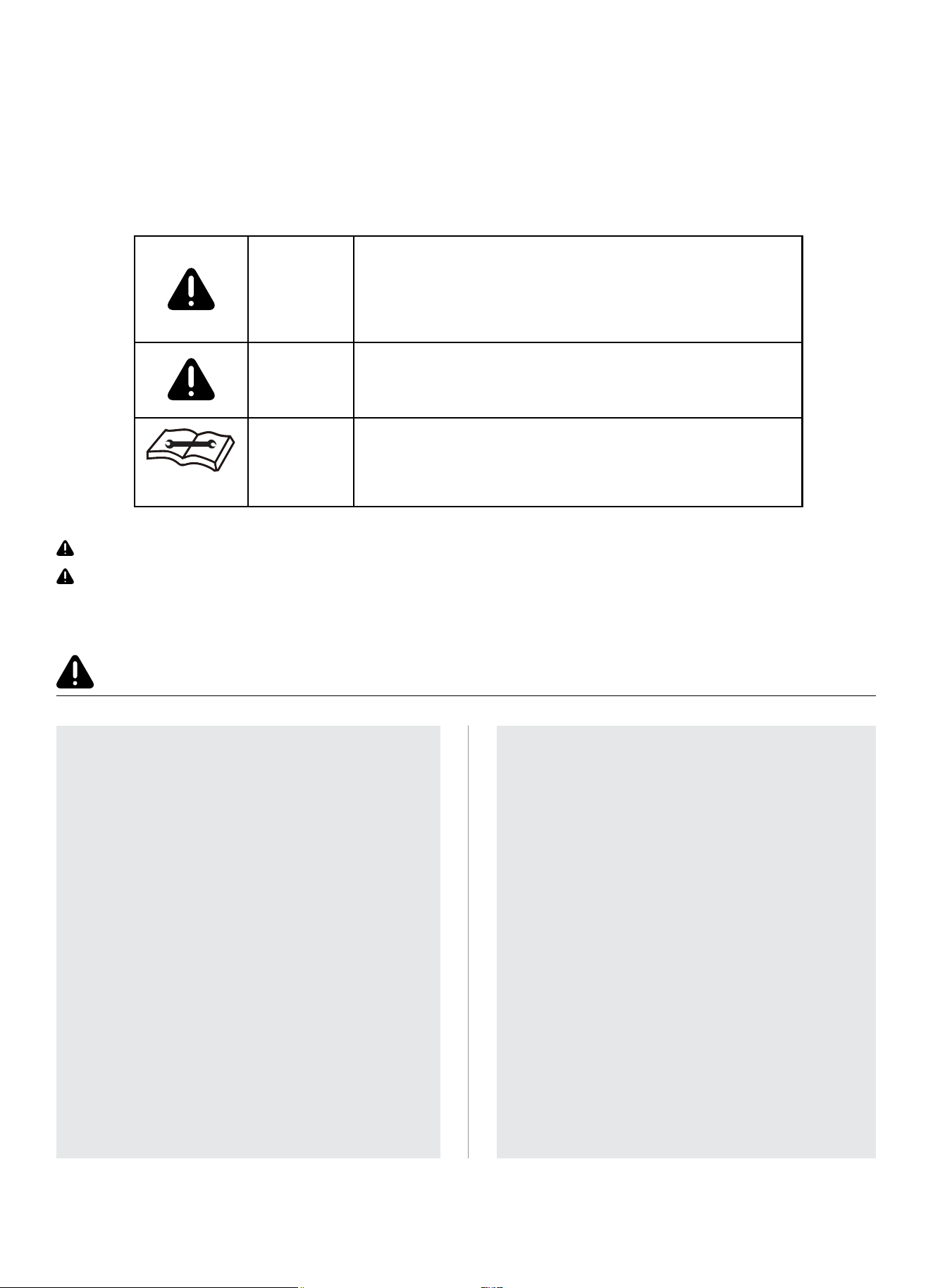
WARNING
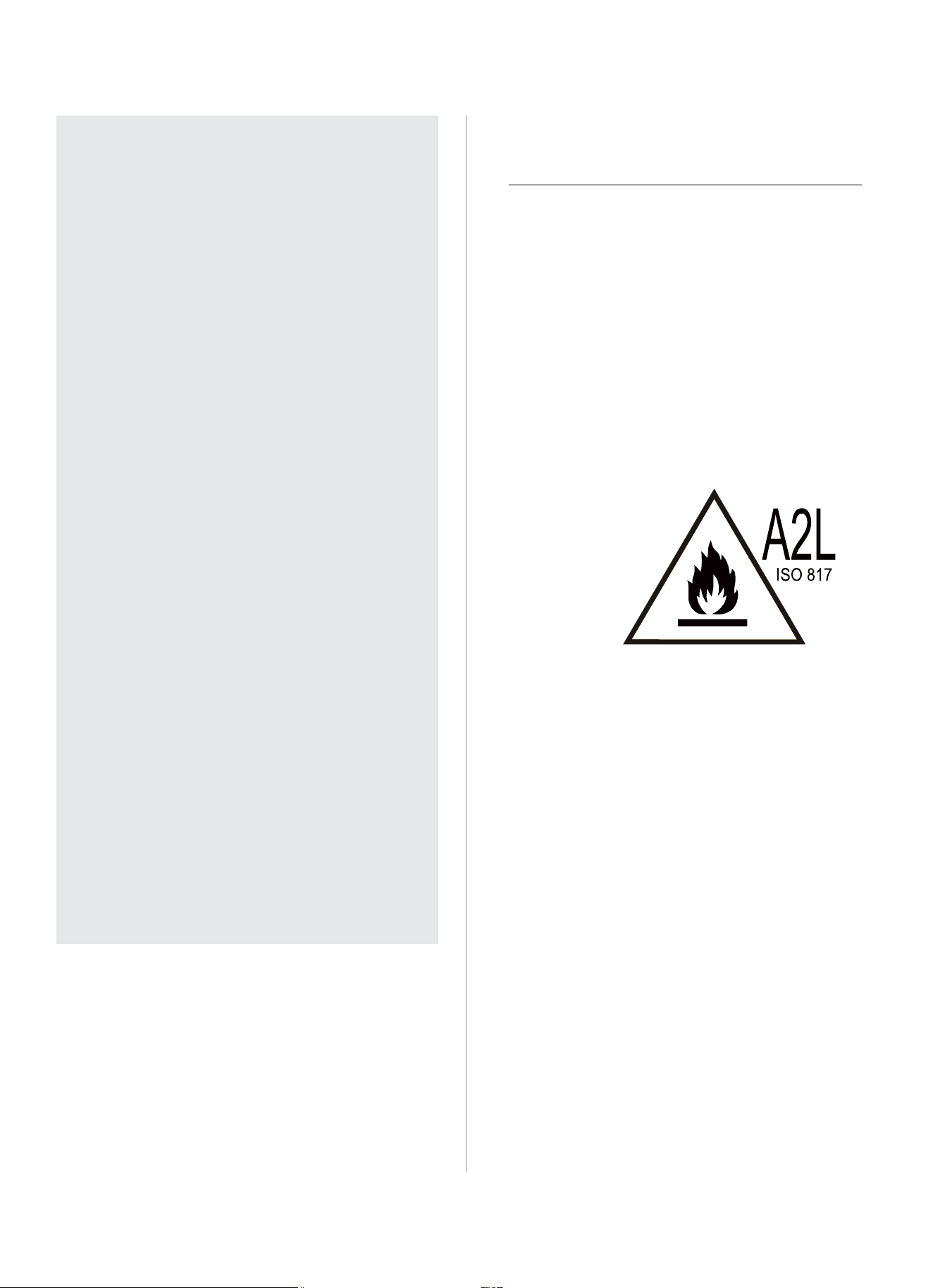
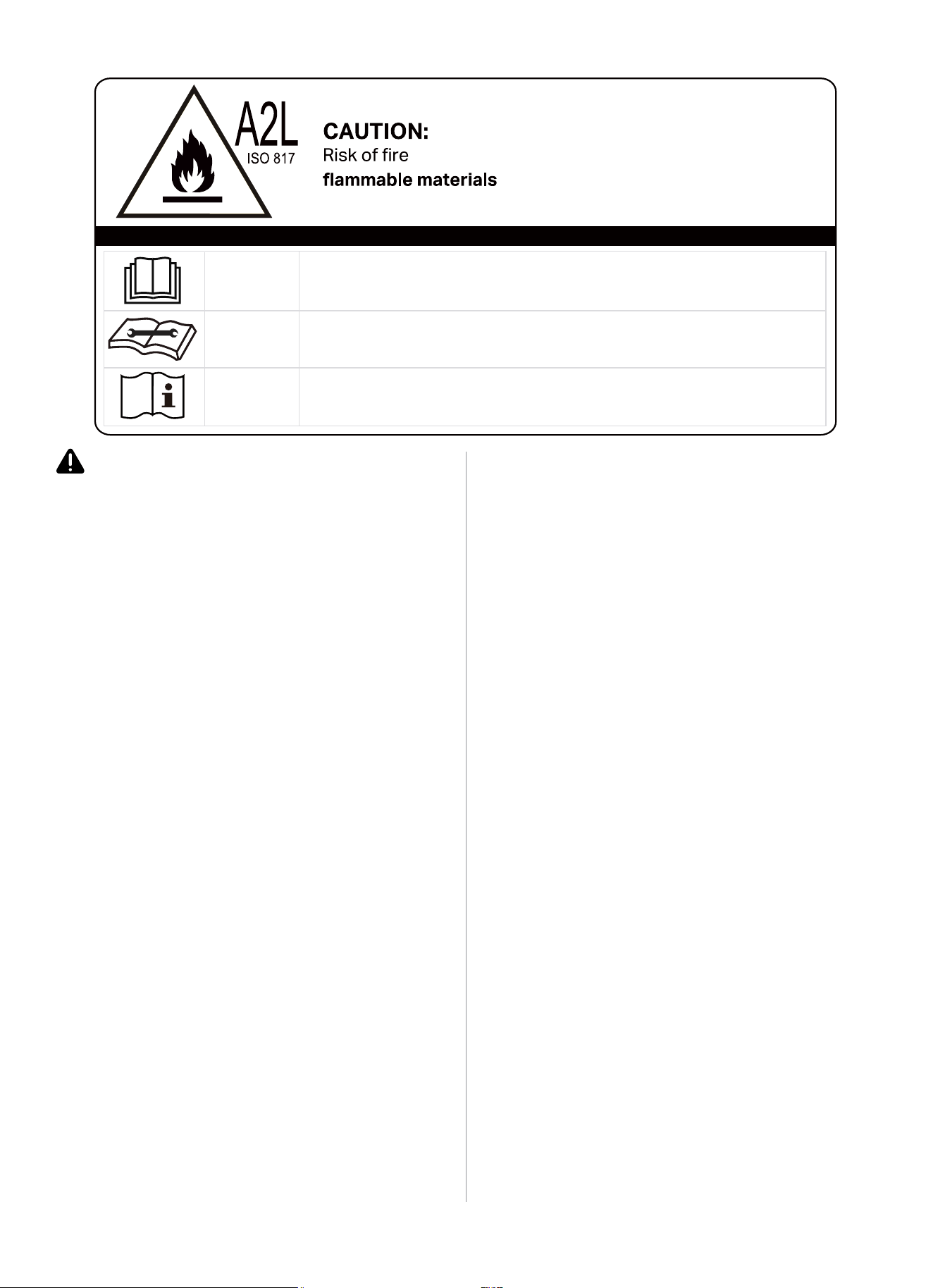
This symbol shows that this appliance uses a ammable
refrigerant. If a refrigerant leak occurs and is exposed to
an external ignition source, there is a risk of re.
This symbol shows that a service personnel should
be handling this equipment with reference to the
installation manual.
This symbol shows that the operation manual should be
read carefully.
WARNING
CAUTION
• This air conditioner is intended for indoor
residential us only and should not be used
for commercial or industrial applications.
Do not use outdoors
• Do not place the unit near a heat source
or other heat generating appliances such
as clothes dryer, heater or radiator
• Do not attempt to disassemble or repair
the unit by yourself.
• Do not use or store the air conditioner
near ammable gas or combustibles,
such as gasoline, benzene, thinner, or
other chemicals, etc.
• Do not drink or use the water collected
from the unit.
• Do not cover the intake or exhaust
openings.
• Never insert your nger or other foreign
objects into grills or openings. Take
special care to warn children of these
dangers.
• Do not climb or sit on the unit.
• Always insert the lters securely.
Clean lter once every two weeks. If
water enters the unit, turn the unit o
and disconnect the power , contact a
qualied service technician.
• Do not place foreign objects on the unit.
• Close all doors, windows and other
outside openings to the room.
• When rst using the air conditioner,
operate the unit continuously 24 hours.
Make sure the plastic cover on the
continuous drain hose outlet is tted
properly so there are no leaks.
CAUTION
3
Stand air conditioner upright
for full 24 hours before
initial start up to allow
refrigerant to settle.
Always use and store
air conditioner in an
upright position.
• This unit is designed to operate with a
working environment between 5ºC/41ºF
and 32ºC/90ºF, and between 30%(RH)
and 80%(RH).
• The air conditioner should not be stored
in a room with continuously operating
ignition sources (for example: open
ames, an operating gas appliance or an
operating electric heater).
• Do not pierce or burn this air conditioner
• Be aware that the refrigerant contained
within this air conditioner is odorless
• Compliance with national gas regulations
shall be observed.
• Keep ventilation openings clear of
obstruction.
• Servicing shall only be performed
an authorized service provider
recommended by the equipment
manufacturer.
• Maintenance and repair requiring the
assistance of other skilled personnel
shall be carried out under the supervision
of the person competent in the use of
ammable refrigerants.
NOTE ABOUT
FLUORINATED GASES
• Continuous drainage uses gravity to
pull the Fluorinated greenhouse gases
are contained in hermetically sealed
equipment. For specic information
on the type, the amount and the CO2
equivalent in tons of the uorinated
greenhouse gas(on some models), please
refer to the relevant label on the unit itself.
• Installation, service, maintenance and
repair of this unit must be performed by a
certied technician.
• Recycling must be performed by a
certied technician.
4
WARNING
(For using R290/R32 refrigerant only)
• Servicing shall only be performed
as recommended by the equipment
manufacturer. Maintenance and repair
requiring the assistance of other skilled
personnel shall be carried out under the
supervision of the person competent in the
use of ammable refrigerants.
• DO NOT modify the length of the power cord
or use an extension cord to power the unit.
• DO NOT share a single outlet with other
electrical appliances. Improper power supply
can cause re or electrical shock.
• Please follow the instruction carefully
to handle, install, clear, service the air
conditioner to avoid any damage or hazard.
Flammable Refrigerant R32 is used within air
conditioner.
• When maintaining or disposing the air
conditioner, the refrigerant (R32) shall be
recovered properly, shall not discharge to air
directly.
• Compliance with national gas regulations
shall be observed.
• Keep ventilation openings clear of
obstruction.
• The appliance shall be stored so as to
prevent mechanical damage from occurring.
• A warning that the appliance shall be stored
in a well-ventilated area where the room size
corresponds to the room area as specied
for operation.
• Any person who is involved with working on
or breaking into a refrigerant circuit should
hold a current valid certicate from an
industry-accredited assessment authority,
which authorises their competence to
handle refrigerants safely in accordance
with an industry recognised assessment
specication.
Examples for such working procedures are:
• breaking into the refrigerating circuit;
• opening of sealed components;
• opening of ventilated enclosures.
• No any open re or device like switch which
may generate spark/arcing shall be around
air conditioner to avoid causing ignition of
the ammable refrigerant used. Please follow
the instruction carefully to store or maintain
the air conditioner to prevent mechanical
damage from occurring.
• Do not use means to accelerate the
defrosting process or to clean, other than
those recommended by the manufacturer.
• The appliance shall be stored in a room
without continuously operating ignition
sources (for example: open ames, an
operating gas appliance) and ignition
sourcesor (for example: an operating electric
heater) close to the appliance. The appliance
shall be stored in a room without continuously
operating ignition sources (for example: open
ames, an operating gas appliance or an
operating electric heater).
• Do not pierce or burn.
• Be aware that the refrigerants may not
contain an odour.
IMPORTANT NOTE:
Read this manual
carefully before installing or operating
your new air conditioning unit. Make sure
to save this manual for future reference.
Explanation of symbols displayed on the unit
CAUTION
This symbol shows that the operation manual should be read carefully.
CAUTION
This symbol shows that a service personnel should be handling this equipment with
reference to the installation manual.
CAUTION
This symbol shows that information is available such as the operating manual or
installation manual.
5
WARNING
(For using R290/R32 refrigerant only)
Transport of equipment containing
ammable refrigerants
• See transport regulations.
Marking of equipment using signs
• See local regulations.
Disposal of equipment using ammable
refrigerants
• See national regulations.
Storage of equipment/appliances
• The storage of equipment should be
in accordance with the manufacturer’s
instructions.
Storage of packed (unsold) equipment
• Storage package protection should be
constructed such that mechanical damage
to the equipment inside the package will not
cause a leak of the refrigerant charge.
• The maximum number of pieces of equipment
permitted to be stored together will be
determined by local regulations.
Information on servicing
1. Checking the area
• Prior to beginning work on systems
containing ammable refrigerants,
safety checks are necessary to ensure
that the risk of ignition is minimized.
For repair to the refrigerating system,
the following precautions shall be
complied with prior to conducting work
on the system.
2. Work procedure
• Work shall be undertaken under a
controlled procedure so as to minimize
the risk of a ammable gas or vapor
being present while the work is being
performed.
3. General work area
• All maintenance sta and others
working in the local area shall be
instructed on the nature of work being
carried out. Work in conned spaces
shall be avoided. The area around
the workspace shall be sectioned o.
Ensure that the conditions within the
area have been made safe by control
of ammable material.
4. Checking for presence of refrigerant
• The area should be checked with
an appropriate refrigerant detector
prior to and during work, to ensure
the technician is aware of potentially
ammable atmospheres. Ensure that
the leak detection equipment being
used is suitable for use with ammable
refrigerants, i.e. non-sparking,
adequately sealed or intrinsically safe.
5. Presence of a re extinguisher
• If any hot work is to be conducted
on the refrigeration equipment or
any associated parts, appropriate
re extinguishing equipment shall be
available to hand. Have a dry powder
or CO2 re extinguisher adjacent to
the charging area.
6. No ignition sources
• No person carrying out work in relation
to a refrigeration system which
involves exposing any pipe work that
contains or has contained ammable
refrigerant shall use any sources of
ignition in such a manner that it may
lead to the risk of re or explosion. All
possible ignition sources, including
cigarette smoking, should be kept
suciently far away from the site of
installation, repairing, removing and
disposal, during which ammable
refrigerant can possibly be released
to the surrounding space. Prior to
work taking place, the area around
the equipment is to be surveyed to
make sure that there are no ammable
hazards or ignition risks. No Smoking
signs shall be displayed.
7. Ventilated area
• Ensure that the area is in the open
or that it is adequately ventilated
before breaking into the system or
conducting any hot work. A degree of
ventilation shall continue during the
period that the work is carried out. The
ventilation should safely disperse any
released refrigerant and preferably
expel it externally into the atmosphere.
6
WARNING
(For using R290/R32 refrigerant only)
8. Checks to the refrigeration equipment
• Where electrical components are
being changed, they shall be t
for the purpose and to the correct
specication. At all times the
manufacturer’s maintenance and
service guidelines shall be followed.
If in doubt consult the manufacturer’s
technical department for assistance.
• The following checks shall be applied
to installations using ammable
refrigerants:
• The charge size is in accordance
with the room size within which the
refrigerant containing parts are
installed.
• The ventilation machinery and
outlets are operating adequately
and are not obstructed.
• If an indirect refrigerating circuit is
being used, the secondary circuit
shall be checked for the presence
of refrigerant.
• Marking to the equipment
continues to be visible and legible.
Markings and signs that are
illegible should
be corrected.
• Refrigeration pipe or components
are installed in a position where
they are unlikely to be exposed
to any substance which may
corrode refrigerant containing
components, unless the
components are constructed of
materials which are inherently
resistant to being corroded or are
suitably protected against being
so corroded.
9. Checks to electrical devices
• Repair and maintenance to electrical
components should include initial
safety checks and component
inspection procedures. If a fault exists
that could compromise safety, then no
electrical supply shall be connected to
the circuit until it is satisfactorily dealt
with. If the fault cannot be corrected
immediately but it is necessary to
continue operation, an adequate
temporary solution should be used.
This should be reported to the owner
of the equipment, so all parties are
advised.
• Initial safety checks should
include:
• That capacitors are discharged:
this shall be done in a safe manner
to avoid possibility of sparking.
• That there no live electrical
components and wiring are
exposed while charging,
recovering or purging the system.
• That there is continuity of earth
bonding.
10. Repairs to sealed components
• During repairs to sealed components,
all electrical supplies shall be
disconnected from the equipment
being worked upon prior to any
removal of sealed covers, etc. If
it is absolutely necessary to have
an electrical supply to equipment
during servicing, then a permanently
operating form of leak detection shall
be located at the most critical point
to warn of a potentially hazardous
situation.
• Particular attention shall be paid to the
following to ensure that by working on
electrical components, the casing is
not altered in such a way that the level
of protection is aected. This shall
include damage to cables, excessive
number of connections, terminals not
made to original specication, damage
to seals, incorrect tting of glands, etc.
• Ensure that seals or sealing materials
have not degraded such that they no
longer serve the purpose of preventing
the ingress of ammable atmospheres.
Replacement parts should be in
accordance with the manufacturer’s
specications.
NOTE: The use of silicon sealant may
inhibit the eectiveness of some
types of leak detection equipment.
Intrinsically safe components do not
have to be isolated prior to working
on them.
7
11. Repair to intrinsically safe components
• Do not apply any permanent inductive
or capacitance loads to the circuit
without ensuring that this will not
exceed the permissible voltage and
current permitted for the equipment
in use. Intrinsically safe components
are the only types that can be worked
on while live in the presence of a
ammable atmosphere. The test
apparatus shall
be at the correct rating.
• Replace components only with parts
specied by the manufacturer. Other
parts may result in the ignition of
refrigerant in the atmosphere from a
leak.
12. Cabling
• Check that cabling will not be subject
to wear, corrosion, excessive pressure,
vibration, sharp edges or any other
adverse environmental eects. The
check shall also take into account the
eects of aging or continual vibration
from sources such as compressors or
fans.
13. Detection of ammable refrigerants
• Under no circumstances, should
potential sources of ignition be used
in the searching for or detection of
refrigerant leaks. A halide torch (or any
other detector using a naked ame)
should not be used.
14. Leak detection methods
• The following leak detection
methods are deemed acceptable
for systems containing ammable
refrigerants. Electronic leak detectors
shall be used to detect ammable
refrigerants, but the sensitivity may
not be adequate, or may need re-
calibration. (Detection equipment
should be calibrated in a refrigerant-
free area.) Ensure that the detector is
not a potential source of ignition and
is suitable for the refrigerant used.
Leak detection equipment should be
set at a percentage of the LFL of the
refrigerant and shall be calibrated
to the refrigerant employed and the
appropriate percentage of gas (25 %
maximum) is conrmed.
• Leak detection uids are suitable for
use with most refrigerants but the use
of detergents containing chlorine shall
be avoided as the chlorine may react
with the refrigerant and corrode the
copper pipework.
• If a leak is suspected, all naked ames
should be removed/ extinguished. If a
leakage of refrigerant is found which
requires brazing, all of the refrigerant
should be recovered from the system,
or isolated (by means of shut o
valves) in a part of the system remote
from the leak. Oxygen free nitrogen
(OFN) should then be purged through
the system both before and during the
brazing process.
15. Removal and evacuation
• When breaking into the refrigerant
circuit to make repairs or for any other
purpose conventional procedures
shall be used. However, it is important
that best practice is followed since
ammability is a consideration.
Opening of the refrigeration systems
should not be done by brazing.
• The following procedure shall be
adhered to:
• Remove refrigerant
• Purge the circuit with inert gas
• Evacuate
• Purge again with inert gas
• Open the circuit by cutting or
brazing.
• The refrigerant charge should be
recovered into the correct recovery
cylinders. The system should be
ushed with OFN to render the unit
safe. This process may need to be
repeated several times. Compressed
air or oxygen shall not be used for this
task.
• Flushing should be achieved by
breaking the vacuum in the system
with OFN and continuing to ll until
the working pressure is achieved, then
venting to atmosphere, and nally
pulling down to a vacuum. This process
shall be repeated until no refrigerant is
within the system.
WARNING
(For using R290/R32 refrigerant only)
8
• When the nal OFN charge is used,
the system shall be vented down
to atmospheric pressure to enable
work to take place. This operation is
absolutely vital if brazing operations on
the pipework are to take place.
• Ensure that the outlet for the vacuum
pump is not close to any ignition
sources and there is ventilation
available.
16. Charging procedures
• In addition to conventional
charging procedures, the following
requirements should be followed.
Ensure that contamination of dierent
refrigerants does not occur when
using charging equipment. Hoses or
lines should be as short as possible
to minimize the amount of refrigerant
contained in them.
• Cylinders should be kept upright.
• Ensure that the refrigeration system is
earthed prior to charging the system
with refrigerant.
• Label the system when charging is
complete (if not already).
• Extreme care should be taken not to
overll the refrigeration system.
• Prior to recharging the system, it
should be pressure tested with OFN.
The system should be leak tested on
completion of charging but prior to
commissioning. A follow up leak test
should be carried out prior to leaving
the site.
17. Decommissioning
• Before carrying out this procedure,
it is essential that the technician is
completely familiar with the equipment
and all its detail. It is recommended
good practice that all refrigerants
are recovered safely. Prior to the task
being carried out, an oil and refrigerant
sample should be taken in case
analysis is required prior to re-use of
reclaimed refrigerant. It is essential
that electrical power is available before
the task is commenced.
• Become familiar with the
equipment and its operation.
• Isolate the system electrically.
• Before attempting the procedure
ensure that:
• When breaking into the
refrigerant circuit to make
repairs or for any other
purpose, conventional
procedures should be used.
• Mechanical handling
equipment is available,
if required, for handling
refrigerant cylinders.
• Personal protective
equipment is available and
being used correctly.
• The recovery process is
supervised at all times by a
competent person.
• Recovery equipment and
cylinders conform to the
appropriate standards.
• Pump down refrigerant system, if
possible.
• If a vacuum is not possible, make a
manifold so that refrigerant can be
removed from various parts of the
system.
• Make sure that cylinder is situated
on the scales before recovery
takes place.
• Start the recovery machine
and operate in accordance with
manufacturer’s instructions.
Do not overll cylinders. (No more
than 80 % volume liquid charge).
• Do not exceed the maximum
working pressure of the cylinder,
even temporarily.
• When the cylinders have been
lled correctly and the process
is completed, make sure that the
cylinders and the equipment are
removed from the site promptly
and all isolation valves on the
equipment are closed o.
• Recovered refrigerant should
not be charged into another
refrigeration system unless it has
been cleaned and checked.
WARNING
(For using R290/R32 refrigerant only)
9
18. Labelling
• Equipment should be labelled stating
that it has been de-commissioned
and emptied of refrigerant. The label
should be dated and signed. Ensure
that there are labels on the equipment
stating the equipment contains
ammable refrigerant.
19. Recovery
• When removing refrigerant from
a system, either for servicing or
decommissioning, it is recommended
good practice that all refrigerants are
removed safely.
• When transferring refrigerant into
cylinders, ensure that only appropriate
refrigerant recovery cylinders are
employed. Ensure that the correct
number of cylinders for holding the
total system charge is available. All
cylinders to be used are designated
for the recovered refrigerant and
labelled for that refrigerant (i.e.
special cylinders for the recovery
of refrigerant). Cylinders shall be
complete with pressure relief valve
and associated shut-o valves in
good working order. Empty recovery
cylinders are evacuated and, if
possible, cooled before recovery
occurs.
• The recovery equipment shall be
in good working order with a set of
instructions concerning the equipment
that is at hand and shall be suitable for
the recovery of ammable refrigerants.
In addition, a set of calibrated weighing
scales shall be available and in good
working order.
• Hoses shall be complete with leak-
free disconnect couplings and in
good condition. Before using the
recovery machine, check that it is in
satisfactory working order, has been
properly maintained and that any
associated electrical components
are sealed to prevent ignition in the
event of a refrigerant release. Consult
manufacturer if in doubt.
• The recovered refrigerant shall be
returned to the refrigerant supplier in
the correct recovery cylinder, and the
relevant Waste Transfer Note arranged.
Do not mix refrigerants in recovery
units and especially not in cylinders.
If compressors or compressor oils
are to be removed, ensure that
they have been evacuated to an
acceptable level to make certain that
ammable refrigerant does not remain
within the lubricant. The evacuation
process shall be carried out prior
to returning the compressor to the
suppliers. Only electric heating to the
compressor body should be employed
to accelerate this process. When oil
is drained from a system, it should be
carried out safely.
WARNING
(For using R290/R32 refrigerant only)
10
3
IMPORTANT SAFETY INSTRUCTIONS
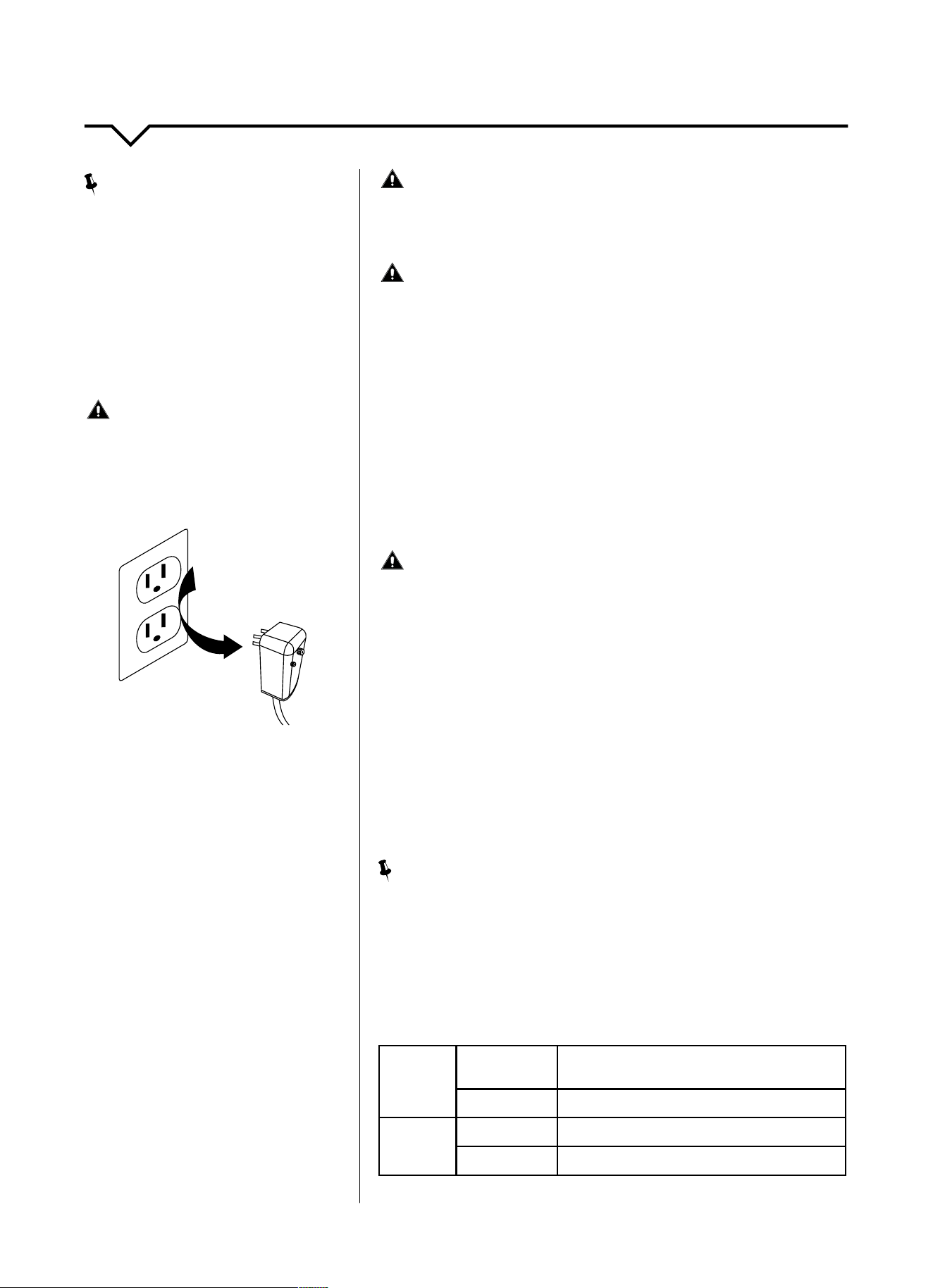
NOTE
:
The power supply cord with this air
conditioner contains a current detection
devicedesignedtoreducetherisk
ofre.Pleaserefertothesection
“OperationofCurrentDevice”(below)
for details. In the event that the power
supply cord is damaged, it cannot be
repaired. It must be replaced by an
authorizedrepairtechnicianwithacord
from the Product Manufacturer.
WARNING
Avoidrehazardsorelectricshock.
DO NOT use an extension cord or an
adapter plug. DO NOT remove any prong
from the power cord.
OPERATION OF
CURRENT DEVICE:
The power supply cord contains a
current device that senses damage
to the power cord. To test your power
supply cord, do the following:
1. Plug in the air conditioner.
2. The power supply cord will have
TWObuttonsontheplughead.Press
theTESTbutton.You willnoticea
clickastheRESETbuttonpopsout.
3. Press the RESET button. Again,
youwillnoticeaclickasthebutton
engages.
4. The power supply cord is now
supplyingelectricitytotheunit.(On
some products this is also indicated
byalightontheplughead.)
WARNING
FORYOURSAFETY:Donotstoreorusegasolineorotherammable
vaporsandliquidsinthevicinityofthisoranyotherappliances.
WARNING - PREVENT ACCIDENTS
Toreducetheriskofre,electricalshock,orinjurytopersonswhenusing
your air conditioner, follow basic precautions, including the following:
● Besuretheelectricalserviceisadequateforthemodelyouhave
chosen. This information can be found on the serial plate, which is
located on the side of the cabinet and behind the grille.
● Iftheairconditioneristobeinstalledinawindow,youwillprobably
wanttocleanbothsidesoftheglassrst.Ifthewindowisatriple-
tracktypewithascreenpanelincluded,removethescreencompletely
before installation.
● Besuretheairconditionerhasbeensecurelyandcorrectlyinstalled
according to the installation instructions in this manual.
●
Save this manual for possible future use in removing or installing this unit.
● Whenhandlingtheairconditioner,becarefultoavoidcutsfromsharp
metalnsonfrontandrearcoils.
WARNING - ELECTRICAL INFORMATION
The complete electrical rating of your new room air conditioner is
statedontheserialplate.Refertotheratingwhencheckingthe
electricalrequirements.
● Besuretheairconditionerisproperlygrounded.To minimizeshock
andrehazards,propergroundingisimportant.Thepowercordis
equippedwithathree-pronggroundingplugforprotectionagainst
shockhazards.
● Yourairconditionermustbeusedinaproperlygroundedwall
receptacle.Ifthewallreceptacleyouintendtouseisnotadequately
groundedorprotectedbyatimedelayfuseorcircuitbreaker,havea
qualiedelectricianinstalltheproperreceptacle.
● Ensurethereceptacleisaccessibleaftertheunitinstallation.
● DO NOT run air conditioner without side protective cover in place. This
could result in mechanical damage within the air conditioner.
● DO NOT use an extension cord or an adapter plug.
NOTE
:
DO NOTusetheplugtoturntheunitonoro.
● AlwaysmakesuretheRESETbuttonispushedinforcorrectoperation.
● ThepowersupplymustbereplacedifitfailsresetwheneithertheTEST
button is pushed or it cannot be reset.
● Ifpowersupplycordisdamaged,itcannotberepaired.Pleasecall
Consumer Services at 844-472-2473 to assist with replacement.
NOTE: This air conditioner is designed to be operated under the
following conditions:
Cooling
Operation
Outdoor Temp:
64–109°F/18–43°C
(64–125°F/18–52°Cforspecialtropicalmodels)
Indoor Temp:
62–90°F/17–32°C
Heating
Operation
Outdoor Temp:
23–76°F/-5–24°C
Indoor Temp:
32–80°F/0–27°C
Performance may be reduced outside of these operating temperatures.
Grounding Type
Wall Receptacle
Do not, under any
circumstances, cut,
remove, or bypass the
ground prong.
Power supply cord
with 3-prong grounding
plug and current
detection device
11
4
BEFORE YOU BEGIN
Read these instructions completely and carefully.
IMPORTANT- Save these instructions.
IMPORTANT-Observeallgoverningcodesand
ordinances.
Note to Installer- Be sure to leave these instructions with
the Consumer.
Note to Consumer- Keep these instructions for future
reference.
Skill level-Installationofthisappliancerequiresbasic
mechanicalskills.
Completion time- Approximately 1 hour.
We recommend that two people install this product.
Proper installation is the responsibility of the installer.
Product failure due to improper installation is not
covered under the Warranty.
You MUSTuseallsuppliedpartsanduseproper
installation procedures as described in these
instructions when installing this air conditioner.
CAUTION
Do not, under any circumstances, cut or remove the
third(ground)prongfromthepowercord.
Do not change the plug on the power cord of the air
conditioner.
Aluminum house wiring may present special problems-
consultaqualiedelectrician.
When handling unit, be careful to avoid cuts from sharp
metaledgesandaluminumnsonfrontandrearcoils.
REQUIRED TOOLS/HARDWARE
● Pencil
● Level
● Tapemeasure
● Socketwrenches
● Phillipsscrewdriver
● Adjustablewrenchorpliers
● Largeatbladescrewdriver
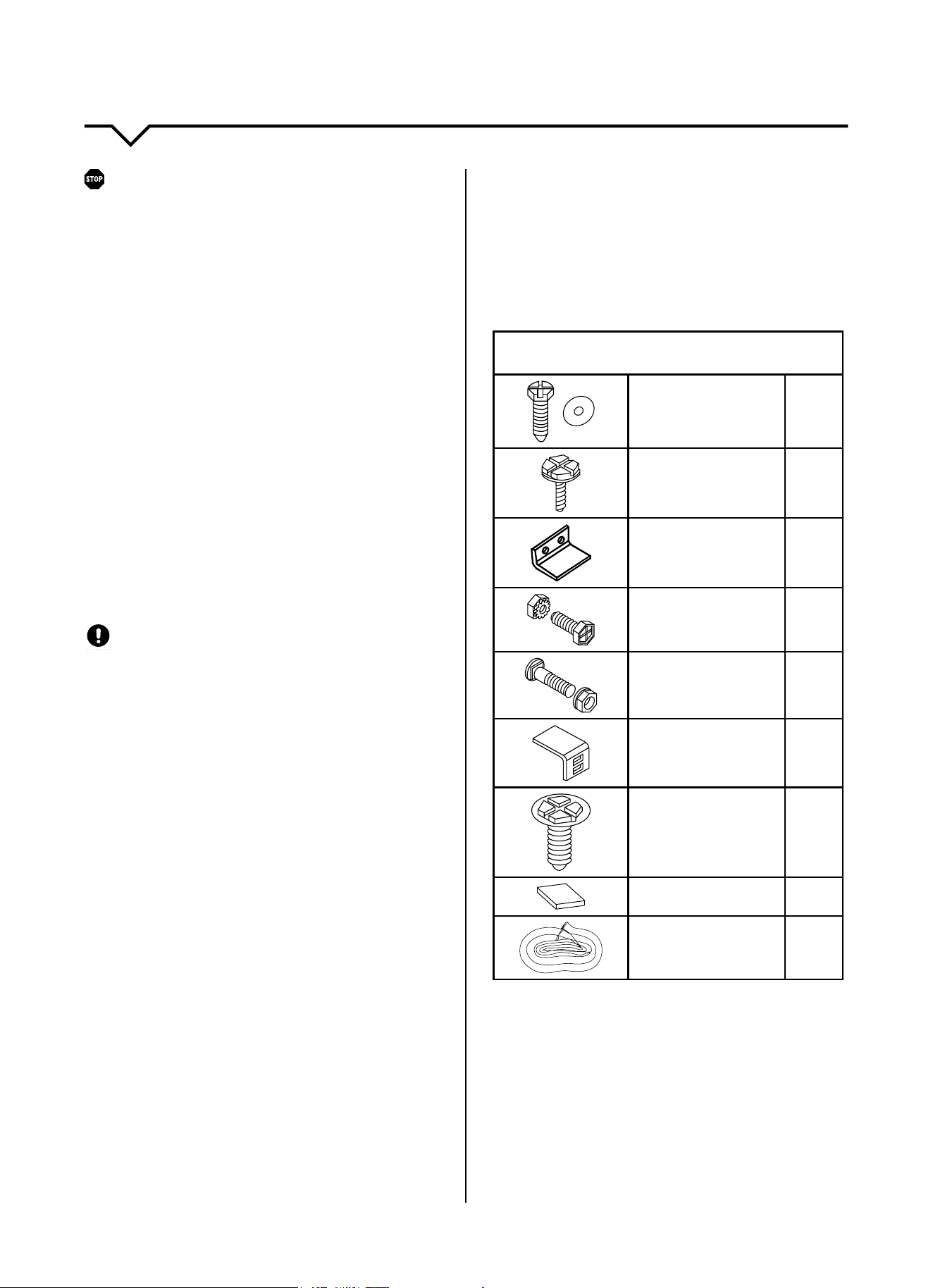
HARDWARE
(Included - Packed with the Unit)
7/16inchlocking
screwandatwasher
for window panels
2 ea.
3/4(or1/2)inchLong
Hex-head Screw
4
SafetyLock
1
3/4inchLongFlat
Head Bolt and
Locknut
2 ea.
1/2inchLongScrew
andLocknut
4 ea.
SillAngleBracket
2
Longhex-headlocking
screw for tape angle,
sideretailer5/16inch
long
10
Foam insert
2
Window sash seal
foam
1
INSTALLATION INSTRUCTIONS
12
5
Please read ALL instructions before installing. It is
recommended that two people install this product.
Ifanewelectricaloutletisrequired,havetheoutlet
installedbyaqualiedelectricianbeforeinstallingthe
air conditioning unit.
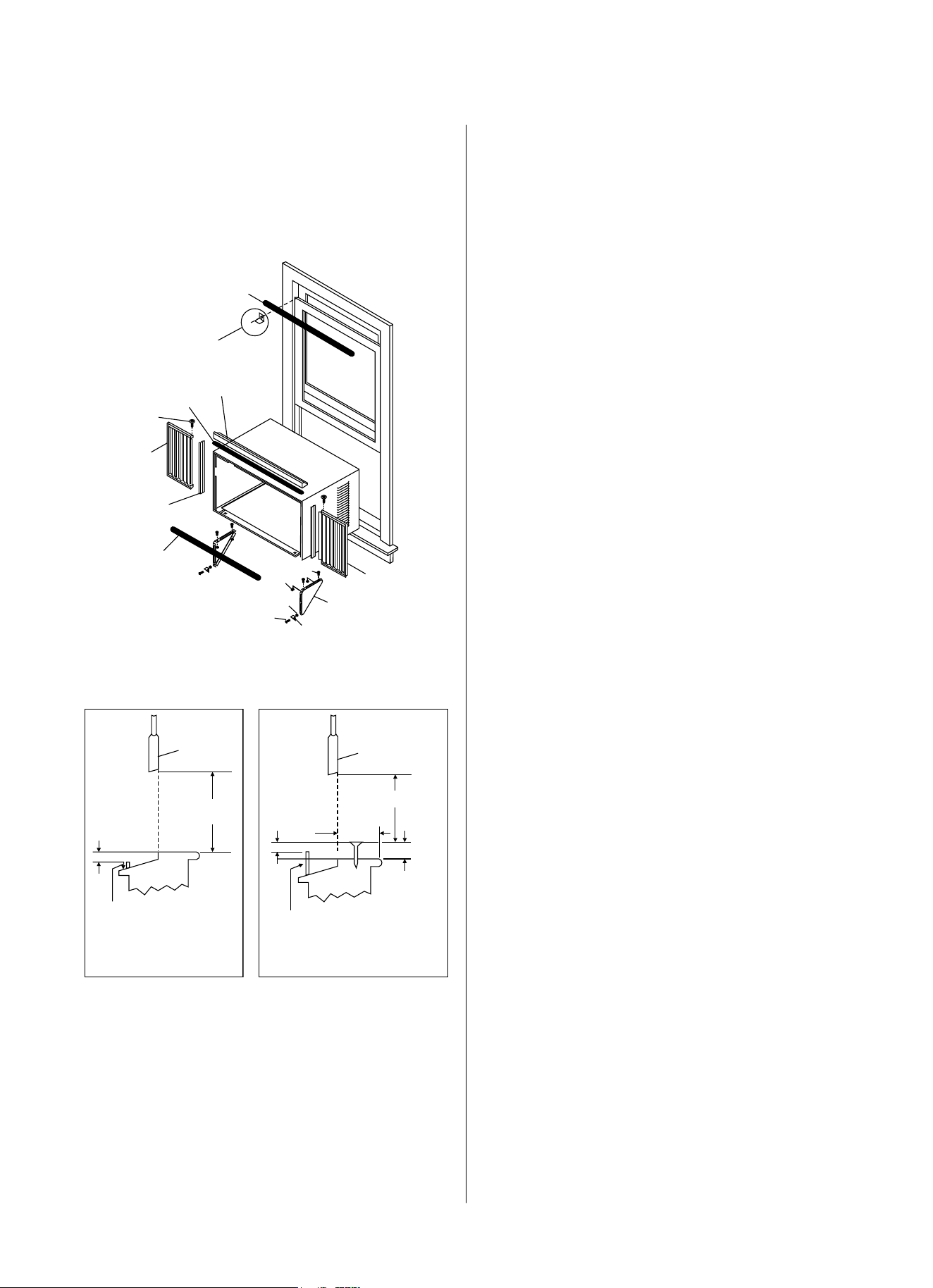
Window Sash Seal
Top Angle
Foam Gasket
Side Retainer
Locknut
Safety Lock and
3/4″ (or 1/2″)
Long Hex Head Screw
1/2″ Long
Screw and
Locknuts
Washer Head
Locking Screw
Seal Bottom
Rail to Unit
Frame
Assembly
(Left)
Frame Assembly
(Right)
3/4″ Long
Flat Head
Bolt
Sill Angle
Bracket
Window Support
Bracket
FIG. A
SASH
SASH
19″ MIN.
19″ MIN.
1/2″ MIN.
1/2″ MIN.
1/2″ MIN.
Board
thickness
as required
along entire
stool. Fasten
with 2 Nails
or Screws.
Storm window
frame or other
obstruction
Storm window
frame or other
obstruction
FIG. B FIG. C
PRELIMINARY INSTRUCTIONS
Dothefollowingbeforeinstallingtheunit.(See
illustrationsonleft.)
Checkdimensionsofyourunittodetermineproper
window dimensions:
Unit Height: 17
5
/8 or 18
5
/8
Unit Width: 23
5
/8 or 26
1
/2
Min. Window Height: 18
1
/2 or 19
1
/2
Min. Window Width: 26
1
/2 or 31
Max. Window Width: 40
1
/2 or 42
1. CHECK WINDOW OPENING SIZE — The mounting parts
furnished with this air conditioner are made to install
in a wooden sill, double-hung window. The standard
partsareforwindowdimensionslistedabove.Open
sashtoaminimumof19in.(483mm).SeeFig.B.
2. CHECK CONDITION OF WINDOW — All wood parts of
windowMUSTbeingoodshapeandabletormly
holdtheneededscrews.Ifnot,makerepairsbefore
installing unit.
3. CHECK YOUR STORM WINDOWS — If your storm
windowframedoesnotallowtheclearancerequired,
correct by adding a piece of wood as shown in Fig.
C, or by removing storm window while room air
conditioner is being installed.
4. CHECK FOR ANYTHING THAT COULD BLOCK AIRFLOW —
Checkareaoutsideofwindowforthingssuchas
shrubs, trees, or awnings. Inside, be sure furniture,
drapes,orblindswillnotstopproperairow.
5. CHECK THE AVAILABLE ELECTRICAL SERVICE — Power
supply MUST be the same as that shown on the
unit serial nameplate. Power cord is 48 inches long.
Besureyouhaveanoutletnear.DONOTusean
extension cord.
6. CAREFULLY UNPACK THE AIR CONDITIONER — Remove
allpackagingmaterial.Covertheoorduring
installation to prevent damage. Two people should be
used to move and install unit.
13
6
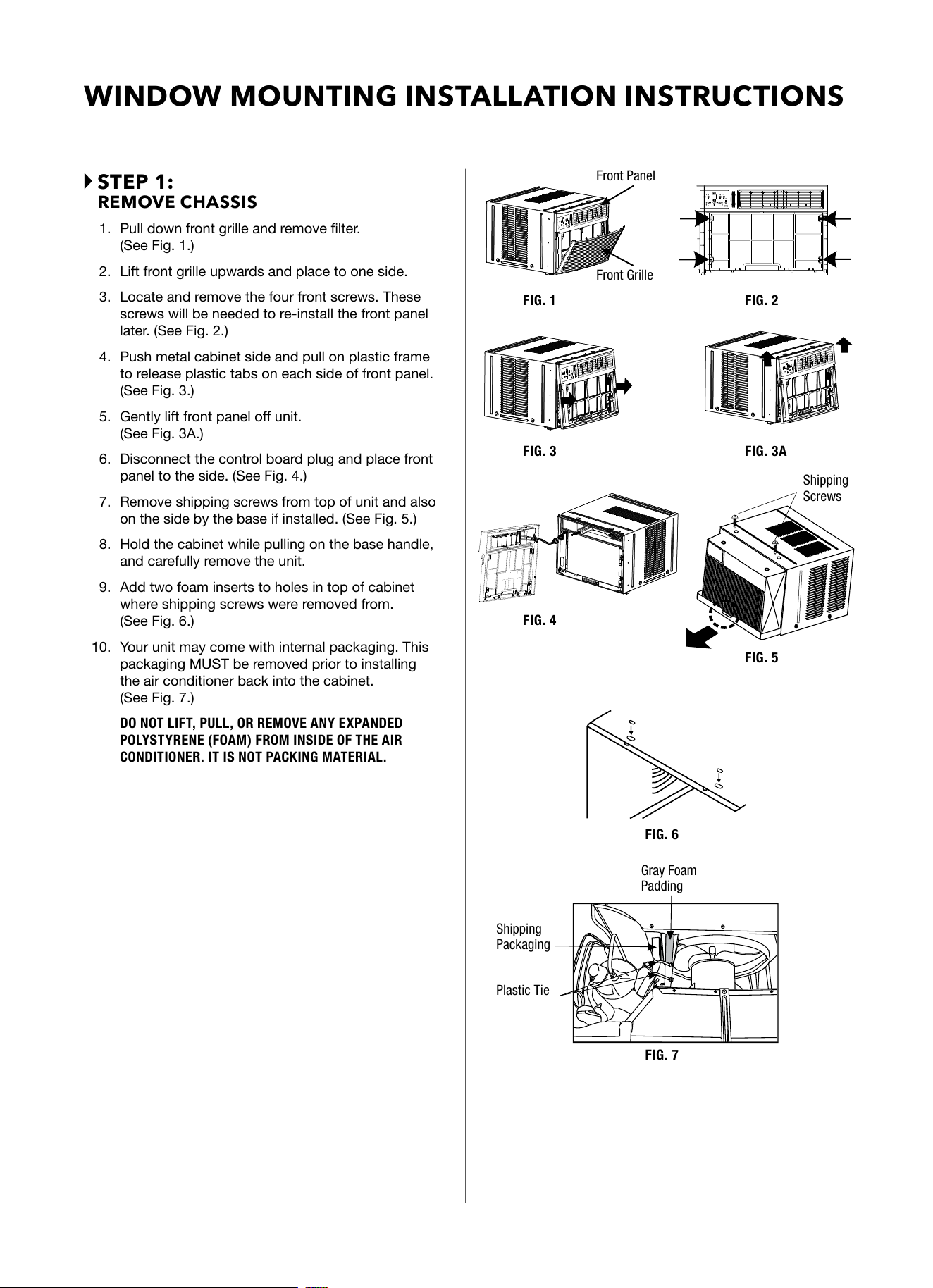
STEP 1:
REMOVE CHASSIS
1. Pulldownfrontgrilleandremovelter.
(SeeFig.1.)
2. Lift front grille upwards and place to one side.
3. Locate and remove the four front screws. These
screws will be needed to re-install the front panel
later.(SeeFig.2.)
4. Push metal cabinet side and pull on plastic frame
to release plastic tabs on each side of front panel.
(SeeFig.3.)
5. Gentlyliftfrontpanelounit.
(SeeFig.3A.)
6. Disconnect the control board plug and place front
paneltotheside.(SeeFig.4.)
7. Remove shipping screws from top of unit and also
onthesidebythebaseifinstalled.(SeeFig.5.)
8. Hold the cabinet while pulling on the base handle,
and carefully remove the unit.
9. Add two foam inserts to holes in top of cabinet
where shipping screws were removed from.
(SeeFig.6.)
10. Yourunitmaycomewithinternalpackaging.This
packagingMUSTberemovedpriortoinstalling
theairconditionerbackintothecabinet.
(SeeFig.7.)
DO NOT LIFT, PULL, OR REMOVE ANY EXPANDED
POLYSTYRENE (FOAM) FROM INSIDE OF THE AIR
CONDITIONER. IT IS NOT PACKING MATERIAL.
WINDOW MOUNTING INSTALLATION INSTRUCTIONS
FIG. 1
FIG. 4
FIG. 3
FIG. 2
FIG. 5
FIG. 6
FIG. 7
FIG. 3A
Shipping
Packaging
Shipping
Screws
Plastic Tie
Front Grille
Front Panel
Gray Foam
Padding
14
7
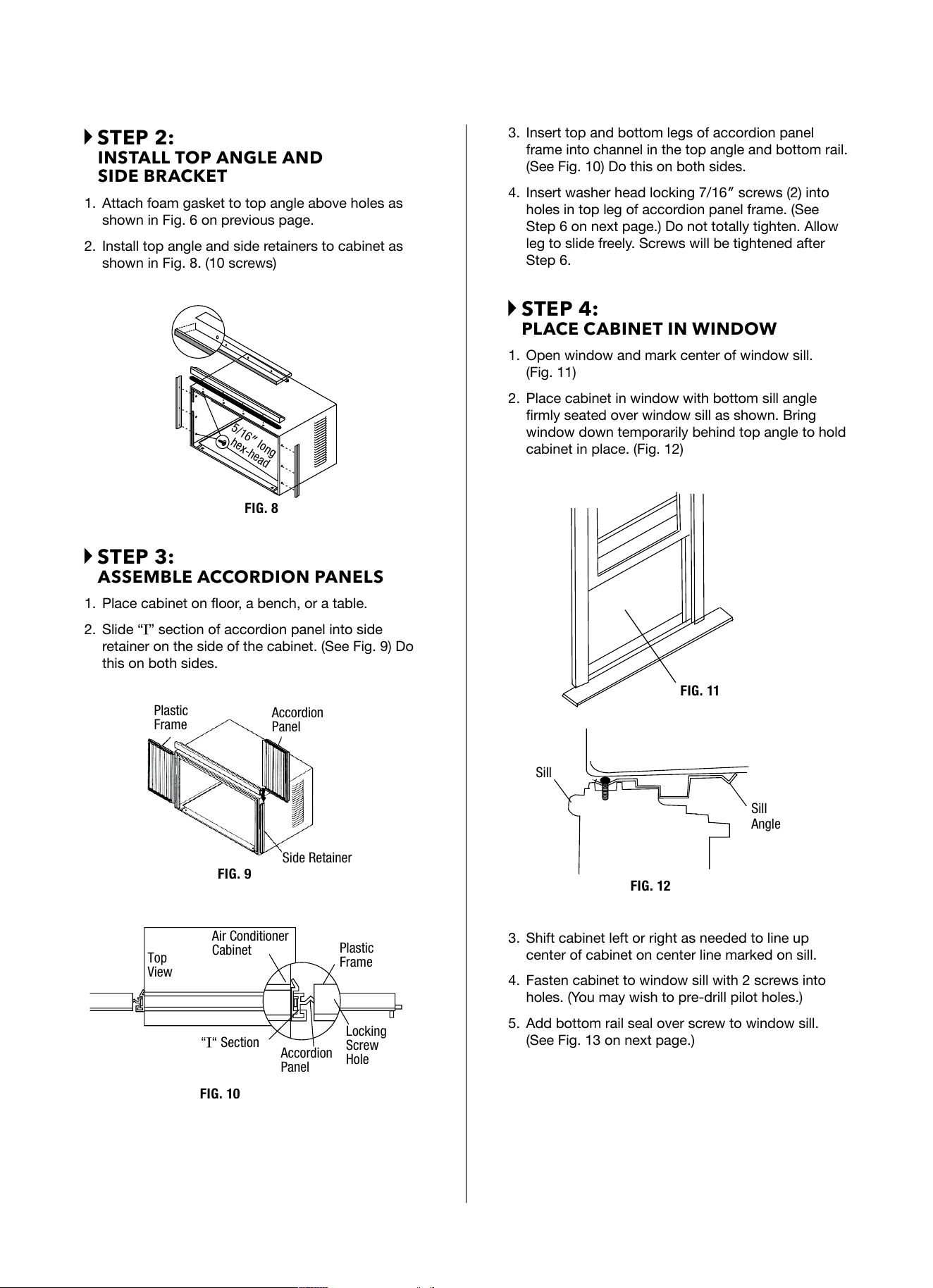
STEP 2:
INSTALL TOP ANGLE AND
SIDE BRACKET
1. Attachfoamgaskettotopangleaboveholesas
shown in Fig. 6 on previous page.
2. Install top angle and side retainers to cabinet as
showninFig.8.(10screws)
FIG. 8
5/16″ long
hex-head
STEP 3:
ASSEMBLE ACCORDION PANELS
1. Placecabinetonoor,abench,oratable.
2. Slide “
” section of accordion panel into side
retaineronthesideofthecabinet.(SeeFig.9)Do
this on both sides.
FIG. 9
FIG. 10
Accordion
Panel
Air Conditioner
Cabinet
Top
View
Plastic
Frame
Locking
Screw
Hole
Accordion
Panel
“
“ Section
Side Retainer
Plastic
Frame
3. Insert top and bottom legs of accordion panel
frame into channel in the top angle and bottom rail.
(SeeFig.10)Dothisonbothsides.
4. Insertwasherheadlocking7/16″screws(2)into
holesintoplegofaccordionpanelframe.(See
Step6onnextpage.)Donottotallytighten.Allow
leg to slide freely. Screws will be tightened after
Step 6.
STEP 4:
PLACE CABINET IN WINDOW
1. Openwindowandmarkcenterofwindowsill.
(Fig.11)
2. Place cabinet in window with bottom sill angle
rmlyseatedoverwindowsillasshown.Bring
window down temporarily behind top angle to hold
cabinetinplace.(Fig.12)
FIG. 12
FIG. 11
Sill
Angle
Sill
3. Shift cabinet left or right as needed to line up
centerofcabinetoncenterlinemarkedonsill.
4. Fasten cabinet to window sill with 2 screws into
holes.(Youmaywishtopre-drillpilotholes.)
5. Addbottomrailsealoverscrewtowindowsill.
(SeeFig.13onnextpage.)
15
8
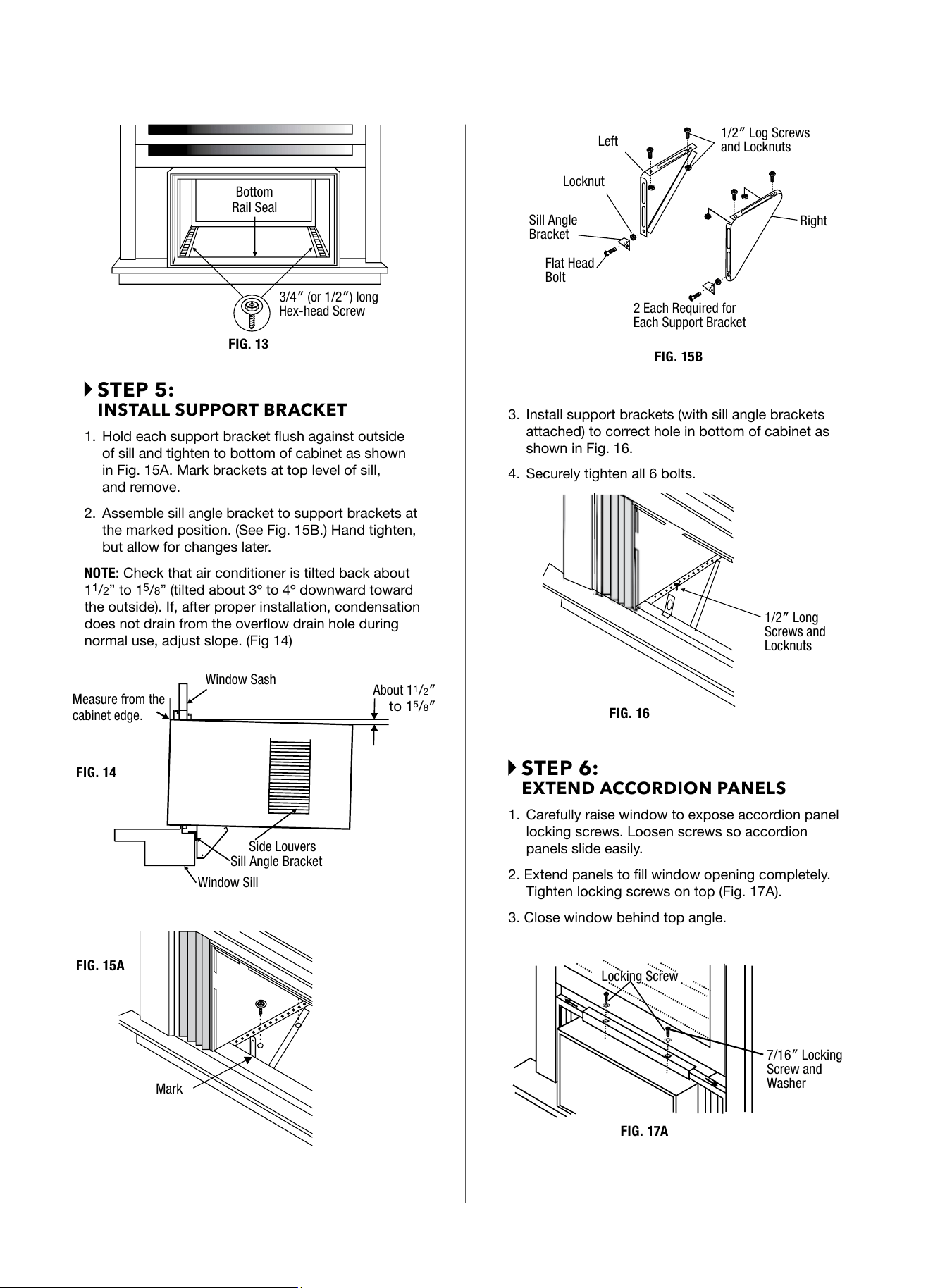
FIG. 13
Bottom
Rail Seal
3/4″ (or 1/2″) long
Hex-head Screw
STEP 5:
INSTALL SUPPORT BRACKET
1. Holdeachsupportbracketushagainstoutside
of sill and tighten to bottom of cabinet as shown
inFig.15A.Markbracketsattoplevelofsill,
and remove.
2. Assemblesillanglebrackettosupportbracketsat
themarkedposition.(SeeFig.15B.)Handtighten,
but allow for changes later.
NOTE:Checkthatairconditioneristiltedbackabout
1
1
/2” to 1
5
/8”(tiltedabout3ºto4ºdownwardtoward
theoutside).If,afterproperinstallation,condensation
doesnotdrainfromtheoverowdrainholeduring
normaluse,adjustslope.(Fig14)
FIG. 14
FIG. 15A
Mark
About 1
1
/2″
to 1
5
/8″
Window Sash
Side Louvers
Sill Angle Bracket
Window Sill
Measure from the
cabinet edge.
5
FIG. 15B
Right
Left
Locknut
1/2″ Log Screws
and Locknuts
2 Each Required for
Each Support Bracket
Sill Angle
Bracket
Flat Head
Bolt
3. Installsupportbrackets(withsillanglebrackets
attached)tocorrectholeinbottomofcabinetas
shown in Fig. 16.
4. Securely tighten all 6 bolts.
1/2″ Long
Screws and
Locknuts
FIG. 16
STEP 6:
EXTEND ACCORDION PANELS
1. Carefully raise window to expose accordion panel
lockingscrews.Loosenscrewssoaccordion
panels slide easily.
2.Extendpanelstollwindowopeningcompletely.
Tightenlockingscrewsontop(Fig.17A).
3. Close window behind top angle.
Locking Screw
7/16″ Locking
Screw and
Washer
FIG. 17A
16
9
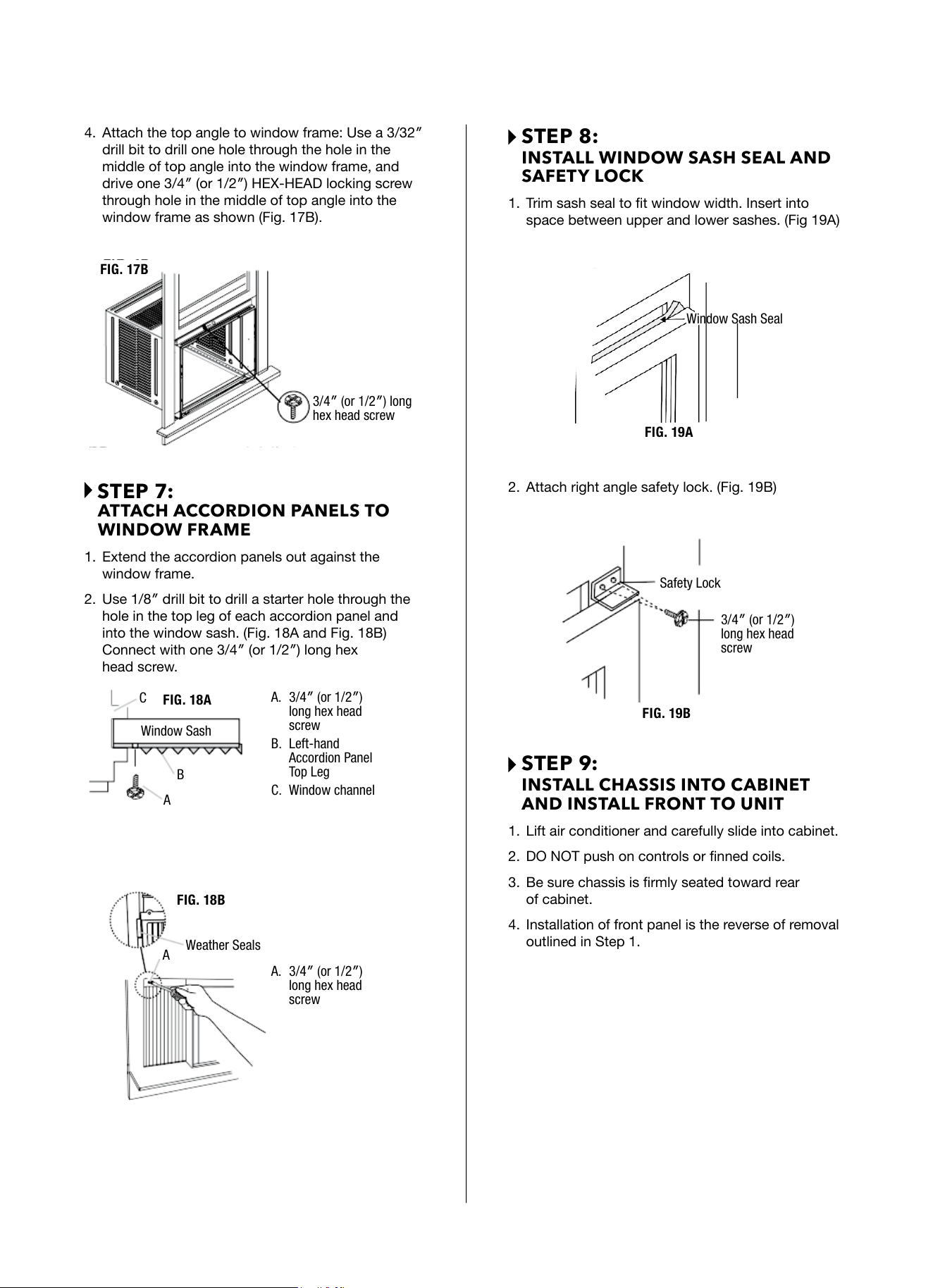
4. Attachthetopangletowindowframe:Usea3/32″
drill bit to drill one hole through the hole in the
middle of top angle into the window frame, and
driveone3/4″(or1/2″)HEX-HEADlockingscrew
through hole in the middle of top angle into the
windowframeasshown(Fig.17B).
3/4″ (or 1/2″) long
hex head screw
FIG. 17B
STEP 7:
ATTACH ACCORDION PANELS TO
WINDOW FRAME
1. Extend the accordion panels out against the
window frame.
2. Use1/8″drillbittodrillastarterholethroughthe
hole in the top leg of each accordion panel and
intothewindowsash.(Fig.18AandFig.18B)
Connectwithone3/4″(or1/2″)longhex
head screw.
A. 3/4″ (or 1/2″)
long hex head
screw
B. Left-hand
Accordion Panel
Top Leg
C. Window channel
A. 3/4″ (or 1/2″)
long hex head
screw
A
A
B
C
Window Sash
Weather Seals
FIG. 18A
FIG. 18B
STEP 8:
INSTALL WINDOW SASH SEAL AND
SAFETY LOCK
1. Trimsashsealtotwindowwidth.Insertinto
spacebetweenupperandlowersashes.(Fig19A)
Window Sash Seal
FIG. 19A
2. Attachrightanglesafetylock.(Fig.19B)
FIG. 19B
Safety Lock
3/4″ (or 1/2″)
long hex head
screw
STEP 9:
INSTALL CHASSIS INTO CABINET
AND INSTALL FRONT TO UNIT
1. Lift air conditioner and carefully slide into cabinet.
2. DONOTpushoncontrolsornnedcoils.
3. Besurechassisisrmlyseatedtowardrear
of cabinet.
4. Installation of front panel is the reverse of removal
outlined in Step 1.
17
10
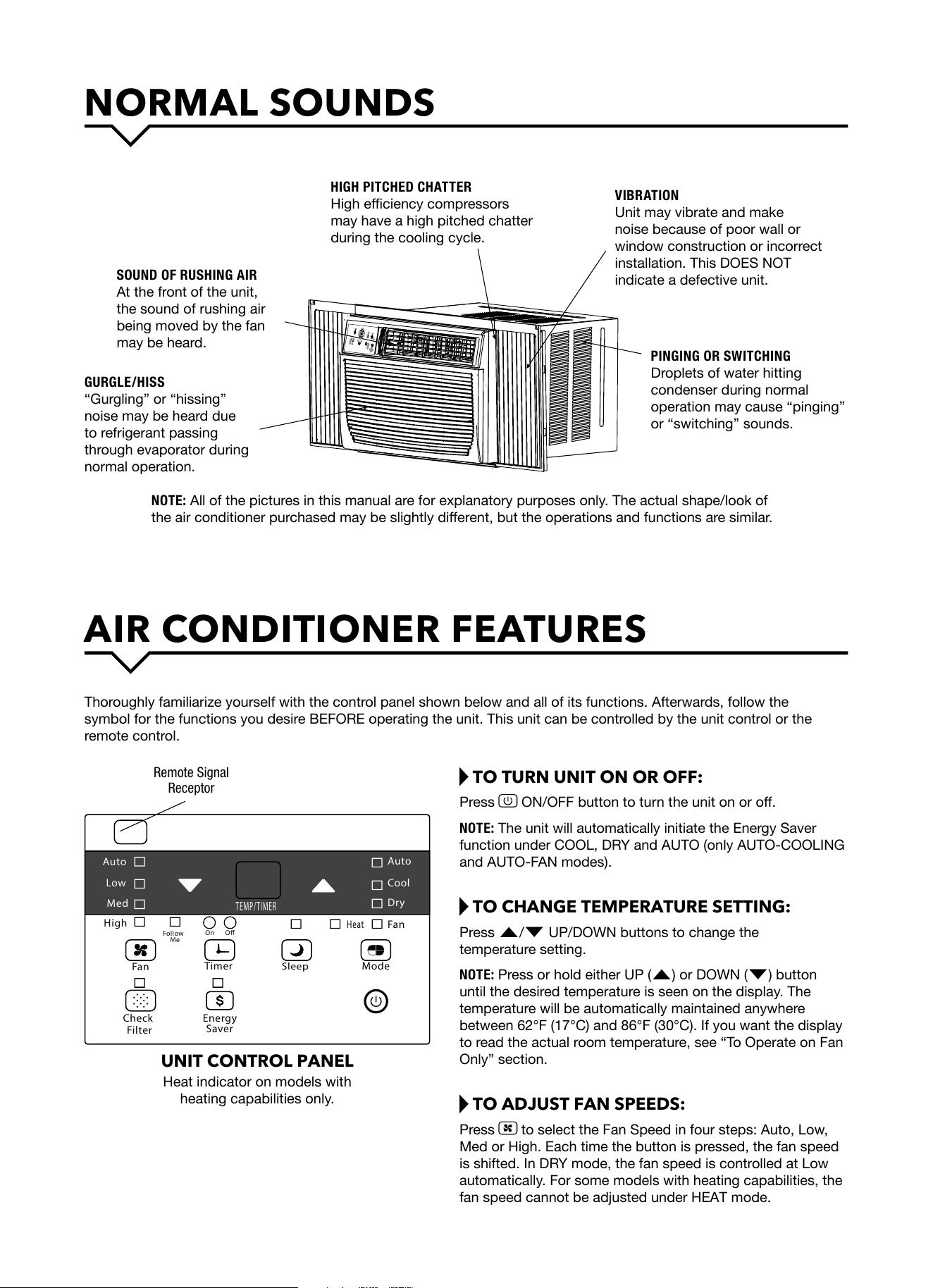
NORMAL SOUNDS
AIR CONDITIONER FEATURES
Sleep
Check
Filter
Follow
Me
Auto
On/off
Fan
High
Med
Low
Energy
Saver
on
off
Timer
Auto
Fan
Cool
Dry
Mode
TEMP/TIMER
TEMP/TIMER
Heat
VIBRATION
Unitmayvibrateandmake
noise because of poor wall or
window construction or incorrect
installation.ThisDOESNOT
indicate a defective unit.
PINGING OR SWITCHING
Droplets of water hitting
condenser during normal
operation may cause “pinging”
or “switching” sounds.
HIGH PITCHED CHATTER
Higheciencycompressors
may have a high pitched chatter
during the cooling cycle.
SOUND OF RUSHING AIR
At the front of the unit,
the sound of rushing air
being moved by the fan
may be heard.
GURGLE/HISS
“Gurgling”or“hissing”
noise may be heard due
to refrigerant passing
through evaporator during
normal operation.
NOTE: Allofthepicturesinthismanualareforexplanatorypurposesonly.Theactualshape/lookof
theairconditionerpurchasedmaybeslightlydierent,buttheoperationsandfunctionsaresimilar.
Thoroughlyfamiliarizeyourselfwiththecontrolpanelshownbelowandallofitsfunctions.Afterwards,followthe
symbolforthefunctionsyoudesireBEFOREoperatingtheunit.Thisunitcanbecontrolledbytheunitcontrolorthe
remote control.
Remote Signal
Receptor
TO TURN UNIT ON OR OFF:
Press ON/OFFbuttontoturntheunitonoro.
NOTE: The unit will automatically initiate the Energy Saver
functionunderCOOL,DRYandAUTO(onlyAUTO-COOLING
andAUTO-FANmodes).
TO CHANGE TEMPERATURE SETTING:
Press
/
UP/DOWNbuttonstochangethe
temperature setting.
NOTE: PressorholdeitherUP(
)orDOWN(
)button
until the desired temperature is seen on the display. The
temperature will be automatically maintained anywhere
between62°F(17°C)and86°F(30°C).Ifyouwantthedisplay
toreadtheactualroomtemperature,see“ ToOperateonFan
Only”section.
TO ADJUST FAN SPEEDS:
Press to select the Fan Speed in four steps: Auto, Low,
Med or High. Each time the button is pressed, the fan speed
isshifted.InDRYmode,thefanspeediscontrolledatLow
automatically. For some models with heating capabilities, the
fanspeedcannotbeadjustedunderHEATmode.
UNIT CONTROL PANEL
Heat indicator on models with
heating capabilities only.
Auto
Low
Med
High
Auto
Cool
Dry
Fan
TEMP/TIMER
On O
Sleep
Timer
Mode
Check
Filter
Energy
Saver
Fan
Follow
Me
Heat
18
11
SLEEP FEATURE:
Press the SLEEP button to initiate the SLEEP
mode. In this mode, the selected temperature will
increaseby2°F(1°C)30minutesafterthemodeis
selected.Thetemperaturewillthenincrease(cooling)
ordecrease(unitswithheatingonly)byanother
2°F(1°C)afteranadditional30minutes.Thisnew
temperature will be maintained for 6 hours before it
returns to the originally selected temperature. This
ends the SLEEP mode and the unit will continue
to operate as originally programmed. The SLEEP
mode program can be canceled at any time during
operation by pressing the SLEEP button again.
CHECK FILTER FEATURE:
Press the CHECK FILTER button to initiate this
feature. This feature is a reminder to clean the Air
Filterformoreecientoperation.TheLED(light)will
illuminateafter250hoursofoperation.Toresetafter
cleaningthelter,presstheCHECK FILTER button
andthelightwillgoo.
ENERGY SAVER FEATURE:
Press the ENERGYSAVER button to initiate this
function. This function is available on COOL, DRY
and AUTO(onlyAUTO-COOLINGand AUTO-FAN)
modes. In this mode, the fan will continue to run for 3
minutesafterthecompressorshutso.Thefanthen
cycles on for 2 minutes, at 10 minute intervals, until
the room temperature is above the set temperature,
atwhichtimethecompressorturnsbackonand
cooling starts.
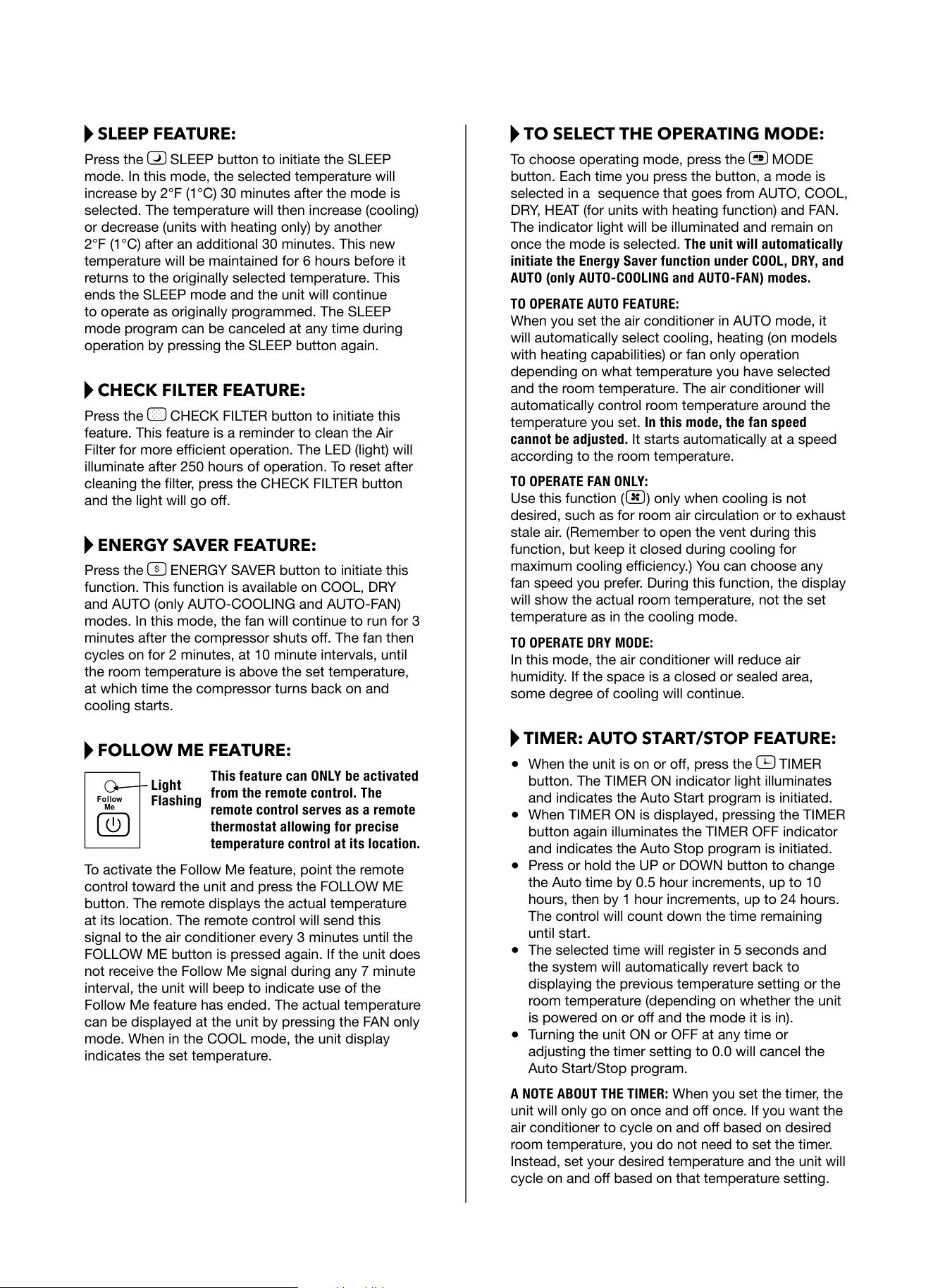
FOLLOW ME FEATURE:
This feature can ONLY be activated
from the remote control. The
remote control serves as a remote
thermostat allowing for precise
temperature control at its location.
To activate the Follow Me feature, point the remote
control toward the unit and press the FOLLOWME
button. The remote displays the actual temperature
at its location. The remote control will send this
signal to the air conditioner every 3 minutes until the
FOLLOWME button is pressed again. If the unit does
not receive the Follow Me signal during any 7 minute
interval, the unit will beep to indicate use of the
Follow Me feature has ended. The actual temperature
can be displayed at the unit by pressing the FAN only
mode.WhenintheCOOLmode,theunitdisplay
indicates the set temperature.
TO SELECT THE OPERATING MODE:
To choose operating mode, press the MODE
button. Each time you press the button, a mode is
selectedinasequencethatgoesfromAUTO,COOL,
DRY,HEAT(forunitswithheatingfunction)andFAN.
The indicator light will be illuminated and remain on
once the mode is selected. The unit will automatically
initiate the Energy Saver function under COOL, DRY, and
AUTO (only AUTO-COOLING and AUTO-FAN) modes.
TO OPERATE AUTO FEATURE:
When you set the air conditioner in AUTO mode, it
willautomaticallyselectcooling,heating(onmodels
withheatingcapabilities)orfanonlyoperation
depending on what temperature you have selected
and the room temperature. The air conditioner will
automatically control room temperature around the
temperature you set. In this mode, the fan speed
cannot be adjusted. It starts automatically at a speed
according to the room temperature.
TO OPERATE FAN ONLY:
Usethisfunction(
)onlywhencoolingisnot
desired, such as for room air circulation or to exhaust
staleair.(Remembertoopentheventduringthis
function,butkeepitclosedduringcoolingfor
maximumcoolingeciency.)Yo u canchooseany
fan speed you prefer. During this function, the display
will show the actual room temperature, not the set
temperature as in the cooling mode.
TO OPERATE DRY MODE:
In this mode, the air conditioner will reduce air
humidity. If the space is a closed or sealed area,
some degree of cooling will continue.
TIMER: AUTO START/STOP FEATURE:
● Whentheunitisonoro,pressthe TIMER
button.TheTIMERONindicatorlightilluminates
and indicates the Auto Start program is initiated.
● WhenTIMERONisdisplayed,pressingtheTIMER
buttonagainilluminatestheTIMEROFFindicator
and indicates the Auto Stop program is initiated.
● PressorholdtheUPorDOWNbuttontochange
theAutotimeby0.5hourincrements,upto10
hours, then by 1 hour increments, up to 24 hours.
The control will count down the time remaining
until start.
● Theselectedtimewillregisterin5secondsand
thesystemwillautomaticallyrevertbackto
displaying the previous temperature setting or the
roomtemperature(dependingonwhethertheunit
ispoweredonoroandthemodeitisin).
● TurningtheunitONorOFFatanytimeor
adjustingthetimersettingto0.0willcancelthe
AutoStart/Stopprogram.
A NOTE ABOUT THE TIMER:
When you set the timer, the
unitwillonlygoononceandoonce.Ifyouwantthe
airconditionertocycleonandobasedondesired
room temperature, you do not need to set the timer.
Instead, set your desired temperature and the unit will
cycleonandobasedonthattemperaturesetting.
Light
Flashing
Follow
Me
19
12
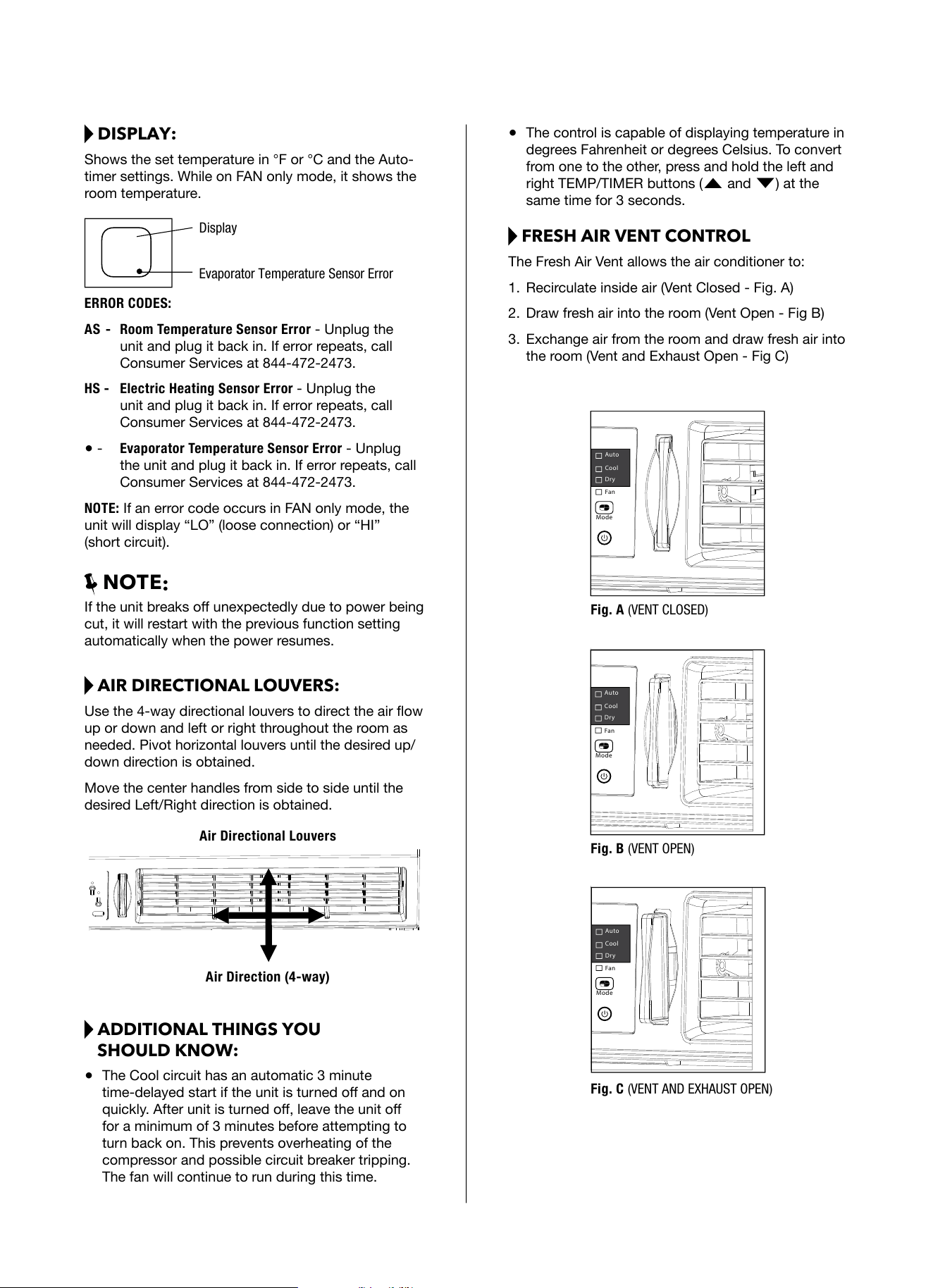
DISPLAY:
Shows the set temperature in °F or °C and the Auto-
timer settings. While on FAN only mode, it shows the
room temperature.
ERROR CODES:
AS - Room Temperature Sensor Error - Unplug the
unitandplugitbackin.Iferrorrepeats,call
Consumer Services at 844-472-2473.
HS - Electric Heating Sensor Error - Unplug the
unitandplugitbackin.Iferrorrepeats,call
Consumer Services at 844-472-2473.
●- Evaporator Temperature Sensor Error - Unplug
theunitandplugitbackin.Iferrorrepeats,call
Consumer Services at 844-472-2473.
NOTE: If an error code occurs in FAN only mode, the
unitwilldisplay“LO”(looseconnection)or“HI”
(shortcircuit).
NOTE
:
Iftheunitbreaksounexpectedlyduetopowerbeing
cut, it will restart with the previous function setting
automatically when the power resumes.
AIR DIRECTIONAL LOUVERS:
Usethe4-waydirectionallouverstodirecttheairow
up or down and left or right throughout the room as
needed.Pivothorizontallouversuntilthedesiredup/
down direction is obtained.
Move the center handles from side to side until the
desiredLeft/Rightdirectionisobtained.
ADDITIONAL THINGS YOU
SHOULD KNOW:
● TheCoolcircuithasanautomatic3minute
time-delayedstartiftheunitisturnedoandon
quickly.Afterunitisturnedo,leavetheunito
for a minimum of 3 minutes before attempting to
turnbackon.Thispreventsoverheatingofthe
compressorandpossiblecircuitbreakertripping.
The fan will continue to run during this time.
● Thecontroliscapableofdisplayingtemperaturein
degrees Fahrenheit or degrees Celsius. To convert
from one to the other, press and hold the left and
right TEMP/TIMERbuttons(
and
)atthe
same time for 3 seconds.
FRESH AIR VENT CONTROL
The Fresh Air Vent allows the air conditioner to:
1. Recirculateinsideair(VentClosed-Fig.A)
2. Drawfreshairintotheroom(VentOpen-FigB)
3. Exchange air from the room and draw fresh air into
theroom(VentandExhaustOpen-FigC)
Air Direction (4-way)
Air Directional Louvers
Display
Evaporator Temperature Sensor Error
Auto
Cool
Dry
Fan
Mode
Auto
Cool
Dry
Fan
Mode
Auto
Cool
Dry
Fan
Mode
Fig. A (VENT CLOSED)
Fig. B (VENT OPEN)
Fig. C (VENT AND EXHAUST OPEN)
20
13
CARE AND CLEANING
CAUTION
Cleanairconditioneroccasionallytokeepitlookingandoperatinglikenew.
Be sure to unplug the unit before cleaning to prevent shock or fire hazards.
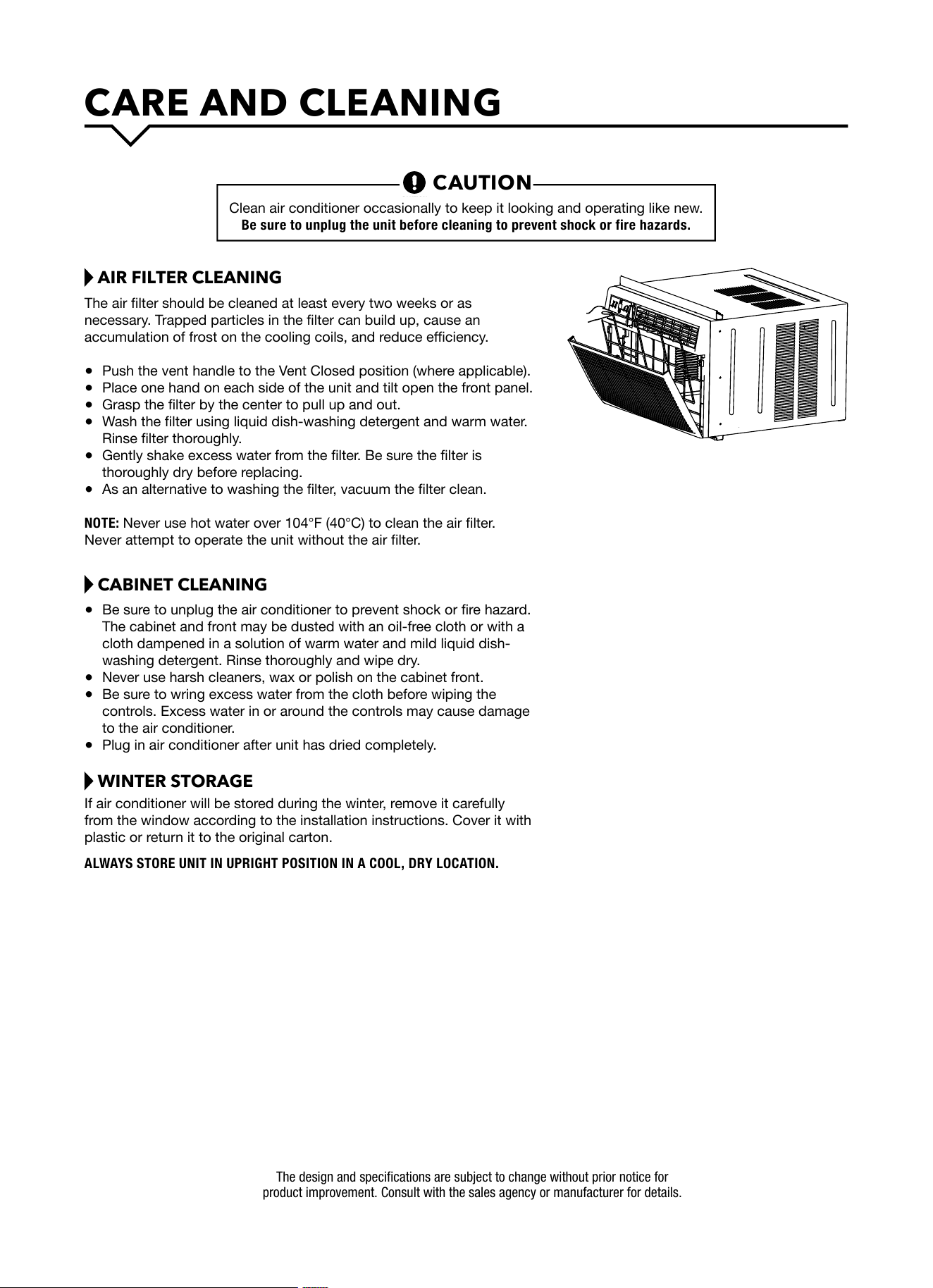
AIR FILTER CLEANING
Theairltershouldbecleanedatleasteverytwoweeksoras
necessary.Trappedparticlesintheltercanbuildup,causean
accumulationoffrostonthecoolingcoils,andreduceeciency.
● PushtheventhandletotheVentClosedposition(whereapplicable).
● Placeonehandoneachsideoftheunitandtiltopenthefrontpanel.
● Graspthelterbythecentertopullupandout.
● Washthelterusingliquiddish-washingdetergentandwarmwater.
Rinselterthoroughly.
● Gentlyshakeexcesswaterfromthelter.Besurethelteris
thoroughly dry before replacing.
● Asanalternativetowashingthelter,vacuumthelterclean.
NOTE: Neverusehotwaterover104°F(40°C)tocleantheairfilter.
Never attempt to operate the unit without the air filter.
CABINET CLEANING
● Besuretounplugtheairconditionertopreventshockorrehazard.
The cabinet and front may be dusted with an oil-free cloth or with a
clothdampenedinasolutionofwarmwaterandmildliquiddish-
washing detergent. Rinse thoroughly and wipe dry.
● Neveruseharshcleaners,waxorpolishonthecabinetfront.
● Besuretowringexcesswaterfromtheclothbeforewipingthe
controls. Excess water in or around the controls may cause damage
to the air conditioner.
● Pluginairconditionerafterunithasdriedcompletely.
WINTER STORAGE
If air conditioner will be stored during the winter, remove it carefully
from the window according to the installation instructions. Cover it with
plastic or return it to the original carton.
ALWAYS STORE UNIT IN UPRIGHT POSITION IN A COOL, DRY LOCATION.
The design and specifications are subject to change without prior notice for
product improvement. Consult with the sales agency or manufacturer for details.
21
14
NOTE
Ahighlyrecommendedtroubleshootforanyissueingeneralconsistsofturningounitandunpluggingfor5
minutes. It is also recommended to try another wall outlet. For further assistance, contact Consumer Services at
844-472-2473.
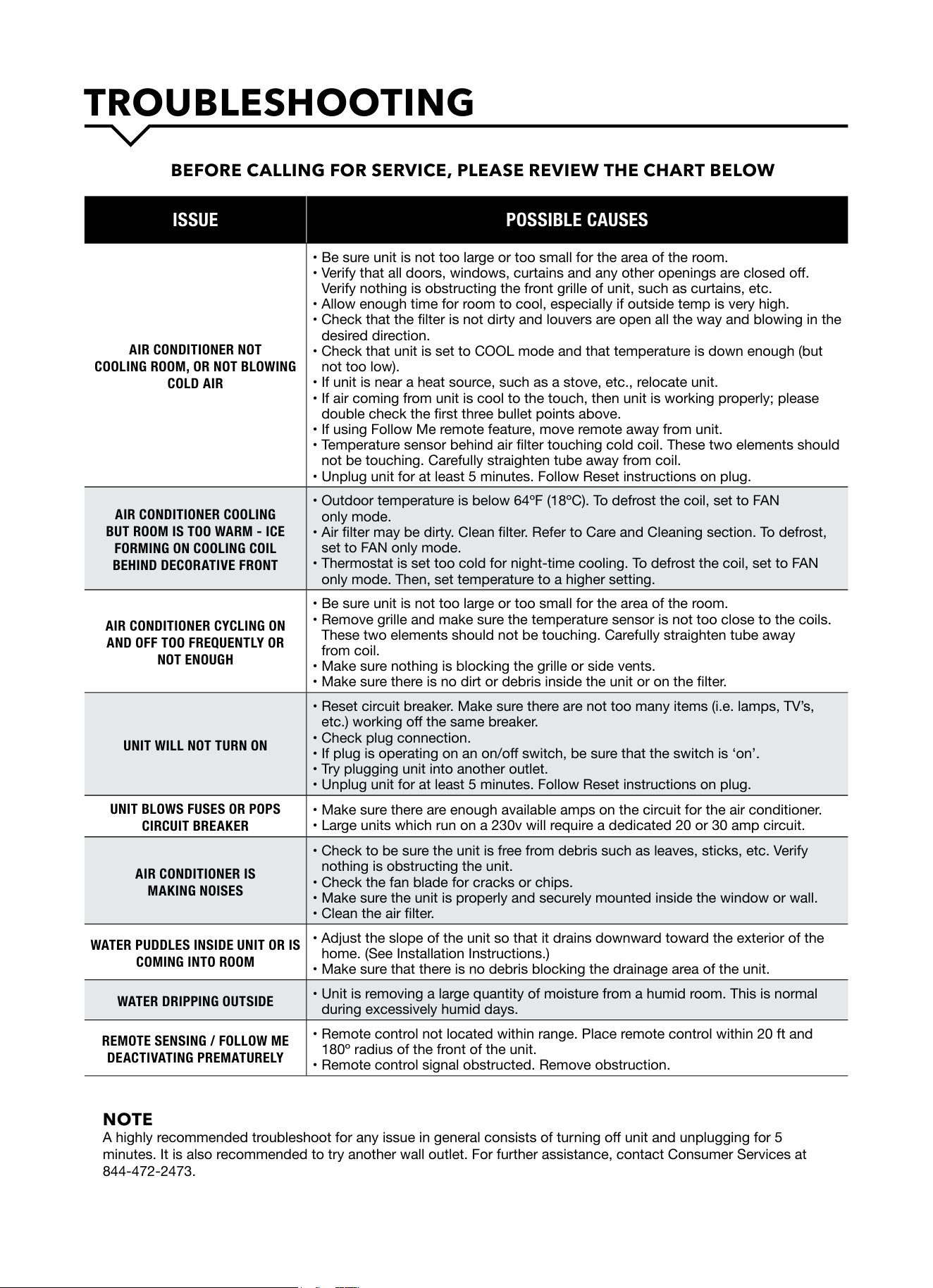
TROUBLESHOOTING
BEFORE CALLING FOR SERVICE, PLEASE REVIEW THE CHART BELOW
ISSUE POSSIBLE CAUSES
AIR CONDITIONER NOT
COOLING ROOM, OR NOT BLOWING
COLD AIR
•Besureunitisnottoolargeortoosmallfortheareaoftheroom.
•Verifythatalldoors,windows,curtainsandanyotheropeningsareclosedo.
Verify nothing is obstructing the front grille of unit, such as curtains, etc.
•Allowenoughtimeforroomtocool,especiallyifoutsidetempisveryhigh.
•Checkthatthelterisnotdirtyandlouversareopenallthewayandblowinginthe
desired direction.
•CheckthatunitissettoCOOLmodeandthattemperatureisdownenough(but
nottoolow).
•Ifunitisnearaheatsource,suchasastove,etc.,relocateunit.
•Ifaircomingfromunitiscooltothetouch,thenunitisworkingproperly;please
doublechecktherstthreebulletpointsabove.
•IfusingFollowMeremotefeature,moveremoteawayfromunit.
•Temperaturesensorbehindairltertouchingcoldcoil.Thesetwoelementsshould
not be touching. Carefully straighten tube away from coil.
•Unplugunitforatleast5minutes.FollowResetinstructionsonplug.
AIR CONDITIONER COOLING
BUT ROOM IS TOO WARM - ICE
FORMING ON COOLING COIL
BEHIND DECORATIVE FRONT
•Outdoortemperatureisbelow64ºF(18ºC).Todefrostthecoil,settoFAN
only mode.
•Airltermaybedirty.Cleanlter.RefertoCareandCleaningsection.Todefrost,
set to FAN only mode.
•Thermostatissettoocoldfornight-timecooling.Todefrostthecoil,settoFAN
only mode. Then, set temperature to a higher setting.
AIR CONDITIONER CYCLING ON
AND OFF TOO FREQUENTLY OR
NOT ENOUGH
•Besureunitisnottoolargeortoosmallfortheareaoftheroom.
•Removegrilleandmakesurethetemperaturesensorisnottooclosetothecoils.
These two elements should not be touching. Carefully straighten tube away
from coil.
•Makesurenothingisblockingthegrilleorsidevents.
•Makesurethereisnodirtordebrisinsidetheunitoronthelter.
UNIT WILL NOT TURN ON
•Resetcircuitbreaker.Makesuretherearenottoomanyitems(i.e.lamps,TV’s,
etc.)workingothesamebreaker.
•Checkplugconnection.
•Ifplugisoperatingonanon/oswitch,besurethattheswitchis‘on’.
•Trypluggingunitintoanotheroutlet.
•Unplugunitforatleast5minutes.FollowResetinstructionsonplug.
UNIT BLOWS FUSES OR POPS
CIRCUIT BREAKER
•Makesurethereareenoughavailableampsonthecircuitfortheairconditioner.
•Largeunitswhichrunona230vwillrequireadedicated20or30ampcircuit.
AIR CONDITIONER IS
MAKING NOISES
•Checktobesuretheunitisfreefromdebrissuchasleaves,sticks,etc.Verify
nothing is obstructing the unit.
•Checkthefanbladeforcracksorchips.
•Makesuretheunitisproperlyandsecurelymountedinsidethewindoworwall.
•Cleantheairlter.
WATER PUDDLES INSIDE UNIT OR IS
COMING INTO ROOM
•Adjusttheslopeoftheunitsothatitdrainsdownward
towardtheexteriorofthe
home.(SeeInstallationInstructions.)
•Makesurethatthereisnodebrisblockingthedrainageareaoftheunit.
WATER DRIPPING OUTSIDE
•Unitisremovingalargequantityofmoisturefromahumidroom.Thisisnormal
during excessively humid days.
REMOTE SENSING / FOLLOW ME
DEACTIVATING PREMATURELY
•Remotecontrolnotlocatedwithinrange.Placeremotecontrolwithin20ftand
180ºradiusofthefrontoftheunit.
•Remotecontrolsignalobstructed.Removeobstruction.
22

844-4PA-AIRE | 844-472-2473 | support@perfectaire.us
CANADA SUPPORT 877-997-2473 | supportcanada@perfectaire.us
www.perfectaire.us
5401 Dansher Road
Countryside, IL 60525
Printed in China | 0423_M1052
THANK YOU FOR YOUR PURCHASE!
We’d love to hear how you are enjoying your Perfect Aire product!
Please take a minute to tell us (and others) about your experience.
Thanks (again!)
SCAN CODE TO
LEAVE A REVIEW