Owner’s Manual
High Definition Video Camera
Model No.
HC-V785
Please read these instructions carefully before using this product, and save this manual for future
use.
DVQP2590ZA
F0122MZ0
Register online at http://shop.panasonic.com/support (U.S. customers only)

- 2 -
∫ About the recording format for recording motion pictures
You can select from AVCHD
*1
, MP4 or iFrame recording formats to record motion pictures using
this unit.
(
l 71)
*1 It is compatible with the AVCHD Progressive (1080/60p).
AVCHD:
It is suitable for viewing on a high-definition TV or for saving to disc
*2
.
*2 The following methods are available for saving an image recorded in 1080/60p:
j Copy the image to a disc using the HD Writer AE 5.2.
j Copy the image to a Panasonic Blu-ray disc recorder that supports AVCHD Progressive.
≥ Blu-ray recorders are not sold in US.
MP4:
This is a recording format suitable for playing back or editing on a PC.
≥ It is not compatible with motion pictures recorded in AVCHD format.
iFrame:
This is a recording format suitable for playing back or editing on a Mac (iMovie etc.).
≥ It is not compatible with motion pictures recorded in AVCHD format.
∫ Indemnity about recorded content
Panasonic does not accept any responsibility for damages directly or indirectly due to any type of
problems that result in loss of recording or edited content, and does not guarantee any content if
recording or editing does not work properly. Likewise, the above also applies in a case where any
type of repair is made to the unit.
∫ About Condensation (When the lens or the LCD monitor is fogged
up)
Condensation occurs when there is a change in temperature or humidity, such as when the unit is
taken from outside or a cold room to a warm room. Please be careful, as it may cause the lens or
LCD monitor to become soiled, moldy, or damaged.
When taking the unit to a place which has a different temperature, if the unit is accustomed to the
room temperature of the destination for about one hour, condensation can be prevented. (When the
difference in temperature is severe, place the unit in a plastic bag or the like, remove air from the
bag, and seal the bag.)
When condensation has occurred, remove the battery and/or the AC adapter and leave the unit like
that for about one hour. When the unit becomes accustomed to the surrounding temperature,
fogginess will disappear naturally.
∫ Cards that you can use with this unit
SD Memory Card, SDHC Memory Card and SDXC Memory Card
≥ 4 GB or more Memory Cards that do not have the SDHC logo or 48 GB or more Memory Cards
that do not have the SDXC logo are not based on SD Memory Card Specifications.
≥ Refer to page
15 for more details on SD cards.
Read this first

- 3 -
∫ Caution regarding the lens
Do not aim the lens at the sun or strong light. Doing so may cause the unit to malfunction.
∫ For the purposes of this owner’s manual
≥ SD Memory Card, SDHC Memory Card and SDXC Memory Card are referred to as the “SD card”.
≥ The smartphone and tablet are indicated as “smartphone”.
≥ Function that can be used for Motion Picture Recording Mode:
Function that can be used for Still Picture Recording Mode:
≥ Function that can be used for the Playback Mode:
Function that can be used for the Playback Mode (motion pictures only):
Function that can be used for the Playback Mode (still pictures only):
≥ Scene(s) recorded in the recording format [AVCHD]: “AVCHD scene(s)”
≥ Scene(s) recorded in the recording format [MP4/iFrame], scene(s) saved in MP4 (1920k1080/
30p), MP4 (1280k720/30p) or MP4 (640k360/30p): “MP4/iFrame scene(s)”
≥ Scene(s) recorded in the recording mode [iFrame]: “iFrame scene(s)”
≥ Scene(s) containing only the Main Camera’s image that was recorded separately from a
simultaneously recorded normal scene when [Backup for Twin Camera] was set to [ON]:
“Scene(s) recorded as Backup for Twin Camera”
≥ Pages for reference are indicated by an arrow, for example: l 00

- 4 -
Read this first ...................................................................................................................................2
Preparation
Names and Functions of Main Parts ..............................................................................................8
Power supply..................................................................................................................................11
Inserting/removing the battery ................................................................................................. 11
Charging the battery ................................................................................................................ 12
Charging and recording time ................................................................................................... 13
Recording to a card .......................................................................................................................15
Cards that you can use with this unit....................................................................................... 15
Inserting/removing an SD card ................................................................................................ 16
Turning the unit on/off ...................................................................................................................17
Selecting a mode ...........................................................................................................................18
Switching this unit between Recording Mode and Playback Mode ......................................... 18
Switching this unit between Motion Picture Recording Mode and Still Picture Recording
Mode........................................................................................................................................ 18
How to use the touch screen ........................................................................................................19
About the Touch Menu............................................................................................................. 20
Setting date and time.....................................................................................................................21
Basic
Before recording ............................................................................................................................22
Recording motion pictures ...........................................................................................................23
Recording still pictures .................................................................................................................25
Recording still pictures in Motion Picture Recording Mode ..................................................... 26
Motion picture/Still picture playback ...........................................................................................27
Using the menu screen .................................................................................................................30
Using the Setup Menu ...................................................................................................................31
Advanced (Recording)
Using the zoom ..............................................................................................................................41
Zoom ratio during the Still Picture Recording Mode ................................................................ 41
Level Shot Function.......................................................................................................................42
Recording with the Backup for Twin Camera Function .............................................................43
Changing the Recording Mode.....................................................................................................45
Intelligent Auto ......................................................................................................................... 46
Intelligent Auto Plus................................................................................................................. 48
Creative Control....................................................................................................................... 48
HDR Movie Mode .................................................................................................................... 51
Scene Mode ............................................................................................................................ 52
FULL HD Slow Motion Video................................................................................................... 53
Stop Motion Animation Assist.................................................................................................. 55
Contents

- 5 -
Manual recording ...........................................................................................................................56
White Balance ......................................................................................................................... 57
Manual shutter speed/iris adjustment ...................................................................................... 58
Manual Focus adjustment ....................................................................................................... 59
Recording with the Touch Function .............................................................................................60
Touch function icons ................................................................................................................ 60
Recording functions of operation icons......................................................................................65
Operation icons ....................................................................................................................... 65
Recording functions of menus .....................................................................................................70
Advanced (Playback)
Playback Operations .....................................................................................................................83
Motion picture playback using operation icon.......................................................................... 83
Creating still picture from motion picture ................................................................................. 85
Highlight & Time Frame Index ................................................................................................. 85
Repeat Playback ..................................................................................................................... 86
Resuming the previous playback............................................................................................. 86
Setting the playback speed of FULL HD Slow Motion Video................................................... 87
Zooming in on a still picture during playback (Playback zoom)............................................... 87
Various playback functions ..........................................................................................................88
Playing back motion pictures/still pictures by date .................................................................. 88
Highlight Playback ................................................................................................................... 90
Manual Edit.............................................................................................................................. 96
Baby Calendar....................................................................................................................... 100
Changing the playback settings and playing back the slide show ......................................... 102
Playing back still pictures recorded in Stop Motion Animation Assist Mode as a slide
show ...................................................................................................................................... 104
Deleting scenes/still pictures .....................................................................................................105
Deleting part of a scene (AVCHD/Backup for Twin Camera)................................................. 107
Dividing a scene (AVCHD/Backup for Twin Camera) ............................................................ 108
Dividing a scene to partially delete (MP4/iFrame) ................................................................. 109
Protecting scenes/still pictures .............................................................................................. 110
Convert to MP4............................................................................................................................. 111
Slow speed conversion ...............................................................................................................112
Watching Video/Pictures on your TV ......................................................................................... 113
Connecting with a HDMI micro cable .................................................................................... 115
Listening in 5.1 channel sound (AVCHD) .............................................................................. 115
Playback using VIERA Link ........................................................................................................116
Copy/Dubbing
Copying/playing back with a USB HDD .....................................................................................118
Preparing for copying/playing back ....................................................................................... 118
Simple copy ........................................................................................................................... 121
Copy selected files ................................................................................................................ 121
Playing back the USB HDD ................................................................................................... 122
Dubbing with a Blu-ray disc recorder, video device, etc. ........................................................123

- 6 -
Wi-Fi
Wi-Fi
®
function.............................................................................................................................127
What you can do with the Wi-Fi function...................................................................................129
[Link to Cell] .................................................................................................................................130
Preparations before using [Link to Cell]................................................................................. 131
Using [Link to Cell] with a direct connection .......................................................................... 132
Using [Link to Cell] with a wireless access point connection ................................................. 132
About [Link to Cell] ................................................................................................................ 133
[DLNA Play] ..................................................................................................................................135
Preparations before using [DLNA Play] ................................................................................. 135
Playing back on a TV............................................................................................................. 136
[Copy]............................................................................................................................................137
Preparations before using [Copy] .......................................................................................... 137
Copying to a PC .................................................................................................................... 139
Install the “Image App” ...............................................................................................................141
Setting Up a Wi-Fi Connection ...................................................................................................142
Using the [Wi-Fi Setup Wizard] to set up a connection ......................................................... 143
Connecting to a wireless access point .................................................................................. 144
Setting up a direct connection to a smartphone .................................................................... 147
Connecting from the history................................................................................................... 149
If the Wi-Fi connection cannot be established ....................................................................... 150
How to Use the [Wi-Fi Setup] Menu ...........................................................................................152
Wireless Twin Camera
Wireless Twin Camera function..................................................................................................156
Notes on the Wireless Twin Camera function........................................................................ 157
Using a Smartphone as a Wireless Sub Camera ......................................................................158
When connecting a smartphone to this unit as a Wireless Sub Camera for the first time ..... 158
When connecting for the second time or later ....................................................................... 161
Terminating the connection.................................................................................................... 161
Recording with a Wireless Sub Camera (Wireless Twin Camera) ...........................................162
Screen display when using a Wireless Sub Camera ............................................................. 162
If the Wi-Fi connection cannot be established (Wireless Twin Camera) ................................166
With a PC
What you can do with a PC .........................................................................................................167
Before Installing HD Writer AE 5.2 ........................................................................................ 169
Operating environment ...............................................................................................................171
Installation ....................................................................................................................................173
Connecting to a PC......................................................................................................................174
About the PC display ............................................................................................................. 176
Starting HD Writer AE 5.2 ............................................................................................................177
Reading the operating instructions of the software applications ........................................... 177
If using Mac (mass storage)........................................................................................................178

- 7 -
Others
Indications ....................................................................................................................................179
Messages......................................................................................................................................182
About recovery ...................................................................................................................... 183
Troubleshooting...........................................................................................................................184
Cautions for use...........................................................................................................................189
About copyright ...........................................................................................................................194
Recording modes/approximate recordable time ......................................................................195
Approximate number of recordable pictures ............................................................................196
Optional accessories...................................................................................................................197
- 8 -
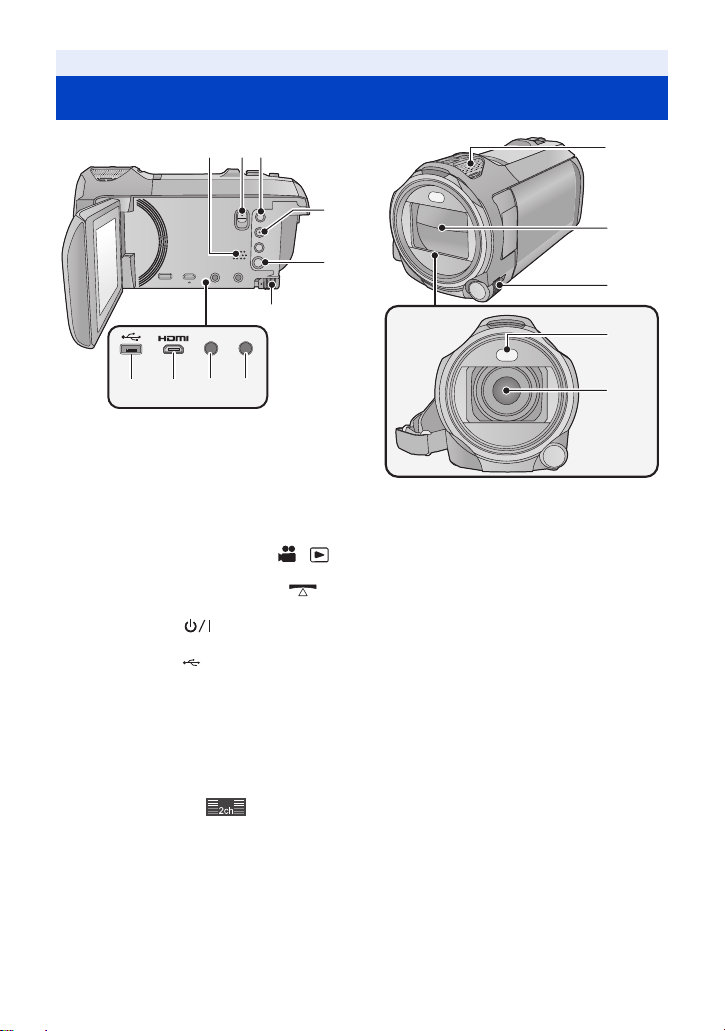
1 Speaker
2 Shoe adaptor release lever
[SHOE ADAPTOR RELEASE] (
l 197)
3 Recording/playback button [ / ]
(
l 18)
4
Level Shot Function button [ ]
(
l 42)
5 Power button [ ] (l 17)
6 Battery release lever [BATT] (l 11)
7 USB terminal
[] (
l 118, 124, 174)
8 Micro HDMI connector [HDMI] (l 113)
9 A/V connector [A/V] (l 113, 126)
10 Microphone terminal [MIC]
≥ A compatible plug-in powered microphone
can be used as an external microphone.
≥ If you connect an external microphone when
a setting other than [AUTO] is selected for
[MIC LEVEL] (
l 79), (Microphone
input level meter) will be displayed.
≥ When the unit is connected with the AC
adaptor, sometimes noise may be heard
depending on the microphone type. In this
case, please switch to the battery for the
power supply and the noise will stop.
11 Internal microphones
12 Lens cover
≥ The lens cover opens in Motion Picture
Recording Mode or Still Picture Recording
Mode. (
l 18)
13 Multi Manual Dial [CAMERA FUNCTION]
(
l 56, 80)
14 Video light (l 68, 82)
15 Lens
Preparation
Names and Functions of Main Parts
123
4
5
6
8107
ヮリヤモバヷ
9
12
13
14
15
11
- 9 -
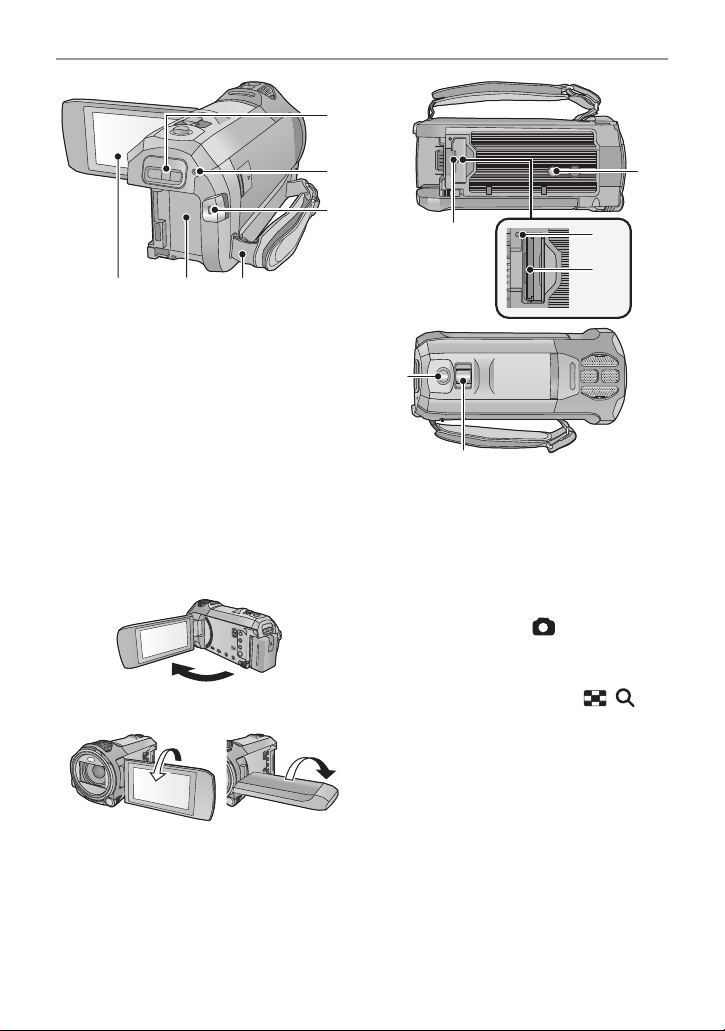
16 Shoe adaptor mounting part
[SHOE ADAPTOR] (
l 197)
17 Status indicator (l 17, 142)
18 Recording start/stop button (l 23)
19 LCD monitor (Touch screen) (l 19)
≥ It can open up to 90o.
≥ It can rotate up to 180o A towards the lens or
90o B towards the opposite direction.
20 Battery holder (l 11)
21 Shoulder strap fixture
22 Tripod receptacle
≥ Attaching a tripod with a screw length of
5.5 mm (0.22 q) or more may damage the
unit.
23 SD card cover (l 16)
24 Access lamp [ACCESS] (l 16)
25 Card slot (l 16)
26 Photoshot button [ ] (l 25)
27 Zoom lever [W/T] (In Motion Picture
Recording Mode or Still Picture
Recording Mode) (
l 41)/
Thumbnail display switch [ / ]/
Volume lever [sVOLr] (In Playback
Mode) (
l 29)
17
16
212019
18
22
23
24
25
26
27
- 10 -
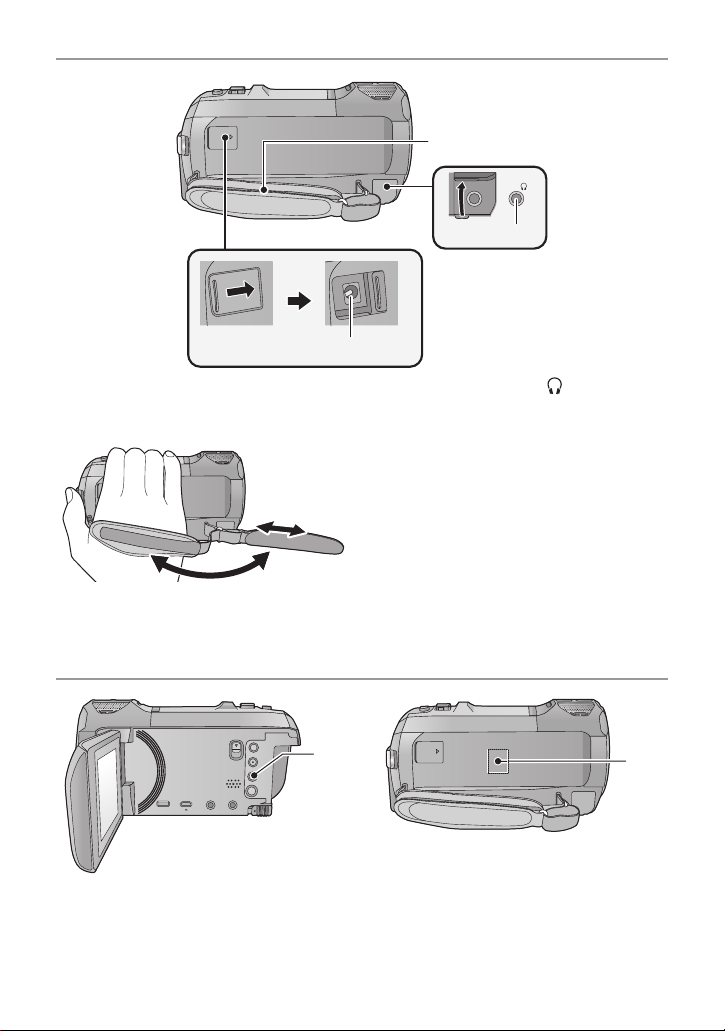
28 Grip belt
Adjust the length of the grip belt so that it fits
your hand.
1 Flip the belt.
2 Adjust the length.
3 Replace the belt.
29 Headphone terminal [ ] (l 69)
≥ Excessive sound pressure from earphones
and headphones can cause hearing loss.
≥ Listening at full volume for long periods may
damage the user’s ears.
30 DC input terminal [DC IN] (l 12)
≥ Do not use any other AC adaptors except the
supplied one.
31 Wi-Fi button [Wi-Fi]
(
l 130, 135, 137, 149, 152)
32 Wi-Fi Transmitter (l 128)
28
30
29
31
32
- 11 -
∫ About batteries that you can use with this unit
The battery that can be used with this unit is VW-VBT190/VW-VBT380.
≥ The unit has a function for distinguishing batteries which can be used safely. The
dedicated battery (VW-VBT190/VW-VBT380) supports this function. The only batteries
suitable for use with this unit are genuine Panasonic products and batteries manufactured
by other companies and certified by Panasonic. Panasonic cannot in any way guarantee
the quality, performance or safety of batteries which have been manufactured by other
companies and are not genuine Panasonic products.
Inserting/removing the battery
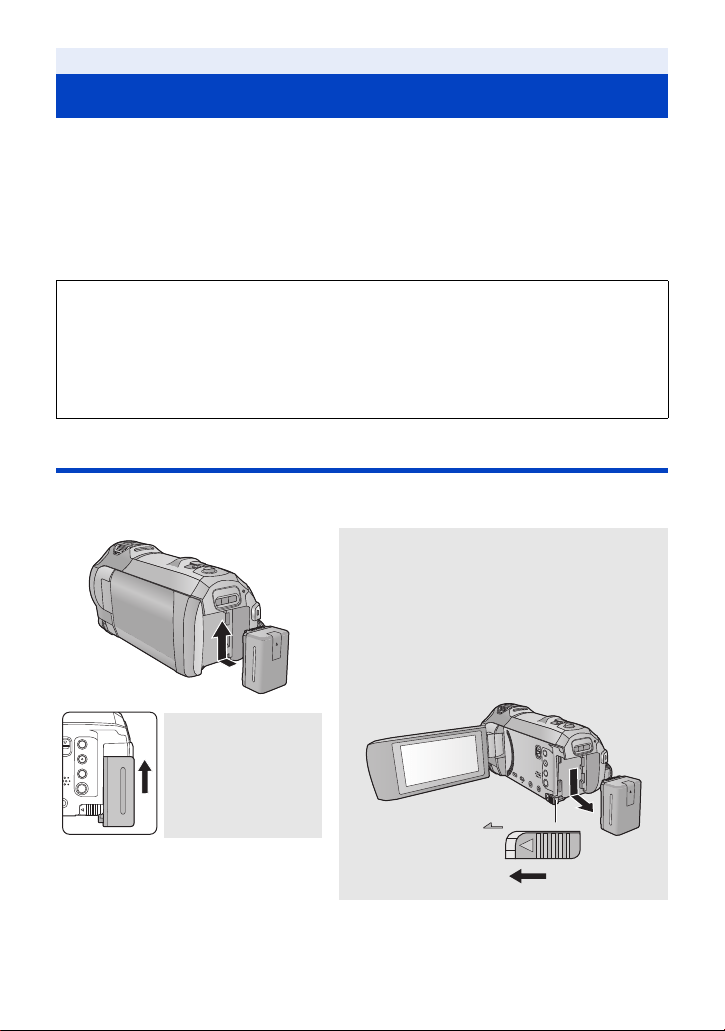
≥ Press the power button to turn off the unit. (
l 17)
Install the battery by inserting it in the direction shown in the figure.
Preparation
Power supply
It has been found that counterfeit battery packs which look very similar to the genuine
product are made available to purchase in some markets. Some of these battery packs
are not adequately protected with internal protection to meet the requirements of
appropriate safety standards. There is a possibility that these battery packs may lead to
fire or explosion. Please be advised that we are not liable for any accident or failure
occurring as a result of use of a counterfeit battery pack. To ensure that safe products are
used we would recommend that a genuine Panasonic battery pack is used.
Removing the battery
Be sure to hold down the power button until the
status indicator goes off. Then remove the battery
while supporting the unit to prevent it from
dropping.
Move the battery release lever in the direction
indicated by the arrow and remove the battery
when unlocked.
While holding the
battery against the
battery holder, push
the battery upwards
until you hear it click
into place.
ャモヵヵ
- 12 -
Charging the battery
The AC adaptor is in the standby condition when the mains plug is connected. The primary circuit is
always “live” as long as the mains plug is connected to an electrical outlet.
Important:
≥ Do not use the AC adaptor/DC cable with any other equipment as it is designed only for
this unit. Also, do not use the AC adaptor/DC cable from other equipment with this unit.
≥ The battery will not be charged if the unit is turned on.
≥ It is recommended to charge the battery in a temperature between 10 oC and 30 oC (50 oF
and 86 oF). (The battery temperature should also be the same.)
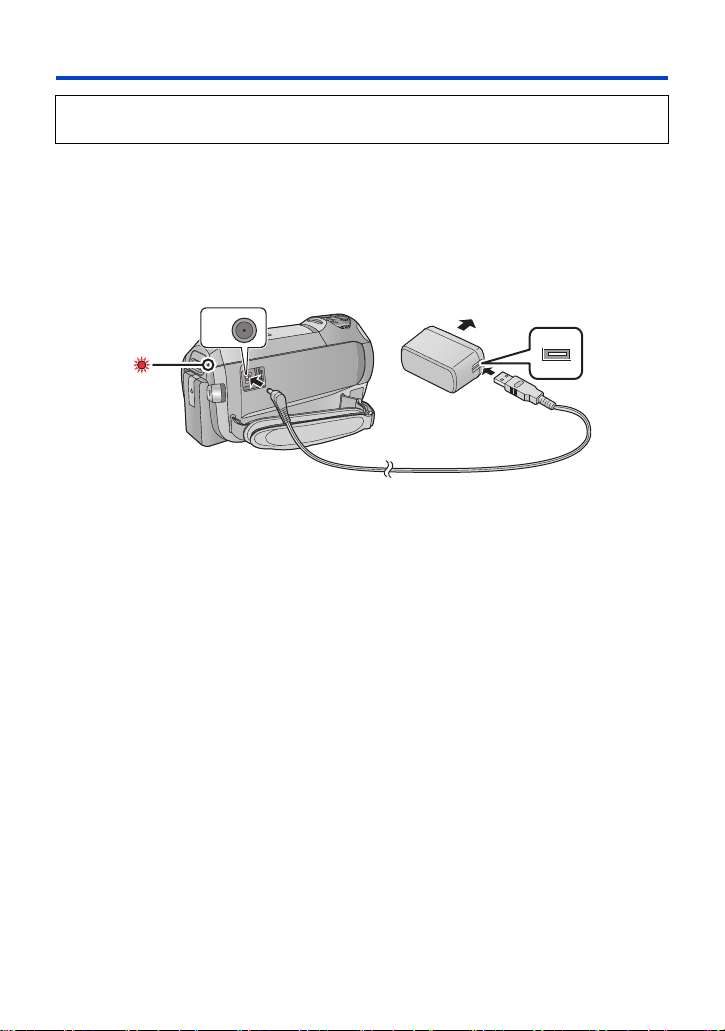
A DC input terminal
1 Connect the DC cable to the AC adaptor and to the DC input terminal of this
unit.
≥ Insert the plugs as far as they will go.
2 Insert the AC adaptor into an AC outlet.
≥ The status indicator will flash red at an interval of approximately 2 seconds (approximately
1 second on, approximately 1 second off), indicating that charging has begun.
It will turn off when the charging is completed.
∫ Connecting to the AC outlet
It is possible to use this unit with power supplied from the AC outlet by turning on the unit with the
AC adaptor connected.
Even when you use the AC adaptor for recording images, keep the battery connected.
This allows you to continue the recording even if a power failure occurs or the AC adaptor is
unplugged from the AC outlet by accident.
When this unit is purchased, the battery is not charged. Charge the battery fully before
using this unit for the first time.

- 13 -
∫ To charge by connecting to other device
It is possible to charge by connecting to other device with the USB cable (supplied).
Please refer to page
175.
≥ If the status indicator flashes at a particularly fast or slow rate, refer to page 191.
≥ We recommend using Panasonic batteries (
l 13).
≥ If you use other batteries, we cannot guarantee the quality of this product.
≥ Do not heat or expose to flame.
≥ Do not leave the battery(ies) in a car exposed to direct sunlight for a long period of time with
doors and windows closed.
≥ Do not expose to low air pressure at high altitudes.
≥ Do not expose to extremely low air pressure, as this may result in explosions or leakage of
flammable liquids and gases.
Charging and recording time
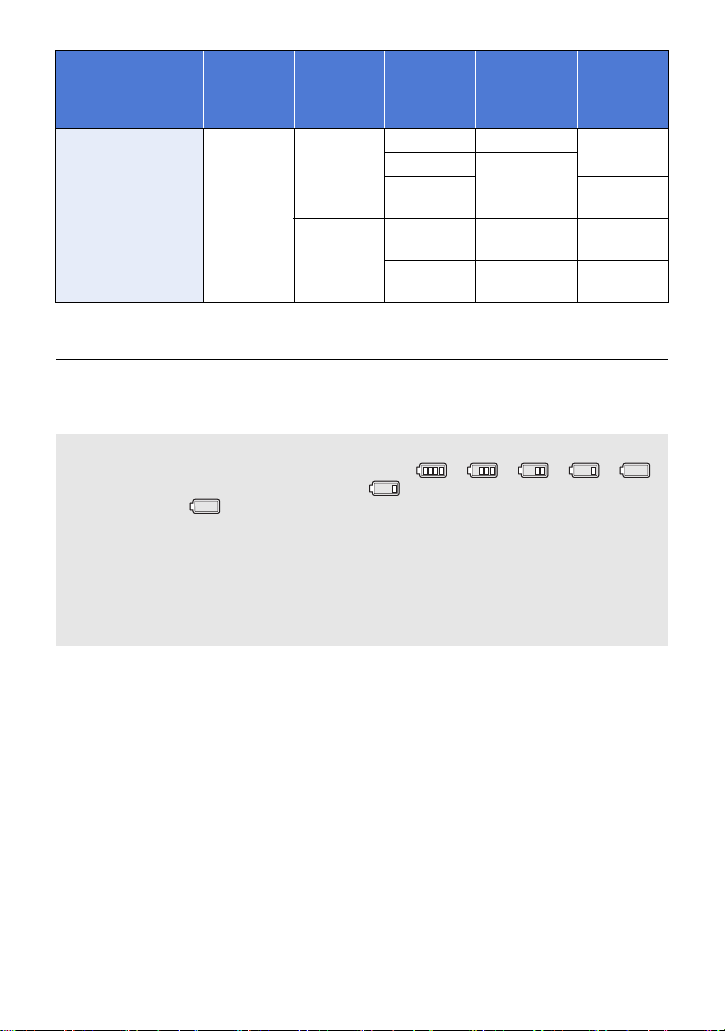
∫ Charging/Recording time
≥ The indicated charging time is for when the battery has been discharged completely.
Charging time and recordable time vary depending on the usage conditions such as high/
low temperature.
≥ Temperature: 25 oC (77 oF)/humidity: 60%RH
≥ Charging times in parentheses are when charging from the USB terminal.
Battery model
number
[Voltage/Capacity
(minimum)]
Charging
time
Recording
format
Recording
mode
Maximum
continuous
recordable
time
Actual
recordable
time
Supplied battery/
VW-VBT190
(optional)
[3.6 V/1940 mAh]
2h20min
(5h20min)
[AVCHD]
[1080/60p] 1 h 35 min
50 min
[PH], [HA],
[HG], [HE]
1h40min
[MP4/
iFrame]
[1080/50M],
[1080/28M]
1h35min
[720],
[iFrame]
1h50min 55min
- 14 -
≥ “h” is an abbreviation for hour, “min” for minute and “s” for second.
≥ These times are approximations.
≥ The actual recordable time refers to the recordable time when repeatedly starting/stopping
recording, turning the unit on/off, moving the zoom lever etc.
≥ The batteries heat up after use or charging. This is not a malfunction.
Battery model
number
[Voltage/Capacity
(minimum)]
Charging
time
Recording
format
Recording
mode
Maximum
continuous
recordable
time
Actual
recordable
time
VW-VBT380
(optional)
[3.6 V/3880 mAh]
3h45min
(9h45min)
[AVCHD]
[1080/60p] 3 h 25 min
1h45min
[PH]
3h30min
[HA], [HG],
[HE]
1h50min
[MP4/
iFrame]
[1080/50M],
[1080/28M]
3h25min 1h45min
[720],
[iFrame]
4h 2h5min
Battery capacity indication
≥ The display changes as the battery capacity reduces. ####
If there is less than 3 minutes remaining, then will become red. If the battery
discharges, then will flash.
≥ Screen display will disappear when no touch operation is performed for a specific period of
time. However, it will be constantly displayed when the remaining battery time becomes less
than 30 minutes.
≥ The remaining battery capacity is displayed when using the Panasonic battery that you can
use for this unit. The actual time can vary depending on your actual use.
≥ When using the AC adaptor or batteries made by other companies, the remaining battery
capacity will not be shown.
- 15 -
The unit can record still pictures or motion pictures to an SD card. To record to an SD card, read the
following.
Cards that you can use with this unit
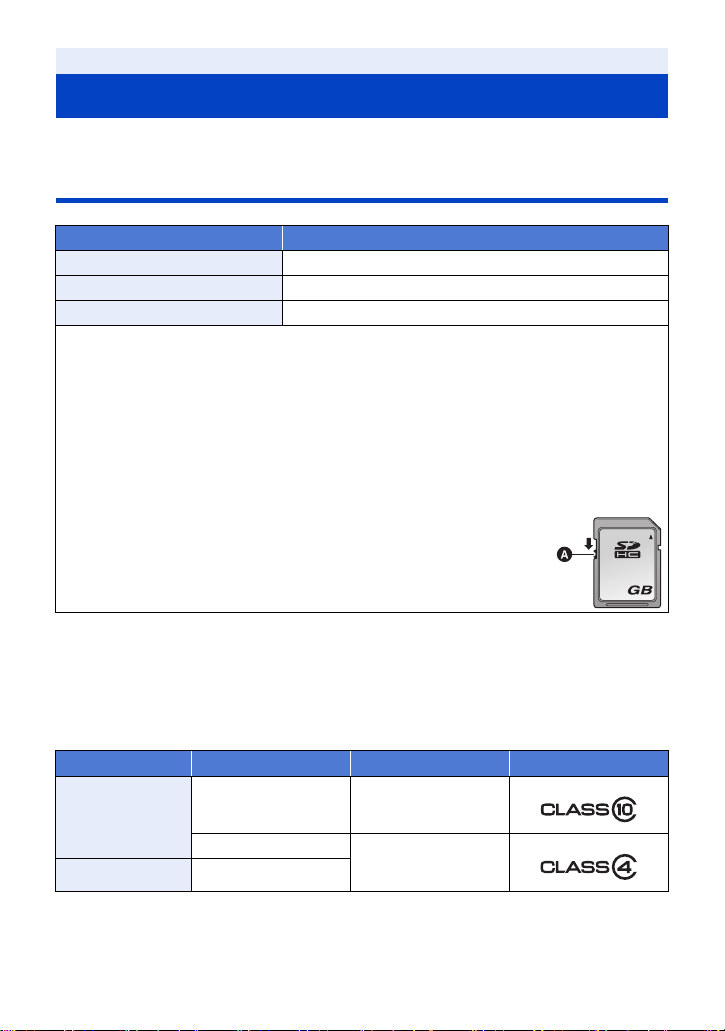
∫ About the Speed Class ratings for recording motion pictures
≥ Depending on [REC MODE] and [REC FORMAT], the required card differs. (
l 72)
Use a card that meets the following ratings of the SD Speed Class. Use of a non-compatible card
may cause recording to stop suddenly.
≥ SD Speed Class is the speed standards regarding continuous writing. To check the class, see the
labeled side, etc. of the card.
≥ In the following situations, you need an SD card conforming to Class 10 of the SD Speed
Class Rating to record motion pictures.
Preparation
Recording to a card
Card type Capacity
SD Memory Card 512 MB to 2 GB
SDHC Memory Card 4 GB to 32 GB
SDXC Memory Card 48 GB to 128 GB
≥ Please check the latest information on the support website below.
https://panasonic.jp/support/global/cs/e_cam
(This website is in English only.)
≥ When using an SDHC Memory Card/SDXC Memory Card with other equipment, check the
equipment is compatible with these Memory Cards.
≥ We do not guarantee the operation of SD cards other than the ones above. Further, SD cards
with a capacity of less than 32 MB cannot be used for motion picture recording.
≥ Operation is not guaranteed for all SD cards.
≥ 4 GB or more Memory Cards that do not have the SDHC logo or 48 GB or more Memory Cards
that do not have the SDXC logo are not based on SD Memory Card Specifications.
≥ When the write-protect switch A on SD card is locked, no recording,
deletion or editing will be possible on the card.
≥ Keep the Memory Card out of reach of children to prevent swallowing.
Recording formats
Recording modes
Speed Class ratings Label examples
MP4/iFrame
1080/50M Class 10
1080/28M, 720, iFrame
Class 4 or more
AVCHD All
32
- 16 -
Use of a non-compatible card may cause recording to stop suddenly.
j FULL HD Slow Motion Video Mode (
l 53)
j When [Backup for Twin Camera] is set to [ON] (
l 43)
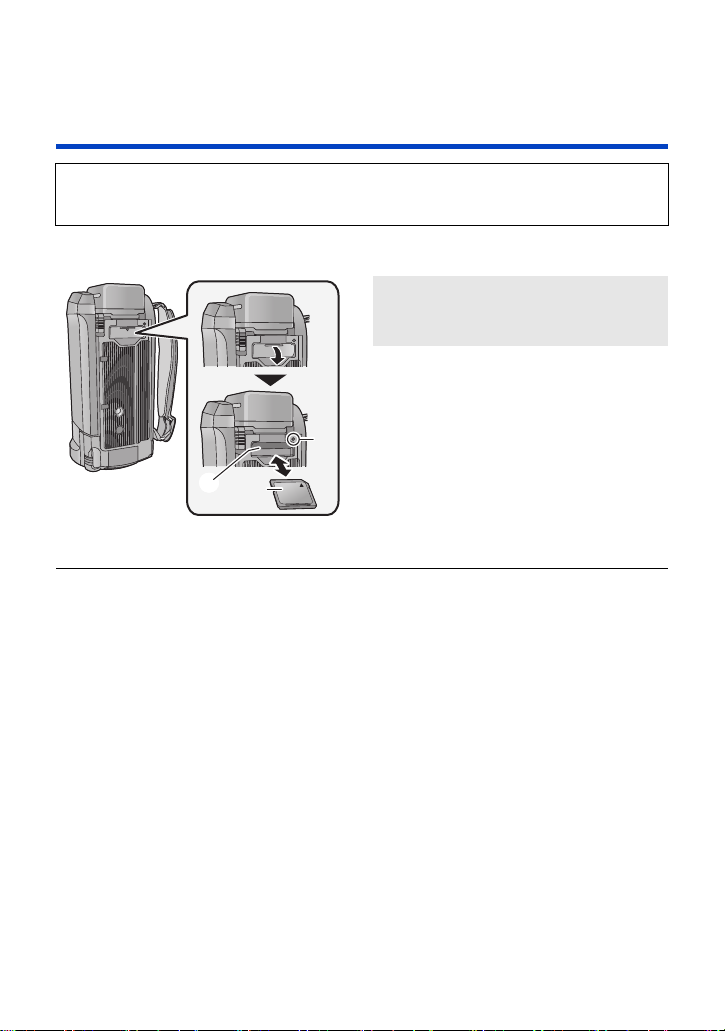
Inserting/removing an SD card
Caution:
Check that the access lamp has gone off.
1 Open the SD card cover and insert
(remove) the SD card into (from)
the card slot B.
≥ Face the label side C in the direction shown
in the illustration and press it straight in as far
as it will go.
≥ Press the center of the SD card and then pull
it straight out.
2 Securely close the SD card cover.
≥ Securely close it until it clicks.
≥ Do not touch the terminals on the back of the
SD card.
≥ Do not apply strong shocks, bend, or drop the
SD card.
≥ Electrical noise, static electricity or the failure
of this unit or the SD card may damage or
erase the data stored on the SD card.
≥ When the card access lamp is lit, do not:
j Remove the SD card
j Turn the unit off
j Insert and remove the USB cable
j Expose the unit to vibrations or shock
Performing the above while the lamp is on
may result in damage to data/SD card or this
unit.
≥ Do not expose the terminals of the SD card to
water, dirt or dust.
≥ Do not place SD cards in the following areas:
j In direct sunlight
j In very dusty or humid areas
j Near a heater
j Locations susceptible to significant
difference in temperature (condensation
can occur.)
j Where static electricity or electromagnetic
waves occur
≥ To protect SD cards, return them to their
cases when you are not using them.
≥ About disposing of or giving away the SD
card. (
l 192)
When using an SD card not from Panasonic, or one previously used on other equipment, for the
first time on this unit, format the SD card. (
l 38) When the SD card is formatted, all of the
recorded data is deleted. Once the data is deleted, it cannot be restored.
Access lamp [ACCESS] A
≥ When this unit is accessing the SD card,
the access lamp lights up.
- 17 -
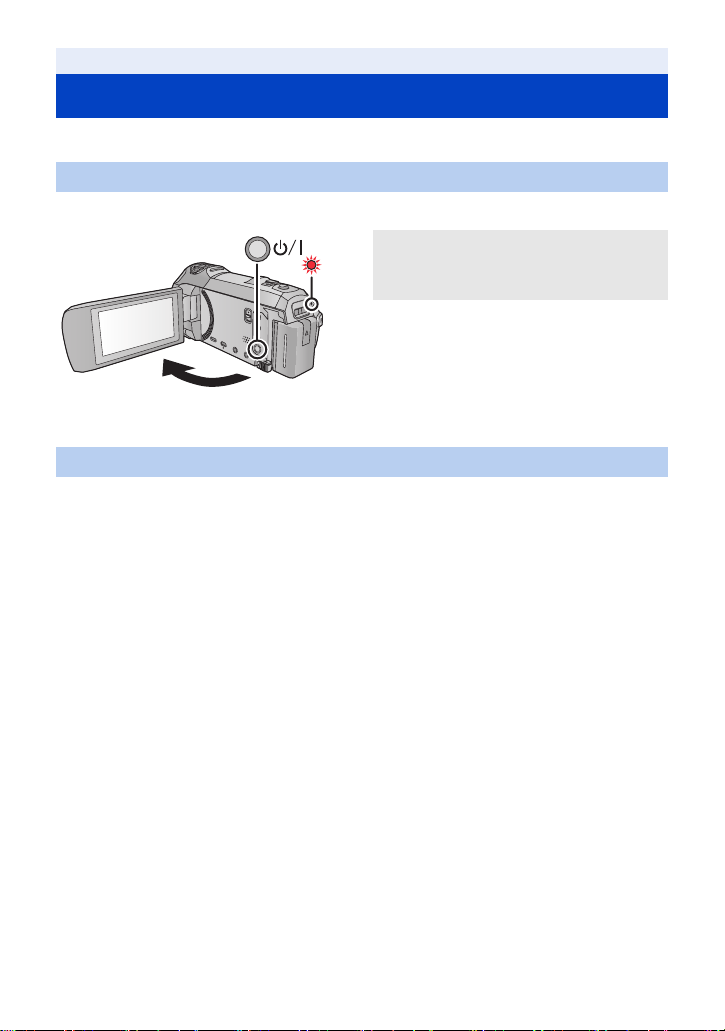
You can turn the unit on and off using the power button or by opening and closing the LCD monitor.
Open the LCD monitor and press the power button to turn on the unit.
A The status indicator lights on.
The unit is turned on when the LCD monitor is opened, and unit is turned off when it is closed.
During normal use, opening and closing of the LCD monitor can be conveniently used to
turn the unit on/off.
≥ The unit will not turn off while recording motion pictures or connecting to Wi-Fi even if the LCD
monitor is closed.
≥ In the following cases, opening the LCD monitor does not turn on the unit. Press the power button
to turn on the unit.
j When the unit is originally purchased
j When you have turned off the unit using the power button
∫ Overheat detection
When the internal temperature of the unit rises during use, a message will be displayed. When this
happens, the unit will turn off automatically a few minutes later.
≥ Wait until the temperature has dropped before resuming use.
If you try to use the Wi-Fi function while the internal temperature of this unit is high, a message will
be displayed. When this happens, the Wi-Fi function is disabled.
≥ Wait until the temperature has dropped before resuming use.
Preparation
Turning the unit on/off
Turning the unit on and off with the power button
To turn off the unit
Hold down the power button until the status
indicator goes off.
Turning the unit on and off with the LCD monitor
- 18 -
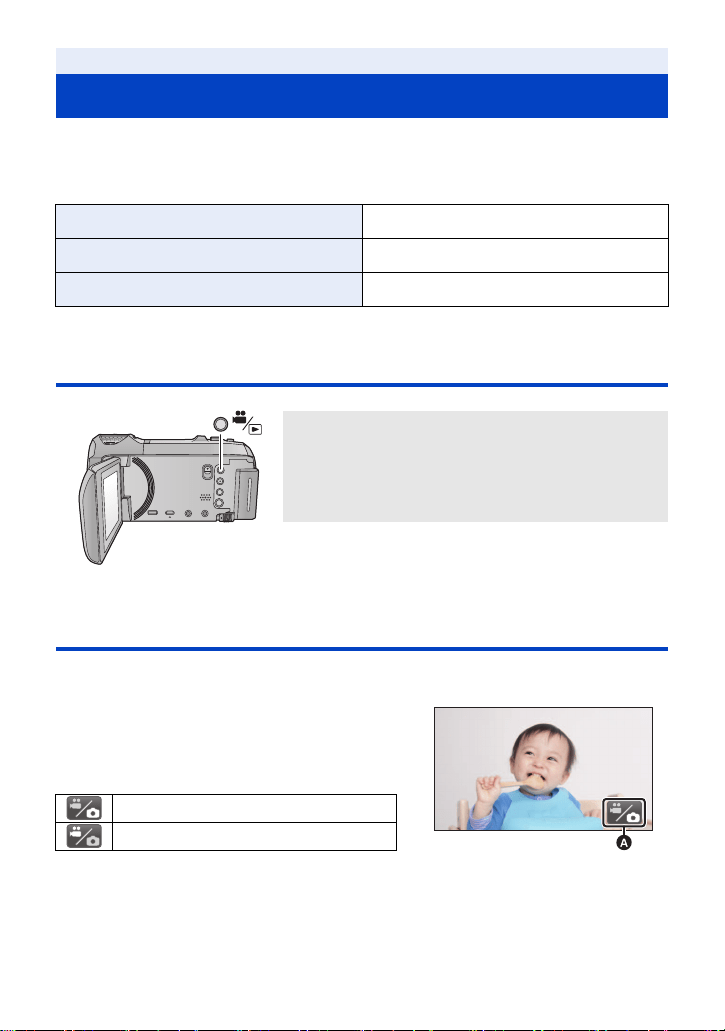
You can switch this unit between Recording Mode (Motion Picture Recording Mode/Still Picture
Recording Mode) and Playback Mode by pressing the recording/playback button.
If you touch the recording mode switching icon in Recording Mode, this unit can be switched
between Motion Picture Recording Mode and Still Picture Recording Mode.
Switching this unit between Recording Mode and
Playback Mode
Switching this unit between Motion Picture Recording
Mode and Still Picture Recording Mode
Touch the recording mode switching icon displayed on the LCD monitor (touch screen) to switch this
unit between Motion Picture Recording Mode and Still Picture Recording Mode.
1 Press the recording/playback button to
switch this unit to Recording Mode.
≥ The recording mode switching icon A is displayed on
the screen.
2 Touch the recording mode switching icon.
≥ Refer to page
19 for touch screen operation.
Preparation
Selecting a mode
Motion Picture Recording Mode (l 23) Recording motion pictures.
Still Picture Recording Mode (l 25) Recording still pictures.
Playback Mode (l 27, 83) Motion picture/Still picture playback.
Recording/playback button
Press the button to switch this unit between Recording
Mode and Playback Mode.
≥ When you turn on this unit, it starts up in Recording
Mode.
Motion Picture Recording Mode
Still Picture Recording Mode
(Motion Picture Recording Mode)
- 19 -
To display the recording mode switching icon
Display of the recording mode switching icon will disappear when no touch operation is performed
for a specific period of time. To display it again, touch the screen.
≥ If the recording start/stop button is pressed in Still Picture Recording Mode or Playback Mode,
this unit will be switched to Motion Picture Recording Mode. During motion picture/still picture
playback or in other conditions, even if the recording start/stop button is pressed, the recording
mode may not be switched.
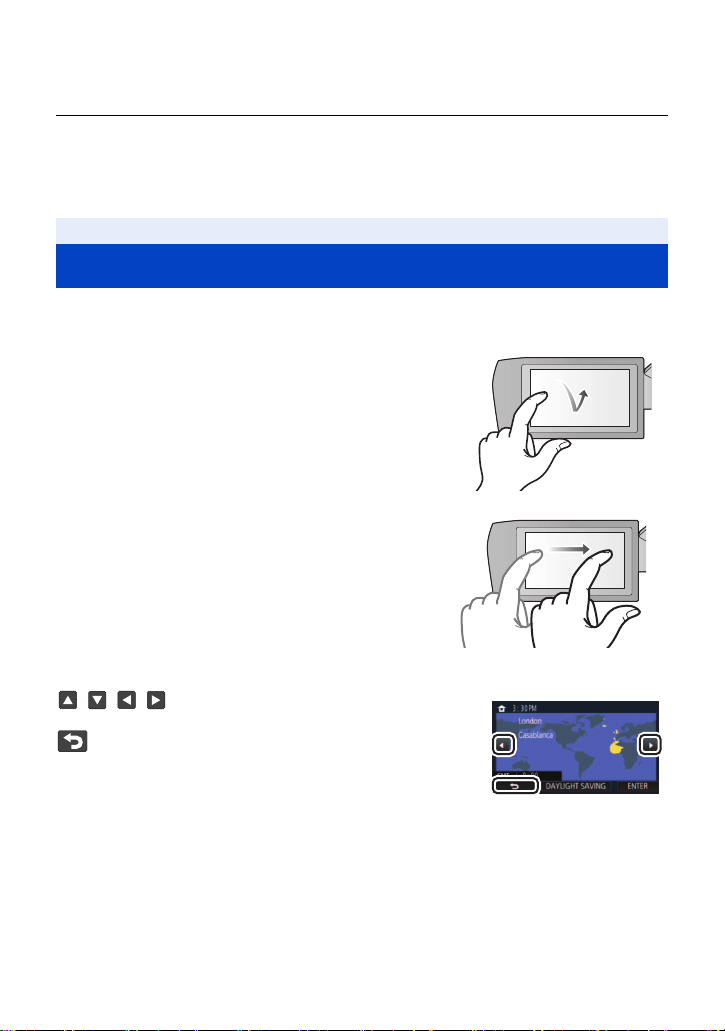
You can operate by directly touching the LCD monitor (touch screen) with your finger.
∫ Touch
Touch and release the touch screen to select icon or
picture.
≥ Touch the center of the icon.
≥ Touching the touch screen will not operate while you
are touching another part of the touch screen.
∫ Slide while touching
Move your finger while pressing on the touch screen.
∫ About the operation icons
///:
Touch when changing a page or performing settings.
:
Touch to return to the previous screen.
Preparation
How to use the touch screen
- 20 -
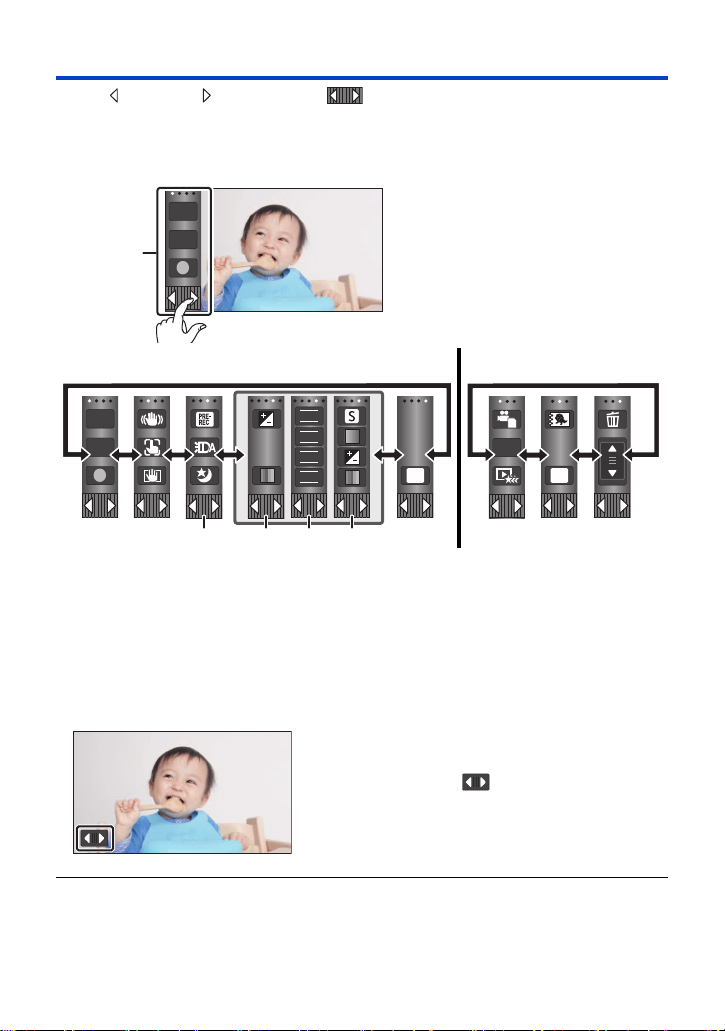
About the Touch Menu
Touch (left side)/ (right side) of on the Touch Menu to switch the
operation icons.
≥ It is also possible to switch the operation icons by sliding the Touch Menu right or left while
touching it.
B You can change the operation icons to display. (
l 35)
C Displayed only in Intelligent Auto Plus Mode (
l 48) and [Miniature Effect]/[8mm movie]/
[Silent movie] of the Creative Control Mode (l 48).
D Displayed only in [Time Lapse Rec] of the Creative Control Mode (
l 48), Scene Mode
(
l 52), HDR Movie Mode (l 51), FULL HD Slow Motion Video Mode (l 53), Stop Motion
Animation Assist Mode (
l 55) and Manual Mode (l 56).
E Displayed only when you adjust the picture quality with the Multi Manual Dial (
l 80)
∫ To display the Touch Menu
≥ Do not touch on the LCD monitor with hard pointed tips, such as ball point pens.
A Touch Menu
Recording Mode Playback Mode
Display of the Touch Menu will disappear when no
touch operation is performed for a specific period of
time during recording of motion picture/still picture. To
display it again, touch .
T
W
MENU
T
W
FOCUS
WB
SHTR
IRIS
MENU
ALL
- 21 -
The clock is not set at the time of purchase. Make sure to set the clock.
≥ When you turn on this unit, the message “Set home region and date/time.” may be
displayed. Select [YES], and follow the steps below to make these settings:
j Step 3 in [SET WORLD TIME] (
l 31)
j Steps 2–3 of “Setting date and time”
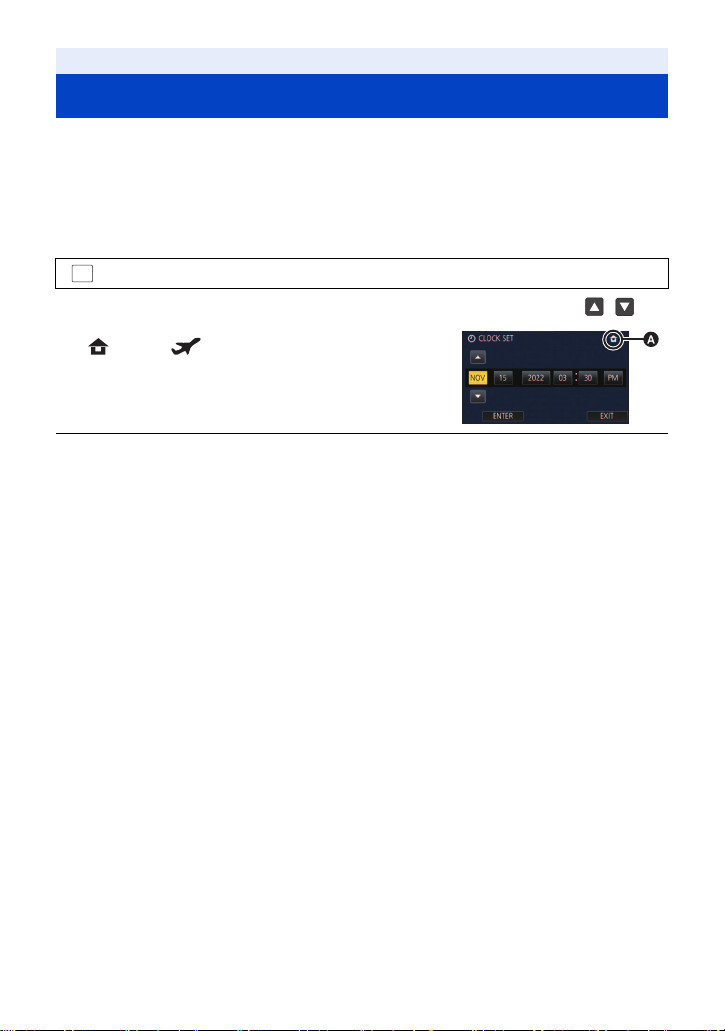
1 Select the menu. (l 30)
2 Touch the date or time to be set, then set the desired value using / .
A Displaying the World Time setting (
l 31):
[HOME]/ [DESTINATION]
≥ The year can be set between 2000 and 2039.
3 Touch [ENTER].
≥ Touch [EXIT] to complete the setting.
≥ The date and time function is driven by a built-in lithium battery.
≥ If the time display becomes [- -], the built-in lithium battery needs to be charged. To recharge the
built-in lithium battery, connect the AC adaptor or attach the battery to this unit. The battery is still
being recharged even if the unit is off. Leave the unit as it is for approx. 24 hours and the battery
will maintain the date and time for approx. 4 months.
Preparation
Setting date and time
: [SETUP] # [CLOCK SET]
MENU
- 22 -
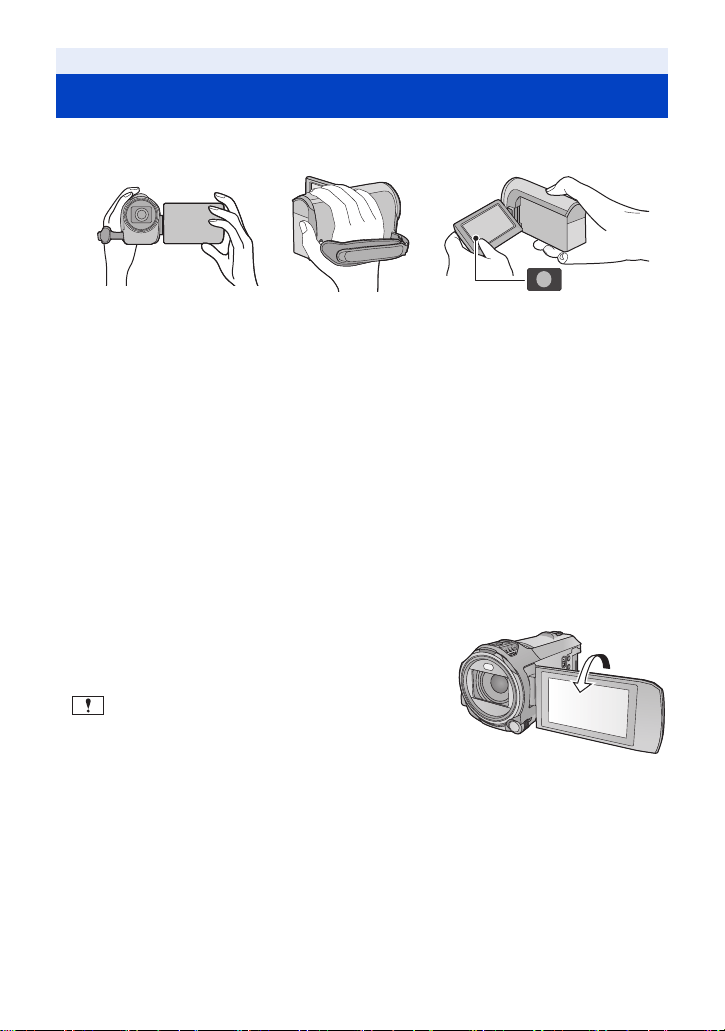
∫ Basic camera positioning
1 Hold the unit with both hands.
2 Put your hand through the grip belt.
3 It is convenient to use the Recording button icon A when holding the unit at waist level.
≥ When recording, make sure your footing is stable and there is no danger of colliding with another
person or object.
≥ When you are outdoors, record pictures with the sunlight behind you. If the subject is backlit, it will
become dark in the recording.
≥ Keep your arms near your body and separate your legs for better balance.
≥ Do not cover the microphones with your hand etc.
∫ Basic motion picture recording
≥ The unit should normally be held steady when recording.
≥ If you move the unit when recording, do so slowly, maintaining a constant speed.
≥ The zoom operation is useful for recording subjects you cannot get close to, but overuse of zoom
in and zoom out can make the resulting motion picture less enjoyable to watch.
∫ Recording Yourself
Rotate the LCD monitor towards the lens side.
≥ The image is horizontally flipped as if you see a mirror
image. (However the image recorded is the same as a
normal recording.)
≥ Only some indications will appear on the screen. When
appears, return the direction of the LCD monitor to
normal position and check the warning/alarm indication.
(
l 182)
Basic
Before recording
- 23 -
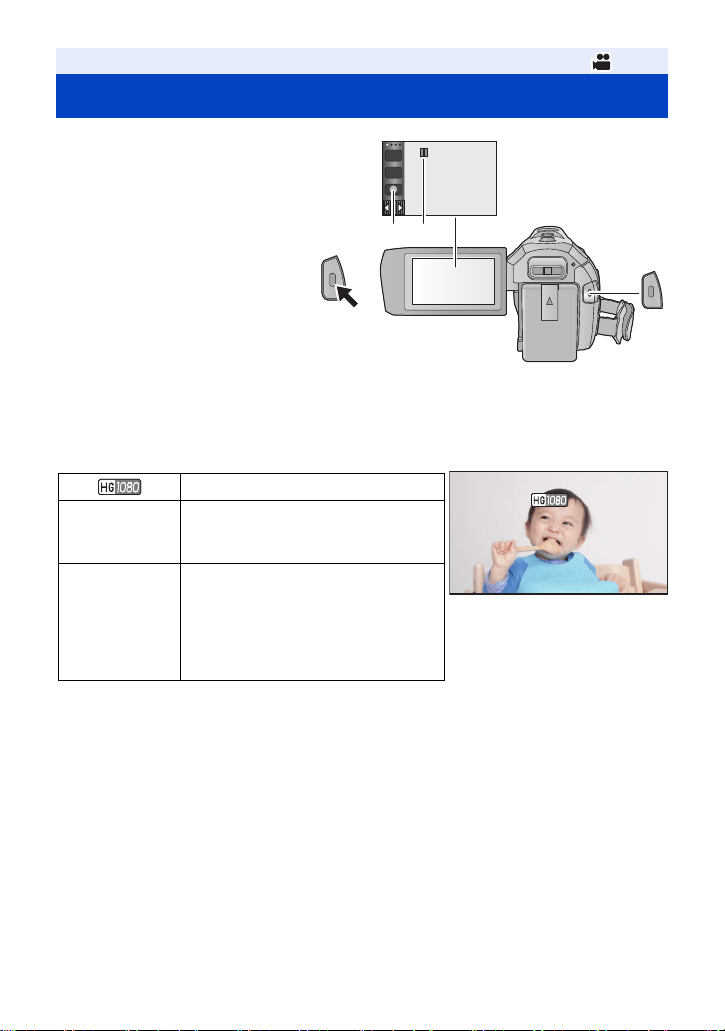
1 Open the LCD monitor, and set this
unit to Motion Picture Recording
Mode. (
l 18)
2 Press the recording start/stop button
to start recording.
A Recording button icon
B When you begin recording, ; changes to ¥.
3 Press the recording start/stop button
again to pause recording.
≥ Recording can also be started/stopped by touching the recording button icon.
∫ Screen indications in the Motion Picture Recording Mode
≥ Screen display will disappear when no touch operation is performed for a specific period of time.
To display it again, touch the screen. (
l 31)
≥ It will be constantly displayed when the remaining recordable time becomes less than 30 minutes.
Basic
Recording motion pictures
Recording mode
R 1h20m
Approximate remaining recordable time
≥ When the remaining time is less than
1 minute, R 0h00m flashes red.
0h00m00s
Recording time elapsed
≥ “h” is an abbreviation for hour, “m” for
minute and “s” for second.
≥ Each time the unit is put into recording
pause, the counter display will be
reset to 0h00m00s.
T
W
0h00m00s
0h00m00s
0h00m00s
R 1h20m
R 1h20m
R 1h20m
- 24 -
≥ If the recording/playback button is pressed during motion picture recording, the recording
will stop and this unit will be switched to Playback Mode.
≥ To change the recording format, change the
[REC FORMAT] or [REC MODE]. (
l 71)
≥ Still pictures can be recorded while recording the motion picture. (
l 26)
≥ The images recorded between pressing the recording start/stop button to start recording and
pressing it again to pause recording become one scene. Scenes exceeding 4 GB (approx.) or
30 minutes (approx.) will be automatically divided in the following cases. (Recording will
continue.)
j When [REC FORMAT] is set to [MP4/iFrame]
≥ Maximum number of recordable scenes and maximum number of different dates will be less than
above table when there are both MP4/iFrame scenes and still pictures recorded on an SD card.
≥ While recording is in progress, the recording will not stop even if the LCD monitor is closed.
≥ Put the unit in Pause mode when connecting or disconnecting an external microphone with the
MIC terminal.
≥ Please refer to page
195 about approximate recordable time.
≥ (Maximum recordable scenes of a single SD card)
Recording format [AVCHD] [MP4/iFrame]
Recordable scenes Approx. 3900 Approx. 89100
Different dates (
l 88) Approx. 900 Approx. 900
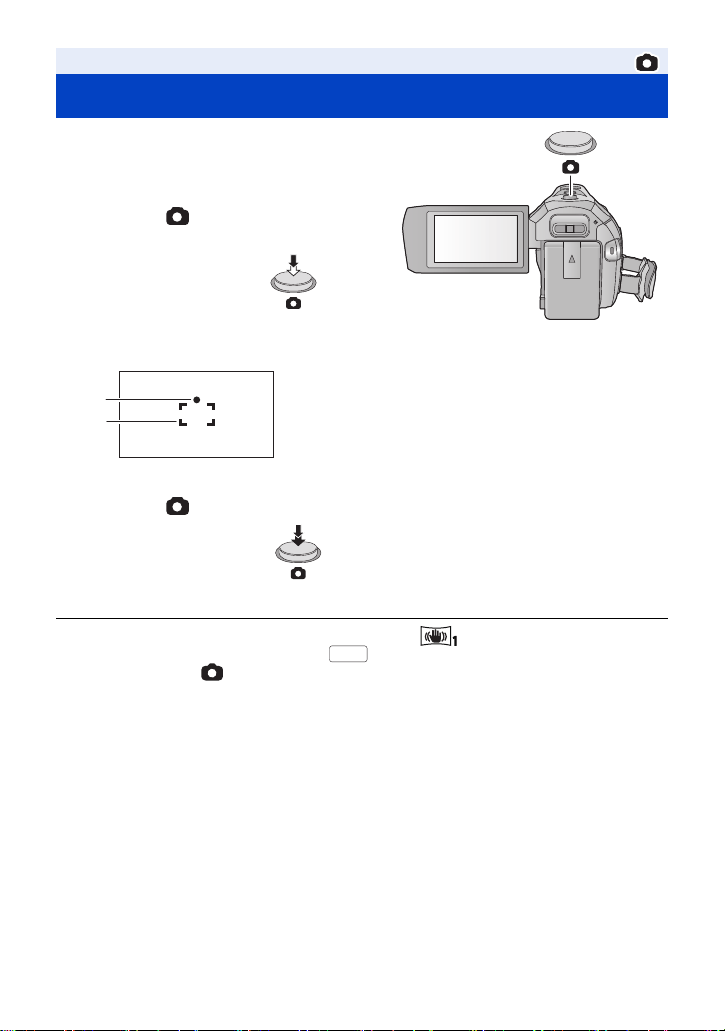
- 25 -
1 Open the LCD monitor, and set this
unit to Still Picture Recording Mode.
(
l 18)
2 Press the button halfway. (For
Auto Focus only)
Focus indication:
3 Press the button fully.
≥ If you set the Optical Image Stabilizer function (l 61) to ([MODE1]), then the Image
Stabilizer function will be more effective. ( (MEGA Optical Image Stabilizer) will be
displayed when the button is pressed halfway.)
≥ Using a tripod is recommended when recording still pictures in dark places because the shutter
speed becomes slow.
≥ You can also take a picture just by touching the subject to focus. (Touch Shutter:
l 64)
≥ The still picture recording time may be long depending on the picture size.
≥ The focus indication and the focus area may not be displayed depending on the recording
conditions or the menu settings.
Basic
Recording still pictures
A Focus indication:
± (The white lamp flashes.): Focusing
¥ (The green lamp lights up.): When in focus
No mark: When focusing is unsuccessful.
B Focus area (area inside brackets)
MEGA
- 26 -
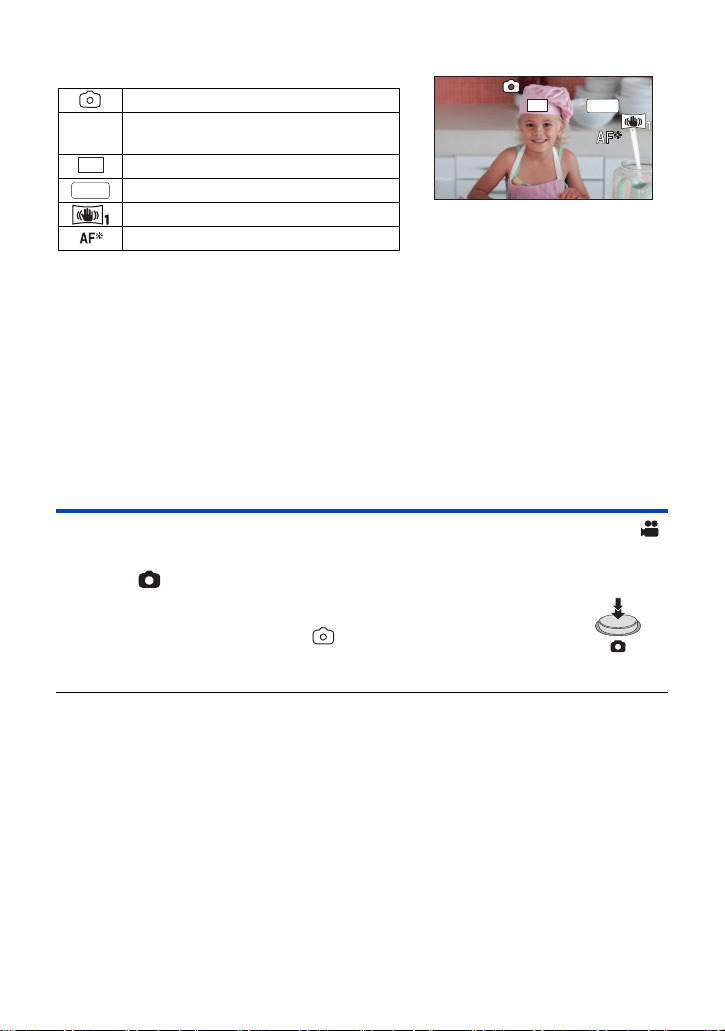
∫ About the screen indications in Still Picture Recording Mode
∫ About the focusing area
When there is a contrasting object ahead or behind the subject in the focus area, the subject may
not be focused. If so, move the contrasting object out of the focus area.
Recording still pictures in Motion Picture Recording
Mode
¬ Set this unit to Motion Picture Recording Mode. (l 18)
Press the button fully (press to the bottom) to take the picture.
≥ It is possible to record still pictures while recording motion pictures.
(Simultaneous recording)
≥ While still pictures are being recorded, turns red and the remaining number
of recordable pictures is displayed.
≥ No shutter sound is emitted when recording still pictures.
≥ Self-timer (l 67) do not work.
≥ While recording motion pictures or during the PRE-REC operation, image quality is different from
ordinary still pictures so that motion picture recording takes preference over still picture recording.
≥ If simultaneous recording is performed during motion picture recording, the remaining recordable
time will be shortened. If this unit is turned off or the recording/playback button is pressed, the
remaining recordable time may be lengthened.
≥ The still picture recording time may be long depending on the picture size.
≥ Maximum number of recordable pictures that can be displayed is 9999. If the number of
recordable pictures exceeds 9999, R 9999+ is displayed. The number will not change when the
picture is taken until the number of recordable pictures is 9999 or less.
≥ The recording time may be long depending on the recording condition.
Still picture operation indicator (
l 179)
R3000
Remaining number of still pictures
≥ Flashes in red when [0] appears.
Size of still pictures (
l 81)
MEGA Optical Image Stabilizer (
l 25)
Optical Image Stabilizer (
l 61)
AF assist lamp (
l 82)
MEGA
R3000
R3000
R3000
2.1M
≥ Screen display will disappear when
no touch operation is performed for a
specific period of time. To display it
again, touch the screen.
≥ It will be constantly displayed when
the remaining number of still pictures
that can be recorded becomes 200 or
less.
2.1M
MEGA
- 27 -
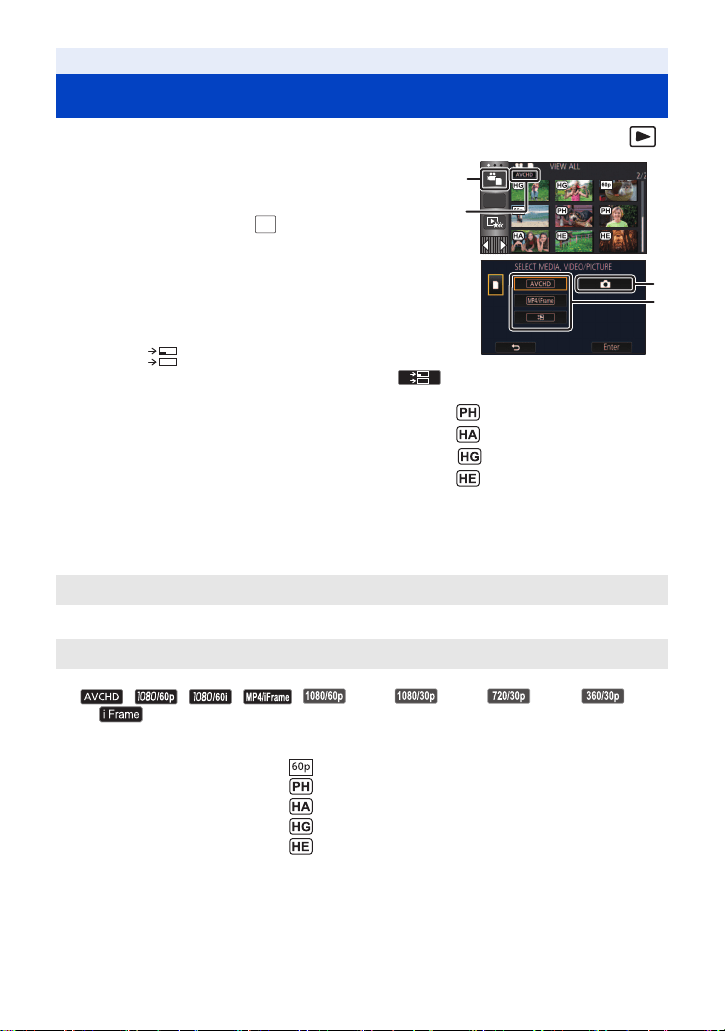
1 Set this unit to Playback Mode (l 18).
2 Touch the play mode select icon A (l 20).
≥ You can also set by touching , selecting [VIDEO SETUP]
or [PICT. SETUP] # [MEDIA, VIDEO/PICTURE]. (
l 30)
3 Select the still picture C or the recording
format of the motion picture D you wish to
play back.
≥ Touch [Enter].
≥ If you touch , scenes recorded as Backup for Twin
Camera will be displayed. The recording mode icon ( ) will be displayed on the thumbnail
screen, and each thumbnail will be displayed with one of the following icons:
j AVCHD [PH] scenes recorded as Backup for Twin Camera:
j AVCHD [HA] scenes recorded as Backup for Twin Camera:
j AVCHD [HG] scenes recorded as Backup for Twin Camera:
j AVCHD [HE] scenes recorded as Backup for Twin Camera:
4 (When [AVCHD] or [MP4/iFrame] is touched)
Touch the desired recording format for playback.
≥ When [AVCHD] is selected
≥ When [MP4/iFrame] is selected
≥ The recording mode icon B is displayed in the thumbnail display when the item is touched.
( , , , , (Red), (Red), (Red), (Red)
and )
≥ The following icons are displayed on thumbnails when [ALL AVCHD] or [1080/60i] is touched:
Basic
Motion picture/Still picture playback
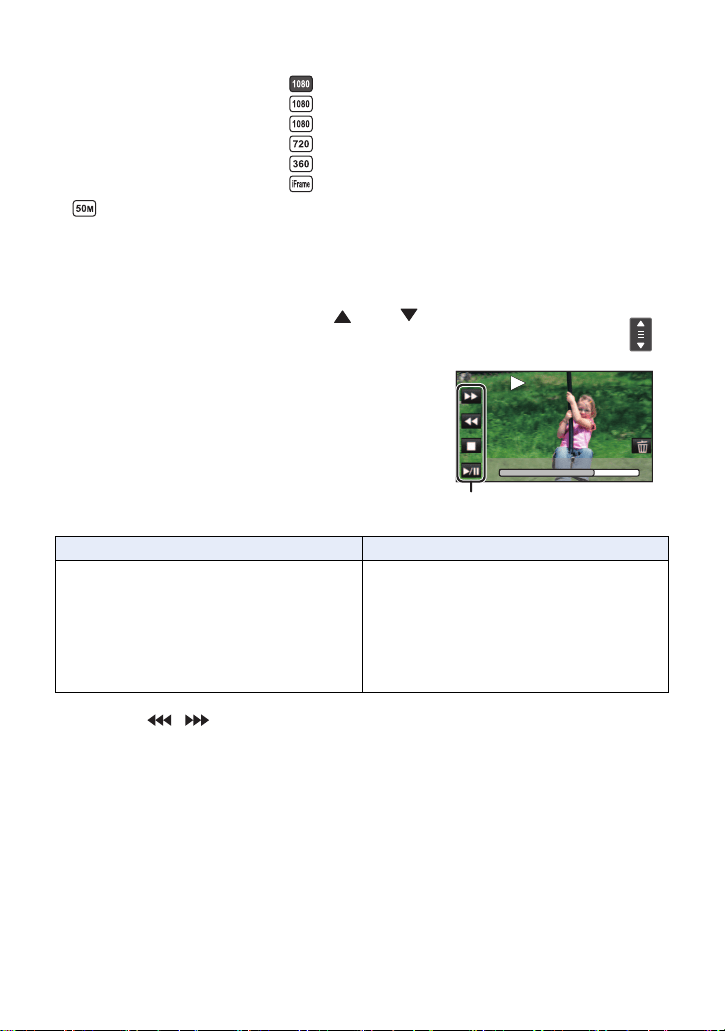
[ALL AVCHD]/[1080/60p]/[1080/60i]
[ALL MP4/iFrame]/[1080/60p]/[1080/30p]/[720/30p]/[360/30p]/[iFrame]
j AVCHD [1080/60p] scene:
j AVCHD [PH] scene:
j AVCHD [HA] scene:
j AVCHD [HG] scene:
j AVCHD [HE] scene:
ALL
ALL
MENU
- 28 -
≥ The following icons are displayed on thumbnails when [ALL MP4/iFrame] is touched:
≥ is displayed on the thumbnails of MP4 [1080/50M] scenes when [1080/60p] in [MP4/iFrame]
is touched.
5 Touch the scene or the still picture to be played back.
≥ To display the next (previous) page:
j Slide the thumbnail display upward (downward) while touching it.
j Switch the touch menu, and then touch (up) / (down) on the thumbnail scroll
lever.
6 Select the playback operation by touching
the operation icon.
≥ Operation icons and screen display will disappear when
no touch operation is performed for a specific period of
time. To display them again, touch the screen.
* When touched two times, the fast rewind/fast forward speed increases. (The screen display
changes to / .)
j MP4 [1080/60p] scene: (Blue) (Recording mode [1080/50M])
(Recording mode [1080/28M])
j MP4 [1080/30p] scene:
j MP4 [720/30p] scene:
j MP4 [360/30p] scene:
j iFrame scene:
0h01m30s0h01m30s0h01m30s
Operation icon
Motion picture playback Still picture playback
1/;: Playback/Pause
6: Fast rewind playback*
5: Fast forward playback*
∫: Stops the playback and shows the
thumbnails.
1/;: Slide show (playback of the still
pictures in numerical order) start/
pause.
2;: Plays back the previous picture.
;1: Plays back the next picture.
∫: Stops the playback and shows the
thumbnails.
- 29 -
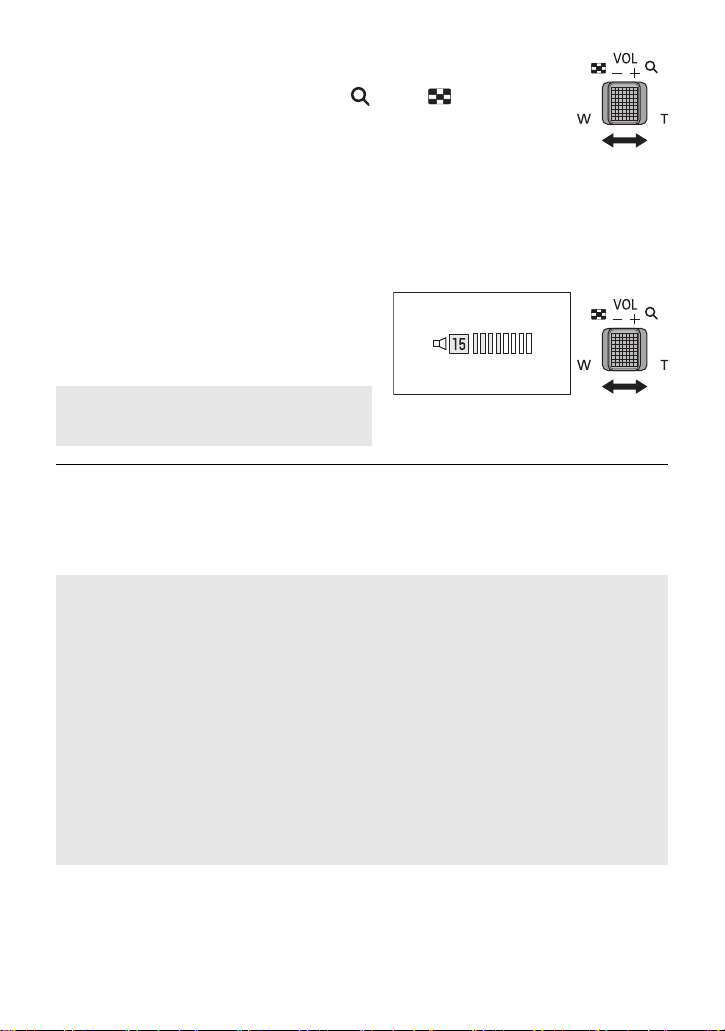
∫ Change the thumbnail display
While the thumbnail is displayed, the thumbnail display changes in the
following order if the zoom lever is operated to side or side.
20 scenes () 9 scenes () 1 scene () Highlight & Time Frame Index*
(
l 85)
* Highlight & Time Frame Index can only set in Motion Picture Playback
Mode.
≥ If you set this unit to Recording Mode or Playback Mode by pressing the recording/playback
button, you will return to the 9 scenes display.
≥ By displaying in 1 scene or touching and holding the thumbnail in the 20 scenes or 9 scenes
display, recording date and time are displayed when playing back motion pictures, and recording
date and file number when playing back still pictures.
∫ Speaker/Headphone volume
adjustment
Operate the volume lever to adjust the speaker/
headphone volume during Motion Picture
Playback Mode.
≥ Sound will be heard only during normal playback.
≥ If pause play is continued for approx. 5 minutes, the screen returns to the thumbnails.
≥ The elapsed time for playback indication will be reset to 0h00m00s each scene.
≥ When played back with [ALL AVCHD] or [ALL MP4/iFrame] selected, the screen may become
black momentarily at the time the scene switches.
Towards “r”: Increases the volume
Towards “s”: Decreases the volume
Motion picture compatibility
≥ This unit is based on AVCHD Progressive/AVCHD format/MPEG-4 AVC file format.
≥ Even if the devices used have compatible standards, when playback of motion pictures
recorded using another device is performed using this unit, or when motion pictures recorded
using this unit is played back in another device, playback may not proceed normally, or may
not be possible. (Please check compatibility in the operating instruction of your device.)
≥ Motion pictures recorded with other devices are not supported by this unit.
Still picture compatibility
≥ This unit is compliant with the unified standard DCF (Design rule for Camera File system)
established by JEITA (Japan Electronics and Information Technology Industries Association).
≥ This unit may degrade or not play back still pictures recorded or created on other products
and other products may degrade or not play back still pictures recorded on this unit.
≥ Depending on the playback device, still pictures may be played back with picture sizes
different from the ones with which they were recorded.
- 30 -
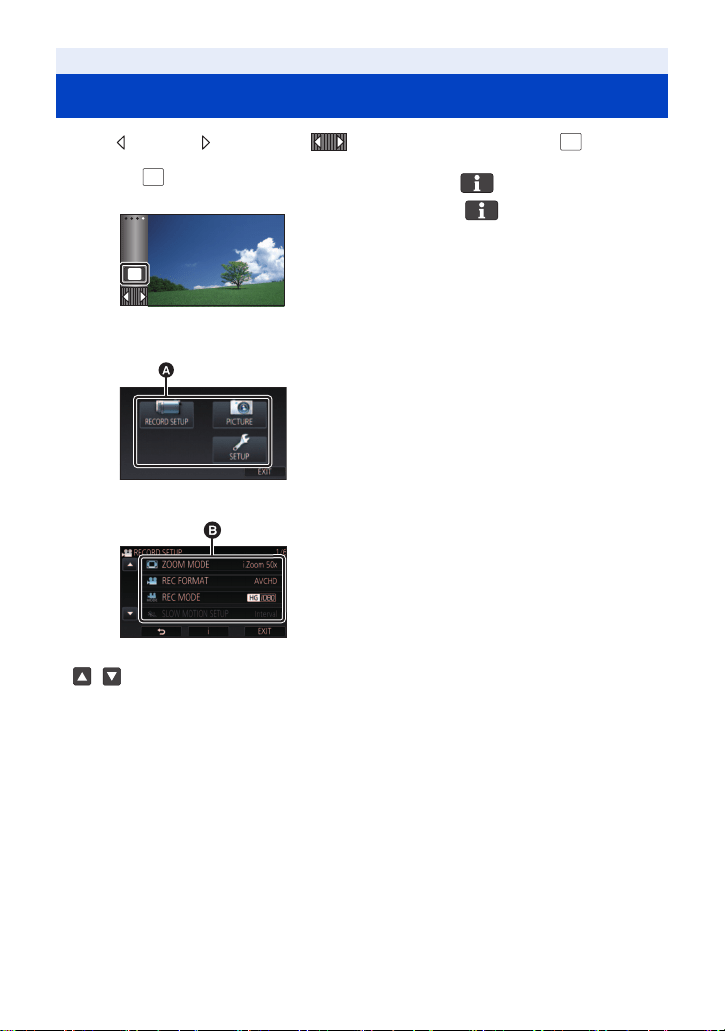
≥ Touch (left side)/ (right side) of on the Touch Menu to display . (l 20)
1 Touch .
2 Touch the top menu A.
3 Touch the submenu B.
≥ Next (previous) page is displayed by touching
/.
4 Touch the desired item to enter the
setting.
5 Touch [EXIT] to exit the menu
setting.
∫ About guide display
After touching , touching the submenus
and items will cause function descriptions and
settings confirmation messages to appear.
≥ After the messages have been displayed, the
guide display is canceled.
Basic
Using the menu screen
MENU
MENU
MENU
- 31 -
Set the display method for the screen information display.
Please refer to page 21.
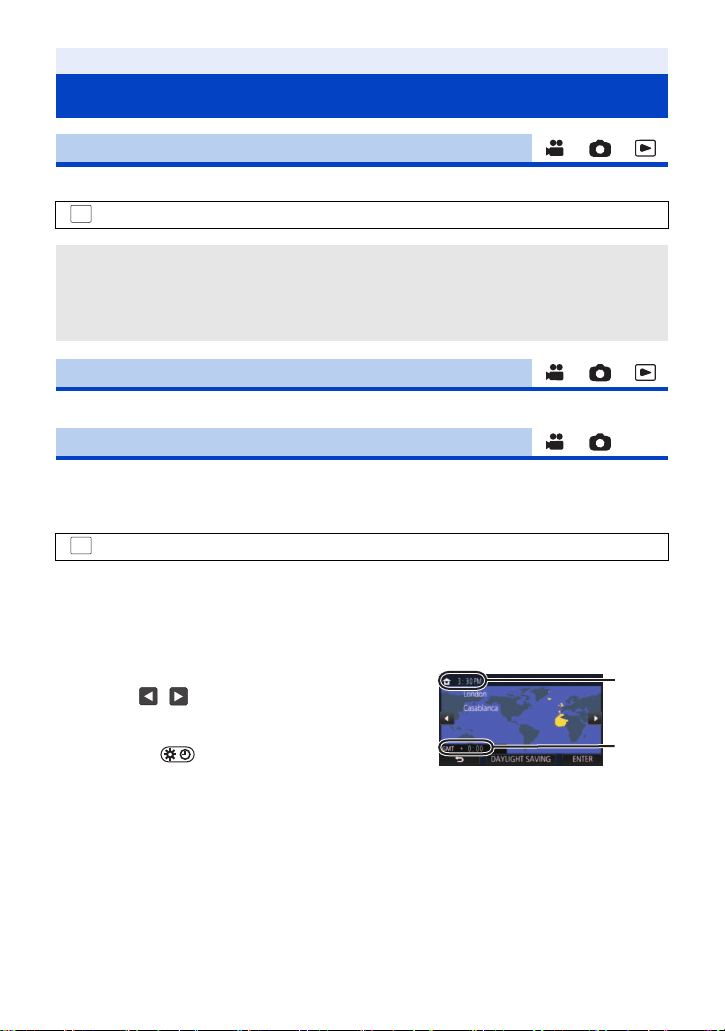
It is possible to display and record the time at the travel destination by selecting your home region
and the travel destination.
1 Select the menu.
≥ When the [HOME] (your home region) is not set, the message appears. Touch [ENTER] and
proceed to Step 3.
2 (Only when setting your home region)
Touch [HOME].
≥ Touch [ENTER].
3 (Only when setting your home region)
Touch / to select your home
region and touch [ENTER].
≥ Touch [DAYLIGHT SAVING] to set daylight
saving time. is displayed and the
summer time setting is turned on, the time
difference between the current time and GMT
will be set forward by 1 hour. Touch [DAYLIGHT
SAVING] again to return to the normal time
setting.
If you set [Link Clock to Daylight Saving] to
[ON], the current time will also be set forward by 1 hour. (
l 32)
Basic
Using the Setup Menu
[DISPLAY]
: [SETUP] # [DISPLAY] # desired setting
[5 SEC.]: Information is displayed on the screen for 5 seconds after starting the
Motion Picture Recording Mode or Still Picture Recording Mode, starting
to playback, or touching the screen.
[ON]: Constantly displayed.
[CLOCK SET]
[SET WORLD TIME]
: [SETUP] # [SET WORLD TIME]
MENU
MENU
A The current time
B The time difference from GMT
(Greenwich Mean Time)
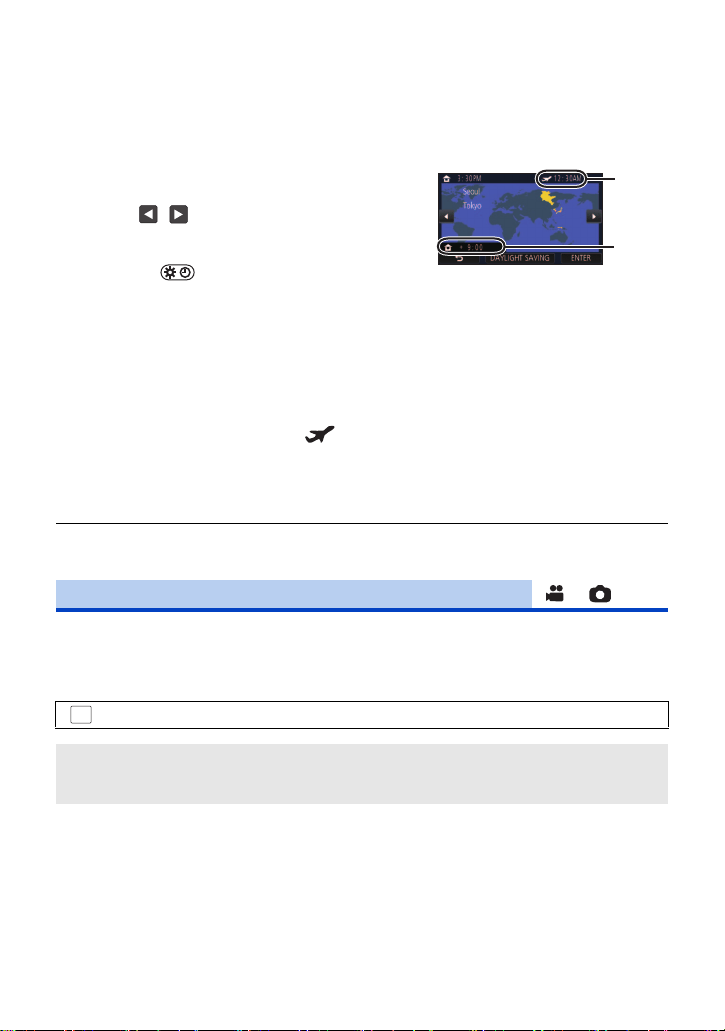
- 32 -
4 (Only when setting the region of your travel destination)
Touch [DESTINATION].
≥ Touch [ENTER].
≥ When the home region is set for the first time, the screen for selecting home/travel destination
appears after setting the home region successively. If the home region has already been set
once, execute the menu operation for Step 1.
5 (Only when setting the region of your travel
destination)
Touch / to select your travel
destination and touch [ENTER].
≥ Touch [DAYLIGHT SAVING] to set daylight
saving time. is displayed and the
summer time setting is turned on, the time
difference between the travel destination and
the home region will be set forward by 1 hour.
Touch [DAYLIGHT SAVING] again to return to
the normal time setting.
If you set [Link Clock to Daylight Saving] to
[ON], the time at the travel destination will also
be set forward by 1 hour.
≥ Close the setting by touching [EXIT]. appears and the time of the travel destination is
indicated.
To return the display to the home setting
Set the home region using Steps 1 to 3, and close the setting by touching [EXIT].
≥ If you cannot find your travel destination in the area shown on the screen, set it by using the time
difference from your home region.
If you set this function to [ON] and turn on the summer time setting in [SET WORLD TIME], the
following times will be set forward by 1 hour:
j When setting your home region: The current time
j When setting the region of your travel destination: The time at the travel destination
[Link Clock to Daylight Saving]
: [SETUP] # [Link Clock to Daylight Saving] # desired display
[ON]: The times are adjusted when the summer time setting is turned on.
[OFF]: The times are not adjusted when the summer time setting is turned on.
C The local time at the selected
travel destination
D The time difference between the
travel destination and the home
region
MENU
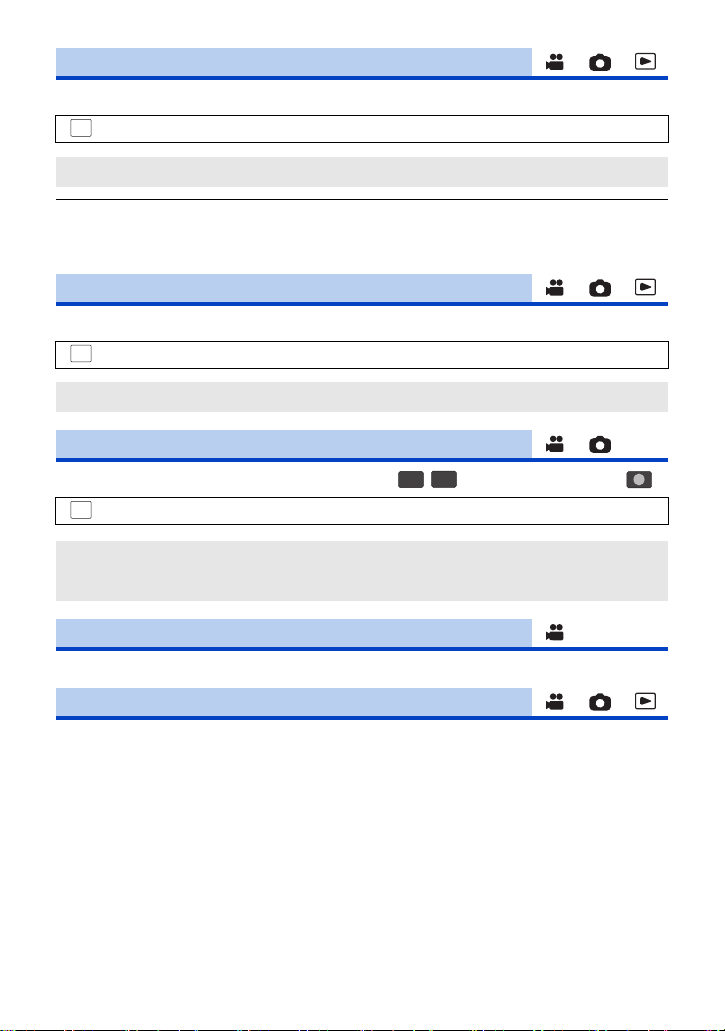
- 33 -
It is possible to change the date and time display mode.
≥ The date and time are not displayed while the recording mode switching icon is displayed. (l 18)
≥ When the Touch Shutter is enabled, the recording mode switching icon is constantly displayed.
This causes the date and time to disappear from the screen.
It is possible to change the date format.
You can set the display method of the zoom button icons ( / ) and recording button icon ( ).
Please refer to page 63.
Please refer to page
114.
[DATE/TIME]
: [SETUP] # [DATE/TIME] # desired display
[DATE]/[D/T]/[OFF]
[DATE FORMAT]
: [SETUP] # [DATE FORMAT] # desired setting
[Y/M/D]/[M/D/Y]/[D/M/Y]
[ZOOM/REC DISPLAY]
: [SETUP] # [ZOOM/REC DISPLAY] # desired setting
[ON]: Constantly displayed.
[OFF]: Icons will disappear after approx. 5 seconds without any touch operation.
[O.I.S. LOCK DISPLAY]
[EXT. DISPLAY]
MENU
MENU
T
W
MENU
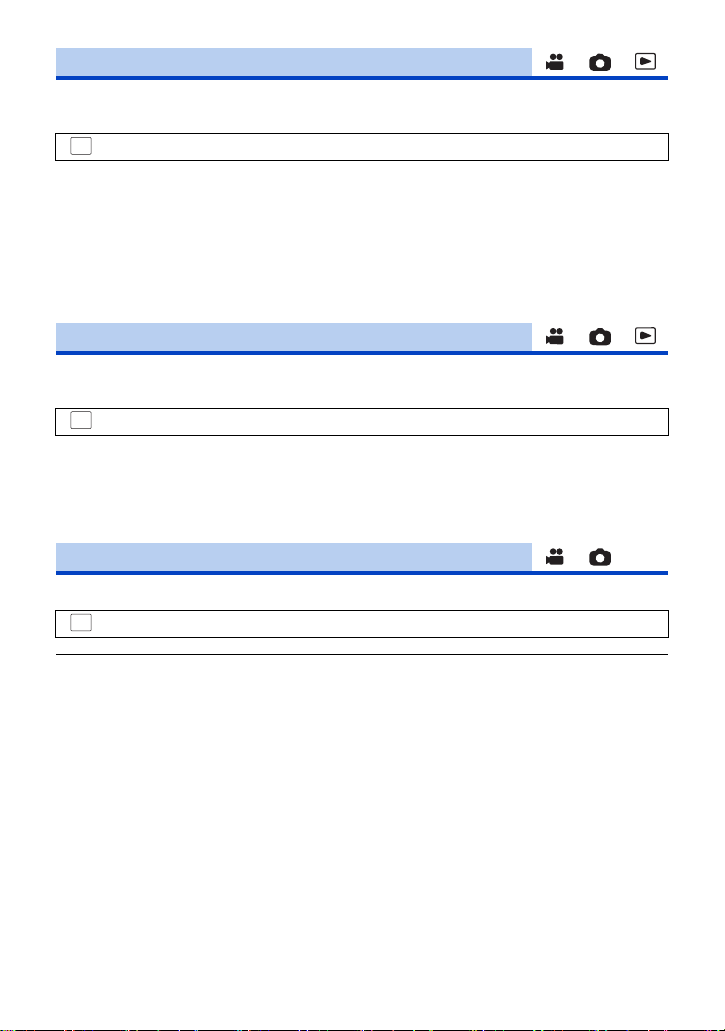
- 34 -
When about 5 minutes have passed without any operation, this unit automatically turns off to save
battery life.
≥ This unit will not automatically turn off even if [ECONOMY (BATT)] is set to [ON] in following
cases:
j Using the AC adaptor*
j Using the USB cable for PC etc.
j PRE-REC is used
j During slide show playback
j Using the Wi-Fi function
* When [ECONOMY (AC)] is activated, this unit automatically turns off.
When about 15 minutes have passed without any operation while connecting AC adaptor with this
unit, this unit automatically turns off.
≥ This unit will not automatically turn off even if [ECONOMY (AC)] is set to [ON] in following cases:
j Using the USB cable for PC etc.
j PRE-REC is used
j During slide show playback
j Using the Wi-Fi function
The unit is put into recording pause approx. 1 second when the unit is turned on.
≥ Depending on the recording conditions, start time may be longer than 1 second.
≥ In the Quick Power On Mode, the zoom magnification becomes approx. 1k.
[ECONOMY (BATT)]
: [SETUP] # [ECONOMY (BATT)] # [ON]
[ECONOMY (AC)]
: [SETUP] # [ECONOMY (AC)] # [ON]
[QUICK POWER ON]
: [SETUP] # [QUICK POWER ON] # [ON]
MENU
MENU
MENU
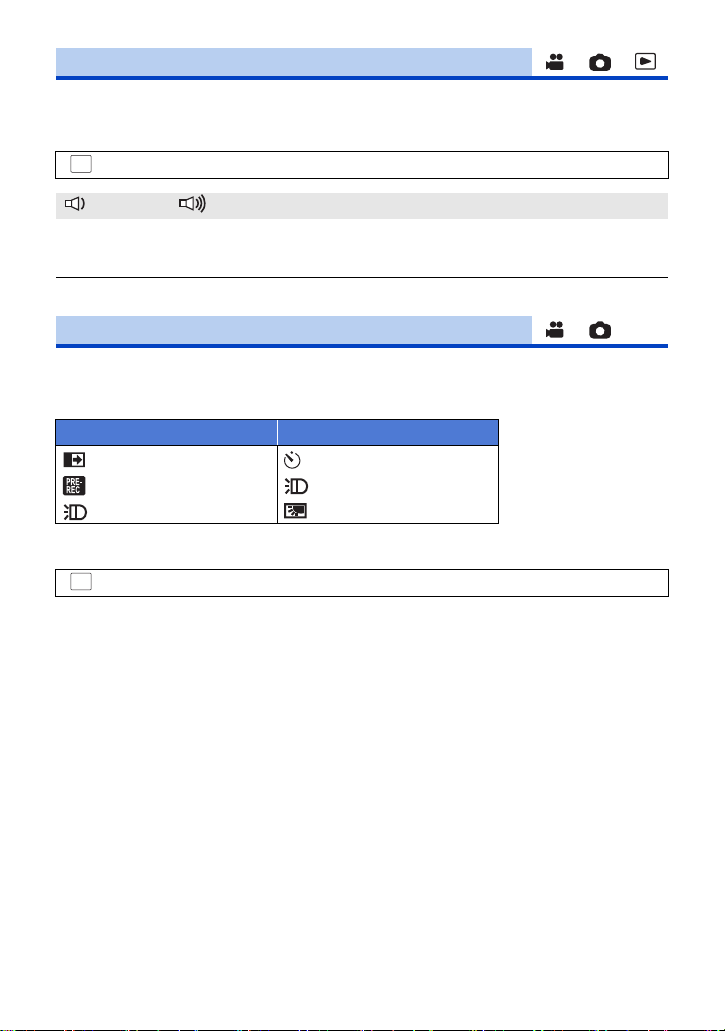
- 35 -
Touch screen operation, starting and stopping of recording and unit on/off can be confirmed with this
sound.
When [OFF] is selected, the sound is not output at the start/end of recording, etc.
2 Beeps for 4 times
When an error occurs, follow the instructions displayed on the screen. (
l 182)
≥ Refer to page 82 when changing the shutter sound setting.
You can change the operation icons (
l 65) to display in the Touch Menu.
Register 3 favorite operation icons.
≥ The default settings are as follows:
1 Select the menu.
2 Touch the operation icon you would like to change to cancel the setting.
3 Touch the operation icon to be set.
≥ Name of the function is displayed by touching and holding on the operation icon.
≥ To cancel, touch the operation icon again.
4 Touch [ENTER].
[ALERT SOUND]
: [SETUP] # [ALERT SOUND] # desired setting
(Volume low)/ (Volume high)/[OFF]
[SELECT OPERATION ICONS]
Motion Picture Recording Mode Still Picture Recording Mode
(Fade) (Self-timer)
(PRE-REC) (Video light)
(Video light) (Backlight Compensation)
: [SETUP] # [SELECT OPERATION ICONS]
MENU
MENU
- 36 -
This makes it easier to view the LCD monitor in bright places including outdoors.
≥ These settings will not affect the images actually recorded.
≥ When the AC adaptor is in use, the LCD monitor is set to automatically.
≥ Recordable time with the battery is shortened when the LCD is made brighter.
≥ When the video light is set to ([ON]) or ([AUTO]) and it is lit, it cannot be set.
It adjusts brightness and color density on the LCD monitor.
≥ These settings will not affect the images actually recorded.
1 Select the menu.
2 Touch / to adjust settings.
3 Touch [ENTER].
≥ Touch [EXIT] to exit the menu screen.
Please refer to page
115.
Please refer to page
116.
Please refer to page
114.
[POWER LCD]
: [SETUP] # [POWER LCD] # desired setting
(Makes brighter)/ (Normal)/ (Makes less bright)
[LCD SET]
: [SETUP] # [LCD SET] # desired setting
[BRIGHTNESS]: Brightness of the LCD monitor
[COLOR]: Color level of the LCD monitor
[HDMI RESOLUTION]
[VIERA Link]
[TV ASPECT]
MENU
+1
0
-
1
+1
MENU
- 37 -
Set to [YES] for changing the menu settings back to the default condition.
≥ Settings for [CLOCK SET] and [LANGUAGE] will not be changed.
≥ If you restore the default settings, this unit will switch to the Motion Picture Recording Mode.
Set to [YES] for changing the Wi-Fi settings back to the default condition.
≥ The password for the Wi-Fi is deleted.
≥ Information on wireless access points, smartphones, and Wireless Sub Cameras registered to
this unit is also deleted.
You can delete the music (
l 91, 98, 103) stored on this unit as [USER BGM].
The entered character is confirmed in approx. 1 second after character input, and the cursor is
moved to the right.
It makes the input easy without moving the cursor when characters on the same key are to be
entered again.
≥ Character input screen is displayed in following conditions:
j When setting [TITLE SETUP] for the Highlight Playback (
l 94)
j When entering a name in the Baby Calendar (
l 100)
j When you configure the Wi-Fi function (
l 139, 145, 154, 155)
[INITIAL SET]
: [SETUP] # [INITIAL SET]
[Reset Wi-Fi Settings]
: [SETUP] # [Reset Wi-Fi Settings]
[DELETE USER BGM]
: [SETUP] # [DELETE USER BGM]
[Auto Cursor Position]
: [SETUP] # [Auto Cursor Position] # [ON]
MENU
MENU
MENU
MENU
- 38 -
Set the file number of the MP4/iFrame and still picture recorded next to 0001.
≥ Folder number is updated and file number will start from 0001. (
l 176)
≥ To reset the folder number, format the SD card, and then perform [NUMBER RESET].
≥ The file numbers of still pictures you record in Stop Motion Animation Assist Mode are not reset.
Please be aware that if a medium is formatted, then all the data recorded on the medium will be
erased and cannot be restored. Back up important data on a PC, DVD disc etc. (
l 167)
* Displayed when connecting a USB HDD. (
l 118)
≥ Media selection screen is not displayed when the USB HDD is not connected. Touch [YES].
≥ When formatting is complete, touch [EXIT] to exit the message screen.
≥ Perform a physical formatting of the SD card when the SD card is to be disposed/ transferred.
(
l 192)
≥ Do not turn this unit off or remove the SD card, while formatting. Do not expose the unit to
vibrations or shock.
[NUMBER RESET]
: [SETUP] # [NUMBER RESET]
[FORMAT MEDIA]
: [SETUP] # [FORMAT MEDIA] # desired media
[SD CARD]/[HDD]
*
Use this unit to format media.
Do not format an SD card using any other equipment such as a PC. The card may not be
used on this unit.
MENU
MENU
- 39 -
The used space and remaining recordable time of the SD card can be checked.
≥ The remaining recordable time in the currently set Recording Mode is displayed only in the
Motion Picture Recording Mode.
≥ Touch [EXIT] to close the indication.
≥ The SD card requires some space to store information and manage system files, so the actual
usable space is slightly less than the indicated value. The usable SD card space is generally
calculated as 1 GB=1,000,000,000 bytes. The capacities of this unit, PCs and software are
expressed as 1 GB=1,024k1,024k1,024=1,073,741,824 bytes. Therefore, the indicated value of
the capacity appears to be smaller.
The firmware version of this unit is displayed.
You can update the firmware version of this unit.
This item is used to start the unit demonstration.
≥ If [DEMO MODE] is switched to [ON] and you touch [EXIT] when there is no SD card inserted and
while this unit is connected to the AC adaptor, the demonstration automatically starts.
If any operation takes place, the demonstration is canceled. However if no operations take place
for approx. 10 minutes, the demonstration automatically starts again. To stop the demonstration,
set [DEMO MODE] to [OFF] or insert an SD card.
≥ When Demo Mode is in operation, the lens cover remains open.
[MEDIA STATUS]
: [SETUP] # [MEDIA STATUS]
[Firmware Version Info]
: [SETUP] # [Firmware Version Info]
[Firmware Upgrade]
: [SETUP] # [Firmware Upgrade]
For the latest update information, check the support website below. (As of January 2022)
https://panasonic.jp/support/global/cs/e_cam
(This Site is English only)
[DEMO MODE]
: [SETUP] # [DEMO MODE] # [ON]
MENU
MENU
MENU
MENU
- 40 -
This item is used to start the Optical Image Stabilizer demo.
≥ Touch [O.I.S. DEMO], the demonstration automatically starts.
When you touch [EXIT], the demonstration will be canceled.
You can connect this unit and a PC with the USB cable and check software information (License) on
the PC.
1 Select the menu.
2 Connect this unit to a PC.
≥ A message will be displayed when the connection is complete. On the PC, confirm
[LICENSE.TXT].
≥ When using the battery, the LCD monitor turns off after about 5 seconds. Touch the screen to turn
the LCD monitor on.
≥ Do not use any other USB cables except the supplied one. (Operation is not guaranteed with any
other USB cables.)
You can check how to access the website where you can download the Owner’s Manual (PDF
format).
You can select the language on the screen display and the menu screen.
[O.I.S. DEMO]
: [SETUP] # [O.I.S. DEMO]
[SOFTWARE INFO]
: [SETUP] # [SOFTWARE INFO]
[ONLINE MANUAL]
: [SETUP] # [ONLINE MANUAL] # desired access method
[URL display]: Displays the URL of the website on the LCD monitor of this unit.
[USB connect]: Displays the website on a PC connected to this unit with the USB
cable.
[QR code]: Displays the QR code of the website on the LCD monitor of this unit.
[LANGUAGE]
: [SETUP] # [LANGUAGE] # desired language
MENU
MENU
MENU
MENU
- 41 -
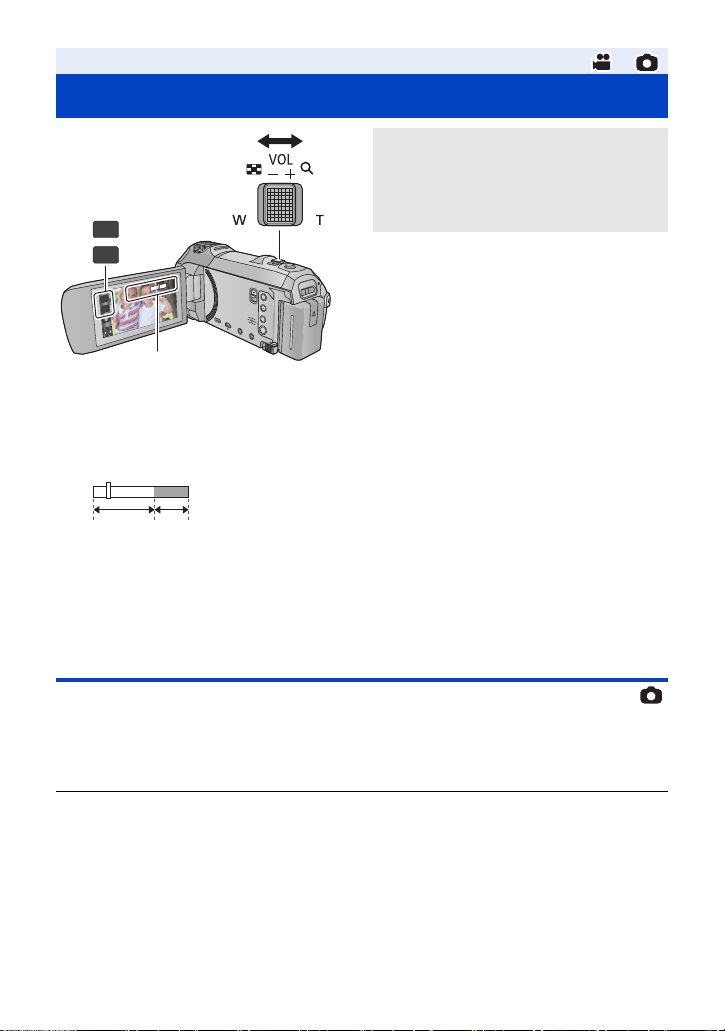
A Zoom bar
≥ Maximum zoom ratio for recording motion pictures can be set with [ZOOM MODE]. (
l 71)
∫ About the zoom bar
The zoom bar is displayed during the zoom operation.
∫ About the zoom speed
≥ The zoom speed varies depending on the range over which the zoom lever is moved.
≥ The zoom operation using the zoom button icons will be performed at a constant speed
respectively.
Zoom ratio during the Still Picture Recording Mode
The zoom ratio can be expanded up to 50k without degrading the picture quality for the Still Picture
Recording Mode. (Extra Optical Zoom)
≥ Maximum zoom ratio in Still Picture Recording Mode varies depending on the setting of
[PICTURE SIZE] and [ASPECT RATIO]. (
l 81, 82)
≥ If you take your finger off the zoom lever during zoom operation, the operation sound may be
recorded. When returning the zoom lever to the original position, move it quietly.
≥ When the zoom magnification is at its maximum, the subjects are focused at about 1.5 m
(4.9 feet) or more.
≥ When the zoom magnification is 1k, this unit can focus on a subject approx. 3 cm (1.2 q) away
from the lens.
Advanced (Recording)
Using the zoom
T
W
6
W
T
6
W
T
T
W
Zoom lever/Zoom button icons
T side:
Close-up recording (zoom in)
W side:
Wide-angle recording (zoom out)
T
W
B Optical Zoom
C Motion Picture Recording Mode: i.Zoom/Digital zoom (Blue)
Still Picture Recording Mode: Extra Optical Zoom (Blue)
- 42 -
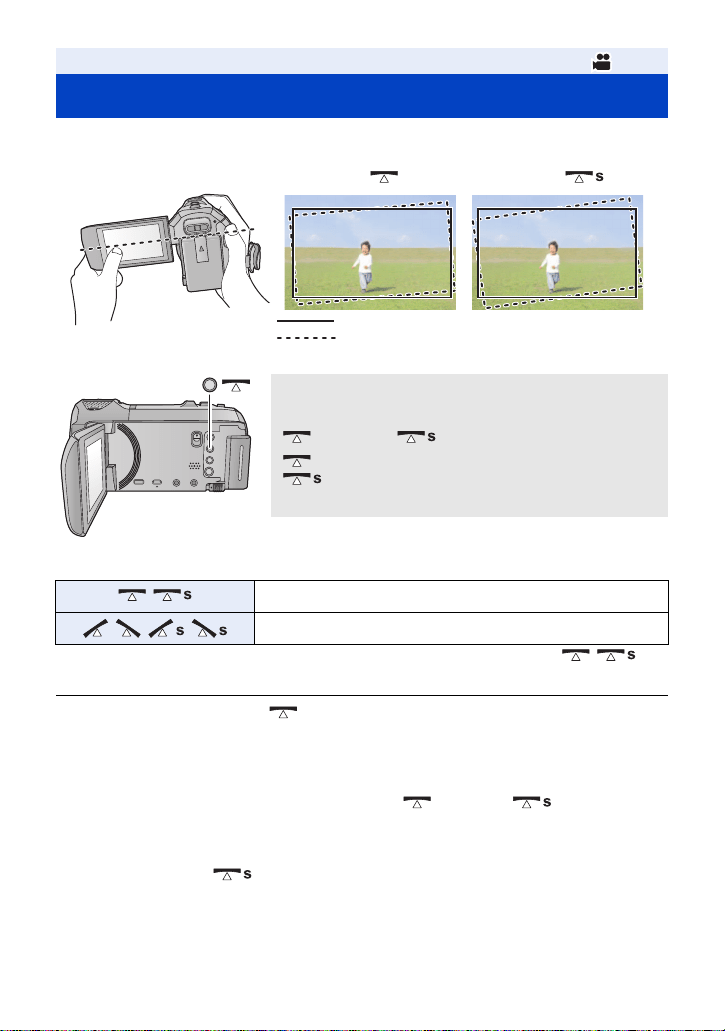
This function detects the horizontal tilt of the unit, and automatically corrects it to the level
position.
≥ The icon changes when the tilt exceeds the correction range.
≥ When the tilt exceeds the correction range, move the unit to the position where / is
displayed.
≥ This function's default setting is (Normal).
≥ The range that this icon can be displayed correctly the slope is about 45 o to the horizontal
direction.
≥ Level Shot Function is canceled when [LEVEL GAUGE] is set to [ON]. (
l 74)
≥ When recording horizontal images using a tripod, attach the unit on the tripod using [LEVEL
GAUGE] (
l 74), and then set Level Shot Function to (Normal) or (Strong) before
use.
≥ When you switch the setting of the Level Shot Function, the screen may become black
momentarily.
≥ If you set the option to (Strong), the angle of view will change.
Advanced (Recording)
Level Shot Function
(When setting (Normal)) (When setting (Strong))
: With Level Shot Function
: Without Level Shot Function
Level Shot Function button
Each press of this button switches Level Shot Function.
(Normal) # (Strong) # Off
(Normal): Corrects the tilt.
(Strong): Strengthen tilt correction.
Off: Cancel the setting.
/ When the tilt is corrected
/ / / When the tilt is above the correction range
- 43 -
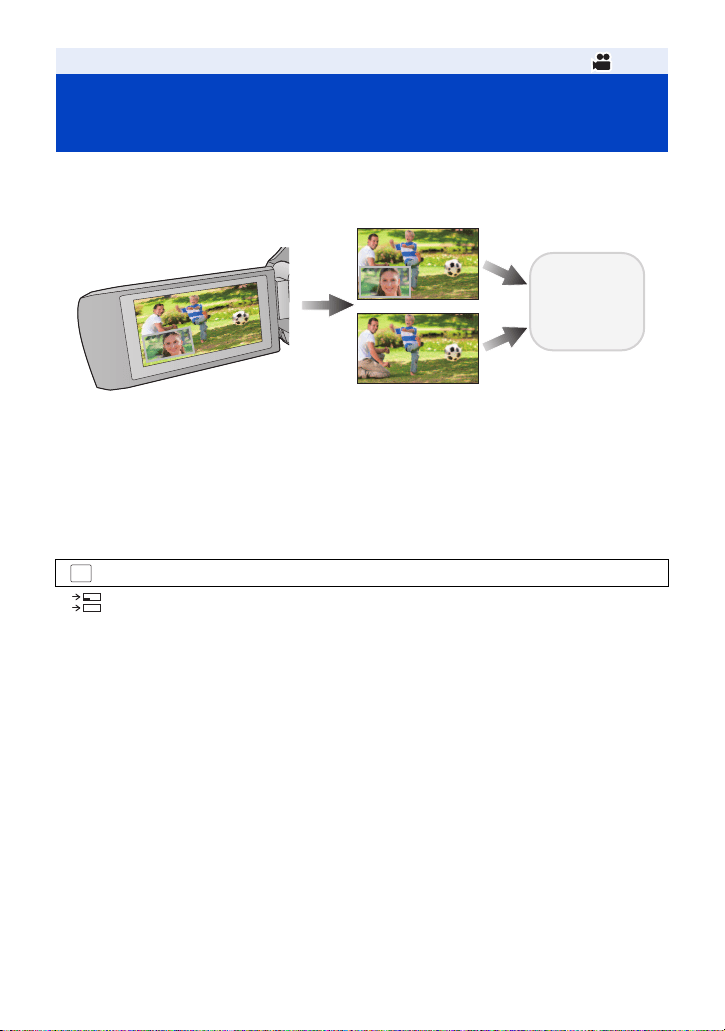
When simultaneously recording two images with the Main Camera, you can also record the Main
Camera’s image as a separate scene. (Backup for Twin Camera)
≥ Even when using the Wireless Twin Camera function, you can save the image being recorded
with the Main Camera as a separate scene. (
l 156)
≥ Set [REC FORMAT] to [AVCHD] and [REC MODE] to [PH]/[HA]/[HG]/[HE]. (
l 71)
≥ will be displayed on the screen.
≥ When Twin Camera recording starts, this unit also starts recording the Main Camera’s image
without the Sub Window image as a separate scene.
Advanced (Recording)
Recording with the Backup for Twin
Camera Function
: [RECORD SETUP] # [Backup for Twin Camera] # [ON]
A Twin Camera
B Backup for Twin Camera
C SD card
MENU

- 44 -
≥ When recording with [Backup for Twin Camera], use an SD card conforming to Class 10 of
the SD Speed Class Rating.
≥ Scenes recorded as Backup for Twin Camera and scenes that show the Sub Window’s image will
be saved on the same media. This causes the remaining recordable time to be halved.
≥ When [ON] is selected, two separate dates are used to record scenes simultaneously. As a result,
compared to when [OFF] is selected, recording can be performed on fewer days.
≥ Backup for Twin Camera operates when it is set to [ON], even if you hide the Sub Window.
≥ You cannot record still pictures while recording with the Backup for Twin Camera function.
≥ Backup for Twin Camera is not available when any of the following functions is being used:
j Creative Control
j FULL HD Slow Motion Video Mode
j HDR Movie Mode
- 45 -
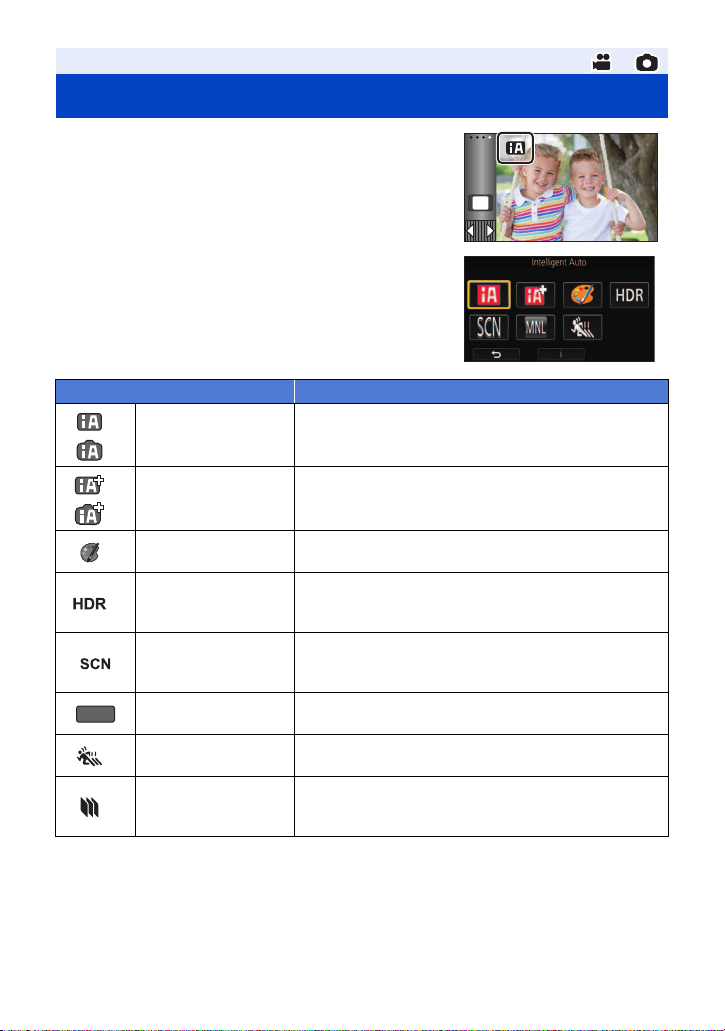
1 Touch the Recording Mode button icon.
2 Touch the desired Recording Mode button icon.
*1 In Motion Picture Recording Mode only
*2 In Still Picture Recording Mode only
Advanced (Recording)
Changing the Recording Mode
Mode Effect
*1
*2
Intelligent Auto
You can switch the mode to the Intelligent Auto Mode,
which optimizes settings to the recording environment
you are in. (
l 46)
*1
*2
Intelligent Auto Plus
You can add manually-adjusted brightness and color
balance settings to the Intelligent Auto Mode, and record.
(
l 48)
*1
Creative Control
You can record motion pictures with added effects.
(
l 48)
*1
HDR Movie
You can minimize the loss of gradations in bright areas
and dark areas when, for example, the contrast between
the background and the subject is large.
(
l 51)
Scene Mode
This option allows this unit to automatically adjust the
shutter speed and aperture, etc. according to the scene
you want to record. (
l 52)
Manual
You can set the shutter speed, focus, White Balance, and
brightness (iris/gain). (
l 56)
*1
FULL HD Slow
Motion Video
You can record slow motion pictures. (
l 53)
*2
Stop Motion
Animation Assist
You can set a recorded still picture as the background,
and record the next picture while looking at that recorded
picture as the background. (
l 55)
MENU
MNL
- 46 -
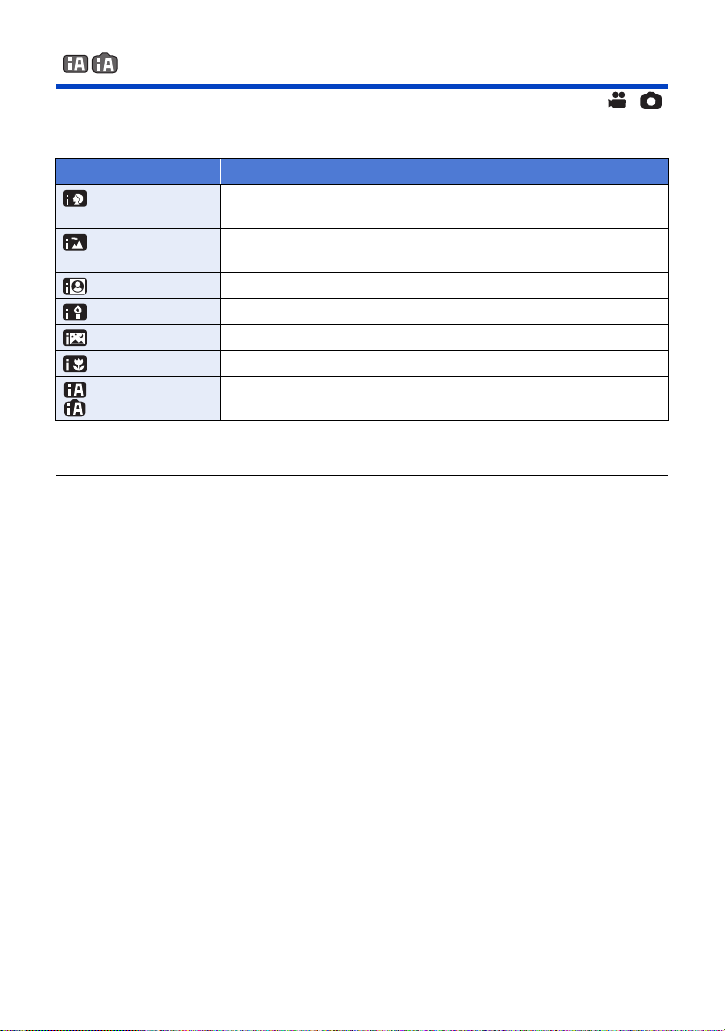
The following modes (appropriate for the condition) are set just by pointing the unit to what you want
to record.
*1 In Motion Picture Recording Mode only
*2 In Still Picture Recording Mode only
≥ Depending on the recording conditions, the unit may not enter the desired mode.
≥ In the Portrait, Spotlight, or Low Light Mode, the face will be surrounded by a white frame when
detected. In the Portrait Mode, a subject that is bigger and close to center of the screen will be
surrounded by an orange frame. (
l 73)
≥ Using a tripod is recommended in Night Scenery Mode.
≥ Faces cannot be detected depending on the recording conditions, such as when faces are of
certain sizes or at certain tilts or when digital zoom is used.
Intelligent Auto
Mode Effect
Portrait Faces are detected and focused automatically, and the brightness is
adjusted so it is recorded clearly.
Scenery The whole landscape will be recorded vividly without whiting out the
background sky, which may be very bright.
*1
Spotlight Very bright object is recorded clearly.
*1
Low Light It can record very clearly even in a dark room or twilight.
*2
Night Scenery You can record night scenery vividly by slowing the shutter speed.
*2
Macro This allows recording at very close proximity to the object of recording.
*1
*2
Normal
Normal
In modes other than those described above, the contrast is adjusted to
give a clear picture.
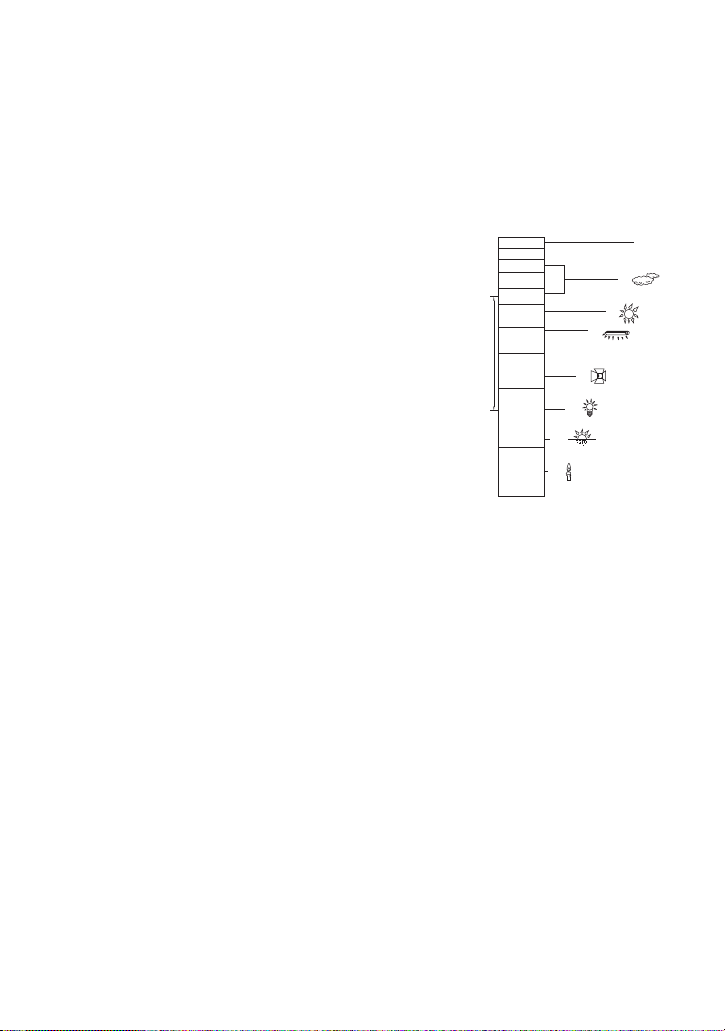
- 47 -
∫ Intelligent Auto Mode
When switching to Intelligent Auto Mode, the Automatic White Balance and Auto Focus operate and
automatically adjust the color balance and focusing.
Depending on the brightness of the subject etc., the aperture and shutter speed are automatically
adjusted for an optimum brightness.
≥ Color balance and focus may not be adjusted automatically depending on light sources or
scenes. If so, manually adjust these settings. (
l 57, 59)
Automatic White Balance
The illustration shows the range over which Automatic White Balance functions.
1) The effective range of Automatic White Balance adjustment
on this unit
2) Blue sky
3) Cloudy sky (rain)
4) Sunlight
5) White fluorescent lamp
6) Halogen light bulb
7) Incandescent light bulb
8) Sunrise or sunset
9) Candlelight
If the Automatic White Balance is not functioning normally, adjust
the White Balance manually. (
l 57)
Auto Focus
The unit focuses automatically.
≥ Auto Focus does not work correctly in the following situations.
Record pictures in the Manual Focus Mode. (
l 59)
j Recording distant and close-up objects at the same time
j Recording a subject behind dirty or dusty window
j Recording a subject that is surrounded by objects with glossy surfaces or by highly reflective
objects
4)
5)
6)
7)
8)
10 000K
9 000K
8 000K
7 000K
6 000K
5 000K
4 000K
3 000K
2 000K
2)
1)
3)
9)
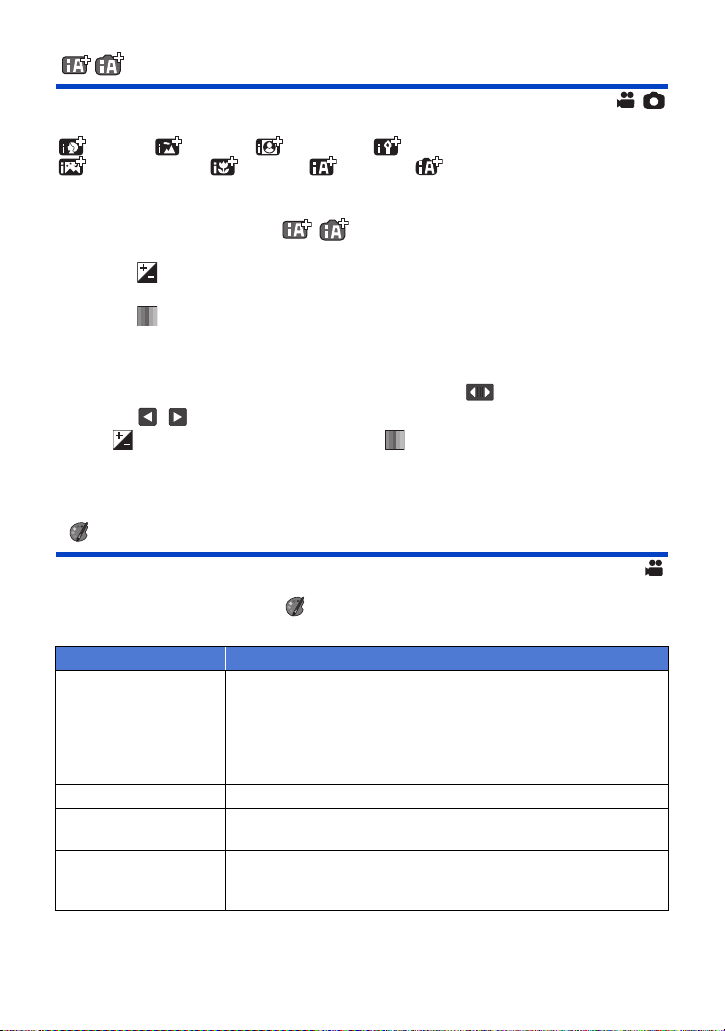
- 48 -
Please refer to page 46 for details about the effect of each mode.
(Portrait)/ (Scenery)/ (Spotlight)
*1
/ (Low Light)
*1
/
(Night Scenery)
*2
/ (Macro)
*2
/ (Normal)
*1
/ (Normal)
*2
*1 In Motion Picture Recording Mode only
*2 In Still Picture Recording Mode only
≥ Change the Recording Mode to / . (
l 45)
1 (When adjusting the brightness)
Touch .
(When adjusting the color balance)
Touch .
≥ R side: Sets the balance to a reddish tone.
B side: Sets the balance to a bluish tone.
≥ Except for when adjusting the brightness or color balance, if you do not touch the screen for a
while, the Touch Menu will disappear. To display it again, touch .
2 Touch / to adjust settings.
≥ Touch while adjusting the brightness, or touch while adjusting the color balance to make
the display of the adjustment bar disappear.
3 Start recording.
≥ Set [REC FORMAT] to [AVCHD]. (
l 71)
≥ Change the Recording Mode to . (
l 45)
Select the desired Creative Control Mode, then touch [Enter].
≥ Still pictures cannot be taken.
Intelligent Auto Plus
Creative Control
Mode Effect
[Miniature Effect] You can record motion pictures with a diorama effect like recording a
miniature by intentionally creating focused area and out of focused
area in the peripheral of the image and recording motion picture with
an interval. (
l 49)
≥ Motion pictures recorded with this function will look as if the frame
rate is low.
[8mm movie] You can record motion pictures with a faded retro effect. (
l 50)
[Silent movie] You can record motion pictures that are similar to black-and-white
silent films by lowering the amount of incoming light. (
l 50)
[Time Lapse Rec] You can record a scene that moves slowly over a long period of time
as a short time motion picture by recording one frame at each set
time lapse. (
l 50)
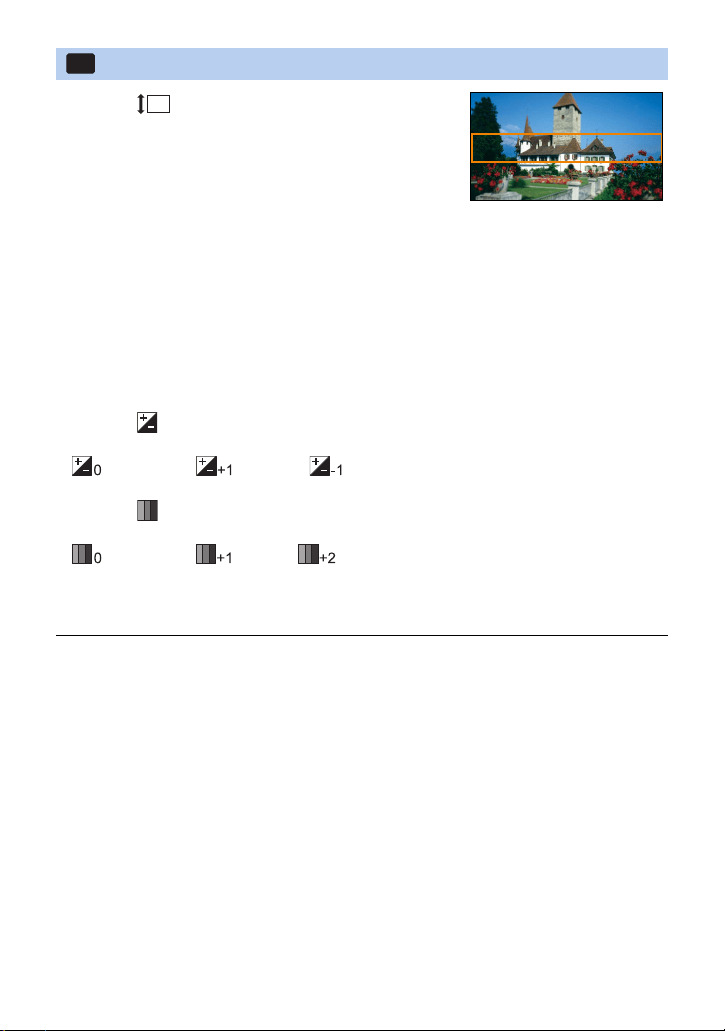
- 49 -
1 Touch to adjust the horizontal position of
the in-focus portion.
≥ If you touch the screen, you can adjust the horizontal
position of the in-focus portion.
≥ When no touch operations are performed for approximately
1 second, [Reset], [SIZE], and [ENTER] are displayed. If
you touch the screen, you can readjust the horizontal
position of the in-focus portion.
≥ Position of the in-focus portion will return to original position when you touch [Reset].
2 Touch [SIZE].
≥ The size of the in-focus portion is switched every time you touch [SIZE].
Medium size
# Large size # Small size
≥ If you touch the screen, you can adjust the horizontal position of the in-focus portion.
≥ If you touch [Reset], the in-focus portion is reset to the original position and [SIZE] is reset to the
medium size.
3 Touch [ENTER].
4
(When adjusting the brightness)
Touch .
≥ The level of brightness is switched every time you touch the icon.
(Standard)
# (Bright) # (Dark)
5 (When adjusting the vividness)
Touch .
≥ The level of vividness is switched every time you touch the icon.
(Standard)
# (Vivid) # (Most vivid)
6 Start recording.
≥ It will record with an interval. 1 second will be recorded for approximately every 6 seconds of
recording.
≥ To make the Miniature Effect easier to gain, record objects incorporating a distant view or those
that can provide depth or a skewed perspective. Also, use a tripod and avoid zooming.
≥ You may see a lot of noise in the in-focus portion when recording dark subjects such as night
scenes.
≥ Audio cannot be recorded.
≥ [REC MODE] is set to [HA].
≥ The maximum recordable time is 12 hours.
≥ Motion pictures recorded with this function will look as if the frame rate is low.
[Miniature Effect]
MINI
- 50 -
1 (When adjusting the brightness)
Touch .
≥ The level of brightness is switched every time you touch the icon.
(Standard) # (Bright) # (Dark)
2 (When adjusting the color balance)
Touch .
≥ The level of color balance is switched every time you touch the icon.
(Blue)
# (Red) # (Yellow)
3 Start recording.
≥ The sound is monaural.
1 (When adjusting the brightness)
Touch .
≥ The level of brightness is switched every time you touch the icon.
(Standard)
# (Bright) # (Dark)
2 Start recording.
≥ Audio cannot be recorded.
Touch the desired setup time.
≥ Touch [ENTER].
≥ A frame is recorded with a set recording interval. 30 frames will make up a motion picture of
1 second.
≥ “h” is an abbreviation for hour, “min” for minute and “s” for second.
≥ These times are approximations.
≥ Maximum recordable time is 12 hours.
[8mm movie]
[Silent movie]
[Time Lapse Rec]
[1 SEC.]/[10 SEC.]/[30 SEC.]/[1 MINUTE]/[2 MINUTES]
Setup example
Setup time
(recording
interval)
Recording time Recorded time
Sunset
1s 1h 2min
Blooming 30 s 3 h 12 s
8mm
SILN
INTV

- 51 -
≥ Audio cannot be recorded.
≥ [REC MODE] is set to [HA].
≥ The shortest motion picture recording time is 1 second.
≥ The color balance and focus may not be adjusted automatically depending on the light source or
scene. If so, manually adjust those settings. (
l 57, 59)
≥ When recording for a long time, we recommend recording with the AC adaptor connected.
≥ Change the Recording Mode to . (
l 45)
Recording
≥ [REC MODE] is set to [1080/28M] in the following cases:
j When [REC FORMAT] is set to [MP4/iFrame] and [REC MODE] is set to [720] or [iFrame]
≥ The following settings are canceled:
j [FACE FRAMING]
j Auto Slow Shutter
j Backlight Compensation
j Intelligent Contrast Control
j Night Mode
j Digital cinema color
j [PICTURE ADJUST]
j [HYBRID O.I.S.]
≥ The video light is disabled.
≥ You cannot record still pictures.
≥ Depending on recording conditions, the screen may flicker or you may see horizontal bars in the
image.
≥ If you record a moving subject or move this unit quickly while recording, the image may be
distorted.
HDR Movie Mode
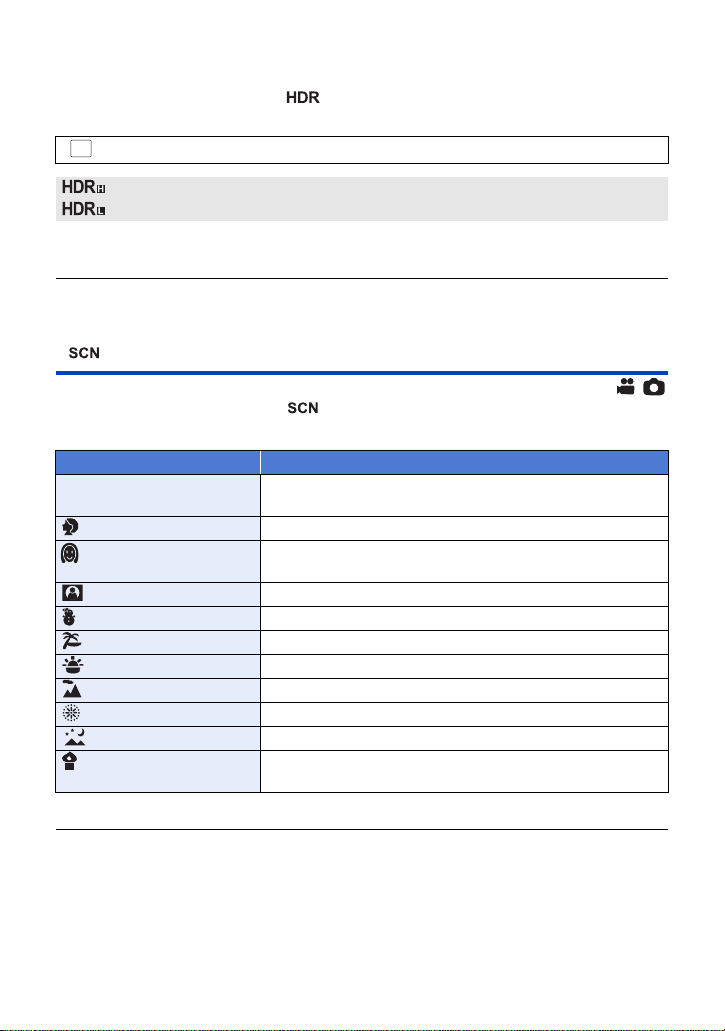
- 52 -
∫ To change the level of image contrast correction
[HDR EFFECT] allows you to change the contrast correction level in HDR Movie Mode.
≥ Change the Recording Mode to . (
l 45)
1 Select the menu.
2 Touch [ENTER].
≥ Touch [EXIT] to complete the settings.
≥ You can also change this setting by touching its operation icon. (l 65)
≥ You may not see the full effect depending on the recording conditions.
≥ Change the Recording Mode to . (
l 45)
Touch the desired Scene Mode.
≥ Touch [ENTER].
≥ (Sports/Portrait/Soft Skin/Spotlight/Snow/Beach/Sunset/Scenery)
j The shutter speed is 1/8 or more in Still Picture Recording Mode.
≥ (Sunset/Low Light)
j The shutter speed is 1/30 or more in Motion Picture Recording Mode.
≥ (Sunset/Scenery/Fireworks/Night Scenery)
j Image may get blurry when close object is recorded.
: [RECORD SETUP] # [HDR EFFECT] # desired setting
: Sets the correction level to high.
: Sets the correction level to low.
Scene Mode
Mode Effect
5Sports: To make fast moving scenes less shaky with slow playback and
pause of playback
Portrait: To make people stand out against the background
Soft Skin: To makes skin colors appear softer for a more attractive
appearance
Spotlight: Improved quality when subject is brightly illuminated
Snow: Improved image quality when shooting in snowy locations
Beach: To make blue in the sea or sky vibrant
Sunset: To make red in the sunrise or sunset vibrant
Scenery: For spatial scenery
Fireworks: To capture the fireworks in the night sky beautifully
Night Scenery: To capture the evening or night scenery beautifully
Low Light: For dark scenes, such as at dusk
(In Motion Picture Recording Mode only)
MENU
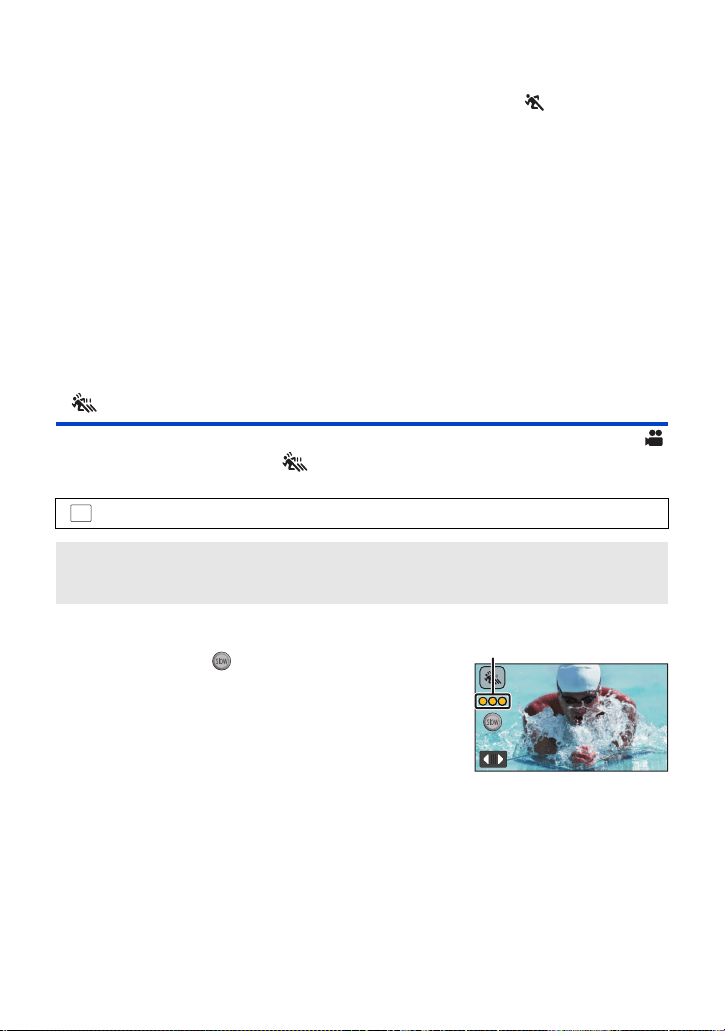
- 53 -
≥ (Sports)
j During normal playback, the image movement may not look smooth.
j Color and screen brightness may change under indoor lighting.
j If the brightness is insufficient, the Sports Mode does not function. The display flashes.
≥ (Portrait)
j Color and screen brightness may change under indoor lighting.
≥ (Soft Skin)
j If the background or anything else in the scene has colors similar to the skin color, they will also
be smoothed.
j If the brightness is insufficient, the effect may not be clear.
j If you record a person in the distance, the face may not be recorded clearly. In this case, cancel
Soft Skin Mode or zoom in on the face (close-up) to record.
≥ (Fireworks)
j The shutter speed is 1/30.
j Image may get washed out when recorded in bright surrounding.
≥ (Night Scenery)
j The shutter speed is 1/2 or more in Still Picture Recording Mode.
j Using a tripod is recommended.
≥ Change the Recording Mode to . (
l 45)
1 Select the menu.
2 Start recording.
3
(When [Interval] is selected)
Touch and hold when you want to use
FULL HD Slow Motion Video recording.
≥ As long as you touch and hold the icon, FULL HD Slow
Motion Video recording will continue.
≥ Once you release your finger, normal recording will start.
≥ For each recording you make, FULL HD Slow Motion Video
recording is possible up to 3 times.
≥ To check how many more times you can use FULL HD Slow Motion Video recording, see the
number of the yellow lights
A.
FULL HD Slow Motion Video
: [RECORD SETUP] # [SLOW MOTION SETUP] # desired setting
[Interval]: Allows you to switch between normal recording and FULL HD Slow Motion
Video recording while recording.
[Always]: Records the entire scene as FULL HD Slow Motion Video.
MENU

- 54 -
≥ To record the scene into an SD card, use an SD card conforming to Class 10 of the SD
Speed Class Rating.
≥ Recordable time with the battery will be shortened with the use of FULL HD Slow Motion Video
recording.
≥ FULL HD Slow Motion Video recording uses the following settings:
j Level Shot Function: Off
j [ZOOM MODE]: [Opt.Zoom 20k]
j [HYBRID O.I.S.]: [OFF]
j [AUTO SLOW SHTR]: [OFF]
≥ The shutter speed is 1/120 or more.
≥ The following restrictions apply to FULL HD Slow Motion Video Mode:
j The number of pixels/frame rate are fixed to 1920k1080/60p.
j The sound of the parts will not be recorded ( will be displayed during the recording).
j Still pictures cannot be recorded.
j The size of the image displayed on the screen will change.
j Images and sound are not output from this unit to another device.
≥ When you switch to FULL HD Slow Motion Video Mode, the screen may become black
momentarily.
≥ When FULL HD Slow Motion Video recording starts, the following settings are canceled:
j AF/AE tracking
j PRE-REC
j Fade
≥ On the thumbnail screen in Playback Mode, scenes recorded as FULL HD Slow Motion Video are
displayed with the indication.
≥ You can set the playback speed on this unit in [SLOW PLAY SPEED] (
l 87). In addition, you can
set the playback speed on another device to 1/4 normal speed in [Slow Speed Conversion]
(
l 112).
- 55 -
≥ Change the Recording Mode to . (l 45)
1 Press the button to record the still pictures. (l 25)
2 Touch [Enter].
≥ A still picture will be recorded, and it will be displayed in a semi-transparent state on the recording
screen. Look at the picture to estimate how far you should move the subject for the next
recording.
≥ If you have already recorded still pictures in the recording group, the last still picture will be
displayed in a semi-transparent state on the recording screen.
≥ To record again, touch and record again.
3 Move the subject and determine the composition of the picture.
≥ Repeat Steps 1-3 to continue recording.
≥ You can save still pictures in the same recording group until you use [Create Stop Motion].
Creating a new recording group
≥ If you touch [YES], a new recording group will be created and the recording screen will be
displayed.
≥ Once you create a recording group, you cannot save still pictures in any of the older recording
groups.
≥ [PICTURE SIZE] is set to (1920k1080).
≥ When you want to record still pictures in a separate recording group, use a different SD card.
≥ For details on playback of the Stop Motion Animation Assist Mode, refer to page
104.
Stop Motion Animation Assist
Before recording in Stop Motion Animation Assist Mode
You can create a slideshow that appears to be moving by recording the subject while moved a
little at a time.
≥ Each recording group can store up to 999 still pictures recorded in Stop Motion Animation
Assist Mode.
: [PICTURE] # [Create Stop Motion]
MENU
2.1M
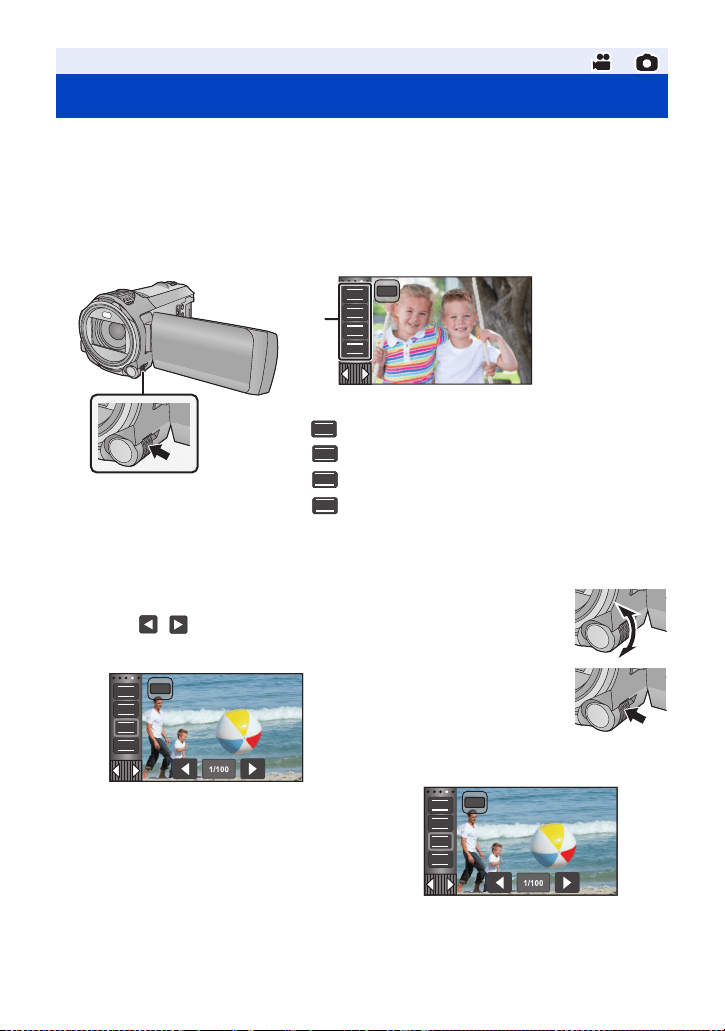
- 56 -
≥ The Manual Focus, White Balance, Shutter Speed, Brightness (Iris and Gain) settings are
retained when you change between Motion Picture Recording Mode and Still Picture
Recording Mode.
Push the Multi Manual Dial to switch to Manual Mode.
≥ When an item on the manual icon or the picture quality adjustment icon (
l 80) is not selected,
each time you push the Multi Manual Dial, the manual icon and the picture quality adjustment
icon are displayed alternately. Display the manual icon.
≥ It is also possible to switch to Manual Mode by touching the Recording Mode button icon. (
l 45)
≥ To cancel the manual settings, change the Recording Mode to the Intelligent Auto Mode. (l 45)
∫ When using the LCD monitor
1 Touch the desired item to be set.
2 Touch / to enter the
selection.
∫ Using the Multi Manual Dial
1 Rotate the Multi
Manual Dial to select
an item.
2 Push the Multi
Manual Dial to set.
3 Rotate the Multi
Manual Dial to select a setting.
4 Push the Multi Manual Dial to set.
Advanced (Recording)
Manual recording
FOCUS
WB
SHTR
IRIS
FOCUS
WB
SHTR
IRIS
MNL
A Manual icon
Focus (
l 59)
White Balance (
l 57)
Manual Shutter Speed (
l 58)
Iris Adjustment (
l 58)
FOCUS
WB
SHTR
IRIS
FOCUS
WB
SHTR
IRIS
FOCUS
WB
SHTR
IRIS
MNL
FOCUS
WB
SHTR
IRIS
MNL
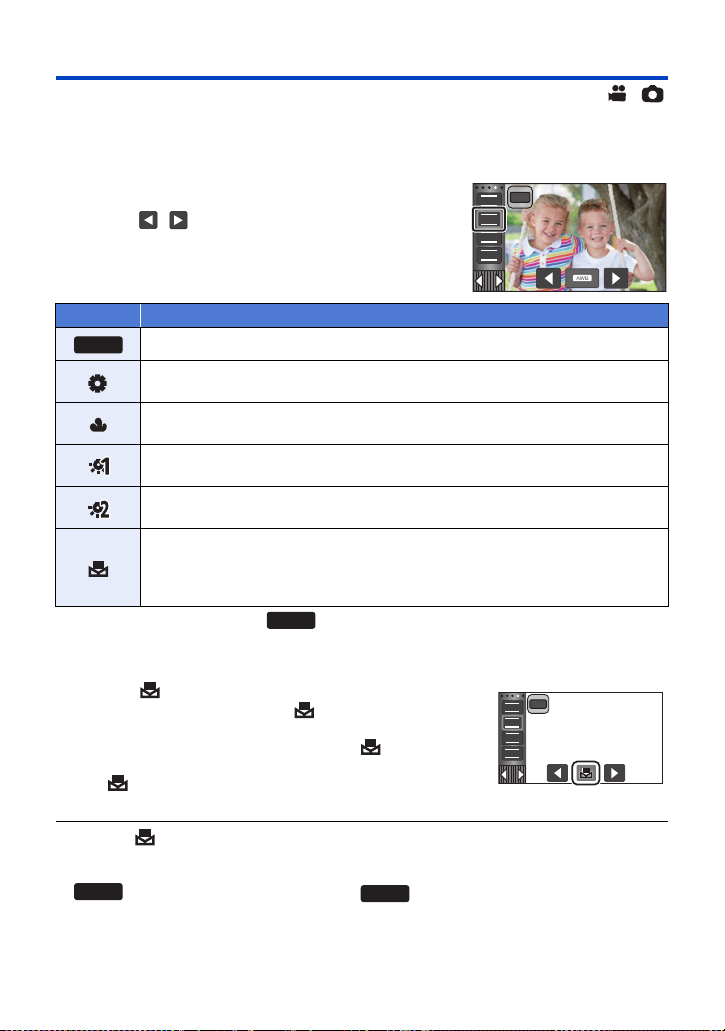
- 57 -
White Balance
Automatic White Balance function may not reproduce natural colors depending on the scenes or
lighting conditions. If so, you can adjust the White Balance manually.
≥ Switch to Manual Mode. (
l 56)
≥ For information on how to set items with the Multi Manual Dial, refer to page
56.
1 Touch [WB].
2 Touch / to select White Balance Mode.
≥ Touch [WB] to select the mode.
≥ To return to auto setting, set to or change the Recording Mode to the Intelligent Auto
Mode. (
l 45)
∫ To set the White Balance manually
1 Select , fill the screen with a white subject.
2 Touch and set the blinking .
≥ When using the Multi Manual Dial, push and hold it.
≥ When the screen turns black instantly and the display stops
flashing and then lights constantly, the setting is complete.
≥ If the display continues flashing, the White Balance cannot be
set. In this case, use other White Balance Modes.
≥ When the display flashes, the Manual White Balance previously adjusted is stored.
Whenever recording conditions change, re-set the White Balance.
≥ When setting both the White Balance and the iris/gain, set the White Balance first.
≥ is not displayed on the screen when is being set.
FOCUS
SHTR
IRIS
WB
MNL
Icon Mode/Recording conditions
Automatic White Balance adjustment
Sunny mode:
Outdoors, under a clear sky
Cloudy mode:
Outdoors, under cloudy sky
Indoor mode 1:
Incandescent light, video lights like in the studio, etc.
Indoor mode 2:
Color fluorescent lamps, sodium lamps in gymnasiums etc.
Manual adjustment mode:
≥ Mercury-vapor lamps, sodium lamps, some fluorescent lights
≥ Lights used for wedding receptions at hotels, stage spotlights in theaters
≥ Sunrise, sunset, etc.
AWB
AWB
FOCUS
SHTR
IRIS
WB
MNL
AWB
AWB

- 58 -
Manual shutter speed/iris adjustment
Shutter Speed:
Adjust it when recording fast-moving subjects.
Iris:
Adjust it when the screen is too bright or too dark.
≥ Switch to Manual Mode. (
l 56)
≥ For information on how to set items with the Multi Manual Dial, refer to page 56.
1 Touch [SHTR] or [IRIS].
2 Touch / to adjust settings.
≥ Touch [SHTR]/[IRIS] to end the adjustment.
: Shutter speed:
1/60 to 1/8000
≥ If [AUTO SLOW SHTR] is set to [ON], the shutter speed will be set between 1/30 and 1/8000.
≥ The shutter speed closer to 1/8000 is faster.
≥ The shutter speed will be set between 1/2 and 1/2000 in Still Picture Recording Mode.
: Iris/Gain value:
CLOSE
!#
(F16 to F2.0)
!#
OPEN
!#
(0dB to 18dB)
≥ Value closer to CLOSE darken the image.
≥ Value closer to 18dB brighten the image.
≥ When the iris value is adjusted to brighter than OPEN, it changes to the gain value.
≥ To return to auto setting, change the Recording Mode to the Intelligent Auto Mode. (
l 45)
≥ When setting both the shutter speed and the iris/gain value, set the shutter speed and then set
the iris/gain value.
Manual shutter speed adjustment
≥ When the shutter speed is set lower than 1/15 in the Still Picture Recording Mode, using a tripod
is recommended. The shutter speed will be set to 1/30 when the unit is turned on again.
≥ You may see a band of light around an object that is shining very bright, or highly reflective.
≥ During normal playback, image movement may not look smooth.
≥ If you record an extremely bright object or record under indoor lighting, color and screen
brightness may change or a horizontal line may appear on the screen. In this case, record in the
Intelligent Auto Mode or set the shutter speed to 1/60 in areas where the power supply frequency
is 60 Hz, or 1/100 in areas of 50 Hz.
≥ Brightness of the image displayed on the LCD monitor may be different from brightness of the
image actually recorded during the Still Picture Recording Mode. Confirm the image on the
playback screen after recording.
Manual iris/gain adjustment
≥ If the gain value is increased, the noise on the screen increases.
≥ Depending on the zoom magnification, there are iris values that are not displayed.
SHTR
IRIS
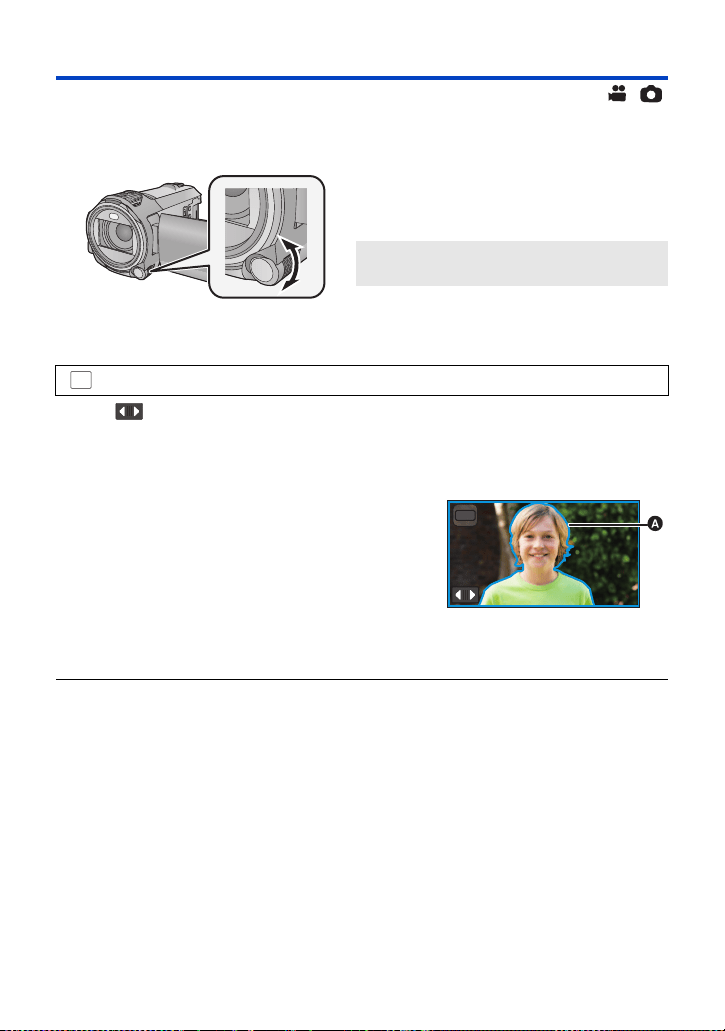
- 59 -
Manual Focus adjustment
If auto focusing is difficult due to the conditions, then use Manual Focus.
≥ Switch to Manual Mode. (
l 56)
≥ For information on how to set items with the Multi Manual Dial, refer to page
56.
1 (When MF assist function is used)
Select the menu.
≥ Touch to display the Manual icon.
2 Touch [FOCUS].
3 Touch [MF] to change to Manual Focus.
≥ MF appears on the screen.
4 Adjust the focus by rotating the Multi Manual
Dial.
The in-focus area is displayed in blue. The normal screen
returns approximately 2 seconds after you finish bringing the
subject into focus.
≥ When [MF ASSIST] is [OFF], the blue area is not
displayed.
≥ To restore Auto Focus, touch [AF] in Step 3 or change the
Recording Mode to the Intelligent Auto Mode. (
l 45)
≥ The blue display does not appear on the images actually recorded.
Rotate the Multi Manual Dial to set focus.
: [RECORD SETUP] # [MF ASSIST] # [ON]
MENU
MNL
A Part displayed in blue
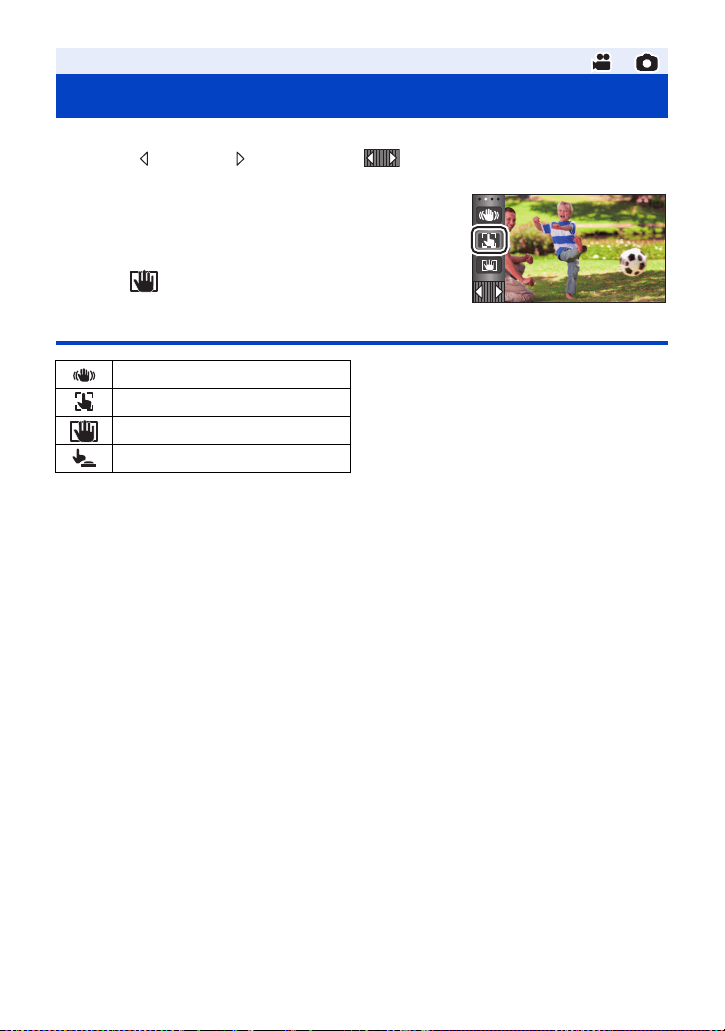
- 60 -
You can record using convenient functions just by the easy operation of touching the screen.
1 Touch (left side)/ (right side) of on the Touch Menu to display
Touch Function icons. (
l 20)
2 Touch the Touch Function icon.
(e.g. AF/AE tracking)
≥ To cancel, touch the Touch Function icon again. (Optical
Image Stabilizer Lock is canceled by releasing the finger
touching .)
Touch function icons
*1 In Motion Picture Recording Mode only
*2 In Still Picture Recording Mode only
Advanced (Recording)
Recording with the Touch Function
Image Stabilizer Function
AF/AE tracking
Optical Image Stabilizer Lock
*1
Touch Shutter
*2
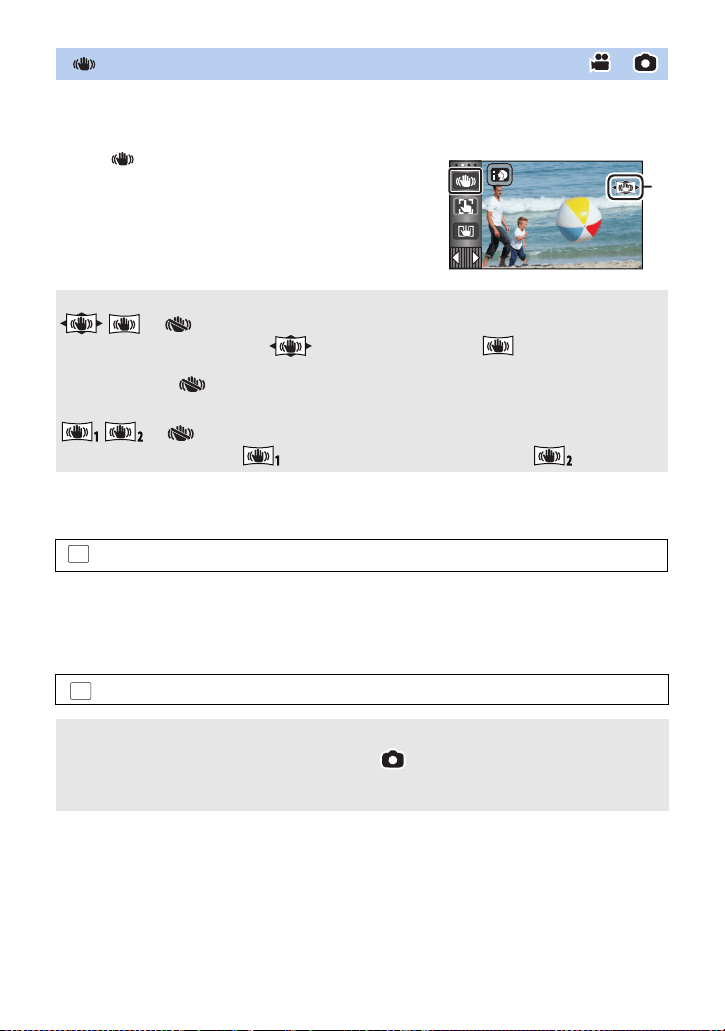
- 61 -
Use the Image Stabilizer to reduce the effects of shake during recording.
This unit is equipped with Hybrid Optical Image Stabilizer.
Hybrid Optical Image Stabilizer is a hybrid of Optical and Electrical Image Stabilizer.
Touch to switch the Image Stabilizer on/off.
≥ The icon at position A is switched.
∫ Changing Image Stabilizer Mode
(Motion Picture Recording Mode)
When set to [ON], you can further improve image stabilization for recording while walking, or
holding the unit and recording a distant subject with zoom.
≥ This function’s default setting is [ON].
(Still Picture Recording Mode)
Image Stabilizer Function
(Motion Picture Recording Mode)
/ # (setting canceled)
≥ When [HYBRID O.I.S.] is [ON], is displayed. When [OFF], is displayed.
≥ When recording with a tripod in Motion Picture Recording Mode, we recommend that you set the
Image Stabilizer (off).
(Still Picture Recording Mode)
/ # (setting canceled)
≥ When [O.I.S.] is [MODE1], is displayed. When [O.I.S.] is [MODE2], is displayed.
: [RECORD SETUP] # [HYBRID O.I.S.] # [ON] or [OFF]
: [RECORD SETUP] # [O.I.S.] # [MODE1] or [MODE2]
[MODE1]: The function works all the time.
[MODE2]: The function works when the button is pressed. We recommend using
this mode when you are recording yourself or recording with a tripod in Still
Picture Recording Mode.
MENU
MENU
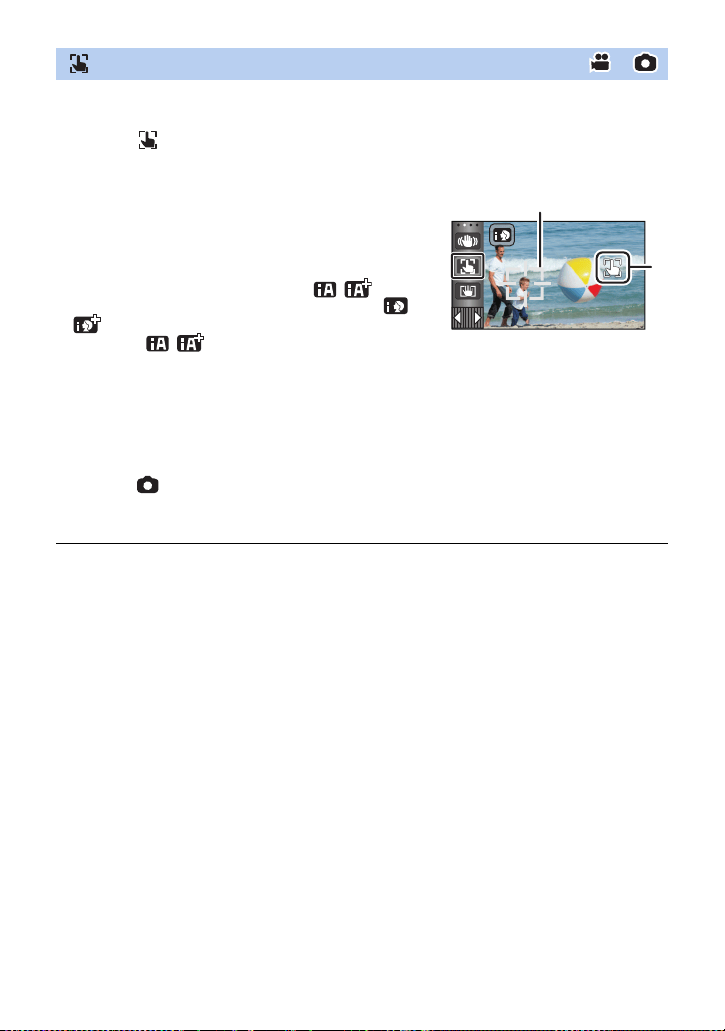
- 62 -
It is possible to set the focus and exposure to the subject specified on the touch screen.
The focus and exposure will keep following the subject automatically even if it moves.
1 Touch .
≥ An icon is displayed B.
2 Touch the object and lock the target.
≥ When you touch the head of the object, the target frame on
the head gets locked and tracking starts.
≥ Touch the object to be changed again when you want to
change the target.
≥ When the Intelligent Auto Mode or Intelligent Auto Plus
Mode is selected, the setting becomes / (Normal)
and touched object is tracked. Selection becomes /
(Portrait) when target frame is locked on a face. (It
may turn to / (Normal) even if the target is locked
on the face when a spotlight is shining or with a dark
scene.)
3 Start recording.
∫ About target frame
≥ When target lock fails, the target frame blinks in red and then disappears. Touch a characteristic
part (color etc.) on the object to lock onto it again.
≥ When the button is pressed halfway in Still Picture Recording Mode, the focus is set to the
object that is locked. The target frame turns green when it focuses, and the target cannot be
changed.
≥ This function cannot be used in Manual Mode. In Still Picture Recording Mode, it can only be
used with some settings in Scene Mode.
≥ It may track different objects or may not lock the target depending on the recording conditions
such as the following:
j When the object is too large or too small
j When color of the object is similar to the background
j When the scene is dark
≥ When the target is locked in Still Picture Recording Mode, the screen may become dark or the AF
assist lamp may be performed. (
l 82)
≥ If you use the Fade function while the target is locked, the target lock will be canceled. (
l 66)
≥ AF/AE tracking will be canceled in the following cases.
j When the unit is turned off
j Press the recording/playback button
j Touch the recording mode switching icon
j Touch the Recording Mode button icon
j Switch to recording of yourself
AF/AE tracking
A Target frame
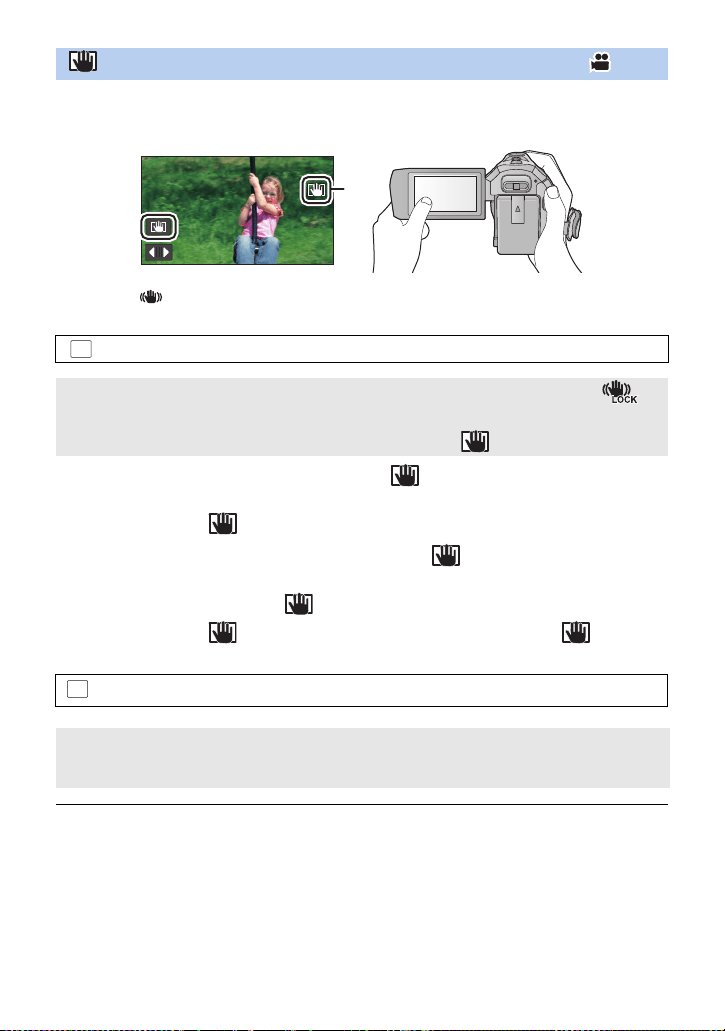
- 63 -
This function enhances optical image stabilization. You can further reduce the effects of the
shake that tends to occur when using zoom.
1 Touch to turn the Image Stabilizer on. (l 61)
2 Select the menu.
≥ The default setting is [AUTO]. When [AUTO] is set, is not displayed in the Touch Menu.
3 (When [MANUAL] is selected)
Touch and hold .
≥ Icon is displayed in A while you are touching and holding .
≥ Optical Image Stabilizer Lock is released when you remove your finger from the icon.
∫ To make the display of disappear
When [MANUAL] is set, stays displayed even if it is left unused. To hide the display,
change the [O.I.S. LOCK DISPLAY] setting.
≥ Stabilization may not be possible under strong shaking conditions.
≥ To record while moving the unit quickly, release Optical Image Stabilizer Lock.
Optical Image Stabilizer Lock
: [RECORD SETUP] # [O.I.S. LOCK SETTING] # desired setting
[AUTO]: Operates Activates Optical Image Stabilizer Lock automatically. The
icon is displayed in the position A of the LCD monitor.
[MANUAL]: Operates Optical Image Stabilizer Lock while is touched and held.
MENU
: [SETUP] # [O.I.S. LOCK DISPLAY] # desired setting
[ON]: Constantly display.
[OFF]: The icon will disappear after approx. 5 seconds without any touch operation.
MENU

- 64 -
It is possible to focus and record a still picture of a subject that is touched.
1 Touch .
≥ An icon is displayed A.
2 Touch the subject.
≥ Focus area is displayed at the touched position, and a still
picture is recorded.
≥ Depending on the recording conditions or recognition of the touched position, it may not be
possible to record the intended picture.
≥ This will not operate for recording yourself.
Touch Shutter
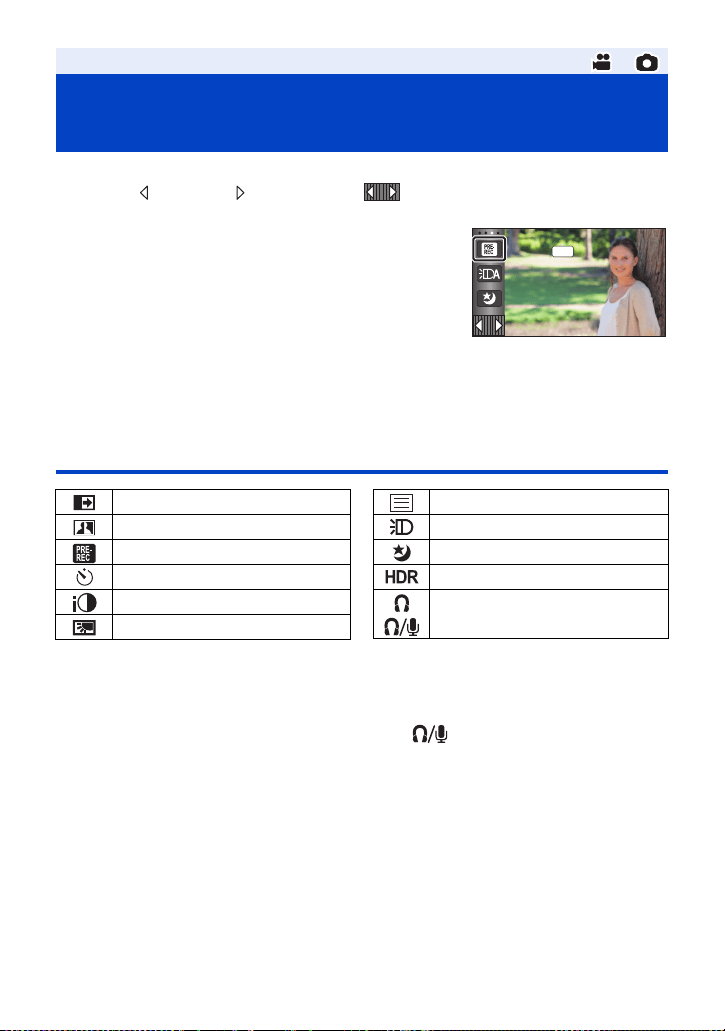
- 65 -
Select the operation icons to add different effects to the images to be recorded.
1 Touch (left side)/ (right side) of on the Touch Menu to display the
operation icons. (
l 20)
2 Touch an operation icon.
(e.g. PRE-REC)
≥ The operation icons that are displayed in the Touch Menu
can be changed. ([SELECT OPERATION ICONS]:
l 35)
≥ Select the operation icon again to cancel the function.
Refer to the respective pages for canceling the following
functions.
j Self-timer (
l 67)
j Guidelines (
l 67)
j Video light (l 68)
j Night Mode (
l 68)
≥ The icon is displayed when the operation icon is set.
Operation icons
*1 Not displayed in Still Picture Recording Mode.
*2 Not displayed in Motion Picture Recording Mode.
*3 It is displayed only when you set the Recording Mode to HDR Movie Mode. (
l 51)
*4 It is displayed only when a headphone is connected to the headphone output terminal. [MIC
LEVEL] (
l 79) is set to anything other than [AUTO], is displayed as the operation icon,
and adjustment of input level of the microphone is possible.
≥ If you turn off the unit or press the Recording/Playback button, PRE-REC, Self-timer, Backlight
Compensation and Night Mode functions are canceled.
≥ If you turn off the unit, the Fade function is canceled.
≥ It is possible to set from the menu. (Except for the Headphone volume adjustment)
Advanced (Recording)
Recording functions of operation
icons
PRE-REC
Fade
*1
Intelligent Contrast Control
*1
PRE-REC
*1
Self-timer
*2
Intelligent Exposure
*2
Backlight Compensation
Guidelines
Video light
Night Mode
*1
HDR Effect
*1, 3
Headphone volume adjustment/
Microphone level adjustment
*4
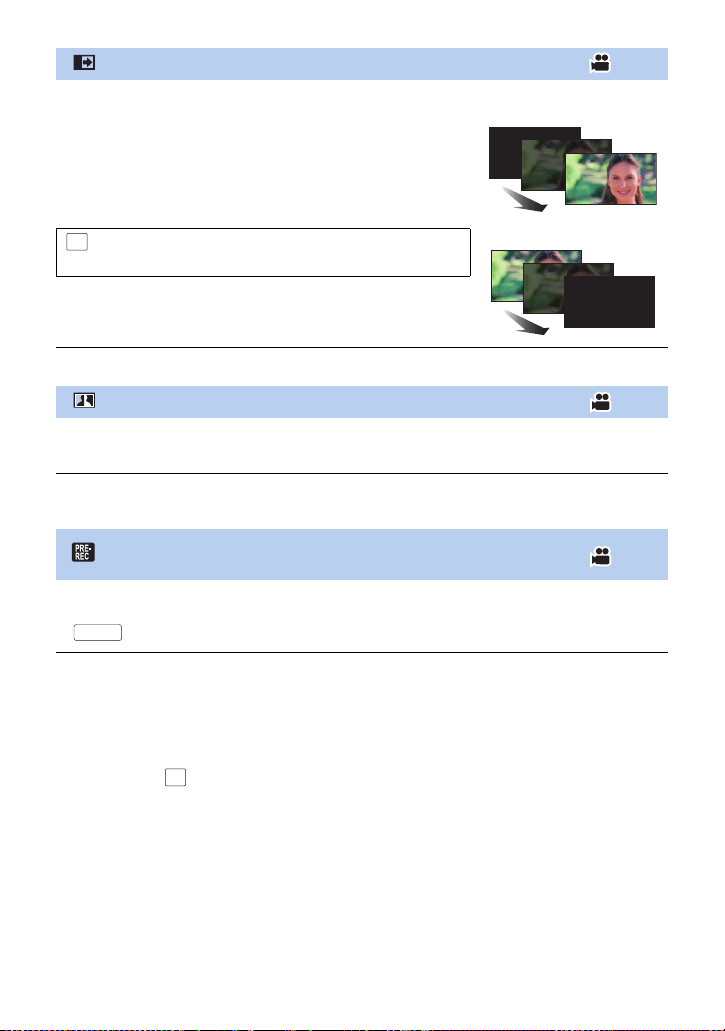
- 66 -
When you start recording, the image/audio gradually
appears. (Fade in)
When you pause recording, the image/audio gradually
disappears. (Fade out)
≥ The Fade setting is canceled when the recording stops.
∫ To select the color for fade in/out
≥ The thumbnails of scenes recorded using fade in become black (or white).
This brightens parts that are in shadow and difficult to see and suppresses white saturation
in bright parts at the same time. Both bright and dark parts can be recorded clearly.
≥ If there are extremely dark or bright parts or the brightness is insufficient, the effect may not be
clear.
This allows recording of the pictures and sound to start approximately 3 seconds before the
recording start/stop button is pressed.
≥ appears on the screen.
≥ Aim the unit at the subject beforehand.
≥ There is no beep sound.
≥ PRE-REC is canceled in the following cases.
j Press the recording/playback button
j Touch the recording mode switching icon
j If you remove the SD card
j If you touch
j If you press the Wi-Fi button
j If you turn the unit off
j If you start recording
j After 3 hours have passed
≥ After setting PRE-REC, if recording starts in less than 3 seconds, motion pictures taken
3 seconds before pressing the recording start/stop button cannot be recorded.
≥ Images displayed on the thumbnail in Playback Mode will differ from the motion pictures
displayed at the start of playback.
Fade
: [RECORD SETUP] # [FADE COLOR] #
[WHITE] or [BLACK]
Intelligent Contrast Control
PRE-REC
This prevents you from missing a shot.
(Fade in)
(Fade out)
MENU
PRE-REC
MENU
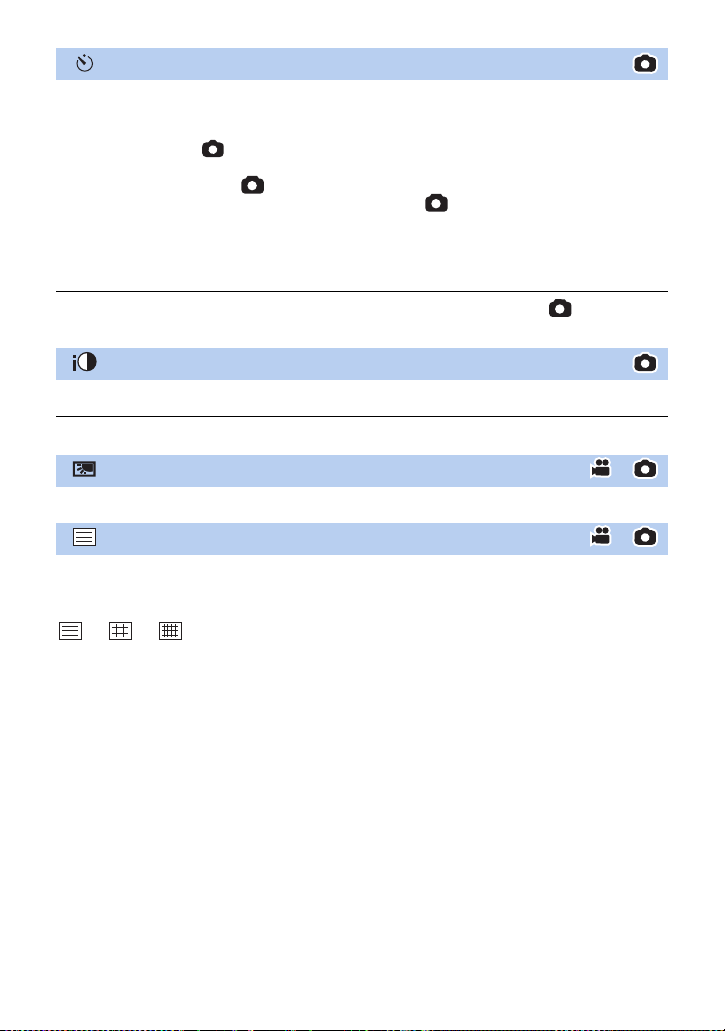
- 67 -
This is for recording still pictures using the timer.
Each time the icon is selected, the indication changes by one setting in the following order:
Ø10 (Records after 10 seconds) # Ø2 (Records after 2 seconds) # setting canceled
≥ When you press the button, Ø10 or Ø2 flashes for the set period before a still picture is
recorded. After recording, the Self-timer is canceled.
≥ In Auto Focus Mode, if the button is pressed halfway once and then fully, the lens focuses
on the subject when the button is pressed halfway. If the button is pressed fully all at once,
the lens focuses on the subject just before recording.
To stop the timer midway through
Touch [CANCEL].
≥ Setting the Self-timer to Ø2 is a good way to prevent image shake when the button is
pressed while using a tripod etc.
This brightens dark areas so the image can be recorded clearly.
≥ If there are extremely dark parts or the brightness is insufficient, the effect may not be clear.
This makes the image brighter to prevent darkening of a backlit subject.
You can check if the image is level while recording motion pictures and still pictures. The
function can also be used to estimate the balance of the composition.
It will switch every time the icon is touched.
# # # Setting canceled
≥ The guidelines do not appear on the images actually recorded.
Self-timer
Intelligent Exposure
Backlight Compensation
Guidelines
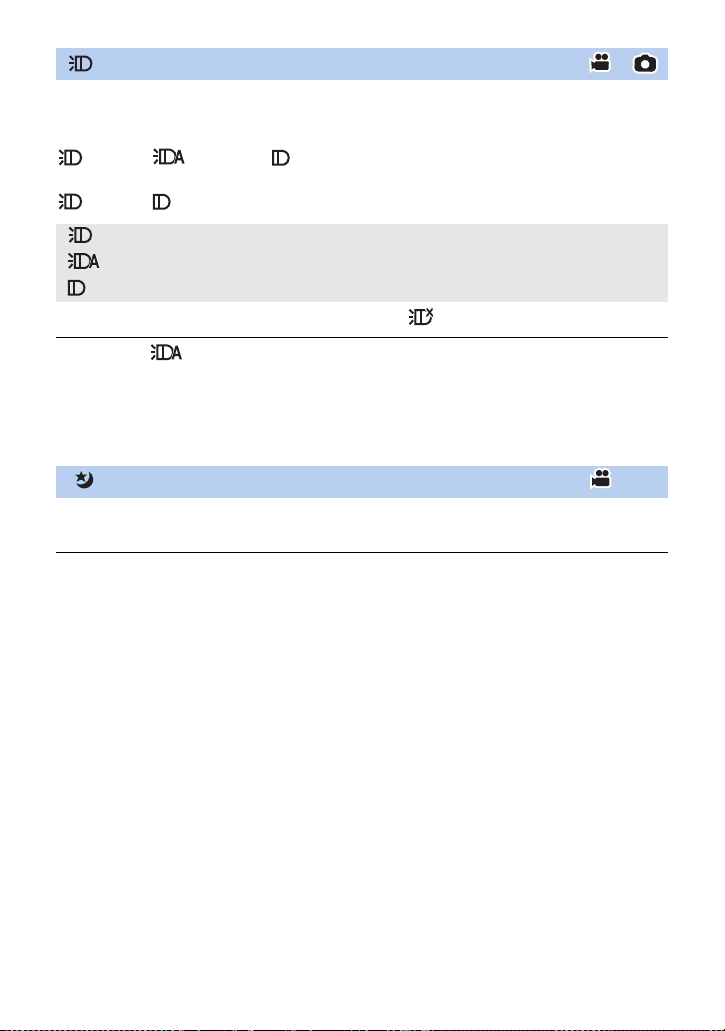
- 68 -
It is possible to record with illumination even in dark places.
Each time the icon is selected, the indication changes by one setting in the following order.
In motion picture recording mode:
([ON]) # ([AUTO]) # ([OFF])
In still picture recording mode:
([ON]) # ([OFF])
≥ When the battery is low and the light cannot be lit, the will be displayed on the screen.
≥ When set to , the video light turns on in Low Light Mode in Intelligent Auto Mode.
≥ When the video light is in use, the recordable time when using the battery is shortened.
≥ When the battery level is low, the video light may turn off or may not turn on.
≥ Do not use with Filter Kit (optional) or Conversion Lens (optional) attached.
≥ The (approximate) available range of the video light is approximately up to
1.2
m (3.9 feet).
≥ Using the Night Mode function at the same time will make conditions even brighter.
You can record images even in very low light situations (minimum required illumination:
approx. 1 lx) or in the dark.
≥ Recorded scene is seen as if frames were missed.
≥ If set in a bright place, the screen may become washed out for a while.
≥ Bright dots that are usually invisible may be seen, but this is not a malfunction.
≥ Using a tripod is recommended.
≥ In darker areas, Auto Focus may focus a bit slower. This is normal.
Video light
: Always on.
: Turns on/off automatically according to brightness of the surroundings.
: Cancel the setting.
Night Mode
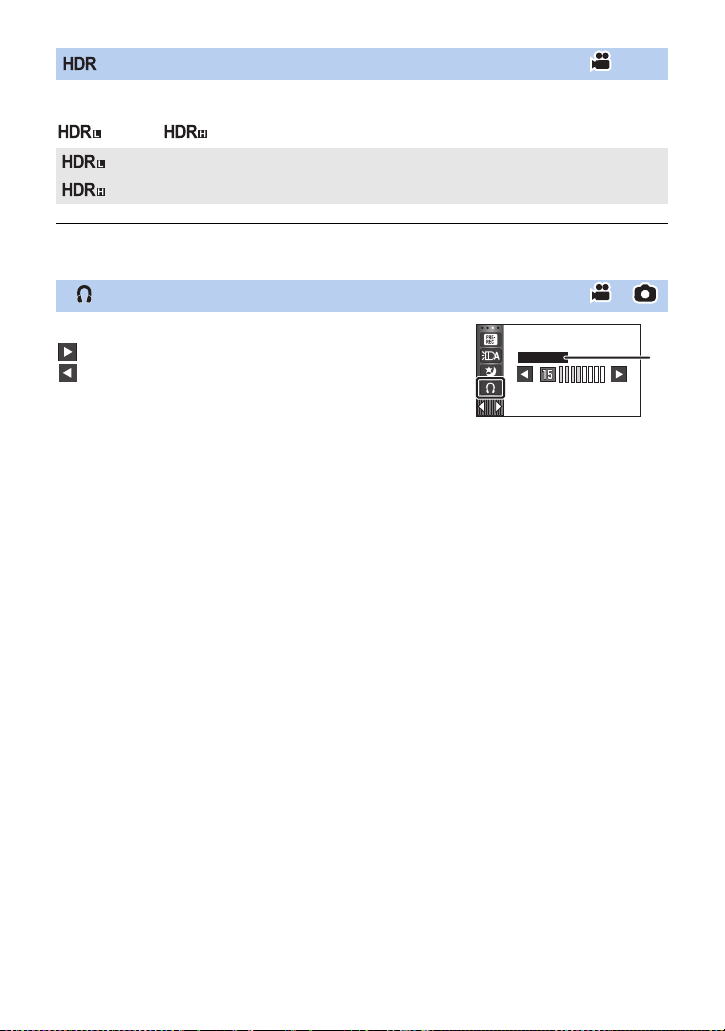
- 69 -
You can change the level of image contrast correction in HDR Movie Mode. (l 51)
The icon changes each time you touch it.
(Low) # (High)
≥ You cannot change the level of this effect when recording a motion picture or during PRE-REC.
≥ You may not see the full effect depending on the recording conditions.
Adjust the volume of the headphone while recording.
: Increase the volume
: Decrease the volume
≥ Actual volume to be recorded does not change.
HDR Effect
(Low): Sets the correction level to low.
(High): Sets the correction level to high.
Headphone volume adjustment
A [HEADPHONE LEVEL]
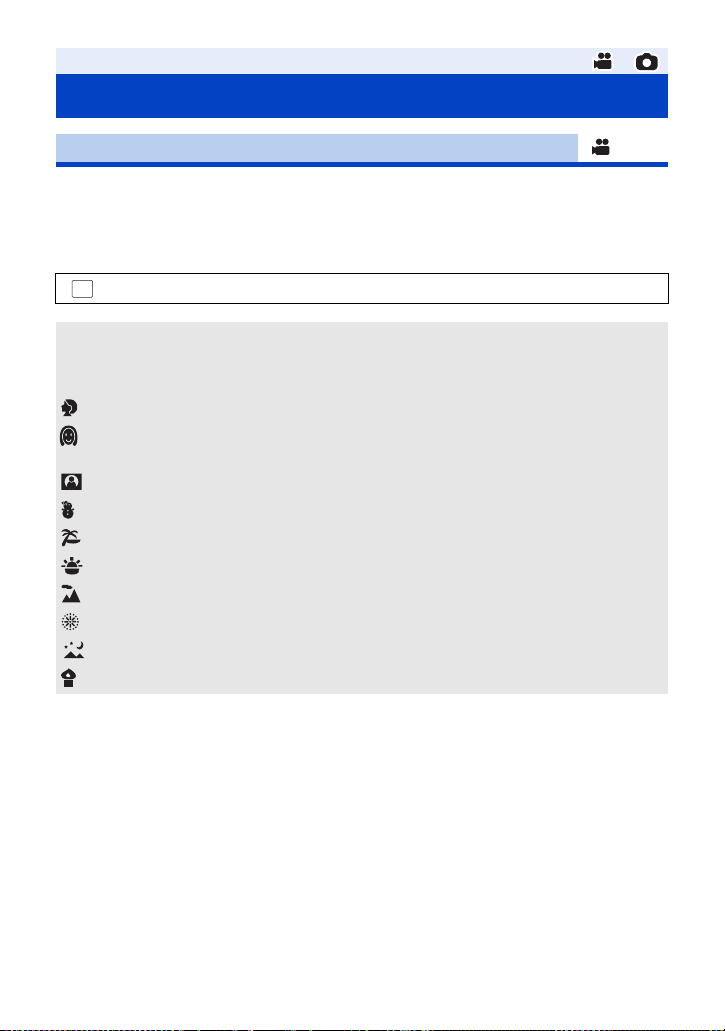
- 70 -
This function is identical to Scene Mode in Recording Mode. (l 45)
The shutter speed and aperture, etc. are automatically adjusted to match the scene you want to
record.
≥ This item is displayed in the menu only when [Time Lapse Rec] in Creative Control Mode is
set. (
l 50)
≥ Please refer to page 52 for details about the effect of each mode.
Advanced (Recording)
Recording functions of menus
[SCENE MODE]
: [RECORD SETUP] # [SCENE MODE] # desired setting
[OFF]: Cancel the setting
5Sports: To make fast moving scenes less shaky with slow playback and
pause of playback
Portrait: To make people stand out against the background
Soft Skin: To makes skin colors appear softer for a more attractive
appearance
Spotlight: Improved quality when subject is brightly illuminated
Snow: Improved image quality when shooting in snowy locations
Beach: To make blue in the sea or sky vibrant
Sunset: To make red in the sunrise or sunset vibrant
Scenery: For spatial scenery
Fireworks: To capture the fireworks in the night sky beautifully
Night Scenery: To capture the evening or night scenery beautifully
Low Light: For dark scenes, such as at dusk
MENU
- 71 -
Set the maximum zoom ratio for the Motion Picture Recording Mode.
≥ The larger the digital zoom magnification, the more the image quality is degraded.
≥ This function cannot be used in Still Picture Recording Mode.
Switch the recording format of motion picture.
≥ This function’s default setting is [AVCHD] mode.
[ZOOM MODE]
: [RECORD SETUP] # [ZOOM MODE] # desired setting
[Opt.Zoom 20k]: Optical zoom only (Up to 20k)
[i.Zoom 50k]: This zoom function allows you to maintain high-definition picture
quality. (Up to 50k)
[D.Zoom 60k]: Digital zoom (Up to 60k)
[D.Zoom 1500k]: Digital zoom (Up to 1500k)
[REC FORMAT]
: [RECORD SETUP] # [REC FORMAT] # desired setting
[AVCHD]: Set the recording format to AVCHD. (l 2)
[MP4/iFrame]: Set the recording format to MP4/iFrame. (l 2)
MENU
MENU
- 72 -
Switch the picture quality and recording format of the motion pictures to record. The recording
formats that can be set change according to [REC FORMAT] setting.
≥ When [REC FORMAT] is set to [AVCHD]
A Favors image quality
B Favors Recording time
≥ When [REC FORMAT] is set to [MP4/iFrame]
*1 You can record motion pictures in 1080/60p (1920k1080/60 progressive), the best AVCHD
picture quality for this unit.
*2 [1080/50M]/[1080/28M] and [720] are recording modes suitable for playing back or editing on a
PC.
*3 [iFrame] is a format suitable for Mac (iMovie etc.). It is recommended for when using a Mac.
≥ Please refer to page 13 for details about recordable time using the battery.
≥ Use an SD card conforming to Class 10 of the SD Speed Class Rating when you want to
record motion pictures to the SD card using the setting [1080/50M].
≥ This function’s default setting is [HG] mode.
≥ Please refer to page
195 for details about approximate recordable time.
≥ When the unit is moved a lot or moved quickly, or when a fast-moving subject is recorded,
mosaic-type noise may appear at playback.
[REC MODE]
: [RECORD SETUP] # [REC MODE] # desired setting
[PH]/[HA]/[HG]/[HE]:
(AB)
Set the recording format to 1080/60i.
[1080/60p]
*1
: Set the recording format to 1080/60p.
[1080/50M]
*2
: Set the recording format to 1080/60p (50 Mbps).
[1080/28M]
*2
: Set the recording format to 1080/60p (28 Mbps).
[720]
*2
: Set the recording format to 720/30p.
[iFrame]
*3
: Set the recording format to iFrame.
MENU
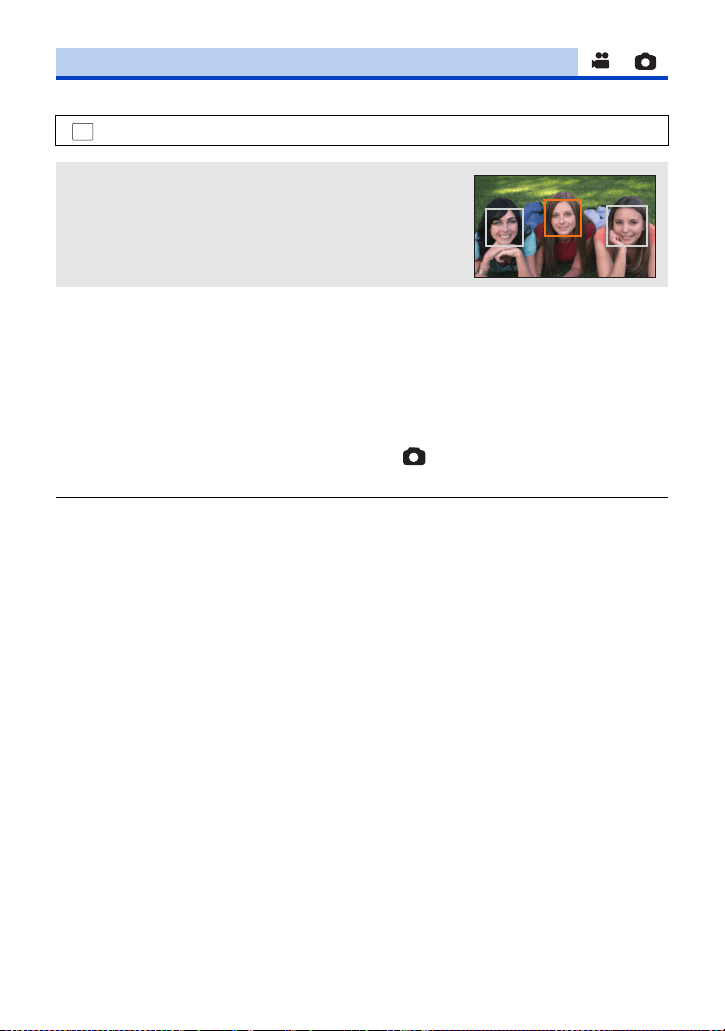
- 73 -
Detected faces appear with frames.
≥ Up to 5 frames are indicated. Larger faces and faces nearer to the center of the screen take
preference over others.
∫ Prioritized face framing
Prioritized face framing is displayed as orange frames. Focus and adjustment of brightness will be
performed against the prioritized face framing.
≥ The prioritized face frame is displayed only with Portrait Mode in Intelligent Auto Mode or
Intelligent Auto Plus Mode.
≥ The white frame is for face detection only.
≥ Focus will be set to prioritized face framing when the button is pressed halfway when
recording still pictures. Prioritized face framing will turn to green when the focus is set.
≥ Faces are not detected in HDR Movie Mode. (l 51)
[FACE FRAMING]
: [RECORD SETUP] # [FACE FRAMING] # desired setting
[PRIMARY]:
Only the prioritized face framing is displayed.
[ALL]:
All face detection framings are displayed.
[OFF]:
Cancel the setting.
MENU
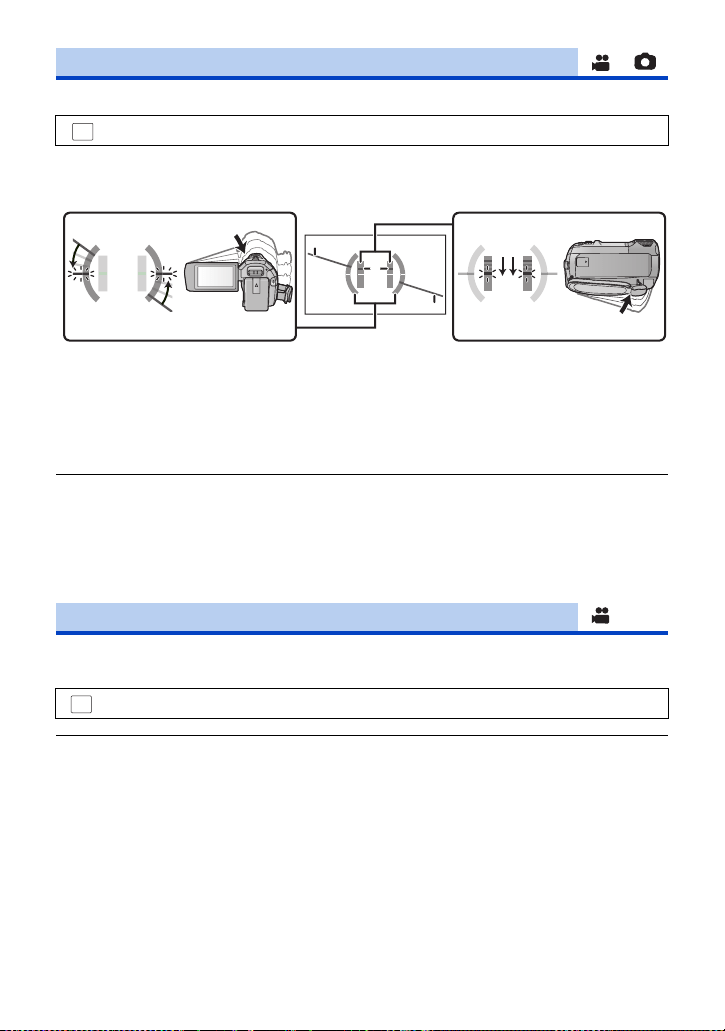
- 74 -
This function displays the horizontal/vertical tilt of the unit with the electronic level.
∫ To correct the tilt
≥ The horizontal tilt display A and vertical tilt display B appear yellow when there is a tilt, and
appear green when there is almost no tilt.
≥ The maximum tilt display angles are approximately 45 o in horizontal direction and 10 o in vertical
direction.
≥ The electronic level does not affect the actual recorded images.
≥ The electronic level is not displayed when recording yourself or the LCD monitor is closed with
the screen facing outward.
≥ Even when the tilt is in the corrected state, an error of approximately 1 o may occur.
≥ In the following cases, the electronic level may not be displayed correctly:
j When moving this unit
j When pointing this unit up or down at an angle closer to perpendicular
If the unit continues to be tilted upside down from the normal horizontal position while recording
motion pictures, it is automatically put into recording pause.
≥ The AGS function may activate and cause the unit to pause the recording if you are recording a
subject right above or right below you.
[LEVEL GAUGE]
: [RECORD SETUP] # [LEVEL GAUGE] # [ON]
(Horizontal direction) (Vertical direction)
When correcting the leftward tilt When correcting the downward tilt
[AGS]
: [RECORD SETUP] # [AGS] # [ON]
MENU
MENU
- 75 -
You can record bright pictures even in dark places by slowing the shutter speed.
≥ Switch to Manual Mode. (
l 56)
≥ The shutter speed is set to 1/30 or more depending on the surrounding brightness.
≥ This function cannot be used in Still Picture Recording Mode.
≥ When the shutter speed becomes 1/30, the screen may be seen as if frames are missed and
afterimages may appear.
Recording motion pictures with more vivid colors, using x.v.Color™ technology.
≥ Switch to Manual Mode. (
l 56)
≥ Set [REC FORMAT] to [AVCHD]. (
l 71)
≥ For more realistic colors, use an HDMI micro cable (supplied) with a TV that supports the
x.v.Color™.
≥ When motion pictures recorded while this function is turned [ON] are played back with a
TV not compatible with x.v.Color™, colors may not be reproduced properly.
≥ When these images are played back with devices other than ones compatible with x.v.Color™, it
is recommended to record the images after this function is turned [OFF].
≥ x.v.Color™ is a name for devices that are compatible with the xvYCC format, an international
standard for expanded color in motion pictures, and that follow the rules for signal transmission.
Message is displayed when this unit is moved rapidly.
When “CAMERA PANNING IS TOO FAST.” appears, move the unit slowly while recording.
≥ Message will not appear while pausing the recording. (Message will appear even if it is pausing
the recording if [DEMO MODE] is set to [ON].)
[AUTO SLOW SHTR]
: [RECORD SETUP] # [AUTO SLOW SHTR] # [ON]
[Digital Cinema Color]
: [RECORD SETUP] # [Digital Cinema Color] # [ON]
[SHOOTING GUIDE]
: [RECORD SETUP] # [SHOOTING GUIDE] # [ON]
MENU
MENU
MENU
- 76 -
This will change the setting of the Image Stabilizer function and Maximum zoom ratio to the one
appropriate for the recording when a Wide Conversion Lens (optional) is attached to this unit.
≥ The following functions will not work:
j Video light
j AF ASSIST LAMP
≥ In Motion Picture Recording Mode, [ZOOM MODE] (
l 71) is fixed to [Opt.Zoom 10k] (up to
10k). In Still Picture Recording Mode, a zoom magnification of up to 10k is possible.
This will reduce the wind noise coming into the built-in microphones while maintaining the realism.
≥ Switch to Manual Mode. (
l 56)
≥ When [Strong] is set, you can check how effectively the wind noise is reduced with the icon
displayed on the screen. In descending order of the strength of the reduction effect, / /
/ is displayed.
≥ When [Normal] is set, will be displayed on the screen.
≥ This function’s default setting is [Normal].
≥ When switching to Intelligent Auto Mode or Intelligent Auto Plus Mode, [Wind Noise Canceler] is
set to [Strong], and the setting cannot be changed.
≥ You may not see the full effect depending on the recording conditions.
≥ This function cannot be set when using an external microphone.
This function reduces the low-pitched sound when using an external microphone.
≥ Switch to Manual Mode. (
l 56)
≥ This function can be set only when using an external microphone.
[WIDE CONV. LENS SET]
: [RECORD SETUP] # [WIDE CONV. LENS SET] # [ON]
[Wind Noise Canceler]
: [RECORD SETUP] # [Wind Noise Canceler] # desired setting
[Strong]: When a strong wind is detected, this option effectively reduces the
wind noise by minimizing the low-pitched sound.
[Normal]: This option extracts and reduces only the wind noise without
deteriorating the sound quality.
[OFF]: Cancel the setting.
[LOWCUT]
: [RECORD SETUP] # [LOWCUT] # [ON]
MENU
MENU
MENU
- 77 -
You can set the built-in microphone's sound quality as appropriate for the scene you want to record.
≥ Set [MIC SETUP] to [SURROUND] or [STEREO MIC]. (
l 78)
1 Select the menu.
2
(When [Customize] is selected)
Select the desired item.
3 (When [Microphone Gain] is selected in Step 2)
Select an item.
(When [Frequency Response] is selected in Step 2)
Touch / to adjust.
≥ Before recording, check the effect you have selected with a headphone set, etc.
≥ The high frequency range (dB) and low frequency range (dB) can be adjusted.
≥ If noises such as the sound caused by the wind bother you, set the low frequency range to
[LowCut].
≥ To end the adjustment, touch [EXIT].
[Sound Scene Select]
: [RECORD SETUP] # [Sound Scene Select] # desired setting
[Auto]: Records sounds with standard settings.
[Music]: For recording scenes in which you need to cover a wide sound range
and a wide volume range, such as music concerts.
[Speech]: For recording speeches, talk sessions, and other events in which
sounds will be coming mostly from the front of this unit.
[Nature]: For recording in serene environments, such as forests and rivers.
[Festival]: For recording festivals, fireworks displays, and other very loud
scenes.
[Customize]: Allows you to adjust [Microphone Gain], [Frequency Response] and
[Directional].
[Microphone Gain]: Select this item when the sound recorded in a loud scene is
distorted.
[Frequency Response]: Adjusts the high frequency range and low frequency range
levels.
[Directional]: Select [SURROUND]/[STEREO] or [MONO].
[Normal]: Adjusts the sound quality automatically.
[Attenuate]: Records sounds of very loud scenes at appropriate volume.
MENU
- 78 -
(When [Directional] is selected in Step 2)
Select an item.
4 Touch [EXIT].
≥ appears on the screen.
≥ Depending on the recording condition or sound quality, the desired effect may not be achieved.
≥ The option is set to [Auto] when an external microphone is connected.
≥ (When [Music] or [Festival] is set)
The volume of the recorded sounds may be lower than that of the sounds recorded with [Auto].
≥ (When [Speech] or [Nature] is set)
Sounds recorded with these effects are less realistic than those recorded with [SURROUND] or
[STEREO MIC] in [MIC SETUP].
You can switch the channel number setting of the built-in microphone.
≥ The option is set to [2ch] when an external microphone is connected.
Recording setting of the built-in microphone can be adjusted.
*1 The option is displayed only when [5.1ch/2ch] is set to [5.1ch].
*2 The option is displayed only when [5.1ch/2ch] is set to [2ch].
[SURROUND]/[STEREO]:
Records sounds with the setting of [MIC SETUP] ([SURROUND] or
[STEREO MIC]).
[MONO]: Records sounds from all directions without setting specific directivity.
[5.1ch/2ch]
: [RECORD SETUP] # [5.1ch/2ch] # desired setting
[5.1ch]: Records with the 5.1ch.
[2ch]: Records with the 2ch.
[MIC SETUP]
: [RECORD SETUP] # [MIC SETUP] # desired setting
[SURROUND]
*1
: Records the surrounding sound with added realism.
[ZOOM MIC]: Sound is recorded with changing the directionality in conjunction
with the zoom operation. Sounds near the front of the unit are
recorded more clearly if you zoom in (close-up) and surrounding
sounds are recorded more realistically if you zoom out (wide angle).
[FOCUS MIC]
*1
: The forward sound is recorded more clearly by enhancing the
directionality toward the center.
[STEREO MIC]
*2
: Records sound from two forward directions.
MENU
MENU
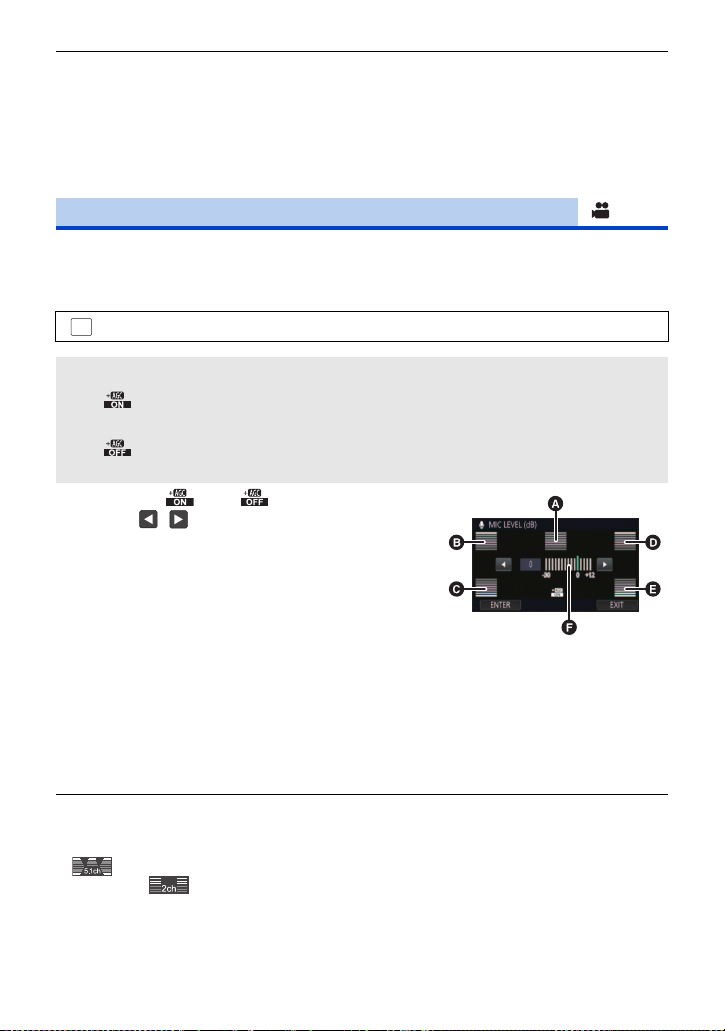
- 79 -
≥ If you wish to record higher quality sound and maintain realism even when zooming in, for
instance, when recording a music recital, we recommend setting [MIC SETUP] to [SURROUND].
≥ [STEREO MIC] will be selected in the following cases:
j When [REC FORMAT] is set to [MP4/iFrame]
≥ When [Directional] in [Customize] in [Sound Scene Select] is set to [MONO], [SURROUND] and
[STEREO MIC] cannot be set. (If you set [MONO], [SURROUND] and [STEREO MIC] will be
switched to [ZOOM MIC])
When recording, the input level from the built-in microphones and the external microphone terminal
can be adjusted.
1 Select the menu.
2
(When [SET ]/[SET ] is selected)
Touch / to adjust.
≥ The adjustment screen to be displayed depends on the
setting of [5.1ch/2ch].
≥ Adjust the microphone input level so that the last 2 bars of
the gain value are not red. (Otherwise, the sound is
distorted.) Select a lower setting for microphone input
level.
3 Touch [ENTER].
≥ Touch [EXIT] to complete the setting.
≥ When [MIC SETUP] is [ZOOM MIC], the volume will be different depending on the zoom rate.
≥ The sound will be recorded in stereo (2ch) when [5.1ch/2ch] is set to [2ch] or an external
microphone is input.
≥ (microphone input level meter) is displayed on the screen when [5.1ch/2ch] is set to
[5.1ch], and (microphone input level meter) is displayed when [5.1ch/2ch] is set to [2ch]
and [MIC LEVEL] is set to a setting other than [AUTO].
≥ You cannot record with the audio completely muted.
[MIC LEVEL]
: [RECORD SETUP] # [MIC LEVEL] # desired setting
[AUTO]: AGC is activated, and the recording level is adjusted automatically.
[SET ]: The desired recording level can be set. AGC is activated, and sound
distortions are reduced.
[SET ]: The desired recording level can be set. Sounds are recorded in
natural quality.
MENU
(When set to [5.1ch])
A Center
B Front left
C Back left
D Front right
E Back right
F Microphone input level
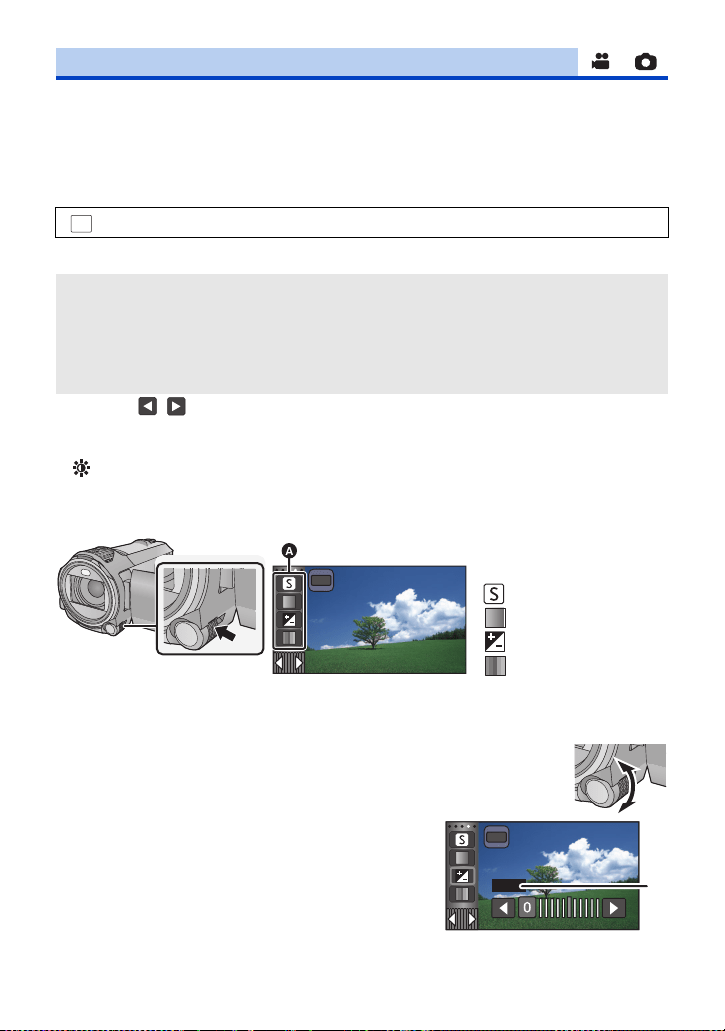
- 80 -
Adjust the quality of the image while recording.
Adjust by outputting to a TV while adjusting the quality of the image.
≥ This setting is retained when you change between Motion Picture Recording Mode and
Still Picture Recording Mode.
≥ Switch to Manual Mode. (
l 56)
1 Select the menu.
2 Touch the desired setting items.
3 Touch / to adjust settings.
4 Touch [ENTER].
≥ Touch [EXIT] to complete the settings.
≥ appears on the screen.
∫ Adjusting the picture quality with the Multi Manual Dial
1 Push the Multi Manual Dial.
≥ When an item on the picture quality adjustment icon or the manual icon (l 56) is not selected,
each time you push the Multi Manual Dial, the picture quality adjustment icon and the manual
icon are displayed alternately. Display the picture quality adjustment icon.
2 Rotate the Multi Manual Dial to select an item.
3 Push the Multi Manual Dial to set.
4 Rotate the Multi Manual Dial to adjust the
setting.
[PICTURE ADJUST]
: [RECORD SETUP] # [PICTURE ADJUST]
[SHARPNESS]: Sharpness of the edge
[COLOR]: Depth of the color of the image
[EXPOSURE]: Brightness of the image
[WB ADJUST]: Picture color balance
MENU
MNL
A Picture quality
adjustment icon
[SHARPNESS]
[COLOR]
[EXPOSURE]
[WB ADJUST]
MNL
B [EXPOSURE]
- 81 -
5 Push the Multi Manual Dial to set.
≥ appears on the screen.
The higher the number of pixels, the higher the clarity of the picture when printing.
≥ The number of recording pixels that can be set changes depending on selected screen aspect
ratio. (
l 82)
∫ Picture size and Maximum zoom ratio in Still Picture Recording
Mode
* Extra Optical Zoom cannot be used. The maximum zoom magnification is 20k.
∫ Picture size in Motion Picture Recording Mode
≥ Set this unit to Motion Picture Recording Mode (
l 18)
≥ The default setting is in Still Picture Recording Mode and in Motion Picture Recording
Mode.
≥ The recording will become longer depending on the recording pixels.
≥ Please refer to page
196 for details about the number of recordable pictures.
[PICTURE SIZE]
: [PICTURE] # [PICTURE SIZE] # desired setting
Picture size Aspect ratio Extra Optical Zoom (l 41)
4896k3672
4:3
–
*
3264k2448 –
*
640k480 50k
5472k3648
3:2
–
*
3984k2656 –
*
1728k1152 31.2k
6528k3672
16:9
–
*
4736k2664 –
*
1920k1080 30k
: [PICTURE] # [PICTURE SIZE] # desired setting
Picture size Aspect ratio
4736k2664
16:9
1920k1080
MENU
18M
8M
0.3M
20M
10. 6
M
2M
24M
12.6
M
2.1M
MENU
12.6
M
2.1M
24M
12.6
M
- 82 -
This allows you to select the aspect ratio of the pictures to suit printing or the playback method.
≥ This function’s default setting is [16:9].
≥ When the aspect ratio is set to [4:3] or [3:2], black bands may appear on the left and right of the
screen.
≥ The edges of still pictures recorded on this unit with a [16:9] aspect ratio may be cut at printing.
Check the printer or photo studio before printing.
The video light is turned on to make it easier to focus when you are recording in dark places where
it is hard to focus.
≥ Switch to Manual Mode. (
l 56)
≥ When switching to Intelligent Auto Mode or Intelligent Auto Plus Mode, the setting is fixed to
[AUTO] and cannot be changed.
≥ This setting is not available when video light is set to ([ON]).
You can add a shutter sound when recording still pictures.
≥ No shutter sound is emitted in Motion Picture Recording Mode.
[ASPECT RATIO]
: [PICTURE] # [ASPECT RATIO] # desired setting
[4:3]: Aspect ratio of 4:3 television
[3:2]: Aspect ratio of conventional film camera or prints (such as L-size print)
[16:9]: Aspect ratio of high-definition television, etc.
[AF ASSIST LAMP]
: [PICTURE] # [AF ASSIST LAMP] # [AUTO]
[SHTR SOUND]
: [PICTURE] # [SHTR SOUND] # desired setting
: Volume low
: Volume high
[OFF]: Cancel the setting.
MENU
MENU
MENU
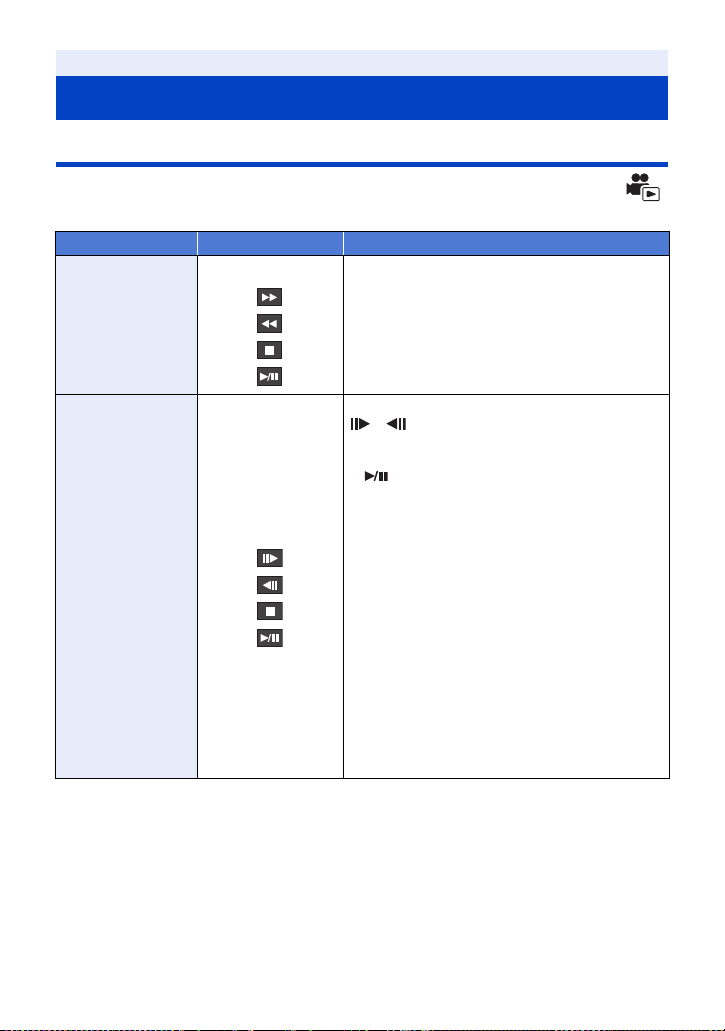
- 83 -
Motion picture playback using operation icon
For details on the basic playback operations, refer to page
27.
Advanced (Playback)
Playback Operations
Playback operation Playback display Operating steps
Skip playback
(to the start of a
scene)
During Playback Touch the LCD monitor and slide from right to
left (from left to right) during playback.
Slow-motion
Playback
During Pause
With the playback paused, continue touching
. ( is for slow rewind playback)
Playback is slow while touching.
≥ Normal playback is restored when you touch
.
≥ When Slow-motion pictures are played back in
reverse, they will be shown continuously at
approximately 2/3
rd
the speed of normal
playback (intervals of 0.5 seconds).
≥
When scenes recorded with MP4 [1080/50M],
[1080/28M], [720] or scenes saved in MP4
(1920
k
1080/30p) are played back in reverse slow-
motion, they will be shown in intervals of
0.5 seconds.
≥ When iFrame scenes and scenes saved in MP4
(640k360/30p) are played back in reverse slow-
motion, they will be shown in intervals of
1 second.
≥ Slow-motion Playback of parts recorded as FULL
HD Slow Motion Video will be shown at the
intervals of 0.25 second.
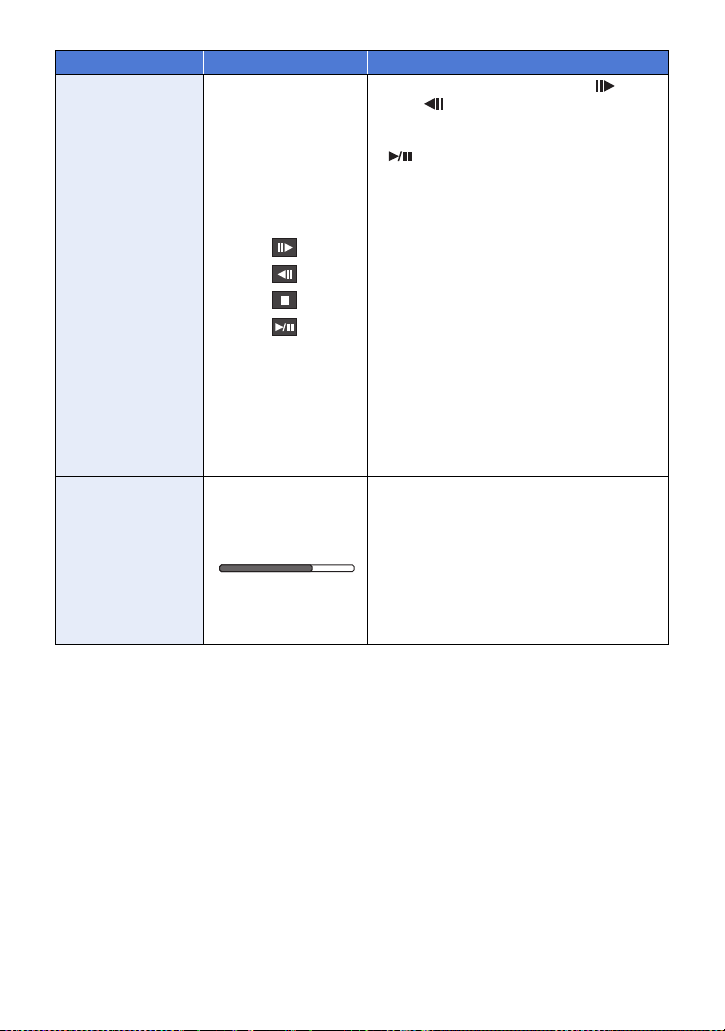
- 84 -
Playback operation Playback display Operating steps
Frame-by-frame
Playback
During Pause
With the playback paused, touch .
(Touch to advance the frames one at a
time in the reverse direction.)
≥ Normal playback is restored when you touch
.
≥ When the frames are advanced one at a
time in the reverse direction, they will be
shown in intervals of 0.5 seconds.
≥ When the frames of scenes recorded with
MP4 [1080/50M], [1080/28M], [720] or
scenes saved in MP4 (
1920
k1080/30p) are
advanced one at a time in the reverse
direction, they will be shown in intervals of
0.5 seconds.
≥
When the frames of iFrame scenes and scenes
saved in MP4 (640
k
360/30p) are advanced
one at a time in the reverse direction, they will
be shown in intervals of 1 second.
≥ When the frames of parts recorded as FULL
HD Slow Motion Video are advanced one at
a time in the reverse direction, they will be
shown in intervals of 0.25 seconds.
Direct playback
Touch the direct playback bar or slide it
while touching.
≥ The playback pauses temporarily and skips
to the position touched or slid to while
touching.
≥ (When you touch the bar or slide it while
touching during playback)
Playback will start by releasing your touching
or sliding finger.
- 85 -
Creating still picture from motion picture
A single frame from the recorded motion picture can be saved as a still picture.
Press the button fully at the location to be saved as a still picture during
playback.
≥ It is convenient to use Pause, Slow-motion Playback and Frame-by-frame Playback.
≥ Date the motion picture was recorded will be registered as date of the still picture.
≥ Quality will be different from the normal still picture.
Highlight & Time Frame Index
An image of one scene is displayed as a thumbnail at set search condition. Scene can be played
back from any midway point of the scene you wish to see.
≥ Operate the zoom lever to side and change over the
thumbnail display to Highlight & Time Frame Index. (
l 29)
1 Touch .
≥ To display the next (previous) page:
j Slide the thumbnail display upward (downward) while touching
it.
j Touch (up) / (down) on the thumbnail scroll lever. (
l 28)
2 Touch the desired search condition.
* It cannot be set while playing back MP4/iFrame scenes or scenes recorded as Backup for Twin
Camera.
≥ When select [FACE], it will select the portion for which Face Recognition was performed from the
scenes judged to be clearly recorded. This will then be displayed as a thumbnail.
≥ A portion judged to be clearly recorded will be detected and displayed in thumbnail if you select
[HIGHLIGHT].
Scene type Picture size
AVCHD scenes
Scenes recorded as Backup for Twin Camera
Scenes recorded in the recording format [MP4/iFrame]
Scenes saved in MP4 (1920k1080/30p)
Scenes saved in MP4 (1280k720/30p)
(1920k1080)
Scenes saved in MP4 (640k360/30p) (640k360)
[3 SEC.]/[6 SEC.]/[12 SEC.]/[MINUTES]/[FACE]*/[HIGHLIGHT]*
2.1M
0.2M
- 86 -
3 (When [MINUTES] is selected)
Touch / to set the time.
≥ It can be set up to a maximum of 60 minutes.
≥ Touch [ENTER].
4 Touch the thumbnail to be played back.
≥ Next (Previous) thumbnail can be displayed by touching / .
Repeat Playback
Playback of the first scene starts after playback of the last scene finishes.
The indication appears on the full screen views.
≥ All the scenes are played back repeatedly. (When playing back motion pictures by date, all the
scenes on the selected date are played back repeatedly.)
Resuming the previous playback
If playback of a scene was stopped halfway, the playback can be resumed from where it was
stopped.
If playback of a motion picture is stopped, appears on the thumbnail view of the stopped
scene.
≥ The memorized resume position is cleared if you turn off the unit or press the recording/playback
button.
(The setting of [RESUME PLAY] does not change.)
: [VIDEO SETUP] # [REPEAT PLAY] # [ON]
: [VIDEO SETUP] # [RESUME PLAY] # [ON]
MENU
MENU
- 87 -
Setting the playback speed of FULL HD Slow Motion
Video
You can set the speed at which this unit will play back parts recorded as FULL HD Slow Motion
Video.
≥ Touch the play mode select icon, and select [ALL MP4/iFrame] or [1080/60p] in [MP4/
iFrame].
≥ If you play back the parts on another device, they will be played back at 1/2 normal speed. To play
them back at 1/4 normal speed, perform [Slow Speed Conversion] (
l 112).
≥ Once you perform [Slow Speed Conversion] on the scenes, the parts will be played back at 1/4
normal speed.
Zooming in on a still picture during playback
(Playback zoom)
You can zoom in by touching a still picture during playback.
1 Touch and hold the part you wish to zoom in on during still picture playback.
≥ It will display enlarged in order of normal display (k1) # k2 # k4. Touch and hold the screen to
zoom in from the normal display (k1) to k2. Touch the screen to zoom in from k2 to k4.
≥ The still picture is zoomed in on, centering on the part you touched.
2 Move to the zoomed in position by touching /
/ / or slide while touching the screen.
≥ The location of the zoom displays for about 1 second when
zooming in (zooming out) or moving the displayed location.
Zooming out from the zoomed still picture
Touch to zoom out. (k4 # k2 # k1)
≥ Touch to return to normal playback (k1).
≥ You can also perform zoom operations using the zoom lever.
≥ The more picture is enlarged, the more its quality deteriorates.
: [VIDEO SETUP] # [SLOW PLAY SPEED] # desired setting
[Super Slow]: Plays back at 1/4 normal speed.
[Slow]: Plays back at 1/2 normal speed.
MENU
ビヹ
ビヹ
A Displayed location of
the zoom
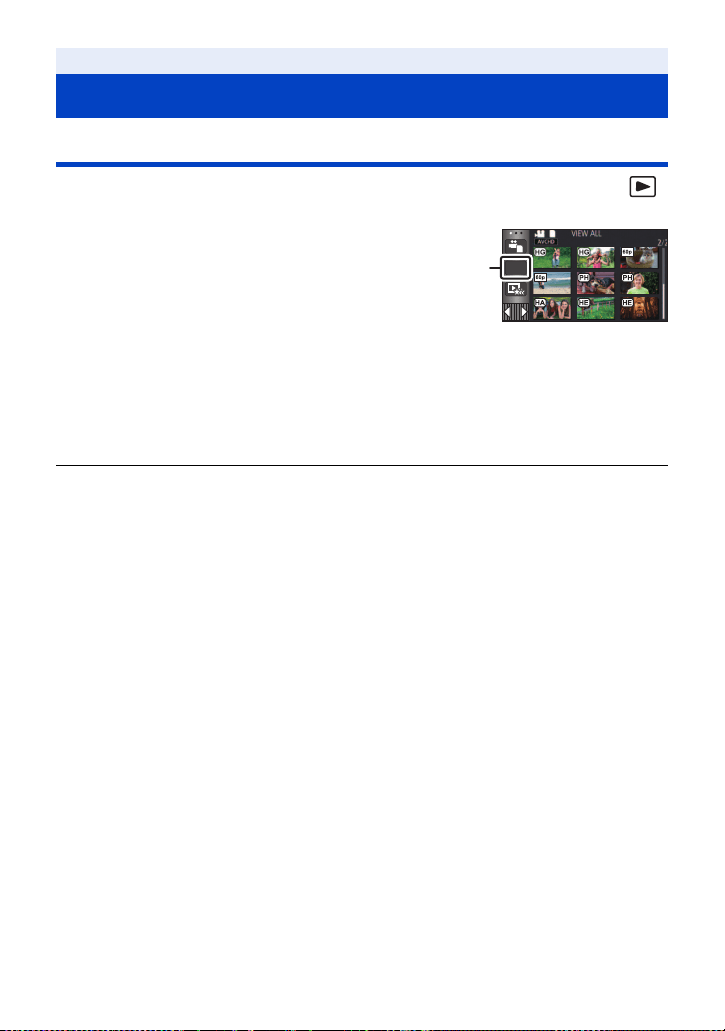
- 88 -
Playing back motion pictures/still pictures by date
The scenes or the still pictures recorded on the same day can be played back in succession.
1 Touch the date select icon. (l 20)
2 Touch the playback date.
The scenes or the still pictures recorded on the date selected are displayed as thumbnails.
3 Touch the scene or the still picture to be played back.
≥ If you press the recording/playback button to switch between Recording Mode and Playback
Mode, the [VIEW ALL] screen will be displayed again.
≥ In cases such as those described below, scenes and still pictures are grouped separately on the
date list, and –1, –2… may be added after the date:
j When the number of scenes exceeds 99
j When the number of still pictures exceeds 999
j When [REC MODE] in [AVCHD] is changed
j When the microphone input sound (5.1ch/2ch) is changed
j When recorded in Creative Control Mode.
j When the [ON]/[OFF] setting of Backup for Twin Camera is switched (
l 43)
j When saved in Manual Edit (
l 99)
j When [NUMBER RESET] is performed
Advanced (Playback)
Various playback functions
A Date select icon
ALL
- 89 -
≥ The following scenes and still pictures are grouped separately on the date list, and icons are
displayed according to the category:
Scene or still picture Icon to be displayed
Scenes recorded with [1080/60p] in [AVCHD]
Scenes recorded with [1080/50M]/[1080/28M] in [MP4/iFrame]
Scenes recorded with [720] in [MP4/iFrame]
Scenes saved in MP4 (1280k720/30p) (
l 111)
Scenes recorded with [iFrame] in [MP4/iFrame]
Still pictures recorded in Stop Motion Animation Assist Mode (l 55)
Still pictures created from motion pictures
Scenes saved in Highlight Playback (l 95)
Scenes saved in MP4 (640k360/30p) (l 111)
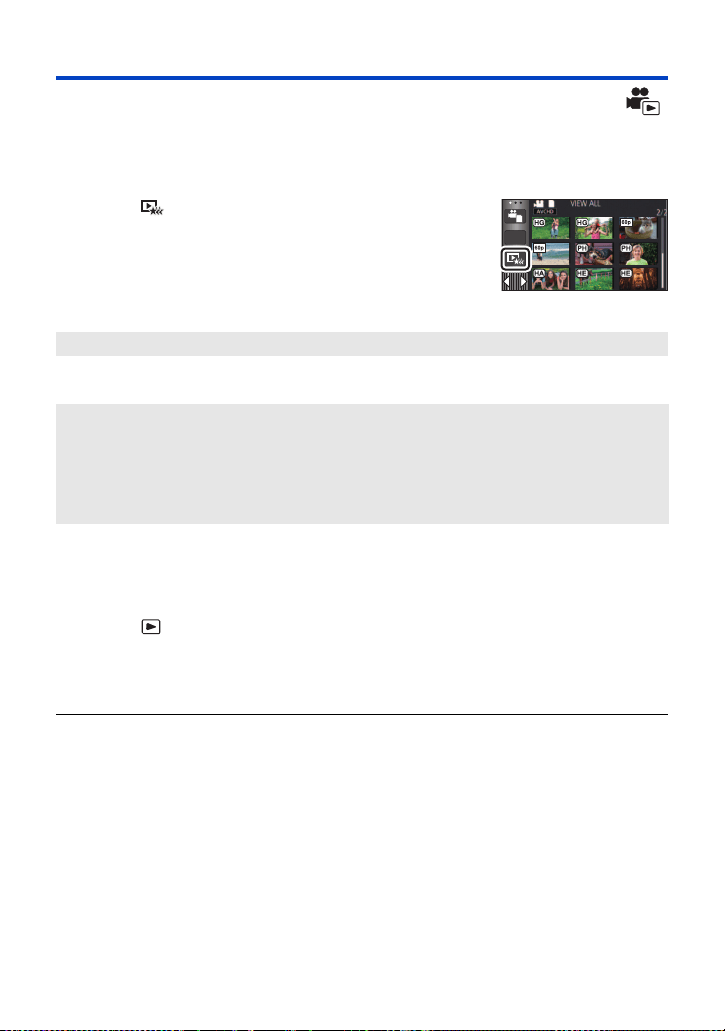
- 90 -
Highlight Playback
Part that was recognized as clearly recorded is extracted from multiple scenes, and it can be played
back or stored in a short time with effects and music added.
It is also possible to create an original Highlight Playback by checking your favorite scenes and
setting up to extract those scenes.
1 Touch . (l 20)
2 (When [ALL MP4/iFrame] is selected)
Touch the recording format of the scene to be
played back.
3 Touch the desired effect.
≥ The scenes matching the effect will be extracted and displayed in the thumbnail view.
≥ Effects such as fade, slow-motion, still (pause), or digest playback are inserted.
≥ The date at playback is the date that was last recorded in an extracted scene.
≥ To change the settings, refer to page
92.
4 Touch in the thumbnail view.
5 Select the playback operation. (l 28)
≥ When the playback is finished or stopped, the screen to select [REPLAY], [SAVE] (
l 95),
[SELECT AGAIN] or [EXIT] is displayed. Touch the desired item.
≥ Skip Playback, Slow-motion Playback, Frame-by-frame Playback and Direct Playback are not
possible.
≥ Highlight Playback is not available for the following scenes :
s iFrame scenes
s Scenes recorded with Creative Control (
l 48), HDR Movie Mode (l 51) and FULL HD
Slow Motion Video Mode (
l 53)
s Scenes recorded as Backup for Twin Camera
s Highlight Playback scenes saved in MP4 format
s Scenes that were converted to MP4 scenes and copied (with the MP4 conversion
function) (
l 111)
[1080/60p]/[720/30p]
ALL
[POP]: Recommended for party scene.
[NATURAL]: Recommended for scenery.
[CLASSICAL]: Recommended for slow moving scene.
[DYNAMIC]: Recommended for fast moving scene such as sports scene.
[CUSTOM]: Set the combination of the effect and the music. (l 91)
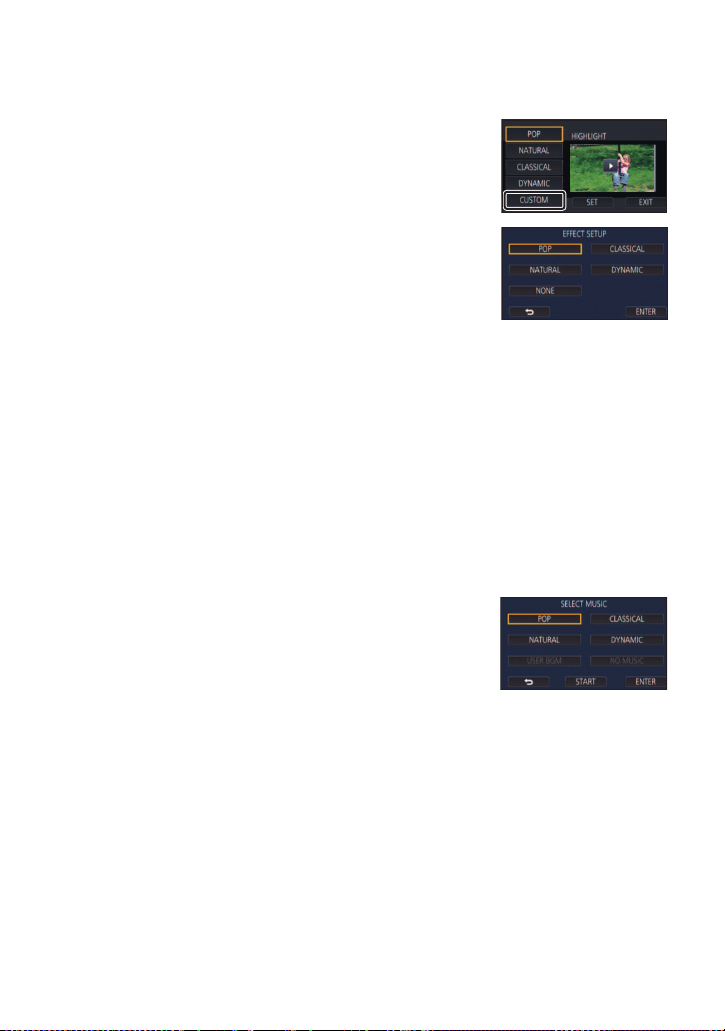
- 91 -
∫ Setting up the custom effect
It is possible to enjoy the Highlight Playback with your favorite effect by setting up the combination
of an image effect and music.
1 Touch [CUSTOM].
2 Touch [EFFECT SETUP] or [MUSIC SELECT].
3
(When [EFFECT SETUP] is selected)
Touch the desired effect.
≥ When [EFFECT SETUP] is changed, [MUSIC SELECT] will be set
the same as [EFFECT SETUP]. (To set [EFFECT SETUP] and
[MUSIC SELECT] to different settings, change [MUSIC SELECT]
after setting [EFFECT SETUP].)
(When [MUSIC SELECT] is selected)
Touch the desired sound.
≥ When [EFFECT SETUP] is set to [NONE], you will be able to select [NO MUSIC]. When [NO
MUSIC] is selected, the audio recorded at the time of shooting is played back.
≥ [USER BGM] lets you use the music stored on your smartphone. To set [USER BGM], use the
Wi-Fi function [Link to Cell] and create Highlight Playback from the smartphone app “Image App”.
The music data will be saved in this unit as [USER BGM].
≥ Only one track can be saved in this unit as music data for [USER BGM]. Each time you create
Highlight Playback using the “Image App”, music data will be replaced.
≥ For information on the file format and playback time of music data that can be used as [USER
BGM], refer to the “Image App”.
≥ To delete the music data saved as [USER BGM] in this unit, perform [DELETE USER BGM].
(
l 37)
(To test the music audio)
Touch [START].
≥ Touch the other music option to change the music to be tested.
≥ When you touch [STOP], the music playback stops.
4 Touch [ENTER].

- 92 -
Touch [SET] to select the item to change.
*1 If you touch [SET] of Highlight Playback when the Baby Calendar is displayed, [SELECT DATE]
and [SELECT SCENES] will not be available. (
l 100)
*2 If you touch [SET] of Highlight Playback when the Baby Calendar is displayed, these items will
not be displayed. (
l 100)
≥ When you have finished changing the settings, touch [EXIT].
∫ Scene setting
1 (Only when Highlight Playback is started from [ALL AVCHD])
Touch the recording format of the scene to be played back.
2 Touch [SELECT DATE] or [SELECT SCENES].
3
(When [SELECT DATE] is selected)
Touch the date to be played back.
≥ A maximum of 7 days can be selected.
≥ When touched, the date is selected and surrounded by red. Touch the date again to cancel the
operation.
(When [SELECT SCENES] is selected)
Touch the scenes to be played back.
≥ Up to 99 scenes can be selected in succession.
≥ When touched, the scene is selected and is displayed. Touch the scene again to cancel the
operation.
4 Touch [Enter]/[ENTER].
Playing back with the settings changed
[SCENE SETUP]
*1
:
Select the scene or date to be played back.
[FAVORITE SCENE SETUP]
*2
:
Set up the favorite scenes. (
l 93)
[FAVORITE SCENE PLAY]
*2
:
Set up if the favorite scenes are to be included in the Highlight
Playback or not. (
l 93)
[PRIORITY SETUP]:
Select the target to give priority to play back. (
l 93)
[PLAYBACK TIME]:
Select the time to play back. (
l 94)
[TITLE SETUP]:
Select the title sheet to be displayed at the beginning, and enter
the title. (
l 94)
[1080/60p]/[1080/60i]
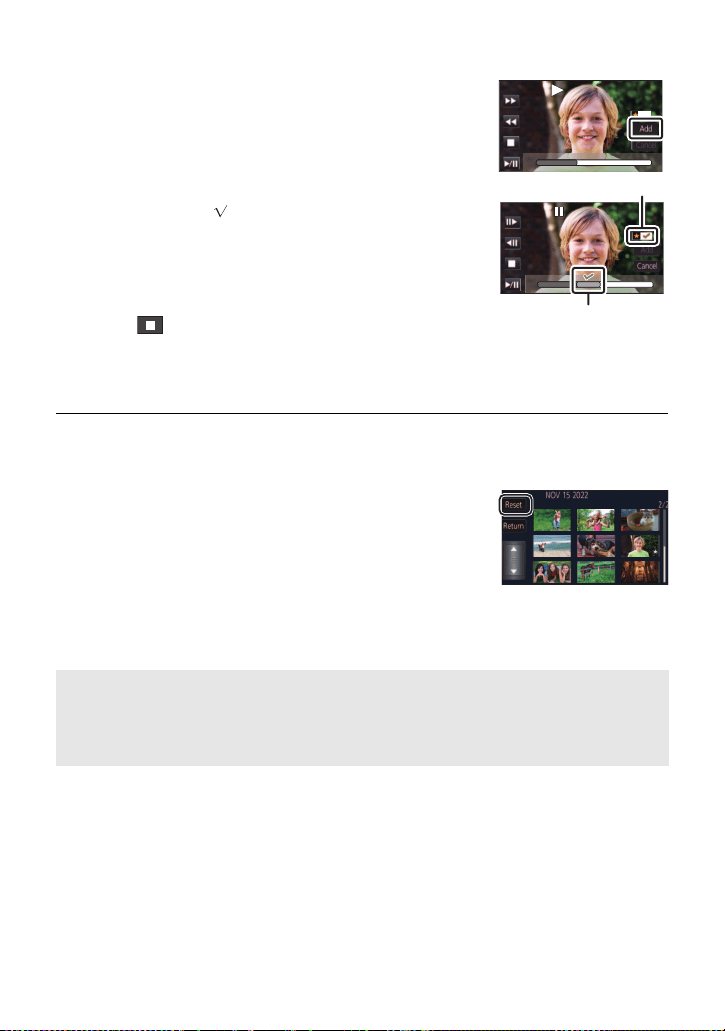
- 93 -
∫ Checking the favorite scenes
1 Touch the scenes to be played back.
2 Touch [Add] and add the favorite part.
≥ Approximately 4 seconds before and after touching [Add] will be
added as favorite.
≥ Number of favorite scenes that can be added are 1 to 14. (Number
of scenes that can be added differs depending on the scenes
selected.)
≥ Favorite check display (A) is displayed in orange, and favorite
check display B is displayed on the slide bar.
≥ To cancel the favorite, play back to the position checked as favorite,
and touch [Cancel].
≥ It is convenient to use Slow-motion Playback and Frame-by-frame
Playback. (
l 83, 84)
3 Touch and stop the playback.
≥ It will return to the thumbnail display screen and ¡ is displayed on the scenes added as favorite
scenes.
4 Touch [Return].
≥ All the scenes checked as favorite may not be played back depending on the playback time
setting. (
l 94)
To clear the favorite scenes from the thumbnail display
1 Touch [Reset].
2 Touch [RESET ALL] or [RESET SELECTED].
≥ The check on all the favorite scenes will be cleared when [RESET
ALL] is selected.
3 (When [RESET SELECTED] is selected in Step 2)
Touch the scene to be cleared.
∫ Playing back the favorite scenes
Touch [ON] or [OFF].
∫ Priority settings
Touch [NONE] or [FACE].
≥ If you touch [FACE], priority is given to the part detected as a face.
[ON]: Include the scenes added in the [FAVORITE SCENE SETUP] into the Highlight
Playback.
[OFF]: Do not include the scenes added in the [FAVORITE SCENE SETUP] into the
Highlight Playback.
0h01m30s
0h01m30s
0h01m30s
0h01m30s0h01m30s0h01m30s
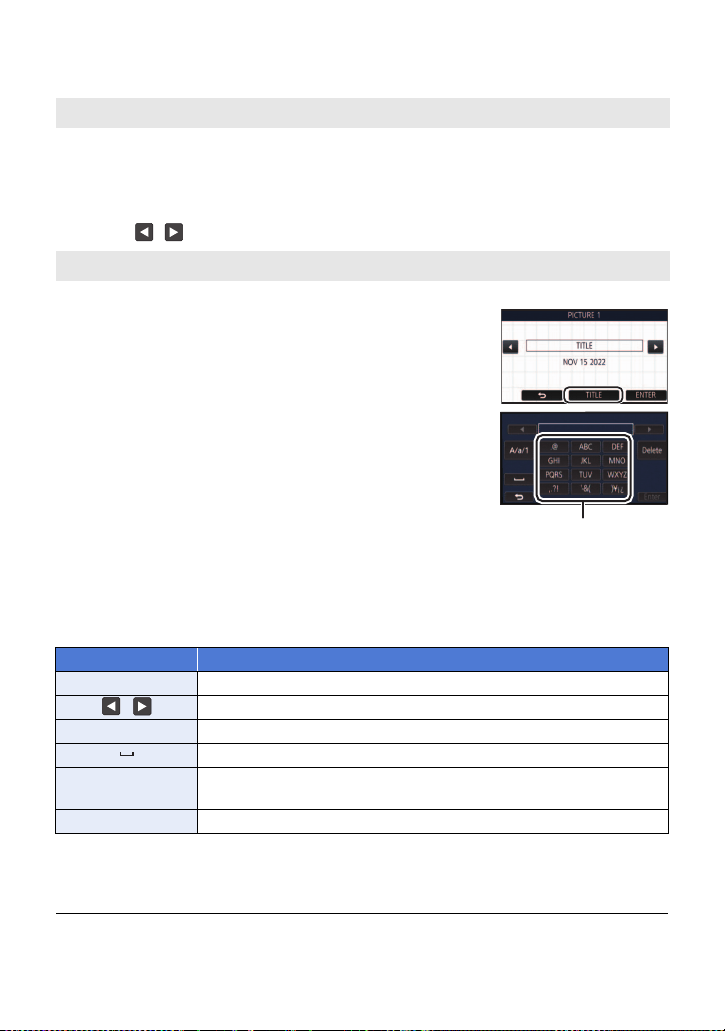
- 94 -
∫ Playback time setting
Touch the playback time.
≥ The playback time of [AUTO] is a maximum of approx. 5 minutes.
≥ Playback time may become shorter than the setting, or it may not even be played back if the part
recognized as clearly recorded is short.
∫ Setting up the title
1 Touch / to select your favorite title sheet.
≥ Title and date will not be displayed when [NONE] is selected.
2 Touch [TITLE].
3 Enter the title.
≥ Touch the text entry icon in the center of the screen and enter the
title.
≥ After entering the title, touch [Enter].
Entering text
≥ The characters can be conveniently input without moving the cursor when the [Auto Cursor
Position] is set to [ON]. (
l 37)
≥ A maximum of 18 characters can be entered.
4 Touch [ENTER] to end registration.
≥ The date of the first scene of the Highlight Playback will be displayed as the date.
≥ The entered title will be cleared when the unit is turned off or the Highlight Playback is finished.
[APPROX 90 SEC.]/[APPROX 3 MIN.]/[AUTO]
[NONE]/[PICTURE 1]/[PICTURE 2]/[PICTURE 3]/[PICTURE 4]
A Text entry icon
Icon Description of operation
[A] etc. Enters a character.
/ Moves the cursor to left or right.
[A/a/1] Switches between [A]/[a] (alphabet) and [&/1] (symbols/numbers).
Enters a space.
[Delete]
Deletes a character.
Deletes the previous character if the cursor is in an empty space.
[Enter] Ends text entry.

- 95 -
The scenes put together as a Highlight Playback can be saved as a single scene.
The recorded scenes can be saved in the SD card.
1 Stop the playback of the Highlight Playback or wait until the Highlight
Playback is finished.
2 Touch [SAVE].
3 Select the format to save.
*1 This format is displayed only when an AVCHD scene is selected.
*2 This format is not displayed when an AVCHD scene is selected.
*3 [MP4 1920k1080/30p] cannot be selected when an MP4 [720/30p] scene is selected.
(When [AVCHD 1920k1080/60i] is selected)
≥ Scenes recorded in 1080/60p are converted to 1080/60i (picture quality [HA] of [REC MODE])
and saved.
≥ Scenes recorded in 1080/60i are recorded in [HA] regardless of [REC MODE] ([PH]/[HA]/[HG]/
[HE]) of a scene.
4 Touch [YES].
5 Touch [EXIT].
≥ is displayed on the thumbnail of the scenes saved by the Highlight Playback.
Saving the Highlight Playback
[AVCHD 1920k1080/60i]
*1
: It will be saved in high-definition image quality.
[MP4 1920k1080/30p]
*2, 3
: It will be saved in high-definition image quality. The format
supports playback on a PC.
[MP4 1280k720/30p]: It will be saved with an image quality, allowing you to upload it
on the Internet in higher image quality. The format supports
playback on a PC.
[MP4 640k360/30p]: It will be saved with an image quality, allowing you to upload it
on the Internet faster. The format supports playback on a PC.

- 96 -
Manual Edit
You can join desired AVCHD scenes, scenes recorded as Backup for Twin Camera or parts of these
scenes in the order they were recorded to play back or save as a single scene with music added.
≥ Manual Edit cannot be used for MP4/iFrame scenes.
1 Select the menu.
2 Touch [1080/60p] or [1080/60i].
≥ Touch [Enter].
≥ Thumbnails are displayed by each scene.
3 Select the scene or part of the scene to play back, and set the music.
≥ To select a scene (
l 97)
≥ To select part of a scene (
l 97)
≥ To set the music (l 98)
≥ Touching [Return] after selecting a scene may cancel the selected scene.
4 Touch [Enter].
5 Touch [YES], and select the playback operation for the edited scene. (l 28)
≥ In the following cases, the screen for selecting [PREVIEW], [SAVE] (
l 99), [SELECT AGAIN],
and [EXIT] is displayed. Touch the desired item.
j Touch [NO]
j Playback finishes
j Stop playback
≥ You can also select combinations of scenes and parts of scenes.
≥ You can select up to 99 scenes. (Each 3 second thumbnail of part of a scene is treated as a
single scene.)
≥ You can create a combined scene of up to about 6 hours long.
≥ Skip Playback, Slow-motion Playback, Frame-by-frame Playback and Direct Playback are not
possible.
: [EDIT SCENE] # [MANUAL EDIT]
MENU
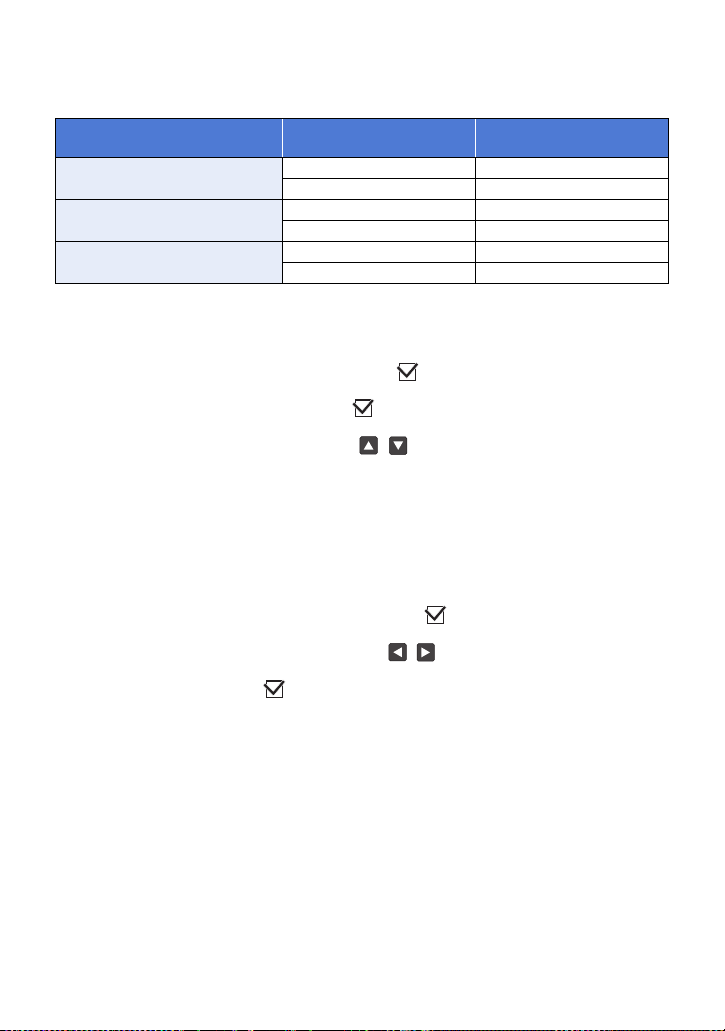
- 97 -
≥ When saving a manually edited scene, check the free space on the SD card.
Before selecting the scene, check the table below and create sufficient free space for saving it.
(Approximate free space requirements for saving a manually edited scene)
≥ “h” is an abbreviation for hour, “min” for minute and “s” for second.
∫ To select a scene
Touch the scene to be played back.
≥ The scene selection is made as you touch it, and the indication appears on the thumbnail. To
cancel the operation, touch the scene again.
≥ When part of a scene has been selected, the indication appears on the thumbnail. If you
touch the thumbnail, the scene will be displayed by 3 second thumbnails.
≥ Next (previous) page is displayed by touching / .
∫ To select part of a scene
1 Touch [3 sec].
≥ To cancel the operation, touch it again.
2 Touch the desired scene.
≥ The touched scene is displayed by 3 second thumbnails.
3 (To select a single thumbnail)
Touch the thumbnail of the part you want to play back.
≥ The thumbnail selection is made as you touch it, and the indication (white) appears on the
thumbnail. To cancel the selection, touch the thumbnail again.
≥ Next (previous) thumbnail is displayed by touching / .
≥ Touching [Return] when the thumbnail has been selected returns you to the screen that displays
the thumbnails of scenes. The indication appears on the thumbnail of the scene
containing the selected part.
4 (To select thumbnails by specifying a range)
Touch [Range].
≥ To cancel the operation, touch it again.
Saving format
Total time of an edited
scene
Free space required
[AVCHD 1920k1080/60i]
30 min Approx. 4 GB
1 h Approx. 8 GB
[MP4 1280k720/30p]
30 min Approx. 2 GB
1 h Approx. 4 GB
[MP4 640k360/30p]
30 min Approx. 0.4 GB
1 h Approx. 0.8 GB
3S
3S
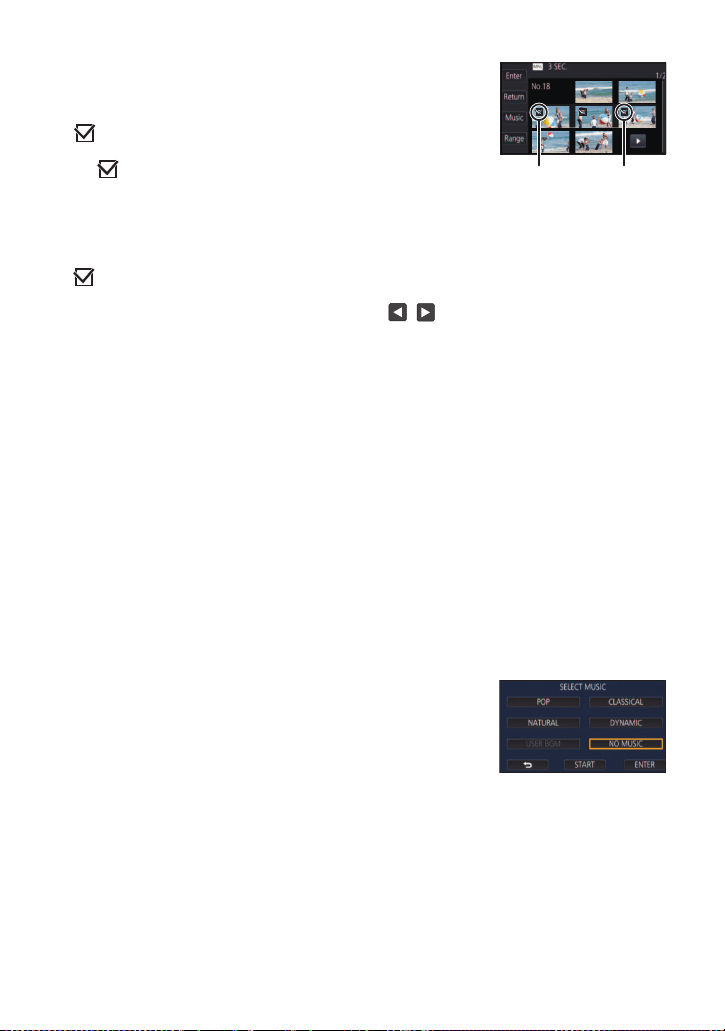
- 98 -
5 (To select thumbnails by specifying a range)
Touch the range (start and finish points) you want to
play back.
≥ The range between start and finish points are selected, and the
indication (white) appears on the thumbnails.
≥ To cancel the selected thumbnails, from among the thumbnails with
the indication (white), touch the range (start and finish points)
you want to cancel.
≥ If you touch [Enter]/[Return]/[Music]/[Range] when a start point has
been selected, the start point thumbnail will be canceled.
≥ Touching [Return] when the thumbnail has been selected returns
you to the screen that displays the thumbnails of scenes. The
indication appears on the thumbnail of the scene containing the selected part.
≥ You can also select multiple ranges within the same scene.
≥ Next (previous) thumbnail is displayed by touching / .
≥ To select other scenes, touch [Return] to return to the screen that displays the thumbnails of
scenes, and perform the following operations.
j When selecting a scene:
Touch the desired scene.
j When selecting part of a scene:
Perform the operations in Steps 1-5.
∫ To set the music
1 Touch [Music].
2 Touch the desired sound.
≥ When [NO MUSIC] is selected, the audio recorded at the time of shooting is played back.
≥ [USER BGM] lets you use the music stored on your smartphone. To set [USER BGM], use the
Wi-Fi function [Link to Cell] and create Highlight Playback from the smartphone app “Image App”.
The music data will be saved in this unit as [USER BGM].
≥ Only one track can be saved in this unit as music data for [USER BGM]. Each time you create
Highlight Playback using the “Image App”, music data will be replaced.
≥ For information on the file format and playback time of music data that can be used as [USER
BGM], refer to the “Image App”.
≥
To delete the music data saved as [USER BGM] in this unit, perform [DELETE USER BGM]. (
l
37)
(To test the music audio)
Touch [START].
≥ Touch the other music option to change the music to be tested.
≥ When you touch [STOP], the music playback stops.
3 Touch [ENTER].
A Start point
B Finish point
3S

- 99 -
∫ To save a manually-edited scene
You can save manually edited scenes as a single scene.
The recorded scenes can be saved in the SD card.
1 Stop the playback of a manually-edited scene or wait until the playback is
finished.
2 Touch [SAVE].
3 Select the format to save.
(When [AVCHD 1920k1080/60i] is selected)
≥ Scenes recorded in 1080/60p are converted to 1080/60i (picture quality [HA] of [REC MODE])
and saved.
≥ Scenes recorded in 1080/60i are recorded in [HA] regardless of [REC MODE] ([PH]/[HA]/[HG]/
[HE]) of a scene.
4 Touch [YES].
≥ If you are using the battery, a message recommending that you use the AC adaptor will be
displayed. To start the saving operation, touch [START].
5 Touch [EXIT].
≥ You can save scenes even when using the battery, but we recommend that you use the AC
adaptor.
≥ Manually-edited scenes recorded as Backup for Twin Camera will be saved as normal AVCHD or
MP4 scenes.
≥ For information on the approximate free space requirements for saving a manually edited scene,
refer to page
97.
[AVCHD 1920k1080/60i]: It will be saved in high-definition image quality.
[MP4 1280k720/30p]: It will be saved with an image quality, allowing you to upload it on
the Internet in higher image quality. The format supports playback
on a PC.
[MP4 640k360/30p]: It will be saved with an image quality, allowing you to upload it on
the Internet faster. The format supports playback on a PC.
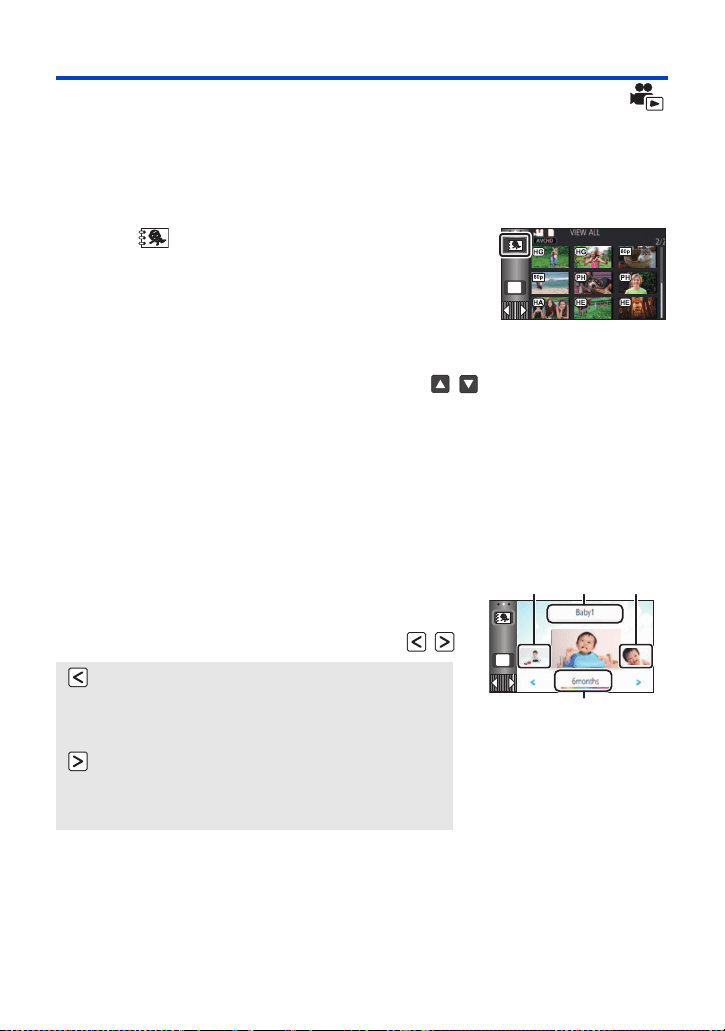
- 100 -
Baby Calendar
When a baby’s birthday and name are registered, scenes recorded since the baby’s birthday are
displayed as thumbnails for each age in months.
≥ You cannot select scenes recorded as Backup for Twin Camera.
≥ Scenes recorded before the birthday are not displayed.
≥ Scenes with no baby in them are also displayed.
≥ You can register up to 3 babies.
1 Touch .
2 (When registering for the first time)
Enter the baby’s birthday.
≥ Touch the date to be set, then set the desired value using / .
≥ The year can be set between 2000 and 2039.
≥ Touch [Enter].
3 (When registering for the first time)
Touch [YES], and enter the baby’s name.
≥ If you touch [NO], the Baby Calendar will be displayed without the baby’s name registered.
([Baby 1] is displayed.)
≥ Input method is same operation as for setting up the title. (
l 94)
≥ After entering the name, touch [Enter].
≥ A maximum of 9 characters can be entered.
4 Check the Baby Calendar.
≥ The name of the registered baby and its age in months are
displayed.
≥ You can switch the age in months display by touching / .
≥ Except for months with no recordings, the age in months display
is available for each month.
≥ If you touch the name display, the screen for selecting a registered baby is displayed. From
among the 3 registered babies, select the baby you want to display, and touch [ENTER].
If you touch a name with no registered birthday ([Baby 1]/[Baby 2]/[Baby 3]), you can register a
new baby. Perform step 2-3.
MENU
: Changes the age in months display to that of
the previous month
If you touch this icon when the youngest age in months is
displayed, the oldest age in months will be displayed.
: Changes the age in months display to that of
the next month
If you touch this icon when the oldest age in months is
displayed, the youngest age in months will be displayed.
MENU
A Name display
B Age in months display
C Thumbnail for the
previous age in
months
D Thumbnail for the next
age in months
- 101 -
5 Touch the thumbnail in the center.
≥ The thumbnails of the scenes recorded in the same age in months are displayed. Touch the
desired scene to select the playback operation. (
l 28)
≥ The thumbnail display cannot be set to 1 scene/20 scenes display or to the Highlight & Time
Frame Index.
≥ You cannot perform Highlight Playback if the number of scenes exceeds 99.
≥ Touching returns you to the screen that lets you select the age in months.
To return to the normal thumbnail display
Touch the while the Baby Calendar is displayed.
To change/add a baby’s registered details
1 Touch the name display on the Baby Calendar (
l 100) or select the menu.
2 Touch the name of the baby whose details are to be changed.
≥ When [Baby 1]/[Baby 2]/[Baby 3] is displayed, the birthday and name or name only are not
registered.
3 Touch the desired item.
≥ The setting method is the same as when registering for the first time. (
l 100)
4 Touch [ENTER].
≥ The Baby Calendar of the registered baby is displayed.
To delete a baby’s registered details
1 Touch the name display on the Baby Calendar (
l 100) or select the menu.
2 Touch the name of the baby whose details are to be deleted.
3 Touch [DELETE].
≥ To delete the registered details of other babies, repeat Steps 2 to 3.
≥ When the Baby Calendar is displayed, the following operations are not available:
j [SCENE PROTECT]
j [SECTION DELETE]
j [DIVIDE]
j [MANUAL EDIT]
j [SPLIT&DELETE]
j [CONVERT TO MP4]
j [Slow Speed Conversion]
: [VIDEO SETUP] # [Baby Calendar Setup]
Name: Register/change the name.
Birthday: Register/change the birthday.
: [VIDEO SETUP] # [Baby Calendar Setup]
MENU
MENU
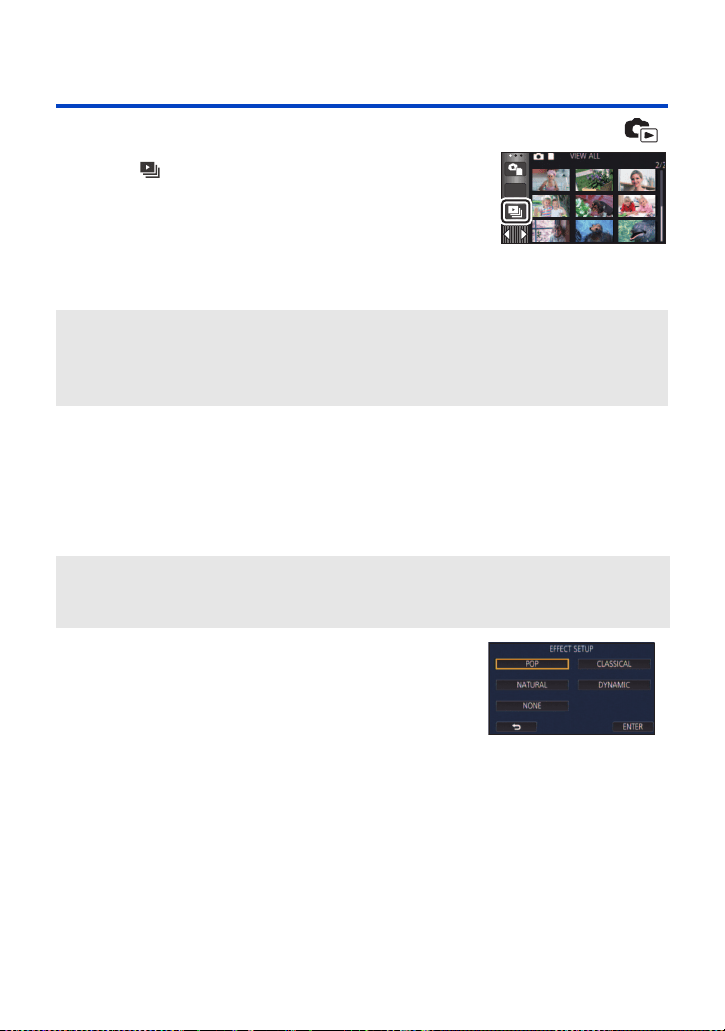
- 102 -
Changing the playback settings and playing back the
slide show
1 Touch . (l 20)
2 (Only when you would like to change the settings)
Touch [SET] to select the item to change.
* Setting is not possible when the operation in Step 1 is performed while thumbnails in the Stop
Motion Animation Assist Mode are displayed. (
l 104)
3 (When [DATE SETUP] is selected)
Touch the playback date.
(When [SLIDE INTERVAL] is selected)
Touch the interval of playback for the slide show.
(When [EFFECT SETUP] is selected)
Touch the desired effect.
≥ Touch [ENTER].
≥ When [EFFECT SETUP] is changed, [MUSIC SELECT] will be
set the same as [EFFECT SETUP]. (To set [EFFECT SETUP]
and [MUSIC SELECT] to different settings, change
[MUSIC SELECT] after setting [EFFECT SETUP].)
≥ [SLIDE INTERVAL] cannot be set, when [EFFECT SETUP] is set.
ALL
[DATE SETUP]: Select the date to be played back.
[SLIDE INTERVAL]
*
: Select the interval between still pictures at playback.
[EFFECT SETUP]
*
: Select the effect for playback.
[MUSIC SELECT]: Select the music to be played on playback.
[SHORT]: Approx. 1 second
[NORMAL]: Approx. 5 seconds
[LONG]: Approx. 15 seconds

- 103 -
(When [MUSIC SELECT] is selected)
Touch the desired sound.
≥ Touch [ENTER].
≥ [USER BGM] lets you use the music stored on your smartphone. To set [USER BGM], use the
Wi-Fi function [Link to Cell] and create Highlight Playback from the smartphone app “Image App”.
The music data will be saved in this unit as [USER BGM].
≥ Only one track can be saved in this unit as music data for [USER BGM]. Each time you create
Highlight Playback using the “Image App”, music data will be replaced.
≥ For information on the file format and playback time of music data that can be used as [USER
BGM], refer to the “Image App”.
≥ To delete the music data saved as [USER BGM] in this unit, perform [DELETE USER BGM].
(
l 37)
(To test the music audio)
Touch [START] and start the audio testing.
≥ Touch the other music option to change the music to be tested.
≥ When you touch [STOP], the music playback stops.
4 Touch [START].
5 Select the playback operation. (l 28)
≥ When the playback is finished or stopped, the screen to select [REPLAY], [SELECT AGAIN] or
[EXIT] is displayed. Touch the desired item.
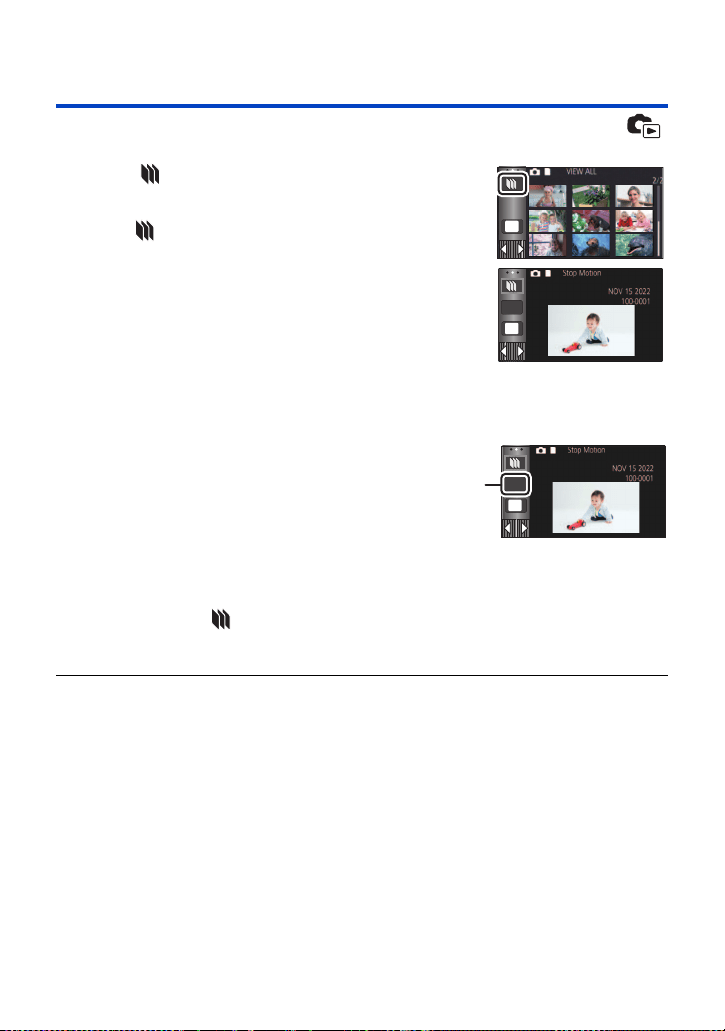
- 104 -
Playing back still pictures recorded in Stop Motion
Animation Assist Mode as a slide show
≥ For details on recording in Stop Motion Animation Assist Mode, refer to page 55.
1 Touch .
≥ The recording group created most recently in Stop Motion
Animation Assist Mode is displayed.
≥ Touching again, returns the display to the normal
thumbnail display.
2 Touch a thumbnail to play back the slide show.
≥ The thumbnail display cannot be set to 9 scenes or 20 scenes
display.
3 Select the playback operation. (l 28)
≥ The display returns to the thumbnail display when playback is
finished or stopped.
To play back other recording groups:
You can play back other recording groups by touching the date select icon.
1 Touch the date select icon.
2 Touch the playback date.
≥ Touch a date with the indication.
≥ Recording groups in the selected date are displayed.
≥ Touch a thumbnail to play back the slide show.
≥ Slide shows can be played back with settings changed. (l 102)
≥ The recording group played back as a slideshow cannot be saved as a single scene.
MENU
NEW
MENU
NEW
MENU
A Date select icon
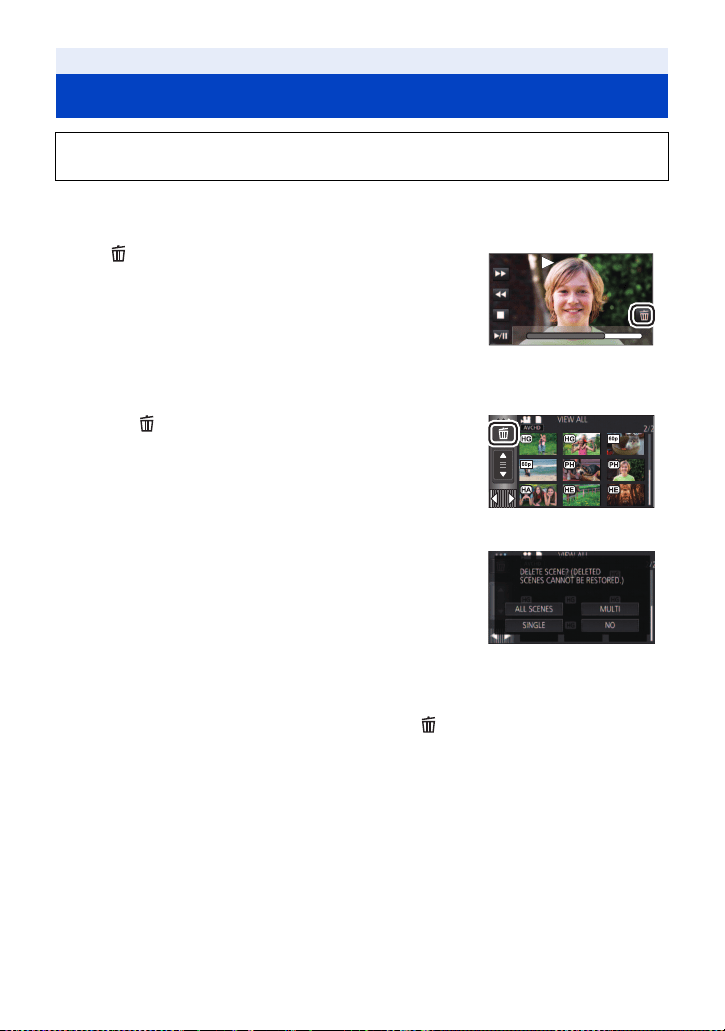
- 105 -
¬ Press the recording/playback button to switch this unit to the Playback Mode.
∫ To delete the scene or still picture being played back
Touch while scenes or still pictures to be deleted
are being played back.
∫ To delete scenes or still pictures from the thumbnail display
≥ Switch to the thumbnail display of the scenes or still pictures to delete. (
l 27)
1 Touch . (l 20)
≥ When the thumbnail display is 1 scene display or Highlight &
Time Frame Index, the scene or still picture being displayed is
deleted.
≥ When the thumbnails of still pictures recorded in Stop Motion
Animation Assist Mode are displayed, the still pictures cannot
be deleted. (
l 104)
2 Touch [ALL SCENES], [MULTI] or [SINGLE].
≥ All the scenes or still pictures displayed as thumbnails will be
deleted by selecting [ALL SCENES].
(In case of playing back scenes or still pictures by date, all the
scenes or still pictures on the selected date will be deleted.)
≥ Protected scenes/still pictures cannot be deleted.
3 (When [MULTI] is selected in Step 2)
Touch the scene/still picture to be deleted.
≥ When touched, the scene/still picture is selected and the indication appears on the thumbnail.
Touch the scene/still picture again to cancel the operation.
≥ Up to 99 scenes can be selected to be deleted.
(When [SINGLE] is selected in Step 2)
Touch the scene/still picture to be deleted.
4 (When [MULTI] is selected in Step 2)
Touch [Delete].
≥ To continuously delete other scenes/still pictures, repeat Steps 3-4.
Advanced (Playback)
Deleting scenes/still pictures
Deleted scenes/still pictures cannot be restored, so perform appropriate confirmation of
the contents before proceeding with deletion.
0h01m30s0h01m30s0h01m30s

- 106 -
When you stop deleting halfway:
Touch [CANCEL] while deleting.
≥ The scenes or still pictures that have already been deleted when the deletion is canceled cannot
be restored.
To complete editing:
Touch [Return].
≥ You can also delete scenes by touching , selecting [EDIT SCENE] # [DELETE] # [ALL
SCENES], [MULTI] or [SINGLE].
≥ You can also delete still pictures by touching , selecting [PICT. SETUP] # [DELETE] # [ALL
SCENES], [MULTI] or [SINGLE].
When the thumbnails of still pictures recorded in Stop Motion Animation Assist Mode are
displayed, the still pictures cannot be deleted from the menu. (
l 104)
≥ During Highlight Playback, scenes/still pictures cannot be deleted.
≥ Scenes that cannot be played back (the thumbnails are displayed as ) cannot be deleted.
≥ In case of [ALL SCENES], the deletion may take time if there are many scenes or still pictures.
≥ If you delete scenes recorded on other products or still pictures conforming to DCF standard with
this unit, all the data related to the scenes/still pictures may be deleted.
≥ When still pictures recorded on an SD card by other products are deleted, a still picture (other
than JPEG) that cannot be played back on this unit, may be erased.
MENU
MENU
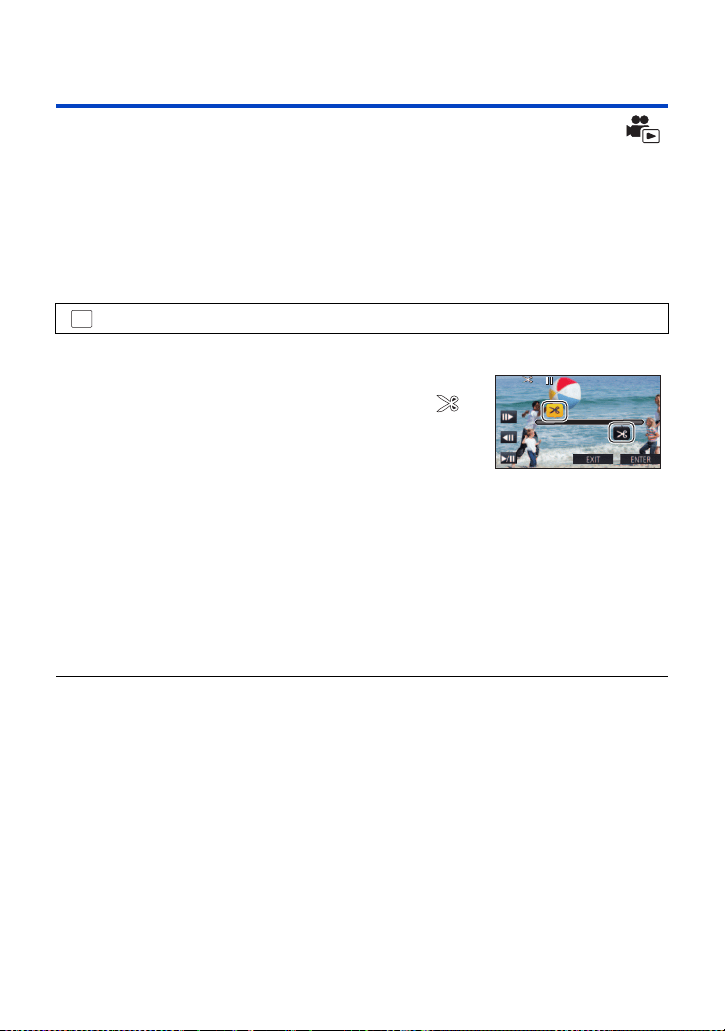
- 107 -
Deleting part of a scene (AVCHD/Backup for Twin
Camera)
Unnecessary part of an AVCHD scene or a scene recorded as Backup for Twin Camera can be
deleted.
The deleted scenes cannot be restored.
≥ Press the recording/playback button to switch this unit to the Playback Mode, and touch
the play mode select icon. Then, select the AVCHD scene or a scene recorded as Backup
for Twin Camera. (
l 27)
1 Select the menu.
2 Touch the scene with a part to delete.
3 Set the section to delete by touching and sliding
the top and bottom section selection buttons .
≥ It is convenient to use Slow-motion Playback and Frame-by-
frame Playback. (
l 83, 84)
4 Touch [ENTER].
5 Confirm (play back) the scene after editing by touching [YES].
≥ A confirmation message appears when [NO] is touched. Proceed to Step 7.
6 Stop the playback.
≥ A confirmation message appears.
7 Touch [ENTER].
≥ Repeat Steps 2-7 to continuously delete parts from other scenes.
To complete editing
Touch [Return].
≥ Deleting a part of a scene cannot be performed when there are 99 scenes in a single date.
≥ It may not be possible to delete part of a scene with a short recording time.
≥ The scene will be divided into two scenes when the middle part of a scene is deleted.
: [EDIT SCENE] # [SECTION DELETE]
MENU
0h00m15s
0h00m15s
0h00m15s
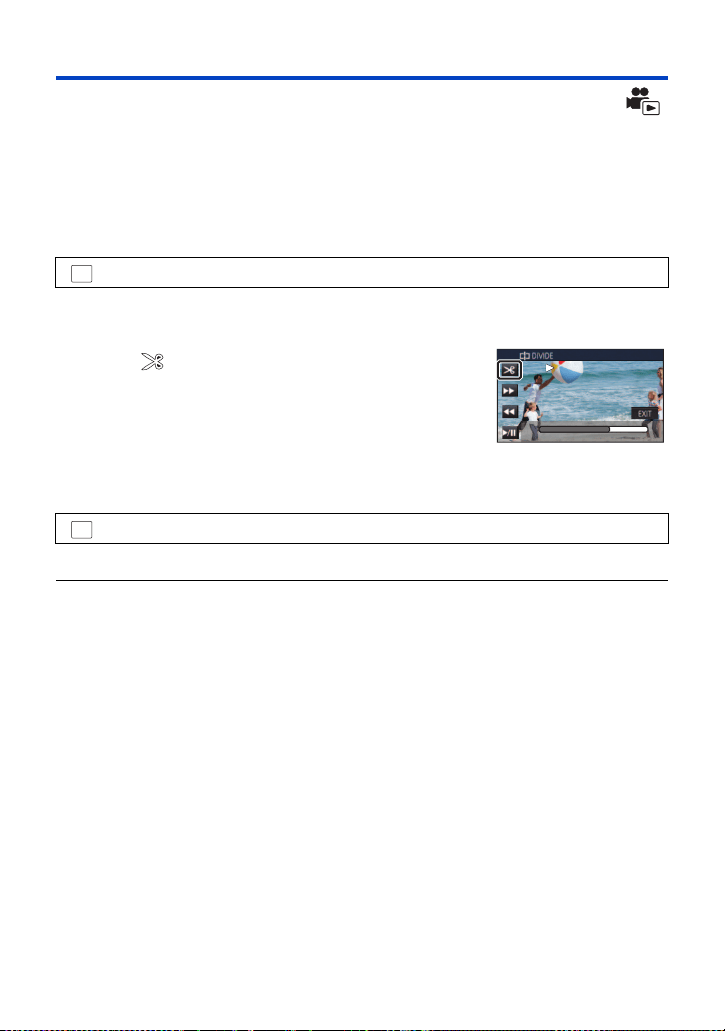
- 108 -
Dividing a scene (AVCHD/Backup for Twin Camera)
It is possible to divide an AVCHD scene or a scene recorded as Backup for Twin Camera.
Any unwanted parts in the scene can be deleted after dividing.
≥ Press the recording/playback button to switch this unit to the Playback Mode, and touch
the play mode select icon. Then select an AVCHD scene or a scene recorded as Backup for
Twin Camera. (
l 27)
1 Select the menu.
2 Touch and play back the scene you want to divide.
≥ It is convenient to use Slow-motion Playback and Frame-by-frame Playback. (
l 83, 84)
3 Touch to set the dividing point.
≥ Touch [YES].
≥ Touch [YES] to continue dividing the same scene. To continue
dividing other scenes, touch [NO] and repeat Steps 2-3.
4 Touch [Return] to complete dividing.
≥ Unwanted parts can be deleted. (
l 105)
To delete all the divided points
≥ The scenes that were deleted after division cannot be recovered.
≥ You cannot divide a scene if the number of scenes of a given date would exceed 99 scenes.
≥ It may not be possible to divide scenes with a short recording time.
≥ Data that has been recorded or edited on another device cannot be divided and the divided points
cannot be deleted.
: [EDIT SCENE] # [DIVIDE] # [SET]
: [EDIT SCENE] # [DIVIDE] # [CANCEL ALL]
MENU
0h01m30s0h01m30s0h01m30s
MENU
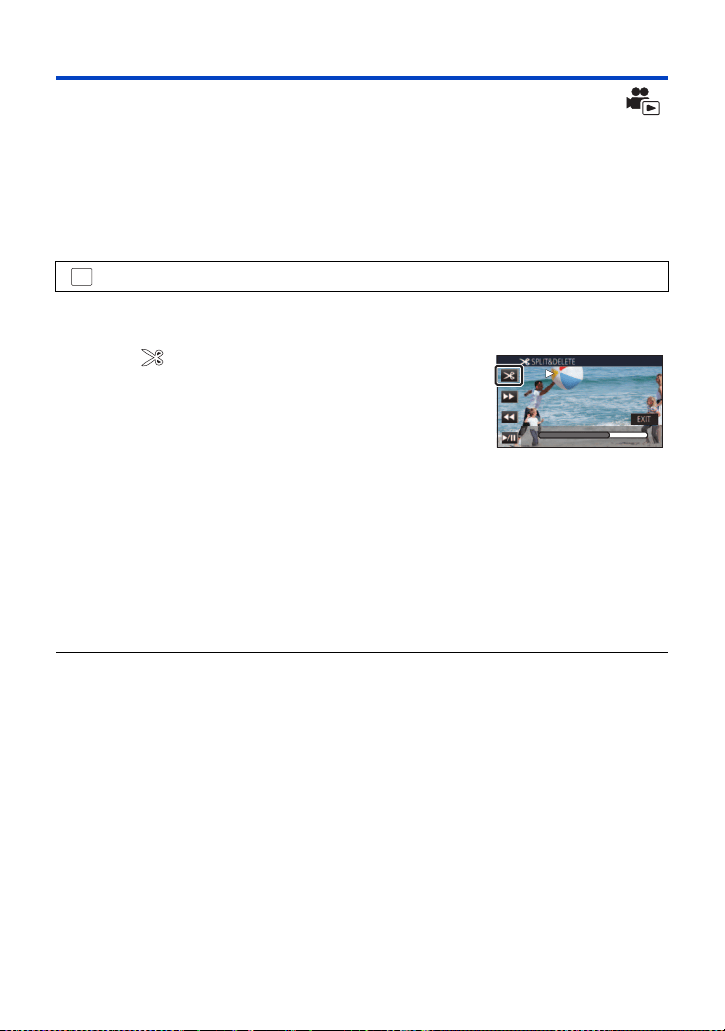
- 109 -
Dividing a scene to partially delete (MP4/iFrame)
Divide the MP4/iFrame scenes, and delete unnecessary parts.
This divides the recorded scenes in two and deletes the front half or back half.
The scenes deleted by dividing cannot be restored.
≥ Press the recording/playback button to switch this unit to the Playback Mode, and touch
the play mode select icon. Then, select the MP4/iFrame scene. (
l 27)
1 Select the menu.
2 Touch and play back the scene you want to divide.
≥ It is convenient to use Slow-motion Playback and Frame-by-frame Playback. (
l 83, 84)
3 Touch to set the dividing point.
≥ Set the dividing point so there will be 2 seconds or more for the
part for deletion, and 3 seconds or more for the part to be kept.
4 Touch the part for deletion.
5 Touch [YES] and confirm (play back) the part for
deletion.
≥ A confirmation message appears when [NO] is touched. Proceed to Step 7.
6 Stop the playback.
≥ A confirmation message appears.
7 Touch [YES].
≥ To continue dividing and deleting other scenes, repeat Steps 2-7.
To complete editing
Touch [Return].
≥ It may not be possible to divide scenes with a short recording time.
≥ The actual division may slightly slip off the previously designated dividing point.
: [EDIT SCENE] # [SPLIT&DELETE]
MENU
0h01m30s0h01m30s0h01m30s

- 110 -
Protecting scenes/still pictures
Scenes/still pictures can be protected so that they are not deleted by mistake.
(Even if you protect some scenes/still pictures, formatting the media will delete them.)
≥ Press the recording/playback button to switch this unit to the Playback Mode.
1 Select the menu.
2 Touch the scene/still picture to be protected.
≥ When touched, the scene/still picture is selected and the indication appears on the
thumbnail. Touch the scene/still picture again to cancel the operation.
≥ Touch [Return] to complete the settings.
≥ When the thumbnails of still pictures recorded in Stop Motion Animation Assist Mode are
displayed, protection cannot be set on the still pictures.
: [VIDEO SETUP] or [PICT. SETUP] # [SCENE PROTECT]
MENU
- 111 -
You can convert and copy AVCHD scenes, scenes recorded as Backup for Twin Camera, and MP4
scenes. The image quality will be converted into a format that supports playback on a PC and online
sharing (MP4 (1280k720/30p) or MP4 (640k360/30p)).
≥ Scenes recorded in iFrame or saved as MP4 (640k360/30p) cannot be converted to MP4.
1 Select the menu.
2 Touch the scene you want to convert.
≥ The scene selection is made as you touch it, and the indication appears on the thumbnail. To
cancel the operation, touch the scene again.
≥ You can select up to 99 scenes in succession.
3 Touch [Enter].
4 Select the quality after conversion.
≥ MP4 scenes after conversion are saved to the same media as the scenes before conversion.
5 Touch [YES].
≥ To continue converting scenes to MP4, repeat steps 2 to 5.
To stop converting to MP4 halfway
Touch [CANCEL] during format conversion.
To exit the MP4 conversion
Touch [Return].
≥ A scene recorded over a long time may take time.
≥ When the following scenes are converted to MP4 scenes and copied, those exceeding 4 GB
(approx.) or 30 minutes (approx.) will be automatically divided:
j Scenes recorded with [1080/50M] in [MP4/iFrame]
j AVCHD scenes
j Scenes recorded as Backup for Twin Camera
≥ If you convert protected scenes to MP4, their protection will be cleared after the conversion.
≥ Scenes recorded as Backup for Twin Camera will be saved as normal MP4 scenes when
converted to MP4 scenes and copied.
Advanced (Playback)
Convert to MP4
: [EDIT SCENE] # [CONVERT TO MP4]
[HD(1280k720/30p)]
*
: Convert to MP4 (1280k720/30p) and copy.
[VGA(640k360/30p)]: Convert to MP4 (640k360/30p) and copy.
* You cannot convert and copy MP4 [720/30p] scenes.
MENU
- 112 -
You can convert the playback speed of parts recorded in FULL HD Slow Motion Video Mode (l 53)
to 1/4 normal speed, and copy them.
Once converting scenes recorded in FULL HD Slow Motion Video Mode, you can play them back on
another device at 1/4 normal speed.
≥ Press the recording/playback button to switch this unit to the Playback Mode.
≥ Touch the play mode select icon, and select [ALL MP4/iFrame] or [1080/60p] in [MP4/
iFrame].
1 Select the menu.
2 Touch a scene recorded in FULL HD Slow Motion Video Mode.
≥ On the thumbnail screen in Playback Mode, scenes recorded as FULL HD Slow Motion Video are
displayed with the indication.
≥ The scene selection is made as you touch it, and the indication appears on the thumbnail. To
cancel the operation, touch the scene again.
≥ Up to 99 scenes can be selected in succession.
3 Touch [Enter].
≥ The converted scene will be saved in the same medium as the one storing the original scene.
≥ A message asking whether to delete the original scene will be displayed. To delete the scene,
select [YES]. To keep it, select [NO].
To cancel the slow speed conversion or the deletion of the original scene
midway
During the conversion or deletion, touch [CANCEL].
To exit the slow speed conversion
Touch [Return].
≥ When a converted scene is recorded in a medium, the scene becomes larger in size than the
original one. The converted scene may be divided depending on its size.
≥ It may take a while to convert a long scene.
≥ If you perform [Slow Speed Conversion] on protected scenes, their protection will be cleared after
the conversion.
Advanced (Playback)
Slow speed conversion
: [EDIT SCENE] # [Slow Speed Conversion]
MENU
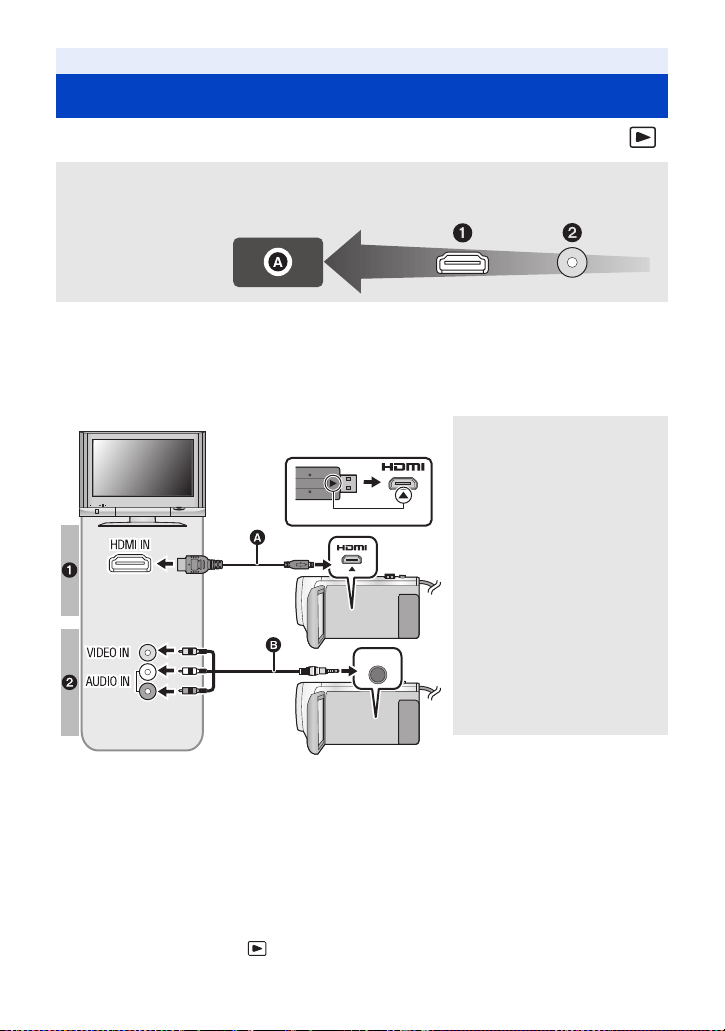
- 113 -
≥ Use the HDMI micro cable (supplied).
≥ HDMI is the interface for digital devices. If you connect this unit to a HDMI compatible high-
definition TV and then play back the recorded high-definition images, you can enjoy them in high
resolution with high quality sound.
1 Connect this unit to a TV.
≥ Check that the plugs are inserted as far as they go.
≥ Do not use any other HDMI micro cable except the supplied one.
2 Select the video input on the TV.
≥ Example:
Select the [HDMI] channel with a HDMI micro cable.
Select the [Video 2] channel with a Composite video cable.
(The name of the channel may differ depending on the connected TV.)
≥ Check the input setting (input switch) and the audio input setting on the TV. (For more
information, please read the operating instructions for the TV.)
3 Change the mode to to play back.
Advanced (Playback)
Watching Video/Pictures on your TV
Confirm the terminals on your TV and use a cable compatible with the terminals. Image
quality may vary with the connected terminals.
A High quality
1 HDMI terminal
2 Video terminal
A HDMI micro cable (supplied)
≥ Be sure to connect to the HDMI
terminal. (Insert the connector
with the arrow side facing
down.)
≥ Connecting with a HDMI micro
cable (
l 115)
≥ Listening in 5.1 channel sound
(AVCHD) (
l 115)
≥ Playback using VIERA Link
(
l 116)
B Composite video cable
(commercially-available)
Picture quality
1 High-definition images when
connecting to HDMI terminal
2 Standard images when
connecting to video terminal
A/V
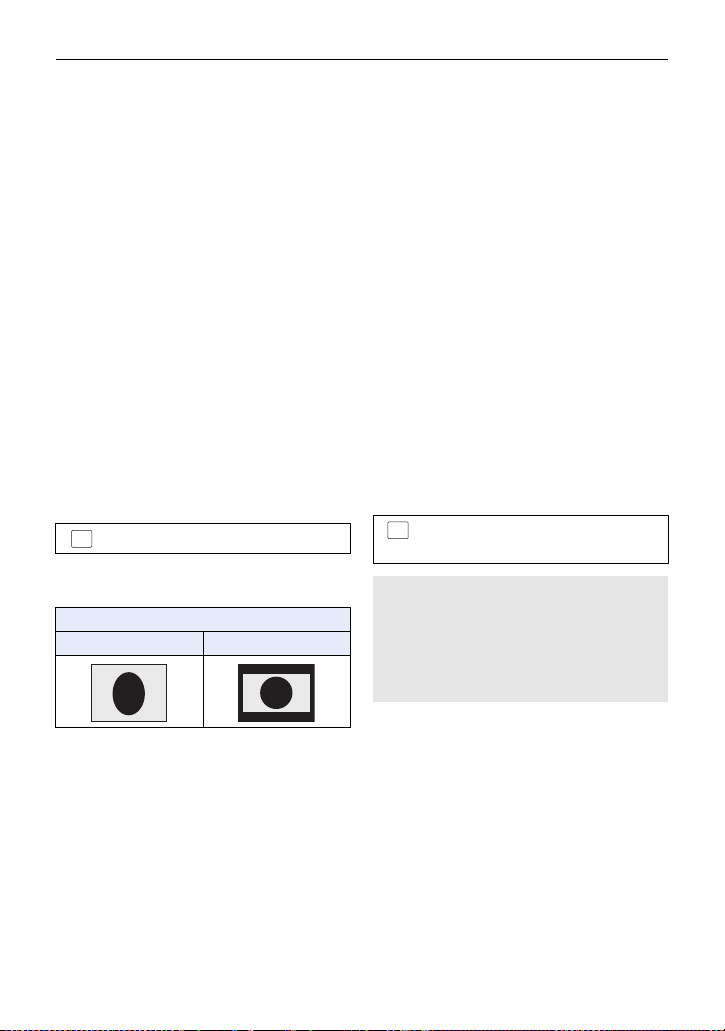
- 114 -
≥ When this unit and the TV are connected with the HDMI micro cable (supplied) or a Composite
video cable (commercially-available) in any of the following situations, no image will be displayed
on the TV. Use the LCD monitor of this unit.
j When recording a motion picture in HDR Movie Mode or during PRE-REC
j When [HDMI RESOLUTION] is set to [480p] in HDR Movie Mode
j FULL HD Slow Motion Video Mode
j When recording a motion picture with [Backup for Twin Camera] set to [ON] or during
PRE-REC
j When saving the Highlight Playback scene or a manually edited scene
j When performing [CONVERT TO MP4]/performing [Slow Speed Conversion]
≥ If you connect this unit to the TV when this unit is set to Recording Mode, a squealing sound
*1
may be output. Before connecting this unit, set it to Playback Mode.
*1 The microphone may pick up the sound from the speakers, producing an abnormal sound.
≥ When connected to the TV, sound in Playback Mode is not output from this unit. Also, since the
volume cannot be adjusted with this unit, adjust the volume of the TV.
≥ Some screens, such as the menu screen, may be displayed in reduced sizes on the TV.
≥ Image and audio is not output from this unit while using the Wi-Fi function.
∫ To watch images on a regular
TV (4:3) or when both sides of
the images do not appear on
the screen
Change the menu setting to display the images
correctly. (Check the TV setting.)
Example of images with a [16:9] aspect ratio
on a regular TV (4:3)
≥ If a wide-screen TV is connected, adjust the
aspect setting on the TV. (Refer to the
operating instructions of the TV for details.)
∫ To display the on-screen
information on the TV
When the menu setting is changed, the
information displayed on the screen (operation
icon and time code etc.) can be displayed/not
displayed on the TV.
*2 This setting is only available in Motion
Picture Recording Mode or Still Picture
Recording Mode.
: [SETUP] # [TV ASPECT] # [4:3]
[TV ASPECT] setting
[16:9] [4:3]
MENU
: [SETUP] # [EXT. DISPLAY] #
desired setting
[SIMPLE]
*2
: Information partially
displayed
[DETAIL]: Detailed information
displayed
[OFF]: Not displayed
MENU

- 115 -
Connecting with a HDMI micro cable
Select the desired method of HDMI output.
≥ [AUTO] determines the output resolution automatically based on information from the connected
TV.
If the images are not output on the TV when the setting is [AUTO], switch to the method [1080p],
[1080i] or [480p] which enables the images to be displayed on your TV. (Please read the
operating instructions for the TV.)
≥ Images may not be displayed on the television for several seconds in some cases, such as when
changing between scenes.
Listening in 5.1 channel sound (AVCHD)
You still can listen to the 5.1 channel sound recorded from the internal microphones when this
unit is connected to the 5.1 channel compatible AV amplifier or TV using the HDMI micro cable.
Please read the AV amplifier and TV operating instructions for how to connect this unit to the
AV amplifier and TV.
≥ If you connect this unit to a Panasonic AV amplifier that are compatible with VIERA Link,
linked operations (VIERA Link) become possible. (
l 116)
≥ Audio recorded when [5.1ch/2ch] is set to [2ch] or recorded from an external microphone is
in stereo (2ch).
: [SETUP] # [HDMI RESOLUTION] # [AUTO]/[1080p]/[1080i]/[480p]
MENU
- 116 -
¬ Press the recording/playback button to switch this unit to the Playback Mode.
1 Select the menu.
≥ If you are not using VIERA Link, set to [OFF].
2 Connect this unit to a Panasonic TV compatible with VIERA Link with a HDMI
micro cable. (
l 113)
≥ It is recommended to connect this unit to an HDMI terminal other than the HDMI1 if there are 2 or
more HDMI input terminals on the TV.
≥ VIERA Link must be activated on the connected TV. (Read the operating instructions of the TV for
how to set etc.)
Advanced (Playback)
Playback using VIERA Link
What is the VIERA Link (HDAVI Control™)?
≥ VIERA Link™ is a new name for EZ Sync™.
≥ This function allows you to use your remote control for the Panasonic TV for easy operations
when this unit has been connected to a VIERA Link compatible device using a HDMI micro
cable (supplied) for automatic linked operations. (Not all operations are possible.)
≥ VIERA Link is a unique Panasonic function built on a HDMI control function using the standard
HDMI CEC (Consumer Electronics Control) specification. Linked operations with HDMI CEC
compatible devices made by other companies are not guaranteed.
When using devices made by other companies that are compatible with VIERA Link, refer to
the operating instructions for the respective devices.
≥ This unit supports “VIERA Link Ver.5” function. “VIERA Link Ver.5” is the standard for
Panasonic’s VIERA Link compatible equipment. This standard is compatible with Panasonic’s
conventional VIERA Link equipment.
: [SETUP] # [VIERA Link] # [ON]
MENU
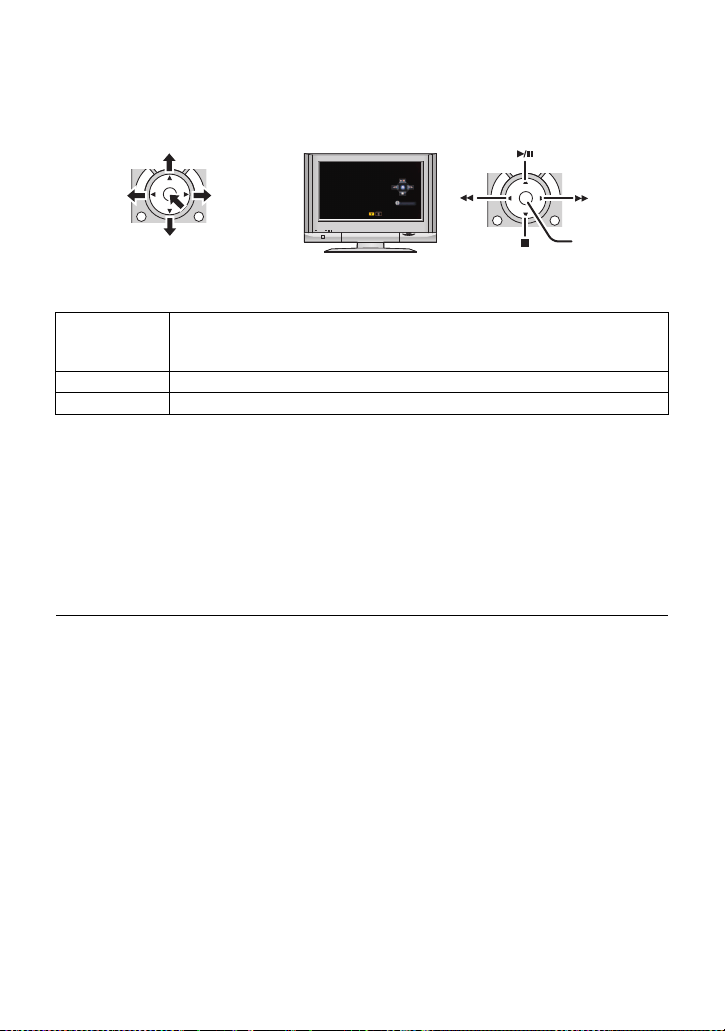
- 117 -
3 Operate with the remote control for the TV.
≥ You can select the scene or picture you want to play back by pressing the button up, down, left or
right, and then the button in the center.
≥
The following operations are available by pressing the color buttons on the remote control.
∫ Other linked operations
Turning the unit off:
If you use the remote control for the TV to turn off the power, this unit also turns off.
Automatic input switching:
If you connect with a HDMI micro cable and then turn on this unit, the input channel on the TV
automatically switches to this unit’s screen. If the TV’s power is in standby status, it will turn on
automatically (if [Set] has been selected for the TV’s [Power on link] setting).
≥ Depending on the HDMI terminal on the TV, the input channel may not switch automatically. In
this case, use the remote control for the TV to switch the input channel.
≥ If you are unsure whether or not the TV and AV amplifier you are using are compatible with
VIERA Link, read the operating instructions for the devices.
≥ Available linked operations between this unit and a Panasonic TV is different depending on the
types of Panasonic TVs even if they are compatible with VIERA Link. Refer to the operating
instructions of the TV for the operations that support on the TV.
≥ Operation is not possible with a cable that is not based on the HDMI standard.
(When selecting scenes) (When playing back)
A Display/Cancel operation icons
Green ≥ Switching the number of scenes/still pictures in thumbnail display
(9 thumbnails > 20 thumbnails > 9 thumbnails...)
≥ Zoom in on still picture
Yellow ≥ Deleting scenes/still pictures
Red ≥ Zoom out from still picture
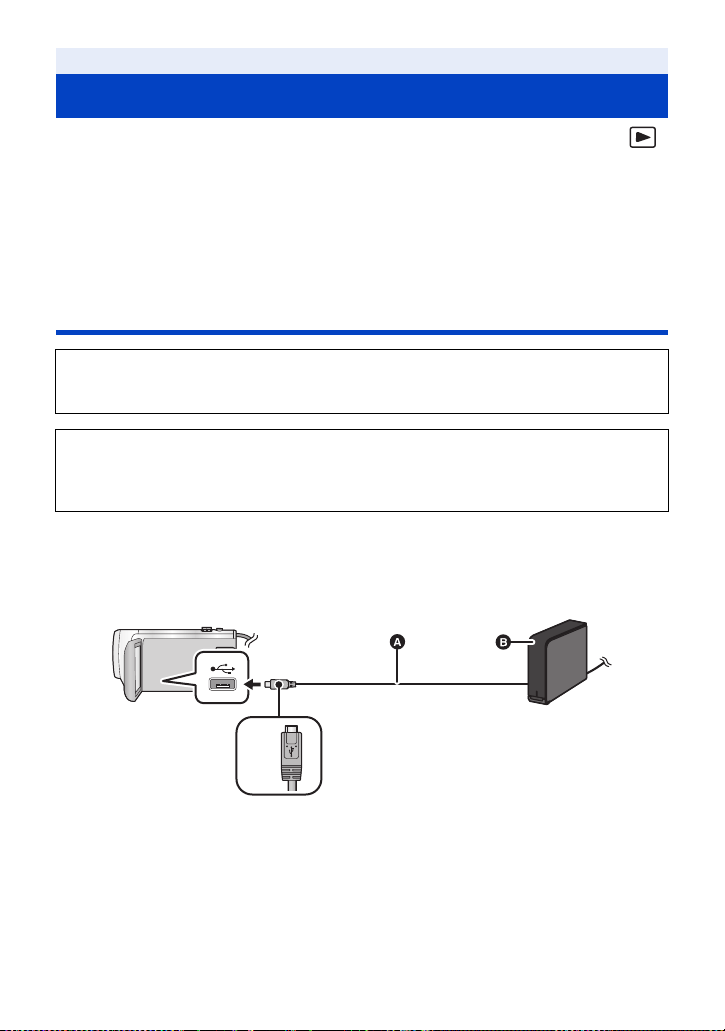
- 118 -
≥ In this Owner’s Manual, “USB hard disk drive” is indicated as “USB HDD”.
If you connect a USB HDD (commercially-available) to this unit by using a USB Connection Cable
(commercially-available), you can copy motion pictures and still pictures recorded on this unit to a
USB HDD.
It can also play back the scenes and still pictures copied to the USB HDD.
≥ You can copy scenes and still pictures recorded with this unit while maintaining the image quality.
≥ Please read the operating instructions of the USB HDD for how to use it.
Preparing for copying/playing back
≥ In the following cases, a USB HDD cannot be used by connecting it to this unit:
j A USB HDD with a capacity of below 160 GB or above 2 TB
j When a USB HDD has two or more partitions
j If a USB HDD is in a format other than FAT32
j When connected by using a USB hub
A USB Connection Cable (commercially-available)
B USB HDD (commercially-available)
C Turn the side with the symbol up to connect the micro A end of the USB Connection Cable to
the USB terminal of this unit.
≥ Connect this unit to the AC adaptor
Copy/Dubbing
Copying/playing back with a USB HDD
Refer to the following support site for information about USB HDD.
https://panasonic.jp/support/global/cs/e_cam
(This Site is English only)
When the USB HDD that requires formatting is connected, a message is displayed. Follow the
instructions on the screen to format it.
Once the USB HDD has been formatted, all data stored on it will be deleted. The data cannot be
recovered.
- 119 -
1 (When using a desktop HDD)
Connect the AC adaptor (supplied with USB HDD) to the USB HDD.
≥ If you are using a bus-powered or portable USB HDD, this unit can supply power to the USB HDD
by USB Connection Cable (commercially-available).
2 Connect the AC adaptor and a sufficiently charged battery to this unit.
≥ If the AC adaptor is not connected to this unit, the USB HDD cannot be used.
3 Turn on this unit, and press the recording/playback button to switch this unit
to the Playback Mode.
4 Connect this unit to the USB HDD with the USB Connection Cable
(commercially-available).
≥ Use a USB Connection Cable (commercially-available) compatible with the USB terminals of this
unit and the USB HDD. Connect the micro A end of the USB Connection Cable to the USB
terminal of this unit.
For information on the USB terminal of the USB HDD, refer to the operating instructions of the
USB HDD.
≥ It may take several minutes until the connection is completed.
5 Touch the desired item.
≥ Following can be performed by connecting the USB HDD with the scenes and still pictures copied
from this unit to other devices.
j Save on a PC or rewrite on USB HDD using HD Writer AE 5.2
[Simple copy]: Copies all scenes and still pictures recorded with this unit that
have not been copied yet. (
l 121)
[Copy selected files]: Allows you to select desired scenes/still pictures, and then
copy. (
l 121)
[Playback HDD]: Plays back scenes and still pictures stored in a USB HDD on
this unit. (
l 122)
[Safe Removal]: Allows you to safely remove this unit and a USB HDD.
When the USB HDD is connected to other devices such as Blu-ray disc recorder, a
message prompting to format the USB HDD may display. All the scenes and still pictures
recorded on the USB HDD will be erased if formatted. Do not format as important data will
get erased and it will be impossible to restore.
- 120 -
∫ Points to check before copying
≥ When using a USB HDD for the first time, or using a USB HDD that has been used with
other devices, first run [FORMAT MEDIA].
≥ Before copying, go to [MEDIA STATUS] to check the amount of free space on the USB HDD.
≥ In the following cases, copying may take longer:
j There are lots of scenes
j The temperature of this unit is high
≥ If you copy protected scenes or still pictures, the protection setting of the copied scenes or still
pictures are canceled.
≥ The order in which the scenes were copied cannot be changed.
∫ Formatting
This is for initializing the USB HDD.
≥ Please be aware that if a media is formatted then all the data recorded on the media is
erased and cannot be recovered. Back up important data on a PC etc.
≥ Connect this unit to the USB HDD and touch [Playback HDD].
≥ When formatting is complete, touch [EXIT] to exit the message screen.
≥ Connect this unit and the USB HDD to format.
You may no longer be able to use the USB HDD if you format them on another device such as a
PC etc.
∫ Displaying media information
The used space of the USB HDD can be checked.
≥ Connect this unit to the USB HDD and touch [Playback HDD].
≥ If you touch [CHANGE MEDIA], you can switch the display between the SD card and USB HDD.
Before you delete the data on the media after copying is complete, be sure to play back
the USB HDD to check that they have been copied to correctly. (
l 122)
: [SETUP] # [FORMAT MEDIA] # [HDD]
: [SETUP] # [MEDIA STATUS]
MENU
MENU

- 121 -
Simple copy
1 Connect this unit to the USB HDD to prepare for copying. (l 118)
2 Touch [Simple copy].
≥ When [Copy selected files] or [Playback HDD] is selected, terminate the connection with the USB
HDD (
l 122), and then perform the operation of Step 1.
3 Touch [YES].
4 Touch [EXIT] when the copy complete message is displayed.
≥ The thumbnail view of the copy destination is indicated.
When you stop copying halfway:
Touch [CANCEL] while copying.
Copy selected files
1 Connect this unit to the USB HDD to prepare for copying. (l 118)
2 Touch [Copy selected files].
≥ You can also copy scenes or still pictures by touching , selecting [COPY].
3 Touch [NEXT].
4 Touch the desired items following the instructions on the screen.
≥ It will return to the previous step by touching .
≥ (When [SELECT SCENES] is selected)
When touched, the scene/still picture is selected and the indication appears on the
thumbnail. Touch the scene/still picture again to cancel the operation.
≥ (When [SELECT DATE] is selected)
When touched, the date is selected and surrounded by red. Touch the date again to cancel the
operation.
≥ Up to 99 scenes/ 99 dates can be selected continuously.
5 Touch [EXIT] when the copy complete message is displayed.
≥ The thumbnail view of the copy destination is indicated.
When you stop copying halfway:
Touch [CANCEL] while copying.
MENU
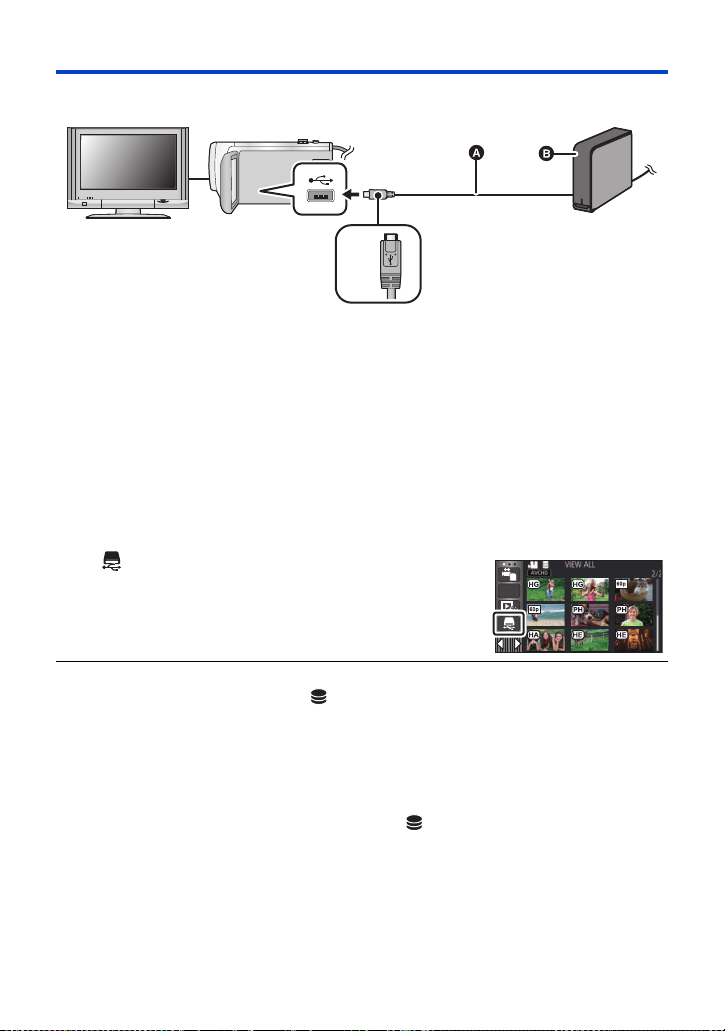
- 122 -
Playing back the USB HDD
≥ Only motion picture/still picture that have been copied by connecting this unit to the USB
HDD or copied with HD Writer AE 5.2 can be played back.
A USB Connection Cable (commercially-available)
B USB HDD (commercially-available)
C Turn the side with the symbol up to connect the micro A end of the USB Connection Cable to
the USB terminal of this unit.
1 Connect this unit to the USB HDD to prepare for playback. (l 118)
≥ When playing back on a TV, connect this unit to the TV. (
l 113)
2 Touch [Playback HDD].
3 Touch the scene or still picture to be played back and then play it back.
≥ The playback operation is performed the same as when playing back motion pictures or still
pictures. (
l 27, 83)
To terminate the connection between this unit and the USB HDD
Touch on the Touch Menu.
≥ Disconnect the USB Connection Cable from this unit.
≥ It is also possible to switch the media to play back by touching the play mode select icon.
When the USB HDD is connected, the (USB HDD) can be selected from the displayed media
types. (
l 27)
≥ Scenes recorded as Backup for Twin Camera will be saved as normal AVCHD scenes when
copied to the USB HDD.
≥ The scenes you have saved in Highlight Playback during playback of the USB HDD are saved in
the SD card.
≥ Deleting scenes and still pictures on the USB HDD may take time.
≥ You cannot set the following items during playback of (USB HDD).
j [SCENE PROTECT]
j [SECTION DELETE]
j [DIVIDE]
j [MANUAL EDIT]
j [SPLIT&DELETE]
j [Slow Speed Conversion]
j [CONVERT TO MP4]
ALL
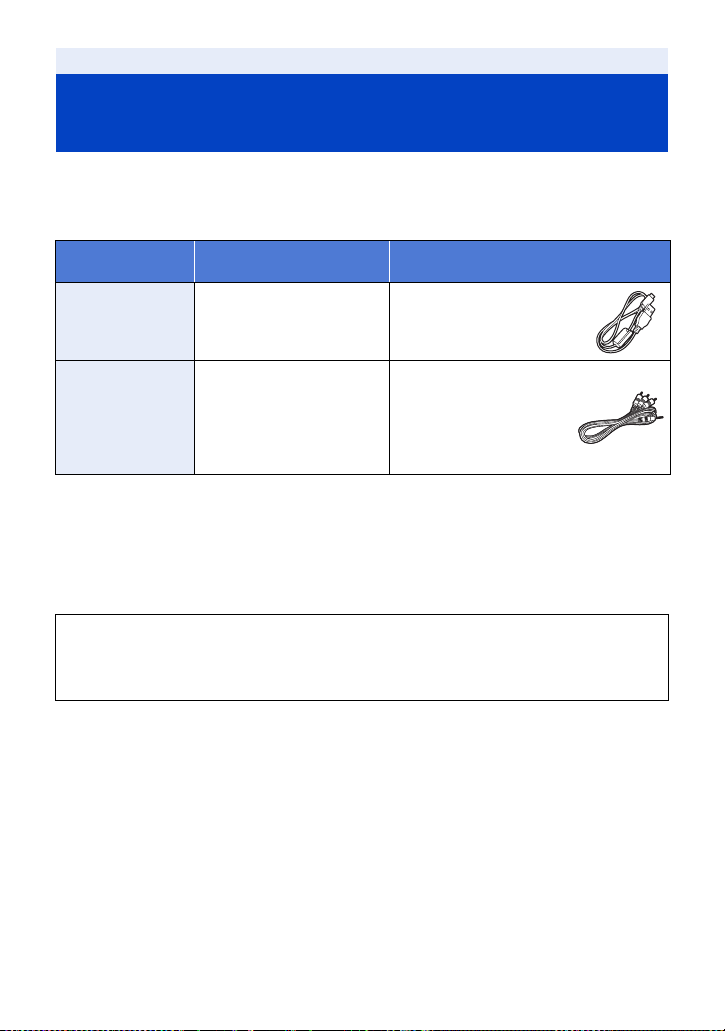
- 123 -
≥ Blu-ray recorders are not sold in US.
∫ Check before dubbing
Check the equipment used for dubbing.
* Some equipment may not be compatible with high-definition (AVCHD) or MP4 (iFrame) picture
quality. In such a case, connect with a Composite video cable (commercially-available) and dub
with standard picture quality. (
l 126)
≥ For the positions of the USB terminal, or terminal for connecting the Composite video cable, refer
to the operating instructions of the equipment used.
≥ The MP4/iFrame scenes cannot be dubbed by connecting with the USB cable. To dub MP4/
iFrame scenes, refer to page
126.
Copy/Dubbing
Dubbing with a Blu-ray disc recorder,
video device, etc.
Equipment used
for dubbing
Dubbing picture quality To dub
Equipment with USB
terminal
High-definition picture
quality*
Connect with supplied
USB cable (
l 124)
Equipment without
SD card slot or USB
terminal
Standard picture quality
This can be played back on
equipment incompatible with
high-definition (AVCHD), so it
is convenient if you are
dubbing for distribution.
Connect with Composite
video cable
(commercially-available)
(
l 126)
You can dub scenes recorded with this unit to a Panasonic Blu-ray disc recorder or DVD
recorder that supports the recording format or recording mode you want to use.
≥ Note that the equipment described may not be available in certain countries and
regions.
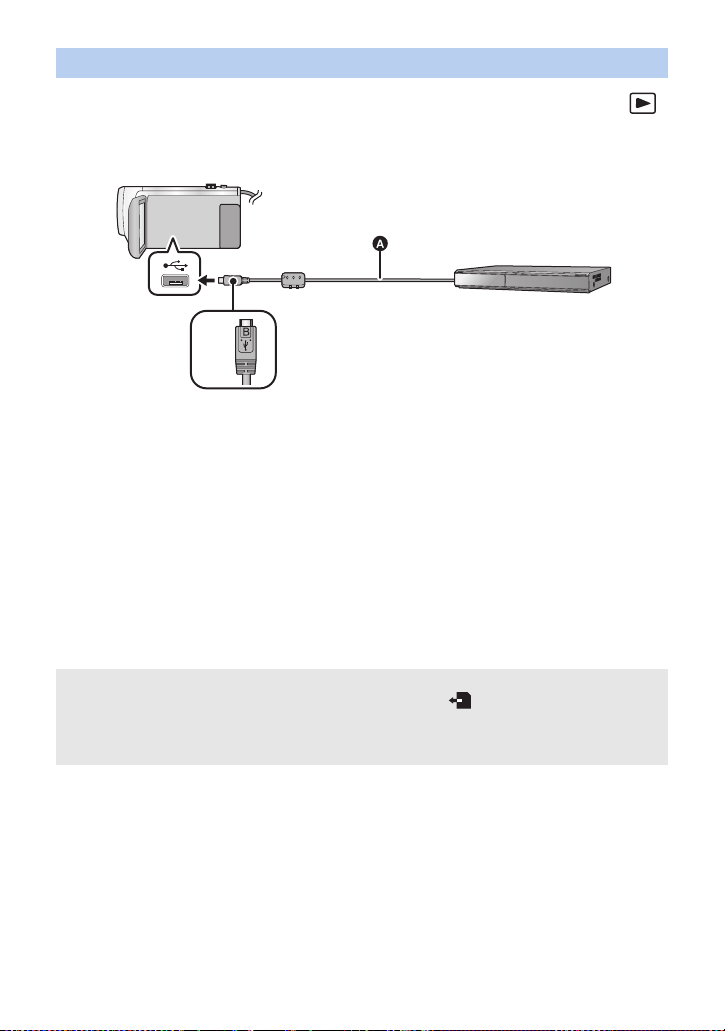
- 124 -
You can dub by connecting a USB cable.
≥ Use the AC adaptor to free you from worrying about the battery running down.
≥ Turn on the unit.
A USB cable (supplied)
B Turn the side with the symbol up to connect the micro B end of the USB Cable to the USB
terminal of this unit.
≥ Insert the plugs as far as they will go.
1 Connect the unit to the Blu-ray disc recorder or high-definition (AVCHD)
compatible DVD recorder.
≥ The USB function selection screen will appear on the screen of the unit.
2 Touch [RECORDER] on the screen of this unit.
≥ When you select an option other than [RECORDER], reconnect the USB cable.
≥ When using the battery, the LCD monitor turns off after about 5 seconds. Touch the screen to turn
the LCD monitor on.
3 Dubbing through operations on the Blu-ray disc recorder or high-definition
(AVCHD) compatible DVD recorder.
Dubbing in high-definition picture quality
About the screen indication of the unit
≥ When the unit is accessing the SD card, card access icon ( ) appears on the unit screen
or the access lamp is on.
≥ Be careful not to disconnect the USB cable, AC adaptor or battery while the unit is accessing
the media, as this may result in the loss of recorded content.

- 125 -
≥ Do not use any other USB cables except the supplied one. (Operation is not guaranteed with any
other USB cables.)
≥ Scenes recorded as Backup for Twin Camera will be saved as normal AVCHD scenes when
dubbed on a Panasonic Blu-ray disc recorder or a DVD recorder.
≥ When this unit is connected to a Panasonic Blu-ray disc recorder or a DVD recorder using a USB
cable while the unit is turned on, power is also supplied from the connected equipment to this
unit.
≥ For details on dubbing and playback methods, read the operating instructions of the Blu-ray disc
recorder or DVD recorder.
≥ When you connect the unit to a Blu-ray disc recorder, a dubbing operations screen may appear
on the television connected to the Blu-ray disc recorder. In this case as well, perform the
operations of Steps 1 to 3.
≥ You cannot switch the Recording Mode/Playback Mode by pressing the recording/playback
button on this unit while the Blu-ray disc recorder or DVD recorder is connected. Disconnect the
USB cable before performing either of these operations.
≥ If the battery runs down during dubbing, a message will appear. Operate the Blu-ray disc recorder
to cancel the dubbing.
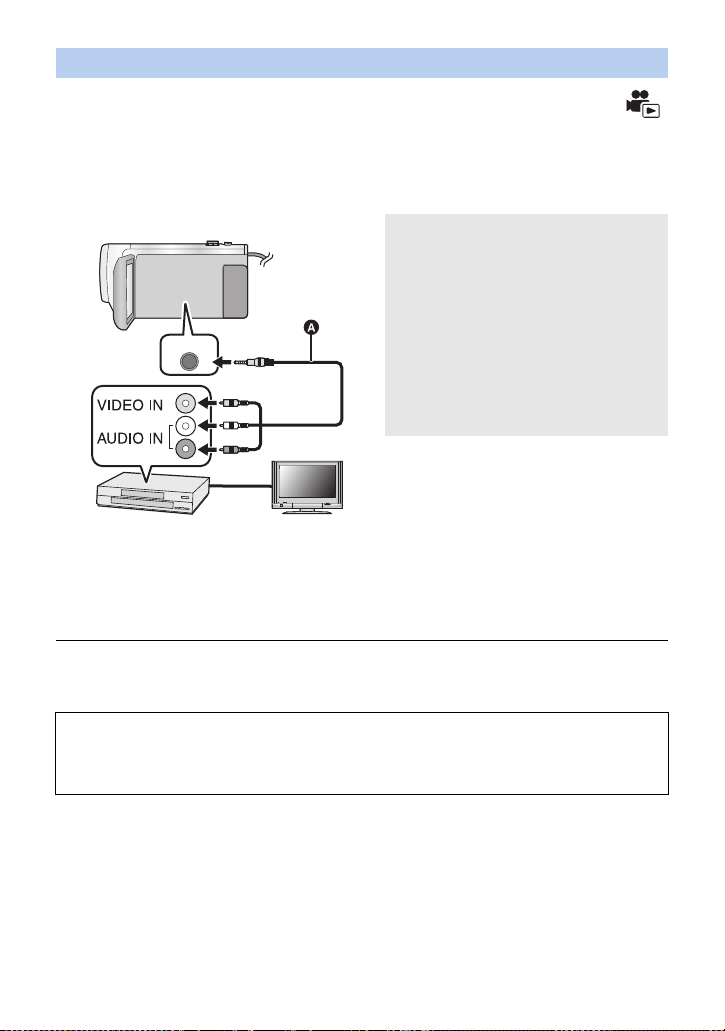
- 126 -
∫ Dubbing using equipment without a USB terminal, or using a video
device
You can dub by connecting a Composite video cable (commercially-available).
≥ Use the AC adaptor to free you from worrying about the battery running down.
≥ Press the recording/playback button to switch this unit to the Playback Mode.
1 Connect this unit to a video device and start playback on this unit.
2 Start recording on the connected device.
≥ To stop recording (dubbing), stop playback on this unit after stopping recording on the recorder.
≥ Some screens, such as the menu screen, may be displayed in reduced sizes on the TV.
≥ If the date and time display and function indication are not wanted, cancel them before dubbing.
(
l 33, 114)
Dubbing in standard picture quality
Change the video input on the
video device and TV that this
unit is connected to.
≥ The channel set will differ depending on
the terminal to which the unit is
connected.
≥ See the operating instructions of the
video device for details.
≥ Insert the plugs as far as they will go.
A Composite video cable (commercially-
available)
If the dubbed images are played back on a wide-screen TV, the images may be stretched
vertically.
In this case, refer to the operating instruction for the device you are connecting to or read the
operating instructions of the wide-screen TV and set the aspect ratio to 16:9.
A/V

- 127 -
∫ Use this unit as a wireless LAN device
When using equipment or computer systems that require more reliable security than wireless LAN
devices, ensure that the appropriate measures are taken for safety designs and defects for the
systems used. Panasonic will not take any responsibility for any damage that arises when using this
unit for any purpose other than as a wireless LAN device.
∫ Use of the Wi-Fi function of this unit is presumed to be in countries
where this unit is sold
There is the risk that this unit violates the radiowave regulations if used in countries other than those
where this unit is sold, and Panasonic takes no responsibility for any violations.
∫ There is the risk that data sent and received via radio waves may be
intercepted
Please note that there is the risk that data sent and received via radio waves may be intercepted by
a third party.
∫ Do not use this unit in areas with magnetic fields, static electricity or
interference
≥ Do not use this unit in areas with magnetic fields, static electricity or interference, such as near
microwave ovens. Radio waves may not reach this unit.
≥ Using this unit near devices such as cordless telephones or any other wireless LAN device that
use the 2.4 GHz radio wave band may cause a decrease in performance in both devices.
∫ Do not connect to the wireless network you are not authorized to
use
When this unit utilizes its Wi-Fi function, wireless networks will be searched automatically. When
this happens, wireless networks that you are not authorized to use (SSID
*
) may be displayed,
however do not attempt to connect to the network as it may be considered as unauthorized access.
* SSID refers to the name of device that is used to identify a network over a wireless LAN
connection. If the SSID matches for both devices, transmission is possible.
∫ Before use
To use a Wi-Fi function with this unit, you need a wireless access point or destination device
equipped with a wireless LAN function.
≥ For the operations and settings of your device such as the smartphone, please read the
operating instructions of the device.
∫ This unit is WPS-compatible
WPS (Wi-Fi Protected Setup™) is a function that allows you to easily set up a connection with a
wireless LAN device and make security-related settings.
Wi-Fi
Wi-Fi
®
function

- 128 -
≥ This unit cannot be used to connect to a public wireless LAN connection.
≥ Use a IEEE802.11b, IEEE802.11g or IEEE802.11n compatible device when using a wireless
access point.
≥ This unit uses the 2.4 GHz frequency band. You cannot establish a wireless LAN connection
using the 5 GHz frequency band.
≥ When using a wireless access point, we strongly recommend that you set a encryption to
maintain information security.
≥ When sending
scenes
or still pictures, we recommend you use the AC adaptor. If you are using
the battery, we recommend you use the fully charged one.
≥ When sending motion pictures or still pictures on a mobile network or tethering, high packet
communication fees may be incurred depending on the details of your contract.
≥ This unit may not connect to a wireless access point depending on the radio wave condition.
≥ When motion picture or still picture transmission is not successful, point the Wi-Fi transmitter
(
l 10) at the wireless device (smartphone, etc.).
≥ When the battery indicator is flashing red, the connection with other equipment may not start or
the connection may be disrupted.
≥ The Wi-Fi transmitter may become warm when using the Wi-Fi function; however this is not a sign
of a malfunction. (
l 10)

- 129 -
This unit offers the following Wi-Fi functions when used in combination with another Wi-Fi
compatible device.
≥ The following Wi-Fi functions have been terminated.
Related menus, etc., will still be displayed, but they can no longer be used.
j [Baby Monitor]
j [Home Cam]
j [Live Cast]
Wi-Fi
What you can do with the Wi-Fi function
[TWIN CAMERA]
You can display the image transmitted from a Wireless Sub Camera
connected via Wi-Fi on this unit’s Sub Window and record it simultaneously
with the Main Camera’s image. (
l 156)
[Link to Cell]
You can use a smartphone to remotely control recording and playback on
this unit. (
l 130)
[DLNA Play]
Connecting this unit to a DLNA (DMR)-compatible TV via Wi-Fi, you can
play back scenes and still pictures on the TV. (
l 135)
[Copy]
By setting up a Wi-Fi communication between this unit and a PC, you can
copy scenes and still pictures recorded with this unit to the PC. (
l 137)
[History]
Each use of a Wi-Fi function is stored in the Wi-Fi connection history.
Connecting from the history allows you to easily set up a connection using
the previous connection settings. (
l 149)
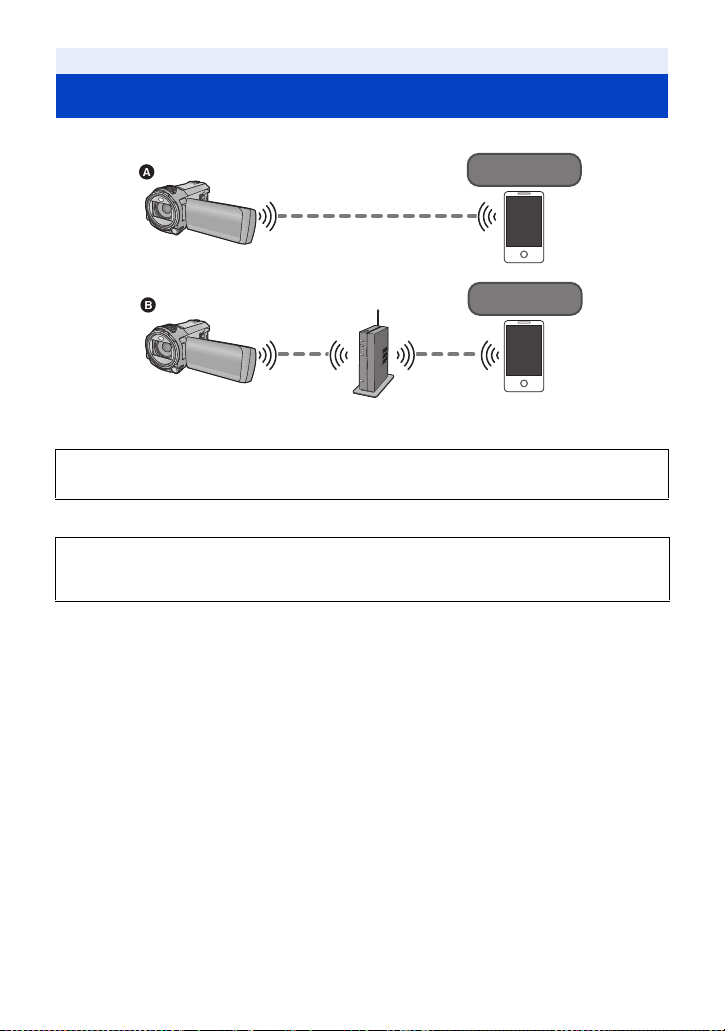
- 130 -
You can use a smartphone to remotely control recording and playback on this unit.
A When connecting directly to a smartphone
B When connecting to a wireless access point
≥ Refer to [Help] in the “Image App” menu about how to operate.
Wi-Fi
[Link to Cell]
≥ You need to turn on the Wi-Fi function of your smartphone.
≥ Do not remove the SD card during remote operations.
Caution:
Be sure to pay special attention to the privacy, the Portrait rights, etc. of the subject when you use
this function. Use at your own risk.
Image App
Image App

- 131 -
Preparations before using [Link to Cell]
Install the smartphone application “Image App” on your smartphone. (
l 141)
Operate this unit and the smartphone to set up a direct connection.
Check the [Direct Connection Password] setting in [Wi-Fi Setup]. (
l 153)
≥ The default setting for [Direct Connection Password] is [OFF].
Select [ON] as needed, for example when the setting seems necessary for your Wi-Fi
environment.
≥ When [Direct Connection Password] is set to [OFF]
j Connecting with [Direct Connection Password] set to [OFF] (
l 147)
≥ When [Direct Connection Password] is set to [ON]
Enter SSID and Password or scan QR code to connect.
j [WPS Connection] (
l 148)
j Connecting with QR code (
l 148)
j Connecting by entering an SSID and Password (
l 149)
When the Wi-Fi connection is complete, proceed to “Using [Link to Cell] with a direct connection”.
(
l 132)
1 Check if the wireless access point is compatible with IEEE802.11b/g/n.
2 Set up a Wi-Fi connection between this unit and the wireless access point.
≥ [WPS Connection] (
l 144)
≥ Searching for wireless access points to set up a connection (
l 145)
≥ Setting up a connection manually (
l 146)
When the Wi-Fi connection is complete, proceed to “Using [Link to Cell] with a wireless access point
connection”. (
l 132)
≥ Using [Wi-Fi Setup Wizard], you can also set up a Wi-Fi connection in conjunction with the
smartphone application “Image App”. (
l 143)
Setting up a direct Wi-Fi connection between this unit and a
smartphone
Setting up a Wi-Fi connection via a wireless access point

- 132 -
Using [Link to Cell] with a direct connection
Proceed to Step 2 when your Wi-Fi connection has been made via [Direct Connection] in [Wi-Fi
Setup] (
l 147).
1 Press Wi-Fi button on this unit and touch [Link to Cell].
≥ It will go into connection standby for remote operation.
2 Start up the smartphone application “Image App”.
≥ (When [Direct Connection Password] is set to [OFF])
If this is the first time the smartphone is connecting to this unit, a message will be displayed on
the screen of this unit. Touch [YES].
≥ When the connection is complete, images of this unit is displayed on the smartphone screen.
To exit [Link to Cell]:
Touch [EXIT] or press Wi-Fi button.
≥ The message is displayed. Touch [YES] to close the indication.
≥ The following operations allow you to register up to ten smartphones. If the number exceeds ten,
smartphone information with the oldest registration date and time will be deleted.
j Setting [Direct Connection Password] to [OFF] and connecting this unit and a smartphone
directly.
Using [Link to Cell] with a wireless access point
connection
1 Connect the smartphone to a wireless access point.
2 Press Wi-Fi button on this unit and touch [Link to Cell].
≥ It will go into connection standby for remote operation.
3 Start up the smartphone application “Image App”.
≥ When the connection is complete, images of this unit is displayed on the smartphone screen.
To exit [Link to Cell]:
Touch [EXIT] or press Wi-Fi button.
≥ The message is displayed. Touch [YES] to close the indication.
≥ The following operations allow you to register up to ten smartphones. If the number exceeds ten,
smartphone information with the oldest registration date and time will be deleted.
j Setting [Direct Connection Password] to [OFF] and connecting this unit and a smartphone
directly.
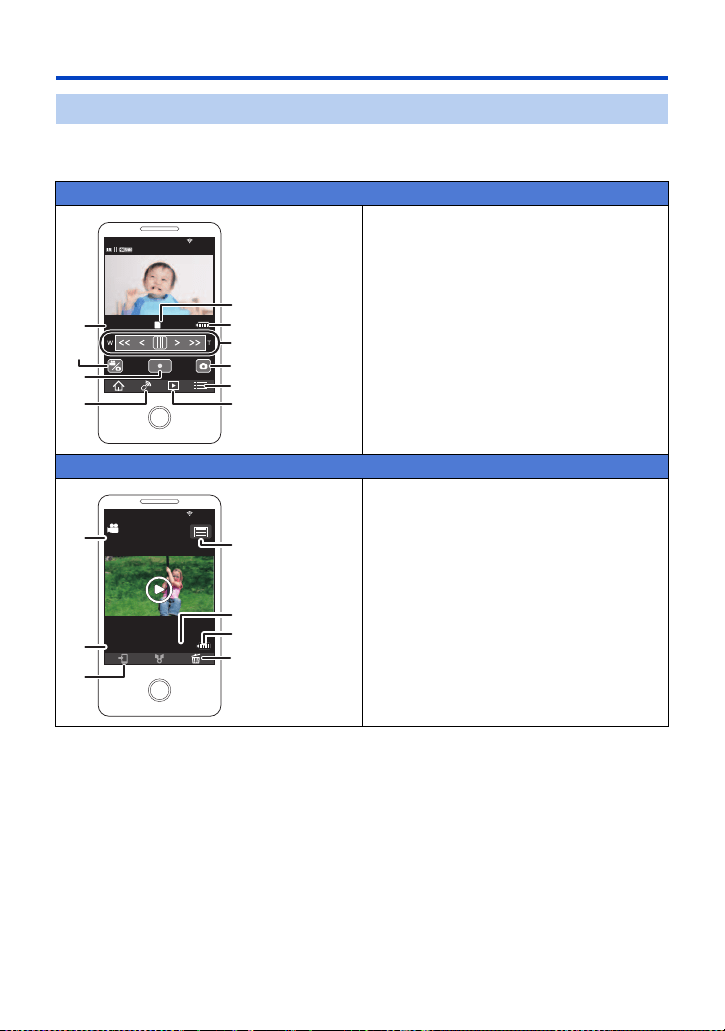
- 133 -
About [Link to Cell]
Smartphone screen shots are example displayed in Motion Picture Recording Mode and Playback
Mode.
≥ Depending on your OS or the version of the smartphone application “Image App”, the screens
may differ from the ones above.
Screen display during remote operations
Recording screen
1 Recording media/remaining recordable
time
2 Remaining battery power of this unit
3 Zoom
4 Photoshot button
5 Menu display
6 Playback mode button
7 Remote control button
8 Recording start/stop button
9 Motion Picture Recording Mode/Still
Picture Recording Mode toggle button
: Name of the connected device
Playback screen
1 Camera function button
2 Number of scenes
3 Remaining battery power of this unit
4 Delete
5 Copy
6 Name of the connected device
7 Scene information display
XXXXXXXXX
XXXXXXXXX
R 1 h 20 min
XXXXXXXXX
1/16
AVCHD_0001
2022/11/15 15:30:50

- 134 -
∫ In Recording Mode
≥ Recording motion pictures/still pictures
≥ Selecting a mode
≥ Using the zoom (Available in the medium or fast speed)
≥ Switching between the Recording Mode:
j Intelligent Auto Mode
j Manual Mode
j FULL HD Slow Motion Video Mode ([Always])
j Stop Motion Animation Assist Mode
≥ Backup for Twin Camera
≥ Recording format
≥ Picture size
≥ White Balance
≥ Backlight Compensation
≥ Night Mode
≥ Self-timer
≥ Aspect ratio
≥ Turning the unit off
∫ In Playback Mode
≥ Playback
≥ Switching between thumbnails (AVCHD/MP4/Backup
(Backup for Twin Camera)/JPEG (Still
picture))
≥ Delete
≥ Save (Copy)
j Scenes recorded in AVCHD cannot be copied.
j Scenes recorded in iFrame can only be copied with iOS devices.
j Depending on your smartphone, scenes recorded in MP4 format may not be copied.
≥ Smart Home Network
j It is possible to perform playback operation when this unit is connected to the DLNA (DMR)-
compatible TV via wireless access point using a smartphone.
≥ Creating and saving scenes with Highlight Playback
Highlight Playback is not available for the following scenes :
j iFrame scenes
j Scenes recorded with FULL HD Slow Motion Video Mode (
l 53)
j Scenes recorded as Backup for Twin Camera
j MP4 scenes saved as Highlight Playback
j Scenes that were converted to MP4 scenes and copied (with the MP4 conversion function)
(
l 111)
≥ Highlight Photo Collage
j Parts that were recognized as clearly recorded are automatically extracted from multiple
scenes and saved as still pictures. (Not available for MP4/iFrame scenes or scenes recorded
as Backup for Twin Camera)
j In addition, the multiple still pictures you have captured can be put in a frame and saved as a
single still picture.
≥ Functions other than those listed above are not available for remote operation.
≥ If you record an image when the LCD monitor of this unit is closed with the screen facing outward,
the LCD monitor turns off.
Functions available for remote operations
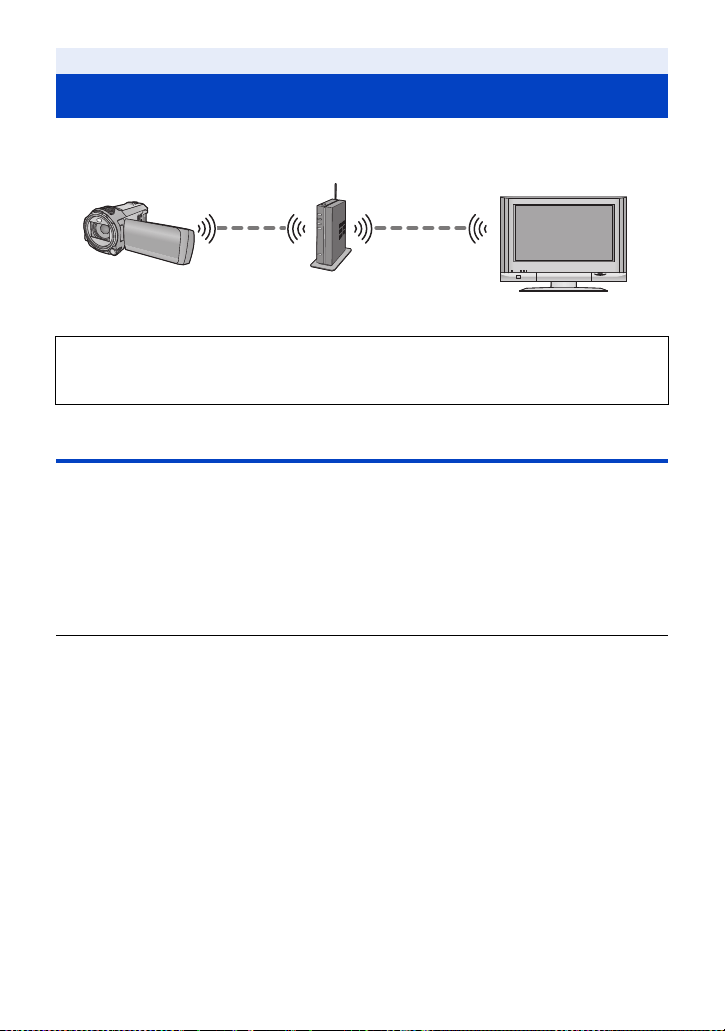
- 135 -
Connecting this unit to a DLNA (DMR)-compatible TV via Wi-Fi, you can play back scenes and still
pictures on the TV.
A DLNA (DMR)-compatible TV
Preparations before using [DLNA Play]
1 Check if the wireless access point is compatible with IEEE802.11b/g/n.
2 Check if the Device is DLNA-compatible.
3 Set up a Wi-Fi connection between this unit and the wireless access point.
≥ [WPS Connection] (
l 144)
≥ Searching for wireless access points to set up a connection (
l 145)
≥ Setting up a connection manually (
l 146)
4 When the Wi-Fi connection is complete, proceed to “Playing back on a TV”.
(
l 136)
≥ Using [Wi-Fi Setup Wizard], you can also set up a Wi-Fi connection in conjunction with the
smartphone application “Image App”. (
l 143)
Wi-Fi
[DLNA Play]
≥ Please read the operating instructions for the TV about connecting TV to the wireless
access point.
≥ Do not remove the SD card in playing back on a TV.
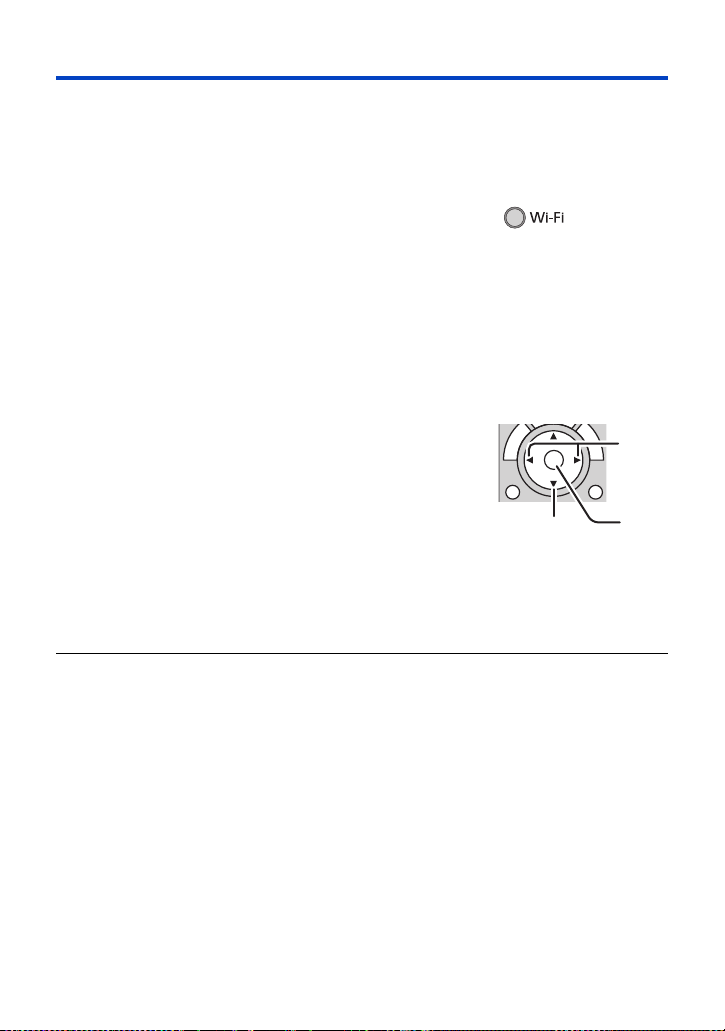
- 136 -
Playing back on a TV
You can play back the scenes and still pictures recorded with or stored in this unit on a TV.
≥ The following scenes can be played back:
j Scenes recorded in AVCHD
j Scenes recorded as Backup for Twin Camera
j Scenes recorded in MP4/iFrame [720]
j Scenes saved in MP4 (1280k720/30p) or MP4 (640k360/30p)
1 Press Wi-Fi button on this unit and touch [DLNA Play].
≥ If you touch [Change AP], you can switch the wireless access point to another one that has been
registered to this unit.
≥ If you touch [CANCEL], the Wi-Fi connection is canceled.
≥ When the connection is complete, the screen of this unit turns off. To display it again, touch the
screen.
2 Select this unit (SSID) by the TV side.
≥ Select SD media and select the motion picture ([AVCHD/MP4]) or still picture ([JPEG]) to play
back.
3 Perform playback operations with the TV remote control.
≥ Playback operations may differ depending on the TV in use.
≥ The following operations can be performed if a color button is
pushed.
Blue/Red: Skip playback
≥ Fast forward/Fast rewind playback cannot be performed.
≥ You cannot perform playback operations with this unit.
To exit [DLNA Play]:
Touch [EXIT] or press Wi-Fi button.
≥ A message is displayed. Touch [YES] to exit.
≥ You cannot play back the following scenes:
j Scenes recorded with [1080/50M], [1080/28M] or [iFrame] of [MP4/iFrame]
j Scenes saved in MP4 (1920k1080/30p)
≥ The scenes may not be played back smoothly depending on your environment, such as the
network condition.
(Examples of operations during
motion picture playback)
A Skip playback
B Stop
C Playback/Pause
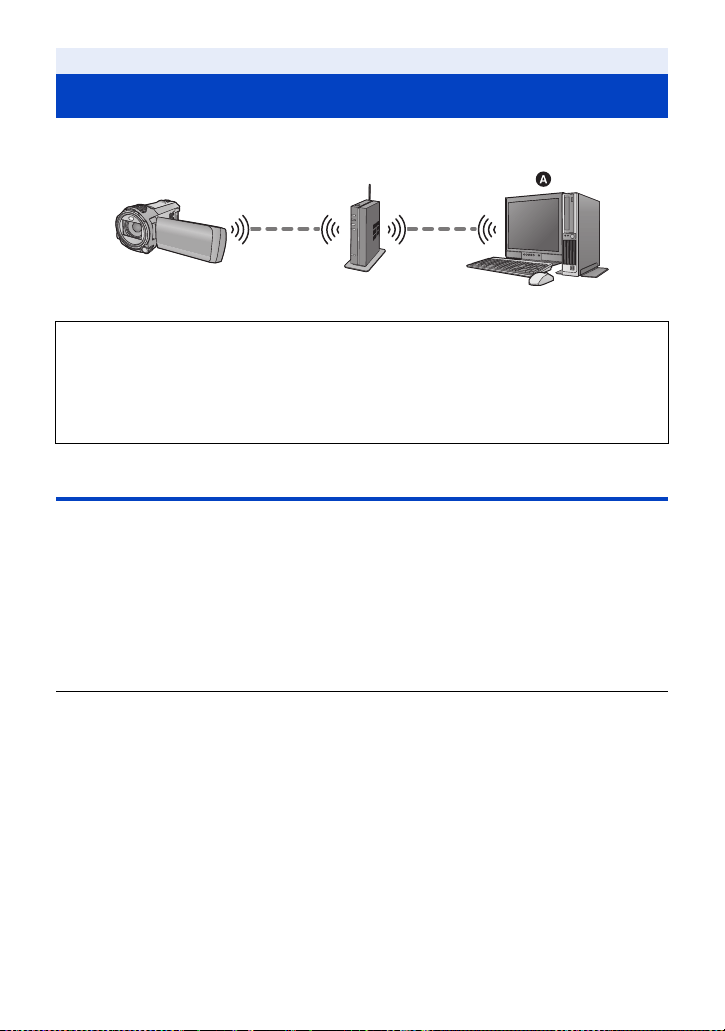
- 137 -
By setting up a Wi-Fi communication between this unit and a PC, you can copy scenes and still
pictures recorded with this unit to the PC.
A PC
Preparations before using [Copy]
1 Check if the wireless access point is compatible with IEEE802.11b/g/n.
2 Check if the PC and the wireless access point are connected via Wi-Fi.
≥ You can also use a LAN cable to connect the PC and the wireless access point.
3 Set up a Wi-Fi connection between this unit and the wireless access point.
≥ [WPS Connection] (
l 144)
≥ Searching for wireless access points to set up a connection (
l 145)
≥ Setting up a connection manually (
l 146)
4 When the Wi-Fi connection is complete, proceed to “Copying to a PC”.
(
l 139)
≥ Using [Wi-Fi Setup Wizard], you can also set up a Wi-Fi connection in conjunction with the
smartphone application “Image App”. (
l 143)
Wi-Fi
[Copy]
≥ If [CLOCK SET] (l 21) is not set correctly, scenes and still pictures may not be able to
be copied to a PC.
≥ For information on the connection between a PC and a wireless access point, refer to
the operating instruction of the device in use.
≥ If this unit and a PC are not connected to the same wireless access point, copying is
not possible.

- 138 -
To copy scenes and still pictures by setting up a Wi-Fi connection between this unit and the PC,
complete the following preparations:
j Turn on the PC
j Create a shared folder (destination folder)
*1
*1 The name of the folder must consist of 15 or less alphanumeric characters.
∫ When using HD Writer AE 5.2
1 Install HD Writer AE 5.2.
≥ For information on the operating environment and installation, refer to “Operating environment”
(
l 171) and “Installation” (l 173).
2 Using HD Writer AE 5.2, create a destination folder.
≥ Select [Auto-create] or [Create manually]. The first option creates a destination folder
automatically, while the second option allows you to specify a destination folder or create a new
one. With the second option, you can also set password protection for a destination folder.
≥ For details, refer to the Operating Instructions of HD Writer AE 5.2 (PDF file). (
l 177)
∫ When not using HD Writer AE 5.2
≥ If the workgroup setting of the connected PC has been changed from the standard one, you also
need to change the [PC Connect Setup] setting of this unit. (
l 155)
≥ The user account of the PC (both the Account Name and the Password) must consist of 32 or
less alphanumeric characters.
*2
If you use non-alphanumeric characters for the user account, a destination folder may not be set
up.
*2 If you use more than 32 characters for the user account, copying via a Wi-Fi connection is not
possible.
(For Windows)
Supported OS: Windows 8.1/Windows 10
Example: Windows 10
1 Select a destination folder, and right-click.
2 Select [Properties], and enable sharing of the folder.
≥ For details on how to enable sharing, refer to the operating instructions of your PC or the help of
your OS.
(For Mac)
Supported OS: macOS 11.2
Example: macOS 11.2
1 Select a destination folder, and click the following items:
[File]
# [Get Info]
2 Enable sharing of the folder.
≥ For details on how to enable sharing, refer to the operating instructions of your PC or the help of
your OS.
Creating a shared folder (destination folder) on the PC

- 139 -
Copying to a PC
≥ Create a shared folder (destination folder) on the PC. (
l 138)
1 Press Wi-Fi button on this unit and touch [Copy].
2 Touch the PC to be connected.
≥ To search for PCs again, touch [Refresh].
(When the PC you want to connect to is not displayed)
Touch [Manual Setting].
3 (When [Manual Setting] is touched)
Enter the computer name of the PC (NetBIOS name for Mac computers).
≥ Enter the computer name of your PC (NetBIOS name for Mac computers).
(A maximum of 15 characters can be entered.)
≥ When the computer name (or NetBIOS name) contains a space (blank character), etc., it may not
be recognized correctly. If a connection attempt fails, we recommend that you change the
computer name (or NetBIOS name) to the one consisting of only alphanumeric characters, with a
maximum of 15 characters.
≥ Input method is same operation as for setting up the title. (
l 94)
≥ After entering the computer name of the PC, touch [Enter].
4 Touch [INPUT], and enter the name of the shared folder.
≥ If you have created a shared folder (destination folder) using HD Writer AE 5.2 (
l 138), touch
[NEXT].
≥ Enter the name of the shared folder you have created on your PC, and touch [Enter].
(A maximum of 15 characters can be entered.)
≥ If a screen asking you to enter a user account and password is displayed after you have entered
the name of the shared folder, enter the one you have created on your PC.
≥ When the connection to the PC is complete, copying starts.
≥ When copying is complete, this unit turns off automatically.
When you stop copying halfway
Touch [CANCEL] while copying.

- 140 -
≥ Copying can be performed even when the battery is used for power, but we recommend that the
AC adaptor be used.
≥ Once scenes or still pictures are copied to a PC, the original scenes or still pictures cannot be
copied to any PCs.
≥ If the total length of the scenes recorded on the same date on the SD card exceeds
approximately 8 hours, the scenes will not be copied.
≥ If the copy source contains scenes or still pictures recorded on other devices, copying may be
canceled.
≥ Depending on your environment, copying may take time or may not be available.
≥ If the scene to be copied is long or copying fails, we recommend that the following be performed
for copying.
j Connecting this unit to the PC by USB cable (
l 174, 178)
j Inserting the SD card to the built-in SD card slot of the PC or your SD card reader/writer directly
If you intend to delete the original scenes or still pictures when the copying has finished,
always play back the duplicate scenes or still pictures on PC before deletion to confirm that
they have been copied normally.
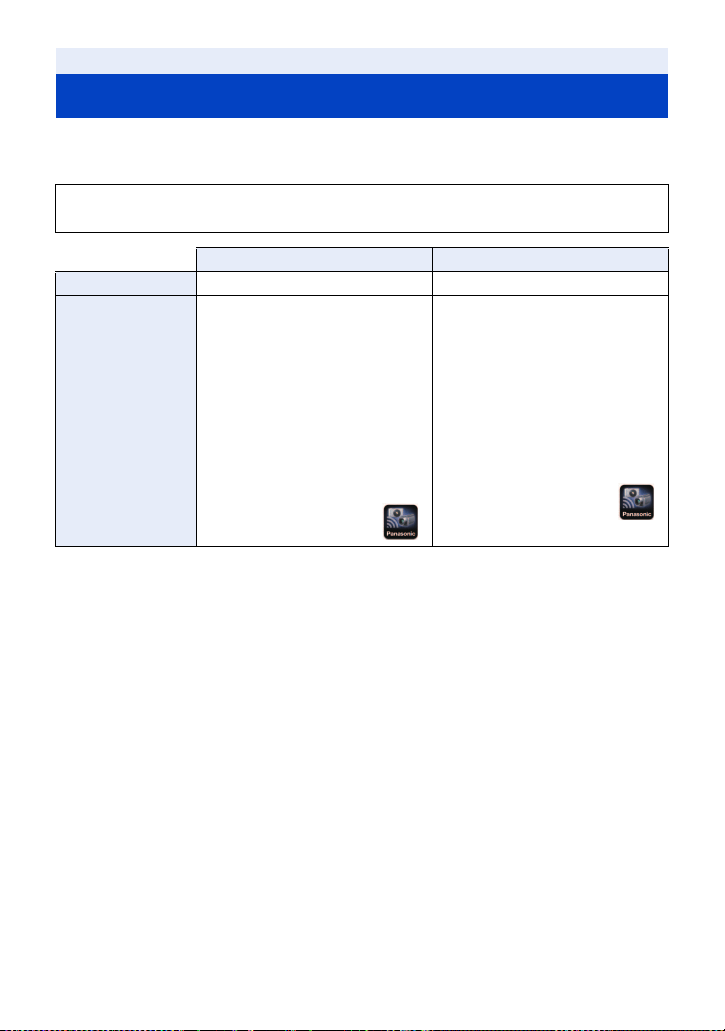
- 141 -
≥ To use the following Wi-Fi functions, you need to install the smartphone application “Image App”.
j [TWIN CAMERA] (
l 156)
j [Link to Cell] (
l 130)
* The supported OS versions are current as of January 2022 and subject to change.
≥ Use the latest version.
≥ Refer to [Help] in the “Image App” menu about function of Image App.
≥ The service may not be able to be used properly depending on the type of smartphone being
used. For information on the “Image App”, check the support website below.
https://panasonic.jp/support/global/cs/e_cam
(This Site is English only.)
≥ When downloading the app on a mobile network, high packet communication fees may be
incurred depending on the details of your contract.
Wi-Fi
Install the “Image App”
About the “Image App”
The “Image App” is an application provided by Panasonic.
For Android™ apps For iOS apps
OS Android 4.4 or later
*
iOS 9.3 or later
*
Installation
procedure
1 Connect your Android
device to a network.
2 Select “Google Play™
Store”.
3 Enter “Panasonic Image
App” into the search
box.
4 Select “Panasonic
Image App” and install
it.
≥ The icon will be added
to the menu.
1 Connect your iOS
device to a network.
2 Select “App Store”.
3 Enter “Panasonic Image
App” into the search
box.
4 Select “Panasonic
Image App” and install
it.
≥ The icon will be added
to the menu.
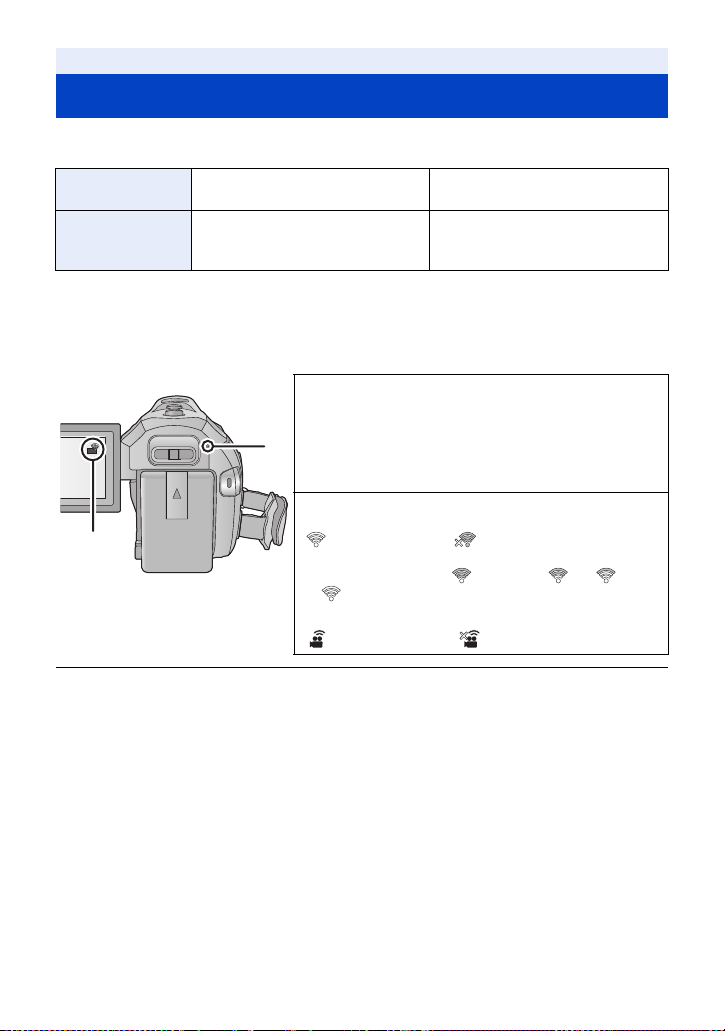
- 142 -
To use the Wi-Fi function, connect this unit to a wireless access point or smartphone via Wi-Fi.
≥ Depending on the Wi-Fi connection method, available Wi-Fi functions differ.
≥ If you select [History], you can set up a Wi-Fi connection that uses the connection settings of a
previously used Wi-Fi function. (
l 149)
∫ About the status indicator and the connection status icon when
connected to Wi-Fi
≥ For information on how to set up a Wi-Fi connection for the Wireless Twin Camera function, refer
to page
158; for information on the connection status icons, refer to 162.
Wi-Fi
Setting Up a Wi-Fi Connection
Wi-Fi connection
methods
Connecting to a wireless access
point (
l 144)
Setting up a direct connection to a
smartphone (l 147)
Available Wi-Fi
functions
≥ [Link to Cell] (
l 132)
≥ [DLNA Play] (
l 135)
≥ [Copy] (
l 137)
≥ [Link to Cell] (
l 132)
A Lit green
≥ The status indicator is lit green while this unit is
connected to a destination device after completing a
Wi-Fi connection.
≥ When Wi-Fi is disconnected, the status indicator is lit
red again.
B The connection status icon
When connected to wireless access point:
connected to Wi-Fi/ not connected to Wi-Fi
≥ The display will change as follows according to the
radio wave intensity: (Weak) # # #
(Strong).
When directly connected:
connected to Wi-Fi/ not connected to Wi-Fi

- 143 -
Using the [Wi-Fi Setup Wizard] to set up a connection
With the smartphone application “Image App”, you can transfer the following information between
the smartphone and this unit.
≥ Set [Direct Connection Password] in [Wi-Fi Setup] to [ON]. (
l 153)
(The default setting is [OFF].)
≥ Install the smartphone application “Image App” on your smartphone. (
l 141)
1 Press Wi-Fi button on this unit and touch [Wi-Fi Setup].
2 Touch [Wi-Fi Setup Wizard].
3 Touch [YES].
4 Touch [QR code] or [Wi-Fi].
When [QR code] is selected
1 Start up the smartphone application “Image App”.
2 On the smartphone, select [QR code], and scan the QR code displayed on the
screen of this unit.
≥ The setup screen is displayed on the smartphone.
≥ When using an iOS device, perform the following operations:
1 Select the option that allows you to install the app on the profile screen of the “Image App”, and
follow the on-screen instructions to complete the installation.
2 Press the home button to close the displayed screen.
3 Touch [NEXT] on the screen of this unit to display its SSID.
4 After selecting the network name (SSID) of this unit from the Wi-Fi setup of the smartphone,
start up “Image App”.
3 Follow the on-screen instructions of the smartphone to set up a connection.
≥ When the settings is complete, the smartphone and this unit are connected directly, allowing you
to use remote operations. (
l 132)
Set on the smartphone and
transfer to this unit
≥ Clock information
≥ Information on wireless access points (SSIDs and Passwords)
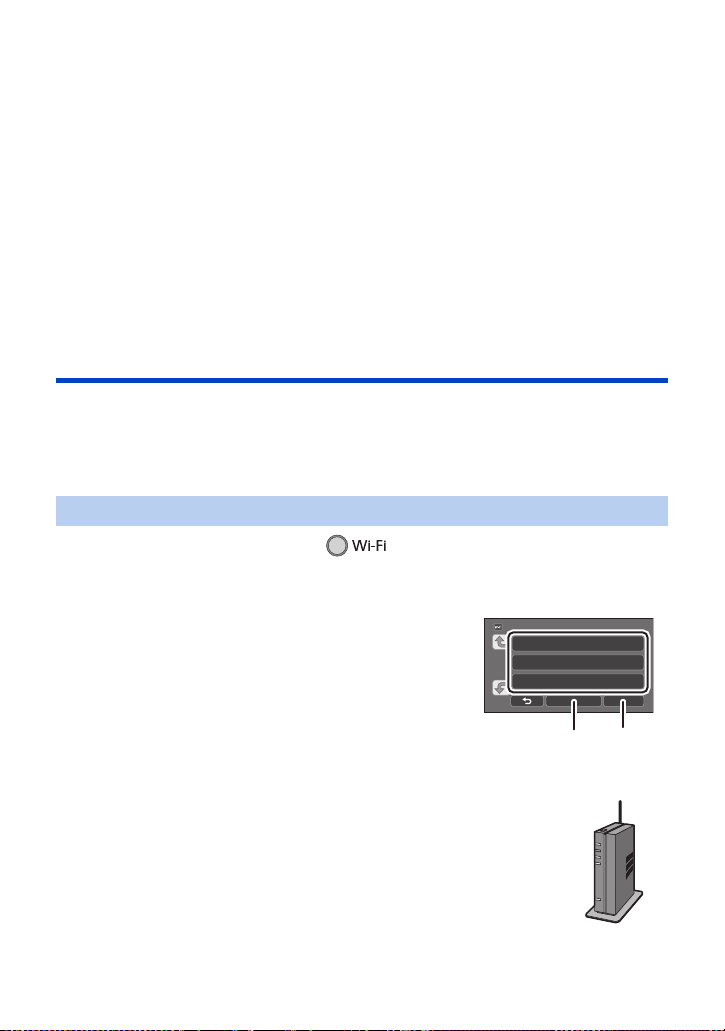
- 144 -
When [Wi-Fi] is selected
≥ If you are using an Android device, start up the smartphone application “Image App”.
1
(If the device is Android)
On the smartphone, select [Wi-Fi], and select the SSID displayed on this unit.
(If the device is iOS)
On the smartphone, select the SSID displayed on this unit from the Wi-Fi
setup menu.
2
(If the device is Android)
Enter the Password displayed on this unit.
(If the device is iOS)
After entering the Password displayed on this unit, start up the “Image App”.
3 Follow the on-screen instructions of the smartphone to set up a connection.
≥ When the settings is complete, the smartphone and this unit are connected directly, allowing you
to use remote operations. (
l 132)
Connecting to a wireless access point
Check if the wireless access point you are using is compatible with WPS
j If the wireless access point is compatible with WPS:
Proceed to the following [WPS Connection]
j If the wireless access point is not compatible with WPS:
“Searching for wireless access points to set up a connection” (
l 145)
1 Press Wi-Fi button on this unit.
2 Touch [Wi-Fi Setup].
3 Touch [Wireless Settings].
4 Touch the part with no display of a wireless
access point.
≥ For information on how to delete wireless access points or
change the search order of wireless access points, please
refer to [Wireless Settings] on page
152.
5 Touch [WPS Connection].
6 Set the wireless access point to waiting for WPS.
≥ For further details, please read the operating instructions for the
wireless access point. (When using a tethering connection, please
read the operating instructions for the smartphone.)
≥ A message is displayed when the connection is complete. Touch
[ENTER], and exit [Wireless Settings].
≥ A message is displayed when the connection attempt fails. Touch
[ENTER], and set the connection again.
[WPS Connection]
A [Delete]
B [ENTER]
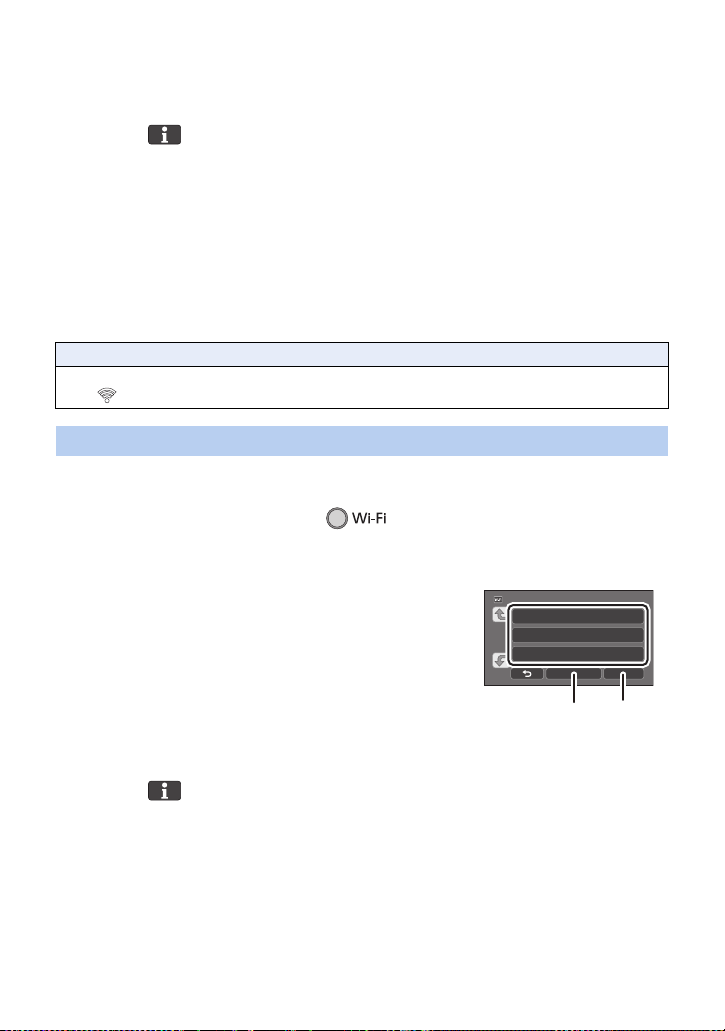
- 145 -
Enter a PIN code to set the Wi-Fi connection
1 Touch [PIN code] in Step 6.
2 Touch the wireless access point to be connected.
≥ If you touch [Refresh], you can search for wireless access points again.
≥ If you touch and select a wireless access point, all characters will be displayed. In this
case, touch [ENTER].
3 Enter the PIN code displayed on this unit screen into the wireless access
point.
≥ For further details, please read the operating instructions for the wireless access point. (When
using a tethering connection, please read the operating instructions for the smartphone.)
4 Touch [NEXT].
≥ A message is displayed when the connection is complete. Touch [ENTER], and exit [Wireless
Settings].
≥ A message is displayed when the connection attempt fails. Touch [ENTER], and set the
connection again.
≥ Confirm Encryption key (Password) of the selected wireless access point if the network
authentication is encrypted.
1 Press Wi-Fi button on this unit.
2 Touch [Wi-Fi Setup].
3 Touch [Wireless Settings].
4 Touch the part with no display of a wireless
access point.
≥ For information on how to delete wireless access points or
change the search order of wireless access points, please
refer to [Wireless Settings] on page
152.
5 Touch [Search for wireless network].
6 Touch the wireless access point to connect.
≥ If you touch [Refresh], you can search for wireless access
points again.
≥ If you touch and select a wireless access point, all characters will be displayed. In this
case, touch [ENTER].
≥ When no wireless access points are displayed, refer to “Setting up a connection manually”.
(
l 146)
≥ If an Encryption key (Password) is not set, the connection is complete and a message is
displayed. Touch [ENTER], and exit [Wireless Settings].
Confirming that the Wi-Fi connection is complete
j The status indicator of this unit is lit green
j is displayed on the screen
Searching for wireless access points to set up a connection
A [Delete]
B [ENTER]
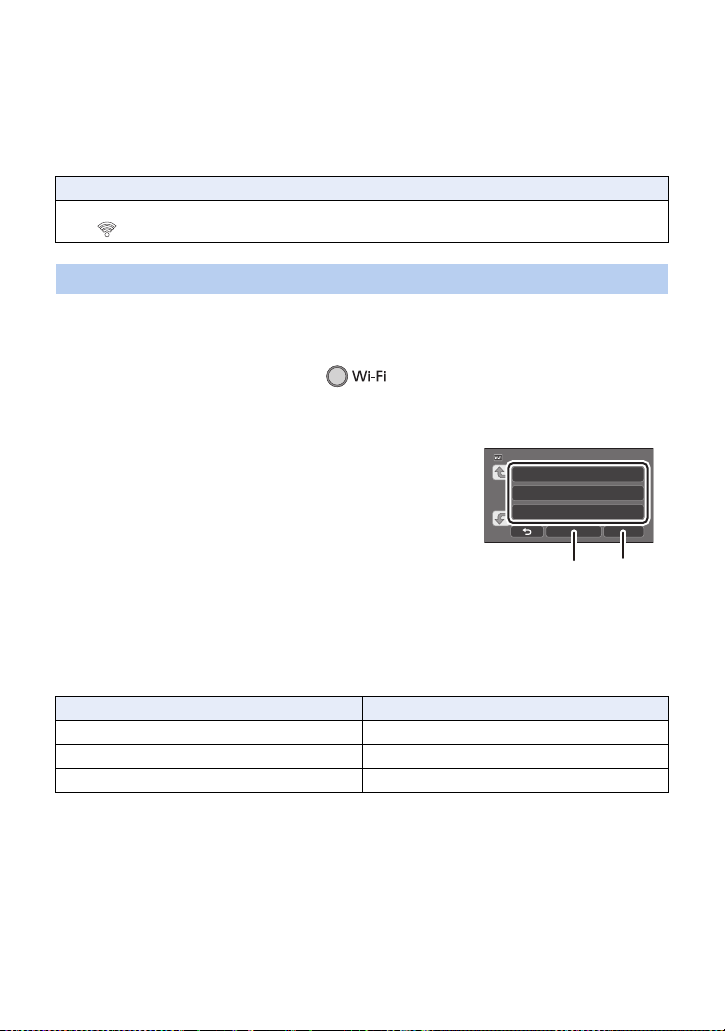
- 146 -
7 (When there is an Encryption key (Password))
Enter the Password.
≥ For details on how to enter characters, refer to page
94.
≥ When the entry is complete, touch [Enter].
≥ A message is displayed when the connection is complete. Touch [ENTER], and exit [Wireless
Settings].
≥ When connecting by [Manual Setting], confirm the SSID (Identification name), Authentication
method, Encryption type, and Encryption key (Password) of the wireless access point you are
using.
1 Press Wi-Fi button on this unit.
2 Touch [Wi-Fi Setup].
3 Touch [Wireless Settings].
4 Touch the part with no display of a wireless
access point.
≥ For information on how to delete wireless access points or
change the search order of wireless access points, please
refer to [Wireless Settings] on page
152.
5 Touch [Manual Setting].
6 Touch [INPUT], then enter the SSID of the
wireless access point to be connected.
≥ For details on how to enter characters, refer to page
94.
≥ When the entry is complete, touch [Enter].
7 Touch the desired Network Authentication method.
≥ When [WEP] is selected, proceed according to step 9.
8 Touch the desired Encryption method.
≥ If you select [NONE], a message is displayed after completing the connection. Touch [ENTER],
and exit [Wireless Settings].
Confirming that the Wi-Fi connection is complete
j The status indicator of this unit is lit green
j is displayed on the screen
Setting up a connection manually
Network authentication type Encryption types that can be set
[Open] [NONE]/[WEP]
[WEP] There is no setup of an encryption types.
[WPA-PSK]/[WPA2-PSK] [TKIP]/[AES]
A [Delete]
B [ENTER]
- 147 -
9 (When selecting [WEP]/[TKIP]/[AES])
Touch [INPUT], then enter the Password.
≥ For details on how to enter characters, refer to page
94.
≥ When the entry is complete, touch [Enter].
≥ A message is displayed when the connection is complete. Touch [ENTER], and exit [Wireless
Settings].
≥ Check the wireless access points instruction manual and settings when a saving wireless access
point.
≥ The Encryption methods are [AES], [TKIP] and [WEP] in descending order of strength. We
recommend you connect with the strongest possible Encryption method.
≥ When the signal of the wireless access point is weak, a connection may not be established. Refer
to “Messages” (
l 182) and “Troubleshooting” (l 184) for details.
≥ Transmission speed may decrease, or may not be usable depending on the environment it is
used in.
Setting up a direct connection to a smartphone
Check the [Direct Connection Password] setting in [Wi-Fi Setup]. (
l 153)
≥ The default setting is [OFF].
Select [ON] as needed, for example when the setting seems necessary for your Wi-Fi environment.
≥ When [Direct Connection Password] is set to [OFF]
j Proceed to the following “Connecting with [Direct Connection Password] set to [OFF]”
≥ When [Direct Connection Password] is set to [ON]
If your smartphone is compatible with WPS, refer to “[WPS Connection]”. If not, refer to
“Connecting with QR code”.
Enter SSID and Password or scan QR code to connect.
j Proceed to the following [WPS Connection]
j Proceed to the following “Connecting with QR code”
j Proceed to the following “Connecting by entering an SSID and Password”
1 Press Wi-Fi button on this unit and touch [Wi-Fi Setup].
2 Touch [Direct Connection].
3 On the smartphone, select the SSID displayed on this unit from the Wi-Fi
setup menu.
Confirming that the Wi-Fi connection is complete
j The status indicator of this unit is lit green
j is displayed on the screen
Connecting with [Direct Connection Password] set to [OFF]
Confirming that the Wi-Fi connection is complete
j The status indicator of this unit is lit green
j is displayed on the screen
- 148 -
1 Press Wi-Fi button on this unit and touch [Wi-Fi Setup].
2 Touch [Direct Connection].
3 Touch [Change connection type].
4 Touch [WPS Connection].
5 Set the smartphone to WPS Mode.
1 Press Wi-Fi button on this unit and touch [Wi-Fi Setup].
2 Touch [Direct Connection].
3 Touch [Change connection type].
4 Touch [QR code].
≥ QR code is displayed on the screen of this unit.
5 Start up the smartphone application “Image App”.
6 On the smartphone, select [QR code], and scan the QR code displayed on the
screen of this unit.
≥ When using an Android device, the smartphone and this unit are connected directly, allowing you
to use remote operations. (
l 132)
≥ When using an iOS device, perform the following operations:
1 Select the option that allows you to install the app on the profile screen of the “Image App”, and
follow the on-screen instructions to complete the installation.
2 Press the home button to close the displayed screen.
3 Select the network name (SSID) of this unit from the Wi-Fi setup of the smartphone.
≥ When the QR code cannot be scanned, refer to “Connecting by entering an SSID and Password”.
[WPS Connection]
Confirming that the Wi-Fi connection is complete
j The status indicator of this unit is lit green
j is displayed on the screen
Connecting with QR code
Confirming that the Wi-Fi connection is complete
j The status indicator of this unit is lit green
j is displayed on the screen
- 149 -
1 Press Wi-Fi button and touch [Wi-Fi Setup].
2 Touch [Direct Connection].
3 Select the SSID displayed on this unit from the Wi-Fi setup menu.
4 Enter the Password displayed on this unit’s screen on the smartphone.
≥ Transmission speed may decrease, or may not be usable depending on the environment it is
used in.
Connecting from the history
Each use of a Wi-Fi function is stored in the Wi-Fi connection history. Connecting from the history
allows you to easily set up a connection using the previous connection settings.
1 Press Wi-Fi button on this unit and touch [History].
2 Touch the desired item to be connected.
≥ The history of Wi-Fi functions and connection destinations that have been used is displayed as a
list.
≥ For periods when a smartphone, etc. and this unit were connected directly, only the list of Wi-Fi
functions is displayed.
Each item stores its [Direct Connection Password] setting (
l 153). Connections without a
password are displayed with [No Password] on the history list.
≥ To display the connection details, touch [DETAIL].
3 Touch [ENTER].
≥ When the connection is complete, a message will be displayed and the screen will switch to the
Wi-Fi function screen selected in step 2. Perform the operation of the selected Wi-Fi function.
≥ If you have selected [Link to Cell], start up the smartphone application “Image App” after checking
that “Under smartphone control.” is displayed on the LCD monitor.
If the connection cannot be established, check the Wi-Fi setup of the smartphone.
≥ The history can store up to 8 most-recently used Wi-Fi connections.
≥ If you set up a Wi-Fi connection from [Wireless Settings] in [Wi-Fi Setup], the Wi-Fi connection
will not be stored in the history.
Connecting by entering an SSID and Password
Confirming that the Wi-Fi connection is complete
j The status indicator of this unit is lit green
j is displayed on the screen
Confirming that the Wi-Fi connection is complete
j The status indicator of this unit is lit green
j The following icons are displayed on the screen:
When connected to wireless access point:
When directly connected:

- 150 -
If the Wi-Fi connection cannot be established
≥ Please refer to the operating instruction of the device in use for details about the setting of the
wireless access point or smartphone.
Problem Check points
It cannot connect to the
wireless access point.
The wireless access point
is not detected.
(General)
≥ Turn ON the wireless access point.
≥ Approach the wireless access point and reconnect.
≥ If it takes time to complete the connection, the Wi-Fi
connection will be aborted.
Reset the connection settings.
≥ Check how to connect to the wireless access point and how
to set the security settings.
≥ If the wireless access point supports both the 2.4 GHz band
and the 5 GHz band, check if the setting for the 2.4 GHz band
is enabled.
≥ Make sure the wireless access point is registered in this unit.
(
l 152)
≥ The device may be unable to locate the wireless access point
due to problems with the signal. Refer to “Setting up a
connection manually”. (
l 146)
([WPS Connection])
≥ Make sure the wireless access point is in the correct WPS
standby mode.
≥ Make sure the PIN code has been correctly input.
([Search for wireless network] or [Manual Setting])
≥ Make sure the SSID and password have been correctly input.
≥ Check the Authentication method, Encryption type, and
Encryption key (Password).
Radio waves of the
wireless access point get
disconnected.
≥ The condition may be improved by moving the location or
changing the angle of the wireless access point.
≥ If you use another 2.4 GHz band device such as a microwave
oven or cordless telephone nearby, you may interrupt the
signal. Keep a sufficient distance from these types of devices.

- 151 -
The Wi-Fi connection is
not possible between this
unit and a smartphone.
(Wireless Access Point Connection)
≥ Make sure the smartphone is properly connected to the
wireless access point by checking the Wi-Fi settings of the
smartphone.
≥ Make sure this unit and the smartphone are connected to the
same wireless access point.
≥ Make sure the wireless access point is registered in this unit.
(
l 152)
(Direct Connection)
≥ Make sure the smartphone is properly connected to this unit
by checking the Wi-Fi settings of the smartphone.
≥ Make sure the SSID and password have been correctly input.
≥ Make sure the smartphone is not connected to the wireless
access point. If it is connected to the wireless access point,
change the Wi-Fi access point using the smartphone’s Wi-Fi
set up.
It takes long time every
time to connect to a
smartphone.
≥ It may take longer time to connect depending on the Wi-Fi
connection setting of the smartphone, but it is not a
malfunction.
This unit is not displayed
in the Wi-Fi setting screen
of the smartphone.
≥ Try switching the ON/OFF of the Wi-Fi function in the Wi-Fi
settings of the smartphone.
The Wi-Fi connection is
disconnected immediately.
≥ If there is a setting for avoiding poor connections in the Wi-Fi
setting menu of the Android device, turn it OFF.
When this unit is
connected to a wireless
access point and “Image
App” is started up, it
cannot find this unit.
≥ Close “Image App”, and press the Wi-Fi button on this unit to
terminate the Wi-Fi connection. After that, reconnect this unit
to the wireless access point, and start up “Image App”.
Problem Check points
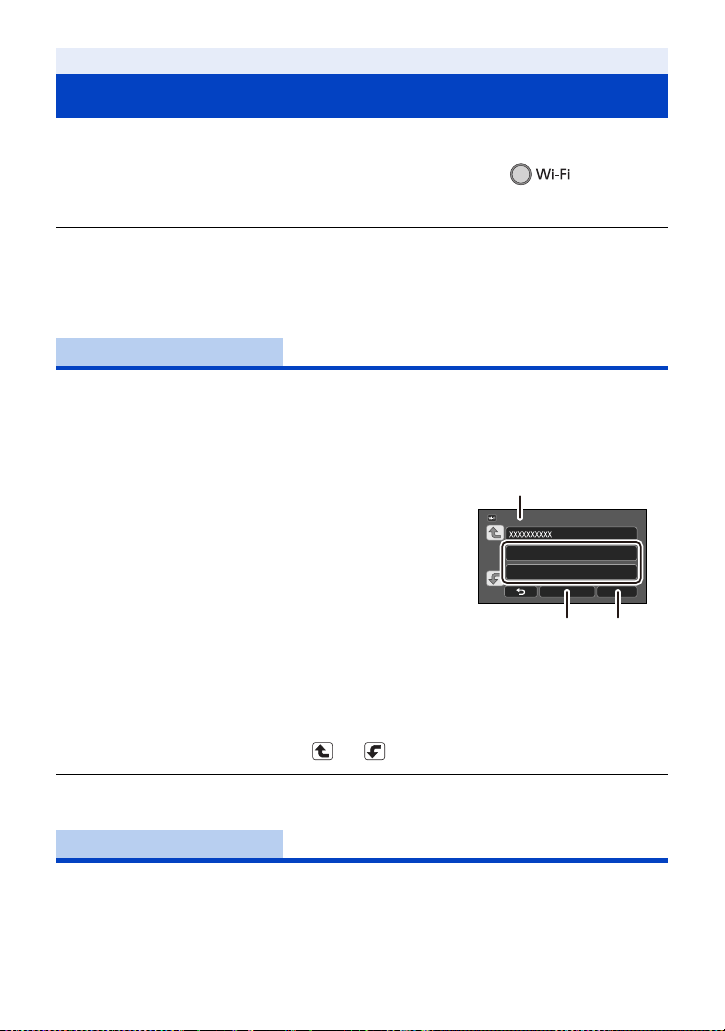
- 152 -
Configure various settings necessary to use the Wi-Fi function.
When connected to Wi-Fi, the settings cannot be changed.
1 Press Wi-Fi button on this unit and touch [Wi-Fi Setup].
2 Touch desired menu item.
≥ The following Wi-Fi functions have been terminated.
Related menus, etc., will still be displayed, but they can no longer be used.
j [Baby Monitor]
j [Home Cam]
j [Live Cast]
You can add or delete wireless access points, or rearrange the display order of wireless access
points.
≥ Up to 3 wireless access points can be set.
≥ Please refer to page
144 for details about [Wireless Settings].
To add a wireless access point
1 Touch the part where no wireless access points
are displayed.
2 Configure the wireless access point settings.
(
l 144)
To delete a wireless access point
1 Touch the wireless access point to be deleted.
2 Touch [Delete].
≥ The message is displayed. Touch [YES] to delete.
To switch the search order
1 Touch the access point you want to switch the order.
2 Switch the order by touching or .
≥ To change the wireless access point, delete one of the registered wireless access points, and
then add one.
Please refer to page
143.
Wi-Fi
How to Use the [Wi-Fi Setup] Menu
[Wireless Settings]
[Wi-Fi Setup Wizard]
A [Wireless Settings]
B [Delete]
C [ENTER]

- 153 -
Please refer to page 147.
This setting controls whether or not a password is required when you directly connect this unit and a
smartphone to start remote operations or to use the Wireless Twin Camera function.
≥ If you select [OFF], you can directly connect this unit and a smartphone without entering the
password for this unit’s SSID into the smartphone.
≥ If you select [OFF], you cannot set up a connection with [WPS Connection] or [QR code].
Set up a connection by setting this unit’s SSID on the smartphone. (
l 147)
≥ The default setting is [OFF]. If you perform [Reset Wi-Fi Settings], the default setting will be
restored. (
l 37, 154)
You can use this unit as a Wireless Sub Camera.
For the connection procedure and other details, check the website below.
https://panasonic.jp/support/global/cs/e_cam
If you set [ON], the LCD monitor turns off when remotely operating this unit with a smartphone (in
Motion Picture Recording Mode or Still Picture Recording Mode) so that power consumption is
reduced.
≥ When the LCD monitor is turned off, you can display the screen by touching it.
≥ If the Wi-Fi connection is turned off, this unit will turn off automatically approximately 15 minutes
later.
[Direct Connection]
[Direct Connection
Password]
[ON]/[OFF]
[Wireless Sub Camera]
[ECONOMY (Wi-Fi)]
[ON]/[OFF]

- 154 -
This will set/clear the Password to limit the startup of the Wi-Fi setting menu.
By setting the Password, it will prevent erroneous operation, prevent wrongful use of the Wi-Fi
function by third party, and protect the set personal information.
1 Touch [Setup].
2 Touch [INPUT], and enter the Password (6 characters).
≥ After finish entering the Password, touch [Enter].
≥ If the Password has already been set, is displayed.
≥ For details on how to enter characters, refer to page
94.
3 Touch [NEXT].
4 Touch [INPUT], and enter the same Password again.
≥ After finish entering the Password, touch [Enter].
≥ If the Passwords match with each other, a message is displayed.
5 Touch [EXIT].
≥ If you set the Wi-Fi Password, you will need to enter the Password each time you touch [Wi-Fi
Setup] on the Wi-Fi home screen.
≥ When you forget your Wi-Fi Password, perform [Reset Wi-Fi Settings] from the Setup menu. This
will set the Wi-Fi setting to the condition at the time of purchase, and you will be able to use the
Wi-Fi setting menu. (
l 37)
You can change the Wi-Fi setting back to the default condition.
≥ The password for the Wi-Fi is deleted.
≥ Information on wireless access points, smartphones, and Wireless Sub Cameras registered to
this unit is also deleted.
You can view and change this unit’s Device name (SSID), which is used for operating this unit as a
wireless access point.
1 Touch [INPUT], and enter the desired Device name (SSID).
≥ Input up to 20 characters are recommended. All the characters cannot be confirmed when
displaying the Device names on this unit if a long Device name is used. (
l 147)
≥ For details on how to enter characters, refer to page 94.
≥ Touch [Enter].
2 Touch [EXIT].
≥ If you are going to connect directly to a smartphone after changing the Device name (SSID), set
the connection again with the changed Device name (SSID). (
l 147)
≥ The Password entered during the setting of direct connection cannot be changed. (
l 147)
[Menu Password]
[Setup]/[Delete]
[Reset Wi-Fi Settings]
[Device Name]

- 155 -
You can change or check your wireless LAN’s network settings, such as the [IP Address], [Subnet
Mask] and [MAC Address].
≥ If you touch [AUTO], the network settings are configured automatically. If you touch [MANUAL],
you can set each item. Select the item you want to set, and set it.
≥ [MAC Address] cannot be changed.
You can test the connection between this unit and the wireless access point. The following
connections can be verified:
j Connection to the wireless access point
1 Touch [NEXT].
≥ The connection test starts.
2 Check the connection test result, and touch [EXIT].
≥ If the connection is successful, “±” is displayed. If the connection is not successful, “t” is
displayed.
You can change the workgroup setting.
≥ When copying scenes or still pictures to a PC using a Wi-Fi function [Copy], you need to create a
shared folder on the PC and connect this unit to the workgroup to which the PC belongs. (The
default setting is [WORKGROUP].)
≥ For information on how to create a shared folder, refer to page
138.
≥ For details on how to enter characters, refer to page 94.
≥ A maximum of 15 characters can be entered.
[IP Address/DNS
Settings]
[IP Address]/[Subnet Mask]/[Gateway]/[Primary DNS]/[Secondary DNS]/[MAC Address]
[Connection Test]
[PC Connect Setup]
[Change]/[Return to default]
[Change]: Enter the name of the workgroup to which the destination PC belongs.
[Return to default]: This will set to the condition at the time of purchase.
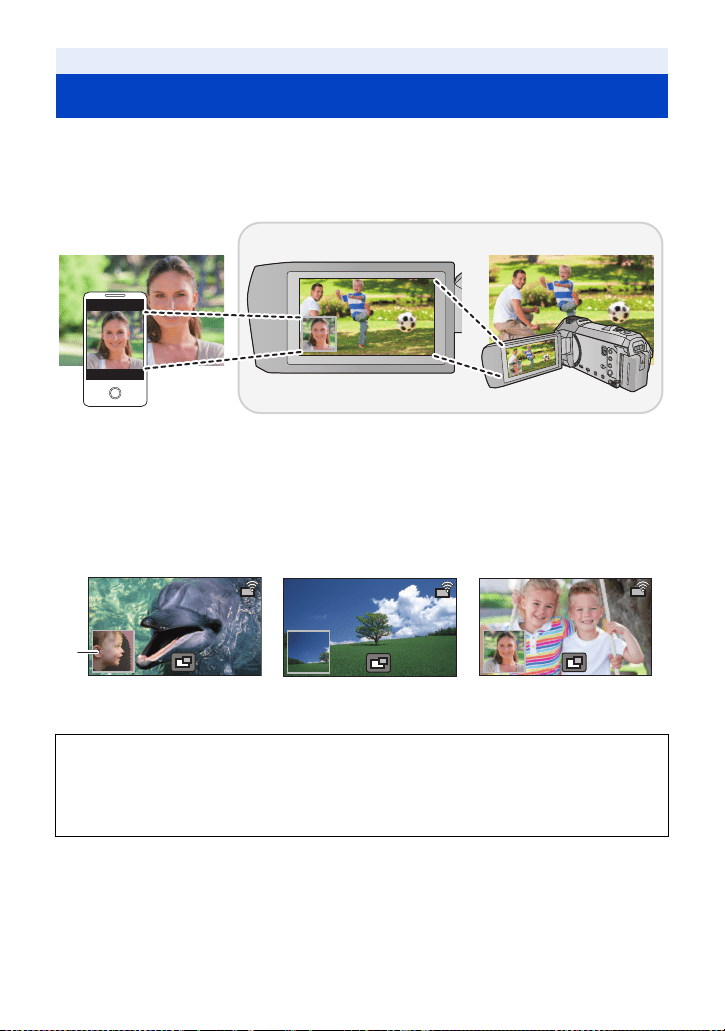
- 156 -
When this unit and a smartphone are connected via Wi-Fi, you can display the image transmitted
from the smartphone on this unit’s Sub Window and record it simultaneously with the Main
Camera’s image. (Wireless Twin Camera)
∫ Wireless Twin Camera
Use your Wireless Sub Camera to enjoy recording your own face or any scenery different from what
is being recorded with the Main Camera.
C Sub Window
≥ The image transmitted from the Wireless Sub Camera is displayed on the Sub Window.
Wireless Twin Camera
Wireless Twin Camera function
Recording different
subjects in one motion
picture
Recording the same subject
from different angles
Recording a view seen
from the subject
This owner’s manual describe the procedure for connecting this unit and a smartphone.
For information on non-smartphone devices that support the Wireless Sub Camera
function and the procedures for using them, check the support website below. (As of
January 2022)
https://panasonic.jp/support/global/cs/e_cam
1080/30p
A Smartphone (Wireless Sub Camera)
B This unit (Main Camera)

- 157 -
Notes on the Wireless Twin Camera function
The performance of the Wireless Twin Camera function varies depending on the surrounding radio
wave conditions. Since the human body blocks radio waves, it is also influenced by how crowded
the area is.
∫ Recording tips
≥ Use your Wireless Sub Camera in a position where as much of it as possible can be seen from
the position of this unit.
≥ When the signal between this unit and the Wireless Sub Camera weakens, a warning icon
appears. In such a case, close the distance between them.
≥ We recommend that you attach a tripod to this unit when recording.
∫ When using a smartphone as a Wireless Sub Camera
≥ The Wireless Twin Camera function commands the smartphone to process images and transmit
Wi-Fi signals.
≥ Image processing performance, Wi-Fi signal transmission performance, and the antenna location
vary depending on the smartphone.
≥ The Sub Window’s image, which is transmitted from the smartphone, is displayed with a slight
delay compared to the Main camera’s image.
≥ Depending on the device and environment, movement in the image transmitted from the
smartphone may not look smooth or may look as if frames were missed. This is particularly the
case with vertical orientation, which increases the smartphone’s processing burden.
≥ For information on the setup of your smartphone, refer to its operating instructions.
≥ Please also refer to “If the Wi-Fi connection cannot be established”. (
l 150)
Keep the following points in mind when using a smartphone as a Wireless Twin Camera:
≥ We recommend that you use an Android device with a Quad Core or higher CPU or the latest
iOS device.
≥ We recommend that you look at the image transmitted from your smartphone in advance to
check the optimal recording distance for the smartphone, the easiest way to hold it, and other
recording conditions.
≥ We recommend that you turn off the smartphone’s GPS and Bluetooth functions, which may
affect the Wireless Sub Camera’s image.
≥ We recommend that you close as many other applications as possible.
≥ Recording consumes a large amount of battery power. When recording for a long period of
time, pay attention to the remaining battery power.
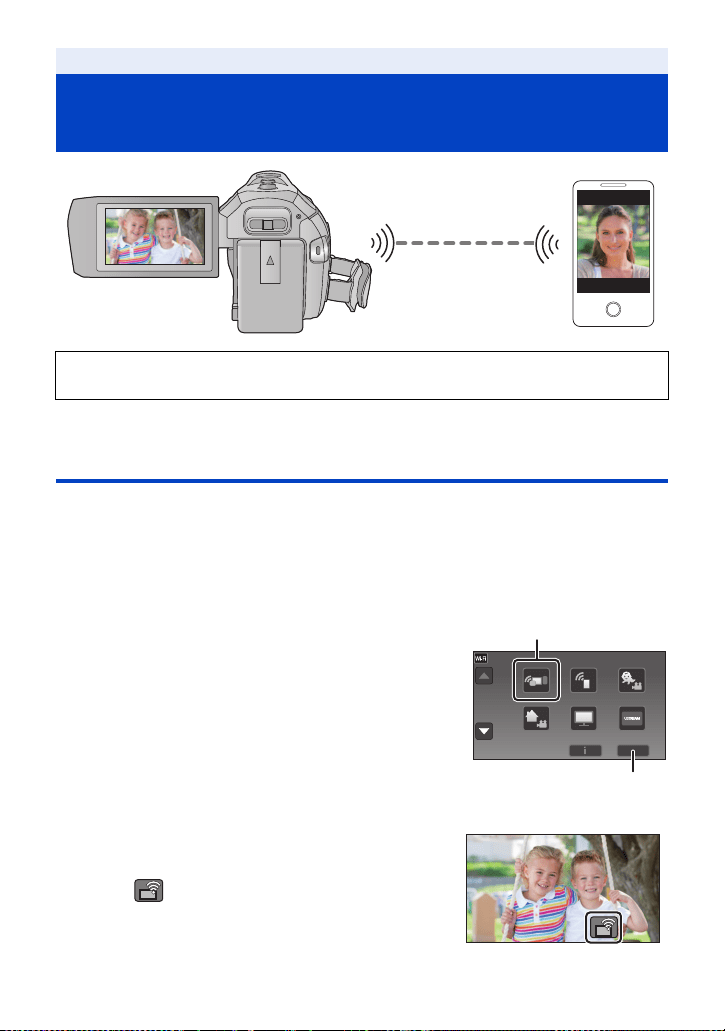
- 158 -
When connecting a smartphone to this unit as a
Wireless Sub Camera for the first time
≥ The QR code is not displayed when [Direct Connection Password] (
l 153) is set to [OFF].
Refer to “Selecting this unit’s SSID and entering a password on the smartphone to set up a
connection”
≥ The default setting for [Direct Connection Password] is [OFF].
∫ Selecting this unit’s SSID and entering a password on the
smartphone to set up a connection
1 (When using the Wi-Fi Setup menu)
Press Wi-Fi button on this unit and touch [TWIN
CAMERA].
(When using the recording screen)
Touch the recording screen on this unit and
touch .
Wireless Twin Camera
Using a Smartphone as a Wireless Sub
Camera
≥ You need to turn on the Wi-Fi function of your smartphone.
≥ Install the smartphone application “Image App” on your smartphone. (
l 141)
1080/30p
1/2
A [TWIN CAMERA]
B [EXIT]

- 159 -
2 Touch [Smartphone] on the screen of this
unit.
3 (When [Direct Connection Password] is set to [OFF])
On the smartphone, set the SSID displayed
on the screen of this unit.
≥ When using an Android device, perform the following
operations:
1 Start up the smartphone application “Image App”.
2 On the smartphone, select [Wi-Fi], and select the SSID displayed on this unit.
*
≥ When using an iOS device, perform the following operations:
1 On the smartphone, select the SSID displayed on this unit from the Wi-Fi setup menu.
2 Start up the smartphone application “Image App”.
*
* If this is the first time the smartphone is connecting to this unit, a message will be displayed on
the screen of this unit. Touch [YES].
≥ When the connection is complete, the image being captured by the smartphone will be displayed
on the Sub Window of this unit.
(When [Direct Connection Password] is set to [ON])
Touch [Wi-Fi] on the screen of this unit, and on the smartphone, set the SSID
displayed on the screen of this unit.
≥ When using an Android device, perform the following operations:
1 Start up the smartphone application “Image App”.
2 On the smartphone, select [Wi-Fi], and select the SSID displayed on this unit.
3 Enter the Password displayed on this unit.
≥ When using an iOS device, perform the following operations:
1 On the smartphone, select the SSID displayed on this unit from the Wi-Fi setup menu.
2 Enter the Password displayed on this unit.
3 Start up the smartphone application “Image App”.
≥ When the connection is complete, the image being captured by the smartphone will be displayed
on the Sub Window of this unit.
A [Wireless Twin Camera]
B [Smartphone]
C [Other Camera]
D [CANCEL]
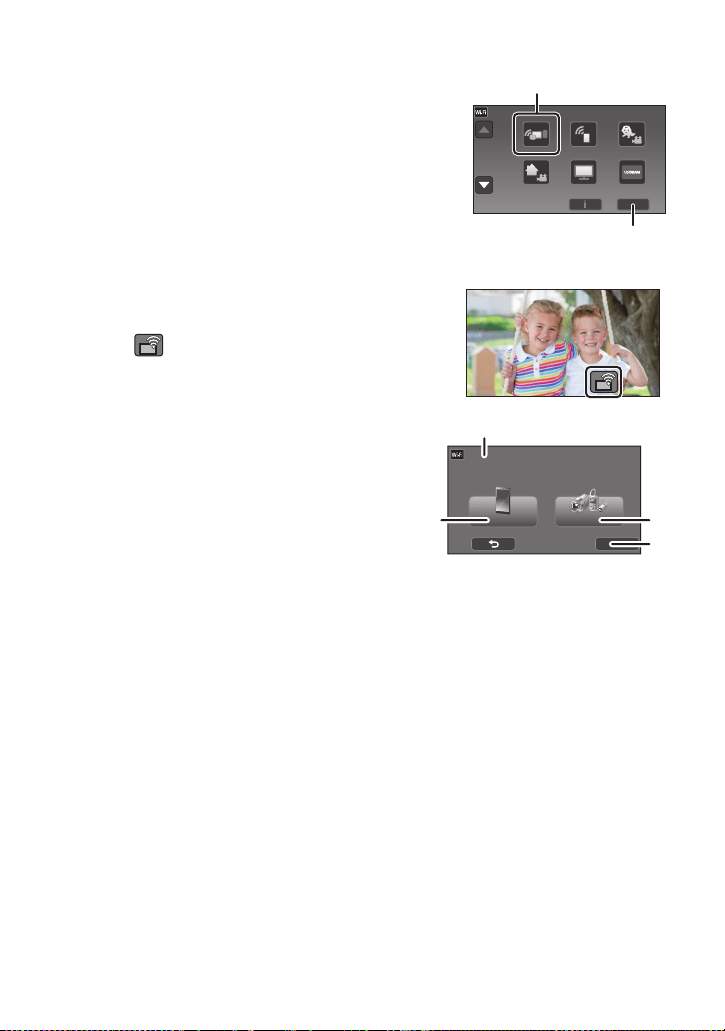
- 160 -
∫ Scanning a QR code to set up a connection
1 (When using the Wi-Fi Setup menu)
Press Wi-Fi button on this unit and touch [TWIN
CAMERA].
(When using the recording screen)
Touch the recording screen on this unit and
touch .
2 Touch [Smartphone] on the screen of this
unit.
3 Touch [QR code] on the screen of this unit.
4 Start up the smartphone application
“Image App”.
5 On the smartphone, select [QR code] to scan the QR code displayed on the
screen of this unit.
≥ When using an iOS device, perform the following operations:
1 Select the option that allows you to install the app on the profile screen of the “Image App”, and
follow the on-screen instructions to complete the installation.
2 Press the home button to close the displayed screen.
3 Touch [NEXT] on the screen of this unit to display its SSID.
4 After selecting the network name (SSID) of this unit from the Wi-Fi setup of the smartphone,
start up “Image App”.
≥ When the connection is complete, the image being captured by the smartphone will be displayed
on the Sub Window of this unit.
≥ If the QR code cannot be scanned, refer to “Selecting this unit’s SSID and entering a password
on the smartphone to set up a connection”. (
l 158)
1/2
A [TWIN CAMERA]
B [EXIT]
A [Wireless Twin Camera]
B [Smartphone]
C [Other Camera]
D [CANCEL]
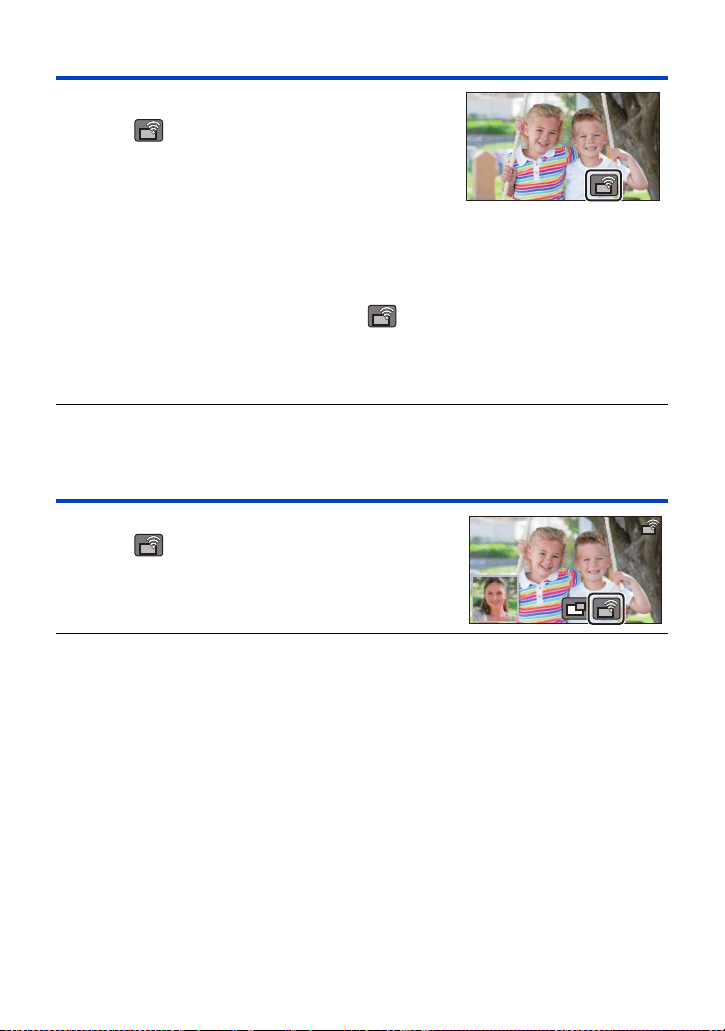
- 161 -
When connecting for the second time or later
1 Touch the recording screen on this unit and
touch .
2 Start up the smartphone application “Image
App”.
≥ This unit and the smartphone will be connected via Wi-Fi.
When the connection is complete, the image being captured by the smartphone will be displayed
on the Sub Window of this unit.
≥ If the connection cannot be established or no image appears on the Sub Window, follow the steps
below to set up the connection again:
1 Close the smartphone application “Image App”.
2 Touch the screen of this unit again and touch .
3 Touch [Change Device] on the screen of this unit.
After completing the steps above, follow the procedure from Step 2 onwards in “When connecting a
smartphone to this unit as a Wireless Sub Camera for the first time”.
≥ [History] allows you to set up a Wi-Fi connection with the Wi-Fi function settings you have used
before. (
l 149)
Terminating the connection
1 Touch the recording screen on this unit and
touch .
2 Touch [EXIT] on the screen of this unit.
≥ The Wi-Fi connection will be terminated.
≥ Close the “Image App” on the smartphone.
≥ You can also terminate the connection by pressing the Wi-Fi button on this unit.
If you press the Wi-Fi button during recording pause, a message will be displayed. To terminate
the connection, touch [YES].
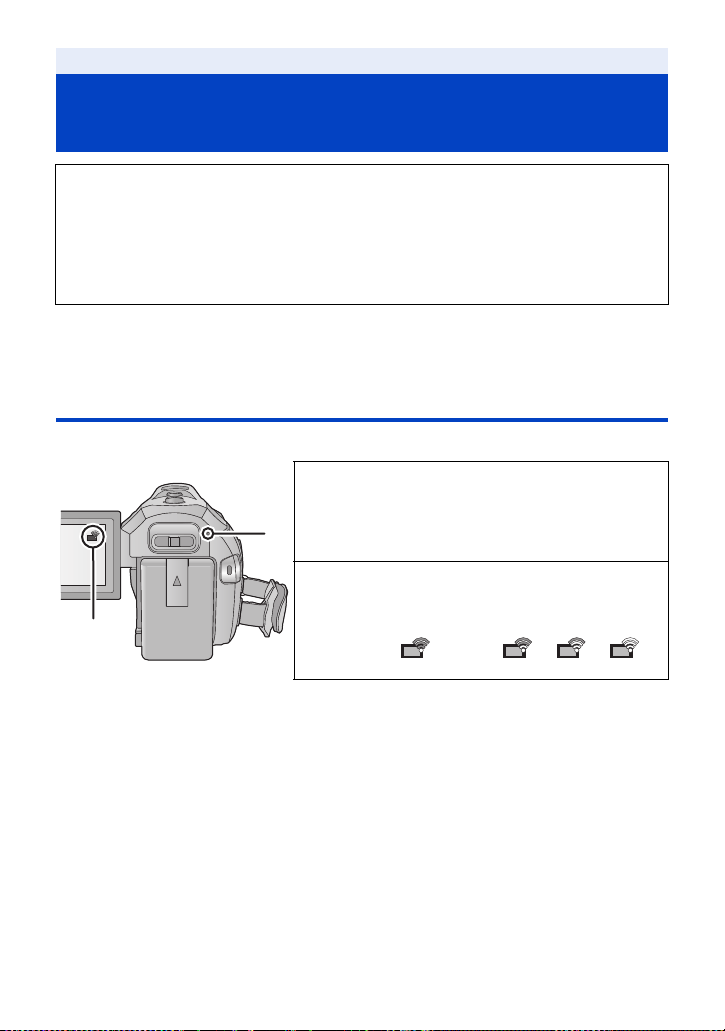
- 162 -
1 Connect a smartphone to this unit as a Wireless Sub Camera. (l 158)
2 Start recording.
Screen display when using a Wireless Sub Camera
∫ Connection status icons for a Wireless Sub Camera
Wireless Twin Camera
Recording with a Wireless Sub Camera
(Wireless Twin Camera)
≥ An image recorded with the Main Camera and the Wireless Sub Camera’s image
displayed on the Sub Window are recorded as a single scene or still picture. When you
play back such a scene or still picture, it is not possible to delete only the Sub Window
image or hide it.
≥ If you set [Backup for Twin Camera] to [ON], when recording images with the Wireless
Twin Camera function, you can also record the Main Camera’s image without the Sub
Window image as a separate scene. (
l 43)
A Lit green
≥ The status indicator is lit green when the Wireless Twin
Camera function is activated.
≥ When Wi-Fi is disconnected, the status indicator is lit
red again.
B Connection status icon for a Wireless Sub
Camera
When a Wireless Sub Camera is connected :
The display will change as follows according to the radio
wave intensity: (Weak) # # #
(Strong).
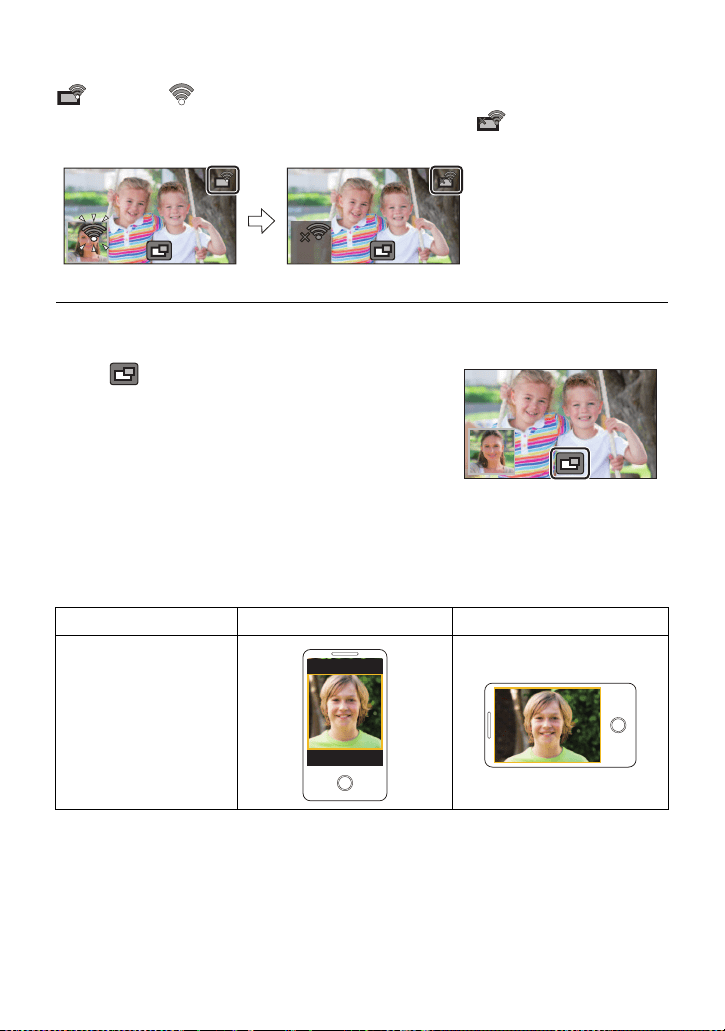
- 163 -
When the Wi-Fi signal weakens
If the signal weakens when the Sub Window is displayed, the connection status icon changes to
(Weak) and flashes on the Sub Window.
If the signal weakens further, the connection status icon changes to and the Sub Window
image disappears. (You cannot operate the Sub Window.)
≥ You can operate the Sub Window again when the signal becomes stronger.
≥ Your Wi-Fi connection may be terminated depending on the smartphone.
∫ Displaying or hiding the Sub Window
Touch .
≥ Each time you touch the icon, you can display or hide the
Sub Window.
≥ When the Sub Window is hidden, the image of the
smartphone will not be recorded.
∫ Sub Window size when using a Wireless Twin Camera
The size of the image displayed on the Sub Window varies depending on the smartphone camera
and the orientation of the smartphone.
Example: Sub Window display when the Main Camera’s aspect ratio is set to 16:9
(The yellow frames correspond to the size of the image be displayed on the Sub Window.)
* Depending on the smartphone, it may not be possible to use horizontal orientation.
Smartphone orientation Vertical Horizontal
*
Sub Window display
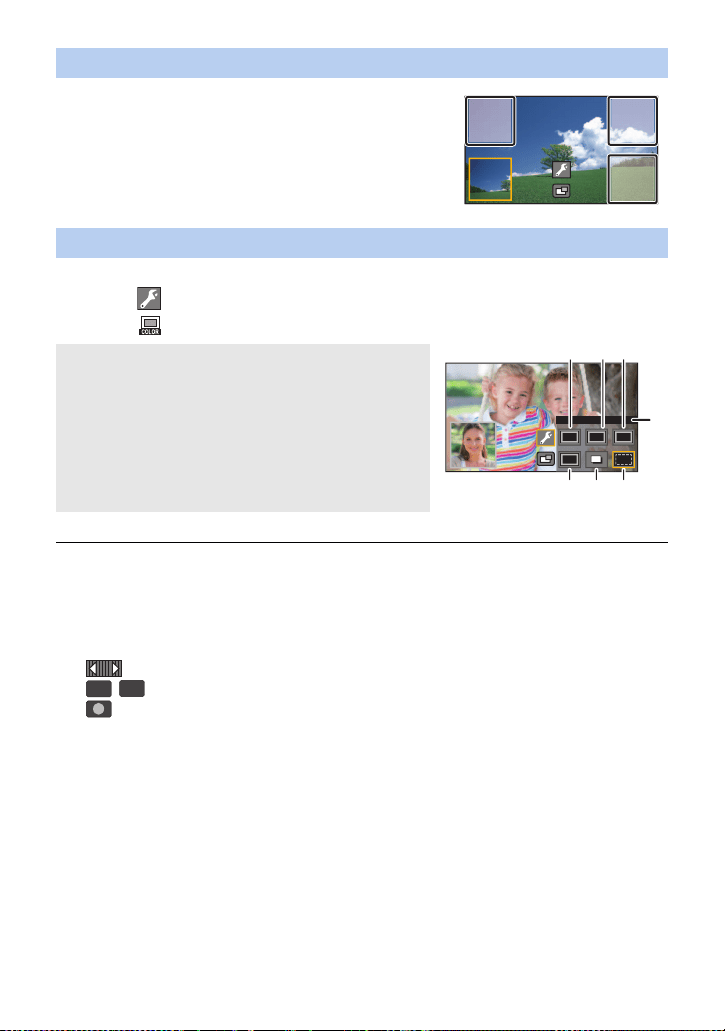
- 164 -
1 Touch Sub Window.
2 Touch the display position you want to change.
≥ Depending on the display position of the Sub Window, the
positions of the icons displayed on the screen may change.
1 Touch Sub Window.
2 Touch .
3 Touch , and select the desired frame.
≥ It takes some time until the Sub Window appears.
≥ You cannot set this unit to Playback Mode when it is connected to a Wireless Sub Camera.
≥ Simultaneous recording of still pictures is not possible while recording a motion picture or using
PRE-REC with the Wireless Twin Camera function.
≥ The following button icons may not be displayed when the Sub Window is displayed. To display
them, touch the Main Camera’s image on the screen.
j (Touch Menu)
j / (Zoom button icons)
j (Recording button icon)
j Recording Mode button icon (
l 45)
≥ The following functions do not work:
j Creative Control
j HDR Movie Mode
j FULL HD Slow Motion Video Mode
j Stop Motion Animation Assist Mode
j Setup menu items
j Switching to a Wi-Fi function other than Wireless Twin Camera
Changing the display position of the Sub Window
Changing the color of the Sub Window frame
1 : Pink
2 : Green
3 : Orange
4 : Gray
5 : Drop shadow
*
6 : No frame
* This adds a drop shadow on the right and bottom sides.
A [FRAMING]
T
W

- 165 -
≥ The following functions do not work when the Sub Window is displayed:
j Touch Shutter
j [FACE FRAMING]
j AF/AE tracking
j Optical Image Stabilizer Lock
j AF assist lamp
≥ You cannot change the following settings:
j Sub Window settings (WB/Brightness/Focus)
≥ Depending on recording conditions, the color balance, brightness and other settings may differ
between the Main Camera and the Wireless Sub Camera.
≥ Recording menu items, operation icons, and functions such as Image Stabilizer, Level Shot
Function and [QUICK POWER ON] work only for the Main Camera.
≥ When you record still pictures by using the Wireless Twin Camera function, it may take longer
than usual to achieve focus. (
l 25)
≥ The Fade function’s image effects do not affect the Sub Window.
≥ When no image is transmitted to the Sub Window continuously for approximately 4 minutes or
longer, the Wi-Fi connection will be terminated.
≥ When the “Image App” screen disappears, image transmission to the Sub Window stops. (The
Wi-Fi connection stays connected.) This may occur when, for example, the smartphone receives
a call or you press the home button.
If you start up “Image App” on the smartphone again, image transmission to the Main Camera will
restart and the Sub Window will be displayed automatically.
≥ You cannot record Wireless Twin Camera images on the smartphone.

- 166 -
≥ For information on the setup of your smartphone, refer to its operating instructions.
≥ Please also refer to “If the Wi-Fi connection cannot be established”. (l 150)
Wireless Twin Camera
If the Wi-Fi connection cannot be
established (Wireless Twin Camera)
Problem Check points
Cannot connect this unit
to the smartphone.
No image on the Sub
Window.
≥ Make sure the smartphone is properly connected to this unit
by checking the Wi-Fi settings of the smartphone.
≥ If the smartphone is connected to a wireless access point or
another video camera that supports the Wireless Twin
Camera function, select the SSID of this unit from the
smartphone’s Wi-Fi setup menu, and restart the “Image App”.
≥ If you are unsure about the SSID of this unit, connecting to a
smartphone different from the previously connected
smartphone or changed the [Direct Connection Password]
setting after connecting to a smartphone, follow the steps
below to set up the connection again:
1 Close the “Image App” on the smartphone.
2 Press Wi-Fi button on this unit and touch [TWIN CAMERA].
3 Follow the procedure from Step 2 onwards in “When
connecting a smartphone to this unit as a Wireless Sub
Camera for the first time”. (
l 159, 160)
The Sub Window image is
interrupted.
The Sub Window image
disappears.
≥ The Sub Window image is interrupted when the Wi-Fi signal
weakens. If the signal weakens further, the Sub Window
image disappears automatically.
≥ Depending on the orientation of this unit and the smartphone
and the distance between them, the image may be
interrupted.
If the image reception is poor, close the distance and check
the connection status icon (
l 162) at the same time. You can
also point the Wi-Fi transmitter (
l 10) at the smartphone.
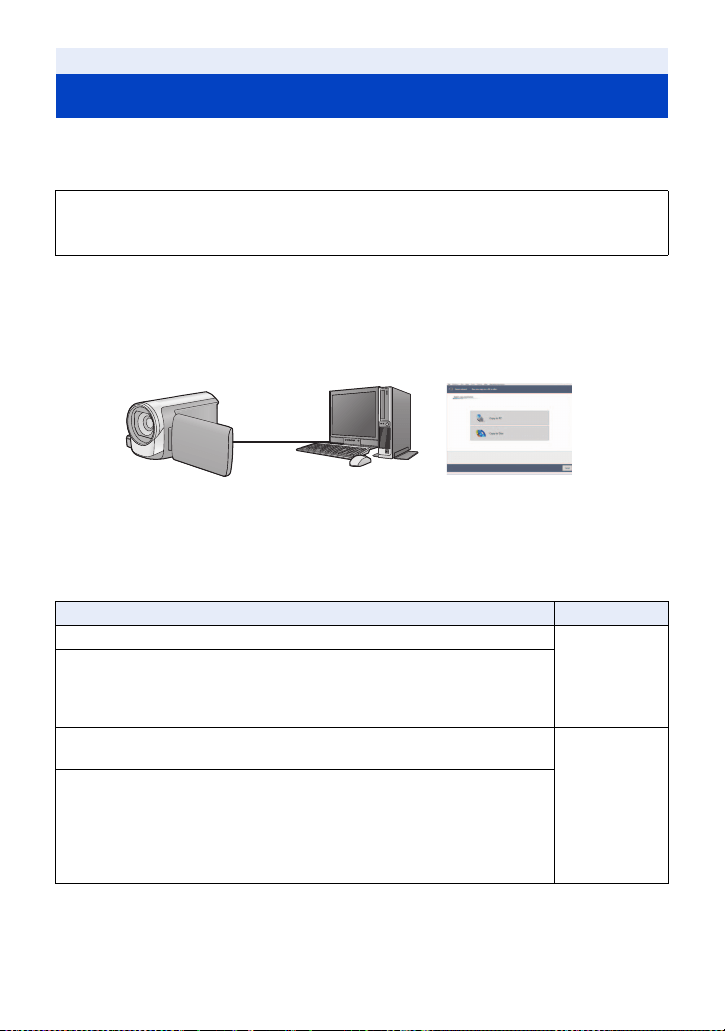
- 167 -
HD Writer AE 5.2
You can copy the motion/still picture data to the HDD of PCs or write to media like Blu-ray discs,
DVD discs or SD cards using HD Writer AE 5.2.
≥ Refer to the operating instructions of HD Writer AE 5.2 (PDF file) for details on how to use it.
(
l 177)
∫ Smart Wizard
The Smart Wizard Screen is automatically displayed when you connect this unit to a PC with
HD Writer AE 5.2 installed. (
l 174)
Copy to PC:
You can copy motion/still picture data to the HDD of PCs.
Copy to disc:
You can copy to disc in high-definition picture quality or conventional standard picture quality
(MPEG2 format).
≥ Select the function you wish to use and follow the on-screen instructions for easy copying.
With a PC
What you can do with a PC
Check the website below to download/install the software.
≥ The software is available for download until the end of March 2026.
https://panasonic.jp/support/global/cs/soft/download/f_ae52.html
What can be done with the HD Writer AE 5.2 Data type
Copying data to a PC
Motion picture
and still picture
Copying in Blu-ray disc/AVCHD format:
≥ The scenes recorded in 1080/60p can be copied as 1080/60p.
(
l 168: Important Notice)
≥ MP4/iFrame scenes cannot be copied in Blu-ray disc or in AVCHD format.
Copying in DVD-Video format:
≥ Converted to conventional standard quality (MPEG2 format).
Motion picture
Editing:
Editing motion picture data copied on an HDD of a PC
≥ Dividing, Trimming, Still picture, Title, Effect, Transition, BGM, Delete
partially
≥ Converting the motion picture data to MPEG2
≥ Converting part of motion picture into still picture

- 168 -
≥ It is possible to play back still pictures on a PC using a image viewer standard to Windows or
commercially available image browsing software, and copy still pictures to a PC using Windows
Explorer.
≥ Please refer to page
178 for details about using a Mac.
≥ It is impossible to write data to this unit from a PC.
≥ Motion pictures that have been recorded on another device cannot be written to the
software supplied with this unit.
≥ When motion picture data is written to and read from the SD card, correct operation of the unit
cannot be guaranteed if software other than HD Writer AE 5.2 is used.
≥ Do not start HD Writer AE 5.2 and other software at the same time.
What can be done with the HD Writer AE 5.2 Data type
Online sharing:
You can upload motion pictures on the Internet and share them with your
family and friends.
Motion picture
Playing back on a PC:
Play back the motion picture data in high-definition picture quality on a PC.
Motion picture
and still picture
Formatting discs:
Depending on the type of disc that you use, formatting is necessary.
Motion picture
Important Notice
≥ Do not insert a disc recorded in AVCHD format with HD Writer AE 5.2 in a device that
does not support the AVCHD format. In some cases the disc may get stuck in the
device.
≥ To play back a Blu-ray disc to which you have copied scenes recorded in 1080/60p,
equipment is required that supports AVCHD Progressive.
≥ When inserting a disc containing recorded motion pictures into other devices, a
message prompting you to format the disc may be displayed. Do not format the disc,
since deleted data cannot be restored later.

- 169 -
Before Installing HD Writer AE 5.2
Your installation or use of the Software defined below shall be conclusively deemed to constitute
your acceptance of the terms of this Agreement. If you do not accept the terms of this Agreement,
do not install, nor use the Software.
End User License Agreement
You (“Licensee”) are granted a license for the
Software defined in this End User License
Agreement (“Agreement”) on condition that you
agree to the terms and conditions of this
Agreement.
The following terms contain material
representations regarding the disclaimers of
Panasonic Corporation. Be sure to read
through, understand and confirm the following
terms.
Article 1 License
Licensee is granted the right to use the
Software (the “Software” means the software
and other information such as manuals
downloaded by Licensee through Panasonic
website), but all applicable rights to patents,
copyrights, trademarks and trade secrets in the
Software are not transferred to Licensee.
Article 2 Use by a Third Party
Licensee may not use, copy, modify, transfer,
rent, lease, lend or allow any third party,
whether free of charge or not, to use, copy or
modify the Software, except as expressly
provided for in this Agreement.
Article 3 Restrictions on Copying the Software
Licensee may make a single copy of the
Software in whole or a part solely for back-up
purpose.
Article 4 Computer
Licensee may use the Software only on one
computer, and may not use it on more than one
computer. Further, Licensee may not use the
Software for commercial software hosting
services.
Article 5 Reverse Engineering, Decompiling or
Disassembly
Licensee may not reverse engineer, decompile,
or disassemble the Software, except to the
extent either of them is permitted under law or
regulation of the country where Licensee
resides. Panasonic, or its distributors will not be
responsible for any defects in the Software or
damage to Licensee caused by Licensee’s
reverse engineering, decompiling, or
disassembly of the Software.
Article 6 Indemnification
The Software is provided “AS-IS” without
warranty of any kind, either expressed or
implied, including, but not limited to, warranties
of non-infringement, merchantability and/or
fitness for a particular purpose. Further,
Panasonic does not warrant that the operation
of the Software will be uninterrupted or error
free. Panasonic or any of its distributors will not
be liable for any damage suffered by Licensee
arising from or in connection with Licensee’s
use of the Software.
Article 7 Export Control
Licensee agrees not to export or re-export to
any country the Software in any form without
the appropriate export licenses under
regulations of the country where Licensee
resides, if necessary.
Article 8 Termination of License
The right granted to Licensee hereunder will be
automatically terminated if Licensee
contravenes any of the terms and conditions of
this Agreement. In this event, Licensee must
destroy the Software and related
documentation together with all the copies
thereof at Licensee’s own expense.

- 170 -
Article 9 With regard to MICROSOFT SQL
SERVER COMPACT 3.5 produced by Microsoft
Corporation
(1) Licensee shall use the MICROSOFT SQL
SERVER COMPACT 3.5 only when included in
the Software, and shall not use the
MICROSOFT SQL SERVER COMPACT 3.5 in
any other configuration or method. Licensee
shall not publish the MICROSOFT SQL
SERVER COMPACT 3.5 or work around any
technical limitations in the MICROSOFT SQL
SERVER COMPACT 3.5.
(2) Licensee shall not use, copy, distribute,
regrant for use or otherwise handle the
Software in any way beyond the range of use
granted under Article 9 (1), and shall not
conduct operations such as reverse
engineering, decompilation, disassembling, etc.
of the MICROSOFT SQL SERVER COMPACT
3.5.
(3) All rights, including copyright, patent rights
etc. relating to the MICROSOFT SQL SERVER
COMPACT 3.5 shall belong to Microsoft
Corporation. Licensee shall not claim any rights
related to the MICROSOFT SQL SERVER
COMPACT 3.5 whatsoever.

- 171 -
≥ Even if the system requirements mentioned in this owner’s manual are fulfilled, some PCs cannot
be used.
≥ A compatible Blu-ray disc/DVD writer drive and media are necessary for writing to a Blu-ray disc/
DVD.
≥ Operation is not guaranteed in the following cases.
j When 2 or more USB devices are connected to a PC, or when devices are connected through
USB hubs or by using extension cables.
∫ Operating environment for HD Writer AE 5.2
With a PC
Operating environment
OS Windows 10 (32 bit/64 bit)
Windows 8.1 (32 bit/64 bit)
CPU Intel Pentium 4 2.8 GHz or higher (including compatible CPU)
≥ Intel Core 2 Duo 2.16 GHz or higher or AMD Athlon 64 X2 Dual-Core
5200+ or higher is recommended when using playback function.
≥ Intel Core 2 Quad 2.6 GHz or higher is recommended when using
editing function.
≥ Intel Core i7 2.8 GHz or higher is recommended when using playback or
editing function for 1080/60p.
RAM 2 GB or more (64 bit)/1 GB or more (32 bit)
Display High Color (16 bit) or more (32 bit or more recommended)
Desktop resolution of 1024k768 pixels or more (1920k1080 pixels or
more recommended)
Graphics card complying with DirectX 9.0c (DirectX 10 recommended) and
DirectDraw overlay
PCI Express™k16 compatible recommended
Video memory of 256 MB or more recommended
Free hard disk drive
space
Ultra DMA — 100 or higher
450 MB or more (for installing the software)
≥ If the compression setting is enabled, errors will occur during recording.
Clear the check box for [Compress this drive to save disk space] in
[Properties] for the hard disk drive.
Sound DirectSound Support
Interface USB port
Other requirements Mouse or equivalent pointing device
Internet connection

- 172 -
≥ HD Writer AE 5.2 is only for Windows.
≥ Input is not supported in languages other than English, German, French, Simplified Chinese and
Russian.
≥ Operation cannot be guaranteed on all Blu-ray disc/DVD drives.
≥ Operation is not guaranteed on Windows 8.1 Enterprise, Windows 10 Enterprise or Windows RT.
≥ For Windows 8.1/Windows 10, this software is available only as a desktop application.
≥ This software is not compatible with a multi-boot environment.
≥ This software is not compatible with a multi-monitor environment.
≥ If using Windows 8.1/Windows 10, administrative account and standard account users only can
use this software. (An administrative account user should install and uninstall this software.)
∫ To use the HD Writer AE 5.2
You will need a high performance PC depending on the functions to be used. It may not properly
play back or properly operate depending on the environment of the PC used. Refer to the operating
environment and notes.
≥ Operation during the playback may become slow if the CPU or memory is not fulfilling the
requirements of the operating environment.
≥ Always use the most current driver for the video card.
≥ Always make sure there is enough capacity on the HDD in the PC. It may become inoperable or
the operation may stop suddenly if the capacity gets low.
∫ Operating environment for the card reader function (mass storage)
≥ The USB equipment operates with the driver installed as standard in the OS.
OS Windows 10 (32 bit/64 bit)
Windows 8.1 (32 bit/64 bit)
CPU 1 GHz or higher
32-bit (k86) or 64-bit (k64) processor (including compatible CPU)
RAM 2 GB or more (64 bit)/1 GB or more (32 bit)
Interface USB port
Other requirements Mouse or equivalent pointing device
- 173 -
When installing the software, log on to your computer as the Administrator or with a user name with
equivalent authorization. (If you do not have authorization to do this, consult your manager.)
≥ Before starting the installation, close all applications that are running.
≥ Do not perform any other operations on your PC while the software is being installed.
≥ Explanation of operations is based on Windows 10.
∫ Installing HD Writer AE 5.2
∫ Uninstalling HD Writer AE 5.2
Follow the steps below to uninstall any software applications that you no longer require.
1 Select [ ] # [ (Settings)] # [Apps] # [Apps & features].
2 Select [HD Writer AE 5.2], then click [Uninstall].
≥ Proceed with the uninstallation by following the on-screen instructions.
≥ After uninstalling the software, be sure to reboot the PC.
With a PC
Installation
Check the website below to download/install the software.
≥ The software is available for download until the end of March 2026.
https://panasonic.jp/support/global/cs/soft/download/f_ae52.html
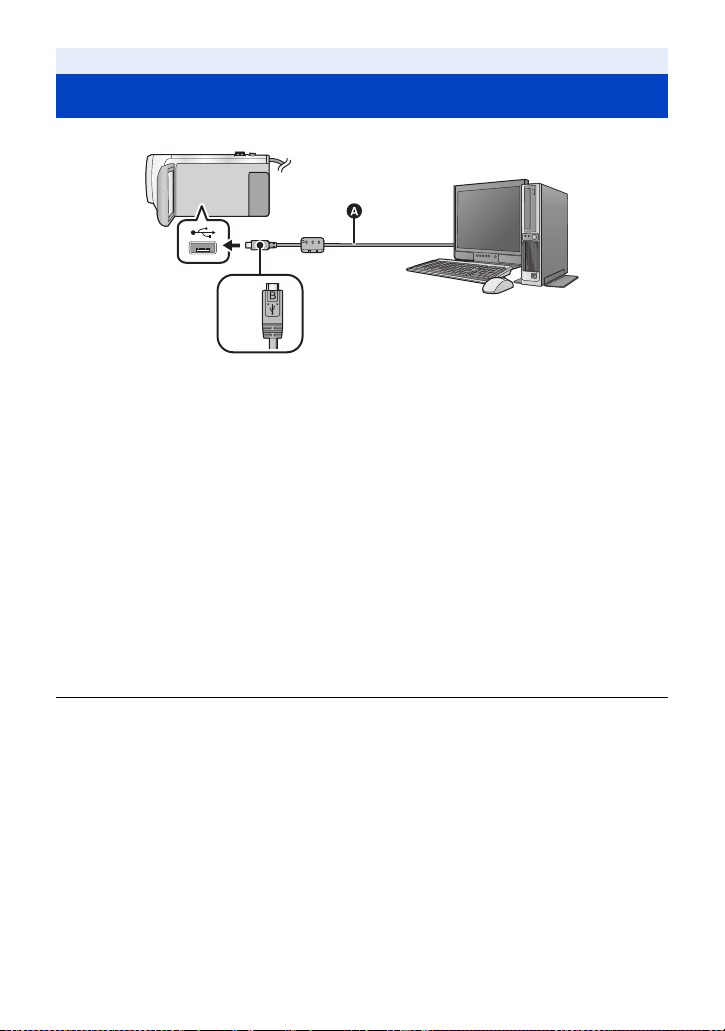
- 174 -
≥ Connect this unit to the PC after the software applications are installed.
A USB cable (supplied)
B Turn the side with the symbol up to connect the micro B end of the USB Cable to the USB
terminal of this unit.
≥ Insert the plugs as far as they will go.
1 Connect this unit to the AC adaptor.
≥ Use the AC adaptor to free you from worrying about the battery running down.
2 Turn on the unit.
3 Connect this unit to a PC.
≥ The USB function selection screen will appear.
4 Touch [PC] on the screen of this unit.
≥ The Smart Wizard Screen is automatically displayed when HD Writer AE 5.2 is installed.
≥ This unit is automatically recognized as an external drive of the PC. (
l 176)
≥ When you select an option other than [PC], reconnect the USB cable.
≥ When using the battery, the LCD monitor turns off after about 5 seconds. Touch the screen to turn
the LCD monitor on.
≥ Do not use any other USB cables except the supplied one. (Operation is not guaranteed with any
other USB cables.)
≥ When this unit is connected to a PC using a USB cable while the unit is turned on, power is also
supplied from the PC to this unit.
≥ When performing reading/writing between a PC and an SD card, be aware that some SD card
slots built into PCs and some SD card readers are not compatible with the SDHC Memory Card or
SDXC Memory Card.
With a PC
Connecting to a PC

- 175 -
∫ To disconnect USB cable safely
Select the icon in task tray displayed on the PC, and then select the model number of
this unit to disconnect the USB cable.
≥ Depending on your PC’s settings, this icon may not be displayed.
∫ Charging the battery by connecting it to different devices
When using the battery, if you turn off the unit and connect it to a PC, Panasonic Blu-ray disc
recorder or Panasonic DVD recorder, the battery will charge.
≥ When connecting this unit to a PC for the first time, make sure to connect this unit to the
PC with this unit turned on.
≥ Insert the USB cable securely all the way. It will not operate properly if it is not inserted all the
way.
≥ Do not use any other USB cables except the supplied one. (Operation is not guaranteed with any
other USB cables.)
≥ You cannot charge the battery by connecting the supplied DC cable.
≥ Be sure to connect the unit directly to the PC, Blu-ray disc recorder or DVD recorder.
≥ During charging, the status indicator flashes.
≥ You cannot charge when the status indicator flashes rapidly, or when it does not light at all.
Charge using the AC adaptor. (
l 12)
≥ It will take 2 or 3 times longer to charge compared to when using the AC adaptor.
≥ If the status indicator flashes at a particularly fast or slow rate, refer to page
191.
About the screen indication of the unit
≥ Do not disconnect the USB cable, battery, or AC adaptor while the access lamp is on or card
access icon ( ) appears on the unit screen.
≥ If the screen does not change when the unit is operated while connected to a PC, disconnect
the battery and/or AC adaptor, wait approximately 1 minute, reconnect the battery and/or AC
adaptor, wait approximately 1 minute again, and then turn the unit back on. (Data may be
destroyed when above operation is performed while accessing the SD card.)
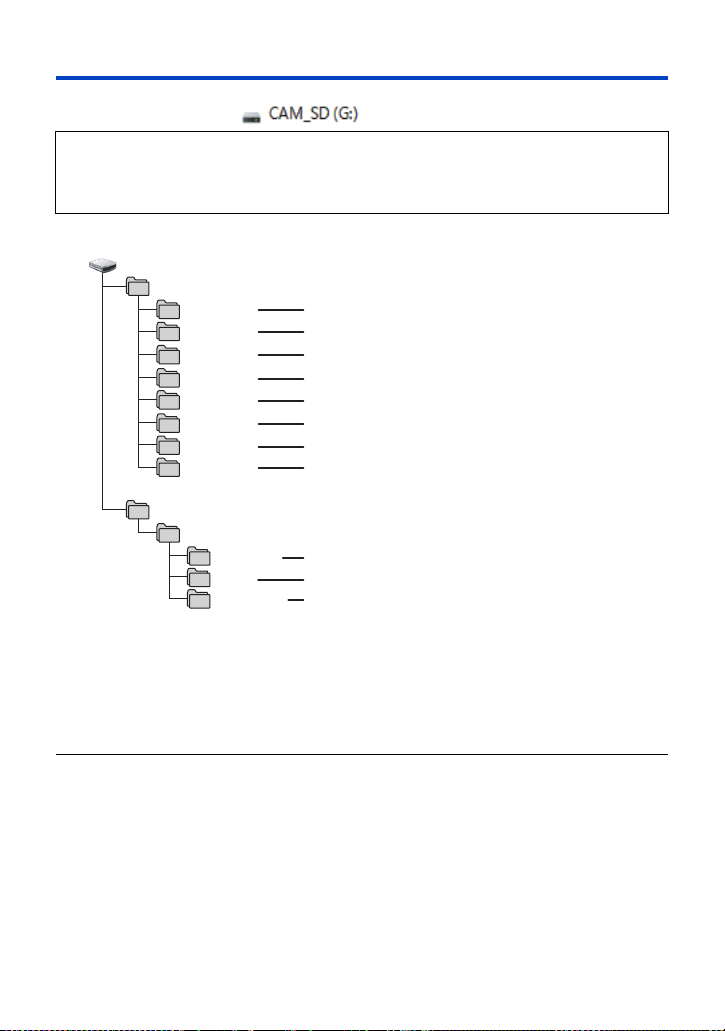
- 176 -
About the PC display
When the unit is connected to a PC, it is recognized as an external drive.
≥ Removable disk (Example: ) is displayed in [This PC].
Example folder structure of an SD card:
The following data will be recorded.
1 Up to 999 still pictures in JPEG format
([S1000001.JPG] etc.)
2-5 MP4 format motion picture files
([S1000001.MP4] etc.)
2 MP4 (1080/60p)
3 MP4 (1080/30p)
4 MP4 (720/30p)
5 MP4 (360/30p)
6 iFrame format motion picture files
([S1000001.MP4] etc.)
7 JPEG format still pictures created from
the motion picture
8 JPEG format still pictures recorded in
Stop Motion Animation Assist Mode
9 The motion picture thumbnails
: AVCHD format motion picture files
([00000.MTS] etc.)
; For management
∫ Copying your still pictures to your PC
Card reader function (mass storage)
Still pictures recorded with this unit can be copied to the PC with Explorer or other programs.
1 Double-click the folder that contains the still pictures. ([DCIM] # [100CDPFQ]
etc.)
2 Drag and drop the still pictures onto the destination folder (on the PC’s HDD).
≥ Do not delete the SD card’s folders. Doing so may make the SD card unusable in this unit.
≥ Do not delete or edit files on the SD card or USB HDD on the PC. If you do so, this unit may not
be able to read these files or its functions may not operate correctly.
≥ When data not supported by this unit has been recorded on a PC, it will not be recognized by this
unit.
≥ Always use this unit to format SD cards.
We recommend using HD Writer AE 5.2 to copy motion picture data.
Using Windows Explorer or other programs on the PC to copy, move or rename files and folders
recorded with this unit will result in them being unusable with HD Writer AE 5.2.
It is impossible to write data to SD card on this unit from a PC.
DCIM
CAM_SD
100CDPFQ
103XCPHH
101YAPHH
102YCPHH
AVCHDTN
BDMV
AVCHD
PRIVATE
105UCPBH
107CDPFT
106CDPFS
PANA_EXT
104TCPBH
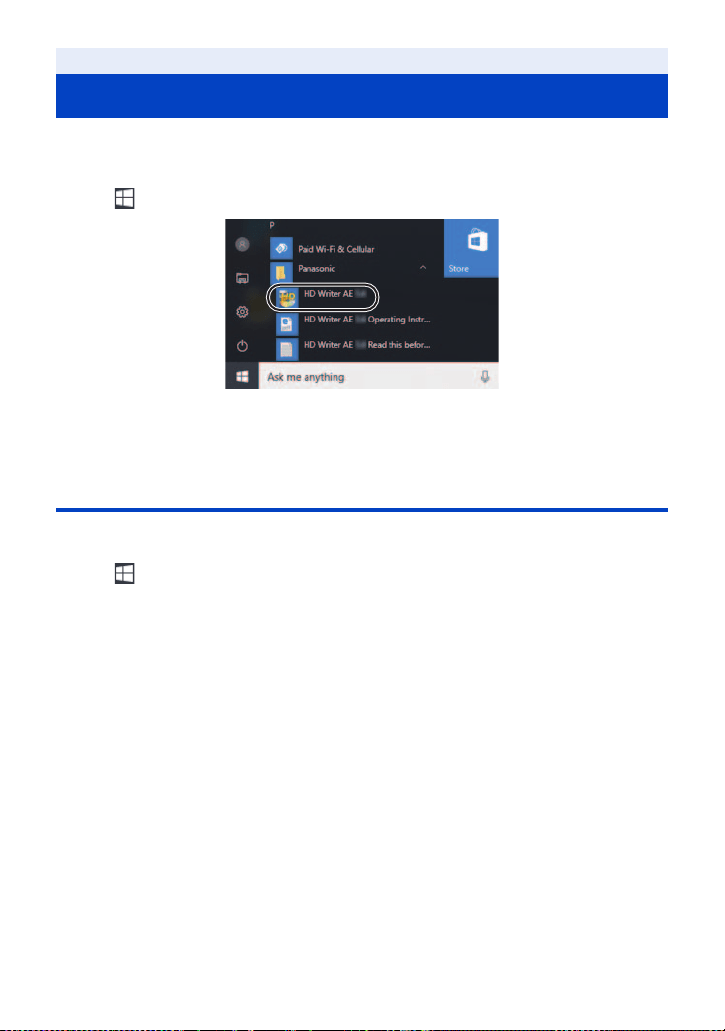
- 177 -
≥ To use the software, log on as an Administrator or as user name for standard user account.
The software cannot be used with the user name for a guest account.
(On the PC)
Select [ ] # [Panasonic] # [HD Writer AE 5.2].
≥ For details on how to use the software applications, read the PDF operating instructions of the
software.
Reading the operating instructions of the software
applications
≥ You will need Adobe Acrobat Reader 5.0 or later or Adobe Reader 7.0 or later to read the PDF
operating instructions.
Select [ ] # [Panasonic] # [HD Writer AE 5.2 Operating Instructions].
With a PC
Starting HD Writer AE 5.2
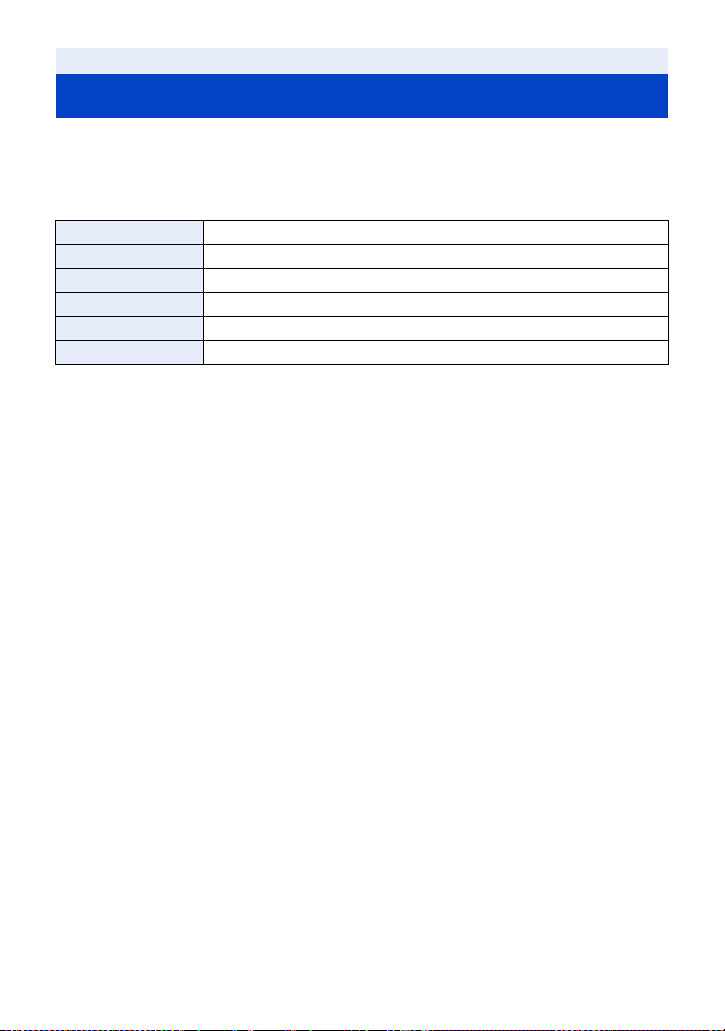
- 178 -
≥ HD Writer AE 5.2 is not compatible with Mac.
≥ iMovie and Final Cut Pro X supported. For details about iMovie and Final Cut Pro X, please
contact Apple Inc.
∫ Operating environment
≥ Even if the system requirements mentioned in this owner’s manual are fulfilled, some computers
cannot be used.
≥ The USB equipment operates with the driver installed as standard in the OS.
∫ Copying still pictures on a Mac
1 Connect this unit to a Mac via the supplied USB cable.
≥ The USB function selection screen will appear.
2 Touch [PC] on the screen of this unit.
≥ This unit is automatically recognized as an external drive of Mac.
≥ When you select an option other than [PC], reconnect the USB cable.
≥ When using the battery, the LCD monitor turns off after about 5 seconds. Touch the screen to turn
the LCD monitor on.
3 Double-click [CAM_SD] displayed on the desktop.
≥ Files are stored in [100CDPFQ] or [102CDPFT] folder etc. in the [DCIM] folder.
4 Using a drag-and-drop operation, move the pictures you want to acquire or
the folder storing those pictures to any different folder on the Mac.
∫ To disconnect USB cable safely
Drag [CAM_SD] disk icon to the [Trash], and then disconnect the USB cable.
With a PC
If using Mac (mass storage)
PC Mac
OS macOS 11.2
CPU Intel Core 2 Duo or better
RAM 2 GB or more
Interface USB port
Other requirements Mouse or equivalent pointing device
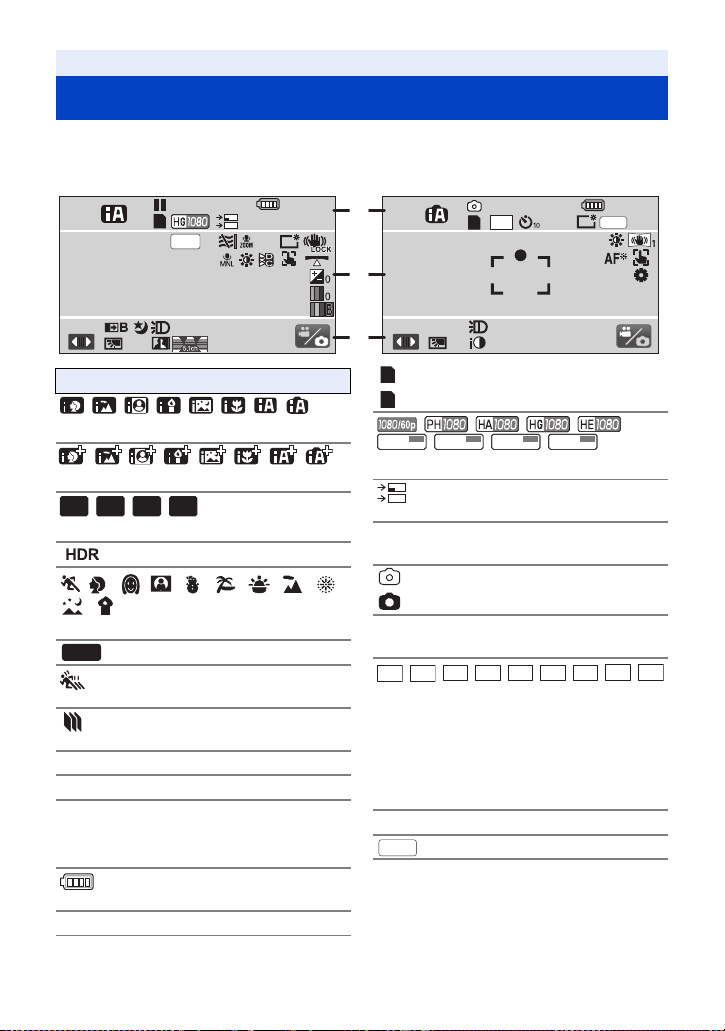
- 179 -
∫ Recording indications
Others
Indications
Motion Picture Recording Mode Still Picture Recording Mode
R 3000
+1
1
/
100
OPEN
MF
0dB
+1
MEGA
PRE-REC
0h00m00s
1h30m
R 1h20m
1h30m
2.1M
A
///////
Intelligent Auto Mode (
l 46)
///////
Intelligent Auto Plus Mode (
l 48)
///
Creative Control Mode (
l 48)
HDR Movie Mode (
l 51)
/////////
/
Scene Mode (
l 52)
Manual Mode (
l 56)
FULL HD Slow Motion Video
Mode (
l 53)
Stop Motion Animation Assist
Mode (
l 55)
¥/; (Red) Recording
; (Green) Recording pause
0h00m00s Elapsed recording time (
l 23)
(“h” is an abbreviation for hour, “m” for minute
and “s” for second.)
Remaining battery power
(
l 14)
1h30m Remaining battery time (
l 14)
MINI
8mm
SILN
INTV
MNL
(White) Card recording possible status
(Green) Recognizing the card
/////
///
Motion Picture Recording Mode (
l 72)
Backup for Twin Camera
(
l 43)
R1h20m Remaining time for motion
picture recording (
l 23)
(White) Still picture recording icon
(Red) Recording still picture
R3000 Remaining number of still
pictures (
l 26)
////////
Number of recording pixels for still pictures
(
l 26, 81, 85)
In Playback Mode, the picture size is not
displayed for still pictures recorded with other
products that have different picture sizes from
the sizes shown above.
Ø10/Ø2 Self-timer Recording (
l 67)
MEGA OIS (
l 25)
ヮヱフ
ヒパベパ
ブパヮ
ヮヱフ
ヒパベパ
ビベヮ
ヮヱフ
ヘビパ
ヮヱフ
ㄊョㄓㄎㄆ
24M
12.6
M
2.1M
18M
8M
0.3M 20M
10. 6
M
2M
MEGA
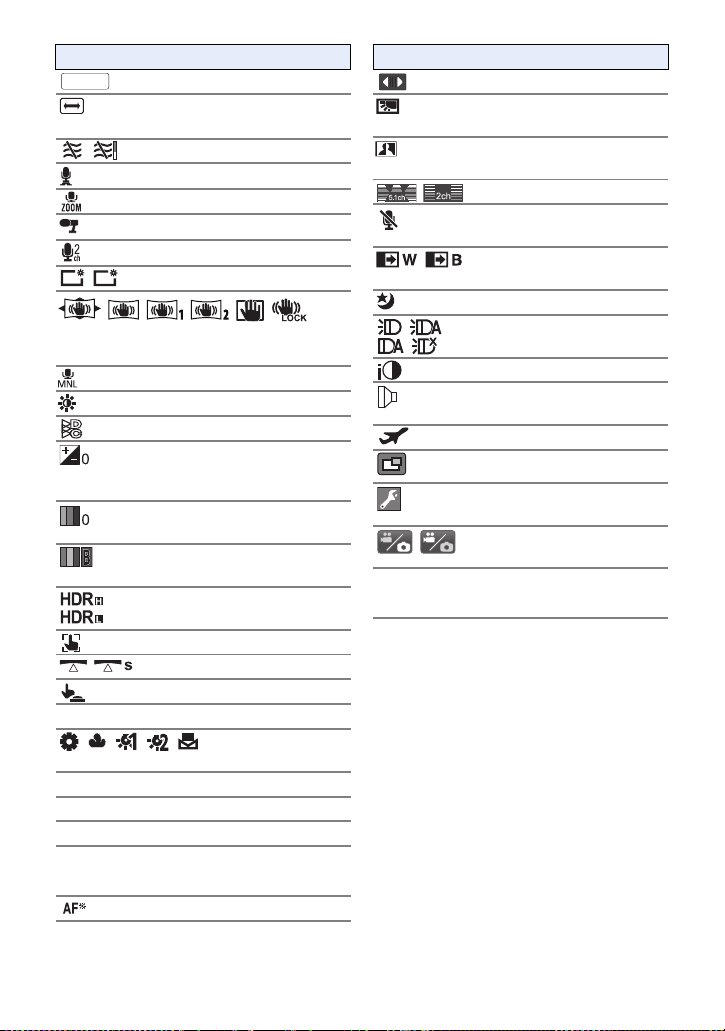
- 180 -
B
PRE-REC (
l 66)
Time Lapse Recording
(
l 50)
/ Wind Noise canceler (
l 76)
Lowcut (
l 76)
Zoom Microphone (
l 78)
Focus Microphone (
l 78)
Stereo Microphone (
l 78)
/ Power LCD (l 36)
// / //
Image Stabilizer (
l 61)/
Optical Image Stabilizer Lock (
l 63)
Sound Scene Select (
l 77)
Picture Adjustment (
l 80)
Digital Cinema Color (
l 75)
Brightness Adjustment
(Miniature Effect/8mm movie/
Silent movie) (
l 49, 50)
Vividness Adjustment
(Miniature Effect) (
l 49)
Color balance Adjustment
(8mm movie) (
l 50)
/ HDR Effect (
l 69)
AF/AE tracking (
l 62)
/ Level Shot Function (
l 42)
Touch Shutter (
l 64)
MF Manual Focus (
l 59)
/// /
White Balance (
l 57)
1/100 Shutter Speed (
l 58)
OPEN/F2.0 Iris value (
l 58)
0dB Gain value (
l 58)
± (White)/¥ (Green)
Focus indication (
l 25)
AF assist lamp (
l 82)
PRE-REC
LOW
CUT
+1
-
1
C
Display Touch Menu (
l 20)
Backlight Compensation
(
l 67)
Intelligent Contrast Control
(
l 66)
/ Microphone Level (
l 79)
Sound recording disabled
(
l 53)
/ Fade (White), Fade (Black)
(
l 66)
Night Mode (
l 68)
//
/
Video Light (
l 68)
Intelligent Exposure (
l 67)
Wide Conversion Lens setting
(
l 76)
World Time setting (
l 31)
Sub Window icon (
l 163)
Sub Camera setting icon
(
l 164)
/
Recording mode switching icon
(
l 18)
NOV 15 2022 Date indication (
l 21)
12:34PM Time indication (
l 21)
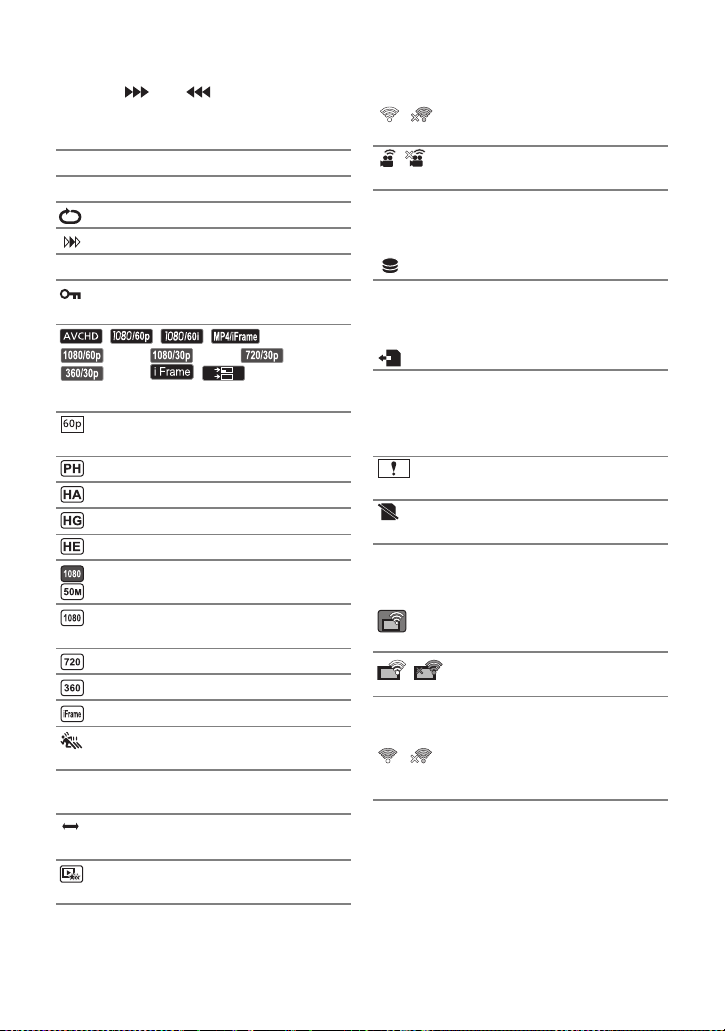
- 181 -
∫ Playback indications ∫ Indication of connection to
Wi-Fi
∫ Indication of connection to
USB HDD
∫ Indication of connection to
other devices
∫ Confirmatory indications
∫ Indication of Wireless Twin
Camera
∫ Indication of Sub Window
1/;/5//6//7/8/9/:/
D/E/;1/2;
Display during playback (
l 28, 83)
0h00m00s Playback Time (
l 28)
No.10 Scene Number
Repeat Playback (
l 86)
Resume Playback (
l 86)
100-0001 Still picture folder/file name
Protected motion pictures/still
pictures (
l 110)
/// /
(Red)/ (Red)/ (Red)/
(Red)/ /
Play mode selection display (
l 27)
AVCHD [1080/60p] scene
(
l 27)
AVCHD [PH] scene (
l 27)
AVCHD [HA] scene (
l 27)
AVCHD [HG] scene (
l 27)
AVCHD [HE] scene (
l 27)
(Blue)/ MP4 [1080/60p (50M)] scene
(
l 28)
MP4 [1080/60p (28M)] scene/
MP4 [1080/30p] scene (
l 28)
MP4 [720/30p] scene (
l 28)
MP4 [360/30p] scene (
l 28)
iFrame scene (
l 28)
F
ULL HD Slow Motion Video-
recorded scene (
l 53)
Miniature-recorded scene
(
l 49)
Time lapse-recorded scene
(
l 50)
Scenes saved with Highlight
Playback (
l 95)
MINI
/ Wi-Fi connection status (wireless
access point) (
l 142)
/ Wi-Fi connection status (Direct
connection) (
l 142)
USB HDD Playback (
l 122)
Accessing the card (
l 124, 175)
–– (Time
display)
The built-in battery is low. (
l 21)
Warning for recording of yourself
(
l 22)
SD card is not inserted or is
incompatible.
Startup/disconnect icon for
Wireless Twin Camera (
l 158)
/
Wi-Fi connection status (Wireless
Twin Camera) (
l 162)
/
Wi-Fi connection warnings for the
Wireless Sub Camera function
(
l 163)

- 182 -
Major confirmation/error messages to be indicated on the screen in text.
Others
Messages
CHECK CARD.
This card is not compatible or it cannot be recognized by the unit.
If this message appears even though motion pictures and still pictures are recorded on an SD
card, the card may be unstable. Reinsert the SD card, then turn the unit off and then on again.
THIS BATTERY CANNOT BE USED.
≥ Use a battery that is compatible with this unit. (
l 11)
If using a Panasonic battery compatible with this unit, remove the battery and then insert it
again. If the message appears even after repeating this several times, this unit needs repair.
Detach the power and consult the dealer who you purchased this unit from. Do not attempt to
repair it by yourself.
≥ You are attempting to connect an AC adaptor not compatible with this unit. Use the supplied
AC adaptor. (
l 12)
THIS EXTERNAL DRIVE CANNOT BE USED./
PLEASE CHECK THE EXTERNAL DRIVE.
The external drive that this unit cannot recognize is connected. Check if the USB HDD can be
connected and used with this unit and try to reconnect. (
l 118)
Failed to connect wireless access point/
No wireless access point found
≥ Check the Wi-Fi set up of your wireless access point and smartphone.
≥ [WPS Connection] can establish a connection only between two devices: this unit and a
device that will connect to this unit. Check if multiple devices are trying to establish a
connection in the WPS waiting state simultaneously.
≥ Read page
150 if the Wi-Fi connection cannot be established.
Network disconnected.
≥ When using [DLNA Play], if you do not operate the DLNA-compatible device you are
connected to for a while, it will be displayed. Check the status of the DLNA device you are
connected to.

- 183 -
About recovery
If faulty management information is found, the messages may appear and a repair is performed.
(Repairing may take time depending on the error.)
≥ is displayed when abnormal management information is detected when the scenes are
displayed in thumbnail.
≥ Use a sufficiently charged battery or the AC adaptor.
≥ Depending on the condition of the data, it may not be possible to completely repair the data.
≥ If recovery fails, it will not be possible to play back scenes recorded before the unit turned off.
≥ When data recorded on another device is recovered, it may not be possible to play back the data
on this unit or the other device.
≥ If recovery fails, turn the unit off and on again after waiting a while. If recovery fails repeatedly,
format a media on the unit. Please be aware that if a media is formatted, then all the data
recorded on the media will be erased.
≥ If the thumbnail information is recovered, displaying the thumbnails may become slower.
≥ You cannot recover information on scenes recorded as Backup for Twin Camera and Highlight
Playback scenes in MP4 format.
- 184 -
∫ It is not a malfunction in following cases
Others
Troubleshooting
A clicking sound is heard
when the unit is shaken.
≥ This is the sound of the lens moving and is not a defect.
This sound will no longer be heard when the unit is turned on
and set this unit to the Motion Picture Recording Mode or Still
Picture Recording Mode.
Object seems to be
warped.
≥ Object seems to be warped slightly when the object moves
across the image very fast, but this is because the unit is
using MOS for the image sensor. This is not a malfunction.
The lens or LCD monitor
fog up.
≥ This is due to condensation. It is not a malfunction. Please
refer to page
2.
Power
Problem Check points
This unit cannot be turned
on.
This unit does not stay on
long enough.
Battery runs down quickly.
≥ Charge the battery again to ensure it is sufficiently charged.
(
l 12)
≥ In cold places, the battery using time becomes shorter.
≥ The battery has a limited life. If the operating time is still too
short even after the battery is fully charged, the battery has
worn out and needs to be replaced.
This unit is turned off
automatically.
≥ If the unit turns off when you turn off the power to the TV
using the TV remote control, the VIERA Link is at work. If you
are not using the VIERA Link, set [VIERA Link] to [OFF].
(
l 116)
This unit cannot be
operated though it is
turned on.
This unit does not operate
normally.
≥ Remove the battery or AC adaptor, wait about 1 minute and
then reconnect the battery or AC adaptor. Then about
1 minute later, turn on the unit again. (Conducting the above
operation while the media is being accessed may damage the
data on the media.)
≥ If normal operation is still not restored, detach the power
connected, and consult the dealer who you purchased this
unit from.
“ERROR OCCURRED.
PLEASE TURN UNIT OFF,
THEN TURN ON AGAIN.”
is displayed.
≥ The unit has automatically detected an error. Restart the unit
by turning the unit off and on.
≥ The unit will be turned off in about 1 minute if the unit is not
turned off and on.
≥ Repair is needed if it is repeatedly displayed even if it is
restarted. Detach the power connected, and consult the
dealer who you purchased this unit from. Do not attempt to
repair the unit by yourself.
- 185 -
Indication
Problem Check points
Remaining battery
indication is not displayed
properly.
≥ The remaining battery capacity indication is an
approximation.
If the remaining battery capacity indication is not displayed
correctly, fully charge the battery, discharge it and then
charge it again.
Recording
Problem Check points
The unit arbitrarily stops
recording.
≥ Use an SD card that can be used for motion picture recording.
(
l 15)
≥ The recordable time may have shortened due to the
deterioration of the data writing speed or repeated recording
and deletion. Using the unit, format the SD card. (
l 38)
≥ If [AGS] is [ON], record in the normal horizontal position or set
[AGS] to [OFF]. (
l 74)
Auto Focus function does
not work.
≥ Switch to Intelligent Auto Mode or Intelligent Auto Plus Mode.
≥ If you are trying to record a scene which is hard to bring into
focus in Auto Focus Mode, use the Manual Focus Mode to
adjust the focus. (
l 47, 59)
Color balance of images is
strange when recording in
a place such as a
gymnasium.
≥ In a place with multiple light sources, such as a gymnasium or
a hall, set the White Balance setting to (Indoor mode 2).
If you cannot record clearly with the (Indoor mode 2), set
it to (Manual adjustment mode). (
l 57)
Color or brightness of the
image changes, or you
may see horizontal bars in
the image.
The LCD monitor flickers
indoors.
≥ Color or brightness of the image may change, or you may see
horizontal bars in the image when the object is recorded
under fluorescent light, mercury light or sodium light, etc., but
this is not a malfunction.
≥ In Motion Picture Recording Mode, record in Intelligent Auto
Mode/Intelligent Auto Plus Mode or set the shutter speed to
1/60 in areas where the power supply frequency is 60 Hz, or
1/100 in areas of 50 Hz.
≥ In Still Picture Recording Mode, this will not affect the
recorded image.
≥ In FULL HD Slow Motion Mode, setting the shutter speed to
1/120 seconds reduces the intensity of the problem.
Playback
Problem Check points
Scenes/still pictures
cannot be played back.
≥ Any scenes/still pictures where the thumbnails are displayed
as cannot be played back.
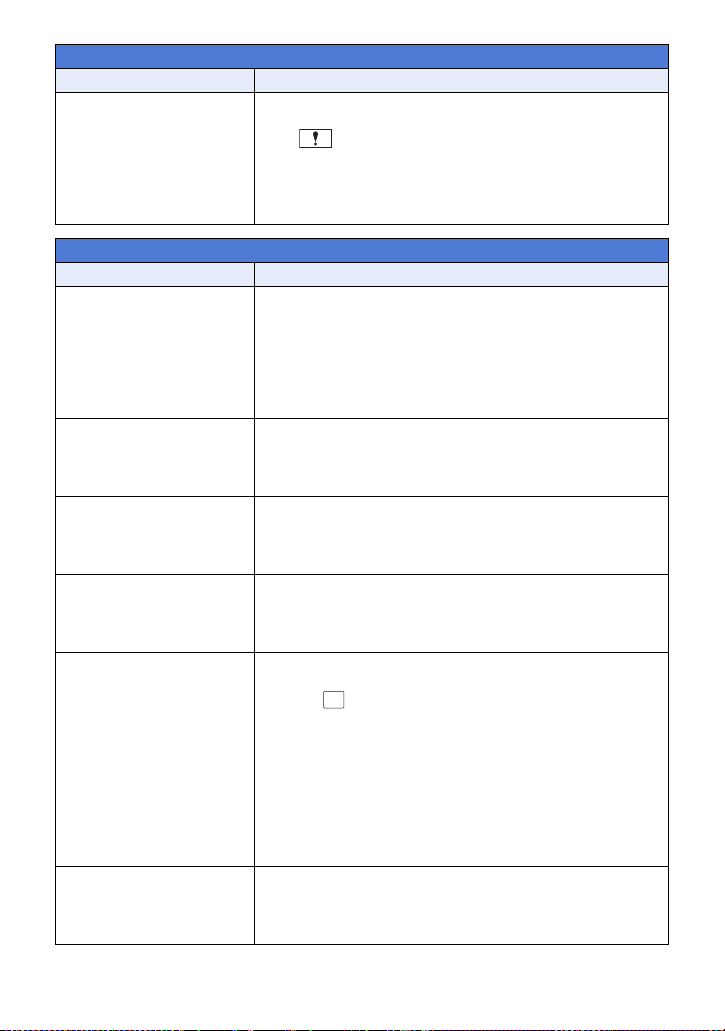
- 186 -
Scenes cannot be deleted. ≥ Release the protect setting. (l 110)
≥ Any scenes/still pictures where the thumbnails are displayed
as cannot be deleted. If the scenes/still pictures are
unnecessary, format the media to erase the data. (
l 38)
Please be aware that if a media is formatted then all the data
recorded on the media is erased and cannot be recovered.
Back up important data on a PC, disc etc.
With other products
Problem Check points
Even when this unit is
correctly connected to a
TV, images or sounds are
not output.
The images are squeezed
horizontally.
≥ Please read the operating instructions of your TV and select
the channel that matches the input used for the connection.
≥ Change the [TV ASPECT] setting to match the aspect ratio of
the TV. (
l 114)
≥ The audio during playback mode is not output from this unit
when connected to a TV. Sound levels cannot be adjusted
using this unit, so adjust the sound on the TV.
Even when this unit is
connected to the TV by the
HDMI micro cable, images
or sounds are not output.
≥ Check if the HDMI micro cable is connected correctly.
≥ Insert the HDMI micro cable all the way in.
If the SD card is inserted in
another device, it is not
recognized.
≥ Check that the device is compatible with the capacity or type
of SD card (SD Memory Card/SDHC Memory Card/SDXC
Memory Card) that you inserted. Refer to the operating
instructions of the device for details.
When connected by the
USB cable, this unit is not
detected by the other
devices.
≥ When connected to other devices using only the battery,
reconnect using the AC adaptor.
VIERA Link does not work. (Setting on this unit)
≥ Connect with a HDMI micro cable (supplied). (
l 113)
≥ Touch , then touch [SETUP] # [VIERA Link] # [ON].
(
l 116)
≥ Turn the unit off and then back on again.
(Setting on other devices)
≥ If the TV input does not switch automatically, switch the input
using the TV remote control.
≥ Check the VIERA Link setting on the connected device.
≥ Please refer to the operating instructions of the connected
device.
Cannot copy scenes on
the SD card by connecting
to other equipment with
the USB cable.
≥ Other equipment might have not recognized the SD card.
Unplug the USB cable once, and reconnect it.
Playback
Problem Check points
MENU
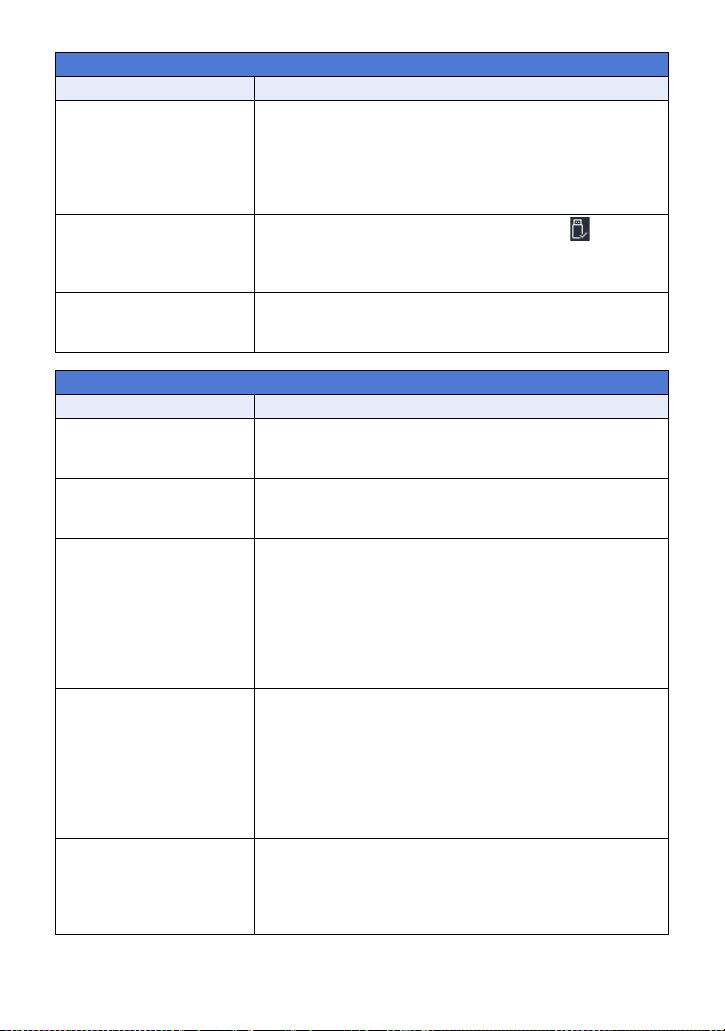
- 187 -
With a PC
Problem Check points
When connected by the
USB cable, this unit is not
detected by the PC.
≥ After re-inserting the SD card into the unit, reconnect the
supplied USB cable.
≥ Select another USB terminal on the PC.
≥ Check the operating environment. (
l 171, 178)
≥ Connect the supplied USB cable again after restarting the PC
and turning on this unit again.
When the USB cable is
disconnected, an error
message will appear on
the PC.
≥ To disconnect the USB cable safely, select the icon in
task tray displayed on the PC, and then select the model
number of this unit to disconnect the USB cable.
Cannot see the PDF
operating instructions for
HD Writer AE 5.2.
≥ You will need Adobe Acrobat Reader 5.0 or later or Adobe
Reader 7.0 or later to read the PDF operating instructions for
HD Writer AE 5.2.
About the Wi-Fi function
Problem Check points
Cannot connect to
wireless access point or
smartphone.
≥ Read page
150 if the Wi-Fi connection cannot be established.
Cannot operate from
smartphone using [Link to
Cell].
≥ Install the smartphone app “Image App” on your smartphone.
(
l 141)
When I look at the
recording screen with the
smartphone, mosaic-like
noise appears on the
screen and the image
movement does not look
smooth.
≥ When this unit is set to any of the following recording formats
or recording modes, mosaic-like noise may appear on the
screen and the image movement may not look smooth.
(Recorded images will not be affected.)
j Recording mode [1080/60p] for the recording format
[AVCHD]
j Recording mode [1080/50M] or [1080/28M] for the
recording format [MP4/iFrame]
Cannot use [DLNA Play]. ≥ Make sure the television is compatible with DLNA. Read the
instructions for the television you are using.
≥ Make sure the wireless access point and this device are
properly connected.
≥ Approach the wireless access point and reconnect.
≥ If a connection cannot be made between this device and a
DLNA-compatible device, try to reconnect and make sure
they connect properly.
I have forgotten the
password for the Wi-Fi.
≥ Perform [Reset Wi-Fi Settings] from the Setup menu (
l 37).
This will set the Wi-Fi setting to the condition at the time of
purchase, and you will be able to use the Wi-Fi setting menu.
When performing [Reset Wi-Fi Settings], all Wi-Fi settings
including registered wireless access points will be deleted.
- 188 -
∫ If AVCHD scenes do not change smoothly when played back on
another device
The images may be still for several seconds at the joins between the scenes if the following
operations are performed when multiple scenes have been continuously played back using another
unit.
≥ Just how smoothly the scenes will be played back depends on the playback unit. Depending on
the unit used, the images may stop moving and become still for a moment even when none of the
following conditions are applicable.
≥ A continuous recording of motion picture data that exceeds 4 GB may momentarily stop at every
4 GB of data when played back with another device.
≥ It may not play back smoothly when the editing of scenes was done with the HD Writer AE 5.2,
but it will play back smoothly if you set the seamless settings in the HD Writer AE 5.2. Refer to the
operating instructions for the HD Writer AE 5.2.
Others
Problem Check points
If the SD card is inserted in
this unit, it is not
recognized.
≥ If the SD card is formatted on a PC, it may not be recognized
by this unit. Use this unit to format SD cards. (
l 38)
Principal reasons for not playing back smoothly
≥ When the scenes were recorded on different dates
≥ When scenes lasting under 3 seconds have been recorded
≥ When PRE-REC was used for recording
≥ When the Miniature Effect recording is used
≥ When the Time Lapse Recording is used
≥ When deleting scenes
≥ When scenes recorded more than 99 scenes on the same date

- 189 -
Keep this unit as far away as possible from electromagnetic equipment (such as microwave
ovens, TVs, video games etc.).
≥ If you use this unit on top of or near a TV, the pictures and/or sound on this unit may be disrupted
by electromagnetic wave radiation.
≥ Do not use this unit near cell phones because doing so may result in noise adversely affecting the
pictures and/or sound.
≥ Recorded data may be damaged, or pictures may be distorted, by strong magnetic fields created
by speakers or large motors.
≥ Electromagnetic wave radiation generated by microprocessors may adversely affect this unit,
disturbing the pictures and/or sound.
≥ If this unit is adversely affected by electromagnetic equipment and stops functioning properly, turn
this unit off and remove the battery or disconnect AC adaptor. Then reinsert the battery or
reconnect AC adaptor and turn this unit on.
Do not use this unit near radio transmitters or high-voltage lines.
≥ If you record near radio transmitters or high-voltage lines, the recorded pictures and/or sound
may be adversely affected.
When this unit is turned on, do not use it in direct contact with the skin for a long period of
time.
≥ When using this unit for a long period of time, use a support such as a tripod. Low temperature
burns may result if any high temperature part of this unit is in direct contact with the skin for a long
period of time.
Make sure to use the supplied cords and cables. If you use optional accessories, use the
cords and the cables supplied with them.
Do not extend the cords and the cables.
Do not spray insecticides or volatile chemicals onto the unit.
≥ If the unit is sprayed with such chemicals, its body may be marred and the surface finish may peel
off.
≥ Do not leave rubber or plastic products in contact with the unit for a long time.
When you use the unit in a sandy or dusty place such as a beach, do not let sand or fine dust
get into the body and terminals of the unit.
Also, keep the unit away from sea water.
≥ Sand or dust may damage the unit. (Care should be taken when inserting and removing a card.)
≥ If sea water splashes onto the unit, wipe off the water with a well wrung cloth. Then wipe the unit
again with a dry cloth.
When carrying the unit, do not drop or bump it.
≥ A strong impact can break the unit’s casing, causing it to malfunction.
Others
Cautions for use
About this unit
The unit and the SD card become warm during use. This is not a malfunction.

- 190 -
Cleaning
≥ Before cleaning, detach the battery or pull the AC adaptor from the AC outlet, and then wipe the
unit with a soft, dry cloth.
≥ If the unit is very dirty, dip a cloth in water and squeeze firmly, and then wipe the unit with the
damp cloth. Next, dry the unit with a dry cloth.
≥ Use of benzine, paint thinner, alcohol, or dishwashing liquid may alter the camera body or peel
the surface finish. Do not use these solvents.
≥ When using a chemical dust cloth, follow the instructions that came with the cloth.
Do not use the unit for surveillance purposes or other business uses.
≥ This unit was designed for consumer intermittent use. It was not intended for continuous use, or
for any industrial or commercial application resulting in prolonged use.
≥ In certain situations, continuous use could cause the unit to overheat and cause a malfunction.
Such use is strongly discouraged.
When you are not going to use the unit for an extended time
≥ When storing the unit in a cupboard or cabinet, it is recommended that you place a desiccant
(silica gel) in with it.
The battery used in this unit is a rechargeable lithium-ion battery. It is susceptible to humidity and
temperature and the effect increases the more the temperature rises or falls. In cold areas, the full
charge indication may not appear or the low battery indication may appear about 5 minutes after
starting use. At high temperatures, the protection function may be triggered, making it impossible to
use the unit.
Be sure to detach the battery after use.
≥ If the battery is left attached, a minute amount of current continues to flow even if the unit is off.
Keeping the unit in this state may result in over discharge of the battery. This may result in you
not being able to use the battery even after it is charged.
≥ The battery should be stored in the vinyl bag so metal does not come into contact with the
terminals.
≥ The battery should be stored in a cool place free from humidity, with as constant temperature as
possible. (Recommended temperature: 15 oC to 25 oC (59 oF to 77 oF), Recommended humidity:
40%RH to 60%RH)
≥ Extremely high temperatures or low temperatures will shorten the life of the battery.
≥ If the battery is kept in high-temperature, high-humidity, or oily-smoky places, the terminals may
rust and cause malfunctions.
≥ To store the battery for a long period of time, we recommend you charge it once every year and
store it again after you have completely used up the charged capacity.
≥ Dust and other matter attached to the battery terminals should be removed.
Prepare spare batteries when going out for recording.
≥ Prepare batteries enough to last for 3 to 4 times the period you are planning to record for. Cold
places such as a ski resort can shorten recording time.
If you drop the battery accidentally, check to see if the terminals are damaged.
≥ Inserting a battery with damaged terminals can damage the unit.
About the battery

- 191 -
Do not throw an old battery into fire.
≥ Heating a battery or throwing it into a fire may result in an explosion.
If the operating time is very short even after the battery has been recharged, the battery has
worn out. Please purchase a new battery.
≥ If the temperature of the battery is extremely high or extremely low, charging may take time or the
battery may not be charged.
≥ If you use the AC adaptor near a radio, radio reception may be disturbed. Keep the AC adaptor
1 m (3.3 feet) or more away from the radio.
≥ When using the AC adaptor, it may generate whirring sounds. However, this is normal.
≥ After use, be sure to disconnect the AC adaptor. (If it is left connected, a minute amount of current
is consumed.)
≥ Always keep the electrodes of the AC adaptor and battery clean.
When the status indicator is flashing at a particularly fast or slow rate, the following should
be considered.
Flashing with approx. 4 second period (off for approx. 2 seconds, on for approx.
2 seconds):
≥ When the battery is over discharged or the temperature of the battery is too high or low. It can be
charged, but it may take a few hours to complete the charging normally.
≥ It will flash in approx. 2 second intervals when normal charging resumes. Even in such cases, it
may start flashing in approx. 4 second intervals until charging is completed depending on the
conditions of use.
Flashing with approx. 0.5 second period (off for approx. 0.25 second, on for approx.
0.25 second):
≥ The battery is not charged. Remove the battery from the unit, and try charging again.
≥ Check that the terminals of the unit or battery are not dirty or covered with a foreign object, and
connect the battery correctly once again. If a foreign object or dirt is present, turn off the unit
before removing.
≥ The battery or environment is at an extremely high or low temperature. Wait until the temperature
has returned to an appropriate level and try charging again. If you are still unable to charge, there
may be a fault in the unit, battery or AC adaptor.
Off:
≥ Charging has finished.
≥ If the status indicator stays off despite the charging being unfinished, there may be a fault in the
unit, battery or AC adaptor. Refer to page
190 for details on the battery.
About the AC adaptor
About status indicator during charging
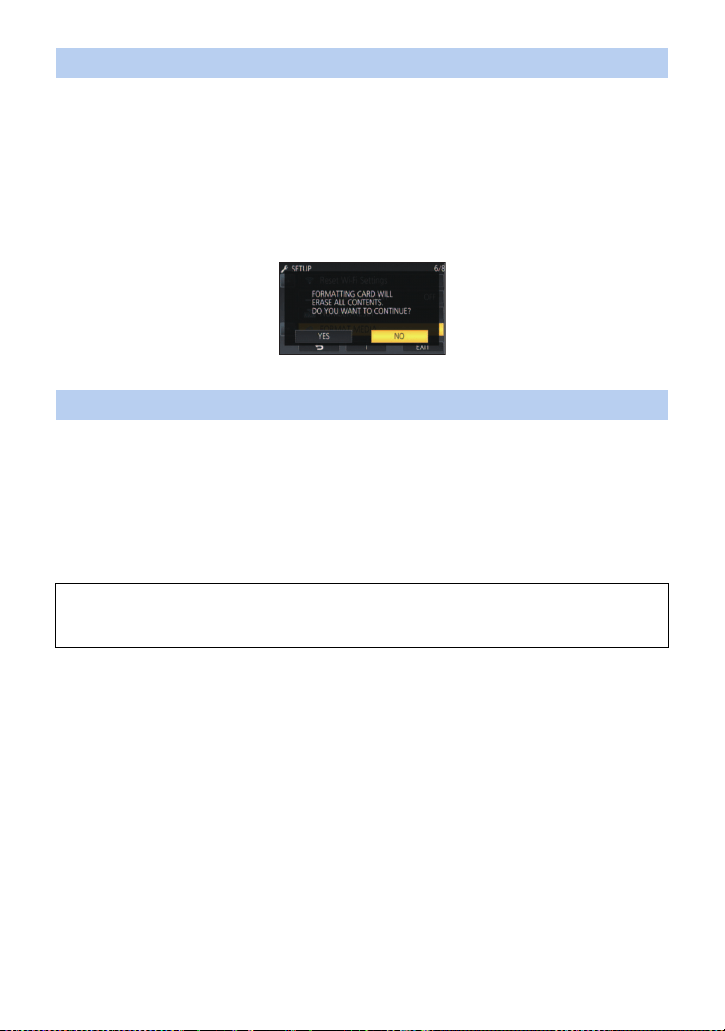
- 192 -
When disposing of or giving away the SD card, note that:
≥ Formatting and deletion of data on this unit or computer only changes the file management
information and does not completely delete the data in the SD card.
≥ It is recommended that the SD card is physically destroyed or the SD card is physically formatted
using this unit when disposing of or giving away the SD card.
To physically format the SD card, connect the unit via the AC adaptor, select [SETUP] #
[FORMAT MEDIA] # [YES] from the menu, and then press and hold the recording start/stop
button on the screen below for about 3 seconds. When the SD card data deletion screen appears,
select [YES], and then follow the on-screen instructions.
≥ The customer is responsible for the management of the data in the SD card.
≥ When the LCD screen is dirty or condensation has occurred, please wipe it using a soft cloth such
as eyeglass cleaner.
≥ Do not touch the LCD monitor with your fingernails, or rub or press with strong force.
≥ It may become hard to see or hard to recognize the touch when the LCD protection sheet is
affixed.
≥ When the unit has become very cold, for example due to storage in a cold area, its LCD monitor
will be slightly darker than usual immediately after the unit is turned on. The normal brightness will
be restored when the unit’s internal temperature rises.
About the SD card
LCD monitor
Extremely high precision technology is employed to produce the LCD Monitor screen. The result
is more than 99.99% effective dots with a mere 0.01% of the dots inactive or always lit. However,
this is not a malfunction and does not affect the recorded picture.

- 193 -
When a name or birthday is set by Baby Calendar, personal information will be included in this unit.
When the Wi-Fi function is used, the SSID, Password, and other personal information will be
included in this unit.
Setting a Wi-Fi password is recommended to protect personal information. (
l 154)
Disclaimer
≥ Information including personal information may be altered or vanish due to erroneous operation,
effect of static electricity, accident, malfunction, repair, or other handlings.
Please note in advance that Panasonic is not liable in any way for any direct or indirect damage
from the alteration or vanishing of information or personal information.
When requesting a repair, transferring to another party, or disposing.
≥ After making a copy of personal information, always delete information such as personal
information and wireless LAN connection settings that you have saved within this unit with [Reset
Wi-Fi Settings]. (
l 37)
≥ To protect personal information, delete the registered details of Baby Calendar unless they are
necessary for the repair. (
l 101)
≥ Remove the Memory Card from this unit when requesting a repair.
≥ Settings may return to factory default when this unit is repaired.
≥ Please contact the dealer where you purchased this unit or Panasonic if above operations are not
possible due to malfunction.
When transferring to another party, or disposing of the Memory Card, please refer to “When
disposing of or giving away the SD card, note that:”. (
l 192)
When uploading images on web services
≥ Images may contain information that can be used for identifying individuals such as titles and
recording dates. When uploading images on web services, check carefully, and then upload.
About personal information

- 194 -
∫ Carefully observe copyright laws
Whatever you have recorded and created can be used for your personal entertainment only.
Under copyright laws, other materials cannot be used without obtaining permission from the
holders of the copyrights.
∫ Licenses
≥ SDXC Logo is a trademark of SD-3C, LLC.
≥ “AVCHD”, “AVCHD Progressive” and the “AVCHD Progressive” logo are trademarks of Panasonic
Corporation and Sony Corporation.
≥ Manufactured under license from Dolby Laboratories.
Dolby, Dolby Audio, and the double-D symbol are trademarks of Dolby Laboratories Licensing
Corporation.
≥ The terms HDMI and HDMI High-Definition Multimedia Interface, and the HDMI Logo are
trademarks or registered trademarks of HDMI Licensing Administrator, Inc. in the United States
and other countries.
≥ VIERA Link
™
is a trademark of Panasonic Corporation.
≥ EZ Sync
™
is a trademark of Panasonic Corporation.
≥ HDAVI Control
™
is a trademark of Panasonic Corporation.
≥ x.v.Color
™
is a trademark.
≥ Microsoft
®
and
Windows
®
are either registered trademarks or trademarks of Microsoft
Corporation in the United States and/or other countries.
≥ Microsoft product screen shot(s) reprinted with permission from Microsoft Corporation.
≥ Intel
®
, Pentium
®
and Intel
®
Core
™
are trademarks of Intel Corporation in the U.S. and/or other
countries.
≥ AMD Athlon™ is a trademark of Advanced Micro Devices, Inc.
≥ iMovie, Final Cut Pro, Mac and macOS are trademarks of Apple Inc. registered in the U.S. and
other countries.
≥ App Store is a service mark of Apple Inc.
≥ Google, Android and Google Play are trademarks of Google LLC.
≥ The Wi-Fi CERTIFIED™ Logo is a registered trademark of Wi-Fi Alliance
®
.
≥ The Wi-Fi Protected Setup™ Logo is a trademark of Wi-Fi Alliance
®
.
≥ “Wi-Fi
®
” is a registered trademark of Wi-Fi Alliance
®
.
≥ “Wi-Fi Protected Setup™”, “WPA™”, and “WPA2™” are trademarks of Wi-Fi Alliance
®
.
≥ DLNA, the DLNA Logo and DLNA CERTIFIED are trademarks, service marks, or certification
marks of the Digital Living Network Alliance.
≥ QR Code is a registered trademark of DENSO WAVE INCORPORATED.
≥ Other names of systems and products mentioned in these instructions are usually the registered
trademarks or trademarks of the manufacturers who developed the system or product concerned.
This product is licensed under the AVC Patent Portfolio License for the personal use of a consumer
or other uses in which it does not receive remuneration to (i) encode video in compliance with the
AVC Standard (“AVC Video”) and/or (ii) decode AVC Video that was encoded by a consumer
engaged in a personal activity and/or was obtained from a video provider licensed to provide AVC
Video. No license is granted or shall be implied for any other use. Additional information may be
obtained from MPEG LA, L.L.C.
See http://www.mpegla.com
.
Others
About copyright
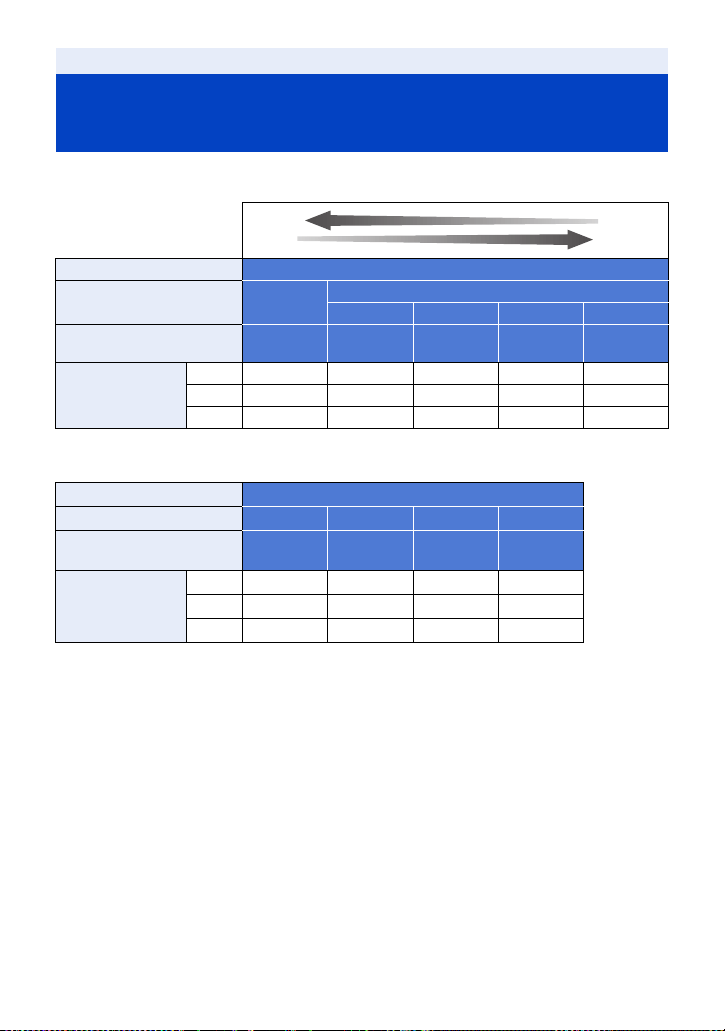
- 195 -
≥ SD cards are only mentioned with their main memory size. The stated times are the approximate
recordable times for continuous recording.
A Favors image quality
B Favors Recording time
≥ “h” is an abbreviation for hour, “min” for minute and “s” for second.
≥
If recording for long periods, prepare batteries for 3 or 4 times the period you wish to record for. (
l
13)
≥ The default setting for [REC FORMAT] is [AVCHD], and the default setting for [REC MODE] is
[HG].
≥ Maximum continuously recordable time for one scene: 6 hours
≥ The recording is paused once the recording time for one scene exceeds 6 hours, and the
recording will automatically resume after a few seconds.
≥ The recordable time may be reduced when lot of action scenes are recorded or recording of short
scene is repeated.
≥ Use time in the row of 4 GB in above table as a guideline for the time that can be copied onto one
DVD disc (4.7 GB).
≥ Recordable times will be approximately half the times in the above table when Backup for Twin
Camera is in operation.
Others
Recording modes/approximate
recordable time
Recording format [AVCHD]
Recording mode [1080/60p]
[1080/60i]
[PH] [HA] [HG] [HE]
Picture size/Frame rate
1920
k
1080/
60p
1920
k
1080/
60i
1920
k
1080/
60i
1920
k
1080/
60i
1920
k
1080/
60i
SD card
4GB 19 min 21 min 30 min 40 min 1 h 30 min
16 GB 1h20min 1h30min 2h 2h40min 6h40min
64 GB 5h20min 6h 8h30min 11h 27h30min
Recording format [MP4/iFrame]
Recording mode [1080/50M] [1080/28M] [720] [iFrame]
Picture size/Frame rate
1920
k
1080/
60p
1920
k
1080/
60p
1280
k
720/
30p
960
k
540/
30p
SD card
4GB 11 min 19 min 1 h 19 min
16 GB 45min 1h20min 4h10min 1h20min
64 GB 3h 5h20min 16h50min 5h20min
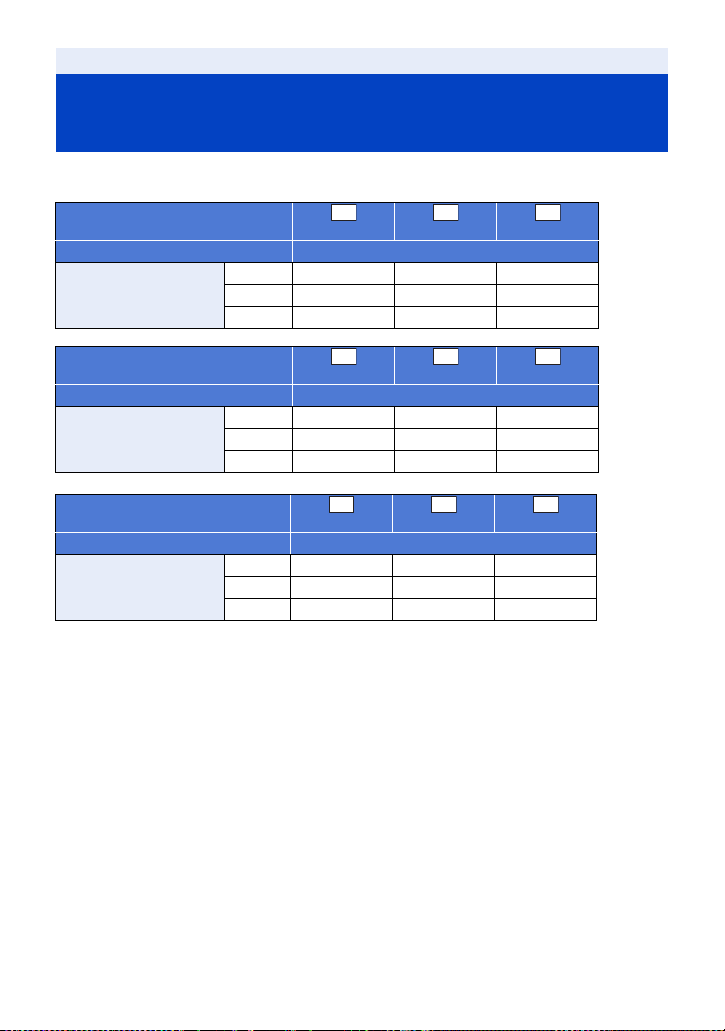
- 196 -
≥ SD cards are only mentioned with their main memory size. The stated number is the approximate
number of recordable pictures.
≥ The number of recordable pictures depends on the subject being recorded.
≥ Maximum number of recordable pictures that can be displayed is 9999. If the number of
recordable pictures exceeds 9999, R 9999+ is displayed. The number will not change when the
picture is taken until the number of recordable pictures is 9999 or less.
≥ The memory capacity indicated on the label of an SD card is the total of the capacity for copyright
protection and management and the capacity which can be used on the unit, a PC etc.
Others
Approximate number of recordable
pictures
Picture size
6528k3672 4736k2664 1920k1080
Aspect ratio 16:9
SD card
4GB 250 500 3200
16 GB 1100 2100 12500
64 GB 4700 8500 52000
Picture size
4896k3672 3264k2448 640k480
Aspect ratio 4:3
SD card
4GB 350 750 28000
16 GB 1500 3100 117000
64 GB 6000 12500 475000
Picture size
5472k3648 3984k2656 1728k1152
Aspect ratio 3:2
SD card
4GB 300 600 2200
16 GB 1300 2400 8500
64 GB 5500 10000 36000
24M
12.6
M
2.1M
18M
8M
0.3M
20M
10. 6
M
2M
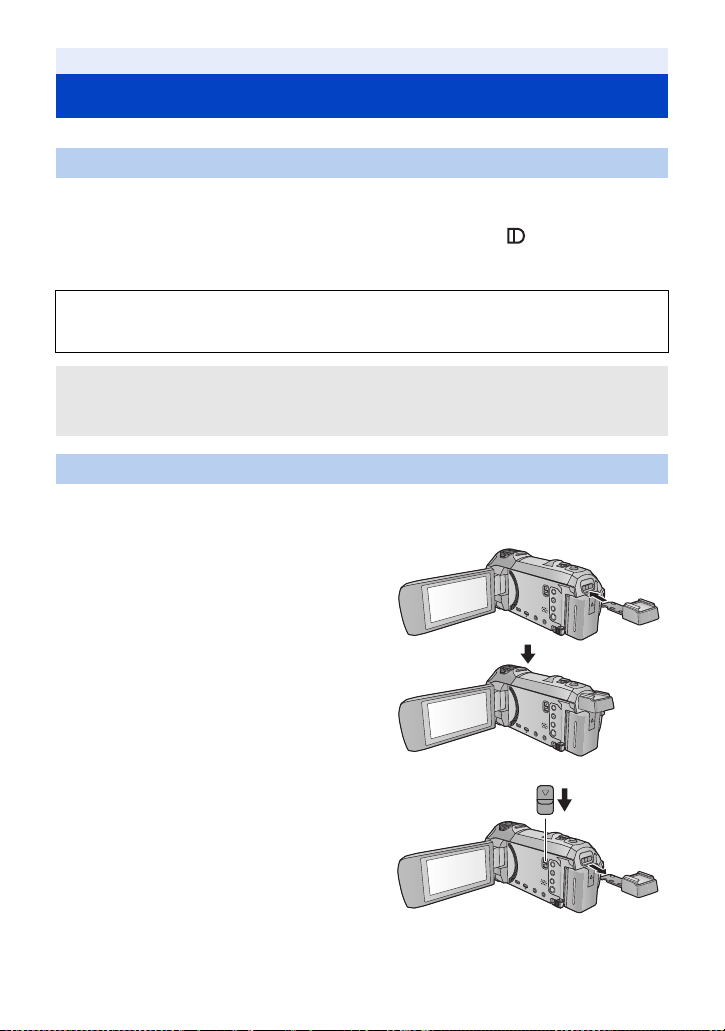
- 197 -
Some optional accessories may not be available in some countries.
Attach the Wide Conversion Lens (VW-W4907H: optional) ND filter or MC protector of the Filter Kit
(VW-LF49N: optional) in front of the lens.
≥ You will not be able to use the video light. Set the video light setting to ([OFF]) and the [AF
ASSIST LAMP] setting to [OFF]. (
l 68, 82)
≥ When using a Wide Conversion Lens (optional), set [WIDE CONV. LENS SET] to [ON]. (
l 76)
You can attach a variety of optional accessories to the shoe adaptor. For information on how
to attach and use those accessories, refer to their manuals.
∫ When attaching the shoe adaptor
Insert the shoe adaptor into the shoe adaptor
mounting part.
∫ When removing the shoe adaptor
When removing the shoe adaptor, slide the
SHOE ADAPTOR RELEASE lever, and remove
the shoe adaptor while sliding the lever.
Others
Optional accessories
Attaching the Conversion Lens/Filter Kit
Be careful about the following.
When 2 lens accessories, such as the ND filter and Wide Conversion Lens, are fitted and the
zoom lever is pressed toward the W side, the 4 corners of an image will be darkened. (Vignetting)
Attaching the lens cap of the Filter Kit (VW-LF49N: optional)
≥ When the Filter Kit (VW-LF49N: optional) is used, protect the lens surface while the unit is not
used with the lens cap supplied with the Filter Kit.
Attaching the supplied shoe adaptor
SHOE
ADAPTOR
RELEASE

Panasonic Corporation
Web site: http://www.panasonic.com
