
User Guide
SUMMARY
This guide provides technical specications and information about monitor features, setting up the monitor, and using
the monitor.

Legal information
© Copyright 2022 HP Development Company,
L.P.
HDMI, the HDMI Logo and High-Denition
Multimedia Interface are trademarks or
registered trademarks of HDMI Licensing
LLC. Intel and Thunderbolt are trademarks
of Intel Corporation or its subsidiaries in
the U.S. and/or other countries. Microsoft
and Windows are registered trademarks or
trademarks of Microsoft Corporation in the
United States and/or other countries. USB
Type-C®and USB-C® are registered trademarks
of USB Implementers Forum. DisplayPort™, the
DisplayPort™ logo, and VESA® are trademarks
or registered trademarks owned by the Video
Electronics Standards Association (VESA) in the
United States and other countries.
The information contained herein is subject to
change without notice. The only warranties for
HP products and services are set forth in the
express warranty statements accompanying
such products and services. Nothing herein
should be construed as constituting an
additional warranty. HP shall not be liable
for technical or editorial errors or omissions
contained herein.
Product notice
This guide describes features that are common
to most models. Some features may not be
available on your product. To access the latest
user guide, go to
http://www.hp.com/support,
and follow the instructions to
nd your
product. Then select Manuals.
First Edition: August 2022
Document part number: N25871-001
About this guide
This guide provides technical specications and information about monitor features, setting up the monitor,
and using the software. Depending on the model, your monitor may not have all the features included in this
guide.
WARNING! Indicates a hazardous situation that, if not avoided, could result in serious injury or death.
CAUTION: Indicates a hazardous situation that, if not avoided, could result in minor or moderate injury.
IMPORTANT: Indicates information considered important but not hazard-related (for example, messages
related to property damage). Warns the user that failure to follow a procedure exactly as described could
result in loss of data or in damage to hardware or software. Also contains essential information to explain a
concept or to complete a task.
NOTE: Contains additional information to emphasize or supplement important points of the main text.
TIP: Provides helpful hints for completing a task.
This product incorporates HDMI technology.
iii

Table of contents
1Getting started.......................................................................................................................................................................1
Important safety information ...........................................................................................................................................1
More HP resources............................................................................................................................................................. 2
Preparing to call technical support ...........................................................................................................................2
Getting to know your monitor...........................................................................................................................................2
Features.....................................................................................................................................................................2
Front components .....................................................................................................................................................4
Rear components.......................................................................................................................................................4
Bottom components..................................................................................................................................................5
Locating the serial number and product number .....................................................................................................6
Setting up the monitor ......................................................................................................................................................7
Attaching the monitor stand ..................................................................................................................................... 7
Mounting the monitor head.......................................................................................................................................8
Removing the monitor stand ............................................................................................................................ 9
Attaching the monitor head to a mounting device ...........................................................................................9
Connecting the cables .............................................................................................................................................11
Connecting USB devices ..........................................................................................................................................14
Adjusting the monitor..............................................................................................................................................15
Installing a security cable........................................................................................................................................17
Turning on the monitor ...........................................................................................................................................17
HP watermark and image retention policy .............................................................................................................18
2Connecting a second computer to the monitor using the KVM function ............................................................................19
KVM connection priorities................................................................................................................................................19
3Using the monitor ................................................................................................................................................................21
Downloading software and utilities ................................................................................................................................21
The Information le.........................................................................................................................................................21
The Image Color Matching le .........................................................................................................................................21
Using the OSD menu ........................................................................................................................................................21
Using the OSD function buttons ......................................................................................................................................22
Reassigning the function buttons ...................................................................................................................................23
Display mode status ........................................................................................................................................................23
Changing the Power Mode setting ..................................................................................................................................23
Using Auto-Sleep Mode ...................................................................................................................................................24
Using PiP and PbP............................................................................................................................................................24
DisplayPort multistreaming over USB Type-C Thunderbolt ...........................................................................................24
Conguring an external monitor .....................................................................................................................................25
USB Type-C mode ............................................................................................................................................................26
iv

Updating the monitor ......................................................................................................................................................26
Downloading the HP rmware installer ..................................................................................................................26
Updating rmware for the monitor.........................................................................................................................26
4Support and troubleshooting ..............................................................................................................................................28
Solving common issues ...................................................................................................................................................28
Button lockouts ...............................................................................................................................................................29
5Maintaining the monitor ......................................................................................................................................................30
Maintenance guidelines...................................................................................................................................................30
Cleaning the monitor...............................................................................................................................................30
Shipping the monitor...............................................................................................................................................31
Appendix ATechnical specications.......................................................................................................................................32
80 cm (31.5 in) model specications ..............................................................................................................................32
Preset display resolutions...............................................................................................................................................33
80 cm (31.5 in) model..............................................................................................................................................33
High-denition video formats.........................................................................................................................................33
Energy saver feature .......................................................................................................................................................34
Appendix BAccessibility .........................................................................................................................................................35
HP and accessibility .........................................................................................................................................................35
Finding the technology tools you need...................................................................................................................35
The HP commitment................................................................................................................................................35
International Association of Accessibility Professionals (IAAP) .............................................................................36
Finding the best assistive technology.....................................................................................................................36
Assessing your needs ......................................................................................................................................36
Accessibility for HP products...................................................................................................................................36
Standards and legislation................................................................................................................................................37
Standards.................................................................................................................................................................37
Mandate 376 – EN 301 549 .............................................................................................................................37
Web Content Accessibility Guidelines (WCAG).................................................................................................37
Legislation and regulations.....................................................................................................................................38
Useful accessibility resources and links..........................................................................................................................38
Organizations ..........................................................................................................................................................38
Educational institutions ..........................................................................................................................................38
Other disability resources .......................................................................................................................................39
HP links ....................................................................................................................................................................39
Contacting support..........................................................................................................................................................39
Index ........................................................................................................................................................................................40
v

Getting started1
Read this chapter to learn about safety information and where to nd additional HP resources.
Important safety information
An AC power cord is included with the monitor. If you use another cord, use only a power source and
connection appropriate for this monitor. For information about the correct power cord set to use with the
monitor, see the Product Notices provided in your documentation kit.
WARNING! To reduce the risk of electric shock or damage to the equipment:
● Plug the power cord into an AC outlet that is easily accessible at all times.
● If the power cord has a three-pin attachment plug, plug the cord into a grounded (earthed) three-pin
outlet.
● Disconnect power from the computer by unplugging the power cord from the AC outlet. When
unplugging the power cord from the AC outlet, grasp the cord by the plug.
For your safety, do not place anything on power cords or cables. Take care to route all cords and cables
connected to the monitor so that they cannot be stepped on, pulled, grabbed, or tripped over.
To reduce the risk of serious injury, read the Safety & Comfort Guide provided with your user guides. It
describes proper workstation setup and proper posture, health, and work habits for computer users. The
Safety & Comfort Guide also provides important electrical and mechanical safety information. The Safety &
Comfort Guide is also available on the web at http://www.hp.com/ergo.
IMPORTANT: For the protection of the monitor and the computer, connect all power cords for the computer
and its peripheral devices (such as a monitor, printer, scanner) to a surge protection device such as a power
strip or uninterruptible power supply (UPS). Not all power strips provide surge protection; the power strip
must be specically labeled as having this capability. Use a power strip whose manufacturer oers a damage
replacement policy so that you can replace the equipment if surge protection fails.
Use the appropriate and correctly sized furniture designed to properly support your monitor.
WARNING! Monitors that are inappropriately situated on dressers, bookcases, shelves, desks, speakers,
chests, or carts could fall over and cause personal injury.
WARNING! Stability hazard: The device might fall, causing serious personal injury or death. To prevent
injury, securely attach the monitor to the oor or wall in accordance with the installation instructions.
WARNING! This equipment is not suitable for use in locations where children are likely to be present.
NOTE: This product is suitable for entertainment purposes. Consider placing the monitor in a controlled
luminous environment to avoid interference from surrounding light and bright surfaces that might cause
disturbing reections from the screen.
Getting started
1

More HP resources
Use this table to locate resources that provide product details, how-to information, and more.
Table 1-1 Additional information
Resource Contents
Setup Instructions Overview of monitor setup and features
HP support For HP support or to resolve a hardware or software problem, go to
http://www.hp.com/support, and follow the instructions to nd your product.
– or –
Select the Search icon in the taskbar, type support in the search box, and then
select HP Support Assistant.
– or –
Select the question mark icon in the taskbar.
NOTE: Contact customer support to replace the power cord, the AC adapter (select products only), or any other cables that shipped
with your monitor.
Preparing to call technical support
Use this information if you have to troubleshoot an issue.
If you cannot solve a problem using Support and troubleshooting on page 28, a call to technical support can
provide additional help. Have the following information available when you call:
● Monitor model number
● Monitor serial number
● Purchase date on invoice
● Conditions under which the problem occurred
● Error messages received
● Hardware conguration
● Name and version of the hardware and software that you are using
Getting to know your monitor
Your monitor has top-rated features. This section provides details about your components, where they are
located, and how they work.
Features
Depending on the model, your monitor might include the following features:
2
Chapter 1Getting started

Display features
● 80 cm (31.5 in) diagonal viewable screen area with 3840 x 2160 resolution, plus full-screen support for
lower resolutions; includes custom scaling for maximum image size while preserving original aspect ratio
● Liquid crystal display (LCD) with active matrix and in-plane switching (IPS)
● Wide color gamut to provide coverage of sRGB color spaces (sRGB 100%, DCI P3 98%)
● Nonglare panel with an LED backlight
● Wide viewing angle to allow viewing from a sitting or standing position, or moving from side to side
(horizontal/vertical viewing angles: 178°)
● Single power button on the monitor turns the monitor and HP notebook (if connected to Thunderbolt or
USB Type-C® cable) on and o
● Tilt, swivel, and height adjustment capabilities
● Pivot capability to rotate the monitor head from landscape to portrait orientation
● Dual Picture in Picture (PiP) and Picture by Picture (PbP) functionality to enable the Thunderbolt USB
Type-C, DisplayPort, and HDMI inputs to be viewed in each half of the screen
● 5-in-1 joystick control and ve on-screen display (OSD) buttons
Moving the joystick up, down, left, or right displays the OSD button labels, or hot keys. For select
monitors, moving the joystick or joypad in a dened direction immediately performs a hot-key function
without showing the OSD button menu rst.
● On-screen display (OSD) adjustments in 11 languages for easy setup and screen optimization
● Energy saver feature to meet requirements for reduced power consumption
● Security cable slot on the rear of the monitor for an optional security cable
● Cable management feature for placement of cables and cords
Connectors
● DisplayPort™ video input and output
● High-Denition Multimedia Interface™ (HDMI) video input
● USB Type-C Thunderbolt ports (cable included in select regions)
● USB hub with one USB Type-B port that connects to the computer (upstream), four USB Type-A ports, and
one USB Type-C port that connect to USB devices (downstream)
● Plug and Play capability, if supported by your operating system
● RJ-45 (network) jack
Monitor stand
● Removable stand for exible monitor head mounting solutions
● HP Quick Release 2 device to quickly attach the monitor head to the stand with a simple click, and then
remove it with the convenient sliding tab release
● VESA® mounting bracket for attaching the monitor head to a wall-mount device or swing arm
Features
3
● VESA mounting capability (100 × 100 mm) for attaching the monitor to a swing arm mount
● Support for a mounting bracket to attach the monitor to a workstation
NOTE: For safety and regulatory information, see the Product Notices provided in your documentation kit.
To access the latest user guide, go to http://www.hp.com/support, and follow the instructions to nd your
product. Then select Manuals.
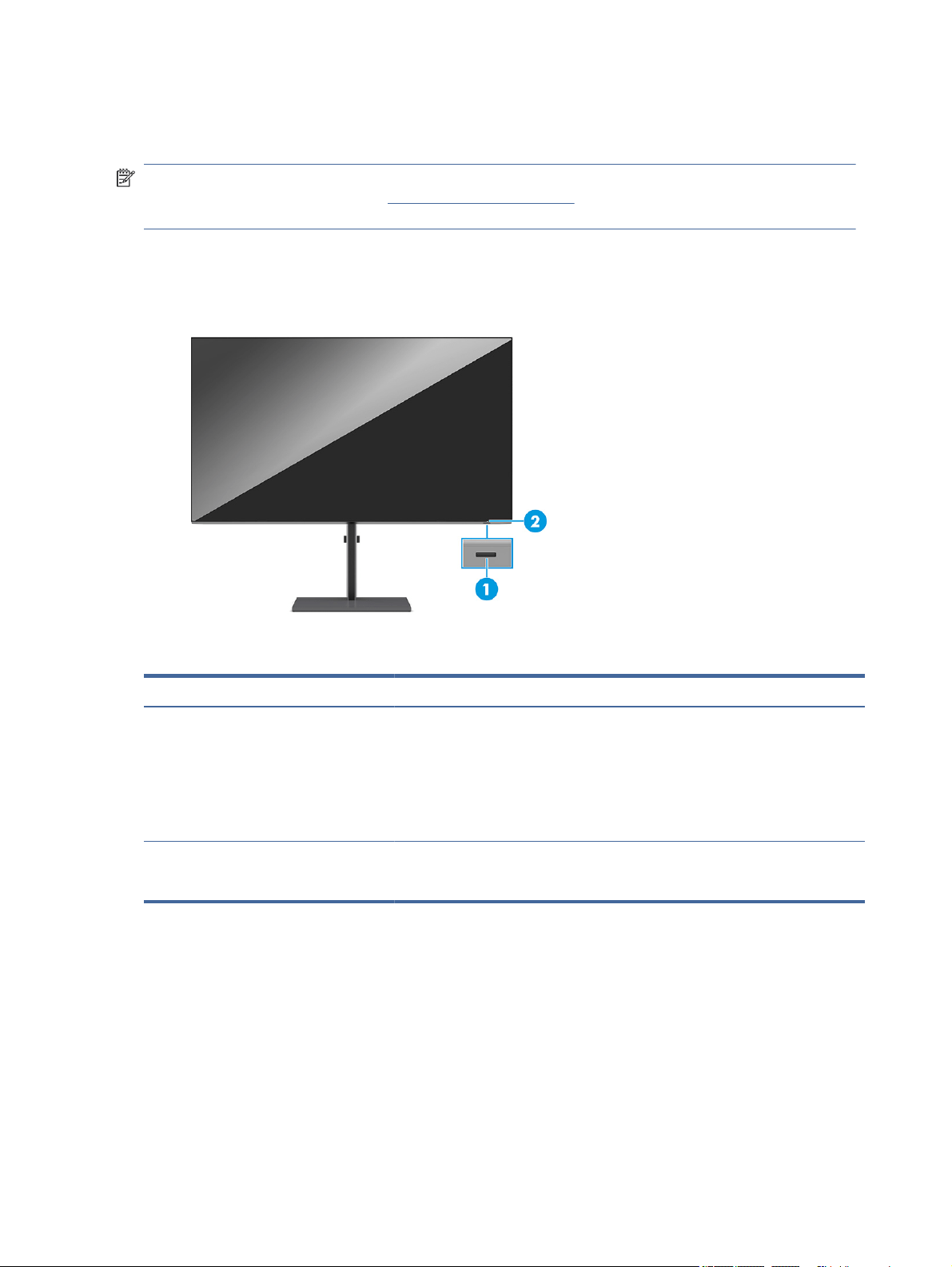
Front components
To identify the components on the front of the monitor, use this illustration and table.
Table 1-2 Front components and their descriptions
Component Description
(1) Power button Turns the monitor on or o.
NOTE: Be sure that the master power switch on the monitor is in the On position to
turn on the monitor.
NOTE: When an HP notebook is connected to the Thunderbolt port, pressing the
power button on the display turns o your notebook or puts it to sleep based on your
power setting preferences.
(2) Power light White: The monitor is on.
Amber: The monitor is in a reduced power state because of inactivity.
Rear components
To identify the components on the rear of the monitor, use this illustration and table.
4
Chapter 1Getting started
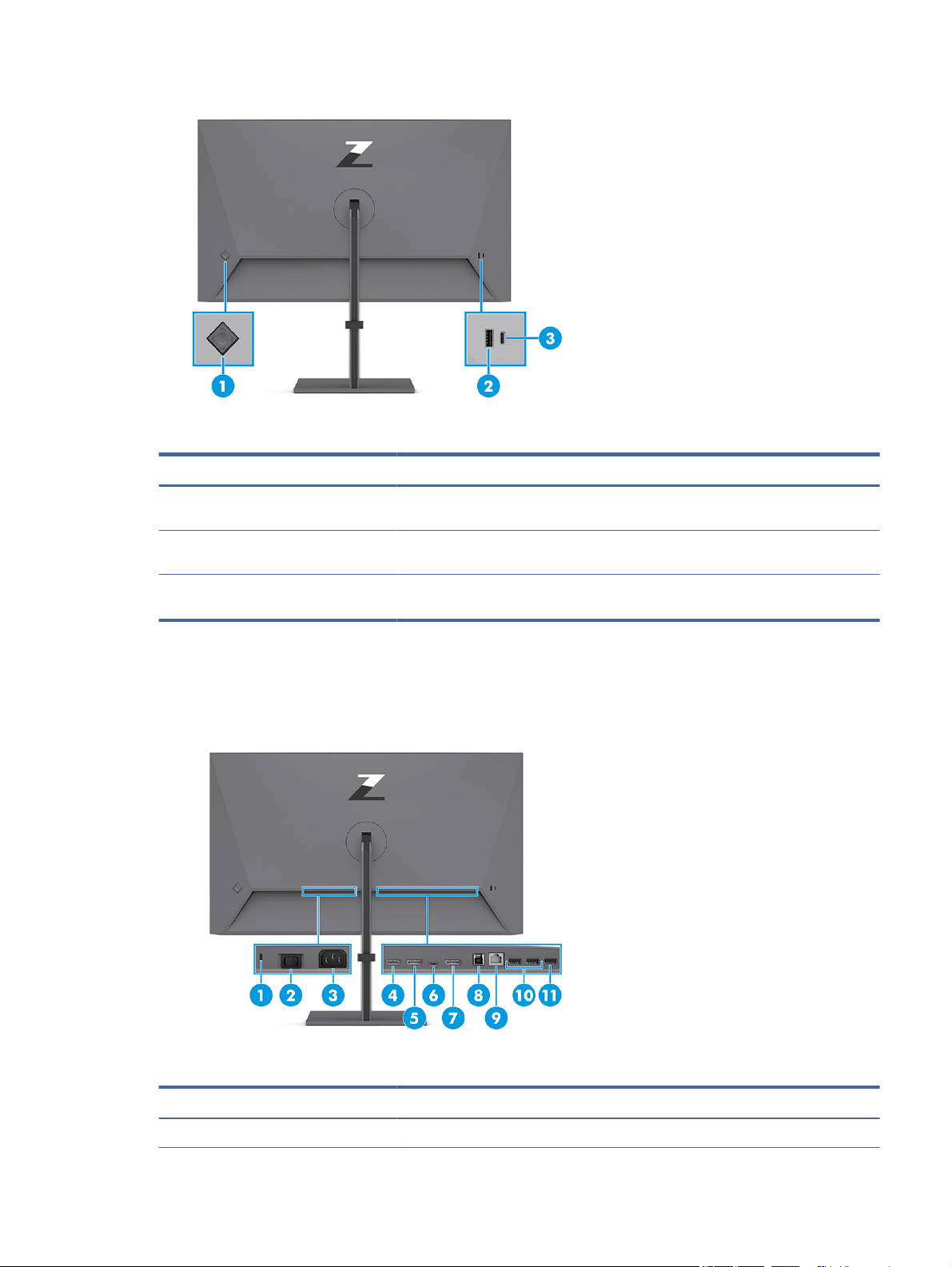
Table 1-3 Rear components and their descriptions
Component Description
(1) OSD control Activates the OSD buttons so that the button labels appear on the right side of the
screen.
(2) USB port (downstream) Connects a USB cable to a peripheral device, such as a keyboard, mouse, or USB hard drive
and supports battery charging.
(3) USB Type-C port (downstream) Connects a USB cable to a peripheral device, such as a keyboard, mouse, or USB hard drive
and supports 5V/3A battery charging.
Bottom components
To identify the components on the bottom of the monitor, use this illustration and table.
Table 1-4
Bottom components and their descriptions
Component Description
(1) Security cable slot Connects an optional security cable.
Bottom components 5

Table 1-4 Bottom components and their descriptions (continued)
Component Description
(2) Master switch Turns on or o all power to the monitor.
(3) Power connector Connects your monitor to a power outlet.
(4) HDMI port Connects the HDMI cable to a source device such as a computer or game console.
(5) DisplayPort connector Connects the DisplayPort cable to a source device such as a computer or game console.
(6) USB Type-C Thunderbolt port
(upstream)
Connects a Thunderbolt or USB Type-C cable to a source device such as a computer or
game console. This Thunderbolt port can function as a DisplayPort input or as a USB 3.0
connection. It can also be used to deliver up to 100 W of power to a device. Power outputs
are 5 V/ 9 V/ 12 V/ 15 V/ 20 V to achieve a 100 W output.
This port also enables the USB Type-A ports to perform their functions.
(7) DisplayPort OUT connector Connects a DisplayPort cable to a secondary monitor for daisy-chaining.
(8) USB Type-B port (upstream) Connects the USB Type-B cable to a source device such as a computer or game console.
NOTE: A USB Type-B cable or a Thunderbolt cable must be connected from the source
device to the monitor to enable USB Type-A ports on the monitor.
(9) RJ-45 (network) port Connects a network cable. The network data rate via Thunderbolt maximum speed is
1OOO Mbps.
● Green (left): The network is connected.
● Amber (right): Activity is occurring on the network.
NOTE: The RJ-45 (network) port supports Wake On Lan (WOL) in-band, Mac Address
Passthrough (MAPT) in-band, and PXE boot. Functionality may vary with PC settings. For
more information, see USB Type-C mode on page 26.
(10) USB ports (2) (downstream) Connect a USB cable to a peripheral device, such as a keyboard, mouse, or USB hard drive.
(11) USB port (downstream) Connects a USB cable to a peripheral device, such as a keyboard, mouse, or USB hard drive
and supports battery charging.
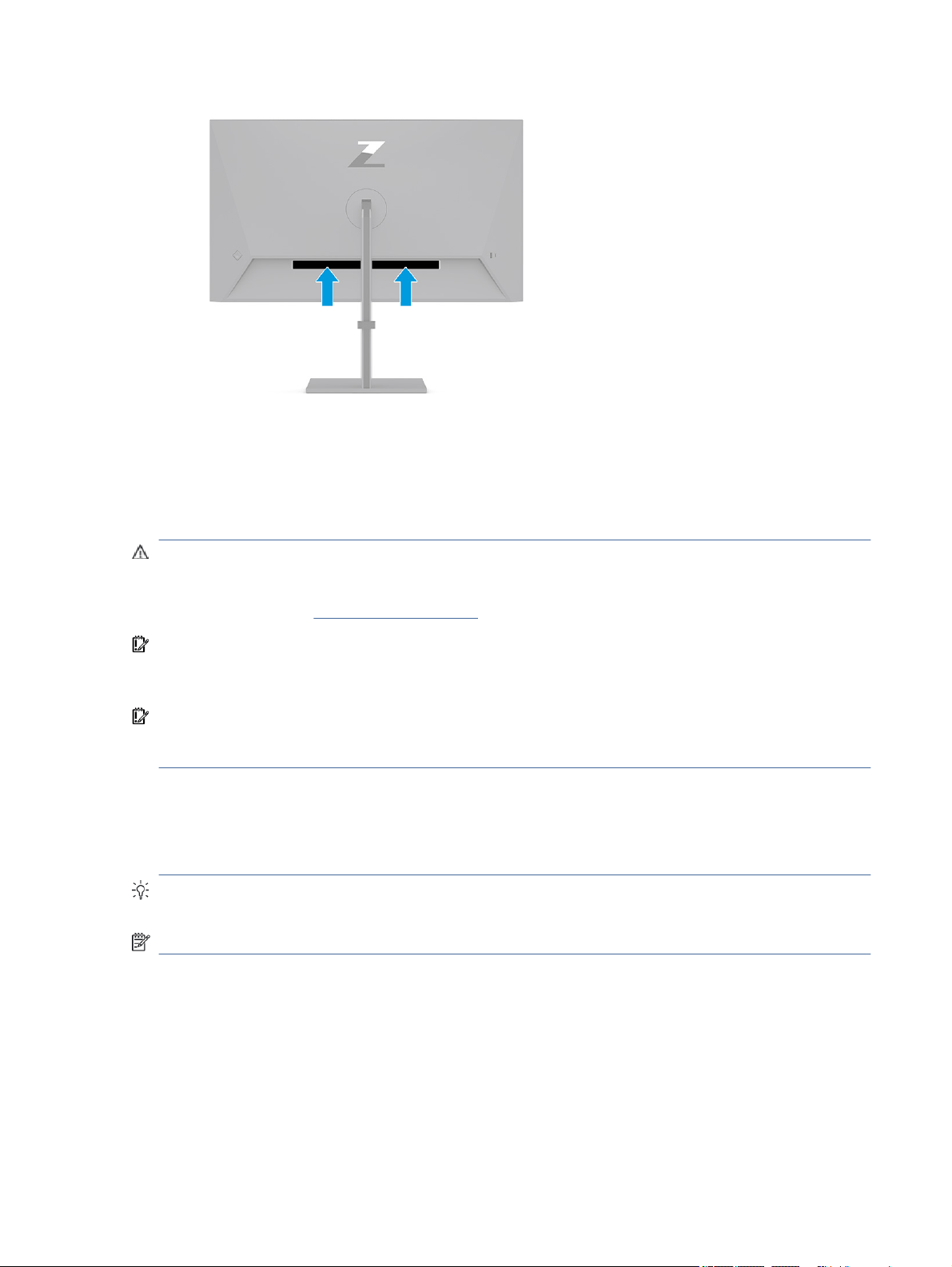
Locating the serial number and product number
Depending on the product, the serial number and product number are located on a label on the rear of
the monitor or on a label under the front bezel of the monitor head. You might need these numbers when
contacting HP for support.
6 Chapter 1Getting started
Setting up the monitor
This section describes attaching the monitor stand or wall mount and the options for connecting your monitor
to a PC, notebook, gaming console, or similar device.
WARNING! To reduce the risk of serious injury, read the Safety & Comfort Guide. It describes proper
workstation setup and proper posture, health, and work habits for computer users. The Safety & Comfort
Guide also provides important electrical and mechanical safety information. The Safety & Comfort Guide is
available on the web at http://www.hp.com/ergo.
IMPORTANT: To prevent damage to the monitor, do not touch the surface of the LCD panel. Pressure on the
panel can cause nonuniformity of color or disorientation of the liquid crystals. If this occurs, the screen will
not recover to its normal condition.
IMPORTANT: To prevent the screen from getting scratched, defaced, or broken and to prevent damage to
the control buttons, position the monitor facedown on a at surface covered with protective sheet foam or a
nonabrasive cloth.
Attaching the monitor stand
Correctly attaching your monitor stand is critical for safe use. This section describes how to safely attach a
stand.
TIP: Consider the placement of the monitor, because surrounding light and bright surfaces might cause
interfering reections.
NOTE: The procedures for attaching a monitor stand might be dierent on other models.
Setting up the monitor
7
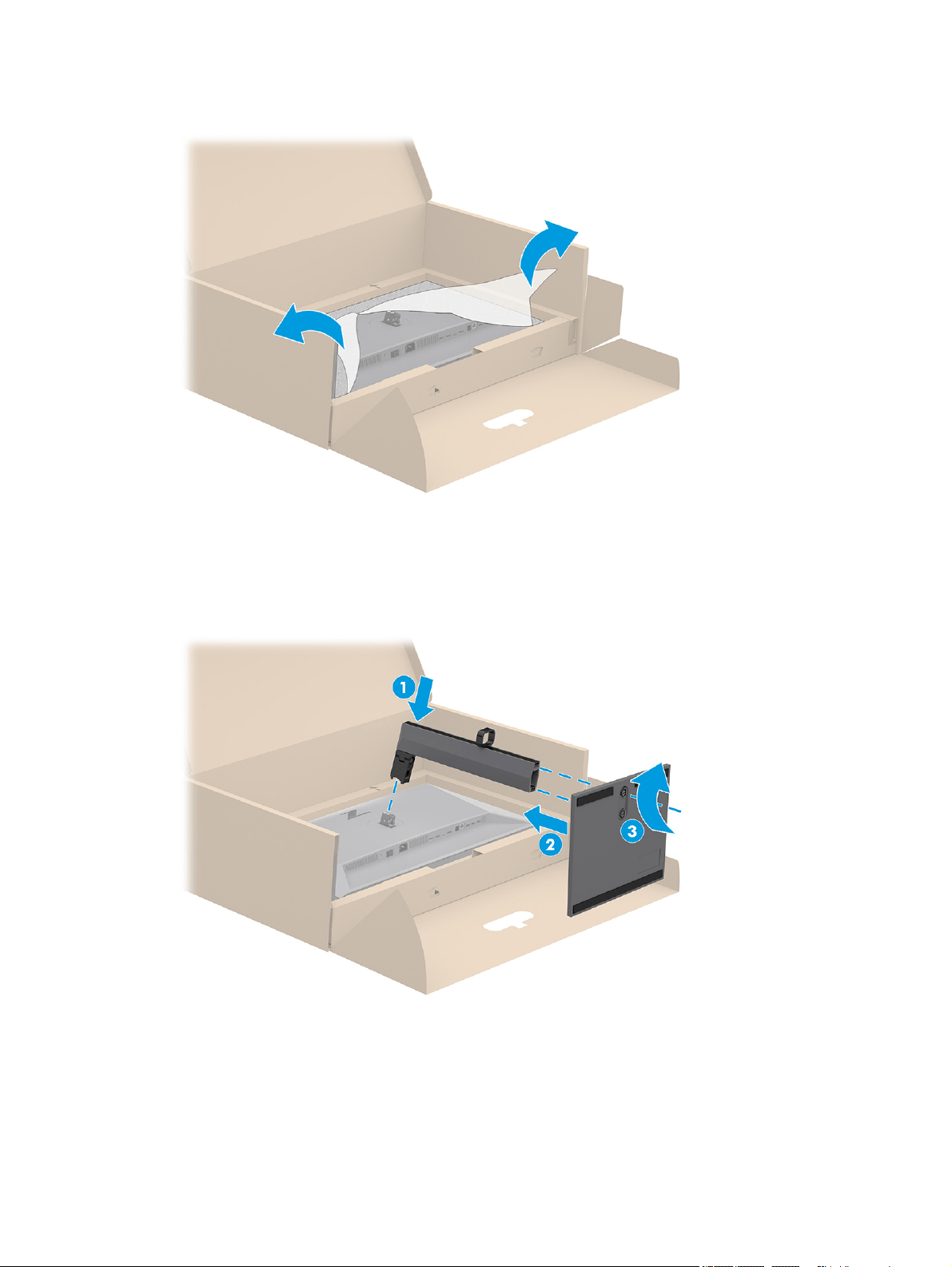
1. With the monitor placed facedown inside the box, tear open the packaging bag along the tear line.
2. Slide the top of the mounting plate on the stand under the upper lip of the recess in the back of the panel
(1).
3. With the monitor still placed facedown inside the box, install the base (2), and then rotate the two
captive screws clockwise to secure the base (3).
Mounting the monitor head
To attach your monitor to a wall using a swing arm or other mounting xture, follow the steps in this section
to safely and securely connect your monitor.
8
Chapter 1Getting started
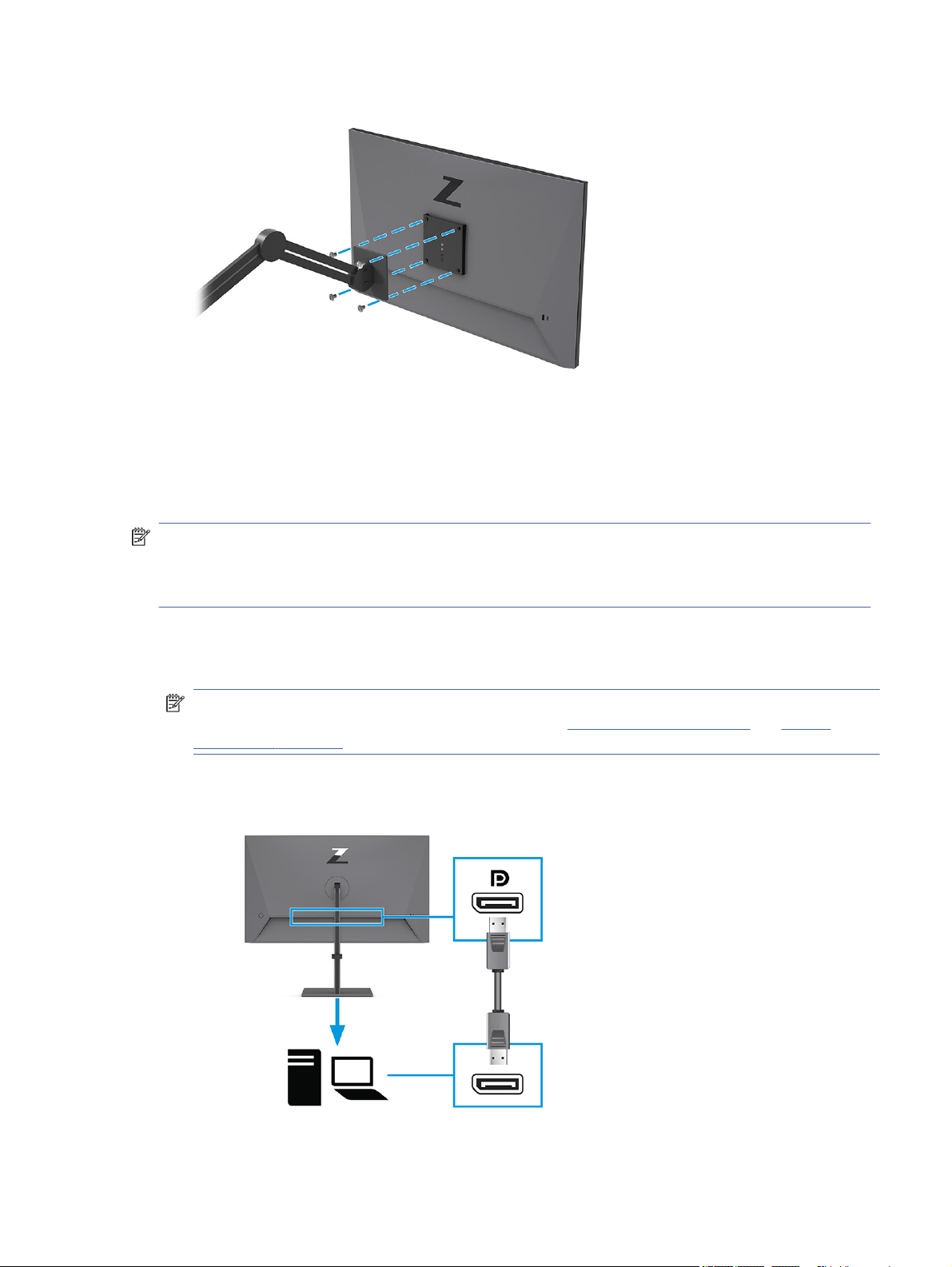
IMPORTANT: This monitor supports the VESA industry-standard 100 mm mounting holes. To attach a third-
party mounting solution to the monitor head, use four 4 mm, 0.7 pitch, and 10 mm long screws. Longer
screws might damage the monitor. Be sure that the manufacturer’s mounting solution is compliant with the
VESA standard and is rated to support the weight of the monitor head. For best performance, use the power
and video cables provided with the monitor.
NOTE: This apparatus is intended to be supported by a UL-listed or CSA-listed wall-mount bracket.
Removing the monitor stand
If you decide to use a wall mount instead of the monitor stand that you attached, rst remove the stand.
IMPORTANT: Before you disassemble the monitor, be sure that the monitor is turned o and all cables are
disconnected.
IMPORTANT: To position and stabilize the monitor, HP recommends that two people perform these
procedures.
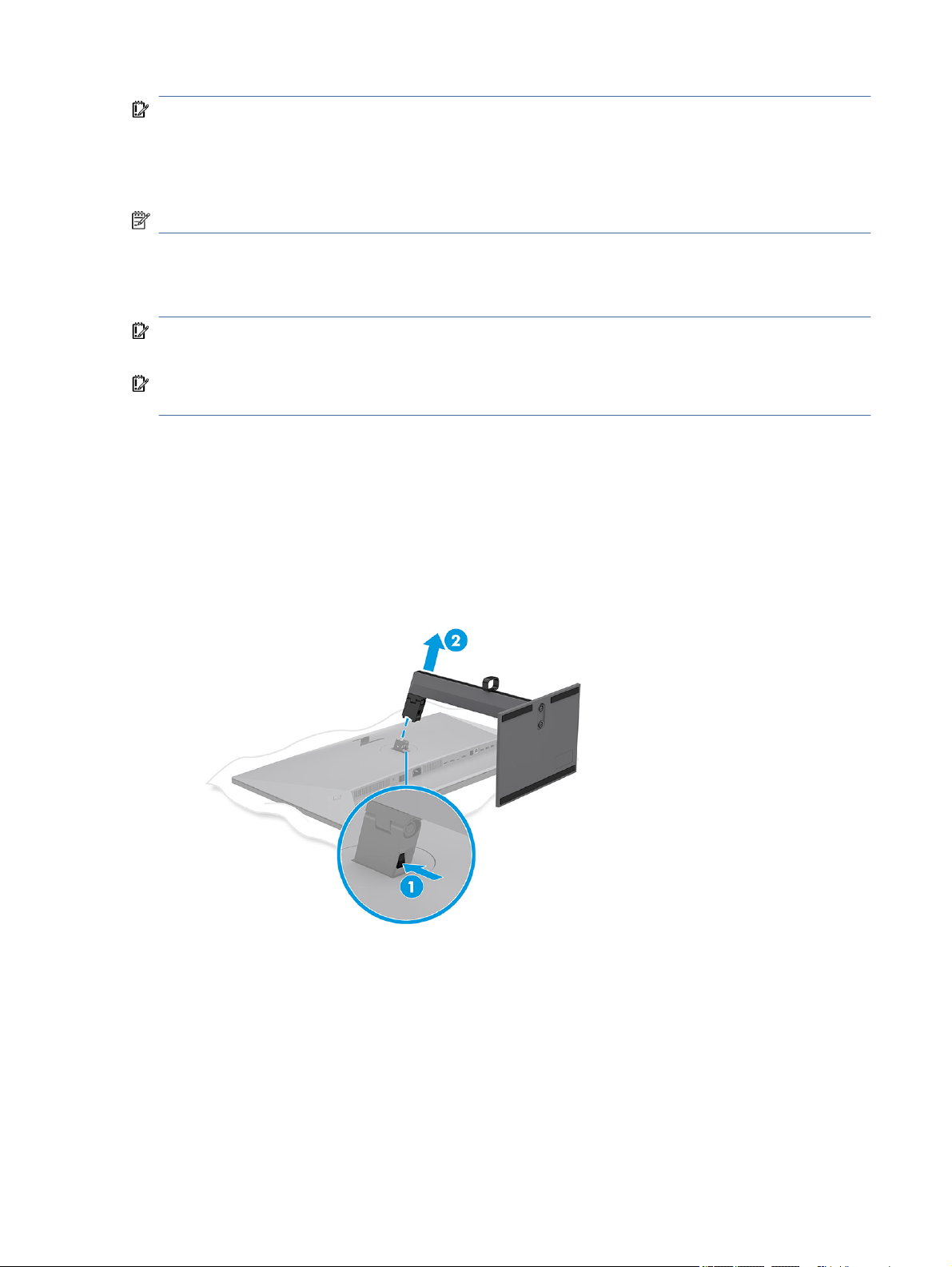
1. Disconnect and remove all cables from the monitor.
2. Position the monitor facedown on a at surface covered by protective sheet made of foam or a clean, dry
cloth.
3. Push up the latch near the bottom center of the stand’s mounting plate (1).
4. Swing the bottom of the stand up until the mounting plate clears the recess in the monitor head (2).
5. Slide the stand out of the recess.
Attaching the monitor head to a mounting device
You might need additional tools such as a screwdriver (purchased separately) when you attach a mounting
device. To avoid damage to your monitor, follow these instructions:
Removing the monitor stand
9
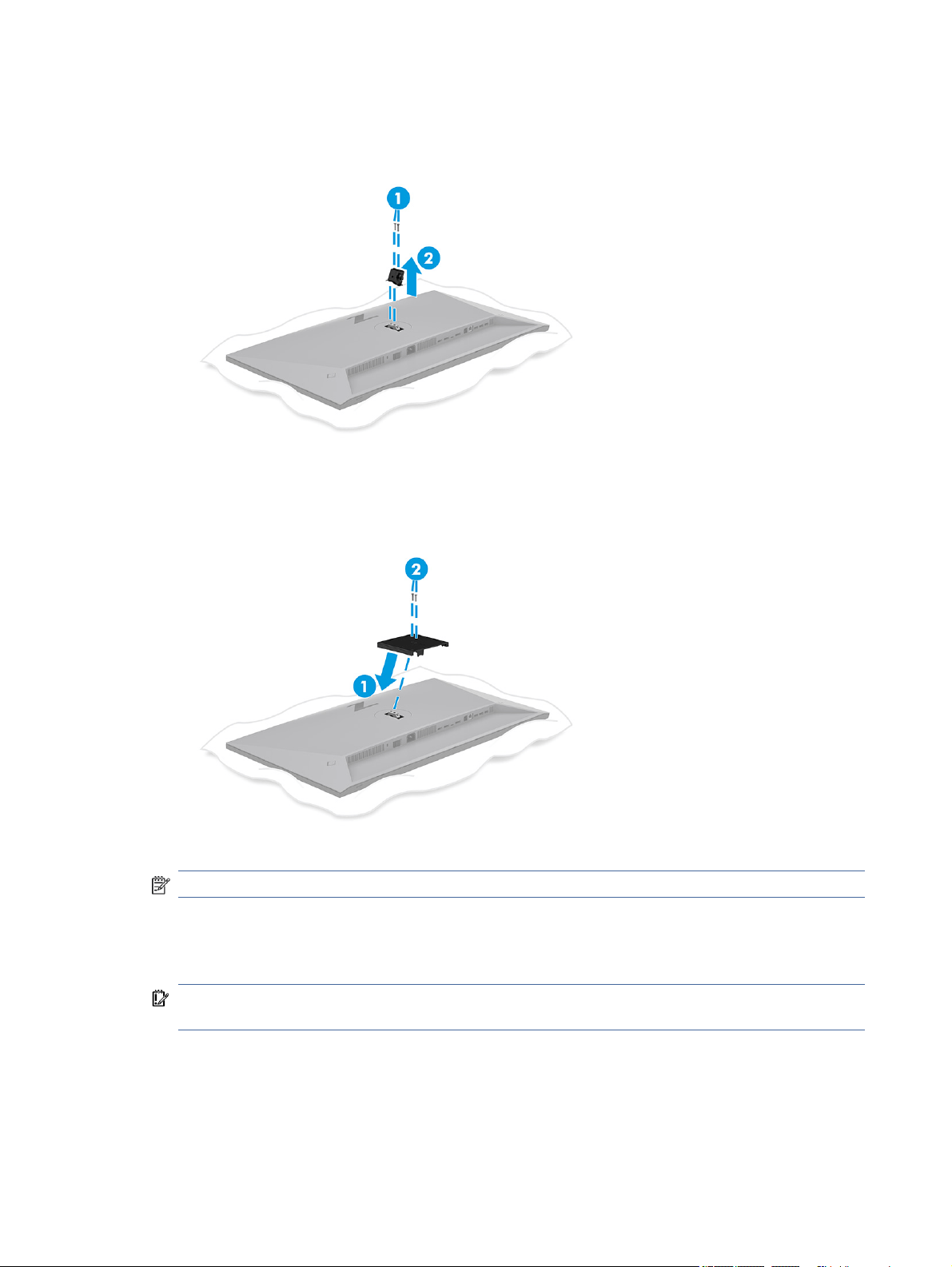
1. Remove the two screws from the VESA holes located on the rear of the monitor head (1), and then
remove the screw fastener (2).
2. Align the VESA adapter with the screw holes located on the rear of the monitor head (1), and then install
the two screws to secure the adapter (2).
NOTE: The adapter attaches only after you lower the stand mount to the correct position.
3. To attach the monitor head to a swing arm or other mounting device, insert four mounting screws
through the holes on the mounting device and into the VESA screw holes on the back of the monitor
head.
IMPORTANT: If these instructions do not apply to your device, then follow the mounting device
manufacturer’s instructions when mounting the monitor to a wall or swing arm.
10
Chapter 1Getting started
Connecting the cables
In addition to details about how to connect a cable, this section contains information about how your monitor
functions when you connect certain cables.
NOTE: The monitor might be capable of supporting Thunderbolt, USB Type-C, HDMI, or DisplayPort inputs.
The video mode is determined by the video cable used. The monitor automatically determines which inputs
have valid video signals. You can select the inputs through the OSD menu. The monitor ships with select
cables. Not all cables shown in this section are included with the monitor.
1. Place the monitor in a convenient, well-ventilated location near the computer.
2. Connect a video cable.
NOTE: Some USB Type-C ports support display output. To determine if the USB Type-C port on your
monitor is capable of supporting DisplayPort output, see Rear components on page 4 and Bottom
components on page 5.
● Connect one end of a DisplayPort cable to the DisplayPort connector on the rear of the monitor and
the other end to the DisplayPort connector on the source device.
Connecting the cables 11
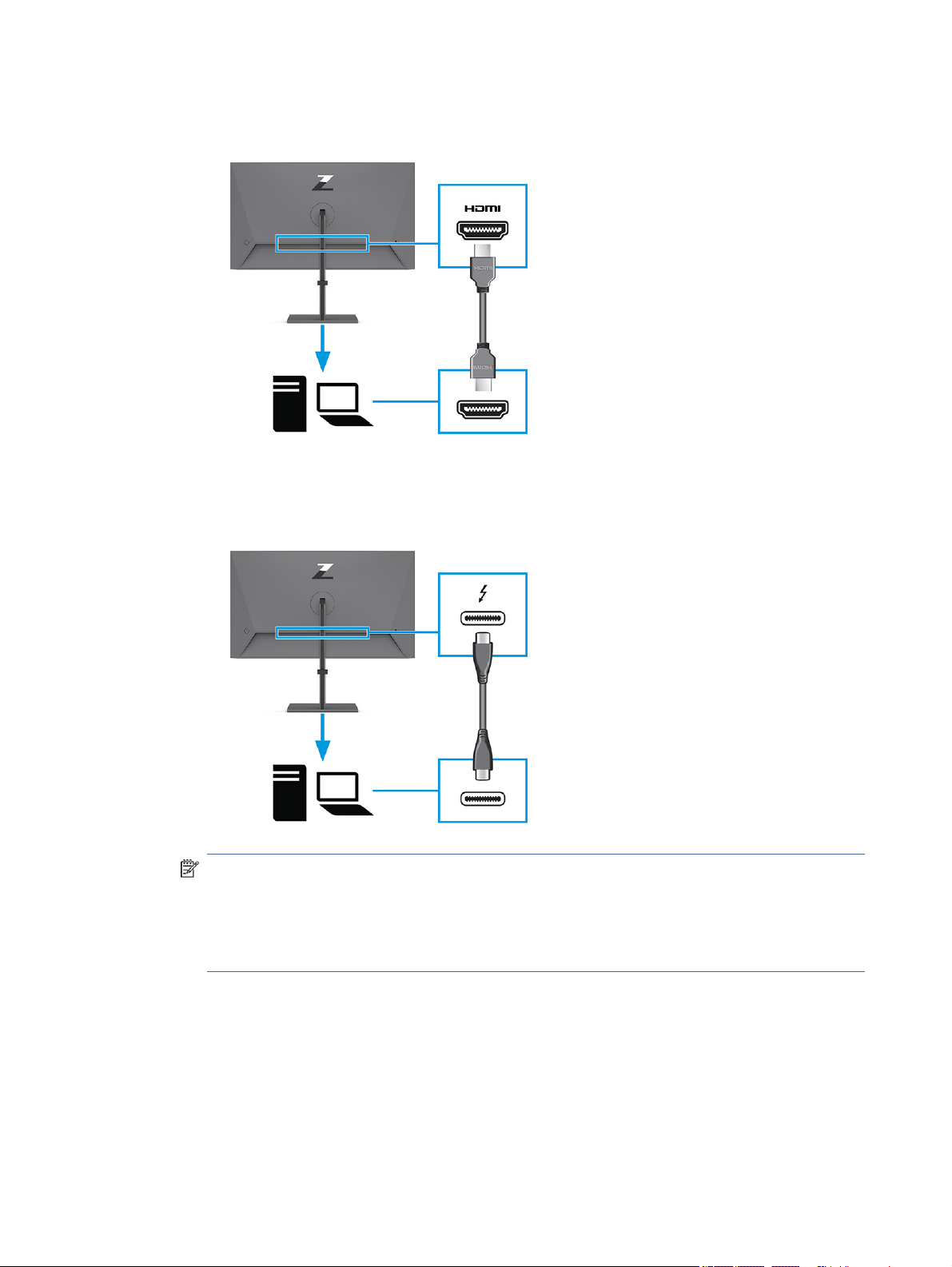
● Connect one end of an HDMI cable to the HDMI port on the rear of the monitor and the other end to
the HDMI port on the source device.
● Connect one end of a Thunderbolt cable to the Thunderbolt port on the rear of the monitor and the
other end to the Thunderbolt port on the source device. (Use only the HP-approved Thunderbolt
cable provided with the monitor.)
NOTE: The monitor’s Thunderbolt port provides network, data, video, and power delivery (up to
100 W).
The host device must be able to support DisplayPort Alt Mode (video, charging, and USB 3.1)
over the Thunderbolt connector. The host device must also be compatible with USB Type-C-
Thunderbolt™-enabled ports.
12
Chapter 1Getting started
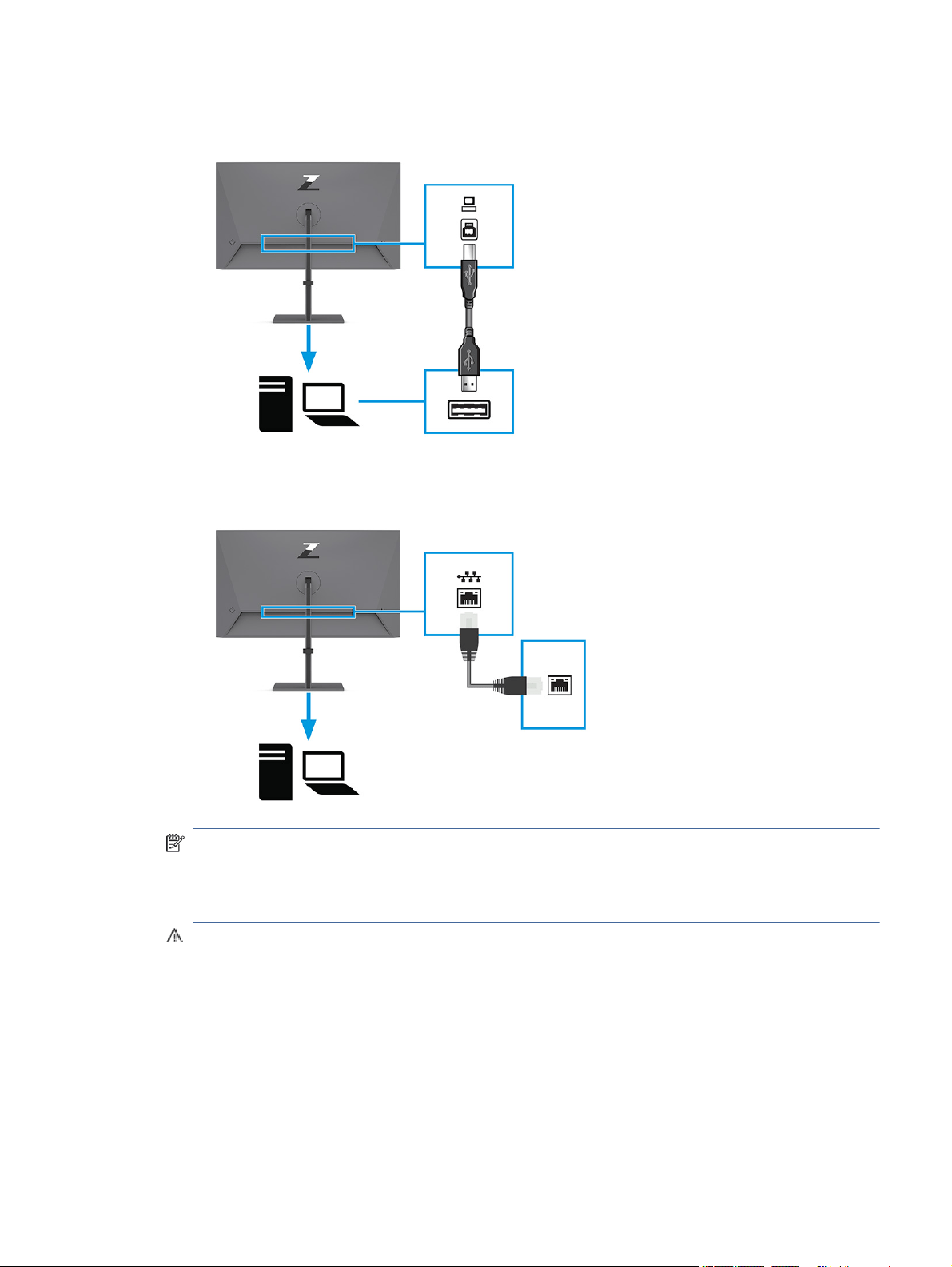
3. Connect one end of the USB Type-B cable to a USB Type-B port on the monitor and the other end to a
USB Type-A port on the source device.
4. Connect one end of a network cable to the network jack on the monitor and the other end to a network
wall jack or router.
NOTE: To enable the network function, be sure that the Thunderbolt port is connected.
5. Connect one end of the power cord to a grounded AC outlet and the other end to the power connector on
the monitor.
WARNING! To reduce the risk of electric shock or damage to the equipment:
Do not disable the power cord grounding plug. The grounding plug is an important safety feature.
Plug the power cord into a grounded (earthed) AC outlet that is easily accessible at all times.
Disconnect power from the equipment by unplugging the power cord from the AC outlet.
For your safety, do not place anything on power cords or cables. Arrange them so that no one can
accidentally step on or trip over them. Do not pull on a cord or cable. When unplugging the power cord
from the AC outlet, grasp the cord by the plug.
Connecting the cables
13
Connecting USB devices
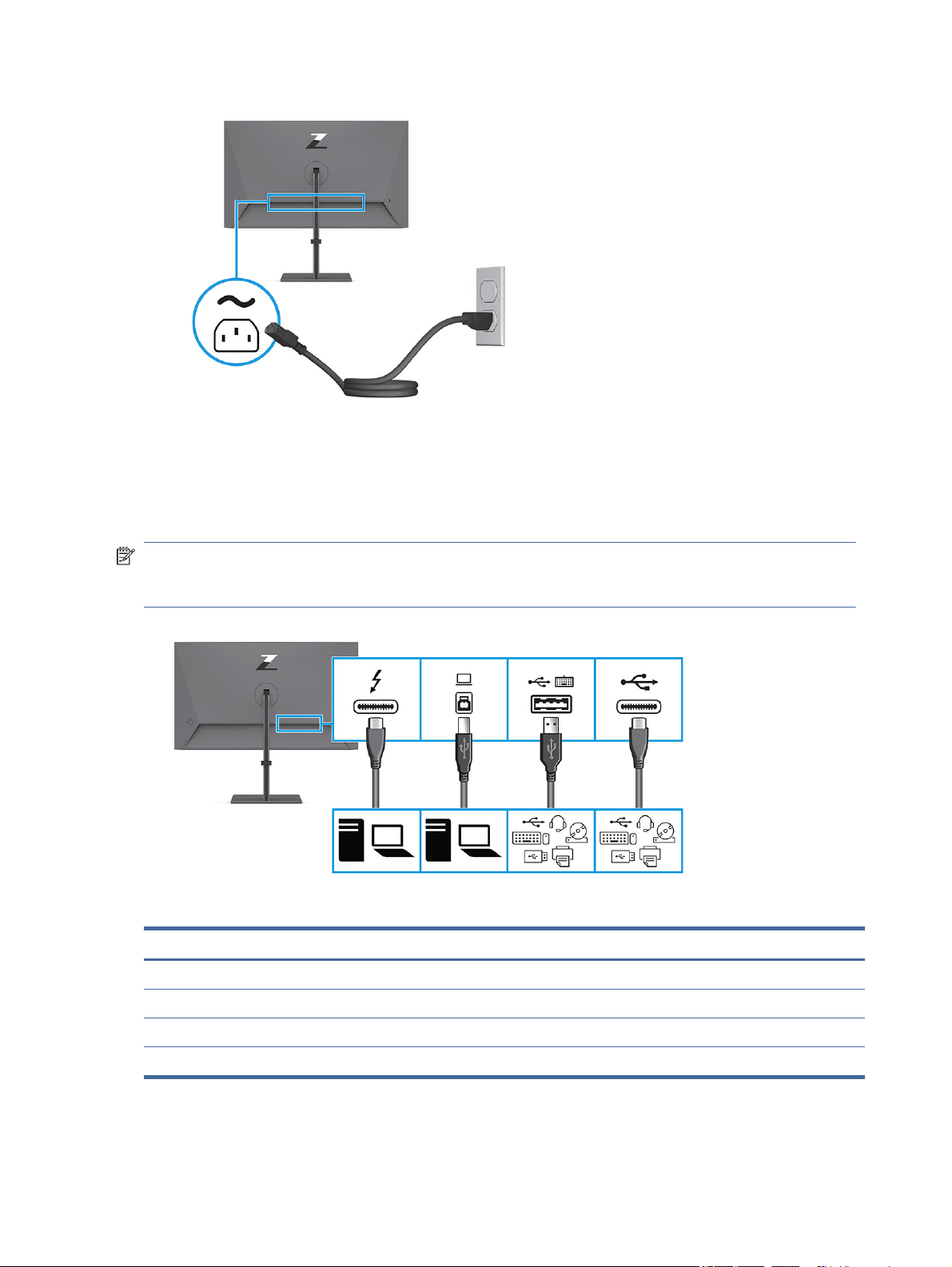
Use USB ports to connect devices such as a digital camera, USB keyboard, or USB mouse. There are four USB
ports on the monitor to connect to a device (downstream): three USB Type-A on the rear, and one USB Type-C
and one USB Type-A on the side.
NOTE: You must connect the Thunderbolt cable or USB Type-B cable from the source device (computer) to
the rear of the monitor to enable the USB Type-A ports to serve as a USB hub for a mouse, keyboards,
phones, external hard drives, and practically anything that is USB-connected and can accept 5 V.
Table 1-5
USB port locations
USB Ports
Thunderbolt port (upstream)
USB Type-B port
USB Type-A ports (4) downstream
USB Type-C port downstream
14 Chapter 1Getting started
Adjusting the monitor
To support an ergonomic work space, your monitor oers the adjustment options outlined in this section.
WARNING! To reduce the risk of serious injury, read the Safety & Comfort Guide. It describes proper
workstation setup and proper posture, health, and work habits for computer users. The Safety & Comfort
Guide also provides important electrical and mechanical safety information. The Safety & Comfort Guide is
available on the web at http://www.hp.com/ergo.
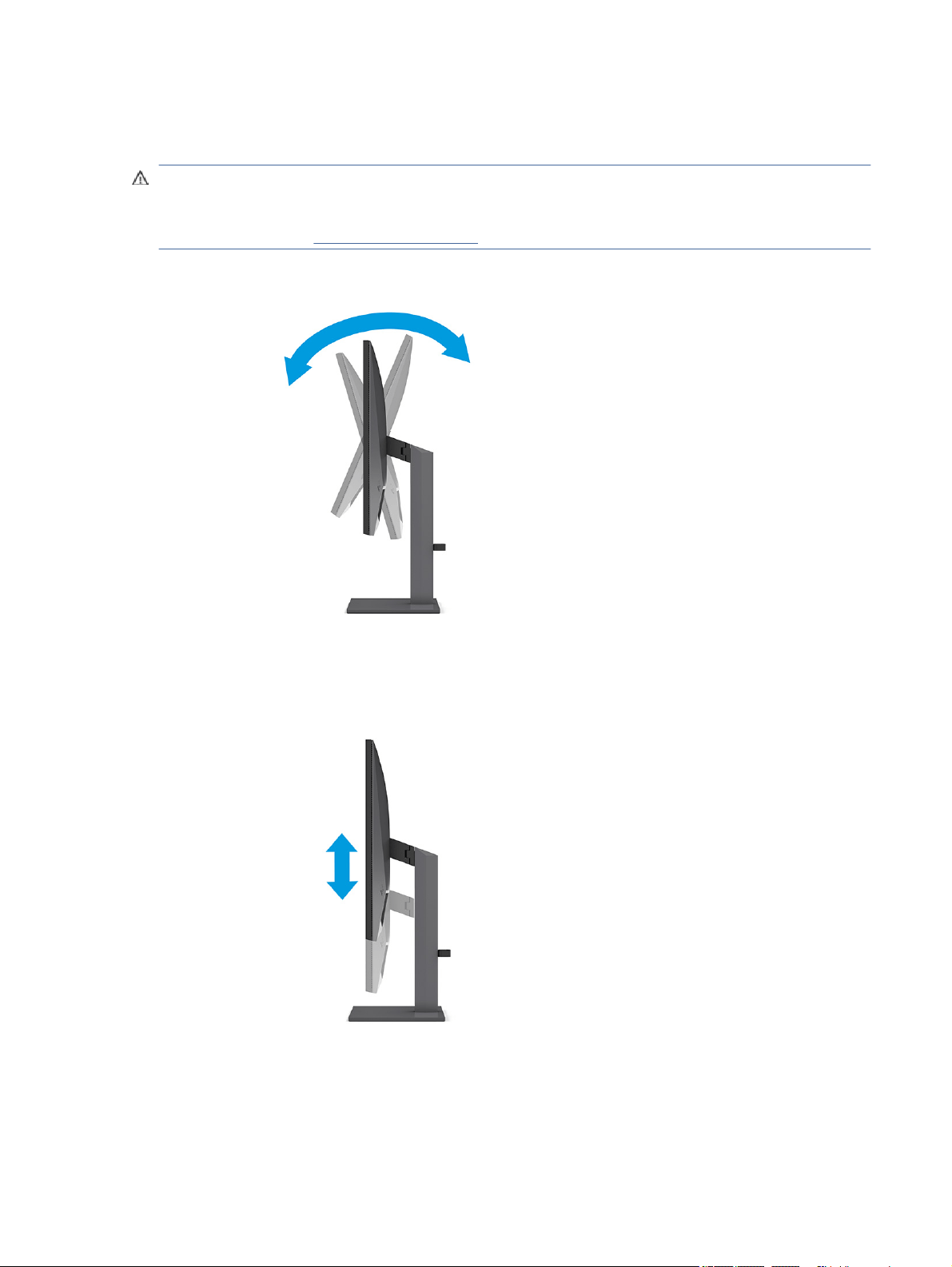
1. Tilt the monitor head forward or backward to set it to a comfortable eye level.
2. Adjust the monitor’s height to a comfortable position for your individual workstation. The monitor’s top
bezel edge should not exceed a height that is parallel to your eye height. A monitor that is positioned low
and reclined might be more comfortable for users with corrective lenses. Reposition your monitor as you
adjust your working posture throughout the work day.
Adjusting the monitor 15
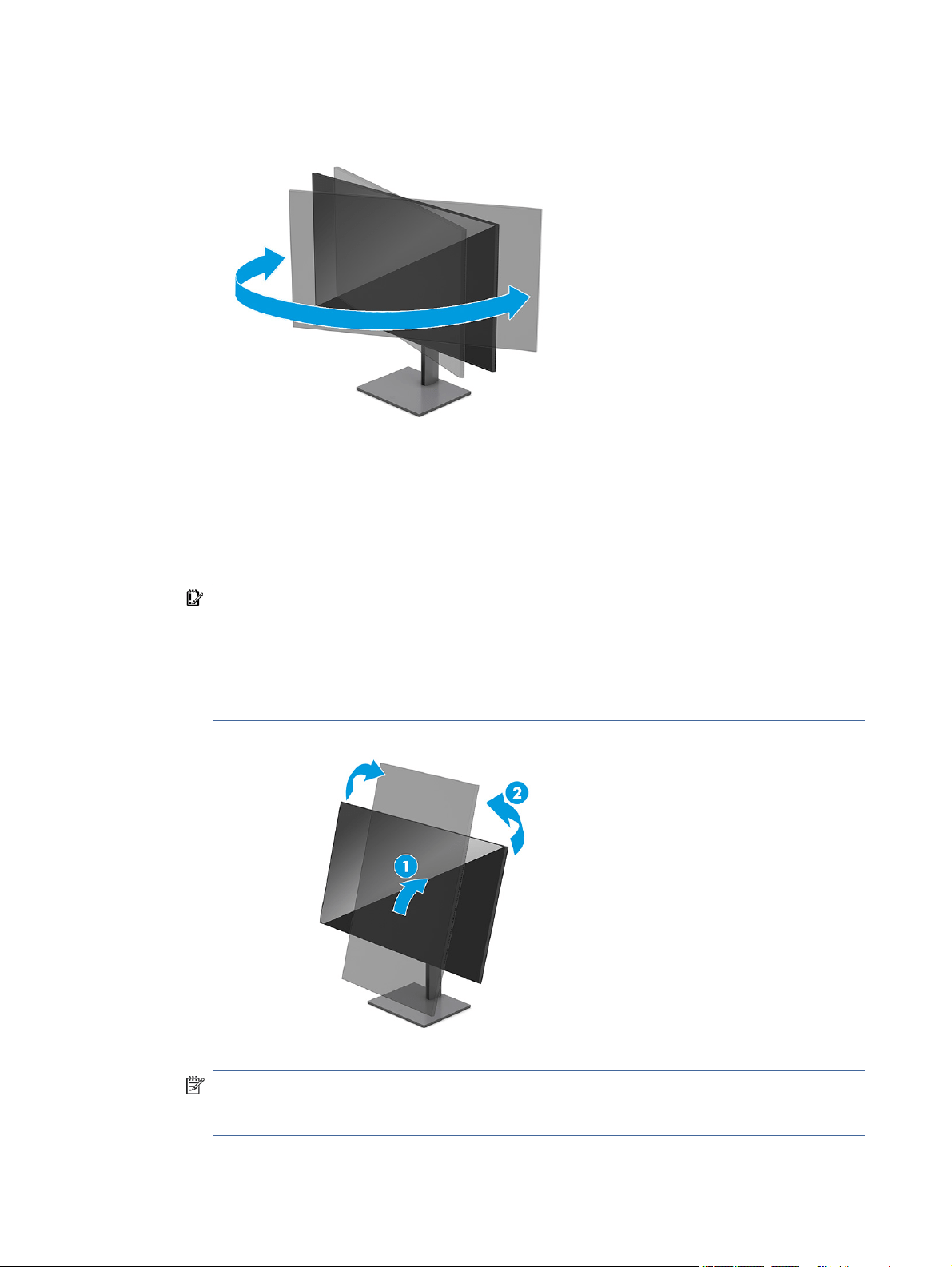
3. Swivel the monitor head to the left or right for the best viewing angle.
4. You can pivot the monitor head from landscape to portrait orientation viewing to adapt to your
application.
a. Adjust the monitor to full height position and tilt the monitor back to full tilt position (1).
b. Pivot the monitor clockwise or counterclockwise 90° from landscape to portrait orientation (2).
IMPORTANT: If the monitor is not in full height and full tilt position when pivoting, the bottom
right corner of the monitor panel will come in contact with the base and potentially cause damage
to the monitor.
If you are adding an optional speaker bar to the monitor, install it after pivoting the monitor. The
speaker bar will come in contact with the base when the monitor pivots and potentially cause
damage to the monitor or speaker bar.
NOTE: Use the operating system's display settings to rotate the image on the screen from portrait
to landscape. To rotate the OSD from portrait to landscape, select OSD menu, select Menu Rotation,
and then select Portrait.
16
Chapter 1Getting started
Installing a security cable
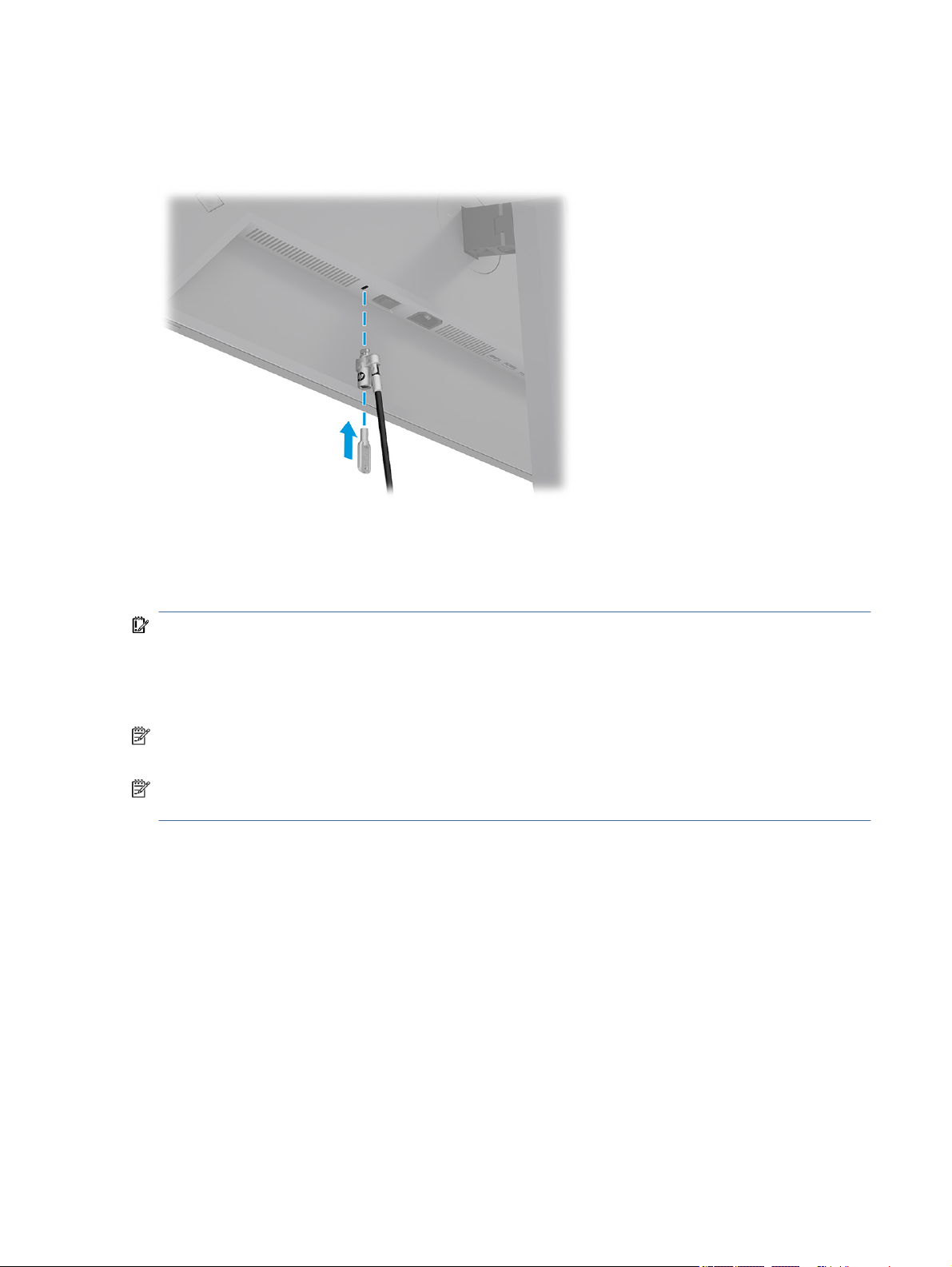
As a security measure, you can secure the monitor to a xed object with an optional security cable available
from HP. Use the key that came with the optional security cable to attach and remove the lock.
Turning on the monitor
This section provides important information about preventing damage to your monitor, startup indicators,
and troubleshooting information.
IMPORTANT: Burn-in image damage might occur on monitors that display the same static image on the
screen for 12 or more hours. To avoid burn-in image damage, you should always activate a screen saver
application or turn o the monitor when it will not be in use for a prolonged period of time. Image retention
is a condition that might occur on all LCD screens. Burn-in damage on the monitor is not covered under the
HP warranty.
NOTE: If pressing the power button has no eect, the Power Button Lockout feature might be enabled. To
disable this feature, press and hold the monitor power button for 10 seconds.
NOTE: On select HP monitors, you can disable the power light in the OSD menu. Press the Menu button to
open the OSD, select Power, select Power LED, and then select O.
■
Press the button on the monitor to turn it on. (Be sure that the master power switch is in the On position).
Installing a security cable 17
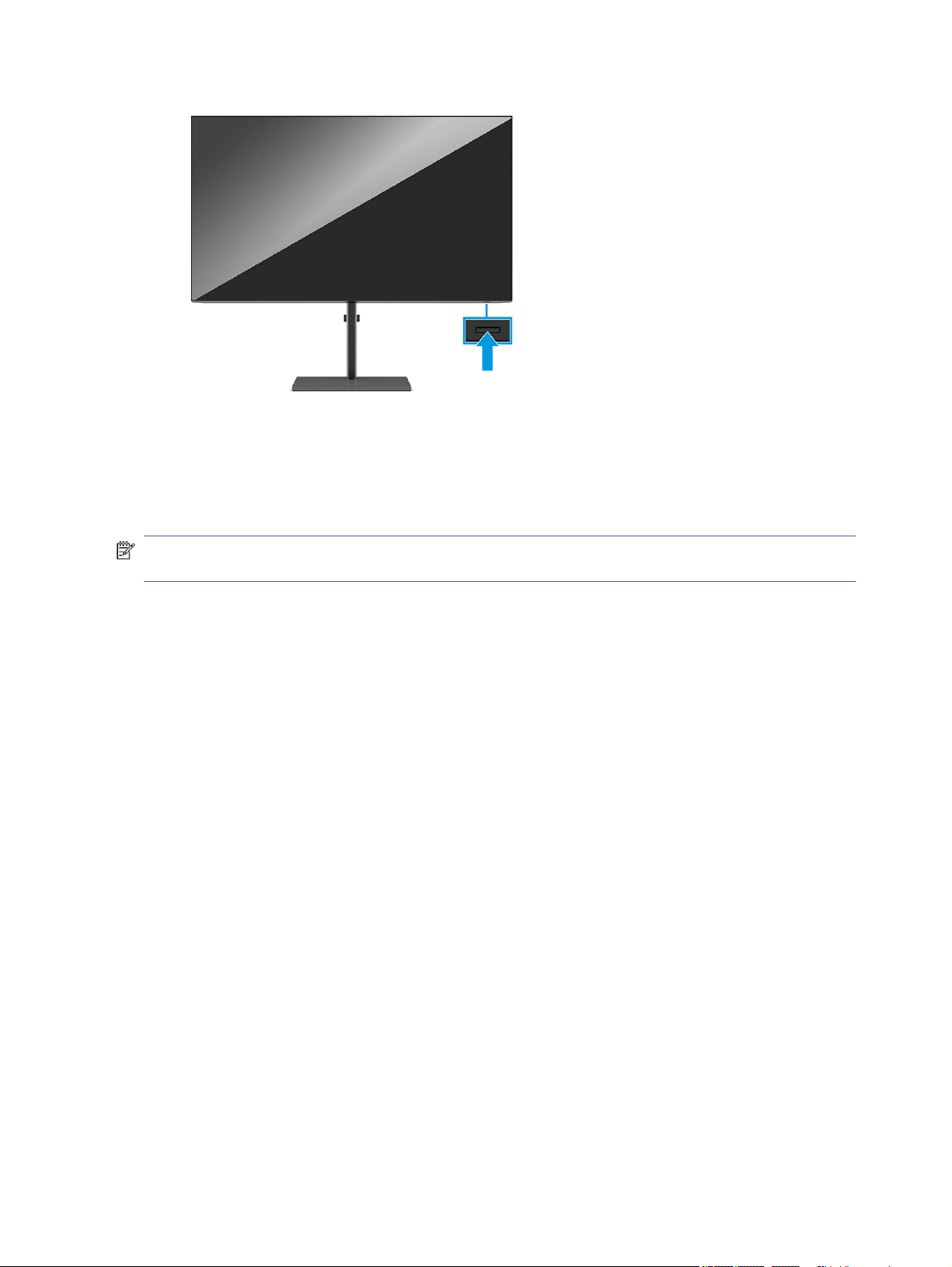
When you rst turn on your monitor, a monitor status message is displayed for 5 seconds. The message
shows which input is the current active signal, the status of the auto-switch source setting (On or O; default
setting is On), the current preset display resolution, and the recommended preset display resolution.
The monitor automatically scans the signal inputs for an active input and uses that input for the display.
NOTE: When an HP notebook is connected to the Thunderbolt port, pressing the power button on the
display turns o your notebook or puts it to sleep, based on your power setting preferences.
HP watermark and image retention policy
Some monitors are designed with In-Plane Switching (IPS) display technology, which provides ultrawide
viewing angles and advanced image quality. Though suitable for many applications, this panel technology is
not suitable for static, stationary, or xed images for long periods of time, unless you use screen savers.
Applications with static images can include camera surveillance, video games, marketing logos, and
templates. Static images can cause image retention damage that could look like stains or watermarks on
the monitor's screen.
Image retention damage on monitors that are in use 24 hours per day is not covered under the HP warranty.
To avoid image retention damage, always turn o the monitor when it is not in use, or use the power
management setting, if supported on your computer, to turn o the monitor when the computer is idle.
18 Chapter 1Getting started
Connecting a second computer to the monitor
using the KVM function
2
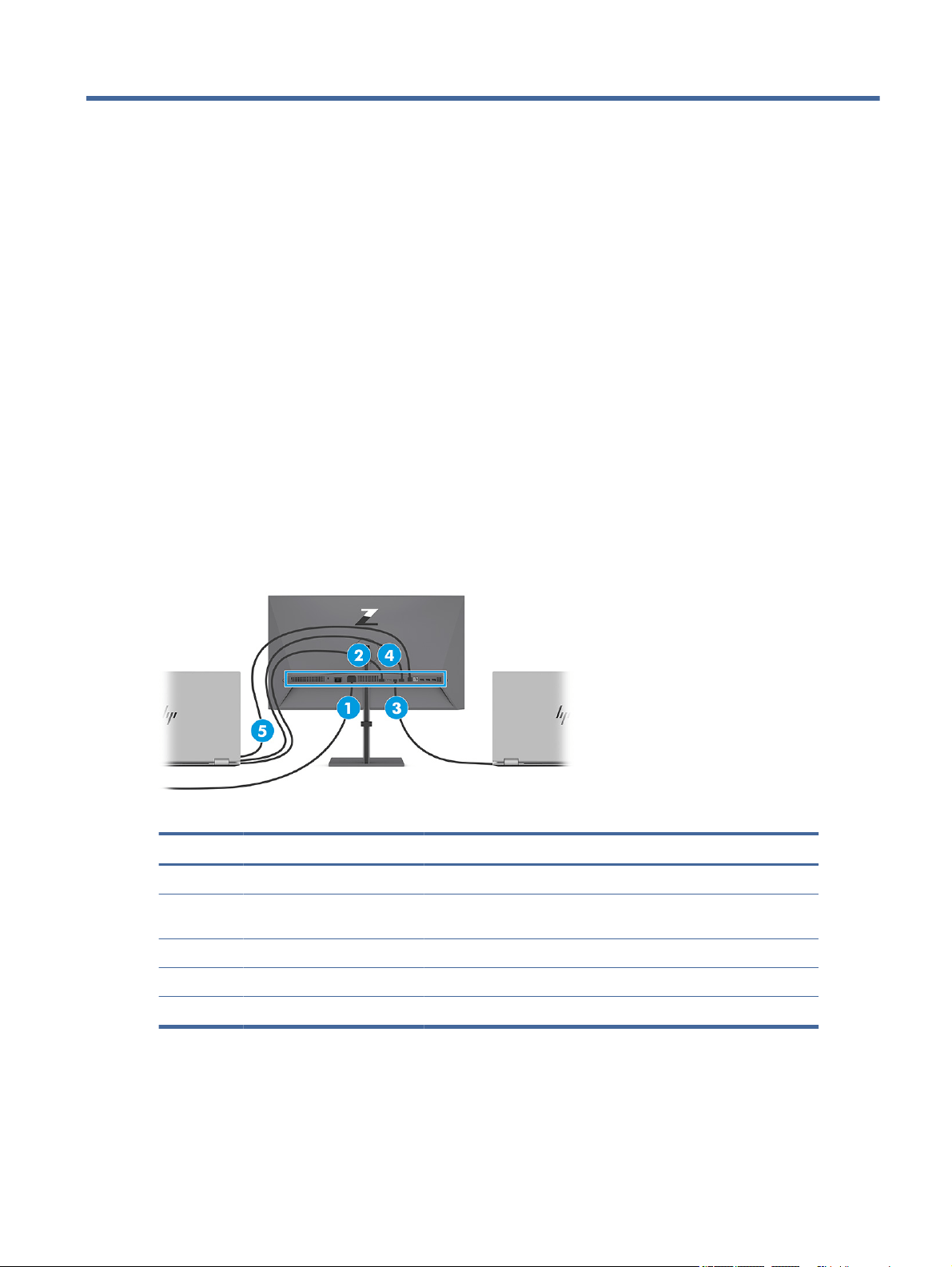
The keyboard, video, mouse (KVM) function in the monitor provides the capability to connect two computers
to one monitor with quick monitor access to either computer, and control using one keyboard and one mouse.
For video input from a second computer, connect either a DisplayPort cable or an HDMI cable to the
appropriate connector on the rear of the monitor. For example, connect one end of a DisplayPort cable
to a DisplayPort connector on the rear of the monitor and the other end to a DisplayPort connector on the
second computer. If the second computer has only an HDMI port, connect one end of the HDMI cable to an
HDMI port on the rear of the monitor and the other end to an HDMI port on the second computer.
For the USB connection to the second computer, you can use a USB Type-B to Type-A cable connected to the
monitor's USB Type-B port.
When the Thunderbolt (bottom side) input is connected, the monitor will automatically switch to the
Thunderbolt input for both video and USB data regardless of the computer state. When the Thunderbolt
input is disconnected and the second computer is active, the monitor will automatically switch back to the
active input (DisplayPort or HDMI).
Table 2-1
Connecting a second computer
Components Description
(1) Power connector Connects your monitor to a power outlet.
(2) HDMI port When the second computer is active (PC #2), the monitor switches to the
active input (HDMI or DisplayPort).
(3) Thunderbolt port Multiple function support includes charging, USB, and display functions.
(4) DisplayPort port
(5) USB Type-B port USB port connects to PC #2.
KVM connection priorities
The section describes KVM connection priorities.
Connecting a second computer to the monitor using the KVM function
19
There are 2 types of KVM connections:
● Thunderbolt uses a Thunderbolt or USB Type-C cable only.
● USB Type-B uses a USB Type-B cable for USB data transfer and to connect with HDMI or DisplayPort for
video transfer.
The KVM function uses the current video input port. If the rst computer is disconnected, the KVM setting
switches to the powered-on second computer.
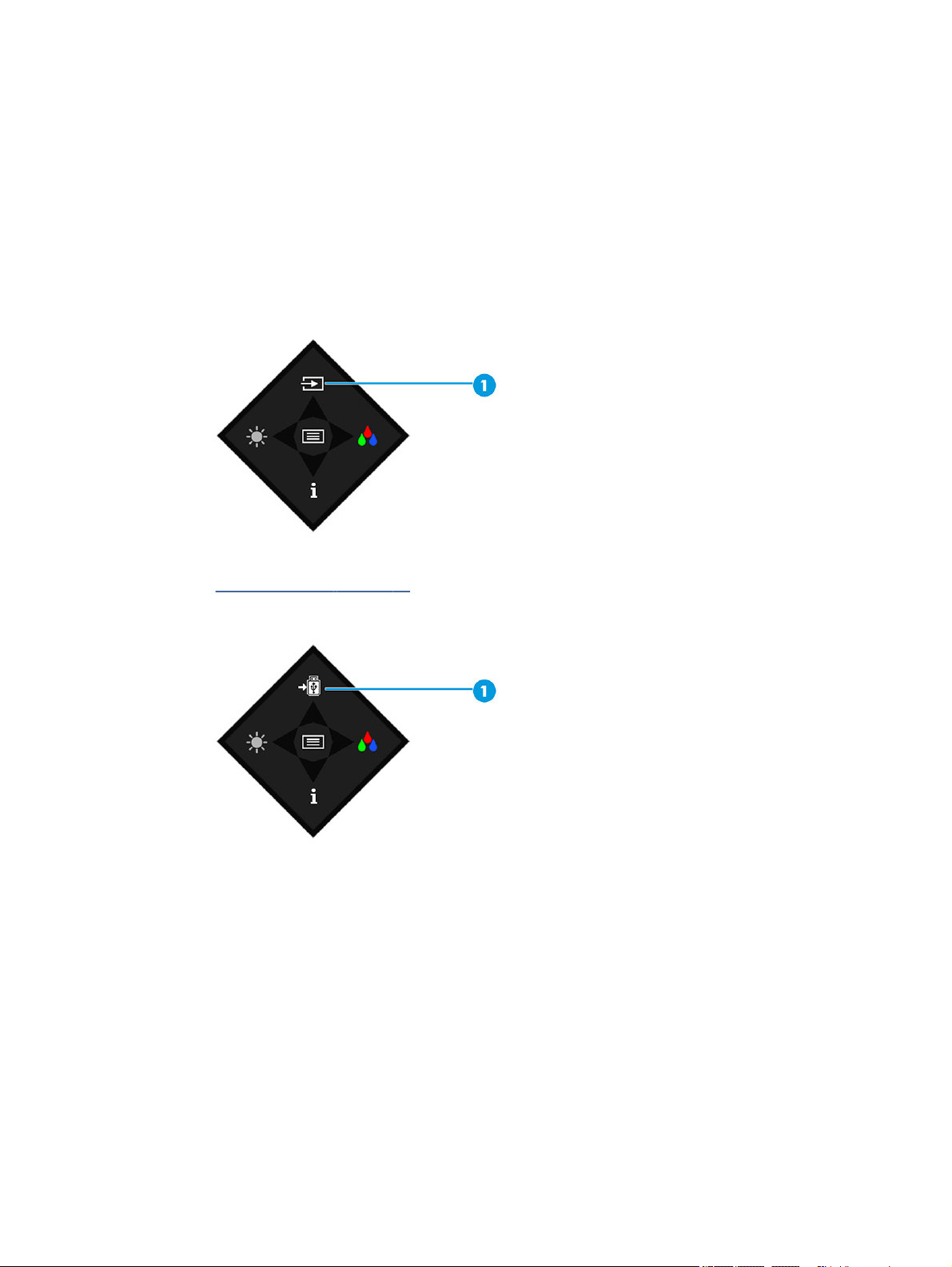
If two active computers are connected, the KVM function can be quickly switched by pressing the OSD Next
Input button (1).
In PbP mode, to activate the KVM function for two active computers, follow the instructions to rst enable PbP
mode (see Using PiP and PbP on page 24). Two video inputs will be shown picture by picture at the same
time. Next, you can quickly switch hosts by pressing the OSD USB host swap button (1).
20 Chapter 2Connecting a second computer to the monitor using the KVM function

Using the monitor3
This chapter describes how to use your monitor and its features, including software and utilities, the OSD
menu, the function buttons, power modes, and Windows Hello.
Downloading software and utilities
You can download and install these les from HP Support.
● INF (Information) le
● ICM (Image Color Matching) les
To download the les:
1. Go to http://www.hp.com/support.
2. Select Software and Drivers.
3. Select your product type.
4. Enter your HP monitor model in the search eld and follow the on-screen instructions.
The Information
le
The INF le denes monitor resources used by Windows® operating systems to ensure monitor compatibility
with the computer’s graphics adapter.
This monitor is Plug and Play compatible, and the monitor will work correctly without installing the INF
le. Monitor Plug and Play compatibility requires that the computer’s graphics card is VESA DDC2 compliant
and that the monitor connects directly to the graphics card. Plug and Play does not work through separate
BNC-type connectors or through distribution buers, boxes, or both.
The Image Color Matching
le
The ICM les are data les that are used in conjunction with graphics programs to provide consistent color
matching from monitor screen to printer, or from scanner to monitor screen. These les are activated from
within graphics programs that support this feature.
NOTE: The ICM color prole is written in accordance with the International Color Consortium (ICC) Prole
Format specication.
Using the OSD menu
You can adjust your HP monitor to suit your preferences. Use the OSD menu to customize the viewing features
of your monitor.
To access the OSD menu and make adjustments:
Using the monitor
21
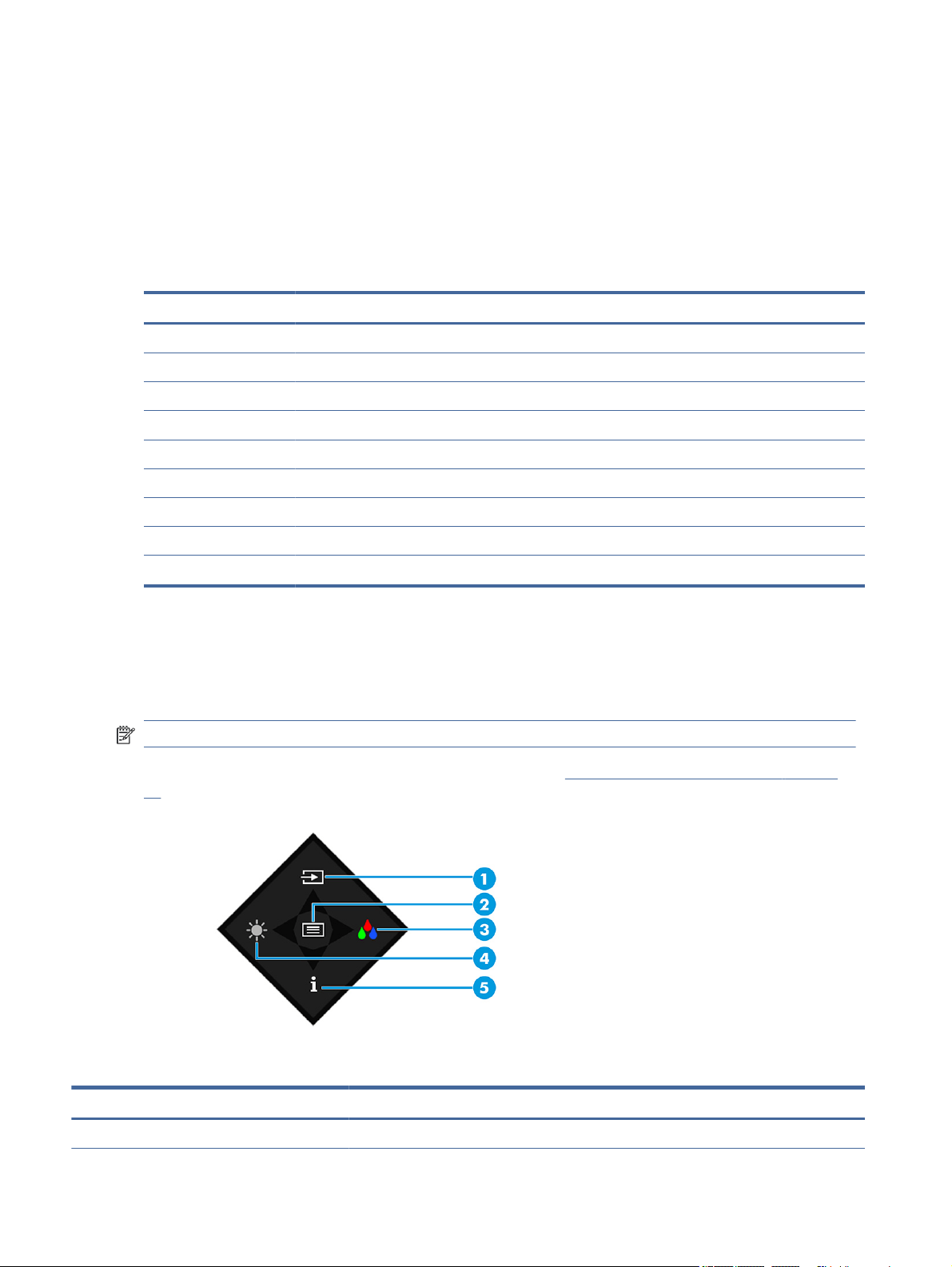
1. If the monitor is not already on, press the power button to turn on the monitor.
2. Press the center of the OSD controller.
3. Move the controller up, down, left, or right to navigate menu choices. Press the center of the controller to
make a selection.
The following table lists possible menu selections in the OSD main menu. It includes descriptions for each
setting and its impacts on your monitor's appearance or performance.
Table 3-1 OSD menu options and descriptions for using a controller
Main menu Description
Brightness+ Adjusts the brightness level of the screen.
Color Provides a variety of color presets that congure the monitor for dierent viewing situations.
Input Selects the video input signal (Thunderbolt USB Type-C, DisplayPort, or HDMI).
Image Adjusts the screen image, including response time, sharpness, and image scaling.
Power Adjusts the power settings.
Menu Adjusts the OSD menu, function button controls, and languages.
Management Returns all OSD menu settings to the factory default settings.
Information Provides information about the monitor such as optimal display mode, power mode, and serial number.
Exit Exits the OSD menu screen.
Using the OSD function buttons
The function buttons oer useful actions, and you can customize all but one of them to make them even more
useful.
NOTE: The actions of the function buttons vary among monitor models.
For information about changing the function of the buttons, see Reassigning the function buttons on page
23.
Table 3-2
Button names and descriptions
Button Description
(1) Next Input button Switches the monitor's input source to the next active input.
22 Chapter 3Using the monitor

Table 3-2 Button names and descriptions (continued)
Button Description
(2) Menu button Opens the OSD main menu, selects a menu item from the OSD, or closes the OSD menu.
(3) Color button Opens the Color menu where you can select a preset view mode.
(4) Brightness button Adjusts the monitor screen brightness.
(5) Information button Opens the Information menu where you can get information about the monitor and the input
signal of the host.
Reassigning the function buttons
Except for the Menu button, you can change the action associated with a function button from the default
action to another action that helps you quickly access your most commonly used menu items.
To reassign the function buttons:
1. Press the Menu button to open the OSD menu.
2. Select Menu, select Assign Buttons, and then select one of the available options for the button that you
want to assign.
Display mode status
When you turn on the monitor, the Monitor Status window appears and shows you the status of the inputs, the
current selected color preset, and the current and optimal resolutions.
The current display mode shows in the Information menu window and at the bottom of the OSD’s main menu
in the status bar area.
Changing the Power Mode setting
This section describes how to activate Performance mode. Certain features on your monitor might require
Performance mode to be active.
When in sleep mode, to comply with international power standards, the monitor default setting is Power
Saver mode.
If your monitor supports Performance mode, to keep the USB ports enabled when the monitor is in Auto-Sleep
Mode, change the Power Mode setting from Power Saver to Performance.
NOTE: If you are connecting a computer that is battery powered, the Power Mode setting must be changed
to Performance mode.
To change the power mode setting:
1. Press the Menu button to open the OSD menu.
2. Select Power, select Power Mode, and then select Performance.
3. Select Back and close the OSD.
Reassigning the function buttons
23

Using Auto-Sleep Mode
Your monitor has an energy-saving feature called Auto-Sleep Mode, which is a reduced power state. This
section describes how to activate or adjust Auto-Sleep Mode on your monitor.
When Auto-Sleep Mode is enabled (enabled by default), the monitor enters a reduced power state when the
computer signals low-power mode (absence of either horizontal or vertical sync signal).
Upon entering this reduced power state (Auto-Sleep mode), the monitor screen is blanked, the backlight turns
o, and the power light turns amber. The monitor draws less than 0.5 W of power when it is in this reduced
power state. The monitor wakes from Auto-Sleep mode when the computer sends an active signal to the
monitor (for example, when you activate the mouse or keyboard).
To disable Auto-Sleep Mode in the OSD:
1. Press the Menu button to open the OSD, or press the center of the OSD controller to open the OSD.
2. In the OSD, select Power.
3. Select Auto-Sleep Mode, and then select O.
Using PiP and PbP
The monitor supports both Picture in Picture (PiP), where one source is overlaid on another, and Picture
beside Picture (PbP), where one source is positioned adjacent to another either horizontally (for landscape
orientation) or vertically (for portrait orientation). Two full HD (FHD) images can be displayed in the PbP mode.
To use PiP or PbP:
1. Connect a secondary input source to the monitor.
2. Press one of the OSD buttons on the rear panel to activate the buttons, and then press the Menu button
to open the OSD.
3. In the OSD, select Input, select PiP Control and then select Enable PiP.
The monitor scans the secondary inputs for a valid signal input and uses that input for the PiP or PbP
picture.
4. To change the PiP or PbP input, select PiP Control in the OSD, and then select Assign Inputs.
5. To change the size of the PiP, select PiP Size in the OSD, and then select the size that you want.
6. To adjust the position of the PiP, select PiP Position in the OSD, and then select the position that you
want.
DisplayPort multistreaming over USB Type-C Thunderbolt
If you are using USB Type-C Thunderbolt as the primary video input source, you can multistream to other
DisplayPort monitors connected in a daisy-chain conguration. You can connect up to two 4K monitors in this
conguration if the graphics card in your computer supports this conguration.
The number of monitors you can connect through DisplayPort multistreaming depends on a number of
factors, including the resolutions and scan rates used for each monitor and the capabilities of your GPU or
embedded graphics system. If you have purchased a new graphics card for your computer, check the manual
that came with your graphics card for further information about its capabilities.
24
Chapter 3Using the monitor
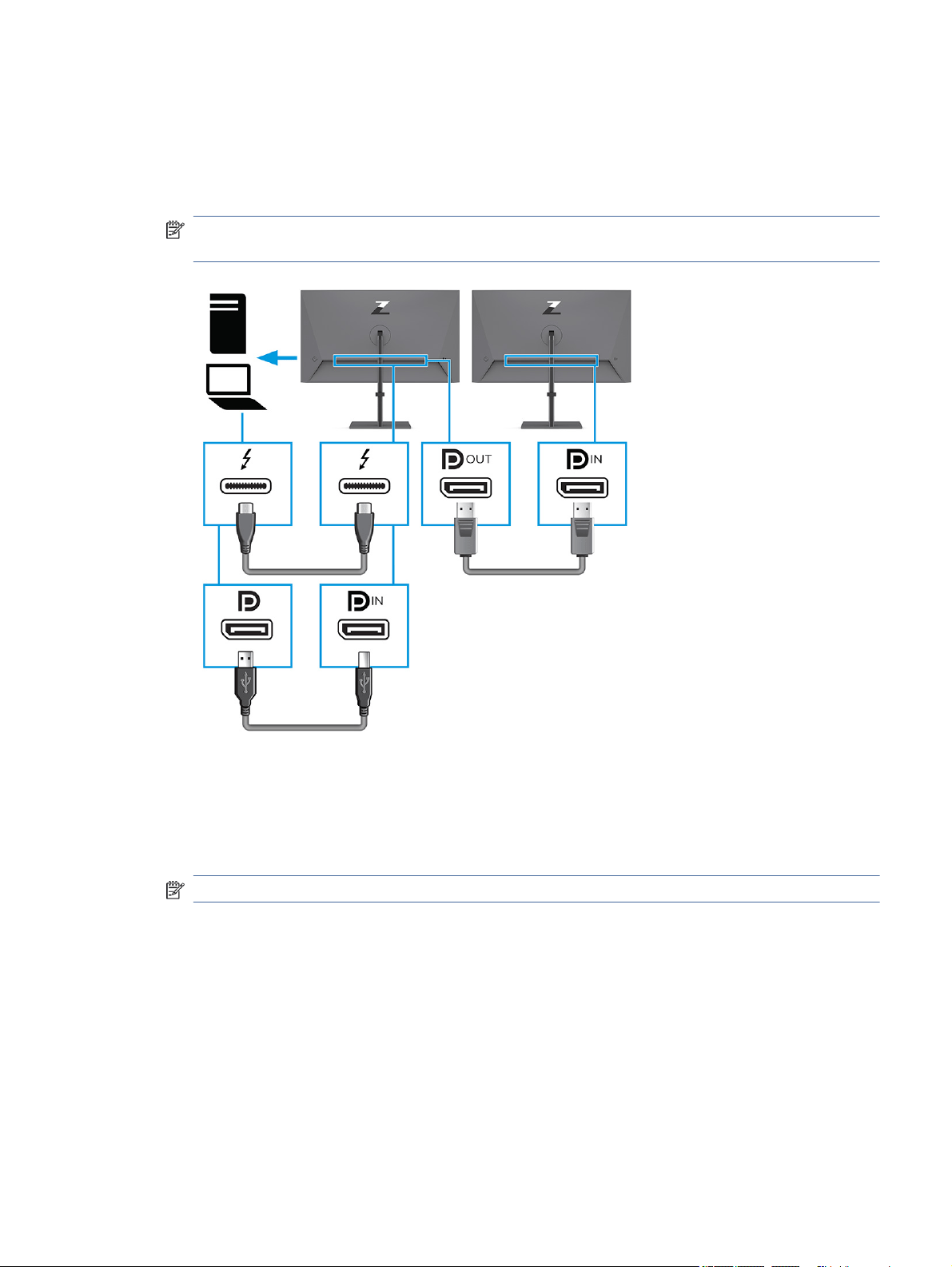
To multistream:
1. Be sure that the USB Thunderbolt port is your primary video input.
2. Add a second monitor by connecting a DisplayPort cable between the DisplayPort OUT port on the
primary monitor and the DisplayPort IN port on a secondary monitor.
NOTE: The daisy-chained monitors need to have DisplayPort IN and OUT video ports. The last monitor
in the chain needs only a DisplayPort IN video port.
3. Set a connected monitor to display the same image as the primary monitor or a dierent image.
4. For a non-Thunderbolt host PC with USB Type-C only, to connect an additional monitor, press the
Menu button to open the OSD menu. Navigate to the USB Type-C conguration and select USB-C
Video+USB2.0.
NOTE: All but the nal monitor in the chain must support DisplayPort multistreaming.
5. Connect the DisplayPort cable from the DisplayPort OUT port of one monitor to the DisplayPort IN port of
the next monitor.
Conguring
an external monitor
To use Windows to congure the display of a monitor attached to the docking station, follow this procedure.
1. In the taskbar search box, type Duplicate, and then select Open.
Conguring
an external monitor 25

2. To set the external monitor as the primary monitor, select Second screen only.
or
To set the external monitor as an extension of the primary monitor, select Extend.
or
To set the external monitor as a copy of the primary monitor, select Duplicate.
USB Type-C mode
When a Thunderbolt or USB Type-C cable is connected to the computer and Alt mode is detected, the monitor
switches to the USB Type-C mode and the following features are activated.
■
Connect a Thunderbolt or USB Type-C cable to activate the following features in USB Type-C mode.
● PXE boot
● MAC address pass through: Your computer might support MAC Address Pass Through from the on, o,
sleep, or hibernation states, or only when the computer is on or in the sleep state.
The MAC Address Pass Through is supported for UEFI PXE boot.
● Wake on LAN (WOL): Your computer might support WOL from the o, sleep, or hibernation states, or
only when the computer is on or in the sleep state.
WLAN-LAN switching is supported only on select computers running the Windows 10 operating
system.
Connect one end of the network cable to the RJ-45 (network) jack on the monitor and connect the
other end to an RJ-45 wall jack or router.
● Single power on: Pressing the monitor power button can also turn on power to the computer.
Updating the monitor
This section describes how to download and update the rmware for the monitor.
Downloading the HP
rmware installer
To download the HP rmware installer, follow this procedure:
1. Go to http://www.hp.com/support.
2. Select Get software and drivers, and follow the on-screen instructions to nd your monitor.
3. Follow the on-screen instructions to select and download the HP rmware installer.
4. Complete the installation wizard.
Updating
rmware for the monitor
To update the monitor rmware while connected to your computer:
1. Open Windows Explorer and navigate to where you saved the HP rmware installer.
2. Double-click to execute the installer le.
26
Chapter 3Using the monitor

3. In the rmware update page, enter the display model, and then enter the operating system and build
information.
4. Select the correct rmware update to download and follow the on-screen instructions.
NOTE: You must be connected to the internet for new updates to download.
Updating rmware for the monitor 27

Support and troubleshooting4
If your monitor is not working as expected, you might be able to resolve the issue by following the instructions
in this section.
Solving common issues
The following table lists possible issues, the possible cause of each issue, and the recommended solutions.
Table 4-1 Common issues and solutions
Issues Possible cause Solution
Screen is blank or video is
blinking.
Power cord is disconnected. Connect the power cord.
Monitor is o. Press the monitor power button.
NOTE: If pressing the power button has no eect, press and
hold the power button for 10 sec to disable the Power Button
Lockout feature.
Master power switch is set to o. Set the master power switch on the rear of the monitor to the
On position.
Video cable is improperly connected. Connect the video cable properly. For more information, see
Connecting the cables on page 11.
System is in Auto-Sleep Mode. Press any key on the keyboard or move the mouse to
inactivate the screen blanking utility.
Video card is incompatible. Open the OSD menu and select the Input menu. Set Auto-
Switch Input to O and manually select the input.
or
Replace the video card or connect the video cable to one of
the computer’s on-board video sources.
Image appears blurred,
indistinct, or too dark.
Brightness setting is too low. Open the OSD menu, and select Brightness to adjust the
brightness scale as needed.
“Check Video Cable” is
displayed on the screen.
Monitor video cable is disconnected. Connect the appropriate video signal cable between the
computer and monitor. Be sure that the computer power is
o while connecting the video cable.
“Input Signal Out of Range” is
displayed on screen.
Video resolution and/or refresh rate
are set higher than the monitor
supports.
Change the settings to a supported setting (see Preset display
resolutions on page 33).
The monitor does not enter
into a low-power sleep state.
The monitor's power saving control is
disabled.
Open the OSD menu and select Power, select Auto-Sleep
Mode, and then set auto-sleep to On.
“OSD Lockout” is displayed. The monitor's OSD Lockout function
is enabled.
Press and hold the Menu button for 10 seconds to disable the
OSD Lockout function.
“Power Button Lockout” is
displayed.
The monitor's Power Button Lockout
feature is enabled.
Press and hold the Power button for 10 seconds to unlock the
power button function.
28 Chapter 4Support and troubleshooting

Table 4-1 Common issues and solutions (continued)
Issues Possible cause Solution
Monitor has trouble waking
from Sleep mode
DisplayPort or USB Type-C inputs: Set the DisplayPort hot-
plug detection to Always Active.
Power mode monitors: Set the hot-plug detection to Always
Active to switch the monitor to Performance mode.
Monitor is not displaying
the preferred resolution or
refresh rate.
Multi-streaming USB Type-C: Set the USB Type-C
conguration to USB 2.x.
Slow performance from USB
devices connected to the USB
Type-A monitor connectors
Set the USB Type-C conguration to 3.x to enable better
performance for integrated or connected USB Type-A devices.
Button lockouts
To lock the menu on OSD controller (joypad), hold the controller to the left for 10 seconds to toggle the lock
and unlock feature.
Table 4-2 Button lockouts
Button lockout Status Description
OSD lockout (toggle) On Press and hold the left button for 10 seconds
Power button lockout (toggle) On Press and hold the power button for 10 seconds
Accessibility button on and o (toggle) On Press and hold the center button for 10 seconds
Button lockouts 29

Maintaining the monitor5
Properly maintained, your monitor can run for many years. These instructions provide steps you can perform
to keep your monitor in the best condition.
Maintenance guidelines
Follow these instructions to enhance the performance and extend the life of the monitor.
● Do not open the monitor cabinet or attempt to service this product yourself. Adjust only those controls
that are covered in the operating instructions. If the monitor is not operating properly or has been
dropped or damaged, contact an authorized HP dealer, reseller, or service provider.
● Use only a power source and connection appropriate for this monitor, as indicated on the label or back
plate of the monitor.
● Be sure that the total ampere rating of the products connected to the outlet does not exceed the current
rating of the AC outlet and that the total ampere rating of the products connected to the cord does not
exceed the rating of the cord. Look on the power label to determine the ampere rating (AMPS or A) for
each device.
● Install the monitor near an outlet that you can easily reach. Disconnect the monitor by grasping the plug
rmly and pulling it from the outlet. Never disconnect the monitor by pulling the cord.
● Turn the monitor o when it is not in use, and use a screen saver program. Doing this can substantially
increase the life expectancy of the monitor.
NOTE: A burned-in image on the monitor is not covered under the HP warranty.
● Never block the slots and openings of the cabinet or push objects into them. These openings provide
ventilation.
● Do not drop the monitor or place it on an unstable surface.
● Do not allow anything to rest on the power cord. Do not walk on the cord.
● Keep the monitor in a well-ventilated area, away from excessive light, heat, or moisture.
Cleaning the monitor
Use these instructions to clean your monitor when necessary.
1. Turn o the monitor and unplug the power cord from the AC outlet.
2. Disconnect any external devices.
3. Dust the monitor by wiping the screen and the cabinet with a soft, clean antistatic cloth.
30
Chapter 5Maintaining the monitor

4. For more diicult cleaning situations, use a 50/50 mix of water and isopropyl alcohol.
IMPORTANT: Do not use cleaners that contain petroleum-based materials such as benzene, thinner, or
any volatile substance to clean the monitor screen or cabinet. These chemicals might damage the
monitor.
IMPORTANT: Spray the cleaner onto a cloth and use the damp cloth to gently wipe the screen surface.
Never spray the cleaner directly on the screen surface. It can run behind the bezel and damage the
electronics. The cloth should be moist, but not wet. Water dripping into the ventilation openings or other
points of entry can cause damage to the monitor. Allow the monitor to air-dry before use.
5. After you remove the dirt and debris, you can also clean the surfaces with a disinfectant. The World
Health Organization (WHO) recommends cleaning surfaces, followed by disinfection, as a best practice
for preventing the spread of viral respiratory illnesses and harmful bacteria. A disinfectant that is within
HP’s cleaning guidelines is an alcohol solution consisting of 70% isopropyl alcohol and 30% water. This
solution is also known as rubbing alcohol and is sold in most stores.
Shipping the monitor
Keep the original packing box in a storage area. You might need it later if you ship the monitor or move.
Shipping the monitor 31

Technical specicationsA
This section contains technical specications for the physical aspects of your monitor, such as the weight and
viewing dimensions, as well as required environmental operating conditions and power source ranges.
All specications represent the typical specications provided by HP component manufacturers; actual
performance can vary either higher or lower.
NOTE: For the latest specications or additional specications for this product, go to
http://www.hp.com/go/quickspecs/ and search for your specic monitor model to nd the model-specic
QuickSpecs.
80 cm (31.5 in) model
specications
This section provides specications for your monitor.
Table A-1 Technical specications
Specication Measurement
Display, wide-screen 80 cm 31.5 in
Type IPS
Viewable image size 80 cm diagonal 31.5 in diagonal
Maximum weight (unpacked) 9.0 kg 19.8 lbs
Dimensions (include base)
Height (highest position) 60.49 cm 23.81 in
Height (lowest position) 45.49 cm 17.91 in
Depth 21.70 cm 8.54 in
Width 71.35 cm 28.09 in
Tilt –5° to 20°
Swivel +/- 45°
Pivot +/- 90°
Environmental requirements temperature
Operating temperature 5°C to 35°C 41°F to 95°F
Storage temperature –20°C to 60°C –4°F to 140°F
Storage humidity 5% to 95% (noncondensing)
Power source 100 V ac to 240 V ac 50/60 Hz
Input terminal One HDMI port, one DisplayPort connector, one USB Type-B connector, and one
Thunderbolt connector
32 Appendix ATechnical specications

Preset display resolutions
The following display resolutions are the most commonly used modes and are set as factory defaults. The
monitor automatically recognizes these preset modes, and they will appear properly sized and centered on
the screen.
80 cm (31.5 in) model
This section provides preset display resolutions and preset timing resolutions.
Table A-2 Preset display resolutions
Preset Pixel format Horz freq (kHz) Vert freq (Hz)
1 640 × 480 31.469 59.940
2 720 × 400 31.469 70.087
3 800 × 600 37.879 60.317
4 1024 × 768 48.363 60.004
5 1280 × 720 45.000 60.000
6 1280 × 800 49.702 59.810
7 1280 × 1024 63.981 60.020
8 1440 × 900 55.935 59.887
9 1600 × 900 60.000 60.000
10 1680 × 1050 65.290 59.954
11 1920 × 1080 67.500 60.000
12 1920 × 1200 74.038 59.950
13 2560 × 1440 88.787 59.951
14 3840 × 2160 60.000 60.000
High-denition video formats
This section provides high-denition video formats.
Table A-3
High-denition video formats
Preset Timing name Pixel format Horz freq (kHz) Vert freq (Hz)
1 480p 720 × 480 31.469 59.94
2 576p 720 × 576 31.250 50.00
3 720p50 1280 × 720 37.500 50.00
4 720p60 1280 × 720 45.000 60.00
5 1080p50 1920 × 1080 56.250 50.00
6 1080p60 1920 × 1080 67.500 60.00
Preset display resolutions 33

Energy saver feature
This monitor supports a reduced power state.
The reduced power state is initiated if the monitor detects the absence of either the horizontal sync signal
or the vertical sync signal. Upon detecting the absence of these signals, the monitor screen is blank, the
backlight is turned o, and the power light turns amber. In the reduced power state, the monitor uses < 0.5 W
of power. There is a brief warm-up period before the monitor returns to its normal operating state.
See the computer manual for instructions on setting the energy saver mode (sometimes called “power
management feature”).
NOTE: This power saver feature works only when the monitor is connected to a computer that has energy-
saver features.
By selecting the settings in the monitor Sleep Timer utility, you can also program the monitor to initiate the
reduced power state at a predetermined time. When the monitor Sleep Timer utility initiates the reduced
power state, the power light blinks amber.
34 Appendix ATechnical specications

AccessibilityB
HP's goal is to design, produce, and market products, services, and information that everyone everywhere
can use, either on a stand-alone basis or with appropriate third-party assistive technology (AT) devices or
applications.
HP and accessibility
Because HP works to weave diversity, inclusion, and work/life into the fabric of the company, it is reected in
everything HP does. HP strives to create an inclusive environment focused on connecting people to the power
of technology throughout the world.
Finding the technology tools you need
Technology can unleash your human potential. Assistive technology removes barriers and helps you create
independence at home, at work, and in the community. Assistive technology helps increase, maintain, and
improve the functional capabilities of electronic and information technology.
For more information, see Finding the best assistive technology on page 36.
The HP commitment
HP is committed to providing products and services that are accessible for people with disabilities. This
commitment supports the company's diversity objectives and helps ensure that the benets of technology are
available to all.
The HP accessibility goal is to design, produce, and market products and services that can be eectively used
by everyone, including people with disabilities, either on a standalone basis or with appropriate assistive
devices.
To achieve that goal, this Accessibility Policy establishes seven key objectives to guide HP actions. All HP
managers and employees are expected to support these objectives and their implementation in accordance
with their roles and responsibilities:
● Raise the level of awareness of accessibility issues within HP, and provide employees with the training
they need to design, produce, market, and deliver accessible products and services.
● Develop accessibility guidelines for products and services, and hold product development groups
accountable for implementing these guidelines where competitively, technically, and economically
feasible.
● Involve people with disabilities in the development of accessibility guidelines and in the design and
testing of products and services.
● Document accessibility features, and make information about HP products and services publicly available
in an accessible form.
● Establish relationships with leading assistive technology and solution providers.
● Support internal and external research and development that improves assistive technology relevant to
HP products and services.
Accessibility
35

● Support and contribute to industry standards and guidelines for accessibility.
International Association of Accessibility Professionals (IAAP)
IAAP is a not-for-prot association focused on advancing the accessibility profession through networking,
education, and certication. The objective is to help accessibility professionals develop and advance their
careers and to better enable organizations to integrate accessibility into their products and infrastructure.
As a founding member, HP joined to participate with other organizations to advance the eld of accessibility.
This commitment supports HP’s accessibility goal of designing, producing, and marketing products and
services that people with disabilities can eectively use.
IAAP will make the profession strong by globally connecting individuals, students, and organizations to learn
from one another. If you are interested in learning more, go to http://www.accessibilityassociation.org to join
the online community, sign up for newsletters, and learn about membership options.
Finding the best assistive technology
Everyone, including people with disabilities or age-related limitations, should be able to communicate,
express themselves, and connect with the world using technology. HP is committed to increasing accessibility
awareness within HP and with our customers and partners.
Whether it’s large fonts that are easy on the eyes, voice recognition that lets you give your hands a rest, or
any other assistive technology to help with your specic situation—a variety of assistive technologies make
HP products easier to use. How do you choose?
Assessing your needs
Technology can unleash your potential. Assistive technology removes barriers and helps you create
independence at home, at work, and in the community. Assistive technology (AT) helps increase, maintain,
and improve the functional capabilities of electronic and information technology.
You can choose from many AT products. Your AT assessment should allow you to evaluate several products,
answer your questions, and facilitate your selection of the best solution for your situation. You will nd that
professionals qualied to do AT assessments come from many elds, including those licensed or certied
in physical therapy, occupational therapy, speech/language pathology, and other areas of expertise. Others,
while not certied or licensed, can also provide evaluation information. You will want to ask about the
individual's experience, expertise, and fees to determine if they are appropriate for your needs.
Accessibility for HP products
These links provide information about accessibility features and assistive technology, if applicable and
available in your country or region, that are included in various HP products. These resources will help you
select the specic assistive technology features and products most appropriate for your situation.
● HP Aging & Accessibility: Go to http://www.hp.com, type Accessibility in the search box. Select
Oice of Aging and Accessibility.
● HP computers: For Windows products, go to http://www.hp.com/support, type Windows
Accessibility Options in the Search our knowledge search box. Select the appropriate operating
system in the results.
● HP Shopping, peripherals for HP products: Go to http://store.hp.com, select Shop, and then select
Monitors or Accessories.
If you need additional support with the accessibility features on your HP product, see Contacting support on
page 39.
36
Appendix BAccessibility

Additional links to external partners and suppliers that may provide additional assistance:
● Microsoft Accessibility information (Windows and Microsoft Oice)
● Google Products accessibility information (Android, Chrome, Google Apps)
Standards and legislation
Countries worldwide are enacting regulations to improve access to products and services for persons with
disabilities. These regulations are historically applicable to telecommunications products and services, PCs
and printers with certain communications and video playback features, their associated user documentation,
and their customer support.
Standards
The US Access Board created Section 508 of the Federal Acquisition Regulation (FAR) standards to address
access to information and communication technology (ICT) for people with physical, sensory, or cognitive
disabilities.
The standards contain technical criteria specic to various types of technologies, as well as performance-
based requirements which focus on functional capabilities of covered products. Specic criteria cover
software applications and operating systems, web-based information and applications, computers,
telecommunications products, video and multimedia, and self-contained closed products.
Mandate 376 – EN 301 549
The European Union created the EN 301 549 standard within Mandate 376 as an online toolkit for public
procurement of ICT products. The standard species the accessibility requirements applicable to ICT products
and services, with a description of the test procedures and evaluation methodology for each requirement.
Web Content Accessibility Guidelines (WCAG)
Web Content Accessibility Guidelines (WCAG) from the W3C's Web Accessibility Initiative (WAI) helps web
designers and developers create sites that better meet the needs of people with disabilities or age-related
limitations.
WCAG advances accessibility across the full range of web content (text, images, audio, and video) and web
applications. WCAG can be precisely tested, is easy to understand and use, and allows web developers
exibility for innovation. WCAG 2.0 has also been approved as ISO/IEC 40500:2012.
WCAG specically addresses barriers to accessing the web experienced by people with visual, auditory,
physical, cognitive, and neurological disabilities, and by older web users with accessibility needs. WCAG 2.0
provides characteristics of accessible content:
● Perceivable (for instance, by addressing text alternatives for images, captions for audio, adaptability of
presentation, and color contrast)
● Operable (by addressing keyboard access, color contrast, timing of input, seizure avoidance, and
navigability)
● Understandable (by addressing readability, predictability, and input assistance)
● Robust (for instance, by addressing compatibility with assistive technologies)
Standards and legislation
37

Legislation and regulations
Accessibility of IT and information has become an area of increasing legislative importance. These links
provide information about key legislation, regulations, and standards.
● United States
● Canada
● Europe
● Australia
Useful accessibility resources and links
These organizations, institutions, and resources might be good sources of information about disabilities and
age-related limitations.
NOTE: This is not an exhaustive list. These organizations are provided for informational purposes only. HP
assumes no responsibility for information or contacts you encounter on the internet. Listing on this page
does not imply endorsement by HP.
Organizations
These organizations are a few of the many that provide information about disabilities and age-related
limitations.
● American Association of People with Disabilities (AAPD)
● The Association of Assistive Technology Act Programs (ATAP)
● Hearing Loss Association of America (HLAA)
● Information Technology Technical Assistance and Training Center (ITTATC)
● Lighthouse International
● National Association of the Deaf
● National Federation of the Blind
● Rehabilitation Engineering & Assistive Technology Society of North America (RESNA)
● Telecommunications for the Deaf and Hard of Hearing, Inc. (TDI)
●
W3C Web Accessibility Initiative (WAI)
Educational institutions
Many educational institutions, including these examples, provide information about disabilities and age-
related limitations.
● California State University, Northridge, Center on Disabilities (CSUN)
● University of Wisconsin - Madison, Trace Center
● University of Minnesota computer accommodations program
38
Appendix BAccessibility

Other disability resources
Many resources, including these examples, provide information about disabilities and age-related limitations.
● ADA (Americans with Disabilities Act) Technical Assistance Program
● ILO Global Business and Disability network
● EnableMart
● European Disability Forum
● Job Accommodation Network
● Microsoft Enable
HP links
These HP-specic links provide information that relates to disabilities and age-related limitations.
HP comfort and safety guide
HP public sector sales
Contacting support
HP oers technical support and assistance with accessibility options for customers with disabilities.
NOTE: Support is in English only.
● Customers who are deaf or hard of hearing who have questions about technical support or accessibility of
HP products:
– Use TRS/VRS/WebCapTel to call (877) 656-7058 Monday through Friday, 6 a.m. to 9 p.m. Mountain
Time.
● Customers with other disabilities or age-related limitations who have questions about technical support
or accessibility of HP products:
– Call (888) 259-5707 Monday through Friday, 6 a.m. to 9 p.m. Mountain Time.
Other disability resources 39

Index
A
accessibility 35, 36, 38, 39
accessibility needs assessment 36
assistive technology (AT)
nding 36
purpose 35
AT (assistive technology)
nding 36
purpose 35
auto-adjustment (analog input) 28
B
bottom components 5
C
calling technical support 2
components
bottom 5
front 4
rear 4
connectors
DisplayPort 5
power 5
customer support, accessibility 39
D
DisplayPort connector 5
F
front components 4
G
getting started 1
getting to know your monitor 2
H
HDMI port 5
HP Assistive Policy 35
HP resources 2
HP support 2
I
International Association of
Accessibility Professionals 36
L
label 6
O
optimizing image performance
(analog input) 28
P
ports
HDMI 5
USB 4
USB Type-C 4, 5
power button 4
power connector 5
power light 4
product label 6
product number 6
R
rear components 4
resources, accessibility 38
S
safety information 1
Section 508 accessibility
standards 37
serial number 6
standards and legislation,
accessibility 37
support 2
T
technical support 2
U
USB port 4
USB Type-C port 4, 5
W
warnings 1
40 Index
