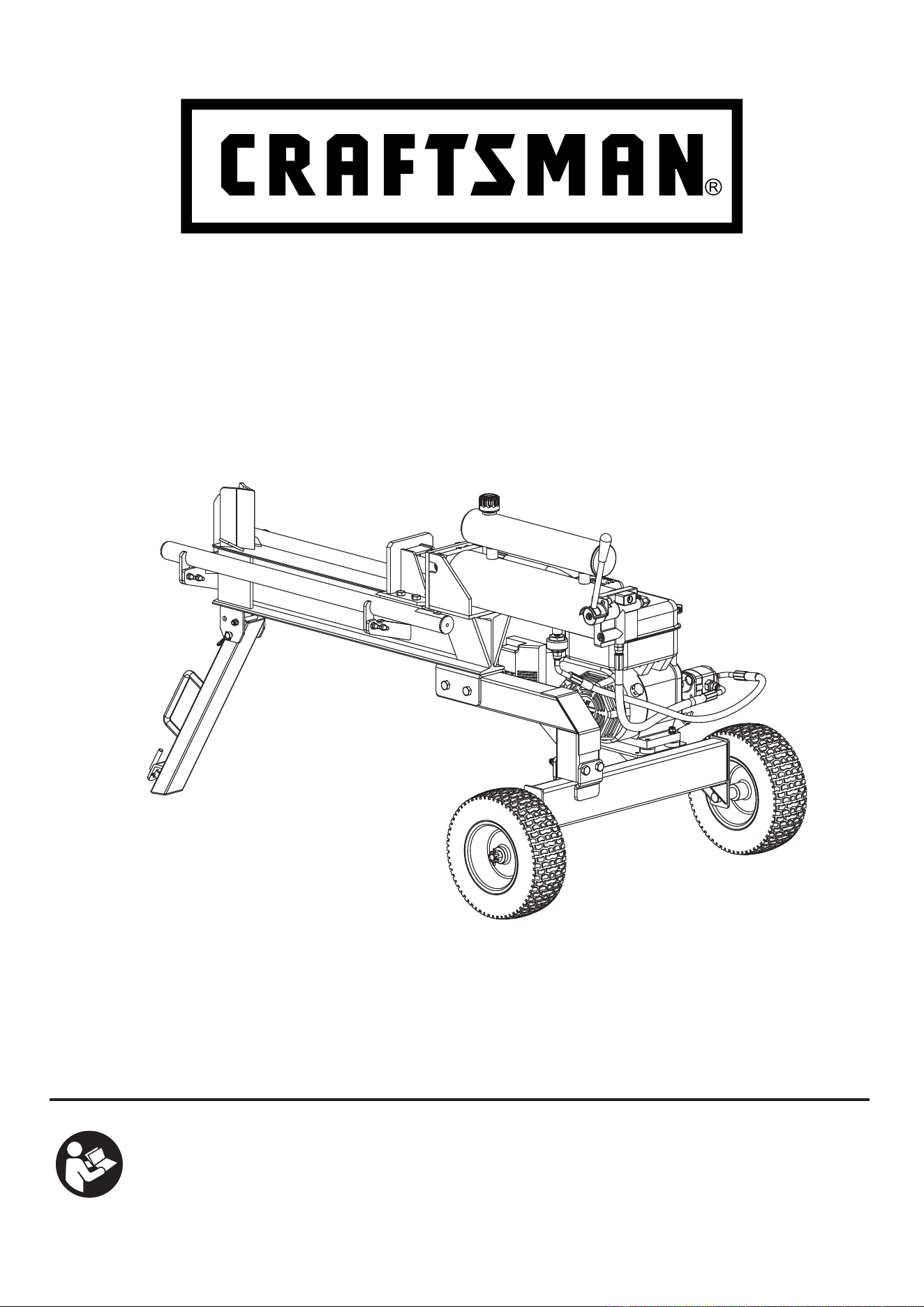
INSTRUCTION MANUAL
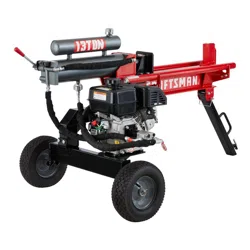
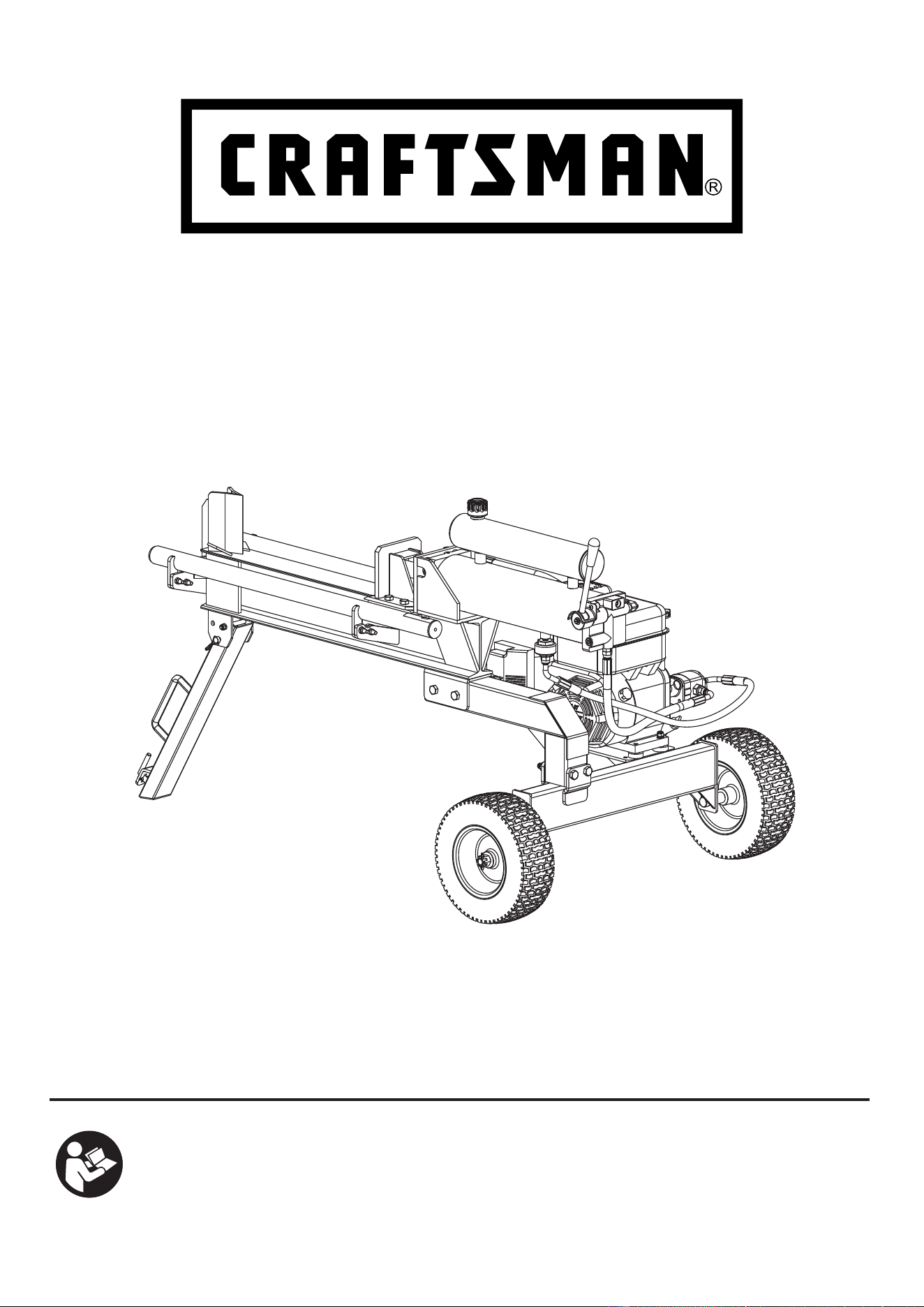
13 TON LOG SPLITTER
CMXGLXT1301
IF YOU HAVE QUESTIONS OR COMMENTS, CONTACT US.
1-888-331-4569 WWW.CRAFTSMAN.COM
Patent No.: US 9,427,886 B2
Definitions: Safety Alert Symbols and Words
This instruction manual uses the following safety alert symbols and words to alert you to hazardous situations and your
risk of personal injury or property damage.
DANGER: Indicates an imminently hazardous situation which, if not avoided, will result in death or serious injury.
WARNING: Indicates a potentially hazardous situation which, if not avoided, could result in death or serious injury.
CAUTION: Indicates a potentially hazardous situation which, if not avoided, may result in minor or moderate injury.
(Used without word) Indicates a safety related message.
NOTICE: Indicates a practice not related to personal injury which, if not avoided, may result in property damage.
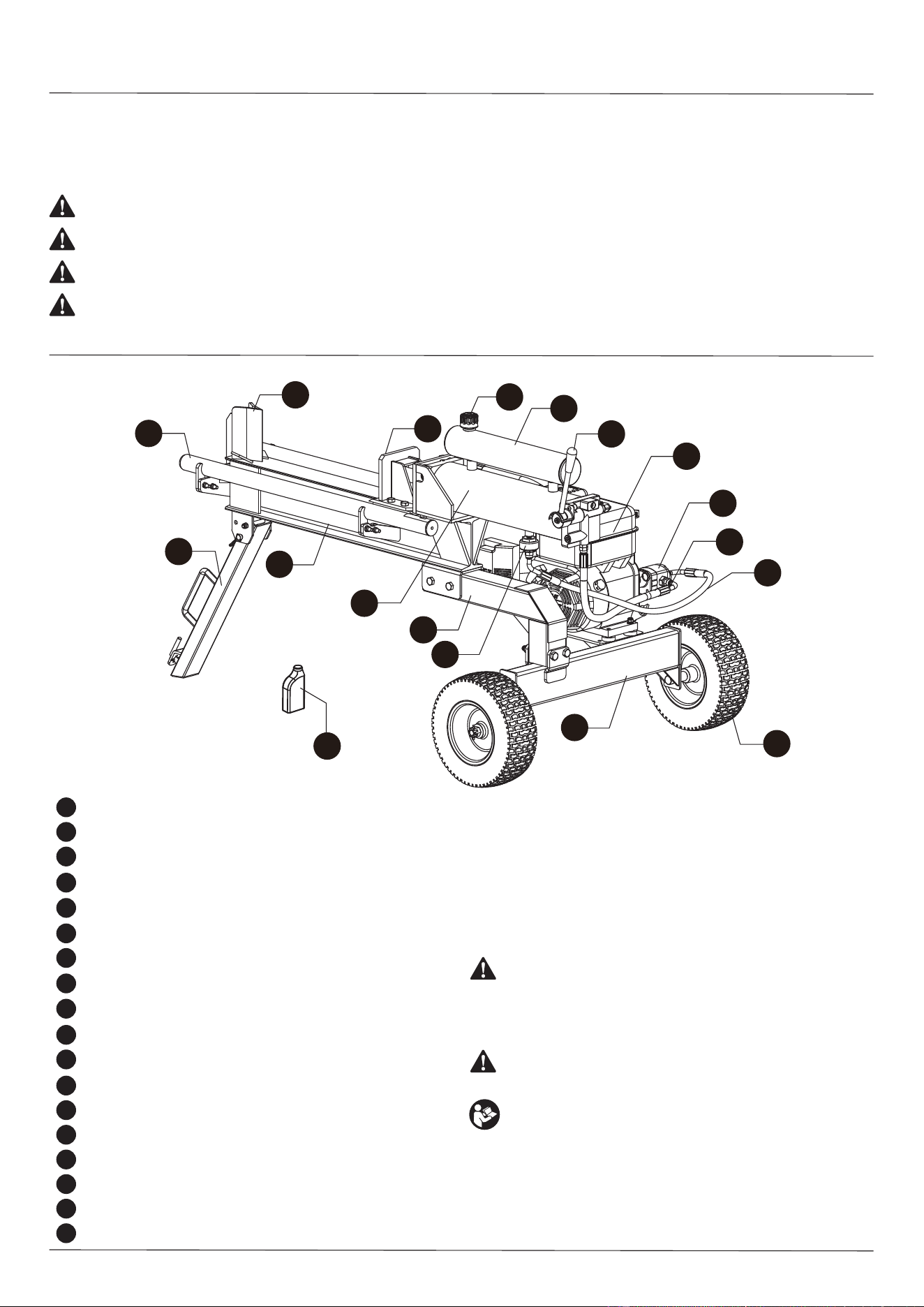
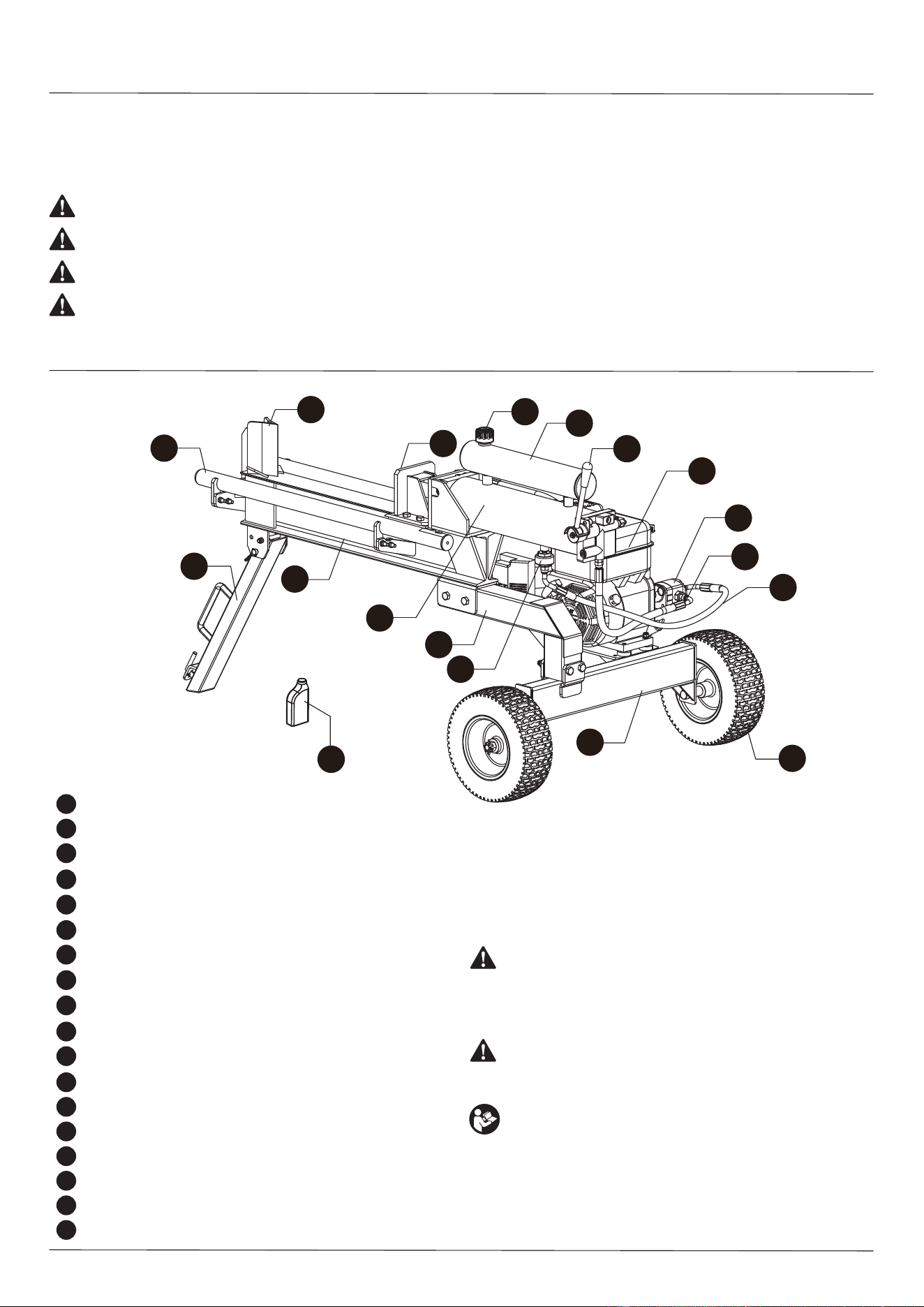
Components
1 Wedge
Push Plate Component
Hydraulic Tank
Air Filter
Cylinder Component
Control Valve Handle
High Pressure Hose
Suction Hose
Gear Pump
13" Pneumatic Wheel
Wheel Stand
Beam
Support Leg
2
3
4
5
6
7
8
9
10
11
12
13
WARNING: Read all safety warnings and all
instructions. Failure to follow the warnings and
instructions may result in electric shock, fire
and/or serious injury.
WARNING: Never modify the product or any part
of it. Damage or personal injury could result.
WARNING: To reduce the risk of injury, read the
instruction manual.
If you have any questions or comments about this or
any product, call CRAFTSMAN toll free at:
1-888-331-4569.
2
Engine
14
1
2
4
3
6
14
9
8
7
10
11
17
15
5
12
13
16
Connecting Tube Weldment
15
Spring Tube Component
16
Oil Filter
17
18
Engine Oil Jug
18
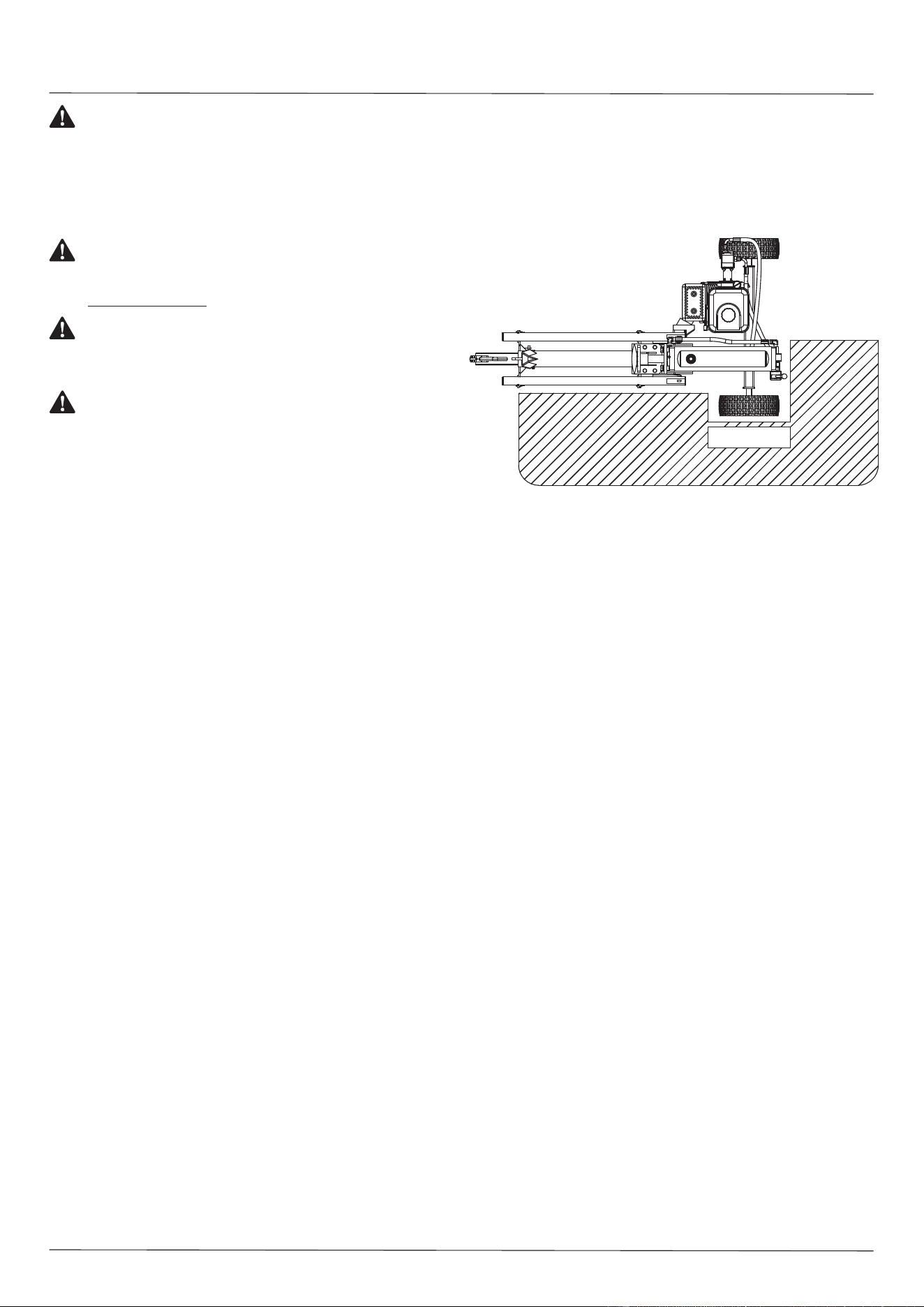
WARNING: IMPORTANT SAFETY INFORMATION
WARNING: Read and understand all instructions and safety information in
this manual and on safety decals before assembling or operating the log splitter.
Failure to understand and follow all instructions and safety information may result
in serious injury or death. Persons who have not read the manual should never
operate the log splitter. A log splitter can be dangerous when assembled and/or
used improperly. Do not operate the log splitter if you have any questions
concerning safe operation. Please call the technical support department at
1-888-331-4569 for answers to any questions.
WARNING:
WARNING:
3
This product can expose you to chemicals including lead and
lead compounds which are known to the State of California to cause cancer and
birth defects or other reproductive harm. For more information, go to
www.P65Warnings.ca.gov
NEVER use the log splitter for any purposes other than splitting
wood. The log splitter is designed only for splitting wood. Using the log splitter for
any other purpose can result in serious injury or death and may void the warranty.
1) GENERAL SAFETY
• ALWAYS keep the operator’s manual for reference. Review the manual periodically and
as questions arise.
• ALWAYS keep all bystanders and pets a minimum of 10 feet away from your work area
when operating this log splitter. The operator alone should be near the log splitter during
use.
• NEVER activate the control valve until all people are clear of the work area.
• NEVER wear loose clothing or jewelry when operating the log splitter. Keep clothing and
hair away from all moving parts when operating the log splitter.
• NEVER allow adults without proper instruction and operational knowledge to use the log
splitter.
• NEVER operate the log splitter when under the influence of drugs, alcohol or medication
or when otherwise not alert enough to operate the log splitter.
• DO NOT allow children to play on, stand upon, climb on or operate the log splitter at any
time.
2) WORK AREA
• NEVER operate the log splitter on wet, icy, slippery or unstable ground.
• NEVER operate the log splitter in an enclosed area. Exhaust fumes contain carbon
monoxide which is deadly poison.
• ONLY operate the log splitter with adequate lighting in the work area.
• ONLY operate the log splitter on level ground. Operating on a slope may cause the log
splitter to move and/or logs to fall off the log splitter.
• ALWAYS keep the work area free of debris. Remove any split wood around the log
splitter immediately to avoid tripping.
3) PREPARING LOGS FOR THE SPLITTER
Log ends should be cut as squarely as possible before placing logs on the log splitter.
The square shape of the log helps prevent the logs from moving during splitter operation.
The maximum log length is 20 inches.
4) OPERATION OF THE LOG SPLITTER
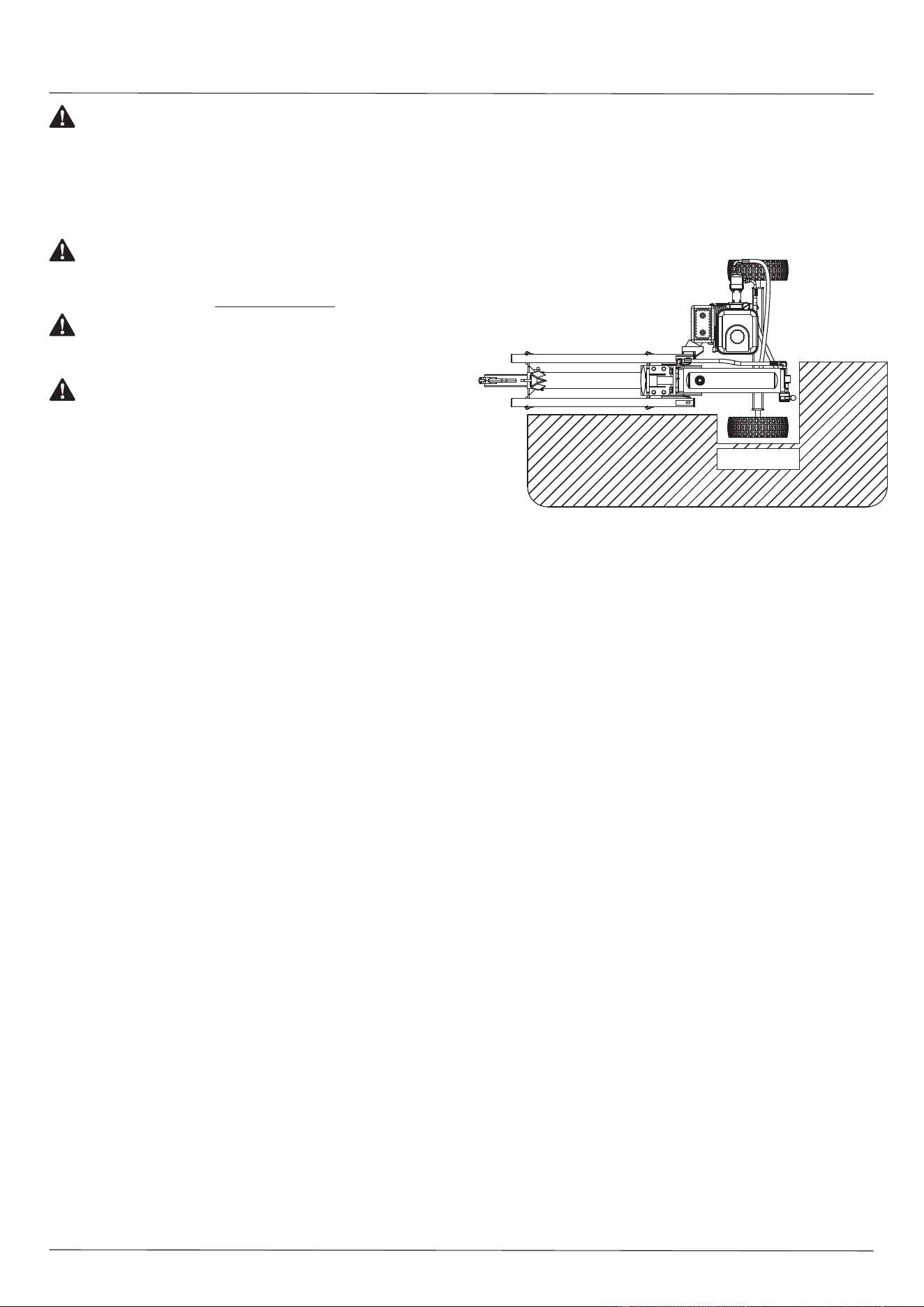
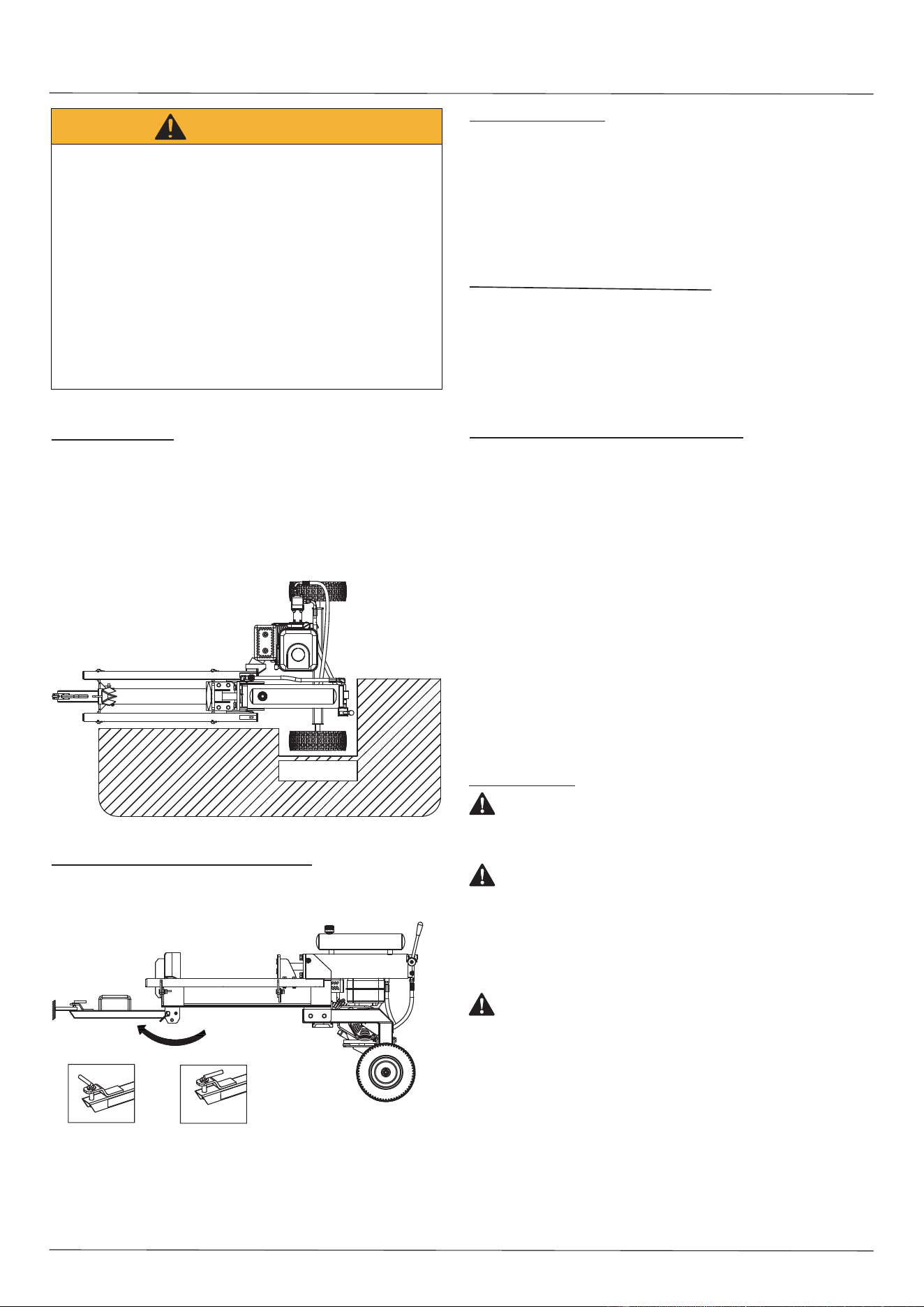
ONLY operate the log splitter from the operator zone as shown in the diagram.
Operating the log splitter outside the operator zone can result in serious injury or death.
• ALWAYS chock the wheels to prevent movement of the log splitter while in operation.
• KNOW how to stop the log splitter and disengage the controls before operating it.
• NEVER try to split a log against the grain.
• NEVER try to split two logs at the same time.
• NEVER step over the log splitter during operation.
• NEVER reach or bend over the log splitter to pick up a log.
• NEVER attempt to load the log splitter when the wedge is in motion.
• NEVER place hands or feet between the log and splitting wedge during forward or
reverse stroke as this could result in serious injury or death.
• NEVER use your foot, a rope or any extension device to operate the control lever on
the valve. Only use hands to operate control levers.
• NEVER touch the muffler and other hot areas of the engine. Allow time for the engine
to cool down before touching.
5) GENERAL REPAIR
• NEVER operate the log splitter if it is in poor mechanical condition or in need of repairs.
• NEVER alter/modify the log splitter in any way. Any alterations/modifications may make
the log splitter unsafe and voids the warranty.
• NEVER perform any service or repair on the log splitter without first removing the spark
plug wire.
• NEVER tamper with the engine settings. The maximum engine speed is preset by the
manufacturer and is within safety limits. Refer to the engine’s user manual for the
particular log splitter.
• ALWAYS perform all recommended maintenance procedures before using the log splitter.
• ALWAYS check the level of hydraulic oil and engine oil before operating the log splitter.
• NEVER use hands to remove a stuck log while the log splitter is running.
• ALWAYS replace all damaged or worn parts immediately.
• ALWAYS check regularly that all nuts, bolts, screws, hydraulic fittings and hose clamps
are tight.
• ALWAYS be sure any and all replacement parts meet the manufacturer’s specifications.
6) MAINTENANCE AND SAFETY
• The mechanical and hydraulic systems of the log splitter require careful inspection. Be
sure to replace damaged hydraulic hoses and components.
• NEVER check for leaks of hydraulic fluid by using your hands. Leaking hydraulic fluid under
pressure can potentially penetrate the skin causing SERIOUS INJURY or even DEATH.
Leaks can be safely detected by holding a piece of cardboard over the suspected leak and
looking for discoloration.
• NEVER remove the cap from the hydraulic tank while the log splitter is running. The tank
contains hot oil under pressure which could cause serious injury if released from the tank.
• NEVER adjust the relief valve setting. The pressure relief valve on the log splitter is preset
at the factory. Only a qualified service technician should perform any adjustments.
• ALWAYS immediately seek medical attention if injured by escaping hydraulic fluid. Serious
infections or reactions can develop if proper medical treatment is not administered
immediately.
• ALWAYS check the system is not under any pressure by shutting off the engine and
moving the valve control handle back and forth. Check for pressure before loosening or
removing any hydraulic fitting.
• ALWAYS keep the beam and wedge free of debris buildup.
• ALWAYS check and tighten hardware and assembled parts before operation.
• DO NOT operate the log splitter at night, only during daylight hours.
• NEVER move the log splitter while the engine is running. Turn off the engine before
leaving the log splitter.
• NEVER leave the log splitter running unattended, even for a short period of time.
OPERATOR ZONE
D ZONE
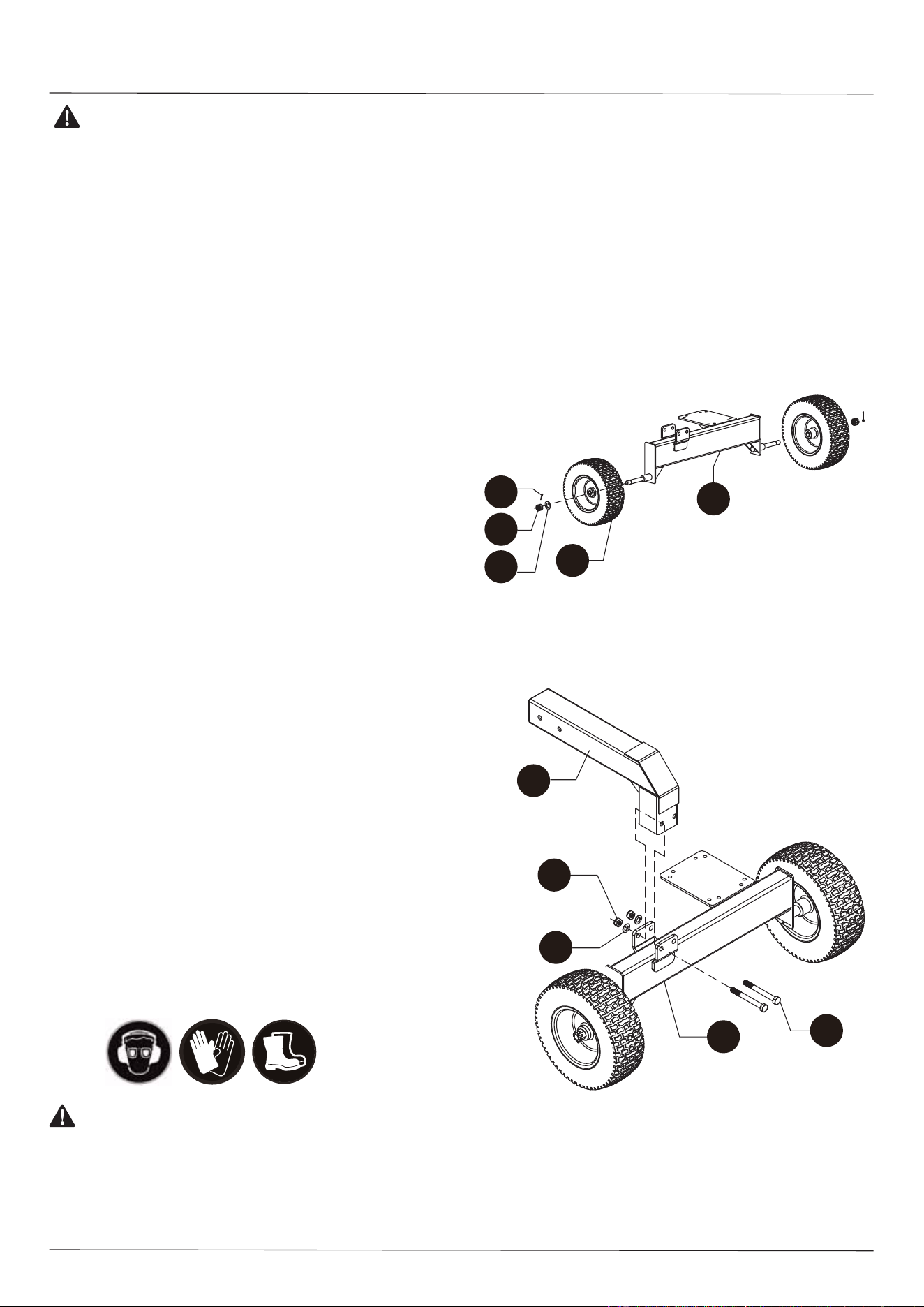
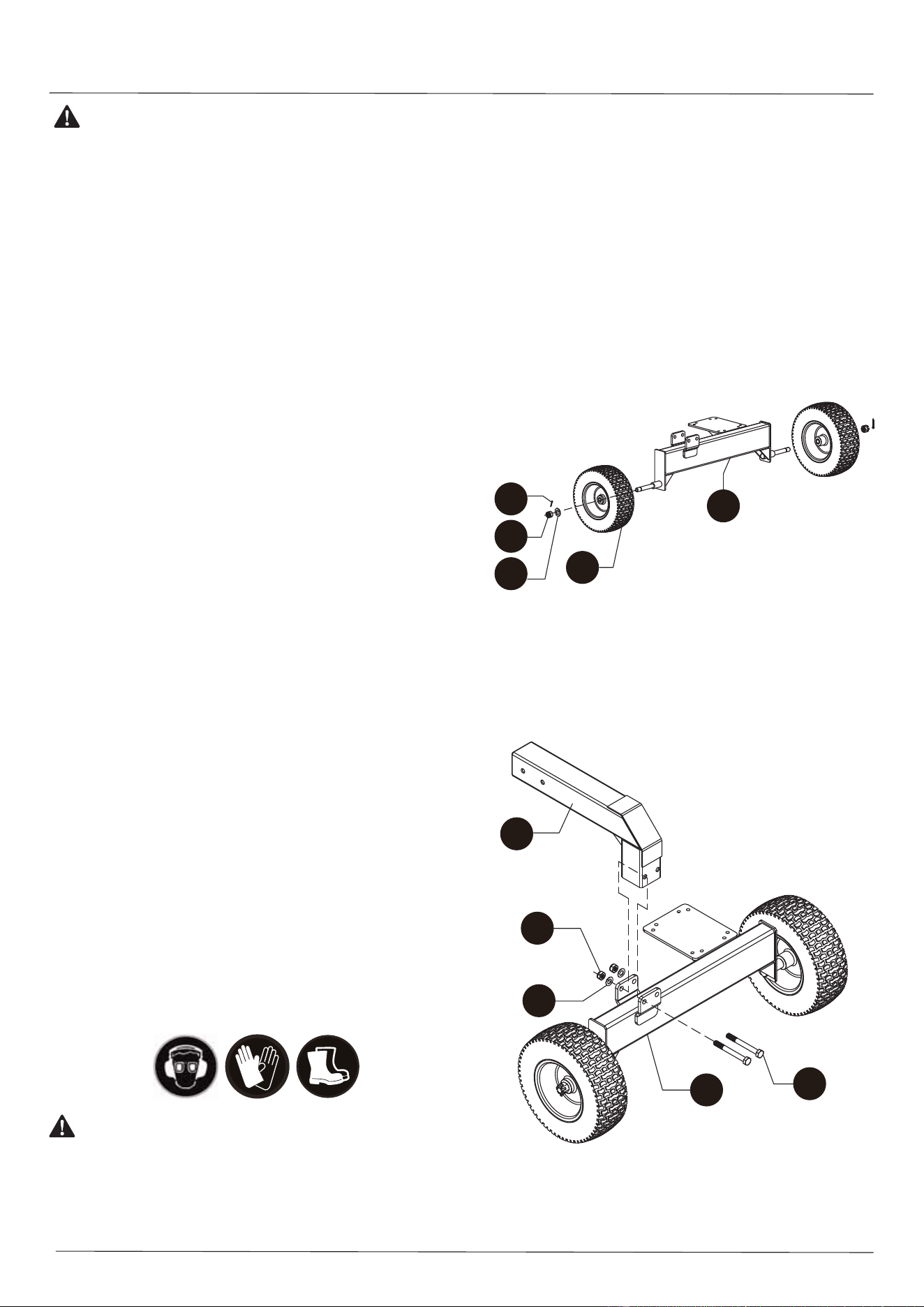
STEP 1: Wheel Assembly
1.1 Attach the wheel (26) to the wheel stand (30) using a Ø16 flat washer (36) and tighten
the wheel with the M16 hex slotted thin nut (23). Lock the M16 hex slotted thin nut (23)
into place using the Ø4x36 cotter pin (24). Repeat the process on other side to attach
the second wheel.
4
7) FIRE PREVENTION
• ONLY refuel the log splitter in clear areas with no gas fumes and no spilled gas.
• NEVER operate the log splitter near flames, sparks or smoke. Hydraulic oil and gasoline
are flammable and potentially explosive.
• NEVER add fuel while the engine is hot or running. Allow the engine to cool completely
before refueling.
• If gasoline spills, move the log splitter away from the area of the spill and avoid creating
any source of ignition.
• ALWAYS securely replace the gas cap.
• ALWAYS clean wood debris from the muffler area of the engine.
• ALWAYS store gasoline in an appropriate, tightly sealed container. Store the gas
container in a cool, dry place and away from any heat sources.
8) IMPORTANT NOTE RE: SPEAK ARRESTER-REGULATION:
As a precautionary measure against possible flying sparks, always have a Class B fire
extinguisher on hand when operating the log splitter in dry areas. The log splitter is
equipped with an internal combustion engine that generates heat and potential flying
sparks. Only use the log splitter on or near any unimproved, forest-covered, brush-covered
or grass-covered land if the engine’s exhaust system is equipped with a spark arrester in
compliance with any applicable local or state laws. Spark arresters should be effectively
maintained and serviced. In the state of California, a spark arrester is required by law and
other states have similar laws. Federal laws will apply when operating the log splitter on
federal land. Always research and comply with applicable state, local and federal laws
and regulations. A spark arrester muffler is optional and available as an accessory at your
nearest engine dealer.
9) TOWING SAFETY
ASSEMBLY INSTRUCTIONS
• Screwdriver
• Hammer
• Band Cutter
• 13mm, 17mm and 19mm Wrenches
• Large Adjustable Wrench
TOOLS REQUIRED (Not Included)
STEP 2: Attach the Connecting Tube Weldment
2.1 Attach the connecting tube weldment (21) to the wheel stand (30) using two M12x110
hex bolts (15), two Ø12 flat washers (17) and two M12 nylon lock nuts (27).
10) PERSONAL PROTECTIVE EQUIPMENT
BEFORE operating the log splitter always be sure to put on appropriate safety gear,
including eye protection (goggles), steel-toed shoes and tight-fitting gloves (without loose
cuffs or draw strings). Also, the use of proper hearing protection (headphones) is required
when operating the log splitter.
WARNING: IMPORTANT SAFETY INFORMATION
NOTICE: After completely tightening the slotted nut, turn back/loosen the nut
a 1/4 circle to allow the wheel to smoothly and freely rotate. If the slotted nut is
not loosened and remains too tight, the wheel will not operate correctly.
21
15
30
27
17
30
24
23
36
26
The log splitter is designed only for splitting wood. Using the log splitter for any other
purpose can result in serious injury or death and may void the warranty.
Never use the log splitter for any purposes other than splitting wood.
WARNING:
• NEVER carry any cargo or wood on the log splitter when towing.
• NEVER allow anyone to sit or ride on the log splitter when towing.
• NEVER move the log splitter over hilly or uneven terrain without the proper tow vehicle
and/or adequate help for safe movement.
• NEVER exceed speeds of 5 mph when towing the log splitter. Towing the log splitter
at speeds higher than 5 mph could result in loss of control, damage to the equipment,
and/or serious injury or death. Adjust towing speeds to accommodate for the terrain
and conditions. Utilize extra caution when towing over rough terrain. Avoid sharp turns
and steep angles when towing the log splitter.
• ALWAYS use caution when backing up with the log splitter in tow, as it could more
easily jackknife.
• ALWAYS accommodate for the added length of the log splitter when turning, parking,
crossing intersections and continuously when driving while towing the log splitter.
• ALWAYS disconnect the log splitter from the towing vehicle before operating.
• ALWAYS know and comply with all local and state regulations governing towing,
licensing, and lights before towing the log splitter.
• ALWAYS check before towing that the log splitter is correctly and securely attached
to the towing vehicle.
• ALWAYS check for and replace a damaged hitch pin.
• ALWAYS turn the fuel shut off valve on the engine to the “OFF” position before towing the
log splitter. Failure to turn off the engine before towing may flood the engine and damage
engine oil.
5
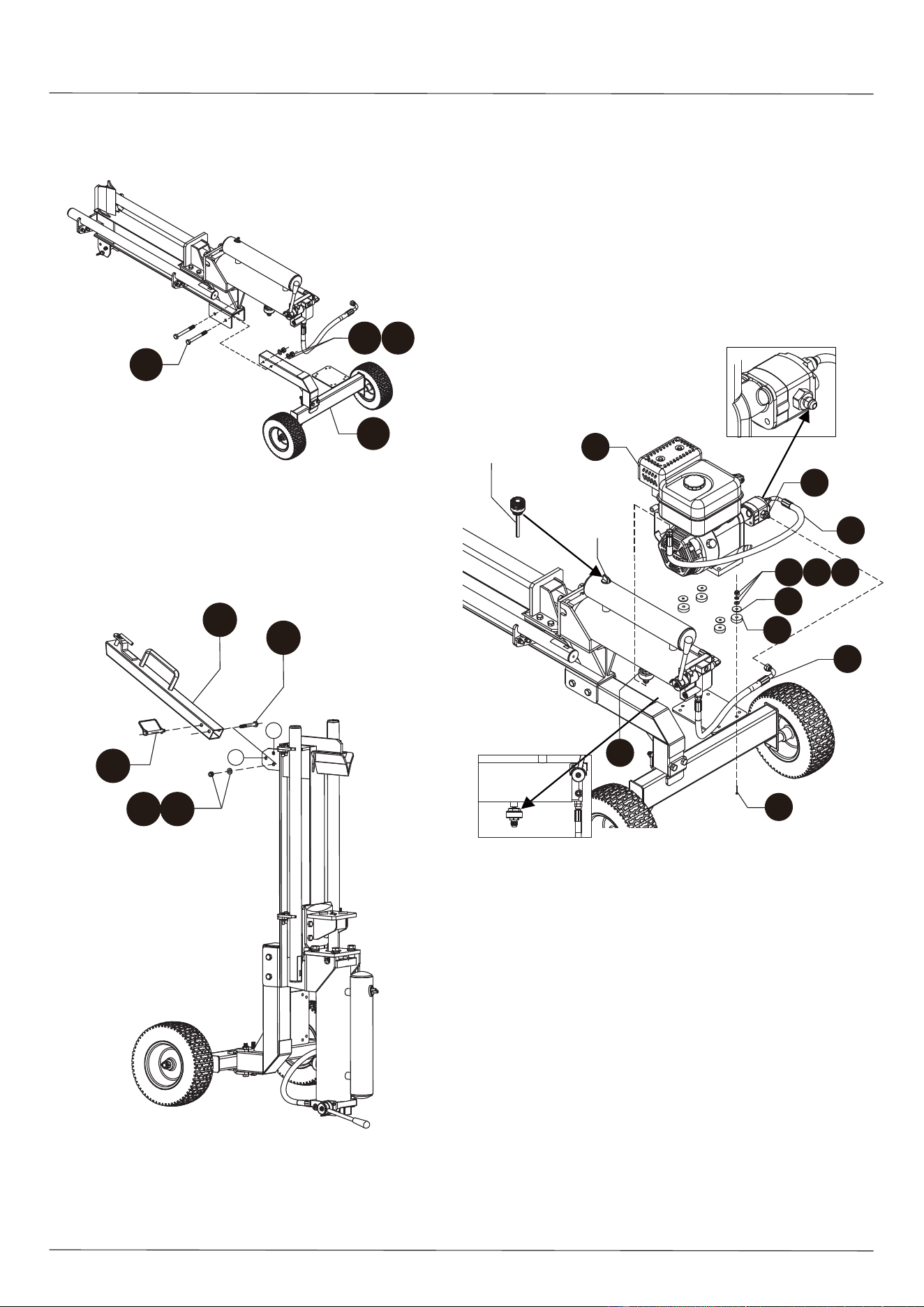
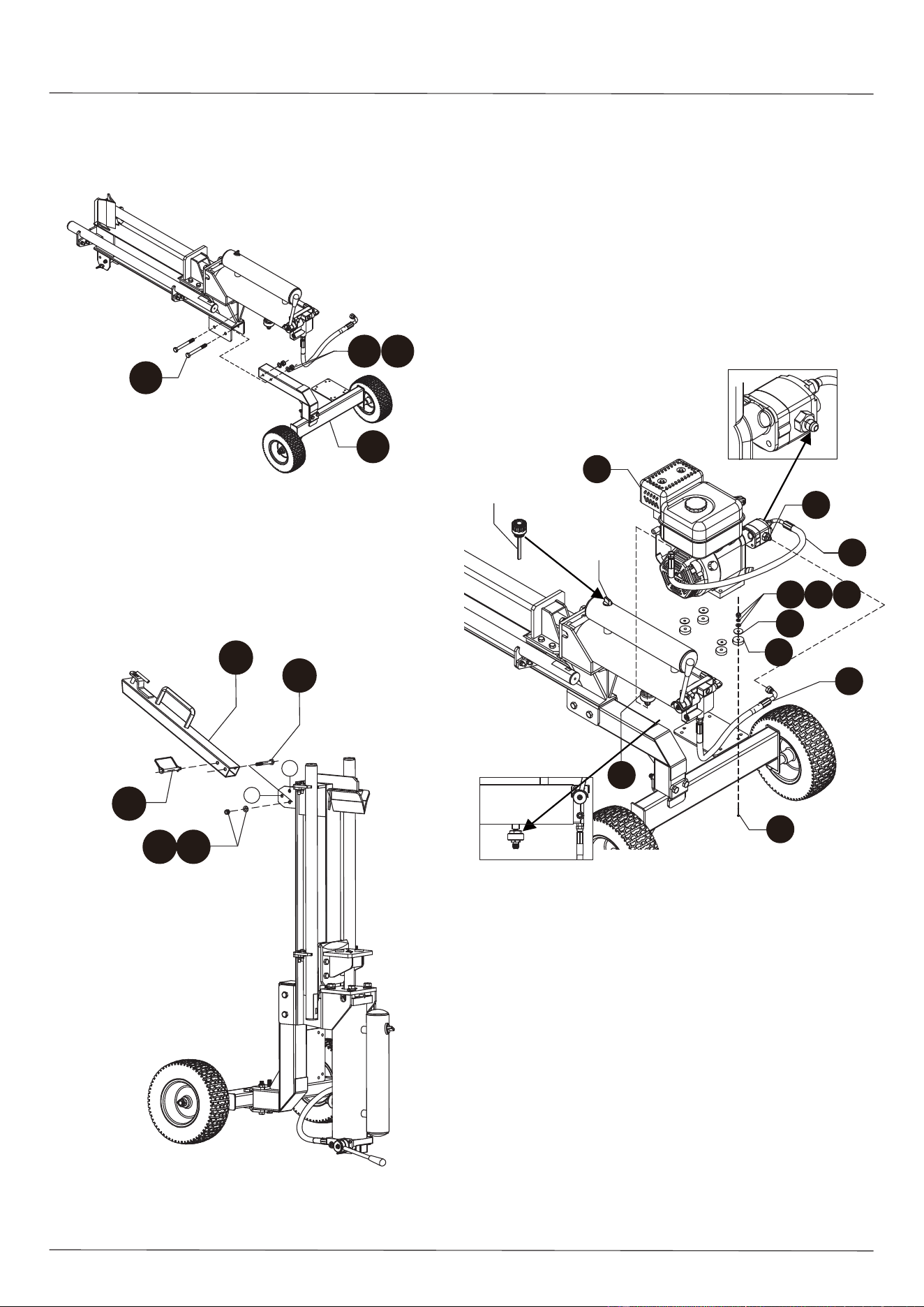
STEP 3: Attach the Beam Assembly
3.1 Attach the beam assembly to the wheel stand (30) using two M12x110 hex
bolts (15), two Ø12 flat washers (17) and two M12 nylon lock nuts (27).
STEP 4: Attach the Front Support Leg
4.1 Stand up the log splitter, then attach the front support leg (2) to the beam
assembly using a M10x85 hex bolt (6), a Ø10 flat washer (16) and a M10
nylon lock nut (18). Avoid overtightening the nuts as the front support leg
needs to be able to rotate.
4.2 Insert the lock pin (31) into either hole A or hole B. Insert the pin into hole
A when using the splitter and insert into hole B when towing the splitter.
STEP 5: Attach the Engine to the Mounting Plate
5.1 Place four polyurethane blocks (40) and four Ø10 large flat washers (45) onto the engine
mounting plate, then attach the engine (10) using M8x50 hex bolts (39), Ø8 flat washers
(28), Ø8 lock washers (29) and M8 nylon lock nuts (44).
5.2 Remove the plugs from the hydraulic hoses and connectors. Attach the hydraulic hose
(14) to the connector of the gear pump (9) and attach the hydraulic hose (43) to the filter
body 2 (66).
5.3 Bind the two hydraulic hoses together with two cable ties.
5.4 Remove the plastic plug and replace with oil dipstick from plastic bag. Plastic plug can be
discarded.
Hoses and cylinder will have residual oil from factory testing, oil will drip from
hoses when caps are removed. Use a catch basin to catch oil when removing caps.
15
17 27
30
A
B
6
2
31
18 16
Plastic Plug
Oil Dipstick
10
9
43
28 29 44
45
40
14
39
66
6
OPERATING INSTRUCTIONS
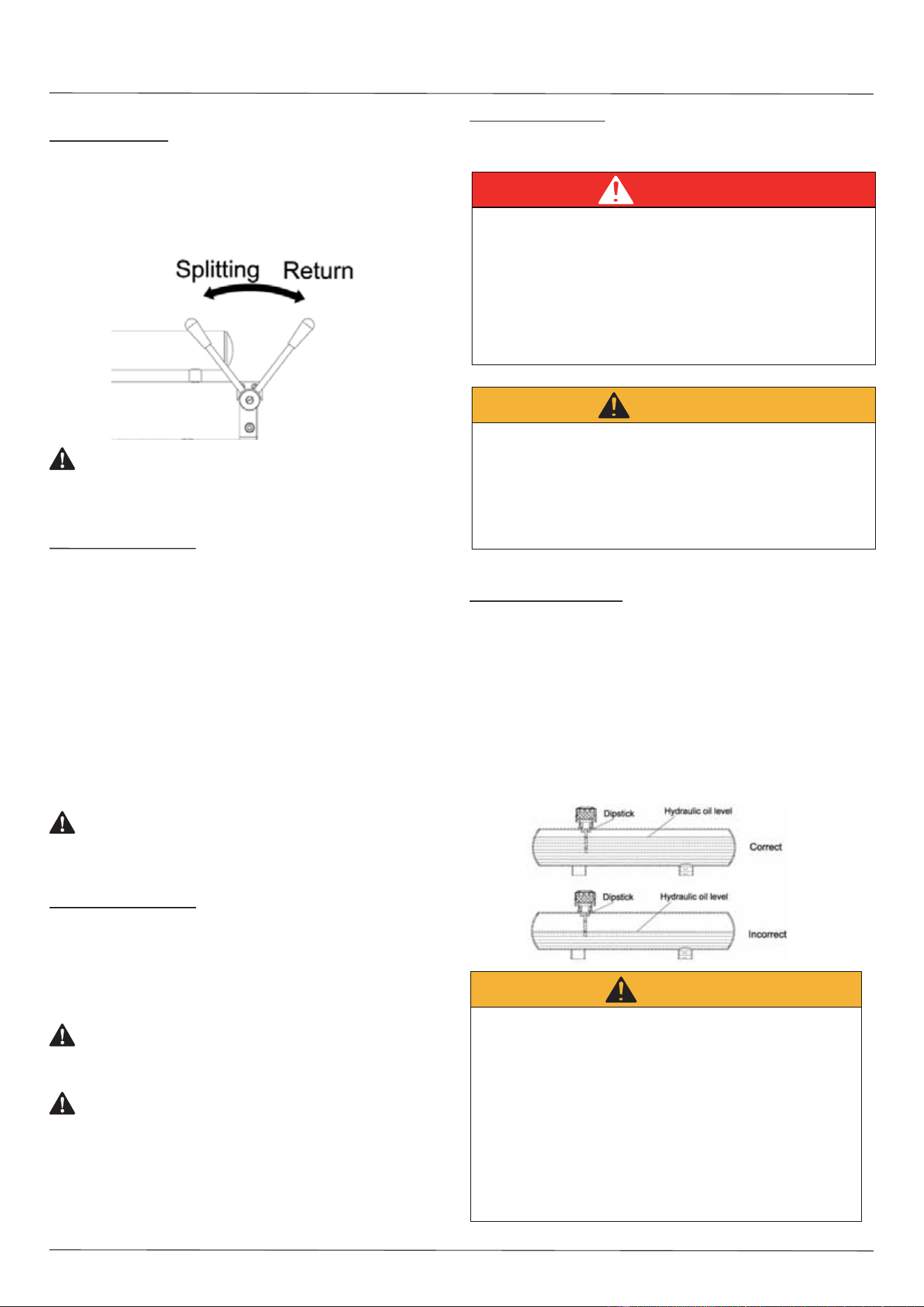
CONTROL HANDLE Service the engine with gasoline and oil as instructed in the engine’s manual packed along
with the log splitter. Read the gas and oil instructions carefully.
GAS AND OIL FILL-UP
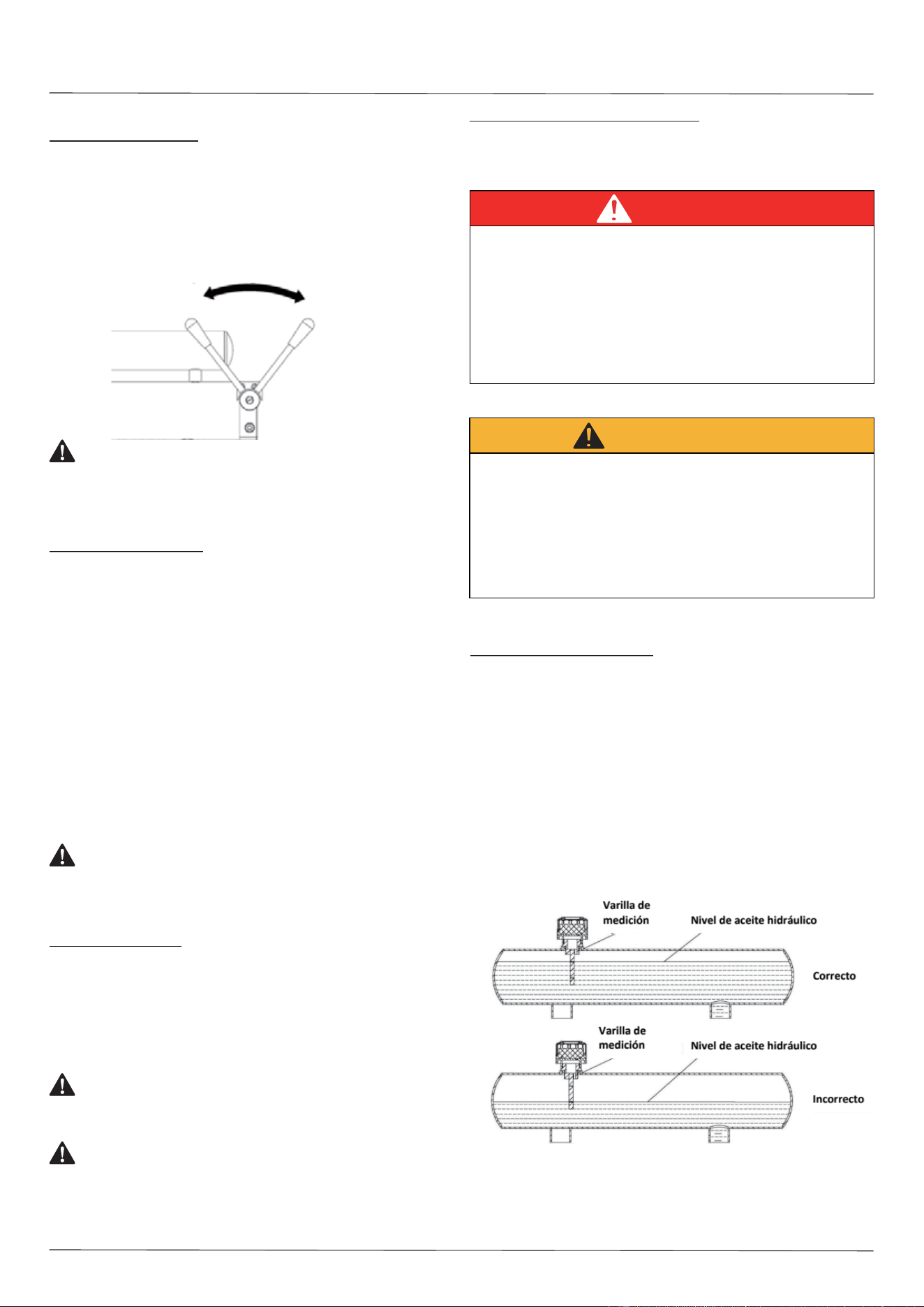
The control handle has two positions: the “Splitting” position and the “Return” position.
SPLITTING: Move the control handle FORWARD to split wood.
RETURN: Release the control handle to automatically RETURN the push plate to its
original position.
NOTE: The control handle will return to its original position after the handle is released.
WARNING: Never attempt to remove partially split wood from
the wedge with your hands. Fingers may become trapped
between split wood and hands could be seriously injured.
STARTING THE ENGINE
1. Attach the spark plug wire to the spark plug. Be sure the metal cap on the end of the
spark plug wire is fastened securely over the metal tip of the spark plug.
2. Turn the fuel valve, if equipped, to the “ON” position.
3. Move the choke lever, if equipped, to the “CHOKE” position.
4. If the engine is equipped with a primer, follow the instructions in the engine’s
manual to properly prime it.
5. Turn the throttle control handle to the “FAST” position.
6. Grasp the starter handle and pull the rope out slowly until the engine reaches the
start of its compression cycle (rope will pull slightly harder at this point).
7. Pull the rope with a rapid, full arm stroke. Maintain a firm grip on the starter handle.
Allow the rope to rewind slowly. Repeat the rope pulling process until the engine
cranks.
8. After the engine starts, move the choke lever (if equipped) to the “OFF” position.
Move the throttle lever to the desired speed.
9. In cold weather, run the push plate up and down the beam 6 to 8 times to circulate
the hydraulic fluid before starting the engine.
WARNING: When starting a warm engine, the muffler and
surrounding areas are hot, so use caution to avoid burns.
DO NOT TOUCH a hot engine or muffler.
STOPPING THE ENGINE
1. Move the throttle control handle to the “STOP” or “OFF” position.
2. Turn off the engine switch.
3. Disconnect the spark plug wire and ground the wire against the engine to prevent
unintentional engine starting.
IMPORTANT: The log splitter is shipped without engine oil. Oil MUST be added to the
log splitter before operating. Never overfill the engine with oil.
WARNING: Read, understand, and follow all instructions
and warnings on the machine and in this manual before
operating.
WARNING: Wear leather work gloves, safety shoes, ear
protection, and safety glasses when operating the log
splitter. Maintain safe footing.
ADDING HYDRAULIC OIL
NOTICE: The log splitter comes with no hydraulic oil and oil must
be added before operation.
Add approximately 1.43 gallons (5.4L) of hydraulic oil, until the tank is two-thirds of the
way full. Please add hydraulic oil in three times.
1. Add some hydraulic oil. Start the engine and move the control valve handle forward to
move the push plate.
2. Release the handle to release and return the push plate.
3. Repeat the add oil-start-push-release process in three times.
4. Turn off the engine and recheck the hydraulic oil level.
5. As needed, add hydraulic oil until the tank is two-thirds full.
6. Maintain the proper level of hydraulic oil in the tank by frequently checking the levels.
DANGER
Log splitter engine exhaust contains carbon monoxide, a colorless, odorless, poison gas.
Breathing carbon monoxide may cause nausea, dizziness, fainting or death. If you start
to feel dizzy or weak, immediately cease operation and get to fresh air and seek medical
attention.
Log splitters should be operated only outdoors and in well-ventilated areas.
DO NOT operate the log splitter inside any building, enclosure or compartment.
DO NOT allow exhaust fumes to enter a confined area through windows, doors, vents or
other openings.
DANGER CARBON MONOXIDE, using a log splitter indoors CAN KILL YOU IN
MINUTES.
Fuel and fuel vapors are highly flammable and extremely explosive.
Fire or explosion can cause severe burns or death.
Unintentional startup can result in entanglement, traumatic amputation or laceration.
Only use regular unleaded gasoline with a minimum 87 octane rating.
DO NOT mix oil and gasoline together.
Fill tank approximately ¼” below the top of the tank to allow for fuel expansion.
DO NOT fill fuel tank indoors or when the engine is running or hot.
DO NOT light cigarettes or smoke when filling the fuel tank.
WARNING
DO NOT remove the hydraulic oil fill cap when the engine is running or hot. Hot oil
can escape causing severe burns. Always allow the log splitter to cool completely
before removing the hydraulic oil cap.
High fluid pressure and temperatures are created inside hydraulic log splitters.
Hydraulic fluid can escape through a pin-size hole and can puncture skin and cause
severe blood poisoning.
Inspect hydraulic systems regularly for possible leaks. Never check for leaks with
your hand while the system is pressurized. Seek medical attention immediately if
injured by leaking fluid.
Make sure all fittings are tight and secure before applying pressure. Relieve system
pressure before servicing.
Make sure the hydraulic hoses do not touch any hot surfaces or cutting areas.
Hoses need to be positioned away from the engine and cutting wedge. To avoid
serious bodily injury always inspect the hoses before operating the log splitter.
WARNING
7
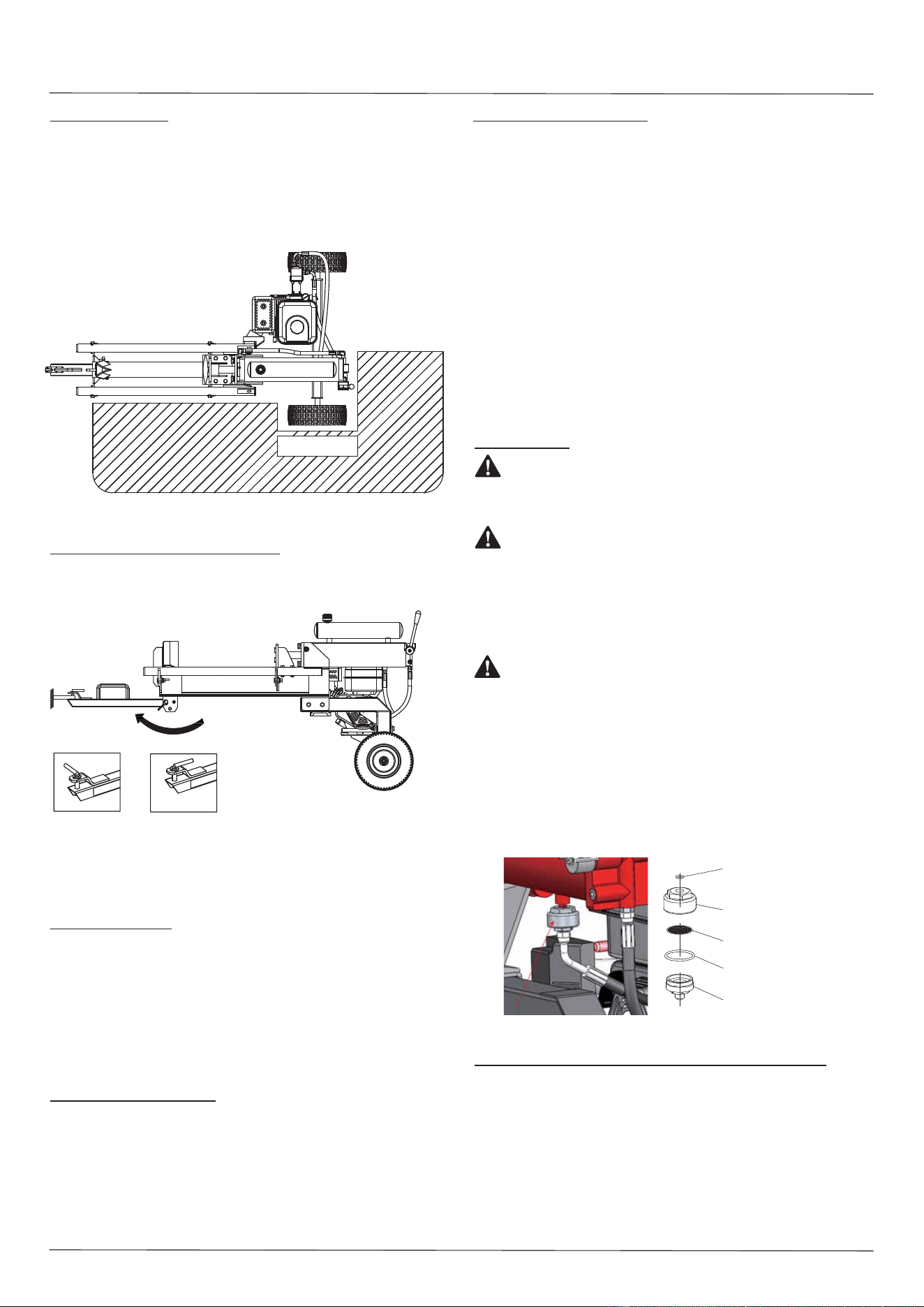
TRANSPORTING THE LOG SPLITTER
IMPORTANT: Before transporting the log splitter, always turn the fuel valve to the
“OFF” position and rotate up the support leg. Then, attach the log splitter to the
vehicle tow plate and secure with the lock pin.
WORK ZONE AREA
IMPORTANT: Always operate the log splitter while remaining in the Operator Zone as
shown in the diagram below. Keep all people and pets away from the Danger Zone
(labeled D Zone in the diagram) when splitting logs.
All log splitter operators are responsible for staying aware of the Operator Zone and the
Danger Zone. By carefully maintaining proper positioning and always keeping the Danger
Zone clear, operators create a safe work zone area.
OPERATOR ZONE
D ZONE
Pin (UNLOCK) Pin (LOCKED)
NOTE: Always use caution when backing up with the log splitter in tow. Using a spotter
outside the vehicle to safely reverse with the log splitter in tow is recommended. Never
exceed 5 MPH when towing the log splitter.
BEFORE EACH USE
1. Remove the dipstick and check the hydraulic fluid level. Add hydraulic fluid if the
level is low.
2. Check the engine oil level. If necessary, refill the engine oil.
3. Check and fill up gasoline.
4. Lubricate the beam area where the splitting wedge slides with engine oil. Do not
use grease to lubricate. Make sure to lubricate both the front and back of the beam
face.
5. Attach the spark plug wire to the spark plug.
USING THE LOG SPLITTER
1. Place the log splitter on level, dry ground.
2. Place the log against the wedge and split the wood only in the direction of the grain.
3. To stabilize the log, carefully place a hand on the
sides of the log. Never put hands
on the end between the log and the splitting wedge.
4. Only one adult should stabilize the log and operate the control handle, so the
operator has full control over the log and the splitting wedge.
TIPS FOR BEST OPERATION
Always:
1. Use clean fluid and check the fluid levels regularly.
2. Use an approved hydraulic fluid, including AW32, AW46 and universal hydraulic oil.
3. Use a breather cap on the fluid reservoir.
4. After servicing, flush and clean the hydraulic system before restarting the engine.
5. Use “Teflon Tape” on all hydraulic fittings.
6. Allow time for the log splitter to warm-up before splitting wood.
7. Before initial start-up, prime the pump by turning over the engine with the spark plug
disconnected.
8. Only split wood along the grain (lengthwise).
Never:
1. Never use the log splitter when fluid temperatures are below 20° F or above 150° F.
2. Never operate through the relief valve for extended periods of time.
3. Never operate the log splitter if there is air in the hydraulic system.
4. Never attempt to cut wood across the grain.
5. Never attempt to remove partially split wood from the wedge with your hands.
Instead fully retract the press plate to dislodge wood.
MAINTENANCE
WARNING: Do not make any adjustments or repairs to the log
splitter without first stopping the engine, disconnecting the
spark plug wire and grounding the wire against the engine.
WARNING: Before cleaning, lubricating, repairing, or
inspecting any parts of the log splitter, always stop the engine.
Disconnect the spark plug wire and ground it against the
engine to prevent unintended starting. Always wear personal
protective equipment, including safety glasses while operating
and while performing any adjustments or repairs.
WARNING: Higher pressure could cause the hoses to burst,
the cylinder to rupture, and/or pressurized fluid to be released,
which could result in serious personal injury.
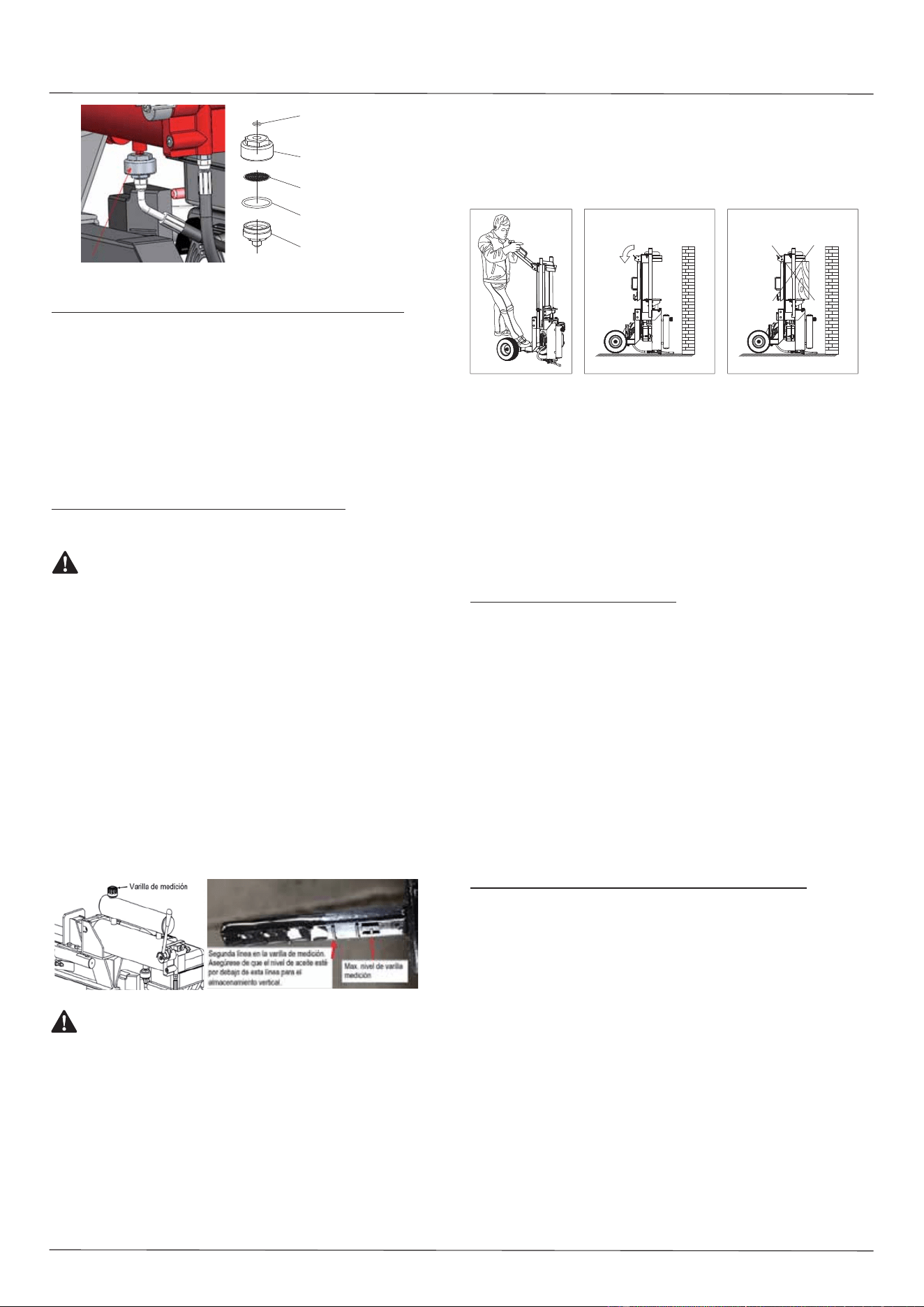
NOTICE: The filter screen needs to be cleaned regularly.
After the first 1-2 hours of operation, clean the filter oil screen.
Subsequently, clean the filter oil screen after every twenty-five
hours of use. Unscrew the filter body to remove the filter
screen for cleaning. Suggest to use contact cleaner to clean
up the filter screen.
O Ring Ø7.1x2.65
Filter Body 1
Filter Screen
O Ring Ø40x3
Filter Body 2
ACTIONS AND CONDITIONS THAT VOID THE WARRANTY
1. Failing to maintain the proper fluid level in the reservoir.
2. Changing the relief valve setting or pressure adjustment of the control valve without
proper knowledge and instruction from the manufacturer.
3. Disassembling the pump.
4. Using incorrect hydraulic fluid.
5. Failing to adequately or improperly lubricating the beam or log splitter.
6. Excessively heating the hydraulic system.
7. Attempting to start the log splitter in temperatures under 20°F without pre-heating the
fluid in the reservoir.
8. Allowing unrepaired leaks in the hydraulic system.
8
1. Clean the log splitter thoroughly before storage.
CHANGING THE HYDRAULIC OIL
Prepare the log splitter for storage at the end of the season or if the log splitter will not be
used for 30 days or more.
STORING THE LOG SPLITTER
WARNING: Never store the log splitter with fuel in the fuel
tank inside of any building where fumes could contact an
open flame or spark, or where ignition sources are present,
such as hot water and space heaters, furnaces, clothes
dryers, stoves, electric motors, etc.
NOTE: The use of pressure washers and/or garden hoses to clean the log splitter is
NOT recommended. Using them to clean may cause damage to the bearings or the
engine. In general, using water to clean the log splitter can shorten machine life and
reduce serviceability.
2. Wipe down the entire log splitter with an oiled rag to prevent rust, especially on
the push plate and the beam.
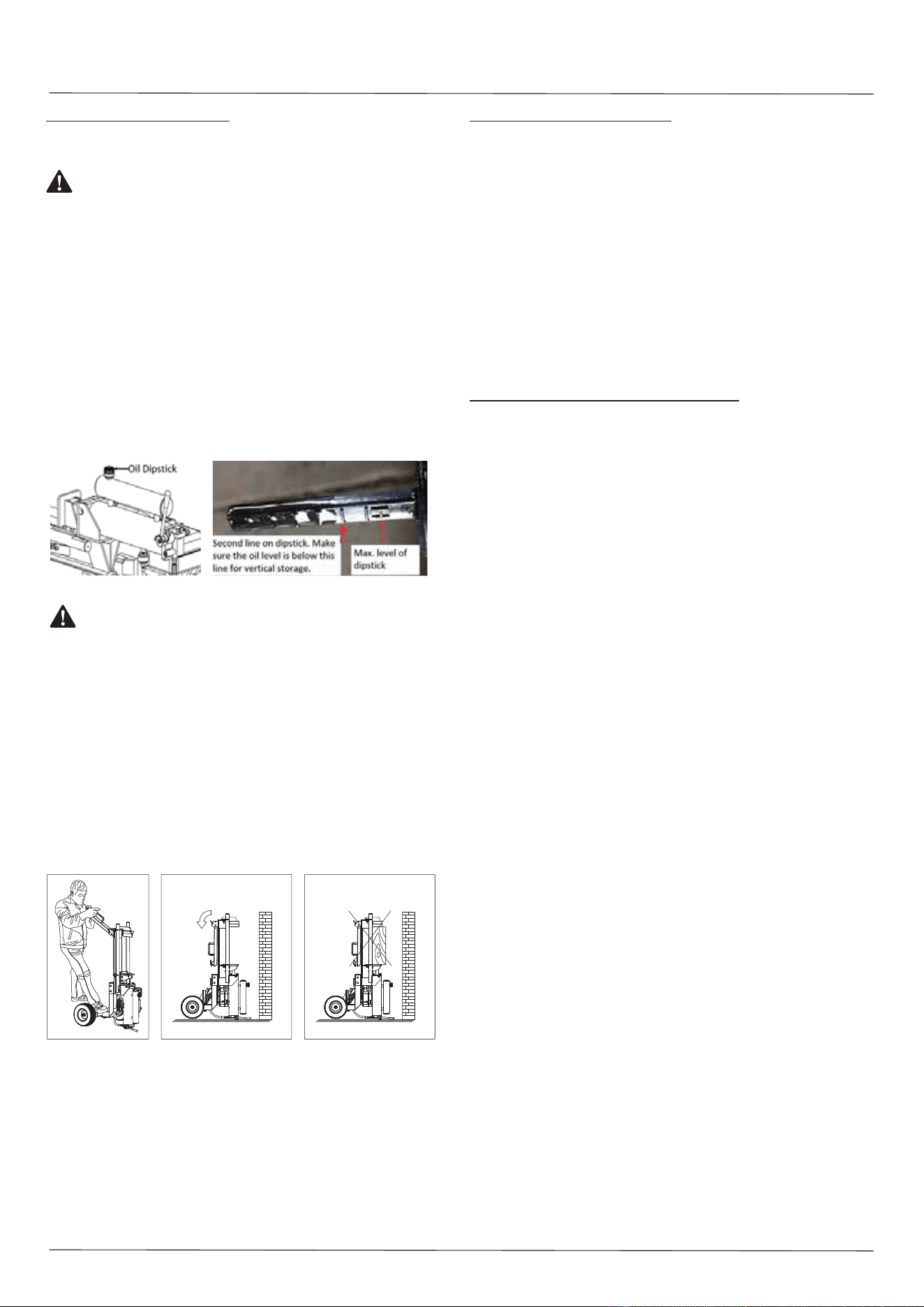
3. Check the hydraulic oil level to avoid the oil leaking in vertical storage position.
Unscrew the Dipstick, make sure the oil level is below second line on dipstick.
See below picture.
4. Completely drain the fuel tank.
WARNING: Never smoke while around or when handling fuel. Always drain
fuel into an approved container while outdoors and away from open flames
and other potential sources of ignition. Be sure that engine is cool before
draining the fuel.
5. Start the engine and let it run until the fuel lines and carburetor are empty.
6. Remove the spark plug. Holding a rag over the cylinder hole, pour approximately
a 1/2 ounce (approximately one tablespoon) of engine oil into the cylinder and
crank slowly to evenly distribute the oil.
7. Replace the spark plug.
8. Do not store and reuse gasoline from one season to another.
9. Replace any gasoline can if it starts to rust. Using gasoline containing rust and/or
dirt will cause operational problems for the log splitter.
10. Always store the log splitter in a clean, dry area, preferably inside and safe from
weather. Do not store the log splitter close to any corrosive materials, such as
fertilizer.
NOTE: If storing the log splitter in an unventilated or metal storage shed, be certain to
rust-proof the equipment by coating with a light oil or silicone.
The vertical position
is for storage only.
Can’t split log in
vertical position.
To properly store the log splitter in an upright position, keep the log splitter at least
50 mm away from walls. Never store the log splitter resting against or touching a wall.
As shown in the diagram, push down the front support leg to stow and properly store
the log splitter.
Always check the hydraulic oil level before each use.
Change the hydraulic oil in the reservoir after every 100 hours of operation. Follow the
steps below:
1. Discharge the hydraulic oil by suction hose and then disconnect the suction hose from
the bottom of the reservoir tank.
2. Allow the hydraulic oil to drain into a suitable container.
3. Refill the reservoir with approximately 1.43 gallons (5.4L) of hydraulic oil. Maintain the
oil level within the range specified on the dipstick at all times. Whenever finished
checking the hydraulic oil always tighten the dipstick.
NOTE: Always only properly dispose of used hydraulic oil and engine oil at approved
recycling or disposal centers.
Contaminants in oil may damage the hydraulic components. Flushing the reservoir tank
and hoses with kerosene whenever service is performed on the tank, hydraulic pump or
valve is recommended. Please contact an authorized service dealer for service.
MAINTAINING THE BEAM AND PUSH PLATE
Before each use, lubricate the beam with engine oil.
Adequately lubricate the top of the beam and under the top edge as proper lubrication will
allow the push plate to easily move across the beam.
If necessary, adjust the side bolts so the wedge can move freely. There should be no extra
space between the push plate and the beam.
When turning the log splitter, the tires will roll and one foot should be used to stabilize
the wheel stand. Avoid using excessive force when turning to avoid potential damage
to the log splitter.
When turning over the log splitter, make sure the gasoline/fuel tank is empty.

9
TROUBLESHOOTING
WARNING: Before troubleshooting or attempting to service the log splitter, read and follow all safety instructions to avoid serious
injury to the operator or bystanders from moving parts that can crush, cut, burn or release high pressure hydraulic fluid.
Problem Cause Remedy
Slow cylinder shaft
speed while
extending
and retracting
1. Gear sections damaged.
2. Excessive pump inlet
vacuum.
3. Slow engine speed.
4. Damaged relief valve.
5. Incorrect oil level.
6. Contaminated oil.
7. Directional valve leaking
internally.
8. Internally damaged cylinder.
1.
See an authorized service
dealer.
2. Make certain pump inlet
hoses are clear and
unblocked-use short, large
diameter inlet hoses.
3. See an authorized service
dealer.
4. See an authorized service
dealer.
5. Check oil level.
6. Drain oil, clean reservoir, and
refill.
7. See an authorized service
dealer.
8. See an authorized service
dealer.
Leaking Cylinder 1. Broken seals.
2. Scored cylinder.
1. See an authorized service
dealer.
2. See an authorized service
dealer
.
Engine runs but
wood will not split
or wood splits too
slowly
1. Small gear section
damaged.
2. Pump check valve leaking.
3. Excessive pump inlet
vacuum.
4. Incorrect oil level.
5. Contaminated oil.
6. Directional valve leaking
internally.
7. Overloaded cylinder.
8. Internally damaged cylinder.
1. See an authorized service
dealer.
2. See an authorized service
dealer.
3. Make certain pump inlet
hoses are clear and
unblocked.
4. Check oil level.
5. Drain oil, clean reservoir, and
refill.
6. See an authorized service
dealer.
7. Do not attempt to split wood
against the grain.
8. See an authorized service
dealer.
9. No properly assembly and
operation.
9. Refer to Page 6 for correct
operation of adding hydraulic
oil.

10
TROUBLESHOOTING
Engine stalls during
splitting
1. Low horsepower/weak
engine.
2. Overloaded cylinder.
1. See an authorized service
dealer.
2. Do not attempt to split wood
against the grain or see
authorized service dealer.
Engine will not turn
or stalls under low
load
conditions
1. Engine/pump misalignment.
2. Frozen or seized pump.
3. Low horsepower/weak
engine.
4. Hydraulic lines blocked.
5. Blocked directional valve.
1. Correct alignment as
necessary.
2. See an authorized service
dealer.
3. See an authorized service
dealer.
4. Flush and clean the hydraulic
system.
5. Flush and clean the hydraulic
system.
Leaking pump shaft
seal
1. Broken drive shaft.
2. Engine/pump misalignment.
3. Gear sections damaged.
4. Poorly positioned shaft seal.
5. Plugged oil breather.
1. See an authorized service
dealer.
2. Correct alignment as
necessary.
3. See an authorized service
dealer.
4. See an authorized service
dealer.
5. Make certain reservoir is
properly vented.
Engine fails to start 1. Spark plug wire
disconnected.
2. Fuel tank empty or stale fuel.
3. Choke, if equipped, not in
CHOKE Position.
4. Faulty spark plug.
5. Blocked fuel line.
6. Engine (if equipped with a
primer) is not primed
properly.
7. Throttle control lever is not in
correct starting position.
1. Connect wire to the spark
plug.
2. Fill the tank with clean, fresh
gasoline.
3. Move choke to CHOKE
position.
4. Clean, adjust gap, or replace.
5. Clean the fuel line.
6. Prime the engine.
7. Move throttle lever to FAST
position.
Problem Cause Remedy

11
TROUBLESHOOTING
For further technical support please contact:
YTL International Inc.
17517 Fabrica Way Suite H
Cerritos, CA 90703
Phone: (888) 331-4569
Website: www.CRAFTSMAN.com
Log Splitter Parts and Service:
Toll Free 1-888-331-4569
FREE WARNING LABEL REPLACEMENT: If warning labels become illegible or are missing, call 1-888-331-4569 for a free replacement.
Engine runs
erratically
1. Unit running with CHOKE
applied, if so equipped.
2. Spark plug wire loose.
3. Blocked fuel line or stale
fuel.
4. Water or dirt in the fuel
system.
5. Dirty air cleaner.
6. Carburetor not adjusted
properly.
1. Move choke lever to OFF
position.
2. Connect and tighten spark
plug wire.
3. Clean the fuel line; fill tank
with clean, fresh (less than 30
days old) gasoline.
4. Drain the fuel tank. Refill the
tank with fresh fuel.
5. Clean or replace air cleaner.
6. See an authorized service
dealer.
Engine Overheats 1. Engine oil level low.
2. Dirty air cleaner.
3. Carburetor not adjusted
properly.
1. Fill crankcase with proper oil.
2. Clean or replace the air
cleaner.
3. See an authorized service
dealer.
Cylinder rod will not
move
1. Broken drive shaft.
2. Set screws in coupling not
adjusted properly.
3. Loose shaft coupling.
4. Gear sections damaged.
5. Damaged relief valve.
6. Hydraulic lines blocked.
7. Incorrect oil level.
8. Damaged directional valve.
9. Blocked directional valve.
1. See an authorized service
dealer.
2. See the operator’s manual for
correct adjustment.
3. Correct engine/pump
alignment as necessary.
4. See an authorized service
dealer.
5. See an authorized service
dealer.
6. Flush and clean hydraulic
system.
7. Check oil level.
8. See an authorized service
dealer.
9. Flush and clean the hydraulic
system.
Problem Cause Remedy

12
SPECIFICATIONS
Maximum Splitting Force............................................................................13 Tons
Cycle Time............................................................................................13 Seconds
(Note: Cycle time may vary given mechanical and environmental factors; the
published cycle time is for ideal conditions)
Wedge Height ........................................................................ 5.5” Hardened Steel
Gear Pump ...............................................................................1.52 GPM / 1.6 ml/r
Hydraulic Oil ......................................... AW32, AW46 and Universal Hydraulic Oil
Hydraulic Capacity................................................................... 1.43 Gallons (5.4L)
Maximum Log Length ........................................................................................20”
Hydraulic Cylinder...........................................................................3-1/8” x 17-3/4”
Maximum Pressure.................................................................................. 3600 PSI
Wheel Size........................................................................................................ 13”
Maximum Towing Speed............................................................................. 5 MPH
Manual Start Engine ..................................................................................... 196cc
NOTE: For Engine Details Refer to the Engine’s User Manual.
13
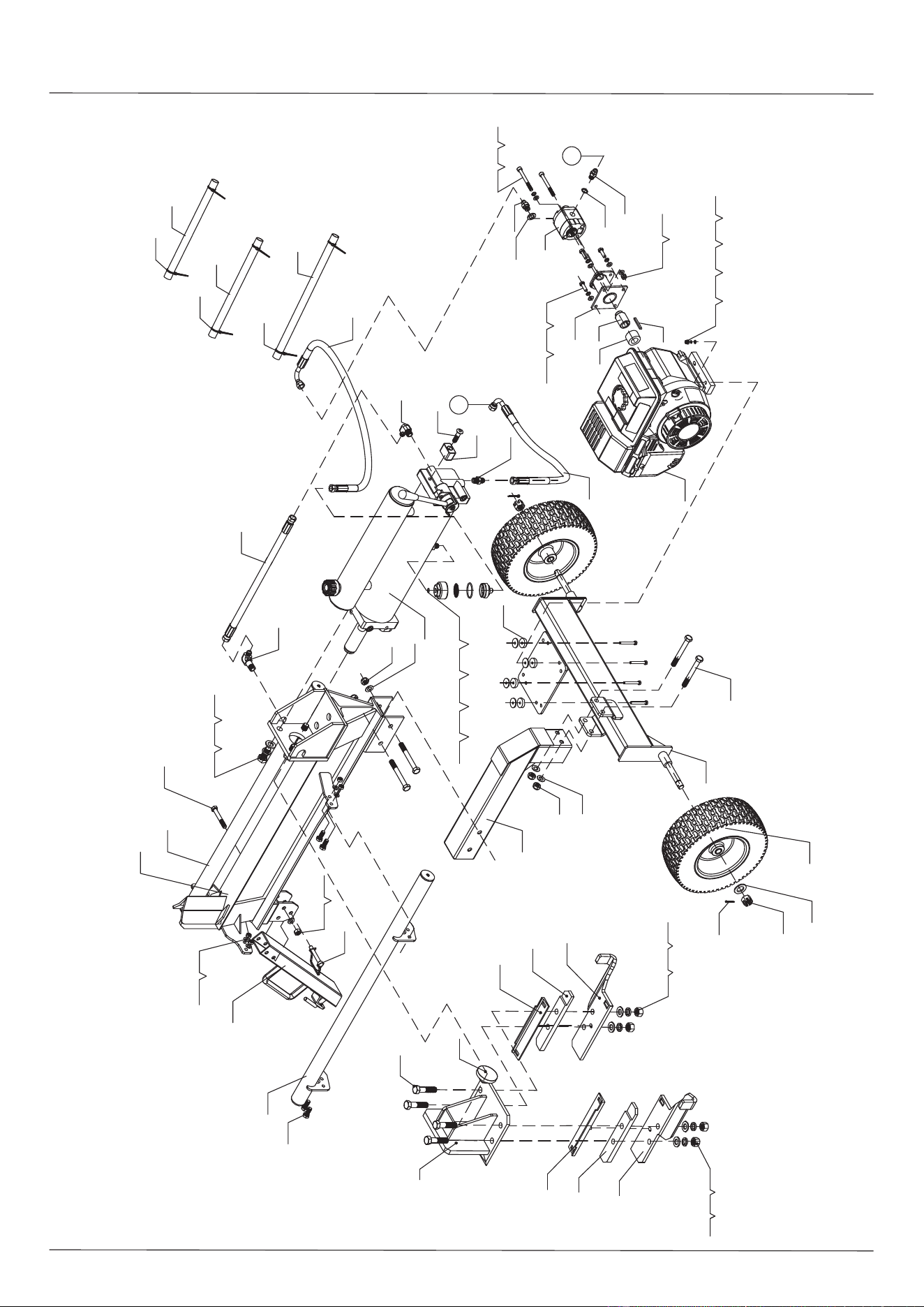
DRAWING
1618
253332
11
2844
6
13
14
31
1
2
3
4
5
22
11
22
20
19
35
34
8
43
38
24
23
36
26
10
46
49
50
29
44
28
2928
12
28
9
51
58
54
60
59
53
52
61
555657
57
56
55
52
7
40
39
44
29
28
45
48
47
37
A
A
21
15
17
27
30
41
42
11
22
17
27
666564
63
62

14
PARTS LIST
Ref# Drawing No. Description Qty
1 LGS13-07000 Return Spring Assy.-Left 1
2 LGS1301-04000 Front Support Leg Assy. 1
3 9101-08030-DX8.8 Hex Bolt M8x30 8
4 LGS1301-01000 Beam Assy. 1
5 LGS13-08000 Return Spring Assy.-Right 1
6 9101-10085-DX8.8 Hex Bolt M10x85 1
7 LGS13-06100 Push Plate Assy. 1
8 N900-00012 Connector 1
9 LGS13-00007 Connector 1
10 2020050101 Engine Assy. 1
11 2020050102 Nylon Cable 6
12 LSP25-10004-DX Engine Axle Sleeve 1
13 9905-00140 Combination Washer Ø14 1
14 LGS1301-00003 High Pressure Hose 1
15 9101-12110-DX8.8 Hex Bolt M12x110 4
16 9301-10000-DX Flat Washer Ø10 1
17 9301-12000-DX Flat Washer Ø12 4
18 9206-10000-DX Nylon Lock Nut M10 1
19 LGS13-00005 King-size Angle Connector 1
20 LGS13-00002 Hydraulic Hose 1
21 LGS1301-02000 Connecting Tube Weldment 1
22 2020050103 Hydraulic Hose Protector Sleeve 3
23 9205-16000-DX Hex Slotted Thin Nut M16 2
24 9404-04036-DX Cotter Pin Ø4x36 2
25 9301-14000-DX Flat Washer Ø14 4
26 NW01-11000 13" Pneumatic Tire 2
27 9206-12000-DX Nylon Lock Nut M12 4
28 9301-08000-DX Flat Washer Ø8 18
29 9306-08000-DX Lock Washer Ø8 9
30 LGS1301-03000 Wheel Stand 1
31 LSP25-16000 Lock Pin 1
32 9101-14035-DX8.8 Hex Bolt M14x35 4
33 9306-14000-DX Lock Washer Ø14 4
34 LGS1301-05000 Cylinder 1
35 N900-00014 Angle Connector 1
36 9301-16000-DX Flat Washer Ø16 2
37 9905-00180 Combination Washer Ø18 1

PARTS LIST
15
Ref# Drawing No. Description Qty
38 LGS13-00006 Connector 1
39 9101-08050-DX8.8 Hex Bolt M8x50 4
40 CP75-00013 Polyurethane Block 4
41 LGS1301-00001 Rubber Mat 1
42 9104-08025-10.9FH Inner Hex Socket Screw M8x25 1
43 LGS1301-00002 Oil Return Hydraulic Hose 1
44 9206-08000-DX Lock Nut M8 13
45 9302-10000-DX Big Flat Washer Ø10 4
46 2020050104 Flat Key 1
47 LS12-07002-FH Connector 1
48 LS12-07003-DY Gear Pump Stand 1
49 LGS13-00002 Gear Pump 1
50 9101-08025-DX8.8 Hex Bolt 5/16"×24-1" 4
51 9105-08080-FH Inner Hex Socket Screw M8x80 2
52 LGS13-06001 Plywood Nylon Pad 2
53 LGS13-06004 Push Plate Separator-Left 1
54 LGS13-06002 Push Plate Plywood-Left 1
55 9210-12000-DX Hex Thick Nut M12 4
56 9306-12000-DX Lock Washer Ø12 4
57 9301-12000-DX Flat Washer Ø12 4
58 LGS13-06003 Push Plate Plywood -Right 1
59 LGS13-06005 Push Plate Separator-Right 1
60 LGS13-06006 Top Block 1
61 9101-12050-DX12.9 Hex Bolt M12x50 4
62 9901-71265 O Ring Ø7.1x2.65 1
63 LGS1301-06001 Filter Body I 1
64 LGS1301-06002 Filter Screen 1
65 9901-40030 O Ring Ø40x3 1
66 LGS1301-06003 Filter Body 2 1

LIMITED WARRANTY
Duration of Warranty
For 3 years from the date of purchase, YTL International will replace or repair defects in material and workmanship for the original purchaser of the log splitter. For 2 years, the engine
warranty is covered per the engine manufacturer’s warranty. For 1 year from date of purchase, YTL International will replace the hydraulic system component parts. The warranty will
not apply to any unit which was not assembled correctly, misused, overloaded or which has been used or operated contrary to our instructions, or which has been repaired or altered
by anyone other than an authorized service representative.
Warranty Exclusions
The warranty does not cover cosmetic defects such as paint and decals. The warranty excludes components that wear out with ordinary use over time, such as tires. The warranty does
not cover failures or problems due to acts of God and events or forces beyond the control of the manufacturer.
Normal Wear Exclusions
The log splitter needs periodic service to perform well. The warranty does not cover repair when normal use has exhausted the life of a part or the equipment as a whole.
Installation, Use and Maintenance Exclusions
The warranty does not apply to parts and/or labor if the log splitter has been misused, neglected, involved in an accident, abused, loaded beyond its’ limits, modified or assembled
incorrectly. Normal maintenance is not covered under the warranty.
Limits of Implied Warranty and Consequential Damage Exclusions
YTL International disclaims any obligation to cover any loss of time, use of this product, freight, or any incidental or consequential claim by anyone incurred from using the log splitter.
THIS WARRANTY IS IN LIEU OF ALL OTHER WARRANTIES, EXPRESS OR IMPLIED, INCLUDING WARRANTIES OF MERCHANTABILITY OR FITNESS FOR A PARTICULAR
PURPOSE.
An exchanged log splitter unit will be subject to the original warranty date. The length of the warranty governing the exchanged unit will be calculated from the purchase date of the
original unit. The warranty gives you certain legal rights which may change from state to state. Your state may also have other rights you may be entitled to that are not listed within
this warranty.
Product manufactured by: YTL International Inc.
Producto fabricado por: YTL International Inc.
Produit fabriqué par: YTL International Inc.
LICENSEE NAME: YTL International Inc.
LICENSEE ADDRESS: 17517 Fabrica Way Suite H Cerritos, CA 90703
For product, service or warranty information contact us at:
Para obtener información sobre el producto, el mantenimiento
o la garantía, comuníquese con nosotros en:
Pour obtenir de l'information sur les produits, les réparations ou
la garantie, prière de nous contacter au:
U.S. & Canada Only • É.-U. et Canada seulement
www.CRAFTSMAN.com • 888-331-4569
CRAFTSMAN®
is a registered trademark of Stanley Black & Decker, Inc., used under license.
es una marca registrada de Stanley Black & Decker, Inc., utilizada bajo licencia.
est une marque déposée de Stanley Black & Decker, Inc., utilisée sous licence.
MANUAL DE INSTRUCCIONES
Divisor de leños de 13 toneladas
CMXGLXT1301
SI TIENE DUDAS O COMENTARIOS, CONTÁCTENOS.
1-888-331-4569 WWW.CRAFTSMAN.COM
Patente No.: US 9,427,886 B2
Definiciones: Términos y símbolos con alertas de seguridad
Este instructivo utiliza los siguientes términos y símbolos con alertas de seguridad para advertirle de situaciones de peligro
y riesgos de lesión personal o daños materiales.
PELIGRO: indica una condición peligrosa inminente que, si no se evita, causará la muerte o lesiones graves.
ADVERTENCIA: indica una condición peligrosa potencialmente que, si no se evita, podría causar la muerte o lesiones graves.
PRECAUCIÓN: indica una condición peligrosa potencialmente que, si no se evita, podría causar lesiones menores o moderadas.
(Sin palabras) Indica un mensaje relacionado con la seguridad.
ADVERTENCIA: Lea todas las advertencias de seguridad
y todas las instrucciones. El incumplimiento de las
advertencias e instrucciones podría causar choque
eléctrico, incendio o lesiones graves.
ADVERTENCIA: Nunca modifique el producto o
cualquiera de sus componentes. Podría causar
daños o lesiones personales.
ADVERTENCIA: Para reducir el riesgo de lesión, lea
el manual de instrucciones.
Si tiene preguntas o comentarios sobre este producto
o cualquier otro, llame a la línea telefónica gratuita de
CRAFTSMAN: 1-888-331-4569.
18
AVISO:
Indica una práctica no asociada con lesiones personales que, si no se evita, podría causar daños materiales.
1
2
4
3
6
14
9
8
7
10
11
17
15
5
12
13
16
Componentes
1 Cuña
Placa de empuje
Tanque hidráulico
Filtro de aire
Componente del cilindro
Palanca de la válvula de control
Manguera de alta presión
Manguera de succión
Bomba de engranaje
Rueda neumática de 13"
Soporte de rueda
Barra
Pata de soporte
Motor
Ensamble de tubo de conexión
Componente de tubo de resorte
Filtro de aceite
Jarra de aceite del motor
2
3
4
5
6
7
8
9
10
11
12
13
14
15
16
17
18
18
ADVERTENCIA: INFORMACIÓN IMPORTANTE
SOBRE LA SEGURIDAD
ADVERTENCIA: Lea y comprenda toda las instrucciones y la información
de seguridad en este manual y en las etiquetas adhesivas de seguridad antes de
ensamblar y usar este divisor de leños. Su incomprensión podría causar lesiones
graves o la muerte. No permita que ninguna persona que no haya leído este manual
use este divisor de leños. Un divisor de leños puede ser peligroso si no se ensambla
o usa de manera correcta. No use este divisor de leños si tiene preguntas sobre
cómo usarlo de manera segura. Llame a nuestro departamento de asistencia
técnica al teléfono 1-888-331-4569 para que respondan sus preguntas.
ADVERTENCIA:
ADVERTENCIA:
19
Este producto puede exponerle a sustancias químicas,
incluyendo plomo y componentes de plomo, que el estado de California considera
causantes de cáncer y defectos congénitos u otros peligros para la reproducción.
Para más información visite www.P65Warnings.ca.gov
NUNCA use este divisor de leños para cualquier fin que
no sea el de dividir madera. Ha sido diseñado para este fin solamente. Cualquier
otro uso puede causar lesiones graves o la muerte y anular su garantía.
1) SEGURIDAD GENERAL
2) ÁREA DE TRABAJO
3) PREPARACIÓN DEL LEÑO
Ambos extremos del leño deben cortarse lo más perpendicularmente posible para que
no se mueva al dividirlo. El leño debe tener una longitud máxima de 20 pulgadas.
4) FUNCIONAMIENTO DEL DIVISOR DE LEÑOS
• SIEMPRE hay que bloquear las ruedas para que el divisor de leños no se mueva
durante el funcionamiento.
• SEPA cómo detener el divisor de leños y desactivar los controles antes de usarlo.
• NUNCA intente dividir un leño contra la veta.
• NUNCA intente dividir dos leños al mismo tiempo.
• NUNCA pase por encima del divisor de leños cuando se esté usando.
• NUNCA se agache o alcance encima del divisor de leños para recoger un leño.
• NUNCA intente cargar el divisor de leños mientras la cuña se esté moviendo.
• NUNCA ponga las manos o los pies entre el leño que va a dividir y la cuña durante el
movimiento de avance o retroceso ya que podría sufrir lesiones graves o la muerte.
• NUNCA use su pie, una cuerda o un dispositivo de extensión para controlar la
palanca de mando en la válvula. Use solo la mano.
• NUNCA toque el silenciador u otras áreas calientes del motor durante el
funcionamiento. Espere a que el motor se enfríe.
• NUNCA mueva el divisor de leños mientras el motor esté en marcha. Apague
el motor antes de dejar el partidor de troncos.
• NUNCA deje el partidor de troncos funcionando sin supervisión, ni siquiera por
un período corto de tiempo.
5) REPARACIÓN GENERAL
6) MANTENIMIENTO Y SEGURIDAD
• El sistema mecánico e hidráulico de su divisor de leños requiere una inspección cuidadosa.
Asegúrese de reemplazar las mangueras hidráulicas o los componentes hidráulicos que
estén averiados.
• NUNCA busque fugas del fluido hidráulico con la mano. El fluido que escapa de un orificio
pequeño puede ser casi imperceptible. La presión del fluido que escapa puede tener
suficiente fuerza como para penetrar la piel y causar LESIONES GRAVES e incluso la
MUERTE. Las fugas pueden detectarse fácilmente pasando un trozo de cartón sobre el sitio
donde se sospecha que hay una fuga para buscar decoloración.
• NUNCA retire la tapa del tanque hidráulico mientras el divisor de leños esté funcionando.
El tanque podría contener aceite caliente a presión que podría causar lesiones graves.
• NUNCA ajuste la configuración de la válvula de alivio. La válvula de alivio de presión en su
divisor de leños se configura en la fábrica. Solo técnicos calificados deben hacer este ajuste.
• SIEMPRE debe buscar atención médica inmediata si se lesiona con fluido hidráulico que
escapa. Podría desarrollar una infección o una reacción grave si no recibe inmediatamente
atención médica apropiada.
• SIEMPRE debe asegurarse de que el sistema no esté a presión si tiene que aflojar o retirar
un accesorio hidráulico, para ello debe apagar el motor y mover la palanca de mando de la
válvula hacia adelante y hacia atrás.
• SIEMPRE mantenga la viga y la cuña libres de acumulación de escombros.
• SIEMPRE debe mantener el manual de uso del operador para consultarlo. Repase el
manual regularmente.
• SIEMPRE debe mantener cualquier observador o mascota a una distancia mínima de
10 pies del área de trabajo mientras use el divisor de leños. El operador es la única
persona que debe estar cerca del divisor de leños cuando se esté usando.
• NUNCA se debe activar la válvula de control hasta que todas las personas hayan
despejado el área de trabajo.
• NUNCA use ropa holgada o joyas sueltas mientras use el divisor de leños. Mantenga la
ropa y el cabello alejados de los componentes en movimiento mientras lo use.
• NUNCA permita que personas adultas sin la capacitación o el conocimiento apropiado
usen este divisor de leños.
• NUNCA use el divisor de leños si está bajo la influencia de drogas, alcohol o
medicamentos, o si no está lo suficientemente alerta como para usar este divisor de leños.
• NO permita que los niños jueguen, se paren, trepen u operen el partidor de troncos en
ningún momento.
• NUNCA use el divisor de leños sobre suelos mojados, helados, resbalosos o inestables.
• NUNCA use el divisor de leños dentro de un área cerrada. Los gases del escape
contienen monóxido de carbono letal.
• SOLO use el divisor de leños con buena iluminación.
• SOLO use el divisor de leños sobre suelo plano. El uso del divisor de leños sobre una
pendiente podría causar su desplazamiento o la caída de leños.
• SIEMPRE debe mantener el área de trabajo libre de escombros. Retire inmediatamente
las maderas divididas que haya alrededor del divisor de leños para evitar la posibilidad
de tropiezo.
SOLO debe usar el divisor de leños desde el área del operador, como se muestra en el
diagrama. El usar el divisor de leños desde cualquier otro lugar puede causar lesiones
graves o la muerte.
• NUNCA use su divisor de leños si tiene problemas mecánicos o requiere reparación.
• NUNCA altere de ninguna manera su divisor de leños. Dichas alteraciones pueden causar
problemas de seguridad con su divisor de leños y anularán la garantía.
• NUNCA lleve a cabo labores de servicio o mantenimiento en su divisor de leños sin retirar
primero el cable de la bujía.
• NUNCA modifique la configuración del motor. El fabricante ha configurado la velocidad
máxima del motor para mantenerla dentro de límites seguros. Consulte el manual del
propietario del motor de su divisor de leños particular.
• SIEMPRE debe llevar a cabo todos los procedimientos de mantenimiento recomendados
antes de usar su divisor de leños.
• SIEMPRE debe comprobar el nivel del aceite hidráulico y el motor antes de usarlo.
• NUNCA intente retirar un leño atascado con las manos mientras el divisor de leños esté
encendido.
• SIEMPRE debe reemplazar inmediatamente cualquier pieza dañada o gastada.
• SIEMPRE debe asegurarse periódicamente que estén ajustados todos los pernos, tuercas,
tornillos, accesorios hidráulicos y abrazaderas de las mangueras.
• SIEMPRE debe comprobar que todos los repuestos cumplan las especificaciones del
fabricante.
• SIEMPRE revise y apriete los componentes y las piezas ensambladas antes de trabajar.
•
No use el divisor de leños de noche, hágalo solamente con luz diurna.
ZONA DE OPERADOR
ZONA D
PASO 1: Montaje de las ruedas
1.1 Fije la rueda (26) al soporte de la rueda (30) con una Ø16 arandela plana (36) y
apriete la rueda con la M16 tuerca delgada hexagonal (23). Fije la M16 tuerca delgada
hexagonal (23) usando el Ø4x36 pasador (24). Repita el proceso en el lado opuesto
para fijar la segunda rueda.
20
7) PREVENCIÓN DE INCENDIOS
• SOLO debe recargar de combustible su divisor de leños en un área despejada sin
emanaciones ni derrames de gasolina.
• NUNCA debe usar su divisor de leños cerca de fuego o chispas o humo. El aceite
hidráulico y la gasolina son inflamables y pueden explotar.
• NUNCA añada combustible mientras el motor esté caliente o encendido. Espere a
que el motor se enfríe antes de recargar el combustible.
• Si se ha derramado gasolina, aleje el divisor de leños del área del derrame y evite
crear cualquier fuente de ignición hasta que la gasolina se haya evaporado.
• SIEMPRE debe cerrar bien la tapa de la gasolina.
• SIEMPRE debe mantener el silenciador del motor libre de escombros de arena.
• SIEMPRE debe mantener la gasolina en un envase aprobado y bien sellado, alejado
de artefactos de calefacción. Almacene el envase en un sitio fresco y seco.
8) NOTA IMPORTANTE (sobre los supresores de chispas):
Como medida de precaución contra posibles chispas en el aire, tenga siempre con usted
un extintor de incendios de clase B cuando use este divisor de leños en áreas secas.
Este divisor de leños está equipado con un motor de combustión interna y no debe usarse
en, ni cerca de, terrenos boscosos o cubiertos de maleza o hierba que no se hayan
adecuado primero, a menos que el sistema de escape del motor esté equipado con un
supresor de chispas que cumpla con las leyes locales y estatales correspondientes (si
las hubiera). Si se usa un supresor de chispas, el operador debe mantenerlo en buen
estado. El uso de un supresor de chispas es obligatorio en California. Otros estados tienen
leyes similares. Las leyes federales aplican en todos los terrenos federales. Un silenciador
con supresor de chispas es opcional y puede obtenerlo como un accesorio adicional en su
distribuidor de motores más cercano. Verifique siempre las normativas legales.
9) SEGURIDAD AL REMOLCAR
INSTRUCCIONES DE ENSAMBLAJE
• Destornillador
• Martillo
• Cortador de cintas
• Llaves de 13, 17 y 19 mm
• Llave ajustable grande
HERRAMIENTAS NECESARIAS (No incluido)
PASO 2: Coloque el ensamble del tubo de conexión
2.1 Fije el ensamble del tubo de conexión (21) al soporte de la rueda (30) usando dos
M12x110 ornillos hexagonales (15), dos Ø12 arandelas planas (17) y dos M12
tuercas de seguridad con nailon (27).
10) EQUIPO DE PROTECCIÓN PERSONAL
ADVERTENCIA: INFORMACIÓN IMPORTANTE
SOBRE LA SEGURIDAD
ANTES de usar este divisor de leños, debe ponerse prendas de seguridad, como protectores
de los ojos, zapatos con punta de acero y guantes ajustados (sin mangas o cordeles sueltos).
Debe ponerse equipo de protección auditiva cuando use este divisor de leños.
30
24
23
36
26
21
15
30
27
17
AVISO: Después de apretar completamente la tuerca ranurada, gire hacia
atrás/afloje la tuerca un 1/4 de círculo para permitir que la rueda gire libremente.
Si la tuerca ranurada no se afloja y permanece demasiado apretada, la rueda no
funcionará correctamente.
ADVERTENCIA: Nunca use este divisor de leños para cualquier fin que no sea el
de dividir madera. Ha sido diseñado para este fin solamente. Cualquier otro uso puede
causar lesiones graves o la muerte y anular su garantía.
• NUNCA transporte carga o madera en el divisor de troncos al remolcar.
• NUNCA permita que nadie se siente o viaje en el divisor de troncos al remolcar.
• NUNCA mueva el divisor de troncos sobre terreno montañoso o irregular sin el vehículo
de remolque adecuado y/o la ayuda adecuada para un movimiento seguro.
• NUNCA exceda las velocidades de 5 mph al remolcar el divisor de troncos. Remolcar
el divisor de troncos a velocidades mas altas a 5 mph puede provocar la pérdida de
control, daños en el equipo y/o lesiones graves o la muerte. Ajuste la velocidad de
remolque para adaptarse al terreno y las condiciones. Tenga precaución adicional al
remolcar sobre terreno irregular. Evite giros bruscos y ángulos pronunciados al remolcar
el divisor de troncos.
• SIEMPRE tenga precaución cuando retroceda con el divisor de troncos en remolque,
ya que podría causar el efecto tijera con mayor facilidad.
• SIEMPRE adáptese a la longitud adicional del divisor de troncos al girar, estacionar,
cruzar intersecciones y continuamente al conducir mientras remolca el divisor de troncos.
• SIEMPRE desconecte el divisor de troncos del vehículo remolcador antes de operarlo.
• SIEMPRE conozca sobre y cumpla con todas las reglamentaciones locales y estatales
que aplican al remolque, las licencias y las luces antes de remolcar el divisor de troncos.
• SIEMPRE verifique que el divisor de troncos esté conectado de manera correcta y firme
al vehículo remolcador antes de remolcar.
• SIEMPRE verifique y reemplace un pasador de enganche dañado.
• SIEMPRE gire la válvula de cierre de combustible del motor a la posición "OFF" antes
de remolcar el divisor de troncos. No apagar el motor antes de remolcarlo puede ahogar
el motor y dañar el aceite del motor.
21
PASO 3: Acople la barra de montaje
3.1 Acople la barra de montaje al soporte de la rueda (30) usando dos M12x110
tornillos hexagonales (15), dos Ø12 arandelas planas (17) y dos M12 tuercas
de seguridad con nailon (27).
PASO 4: Acople la pata de soporte frontal
4.1 Levante el divisor de troncos, luego fije la pata de soporte frontal (2) a la barra
de montaje usando un M10x85 tornillo hexagonal (6), una Ø10 arandela plana
(16) y una M10 tuerca de seguridad con nailon (18). Evite apretar demasiado
las tuercas, ya que la pata de soporte frontal debe poder girar.
4.2 Inserte el pasador de bloqueo (31) en el orificio A o en el orificio B. Inserte el
pasador en el orificio A cuando use el divisor e insértelo en el orificio B al remolcar
el divisor.
PASO 5: Acople el motor a la placa de montaje
5.1 Coloque cuatro bloques de poliuretano (40) y cuatro Ø10 arandelas planas grandes
(45) en la placa de montaje de motor, luego fije el motor (10) con cuatro M8x50
tornillos hexagonales (39), cuatro Ø8 arandelas planas (28 ), cuatro Ø8 arandelas de
seguridad (29) y cuatro M8 tuercas de seguridad con nailon (44).
5.2 Retire los tapones de las mangueras y conectores hidráulicos. Conecte la manguera
hidráulica (14) al conector de la bomba de engranaje (9) y conecte la manguera
hidráulica (43) al cuerpo del filtro 2 (66).
5.3 Conecte las dos mangueras hidráulicas con dos sujeta cables.
5.4 Retire el tapón de plástico y reemplácelo con la varilla de medición de aceite de la
bolsa de plástico. El tapón de plástico se puede desechar.
15
17 27
30
A
B
6
2
31
18 16
10
9
43
28 29 44
45
40
14
39
66
Varilla de
medición
de aceite
Tapón de
plástico
Las mangueras y el cilindro tendrán aceite residual de las pruebas de fábrica,
el aceite goteará de las mangueras cuando se retiren las tapas. Utilice un
recipiente colector para recoger el aceite al quitar las tapas.
22
INSTRUCCIONES DE OPERACIÓN
PALANCA DE CONTROL Rellene el motor con gasolina y aceite como se indica en el manual del motor enviado
junto con el divisor de troncos. Lea cuidadosamente las instrucciones en relación al gas
y aceite.
ABASTECIMIENTO DE GAS Y ACEITE
La palanca de control cuenta con dos posiciones: la posición “División” y la posición
“Retorno” .
RETORNO: Libere la palanca de control para RETORNAR automáticamente la
placa de empuje a su posición original.
ADVERTENCIA: Nunca intente retirar con las manos
madera parcialmente partida de la cuña. Los dedos
pueden quedar atrapados entre la madera partida y
las manos pueden resultar gravemente herida.
ARRANQUE DEL MOTOR
1. Conecte el cable de la bujía a la bujía. Asegúrese de que la tapa de metal en el
extremo del cable de la bujía esté bien sujeta a la punta metálica de la bujía.
2. Si está incluida, gire la válvula de combustible a la posición “ON”.
3. Si está incluida, mueva la palanca del cebador a la posición “CHOKE”.
4. Si el motor está equipado con un cebador, siga las instrucciones en el manual
del motor para cebarlo correctamente.
5. Gire la palanca de control del acelerador a la posición “FAST”.
6. Sujete la palanca de arranque y tire de la cuerda lentamente hasta que el motor
alcance el inicio de su ciclo de compresión (la cuerda tirará un poco más fuerte
en este punto).
7. Tire de la cuerda con un movimiento de brazo rápido y completo. Mantenga un
agarre firme en la palanca de arranque. Permita que la cuerda se enrolle
lentamente. Repita el proceso de tirar la cuerda hasta que el motor arranque.
8. Después de que arranque el motor, mueva la palanca del cebador (si está
incluida) a la posición “OFF”. Mueva la palanca del acelerador a la velocidad
deseada.
9. En climas fríos, deslice la placa de empuje hacia arriba y hacia abajo de la
barra de 6 a 8 veces para circular el fluido hidráulico antes de arrancar el motor.
ADVERTENCIA: Al arrancar un motor caliente, el
silenciador y las áreas circundantes estarán calientes,
tenga cuidado para evitar quemaduras. NO TOQUE un
motor o silenciador caliente.
DETENER EL MOTOR
1. Mueva la palanca de control del acelerador a la posición “STOP” u “OFF”.
2. Apague el interruptor del motor.
3. Desconecte el cable de la bujía y aterrice el cable contra el motor para evitar
el arranque involuntario del motor.
IMPORTANTE: El divisor de troncos se envía sin aceite de motor. Es NECESARIO
agregar aceite al divisor de troncos antes de operar. Nunca sobrellene con aceite
el motor.
ADVERTENCIA: Lea, comprenda y siga todas las
instrucciones y advertencias en la máquina y en este
manual antes de operar.
ADVERTENCIA: Use guantes de cuero, zapatos de
seguridad, protección para los oídos y gafas de
seguridad al operar el divisor de troncos. Mantenga
una postura firme.
AÑADIR ACEITE HIDRÁULICO
AVISO: El divisor de troncos se envía sin aceite hidráulico y se
debe agregar aceite antes de operarlo.
Agregue aproximadamente 1.43 galones (5.4L) de aceite hidráulico hasta que el tanque
esté a dos tercios de su capacidad total. Agregue aceite hidráulico tres veces.
1. Agregue un poco de aceite hidráulico. Arranque el motor y mueva la palanca de la
válvula de control hacia adelante para mover la placa de empuje.
2. Libere la palanca para liberar y retornar la placa de empuje.
3. Repita el proceso de Agregue aceite-inicio-empuje-liberación tres veces.
4. Apague el motor y vuelva a verificar el nivel de aceite hidráulico.
5. Agregue aceite hidráulico según sea necesario hasta que el tanque esté a dos tercios
de su capacidad total.
6. Verifique frecuentemente los niveles para mantener el nivel adecuado de aceite
hidráulico en el tanque.
DIVISIÓN: Mueva la palanca de control HACIA ADELANTE para dividir la madera.
NOTA: La palanca de control volverá a su posición original después de liberarla.
DIVISIÓN RETORNO
PELIGRO
Los gases de escape del divisor de leños contienen monóxido de carbono, un gas i
ncoloro, inodoro y tóxico. El respirar monóxido de carbono produce náusea, mareo,
desmayo o la muerte. Si comienza a sentirse mareado o débil, busque inmediatamente
aire fresco.
Use el divisor de leños solo al aire libre o en un lugar bien ventilado.
NO use el divisor de leños dentro de una edificación, un área encerrada o un
compartimiento.
NO permita que los gases de escape penetren en un área confinada a través de
ventanas, puertas, respiraderos y otras aberturas.
PELIGRO DE MONÓXIDO DE CARBONO, el usar el divisor de leños en áreas
interiores PUEDE CAUSAR LA MUERTE EN MINUTOS.
El combustible y los vapores del combustible son muy inflamables y explosivos.
El fuego o la explosión puede causar quemaduras graves o la muerte.
El arranque no intencional puede causar peligro de enredo, amputación traumática o
laceración.
Use solo gasolina regular sin plomo, limpia y reciente, de 87 octanos como mínimo.
NO mezcle aceite con la gasolina.
Llene el tanque a un cuarto de pulgada por debajo del nivel máximo para permitir la
expansión de la gasolina.
NO llene el tanque en áreas interiores o si el motor está encendido o caliente.
NO encienda cigarrillos ni fume mientras llena el tanque de combustible.
ADVERTENCIA
23
TRANSPORTE DEL DIVISOR DE TRONCOS
IMPORTANTE: Antes de transportar el divisor de troncos, gire la válvula de
combustible a la posición “OFF” y gire hacia arriba la pata de soporte. Luego, fije el
divisor de troncos a la placa de remolque del vehículo y asegúrelo con el pasador de
bloqueo.
ZONA DE TRABAJO
IMPORTANTE: Siempre opere el divisor de troncos permaneciendo en la Zona de
Operador como se muestra en el siguiente diagrama. Mantenga a todas las personas
y mascotas alejadas de la Zona de Peligro (etiquetada como ZONA D en el diagrama)
al dividir troncos.
Todos los operadores del divisor de troncos son responsables de ser conscientes de
la Zona del Operador y la Zona de Peligro. Al mantenerse cuidadosamente en la zona
adecuada y siempre mantener despejada la Zona de Peligro, los operadores crean
una zona de trabajo segura.
ZONA DEL OPERADOR
ZONA D
PIN (DESBLOQUEO) PIN (BLOQUEADO)
NOTA: Siempre tenga cuidado al retroceder con el divisor de troncos en remolque.
Se recomienda utilizar un observador al exterior del vehículo para retroceder de forma
segura con el divisor de troncos en remolque.
Nunca exceda los 5 MPH al remolcar el divisor de troncos.
ANTES DE CADA USO
1. Retire la varilla de medición y verifique el nivel del líquido hidráulico. Agregue fluido
hidráulico si el nivel está bajo.
2. Verifique el nivel de aceite del motor. De ser necesario, rellene el aceite del motor.
3. Verifique el nivel y llene el tanque con gasolina según sea necesario.
4. Lubrique con aceite de motor el área de la barra donde se desliza la cuña de división.
No use grasa para lubricar. Asegúrese de lubricar tanto el frente como la parte
posterior de la barra.
5. Conecte el cable de la bujía a la bujía.
UTILIZANDO EL DIVISOR DE TRONCOS
1. Coloque el divisor de troncos en un suelo nivelado y seco.
2. Coloque el tronco contra la cuña y divida la madera únicamente en el sentido de la
veta.
3. Para estabilizar el tronco, coloque cuidadosamente una mano en el
lateral del tronco.
Nunca coloque las manos en el extremo entre el tronco y la cuña divisora.
4. Solo un adulto debe estabilizar el tronco y operar la palanca de control, de modo que
el operador tenga control total sobre el tronco y la cuña divisora.
CONSEJOS PARA UNA OPERACIÓN OPTIMA
Siempre:
1. Use líquido limpio y revise los niveles de líquido regularmente.
2. Use un fluido hidráulico aprobado, incluyendo el AW32, AW46 y aceite hidráulico
universal.
3. Use una tapa de ventilación en el depósito de fluido.
4. Después de realizar el servicio, lave y limpie el sistema hidráulico antes de reiniciar
el motor.
5. Use “Cinta de teflón” en todos los acoples hidráulicos.
6. Permita que se caliente el divisor de troncos antes de dividir la madera.
7. Antes del arranque inicial, cebe la bomba girando el motor con la bujía desconectada.
8. Únicamente corte la madera a lo largo de la veta (longitudinalmente).
Nunca:
1. Nunca use el divisor de troncos cuando la temperatura del fluido sea inferior a 20°F
o superior a 150°F.
2. Nunca opere con la válvula de alivio por largos períodos de tiempo.
3. Nunca opere el divisor de troncos si hay aire en el sistema hidráulico.
4. Nunca intente cortar madera transversalmente a la veta.
5. Nunca intente retirar madera parcialmente partida de la cuña con las manos. En
cambio, retraiga completamente la placa de empuje para retirar la madera.
NO retire la tapa de llenado del aceite hidráulico mientras el motor esté encendido o
caliente. El aceite caliente podría escapar y causar quemaduras graves. Espere
siempre a que el divisor de leños se enfríe completamente antes de retirar la tapa
del aceite hidráulico.
La temperatura y presión del fluido se eleva en los divisores de leños. El fluido
hidráulico puede escapar a través de orificios diminutos, además de perforar la piel
y causar grave intoxicación sanguínea.
Inspeccione regularmente el sistema hidráulico para buscar posibles fugas. Nunca
busque fugas con la mano mientras el sistema esté presurizado. Busque atención
médica inmediata si se lesiona con fluido que escapa.
Asegúrese de que todas las conexiones estén apretadas y asegúrelas antes de
presurizar el sistema. Alivie la presión del sistema antes prestar el servicio.
Asegúrese de que las mangueras hidráulicas no toquen ninguna superficie caliente
o cortante.
Las mangueras deben colocarse de manera que no tengan contacto con el motor
y la cuña de corte. Inspeccione las mangueras antes de usar el divisor de leños
para evitar graves lesiones corporales.
ADVERTENCIA
MANTENIMIENTO
ADVERTENCIA: No realice ningún ajuste o reparación al
divisor de troncos sin antes detener el motor, desconectar
el cable de la bujía y aterrizar el cable contra el motor.
ADVERTENCIA: Antes de limpiar, lubricar, reparar o
inspeccionar cualquier parte del divisor de troncos, detenga
el motor. Desconecte el cable de la bujía y aterrícelo contra
el motor para evitar arranques involuntarios. Siempre use
equipo de protección personal, incluyendo gafas de seguridad
mientras opera y realiza cualquier ajuste o reparación.
ADVERTENCIA: Una presión demasiado alta puede causar
que las mangueras exploten, el cilindro se rompa y/o se libere
líquido a presión, lo que podría provocar lesiones personales
graves.
AVISO: El filtro debe limpiarse regularmente. Después de las
primeras 1-2 horas de operación, limpie el filtro de aceite.
Posteriormente, limpie el filtro de aceite después de cada
veinticinco horas de uso. Afloje el cuerpo del filtro para quitar
el filtro y limpiarlo. Sugerencia utilizar un limpiador de
contactos para limpie el filtro de aceite
24
CAMBIO DE ACEITE HIDRÁULICO
10. Almacene el divisor de troncos en un área limpia y seca, preferiblemente adentro
y fuera de la intemperie. No almacene el divisor de troncos cerca de materiales
corrosivos, como fertilizantes.
NOTA: Si almacena el divisor de troncos en un cobertizo sin ventilación o de metal,
asegúrese de mantener el equipo a prueba de oxidación recubriéndolo con aceite
ligero o silicona.
Use la posición vertical
únicamente para
almacenamiento.
Nunca intente dividir
troncos en la posición vertical.
Para almacenar adecuadamente el divisor de troncos en posición vertical, mantenga
el divisor de troncos al menos a 50 mm de distancia de cualquier pared. Nunca
almacene el divisor de troncos apoyado o tocando una pared.
Como se muestra en el diagrama, empuje hacia abajo la pata de soporte frontal para
guardar y almacenar adecuadamente el divisor de troncos.
Al girar el divisor de troncos, los neumáticos rodarán y se debe usar un pie para
estabilizar el soporte de la rueda. Evite usar fuerza excesiva al girar para evitar
posibles daños al divisor de troncos.
Antes de cada uso, verifique el nivel de aceite hidráulico.
Cambie el aceite hidráulico en el depósito después de cada 100 horas de operación.
Siga estos pasos para cambiar el aceite hidráulico:
1. Vacíe el aceite hidráulico con la manguera de succión y luego desconecte la manguera
de succión de la parte inferior del tanque de reserva.
2. Permita que el aceite hidráulico se vacíe en un recipiente adecuado.
3. Vuelva a llenar el depósito con aproximadamente 1.43 galones (5.4L) de aceite
hidráulico. Mantenga el nivel de aceite dentro del rango especificado en la varilla de
medición. Cuando termine de revisar el aceite hidráulico, apriete la varilla de medición.
NOTA: El aceite hidráulico y aceite de motor usado deben eliminarse adecuadamente en
centros de reciclaje o eliminación aprobados.
Los contaminantes en el aceite pueden dañar los componentes hidráulicos. El fabricante
recomienda drenar y limpiar el tanque de depósito y las mangueras con queroseno cada
vez que se realice el servicio en el tanque, la bomba hidráulica o la válvula. Póngase en
contacto con un distribuidor autorizado para obtener servicio.
MANTENIMIENTO DE LA BARRA Y PLACA DE EMPUJE
Antes de cada uso, lubrique la barra con aceite de motor.
Lubrique adecuadamente la parte superior de la barra y debajo del borde superior, ya que
una lubricación adecuada permitirá que la placa de empuje se mueva fácilmente a través
de la barra.
Si es necesario, ajuste los tornillos laterales para que la cuña pueda moverse libremente.
No debe haber espacio adicional entre la placa de empuje y la barra.
Anillo de junta Ø7.1x2.65
Cuerpo de Filtro 1
Filtro
Anillo de junta Ø40x3
Cuerpo de Filtro 2
ACCIONES Y CONDICIONES QUE ANULAN LA GARANTÍA
1. No mantener el nivel adecuado de líquido en el depósito.
2. Modificar el ajuste de la válvula de alivio o el ajuste de presión de la válvula de control
sin el conocimiento adecuado y/o las instrucciones del fabricante.
3. Desmontaje de la bomba.
4. Uso de fluido hidráulico incorrecto.
5. No lubricar de manera adecuada y/o inadecuada la barra o el divisor de troncos.
6. Calentamiento excesivo del sistema hidráulico.
7. Intentar arrancar el divisor de troncos a temperaturas menores a 20°F sin precalentar
el fluido en el depósito.
8. Permitir fugas en el sistema hidráulico.
Prepare el divisor de troncos para almacenamiento al final de la temporada y/o cuando
el divisor de troncos no se vaya a utilizar durante más de 30 días.
ALMACENAMIENTO DEL DIVISOR DE TRONCOS
ADVERTENCIA: Nunca almacene el divisor de troncos con
combustible en el tanque de combustible dentro de un
edificio donde los gases puedan entrar en contacto con una
llama o chispa, o donde se encuentren fuentes de ignición,
como agua caliente y calentadores, hornos, secadoras de
ropa, estufas, electricidad. motores, etc.
1. Limpie exhaustivamente el divisor de troncos antes de almacenarlo.
NOTA: NO recomendamos el uso de lavadoras a presión y/o mangueras de jardín
para limpiar el divisor de troncos. Usar estos para la limpieza puede causar daños
a los rodamientos o al motor. En general, usar agua para limpiar el divisor de troncos
puede acortar la vida útil de la máquina y reducir la durabilidad.
2. Limpie en su totalidad el divisor de troncos con un trapo lubricado para evitar
oxidación, especialmente en la placa de empuje y la viga.
3. Verifique el nivel de aceite hidráulico para evitar fugas de aceite en la posición de
almacenamiento vertical. Desenrosque la varilla de medición, asegúrese de que el
nivel de aceite esté por debajo de la segunda línea de la varilla de medición. Ver
la imagen de abajo.
4. Drene completamente el tanque de combustible.
ADVERTENCIA: Nunca fume alrededor o al manipular combustible. Siempre
drene el combustible en un recipiente adecuado, al aire libre y lejos de llamas
abiertas y otras fuentes potenciales de ignición. Asegúrese de que el motor
esté frío antes de drenar el combustible.
5. Arranque el motor y déjelo funcionar hasta que las líneas de combustible y el
carburador estén vacíos.
6. Retire la bujía. Sosteniendo un trapo sobre el agujero del cilindro, vierta
aproximadamente 1/2 onza (aproximadamente una cucharada) de aceite de motor
en el cilindro y gírelo lentamente para distribuir uniformemente el aceite.
7. Reemplace la bujía.
8. No almacene ni reutilice la gasolina de la temporada pasada en la siguiente.
9. Reemplace cualquier recipiente de gasolina si comienza a oxidarse. El uso de
gasolina con óxido y/o suciedad causará problemas operativos en el divisor de
troncos.
Al dar la vuelta al partidor de troncos, asegúrese de que el tanque de gasolina/combustible
esté vacío.

25
DETECCIÓN Y RESOLUCIÓN DE PROBLEMAS
Antes de intentar solucionar problemas o reparar el divisor de troncos, lea y siga las instrucciones de seguridad para evitar
lesiones graves al operador o personas cercanas a piezas móviles que puedan aplastar, cortar, quemar o liberar fluido
hidráulico a alta presión.
Velocidad lenta del
eje del cilindro al
extenderse y
retraerse
1. Secciones de engranaje
dañadas.
2. Exceso de vacío de entrada
de la bomba.
3. Velocidad lenta en el motor.
4. Válvula de alivio dañada.
5. Nivel de aceite incorrecto.
6. Aceite contaminado.
7. Válvula direccional con
fugas internas.
8. Cilindro dañado
internamente.
1. Acuda a un distribuidor de servicio
autorizado.
2. Asegúrese de que las mangueras
de entrada de la bomba estén
limpias y desbloqueadas - utilice
mangueras de entrada cortas de
gran diámetro.
3. Acuda a un distribuidor de servicio
autorizado.
4. Acuda a un distribuidor de servicio
autorizado.
5. Revise el nivel de aceite y agregue
según sea necesario para lograr el
nivel correcto.
6. Drene el aceite, limpie el depósito
y vuelva a llenar.
7. Acuda a un distribuidor de servicio
autorizado.
8. Acuda a un distribuidor de servicio
autorizado.
Problema Causa Solución
Cilindro con fuga 1. Sellos rotos.
2. Cilindro rayado.
1. Acuda a un distribuidor de servicio
autorizado.
2. Acuda a un distribuidor de servicio
autorizado.
El motor funciona,
pero no divide la
madera o se divide
muy lentamente
1. Pequeña sección de
engranaje dañada.
2. Válvula de retención de la
bomba con fugas.
3. Exceso de vacío de entrada
de la bomba.
4. Nivel de aceite incorrecto.
5. Aceite contaminado.
6. Válvula direccional con fuga
interna.
7. Cilindro sobrecargado.
8. Cilindro dañado
internamente.
1. Acuda a un distribuidor de servicio
autorizado.
2. Acuda a un distribuidor de servicio
autorizado.
3. Asegúrese de que las mangueras
de entrada de la bomba estén
limpias y desbloqueadas.
4. Verifique el nivel de aceite y
agregue aceite para alcanzar el
nivel correcto.
5. Drene el aceite, limpie el depósito
y vuelva a llenar.
6. Acuda a un distribuidor de servicio
autorizado.
7. No intentes cortar madera en
contra de la veta.
8. Acuda a un distribuidor de servicio
autorizado.
9. Sin montaje y funcionamiento
adecuados.
9. Consulte la página 22 para conocer
el funcionamiento correcto de la
adición de aceite hidráulico.

26
DETECCIÓN Y RESOLUCIÓN DE PROBLEMAS
El motor se detiene
durante la división
de tronco
1. Baja potencia/motor débil.
2. Cilindro sobrecargado.
1. Acuda a un distribuidor de
servicio autorizado.
2. No intente dividir la madera
en contra de la veta y/o
acuda a un distribuidor de
servicio autorizado.
El motor no gira o
se detiene en
condiciones de baja
carga
1. Motor/bomba desalineada .
2. Bomba congelada o trabada.
3. Baja potencia/motor débil
4. Líneas hidráulicas
bloqueadas.
5. Válvula direccional bloqueada.
1. Corrija la alineación según
sea necesario.
2. Acuda a un distribuidor de
servicio autorizado.
3. Acuda a un distribuidor de
servicio autorizado.
4. Purgue y limpie el sistema
hidráulico.
5. Purgue y limpie el sistema
hidráulico,
Sello del eje de la
bomba con fuga
1. Eje de transmisión roto.
2. Motor/bomba desalineada.
3. Secciones de engranaje
dañadas
4. Sello del eje mal colocado.
5. Respirador de aceite
obstruido.
1. Acuda a un distribuidor de
servicio autorizado.
2. Corrija la alineación según
sea necesario.
3. Acuda a un distribuidor de
servicio autorizado.
4. Acuda a un distribuidor de
servicio autorizado.
5. Compruebe que el depósito
esté correctamente
ventilado.
El motor no arranca 1. Cable de bujía desconectado.
2. Tanque de combustible vacío
o combustible caducado.
3. Cebador, si está incluido, no
está en la posición CHOKE
4. Bujía defectuosa.
5. Línea de combustible
bloqueada.
6. Motor (si se incluye con un
cebador) no cebado
correctamente.
7. La palanca de control del
acelerador no está en la
posición de arranque correcta.
1. Conecte el cable de la bujía
a la bujía.
2. Llene el tanque con gasolina
limpia y reciente.
3. Mueva el cebador a la
posición CHOKE.
4. Limpie la bujía, ajuste el
espaciado o reemplace la
bujía.
5. Limpie la línea de
combustible.
6. Cebe el motor.
7. Mueva la palanca del
acelerador a la posición
FAST (posición de inicio
correcta
)
.
Problema Causa Solución

27
DETECCIÓN Y RESOLUCIÓN DE PROBLEMAS
Para soporte técnico adicional contacte a:
YTL International Inc.
17517 Fabrica Way Suite H
Cerritos, CA 90703
Teléfono: (888) 331-4569
Sitio web: www.CRAFTSMAN.com
Repuestos y servicio del divisor de leños:
Línea telefónica gratuita 1-888-331-4569
REEMPLAZO GRATUITO DE ETIQUETAS DE ADVERTENCIA: Si las etiquetas de advertencia faltan o son ilegibles, llame al
1-888-331-4569 para solicitar su reemplazo gratuito.
El motor funciona
erráticamente
1. Unidad funcionando con
CEBADOR, si está
incluido.
2. El cable de la bujía está
holgado.
3. Línea de combustible
bloqueada o combustible
antiguo en el tanque.
4. Agua o suciedad en el
sistema de combustible.
5. Filtro de aire sucio.
6. El carburador no está
a
j
ustado correctamente.
1. Mueva la palanca del cebador a la
posición OFF.
2. Conecte y ajuste el cable de la bujía.
3. Limpie la línea de combustible; vacíe
el tanque de combustible, rellene el
tanque con gasolina limpia y reciente
(menos de 30 días).
4. Drene el tanque de combustible.
Rellene el tanque con combustible
nuevo.
5. Limpie o reemplace el filtro de aire.
6. Acuda a un distribuidor de servicio
autorizado.
El motor se
sobrecalienta
1. Nivel de aceite bajo.
2. Filtro de aire sucio.
3. El carburador no está
ajustado correctamente.
1. Llene el cárter con aceite aprobado
hasta el nivel adecuado.
2. Limpie o reemplace el filtro de aire.
3. Acuda a un distribuidor de servicio
autorizado.
La varilla del cilindro
no se mueve
1. Eje de transmisión roto.
2. Los tornillos en el
acoplamiento no están
ajustados correctamente.
3. Acoplamiento flojo.
4. Secciones de engranaje
dañadas.
5. Válvula de alivio dañada.
6. Líneas hidráulicas
bloqueadas.
7. Nivel de aceite incorrecto.
8. Válvula direccional
dañada.
9. Válvula direccional
bloqueada.
1. Acuda a un distribuidor de servicio
autorizado.
2. Consulte el manual del operador para
conocer el ajuste correcto.
Corrija la alineación del motor/bomba
según sea necesario.
4. Acuda a un distribuidor de servicio
autorizado.
5. Acuda a un distribuidor de servicio
autorizado.
6. Lave y limpie el sistema hidráulico.
7. Verifique el nivel de aceite y agregue
aceite para alcanzar el nivel correcto.
8. Acuda a un distribuidor de servicio
autorizado.
9. Lave y limpie el sistema hidráulico.
Problema
Causa
Solución
3.

28
ESPECIFICACIONES
NOTA: Los detalles del motor se encuentran en el manual del
propietario del motor.
Fuerza de división máxima.........................................................................13 toneladas
Duración del ciclo...........................................................................................13 segundos
(Muchos factores mecánicos y ambientales pueden alterar la duración del ciclo.
El ciclo que describimos ocurre en condiciones ideales).
Altura de la cuña....................................................................5.5 pulg. (acero endurecido)
Bomba de engranajes......................................................................1.52 gal/min., 1.6 ml/r
Aceite hidráulico...............................................AW32, AW46 y aceite hidráulico universal
Capacidad de fluido hidráulico.............................................................1.43 galones (5.4L)
Longitud máxima del leño...............................................................................20 pulgadas
Cilindro hidráulico..........................................................................3-1/8 x 17-3/4 pulgadas
Presión máxima....................................................................................................3600 psi
Tamaño de las ruedas....................................................................................13 pulgadas
Máxima velocidad de remolque................................................................................5 mph
Motor de encendido manual.....................................................................................196 cc
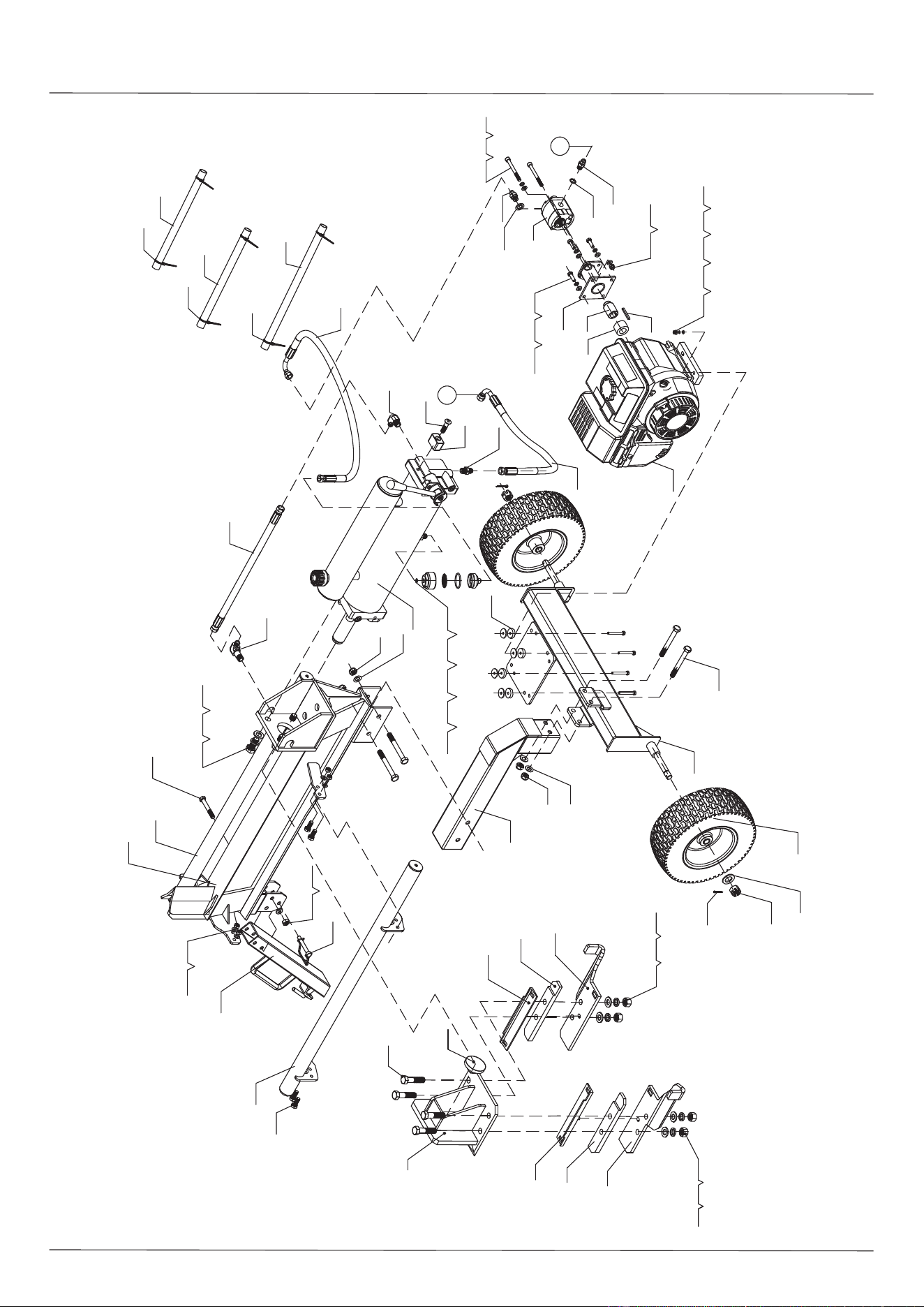
29
DIAGRAMA
1618
253332
11
2844
6
13
14
31
1
2
3
4
5
22
11
22
20
19
35
34
8
43
38
24
23
36
26
10
46
49
50
29
44
28
2928
12
28
9
51
58
54
60
59
53
52
61
555657
57
56
55
52
7
40
39
44
29
28
45
48
47
37
A
A
21
15
17
27
30
41
42
11
22
17
27
6665646362

30
LISTA DE COMPONENTES
1 LGS13-07000 Conjunto de resorte de retorno - Izquierda 1
2 LGS1301-04000 Conjunto de pata de soporte frontal. 1
8 03x8M lanogaxeH ollinroT 8.8XD-03080-1019 3
1 .yssA maeB 00010-1031SGL 4
5 LGS13-08000 Conjunto de resorte de retorno - Derecha 1
6 9101-10085-DX8.8 Tornillo Hexagonal M10x85 1
7 LGS13-06100 Conjunto de placa de empuje. 1
1 rotcenoC 21000-009N 8
1 rotcenoC 70000-31SGL 9
1 rotoM ed otnujnoC 1010500202 01
6 noliaN ed elbaC 2010500202 11
1 rotoM ed ejE led olliuqsaC XD-40001-52PSL 21
1 41Ø atxiM alednarA 04100-5099 31
1 nóiserp atla ed areugnaM 30000-1031SGL 41
15 9101-12110-DX8.8 Tornillo Hexagonal M12x110 4
1 01Ø analp alednarA XD-00001-1039 61
4 21Ø analp alednarA XD-00021-1039 71
18 9206-10000-DX Tuerca de seguridad con nailon M10 1
19 LGS13-00005 Conector angular de tamaño King 1
1 aciluárdih areugnaM 20000-31SGL 02
21 LGS1301-02000 Soldadura del tubo de conexión 1
22 2020050103 Protector de manguera hidráulica 3
23 9205-16000-DX Tuerca delgada ranurada hexagonal M16 2
24 9404-04036-DX Pasador de chaveta Ø4x36 2
4 41Ø analp alednarA XD-00041-1039 52
2 "31 acitámuen adeuR 00011-10WN 62
27 9206-12000-DX Tuerca de seguridad con nailon M12 4
81 8Ø analp alednarA XD-00080-1039 82
9 8Ø dadiruges ed alednarA XD-00080-6039 92
1 adeur ed etropoS 00030-1031SGL 03
31 LSP25-16000 Pa 1 oeuqolb ed rodas
32 9101-14035-DX8.8 Tornillo Hexagonal M14x35 4
33 9306-14000-DX Arandela de seguridad Ø14 4
1 ordniliC 00050-1031SGL 43
1 ralugna rotcenoC 41000-009N 53
2 61Ø analp alednarA XD-00061-1039 63
1 81Ø atxim alednarA 08100-5099 73
N.ºref. Pieza n.º Descripción Cant.

LISTA DE COMPONENTES
31
1 rotcenoC 60000-31SGL 83
4 05x8M lanogaxeH ollinroT 8.8XD-05080-1019 93
40 CP75-00013 Bloque 4 onateruilop ed
1 amog ed etepaT 10000-1031SGL 14
42 9104-08025-10.9FH Tornillo hexagonal interior M8x25 1
43 LGS1301-00002 Manguera hidráulica de retorno de aceite 1
31 8M dadiruges ed acreuT XD-00080-6029 44
45 9302-10000-DX Arandela plana grande Ø10 4
1 analp evalL 4010500202 64
1 rotcenoC HF-20070-21SL 74
48 LS12-07003-DY Soporte de bomba de engranaje 1
1 ejanargne ed abmoB 20000-31SGL 94
50 9101-08025-DX8.8 Tornillo Hexagonal 5/16"×24-1" 4
51 9105-08080-FH Tornillo hexagonal interior M8x80 2
52 LGS13-06001 Cojín de nylon contrachapado 2
53 LGS13-06004 Separador de placa de empuje - Izquierda 1
54 LGS13-06002 Contrachapado Placa de empuje - Izquierda 1
55 9210-12000-DX Tuerca hexagonal gruesa M12 4
56 9306-12000-DX Arandela de seguridad Ø12 4
4 21Ø analp alednarA XD-00021-1039 75
58 LGS13-06003 Contrachapado Placa de empuje - Derecha 1
59 LGS13-06005 Separador de placa de empuje - Derecha 1
1 roirepus euqolB 60060-31SGL 06
61 9101-12050-DX12.9 Tornillo Hexagonal M12x50 4
1 56.2x1.7Ø atnuj ed ollinA 56217-1099 26
1 1 ortliF ed opreuC 10060-1031SGL 36
1 ortliF 20060-1031SGL 46
1 3x04Ø atnuj ed ollinA 03004-1099 56
1 2 ortliF ed opreuC 30060-1031SGL 66
N.ºref. Pieza n.º Descripción Cant.

GARANTÍA LIMITADA
Duración de la garantía
YTL International ofrece al comprador original del divisor de leños reemplazo o reparación debido a defectos de materiales y mano de obra hasta 3 años después de la fecha de compra.
La garantía del fabricante del motor cubre al motor durante 2 años. YTL International reemplazará los componentes del sistema hidráulico hasta un año después de la fecha de compra.
Esta garantía no cubre ninguna unidad debido a ensamblaje incorrecto, uso indebido, sobrecarga o uso contrario a nuestras instrucciones, o debido a reparación o alteración por terceros
que no sean representantes autorizados por YTL International Inc.
Exclusiones de la garantía
Esta garantía no cubre defectos cosméticos tales como pintura, etiquetas adhesivas o desgaste de componentes como neumáticos. Esta garantía no cubre fallos o problemas causados
por actos fortuitos o eventos que escapan al control del fabricante.
Exclusión por desgaste normal
El divisor de leños requiere mantenimiento periódico para funcionar correctamente. Esta garantía no cubre reparación cuando el uso normal ha agotado la vida útil de algún componente
o del equipo completo.
Exclusión de instalación, uso y mantenimiento
Esta garantía no cubre piezas o mano de obra del divisor de leños debido a uso indebido, negligencia, accidentes, abuso, sobrecarga, modificación o ensamblaje incorrecto. La garantía
tampoco cubre el mantenimiento normal.
Límites de la exclusión por daños emergentes y la garantía implícita
YTL International desconoce cualquier obligación de cubrir cualquier pérdida de tiempo, uso del producto, transporte o cualquier reclamo incidental o emergente de cualquier persona por
usar este divisor de leños. ESTA GARANTÍA PREVALECERÁ SOBRE CUALQUIER OTRA GARANTÍA, EXPRESA O IMPLÍCITA, INCLUIDAS LAS GARANTÍAS DE COMERCIALIZACIÓN
O APTITUD PARA UN FIN DETERMINADO.
Una unidad de reemplazo estará sujeta a la garantía original. El plazo de garantía de la unidad de reemplazo comenzará en la fecha de compra de la unidad original. Esta garantía le
otorga ciertos derechos legales que podrían cambiar de un estado a otro. Su estado también podría otorgarle otros derechos que no están estipulados en esta garantía.
Product manufactured by: YTL International Inc.
Producto fabricado por: YTL International Inc.
Produit fabriqué par: YTL International Inc.
LICENSEE NAME: YTL International Inc.
LICENSEE ADDRESS: 17517 Fabrica Way Suite H Cerritos, CA 90703
For product, service or warranty information contact us at:
Para obtener información sobre el producto, el mantenimiento
o la garantía, comuníquese con nosotros en:
Pour obtenir de l'information sur les produits, les réparations ou
la garantie, prière de nous contacter au:
U.S. & Canada Only • É.-U. et Canada seulement
www.CRAFTSMAN.com • 888-331-4569
CRAFTSMAN®
is a registered trademark of Stanley Black & Decker, Inc., used under license.
es una marca registrada de Stanley Black & Decker, Inc., utilizada bajo licencia.
est une marque déposée de Stanley Black & Decker, Inc., utilisée sous licence.
