
www.greenworkstools.com
60PH20F
EN OPERATOR MANUALPOLE HEDGE TRIMMER
ES MANUAL DEL OPERADORCORTADOR DE SETOS
PTC403
P0803216-01 Rev B


1 Description.........................................4
1.1 Purpose.............................................................. 4
1.2 Overview........................................................... 4
2 General power tool safety
warnings.............................................4
2.1 Work area safety................................................ 4
2.2 Electrical safety................................................. 4
2.3 Personal safety...................................................4
2.4 Power tool use and care.....................................5
2.5 Battery tool use and care................................... 5
2.6 Service............................................................... 5
2.7 Hedge trimmer safety warnings.........................5
2.8 Extended-reach hedge trimmer safety
warnings.............................................................6
3 Proposition 65....................................6
4 Child safety........................................ 6
5 The recommended ambient
temperature range:........................... 6
6 Symbols on the product.................... 6
7 Risk levels...........................................7
8 Environmentally safe battery
disposal...............................................7
9 Installation......................................... 7
9.1 Unpack the machine.......................................... 7
10 Operation........................................... 9
10.1 Start the machine............................................... 9
10.2 Stop the machine............................................... 9
10.3 Operation tips.................................................... 9
11 Maintenance.......................................9
11.1 Clean the machine............................................. 9
11.2 Lubricate the blade.......................................... 10
12 Store the machine............................10
13 Troubleshooting...............................10
14 Technical data..................................10
15 Limited warranty............................ 10
16 Exploded view..................................11
3
English
EN
1 DESCRIPTION
1.1 PURPOSE
This machine is intended for cutting and trimming hedges and
bushes in domestic use.
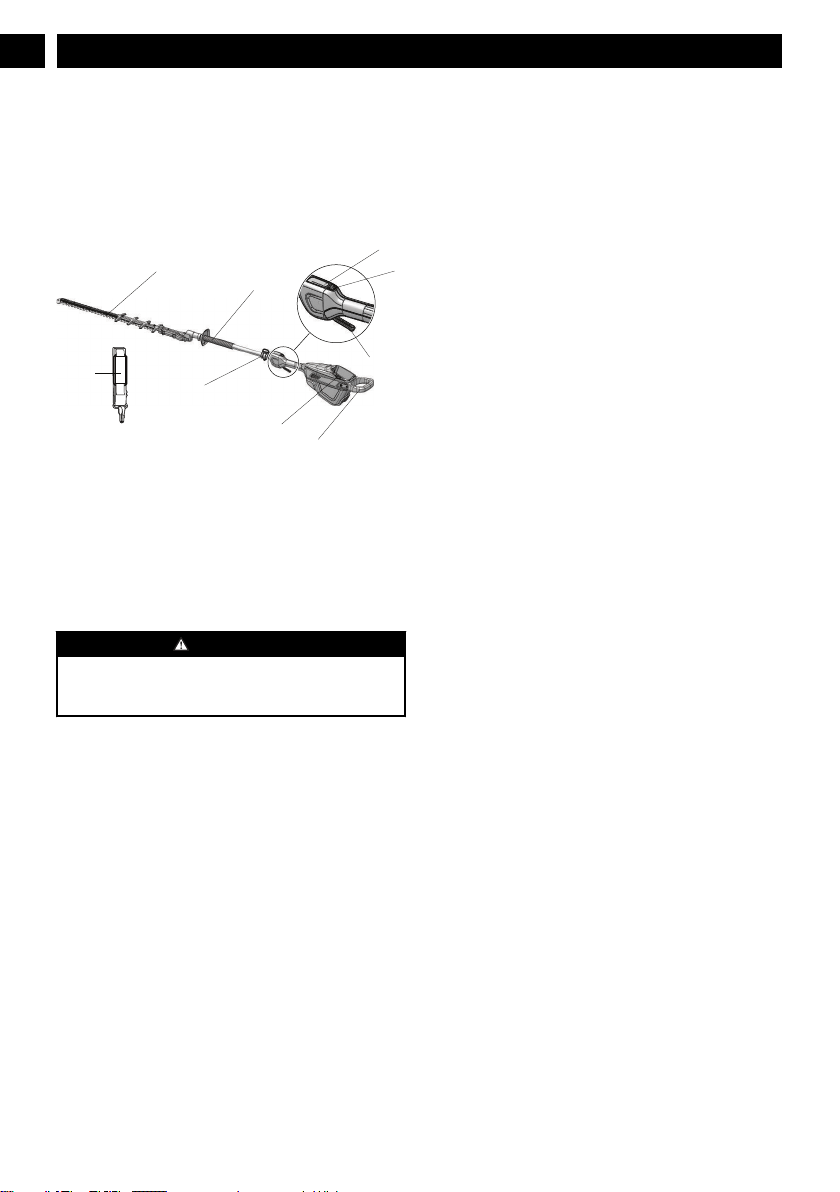
1.2 OVERVIEW
1
Shoulder Strap
2
Blade
3
Rubber cover
4
On/off button
5
Safety lock button
6
Trigger
7
Battery Release Button
8
Carrying Ring
9
Rear handle
2 GENERAL POWER TOOL
SAFETY WARNINGS
WARNING
Read all safety warnings and all instructions. Failure to
follow the warnings and instructions may result in electric
shock, fire and/or serious injury.
Save all warnings and instructions for future reference.
The term “power tool” in the warnings refers to your battery-
operated (cordless) power tool.
2.1 WORK AREA SAFETY
• Keep work area clean and well lit. Cluttered or dark
areas invite accidents.
• Do not operate power tools in explosive atmospheres,
such as in the presence of flammable liquids, gases or
dust. Power tools create sparks which may ignite the dust
or fumes.
• Keep children and bystanders away while operating a
power tool. Distractions can cause you to lose control.
• To reduce the risk of electrocution, never use the
power tool near any electrical power lines. Contact
with or use near power lines may cause serious injury or
electric shock resulting in death.
• Always use two hands when operating the power tool.
Hold the power tool with both hands to avoid loss of
control.
2.2 ELECTRICAL SAFETY
• Power tool plugs must match the outlet. Never modify
the plug in any way. Do not use any adapter plugs
with earthed (grounded) power tools. Unmodified plugs
and matching outlets will reduce risk of electric shock.
• Avoid body contact with earthed or grounded
surfaces, such as pipes, radiators, ranges and
refrigerators. There is an increased risk of electric shock
if your body is earthed or grounded.
• Do not expose power tools to rain or wet conditions.
Water entering a power tool will increase the risk of
electric shock.
• Do not abuse the cord. Never use the cord for
carrying, pulling or unplugging the power tool. Keep
cord away from heat, oil, sharp edges or moving parts.
Damaged or entangled cords increase the risk of electric
shock.
• When operating a power tool outdoors, use an
extension cord suitable for outdoor use. Use of a cord
suitable for outdoor use reduces the risk of electric shock.
• If operating a power tool in a damp location is
unavoidable, use a RESIDUAL CURRENT DEVICE
(RCD) protected supply. Use of an RCD reduces the risk
of electric shock.
2.3 PERSONAL SAFETY
• Stay alert, watch what you are doing and use common
sense when operating a power tool. Do not use a
power tool while you are tired or under the influence
of drugs, alcohol or medication. A moment of
inattention while operating power tools may result in
serious personal injury.
• Use personal protective equipment. Always wear eye
protection. Protective equipment such as a dust mask,
non-skid safety shoes, hard hat or hearing protection used
appropriately will reduce personal injuries.
• Prevent unintentional starting. Ensure the switch is in
the off position before connecting to power source
and/or battery pack and when picking up or carrying
the tool. Carrying power tools with your finger on the
switch or energizing power tools that have the switch on
invites accidents.
• Remove any adjusting key or wrench before turning
the power tool on. A wrench or a key left attached to a
rotating part of the power tool may result in personal
injury.
• Do not over-reach. Keep proper footing and balance
at all times. This enables better control of the power tool
in unexpected situations.
• If devices are provided for the connection of dust
extraction and collection facilities, ensure these are
connected and properly used. Use of dust collection can
reduce dust-related hazards.
• Dress properly. Do not wear loose clothing or jewelry.
Keep your hair, clothing and gloves away from
moving parts. Loose clothes, jewelry or long hair can be
caught in moving parts.
4
English
EN

• If devices are provided for the connection of dust
extraction and collection facilities, ensure these are
connected and properly used. Use of dust collection can
reduce dust related hazards.
• Do not let familiarity gained from frequent use of tools
allow you to become complacent and ignore tool safety
principles. A careless action can cause severe injury
within a fraction of a second.
2.4 POWER TOOL USE AND CARE
• Do not force the power tool. Use the correct power
tool for your application. The correct power tool will do
the job better and safer at the rate for which it was
designed.
• Do not use the power tool if the switch does not turn it
on and off. Any power tool that cannot be controlled with
the switch is dangerous and must be repaired.
• Disconnect the plug from the power source and/or
remove the BATTERY pack, if detachable, from the
power tool before making any adjustments, changing
accessories, or storing power tools . Such preventive
safety measures reduce the risk of starting the power tool
accidentally.
• Store idle power tools out of the reach of children and
do not allow persons unfamiliar with the power tool or
these instructions to operate the power tool. Power
tools are dangerous in the hands of untrained users.
• Maintain power tools and accessories. Check for
misalignment or binding of moving parts, breakage of
parts and any other condition that may affect the
power tool's operation. If damaged, have the power
tool repaired before use. Many accidents are caused by
poorly maintained power tools.
• Keep cutting tools sharp and clean. Properly
maintained cutting tools with sharp cutting edges are less
likely to bind and are easier to control.
• Use the power tool, accessories and tool bits etc. in
accordance with these instructions, taking into
account the working conditions and the work to be
performed. Use of the power tool for operations different
from those intended could result in a hazardous situation.
• Keep handles and grasping surfaces dry, clean and
free from oil and grease. Slippery handles and grasping
surfaces do not allow for safe handling and control of the
tool in unexpected situations.
2.5 BATTERY TOOL USE AND CARE
• Recharge only with the charger specified by the
manufacturer. A charger that is suitable for one type of
battery pack may create a risk of fire when used with
another battery pack.
• Use power tools only with specifically designated
battery packs. Use of any other battery packs may create
a risk of injury and fire.
• When battery pack is not in use, keep it away from
other metal objects like paper clips, coins, keys, nails,
screws, or other small metal objects that can make a
connection from one terminal to another.
Shorting the
battery terminals together may cause burns or fire.
• Under abusive conditions, liquid may be ejected from
the battery; avoid contact. If contact accidentally
occurs, flush with water. If liquid contacts eyes,
additionally seek medical help. Liquid ejected from the
battery may cause irritation or burns.
• Do not use a battery pack or tool that is damaged or
modified. Damaged or modified batteries may exhibit
unpredictable behavior resulting in fire, explosion or risk
of injury.
• Do not expose a battery pack or tool to fire or
excessive temperature. Exposure to fire or temperature
above 130°C may cause explosion.
• Follow all charging instructions and do not charge the
battery pack or tool outside the temperature range
specified in the instructions. Charging improperly or at
temperatures outside the specified range may damage the
battery and increase the risk of fire.
2.6 SERVICE
• Have your power tool serviced by a qualified repair
person using only identical replacement parts. This
will ensure that the safety of the power tool is maintained.
• Never service damaged battery packs. Service of
battery packs should only be performed by the
manufacturer or authorized service providers.
2.7 HEDGE TRIMMER SAFETY
WARNINGS
• Keep all parts of the body away from the blade. Do
not remove cut material or hold material to be cut
when blades are moving. Blades continue to move after
the switch is turned off. A moment of inattention while
operating the hedge trimmer may result in serious
personal injury.
• Carry the hedge trimmer by the handle with the blade
stopped and taking care not to operate any power
switch. Proper carrying of the hedge trimmer will
decrease the risk of inadvertent starting and resultant
personal injury from the blades.
• When transporting or storing the hedge trimmer,
always fit the blade cover Proper handling of the hedge
trimmer will decrease the risk of personal injury from the
blades.
• When clearing jammed material or servicing the unit,
make sure all power switches are off and the power
cord is disconnected. Unexpected actuation of the hedge
trimmer while clearing jammed material or servicing may
result in serious personal injury.
• Hold the hedge trimmer by insulated gripping
surfaces only, because the blade may contact hidden
wiring or its own cord. Blades contacting a "live" wire
may make exposed metal parts of the hedge trimmer
"live" and could give the operator an electric shock.
5
English
EN
• Keep all power cords and cables away from cutting
area. Power cords or cables may be hidden in hedges or
bushes and can be accidentally cut by the blade.
• Do not use the hedge trimmer in bad weather
conditions, especially when there is a risk of
lightning.This decreases the risk of being struck by
lightning.
2.8 EXTENDED-REACH HEDGE
TRIMMER SAFETY WARNINGS
• To reduce the risk of electrocution, never use the
extended-reach hedge trimmer near any electrical
power lines.Contact with or use near power lines may
cause serious injury or electric shock resulting in death.
• Always use two hands when operating the extended-
reach hedge trimmer. Hold the extendedreach hedge
trimmer with both hands to avoid loss of control.
• Always use head protection when operating the
extended-reach hedge trimmer overhead.Falling debris
can result in serious personal injury.
3 PROPOSITION 65
WARNING
This product contains a chemical known to the state of
California to cause cancer, birth defects or other
reproductive harm. Some dust created by power sanding,
sawing, grinding, drilling, and other construction activities
contains chemicals known to cause cancer, birth defects or
other reproductive harm. Some examples of these chemicals
are:
• Lead from lead-based paints;
• Crystalline silica from bricks and cement and other
masonry products;
• Arsenic and chromium from chemically treated lumber.
Your risk of exposure to these chemicals varies depending
on how often you do this type of work. To reduce your
exposure to these chemicals, work in a well-ventilated area,
and work with approved safety equipment, such as dust
masks that are specially designed to filter out microscopic
particles.
Save these instructions.
4 CHILD SAFETY
Tragic accidents can occur if the operator is not aware of the
presence of children.
• Keep children out of the working area and under the
watchful care of a responsible adult.
• Do not allow children under the age of 14 to operate this
machine. Children who are 14 years of age and older
must read and understand the operating instructions and
safety rules in this manual and must be trained and
supervised by a parent.
• Stay alert, and turn the machine off if a child or any other
person enters the working area.
• Use extreme care when approaching blind corners,
doorways, shrubs, trees, or other objects that may obscure
your view of a child who may run into the path of the
machine.
5 THE RECOMMENDED
AMBIENT TEMPERATURE
RANGE:
Item Temperature
Appliance storage tempera-
ture range
32 ˚F (0 ˚C) ~ 113 ˚F (45 ˚C)
Appliance operation temper-
ature range
32 ˚F (0 ˚C) ~ 113 ˚F (45 ˚C)
Battery charging temperature
range
39 ˚F (4 °C) ~ 104 ˚F (40 ˚C)
Charger operation tempera-
ture range
39 ˚F (4 °C) ~ 104 ˚F (40 ˚C)
Battery storage temperature
range
32 ˚F (0 ˚C) ~ 113 ˚F (45 ˚C)
Battery discharging tempera-
ture range
32 °F (0 °C) ~ 113 °F (45
°C)
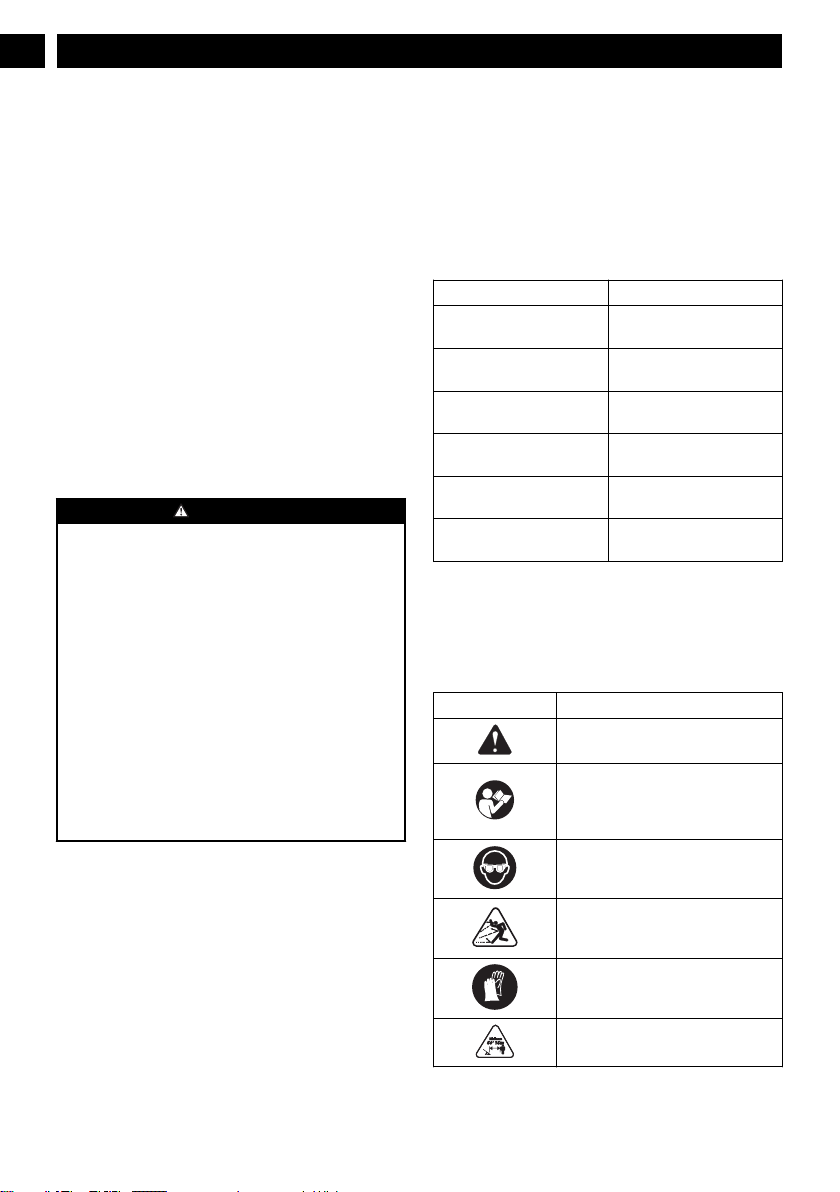
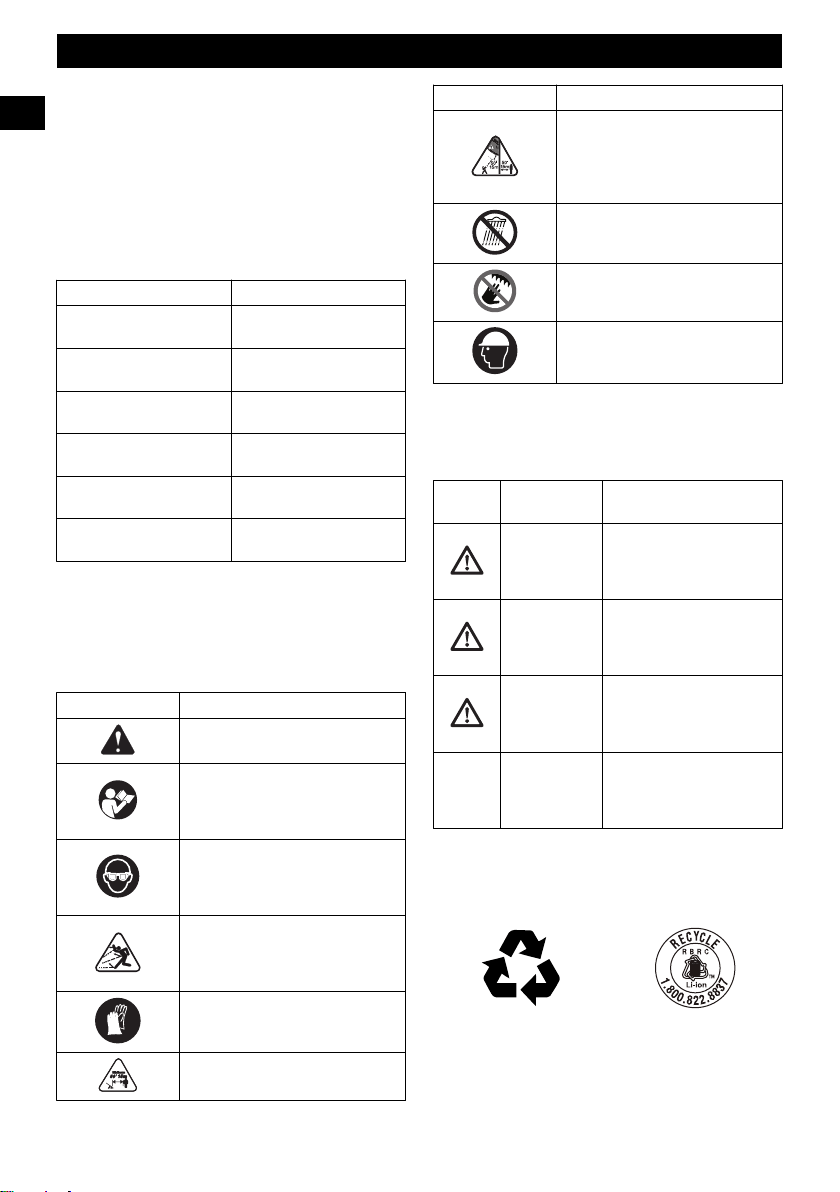
6 SYMBOLS ON THE PRODUCT
Some of the following symbols may be used on this product.
Please study them and learn their meaning. Proper
interpretation of these symbols will allow you to operate the
product better and safer.
Symbol
Explanation
Precautions that involve your safety.
Read and understand all instructions
before operating the product, and fol-
low all warnings and safety instruc-
tions.
Always wear safety glasses with side
shields marked to comply with ANSI
Z87.1 when you operate this machine.
Thrown objects can ricochet and result
in personal injury or property damage.
Wear protective clothing and boots.
Wear non-slip, heavy duty gloves.
Keep all bystanders at least 50 ft
away.
6
English
EN
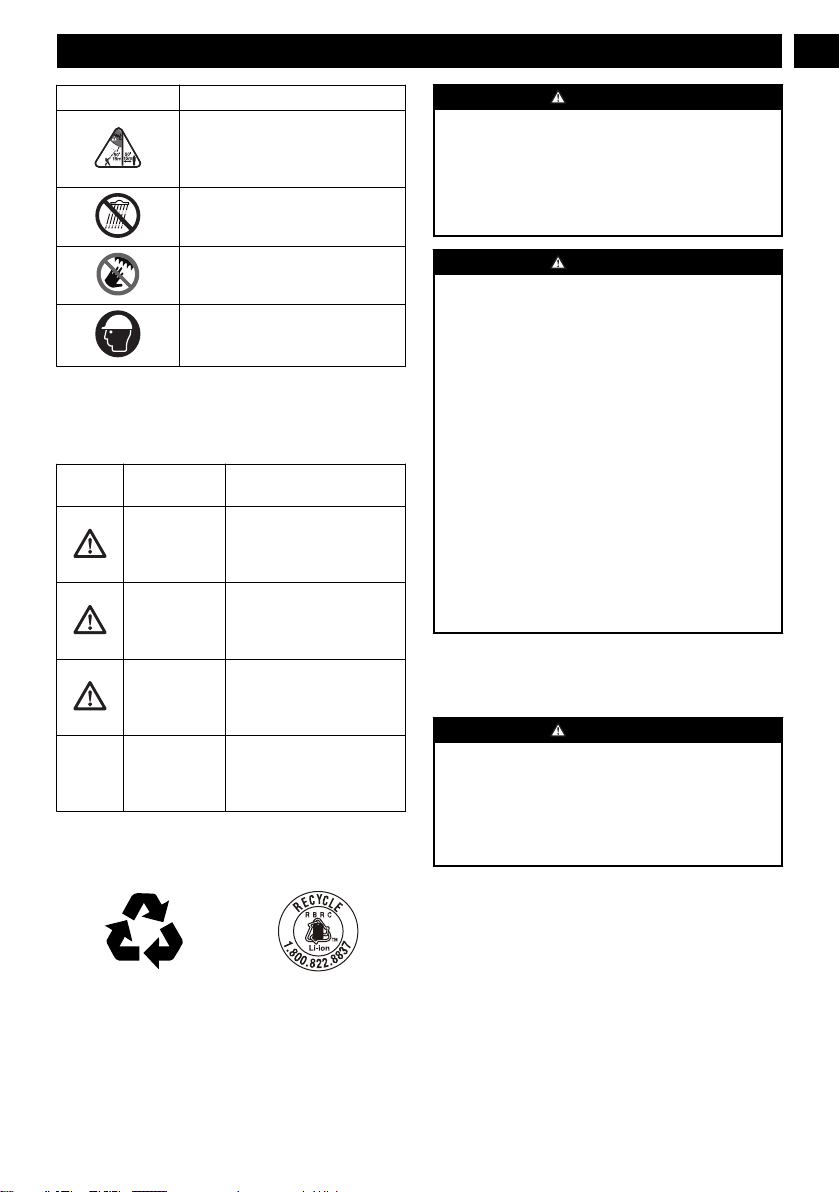
Symbol Explanation
DANGER! Risk of electrocution!
Keep tool 50 feet away from electrical
lines. Keep all bystanders at least 50
ft. away.
Do not expose the product to rain or
moist conditions.
Danger – keep hands and feet away
from blade.
Wear head protection.
7 RISK LEVELS
The following signal words and meanings are intended to
explain the levels of risk associated with this product.
SYM-
BOL
SIGNAL MEANING
DANGER Indicates an imminently haz-
ardous situation, which, if not
avoided, will result in death
or serious injury.
WARNING Indicates a potentially hazard-
ous situation, which, if not
avoided, could result in death
or serious injury.
CAUTION Indicates a potentially hazard-
ous situation, which, if not
avoided, may result in minor
or moderate injury.
CAUTION (Without Safety Alert Sym-
bol) Indicates a situation that
may result in property dam-
age.
8 ENVIRONMENTALLY SAFE
BATTERY DISPOSAL
The toxic and corrosive materials below are in the batteries
used in this machine: Lithium-Ion, a toxic material.
WARNING
Discard all toxic materials in a specified manner to prevent
contamination of the environment. Before discarding
damaged or worn out Li-ion battery, contact your local
waste disposal agency, or the local Environmental
Protection Agency for information and specific instructions.
Take the batteries to a local recycling and/or disposal center,
certified for lithium-ion disposal.
WARNING
If the battery pack cracks or breaks, with or without leaks,
do not recharge it and do not use. Discard it and replace
with a new battery pack. DO NOT TRY TO REPAIR IT! To
prevent injury and risk of fire, explosion, or electric shock,
and to avoid damage to the environment:
• Cover the terminals of the battery with heavy-duty
adhesive tape.
• DO NOT try to remove or destroy any of the battery
pack components.
• DO NOT try to open the battery pack.
• If a leak develops, the released electrolytes are
corrosive and toxic. DO NOT get the solution in the
eyes or on skin, and do not swallow it.
• DO NOT put these batteries in your regular household
trash.
• DO NOT incinerate.
• DO NOT put them where they will become part of any
waste landfill or municipal solid waste stream.
• Take them to a certified recycling or disposal center.
9 INSTALLATION
9.1 UNPACK THE MACHINE
WARNING
It is not necessary to assemble the machine.
• If parts are damaged, do not use the machine.
• If you do not have all the parts, do not operate the
machine.
• If the parts are damaged or missing, speak to the service
center.
1. Open the package.
2. Read the documentation in the box.
3. Remove the machine from the box.
4. Discard the box and packaging material in compliance
with local regulations.
7
English
EN
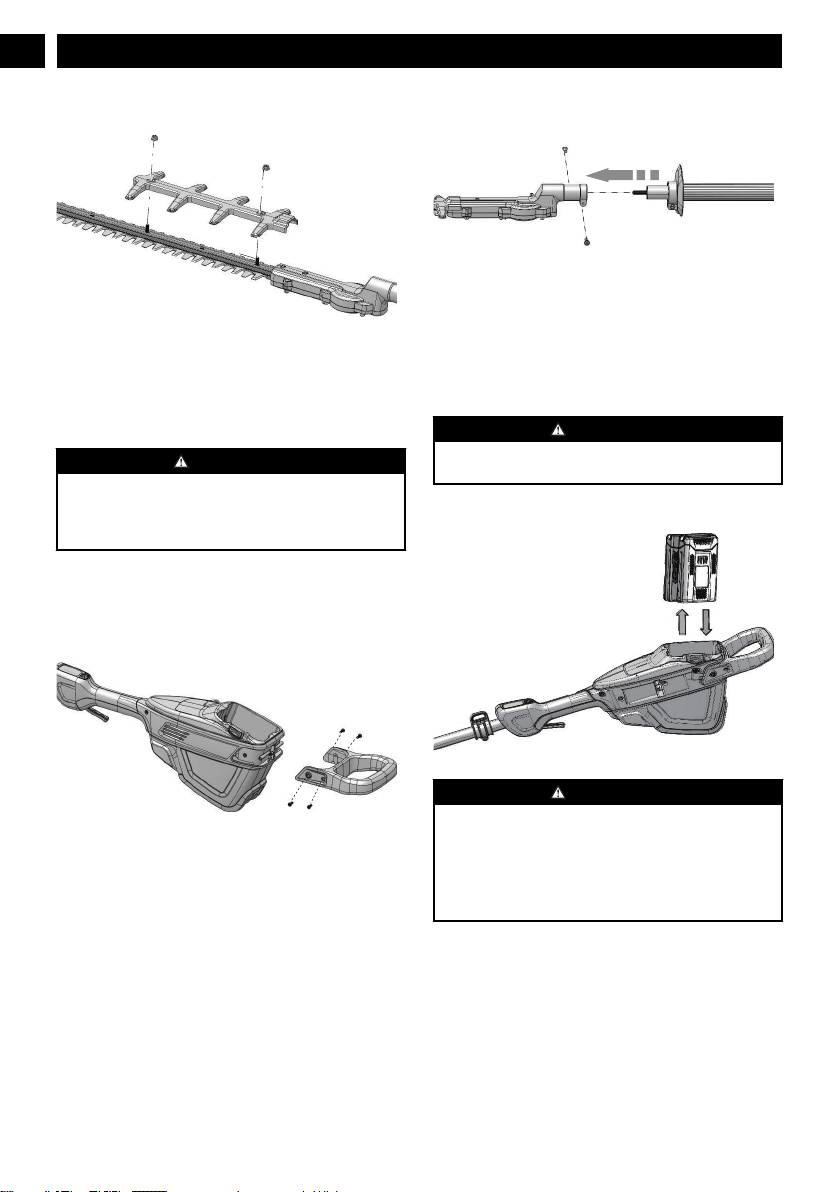
9.1.1 ASSEMBLE THE BLADE GUARD
1. Put the machine on a flat and smooth surface.
2. Align the holes with screws then put the blade guard on
the blade.
3. Tighten the nut.
WARNING
Only use with handle and guard properly assembled to
hedge trimmer. The use of the hedge trimmer without the
proper guard or handle provided may result in serious
personal injury.
9.1.2 ASSEMBLE THE REAR HANDLE
1. Align the holes on the rear handle with holes on the
machine.
2. Put the screws through the holes.
3. Tighten the srews.
9.1.3 FIT THE HEDGE TRIMMER HEAD
The hedge trimmer head can be mounted directly into handle
pole so as to achieve the standard length.
1. Remove the black protective cover.
2. Insert the handle pole into the hedge trimmer head.
3. Align the holes to insert the screw.
4. Tighten the screw.
WARNING
Periodically check the connections to ensure that they are
tightened securely.
9.1.4 INSTALL THE BATTERY PACK
WARNING
• If the battery pack or charger is damaged, replace the
battery pack or the charger.
• Stop the machine and wait until the motor stops before
you install or remove the battery pack.
• Read, know, and follow the instructions in the battery
and charger manual.
1. Align the lift ribs on the battery pack with the grooves in
the battery compartment.
2. Push the battery pack into the battery compartment until
the battery pack locks into place.
3. When you hear a click, the battery pack is installed.
9.1.5 REMOVE THE BATTERY PACK
1. Push and hold the battery release button.
2. Remove the battery pack from the machine.
8
English
EN
10 OPERATION
• Touch the blade carefully.
• Do not put your fingers into the notches or in position
where they can get cut.
• Do not touch the blade unless you remove the battery
pack.
• Do not use the machine if the blade is damaged or bent.
• Remove all objects such as cords, lights, wire, or string
which can become entangled in the cutting blade and
create a risk of personal injury.
WARNING
If the blade jams on an electrical cord or line, DO NOT
TOUCH THE BLADE! IT CAN BE LIVE AND
DANGEROUS. Do the steps below:
1. Hold the insulated rear handle or put the machine down
and away from you.
2. Disconnect the electrically service to the damaged line
or cord before you try to free the blade.
10.1 START THE MACHINE
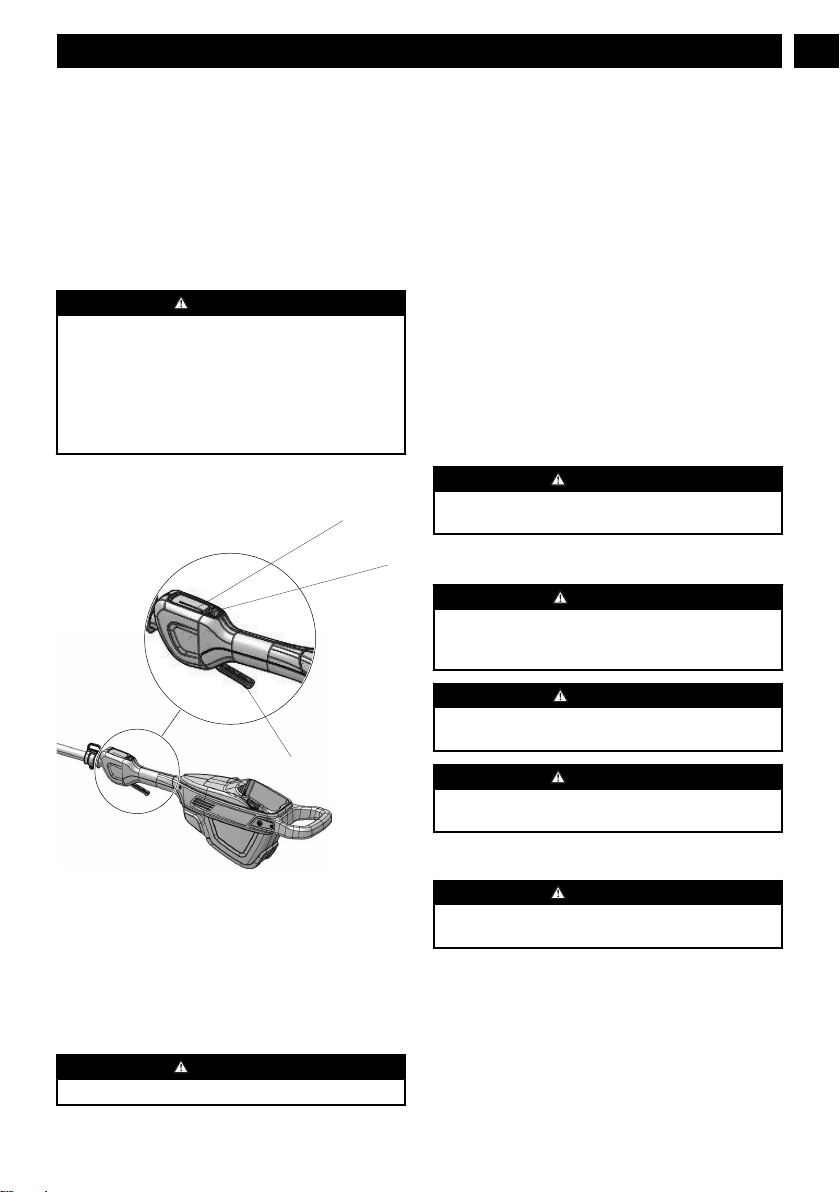
For your safety, this machine is equipped with a double
switching system. This system prevents starting the machine
inadvertently.
1. Press the On / OFF button.
2. Pull the safety lock button backward using your thumb.
3. Press the trigger while you hold the safety lock button.
4. Release the safety lock button.
WARNING
Hold the machine with two hands during operation.
10.2 STOP THE MACHINE
1. Release the trigger to stop the machine.
10.3 OPERATION TIPS
• Start by trimming the top of the hedge. Slightly tilt the
tool (up to 15° relative to the line of cut) so that the blade
tips point slightly towards the hedge. This will cause the
blades to cut more effectively. Hold the tool at the desired
angle and move it steadily along the line of cut. The
doublesided blade allows you to cut in either direction.
• In order to obtain a very straight cut, stretch a piece of
string along the length of the hedge at the desired height.
Use the string as a guideline, cutting just above it.
• In order to obtain flat sides, cut upwards with the growth.
Younger stems move outwards when the blade cuts
downwards, causing shallow patches in the hedge.
• Take care to avoid any foreign objects. Especially avoid
hard objects such as metal wire and railings, as these
could damage the blades.
• Regularly oil the blades.
WARNING
Keep hands away from blade while operating. Contact with
blade will result in serious personal injury.
11 MAINTENANCE
CAUTION
Do not let brake fluids, gasoline, petroleum-based materials
touch the plastic parts. Chemicals can cause damage to the
plastic, and make the plastic unserviceable.
CAUTION
Do not use strong solvents or detergents on the plastic
housing or components.
WARNING
Remove the battery pack from the machine before
maintenance.
11.1 CLEAN THE MACHINE
WARNING
Keep the machine and the motor free of leaves, branches or
excessive oil to prevent fire risks.
• Use a moist cloth with a mild detergent to clean the
machine.
• Clean all moisture with a soft dry cloth.
• Use a small brush to clean the air vents.
9
English
EN
11.2 LUBRICATE THE BLADE
To increase the efficiency and life of the blades, lubricate
them carefully after each work session:
• Do not oil the blade while the hedge trimmer is running.
• Put the machine on a flat and smooth surface.
• Use a soft cloth to clean the blades and a brush to remove
more dirt.
• Use a light layer of oil to lubricate the blades along the
top edge of the blade.
NOTE
We recommend to use the non-pollutant type oil.
12 STORE THE MACHINE
NOTE
Clean the machine before storage.
1. Remove the battery pack.
2. Let the motor cool.
3. Check that there are no loose or damaged components. If
it is necessary, replace the damaged components, tighten
screws and bolts, or speak to a person of an approved
service center.
4. Store the machine in a cool and dry location.
13 TROUBLESHOOTING
Problem Possible cause Solution
The motor does
not start when you
pull the trigger.
The battery pack is
not installed tight-
ly.
Make sure that
you tighlty install
the battery pack in
the machine.
The battery pack is
out of power.
Charge the battery
pack.
The machine
smokes during op-
eration.
The machine has
damage.
1. Immediately
stop the ma-
chine.
2. Remove the
battery pack.
3. Contact the
service center.
The motor is on,
blades do not
move.
The machine has
damage.
Do not use the ma-
chine and contact
the service center.
The blades are
blocked.
Remove battery
pack then clear
blockage from the
blades.
Problem Possible cause Solution
There is too much
noise and/or vibra-
tion during opera-
tion.
The parts are
loose.
1. Stop the ma-
chine.
2. Remove the
battery.
3. Inspect for
damage.
4. Check and
tighten loose
parts.
The parts have
damage.
Do not use the ma-
chine and contact
the service center.
14 TECHNICAL DATA
Voltage 60V
No load speed 4000 (±10%) SPM
Blade length 24" (610 mm)
Cutting capacity 1.2''
Weight (without battery
pack)
11 lbs. (5 kg)
Battery model 60BA02, 60BA25, 60BA03,
60BA04, 60BA05, 60BA06,
60BA08 and other BAC ser-
ies
Charger model 60DP10, 606P14 and other
CAC series
15 LIMITED WARRANTY
M
E
I
L
L
E
U
R
D
A
N
S
S
A
C
A
T
É
G
O
R
I
E
•
M
E
J
O
R
E
N
C
L
A
S
E
B
E
S
T
I
N
C
L
A
S
S
GARANTIE OUTIL &
BATTERIE • GARANTÍA PARA
HERRAMIENTAS Y BATERÍAS
Greenworks hereby warranties this product, to the original
purchaser with proof of purchase, for a period of four (4)
years against defects in materials, parts or workmanship.
Greenworks, at its own discretion will repair or replace any
and all parts found to be defective, through normal use, free
of charge to the customer. This warranty is valid only for
units which have been used for personal use that have not
been hired or rented for industrial/commercial use, and that
have been maintained in accordance with the instructions in
the owners’ manual supplied with the product from new.
10
English
EN
ITEMS NOT COVERED BY WARRANTY:
1. Any part that has become inoperative due to misuse,
commercial use, abuse, neglect, accident, improper
maintenance, or alteration; or
2. The unit, if it has not been operated and/or maintained in
accordance with the owner's manual; or
3. Normal wear;
4. Routine maintenance items such as lubricants, blade
sharpening;
5. Normal deterioration of the exterior finish due to use or
exposure.
HELPLINE:
Warranty service is available by calling our toll-free helpline,
at 1-855-345-3934.
TRANSPORTATION CHARGES:
Transportation charges for the movement of any power
equipment unit or attachment are the responsibility of the
purchaser. It is the purchaser’s responsibility to pay
transportation charges for any part submitted for replacement
under this warranty unless such return is requested in writing
by Greenworks.
USA address:
Greenworks Tools
P.O. Box 1238
Mooresville, NC 28115
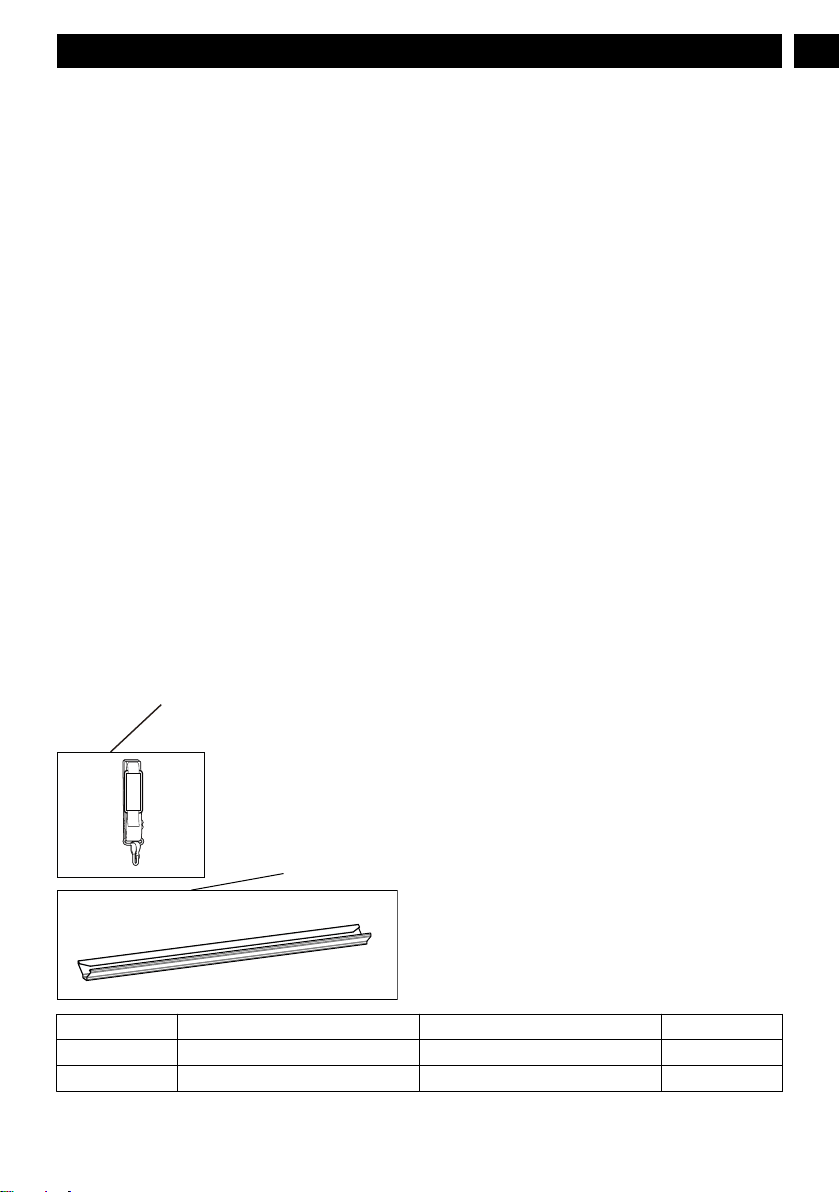
16 EXPLODED VIEW
1
2
No. Part No. Description Qty
1 RB37902144 Shoulder strap 1
2 R0202708-00 Blade cover 1
11
English
EN

1 Descripción.......................................13
1.1 Finalidad.......................................................... 13
1.2 Perspectiva general..........................................13
2 Advertencias generales de
seguridad para herramientas
eléctricas...........................................13
2.1 Seguridad de la zona de trabajo.......................13
2.2 Seguridad eléctrica.......................................... 13
2.3 Seguridad personal.......................................... 13
2.4 Utilización y cuidado de herramientas
eléctricas.......................................................... 14
2.5 Utilización y cuidado de herramientas a
batería.............................................................. 14
2.6 Servicio............................................................15
2.7 Advertencias de seguridad para cortasetos......15
2.8 Advertencias de seguridad para cortasetos
telescópicos......................................................15
3 Propuesta 65.....................................15
4 Seguridad infantil............................15
5 El intervalo de temperatura
ambiente recomendado:..................16
6 Símbolos en el producto..................16
7 Niveles de riesgo.............................. 16
8 Eliminación de batería segura
para el medio ambiente...................16
9 Instalación........................................17
9.1 Desembalaje de la máquina............................. 17
10 Funcionamiento...............................18
10.1 Puesta en marcha de la máquina......................18
10.2 Detención de la máquina................................. 19
10.3 Consejos de funcionamiento............................19
11 Mantenimiento.................................19
11.1 Limpieza de la máquina...................................19
11.2 Lubricación de la cuchilla................................19
12 Almacenamiento de la máquina.....19
13 Solución de problemas.................... 20
14 Datos técnicos.................................. 20
15 Garantía limitada............................20
16 Vista despiezada.............................. 21
12
Español
ES
1 DESCRIPCIÓN
1.1 FINALIDAD
Esta máquina se ha diseñado para cortar y podar setos y
arbustos en un entorno doméstico.
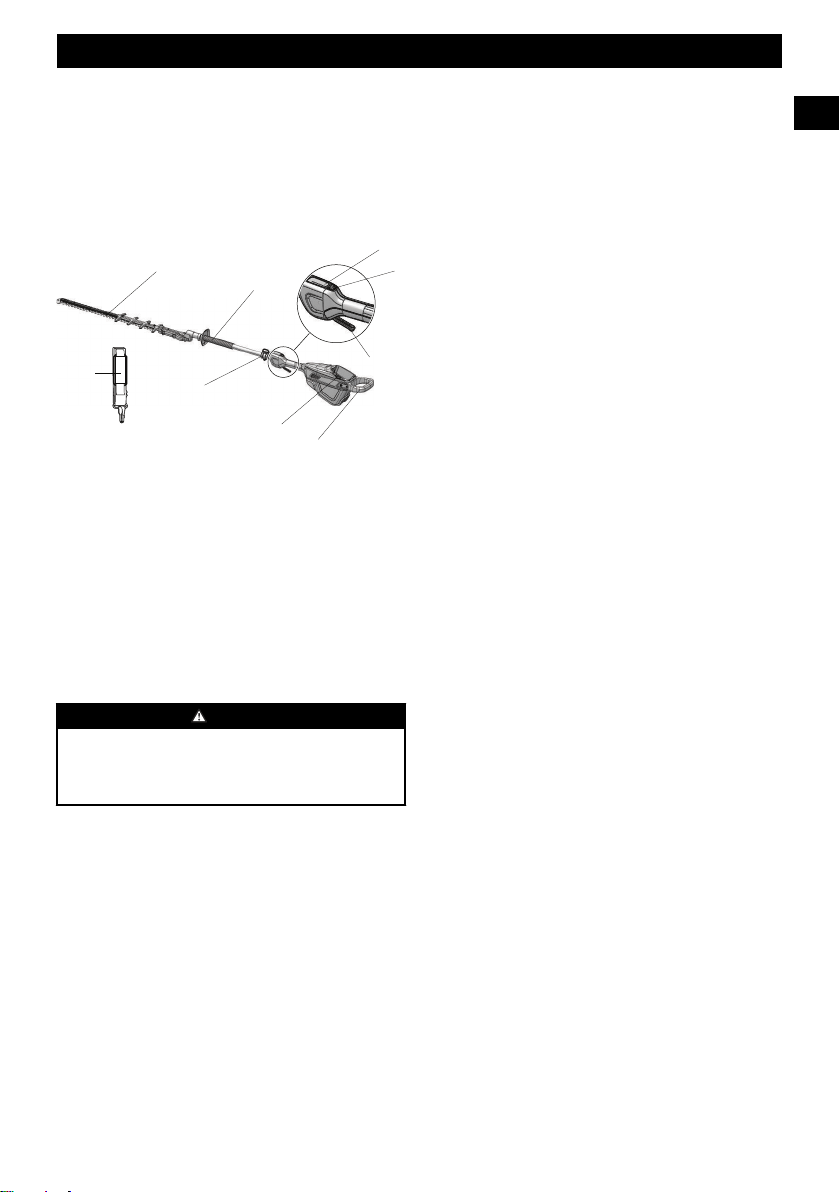
1.2 PERSPECTIVA GENERAL
1
Correa de hombro
2
Cuchilla
3
Cubierta de goma
4
Botón de encendido/
apagado
5
Botón de bloqueo de
seguridad
6
Gatillo
7
Botón de desbloqueo
de batería
8
Anillo de transporte
9
Asa posterior
2 ADVERTENCIAS GENERALES
DE SEGURIDAD PARA
HERRAMIENTAS
ELÉCTRICAS
AVISO
Lea todas las advertencias de seguridad y todas las
instrucciones. El incumplimiento de las advertencias e
instrucciones puede provocar descargas eléctricas,
incendios o lesiones graves.
Guarde todas las advertencias e instrucciones para su
consulta posterior.
El término “herramienta eléctrica” empleado en las
advertencias se refiere a su herramienta eléctrica con
funcionamiento a batería (inalámbrica).
2.1 SEGURIDAD DE LA ZONA DE
TRABAJO
• Mantenga limpia y bien iluminada la zona de trabajo.
Las zonas desordenadas u oscuras fomentan los
accidentes.
• No utilice herramientas eléctricas en atmósferas
explosivas, como en la presencia de líquidos, gases o
polvo que puedan inflamarse. Las herramientas
eléctricas generan chispas que pueden encender el polvo
o los gases.
• Mantenga alejados a los niños y los transeúntes
mientras utilice una herramienta eléctrica. Las
distracciones pueden hacer que pierda el control.
• Para reducir el riesgo de electrocución, nunca utilice
la herramienta eléctrica cerca de líneas eléctricas. El
contacto con o el uso cerca de líneas eléctricas puede
producir lesiones graves o descargas eléctricas que
pueden provocar la muerte.
• Utilice siempre las dos manos cuando maneje la
herramienta eléctrica. Sujete la herramienta eléctrica
con ambas manos para evitar perder el control.
2.2 SEGURIDAD ELÉCTRICA
• Los enchufes de las herramientas eléctricas deben
corresponder con la toma de corriente. Nunca
modifique el enchufe en modo alguno. No utilice
enchufes adaptadores con herramientas eléctricas
conectadas a tierra. La utilización de enchufes no
modificados y de tomas de corriente adecuadas reducirá
el riesgo de descarga eléctrica.
• Evite el contacto del cuerpo con superficies conectadas
a tierra, como tuberías, radiadores, estufas y
refrigeradores. Existe un riesgo aumentado de descarga
eléctrica si su cuerpo está conectado a tierra.
• No exponga las herramientas eléctricas a la lluvia o a
condiciones de humedad. Si penetra agua en una
herramienta eléctrica, aumentará el riesgo de descarga
eléctrica.
• No abuse del cable. Nunca utilice el cable para
transportar, tirar o desenchufar la herramienta
eléctrica. Mantenga el cable alejado del calor, el aceite,
los bordes afilados o las piezas móviles. Los cables
dañados o enredados aumentan el riesgo de descarga
eléctrica.
• Cuando utilice una herramienta eléctrica en
exteriores, use un cable alargador adecuado para uso
en exterior. La utilización de un cable adecuado para
uso en exterior reduce el riesgo de descarga eléctrica.
• Si no es inevitable el uso de una herramienta eléctrica
en un lugar húmedo, utilice un suministro protegido
por un DISPOSITIVO DE CORRIENTE RESIDUAL
(RCD). La utilización de un RCD reduce el riesgo de
descarga eléctrica.
2.3 SEGURIDAD PERSONAL
• Manténgase alerta, observe lo que está haciendo y
emplee el sentido común cuando utilice una
herramienta eléctrica. No utilice una herramienta
eléctrica mientras esté cansado o bajo la influencia de
drogas, alcohol o medicamentos. Un momento de
inatención durante el uso de herramientas eléctricas
puede provocar lesiones personales graves.
• Utilice equipos de protección personal. Lleve siempre
protección ocular. Si se utilizan correctamente equipos
de protección como máscaras antipolvo, zapatos de
13
Español
ES

seguridad antideslizantes, cascos o protecciones
auditivas, se reducirán las lesiones personales.
• Evite el arranque accidental. Asegúrese de que el
interruptor esté en la posición de apagado antes de
conectar a la fuente de alimentación o a la batería y al
coger o transportar la herramienta. El transporte de
herramientas eléctricas con el dedo en el interruptor o la
conexión de herramientas eléctricas que tienen el
interruptor activado fomenta los accidentes.
• Retire cualquier llave de ajuste antes de encender la
herramienta eléctrica. Una llave que se quede fijada a
una pieza giratoria de la herramienta eléctrica puede
provocar lesiones personales.
• No se estire. Mantenga en todo momento una postura
adecuada y el equilibrio. Esto permite un mejor control
de la herramienta eléctrica en situaciones inesperadas.
• Si se utilizan dispositivos para la conexión de sistemas
de extracción y recogida de polvo, asegúrese de que
estén conectados y se utilicen correctamente. La
utilización de sistemas de recogida de polvo puede
reducir los riesgos relacionados con el polvo.
• Lleve indumentaria adecuada. No lleve ropa o joyas
sueltas. Mantenga el cabello, la ropa y los guantes
lejos de las piezas móviles. La ropa suelta, las joyas o el
cabello largo pueden quedar atrapados en las piezas
móviles.
• Si se utilizan dispositivos para la conexión de sistemas
de extracción y recogida de polvo, asegúrese de que
estén conectados y se utilicen correctamente. La
utilización de sistemas de recogida de polvo puede
reducir los riesgos relacionados con el polvo.
• No permita que la familiaridad adquirida con el uso
frecuente de las herramientas le permita ser confiado
e ignorar los principios de seguridad de las
herramientas. Una acción descuidada puede provocar
lesiones graves en una fracción de segundo.
2.4 UTILIZACIÓN Y CUIDADO DE
HERRAMIENTAS ELÉCTRICAS
• No fuerce la herramienta eléctrica. Utilice la
herramienta eléctrica correcta para su aplicación. La
herramienta eléctrica correcta hará el trabajo mejor y
con mayor seguridad a la velocidad para la que se
diseñó.
• No utilice la herramienta eléctrica si el interruptor no
la enciende y la apaga. Cualquier herramienta eléctrica
que no pueda controlarse con el interruptor es peligrosa
y debe repararse.
• Desconecte el enchufe de la fuente de alimentación o
retire la batería de la herramienta eléctrica antes de
realizar ajustes, cambiar accesorios o almacenar
herramientas eléctricas. Estas medidas de seguridad
preventivas reducen el riesgo de que la herramienta
eléctrica se arranque accidentalmente.
• Almacene las herramientas eléctricas inactivas fuera
del alcance de los niños y no permita que personas que
no estén familiarizadas con la herramienta eléctrica o
estas instrucciones puedan utilizarla.
Las herramientas
eléctricas son peligrosas en manos de usuarios
inexpertos.
• Mantenga las herramientas eléctricas y los accesorios.
Compruebe si hay desalineación o unión de las piezas
móviles, rotura de piezas y cualquier otra condición
que pueda afectar al funcionamiento de la
herramienta eléctrica. Si ha sufrido daños, lleve a
reparar la herramienta eléctrica antes del uso.
Numerosos accidentes se deben a herramientas eléctricas
mal mantenidas.
• Mantenga limpias y afiladas las herramientas de
corte. Las herramientas de corte mantenidas
correctamente con filos cortantes tienen menos
probabilidades de atascarse y son más fáciles de
controlar.
• Utilice la herramienta eléctrica, los accesorios, las
brocas, etc. de acuerdo con estas instrucciones,
teniendo en cuenta las condiciones de trabajo y el
trabajo a realizar. El uso de la herramienta eléctrica
para operaciones distintas de las previstas podría dar
lugar a una situación peligrosa.
• Mantenga las asas y las superficies de agarre secas,
limpias y sin restos de aceite y grasa. Las asas y las
superficies de agarre resbaladizas no permiten un manejo
y control seguros de la herramienta en situaciones
inesperadas.
2.5 UTILIZACIÓN Y CUIDADO DE
HERRAMIENTAS A BATERÍA
• Recargue solo con el cargador especificado por el
fabricante. Un cargador adecuado para un tipo de
batería puede dar lugar a un riesgo de incendio cuando
se usa con otra batería.
• Utilice las herramientas eléctricas únicamente con las
baterías designadas específicamente. El uso de
cualquier otra batería puede dar lugar a un riesgo de
lesiones e incendio.
• Cuando la batería no esté en uso, manténgala alejada
de otros objetos metálicos como clips, monedas, llaves,
clavos, tornillos u otros objetos metálicos pequeños
que puedan hacer una conexión entre los terminales.
El cortocircuito de los terminales de la batería puede
provocar quemaduras o incendios.
• Bajo condiciones abusivas, es posible que salga líquido
despedido de la batería; evite el contacto. Si se
produce un contacto accidental, aclare con agua. Si el
líquido entra en contacto con los ojos, acuda también
al médico. El líquido despedido de la batería puede
provocar irritación o quemaduras.
• No utilice una batería o una herramienta que haya
sufrido daños o modificaciones. Las baterías dañadas o
modificadas pueden exhibir un comportamiento
impredecible que puede dar lugar a un incendio, una
explosión o un riesgo de lesiones.
• No exponga una batería o una herramienta al fuego ni
a temperatura excesiva. La exposición al fuego o a una
14
Español
ES

temperatura superior a 130°C puede provocar una
explosión.
• Siga todas las instrucciones de carga y no cargue la
batería o la herramienta fuera del intervalo de
temperatura especificado en las instrucciones. La
carga incorrecta o a temperaturas fuera del intervalo
especificado puede dañar la batería y aumentar el riesgo
de incendio.
2.6 SERVICIO
• Solicite a un técnico de reparación cualificado que
realice las tareas de servicio de su herramienta
eléctrica utilizando únicamente piezas de repuesto
idénticas. Esto garantizará el mantenimiento de la
seguridad de la herramienta eléctrica.
• Nunca repare las baterías dañadas. La reparación de
las baterías únicamente debe ser realizada por el
fabricante o los proveedores de servicio técnico
autorizados.
2.7 ADVERTENCIAS DE SEGURIDAD
PARA CORTASETOS
• Mantenga todas las partes del cuerpo alejadas de la
cuchilla. No retire el material cortado ni sujete el
material a cortar cuando las cuchillas se estén
moviendo. Las cuchillas continúan moviéndose después
de desactivar el interruptor. Un momento de inatención
durante el uso del cortasetos puede provocar lesiones
personales graves.
• Transporte el cortasetos por el asa con la cuchilla
parada y tenga cuidado de no accionar ningún
interruptor de encendido. El transporte adecuado del
cortasetos reducirá el riesgo de que las cuchillas se
pongan en marcha de forma involuntaria y se produzcan
lesiones personales.
• Cuando transporte o almacene el cortasetos, coloque
siempre la cubierta de la cuchilla El manejo adecuado
del cortasetos reducirá el riesgo de lesiones personales
debidas a las cuchillas.
• Asegúrese de que todos los interruptores de
alimentación estén apagados y se haya desconectado el
cable de alimentación antes de quitar el material
atascado o realizar reparaciones en la unidad. La
puesta en marcha inesperada del cortasetos mientras se
quita el material atascado o se realizan reparaciones
puede provocar lesiones personales graves.
• Sujete el cortasetos solo por las superficies de agarre
aisladas, ya que la cuchilla puede entrar en contacto
con cableado oculto o con su propio cable. Si las
cuchillas entran en contacto con un cable "con
corriente", esto puede hacer que las piezas metálicas
expuestas del cortasetos "tengan corriente" y podrían
producir una descarga eléctrica al operario.
• Mantenga todos los cables de alimentación y de otro
tipo alejados de la zona de corte. Los cordones o cables
de alimentación pueden estar ocultos entre los arbustos o
setos y ser cortados accidentalmente por la cuchilla.
•
No utilice el cortasetos con mal tiempo, especialmente
cuando exista un riesgo de rayos.Esto disminuye el
riesgo de ser alcanzado por un rayo.
2.8 ADVERTENCIAS DE SEGURIDAD
PARA CORTASETOS
TELESCÓPICOS
• Para reducir el riesgo de electrocución, nunca utilice
el cortasetos telescópico cerca de líneas eléctricas.El
contacto con o el uso cerca de líneas eléctricas puede
producir lesiones graves o descargas eléctricas que
pueden provocar la muerte.
• Utilice siempre las dos manos al utilizar el cortasetos
telescópico. Sujete el cortasetos telescópico con ambas
manos para evitar perder el control.
• Utilice siempre protección para la cabeza cuando
maneje el cortasetos telescópico en altura.La caída de
objetos puede producir lesiones personales graves.
3 PROPUESTA 65
AVISO
Este producto contiene una sustancia química conocida en
el estado de California como causante de cáncer, defectos
de nacimiento u otros daños reproductivos. El polvo
generado por el lijado eléctrico, el serrado, el esmerilado, la
perforación y otras actividades de construcción contiene
sustancias químicas que se sabe que son causantes de
cáncer, defectos de nacimiento u otros daños reproductivos.
Algunos ejemplos de estas sustancias químicas son:
• Plomo de pinturas con base de plomo;
• Sílice cristalina de ladrillos y cemento y otros productos
de albañilería;
• Arsénico y cromo de la madera tratada químicamente.
El riesgo de exposición a estas sustancias químicas varía
según la frecuencia con la que realice este tipo de trabajo.
Para reducir su exposición a estas sustancias químicas,
trabaje en una zona bien ventilada y trabaje con equipos de
seguridad aprobados, como máscaras antipolvo, que estén
especialmente diseñadas para filtrar partículas
microscópicas.
Conserve estas instrucciones.
4 SEGURIDAD INFANTIL
Pueden producirse accidentes trágicos si el operario no es
consciente de la presencia de niños.
• Mantenga a los niños fuera de la zona de trabajo y bajo la
vigilancia de un adulto responsable.
• No permita que niños menores de 14 años utilicen esta
herramienta. Los niños de 14 años y mayores deben leer y
entender las instrucciones de funcionamiento y las
normas de seguridad que se encuentran en este manual y
deben recibir formación y supervisión por parte de uno de
sus progenitores.
15
Español
ES
• Manténgase alerta y apague el aparato si un niño o
cualquier otra persona entra en la zona de trabajo.
• Tenga mucho cuidado al acercarse a esquinas ciegas,
portales, arbustos, árboles u otros objetos que puedan
ocultar su visión de un niño que pueda correr hacia el
recorrido del aparato.
5 EL INTERVALO DE
TEMPERATURA AMBIENTE
RECOMENDADO:
Elemento Temperatura
Intervalo de temperatura de
almacenamiento del aparato
32 ˚F (0 ˚C) ~ 113 ˚F (45 ˚C)
Intervalo de temperatura de
funcionamiento del aparato
32 ˚F (0 ˚C) ~ 113 ˚F (45 ˚C)
Intervalo de temperatura de
carga de la batería
39 °F (4 °C) ~ 104 °F (40
°C)
Intervalo de temperatura de
funcionamiento del cargador
39 °F (4 °C) ~ 104 °F (40
°C)
Intervalo de temperatura de
almacenamiento de la batería
32 ˚F (0 ˚C) ~ 113 ˚F (45 ˚C)
Intervalo de temperatura de
descarga de la batería
32 °F (0 °C) ~ 113 °F (45
°C)
6 SÍMBOLOS EN EL PRODUCTO
En el producto pueden utilizarse algunos de los siguientes
símbolos. Le rogamos que los estudie y aprenda su
significado. La interpretación correcta de estos símbolos le
permitirá manejar el producto mejor y de manera más segura.
Símbolo
Explicación
Precauciones que afectan a su seguri-
dad.
Debe leer y entender todas las instruc-
ciones antes de manejar el producto,
así como seguir todas las advertencias
e instrucciones de seguridad.
Lleve siempre gafas de seguridad con
protectores laterales marcada para
cumplir la ANSI Z87.1 cuando utilice
esta máquina.
Los objetos proyectados pueden rebo-
tar y provocar lesiones personales o
daños materiales. Lleve indumentaria
de protección y botas.
Lleve guantes antideslizantes resis-
tentes.
Mantenga a todos los transeúntes al
menos a 15 m (50 pies).
Símbolo Explicación
¡PELIGRO! ¡Riesgo de electrocución!
Mantenga la herramienta alejada 15 m
(50 pies) de las líneas eléctricas. Man-
tenga a todos los transeúntes al menos
a 15 m (50 pies).
No exponga el producto a la lluvia o a
condiciones de humedad.
Peligro – mantenga las manos y los
pies alejados de la cuchilla.
Lleve protección en la cabeza.
7 NIVELES DE RIESGO
Las siguientes indicaciones y significados tienen como fin
explicar los niveles de riesgo asociados a este producto.
SÍMBO-
LO
INDICACIÓN SIGNIFICADO
PELIGRO Indica una situación de peli-
gro inminente que, de no evi-
tarse, provocará lesiones
graves o incluso la muerte.
ADVERTEN-
CIA
Indica una situación de peli-
gro potencial que, de no evita-
rse, podría provocar lesiones
graves o incluso la muerte.
PRECAUCIÓN Indica una situación de peli-
gro potencial que, de no evita-
rse, puede provocar lesiones
leves o moderadas.
PRECAUCIÓN (Sin símbolo de alerta sobre
seguridad) Indica una situa-
ción que puede provocar da-
ños materiales.
8 ELIMINACIÓN DE BATERÍA
SEGURA PARA EL MEDIO
AMBIENTE
Los materiales tóxicos y corrosivos que figuran a
continuación se encuentran en las baterías utilizadas en esta
máquina: Ion de litio, un material tóxico.
16
Español
ES
AVISO
Deseche todos los materiales tóxicos de una manera
especificada para evitar la contaminación del medio
ambiente. Antes de desechar una batería de ion de litio
dañada o agotada, contacte con la agencia local de
eliminación de residuos o con la agencia de protección
ambiental local para obtener información e instrucciones
específicas. Lleve las baterías a un centro de reciclaje o
eliminación local, certificado para la eliminación de ion de
litio.
AVISO
Si la batería se agrieta o se rompe, con o sin fugas, no la
recargue ni la utilice. Deséchela y sustitúyala por una
batería nueva. ¡NO INTENTE REPARARLA! Para evitar
lesiones y riesgos de incendio, explosión o descarga
eléctrica, y para evitar daños al medio ambiente:
• Cubra los terminales de la batería con cinta adhesiva
resistente.
• NO intente retirar o destruir ninguno de los
componentes de la batería.
• NO intente abrir la batería.
• Si se produce una fuga, los electrolitos liberados son
corrosivos y tóxicos. NO deje que la solución entre en
contacto con los ojos o la piel, y no la ingiera.
• NO deseche estas baterías con la basura doméstica
normal.
• NO incinere.
• NO lleve las baterías a lugares donde formarán parte de
vertederos de residuos o flujos de residuos sólidos
urbanos.
• Llévelas a un centro de reciclaje o eliminación
certificado.
9 INSTALACIÓN
9.1 DESEMBALAJE DE LA MÁQUINA
AVISO
No es necesario montar la máquina.
• Si las piezas presentan daños, no utilice la máquina.
• Si no tiene todas las piezas, no utilice la máquina.
• Si faltan piezas o hay piezas dañadas, hable con el
centro de servicio.
1. Abra el embalaje.
2. Lea la documentación que se encuentra en la caja.
3. Retire la máquina de la caja.
4. Deseche la caja y el material de embalaje de conformidad
con los reglamentos locales.
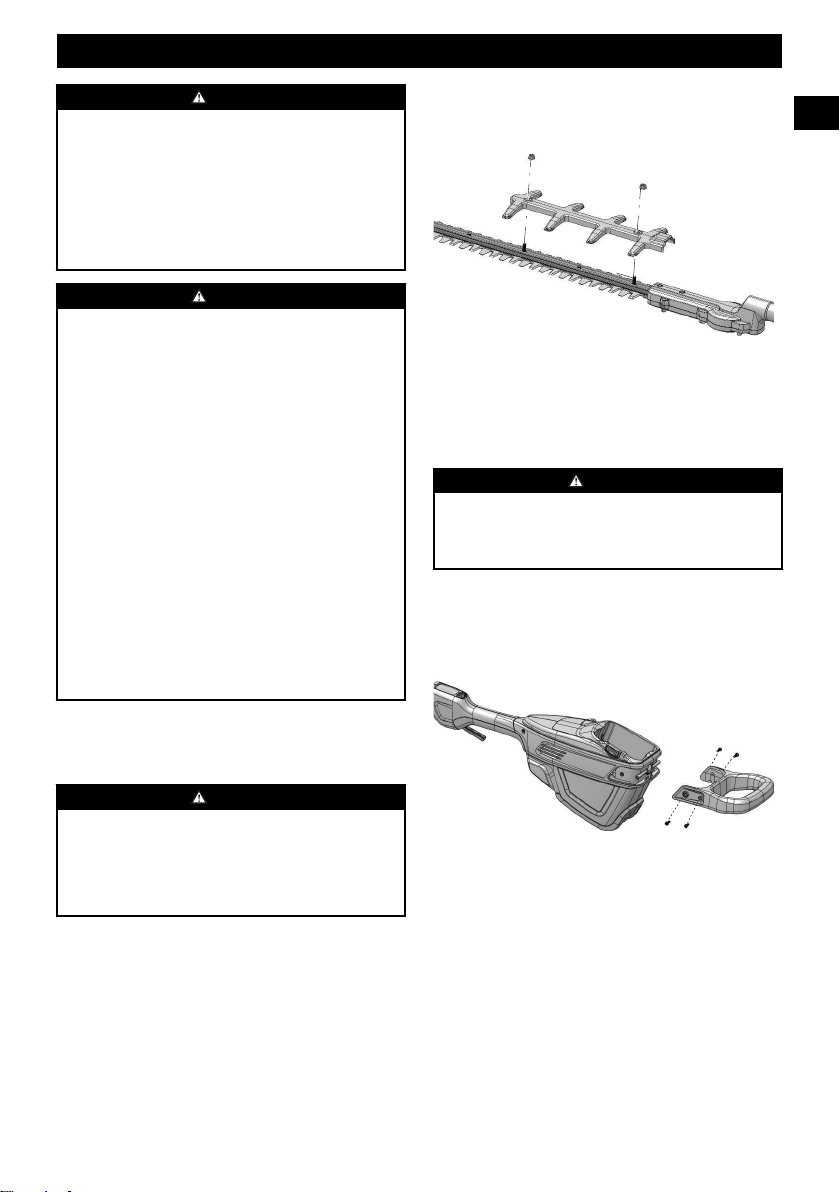
9.1.1 MONTAJE DE LA PROTECCIÓN DE LA
CUCHILLA
1. Coloque la máquina sobre una superficie plana y lisa.
2. Alinee los orificios con los tornillos, a continuación,
ponga el protector de la cuchilla sobre esta.
3. Apriete la tuerca.
AVISO
Utilice únicamente con el asa y la protección correctamente
montadas en el cortasetos. El uso del cortasetos sin el asa o
la protección adecuadas que se suministran puede provocar
lesiones personales graves.
9.1.2 MONTAJE DEL ASA POSTERIOR
1. Alinee los orificios del asa posterior con los orificios de
la máquina.
2. Introduzca los tornillos por los orificios.
3. Apriete los tornillos.
17
Español
ES
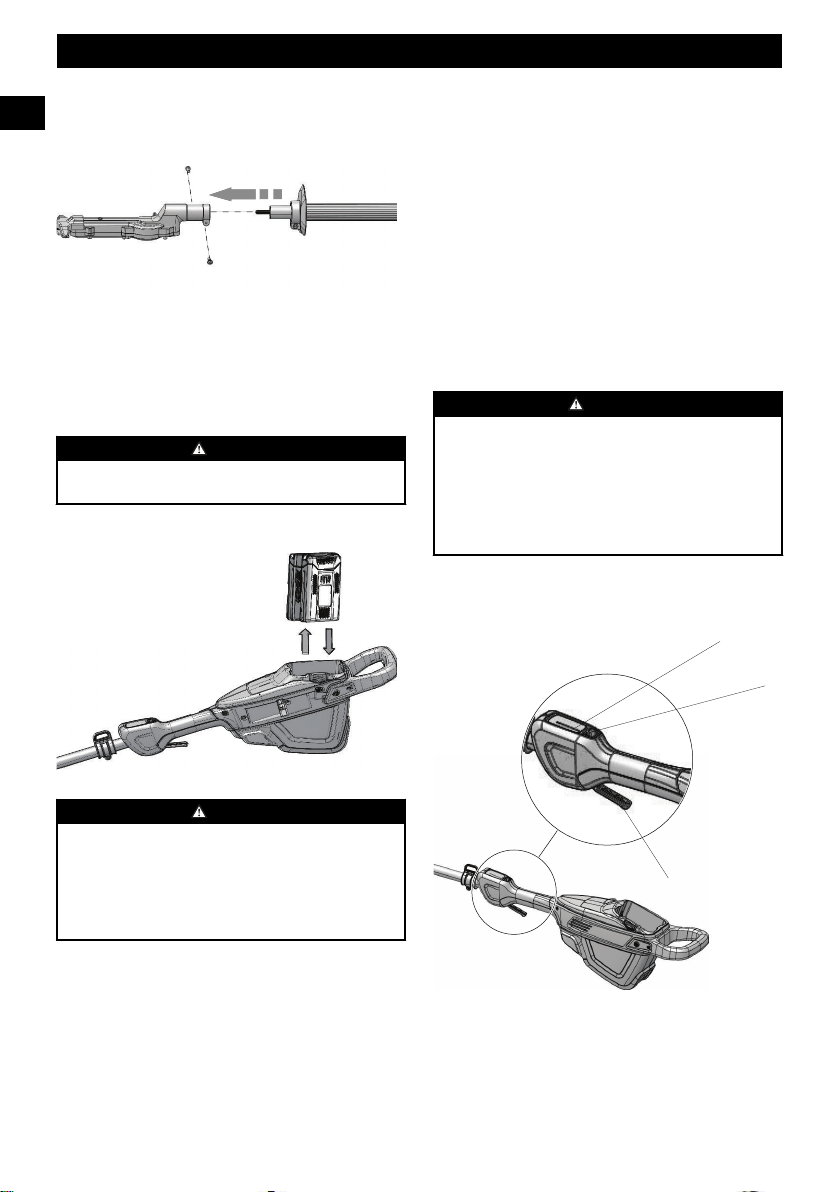
9.1.3 INSTALACIÓN DEL CABEZAL DE
CORTE
El cabezal del cortasetos puede montarse directamente en el
tubo del asa para lograr la longitud estándar.
1. Retire la cubierta protectora negra.
2. Inserte el tubo del asa en el cabezal del cortasetos.
3. Alinee los orificios para insertar el tornillo.
4. Apriete el tornillo.
AVISO
Compruebe las conexiones periódicamente para asegurarse
de que estén bien apretadas.
9.1.4 INSTALACIÓN DE LA BATERÍA
AVISO
• Si la batería o el cargador ha sufrido daños, sustituya la
batería o el cargador.
• Detenga la máquina y espere hasta que el motor se pare
antes de instalar o retirar la batería.
• Debe leer, conocer y seguir las instrucciones del manual
de la batería y el cargador.
1. Alinee las nervaduras de elevación de la batería con las
ranuras del compartimento de la batería.
2. Introduzca la batería en el compartimento de la batería
hasta que encaje en su posición.
3. Cuando escuche un clic, la batería está instalada.
9.1.5 RETIRADA DE LA BATERÍA
1. Pulse y mantenga pulsado el botón de desbloqueo de la
batería.
2. Retire la batería de la máquina.
10 FUNCIONAMIENTO
• Toque la cuchilla con cuidado.
• No meta los dedos en las muescas o en posiciones donde
puedan cortarse.
• No toque la cuchilla a menos que retire la batería.
• No utilice la máquina si alguna pieza ha sufrido daños o
está doblada.
• Retire todos los objetos, como cordones, luces, cables o
cuerdas que puedan enredarse en la cuchilla de corte y
generar un riesgo de lesiones personales.
AVISO
Si la cuchilla se atasca en un cable o línea eléctrica, ¡NO
TOQUE LA CUCHILLA! PUEDE TENER CORRIENTE
Y SER PELIGROSA. Realice estos pasos:
1. Sujete el asa posterior aislada o deje la máquina lejos de
usted.
2. Desconecte el suministro eléctrico a la línea o cable
dañado antes de intentar liberar la cuchilla.
10.1 PUESTA EN MARCHA DE LA
MÁQUINA
Por su seguridad, esta máquina está equipada con un sistema
de doble conmutación. Este sistema evita la puesta en marcha
involuntaria de la máquina.
1. Pulse el botón de encendido/apagado.
18
Español
ES
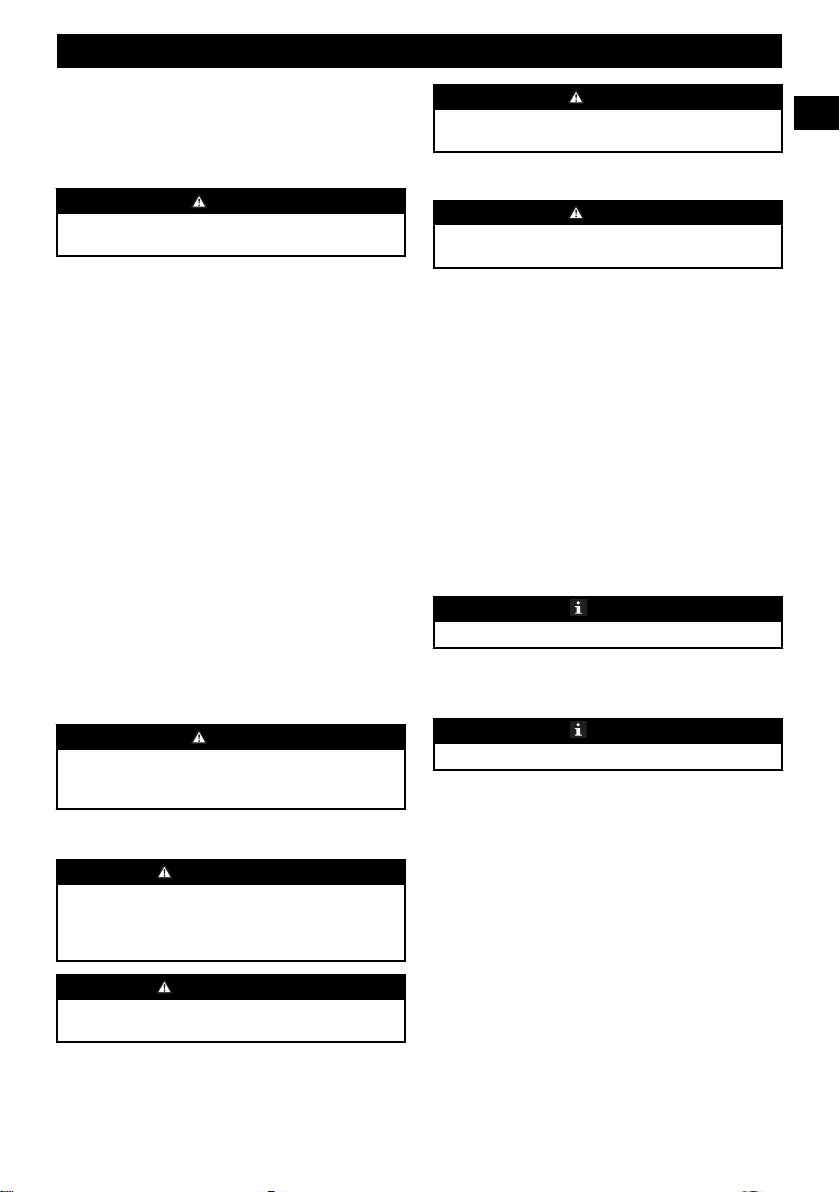
2. Tire del botón de bloqueo de seguridad hacia atrás con el
pulgar.
3. Presione el gatillo mientras sujeta el botón de bloqueo de
seguridad.
4. Suelte el botón de bloqueo de seguridad.
AVISO
Sujete la máquina con las dos manos durante el
funcionamiento.
10.2 DETENCIÓN DE LA MÁQUINA
1. Suelte el gatillo para detener la máquina.
10.3 CONSEJOS DE
FUNCIONAMIENTO
• Empiece a cortar la parte superior del seto. Incline
ligeramente la herramienta (hasta 15° con relación a la
línea de corte) de modo que las puntas de la cuchilla
apunten ligeramente hacia el seto. Esto hará que las
cuchillas corten de forma más eficiente. Sujete la
herramienta al ángulo deseado y muévala uniformemente
a lo largo de la línea de corte. La cuchilla de doble cara le
permite cortar en cualquier dirección.
• Para obtener un corte muy recto, extienda un tramo de
cuerda a lo largo del seto a la altura deseada. Utilice la
cuerda como guía y corte justo por encima de esta.
• Para obtener lados planos, corte hacia arriba en el sentido
del crecimiento. Los tallos más jóvenes se mueven hacia
fuera cuando la cuchilla corta hacia abajo, dejando
secciones poco profundas en el seto.
• Tenga cuidado de evitar objetos extraños. Evite
especialmente los objetos duros, como cables metálicos y
vallas, ya que podrían dañar las cuchillas.
• Engrase las cuchillas periódicamente.
AVISO
Mantenga las manos alejadas de la cuchilla durante el
funcionamiento. El contacto con la cuchilla provocará
lesiones personales graves.
11 MANTENIMIENTO
PRECAUCIÓN
No permita que líquidos de frenos, gasolina y otros
derivados del petróleo toquen las piezas de plástico. Las
sustancias químicas pueden dañar el plástico y hacer que
quede inservible.
PRECAUCIÓN
No utilice disolventes o detergentes fuertes en la carcasa o
los componentes de plástico.
AVISO
Retire la batería de la máquina antes de realizar tareas de
mantenimiento.
11.1 LIMPIEZA DE LA MÁQUINA
AVISO
Mantenga la máquina y el motor libres de hojas, ramas o
exceso de aceite para evitar riesgos de incendio.
• Utilice un paño húmedo con un detergente suave para
limpiar la máquina.
• Limpie toda la humedad con un paño suave y seco.
• Utilice un cepillo pequeño para limpiar los orificios de
ventilación.
11.2 LUBRICACIÓN DE LA CUCHILLA
Para aumentar la eficiencia y la duración de las cuchillas,
lubríquelas cuidadosamente tras cada sesión de trabajo:
• No engrase la cuchilla mientras el cortasetos esté
funcionando.
• Coloque la máquina sobre una superficie plana y lisa.
• Utilice un paño suave para limpiar las cuchillas y un
cepillo para eliminar más suciedad.
• Utilice una capa ligera de aceite para lubricar las
cuchillas a lo largo del filo superior de la cuchilla.
NOTA
Recomendamos utilizar aceite de tipo no contaminante.
12 ALMACENAMIENTO DE LA
MÁQUINA
NOTA
Limpie la máquina antes del almacenamiento.
1. Retire la batería.
2. Deje que el motor se enfríe.
3. Compruebe que no haya componentes sueltos o dañados.
En caso necesario, sustituya los componentes dañados,
apriete los tornillos y los pernos o consulte con una
persona de un centro de servicio autorizado.
4. Almacene la máquina en un lugar fresco y seco.
19
Español
ES
13 SOLUCIÓN DE PROBLEMAS
Problema Posible causa Solución
El motor no se
pone en marcha
cuando aprieta el
gatillo.
La batería no se ha
instalado bien.
Asegúrese de que
ha instalado bien
la batería en la
máquina.
La batería se ha
agotado.
Cargue la batería.
La máquina echa
humo durante el
funcionamiento.
La máquina ha su-
frido daños.
1. Detenga la
máquina inme-
diatamente.
2. Retire la bate-
ría.
3. Consulte con
un centro de
servicio.
El motor está en
marcha, las cuchil-
las no se mueven.
La máquina ha su-
frido daños.
No utilice la má-
quina y consulte
con un centro de
servicio.
Las cuchillas están
bloqueadas.
Retire la batería y
posteriormente eli-
mine la obstruc-
ción de las cuchil-
las.
Hay demasiado
ruido o vibración
durante el funcio-
namiento.
Las piezas están
sueltas.
1. Detenga la
máquina.
2. Retire la bate-
ría.
3. Inspeccione si
hay daños.
4. Compruebe y
apriete las pie-
zas sueltas.
Las piezas han su-
frido daños.
No utilice la má-
quina y consulte
con un centro de
servicio.
14 DATOS TÉCNICOS
Tensión 60V
Velocidad sin carga 4000 (±10%) SPM
Longitud de cuchilla 24" (610 mm)
Capacidad de corte 1.2''
Peso (sin batería) 11 lbs. (5 kg)
Modelo de batería 60BA02, 60BA25, 60BA03,
60BA04, 60BA05, 60BA06,
60BA08 y otras series BAC
Modelo de cargador 60DP10, 606P14 y otras ser-
ies CAC
15 GARANTÍA LIMITADA
M
E
I
L
L
E
U
R
D
A
N
S
S
A
C
A
T
É
G
O
R
I
E
•
M
E
J
O
R
E
N
C
L
A
S
E
B
E
S
T
I
N
C
L
A
S
S
GARANTIE OUTIL &
BATTERIE • GARANTÍA PARA
HERRAMIENTAS Y BATERÍAS
Por la presente Greenworks garantiza este producto, al
comprador original con el comprobante de compra, durante
un periodo de cuatro (4) años frente a defectos en materiales,
piezas o mano de obra. A su entera discreción Greenworks
reparará o sustituirá cualquiera y todas las piezas que resulten
ser defectuosas, con un uso normal, sin coste alguno para el
cliente. Esta garantía es válida únicamente para unidades que
se hayan utilizado para uso personal que no han sido
arrendadas o alquiladas para uso industrial/comercial y cuyo
mantenimiento se ha realizado de acuerdo con las
instrucciones del manual del propietario suministrado con el
producto nuevo.
ARTÍCULOS NO CUBIERTOS POR LA GARANTÍA:
1. Cualquier pieza que no funcione debido a mal uso, uso
comercial, abuso, negligencia, accidente, mantenimiento
inadecuado o alteración; o
2. La unidad, si no ha sido utilizada o mantenida de acuerdo
con el manual del propietario; o
3. Desgaste normal;
4. Artículos de mantenimiento de rutina tales como
lubricantes, afilado de cuchillas;
5. Deterioro normal del acabado exterior debido al uso o la
exposición.
LÍNEA DE ASISTENCIA TELEFÓNICA:
Puede contactar con el servicio de garantía llamando a
nuestra línea de asistencia telefónica gratuita, a
1-855-345-3934.
COSTES DE TRANSPORTE:
Los costes de transporte por el desplazamiento de cualquier
unidad o accesorio de equipos eléctricos son responsabilidad
del comprador. Es responsabilidad del comprador pagar los
costes de transporte de cualquier pieza enviada para su
sustitución bajo esta garantía, a menos que dicha devolución
sea solicitada por escrito por Greenworks.
Dirección en EE.UU.:
Greenworks Tools
20
Español
ES
P.O. Box 1238
Mooresville, NC 28115
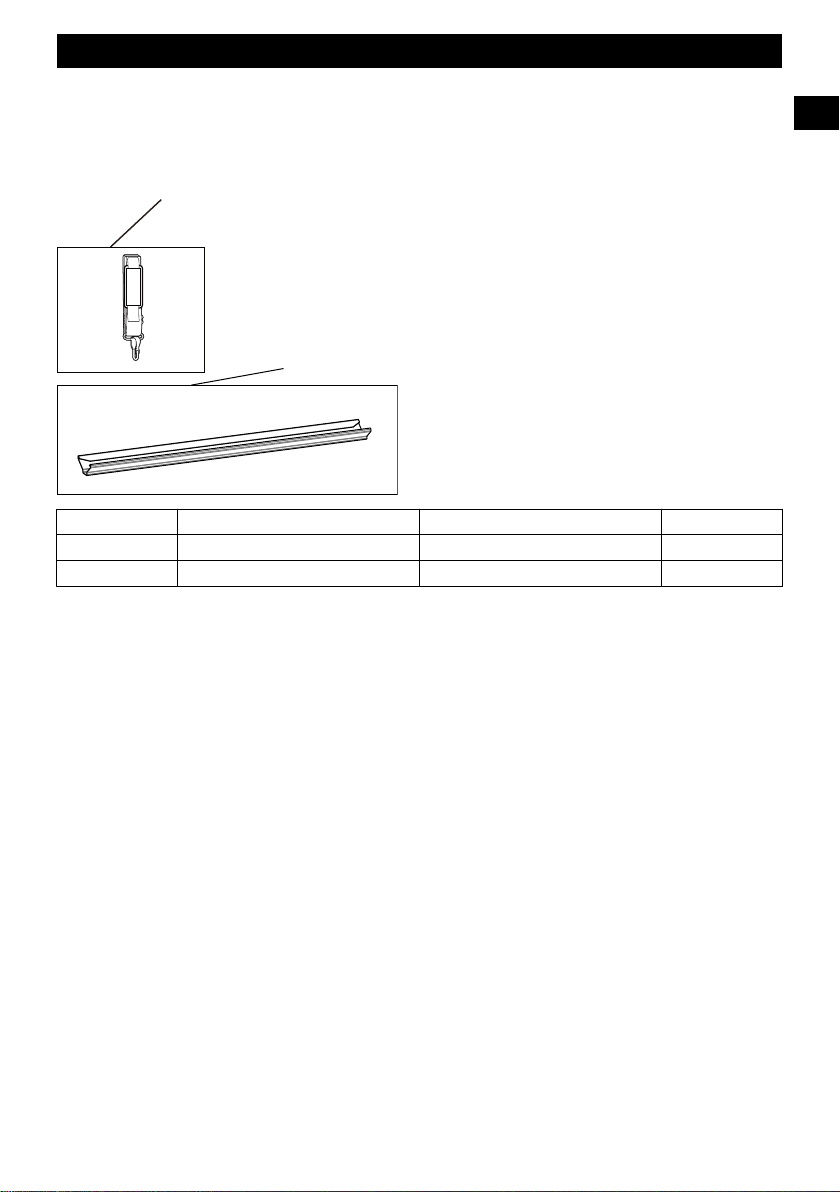
16 VISTA DESPIEZADA
1
2
Nº Nº pieza Descripción Cant.
1 RB37902144 Correa de hombro 1
2 R0202708-00 Vaina 1
21
Español
ES