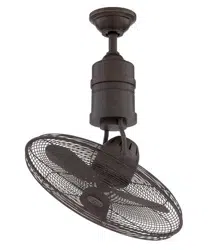
For Models:
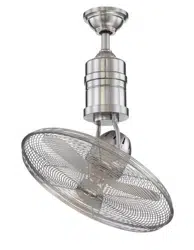
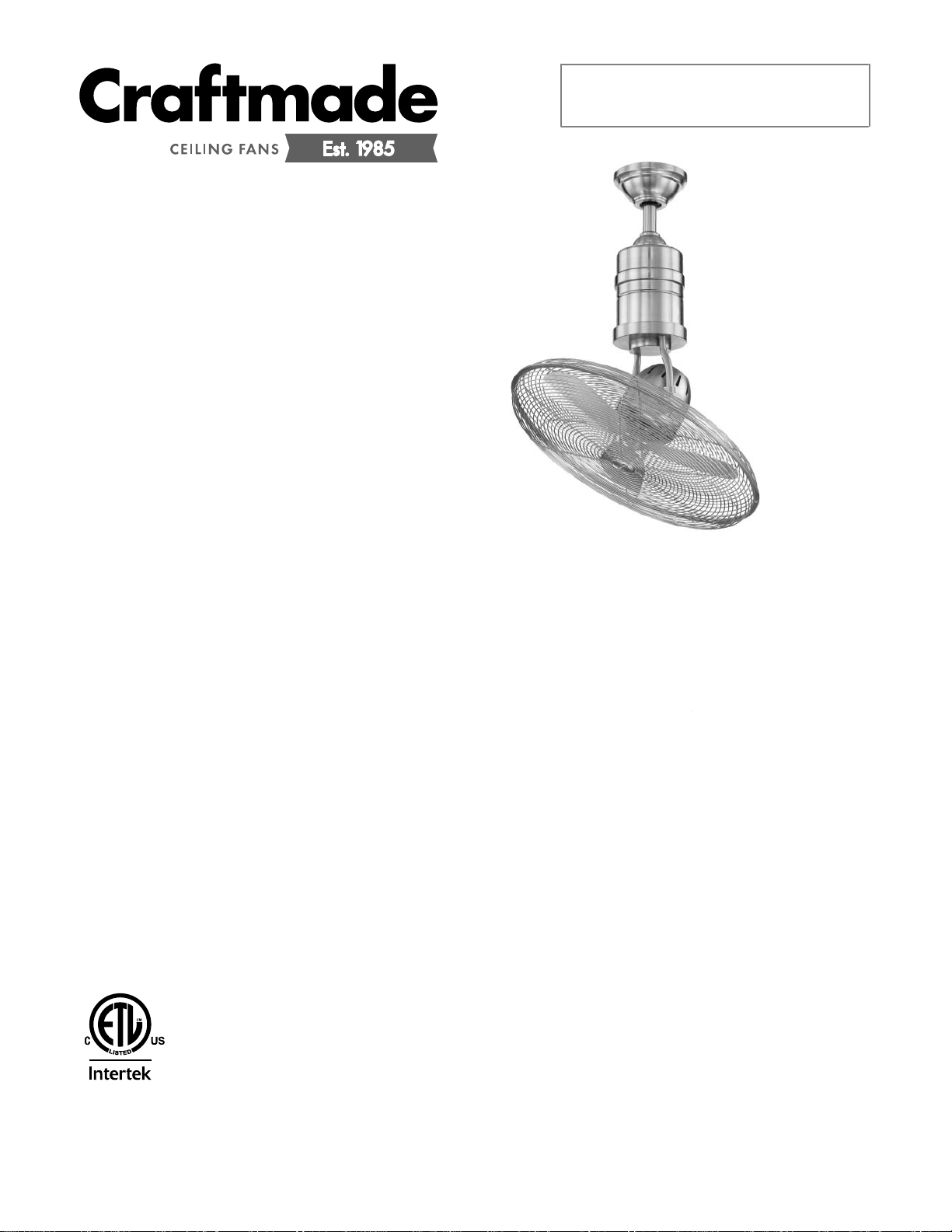
BW321AG3
BW321SS3
net weight of fan: 15.63 lb (7.09 kg)
PRINTED IN CHINA
READ THESE INSTRUCTIONS AND
SAVE THEM FOR FUTURE USE
Installation Guide
Table of Contents:
Safety Tips. pg. 1
Unpacking Your Fan. pg. 2
Parts Inventory. pg. 2
Installation Preparation. pg. 3
Hanging Bracket Installation. pg. 3
Fan Assembly. pgs. 4 - 5
Wiring. pgs. 5 - 6
Canopy Assembly. pg. 6
Assembly of Handheld Remote Control.
pg. 7
Automated Learning Process./
Activating Code. pg. 8
Remote Control Operation. pg. 8
Testing Your Fan. pg. 8
Troubleshooting. pg. 9
Warranty. pg. 9
Parts Replacement. pg. 9
Bellows III
3171583
APPROVED FOR
DAMP LOCATION

SAFETY TIPS.
page 1
WARNING: To reduce the risk of electrical shock, turn off the electricity to the fan at the main fuse box or circuit
panel before you begin the fan installation or before servicing the fan or installing accessories.
1. READ ALL INSTRUCTIONS AND SAFETY INFORMATION CAREFULLY BEFORE INSTALLING YOUR FAN
AND SAVE THESE INSTRUCTIONS.
CAUTION: To avoid personal injury, the use of gloves may be necessary while handling fan parts with sharp
edges.
2. Make sure all electrical connections comply with Local Codes or Ordinances, the National Electrical Code,
and ANSI/NFPA 70-1999. If you are unfamiliar with electrical wiring or if the house/building wires are
different colors than those referred to in the instructions, please use a qualified electrician.
3. Make sure you have a location selected for your fan that allows clear space for the fan and at least
ten (10) feet (3.05 meters) of clearance between the floor and the fan cage. The fan should be
mounted so that the edges of the fan cage are at least thirty (30) inches (76 centimeters) from walls or
other upright structures.
4. The outlet box and ceiling support joist used must be securely mounted, and capable of supporting at
least 35 pounds (16 kilograms). The outlet box must be supported directly by the building structure.
Use only outlet boxes listed CETL or CUL in Canada or ETL or UL in USA that are marked "FOR FAN
SUPPORT."
WARNING: To reduce the risk of fire, electrical shock, or personal injury, mount to the outlet box marked
"Acceptable for Fan Support of 15.9 kg (35 lb) or less," and use the mounting screws provided with the outlet
box. Most outlet boxes commonly used for the support of lighting fixtures are not acceptable for fan support
and may need to be replaced. Consult a qualified electrician if in doubt.
WARNING: To reduce the risk of fire, electrical shock, or personal injury, wire connectors provided with this fan
are designed to accept only one12 gauge house wire and two lead wires from the fan. If your house wire is larger
than 12 gauge or there is more than one house wire to connect to the corresponding fan lead wires, consult an
electrician for the proper size wire connectors to use.
5. Electrical diagrams are for reference only.
6. After installation is complete, check that all connections are absolutely secure.
7. After making electrical connections, spliced conductors should be turned upward and pushed carefully up
into the outlet box. The wires should be spread apart with the grounded conductor and the
equipment-grounding conductor on opposite sides of the outlet box.
WARNING: To reduce the risk of electrical shock or fire, do not use this fan with any solid state speed control
device or control fan speed with a full range dimmer switch. [Using a full range dimmer switch to control fan
speed will cause a loud humming noise from fan.]
8. Do not insert anything between the fan blades while they are rotating.
WARNING: To reduce the risk of personal injury, do not bend or alter the fan cage during assembly or after
installation. Do not insert objects into the path of the blades.
WARNING: To avoid personal injury or damage to the fan and other items, be cautious when working around or
cleaning the fan.
9. Do not use water or detergents when cleaning the fan or fan blades. A dry dust cloth or lightly dampened
cloth will be suitable for most cleaning.
WARNING: To reduce the risk of personal injury, use only parts provided with this fan. The use of parts OTHER
than those provided with this fan will void the warranty.
NOTE: The important safety precautions and instructions appearing in the manual are not meant to cover all
possible conditions and situations that may occur. It must be understood that common sense and caution are
necessary factors in the installation and operation of this fan.
page 2
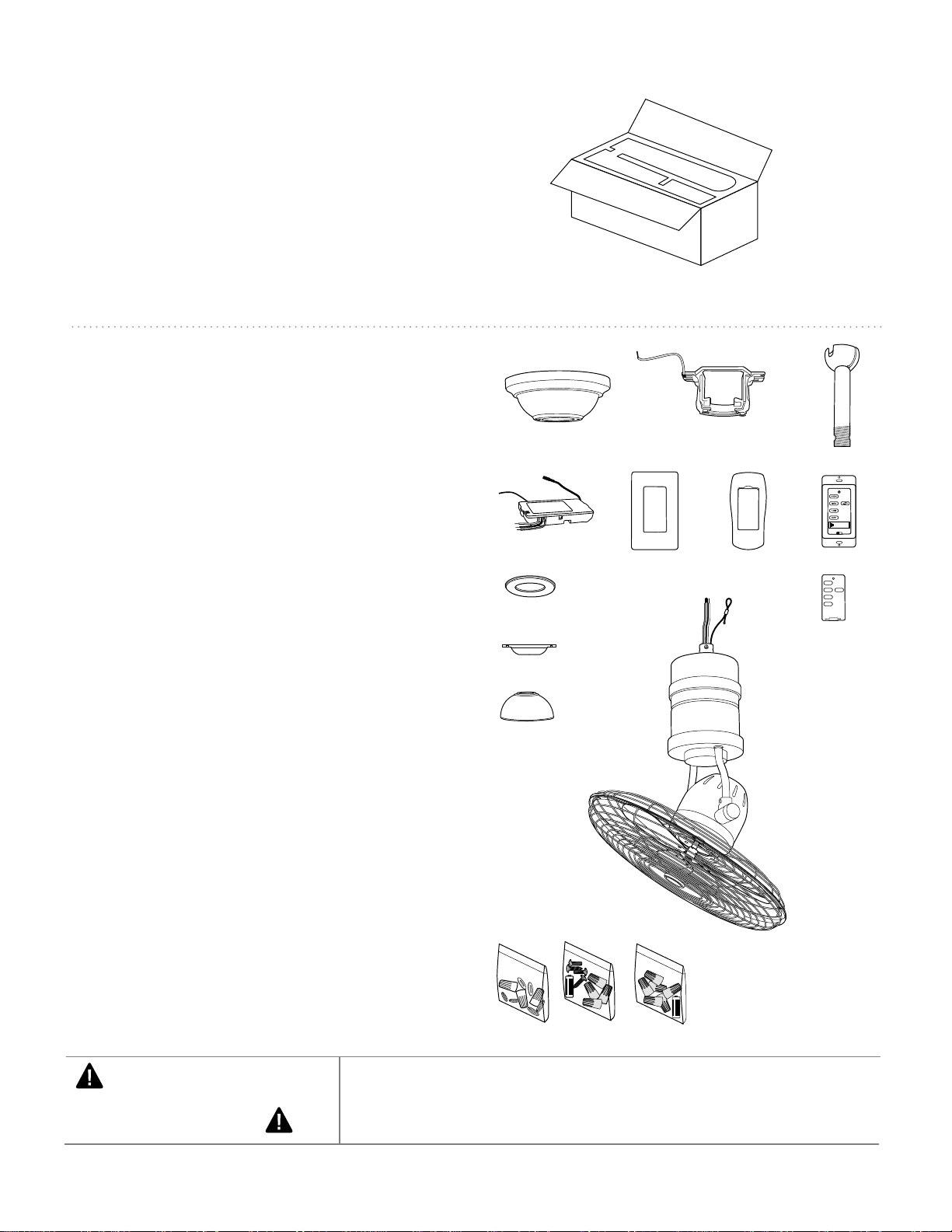
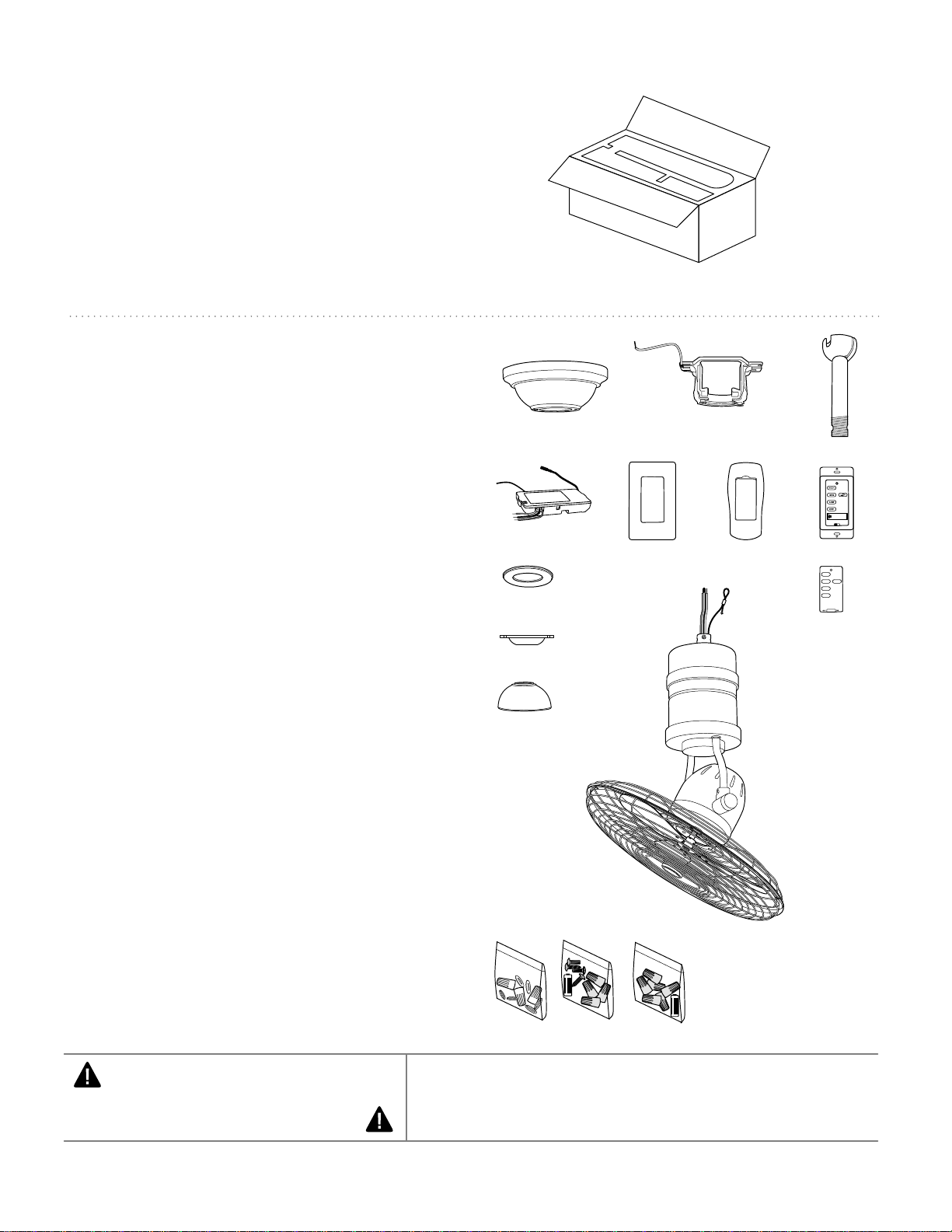
2. Parts Inventory.
a. canopy. 1 piece
b. hanging bracket (pre-attached to canopy).
1 piece
c. downrod and hanging ball. 1 piece
d. remote control receiver. 1 piece
e. wall plate.1 piece
f. remote control cover. 1 piece
g. wall control. 2 pieces
h. canopy cover (pre-attached to canopy). 1 piece
i. faceplate. 3 pieces
j. anti-sway adapter (in hardware pack).
1 piece
k. motor assembly. 1 piece
l. yoke cover. 1 piece
m. hardware packs
a
1. Unpacking Your Fan.
Carefully open the packaging. Remove items
from Styrofoam inserts. Remove motor assembly
and place on carpet or Styrofoam to avoid
damage to finish. Do not discard fan carton or
Styrofoam inserts should this fan need to be
returned for repairs.
Check against parts inventory that all parts have
been included.
IMPORTANT REMINDER: You must
use the parts provided with this fan for
proper installation and safety.
b
c
d
k
j
h
m
l
ef
i
g
w/ remote
w/wall
control
4. Hanging Bracket Installation.
page 3
ON
OFF
ON
OFF
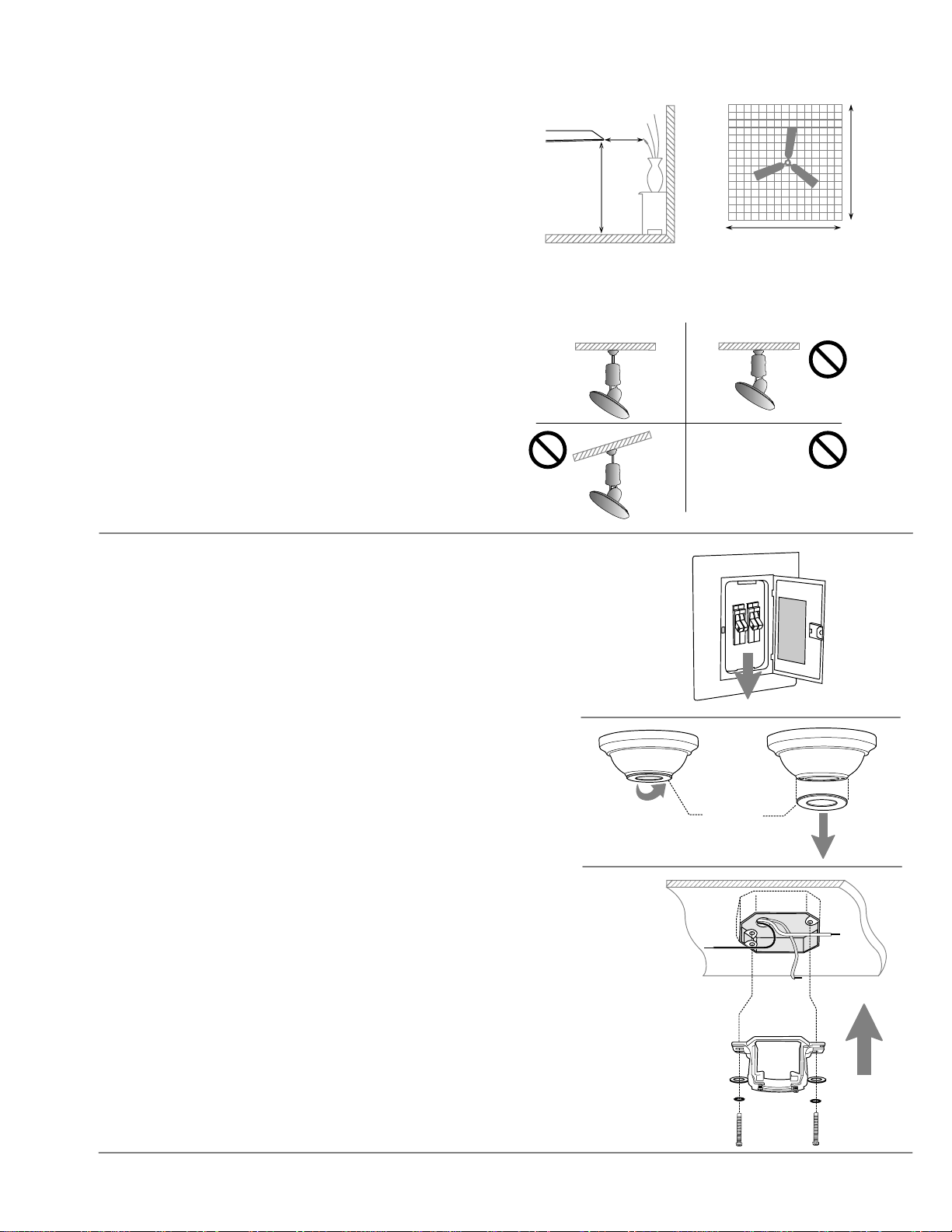
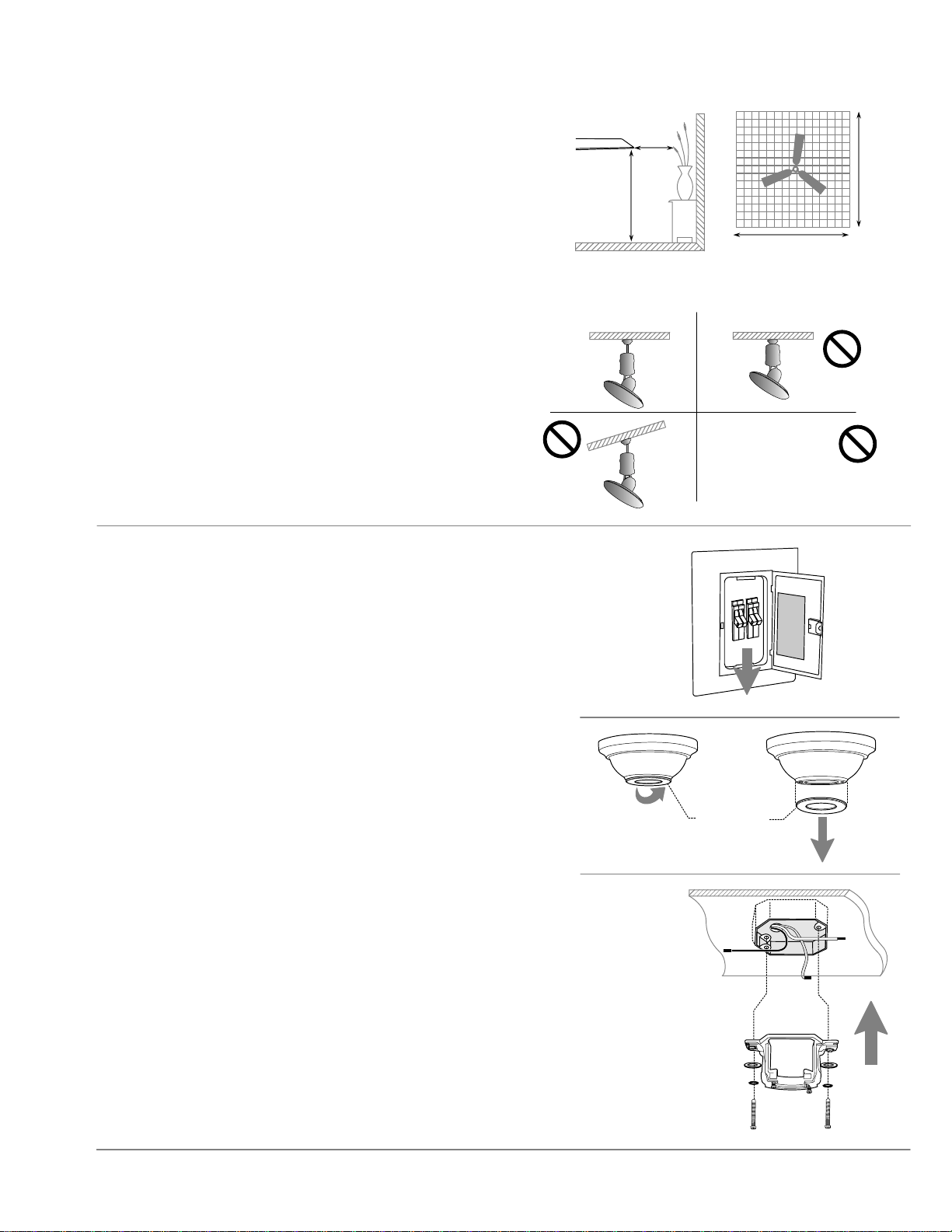
3. Installation Preparation.
hanging bracket
10 feet
(3.05m) (76cm)
30
inches
blade edge
Turn off circuit breakers to current fixture from breaker
panel and be sure operating light switch is turned to the
OFF position.
WARNING: Failure to disconnect power supply prior to
installation may result in serious injury.
Remove existing fixture.
WARNING: When using an existing outlet box, be sure the
outlet box is securely attached to the building structure and
can support the full weight of the fan. Ensure outlet box is
clearly marked "Suitable for Fan Support." If not, it must be
replaced with an approved outlet box. Failure to do so can
result in serious injury.
CAUTION: Be sure outlet box is grounded properly and that
a ground wire (GREEN or bare) is present.
Remove canopy cover from underside of canopy by
turning canopy cover counterclockwise. Remove
hanging bracket from canopy.
Install hanging bracket to outlet box using original
screws, spring washers and flat washers provided with
new or original outlet box.* Arrange electrical wiring
around the back of the hanging bracket and away from
the hanging bracket opening.
*NOTE: It is very important that you use the proper
hardware when installing the hanging bracket as this will
support the fan.
To prevent personal injury and damage, ensure that
the hanging location of the fan allows the fan cage a
clearance of 10 feet (3.05m) from the floor and that
the edges of the fan cage will be at least 30in. (76 cm)
from any wall or obstruction.
This fan is suitable for room sizes up to 400 square feet
(37.2 square meters).
Installation requires these tools:
Phillips screwdriver, flathead screwdriver, adjustable
pliers or wrench, stepladder, wire cutters, and rated
electrical tape.
spring washers
outlet box screws
flat washers
This fan can be mounted with a downrod on a regular
(no-slope) ceiling ONLY. Fan CANNOT mount as a
flushmount installation NOR on a vaulted ceiling.
12ft. - 20ft.
12ft. - 20ft.
(3.66m - 6.1m)
(3.66m - 6.1m)
downrod
installation
CANNOT be
installed on
angled or
vaulted ceilings
flushmount
installation
canopy
cover
canopy

page 4
5. Fan Assembly.
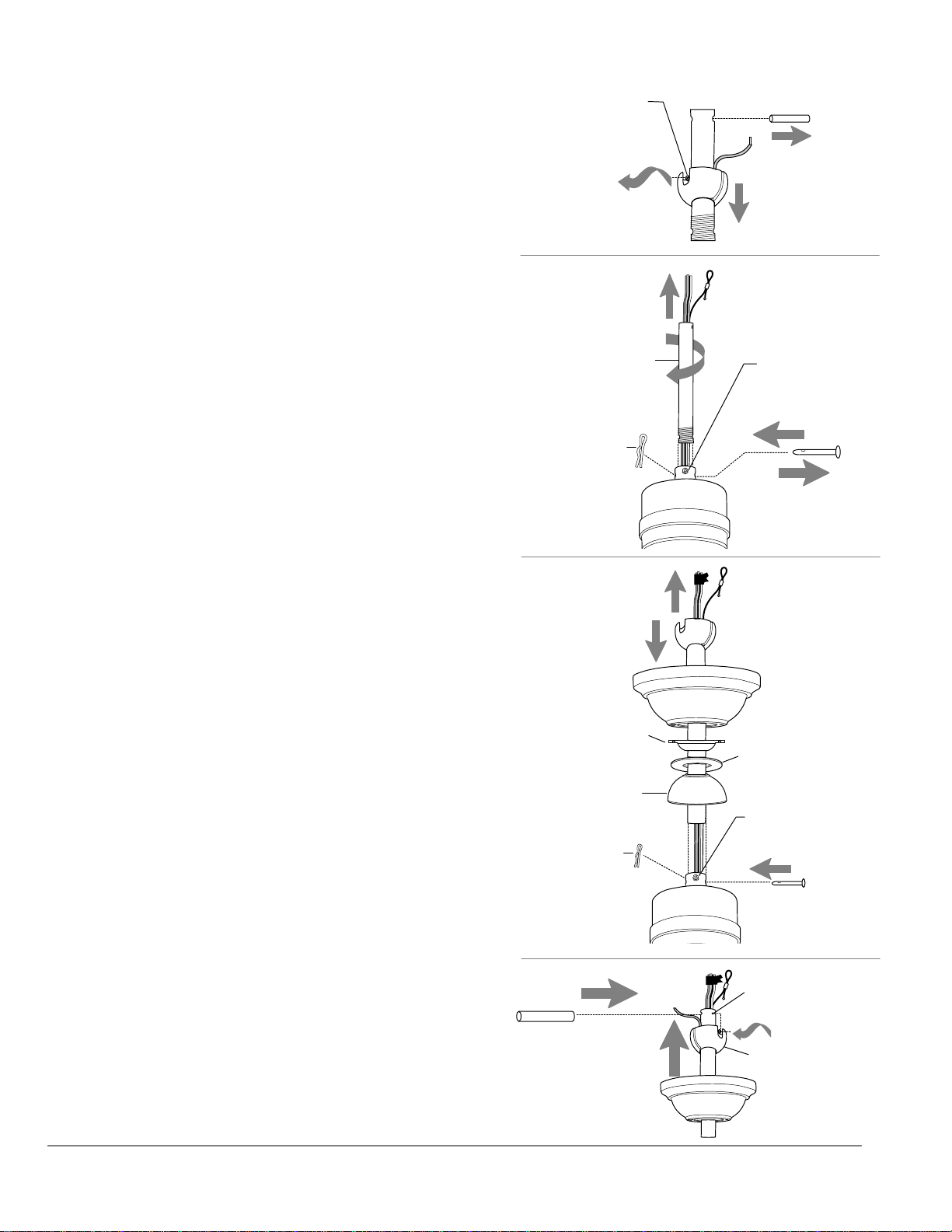
Remove hanging ball from downrod provided by
loosening set screw on hanging ball. Lower hanging
ball and remove stop pin and then slide hanging ball
off of the downrod. [Refer to diagram 1.]
Loosen yoke set screws and nuts at top of motor
assembly. Remove pin and clip from motor housing
yoke. [Refer to diagram 2.]
Tip: To prepare for threading electrical wires through
downrod, apply a small piece of electrical tape to the
ends of the electrical wires--this will keep the wires
together when threading them through the downrod.
[Refer to diagram 2.]
Determine the length of threaded downrod you wish
to use. Thread safety cable and electrical wires
through threaded end of downrod and pull extra wire
slack from the upper end of the downrod. [Refer to
diagram 2.]
Thread downrod into the motor assembly yoke until
holes for pin and clip in downrod align with holes in
yoke--make sure wires do not get twisted. Re-insert pin
and clip that were previously removed. Tighten yoke
set screws and nuts securely. [Refer to diagram 2.]
Locate anti-sway adapter in hardware pack. Slide yoke
cover, canopy cover, anti-sway adapter and canopy
over downrod. (NOTE: Canopy cover must be turned
with shiny side toward the motor assembly. Anti-sway
adapter must be turned with wider end toward the
canopy.) [Refer to diagram 3.]
Thread safety cable and wires through hanging ball
and then slide hanging ball over downrod--the top of
the downrod should be noted as having a set screw
hole; use this hole when setting the set screw. Insert
stop pin into top of downrod and raise hanging ball.
Be sure stop pin aligns with slots on the inside of the
hanging ball. Tighten set screw securely. [Refer to
diagram 4.]
WARNING: Failure to tighten set screw (on hanging
ball) completely could result in the fan becoming
loose and possibly falling.
["Fan Assembly" continued on next page.]
NOTE: The important safety precautions and instructions
appearing in the manual are not meant to cover all possible
conditions and situations that may occur. It must be
understood that common sense and caution are necessary
factors in the installation and operation of this fan.
set screw
hanging ball
stop pin
set screw hole
stop pin
diagram 1
canopy
hanging ball
clip
pin
downrod
electrical wiring
safety cable
yoke set screw
and nut
motor
assembly
downrod
pin
clip
canopy
motor
assembly
yoke set screw
and nut
yoke cover
canopy cover
anti-sway
adapter
diagram 2
diagram 3
diagram 4
page 5
5. Fan Assembly. (cont.)
WARNING: Turn off circuit breakers to current fixture
from breaker panel and be sure switch is turned to the
OFF position.
CAUTION: Be sure outlet box is properly grounded and
that a ground wire (GREEN or Bare) is present.
Make sure all electrical connections comply with Local
Codes or Ordinances and the National Electrical Code. If
you are unfamiliar with electrical wiring or if the
house/building wires are different colors than those
referred to in the diagram to the right, please use a
qualified electrician.
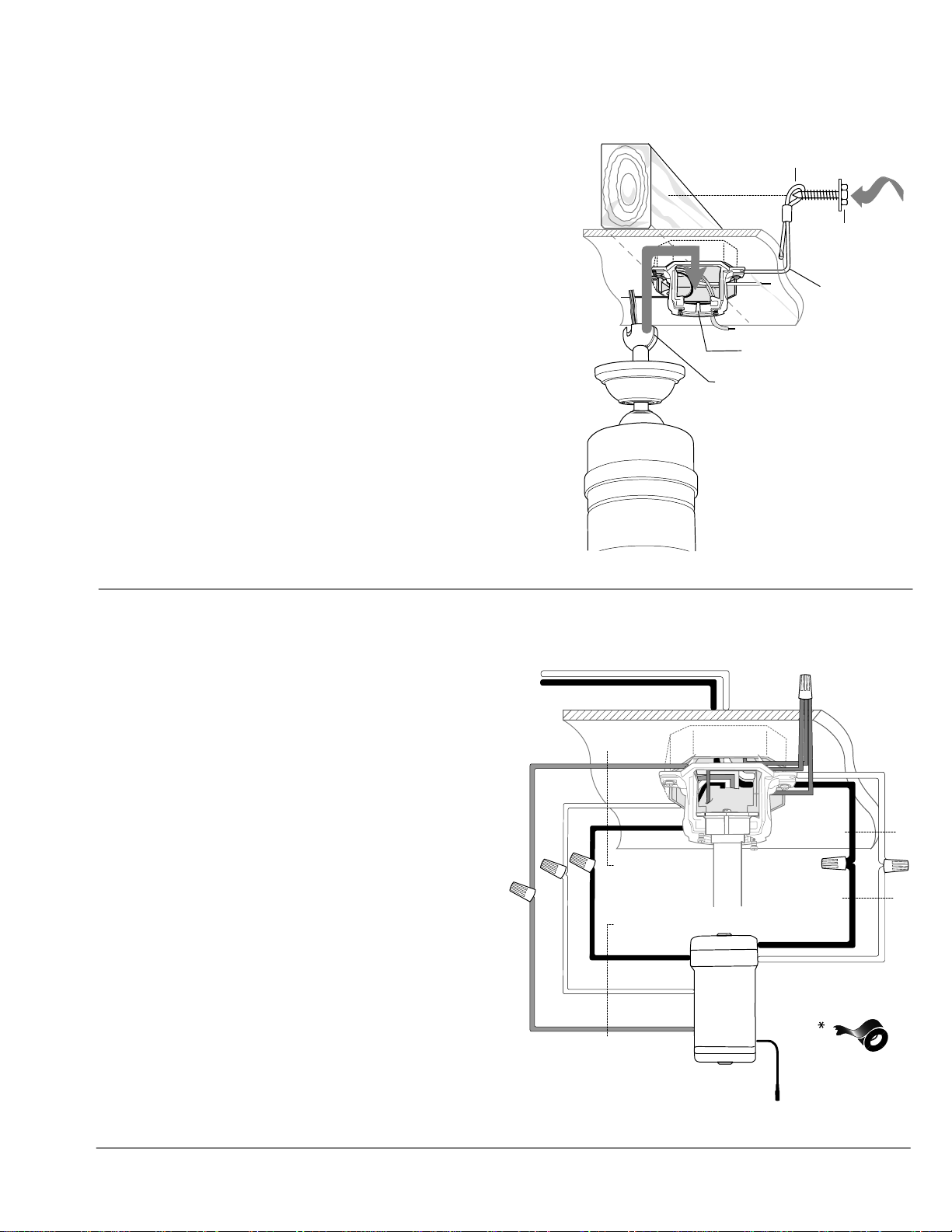
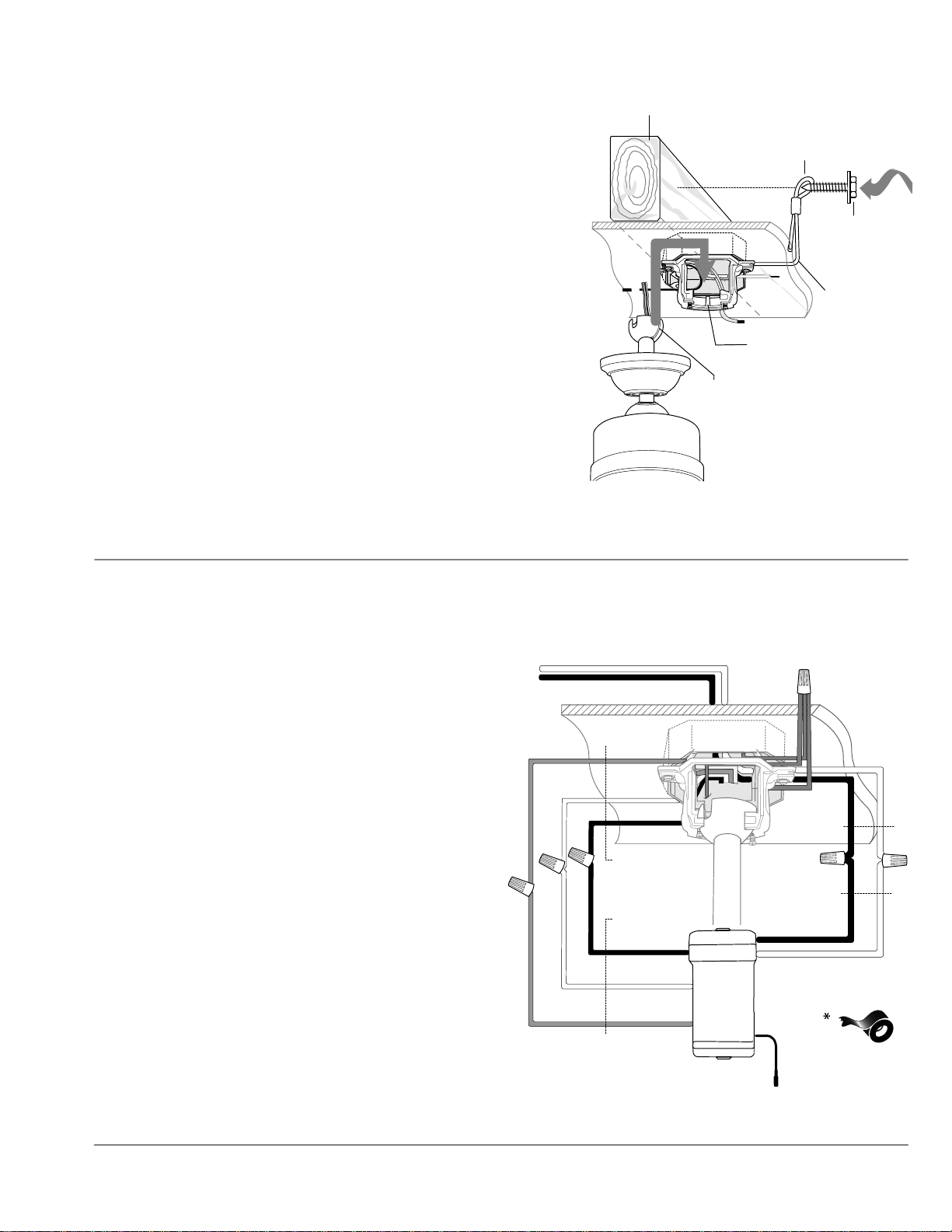
When downrod is secured in place on the hanging
bracket, wire the RECEIVER with wire connectors
provided as shown in diagram at right.
Tip: While you are wiring, keep in mind that wires must
not obstruct receiver from sliding into hanging bracket.
* Wrap each wire connector separately with electrical
tape as an extra safety measure.
Gently insert receiver (flat side up) into hanging
bracket and carefully push wires and taped wire
connectors into outlet box. Let antenna rest outside of
hanging bracket.
white supply wire
black supply wire
black
black
white
blue
blue
white
from receiver
black
AC IN L
AC IN N
white
white
ground (green
or bare)
from fan
from receiver
antenna
from ceiling
(wiring for receiver)
black
receiver
wood
ceiling
joist
safety cable
wood screw
and washer
safety cable loop
With the hanging bracket secured to the outlet box and
able to support the fan, you are now ready to hang your
fan. Grab the fan firmly with two hands. Slide downrod
through opening in hanging bracket and let hanging
ball rest on the hanging bracket. Turn the hanging ball
slot until it lines up with the hanging bracket tab.
WARNING: Failure to align slot in hanging ball with tab
in hanging bracket may result in serious injury or death.
IMPORTANT: Seek the help of another person to hold
the stepladder in place and to then help lift the fan up
to you once you are set on the ladder.
Find a secure attachment point (wood ceiling joist
highly recommended) and secure safety cable. It will be
necessary to use a heavy duty wood screw, washer and
lock washer (not supplied) with the safety cable loop. If
necessary, adjust the loop at the end of the safety cable.
The loop at the end of the safety cable should just fit
over the threads on the wood screw. Test safety cable by
pulling with pliers on loose end of safety cable. If the safety
cable slips, the loop must be adjusted tighter. Extra cable
slack can be left in ceiling area.
6. Wiring.
motor assembly
hanging ball slot
hanging bracket tab
page 6
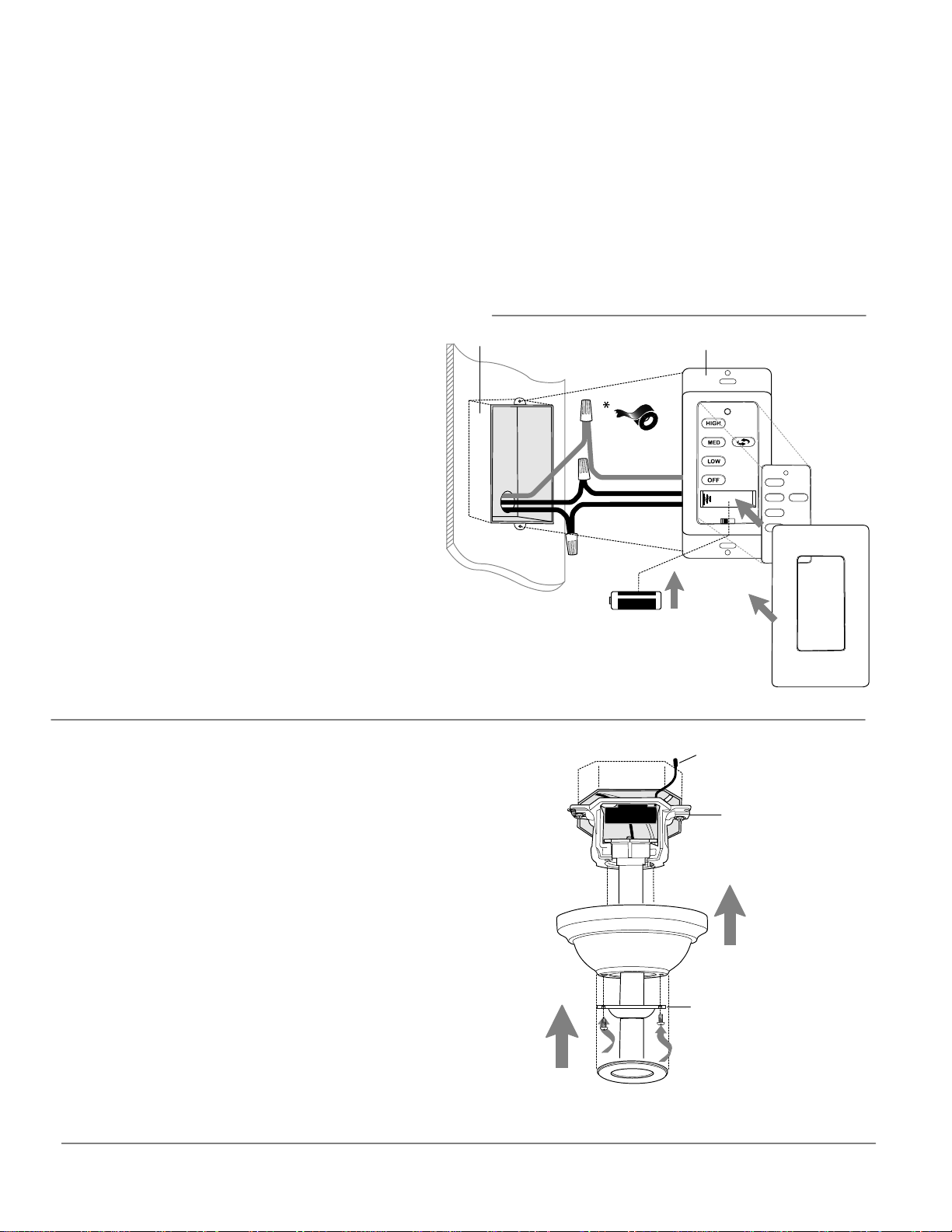
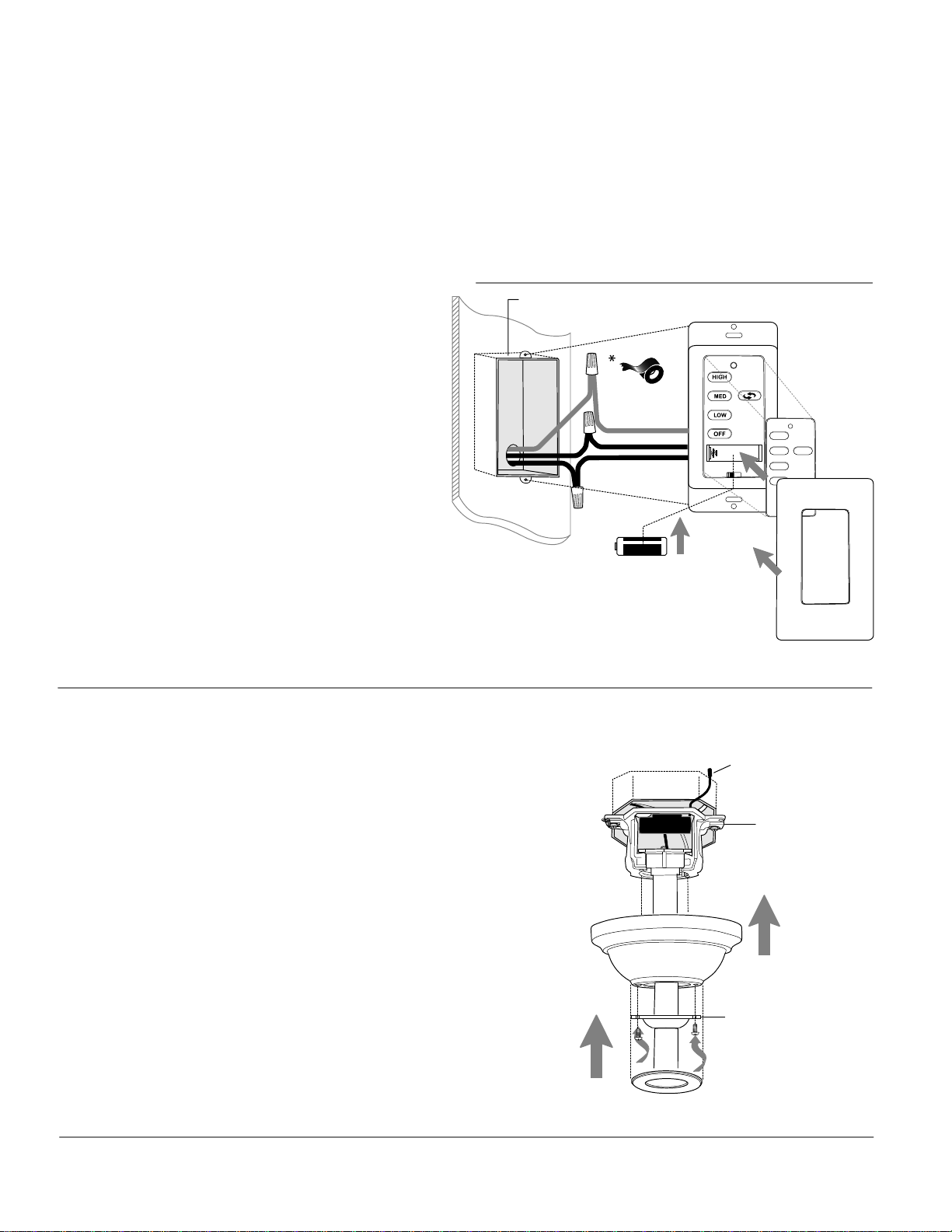
7. Canopy Assembly.
Remove 2 screws on underside of hanging bracket.
Lift canopy to hanging bracket. Align holes in
canopy with holes in hanging bracket. While
holding canopy in place, slide anti-sway adapter up
to canopy. Align holes in anti-sway adapter with
holes in bottom of canopy and then re-insert the
screws that were previously removed. Tighten both
screws securely.
Slide canopy cover up to anti-sway adapter,
aligning rounded part of slotted holes in canopy
cover with screw heads in bottom of anti-sway
adapter. Turn canopy cover to the right (clockwise)
until it stops.
*Remember that antenna for remote control
receiver must rest outside of hanging bracket.
canopy cover
canopy
hanging bracket
antenna
anti-sway adapter
6. Wiring. (cont.)
[PLEASE NOTE: Wall and/or handheld
remote control must be used for fan to
operate. If you do not wish to use the wall
control, please proceed to Section 7 to
continue with fan installation.]
To install wall control, remove existing
wall switch. Wire one of the wall controls
with wire connectors provided as shown in
diagram at right.
*Wrap each wire connector separately with
electrical tape as an extra safety measure.
Gently push wires and taped wire
connectors into outlet box.
Install one 12-volt battery (included) in
wall control.
IMPORTANT: Wall control will not function
unless battery is installed.
Select a faceplate (white or almond) and
press firmly onto front of wall control.
Attach wall control to outlet box and
secure with screws from original wall
switch. Attach wall plate (included) to wall
control using 2 screws provided with the
wall control.
(wiring for wall control)
black (OUT to fan)
green
black
(AC IN from
breaker box)
black
(TO POWER supply)
black
green/
green/
bare
bare
ground
ground
green/
bare
ground
outlet box
wall control
12V battery
Modifications not approved by the party responsible for compliance
could void the user's authority to operate the equipment.
*NOTE: This equipment has been tested and found to comply with the limits for a Class B
digital device, pursuant to Part 15 of the FCC Rules. These limits are designed to provide
reasonable protection against harmful interference in a residential installation. This
equipment generates, uses and can radiate radio frequency energy and, if not installed and
used in accordance with the instructions, may cause harmful interference to radio
communications. However, there is no guarantee that interference will not occur in a
particular installation. If this equipment does cause harmful interference to radio or television
reception, which can be determined by turning the equipment off and on, the user is
encouraged to try to correct the interference by one or more of the following measures:
* Reorient or relocate the receiving antenna.
* Increase the separation between the equipment and receiver.
* Connect the equipment into an outlet on a circuit different from that to which the
receiver is connected.
Consult the dealer or an experienced radio/TV technician for help.
face-
plate
plate
page 7
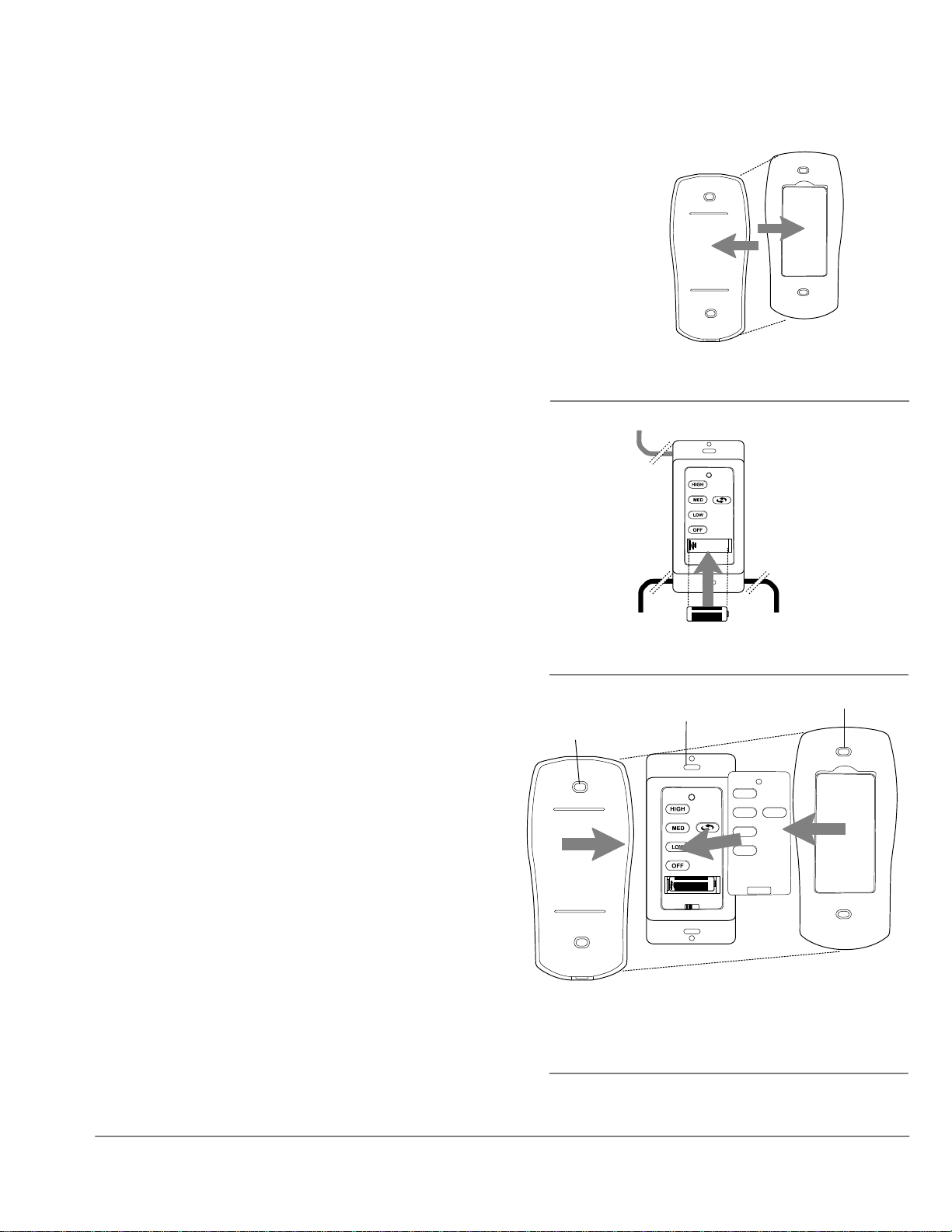
IN ORDER TO USE THE HANDHELD REMOTE
CONTROL, PLEASE CONTINUE WITH SECTION 8
for remote control assembly instructions. If you
have already installed the wall control but do not
wish to use the handheld remote control, please
proceed to Section 9.
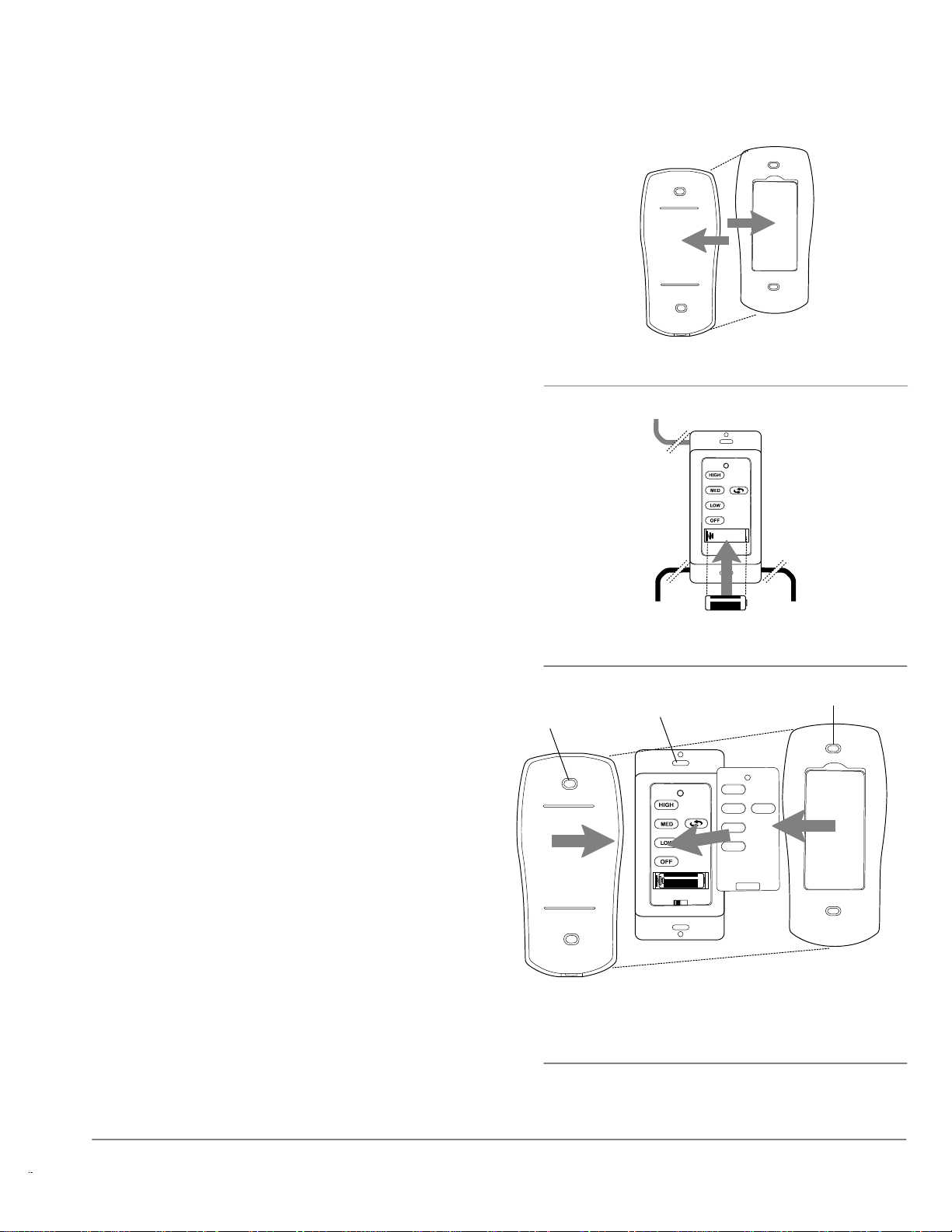
Gently pull on remote control cover to
separate top and bottom parts. [Refer to
diagram 1.]
In order to use wall control as a handheld
remote control, cut each wire on wall control
(that was not previously used)--use wire
cutters to cut off each wire as close to the wall
control as possible. [Refer to diagram 2.]
Install one 12-volt battery (included) in wall
control. [Refer to diagram 2.]
Attach black faceplate to front of wall control;
press down firmly. [Refer to diagram 3.]
Align holes in wall control with posts located
on inside of TOP part of remote control cover
and press together firmly. Place wall control
into BOTTOM part of remote control cover,
aligning posts in top of remote control cover
with post holes in the bottom. [Refer to
diagram 3.]
(NOTE: Make sure to align narrower ends of
remote control cover before closing.) Squeeze
top and bottom of remote control cover
together until you hear a click at each end,
indicating that the remote control cover has
closed completely.
IMPORTANT: Store the remote control away
from excess heat or humidity. To prevent
damage to remote control, remove the battery
if remote control will not be used for long
periods.
8. Assembly of Handheld Remote Control.
(top)
(bottom)
remote control
cover
wall
control
face-
plate
remote control
cover, BOTTOM
post
hole
diagram 2
post
hole
remote control
cover, TOP
diagram 1
diagram 3
wall control
wire
wire
wire
12V battery
page 8
11. Testing Your Fan.
It is recommended that you test fan before finalizing
installation. Restore power from circuit box and light switch
(if applicable). Test wall control (optional installation) by
locating ON/OFF slider switch on wall control, then set to
the ON position. Test ROTATION/OFF function of main fan
with button; test lower fan speeds with different fan
speed buttons and OFF button. Next, locate remote
control. Test fan speeds (and OFF) with the different fan
speed buttons and then test rotation of main fan (and OFF)
as was done with wall control. If the wall and/or remote
control(s) operate(s) all of the functions of the fan, battery
has been installed correctly in (each) remote. If the wall
and/or remote control(s) do (does) not operate all of the
fan functions, refer to "Troubleshooting" section to solve
any issues before contacting Customer Service.
CAUTION: The wall and/or handheld remote control can be programmed
to multiple receivers or fans. If this is not desired, turn wall switch off to
any other programmable receiver or fan.
Restore electrical power and then, if using wall control, set slider
switch on wall control to the ON position. Within 60 seconds of
turning on the wall control, press and hold the fan OFF button on the
wall control for 5 seconds (or until fan blades begin to turn.)
Turn power off again for at least 5 seconds and then turn power
back on. Within 60 seconds of restoring the power, press and hold the
fan OFF button on the handheld remote control for 5 seconds (or until
fan blades begin to turn.)
Test the fan function to confirm the learning process is complete--
see Section 11 below.
9. Automated Learning Process./Activating Code.
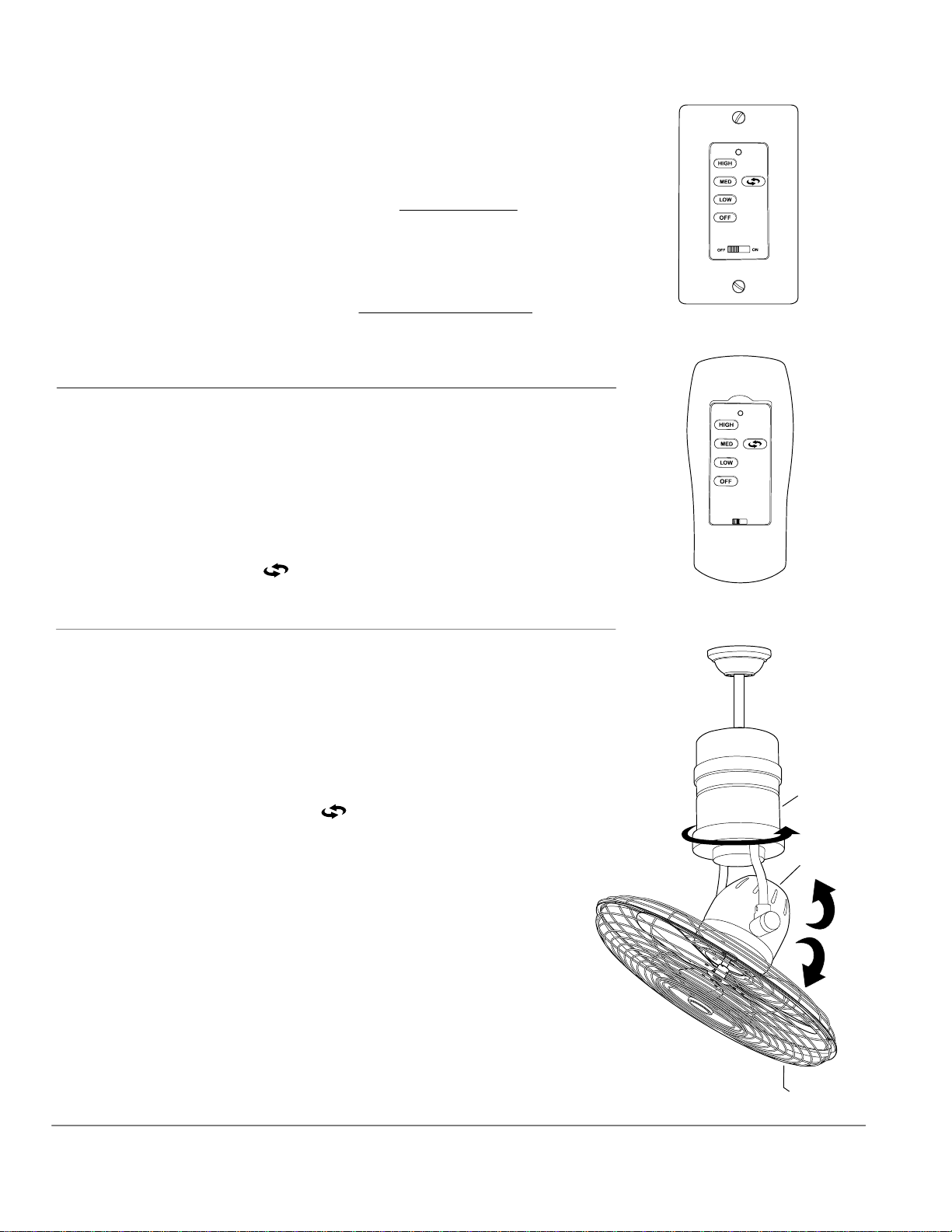
10. Remote Control Operation.
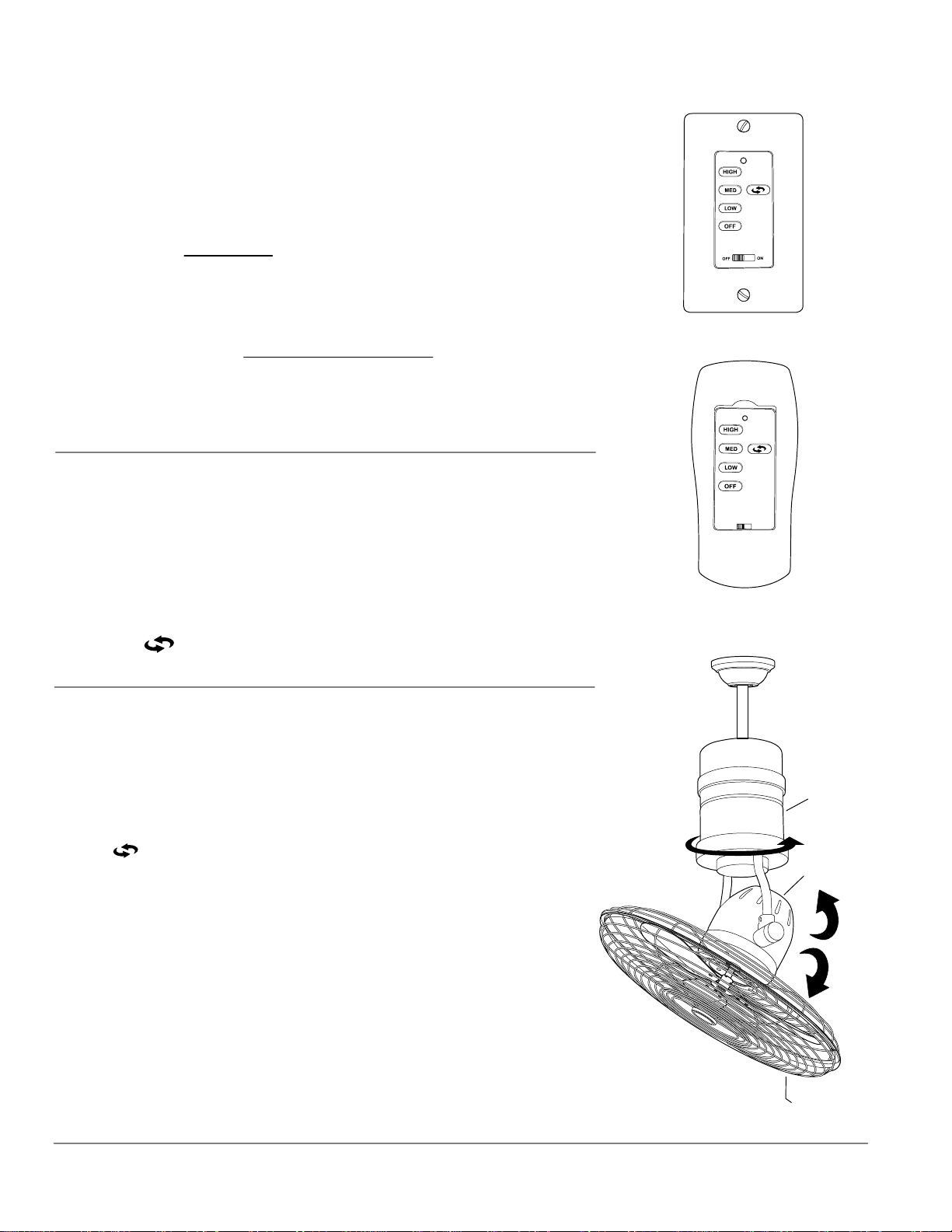
wall control
handheld
remote control
motor
main
fan
lower fan
ON/OFF slider switch -
HIGH button -
MED button -
LOW button -
OFF button -
button -
turns wall control ON or OFF
(switch not functional on handheld remote)
turns lower fan to HIGH speed
turns lower fan to MEDIUM speed
turns lower fan to LOW speed
turns lower fan OFF
turns main fan ON/OFF
(i.e., controls ROTATION of the ENTIRE fan)
The tilt angle of the lower fan may be adjusted up or down by simply
moving the fan motor gently up or down. [Tilt angle limit = 170°]
CAUTION: To avoid personal injury or damage to the fan, the fan
MUST BE TURNED OFF before adjusting the tilt angle.
page 9
Warranty.
Troubleshooting.
Parts Replacement.
For parts and information, please refer to
"Parts Inventory" on page 2.
Craftmade/Ellington Customer Support:
1-800-486-4892
www.craftmadebrands.com
CRAFTMADE/ELLINGTON LIFETIME WARRANTY:
CRAFTMADE/ELLINGTON warrants this Indoor/Damp
Location fan to the original household purchaser for use
under the following provisions:
1-YEAR WARRANTY: CRAFTMADE/ELLINGTON will replace
or repair any fan which has faulty performance due to a
defect in material or workmanship. Contact
Craftmade/Ellington Customer Service at 1-800-486-4892
to arrange for return of fan. Return fan, shipping prepaid, to
Craftmade/Ellington. We will repair or ship you a
replacement fan, and we will pay the return shipping cost.
5-YEAR WARRANTY: CRAFTMADE/ELLINGTON will repair or
replace at no charge to the original purchaser any fan
motor that fails to operate satisfactorily when failure
results from normal use.
RETURN FAN MOTOR ONLY, shipping prepaid, to
Craftmade/Ellington. We will repair or ship purchaser a
replacement motor and Craftmade/Ellington will pay the
return shipping cost.
6-YEAR to LIFETIME LIMITED WARRANTY:
CRAFTMADE/ELLINGTON will repair the fan, at no charge
for labor only to the original purchaser, if the fan motor
fails to operate satisfactorily when failure results from
normal use. Parts used in the repair will be billed to the
purchaser at prevailing prices at time of repair.
The purchaser shall be responsible for all costs incurred
in the removal, reinstallation and shipping of the product
for repairs.
This warranty does not apply when damage from
mechanical, physical, electrical or water abuse results in
causing the malfunction. Deterioration of finishes or other
parts due to time or exposure to salt air is specifically
exempted under this warranty.
Neither Craftmade/Ellington nor the manufacturer will
assume any liability resulting from improper installation or
use of this product. In no case shall the company be liable
for any consequential damages for breach of this, or any
other warranty expressed or implied whatsoever. This
limitation as to consequential damages shall not apply in
states where prohibited.
Problem: Fan fails to operate.
Solutions:
1. Check wall switch to fan/wall control.
2. Check to be sure wall control (optional use) is
wired properly.
3. Verify that receiver is wired properly.
4. Check to be sure fan is wired properly.
5. Learning process between fan, handheld
remote control and, if applicable, wall control may
not have been successful and code was not
activated. Turn off power and repeat instructions
in Section 9, page 8.
6. Check that red light on handheld remote
control turns on when a button is pressed
indicating that the battery is good.
Problem: Fan fails to operate with wall control
(optional) and/or handheld remote control.
Solutions:
1. Check battery power in handheld remote
control.
2. Learning process between fan, handheld
remote control and, if applicable, wall control may
not have been successful and code was not
activated. Turn off power and repeat instructions
in Section 9, page 8.
3. If using optional wall control, check that battery
in wall control is still good.
Problem: Fan wobbles.
Solutions:
1. Check to be sure set screw(s) on motor
assembly yoke is (are) tightened securely.
2. Check to be sure set screw on hanging ball is
tightened securely.
Para modelos:
BW321AG3
BW321SS3
peso neto del ventilador: 7,09 kg (15,63 lb)
Guía de instalación
LEER ESTAS INSTRUCCIONES Y
GUARDARLAS PARA UTILIZACIÓN FUTURA
Índice de materias:
Sugerencias de seguridad. Pág. 1
Desempaquetado del ventilador. Pág. 2
Inventario de piezas. Pág. 2
Preparación para la instalación. Pág. 3
Instalación del soporte de montaje. Pág. 3
Ensamblaje del ventilador. Págs. 4 - 5
Instalación eléctrica. Págs. 5 - 6
Colocación de la cubierta decorativa. Pág. 6
Ensamblaje del control remoto de mano.
Pág. 7
Proceso de aprendizaje automático./
El activar el código. Pág. 8
Funcionamiento del control remoto. Pág. 8
Verificación del funcionamiento del
ventilador. Pág. 8
Localización de fallas. Pág. 9
Garantía. Pág. 9
Piezas de repuesto. Pág. 9
IMPRESO EN CHINA
Bellows III
APROBADO PARA
LUGAR HUMEDO
3171583

página 1
SUGERENCIAS DE SEGURIDAD.
ADVERTENCIA: Para evitar la posibilidad de una descarga eléctrica, desconectar la corriente en la caja de fusibles
principal o el interruptor protector antes de iniciar la instalación del ventilador o antes de repararlo o instalar
accesorios.
1. LEER TODAS LAS INSTRUCCIONES E INFORMACIÓN DE SEGURIDAD CUIDADOSAMENTE ANTES DE
INSTALAR SU VENTILADOR Y GUARDAR ESTAS INSTRUCCIONES.
PRECAUCIÓN: Para reducir el riesgo de daño corporal, es posible que sea necesario usar guantes al manejar las piezas
del ventilador que tengan bordes afilados.
2. Asegurarse de que todas las conexiones eléctricas cumplan con los Códigos o las Ordenanzas Locales, el Código
Nacional Eléctrico, y ANSI/NFPA 70-1999. Si usted no está familiarizado con el alambrado eléctrico o los
cables de la casa/el edificio son de colores diferentes a los cuales se refieren en las instrucciones, favor de
buscar un electricista calificado.
3. Asegurarse de que haya localizado una ubicación para su ventilador que permite el espacio necesario para el
ventilador y por lo menos 3,05 metros (10 pies) de espacio libre entre el piso y la caja protectora del
ventilador. Debe instalar el ventilador para que los bordes de la caja protectora del ventilador queden a una
distancia de por lo menos 76 centímetros (30 pulgadas) de las paredes y otras estructuras verticales.
4. La caja de salida eléctrica debe estar bien sujetada a la viga de soporte del techo y deben ser capaces de
sostener por lo menos 16 kilogramos (35 libras). La caja debe tener apoyo directo de la estructura del
edificio. Sólo usar cajas de salida registradas con CETL o
CUL en Canadá o ETL o UL en EEUU
que indiquen
que "sirven para ventilador" ("FOR FAN SUPPORT" en inglés).
ADVERTENCIA: Para reducir el riesgo de incendio, descarga eléctrica o daño corporal, instalar en la caja de salida
marcada "Aceptable para sostener ventilador de 15,9 kg (35 lb) o menos" ["Acceptable for Fan Support of 15.9 kg (35
lb) or less"] y utilizar los tornillos proporcionados con la caja de salida. La mayoría de las cajas de salida que se usan
normalmente para sostener los aparatos de alumbrado no siempre son apropiadas para sostener ventiladores y es
posible que las tenga que reemplazar. En caso de duda, consultar con un electricista calificado.
ADVERTENCIA: Para reducir el riesgo de incendio, descarga eléctrica o daño corporal, los conectores para cable
provistos con este ventilador son diseñados para aceptar sólo un cable de calibre 12 de la casa y dos cables principales
del ventilador. Si el calibre del cable de la casa es superior al 12 o hay más de un cable de la casa para conectar a los
cables principales del ventilador al cual corresponda cada uno, consultar con un electricista para informarse sobre el
tamaño correcto de conectores para cable que se debe usar.
5. Los diagramas eléctricos son únicamente para referencia.
6. Después de haber terminado la instalación, asegurarse de que todas las conexiones estén totalmente seguras.
7. Después de haber terminado todas las conexiones eléctricas, los conductores empalmados deben ser volteados
para arriba y colocados cuidadosamente dentro de la caja de salida. Los alambres se deben de separar con el
conductor a tierra a un lado y el conductor a tierra del equipo al lado opuesto.
ADVERTENCIA: Para reducir el riesgo de incendio o un choque eléctrico, no usar el ventilador con ningún control de
velocidad de estado sólido ni controlar la velocidad del ventilador con un interruptor con reductor de luz de gama
completa. [El usar un interruptor con reductor de luz de gama completa para controlar la velocidad del ventilador
causará un zumbido recio del ventilador.]
8. No utilizar el interruptor de reversa hasta que el ventilador se haya parado completamente.
9. No insertar ningún objeto entre las aspas mientras estén rotando.
ADVERTENCIA: Para reducir el riesgo de daño corporal, no doblar ni alterar la caja del ventilador durante el
ensamblaje ni durante la instalación. No insertar objetos entre las aspas mientras estén rotando.
ADVERTENCIA: Para reducir el riesgo de daño corporal o algún daño al ventilador, tener cuidado al estar trabajando
alrededor del ventilador o limpiándolo.
10. No utilizar agua ni detergentes para limpiar el ventilador ni las aspas. Usar un trapo seco o ligeramente
húmedo para su limpieza general.
ADVERTENCIA: Para reducir el riesgo de daño corporal, usar sólo las piezas provistas con este ventilador. Al usar
piezas DISTINTAS a las provistas con este ventilador se invalidará la garantía.
NOTA: No se debe concluir que las precauciones de seguridad importantes e instrucciones en este manual van a
abarcar todas las condiciones y situaciones posibles que puedan ocurrir. Se debe entender que el sentido común y la
precaución son factores necesarios en la instalación y la operación de este ventilador.
página 2
2. Inventario de piezas.
a. cubierta decorativa. 1 unidad
b. soporte de montaje (sujetado de antemano a
la cubierta decorativa). 1 unidad
c. tubo y bola que sirve para colgar. 1 unidad
d. receptor del control remoto. 1 unidad
e. tapa de tomacorriente. 1 unidad
f. cubierta del control remoto. 1 unidad
g. control de pared. 2 unidades
h. tapa de la cubierta decorativa (sujetada de
antemano a la cubierta decorativa). 1 unidad
i. tapa. 3 unidades
j. adaptador de estabilización (en paquete de
artículos de ferretería). 1 unidad
k. unidad del motor. 1 unidad
l. cubierta del cuello. 1 unidad
m. paquetes de artículos de ferretería
1. Desempaquetado del ventilador.
Abrir el empaque cuidadosamente. Sacar los artículos
del embalaje. Sacar la unidad del motor y ponerla en
una alfombra o en el embalaje para evitar rayar el
acabado. Guardar la caja de cartón o el
empaquetamiento original en caso de que tenga que
mandar el ventilador para alguna reparación.
Comprobar las piezas del ventilador con el inventario
de piezas y verificar que se incluyeron todas.
RECORDATORIO IMPORTANTE: Se tienen
que utilizar las piezas provistas con este ventilador
para una instalación adecuada y su seguridad.
m
con el control
de pared
con el control
a
b
c
d
k
j
h
l
ef
i
g
página 3
3. Preparación para la instalación.
Para prevenir daño corporal y otros daños, estar
seguro de que el lugar en donde va a colgar el
ventilador le permite un espacio libre de 3,05m
(10 pies) entre la caja protectora del ventilador y el
piso y 76cm (30 pulg.) entre el borde de la caja
protectora y cualquier pared u otra obstrucción.
Este ventilador es adecuado para habitaciones hasta
37,2 metros cuadrados (400 pies cuadrados).
Este ventilador SÓLO se puede colgar con el tubo en
un techo regular (sin inclinación). NO SE PUEDE colgar
el ventilador al ras con el techo NI en un techo
abovedado.
Se necesitan las herramientas siguientes para la
instalación:
Destornillador de estrella Phillips, destornillador de
paleta (plano), alicates ajustables o llave de tuercas,
escalera de tijera, cortaalambres y cinta aisladora.
borde del aspa
3,05m
(10 pies)
76cm
(30
pulg.)
instalación
con tubo
instalación al
ras con el techo
NO se permite
instalar en
techo angulado
ni abovedado.
3,66m - 6,1m
3,66m - 6,1m
12 pies - 20 pies
12 pies - 20 pies
4. Instalación del soporte de montaje.
Apagar los cortacircuitos en el panel de electricidad que
suplen corriente a la caja de salida y asegurarse de que el
interruptor de luz esté APAGADO.
ADVERTENCIA: El no desconectar el suministro de fuerza antes
de la instalación puede tener por resultado lesiones graves.
Quitar el aparato existente.
ADVERTENCIA: Si utiliza una caja de salida existente, asegurarse
de que la caja de salida esté firmemente conectada a la
estructura del edificio y que sea capaz de sostener el peso total
del ventilador. Asegurarse de que la caja de salida indique
claramente que "Sirve para ventilador" (FOR FAN SUPPORT); si no,
se debe reemplazar con una caja de salida aprobada. El no hacer
el cambio si es necesario puede resultar en lesiones graves.
PRECAUCIÓN: Asegurarse de que la caja de salida esté
conectada a tierra correctamente y que haya un conductor a
tierra (cable VERDE o pelado).
Quitar la tapa de la cubierta decorativa de la cubierta
decorativa girándola en sentido contrario al del reloj. Sacar el
soporte de montaje de la cubierta decorativa.
Instalar el soporte de montaje utilizando los tornillos
originales, las arandelas de resorte y las arandelas planas de su
nueva o existente caja de salida.* Arreglar el alambrado
eléctrico (los cables) en la parte de atrás del soporte y lejos de
la abertura del soporte.
*NOTA: Es muy importante usar los artículos de ferretería
correctos al instalar el soporte de montaje puesto que sirve para
sostener el ventilador.
soporte de montaje
arandelas de resorte
tornillos de la
caja de salida
arandelas planas
ON
OFF
ON
OFF
tapa de la
cubierta
decorativa
cubierta
decorativa
página 4
5. Ensamblaje del ventilador.
unidad
del motor
NOTA: No se debe concluir que las precauciones de seguridad
importantes e instrucciones en este manual van a abarcar
todas las condiciones y situaciones posibles que puedan
ocurrir. Se debe entender que el sentido común y la precaución
son factores necesarios en la instalación y la operación de este
ventilador.
bola que
sirve para
colgar
perno
de tope
tornillo
de fijación
adaptador de
estabilización
cubierta
del cuello
tapa de la
cubierta decorativa
cableado
tubo
perno
de tope
diagrama 1
clavija
perno
tubo
clavija
diagrama 2
diagrama 3
diagrama 4
unidad
del motor
perno
tornillo de fijación
del cuello y tuerca
cubierta
decorativa
cable de
seguridad
cubierta
decorativa
agujero para el
tornillo de fijación
bola que sirve
para colgar
Quitar la bola que sirve para colgar del tubo provisto
aflojando el tornillo de fijación de la bola que sirve para
colgar. Bajar la bola que sirve para colgar y sacar el perno de
tope y luego quitar la bola que sirve para colgar deslizándola.
[Referirse al diagrama 1.]
Aflojar los tornillos de fijación del cuello y las tuercas en la
parte superior de la unidad del motor. Quitar el perno y la
clavija del cuello en la unidad del motor.
[Referirse al
diagrama 2.]
Sugerencia: Para preparar los cables para pasarlos por el
tubo, poner un pedacito de cinta aisladora en la punta de los
cables--esto mantendrá los cables juntos al pasarlos por el
tubo.
[Referirse al diagrama 2.]
Determinar el largo del tubo que desea usar. Pasar los cables
del ventilador y el cable de seguridad a través del extremo
roscado del tubo y con cuidado jalar el cableado en exceso
por la parte de arriba del tubo.
[Referirse al diagrama 2.]
Enroscar el tubo en el cuello de la unidad del motor hasta
alinearse los agujeros para el perno y la clavija en el tubo con
los del cuello—asegurarse de que no se tuerzan los cables.
Volver a introducir el perno y la clavija que se quitaron
anteriormente. Apretar los tornillos de fijación del cuello y la
tuerca completamente.
[Referirse al diagrama 2.]
Localizar el adaptador de estabilización en uno de los
paquetes de artículos de ferretería. Deslizar la cubierta del
cuello, la tapa de la cubierta decorativa, el adaptador de
estabilización y la cubierta decorativa por el tubo. (NOTA: Se
tiene que voltear la tapa de la cubierta decorativa para que el
lado brillante dé a la unidad del motor. Se tiene que voltear el
adaptador de estabilización para que el extremo más ancho
dé a la cubierta decorativa.)
[Referirse al diagrama 3.]
Pasar el cable de seguridad y los cables por la bola que sirve
para colgar y luego deslizar la bola que sirve para colgar
sobre el tubo--la parte de arriba del tubo debe tener el
agujero para el tornillo de fijación en ese extremo; usar ese
agujero al colocar el tornillo de fijación. Introducir el perno de
tope en la parte de arriba del tubo y subir la bola que sirve
para colgar. Asegurarse de que el perno de tope se ponga en
línea con las ranuras dentro de la bola que sirve para colgar.
Apretar bien el tonillo de fijación.
[Referirse al diagrama 4.]
ADVERTENCIA: Si no se aprieta bien el tornillo de fijación
(en la bola que sirve para colgar) es posible que se afloje el
ventilador y que se caiga.
[El "Ensamblaje del ventilador" continúa en la página
siguiente].
tornillo de fijación
y tuerca
página 5
6. Instalación eléctrica.
ADVERTENCIA
: Apagar los cortacircuitos en el panel de
electricidad que suplen corriente a la caja de salida y
asegurarse de que el interruptor de luz esté APAGADO.
PRECAUCIÓN: Asegurarse de que la caja de salida esté
conectada a tierra como es debido y que exista un
conductor a tierra (VERDE o pelado).
Asegurarse de que todas las conexiones eléctricas cumplan
con los Códigos o las Ordenanzas Locales y el Código
Nacional Eléctrico. Si usted no está familiarizado con el
alambrado eléctrico o los cables de la casa/el edificio son
de colores diferentes a los cuales se refieren en el diagrama
al lado, favor de buscar un electricista calificado.
Una vez que el ventilador esté bien sujeto en el soporte
de montaje, alambrar el RECEPTOR con los conectores
para cable provistos así como se muestra en el diagrama
al lado.
Sugerencia: Mientras está haciendo la instalación
eléctrica, recordar que los cables no deben impedir el
posicionamiento del receptor en el soporte de montaje.
* Como una medida de seguridad adicional, envolver
cada conectador para cable por separado con cinta
aisladora.
Meter el receptor (con el lado plano hacia arriba) en el
soporte de montaje y delicadamente meter los
conectores para cable que tienen cinta dentro de la caja
de salida. Dejar que la antena se quede fuera del soporte
de montaje.
negro
negro
del receptor
del ventilador
blanco
blanco
azul
del techo
del receptor
azul
alambre conductor negro
blanco
Entrada CA N
receptor
toma de
tierra (verde
o pelada)
negro
Entrada CA L
antena
alambre conductor blanco
negro
(cableado para el receptor)
unidad del motor
cable de
seguridad
tornillo para
madera y
arandela
bucle del cable
de seguridad
viga de
madera
5. Ensamblaje del ventilador. (cont.)
parte saliente del
soporte de montaje
ranura en la bola
que sirve para colgar
que pase justo sobre la punta de la parte roscada del tornillo para madera. Poner el cable a prueba, jalando
con un alicate la parte suelta en la punta del cable. Si el cable se desliza o se reduce el bucle del cable por donde
pasa el tornillo, hay que ajustar el bucle de nuevo. Se puede poner el cable en exceso en el área del techo.
Ya que esté sujetado el soporte de montaje a la caja de salida y capaz
de apoyar el ventilador, usted está listo para colgar el ventilador.
Agarrar el ventilador firmemente con las dos manos. Deslizar el tubo
por la abertura del soporte de montaje y dejar que se detenga la
bola en el soporte de montaje. Girar la bola que sirve para colgar
hasta que la ranura de la bola se alinee con la parte saliente del
soporte de montaje.
ADVERTENCIA: El no alinear la ranura en la bola que sirve para
colgar con la parte saliente del soporte de montaje puede causar
lesiones graves o la muerte.
IMPORTANTE: Solicitar ayuda de otra persona para mantener sujeta
la escalera y luego para ayudarle a subir el ventilador cuando usted
ya esté preparado en la escalera para colgarlo.
Encontrar un punto de acoplamiento seguro (se recomienda la viga
de madera en el techo) y asegurar el cable de seguridad. Utilizar
tornillo para madera para trabajos pesados, arandela y arandela de
seguridad (no provistos) en el bucle del cable de seguridad. Si es
necesario, ajustar el bucle en el extremo del cable de seguridad. El
bucle en el extremo del cable de seguridad debe ser de tal tamaño
blanco
página 6
7. Colocación de la cubierta decorativa.
Quitar los 2 tornillos de la parte inferior del soporte de
montaje.
Subir la cubierta decorativa hasta el soporte de montaje.
Alinear los agujeros en la cubierta decorativa con los agujeros
en el soporte de montaje. Manteniendo la cubierta decorativa
en su lugar, subir el adaptador de estabilización hasta la
cubierta decorativa. Alinear los agujeros en el adaptador de
estabilización con los agujeros en la parte inferior de la
cubierta decorativa y luego volver a introducir los tornillos
que se quitaron anteriormente. Apretar bien ambos tornillos.
Subir la tapa de la cubierta decorativa hasta el adaptador de
estabilización, alineando la parte redondeada de los agujeros
con ranura en la tapa de la cubierta decorativa con las
cabezas de tornillo en el fondo del adaptador de
estabilización. Girar la tapa de la cubierta decorativa a la
derecha (en el sentido de las agujas del reloj) hasta que ya no
gire.
*Recordar que la antena del receptor del control remoto debe
quedar fuera del soporte de montaje.
cubierta
decorativa
soporte de
montaje
tapa de la cubierta
decorativa
antena
adaptador de
estabilización
6. Instalación eléctrica. (cont.)
Las modificaciones no aprobadas por la parte responsable de la conformidad
podrían invalidar la autorización del usuario para manejar el equipo.
*NOTA: Se han hecho pruebas en este equipo y se ha comprobado que cumple con los límites para un
aparato digital de clase B, de acuerdo con la Parte 15 de las Reglas de la FCC. Se concibieron estos
límites para proveer protección razonable contra la interferencia adversa en una instalación residencial.
Este equipo produce, usa y puede radiar energía de radiofrecuencia y, si no se instala y no se usa según
las instrucciones, puede causar interferencia adversa en la radiocomunicación. Sin embargo, no hay
ninguna garantía de que no habrá interferencia en una instalación en particular. Si este equipo sí causa
interferencia adversa en la recepción de radio o televisión, que se puede determinar apagando y
prendiendo el equipo, se le urge al usuario a intentar rectificar la interferencia tomando una o más de
las medidas que siguen:
* Orientar la antena de nuevo o localizarla en otro sitio.
* Aumentar la separación entre el equipo y el receptor.
* Conectar el equipo a un tomacorriente en un circuito distinto al cual está
conectado el receptor.
Solicitar ayuda del distribuidor o un técnico de radio/televisión.
verde
negro
tierra
verde/
pelado
tapa de
tomacorriente
tapa
(cableado para
el control de pared)
caja de salida
control de pared
batería de 12V
negro (AL ventilador)
negro (ENTRADA CA
del cortacircuitos)
negro
(AL SUMINISTRO
de fuerza)
[FAVOR DE DARSE CUENTA: Hay que utilizar el
control de pared y/o el control remoto de mano
para que funcione el ventilador. Si no desea utilizar
el control de pared, favor de pasar a la sección 7 para
seguir con la instalación del ventilador.]
Para instalar el control de pared, quitar el
interruptor de pared existente. Alambrar uno de
los controles de pared con los conectores para
cable provistos así como se muestra en el diagrama
al lado.
*Como una medida de seguridad adicional,
envolver cada conector para cable con cinta
aisladora. Delicadamente meter los cables y los
conectores para cable que tienen cinta dentro de
la caja de salida.
Instalar 1 batería de 12 voltios (incluida) en el
control de pared.
IMPORTANTE: El control de pared no funcionará
sin que se instale la batería.
Escoger una tapa (blanca o color almendra) y
apretarla firmemente en la parte delantera del
control de pared. Sujetar el control de pared a la
caja de salida y asegurarlo con los tornillos del
interruptor de pared original. Sujetar la tapa de
tomacorriente (incluida) al control de pared
usando los 2 tornillos provistos con el control de
pared.
página 7
8. Ensamblaje del control remoto de mano.
PARA PODER UTILIZAR EL CONTROL REMOTO
DE MANO, FAVOR DE SEGUIR CON LA SECCIÓN 8
para armar el control remoto. Si ya se instaló el
control de pared pero no desea utilizar el control
remoto de mano, favor de pasar a la sección 9.
Con cuidado separar la cubierta del control
remoto, despegando la parte superior de la
inferior. [Referirse al diagrama 1.]
Para utilizar el control de pared como control
remoto de mano, cortar cada cable en el
control de pared (que no se usó
anteriormente)--usar cortaalambres para
cortar cada cable para que se quede tan corto
como sea posible. [Referirse al diagrama 2.]
Instalar 1 batería de 12 voltios (incluida) en el
control de pared. [Referirse al diagrama 2.]
Fijar la tapa negra a la parte delantera del
control de pared; apretar la tapa fijamente.
[Referirse al diagrama 3.]
Alinear los agujeros en el control de pared
con los postes que se encuentran adentro de
la parte SUPERIOR de la cubierta del control
remoto y apretar fijamente. Colocar el
control de pared dentro de la parte
INFERIOR de la cubierta del control remoto,
alineando los postes en la parte superior de
la cubierta del control remoto con los
agujeros para los postes en la parte inferior.
[Referirse al diagrama 3.] (NOTA: Asegurarse
de alinear los extremos más angostos de la
cubierta del control remoto antes de
cerrarla.) Apretar la parte superior e inferior
de la cubierta del control remoto hasta que
se oiga un “clic” en cada extremo, lo cual
indicará que se haya cerrado
completamente la cubierta del control
remoto.
IMPORTANTE: Guardar el control remoto lejos
del calor excesivo o la humedad. Para prevenir
daño al control remoto, sacar la batería si no
se va a utilizar el control remoto por un
tiempo extendido.
(parte
superior)
(parte
inferior)
cubierta del
control remoto
diagrama 1
diagrama 2
control de pared
cable
cable
cable
batería de 12V
control
de pared
tapa
cubierta del
control remoto,
parte INFERIOR
poste
agujero
agujero
para el
poste
cubierta del
control remoto,
parte SUPERIOR
diagrama 3
página 8
11. Verificación del funcionamiento
del ventilador.
Se le recomienda poner el ventilador a prueba antes de terminar la
instalación. Regresar la corriente de electricidad en el cortacircuitos y el
interruptor de la luz (si se aplica). Poner a prueba el control de pared
(instalación opcional) localizando el interruptor corredero de APAGADO y
ENCENDIDO en el control de pared, luego ponerlo en posición de
ENCENDIDO (ON). Poner a prueba la función de ROTACIÓN y APAGADO
del ventilador principal con el botón ; poner a prueba las velocidades
del ventilador inferior con los diferentes botones de velocidad y el botón
de apagado (OFF). Luego, localizar el control remoto. Verificar las
velocidades del ventilador (y el apagado, OFF) con los diferentes botones
de velocidad de ventilador y poner a prueba la rotación del ventilador
principal (y el apagado, OFF) igual que se hizo con el control de pared. Si
el control de pared y/o el control remoto maneja(n) todas las funciones
de ventilador, se ha instalado bien la batería en el/cada control. Si el
control de pared y/o el control remoto no controla(n) todas las funciones
del ventilador, favor de referirse a la sección "Localización de fallas" para
resolver cualquier asunto antes de comunicarse con el Servicio al Cliente.
PRECAUCIÓN: Se puede programar el control de pared/control remoto de
mano para usar con varios receptores o ventiladores. Si no desea hacer esto,
apagar el interruptor de cualquier otro receptor o ventilador programable.
Conectar la electricidad y luego, si se instaló el control de pared, poner el
interruptor corredero en el control de pared en posición ON (encendido).
Dentro de 60 segundos de haber prendido el control de pared, oprimir el
botón OFF en el control de pared por 5 segundos (o hasta que las aspas
del ventilador comiencen a girar).
Cortar la corriente de nuevo por 5 segundos como mínimo y luego volver
a conectar la electricidad. Dentro de 60 segundos de haber conectado la
electricidad, oprimir el botón OFF en el control remoto de mano por
5 segundos (o hasta que las aspas del ventilador comiencen a girar).
Poner a prueba la función de ventilador para confirmar que se haya
terminado el proceso de aprendizaje--ver la sección 11 a continuación.
9. Proceso de aprendizaje automático./El activar el código.
10. Funcionamiento del control remoto.
motor
ventilador
inferior
ventilador
principal
control de pared
control remoto
de mano
Se puede ajustar el ángulo de inclinación del ventilador inferior hacia arriba o
hacia abajo con tan sólo mover el motor del ventilador cuidadosamente hacia
arriba o hacia abajo. [Límite del ángulo de inclinación = 170°]
PRECAUCIÓN: Para evitar daño corporal o daño al ventilador, el ventilador
TIENE QUE ESTAR APAGADO antes de ajustar el ángulo de inclinación.
Interruptor corredero ON/OFF -
Botón HIGH -
Botón MED -
Botón LOW -
Botón OFF -
Botón -
ENCIENDE y APAGA el control de pared
(el interruptor no funciona en el control
de mano)
pone el ventilador inferior en velocidad ALTA
pone el ventilador inferior en velocidad MEDIA
pone el ventilador inferior en velocidad BAJA
APAGA el ventilador inferior
ENCIENDE/APAGA el ventilador principal
(es decir, controla la ROTACIÓN del
ventilador ENTERO)

Localización de fallas.
ADVERTENCIA: El no desconectar el suministro de
fuerza eléctrica antes de hacer localización de fallas
para cualquier problema de instalación eléctrica
puede causar lesiones graves.
Garantía.
GARANTÍA LIMITADA DE POR VIDA DE
CRAFTMADE/ELLINGTON:
CRAFTMADE/ELLINGTON garantiza este ventilador de
interior/con aprobación para lugar húmedo al comprador
original de grupo familiar para uso con las siguientes
condiciones:
GARANTÍA DE 1 AÑO: CRAFTMADE/ELLINGTON reemplazará
o reparará cualquier ventilador que tenga funcionamiento
deficiente debido a defectos en los materiales o trabajo
manual. Comunicarse con el Servicio al Cliente de
CRAFTMADE/ELLINGTON al 1-800-486-4892 para acordar el
reenvío del ventilador. Devolver el ventilador, con los gastos
de envío prepagados, a Craftmade/Ellington. Nosotros
repararemos o reemplazaremos el ventilador y pagaremos
los gastos de envío de regreso.
GARANTÍA DE 5 AÑOS: CRAFTMADE/ELLINGTON
reemplazará o reparará sin costo al comprador original,
cualquier motor de ventilador que no funcione de manera
satisfactoria a causa de uso normal.
DEVOLVER EL MOTOR SOLAMENTE, los gastos de envío
prepagados, a Craftmade/Ellington. Nosotros repararemos
el motor al comprador o le enviaremos uno de reemplazo y
Craftmade/Ellington pagará los gastos de envío de regreso.
GARANTÍA LIMITADA DE 6 AÑOS hasta DE POR VIDA:
CRAFTMADE/ELLINGTON reparará el ventilador, sin costo al
comprador original por el coste laboral, si el motor del
ventilador no funciona satisfactoriamente a causa del uso
normal. Las piezas que se utilizan en hacer la reparación
serán facturadas al comprador a los precios prevalecientes
en el momento de la reparación.
El comprador original será responsable de todos los gastos
incurridos en sacar, reinstalar y enviar el producto para
reparación.
Esta garantía no se aplica cuando el ventilador tenga
daños por abuso mecánico, físico, eléctrico o por agua
resultando en su mal funcionamiento. Se exenta
específicamente el deterioro en el acabado u otras partes
debido al tiempo o exposición al aire marino bajo esta
garantía.
Ni Craftmade/Ellington ni el fabricante se harán
responsables por lo que pasa por una instalación
inadecuada o el uso impropio de este producto. La
compañía no se hará responsable en ningún caso de ningún
daño emergente por incumplimiento de esta o cualquier
otra garantía expresada o implicada en absoluto. Esta
limitación de daños emergentes no se aplicará en estados
donde es prohibido.
página 9
Problema: El ventilador no funciona.
Soluciones:
1. Inspeccionar el interruptor de pared del
ventilador/control de pared.
2. Verificar la instalación eléctrica del control de
pared (uso opcional).
3. Asegurarse de que se hizo correctamente la
instalación eléctrica en el receptor.
4. Verificar la instalación eléctrica del ventilador.
5. Es posible que no tuvo éxito el proceso de
aprendizaje entre el ventilador, el control remoto de
mano y, si se aplica, el control de pared y que no se
activó el código. Desconectar la electricidad y repetir
las instrucciones de la sección 9, página 8.
6. Averiguar que la luz roja se prende en el transmisor
del control remoto cuando se oprima un botón, lo
cual significa que sirve la batería.
Problema: No funcionan el ventilador ni la luz con el
control de pared (opcional)/control remoto de mano.
Soluciones:
1. Averiguar la carga de la batería en el control
remoto de mano.
2. Es posible que no tuvo éxito el proceso de
aprendizaje entre el ventilador, el control remoto de
mano y, si se aplica, el control de pared y que no se
activó el código. Desconectar la electricidad y repetir
las instrucciones de la sección 9, página 8.
3. Si se está usando el control de pared opcional,
verificar si aún sirve la batería en el control de pared.
Problema: El ventilador se tambalea.
Soluciones:
1. Averiguar que se apretó (apretaron) bien el (los)
tornillo(s) de fijación en el cuello del bastidor del
motor.
2. Averiguar que se apretó bien el tornillo de fijación
en la bola que sirve para colgar.
Piezas de repuesto.
Para piezas o información, referirse al
"Inventario de piezas" en la página 2.
Servicio al cliente de Craftmade/Ellington:
1-800-486-4892
www.craftmadebrands.com