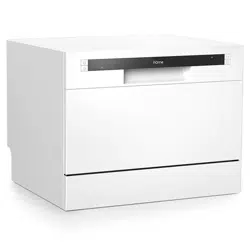
Countertop
Dishwasher
HME010393N
Thank you for purchasing our appliance. Please be sure to read the entirety of this
user manual carefully prior to use of the product. If you have any questions regarding
the use of this product, please call 1-800-898-3002.

In the event this product malfunctions or customer
believes it is defective, the customer should contact
Customer Service at homelabs.com/chat, 1-(800)-898-3002
or help@homelabs.com and retain the defective product
pending further instructions. Defective product should be
clearly marked or stored where it cannot be used again by
mistake. Failure to retain the product may impede hOme
™
’s
ability to correct any legitimate problem and may limit the
extent to which hOme
™
may provide recourse.

TABLE OF CONTENTS
Important Safety Instructions 6
Installation 7-9
Parts Description 10
Operating Instructions 10-20
Cleaning and Maintenance 21-22
Troubleshooting 23-24
Manufacturing Info 26
Contact Us 26


on bringing home your new appliance!
C ongratulations
Don’t forget to register your product at homelabs.com/reg
for updates, coupons, and other relevant information.
Although greatly appreciated, product registration is not
required to activate any warranty.

6
• This dishwasher must be grounded. In the event of a malfunction or breakdown, grounding will reduce the risk of electric
shock by providing a path of least resistance for the electric current. This dishwasher is equipped with a cord with
grounding conductor and a grounding plug.
• The plug must be plugged into an outlet that has been installed and grounded in accordance with all local codes and
ordinances.
• Improper connection of the grounding conductor can result in a risk of electric shock.
• Do not misuse, sit on, or stand on the door or dish rack of the dishwasher.
• Do not operate your dishwasher unless all enclosure panels are properly in place. Open the door very carefully if the
dishwasher is operating, as there is risk of water squirting out.
• Do not place any heavy objects on the door when it is open. The dishwasher could tip forward.
• When loading items to be washed:
1. Locate sharp items so that they do not damage the door seal.
2. WARNING: Knives and other utensils with sharp points must be loaded in the basket with their points down
or placed in a horizontal position.
• When using your dishwasher, do not let plastic items come into contact with the heating element. (This is only applicable
to machines with a visual heating element.)
• Check that the detergent receptible is empty after each wash cycle.
• Do not wash plastic items unless they are marked dishwasher safe or equivalent. For plastic items not marked, check
their manufacturer’s recommendations.
• Only use detergent and rinse aids designed for an automatic dishwasher.
• The door should not be left in the open position as this could present a tripping hazard.
order to avoid a hazard.
• Remove the door to the washing compartment when removing an old dishwasher from service or discarding it.
• Dispose of packing materials properly.
• Only use the dishwasher for its intended function.
• Do not tamper with controls.
• The dishwasher should be connected to the water mains using new hose sets. Old hose sets should not be reused.
• The maximum number of place settings to be washed is 6.
• The maximum permissible inlet water pressure is 1Mpa.
• The minimum permissible inlet water pressure is 0.04Mpa.
CHILD WARNING:
• Children should be supervised to ensure that they do not play with the dishwasher.
• Keep children away from detergent, rinse aid, and the open door of the dishwasher, as there could be some detergent left inside.
• Never use soap, laundry detergent, or hand washing soap in your dishwasher. Keep these products out of reach of children.
• Dishwasher detergents are strongly alkaline, and can be extremely dangerous if swallowed. Avoid contact with skin and
eyes and keep children away from the dishwasher when the door is open.
• This dishwasher is not intended for use by persons (including children) with reduced physical, sensory, or mental
capabilities — or lack of experience and knowledge — unless they have been given supervision or instruction for use of
the dishwasher by a person responsible for their safety. Do not operate your dishwasher unless all enclosure panels are
properly in place. Do not open the door while the dishwasher is in use, as there is risk of water squirting out.
IMPORTANT SAFETY INSTRUCTIONS
SAVE THESE INSTRUCTIONS / HOUSEHOLD USE ONLY
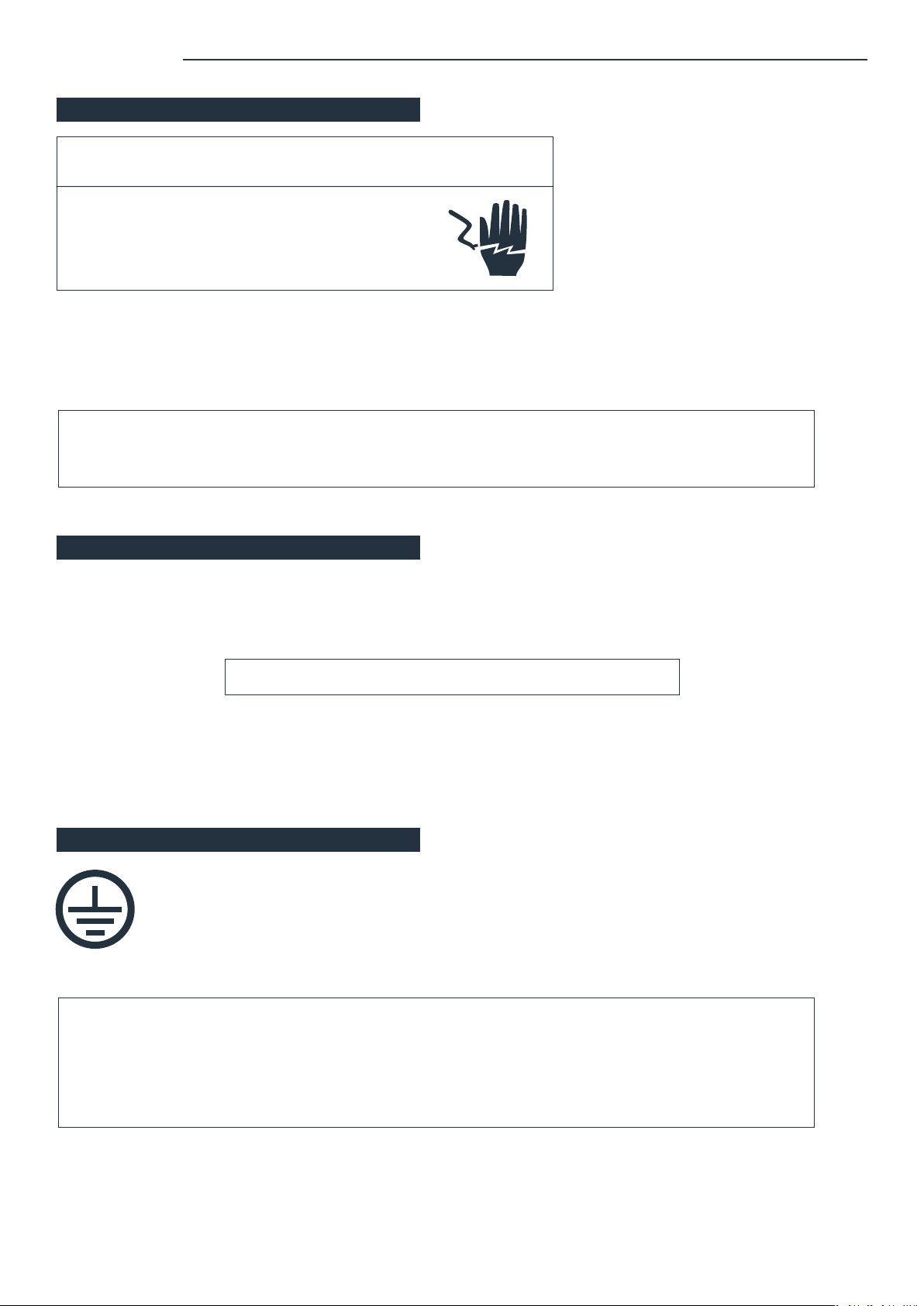
GROUNDING INSTRUCTIONS
WARNING! PROPER USE
WHEN USING YOUR COMPACT DISHWASHER, BASIC SAFETY PRECAUTIONS SHOULD BE FOLLOWED
TO REDUCE THE RISK OF FIRE, ELECTRIC HAZARD, AND INJURY TO PERSONS, INCLUDING THE FOLLOWING:
7
Position your dishwasher in your desired location with its back resting against a wall and the sides adjacent
to cabinets or walls. The dishwasher is equipped with water supply and drain hoses that can be positioned
to the right or the left of it to facilitate proper installation. Position your dishwasher on counter top, do not
place the unit on the ground or other position that much lower than counter top while using.
Electrical Requirements
Please look at the rating label to understand the rating voltage and connect the dishwasher to the appropriate
power supply. Use the required fuse 10 amp, time delay fuse, or circuit breaker recommended and provide a
separate circuit for this dishwasher.
Electrical Connection
Ensure the voltage and frequency of the power outlet corresponds to those on the rating plate. Only insert the
plug into an electrical socket that has been grounded properly. If the socket is not appropriate for the dishwasher,
replace the socket. Do not use adapters, as they may cause overheating or burns.
This dishwasher must be grounded. In the event of a malfunction or breakdown, grounding will
reduce the risk of electrical shock by providing a path of least resistance for the electrical current.
Your dishwasher is equipped with a cord with a grounding conductor and plug. The plug must be
used in an outlet that is grounded in accordance with all local standards and requirements.
POSITIONING THE DISHWASHER
THE POWER CONNECTION
GROUNDING INSTRUCTIONS
INSTALLATION
WARNING! For personal safety:
DO NOT USE AN EXTENSION CORD OR AN ADAPTER PLUG WITH THIS DISHWASHER.
DO NOT, UNDER ANY CIRCUMSTANCES, CUT OR REMOVE THE GROUNDING CONNECTION FROM THE POWER CORD.
WARNING!
Improper connection of the grounding conductor can result in the risk of an electrical shock.
properly grounded.
install a different outlet.
WARNING! ELECTRICAL SHOCK HAZARD
Disconnect electrical power before installing dishwasher.
Failure to do so can result in death or electrical shock.
ATTENTION! All pipe and electrical equipment installation should be
done by professionals.
ENSURE PROPER GROUND EXISTS BEFORE USE
8
WATER CONNECTION
INSTALLATION
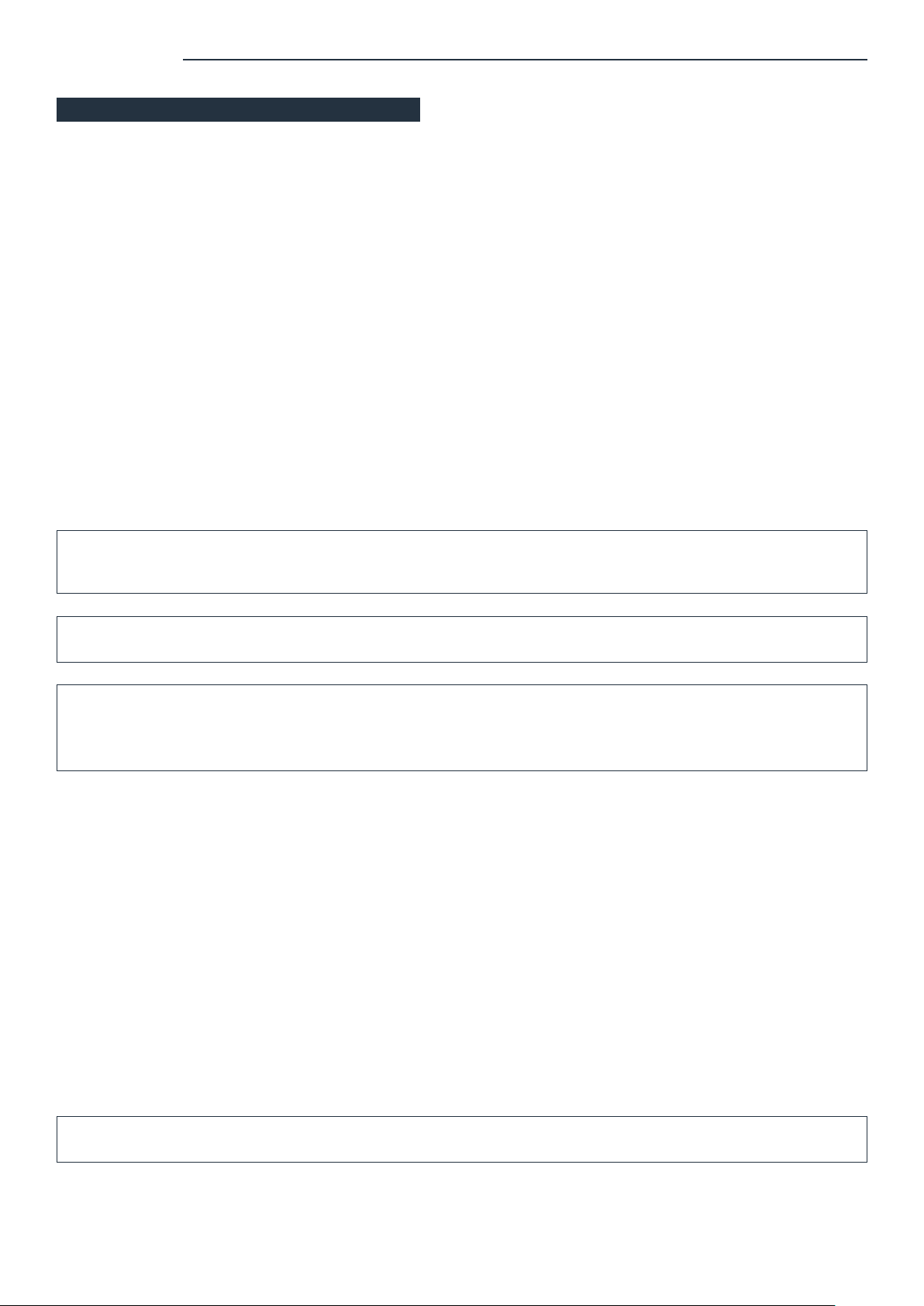
Quick Connect Assembly
Drain Hose:
1. Drain port connector
2. Quick connect connector
Inlet Hose:
3. Inlet port connector
4. Quick conect connector
Faucet Adapter:
6. Faucet washer
Quick Connect:
7. Pressure relief valve
8. Faucet adapter connector
9. Locking collar
10. Inlet hose connector
11. Drain hose connector
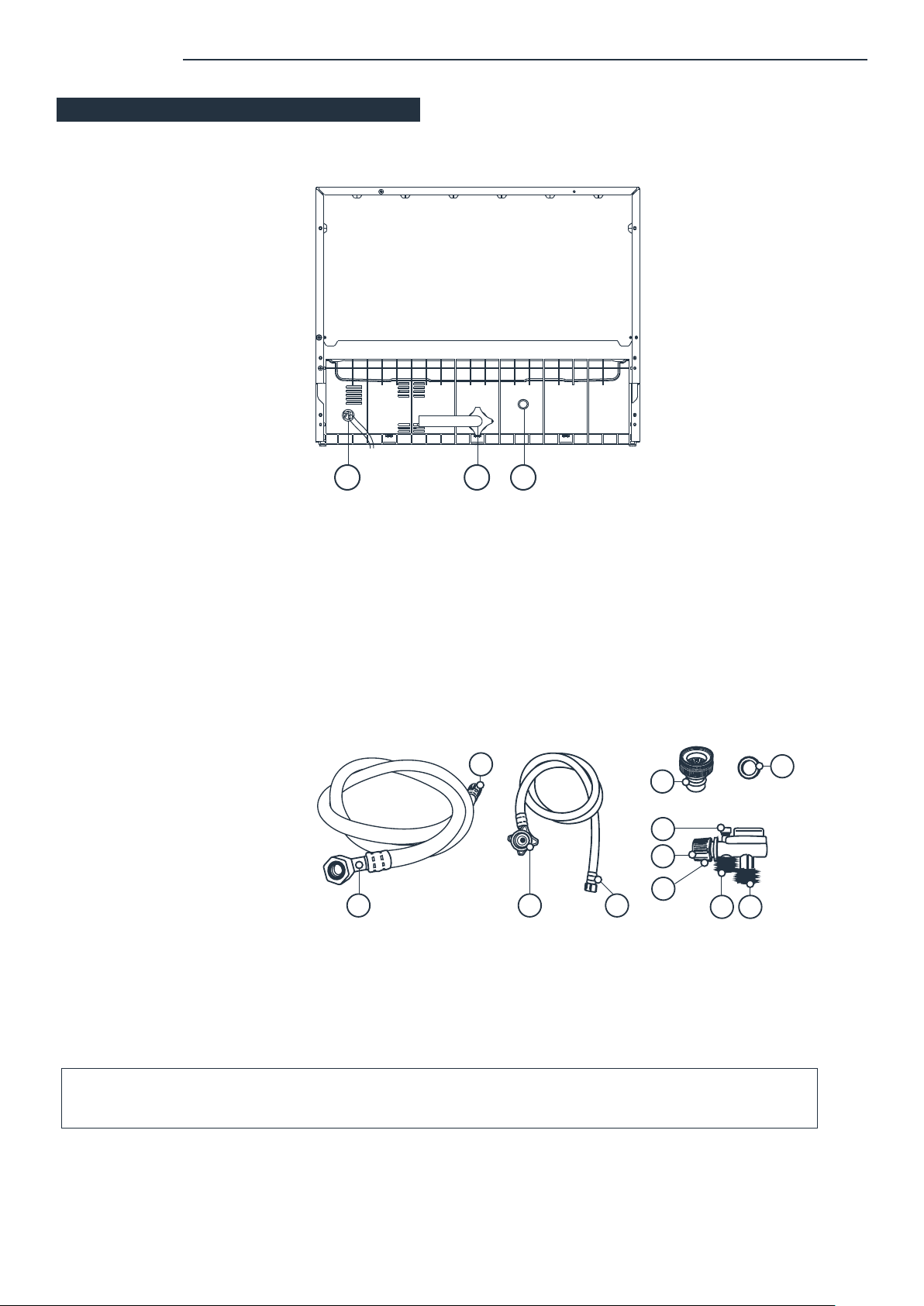
Back of Dishwasher:
1. Drain Port
2. Power Cord
3. Inlet Port
Your dishwasher comes equipped with a ‘quick connect’ assembly that includes an inlet and drain hose.
The faucet adapter must be installed on the faucet before you can connect the dishwasher. This adapter
is included inside your dishwasher. The faucet adapter is compatible with either male (outside) or female
(inside) threaded faucet connections.
WARNING! To avoid water buildup in the inlet hose, close the faucet after use.
Quick Connect Assembly
2 3 1
1
2
3
4
5
7
8
9
10
11
6
9
POSITIONING THE DISHWASHERWATER CONNECTION
INSTALLATION
NOTE: Hard water conditions will negatively affect the performance of your dishwasher. Hard water conditions will also
of the dishwasher once a week while it is empty, using 1 cup of white vinegar.
WARNING! FAILURE TO RELIEVE WATER PRESSURE BEFORE DISCONNECTING THE QUICK-CONNECT FROM THE FAUCET,
WILL RESULT IN BACK-PRESSURE OVER-SPRAY. THE TEMPERATURE OF INCOMING WATER CAN BE VERY HOT, AND BACK-
PRESSURE OVER-SPRAY COULD CAUSE SEVERE BURNS AND/OR SCALDING.
DANGER! DO NOT LET CHILDREN DISCONNECT THE DISHWASHER; CLOSE SUPERVISION OF CHILDREN IS ALWAYS
IMPORTANT AROUND DISHWASHERS.
ATTENTION: The content of this manual can be very helpful to the users. After installation, please make sure to keep
this manual.
2. Connect the hexagonal connector of the drain hose to the drain port on the back of the dishwasher.
Do not over tighten to avoid damage to its threads.
3. Connect the star-shaped connector of the inlet hose to the inlet port on the back of the dishwasher.
Do not over tighten to avoid damage to its threads.
4. Connect the circular connector of the drain hose onto the longer (bottom) male connection on the quick connect.
6. Attach the quick connect onto the faucet adapter, by pulling down the outer locking collar on the quick connect,
while pushing the quick connect upward onto the faucet adapter.
7. When the quick connect snaps onto the faucet adapter, release the locking collar. Check that the connection is secure.
8. Slowly open the hot water line and check for any sign of water leaks at all hose connections. If leaks are located,
immediately close the water supply and repair the hose connections.
IMPORTANT
1. Once the water supply line is opened, the inlet hose will be pressurized, even if the water supply line is immediately
closed.
2. To relieve water pressure from inside the inlet hose, make sure the water line faucet is closed. Then, press and hold the
How to Disconnect the Dishwasher
1. Shut off the water supply at the faucet.
2. Disconnect the power supply cord.
How to Start the Dishwasher
The following things should be checked before starting the dishwasher.
2. The inlet valve is open.
3. There is no leakage at the conductor connections.
4. The wires are tightly connected.
6. The inlet and drain hoses are knotted.
7. All packing materials and printings are taken out from the dishwasher.
10
GETTING TO KNOW YOUR DISHWASHER
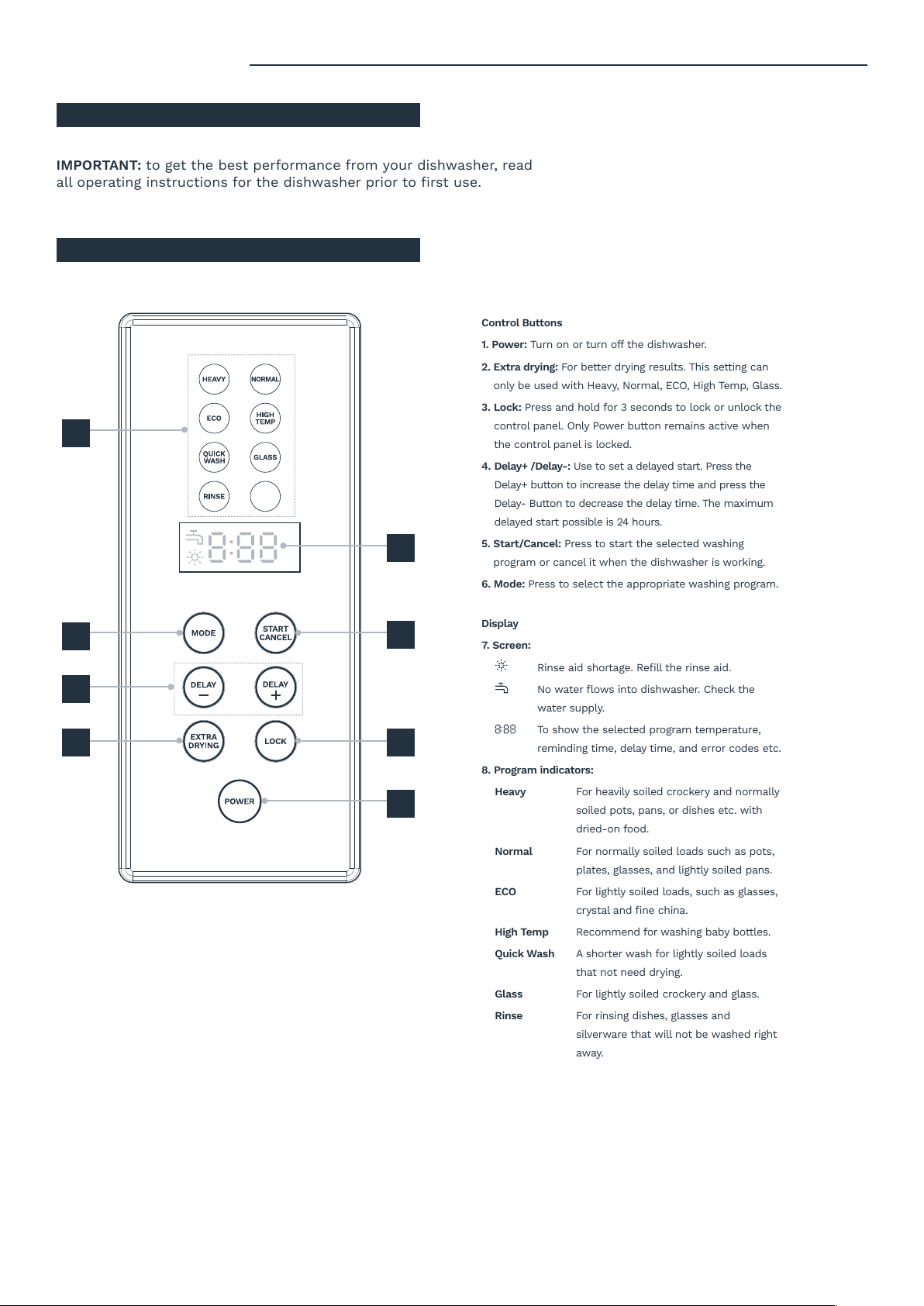
CONTROL PANEL
Control Buons
1. Power: Turn on or turn off the dishwasher.
2. Extra drying: For better drying results. This setting can
only be used with Heavy, Normal, ECO, High Temp, Glass.
3. Lock: Press and hold for 3 seconds to lock or unlock the
control panel. Only Power button remains active when
the control panel is locked.
4. Delay+ /Delay-: Use to set a delayed start. Press the
Delay+ button to increase the delay time and press the
Delay- Button to decrease the delay time. The maximum
delayed start possible is 24 hours.
5. Start/Cancel: Press to start the selected washing
program or cancel it when the dishwasher is working.
6. Mode: Press to select the appropriate washing program.
Display
7. Screen:
Rinseaidshortage.Relltherinseaid.
Nowaterowsintodishwasher.Checkthe
water supply.
To show the selected program temperature,
reminding time, delay time, and error codes etc.
8. Program indicators:
Heavy For heavily soiled crockery and normally
soiled pots, pans, or dishes etc. with
dried-on food.
Normal For normally soiled loads such as pots,
plates, glasses, and lightly soiled pans.
ECO For lightly soiled loads, such as glasses,
crystalandnechina.
High Temp Recommend for washing baby bottles.
Quick Wash A shorter wash for lightly soiled loads
that not need drying.
Glass For lightly soiled crockery and glass.
Rinse For rinsing dishes, glasses and
silverware that will not be washed right
away.
IMPORTANT: to get the best performance from your dishwasher, read
all operating instructions for the dishwasher prior to rst use.
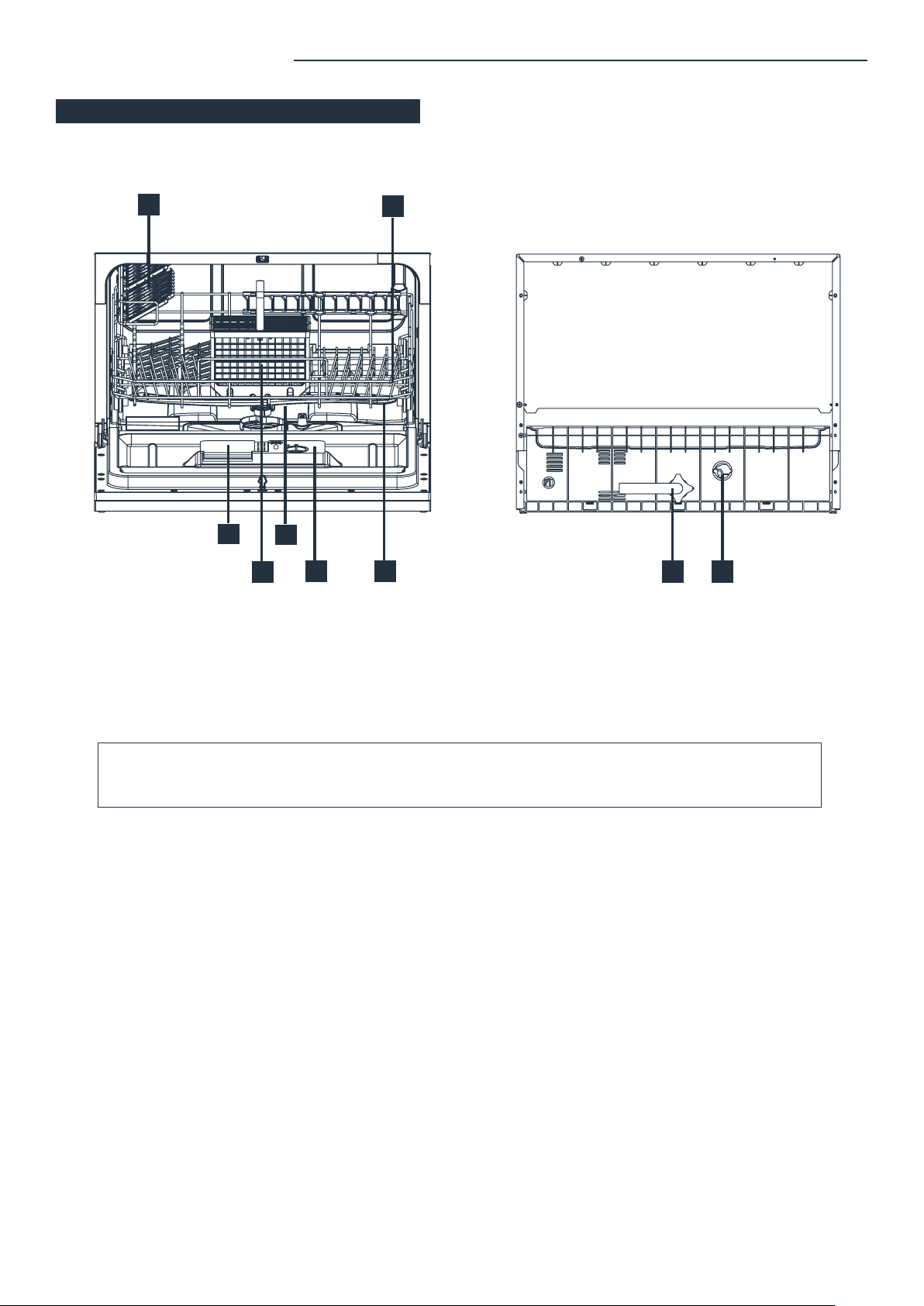
PARTS DESCRIPTION
1
3
7
4
6
8
2
11
OPERATING INSTRUCTIONS
DISHWASHER FEATURES
1. Cup Shelf
2. Basket
3. Detergent Dispenser
4. Filter
6. Rinse Aid Dispenser
7. Spray Arms
8. Inlet Pipe Connector
9. Drain Pipe Connector
IMPORTANT: If the display shows E4 and/or water leaks from the base of the dishwasher, unplug the power,
8 9
1
2
5
4
6
7
3
12
OPERATING INSTRUCTIONS
HOW TO USE THE RINSE AID DISPENSER
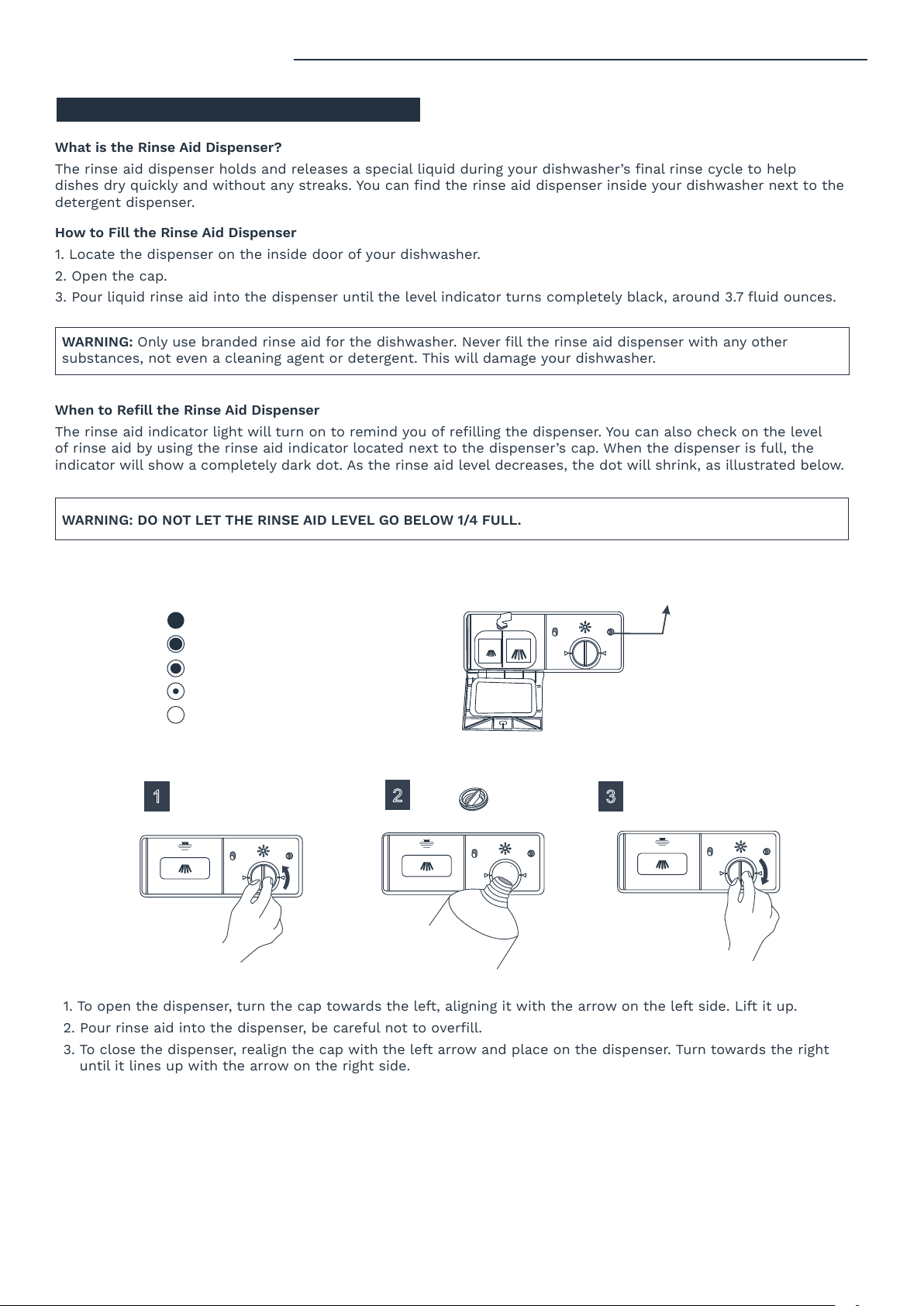
What is the Rinse Aid Dispenser?
The rinse aid dispenser holds and releases a special liquid during your dishwasher’s nal rinse cycle to help
dishes dry quickly and without any streaks. You can nd the rinse aid dispenser inside your dishwasher next to the
detergent dispenser.
How to Fill the Rinse Aid Dispenser
1. Locate the dispenser on the inside door of your dishwasher.
2. Open the cap.
3. Pour liquid rinse aid into the dispenser until the level indicator turns completely black, around 3.7 uid ounces.
WARNING: Only use branded rinse aid for the dishwasher. Never ll the rinse aid dispenser with any other
substances, not even a cleaning agent or detergent. This will damage your dishwasher.
When to Rell the Rinse Aid Dispenser
The rinse aid indicator light will turn on to remind you of relling the dispenser. You can also check on the level
of rinse aid by using the rinse aid indicator located next to the dispenser’s cap. When the dispenser is full, the
indicator will show a completely dark dot. As the rinse aid level decreases, the dot will shrink, as illustrated below.
WARNING: DO NOT LET THE RINSE AID LEVEL GO BELOW 1/4 FULL.
1. To open the dispenser, turn the cap towards the left, aligning it with the arrow on the left side. Lift it up.
2. Pour rinse aid into the dispenser, be careful not to overll.
3. To close the dispenser, realign the cap with the left arrow and place on the dispenser. Turn towards the right
until it lines up with the arrow on the right side.
Rinse Aid Level Indicator
FULL
3/4 FULL
1/2 FULL
1/4 FULL—REFILL NOW
EMPTY
1
2
3
13
Why is Detergent Important?
dishwashers. Store the detergent in a dry place, and only put it in the dispenser when you’re ready to wash
dishes.
What Type of Detergent Can I Use?
You can use three types of detergents:
1. Those with phosphate and chlorine
2. Those with phosphate and without chlorine
3. Those without phosphate or chlorine
Note that detergents with chlorine can remove some stains when used with a high temperature program.
Can I Use Concentrated Detergent?
Yes. Concentrated detergents, or those that contain natural enzymes and are low in alkalinity, are gentler
on your dishes and the environment. You can achieve the same cleaning results with these types of
detergents on a “normal” wash cycle as you can with conventional detergents on a “heavy” wash cycle.
This is because the water facilitates the dirt-dissolving properties of the enzymes in concentrated
detergents.
Can I Use Detergent Tablets?
Yes, but different tablet brands dissolve at different speeds. For this reason, select long wash programs to
ensure that the tablets have fully dissolved and reached their full cleaning potential.
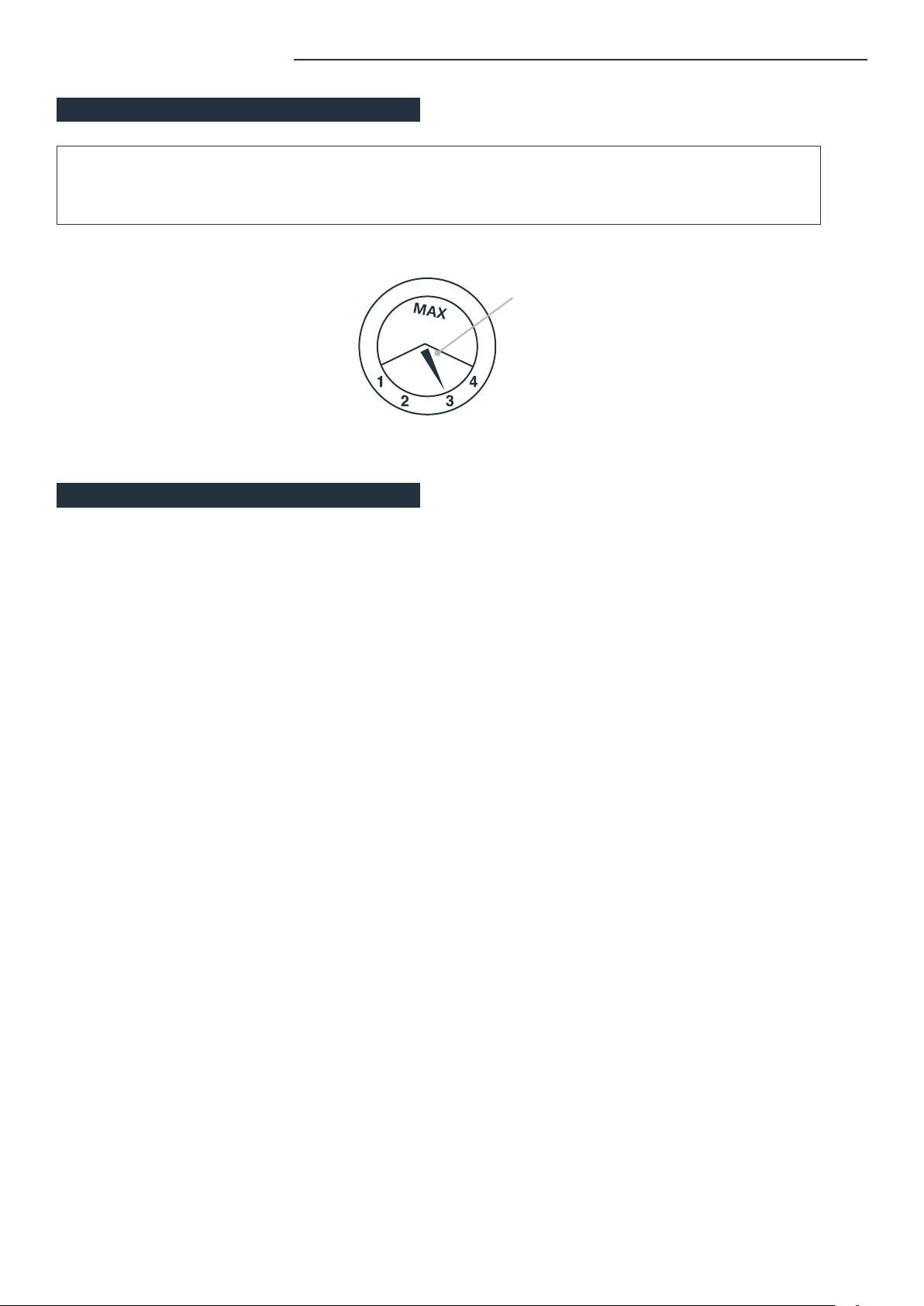
ADJUSTING THE RINSE AID DISPENSER
OPERATING INSTRUCTIONS
HOW TO USE DETERGENT
NOTE:
Increase the level if there are water droplets or lime spots on your dishes after a wash cycle. Reduce it if there
Adjust lever
(Rinse)
14
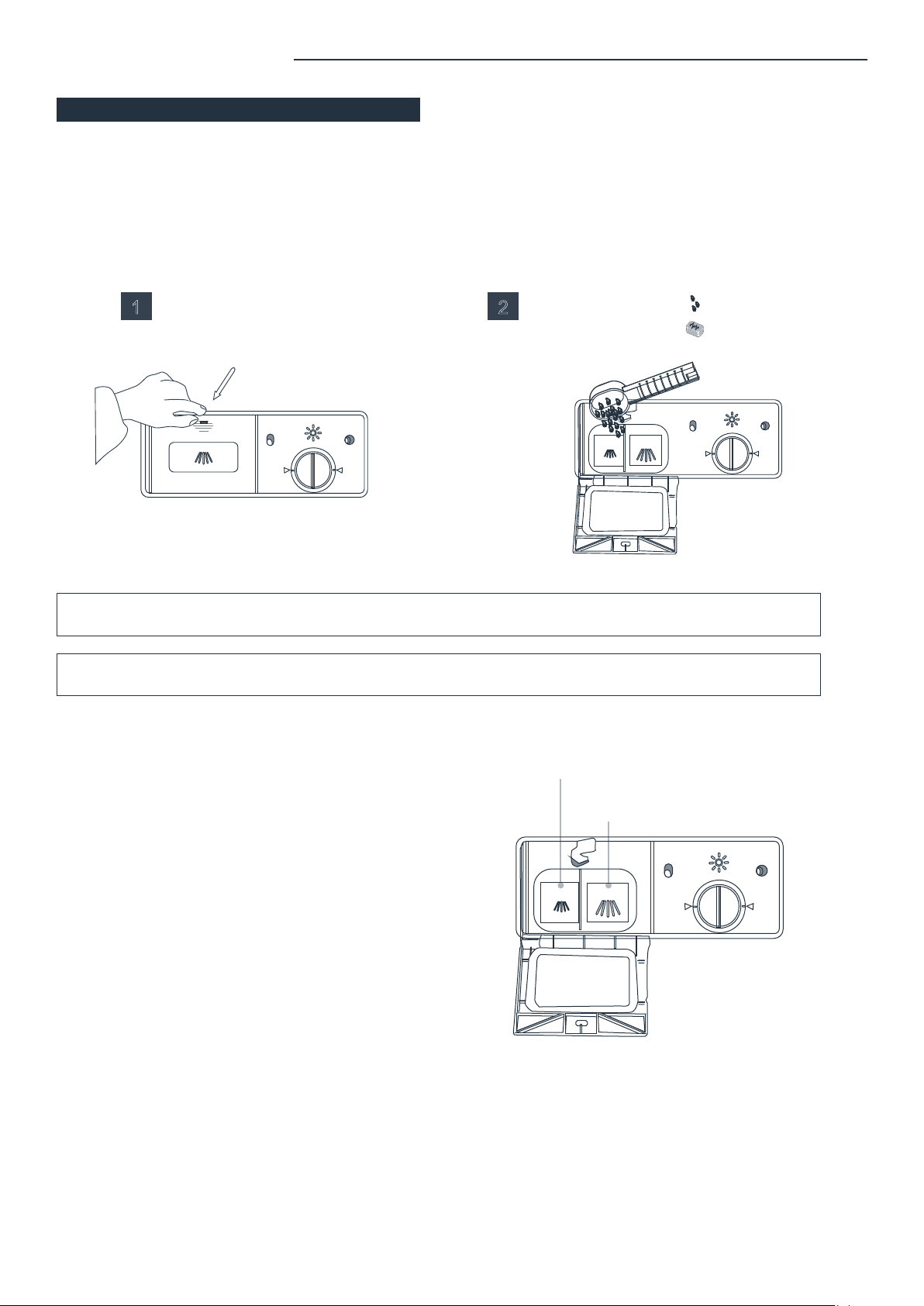
How Do I Use the Detergent Dispenser?
dishwasher uses less detergent than a conventional dishwasher, so you generally only need one tablespoon of detergent
for a normal load. Note that dirtier dishes will need more detergent. Always add the detergent just before starting the
dishwasher. Otherwise, the detergent could get damp before use and not dissolve properly.
How Do I Fill the Detergent Dispenser?
The markings indicate detergent levels and dosing levels (as
illustrated on the right).
• Fill the detergent dispenser with detergent. Please observe
as stated on your detergent packaging.
• Close the lid and press down until it locks into place.
If the dishes are heavily soiled, place an additional detergent
dose in the pre-wash chamber for pre-wash phase of your
wash cycle.
HOW TO USE DETERGENT DISPENSER
OPERATING INSTRUCTIONS
1 2
Push latch to open
Detergent powder
Detergent tablet
NOTE: Only use branded detergent for this dishwasher.
WARNING: Dishwasher detergent is corrosive! Keep out of reach of children.
NOTE:
•
• Please be aware that you may experience different results due to water properties and the dirtiness of your dishes.
A B
or 1 tablespoon, of detergent.
This space can load 0.9 ounces, or and
2/3 tablespoons, of detergent.

Recommendations
• Buy dishwasher-proof utensils.
• Use a mild detergent. If necessary, check your detergent manufacturer to make sure it is safe for all dishware.
• For delicate items, choose a low temperature program.
• To prevent damage, do not take glass and cutlery out of the dishwasher immediately after the program has ended.
What Can I Put in the Dishwasher?
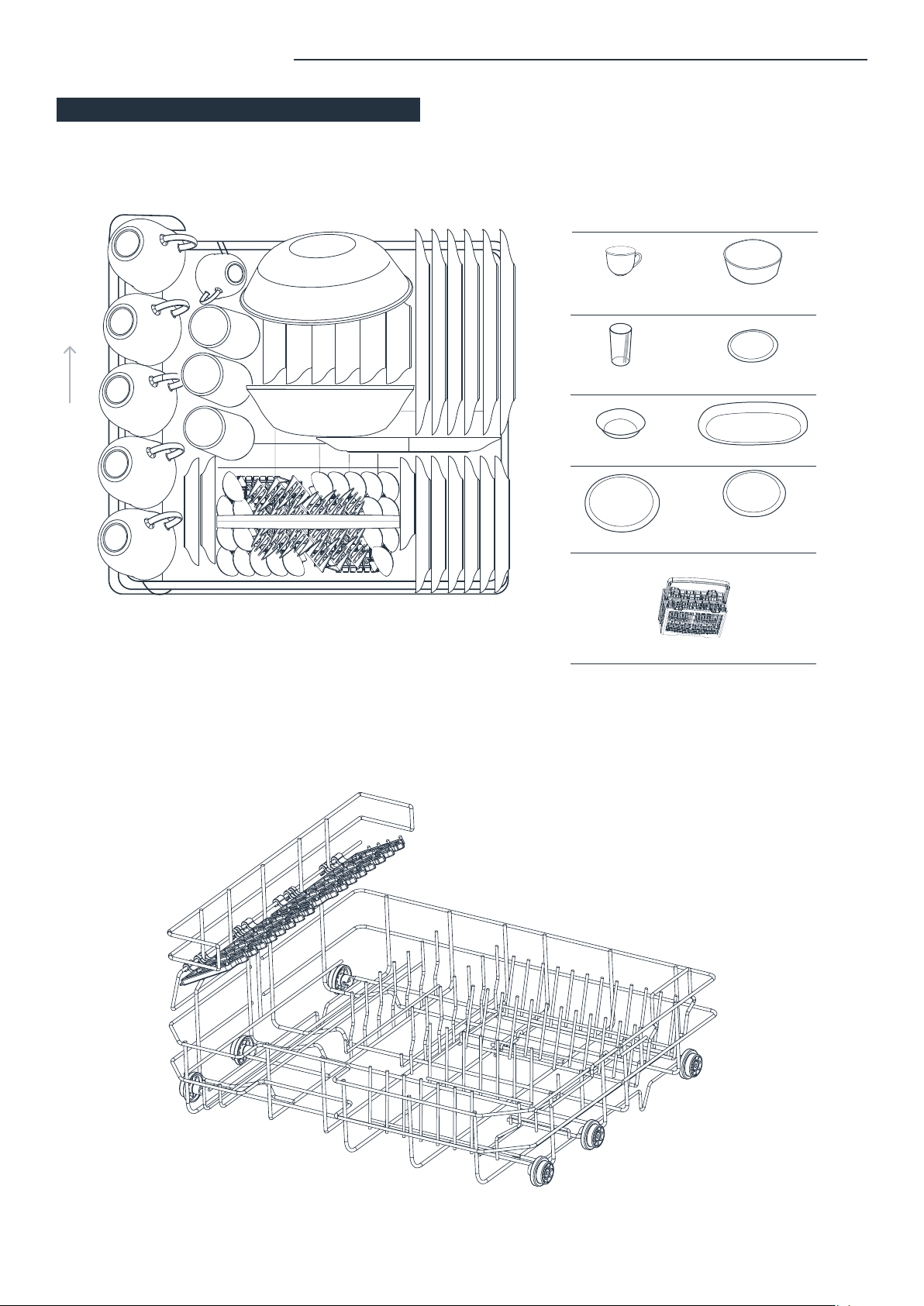
How Do I Load the Dishwasher Baskets?
For best performance, follow these loading guidelines.
Features and appearance of shelves and cutlery baskets may vary from your model.
Scrape off any large amounts of leftover food. Soften any burnt food left in pans. It is not necessary to
rinse the dishes under running water.
Place objects into the dishwasher in the following way:
1. Items such as cups, glasses, pots, pans, etc. go face down.
2. Curved items should be loaded at a slant so water can run off of them.
3. Utensils should be stacked securely so they cannot tip over.
4. Utensils should be placed away from spray arms so they can rotate freely during washing.
• Glasses — certain types can become dull after many
washes
• Silver and aluminium items — these can discolor
during washing
• Glazed or painted item — colors and patterns may fade
after frequent washing
• Cutlery with wooden, horn china, or mother of pearl
handles
• Older cutlery with glued parts that are not heat resistant
• Cutlery or dishes bonded with glue
• Pewter or copper items
• Crystal
• Steel items that can rust
• Wooden platters
HOW TO LOAD THE DISHWASHER BASKETS
NEVER SOMETIMES
OPERATING INSTRUCTIONS
NOTE: Do not place small items that may fall out of the basket into the dishwasher.
16
HOW TO LOAD THE DISHWASHER BASKETS
OPERATING INSTRUCTIONS
Position the dishes and cookware so that they will not be moved by the spray of water.
Basket Plate Racks
Cups
Glasses
Fruit Bowls
Dinner Plates
Serving Bowls
Saucers
Oval Platter
Small Plates
1
2
3
4
5
6
7
8
9
IN
Cutlery Basket
2211
11
44
99
44
88
55
22
33
77
66
17
HOW TO LOAD THE DISHWASHER BASKETS
OPERATING INSTRUCTIONS
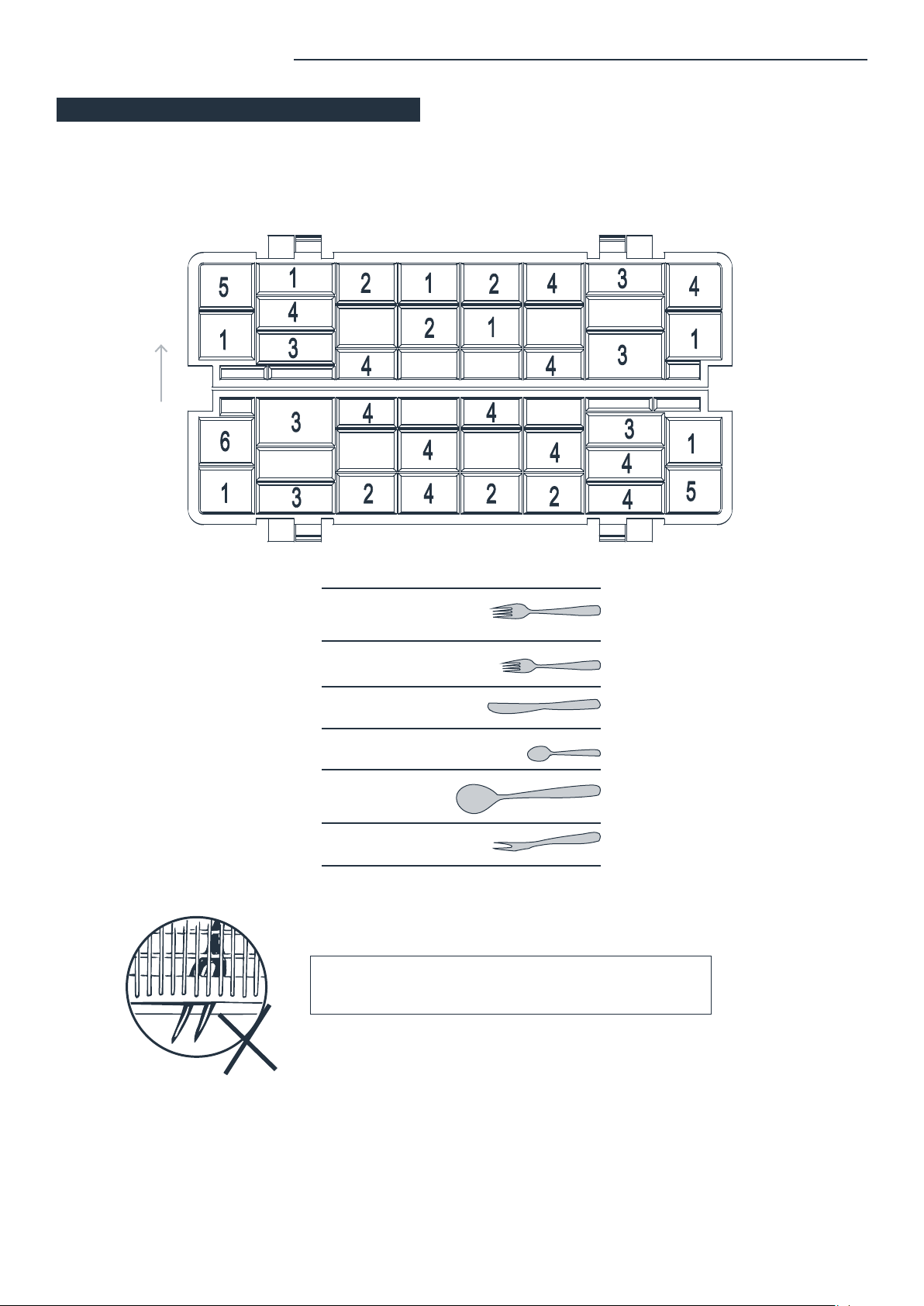
How Do I Load the Cutlery Basket?
Cutlery should be placed in the basket with their handles facing downward towards the bottom. If there are side baskets,
use them to load spoons individually into the appropriate slots. It’s important that long utensils are placed horizontally at
the front of the basket.
For safety purposes and best performance, place cutlery in the basket so that:
• They do not nest together.
• Their handles face downwards.
• Sharp points and blades are facing downwards.
1 Dinner forks
2 Salad forks
3 Knives
4 Teaspoons
6 Serving forks
IN
WARNING: Do not let any item extend through bottom.
Always load sharp utensils with the sharp point down!

18
HOW TO SELECT A WASH CYCLE
NOTE: ( ) THIS MEANS YOU NEED TO FILL THE RINSE AID DISPENSER.
( ) THIS IS THE TEST CYCLE. THE RINSE AID DISPENSER LEVEL IS RECOMMENDED AT “3.”
How Do I Turn on the Dishwasher?
To start the wash cycle:
1. Load the basket. See “How Do I Load the Dishwasher” section for instructions.
2. Load detergent. See “How to Use Detergent” for instructions.
3. Plug in the dishwasher. The power supply is 120V/60Hz.
4. Check that the water supply is turned on to full pressure.
6. Press the Mode button to select your wash cycle. Refer to the above wash cycle table for details.
7. Press the start/pause button to start the cycle.
Program Cycle Selection
Information
For the dirtiest dishes,
such as pots, pans,
casserole dishes or
anything that has had
food sitting on it for
a while.
For regular dishes used
on a daily basis, such as
pots, plates, glasses, and
lightly used pans.
For slightly dirty dishes,
such as glasses, crystal
For lightly used dishware
and glasses.
For washing baby bottles.
For lightly used dishes
that do not need drying.
For rinsing dishes,
glasses, or cutlery that
do not need washing.
Description
of Cycle
Pre-wash
Rinse
Rinse
Drying
Pre-wash
Pre-wash
Rinse
Drying
Pre-Wash
Rinse
Drying
Pre-Wash
Rinse
Rinse
Drying
Pre-Wash
Rinse
Drying
Pre-wash
Wash
Rinse
Detergent
Pre-wash/Wash
/
Running time
(min)
100
110
90
70
24
Energy (KWH)
0.49
0.36
0.27
0.28
0.31
0.03
Water (l)
10.8
10
4.3
Rinse
Aid
NOTE: To pause the dishwasher while washing, press the start/pause button. The dishwasher will pause and the
program light is steady. It will remain like this until you start it again.
Heavy
Normal
Glass
Quick
Wash
Rinse
ECO
High
Temp
WASH CYCLE TABLE
OPERATING INSTRUCTIONS
1 /
tablespoon
(18g)
1 /
tablespoon
(18g)
1 /
tablespoon
(18g)
1 /
tablespoon
(18g)
1 tablespoon
1 tablespoon

19
HOW TO SELECT A WASH PROGRAM
How Do I Change the Wash Program?
You can change your wash cycle only if it has been running for a short time and the detergent has not yet been
To change the wash program, hold Start/Cancel button over three seconds. The machine will enter standby mode
where you can then change the setting. Press Mode button to select the new program. See “How to Select a Wash
Cycle” section for detailed information.
The lights will show the state of the dishwasher:
a) All phase lights off Stand by
b) Display light steady (not blinking) Paused
c) Display light blinking Running
What Do I Do Aer the End of the Cycle?
to turn off the dishwasher. Shut off the water supply and open the door. Wait a few minutes before handling your
dishes to allow them to dry and become less susceptible to damage. The dishwasher goes into standby mode, if
there is no actions are made, the dishwasher will turn off automatically after 30 minutes.
How to Turn off the Dishwasher
The program has ended when all of the phase lights are off. Then:
1. Press the power button to turn off the dishwasher.
2. Turn off your water tap.
Note: Open the Door Carefully
dishwasher to prevent damage.
To do this, open the dishwasher door and leave it ajar for a few minutes. This will allow your dishware to cool and dry.
How to Unload the Dishwasher
Note that it is normal for the dishwasher to be wet inside.
WARNING! It is dangerous to open the door when washing, because hot water may scald you.
OPERATING INSTRUCTIONS
20
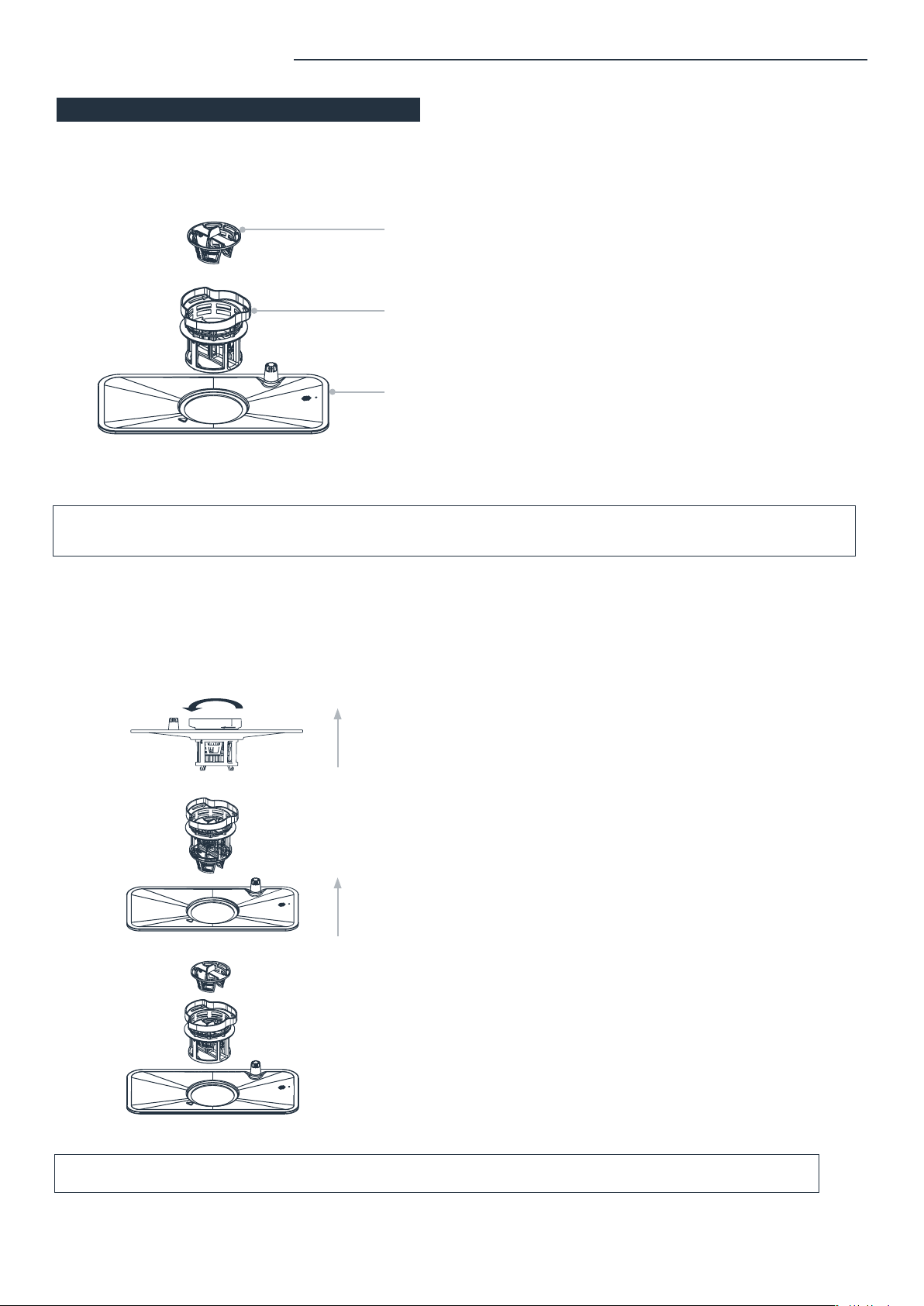
FILTERING SYSTEM INSTRUCTIONS
Main lter
a special jet on the spray arm and washed down the drain.
Fine lter
from being deposited on the dishes during the wash cycle.
Coarse lter
that could block the drain. To remove the items caught by the
How Does the Filtering System Work?
Step 1:
A, B, and C)
counterclockwise and lift them up.
Step 2:
Lift parts B and C from A.
All three parts should now be disassembled.
How to Assemble the Filter
WARNING!
performance level of the dishwasher and damage dishes and utensils.
NOTE:
OPERATING INSTRUCTIONS
A
A
C
C
B
B
21
CLEANING THE FILTERING SYSTEM
CARING FOR THE DISHWASHER
CLEANING AND MAINTENANCE
NOTE: If your dishwasher cannot work due to freezing, please contact customer service at 1-800-898-3002
IMPORTANT:
smoothly.
running water.
•
• Use a lightly dampened cloth to clean the control panel. Dry thoroughly.
• Use a dishwasher polish wax on the exterior.
• Never use sharp objects, scouring pads, or harsh cleaners on any part of the dishwasher.
How to Clean the Door
Use a soft, warm, damp cloth to clean the edge around the door. Do not use a spray cleaner of any kind to avoid
getting liquid on the door lock and electrical components.
How to Protect Against Freezing
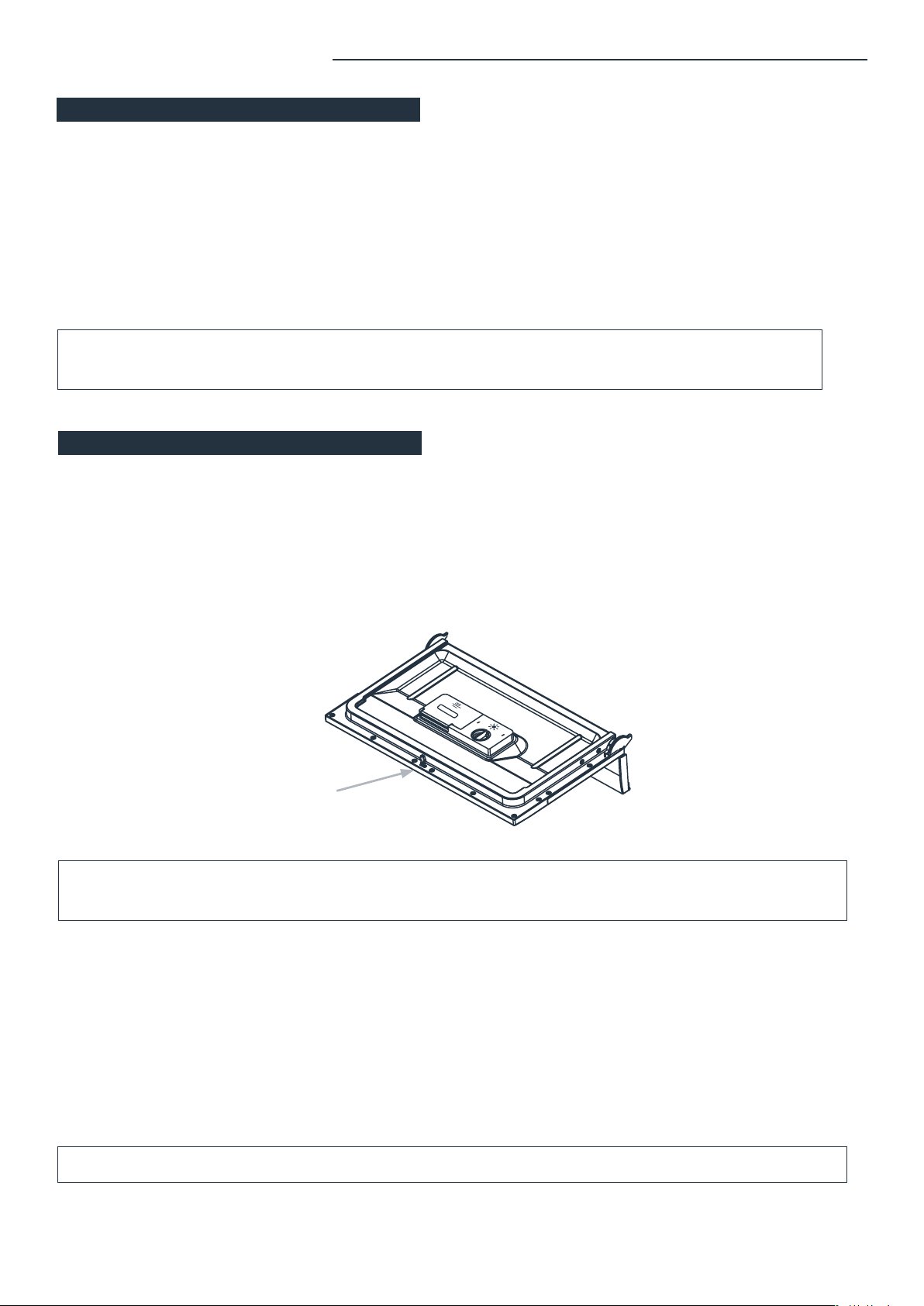
Please take frost protection measures on dishwasher during cold weather seasons. After each wash cycle, do the
following:
1. Turn off the power to the dishwasher.
2. Turn off the water supply and disconnect the water inlet pipe from the water valve.
3. Drain water from the inlet pipe and the water valve. Use a pan to catch the water.
4. Reconnect the water inlet pipe to the water valve.
WARNING! Do not use abrasive cleaning agents or rough paper towels to avoid scratching or marring the stainless
steel surface.
WARNING!
the performance of your dishwasher.
22
Turn Off Water
After every wash, turn off the water supply and leave the door slightly open so that moisture and odors are
not trapped inside the dishwasher.
Store Properly
Before storing the dishwasher, we recommend that you run a wash cycle while the dishwasher is empty.
Then, remove the plug, turn off the water supply and open the door slightly. This will help maintain the
quality of the door seal and prevent odors from forming in the dishwasher.
Unplug the Dishwasher
Always unplug your dishwasher from the socket before cleaning or performing maintenance checks.
Keep in a Vertical Position
If you need to move the dishwasher, try to keep it in a vertical position during moving.
Do Not Use Abrasive Cleaners
Do not use abrasive cleaning products on the exterior and rubber parts of the dishwasher. Instead, use a
cloth with warm water and soap. To remove stains from the interior surface, use a cloth with vinegar, or a
cleaning product specially designed for dishwashers.
Clean the Seal
Odors may form in the dishwasher if food becomes trapped in the seals. To prevent this, periodically clean
the seals with a damp sponge.
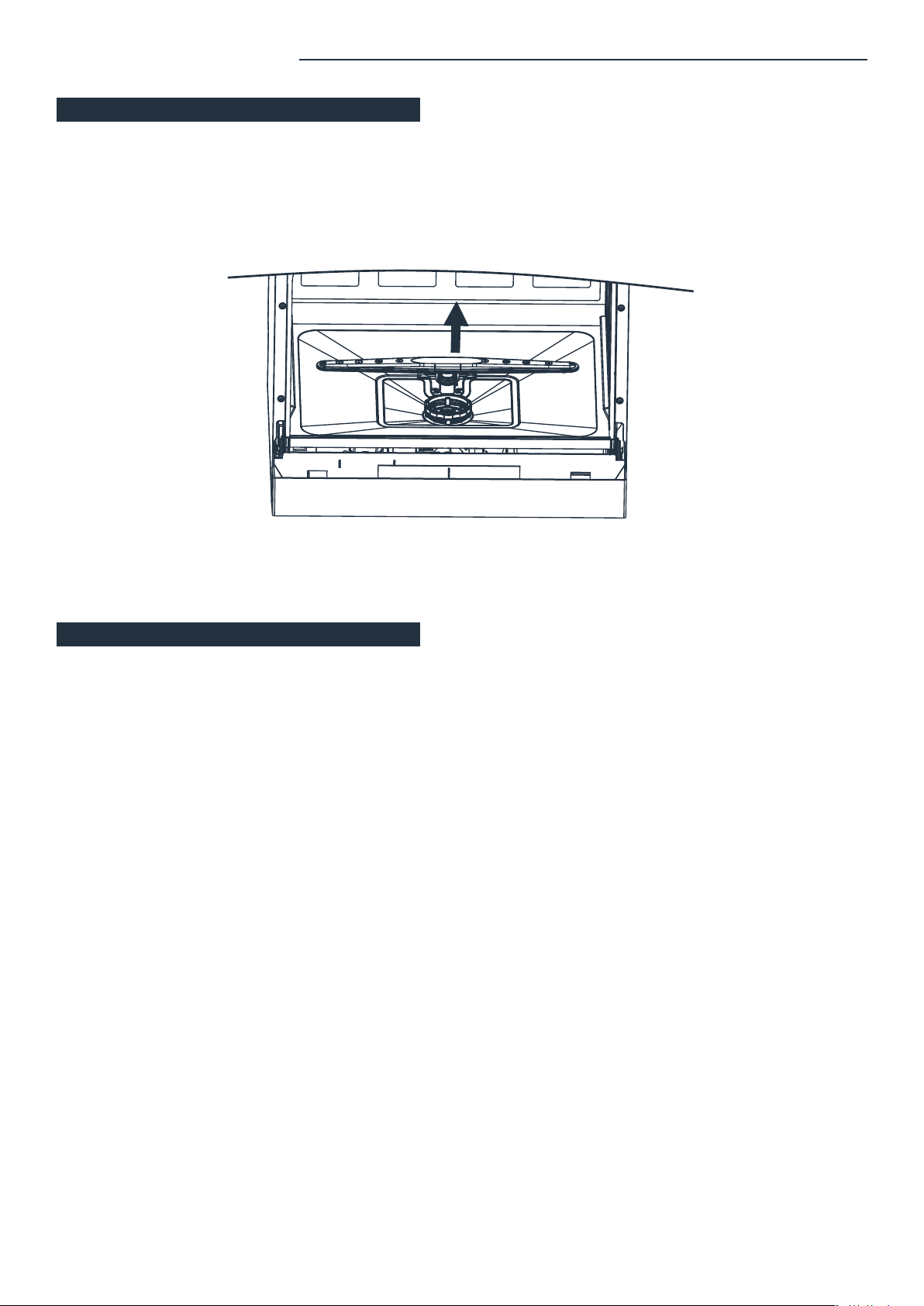
How Do I Clean the Spray Arms?
The spray arms can be easily removed for periodic cleaning to prevent possible clogging.
To remove the spray arms, pull the middle of the arms upwards. Wash the spray arms under running water and carefully
replace them in the dishwasher. Double check that they rotate properly after cleaning.
CARING FOR THE DISHWASHER
HOW TO MAINTAIN YOUR DISHWASHER
CLEAN AND MAINTENANCE
23
TROUBLESHOOTING
TECHNICAL
PROBLEMS
GENERAL
PROBLEMS
NOISE
Knocking noise
in the wash cabinet
Rattling noise
in the wash cabinet
Knocking noise
in the water pipes
start
The display shows E4
and / or water leaking
from base. This means
water is not being
pumped from the
dishwasher properly.
Suds in the tub and / or
the display shows E4,
water leaking from base
Stained tub interior
inside surface
There are rust
stains on cutlery
The spray arm is
knocking against
an item in a basket
Item of dishware
are insecure
in the wash cabinet.
May be caused
by on-site installation
or the cross-section of
the piping
Fuse blown, or
circuit breaker tripped
Power supply is not
turned on
Door of dishwasher is
not properly closed
Kink in the drain hose
Filter is clogged
Kitchen sink is clogged
Improper detergent used
Spilled rinse aid
Detergent with
colorant was used
Hard minerals in water
The affected items are
not corrosion resistant
The soft part of the lid
is loose
Interrupt the program and rearrange items
obstructing the spray arm.
Interrupt the program,
and rearrange items to make them more secure.
Replace fuse or reset circuit breaker. Remove any other
appliances sharing the same circuit with the dishwasher.
Make sure the dishwasher is turned on and the door is
closed securely.
Make sure the power cord is properly plugged into the
wall socket.
Close the dishwasher door making sure that door latches.
Check the drain hose.
1. Unplug the power. 2. Carefully tilt the product at a slight angle
to drain any excess water onto a towel or drainage area. 3. Check
Check your kitchen sink to make sure it is draining well.
If the kitchen sink is not draining, contact a plumber rather than
a serviceman for this dishwasher.
PROBLEM CAUSES SOLUTIONS
Review the following troubleshooting procedures before contacting the customer service.
Only use special dishwasher detergent to avoid suds. If suds
do occur, open the dishwasher and let suds evaporate. Add 1
gallon of cold water to the tub. Close and latch the dishwasher,
then start the soak wash cycle to drain out the water. Repeat if
necessary.
Always wipe up rinse-aid spills immediately.
Make sure that the detergent does not have colorant.
To clean the interior, use a damp sponge with dishwasher
detergent, wearing rubber gloves.
Never use any cleaner other than dishwasher detergent, as
there is risk of foaming or suds.
24
TROUBLESHOOTING
UNSATISFACTORY
WASHING
RESULT
The dishes are
not clean
Cloudiness
on glassware
Black or gray
marks on dishes
Detergent left in
dispenser cups
The dishes
are not drying
EI
E4
E4
Longer inlet time
Water is not being pumped
from the dishwasher properly.
Faucets are not opened, water intake is
restricted, or water pressure is too low.
Some part of the dishwasher is leaking.
Check Troubleshooting.
The dishes were not
loaded correctly
The program was
not powerful enough
Not enough detergent
was dispensed
Item are blocking
the path of spray arms
in the base of wash
cabinet is not clean or
Combination of soft
water and too much
detergent
Aluminum utensils
rubbed against dishes
Dishes block
detergent cups
Improper loading
Too little rinse-aid
Dishes are removed
too soon
Wrong program
selected
Cutlery has
low-quality coating
Refer to the section on how to load the dishwasher.
Use more detergent, or change your detergent.
Rearrange the items so that the spray can rotate freely.
Use less detergent if you have soft water and select
a shortest cycle to wash the glassware and to get
them clean.
Use a mild abrasive cleaner to eliminate any marks.
Reload the dishes properly.
Load the dishwasher as suggested in the directions.
Do not empty your dishwasher immediately after washing.
Open the door slightly so that the steam can escape.
Begin unloading the dishwasher once the dishes are barely
from dripping off dishes in the upper basket.
Short programs run at a lower temperature, which may lower
cleaning performance. Choose a program with a long washing time.
These types of cutlery and dishware are not suitable for washing
in the dishwasher.
PROBLEM
CODEERROR CODES:
CAUSES
MEANING
POSSIBLE CAUSES
SOLUTIONS
WARNING!

Height:
Width:
Depth:
Water Pressure:
Hot Water Connection:
Power Supply:
120 V/60 Hz
SPECIFICATIONS
WARRANTY
hOme
™
offers a limited one-year warranty (“warranty period”) on all of our products purchased new and unused from
hOme Technologies, LLC or an authorized reseller, with an original proof of purchase and where a defect has arisen,
wholly or substantially, as a result of faulty manufacturing, parts or workmanship during one-year warranty period.
The warranty does not apply where damage is caused by other factors, including but without limitation: (a) normal
wear and tear; (b) abuse, mishandling, accident, or failure to follow operating instructions; (c) exposure to liquid or
™
; (e) commercial or
non-household use.
The hOme
™
warranty covers all costs related to restoring the proven defective product through repair or replacement
A receipt indicating the purchase date is required for any claim, so please keep all receipts in a safe place. We recommend
that you register your product on our website, homelabs.com/reg. Although greatly appreciated, the product registration is
not required to activate any warranty and product registration does not eliminate the need for the original proof of purchase.
The warranty becomes void if attempts at repair are made by non-authorized third parties and/or if spare parts, other
than those provided by hOme
™
, are used.
You may also arrange for service after the warranty expires at an additional cost.
These are our general terms for warranty service, but we always urge our customers to reach out to us with any issue,
regardless of warranty terms. If you have an issue with a hOme
™
product, please contact us at 1-800-898-3002, and we
will do our best to resolve it for you.
to country or province to province. The customer may assert any such rights at their sole discretion.
26
Keep all plastic bags away from children.
This manual is to be used with all items with the model number
HME010393N
MANUFACTURING INFO
WARNING
CONTACT US
CHAT W ITH U S
CALL U S
EMAIL U S
SKU# : HME010393N


© 2020 hOme Technologies, LLC
37 East 18 Street, 7th Floor
New York, NY 10003
For Household
Use Only
All rights reserved, hOme
™
. Printed in China.
1-800-898-3002
homelabs.com/help