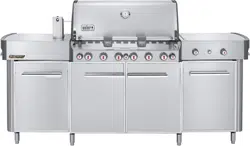
YOU MUST READ THIS OWNER’S GUIDE
BEFORE OPERATING YOUR GAS GRILL.
DANGER
If you smell gas:
1. Shut off gas to the appliance.
2. Extinguish any open flames.
3. Open lid.
4. If odor continues, keep away from the
appliance and immediately call your gas
supplier or your fire department.
Leaking gas may cause a fire or explosion
which can cause serious bodily injury,
death, or damage to property.
WARNING:
1. Do not store or use gasoline or other
flammable liquids or vapors in the
vicinity of this or any other appliance.
2. An LP cylinder not connected for use
shall not be stored in the vicinity of this
or any other appliance.
WARNING: Follow all leak-check
procedures carefully in this manual prior
to barbecue operation. Do this even if the
barbecue was dealer-assembled.
NOTICE TO INSTALLER: These instructions
must be left with the owner and the owner
should keep them for future use.
THIS GAS APPLIANCE IS DESIGNED FOR
OUTDOOR USE ONLY.
56567 09/01/11 LP
US - ENGLISH
#56567
WARNING: Do not ignite this appliance
without first reading the BURNER
IGNITION sections of this manual.
SUMMIT
®
GRILL CENTER
Guía del Propietario de la Barbacoa de Gas Propano Licuado - Pg. 47
Mode d’emploi du Grill à gaz PL - Pg. 85
GAS GRILL
LP Gas Grill Owner’s Guide
ESNA

2
DANGER
Failure to follow the Dangers, Warnings and Cautions contained in this Owner’s Manual may result in serious bodily injury or
death, or in a fire or an explosion causing damage to property.
WARNINGS
Do not store a spare or disconnected liquid propane
cylinder under or near this barbecue.
Improper assembly may be dangerous. Please follow the
assembly instructions carefully.
After a period of storage, and/or nonuse, the Weber
®
gas
barbecue should be checked for gas leaks and burner
obstructions before use. See instructions in this manual for
correct procedures.
Do not operate the Weber
®
gas barbecue if there is a gas
leak present.
Do not use a flame to check for gas leaks.
Combustible materials should never be within 24 inches
(61 cm) of the back or sides of your Weber
®
gas barbecue.
Do not put a barbecue cover or anything flammable on, or in
the storage area under the barbecue.
Your Weber
®
gas barbecue should never be used by
children. Accessible parts of the barbecue may be very hot.
Keep young children away while it is in use.
You should exercise reasonable care when operating your
Weber
®
gas barbecue. It will be hot during cooking or
cleaning and should never be left unattended, or moved
while in operation.
Should the burners go out while in operation, turn all
gas valves off. Open the lid and wait five minutes before
attempting to relight, using the igniting instructions.
Do not use charcoal or lava rock in your Weber
®
gas
barbecue.
Never lean over open grill or place hands or fingers on the
front edge of the cookbox.
Should a grease fire occur, turn off all burners and leave lid
closed until fire is out.
Do not enlarge valve orifices or burner ports when cleaning
the valves or burners.
The Weber
®
gas barbecue should be thoroughly cleaned on
a regular basis.
Liquid propane gas is not natural gas. The conversion or
attempted use of natural gas in a liquid propane unit or
liquid propane gas in a natural gas unit is dangerous and
will void your warranty.
Do not attempt to disconnect any gas fitting while your
barbecue is in operation.
Use heat-resistant barbecue mitts or gloves when operating
barbecue.
Keep any electrical supply cord and the fuel supply hose
away from any heated surfaces.
Combustion byproducts produced when using this product
contain chemicals known to the state of California to cause
cancer, birth defects, or other reproductive harm.
Do not use this barbecue unless all parts are in place. The
unit must be properly assembled according to the assembly
instructions.
Do not build this model of grill in any built-in or slide-in
construction. Ignoring this Warning could cause a fire or
an explosion that can damage property and cause serious
bodily injury or death.
Proposition 65 Warning: Handling the brass material on
this product exposes you to lead, a chemical known to the
state of California to cause cancer, birth defects or other
reproductive harm.
(Wash hands after handling this product.)
X
LIQUID PROPANE GAS UNITS ONLY:
Use the pressure regulator and hose assembly that is
supplied with your Weber
®
gas barbecue.
Do not attempt to disconnect the gas regulator and hose
assembly or any gas fitting while your barbecue is in
operation.
A dented or rusty liquid propane cylinder may be hazardous
and should be checked by your liquid propane supplier. Do
not use a liquid propane cylinder with a damaged valve.
Although your liquid propane cylinder may appear to be
empty, gas may still be present, and the cylinder should be
transported and stored accordingly.
If you see, smell or hear the hiss of escaping gas from the
liquid propane cylinder:
1. Move away from liquid propane cylinder.
2. Do not attempt to correct the problem yourself.
3. Call your fire department.
X
WARNINGS

WWW.WEBER.COM
®
3
TABLE OF CONTENTS
WARNINGS . . . . . . . . . . . . . . . . . . . . . . . . . . . . . . . . . . . . . . . . . .2
TABLE OF CONTENTS . . . . . . . . . . . . . . . . . . . . . . . . . . . . . . . . .3
EXPLODED VIEW . . . . . . . . . . . . . . . . . . . . . . . . . . . . . . . . . . . . .4
WARRANTY . . . . . . . . . . . . . . . . . . . . . . . . . . . . . . . . . . . . . . . .14
GENERAL INSTRUCTIONS . . . . . . . . . . . . . . . . . . . . . . . . . . . .14
FOR INSTALLATION IN CANADA . . . . . . . . . . . . . . . . . . . . . . . . . . . . . . . . . . . . 14
OPERATING. . . . . . . . . . . . . . . . . . . . . . . . . . . . . . . . . . . . . . . . . . . . . . . . . . . . . 14
STORAGE AND/OR NONUSE. . . . . . . . . . . . . . . . . . . . . . . . . . . . . . . . . . . . . . . 14
GAS INSTRUCTIONS . . . . . . . . . . . . . . . . . . . . . . . . . . . . . . . . .15
SAFE HANDLING TIPS FOR LIQUID PROPANE GAS CYLINDERS . . . . . . . . . 15
IMPORTANT LP CYLINDER INFORMATION . . . . . . . . . . . . . . . . . . . . . . . . . . . 16
LEAK CHECK PREPARATION. . . . . . . . . . . . . . . . . . . . . . . . . . . . . . . . . . . . . . . 16
CHECK FOR GAS LEAKS. . . . . . . . . . . . . . . . . . . . . . . . . . . . . . . . . . . . . . . . . . 19
REFILLING THE LIQUID PROPANE CYLINDER. . . . . . . . . . . . . . . . . . . . . . . . . 21
LIGHT FEATURES . . . . . . . . . . . . . . . . . . . . . . . . . . . . . . . . . . .21
WEBER
®
GRILL OUT™ HANDLE LIGHT . . . . . . . . . . . . . . . . . . . . . . . . . . . . . . 21
LIGHTED CONTROL KNOBS . . . . . . . . . . . . . . . . . . . . . . . . . . . . . . . . . . . . . . . 21
BEFORE USING THE GRILL . . . . . . . . . . . . . . . . . . . . . . . . . . .22
FUEL LEVEL . . . . . . . . . . . . . . . . . . . . . . . . . . . . . . . . . . . . . . . . . . . . . . . . . . . . 22
SLIDE-OUT GREASE TRAY AND DISPOSABLE DRIP PAN . . . . . . . . . . . . . . . 22
HOSE INSPECTION . . . . . . . . . . . . . . . . . . . . . . . . . . . . . . . . . . . . . . . . . . . . . . 22
SNAP IGNITION OPERATION . . . . . . . . . . . . . . . . . . . . . . . . . .23
MAIN BURNER IGNITION & USAGE . . . . . . . . . . . . . . . . . . . . .24
MAIN BURNER IGNITION . . . . . . . . . . . . . . . . . . . . . . . . . . . . . . . . . . . . . . . . . . 24
TO EXTINGUISH . . . . . . . . . . . . . . . . . . . . . . . . . . . . . . . . . . . . . . . . . . . . . . . . . 24
MAIN BURNER MANUAL IGNITION . . . . . . . . . . . . . . . . . . . . . . . . . . . . . . . . . 25
TO EXTINGUISH . . . . . . . . . . . . . . . . . . . . . . . . . . . . . . . . . . . . . . . . . . . . . . . . . 25
GRILLING TIPS & HELPFUL HINTS . . . . . . . . . . . . . . . . . . . . .26
PREHEATING . . . . . . . . . . . . . . . . . . . . . . . . . . . . . . . . . . . . . . . . . . . . . . . . . . . 26
COVERED COOKING . . . . . . . . . . . . . . . . . . . . . . . . . . . . . . . . . . . . . . . . . . . . . 26
DRIPPINGS AND GREASE . . . . . . . . . . . . . . . . . . . . . . . . . . . . . . . . . . . . . . . . 26
FLAVORIZER
®
SYSTEM . . . . . . . . . . . . . . . . . . . . . . . . . . . . . . . . . . . . . . . . . . . 26
SEAR STATION
®
. . . . . . . . . . . . . . . . . . . . . . . . . . . . . . . . . . . . . . . . . . . . . . . . . 26
COOKING METHODS . . . . . . . . . . . . . . . . . . . . . . . . . . . . . . . . .27
DIRECT COOKING . . . . . . . . . . . . . . . . . . . . . . . . . . . . . . . . . . . . . . . . . . . . . . . 27
INDIRECT COOKING . . . . . . . . . . . . . . . . . . . . . . . . . . . . . . . . . . . . . . . . . . . . . 27
SIDE BURNER IGNITION & USAGE . . . . . . . . . . . . . . . . . . . . .28
SIDE BURNER IGNITION . . . . . . . . . . . . . . . . . . . . . . . . . . . . . . . . . . . . . . . . . . 28
TO EXTINGUISH . . . . . . . . . . . . . . . . . . . . . . . . . . . . . . . . . . . . . . . . . . . . . . . . . 28
SIDE BURNER MANUAL IGNITION . . . . . . . . . . . . . . . . . . . . . . . . . . . . . . . . . . 29
TO EXTINGUISH . . . . . . . . . . . . . . . . . . . . . . . . . . . . . . . . . . . . . . . . . . . . . . . . . 29
SIDE BURNER USAGE . . . . . . . . . . . . . . . . . . . . . . . . . . . . . . . . . . . . . . . . . . . . 30
SEAR STATION
®
IGNITION & USAGE . . . . . . . . . . . . . . . . . . . .31
SEAR STATION
®
BURNER IGNITION . . . . . . . . . . . . . . . . . . . . . . . . . . . . . . . . . 31
TO EXTINGUISH . . . . . . . . . . . . . . . . . . . . . . . . . . . . . . . . . . . . . . . . . . . . . . . . . 31
SEAR STATION
®
BURNER MANUAL IGNITION . . . . . . . . . . . . . . . . . . . . . . . . 32
TO EXTINGUISH . . . . . . . . . . . . . . . . . . . . . . . . . . . . . . . . . . . . . . . . . . . . . . . . . 32
USING THE SEAR STATION
®
. . . . . . . . . . . . . . . . . . . . . . . . . . . . . . . . . . . . . . . 32
SMOKER BURNER IGNITION & USAGE . . . . . . . . . . . . . . . . . .33
SMOKER BURNER IGNITION. . . . . . . . . . . . . . . . . . . . . . . . . . . . . . . . . . . . . . . 33
TO EXTINGUISH . . . . . . . . . . . . . . . . . . . . . . . . . . . . . . . . . . . . . . . . . . . . . . . . . 33
SMOKER BURNER MANUAL IGNITION. . . . . . . . . . . . . . . . . . . . . . . . . . . . . . . 34
TO EXTINGUISH . . . . . . . . . . . . . . . . . . . . . . . . . . . . . . . . . . . . . . . . . . . . . . . . . 34
USING THE SMOKER . . . . . . . . . . . . . . . . . . . . . . . . . . . . . . . . . . . . . . . . . . . . . 35
CLEANING THE SMOKER . . . . . . . . . . . . . . . . . . . . . . . . . . . . . . . . . . . . . . . . . 35
ROTISSERIE BURNER IGNITION & USAGE . . . . . . . . . . . . . . .36
ROTISSERIE BURNER IGNITION. . . . . . . . . . . . . . . . . . . . . . . . . . . . . . . . . . . . 36
TO EXTINGUISH . . . . . . . . . . . . . . . . . . . . . . . . . . . . . . . . . . . . . . . . . . . . . . . . . 36
ROTISSERIE BURNER MANUAL IGNITION. . . . . . . . . . . . . . . . . . . . . . . . . . . . 37
TO EXTINGUISH . . . . . . . . . . . . . . . . . . . . . . . . . . . . . . . . . . . . . . . . . . . . . . . . . 37
IMPORTANT SAFEGUARDS . . . . . . . . . . . . . . . . . . . . . . . . . . . . . . . . . . . . . . . . 38
OPERATING THE ROTISSERIE . . . . . . . . . . . . . . . . . . . . . . . . . . . . . . . . . . . . . 38
ROTISSERIE COOKING . . . . . . . . . . . . . . . . . . . . . . . . . . . . . . . . . . . . . . . . . . . 39
ROTISSERIE MOTOR STORAGE . . . . . . . . . . . . . . . . . . . . . . . . . . . . . . . . . . . . 39
ROTISSERIE SPIT STORAGE. . . . . . . . . . . . . . . . . . . . . . . . . . . . . . . . . . . . . . . 39
TROUBLESHOOTING . . . . . . . . . . . . . . . . . . . . . . . . . . . . . . . . .40
SIDE BURNER TROUBLESHOOTING . . . . . . . . . . . . . . . . . . . .40
SEAR STATION
®
TROUBLESHOOTING . . . . . . . . . . . . . . . . . . .41
ROTISSERIE TROUBLESHOOTING . . . . . . . . . . . . . . . . . . . . . .41
GRILL OUT™ HANDLE LIGHT TROUBLESHOOTING . . . . . . .41
MAINTENANCE . . . . . . . . . . . . . . . . . . . . . . . . . . . . . . . . . . . . .42
CLEANING. . . . . . . . . . . . . . . . . . . . . . . . . . . . . . . . . . . . . . . . . . . . . . . . . . . . . . 42
WEBER
®
SPIDER/INSECT SCREENS . . . . . . . . . . . . . . . . . . . . . . . . . . . . . . . . 42
BURNER TUBE CLEANING . . . . . . . . . . . . . . . . . . . . . . . . . . . . . . . . . . . . . . . . 42
REPLACING MAIN BURNERS . . . . . . . . . . . . . . . . . . . . . . . . . . . . . . . . . . . . . . 43
SIDE BURNER MAINTENANCE . . . . . . . . . . . . . . . . . . . . . . . . . . . . . . . . . . . . . 45
ANNUAL MAINTENANCE . . . . . . . . . . . . . . . . . . . . . . . . . . . . . . . . . . . . . . . . . . 46
4
7
9
10
25
26
27
28
29
36
38
39
40
41
42
43
50
21
22
23
24
44
49
55
30
31
32
33
34
35
51
54
56
20
45
46
47
48
2
3
4
5
6
1
8
37
52
53
11
13
14
15
16
17
18
19
12
SUMMIT_6Brn_Grill Center_LP_US_021511
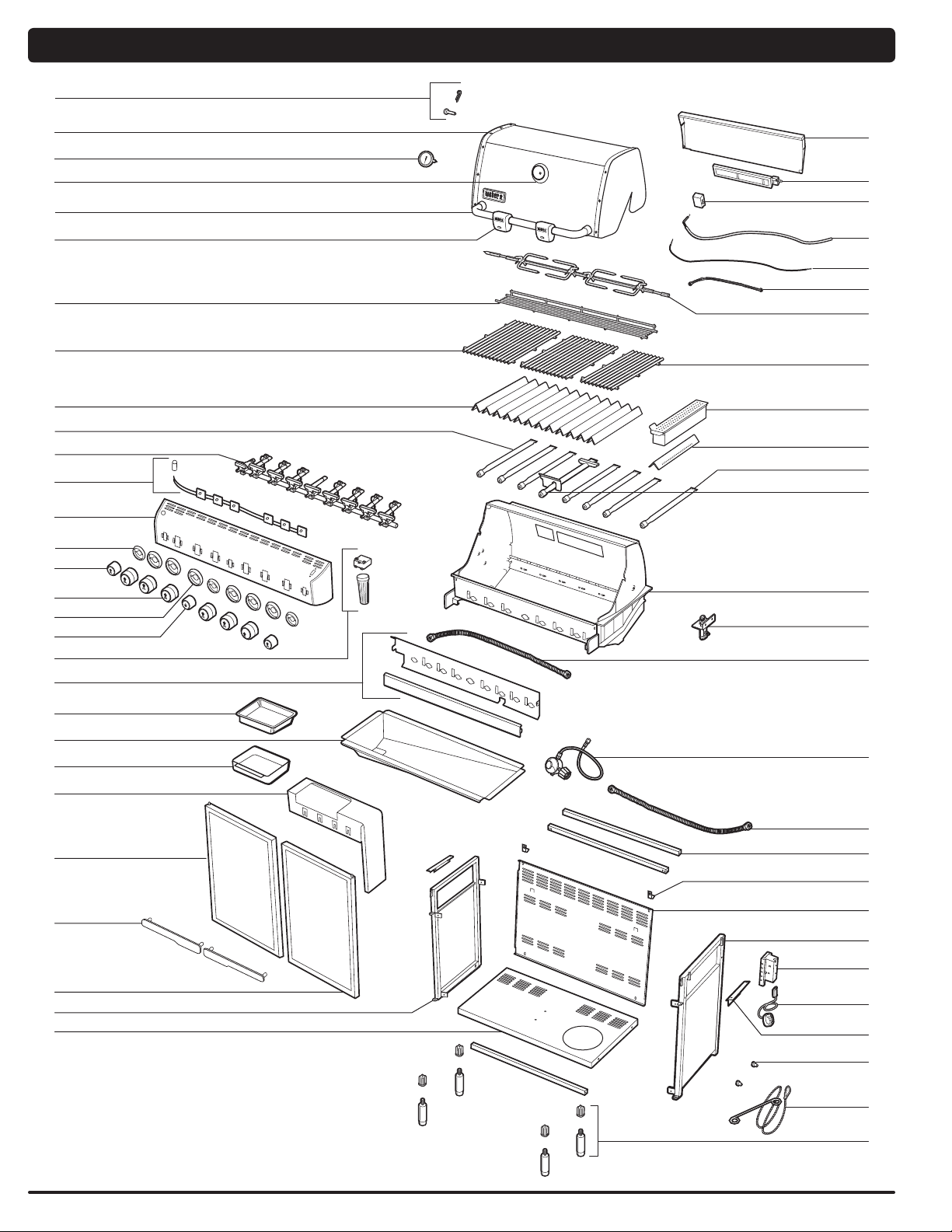
EXPLODED VIEW • DIAGRAMA DE DESPIECE • VUE ECLATEE

WWW.WEBER.COM
®
5
EXPLODED VIEW • DIAGRAMA DE DESPIECE • VUE ECLATEE
1. Shroud Hardware
2. Shroud
3. Thermometer
4. Thermometer Bezel
5. Handle
6. Grill Out™ Handle Light
7. Warming Rack
8. Cooking Grate
9. Flavorizer
®
Bar
10. Burner Tube
11. Manifold
12. Control Panel Wiring Harness
13. Control Panel
14. Small Knob Bezel
15. Small Knob
16. Large Knob
17. Large Knob Bezel
18. Sear Station
®
Knob
19. Battery Housing
20. Water Baffle / Heat Shield
21. Disposable Drip Pan
22. Slide-Out Grease Tray
23. Catch Pan
24. Catch Pan Holder
25. Left Door
26. Door Handle
27. Right Door
28. Left Frame Panel
29. Bottom Panel
30. IR Burner Cover
31. Infrared Burner
32. IR Burner Box
33. IR Burner Igniter Wire
34. Thermocouple
35. IR Burner Hose
36. Rotisserie Spit Assembly
37. Cooking Grate
38. Smoker Box
39. Smoker Bar
40. Smoker Burner Tube
41. Sear Station
®
Burner
42. Cookbox
43. Bulkhead
44. Manifold Hose
45. Hose / Regulator
46. Side Burner Hose
47. Frame Support
48. Rotisserie Spit Storage Bracket
49. Back Panel
50. Right Frame Panel
51. Tank Scale
52. LED Tank Scale Assembly
53. Shelf Bracket
54. Tank Glide
55. Matchstick Holder
56. Adjustable Leg
Accesorios de la cubierta
Cubierta
Termómetro
Moldura decorativa del termómetro
Asa
Lámpara de asa GrillOut™
Rejilla para calentar
Parrilla de cocción
Barra Flavorizer
®
Tubo del quemador
Múltiple
Cableado prefabricado
del panel de control
Tablero de control
Moldura decorativa de la perilla pequeña
Perilla pequeña
Perilla grande
Moldura decorativa de la perilla grande
Perilla de la estación
de dorado Sear Station
®
Compartimiento de las baterías
Reflector de agua / Pantalla térmica
Bandeja de goteo desechable
Bandeja deslizante de grasa
Plato recolector
Soporte del plato recolector
Puerta izquierda
Asa de la puerta
Puerta derecha
Panel izquierdo del bastidor
Panel inferior
Tapa del quemador infrarrojo
Quemador infrarrojo
Caja del quemador infrarrojo
Cable de encendido
del quemador infrarrojo
Termopar
Manguera del quemador infrarrojo
Ensamble del espetón del asador giratorio
Parrilla de cocción
Caja del ahumador
Barra del ahumador
Tubo quemador del ahumador
Quemador de la estación
de dorado Sear Station
®
Caja de cocción
Tabique divisorio
Manguera del múltiple
Manguera / Regulador
Manguera del quemador lateral
Soporte del bastidor
Soporte de almacenaje
del espetón del asador giratorio
Panel posterior
Panel derecho del bastidor
Báscula del tanque
Ensamble de la báscula LED del tanque
Soporte del estante
Deslizadera del tanque
Portacerillos
Pata ajustable
Quincaillerie de l’étui
Etui
Thermomètre
Bec du thermomètre
Poignée
Eclairage de poignée Grill Out™
Grille de maintien au chaud
Grille de cuisson
Barre Flavorizer
®
Tube du brûleur
Collecteur
Harnais de câblage du
panneau de commandes
Panneau de commandes
Bec du petit bouton
Petit bouton
Grand bouton
Bec du grand bouton
Bouton Sear Station
®
Logement des piles
Baffle à eau / Protection anti-chaleur
Egouttoir jetable
Plateau amovible pour la
récupération des graisses
Egouttoir
Support pour égouttoir
Porte de gauche
Poignée de porte
Porte de droite
Panneau du cadre de gauche
Panneau inférieur
Cache du brûleur IR
Brûleur infrarouge
Boîtier du brûleur IR
Câble de l’allumeur du brûleur IR
Thermocouple
Tuyau du brûleur IR
Assemblage de la broche de la rôtissoire
Grille de cuisson
Boîtier du fumoir
Barre du fumoir
Tube du brûleur du fumoir
Brûleur de la Sear Station
®
Boîtier de cuisson
Tête du brûleur
Tuyau du collecteur
Tuyau / Régulateur
Tuyau du brûleur latéral
Support du cadre
Support du rangement de la
broche de la rôtissoire
Panneau arrière
Panneau du cadre de droite
Graduation de la bouteille
Assemblage LED de la
graduation de la bouteille
Support pour étagère
Glissière de la bouteille
Support pour allumette
Pied ajustable
6
11
12
13
14
15
5
6
7
8
9
2
3
4
1
10
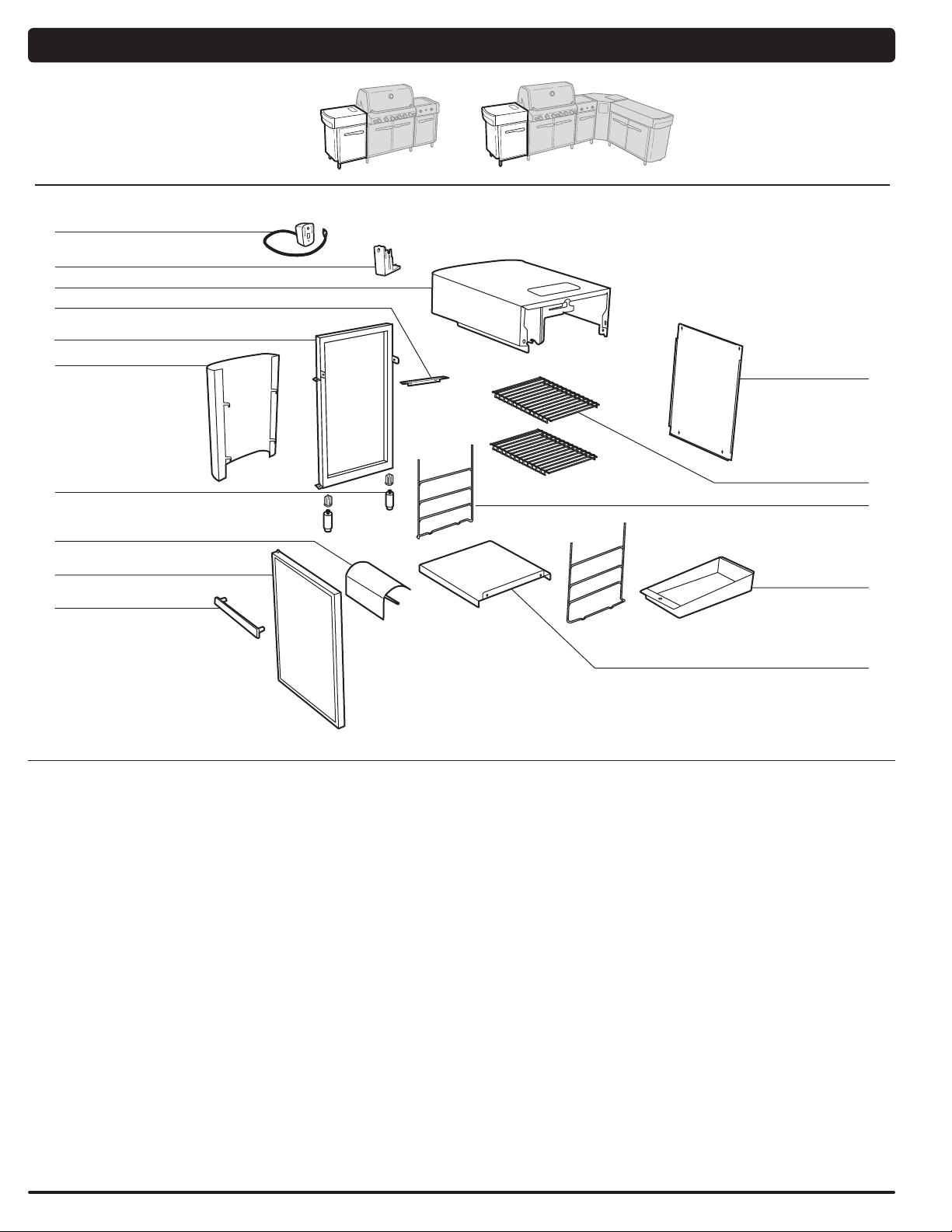
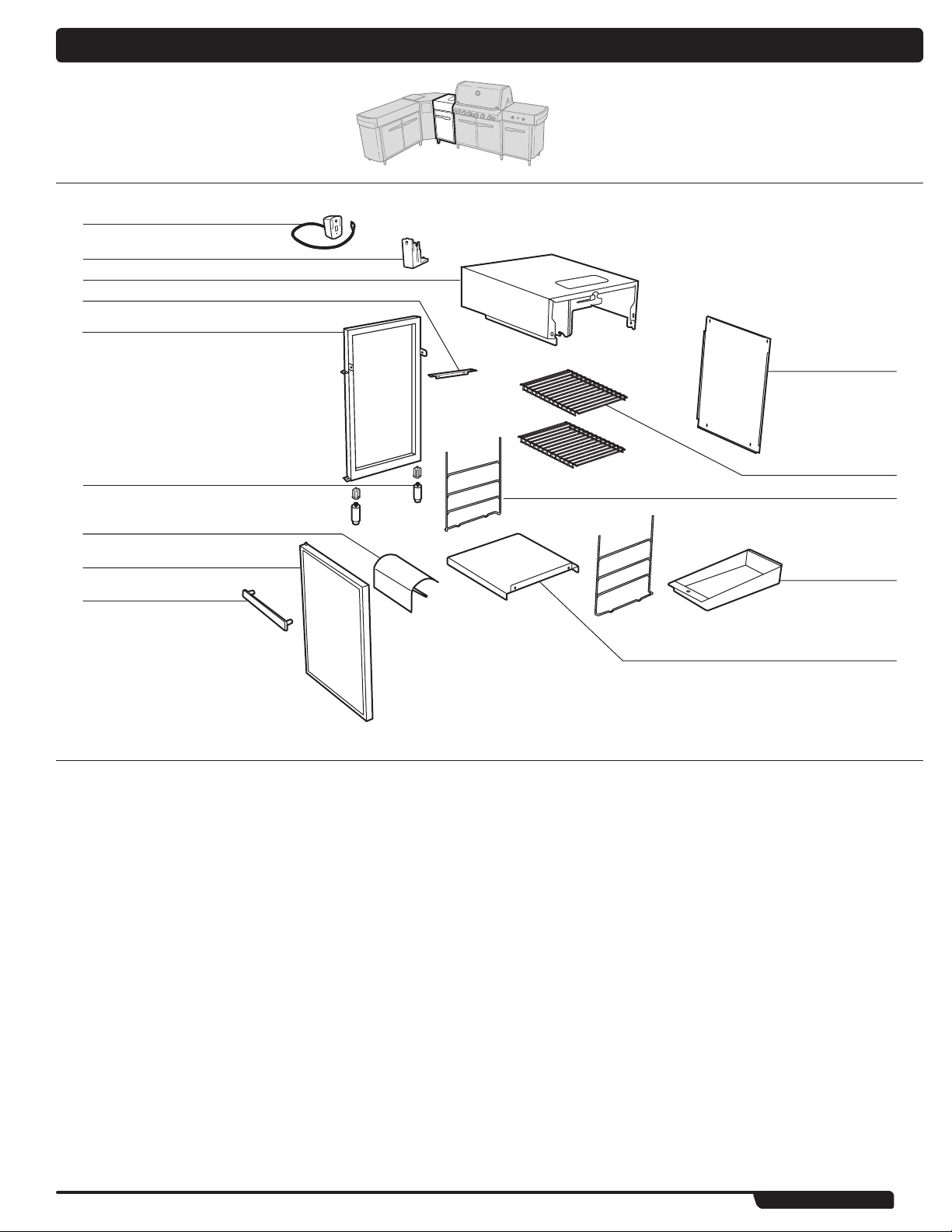
SUMMIT_Grill Center Left Cabinet_121610
1. Rotisserie Motor
2. Rotisserie Bracket
3. Table
4. Shelf Bracket
5. Left Frame
6. Left End Skirt
7. Adjustable Leg
8. Paper Towel Holder
9. Door
10. Door Handle
11. Back Panel
12. Wire Shelf
13. Shelf Frame
14. Water Deflector
15. Bottom Panel
Motor del asador
Soporte del asador giratorio
Mesa
Soporte del estante
Bastidor izquierdo
Faldón del extremo izquierdo
Pata ajustable
Portatoallas de papel
Puerta
Asa de la puerta
Panel posterior
Estante de alambre
Bastidor del estante
Deflector de agua
Panel inferior
Moteur de la rôtissoire
Support de la rôtissoire
Tablette
Support pour étagère
Cadre de gauche
Jupe d’extrémité gauche
Pied ajustable
Support pour serviette en papier
Porte
Poignée de porte
Panneau arrière
Etagère métallique
Cadre de l’étagère
Déflecteur à eau
Panneau inférieur
EXPLODED VIEW • DIAGRAMA DE DESPIECE • VUE ECLATEE
WWW.WEBER.COM
®
7
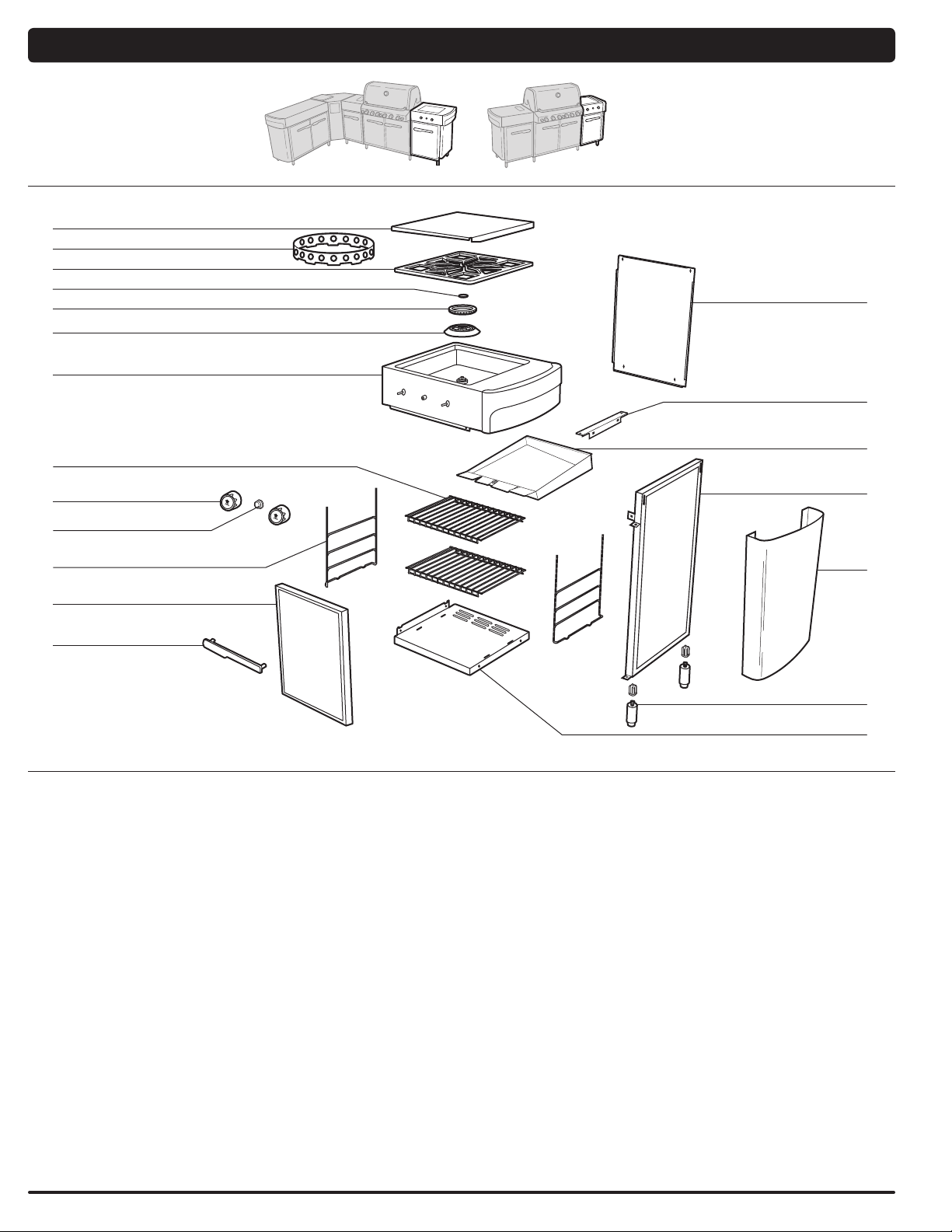
EXPLODED VIEW • DIAGRAMA DE DESPIECE • VUE ECLATEE
1. Rotisserie Motor
2. Rotisserie Bracket
3. Table
4. Shelf Bracket
5. Left Frame
6. Adjustable Leg
7. Paper Towel Holder
8. Door
9. Door Handle
10. Back Panel
11. Wire Shelf
12. Shelf Frame
13. Water Deflector
14. Bottom Panel
10
11
12
13
14
5
6
7
8
2
3
4
1
9
SUMMIT_Grill Center Left Cabinet_LHR_051911
Motor del asador
Soporte del asador giratorio
Mesa
Soporte del estante
Bastidor izquierdo
Pata ajustable
Portatoallas de papel
Puerta
Asa de la puerta
Panel posterior
Estante de alambre
Bastidor del estante
Deflector de agua
Panel inferior
Moteur de la rôtissoire
Support de la rôtissoire
Tablette
Support pour étagère
Cadre de gauche
Pied ajustable
Support pour serviette en papier
Porte
Poignée de porte
Panneau arrière
Etagère métallique
Cadre de l’étagère
Déflecteur à eau
Panneau inférieur
8
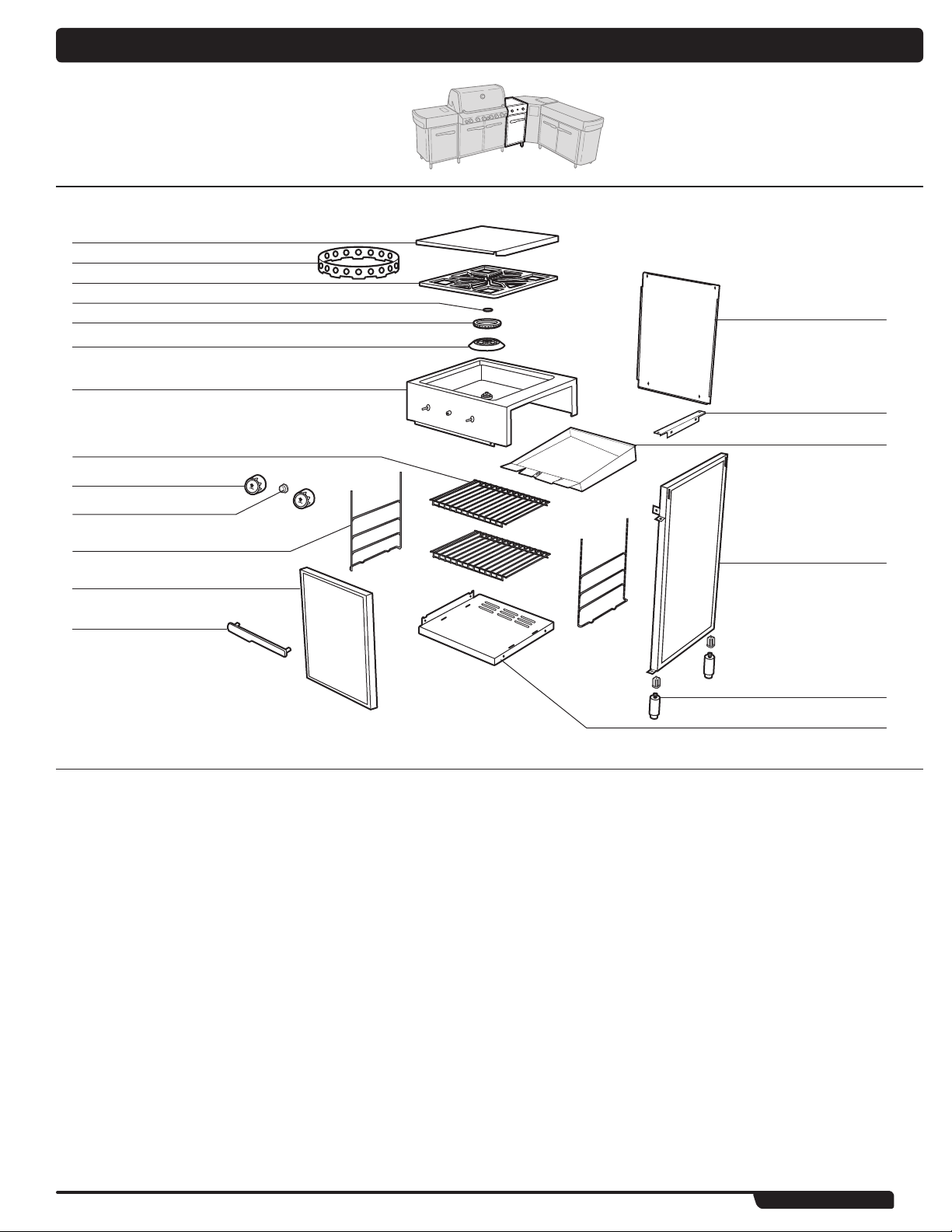
EXPLODED VIEW • DIAGRAMA DE DESPIECE • VUE ECLATEE
14
15
18
20
17
16
19
6
7
8
9
10
3
2
4
5
1
13
12
11
SUMMIT_Grill Center SB Cabinet_122110
1. Side Burner Lid
2. Wok Ring
3. Side Burner Grate
4. Side Burner Inner Ring 1
5. Side Burner Outer Ring 2
6. Side Burner Head
7. Side Burner
8. Wire Shelf
9. Control Knob
10. Igniter
11. Shelf Frame
12. Door
13. Door Handle
14. Back Panel
15. Shelf Bracket
16. Water Deflector
17. Right Frame
18. Right Frame Skirt
19. Adjustable Leg
20. Bottom Panel
Tapa del quemador lateral
Aro para wok
Rejilla del quemador lateral
Aro interno 1 del quemador lateral
Aro interno 2 del quemador lateral
Cabezal del quemador lateral
Quemador lateral
Estante de alambre
Perilla de control
Encendedor
Bastidor del estante
Puerta
Asa de la puerta
Panel posterior
Soporte del estante
Deflector de agua
Bastidor derecho
Faldón del bastidor derecho
Pata ajustable
Panel inferior
Couvercle du brûleur latéral
Bague pour wok
Grille du brûleur latéral
Bague interne du brûleur latéral 1
Bague externe du brûleur latéral 2
Tête du brûleur latéral
Brûleur latéral
Etagère métallique
Bouton de commande
Allumeur
Cadre de l’étagère
Porte
Poignée de porte
Panneau arrière
Support pour étagère
Déflecteur à eau
Cadre de droite
Jupe du cadre de droite
Pied ajustable
Panneau inférieur
WWW.WEBER.COM
®
9
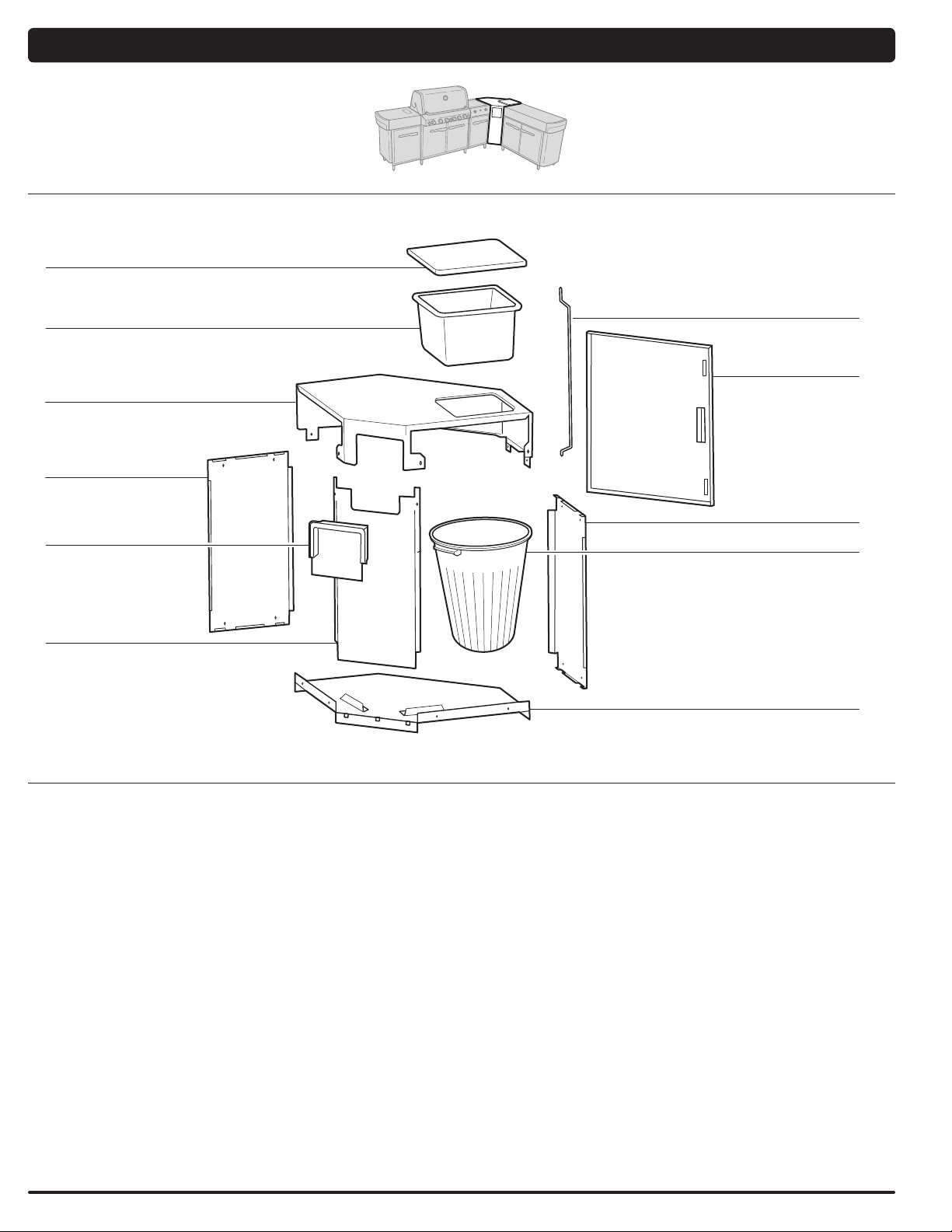
EXPLODED VIEW • DIAGRAMA DE DESPIECE • VUE ECLATEE
14
15
16
17
19
18
6
7
8
9
10
3
2
4
5
1
13
12
11
SUMMIT_Grill Center_Social_SB Cabinet_122110
1. Side Burner Lid
2. Wok Ring
3. Side Burner Grate
4. Side Burner Inner Ring 1
5. Side Burner Outer Ring 2
6. Side Burner Head
7. Side Burner
8. Side Burner Shelf
9. Control Knob
10. Igniter
11. Shelf Frame
12. Door
13. Door Handle
14. Back Panel
15. Shelf Bracket
16. Water Deflector
17. Right Frame
18. Adjustable Leg
19. Bottom Panel
Tapa del quemador lateral
Aro para wok
Rejilla del quemador lateral
Aro interno 1 del quemador lateral
Aro interno 2 del quemador lateral
Cabezal del quemador lateral
Quemador lateral
Estante del quemador lateral
Perilla de control
Encendedor
Bastidor del estante
Puerta
Asa de la puerta
Panel posterior
Soporte del estante
Deflector de agua
Bastidor derecho
Pata ajustable
Panel inferior
Couvercle du brûleur latéral
Bague pour wok
Grille du brûleur latéral
Bague interne du brûleur latéral 1
Bague externe du brûleur latéral 2
Tête du brûleur latéral
Brûleur latéral
Etagère du brûleur latéral
Bouton de commande
Allumeur
Cadre de l’étagère
Porte
Poignée de la porte
Panneau arrière
Support pour étagère
Déflecteur à eau
Cadre de droite
Pied ajustable
Panneau inférieur
10
EXPLODED VIEW • DIAGRAMA DE DESPIECE • VUE ECLATEE
7
8
9
10
11
3
4
2
1
6
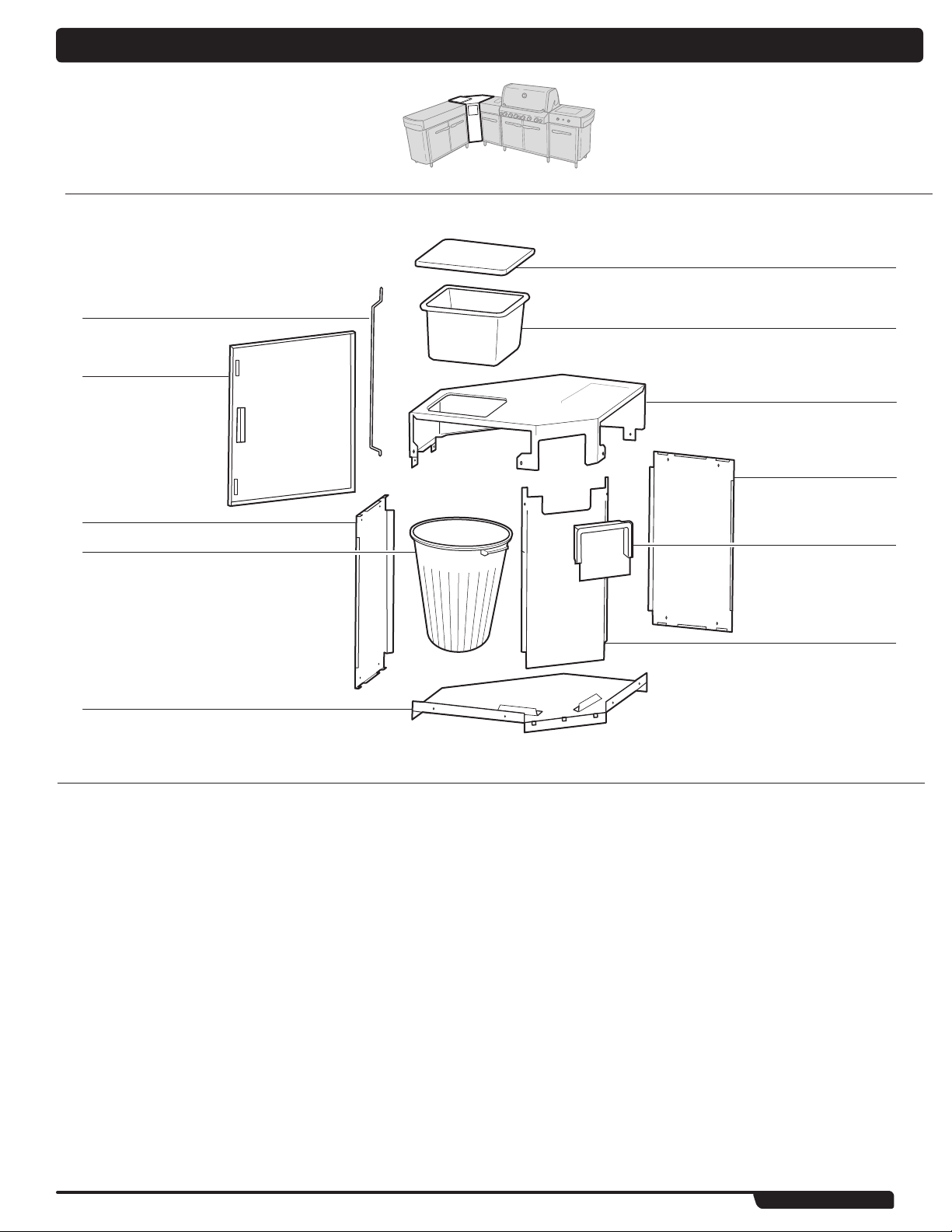
SUMMIT_Grill Center Middle Cabinet_12161
0
5
1. Cooler Lid
2. Cooler
3. Corner Cabinet Top Panel
4. Left Back Panel
5. Door Assembly
6. Front Panel
7. Door Hinge Rod
8. Door
9. Right Back Panel
10. Trash Can
11. Bottom Panel
Tapa del enfriador
Enfriador
Panel superior del gabinete de esquina
Panel izquierdo posterior
Ensamble de la puerta
Panel frontal
Varilla de la bisagra de la puerta
Puerta
Panel derecho posterior
Bote de basura
Panel inferior
Couvercle du refroidisseur
Refroidisseur
Panneau supérieur du meuble de coin
Panneau arrière gauche
Assemblage de la porte
Panneau avant
Tige du gond de la porte
Porte
Panneau arrière droit
Corbeille
Panneau inférieur
WWW.WEBER.COM
®
11
EXPLODED VIEW • DIAGRAMA DE DESPIECE • VUE ECLATEE
7
8
9
10
11
3
4
2
1
6
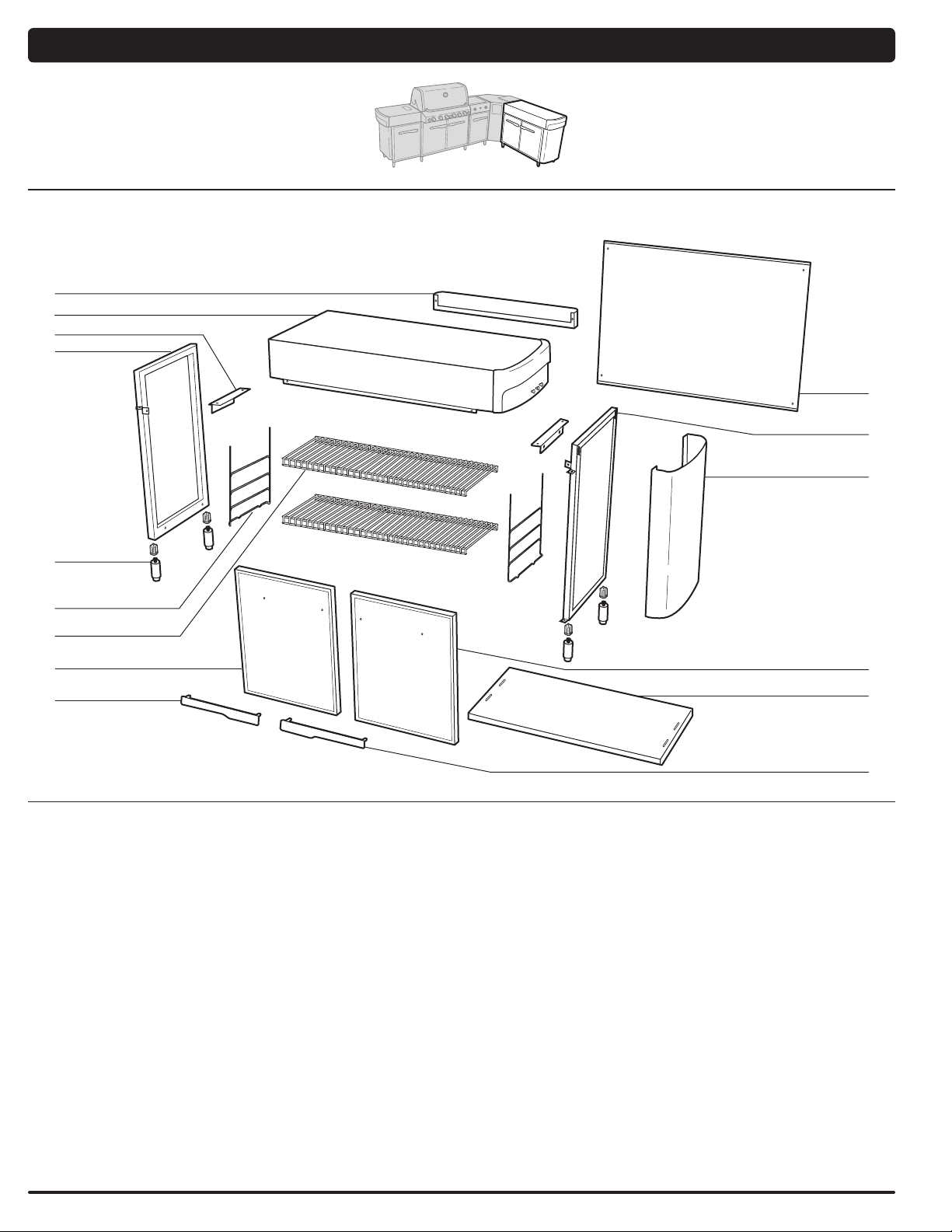
SUMMIT_Grill Center Middle Cabinet2_12161
0
5
1. Cooler Lid
2. Cooler
3. Corner Cabinet Top Panel
4. Right Back Panel
5. Door Assembly
6. Front Panel
7. Door Hinge Rod
8. Door
9. Left Back Panel
10. Trash Can
11. Bottom Panel
Tapa del enfriador
Enfriador
Panel superior del gabinete de esquina
Panel derecho posterior
Ensamble de la puerta
Panel frontal
Varilla de la bisagra de la puerta
Puerta
Panel izquierdo posterior
Bote de basura
Panel inferior
Couvercle du refroidisseur
Refroidisseur
Panneau supérieur du meuble de coin
Panneau arrière droit
Assemblage de la porte
Panneau avant
Tige du gond de la porte
Porte
Panneau arrière gauche
Corbeille
Panneau inférieur
12
EXPLODED VIEW • DIAGRAMA DE DESPIECE • VUE ECLATEE
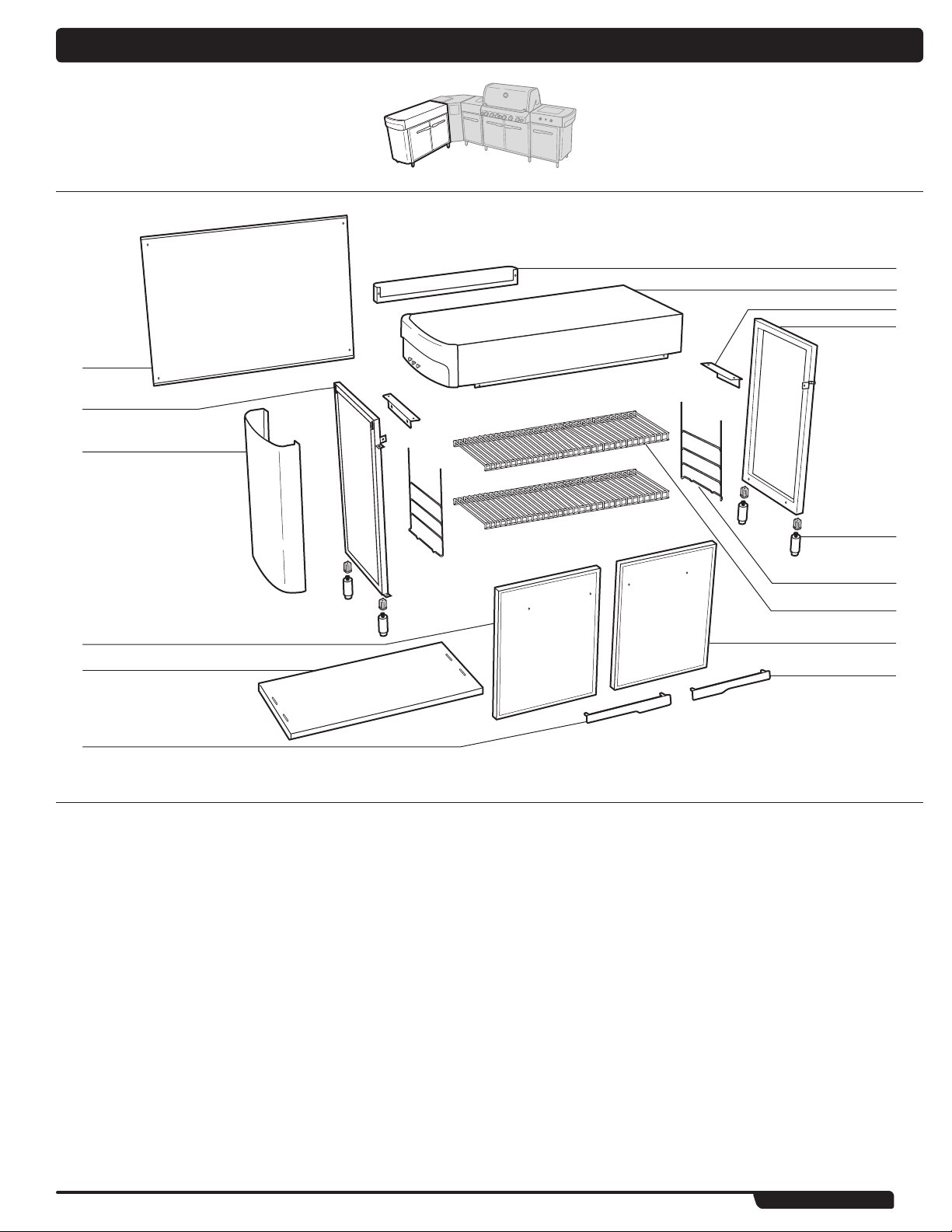
SUMMIT_Grill Center Social Center_121610
10
11
12
13
14
15
2
3
5
6
7
1
8
4
9
1. Condiment Holder
2. Table
3. Shelf Bracket
4. Left Frame
5. Adjustable Leg
6. Shelf Frame
7. Shelf
8. Left Door
9. Left Door Handle
10. Back Panel
11. Right Frame
12. Right Frame Skirt
13. Right Door
14. Bottom Panel
15. Right Door Handle
Portacondimentos
Mesa
Soporte del estante
Bastidor derecho
Pata ajustable
Bastidor del estante
Estante
Puerta izquierda
Asa de la puerta izquierda
Panel posterior
Bastidor derecho
Faldón del bastidor derecho
Puerta derecha
Panel inferior
Asa de la puerta derecha
Support pour condiments
Tablette
Support pour étagère
Cadre de gauche
Pied ajustable
Cadre de l’étagère
Etagère
Porte de gauche
Poignée de la porte de gauche
Panneau arrière
Cadre de droite
Jupe du cadre de droite
Porte de droite
Panneau inférieur
Poignée de porte de droite
WWW.WEBER.COM
®
13
EXPLODED VIEW • DIAGRAMA DE DESPIECE • VUE ECLATEE
SUMMIT_Grill Center Social Center_LHR_051811
10
11
12
13
14
15
2
3
5
6
7
1
8
4
9
1. Condiment Holder
2. Table
3. Shelf Bracket
4. Right Frame
5. Adjustable Leg
6. Shelf Frame
7. Shelf
8. Right Door
9. Right Door Handle
10. Back Panel
11. Left Frame
12. Left End Skirt
13. Left Door
14. Bottom Panel
15. Left Door Handle
Portacondimentos
Mesa
Soporte del estante
Bastidor derecho
Pata ajustable
Bastidor del estante
Estante
Puerta derecha
Asa de la puerta derecha
Panel posterior
Bastidor derecho
Faldón del extremo izquierdo
Puerta izquierda
Panel inferior
Asa de la puerta izquierda
Support pour condiments
Tablette
Support pour étagère
Cadre de droite
Pied ajustable
Cadre de l’étagère
Etagère
Porte de droite
Poignée de porte de droite
Panneau arrière
Cadre de gauche
Jupe d’extrémité gauche
Porte de gauche
Panneau inférieur
Poignée de la porte de gauche

14
GENERAL INSTRUCTIONS
With the Weber
®
gas barbecue, you can grill, barbecue, roast, and bake with results that
are difficult to duplicate with indoor kitchen appliances. The closed lid and Flavorizer
®
bars produce that “outdoor” flavor in the food.
Liquid Propane (LP) gas supply is easy to use and gives you more cooking control than
charcoal fuel.
r5IFTFJOTUSVDUJPOTXJMMHJWFZPVUIFNJOJNVNSFRVJSFNFOUTGPSBTTFNCMJOHZPVS
Weber
®
gas barbecue. Please read the instructions carefully before using your
Weber
®
gas barbecue. Improper assembly can be dangerous.
r/PUGPSVTFCZDIJMESFO
r*GUIFSFBSFMPDBMDPEFTUIBUBQQMZUPiCVJMUJOuHBTHSJMMTZPVXJMMIBWFUPDPOGPSNUP
them. Installation must conform with local codes or, in the absence of local codes,
with either the National Fuel Gas Code, ANSI Z223.1/NFPA 54, Natural Gas and
Propane Installation Code, CSA B149.1, or Propane Storage and Handling Code,
B149.2 as applicable.
r5IFQSFTTVSFSFHVMBUPSTVQQMJFEXJUIUIF8FCFS
®
gas barbecue must be used. This
regulator is set for 11 inches of water column (pressure).
r5IJT8FCFS
®
gas barbecue is designed for use with liquid propane (LP) gas only. Do
not use with natural (piped in city) gas. The valves, orifices, hose, and regulator are
for LP gas only.
r%POPUVTFXJUIDIBSDPBMGVFM
r$IFDLUIBUUIFBSFBVOEFSUIFDPOUSPMQBOFMBOEUIFHSFBTFUSBZBSFGSFFGSPNEFCSJT
that might obstruct the flow of combustion or ventilation air.
r5IFBSFBTBSPVOEUIF-1DZMJOEFSNVTUCFGSFFBOEDMFBSGSPNEFCSJT
r3FQMBDFNFOUQSFTTVSFSFHVMBUPSTBOEIPTFBTTFNCMJFTNVTUCFUIPTFTQFDJGJFECZ
Weber-Stephen Products LLC.
X
FOR INSTALLATION IN CANADA
These instructions, while generally acceptable, do not necessarily comply with the
Canadian Installation codes, particularly with piping above and below ground. In
Canada the installation of this appliance must comply with local codes and/or Standard
CSA-B149.2 (Propane Storage and Handling Code).
X
OPERATING
WARNING: Only use this barbecue outdoors in a well-
ventilated area. Do not use in a garage, building, breezeway
or any other enclosed area.
WARNING: Keep the ventilation openings of the cylinder
enclosure free and clear of debris.
WARNING: Your Weber
®
gas barbecue shall not be used
under overhead combustible construction.
WARNING: Do not use the barbecue within 24 inches
(610 mm) of combustible materials, top, bottom, back or
sides of the grill.
WARNING: The entire cooking box gets hot when in use. Do
not leave unattended.
WARNING: Keep any electrical supply cord and the fuel
supply hose away from any heated surface.
WARNING: Keep the cooking area clear of flammable vapors
and liquids such as gasoline, alcohol, etc., and combustible
materials.
WARNING: Never store an extra (spare) LP cylinder under or
near the Weber
®
gas barbecue.
WARNING: Keep the ventilation openings of the cylinder
enclosure free and clear of debris.
WARNING: Turn off the gas at the LP gas supply cylinder
when the outdoor cooking gas appliance is not in use.
WARNING: LP cylinders must be stored outdoors out of
the reach of children and must not be stored in a building,
garage, or any other enclosed area.
WARNING: The LP cylinder used with your barbecue must
be with a listed OPD (Overfilling Prevention Device) and
a QCC1 or Type 1 (CGA810) cylinder connection. The
cylinder connection must be compatible with the barbecue
connection.
X
STORAGE AND/OR NONUSE
r5IFHBTNVTUCFUVSOFEPGGBUUIFMJRVJEQSPQBOFDZMJOEFSXIFOUIF8FCFS
®
gas
barbecue is not in use.
r-1DZMJOEFSNVTUCFTUPSFEPVUEPPSTJOBXFMMWFOUJMBUFEBSFBPVUPGSFBDIPGDIJMESFO
Disconnected LP cylinder must not be stored in a building, garage, or any other
enclosed area.
r$IFDLUIBUUIFBSFBTVOEFSUIFDPOUSPMQBOFMBOEUIFTMJEFPVUHSFBTFUSBZBSFGSFF
from debris that might obstruct the flow of combustion or ventilation air.
r5IFTQJEFSJOTFDUTDSFFOTTIPVMEBMTPCFDIFDLFEGPSBOZPCTUSVDUJPOT3FGFSUP
“MAINTENANCE/ANNUAL MAINTENANCE.”)
X
WARRANTY
Weber-Stephen Products LLC (Weber) hereby warrants to the ORIGINAL PURCHASER of this
Weber
®
gas grill that it will be free of defects in material and workmanship from the date of purchase
as follows:
Aluminum castings: 25 years (2 years on paint; excludes fading)
Stainless steel shroud: 25 years
Porcelain-enameled shroud: 25 years
Stainless steel burner tubes: 10 years
Stainless steel cooking grates: 5 years no rust through or burn through
Stainless steel Flavorizer
®
bars: 5 years no rust through or burn through
Porcelain-enameled cast-iron cooking grates: 5 years no rust through or burn through
Porcelain-enameled cooking grates: 3 years no rust through or burn through
Porcelain-enameled Flavorizer
®
bars: 2 years no rust through or burn through
Infrared rotisserie burner: 2 years
All remaining parts: 2 years
when assembled and operated in accordance with the printed instructions accompanying it. Weber
may require reasonable proof of your date of purchase. THEREFORE, YOU SHOULD RETAIN YOUR
SALES SLIP OR INVOICE.
This Limited Warranty shall be limited to the repair or replacement of parts that prove defective under
normal use and service and which on examination shall indicate, to Weber’s satisfaction, they are
defective. Before returning any parts, contact the Customer Service Representative in your area
using the contact information on our website. If Weber confirms the defect and approves the claim,
Weber will elect to replace such parts without charge. If you are required to return defective parts,
transportation charges must be prepaid. Weber will return parts to the purchaser, freight or postage
prepaid.
This Limited Warranty does not cover any failures or operating difficulties due to accident, abuse,
misuse, alteration, misapplication, vandalism, improper installation or improper maintenance or
service, or failure to perform normal and routine maintenance, including but not limited to damage
caused by insects within the burner tubes, as set out in this owner’s manual.
Deterioration or damage due to severe weather conditions such as hail, hurricanes, earthquakes
or tornadoes, discoloration due to exposure to chemicals either directly or in the atmosphere, is not
covered by this Limited Warranty.
There are no other express warrants except as set forth herein and any applicable implied warranties
of merchantability and fitness are limited in duration to the period of coverage of this express written
Limited Warranty. Some regions do not allow limitation on how long an implied warranty lasts, so this
limitation may not apply to you.
Weber is not liable for any special, indirect or consequential damages. Some regions do not allow the
exclusion or limitation of incidental or consequential damages, so this limitation or exclusion may not
apply to you.
Weber does not authorize any person or company to assume for it any other obligation or liability in
connection with the sale, installation, use, removal, return, or replacement of its equipment; and no
such representations are binding on Weber.
This Warranty applies only to products sold at retail.
WEBER-STEPHEN PRODUCTS LLC
Customer Service Center
1890 Roselle Road, Suite 308
Schaumburg, IL 60195
USA
For replacement parts call:
1-800-446-1071
Visit www.weber.com
®
, select your country of origin, and register your grill today.
X
WWW.WEBER.COM
®
15
GAS INSTRUCTIONS
SAFE HANDLING TIPS FOR LIQUID PROPANE GAS CYLINDERS
r-JRVJE1SPQBOF-1HBTJTBQFUSPMFVNQSPEVDUBTBSFHBTPMJOFBOEOBUVSBMHBT-1
gas is a gas at regular temperatures and pressures. Under moderate pressure, inside
a cylinder, LP gas is a liquid. As the pressure is released, the liquid readily vaporizes
and becomes gas.
r-1HBTIBTBOPEPSTJNJMBSUPOBUVSBMHBT:PVTIPVMECFBXBSFPGUIJTPEPS
r-1HBTJTIFBWJFSUIBOBJS-FBLJOH-1HBTNBZDPMMFDUJOMPXBSFBTBOEQSFWFOU
dispersion.
r5PGJMMUBLFUIF-1DZMJOEFSUPBQSPQBOFHBTEFBMFSPSMPPLVQiHBTQSPQBOFuJOUIF
phone book for other sources of LP gas.
WARNING: We recommend that your LP cylinder be filled
at an authorized LP gas dealer, by a qualified attendant,
who fills the tank by weight. IMPROPER FILLING IS
DANGEROUS.
r"JSNVTUCFSFNPWFEGSPNBOFX-1DZMJOEFSCFGPSFUIFJOJUJBMGJMMJOH:PVS-1EFBMFSJT
equipped to do this.
r5IF-1DZMJOEFSNVTUCFJOTUBMMFEUSBOTQPSUFEBOETUPSFEJOBOVQSJHIUQPTJUJPO-1
cylinders should not be dropped or handled roughly.
r/FWFSTUPSFPSUSBOTQPSUUIF-1DZMJOEFSXIFSFUFNQFSBUVSFTDBOSFBDI'UPPIPU
to hold by hand). For example: do not leave the LP cylinder in a car on a hot day.
Note: A refill will last about 18–20 hours of cooking time at normal use. The fuel scale,
a feature on some of our grills, will indicate the propane supply so you can refill the
cylinder before running out. You do not have to run out before you refill.
r5SFBUiFNQUZu-1DZMJOEFSTXJUIUIFTBNFDBSFBTXIFOGVMM&WFOXIFOUIF-1UBOL
is empty of liquid, there still may be gas pressure in the cylinder. Always close the
cylinder valve before disconnecting.
CAUTION: Place dust cap on cylinder valve outlet whenever
the cylinder is not in use. Only install the type of dust cap
on the cylinder valve outlet that is provided with the cylinder
valve. Other types of caps or plugs may result in leakage of
propane.
r%POPUVTFBEBNBHFE-1DZMJOEFS"EFOUFEPSSVTUZ-1DZMJOEFSPSBO-1DZMJOEFS
with a damaged valve may be hazardous and should be replaced with a new one
immediately.
r5IFKPJOUXIFSFUIFIPTFDPOOFDUTUPUIF-1DZMJOEFSNVTUCFMFBLUFTUFEFBDIUJNF
the LP cylinder is reconnected. For example, test each time the LP cylinder is refilled.
r#FTVSFUIFSFHVMBUPSJTNPVOUFEXJUIUIFTNBMMWFOUIPMFQPJOUFEEPXOXBSETPUIBUJU
will not collect water. This vent should be free of dirt, grease, bugs, etc.
r5IFHBTDPOOFDUJPOTTVQQMJFEXJUIZPVS8FCFS
®
gas appliance have been designed
and tested to meet 100% CSA and ANSI requirements.
WARNING: Replacement LP tanks must match the regulator
connection supplied with this Weber
®
gas appliance.
Liquid Propane Cylinder Requirements
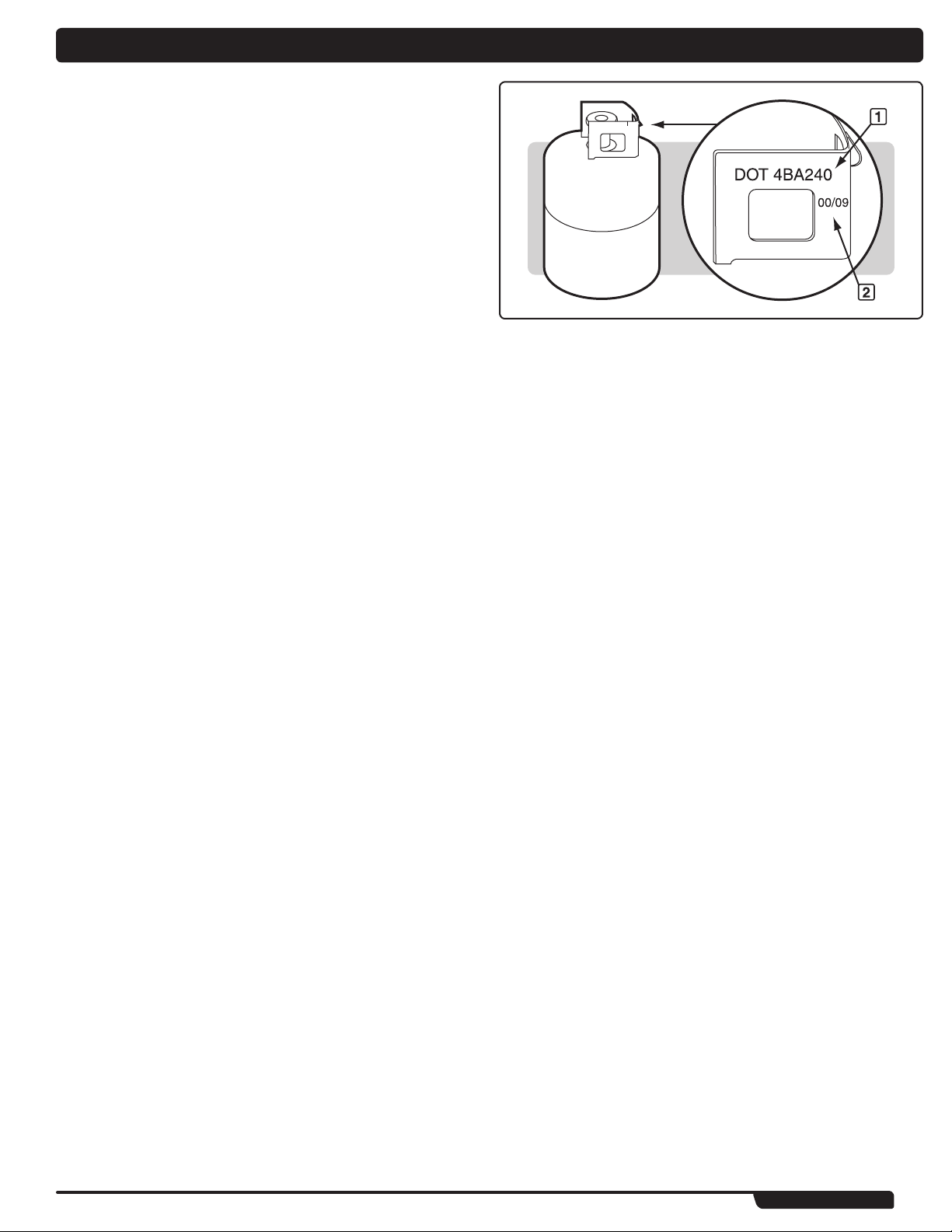
r$IFDLUPCFTVSFUIBUDZMJOEFSTIBWFB%05DFSUJGJDBUJPO(1), and that they have been
date tested (2) is within five years of use. Your LP gas supplier can do this for you.
r"MM-1UBOLTVQQMZTZTUFNTNVTUJODMVEFBDPMMBSUPQSPUFDUUIFDZMJOEFSWBMWF
r5IF-1DZMJOEFSNVTUCFBMCTJ[FBQQSPYJNBUFMZJODIFTIJHIBOEJODIFT
in diameter.
r5IFDZMJOEFSNVTUCFDPOTUSVDUFEBOENBSLFEJOBDDPSEBODFXJUIUIF4QFDJGJDBUJPOT
for LP - Gas Cylinders of the U.S. Department of Transportation (D.O.T.) or the
National Standard of Canada, CAN/CSA-B339, Cylinders, Spheres and Tubes or
Transportation of Dangerous Goods; and Commission, as applicable.
Canadian Liquid Propane Cylinder Requirements
Note: Your retailer can help you match a replacement tank to your barbecue.
r5IF-1DZMJOEFSNVTUCFDPOTUSVDUFEBOENBSLFEJOBDDPSEBODFXJUIUIF
specifications for LP gas cylinders, T.C.
X
16
DANGER
Do not use an open flame to check for gas leaks. Be sure
there are no sparks or open flames in the area while you
check for leaks. Sparks or flames will result in a fire or
explosion which can cause serious bodily injury or death,
and damage to property.
GAS INSTRUCTIONS
IMPORTANT LP CYLINDER INFORMATION
DANGER
NEVER store a spare LP cylinder under or near Weber
®
gas
appliances. NEVER fill the tank beyond 80% full. Failure to
follow these statements exactly may result in a fire causing
death or serious injury.
Weber
®
gas appliances are equipped for a cylinder supply system designed for vapor
withdrawal.
WARNING: Only use Weber
®
gas appliances outdoors in
a well-ventilated area. Do not use in a garage, building,
breezeway or any other enclosed area.
The proper filling methods for the filling of your cylinder are by weight or volume, as
described in NFPA 58. Please make sure your filling station fills your LP cylinder by
weight or volume. Ask your filling station to read purging and filling instructions on the LP
cylinder before attempting to fill.
X
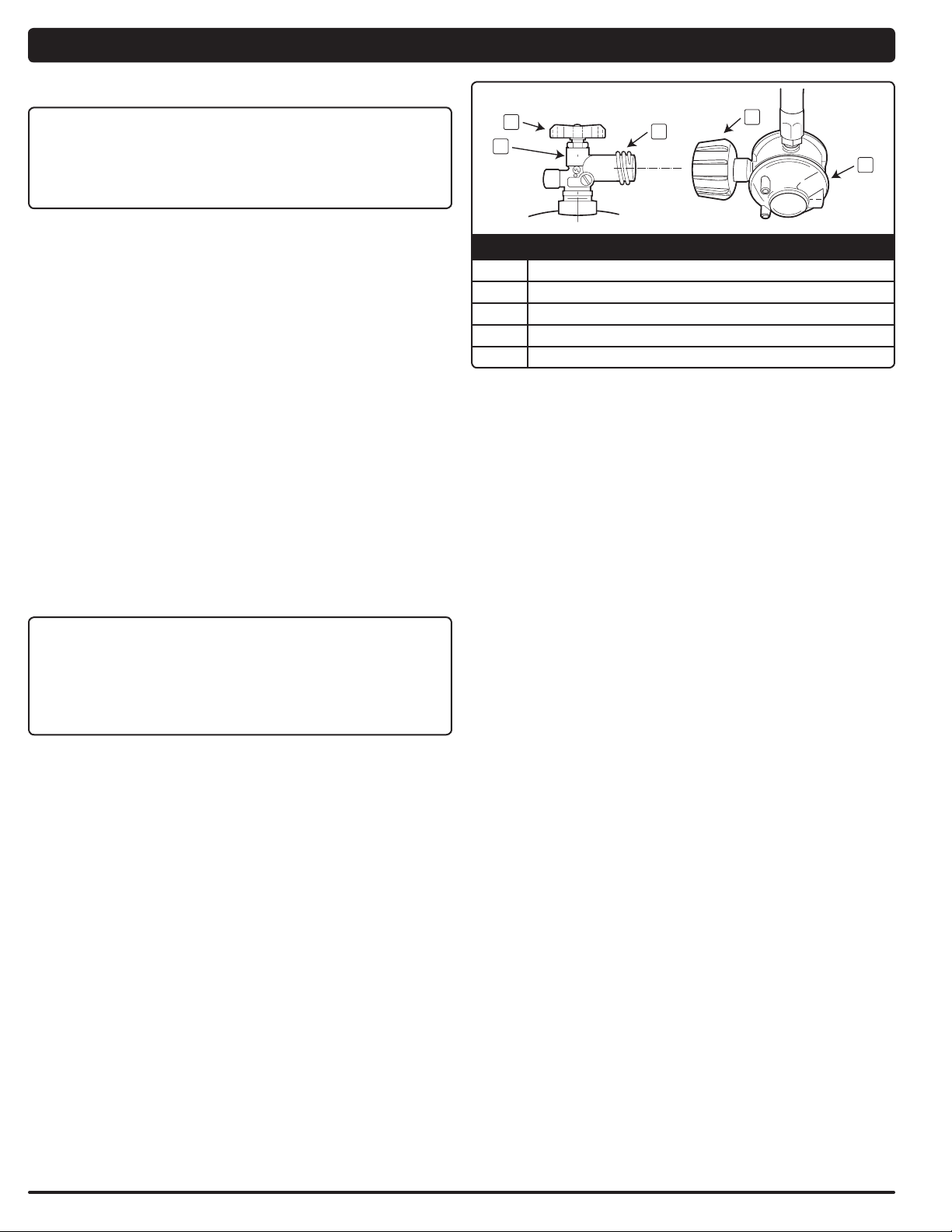
LEAK CHECK PREPARATION
Check That All Burner Valves Are Off
Valves are shipped in the OFF position, but you should check to be sure that they are
turned off. Check by pushing down and turning clockwise. If they do not turn, they are off.
If they do turn, continue turning them clockwise until they stop; then they are off.
The Liquid Propane Cylinder
All Weber
®
liquid propane gas grill regulators are equipped with a UL-Listed tank
connection as per the latest edition of ANSI Z21.58. This will require a liquid propane
tank that is similarly equipped with a Type 1 connection in the tank valve. This Type 1
coupling allows you to make a fast and totally safe hookup between your gas grill and
your liquid propane tank. It eliminates the chance of leaks due to a POL fitting that is
not properly tightened. Gas will not flow from the tank unless the Type 1 coupling is fully
engaged into the coupling.
WARNING: Make sure that the LP cylinder valve is closed.
Close by turning valve clockwise.
3
1
2
4
5
TYPE 1 CONNECTIVE COUPLING
1 Type 1 valve
2 Hand wheel
3 External thread
4 Thermally sensitive nut
5 Propane regulator
WWW.WEBER.COM
®
17
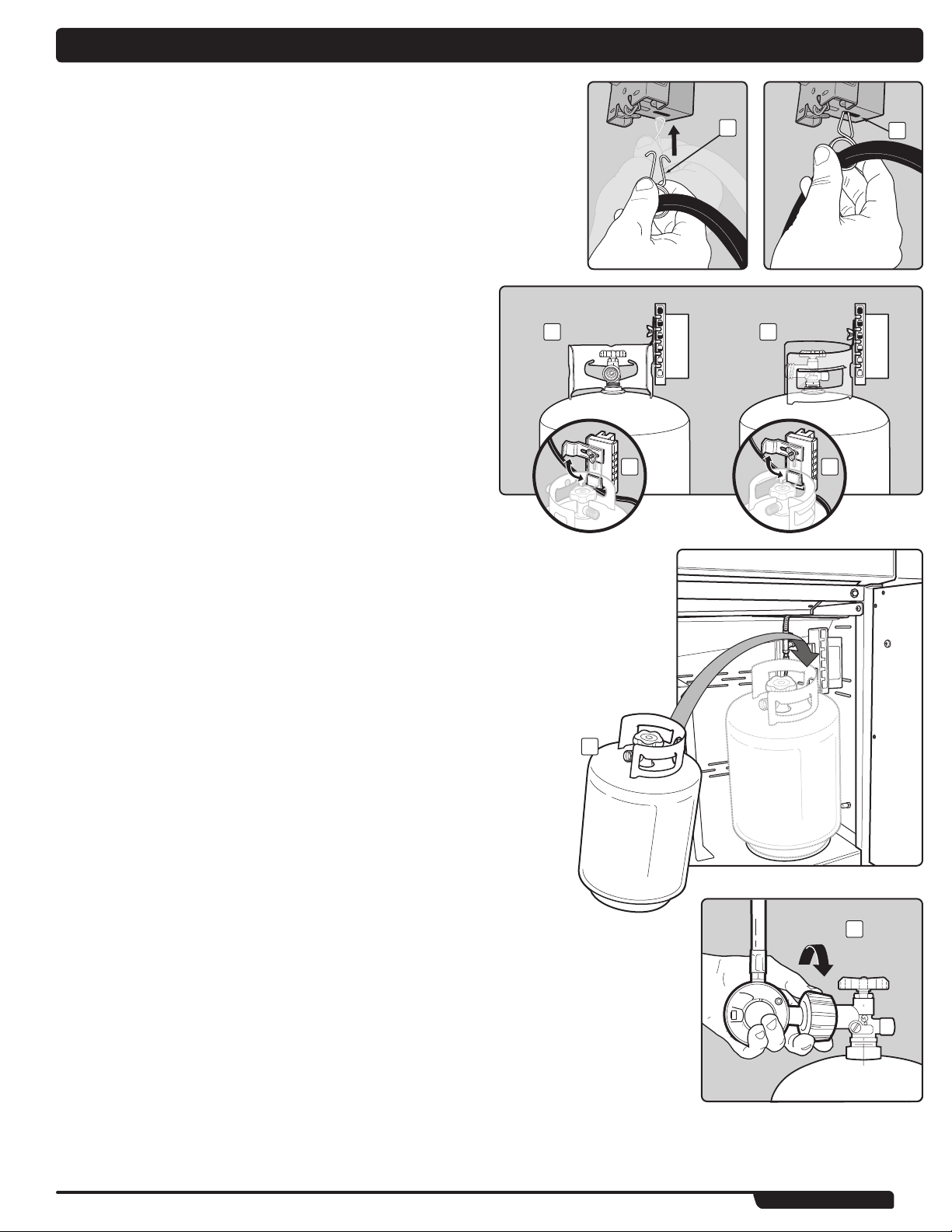
A) Locate hose retention clip (1) on regulator hose. Secure into slot (2) on underside of
tank scale.
WARNING: The hose must be secured to the tank scale
with the Hose Retention Clip. Failure to do so could cause
damage to the hose resulting in a fire or explosion which
can cause serious bodily injury or death, and damage to
property.
Some LP tanks have differing top collar assembles. (The top collar is the metal
protective ring around the valve.) One series of tanks mount with the valve facing front
(3). The other tanks mount with the valve facing away from the fuel scale (4). Weber
recommends the use of cylinder manufacturer’s Manchester and Worthington, with a
47.6 lb water capacity. Other cylinders may be acceptable for use with the appliance
provided they are compatible with the appliance retention means (see illustrations).
The LP cylinder is installed inside the base cabinet, on the tank scale (right side).
B) Open base cabinet doors.
C) Loosen cylinder lock wing nut. Swing cylinder lock up (5).
D) Turn the LP cylinder so the opening of the valve is either to the front or side of the
Weber
®
gas barbecue.
E) Lift tank up into position on the tank scale (6).
F) Swing the cylinder lock down. Tighten the wing nut.
Connect The Hose To The Cylinder
A) Remove the plastic dust cover from the valve.
B) Screw the regulator coupling onto the tank valve, clockwise, or to the right. Hand-
tighten only (7).
Note: This connection tightens clockwise and will not allow gas to flow unless the
connection is tight. The connection requires tightening by hand only.
WARNING: Do not use a wrench to tighten the connection.
Using a wrench could damage the regulator coupling and
could cause a leak.
GAS INSTRUCTIONS
6
1
2
3 4
5 5
7
18
1
2
3
4
WARNING: The gas connections of your Summit
®
gas grill
have been factory tested. We do however recommend that
you leak check all gas connections before operating your
Summit
®
gas grill.
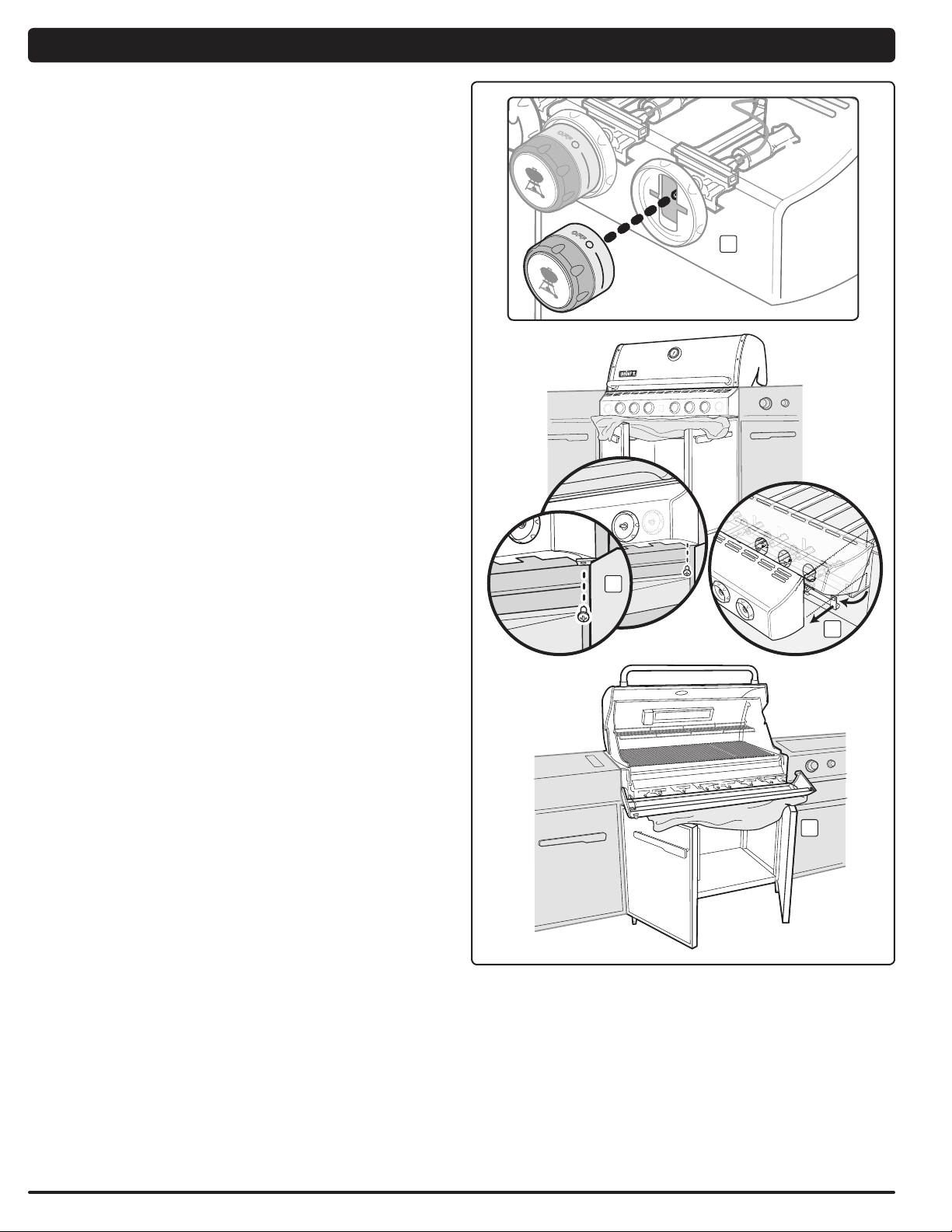
Remove Control Panel
Parts required: Phillips screwdriver and a towel.
A) Remove the burner control knobs (1).
B) Open both doors and place a towel on top of the doors. This will protect the control
panel and tops of the doors from getting scratched on the next step.
C) Remove the screws from the underside of the control panel with a Phillips
screwdriver (2).
D) Tilt the conrol panel forward and lift up and away from the grill (3) (For Summit
®
models with LED features: Be careful not to break or disconnect the wires for the
control panel LED’s).
E) Place the control panel on the towel covering the door assemblies (4).
GAS INSTRUCTIONS
The grill illustrated
may have slight
differences than the
model purchased.
WWW.WEBER.COM
®
19
Note: All factory-made connections have been thoroughly checked for gas leaks. The
burners have been flame-tested. As a safety precaution, however, you should recheck
all fittings for leaks before using your Weber® gas barbecue. Shipping and handling
may loosen or damage a gas fitting.
WARNING: The gas connections of your gas grill have been
factory tested. We do however recommend that you leak
check all gas connections before operating your gas grill.
WARNING: Perform these leak checks even if your barbecue
was dealer or store assembled.
If your grill has a side burner, make sure the side burner is turned off.
Turn on gas supply at source.
WARNING: Do not ignite burners when leak checking.
You will need: A soap and water solution and a rag or brush to apply it.
A) Mix soap and water.
B) Turn on gas supply (1).
C) Check for leaks by wetting the fitting with the soap and water solution and watching
for bubbles. If bubbles form, or if a bubble grows, there is a leak.
If there is a leak, turn off the gas and tighten the fitting. Turn the gas back on and
recheck with the soap and water solution. If leak does not stop, do not use the
barbecue. Contact the Customer Service representative in your area using the
contact information on our web site. Log onto www.weber.com
®
.
D) When leak checking is complete, turn gas supply off at the source and rinse
connections with water.
Note: Since some leak test solutions, including soap and water, may be slightly
corrosive, all connections should be rinsed with water after checking for leaks.
WARNING: You should check for gas leaks every time you
disconnect and reconnect a gas fitting.
CHECK FOR GAS LEAKS
DANGER
Do not use an open flame to check for gas leaks. Be sure
there are no sparks or open flames in the area while you
check for leaks. Sparks or open flames will result in a fire or
explosion, which can cause serious bodily injury or death
and damage to property.
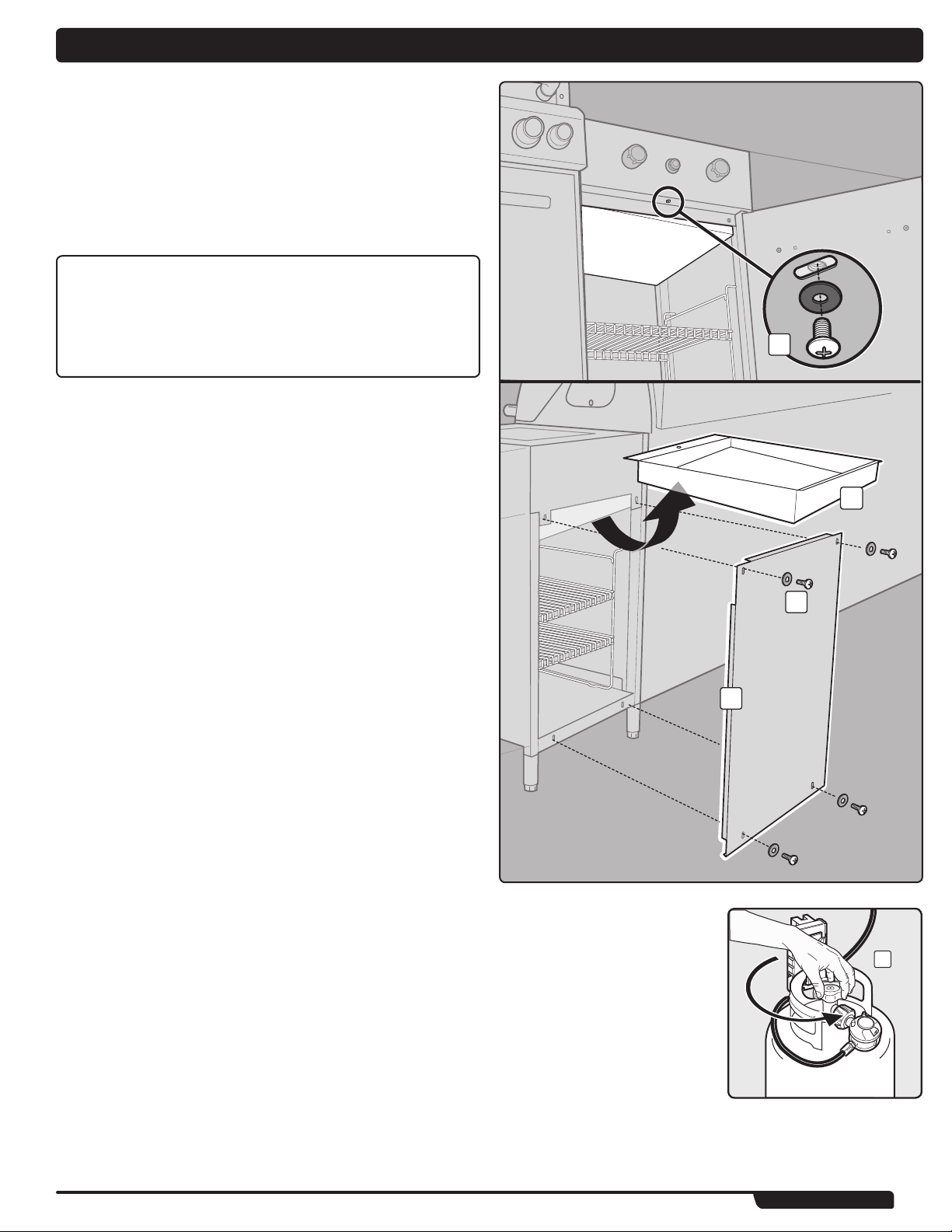
Remove Side Burner Cabinet Back Panel and
Side Burner Cabinet Water Deflector
Tools required: Phillips screwdriver.
A) Facing the back of the unit, remove screws that secure back panel of side burner
cabinet with a Phillips screwdriver (1).
B) Remove back panel and set aside (2).
C) Facing the front of the unit, open side burner cabinet door and remove screw
securing side burner cabinet water deflector (3).
D) Facing the back of the unit, push water deflector forward to allow rear edge to drop
down. Pivot down on an angle and remove from side burner cabinet (4).
X
GAS INSTRUCTIONS
1
2
4
2
3
1
20
4
1
2
3
4
5
8
67
The grill illustrated may
have slight differences
than the model purchased.
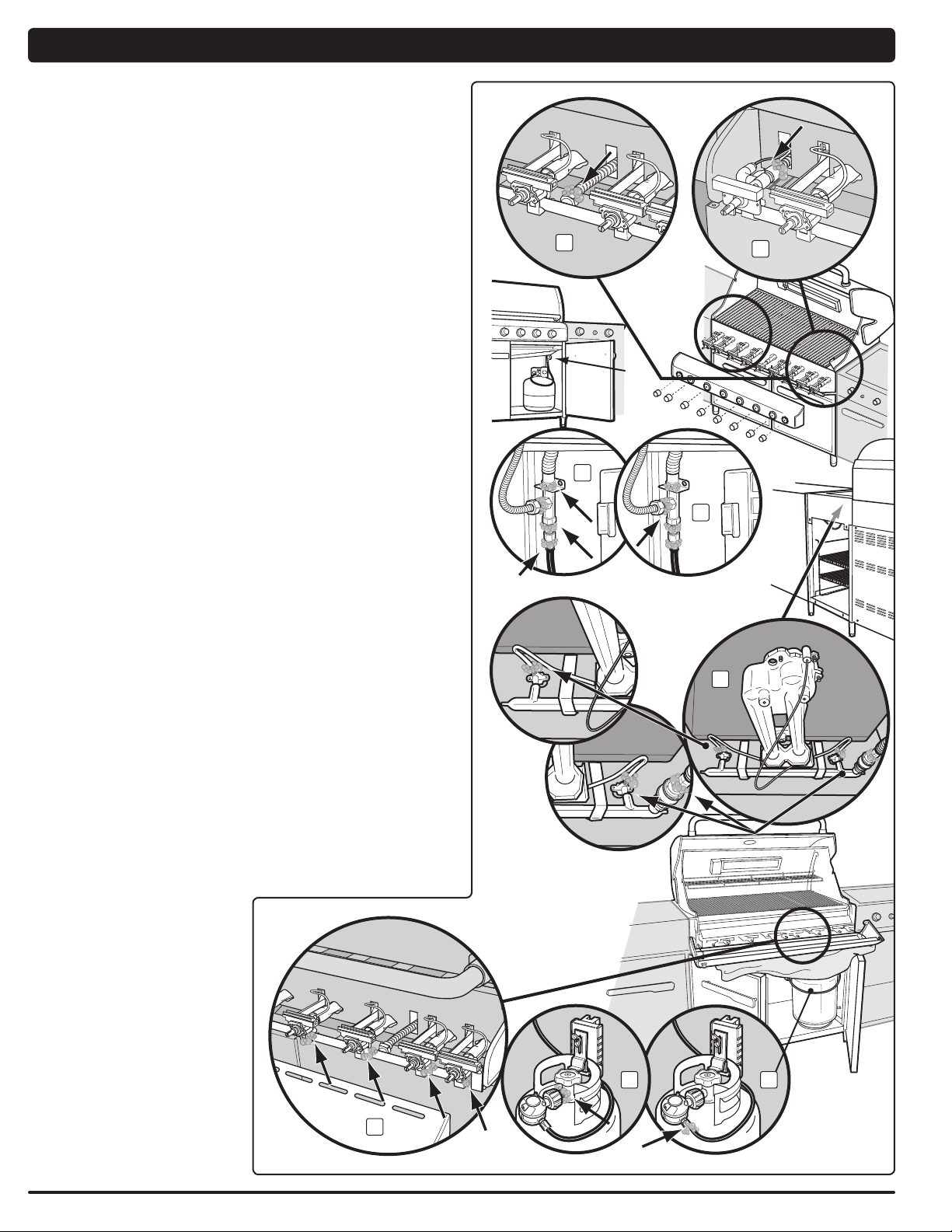
Check
A) Main gas line to manifold connection (1).
B) Rotisserie (I.R. Burner) gas line connection (2).
C) Bulkhead and gas supply hose connection (3).
D) Side burner hose to bulkhead connection (4).
WARNING: If there is a leak at connection (1, 2, 3, or 4),
re-tighten the fitting with a wrench and recheck for leaks
with soap and water solution. If a leak persists after re-
tightening the fitting, turn off the gas. DO NOT OPERATE
THE GRILL. Contact the Customer Service Representative in
your area using the contact information on our web site. Log
onto www.weber.com
®
.
E) Side burner hose to quick disconnect connection, side burner line to valve and
orifice connections (5).
F) Hose to regulator connection (6).
G) Regulator to cylinder connection (7).
H) Valves to manifold connections (8).
WARNING: If there is a leak at connections (5, 6, 7, or 8),
turn off the gas. DO NOT OPERATE THE GRILL. Contact
the Customer Service Representative in your area using the
contact information on our web site.
Log onto www.weber.com
®
.
When leak checks are complete, turn gas supply off at the source and rinse connections
with water.
Reinstall Control Panel
Parts required: control panel, screws and burner control knobs.
A) Hook the top edge of the control panel onto the control panel brackets on either side
of the front of the cooking box.
B) Line up screws with screw holes on both the control panel bracket and the frame.
Tighten screws.
C) Place corresponding control knobs onto the valve stems.
Reinstall Side Burner Cabinet Water Deflector
Tools required: Phillips screwdriver.
A) Push front edge of water deflector up on an angle into side burner cabinet. The front
edge rests on the lip on the underside of the table. Pivot rear edge of deflector up
and rest on rear lip of table.
B) Replace screw securing side burner cabinet water deflector.
X
GAS INSTRUCTIONS
WWW.WEBER.COM
®
21
WEBER
®
GRILL OUT™ HANDLE LIGHT
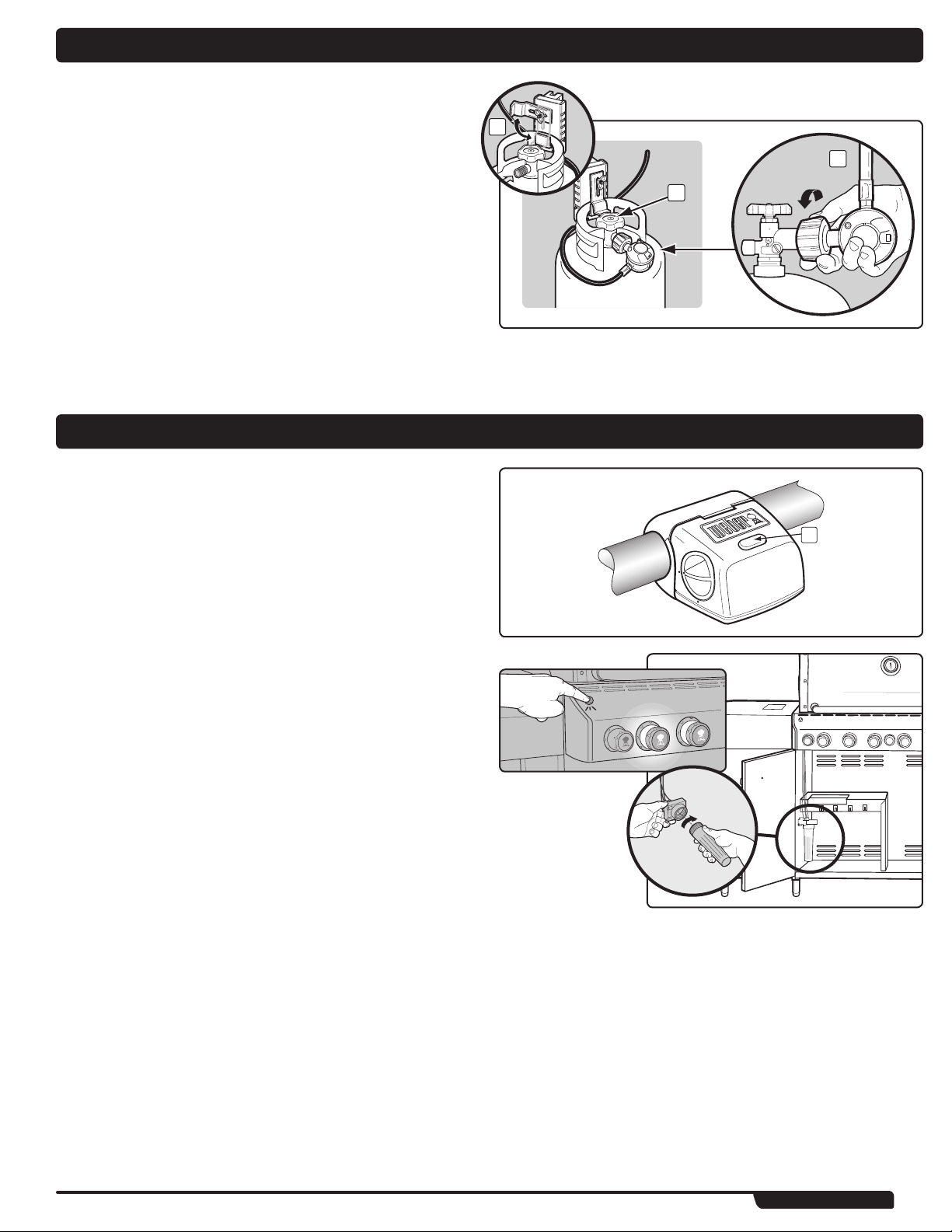
The Weber Grill Out™ Handle Light has a built-in “tilt sensor.” With the power button (1)
activated, the light will come on when the grill lid is open. The light will turn off when the
lid is closed. For daytime use, deactivate the sensor by pressing power button (1).
X
1
LIGHTED CONTROL KNOBS
Your gas grill comes with control knobs that light up, allowing you to fine tune heat
settings, even in low light conditions.
Requires three “D” alkaline batteries. Do not mix old and new batteries or different types
of batteries (standard, alkaline, or rechargeable). Battery housing is located inside the
cabinet on the left side.
To operate, activate power button.
X
GAS INSTRUCTIONS
REFILLING THE LIQUID PROPANE CYLINDER
We recommend that you refill the LP cylinder before it is completely empty.
Removal of the LP cylinder:
A) Close cylinder valve (turn clockwise) (1).
B) Unscrew regulator coupling by turning counterclockwise, by hand only (2).
C) Loosen cylinder lock wing nut and turn cylinder lock up out of the way (3).
D) Lift cylinder off.
To fill, take the LP cylinder to a gas propane dealer, or look up “gas-propane” in the
phone book for other sources of LP gas.
WARNING: We recommend that your LP cylinder be filled
at an authorized LP gas dealer, by a qualified attendant,
who fills the cylinder by weight. IMPROPER FILLING IS
DANGEROUS.
CAUTION: Place dust cap on cylinder valve outlet whenever
the cylinder is not in use. Only install the type of dust cap
on the cylinder valve outlet that is provided with the cylinder
valve. Other types of caps or plugs may result in leakage of
propane.
X
LIGHT FEATURES
2
1
3
22
BEFORE USING THE GRILL
FUEL LEVEL
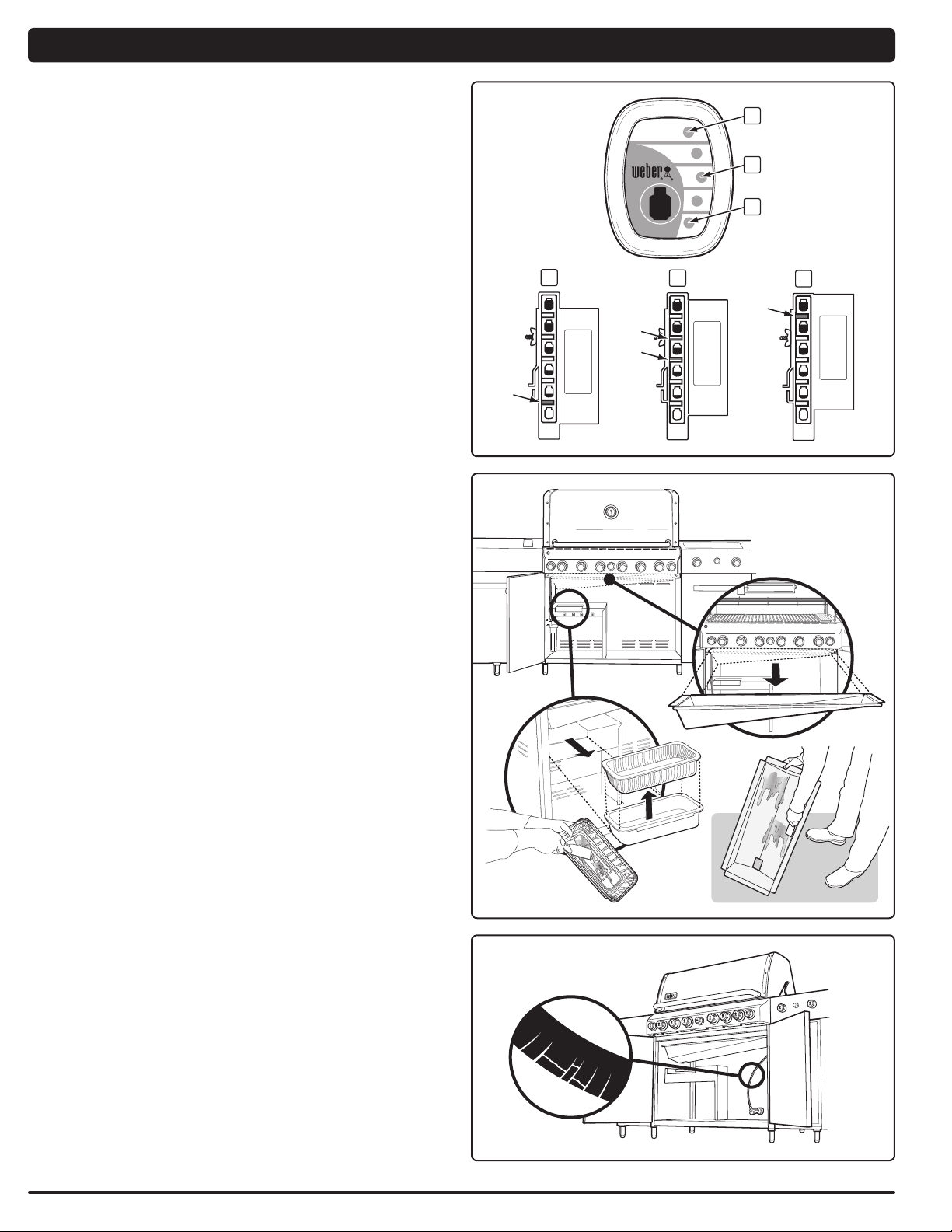
There are two ways to check the fuel level in your tank: electronically and manually.
To check the level using the electronic tank scale, press the tank scale button, located
on the right side of the control panel, for two–three seconds. The LED indicates the fuel
level in the tank.
To check the level using the manual tank scale, view the color indicator level line,
located on the side of the tank scale.
A) Empty (1)
B) Medium (2)
C) Full (3)
X
SLIDE-OUT GREASE TRAY AND DISPOSABLE DRIP PAN
Your grill was built with a grease collection system. Check the slide-out grease tray and
disposable drip pan for grease build-up each time you use your grill.
Remove excess grease with a plastic spatula; see illustration. When necessary, wash
the grease tray and drip pan with a soap and water solution, then rinse with clean water.
Replace the disposable drip pan as needed.
WARNING: Check the slide-out grease tray and disposable
drip pan for grease build-up before each use. Remove
excess grease to avoid a grease fire. A grease fire can cause
serious bodily injury or damage to property.
CAUTION: Do not line the slide-out grease tray with
aluminum foil.
X
The grill illustrated may
have slight differences
than the model purchased.
HOSE INSPECTION
The hose should be inspected for any signs of cracking.
WARNING: Check hose before each use of barbecue for
nicks, cracking, abrasions or cuts. If the hose is found to
be damaged in any way, do not use the barbecue. Replace
using only Weber
®
authorized replacement hose. Contact
the Customer Service Representative in your area using the
contact information on our web site.
Log onto www.weber.com
®
.
X
1
2
3
3
2
1
WWW.WEBER.COM
®
23
2
1
3
4
5
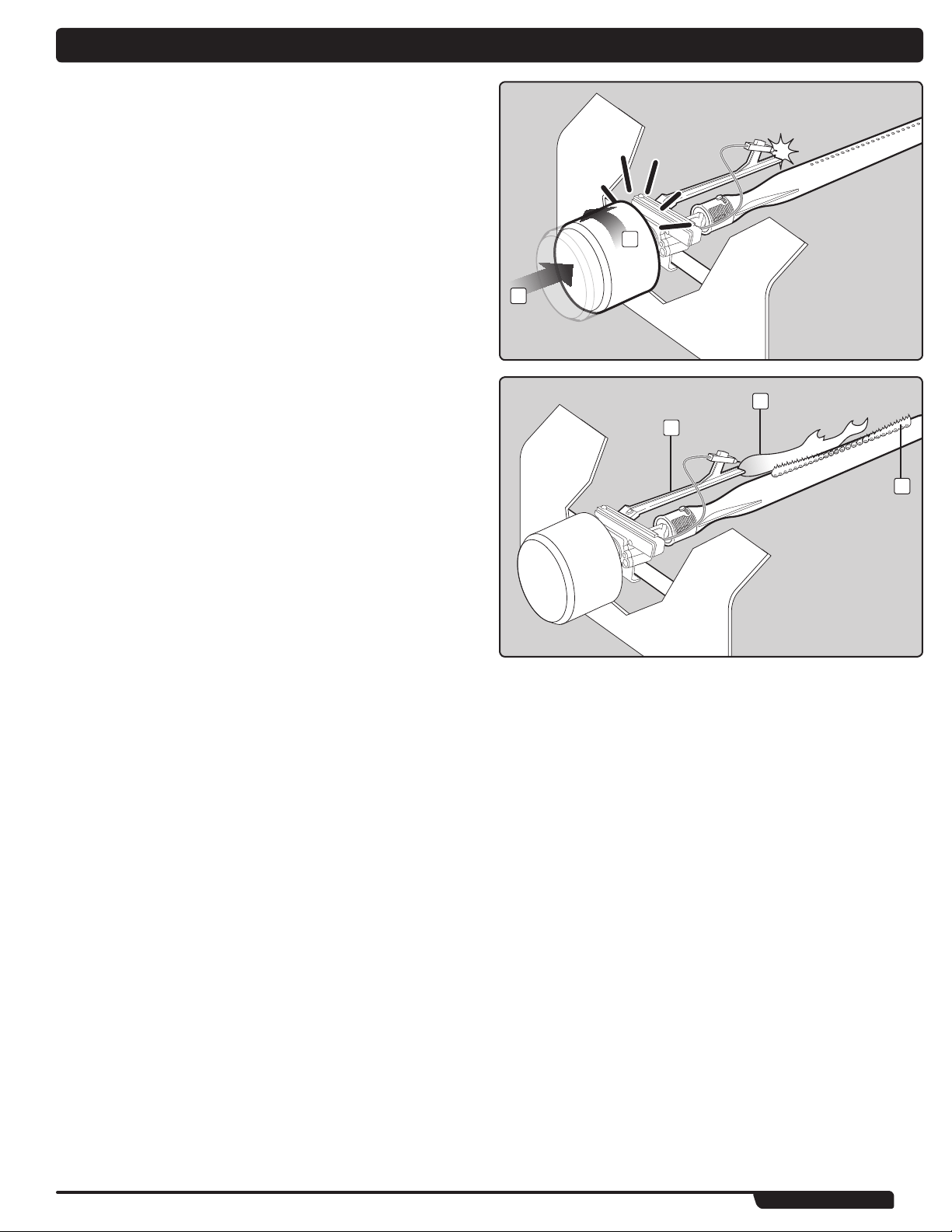
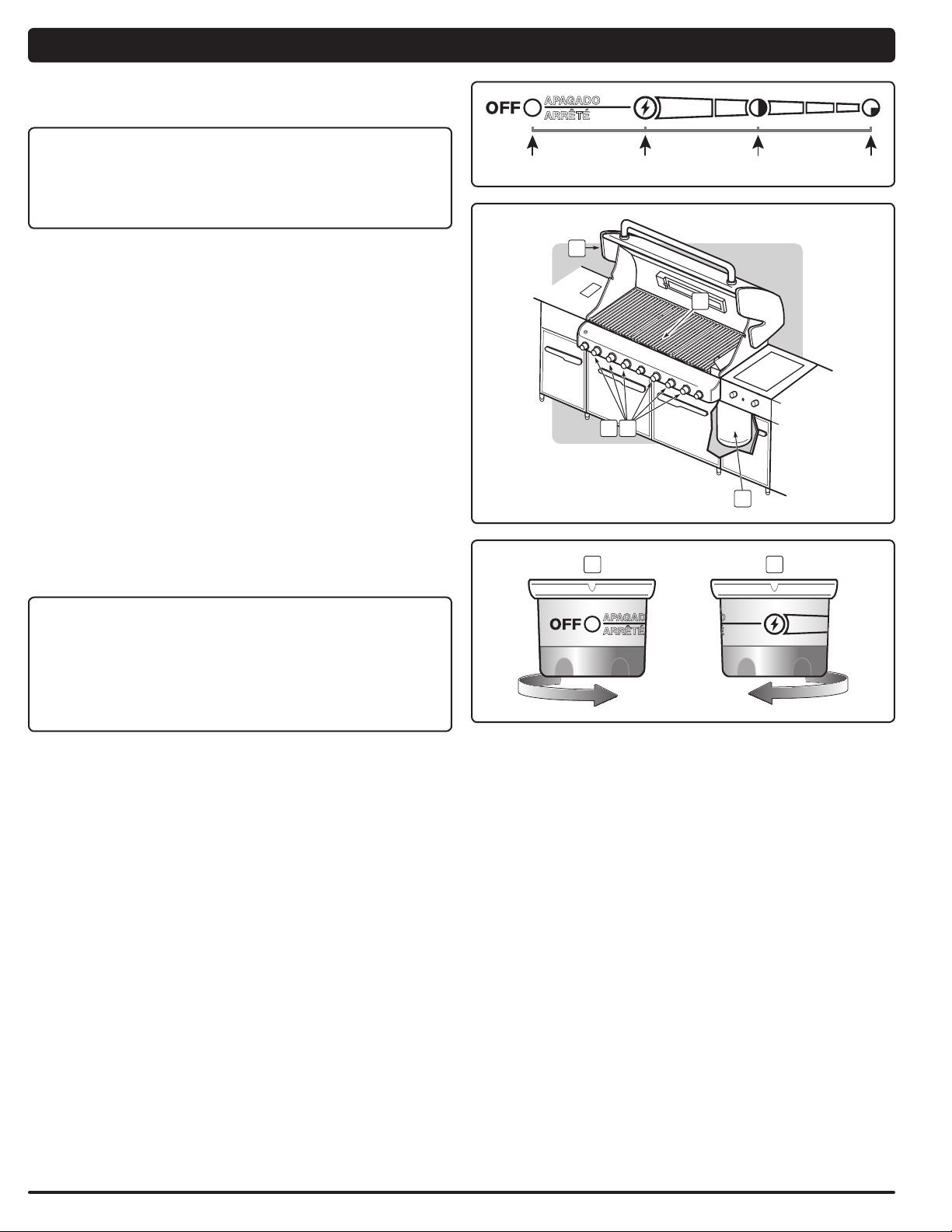
Always open the lid before igniting the burners.
A) Each control knob has its own igniter electrode built in. To create a spark, you must
push the control knob in (1) and turn it to START/HI (2).
B) This action will generate gas flow and a spark to the burner lighting tube (3). You will
hear a “snap” from the igniter. You will also see a 3" – 5" orange flame coming from
the burner lighting tube at the left side of the burner (4).
C) Continue to hold the burner control knob in for two seconds after the “snap.”
This will allow gas to flow completely down the burner tube (5) and ensure ignition.
D) Check that the burner is lit by looking through the cooking grates. You should see
a flame. If burner does not light on first try, push control knob in and turn it to OFF.
Repeat lighting procedure a second time.
WARNING: If the burner still does not light, turn the burner
control knob to OFF and wait five minutes to let the gas
clear before you try again or try to light with a match.
X
SNAP IGNITION OPERATION
24
DANGER
When the “excess gas flow control” feature is activated,
a small amount of gas is still flowing to the burners. After
turning off the cylinder and burner control knobs, wait at
least five minutes for the gas to clear before attempting to
light the grill. Failure to do so may result in an explosive
flare-up, which can cause serious bodily injury or death.
2 4
MAIN BURNER IGNITION & USAGE
3
1
2
5
4
MAIN BURNER IGNITION
Summary lighting instructions are inside the left-hand cabinet door.
DANGER
Failure to open the lid while igniting the barbecue’s burners,
or not waiting five minutes to allow the gas to clear if the
barbecue does not light, may result in an explosive flare-up
which can cause serious bodily injury or death.
Main Burner Snap Ignition
Note: Each control knob snap igniter creates a spark from the igniter electrode to the
burner lighting tube. You generate the energy for the spark by pushing in the control
knob and turning it to START/HI. This will ignite each individual burner.
WARNING: Check hose before each use of barbecue for
nicks, cracking, abrasions or cuts. If the hose is found to
be damaged in any way, do not use the barbecue. Replace
using only Weber
®
authorized replacement hose. Contact
the Customer Service Representative in your area using the
contact information on our web site.
Log onto www.weber.com
®
.
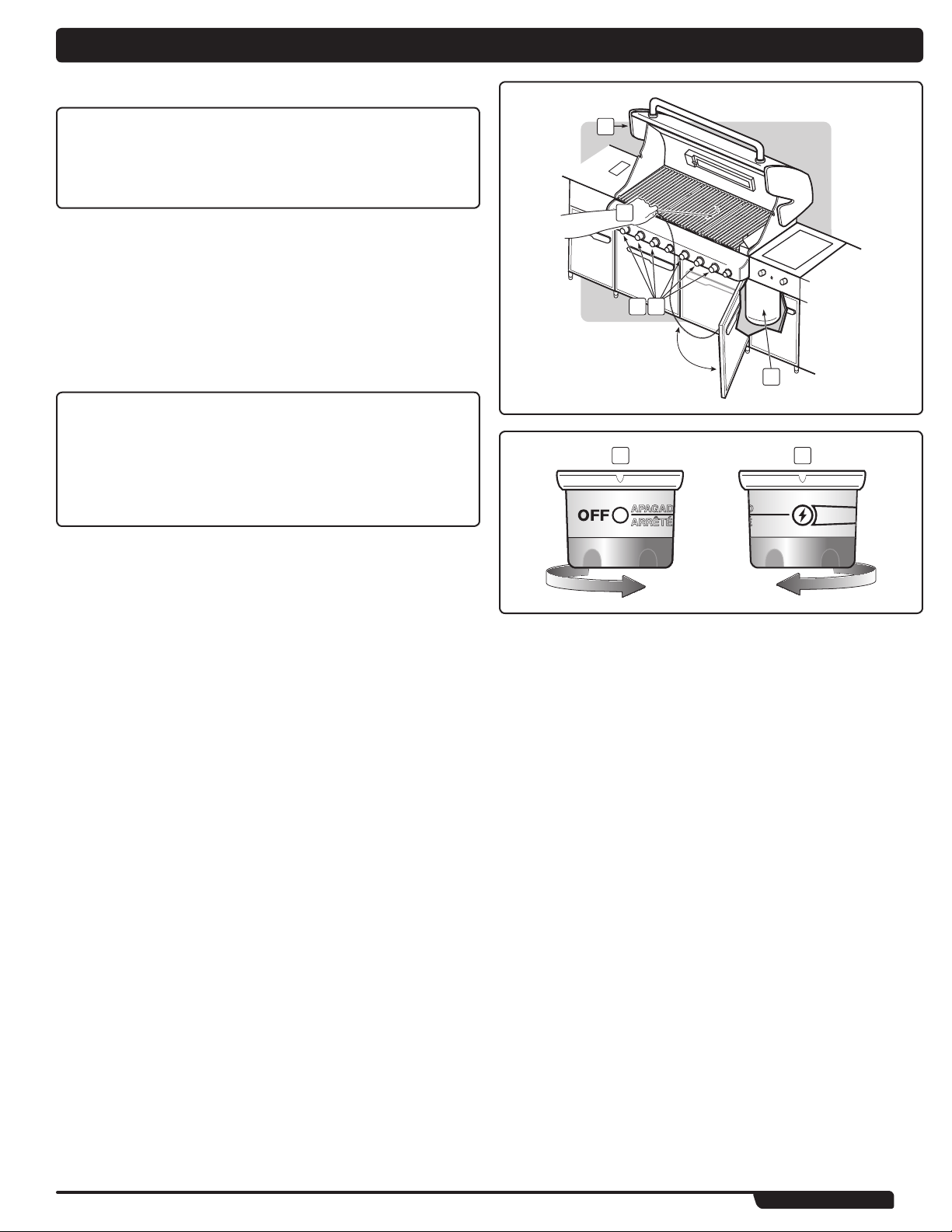
A) Open the lid (1).
B) Make sure all burner control knobs are turned off (2). (Push control knob in and turn
it clockwise to ensure that it is in the OFF position.)
WARNING: The burner control knobs must be in the OFF
position before turning on the liquid propane cylinder tank
valve. If they are not in the OFF position, when you turn on
the LP cylinder valve, the “excess gas flow control” feature
will activate, limiting the flow of gas from the LP cylinder. If
this should occur, turn off the LP cylinder valve and burner
control knobs. Start over.
The grill illustrated may
have slight differences
than the model purchased.
C) Turn the cylinder on by turning the cylinder valve counterclockwise (3).
WARNING: Do not lean over the open barbecue.
D) Push the control knob in and turn it to START/HI until you hear the igniter snap (4);
continue to hold control knob in for two seconds. This action will spark the igniter,
the burner lighting tube, and then main burner.
E) Check that the burner is lit by looking through the cooking grates (5). You should see
a flame. If burner does not light on first try, push control knob in and turn it to OFF.
Repeat lighting procedure a second time.
WARNING: If the burner still does not light, turn the burner
control knob to OFF and wait five minutes to let the gas
clear before you try again or try to light with a match.
X
TO EXTINGUISH
Push in and turn each burner control knob clockwise to OFF position. Turn gas supply off
at the source.
X
OFF START/HI MEDIUM LOW
WWW.WEBER.COM
®
25
3
1
2 5
4
MAIN BURNER MANUAL IGNITION
DANGER
Failure to open the lid while igniting the barbecue’s burners,
or not waiting five minutes to allow the gas to clear if the
barbecue does not light, may result in an explosive flare-up
which can cause serious bodily injury or death.
The grill illustrated may
have slight differences
than the model purchased.
A) Open the lid (1).
B) Make sure all burner control knobs are turned off (2). (Push each knob in and turn it
clockwise to ensure it is in the OFF position.)
WARNING: The burner control knobs must be in the OFF
position before turning on the liquid propane cylinder valve.
If they are not in the OFF position, when you turn on the LP
cylinder valve, the “excess gas flow control” feature will
activate, limiting the flow of gas from the LP cylinder. If this
should occur, turn off the LP tank valve and burner control
knobs. Start over.
DANGER
When the “excess gas flow control” feature is activated,
a small amount of gas is still flowing to the burners. After
turning off the cylinder and burner control knobs, wait at
least five minutes for the gas to clear before attempting to
light the barbecue. Failure to do so may result in an explosive
flare-up, which can cause serious bodily injury or death.
2 5
C) Turn the cylinder on by turning the cylinder valve counterclockwise (3).
D) Put match in the matchstick holder and strike match.
WARNING: Do not lean over open barbecue.
E) Insert matchstick holder and lit match down through cooking grates and Flavorizer
®
bars to ignite the selected burner (4).
F) Push the control knob in and turn it to START/HI (5).
G) Check that the burner is lit by looking through the cooking grates (6). You should see
a flame.
WARNING: If the burner does not light, turn the burner
control knob to OFF and wait five minutes to let the gas
clear before you try again.
X
TO EXTINGUISH
Push in and turn each burner control knob clockwise to OFF position. Turn gas supply off
at the source.
X
MAIN BURNER IGNITION & USAGE
26
GRILLING TIPS & HELPFUL HINTS
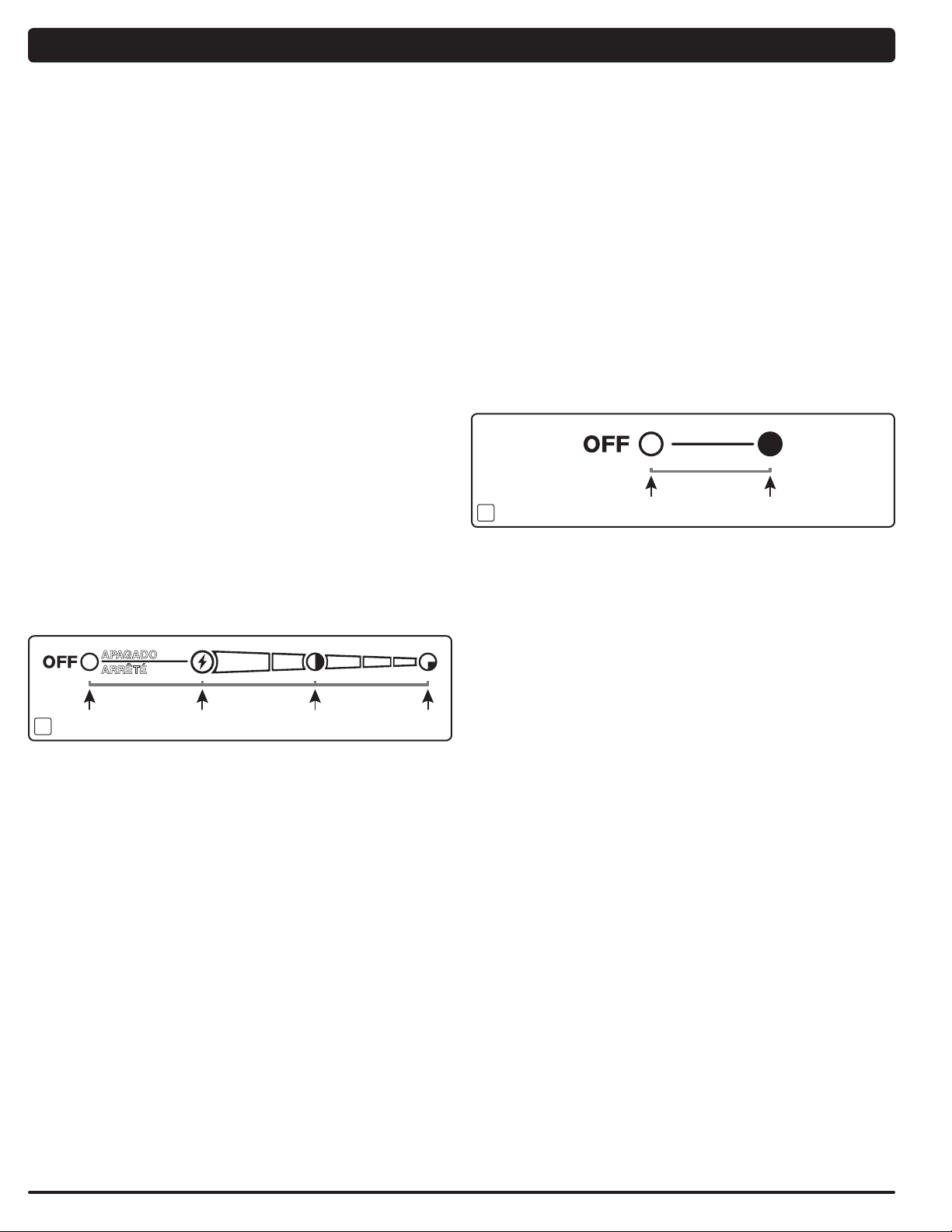
You can adjust the individual burners as desired. The control settings are OFF,
START/HI, MEDIUM, or LOW (1).
Note: For the first few uses of your grill, the temperature inside the cookbox may be
hotter than shown in your cookbook because the surfaces of the cookbox are still
reflective. Cooking conditions, such as wind and weather, may require adjustment of
burner controls to obtain the correct cooking temperatures.
Note: If grill loses heat while cooking, refer to the troubleshooting section of this manual.
WARNING: Do not move the Weber
®
gas barbecue when
operating or while barbecue is hot.
If burners go out during cooking, turn all burner knobs off and wait five minutes
before relighting.
X
COVERED COOKING
All grilling is done with the lid down to provide uniform, evenly circulated heat. With the
lid closed, the gas grill cooks much like a convection oven. The thermometer in the lid
indicates the cooking temperature inside the grill. All preheating and grilling is done with
the lid down. No peeking — heat is lost every time you lift the lid.
X
r"MXBZTQSFIFBUUIFHSJMMCFGPSFDPPLJOH4FUBMMCVSOFSTPO)*IFBUBOEDMPTFMJEIFBU
GPSNJOVUFTPSVOUJMUIFSNPNFUFSSFHJTUFSTm'm$
r4FBSNFBUTBOEDPPLXJUIUIFMJEEPXOGPSQFSGFDUMZHSJMMFEGPPEFWFSZUJNF
r(SJMMJOHUJNFTJOSFDJQFTBSFCBTFEPO'$XFBUIFSBOEMJUUMFPSOPXJOE"MMPX
more cooking time on cold or windy days, or at higher altitudes. Allow less cooking
time in extremely hot weather.
r(SJMMJOHUJNFTDBOWBSZCFDBVTFPGUIFXFBUIFSPSUIFBNPVOUTJ[FBOETIBQFPGUIF
food being grilled.
r5IFUFNQFSBUVSFPGZPVSHBTHSJMMNBZSVOIPUUFSUIBOOPSNBMGPSUIFGJSTUGFXVTFT
r(SJMMJOHDPOEJUJPOTNBZSFRVJSFBEKVTUNFOUPGUIFCVSOFSDPOUSPMTUPBUUBJOUIFDPSSFDU
cooking temperatures.
r*OHFOFSBMMBSHFQJFDFTPGNFBUXJMMSFRVJSFNPSFDPPLJOHUJNFQFSQPVOEUIBOTNBMM
pieces of meat. Foods on a crowded cooking grate will require more cooking time
than just a few foods. Foods grilled in containers, such as baked beans, will require
more time if grilled in a deep casserole rather than a shallow baking pan.
r5SJNFYDFTTGBUGSPNTUFBLTDIPQTBOESPBTUTMFBWJOHOPNPSFUIBOBTDBOUJODI
(6.4 mm) of fat. Less fat makes cleanup easier, and is a virtual guarantee against
unwanted flare-ups.
r'PPETQMBDFEPOUIFDPPLJOHHSBUFEJSFDUMZBCPWFCVSOFSTNBZSFRVJSFUVSOJOHPS
moving to a less hot area.
r6TFUPOHTSBUIFSUIBOBGPSLGPSUVSOJOHBOEIBOEMJOHNFBUTUPBWPJEMPTJOHOBUVSBM
juices. Use two spatulas for handling large whole fish.
r*GBOVOXBOUFEGMBSFVQTIPVMEPDDVSUVSOBMMCVSOFSTPGGBOENPWFGPPEUPBOPUIFS
area of the cooking grate. Any flames will quickly subside. After flames subside, relight
the grill. NEVER USE WATER TO EXTINGUISH FLAMES ON A GAS GRILL.
r4PNFGPPETTVDIBTBDBTTFSPMFPSUIJOGJTIGJMMFUTXJMMSFRVJSFBDPOUBJOFSGPSHSJMMJOH
Disposable foil pans are very convenient, but any metal pan with ovenproof handles
can also be used.
r"MXBZTCFTVSFUIFTMJEFPVUHSFBTFUSBZBOEDBUDIQBOBSFDMFBOBOEGSFFGSPN
debris.
r%POPUMJOFUIFTMJEFPVUHSFBTFUSBZXJUIGPJM5IJTDPVMEQSFWFOUUIFHSFBTFGSPN
flowing into the catch pan.
r6TJOHBUJNFSXJMMIFMQUPBMFSUZPVXIFOiXFMMEPOFuJTBCPVUUPCFDPNFiPWFSEPOFu
X
PREHEATING
Your Weber
®
gas barbecue is an energy-efficient appliance. It operates at an economical
low BTU rate. Preheating the grill before grilling is important. Light your grill according
to the instructions in this Owner’s Guide. To preheat: after lighting, turn all burners to
45"35)*DMPTFUIFMJEBOEIFBUVOUJMUIFUFNQFSBUVSFSFBDIFTCFUXFFOBOE
'BOE$UIFSFDPNNFOEFECSPJMJOHUFNQFSBUVSF5IJTXJMMUBLFUP
minutes depending on conditions such as air temperature and wind.
OFF START/HI MEDIUM LOW
1
ARRÊTÉ
APAGADO
OFF ON
2
DRIPPINGS AND GREASE
The Flavorizer
®
bars are designed to “smoke” the correct amount of drippings for
flavorful cooking. Excess drippings and grease will accumulate in the catch pan under
the slide-out grease tray. Disposable foil drip pans are available that fit the catch pan.
WARNING: Check the slide-out grease tray and catch pan
for grease build-up before each use. Remove excess grease
to avoid a grease fire in the slide-out grease tray.
X
FLAVORIZER
®
SYSTEM
When meat juices drip from the food onto the specially angled Flavorizer
®
bars,
they create smoke that gives foods an irresistible barbecued flavor. Thanks to the
unique design of the burners, Flavorizer
®
bars and the flexible temperature controls,
uncontrolled flare-ups are virtually eliminated, because YOU control the flames. Because
of the special design of the Flavorizer
®
bars and burners, excess fats are directed
through the slide-out grease tray into the grease catch pan.
X
SEAR STATION
®
Your Weber
®
gas barbecue may include a sear burner for searing thin meats and fish.
The Sear Station
®
burner has an ON or OFF control setting (2) that works with the two
adjacent main burners. With the sear and adjacent burners, you can effectively sear
meats while using other cooking areas for cooking with moderate heat (refer to “SEAR
STATION
®
IGNITION & USAGE”).
X
WWW.WEBER.COM
®
27
The most important thing to know about grilling is which cooking method to use for a
specific food, direct or indirect. The difference is simple: place the food directly over the
fire, or arrange the fire on either side of it. Using the right method is the shortest route to
great results—and the best way to ensure doneness safety.
X
DIRECT COOKING
The direct method, similar to broiling, means the food is cooked directly over the heat
source. For even cooking, food should be turned once halfway through the grilling time.
Use the direct method for foods that take less than 25 minutes to cook: steaks, chops,
kabobs, sausages, vegetables, and more.
Direct cooking is also necessary to sear meats. Searing creates that wonderful crisp,
caramelized texture where the food touches the grate. It also adds great color and flavor
to the entire surface. Steaks, chops, chicken breasts, and larger cuts of meat all benefit
from searing.
To sear meats, place them over direct high heat for two to five minutes per side. Smaller
pieces require less searing time. Usually after searing the food, you finish cooking it at a
lower temperature. You can finish cooking fast-cooking foods by the direct method; use
the indirect method for longer-cooking foods.
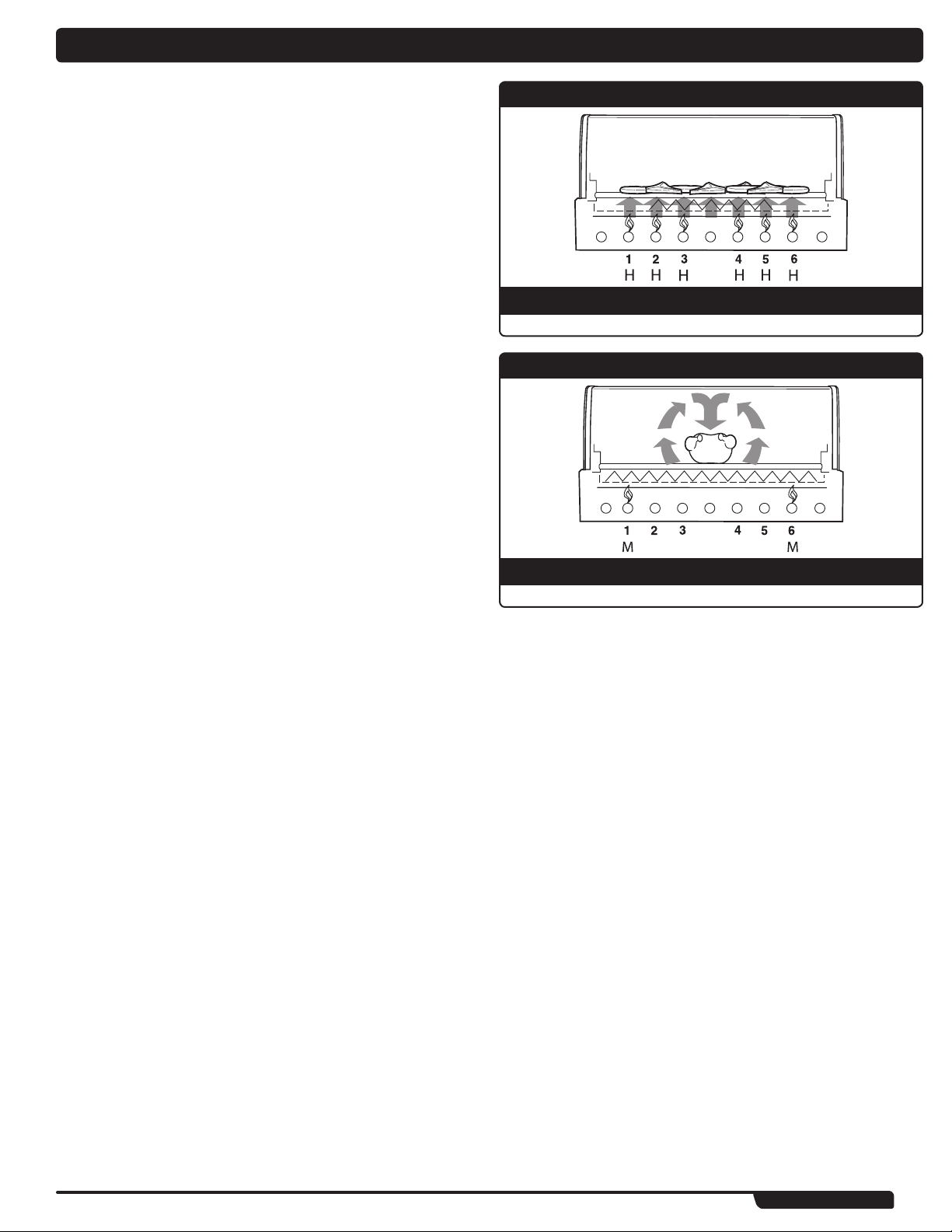
To set up your gas grill for direct cooking, preheat the grill with all burners on HI. Place
food on the cooking grate, and then adjust all burners to the temperature noted in the
recipe. Close the lid of the grill and lift it only to turn food or to test for doneness at the
end of the recommended cooking time.
X
INDIRECT COOKING
The indirect method is similar to roasting, but with the added benefits of that grilled
texture, flavor, and appearance you can’t get from cooking with an oven. To set up for
indirect cooking, light gas burners on either side of the food but not directly beneath it.
Heat rises, reflects off the lid and inside surfaces of the grill, and circulates to slowly
cook the food evenly on all sides, much like a convection oven, so there’s no need to
turn the food.
Use the indirect method for foods that require 25 minutes or more of grilling time, or that
are so delicate that direct exposure to the flame would dry them out or scorch them.
Examples include roasts, ribs, whole chickens, turkeys, and other large cuts of meat, as
well as delicate fish fillets.
To set up your gas grill for indirect cooking, preheat the grill with all burners on HI. Then
adjust the burners on each side of the food to the temperature noted in the recipe, and
turn off the burner(s) directly below the food. For best results, place roasts, poultry, or
large cuts of meat on a roasting rack set inside a disposable, heavy-gauge foil pan.
For longer cooking times, add water to the foil pan to keep drippings from burning. The
drippings can be used to make gravies or sauces.
X
6 BURNER
DIRECT METHOD
Food is placed on the area of the cooking grates directly over the lit burners.
6 BURNER
INDIRECT METHOD
Food is placed on the area of the cooking grates between the lit burners.
COOKING METHODS
28
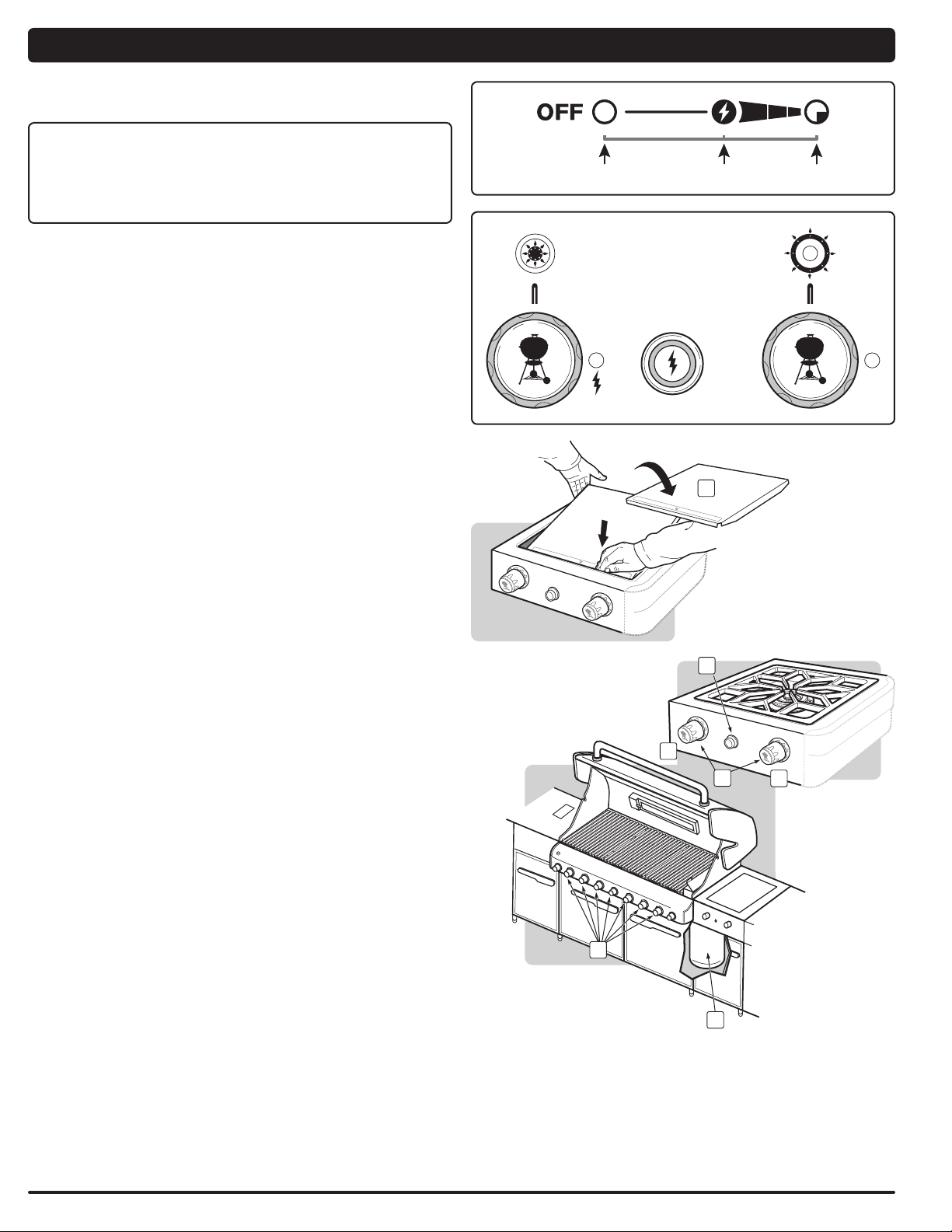
SIDE BURNER IGNITION & USAGE
DANGER
Failure to open the lid while igniting the side burner, or not
waiting five minutes to allow the gas to clear if the side
burner does not light, may result in an explosive flare-up
which can cause serious bodily injury or death.
WARNING: Check hose before each use of barbecue for
nicks, cracking, abrasions or cuts. If the hose is found to
be damaged in any way, do not use the barbecue. Replace
using only Weber
®
authorized replacement hose. Contact
the Customer Service Representative in your area using the
contact information on our web site.
Log onto www.weber.com
®
.
Note: The side burner has an inner burner
and an outer burner
. You must light
the inner burner first using the igniter button. The outer burner ignites from the flame of
the inner burner. Follow instructions below to ignite burners in correct sequence.
A) Remove the side burner lid by pushing down slightly on front edge while lifting from
back edge (1). (Store the side burner lid in your grill cabinet.)
CAUTION: Do not use lid as a cooking surface or a cutting
surface.
B) Push each side burner control knob in and turn clockwise to ensure that side burner
valves are in the OFF position (2). Turn all burners not being used to the OFF
position (push in and turn clockwise).
C) Turn gas supply valve on (3).
Ignite Inner Burner
A) Push in and turn the side burner control knob
to START/HI (4).
WARNING: Do not start the inner burner
and outer burner
at the same time. This could result in a flare up of flame
or an explosion causing serious bodily injury or death and
damage to property.
B) Push the ignition button in (5). You will hear it clicking.
CAUTION: Side burner flame may be difficult to see on a
bright sunny day.
WARNING: If the side burner does not light in five seconds:
a) Turn off the side burner control valve, main burners
and gas supply at source.
b) Wait five minutes to let the gas clear before you try
again, or try lighting with a match (refer to “SIDE
BURNER MANUAL IGNITION”).
Ignite Outer Burner
A) While inner burner is lit, push in and turn the side burner control knob
to START/
HI (6).
B) Adjust for cooking.
X
TO EXTINGUISH
Push down and turn side burner control knobs to the OFF position. Be sure burner is off
and cool before closing side burner lid.
X
SIDE BURNER IGNITION
Summary lighting instructions are inside the left-hand cabinet door.
3
2
5
4
2
6
ARRÊTÉ
APAGADO
OFF START/HI LOW
1
1
2
WWW.WEBER.COM
®
29
SIDE BURNER IGNITION & USAGE
SIDE BURNER MANUAL IGNITION
Summary lighting instructions are inside the left-hand cabinet door.
DANGER
Failure to open the lid while igniting the side burner, or not
waiting five minutes to allow the gas to clear if the side
burner does not light, may result in an explosive flare-up
which can cause serious bodily injury or death.
WARNING: Check hose before each use of barbecue for
nicks, cracking, abrasions or cuts. If the hose is found to
be damaged in any way, do not use the barbecue. Replace
using only Weber
®
authorized replacement hose. Contact
the Customer Service Representative in your area using the
contact information on our web site.
Log onto www.weber.com
®
.
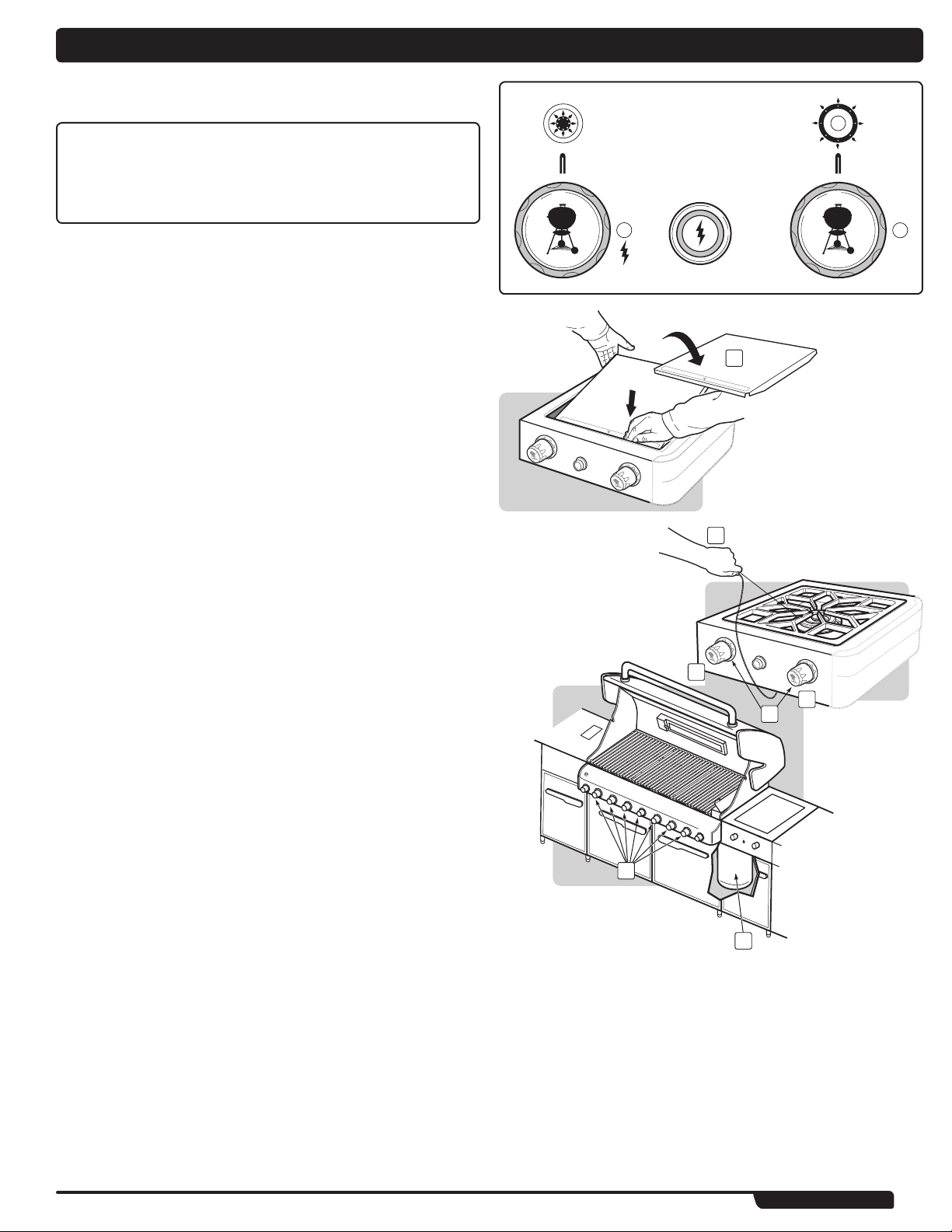
Note: The side burner has an inner burner
and an outer burner
. You must light
the inner burner first using the igniter button. The outer burner ignites from the flame of
the inner burner. Follow instructions below to ignite burners in correct sequence.
A) Remove the side burner lid by pushing down slightly on front edge while lifting from
back edge (1). (Store the side burner lid in your grill cabinet.)
CAUTION: Do not use lid as a cooking surface or a cutting
surface.
B) Push each side burner control knob in and turn clockwise to ensure that side burner
valves are in the OFF position (2). Turn all burners not being used to the OFF
position (push in and turn clockwise).
C) Turn gas supply valve on (3).
Ignite Inner Burner
A) Put match in a match holder and strike match.
B) Hold match holder and lit match by either side of the side burner (4).
C) Push in and turn the side burner control knob
to START/HI (5).
WARNING: Do not start the inner burner
and outer burner
at the same time. This could result in a flare up of flame
or an explosion causing serious bodily injury or death and
damage to property.
CAUTION: Side burner flame may be difficult to see on a
bright sunny day.
WARNING: If the side burner does not light in five seconds:
a) Turn off the side burner control valve, main burners
and gas supply at source.
b) Wait five minutes to let the gas clear before you try
again, or try lighting with a match (refer to “SIDE
BURNER MANUAL IGNITION”).
Ignite Outer Burner
A) While inner burner is lit, push in and turn the side burner control knob
to START/
HI (6).
B) Adjust for cooking.
X
TO EXTINGUISH
Push down and turn side burner control knob to the OFF position. Be sure burner is off
and cool before closing side burner lid.
X
3
2
5
2
6
4
1
1
2
30
SIDE BURNER IGNITION & USAGE
SIDE BURNER USAGE
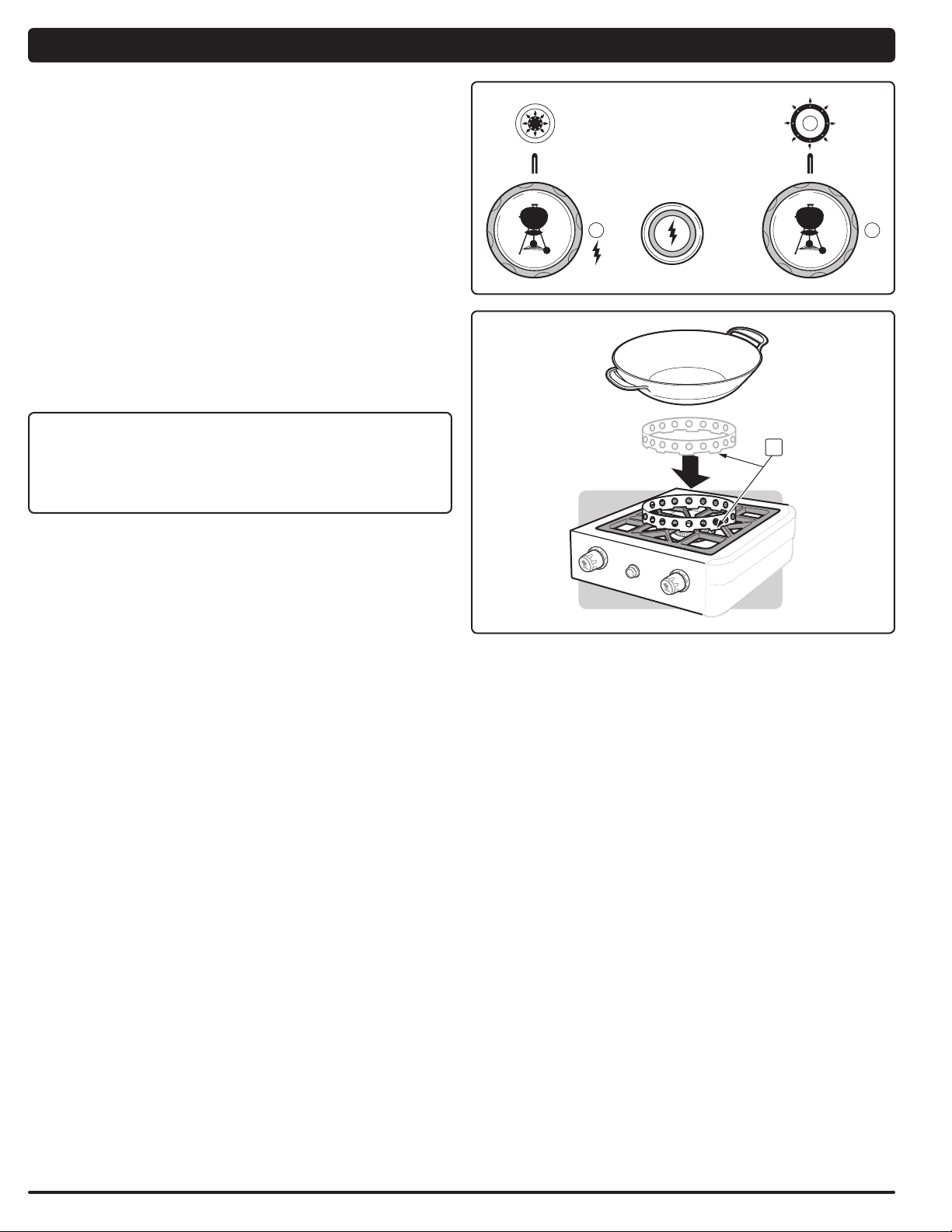
The side burner has two burner rings to control cooking temperature. Burner
, the
inside burner, cooks with a small flame and works best with smaller sauce pans and
skillets. Burner
, the outside burner, cooks with a large flame and works best with
larger pans, pots, skillets, and woks. For more intense heat, you may utilize both burners
at the same time.
Wok Cooking
The side burner also comes with a wok ring for wok cooking.
IMPORTANT: Do not place a wok directly on the side burner.
Only the Weber
®
wok accessory should be used when
cooking on the included wok ring.
A) Place the wok ring in position over the side burner grate, making sure that the
locating tabs on the ring fit inside the gaps of the grate (1). The ring should rest
level.
When not in use, ring can be stored in grill cabinet.
WARNING: Only use a small amount of cooking oil when
using the wok for stir frying. Excessive oil and temperature
can cause a fire which can cause serious bodily injury or
death and damage to property.
DANGER
Do not use the side burner for deep frying with cooking oils.
Cooking oil can reach a flash point causing a fire which
will result in serious bodily injury or death and damage to
property.
X
1
2
1
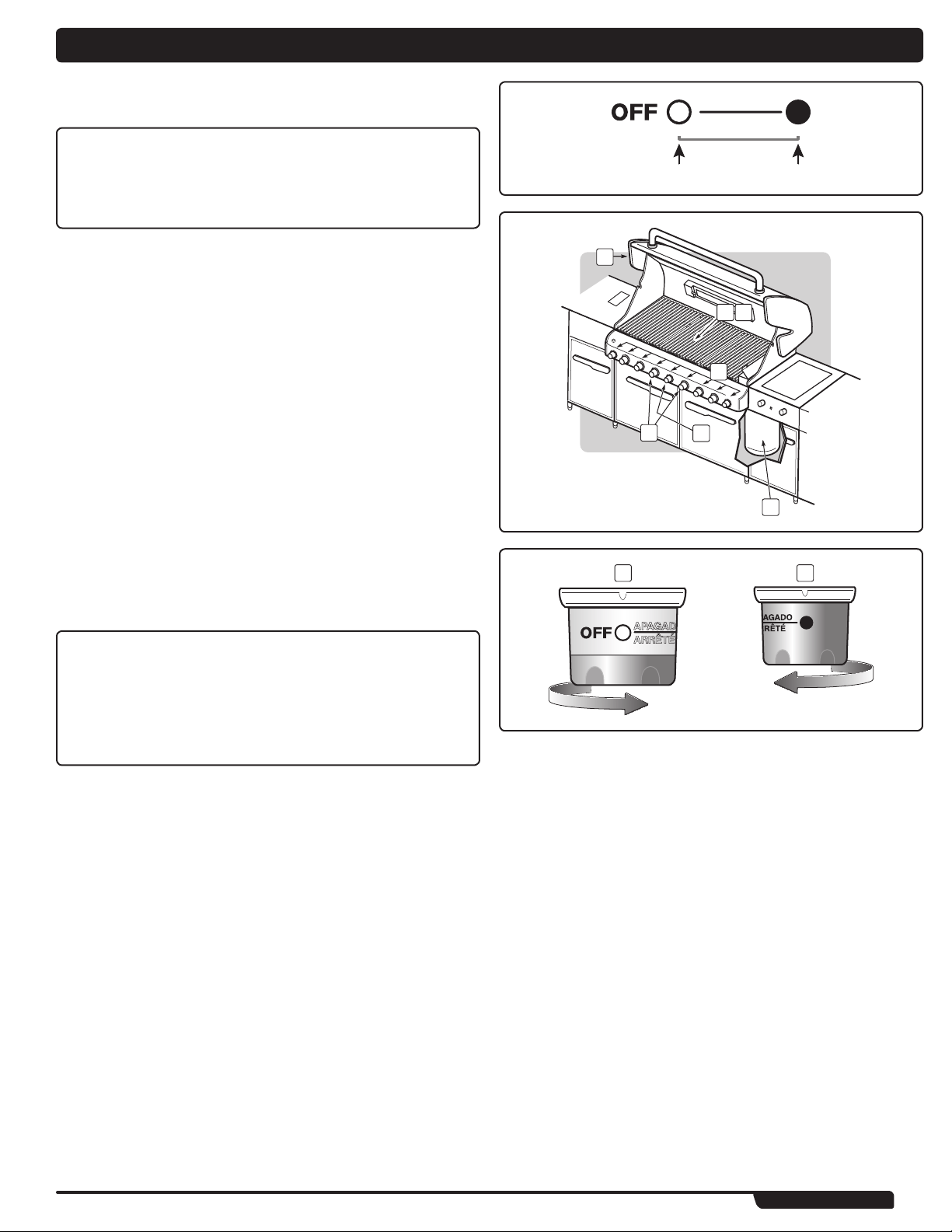
WWW.WEBER.COM
®
31
SEAR STATION
®
IGNITION & USAGE
3
1
2
6
4
75
The grill illustrated may have slight
differences than the model purchased.
2 6
DANGER
When the “excess gas flow control” feature is activated,
a small amount of gas is still flowing to the burners. After
turning off the cylinder and burner control knobs, wait at
least five minutes for the gas to clear before attempting to
light the grill. Failure to do so may result in an explosive
flare-up, which can cause serious bodily injury or death.
C) Turn the cylinder on by turning the cylinder valve counterclockwise (3).
WARNING: Do not lean over the open barbecue.
D) Ignite each main burner that is adjacent to the Sear Station
®
(4). Push the control
knob in and turn it to START/HI until you hear the igniter snap; continue to hold
control knob in for two seconds. This action will spark the igniter, the burner lighting
tube, and then main burner.
E) Check that the burner is lit by looking through the cooking grates (5). You should see
a flame. If burner does not light on first try, push control knob in and turn it to OFF.
Repeat lighting procedure a second time.
Sear Station
®
Burner Lighting: Ignition by an Adjacent Ignited Main Burner
F) Turn Sear Station
®
burner control knob to the ON position (6).
G) Verify burner ignition by visual inspection of a flame (7).
WARNING: If ignition does not occur in five seconds, turn
burner control OFF, wait five minutes, and repeat steps F &
G, or see “SEAR STATION
®
BURNER MANUAL IGNITION”
instructions.
WARNING: If the burner still does not light, turn the burner
control knob to OFF and wait five minutes to let the gas
clear before you try again or try to light with a match.
Note: See “MAINTENANCE” for burner removal and cleaning
procedure.
X
TO EXTINGUISH
Push in and turn each burner control knob clockwise to OFF position. Turn gas supply off
at the source.
X
SEAR STATION
®
BURNER IGNITION
Summary lighting instructions are inside the left-hand cabinet door.
DANGER
Failure to open the lid while igniting the barbecue’s burners,
or not waiting five minutes to allow the gas to clear if the
barbecue does not light, may result in an explosive flare-up
which can cause serious bodily injury or death.
The Sear Station
®
burner has an on or off control setting. To ignite the Sear Station
®
burner, you must first ignite the two adjacent main burners.
Adjacent Main Burner Snap Ignition
Note: Each main burner control knob snap igniter creates a spark from the igniter
electrode to the burner lighting tube. You generate the energy for the spark by pushing
in the control knob and turning it to START/HI. This will ignite each individual burner.
WARNING: Check hose before each use of barbecue for
nicks, cracking, abrasions or cuts. If the hose is found to
be damaged in any way, do not use the barbecue. Replace
using only Weber
®
authorized replacement hose. Contact
the Customer Service Representative in your area using the
contact information on our web site.
Log onto www.weber.com
®
.
A) Open the lid (1).
B) Make sure all burner control knobs are turned off (2). (Push control knob in and turn
it clockwise to ensure that it is in the OFF position.)
WARNING: The burner control knobs must be in the OFF
position before turning on the liquid propane cylinder tank
valve. If they are not in the OFF position, when you turn on
the LP cylinder valve, the “excess gas flow control” feature
will activate, limiting the flow of gas from the LP cylinder. If
this should occur, turn off the LP cylinder valve and burner
control knobs. Start over.
ARRÊTÉ
APAGADO
OFF ON
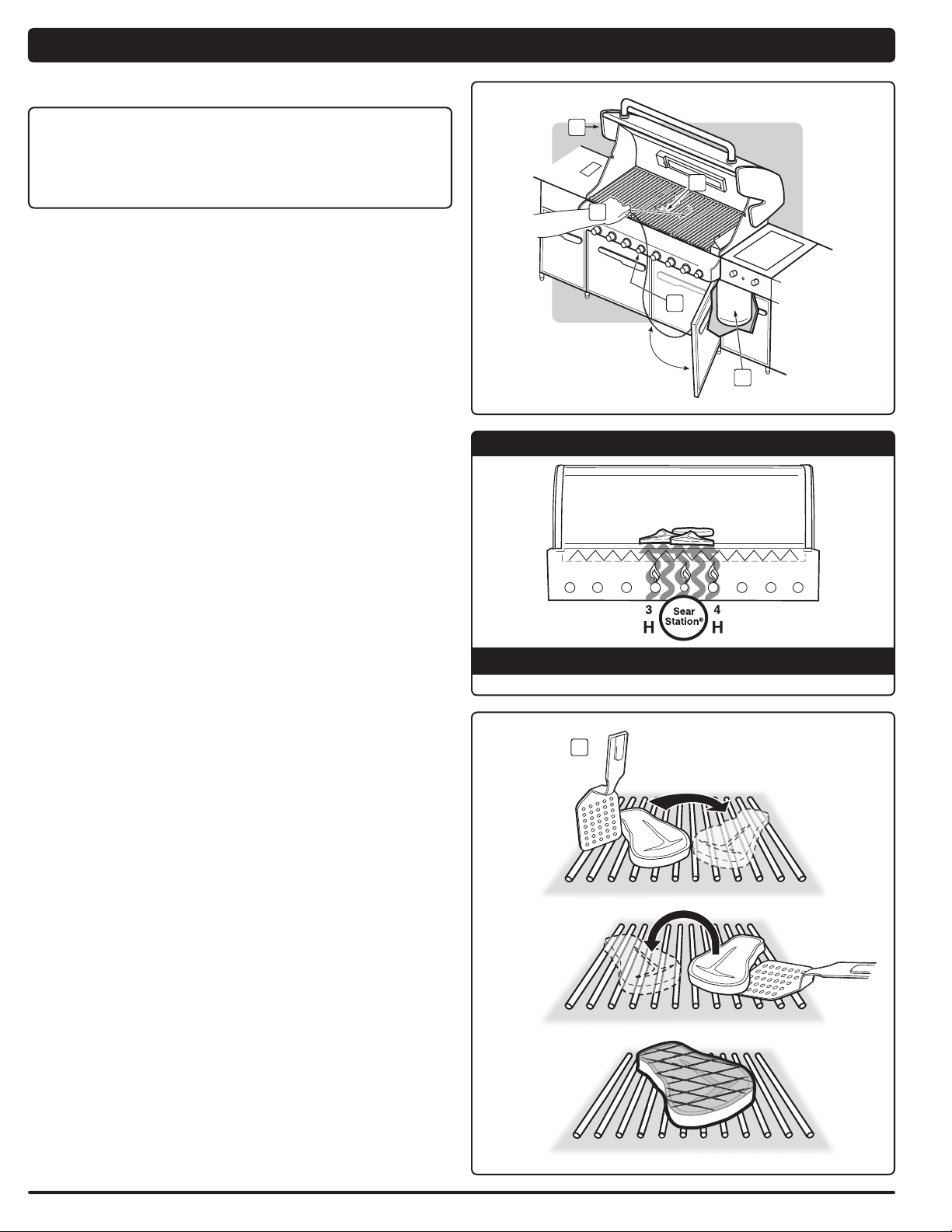
32
6 BURNER
SEAR METHOD
Food is placed in the area of intense heat between the lit burners.
3
1
3
4
2
The grill illustrated may have slight
differences than the model purchased.
SEAR STATION
®
BURNER MANUAL IGNITION
DANGER
Failure to open the lid while igniting the barbecue’s burners,
or not waiting five minutes to allow the gas to clear if the
barbecue does not light, may result in an explosive flare-up
which can cause serious bodily injury or death.
The Sear Station
®
burner, has an on or off control setting. To ignite the Sear Station
®
burner, you must first ignite the two adjacent main burners.
Adjacent Main Burner Snap Ignition
Note: Each main burner control knob snap igniter creates a spark from the igniter
electrode to the burner lighting tube. You generate the energy for the spark by pushing
in the control knob and turning it to START/HI. This will ignite each individual burner.
A) Open the lid (1).
B) Verify each main burner that is adjacent to the Sear Station
®
is lit by visual
inspection of a flame (2).
C) Put match in the matchstick holder and strike match.
WARNING: Do not lean over open barbecue.
D) Insert matchstick holder and lit match down through cooking grates and Flavorizer
®
bars to ignite the Sear Station
®
burner (3).
E) Push the Sear Station
®
control knob in and turn it to the ON position (4).
WARNING: If the burner does not light, turn the burner
control knob to OFF and wait five minutes to let the gas
clear before you try again.
Note: See “MAINTENANCE” for burner removal and cleaning
procedure.
X
TO EXTINGUISH
Push in and turn each burner control knob clockwise to OFF position. Turn gas supply off
at the source.
X
USING THE SEAR STATION
®
Your Weber
®
gas barbecue includes a sear burner for searing meats such as steak,
poultry parts, fish, and chops.
Searing is a direct grilling technique which browns the surface of the food at a high
temperature. By searing or browning both sides of the meat, you will create a more
desirable flavor by caramelizing the food surface. Searing will also enhance appearance
of the meat with sear marks from the cooking grates. This, along with the contrast of
textures and flavors, can make food more interesting to the palate.
The Sear Station
®
burner has an on or off control setting that works with the two
adjacent main burners. With the sear and adjacent burners, you can effectively sear
meats while using other cooking areas for grilling with moderate heat.
Before searing food, you should turn all of the main burners on HI for 15 minutes to
preheat the grill. Note: Always grill with the lid closed to allow for maximum heat and to
avoid flare-ups.
Once the grill is preheated, turn the outer burners off or down to low. Leave the center
two burners on HI and ignite the Sear Station
®
burner.
Place the meat directly over the Sear Station
®
. You will sear each side anywhere from
one to four minutes, depending on the type and thickness of the meat. You may turn the
food a quarter turn to make crossing sear marks (1) before you sear the other side in the
same manner.
Once you are done searing the meat, you can finish grilling it by moving it to a more
moderate heat over the outside burners to achieve the desired doneness.
As you gain experience in using your Sear Station
®
, we encourage you to experiment
with different searing times to find results that work best for your taste.
X
1
SEAR STATION
®
IGNITION & USAGE
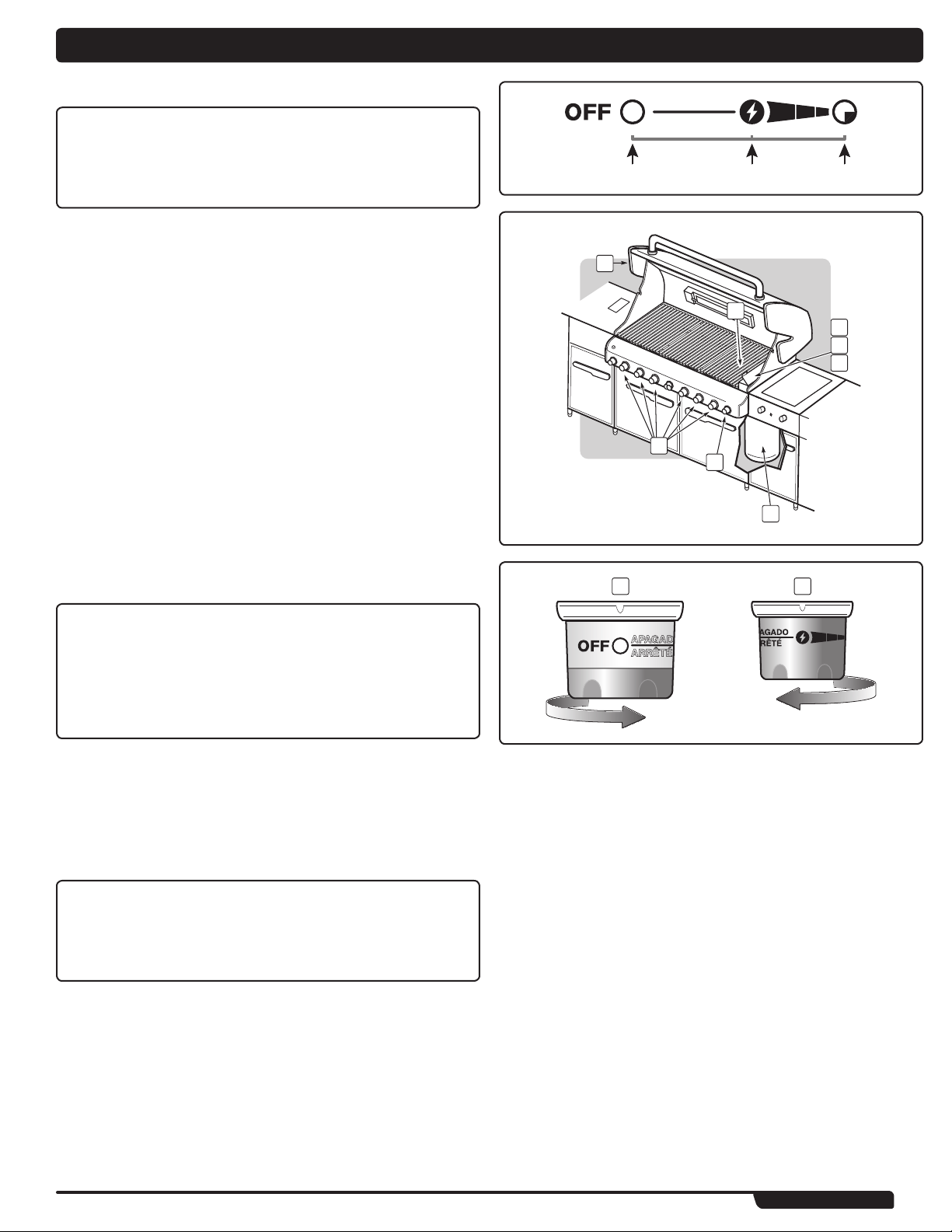
WWW.WEBER.COM
®
33
SMOKER BURNER IGNITION & USAGE
SMOKER BURNER IGNITION
DANGER
Failure to open the lid while igniting the grill, or not waiting
five minutes to allow the gas to clear if the grill does not
light, may result in an explosive flare-up which can cause
serious bodily injury or death.
Smoker Burner Snap Ignition
Note: The control knob snap igniter creates a spark from the igniter electrode to the
burner lighting tube. You generate the energy for the spark by pushing in the control
knob and turning it to START/HI. This will ignite the smoker burner.
WARNING: Check hose before each use of grill for nicks,
cracking, abrasions or cuts. If the hose is found to be
damaged in any way, do not use the grill. Replace using
only Weber
®
authorized replacement hose. Contact the
Customer Service Representative in your area using the
contact information on our web site.
Log onto www.weber.com
®
.
A) Open the grill lid (1).
B) Open smoker box lid (2).
C) Fill smoker with water-soaked wood chunks or chips (3).
D) Make sure that all burner control knobs not being used are turned to OFF (4). (Push
control knob in and turn it clockwise to ensure that it is in the OFF position.)
WARNING: The burner control knobs must be in the OFF
position before turning on the liquid propane cylinder tank
valve. If they are not in the OFF position, when you turn on
the LP cylinder valve, the “excess gas flow control” feature
will activate, limiting the flow of gas from the LP cylinder. If
this should occur, turn off the LP cylinder valve and burner
control knobs. Start over.
DANGER
When the “excess gas flow control” feature is activated,
a small amount of gas is still flowing to the burners. After
turning off the cylinder and burner control knobs, wait at
least five minutes for the gas to clear before attempting to
light the grill. Failure to do so may result in an explosive
flare-up, which can cause serious bodily injury or death.
DANGER
If the smoker burner still does not light, turn the burner
control knob to OFF and wait five minutes to let the gas
clear before you try again, or try lighting with a match (see
“SMOKER BURNER MANUAL IGNITION”).
H) Close smoker box lid (8) after wood starts to smolder and turn control knob to
LOW.
X
TO EXTINGUISH
Push in and turn each burner control knob clockwise to OFF position. Turn gas supply off
at the source.
X
5
1
3
2
8
6
4
7
E) Turn the cylinder on by turning the cylinder valve counterclockwise (5).
WARNING: Do not lean over the open grill while lighting.
F) Push the control knob in and turn it to START/HI until you hear the igniter snap (6);
continue to hold control knob in for two seconds. This action will spark the igniter,
the burner lighting tube, and then smoker burner.
G) Check that the burner is lit by looking through the cooking grates (7). You should see
a flame. If burner does not light on first try, push control knob in and turn it to OFF.
Repeat lighting procedure a second time.
The grill illustrated may have slight
differences than the model purchased.
4 6
ARRÊTÉ
APAGADO
OFF START/HI LOW
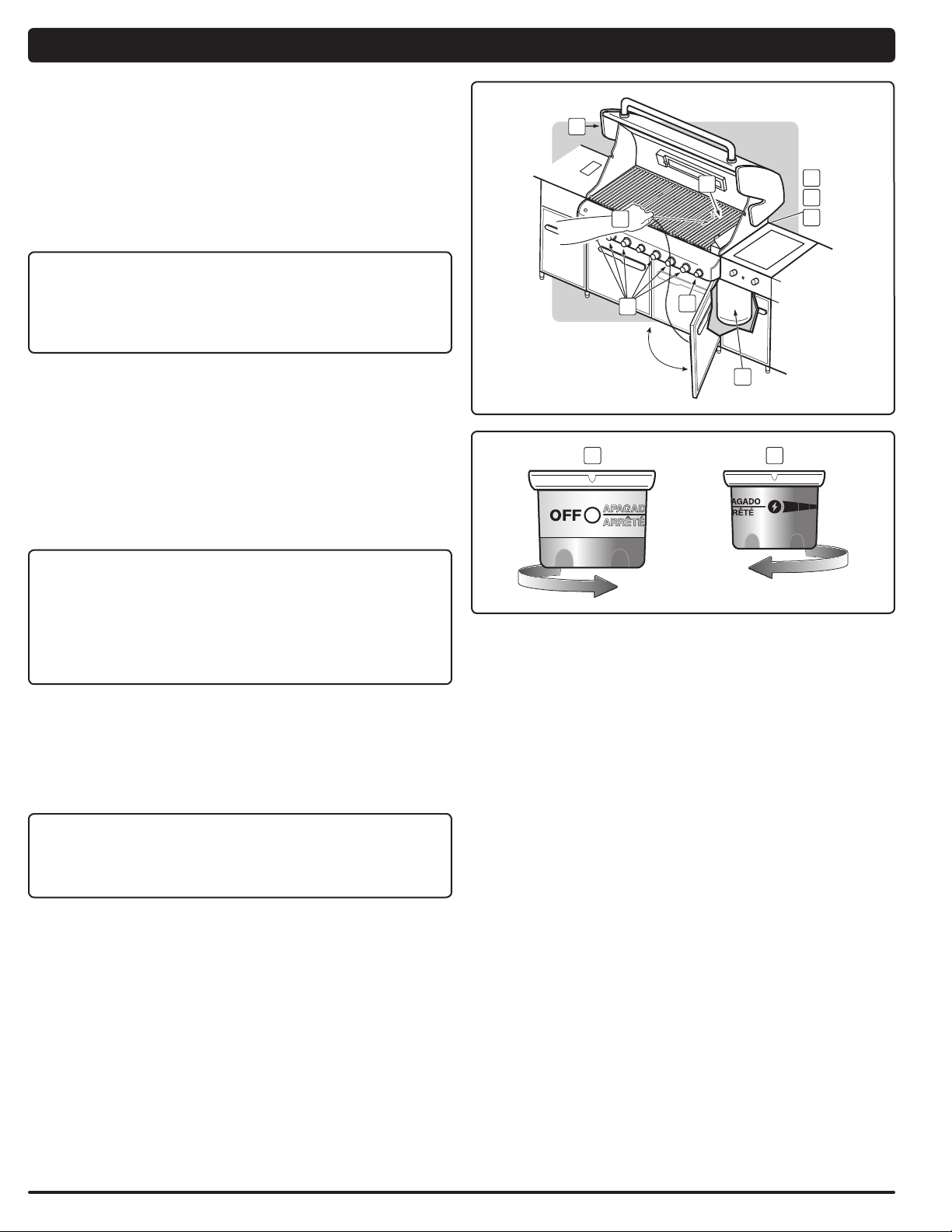
34
8
3
2
9
5
1
4
7
6
SMOKER BURNER MANUAL IGNITION
WARNING: Check hose before each use of grill for nicks,
cracking, abrasions or cuts. If the hose is found to be
damaged in any way, do not use the grill. Replace using
only Weber
®
authorized replacement hose. Contact the
Customer Service Representative in your area using the
contact information on our web site.
Log onto www.weber.com
®
.
A) Open the lid (1).
DANGER
Failure to open the lid while igniting the grill, or not waiting
five minutes to allow the gas to clear if the grill does not
light, may result in an explosive flare-up which can cause
serious bodily injury or death.
The grill illustrated may
have slight differences than
the model purchased.
B) Open smoker box lid (2).
C) Fill smoker with water-soaked wood chunks or chips (3).
D) Make sure that all burner control knobs not being used are turned to OFF (4). (Push
control knob in and turn it clockwise to ensure that it is in the OFF position.)
WARNING: The burner control knobs must be in the OFF
position before turning on the liquid propane cylinder tank
valve. If they are not in the OFF position, when you turn on
the LP cylinder valve, the “excess gas flow control” feature
will activate, limiting the flow of gas from the LP cylinder. If
this should occur, turn off the LP cylinder valve and burner
control knobs. Start over.
DANGER
When the “excess gas flow control” feature is activated,
a small amount of gas is still flowing to the burners. After
turning off the cylinder and burner control knobs, wait at
least five minutes for the gas to clear before attempting to
light the grill. Failure to do so may result in an explosive
flare-up, which can cause serious bodily injury or death.
E) Turn the cylinder on by turning the cylinder valve counterclockwise (5).
F) Put a match in the matchstick holder and strike the match.
G) Insert matchstick holder and lit match down through cooking grates and Flavorizer
®
bars to ignite smoker burner (6).
WARNING: Do not lean over the open grill while lighting.
H) Push smoker burner control knob in and turn it to START/HI (7).
I) Check that the burner is lit by looking down through the cooking grate (8).
DANGER
If the smoker burner does not light, turn the burner control
knob to OFF and wait five minutes to let the gas clear before
you try again.
J) Close smoker box lid (9) after wood starts to smolder and turn control knob to LOW.
X
TO EXTINGUISH
Push in and turn each burner control knob clockwise to OFF position. Turn gas supply off
at the source.
X
4 7
SMOKER BURNER IGNITION & USAGE
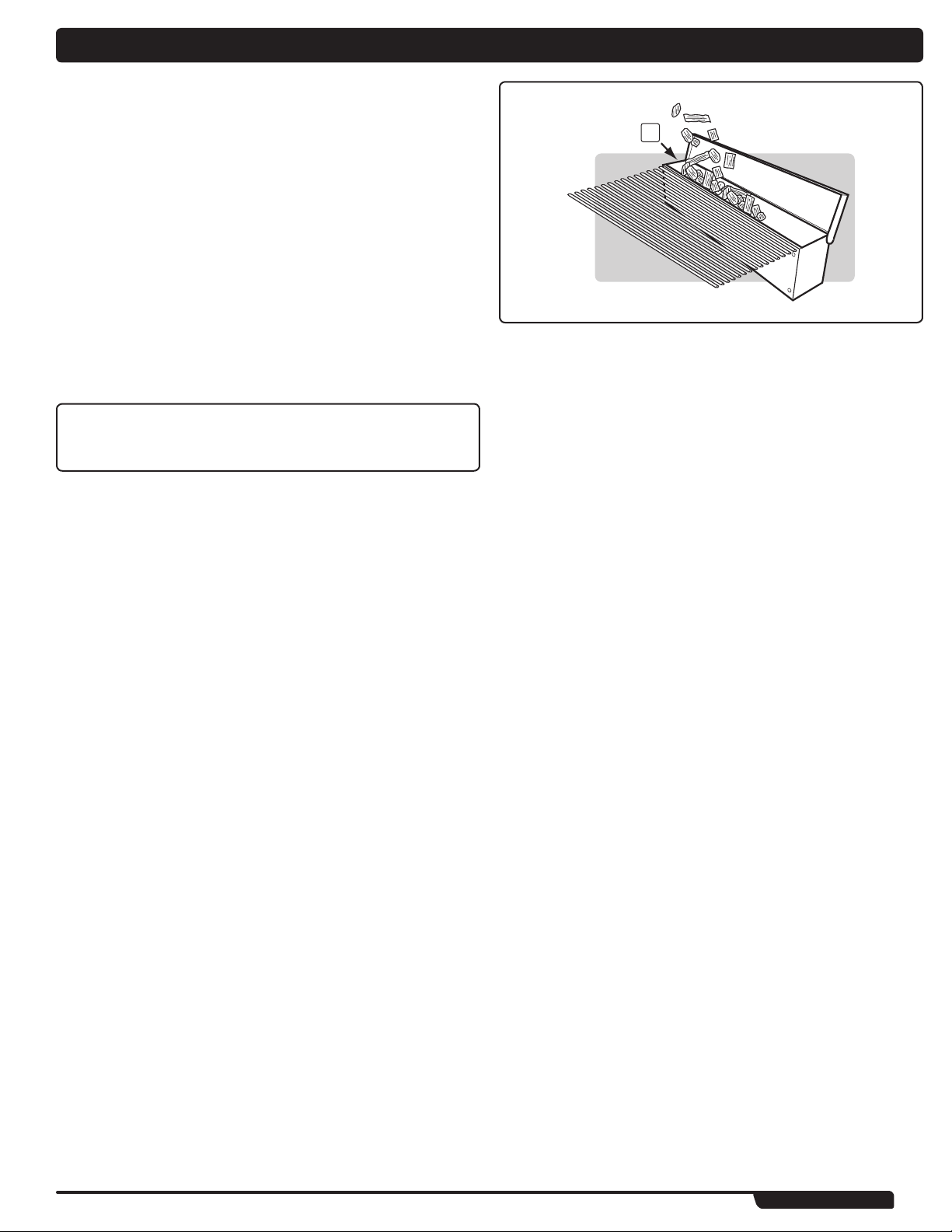
WWW.WEBER.COM
®
35
USING THE SMOKER
The smoker uses presoaked wood chips. For best results with faster cooking foods like
steaks, burgers, and chops, etc., we recommend using finer wood chips because they
ignite and create smoke faster. For longer cooking foods such as roasts, chicken, and
turkeys, etc., we recommend using larger wood chunks because they ignite slowly and
provide smoke for a longer period of time. As you gain experience in using your smoker,
we encourage you to experiment with different combinations of wood chips and chunks
to find the smoke flavor that best suits your taste.
As a starting point, soak wood chips in water for at least 30 minutes before using. (Wet
wood will produce more smoke flavor.) Place a handful of wood chips or a few larger
chunks in the bottom of the smoker body (1). As you gain experience in smoking,
increase or decrease the amount of wood to suit your taste.
Note: Always grill with the lid closed to allow the smoke to fully penetrate the food.
Light the smoker burner by following the instructions for “SMOKER BURNER
IGNITION.” After wood starts to smolder, turn control knob to LOW.
Smoke will start in approximately 10 minutes and last as long as 45 minutes. If you
require more smoke flavor, refill the smoker with wood chips and/or chunks. Keep the lid
of the grill closed while cooking.
Note: After refilling smoker, smoke will take about 10 to 15 minutes to start again. The
smoker may be used to enhance meat, poultry, and fish recipes. Cook with the lid down
according to the times indicated in charts or recipes.
DANGER
Do not use any flammable fluid in the smoker to ignite the
wood. This will cause serious bodily injury.
X
1
CLEANING THE SMOKER
Before each use, empty the smoker of ash to allow proper air flow.
Note: Smoking will leave a “smoke” residue on the surface of the smoker. This residue
cannot be removed and will not affect the function of the smoker. To a lesser degree, a
“smoke” residue will accumulate on the inside of your gas grill. This residue need not
be removed and will not adversely affect the function of your gas grill.
X
SMOKER BURNER IGNITION & USAGE
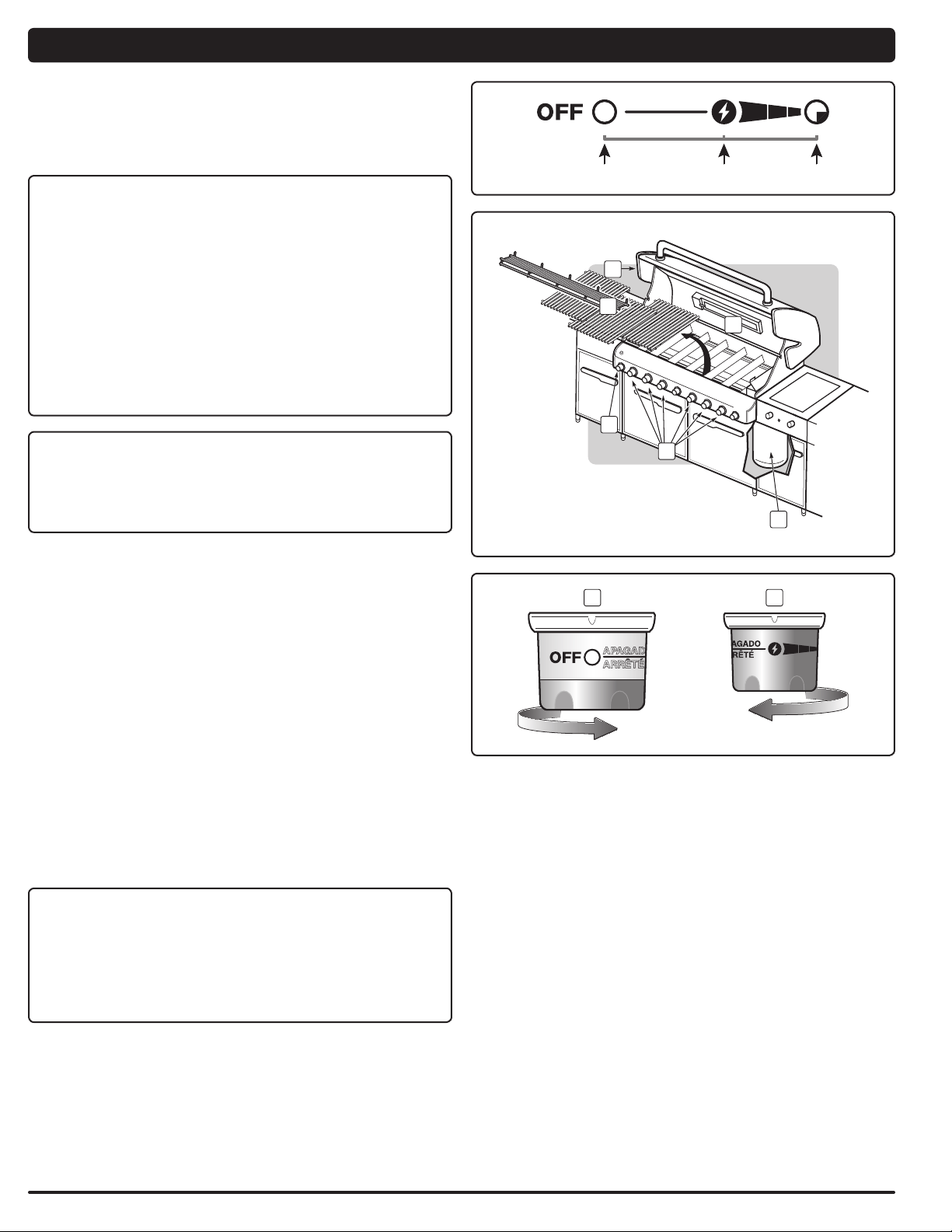
36
ROTISSERIE BURNER IGNITION & USAGE
ROTISSERIE BURNER IGNITION
Rotisserie Burner Snap Ignition
Note: Each control knob snap igniter creates a spark from the igniter electrode to the
burner lighting tube. You generate the energy for the spark by pushing in the control
knob and turning it to START/HI. This will ignite each individual burner.
ATTENTION: READ BEFORE
LIGHTING ROTISSERIE BURNER
After a period of non-use, before lighting the rotisserie
burner, a few seconds must pass for the gas supply line to fill.
When using the snap igniter you will see a flash of flames
moving from left to right across the rotisserie burner
surface. The rotisserie burner is not lit until the entire
ceramic surface is aflame.
At this point, start a count of twenty seconds before
releasing the rotisserie burner control knob.
The rotisserie burner surface will glow red once the burner is
fully ignited.
DANGER
Failure to open the lid while igniting the grill, or not waiting
five minutes to allow the gas to clear if the grill does not
light, may result in an explosive flare-up which can cause
serious bodily injury or death.
CAUTION: The rotisserie burner flame may be difficult to see
on a bright sunny day.
WARNING: Check hose before each use of grill for nicks,
cracking, abrasions or cuts. If the hose is found to be
damaged in any way, do not use the grill. Replace using
only a Weber
®
authorized replacement hose. Contact the
Customer Service Representative in your area using the
contact information on our web site.
Log onto www.weber.com
®
.
A) Open the lid (1).
B) Remove the warming rack and the cooking grates from the cookbox (2).
C) Make sure all burner control knobs are turned off (3). (Push control knob in and turn
it clockwise to ensure that it is in the OFF position.)
WARNING: The burner control knobs must be in the OFF
position before turning on the liquid propane cylinder tank
valve. If they are not in the OFF position, when you turn on
the LP cylinder valve, the “excess gas flow control” feature
will activate, limiting the flow of gas from the LP cylinder. If
this should occur, turn off the LP cylinder valve and burner
control knobs. Start over.
DANGER
When the “excess gas flow control” feature is activated,
a small amount of gas is still flowing to the burners. After
turning off the cylinder and burner control knobs, wait at
least five minutes for the gas to clear before attempting to
light the grill. Failure to do so may result in an explosive
flare-up, which can cause serious bodily injury or death.
4
1
6
5
3
2
The grill illustrated may have slight
differences than the model purchased.
D) Turn the cylinder on by turning the cylinder valve counterclockwise (4).
WARNING: Do not lean over the open grill.
E) Push the control knob in and turn it to START/HI (5). This action will spark the igniter
and light the rotisserie burner. Continue to use the snap igniter until the rotisserie
burner has ignited. Continue to hold the control knob down until twenty seconds
after the burner has ignited. Release the control knob.
3 5
F) Check that the burner is lit by looking for the rotisserie burner to glow red (6).
WARNING: If the rotisserie burner does not light, turn the
burner control knob to OFF and wait five minutes to let the
gas clear before you try again or try to light with a match.
Note: When using the rotisserie with the lid closed, only light two of the main burners on
each side of the food (see “COOKING METHODS—INDIRECT COOKING”). Check your
food periodically to prevent it from overcooking on the outside. Turn off the rotisserie
burner once the food has browned to the desired color. Finish cooking it on indirect
heat.
X
TO EXTINGUISH
Push in and turn each burner control knob clockwise to OFF position. Turn gas supply off
at the source.
X
ARRÊTÉ
APAGADO
OFF START/HI LOW
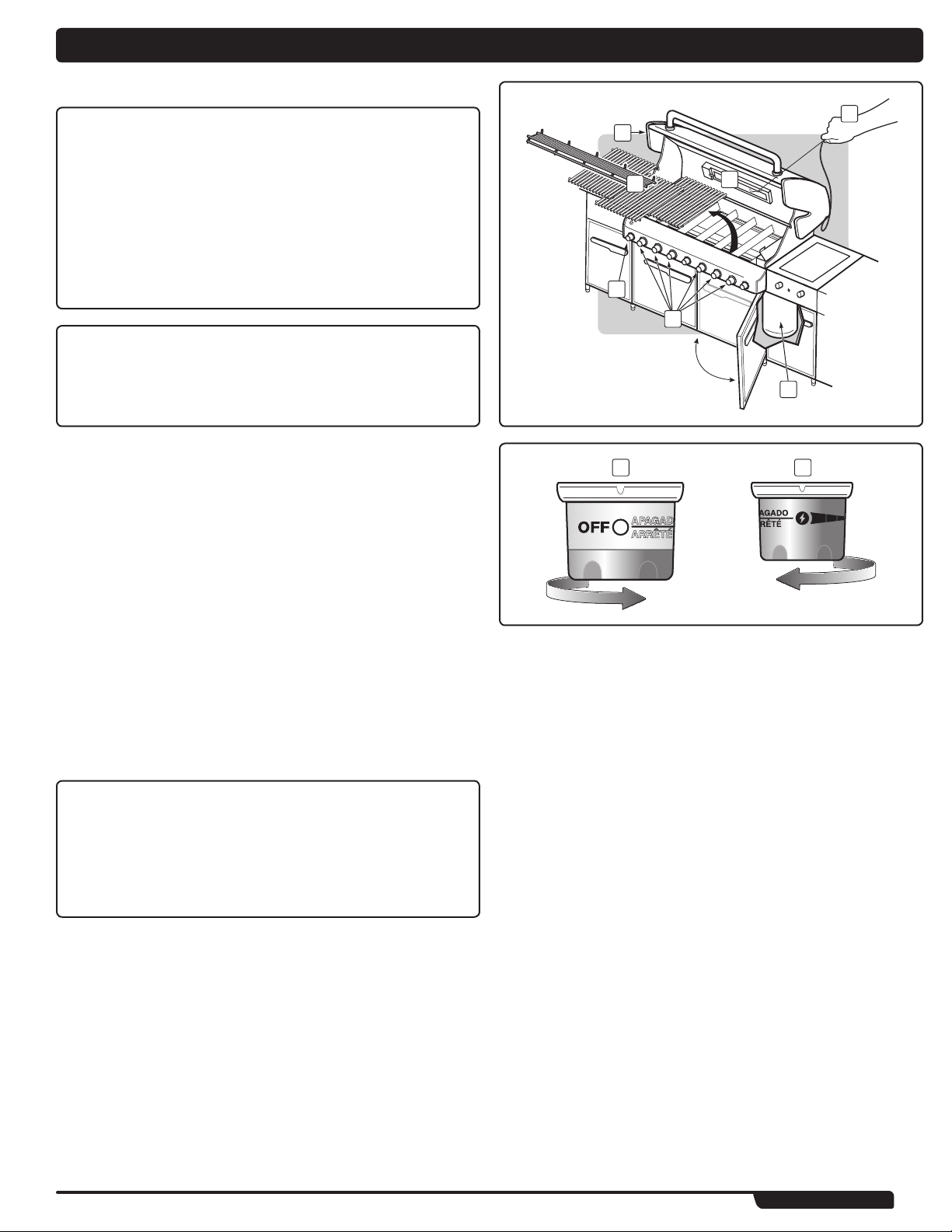
WWW.WEBER.COM
®
37
ROTISSERIE BURNER MANUAL IGNITION
ATTENTION: READ BEFORE
LIGHTING ROTISSERIE BURNER
After a period of non-use, before lighting the rotisserie
burner, a few seconds must pass for the gas supply line to
fill. When holding a match to the rotisserie burner you will
see a flash of flames moving from left to right across the
rotisserie burner surface. The rotisserie burner is not lit
until the entire ceramic surface is aflame. At this point, start
a count of twenty seconds before releasing the rotisserie
burner control knob. The rotisserie burner surface will glow
red once the burner is fully ignited.
DANGER
Failure to open the lid while igniting the grill, or not waiting
five minutes to allow the gas to clear if the grill does not
light, may result in an explosive flare-up which can cause
serious bodily injury or death.
CAUTION: The rotisserie burner flame may be difficult to see
on a sunny day.
WARNING: Check hose before each use of grill for nicks,
cracking, abrasions or cuts. If the hose is found to be
damaged in any way, do not use the grill. Replace using
only a Weber
®
authorized replacement hose. Contact the
Customer Service Representative in your area using the
contact information on our web site.
Log onto www.weber.com
®
.
A) Open the lid (1).
B) Remove the warming rack and the cooking grates from the cookbox (2).
C) Make sure all burner control knobs are turned off (3). (Push control knob down and
turn it clockwise to ensure that it is in the OFF position.)
WARNING: The burner control knobs must be in the OFF
position before turning on the liquid propane cylinder tank
valve. If they are not in the OFF position, when you turn on
the LP cylinder valve, the “excess gas flow control” feature
will activate, limiting the flow of gas from the LP cylinder. If
this should occur, turn off the LP cylinder valve and burner
control knobs. Start over.
4
1
5
3
6
7
2
The grill illustrated may have slight
differences than the model purchased.
3 6
DANGER
When the “excess gas flow control” feature is activated,
a small amount of gas is still flowing to the burners. After
turning off the cylinder and burner control knobs, wait at
least five minutes for the gas to clear before attempting to
light the grill. Failure to do so may result in an explosive
flare-up, which can cause serious bodily injury or death.
D) Turn the cylinder on by turning the cylinder valve counterclockwise (4).
E) Put a match in the matchstick holder and strike the match.
F) Hold matchstick holder and lit match by right side of rotisserie burner (5).
WARNING: Do not lean over the open grill.
G) Push rotisserie burner control knob down and turn it to START/HI (6). Continue to
hold the control knob down until twenty seconds after the burner has ignited.
H) Check that the burner is lit by looking for the rotisserie burner to glow red (7).
WARNING: If the rotisserie burner does not light, turn the
burner control knob to OFF and wait five minutes to let the
gas clear before you try again.
Note: When using the rotisserie with the lid closed, only light two of the main burners
under the food (see “COOKING METHODS—INDIRECT COOKING”). Check your food
periodically to prevent it from overcooking on the outside. Turn off the rotisserie burner
once the food has browned to the desired color. Finish cooking it on indirect heat.
X
TO EXTINGUISH
Push in and turn each burner control knob clockwise to OFF position. Turn gas supply off
at the source.
X
ROTISSERIE BURNER IGNITION & USAGE
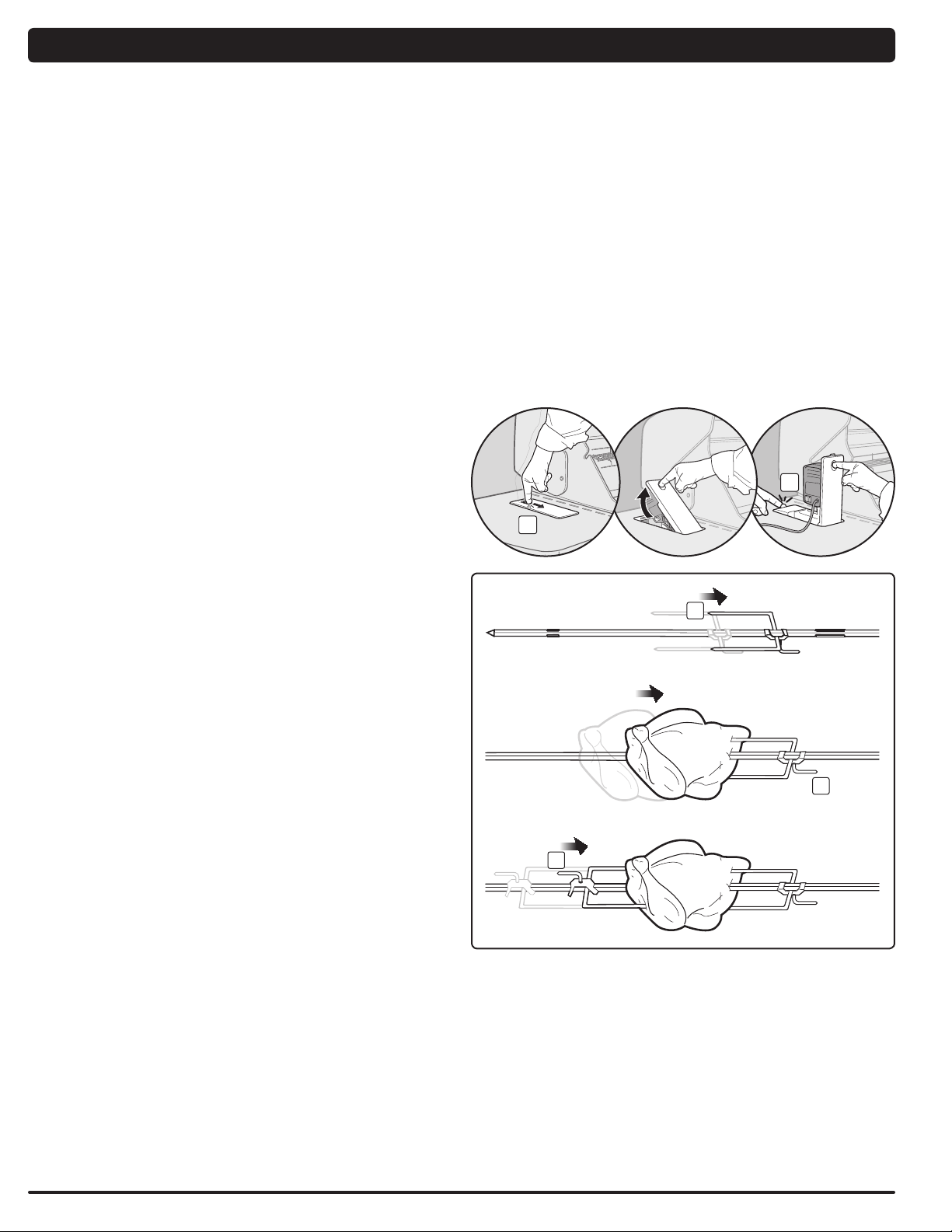
38
IMPORTANT SAFEGUARDS
Note: Before using your rotisserie, measure your food at the widest point. If it exceeds
9½" (241.8 mm), it is too large to fit the rotisserie. If it is too large, food can be prepared
using a roast holder and the indirect cooking method.
WARNINGS
Read all instructions before using your rotisserie.
This rotisserie is for outdoor use only.
Remove motor and store in a dry place when not in use.
Do not touch hot surfaces. Use barbecue mitts.
This rotisserie is not for use by children.
To protect against electrical hazards do not immerse cord,
plugs, or motor in water or other liquids.
Unplug the motor from outlet when not in use or before
cleaning.
Do not use rotisserie for other than intended use.
Make sure motor is off before placing it on the motor
bracket.
Do not operate the rotisserie motor with a damaged cord or
plug.
Do not operate the rotisserie motor if it should malfunction.
The rotisserie motor is equipped with a three prong
(grounding) power cord for your protection against shock
hazard.
The power cord should be plugged directly into a properly
grounded three prong receptacle. If use of an extension
cord is required, be sure that it is a minimum 16 AWG
(1.3 mm), 3-wire, well insulated cord marked for OUTDOOR
USE ONLY and properly grounded.
When using an extension cord, make sure it is not in contact
with a hot or sharp surface.
Outdoor extension cords should be marked with the letters
“W-A” and a tag stating “Suitable for use with outdoor
appliances.”
Do not cut or remove the grounding prong from the
rotisserie motor power cord.
Do not let cord hang over any sharp edge or hot surface.
Do not expose to rain.
To reduce the risk of electric shock, keep extension cord
connection dry and off the ground.
A short power cord is supplied to reduce the risk of tripping
over the cord. Extension cords may be used, but caution
must be taken to prevent tripping over the cord.
In absence of local codes the rotisserie motor must be
grounded electrically in accordance with the National
Electric Code, ANSI / NFPA 70, or Canadian Electrical Code,
CSA C22.1.
X
OPERATING THE ROTISSERIE
WARNING: Set up the rotisserie with food before lighting
rotisserie burner.
A) To set up rotisserie motor, push the button on the retractable rotisserie panel (1).
Pull rotisserie panel upwards. Push locking tab (2) until it snaps into place.
B) Remove power cord and plug into power source.
CAUTION: Do not route rotisserie motor power cord through
the retractable rotisserie opening in the side table.
CAUTION: Inspect power cord before each use. If cord
is damaged, do not use. Contact the Customer Service
Representative in your area using the contact information
on our web site. Log onto www.weber.com
®
.
C) Slide one of the spit forks towards the right side of the rotisserie shaft, making sure
that the spikes face to the left and the fork screw faces down (3).
D) Push the rotisserie shaft through the center of the food. Insert the tines of both spit
forks into the food. The food should be centered on the shaft. Tighten the spit fork
screw (4).
E) Slide another spit fork onto the rotisserie shaft, making sure that the spikes face to
the right and the fork screw faces up. Insert the tines of both spit forks into the food.
Tighten the spit fork screw (5).
2
1
4
5
3
ROTISSERIE BURNER IGNITION & USAGE
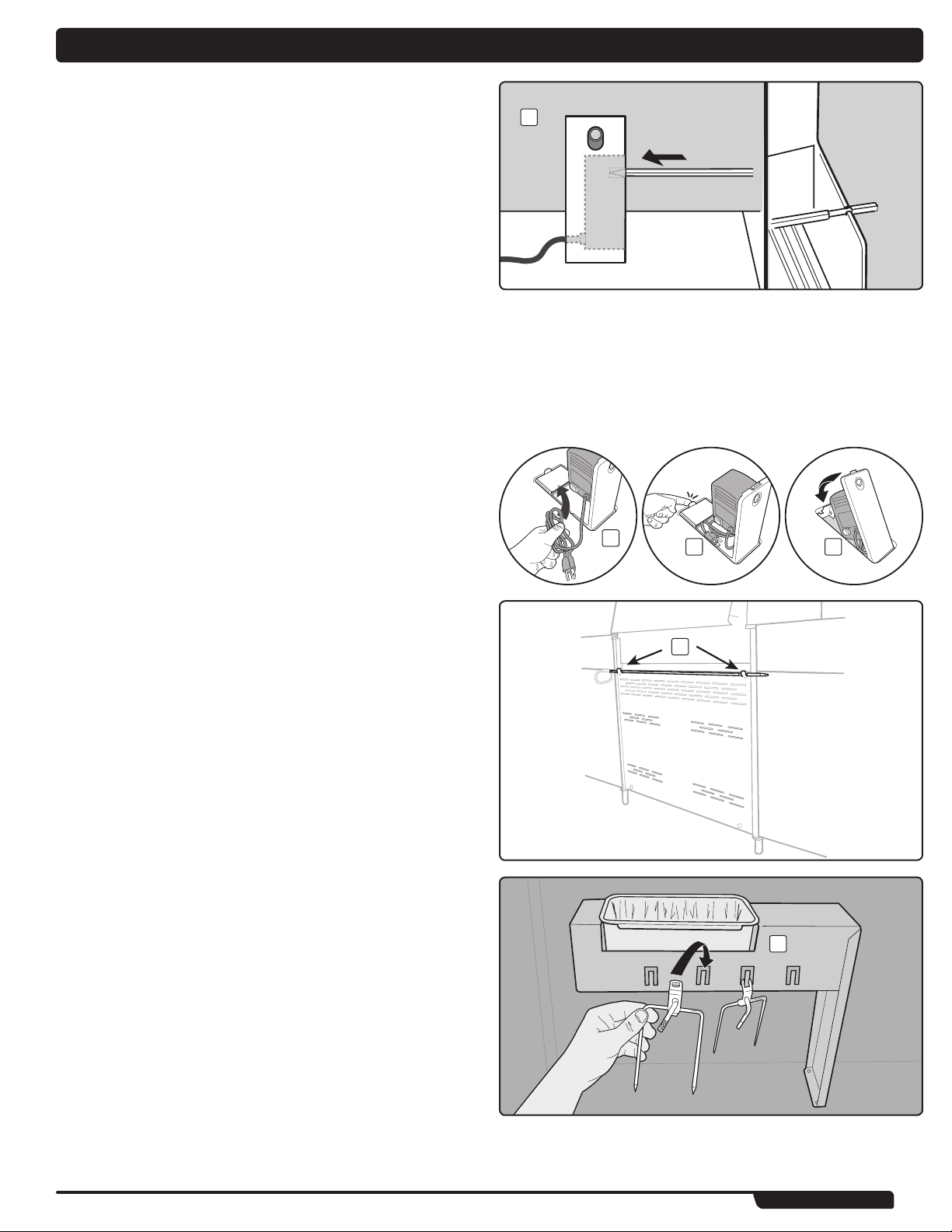
WWW.WEBER.COM
®
39
ROTISSERIE BURNER IGNITION & USAGE
F) Insert the pointed end of the rotisserie shaft into the motor. Lower the rotisserie spit
into the grooves on the cookbox (6).
G) The rotisserie shaft should rotate so that the heavy side of the meat or poultry
rotates down to the bottom. Large cuts may require the removal of the cooking
grates and warming rack to allow full rotation of the shaft. Remount the food if
necessary for better balance.
H) Turn the motor on.
X
ROTISSERIE COOKING
r.FBUTFYDFQUQPVMUSZBOEHSPVOENFBUTIPVMECFCSPVHIUUPSPPNUFNQFSBUVSF
before cooking. (20 to 30 minutes should be adequate for most foods. If frozen,
defrost completely before cooking.)
r5JFNFBUPSQPVMUSZXJUIBTUSJOHJGOFDFTTBSZUPNBLFUIFTIBQFBTVOJGPSNBT
possible before putting it on the spit.
r3FNPWFDPPLJOHHSBUFTBOEXBSNJOHSBDLUPBMMPXGPPEUPUVSOGSFFMZ
r'PMMPXMJHIUJOHJOTUSVDUJPOTGPSSPUJTTFSJFCVSOFS
r4FUSPUJTTFSJFCVSOFSPONFEJVNIJHICBTFEPOPVUTJEFBJSUFNQFSBUVSFT
r1MBDFGPPEXJUIJOBSFBPGCVSOFS
r*GZPVXJTIUPTBWFESJQQJOHTGPSHSBWZQMBDFBESJQQBOEJSFDUMZVOEFSUIFGPPEPOUPQ
of the Flavorizer
®
bars.
r'PPEQSFQBSBUJPOTUFQTBSFUIFTBNFGPSSPUJTTFSJFDPPLJOHBTGPSSFHVMBSDPPLJOH
r"MMDPPLJOHJTEPOFXJUIUIFMJEDMPTFE
r*GGPPETBSFUPPIFBWZPSBSFJSSFHVMBSTIBQFTUIFZNBZOPUSPUBUFXFMMBOETIPVMECF
cooked by the indirect method without using the rotisserie.
r4NPLFSDBOCFVTFEJODPOKVODUJPOXJUISPUJTTFSJFGPSNPSFTNPLFGMBWPS
Note: When using the rotisserie burner, grill thermometer will not reflect the temperature
inside the cooking box.
X
ROTISSERIE MOTOR STORAGE
A) Before retracting rotisserie back into the side table, unplug the power cord and
carefully place plug/power cord into the storage area of the retractable rotisserie
assembly (1).
CAUTION: Failure to properly store the rotisserie power
cord may result in damage to the power cord when opening
and closing the retractable rotisserie panel.
B) Using your index finger, disengage retractable rotisserie panel (2). Push panel down
until it snaps securely in place (3).
X
ROTISSERIE SPIT STORAGE
A) Remove forks from rotisserie spit. Replace rotisserie shaft handle. Use the
Rotisserie spit storage brackets on the rear panel to stor the rotisserie spit (1).
B) Store rotisserie forks by placing them on the hooks located on the catch pan holder
within the grill cabinet (2).
X
2
3
3
1
1
2
2
6
1
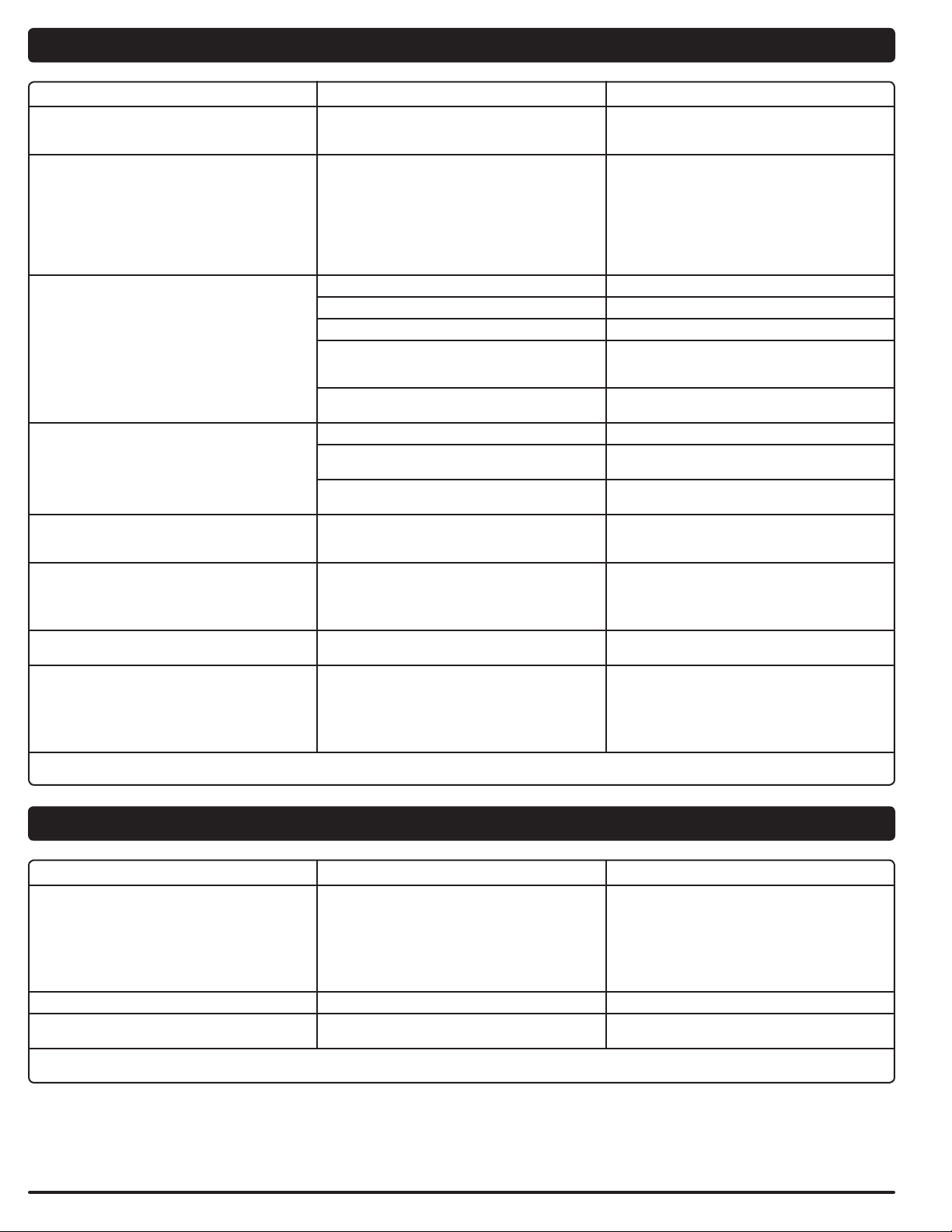
40
PROBLEM CHECK SOLUTION
Side Burner does not light. Is gas supply off?
The excess flow safety device, which is part of the
barbecue to cylinder connection, may have activated.
Turn gas supply on.
To reset the excess flow safety device close the LP
tank valve and turn all burner control knobs to the OFF
position. Open the grill and side burner lids. Slowly turn
the LP tank valve until it is completely open. Wait several
seconds then ignite your side burner. Refer to “SIDE
BURNER IGNITION”.
Flame is low in HI position. Is the fuel hose bent or kinked? Straighten hose.
Push button ignition does not work. Does burner light with a match? If match lights burner, check igniter. Refer to “SIDE
BURNER MAINTENANCE”.
If problems cannot be corrected by using these methods, please contact the Customer Service Representative in your area using the contact information on our
web site. Log onto www.weber.com
®
.
PROBLEM CHECK SOLUTION
Burners burn with a yellow or orange flame, in
conjunction with the smell of gas. (This is normal for
the burner lighting tube.)
Inspect spider/insect screens for possible obstructions.
(Blockage of holes.)
Clean spider/insect screens. Refer to “ANNUAL
MAINTENANCE.”
Symptoms:
Burners do not light.
OR
Burners have a small, flickering flame in the HI
position.
OR
Barbecue temperature only reaches 250° to 300° in
the HI position.
The excess flow safety device, which is part of the
barbecue to cylinder connection, may have been
activated.
To reset the excess flow safety device, turn all burner
control knobs and the cylinder valve off. Disconnect the
regulator from the cylinder. Turn burner control knobs
to HI. Wait at least one minute. Turn burner control
knobs to OFF. Reconnect the regulator to the cylinder.
Turn cylinder valve on slowly. Refer to “MAIN BURNER
IGNITION.”
Burner does not light.
OR
Flame is low in HI position.
Is LP fuel low or empty? Refill LP cylinder.
Is fuel hose bent or kinked? Straighten fuel hose.
Does burner light with a match? Clean burners. Refer to “MAINTENANCE.”
Did you use the snap igniter several times until the main
burner lit? Refer to “MAIN BURNER IGNITION.”
Make sure to hold the control knob in for two seconds
after snapping the igniter and seeing the orange flame
from the burner lighting tube.
Does the igniter work? Do you see a spark when you
repeatedly use the snap igniter?
Try manually lighting the burner. Refer to “MAIN
BURNER MANUAL IGNITION.” Call Customer Service.
Experiencing flare-ups:
CAUTION: Do not line the slide-out
grease tray with aluminum foil.
Are you preheating barbecue in the prescribed manner? Turn all burners on HI for 10 to 15 minutes for preheating.
Are the cooking grates and Flavorizer
®
bars heavily
coated with burned-on grease?
Clean thoroughly. Refer to “CLEANING.”
Is the slide-out grease tray “dirty” and not allowing
grease to flow into catch pan?
Clean slide-out grease tray.
Burner flame pattern is erratic. Flame is low when
burner is on HI. Flames do not run the whole length
of the burner tube.
Are burners clean? Clean burners. Refer to “MAINTENANCE.”
Inside of lid appears to be “peeling.” (Resembles
paint peeling.)
The lid is porcelain enamel or stainless steel, not paint.
It cannot “peel.” What you are seeing is baked-on grease
that has turned to carbon and is flaking off.
THIS IS NOT A DEFECT.
Clean thoroughly. Refer to “CLEANING.”
Cabinet doors are not aligned. Check the adjustment pin on the bottom of each door. Loosen adjustment nut/s. Slide door/s until aligned.
Tighten nut/s.
Barbecue seems to lose heat when cooking in cold
weather temperatures of 50°F or colder.
Is there frost/ice on the outside of the LP cylinder? The liquid propane in the cylinder turns to vapor too
slowly to supply the burners with gas. This is due to the
air temperature cooling the LP cylinder, which slows the
vaporization process. Turn off burner control knobs and
the LP cylinder. Replace with a spare LP cylinder and
resume cooking.
If problems cannot be corrected by using these methods, please contact the Customer Service Representative in your area using the contact information on our
web site. Log onto www.weber.com
®
.
TROUBLESHOOTING
SIDE BURNER TROUBLESHOOTING
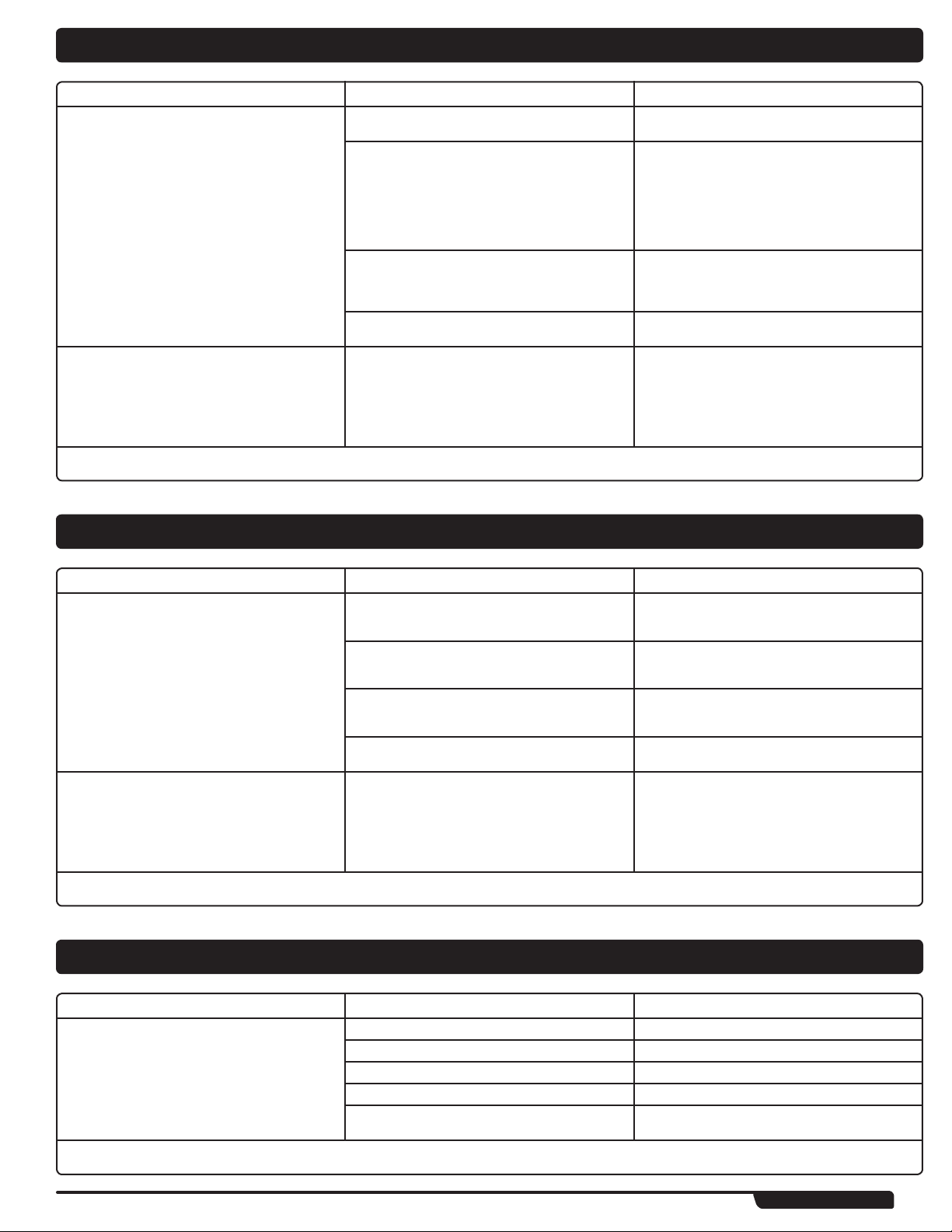
WWW.WEBER.COM
®
41
SEAR STATION
®
TROUBLESHOOTING
PROBLEM CHECK SOLUTION
Burners burn with a yellow or orange flame, in
conjunction with the smell of gas. (This is normal for
the burner lighting tube.)
Sear Station
®
burner does not light.
Inspect spider/insect screens for possible obstructions.
(Blockage of holes.)
Clean spider/insect screens.
Refer to “ANNUAL MAINTENANCE.”
Did you ignite the two adjacent main burners? Refer to
“SEAR STATION
®
IGNITION & USAGE” for safe lighting
procedure.
Verify adjacent main burner ignition by visual inspection
of a flame.
WARNING: If ignition does not occur
in five seconds, turn burner control
OFF, wait five minutes to let the gas
clear before you try again.
Does burner light with a match? If you can light burner with a match, then check the
Crossover
®
Channel on the sear burner.
Refer to “MAINTENANCE” for burner removal and
cleaning procedure.
Does the igniter work? Do you see a spark when you
repeatedly use the snap igniter?
Try manually lighting the burner. Refer to “SEAR
STATION
®
IGNITION & USAGE.” Call Customer Service.
General Symptoms:
Burner does not light.
OR
Burner has a small flickering flame.
The excess flow safety device, which is part of the
barbecue to cylinder connection, may have been
activated.
To reset the excess flow safety device, turn all burner
control knobs and the cylinder valve to OFF. Disconnect
the regulator from the cylinder. Turn burner control knobs
to START/HI. Wait at least one minute. Turn burner
control knobs to OFF. Reconnect the regulator to the
cylinder. Turn cylinder valve on slowly. Refer to “MAIN
BURNER IGNITION.”
If problems cannot be corrected by using these methods, please contact the Customer Service Representative in your area using the contact information on our
web site. Log onto www.weber.com
®
.
PROBLEM CHECK SOLUTION
Weber Grill Out™ Handle Light does not light. Are the batteries old? Replace batteries.
Are the batteries installed correctly? Refer to assembly illustration.
Is the lid in the up position with the power button ON? Light will activate when lid is open.
Is the Weber
®
Grill Out™ Handle Light activated? Press the power button.
Is the Weber
®
Grill Out™ Handle Light positioned
correctly on the handle?
Adjust position. Refer to assembly illustration.
If problems cannot be corrected by using these methods, please contact the Customer Service Representative in your area using the contact information on our
web site. Log onto www.weber.com
®
.
GRILL OUT™ HANDLE LIGHT TROUBLESHOOTING
PROBLEM CHECK SOLUTION
Rotisserie burner does not light. Did you hold the burner control knob in and hold in for 20
seconds after burner ignited?
Try to relight burner by holding burner control knob in;
continue holding in until 20 seconds after burner has
ignited.
Did you wait to see the entire ceramic surface become
alight before counting 20 seconds?
When relighting burner by holding burner control knob
in, wait to see the entire ceramic surface become alight
before counting 20 seconds.
Did you repeatedly use the snap ignition until the burner
ignited?
After waiting five minutes for gas to clear, try using the
snap igniter repeatedly until the burner ignites. Refer to
“ROTISSERIE BURNER IGNITION & USAGE.”
Does the igniter work? Do you see a spark when you
repeatedly use the snap igniter?
Try manually lighting the burner. Refer to “ROTISSERIE
BURNER MANUAL IGNITION.” Call Customer Service.
General Symptoms:
Burner does not light.
OR
Burner has a small, flickering flame.
The excess flow safety device, which is part of the
barbecue to cylinder connection, may have been
activated.
To reset the excess flow safety device, turn all burner
control knobs and the cylinder valve to OFF. Disconnect
the regulator from the cylinder. Turn burner control knobs
to START/HI. Wait at least one minute. Turn burner
control knobs to OFF. Reconnect the regulator to the
cylinder. Turn cylinder valve on slowly. Refer to “MAIN
BURNER IGNITION.”
If problems cannot be corrected by using these methods, please contact the Customer Service Representative in your area using the contact information on our
web site. Log onto www.weber.com
®
.
ROTISSERIE TROUBLESHOOTING
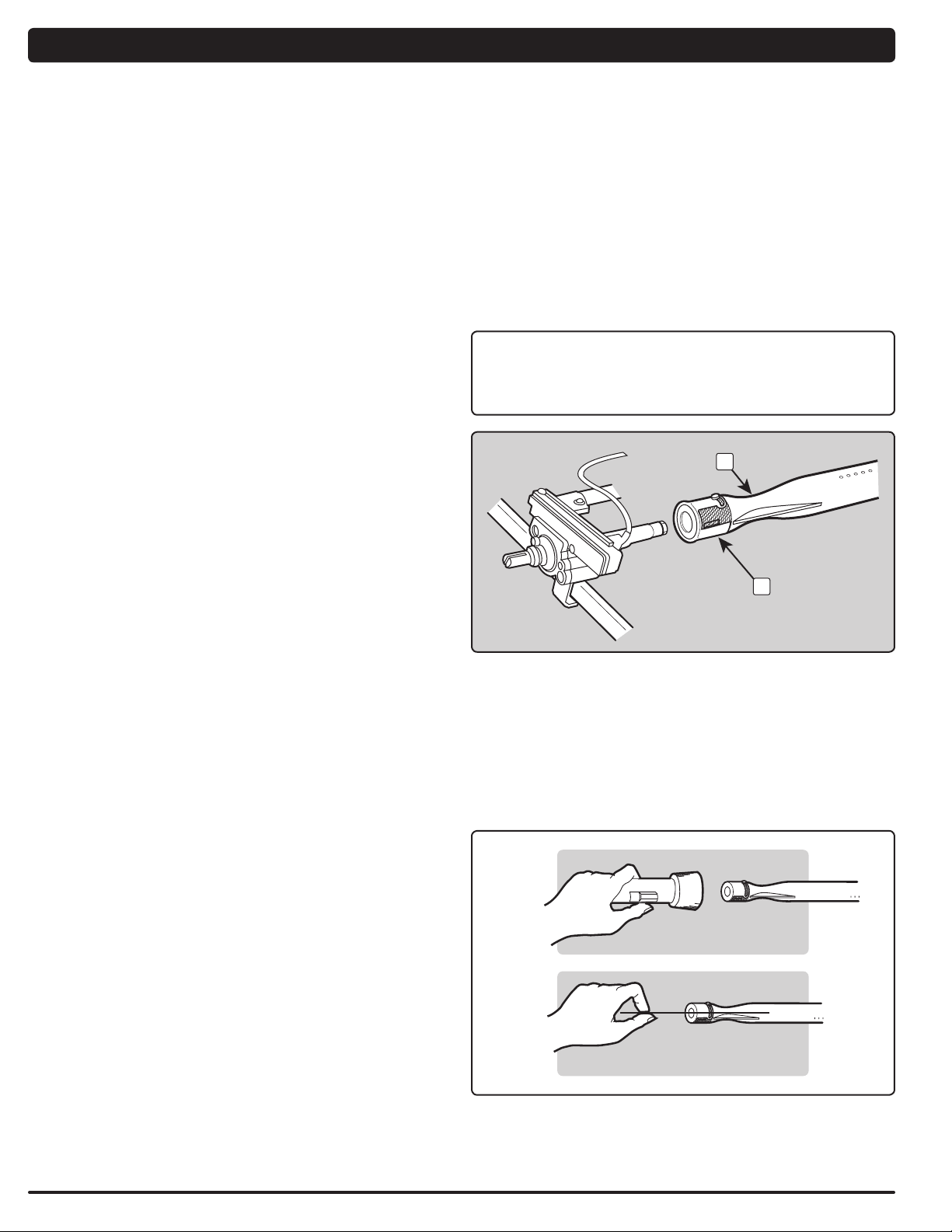
42
1
2
BURNER TUBE CLEANING
A) Turn off the gas supply.
B) Remove the manifold. (Refer to “REPLACING MAIN BURNERS.”)
C) Look inside each burner with a flashlight.
D) Clean the inside of the burners with a wire (a straightened-out coat hanger will also
work). Check and clean the air shutter opening at the ends of the burners. Check
and clean the valve orifices at the base of the valves. Use a steel bristle brush to
clean outside of burners. This is to make sure all the burner ports are fully open.
CAUTION: Do not enlarge the burner ports when cleaning.
X
WEBER
®
SPIDER/INSECT SCREENS
Your Weber
®
gas barbecue, as well as any outdoor gas appliance, is a target for spiders
and other insects. They can nest in the venturi section (1) of the burner tubes. This
blocks the normal gas flow, and can cause the gas to flow back out of the combustion air
opening. This could result in a fire in and around the combustion air openings, under the
control panel, causing serious damage to your barbecue.
The burner tube combustion air opening is fitted with a stainless steel screen (2) to
prevent spiders and other insects access to the burner tubes through the combustion air
openings.
We recommend that you inspect the spider/insect screens at least once a year.
(Refer to “ANNUAL MAINTENANCE.”) Also inspect and clean the the spider/insect
screens if any of the following symptoms should ever occur:
A) Gas is smelled in conjunction with burner flames that appear yellow and lazy.
B) Barbecue does not reach temperature.
C) Barbecue heats unevenly.
D) One or more of the burners do not ignite.
DANGER
Failure to correct the above mentioned symptoms may result
in a fire, which can cause serious bodily injury or death, and
cause damage to property.
X
MAINTENANCE
CLEANING
WARNING: Turn your Weber
®
gas barbecue off and wait for
it to cool before cleaning.
CAUTION: Do not clean your Flavorizer
®
bars or cooking
grates in a self-cleaning oven.
Outside surfaces — Use a warm soapy water solution to clean, then rinse with water.
CAUTION: Do not use oven cleaner, abrasive cleansers
(kitchen cleansers), cleaners that contain citrus products, or
abrasive cleaning pads on barbecue or cart surfaces.
Slide-out grease tray — Remove excess grease, wash with warm soapy water, then
rinse.
CAUTION: Do not line the slide-out grease tray with
aluminum foil.
Flavorizer
®
bars and cooking grates — Clean with a suitable stainless steel bristle
brush. As needed, remove from grill and wash with warm soapy water, then rinse with
water.
For availability of replacement cooking grates and Flavorizer
®
bars, contact the
Customer Service Representative in your area using the contact information on
our website. Log onto www.weber.com
®
.
Catch pan — Disposable foil trays are available, or you can line the catch pan with
aluminum foil. To clean the catch pan, wash with warm soapy water, then rinse.
Thermometer — Wipe with warm soapy water; clean with plastic scrub ball.
Cookbox — Brush any debris off of burner tubes. DO NOT ENLARGE BURNER PORTS
(OPENINGS). Wash inside of cookbox with warm soapy water and a water rinse.
Inside lid — While lid is warm, wipe inside with paper towel to prevent grease build-up.
Flaking built-up grease resembles paint flakes.
Stainless steel surfaces — Wash with a soft cloth and a soap and water solution. Be
careful to scrub with the grain direction of the stainless steel.
Do not use cleaners that contain acid, mineral spirits, or xylene. Rinse well after
cleaning.
Preserve your stainless steel — Your grill or its cabinet, lid, and control panel may be
made from stainless steel. Keeping the stainless steel looking its best is a simple matter.
Clean it with soap and water, rinse with clear water, and wipe dry. For stubborn particles,
a non-metallic brush can be used.
IMPORTANT: Do not use a wire brush or abrasive cleaners
on the stainless steel surfaces of your grill as this will cause
scratches.
IMPORTANT: When cleaning surfaces be sure to rub/wipe
in the direction of the grain to preserve the look of your
stainless steel.
X
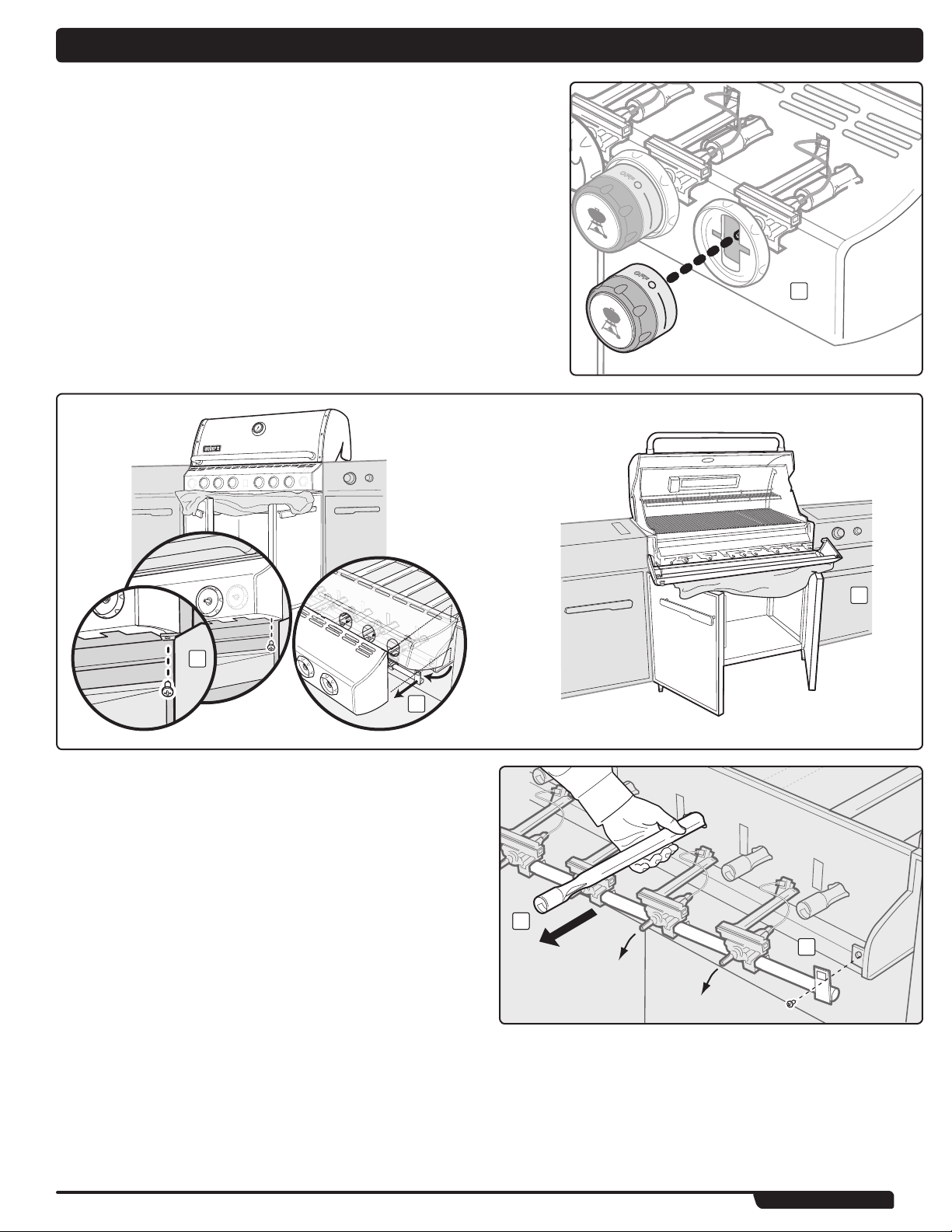
WWW.WEBER.COM
®
43
4
2
3
MAINTENANCE
REPLACING MAIN BURNERS
Note: Your Summit
®
Gas Grill must be off and cool.
A) Turn gas off at source.
B) Disconnect gas supply.
C) Remove cooking grates.
D) Remove Flavorizer
®
bars.
E) Remove smoker box (if included in your model).
Removing Control Panel
Parts required: Phillips screwdriver and a towel.
A) Remove the burner control knobs (1).
B) Open both doors and place a towel on top of the doors.
This will protect the control panel and tops of the doors from getting
scratched on the next step.
C) Remove the screws from the underside of the control panel with a Phillips
screwdriver (2).
D) Tilt the control panel forward and lift up and away from the grill (3). (For Summit
®
models with LED features: be careful not to break or disconnect the wires for the
control panel LEDs.)
E) Place the control panel on the towel covering the door assemblies (4).
F) Remove the two screws that secure the manifold to the cookbox. Pull manifold
assembly out from the manifold frame (5).
G) Pull the selected burner tube(s) from manifold frame and replace with new burner
tube(s) (6).
The grill illustrated
may have slight
differences than the
model purchased.
1
6
7
5
6
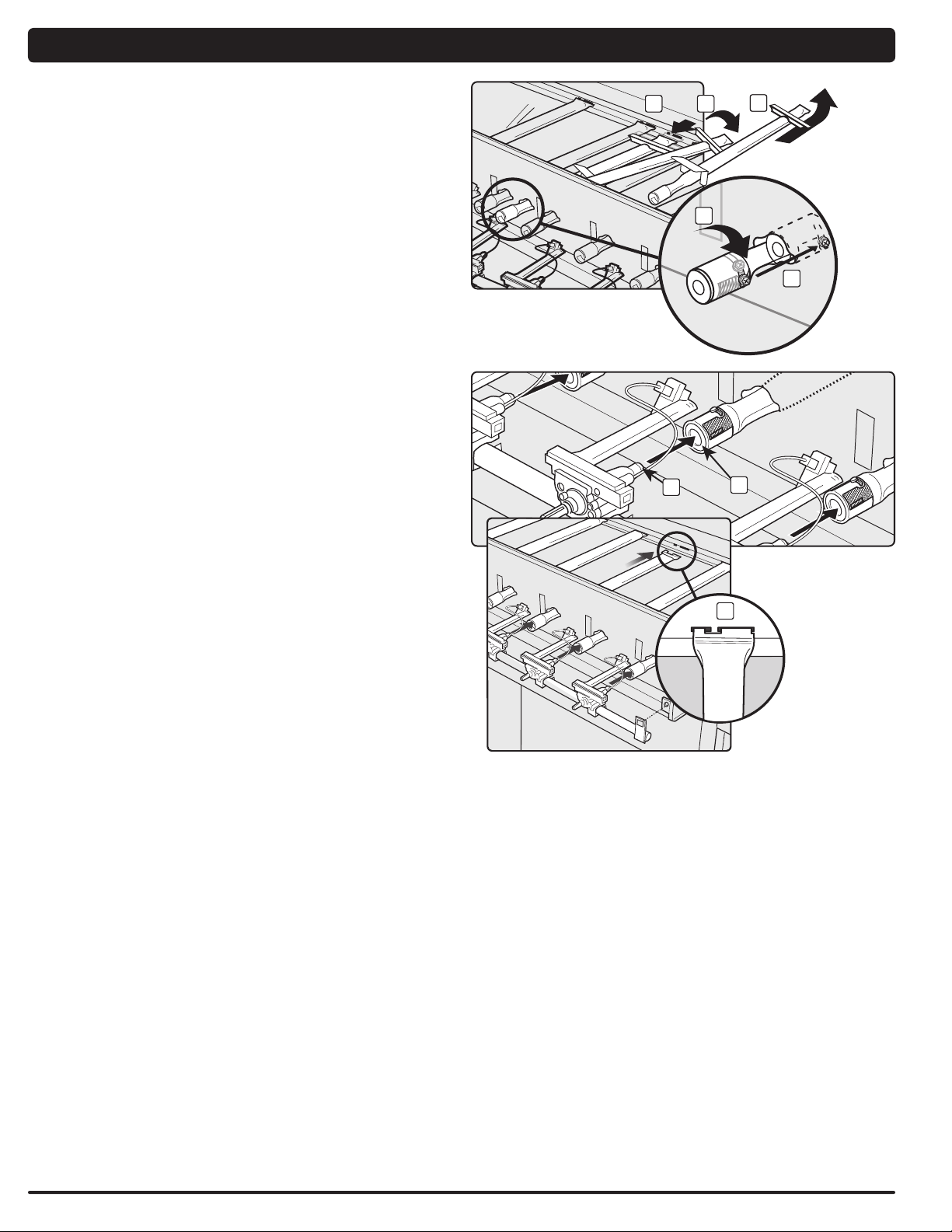
44
1
2
13
12
Removing The Sear Station
®
Burner
To remove the Sear Station burner
®
, pull the burner tube toward you. This removes it
from the burner tube notch (7). Then rotate the tube clockwise (8), taking care to rotate
it so that the screw at the end of the tube (9) fits through the notch in the heat shield
opening (10). When the burner tube is free, remove it from the cookbox (11).
A) To reinstall the manifold assembly, reverse steps for “Removing Control Panel” as
previously described.
CAUTION: The burner openings (12) must be positioned
properly over the valve orifices (13). Make sure the opposite
end of the burner tubes (14) properly align into the slots on
the backside of the cookbox. Check proper assembly before
fastening manifold in place.
WARNING: After reinstalling the gas lines, they should be
leak checked with a soap and water solution before using
the grill. (See “CHECK FOR GAS LEAKS.”)
X
MAINTENANCE
4
3
1 2
5
7 8
9
10
11
3
14
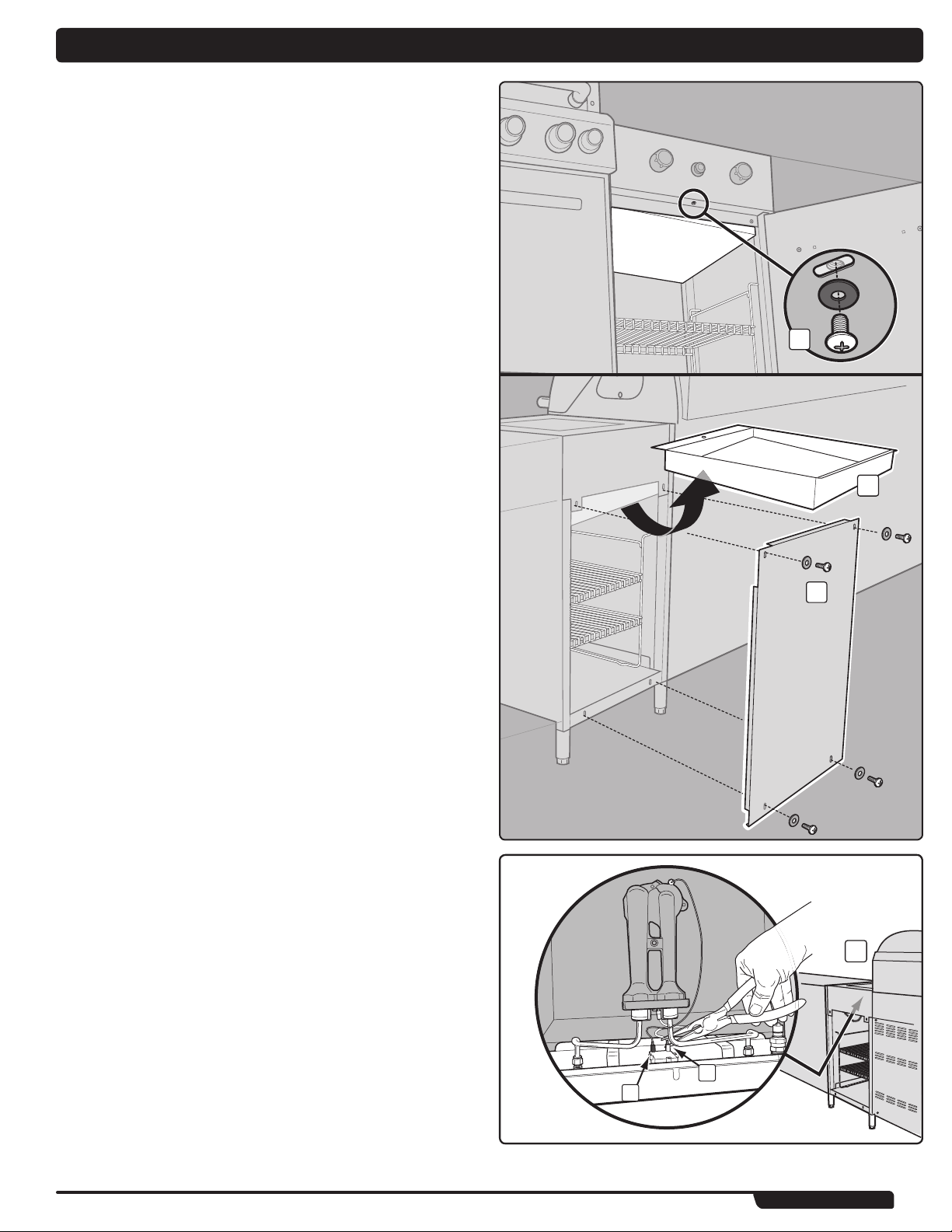
WWW.WEBER.COM
®
45
MAINTENANCE
SIDE BURNER MAINTENANCE
WARNING: All gas controls and supply valves should be in
the OFF position.
Check Igniter Wires on the Underside of the Side Burner
Tools required: Phillips screwdriver.
A) To remove side burner cabinet back panel and side burner cabinet water deflector:
a) Facing the back of the unit, remove screws that secure back panel of side
burner cabinet with a Phillips screwdriver (1).
b) Remove back panel and set aside.
c) Facing the front of the unit, open side burner cabinet door and remove screw
and washer securing side burner cabinet water deflector (2).
d) Facing the back of the unit, push water deflector forward to allow rear edge
to drop down. Pivot water deflector down on an angle and remove from side
burner cabinet (3).
6
5
4
B) Locate the igniter wires at the underside of the side burner (4).
C) Make sure black wire (5) is connected to the black terminal clip on the ignition
module.
D) Make sure white wire (6) is connected to the white terminal clip on the ignition
module.
Note: Spark should be a white/blue color, not yellow.
1
3
2
2
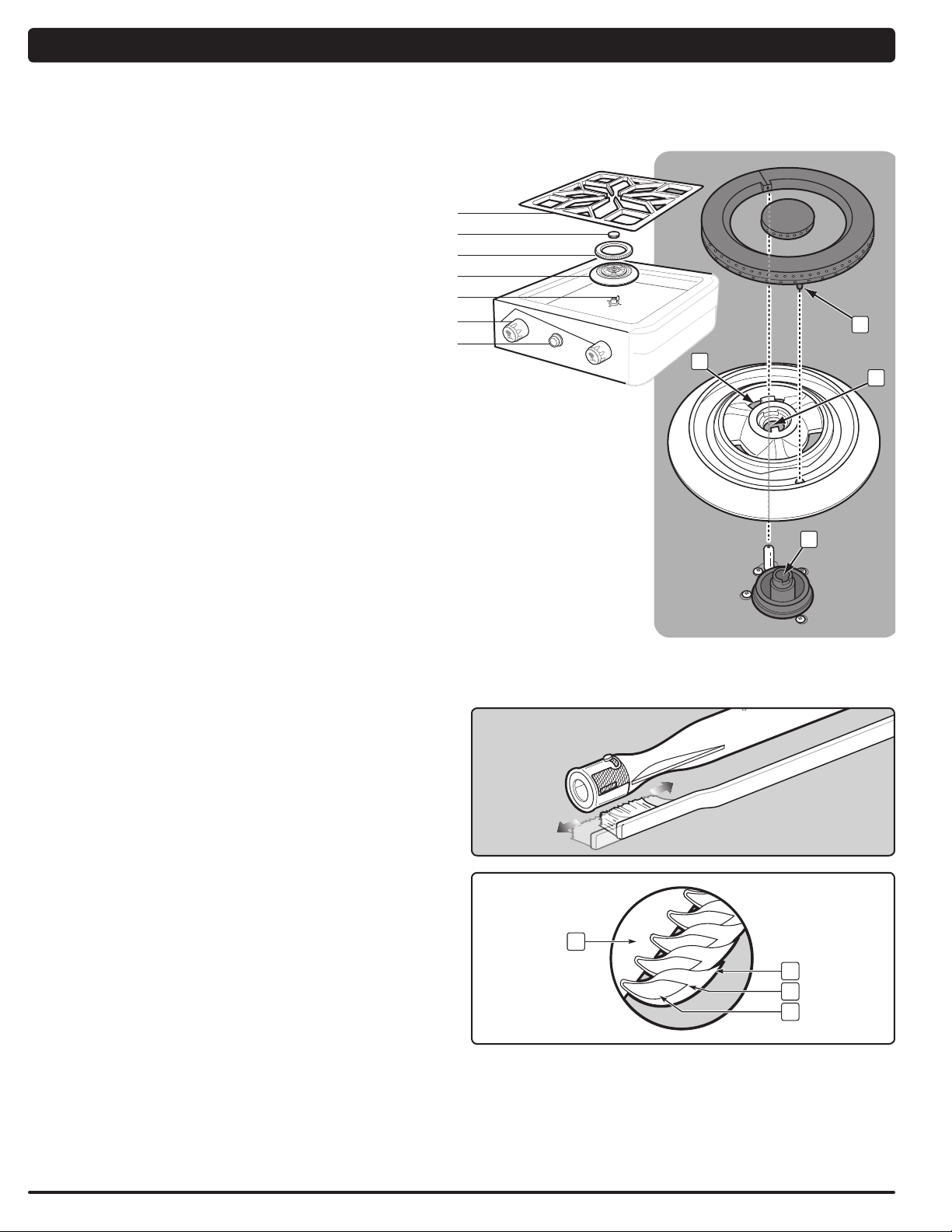
46
9
8
8
7
Check Fit and Alignment of the Side Burner Components
A) Make sure side burner head is properly aligned over igniter electrode and burner.
The electrode must fit through the electrode opening (7) and lock into the tab on the
burner (8).
B) Make sure side burner outer ring 2 is positioned correctly over side burner head;
rotate the ring until the locating pin locks into the hole on the burner head (9).
X
Side Burner Grate
Side Burner Inner Ring 1
Side Burner Outer Ring 2
Side Burner Head
Igniter Electrode
Control Knob
Igniter
MAINTENANCE
ANNUAL MAINTENANCE
Inspection and Cleaning of the Spider/Insect Screens
To inspect the spider/insect screens, remove the control panel. If there is dust or dirt on
the screens, remove the burners to clean the screens.
Brush the spider/insect screens lightly with a soft bristle brush (i.e., an old toothbrush).
CAUTION: Do not clean the spider/insect screens with hard
or sharp tools. Do not dislodge the spider/insect screens or
enlarge the screen openings.
Lightly tap the burner to get debris and dirt out of the burner tube. Once the spider/
insect screens and burners are clean, replace the burner.
If a spider/insect screen becomes damaged or cannot be cleaned, please contact the
Customer Service Representative in your area using the contact information on our web
site. Log onto www.weber.com
®
.
Burner Flame Pattern
The Weber
®
gas barbecue burners have been factory set for the correct air and gas
mixture. The correct flame pattern is shown in illustration and described below:
A) Burner tube (1)
B) Tips occasionally flicker yellow (2)
C) Light blue (3)
D) Dark blue (4)
If the flames do not appear to be uniform throughout the burner tube, follow the burner
cleaning procedures.
X
1
2
3
4
