Operator's Manual Power Source and Compressor
SAFETY SYMBOLS
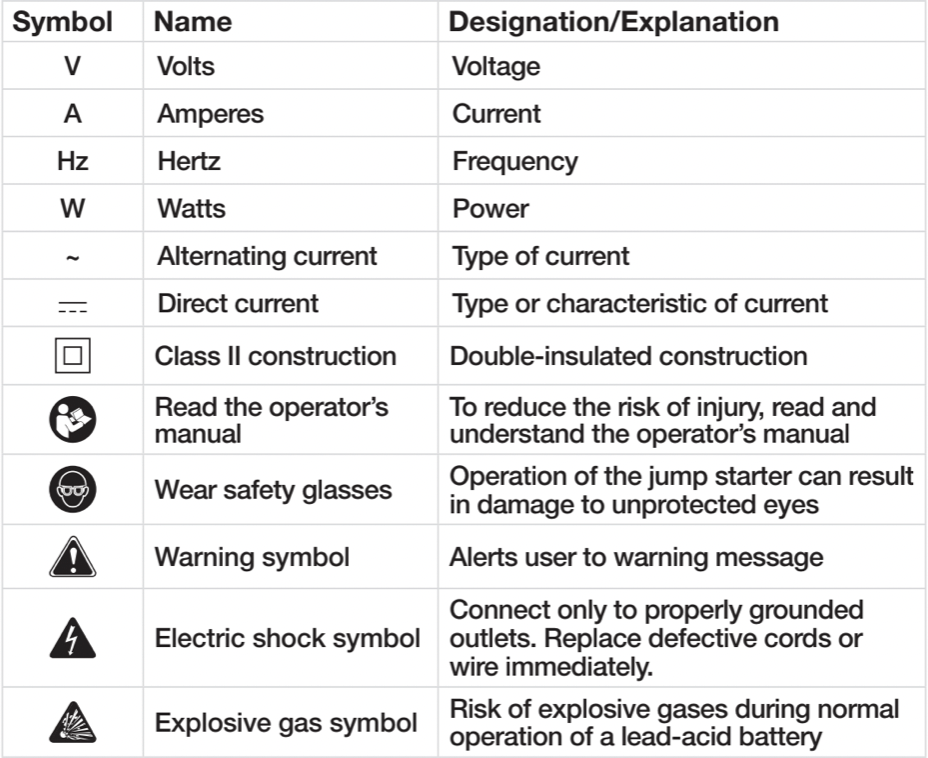
Some of the following symbols may be used on your jump starter. Please study them and learn their meaning. Proper interpretation of these symbols will allow better and safer operation of the jump starter.
CHARGING THE INTERNAL BATTERY OF THE JUMP STARTER
IMPORTANT: CHARGE IMMEDIATELY AFTER PURCHASE, AFTER EACH USE AND EVERY 30 DAYS, TO KEEP THE JUMP STARTER’S INTERNAL BATTERY FULLY CHARGED AND PROLONG BATTERY LIFE.
CHECKING THE LEVEL OF THE INTERNAL BATTERY
To check the internal battery’s charge status, Press the Select button until the Battery % LED lights. The Digital Display will show the battery’s percent of charge. Charge the internal battery if the display shows it is under 100%.
NOTE: The internal battery’s percent of charge is most accurate when the jump starter has been disconnected from all devices and charging sources for a few hours.
CHARGING THE INTERNAL BATTERY
Charge the unit’s internal battery using an extension cord (not included).
NOTE: Use of an improper extension cord could result in a risk of fire and electric shock.
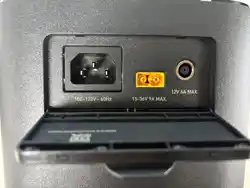
- To charge, flip the AC connector on the back of the unit DOWN and plug in an 18 AWG or larger extension cord.
- Plug the extension cord into a 120VAC electrical wall outlet.
- While the jump starter is charging, the marching dashes will show on the digital display. When the internal battery is fully charged, the display will show a smaller, pulsingioo, for energy efficiency. Complete charging may take up to 72 hours.
- When the internal battery is fully charged, the charger will automatically go into maintain mode and maintain the battery at full charge without damaging it. When in maintain mode, the Battery % LED will pulse, as long as there is an AC cord connected to the charging port.
- Charge the jump starter as soon as possible after use.
CHARGING THE INTERNAL BATTERY WHILE DRIVING
You may also charge the internal battery while driving, using a male-to-male charger cable (part number 94500109 – sold separately).
IMPORTANT: DO NOT CHARGE INTERNAL BATTERY FOR MORE THAN 30 MINUTES OR LEAVE THE BATTERY UNATTENDED. IT COULD EXPLODE, CAUSING PROPERTY DAMAGE OR PERSONAL INJURY.
- Make sure the car is running.
- Insert one end of the accessory cable into the 12V DC power outlet.
- Insert the other end of the accessory cable into the vehicle’s accessory outlet (lighter socket). NOTE: The Battery % LED does not operate during this method of charging. Using this method to charge the battery overrides the maintain mode and the battery can be overcharged.
- Monitor the progress of the charge by pressing the Select button until the Battery % LED lights. When the battery is fully charged, disconnect the accessory cable from the jump starter then from the lighter socket of the vehicle. NOTE: Completely disconnect the charger cable when the engine is not running.
OPERATING INSTRUCTIONS
DIGITAL DISPLAY
To check the jump starter’s internal battery status, push the Select button. The display will show the percent of charge of the internal battery.
When connected to the vehicle with the Jump Start ON/OFF switch in the OFF position, the display shows the vehicle’s battery voltage. When connected and in the ON position, the display shows the equalized voltage between the vehicle’s battery and internal battery.
JUMP STARTING A VEHICLE
IMPORTANT: Using the jump starter without a battery installed in the vehicle will damage the vehicle’s electrical system.
- Turn the ignition OFF.
- Lay the DC cables away from any fan blades, belts, pulleys and other moving parts.
- For a negative-ground vehicle (as in most vehicles), connect the unit’s POSITIVE (RED) clamp to the POSITIVE (POS, P, +) battery post. Next, connect the NEGATIVE (BLACK) clamp to the vehicle chassis or engine block, away from the battery.
- For a positive-ground vehicle, connect the unit’s NEGATIVE (BLACK) clamp to the NEGATIVE (NEG, N, -) battery post. Next, connect the POSITIVE (RED) clamp to the vehicle chassis or engine block away from the battery. IMPORTANT: If you have connected the clamps backwards, an audio alarm will sound. DO NOT turn the ON/OFF switch to the ON position. This could cause serious damage to the jump starter or the vehicle. Reverse the connections and the audio alarm will stop.
- Turn the switch to the ON position
- Crank the engine for no more than 8 seconds. If the engine does not start, wait 2 minutes before cranking again.
- After the engine starts, turn the switch to the OFF position and remove the unit from the battery.
- Charge the unit.
USING THE WORK/EMERGENCY LIGHT
- Position the jump starter on a flat, stable surface near the intended work area.
- Ensure that the battery clamps are securely clipped on the storage holders.
- Press the light switch once. The jump starter light will turn on and illuminate your work area.
- Press the light switch again. The light will flash.
- When finished, press the light switch again, to turn off the light.
- Charge the jump starter as soon as possible after using the work light.
NOTE: The work/emergency light will automatically shut off after 24 hours.
POWERING A 12V DC DEVICE
The unit is a power source for all 12V DC accessories that are equipped with a 12V accessory plug. Use it for power outages and on fishing or camping trips. Estimated usage time is listed in the following chart.
NOTE: Do not power a 12V device with the unit while charging the internal battery.
- Make sure the device to be powered is OFF before inserting the 12V DC accessory plug into the 12V DC accessory outlet.
- Ensure that the battery clamps are securely clipped on the storage holders.
- Open the protective cover of one of the two DC power outlets on the front of the jump starter.
- Plug the 12V DC device into the DC power outlet, and turn the 12V DC device on (if required).
- When finished, turn off the DC device (if required) and unplug from the DC power outlet.
CAUTION: Do not use the unit to run appliances that draw more than 15A DC.
NOTE: Extended operation of a 12V DC device may result in excessive battery drain. Recharge the unit immediately after unplugging the 12V DC device.
ESTIMATED RUN-TIMES
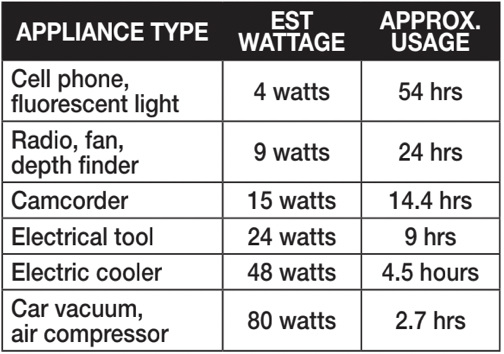
NOTE: Actual time may vary. Times are based on the internal battery being fully charged.
USING THE USB PORT
The USB port provides up to 2.1A at 5V DC.
- Ensure the battery clamps are securely clipped on the storage holders.
- Plug the device into one of the two USB ports on the front panel.
- Press the USB port ON/OFF button.
- Turn on the USB device.
- When you are finished using the USB port, press the button, to turn off.
- Charge the unit.
NOTE: To protect your electronic devices, the USB will automatically shut off when the internal battery’s charge is low.
USING THE AIR COMPRESSOR
WARNING: Read the instructions of the product being inflated before using the compressor. Avoid overinflation; do not exceed the manufacturer’s recommended pressures. Do not leave the air compressor unattended during use.
- Remove the air compressor hose from the storage compartment in the back of the jump starter.
- Connect the adapter to the valve stem by threading it onto the end. If necessary, use one of the additional adapters.
- Press the Select button, and choose Compressor.
- To select the desired PSI, press
 then press ON/OFF.
- When the desired pressure is reached, the compressor will turn off. Remove the connector from the valve stem.
- Do not run for more than 10 minutes at a time. Allow the jump starter to cool down for 10 minutes before using again.
- Wrap the compressor hose around the cleats when it is not being used.
- Allow unit to cool.
- Recharge the unit before storing.
NOTE: To prevent overheating, the compressor has built-in thermal protection that will turn the compressor off before it overheats. If the compressor shuts off, wait a few minutes and it will automatically restart when the compressor cools.
NOTE: When not in use, the compressor will automatically shut off after 2 minutes.
NOTE: The air compressor is rated for 100 PSI maximum.
ESTIMATED TIME FOR INFLATING
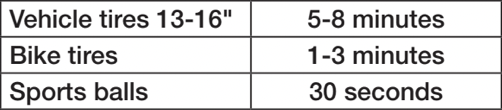
These times are approximate. Use the air compressor gauge to ensure the proper pressure has been reached. Do not overinflate.
USING THE INVERTER
It is important to know the continuous wattage of the device you plan to use with the inverter. The Portable Power must be used with devices drawing 400 watts or less. If the wattage is not marked on the device, use only devices that draw less than 3.3 amps of AC current.
Devices like TVs, fans or electric motors require additional power to start (commonly known as the “starting or peak power”). The Portable Power can supply a momentary surge in wattage; however even devices rated less than the maximum 400 watts can exceed the inverter’s surge capability and cause an automatic overload shutdown.
Do not use the inverter with a product that draws a higher wattage than the inverter can provide, as this may cause damage to the inverter and the product.
Make sure the device you are using is compatible with a modified sine wave inverter.
CAUTION
- Always run a test to establish whether the inverter will operate a particular piece of equipment or device.
- In the event of a power overload, theinverter is designed to automatically shut down. This safety feature prevents damaging the inverter while testing devices and equipment with the 400-watt range.
- If powering more than one device, start one device at a time to avoid a power surge and/or inverter overload. The surge load of each device should not exceed the inverter’s Continuous Operation wattage rate.
IMPORTANT: If you are using the power inverter to operate any type of battery charger, monitor the temperature of the battery charger for about 10 minutes. If the battery charger becomes abnormally warm, disconnect it from the inverter immediately.
You can use an extension cord from the inverter to the device without significantly decreasing the power being generated by the inverter. For best operating results, the extension cord should be 16 AWG (1.31 mm2 ) or larger and no longer than 50 feet.
IMPORTANT: This inverter uses a modified sine waveform, which is not quite the same as power company electricity. For the following devices, we strongly recommend that you use caution and check the device’s manual to make sure it is compatible with modified sine waveform.
- Switch mode power supplies
- Linear power supplies
- Class 2 transformers
- Line filter capacitors
- Shaded pole motors
- Fan motors
- Microwave ovens
- Fluorescent and high-intensity lamps (with a ballast)
- Transformerless battery chargers
Using the inverter with any of these devices may cause the device to run warmer or overheat.
POWERING A 110V AC DEVICE
- Ensure the battery clips are securely on the storage holders.
- Open the protective cover of the AC power outlet on the front panel.
- Make sure the 110V AC device to be operated is turned OFF.
- Plug the 110V AC device into the AC power outlet and press the Select button, to choose AC Inverter.
- Turn the device on.
- Charge the unit as soon as possible after each use.
WARNING - RISK OF ELECTRIC SHOCK.
Incorrect operation of your inverter may result in damage and personal injury. The inverter output is 110V AC and can shock or electrocute the same as any ordinary household AC wall outlet.
NOTE: The maximum continuous load is 400 watts. Do not use the inverter with a product that draws more than 400 watts, as this may cause damage to the inverter and the product.
MAINTENANCE INSTRUCTIONS
- After use and before performing maintenance, unplug and disconnect the jump starter.
- Use a dry cloth to wipe all battery corrosion and other dirt or oil from the battery clips, cords and the jump starter case.
- Ensure that all of the jump starter components are in place and in good working condition.
- All servicing should be performed by qualified service personnel.
MOVING AND STORAGE INSTRUCTIONS
- Store inside, in a cool, dry place.
- Do not store the clips on the handle, clipped together, on or around metal, or clipped to cables. The clips on the jump starter are live when the switch is in the ON position and will produce arcing or sparking if they come in contact with each other. To prevent accidental arcing, always place the switch in the OFF position and keep the clips on the storage holders when not using it to jump start a vehicle.
- If the jump starter is moved around the shop or transported to another location, take care to avoid/prevent damage to the cords, clips and jump starter. Failure to do so could result in personal injury or property damage.
IMPORTANT: Do not use and/or store the jump starter in or on any area or surface where damage could occur if the internal battery should unexpectedly leak acid.
IMPORTANT:
- CHARGE IMMEDIATELY AFTER PURCHASE
- KEEP FULLY CHARGED
Charge the jump starter’s internal battery immediately after purchase, after every use and every 30 days.
All batteries are affected by temperature. The ideal storage temperature is at 70°F. The internal battery will gradually self-discharge (lose power) over time, especially in warm environments. Leaving the battery in a discharged state may result in permanent battery damage. To ensure satisfactory performance and avoid permanent damage, charge the internal battery every month.
TROUBLESHOOTING
PROBLEM --- POSSIBLE CAUSE --- SOLUTION
- The jump starter won’t jump start my car.
- The Jump Start switch is not turned ON.
- Turn ON the Jump Start switch.
- The clamps are not making a good connection to the battery.
- Check for poor connection to battery and frame. Make sure connection points are clean.
- The jump starter’s battery is not charged.
- Check the battery charge status by pressing the Select button on the front of the unit. See Digital Display section.
- The vehicle’s battery is defective.
- Have the battery checked.
- The unit won’t power my 12V device.
- The 12V device is not turned on.
- The Portable Power’s battery is not charged.
- Check the battery charge status by pressing the button on the front of the unit. See Digital Display section.
- The 12V device draws more than 15A or has a short circuit.
- Contact a qualified service technician, to replace the fuse.
- The internal battery won’t hold a charge.
- The battery is bad (will not accept a charge).
- Have the battery checked.
- The jump starter’s alarm is on.
- Connections are reversed.
- Disconnect the jump starter and reverse the clamps.
- The inverter is on, but the display only shows

- The jump starter battery is not fully charged.
- The device is drawing more than 400W or has a short circuit.
- Use only devices that draw less than 3.3 amps of AC current.
- The compressor shuts off before reaching the set pressure.
- The compressor has a thermal cutoff, to protect it from overheating.
- Wait a few minutes. The compressor will start up again and finish the process.
The purpose of safety symbols is to attract our attention to possible dangers. The safety symbols, and the explanations with them, deserve your careful attention and understanding. The symbol warnings do not by themselves eliminate any danger.
The instructions and warnings they give are no substitutes for proper accident prevention measures.
WARNING: Be sure to read and understand all safety instructions in this manual, including all safety alert symbols, such as “DANGER”, “WARNING” and “CAUTION” before using this jump starter. Failure to follow all instructions listed below may result in electric shock, fire and/or serious personal injury.
SYMBOL MEANING
SAFETY ALERT SYMBOL: Indicates DANGER, WARNING or CAUTION. May be used in conjunction with other symbols or pictographs.
DANGER: Failure to obey this safety warning WILL result in death or serious injury to yourself or to others. Always follow the safety precautions to reduce the risk of fire, electric shock and personal injury.
WARNING: Failure to obey this safety warning CAN result in death or serious injury to yourself or to others. Always follow the safety precautions to reduce the risk of fire, electric shock and personal injury.
CAUTION: Failure to obey this safety warning MAY result in personal injury to yourself or others, or property damage. Always follow the safety precautions to reduce the risk of fire, electric shock and personal injury.
CONTAINS SEALED, NON-SPILLABLE LEAD-ACID BATTERY. MUST BE DISPOSED OF PROPERLY.
WARNING: Possible explosion hazard. Contact with battery acid may cause severe burns and blindness. Keep out of reach of children.
IMPORTANT SAFETY INSTRUCTIONS
SAVE THESE INSTRUCTIONS.
WARNING - RISK OF EXPLOSIVE GASES.
WORKING IN THE VICINITY OF A LEAD-ACID BATTERY IS DANGEROUS. BATTERIES GENERATE EXPLOSIVE
GASES DURING NORMAL OPERATION. IT IS IMPORTANT THAT YOU FOLLOW THESE INSTRUCTIONS EACH TIME YOU USE THE UNIT.
To reduce the risk of battery explosion, follow these instructions and those published by the battery manufacturer and the manufacturer of any equipment you intend to use in the vicinity of a battery. Review cautionary markings on these
products and on the engine.
WARNING - RISK OF ELECTRIC SHOCK OR FIRE.
- Keep out of reach of children.
- Do not disassemble the jump starter. Take it to a qualified service professional if service or repair is required. Incorrect assembly may result in fire or electrical shock.
- Do not use the jump starter to jump a vehicle while charging the internal battery.
- Do not recharge the jump starter with a damaged USB cable.
- The jump starter gets hot during charging and must have proper ventilation.
- Do not set the jump starter on flammable materials, such as carpeting, upholstery, paper, cardboard, etc.
- Place the jump starter as far away from the battery being jumped as the cables will permit.
- Do not expose the jump starter to rain or snow.
- Never attempt to jump start a frozen battery.
- Never place the jump starter directly above battery being jumped.
- To prevent arcing, never allow the clamps to touch together or to contact the same piece of metal.
- Use of an attachment not recommended or sold by the jump starter manufacturer may result in damage to the unit or personal injury.
- Never operate the jump starter if it is damaged.
- If someone else uses the jump starter, ensure they are well informed on how to use it safely, and have read and understood the operating instructions.
- The jump starter is NOT designed to be installed as a replacement for a vehicle battery.
- Use ONLY on vehicles, boats and garden tractors powered with a 12V DC battery system.
- If the engine fails to start after the recommended number of attempts, disconnect the unit and look for other problems that may need to be corrected.
- Use the jump starter for jump starting lead-acid batteries only. Do not use for dry cell batteries that are commonly used with home appliances.
PERSONAL SAFETY PRECAUTIONS
- Restrictions on Use: The inverter may not be used with life support devices or systems. Failure of thiscinverter can reasonably be expected to cause failure of that life support device or system, or to affect the safety or effectiveness of that device or system.
- Wear complete eye protection and protective clothing when working near lead-acid batteries. Always have someone nearby for help.
- Have plenty of fresh water, soap and baking soda nearby for use, in case battery acid contacts your eyes, skin, or clothing. Wash immediately with soap and water and seek medical attention.
- If battery acid comes in contact with eyes, flush eyes immediately for a minimum 10 minutes and get medical attention.
- Neutralize any acid spills thoroughly with baking soda before attempting to clean up.
- Remove all personal metal items from your body, such as rings, bracelets, necklaces and watches. A battery can produce a short circuit current high enough to weld a ring to metal, causing a severe burn.
- Never smoke or allow a spark or flame in the vicinity of the battery or engine.