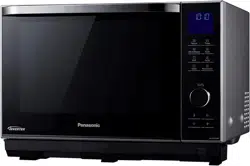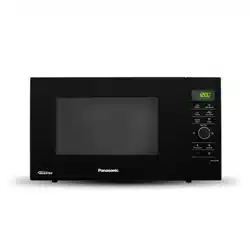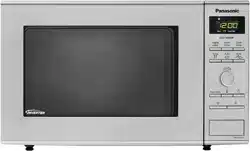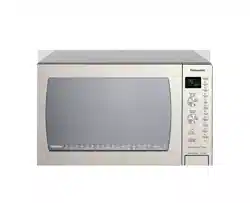
© Panasonic Appliances Microwave Oven (Shanghai) Co., Ltd. 2016
F0003BQ40QP
PA0815-0
Printed in China
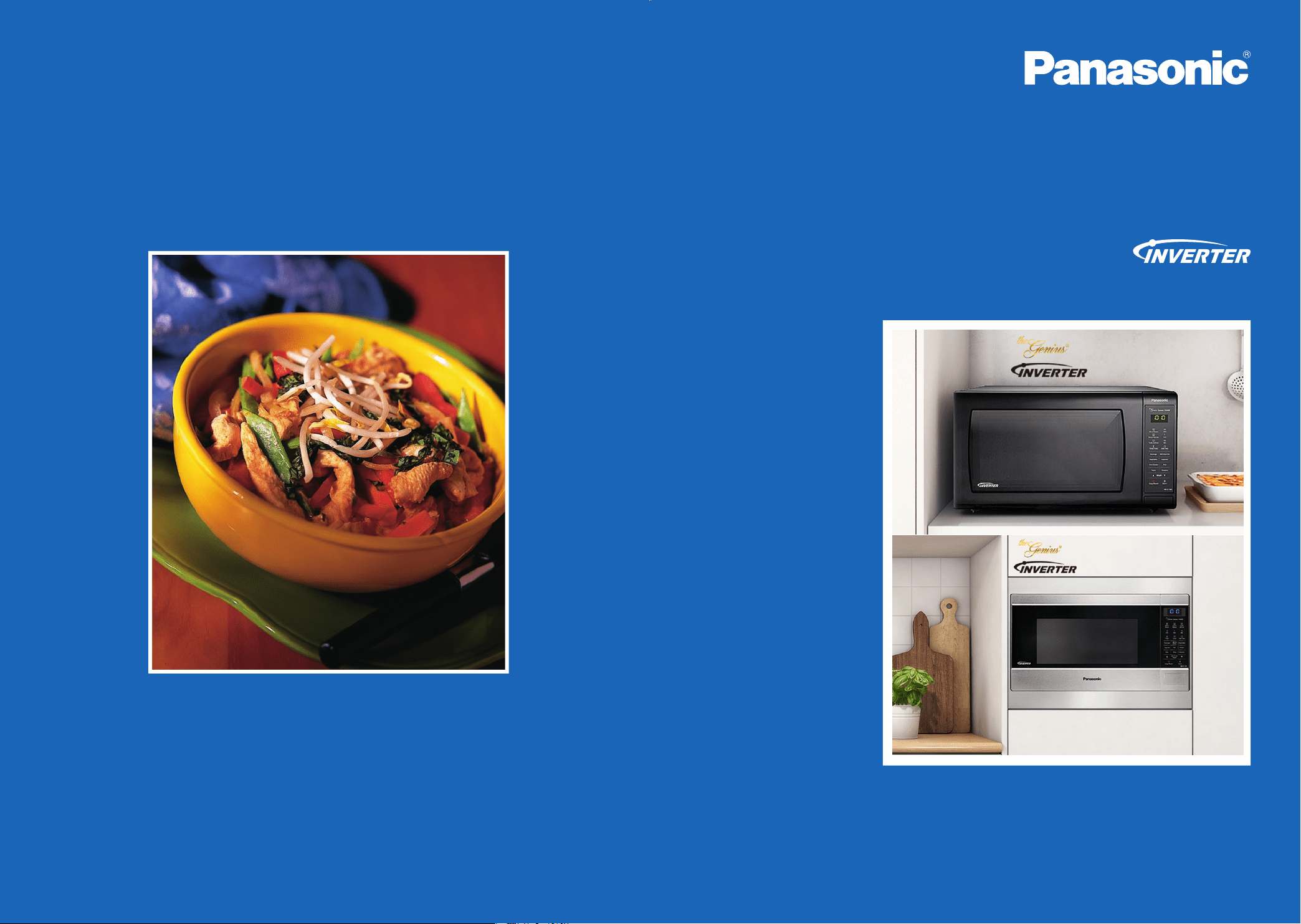
Operating Instruction and Cook Book
Microwave Oven
Household Use Only
Please read these instructions carefully before using this
product, and save this manual for future use.
Model Number:
NN-ST756B and NN-ST776S
F0003BR40QP_cover_00_160531.indd 2-3F0003BR40QP_cover_00_160531.indd 2-3 2016/6/17 11:20:012016/6/17 11:20:01

– 4 –
Safety Instructions
READ CAREFULLY AND KEEP FOR FUTURE REFERENCE
Precautions to be taken when
using Microwave Ovens for Heating
foodstuffs
INSPECTION FOR DAMAGE. A microwave oven
should only be used if an inspection confi rms all of
the following conditions:
1. The door fi ts squarely and securely and opens
and closes smoothly.
2. The door hinges are in good condition.
3. The metal plates of a metal seal on the door are
neither buckled nor deformed.
4. The door seals are neither covered with food nor
have large burn marks.
PRECAUTIONS. Microwave radiation from
microwave ovens can cause harmful effects if the
following precautions are not taken:
1. Never tamper with or deactivate the interlocking
devices on the door.
2. Never poke an object, particularly a metal object,
through a grille or between the door and the oven
while the oven is operating.
3. Never place saucepans, unopened cans or other
heavy metal objects in the oven.
4. Do not let other metallic articles, e.g., fast food
foil containers, touch the side of the oven.
5. Clean the oven cavity, the door and the seals with
water and a mild detergent at regular intervals.
Never use any form of abrasive cleaner that may
scratch or scour surfaces around the door.
6. Always use the oven with trays or cookware
recommended by the manufacturer.
7. Never operate the oven without a load (i.e., an
absorbing material such as food or water) in the
oven cavity unless specifi cally allowed in the
manufacturer’s literature.
8. For horizontally hinged doors, never rest heavy
objects such as food containers on the door while
it is open.
9. Do not place sealed containers in microwave
ovens. Baby bottles fi tted with a screw cap or a
teat are considered to be sealed containers.
10. This appliance is not intended for use by
persons (including children) with reduced
physical, sensory or mental capabilities, or lack
of experience and knowledge, unless they have
been given supervision or instruction concerning
use of the appliance by a person responsible for
their safety.
11. Young children should be supervised to ensure
that they do not play with the appliance.
12. It is hazardous for anyone other than a
competent person to carry out any service or
repair operation that involves the removal of a
cover which gives protection against exposure to
microwave energy.
13. The surfaces are liable to get hot during use.
Important Instructions
WARNING—To reduce the risk of burns, electric
shock, fi re, injury to persons or excessive microwave
energy:
1. Read all instructions before using the microwave
oven.
2. Some products such as whole eggs and sealed
containers - (for example, closed glass jars and
sealed baby bottles with teat) - may explode
and should not be heated in the microwave oven.
3. Use this microwave oven only for its intended use
as described in this manual.
4. As with any appliance, close supervision is
necessary when used by children.
5. Do not operate this microwave oven if it is not working
properly or if it has been damaged or dropped.
6. Do not store or use this appliance outdoors.
7. Do not immerse cord or plug in water.
8. Keep cord away from heated surfaces.
9. Do not let cord hang over edge of table or
counter.
10. To reduce the risk of fi re in the oven cavity:
(a) Do not overcook food. Carefully attend
microwave oven if paper, plastic, or other
combustible materials are placed inside the
oven to facilitate cooking.
(b) Heating therapeutic wheat bags is not
recommended. If heating, do not leave
unattended and follow manufacturers’
instructions carefully.
(c) Remove wire twist-ties from bags before
placing bag in oven.
(d) If materials inside the oven should ignite,
keep oven door closed, turn oven off at the
wall switch, or shut off power at the fuse or
circuit breaker panel.
(e) Never leave microwave unattended while
cooking or reheating.
11. Do not remove outer panel from oven.
12. Appliances are not intended to be operated
by means of an external timer or separate
remotecontrol system.
13. Failure to maintain the oven in a clean condition
could lead to deterioration of the surface that
could adversely affect the life of the appliance
and possibly result in a hazardous situation.
F0003BQ60QP_OI_00_160531.indd 4F0003BQ60QP_OI_00_160531.indd 4 2016/8/24 8:19:332016/8/24 8:19:33
– 5 –
Installation and General Instructions
Earthing Instructions
This microwave oven must be earthed. In the event
of an electrical short circuit, earthing reduces the risk
of electric shock by providing an escape wire for the
electric current. This microwave oven is equipped
with a cord having an earthing wire with an earthing
plug.
The plug must be plugged into an outlet that is
properly installed and earthed.
WARNING—Improper use of the earthing plug can
result in a risk of electric shock.
WE CERTIFY THAT THIS MICROWAVE OVEN
HAS BEEN INSPECTED AND COMPLIES WITH
THE REQUIREMENTS OF REGULATION 3,
SUBCLAUSE(2), OF THE MICROWAVE OVENS
REGULATIONS 1982.
(This statement applicable only to New Zealand.)
We certify that this microwave oven has been
inspected and complies with the safety requirements
of government notice 466 of March 1981, and
complies with the Radio Regulation of government
notice 587 of March 1986.
(This statement applicable only to South Africa)
WARNING
a) The door seals and door seal areas should be
cleaned with a damp cloth. The appliance should
be inspected for damage to the door seals and
door seal areas and if these areas are damaged
the appliance should not be operated until it has
been repaired by a qualifi ed service technician
trained by the manufacturer.
b) It is hazardous for anyone other than a
competent person to carry out any service or
repair operation that involves the removal of a
cover which gives protection against exposure
to microwave energy.
c) If the supply cord of this appliance is damaged,
it must be replaced by a qualifi ed service
technician with the special cord available only
from the manufacturer.
d) Before use, the user should check that whether
the utensils are suitable for use in microwave
ovens.
e) Liquids or other foods must not be heated
in sealed containers since they are liable to
explode.
f) Only allow children to use the oven without
supervision when adequate instructions have
been given so that the child is able to use the
oven in a safe way and understands the hazards
of improper use.
General Use
1. In order to maintain high quality, do not operate
the oven when empty. The microwave energy
will refl ect continuously throughout the oven if
no food or water is present to absorb energy.
This can lead to damage to the microwave oven
including arcing within the oven cavity.
2. If smoke is observed, press the STOP/RESET
Pad and leave door closed in order to stifl e any
fl ames. Disconnect the power cord, and/or shut
off power at the fuse or circuit breaker panel.
3. Do not dry clothes, newspapers or other materials
in oven. They may catch on fi re.
4. Do not use recycled paper products, unless the
paper product is labelled as safe for microwave
oven use. Recycled paper products may contain
impurities which may cause sparks and/or fi res
when used.
5. Do not use newspapers or paper bags for
cooking.
6. Do not hit or strike the Control Panel. Damage to
controls may occur.
7. POT HOLDERS may be needed as heat from
food is transferred to the cooking container
and from the container to the Glass Tray. The
GlassTray can be very hot after removing the
cooking container from the oven.
8. Do not store fl ammable materials next to, on top
of, or in the oven. It could be a fi re hazard.
9. Do not cook food directly on Glass Tray unless
indicated in recipes. (Food should be placed in a
suitable cooking utensil.)
10. DO NOT use this oven to heat chemicals or other
non-food products. DO NOT clean this oven
with any product that is labelled as containing
corrosive chemicals. The heating of corrosive
chemicals in this oven may cause microwave
radiation leaks.
11. If glass tray is hot, allow to cool before cleaning
or placing in water.
12. During cooking, some steam will condense inside
and/or on the oven door. This is normal and safe.
Steam will disappear after the oven cools down.
13. Do not leave the microwave unattended
while reheating or cooking food in disposable
containers made of plastic, paper or other
combustible materials, as these types of
containers can ignite if overheated.
14. The microwave oven is intended for heating food
and beverages. Drying of food or clothing and
heating of warming pads, slippers, sponges,
damp cloth and similar may lead to risk of injury,
ignition or fi re.
15. Metallic containers for food and beverages are
not allowed during microwave cooking
F0003BQ60QP_OI_00_160531.indd 5F0003BQ60QP_OI_00_160531.indd 5 2016/8/24 8:19:332016/8/24 8:19:33

– 6 –
Placement of Oven
1. The oven must be placed on a fl at, stable
surface. For correct operation, the oven must
have suffi cient air fl ow. Allow 15 cm of space
on the top of the oven, 10 cm at the back, and
5 cm on both sides. If one side of the oven
is placed fl ush to wall, the other side or top
must not be blocked. Do not remove feet.
a. Do not block air vents. If they are blocked
during operation, the oven may be overheated
and damaged. When using any cloth over the
oven, the air intake and exhaust should not be
blocked. Also allow suffi cient space on back
and both sides of the oven.
b. Do not place oven near a hot or damp surface
such as a gas stove, electric range or sink etc.
c. Do not operate oven when room humidity is
too high.
2. This oven was manufactured for household use
only.
Building-in your oven
1. This oven is intended for counter-top and built-
in use only. It is not intended for use inside a
cupboard. This oven may be built into a wall
cabinet by using the proper trim kit
(
NN-TK712SSQP
) which may be purchased
from you local Panasonic dealer.
2. In case of fi tting into an oven housing, please use
Panasonic's Trim Kit,
NN-TK712SSQP
.
3. Microwave ovens should not be built into a unit
directly above a top front venting conventional
cooker. This may be a safety hazard and could
result in damage to your oven. This will invalidate
your one year guarantee.
4. A microwave which is built in must be more than
850 mm above fl oor level. Read Trim-Kit instructions
carefully before installation. It is recommended that
the microwave oven is placed below a conventional
oven to avoid heat damage to the facia of the
microwave.
5. Care should be taken not to displace the turntable
when removing containers from the appliance.
Circuits
Your microwave oven should be operated on a
separate 10 A circuit from other appliances. Failure
to do this may cause the power board fuse to blow,
and/or food to cook slower. Do not insert higher
value fuse in the power board.
Food
1. Do not use your oven for home canning or the
heating of any closed jar. Pressure will build
up and the jar may explode. In addition, the
microwave oven cannot maintain the food at the
correct canning temperature. Improperly canned
food may spoil and be dangerous to consume.
2. Do not attempt to deep fat fry in your microwave
oven.
3. Do not boil eggs in their shell and whole hard-
boiled eggs (unless otherwise stated in Cooking
Guide section). Pressure will build up and the
eggs will explode.
4. Potatoes, apples, egg yolks, chicken wings, whole
squash and sausages are examples of foods
with nonporous skins. This type of food must be
pierced before cooking, to prevent bursting.
5. When heating liquids, e.g. soup, sauces and
beverages, in your microwave oven, overheating
the liquid beyond boiling point can occur without
evidence of bubbling. This could result in a
sudden boil over of hot liquid. To prevent this
possibility the following steps should be taken:
a) Avoid using straight-sided containers with
narrow necks.
b) Do not overheat.
c) Stir the liquid before placing the container in
the oven and halfway through cooking time.
d) After heating, allow to stand in the oven for
a short time, stirring again before carefully
removing the container.
e) Microwave heating of beverages can result in
delayed eruptive boiling, therefore care should
be taken when handling the container.
6. DO NOT USE A CONVENTIONAL MEAT
THERMOMETER IN THE MICROWAVE OVEN.
To check the degree of cooking of roasts and
poultry use a MICROWAVE THERMOMETER.
Alternatively, a conventional meat thermometer
may be used after the food is removed from the
oven. If undercooked, return meat or poultry to
the oven and cook for a few more minutes at the
recommended power level. It is important to ensure
that meat and poultry are thoroughly cooked.
7. COOKING TIMES given in the Cooking Guide
section are APPROXIMATE. Factors that may
affect cooking time are preferred degree of
moisture content, starting temperature, altitude,
volume, size, shape of food and utensils used.
As you become familiar with the oven, you will be
able to adjust for these factors.
8. It is better to UNDERCOOK RATHER THAN
OVERCOOK foods. If food is undercooked, it
can always be returned to the oven for further
cooking. If food is overcooked, nothing can be
done. Always start with minimum cooking times
recommended.
9. Extreme care should be taken when cooking
popcorn in a microwave oven. Cook for minimum
time as recommended by manufacturer. Use
the directions suitable for the wattage of your
microwave oven. NEVER leave oven unattended
when popping popcorn.
10. When heating food in plastic or paper containers,
check the oven frequently due to the possibility of
ignition.
11. The contents of feeding bottles and baby food jars
are to be stirred or shaken and the temperature
is to be checked before consumption, in order to
avoid burns.
Installation and General Instructions
(continued)
F0003BQ60QP_OI_00_160531.indd 6F0003BQ60QP_OI_00_160531.indd 6 2016/8/24 8:19:332016/8/24 8:19:33

– 7 –
Microwaves and How They Work
Cookware and Utensils Guide
Microwaves are a form of high frequency radio
waves similar to those used by a radio, including
AM, FM and CB. They are similar to a television
where the radio waves are converted to a picture on
the screen. However, microwaves are much shorter
than radio waves; approximately twelve centimetres
wave length. Electricity is converted into microwave
energy by the magnetron tube (which is the heart of
the microwave oven).
From the magnetron tube, microwave energy is
transmitted to the oven cavity through a small plastic
covered piece. The microwaves are converted to
heat in the food. The microwaves enter from the
outside of the food and travel through the food losing
half of their power every two to three centimetres.
Continued cooking to the centre occurs by
conduction.
Although pacemakers used to be affected by
microwaves (as well as by other radio waves), they
are now shielded and are not bothered by these
interferences. This allows people with pacemakers
to sit calmly by their radio or television and cook with
microwave ovens.
When microwaves come in contact with a substance,
any one or combination of three things may occur.
They can be:
1. REFLECTED
2. TRANSMITTED
3. ABSORBED
Refl ection:
Metal substances REFLECT microwave energy and
because there is no absorption, there is no heating.
This is why the oven interior is either stainless
steel or epoxy-coated steel. This ensures that the
microwaves are kept inside the cavity and evenly
distributed throughout the food with the help of the
turntable.
Transmission:
Such substances as paper, glass and plastic
TRANSMIT microwave energy and do not become
hot except from food. Because these substances
do not refl ect or absorb microwave energy, they are
ideal materials for microwave cooking containers.
Absorption:
Food contains moisture and will ABSORB microwave
energy, which causes the moisture molecules
within the food to vibrate at an incredible rate
(2,450,000,000 times per second). Friction, created
by the vibration, produces heat energy which is
conducted throughout the food.
It is important to use the correct container when
cooking in a microwave oven. The following will help
you make the right selection.
How to Test a Container for Safe
Microwave Oven Use
TO TEST A CONTAINER FOR SAFE MICROWAVE
OVEN USE: Fill a 1-cup glass measure with cool
water and place it in the microwave oven alongside
the empty container to be tested; heat one (1)
minute at P10. If the container is microwave
ovensafe (transparent to microwave energy), the
container should remain comfortably cool, the water
in glass measure should be hot. If the container is
hot, it has absorbed some microwave energy and
should NOT be used. This test cannot be used for
plastic containers.
Paper Products and Freezer Wrap
Waxed paper, paper plates, cups and napkins should
not be used for heating or cooking food. Freezer
wrap should not be used as it is not heat resistant
and may melt. Paper towel, greaseproof paper and
bake paper may be safely used for short periods of
time for covering or lining.
Glass, Ceramic and China
Ceramic cookware or dinnerware that has cracks
or imperfections should not be used even if
Microwave safe.
Heat-Resistant glass cookware is invaluable in
microwave cooking. Many of these items are readily
available in most homes: glass jugs, mixing bowls,
loaf dishes, covered casseroles, oblong baking
dishes, pie plates and round or square cake dishes.
Examples of this type of cookware are Pyrex® and
Corningware®.
Dinnerware can be used for microwave heating.
Many brands of dinnerware are microwave safe.
Check the care information for reference to
microwave use for dinnerware and serving pieces. If
dinnerware is marked ovenproof, it frequently is safe
to use in the microwave oven. However, to be sure,
check by conducting microwave dish test previously
mentioned.
Several types of glassware and dinnerware are
not recommended for use in the microwave oven.
Do not use dishes with metallic trim or containers
with metal parts. Do not use cups or mugs with
glued on handles, as they may fall off with continued
heating. Do not use delicate glassware. Although the
glassware may be transparent to microwave energy
the heat from the food may cause the glassware to
crack.
F0003BQ60QP_OI_00_160531.indd 7F0003BQ60QP_OI_00_160531.indd 7 2016/8/24 8:19:332016/8/24 8:19:33

– 8 –
Cookware and Utensils Guide
(continued)
Plastics
Plastic dishes, cups and some freezer containers
should be used with care in a microwave oven.
Choose plastic containers carefully, as some plastic
containers may become soft, melt and may scorch.
The majority of plastic dishes, even those designed
for use in the microwave oven, are not suitable for
cooking foods with high fat or sugar content, or for
lengthy cooking times. Most microwave plastic dishes
should not be used for longer than 3 to 5 minutes
on P10 power. These dishes, although not suitable
for extended cooking, may be used successfully for
defrosting or for use on lower power levels.
Cooking Bags designed to withstand boiling,
freezing, or conventional heating are microwave
safe. Prepare bags according to manufacturer’s
directions. When cooking by microwave, DO NOT
use wire twist-ties to close bag. They can act as an
antenna and cause arcing (sparks).
DO NOT COOK IN PLASTIC FOOD STORAGE
BAGS.
Plastic Wrap such as GLAD WRAP® can be used
to cover dishes in most recipes. Over an extended
heating time, some disfi guration of the wrap may
occur. When removing plastic wrap “covers”, as well
as any glass lid, be careful to remove it away from
you to avoid steam burns.
Loosen plastic but let dish stand, covered.
Jars and Bottles
Jars and bottles can be used to warm food to serving
temperature, if the lid is removed fi rst. Cooking
should not be done in these containers since most
are not heat resistant and during extended heating
times, heat from food would cause cracking or
breaking.
Metal
Metal cookware or utensils, or those with metallic
trim, should NOT be used in the microwave. Since
microwave energy is refl ected by metal, foods in
metal containers will not cook evenly. There is also a
possibility of “arcing”.
Although metal utensils should be avoided in
microwave cooking, some metal can be helpful when
used correctly.
Aluminum foil can be used safely, if certain guidelines
are followed, to prevent overcooking. Small pieces of
foil are used to shield areas such as chicken wings,
tips of roasts, or other thin parts that cook before
the rest of the recipe is fi nished. Make sure foil is
attached securely and doesn’t touch sides of oven,
otherwise arcing may occur. Foil lined containers,
either cardboard or plastic, should NOT be used in
the microwave oven as arcing could occur.
Metal twist-ties, either paper or plastic coated, should
NOT be used in the microwave oven. Frozen dinner
trays can be used in the microwave, if the container
is no deeper than 2 cm and is fi lled with food. Metal
skewers can not be used in microwave ovens as
arcing may occur. Wooden skewers are readily
available and give the same result.
Shells: Scalloped baking shells are best used during
reheating and for short periods of cooking time only.
Thermometers are available for use in microwave
ovens. DO NOT USE CONVENTIONAL MERCURY
TYPE CANDY OR MEAT THERMOMETERS in food
while cooking in the microwave oven.
Straw, Wicker and Wood
Straw and wicker baskets may be used in the
microwave oven for short periods of time to warm
rolls or bread. Large wooden utensils, such as bowls
or cutting boards should NOT be used for prolonged
heating as the microwave energy may cause the
wood to become dry and brittle.
F0003BQ60QP_OI_00_160531.indd 8F0003BQ60QP_OI_00_160531.indd 8 2016/8/24 8:19:332016/8/24 8:19:33
– 9 –
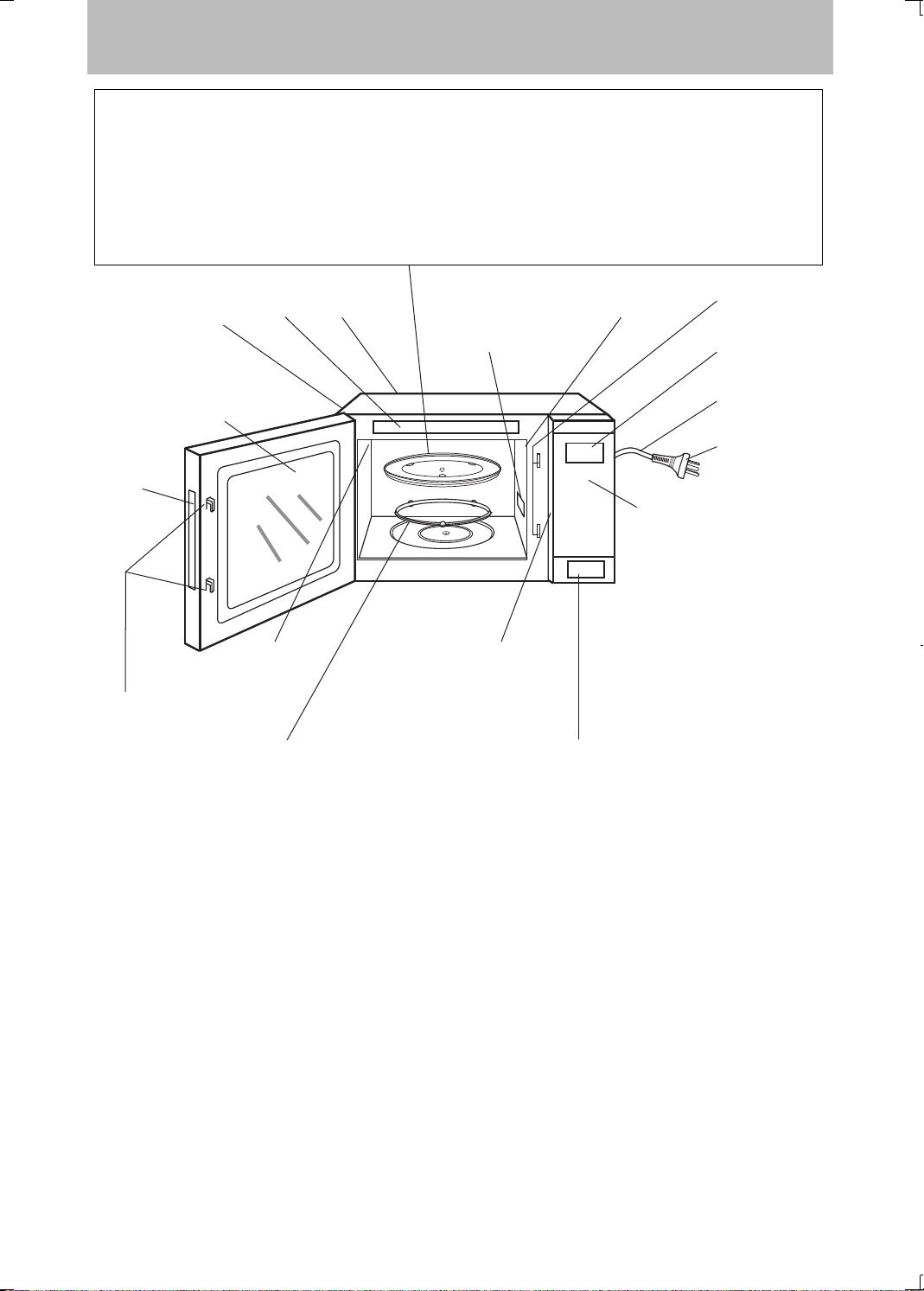
Feature Diagram
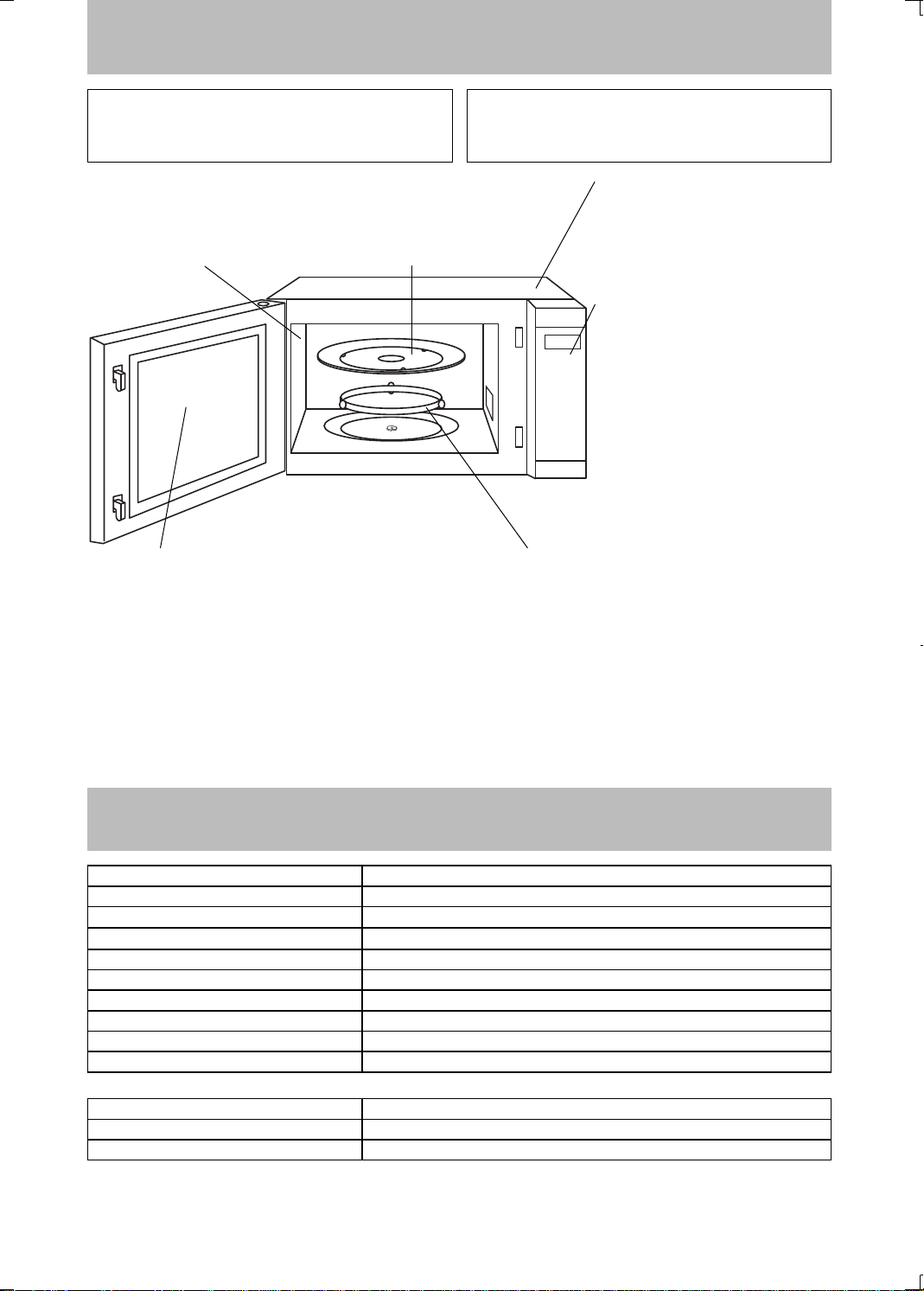
Glass Tray
1. Do not operate the oven without the Roller Ring and Glass Tray in place.
2. Only use the Glass Tray specifi cally designed for this oven. Do not substitute another Glass Tray.
3. If Glass Tray is hot, allow to cool before cleaning or placing in water.
4. Do not cook directly on Glass Tray. Always place food on a microwave-safe dish, or on a rack set in
a microwave-safe dish.
5. If food or utensil on Glass Tray touches oven walls, causing the tray to stop moving, the tray will
automatically rotate in opposite direction. This is normal.
6. Glass Tray can rotate in either direction.
Waveguide Cover
Do not remove. It is not
packaging material and
must remain in place.
Door Safety
Lock System
Door Safety
Lock System
Power
Supply Cord
Power
Supply Plug
Control Panel
• The control panels are
covered with removable
protective fi lm to prevent
scratches during shipping.
Small bubbles may appear
under this fi lm. When this
happens, remove fi lm
carefully.
(Hint - apply masking or
clear tape to an exposed
corner and pull gently to
remove.)
Door Release Button
Press to open the door. Opening the door
during cooking will stop the cooking process
without cancelling the program. Cooking
resumes as soon as the door is closed
and Start Pad is pressed. It is quite safe to
open the door at any time during a cooking
program and there is no risk of Microwave
exposure.
Oven Window with
Vapor Barrier Film
(do not remove)
Roller Ring
1. The Roller Ring and oven fl oor should
be cleaned frequently to prevent
excessive noise and scratching of
painted surface.
2. The Roller Ring must always be
used together with the Glass Tray for
cooking.
Identifi cation Plate
The model number
and serial number are
displayed here.
Oven Light:
Oven Light will turn on during cooking and also when door is opened.
NOTE:
The above illustration is for reference only.
Display
Window
Caution
Label
Oven Air
Vents
Oven Air Vents
Oven
Light
Menu
Label
Caution
Label
F0003BQ60QP_OI_00_160531.indd 9F0003BQ60QP_OI_00_160531.indd 9 2016/8/24 8:19:332016/8/24 8:19:33
– 10 –
Control Panel
Beep Sound
When pad is pressed correctly, a beep sound will be heard. If a pad is pressed and no beep is heard, the
unit does not or cannot accept the instruction. The oven will beep twice between programmed stages. At the
end of any complete programme, the oven will beep fi ve times.
NOTE:
If an operation is set and Start Pad is not pressed, after 6 minutes, the oven will automatically cancel the
operation. The display will revert back to clock or colon mode.
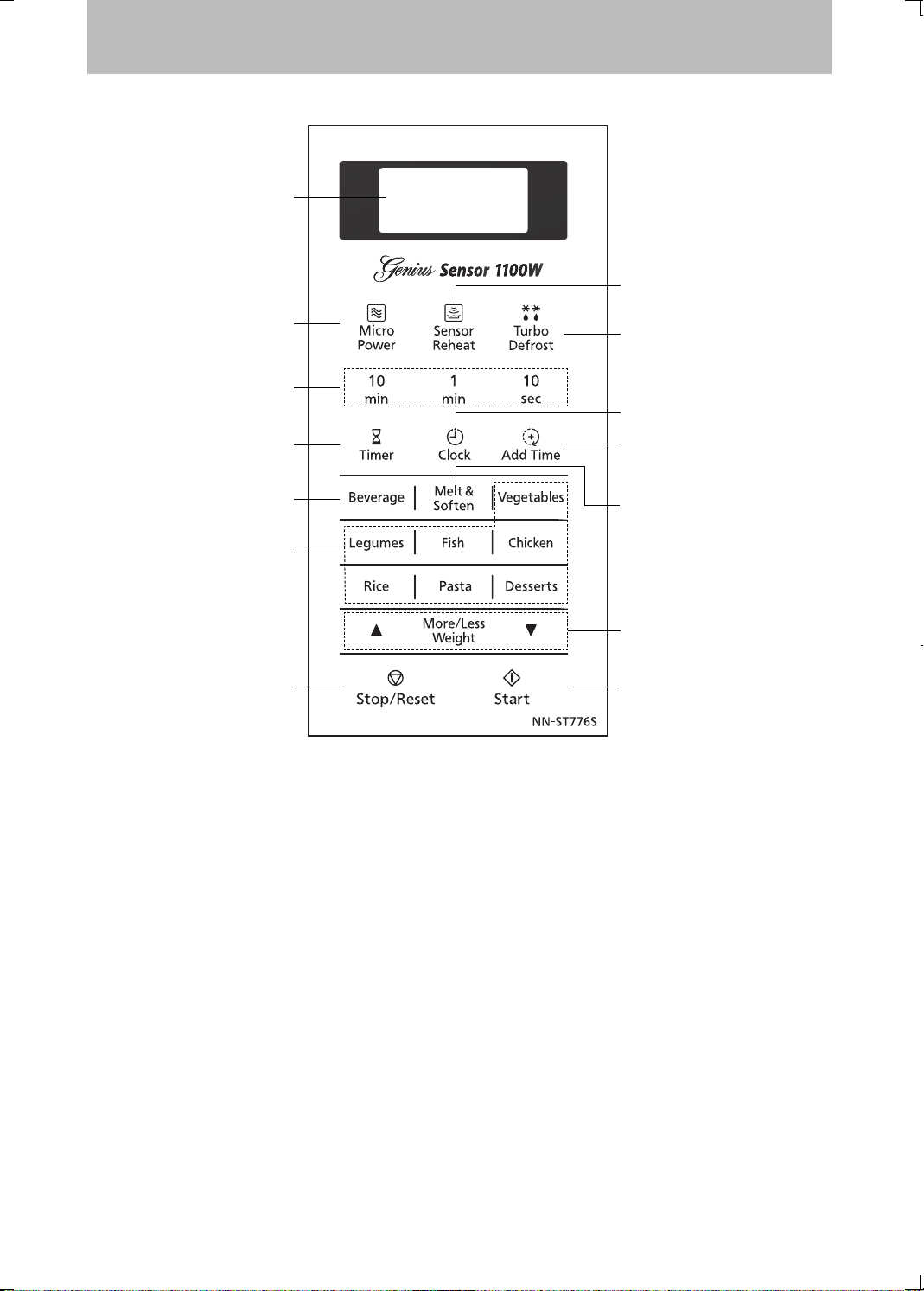
Start Pad
One tap allows oven to
begin functioning. If door is
opened or Stop/Reset Pad
is pressed once during oven
operation, Start Pad must
again be pressed to restart
oven.
Display Window
(pg. 11)
Micro Power Pad
(pg. 13)
Sensor Reheat Pad
(pg. 25)
More/Less/Weight
Pads
Time Pads
Melt & Soften Pad
(pg. 18)
Turbo Defrost Pad
(pg. 14)
Timer Pad (pg. 27)
Clock Pad (pg. 12)
Add Time Pad
(pg. 16)
Beverage Pad
(pg. 17)
Stop/Reset Pad
Before cooking: One tap
clears all your instructions.
During cooking: One
tap temporarily stops the
cooking process. Another
tap cancels all your
instructions and colon or
time of day appears in the
Display Window.
Sensor Cook Pads
(pg. 19)
F0003BQ60QP_OI_00_160531.indd 10F0003BQ60QP_OI_00_160531.indd 10 2016/8/24 8:19:332016/8/24 8:19:33
– 11 –
Let’s Start To Use Your Oven!
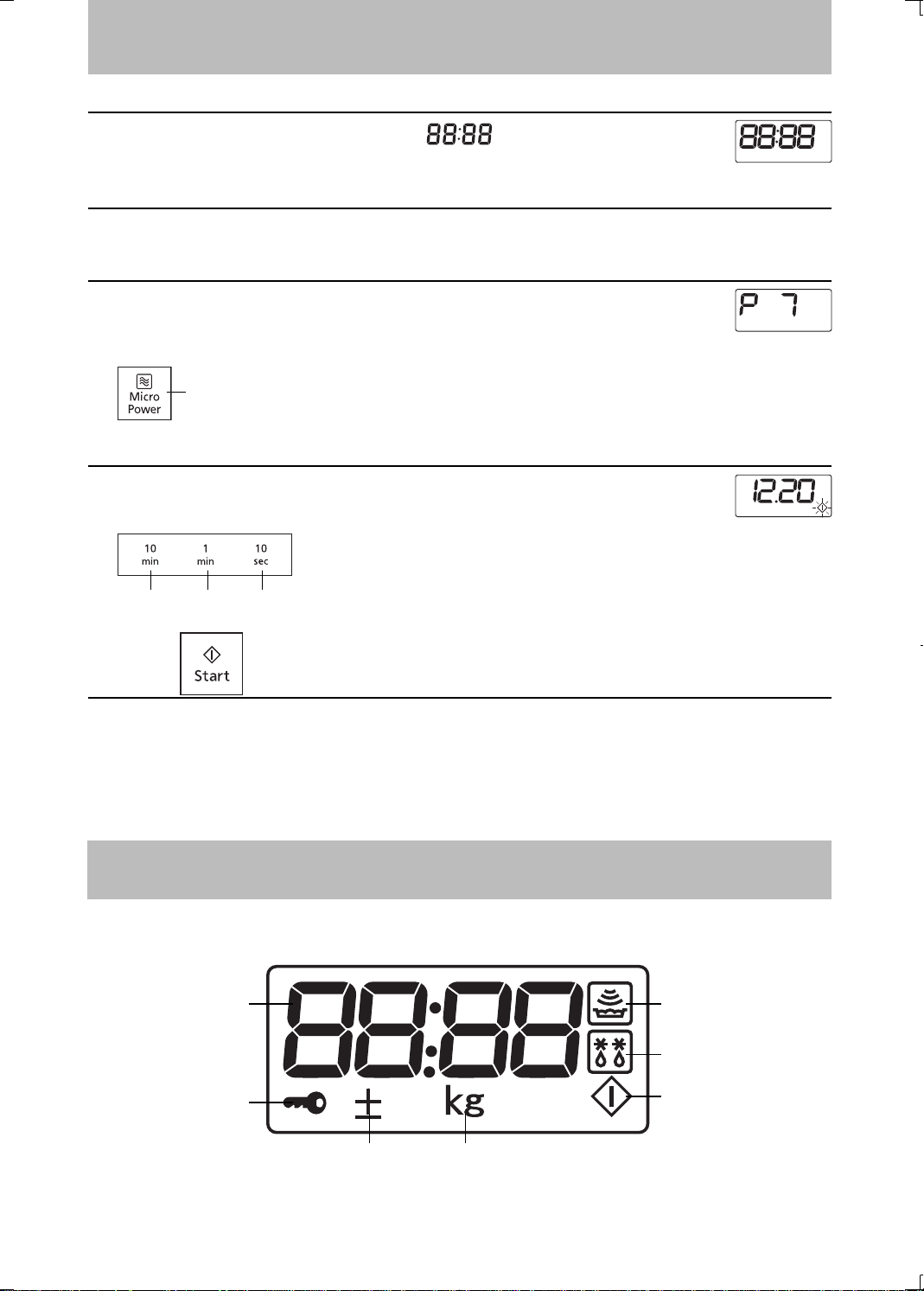
Display Window
1
Plug in
Plug into a properly earthed electrical outlet.
"
"
appears
in the Display Window. (This will immediately cease when any pad is pressed.)
2
Open Door
Open the door and place container with food in a dish on Glass Tray in the oven. Then close the door.
3
Select Power Level
eg. P7
Press Power Level Pad four times.
(see page 13 for Micro Power chart)
four times
4
Set Time
e.g. 12 minute 20 seconds
Press Time Pads
once twice twice
5
Press
Cooking will start.
The time in the Display Window will count down.
Number (Time/
Weight/Menu)
Weight (
g/
k
g
)
Child Safety
Lock Setting
Start
Defrost Feature
Sensor Feature
More/Less Feature
F0003BQ60QP_OI_00_160531.indd 11F0003BQ60QP_OI_00_160531.indd 11 2016/8/24 8:19:332016/8/24 8:19:33
– 12 –
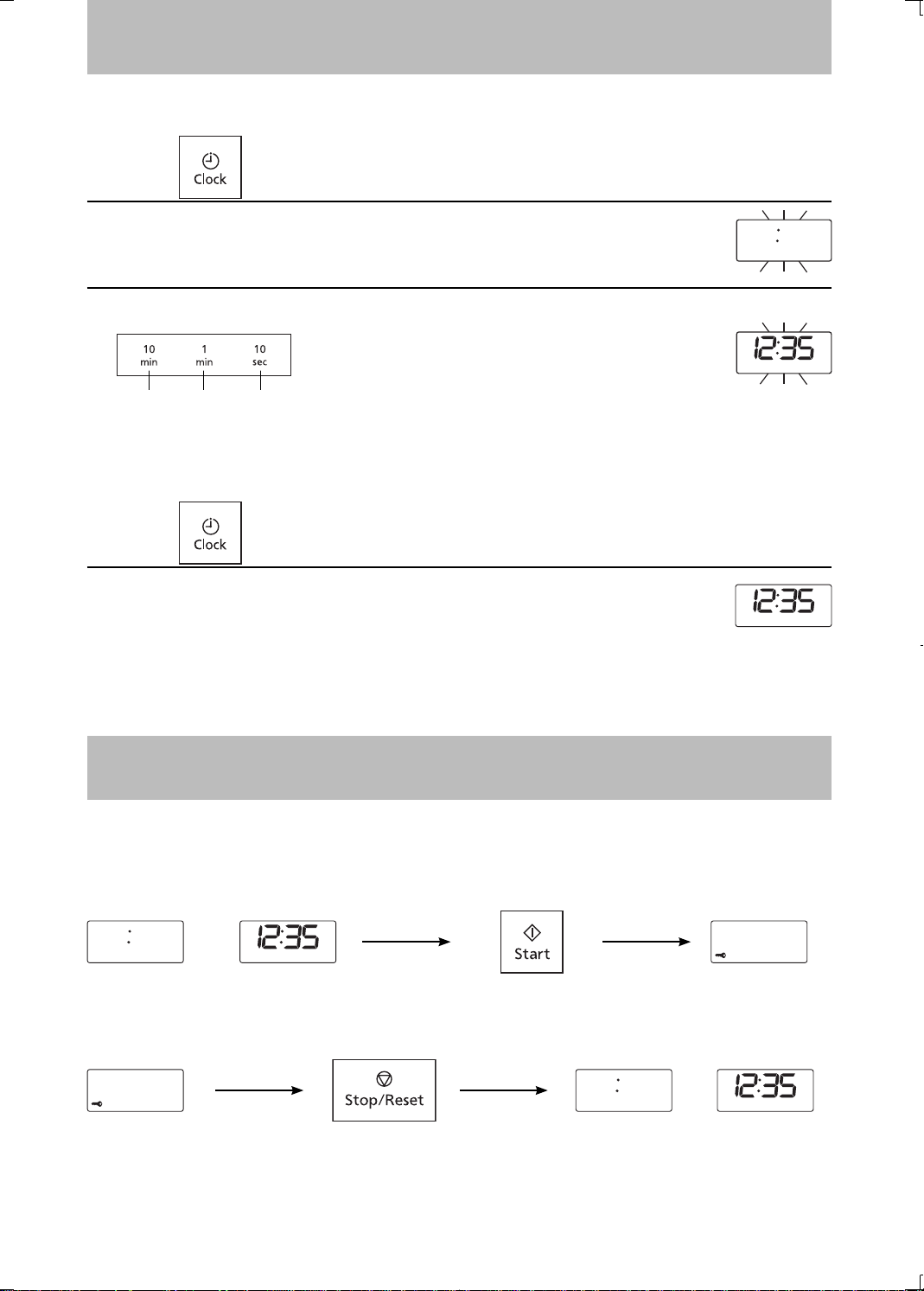
To Set Clock
To Use Child Safety Lock
You can use the oven without setting the clock.
1
Press once
Colon will blink in Display Window.
2
Enter Time of Day
Enter time of day using Time Pads.
twelve
times
three
times
fi ve
times
Time appears in the Display Window, colon is blinking.
Verify time of day in the Display Window.
3
Press
Colon stops blinking; time of day is entered and locked into Display Window.
NOTES:
1. Oven will not operate while colon is still blinking.
2. To reset time of day, repeat step 1 through 3.
3. Clock is a 12 hour display. There isn’t a.m. or p.m. setting.
4. The clock will keep the time of day as long as oven is plugged in and electricity is supplied.
5. Maximum time available is 12:59. Clock is 12 hour only. One o’clock will be displayed as 1:00 not 13:00.
This feature allows you to prevent operation of the oven by a young child; however, the door will open.
You can set Child Safety Lock when colon or time of day is displayed.
To set
Colon or time of day is displayed
Press 3 times.
Display Window
or
To cancel
Colon or time of day is displayedPress 3 times.Display Window
or
NOTE:
To set or cancel child safety lock, Start Pad or Stop/Reset Pad must be pressed 3 times within 10 seconds.
e.g. 12:35
F0003BQ60QP_OI_00_160531.indd 12F0003BQ60QP_OI_00_160531.indd 12 2016/8/24 8:19:332016/8/24 8:19:33
– 13 –
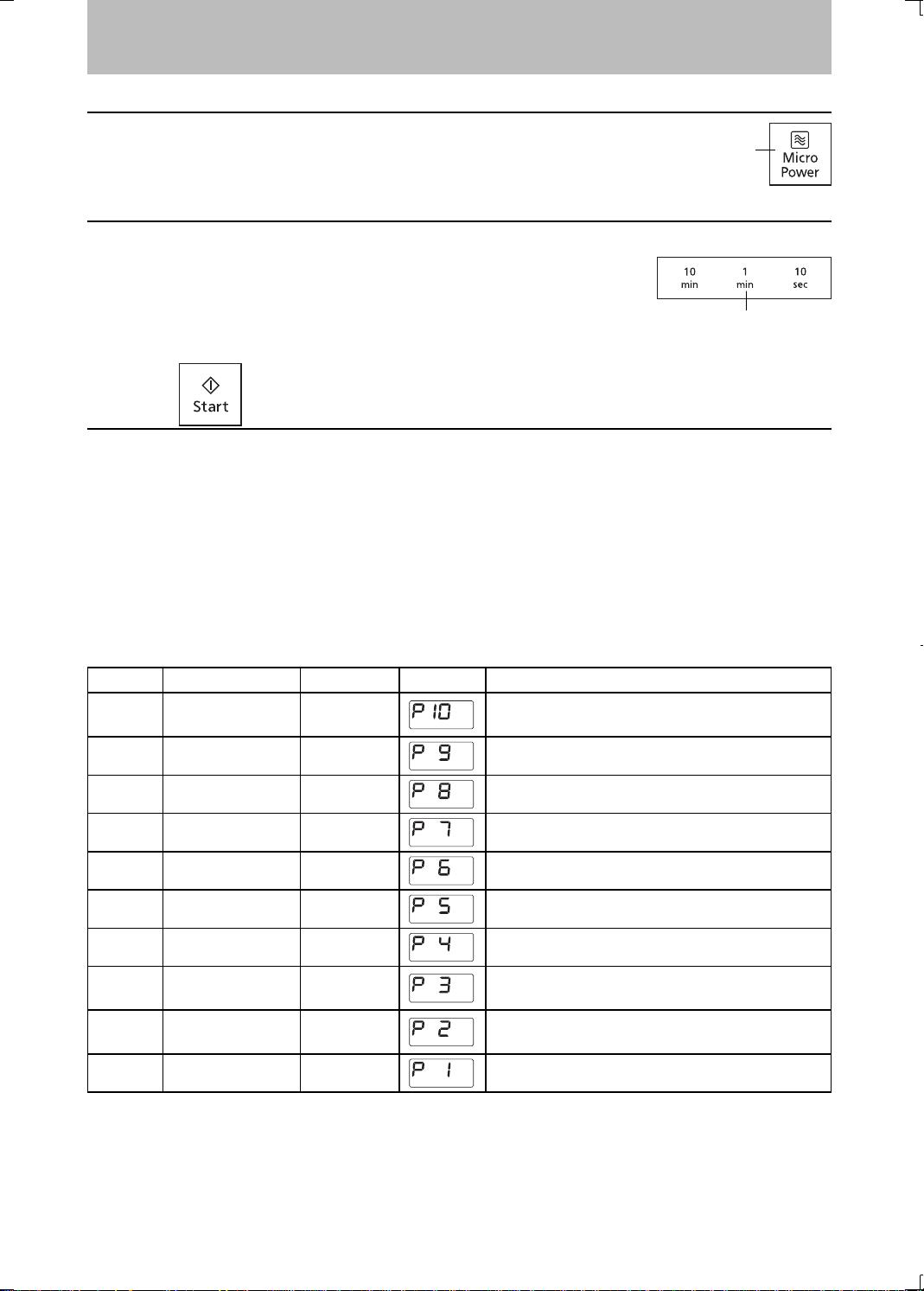
To Use
Micro Power and Time
1
Select Power Level
Press Micro Power Pad until your desired power level appears
in the Display Window. (see chart below)
Note: When selecting P10 on the fi rst stage, you can start from step 2.
2
Set Cooking Time
Enter cooking time using Time Pads.
Maximum Length of cooking time:
P10 (High power): up to 30 minutes,
other powers: up to 99 minutes and 50 seconds for a single stage
3
Press
Cooking will start.
The time in the Display Window will count down.
For more than one stage cooking,
Repeat steps 1 & 2 above then press Start. The maximum number of stages for cooking is 3. The oven
will beep twice between stages. (For further information, refer to page 26)
Micro Power:
The Power Level Pad gives you a selection of different power levels representing decreasing amounts of
microwave energy, used for cooking foods at different speeds.
e.g.The lower the micro power setting, the more evenly the food cooks, although it will take a little longer.
To select the correct power level for cooking different foods, refer to the chart below.
Press POWER LEVEL WATTAGE DISPLAY EXAMPLE OF USE
1x P10 1100 W
Boil water. Cook vegetables, rice, pasta and
noodles. Reheating.
2x P9 1000 W Cook fresh fruits.
3x P8 900 W
Cook cakes, desserts. Heat milk.
4x P7 800 W
Cook pork, whole chicken and chicken pieces.
5x P6 700 W
Cook beef, lamb and eggs. Melt butter.
6x P5 600 W
Cook meatloaves. Melt chocolate.
7x P4 400 W
Cook fi sh and seafood.
8x P3 300 W
Defrost meat, poultry and seafood.
9x P2 200 W
Simmer soups, stews and casseroles (less
tender cuts).
10x P1 100 W
Keep cooked foods warm, simmer slowly.
e.g. 5 minutes
5 times
Press
F0003BQ60QP_OI_00_160531.indd 13F0003BQ60QP_OI_00_160531.indd 13 2016/8/24 8:19:332016/8/24 8:19:33
– 14 –
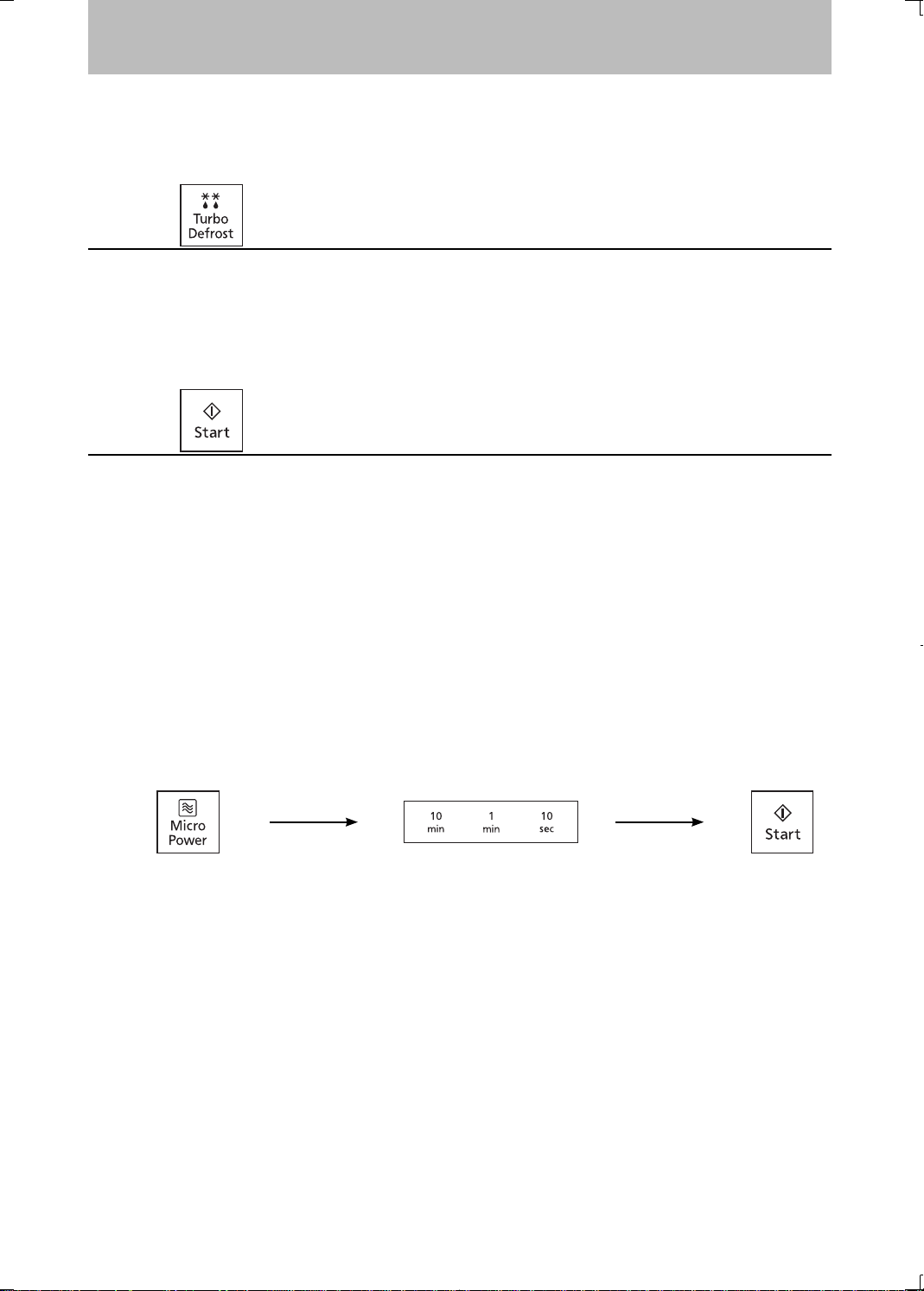
To Defrost
To Defrost using Turbo Defrost
This feature allows you to defrost meat, poultry and seafood automatically by just setting the weight of the
food.
1
Press
until the desired weight appears in the Display Window.
The shape and size of the food will determine the maximum weight the oven can accommodate. The
recommended maximum weight of food depends on the oven cavity size. Weight must be programmed
in kilograms and tenths of a kilogram (0.1
kg ~
3.0
kg
). For best results, the minimun recommended
weight is 0.2
kg
.
2
Press
Defrost time appears in the Display Window and begins to count down.
NOTES:
1. After you select the Turbo Defrost feature, you can also press More/Less/Weight Pads to select weight
before pressing Start.
2. The oven will beep once or twice during the total defrosting time. This indicates that food should
be turned, broken apart or removed. After attending to food, close door and press Start to resume
defrosting.
3. For further information, refer to next page.
To Defrost by Micro Power and Time Setting
This feature allows you to defrost meat, poultry and seafood by P3 and time.
Press 8 times to select P3.
(Deforst power level, refer to
page 13)
Set time according to chart on next page.
Press once.
12 3
NOTE:
Opening the door and taking out the defrosted parts during the operating time is recommended. Turn over,
stir or rearrange the parts which are still in icy.
F0003BQ60QP_OI_00_160531.indd 14F0003BQ60QP_OI_00_160531.indd 14 2016/8/24 8:19:342016/8/24 8:19:34

– 15 –
Defrosting Tips and Techniques
Preparation for Freezing:
1. Heavy-duty plastic wraps, bags and freezer wrap are suitable.
2. Freeze meats, poultry and fi sh in packages with only 1 or 2 layers of food. To aid in separating layers,
place two pieces of wax paper between them.
3. REMOVE ALL AIR and seal securely.
4. LABEL package with type and cut of meat, date and weight.
5. Defrosting times given in the charts are for thoroughly frozen foods (i.e. at least 24 hours in freezer
maintained at -18 °C or lower).
Defrosting Technique:
1. Remove from wrapper and set on a defrosting rack in a dish on Glass Tray.
2. On Turbo Defrost, the oven will beep during the defrosting time. At “beep”, turn over all meat, poultry,
fi sh and shellfi sh. Break apart stewing meat, chicken pieces and minced meat. Separate chops and
hamburger patties.Shield thin ends of roasts, poultry legs and wings, fat or bones with foil.
3. Throughout the defrosting time, remove any defrosted portions of mince or cubed meat, etc.
4. After defrosting, large roasts may still be icy in the centre. Let stand, 15 to 30 minutes, in refrigerator to
complete defrosting.
Defrosting Chart (by setting Micro Power at P3):
FOOD APPROX. TIME
(minutes per 500
g
)
INSTRUCTION
MEAT
Beef
Minced Beef
Roast: Topside
Beef Tenderloin
Chuck or Rump
Sirloin, rolled
Steak
Miscellaneous
Pork/Lamb
Roast
Chops
Ribs
5 - 6
8 - 10
8 - 10
8 - 10
8 - 10
6 - 8
7 - 9
8 - 10
6 - 8
6 - 8
Halfway through the defrost cycle, break apart
minced beef, separate chops and remove meat
that is defrosted.
Turn meat over two to three times during
defrosting.
Shield edges and unevenly shaped ends of
roasts halfway through the defrost cycle.
Large roasts may still be icy in centre. Let stand.
POULTRY
Chicken
whole
pieces
fi llets
Duck
Turkey
8 - 10
7 - 9
7 - 9
7 - 9
8 - 10
Turn poultry over two to four times during
defrosting. Halfway through the defrost cycle,
shield end of drumsticks, wings, breast bones
and ends of poultry with foil.
Break apart chicken pieces and remove small
pieces such as wings, which may be defrosted
before larger pieces.
Rinse poultry under cold water to remove ice
crystals. Let stand 5 to 10 minutes, before
cooking.
FISH & SHELLFISH
Fish Fillets
Whole Fish
Crabmeat
Lobster Tails
Sea Scallops
Green Prawns
8 - 10
7 - 9
6 - 8
6 - 8
6 - 8
6 - 8
Halfway through the defrost cycle, turn whole
fi sh or blocks of fi llets over. Also, break apart
prawns or scallops. Remove any pieces that are
defrosted.
Let stand, 5 to 10 minutes, before cooking.
F0003BQ60QP_OI_00_160531.indd 15F0003BQ60QP_OI_00_160531.indd 15 2016/8/24 8:19:342016/8/24 8:19:34
– 16 –
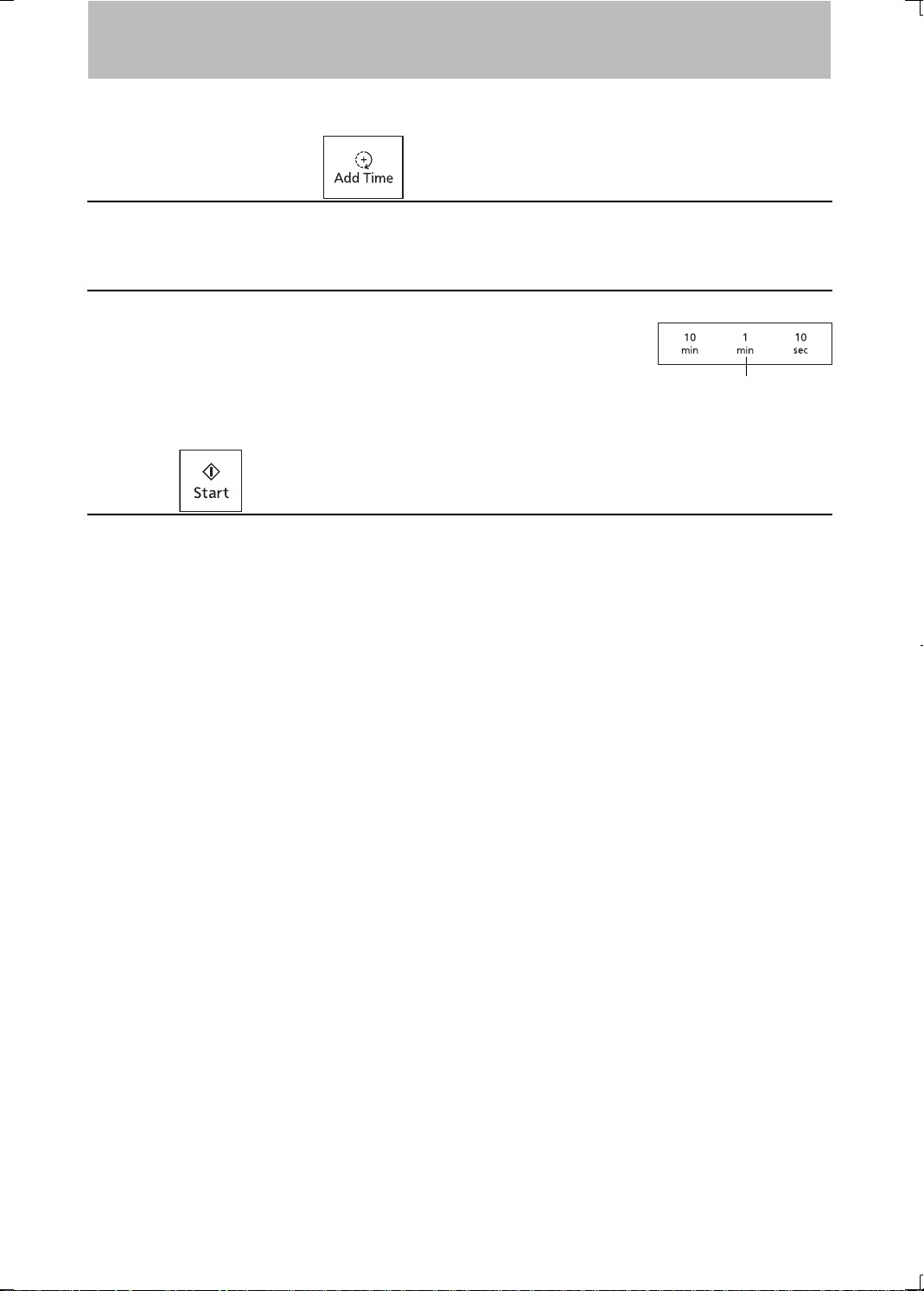
To Use Add Time
This feature allows you to add cooking time at the end of previons cooking.
1
After cooking, press once
To select the Add Time feature
2
Add Cooking Time
Enter cooking time using Time Pads.
Maximum cooking time:
High power: up to 30 minutes,
other powers: up to 99 minutes and 50 seconds
3
Press
Time will be added.
The time in the Display Window will count down.
NOTES:
1. This feature is only available for Micro Power function and it is not available for Auto Contorl function.
(Such as Turbo Defrost, Sensor Cook/Reheat , Beverage and Inverter Melt & Soften function.).
2. The Add Time feature will be cancel after 1 minutes, if you don't do any operation after cooking.
3. You also can use Add Time function after the 3-Stage Setting except Standing Time feature and the
default Power Level is same as the last stage.
e.g. 5 minutes
5 times
F0003BQ60QP_OI_00_160531.indd 16F0003BQ60QP_OI_00_160531.indd 16 2016/8/24 8:19:342016/8/24 8:19:34
– 17 –
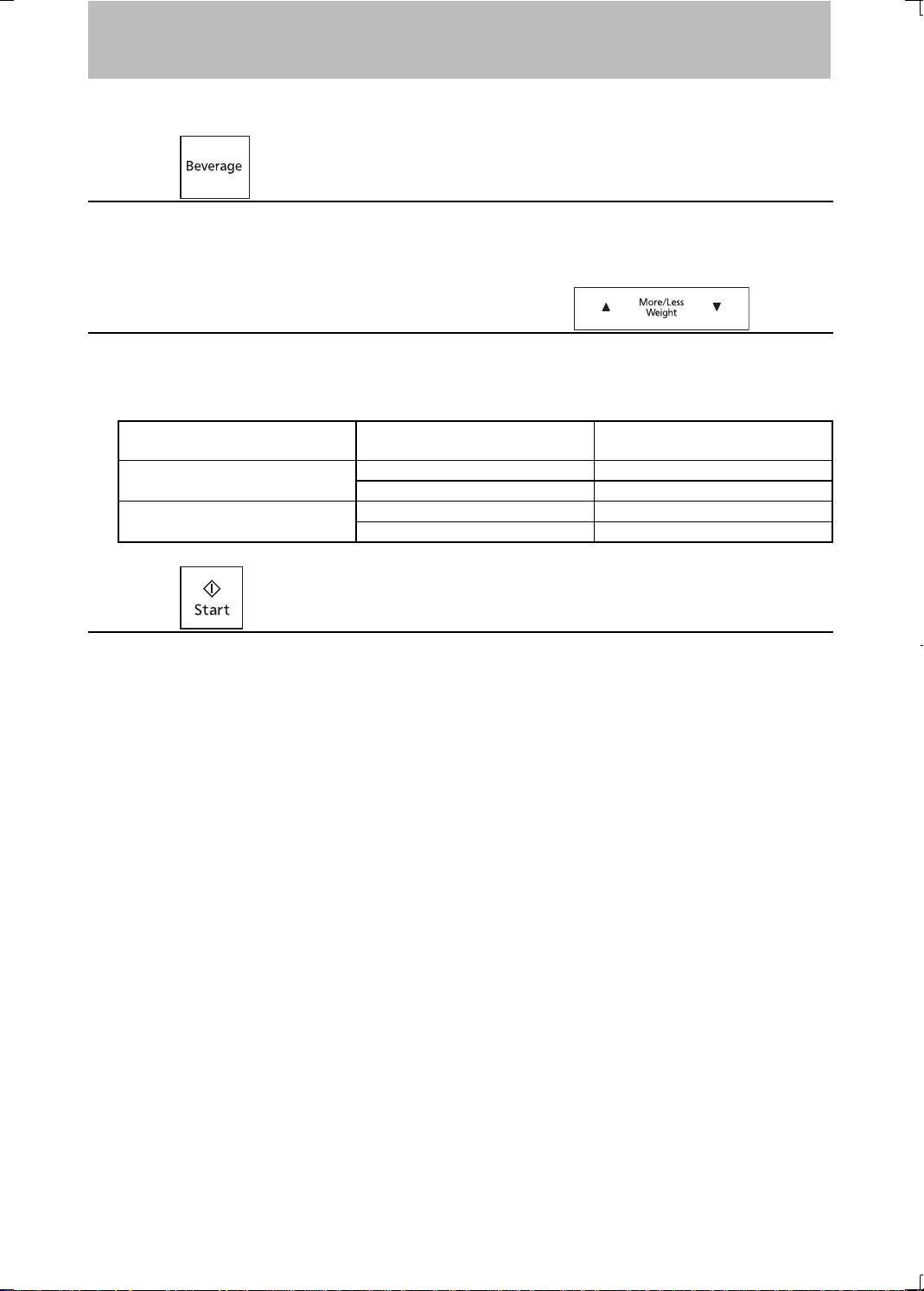
To Use Beverage
This feature allows you to reheat coffee/milk without setting power and time.
1
Press Pad
Press once to reheat coffee, “1” will display in the dispay window.
Press twice to reheat milk, “2” will display in the dispay window.
2
Select the weight of beverage by pressing the Pads
For example: To reheat 2 cups coffee - Press Beverage Pad once, “1” will display in the dispay window,
then press More/Less/Weight (
or
) Pad twice until desired menu number “1-2” appears in the
display window (See below chart).
Press
Menu Number
(Press
/
Pad)
Menu
1x
1-1 1 cup coffee
1-2 2 cups coffee
2x
2-1 1 cup milk
2-2 2 cups milk
3
Press
Reheat will start. The time in the display window will count down.
NOTES:
1. Use a microwave safe cup.
2. Heated coffee/milk can erupt if not mixed with air. Do not heat coffee/milk in your microwave oven
without stirring before and halfway through heating.
3. Care must be exercised not to overheat coffee/milk when using the Beverage feature. It is programmed
to give proper result when heating 1 cup or 2 cups of coffee/milk, starting from room temperature for
coffee and refrigerator temperature for milk. Overheating will cause an increased risk of scalding, or
water eruption. Refer to page 6, food, item 5.
4. 1 cup of milk is 200 ml to 250 ml and 1 cup of coffee is 150 ml to 200 ml.
F0003BQ60QP_OI_00_160531.indd 17F0003BQ60QP_OI_00_160531.indd 17 2016/8/24 8:19:342016/8/24 8:19:34
– 18 –
To Use Inverter Melt & Soften
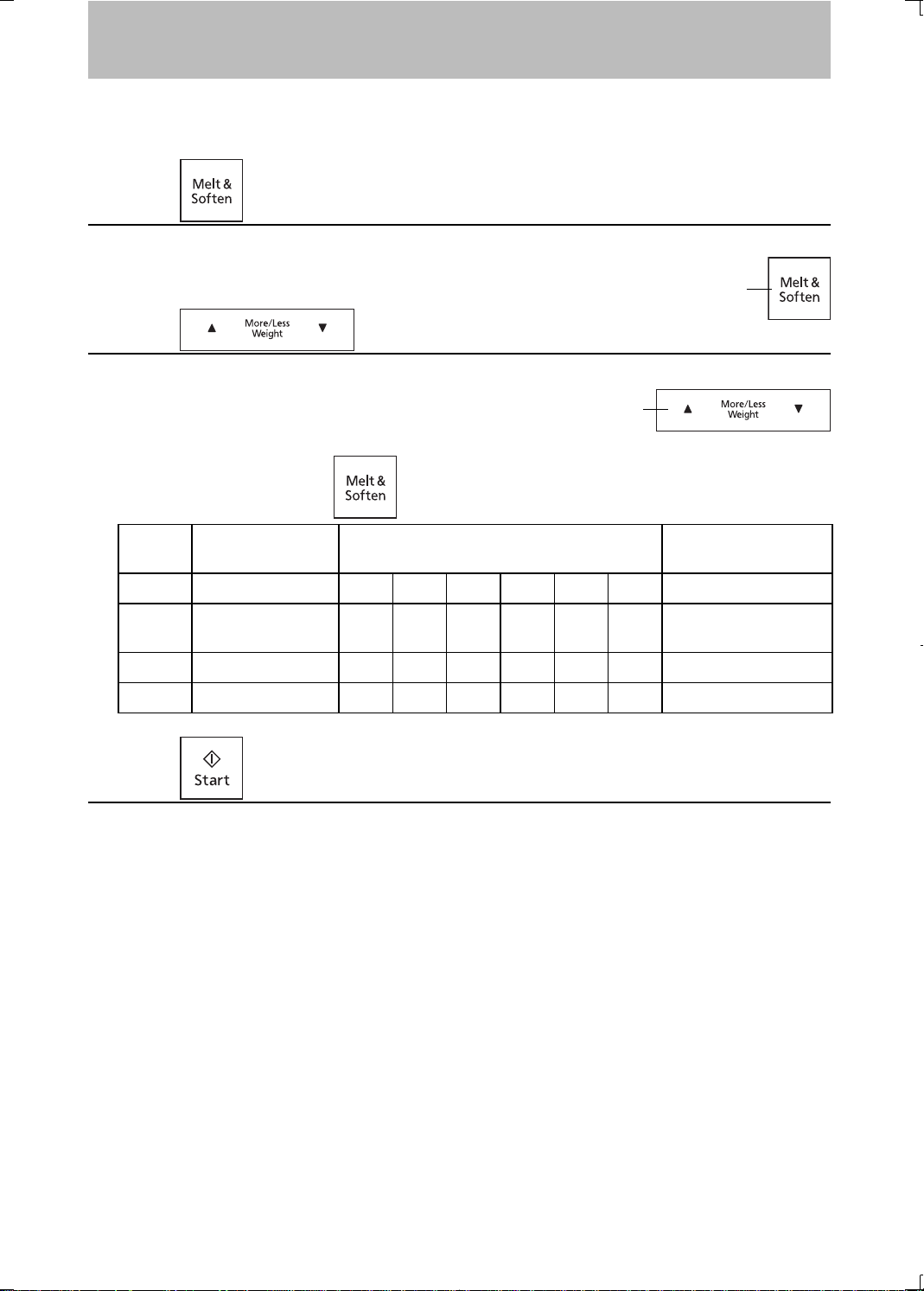
This feature allows you to melt & soften food at the touch of a pad. There is no need to select the power
level or cooking time as the microwave does this for you.
1
Press Pad
until the desired food number appears
in the display window. (see below chart)
2
Press Pad
until the desired food weight appears
in the display window.
Melt & Soften
Menu
Number
Menu Weight
Recommended
Containers
3 Chocolate 50
g
100
g
150
g
200
g
250
g
300
g
microwave safe dish
4 Butter 50
g
100
g
150
g
200
g
250
g
300
g
microwave safe dish
with a lid or plastic wrap
5 Cream Cheese 50
g
100
g
150
g
200
g
250
g
300
g
microwave safe dish
6 Ice Cream 200
g
500
g
1000
g
2000
g
-- -
3
Press
Cooking time appears in the Display Window and begins to count down.
For best results on Auto Cook, follow these recommendations:
3. Chocolate
Remove wrapper and place chocolate into a microwave safe dish. Cook without cover. Open the door
to STIR WHEN TWO BEEPS HEARD during cooking, press Start Pad to continue. After heating, stir until
completely melted.
Note: Chocolate holds its shape even when softened.
4. Butter
Remove wrapper, cut butter into 2 tbsp cube, and place into a microwave safe dish. Melt with lid or plastic
wrap. Stir after cooking.
5. Cream Cheese
Remove wrapper and place in a microwave safe bowl/dish. Soften without cover.
6. Ice Cream
Soften slightly without lid.
NOTE: If food needs more time cooking or weight exceeds range, cook using P3 for melting or softening.
e.g.: Cream Cheese
three times
e.g.: 150
g
three times.
F0003BQ60QP_OI_00_160531.indd 18F0003BQ60QP_OI_00_160531.indd 18 2016/8/24 8:19:342016/8/24 8:19:34
– 19 –
To Use Sensor Cook
Sensor Cook allows you to cook foods without selecting times and power levels. The sensor detects the
heat and humidity generated by the food and cooks your food automatically.
Place food into an appropriate sized dish for the volume of food you are cooking. Cover securely with plastic
wrap or a securely fi tting lid (do not use any snap closing lids). Plastic dishes are not suitable as a secure
seal cannot be achieved and inaccurate cooking may result.
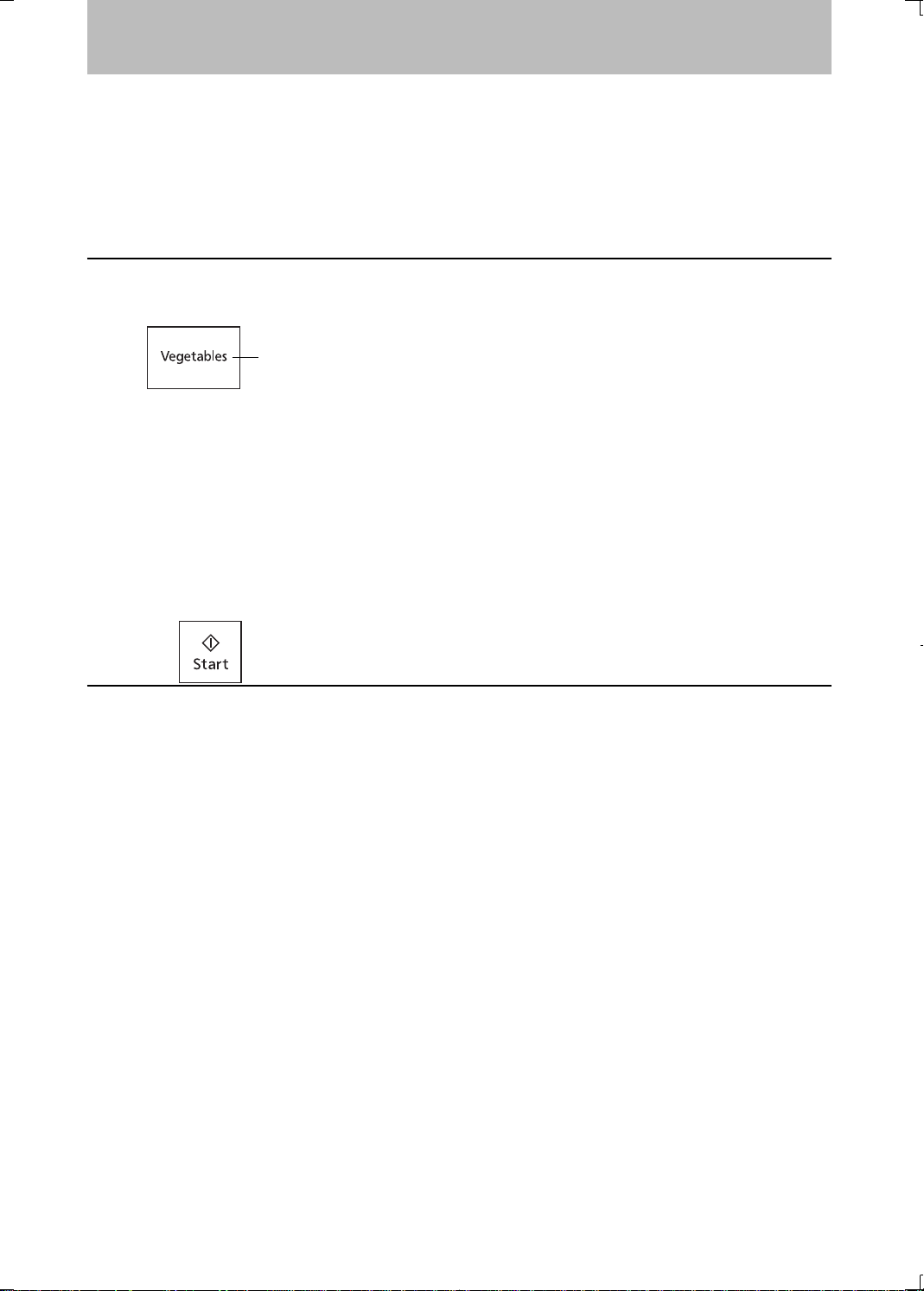
1
Press Desired Food Category Pad
Select and press the appropriate pad for the food you are cooking. The number of category appears in
the Display Window.
eg.:
Press once for Vegetables.
Press twice for Frozen Vegetables.
Menu number appears in the display window.
*
More /Less Function:
Preferences for food doneness varies with each individual. After having used Sensor Cook a few times,
you may decide you prefer your food cooked to a different doneness. By using the More/Less/Weight
Pads, the Auto Sensor programmes can be adjusted to cook food for a longer or shorter time. Press
More/Less/Weight Pads before pressing Start Pad.
Press More Pad (
): “+” will display in display window. If you want to return to average cooking
result, press Less Pad (
).
Press Less Pad (
): “-” will display in display window. If you want to return to average cooking
result, press More Pad (
).
If you are satisfi ed with the result of the SENSOR COOK programme, you don’t have to use this pad.
2
Press
The menu number you have selected remains in the display window. Do not stop the oven or open the
door during this part of the cooking stage as inaccurate cooking may result. After the heat humidity is
detected by the SENSOR, the remaining time appears in the Display Window and begins to count down.
NOTES:
1. The door should not be opened before the time appears in the Display Window.
2. Do not use plastic dishes as a secure seal cannot be achieved and inaccurate cooking may occur.
3. Only cook foods within the weight ranges described and accessories as indicated, see table on page
20-24.
4. To prevent any mistakes during auto sensor programs ensure that the base of the oven and container
are dry.
5. To allow for some variations that occur in food, check that food is thoroughly cooked and piping hot
before serving.
6. The cavity may become very hot during and after use, please take special care and use kitchen gloves
to take out the container when the oven beeps.
F0003BQ60QP_OI_00_160531.indd 19F0003BQ60QP_OI_00_160531.indd 19 2016/8/24 8:19:342016/8/24 8:19:34
– 20 –
For best results, follow these recommendations:
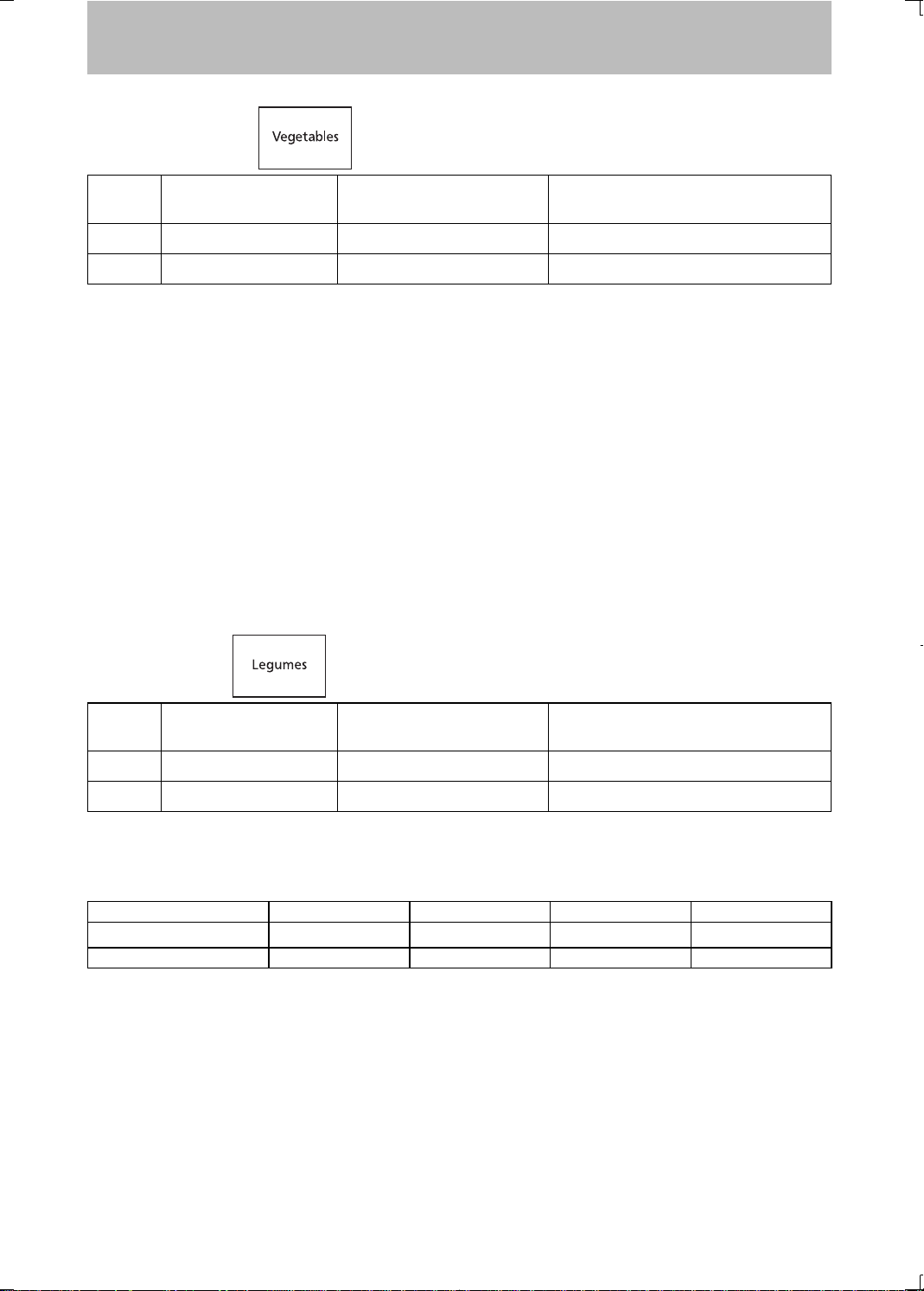
Vegetables
Menu
Number
Menu Recommended Weight Recommended Containers
7 Vegetables 125
g
- 500
g
microwave safe dish with plastic wrap
8 Frozen Vegetables 125
g
- 1.0
kg
microwave safe dish with plastic wrap
7. Vegetables
It is suitable for cooking all types of leaf, green and soft varieties of vegetables, including broccoli, squash
caulifl ower, cabbage, asparagus, beans, celery, zucchini, spinach, capsicum or a mixture of these. All
vegetables should be trimmed or prepared and cut into evenly sized pieces. Clean the vegetables and place
them in a microwave safe container, add 1 tablespoon to ¼ cup of water to vegetables if dehydrated or a
softer cooked texture is desired. Butter, herbs, etc., may be added before heating, but do not salt vegetables
until serving. Cover dishes securely with plastic wrap and place container at the center of the glass tray.
Select the program then press Start. Open the door to STIR WHEN TWO BEEPS HEARD during cooking,
press Start Pad to continue. At the end of cooking, stir larger quantities of vegetables. Let stand, covered,
for 2 to 3 minutes.
8. Frozen Vegetables
It is suitable for all types of frozen vegetables. Put them in a microwave safe container. Do not use plastic
dishes. Best results are achieved if large quantities are placed in a single layer. Add 1 tablespoon to ¼ cup
water to vegetables, if desired. Butter, herbs etc. may be added before heating, but do not add salt until
serving. Cover dishes securely with plastic wrap and place container at the center of the glass tray. Select
the program then press Start. Open the door to STIR WHEN TWO BEEPS HEARD during cooking, press
Start Pad to continue. At the end of the cooking, stir vegetables and let stand, covered, for 2 to 3 minutes.
Legumes
Menu
Number
Menu Recommended Weight Recommended Containers
9 Legumes 1 cup - 4 cups microwave safe dish with plastic wrap
10 Potatoes 125
g
- 1.0
kg
microwave safe dish with plastic wrap
9. Legumes
It is Suitable for cooking chickpeas, split peas dried beans and peas. Cover legumes with cold water and
soak overnight, drain. Place legumes and boiling water into an appropriate sized microwave safe container.
(See table for quantities)
Amount of Legumes 1 cup 2 cups 3 cups 4 cups
Amount of Boiling Water 3 cups
4 cups
6 cups
8 cups
Dish Size 2 litre 3 litre 4 litre 4 litre
Cover dishes securely with plastic wrap and place container at the center of the glass tray. Select the
program then press Start. Open the door to STIR AND REMOVE THE PLASTIC WRAP WHEN TWO
BEEPS HEARD during cooking, press Start Pad to continue. At the end of cooking, allow legumes to stand
for 5 minutes if required. If food needs more time cooking, cooking using P6.
10. Potatoes
It is suitable for cooking root vegetables such as potatoes, sweet potatoes, pumpkin, onions, swede, carrots,
turnip and beetroot. All vegetables should be trimmed or prepared and cut into even sized pieces. Clean the
vegetables and place them in a microwave safe container, add 1 tablespoon to ¼ cup of water to vegetables
if dehydrated or a softer cooked texture is desired. If desired, butter, herbs etc. may be added, but do not
add salt until after cooking. Cover dishes securely with plastic wrap and place container at the center of the
glass tray. Select the program then press Start. Open the door to STIR WHEN TWO BEEPS HEARD during
cooking, press Start Pad to continue. At the end of the cooking, stir larger quantities of vegetables. Let
stand, covered, for 2 to 3 minutes.
To Use Sensor Cook
(continued)
F0003BQ60QP_OI_00_160531.indd 20F0003BQ60QP_OI_00_160531.indd 20 2016/8/24 8:19:342016/8/24 8:19:34
– 21 –
Fish
Menu
Number
Menu Recommended Weight Recommended Containers
11 Steam Fish 125
g
- 500
g
microwave safe dish with plastic wrap
11. Steam Fish
It is suitable for cooking whole fi sh and fi sh fi llets (thickness of fi sh should not be more than 3 cm). Select fi sh
suitable for microwave cooking and place in a single layer in a shallow microwave safe dish, with skinside down.
Add butter, spices, herbs, or lemon juice to fl avour. Overlap thin edges of fi llets to prevent overcooking. Shield the
eye and tail area of whole fi sh with small amounts of aluminum foil to prevent overcooking. Cover dishes securely
with plastic wrap and place container at the center of the glass tray. Select the program then press Start. Allow
large amounts of fi sh to stand for 3 to 5 minutes after cooking before serving.
Chicken
Menu
Number
Menu Recommended Weight Recommended Containers
12
Steam Chicken Pieces
400
g
- 1.0
kg
microwave safe dish with
plastic wrap or fi tted lid
12. Steam Chicken Pieces
It is suitable for cooking chicken pieces, such as wings, thighs, legs, breast fi llets. Chicken pieces should be
completely thawed before cooking. Pierce the chicken pieces. Marinate chicken pieces before cooking for added
fl avour and colour. Put the prepared chicken pieces onto a microwave safe dish. Cover securely with plastic wrap
or fi tted lid and place container at the center of the glass tray. Select the program then press Start. Open the door
to STIR WHEN TWO BEEPS HEARD during cooking, press Start Pad to continue. Let stand 5 to 10 minutes at
the end of cooking.
To Use Sensor Cook
(continued)
F0003BQ60QP_OI_00_160531.indd 21F0003BQ60QP_OI_00_160531.indd 21 2016/8/24 8:19:342016/8/24 8:19:34
– 22 –
Rice
Menu
Number
Menu Recommended Weight Recommended Containers
13 Rice 1 cup - 2½ cups microwave safe dish with plastic wrap
14 Curries
250
g
- 750
g
(meat weight only)
microwave safe dish with plastic wrap
15 Quinoa ¼ cup - 1 cup microwave safe dish with plastic wrap
13. Rice
It is suitable for cooking short and long grain rice including spceialty rices. It is not suitable for cooking
brown rice or wild rice. Place rice with water at room temperature in a suitable microwave safe dish. We
recommend the following proportions of rice to cold tap water:
Rice 1 cup 1½ cups 2 cups 2½ cups
Water 1½ cups 2½ cups 3½ cups 4½ cups
Dish Size 3 litre 3 litre 4.5 litre 4.5 litre
It may be necessary to adjust the water to your personal preference. Soak in water for 10 - 15 minutes.
Always allow at most ½ depth of volume for evaporation to prevent boiling over. Do not cook rice in plastic
dishes as incorrect cooking times may result. Cover securely with plastic wrap and place container at the center
of the glass tray. Select the program then press Start. Open the door to STIR AND REMOVE THE PLASTIC
WRAP WHEN TWO BEEPS HEARD during cooking, press Start Pad to continue. At the end of the cooking, let
stand 5 to 10 minutes, covered.
14. Curries
It is suitable for cooking curries. See chart below for quantities to use.
Serves 2 4 6
Weight of meat 250
g
500
g
750
g
Amount of liquid
(coconut milk, stock)
375 ml 500 ml 750 ml
Weight of hard vegetables 200
g
400
g
600
g
Cut meat and vegetables into even size pieces. Place curry paste, meat, onion and hard vegetable into a
suitable size casserole dish, do not use plastic dishes. Cover securely with plastic wrap and place container
at the center of the glass tray. Select curries then Start. Open the door to STIR AND ADD REMAINING
INGREDIENTS INCLUDING LIQUID WHEN TWO BEEPS HEARD during cooking, press Start Pad to continue.
At the end of cooking time, allow to stand for 5-10 minutes. Serve with rice.
15. Quinoa
It is suitable for cooking quinoa. Place quinoa in a microwave safe casserole dish. Add 2 parts water to 1
part quinoa. Use the above chart as a guide:
Quinoa ¼ cup ½ cup ¾ cup 1 cup
Tap water ½ cup 1 cup 1½ cups 2 cups
Dish Size 2 litre 2.5 litre 3 litre 3.5 litre
Allow at least ½ depth of volume for evaporation to prevent boiling over. Soak in water for 10 - 15 minutes.
Cover securely with plastic wrap and place container at the center of the glass tray. Select the program then press
Start. Open the door to STIR WHEN TWO BEEPS HEARD during cooking, press Start Pad to continue. At the
end of the cooking, let stand 10-15 minutes.
To Use Sensor Cook
(continued)
F0003BQ60QP_OI_00_160531.indd 22F0003BQ60QP_OI_00_160531.indd 22 2016/8/24 8:19:342016/8/24 8:19:34
– 23 –
Pasta
Menu
Number
Menu Weight Recommended Containers
16 Fresh Pasta 125
g
- 625
g
microwave safe dish with plastic wrap
17 Dried Pasta 125
g
- 500
g
microwave safe dish with plastic wrap
16. Fresh Pasta
It is suitable for cooking fresh pasta such as fettuccine, tagliatelle, tortellini, ravioli and agnolotti. (Gnocchi
should be cooked by manual MICRO POWER.) Place pasta in an appropriate size microwave safe dish with
boiling water. Use the above chart as a guide:
Pasta 150
g
250
g
350
g
500
g
625
g
Boiling Water 4 cups 5 cups 6 cups 8 cups 8 cups
Dish Size 3 litre 3 litre 4 litre 4 litre 5 litre
Always allow at most ½ depth of volume for evaporation to prevent boiling over. Add 1 tablespoon of oil,
if desired, before cooking to prevent pasta from sticking together. Cover securely with plastic wrap and
place container at the center of the glass tray. Select the program then press Start. Open the door to STIR AND
REMOVE THE PLASTIC WRAP WHEN TWO BEEPS HEARD during cooking, press Start Pad to continue. At
the end of the cooking, cover and let stand for 5 to 10 minutes, if required, before draining.
17. Dried Pasta
It is suitable for cooking dried pasta such as spaghetti,fettuccine, macaroni, penne, spiral and various pasta
shapes. Place pasta in an appropriate size microwave safe dish with boiling water. Use the following as a
guide:
Pasta 150
g
250
g
350
g
500
g
Boiling Water 4 cups 5 cups 6 cups 8 cups
Dish Size 3 litre 3 litre 4 litre 4 litre
Always allow at most ½ depth of volume for evaporation to prevent boiling over. Add 1 tablespoon of oil,
if desired, before cooking to prevent pasta from sticking together. Cover securely with plastic wrap and
place container at the center of the glass tray. Select the program then press Start. Open the door to STIR AND
REMOVE THE PLASTIC WRAP WHEN TWO BEEPS HEARD during cooking, press Start Pad to continue. At
the end of the cooking, cover and let stand for 5 to 10 minutes, if required, before draining.
To Use Sensor Cook
(continued)
F0003BQ60QP_OI_00_160531.indd 23F0003BQ60QP_OI_00_160531.indd 23 2016/8/24 8:19:342016/8/24 8:19:34
– 24 –
Desserts
Menu
Number
Menu Weight Recommended Containers
18 Desserts 1 Serv. - 4 Serv. microwave safe dish
18. Desserts
It is suitable for cooking individual steamed sponge puddings. Use packet mixes available from supermarkets or
individual recipes. Not suitable for heavy fruit type puddings. See chart below for quantities.
2 Serv. 4 Serv.
self raising fl our ½ cup 1 cup
cocoa powder ½ tablespoon 1 tablespoon
caster sugar ¹⁄
6
cup ⅓ cup
milk ⅜ cup ¾ cup
vanilla essence ½ teaspoon 1 teaspoon
chocolate 25
g
50
g
butter 50
g
100
g
brown sugar ⅜ cup ¾ cup
cocoa, extra 1 tablespoon 2 tablespoons
water ¼ cup ½ cup
Sift fl our and cocoa into a bowl. Add sugar, milk and vanilla essence. Mix well and set aside. Melt chocolate
and butter in a separate microwave safe container and pour it into the mixture while hot. Mix well. Combine
brown sugar, cocoa and water in a jug. Spread all the mixture into base of a 2-litre casserole dish. Select the
program then press Start. DO NOT USE PLASTIC WRAP OR LID.
To Use Sensor Cook
(continued)
F0003BQ60QP_OI_00_160531.indd 24F0003BQ60QP_OI_00_160531.indd 24 2016/8/24 8:19:342016/8/24 8:19:34
– 25 –
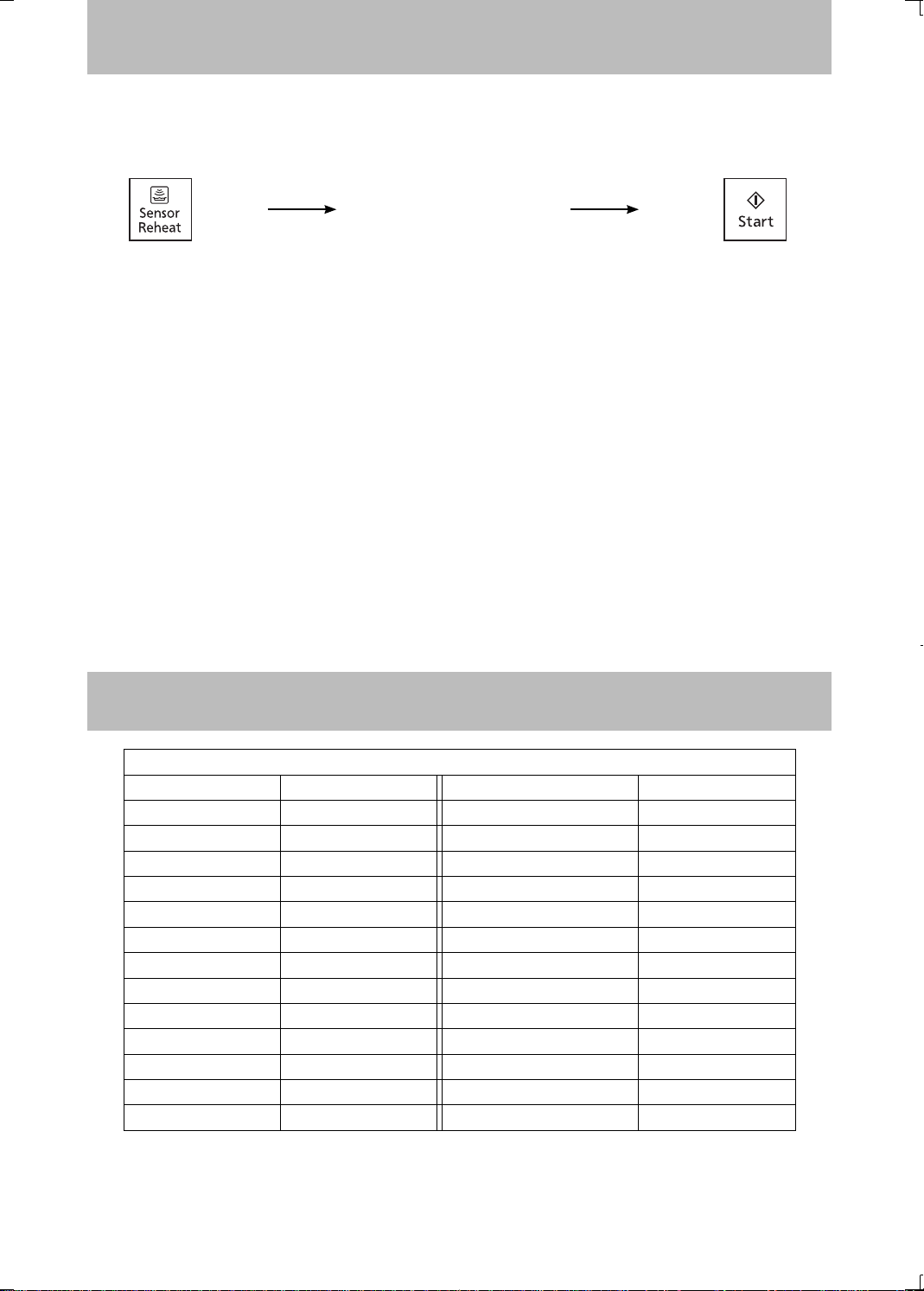
To Use Sensor Reheat
For best results on Sensor Reheat, follow these recommendations:
1. Reheating by Sensor is suitable for pre-cooked foods. There is a setting for frozen and refrigerator
temperature or room temperature foods. It is suitable for casseroles, plated meals, soup, stews, pasta
dishes (except lasagne) and canned foods.
2. Food being reheated should weigh between 125
g
and 1.0 k
g
. For foods weighing less than 125
g
and
more than 1.0 k
g
, use a manual micro power setting.
3. Do not reheat bread or pastry products (raw or uncooked), or beverages.
4. Do not use if oven cavity is warm (from previously cooked foods).
5. Cover foods securely with plastic wrap. (Do not use any snap closing lids.)
6. The door should not be opened before the time appears in the Display Window.
7. During the heating time, the oven will ‘beep’ and prompt you to stir/rearrange the food. There is no need
to recover if not required.
8. All foods should have a covered stand time of at least 3 to 5 minutes.
INGREDIENT CONVERSION CHART
INGREDIENT CONVERSION CHART
¼ cup 60 ml ¼ teaspoon 1 ml
⅓ cup 85 ml ½ teaspoon 2 ml
½ cup 125 ml 1 teaspoon 5 ml
⅔ cup 165 ml 2 teaspoons 10 ml
¾ cup 190 ml 3 teaspoons 15 ml
1 cup 250 ml 1 tablespoon 20 ml
1¼ cups 310 ml 1½ tablespoons 30 ml
1½ cups 375 ml 2 tablespoons 40 ml
2 cups 500 ml 3 tablespoons 60 ml
3 cup 750 ml 4 tablespoons 80 ml
3½ cups 875 ml
4 cups 1 litre
6 cups 1.5 litre
8 cups 2 litre
All recipes are tested using standard measurement that appear in the above chart.
Press.
After the heat and humidity is
detected by the SENSOR, the
remaining time appears in the
Display Window and begins
to count down.
Press.
If desired, press
More
/
Less
Pad.
(See page 19 “
*
” for
reference.)
1
2
3
Sensor Reheat allows you to reheat foods without selecting times and power levels. The sensor detects the
heat and humidity generated by the food and reheat your food automatically.
F0003BQ60QP_OI_00_160531.indd 25F0003BQ60QP_OI_00_160531.indd 25 2016/8/24 8:19:342016/8/24 8:19:34
– 26 –
3-Stage Setting
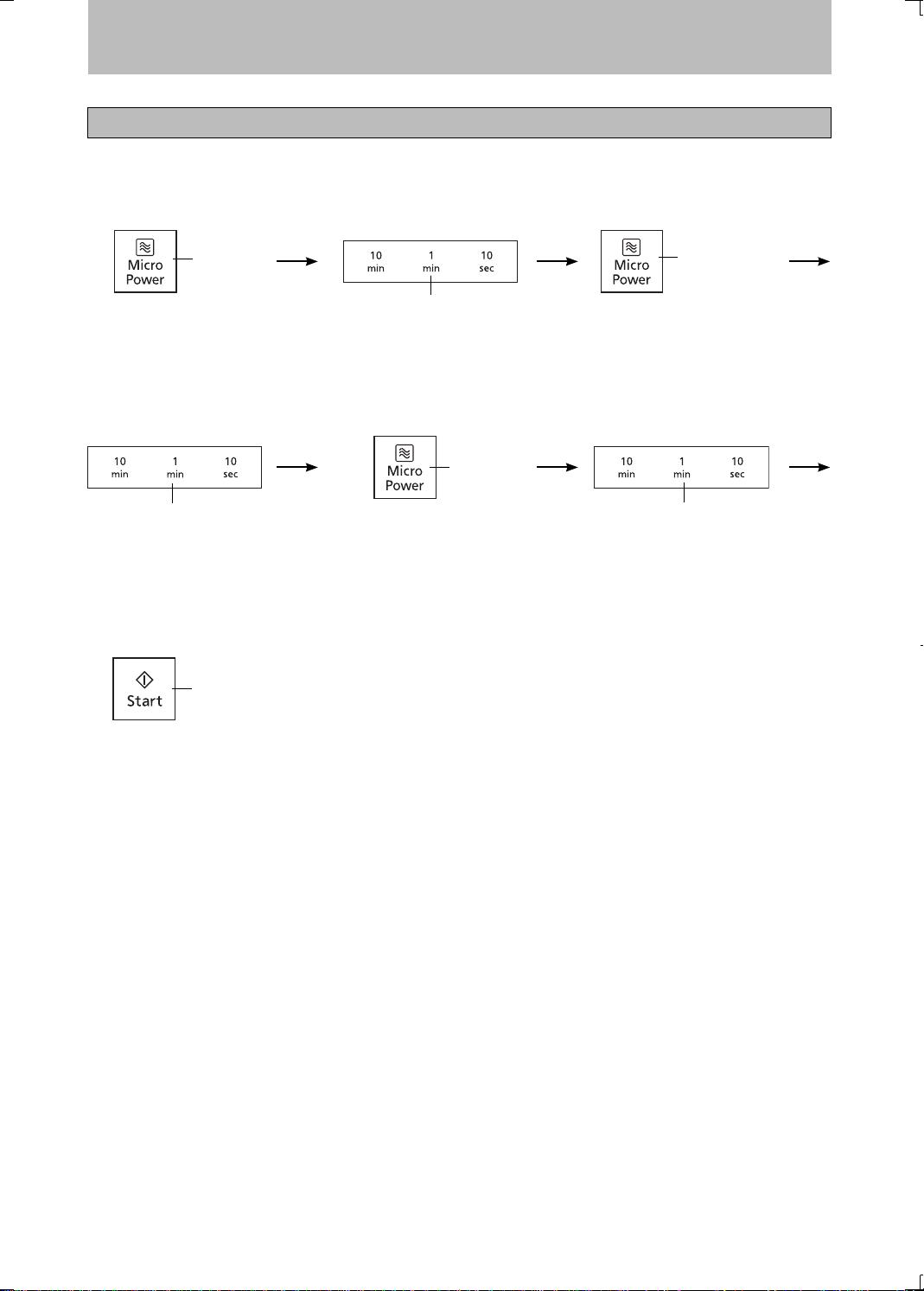
This feature allows you to program 3 Stage of cooking continuously.
e.g.: Continually set [P10] 2 minutes, [P7] 3 minutes and [P4] 2 minutes.
Once
1. Press once to select
“P10”.
5. Press 7 times to select
“P4”.
3. Press 4 times to select “P7”.2. Set as 2 minutes using
Time Pads.
4. Set as 3 minutes using
Time Pads.
6. Set as 2 minutes using
Time Pads.
7. Press once. The time will count
down at the fi rst stage in the
display window.
Once
7 times
twice
twice
3 times
4 times
NOTES:
1. When operating, two beeps will sound between each stage.
2. When selecting P10 on the fi rst stage, you can skip step 1.
3. This feature is only available for manual cooking and it is not available for Auto Contorl function. (Such
as Turbo Defrost, Sensor Cook/Reheat , Beverage and Inverter Melt & Soften function.)
F0003BQ60QP_OI_00_160531.indd 26F0003BQ60QP_OI_00_160531.indd 26 2016/8/24 8:19:342016/8/24 8:19:34
– 27 –
To Use Timer
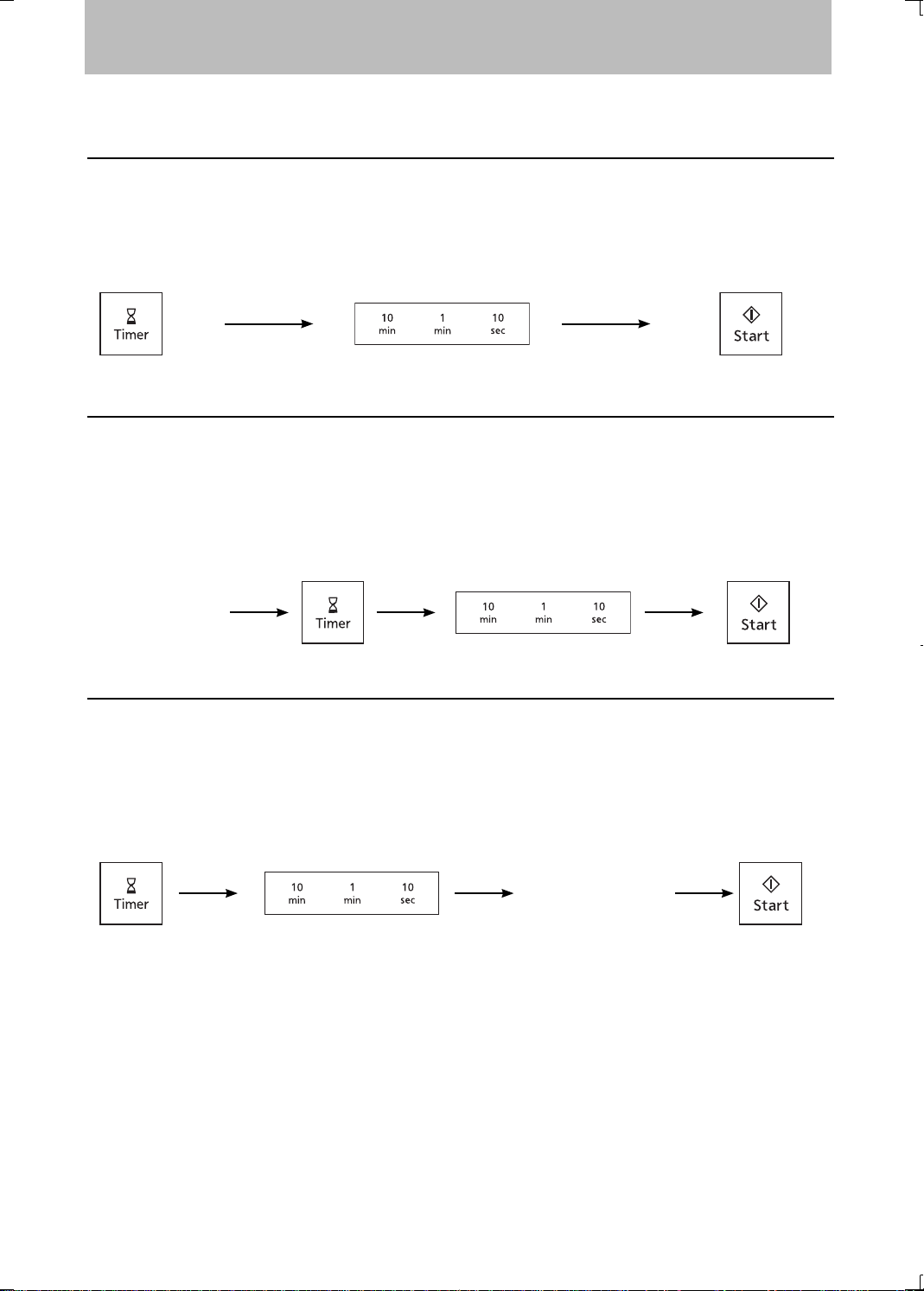
This feature allows you to program standing after cooking is completed and to program the oven as a minute
or a second timer or program delay start.
To Use as a Kitchen Timer
Press once. Set desired amount of time.
(up to 99 minutes and 50 seconds)
Press Start.
Time will count down
without oven operating.
To Set Standing Time
Set desired amount
of standing time.
(up to 99 minutes and 50
seconds)
Press Start.
Cooking will start. After
cooking, standing time
will count down without
oven operating.
Press once.
Set the desired cooking
programme, up to 2
stages. (see page 13)
To Set Delay Start
Press Start.
Delayed time will
count down without
oven operating. Then
cooking will start.
Set the desired cooking
programme, up to 2
stages. (see page 13)
Set desired amount
of delay time.
(up to 99 minutes and 50
seconds)
Press once.
NOTES:
1. If oven door is opened during the Standing Time, Delay Start or Kitchen Timer, the time in the Display
Window will continue to count down.
2. Delay Start/Standing Time cannot be programmed before/after any Auto Control function (Such as Turbo
Defrost, Sensor Cook/Reheat , Beverage and Inverter Melt & Soften function.). This is to prevent the
standing temperature of the food from rising before defrosting or cooking begins. A change in the starting
temperature could cause inaccurate results and/or food may deteriorate.
3. When using Standing time or Delay Start, it’s up to 2 Power stages.
F0003BQ60QP_OI_00_160531.indd 27F0003BQ60QP_OI_00_160531.indd 27 2016/8/24 8:19:342016/8/24 8:19:34
– 28 –
Before Requesting Service
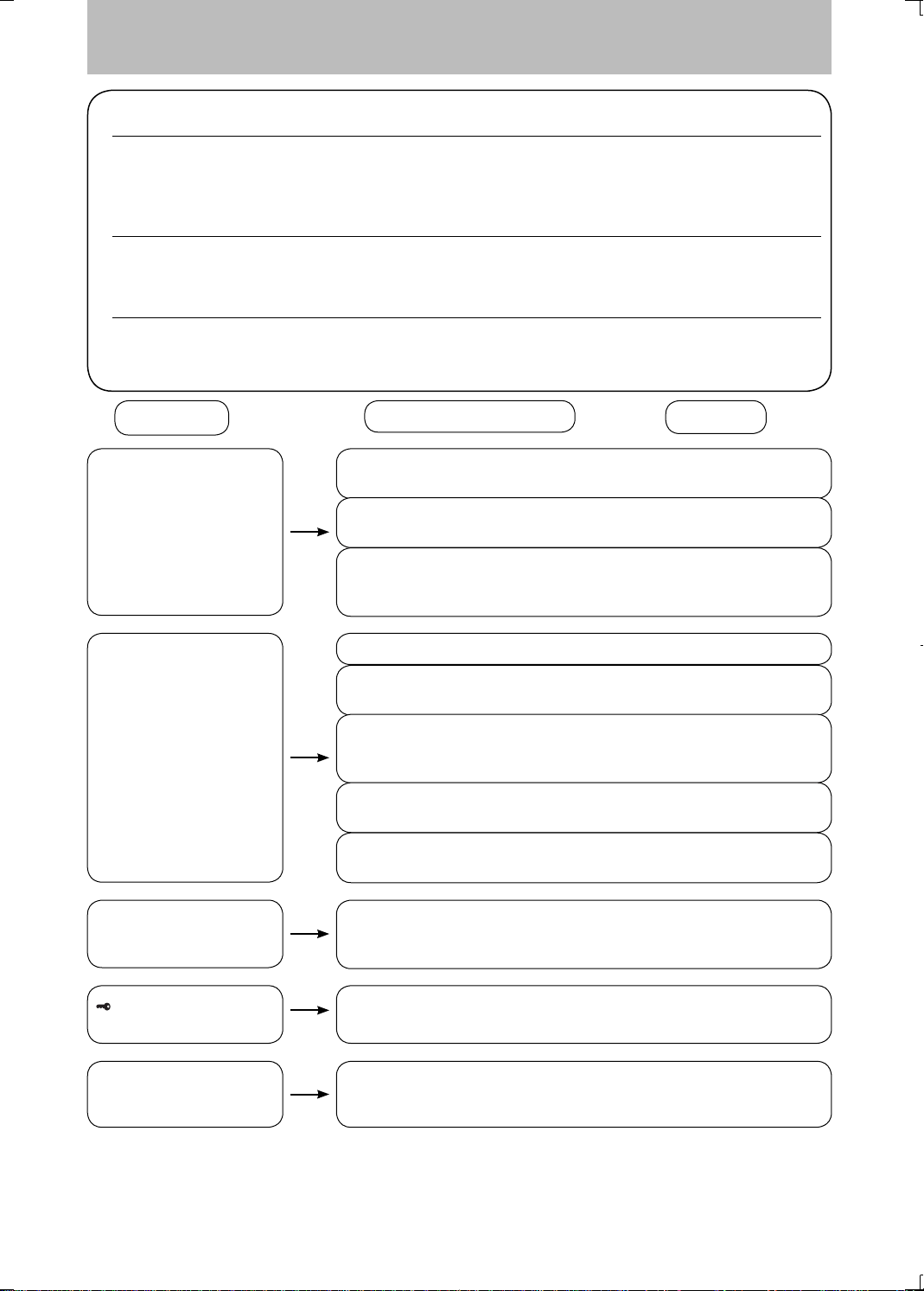
THESE THINGS ARE NORMAL
The oven causes
interference with my TV.
Some radio, TV, Wi-Fi, cordless telephone, baby monitor, blue tooth
or other wireless equipment interference might occur when you cook
with the microwave oven. This interference is similar to the interference
caused by small appliances such as mixers, vacuums, blow dryers, etc.
It does not indicate a problem with your oven.
Steam accumulates
on the oven door and warm
air comes from the oven
vents.
During cooking, steam and warm air are given off from the food. Most
of the steam and warm air are removed from the oven by the air which
circulates in the oven cavity. However, some steam will condense on
cooler surfaces such as the oven door. This is normal.
I accidentally ran my
microwave oven without
any food in it.
Running the oven empty for a short time will not damage the oven.
However, we do not recommend this.
PROBLEM
POSSIBLE CAUSE
REMEDY
If it seems there is a problem with the oven, contact an authorized Service Centre.
Oven will not turn on.
The oven is not plugged in
securely.
Remove plug from outlet, wait
10 seconds and re-insert.
Circuit breaker or fuse is tripped or
blown.
Reset circuit breaker or replace
fuse.
There is a problem with the outlet. Plug another appliance into the
outlet to check if the outlet is
working.
Oven will not start cooking.
Start Pad was not pressed after
programming
Press Start Pad.
Another program has already been
entered into the oven.
Press Stop/Reset Pad to cancel
the previous program and
program again.
The program has not been entered
correctly.
Program again according to the
Operating Instructions.
Stop/Reset Pad has been pressed
accidentally.
Program oven again.
The door is not closed completely. Close the oven door securely.
When the oven is turning
on, there is noise coming
from Glass Tray.
The roller ring and oven bottom
are dirty.
Clean these parts according
to care of your oven (See next
page).
“ ” appears in the
Display
Window
.
The Child Lock was activated by
pressing Start Pad 3 times.
Deactivate Lock by pressing
Stop/Reset Pad 3 times.
“H97”, “H98” or “H00”
appears in the display
window.
The display indicates a problem
with microwave generation system.
Contact the specifi ed service
centre.
F0003BQ60QP_OI_00_160531.indd 28F0003BQ60QP_OI_00_160531.indd 28 2016/8/24 8:19:352016/8/24 8:19:35
– 29 –
Care of your Microwave Oven
Note:
1. The oven should be cleaned regularly and any food deposits removed. Failure to maintain the oven
in a clean condition could lead to deterioration of the surface that could adversely affect the life of the
appliance and possibly result in a harzardous situation.
2. When it becomes necessary to replace the oven light, please consult a dealer to have it replaced.
3. After each time the unit is used it should be wiped down to remove any moisture that has accumulated
inside the cavity.
4. The appliance shall not be cleaned with a steam cleaner.
BEFORE CLEANING:
Unplug at socket of the oven. If impossible, leave
oven door open to prevent oven from accidentally
turning on.
AFTER CLEANING:
Be sure to replace the Roller Ring and Glass Tray
in the proper position and press Stop/Reset Pad to
clear the Display Window.
Inside of the oven:
Wipe with a damp cloth. Mild
detergent may be used if the
oven gets very dirty. The use
of harsh detergent or abrasives
is not recommended.
Glass Tray:
Remove and wash in warm
soapy water or in a dishwasher. If
grease accumulates, clean with a
nonabrasive nylon mesh scouring
pad and a non-abrasive cleanser.
Outside oven surfaces and
back vents.
Clean with a damp cloth. To
prevent damage to the operating
parts inside the oven, water
should not be allowed to seep
into ventilation openings.
Control Panel:
• May be covered with removable
protective fi lm to prevent
scratches during shipping.
Small bubbles may appear
under this fi lm. When this
happens, remove fi lm carefully.
(Hint - apply masking or clear
tape to an exposed corner and
pull gently to remove.)
• If it becomes wet, clean with a
soft, dry cloth. Do not use harsh
detergents or abrasives on the
Control Panel.
Roller Ring and oven cavity fl oor:
Wipe the bottom surface of the oven with mild
detergent water or window cleaner and dry. Roller
Ring may be washed in mild soapy water or
dishwasher. These areas should be kept clean to
avoid excessive noise.
Oven Door:
Wipe with a soft cloth when steam accumulates inside
or around the outside of the oven door. This may
occur when the microwave oven is operated under
high humidity conditions and in no way indicates a
malfunction of the unit or of microwave leakage.
Technical Specifi cations
Power Supply: 230 - 240 V, 50 Hz
Power Consumption*: 4.4 A 1000 W
Power Requirement: (Maximum) 7.5 A 1700 W
Output*: 1100 W
Outside Dimensions (W x H x D): 555 mm (W) x 304 mm (H) x 493 mm (D)
Oven Cavity Dimensions (W x H x D): 418 mm (W) x 228 mm (H) x 470 mm (D)
Overall Cavity Volume: 44 L
Glass Tray Diameter: Ø380 mm
Operating Frequency: 2450 MHz
Uncrated Weight: Approx. 14.3 k
g
Trim Kit (Australia and New Zealand only)
Model Number
NN-TK712SSQP
Outside Dimensions 596 mm (W) x 410 mm (H)
Cabinet Opening 600 mm (W) x 395 mm (H) x 533 mm (D)
* IEC Test Procedure
Specifi cations subject to change without notice.
As for the voltage requirement, the production month, country and serial number, please refer to the
identifi cation plate on the microwave oven.
F0003BQ60QP_OI_00_160531.indd 29F0003BQ60QP_OI_00_160531.indd 29 2016/8/24 8:19:352016/8/24 8:19:35
– 30 –
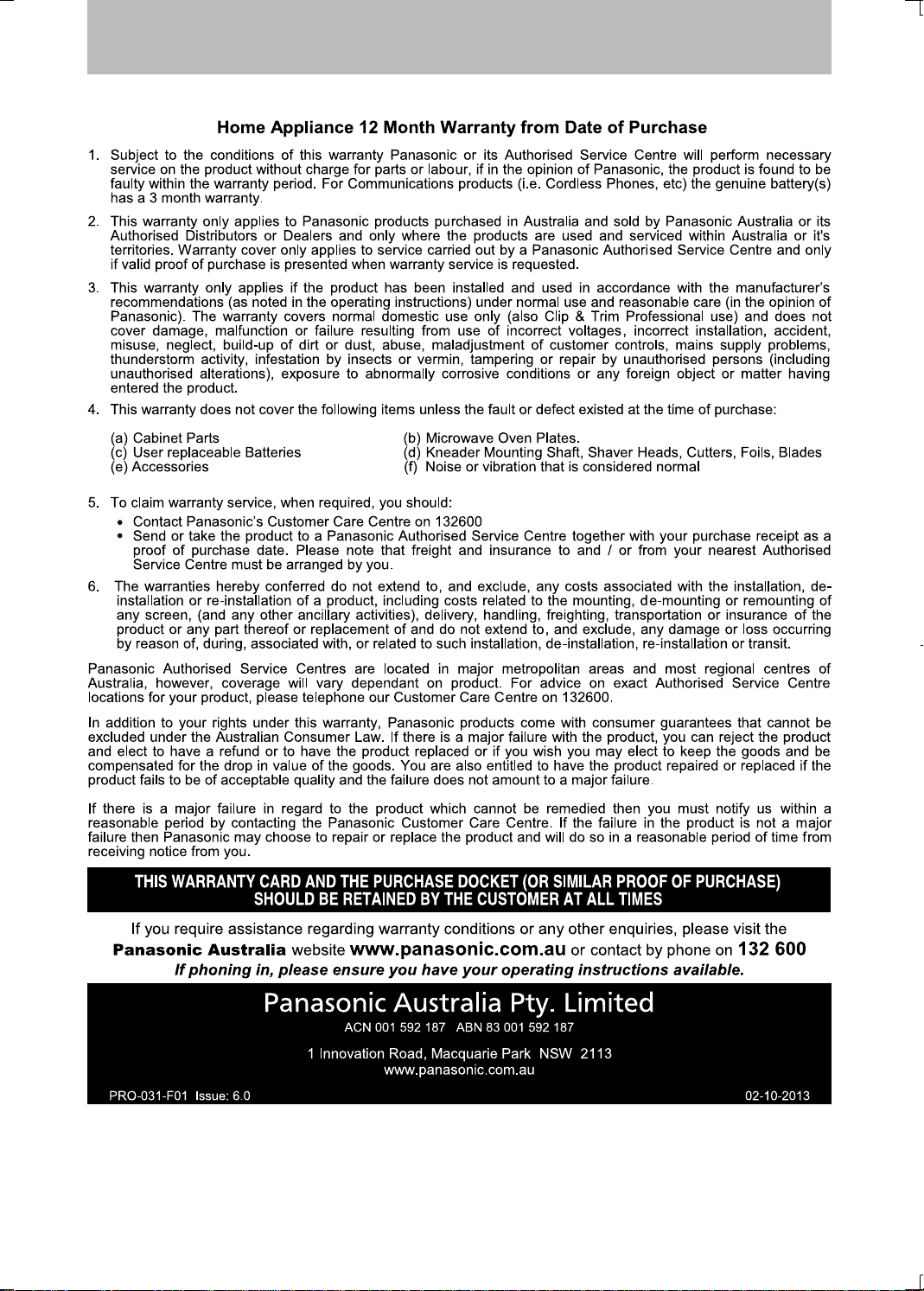
Panasonic Warranty
(For Australia)
F0003BQ60QP_OI_00_160531.indd 30F0003BQ60QP_OI_00_160531.indd 30 2016/8/24 8:19:352016/8/24 8:19:35
– 31 –
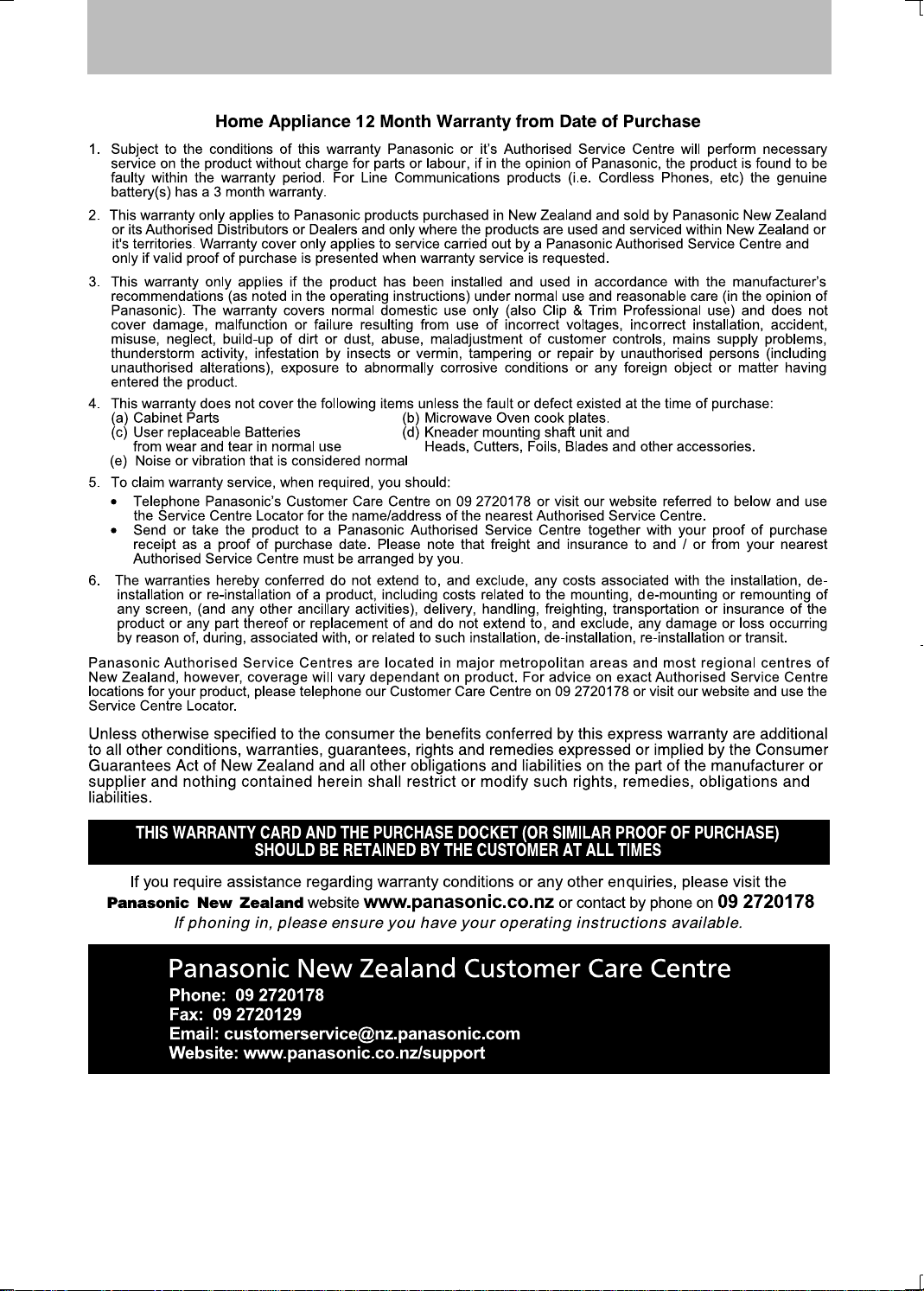
Panasonic Warranty
(For New Zealand)
F0003BQ60QP_OI_00_160531.indd 31F0003BQ60QP_OI_00_160531.indd 31 2016/8/24 8:19:352016/8/24 8:19:35
– 32 –
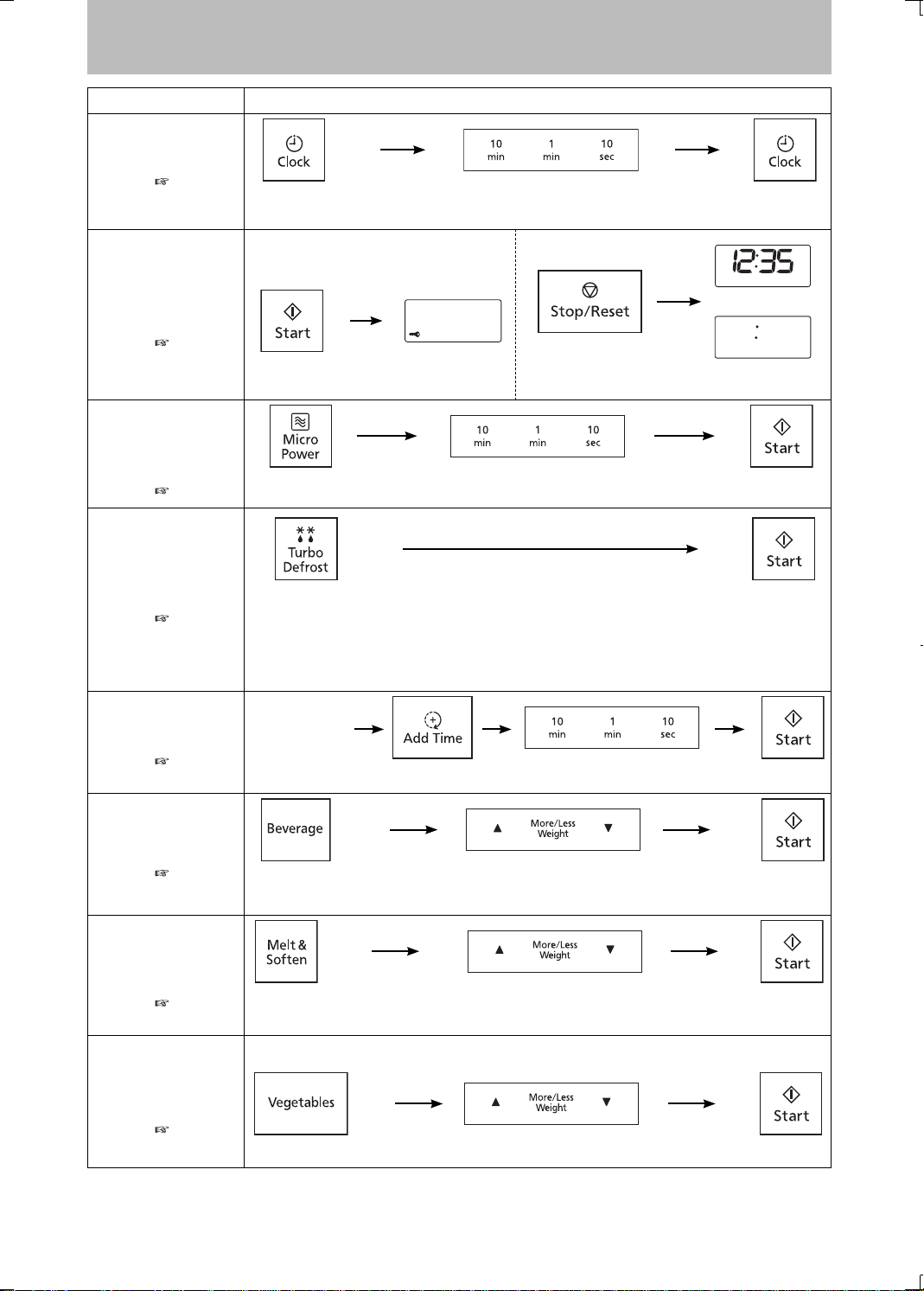
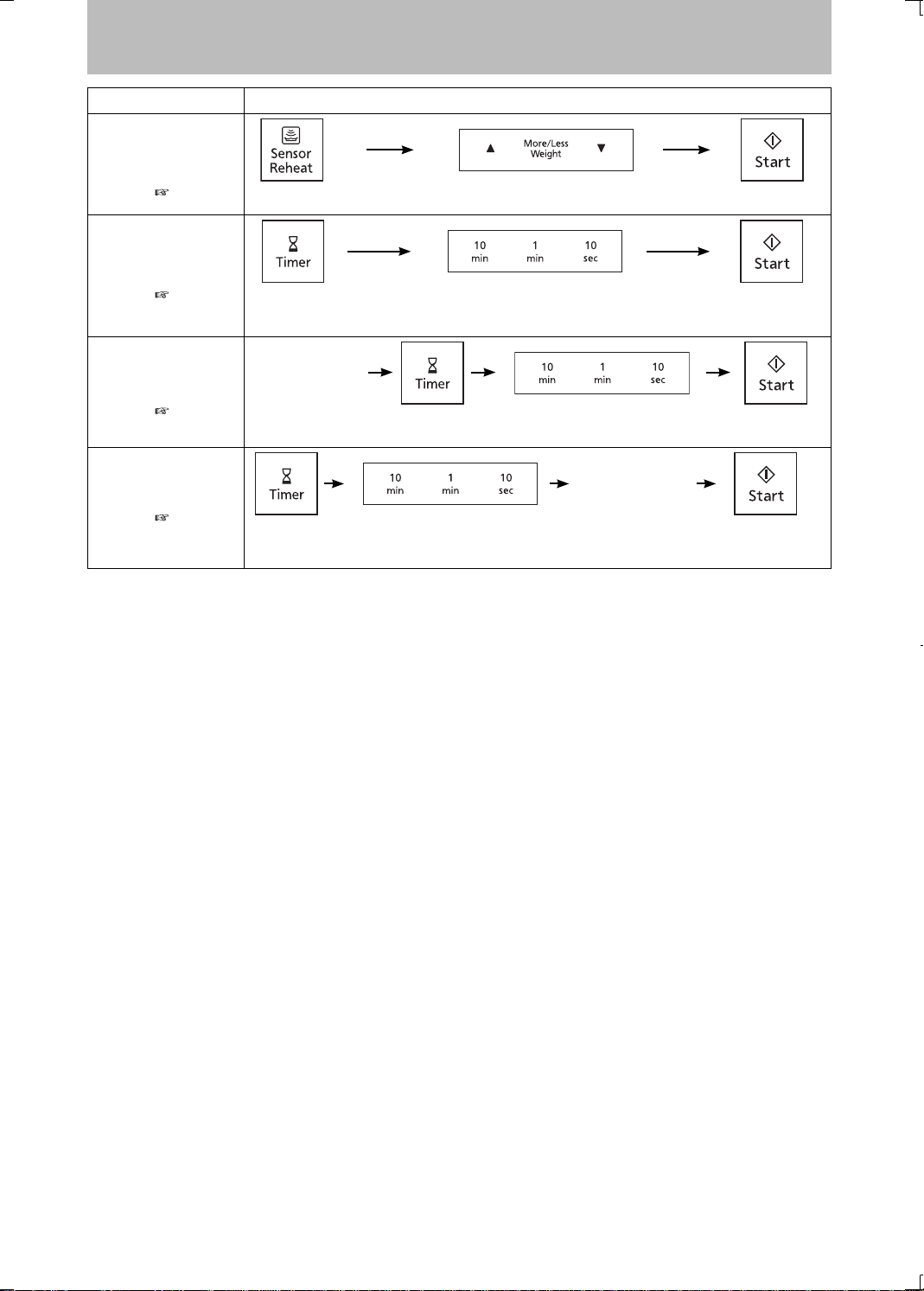
Quick Guide to Operation
Feature How to Operate
To Set Clock
(
page 12)
Press once. Press once.Set time of day. (Max 12:59)
To Set/Cancel
Child Safety
Lock
(
page 12)
To set
3 times. Display
or
To cancel
3 times. Display
To Cook/Reheat/
Defrost by Micro
Power and Time
Setting
(
page 13)
Select power. Select cooking time. Press once
To Use Turbo
Defrost Pad
(
page 14)
Press to select the
desired weight
Press once
After you select the Turbo Defrost feature, you can also press More/Less/Weight
Pads to select weight before pressing Start.
To Use Add Time
Pad
(
page 16)
Press oncePress once Set time.
At the end of
program.
To Cook using
“Beverage” Pad
(
page 17)
Press to select
1 cup or 2 cups.
Press once
Press to select
coffee or milk.
To Cook using
“Melt & Soften”
Pad
(
page 18)
Set weight Press oncePress until desired
menu number appears.
To Cook using
“Sensor Cook”
Pads
(
page 19)
optional
e.g. Frozen Vegetables
Press oncePress twice.
F0003BQ60QP_OI_00_160531.indd 32F0003BQ60QP_OI_00_160531.indd 32 2016/8/24 8:19:362016/8/24 8:19:36
– 33 –
Quick Guide to Operation
(continued)
Feature How to Operate
To Cook using
“Sensor
Reheat” Pad
(
page 25)
optional Press oncePress once
To Use Kitchen
Timer
(
page 27)
Press once Press onceSet time.
To Set Standing
Time
(
page 27)
Press once.
Set the desired
cooking programme,
up to 2 stages.
(see page 13)
Press once.Set time.
To Set Delay Start
(
page 27)
Press once.
Set the desired
cooking programme,
up to 2 stages.
(see page 13)
Press once.Set time.
F0003BQ60QP_OI_00_160531.indd 33F0003BQ60QP_OI_00_160531.indd 33 2016/8/24 8:19:362016/8/24 8:19:36

– 34 –
Microwave Recipe Techniques
Microwaves penetrate the surface of the food to a
depth of about two to three centimetres and then
the heat is gradually conducted in a random pattern.
Some parts of food matter cook faster than others.
Special microwave techniques are used to promote
fast and even cooking. Some of these techniques
are similar to those used in conventional cooking, but
because microwaves produce heat very quickly the
following techniques are extremely important. It’s a
must for you to be familiar with the following tips.
Food Characteristics
Size and Quantity
Small portions cook faster than large portions.
As you increase the quantity of food you put into
the microwave oven, you must also increase your
cooking time. The microwave oven has the same
power regardless of quantity; thus the power is
divided between more items and so it takes longer to
cook. As a general guide, if you double the quantity
of food suggested in the recipe, add half the time
suggested again.
Liquid Content
Low moisture foods take a shorter time to cook than
foods with a lot of moisture.
Shape
Uniform sizes cook more evenly. To compensate
for irregular shapes, place thin pieces towards the
centre of the dish and thicker pieces towards the
outer edge of the dish.
Bone and Fat
Bones conduct heat and cause the meat next to
them to be heated more quickly. Large amounts of
fat absorb microwave energy and the meat next to
these areas may overcook.
Starting Temperature
Food which has been sitting at room temperature
takes less time to cook than refrigerated or frozen
food.
Density and Composition
Porous, airy foods (cakes and breads) take less
time to cook than heavy compacted foods (meat and
vegetables). Recipes high in fat and sugar content
cook more quickly.
Soups
Use a bowl and stir before heating and at least once
through reheat time and again at the end.
Techniques for Preparation
Timing
A range of cooking times is given in each recipe for
two reasons. First, to allow for the uncontrollable
differences in food shapes, starting temperatures and
personal preferences. Secondly, these allow for the
differences in electrical voltage input which changes
during peak load periods. Always remember that it
is easier to add time to undercooked food. Once the
food is overcooked, nothing can be done. For each
recipe, an approximate cooking time is given.
Stirring
Stirring is often necessary during microwave cooking.
We have noted when stirring is helpful in the recipes.
Always bring the outside edges towards the centre
and the centre portions to the outside.
Rearranging or Turning
Some foods should be turned in the container during
cooking. For example, because of the different
thicknesses in the breast and back sections of
poultry, it is a good idea to turn poultry over once to
ensure more even cooking.
Rearranging or turning over uneven shaped food in
the dish should be done as suggested to ensure a
satisfactory result. Rearrange small items such as
chicken pieces, prawns, hamburger patties, nuts or
potatoes. Rearrange pieces from the centre to the
edge of the dish.
Cooking in Layers
This microwave oven is not designed to cook more
than 1 layer of food. Cooking in 2 layers may not
always be successful, it takes longer and may be
uneven. You can successfully reheat two dinner plates
of food at one time but remember to increase the
reheating time and use a microwave warming rack.
Piercing of Foods
Pierce the skin or membrane of foods such as eggs,
tomatoes and jacket potatoes when cooked whole in
the microwave oven. This allows steam to escape. If
the skin has not been pierced, food may burst.
Cured Meats
Cured meats may overcook in some areas due to
the high concentration of salts used in the curing
process. So take care when cooking different brands
of bacon as cooking times may vary slightly.
F0003BQ60QP_CB_00_160531.indd 34F0003BQ60QP_CB_00_160531.indd 34 2016/8/18 13:07:462016/8/18 13:07:46

– 35 –
Microwave Recipe Techniques
Techniques for Preparation
Covering
Covering food minimizes the microwave cooking
time. Because microwave cooking is done with time
and not direct heat, the rate of evaporation cannot be
easily controlled. However, this can be corrected by
using different materials to cover dishes. Plastic wrap
is the best substitute for a lid as it creates a tighter
seal and so it retains more heat and steam. Wax
paper and paper towels hold the heat in but not the
steam. These materials also prevent splattering. Use
a paper towel, wax paper or no cover when steam is
not needed for tenderising.
Browning
Meats and poultry, when cooked longer than 10 to
15 minutes, will brown from their own fat. Foods
cooked for shorter periods of time can be aided with
the help of a browning sauce, worcestershire sauce
or soy sauce. Simply brush one of these sauces over
meat or poultry before cooking. Baked goods do not
need long cooking time and therefore, do not brown.
When cakes or cupcakes are iced, no one will notice
the visual difference. For cakes or cupcakes, brown
sugar can be used in the recipe in place of caster
sugar or the surface can be sprinkled with dark
spices before baking.
Standing Time
The moisture molecules continue to vibrate in
the food when the microwave oven has turned
itself off. After all, the molecules were vibrating at
2,450,000,000 times per second during cooking. So
cooking continues even after the food is no longer
being exposed to the microwaves whether in or
outside your microwave oven.
Standing time refers to the time it takes (after the
microwave time is completed) to allow the interior of
the food to fi nish cooking.
The amount of standing time varies with the size
and density of the food. In meat cookery, the internal
temperature will rise between 5 °C and 10 °C if
allowed to stand covered for ten to fi fteen minutes.
Rice and vegetables need shorter standing time,
but this time is necessary to allow foods to complete
cooking in the centre without overcooking on the
edges.
The power level used in microwave cooking also
determines the standing time. For example, when
using a lower power level the standing time is shorter
because of a lower concentration of heat in the food.
Foods should always be kept covered while standing
in order to retain the heat. If a longer standing time is
required (while you cook another food to serve with
the fi rst, for instance), cover with aluminum foil.
Converting Your Favourite Conventional
Recipes for Microwave Cooking
When adapting conventional recipes for microwave
cooking, time are reduced considerably.
For example, a chicken which takes 1 hour to cook
in a moderate oven will take 15 to 20 minutes on P7
Power in your microwave oven.
Use similar microwave recipes to help you adapt
conventional recipes. Remember, it is always best to
undercook a recipe and then add an extra minute or
two to fi nish it off.
Here are some other tips that may help:
• Reduce liquids in a conventional recipe by one half
to two thirds, e.g. 1 cup (250 ml) should be reduced
to ½ cup (125 ml).
• Add more thickening such as fl our or cornfl our to
sauces and gravies if you do not reduce the liquid.
• Reduce seasonings slightly in a recipe where
ingredients do not have time to simmer by
microwave.
• Do not salt meats, poultry or vegetables before
cooking; otherwise, they will toughen and dry out.
• If one ingredient takes longer to cook than the
others, pre-cook it in the microwave oven fi rst.
Onion, celery and potato are examples.
• When cooking meat or vegetables, omit any oil or
fat that would have been used in a conventional
recipe for browning.
• Reduce leavening agents for cakes by one quarter
and increase liquids by one quarter.
• Biscuits require a stiff dough. Increase fl our by
about 20 percent. Substitute brown sugar for white
sugar and use biscuit recipes that have dark spices
or require icing. Because of the short cooking time,
biscuits don’t have time to brown. Chill dough for
half an hour before baking. This produces a crisper
biscuit. Bake biscuits on a glass tray lined with
greaseproof paper.
• Since microwaves penetrate foods about two
centimetres from the top, bottom and sides,
mixtures in round shapes and rings cook more
evenly. Corners receive more energy and may
overcook.
• Items with a lot of water, such as rice and pasta,
cook in about the same time as they would on
a conventional stove. (Refer to Rice and Pasta
chapter.)
Select recipes that convert easily to microwave
cooking such as casseroles, stews, baked chicken,
fi sh and vegetable dishes. The results from foods
such as grilled meats, cooked souffl es or two-crust
pies could be less than satisfactory. Never attempt to
deep fry in your microwave oven.
F0003BQ60QP_CB_00_160531.indd 35F0003BQ60QP_CB_00_160531.indd 35 2016/8/18 13:07:462016/8/18 13:07:46

– 36 –
Microwave Recipe Techniques
Menu Planning for Microwave Cooking
How to Keep Everything Hot at The Same Time
Plan your meals so that the food will not all need
last minute cooking or attention at the same time.
The special features of microwave cookery make
it easy to serve meals with everything piping hot.
Cooking of some foods may be interrupted while you
start others, without harming the nutritional value or
fl avour of either.
A recipe which requires standing time can be
microwaved fi rst and another food cooked while it
stands. Dishes prepared in advance can be reheated
briefl y before serving.
It does take some experience and time to cook with
confi dence. Microwaves are fast so you will have to
do some experimenting. You might fi nd you will use
your conventional range in conjunction with your
microwave oven. For example, while cooking the
roast in the microwave oven, you can be cooking the
vegetables and gravy on the range top. This can also
be done the other way around. Prepare your meals
as follows.
1. Firstly, cook the most dense item (roast or
casserole). Drain and retain meat juice from joints
then cover with foil.
2. Cook the potatoes, rice or pasta.
3. Cover with foil for standing.
4. Cook greens and other vegetables.
5. Cover with foil for standing.
6. Cook the gravy with the retained meat juices,
stock and thickening.
7. Carve the roast and serve the vegetables and
gravy.
While you are learning to plan meals, you may get
a bit behind time. Don’t worry. Dinner servings may
be suitably reheated on P7, for 1 to 2 minutes per
serving.
If you prefer not to use foil, cover food with saucepan
lids. A metal lid will retain the heat for at least 15
minutes.
Meanwhile, how can you cook all the vegetables at
the same time? Simply place potatoes and pumpkin
in one dish and less dense vegetables such as
broccoli, cabbage, caulifl ower, beans and peas in
another. Sprinkle greens with water. Cover with a lid
or plastic wrap. Cook on P10 for cooking times refer
to vegetable cooking chart on page 52-53. Fresh
and frozen vegetables can be mixed on a vegetable
platter, but remember frozen vegetables are not
as dense as fresh vegetables, as they have been
blanched before freezing.
If vegetables are cut to a similar size, they can be
cooked in separate ramekins or small dishes at the
same time.
Increasing & Decreasing Recipes
Increasing
• To increase a recipe from 4 to 6 servings, increase
each ingredient listed by half.
• To increase a recipe from 4 to 8 servings, double
each ingredient listed.
• For larger quantities of a recipe, a large dish should
be used. Make sure that the dish is deep enough to
prevent the recipe from boiling over during cooking.
• Make sure to cover, stir or rearrange food as
directed in the recipe and always check the food
during cooking.
• Increase standing times by 5 minutes per 500
g
.
• Use the same Power Level recommended in the
original recipe.
• Increase the cooking times by: ⅓ of original cooking
time for 6 servings; and an extra ½ of original
cooking time for 8 servings.
Decreasing
• To decrease a recipe from 4 to 2 servings, decrease
each ingredient listed by half.
• For small quantities, a small dish should be used.
Make sure that the dish is large enough to prevent
the recipe from boiling over during cooking.
• Use the same Power Level recommended in the
original recipe.
• Decrease the cooking times by ½ to
⅔
of the
original cooking time.
Cooking for One
• To decrease a recipe from 4 to 1 serving, quarter
each ingredient listed.
• A smaller dish should be used, making sure that the
dish is still large enough to prevent the recipe from
boiling over.
• Use the same Power Level recommended in the
original recipe.
• Quarter the original cooking times, then add extra
time, if needed.
• Make sure to cover, stir or rearrange food as
directed in original recipe and always check the
food during cooking.
F0003BQ60QP_CB_00_160531.indd 36F0003BQ60QP_CB_00_160531.indd 36 2016/8/18 13:07:462016/8/18 13:07:46

– 37 –
Reheat
Converting Recipes from Other Sources
When the recipe is written with a wattage different
than your oven, adjust the cooking time by
approximately 10% per 100 watts, e.g. 6 minutes
would be adjusted by 36 seconds. Alternately, adjust
the power level by one level. If your wattage is
higher than the recipe: (1) Adjust time downward or
(2) Adjust power level downward. If your wattage is
lower than the recipe: (1) adjust time upward or (2)
adjust power level upward (when possible).
Converting Recipes from Other Sources
One of the most common uses for a microwave
oven is to reheat food. Your Panasonic microwave
allows you to either reheat by placing food into
the oven and you choose the micro power level
and length of heating time or you may reheat
automatically by using the SENSOR REHEAT Pad
on your microwave. Following are some directions
for reheating pre-cooked foods from either frozen
refrigerator temperature or room temperature.
General rules for reheating foods by
Micro Power
• Many convenience foods contain heating
instructions on the packaging. It is best to follow
these instructions, being sure to check the wattage
of the oven they used and adjust the cooking time
if necessary (decrease cooking time by 10% for
every 100 watts more powerful your oven is).
• If package directions are not available, follow the
recommendations in the charts on the following
pages.
• All foods must be pre-cooked; raw foods will
not cook through during reheating times and if
consumed may cause illness.
• Do not reheat in foil containers, cans or plastic
containers as incorrect heating times will result.
Place foods into microwave safe bowls or onto
dinner-plates before heating.
• Most foods can be heated on P10 but consider if
the food is delicate in structure like baked custard
or you have a large quantity, a lower power level for
slightly longer may be gentler.
• Cover foods with plastic wrap if you require a
steamed effect or leave uncovered for a drier
surface, e.g. Crumbed foods.
Note: when cooking by Sensor Cook all food must
be covered.
• Stir or re-arrange foods during heating as this
will help food heat evenly. Stir after heating and
let stand for 2 to 3 minutes. Check temperatures
before adding extra heating time and ensure food is
hot. If food is not heated enough, consumption may
cause illness.
Caution:
Pastry items which have a fi lling that is high in
fat., sugar or moisture will become hotter in the
centre and the pastry may only feel warm. Ensure
you allow it to stand for several minutes before
eating.
F0003BQ60QP_CB_00_160531.indd 37F0003BQ60QP_CB_00_160531.indd 37 2016/8/18 13:07:462016/8/18 13:07:46
– 38 –
Reheat
Reheating by Micro Power - Frozen Pre-cooked Foods
FROZEN ITEM
(Pre-cooked)
POWER
TIME
(in minutes)
SPECIAL INSTRUCTIONS
BREAD &
BAKED PRODUCT
Bread 1 slice
1 loaf
6 rolls
P7
P7
P6
10 - 15 sec
1 - 3
1 - 2
Do not let bread get hot, or it will become
rubbery and dry out. Remove whole loaf
from original wrapper.
Place on paper towel to absorb moisture.
Cheesecake (450
g
) P3 5 - 7 Remove from container. Defrost on plate.
Muffi ns - 4 (400
g
)P71
½
- 2 Place onto paper towel lined plate.
Scones - 6 (400
g
)P61
½
- 2
Defrost on paper lined plate. Stand 2
minutes.
PIES
Fruit Pie (600
g
)P3
then
P7
5 - 7
5 - 7
Remove from foil container and place
uncovered into a pie dish.
Meat Pie (175
g
) P7 4 - 5 Place onto paper towel lined plate.
Pizza (350
g
) P10 5 - 7
Remove from package and place onto
paper towel or follow manufacturer’s
instructions.
FROZEN MEAL
Fish in Sauce (200
g
) P5 5 - 7 Pierce corner of bag. Heat on a plate.
Frozen Casserole
(500
g
)
P10 9 - 11
Pierce pouch.
Heat on a plate or bowl.
Lasagne (500
g
) P9 11 - 13
Remove from foil container, place into
serving dish.
Plated style dinner
(320
g
)
P5 8 - 10
Remove foil cover and replace with
plastic wrap.
Vegetables & Sauce
(in the bag) (500
g
)
P7 6 - 8 Pierce corner of bag. Heat on a plate.
MISCELLANEOUS
Chicken Pieces (500
g
)
Chicken Nuggets (12)
P7
P7
8 - 10
3 - 4
Place onto paper towel lined plate.
Place onto paper towel lined plate.
Croissants - 4 (200
g
) P3 1 - 1
½
Place onto paper towel lined plate.
Fish Fingers - 8 (200
g
)
P3
then
P10
2 - 4
2 - 3
Place onto paper towel lined plate.
Sausage Rolls (225
g
)
P5 2 - 3
Place onto paper towel lined plate.
F0003BQ60QP_CB_00_160531.indd 38F0003BQ60QP_CB_00_160531.indd 38 2016/8/18 13:07:462016/8/18 13:07:46

– 39 –
Reheat
IMPORTANT POINTS TO CONSIDER
WHEN REHEATING COLD FOODS
STARTING TEMPERATURE —
Foods taken from the refrigerator will take longer to
reheat than foods from room temperature.
Quantity —
One serving heats faster than several servings.
When heating large quantities, stir food to ensure
even heating. It is quicker to heat individual plates of
food than large quantities in a casserole dish.
Plated Dinners —
Arrange foods with the most dense items towards
the outside of the plate. Cover meats with sauces/
gravies if desired, spread out mashed potatoes or
rice so it heats more evenly. When assembling plates
of leftover foods, use foods which have a similar
starting temperature.
Covering Foods —
Most foods need to be covered with one sheet
of absorbent paper towel to hold in the heat and
prevent splattering without steaming. When more
moisture is desired, cover with plastic wrap.
Heating —
Reheating is usually done on P10, however, if food
has a more delicate texture, like a baked custard, a
lower power setting should be used. P7 for a little
longer will be gentler on the food. An average plate
of food would generally take 1 to 3 minutes to heat
depending on the density of the food. Place it in
for the minimum time and add extra heating time if
required.
Ensure food is hot by feeling the bottom of the plate
in the centre. If the plate is cool, food may be warm
but will lose heat quickly as the plate will absorb the
heat and taste cold when served.
If food is not heated enough, consumption may
cause illness.
Elevation —
Elevate pastries and breads on a small plastic rack
with paper towel under the food to prevent it from
becoming soggy.
Caution:
Pastry items which have a fi lling that is high in
fat., sugar or moisture will become hotter in the
centre and the pastry may only feel warm. Ensure
you allow it to stand for several minutes before
eating.
IMPORTANT POINTS TO CONSIDER
WHEN REHEATING FOODS FROM THE
FREEZER
VOLUME —
The greater the volume and the more dense the
item, the longer it takes to reheat, e.g. frozen cake
will take less time than frozen casserole.
LARGE VOLUME —
Large, dense, frozen precooked foods are best
thawed on defrost until icy in the centre then heated
on P7. This prevents overcooking of the edges.
Stirring is often needed to distribute heat evenly.
Commercial frozen foods —
These foods should be removed from their foil
containers if possible and placed into suitable
microwave safe containers. If a foil container is
used in the microwave oven it shouldn’t be more
than 4 cm high and must not touch the interior of
the microwave oven. Remove the cover from the
tray and replace with paper towel or plastic wrap to
prevent splattering.
Foods to be served at room temperature —
For best results, defrost for a short time and allow to
stand to complete thawing, e.g. frozen cake.
Vacuum sealed pouches —
Pierce pouches, bags before heating to allow steam
to escape. This prevents bursting.
Containers —
Use dishes about the same volume of the food or
slightly larger to allow for stirring. Remove or release
snap seal lids other wise they will pop during heating
and may disfi gure.
Pies and pastries —
Pies and pastries that contain raw pastry and fi lling
cannot be cooked in the microwave oven. Precooked
products can be thawed and heated. Place them on
a sheet of paper towel and elevate on plastic rack
for best results. For added crispness place under
the grill or in a hot oven for few minutes. Pastry
items can become tough and rubbery if overheated,
remember to allow 5 minutes standing then test
before adding extra heating time.
F0003BQ60QP_CB_00_160531.indd 39F0003BQ60QP_CB_00_160531.indd 39 2016/8/18 13:07:462016/8/18 13:07:46
– 40 –
Soups and Snacks
P
UMPKIN
S
OUP
Serves: 4
Ingredients:
1
kg
diced pumpkin
1 onion, diced
2 cups chicken stock
1 teaspoon curry powder
pepper
Method:
Place pumpkin, onion and curry powder in a 2-litre
casserole dish. Cover and cook on P10 for 12
minutes. Add chicken stock and pepper. Cook on
P10 for 10 minutes. Cool slightly. Purée pumpkin
and liquid in blender or food processor. Pour into
individual serving dishes and garnish with chives.
To cook by :
Prepare pumpkin as above. Cover securely with
plastic wrap. Refer to Potatoes directions on page
20. Select Potatoes, then
Start
.
S
HORT AND
L
ONG
S
OUP
Serves: 4
Ingredients:
200
g
fresh singapore noodles
12 (200
g
) frozen mini dim sims
4 green onions, sliced
1 litre chicken stock
1 teaspoon crushed garlic
½ teaspoon chopped ginger
2 tablespoons soy sauce
1 chicken breast, cooked and sliced
4 baby bok choy, quartered
1 cup bean sprouts
2 tablespoons dried onion (optional)
Method:
Place all ingredients except bok choy and bean
sprouts in a 4 litre casserole dish and cook on P10
for 10 minutes. Add bok choy and cook on P10 for 2
minutes. Serve in individual bowls topped with bean
sprouts and onion.
HINT:
To cook 1 double chicken breast. Place onto a
dinner plate. Cover and cook on P7 for 8 to 10
minutes.
P
EA AND
H
AM
S
OUP
Serves: 6
Ingredients:
2½ cups green split peas
850
g
smoked ham hock
1 medium onion, chopped
1 tablespoon fresh thyme leaves
1 bay leaf
6 cups chicken stock
½ cup frozen peas
Method:
Wash split peas and place in a 2-litre capacity bowl
with 1-litre of water. Cover and allow soaking for 8
hours or overnight. Remove rind from ham hock and
discard. Cut meat away from the bone and roughly
chop. Reserve bone. Drain peas and place into a
5-litre capacity microwave safe dish. Add ham bone,
chopped ham, onion, thyme, bay leaf and chicken
stock. Cook uncovered on P10 for 15 minutes.
Reduce power to P6 and cook for 15 minutes. Skim
top of soup and cook on P6 for a further 30 minutes.
Remove ham bone and bay leaf and stir in frozen
peas. Cook on P6 for 10 minutes. Blend half the
soup and return to the bowl, stirring through the
remaining soup. Serve hot with crusty bread.
Tip:
Substitute 500
g
bacon bones and 250
g
of diced
bacon rashers for the ham hock.
Do not add salt when cooking lentils or pulses, as
they will toughen. Add salt after cooking if desired.
P
OTATO AND
L
EEK
S
OUP
Serves: 4 to 6
Ingredients:
1
kg
potatoes, peeled and diced
2 medium thinly sliced leeks
2 teaspoons fresh thyme
pepper
3 cups chicken stock
150 ml cream
Method:
Place potatoes, leeks, thyme and pepper in 4-litre
casserole dish. Cover and cook on P10 for 8
minutes. Stir in chicken stock. Cover and cook on
P10 for 14 to 16 minutes. Purée soup mixture. Stir in
cream and serve hot or cold in individual bowls.
To cook by Sensor Cook:
Prepare as above. Cover securely with plastic wrap.
Refer to Potatoes directions on page 20. Select
Potatoes, then
Start
.
F0003BQ60QP_CB_00_160531.indd 40F0003BQ60QP_CB_00_160531.indd 40 2016/8/18 13:07:462016/8/18 13:07:46

– 41 –
Soups and Snacks
C
HICKEN AND
P
RAWN
L
AKSA
Serves: 4
Ingredients:
Soup:
2 tablespoons laksa paste
400 ml coconut milk
1 litre chicken stock
1 tablespoon soy sauce
fresh ground black pepper
Laksa:
250
g
rice noodles
8 cups boiling water
1 bunch coriander, leaves chopped
4 small red chillies, seeds removed
and fi nely chopped
½ cup bean sprouts
4 limewedges
1 tablespoon peanut oil
400
g
cooked chicken tenderloins, sliced
12 green king prawns, peeled
Method:
Soup:
Place the laksa paste, coconut milk, stock, soy sauce
and pepper into a 3-litre dish and cook covered on
P10 for 8 to 10 minutes.
Laksa:
Place the noodles and water in a 4 litre dish. Cover
and cook on P10 for 2 to 3 minutes, stirring halfway
through. Drain well and divide between 4 deep
bowls. Place the coriander, chillies, bean sprouts
and lime on top. Place the peanut oil and prawns
in a 1-litre dish and cook on P7 for 3 to 5 minutes,
stirring halfway through. Add the chicken and prawns
to each individual bowl and set aside.
To serve:
Heat soup on P10 for 2 minutes. Pour the hot soup
over the ingredients in the 4 bowls and serve.
Z
UCCHINI
S
LICE
Serves: 4 to 6
Ingredients:
4 rashers bacon, diced
1 onion, diced
2 cups grated zucchini
2 cups grated carrot
1 cup grated tasty cheese
1 cup self raising fl our
5 eggs, lightly beaten
125 ml vegetable oil
1 tablespoon fresh chopped parsley
salt and pepper
Method:
Lightly grease a 25 cm square microwave safe dish.
Place bacon and onion in a 2-litre casserole dish and
cook on P10 for 2 to 3 minutes. Allow to cool slightly.
Stir in zucchini, carrot and cheese and fl our. In a
1-litre bowl whisk together eggs, oil and parsley. Add
to bacon mixture season with salt and pepper and
stir until combined. Pour into prepared dish. Cook on
P6 for 22 to 24 minutes.
N
ACHOS
S
UPREME
Serves: 4 to 6
Ingredients:
500
g
topside mince
35
g
packet taco seasoning mix
⅓ cup tomato paste
1 teaspoon Mexican chilli powder
310
g
red kidney beans, mashed in
liquid
180
g
packet corn chips
1 avocado
½ cup sour cream
½ cup grated cheese
paprika
Method:
Place meat in a 2-litre dish. Cook on P7 for 6
minutes, stirring halfway through. Mix with fork,
breaking up any large pieces of meat. Add taco mix,
tomato paste, chilli powder and kidney beans. Cook
on P7 for further 10 minutes, stirring halfway through
cooking. Place corn chips in a 3-litre microwave
suitable serving dish. Pile meat sauce in the centre.
In a small bowl, mash avocado and mix in sour
cream. Spoon this mixture over meat sauce and top
with grated cheese. Sprinkle with paprika. Heat on
P7 for 3 to 4 minutes.
N
UTS AND
B
OLTS
Serves: 6 to 8
Ingredients:
80
g
butter
2 teaspoons curry powder
2 tablespoons worcestershire sauce
½ teaspoon salt
¼ teaspoon garlic powder
100
g
packet mixed rice crackers
100
g
fried noodles
200
g
salted peanuts
125
g
packet pretzel sticks
½ cup Nutri-Grain
Method:
Place butter, curry, worcestershire sauce, salt and
garlic powder in a 3-litre casserole dish. Cook on
P10 for 1 to 2 minutes. Add remaining ingredients,
mix well and cook on P10 for 4 to 5 minutes. Stir
twice through cooking. Allow to cool. Place in a bowl
and serve with drinks. Store in an airtight container
once cool.
F0003BQ60QP_CB_00_160531.indd 41F0003BQ60QP_CB_00_160531.indd 41 2016/8/18 13:07:462016/8/18 13:07:46

– 42 –
Fish and Shellfi sh
Cooking Fish and Shellfi sh by Micro Power
Clean fi sh before starting the recipe. Arrange fi sh in a single layer, overlap thin fi llet ends to prevent
overcooking. Prawns and scallops should be placed in a single layer.
Cover dish with plastic wrap. Cook on the power level and for the minimum time recommended in the chart
below. Halfway through cooking rearrange or stir prawns, fi sh fi llets or scallops
Cooking Fish and Shellfi sh by Micro Power
FISH OR SHELLFISH AMOUNT POWER
APPROX. COOKING TIME
(in minutes)
Fish Fillets 500
g
P4 8 to 10
Scallops (sea) 500
g
P4 6 to 8
Green Prawns medium size
(shelled and cleaned)
500
g
P4 7 to 9
Whole Fish
(stuffed or unstuffed)
500
g
to 600
g
P4 7 to 10
G
ARLIC &
C
HILLI
P
RAWNS
Serves: 4
Ingredients:
1
kg
medium uncooked king prawns
1 small red onion, thinly sliced
40
g
butter
3 garlic cloves, crushed
2 fresh bird's eye chillies,
deseeded & fi nely chopped
½
small red capsicum, fi nely sliced
100
g
snow peas, trimmed
1 tablespoon lemon juice
80 ml thickened cream
¼ cup coriander leaves, chopped
Cooked jasmine rice, to serve
Method:
Peel and de-vein prawns leaving tails in tact, set
aside. Place onion, butter, garlic and chilli into a
3 Litre microwave safe dish. Cook on P10 for 4
minutes, stir halfway through cooking. Add prawns
and mix to combine. Cook on P7 for 3 minutes. Stir
in capsicum and snow peas, cover and cook on P7
for a further 3 minutes. Stir through lemon juice,
cream and coriander, season and cook on P10 for 1
minute. Serve immediately with cooked rice.
G
ARLIC
P
RAWNS
Serves: 2
Ingredients:
60
g
butter
2 clove garlic, crushed
1 tablespoon lemon juice
1 tablespoon chopped parsley
500
g
peeled green prawns
Method:
Place butter and garlic in a 1-litre dish and cook
on P10 for 30 to 50 seconds. Add lemon juice,
parsley and prawns. Cook on P6 for 5 to 7 minutes,
stirring halfway through cooking. Serve in individual
ramekins.
S
TEAKS WITH
L
IME
B
UTTER
Serves: 4
Ingredients:
30
g
butter
1 clove garlic, crushed
1 teaspoon grated fresh ginger
1 teaspoon grated lime rind
2 tablespoons lime juice
½ teaspoon sugar
500
g
salmon, steaks
Method:
Place butter, garlic, ginger, lime rind, juice and sugar
in a shallow dish. Cook on P7 for 1 to 2 minutes. Stir
halfway through cooking. Add salmon steaks and
coat with sauce. Cover and cook on P5 for 5 to 7
minutes. Stand for 2 to 3 minutes before serving.
To cook by Sensor Cook:
Prepare as above. Cover securely with plastic wrap.
Refer to Steam Fish directions on page 21. Select
Steam Fish, then
Start
.
L
EMON
P
EPPER
F
ISH
Serves: 2
Ingredients:
350
g
fi sh fi llets
¼ cup lemon juice
1 teaspoon cracked black pepper
Method:
Place fi sh, lemon juice and cracked black pepper in
1-litre casserole dish. Cook on P4 for 4 to 6 minutes.
Let stand for 3 minutes before serving.
To cook by Sensor Cook:
Prepare as above. Cover securely with plastic wrap.
Refer to Steam Fish directions on page 21. Select
Steam Fish, then
Start
.
F0003BQ60QP_CB_00_160531.indd 42F0003BQ60QP_CB_00_160531.indd 42 2016/8/18 13:07:462016/8/18 13:07:46

– 43 –
Fish and Shellfi sh
B
OUILLABAISSE
Serves: 4 to 6
Ingredients:
2 tablespoons olive oil
2 onions, sliced
1 large leek, sliced
4 cloves garlic, crushed
425
g
tomato pieces
½ cup tomato paste
4 cups hot fi sh stock
⅓ cup dry white wine
1 tablespoon fresh thyme leaves
½ teaspoon saffron powder
1 teaspoon chilli powder
freshly ground black pepper
salt
500
g
fi rm fi sh fi llets, chopped
500
g
green prawns meat de-veined
Method:
Place oil, onions, leek and garlic in a 4-litre dish.
Cover and cook on P10 for 6 to 8 minutes. Stir
halfway through cooking. Add tomatoes, tomato
paste, fi sh stock, wine, thyme, saffron, and chilli
powder. Season with salt and pepper. Cook on P10
for 12 minutes. Add fi sh fi llets and prawns. Cook on
P10 for 8 to 10 minutes or until seafood is cooked.
Serve garnished with fresh thyme.
T
OMATO
B
ASIL
M
USSELS
Serves: 4
Ingredients:
1
kg
fresh mussels
¼ cup water
1 tablespoon olive oil
1 leek, sliced
1 clove garlic, crushed
1 (425
g
) can tomato pieces
1 tablespoon tomato paste
½ teaspoon oregano
2 tablespoons chopped fresh basil
freshly ground black pepper
Method:
Place mussels and water into a bowl. Cover and
cook on P7 for 4 to 6 minutes. Set aside. Place oil,
leeks and garlic into a 3-litre dish. Cook on P10 for
2 minutes. Stir well, add tomatoes, tomato paste,
oregano, basil and pepper. Mix well. Cook on P10 for
3 to 4 minutes. Add mussels. Cover and cook on P10
for 2 to 3 minutes. Serve immediately.
O
YSTERS
K
ILPATRICK
Makes: 12
Ingredients:
2 rashers bacon fi nely chopped
1 tablespoon worcestershire sauce
2 teaspoons lemon juice
1 tablespoon barbecue sauce
12 oysters in shell
Method:
Spread bacon onto a dinner plate. Cover with
paper towel and cook on P10 for 2 to 3 minutes.
Mix together worcestershire sauce, lemon juice
and barbecue sauce. Place oysters in shell evenly
around dinner plate and sprinkle with bacon mixture.
Pour some sauce mixture over each oyster. Cook on
P10 for 1 to 1½minutes. Serve with drinks or as an
entree.
S
EAFOOD
M
ARINARA
Serves: 4
Ingredients:
750
g
Marinara mix
2 tablespoons butter
1 clove garlic, crushed
2 tomatoes, peeled and chopped
1 tablespoon tomato paste
¼ cup white wine
¼ cup fresh basil leaves, chopped
pepper
Method:
Place marinara mix into a 2-litre casserole dish. Set
aside. Place butter and garlic in 1-litre casserole
dish. Cook on P7 for 1 minute. Add remaining
ingredients (except seafood), to dish and cook on
P10 for 5 minutes. Purée tomato mixture in blender
or food processor and pour over seafood. Cook on
P6 for 7 to 9 minutes, stir halfway through cooking.
Stand for 5 minutes. Serve with salad and pasta.
F0003BQ60QP_CB_00_160531.indd 43F0003BQ60QP_CB_00_160531.indd 43 2016/8/18 13:07:462016/8/18 13:07:46
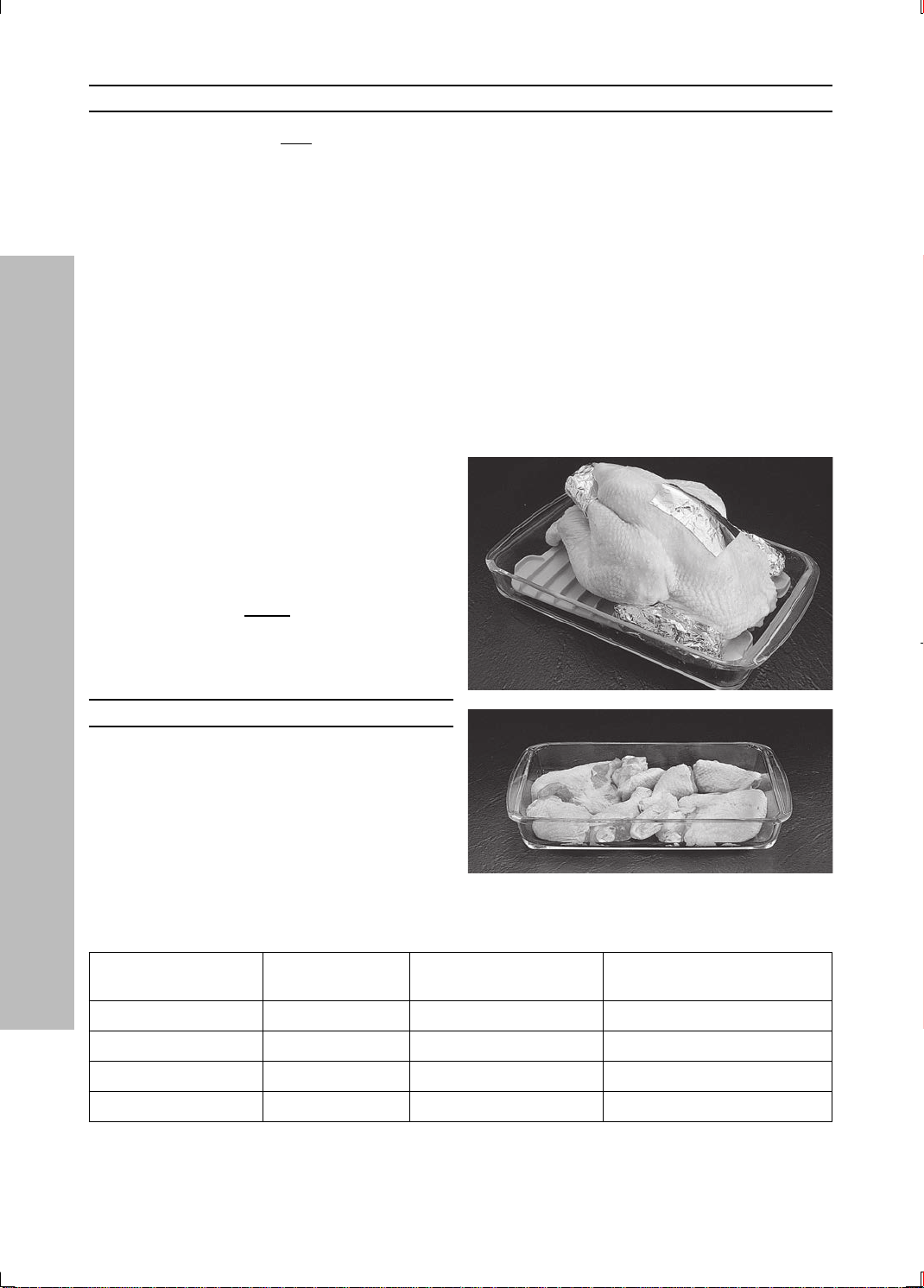
– 44 –
Poultry and Eggs
Season as desired, but salt after cooking. Browning
sauce mixed with equal parts of butter will enhance
the appearance.
Poultry must be unstuffed. Tie legs together with
cotton string. Place on a microwave rack set in a
rectangular dish. Place poultry breast-side down:
turn over halfway through cooking. Cover with wax
paper to prevent splattering.
If the poultry is not cooked enough, return it to
the oven and cook a few more minutes at the
recommended power level.
DO NOT USE A CONVENTIONAL MEAT
THERMOMETER IN THE MICROWAVE OVEN.
Let stand, covered with foil, 10 to 15 minutes after
cooking. Standing time allows the temperature
to equalize throughout the food and fi nishes the
cooking process.
If a large amount of juice accumulates in the bottom
of the baking dish, occasionally drain it. If desired,
reserve juices for making gravy.
Less-tender birds should be cooked in liquid such as
soup or broth. Use ¼ cup per 500
g
of poultry.
Use an oven cooking bag or a covered casserole.
Select a covered casserole deep enough so that bird
does not touch the lid.
If an oven cooking bag is used, prepare according
to package directions. Do not use wire twist-ties
to close bag. Use only nylon tie, a piece of cotton
string, or a strip cut from the open end of the bag.
Make six 2 cm slits on top of bag.
Cooking Poultry Pieces by Micro Power
Cover with wax paper or paper towel. Use the chart
below to determine recommended minimum cooking
times.
Arrange pieces skin-side down and evenly spread in
a shallow dish.
Turn or rearrange halfway through cooking. Shield
wing tips, drumstick ends etc., if required.
Multiply the weight of the poultry by the minimum
recommended minutes per 500
g
. See chart below.
Programme Micro Power and Time.
After cooking, check the internal temperature of
the bird with a microwave or conventional meat
thermometer inserted into the muscle. Check
temperature in both muscles. The thermometer
should not touch bone. If it does, the reading could
be inaccurate. A thermometer cannot be accurately
inserted into a small bird. To check desired cooking
of a small bird, juices should be clear and the
drumsticks should readily move up and down after
standing time.
During cooking, it may be necessary to shield
legs, wings and the breast bone with foil to prevent
overcooking. Wooden toothpicks can be used to hold
foil in place.
Cooking Poultry by Micro Power
POULTRY POWER
TEMPERATURE
AFTER COOKING
APPROX. COOKING TIME
(minutes per 500
g
)
Chickens P7 87 °C 10 to 15
Chicken (pieces) P7 87 °C 8 to 10
Turkey P7 87 °C 12 to 17
Duck P7 87 °C 10 to 15
Cooking Whole Poultry by Micro Power
F0003BQ60QP_CB_00_160531.indd 44F0003BQ60QP_CB_00_160531.indd 44 2016/8/18 13:07:462016/8/18 13:07:46
– 45 –
Poultry and Eggs
C
OOKING
E
GGS BY
M
ICRO
P
OWER
Boiled Eggs: Do not boil eggs in your microwave.
Raw eggs boiled in their shells can explode and
cause serious injury.
Poached Eggs: The membrane on egg yolks must
be pierced before cooking, otherwise steam will build
up and cause yolk to pop.
Scrambled Eggs: Slightly undercook scrambled
eggs as they will fi nish cooking during standing.
S
CRAMBLED
E
GGS
Serves: 2
Ingredients:
2 x 60
g
eggs
2 tablespoons milk
pinch of salt
Method:
In a 1-litre casserole dish, beat eggs lightly with
whisk. Add milk and salt. Whisk until well combined.
Cover dish with plastic wrap and cook on P6 for 1 to
1½ minutes. Stir eggs and cook for further 1 to 1½
minutes. Stand, covered, for 1 minute before serving.
P
OACHED
E
GGS
Serves: 2
Ingredients:
2 x 60
g
eggs
½ cup hot tap water
dash of vinegar
pinch of salt
Method:
Place one quarter of cup of water, dash of vinegar
and pinch of salt into 2 ramekin dishes or small glass
bowls. Heat water on P10 for 30 - 60 seconds. Break
egg into the water and with toothpick pierce the
egg yolk twice and egg white several times. Cover
dishes with plastic wrap and cook on P6 for 1 to 1½
minutes.
Stand, covered, for 1 minute before serving.
Note: The size of the eggs will alter cooking time.
B
ACON AND
E
GG IN A
C
UP
Serves: 1
Ingredients:
2 slices bacon
1 x 60
g
egg
1 tablespoon grated cheddar cheese
Method:
Place bacon on a dinner plate between 2 sheets of
paper towel cook on P10 for 1 to 2 minutes. Wrap
bacon around the inside of a 1-cup remekin dish.
Crack egg into centre of dish and pierce with tooth
pick. Cover and cook on P5 for 50 to 70 seconds.
Sprinkle with grated cheese.
G
REEN
P
EPPERCORN
C
HICKEN
Serves: 4
Ingredients:
500
g
sliced chicken breast fi llets
2 tablespoons green peppercorns
1 tablespoon seeded mustard
1 teaspoon chicken stock powder
2 tablespoons lemon juice
½ cup cream
Method:
Place chicken in a 3-litre casserole dish. Cook on P7
for 8 to 10 minutes stirring halfway through cooking.
Mix together peppercorns, mustard, stock powder,
lemon juice and cream. Pour over chicken, stir. Cook
on P10 for 2 to 3 minutes.
C
HICKEN
C
URRY
Serves: 4
Ingredients:
1 onion, chopped
2 tablespoons red curry paste
500
g
chicken fi llets, sliced
1 tablespoon fi sh sauce
1 tablespoon brown sugar
2 cups fi nely sliced vegetables
1 cup coconut milk
Method:
Place onion and curry paste in a 3-litre casserole
dish. Cook on P10 for 2 to 3 minutes. Add chicken
and combine. Cook on P7 for 6 minutes, stirring
once during cooking. Add fi sh sauce, brown sugar,
vegetables and coconut milk. Stir well. Cover and
cook on P10 for 4 to 6 minutes. Serve with Jasmine
rice.
F0003BQ60QP_CB_00_160531.indd 45F0003BQ60QP_CB_00_160531.indd 45 2016/8/18 13:07:462016/8/18 13:07:46
– 46 –
Poultry and Eggs
C
HICKEN
C
ACCIATORE
Serves: 4
Ingredients:
400
g
can diced tomatoes
¼ cup tomato paste
1 teaspoon minced garlic
1 onion, diced
2 teaspoons dried oregano
1
kg
chicken drumsticks
¼
red capsicum, sliced
Method:
Place all ingredients in a 2-litre casserole dish. Stir
until combined. Cover and cook on P7 for 10 to 12
minutes. Turn chicken and stir. Cook on P7 for 10 to
12 minutes.
R
OAST
C
HICKEN
Serves: 4 to 6
Ingredients:
1.5
kg
chicken
2 tablespoons melted butter
seasonings of your choice
lemon, pepper, seasoned salt, etc.
Method:
Clean and pat dry chicken with paper towel.
Brush chicken with melted butter and sprinkle with
seasoning. Place chicken, breast-side down, on rack
in 3-litre dish. Cook on P7 for 30 to 35 minutes. Turn
halfway through cooking.
HINT:
After cooking whole poultry, cover with foil to
retain heat while fi nishing the remainder of the
meal.
C
HICKEN
B
URRITOS
Serves: 4
Ingredients:
1 clove garlic, crushed
2 large onions, chopped
1 teaspoon chilli powder (optional)
35
g
taco seasoning mix
500
g
chicken tenderloins, diced
425
g
can red kidney beans, drained
½ cup tomato paste
½ cup water
1 cup grated cheese
12 tortillas
Method:
Place garlic, onion and chilli in a 3 litre casserole
dish. Cook on P10 for 2 minutes. Stir in remaining
ingredients except cheese and tortillas. Cover and
cook on P7 for 16 to 18 minutes, stirring twice during
cooking. Serve in warmed tortillas topped with grated
cheese.
T
HAI
C
HICKEN
W
INGS
Serves: 3 to 4
Ingredients:
1
kg
chicken wings
2 tablespoons soy sauce
2 tablespoons fi sh sauce
2 tablespoons lime juice
1 teaspoon crushed garlic
1 teaspoon crushed ginger
1 teaspoon crushed chilli
Method:
Place wings into a shallow dish. Combine remaining
ingredients and pour over wings. Marinate for at
least 2 hours in the refrigerator. Cook on P7 for 15 to
20 minutes, rearranging halfway through cooking.
To cook by Sensor Cook:
Prepare as above.Cover securely with plastic wrap.
Refer to Steam Chicken Pieces directions on page
21. Select Steam Chicken Pieces, then
Start
.
A
PRICOT
N
ECTAR
C
HICKEN
Serves: 4
Ingredients:
400 ml apricot nectar
40
g
French onion soup mix
1 onion, diced
1 clove garlic, crushed
½ cup dried apricots
1
kg
chicken legs
Method:
Place all ingredients except chicken legs into a 3-litre
dish. Mix well to combine. Add chicken legs and stir
to coat with sauce. Cook on P7 for 20 to 25 minutes,
stirring halfway through cooking.
C
HICKEN
S
AN
C
HOY
B
AU
Serves: 4 to 6
Ingredients:
10 dried shiitake mushrooms
2 teaspoons sesame oil
1 clove garlic, chopped
500
g
minced chicken
10 water chestnuts, fi nely chopped
227
g
can bamboo shoots, chopped
¼ cup soy sauce
1 tablespoon oyster sauce
2 tablespoons dry sherry
1 small iceberg lettuce
Method:
Cover mushrooms with boiling water, stand for 30
minutes. Drain, remove stems and chop fi nely. Place
oil and garlic in a 2 litre casserole dish, cook on P10
for 40 to 50 seconds. Add chicken and cook on P7
for 5 to 6 minutes. Add remaining ingredients except
lettuce and cook on P7 for 5 to 6 minutes. Separate
lettuce leaves. place tablespoons of mixture into
each lettuce leaf. Serve immediately.
F0003BQ60QP_CB_00_160531.indd 46F0003BQ60QP_CB_00_160531.indd 46 2016/8/18 13:07:462016/8/18 13:07:46

– 47 –
Poultry and Eggs
C
HICKEN
R
OLLS WITH
H
ONEY
M
USTARD
Serves: 4 to 6
Ingredients:
8 chicken thigh fi llets
16 prunes, pitted
8 green onions, sliced
2 tablespoons fl aked almonds
4 rashers rindless bacon, halved lengthwise
Honey Mustard Glaze
1 tablespoon brown sugar
1 tablespoon French Mustard
1 tablespoon honey
10
g
butter, melted
ground black pepper
Method:
Open out each thigh fi llet and trim away fat. Place 2
prunes, some spring onion and a few fl aked almonds
on each fi llet. Roll fi llets up and wrap a piece of
bacon around each one. Secure with toothpicks.
Blend all glaze ingredients together in a small bowl.
Place chicken into a 3-litre dish in a single layer and
brush with glaze mixture. Cook on P7 for 16 to 20
minutes, turning halfway through cooking.
C
HICKEN AND
A
SPARAGUS
R
ISOTTO
Serves: 4
Ingredients:
300
g
fresh asparagus, chopped
2 tablespoons olive oil
1½ cups arborio rice
1 clove garlic, crushed
4 cups boiling chicken stock
2 cups coarsely chopped cooked chicken
¼ cup grated fresh parmesan cheese
¼ cup cream
ground black pepper
1 tablespoon chopped parsley
extra coarsely grated parmesan cheese
Method:
Place asparagus into 2-litre dish and cook on P10
for 1 minute.Set aside. Place oil, rice and garlic in a
large microwave safe bowl. Cook covered on P10
for 1 minute. Add 2 cups of boiling chicken stock,
cook on P10 for 5 minutes. Stir twice during cooking.
Add remaining chicken stock and cook on P10 for
another 5 minutes. Add remaining ingredients along
with asparagus and stir into risotto. Cook covered on
P10 for 2 minutes. Stand for 5 minutes. Serve topped
with extra parmesan and black pepper.
H
ONEY
S
ESAME
D
RUMSTICKS
Serves: 4
Ingredients:
1
kg
chicken drumsticks
1 clove garlic, chopped
1 teaspoon chopped ginger
¼ cup soy sauce
¼ cup honey
2 tablespoons sesame seeds
Method:
Place all ingredients in 2-litre bowl, stir until
combined. Marinate for at least 2 hours or overnight.
Remove chicken from marinade and place in shallow
dish with the meatiest ends to the outside. Cook on
P7 for 15 to 18 minutes, turning once during cooking.
To cook by Sensor Cook:
Prepare as above. Cover securely with plastic wrap.
Refer to Steam Chicken Pieces directions on page
21. Select Steam Chicken Pieces, then
Start
.
C
HICKEN
W
INGS IN
L
EMON
S
AUCE
Serves: 4 to 6
Ingredients:
1
kg
chicken wings
¼ cup soy sauce
1 teaspoon ginger powder
2 cloves garlic, crushed
¼ cup lemon juice
Method:
Place chicken wings in 3-litre casserole dish. Mix
together remaining ingredients and pour over chicken
wings. Marinate for 1 to 2 hours in the refrigerator.
Cook, covered, on P7 for 15 to 20 minutes. Serve hot
with rice.
To cook by Sensor Cook:
Prepare as above. Cover securely with plastic wrap.
Refer to Steam Chicken Pieces directions on page
21. Select Steam Chicken Pieces, then
Start
.
F0003BQ60QP_CB_00_160531.indd 47F0003BQ60QP_CB_00_160531.indd 47 2016/8/18 13:07:462016/8/18 13:07:46
– 48 –
Meat
Cooking Tender Cuts of Meat using Micro Power
For best results, select roasts that are uniform in shape.
Place meat on a microwave rack in a suitable dish. Beef rib roast should be placed cut-side down. Other
bone-in roasts should be placed fat-side down. Boneless roasts should be placed fat-side up. Halfway
through cooking, turn roasts. Half hams should be shielded by wrapping an 8 cm wide strip of foil around the
large end of the ham. Secure to the body of the ham with wooden toothpicks. Fold 3 cm over cut surface.
For shank ham halves, shield shank bone by cupping it with foil. One third of the way through cooking,
remove ham from oven and cut off skin. Turn fat side up and reshield edges. If desired, glaze last 10 to 20
minutes of cooking. Loosely cover baking dish with wax paper or paper towel to prevent splatter. If a large
amount of juice accumulates in the bottom of the dish, drain occasionally. If desired, reserve for making
gravy. Multiply the weight of the roast by the minimum recommended times per 500
g
. Programme Micro
Power and Time.
Meats can be shielded at the beginning of cooking or halfway through cooking. If you wish to shield at the
beginning of cooking, remove foil halfway through the cooking time. Beef and pork rib roasts should be
shielded around the bones. Foil should extend about 5 cm down from bones. The shank and thin ends of
boneless roasts should also be shielded. Make sure foil does not touch the sides of the oven, as arcing
may occur. Canned hams should be shielded on the top cut-edge with a 3 cm strip of foil. Wrap strip of foil
around ham and secure to body of ham with wooden toothpicks. Fold 2 cm over cut surface. After heating,
check temperature using a meat thermometer. The thermometer should not touch bone or fat. If it does,
the reading could be inaccurate. Lower temperatures are found in the centre of the roast and in the muscle
close to a large bone, such as a pork loin centre rib roast. If the temperatures are low, return meat to the
oven and cook a few more minutes at the recommended power level. DO NOT USE A CONVENTIONAL
MEAT THERMOMETER IN THE MICROWAVE OVEN. Let stand, covered with foil, 10 to 15 minutes. During
standing time the internal temperature equalises and the temperature rises 5 °C to 10 °C.
Cooking Less-Tender Cuts of Meat by Micro Power
Less-tender cuts of meat such as pot roasts should be cooked in liquid. Use ½ to 2 cups of soup, broth, etc.
per 500
g
of meat. Use an oven cooking bag or covered casserole when cooking less-tender cuts of meat.
Select a covered casserole deep enough so that the meat does not touch the lid. If an oven cooking bag is
used, prepare the bag according to package directions. Do not use wire or metal twist-ties. Use the nylon tie
provided, otherwise, use a piece of cotton string or a strip cut from the open end of the bag. Make six 2 cm
slits in top of bag to allow steam to escape. Multiply the weight of the roast by the minimum recommended
minutes per 500
g
as suggested in the chart below. Programme Power and Time. Turn meat over halfway
through cooking. Meat should be tender when cooked.
Meat Chart for Microwave Cooking
MEAT POWER
APPROX. COOKING TIME
(minutes per 500
g
)
Beef
Roasts Medium
Rare
Medium
Well
Pot Roast
P6
P6
P6
P2
10 to 12
12 to 14
14 to 16
25 to 30
Pork
Leg of Pork
Loin of Pork
Ham Canned (fully cooked)
P7
P7
P7
11 to 13
11 to 13
4 to 5
Lamb
Medium
Well
P6
P6
8 to 10
12 to 14
F0003BQ60QP_CB_00_160531.indd 48F0003BQ60QP_CB_00_160531.indd 48 2016/8/18 13:07:462016/8/18 13:07:46

– 49 –
Meat
T
HAI
B
EEF
C
URRY
Serves: 4 to 6
Ingredients:
1 onion, thinly sliced
2 tablespoons Thai green curry paste
500
g
thinly sliced lean beef
½ red capsicum, thinly sliced
1 carrot, thinly sliced
1 zucchini, sliced
200
g
broccoli, broken into fl owerets
1 cup coconut milk
1 tablespoon soy sauce
1 tablespoon lemon juice
2 tablespoons shredded fresh basil
½ cup roasted unsalted peanuts
Method:
Place the onion and curry paste into a 4-litre dish.
Cook on P10 for 2 to 3 minutes. Add the beef and
cook on P10 for 4 to 6 minutes, stirring halfway
through cooking. Add the vegetables and coconut
milk and cook on P10 for 6 to 8 minutes. Mix in the
soy sauce, lemon juice and basil and serve sprinkled
with peanuts.
M
USSAMAN
B
EEF
C
URRY
Serves: 4
Ingredients:
500
g
round steak diced
⅓ cup mussaman curry paste
400
g
potato diced
250 ml coconut milk
250 ml beef stock
1 tablespoon brown sugar
Method:
Place steak, curry paste and potato in a 3-litre
casserole dish cook on P10 for 6 minutes. Add
coconut milk, beef stock and brown sugar, stir, cook
on P5 for 40 minutes. Stir once during cooking serve
with jasmine rice.
To cook by :
Follow general directions. Cover securely with plastic
wrap. Refer to Curries directions on page 22. Select
Curries, then press
Start
.
B
EEF
B
OURGUIGNONNE
Serves: 4 to 6
Ingredients:
750
g
diced chuck steak
4 rashers bacon
6 pickling, onions
2 cloves garlic, minced
¼ cup red wine
400 ml tomato puree
½ cup beef stock
1 teaspoon minced chilli
1 teaspoon dried tarragon
250
g
button mushrooms, halved
Method:
Place all ingredients except mushroom in a 3-litre
casserole dish, stir until combined. Cover and cook
on P7 for 14 to 16 minutes.Stir and cook on P4 for
28 to 30 minutes. Stir and add mushrooms halfway
through cooking
C
ORNED
B
EEF
Serves: 4
Ingredients:
1.5 corned silverside
1 tablespoon brown sugar
1 tablespoon white vinegar
1 onion, cut in half
4 cloves
6 peppercorns
1 bay leaf
5 cups water
Method:
Rinse corned silverside under cold running water to
remove excess salt. Place corned silverside in 4-litre
casserole dish. Add remaining ingredients. Cover
and cook on P10 for 10 minutes. Turn meat, cover
and cook on P3 for 1¼ to 1½ hours. Stand corned
silverside in cooking liquid for 10 minutes before
carving.
Note: Depending on the size and shape of the
silverside, it may require a further 10 to 15 minutes
on P3.
F0003BQ60QP_CB_00_160531.indd 49F0003BQ60QP_CB_00_160531.indd 49 2016/8/18 13:07:462016/8/18 13:07:46

– 50 –
Meat
F
RENCH
O
NION
B
EEF
C
ASSEROLE
Serves: 4
Ingredients:
100
g
onion, chopped
1 teaspoon minced garlic
200
g
diced potatoes
600
g
beef, diced
100
g
carrots, diced
⅓ cup tomato paste
1½ cups beef stock
100
g
whole button mushrooms
¼ cup frozen peas
Method:
Place onion and garlic in 3-litre casserole dish. Cook
on P10 for 1 to 2 minutes. Add remaining ingredients,
except mushrooms and peas. Stir until combined.
Cover and cook on P10 for 8 minutes. Stir and cook
on P4 for 28 to 30 minutes. Add mushrooms and
frozen peas. Stir cook on P4 for 14 to 15 minutes.
S
PAGHETTI
M
EAT
S
AUCE
Serves: 4 to 6
Ingredients:
500
g
minced beef
1 onion, chopped
1 clove garlic, minced
425
g
can tomatoes
1 cup tomato paste
2 beef stock cubes
1 teaspoon dried mixed herbs
pepper
Method:
Combine all ingredients in a 3-litre casserole dish.
Cook on P10 for 7 minutes, stir. Cook on P7 for 14 to
16 minutes. Stir halfway through cooking. Serve with
spaghetti.
B
EEF
S
TROGANOFF
Serves: 4
Ingredients:
1 onion, sliced
1 clove garlic, minced
750
g
rump steak sliced thinly
2 tablespoons tomato sauce
2 tablespoons worcestershire sauce
1 beef stock cube
1 teaspoon paprika
⅓ cup sour cream
200
g
sliced mushrooms
Method:
Place all ingredients (except sour cream and
mushrooms) in a 3-litre casserole dish. Stir until
combined. Cover and cook on P7 for 7 to 9 minutes,
stirring once during cooking. Add mushrooms. Stir
and cook on P7 for 4 to 5 minutes. Stir through sour
cream.
C
HINESE
B
EEF AND
V
EGETABLES
Serves: 4 to 6
Ingredients:
500
g
rump steak sliced
1 teaspoon chopped ginger
1 clove garlic, chopped
1 tablespoon soy sauce
¼ cup Hoisin sauce
¼ cup sweet chilli sauce
3 cups sliced vegetables
Method:
Place steak, ginger and garlic in a 3-litre casserole
dish. Cook on P10 for 1 minute. Add soy sauce,
Hoisin sauce and chilli sauce to meat mixture. Cook
on P10 for 4 to 5 minutes. Add the vegetables, cover
and cook on P10 for 3 to 5 minutes, stirring halfway
through cooking. Let stand for 5 minutes before
serving.
F0003BQ60QP_CB_00_160531.indd 50F0003BQ60QP_CB_00_160531.indd 50 2016/8/18 13:07:472016/8/18 13:07:47

– 51 –
Meat
L
AMB
K
ORMA
Serves: 4
Ingredients:
1 onion, diced
500
g
lamb, cubed
⅓ cup korma curry paste
2 large carrots sliced
250 ml tomato puree
250 ml beef stock
2 tablespoons natural yoghurt
Method:
Place onion, lamb, curry paste and carrot in a 3-litre
casserole dish. Cook on P10 for 6 minutes. Add
tomato puree and beef stock and stir, cook on P5
for 40 minutes, stirring once during cooking. Stir in
yoghurt and serve with basmati rice.
To cook by :
Follow general directions. Cover securely with plastic
wrap. Refer to Curries directions on page 22. Select
Curries, then press
Start
.
S
EASONED
R
OAST
L
AMB
Serves: 4 to 6
Ingredients:
1.4
kg
leg of lamb
1 tablespoon seeded mustard
1 tablespoon rosemary
Method:
Place lamb fat side down on rack set in a 3-litre dish.
Brush with mustard and rosemary. Cook on P6 for 30
to 35 minutes, turn halfway through cooking. Stand,
covered, for 15 minutes before slicing.
G
OULASH
Serves: 4
Ingredients:
1 onion, chopped
1 clove garlic, crushed
1 tablespoon butter
2 tablespoons tomato paste
1 teaspoon paprika
500
g
lamb, diced
1 small capsicum, diced
1 cup beef stock
2 tablespoons fl our
2 tablespoons water
2 tablespoons sour cream
Method:
Place onion, garlic and butter in 3-litre casserole
dish. Cook on P10 for 1 to 2 minutes. Add tomato
paste and paprika. Cook on P10 for a further 2
minutes. Add lamb, capsicum and stock. Cover and
cook on P6 for 25 to 30 minutes, stirring halfway
through cooking. Mix fl our with 2 tablespoons of
water and stir into goulash mixture. Cook on P10
for 1 to 2 minutes. Stir in sour cream and serve with
pasta and rice.
L
AMB
P
ILAU
Serves: 4
Ingredients:
1 tablespoon oil
1 large onion, sliced
600
g
lean lamb, diced
400
g
can tomato pieces
2 teaspoons garam masala
1 teaspoon dried thyme
1 cup long grain rice
600ml hot chicken stock
150g natural yoghurt
freshly ground black pepper
Method:
Place the oil and onion in a 3 litre dish. Cover and
cook on P10 for 2 to 3 minutes. Add lamb, tomato
pieces, garam masala, and thyme. Cover and cook
on P7 for 10 minutes. Stir. Cook on P7 for a further
10 minutes. Add the rice and chicken stock and cook
covered on P5 for a further 30 minutes or until the
rice is tender. Stir in yoghurt, season with pepper and
serve.
G
INGERED
P
ORK
S
TIR
F
RY
Serves: 4
Ingredients:
500
g
sliced lean pork
¼ cup teriyaki sauce
1 tablespoon honey
2 teaspoons minced ginger
2 teaspoons cornfl our
1 onion, sliced
300
g
sugar snap peas, trimmed
1 zucchini, sliced
½ red capsicum, sliced
2 green onions, sliced
½ cup bean sprouts
1 tablespoon toasted sesame seeds
Method:
Place pork, teriyaki sauce, honey, ginger and
cornfl our in a 2-litre dish. Cover and marinate in the
refrigerator for 2 hours. Place onion in a 3 litre dish.
Cook on P10 for 1 to 2 minutes. Add marinated pork
and sauces and cook on P7 for 3 to 4 minutes. Add
peas, zucchini, capsicum, green onions and bean
sprouts. Cook on P10 for 3 to 4 minutes. Sprinkle
with sesame seeds and serve with noodles.
HINT:
It is better to cook meat for a lesser time in a recipe
and add extra time if needed. This will prevent over
cooking.
F0003BQ60QP_CB_00_160531.indd 51F0003BQ60QP_CB_00_160531.indd 51 2016/8/18 13:07:472016/8/18 13:07:47
– 52 –
Vegetables and Legumes
Cooking Fresh Vegetables By Micro Power
Place vegetables in a casserole dish. Add 2 to 3 tablespoons of water per 500
g
of vegetables. Add salt to
water or add after cooking. Do not place salt directly on vegetables. Cover dish with glass lid or plastic wrap.
Cook on P10 according to time recommended in charts. Halfway through cooking, stir, turn vegetables over
or rearrange.
Vegetables that are to be cooked whole and unpeeled, need to be pierced to allow steam to escape. Place
vegetables on a paper towel lined dinner plate. Allow to stand, covered, according to the time indicated in
the charts.
Cooking Fresh Vegetables by Micro Power
Vegetables should be covered and cooked on P10 power for best results. Weights given are trimmed
weights.
VEGETABLE QUANTITY COOKING PROCEDURE
APPROX.
COOKING
TIME
(in minutes)
on P10
Asparagus 250
g
Covered dish with ¼ cup water 1 to 3
Beans (fi nely sliced) 250
g
Covered dish with ¼ cup water 3 to 5
Beetroot
4 whole
(1
kg
)
Covered with 1 cup water in 4-litre dish.
Stand after cooking - 5 mins.
14 to 18
Broccoli 250
g
Covered dish with ¼ cup water. 4 to 6
Brussels Sprouts 250
g
Covered dish with ¼ cup water. 4 to 6
Cabbage 500
g
Shredded, with ¼ cup water in covered dish. 5 to 7
Carrots
4 (sliced
fi nely)
250
g
With ¼ cup water in covered dish. 5 to 6
Caulifl ower 500
g
With ¼ cup water in covered dish. 6 to 8
Celery
6 stalks (400
g
)
cut in 1 cm
pieces
With ¼ cup water in covered dish. 4 to 6
Corn
2 cobs (500
g
)
4 cobs (1
kg
)
Brush with melted butter and cook in covered
dish.
4 to 6
10 to 12
Eggplant 1 (500
g
) Dice with ¼ cup water in covered dish. 4 to 6
Mushrooms 250
g
(sliced) Cook with 2 tablespoons butter in covered dish. 2 to 4
Onions 3 (200
g
) Cut in quarters with ¼ cup water in covered dish. 5 to 7
Peas 250
g
Shell peas and place with ¼ cup water in covered
dish.
3 to 5
Potatoes-Mashed
-Jacket
500
g
3 Med
Peeled and quartered with ¼ cup water. Covered.
Cook uncovered on paper towel lined plate.
8 to 10
7 to 9
Pumpkin 500
g
Peeled and cut into uniform pieces with ¼ cup
water in covered dish.
7 to 9
Spinach/Silver Beef 250
g
Remove stem, cut leaves into small pieces.
Cook with ¼ cup water in covered dish.
4 to 6
Sweet Potato 500
g
In serving size pieces with 2 tablespoons water in
covered dish.
7 to 9
Turnips 500
g
Peeled and sliced fi nely with ¼ cup water in
covered dish.
6 to 8
Tomatoes 2 (300
g
) Sliced and cooked covered. 2 to 4
Zucchini 500
g
Cut in 2 cm pieces in covered dish. 5 to 7
F0003BQ60QP_CB_00_160531.indd 52F0003BQ60QP_CB_00_160531.indd 52 2016/8/18 13:07:472016/8/18 13:07:47
– 53 –
Vegetables and Legumes
Cooking Frozen Vegetables By Micro Power
Remove vegetables from package and place in an appropriate sized container. Vegetables frozen in a
pouch should be placed on a dish and the top pierced. Cook on P10 according to directions given in chart.
Vegetables should be cooked covered with a lid or plastic wrap.
Halfway through cooking, stir, turn vegetables over or rearrange. Stir after cooking. Allow to stand for 2 to 3
minutes before serving.
Cooking Frozen Vegetables by Micro Power
VEGETABLE QUANTITY COOKING PROCEDURE
APPROX.
COOKING TIME
(in minutes) on P10
Beans 250
g
Cook in covered 2-litre dish. 4 to 6
Broad Beans 250
g
Cook in covered 2-litre dish. 5 to 7
Broccoli (spears) 350
g
Cook in covered 2-litre dish. 5 to 7
Brussels Sprouts 250
g
Cook in covered 2-litre dish. 5 to 7
Carrots (baby) 250
g
Cook in covered 2-litre dish. 6 to 8
Caulifl ower 500
g
Cook in covered 2-litre dish. 5 to 7
Corn (½ cob)
Corn (cobs)
125
g
250
g
Cook in covered 2-litre dish.
Cook in covered 2-litre dish.
3 to 4
5 to 7
Mixed Vegetables 250
g
Cook in covered 2-litre dish. 5 to 7
Peas 250
g
Cook in covered 2-litre dish. 4 to 6
Spinach 250
g
Cook in covered 2-litre dish. 4 to 6
Cooking Dried Beans and Peas by Micro Power
Place hot tap water in 4-litre dish. Bring hot water to the boil on High for 10 to 12 minutes. Add beans and
2 tablespoons oil to water. Cook according to directions in chart. Stir. Allow to stand, covered, for 15 to 20
minutes.
Note: Beans such as red kidney beans and lima beans should be soaked overnight before cooking. 250
g
of
dried beans equals about 3 cups cooked beans. Use in place of canned beans.
Cooking Dried Beans and Peas by Micro Power
ITEM CONTAINER
AMOUNT OF
HOT WATER
APPROX. TIME TO
BOIL HOT WATER
on P10 (in minutes)
COVERED
TO COOK BEANS
on P3
(in minutes)
COVERED
Lentils (250
g
) 4-litre dish 2 litres 10 to 12 15 to 20
Soup Mix (250
g
) 4-litre dish 2 litres 10 to 12 20 to 25
Split Peas or
Lentils (250
g
)
4-litre dish 2 litres 10 to 12 25 to 30
Beans (250
g
)
Soaked overnight
4-litre dish 2 litres 10 to 12 25 to 30
F0003BQ60QP_CB_00_160531.indd 53F0003BQ60QP_CB_00_160531.indd 53 2016/8/18 13:07:472016/8/18 13:07:47

– 54 –
Vegetables and Legumes
P
OTATO
B
AKE
Serves: 4 to 6
Ingredients:
750
g
peeled and sliced potatoes
300 ml cream
¼ cup milk
3 green onions, sliced
2 bacon rashers, chopped
½ cup grated cheese
Method:
Combine potatoes, cream and milk in 2-litre
casserole dish. Cook on P10 for 15 to 18 minutes.
Top with green onions, bacon and cheese. Cook on
P10 for 5 minutes.
V
EGETABLE
F
RITTATA
Serves: 4 to 6
Ingredients:
400
g
potatoes, thinly sliced
½ red capsicum, sliced into strips
½ green capsicum, sliced into strips
1 tomato, diced
2 tablespoons fresh basil, chopped
4 eggs
⅓ cup sour cream
½ teaspoon cracked black pepper
½ cup grated tasty cheese
Method:
Place potatoes in a 2-litre shallow dish. Cook on P10
for 5 to 7 minutes. Arrange capsicum in a circular
pattern on top of potato sprinkle with tomato and
basil. Beat together eggs and sour cream in a jug.
Pour over vegetables. Cook on P6 for 3 to 5 minutes.
Sprinkle with pepper and cheese and cook on P6 for
7 to 9 minutes.
A
RDENNIS
S
TYLE
P
OTATOES
Serves: 4
Ingredients:
4 medium sized potatoes
100
g
ham, fi nely diced
3 tablespoons snipped chives
50
g
butter
½ cup grated Cheddar cheese
ground black pepper
Method:
Scrub potatoes, wash and pat dry with paper towel.
Prick skins and place on a dinner plate. Cook on P10
for 6 to 8 minutes.
To cook by Sensor Cook:
Prepare as above. Cover securely with plastic wrap.
Refer to Potatoes directions on page 20. Select
Potatoes, then
Start
.
Allow to cool slightly. Cut tops off potatoes and scoop
out pulp from centre, leaving 1 to 2 cm in shell. Mash
pulp and combine with remaining ingredients. Spoon
fi lling back into potato shells. Place potatoes in 2-litre
casserole dish. Cook on P10 for 2 to 3 minutes.
C
REAMED
S
PINACH
Serves: 4
Ingredients:
1 bunch spinach, roughly chopped
4 green onions, fi nely chopped
1 clove garlic, crushed
2 tablespoons sour cream
salt and pepper
Method:
Cook washed spinach leaves, green onions and
garlic in a covered 3-litre casserole dish on P10 for 5
to 7 minutes.
To cook by Sensor Cook:
Prepare as above. Cover securely with plastic wrap.
Refer to Vegetables directions on page 20. Select
Vegetables, then
Start
.
Drain well by squeezing between two dinner plates.
Stir through sour cream. Season to taste. Cook on
P10 for 1 to 2 minutes. Serve.
F0003BQ60QP_CB_00_160531.indd 54F0003BQ60QP_CB_00_160531.indd 54 2016/8/18 13:07:472016/8/18 13:07:47
– 55 –
Vegetables and Legumes
C
AULIFLOWER
A
U
G
RATIN
Serves: 4
Ingredients:
500
g
trimmed caulifl ower
and cut into pieces
2 tablespoons water
2 tablespoons butter
2 tablespoons fl our
1 cup milk
¼ cup grated tasty cheese
Method:
Place caulifl ower and water in a shallow casserole
dish. Cover and cook on P10 for 6 to 8 minutes.
To cook by Sensor Cook:
Prepare as above. Cover securely with plastic wrap.
Refer to Vegetables directions on page 20. Select
Vegetables, then
Start
.
Stand, covered, while making sauce. Place butter in
a 4-cup glass jug. Cook on P10 for 1 to 2 minutes.
Stir in fl our and cook on P10 for 1 minute. Add milk
gradually. Stir well. Cook on P10 for 2 to 3 minutes,
stirring halfway through cooking. Drain caulifl ower
and pour over sauce. Sprinkle with cheese. Cook on
P7 for 1 to 2 minutes.
Note: Depending on size and arrangement of
caulifl ower pieces, timing will vary.
T
HAI
V
EGETABLE
C
URRY
Serves: 4
Ingredients:
1 onion, sliced
2 tablespoons green curry paste
3 cups sliced vegetables
440
g
chick peas, drained
1 cup coconut milk
1 tablespoon lemon juice
1 tablespoon soy sauce
½ cup chopped nuts
Method:
Place onion and curry paste in a 3-litre casserole
dish. Cook on P10 for 2 minutes. Add vegetables,
chick peas, coconut milk, lemon juice and soy
sauce. Cook on P10 for 6 to 8 minutes. Sprinkle with
chopped nuts. Serve with jasmine rice.
H
ERBED
V
EGETABLES
Serves: 4 to 6
Ingredients:
200
g
sliced snow peas
200
g
sliced carrots
200
g
sliced zucchini
2 tablespoons chopped fresh parsley
Method:
Place snow peas, carrots and zucchini in a 2-litre
casserole dish. Cover. Cook on P10 for 4 to 6
minutes, stirring once during cooking. Sprinkle with
parsley. Serve.
T
OMATO
V
EGETABLE
C
ASSEROLE
Serves: 4 to 6
Ingredients:
200
g
mushrooms, sliced
1 eggplant, chopped
200
g
zucchini, sliced
1 capsicum, sliced
1 onion, sliced
400
g
can tomatoes
½ cup tomato paste
1 tablespoon chopped basil
1 clove garlic, minced
Method:
Place mushrooms, eggplant, zucchini, capsicum and
onion in a 3-litre casserole dish. Cover. Cook on P7
for 10 minutes. Add tomatoes, tomato purée, herbs
and garlic. Re-cover and cook on P10 for 8 to 10
minutes.
Add remaining ingredients. Cover with plastic wrap.
Cook on P10 for 8 to 10 minutes.
HINT:
It is better to slightly undercook vegetables as they
will soften on standing. Allow to stand, covered,
with plastic wrap or a lid.
HINT:
Wrap jacket potatoes in foil after cooking. They will
retain their heat for about 15 to 20 minutes.
HINT:
TO SKIN TOMATOES: Cut a cross into the tomato
skin. Place 1 cup of hot tap water in a 2 cup jug
or bowl and heat on P10 for 1½ minutes or until
boiling. Add 1 tomato and heat for a further 20 to
30 seconds. Remove and repeat procedure with
remaining tomatoes. The skin wil loosen and can
be easily removed.
F0003BQ60QP_CB_00_160531.indd 55F0003BQ60QP_CB_00_160531.indd 55 2016/8/18 13:07:472016/8/18 13:07:47

– 56 –
Vegetables and Legumes
P
ARMESAN
A
SPARAGUS
Serves: 2 to 4
Ingredients:
1 bunch of asparagus spears
2 tablespoons water
1 tablespoon butter
1 clove garlic, crushed
1 tablespoon grated Parmesan cheese
Method:
Place asparagus and water in a 2-litre casserole
dish. Cover and cook on P10 for 1 to 2 minutes.
Drain. Place butter and garlic in a small dish and
cook on P10 for 1 minute. Add drained asparagus
and mix lightly. Cook on P10 for a further 1 minute.
Sprinkle Parmesan cheese over asparagus. Serve.
Tip:
When placing asparagus in dish, place half the tips
one way and half the tips in the opposite direction for
more even cooking.
R
ED
C
OCONUT
D
HAL
Serves: 4 to 6
Ingredients:
1 cup red lentils
1 teaspoon turmeric
400 ml coconut milk
250 ml water
1 teaspoon crushed red chilli
1 teaspoon crushed garlic
lemon juice to taste
Method:
Place all ingredients in a 2 litre casserole dish. Stir
and cook on P6 for 18 to 20 minutes, stirring twice
during cooking.
To cook by Sensor Cook:
Prepare as above. Cover securely with plastic wrap.
Refer to Legumes directions on page 20. Select
Legumes then
Start
.
S
AVOURY
B
RUSSELS
S
PROUTS
Serves: 4
Ingredients:
250
g
brussels sprouts
1 tablespoon butter
150
g
bacon, fi nely chopped
1 onion, fi nely chopped
1 teaspoon dill or basil
1 teaspoon sugar
Method:
Wash and drain brussels sprouts. Cook in a covered
2-litre casserole dish on P10 for 4 to 5 minutes.
To cook by Sensor Cook:
Prepare as above. Cover securely with plastic wrap.
Refer to Vegetables directions on page 20. Select
Vegetables, then
Start
.
Drain and set aside. Place remaining ingredients in
separate 1-litre casserole dish. Cook on P10 for 3 to
5 minutes. Add brussels sprouts and cook on P10 for
1 to 2 minutes. Serve.
H
ONEY
G
LAZED
C
ARROTS AND
S
UGAR
S
NAP
P
EAS
Serves: 4 to 6
Ingredients:
350
g
carrots
150
g
sugar snap peas, trimmed
2 tablespoons brown sugar
2 teaspoons butter
2 tablespoons honey
1 tablespoon toasted sesame seeds
Method:
Peel and thinly slice carrots. Combine all ingredients
in a 2-litre casserole dish. Cover and cook on P10
for 5 to 7 minutes, stirring halfway through cooking.
Serve.
To cook by Sensor Cook:
Prepare as above. Cover securely with plastic wrap.
Refer to Vegetables directions on page 20. Select
Vegetables, then
Start
.
F0003BQ60QP_CB_00_160531.indd 56F0003BQ60QP_CB_00_160531.indd 56 2016/8/18 13:07:472016/8/18 13:07:47

– 57 –
Vegetables and Legumes
H
UMMUS
Ingredients:
1 cup chick peas, water for soaking
3 cups boiling water
2 tablespoons lemon juice
2 teaspoons turmeric
¼ cup tahini ( sesame paste )
4 cloves garlic, minced
2 tablespoons olive oil
Method:
Place chickpeas and water into a 4-litre casserole
dish and soak overnight. Drain.
Place chickpeas and boiling water into a 3-litre
casserole dish and cook on P6 for 25 to 30 minutes.
Drain, process with remaining ingredients.
To cook by Sensor Cook:
Prepare as above. Cover securely with plastic wrap.
Refer to Legumes directions on page 20. Select
Legumes then
Start
.
C
HICKPEA
S
ALAD WITH
C
ORIANDER
D
RESS-
ING
Serves: 4 to 6
Ingredients:
1 cup dried chickpeas, water for soaking
3 cups boiling water
1 red capsicum, diced
1 lebanese cucumber, diced
250
g
cherry tomatoes, quartered
1 spanish onion, diced
Coriander Dressing:
½ cup lemon juice
2 teaspoons sugar
½ cup chopped fresh coriander
1 teaspoon chopped red chilli
Method:
Cover chickpeas with water and soak overnight.
Drain. Place chickpeas and boiling water into a 3-litre
dish and cook on P7 for 25 to 30 minutes.
To cook by Sensor Cook:
Prepare as above. Cover securely with plastic wrap.
Refer to Legumes directions on page 20. Select
Legumes then
Start
.
Drain and allow to cool.
Combine remaining salad ingredients in a large bowl
and mix well.
Dressing:
Combine all ingredients in a screw top jar, shake
well. Pour over salad and toss well.
L
ENTIL
H
OT
P
OT
Serves: 4 to 6
Ingredients:
900
g
new potatoes
2 onions, diced
2 carrots, diced
2 stalks celery, sliced
3 cloves garlic, crushed
1 teaspoon curry powder
400
g
can diced tomatoes
1 cup vegetable stock
2 tablespoons tomato paste
¾ cup red lentils, washed
½ cup grated cheese
paprika
1 tablespoon chopped parsley
Method:
Wash potatoes and place onto a paper towel lined
plate. Cook on P7 for 8 to 10 minutes.
To cook by Sensor Cook:
Prepare as above. Cover securely with plastic wrap.
Refer to Potatoes directions on page 20. Select
Potatoes then
Start
.
Set aside. Place onion, carrot, celery and garlic into
a 3 litre dish. Cook on P7 for 7 to 8 minutes. Add
curry powder and cook on P7 for a further 1 minute.
Add tomatoes, stock, tomato paste and lentils. Cook
on P7 for 20 to 24 minutes, stirring halfway through
cooking. Slice potatoes thickly and layer over the top
of lentil mixture. Sprinkle with grated cheese, paprika
and parsley. Cook on P10 for 4 to 6 minutes.
F0003BQ60QP_CB_00_160531.indd 57F0003BQ60QP_CB_00_160531.indd 57 2016/8/18 13:07:472016/8/18 13:07:47
– 58 –
Rice, Pasta and Noodles
Cooking Rice by Micro power
Follow directions in chart for recommended dish size, amounts of water and cooking time. Add rice to water.
Add salt and butter according to package directions. Cook on P10 for time recommended in chart. Allow
to stand, covered, before serving. For special rice, substitute beef or chicken stock for water. Add cooked
onion, mushrooms or crumbled bacon before serving.
ITEM CONTAINER
AMOUNT
OF WATER
APPROX. TIME TO
COOK GRAIN on
P10 UNCOVERED
(in minutes)
STANDING TIME
(in minutes)
RICE
Quick Cook Brown (1 cup) 2-litre dish 1
⅓
cups 10 5
Brown (1 cup) 3-litre dish 3 cups 25 to 30 10
Long Grain (1 cup) 2-litre dish 2 cups 12 to 14 5
Short Grain (1 cup) 2-litre dish 2 cups 12 to 14 5
Jasmine (1 cup) 3-litre dish 2 cups 12 to 14 5
Cooking Pasta by Micro Power
Follow directions in chart for recommended dish size, amount of water and cooking time. Boil water, with 1
teaspoon salt and 1 tablespoon oil. Add pasta and cook for time recommended in chart. Cook on P10. Test
pasta for desired cooking before adding more time. Slightly undercook pasta that will be heated again in
casserole. Stir and let stand, uncovered, 5 minutes.
ITEM CONTAINER
AMOUNT
OF
BOILING
WATER
APPROX. TIME TO
COOK GRAIN on
P10 UNCOVERED
(in minutes)
STANDING TIME
(in minutes)
Dried Fettuccine (250
g
) 4-litre dish 6 cups 10 to 12 5
Elbow Macaroni, shells,
etc. (250
g
)
3-litre dish 4 cups 12 to 14 5
Fresh Spaghetti,
Fettuccine (375
g
)
4-litre dish 6 cups 6 to 8 5
Dried Spaghetti (250
g
) 4-litre dish 4 cups 12 to 14 5
Fresh Tortellini, Ravioli
(250
g
)
4-litre dish 4 cups 7 to 9 5
Fresh Gnocchi (375
g
) 4-litre dish 6 cups 6 to 8 5
Cooking Dried Noodles by Micro Power
Follow directions in chart recommended dish size, amount of water and cooking time. Add 1 tablespoon
of oil to water to prevent noodles from sticking together. Add noodles and cook for time recommended in
chart. Cook noodles on P10. Test noodles for desired cooking before adding extra time. Slightly undercook
noodles that will be cooked again in a stir-fry or recipe. Always drain noodles immediately after cooking or
they may overcook on standing.
ITEM CONTAINER
AMOUNT
OF BOILING
WATER
APPROX. TIME TO
COOK GRAIN on
P10 UNCOVERED
(in minutes)
INSTRUCTION
2 minutes noodles (85
g
) 1-litre 500 ml 2 to 3 drain immediately
Long Life Asian Noodles
(250
g
)
3-litre 1 litre 5 to 6 drain immediately
Rice Vermicelli (125
g
) 2-litre 1 litre 3 to 4 drain immediately
F0003BQ60QP_CB_00_160531.indd 58F0003BQ60QP_CB_00_160531.indd 58 2016/8/18 13:07:472016/8/18 13:07:47

– 59 –
Rice, Pasta and Noodles
P
AELLA
Serves: 6 to 8
Ingredients:
500
g
mussels
¼ cup water
1 green capsicum, sliced
1 red capsicum, sliced
1 onion, sliced
1 clove garlic, crushed
2 tablespoons butter
2 cups long grain rice
400
g
can peeled tomatoes, chopped
2 cups hot chicken stock
pinch saffron powder
1½ cups cooked diced chicken
200
g
peeled green prawns
Method:
Place mussels and water in a 3-litre dish. Cover
and cook on P7 for 3 to 5 minutes. Set aside. Place
capsicum, onion, garlic and butter into 4-litre dish
and cook on P10 for 4 to 5 minutes. Add rice and
stir well. Cook on P10 for 2 to 4 minutes. Stir in
tomatoes, hot chicken stock and saffron. Cook on
P10 for 16 to 18 minutes. Stir in chicken, prawns and
mussels. Cook on P7 for 4 to 6 minutes. Stand for 10
minutes before serving.
F
RAGRANT
C
OCONUT
R
ICE
Serves: 4 to 6
Ingredients:
1 onion, chopped
2 cups long grain rice
500 ml chicken stock
400 ml coconut milk
1 teaspoon turmeric
Method:
Place all ingredients in a 3-litre casserole dish. Stir.
Cook on P10 for 15 to 18 minutes. Cover and let
stand 10 minutes before serving.
To cook by Sensor Cook:
Prepare as above. Cover securely with plastic wrap.
Refer to Rice directions on page 22. Select Rice,
then
Start
.
S
EASONED
R
ICE
Serves: 4 to 6
Ingredients:
1 onion, chopped
1 cup long grain rice
1 teaspoon thyme
1½ cups chicken stock
¼ cup toasted slivered almonds
Method:
Place onion, rice, thyme and chicken stock in a 3-litre
casserole dish. Cook on P10 for 14 to 16 minutes.
Stir, cover, and let stand for 10 minutes. Stir through
slivered almonds and serve hot.
To cook by Sensor Cook:
Prepare as above. Cover securely with plastic wrap.
Refer to Rice directions on page 22. Select Rice,
then
Start
. When oven beeps, remove plastic wrap.
F
RIED
R
ICE
Serves: 4
Ingredients:
1 tablespoon sesame oil
1 clove garlic, crushed
1 cm piece of green ginger,
fi nely chopped
1 small carrot, fi nely chopped
1 stick celery, sliced
½ green or red capsicum,
cut in strips
2 eggs
4 green onions, chopped
black pepper
1 small can prawns
1 tablespoon soy sauce
6 cups cooked rice
Method:
Place oil, garlic and ginger in a large shallow dish
and cook on P10 for 30 to 40 seconds. Add carrot,
celery and capsicum. Cook a further 2 minutes on
P10. Break eggs into a small dish, add pepper to
taste, mix well and cook on P7 for 1 to 1½ minutes.
Slice into thin strips. Add eggs plus all remaining
ingredients to vegetable mixture. Stir well and cook
on P10 for 3 to 5 minutes to heat thoroughly. Serve.
Notes:
1. 1 cup uncooked rice will yield 2 cups cooked rice.
2. Cooked rice can be cooked using Sensor Cook
functions.
HINT:
TO REHEAT 2 CUPS OF COOKED RICE:
Add 1 to 2 tablespoons of water or a knob of butter
and cook on P10 for 2 to 3 minutes.
F0003BQ60QP_CB_00_160531.indd 59F0003BQ60QP_CB_00_160531.indd 59 2016/8/18 13:07:472016/8/18 13:07:47

– 60 –
Rice, Pasta and Noodles
C
HICKEN
R
ISOTTO
Serves: 4
Ingredients:
1 onion, sliced
2 cups short grain rice
1 teaspoon dried oregano
1 teaspoon cracked black pepper
4 cups chicken stock
¼ green capsicum, sliced
¼ red capsicum, sliced
200
g
mushrooms, sliced
½ cup frozen peas
2 cooked chicken breast fi llets,
sliced
¼ cup grated parmesan cheese
Method:
Place onion, rice, oregano, pepper and chicken stock
into a 4-litre dish. Cook on P10 for 17 to 19 minutes.
Add remaining ingredients, stir well and cook on P10
for 4 minutes. Serve.
P
ENNE
P
UTTANESCA
Serves: 4
Ingredients:
500
g
Penne Pasta
2 litres boiling water
1 tablespoon olive oil
3 cloves garlic, crushed
1 teaspoon dried chilli fl akes
1
kg
(approx 5) tomatoes, roughly chopped
200
g
kalamata olives, pitted
8 anchovy fi llets, drained and
chopped
⅓ cup capers, drained and rinsed
⅓ cup fl at leaf parsley, chopped
2 tablespoons fi nely shredded basil leaves
Method:
Place pasta and boiling water into a 4-litre dish. Stir
and cook on P10 for 12 to 14 minutes or until tender.
Drain and set aside. Place oil and garlic into a 2 litre
dish and cook on P10 for 1 minutes. Stir in chilli and
tomatoes. Cover and cook and P10 for 5 minutes, stir
halfway through cooking. Add remaining ingredients
and cook on P10 for a further 10 minutes or until
tomatoes break down and sauce has thickened. Stir
sauce into pasta. Cover and cook on P10 for 2 to 3
minutes to heat through. Season and serve topped
with extra basil leaves or parsley.
C
REAMY
S
UN-DRIED
T
OMATO
P
ENNE
Serves: 4
Ingredients:
250
g
penne
6 cups boiling water
½ cup sun-dried tamatoes in oil, drained
1 cup basil leaves
¼ cup toasted pinenuts
⅓ cup grated parmesan cheese
300 ml cream
½ cup sliced ham
¼ cup grated parmesan cheese, extra
Method:
Place pasta and water in a 4-litre casserole dish.
Cook on P10 for 14 to 16 minutes.
To cook by Sensor Cook:
Prepare as above. Cover securely with plastic wrap.
Refer to Dried Pasta directions on page 23. Select
Dried Pasta, then
Start
.
While pasta is cooking, prepare sauce. Place all
ingredients except ham and extra parmesan cheese
into a food processor. Process until smooth. Drain
pasta and add sauce. Serve topped with ham and
extra parmesan cheese.
Tip:
To toast ¼ cup pinenuts place into a small bowl.
Cook on P10 for 3 to 4 minutes, stirring every minute.
S
PAGHETTI WITH
C
HILLI
T
OMATO
S
AUCE
Serves: 4
Ingredients:
250
g
spaghetti
4 cups boiling water
1 tablespoon olive oil
1 onion, fi nely chopped
2 cloves garlic, crushed
425
g
can crushed tomatoes
2 teaspoons crushed chillies
2 tablespoons fresh chopped basil
1 teaspoon pepper
Method:
Place spaghetti and water in a 3-litre casserole dish.
Cook on P10 for 12 to 14 minutes.
To cook by Sensor Cook:
Prepare as above. Cover securely with plastic wrap.
Refer to Dried Pasta directions on page 23. Select
Dried Pasta, then
Start
.
Stand, covered, for 2 minutes. Drain. Place oil, onion
and garlic in a 4-cup jug. Cook on P10 for 1 to 2
minutes. Add tomatoes, chillies, basil and pepper.
Stir until combined. Cover and cook on P7 for 10 to
15 minutes, stirring halfway through cooking. Serve
with spaghetti.
F0003BQ60QP_CB_00_160531.indd 60F0003BQ60QP_CB_00_160531.indd 60 2016/8/18 13:07:472016/8/18 13:07:47

– 61 –
Rice, Pasta and Noodles
C
REAMY
B
ACON
S
AUCE
Makes: Approximately 300 ml
Ingredients:
1 onion, chopped
3 bacon rashers, chopped
1 teaspoon minced garlic
300 ml cream
¼ cup Parmesan cheese
pepper
2 tablespoons chopped fresh parsley
Method:
Place onion, bacon and garlic in a 2-litre casserole
dish. Cook on P10 for 4 to 5 minutes. Add cream,
Parmesan cheese, pepper, parsley and stock. Mix
well. Cook on P10 for 3 to 4 minutes. Serve with
cooked Fettuccine.
M
ACARONI AND
C
HEESE
Serves: 4 to 6
Ingredients:
40
g
butter
1 onion, fi nely chopped
2 tablespoons fl our
2 cups milk
1 cup grated tasty cheese
6 cups cooked macaroni, drained well
½ cup extra grated tasty cheese
paprika
Method:
Place butter and onion in a 2-litre casserole dish and
cook on P10 for 3 to 5 minutes. Add fl our, mix well
and cook on P10 for 1 minute. Blend in milk and cook
on P10 for 4 to 5 minutes, stirring halfway through
cooking. Add cheese to sauce and season. Place
macaroni and sauce in a 3-litre casserole dish. Mix
well.
Top with extra cheese and sprinkle with paprika.
Cook on P10 for 6 to 8 minutes.
S
ZECHUAN
S
ALAD
N
OODLES
Ingredients:
350
g
fresh Hokkien noodles
½ cup boiling water
250
g
cooked chicken, shredded
½ cup roasted cashew nuts
Dressing:
4 green onions, fi nely sliced
2 tablespoons chopped coriander
2 cloves garlic, minced
2 tablespoons smooth peanut butter
2 tablespoons sweet chilli sauce
1 tablespoon soy sauce
1 tablespoon sweet sherry
2 teaspoons sesame oil
2 tablespoons olive oil
2 tablespoons chicken stock
10 toasted szechuan peppercorns,
ground
Method:
Place noodles in a bowl with the boiling water. Cook
on P7 for 1 to 2 minutes. Drain and rinse under cold
water. Drain well. Combine all dressing ingredients
and whisk well. Combine noodles, chicken and
cashew nuts and pour over dressing. Toss well to
combine. Serve immediately.
T
ERIYAKI
T
OFU
V
EGETABLE
N
OODLES
Serves: 4
Ingredients:
1 tablespoon sesame oil
350
g
fi rm tofu, diced
1 onion, cut into petals
300
g
stir fry vegetables
1 tablespoon hoisin sauce
1 tablespoon teriyaki sauce
85
g
2 minute noodles
2 cups boiling water
Method:
Place oil, tofu and onion in a 3-litre dish and cook on
P10 for 2 to 3 minutes. Add vegetables and sauces
and cook on P10 for 3 to 4 minutes, stirring once
during cooking. Place noodles and water in a 2-litre
bowl and cook on P10 for 2 minutes. Stir and drain.
Toss noodles through tofu and vegetables and serve.
F0003BQ60QP_CB_00_160531.indd 61F0003BQ60QP_CB_00_160531.indd 61 2016/8/18 13:07:472016/8/18 13:07:47
– 62 –
Cakes, Desserts and Slices
Cakes, Desserts and slices can successfully be cooked in the microwave oven if
a few simple rules are followed see individual recipes for instructions.
C
OOKING
C
AKES BY
M
ICRO
P
OWER
• The texture of cakes cooked in the microwave oven is not the same as cakes cooked in a conventional
oven, but it is a convenient way of cooking cakes.
• Do not use metal cake tins, plastic dishes and pyrex, give the best results when cooking cakes. Grease the
dish and line with paper towel or bake paper to absorb excess moisture.
• Round or oval shaped dishes produce the most even cooking results. Square cakes may need the corners
shielded with foil to prevent overcooking.
• Choose light coloured cakes that can be iced or substitute brown sugar for white sugar and sprinkle the top
of cake with spices to give a darker appearance.
• Do not fi ll cake pans more than half full. Microwaved cakes rise substantially more than conventionally
cooked cakes.
• Cakes need to be well mixed but do not over beat. Creaming with an electric mixer or food processor is not
necessary. Use a fork to mix as the microwave aerates the mixture as it cooks.
• Do not cover cakes as the top will steam.
• Cakes should be removed from the oven just before they look cooked as the cooking process will fi nish
during standing time.
• Chocolate cakes cook slightly faster than plain cakes.
• Cakes containing a large amount of whisked egg white will not cook successfully in the microwave oven.
C
OOKING
F
RUIT BY
M
ICRO
P
OWER
FRUIT - Peel, slice, chop into even sized pieces. Place in shallow heatproof dish on turntable.
Apples - poached 500
g
P10 8 Add 300 ml of water. Only half fi ll dish. Cover.
Apples - stewed 500
g
P10 6 Only half fi ll dish. Cover.
Peaches - poached 500
g
P10 4 - 5 Add 300 ml of water. Only half fi ll dish. Cover.
Pears - poached 500
g
P10 6 - 7 Add 300 ml of water. Only half fi ll dish. Cover.
Plums - poached 500
g
P10 8 Add 300 ml of water. Only half fi ll dish. Cover.
Plums - stewed 500
g
P10 8 - 10 Add 30 ml (2 tablespoon) of water. Only half fi ll dish. Cover.
Rhubarb - stewed 500
g
P10 5 Only half fi ll dish. Cover.
S
ULTANA
C
AKE
Serves: 4 to 6
Ingredients:
100
g
butter
1 cup sultanas
1 cup brown sugar
1 cup milk
1 egg, beaten
2 cups self-raising fl our
Method:
Place butter, sultanas, brown sugar and milk in
heat resistant mixing bowl. Cook on P10 for 3 to 4
minutes. Stir halfway through cooking. Allow to cool.
Add egg and fl our. Pour batter into base of lined 20
cm round dish. Cook on P6 for 9 to 11 minutes. Let
cool, loosely covered, with plastic wrap on wire rack.
Q
UICK
M
IX
C
HOCOLATE
C
AKE
Serves: 4 to 6
Ingredients:
1 cup self-raising fl our
1 cup caster sugar
2 tablespoons cocoa
3 tablespoons butter, softened
2 eggs
⅓ cup milk
Method
Sift all dry ingredients into a bowl. Add butter, eggs
and milk. Beat with wire whisk for 1 to 2 minutes.
Grease 2-litre plastic ring mould and line with paper
towel. Pour mixture into mould and cook on P7 for 5
to 7 minutes. Stand, covered, for 5 minutes before
turning out. Cool on wire rack.
Tip: To soften butter cook on P5 for 10 to 20
seconds.
F0003BQ60QP_CB_00_160531.indd 62F0003BQ60QP_CB_00_160531.indd 62 2016/8/18 13:07:472016/8/18 13:07:47

– 63 –
Cakes, Desserts and Slices
A
PPLE
C
RUMBLE
Serves: 4
Ingredients:
1 (780
g
) can pie apples
½ cup rolled oats
¼ cup plain fl our
½ cup desiccated coconut
½ cup brown sugar
1 teaspoon cinnamon
60
g
butter
Method:
Place apples in the base of a 1-litre casserole dish.
Place remaining ingredients (except butter) in mixing
bowl. Melt butter in 2-cup jug on P10 for 40 to 60
seconds. Combine melted butter with dry ingredients
and mix well. Spread evenly over apples. Cook on
P10 for 5 to 8 minutes.
P
EACH AND
M
UESLI
C
RUMBLE
Serves: 6 to 8
Ingredients:
80
g
butter
½ cup fl our
¼ cup caster sugar
1½ cups toasted muesli
½ cup shredded coconut
½ teaspoon cinnamon
810
g
peach slices, drained
Method:
Place butter in a 2-litre jug. Cook on P7 for 1 minute.
Add fl our, sugar, muesli, coconut and cinnamon, stir
until combined. Place peaches into a 1-litre casserole
dish. Place crumble mixture on top of peaches and
cook on P10 for 10 to 12 minutes. Serve with cream
or ice cream.
P
ACKET
C
AKE
Ingredients:
1 packet cake mix (340
g
)
Ingredients as recommended by manufacturer.
Method:
Mix cake and other ingredients with a metal spoon.
DO NOT OVERBEAT. Pour into 20 cm round dish
that has been lightly greased and lined with paper.
Cook on P8 for 5 to 7 minutes. Stand and allow to
cool before removing.
Variations:
• 1 tablespoon jam added to batter before cooking.
• Add 1 cup sour cream to batter and halve water
suggested by manufacturer.
• Half a cup chopped nuts, ¼ cup brown sugar and 1
teaspoon cinnamon. Mix and place on base of cake
dish before cooking cake.
• Melt two tablespoons honey and 30
g
butter in
glass jug on P10 for 30 to 60 seconds. Pour over
just baked buttercake. Sprinkle with cinnamon.
• Serve warm with cream or custard as a dessert or
serve cold with cream as tea cake.
• A quarter cup of toasted muesli mixed with 1
tablespoon marmalade and placed in the base of
the dish.
Tip: Packet cakes are best mixed by hand as the
microwave will do the aerating.
C
HOCOLATE
S
ELF
S
AUCING
P
UDDING
Serves: 4
Ingredients:
1 cup self raising fl our
1 tablespoon cocoa powder
⅓ cup caster sugar
½ cup milk
1 teaspoon vanilla essence
100
g
chocolate
30
g
butter
¾ cup brown sugar
2 tablespoons cocoa, extra
¾ cup water
Method:
Sift fl our and cocoa into a 2-litre bowl. Add sugar,
milk and vanilla essence. Mix well. Place chocolate
and butter in a 2-cup pyrex jug and cook on P7 for
1 to 1½ minutes. Stir and add to mixture. Mix well.
Spread mixture into base of a 2-litre casserole dish.
Combine brown sugar, cocoa and water in 2-cup jug.
Pour evenly over pudding. Cook on P10 for 4 to 6
minutes.
HINT:
TO MELT CHOCOLATE:
Place 100
g
broken chocolate in a 4-cup glass jug
and heat on P5 for 1 to 2 minutes. As chocolate
holds its shape after heating, stir and stand before
adding extra cooking time.
F0003BQ60QP_CB_00_160531.indd 63F0003BQ60QP_CB_00_160531.indd 63 2016/8/18 13:07:472016/8/18 13:07:47

– 64 –
Cakes, Desserts and Slices
A
PRICOT
C
OBBLER
Serves: 4 to 6
Ingredients:
1 (810
g
) can apricot halves, drained
1 (340
g
) packet butter cake mix
½ cup toasted coconut
70
g
butter, melted
Method:
Arrange apricot halves on the base of 20 cm
casserole dish. Combine cake mix, toasted coconut
and butter. Sprinkle cake mixture over peaches.
Cook on P10 for 6 to 8 minutes.
S
WEET
B
ERRY
S
AUCE
Makes: Approximately 2 cups
Ingredients:
½ cup caster sugar
½ cup water
500
g
berries, halved if large
2 tablespoons water
1 tablespoon cornfl our
Method:
Combine sugar and water in a 3-litre bowl. Cook on
P10 for 2 to 3 minutes. Add berries. Cook on P10 for
3 to 4 minutes. Blend water and cornfl our. Mix into
berry sauce. Cook on P10 for 2 minutes. Serve hot
or cold with ice cream.
C
INNAMON
P
OACHED
P
EARS
Serves: 4
Ingredients:
½ cup water
½ cup caster sugar
½ teaspoon cinnamon
4 pears, peeled and sliced
Method:
Combine water, caster sugar and cinnamon in a 1-litre
jug. Cook on P10 for 2 minutes. Place the pears in a
2-litre dish. Pour over syrup and cover. Cook on P10
for 6 to 8 minutes.
Tip:
To soften butter cook on P5 for 10 to 20 seconds.
F
IGS IN
R
IESLING AND
H
ONEY
Serves 4
Ingredients:
8 fi rm fi gs
1½ cups Riesling wine
80 ml honey
1 teaspoon lemon juice
1 teaspoon grated lemon rind
2 tablespoons chopped pistachio nuts
Method:
Wash and stem the fi gs place into a 2 litre dish
Combine Riesling, and honey and pour over fi gs.
Cook on P7 for 6 to 8 minutes.Remove fi gs from
syrup, set aside. Add lemon juice and rind to syrup
and cook on P10 for 3 to 4 minutes or until slightly
reduced. Pour syrup over fi gs and allow to cool.
Serve with ice cream or cream and sprinkle with
pistachio nuts.
F
RUIT
M
INCE
Serves: 4
Ingredients:
250
g
mixed dried fruit
400
g
can crushed pineapple and juice
1 cooking apple peeled,
cored and grated
1 cup brown sugar
1 tablespoon brandy
1 teaspoon nutmeg
1 teaspoon cinnamon
1 tablespoon cornfl our
¼ cup water
Method:
Combine all ingredients (except cornfl our and water)
in a 2-litre casserole dish. Cook on P7 for 3 to 5
minutes. Blend cornfl our with water and stir into fruit
mixture. Cook on P10 for 3 to 5 minutes. Stir. Cool.
Bottle and seal or use immediately.
F0003BQ60QP_CB_00_160531.indd 64F0003BQ60QP_CB_00_160531.indd 64 2016/8/18 13:07:472016/8/18 13:07:47

– 65 –
Cakes, Desserts and Slices
C
HOCOLATE
P
ÂTÉ
Makes 24 x 8 cm loaf tin
Ingredients:
300
g
dark chocolate
400
g
can condensed milk
1 cup brazil nuts
½ cup hazelnuts
⅓ cup glace cherries
½ cup sultanas
Method:
Break chocolate into pieces and place with
condensed milk in a 2-litre dish. Cook on P7 for 3 to
5 minutes, stirring twice during cooking. Fold through
nuts and fruits. Line a 24 x 8 cm loaf tin with foil and
pour in the mixture. Chill for several hours or until
set. Turn out and serve thinly sliced.
S
TIRRED
C
USTARD
Makes: Approximately 400 ml
Ingredients:
3 tablespoons sugar
2 tablespoons custard powder
1½ cups milk
2 egg yolks, lightly beaten
1 teaspoon vanilla essence
Method:
Combine sugar and custard powder in 4-cup jug.
Gradually stir in milk until smooth. Cook on P6 for 4
to 5 minutes, stirring halfway through cooking. Add
egg yolks and mix well. Cook on P6 for further 30 to
60 seconds. Add vanilla, stir well and serve.
B
RANDY
S
AUCE
Makes: 1½ cups
Ingredients:
2 tablespoons butter
2 tablespoons cornfl our
3 tablespoons sugar
2 tablespoons golden syrup
1 cup milk
¼ cup brandy
Method:
In a 1-litre pyrex jug melt butter on P10 for 20 to 30
seconds. Blend in cornfl our, sugar and golden syrup
and cook on P10 for 50 to 60 seconds. Add milk
gradually and cook on P6 for 3 to 4 minutes. Stirring
halfway through cooking. Stir in brandy. Serve hot
with fruit or Christmas pudding.
I
NDIVIDUAL
C
HRISTMAS
P
UDDING
Makes: 8
Ingredients:
100
g
sultanas
150
g
raisins
50
g
craisins
100
g
dates, chopped
100
g
dried fi gs, chopped
50
g
glace ginger, chopped
½ cup brandy
125
g
butter
¾ cup fi rmly packed brown sugar
2 eggs
½ teaspoon cinnamon
½ teaspoon mixed spice
½ teaspoon nutmeg
½ cup plain fl our
½ cup pie apple
¾ cup fresh breadcrumbs
1 tablespoon golden syrup
1 tablespoon parisienne essence
Method:
Place all dried fruits and brandy into a 2-litre bowl.
Mix and cook uncovered on P3 for 10 minutes. Stir
halfway through cooking. Cool. Beat butter and
sugar in a large bowl with an electric mixer until light
and fl uffy. Add eggs, one at a time, beating between
each addition. Stir in cooled fruits, then remaining
ingredients. Grease 4 x 200 ml microwave safe cups.
Place half a cup of mixture into each cup, pushing
mixture in fi rmly. Smooth over the top of puddings
with the back of a spoon. Place cups evenly around
the edge of the microwave turntable and cook
uncovered on P3 for 20 minutes. Stand for 5 minutes
before turning out. Repeat with remaining mixture.
Serve with cream or custard.
MINCE PIES • CAUTION
Take care not to overheat mince pies, otherwise
burning can occur due to the high fat and sugar
content of the fi lling. Check the temperature of the
fi
lling before consuming to avoid burning your mouth.
REMEMBER even if the pastry is cold to the touch,
the fi lling will be piping hot and will warm the pastry
through.
F0003BQ60QP_CB_00_160531.indd 65F0003BQ60QP_CB_00_160531.indd 65 2016/8/18 13:07:472016/8/18 13:07:47

– 66 –
Cakes, Desserts and Slices
C
HOCOLATE
B
ROWNIES
Makes: 1 x 20 cm square slice pan
Ingredients:
125
g
butter
200
g
chocolate
1 cup caster sugar
1 teaspoon vanilla essence
3 eggs
1 cup plain fl our
Method:
Grease and line 20 cm square pyrex dish. Melt butter
and chocolate in 2-litre dish on P7 for 2 minutes. Stir
in sugar, vanilla essence, eggs and fl our. Spread
into prepared dish. Cook on P7 for 5 to 6 minutes.
Refrigerate until cold. Cut into squares.
R
HUBARB,
A
PPLE &
G
INGER
C
OMPOTE
Serves: 4
Ingredients:
300
g
rhubarb, trimmed cut to
3 cm lengths
2 apples, peeled, cored and diced
30
g
crystallised ginger, thinly sliced
½ cup caster sugar
1 orange, grated rind and juice
Method:
Place all ingredients into a 2-litre microwave safe
dish. Stir to dissolve sugar. Cook on P10 for 8 to 10
minutes or until fruit is softened.
M
OCHA
F
UDGE
Makes: 64 x 2.5 cm square pieces
Ingredients:
395
g
can sweetened condensed milk
300
g
dark chocolate melts
1 teaspoon vanilla extract
1 teaspoon instant coffee powder
64 chocolate coated coffee beans
Method:
Grease a square (20 cm) cake pan, set aside.
Place condensed milk and chocolate in a 1.5-litre
microwave safe and heatproof bowl. Cook on P7 for
2 minutes. Stir in vanilla and coffee. Mix until well
combined. Cook on P5 for 2 minutes. Stir and pour
into prepared pan. Arrange coffee beans evenly over
the fudge. Chill for 2 hours or until set. Cut into 2.5
cm squares to serve.
Tip:
Chocolate coated coffee beans are available from
specialty coffee shops.
P
RESERVING
P
RECAUTIONS
Do not use your oven for home canning or the
heating of any closed jar. Pressure will build up and
the jar may explode. In addition, the microwave
oven cannot maintain the food at the correct canning
temperature. Improperly canned food may spoil and
be dangerous to consume.
Jars and Bottles
Jars and bottles can be used to warm food to serving
temperature. If the lid is removed fi rst. Cooking
should not be done in these containers since most
are not heat resistant and during extended heating
times, heat from food would cause cracking or
breaking.
Thermometers are available for use in microwave
ovens. DO NOT USE CONVENTIONAL MERCURY
TYPE CANDY OR MEAT THERMOMETERS in food
while cooking in the microwave oven.
Alternatively, a conventional meat thermometer may
be used after the food is removed from the oven.
Sterilizing Jars
Jam jars can be sterilized by microwave ready for
your jams. Half fi ll with water and heat them on P10
power until water boils (approx.3 mins, for 2 jars).
Empty and drain upside down on kitchen paper. The
jars should be warm when fi lled with jam.
T
OMATO
C
HUTNEY
Makes: 3 cups (750 ml)
Ingredients:
250
g
onion, fi nely chopped
1.5
kg
ripe tomato, skins removed
and chopped
1 teaspoon salt
1 teaspoon paprika
pinch cayenne pepper
150 ml malt vinegar
175
g
sugar
Method:
Place onions in a 3-litre dish. Cover. Cook on P10 for
4 to 5 minutes. Add tomatoes. Cover. Cook on P10
for 5 to 6 minutes. Add salt, spices and vinegar. Stir
well. Cook on P10 for 10 minutes, stirring halfway
through. Add sugar, stir well and cook on P7 for 35 to
40 minutes. Stirring occasionally. Pour into sterilised
jars and seal.
L
EMON
B
UTTER
Makes: 1 cup (250 ml)
Ingredients:
½ cup lemon juice
1 tablespoon lemon rind
⅓ cup sugar
3 egg yolks
1 tablespoon butter
1 tablespoon cornfl our
Method:
Blend all ingredients in a 4-cup glass jug. Cook on
P6 for 4 to 5 minutes, stirring every minute. Pour into
hot sterilised jars and seal immediately.
F0003BQ60QP_CB_00_160531.indd 66F0003BQ60QP_CB_00_160531.indd 66 2016/8/18 13:07:472016/8/18 13:07:47

– 67 –
Sauces and Extras
B
ASIC
W
HITE
S
AUCE
Makes: 1 cup
Ingredients:
2 tablespoons butter
2 tablespoons fl our
salt and white pepper
1¼ cups milk
Method:
Place butter in a 4-cup jug. Cook on P10 for 30 to 40
seconds. Stir in fl our, salt and pepper. Gradually add
milk, stirring until smooth.Cook on P10 for 2 minutes,
stirring every minute.
Tip: For cheese sauce, stir in ½ cup grated cheese
once sauce has thickened.
G
RAVY
Makes: 2 cups
Ingredients:
2 tablespoons dripping or pan juice
1 small onion, fi nely chopped
2 tablespoons fl our
1 tablespoon tomato paste
1½ cups beef stock
salt and pepper
Method:
Place dripping or pan juices and onion in a 2-cup jug.
Cook on P10 for 2 minutes. Add fl our, tomato paste
and half of the beef stock. Stir well. Cook on P10 for
2 minutes. Add remaining stock. Stir well and cook
on P10 for a further 2 minutes. Season with salt and
pepper. Serve with the meat of your choice.
C
HEESE
S
AUCE
Makes: 1½ cups
Ingredients:
40
g
butter
2 tablespoons fl our
1½ cups milk
½ cup grated cheese
Method:
Melt butter in 1-litre jug on P10 for 30 seconds.
Add fl our and mix well. Gradually stir in milk. Cook
on P10 for 3 to 4 minutes. Stirring halfway through
cooking. Add cheese and cook on P10 for a further 1
to 1½ minute. Stir and serve with vegetables of your
choice.
HINT:
COOKING SAUCES:
When making some sauces in the microwave oven,
less liquid may be needed as less evaporation
occurs with a shorter cooking time.
L
EMON
L
IME
C
ORDIAL
Makes:approximately 1.5 litres of undiluted cordial
Ingredients:
10 large lemons
6 limes
4 cups sugar
2 cups water
2 teaspoons citric acid
Method:
Squeeze juice from lemons and limes. Place in a 3
to 4-litre dish with the remaining ingredients. Cook
on P10 for 8 to 10 minutes. Stir 2 to 3 minutes during
this cooking time to dissolve sugar. Cook on P10 for
25 to 30 minutes, or until the mixture has become
a syrupy consistency. Set aside to cool. Pour into
bottles and seal. Store in the refrigerator and serve
with cold water, soda or mineral water and fresh mint
leaves if desired.
R
ICH
C
HOCOLATE
S
AUCE
Makes: 1¼ cups
Ingredients:
200
g
chocolate pieces
300 ml cream
Method:
Combine chocolate and cream in a 1-litre jug. Cook
on P10 for 2 minutes. Mix well. Serve over ice
cream.
S
TRAWBERRY
L
IQUEUR
Makes: 750 ml
Ingredients:
500
g
sugar
500
g
washed and hulled strawberries
600
g
brandy or whisky
Method:
Place sugar and strawberries in a 4-litre dish. Stir
well. Cook on P10 for 15 minutes. Stir in brandy
or whisky. Pour into an airtight container. Store
refrigerated for 2 to 3 months. Serve in liqueur
glasses or as a tall drink with ice cubes and soda
water.
M
INT
S
AUCE
Makes: Approximately ¼ cup
Ingredients:
¼ cup water
1 tablespoon sugar
2 tablespoons brown vinegar
2 tablespoons mint, fi nely chopped
Method:
Combine all ingredients in 1-cup jug. Cook on P10
for 30 to 60 seconds. Stir well and serve with Roast
Lamb.
F0003BQ60QP_CB_00_160531.indd 67F0003BQ60QP_CB_00_160531.indd 67 2016/8/18 13:07:472016/8/18 13:07:47