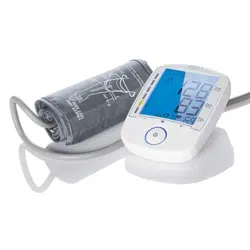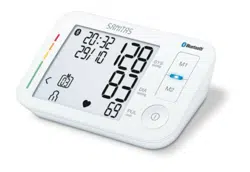
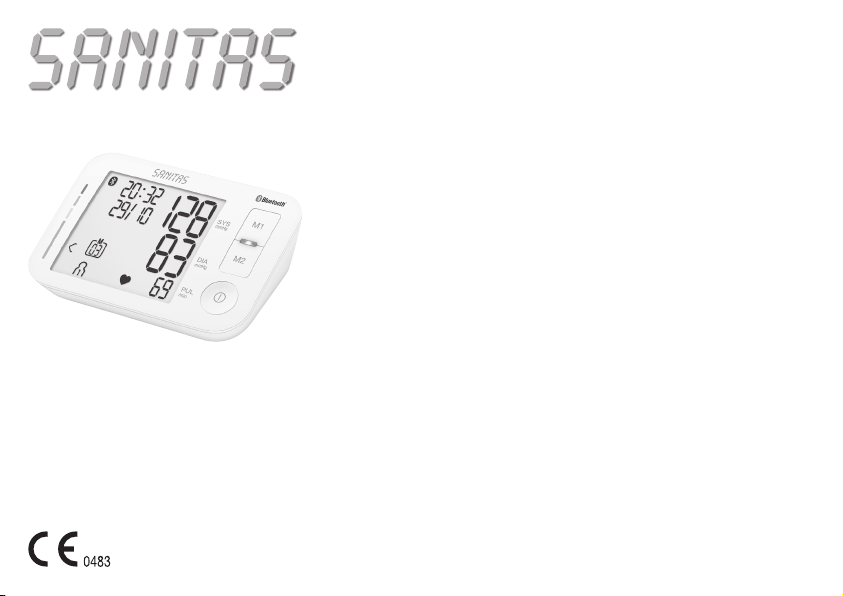
SBM 37
D
Blutdruckmessgerät
Gebrauchsanweisung ............................................................ 2
G
Blood pressure monitor
Instructions for use .............................................................. 17
F
Tensiomètre
Mode d’emploi ..................................................................... 32
I
Misuratore di pressione
Istruzioni per l’uso ................................................................ 47
r
Прибор для измерения кровяного давления в
плечевой артерии
Инструкция по применению .............................................. 62
Electromagnetic Compatibility Information .......................... 80

2
DEUTSCH
Lieferumfang
•
B
lutdruckmessgerät
•
O
berarmmanschette
•
4
x 1,5V AAA Batterien LR03
•
A
ufbewahrungstasche
•
G
ebrauchsanweisung
Bitte lesen Sie diese Gebrauchsanweisung aufmerksam durch,
bewahren Sie sie für späteren Gebrauch auf, machen Sie sie
anderen Benutzern zugänglich und beachten Sie die Hinweise.
1. Kennenlernen
Überprüfen Sie das Sanitas SBM 37 Blutdruckmessgerät auf
äußere Unversehrtheit der Verpackung und auf die Vollständig-
keit des Inhalts. Vor dem Gebrauch ist sicherzustellen, dass das
Gerät und Zubehör keine sichtbaren Schäden aufweisen und
jegliches Verpackungsmaterial entfernt wird. Benutzen Sie es im
Zweifelsfall nicht und wenden Sie sich an Ihren Händler oder an
die angegebene Service-Adresse.
Das Oberarm-Blutdruckmessgerät dient zur nichtinvasiven
Messung und Überwachung arterieller Blutdruckwerte von
erwachsenen Menschen.
Sie können damit schnell und einfach Ihren Blutdruck messen,
die Messwerte abspeichern und sich den Verlauf und Durch-
schnitt der Messwerte anzeigen lassen.
Bei eventuell vorhandenen Herzrhythmusstörungen werden
Sie gewarnt.
Die ermittelten Werte werden eingestuft und grafisch beurteilt.
2. Wichtige Hinweise
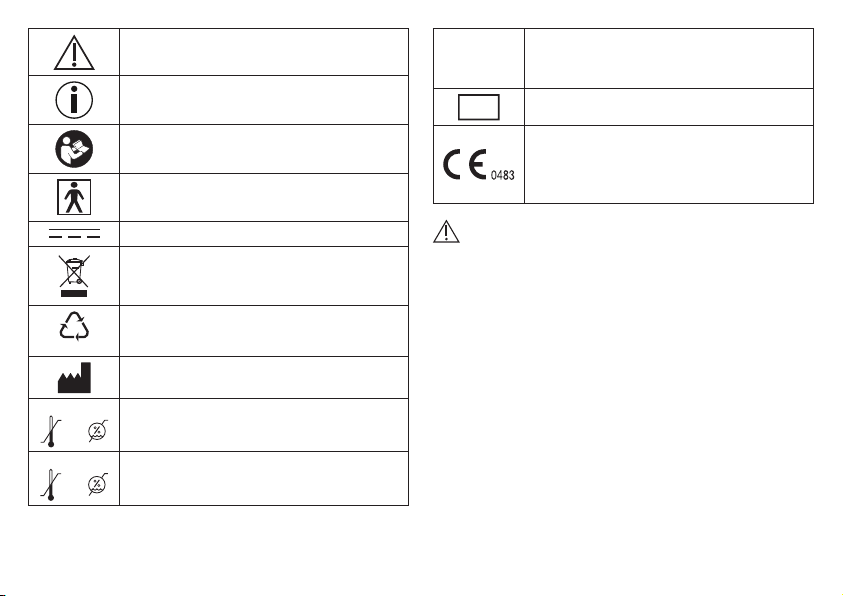
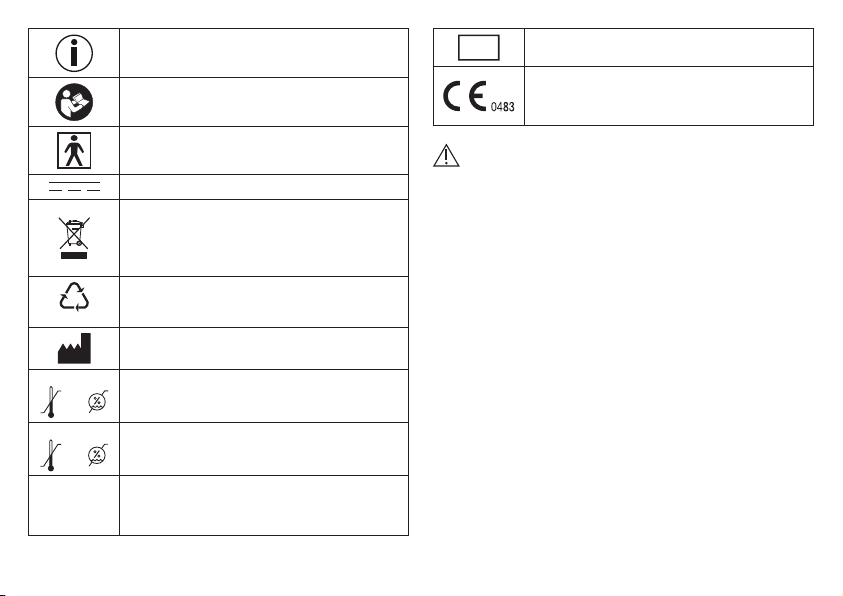
Zeichenerklärung
In der Gebrauchsanweisung, auf der Verpackung und auf dem
Typschild des Geräts und des Zubehörs werden folgende Sym-
bole verwendet:
Inhalt
1. Kennenlernen ........................................................................2
2. Wichtige Hinweise ................................................................. 2
3. Gerätebeschreibung .............................................................. 6
4. Messung vorbereiten ............................................................. 7
5. Blutdruck messen..................................................................8
6. Ergebnisse beurteilen .......................................................... 11
7. Messwerte abrufen und löschen .......................................12
8. Übertragung der Messwerte ..............................................13
9. Gerät und Manschette reinigen und aufbewahren ............14
10. Fehlermeldung/Fehlerbehebung ........................................14
11. Technische Angaben ......................................................... 15
12. Garantie / Service ...............................................................16
3
Vorsicht
Hinweis
Hinweis auf wichtige Informationen
Gebrauchsanweisung beachten
Anwendungsteil Typ BF
Gleichstrom
Entsorgung gemäß Elektro- und Elektronik-
Altgeräte EG-Richtlinie WEEE (Waste Electri-
cal and Electronic Equipment)
20
PAP
Verpackung umweltgerecht entsorgen
Hersteller
Storage/Transport
Zulässige Lagerungs- und Transporttempera-
tur und -luftfeuchtigkeit
Operating
Zulässige Betriebstemperatur und
-luftfeuchtigkeit
IP21
Geschützt gegen feste Fremdkörper,
12,5mm Durchmesser und größer und gegen
senkrechtes Tropfwasser
S
N
Seriennummer
Die CE-Kennzeichnung bescheinigt die
Konformität mit den grundlegenden Anforde-
rungen der Richtlinie 93/42/EEC für Medizin-
produkte.
Hinweise zur Anwendung
•
U
m eine Vergleichbarkeit der Werte zu gewährleisten, messen
Sie Ihren Blutdruck immer zu gleichen Tageszeiten.
•
R
uhen Sie sich vor jeder Messung ca. 5 Minuten aus!
•
W
enn Sie mehrere Messungen an einer Person durchführen
möchten, warten Sie zwischen den einzelnen Messungen je-
weils 5 Minuten.
•
M
indestens 30 Minuten vor der Messung sollten Sie nicht es-
sen, trinken, rauchen oder sich körperlich betätigen.
•
W
iederholen Sie die Messung im Falle zweifelhaft gemesse-
ner Werte.
•
D
ie von Ihnen selbst ermittelten Messwerte können nur zu Ihrer
Information dienen – sie ersetzen keine ärztliche Untersuchung!
Besprechen Sie Ihre Messwerte mit dem Arzt, begründen Sie
daraus auf keinen Fall eigene medizinische Entscheidungen
(z.B. Medikamente und deren Dosierungen)!
•
V
erwenden Sie das Blutdruckmessgerät nicht bei Neugebo-
renen und Präeklampsie-Patientinnen. Vor Anwendung des

4
Blutdruckmessgerätes in der Schwangerschaft empfehlen wir
eine Abstimmung mit dem Arzt.
•
E
rkrankungen des Herz-Kreislaufsystems können zu Fehl-
messungen bzw. zu Beeinträchtigungen der Messgenauigkeit
führen. Ebenso der Fall ist dies bei sehr niedrigem Blutdruck,
Diabetes, Durchblutungs- und Rhythmusstörungen sowie bei
Schüttelfrost oder Zittern.
•
Dieses Gerät ist nicht dafür bestimmt, durch Personen (ein-
schließlich Kinder) mit eingschränkten physischen, senso-
rischen oder geistigen Fähigkeiten oder mangels Erfahrung
und/oder mangels Wissen benutzt zu werden, es sei denn, sie
werden durch eine für Ihre Sicherheit zuständige Person be-
aufsichtigt oder erhielten von ihr Anweisungen, wie das Gerät
zu benutzen ist. Kinder sollten beaufsichtigt werden, damit sie
nicht mit dem Gerät spielen.
•
D
as Blutdruckmessgerät darf nicht im Zusammenhang mit ei-
nem Hochfrequenz-Chirurgiegerät verwendet werden.
•
V
erwenden Sie das Gerät nur bei Personen mit dem für das
Gerät angegebenen Umfangbereich des Oberarmes.
•
B
eachten Sie, dass es während des Aufpumpens zu einer
Funktionsbeeinträchtigung des betroffenen Gliedmaßes kom-
men kann.
•
D
ie Blutzirkulation darf durch die Blutdruckmessung nicht un-
nötig lange unterbunden werden. Bei einer Fehlfunktion des
Gerätes nehmen Sie die Manschette vom Arm ab.
•
V
ermeiden Sie das mechanische Einengen, Zusammendrücken
oder Abknicken des Manschettenschlauches.
•
V
erhindern Sie einen anhaltenden Druck in der Manschette
sowie häufige Messungen. Eine dadurch resultierende Beein-
trächtigung des Blutflusses kann zu Verletzungen führen.
• Achten Sie darauf, dass die Manschette nicht an einem Arm an-
gelegt wird, dessen Arterien oder Venen in medizinischer Behand-
lung sind, z.B. intravaskulärer Zugang bzw. eine intravaskuläre
Therapie oder ein arteriovenöser (A-V-) Nebenschluss.
•
L
egen Sie die Manschette nicht bei Personen an, die eine
Brustamputation hatten.
•
L
egen Sie die Manschette nicht über Wunden an, da dies zu
weiteren Verletzungen führen kann.
•
L
egen Sie die Manschette ausschließlich am Oberarm an. Le-
gen Sie die Manschette nicht an anderen Stellen des Körpers
an.
•
B
eachten Sie, dass eine Datenübertragung und Datenspei-
cherung nur möglich ist, wenn Ihr Blutdruckmessgerät Strom
erhält. Sobald die Batterien leer sind, verliert das Blutdruck-
messgerät Datum und Uhrzeit.
•
D
ie Abschaltautomatik schaltet das Blutdruckmessgerät zur
Schonung der Batterien aus, wenn innerhalb 30 Sekunden
keine Taste betätigt wird.
•
D
as Gerät ist nur für den in dieser Gebrauchsanweisung be-
schriebenen Zweck vorgesehen. Der Hersteller haftet nicht für
Schäden, die durch unsachgemäßen oder falschen Gebrauch
verursacht wurden.
Hinweise zur Aufbewahrung und Pflege
• Das Blutdruckmessgerät besteht aus Präzisions- und Elek tronik-
Bauteilen. Die Genauigkeit der Messwerte und die Lebens dauer
des Gerätes hängen ab vom sorgfältigen Umgang:
—
S
chützen Sie das Gerät vor Stößen, Feuchtigkeit, Schmutz,
starken Temperaturschwankungen und direkter Sonnen-
einstrahlung.
5
—
L
assen Sie das Gerät nicht fallen.
—
B
enutzen Sie das Gerät nicht in der Nähe von starken
elektro magnetischen Feldern, halten Sie es fern von Funk-
anlagen oder Mobiltelefonen.
—
Verwenden Sie nur die mitgelieferte oder originale Ersatz-
Manschetten. Ansonsten werden falsche Messwerte ermittelt.
Hinweise zum Umgang mit Batterien
•
Wenn Flüssigkeit aus einer Batteriezelle mit Haut oder Augen in
Kontakt kommt, die betroffene Stelle mit Wasser auswaschen
und ärztliche Hilfe aufsuchen.
•
Verschluckungsgefahr! Kleinkinder könnten Batterien
verschlucken und daran ersticken. Daher Batterien für Klein-
kinder unerreichbar aufbewahren!
• Auf Polaritätskennzeichen Plus (+) und Minus (-) achten.
•
Wenn eine Batterie ausgelaufen ist, Schutzhandschuhe anzie-
hen und das Batteriefach mit einem trockenen Tuch reinigen.
• Schützen Sie Batterien vor übermäßiger Wärme.
•
Explosionsgefahr! Keine Batterien ins Feuer werfen.
• Batterien dürfen nicht geladen oder kurzgeschlossen werden.
•
Bei längerer Nichtbenutzung des Geräts die Batterien aus dem
Batteriefach nehmen.
• Verwenden Sie nur denselben oder einen gleichwertigen Bat-
terietyp.
• Immer alle Batterien gleichzeitig auswechseln.
• Keine Akkus verwenden!
• Keine Batterien zerlegen, öffnen oder zerkleinern.
Hinweise zu Reparatur und Entsorgung
• Batterien gehören nicht in den Hausmüll. Bitte entsorgen Sie
die verbrauchten Batterien an den dafür vorgesehenen Sam-
melstellen.
•
S
ie dürfen das Gerät nicht selbst reparieren oder justieren.
Eine einwandfreie Funktion ist in diesem Fall nicht mehr ge-
währleistet.
• Reparaturen dürfen nur vom Kundenservice oder autori sierten
Händlern durchgeführt werden.
•
Ö
ffnen Sie nicht das Gerät. Bei Nichtbeachtung erlischt die
Garantie.
•
I
m Interesse des Umweltschutzes darf das Gerät am Ende sei-
ner Lebensdauer nicht mit dem Hausmüll entfernt werden. Die
Entsorgung kann über entsprechende Sammelstellen in Ihrem
Land erfolgen. Entsorgen Sie das Gerät gemäß der Elektro- und
Elektronik-Altgeräte EG-Richtlinie – WEEE (Waste Elec-
trical and Electronic Equipment). Bei Rückfragen wenden
Sie sich an die für die Entsorgung zuständige kommu-
nale Behörde.
6
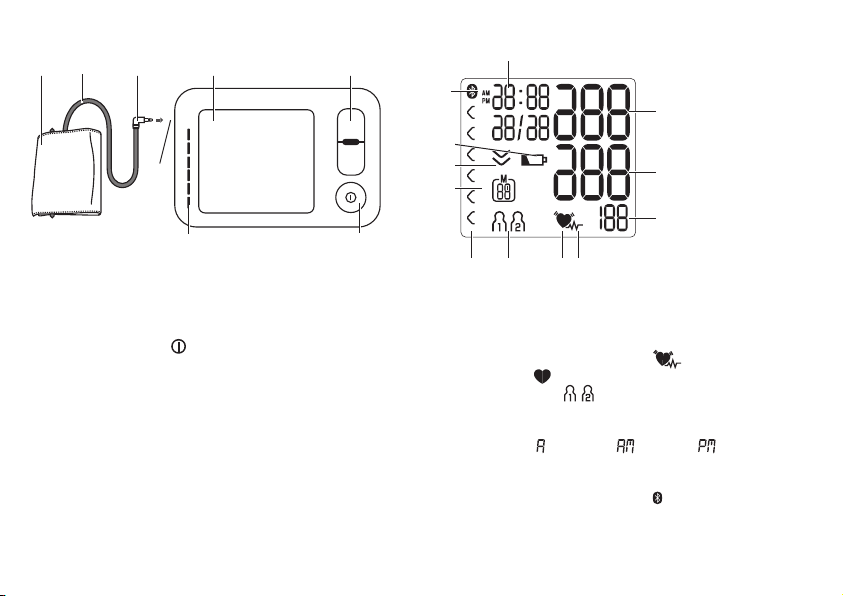
3. Gerätebeschreibung
M1
SYS
mmHg
DIA
mmHg
PUL
/min
M2
1
2
3 4 5
7
8
6
1. Manschette
2. Manschettenschlauch
3. Manschettenstecker
4. Display
5. Speichertasten M1/M2
6. START/STOPP-Taste
7. Risiko-Indikator
8. Anschluss für Manschettenstecker (linke Seite)
Anzeigen auf dem Display:
1. Uhrzeit/Datum
2. Systolischer Druck
3. Diastolischer Druck
4. Ermittelter Pulswert
5. Symbol Herzrhythmusstörungen
6. Symbol Puls
7. Benutzerspeicher
8. Risiko-Indikator
9. Nummer des Speicherplatzes / Speicheranzeige Durch-
schnittswert ( ), morgens ( ), abends ( )
10. Luft ablassen (Pfeil)
11. Symbol Batterie-Anzeige
12. Symbol Bluetooth
®
Übertragung
1
68 5
2
3
10
11
9
7
12
4

7
Systemvoraussetzungen für die „HealthCoach“ App
– iOS ≥ 8.0 / Android
TM
≥ 4.4
– Bluetooth
®
≥ 4.0
Liste der kompatiblen Geräte:
4. Messung vorbereiten
Batterien einlegen
•
E
ntfernen Sie den Deckel des Bat-
teriefaches auf der Rück seite des
Gerätes.
•
L
egen Sie vier Batterien vom
Typ 1,5 V AAA (Alkaline Type LR03)
ein. Achten Sie unbedingt darauf,
dass die Batterien entsprechend der
Kennzeichnung mit korrekter Polung
eingelegt werden. Verwenden Sie kei-
ne wiederauf ladbaren Akkus.
•
S
chließen Sie den Batteriefachdeckel wieder sorgfältig.
Alle Displayelemente werden kurz angezeigt, bzw. blinkt
im Display. Stellen Sie nun, wie im Folgenden beschrieben, Da-
tum und Uhrzeit ein.
Wenn das Symbol Batteriewechsel dauerhaft erscheint,
ist keine Messung mehr möglich und Sie müssen alle Batterien
erneuern. Sobald die Batterien aus dem Gerät entfernt werden,
müssen das Datum und die Uhrzeit neu eingestellt werden. Die
gespeicherten Messwerte gehen nicht verloren.
Batterie Entsorgung
• Die verbrauchten, vollkommen entladenen Batterien müssen Sie
über speziell gekennzeichnete Sammelbehälter, Sondermüllan-
nahmestellen oder über den Elektrohändler entsorgen. Sie sind
gesetzlich dazu verpflichtet, die Batterien zu entsorgen.
• Diese Zeichen finden Sie auf schadstoffhaltigen
Batterien:
Pb = Batterie enthält Blei,
Cd = Batterie enthält Cadmium,
Hg = Batterie enthält Quecksilber
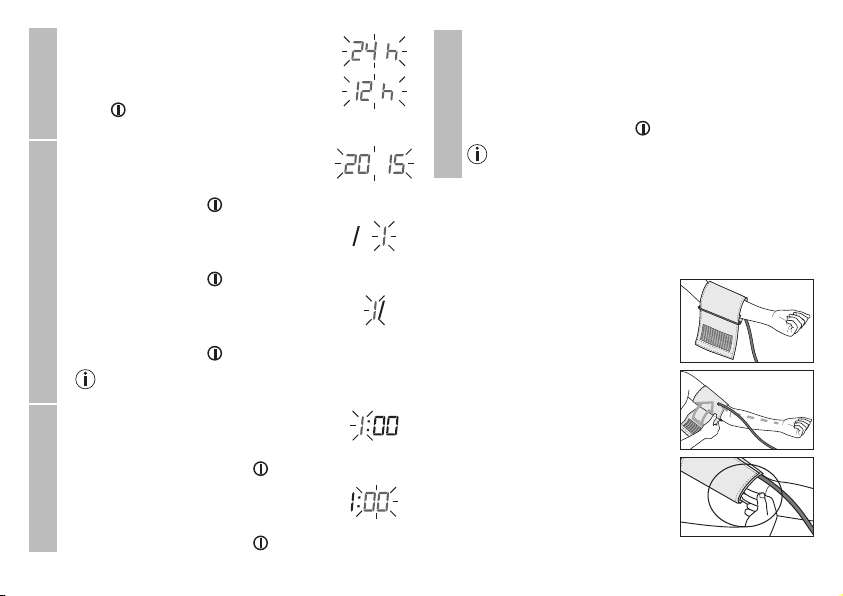
Stundenformat, Datum, Uhrzeit und Bluetooth
®
einstellen
Im Folgenden wird beschrieben, welche Funktionen und Einstel-
lungen Sie am Blutdruckmessgerät vornehmen können.
Stundenformat
➔
Datum
➔
Uhrzeit
➔
Bluetooth
®
Stellen Sie Datum und Uhrzeit unbedingt korrekt ein. Nur so kön-
nen Sie Ihre Messwerte korrekt mit Datum und Uhrzeit speichern
und später abrufen.
Wenn Sie die Speichertaste M1 oder M2 gedrückt halten,
können Sie die Werte schneller einstellen.
Halten Sie die START/STOPP-Taste für 5 Sekunden ge-
drückt.
4 x 1,5
V AAA
8
Stundenformat
Im Display blinkt das Stundenformat.
•
W
ählen Sie mit den Speichertasten M1/
M2 Ihr gewünschtes Stundenformat und
bestätigen Sie mit der START/STOPP-
Taste .
Datum
Im Display blinkt die Jahreszahl.
•
W
ählen Sie mit den Speichertasten M1/M2
die Jahreszahl und bestätigen Sie mit der
START/STOPP-Taste .
Im Display blinkt die Monatsanzeige.
•
W
ählen Sie mit den Speichertasten M1/
M2 den Monat und bestätigen Sie mit der
START/STOPP-Taste .
Im Display blinkt die Tagesanzeige.
•
W
ählen Sie mit den Speichertasten M1/M2
den aktuellen Tag und bestätigen Sie mit der
START/STOPP-Taste .
•
Wenn als Stundenformat 12h eingestellt ist, steht die
Monats- vor der Tagesanzeige.
Uhrzeit
Im Display blinkt die Stundenzahl.
•
W
ählen Sie mit den Speichertasten M1/M2
die aktuelle Stundenzahl und bestätigen Sie
mit der START/STOPP-Taste .
Im Display blinkt die Minutenzahl.
•
W
ählen Sie mit den Speichertasten M1/M2
die aktuelle Minutenzahl und bestätigen Sie
mit der START/STOPP-Taste .
Bluetooth
®
Im Display blinkt das Bluetooth
®
Symbol.
•
W
ählen Sie mit den Speichertasten M1/M2, ob die au-
tomatische Bluetooth
®
Datenübertragung aktiviert (Blue-
tooth
®
Symbol blinkt) oder deaktiviert (Bluetooth
®
Sym-
bol wird nicht angezeigt) sein soll und bestätigen Sie mit
der START/STOPP-Taste .
Die Batterielaufzeit verkürzt sich durch die Übertragung
per Bluetooth
®
.
5. Blutdruck messen
Bringen Sie das Gerät vor der Messung auf Raum tempera tur.
Sie können die Messung am linken oder rechten Arm durchführen.
Manschette anlegen
Legen Sie die Manschette am entblöß-
ten Oberarm an. Die Durchblutung des
Arms darf nicht durch zu enge Klei-
dungsstücke oder Ähnliches eingeengt
sein.
Die Manschette ist am Oberarm so zu
platzieren, dass der untere Rand
2 – 3 cm über der Ellenbeuge und über
der Arterie liegt. Der Schlauch weist zur
Handflächenmitte.
Legen Sie nun das freie Ende der Man-
schette eng, aber nicht zu stramm um
den Arm und schließen Sie den Klett-
verschluss. Die Manschette sollte so
eng angelegt sein, dass noch zwei Fin-
ger unter die Manschette passen.
9
Stecken Sie nun den Manschetten-
schlauch in den Anschluss für den Man-
schetten stecker.
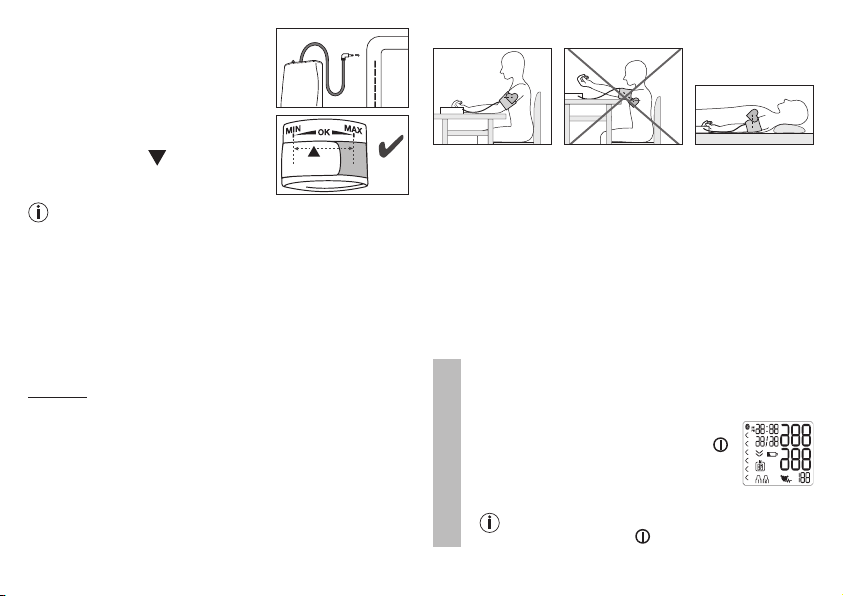
Diese Manschette ist für Sie geeignet,
wenn nach Anlegen der Manschette die
Index-Markierung ( ) innerhalb des
OK-Bereichs liegt.
Wenn Sie die Messung am rechten Oberarm durchführen, be-
findet sich der Schlauch an der Innenseite Ihres Ellenbogens.
Achten Sie darauf, dass Ihr Arm nicht auf dem Schlauch liegt.
Der Blutdruck kann sich zwischen dem rechten und linken Arm
unterscheiden, daher können auch die gemessenen Blutdruck-
werte unterschiedlich sein. Führen Sie die Messung immer am
selben Arm durch.
Falls sich die Werte zwischen den beiden Armen sehr deutlich
unterscheiden, sollten Sie mit Ihrem Arzt absprechen, welchen
Arm Sie für die Messung verwenden.
Achtung: Das Gerät darf nur mit der Original-Manschette be-
trieben werden. Die Manschette ist für einen Armumfang von 22
bis 36 cm geeignet.
Unter der Bestellnummer 163.387 ist eine größere Manschette
für Oberarmumfänge von 35 bis 44 cm beim Fachhandel oder
bei der Serviceadresse erhältlich.
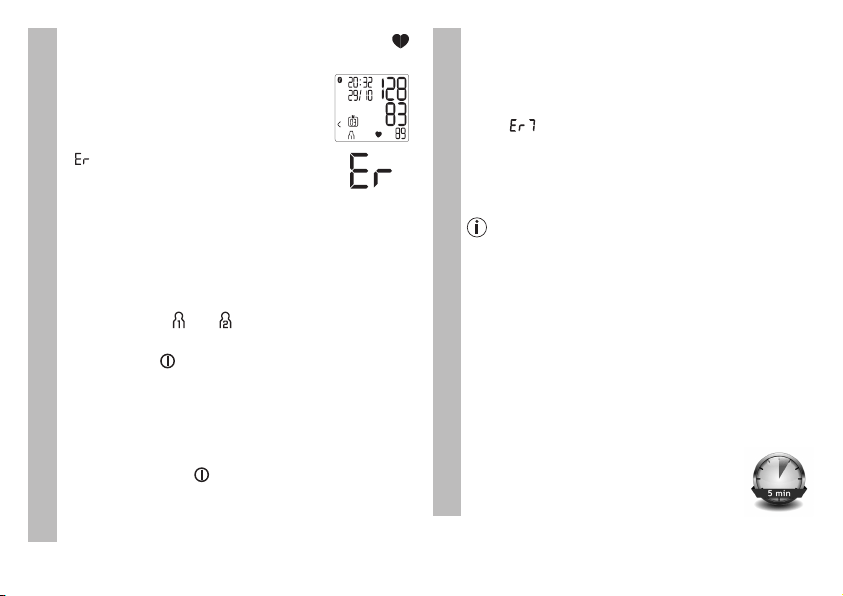
Richtige Körperhaltung einnehmen
•
R
uhen Sie sich vor jeder Messung ca. 5 Minuten aus!
Ansonsten kann es zu Abweichungen kommen.
•
S
ie können die Messung im Sitzen oder im Liegen durchführen.
Achten Sie in jedem Falle darauf, dass sich die Manschette in
Herzhöhe befindet.
•
S
itzen Sie zur Blutdruckmessung bequem. Lehnen Sie Rücken
und Arme an. Kreuzen Sie die Beine nicht. Stellen Sie die Füße
flach auf den Boden.
• Um das Messergebnis nicht zu verfälschen, ist es wichtig, sich
während der Messung ruhig zu verhalten und nicht zu sprechen.
Blutdruckmessung durchführen
Messung
Legen Sie, wie zuvor beschrieben, die Manschette an und
nehmen Sie die Haltung ein, in der Sie die Messung durch-
führen wollen.
•
Um das Blutdruckmessgerät zu starten,
drücken Sie die START/STOPP-Taste .
Alle Displayelemente werden kurz angezeigt.
Nach 3 Sekunden beginnt das Blutdruck-
messgerät automatisch mit der Messung.
•
Sie können die Messung jederzeit durch Drücken der
START/STOPP-Taste abbrechen.
M1
SYS
mmHg
DIA
mmHg
PUL
/min
M2
10
Messung
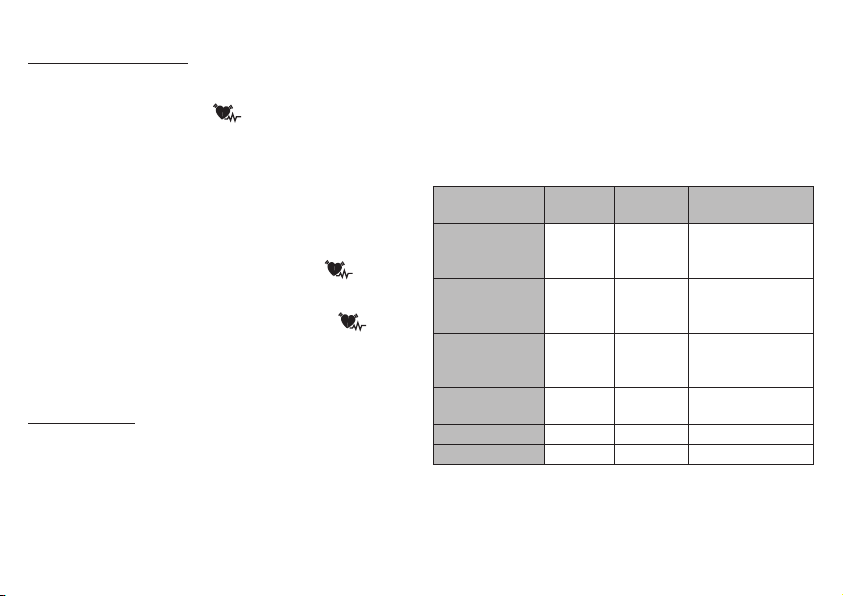
Sobald ein Puls zu erkennen ist, wird das Symbol Puls
angezeigt.
•
D
ie Messergebnisse systolischer Druck,
diastolischer Druck und Puls werden an-
gezeigt.
•
erscheint wenn die Messung nicht ord-
nungsgemäß durchgeführt werden konnte
(siehe Kapitel 9 „Fehlermeldung/Fehlerbe-
hebung“). Wiederholen Sie die Messung.
•
W
ählen Sie nun durch Drücken der Speichertasten M1
oder M2 den gewünschten Benutzerspeicher aus. Wenn
Sie keine Auswahl des Benutzerspeichers vornehmen,
wird das Messergebnis dem zuletzt verwendeten Benut-
zerspeicher zur Speicherung zugewiesen. Das entspre-
chende Symbol oder erscheint im Display.
•
S
chalten Sie das Blutdruckmessgerät mit der START/
STOPP-Taste aus. Damit wird das Messergebnis im
ausgewählten Benutzerspeicher abgespeichert.
•
W
ird das Gerät nicht manuell ausgeschaltet, schaltet es
sich nach 30 Sekunden selbstständig aus.
Ist die Bluetooth
®
Datenübertragung aktiviert, so wer-
den nach der Bestätigung des Benutzerspeichers mit der
START/STOPP-Taste die Daten übertragen.
• Das Bluetooth
®
Symbol im Display blinkt und die blaue
LED leuchtet. Das Blutdruckmessgerät versucht nun für
ca. 30 Sekunden eine Verbindung zur App aufzubauen.
Messung
• Sobald eine Verbindung besteht, hört das Bluetooth
®
Symbol auf zu blinken. Alle Messdaten werden automa-
tisch in die App übertragen. Nach erfolgreicher Datenü-
bertragung schaltet sich das Gerät aus. Wenn die Daten
nicht übertragen werden konnten, erlischt die blaue LED
und „ “ wird im Display angezeigt.
• Wenn nach 30 Sekunden keine Verbindung zur App her-
gestellt werden kann, erlischt das Bluetooth
®
Symbol und
das Blutdruckmessgerät schaltet sich nach 3 Minuten
automatisch aus.
Beachten Sie, dass Sie zur Übertragung der Daten in
der „HealthCoach“ App das Blutdruckmessgerät un-
ter „Meine Geräte“ hinzufügen müssen. Die „Health-
Coach“ App muss zur Übertragung aktiviert sein.
Werden die aktuellen Daten nicht auf Ihrem Smartphone
angezeigt, wiederholen Sie die Übertragung wie in Ka-
pitel 7 beschrieben.
Wenn Sie vergessen das Blutdruckmessgerät auszuschal-
ten, schaltet es sich nach ca. 30 Sekunden automatisch
aus. Auch in diesem Fall wird der Wert im ausgewählten
oder zuletzt verwendeten Benutzerspeicher abgespeichert
und die Daten bei aktivierter Bluetooth
®
Datenübertragung
übertragen.
•
W
arten Sie vor einer erneuten Messung
mindestens 5 Minuten!
11
6. Ergebnisse beurteilen
Herzrhythmusstörungen:
Dieses Gerät kann während der Messung eventuelle Störungen
des Herzrhythmus identifizieren und weist gegebenenfalls nach
der Messung mit dem Symbol
darauf hin.
Dies kann ein Indikator für eine Arrhythmie sein. Arrhythmie ist
eine Krankheit, bei der Herzrhythmus aufgrund von Fehlern im
bioelektrischen System, das den Herzschlag steuert, anormal
ist. Die Symptome (ausgelassene oder vorzeitige Herzschläge,
langsamer oder zu schneller Puls) können u.a. von Herzerkran-
kungen, Alter, körperlicher Veranlagung, Genussmitteln im Über-
maß, Stress oder Mangel an Schlaf herrühren. Arrhythmie kann
nur durch eine Untersuchung bei Ihrem Arzt festgestellt werden.
Wiederholen Sie die Messung, wenn das Symbol nach der
Messung auf dem Display angezeigt wird. Bitte achten Sie darauf,
dass Sie sich 5 Minuten ausruhen und während der Messung
nicht sprechen oder bewegen. Sollte das Symbol oft er
-
scheinen, wenden Sie sich bitte an Ihren Arzt.
Selbstdiagnose und -behandlung aufgrund der Messergebnisse
können gefährlich sein. Befolgen Sie unbedingt die Anweisun-
gen Ihres Arztes.
Risiko-Indikator:
Die Messergebnisse, lassen sich gemäß nachfolgender Tabelle
einstufen und beurteilen.
Diese Standardwerte dienen jedoch lediglich als allgemeine
Richtlinie, da der individuelle Blutdruck bei verschiedenen Per-
sonen und unterschiedlichen Altersgruppen usw. abweicht.
Es ist wichtig, dass Sie Ihren Arzt in regelmäßigen Abständen zu
Rate ziehen. Ihr Arzt teilt Ihnen Ihre individuellen Werte für einen
normalen Blutdruck sowie den Wert mit, ab dem die Höhe des
Blutdrucks als gefährlich einzustufen ist.
Die Einstufung im Display und die Skala auf dem Gerät geben an,
in welchem Bereich sich der ermittelte Blutdruck befindet. Sollte
sich der Wert von Systole und Diastole in zwei unterschiedlichen
Bereichen befinden (z.B. Systole im Bereich „Hoch Normal“ und
Diastole im Bereich „Normal“) dann zeigt Ihnen die grafische
Einteilung auf dem Gerät immer den höheren Bereich an, im be-
schriebenen Beispiel „Hoch Normal“.
Bereich der
Blutdruckwerte
Systole
(in mmHg)
Diastole
(in mmHg)
Maßnahme
Stufe 3:
starke
Hypertonie
≥ 180 ≥ 110
einen Arzt aufsu-
chen
Stufe 2:
mittlere
Hypertonie
160 – 179 100 – 109
einen Arzt aufsu-
chen
Stufe 1:
leichte
Hypertonie
140 – 159 90 – 99
regelmäßige Kon-
trolle beim Arzt
Hoch normal 130 – 139 85 – 89
regelmäßige Kon-
trolle beim Arzt
Normal 120 – 129 80 – 84 Selbstkontrolle
Optimal < 120 < 80 Selbstkontrolle
Quelle: WHO, 1999 (World Health Organization)
12
7. Messwerte abrufen und löschen
Benutzerspeicher
Die Ergebnisse jeder erfolgreichen Messung werden zu
-
sammen mit Datum und Uhrzeit abgespeichert. Bei mehr
als 60 Messdaten wird jeweils die älteste Messung über-
schrieben.
•
W
ählen Sie mit der Speichertaste M1 oder M2 Ihren ge-
wünschten Benutzerspeicher ( ), wenn das Gerät
ausgeschaltet ist.
•
W
enn Sie die Messdaten für Benutzerspeicher einse-
hen möchten, drücken Sie die Speichertaste M1.
•
W
enn Sie die Messdaten für Benutzerspei-
cher einsehen möchten, drücken Sie die
Speichertaste M2.
•
Auf dem Display erscheint der Durch-
schnittswert aller Messungen.
•
Ist Bluetooth
®
aktiviert (das Symbol wird
auf dem Display blinkend angezeigt) ver-
sucht das Blutdruckmessgerät eine Verbin-
dung mit der App aufzubauen. Wenn Sie
währenddessen die M1-Taste drücken, wird
die Übertragung abgebrochen und die Durch-
schnittswerte werden angezeigt. Wenn Sie
die M2-Taste drücken, wird die Übertragung
abgebrochen und die Messdaten des Benut-
zerspeichers werden angezeigt. Das Sym-
bol wird nicht mehr angezeigt. Sobald eine
Verbindung besteht und die Daten übertragen
werden, sind die Tasten inaktiv.
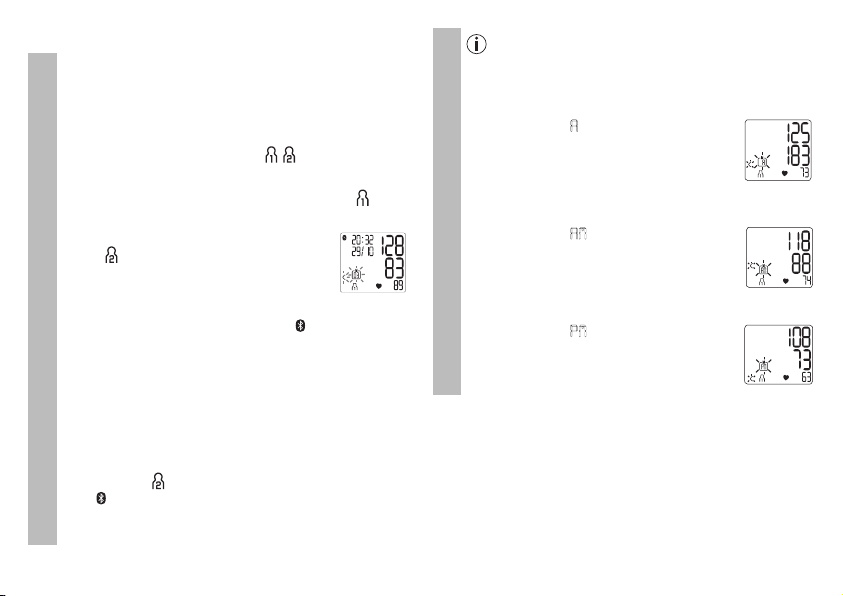
Durchschnittswerte
Wenn Sie den Benutzerspeicher 1 ausgewählt haben
ist die Speichertaste M1 zu betätigen.
Wenn Sie den Benutzerspeicher 2 ausgewählt haben ist
die Speichertaste M2 zu benutzen.
Im Display blinkt
A
.
Es wird der Durchschnittswert aller gespei-
cherten Messwerte dieses Benutzerspeichers
angezeigt.
•
D
rücken Sie die jeweilige Speichertaste (M1 oder M2)
Im Display blinkt
AM
.
Es wird der Durchschnittswert der letzten 7 Ta-
ge der Morgen-Messungen angezeigt ( Morgen:
5.00 Uhr – 9.00 Uhr).
•
D
rücken Sie die jeweilige Speichertaste (M1 oder M2).
Im Display blinkt
PM
.
Es wird der Durchschnittswert der letzten 7
Tage der Abend-Messungen angezeigt (Abend:
18.00 Uhr – 20.00 Uhr).
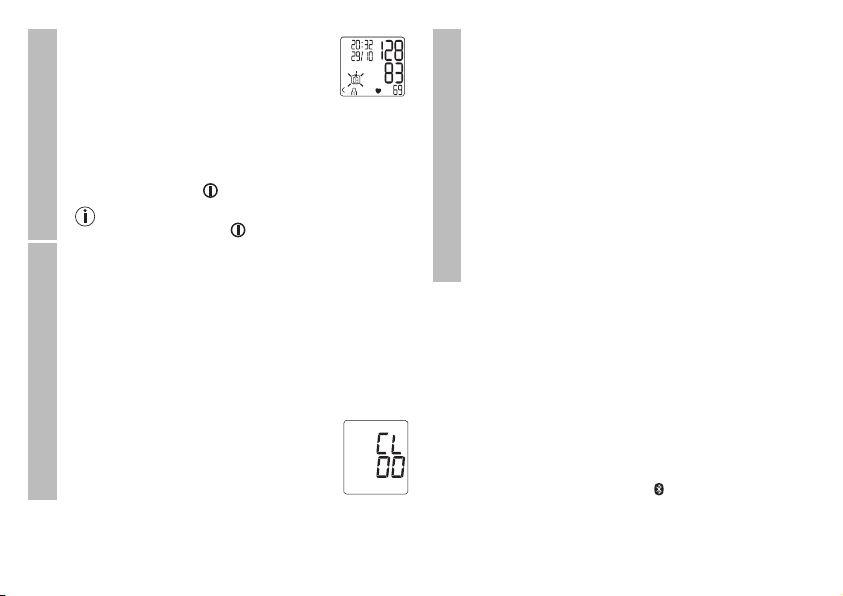
13
Einzelmesswerte
•
W
enn Sie die jeweilige Speichertaste (M1
oder M2) erneut drücken, wird im Display
die letzte Einzelmessung angezeigt (hier im
Beispiel Messung 03).
•
W
enn Sie die jeweilige Speichertaste (M1 oder M2) wie-
der drücken, können Sie jeweils Ihre gemessenen Ein-
zelmesswerte einsehen.
•
U
m das Gerät wieder auszuschalten, drücken Sie die
START/STOPP-Taste .
•
Sie können das Menü jederzeit durch Drücken der
START/STOPP-Taste verlassen.
Messwerte löschen
•
Um den Speicher des jeweiligen Benutzerspeichers zu lö-
schen, wählen Sie zunächst einen Benutzerspeicher aus.
•
Starten Sie die Abfrage der Durchschnittsmesswerte.
Im Display blinkt A, es wird der Durchschnittswert al-
ler gespeicherten Messwerte dieses Benutzerspeichers
angezeigt.
• Halten Sie die Speichertasten M1 oder M2 für 5 Sekun-
den gedrückt, abhängig in welchem Nutzerspeicher Sie
sich befinden.
Alle Werte des gegenwärtigen Benutzerspei-
chers werden gelöscht.
Einzelmesswerte löschen
•
U
m einzelne Messungen des jeweiligen Benutzerspei-
chers zu löschen, wählen Sie zunächst einen Benutzer-
speicher.
•
S
tarten Sie die Abfrage der Einzelmesswerte.
•
H
alten Sie die Speichertaste M1 oder M2 für 5 Sekunden
gedrückt. (abhängig davon in welchem Benutzersepei-
cher Sie sich befinden).
•
D
er ausgewählte Wert wird gelöscht. Das Gerät zeigt
kurzzeitig CL 00 an.
•
S
ollen weitere Werte gelöscht werden, wiederholen Sie
den oben beschriebenen Vorgang.
Durch Drücken der Start/Stopp-Taste können Sie das Ge-
rät jederzeit ausschalten.
8. Übertragung der Messwerte
Übertragung über Bluetooth
®
low energy technology
Sie haben die Möglichkeit die gemessenen und auf dem Gerät
gespeicherten Werte zusätzlich auf Ihr Smartphone per Blue-
tooth
®
low energy technology zu übertragen.
Dazu benötigen Sie die „HealthCoach“ App. Diese ist im Apple
App Store und bei Google Play kostenlos verfügbar.
Um die Werte zu übertragen befolgen Sie die folgenden Punkte:
Wenn im Einstellungsmenü Bluetooth
®
aktiviert ist, werden die
Daten automatisch nach der Messung übertragen. Auf dem Dis-
play erscheint links oben das Symbol (siehe Kapitel 4 Messung
vorbereiten).
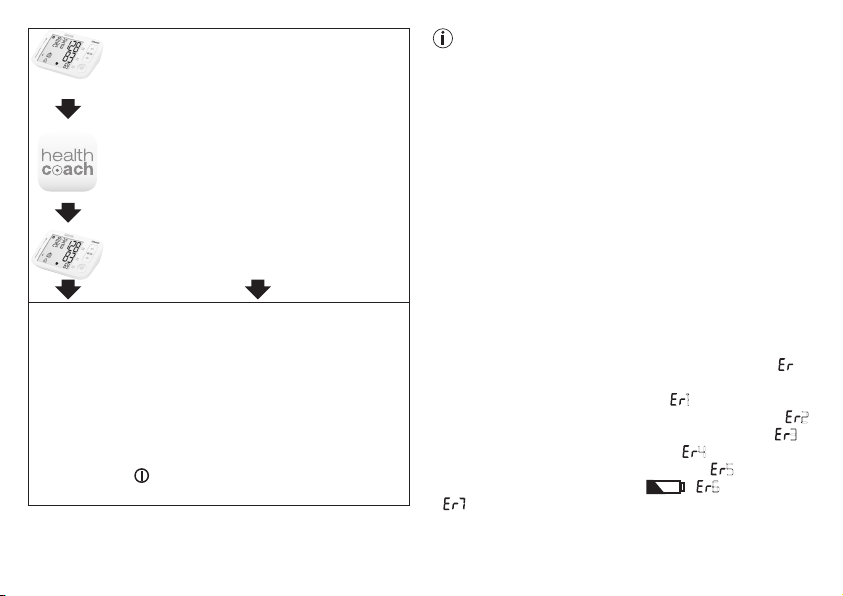
14
Schritt 1: SBM 37
Aktivieren Sie Bluetooth
®
an Ihrem Gerät (siehe
Kapitel 4. „Messung vorbereiten“, Bluetooth
®
).
Schritt 2: „HealthCoach“ App
Fügen Sie in der „HealthCoach“ App unter „Ein-
stellungen / Meine Geräte“ das SBM 37 hinzu.
Schritt 3: SBM 37
Nehmen Sie eine Messung vor.
Schritt 4: SBM 37
Übertragung der Daten direkt
im Anschluss an eine Mes-
sung:
•
I
st die Bluetooth
®
Da-
tenübertragung aktiviert,
so werden nach der Be-
stätigung des Benutzer-
speichers mit der START/
STOPP-Taste die Daten
übertragen.
Schritt 4: SBM 37
Übertragung der Daten zu
einem späteren Zeitpunkt:
•
G
ehen Sie in den Spei-
cherabruf-Modus (Kap. 7).
Wählen Sie den gewünsch-
ten Benutzerspeicher. Die
Bluetooth
®
Übertragung
startet automatisch.
Die „HealthCoach“ App muss zur Übertragung aktiviert sein.
Um eine störungsfreie Übertragung zu gewährleisten entfernen
Sie hierzu bitte ggf. die Schutzhülle Ihres Smartphone. Starten
Sie die Datenübertragung in der „HealthCoach“ App.
9. Gerät und Manschette reinigen und
aufbewahren
•
R
einigen Sie das Gerät und die Manschette vorsichtig nur mit
einem leicht angefeuchteten Tuch.
•
V
erwenden Sie keine Reinigungs- oder Lösungsmittel.
•
S
ie dürfen Gerät und Manschette auf keinen Fall unter Wasser
halten, da sonst Flüssigkeit eindringen kann und das Gerät und
die Manschette beschädigt.
•
W
enn Sie Gerät und Manschette aufbewahren, dürfen keine
schweren Gegenstände auf dem Gerät und der Manschet-
te stehen. Entnehmen Sie die Batterien. Der Manschetten-
schlauch darf nicht scharf abgeknickt werden.
10. Fehlermeldung/Fehlerbehebung
Bei Fehlern erscheint auf dem Display die Fehlermeldung
_
.
Fehlermeldungen können auftreten, wenn
• der Puls nicht erfasst werden konnte:
1
;
• Sie sich während der Messung bewegen oder sprechen:
2
;
• die Manschette zu stark bzw. zu schwach angelegt ist:
3
;
• Fehler während der Messung auftreten:
4
;
• der Aufpumpdruck höher als 300 mmHg ist:
5
;
• die Batterien fast verbraucht sind :
6
;
• wenn die Daten nicht per Bluetooth
®
gesendet werden
konnten.

15
Wiederholen Sie in diesen Fällen die Messung bzw. die Daten-
übertragung.
Achten Sie darauf, dass der Manschettenschlauch ordnungs-
gemäß eingesteckt ist und Sie sich während der Messung nicht
bewegen oder sprechen.
11. Technische Angaben
Modell-Nr. SBM 37
Messmethode Oszillometrisch, nicht invasive Blut-
druckmessung am Oberarm
Messbereich Manschettendruck 0 – 250 mmHg,
systolisch 50-250 mmHg,
diastolisch 30-200 mmHg,
Puls 40 –180 Schläge /Minute
Genauigkeit der
Anzeige
systolisch ± 3 mmHg,
diastolisch ± 3 mmHg,
Puls ± 5 % des angezeigten Wertes
Messunsicherheit max. zulässige Standardabweichung
gemäß klinischer Prüfung:
systolisch 8 mmHg /
diastolisch 8 mmHg
Speicher 2 x 60 Speicherplätze
Abmessungen L 139 mm x B 94 mm x H 48 mm
Gewicht 236 g
(ohne Manschette, ohne Batterien)
Manschettengröße 22 bis 36 cm
Zul. Betriebs-
bedingungen
+ 5 °C bis + 40 °C, 15-93 % relative Luft-
feuchte (nicht kondensierend)
Zulässige Aufbewah-
rungs- und Trans-
portbedingungen
-25 °C bis + 70 °C, ≤ 93 % relative Luft-
feuchte, 700 –1060 hPa Umgebungsdruck
Stromversorgung 4x1,5 V AAA Batterien
Batterielebensdauer Für ca. 200 Messungen, je nach Höhe
des Blutdrucks bzw. Aufpumpdruckes,
sowie Anzahl der Bluetooth
®
Verbin-
dungen.
Zubehör Manschette, Geb rauchsanweisung,
Aufbewahrungstasche
Klassifikation Interne Versorgung, IP21, kein AP oder
APG, Dauerbetrieb, Anwendungsteil
Typ BF
Datenübertragung
per Bluetooth
®
wire-
less technology
Das Blutdruckmessgerät verwendet
Bluetooth
®
low energy technology,
Frequenzband 2402MHz – 2480MHz,
Sendeleistung max. 20dBM,
Kompatibel mit Bluetooth ≥ 4.0 Smart-
phones / Tablets
Die Seriennummer befindet sich auf dem Gerät oder im Bat-
teriefach.
Änderungen der technischen Angaben ohne Benachrichtigung
sind aus Aktualisierungsgründen vorbehalten.
•
D
ieses Gerät entspricht der europäischen Norm EN60601-1-2
und unterliegt besonderen Vorsichtsmaßnahmen hinsichtlich
der elektromagnetischen Verträglichkeit. Bitte beachten Sie
dabei, dass tragbare und mobile HF-Kommunikationseinrich-

16
tungen dieses Gerät beeinflussen können. Genauere Angaben
können Sie unter der angegebenen Kundenservice-Adresse
anfordern oder am Ende der Gebrauchsanweisung nachlesen.
•
D
as Gerät entspricht der EU-Richtlinie für Medizin produkte
93/42/EEC, dem Medizinproduktegesetz und den Normen
EN1060-1 (nicht invasive Blutdruckmessgeräte Teil 1: Allge
-
meine Anforderungen), EN1060-3 (nicht invasive Blutdruck
-
messgeräte Teil 3: Ergänzende Anforderungen für elektro-
mechanische Blutdruckmesssysteme) und IEC80601-2-30
(Medizinische elektrische Geräte Teil 2 – 30: Besondere Fest-
legungen für die Sicherheit einschließlich der wesentlichen
Leistungsmerkmale von automatisierten nicht invasiven Blut-
druckmessgeräten).
•
D
ie Genauigkeit dieses Blutdruckmessgerätes wurde sorgfältig
geprüft und wurde im Hinblick auf eine lange nutzbare Lebens-
dauer entwickelt. Bei Verwendung des Gerätes in der Heilkunde
sind Messtechnische Kontrollen mit geeigneten Mitteln durch-
zuführen. Genaue Angaben zur Überprüfung der Genauigkeit
können unter der Service-Adresse angefragt werden.
•
W
ir garantieren hiermit, dass dieses Produkt der europäischen
RED Richtlinie 2014/53/EU entspricht. Kontaktieren Sie bitte
die genannte Serviceadresse, um detailliertere Angaben – wie
zum Beispiel die CE – Konformitätserklärung – zu erhalten.
•
K
ontaktieren Sie bitte die genannte Serviceadresse, um de-
tailliertere Angaben – wie zum Beispiel die CE-Konformitäts-
erklärung – zu erhalten.
12. Garantie / Ser vice
Wir leisten 2 Jahre Garantie ab Kaufdatum für Material- und Fa-
brikationsfehler des Produktes. Die Garantie gilt nicht:
•
I
m Falle von Schäden, die auf unsachgemäßer Bedienung be-
ruhen.
•
F
ür Verschleißteile.
•
B
ei Eigenverschulden des Kunden.
•
S
obald das Gerät durch eine nicht autorisierte Werkstatt ge-
öffnet wurde.
Die gesetzlichen Gewährleistungen des Kunden bleiben durch
die Garantie unberührt. Für Geltendmachung eines Garantiefalles
innerhalb der Garantiezeit ist durch den Kunden der Nachweis
des Kaufes zu führen. Die Garantie ist innerhalb eines Zeitraumes
von 2 Jahren ab Kaufdatum gegenüber der Hans Dinslage GmbH,
Uttenweiler (Germany) geltend zu machen.
Bitte wenden Sie sich im Falle von Reklamationen an unseren
Service unter folgendem Kontakt:
Service Hotline:
Tel.: +49 (0) 7374-915766
E-Mail: [email protected]
www.sanitas-online.de
Fordern wir Sie zur Übersendung des defekten Produktes
auf, ist das Produkt an folgende Adresse zu senden:
NU Service GmbH
Lessingstraße 10 b
89231 Neu-Ulm
Germany
Irrtum und Änderungen vorbehalten
17
ENGLISH
Included in delivery
•
B
lood pressure monitor
•
U
pper arm cuff
•
4
x 1.5 V LR03 AAA batteries
•
S
torage bag
•
I
nstructions for use
Please read these instructions for use carefully and keep them
for later use, be sure to make them accessible to other users and
observe the information they contain.
1. Getting to know your device
Check that the packaging of the Sanitas SBM 37 blood pres-
sure monitor has not been tampered with and make sure that
the required contents are present. Before use, ensure that there
is no visible damage to the device or accessories and that all
packaging material has been removed. If you have any doubts,
do not use the device and contact your retailer or the specified
Customer Services address.
The upper arm blood pressure monitor is used to carry out
non-invasive measurement and monitoring of the arterial blood
pressure values in adults.
This allows you to quickly and easily measure your blood pres-
sure, save the measured values and display the development and
average values of the measured values taken.
You are also warned of possible existing cardiac arrhythmia.
The recorded values are classified and evaluated graphically.
2. Important notes
Signs and symbols
The following symbols are used in these instructions for use,
on the packaging and on the type plate for the device and the
accessories:
Attention
Content
1. Getting to know your device ...............................................17
2. Important notes ...................................................................17
3. Device description ...............................................................20
4. Preparing the measurement ................................................21
5. Measuring blood pressure ...................................................23
6. Evaluating results ................................................................25
7. Display and delete measured values ................................. 26
8. Transferring measured values ............................................28
9. Cleaning and storing the device and cuff .......................... 29
10. Error messages/troubleshooting .......................................29
11. Technical specifications ....................................................29
12. Warranty / service ...............................................................30
18
Note
Note on important information
Observe the instructions for use
Application part, type BF
Direct current
Disposal in accordance with the Waste Elec-
trical and Electronic Equipment EC Directive
– WEEE
20
PAP
Dispose of the packaging in an environmen-
tally friendly manner
Manufacturer
Storage/Transport
Permissible storage and transport temperature
and humidity
Operating
Permissible operating temperature and humi-
dity
IP21
Protected against solid foreign objects
12.5mm in diameter and larger, and against
vertically falling drops of water
S
N
Serial number
The CE labelling certifies that the product com-
plies with the essential requirements of Direc-
tive 93/42/EEC on medical devices.
Notes on use
•
I
n order to ensure comparable values, always measure your
blood pressure at the same time of day.
•
B
efore every measurement, relax for about five minutes.
•
I
f you want to perform several measurements on the same
person, wait five minutes between each measurement.
•
D
o not take a measurement within 30 minutes of eating, drink-
ing, smoking or exercising.
•
R
epeat the measurement if you are unsure of the measured
value.
•
T
he measured values taken by you are for your information only
– they are no substitute for a medical examination. Discuss the
measured values with your doctor and never base any medical
decisions on them (e.g. medicines and their administration).
•
D
o not use the blood pressure monitor on newborns or patients
with preeclampsia. We recommend consulting a doctor before
using the blood pressure monitor during pregnancy.
•
C
ardiovascular diseases may lead to incorrect measurements
or have a detrimental effect on measurement accuracy. The
same also applies to very low blood pressure, diabetes, circu-
latory disorders and arrhythmias as well as chills or shaking.
• This device is not intended for use by people (including chil-
dren) with restricted physical, sensory or mental skills or a
19
lack of experience and/or a lack of knowledge, unless they are
supervised by a person who has responsibility for their safety
or they receive instructions from this person on how to use the
device. Supervise children around the device to ensure they
do not play with it.
•
T
he blood pressure monitor must not be used in connection
with a high-frequency surgical unit.
•
O
nly use the device on people who have the specified upper
arm measurement for the device.
•
P
lease note that when inflating, the functions of the limb in
question may be impaired.
•
D
uring the blood pressure measurement, the blood circulation
must not be stopped for an unnecessarily long time. If the de-
vice malfunctions remove the cuff from the arm.
•
A
void any mechanical restriction, compression or bending of
the cuff line.
•
D
o not allow sustained pressure in the cuff or frequent meas-
urements. The resulting restriction of the blood flow may cause
injury.
•
Make sure that the cuff is not placed on an arm in which the arter-
ies or veins are undergoing medical treatment, e.g. intravascular
access or intravascular therapy, or an arteriovenous (AV) shunt.
•
D
o not use the cuff on people who have undergone a mas-
tectomy.
•
D
o not place the cuff over wounds as this may cause further
injury.
•
P
lace the cuff on your upper arm only. Do not place the cuff
on other parts of the body.
•
P
lease note that data transfer and data storage is only possible
when your blood pressure monitor is supplied with power. As
soon as the batteries are empty, the blood pressure monitor
loses the date and time.
•
T
o conserve the batteries, the blood pressure monitor switches
off automatically if no buttons are pressed for 30seconds.
•
T
he device is only intended for the purpose described in these
instructions for use. The manufacturer is not liable for damage
resulting from improper or careless use.
Instructions for storage and maintenance
•
The blood pressure monitor is made from precision and electronic
components. The accuracy of the measured values and service
life of the device depend on its careful handling:
—
P
rotect the device from impacts, humidity, dirt, marked
temperature fluctuations and direct sunlight.
—
D
o not drop the device.
—
D
o not use the device in the vicinity of strong electromag-
netic fields and keep it away from radio systems or mobile
telephones.
—
Only use the cuff included with the delivery or original re-
placement parts. Otherwise incorrect measured values will
be recorded.
Notes on handling batteries
• If your skin or eyes come into contact with battery fluid, rinse
the affected areas with water and seek medical assistance.
•
Choking hazard! Small children may swallow and choke
on batteries. Store the batteries out of the reach of small chil-
dren.
• Observe the plus (+) and minus (-) polarity signs.
20
• If a battery has leaked, put on protective gloves and clean the
battery compartment with a dry cloth.
• Protect batteries from excessive heat.
•
Risk of explosion! Never throw batteries into a fire.
• Do not charge or short-circuit batteries.
• If the device is not to be used for a relatively long period, take
the batteries out of the battery compartment.
• Use identical or equivalent battery types only.
• Always replace all batteries at the same time.
• Do not use rechargeable batteries.
• Do not disassemble, open or crush the batteries.
Instructions for repairs and disposal
•
Batteries do not belong in household waste. Please dispose
of empty batteries at the collection points intended for this
purpose.
•
D
o not repair or adjust the device yourself. Proper operation
can no longer be guaranteed in this case.
• Repairs must only be carried out by Customer Services or au-
thorised
suppliers.
•
D
o not open the device. Failure to comply will invalidate the
warranty.
•
F
or environmental reasons, do not dispose of the device in the
household waste at the end of its useful life. Dispose of the
device at a suitable local collection or recycling point. Dispose
of the device in accordance with EC Directive – WEEE
(Waste Electrical and Electronic Equipment). If you have
any questions, please contact the local authorities re-
sponsible for waste disposal.
3. Device description
M1
SYS
mmHg
DIA
mmHg
PUL
/min
M2
1
2
3 4 5
7
8
6
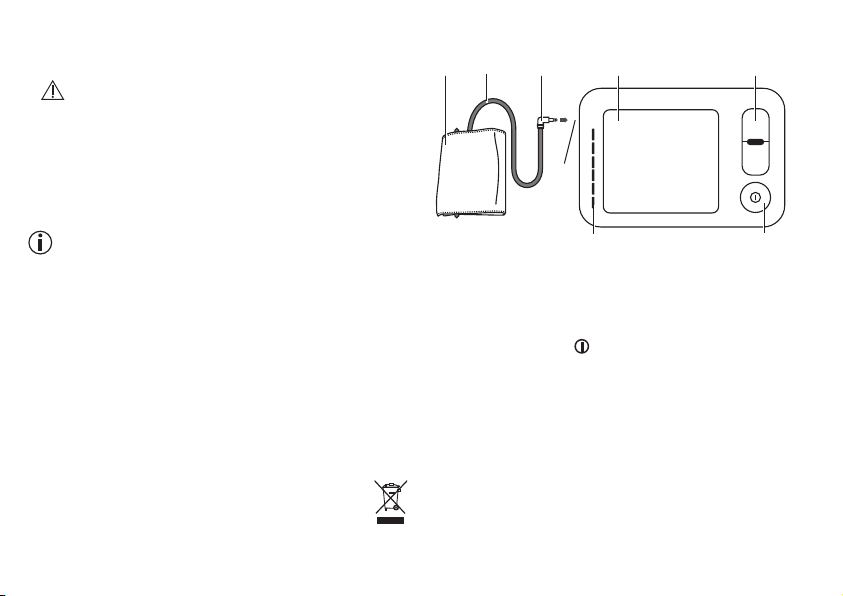
1. Cuff
2. Cuff line
3. Cuff connector
4. Display
5. Memory buttons M1/M2
6. START/STOP button
7. Risk indicator
8. Connection for cuff connector (left-hand side)
21
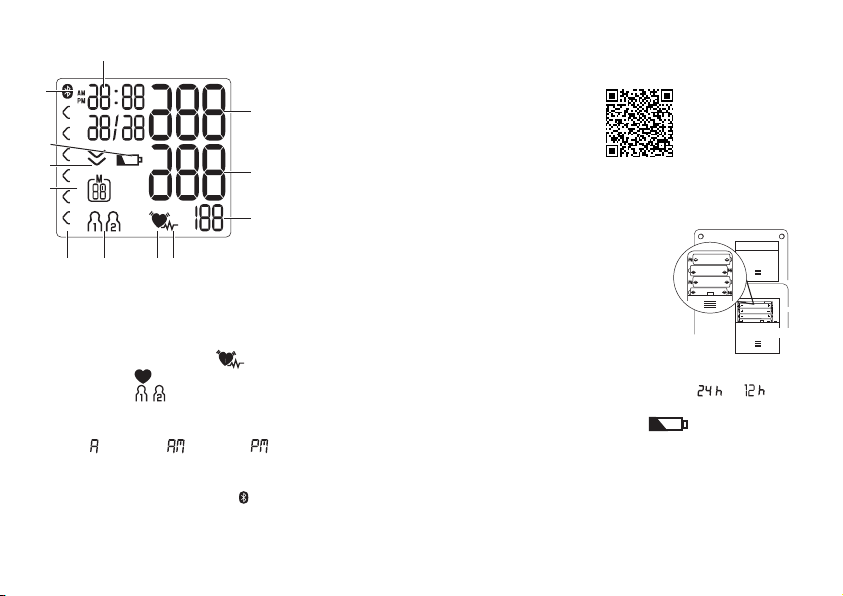
Information on the display:
1. Time/date
2. Systolic pressure
3. Diastolic pressure
4. Calculated pulse value
5. Cardiac arrhythmia symbol
6. Pulse symbol
7. User memory
8. Risk indicator
9. Number of memory space/memory display for average
value ( ), morning ( ), evening ( )
10. Release air (arrow)
11. Battery display symbol
12. Symbol for Bluetooth
®
transfer
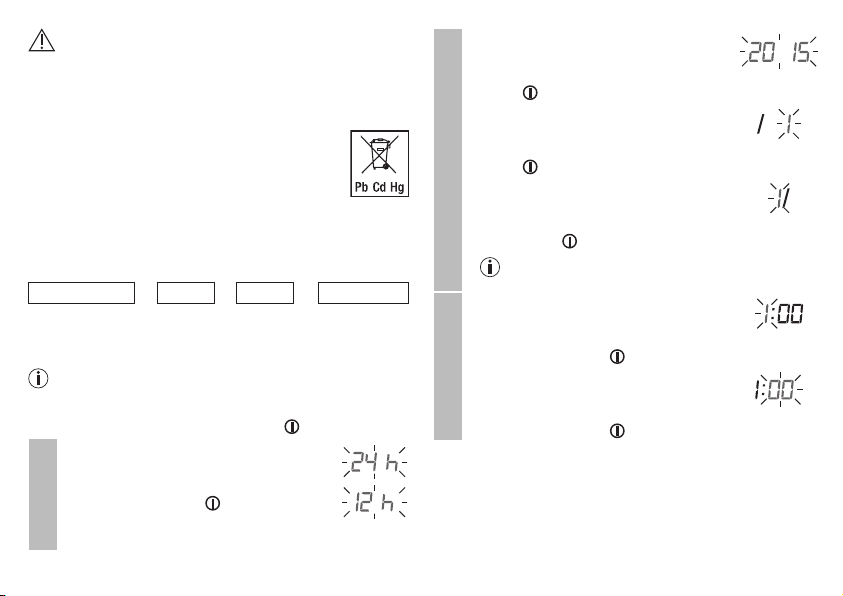
System requirements for the „HealthCoach“ app
– iOS ≥ 8.0 / Android
TM
≥ 4.4
– Bluetooth
®
≥ 4.0
List of compatible devices:
4. Preparing the measurement
Inserting the batteries
•
R
emove the battery compartment lid
on the rear of the device.
•
I
nsert four 1.5V AAA (alkaline type
LR03) batteries. Make sure that the
batteries are inserted the correct
way round. Do not use rechargeable
batteries.
•
C
lose the battery compartment lid
again carefully.
All display elements are briefly displayed, or flashes
in the display. Now set the date and time as described below.
If the battery replacement symbol is permanently dis-
played, you can no longer perform any measurements and must
replace all batteries. Once the batteries have been removed from
the device, the date and time must be set again. Any saved
measured values are retained.
1
68 5
2
3
10
11
9
7
12
4
4 x 1,5
V AAA
22
Battery disposal
•
The empty, completely discharged batteries must be disposed of
through specially designated collection boxes, recycling points
or electronics retailers. You are legally required to dispose of the
batteries.
• The codes below are printed on batteries
containing harmful substances:
Pb = Battery contains lead,
Cd = Battery contains cadmium,
Hg = Battery contains mercury
Set the hour format, date, time and Bluetooth
®
settings
The following section describes the functions and settings avail-
able on the blood pressure monitor.
Hour format
➔
Date
➔
Time
➔
Bluetooth
®
It is essential to set the correct date and time. Otherwise, you will
not be able to save your measured values correctly with a date
and time and access them again later.
If you press and hold the M1 or M2 memory button, you can
set the values more quickly.
Press and hold the START/STOP button for 5 seconds.
Hour format
The hour format now flashes on the display.
•
S
elect the desired hour format using the M1/
M2 memory buttons and confirm with the
START/STOP button .
Date
The year flashes on the display.
•
S
elect the year using the M1/M2 memory
buttons and confirm with the START/STOP
button .
The month flashes on the display.
•
S
elect the month using the M1/M2 memory
buttons and confirm with the START/STOP
button .
The day flashes on the display.
•
S
elect the current day using the M1/M2 me-
mory buttons and confirm with the START/
STOP button .
•
If you have set the 12h hour format, the month is
displayed before the day.
Time
The hours flash on the display.
•
S
elect the current hours using the M1/
M2 memory buttons and confirm with the
START/STOP button .
The minutes flash on the display.
•
S
elect the current minutes using the M1/
M2 memory buttons and confirm with the
START/STOP button .
23
Bluetooth
®
The Bluetooth
®
symbol flashes on the display.
•
U
se the M1/M2 memory buttons to select whether au-
tomatic Bluetooth
®
data transfer is activated (Bluetooth
®
symbol flashes) or deactivated (Bluetooth
®
symbol is not
shown) and confirm with the START/STOP button .
Bluetooth
®
transfers will reduce the battery life.
5. Measuring blood pressure
Ensure the device is at room temperature before measuring.
The measurement can be performed on the left or right arm.
Attaching the cuff
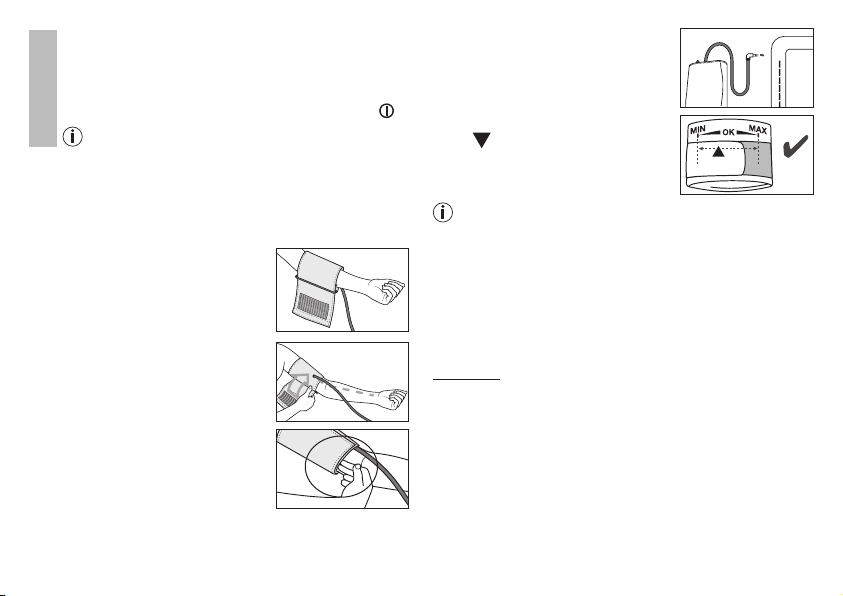
Place the cuff onto the bare upper arm.
The circulation of the arm must not be
hindered by tight clothing or similar.
The cuff must be placed on the upper
arm so that the bottom edge is posi-
tioned 2 – 3 cm above the elbow and
over the artery. The line should point to
the centre of the palm.
Now tighten the free end of the cuff, but
make sure that it is not too tight around
the arm and close the hook-and-loop
fastener. The cuff should be fastened so
that two fingers fit under the cuff.
Now insert the cuff line into the connec-
tion for the cuff connector.
This cuff is suitable for you if the index
mark (
) is within the OK range after
fitting the cuff on the upper arm.
If the measurement is performed on the right upper arm, the
line should be located on the inside of your elbow. Ensure
that your arm is not pressing on the line.
Blood pressure may vary between the right and left arm, which
may mean that the measured blood pressure values are different.
Always perform the measurement on the same arm.
If the values between the two arms are significantly different,
please consult your doctor to determine which arm should be
used for the measurement.
Important: The unit may only be operated with the original cuff.
The cuff is suitable for an arm circumference of 22 to 36cm.
A larger cuff for upper-arm circumferences of 35 to 44 cm can
be obtained from specialist retailers or from the service address
using order number 163.387.
M1
SYS
mmHg
DIA
mmHg
PUL
/min
M2
24
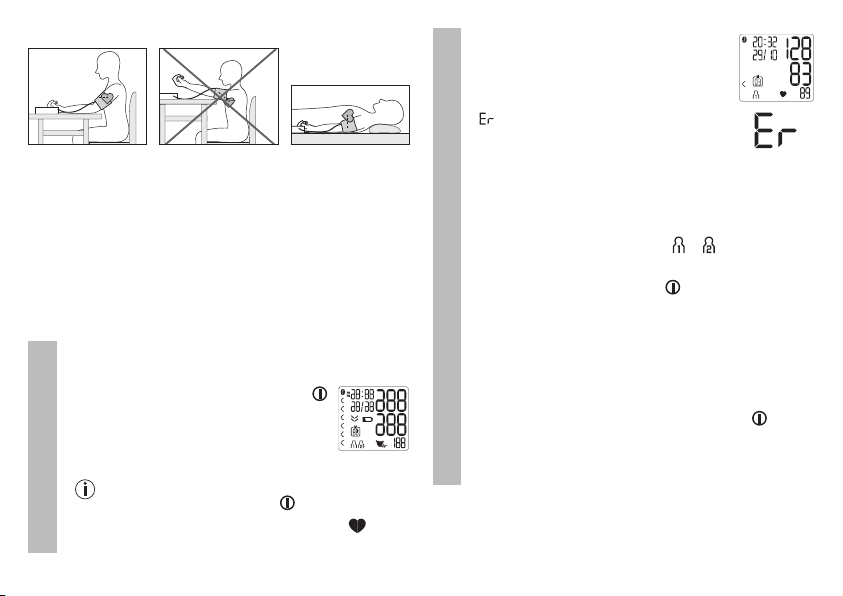
Adopting the correct posture
•
B
efore every measurement, relax for about five minutes. Oth-
erwise deviations can occur.
•
Y
ou can take the measurement while sitting or lying down.
Always make sure that the cuff is at heart level.
•
T
o carry out a blood pressure measurement, make sure you are
sitting comfortably with your arms and back leaning on some-
thing. Do not cross your legs. Place your feet flat on the ground.
•
T
o avoid falsifying the measurement, it is important to remain
still during the measurement and not to speak.
Performing the blood pressure measurement
Measurement
As described above, attach the cuff and adopt the posture
in which you want to perform the measurement.
•
Press the START/STOP button
to start the blood pressure monitor.
All display elements are briefly displayed.
The blood pressure monitor will begin the
measurement automatically after 3 seconds.
•
You can cancel the measurement at any time by pres-
sing the START/STOP button .
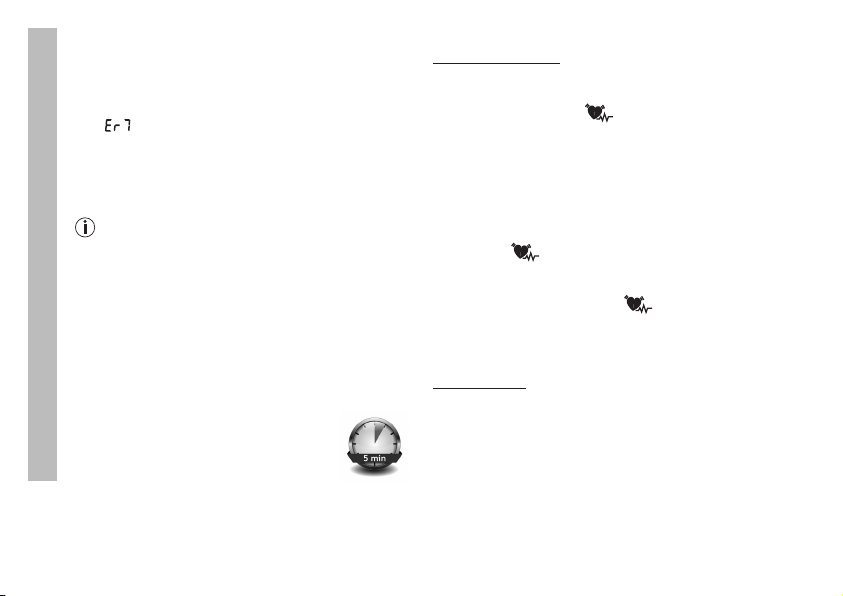
As soon as a pulse is found, the pulse symbol
will be
displayed.
Measurement
•
T
he systolic pressure, diastolic pressure
and pulse rate measurements are displa-
yed.
•
appears if the measurement could not
be performed properly (see chapter 9 "Er-
ror messages/troubleshooting"). Repeat the
measurement.
•
N
ow select the desired user memory by pressing the
M1 or M2 memory buttons. If you do not select a user
memory, the measurement is stored in the most recently
used user memory. The relevant or symbol appears
on the display.
•
P
ress the START/STOP button to switch off the blood
pressure monitor. The measurement is then stored in the
selected user memory.
•
If the device is not switched off manually, it will switch
off automatically after 30 seconds.
If Bluetooth
®
data transfer has been activated, data is
by transferred after having confirmed the user memory by
pressing the pressing the START/STOP button .
• The Bluetooth
®
symbol on the display flashes and the
blue LED lights up. The blood pressure monitor now at-
tempts to connect to the app for approx. 30 seconds.
25
Measurement
• The Bluetooth
®
symbol stops flashing as soon as a con-
nection is established. All measurement data is automa-
tically transferred to the app. Once the data has been
successfully transferred, the device switches off. If the
data transfer was unsuccessful, the blue LED goes out
and " " appears on the display.
• If a connection to the app cannot be established after
30 seconds, the Bluetooth
®
symbol goes out and the
blood pressure monitor switches off automatically after
3 minutes.
•
Please note that you must add the blood pres-
sure monitor in "My devices" in the "Health-
Coach" app to enable data transfers. The "Health-
Coach" app must be active to allow data transfer.
If the latest data is not displayed on your smartphone,
repeat the data transfer as described in chapter 7.
If you forget to turn off the blood pressure monitor, it will
switch off automatically after approx. 30 seconds. In this
case too, the value is stored in the selected or most recently
used user memory and the data is transferred if Bluetooth
®
data transfer is activated.
•
W
ait at least 5 minutes before taking ano-
ther measurement.
6. Evaluating results
Cardiac arrhythmia:
This device can identify potential disruptions of the heart rhythm
when measuring and if necessary, indicates this after the meas-
urement with the symbol .
This can be an indicator for arrhythmia. Arrhythmia is a condition
in which the heart rhythm is abnormal because of flaws in the
bioelectrical system that regulates the heartbeat. The symptoms
(skipped or premature heart beats, pulse being slow or too fast)
can be caused by factors such as heart disease, age, physical
make-up, excess stimulants, stress or lack of sleep. Arrhythmia
can only be determined through an examination by your doctor.
If the symbol is shown on the display after the measurement
has been taken, repeat the measurement. Please ensure that you
rest for 5 minutes beforehand and do not speak or move during
the measurement. If the symbol appears frequently, please
consult your doctor.
Self-diagnosis and treatment based on the measurements can
be dangerous. Always follow your GP’s instructions.
Risk indicator:
The measurements can be classified and evaluated in accordance
with the following table.
However, these standard values serve only as a general guideline,
as the individual blood pressure varies in different people and
different age groups etc.
It is important to consult your doctor regularly for advice. Your
doctor will tell you your individual values for normal blood pres-
sure as well as the value above which your blood pressure is
classified as dangerous.
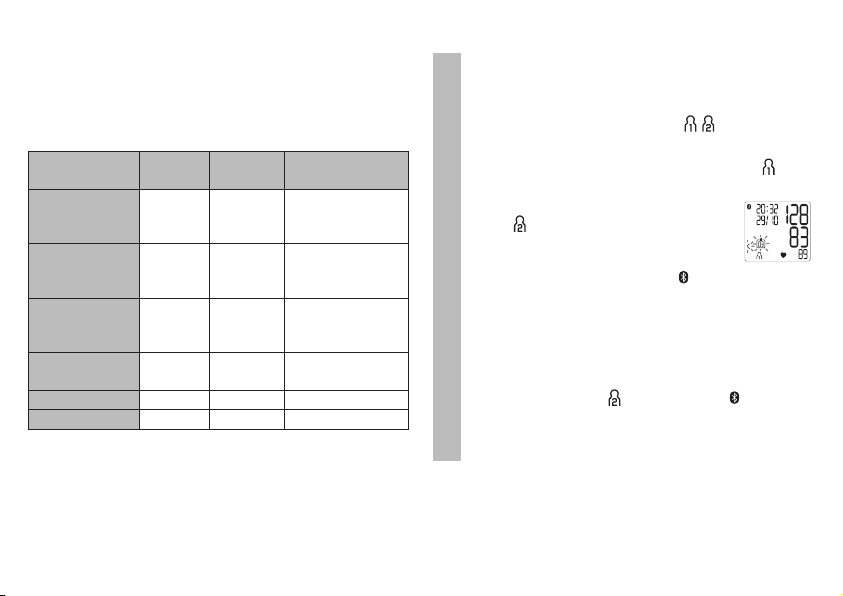
26
The classification on the display and the scale on the unit show
which category the recorded blood pressure values fall into. If
the values of systole and diastole fall into two different catego-
ries (e.g. systole in the ’High normal’ category and diastole in
the ’Normal’ category), the graphical classification on the device
always shows the higher category; for the example given this
would be ’High normal’.
Blood pressure
value category
Systole
(in mmHg)
Diastole
(in mmHg)
Action
Setting 3:
severe
hypertension
≥ 180 ≥ 110
seek medical
attention
Setting 2:
moderate
hypertension
160 – 179 100 – 109
seek medical
attention
Setting 1:
mild
hypertension
140 – 159 90 – 99
regular monitoring
by doctor
High normal 130 – 139 85 – 89
regular monitoring
by doctor
Normal 120 – 129 80 – 84 self-monitoring
Optimal < 120 < 80 self-monitoring
Source: WHO, 1999 (World Health Organization)
7. Display and delete measured values
User memory
The results of every successful measurement are stored
together with the date and time. The oldest measurement
is overwritten in the event of more than 60 measurements.
•
S
elect the desired user memory ( ) with the M1 or
M2 memory buttons if the device is switched off.
•
T
o view the measurement data for user memory , press
the M1 memory button.
•
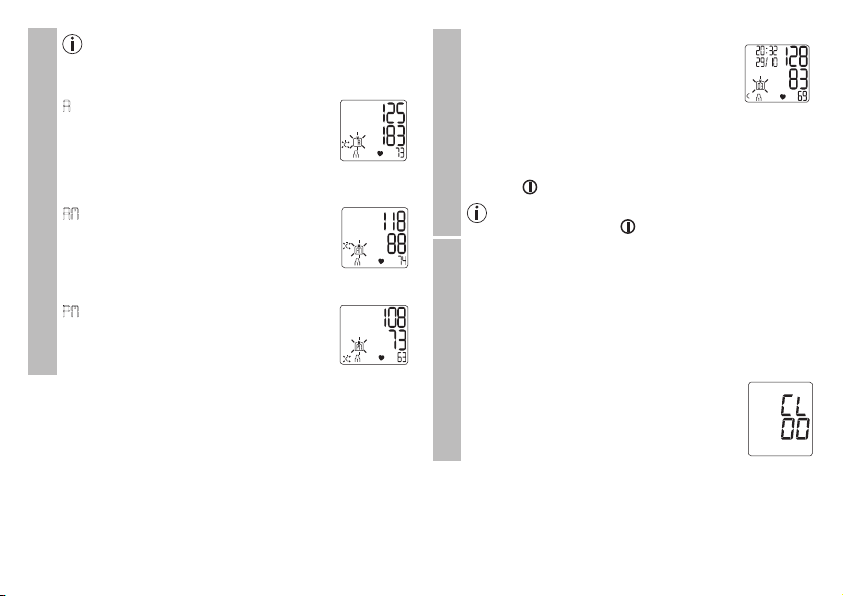
T
o view the measurement data for user me-
mory , press the M2 memory button.
•
The average of all measurements appears
on the display.
•
If Bluetooth
®
is activated (the symbol
flashes on the display), the blood pressure
monitor attempts to connect to the app. If
you press the M1 button in the meantime, the
transfer is cancelled and the average values
are displayed. If you press the M2 button, the
transfer is cancelled and the measurement
data of user memory is displayed. The
symbol is no longer shown. The buttons are
deactivated as soon as a connection is esta
-
blished and the data is transferred.
27
Average values
Press the M1 button if you have selected user memory 1.
Press the M2 memory button if you have selected user
memory2.
A
flashes on the display.
The average value of all saved measured va-
lues in this user memory is displayed.
•
P
ress the relevant memory button (M1 or M2).
AM
flashes on the display.
The average value of the morning measure-
ments for the last 7 days is displayed (morning:
5.00 a.m. – 9.00 a.m.).
•
P
ress the relevant memory button (M1 or M2).
PM
flashes on the display.
The average value of the evening measure-
ments for the last 7 days is displayed (evening:
6.00 p.m. – 8.00 p.m.).
Individual measured values
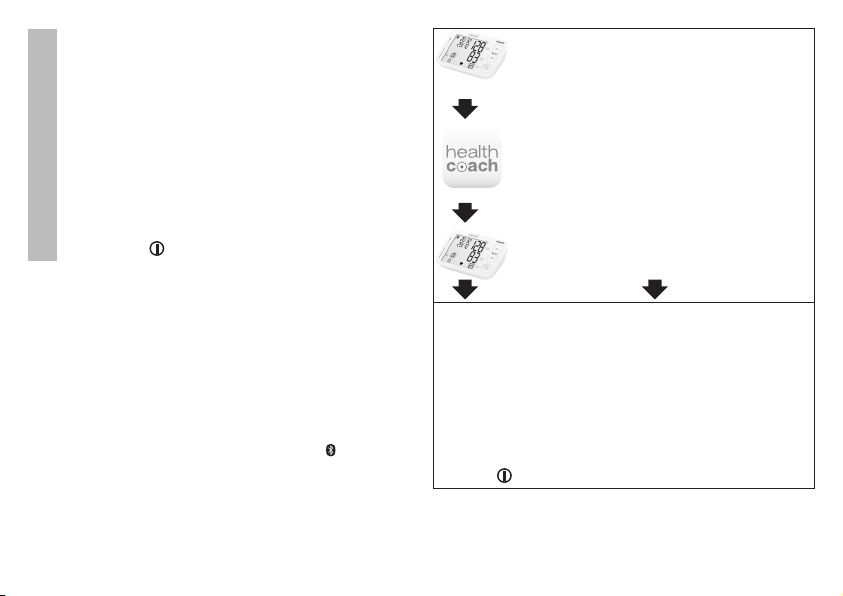
•
W
hen the relevant memory button (M1 or
M2) is pressed again, the last individual
measurement is displayed (in this example,
measurement 03).
•
W
hen the relevant memory button (M1 or M2) is pressed
again, you can view your individual measurements.
•
T
o switch the device off again, press the START/STOP
button .
You can exit the menu at any time by pressing the
START/STOP button .
Delete the measured values
•
To clear the memory of the relevant user memory, you
must first select a user memory.
•
Start the retrieval of the average measured values. A
flashes on the display and the average value of all saved
measured values in this user memory is displayed.
• Press and hold the memory button M1 or M2 for 5 sec-
onds depending on the user memory you are in.
All the values in the current user memory are
deleted.
28
Deleting individual measurements
•
T
o clear individual measurements from the relevant user
memory, you must first select a user memory.
•
S
tart the retrieval of the individual measured values.
•
P
ress and hold the memory button M1 or M2 for 5 se-
conds (depending on the user memory you are in).
•
T
he selected value is deleted. The device briefly dis-
plays CL 00.
•
I
f you would like to delete other values, repeat the pro-
cess described above.
You can switch off the device at any time by pressing the
START/STOP
button.
8. Transferring measured values
Transfer via Bluetooth
®
low energy technology
It is also possible to transfer the measured values saved on the
device to your smartphone using Bluetooth
®
low energy tech-
nology.
You will need the “HealthCoach” app for this. This is available in
the Apple App Store and from Google Play.
Proceed as follows to transfer values:
If Bluetooth
®
is activated in the settings menu, the data is trans-
ferred automatically after the measurement. The symbol ap-
pears in the top left of the display (see chapter 4 „Preparing the
measurement“).
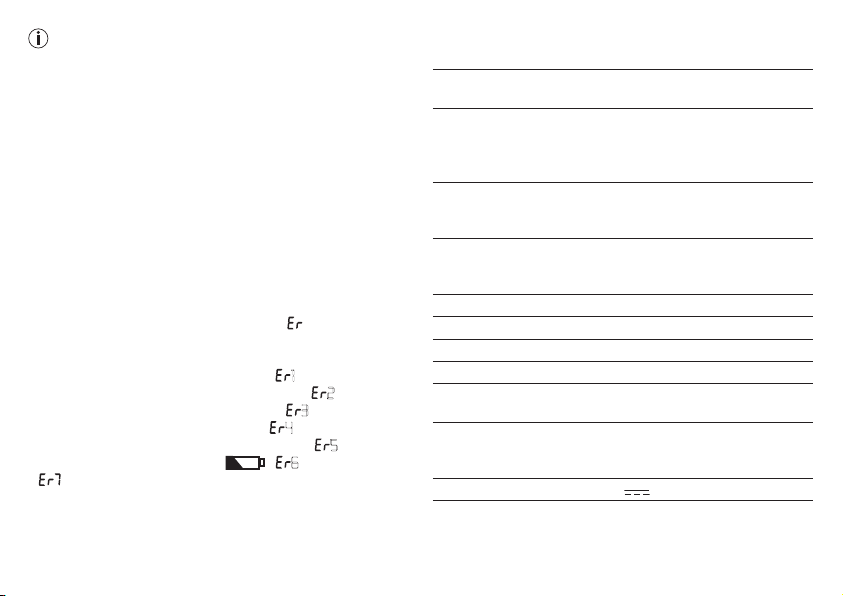
Step 1: SBM 37
Activate Bluetooth
®
on your device (see chapter 4
“Preparing the measurement”, Bluetooth
®
).
Step 2: “HealthCoach” app
In the “HealthCoach” app, add the SBM 37 under
"Settings/My devices".
Step 3: SBM 37
take a measurement.
Step 4: SBM 37
data transfer immediately fol-
lowing measurements.
•
I
f Bluetooth
®
data trans-
fer has been activated,
data is by transferred after
having confirmed the user
memory by pressing the
pressing the START/STOP
button .
Step 4: SBM 37
Data transfer at a later point:
•
G
o to memory mode (chap-
ter 7). Select the desired
user memory. The Blue-
tooth
®
transfer starts auto-
matically.
29
The “HealthCoach” app must be active to allow data transfer.
If your smartphone has a protective cover, remove this to ensure
that there is no interference during the transfer. Begin the data
transfer in the “HealthCoach” app.
9. Cleaning and storing the device and cuff
•
C
lean the device and cuff carefully using a slightly damp cloth
only.
•
D
o not use any cleaning agents or solvents.
•
U
nder no circumstances hold the device and cuff under wa-
ter, as this can cause liquid to enter and damage the device
and cuff.
•
I
f you store the device and cuff, do not place heavy objects on
the device and cuff. Remove the batteries. The cuff line should
not be bent sharply.
10. Error messages/troubleshooting
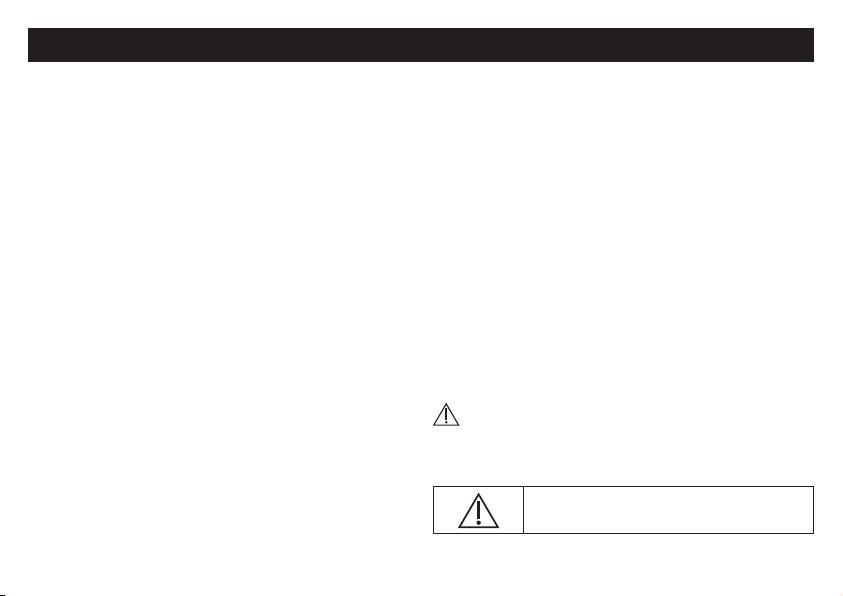
In the event of errors, the error message
_
appears on the
display.
Error messages may appear if:
• it was not possible to record the pulse:
1
;
• you move or speak during the measurement:
2
;
• the cuff is fastened too tightly or loosely:
3
;
• errors occur during the measurement:
4
;
• the pump pressure is higher than 300 mmHg:
5
;
• the batteries are almost empty :
6
;
• the data could not be sent via Bluetooth
®
.
In such cases, repeat the measurement and/or data transfer.
Ensure that the cuff line is correctly attached and that you do not
move or speak during the measurement.
11. Technical specifications
Model No. SBM 37
Measurement me-
thod
Oscillometric, non-invasive blood pres-
sure measurement on the upper arm
Measurement range Cuff pressure 0 – 250mmHg,
Systolic 50 – 250mmHg,
Diastolic 30 – 200mmHg,
Pulse 40 – 180 beats/minute
Display accuracy Systolic ± 3 mmHg,
Diastolic ± 3 mmHg,
Pulse ± 5 % of the value shown
Measurement inac-
curacy
Max. permissible standard deviation
according to clinical testing:
Systolic 8 mmHg / Diastolic 8 mmHg
Memory 2 x 60 memory spaces
Dimensions L 139 mm x W 94 mm x H 48 mm
Weight 236 g (without cuff, without batteries)
Cuff size 22 to 36 cm
Permissible operating
conditions
+ 5°C to + 40°C, 15-93% relative humi-
dity (non-condensing)
Permissible storage
and transport con-
ditions
-25°C to + 70°C, ≤ 93% relative humidity,
700 –1060 hPa ambient pressure
Power supply 4x 1.5V AAA batteries

30
Battery life Lasts for approx. 200 measurements
depending on the blood pressure and
pump pressure as well as the number
of Bluetooth
®
connections.
Accessories
Cuff, instructions for use, storage pouch
Classification Internal supply, IP21, no AP or APG,
continuous operation, application part
type BF
Data transfer via
Bluetooth
®
wireless
technology
The blood pressure monitor uses
Bluetooth
®
low energy technology,
2402MHz – 2480MHz frequency band,
Transmission power max. 20 dBM,
Compatible with Bluetooth ≥ 4.0 smart-
phones/tablets
The serial number is located on the device or in the battery com-
partment.
Technical information is subject to change without notification
to allow for updates.
•
T
his device complies with European Standard EN60601-1-2
and is subject to particular precautions with regard to electro-
magnetic compatibility. Please note that portable and mobile
HF communication systems may interfere with this unit. More
details can be requested from the stated Customer Services
address or found at the end of the instructions for use.
•
T
he device complies with the EU Medical Devices Directive
93/42/EEC, the German Medical Devices Act (Medizinproduk-
tgesetz) and the standards EN1060-1 (non-invasive sphyg-
momanometers – Part1: General requirements), EN1060-3
(non-invasive sphygmomanometers – Part 3: Supplementary
requirements for electro-mechanical blood pressure measuring
systems) and IEC80601-2-30 (Medical electrical equipment –
Part 2 – 30: Particular requirements for the basic safety and
essential performance of automated non-invasive sphygmo-
manometers).
•
T
he accuracy of this blood pressure monitor has been care-
fully checked and developed with regard to a long useful life.
If using the device for commercial medical purposes, it must
be regularly tested for accuracy by appropriate means. Precise
instructions for checking accuracy may be requested from the
service address.
•
W
e hereby guarantee that this product complies with the Euro-
pean RED Directive 2014/53/EU. Please contact the specified
service address to obtain further information, such as the CE
Declaration of Conformity.
•
P
lease contact the specified service address to obtain more
detailed information such as the CE conformity declaration.
12. Warranty / service
In case of a claim under the warranty please contact your local
dealer or the local representation which is mentioned in the list
“service international”.
In case of returning the unit please add a copy of your receipt
and a short report of the defect.
The following warranty terms shall apply:
1
. The warranty period for SANITAS products is either 2 years
or- if longer- the country specific warranty period from date
of Purchase.

31
In case of a warranty claim, the date of purchase has to be
proven by means of the sales receipt or invoice.
2
. Repairs (complete unit or parts of the unit) do not extend the
warranty period.
3
. The warranty shall not be valid for damages because of
a. improper treatment, e.g. nonobservance of the user instruc-
tions.
b. repairs or tampering by the customer or unauthorised third
parties.
c. transport from the manufacturer to the consumer or during
transport to the service centre.
d. The warranty shall not be valid for accessories which are
subject to normal wear and tear (cuff, batteries etc.).
4
. Liability for direct or indirect consequential losses caused by
the unit are excluded even if the damage to the unit is ac-
cepted as a warranty claim.
Subject to errors and changes
32
FRANÇAIS
Contenu
•
T
ensiomètre
•
M
anchette
•
4
piles AAA LR03 de 1,5V
•
P
ochette de rangement
•
M
ode d’emploi
Lisez attentivement cette notice, conservez-la pour un usage
ultérieur, mettez-la à disposition des autres utilisateurs et suivez
les consignes qui y figurent.
1. Présentation
Vérifiez que l’emballage du tensiomètre SBM37 de Sanitas est
intact et que tous les éléments sont inclus. Avant l’utilisation,
assurez-vous que l’appareil et les accessoires ne présentent au-
cun dommage visible et que la totalité de l’emballage a bien été
retirée. En cas de doute, ne l’utilisez pas et adressez-vous à votre
revendeur ou au service client indiqué.
Le tensiomètre de bras est conçu pour la mesure non invasive
et la surveillance des valeurs de tension artérielle des personnes
adultes.
Il vous permet de mesurer votre tension rapidement et facilement,
d’enregistrer les valeurs et d’afficher l’évolution et la moyenne
de ces valeurs.
Vous êtes averti en cas d’éventuels troubles du rythme cardiaque.
Les valeurs calculées sont classées et évaluées sous forme gra-
phique.
2. Conseils importants
Symboles utilisés
Les symboles suivants sont utilisés sur le mode d’emploi, sur
l’emballage et sur la plaque signalétique de l’appareil et des ac-
cessoires:
Attention
Contenu
1. Présentation ........................................................................32
2. Conseils importants.............................................................32
3. Description de l’appareil ......................................................36
4. Préparer la mesure ..............................................................37
5. Mesurer la tension ...............................................................38
6. Évaluer les résultats .............................................................41
7. Récupérer et supprimer les valeurs de mesure .................42
8. Transfert des valeurs mesurées ......................................... 43
9. Nettoyage et rangement de l’appareil et de la manchette 44
10. Message d’erreur/Résolution des erreurs .........................44
11. Caractéristiques techniques .............................................. 45
12. Garantie / Maintenance.......................................................46
33
Remarque
Indication d’informations importantes
Respecter les consignes du mode d’emploi
Appareil de type BF
Courant continu
Élimination conformément à la directive euro-
péenne WEEE (Waste Electrical and Electronic
Equipment) relative aux déchets d’équipements
électriques et électroniques
20
PAP
Assurer une mise au rebut respectueuse de
l’environnement de l’emballage
Fabricant
Storage/Transport
Température et taux d’humidité de stockage et
de transport admissibles
Operating
Température et taux d’humidité d’utilisation
admissibles
IP21
Protection contre les corps solides, diamè-
tre 12,5mm ou plus, et contre les chutes de
gouttes d’eau
S
N
Numéro de série
Le sigle CE atteste de la conformité aux exi-
gences fondamentales de la directive 93/42/
EEC relative aux dispositifs médicaux.
Conseils d’utilisation
•
M
esurez toujours votre tension au même moment de la journée
afin que les valeurs soient comparables.
•
A
vant toute mesure, reposez-vous pendant environ 5minutes!
•
L
orsque vous devez effectuer plusieurs mesures sur une per-
sonne, patientez à chaque fois 5minutes entre chaque mesure.
•
É
vitez de manger, boire, fumer ou de pratiquer des activités
physiques pendant au moins 30minutes avant la mesure.
•
E
ffectuez une nouvelle mesure si vous avez un doute sur les
valeurs mesurées.
•
L
es mesures que vous avez établies servent juste à vous tenir
informé de votre état – elles ne remplacent pas un examen
médical! Communiquez vos résultats à votre médecin, vous
ne devez prendre en aucun cas des décisions d’ordre médical
sur la base de ces seules mesures (par ex. le choix de médi-
caments et de leurs dosages)!
•
N
’utilisez pas le tensiomètre sur des nouveau-nés et des pa-
tientes atteintes de pré-éclampsie. Nous recommandons de
consulter le médecin avant d’utiliser le tensiomètre pendant
la grossesse..
•
L
es maladies cardio-vasculaires peuvent entraîner des erreurs
de mesure ou des mesures imprécises. C’est également le
cas lors d’une tension très basse, de diabète, de troubles de

34
la circulation et du rythme cardiaque et de frissons de fièvre
ou de tremblements.
•
Cet appareil n’est pas conçu pour être utilisé par une personne
(y compris les enfants) dont les capacités physiques, senso-
rielles ou intellectuelles sont limitées, ou n’ayant pas l’expé-
rience et/ou les connaissances nécessaires. Le cas échéant,
cette personne doit, pour sa sécurité, être surveillée par une
personne compétente ou doit recevoir vos recommandations
sur la manière d’utiliser l’appareil. Surveillez les enfants afin de
les empêcher de jouer avec l’appareil.
•
L
e tensiomètre ne doit pas être utilisé parallèlement à un ap-
pareil chirurgical haute fréquence.
•
U
tilisez uniquement l’appareil sur des personnes dont le péri-
mètre du bras correspond à celui indiqué pour l’appareil.
•
V
euillez noter que la fonction du membre concerné peut être
entravée lors du gonflage.
•
I
l ne faut pas bloquer la circulation sanguine plus longtemps
que nécessaire au cours de la prise de tension. Si l’appareil ne
fonctionne pas bien, retirez la manchette du bras.
•
É
vitez de presser, d’aplatir ou de plier le tuyau du brassard
en le manipulant.
•
É
vitez des mesures trop fréquentes ou une pression continue
du brassard. Elles entraînent une réduction de la circulation
sanguine et constituent un risque de blessure.
• Veillez à ne pas placer la manchette sur un bras dont les artères
ou les veines sont soumises à un traitement médical, par ex. en
présence d’un dispositif d’accès intravasculaire destiné à un trai-
tement intravasculaire ou en cas de shunt artério-veineux.
•
N
’utilisez pas le brassard sur des personnes qui ont subi une
mastectomie.
•
N
e placez pas le brassard sur des plaies, son utilisation peut
les aggraver.
•
P
lacez la manchette uniquement au niveau du bras. Ne placez
pas la manchette sur d’autres parties du corps.
•
N
otez que la transmission et l’enregistrement des données
n’est possible que si votre tensiomètre est alimenté. Dès que
les piles sont vides, le tensiomètre perd la date et l’heure.
•
L
’arrêt automatique permet de faire passer le tensiomètre en
mode économie d’énergie lorsqu’aucune touche n’est utilisée
pendant 30secondes.
•
L
’appareil est conçu pour l’utilisation décrite dans ce mode
d’emploi. Le fabricant ne peut être tenu pour responsable des
dommages causés par une utilisation inappropriée ou non
conforme.
Consignes de rangement et d’entretien
•
Le tensiomètre est constitué de composants de précision et élec
-
troniques. La précision des valeurs mesurées et la durée de vie de
l’appareil dépendent du soin que vous lui portez:
–
Protégez l’appareil contre les chocs, l’humidité, les saletés,
les fortes variations de température et l’ensoleillement direct.
–
Ne laissez pas tomber l’appareil.
–
N’utilisez pas l’appareil à proximité de champs électromagné-
tiques puissants, tenez-le éloigné des installations de radio
et des téléphones mobiles.
–
Utilisez-le uniquement avec les manchettes fournies ou de re-
change originales. Sinon, des valeurs de mesure fausses sont
transmises.
35
Remarques relatives aux piles
•
Si du liquide de la cellule de pile entre en contact avec la peau
ou les yeux, rincez la zone touchée avec de l’eau et consultez
un médecin.
•
Risque d’ingestion! Les enfants en bas âge pourraient
avaler des piles et s’étouffer. Veuillez donc conserver les piles
hors de portée des enfants en bas âge!
• Respectez les signes de polarité plus (+) et moins (-).
• Si une pile a coulé, enfilez des gants de protection et nettoyez
le compartiment à piles avec un chiffon sec.
• Protégez les piles d’une chaleur excessive.
•
Risque d’explosion! Ne jetez pas les piles dans le feu.
• Les piles ne doivent être ni rechargées, ni court-circuitées.
•
En cas de non utilisation prolongée de l’appareil, sortez les
piles du compartiment à piles.
• Utilisez uniquement des piles identiques ou équivalentes.
• Remplacez toujours l’ensemble des piles simultanément.
• N’utilisez pas de batterie!
• Ne démontez, n’ouvrez ou ne cassez pas les piles.
Consignes de réparation et d’élimination
•
Les piles ne doivent pas être jetées avec les ordures ména-
gères. Veuillez jeter les piles usées dans les points de collecte
prévus à cet effet.
•
V
ous ne devez pas réparer ou ajuster l’appareil vous-même.
Le bon fonctionnement de l’appareil n’est plus garanti si tel
était le cas.
•
Seul le service client ou un opérateur autorisé
peut procéder
à une réparation.
•
N
’ouvrez pas l’appareil. Le non-respect de cette consigne an-
nulerait la garantie.
•
D
ans l’intérêt de la protection de l’environnement, l’appareil ne
doit pas être jeté avec les ordures ménagères à la fin de sa
durée de service. L’élimination doit se faire par le biais des
points de collecte compétents dans votre pays. Éliminez l’ap-
pareil conformément à la directive européenne – WEEE (Waste
Electrical and Electronic Equipment) relative aux appareils élec-
triques et électroniques usagés. Pour toute question,
adressez-vous aux collectivités locales responsables de
l’élimination et du recyclage de ces produits.
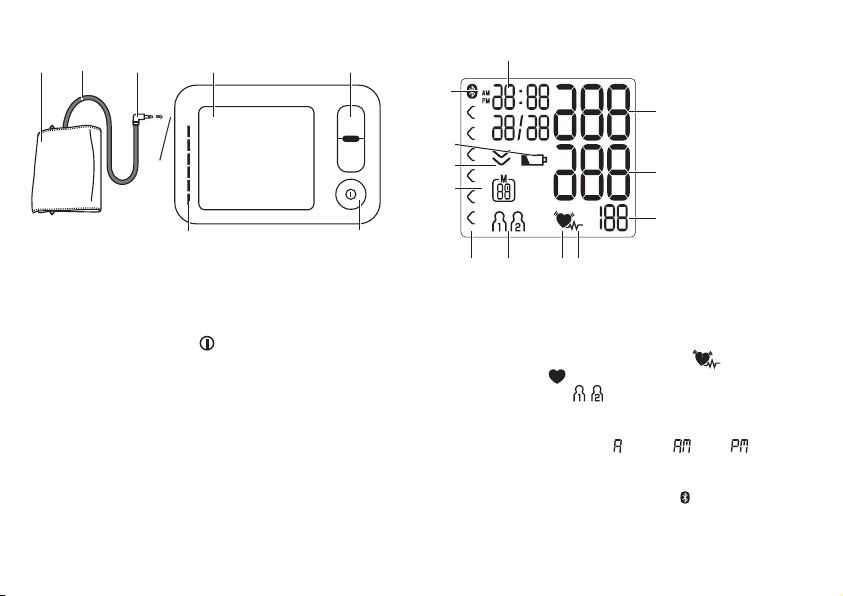
36
3. Description de l’appareil
M1
SYS
mmHg
DIA
mmHg
PUL
/min
M2
1
2
3 4 5
7
8
6
1. Manchette
2. Tuyau de manchette
3. Connexion à la manchette
4. Écran
5. Touches mémoire M1/M2
6. Touche MARCHE/ARRÊT
7. Indicateur de risque
8. Prise pour la connexion à la manchette (côté gauche)
Données affichées à l’écran:
1. Heure/Date
2. Pression systolique
3. Pression diastolique
4. Valeur du pouls mesurée
5. Symbole troubles du rythme cardiaque
6. Symbole Pouls
7. Mémoire utilisateur
8. Indicateur de risque
9. Numéro de l’emplacement de sauvegarde/valeur moyenne de
l’affichage de la mémoire ( ), matin ( ), soir ( )
10. Dégonflage (flèche)
11. Symbole de changement des piles
12. Symbole de transmission Bluetooth
®
1
68 5
2
3
10
11
9
7
12
4
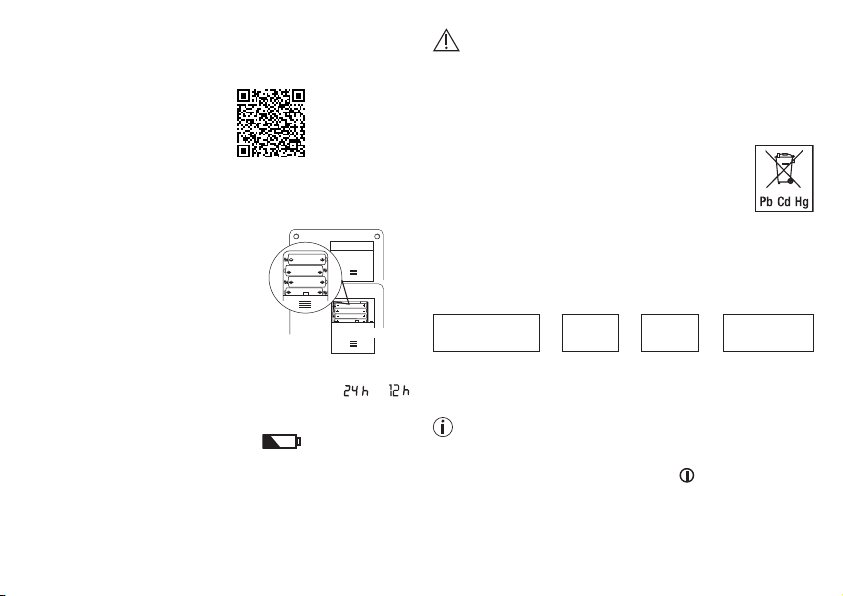
37
Configuration requise pour l’application „HealthCoach“
– iOS ≥ 8.0 / Android
TM
≥ 4.4
– Bluetooth
®
≥ 4.0
Liste des appareils compatibles:
4. Préparer la mesure
Insérer les piles
•
R
etirez le couvercle du compartiment
à piles se trouvant sur la face arrière
de l’appareil.
•
I
nsérez quatre piles de type 1,5V
AAA (type alcaline LR03). Veillez im-
pérativement à insérer les piles en
respectant la polarité indiquée. N’uti-
lisez pas de batteries rechargeables.
•
R
efermez soigneusement le couvercle du compartiment à piles.
Tous les éléments de l’écran s’affichent brièvement et ou
clignote à l’écran. Veuillez maintenant régler la date et l’heure en
suivant les instructions suivantes.
Si le symbole de changement des piles apparaît en conti-
nu, il n’est plus possible d’effectuer de mesure et vous devez
changer toutes les piles. Dès que les piles sont retirées de l’ap-
pareil, l’heure doit être de nouveau réglée. Les valeurs mesurées
enregistrées sont conservées.
Élimination des piles
•
Les piles usagées et complètement déchargées doivent être mises
au rebut dans des conteneurs spéciaux ou aux points de col-
lecte réservés à cet usage ou bien déposées chez un revendeur
d’appareils électriques. L’élimination des piles est une obligation
légale qui vous incombe.
• Ces pictogrammes se trouvent sur les piles
àsubstances nocives:
Pb = pile contenant du plomb,
Cd = pile contenant du cadmium,
Hg = pile contenant du mercure.
Paramétrer le format de l’heure, la date, l’heure et la
connexion Bluetooth
®
.
Dans la section suivante, les fonctions et réglages possibles du
tensiomètre seront décrits.
Format de
l’heure
➔
Date
➔
Heure
➔
Bluetooth
®
Réglez impérativement la date et l’heure de manière exacte. Sans
ces réglages, il est impossible d’enregistrer et de consulter cor-
rectement vos mesures avec la date et l’heure.
Vous pouvez régler plus rapidement les valeurs en maintenant
enfoncées les touches de mémoire M1 ou M2.
Maintenez la touche MARCHE/ARRÊT enfoncée pendant
5secondes.
4 x 1,5
V AAA
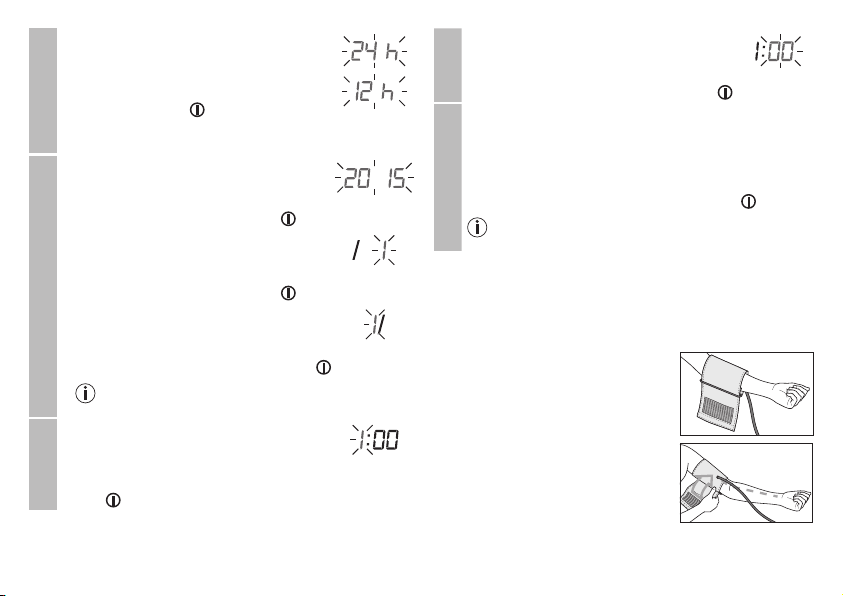
38
Format de l’heure
Le format de l’heure clignote à l’écran.
•
À
l’aide des touches mémoire M1/M2,
sélectionnez le format d’heure que vous
souhaitez et confirmez avec la touche-
MARCHE/ARRÊT .
Date
L’année clignote à l’écran.
•
À
l’aide des touches mémoire M1/M2, sé-
lectionnez l’année et confirmez votre choix
avec la touche MARCHE/ARRÊT .
Le mois clignote à l’écran.
•
À
l’aide des touches mémoire M1/M2, sé-
lectionnez le mois et confirmez votre choix
avec la touche MARCHE/ARRÊT .
Le jour clignote à l’écran.
•
À
l’aide des touches mémoire M1/M2, sé-
lectionnez le jour en cours et confirmez votre
choix avec la touche MARCHE/ARRÊT .
• Lorsque le format d’heure de 12h est paramétré, le
mois est affiché devant le jour.
Heure
L’heure clignote à l’écran.
•
À
l’aide des touches mémoire M1/M2, sé-
lectionnez l’heure en cours et confirmez
votre choix avec la touche MARCHE/AR-
RÊT .
Heure
Les minutes clignotent à l’écran.
•
À l’aide des touches mémoire M1/M2, sélec-
tionnez la minute en cours et confirmez votre
choix avec la touche MARCHE/ARRÊT .
Bluetooth
®
Le symbole Bluetooth
®
clignote à l’écran.
•
À
l’aide des touches mémoire M1/M2, déterminez si le
transfert automatique des données via Bluetooth
®
doit
être activé (le symbole Bluetooth
®
clignote) ou désactivé
(le symbole Bluetooth
®
ne s’affiche pas) et confirmez vo-
tre choix avec la touche MARCHE/ARRÊT .
L’autonomie de la batterie est réduite en cas de trans-
fert par Bluetooth
®
.
5. Mesurer la tension
Avant la mesure, placez l’appareil à température ambiante.
Vous pouvez effectuer la mesure sur le bras gauche ou droit.
Positionnement de la manchette
Placez la manchette sur le bras nu. La
circulation du bras ne doit pas être gê-
née par des vêtements serrés ou autre.
Positionnez la manchette sur le bras de
façon à ce que le bord inférieur se
trouve 2 à 3 cm au-dessus du pli du
coude et au-dessus de l’artère. Le tuyau
est dirigé vers le milieu de la paume de
la main.

39
Refermez maintenant la partie libre de
la manchette autour du bras, sans trop
serrer, à l’aide de la fermeture Velcro. Le
serrage de la manchette doit permettre
de passer deux doigt sous celle-ci.
Insérez maintenant le tuyau de la man-
chette dans la prise de raccord de la
manchette.
Cette manchette vous convient si le
marquage de l’index (
) se trouve
dans la zone OK après la pose de la
manchette sur le bras.
Si vous effectuez la mesure sur le bras droit, le tuyau se
trouve à l’intérieur de votre coude. Assurez-vous que votre
bras n’est pas posé sur le tuyau.
La tension peut être différente entre le bras droit et le gauche,
les valeurs de tension mesurées peuvent donc également être
différentes. Effectuez toujours la mesure sur le même bras.
Si les valeurs entre les deux bras sont très différentes, vous devez
déterminer avec votre médecin quel bras utiliser pour la mesure.
Attention: l’appareil ne doit être utilisé qu’avec la manchette
d’origine. La manchette est prévue pour un tour de bras de 22
à 36cm.
Une plus grande manchette pour les bras de 35 à 44cm est dis-
ponible sous la référence 163.387 dans les magasins spécialisés
ou à l’adresse du SAV.
Adopter une position adéquate
•
A
vant toute mesure, reposez-vous pendant environ 5minutes!
Sinon, cela pourrait entraîner des erreurs.
•
L
a mesure peut se faire en position assise ou allongée. Faites
attention, dans tous les cas, à ce que la manchette se trouve
au niveau du cœur.
•
I
nstallez-vous confortablement avant de prendre votre tension.
Faites en sorte que votre dos et vos bras soient bien appuyés
sur le dossier et les accoudoirs. Ne croisez pas les jambes.
Posez les pieds bien à plat sur le sol.
•
P
our ne pas fausser le résultat, il est important de rester calme
durant la mesure et de ne pas parler.
Mesurer la tension artérielle
Mesure
Positionnez la manchette tel que décrit plus haut et instal-
lez-vous dans la position de votre choix pour effectuer la
mesure.
•
P
our démarrer le tensiomètre,
appu-
yez sur la touche MARCHE/ARRÊT .
Tous les éléments de l’écran s’affichent
brièvement.
Après 3secondes, le tensiomètre débute la
mesure automatiquement.
M1
SYS
mmHg
DIA
mmHg
PUL
/min
M2
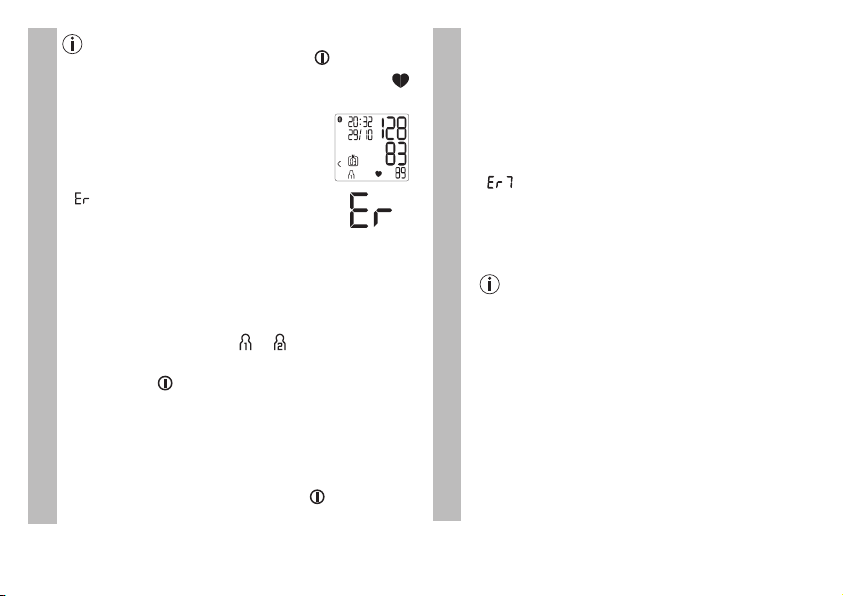
40
Mesure
Vous pouvez interrompre la mesure à tout moment en
appuyant sur la touche START/STOP .
Dès qu’un pouls est reconnaissable, le symbole Pouls
s’affiche.
•
L
es résultats de mesure de la pression sy-
stolique, de la pression diastolique et du
pouls sont affichés.
•
s’affiche lorsque la mesure n’a pas pu
être prise correctement (voir chapitre 9
«
Message d’erreur/Résolution des
erreurs
»
). Répétez la mesure.
•
E
n appuyant sur la touche mémoire M1 ou M2, sélection-
nez maintenant la mémoire utilisateur de votre choix. Si
vous ne choisissez pas de mémoire utilisateur, le résultat
de la mesure est attribué au dernier utilisateur enregistré.
Le symbole correspondant ou s’affiche à l’écran.
•
É
teignez le tensiomètre en appuyant sur la touche MAR-
CHE/ARRÊT . Ainsi, le résultat de la mesure est enre-
gistré dans la mémoire utilisateur choisie.
• Si l’appareil n’est pas éteint manuellement, il s’éteindra
automatiquement après 30secondes.
•
L
orsque le transfert de données via Bluetooth
®
est ac-
tivé, après confirmation de la mémoire utilisateur et pres-
sion sur la touche MARCHE/ARRÊT , les données
sont transférées.
Mesure
•
Le symbole Bluetooth
®
clignote à l’écran et la LED bleue
s’allume. Pendant environ 30secondes, le tensiomètre
tente alors d’établir une connexion avec l’application.
• Dès que la connexion est établie, le symbole Bluetooth
®
cesse de clignoter. Toutes les mesures sont transférées
automatiquement sur l’application. Après le transfert des
données, l’appareil s’éteint automatiquement. Si les don-
nées n’ont pas pu être transférées, la LED bleu s’éteint et
« » s’affiche à l’écran.
• Si, après 30secondes, aucune connexion n’a plus être
établie avec l’application, le symbole Bluetooth
®
s’éteint
et le tensiomètre se met automatiquement hors tension
après 3minutes.
•
Veuillez tenir compte du fait qu’il vous faut ajou-
ter un tensiomètre dans l’application Sanitas
„HealthCoach“ à la rubrique « Mes appareils»
pour pouvoir transférer des données. L’application
„HealthCoach“ doit être activée pour le transfert.
Si les données actuelles ne s’affichent pas sur votre
smartphone, répétez la transmission comme décrit
au chapitre7.
Si vous oubliez d’éteindre l’appareil, il s’éteindra automa-
tiquement après environ 30secondes. Dans ce cas égale-
ment, la valeur est enregistrée dans la mémoire utilisateur
sélectionnée ou utilisée en dernier, et les données sont
transférées lorsque le transfert de données via Blue tooth
®
est activé.
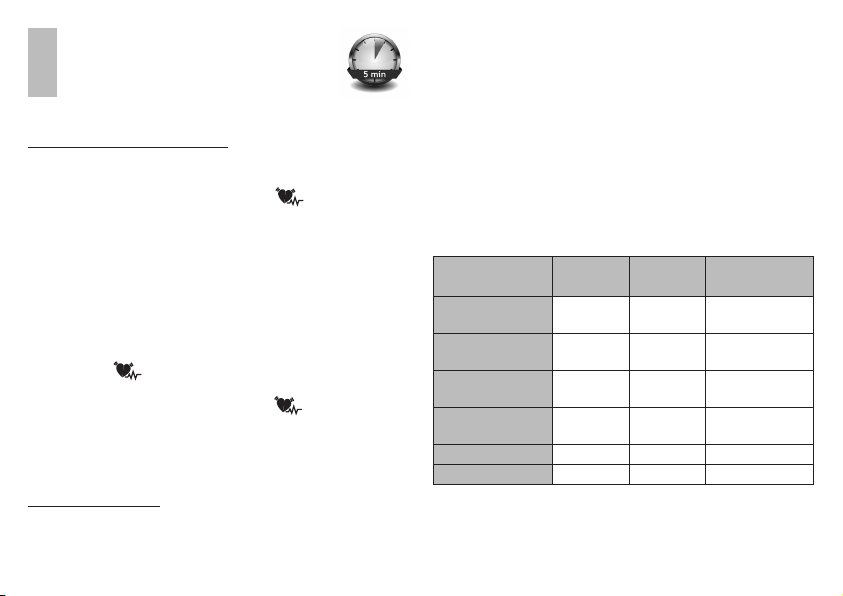
41
Mesure
•
A
ttendez au moins 5 minutes avant
d’effectuer une nouvelle mesure!
6. Évaluer les résultats
Troubles du rythme cardiaque:
Cet appareil est capable d’identifier d’éventuels troubles du
rythme cardiaque au cours de la mesure et le signale le cas
échéant après la mesure, par le symbole .
Cela peut indiquer une arythmie. L’arythmie est une maladie qui
se caractérise par une anomalie du rythme cardiaque, en raison
de perturbations du système bioélectrique. Les symptômes (bat-
tements cardiaques en retard ou en avance, pouls plus rapide ou
plus lent) peuvent être induits notamment par
une pathologie cardiaque, par l’âge, par des prédispositions na-
turelles, par une alimentation trop riche, par le stress ou encore
par un manque de sommeil. Une arythmie ne peut être établie
que par une consultation médicale.
Si le symbole s’affiche après la mesure, recommencez-la.
Veillez à vous reposer pendant 5minutes et à ne pas parler ni
bouger pendant la mesure. Si le symbole apparaît souvent,
veuillez consulter un médecin.
Il peut être dangereux d’effectuer un autodiagnostic et une au-
tomédication sur la base des résultats de la mesure. Suivez im-
pérativement les instructions de votre médecin.
Indicateur de risque:
Les résultats de mesure sont classés et évalués selon le tableau
suivant.
Ces valeurs ne doivent être utilisées qu’à titre indicatif car la ten-
sion artérielle varie selon les personnes, les âges, etc.
Il est important de consulter votre médecin de manière régulière.
Votre médecin vous donnera vos valeurs personnelles pour une
tension artérielle normale et la valeur à laquelle la tension artérielle
est considérée comme dangereuse.
Le classement qui s’affiche ainsi que l’échelle de l’appareil per-
mettent d’établir la plage dans laquelle se trouve la tension mesu-
rée. Si les valeurs de systole et de diastole se trouvent dans deux
plages différentes (par ex. systole en plage «normale haute» et
diastole en plage «normale»), la graduation graphique indique
toujours la plage la plus haute sur l’appareil, à savoir «normale
haute» dans le présent exemple.
Plage des valeurs
de tension
Systole
(en mmHg)
Diastole
(en mmHg)
Mesures
Niveau 3:
forte hypertonie
≥ 180 ≥ 110
consulter un
médecin
Niveau 2: hyper-
tonie moyenne
160 – 179 100 – 109
consulter un
médecin
Niveau 1:
légère hypertonie
140 – 159 90 – 99
examen régulier
par un médecin
Normale haute 130 – 139 85 – 89
examen régulier
par un médecin
Normale 120 – 129 80 – 84 Auto-contrôle
Optimale < 120 < 80 Auto-contrôle
Source: WHO, 1999 (World Health Organization)
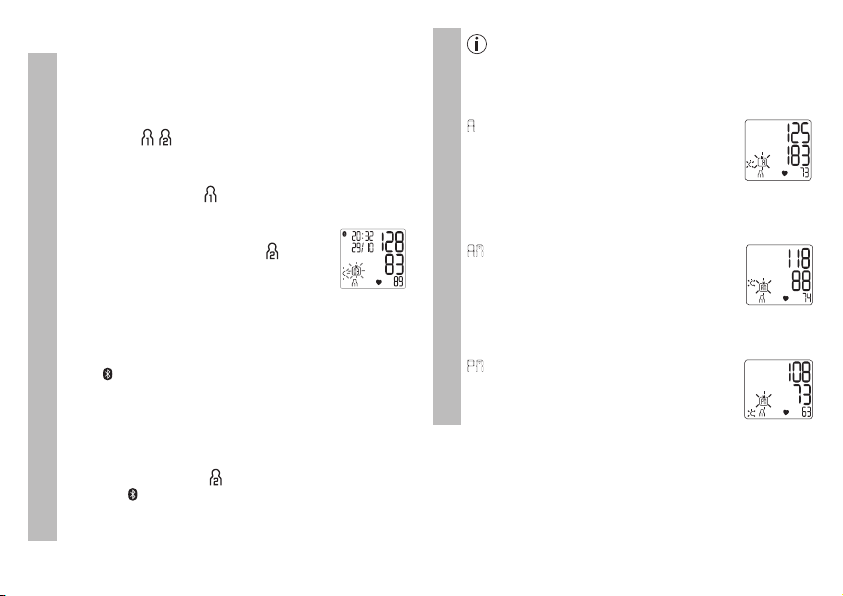
42
7. Récupérer et supprimer les valeurs de mesure
Mémoire utilisateur
Le résultat de chaque mesure réussie est enregistré avec la
date et l’heure. Lorsqu’il y a plus de 60données de mesure,
la mesure la plus ancienne est écrasée.
•
L
orsque l’appareil est éteint, sélectionnez la mémoire
utilisateur ( ) que vous souhaitez utiliser à l’aide des
touches mémoires M1 ou M2.
•
S
i vous souhaitez visualiser les données de mesure de
la mémoire utilisateur , appuyez sur la touche mémoire
M1.
•
S
i vous souhaitez visualiser les données de
mesure de la mémoire utilisateur , appuyez
sur la touche mémoire M2.
•
La moyenne de toutes les mesures s’affiche
à l’écran.
•
La moyenne de toutes les mesures s’affiche
à l’écran.
•
Si la fonction Bluetooth
®
est activée (le sym-
bole clignote à l’écran), le tensiomètre tente
d’établir une connexion avec l’application. Si
vous appuyez alors sur la touche M1, le trans-
fert est interrompu et les valeurs moyennes
sont affichées. En appuyant sur la touche M2,
le transfert est interrompu et les mesures de
la mémoire utilisateur sont affichées. Le
symbole ne s’affiche plus. Dès que la con-
nexion est établie et que les données sont
transférées, les touches sont inactives.
Valeurs moyennes
Si vous avez sélectionné la mémoire utilisateur1,
vous devez actionner la touche mémoire M1.
Si vous avez sélectionné la mémoire utilisateur2, vous
devez actionner la touche mémoire M2.
A
clignote à l’écran.
La valeur moyenne de toutes les valeurs me-
surées enregistrées pour cet utilisateur est
affichée.
•
A
ppuyez sur la touche mémoire correspondante (M1
ou M2).
AM
clignote à l’écran.
La valeur moyenne des mesures matinales
des 7 derniers jours est affichée (matin: 5h00
– 9h00).
•
A
ppuyez sur la touche mémoire correspondante (M1
ou M2).
PM
clignote à l’écran.
La valeur moyenne des mesures du soir des 7
derniers jours est affichée (soir: 18:00 – 20:00).
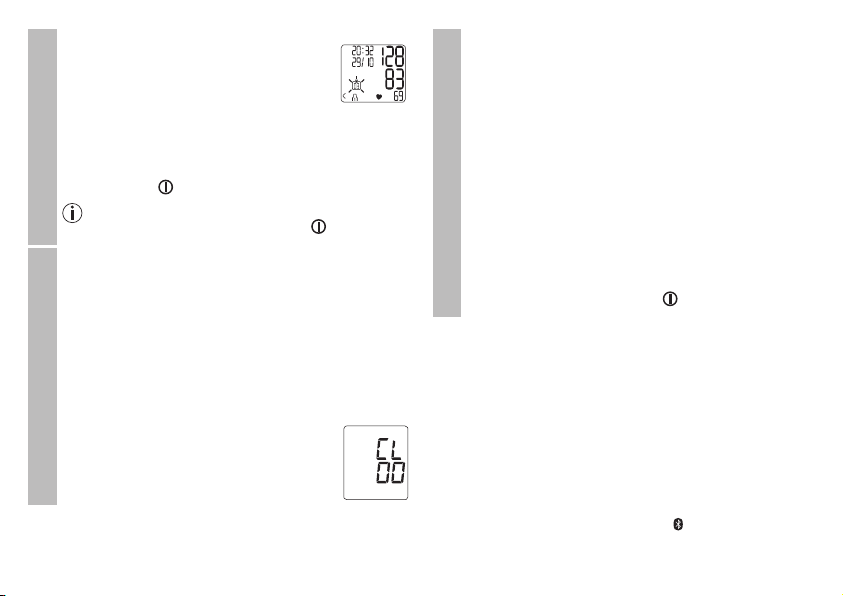
43
Valeurs mesurées individuelles
•
S
i vous appuyez de nouveau sur la touche
mémoire (M1 ou M2), la dernière mesure
s’affiche à l’écran (ici par exemple la me-
sure 03).
•
S
i vous appuyez de nouveau sur la touche mémoire (M1
ou M2), vous pouvez consulter vos mesures individuelles.
•
P
our éteindre l’appareil, appuyez sur la touche MAR-
CHE/ARRÊT .
Vous pouvez quitter le menu à tout moment en appu-
yant sur la touche MARCHE/ARRÊT .
Effacer les valeurs mesurées
•
Pour effacer tous les enregistrements d’une mémoire
utilisateur donnée, sélectionnez d’abord une mémoire
utilisateur.
• Démarrez la consultation de la valeur moyenne des me-
sures. A clignote à l’écran, la valeur moyenne de toutes
les valeurs mesurées enregistrées pour cet utilisateur
est affichée.
• Maintenez la touche mémoire M1 ou M2 enfoncée pen-
dant 5secondes, selon la mémoire que vous utilisez.
Toutes les valeurs de la mémoire utilisateur
actuelle sont supprimées.
Effacer les valeurs de mesure individuelles
•
P
our effacer certaines mesures d’une mémoire utilisateur
donnée, sélectionnez d’abord une mémoire utilisateur.
•
D
émarrez la consultation des mesures individuelles.
•
M
aintenez la touche mémoire M1 ou M2 enfoncée pen-
dant 5secondes. (Selon la mémoire que vous utilisez).
•
L
a valeur sélectionnée est supprimée. L’appareil affiche
brièvement CL 00.
•
S
i vous souhaitez supprimer d’autres valeurs, répétez la
procédure décrite ci-dessus.
Vous pouvez éteindre l’appareil à tout moment en appuyant
sur la touche MARCHE/ARRÊT .
8. Transfert des valeurs mesurées
Transmission via Bluetooth
®
low energy technology
Vous avez également la possibilité de transférer en plus les me-
sures enregistrées sur l’appareil sur votre smartphone via Blue-
tooth
®
low energy technology.
Pour cela, vous avez besoin de l’application «HealthCoach». Elle
est gratuitement sur l’Apple App Store ou sur Google Play.
Pour transférer les valeurs, veuillez suivre les points suivants:
Si la fonction Bluetooth
®
est activée dans les paramètres, le
transfert des données se fait automatiquement après la mesure.
Sur l’écran en haut à gauche, le symbole apparaît (voir chapitre
4 Préparer la mesure).
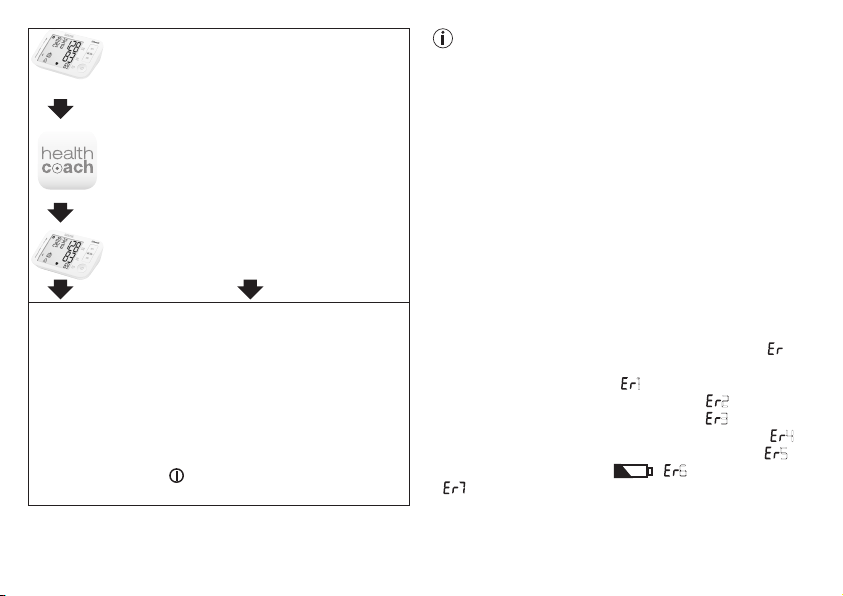
44
Étape 1: SBM 37
Activez le Bluetooth
®
sur votre appareil (voir cha-
pitre 4. « Préparer la mesure », Bluetooth
®
).
Étape 2: Application „HealthCoach“
Ajoutez le SBM 37 dans l’application Sanitas «
HealthCoach » à la section «Réglages/Mes ap-
pareils».
Étape 3: SBM 37
Effectuez une mesure.
Étape 4: SBM 37
Transfert des données di-
rectement après une prise de
mesure:
•
L
orsque le transfert de don-
nées via Bluetooth
®
est
activé, après confirmation
de la mémoire utilisateur
et pression sur la touche
MARCHE/ARRÊT , les
données sont transférées.
Étape 4: SBM 37
Transférer les données ultéri-
eurement:
•
A
ccédez au mode de ré-
cupération de la mémoire
(chap. 7). Sélectionnez la
mémoire utilisateur de vo-
tre choix. Le transfert Blue-
tooth
®
démarre automa-
tiquement.
L’application „HealthCoach“ doit être activée pour le transfert.
Afin de garantir une transmission sans perturbations, veuillez
retirer la housse de votre smartphone. Lancez le transfert de
données depuis l’application „HealthCoach“.
9. Nettoyage et rangement de l’appareil et de
la manchette
•
N
ettoyez soigneusement l’appareil et la manchette, unique
-
ment à l’aide d’un chiffon légèrement humide.
•
N
’utilisez pas de détergent ni de solvant.
•
N
e passez jamais l’appareil ni la manchette sous l’eau, qui
pourrait s’infiltrer à l’intérieur de l’appareil ou la manchette et
l’endommager.
•
N
e posez pas d’objets lourds sur l’appareil ni sur la manchette
lorsqu’ils sont rangés. Retirez les piles. Ne pliez pas le tuyau
de la manchette.
10. Message d’erreur/Résolution des erreurs
En cas d’erreur, un message d’erreur s’affiche à l’écran
_
.
Des messages d’erreur peuvent s’afficher lorsque
• le pouls n’a pas pu être pris:
1
;
• vous bougez ou parlez pendant la mesure:
2
;
• la manchette est trop ou pas assez serrée:
3
;
• des problèmes surviennent au moment de la mesure:
4
;
• la pression de gonflage est supérieure à 300mmHg:
5
;
• les piles sont presque vides :
6
;
• les données n’ont pas pu être envoyées via Bluetooth
®
.
Dans ces cas-là, réitérez la mesure et la transmission de données.
Veillez à insérer convenablement le tuyau de la manchette et à
ne pas bouger ni parler durant la prise de mesure.

45
11. Caractéristiques techniques
N° du modèle SBM 37
Mode de mesure Mesure de la tension artérielle au bras,
oscillométrique et non invasive
Plage de mesure Pression dans la manchette 0 -
250mmHg,
Pression systolique 50 - 250mmHg,
Pression diastolique 30 - 200mmHg,
Pouls 40 - 180pulsations/minute
Précision de
l’indicateur
systolique ±3mmHg
diastolique ±3mmHg
pouls ±5% de la valeur affichée
Incertitude de me-
sure
écart type max. admissible selon des
essais cliniques:
systolique 8mmHg
diastolique 8mmHg
Mémoire 2 x 60 emplacements de mémoire
Dimensions L 139 mm x l 94 mm x H 48 mm
Poids 236 g (sans manchette, sans les piles)
Taille du brassard 22 à 36cm
Conditions de fonc-
tionnement adm.
+ 5°C à + 40°C, 15-93% d’humidité
relative de l’air (sans condensation)
Conditions de con-
servation et de trans-
port admissibles
-25°C à + 70°C, ≤ 93% d’humidité de
l’air relative, 700 –1060hPa de pression
ambiante
Alimentation élec-
trique
4 piles 1,5V AAA
Durée de vie des
piles
Pour environ 200mesures, selon le
niveau de tension artérielle, de la
pression de gonflage et du nombre de
connexions Bluetooth
®
.
Accessoires Manchette, mode d’emploi, pochette
de rangement
Classement Alimentation interne, IP21, pas d’AP ni
d’APG, utilisation continue, appareil de
type BF
Transfert de données
par technologie sans
fil Bluetooth
®
wire-
less technology
Le tensiomètre utilise Bluetooth
®
low
energy technology, bande de fréquence
des 2402MHz – 2480MHz, puissance
d’émission 20 dBM max., compatible
smartphones/tablettes Bluetooth ≥ 4.0
Le numéro de série se trouve sur l’appareil ou sur le comparti-
ment à piles.
Des modifications pourront être apportées aux caractéristiques
techniques sans avis préalable à des fins d’actualisation.
•
C
et appareil est en conformité avec la norme européenne
EN60601-1-2 et répond aux exigences de sécurité spéciales
relatives à la compatibilité électromagnétique. Veuillez noter
que les dispositifs de communication HF portables et mobiles
sont susceptibles d’influer sur cet appareil. Pour plus de dé-
tails, veuillez contacter le service après-vente à l’adresse men-
tionnée ou vous reporter à la fin du mode d’emploi.
•
C
et appareil est conforme à la directive européenne 93/42/EEC
sur les produits médicaux, à la loi sur les produits médicaux
ainsi qu’aux normes européennes EN1060-1 (tensiomètres non

46
invasifs, partie1: exigences générales), EN1060-3 (tensio-
mètres non invasifs, partie 3: exigences complémentaires sur
les tensiomètres électromécaniques) et EC80601-2-30 (appa-
reils électromédicaux, partie 2-30: exigences particulières pour
la sécurité et les performances essentielles des tensiomètres
non invasifs automatiques).
•
L
a précision de ce tensiomètre a été correctement testée et sa
durabilité a été conçue en vue d’une utilisation à long terme.
Dans le cadre d’une utilisation médicale de l’appareil, des
contrôles techniques de mesure doivent être menés avec les
moyens appropriés. Pour obtenir des informations précises sur
la vérification de la précision de l’appareil, vous pouvez faire
une demande par courrier au service après-vente.
•
N
ous garantissons par la présente que ce produit est conforme
à la directive européenne RED 2014/53/EU. Veuillez contacter
l’adresse du SAV indiquée afin d’obtenir de plus amples détails,
comme par exemple la déclaration de conformité CE.
•
Veuillez contacter le SAV à l’adresse indiquée afin d’obtenir
de plus amples détails, comme par exemple la déclaration de
conformité CE.
12. Garantie / Maintenance
Pour toute demande de garantie, veuillez contacter votre reven-
deur local ou la succursale locale (cf. la liste «Service client à
l’international»).
Lorsque vous retournez l’appareil, assurez-vous d’y joindre une
copie de votre preuve d’achat et une brève description du défaut.
Les conditions de garantie suivantes s’appliquent:
1
. La période de garantie des produits SANITAS est de 2 ans
ou, si elle est plus longue, elle est applicable dans le pays
concerné à compter de la date d’achat.
Pour toute demande de garantie, vous devez prouver la date
d’achat par une preuve d’achat ou une facture.
2
. Les réparations (appareil complet ou pièces détachées) ne
prolongent pas la période de garantie.
3
. La garantie n’est pas valable en cas de dommages dus:
a. à une utilisation inappropriée, par exemple le non-respect
des instructions par l’utilisateur;
b. à des réparations ou des modifications réalisées par le client
ou par une personne non autorisée;
c. au transport du fabricant chez le client ou pendant le trans-
port jusqu’au service client;
d. pour les accessoires soumis à une usure naturelle (bras-
sard, piles, etc.).
4
. Toute responsabilité liée aux dommages consécutifs di-
rects ou indirects causés par l’appareil est exclue même
si un droit de garantie est reconnu en cas de dommage à
l’appareil.
Sous réserve d’erreurs et de modifications
47
ITALIANO
Fornitura
•
M
isuratore di pressione
•
M
anicotto per braccio
•
4
batterie AAA da 1,5 V LR03
•
C
ustodia
•
I
struzioni per l’uso
La preghiamo di leggere attentamente le presenti istruzioni per
l’uso, conservarle per impieghi futuri, renderle accessibili ad altri
utenti e attenersi alle indicazioni.
1. Introduzione
Controllare l’integrità esterna della confezione e del contenuto
del misuratore di pressione Sanitas SBM 37. Prima dell’uso assi-
curarsi che l’apparecchio e gli accessori non presentino nessun
danno palese e che il materiale di imballaggio sia stato rimosso.
Nel dubbio non utilizzare l’apparecchio e consultare il proprio
rivenditore o contattare il Servizio clienti indicato.
Il misuratore di pressione da braccio consente la misurazione e
il monitoraggio non invasivi dei valori di pressione arteriosa nelle
persone adulte.
Permette di misurare in modo rapido e semplice la propria pres-
sione, memorizzare i valori misurati e visualizzare l’andamento
e la media dei valori.
Segnala inoltre eventuali disturbi del ritmo cardiaco.
I valori rilevati vengono classificati e valutati graficamente.
2. Indicazioni importanti
Spiegazione dei simboli
I seguenti simboli sono utilizzati nelle istruzioni per l’uso, sull’im-
ballo e sulla targhetta dell’apparecchio e degli accessori:
Attenzione
Nota
Indicazione di importanti informazioni
Contenuto
1. Introduzione .........................................................................47
2. Indicazioni importanti ..........................................................47
3. Descrizione dell’apparecchio ..............................................50
4. Preparazione della misurazione ...........................................51
5. Misurazione della pressione ................................................53
6. Interpretazione dell’esito .....................................................55
7. Ricerca e cancellazione dei valori misurati ........................56
8. Trasmissione dei valori di misurazione ..............................58
9.
Pulizia e conservazione dell’apparecchio e del manicotto
.. 59
10. Messaggi di errore/Soluzioni ............................................. 59
11. Dati tecnici .........................................................................59
12. Garanzia /Assistenza ..........................................................60
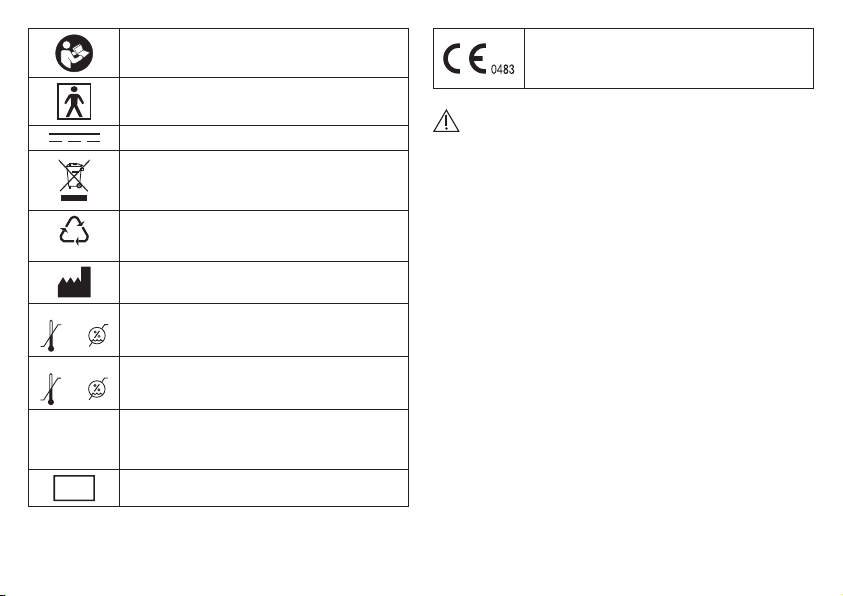
48
Seguire le istruzioni per l’uso
Parte applicativa tipo BF
Corrente continua
Smaltimento secondo le norme previste dalla
Direttiva CE sui rifiuti di apparecchiature elett-
riche ed elettroniche (WEEE).
20
PAP
Smaltire l’imballaggio in modo non dannoso
per l‘ambiente
Produttore
Storage/Transport
Temperatura e umidità di trasporto e stoccag-
gio consentite
Operating
Temperatura e umidità di esercizio consentite
IP21
Protetto contro la penetrazione di corpi solidi
di diametro 12,5 mm e superiore, e contro la
caduta verticale di gocce d’acqua
S
N
Numero di serie
Il marchio CE certifica la conformità ai requisiti
di base della direttiva 93/42/EEC sui disposi-
tivi medici
Indicazioni per l’uso
•
M
isurare la pressione sempre allo stesso orario della giornata,
affinché i valori siano confrontabili.
•
P
rima di ogni misurazione rilassarsi per ca. 5 minuti.
•
P
er effettuare più misurazioni su una stessa persona, attendere
5 minuti tra una misurazione e l’altra.
•
E
vitare di mangiare, bere, fumare o praticare attività fisica al-
meno nei 30 minuti precedenti alla misurazione.
•
I
n caso di valori dubbi, ripetere la misurazione.
•
I
valori misurati autonomamente hanno solo scopo informativo,
non sostituiscono i controlli medici. Comunicare al medico i
propri valori, non intraprendere in alcun caso terapie mediche
definite autonomamente (ad es. impiego di farmaci e relativi
dosaggi)!
•
N
on utilizzare il misuratore di pressione su neonati e pazienti
con preeclampsia. Prima di utilizzare il misuratore di pressione
in gravidanza, si consiglia di consultare il medico.
•
I
n caso di patologie del sistema cardiovascolare possono veri-
ficarsi errori di misurazione o una riduzione della precisione di
misurazione. Gli stessi problemi si possono verificare in caso di
pressione molto bassa, diabete, disturbi della circolazione e del
ritmo cardiaco nonché in presenza di brividi di febbre o tremiti.
•
L’apparecchio non deve essere utilizzato da persone (compresi
bambini) con ridotte capacità fisiche, percettive o intellettive o
non in possesso della necessaria esperienza e/o conoscenza,
49
se non sotto la supervisione di una persona responsabile per
la loro sicurezza o che fornisca loro le indicazioni per l’uso
dell’apparecchio. Controllare che i bambini non utilizzino l’ap-
parecchio per gioco.
•
N
on utilizzare il misuratore di pressione insieme ad altri appa-
recchi chirurgici ad alta frequenza.
•
U
tilizzare il misuratore di pressione solo su un braccio con
misura compresa nell’intervallo indicato.
•
T
enere conto che durante il pompaggio può verificarsi una
riduzione delle funzioni dell’arto interessato.
•
L
a misurazione delle pressione non deve impedire inutilmente
la circolazione del sangue per un tempo troppo lungo. In caso
di malfunzionamento dell’apparecchio, rimuovere il manicotto
dal braccio.
•
E
vitare di schiacciare, comprimere o piegare meccanicamente
il tubo del manicotto.
•
E
vitare di mantenere una pressione costante nel manicotto e
di effettuare misurazioni troppo frequenti che causerebbero
una riduzione del flusso sanguigno con il conseguente rischio
di lesioni.
• Accertarsi che il manicotto non venga applicato su braccia con
arterie o vene sottoposte a trattamenti medici, quali dispositivo di
accesso o terapia intravascolare o shunt arterovenoso.
•
N
on applicare il manicotto a persone che hanno subito una
mastectomia (asportazione della mammella).
•
N
on applicare il manicotto su ferite per evitare rischi di ulte-
riori lesioni.
•
I
ndossare il manicotto esclusivamente sul polso. Non indossare
il manicotto su altre parti del corpo.
•
È
possibile trasmettere e memorizzare i dati solo se l’appa-
recchio è alimentato. Quando le batterie si esauriscono, data
e ora vengono perse.
•
S
e per 30 secondi non vengono utilizzati pulsanti, il dispositi-
vo di arresto automatico spegne l’apparecchio per preservare
le batterie.
•
L
’apparecchio è concepito solo per l’uso descritto nelle pre-
senti istruzioni per l’uso. Il produttore non risponde di danni
causati da un uso inappropriato o non conforme.
Indicazioni per la conservazione e la cura
•
Il misuratore di pressione è composto da moduli elettronici di
precisione. La precisione dei valori misurati e la durata dell’appa-
recchio dipendono da un utilizzo attento e scrupoloso:
–
Non esporre l’apparecchio a urti, umidità, sporcizia, forti sbal-
zi di temperatura e direttamente alla luce solare.
–
Non far cadere l’apparecchio.
–
Non utilizzare l’apparecchio in prossimità di forti campi elet-
tromagnetici, tenerlo lontano da impianti radio o telefoni
cellulari.
– Utilizzare esclusivamente i manicotti forniti in dotazione o ri-
cambi originali. In caso contrario le misurazioni potrebbero non
essere corrette.
Avvertenze sull’uso delle batterie
• Se il liquido della batteria viene a contatto con la pelle e con
gli occhi, sciacquare le parti interessate con acqua e consul-
tare il medico.
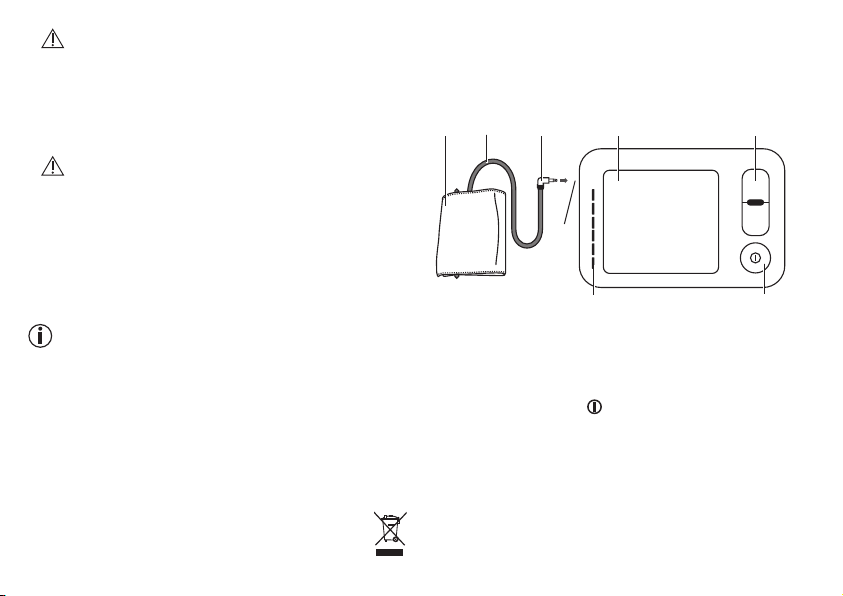
50
• Pericolo d’ingestione! I bambini possono ingerire le bat-
terie e soffocare. Tenere quindi le batterie lontano dalla portata
dei bambini!
• Prestare attenzione alla polarità positiva (+) e negativa (-).
• In caso di fuoriuscita di liquido dalla batteria, indossare guanti
protettivi e pulire il vano batterie con un panno asciutto.
• Proteggere le batterie dal caldo eccessivo.
•
Rischio di esplosione! Non gettare le batterie nel fuoco.
•
Le batterie non devono essere ricaricate o mandate in cor-
tocircuito.
•
Qualora l’apparecchio non dovesse essere utilizzato per un
periodo prolungato, rimuovere le batterie dal vano batterie.
• Utilizzare solo tipologie di batterie uguali o equivalenti.
• Sostituire sempre tutte le batterie contemporaneamente.
• Non utilizzare batterie ricaricabili!
• Non smontare, aprire o frantumare le batterie.
Indicazioni per la riparazione e lo smaltimento
•
Le batterie non sono rifiuti domestici. Smaltire le batterie esau-
ste negli appositi punti di raccolta.
•
L
’apparecchio non deve essere riparato o tarato personalmen-
te. In tal caso non si garantisce più il corretto funzionamento.
•
Le riparazioni possono essere effettuate solo dal Servizio clienti
o da rivenditori autorizzati.
•
N
on aprire l’apparecchio. In caso contrario la garanzia decade.
•
A tutela dell’ambiente, al termine del suo utilizzo l’apparecchio
non deve essere smaltito nei rifiuti domestici. Lo smaltimento
deve essere effettuato negli appositi centri di raccolta.
Smaltire l’apparecchio secondo la direttiva europea sui
rifiuti di apparecchiature elettriche ed elettroniche (WEEE). Per
eventuali chiarimenti, rivolgersi alle autorità comunali compe-
tenti per lo smaltimento.
3. Descrizione dell’apparecchio
M1
SYS
mmHg
DIA
mmHg
PUL
/min
M2
1
2
3 4 5
7
8
6
1. Manicotto
2. Tubo del manicotto
3. Attacco del manicotto
4. Display
5. Pulsanti per la memorizzazione M1/M2
6. Pulsante START/STOP
7. Indicatore di rischio
8. Ingresso dell’attacco del manicotto (lato sinistro)
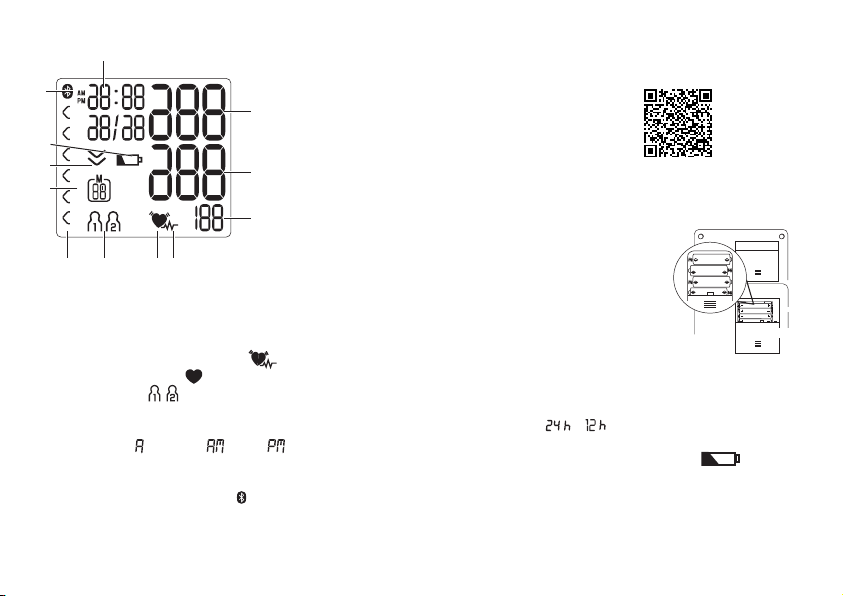
51
Indicatori sul display:
1. Ora/data
2. Pressione sistolica
3. Pressione diastolica
4. Battito cardiaco rilevato
5. Icona disturbi del ritmo cardiaco
6. Icona battito cardiaco
7. Memoria utente
8. Indicatore di rischio
9. Numero della posizione di memoria/Indicazione memoria
valore medio ( ), mattina ( ), sera ( )
10. Scarico aria (freccia)
11. Icona indicatore batteria
12. Icona trasmissione Bluetooth
®
Requisiti di sistema per l’app „HealthCoach“
– iOS ≥ 8.0 / Android
TM
≥ 4.4
– Bluetooth
®
≥ 4.0
Elenco dei dispositivi compatibili:
4. Preparazione della misurazione
Inserimento delle batterie
•
R
imuovere il coperchio del vano bat-
terie sul retro dell’apparecchio.
•
I
nserire quattro batterie AAA da 1,5
V (tipo alcalino LR03). Verificare che
le batterie siano inserite correttamen-
te, con i poli posizionati in base alle
indicazioni. Non utilizzare batterie
ricaricabili.
•
R
ichiudere attentamente il coperchio
del vano batterie.
Tutti gli elementi del display vengono brevemente visualizzati, sul
display lampeggia o . A questo punto impostare la data
e l’ora come descritto di seguito.
Quando l’icona di sostituzione delle batterie è fissa, non
è più possibile effettuare alcuna misurazione ed è necessario
cambiare tutte le batterie. Quando le batterie vengono rimosse
dall’apparecchio, è necessario reimpostare la data e l’ora. Le
misurazioni memorizzate non vanno perse.
1
68 5
2
3
10
11
9
7
12
4
4 x 1,5
V AAA
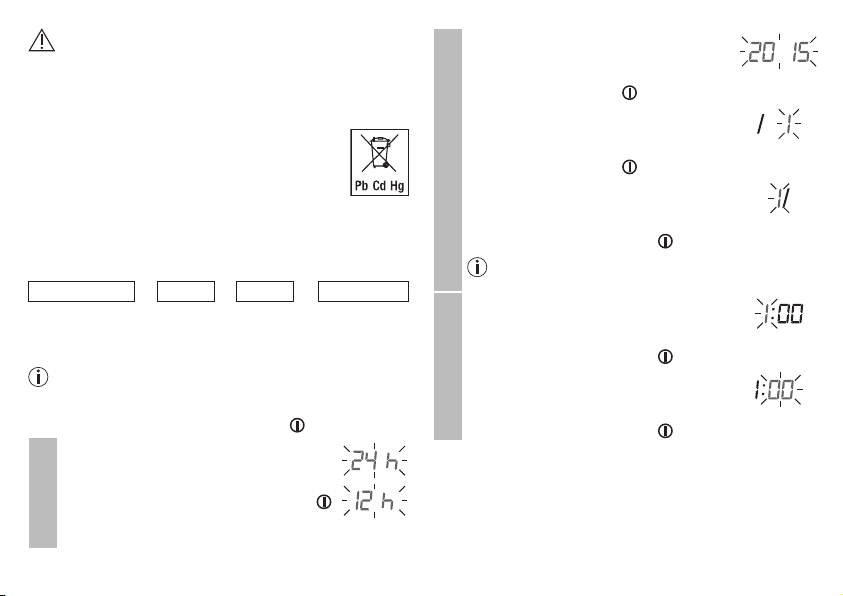
52
Smaltimento delle batterie
• Smaltire le batterie esauste e completamente scariche negli ap-
positi punti di raccolta, nei punti di raccolta per rifiuti tossici o
presso i negozi di elettronica. Lo smaltimento delle batterie è un
obbligo di legge.
• I simboli riportati di seguito indicano che le
batterie contengono sostanze tossiche:
Pb = batteria contenente piombo
Cd = batteria contenente cadmio
Hg = batteria contenente mercurio
Impostazione di data, ora, formato ora e Bluetooth
®
Di seguito sono descritte le funzioni e le impostazioni disponibili
nel misuratore di pressione.
Formato ora
➔
Data
➔
Ora
➔
Bluetooth
®
Impostare data e ora in modo corretto. Solo in questo modo è
possibile memorizzare correttamente le misurazioni con data e
ora per poterle richiamare in seguito.
Tenendo premuto il pulsante per la memorizzazione M1 o M2,
i valori possono essere impostati più velocemente.
Tenere premuto il pulsante START/STOP per 5 secondi.
Formato ora
Sul display lampeggia il formato ora.
•
C
on i pulsanti per la memorizzazione M1/M2
selezionare il formato dell’ora desiderato e
confermare con il pulsante START/STOP .
Data
Sul display lampeggia il numero dell’anno.
•
C
on i pulsanti per la memorizzazione M1/
M2 selezionare l’anno e confermare con il
pulsante START/STOP .
Sul display lampeggia l’indicazione del mese.
•
C
on i pulsanti per la memorizzazione M1/
M2 selezionare il mese e confermare con il
pulsante START/STOP .
Sul display lampeggia l’indicazione del giorno.
•
C
on i pulsanti per la memorizzazione M1/M2
selezionare il giorno corrente e confermare
con il pulsante START/STOP .
Se è impostato il formato 12h, il mese è visualizzato
prima del giorno.
Ora
Sul display lampeggia l’ora.
•
C
on i pulsanti per la memorizzazione M1/
M2 selezionare l’ora corrente e confermare
con il pulsante START/STOP .
Sul display lampeggia l’indicazione dei minuti.
•
C
on i pulsanti per la memorizzazione M1/
M2 selezionare i minuti correnti e confermare
con il pulsante START/STOP .
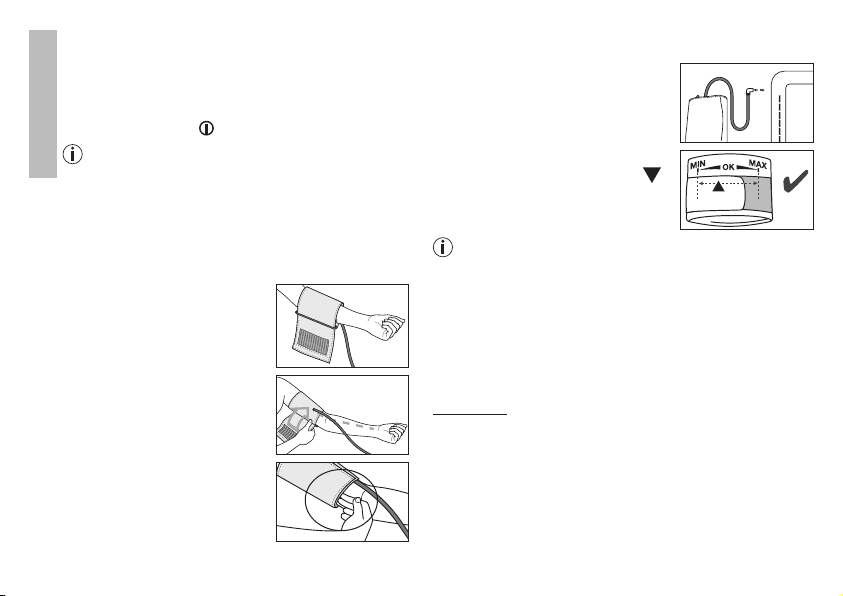
53
Bluetooth
®
Sul display lampeggia l’icona Bluetooth
®
.
•
C
on i pulsanti per la memorizzazione M1/M2, scegliere
se attivare la trasmissione dati automatica via Bluetooth
®
(l’icona Bluetooth
®
lampeggia) o disattivarla (l’icona Blue-
tooth
®
non viene visualizzata) e confermare con il pul-
sante START/STOP .
La trasmissione via Bluetooth
®
riduce la durata della
batteria.
5. Misurazione della pressione
Prima della misurazione portare l’apparecchio a temperatura
ambiente.
La misurazione può essere eseguita sul braccio destro o sinistro.
Applicazione del manicotto
Denudare il braccio e indossare il mani-
cotto. Verificare che la circolazione del
braccio non sia costretta da indumenti
o simili.
Posizionare il manicotto in modo tale
che il bordo inferiore si trovi a 2-3 cm al
di sopra del gomito e dell’arteria. Il tubo
flessibile deve essere orientato verso il
centro del palmo della mano.
Tirare il lembo libero del manicotto,
stringerlo attorno al braccio senza ec-
cedere, quindi chiudere la chiusura a
strappo. Stringere il manicotto in modo
tale che vi sia ancora spazio sufficiente
per due dita.
Inserire l’attacco del tubo del manicotto
nel relativo ingresso sull’apparecchio.
Questo manicotto è da considerarsi ido-
neo se il contrassegno indicatore ( )
dopo l’applicazione del manicotto sul
braccio si trova entro l’area OK.
Se si esegue la misurazione sul braccio destro, il tubo si trova
all’interno del gomito. Prestare attenzione a non appoggiare
il braccio sul tubo.
La pressione può variare dal braccio destro al sinistro e di conse-
guenza anche i valori misurati possono essere diversi. Eseguire
la misurazione sempre sullo stesso braccio.
Qualora i valori dovessero variare significativamente da un brac-
cio all’altro, concordare con il proprio medico quale braccio usare
per la misurazione.
Avvertenza: utilizzare l’apparecchio esclusivamente con il mani-
cotto originale. Il manicotto è adatto a una circonferenza braccio
compresa tra 22 e 36 cm.
Con il codice 163.387 è possibile ordinare presso i rivenditori
specializzati o all’indirizzo del servizio di assistenza manicotti più
grandi per circonferenze del braccio comprese fra 35 e 44 cm.
M1
SYS
mmHg
DIA
mmHg
PUL
/min
M2
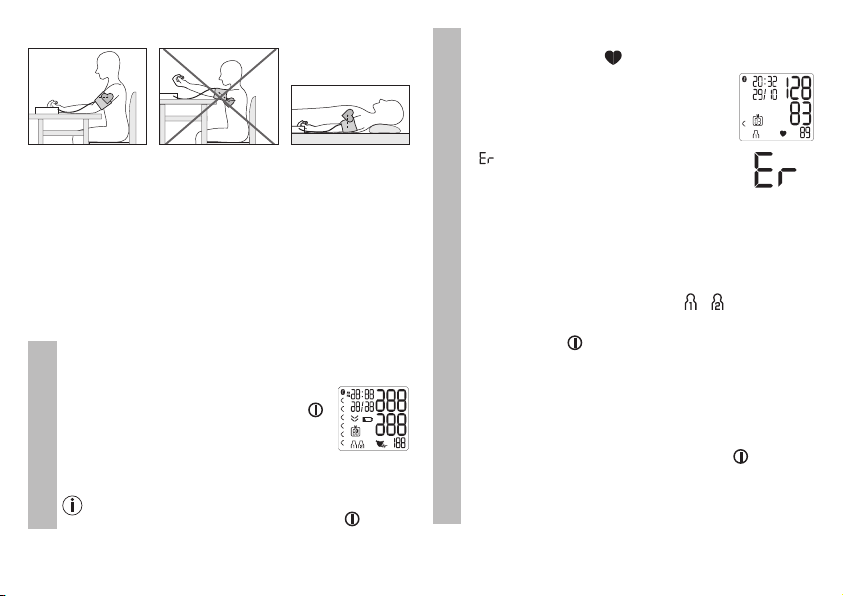
54
Postura corretta
•
P
rima di ogni misurazione rilassarsi per ca. 5 minuti! In caso
contrario le misurazioni potrebbero non essere corrette.
•
L
a misurazione può essere effettuata da seduti o da sdraiati.
Verificare sempre che il manicotto si trovi all’altezza del cuore.
•
S
edersi in posizione comoda per la misurazione della pres-
sione. Appoggiare la schiena e le braccia. Non incrociare le
gambe. Appoggiare la pianta dei piedi al pavimento.
•
P
er non falsare l’esito, è importante restare tranquilli e non
parlare durante la misurazione.
Esecuzione della misurazione della pressione
Misurazione
Applicare il manicotto e sistemarsi nella posizione in cui si
desidera eseguire la misurazione.
•
P
er avviare il misuratore di pressione,
premere il pulsante START/STOP .
Tutti gli elementi del display vengono bre-
vemente visualizzati.
Dopo 3 secondi il misuratore di pressione ini-
zia automaticamente a misurare la pressione.
La misurazione può essere interrotta in qualsiasi mo-
mento premendo il pulsante START/STOP .
Misurazione
Appena è rilevabile il battito cardiaco, viene visualizzata
l’icona corrispondente .
•
V
engono visualizzati i valori misurati per
pressione sistolica e diastolica e battito
cardiaco.
•
viene visualizzato se la misurazione non
è stata effettuata correttamente (vedere il
capitolo 9
„
Messaggi di errore/Soluzioni
“
).
Ripetere la misurazione.
•
C
on il pulsante per la memorizzazione M1 o M2 im-
postare quindi la memoria utente desiderata. Se non si
sceglie alcuna memoria utente, la misurazione viene sal-
vata nella memoria utente usata per ultima. Sul display
viene visualizzata la relativa icona o .
•
S
pegnere il misuratore di pressione con il pulsante
START/STOP . In questo modo la misurazione viene
memorizzata nella memoria utente selezionata.
•
Se l’apparecchio non viene spento manualmente, si spe-
gne automaticamente dopo 30 secondi.
Se la trasmissione dati via Bluetooth
®
è attiva, i dati ven-
gono trasmessi dopo la conferma della memoria utente e
con la pressione del pulsante START/STOP .
• L’icona Bluetooth
®
lampeggia sul display e il LED blu si
accende. Il misuratore di pressione tenta di stabilire una
connessione con l’app solo per ca. 30 secondi.
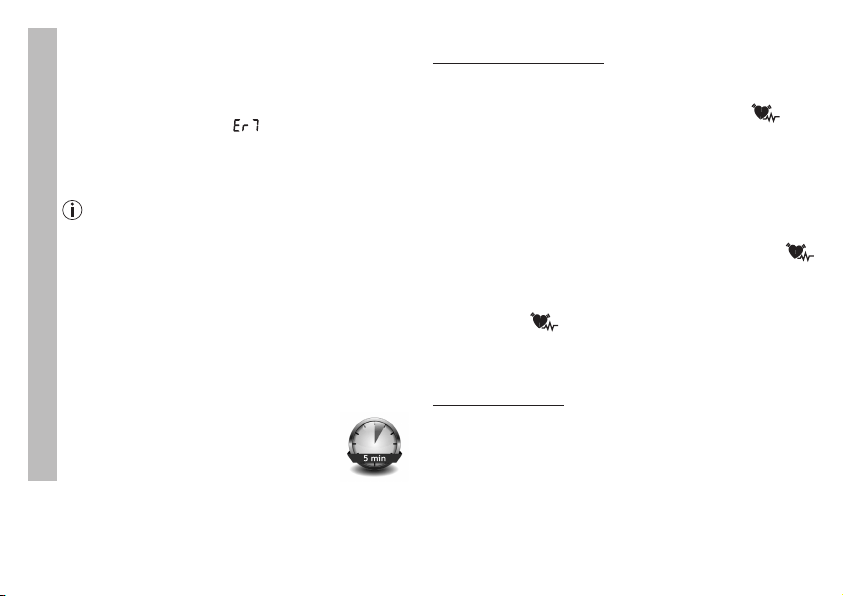
55
Misurazione
• Non appena la connessione viene stabilita, l’icona Blue-
tooth
®
smette di lampeggiare. Tutti i dati vengono tras-
messi automaticamente all’app. In seguito alla trasmis-
sione corretta dei dati, l’apparecchio si spegne. Se non
è possibile trasmettere i dati, il LED blu si spegne e sul
display viene visualizzato " ".
• Se non viene stabilita una connessione con l’app entro
30 secondi, l’icona Bluetooth
®
si spegne e il misuratore
di pressione si spegne automaticamente dopo 3 minuti.
Tenere presente che per trasmettere i dati all’app
„HealthCoach“, è necessario aggiungere il misura-
tore di pressione in "Miei dispositivi". L’app „Health-
Coach“ deve essere attivata per la trasmissione.
Se i dati attuali non vengono visualizzati sullo smart-
phone, ripetere la trasmissione come descritto nel ca-
pitolo 7.
Se si dimentica di spegnere il misuratore di pressione, que-
sto si spegne automaticamente dopo circa 30 secondi. An-
che in questo caso il valore viene memorizzato nella memo-
ria utente selezionata o in quella utilizzata per ultima e i dati
vengono trasmessi se la trasmissione Bluetooth
®
è attiva.
•
A
ttendere almeno 5 minuti prima di effet-
tuare una nuova misurazione!
6. Interpretazione dell’esito
Disturbi del ritmo cardiaco
Questo apparecchio è in grado di individuare eventuali disturbi
del ritmo cardiaco durante la misurazione e in tal caso al termine
della misurazione ne segnala la presenza con l’icona .
Può essere un’avvisaglia di aritmia. L’aritmia è una patologia in
cui il ritmo cardiaco è anormale a causa di errori nel sistema bio-
elettrico, che controlla il battito cardiaco. I sintomi (battiti cardiaci
accelerati o anticipati, polso rallentato o troppo veloce) possono
essere determinati tra l’altro da patologie cardiache, età, costitu-
zione, sovralimentazione, stress o mancanza di riposo. Un’aritmia
può essere diagnosticata solo dal medico.
Ripetere la misurazione nel caso compaia sul display l’icona
dopo una prima misurazione. Assicurarsi di aver osservato 5 mi-
nuti di riposo prima di effettuare la misurazione e di non parlare
né muoversi durante la misurazione. Rivolgersi al proprio medico
nel caso l’icona compaia frequentemente.
Diagnosi e terapie definite autonomamente in base agli esiti delle
misurazioni possono rivelarsi pericolose. Attenersi sempre alle
indicazioni del proprio medico.
Indicatore di rischio:
I risultati di misurazione possono essere classificati e valutati in
base alla tabella seguente.
Tali valori standard costituiscono tuttavia solo un riferimento ge-
nerale in quanto la pressione individuale presenta differenze a
seconda della persona e dell’età.
È importante consultare regolarmente il proprio medico per sape-
re qual è la propria pressione normale e il limite superato il quale
il livello di pressione viene considerato pericoloso.
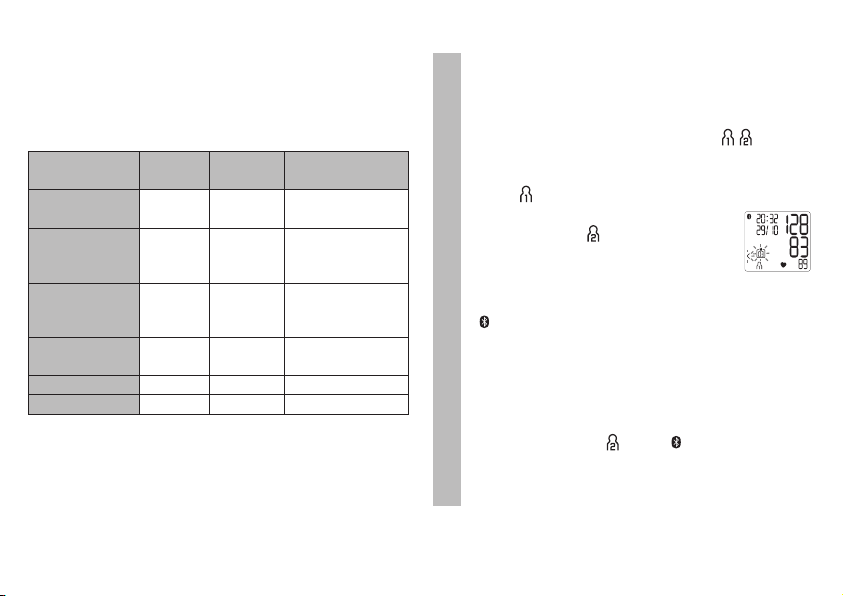
56
La classificazione sul display e la scala graduata sul misuratore
di pressione indicano la classe nella quale rientra la pressione
misurata. Nel caso in cui il valore sistolico e quello diastolico ri-
entrino in due classi diverse (ad es. sistole nella classe „Normale
alto“ e diastole nella classe „Normale“), la graduazione grafica
dell’apparecchio indica sempre la classe più alta, in questo caso
„Normale alto“.
Intervallo dei va-
lori di pressione
Sistole
(in mmHg)
Diastole
(in mmHg)
Misura da adottare
Livello 3:
forte ipertensione
≥ 180 ≥ 110
Rivolgersi a un
medico
Livello 2:
moderata
ipertensione
160 – 179 100 – 109
Rivolgersi a un
medico
Livello 1:
leggera
ipertensione
140 – 159 90 – 99
Controlli medici
regolari
Normale alto 130 – 139 85 – 89
Controlli medici re-
golari
Normale 120 – 129 80 – 84 Autocontrollo
Ottimale < 120 < 80 Autocontrollo
Fonte: WHO, 1999 (World Health Organization)
7. Ricerca e cancellazione dei valori misurati
Memoria utente
Gli esiti di ogni misurazione corretta vengono memorizzati
con data e ora. Quando i dati misurati superano le 60 unità,
vengono eliminati i dati più vecchi.
•
C
on il pulsante per la memorizzazione M1 o M2 sele-
zionare la memoria utente desiderata ( ), quando
l’apparecchio è spento.
•
S
e si desidera visualizzare i dati misurati per la memoria
utente , premere il pulsante per la memorizzazione M1.
•
S
e si desidera visualizzare i dati misurati per
la memoria utente , premere il pulsante per
la memorizzazione M2.
•
Sul display viene visualizzato il valore medio
di tutte le misurazioni.
•
Se la trasmissione Bluetooth
®
è attiva (l’icona
lampeggia sul display), il misuratore di pres-
sione tenta di stabilire una connessione con
l’app. Se nel frattempo si preme il pulsante
M1, la trasmissione viene interrotta e vengo-
no visualizzati i valori medi. Se si preme il
pulsante M2, la trasmissione viene interrotta
e vengono visualizzati i dati di misurazione
della memoria utente . L’icona non è più
visualizzata. Non appena viene stabilita una
connessione e i dati vengono trasmessi, i pul-
santi vengono disattivati.
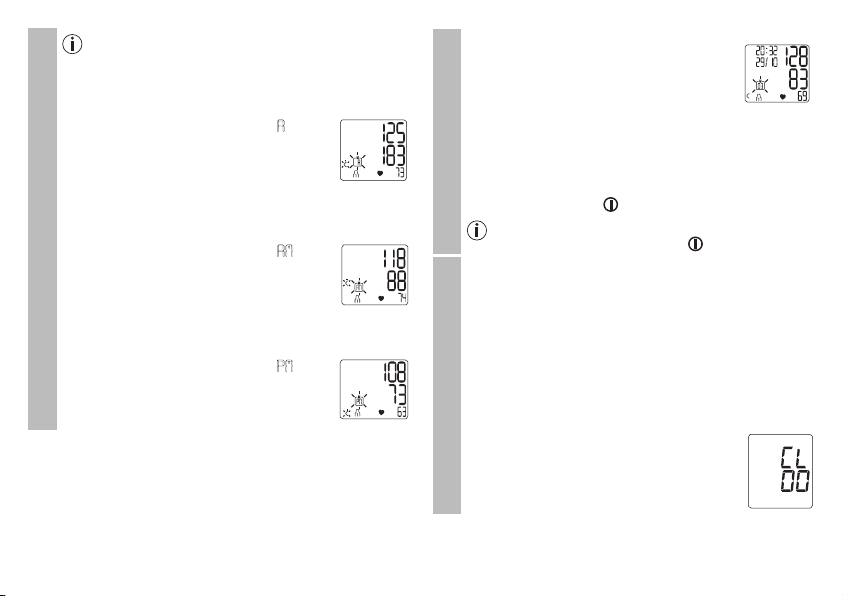
57
Valori medi
Se è stata selezionata la memoria utente 1, occor-
re premere il pulsante per la memorizzazione M1.
Se è stata selezionata la memoria utente 2, occorre
premere il pulsante per la memorizzazione M2.
Sul display lampeggia l’indicazione
A
.
Viene visualizzato il valore medio di tutti i va-
lori misurati della memoria utente selezionata.
•
P
remere il pulsante per la memorizzazione corrispon-
dente (M1 o M2).
Sul display lampeggia l’indicazione
AM
.
Viene visualizzato il valore medio degli ultimi 7
giorni di misurazioni mattutine (mattina: dalle
5.00 alle 9.00).
•
P
remere il pulsante per la memorizzazione corrispon-
dente (M1 o M2).
Sul display lampeggia l’indicazione
PM
.
Viene visualizzato il valore medio degli ultimi
7 giorni di misurazioni serali (sera: dalle 18.00
alle 20.00).
Valori di misurazione singoli
•
P
remendo nuovamente il pulsante per la
memorizzazione corrispondente (M1 o M2),
il display visualizza l’ultima misurazione sin-
gola (nell’esempio la misurazione 03).
•
P
remendo nuovamente il pulsante per la memorizzazi-
one corrispondente (M1 o M2), è possibile visualizzare i
singoli valori misurati.
•
P
er spegnere nuovamente l’apparecchio, premere il pul-
sante START/STOP .
È possibile uscire dal menu in qualsiasi momento pre-
mendo il pulsante START/STOP .
Cancellazione dei valori misurati
•
Per cancellare una posizione di memoria di una determi-
nata memoria utente è necessario innanzitutto selezio-
nare la memoria utente.
•
Avviare l’interrogazione dei valori di misurazione medi.
Sul display lampeggia A, viene visualizzato il valore medio
di tutti i valori misurati di questa memoria utente.
•
Tenere premuto il pulsante per la memorizzazione M1
o M2 per 5 secondi, a seconda di quale sia la memoria
utente attiva.
Tutti i valori dell’attuale memoria utente ven-
gono cancellati.
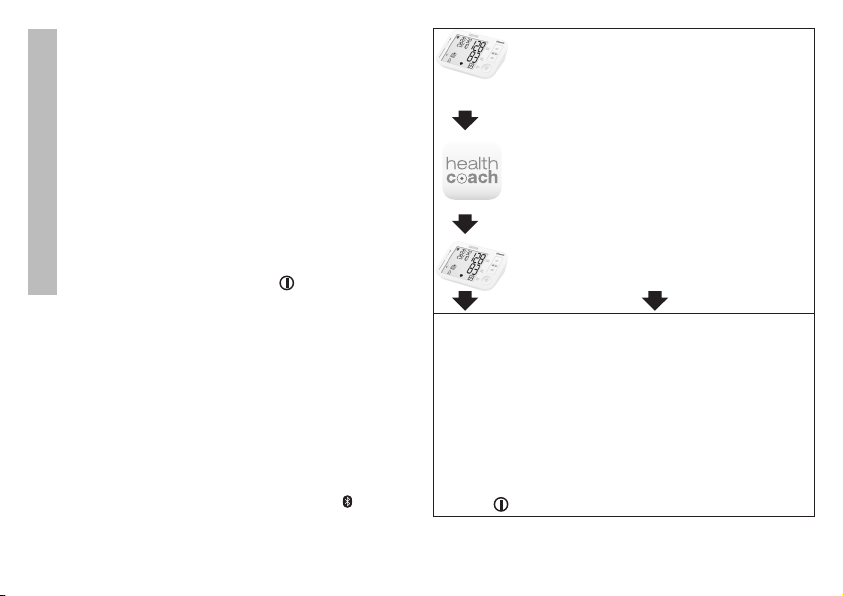
58
Cancellazione dei singoli valori misurati
•
P
er cancellare singole misurazioni di una determinata
memoria utente, è necessario innanzitutto selezionare
la memoria utente.
•
A
vviare l’interrogazione dei singoli valori misurati.
•
T
enere premuto il pulsante per la memorizzazione M1 o
M2 per 5 secondi. (A seconda di quale sia la memoria
utente attiva).
•
I
l valore selezionato viene cancellato. L’apparecchio vi-
sualizza brevemente CL 00.
•
P
er cancellare ulteriori valori, procedere come descritto
sopra.
L’apparecchio può essere spento in qualsiasi momento
premendo il pulsante START/STOP .
8. Trasmissione dei valori di misurazione
Trasmissione via Bluetooth
®
low energy technology
I valori misurati e memorizzati sull’apparecchio possono inoltre
essere trasmessi allo smartphone tramite Bluetooth
®
low energy
technology.
A tale scopo, è necessaria l’app „HealthCoach“. È disponibile
nell’Apple App Store e in Google Play.
Per trasmettere i valori, procedere come segue:
Se nel menu delle impostazioni la funzione Bluetooth
®
è attiva, i
dati vengono trasmessi automaticamente dopo la misurazione.
Sul display in alto a sinistra viene visualizzata l’icona (vedere il
capitolo 4. Preparazione della misurazione).
Fase 1: SBM 37
Attivare la funzione Bluetooth
®
sul proprio dis-
positivo (vedere il capitolo 4. „Preparazione della
misurazione“, Bluetooth
®
).
Fase 2: App „HealthCoach“
Aggiungere SBM 37 nell’app „HealthCoach“ in
"Impostazioni/Miei dispositivi".
Fase 3: SBM 37
Effettuare la misurazione.
Fase 4: SBM 37
Trasmissione dei dati diretta-
mente durante una misurazi-
one:
•
S
e la trasmissione dati via
Bluetooth
®
è attiva, i dati
vengono trasmessi dopo
la conferma della memo-
ria utente e con la pressi-
one del pulsante START/
STOP .
Fase 4: SBM 37
Trasmissione dei dati in un
momento successivo:
•
A
ccedere alla modalità di
richiamo della memoria
(cap. 7). Selezionare la me-
moria utente desiderata. La
trasmissione Bluetooth
®
viene avviata automatica-
mente.
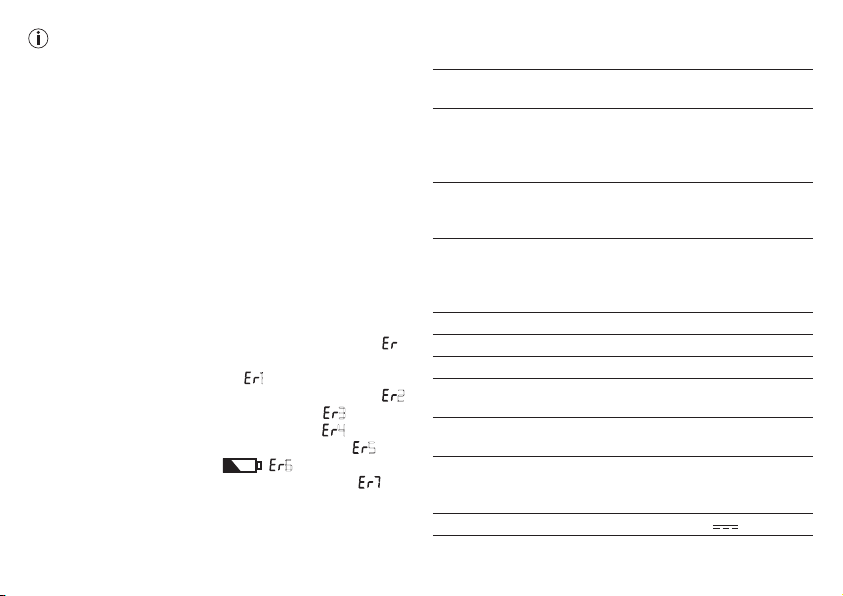
59
L’app „HealthCoach“ deve essere attivata per la trasmissione.
Per garantire una trasmissione indisturbata, rimuovere eventual
-
mente l’involucro protettivo dello smartphone. Avviare la trasmis-
sione dati dall’app „HealthCoach“.
9. Pulizia e conservazione dell’apparecchio e
del manicotto
•
P
ulire con attenzione l’apparecchio e il manicotto utilizzando
solo un panno leggermente inumidito.
•
N
on utilizzare detergenti o solventi.
•
L
’apparecchio e il manicotto non devono per nessun motivo
essere immersi nell’acqua, in quanto il liquido potrebbe infil-
trarsi e danneggiarli.
•
N
on posizionare oggetti pesanti sull’apparecchio e sul mani-
cotto. Rimuovere le batterie. Non piegare eccessivamente il
tubo del manicotto.
10. Messaggi di errore/Soluzioni
In caso di errori sul display compare il messaggio di errore
_
.
I messaggi di errore possono essere visualizzati quando
• non è possibile misurare il battito:
1
;
• durante la misurazione la persona si è mossa o ha parlato:
2
;
• il manicotto è troppo stretto o troppo allentato:
3
;
• si è verificato un errore durante la misurazione:
4
;
• la pressione di gonfiaggio è superiore a 300 mmHg:
5
;
• le batterie sono quasi esaurite :
6
;
• Non è stato possibile trasferire i dati con Bluetooth
®
: .
In questi casi ripetere la misurazione o la trasmissione dei dati.
Verificare che il tubo del manicotto sia inserito correttamente, non
muoversi e non parlare durante la misurazione.
11. Dati tecnici
Codice SBM 37
Metodo di misura-
zione
Oscillometrico, misurazione non invasi-
va della pressione dal braccio
Range di misurazione Pressione manicotto 0-250 mmHg,
sistolica 50-250 mmHg,
diastolica 30-200 mmHg,
battito cardiaco 40-180 battiti/minuto
Precisione
dell’indicazione
Sistolica ±3 mmHg,
Diastolica ±3 mmHg,
Pulsazioni ±5% del valore indicato
Tolleranza Scostamento standard massimo am-
messo rispetto a esame clinico:
sistolica 8 mmHg /
diastolica 8 mmHg
Memoria 2 x 60 posizioni di memoria
Ingombro L 139 mm x L 94 mm x A 48 mm
Peso 236 g (senza manicotto, senza batterie)
Dimensioni del ma-
nicotto
Da 22 a 36 cm
Condizioni di funzio-
namento ammesse
Da 5 °C a 40 °C, 15-93% umidità relati-
va (senza condensa)
Condizioni ammesse
di conservazione e
trasporto
Da -25 °C a 70 °C, ≤ 93 % umidità relativa,
700 –1060 hPa di pressione ambiente
Alimentazione 4 batterie AAA da 1,5 V

60
Durata della batteria Ca. 200 misurazioni, in base alla
pressione sanguigna e di gonfiaggio,
così come al numero di connessioni
Bluetooth
®
.
Accessori Manicotto, istruzioni per l’uso, custodia
Classificazione Alimentazione interna, IP21, non fa
parte della categoria AP/APG, funzi-
onamento continuo, parte applicativa
tipo BF
Trasmissione dei dati
tramite Bluetooth
®
wireless technology
Il misuratore di pressione utilizza la
tecnologia Bluetooth
®
low energy
technology, con banda di frequen-
za 2402MHz – 2480MHz, potenza di
trasmissione max. 20 dBM, compatibile
con smartphone/tablet Bluetooth ≥ 4.0
Il numero di serie si trova sull’apparecchio o nel vano batterie.
Ai fini dell’aggiornamento i dati tecnici sono soggetti a modifiche
senza preavviso.
•
L
’apparecchio è conforme alla norma europea EN60601-1-2
e necessita di precauzioni d’impiego particolari per quanto
riguarda la compatibilità elettromagnetica. Apparecchiature
di comunicazione HF mobili e portatili possono influire sul
funzionamento di questo apparecchio. Per informazioni più
dettagliate, rivolgersi all’Assistenza clienti oppure consultare
la parte finale delle istruzioni per l’uso.
•
L
’apparecchio è conforme alla direttiva CE per i dispositivi
medici 93/42/EEC, alla legge sui dispositivi medici e alle nor-
me europee EM1060-1 (Sfigmomanometri non invasivi Parte
1: Requisiti generali), EN1060-3 (Sfigmomanometri non inva-
sivi Parte 3: Requisiti integrativi per sistemi elettromeccanici
per la misurazione della pressione arteriosa) e IEC80601-2-30
(Apparecchi elettromedicali Parte 2 - 30: Prescrizioni particolari
relative alla sicurezza fondamentale e alle prestazioni essenziali
di misuratori di pressione automatici non invasivi).
•
L
a precisione di questo misuratore di pressione è stata accu-
ratamente testata ed è stata sviluppata per una lunga durata di
vita utile. Se l’apparecchio viene utilizzato a scopo professio-
nale, è necessario effettuare controlli tecnici con gli strumenti
adeguati. Richiedere informazioni dettagliate sulla verifica della
precisione all’indirizzo indicato del servizio assistenza.
•
C
on la presente garantiamo che il prodotto è conforme alla
direttiva europea RED 2014/53/EU. Per ulteriori informazioni,
ad esempio per richiedere la dichiarazione di conformità CE,
rivolgersi al servizio di assistenza indicato.
•
Per ulteriori informazioni, ad esempio per richiedere la dichia-
razione di conformità CE, rivolgersi al servizio di assistenza
indicato.
12. Garanzia /Assistenza
Per rivendicazioni nell’ambito della garanzia, rivolgersi al riven-
ditore locale o alla sede locale (vedere l’elenco “Service inter-
national”).
Allegare al reso dell’apparecchio una copia della prova d’acquisto
e una breve descrizione del difetto.

61
Si applicano le seguenti condizioni di garanzia:
1
. La garanzia dei prodotti SANITAS dura 2 anni oppure, se più
lunga, fa fede la durata di garanzia valida dalla data di acquisto
di ciascun paese.
In caso di rivendicazioni, la data di acquisto deve essere di-
mostrata tramite una prova d’acquisto o una fattura.
2
. La durata della garanzia non viene prolungata da riparazioni
(dell’intero apparecchio o di parti di esso).
3
. La garanzia non ha validità per i danni derivanti da
a. Uso improprio, ad es. mancata osservanza delle istruzioni
per l’uso.
b. Riparazioni o modifiche effettuate dal cliente o da persone
non autorizzate.
c. Trasporto dal produttore al cliente o durante il trasporto al
centro di assistenza.
d. La garanzia non è valida per gli accessori soggetti a comune
usura (manicotto, batterie, ecc.).
4
. La responsabilità per danni diretti o indiretti causati dall’ap-
parecchio è esclusa se viene riconosciuta una rivendicazione
della garanzia per il danno dell’apparecchio.
Possibili errori e variazioni

62
РУССКИЙ
Комплект поставки
•
П
рибор для измерения кровяного давления
•
М
анжета для измерения кровяного давления в плечевой
артерии
•
4
батарейки ААA, 1,5 B LR03
•
С
умка для хранения
•
И
нструкция по применению
Внимательно прочтите данную инструкцию по применению,
сохраните ее для последующего использования, храните ее
вместе, доступном для других пользователей, иследуйте
ее указаниям.
1. Знакомство сприбором
Проверьте комплектность поставки прибора для измерения
артериального давления Sanitas SBM 37 иубедитесь втом,
что на упаковке нет внешних повреждений. Перед использо-
ванием убедитесь втом, что прибор иего принадлежности
неимеют видимых повреждений, иудалите все упаковочные
материалы. При наличии сомнений не используйте прибор
иобратитесь кпродавцу или по указанному адресу сервис-
ной службы.
Прибор для измерения кровяного давления вплечевой ар-
терии служит для неинвазивного измерения иконтроля ар-
териального давления взрослого человека.
Сним Вы сможете легко ибыстро измерить свое артери-
альное давление, сохранить результаты измерений впамяти
ивывести на экран кривую измерений исредние значения.
При наличии нарушений сердечного ритма Вы получите
предупреждение.
Полученные результаты измерений классифицируются иото-
бражаются вграфическом виде.
Cодержание
1. Знакомство сприбором ...................................................62
2. Важные указания ...............................................................63
3. Описание прибора .............................................................66
4. Подготовка кизмерению ..................................................67
5. Измерение кровяного давления .......................................68
6. Оценка результатов ........................................................... 71
7. Просмотр иудаление результатов измерения ..............72
8. Передача измеренных значений ....................................74
9. Очистка и хранение прибора и манжеты ......................75
10. Сообщение об ошибке/устранение ошибок ..................76
11. Технические данные ........................................................76
12. Гарантия /сервисное обслуживание ...............................78

63
2. Важные указания
Пояснения ксимволам
Винструкции по применению, на упаковке ина типовой та-
бличке прибора ипринадлежностей используются следую-
щие символы:
Осторожно!
Указание
Важная информация.
Соблюдайте инструкцию поприменению.
Рабочая часть типа BF
Постоянный ток
Утилизация прибора всоответствии сДи-
рективой ЕС по отходам электрического
иэлектронного оборудования— WEEE
(Waste Electrical and Electronic Equipment)
20
PAP
Утилизировать упаковку экологически
безопасным способом
Производитель
Storage/Transport
Допустимая температура и влажность воз-
духа при хранении и транспортировке
Operating
Допустимая рабочая температура ивлаж-
ность воздуха
IP21
Защита от проникновения твердых тел
диаметром 12,5мм и больше и от верти-
кально падающих капель воды
S
N
Серийный номер
Символ CE подтверждает соответствие
основным требованиям директивы омеди-
цинских изделиях 93/42/EEC.
Указания по применению
•
Ч
тобы обеспечить сопоставимость данных, всегда изме-
ряйте кровяное давление водно ито же время суток.
•
О
тдыхайте втечение 5минут перед каждым измерением
давления!
•
П
ри проведении нескольких сеансов измерения уодного
пользователя интервал между измерениями должен со-
ставлять 5минут.
•
В
течение как минимум 30минут перед измерением сле-
дует воздерживаться от приема пищи ижидкости, атакже
от курения или физических нагрузок.
•
П
ри наличии сомнений относительно полученных резуль-
татов повторите измерение.

64
•
Р
езультаты измерений, полученные Вами самостоятельно,
предназначены исключительно для Вас ине могут заменить
медицинского обследования! Результаты измерений следу-
ет обсуждать врачом, их ни вкоем случае нельзя использо-
вать для принятия самостоятельных решений относительно
лечения (например, оприеме лекарств иих дозировке)!
•
Н
е используйте прибор для измерения кровяного давления
уноворожденных детей иу женщин, страдающих преэ-
клампсией. Перед использованием прибора для измерения
кровяного давления во время беременности рекомендует-
ся проконсультироваться сврачом.
•
З
аболевания системы кровообращения могут привести
кнеправильным результатам измерения или снижению
точности измерения. Погрешности врезультатах измере-
ния также возможны при пониженном кровяном давлении,
диабете, нарушениях кровоснабжения исердечного ритма,
при ознобе или треморе.
•
Данный прибор не предназначен для использования деть-
ми и лицами сограниченными физическими, сенсорными
или умственными способностями, снедостаточными зна-
ниями или опытом, заисключением случаев, когда зани-
ми осуществляется надлежащий надзор или они получили
отВас инструкцию поиспользованию прибора. Следите
задетьми, не разрешайте им играть сприбором.
•
Н
е используйте прибор для измерения кровяного давле-
ния вместе свысокочастотным хирургическим прибором.
•
П
рименяйте прибор только для лиц собхватом плеча,
предусмотренным параметрами прибора.
•
О
братите внимание на то, что во время накачивания может
быть нарушена подвижность соответствующей части тела.
•
В
о время измерения кровяного давления не допускается
прерывание циркуляции крови на длительное время. При
сбое вработе прибора снимите манжету сруки.
•
И
збегайте механического сужения, сдавливания или сги-
бания шланга манжеты.
•
И
збегайте длительного давления вманжете ичастых изме-
рений. Вызванное ими нарушение кровообращения может
привести ктравмам.
•
Убедитесь втом, что ккровеносным сосудам руки, на которую
накладывается манжета, не подсоединено медицинское обо-
рудование (например, оборудование для внутрисосудистого
доступа или внутрисосудистой терапии, атакже артериове
-
нозный шунт).
•
Н
е используйте манжету уженщин, перенесших ампута-
цию груди.
•
В
о избежание дальнейших повреждений не накладывайте
манжету на раны.
•
Накладывайте манжету только на руку выше локтя.
Не накладывайте манжету на другие части тела.
•
У
чтите, что передача данных иих сохранение возможны
только втом случае, если прибор получает питание. Как
только батарейки будут разряжены, прибор теряет инфор-
мацию одате ивремени.
•
В
целях экономии энергии прибор для измерения кровя-
ного давления отключается автоматически, если втечение
30секунд не была нажата ни одна кнопка.
•
Д
опускается использование прибора только вцелях, опи-
сываемых вданной инструкции поприменению. Изгото-
витель не несет ответственности за ущерб, вызванный
65
неквалифицированным или ненадлежащим использова-
нием прибора.
Указания по хранению иуходу
• Прибор для измерения кровяного давления состоит из пре-
цизионных иэлектронных компонентов. Точность измерений
исрок службы прибора зависят от бережного обращения
сним:
–
Защищайте прибор от ударов, влажности, загрязнения,
сильных колебаний температуры ипрямых солнечных
лучей.
–
Не роняйте прибор.
–
Не используйте прибор вблизи сильных электромагнит-
ных полей, держите его на значительном расстоянии от
радиоаппаратуры или мобильных телефонов.
–
Используйте только входящие вкомплект или оригинальные
запасные манжеты. Впротивном случае могут быть полу-
чены неправильные результаты измерения.
Обращение сбатарейками
•
При попадании жидкости из аккумулятора на кожу или
вглаза необходимо промыть соответствующий участок
большим количеством воды иобратиться кврачу.
•
Опасность проглатывания мелких деталей! Малень-
кие дети могут проглотить батарейки иподавиться ими.
Поэтому батарейки необходимо хранить внедоступном
для детей месте!
•
Обращайте внимание на обозначение полярности: плюс
(+) иминус (-).
•
Если батарейка потекла, очистите отделение для бата-
реек сухой салфеткой, предварительно надев защитные
перчатки.
•
Защищайте батарейки от чрезмерного воздействия тепла.
• Опасность взрыва! Не бросайте батарейки вогонь.
• Не заряжайте ине замыкайте батарейки накоротко.
•
Если прибор длительное время не используется, извлеките
из него батарейки.
• Используйте батарейки только одного типа или равноцен-
ных типов.
• Заменяйте все батарейки сразу.
• Не используйте перезаряжаемые аккумуляторы!
•
Не разбирайте, не открывайте ине разбивайте батарейки.
Указания по ремонту иутилизации
•
Не выбрасывайте использованные батарейки вбытовой
мусор. Утилизируйте использованные батарейки впред-
усмотренных для этого пунктах сбора.
•
З
апрещается самостоятельно проводить ремонт итонкую
настройку прибора. Впротивном случае надежность рабо-
ты прибора больше не гарантируется.
• Ремонтные работы должны производиться только сервис-
ной службой или авторизованными
торговыми предста-
вителями.
•
Н
е разбирайте прибор. Несоблюдение этих требований
ведет кпотере гарантии.
•
В
интересах защиты окружающей среды поокончании
срока службы следует утилизировать прибор отдель-
но отбытового мусора. Утилизация должна произ-
водиться через соответствующие пункты сбора вВа-
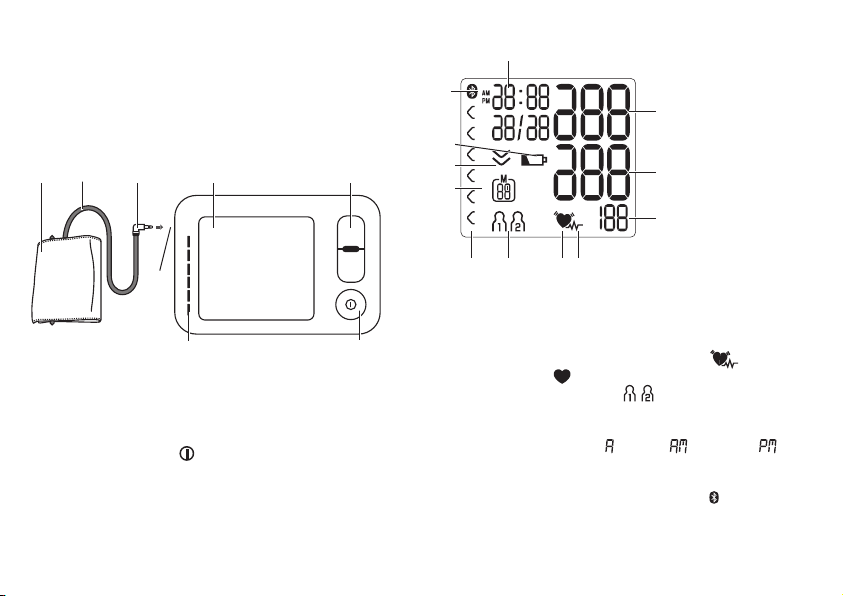
66
шей стране. Прибор следует утилизировать согласно Ди-
рективе ЕС поотходам электрического иэлектронного
оборудования – WEEE (Waste Electrical and Electronic
Equipment). Припоявлении вопросов обращайтесь вмест-
ную коммунальную службу, ответственную заутилизацию
отходов.
3. Описание прибора
M1
SYS
mmHg
DIA
mmHg
PUL
/min
M2
1
2
3 4 5
7
8
6
1. Манжета
2. Шланг манжеты
3. Штекер манжеты
4. Дисплей
5. Кнопки сохранения M1/M2
6. Кнопка ВКЛ./ВЫКЛ.
7. Индикатор риска
8. Разъем для штекера манжеты (слевой стороны)
Индикация на дисплее:
1. Время/дата
2. Систолическое давление
3. Диастолическое давление
4. Измеренное значение пульса
5. Символ нарушений сердечного ритма
6. Символ пульса
7. Пользовательская память
8. Индикатор риска
9. Номер ячейки памяти/индикация среднего значения из
сохраненных впамяти ( ), утром ( ), вечером ( )
10. Выпуск воздуха (стрелка)
11. Символ индикации смены батарейки
12. Символ передачи данных по Bluetooth
®
1
68 5
2
3
10
11
9
7
12
4
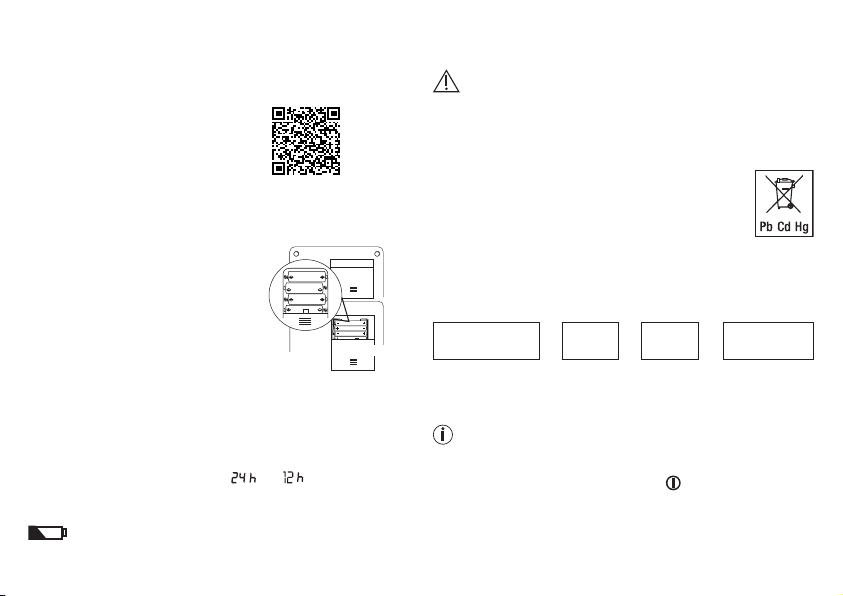
67
Требования ксистеме для использования приложения
„HealthCoach“
– iOS ≥ 8.0 / Android
TM
≥ 4.4
– Bluetooth
®
≥ 4.0
Список поддерживаемых устройств:
4. Подготовка кизмерению
Установка батареек
•
С
нимите крышку отделения для
батареек на задней стороне при-
бора.
•
В
ставьте четыре алкалиновые ба-
тарейки 1,5В ААА (тип LR03). Обя-
зательно проследите за тем, что-
бы батарейки были установлены
справильной полярностью всо-
ответствии смаркировкой. Не используйте заряжаемые
аккумуляторы.
•
С
нова тщательно закройте крышку отделения для бата-
реек.
Все элементы дисплея отобразятся на короткое время, на
дисплее будет мигать индикация или . Установите дату
ивремя, выполнив описанные ниже действия.
При длительном отображении символа замены батареек
проведение измерений невозможно, следует заменить
все батарейки. После извлечения батареек из прибора дату
ивремя необходимо устанавливать заново. Сохраненные
впамяти результаты измерений не исчезают.
Утилизация батареек
•
Выбрасывайте использованные, полностью разряженные ба-
тарейки вспециальные контейнеры, сдавайте впункты прие-
ма спецотходов или вмагазины электрооборудования. Закон
обязывает пользователей обеспечить утилизацию батареек.
• Следующие знаки предупреждают оналичии
вбатарейках токсичных веществ:
Pb = свинец,
Cd = кадмий,
Hg = ртуть.
Настройка часового формата, даты, времени иBluetooth
®
Вдальнейшем представлено описание функций инастроек
прибора для измерения артериального давления.
Формат
времени
➔
Дата
➔
Время
➔
Bluetooth
®
Обязательно правильно настройте дату ивремя. Только так
можно сохранять впамять ивыводить на экран измеренные
значения справильной датой ивременем.
Удерживая нажатой кнопку сохранения M1 или M2, мож-
но быстрее настроить значения.
Удерживайте кнопку ВКЛ./ВЫКЛ. нажатой втечение
5секунд.
4 x 1,5
V AAA
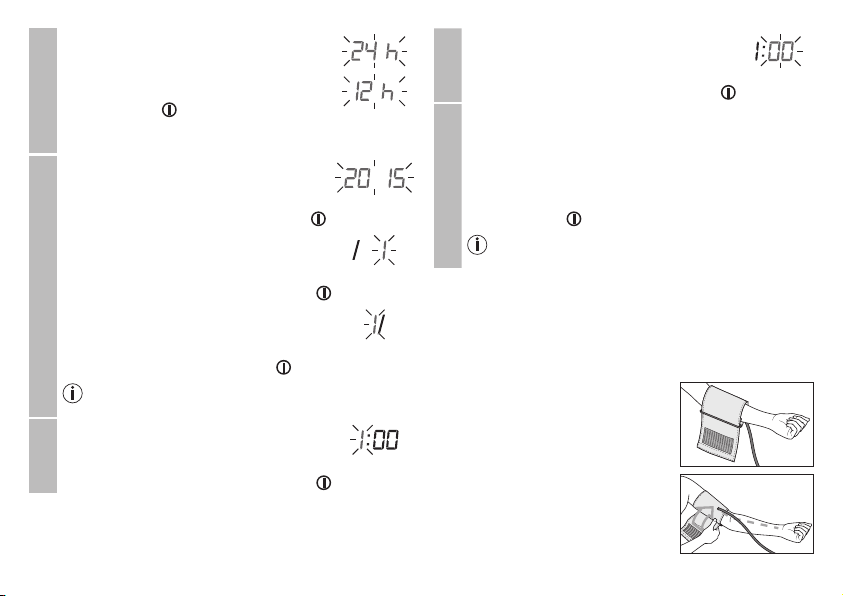
68
Формат времени
На дисплее замигает формат времени.
•
С
помощью кнопок сохранения M1/M2
выберите желаемый часовой формат
иподтвердите выбор нажатием кнопки
ВКЛ./ВЫКЛ. .
Дата
На дисплее замигает индикация года.
•
С
помощью кнопок сохранения M1/M2
выберите нужный год иподтвердите
выбор нажатием кнопки START/STOP .
На дисплее замигает индикация месяца.
•
С
помощью кнопок сохранения M1/M2
выберите нужный месяц иподтвердите
выбор нажатием кнопки ВКЛ./ВЫКЛ. .
На дисплее замигает индикация дня.
•
С
помощью кнопок сохранения M1/M2
выберите день и подтвердите выбор
нажатием кнопки ВКЛ./ВЫКЛ. .
При выборе 12-часового формата времени значение
месяца будет отображаться перед значением дня.
Время
На дисплее замигает индикация часов.
•
С
помощью кнопок сохранения M1/M2
выберите нужный час и подтвердите
выбор нажатием кнопки ВКЛ./ВЫКЛ. .
Время
На дисплее замигает индикация минут.
•
С
помощью кнопок сохранения M1/M2
выберите нужные минуты иподтвердите
выбор нажатием кнопки ВКЛ./ВЫКЛ. .
Bluetooth
®
На дисплее замигает символ Bluetooth
®
.
•
С
помощью кнопок сохранения M1/M2 включите
(замигает символ Bluetooth
®
) или отключите (символ
Bluetooth
®
не будет отображаться на дисплее)
автоматическую активацию передачи данных через
Bluetooth
®
иподтвердите выбор нажатием кнопки
ВКЛ./ВЫКЛ. .
Во время передачи данных спомощью Bluetooth
®
расходуется заряд аккумулятора.
5. Измерение кровяного давления
Для проведения измерений температура прибора должна
соответствовать комнатной.
Измерение можно осуществлять на левой или правой руке.
Накладывание манжеты
Наложите манжету наобнаженную
руку выше локтя. Кровоснабжение
руки не должно быть нарушено из-за
слишком узкой одежды ит.п.
Накладывайте манжету на плечо так,
чтобы ее нижний край располагался
выше локтевого сгиба иартерии на 2
– 3см. Шланг должен быть направлен
всторону ладони по центру.
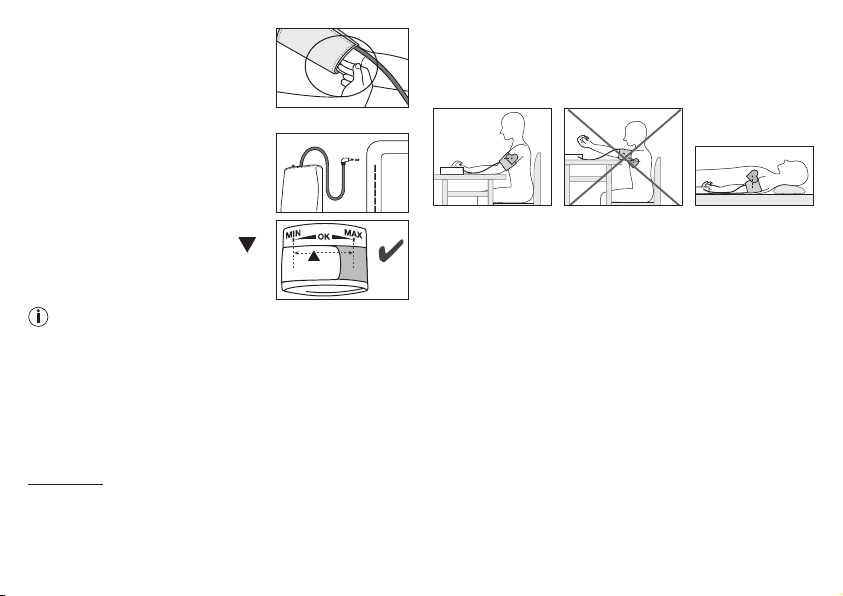
69
Плотно, но не слишком туго оберните
свободный конец манжеты вокруг ру-
ки изастегните спомощью застеж-
ки-липучки. Манжета должна приле-
гать так, чтобы под нее можно было
просунуть два пальца.
Вставьте шланг манжеты вразъем
для штекера манжеты.
Манжета Вам подходит, если после
ее наложения отметка индекса ( )
находится впределах диапазона OK.
Если измерение выполняется на правом плече, шланг
должен находиться на внутренней стороне локтя. Про-
следите за тем, чтобы рука не лежала на шланге.
Давление влевой иправой руке может отличаться, что объ-
ясняет возможное различие врезультатах измерений. Всегда
проводите измерение на одной итой же руке.
Если различие врезультатах слишком велико, необходимо
обсудить сврачом, на какой руке будут проводиться изме-
рения.
Внимание: Прибор разрешается использовать только
соригинальными манжетами. Манжета рассчитана на руку
сокружностью плеча от 22 до 36см.
Вспециализированном магазине или через сервисную служ
-
бу можно приобрести манжету большего размера для окруж-
ности плеча от 35 до 44см (номер для заказа 163.387).
Правильное положение тела
•
О
тдыхайте втечение 5минут перед каждым измерением
давления! Впротивном случае возможны отклонения ре-
зультатов измерения.
•
И
змерение можно проводить сидя или лежа. Обязатель-
но следите за тем, чтобы манжета находилась на уровне
сердца.
•
Д
ля измерения кровяного давления займите удобное по-
ложение сидя. Спина ируки должны иметь опору. Не скре-
щивайте ноги. Поставьте ступни ровно на пол.
•
Ч
тобы избежать искажения результатов, во время изме-
рения следует вести себя спокойно ине разговаривать.
M1
SYS
mmHg
DIA
mmHg
PUL
/min
M2
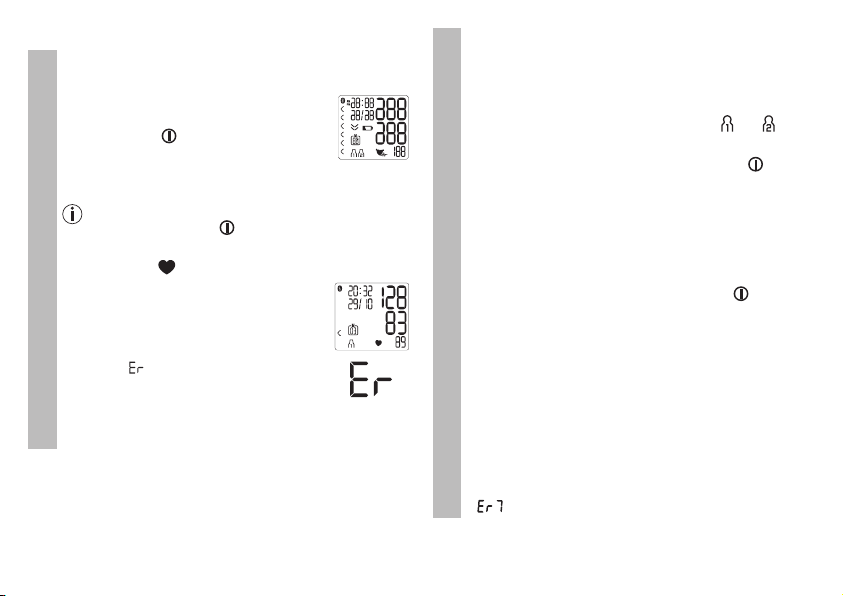
70
Измерение кровяного давления
Измерение
Наложите манжету, как описано выше, изаймите
удобное для измерения положение.
•
Д
ля запуска прибора для измерения
кровяного давления
нажмите кнопку
ВКЛ./ВЫКЛ.
.
На короткое время на
дисплее отобразятся все элементы.
Процесс измерения начнется
автоматически через 3 секунды.
Измерение можно прервать влюбой момент, нажав
кнопку ВКЛ./ВЫКЛ. .
Как только прибор распознает пульс, отобразится
символ пульса .
•
О
тобразятся результаты измерения
систолического давления,
диастолического давления ипульса.
•
С
имвол
появляется, если измерение
было произведено ненадлежащим обра-
зом (см. главу 9 «Сообщение об ошибке/
устранение неисправностей»). Повторите
измерение.
Измерение
•
Т
еперь при помощи кнопок сохранения M1 или M2
выберите пользовательскую память. Если Вы не
выбрали пользовательскую память, то результат
измерения будет сохранен в пользовательской
памяти последнего пользователя. На дисплее
появляется соответствующий символ или .
•
В
ыключите прибор для измерения кровяного
давления, нажав кнопку ВКЛ./ВЫКЛ.
. Таким
образом в выбранной пользовательской памяти
сохранится результат измерения.
• Если Вы не отключите прибор, то через 30секунд он
выключится самостоятельно.
Если активирована функция передачи данных через
Bluetooth
®
, то после подтверждения пользовательской
памяти нажатием кнопки ВКЛ./ВЫКЛ. начнется
передача данных.
• Символ Bluetooth
®
мигает на дисплее игорит голубая
светодиодная лампочка. Втечение 30 секунд прибор
для измерения кровяного давления устанавливает
связь сприложением.
• Как только соединение будет установлено символ Blue-
tooth
®
перестанет мигать. Все результаты измерения
автоматически передаются приложению. После
успешной передачи данных прибор отключается. Если
передача данных не удалась, голубая светодиодная
лампочка погаснет ина дисплее появится символ «
».
71
Измерение
• Если втечение 30 секунд прибор не сможет
установить соединение сприложением, символ
Bluetooth
®
погаснет иприбор для измерения
кровяного давления отключится через 3 минуты.
Учтите, что для передачи данных вприложении
„HealthCoach“ необходимо добавить прибор для
измерения давления враздел «Мои устройства».
Для передачи данных необходимо запустить
приложение „HealthCoach“. Если текущие
данные не отображаются на Вашем смартфоне,
повторите передачу данных всоответствии
суказаниями главы 7.
Если Вы забудете выключить прибор для измерения
кровяного давления, он выключится автоматически
примерно через 30секунд. В этом случае измеренное
значение также сохранится ввыбранной или последней
использованной пользовательской памяти, а данные
при активированной функции передачи данных через
Bluetooth
®
будут перенесены.
•
П
еред повторным измерением
подождите не менее 5минут!
6. Оценка результатов
Нарушения сердечного ритма
Данный прибор во время измерения может идентифици-
ровать возможные нарушения сердечного ритма ипри их
наличии сообщает оних после измерения символом .
Это может указывать на аритмию. Аритмия — это болезнь,
при которой возникает аномальный сердечный ритм, вы-
званный ошибками вбиоэлектрической системе, регули-
рующей биение сердца. Симптомы (неравномерное или
преждевременное сердцебиение, медленный или слишком
быстрый пульс) могут быть вызваны заболеваниями серд-
ца, возрастом, предрасположенностью ксоответствующим
заболеваниям, чрезмерным употреблением кофе, никотина
иалкоголя, стрессом или недостатком сна. Аритмия может
быть выявлена только врезультате обследования уврача.
Если после первого измерения на дисплее отображается
символ , повторите измерение. Обратите внимание на то,
что втечение 5минут перед измерением нельзя заниматься
активной деятельностью, аво время измерения нельзя го-
ворить или двигаться. Если символ появляется часто,
обратитесь кврачу.
Самодиагностика исамолечение на основе результатов из-
мерения могут быть опасны. Обязательно следуйте рекомен-
дациям своего врача.
Индикатор риска:
Оценку результатов измерений можно провести спомощью
таблицы, представленной ниже.
Однако эти стандартные значения служат только общим
ориентиром, так как индивидуальные значения кровяного
давления уразных людей варьируются взависимости от
принадлежности ктой или иной возрастной группе ит.п.
Важно регулярно консультироваться сврачом. Врач опреде-
лит Ваши индивидуальные значения нормального кровяного
давления, атакже значения, выше которых кровяное давле-
ние следует классифицировать как опасное.
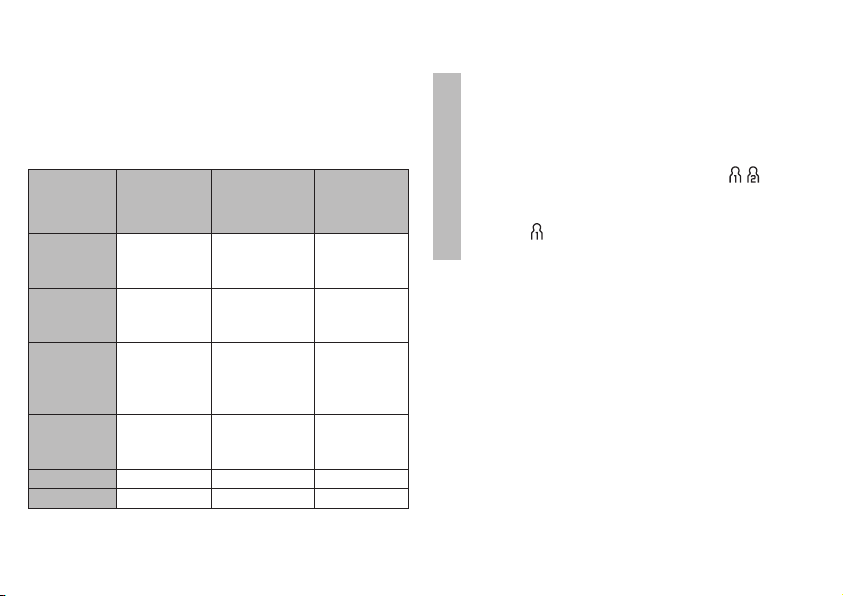
72
Градация на дисплее ишкала на приборе показывают, вка-
ком диапазоне находится измеренное давление. Если значе-
ния систолического идиастолического давления находятся
вразных диапазонах (например, систолическое давление
— высокое вдопустимых пределах, адиастолическое —
нормальное), то графическое деление на приборе всегда
будет отображать более высокие пределы, как вописанном
примере: высокое вдопустимых пределах.
Диапазон
значений
кровяного
давления
Систолическое
давление
(в мм рт. ст.)
Диастолическое
давление
(в мм рт. ст.)
Рекомендуемые
меры
Степень3:
тяжелая
гипертония
≥ 180 ≥ 110
обращение
кврачу
Степень2:
пограничная
гипертония
160–179 100–109
обращение
кврачу
Степень1:
слабая
степень
гипертонии
140–159 90–99
регулярное
посещение
врача
Высокое
вдопустимых
пределах
130–139 85–89
регулярное
посещение
врача
Нормальное 120–129 80–84 Самоконтроль
Оптимальное < 120 < 80 Самоконтроль
Источник: WHO, 1999 (World Health Organization)
7. Просмотр иудаление результатов
измерения
Пользовательская память
Результаты каждого успешного измерения сохраняются
с указанием даты и времени измерения. Когда
количество сохраненных результатов измерения
превышает 60, более ранние данные перезаписываются.
•
С
помощью кнопок сохранения M1 или M2 выберите
нужную пользовательскую память ( ), когда
прибор выключен.
•
–
Для просмотра сохраненных впользовательской
памяти результатов измерений нажмите кнопку
сохранения M1.
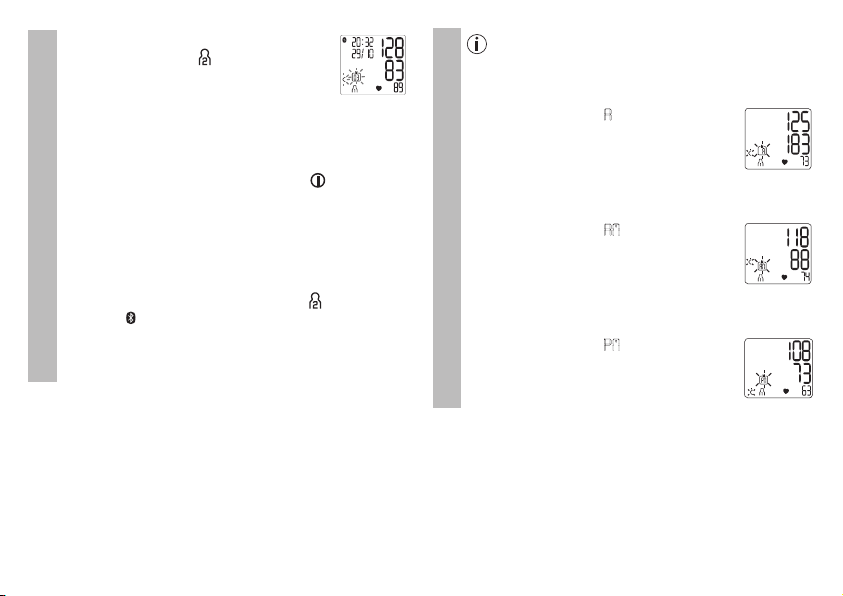
73
Пользовательская память
•
–
Для просмотра сохраненных впользо-
вательской памяти результатов изме-
рений нажмите кнопку сохранения M2.
• Надисплее появится среднее значение
всех измерений.
•
Е
сли активирована функция переда-
чи данных через Bluetooth
®
, то после
подтверждения пользовательской па-
мяти нажатием кнопки START/STOP
начнется передача данных. Нажатием
кнопки M1 Вы можете прервать пере-
дачу данных, на дисплее отобразятся
средние значения.
Нажатием кнопки M2
Вы можете прервать передачу данных,
ина дисплее отобразятся результаты
измерения пользовательской памяти .
Символ исчезнет сдисплея. Кнопки
становятся неактивными после установ-
ки соединения ив процессе передачи
данных.
Средние значения
Если Вы выбрали пользовательскую память1,
нажмите кнопку сохранения M1.
Если Вы выбрали пользовательскую память2,
нажмите кнопку сохранения M2.
На дисплее замигает
A
.
Отобразится среднее значение всех сохра-
ненных вданной пользовательской памяти
результатов измерений.
•
Н
ажмите соответствующую кнопку сохранения (M1
или M2).
На дисплее замигает
AM
.
Отобразится среднее значение результатов
утренних измерений за последние 7дней
(утро: 5:00 – 9:00).
•
Н
ажмите соответствующую кнопку сохранения (M1
или M2).
На дисплее замигает
PM
.
Отобразится среднее значение результатов
вечерних измерений за последние 7дней
(вечер: 18:00 – 20:00).
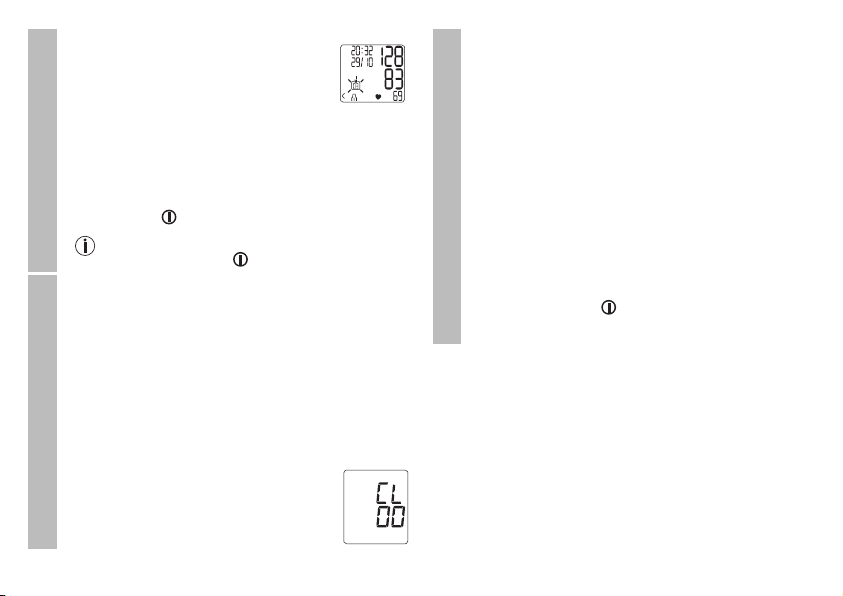
74
Результаты отдельных измерений
•
П
ри повторном нажатии соответствую-
щей кнопки сохранения (M1 или M2) на
дисплее отобразится результат послед-
него измерения (вкачестве примера ис-
пользуется измерение 03).
•
Е
сли еще раз нажать кнопку сохранения (M1 или
M2), можно просмотреть результаты отдельных из-
мерений.
•
Ч
тобы вновь выключить прибор, нажмите кнопку
ВКЛ./ВЫКЛ. .
•
Из меню можно влюбое время выйти нажатием
кнопки ВКЛ./ВЫКЛ. .
Удаление результатов измерения
• Для удаления содержимого соответствующей поль-
зовательской памяти выберите пользовательскую
память.
•
Запустите запрос средних результатов измерений. На
дисплее замигает A и отобразится среднее значение
всех сохраненных вданной пользовательской памяти
результатов измерений.
• Удерживайте втечение 5 секунд кнопку сохранения
M1 или M2 взависимости от того, вкакой пользова-
тельской памяти Вы находитесь.
Все значения текущей пользовательской
памяти будут удалены.
Удаление результатов отдельных измерений
•
Д
ля удаления отдельных результатов измерений со-
ответствующей пользовательской памяти сначала
выберите пользовательскую память.
•
З
апустите запрос результатов отдельных измерений.
•
Н
ажмите обе кнопки сохранения M1 или M2 иудер-
живайте их нажатыми втечение 5секунд. (взави-
симости от того, вкакой пользовательской памяти
Вы находитесь).
•
В
ыбранный результат измерения будет удален. На
дисплее на некоторое время отобразится значение
CL 00.
•
Е
сли Вы хотите удалить другие результаты измере-
ний, повторите действия, описанные выше.
Вы влюбое время можете выключить прибор нажатием
кнопки ВКЛ./ВЫКЛ. .
8. Передача измеренных значений
Передача данных с помощью Bluetooth
®
low energy
technology
УВас есть возможность перенести измеренные исохра-
ненные на приборе значения на смартфон при помощи
Bluetooth
®
low energy technology.
Вам понадобится приложение „HealthCoach“. Оно доступно
для загрузки вApp Store.
Чтобы перенести данные, выполните следующие действия:
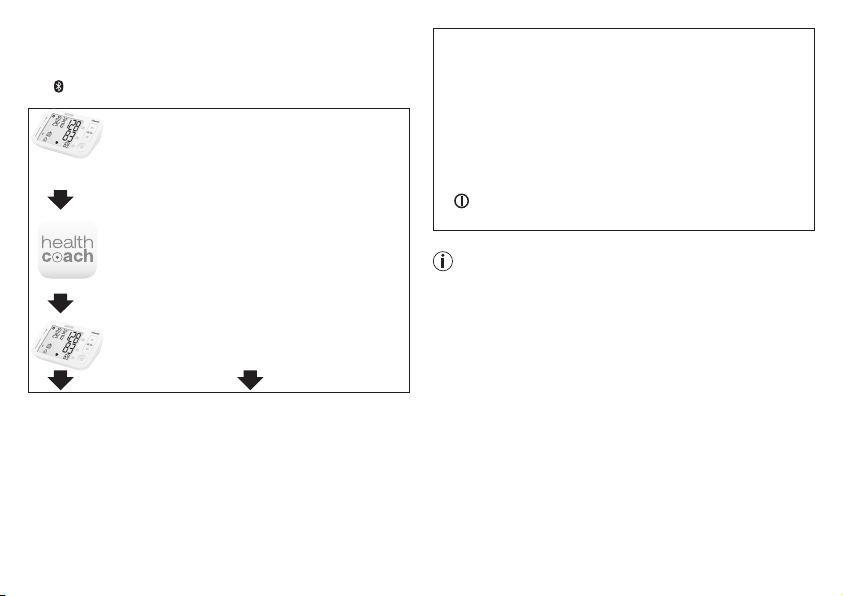
75
Если вменю настроек активирована функция Bluetooth
®
, то
после проведения измерений передача данных произойдет
автоматически. Влевом верхнем углу дисплея появится сим-
вол (см. главу 4 «Подготовка кизмерению»).
Шаг 1: SBM 37
Активируйте Bluetooth
®
на Вашем прибо-
ре (см. главу 4 «Подготовка кизмерению»,
Bluetooth
®
).
Шаг 2: Приложение „HealthCoach“
Добавьте SBM 37 вразделе «Настройки/Мои
устройства» приложения „HealthCoach“.
Шаг 3: SBM 37
Проведите измерение давления.
Шаг 4: SBM 37
Передача данных сразу по-
сле измерения:
•
Е
сли активирована функ-
ция передачи данных че-
рез Bluetooth
®
, то после
подтверждения пользова-
тельской памяти нажати-
ем кнопки ВКЛ./ВЫКЛ.
начнется передача
данных.
Шаг 4: SBM 37
Передача данных вдругое
время:
•
П
ерейдите врежим вы-
зова данных из памяти
(гл.7). Выберите нужную
пользовательскую па-
мять. Передача данных
через Bluetooth
®
будет
запущена автоматически.
Для передачи данных необходимо запустить приложение
„HealthCoach“.
Чтобы обеспечить передачу данных без помех, снимите че-
хол со смартфона, если он есть. Запустите передачу данных
вприложении „HealthCoach“.
9. Очистка и хранение прибора и манжеты
•
П
роизводите очистку прибора и манжеты с осторожно-
стью. Используйте только слегка увлажненную салфетку.
•
Н
е используйте чистящие средства или растворители.
•
Н
и в коем случае не опускайте прибор и манжету в воду,
так как попадание воды приведет к повреждению прибора
и манжеты.
•
П
ри хранении на приборе и манжете не должны стоять
тяжелые предметы. Извлеките батарейки. Нельзя слишком
сильно сгибать шланг манжеты.
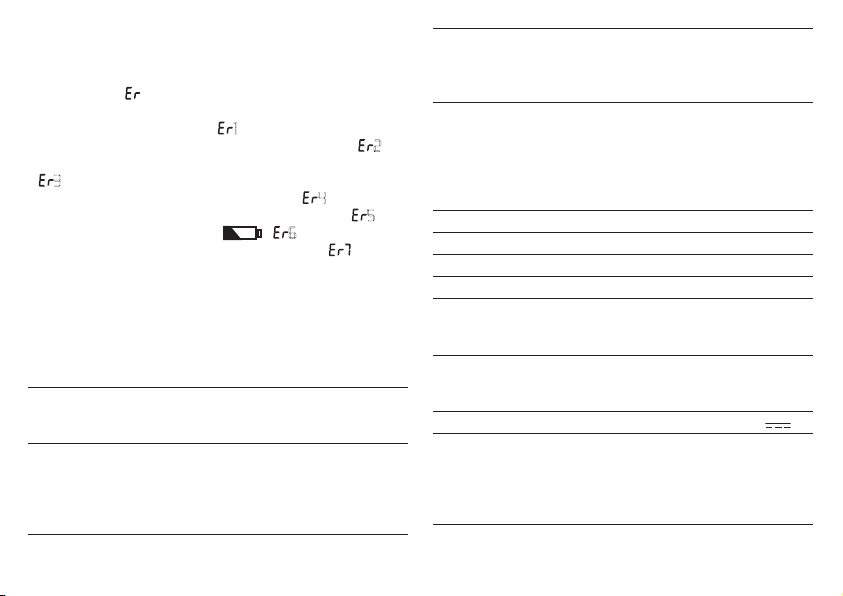
76
10. Сообщение об ошибке/устранение
ошибок
При возникновении ошибок на дисплее появляется сообще-
ние об ошибке
_
.
Сообщения об ошибках появляются, если
• не удалось измерить пульс:
1
;
• во время измерения Вы двигаетесь или говорите:
2
;
• манжета прилегает слишком сильно или слишком слабо:
3
;
• произошли ошибки во время измерения:
4
;
• давление накачивания превышает 300 ммрт.ст.:
5
;
• батарейки почти разряжены
:
6
;
• Πередача данных по Bluetooth
®
невозможна: .
Втаких случаях повторите измерение или передачу данных.
Проследите за тем, чтобы шланг манжеты был надлежащим
образом подсоединен, не двигайтесь ине разговаривайте
во время измерения.
11. Технические данные
№ модели SBM 37
Метод измерения Осциллометрическое, неинвазивное
измерение кровяного давления на
плече
Диапазон
измерения
Давление вманжете 0 –
250ммрт.ст.,
систолическое 50–250ммрт.ст.,
диастолическое 30-200ммрт.ст.,
пульс 40–180ударов/мин
Точность индикации ± 3ммрт.ст. для систолического,
± 3ммрт.ст. для диастолического,
пульс ± 5% от указываемого
значения
Погрешность
измерения
Максимально допустимое
стандартное отклонение по
результатам клинических испытаний:
8ммрт.ст. для систолического/
8ммрт.ст. для диастолического
давления
Память 2 блока по 60ячеек памяти
Размеры Д139ммxШ94ммxВ48мм
Вес 236 g (без манжет, без батареек)
Размер манжеты от 22 до 36см
Допустимые
условия
эксплуатации
от +5 до 40°C, относительная
влажность воздуха 15–93% (без
образования конденсата)
Condizioni ammesse
di conservazione e
trasporto
От -25°C до70 °C, относительная
влажность воздуха ≤ 93%, давление
окружающей среды 700 –1060гПа
Электропитание 4 батарейки типа ААА по 1,5 В
Срок службы Примерно 200 измерений,
взависимости от кровяного
давления идавления накачивания,
атакже от количества соединений
Bluetooth
®

77
Принадлежности Манжета, инструкция по
применению, сумка для хранения
Классификация Внутреннее питание, IP21, без
AP или APG, продолжительное
использование, рабочая часть типа
BF
Передача данных
спомощью Blue-
tooth
®
wireless
technology
Прибор для измерения
артериального давления работает с
Bluetooth
®
low energy technology,
частотный диапазон 2402 МГц –
2480 МГц, Мощность передатчика
макс. 20 дБМ, совместим со
смартфонами и планшетными
компьютерами, оснащенными Blue-
tooth ≥ 4.0
Серийный номер находится на приборе или в отделении для
батареек.
Всвязи сусовершенствованием продукта компания оставля-
ет за собой право на изменение технических характеристик
без предварительного уведомления.
•
Д
анный прибор соответствует европейскому стандарту
EN60601-1-2 итребует особых мер предосторожности
вотношении электромагнитной совместимости. Следует
учесть, что переносные имобильные высокочастотные
коммуникационные устройства могут повлиять на работу
данного прибора. Более точные данные можно запросить
по указанному адресу сервисной службы или найти вконце
инструкции по применению.
•
П
рибор соответствует требованиям директивы ЕС 93/42/
EEC омедицинском оборудовании, закона омедицинском
оборудовании, атакже европейских стандартов EN1060-1
(неинвазивные приборы для измерения кровяного давле-
ния, часть1: общие требования), EN1060-3 (неинвазив-
ные приборы для измерения кровяного давления, часть3:
дополнительные требования кэлектромеханическим си-
стемам измерения кровяного давления) иIEC80601-2-30
(медицинские электрические приборы, часть2 – 30: осо-
бые предписания по обеспечению безопасности, включая
основные характеристики автоматизированных неинвазив-
ных приборов для измерения кровяного давления).
•
Т
очность данного прибора для измерения кровяного дав-
ления была тщательно проверена, прибор был разработан
срасчетом на длительный срок эксплуатации. При исполь-
зовании прибора вмедицинских учреждениях следует вы-
полнять метрологический контроль спомощью соответ-
ствующих средств. Точные данные для проверки точности
прибора можно запросить всервисном центре.
• Настоящим мы гарантируем, что данное изделие соответ-
ствует европейским нормам RED 2014/53/EU. Обратитесь
в сервисный центр по указанному адресу для получения
подробных сведений – например, о соответствии дирек-
тивам ЕС.
•
Обратитесь всервисный центр по указанному адресу для
получения подробных сведений— например, осоответ-
ствии директивам ЕС.

78
12. Гарантия /сервисное обслуживание
Mы предоставляем гарантию на дефекты материалов и из-
готовления на срок 24 месяцев со дня продажи через роз-
ничную сеть.
Гарантия не распространяется:
•
н
а случаи ущерба, вызванного неправильным использо-
ванием
•
н
а быстроизнашивающиеся части и источники света (на-
садки, электроды, батарейки, а так же лампочки)
•
н
а дефекты, о которых покупатель знал в момент покупки
•
н
а случаи собственной вины покупателя
Товар сертифицирован
Срок эксплуатации изделия: мин. 4 год/года/лет
Фирма-изготовитель:
Ханс Динслаге Гмбх, Софлингер штрассе 28,
88524 Уттенвайлер, Германия
Фирма-импортер:
В Российскую Федерацию: ООО «Хаскел», 119192,
г. Москва, Мичуринский проспект, д. 11, корп. 4, пом. III,
ком. 4
Организации, принимающие претензии:
Для Российской Федерации : ООО «Сеть компьютерных
клиник»
109202, город Москва, улица 1-я Фрезерная, дом 2/1,
корпус 2, ; Тел. +7 800 302 03 94;
www.itclinic.ru/service/
Возможны ошибки и изменения
79
Гарантийный талон
Наименование ____________________________________
Модель
____________________________________________
Серийный номер
__________________________________
Дата продажи
______________________________________
Наименование, адрес и телефон
торгующей организации __________________________
__________________________________________________
Подпись продавца Штамп магазина
ВНИМАНИЕ!
Гарантийный талон действителен при наличии печати продавца
либо при предоставлении чека, полученного при совершении
покупки.
Уважаемый Покупатель!
Мы выражаем благодарность за Ваш выбор продукции Sanitas и
гарантируем высокое качество и безупречное функционирование
приобретенного Вами изделия при соблюдении правил его
эксплуатации.
Данным гарантийным талоном Производитель подтверждает
исправность изделия и берет на себя обязательство по
бесплатному устранению всех неисправностей, возникших по вине
производителя.
С условиями согласен, претензий к внешнему виду и комплектации
не имею
_________________________________________________________
(Подпись покупателя)
Дата приема
в АСЦ
Выполненные
работы
Дата выдачи
из АСЦ
Подпись
сотрудника
АСЦ
Подпись
клиента
80
Electromagnetic compatibility
Electromagnetic emissions
Guidance and manufacturer’s declaration – electromagnetic emissions for all EQUIPMENT and SYSTEMS
The Blood pressure monitor (SBM 37) is intended for use in the electromagnetic environment specified below. The customer of the
user of the Blood pressure monitor (SBM 37) should assure that it is used in such and environment.
Emission test Compliance Electromagnetic environment – guidance
RF emissions
CISPR 11
Group 1 The Blood pressure monitor (SBM 37) uses RF energy only for its internal function.
Therefore, its RF emissions are very low and are not likely to cause any interference
in nearby electronic equipment.
RF emission
CISPR 11
Class B The Blood pressure monitor (SBM 37) is suitable for use in all establishments, including
domestic establishments and those directly connected to the public low-voltage
power supply network that supplies buildings used for domestic purposes.
Electromagnetic immunity
Guidance and manufacturer’s declaration – electromagnetic immunity – for all EQUIPMENT and SYSTEMS
The Blood pressure monitor (SBM 37) is intended for use in the electromagnetic environment specified below. The customer of the
user of the Blood pressure monitor (SBM 37) should assure that it is used in such and environment.
Immunity test
IEC 60601
test level
Compliance
level
Electromagnetic environment – guidance
Electrostatic
discharge (ESD)
IEC 61000-4-2
±6 kV contact
±8 kV air
±6 kV contact
±8 kV air
Floors should be wood, concrete or ceramic tile. If floor are covered
with synthetic material, the relative humidity should be at least 30%.
Power frequency
(50Hz) magnetic field
IEC 61000-4-8
3A/m 3A/m Power frequency magnetic fields should be at levels characteristic
of a typical location in a typical commercial or hospital environment.
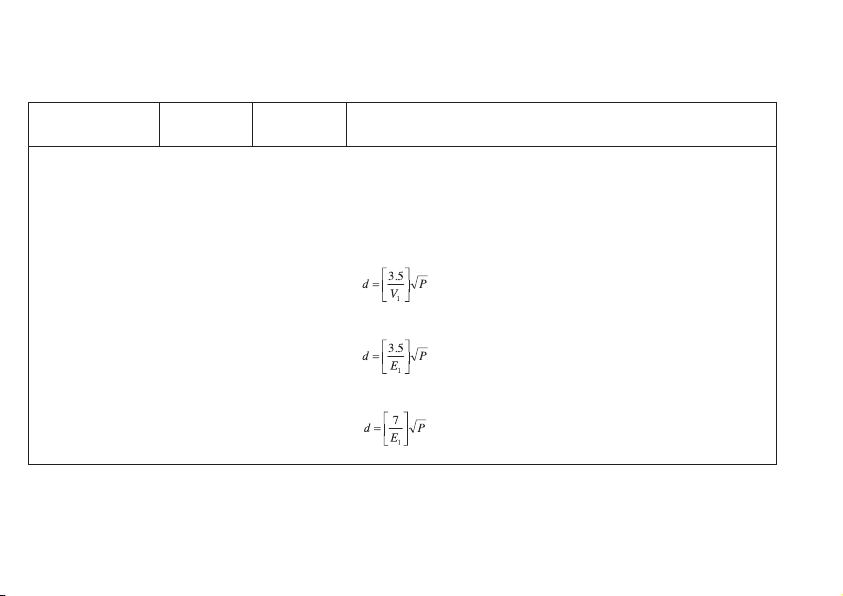
81
Guidance and manufacturer’s declaration – electromagnetic immunity for EQUIPMENT and SYSTEMS that are not LIFE-
SUPPORTING
The Blood pressure monitor (SBM 37) is intended for use in the electromagnetic environment specified below. The customer
or the user of Blood pressure monitor (SBM 37) should assure that it is used in such an environment.
Immunity test
IEC 60601
test level
Compliance
level
Electromagnetic environment – guidance
Portable and mobile RF communications equipment should be used
no closer to any part of the Blood pressure monitor (SBM 37), including
cables, than the recommended separation distance calculated from the
equation applicable to the frequency of the transmitter.
Recommended separation distance.
Conducted RF
IEC 61000-4-6
3 V
rms
150 kHz to
80 MHz
3 V
rms
Radiated RF
IEC 61000-4-3
3 V/m
80 MHz to
2.5 GHz
3 V/m
80 MHz to 800 MHz
800 MHz to 2.5 GHz
82
Where P is the maximum output power rating of the transmitter in watts
(W) according to the transmitter manufacturer and d is the recommen-
ded separation distance in metres (m).
Field strengths from fixed RF transmitters, as determined by an elec-
tromagnetic site surveya should be less than the compliance level in
each frequency rangeb. Interference may occur in the vicinity of equip-
ment marked with the following symbol:
NOTE 1 At 80 MHz and 800 MHz, the higher frequency range applies.
NOTE 2 These guidelines may not apply in all situations. Electromagnetic propagation is affected by absorption and reflec-
tion from structures, objects and people.
a
Field strengths from fixed transmitters, such as base stations for radio (cellular/cordless) telephones and land mobile radios,
amateur radio,AM and FM radio broadcast and TV broadcast cannot be predicted theoretically with accuracy.
To assess the electromagnetic environment due to fixed RF transmitters, an electromagnetic site survey should be con-
sidered. If the measured field strength in the location in which the Blood pressure monitor (SBM 37) is used exceeds the
applicable RF compliance level above, the Blood pressure monitor (SBM 37) should be observed to verify normal operation.
If abnormal performance is observed, additional measures may be necessary, such as reorienting or relocating the Blood
pressure monitor (SBM 37).
b
Over the frequency range 150 kHz to 80 MHz, field strengths should be less than 3 V/m.
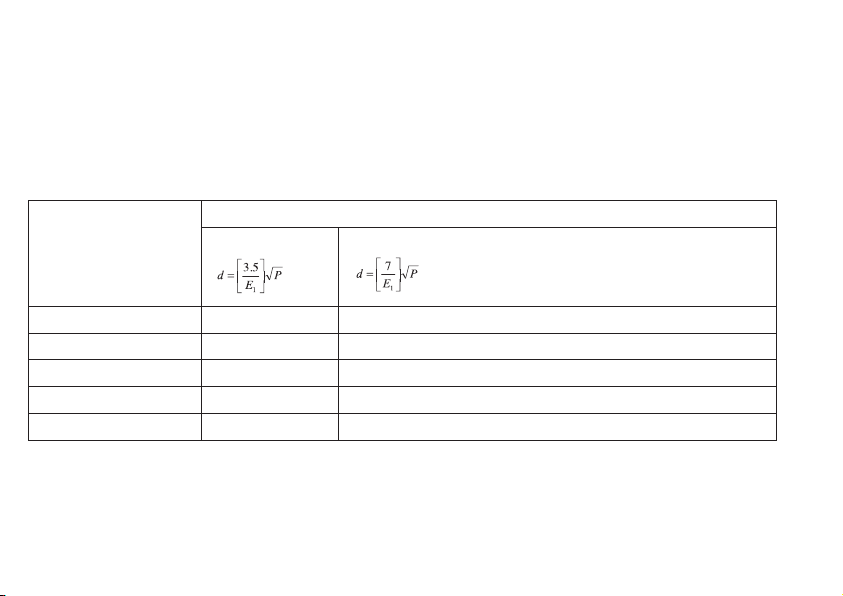
83
Recommended separation distances
Recommended separation distances between portable and mobile RF communications equipment and the EQUIPMENT or
SYSTEM – for EQUIPMENT or SYSTEM that are not LIFESUPPORTING
Recommended separation distances between portable and mobile RF communications equipment and the Blood pressure monitor
(SBM 37).
The Blood pressure monitor (SBM 37) is intended for use in an electromagnetic environment in which radiated RF disturbances
are controlled. The customer or the user of the Blood pressure monitor (SBM 37) can help prevent electromagnetic interference by
maintaining a minimum distance between portable and mobile RF communications equipment (transmitters) and the Blood pressure
monitor (SBM 37) as recommended below, according to the maximum output power of the communications equipment.
Rated maximum output
power of transmitter
(W)
Separation distance according to frequency of transmitter (m)
80 MHz to 800 MHz 800 MHz to 2.5 GHz
0,01 0.1167 0.2334
0,1 0.3689 0.7378
1 1.1667 2.3334
10 3.6893 7.3786
100 11.6667 23.3334
For transmitters rated at a maximum output power not listed above, the recommended separation distance d in metres (m)
can be estimated using the equation applicable to the frequency of the transmitter, where P is the maximum output power
rating of the transmitter in watts (W) according to the transmitter manufacturer.
NOTE 1 At 80 MHz and 800 MHz, the separation distance for the higher frequency range applies.
NOTE 2 These guidelines may not apply in all situations. Electromagnetic propagation is affected by absorption and reflection from
structures, objects and people.
84
658.24_SBM37_2018-03-05_01_IM_SAN
Hans Dinslage GmbH, Riedlinger Straße 28, 88524 Uttenweiler, Germany
www.sanitas-online.de
The Bluetooth
®
word mark and logos are registered trademarks owned by Bluetooth SIG, Inc. and any use of such marks by Hans Dinslage GmbH is under
license. Other trademarks and trade names are those of their respective owners.
Apple and the Apple logo are trademarks of Apple Inc., registered in the U.S. and other countries. App Store is a service mark of Apple Inc., registered in the
U.S. and other countries.
Google Play and the Google Play logo are trademarks of Google LLC.
Android is a trademark of Google LLC.