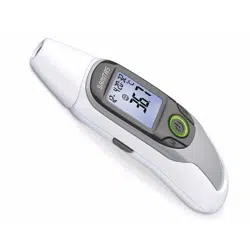
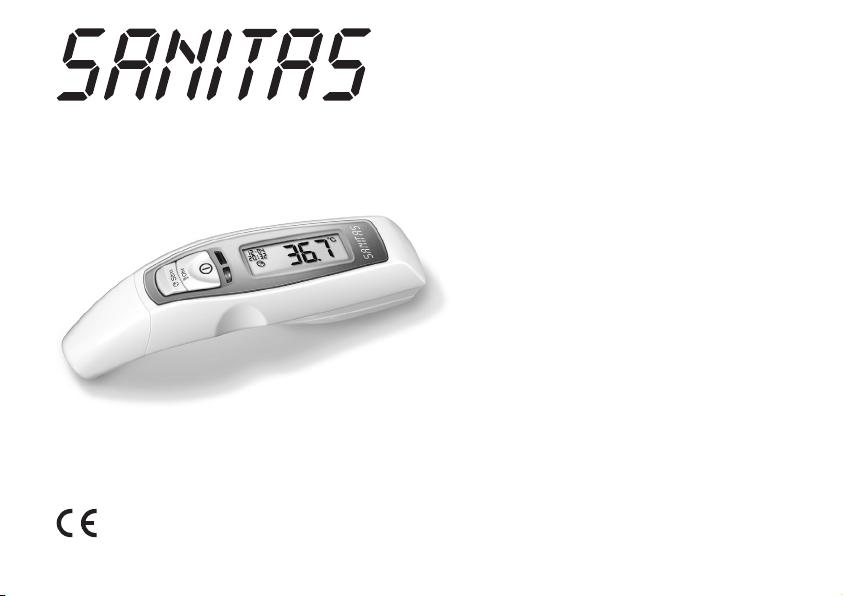
SFT 65
D
Multifunktions-Thermometer
Gebrauchsanweisung ..................................2
G
Multi-function thermometer
Instructions for use ....................................19
F
Thermomètre multifonction
Mode d’emploi ...........................................36
I
Termometro multifunzione
Istruzioni per l’uso ......................................53
r
Многофункциональный термометр
Инструкция по применению ....................70
Q
Termometr wielofunkcyjny
Instrukcja obsługi .......................................86
O
Multifunktions-Thermometer
Gebruiksaanwijzing ..................................103
2
Lieferumfang
Überprüfen Sie das Gerät auf äußere Unversehrtheit der Verpackung und auf die Vollständigkeit des Inhalts. Vor dem
Gebrauch ist sicherzustellen, dass das Gerät und Zubehör keine sichtbaren Schäden aufweisen und jegliches Verpa-
ckungsmaterial entfernt wird. Benutzen Sie es im Zweifelsfall nicht und wenden Sie sich an Ihren Händler oder an die
angegebene Service-Adresse.
• Thermometer
• 2 x 1,5 V Batterien AAA (LR03)
• Diese Gebrauchsanweisung
Bitte lesen Sie diese Gebrauchsanweisung aufmerksam durch, bewahren Sie sie für den späteren Gebrauch auf, machen
Sie sie anderen Benutzern zugänglich und beachten Sie die Hinweise.
1. Zeichenerklärung
Folgende Symbole werden in dieser Gebrauchsanweisung und auf dem Gerät verwendet:
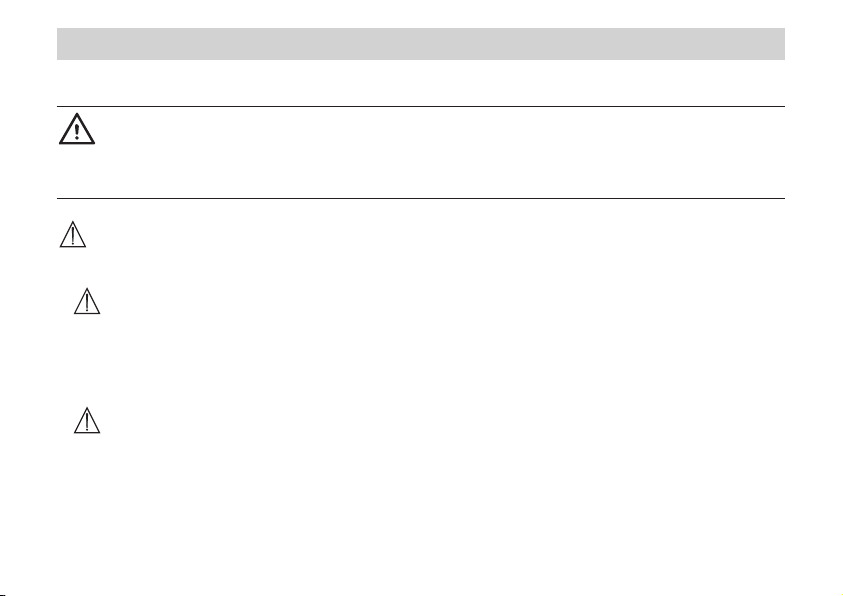
WARNUNG
Warnhinweis auf Verletzungsgefahren oder Gefahren für Ihre Gesundheit.
Deutsch
1. Zeichenerklärung .......................................................2
2. Hinweise .................................................................... 4
3. Gerätebeschreibung .................................................. 7
4. Inbetriebnahme ......................................................... 8
5. Einstellung ................................................................. 8
6. Was Sie vor dem Messen wissen sollten .................. 9
7. Messen ...................................................................... 10
8. Batteriewechsel ....................................................... 13
9. Aufbewahrung und Pflege ....................................... 14
10. Entsorgen ................................................................ 15
11. Technische Daten ................................................... 15
12. Fehlerbehebung ....................................................... 17
13. Garantie und Service ............................................... 17
Inhalt
3
ACHTUNG
Sicherheitshinweis auf mögliche Schäden am Gerät/Zubehör.
Hinweis
Hinweis auf wichtige Informationen.
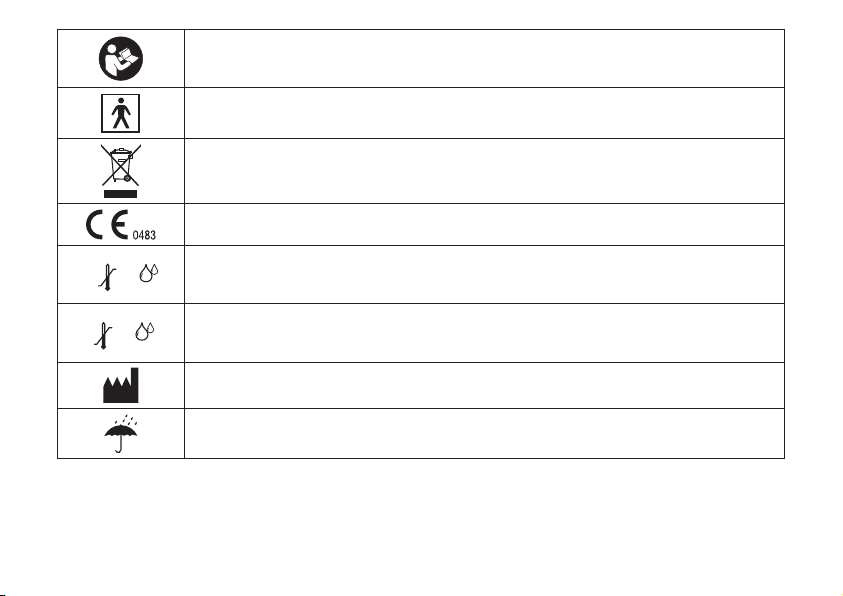
Gebrauchsanweisung beachten
Anwendungsteil Typ BF
Entsorgung gemäß Elektro- und Elektronik-Altgeräte EG-Richtlinie – WEEE (Waste Electrical and
Electronic Equipment)
Die CE-Kennzeichnung bescheinigt die Konformität mit den grundlegenden Anforderungen der
Richtlinie 93/42/EEC für Medizinprodukte.
Storage/Transport
Zulässige Lagerungs- und Transporttemperatur und -luftfeuchtigkeit
Operating
Zulässige Betriebstemperatur und -luftfeuchtigkeit
Hersteller
Vor Nässe schützen
4
21
PAP
Verpackung umweltgerecht entsorgen
S
N
Seriennummer
2. Hinweise
Sicherheitshinweise
Warnung:
• Führen Sie bei Messungen im Ohr die Sensorspitze des Thermometers vorsichtig ein.
• Die Anwendung des Thermometers an verschiedenen Personen kann bei bestimmten akuten, infektiösen
Erkrankungen aufgrund einer möglichen Keimverschleppung trotz der durchzuführenden Reinigung und
Wischdesinfektion unzweckmäßig sein. Fragen Sie im Einzelfall Ihren behandelnden Arzt.
Hinweise zum Umgang mit Batterien
• Wenn Flüssigkeit aus einer Batteriezelle mit Haut oder Augen in Kontakt kommt, die betroffene Stelle mit Wasser
auswaschen und ärztliche Hilfe aufsuchen.
•
Verschluckungsgefahr! Kleinkinder könnten Batterien verschlucken und daran ersticken. Daher Batterien für
Kleinkinder unerreichbar aufbewahren!
• Auf Polaritätskennzeichen Plus (+) und Minus (-) achten.
• Wenn eine Batterie ausgelaufen ist, Schutzhandschuhe anziehen und das Batteriefach mit einem trockenen Tuch
reinigen.
• Schützen Sie Batterien vor übermäßiger Wärme.
5
•
Explosionsgefahr! Keine Batterien ins Feuer werfen.
• Batterien dürfen nicht geladen oder kurzgeschlossen werden.
• Bei längerer Nichtbenutzung des Geräts die Batterien aus dem Batteriefach nehmen.
• Verwenden Sie nur denselben oder einen gleichwertigen Batterietyp.
• Immer alle Batterien gleichzeitig auswechseln.
• Keine Akkus verwenden!
• Keine Batterien zerlegen, öffnen oder zerkleinern.
Allgemeine Hinweise
• Bitte lesen Sie diese Gebrauchsanweisung aufmerksam durch, bewahren Sie sie für den späteren Gebrauch
auf, machen Sie sie anderen Benutzern zugänglich und beachten Sie die Hinweise.
• Dieses Thermometer ist ein empfindliches elektronisches Gerät. Behandeln Sie es sorgfältig und setzen Sie
es keinen mechanischen Stößen aus.
• Setzen Sie das Gerät nicht direkter Sonneneinstrahlung aus.
• Prüfen Sie vor jeder Anwendung, ob die Linse beschädigt ist. Falls diese beschädigt ist, wenden Sie sich
bitte an die Händler- oder Service-Adresse.
• Das Thermometer ist NICHT wasserdicht. Aus diesem Grund ist direkter Kontakt mit Wasser oder anderen
Flüssigkeiten zu vermeiden.
• Das SFT 65 Thermometer ist nur für den in der Gebrauchsanleitung angegebenen Messort am menschlichen
Körper konzipiert.
• Das Gerät ist nur für den in dieser Gebrauchsanweisung angegebenen Zweck bestimmt.
• Die Messspitze nach jedem Gebrauch mit einem weichen, mit Desinfektionsmittel angefeuchteten Tuch
reinigen.
• Das Thermometer wurde für den praktischen Einsatz konstruiert, kann aber nicht den Arztbesuch ersetzen.
• Prüfen Sie vor jeder Reklamation zuerst die Batterien und wechseln Sie diese ggf. aus.
• Reparaturen dürfen nur von autorisierten Servicestellen vorgenommen werden. Ansonsten erlischt der
Garantieanspruch.
6
• Das Gerät entspricht der EU-Richtlinie für Medizinprodukte 93/42/EEC, dem Medizinproduktegesetz, der
ASTM E 1965 - 98, der europäischen Norm EN 12470-5: Medizinische Thermometer – Teil 5: Anforderungen
an Infrarot-Ohrthermometer (mit Maximumvorrichtung), der Norm ISO 80601-2-56 sowie der europäischen
Norm EN 60601-1-2 (Übereinstimmung mit CISPR 11, IEC 61000-4-2, IEC 61000-4-3, IEC 61000-4-8) und
unterliegt besonderen Vorsichtsmaßnahmen hinsichtlich der elektromagnetischen Verträglichkeit. Bitte
beachten Sie dabei, dass tragbare und mobile HF-Kommunikationseinrichtungen dieses Gerät beeinflussen
können.
• Sollten Sie noch Fragen zur Anwendung unserer Geräte haben, so wenden Sie sich bitte an Ihren Händler
oder an den Kundenservice.
Hinweise zu Elektromagnetischer Verträglichkeit
• Das Gerät ist für den Betrieb in allen Umgebungen geeignet, die in dieser Gebrauchsanweisung aufgeführt sind,
einschließlich der häuslichen Umgebung.
• Das Gerät kann in der Gegenwart von elektromagnetischen Störgrößen unter Umständen nur in eingeschränktem
Maße nutzbar sein. Infolgedessen können z.B. Fehlermeldungen oder ein Ausfall des Displays/Gerätes auftreten.
• Die Verwendung dieses Gerätes unmittelbar neben anderen Geräten oder mit anderen Geräten in gestapelter Form
sollte vermieden werden, da dies eine fehlerhafte Betriebsweise zur Folge haben könnte. Wenn eine Verwendung in
der vorgeschriebenen Art dennoch notwendig ist, sollten dieses Gerät und die anderen Geräte beobachtet werden,
um sich davon zu überzeugen, dass sie ordnungsgemäß arbeiten.
• Die Verwendung von anderem Zubehör, als jenem, welches der Hersteller dieses Gerätes festgelegt oder bereitge-
stellt hat, kann erhöhte elektromagnetische Störaussendungen oder eine geminderte elektromagnetische Störfestig-
keit des Gerätes zur Folge haben und zu einer fehlerhaften Betriebsweise führen.
• Eine Nichtbeachtung kann zu einer Minderung der Leistungsmerkmale des Gerätes führen.
7
3. Gerätebeschreibung
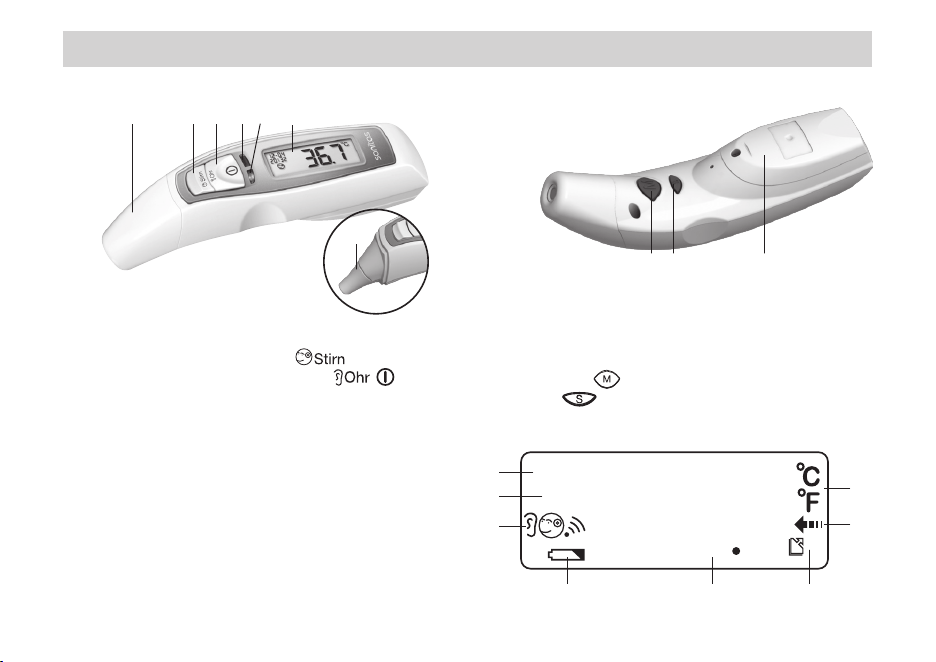
Übersicht
1
32 4 5
7
6
1098
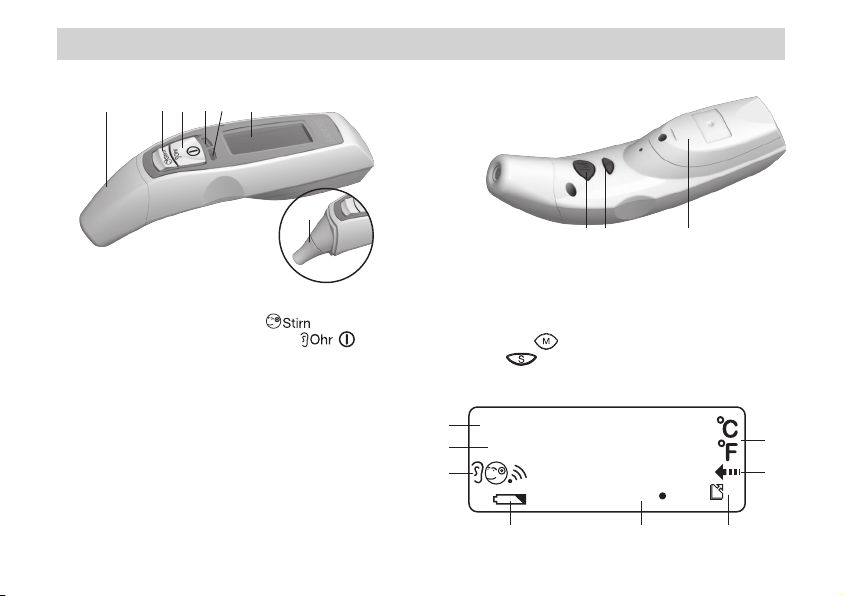
1 Stirn-/Abdeckkappe
2 Stirnthermometer-Modus-Taste
3 Ohrthermometer-Modus-/Ein-Taste
/
4 LED (rot) (Fieberalarm)
5 LED (grün)
6 LCD
7 Sensorspitze mit Linse (Abdeckkappe entfernt)
8 Memory-Taste
9 Set-Taste
10 Batteriefachdeckel
11 Datum
12 Uhrzeit
13 Messmodus („Ohr“, „Stirn“, „Objekt“)
14 Symbol „Batteriewarnung“
15 Anzeige Messergebnis
16 Symbol „Speicher“ und Speicherplatznummer
17 Symbol „Messung läuft“
18 Einheit des Messergebnisses (°C oder °F)
863
5-15
8
7:20
11
12
13
18
17
161514

8
4. Inbetriebnahme
Die Batterien sind beim neuen Gerät bereits eingelegt. Ziehen Sie vor der ersten Anwendung den herausstehenden Bat-
terieschutzstreifen aus dem Batteriefach. Das Thermometer schaltet sich dabei anschließend automatisch ein.
5. Einstellung
Einheit der Temperaturanzeige, Datum und Uhrzeit einstellen
888
8
88:88
Drücken Sie 1 Sekunde lang die Taste , um das Thermometer einzuschalten.
Das Gerät durchläuft einen kurzen Selbsttest, im Display werden alle Segmente ca.
1 Sekunde lang angezeigt. Nach erfolgreichem Selbsttest ertönen zwei kurze Piep-
töne, es werden im Stand-by-Modus Datum und Uhrzeit angezeigt und die Anzeige
„
“ erscheint.
Bei der erstmaligen Benutzung des Thermometers und nach jedem Wechsel der Batterien werden (nach dem Selbsttest)
Datum und Uhrzeit in der Grundeinstellung angezeigt (
). Stellen Sie nun die Einheit der Temperaturanzeige,
das Datum und die Uhrzeit ein. Bei der Einstellung gehen Sie in mehreren Schritten vor: Einheit – Jahr – Monat – Tag –
Stunden – Minuten.
• Drücken Sie ca. 3 Sekunden lang die Taste
, um in den Set-Modus zu gelangen.
Es blinkt der jeweils zu ändernde Teilbereich.
• Drücken Sie die Taste , um diese Einstellung zu speichern, oder
• drücken Sie die Taste , um die Einstellung zu ändern.
• Drücken Sie anschließend die Taste , um diese Einstellung zu speichern.
Nach diesem Vorgang zeigt das Thermometer im Display
an und schaltet sich automatisch aus.
9
6. Was Sie vor dem Messen wissen sollten
Es gibt verschiedene Thermometer zur Messung an unterschiedlichen Körperstellen:
• Ohr-/Stirn-Thermometer (dieses Thermometer, zur Messung im Ohr oder an der Stirnregion)
• Stab-Thermometer (zur rektalen (im After), axialen (unter der Achsel) oder oralen Messung (im Mund))
Die Temperaturmessung liefert einen Messwert, der Auskunft gibt über die aktuelle Körpertemperatur eines
Menschen. Sollten Sie unsicher sein in der Interpretation der Ergebnisse oder treten abnormale Werte auf, sollten
Sie sich an Ihren behandelnden Arzt wenden. Dies gilt auch bei geringeren Temperaturveränderungen, wenn
weitere Krankheitssymptome dazukommen, wie z.B. Unruhe, starkes Schwitzen, Hautrötung, hohe Pulsfrequenz,
Kollapsneigung etc.
Mit unterschiedlichen Thermometern gemessene Temperaturen können nicht miteinander verglichen werden.
Geben Sie deshalb Ihrem Arzt an (bzw. berücksichtigen Sie bei einer Selbstdiagnose), mit welchem Thermome-
ter Sie die Körpertemperatur an welcher Körperstelle gemessen haben.
Die Temperatur eines gesunden Menschen wird von verschiedenen Faktoren beeinflusst: dem individuellen, per-
sonenabhängigen Stowechsel, dem Alter (die Körpertemperatur ist bei Säuglingen und Kleinkindern höher und
sinkt mit zunehmendem Alter. Bei Kindern treten höhere Temperaturschwankungen schneller und häufiger auf,
z. B. bedingt durch Wachtumsschübe), von der Kleidung, von der Außentemperatur, von der Tageszeit (morgens
ist die Körpertemperatur niedriger und steigt im Laufe des Tages zum Abend hin an), von der vorausgegangenen
körperlichen und, mit geringerem Einfluss, auch mentalen Aktivität.
Der Temperaturwert schwankt je nach Körperstelle, an der er gemessen wird. Die Abweichung kann bei Gesun-
den zwischen 0,2 °C (0,4 °F) – 1 °C (1,8 °F) liegen. So liegt der normale Temperaturbereich bei
• der Stirnmessung: 35,8 °C (96,4 °F) – 37,6 °C (99,7 °F), mit einem Stirnthermometer
• der Ohrmessung: 36,0 °C (96,8 °F) – 37,8 °C (100 °F), mit einem Ohrthermometer
• rektal gemessener Temperatur: 36,3 °C (97,3 °F) – 37,8 °C (100 °F), mit einem konventionellen Thermometer
• oral gemessener Temperatur: 36,0 °C (96,8 °F) – 37,4 °C (99,3 °F), mit einem konventionellen Thermometer
Um den Temperaturverlauf verfolgen zu können, messen Sie immer an derselben Körperstelle.
10
7. Messen
Bitte prüfen Sie vor jeder Anwendung, ob die Linse beschädigt ist. Falls diese beschädigt ist, wenden Sie sich bitte an
die Händler- oder Service-Adresse.
Berücksichtigen Sie, dass sich das Thermometer mindestens 30 Minuten in dem Raum befinden muss, in dem die
Messung vorgenommen wird.
Messen der Körpertemperatur im Ohr
• Es gibt Personen, die unterschiedliche Messwerte im linken und rechten Ohr haben. Um Temperaturverände-
rungen zu erfassen, messen Sie bei derselben Person immer im selben Ohr.
• Das Ohrthermometer darf von Kindern nur unter Aufsicht von Erwachsenen benutzt werden. In der Regel ist
eine Messung ab einem Lebensalter von 6 Monaten möglich. Bei Kleinkindern unter 6 Monaten ist der Gehör-
gang noch sehr eng, sodass häufig die Temperatur des Trommelfells nicht erfasst werden kann und vermehrt
zu niedrige Messergebnisse angezeigt werden.
• Die Messung darf nicht an einem Ohr durchgeführt werden mit entzündlichen Erkrankungen (z.B. Eiterfluss,
Sekretabgang), nach möglichen Ohrverletzungen (z. B. Trommelfellschaden) oder in der Heilungsphase nach
operativen Eingrien. In all diesen Fällen sprechen Sie bitte mit Ihrem behandelnden Arzt.
• Die Anwendung des Thermometers an verschiedenen Personen kann bei bestimmten akuten, infektiösen
Erkrankungen auf Grund einer möglichen Keimverschleppung trotz der durchzuführenden Reinigung und
Wischdesinfektion unzweckmäßig sein. Sprechen Sie dazu im Einzelfall mit Ihren behandelnden Arzt.
• Dieses Thermometer darf nur ohne Einweg-Schutzhülle verwendet werden.
• Wenn Sie längere Zeit auf einem Ohr gelegen sind, ist die Temperatur leicht erhöht. Warten Sie einige Zeit
oder messen Sie im anderen Ohr.
• Ohrenschmalz kann die Messung beeinflussen, reinigen Sie deshalb ggf. das Ohr vor der Messung.
11
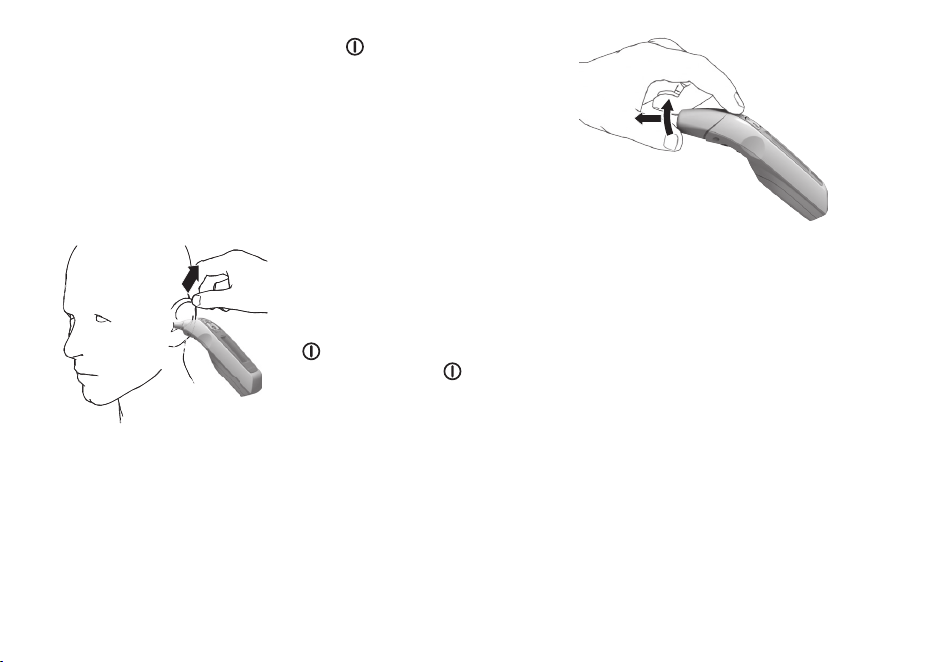
• Drücken Sie 1 Sekunde lang die Taste
, um das Thermometer einzu-
schalten. Nach erfolgreichem Selbsttest ertönen zwei kurze Pieptöne.
• Nehmen Sie die Kappe ab, indem Sie sie leicht nach oben drücken (1)
und dann nach vorne abziehen (2).
12
Vergewissern Sie sich, dass die Sensorspitze und auch der Gehörgang sauber sind.
Da der Gehörgang leicht gekrümmt ist, müssen Sie vor dem Einführen der Sensorspitze
das Ohr leicht nach hinten oben ziehen, damit die Sensorspitze direkt auf das Trommel-
fell ausgerichtet werden kann.
• Führen Sie die Sensorspitze vorsichtig ein und drücken Sie 1 Sekunde lang die Taste
.
• Lassen Sie die Taste los. Das Ende der Messung wird mit einem kurzen Piepton
signalisiert, der gemessene Wert erscheint auf dem Display.
Liegt der gemessene Wert innerhalb des Normbereiches (< 38 °C/100,4 °F), leuchtet die
grüne LED für 3 Sekunden. Liegt der gemessene Wert höher (≥ 38 °C/100,4 °F, Fieber),
leuchtet die rote LED.
12
Messen der Körpertemperatur an der Stirn
Beachten Sie, dass die Stirn/Schläfe frei von Schweiß und Kosmetika sein muss und dass
bei der Stirnmessung die Einnahme von gefäßverengenden Medikamenten und Hautirritatio-
nen das Messergebnis verfälschen können.
• Drücken Sie 1 Sekunde lang die Taste , um das Thermometer einzuschalten. Nach
erfolgreichem Selbsttest ertönen zwei kurze Pieptöne.
• Setzen Sie den Messkopf mit aufgesetzter Stirn-/Abdeckkappe an der Schläfe an, halten
Sie die Taste gedrückt und führen Sie das Thermometer gleichmäßig über die Stirn
zur anderen Schläfe.
• Lassen Sie dann die Taste los. Das Ende der Messung wird mit einem kurzen
Piepton signalisiert, der gemessene Wert erscheint auf dem Display.
Liegt der gemessene Wert innerhalb des Normbereiches (< 38 °C/100,4 °F), leuchtet die grüne LED für 3 Sekunden. Liegt
der gemessene Wert höher (≥ 38 °C/100,4 °F, Fieber), leuchtet die rote LED.
Messen der Oberflächentemperatur
• Drücken Sie 1 Sekunde lang die Taste
, um das Thermometer einzuschalten. Nach erfolgreichem Selbsttest ertö-
nen zwei kurze Pieptöne.
• Drücken Sie dann gleichzeitig 3 Sekunden lang die Tasten und , um in den Objekttemperatur-Modus zu
wechseln. Im Display erscheint die Anzeige .
• Drücken Sie die Taste oder und richten Sie die Sensorspitze bei gedrückter Taste mit 3 cm Abstand auf
den zu messenden Gegenstand oder die Flüssigkeit (keinesfalls in Flüssigkeiten tauchen).
• Lassen Sie die Taste oder los. Das Ende der Messung wird mit einem kurzen Piepton signalisiert, der
gemessene Wert erscheint auf dem Display.
Beachten Sie, dass die angezeigte Temperatur die ermittelte und nicht die angepasste Oberflächentemperatur ist. Sie
lässt sich nicht mit der Stirn-/Ohrtemperatur vergleichen.
Um wieder in den Ohr-/Stirnthermometer-Modus zu wechseln, drücken Sie gleichzeitig 3 Sekunden lang die Tasten
und , bis die Anzeige erlischt und ein kurzer Piepton ertönt. Durch Aus- und wieder Anschalten des Thermometers
wird der Objekttemperatur-Modus automatisch verlassen.
13
Der zuletzt ermittelte Messwert, d. h. nur der letzte Wert einer Messreihe, wird automatisch abgespeichert, sobald das
Thermo meter sich ausschaltet oder ausgeschaltet wird. Dazu stehen 10 Speicherplätze zur Verfügung.
Nehmen Sie keine weiteren Eingaben vor, schaltet das Thermometer nach der Anzeige des gemessenen Wertes nach ca.
einer Minute automatisch ab.
Um die gespeicherten Werte abzufragen, schalten Sie das Thermometer ein und drücken die Taste
.
Es werden jeweils das Datum, die Uhrzeit, die Speicherplatznummer und das Symbol des Messmodus sowie die Tempe-
ratur angezeigt. Blättern Sie durch wiederholtes Drücken der Taste durch die Messergebnis-Speicherplätze.
8. Batteriewechsel
Wenn die Batterien schwach werden, erscheint das Batteriewarnsymbol . Temperaturmessungen sind noch
möglich, die Batterien müssen ersetzt werden. Wenn das Batteriewarnsymbol blinkt und im Display erscheint,
müssen die Batterien ausgetauscht werden. Falls die Batterien zu schwach sind, schaltet sich das Thermometer automa-
tisch aus.
Hinweis:
• Verwenden Sie bei jedem Batteriewechsel Batterien gleichen Typs, gleicher Marke und gleicher Kapazität.
• Wechseln Sie alle Batterien immer gleichzeitig.
• Verwenden Sie keine wiederaufladbaren Akkus.
• Verwenden Sie schwermetallfreie Batterien.
14
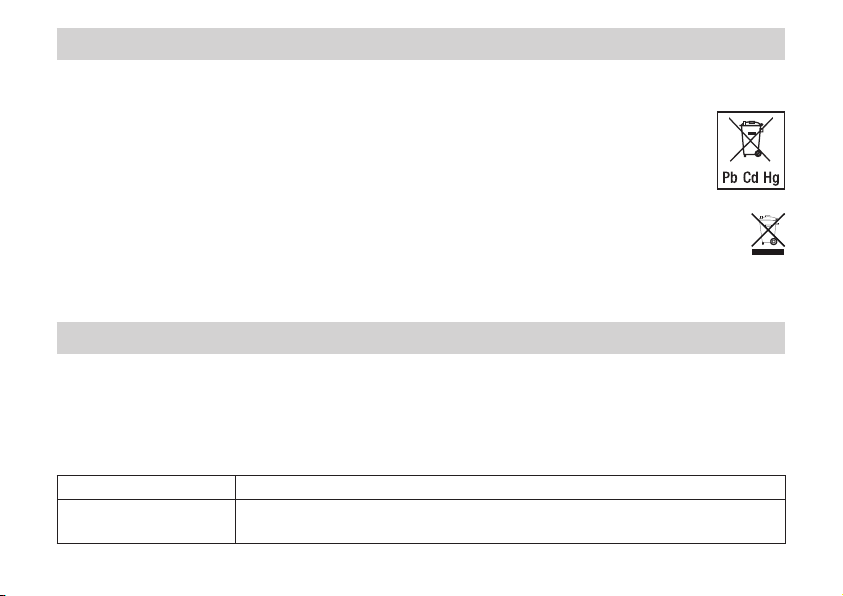
1. Lösen Sie die Schraube im Batteriefachdeckel und ziehen Sieden
Deckel nach hinten ab.
2. Entnehmen Sie die verbrauchten Batterien und legen Sie zweineue
Batterien in der angezeigten Richtung ein.
3. Schließen Sie den Batteriefachdeckel und schrauben Sie ihnwieder
zu.
Entsorgen Sie verbrauchte Batterien entsprechend der geltenden
gesetzlichen Bestimmungen. Werfen Sie Batterien niemals in den
normalen Hausmüll.
9. Aufbewahrung und Pflege
• Reinigen Sie nach jedem Gebrauch die Sensorspitze. Verwenden Sie dazu ein weiches Tuch oder ein Wattestäbchen,
welches mit Desinfektionsmittel, Alkohol oder warmem Wasser angefeuchtet werden kann.
• Zur Reinigung des gesamten Gerätes verwenden Sie bitte ein weiches, leicht mit Seifenlauge angefeuchtetes Tuch.
• Verwenden Sie keine aggressiven Reinigungsmittel.
• Lagern Sie das Thermometer immer mit aufgesteckter Stirn-/Abdeckkappe.
• Bei beabsichtigter längerer Lagerung entfernen Sie bitte die Batterie.
• Das Gerät darf nicht bei zu hoher oder niedriger Temperatur oder Luftfeuchtigkeit (siehe techn. Daten) im Sonnenlicht,
in Verbindung mit elektr. Strom oder an staubigen Orten gelagert oder auch benutzt werden. Ansonsten kann es zu
Messungenauigkeiten kommen.

15
10. Entsorgen
•
Die verbrauchten, vollkommen entladenen Batterien müssen Sie über speziell gekennzeichnete Sammelbehälter, Son-
dermüllannahmestellen oder über den Elektrohändleentsorgen. Sie sind gesetzlich dazu verpflichtet, die Batterien zu
entsorgen.
•
Diese Zeichen finden Sie auf schadstohaltigen Batterien:
Pb = Batterie enthält Blei,
Cd = Batterie enthält Cadmium,
Hg = Batterie enthält Quecksilber.
• Im Interesse des Umweltschutzes darf das Gerät am Ende seiner Lebensdauer nicht mit dem Hausmüll entsorgt
werden.
• Die Entsorgung kann über entsprechende Sammelstellen in Ihrem Land erfolgen. Entsorgen Sie das Gerät ge-
mäß der Elektro- und Elektronik Altgeräte EG-Richtlinie – WEEE (Waste Electrical and Electronic Equipment).
• Bei Rückfragen wenden Sie sich an die für die Entsorgung zuständige kommunale Behörde.
11. Technische Daten
Hinweis: Bei Verwendung des Gerätes außerhalb der Spezifikation ist eine einwandfreie Funktion nicht gewährleistet! Tech-
nische Änderungen zur Verbesserung und Weiterentwicklung des Produktes behalten wir uns vor.
Die Genauigkeit dieses Thermometers wurde sorgfältig geprüft und wurde im Hinblick auf eine lange nutzbare Lebensdauer
entwickelt.
Bei Verwendung des Gerätes in der Heilkunde sind Messtechnische Kontrollen mit geeigneten Mitteln durchzuführen.
Genaue Angaben zur Überprüfung der Genauigkeit können unter der Service-Adresse angefragt werden.
Name und Modell
SFT65
Messbereich Ohr-/Stirnthermometer-Modus: 34 °C – 43 °C (93,2 °F – 109,4 °F)
Objekttemperatur-Modus: 0 °C – 100 °C (32 °F – 212 °F)

16
Labor-Messgenauigkeit Ohrthermometer-Modus: ±0,2 °C (±0,4 °F) von 35 °C – 42 °C (95,0 °F – 107,6 °F),
außerhalb dieses Messbereiches ±0,3 °C (±0,5 °F),
Stirnthermometer-Modus: ±0,2 °C (±0,4 °F) von 35 °C – 42 °C (95,0 °F – 107,6 °F),
außerhalb dieses Messbereiches ±0,3 °C (±0,5 °F),
Objekttemperatur-Modus: ±1,5 °C (±2,7 °F) bei < 30 °C (86 °F); ±5% bei ≥ 30 °C (86 °F)
Zeitabstand zwischen zwei
Messungen
Mindestens 5 Sekunden
Klinische
Wiederholpräzision
Ohr: Kinder, 1 – 5 Jahre: ±0,08 °C (±0,14 °F)
Erwachsene: ±0,07 °C (±0,13 °F)
Stirn: Kinder, 1 – 5 Jahre: ±0,07 °C (±0,13 °F)
Erwachsene: ±0,08 °C (±0,14 °F)
Maßeinheiten °Celsius (°C) oder °Fahrenheit (°F)
Betriebsbedingungen 15 °C bis 35 °C (59 °F – 95 °F) bei einer relativen Luftfeuchtigkeit bis 85% (nicht
kondensierend)
Aufbewahrungs umgebung -25 °C bis 55 °C (-13 °F – 131 °F) bei einer relativen Luftfeuchtigkeit bis 85% (nicht
kondensierend)
Abmessungen 138 x 35 x 33 mm
Gewicht 90 g einschließlich Batterie
Batterie 2 x 1,5 V AAA (LR03)
Speicher Für 10 Messungen
Die Seriennummer befindet sich auf dem Gerät oder im Batteriefach.

17
12. Fehlerbehebung
Anzeige Ursache Behebung
Die ermittelte Temperatur ist höher als
1) Ohr-/Stirnthermometer-Modus: 43 °C (109,4 °F)
2) Objekttemperatur-Modus: 100 °C (212 °F)
Betreiben Sie das Thermometer nur innerhalb der
angegebenen Temperaturbereiche. Säubern Sie
ggf. die Sensorspitze. Bei wiederholter Fehleranzei-
ge an Fachhändler oder Kundenservice wenden.
Die ermittelte Temperatur ist niedriger als
1) Ohr-/Stirnthermometer-Modus: 34 °C (93,2 °F)
2) Objekttemperatur-Modus: 0 °C (32 °F)
Die Betriebstemperatur liegt nicht im Bereich von 15 °C
bis 35 °C (59 – 95 °F)
Betreiben Sie das Thermometer nur innerhalb der
angegebenen Temperaturbereiche.
13. Garantie und Service
Die Hans Dinslage GmbH, Riedlinger Straße 28, 89524 Uttenweiler (nachfolgend „HaDi“ genannt) gewährt unter den
nachstehenden Voraussetzungen und in dem nachfolgend beschriebenen Umfang eine Garantie für dieses Produkt.
Die nachstehenden Garantiebedingungen lassen die gesetzlichen Gewährleistungsverpflichtungen des Verkäu-
fers aus dem Kaufvertrag mit dem Käufer unberührt.
Die Garantie gilt außerdem unbeschadet zwingender gesetzlicher Haftungsvorschriften.
HaDi garantiert die mangelfreie Funktionstüchtigkeit und die Vollständigkeit dieses Produktes.
Die weltweite Garantiezeit beträgt 2 Jahre ab Beginn des Kaufes des neuen, ungebrauchten Produktes durch den Käufer.
Diese Garantie gilt nur für Produkte, die der Käufer als Verbraucher erworben hat und ausschließlich zu persönlichen
Zwecken im Rahmen des häuslichen Gebrauchs verwendet. Es gilt deutsches Recht.
Falls sich dieses Produkt während der Garantiezeit als unvollständig oder in der Funktionstüchtigkeit als mangelhaft
18
gemäß der nachfolgenden Bestimmungen erweist, wird HaDi gemäß diesen Garantiebedingungen eine kostenfreie
Ersatzlieferung oder Reparatur durchführen.
Wenn der Käufer einen Garantiefall melden möchte, wendet er sich zunächst an den HaDi Kundenservice:
Tel: +49 7374 915766
Für eine zügige Bearbeitung nutzen Sie bitte unser Kontaktformular auf der Homepage https://sanitas-online.de unter der
Rubrik ‚Kundenservice‘.
Der Käufer erhält dann nähere Informationen zur Abwicklung des Garantiefalls, z.B. wohin er das Produkt kostenfrei
senden kann und welche Unterlagen erforderlich sind.
Eine Inanspruchnahme der Garantie kommt nur in Betracht, wenn der Käufer
- eine Rechnungskopie/Kaufquittung und
- das Original-Produkt
HaDi oder einem von HaDi autorisierten Partner vorlegen kann.
Ausdrücklich ausgenommen von dieser Garantie sind
- Verschleiß, der auf normalem Gebrauch oder Verbrauch des Produktes beruht;
- zu diesem Produkt mitgelieferte Zubehörteile, die sich bei sachgemäßen Gebrauch abnutzen bzw. verbraucht
werden (z.B. Batterien, Akkus, Manschetten, Dichtungen, Elektroden, Leuchtmittel, Aufsätze, Inhalatorzubehör);
- Produkte, die unsachgemäß und/oder entgegen der Bestimmungen der Bedienungsanleitung verwendet, gereinigt,
gelagert oder gewartet wurden sowie Produkte, die vom Käufer oder einem nicht von HaDi autorisierten Service-
center geönet, repariert oder umgebaut wurden;
- Schäden, die auf dem Transportweg zwischen Hersteller und Kunde bzw. zwischen Servicecenter und Kunde
entstehen
- Produkte, die als 2.Wahl-Artikel oder als gebrauchte Artikel gekauft wurden;
- Folgeschäden, welche auf einem Mangel dieses Produktes beruhen (es können für diesen Fall jedoch Ansprüche
aus Produkthaftung oder aus anderen zwingenden gesetzlichen Haftungsbestimmungen bestehen).
Reparaturen oder ein Komplettaustausch verlängern in keinem Fall die Garantiezeit.
Irrtum und Änderungen vorbehalten
19
Included in delivery
Check that the device packaging has not been tampered with and make sure that all contents are present. Before use,
ensure that there is no visible damage to the device or accessories and that all packaging material has been removed. If
you have any doubts, do not use the device and contact your retailer or the specified Customer Services address.
• Thermometer
• 2 x 1.5 V AAA batteries (LR03)
• These Instructions for Use
Please read through these Instructions for Use carefully and retain them for future reference; make them available to
other users and observe the information they contain.
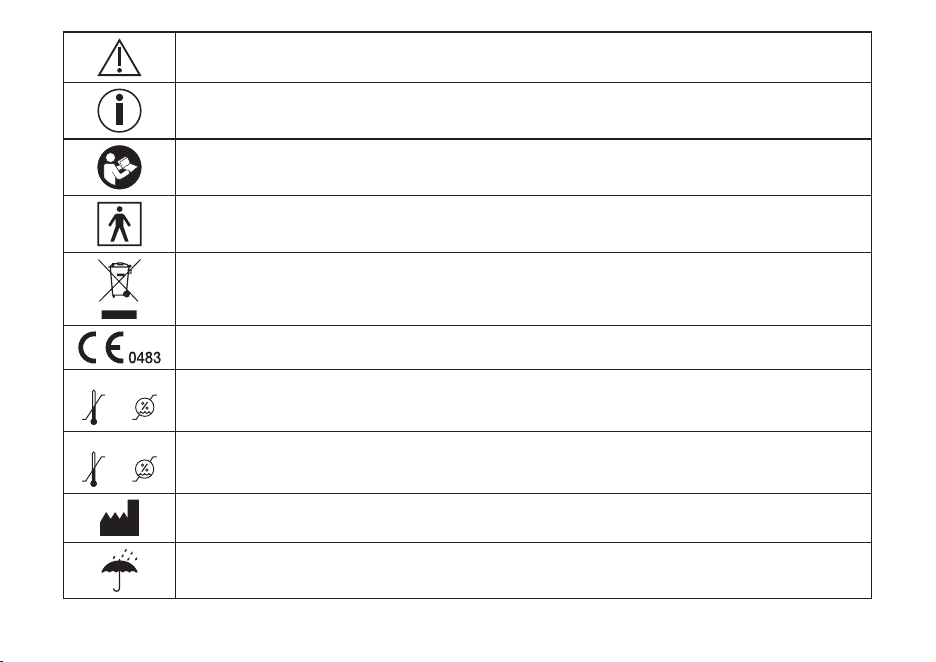
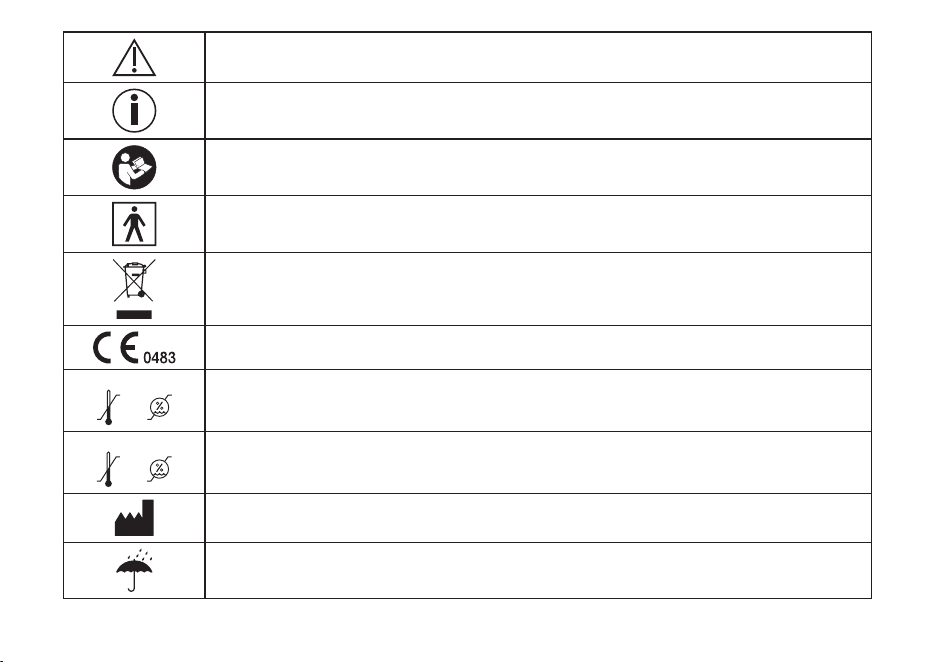
1. Signs and symbols
The following symbols appear in these instructions for use and on the device:
WARNING
Warning notice indicating a risk of injury or damage to health.
English
Contents
1. Signs and symbols .................................................... 19
2. Tips ............................................................................ 21
3. Device description .................................................... 24
4. Getting started........................................................... 25
5. Setting the device ...................................................... 25
6. What you should know about using this
thermometer .............................................................. 26
7. Measuring ................................................................ 27
8. Replacing the battery .............................................. 30
9. Storage and maintenance ....................................... 31
10. Disposal ................................................................... 32
11. Technical data ........................................................ 32
12. Trouble-shooting ..................................................... 34
13. Warranty / Service ................................................... 34
20
IMPORTANT
Safety note indicating possible damage to the unit/accessory.
Note
Note on important information.
Observe the instructions for use
Application part, type BF
Disposal in accordance with the Waste Electrical and Electronic Equipment EC Directive – WEEE
The CE labelling certifies that the product complies with the essential requirements of Directive 93/42/
EEC on medical products.
Storage/Transport
Permissible storage and transport temperature and humidity
Operating
Permissible operating temperature and humidity
Manufacturer
Protect from moisture

21
21
PAP
Dispose of packaging in an environmentally friendly manner
S
N
Serial number
2. Tips
Safety tips
Warning:
• To measure temperature, insert the sensor tip of the thermometer carefully into the ear.
• Use of the thermometer on dierent persons can be inappropriate in the event of certain acute infectious
diseases because of the possible spread of germs despite cleaning and disinfection. If you have any doubts,
please consult your doctor.
Notes on handling batteries
• If your skin or eyes come into contact with battery fluid, flush out the affected areas with water and seek medical
assistance.
•
Choking hazard! Small children may swallow and choke on batteries. Store the batteries out of the reach of
small children.
• Observe the plus (+) and minus (-) polarity signs.
• If a battery has leaked, put on protective gloves and clean the battery compartment with a dry cloth.
• Protect the batteries from excessive heat.
•
Risk of explosion! Never throw batteries into a fire.
22
• Do not charge or short-circuit batteries.
• If the device is not to be used for a long period, take the batteries out of the battery compartment.
• Use identical or equivalent battery types only.
• Always replace all batteries at the same time.
• Do not use rechargeable batteries.
• Do not disassemble, split or crush the batteries.
General advice
• Please read through these Instructions for Use carefully and retain them for future reference; make them
available to other users and observe the information they contain.
• This thermometer is a sensitive electronic device. Handle it with care and do not subject it to any mechanical
impacts.
• Do not expose the device to direct sunlight.
• Check before each use that the lens is intact. If it is damaged, please contact your retailer or the service
address.
• The thermometer is NOT waterproof. For this reason, direct contact with water or other liquids should be
avoided.
• The SFT 65 thermometer is only designed for the measuring area on the human body stated in the instruc-
tions for use.
• The device is only intended for the purpose stated in these Instructions for Use.
• After each use, clean the measuring tip with a soft cloth moistened with disinfectant.
• The thermometer has been designed for practical use, but is not a substitute for a visit to the doctor.
• Before each repair query, first check the batteries and replace them if necessary.
• Repairs must only be carried out by authorised service centres, otherwise the guarantee is invalidated.

23
• This device complies with the EU Directive 93/42/EEC concerning medical products, the Medizinprodukte-
gesetz (German Medical Devices Act), the ASTM (American Society for Testing and Materials) E 1965 - 98
and the European Standard EN 12470-5: Clinical thermometers – Part 5: Requirements for infrared ear ther-
mometers (with maximum device) the standard ISO 80601-2-56 and the European Standard EN 60601-1-2
(In accordance with CISPR 11, IEC 61000-4-2, IEC 61000-4-3 and IEC 61000-4-8), and is subject to
particular precautions with regard to electromagnetic compatibility. Please note that portable and mobile HF
communication systems may interfere with this unit.
• If you should have any questions about using our devices, please contact either your retailer or Customer
Services.
Notes on electromagnetic compatibility
• The device is suitable for use in all environments listed in these instructions for use, including domestic
environments.
• The use of the device may be limited in the presence of electromagnetic disturbances. This could result in issues
such as error messages or the failure of the display/device.
• Avoid using this device directly next to other devices or stacked on top of other devices, as this could lead to faulty
operation. If, however, it is necessary to use the device in the manner stated, this device as well as the other devices
must be monitored to ensure they are working properly.
• The use of accessories other than those specified or provided by the manufacturer of this device can lead to an in-
crease in electromagnetic emissions or a decrease in the device’s electromagnetic immunity; this can result in faulty
operation.
• Failure to comply with the above can impair the performance of the device.
24
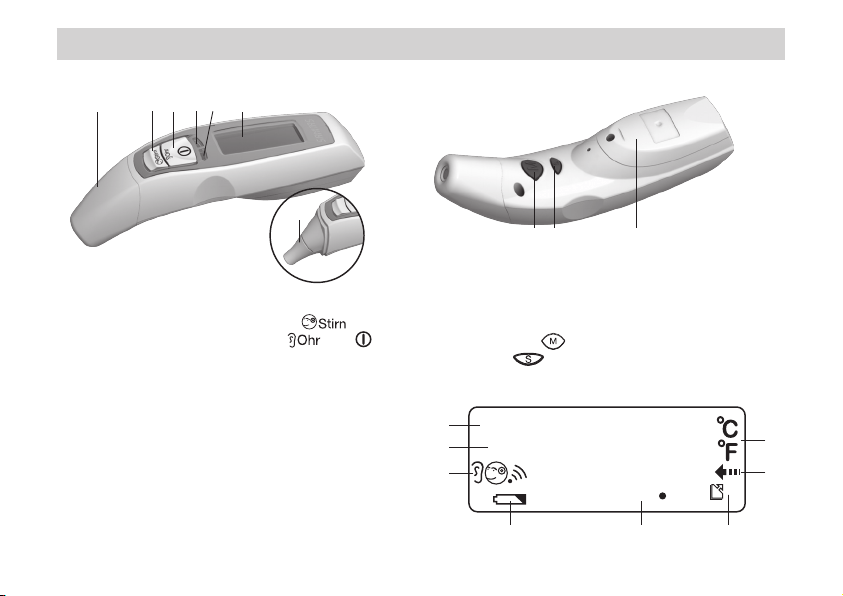
3. Device description
Overview
1
32 4 5
7
6
1098
1 Forehead/cover cap
2 Forehead thermometer mode button
(forehead)
3 Ear thermometer mode/On button
(ear)/
4 LED (red) (high temperature alarm)
5 LED (green)
6 LCD
7 Sensor tip with lens (cover cap removed)
8 Memory button
9 Set button
10 Battery compartment lid
11 Date
12 Time
13 Measurement mode (“Ear”, “Forehead”, “Object”)
14 Battery warning symbol
15 Measurement display
16 “Memory” symbol and storage space number
17 “Measurement in progress” symbol
18 Unit of measurement (°C or °F)
863
5-15
8
7:20
11
12
13
18
17
161514
25
4. Getting started
The batteries are already inserted in all new devices. Before first use, remove the protruding plastic insulating strip from
the battery compartment. The thermometer will then switch on automatically.
5. Setting the device
Set the unit in which the temperature will be displayed, the date and the time
888
8
88:88
Press the button for 1 second to switch the thermometer on. The device performs
a brief self test: all elements of the display are shown for approx. 1second. Following
a successful self test, the device emits two short beeps. In Standby mode, the date
and time are shown and “ ” is displayed.
When the thermometer is used for the first time, and each time the batteries are changed, the date and time are dis-
played in the format
during the basic set-up (after the self test). Now set the unit in which the temperature will
be displayed, the date and the time. To set the device, proceed in stages: unit – year – month – day – hours – minutes.
• Press the
button for approx. 3 second to access the Set mode.
The setting to be changed will flash in turn.
• Press the button again to save the setting or
• press the button to change the setting.
• Then press the button to save the setting.
After this process, the thermometer shows the word
in the display and switches o automatically.
26
6. What you should know about using this thermometer
There are dierent thermometers for taking temperature measurements in dierent parts of the body:
• Ear/forehead thermometer (this thermometer, for measuring in the ear or on the forehead area)
• Rod thermometer (for rectal (in the back passage), axillary (under the arm) or oral measurement (in the mouth))
Taking the temperature gives a measurement that provides information about a person’s current body tempera-
ture. If you are uncertain about interpreting the results or if the value is abnormal, please consult your doctor.
This also applies in the case of slight temperature changes if there are other symptoms of illness such as agita-
tion, severe sweating, flushed skin, fast pulse rate, tendency to collapse etc.
Temperatures measured with dierent thermometers cannot be compared with one another. You should there-
fore tell your doctor (or bear in mind if you are diagnosing yourself) what thermometer you used to take your
temperature and in what part of the body.
The temperature of a healthy person is aected by various factors: the person’s individual metabolism, their age
(body temperature is higher in babies and toddlers and decreases with age. Greater temperature fluctuations
occur faster and more often in children, e.g. due to growth spurts), their clothing, the ambient temperature, the
time of day (body temperature is lower in the morning and increases throughout the day towards evening), the
preceding physical and, to a lesser extent, mental activity.
The temperature varies depending on the part of the body where the measurement is taken. The dierence can
be between 0.4 °F (0,2 °F) and 1.8 °F (1 °C) for a healthy body. The normal temperature ranges are as follows:
• On the forehead: 96.4 °F – 99.7 °F (35.8 °C – 37.6 °C), measured with a forehead thermometer
• In the ear: 96.8 °F – 100 °F (36.0 °C – 37.8 °C), measured with an ear thermometer
• In the back passage: 97.3 °F – 100 °F (36.3 °C – 37.8 °C), measured with a conventional thermometer
• In the mouth: 96.8 °F – 99.3 °F (36.0 °C – 37.4 °C), measured with a conventional thermometer
In order to track temperature change, always take the measurements in the same part of the body.
27
7. Measuring
Before each use, please check that the lens is intact. If it is damaged, please contact your retailer or the service address.
Bear in mind that the thermometer needs to have been in the room in which the measurement is taken for at least
30 minutes before use.
Measuring body temperature in the ear
• Some people produce dierent readings in their left and right ear. In order to record temperature changes,
always measure a person’s temperature in the same ear.
• The ear thermometer may be used by children only under adult supervision. Measurement is usually possible
over the age of 6 months. In infants under 6 months, the ear canal is still very narrow so the temperature of
the eardrum often cannot be recorded and the result displayed is often too low.
• The measurement must not be taken in an ear aected by inflammatory diseases (e.g. discharging pus or
secretion), after possible ear injuries (e.g. eardrum damage) or in the healing period after operative proce-
dures. In all of these cases, please consult your doctor.
• Use of the thermometer on dierent persons can be inappropriate in the event of certain acute infectious
diseases because of the possible spread of germs despite cleaning and disinfection. If you have any doubts,
please consult your doctor.
• This thermometer may only be used without a disposable protective cover.
• If you have been lying on one ear for some time, the temperature is slightly raised. Wait a little while or meas-
ure in the other ear.
• As ear wax can aect the measurement, you should clean the ear before measuring if necessary.
28
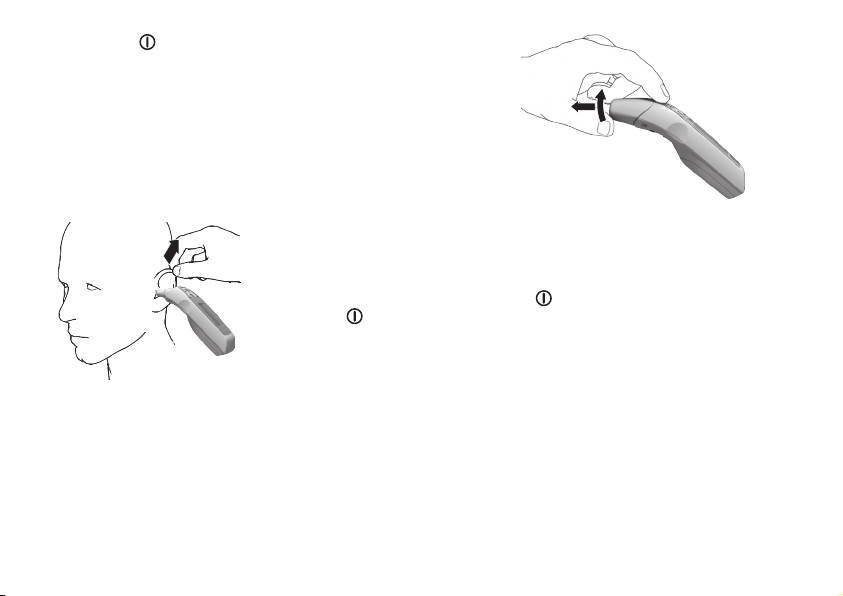
• Press the
button for 1 second to switch the thermometer on. Follow-
ing a successful self test, the device emits two short beeps.
• Remove the cap by gently pushing it up (1) and then pulling it o for-
wards (2).
12
Make sure that the sensor tip and also the ear canal are clean.
As the ear canal is slightly curved, you have to pull the ear slightly up and backwards
before inserting the sensor tip. This is important so that the sensor tip can be pointed
directly at the eardrum.
• Insert the sensor tip carefully and press the button for 1 second.
• Release the button. The end of the measuring time is signalled with a short beep
and the measured value appears on the display.
If the measured value is within the normal range (< 100.4 °F/38 °C), the green LED lights
up for 3 seconds. If the measured value is higher (≥ 100.4 °F/38 °C, high temperature),
the red LED is illuminated.
29
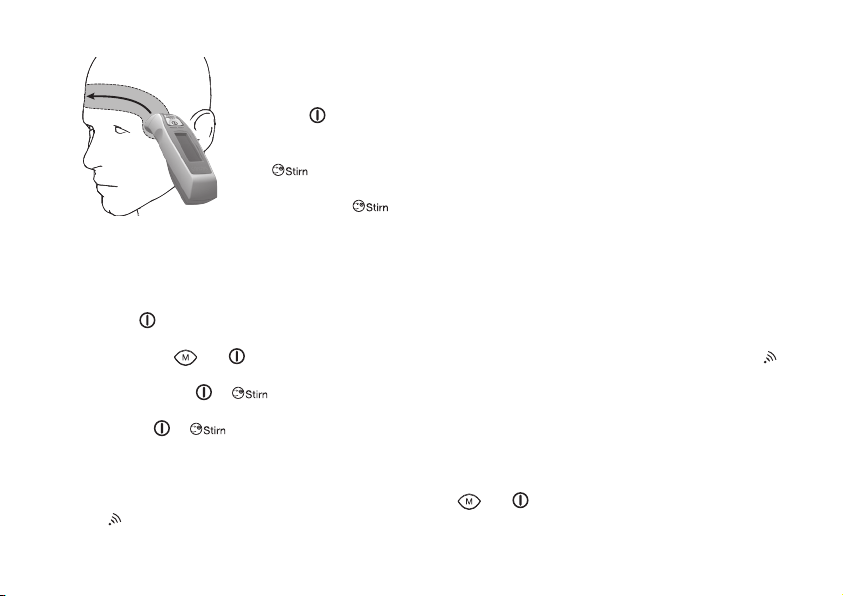
Measuring body temperature on the forehead
Please note that the forehead/temples must be free from sweat and cosmetics and that
taking vasoconstrictive medication and skin irritations can distort the result when measuring
temperature on the forehead.
• Press the button for 1 second to switch the thermometer on. Following a successful
self test, the device emits two short beeps.
• Place the measuring head with the forehead/cover cap fitted on the temples, hold down
the button and move the thermometer smoothly over the forehead to the other
temple.
• Then release the button. The end of the measuring time is signalled with a short
beep and the measured value appears on the display.
If the measured value is within the normal range (< 100.4 °F/38 °C), the green LED lights up for 3 seconds. If the meas-
ured value is higher (≥ 100.4 °F/38 °C, high temperature), the red LED is illuminated.
Measuring surface temperature
• Press the
button for 1 second to switch the thermometer on. Following a successful self test, the device emits
two short beeps.
• Then press the and buttons simultaneously for 3 seconds to switch to the Object temperature mode. The
symbol appears in the display.
• Press and hold the or button and point the sensor tip towards to the object or liquid to be measured (never
immerse in liquids), maintaining a distance of 3 cm.
• Release the or button. The end of the measuring time is signalled with a short beep and the measured
value appears on the display.
Please note that the displayed temperature is the measured and not the adapted surface temperature. It is not the same
as the forehead/ear temperature.
To switch back to the Ear/Forehead thermometer mode, press the and buttons simultaneously for 3 seconds
until the symbol disappears and there is a short beep. By switching the thermometer o and on again, it automatically
exits the Object temperature mode.
30
The temperature last measured, i.e. only the last value of a series of measurements, is automatically stored as soon as
the thermometer switches itself o or is switched o. There are 10 memory spaces available for this.
If you do not press any other buttons, the thermometer automatically switches o approx. one minute after displaying
the measured value.
To call up the saved values, switch the thermometer on and press the
button.
The date, time, storage space number, the measurement mode symbol and the temperature are displayed in turn.
Browse through the stored measurements by pressing the button repeatedly.
8. Replacing the battery
When the batteries get weak, the battery warning symbol appears . It is still possible to measure temperature. The
batteries must be replaced. When the battery symbol flashes and appears in the display, the batteries must be
replaced. If the batteries are too flat, then the thermometer will switch o automatically.
Note:
• When changing the batteries, use batteries of the same type, make and capacity.
• Always replace all batteries at the same time.
• Do not use rechargeable batteries.
• Use batteries free from heavy metals.

31
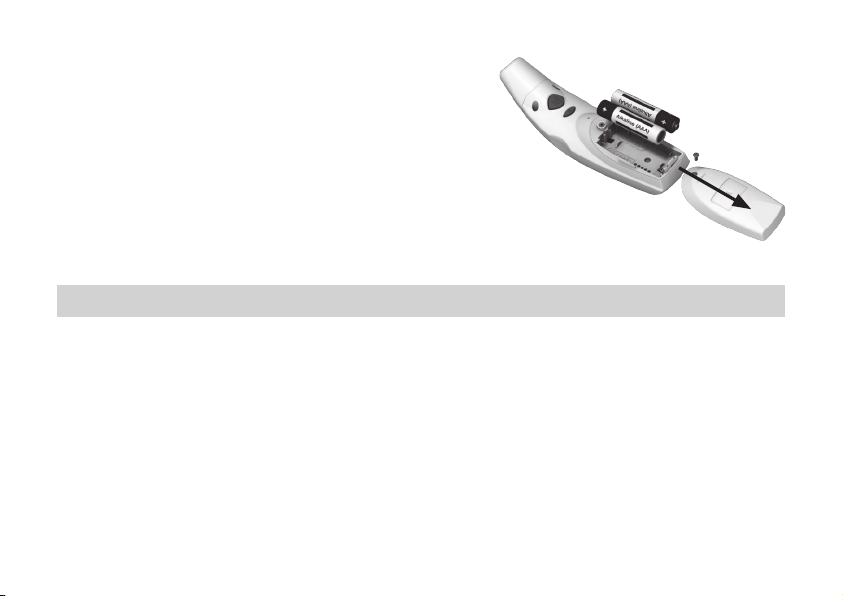
1. Loosen the screw on the battery compartment lid and pull the lid o
downwards.
2. Remove the used batteries and insert two new batteries in the direc-
tion indicated.
3. Place the battery compartment lid back on and screw it closed.
Dispose of used batteries in accordance with the applicable legal
regulations. Never dispose of batteries in the normal household
waste.
9. Storage and maintenance
• Clean the sensor tip after each use. Use a clean cloth or cotton bud that can be moistened with disinfectant, alcohol
or warm water.
• To clean the entire device, please use a soft cloth slightly moistened with a mild soapy solution.
• Do not use any harsh cleaning products.
• Always store the thermometer with the forehead/cover cap on.
• If prolonged storage is intended, you should remove the battery.
• The device must not be stored or used at an excessively high or low temperature or humidity (see technical data), in
sunlight, in association with an electrical current or in dusty locations. Otherwise inaccuracies can occur.
32
10. Disposal
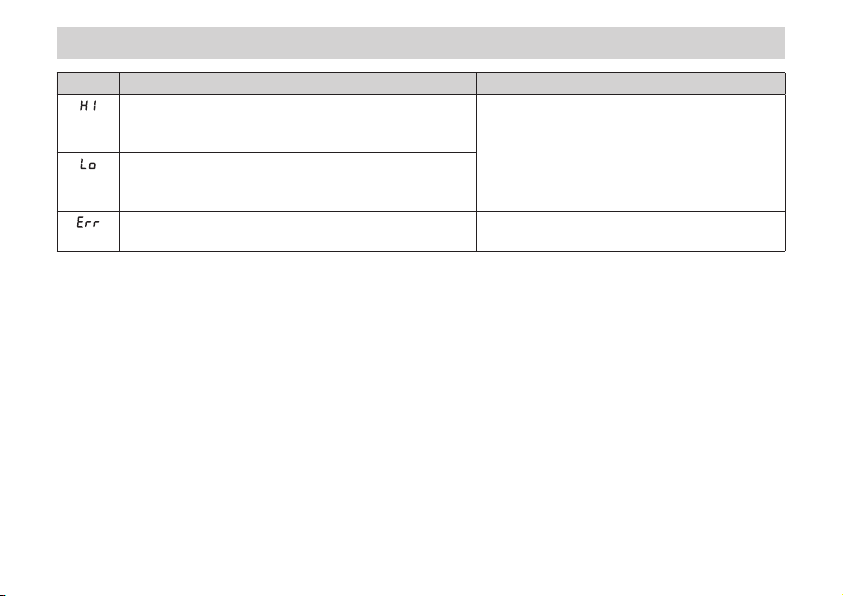
• The empty, completely flat batteries must be disposed of through specially designated collection boxes, recycling
points or electronics retailers. You are legally required to dispose of the batteries.
• The codes below are printed on batteries containing harmful substances:
Pb = Battery contains lead,
Cd = Battery contains cadmium,
Hg = Battery contains mercury.
• For environmental reasons, do not dispose of the device in the household waste at the end of its useful life.
Dispose of the unit at a suitable local collection or recycling point. Dispose of the device in accordance with EC
Directive – WEEE (Waste Electrical and Electronic Equipment). If you have any questions, please contact the
local authorities responsible for waste disposal.
11. Technical data
Tip: If the device is used other than in accordance with the specifications, perfect functioning cannot be guaranteed. We
reserve the right to make technical changes to improve and develop the product.
The accuracy of this thermometer has been carefully checked and developed with regard to a long useful life.
If using the device for commercial medical purposes, it must be regularly tested for accuracy by appropriate means.
Precise instructions for checking accuracy may be requested from the service address.
Name and model
SFT65
Measurement range Ear/Forehead thermometer mode: 93.2 °F – 109.4 °F (34 °C – 43 °C)
Object temperature mode: 32 °F – 212 °F (0 °C – 100 °C)
33
Laboratory
measurement precision
Ear thermometer mode: ±0.4 °F (±0.2 °C) from 95.0 °F – 107.6 °F (35°C – 42 °C),
outside of this measurement range ±0.5 °F (±0.3 °C),
Forehead thermometer mode: ±0.4 °F (±0.2 °C) from 95.0 °F – 107.6 °F (35°C – 42 °C),
outside of this measurement range ±0.5 °F (±0.3 °C),
Object temperature mode: ±2.7 °F (±1.5 °C) at < 86 °F (<30 °C); ±5% at ≥ 86 °F (≥ 30 °C)
Interval between
2measurements
At least 5 seconds
Clinical repeat precision Ear: Children, 1– 5 years: ±0.14 °F (±0.08 °C)
Adults: ±0.13 °F (±0.07 °C)
Forehead: Children, 1– 5 years: ±0.13 °F (±0.07 °C)
Adults: ±0.14 °F (±0.08 °C)
Measurement units °Celsius (°C) or °Fahrenheit (°F)
Ambient operating
conditions
59 °F – 95 °F (15 °C – 35 °C) with a relative humidity of up to 85% (non-condensing)
Storage conditions -13 °F to 131 °F (-25 °C to 55 °C) with a relative humidity of up to 85% (non-condensing)
Dimensions 138 x 35 x 33 mm
Weight 90 g including battery
Battery 2 x 1,5 V AAA (LR03)
Memory For 10 measurements
The serial number is located on the device or in the battery compartment.

34
12. Trouble-shooting
Display Cause Solution
The temperature measured is higher than
1) Ear/Forehead thermometer mode: 109.4 °F (43 °C)
2) Object temperature mode: 212 °F (100 °C)
Operate the thermometer only between the
specified temperature ranges. If necessary,
clean the sensor tip. In the event of a repeated
error message, contact your retailer or Customer
Services.
The temperature measured is lower than
1) Ear/Forehead thermometer mode: 93.2 °F (34 °C)
2) Object temperature mode: 32 °F (0 °C)
The operating temperature is not in the range from
59 °F – 95 °F (15 °C – 35 °C)
Operate the thermometer only between the
specified temperature ranges.
13. Warranty / Service
Hans Dinslage GmbH, Riedlinger Straße 28, 89524 Uttenweiler, Germany (hereinafter referred to as “HaDi”) provides a
warranty for this product, subject to the requirements below and to the extent described as follows.
The warranty conditions below shall not affect the seller’s statutory warranty obligations which ensue from the
sales agreement with the buyer.
The warranty shall apply without prejudice to any mandatory statutory provisions on liability.
HaDi guarantees the perfect functionality and completeness of this product.
The worldwide warranty period is 2 years, commencing from the purchase of the new, unused product from the seller.
The warranty only applies to products purchased by the buyer as a consumer and used exclusively for personal pur-
poses in the context of domestic use.
German law shall apply.

35
During the warranty period, should this product prove to be incomplete or defective in functionality in accordance with
the following provisions, HaDi shall carry out a repair or a replacement delivery free of charge, in accordance with these
warranty conditions.
If the buyer wishes to make a warranty claim, they should approach their local retailer in the first instance: see
the attached “International Service” list of service addresses.
The buyer will then receive further information about the processing of the warranty claim, e.g. where they can send the
product and what documentation is required.
A warranty claim shall only be considered if the buyer can provide HaDi, or an authorised HaDi partner, with
- a copy of the invoice/purchase receipt, and
- the original product.
The following are explicitly excluded from this warranty:
- deterioration due to normal use or consumption of the product;
- accessories supplied with this product which are worn out or used up through proper use (e.g. batteries, rechargeable
batteries, cus, seals, electrodes, light sources, attachments and nebuliser accessories);
- products that are used, cleaned, stored or maintained improperly and/or contrary to the provisions of the instruc-
tions for use, as well as products that have been opened, repaired or modified by the buyer or by a service centre not
authorised by HaDi;
- damage that arises during transport between manufacturer and customer, or between service centre and customer;
- products purchased as seconds or as used goods;
- consequential damage arising from a fault in this product (however, in this case, claims may exist arising from prod-
uct liability or other compulsory statutory liability provisions).
Repairs or an exchange in full do not extend the warranty period under any circumstances.
Subject to errors and changes
36
Livraison
Vérifiez si l’emballage extérieur de l’appareil est intact et si tous les éléments sont inclus. Avant l’utilisation, assurez-vous
que l’appareil et les accessoires ne présentent aucun dommage visible et que la totalité de l’emballage a bien été retirée.
En cas de doute, ne l’utilisez pas et adressez-vous à votre revendeur ou au service client indiqué.
• Thermomètre
• 2 piles AAA (LR03) de 1,5 V
• Le présent mode d’emploi
Veuillez lire attentivement ce mode d’emploi, conservez-le pour une utilisation ultérieure, mettez-le à la disposition des
autres utilisateurs et suivez ses conseils.
1. Symboles utilisés
Les symboles suivants sont utilisés dans ces instructions et sur le périphérique:
AVERTISSEMENT
Avertissement sur les risques de risques de blessures ou de santé.
Français
1. Symboles utilisés ....................................................... 36
2. Remarques ................................................................ 38
3. Description de l’appareil ............................................ 41
4. Mise en service.......................................................... 42
5. Réglage ..................................................................... 42
6. Ce que vous devez savoir avant la mesure ...............43
7. Mesurer ..................................................................... 44
8. Changer les piles ..................................................... 47
9. Rangement et entretien ........................................... 48
10. Elimination ............................................................... 49
11. Données techniques ............................................... 49
12. Résolution des erreurs ............................................ 51
13. Garantie / Maintenance ........................................... 51
Sommaire
37
ATTENTION
Consignes de sécurité à propos d‘éventuels dommages aux instruments / accessoires.
Remarque
Ce symbole indique des informations importantes.
Respectez les consignes du mode d‘emploi
Appareil de type BF
Élimination conformément à la directive européenne - DEEE relative aux déchets d‘équipements
électriques et électroniques
Le sigle CE atteste de la conformité aux exigences fondamentales de la directive 93/42/EEC
relative aux dispositifs médicaux.
Storage/Transport
Température et taux d’humidité de stockage et de transport admissibles
Operating
Température et taux d‘humidité d‘utilisation admissibles
Fabricant
Protéger contre l‘humidité
38
21
PAP
Éliminez l’emballage dans le respect de l’environnement
S
N
Numéro de série
2. Remarques
Avis de sécurité
Avertissement:
• Lors des mesures, insérez avec précaution la pointe du capteur du thermomètre dans l’oreille.
• Dans le cas de certaines maladies infectieuses aiguës, l’utilisation du thermomètre sur plusieurs personnes
peut être inappropriée en raison d’une éventuelle transmission de germes malgré le nettoyage et la désinfec-
tion nécessaires. Le cas échéant, consultez votre médecin traitant.
Remarques relatives aux piles
• Si du liquide de la cellule de pile entre en contact avec la peau ou les yeux, rincez la zone touchée avec de l’eau et
consultez un médecin.
•
Risque d’ingestion! Les enfants en bas âge pourraient avaler des piles et s’étouffer. Veuillez donc conserver
les piles hors de portée des enfants en bas âge!
• Respectez les signes de polarité plus (+) et moins (-).
• Si la pile a coulé, enfilez des gants de protection et nettoyez le compartiment à piles avec un chiffon sec.
• Protégez les piles d’une chaleur excessive.
•
Risque d’explosion! Ne jetez pas les piles dans le feu.
39
• Les piles ne doivent être ni rechargées, ni court-circuitées.
• En cas de non utilisation prolongée de l’appareil, sortez les piles du compartiment à piles.
• Utilisez uniquement des piles identiques ou équivalentes.
• Remplacez toujours l’ensemble des piles simultanément.
• N’utilisez pas d’accumulateur!
• Ne démontez, n’ouvrez ou ne cassez pas les piles.
Recommandations générales
• Lisez attentivement cette notice, conservez-la pour un usage ultérieur, mettez-la à la disposition des autres
utilisateurs et suivez les consignes qui y figurent.
• Ce thermomètre est un appareil électronique sensible. Manipulez-le avec précautions et ne le soumettez à
aucun coup mécanique.
• Ne placez pas l’appareil à la lumière directe du soleil.
• Avant chaque utilisation, vérifiez que la lentille n’est pas endommagée. Si elle l’est, veuillez utiliser l’adresse
du vendeur ou du service après vente.
• Le thermomètre n’est PAS étanche. C’est pourquoi il faut éviter un contact direct avec de l’eau ou d’autres
liquides.
• Le thermomètre SFT 65 est conçu uniquement pour les points de mesure du corps humain décrits dans le
mode d’emploi.
• L’appareil est conçu pour l’utilisation décrite dans ce mode d’emploi.
• Nettoyez la pointe de mesure après chaque utilisation avec un chion doux humidifié avec du désinfectant.
• Le thermomètre a été conçu pour une utilisation pratique mais ne remplace pas une visite chez le médecin.
• Avant toute réclamation, vérifiez d’abord l’état des batteries et changez-les le cas échéant.
• Les réparations ne peuvent être eectuées que par les centres de service autorisés. Dans le cas contraire, la
garantie est annulée.
40
• L’appareil est conforme aux exigences de la directive européenne 93/42/EEC sur les produits médicaux, de la
loi sur les produits médicaux, de la norme ASTM E 1965 - 98 et de la norme européenne EN 12470-5: Ther-
momètres médicaux – Partie 5: exigences sur les thermomètres auriculaires infrarouges (avec dispositifs à
maximum) ISO 80601-2-56 ainsi que de la norme européenne EN 60601-1-2 (en conformité avec CISPR11,
CEI61000-4-2, CEI61000-4-3, CEI61000-4-8), et répond aux exigences de sécurité spéciales relatives à la
compatibilité électromagnétique. Veuillez noter que les dispositifs de communication HF portables et mobiles
sont susceptibles d’influer sur cet appareil.
• Pour toute question concernant l’utilisation de nos appareils, adressez-vous à votre revendeur ou à notre
service clients.
Informations sur la compatibilité électromagnétique
• L’appareil est prévu pour fonctionner dans tous les environnements indiqués dans ce mode d’emploi, y compris dans
un environnement domestique.
• En présence d’interférences électromagnétiques, vous risquez de ne pas pouvoir utiliser toutes les fonctions de
l’appareil. Vous pouvez alors rencontrer, par exemple, des messages d’erreur ou une panne de l’écran/de l’appareil.
• Éviter d’utiliser cet appareil à proximité immédiate d’autres appareils ou en l’empilant sur d’autres appareils, car
cela peut provoquer des dysfonctionnements. S’il n’est pas possible d’éviter le genre de situation précédemment
indiqué, il convient alors de surveiller cet appareil et les autres appareils afin d’être certain que ceux-ci fonctionnent
correctement.
• L’utilisation d’accessoires autres que ceux spécifiés ou fournis par le fabricant de cet appareil peut provoquer des
perturbations électromagnétiques accrues ou une baisse de l’immunité électromagnétique de l’appareil, et donc
causer des dysfonctionnements.
• Le non-respect de cette consigne peut entraîner une réduction des performances de l’appareil.
41
3. Description de l’appareil
Aperçu
1
32 4 5
7
6
1098
1 Embout frontal/de protection
2 Touche de mode thermomètre frontal
3 Touche de mise en marche/de mode thermomètre
auriculaire
/
4 LED (rouge) (alarme de fièvre)
5 LED (verte)
6 LCD
7 Pointe de capteur avec lentille (retirer l’embout de
protection)
8 Touche mémoire
9 Touche de réglage
10 Couvercle du compartiment à piles
11 Date
12 Heure
13 Mode de mesure («oreille», «front», «objet»)
14 Symbole «Avertissement batterie»
15 Achage du résultat de mesure
16 Symbole «Mémoire» et numéro de mémoire
17 Symbole «Mesure en cours»
18 Unité du résultat de mesure (°C ou °F)
863
5-15
8
7:20
11
12
13
18
17
161514
42
4. Mise en service
Les piles sont déjà insérées dans l’appareil neuf. Avant la première utilisation, retirez la bande de protection des piles qui
dépasse du compartiment à pile. Le thermomètre s’allume alors automatiquement.
5. Réglage
Réglage de l’unité de l’achage de la température, la date et l’heure
888
8
88:88
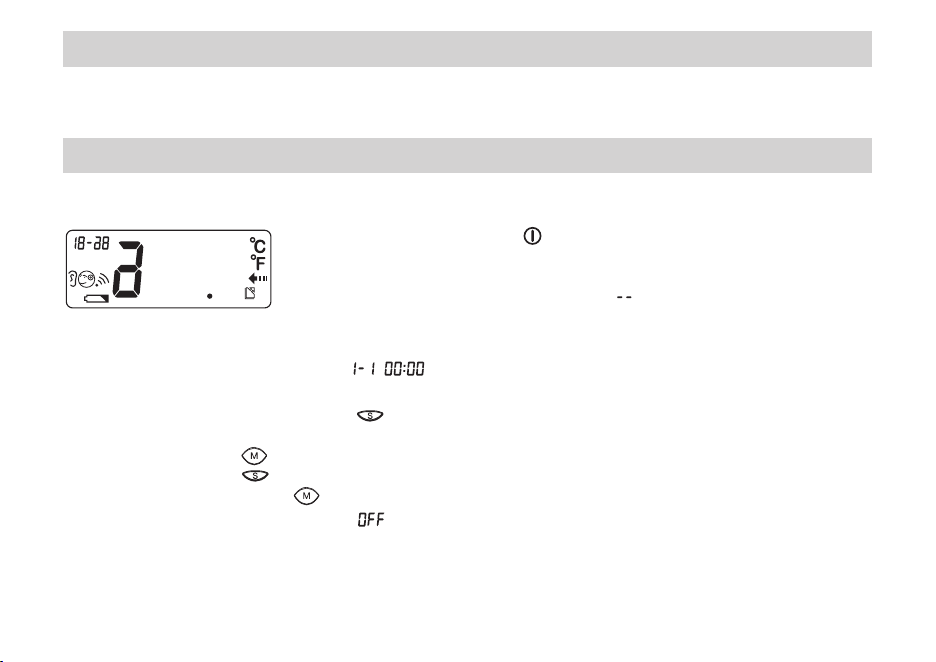
Appuyez 1 seconde sur la touche pour allumer le thermomètre. L’appareil
eectue un bref auto-test, tous les segments sont achés à l’écran pendant env.
1 seconde. Après un auto-test réussi, deux bips courts retentissent, la date et l’heure
sont achés en mode Stand-By et l’achage « » apparaît.
Lors de la première utilisation du thermomètre et après chaque changement des piles, la date et l’heure sont achées
(après l’auto-test) dans le réglage de base (
). Réglez à présent l’unité de l’achage de la température, la date
et l’heure. Vous eectuez plusieurs étapes lors du réglage: unité – année – mois – jour – heures – minutes.
• Appuyez env. 3 secondes sur la touche
pour accéder au mode Réglage.
La partie à modifier clignote.
• appuyez sur la touche pour enregistrer ce réglage, ou
• appuyez sur la touche pour modifier ce réglage,
• appuyez ensuite sur la touche pour enregistrer ce réglage.
Après ce processus, le thermomètre ache
et s’éteint automatiquement.
43
6. Ce que vous devez savoir avant la mesure
Il existe diérents thermomètres pour des mesures à divers endroits du corps:
• Thermomètre auriculaire/frontal (le présent thermomètre, pour une mesure dans l’oreille ou sur le front)
• Thermomètre bâton (pour la mesure rectale (dans l’anus), axiale (sous l’aisselle) ou orale (dans la bouche)
La mesure de la température donne une valeur de mesure indiquant la température corporelle actuelle d’une
personne. Si vous n’êtes pas certain de l’interprétation des résultats ou obtenez des valeurs anormales, consul-
tez votre médecin traitant. Ceci s’applique aussi en cas de légères variations de température lorsque d’autres
symptômes de maladie s’y ajoutent, p.ex. agitation, forte transpiration, rougeurs, fréquence cardiaque élevée,
collapsus cardio-vasculaire, etc.
Les températures mesurées avec des thermomètres diérents ne peuvent pas être comparées. Indiquez donc
à votre médecin (ou tenez-en compte en cas d’auto-diagnostic) avec quel thermomètre vous avez mesuré la
température corporelle et à quel endroit du corps.
La température d’une personne en bonne santé est influencée par plusieurs facteurs: le métabolisme individuel
propre à chaque personne, l’âge (la température du corps est plus élevée chez les nourrissons et les petits en-
fants et baisse avec l’âge. Chez les enfants, des variations de température plus importantes se produisent plus
rapidement et fréquemment, par exemple en fonction des poussées de croissance), les vêtements, la tempéra-
ture extérieure, le moment de la journée (le matin, la température corporelle est plus basse et monte au cours de
la journée jusqu’au soir), l’activité physique précédente et dans une moindre mesure, l’activité cérébrale.
La valeur de la température varie en fonction de l’endroit du corps où elle est mesurée. La variation peut se
situer entre 0,2 °C (0,4 °F) – 1 °C (1,8 °F) chez les personnes en bonne santé. Ainsi, la plage de température
normale est de:
• mesure frontale: 35,8 °C (96,4 °F) – 37,6 °C (99,7 °F) avec un thermomètre frontal
• mesure auriculaire: 36,0 °C (96,8 °F) – 37,8 °C (100 °F) avec un thermomètre auriculaire
• température rectale: 36,3 °C (97,3 °F) – 37,8 °C (100 °F) avec un thermomètre ordinaire
• température orale: 36,0 °C (96,8 °F) – 37,4 °C (99,3 °F) avec un thermomètre ordinaire
Pour pouvoir suivre la progression de la température, mesurez toujours au même endroit du corps.

44
7. Mesurer
Avant chaque utilisation, vérifiez que la lentille n’est pas endommagée. Si elle l’est, veuillez utiliser l’adresse du vendeur
ou du service après vente.
Tenez compte du fait que le thermomètre doit se trouver au moins 30 minutes dans la pièce dans laquelle la mesure est
eectuée.
Mesure de la température corporelle dans l’oreille
• Certaines personnes ont des valeurs de mesure diérentes dans l’oreille gauche et l’oreille droite. Pour éva-
luer les changements de température, mesurez toujours dans la même oreille pour une même personne.
• Les enfants ne peuvent utiliser le thermomètre auriculaire que sous la surveillance d’un adulte. En général,
une mesure est possible à partir de l’âge de 6 mois. Chez les petits enfants de moins de 6 moins, le conduit
auditif est encore très étroit. Ainsi, la température du tympan ne peut souvent pas être évaluée et des résul-
tats de mesure trop bas peuvent être achés.
• La mesure ne doit pas être eectuée dans une oreille atteinte de maladies inflammatoires (p.ex. pyorrhée,
sécrétions), après d’éventuelles blessures des oreilles (p.ex. blessures du tympan) ou lors de la phase de
guérison après une intervention chirurgicale. Dans tous ces cas, veuillez consulter votre médecin traitant.
• Dans le cas de certaines maladies infectieuses aiguës, l’utilisation du thermomètre sur plusieurs personnes
peut être inappropriée en raison d’une éventuelle transmission de germes malgré le nettoyage et la désinfec-
tion nécessaires. Le cas échéant, consultez votre médecin traitant.
• Ce thermomètre ne peut être utilisé que sans protection à usage unique.
• Si vous restez dans une oreille pendant un temps prolongé, la température augmente légèrement. Attendez
un peu ou mesurez dans l’autre oreille.
• Le cérumen peut influencer la mesure, veuillez donc nettoyer l’oreille avant la mesure le cas échéant.

45
• Appuyez 1 seconde sur la touche
pour allumer le thermomètre. Deux
bips brefs retentissent après un auto-test réussi.
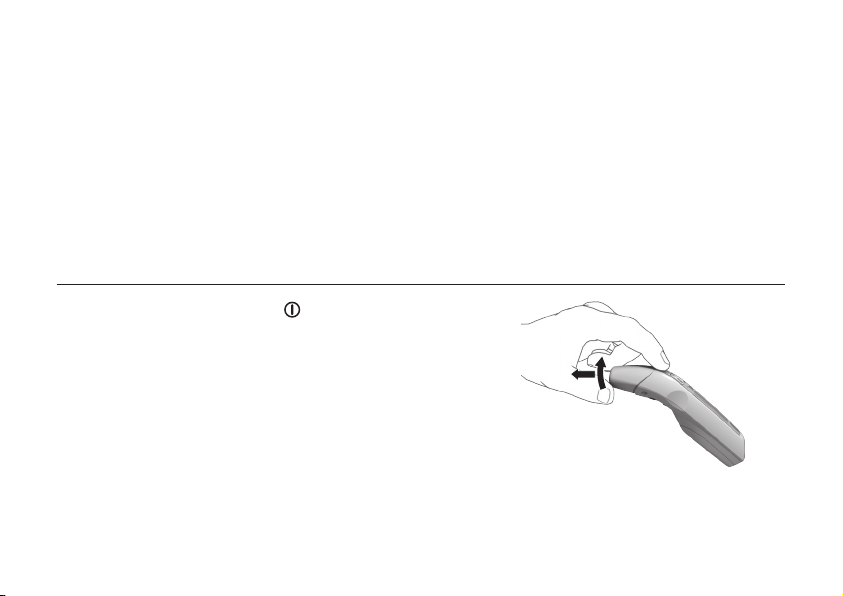
• Retirez l’embout en poussant légèrement vers le haut (1) puis en tirant
vers l’avant (2).
12
Assurez-vous que la pointe du capteur et le conduit auditif sont propres.
Comme le conduit auditif est légèrement incurvé, vous devez tirer légèrement l’oreille
vers le haut et l’arrière avant d’introduire la pointe du capteur afin que celle-ci puisse être
dirigée directement sur le tympan.
• Introduisez la pointe du capteur avec précautions et appuyez 1 seconde sur la
touche .
• Relâchez la touche . La fin de la mesure est signalée par un bip court, la valeur
mesurée s’ache à l’écran.
Si la valeur mesurée est dans la plage normale (< 38 °C/100,4 °F), la LED verte s’allume
pendant 3 secondes. Si la valeur mesurée est supérieure (≥ 38 °C/100,4 °F, fièvre), la LED
rouge s’allume.
46
Mesure de la température corporelle au front
Notez que le front ou la tempe doivent être exempts de sueur et de cosmétiques et que
dans le cas d’une mesure frontale, la prise de médicaments vasoconstricteurs et les irrita-
tions cutanées peuvent fausser le résultat de la mesure.
• Appuyez 1 seconde sur la touche pour allumer le thermomètre. Deux bips courts
retentissent après un auto-test réussi.
• Posez la tête de mesure avec embout frontal/de protection sur la tempe, maintenez
la touche enfoncée et passez le thermomètre de manière régulière sur le front
jusqu’à l’autre tempe.
• Relâchez ensuite la touche . La fin de la mesure est signalée avec un court bip, la
valeur mesurée s’ache à l’écran.
Si la valeur mesurée est dans la plage normale (< 38 °C/100,4 °F), la LED verte s’allume pendant 3 secondes. Si la valeur
mesurée est supérieure (≥ 38 °C/100,4 °F, fièvre), la LED rouge s’allume.
Mesure de la température superficielle
• Appuyez 1 seconde sur la touche
pour allumer le thermomètre. Deux bips courts retentissent après un auto-test
réussi.
• Appuyez ensuite simultanément 3 secondes sur les touches et pour passer au mode Température d’objet.
L’achage apparaît à l’écran.
• Appuyez sur la touche ou et dirigez la pointe du capteur en appuyant sur la touche à 3cm de distance vers
l’objet ou le liquide à mesurer (ne le plongez en aucun cas dans le liquide).
• Relâchez la touche ou . La fin de la mesure est signalée par un bip court, la valeur mesurée s’ache à
l’écran.
Notez que la température achée est la température superficielle établie et non celle supposée. Elle n’est pas compa-
rable à la température frontale/auriculaire.
Afin de repasser au mode thermomètre auriculaire/frontal, appuyez simultanément 3 secondes sur les t ouches et
jusqu’à ce que l’achage s’éteigne et qu’un court bip retentisse. Vous quittez automatiquement le mode Température
d’objet en éteignant et en rallumant le thermomètre.
47
La dernière valeur de mesure établie, c’est-à-dire uniquement la dernière valeur d’une plage de mesure, est automati-
quement enregistrée dès que le thermomètre s’éteint ou est éteint. 10 emplacements d’enregistrement sont à disposition
pour ceci.
Si vous n’eectuez aucune saisie supplémentaire, le thermomètre s’éteint automatiquement après une minute suivant
l’achage de la valeur mesurée.
Pour récupérer les valeurs enregistrées, allumez le thermomètre et appuyez sur la touche
.
La date, l’heure, le numéro de mémoire et le symbole du mode de mesure ainsi que la température sont achés. Parcou-
rez les emplacements d’enregistrement des résultats de mesure en appuyant de manière répétée sur la touche .
8. Changer les piles
Lorsque les piles faiblissent, le symbole d’avertissement batterie s’ache. Les mesures de température sont
encore possibles, les piles doivent être changées. Lorsque le symbole d’avertissement batterie clignote et
s’ache à l’écran, les piles doivent être changées. Lorsque les batteries sont trop faibles, le thermomètre s’éteint
automatiquement.
Remarque:
• Lors de chaque changement de batterie, utilisez des piles de même type, marque et capacité.
• Changez toujours toutes les piles en même temps.
• N’utilisez pas d’accus rechargeables.
• Utilisez des piles sans métaux lourds.
48
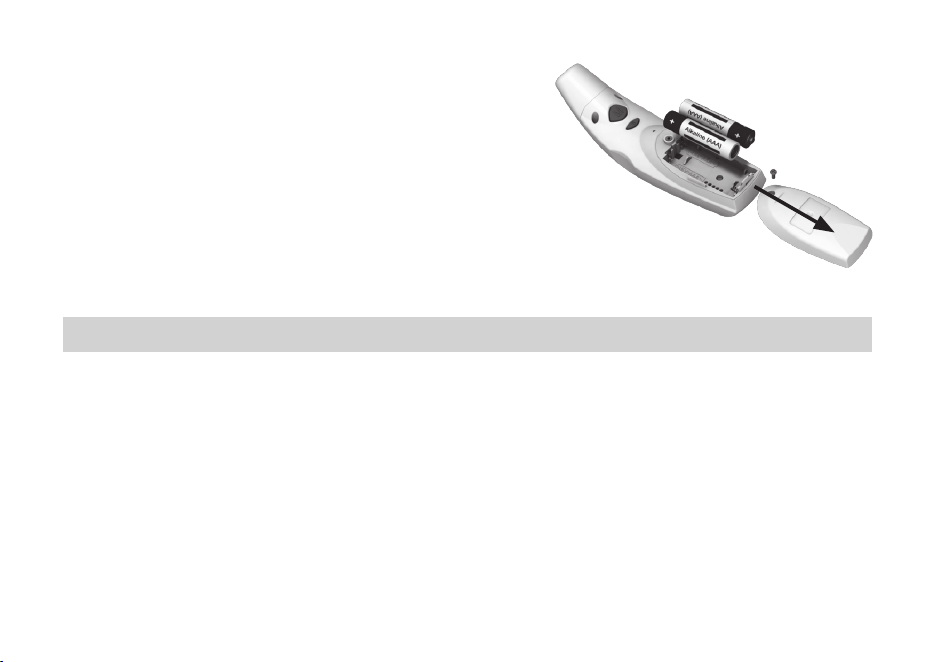
1. Desserrez la vis du couvercle du compartiment à piles et retirez le
couvercle en le tirant vers l’arrière.
2. Retirez les piles usées et insérez deux nouvelles piles dans la direc-
tion indiquée.
3. Fermez le couvercle du compartiment à piles et refermez-le en le
vissant.
Veuillez jeter les piles usées conformément aux règlementations
envigueur. Ne jetez jamais les piles avec les ordures ménagères.
9. Rangement et entretien
• Nettoyez la pointe du capteur après chaque utilisation. Pour cela, utilisez un chion doux ou un bâtonnet ouaté qui
peut être humidifié avec du désinfectant, de l’alcool ou de l’eau chaude.
• Pour nettoyer l’appareil entier, veuillez utiliser un chion doux légèrement humidifié avec de la lessive.
• N’utilisez pas de produits nettoyants agressifs.
• Stockez toujours le thermomètre avec un embout frontal/de protection posé dessus.
• Si vous prévoyez un stockage prolongé, retirez les piles.
• L’appareil ne doit pas être stocké ou utilisé à des températures et avec une humidité de l’air trop élevées ou trop
basses (voir données techniques), à la lumière du soleil, connecté au courant électrique ou dans des endroits pous-
siéreux. Sinon, cela pourrait entraîner des mesures imprécises.

49
10. Elimination
• Les piles usagées et complètement déchargées doivent être mises au rebut dans des conteneurs spéciaux ou aux
points de collecte réservés à cet usage ou bien déposées chez un revendeur d’appareils électriques. L’élimination
des piles est une obligation légale qui vous incombe.
• Ces pictogrammes se trouvent sur les piles à substances nocives:
Pb = pile contenant du plomb,Cd = pile contenant du cadmium,
Hg = pile contenant du mercure.
• Dans l‘intérêt de la protection de l‘environnement, l‘appareil ne doit pas être jeté avec les ordures
ménagères à la fin de sa durée de service. L’élimination doit se faire par le biais des points de collecte
compétents dans votre pays. Veuillez éliminer l’appareil conformément à la directive européenne – WEEE
(Waste Electrical and Electronic Equipment) relative aux appareils électriques et électroniques usagés. Pour
toute question, adressez-vous aux collectivités locales responsables de l’élimination et du recyclage de ces produits.
11. Données techniques
Remarque: en cas d’utilisation de l’appareil en dehors des spécifications, un fonctionnement irréprochable ne peut pas
être garanti! Nous nous réservons le droit d’eectuer des modifications techniques pour améliorer et faire évoluer le
produit.
La précision de ce thermomètre a été correctement testée et sa durabilité a été conçue en vue d’une utilisation à long
terme.
Dans le cadre d’une utilisation médicale de l’appareil, des contrôles techniques de mesure doivent être menés avec les
moyens appropriés. Pour obtenir des données précises sur la vérification de la précision de l’appareil, vous pouvez faire
une demande par courrier au service après-vente.

50
Nom et modèle
SFT65
Plage de mesure Mode thermomètre auriculaire/frontal: 34 °C – 43 °C (93,2 °F – 109,4 °F)
Mode température d’objet: 0 °C – 100 °C (32 °F – 212 °F)
Précision de mesure de
laboratoire
Mode thermomètre auriculaire: ±0,2 °C (±0,4 °F) de 35 °C – 42 °C (95,0 °F – 107,6 °F), en
dehors de cette plage de mesure ±0,3 °C (±0,5 °F),
Mode thermomètre frontal: ±0,2 °C (±0,4 °F) de 35 °C – 42 °C (95,0 °F – 107,6 °F), en
dehors de cette plage de mesure ±0,3 °C (±0,5 °F),
Mode température d’objet: ±1,5 °C (±2,7 °F) pour < 30 °C (86 °F) ; ±5% pour ≥30 °C (86 °F)
Intervalle entre deux
mesures
Au moins 5 secondes
Précision de répétition
clinique
Oreille: enfants, 1 – 5 ans: ±0,08 °C (±0,14 °F)
adultes: ±0,07 °C (±0,13 °F)
Front: enfants, 1 – 5 ans: ±0,07 °C (±0,13 °F)
adultes: ±0,08 °C (±0,14 °F)
Unités de mesure °Celsius (°C) ou °Fahrenheit (°F)
Conditions d’utilisation 15 °C à 35 °C (59 °F – 95 °F) avec une humidité de l’air relative jusqu’à 85% (sans
condensation)
Environnement de
conservation
-25 °C à 55 °C (-13 °F – 131 °F) avec une humidité de l’air relative jusqu’à 85% (sans
condensation)
Dimensions 138 x 35 x 33 mm
Poids 90g piles comprises
Piles 2 x 1,5 V AAA (LR03)
Mémoire Pour 10mesures
Le numéro de série se trouve sur l‘appareil ou sur le compartiment à piles.
51
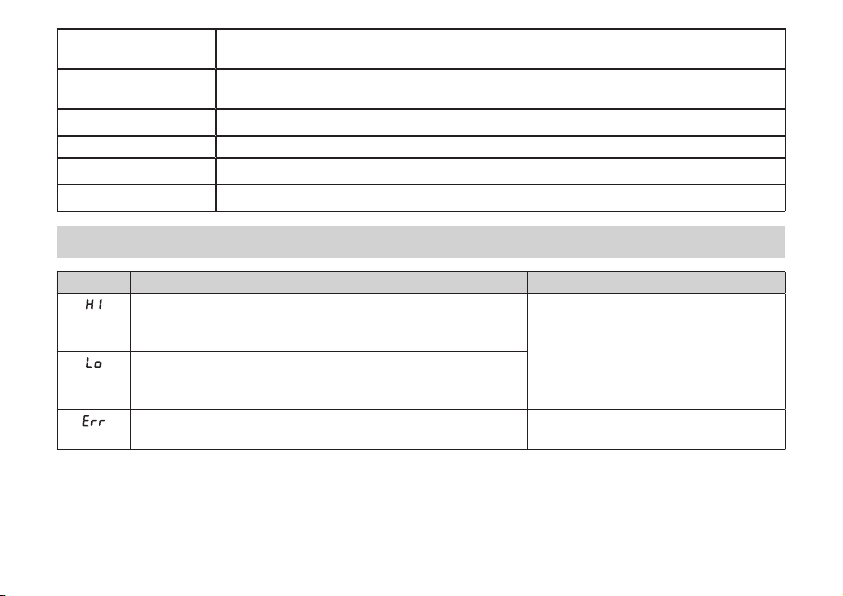
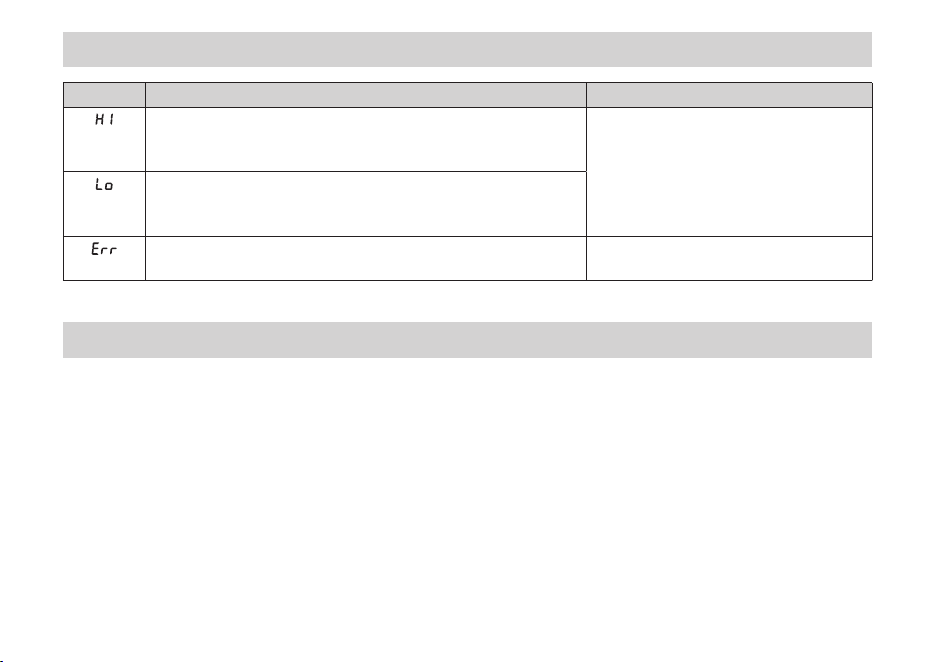
12. Résolution des erreurs
Achage Cause Solution
La température établie est supérieure à
1) Mode thermomètre auriculaire/frontal: 43 °C (109,4 °F)
2) Mode température d’objet: 100 °C (212 °F)
Utilisez le thermomètre uniquement
dans les plages de température
indiquées. Le cas échéant, nettoyez la
pointe du capteur. En cas d’achages
d’erreur répétés, consultez le revendeur
ou le service client.
La température établie est supérieure à
1) Mode thermomètre auriculaire/frontal: 34 °C (93,2 °F)
2) Mode température d’objet: 0 °C (32 °F)
La température d’utilisation n’est pas dans la plage de 15°C à
35 °C (59 – 95 °F)
Utilisez le thermomètre uniquement dans
les plages de température indiquées.
13. Garantie / Maintenance
La société Hans Dinslage GmbH, sise Riedlinger Straße 28, 89524 Uttenweiler, Allemagne, (ci-après désignée « HaDi »)
propose une garantie pour ce produit dans les conditions suivantes et dans la mesure prévue ci-après.
Les conditions de garantie suivantes n’affectent en rien les obligations de garantie du vendeur découlant du
contrat de vente conclu avec l’acheteur.
La garantie s’applique également sans préjudice de la responsabilité légale obligatoire.
HaDi garantit le bon fonctionnement et l’intégrité de ce produit.
La période de garantie mondiale est de 2 ans à compter de la date d’achat par l’acheteur du produit neuf et non utilisé.
Cette garantie ne s’applique qu’aux produits achetés par l’acheteur en tant que consommateur et utilisés uniquement à
des fins personnelles dans le cadre d’une utilisation domestique.
Le droit allemand s’applique.

52
Si, au cours de la période de garantie, ce produit s’avère incomplet ou défectueux conformément aux dispositions
suivantes, HaDi s’engage à proposer gratuitement un remplacement ou une réparation conformément aux présentes
Conditions de garantie.
Si l’acheteur souhaite faire valoir la garantie, il doit d’abord s’adresser au revendeur local : cf. liste « Service
client à l’international » ci-jointe pour connaître les adresses du service après-vente.
L’acheteur recevra ensuite des informations complémentaires concernant le déroulement de la demande de garantie, par
exemple, l’adresse à laquelle envoyer le produit et les documents requis.
Une demande de garantie ne peut être prise en compte que si l’acheteur présente
- une copie de la facture/du reçu et
- le produit d’origine
à HaDi ou à un partenaire autorisé de HaDi.
La présente Garantie exclut expressément
- toute usure découlant de l’utilisation ou de la consommation normale du produit ;
- les accessoires fournis avec le produit qui s’usent ou qui sont consommés dans le cadre d’une utilisation normale
du produit (par exemple, piles, piles rechargeables, manchettes, joints, électrodes, ampoules, embouts et acces-
soires pour inhalateur) ;
- les produits utilisés, nettoyés, stockés ou entretenus de manière inappropriée et/ou contraire aux conditions d’uti-
lisation, ainsi que les produits ouverts, réparés ou modifiés par l’acheteur ou par un service client non agréé par
HaDi ;
- les dommages survenus lors du transport entre le fabricant et le client ou entre le service client et le client ;
- les produits achetés en tant qu’article de second choix ou d’occasion ;
- les dommages consécutifs qui résultent d’une défaillance du produit (dans ce cas, toutefois, des réclamations
peuvent être soulevées relatives à la responsabilité du fait des produits ou à d’autres dispositions légales obliga-
toires relatives à la responsabilité).
Les réparations ou le remplacement complet ne prolongent en aucun cas la période de garantie.
Sous réserve d’erreurs et de modifications

53
Fornitura
Controllare l‘integrità esterna della confezione e del contenuto. Prima dell‘uso assicurarsi che l‘apparecchio e gli acces-
sori non presentino nessun danno palese e che il materiale di imballaggio sia stato rimosso. Nel dubbio non utilizzare
l‘apparecchio e consultare il proprio rivenditore o contattare il Servizio clienti indicato.
• Termometro
• 2 batterie AAA da 1,5 V (LR03)
• Le presenti istruzioni per l’uso
Leggere attentamente le presenti istruzioni d’uso, conservarle per impieghi futuri, renderle accessibili ad altri utilizzatori e
attenersi alle indicazioni.
1. Spiegazione dei simboli
I seguenti simboli sono utilizzati nelle Istruzioni per l’uso e sull’apparecchio:
AVVERTENZA
Segnalazione di rischio di lesioni o pericoli per la salute
Italiano
1. Spiegazione dei simboli............................................. 53
2. Avvertenze ................................................................. 55
3. Descrizione dell’apparecchio .................................... 58
4. Messa in funzione ...................................................... 59
5. Impostazione ............................................................. 59
6. Informazioni utili per la misurazione .......................... 60
7. Misurazione ...............................................................61
8. Sostituzione delle batterie ....................................... 64
9. Pulizia e cura ........................................................... 65
10. Smaltimento ............................................................ 66
11. Dati tecnici .............................................................. 66
12. Soluzione dei guasti ................................................ 68
13. Garanzia / Assistenza .............................................. 68
Indice
54
ATTENZIONE
Segnalazione di rischi di possibili danni all’apparecchio/agli accessori
Nota
Indicazione di importanti informazioni
Rispettare le istruzioni per l’uso.
Parte applicativa tipo BF
Smaltimento secondo le norme previste dalla Direttiva CE sui rifiuti di apparecchiature elettriche ed
elettroniche (RAEE)
Il marchio CE certifica la conformità ai requisiti di base della direttiva 93/42/EEC sui dispositivi medici.
Storage/Transport
Temperatura e umidità di trasporto e stoccaggio consentite
Operating
Temperatura e umidità di esercizio consentite
Produttore
55
Proteggere dall’umidità
21
PAP
Smaltire la confezione nel rispetto dell‘ambiente
S
N
Numero di serie
2. Avvertenze
Indicazioni di sicurezza
Pericolo:
• In caso di misurazioni auricolari inserire con cautela il sensore del termometro nell’orecchio.
• In presenza di determinate patologie acute e infettive, l’utilizzo del termometro su più persone, nonostante
la pulizia e la disinfezione, è da sconsigliare a causa del possibile scambio di germi. Per casi particolari
rivolgersi al proprio medico curante.
Avvertenze sull’uso delle batterie
• Se il liquido della batteria viene a contatto con la pelle e con gli occhi, sciacquare le parti interessate con acqua e
consultare il medico.
•
Pericolo d’ingestione! I bambini possono ingerire le batterie e soffocare. Tenere quindi le batterie lontano dalla
portata dei bambini!
• Prestare attenzione alla polarità positiva (+) e negativa (-).
56
• In caso di fuoriuscita di liquido dalla batteria, indossare guanti protettivi e pulire il vano batterie con un panno
asciutto.
• Proteggere le batterie dal caldo eccessivo.
•
Rischio di esplosione! Non gettare le batterie nel fuoco.
• Le batterie non devono essere ricaricate o mandate in cortocircuito.
• Qualora l’apparecchio non dovesse essere utilizzato per un periodo prolungato, rimuovere le batteria dal vano batterie.
• Utilizzare solo tipologie di batterie uguali o equivalenti.
• Sostituire sempre tutte le batterie contemporaneamente.
• Non utilizzare batterie ricaricabili!
• Non smontare, aprire o frantumare le batterie.
Indicazioni generali
• Leggere attentamente le presenti istruzioni per l’uso, conservarle per impieghi futuri, renderle accessibili ad
altri utilizzatori e attenersi alle indicazioni.
• Questo termometro è un apparecchio elettronico sensibile e va trattato con cautela, evitando possibili urti.
• Non esporre l’apparecchio alla luce diretta del sole.
• Prima di ogni utilizzo, verificare che la lente non sia danneggiata. In caso di danni rivolgersi al proprio riven-
ditore o al Servizio clienti.
• Il termometro NON è impermeabile. Evitare pertanto il contatto diretto con l’acqua o con altri liquidi.
• Il termometro SFT 65 è stato concepito solo per la zona di misurazione del corpo umano indicata nelle
istruzioni per l’uso.
• L’apparecchio è concepito solo per l’uso descritto nelle presenti istruzioni.
• Dopo ogni utilizzo pulire il sensore del termometro con un panno morbido inumidito con del disinfettante.
• Il termometro è stato concepito per l’utilizzo pratico ma non può essere considerato come un sostitutivo di
una visita medica.
• Prima di inoltrare eventuali reclami, testare le batterie e se necessario sostituirle.
• Le riparazioni possono essere eettuate esclusivamente dai centri di assistenza autorizzati, diversamente
decade ogni diritto di garanzia.
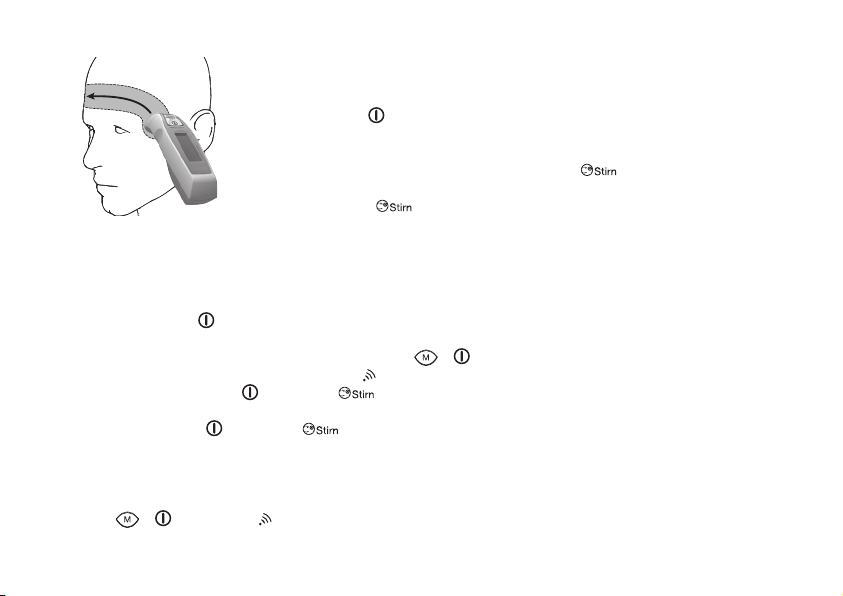
57
• L’apparecchio è conforme ai requisiti della direttiva europea per i dispositivi medici 93/42/EEC, alla legge sui
dispositivi medici, alla norma ASTM E 1965 - 98, alla norma europea EN 12470-5: Termometri clinici – Parte
5: caratteristiche dei termometri da orecchio a infrarossi (con dispositivo di massimo) ISO 80601-2-56 e con-
formità alla norma europea EN 60601-1-2 (Corrispondenza con CISPR 11, IEC 61000-4-2, IEC 61000-4-3,
IEC 61000-4-8), con precauzioni d’impiego particolari per quanto riguarda la compatibilità elettromagne-
tica. Apparecchiature di comunicazione HF mobili e portatili possono influire sul funzionamento di questo
apparecchio.
• Per ulteriori domande sull’utilizzo delle apparecchiature Beurer, rivolgersi al proprio rivenditore o al Servizio
clienti.
Avvertenze sulla compatibilità elettromagnetica
• L‘apparecchio è idoneo per l‘utilizzo in qualsiasi ambiente riportato nelle presenti istruzioni per l‘uso, incluso
l‘ambiente domestico.
• In determinate circostanze, in presenza di disturbi elettromagnetici l‘apparecchio può essere utilizzato solo limitata-
mente. Ne possono conseguire ad es. messaggi di errore o un guasto del display/apparecchio.
• Evitare di utilizzare il presente apparecchio nelle immediate vicinanze di altri apparecchi o con apparecchi in posizio-
ne impilata, poiché ciò potrebbe determinare un funzionamento non corretto. Qualora fosse comunque necessario un
utilizzo nel modo prescritto, è opportuno tenere sotto controllo questo apparecchio e gli altri apparecchi in modo da
assicurarsi che funzionino correttamente.
• L‘utilizzo di altri accessori diversi da quelli stabiliti dal produttore dell‘apparecchio o in dotazione con l‘apparecchio
può comportare la comparsa di significative emissioni elettromagnetiche di disturbo o ridurre la resistenza
dell‘apparecchio alle interferenze elettromagnetiche e a un funzionamento non corretto dello stesso.
• La mancata osservanza può ridurre le prestazioni dell‘apparecchio.
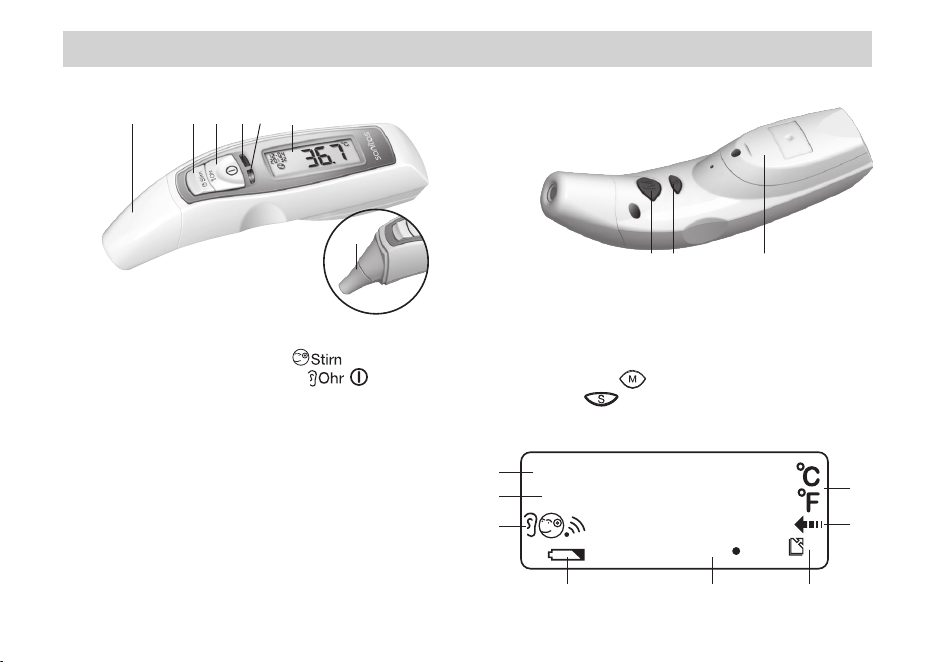
58
3. Descrizione dell’apparecchio
Panoramica
1
32 4 5
7
6
1098
1 Cappuccio protettivo/per misurazione frontale
2 Pulsante per modalità frontale
3 Pulsante per modalità auricolare /
4 LED (rosso) (allarme febbre)
5 LED (verde)
6 LCD
7 Sensore con lente (senza cappuccio protettivo)
8 Pulsante Memoria
9 Pulsante Set
10 Coperchio vano batterie
11 Data
12 Ora
13 Modalità di misurazione (“orecchio”, “fronte”, “oggetto”)
14 Icona “Batteria scarica”
15 Misurazione rilevata
16 Icona “Memoria” e relativo numero di posizione
17 Icona “Misurazione in corso”
18 Unità di misurazione (°C o °F)
863
5-15
8
7:20
11
12
13
18
17
161514
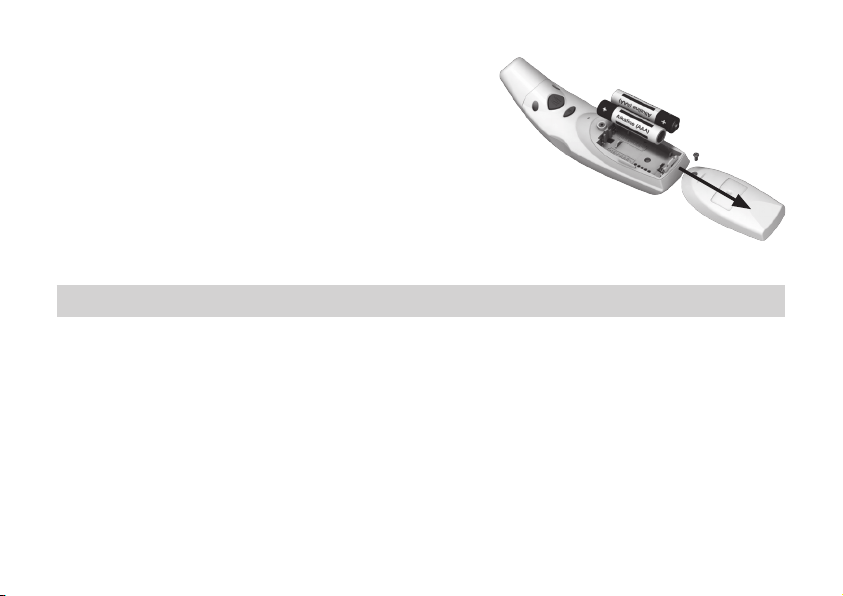
59
4. Messa in funzione
Le batterie sono già presenti sugli apparecchi nuovi. Prima del primo impiego rimuovere la linguetta protettiva dal vano
batterie. Il termometro si accende automaticamente.
5. Impostazione
Impostazione dell’unità di misura della temperatura, della data e dell’ora
888
8
88:88
Premere il pulsante per 1 secondo per accendere il termometro. Viene eseguito
un breve autotest, sul display vengono visualizzati tutti i segmenti per circa 1 secon-
do. Al termine dell’autotest vengono emessi due brevi segnali acustici, in modalità
standby vengono visualizzate data e ora e compare la scritta “ ”.
La prima volta che viene utilizzato il termometro e ogni volta che vengono sostituite le batterie (al termine dell’autotest)
vengono visualizzate la data e l’ora nell’impostazione di base (
). È in questo momento che vanno impostate
l’unità di misura della temperatura, la data e l’ora. Per procedere all’impostazione, attenersi alla seguente sequenza:
Unità – Anno – Mese – Giorno – Ore – Minuti.
• Premere il pulsante
per ca. 3 secondi per passare alla modalità Set.
Viene visualizzata la parte da modificare di volta in volta.
• Premere il pulsante per memorizzare l’impostazione o
• il pulsante per modificarla.
• Premere infine il pulsante per memorizzare l’impostazione.
Al termine della procedura sul display compare la scritta
e il termometro si spegne automaticamente.
60
6. Informazioni utili per la misurazione
Esistono diversi termometri che prevedono la misurazione della temperatura in punti del corpo dierenti:
• Termometro auricolare/frontale (termometro per la misurazione nell’orecchio o sulla fronte)
• Termometro tradizionale (per la misurazione rettale, ascellare o orale)
La misurazione della temperatura fornisce un valore che indica la temperatura corporea attuale di un soggetto.
Se non si è sicuri dell’interpretazione dei risultati o se risultano dei valori anomali, è consigliabile rivolgersi al
proprio medico curante. Lo stesso dicasi in caso di lievi oscillazioni della temperatura in presenza di altri sintomi
quali agitazione, intensa sudorazione, arrossamento della pelle, elevata frequenza cardiaca, svenimenti, ecc.
Non è possibile confrontare temperature misurate con tipi di termometro diversi. È pertanto necessario riferire
al proprio medico (o tenerne conto in caso di autodiagnosi) il tipo di termometro utilizzato per la misurazione e il
punto del corpo in cui la misurazione è stata eettuata.
La temperatura di un soggetto sano è influenzata da diversi fattori, quali il metabolismo (soggettivo e diverso da
persona a persona), l’età (la temperatura corporea risulta più alta nei neonati e nei bambini per poi abbassarsi
gradualmente con l’età; nei bambini gli sbalzi di temperatura sono rapidi e frequenti a causa ad esempio dei
picchi di crescita), l’abbigliamento, l’ora della giornata (al mattino la temperatura corporea è più bassa e si alza
nel corso della giornata), l’attività fisica intrapresa e, in minima parte, l’attività mentale.
La temperatura varia a seconda del punto del corpo in cui viene misurata. Nei soggetti sani si parla di uno
scostamento compreso tra 0,2 °C (0,4 °F) – 1 °C (1,8 °F). È pertanto possibile definire normali i seguenti intervalli
di temperatura:
• Misurazione sulla fronte: da 35,8 °C (96,4 °F) – 37,6 °C (99,7 °F) con termometro frontale
• Misurazione nell’orecchio: da 36,0 °C (96,8 °F) – 37,8 °C (100 °F) con termometro auricolare
• Misurazione rettale: da 36,3 °C (97,3 °F) – 37,8 °C (100 °F) con termometro tradizionale
• Misurazione orale: da 36,0 °C (96,8 °F) – 37,4 °C (99,3 °F) con termometro tradizionale
Per valutare l’andamento della temperatura, misurarla sempre nello stesso punto.
61
7. Misurazione
Prima di ogni utilizzo, verificare che la lente non sia danneggiata. In caso di danni rivolgersi al proprio rivenditore o al
Servizio clienti.
Accertarsi che il termometro si trovi nelle stesse condizioni ambientali per almeno 30 minuti prima di eseguire la
misurazione.
Misurazione della temperatura auricolare
• Alcune persone presentano valori diversi nell’orecchio sinistro e nell’orecchio destro. Per poter valutare
l’andamento della temperatura, misurarla sempre nello stesso orecchio.
• Il termometro auricolare deve essere utilizzato dai bambini solo sotto sorveglianza degli adulti. Generalmente
è possibile procedere a una misurazione nell’orecchio dopo i 6 mesi di vita. Nei bambini di età inferiore il
canale auricolare è ancora molto stretto e spesso non è possibile rilevare la temperatura del timpano, dando
luogo a valori di misurazione troppo bassi.
• Non eettuare la misurazione nell’orecchio in presenza di patologie infiammatorie (ad es., fuoriuscita di pus,
secrezione) e possibili lesioni (ad es., lesioni al timpano) o durante la convalescenza in seguito a interventi
chirurgici. In tutti questi casi si consiglia di consultare il proprio medico curante.
• In presenza di determinate patologie acute e infettive, l’utilizzo del termometro su più persone, nonostante
la pulizia e la disinfezione, è da sconsigliare a causa del possibile scambio di germi. Per casi particolari
rivolgersi al proprio medico curante.
• Questo termometro può essere utilizzato esclusivamente senza involucro protettivo.
• Se si lascia il termometro inserito nell’orecchio per troppo tempo, la temperatura risulta leggermente più alta.
Attendere qualche minuto o procedere alla misurazione nell’altro orecchio.
• La presenza di cerume può influire sulla misurazione: pulire pertanto l’orecchio prima di misurare la
temperatura.
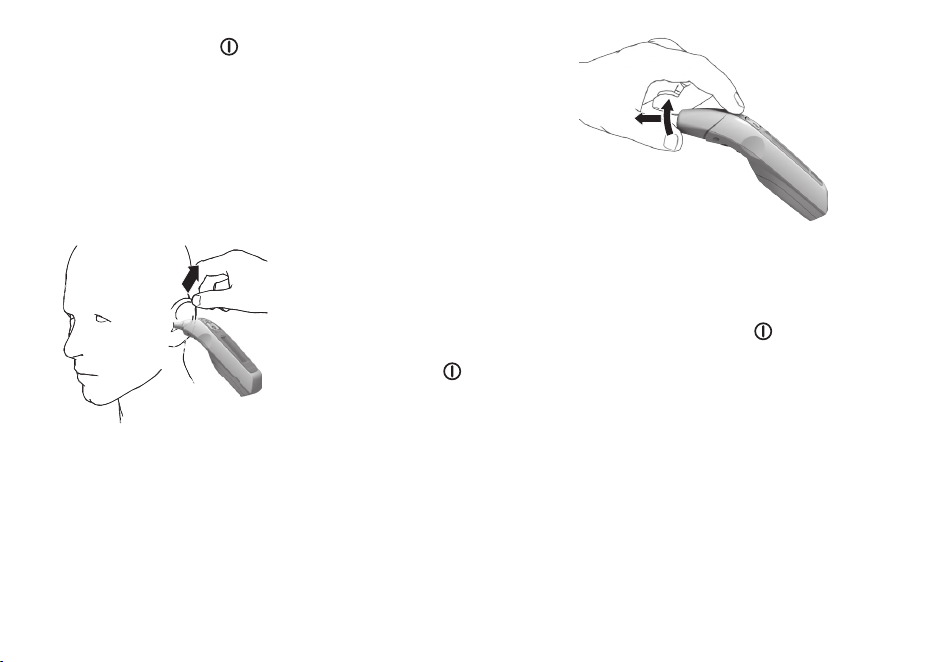
62
• Premere il pulsante
per 1 secondo per accendere il termometro. Al
termine dell’autotest vengono emessi due brevi segnali acustici.
• Rimuovere il cappuccio protettivo premendolo leggermente verso l’alto
(1) quindi in avanti (2).
12
Accertarsi che il sensore e il canale auricolare siano puliti.
Poiché il canale auricolare è leggermente curvo, prima di introdurre il sensore nell’orec-
chio sollevare leggermente il padiglione verso l’alto per consentire al sensore di entrare
direttamente in contatto con il timpano.
• Introdurre con cautela il sensore nell’orecchio e premere il pulsante per
1 secondo.
• Rilasciare il pulsante . Al termine della misurazione viene emesso un breve segnale
acustico e il valore misurato compare sul display.
Se il valore misurato è compreso nell’intervallo standard (< 38 °C/100,4 °F), il LED
verde si accende per 3 secondi. Se il valore misurato è superiore all’intervallo standard
(≥ 38 °C/100,4 °F), si accende il LED rosso.

63
Misurazione della temperatura frontale
Assicurarsi che la fronte e le tempie non siano coperte da sudore o trucco e tenere presente
che la misurazione frontale può essere falsata dall’assunzione di medicinali vasocostrittori e
da irritazioni cutanee.
• Premere il pulsante per 1 secondo per accendere il termometro. Al termine dell’auto-
test vengono emessi due brevi segnali acustici.
• Appoggiare la punta del termometro alla tempia lasciando inserito il cappuccio protetti-
vo/per misurazione frontale, tenere premuto il pulsante e spostare il termometro
sull’altra tempia mantenendo una pressione costante sulla fronte.
• Rilasciare il pulsante . Al termine della misurazione viene emesso un breve segnale
acustico e il valore misurato compare sul display.
Se il valore misurato è compreso nell’intervallo standard (< 38 °C/100,4 °F), il LED verde si accende per 3 secondi. Se il
valore misurato è superiore all’intervallo standard (≥ 38 °C/100,4 °F), si accende il LED rosso.
Misurazione della temperatura superficiale
• Premere il pulsante
per 1 secondo per accendere il termometro. Al termine dell’autotest vengono emessi due
brevi segnali acustici.
• Premere contemporaneamente per 3 secondi i pulsanti e , per passare alla modalità di misurazione superfi-
ciale degli oggetti. Sul display compare l’icona .
• Tenere premuto il pulsante o il pulsante e, mantenendo una distanza di 3 cm, rivolgere il sensore verso
l’oggetto o il liquido da misurare (non immergere mai il termometro nei liquidi).
• Rilasciare il pulsante o il pulsante . Al termine della misurazione viene emesso un breve segnale acustico e il
valore misurato compare sul display.
Tenere presente che il valore indicato non rappresenta la temperatura superficiale adattata, bensì quella rilevata e non
può pertanto essere paragonato con la temperatura frontale o auricolare.
Per passare nuovamente alla modalità di misurazione auricolare/frontale, premere contemporaneamente per 3 secondi
i pulsanti e finché l’icona si spegne e viene emesso un breve segnale acustico. Per uscire automaticamente
dalla modalità di misurazione superficiale, spegnere e riaccendere il termometro.
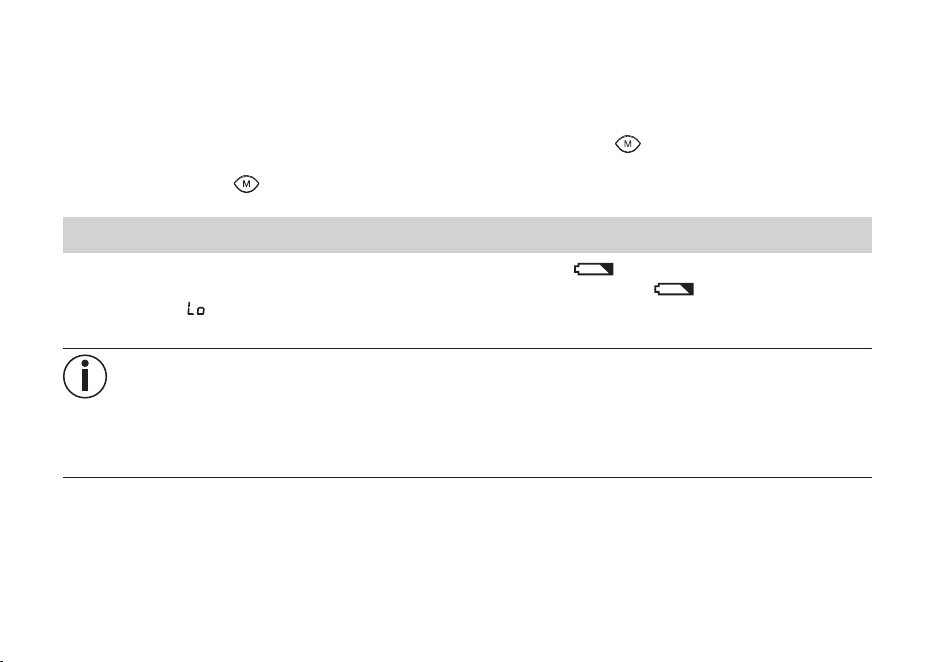
64
L’ultimo valore di misurazione rilevato, ovvero solo l’ultimo valore di una serie di misurazioni, viene memorizzato automa-
ticamente non appena il termometro si spegne o viene spento. Sono disponibili 10 posizioni di memoria.
Se non si eettuano ulteriori misurazioni, il termometro si spegne automaticamente dopo circa 1 minuto dalla visualizza-
zione dell’ultimo valore.
Per interrogare i valori memorizzati, accendere il termometro e premere il pulsante
.
Vengono visualizzati la data, l’ora, il numero di posizione, l’icona della modalità di misurazione e la temperatura. Premere
ripetutamente il pulsante per sfogliare le posizioni di memoria delle misurazioni.
8. Sostituzione delle batterie
Quando le batterie stanno per scaricarsi, compare l’icona di batteria scarica . È ancora possibile eettuare misura-
zioni ma è necessario sostituire a breve le batterie. Quando il simbolo di batteria scarica lampeggia e sul display
compare la scritta , le batterie devono essere sostituite. Quando le batterie sono troppo scariche, il termometro si
spegne automaticamente.
Avvertenza:
• Ad ogni sostituzione delle batterie, utilizzare batterie ricaricabili dello stesso tipo, della stessa marca e della
stessa capacità.
• Sostituire sempre tutte le batterie contemporaneamente.
• Non utilizzare batterie ricaricabili.
• Utilizzare preferibilmente batterie prive di metalli pesanti.
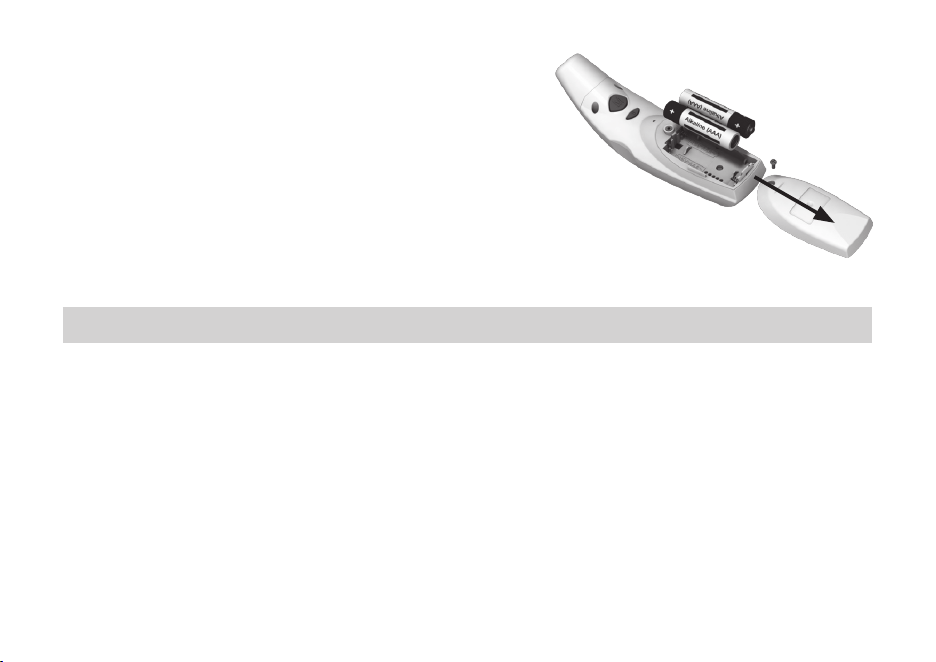
65
1. Svitare il coperchio del vano batterie e rimuoverlo facendolo scivola-
re verso il basso.
2. Rimuovere le batterie esauste e inserirne due nuove nella direzione
indicata.
3. Chiudere il coperchio del vano batterie e riavvitarlo.
Smaltire le batterie esauste nel rispetto delle vigenti normative di
legge. Non gettare mai le batterie nei normali rifiuti domestici.
9. Pulizia e cura
• Pulire il sensore dopo ogni utilizzo. A tale scopo utilizzare un panno morbido o un cotton fioc imbevuto di disinfettan-
te, alcol o acqua calda.
• Per la pulizia dell’intero apparecchio utilizzare un panno morbido leggermente inumidito con acqua e sapone.
• Non utilizzare detergenti aggressivi.
• Riporre sempre il termometro lasciando inserito il cappuccio protettivo/per misurazione frontale.
• Se si prevede di non utilizzare l’apparecchio per un lungo periodo, rimuovere le batterie.
• Non utilizzare né riporre l’apparecchio in luoghi esposti a temperature troppo alte o troppo basse, all’umidità (vedere
Dati tecnici), alla luce solare, alla corrente elettrica o alla polvere; diversamente le misurazioni potrebbero non essere
corrette.
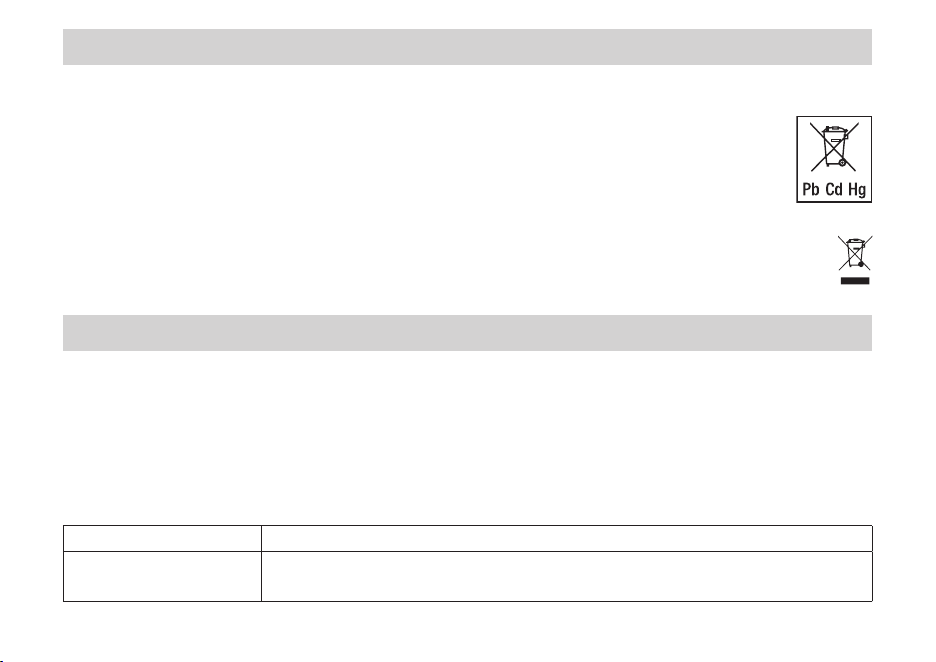
66
10. Smaltimento
• Smaltire le batterie esauste e completamente scariche negli appositi punti di raccolta, nei punti di raccolta per rifiuti
tossici o presso i negozi di elettronica. Lo smaltimento delle batterie è un obbligo di legge.
• I simboli riportati di seguito indicano che le batterie contengono sostanze tossiche.
Pb = batteria contenente piombo,
Cd = batteria contenente cadmio,
Hg = batteria contenente mercurio.
•
Per motivi ecologici, l’apparecchio non deve essere smaltito tra i normali rifiuti quando viene buttato via. Lo
smaltimento deve essere effettuato negli appositi centri di raccolta. Smaltire l’apparecchio secondo la direttiva
europea sui rifiuti di apparecchiature elettriche ed elettroniche (RAEE). Per eventuali chiarimenti, rivolgersi alle
autorità comunali competenti per lo smaltimento.
11. Dati tecnici
Avvertenza: in caso di utilizzo dell’apparecchio al di fuori di quanto specificato nelle presenti istruzioni non è possibile
garantire un funzionamento corretto. Beurer si riserva il diritto di apportare modifiche tecniche al fine del miglioramento e
del continuo sviluppo del prodotto.
La précision de ce thermomètre a été correctement testée et sa durabilité a été conçue en vue d’une utilisation à long
terme.
Dans le cadre d’une utilisation médicale de l’appareil, des contrôles techniques de mesure doivent être menés avec les
moyens appropriés. Pour obtenir des données précises sur la vérification de la précision de l’appareil, vous pouvez faire
une demande par courrier au service après-vente.
Nome e modello
SFT65
Range di misurazione Modalità auricolare/frontale: 34 °C – 43 °C (93,2 °F – 109,4 °F)
Modalità di misurazione superficiale: 0 °C – 100 °C (32 °F – 212 °F)

67
Precisione di misurazione
da laboratorio
Modalità auricolare: ±0,2 °C (±0,4 °F) da 35 °C a 42 °C (da 95,0 °F a 107,6 °F),
al di fuori di questo intervallo ±0,3 °C (±0,5 °F),
Modalità frontale: ±0,2 °C (±0,4 °F) da 35 °C a 42 °C (da 95,0 °F a 107,6 °F),
al di fuori di questo intervallo ±0,3 °C (±0,5 °F),
Temperatura superficiale: ±1,5 °C (±2,7 °F) con temperatura < 30 °C (86 °F);
±5% con temperatura ≥ 30 °C (86 °F)
Tempo di attesa tra due
misurazioni
Almeno 5 secondi
Precisione di ripetizione
clinica
Orecchio: bambini di età compresa tra 1 e 5 anni: ±0,08 °C (±0,14 °F)
adulti: ±0,07 °C (±0,13 °F)
Fronte: bambini di età compresa tra 1 e 5 anni: ±0,07 °C (±0,13 °F)
adulti: ±0,08 °C (±0,14 °F)
Unità di misura °Celsius (°C) o °Fahrenheit (°F)
Condizioni di
funzionamento
da 15 °C a 35 °C (da 59°F a 95 °F) con umidità relativa massima di 85% (senza condensa)
Condizioni di
conservazione
da -25 °C a 55 °C (da -13 °F a 131 °F) con umidità relativa massima di 85% (senza
condensa)
Ingombro 138 x 35 x 33 mm
Peso 90 g comprese le batterie
Batterie 2 x 1,5 V AAA (LR03)
Memoria Per 10 misurazioni
Il numero di serie si trova sull‘apparecchio o nel vano batterie.

68
12. Soluzione dei guasti
Messaggio
di errore
Causa Soluzione
La temperatura rilevata è superiore a
1) Modalità auricolare/frontale: 43 °C (109,4 °F)
2) Modalità superficiale: 100 °C (212 °F)
Utilizzare il termometro esclusivamente entro gli
intervalli di temperatura indicati. Se necessario,
pulire il sensore. Se il messaggio di errore
persiste, rivolgersi al rivenditore o al Servizio
clienti.
La temperatura rilevata è superiore a
1) Modalità auricolare/frontale: 34 °C (93,2 °F)
2) Modalità superficiale: 0 °C (32 °F)
La temperatura di funzionamento non è compresa
nell’intervallo 15 °C – 35 °C (59 – 95 °F)
Utilizzare il termometro esclusivamente entro gli
intervalli di temperatura indicati.
13. Garanzia / Assistenza
Hans Dinslage GmbH, Riedlinger Straße 28, D-89524 Uttenweiler (di seguito denominata „HaDi“) ore una garanzia per
questo prodotto, nel rispetto delle seguenti condizioni e nella misura descritta di seguito.
Le seguenti condizioni di garanzia lasciano invariati gli obblighi di garanzia di legge del venditore stabiliti nel
contratto di acquisto con l‘acquirente.
La garanzia si applica inoltre fatte salve le prescrizioni di legge obbligatorie in materia di responsabilità.
HaDi garantisce la perfetta funzionalità e la completezza di questo prodotto.
La garanzia mondiale è di 2 anni a partire dall‘acquisto del prodotto nuovo, non usato, da parte dell‘acquirente.
Questa garanzia copre solo i prodotti che l‘acquirente ha acquistato come consumatore e che utilizza esclusivamente a
scopo personale, in ambito domestico.
69
Vale il diritto tedesco.
Nel caso in cui il prodotto, durante il periodo di garanzia, si dimostrasse incompleto o presentasse difetti di funziona-
mento in linea con le seguenti disposizioni, HaDi provvederà a sostituire o riparare gratuitamente il prodotto in base alle
presenti condizioni di garanzia.
Per segnalare un caso di garanzia, l‘acquirente deve rivolgersi innanzitutto al proprio rivenditore locale: vedere
l‘elenco „Service International“ in cui sono riportati gli indirizzi dei centri di assistenza.
L‘acquirente riceverà quindi informazioni più dettagliate sulla gestione del caso di garanzia, ad esempio dove deve invia-
re il prodotto e quali documenti sono necessari.
L‘attivazione della garanzia viene presa in considerazione solo se l‘acquirente può presentare
- una copia della fattura/prova d‘acquisto e
- il prodotto originale
a HaDi o a un partner HaDi autorizzato.
Sono espressamente esclusi dalla presente garanzia
- l‘usura dovuta al normale utilizzo o al consumo del prodotto;
- gli accessori forniti assieme a questo prodotto che, in caso di utilizzo conforme, si consumano o si esauriscono (ad es.
batterie, batterie ricaricabili, manicotti, guarnizioni, elettrodi, lampadine, accessori e accessori per inalatore);
- i prodotti che sono stati utilizzati, puliti, conservati o sottoposti a manutenzione in modo improprio e/o senza rispettare
le disposizioni riportate nelle istruzioni per l‘uso, nonché i prodotti che sono stati aperti, riparati o smontati e rimon-
tati dall‘acquirente o da un centro di assistenza non autorizzato da HaDi;
- i danni occorsi nel trasporto dal produttore al cliente o tra il centro di assistenza e il cliente;
- i prodotti acquistati come articoli di seconda scelta o usati;
- i danni conseguenti che dipendono da un difetto del prodotto (in questo caso possono tuttavia esistere diritti deri-
vanti dalla responsabilità per i prodotti o da altre disposizioni di legge obbligatorie in materia di responsabilità).
Le riparazioni o la sostituzione completa non prolungano in alcun caso il periodo di garanzia.
Possibili errori e variazioni
70
Объем поставки
Убедитесь в том, что упаковка прибора не повреждена, и проверьте комплектность поставки. Перед
использованием убедитесь втом, что прибор иего принадлежности неимеют видимых повреждений, иудалите
все упаковочные материалы. При наличии сомнений не используйте прибор и обратитесь к продавцу или по
указанному адресу сервисной службы.
• Термометр
• 2 х 1,5 В батарейки AAA (LR03)
• Данная инструкция по применению
Внимательно прочтите данную инструкцию по применению, сохраните ее для последующего использования,
храните ее в месте, доступном для других пользователей, и следуйте ее указаниям.
1. Пояснения к символам
В инструкции по применению ина приборе используются следующие символы.
ПРЕДОСТЕРЕЖЕНИЕ
Предупреждает об опасности травмирования или ущерба для здоровья.
Русский
1. Пояснения к символам ............................................70
2. Указания ................................................................... 72
3. Описание прибора ................................................... 75
4. Ввод в эксплуатацию .............................................. 76
5. Настройка ................................................................ 76
6. Что необходимо знать перед измерением ............ 77
7. Измерения ................................................................ 78
8. Замена батареек .................................................... 81
9. Хранение и уход ..................................................... 82
10. Утилизация ............................................................. 83
11. Технические характеристики ............................... 83
12. Устранение неисправностей ................................. 85
13. Гарантия/Сервисное Обслуживание ....................85
Оглавление
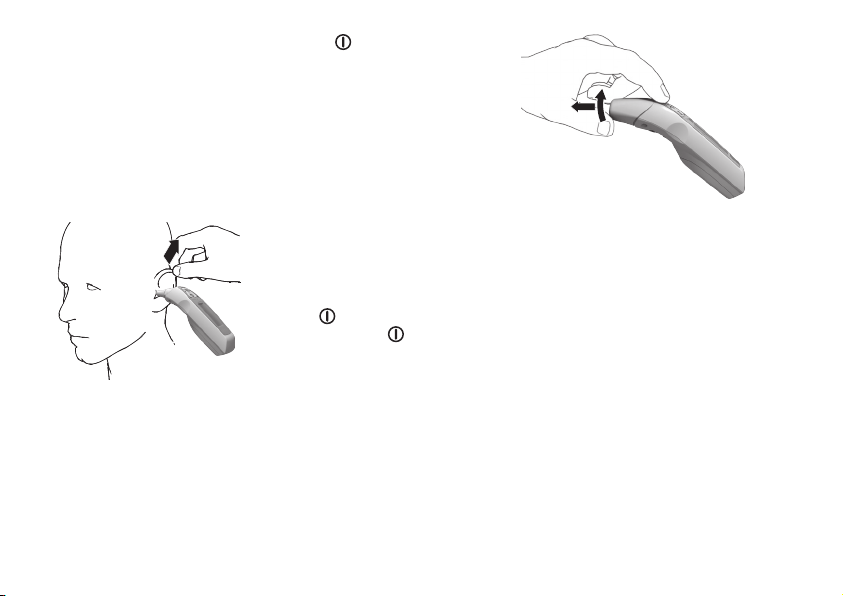
71
ВНИМАНИЕ
Указывает на возможность повреждения прибора/принадлежностей.
Примечание
Отмечает важную информацию.
Соблюдайте инструкцию по применению
Рабочая часть типа BF
Утилизация прибора всоответствии сДирективой ЕС по отходам электрического
иэлектронного оборудования — WEEE (Waste Electrical and Electronic Equipment).
Символ CE подтверждает соответствие основным требованиям директивы омедицинских
изделиях 93/42/EEC.
Storage/Transport
Допустимая температура и влажность воздуха при хранении и транспортировке
Operating
Допустимая рабочая температура и влажность воздуха
Производитель
Хранить в сухом месте
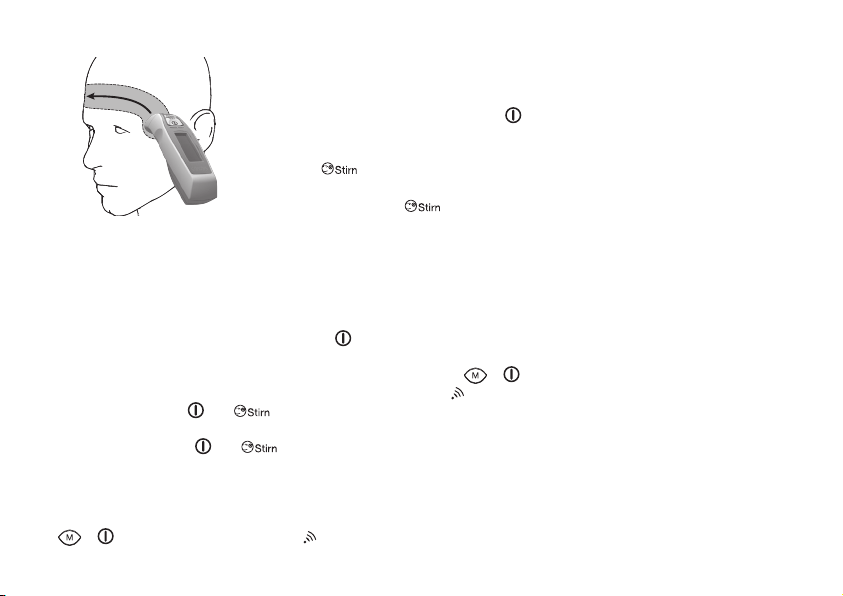
72
21
PAP
Утилизировать упаковку всоответствии спредписаниями поохране окружающей среды
S
N
Серийный номер
2. Указания
Указания по технике безопасности
Предостережение:
• При измерении температуры в ухе осторожно вводите сенсорный наконечник.
• При определенных острых инфекционных заболеваниях не следует применять термометр для не-
скольких людей, т. к. возможно занесение инфекции несмотря на проведение очистки и влажной
дезинфекции. В отдельных случаях необходима консультация лечащего врача.
О
бращение с элементами питания
• При попадании жидкости из аккумулятора на кожу или в глаза необходимо промыть соответствующий
участок большим количеством воды и обратиться к врачу.
•
Опасность проглатывания мелких частей! Маленькие дети могут проглотить батарейки и подавиться
ими. Поэтому батарейки необходимо хранить в недоступном для детей месте!
• Обращайте внимание на обозначение полярности: плюс (+) и минус (-).
• Если батарейка потекла, очистите отделение для батареек сухой салфеткой, надев защитные перчатки.
• Защищайте батарейки от чрезмерного воздействия тепла.
•
Опасность взрыва! Не бросайте батарейки в огонь.
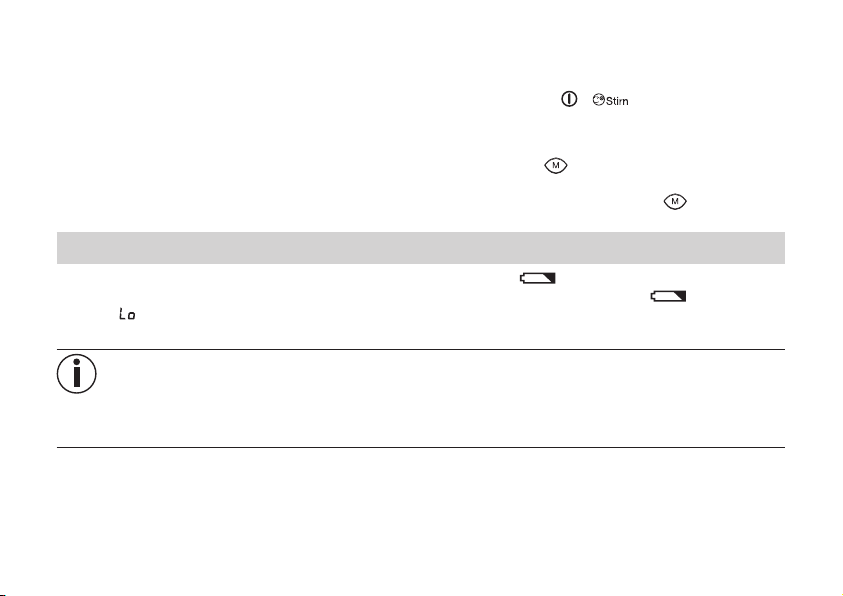
73
• Не заряжайте и не замыкайте батарейки накоротко.
• Если прибор длительное время не используется, извлеките из него батарейки.
• Используйте батарейки только одного типа или равноценных типов.
• Заменяйте все батарейки сразу.
• Не используйте перезаряжаемые аккумуляторы!
• Не разбирайте, не открывайте и не разбивайте батарейки.
Общие указания
• Внимательно прочтите данную инструкцию по применению, сохраните ее для последующего исполь-
зования, храните ее в месте, доступном для других пользователей, и следуйте ее указаниям.
• Данный термометр является чувствительным электронным прибором. Обращайтесь с ним, соблюдая
осторожность и не подвергая его механическим ударам.
• Не допускайте воздействия прямых солнечных лучей на прибор.
• Перед каждым применением проверяйте, не повреждена ли линза. В случае ее повреждения обрати-
тесь к поставщику или в сервисный центр.
• Термометр НЕ является водонепроницаемым. По этой причине следует избегать прямого контакта с
водой или другими жидкостями.
• Термометр SFT 65 предназначен для измерения температуры тела только в месте, указанном в
инструкции по применению.
• Прибор должен использоваться только в целях, описываемых в данной инструкции по применению.
• Измерительный наконечник после каждого применения необходимо очищать мягкой салфеткой,
смоченной дезинфекционным средством.
• Термометр сконструирован для практического применения, но не может заменить визита кврачу.
• Перед заявлением претензий сначала проверьте и при необходимости замените батарейки.
• Ремонт должен производиться только в авторизованных сервисных центрах. В противном случае
гарантия теряет свою силу.
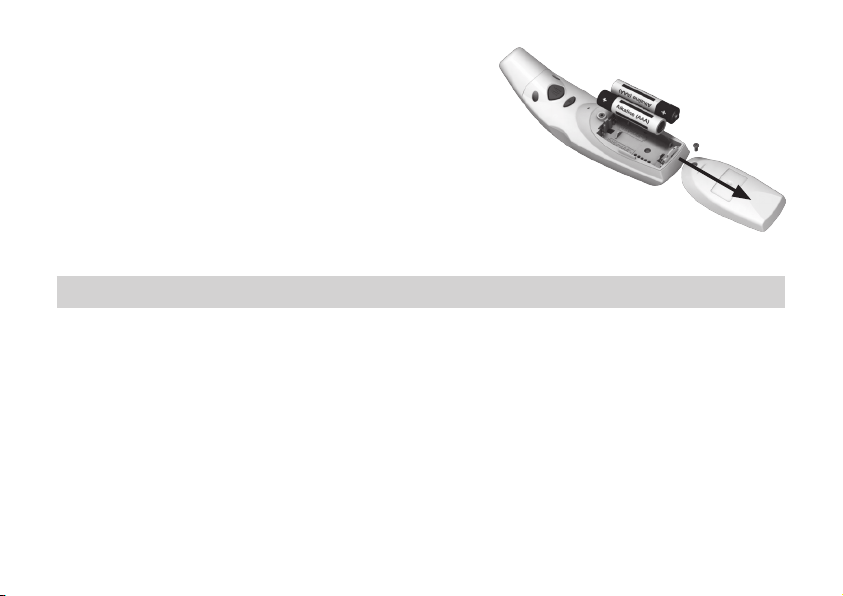
74
• Данный прибор соответствует требованиям Европейской директивы о медицинских изделиях
93/42/EEC, Закону о медицинских изделиях, директиве ASTM E 1965 - 98, Европейскому стандарту
EN 12470-5: Термометры медицинские. Часть 5. Требования к инфракрасным ушным термометрам
(с применением максимального спектра методов) ISO 80601-2-56, а также Европейскому стандарту
EN 60601-1-2 (Соответствие стандартам CISPR11, IEC61000-4-2, IEC61000-4-3, IEC61000-4-8) и
требует соблюдения особых мер предосторожности в отношении электромагнитной совместимости.
Следует учесть, что переносные и мобильные высокочастотные коммуникационные устройства могут
повлиять на данный прибор.
• Если у Вас есть еще вопросы по применению наших приборов, обратитесь, к своему торговому пред-
ставителю или в сервисную службу.
Указания по электромагнитной совместимости
• Прибор предназначен для работы в условиях, перечисленных в настоящей инструкции по применению, в том
числе в домашних условиях.
• При наличии электромагнитных помех возможности использования прибора могут быть ограничены.
Врезультате, например, могут появляться сообщения об ошибках или произойдет выход из строя дисплея/
самого прибора.
• Не используйте данный прибор рядом сдругими устройствами и не устанавливайте его на другие приборы,
это может вызвать ошибки в работе. Однако, если использование прибора все-таки необходимо в том виде,
как описано выше, следует наблюдать за ним и другими устройствами, чтобы убедиться, что они работают
надлежащим образом.
• Применение сторонних принадлежностей, отличающихся от прилагаемого к данному прибору, может
привести к росту электромагнитных помех или ослаблению помехоустойчивости прибора и тем самым
вызвать ошибки в работе.
• Несоблюдение данного указания может отрицательно сказаться на характеристиках мощности прибора.

75
3. Описание прибора
Обзор
1
32 4 5
7
6
1098
1. Колпачок
2. Кнопка режима лобного термометра
3. Кнопка режима ушного термометра/Вкл
/
4. Светодиод (красный) (сигнал повышенной
температуры)
5. Светодиод (зеленый)
6. ЖК-дисплей
7. Сенсорный наконечник с линзой (колпачок снят)
8. Кнопка памяти
9. Кнопка настройки
10. Крышка отделения для батарейки
11. Дата
12. Время
13. Режим измерения («Ухо», «Лоб», «Объект»)
14. Символ «Заряд батарейки»
15. Индикатор результата измерения
16. Символ «Память» и номер в памяти
17. Символ «Производится измерение »
18. Единица измерения (°C или °F)
863
5-15
8
7:20
11
12
13
18
17
161514

76
4. Ввод в эксплуатацию
Новый прибор поставляется уже со вставленными батарейками. Перед первым применением удалите выступаю-
щую защитную пленку с батареек в отделении для батареек. Термометр при этом автоматически включится.
5. Настройка
Настройка единицы индикации температуры, даты и времени
888
8
88:88
Нажимайте в течение 1 секунды кнопку , чтобы включить термометр. Прибор
проводит короткую самопроверку, на дисплее в течение примерно 1 секунды
отображаются все сегменты. После успешной самопроверки раздаются два
коротких звуковых сигнала, в режиме ожидания готовности отображаются дата
и время и появляется индикация «
».
При первом применении термометра и после каждой замены батареек отображается (после самопроверки)
основная настройка даты и времени (
). Задайте единицу индикации температуры, дату и время. При
настройке пройдите несколько этапов: Единица – Год – Месяц – День – Часы – Минуты.
• Для перехода в режим настроек нажимайте примерно в течение 3 секунд кнопку
.
Будет мигать область, которая подлежит изменению.
• Нажмите кнопку , чтобы сохранить эту настройку или
• нажмите кнопку , чтобы изменить настройку.
• Затем нажмите кнопку , чтобы сохранить эту настройку.
После этой операции на дисплее отобразится
, и термометр автоматически выключится.
77
6. Что необходимо знать перед измерением
Существуют различные термометры для измерения на различных частях тела:
• ушные/лобные термометры (данный термометр, для измерения в ухе или в области лба)
• стержневые термометры (для ректального (в прямой кишке), аксиального (в подмышечной впадине) или
орального измерения (во рту))
В результате измерения температуры получают значение, которое информирует отемпературе тела
человека на момент измерения. Если возникли сомнения втолковании результатов измерения или имеют
место необычные значения, обратитесь клечащему врачу. Это относится также кнезначительным из-
менениям температуры, когда кним добавляются дополнительные симптомы заболевания, например,
беспокойство, сильное потоотделение, покраснение кожных покровов, высокая частота пульса, склон-
ность кколлапсам ит.д.
Значения температуры, полученные спомощью различных термометров, не подлежат сравнению друг
сдругом. Поэтому сообщайте вашему врачу (или учитывайте при самодиагностике), каким термометром
на какой части тела измерялась температура.
На температуру здорового человека влияют различные факторы: индивидуальный обмен веществ,
возраст (температура тела умладенцев ималеньких детей выше ипадает свозрастом; удетей быстрее
ичаще возникают более высокие колебания температуры, вызванные, например, ростовыми скачками),
одежда, температура окружающей среды, время суток (утром температура ниже ирастет втечение дня
до вечера), предшествующая физическая и, вменьшей степени, также умственная деятельность.
Значение температуры зависит также от части, тела, на которой она измеряется. Различия уздоро-
вого человека могут составлять от 0,2 °C (0,4 °F) до 1 °C (1,8 °F). Нормальным диапазоном температуры
считается:
• при лобном измерении: от 35,8 °C (96,4 °F) до 37,6 °C (99,7 °F), спомощью лобного термометра
• при ушном измерении: от 36,0 °C (96,8 °F) до 37,8 °C (100 °F), спомощью ушного термометра
• при ректальном измерении: от 36,3 °C (97,3 °F) до 37,8 °C (100 °F), спомощью обычного термометра
• при оральном измерении: от 36,0 °C (96,8 °F) до 37,4 °C (99,3 °F), спомощью обычного термометра
Для возможности отслеживания изменения температуры всегда выполняйте измерения на одной итой
же части тела.

78
7. Измерения
Перед каждым применением проверяйте, не повреждена ли линза. В случае ее повреждения обратитесь к по-
ставщику или в сервисный центр.
Учитывайте, что термометр должен находиться в помещении, в котором выполняется измерение, втечение не
более 30 минут.
Измерение температуры в ухе
• Существуют люди, имеющие разную температуру в левом и правом ухе. Для отслеживания изменений
температуры всегда измеряйте температуру у одного и того же человека водном и том же ухе.
• Ушной термометр должен применяться у детей только под присмотром взрослых. Как правило, из-
мерение температуры у детей возможно с 6 месяцев. У младенцев до 6 месяцев ушной проход еще
очень мал, поэтому часто температуру барабанной перепонки измерить невозможно, в связи с чем
часто имеют место заниженные результаты измерения.
• Запрещается проводить измерение температуры в ухе с воспалительными заболеваниями (например,
выделение гноя, секрета), после возможных ушных травм (например, при поврежденной барабан-
ной перепонке) или в стадии выздоровления после оперативного вмешательства. Во всех подобных
случаях необходима консультация с лечащим врачом.
• При определенных острых инфекционных заболеваниях не следует применять термометр для не-
скольких людей, т. к. возможно занесение инфекции несмотря на проведение очистки и влажной
дезинфекции. В отдельных случаях необходима консультация лечащего врача.
• Данный термометр должен использоваться только без одноразовой защитной оболочки.
• Если вы длительное время лежали на одном ухе, температура в нем будет слегка повышена. Подо-
ждите немного или измерьте температуру в другом ухе.
• Ушная сера может повлиять на результаты измерения, поэтому очистите при необходимости ухо
перед измерением.
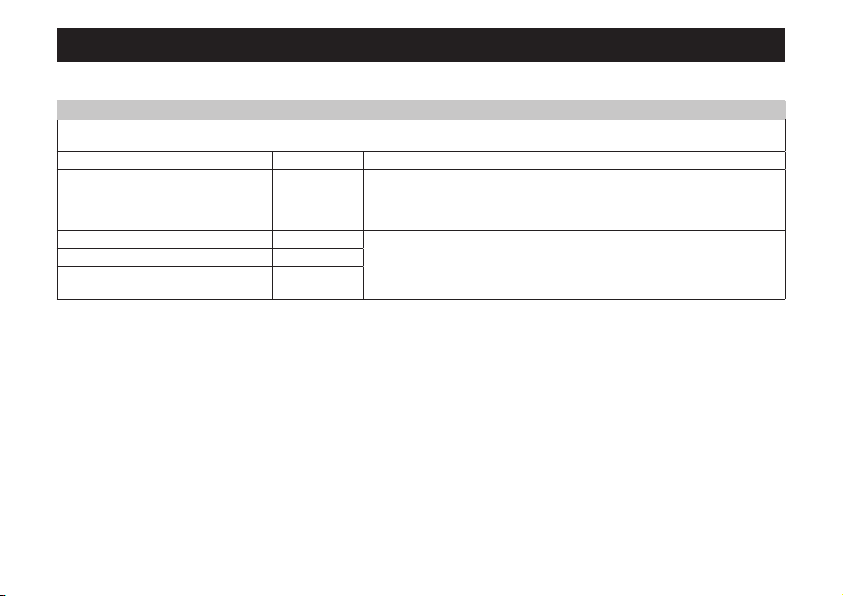
79
• Нажимайте в течение 1 секунды кнопку
, чтобы включить термо-
метр. После успешной самопроверки раздадутся два коротких
звукового сигнала.
• Снимите колпачок, слегка нажав вверх (1) и потянув его вперед (2).
12
Убедитесь в чистоте сенсорного наконечника и слухового прохода.
Поскольку слуховой проход слегка изогнут, перед введением сенсорного нако-
нечника ухо следует слегка потянуть назад и вверх, чтобы сенсорный наконечник
можно было направить непосредственно на барабанную перепонку.
• Осторожно введите сенсорный наконечник и в течение 1 секунды нажимайте
кнопку .
• Отпустите кнопку . По окончании измерения раздастся короткий звуковой
сигнал, измеренное значение появится на дисплее.
Если измеренное значение находится в пределах нормальной температуры
(< 38 °C/100,4 °F), на 3 секунды загорится зеленый светодиод. При более высоком
измеренном значении (≥ 38 °C/100,4 °F, жар) загорится красный светодиод.

80
Измерение температуры тела на лбу
Обратите внимание, что на лбу/виске не должно быть пота или косметики ичто при
лобном измерении на результате могут сказаться прием сосудосужающих медикамен-
тов и раздражение кожи.
• Нажимайте в течение 1 секунды кнопку , чтобы включить термометр. После
успешной самопроверки раздадутся два коротких звукового сигнала.
• Приставьте измерительную головку с надетым колпачком к виску, держите нажа-
той кнопку и плавно проведите термометром по лбу в направлении другого
виска.
• Затем отпустите кнопку . По окончании измерения раздастся короткий звуко-
вой сигнал, измеренное значение появится на дисплее.
Если измеренное значение находится в пределах нормальной температуры (< 38 °C/100,4 °F), на 3 секунды за-
горится зеленый светодиод. При более высоком измеренном значении (≥ 38 °C/100,4 °F, жар) загорится красный
светодиод.
Измерение температуры поверхности
• Нажимайте в течение 1 секунды кнопку
, чтобы включить термометр. После успешной самопроверки раз-
дадутся два коротких звукового сигнала.
• Затем в течение 3 секунд нажимайте одновременно кнопки и , чтобы перейти в режим измерения
температуры объекта. На дисплее появится изображение .
• Нажмите кнопку или и, удерживая кнопку нажатой, направьте сенсорный наконечник на расстоянии
3 см до измеряемого предмета или жидкости (ни в коем случае не погружайте вжидкость).
• Отпустите кнопку или . По окончании измерения раздастся короткий звуковой сигнал, измеренное
значение появится на дисплее.
Обратите внимание, что отображаемая температура является установленной температурой поверхности, а не
согласованной. Ее нельзя сравнивать с температурой лба или уха.
Чтобы снова перейти в режим ушного/лобного термометра, в течение 3 секунд нажимайте одновременно кнопки
и , пока не погаснет индикация и не раздастся короткий звуковой сигнал. При выключении или включе-
81
нии термометра выполняется автоматический выход из режима измерения температуры объекта.
При отключении термометра автоматически сохраняется значение, измеренное последним, то есть только по-
следнее значение ряда измерений. Для этого имеются 10 ячеек памяти.
Если больше не последует ввода каких-либо значений, термометр после отображения измеренного значения
примерно через одну минуту автоматически отключится.
Для запроса сохраненных значений включите термометр и нажмите кнопку
.
Отобразятся дата, время, номер памяти и символ режима измерения, а также температура. Перемещение по
результатам измерений, сохраненным в памяти, осуществляется повторным нажатием кнопки .
8. Замена батареек
При разрядке батареек появляется символ индикации смены батарейки . Измерение температуры еще
возможно, но батарейки следует заменить. Если мигает символ индикации смены батарейки и на дисплее
появился , батарейки необходимо заменить. При недостаточной зарядке батареек термометр автоматически
выключается.
Указание:
• При замене батареек используйте батарейки того же типа, той же марки и такой же емкости.
• Всегда меняйте все батарейки одновременно.
• Не используйте повторно заряжаемые аккумуляторы.
• Используйте батарейки, не содержащие тяжелых металлов.
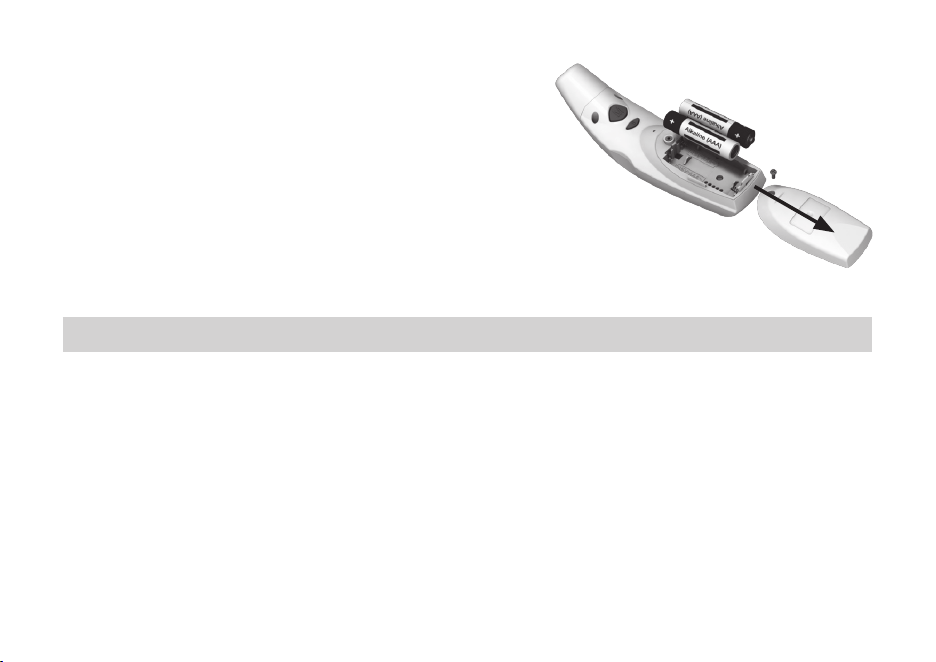
82
1. Выкрутите винт в крышке отделения для батарейки иснимите
крышку, потянув ее вниз.
2. Извлеките старые батарейки и установите две новые всоответ-
ствующем направлении.
3. Закройте крышку отделения для батарейки и снова закрутите
винты на крышке.
Утилизируйте использованные батарейки в соответствии
сдействующими законодательными предписаниями. Никогда не
бросайте батарейки в бытовые отходы.
9. Хранение и уход
• Производите чистку сенсорного наконечника после каждого применения. Используйте для этого мягкую
салфетку или ватную палочку, смоченную дезинфекционным средством, спиртом или теплой водой.
• Для очистки всего прибора используйте мягкую салфетку, слегка смоченную мыльным раствором.
• Не используйте агрессивных чистящих средств.
• Храните термометр всегда с надетым колпачком.
• При намеренном длительном хранении извлеките батарейки.
• Запрещается хранить прибор или использовать его при слишком высокой или низкой температуре или влаж-
ности воздуха (см. технические данные) на ярком солнечном свете, в сочетании с электрическим током или в
пыльных местах. В противном случае возможны неточности при измерении.

83
10. Утилизация
•
Выбрасывайте использованные, полностью разряженные батарейки в специальные контейнеры, сдавайте в
пункты приема спецотходов или в магазины электрооборудования. Закон обязывает пользователей обеспечить
утилизацию батареек.
•
Эти знаки предупреждают о наличии в батарейках токсичных веществ:
Pb = свинец,
Cd = кадмий,
Hg = ртуть.
• В интересах охраны окружающей среды категорически запрещается выбрасывать прибор по
завершении срока его службы вместе с бытовыми отходами. Утилизация должна производиться через
соответствующие пункты сбора в Вашей стране. Прибор следует утилизировать согласно Директиве ЕС
по отходам электрического и электронного оборудования – WEEE (Waste Electrical and Electronic
Equipment). В случае вопросов обращайтесь в местную коммунальную службу, ответственную за утилизацию
отходов.
11. Технические характеристики
Примечание: В случае применения прибора вне рамок спецификации безупречное функционирование не гаран-
тируется! Мы оставляем за собой право на технические изменения в связи с модернизацией и усовершенствова-
нием продукта.
Точность данного термометра была тщательно проверена, прибор был разработан с расчетом на длительный
срок эксплуатации.
При использовании прибора в медицинских учреждениях необходимо провести измерительную техническую про-
верку с помощью соответствующих средств. Точные данные для проверки точности прибора можно запросить в
сервисном центре.

84
Название и модель
SFT65
Диапазон измерений Режим ушного/лобного термометра: 34 °C до 43 °C (93,2 °F до 109,4 °F)
Режим измерения температуры объекта: 0 °C до 100 °C (32 °F до 212 °F)
Лабораторная точность
измерений
Режим ушного термометра: ±0,2 °C (±0,4 °F) от 35°C до 42 °C (95,0 °F до 107,6 °F)
,
вне этого диапазона измерений ±0,3 °C (±0,5 °F),
Режим лобного термометра:
±0,2 °C (±0,4 °F) от 35°C до 42 °C (95,0 °F до 107,6 °F)
,
вне этого диапазона измерений ±0,3 °C (±0,5 °F),
Режим измерения температуры объекта:
±1,5 °C (±2,7 °F) при < 30 °C (86 °F); ±5% при ≥ 30 °C (86 °F)
Временной интервал
между двумя измерениями
Минимум 5 секунд
Клиническая точность
воспроизведения
результатов
Ухо: дети, 1–5 лет: ±0,08 °C (±0,14 °F)
взрослые: ±0,07 °C (±0,13 °F)
Лоб: дети, 1–5 лет: ±0,07 °C (±0,13 °F)
взрослые: ±0,08 °C (±0,14 °F)
Единицы измерения °Цельсия (°C) или °Фаренгейта (°F)
Условия эксплуатации От 15 °C до 35 °C (59 °F до 95 °F) при относительной влажности воздуха до 85% (без
образования конденсата)
Окружающие условия при
хранении
От -25 °C до 55 °C (-13 °F до 131 °F) при относительной влажности воздуха до 85% (без
образования конденсата)
Размеры 138 x 35 x 33 mm
Вес 90 г, включая батарейки
Батарейка 2 x 1,5 В AAA (LR03)
Память Для 10 измерений
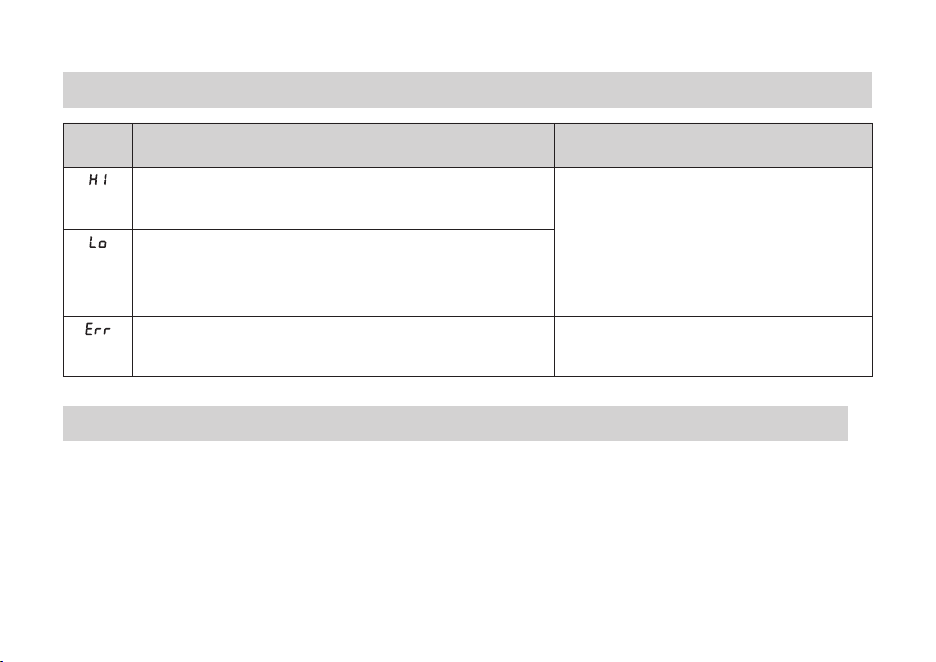
85
Серийный номер находится на приборе или в отделении для батареек.
12. Устранение неисправностей
Инди-
катор
Причина Мера по устранению
Определяемая температура превышает
1) Режим ушного/лобного термометра: 43 °C (109,4 °F)
2) Режим измерения температуры объекта: 100 °C (212 °F)
Используйте термометр только для
измерений в пределах указанного
диапазона температур. При
необходимости очистите сенсорный
наконечник. При повторной индикации
неисправности обратитесь к
специализированному дилеру или в
службу сервиса.
Определяемая температура ниже
1) Режим ушного/лобного термометра: 34 °C (93,2 °F)
2) Режим измерения температуры объекта: 0 °C (32 °F)
Температура эксплуатации находится вне диапазона
15 °C – 35 °C (59 °F – 95 °F)
Используйте термометр только для из-
мерений в пределах указанного диапазона
температур.
13. Гарантия/Сервисное Обслуживание
Более подробная информация по гарантии/сервису находится в гарантийном/сервисном талоне, который
входит в комплект поставки.
Возможны ошибки и изменения
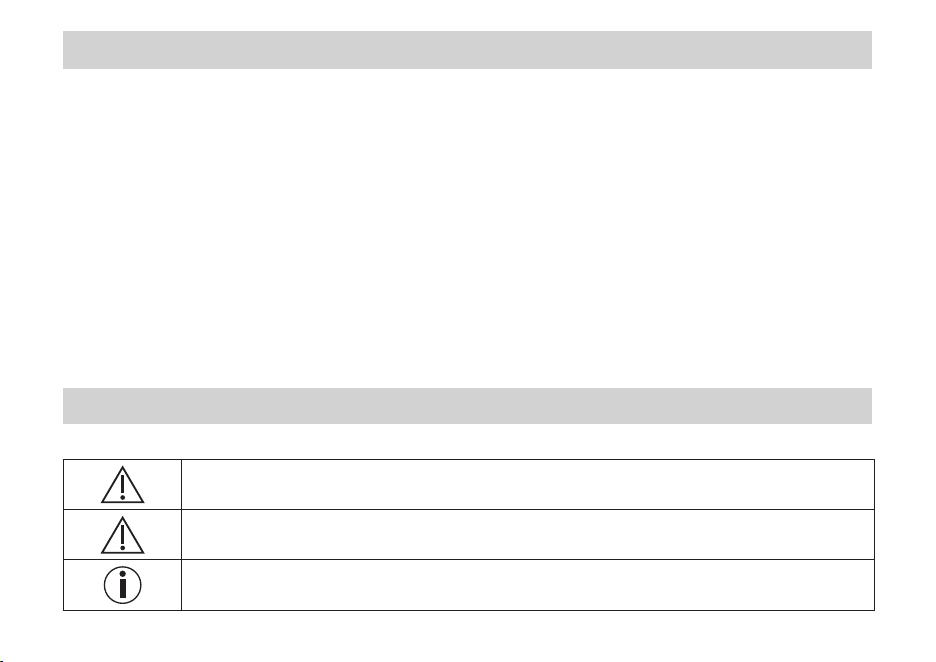
86
Zawartość opakowania
• Termometr
• 2 baterie 1,5 VAAA (LR03)
• Instrukcja obsługi
Niniejszą instrukcję obsługi należy dokładnie przeczytać izachować. Przechowywać ją wmiejscu dostępnym dla innych
użytkowników oraz przestrzegać podanych wniej wskazówek.
1. Objaśnienie symboli
W niniejszej instrukcji ina urządzeniu zastosowano następujące symbole:
OSTRZEŻENIE
Ostrzeżenie przed niebezpieczeństwem obrażeń ciała lub utraty zdrowia.
UWAGA
Wskazówki bezpieczeństwa odnoszące się do możliwości uszkodzenia urządzenia/akcesoriów.
Wskazówka
Wskazówka zważnymi informacjami.
1. Objaśnienie symboli .................................................. 86
2. Wskazówki ................................................................ 88
3. Opis urządzenia ......................................................... 91
4. Uruchomienie ............................................................ 92
5. Ustawianie ................................................................. 92
6. Co należy wiedzieć przed dokonaniem pomiaru ....... 93
7. Pomiar ....................................................................... 94
8. Wymiana baterii ....................................................... 97
9. Przechowywanie ikonserwacja ............................... 98
10. Utylizacja ................................................................. 98
11. Dane techniczne ...................................................... 99
12. Usuwanie usterek .................................................... 101
13. Gwarancja / ser wis ................................................... 101
Indice
Polski
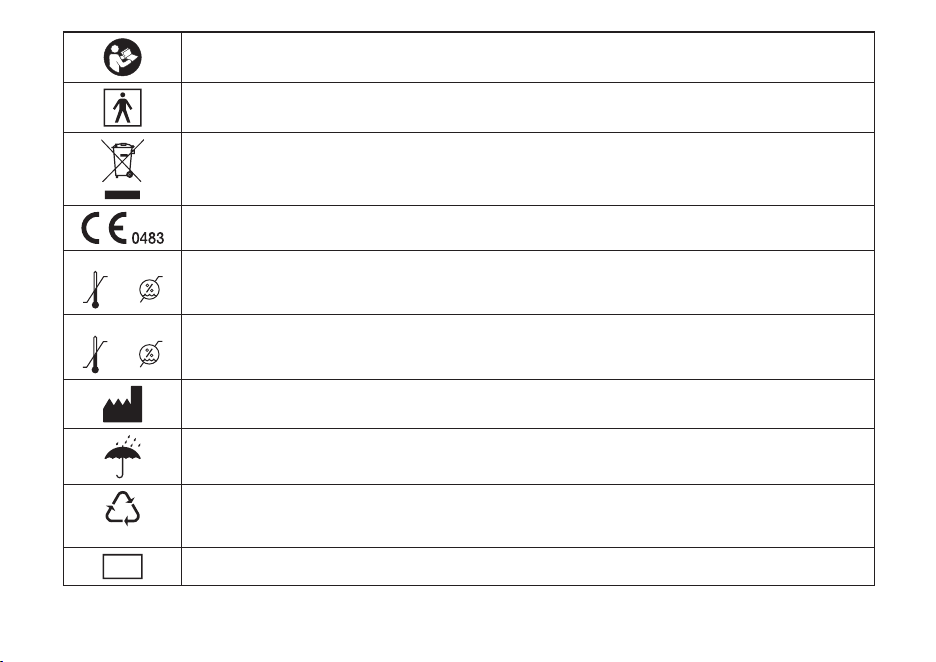
87
Należy przestrzegać instrukcji obsługi
Część aplikacyjna typ BF
Utylizacja zgodnie zdyrektywą WE wsprawie zużytego sprzętu elektrycznego ielektronicznego –
WEEE (Waste Electrical and Electronic Equipment)
Oznakowanie CE potwierdza zgodność zzasadniczymi wymogami dyrektywy 93/42/EEC wsprawie
wyrobów medycznych.
Storage/Transport
Dopuszczalna temperatura i wilgotność powietrza podczas przechowywania oraz podczas transportu
Operating
Dopuszczalna temperatura i wilgotność powietrza podczas pracy
Producent
Chronić przed wilgocią
21
PAP
Opakowanie zutylizować w sposób przyjazny dla środowiska
S
N
Numer seryjny
88
2. Wskazówki
Instrukcje bezpieczeństwa
Ostrzeżenie:
• Wprzypadku pomiaru wuchu ostrożnie wprowadzić końcówkę czujnika termometru.
• Nie jest zalecane stosowanie termometru uróżnych osób wprzypadku niektórych ostrych chorób zakaź-
nych. Pomimo przeprowadzenia czyszczenia idezynfekcji może wówczas dojść do rozprzestrzeniania
bakterii i zarazków. Wprzypadku pytań należy skontaktować się ze swoim lekarzem.
Wskazówki dotyczące postępowania z bateriami
•
Jeśli dojdzie do kontaktu elektrolitu ze skórą lub oczami, należy przemyć dane miejsce wodą i skontaktować się z leka-
rzem.
•
Istnieje niebezpieczeństwo połknięcia! Małe dzieci mogłyby połknąć baterie i się nimi udusić. Dlatego baterie
należy przechowywać w miejscach niedostępnych dla dzieci.
•
Należy zwrócić uwagę na znak polaryzacji plus (+) i minus (-).
•
Jeśli z baterii wyciekł elektrolit, należy założyć rękawice ochronne i wyczyścić przegrodę na baterie suchą szmatką.
•
Baterie należy chronić przed nadmiernym działaniem wysokiej temperatury.
•
Zagrożenie wybuchem! Nie wrzucać baterii do ognia.
•
Nie wolno ładować ani zwierać baterii.
•
W przypadku niekorzystania z urządzenia przez dłuższy czas wyjąć baterie z przegrody.
•
Należy używać tylko tego samego lub równoważnego typu baterii.
•
Zawsze należy wymieniać jednocześnie wszystkie baterie.
•
Nie należy używać akumulatorów!
•
Nie wolno rozmontowywać, otwierać ani rozdrabniać baterii.
89
Wskazówki ogólne
• Niniejszą instrukcję obsługi należy dokładnie przeczytać izachować. Przechowywać ją wmiejscu dostęp-
nym dla innych użytkowników oraz przestrzegać podanych wniej wskazówek.
• Ten termometr jest czułym urządzeniem elektronicznym. Należy obchodzić się znim ostrożnie inie narażać
go na uderzenia mechaniczne.
• Nie wystawiać urządzenia na bezpośrednie działanie promieni słonecznych.
• Przed każdym użyciem termometru sprawdzić, czy soczewka nie jest uszkodzona. Jeśli soczewka jest
uszkodzona, zwrócić się do sprzedawcy lub serwisu.
• Termometr NIE jest wodoszczelny. Ztego powodu należy unikać bezpośredniego kontaktu zwodą lub
innymi cieczami.
• Pomiary temperatury za pomocą termometru FT65 należy wykonywać wyłącznie w miejscach określonych
w instrukcji obsługi.
• Urządzenie jest przeznaczone wyłącznie do używania wcelu określonym wniniejszej instrukcji obsługi.
• Po każdym użyciu wyczyścić końcówkę pomiarową miękką szmatką nawilżoną środkiem dezynfekującym.
• Termometr został skonstruowany do zastosowań praktycznych, jednak nie zastępuje wizyty ulekarza.
• Przed złożeniem reklamacji należy zawsze sprawdzić baterie iwrazie potrzeby je wymienić.
• Naprawy mogą być przeprowadzane wyłącznie przez autoryzowane punkty serwisowe. Wprzeciwnym razie
grozi utrata gwarancji.
• Urządzenie jest zgodne z dyrektywą Unii Europejskiej w sprawie produktów medycznych 93/42/EEC,
ustawą o produktach medycznych, standardem ASTM E 1965 - 98 oraz europejską normą EN 12470-5:
Termometry medyczne – część 5: Termometry do uszu działające na podczerwień (z urządzeniem maksy-
malnym) ISO 80601-2-56 oraz normą europejską EN60601-1-2 (zgodność z CISPR11, IEC61000-4-2,
IEC61000-4-3, IEC61000-4-8) i wymaga zachowania szczególnych środków ostrożności wzakresie kompa-
tybilności elektromagnetycznej. Należy pamiętać, że przenośne urządzenia do komunikacji pracujące na
wysokich częstotliwościach mogą zakłócać działanie urządzenia.
• Wprzypadku dalszych pytań dotyczących naszych urządzeń należy skontaktować się zdystrybutorem lub
działem obsługi klienta.
90
Wskazówki dot. kompatybilności elektromagnetycznej
• Urządzenie jest przeznaczone do użytkowania w każdym otoczeniu wymienionym w niniejszej instrukcji
obsługi, włącznie z domem.
• Przy zakłóceniach elektromagnetycznych w pewnych warunkach urządzenie może być użytkowane tylko w
ograniczonym zakresie. Wskutek tego mogą wystąpić np. komunikaty o błędach lub awaria wyświetlacza/
urządzenia.
• Należy unikać stosowania tego urządzenia bezpośrednio obok innych urządzeń lub wraz z innymi urządze-
niami w skumulowanej formie, ponieważ mogłoby to skutkować nieprawidłowym działaniem. Jeśli stoso-
wanie w wyżej opisany sposób jest konieczne, należy obserwować niniejsze urządzenie i inne urządzenia w
celu upewnienia się, że działają prawidłowo.
• Stosowanie innych akcesoriów niż te określone lub udostępnione przez producenta urządzenia może prowa-
dzić do zwiększenia zakłóceń elektromagnetycznych lub do zmniejszenia odporności elektromagnetycznej
urządzenia oraz do nieprawidłowego działania.
• Nieprzestrzeganie tej instrukcji może prowadzić do ograniczenia wydajności urządzenia.
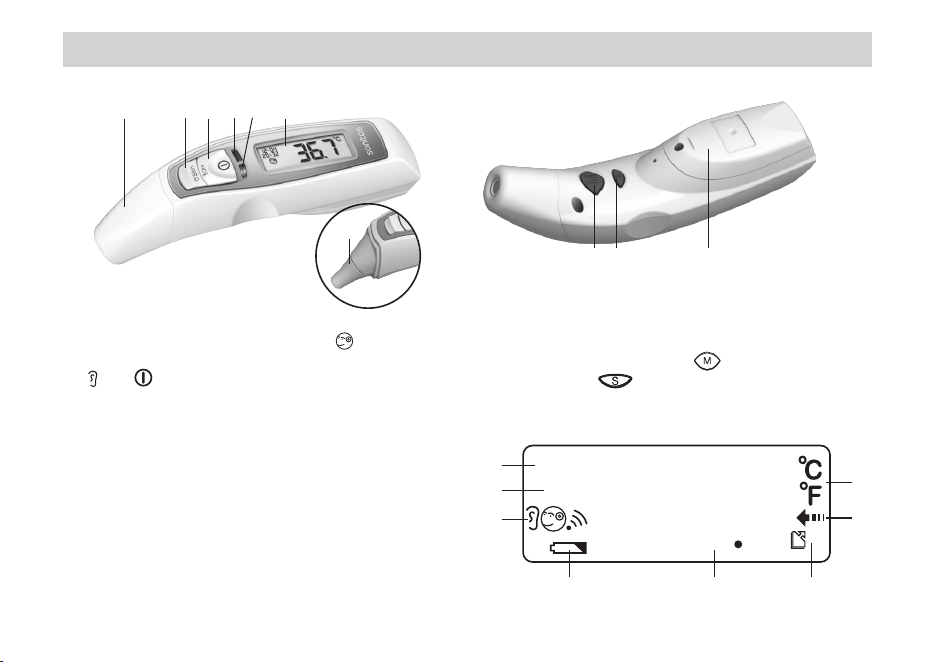
91
3. Opis urządzenia
Budowa urządzenia
1
32 4 5
7
6
1098
1 Nasadka czołowa/pokrywa
2 Przycisk trybu termometru czołowego
Stirn
Forehead
3 Przycisk włączania trybu termometru usznego
Ohr
Ear /
4 Dioda LED (czerwona) (alarm gorączkowy)
5 Dioda LED (zielona)
6 Ekran LCD
7 Końcówka czujnika zsoczewką (zdjęta nasadka)
8 Przycisk pamięci (Memory)
9 Przycisk Set
10 Pokrywa komory baterii
11 Data
12 Godzina
13 Tryb pomiaru („ucho“, „czoło“, „obiekt“)
14 Symbol wyczerpania baterii
15 Wyświetlenie wyniku pomiaru
16 Symbol pamięci inumer miejsca pamięci
17 Symbol „Pomiar trwa“
18 Jednostka wyniku pomiaru (°C lub °F)
863
5-15
8
7:20
11
12
13
18
17
161514
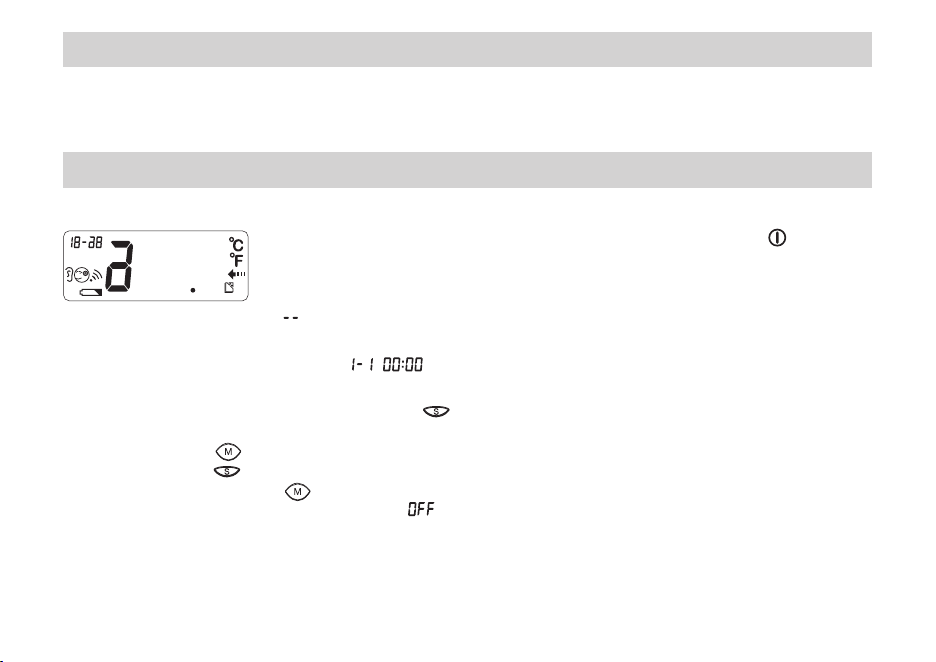
92
4. Uruchomienie
Baterie są już założone wnowym urządzeniu. Przed pierwszym użyciem wyjąć pasek ochronny baterii wystający zkomo-
ry baterii. Termometr włączy się wówczas automatycznie.
Poniżej można znaleźć dalsze informacje oraz często zadawane pytania (FAQ): http://www.beurer.com
5. Ustawianie
Ustawianie jednostki temperatury, daty i godziny.
888
8
88:88
Aby włączyć termometr, nacisnąć iprzytrzymać przez 1 sekundę przycisk . Nastąpi
wówczas wykonanie krótkiego autotestu. Na ekranie zostaną wyświetlone wszystkie
segmenty przez ok. 1 sekundę. Po udanym wykonaniu autotestu słychać będzie dwa
krótkie dźwięki. Wtrybie gotowości nastąpi wyświetlenie daty igodziny oraz symbolu „
“
.
Jeśli termometr używany jest po raz pierwszy lub wymieniono baterie, po przeprowadzeniu testu automatycznego wy-
świetlana będzie domyślna data i godzina ( ). Ustaw jednostkę temperatury, datę i godzinę. Proces ustawiania
składa się z kilku czynności: jednostka – rok – miesiąc – dzień – godziny – minuty.
• Nacisnąć iprzytrzymać przez 3 sekundy przycisk
, aby przejść do trybu ustawiania.
Zmieniana wartość będzie migać.
• Nacisnąć przycisk , aby zapisać to ustawienie, lub
• nacisnąć przycisk , aby zmienić to ustawienie.
• Następnie nacisnąć przycisk , aby zapisać to ustawienie.
Po wykonaniu tych czynności na ekranie pojawi się inastąpi automatyczne wyłączenie termometru.
93
6. Co należy wiedzieć przed dokonaniem pomiaru
Istnieją różne termometry do pomiaru temperatury na różnych częściach ciała:
• termometr do ucha/czoła (ten termometr, do pomiaru wuchu lub na czole),
• termometr prętowy (do pomiaru wodbycie, pod pachą lub wustach).
Pomiar temperatury dostarcza wartość pomiarową, która informuje oaktualnej temperaturze ludzkiego ciała.
Wrazie wątpliwości dotyczących interpretacji wyników lub wystąpienia wartości znacznie odbiegających od
wartości normalnych należy skontaktować się ze swoim lekarzem. To samo dotyczy również niewielkich zmian
temperatury, gdy występują dodatkowo inne symptomy chorobowe, np. niepokój, silne pocenie, zaczerwienienie
skóry, przyspieszone tętno, zasłabnięcia itp.
Nie można porównywać temperatur zmierzonych różnymi termometrami. Dlatego też należy poinformować leka-
rza (lub uwzględnić to przy diagnozie własnej), jakim termometrem dokonano pomiaru jakiej części ciała.
Na temperaturę zdrowego człowieka mają wpływ różne czynniki: indywidualna dla każdej osoby przemiana ma-
terii, wiek (temperatura ciała noworodków imałych dzieci jest wyższa ispada wraz zwiekiem; wprzypadku dzie-
ci większe wahania temperatury występują szybciej iczęściej, np. zpowodu rośnięcia), od odzieży, temperatury
zewnętrznej, pory dnia (rano temperatura ciała jest niższa iwzrasta wciągu dnia), od wykonywanych czynności
fizycznych oraz – wmniejszym stopniu – umysłowych.
Wartość temperatury waha się wzależności od miejsca ciała, na którym jest mierzona. Odchylenie to uzdro-
wych ludzi może wynosić od 0,2°C (0,4°F) – 1°C (1,8°F). Normalny zakres temperatur wprzypadku
• pomiaru na czole: 35,8°C (96,4°F) – 37,6°C (99,7°F), za pomocą termometru czołowego,
• pomiar wuchu: 36,0°C (96,8°F) – 37,8°C (100°F), za pomocą termometru usznego,
• temperatura mierzona wodbycie: 36,3°C (97,3°F) – 37,8°C (100°F), za pomocą termometru
konwencjonalnego,
• temperatura mierzona wustach: 36,0°C (96,8°F) – 37,4°C (99,3°F), za pomocą termometru
konwencjonalnego.
Aby rejestrować zmiany temperatury, należy dokonywać pomiaru zawsze na tej samej części ciała.
94
7. Pomiar
Przed każdym użyciem termometru sprawdzić, czy soczewka nie jest uszkodzona. Jeśli soczewka jest uszkodzona,
zwrócić się do sprzedawcy lub serwisu.
Należy pamiętać, że termometr musi się znajdować od co najmniej 30 minut wpomieszczeniu, wktórym dokonywany
jest pomiar.
Pomiar temperatury ciała wuchu
• Wprzypadku niektórych osób mogą wystąpić różne wartości pomiarowe wlewym iwprawym uchu. Aby
rejestrować zmiany temperatury utakich osób, należy dokonywać pomiarów zawsze wtym samym uchu.
• Termometr do ucha może być używany przez dzieci tylko pod nadzorem dorosłych. Zreguły można dokony-
wać pomiaru od 6 miesiąca życia. Umałych dzieci poniżej 6 miesiąca życia przewód słuchowy jest jeszcze
bardzo wąski. Uniemożliwia to zmierzenie temperatury błony bębenkowej iczęsto powoduje zaniżanie
odczytów.
• Pomiar nie może być przeprowadzany wuchu ze stanem zapalnym (np. wysięk ropny), po ewentualnych
obrażeniach ucha (np. uszkodzenie bębenka) lub wfazie leczenia po ingerencjach operacyjnych. We wszyst-
kich tych przypadkach należy skonsultować się ze swoim lekarzem.
• Nie jest zalecane stosowanie termometru uróżnych osób wprzypadku niektórych ostrych chorób zakaź-
nych. Pomimo przeprowadzenia czyszczenia idezynfekcji może wówczas dojść do rozprzestrzeniania
bakterii i zarazków. Wprzypadku pytań należy skontaktować się ze swoim lekarzem.
• Ten termometr może być stosowany tylko bez jednorazowej osłony.
• Leżenie przez dłuższy czas zuchem przyłożonym do poduszki może spowodować lekkie podwyższenie
temperatury tego ucha. Należy chwilę odczekać lub zmierzyć temperaturę wdrugim uchu.
• Woskowina może mieć wpływ na pomiar, dlatego przed pomiarem należy wyczyścić ucho.
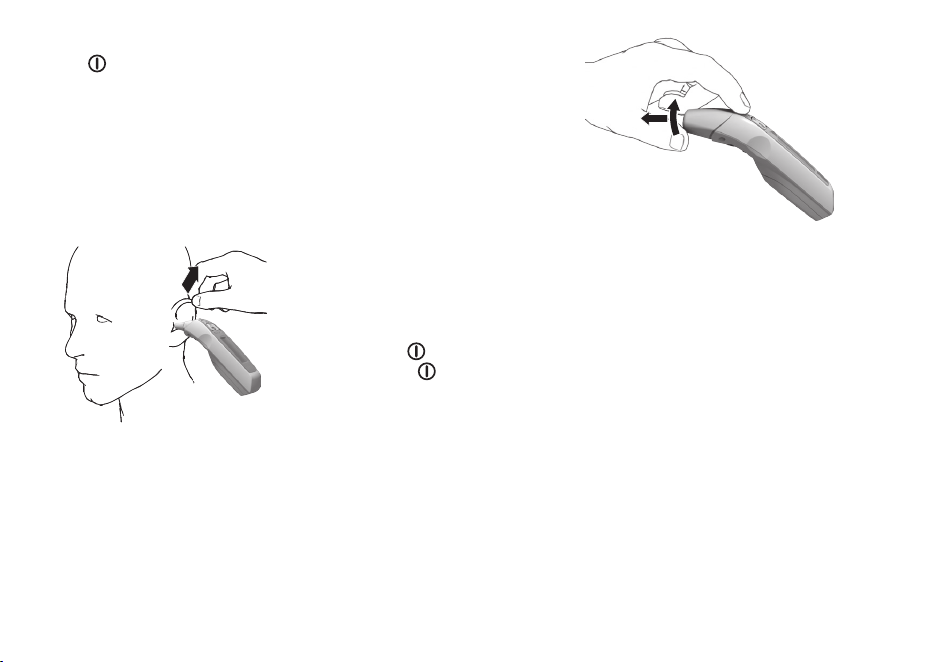
95
• Aby włączyć termometr, nacisnąć iprzytrzymać przez 1 sekundę przycisk
. Po udanym wykonaniu autotestu słychać będzie dwa krótkie dźwięki.
• Zdjąć nasadkę, wciskając ją lekko wgórę (1), anastępnie zdjąć do
przodu (2).
12
Należy się upewnić, że końcówka czujnika iprzewód słuchowy są czyste.
Ponieważ przewód słuchowy jest lekko zakrzywiony, przed wprowadzeniem końcówki
czujnika należy lekko pociągnąć ucho do góry ido tyłu, aby końcówka czujnika była
skierowana na błonę bębenkową.
• Ostrożnie wprowadzić końcówkę czujnika inacisnąć oraz przytrzymać przez 1 se-
kundę przycisk .
• Zwolnić przycisk . Krótki dźwięk informuje ozakończeniu pomiaru, azmierzona
wartość jest wyświetlana na ekranie.
Jeżeli zmierzona wartość znajduje się wzakresie normy (< 38°C/100,4°F), zielona dioda LED zaświeci się na 3 sekundy.
Jeżeli zmierzona wartość jest wyższa (≥ 38°C/100,4°F, gorączka), zaświeci się czerwona dioda LED.
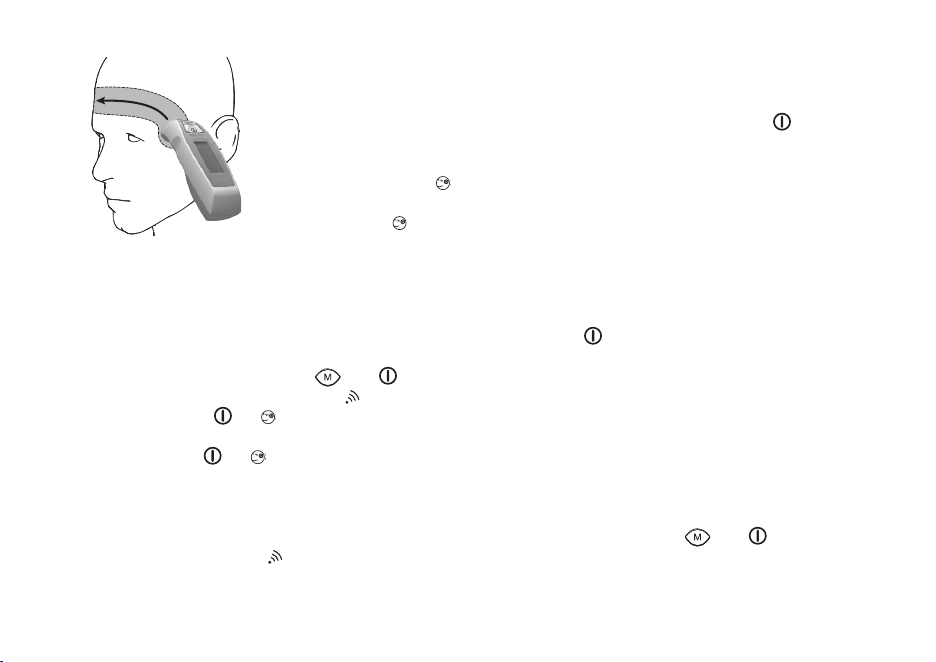
96
Pomiar temperatury ciała na czole
Należy pamiętać otym, aby czoło lub skroń nie były pokryte potem ani kosmetykami. Wynik
pomiaru na czole może być niedokładny wprzypadku przyjmowania leków zwężających
naczynia krwionośne lub występowania podrażnień skóry.
• Aby włączyć termometr, nacisnąć iprzytrzymać przez 1 sekundę przycisk . Po uda-
nym wykonaniu autotestu słychać będzie dwa krótkie dźwięki.
• Przyłożyć do skroni głowicę pomiarową znałożoną nasadką czołową/pokrywą, przytrzy-
mać wciśnięty przycisk
Stirn
Forehead iprzesunąć termometr równomiernie po czole do
drugiej skroni.
• Zwolnić przycisk
Stirn
Forehead. Krótki dźwięk informuje ozakończeniu pomiaru, azmie-
rzona wartość jest wyświetlana na ekranie.
Jeżeli zmierzona wartość znajduje się wzakresie normy (< 38°C/100,4°F), zielona dioda LED zaświeci się na 3 sekundy.
Jeżeli zmierzona wartość jest wyższa (≥ 38°C/100,4°F, gorączka), zaświeci się czerwona dioda LED.
Pomiar temperatury powierzchni
• Aby włączyć termometr, nacisnąć iprzytrzymać przez 1 sekundę przycisk
. Po udanym wykonaniu autotestu
słychać będzie dwa krótkie dźwięki.
• Nacisnąć równocześnie przyciski oraz iprzytrzymać przez 3 sekundy, aby przejść do trybu temperatury
obiektu. Na ekranie pojawi się symbol .
• Nacisnąć przycisk lub
Stirn
Forehead iprzytrzymać. Trzymając wciśnięty przycisk, skierować końcówkę czujnika na
mierzony przedmiot lub ciecz zodległości 3 cm (nie wolno zanurzać wcieczy).
• Zwolnić przycisk lub
Stirn
Forehead. Krótki dźwięk informuje ozakończeniu pomiaru, azmierzona wartość jest
wyświetlana na ekranie.
Należy zwrócić uwagę, że wyświetlana temperatura jest zmierzoną, anie dopasowaną temperaturą powierzchni. Nie
można jej porównywać ztemperaturą na czole/wuchu.
Aby ponownie przejść do trybu termometru do ucha/czoła, nacisnąć równocześnie przyciski oraz iprzytrzymać
je przez 3 sekundy, aż symbol na ekranie zgaśnie ibędzie słychać krótki dźwięk. Wyłączenie iponowne włączenie
termometru powoduje automatyczne wyjście ztrybu temperatury obiektu.
97
Gdy termometr zostanie wyłączony lub się wyłączy, ostatnia zmierzona wartość (tzn. tylko ostatnia wartość serii pomia-
rów) jest automatycznie zapisywana. Dostępnych jest 10 miejsc wpamięci.
Jeżeli nie zostanie naciśnięty żaden inny przycisk, termometr po wyświetleniu zmierzonej wartości wyłączy się automa-
tycznie po ok. jednej minucie.
Aby ponownie wyświetlić zmierzoną temperaturę, włączyć termometr inacisnąć przycisk
.
Wyświetli się data, godzina, numer miejsca pamięci, symbol trybu pomiarowego itemperatura. Naciskając wielokrotnie
przycisk , można przeglądać zapisane wyniki pomiarów.
8. Wymiana baterii
Owyczerpaniu baterii informuje symbol ostrzegawczy . Mimo że dokonanie pomiaru temperatury jest jeszcze
możliwe, należy wymienić baterie. Wymienić baterie, gdy symbol ostrzegawczy baterii miga, ana ekranie wyświetli
się . Wprzypadku zbyt słabych baterii termometr wyłączy się automatycznie.
Wskazówka:
• Podczas każdej wymiany należy stosować baterie tego samego typu, tej samej marki iotakiej samej
pojemności.
• Zawsze wymieniać wszystkie baterie jednocześnie.
• Nie używać akumulatorków wielokrotnego użytku.
• Wolno stosować wyłącznie baterie niezawierające metali ciężkich.
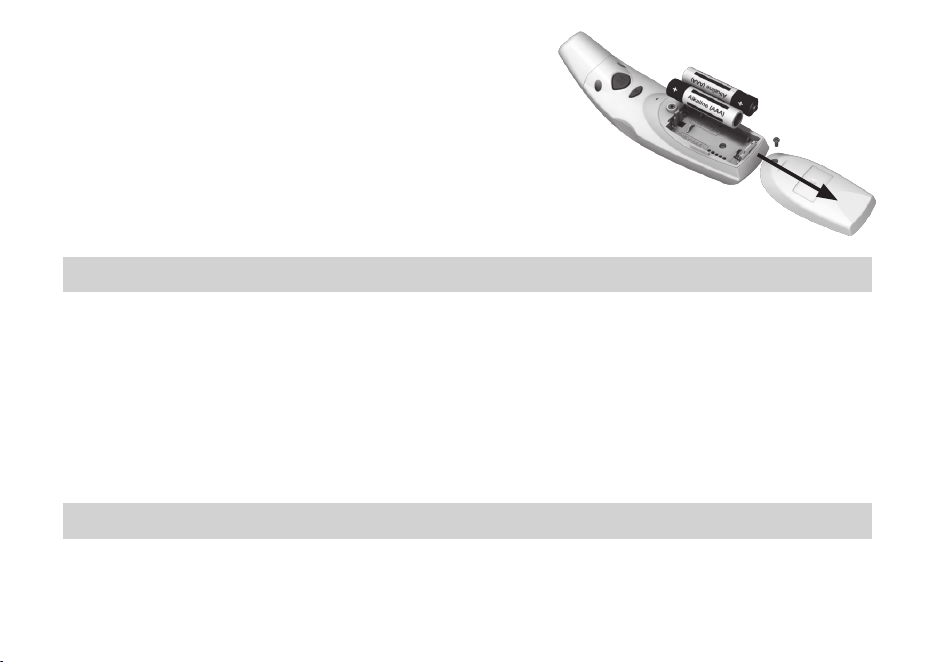
98
1. Odkręcić śrubę na pokrywie komory baterii iprzesunąć pokrywę do
tyłu.
2. Wyjąć zużyte baterie iwłożyć dwie nowe baterie zgodnie zkierun-
kiem przedstawionym na rysunku.
3. Zamknąć pokrywę baterii iponownie ją przykręcić.
Koniecznie usuwać baterie zgodnie zobowiązującymi przepisami
prawa. Wrzucanie baterii do zwykłego pojemnika na śmieci jest
zabronione.
9. Przechowywanie ikonserwacja
• Po każdym użyciu należy wyczyścić końcówkę czujnika. Wtym celu użyć miękkiej szmatki lub patyczków zwatą,
które można nasączyć środkiem dezynfekującym, alkoholem lub ciepłą wodą.
• Do czyszczenia obudowy urządzenia należy użyć miękkiej szmatki, lekko nasączonej wodą zmydłem.
• Nie używać agresywnych środków czyszczących.
• Termometr należy zawsze przechowywać znałożoną nasadką czołową/pokrywą.
• Jeśli planowane jest dłuższe przechowywanie, wyjąć baterie.
• Niedozwolone jest przechowywanie lub stosowanie urządzenia wzbyt wysokich lub zbyt niskich temperaturach,
przy zbyt dużej lub zbyt niskiej wilgotności powietrza (patrz dane techniczne), wświetle słonecznym, wpołączeniu
zprądem elektrycznym lub wzapylonych miejscach. Wprzeciwnym razie pomiar może być niedokładny.
10. Utylizacja
• Zużyte, całkowicie rozładowane baterie należy wyrzucać do specjalnie oznakowanych pojemników zbiorczych,
przekazywać do punktów zbiórki odpadów specjalnych lub do sklepu ze sprzętem elektrycznym. Użytkownik jest
zobowiązany do utylizacji baterii zgodnie z przepisami.
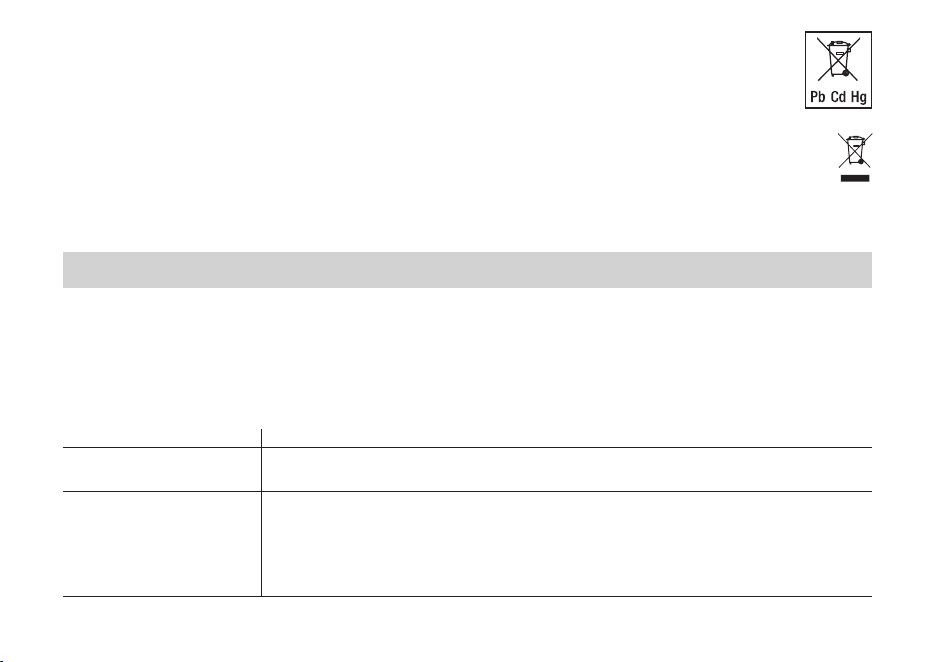
99
• Na bateriach zawierających szkodliwe związki znajdują się następujące oznaczenia:
Pb = bateria zawiera ołów,
Cd = bateria zawiera kadm,
Hg = bateria zawiera rtęć.
• Ze względu na ochronę środowiska naturalnego po zakończeniu okresu eksploatacji urządzenia nie
należy go
wyrzucać wraz ze zwykłymi odpadami domowymi. Utylizację należy zlecić w odpowiednim punkcie zbiórki w
danym kraju. Urządzenie należy zutylizować zgodnie z dyrektywą o zużytych urządzeniach elektrycznych i
elektronicznych – WEEE (Waste Electrical and Electronic Equipment). W razie pytań należy zwrócić się do odpowied-
niej instytucji odpowiedzialnej za utylizację.
11. Dane techniczne
Wskazówka: Podczas stosowania urządzenia niezgodnie ze specyfikacją nie można zagwarantować prawidłowego dzia-
łania! Producent zastrzega sobie prawo do zmian technicznych mających na celu ulepszenie konstrukcji urządzenia.
Dokładność termometru została dokładnie sprawdzona. Ponadto został on zaprojektowany do długotrwałego użytku.
W przypadku korzystania z urządzenia w praktyce lekarskiej należy przeprowadzać kontrole pomiarowe za pomocą odpo-
wiednich środków. Dokładne dane dotyczące sprawdzania dokładności można uzyskać, kontaktując się z działem obsługi
klienta.
Nazwa imodel FT 65
Zakres pomiaru Tryb termometru do ucha/czoła: 34 °C – 43 °C (93,2 °F– 109,4 °F)
tryb temperatury obiektu: 0 °C – 100 °C (32 °F– 212 °F)
Laboratoryjna dokładność
pomiaru
Tryb termometru do ucha: ±0,2 °C (±0,4 °F) wzakresie 35°C – 42 °C (95,0 °F– 107,6 °F),
poza tym zakresem pomiaru ±0,3 °C (±0,5 °F),
tryb termometru czołowego: ±0,2 °C (±0,4 °F) wzakresie 35°C – 42 °C (95,0 °F– 107,6 °F),
poza tym zakresem pomiaru ±0,3 °C (±0,5 °F),
tryb temperatury obiektu: ±1,5 °C (±2,7 °F) przy < 30 °C (86 °F); ±5% przy ≥ 30 °C (86 °F)

100
Odstęp czasu pomiędzy
dwoma pomiarami Co najmniej 5 sekund
Klinicznie potwierdzona
dokładność pomiarów
Ucho: dzieci, 1– 5 lat: ±0,08 °C (±0,14 °F)
dorośli: ±0,07 °C (±0,13 °F)
Czoło: dzieci, 1– 5 lat: ±0,07 °C (±0,13 °F)
dorośli: ±0,08 °C (±0,14 °F)
Jednostki miary Stopień Celsjusza (°C) lub Fahrenheita (°F)
Warunki eksploatacji 15 °C do 35 °C (59 °Fdo 95 °F) przy względnej wilgotności powietrza do 85%
(bez zjawiska kondensacji)
Warunki przechowywania -25 °C do 55 °C (-13 °Fdo 131 °F) przy względnej wilgotności powietrza do 85%
(bez zjawiska kondensacji)
Wymiary 38,2 x138 x46,5mm
Masa 90 gwraz zbaterią
Bateria 2 x 1,5V AAA (LR03)
Pamięć Na 10 pomiarów
Numer seryjny znajduje się na urządzeniu lub w komorze baterii.
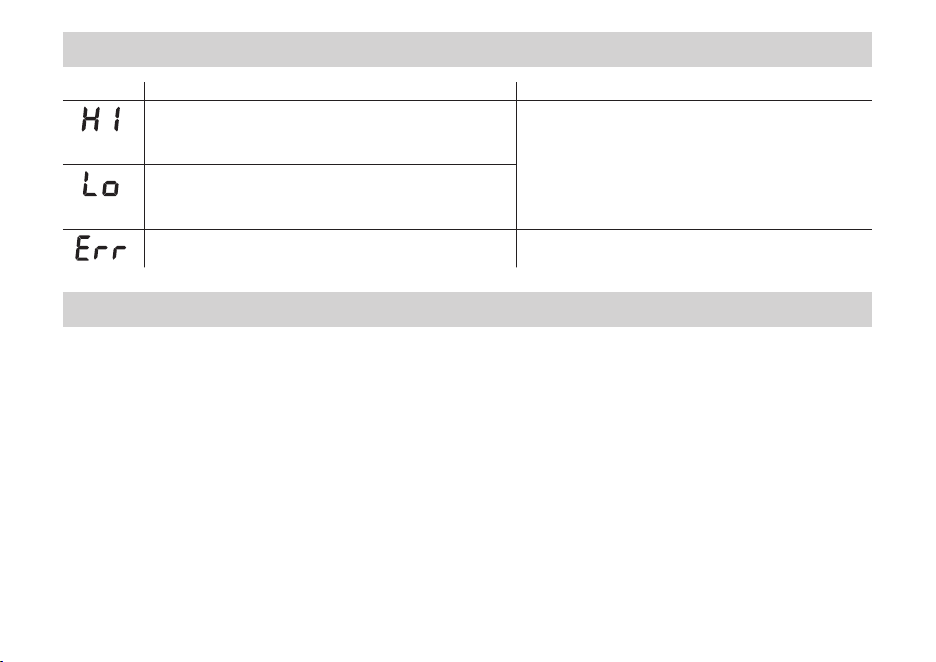
101
12. Usuwanie usterek
Wskazanie Przyczyna Usuwanie
Zmierzona temperatura jest wyższa niż
1) Tryb termometru do ucha/czoła: 43 °C (109,4 °F),
2) Tryb temperatury obiektu: 100 °C (212 °F).
Używać termometru tylko wpodanych zakresach
temperatur.
Wrazie konieczności wyczyścić końcówkę czuj-
nika. Wprzypadku powtarzających się błędnych
wskazań należy zwrócić się do sprzedawcy lub
działu obsługi klienta.
Zmierzona temperatura jest niższa niż
1) Tryb termometru do ucha/czoła: 34 °C (93,2 °F),
2) Tryb temperatury obiektu: 0 °C (32 °F).
Temperatura pracy nie leży wzakresie 15 °C do 35 °C
(59 do 95 °F).
Używać termometru tylko wpodanych zakresach
temperatur.
13. Gwarancja / ser wis
Firma Hans Dinslage GmbH, Riedlinger Straße 28, D-89524 Uttenweiler (zwana dalej „HaDi”) udziela gwarancji na ten
produkt na następujących warunkach i w poniżej opisanym zakresie.
Poniższe warunki gwarancji nie naruszają ustawowych zobowiązań gwarancyjnych sprzedającego wynikających
z umowy kupna zawartej z kupującym.
Gwarancja obowiązuje również w sposób nienaruszający bezwzględnie obowiązujących przepisów dot.
odpowiedzialności.
Firma HaDi gwarantuje bezawaryjne działanie oraz kompletność niniejszego produktu.
Obowiązujący na całym świecie okres gwarancji obejmuje 2 lata/lat, licząc od zakupu nowego, nieużywanego produktu
przez kupującego.
Niniejsza gwarancja dotyczy tylko produktów nabytych przez kupującego jako konsumenta wyłącznie w celach prywat-
nych w ramach użytku domowego.
Obowiązuje prawo niemieckie o ile jest to prawnie dopuszczalne.

102
Jeśli w okresie obowiązywania gwarancji produkt zostanie uznany za niekompletny lub wadliwy w działaniu zgodnie z
poniższymi postanowieniami, firma HaDi bezpłatnie wymieni go lub naprawi zgodnie z niniejszymi warunkami gwarancji.
Jeśli kupujący chce zgłosić reklamację gwarancyjną, najpierw kontaktuje się z lokalnym dealerem: patrz załączo-
na lista „Service International” z adresami serwisowymi.
Następnie kupujący otrzymuje dalsze informacje dot. rozpatrywania reklamacji gwarancyjnej, np. gdzie wysłać produkt i
jakie dokumenty są wymagane.
Roszczenie z tytułu gwarancji będzie rozpatrywane tylko wtedy, gdy kupujący może przedłożyć
- kopię faktury/paragon zakupu oraz
- oryginalny produkt
firmie HaDi lub autoryzowanemu partnerowi firmy HaDi.
Niniejsza gwarancja wyraźnie nie obejmuje:
- zużycia wynikającego z normalnego użytkowania lub zużywania się produktu;
- dostarczanych z tym produktem akcesoriów, które zużywają się lub ulegają zużyciu podczas prawidłowego użytkowa-
nia (np. baterii, akumulatorów, mankietów, uszczelek, elektrod, źródeł światła, nakładek i akcesoriów inhalatora);
- produktów, które były używane, czyszczone, przechowywane lub konserwowane w niewłaściwy sposób i/lub nie-
zgodnie z treścią instrukcji obsługi, a także produktów, które zostały otwarte, naprawione lub zmodyfikowane przez
kupującego lub centrum serwisowe nieautoryzowane przez firmę HaDi;
- uszkodzeń powstałych podczas transportu między producentem a klientem lub między centrum serwisowym a
klientem;
- produktów, które zostały zakupione jako artykuły grupy B („B-Ware”) lub jako artykuły używane;
- szkód następczych, które wynikają z wady tego produktu (w tym przypadku mogą jednak istnieć roszczenia z
tytułu odpowiedzialności za produkt lub wynikające z innych bezwzględnie obowiązujących przepisów prawa dot.
odpowiedzialności).
Naprawy lub całkowita wymiana w żadnym wypadku nie przedłużają okresu gwarancji.
Zastrzega się prawo do pomyłek i zmian
103
Omvang van de levering
• Thermometer
• 2 x 1,5 V batterijen AAA (LR03)
• Deze gebruiksaanwijzing
Lees deze gebruiksaanwijzing aandachtig door en bewaar deze voor later gebruik. Zorg dat ook andere gebruikers
toegang hebben tot de gebruiksaanwijzing en neem de aanwijzingen in acht.
1. Verklaring van symbolen
In de gebruiksaanwijzing, op de verpakking en op het typeplaatje van het apparaat en de accessoires worden de
volgende symbolen gebruikt:
Waarschuwing
Waarschuwing voor risico’s op letsel of gevaren voor uw gezondheid.
Let op
Waarschuwing voor mogelijke schade aan het apparaat/toebehoren.
Aanwijzing
Verwijzing naar belangrijke informatie
Inhoud
1. Verklaring van symbolen ........................................... 103
2. Aanwijzingen ............................................................. 105
3. Apparaatbeschrijving .................................................108
4. Ingebruikneming ........................................................ 109
5. Instelling .................................................................... 109
6. Wat u moet weten voordat u gaat meten .................. 110
7. Meten ........................................................................ 111
8. Batterijen vervangen ................................................ 114
9. Bewaren en onderhoud ........................................... 115
10. Verwijdering ............................................................. 115
11. Technische gegevens .............................................. 116
12. Verhelpen van storingen .......................................... 117
13. Garantie / ser vice ...................................................... 118
Nederlands
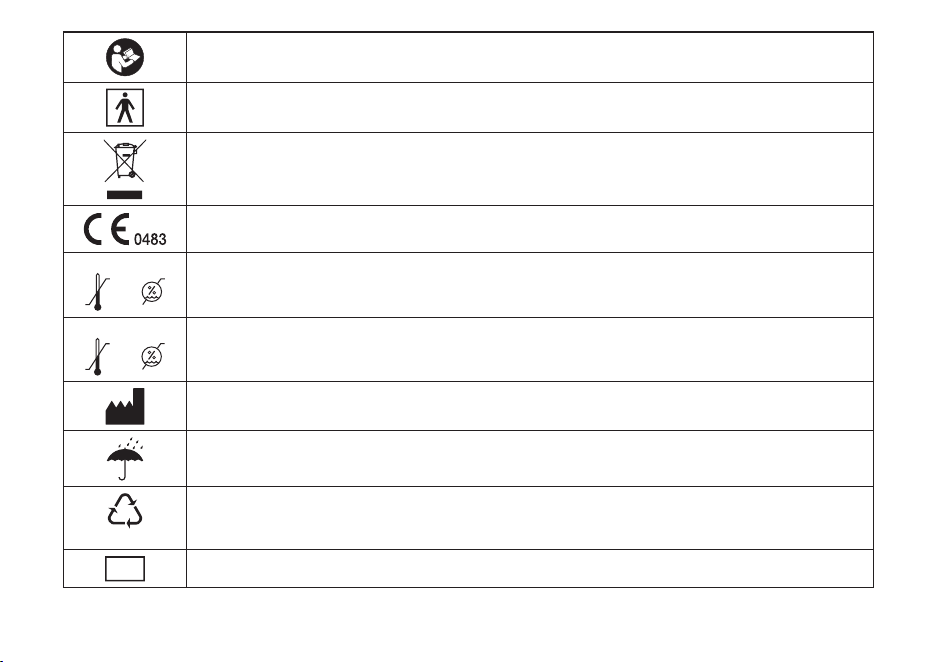
104
Neem de gebruiksaanwijzing in acht
Toepassingsdeel type BF
Verwijder het apparaat conform EU-richtlijn betreffende de verwijdering van elektrische en elektroni-
sche apparatuur – WEEE (Waste Electrical and Electronic Equipment).
Met de CE-markering wordt aangetoond dat het apparaat voldoet aan de fundamentele eisen van
de richtlijn 93/42/EEC voor medische hulpmiddelen.
Storage/Transport
Toegestane temperatuur en luchtvochtigheid bij opslag en transport
Operating
Toegestane temperatuur en luchtvochtigheid bij gebruik
Fabrikant
Niet blootstellen aan vocht
21
PAP
Verpakking overeenkomstig de milieu-eisen verwijderen
S
N
Serienummer
105
2. Aanwijzingen
Veiligheidsinstructies
Waarschuwing:
• Breng de sensortip van de thermometer voorzichtig in bij metingen in het oor.
• Het gebruik van de thermometer voor verschillende personen kan ongewenst zijn bij bepaalde acute,
infectueuze aandoeningen, door mogelijk besmettingsgevaar ondanks reinigen van het instrument. Laat u in
voorkomende gevallen informeren door uw behandelend arts.
Tips voor de omgang met batterijen
• Als vloeistof uit de batterijcel in aanraking komt met de huid of de ogen, moet u de betreende plek met water spoe-
len en een arts raadplegen.
•
Gevaar voor inslikken! Kleine kinderen kunnen batterijen inslikken, met verstikking als gevolg. Bewaar batterijen
daarom buiten het bereik van kleine kinderen!
• Neem de aanduiding van de polariteit (plus (+) en min (-)) in acht.
• Als er een batterij is gaan lekken, moet u veiligheidshandschoenen aantrekken en het batterijvak met een droge doek
reinigen.
• Bescherm de batterijen tegen overmatige hitte.
•
Explosiegevaar! Werp batterijen niet in vuur.
• Batterijen mogen niet worden opgeladen en niet worden kortgesloten.
• Haal de batterijen uit het batterijvak als u het apparaat langere tijd niet gebruikt.
• Gebruik alleen hetzelfde of een gelijkwaardig type batterij.
• Vervang altijd alle batterijen tegelijk.
• Gebruik geen oplaadbare batterijen!
• Haal batterijen niet uit elkaar, open ze niet en hak ze niet in kleine stukken.
106
Algemene aanwijzingen
• Lees deze gebruiksaanwijzing aandachtig door en bewaar hem voor later gebruik. Zorg dat ook andere
gebruikers toegang hebben tot de gebruiksaanwijzing en neem de aanwijzingen in acht.
• Deze thermometer is een gevoelig elektrisch instrument. Behandel het met zorg en stel het niet bloot aan
mechanische schokken.
• Stel de thermometer niet bloot aan direct zonlicht.
• Controleer voor ieder gebruik of de lens in goede staat is. Neem contact op met uw verkoper of servicepunt
als deze beschadigd is.
• De thermometer is NIET waterdicht. Daarom moet direct contact met water of andere vloeistoen worden
vermeden.
• De FT 65-thermometer is alleen bestemd voor gebruik op het in de gebruiksaanwijzing aangegeven meet-
punt op het menselijk lichaam.
• Het instrument is uitsluitend bestemd voor het in deze gebruiksaanwijzing aangegeven doel.
• Reinig de meettip na ieder gebruik met een zachte doek, bevochtigd met een desinfecterend middel.
• De thermometer is ontworpen voor praktisch gebruik, maar kan niet de plaats innemen van een bezoek aan
een arts.
• Controleer bij eventuele problemen van het instrument altijd eerst de batterijen en vervang deze zo nodig.
• Reparaties mogen alleen worden uitgevoerd door geautoriseerde servicebedrijven, anders vervalt de garantie.
• Het apparaat voldoet aan de EU-richtlijn voor medische hulpmiddelen 93/42/EEC, de Duitse wet inzake
medische producten, de norm ASTM E 1965 - 98, de Europese norm EN 12470-5: Medische thermometers –
Deel 5: Bepaling van de prestatie van infrarode oorthermometers (met maximaalelement) de ISO 80601-
2-56, e venals aan de Europese norm EN60601-1-2 (overeenstemming met CISPR11, IEC61000-4-2,
IEC61000-4-3, IEC61000-4-8), en is onderworpen aan bijzondere veiligheidsmaatregelen op het gebied van
elektromagnetische compatibiliteit. Houd er daarbij rekening mee dat draagbare en mobiele HF-communica-
tie-installaties dit apparaat kunnen beïnvloeden.
• Mocht u nog vragen hebben over het gebruik van onze apparaten, dan kunt u zich wenden tot uw leveran-
cier of tot de klantenservice.

107
Aanwijzingen met betrekking tot elektromagnetische compatibiliteit
• Het apparaat is geschikt voor gebruik in alle omgevingen die in deze gebruiksaanwijzing worden vermeld,
waaronder de thuisomgeving.
• Het apparaat kan bij de aanwezigheid van elektromagnetische storingen onder omstandigheden mogelijk
slechts beperkt worden gebruikt. Als gevolg daarvan kunnen bijv. foutmeldingen ontstaan of kan het display/
apparaat uitvallen.
• Het gebruik van dit apparaat direct naast andere apparaten of met andere apparaten in gestapelde vorm
moet worden vermeden, omdat dit een onjuiste werking tot gevolg kan hebben. Als gebruik op de hiervoor
beschreven wijze noodzakelijk is, moeten dit apparaat en de andere apparaten in de gaten worden gehou-
den om er zeker van te zijn dat ze correct werken.
• Het gebruik van andere toebehoren dan de toebehoren die de fabrikant van dit apparaat vastgelegd of
beschikbaar gesteld heeft, kan verhoogde elektromagnetische storingen of een verminderde bestandheid
tegen storingen tot gevolg hebben, waardoor het apparaat mogelijk niet correct werkt.
• Als deze instructie niet in acht wordt genomen, kan dit de prestatiekenmerken van het apparaat negatief
beïnvloeden.
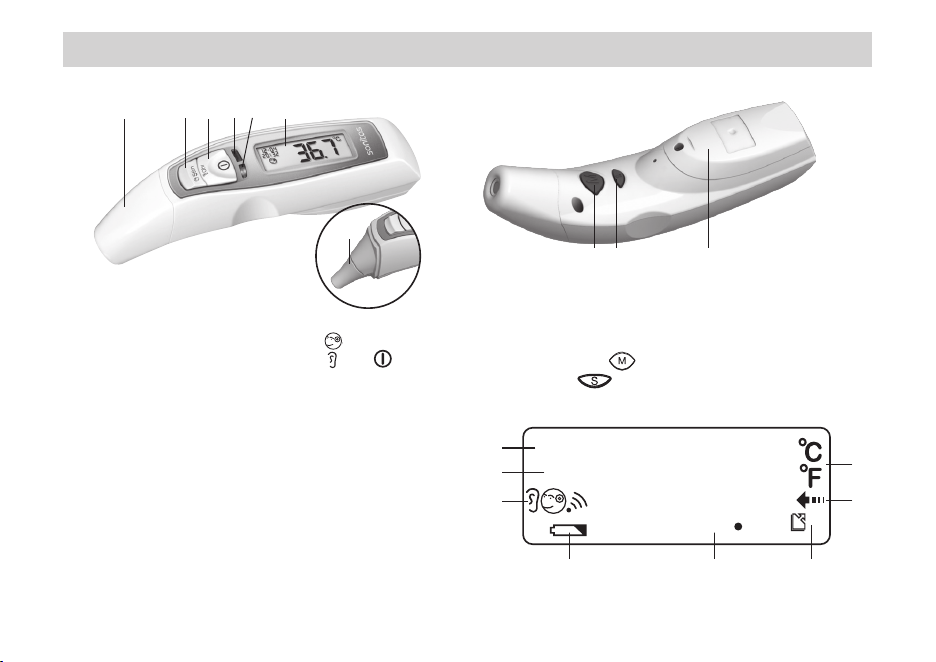
108
3. Apparaatbeschrijving
Overzicht
1
32 4 5
7
6
1098
1 Voorhoofd-/afdekkapje
2 Toets voorhoofdthermometermodus
Stirn
Forehead
3 Toets Oorthermometermodus/Aan
Ohr
Ear /
4 Led (rood) (koortsalarm)
5 Led (groen)
6 Lcd
7 Sensortip met lens (afdekkapje verwijderd)
8 Memory-toets
9 Set-toets
10 Deksel batterijvak
11 Datum
12 Tijd
13 Meetmodus („Oor“, „Voorhoofd“, „Object“)
14 Symbool „Batterijwaarschuwing“
15 Weergave meetresultaat
16 Symbool „Geheugen“ en geheugenplaatsnummer
17 Symbool „Meting loopt“
18 Eenheid van het meetresultaat (
°
C of
°
F)
863
5-15
8
7:20
11
12
13
18
17
161514
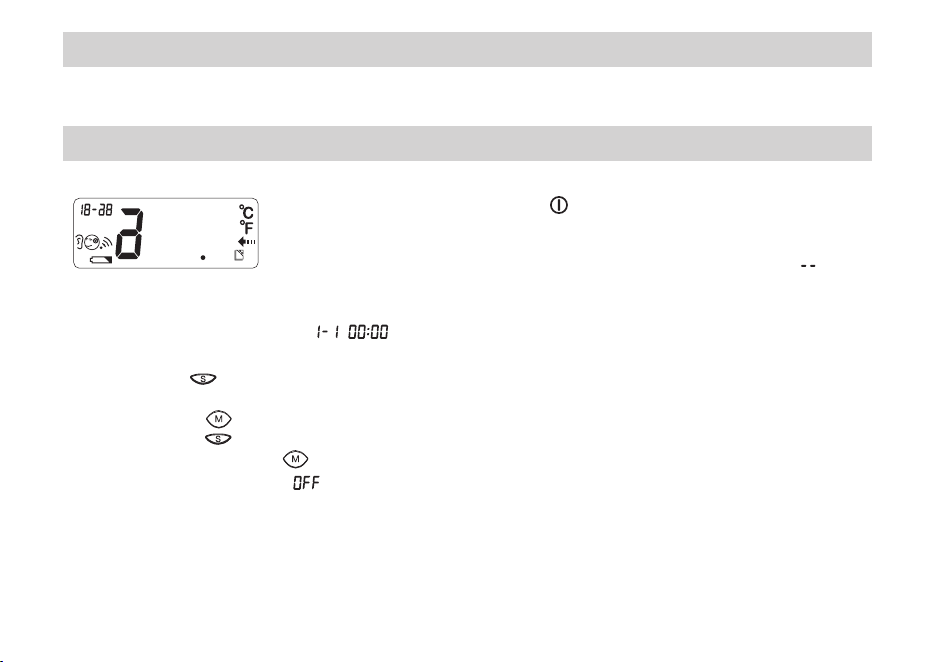
109
4. Ingebruikneming
Bij aankoop van het instrument zijn de batterijen al geplaatst. Trek vóór het eerste gebruik de uitstekende batterijbe-
schermingsstrook uit het batterijvak. De thermometer wordt vervolgens automatisch ingeschakeld.
5. Instelling
Temperatuureenheid, datum en tijd instellen.
888
8
88:88
Druk gedurende 1 seconde op de toets om de thermometer in te schakelen. Het
instrument doorloopt een korte zelftest. Alle segmenten op de display worden ca.
1 seconde weergegeven. Na de succesvol afgeronde zelftest klinken twee korte
pieptonen. In de standbymodus zijn de datum en tijd zichtbaar en verschijnt „
“ op
de display.
Bij het eerste gebruik van de thermometer en na het vervangen van de batterijen worden (na de zelftest) de datum en de
tijd in de basisinstelling weergegeven ( ). Stel nu de temperatuureenheid, de datum en de tijd in. Bij het instellen
dient u een aantal stappen te volgen: eenheid –jaar – maand – dag – uren – minuten.
• Houd de toets gedurende ca. 3 seconden ingedrukt om de Set-modus te activeren.
Het te wijzigen onderdeel knippert.
• Druk op de toets om de ingestelde waarde op te slaan, of
• druk op de toets om de instelling te wijzigen.
• Druk vervolgens op de toets om de ingestelde waarde op te slaan.
Na deze handelingen verschijnt er
op de display en wordt de thermometer automatisch uitgeschakeld.
110
6. Wat u moet weten voordat u gaat meten
Er zijn verschillende soorten thermometers voor de meting op/in verschillende lichaamsdelen:
• Oor-/voorhoofdthermometer (deze thermometer, voor meting in het oor of op het voorhoofdsgebied)
• Staafthermometer, voor rectale (in de anus), axillaire (onder de oksel) of orale meting (in de mond)
De temperatuurmeting levert een meetwaarde op, die informatie geeft over de actuele lichaamstemperatuur van
een mens. Als u niet zeker weet hoe u de resultaten moet interpreteren of als er abnormale waarden voorkomen,
kunt u zich het best wenden tot uw behandelend arts. Dat geldt ook in geval van kleine temperatuurverande-
ringen, als er bijkomende ziekteverschijnselen optreden, zoals onrust, sterk zweten, rode huid, hoge polsslag,
neiging tot collaps etc.
Temperaturen die met verschillende thermometers zijn gemeten, kunnen niet met elkaar worden vergeleken.
Geef daarom door aan uw arts (resp. let hierop bij een zelfdiagnose) met welke thermometer en bij welk
lichaamsdeel u de lichaamstemperatuur hebt gemeten.
De temperatuur van een gezond mens wordt beïnvloed door verschillende factoren, waaronder de individuele,
persoonsafhankelijke stofwisseling en de leeftijd. De temperatuur is hoger bij zuigelingen en kleine kinderen, en
daalt bij toenemende leeftijd. Bij kinderen komen hogere temperatuurafwijkingen sneller en vaker voor, bijvoor-
beeld door groeispurts. De temperatuur is ook afhankelijk van kleding en buitentemperatuur en van het moment
van de dag (’s ochtends is de lichaamstemperatuur lager, ’s avonds stijgt deze) evenals van voorafgaande
lichamelijke en, in mindere mate, mentale activiteit.
De temperatuurwaarde kan afwijken, afhankelijk van het lichaamsdeel waar deze wordt gemeten. De afwijking kan
bij gezonde mensen tussen 0,2
°
C (0,4
°
F) – 1
°
C (1,8
°
F) liggen. De respectieve normale temperatuurbereiken zijn:
• bij meting op het voorhoofd: 35,8
°
C (96,4
°
F) – 37,6
°
C (99,7
°
F), met een voorhoofdthermometer,
• bij meting in het oor: 36,0
°
C (96,8
°
F) – 37,8
°
C (100
°
F), met een oorthermometer,
• bij rectale meting: 36,3
°
C (97,3
°
F) – 37,8
°
C (100
°
F), met een conventionele thermometer,
• bij orale meting: 36,0
°
C (96,8
°
F) – 37,4
°
C (99,3
°
F), met een conventionele thermometer.
Om een duidelijk beeld te krijgen van het temperatuurverloop moet altijd bij hetzelfde lichaamsdeel worden
gemeten.
111
7. Meten
Controleer vóór ieder gebruik of de lens in orde is. Neem contact op met uw verkoper of servicepunt als deze bescha-
digd is.
Het instrument moet zich minstens 30 minuten in de ruimte bevinden waar de meting plaatsvindt.
Meten van de lichaamstemperatuur in het oor
• Sommige personen hebben verschillende meetwaarden in het linker- en rechteroor. Om temperatuurveran-
deringen juist te kunnen registreren, moet bij dezelfde persoon steeds in hetzelfde oor worden gemeten.
• De oorthermometer mag alleen door kinderen worden gebruikt onder toezicht van een volwassene. Doorgaans
kan de temperatuur bij mensen met een leeftijd vanaf 6 maanden worden gemeten. Bij kinderen jonger dan
6 maanden is de gehoorgang nog zeer nauw. Hierdoor kan de temperatuur van het trommelvlies vaak niet
worden vastgesteld en worden te lage meetresultaten verkregen.
• De meting mag niet worden gedaan in ontstoken een oor (gepaard aan etter- en andere afscheidingen), na
mogelijke verwondingen aan het oor (bijvoorbeeld schade aan het trommelvlies) of tijdens de genezingsfase
na operatieve ingrepen. Wend u in zulke gevallen tot uw behandelend arts.
• Het gebruik van de thermometer voor verschillende personen kan ongewenst zijn bij bepaalde acute,
infectueuze aandoeningen, door een mogelijke besmetting ondanks reinigen van het instrument. Laat u in
voorkomende gevallen informeren door uw behandelend arts.
• Deze thermometer mag uitsluitend worden gebruikt zonder wegwerpbeschermhuls.
• Als u langere tijd op een oor hebt gelegen, is de temperatuur wat hoger. Wacht enige tijd of meet in het
andere oor.
• De meting kan worden beïnvloed door oorsmeer; reinig het oor zo nodig voor de meting.
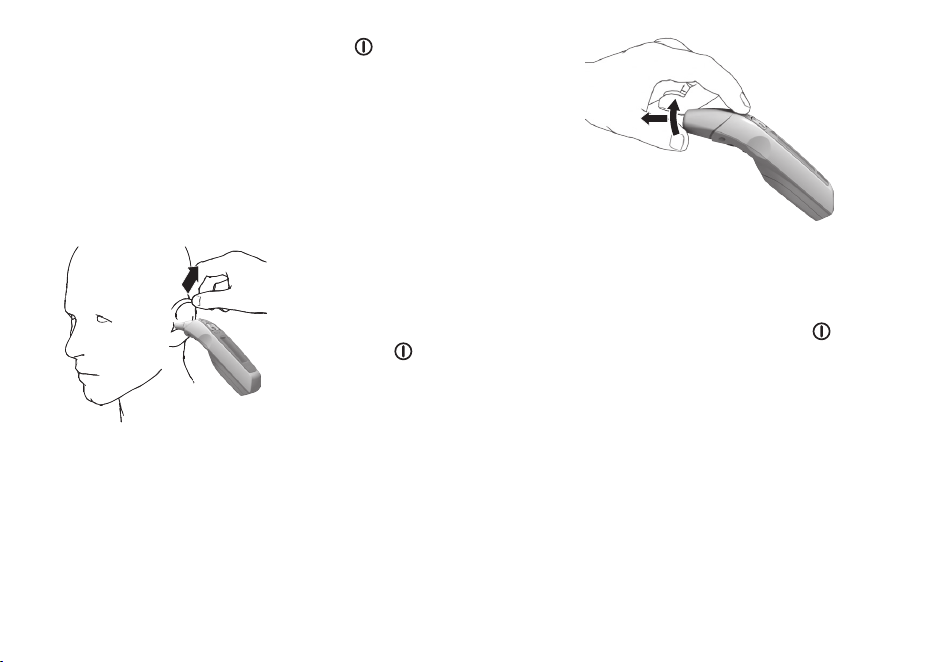
112
• Druk gedurende 1 seconde op de toets
om de thermometer in te
schakelen. Nadat de zelftest met succes is afgerond klinken twee korte
pieptonen.
• Verwijder het kapje door het licht naar boven te drukken (1) en het dan
naar voren weg te trekken (2).
12
Zorg ervoor dat de sensortip en de gehoorgang schoon zijn.
De gehoorgang is enigszins gebogen. Trek daarom het oor wat naar boven en naar
achteren voordat u de sensortip inbrengt, zodat deze direct op het trommelvlies kan
worden gericht.
• Breng de sensortip voorzichtig in en druk gedurende 1 seconde op de toets .
• Laat de toets los. Het einde van de meting wordt gesignaleerd met een korte
pieptoon. De gemeten waarde verschijnt op de display.
Als de gemeten waarde binnen het normbereik ligt (< 38
°
C/100,4
°
F), dan gaat de groene led gedurende 3 seconden
branden. Als de gemeten waarde hoger is (≥ 38
°
C/100,4
°
F, koorts) gaat de rode led branden.
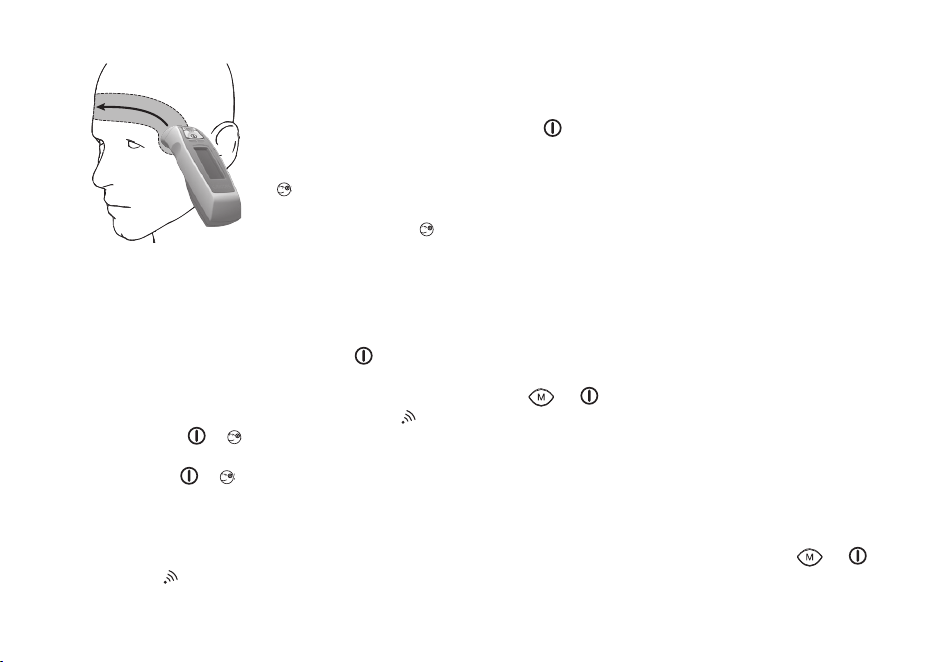
113
Meten van de lichaamstemperatuur op het voorhoofd
Let erop dat het voorhoofd/de slaap vrij van zweet en cosmetica is. Houd er ook rekening
mee, dat bij voorhoofdmeting het gebruik van vaatvernauwende medicijnen en het voorko-
men van huidirritaties het meetresultaat kunnen vervalsen.
• Druk gedurende 1 seconde op de toets om de thermometer in te schakelen. Nadat
de zelftest met succes is afgerond klinken twee korte pieptonen.
• Zet de meetkop met geplaatst voorhoofd-/afdekkapje tegen de slaap, houd de toets
Stirn
Forehead ingedrukt en beweeg de thermometer met een gelijkmatige beweging over
het voorhoofd naar de andere slaap.
• Laat daarna de toets
Stirn
Forehead los. Het einde van de meting wordt gesignaleerd met
een korte pieptoon. De gemeten waarde verschijnt op de display.
Als de gemeten waarde binnen het normbereik ligt (< 38
°
C/100,4
°
F), dan gaat de groene led gedurende 3 seconden
branden. Als de gemeten waarde hoger is (≥ 38
°
C/100,4
°
F, koorts) gaat de rode led branden.
Meten van de oppervlaktetemperatuur
• Druk gedurende 1 seconde op de toets
om de thermometer in te schakelen. Nadat de zelftest met succes is
afgerond klinken twee korte pieptonen.
• Druk vervolgens gedurende 3 seconden gelijktijdig op de toetsen en om de objecttemperatuurmodus te
activeren. Op de display verschijnt de melding .
• Houd de toets of
Stirn
Forehead ingedrukt en richt de sensortip op een afstand van 3 cm op het te meten voorwerp
of vloeistof (in geen geval onderdompelen in vloeistoen).
• Laat de toets of
Stirn
Forehead weer los. Het einde van de meting wordt gesignaleerd met een korte pieptoon.
De gemeten waarde verschijnt op de display.
Let erop dat de weergegeven temperatuur de vastgestelde en niet de aangepaste oppervlaktetemperatuur is. Deze kan
niet worden vergeleken met de voorhoofd-/oortemperatuur.
Om weer terug te schakelen naar de oor-/voorhoofdmodus drukt u 3 seconden lang gelijktijdig op de toetsen en ,
tot de melding verdwijnt en een korte pieptoon klinkt. Bij het uit- en weer inschakelen van de thermometer wordt de
objecttemperatuurmodus automatisch verlaten.
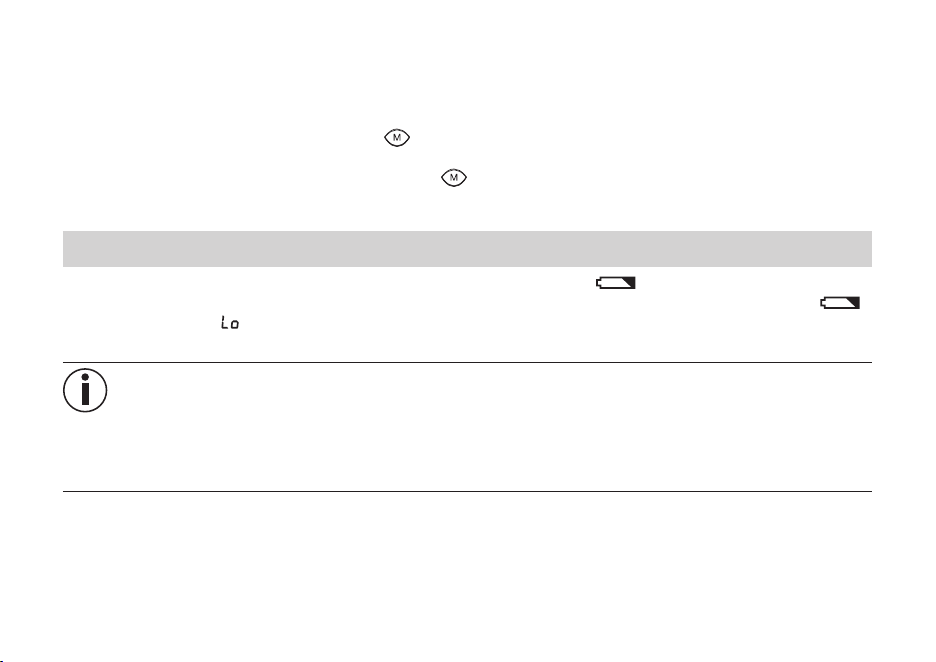
114
De laatst bepaalde meetwaarde, d.w.z. alleen de laatste waarde van een meetreeks, wordt automatisch opgeslagen
wanneer de thermometer (automatisch) wordt uitgeschakeld. Hiervoor zijn 10 geheugenplaatsen beschikbaar.
Als u na het gebruik verder nergens op drukt, wordt de thermometer ca. 1 minuut na de weergave van de gemeten
waarde automatisch uitgeschakeld.
Schakel de thermometer in en druk op de toets
om de opgeslagen waarde op te vragen.
Het instrument toont steeds de datum, de tijd, het geheugenplaatsnummer en het symbool van de meetmodus bij iedere
opgeslagen temperatuur. Door herhaaldelijk op de toets te drukken kunt u door de geheugenplaatsen met meetre-
sultaten bladeren.
8. Batterijen vervangen
Wanneer de batterijen leeg raken, verschijnt het batterijwaarschuwingssymbool . U kunt nog wel temperatuur-
metingen doen, maar de batterijen moeten binnenkort worden vervangen. Als het batterijwaarschuwingssymbool
knippert en de melding op de display verschijnt, moeten de batterijen worden vervangen. Als de batterijen te leeg
raken, wordt de thermometer automatisch uitgeschakeld.
Aanwijzing:
• Gebruik steeds batterijen van hetzelfde type, hetzelfde merk en dezelfde capaciteit wanneer u de batterijen
vervangt.
• Vervang steeds alle batterijen gelijktijdig.
• Gebruik geen oplaadbare batterijen.
• Gebruik geen batterijen die zware metalen bevatten.
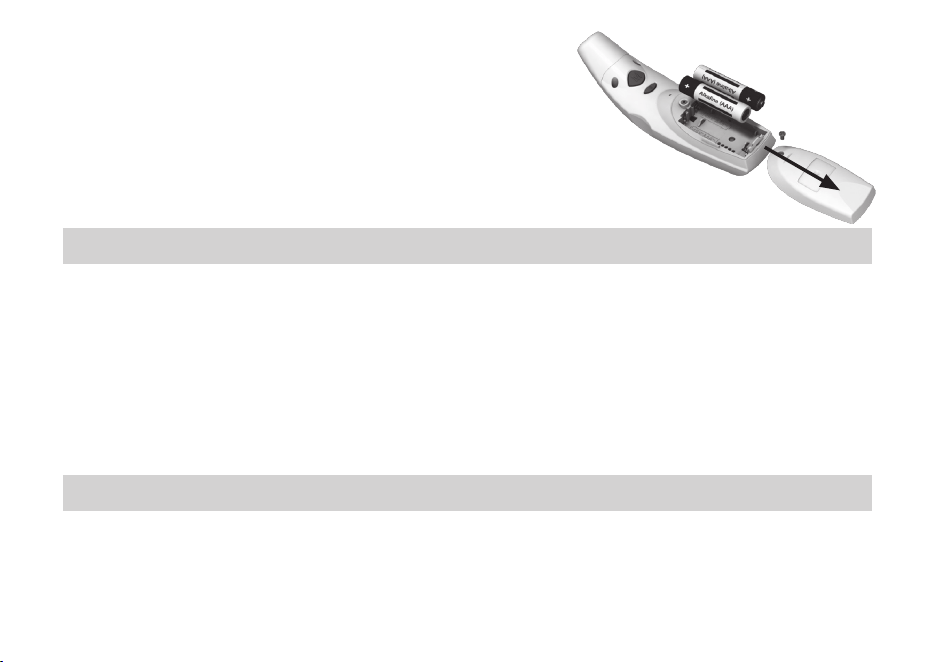
115
1. Draai de schroef van het batterijvak los en trek het deksel naar
achteren weg.
2. Verwijder de gebruikte batterijen en plaats twee nieuwe batterijen
zoals weergegeven.
3. Plaats het deksel van het batterijvak en schroef het weer vast.
Voer de batterijen af in overeenstemming met de geldende wettelijke
bepalingen. Gooi batterijen nooit weg met het gewone huisvuil.
9. Bewaren en onderhoud
• Reinig de sensortip na elk gebruik. Gebruik daarvoor een zachte doek of een wattenstaafje, eventueel bevochtigd
met alcohol, warm water of een desinfecterend middel.
• Gebruik voor het reinigen van het gehele instrument een zachte, licht met zeepsop bevochtigde doek.
• Gebruik geen agressief reinigingsmiddel.
• Berg de thermometer altijd op met geplaatst voorhoofd-/afdekkapje.
• Verwijder de batterijen als u het instrument voor langere tijd op wil bergen.
• Het instrument niet opslaan of gebruiken in ruimten met een te hoge of te lage temperatuur of luchtvochtigheid (zie tech-
nische gegevens), in het zonlicht, in contact met elektrische stroom of in stoge ruimten. Anders kunnen meetfouten
ontstaan.
10. Verwijdering
• Deponeer de gebruikte, volledig lege batterijen in de daarvoor specifiek bestemde afvalbakken of bied ze bij het
afvalverwerkingsstation of de elektriciteitszaak aan als chemisch afval. U bent wettelijk verplicht de batterijen correct te
verwijderen.
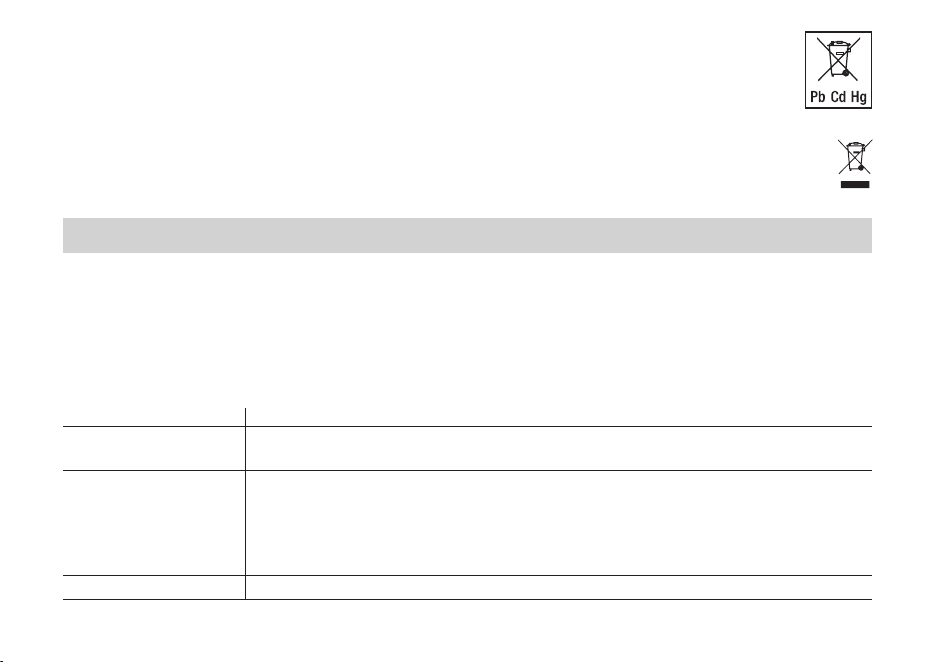
116
• Deze tekens kunt u aantreen op batterijen met schadelijke stoen:
Pb = batterij bevat lood,
Cd = batterij bevat cadmium,
Hg = batterij bevat kwik.
• Met het oog op het milieu mag het apparaat aan het einde van zijn levensduur niet met het gewone huisvuil worden
weggegooid. Het verwijderen kan via gespecialiseerde verzamelpunten in uw land gebeuren. Verwijder het
apparaat conform de EU-richtlijn voor afgedankte elektrische en elektronische apparatuur – WEEE (Waste
Electrical and Electronic Equipment). Voor meer informatie kunt u contact opnemen met de verantwoordelijke
instanties voor afvalverwijdering in uw gemeente.
11. Technische gegevens
Aanwijzing: Als het instrument niet binnen de specificaties wordt gebruikt kan niet worden gegarandeerd dat het instrument
correct functioneert! Technische aanpassingen ter verbetering en verdere ontwikkeling van het product voorbehouden.
De nauwkeurigheid van deze thermometer is zorgvuldig gecontroleerd en het apparaat is ontwikkeld met het oog op een
lange gebruiksduur.
Wanneer het apparaat wordt gebruikt in de geneeskunde moeten meettechnische controles met daarvoor geschikte middelen
worden uitgevoerd. Uitgebreide informatie voor het controleren van de nauwkeurigheid kan worden aangevraagd via het
serviceadres.
Naam en model FT 65
Meetbereik Oor-/voorhoofdthermometermodus: 34
°
C – 43
°
C (93,2
°
F – 109,4
°
F)
Objecttemperatuurmodus: 0
°
C – 100
°
C (32
°
F – 212
°
F)
Meetnauwkeurigheid,
laboratorium
Oorthermometermodus: ±0,2
°
C (±0,4
°
F) van 35
°
C – 42
°
C (95,0
°
F – 107,6
°
F),
buiten dit meetbereik ±0,3
°
C (±0,5
°
F),
Voorhoofdthermometermodus: ±0,2
°
C (±0,4
°
F) van 35
°
C – 42
°
C (95,0
°
F – 107,6
°
F),
buiten dit meetbereik ±0,3
°
C (±0,5
°
F),
Objecttemperatuurmodus: ±1,5
°
C (±2,7
°
F) bij < 30
°
C (86
°
F); ±5% bij ≥ 30
°
C (86
°
F)
Tijd tussen twee metingen Ten minste 5 seconden
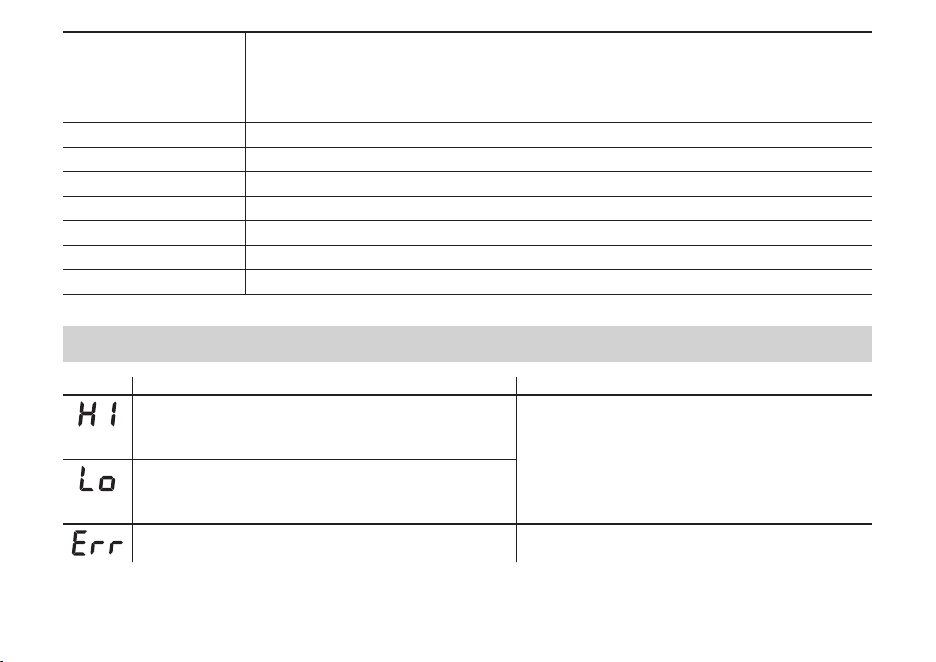
117
Klinische
herhalingsprecisie
Oor:
Kinderen, 1– 5 jaar: ±0,08
°
C (±0,14
°
F)
Volwassenen: ±0,07
°
C (±0,13
°
F)
Voorhoofd:
Kinderen, 1– 5 jaar: ±0,07
°
C (±0,13
°
F)
Volwassenen: ±0,08
°
C (±0,14
°
F)
Maateenheden
°
Celsius (
°
C) of
°
Fahrenheit (
°
F)
Bedrijfsvoorwaarden
15
°
C tot 35
°
C (59
°
F tot 95
°
F) bij een relatieve luchtvochtigheid tot 85 % (niet condenserend)
Bewaaromgeving
-25
°
C tot 55
°
C (-13
°
F
tot
131
°
F) bij een relatieve luchtvochtigheid tot 85 % (niet condenserend)
Afmetingen 38,2 x 138 x 46,5 mm
Gewicht 90 g inclusief batterij
Batterij 2 x 1,5 V AAA (LR03)
Geheugen Voor 10 metingen
Het serienummer staat op het apparaat of in het batterijvak.
12. Verhelpen van storingen
Melding Oorzaak Oplossing
De vastgestelde temperatuur is hoger dan
1) Oor-/voorhoofdthermometermodus: 43
°
C (109,4
°
F),
2) Objecttemperatuurmodus: 100
°
C (212
°
F).
Gebruik de thermometer uitsluitend binnen de
aangegeven temperatuurbereiken.
Maak zo nodig de sensortip schoon. Neem bij
herhaaldelijke foutmeldingen contact op met de
dealer of de klantenservice.
De vastgestelde temperatuur is lager dan
1) Oor-/voorhoofdthermometermodus: 34
°
C (93,2
°
F),
2) Objecttemperatuurmodus: 0
°
C (32
°
F).
De gebruikstemperatuur ligt niet in het bereik van 15
°
C
tot 35
°
C (59
°
F
tot
95
°
F).
Gebruik de thermometer uitsluitend binnen de
aangegeven temperatuurbereiken.

118
13. Garantie / ser vice
Hans Dinslage GmbH, Riedlinger Straße 28, D-89524 Uttenweiler (hierna “HaDi” genoemd) verleent onder de hierna
genoemde voorwaarden en in de hierna beschreven omvang garantie voor dit product.
De hierna genoemde garantievoorwaarden laten de wettelijke garantieverplichtingen van de verkoper uit de
koopovereenkomst met de koper onverlet.
De garantie geldt bovendien onverminderd de dwingende wettelijke aansprakelijkheidsbepalingen.
HaDi garandeert de probleemloze werking en de volledigheid van dit product.
De wereldwijde garantieperiode bedraagt 2 jaar vanaf het moment van aankoop van het nieuwe, ongebruikte product
door de koper.
Deze garantie geldt alleen voor producten die de koper als consument heeft aangeschaft en die de koper uitsluitend voor
persoonlijke doeleinden in het kader van thuisgebruik gebruikt.
Het Duitse recht is van toepassing.
Als dit product tijdens de garantieperiode onvolledig of wat betreft de werking gebrekkig overeenkomstig de volgende
bepalingen blijkt te zijn, zal HaDi overeenkomstig deze garantievoorwaarden een gratis vervangende levering of reparatie
verzorgen.
Als de koper een garantieclaim wil indienen, neemt hij eerst contact op met de lokale verkoper: zie de meegele-
verde lijst “Service International” met serviceadressen.
De koper krijgt dan nadere informatie over de afwikkeling van de garantieclaim, bijvoorbeeld over waar hij het product
naartoe moet sturen of welke documenten nodig zijn.
Er kan alleen aanspraak op garantie worden gemaakt als de koper
- een kopie van de factuur/aankoopbon en
- het originele product
aan HaDi of een geautoriseerde partner van HaDi kan overleggen.

119
Uitdrukkelijk uitgesloten van deze garantie zijn
- slijtage die veroorzaakt is door normaal gebruik of verbruik van het product;
- met dit product meegeleverde toebehoren die bij correct gebruik slijten of verbruikt worden (bijvoorbeeld batterijen,
accu’s, manchetten, afdichtingen, elektroden, lampen, opzetstukken en inhalatortoebehoren);
- producten die oneigenlijk en/of anders dan vermeld in de bepalingen van de gebruiksaanwijzing gebruikt, gereinigd,
opgeborgen of onderhouden zijn en producten die door de koper of door een niet door HaDi geautoriseerd servicecen-
ter geopend, gerepareerd of omgebouwd zijn;
- schade die tijdens het transport tussen fabrikant en klant en/of tussen servicecenter en klant ontstaat;
- producten die als B-stockartikelen of als gebruikte artikelen gekocht zijn;
- gevolgschade die op een gebrek van dit product berust (voor dit geval kunnen echter aanspraken uit productaanspra-
kelijkheid of uit andere dwingende wettelijke aansprakelijkheidsbepalingen bestaan).
Reparaties of een complete vervanging verlengen in geen geval de garantieperiode.
Vergissingen en veranderingen voorbehouden

120
SFT65_2020-11-11_03_IM_SAN
Hans Dinslage GmbH, Riedlinger Straße 28, 88524 Uttenweiler, Germany
www.sanitas-online.de