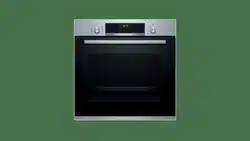
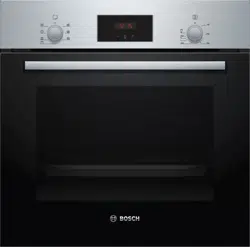
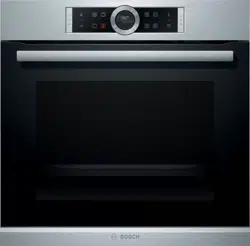
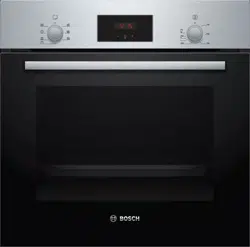
Note: On certain models, specific details such as colour and shape may differ from those pictured.
1. Buttons
The buttons on the left- and right-hand side of the control panel have a pressure point. Pressing a button will execute its function. On appliances without a stainless steel front, the buttons are also touch-sensitive.
Use the buttons on the left- and right-hand side of the control panel to switch your device or the operating mode on and off.
2. Touch fields
Touch fields are touch-sensitive surfaces. To select a function, simply press lightly on the relevant field.
Use the touch fields to select different functions directly.
The touch fields on the outside of the control panel are designed for general functions; the touch fields on the inside of the control panel are for the cooking mode. The touch field for the function that is currently selected lights up red.
3. Control ring
The control ring can be turned infinitely in either direction. Press down lightly on the control ring and move it in the direction you require.
You can use the control ring to change the setting values that are shown in the display. If you have reached the maximum value for setting values, such as the temperature, minimum or maximum value, this value remains in the display. If required, use the control ring to turn the value back again. For lists, e.g. the types of heating, the first value starts again after the last value.
4. Display
The display shows the current settings, options or relevant information.
Value in the foreground
The value in the foreground is highlighted in white. You can use the control ring to change the value directly. Once operation has started, the temperature or level is displayed in the foreground.
Value in the background
Values in the background are displayed in grey. To change the value using the control ring, select the required function in advance.
Enlargement
As long as you use the control ring to change a value, only this value will be displayed as enlarged.
Display ring
The display ring is located around the outside of the display.
Position indicator
If you change a value, the display ring shows you where you are in the selection list. The display ring may be continuous or divided into segments depending on the settings area and the length of the selection list.
Progress indicator
During operation, the display ring displays the progress and turns red at second-long intervals.
As the cooking time counts down, one segment of the display ring disappears every second.
Temperature display
The heating line and the residual heat indicator show you the temperature in the cooking compartment.
Due to thermal inertia, the temperature that is displayed may differ slightly from the actual temperature inside the cooking compartment.
Heating line
Once operation has started, the white line below the temperature turns red as the cooking compartment heats up. When you are preheating the appliance, the optimal time to place your food in the cooking compartment is as soon as the entire line has turned red.
With set levels such as grill settings, the heating line turns red immediately.
Residual heat indicator
When the appliance is switched off, the display ring shows the residual heat in the cooking compartment. As the residual heat dissipates, the display ring gets darker before eventually disappearing completely.
Cooking compartment
The functions in the cooking compartment make your appliance easier to use.
Shelf supports
The rails in the cooking compartment enable you to place accessories at different heights.→ Accessories"
Your appliance has five shelf positions. The shelf positions are numbered from bottom to top.
You can remove the rails, e.g. for cleaning. → Rails
Lighting
One or more oven lights illuminate the cooking compartment.
When you open the appliance door, the light in the cooking compartment switches on. If the appliance door remains open for longer than 15 minutes, the light switches off again.
For most operating modes, the lighting is switched on during operation. The lighting switches off again when the operation ends.
Cooling fan
The cooling fan switches on and off depending on the appliance's temperature. The hot air escapes above the door.
ATTENTION!
Do not cover the ventilation slot above the appliance door. The appliance overheats.
Ensure that the ventilation slots are unobstructed.
To ensure that the appliance cools down more quickly after operation, the cooling fan continues to run for a certain period afterwards.
Appliance door
If you open the appliance door during operation, the operation stops. When you close the appliance door, the operation continues automatically
Operating modes
This is where you can find an overview of your appliance's operating modes and main functions.
Operating mode
Use
Types of heating
Select finely tuned types of heating for the optimal preparation of your food. → "Types of heating",
AutoPilot
Programmed, recommended settings for various types of food. → "AutoPilot"
Cleaning
Select the cleaning function for the cooking compartment.
→ "Cleaning function Pyrolytic selfcleaning",
→ "Cleaning assistance"
Types of heating
To ensure that you always use the right type of heating to cook your food, we explain the differences and applications below.
The symbols for each type of heating help you to remember them.
When you select a type of heating, the appliance suggests a suitable temperature or setting. You can use these values or change them within the specified range.
For temperature settings above 275 °C and grill setting 3, the appliance reduces the temperature to approx. 275 °C or grill setting 1 after approx. 40 minutes.
Symbol
Type of heating
Temperature
What it's used for and how it works Possible additional options
4D hot air
30-275 °C
Bake and roast on one or more levels.
The fan distributes the heat from the ring-shaped heating element in the back wall evenly around the cooking compartment.
Top/bottom heating
30-300 °C
Traditionally bake or roast on one level. This type of heating is ideal for cakes with moist toppings.
The heat is emitted evenly from above and below.
Hot air eco
30-275 °C
Cook selected dishes gently on one level without preheating.
The fan distributes the heat from the ring-shaped heating element in the back wall evenly around the cooking compartment. The food is cooked in phases using residual heat.
This type of heating is most effective between 125 and 275 °C. Always keep the appliance door closed when cooking.
This type of heating is used to determine the energy consumption in air recirculation mode and the energy efficiency class.
Top/bottom heating eco
30-300 °C
Gently cook selected dishes.
Heat is emitted from above and below.
This heating function is most effective between 150 and 250 °C. This type of heating is used to measure the energy consumption in the conventional mode.
Circulated air grilling
30-300 °C
Roast poultry, whole fish or larger pieces of meat.
The grill element and the fan switch on and off alternately. The fan circulates the hot air around the food.
Grill, large area
Grill settings:
1 = low
2 = medium
3 = high
Grill flat items such as steak and sausages, or make toast. Grat-inate food.
The entire area below the grill element becomes hot.
Grill, small area
Grill settings:
1 = low
2 = medium
3 = high
Grill small quantities, such as steak, sausages or toast. Gratinate small quantities of food.
The central area below the grill element becomes hot.
Pizza setting
30-275 °C
Cook pizza or dishes that require a lot of heat from below. The bottom heating element and the ring-shaped heating element in the back wall heat the cooking compartment.
Slow cooking
70-120 °C
Slowly and gently cook seared, tender pieces of meat in uncovered cookware.
The heat is emitted evenly from above and below at a low temperature.
Bottom heating
30-250 °C
Final baking or cooking food in a bain marie. Heat is emitted from below.
Defrosting
30-60 °C
Gently defrost frozen food.
Keeping food warm
60-100 °C
Keep cooked food warm.
Plate warming
30-70 °C
Plate warming.
Accessories
Use original accessories. These have been made especially for your appliance.
Note: Accessories may become deformed if they get hot. Deformation has no effect on function. As the accessory cools down, it will regain its original shape.
The accessories supplied may differ depending on the appliance model.
Accessories
Use
Wire rack
■ Cake tins
■ Ovenproof dishes
■ Cookware
■ Meat, e.g. roasting joints or steak
■ Frozen meals
Universal pan
■ Moist cakes
■ Baked items
■ Bread
■ Large roasts
■ Frozen meals
■ Catch dripping liquids, e.g. fat when grilling food on the wire rack.
Grill tray
Grilling food.
The grill tray prevents splashes when grilling in the cooking compartment.
Place the grill tray into the universal pan.
Locking function
The locking function prevents the accessories from tilting when they are pulled out.
You can pull out the accessories approximately halfway without them tipping. The accessories must be inserted into the cooking compartment correctly for the tilt protection to work properly.
Sliding accessories into the cooking compartment
Always slide the accessory into the cooking compartment the right way round. This is the only way to ensure that accessories can be pulled out approximately halfway without tipping.
Turn the accessories so that the notch is at the rear and is facing downwards.
Insert the accessory between the two guide rods for a shelf position.
Wire rack
Insert the wire rack with the open side facing the appliance door and the curved lip facing downwards.
Baking tray E.g. universal pan or baking tray
Slide the tray in with the sloping edge (b) towards the appliance door.
3. Push the accessory all the way in, making sure that it does not touch the appliance door.
Note: Take any accessories that you will not be using out of the cooking compartment while the appliance is in operation.
Combining accessories
You can combine the wire rack with the universal pan to catch any liquid that drips down.
Place the wire rack on the universal pan so that both spacers (a) are on the rear edge of the universal pan.
Insert the universal pan between the two guide rods for a shelf position. In so doing, the wire rack is on top of the upper guide rod.
Wire rack on universal pan
Other accessories
You can purchase other accessories from our aftersales service, specialist retailers or online.
You will find a comprehensive range of products for your appliance in our brochures and online: www.bosch-home.com
Accessories vary from one appliance to another. When purchasing accessories, always quote the exact product number (E no.) of your appliance.
You can find out which accessories are available for your appliance in our online shop or from our aftersales service.
Before using for the first time
Configure the settings for initial start-up. Clean the appliance and accessories.
Initial configuration
When the appliance is connected to the electricity supply for the first time or following a lengthy power cut, you need to configure the settings before you can use it. It may take a few seconds for the settings to appear in the display.
Turn the control ring to change the setting as required. Possible settings:
Language
Clock
Press to confirm. The next setting appears.
Work through the settings and make changes as required.
After the last setting, a note appears in the display confirming that the initial configuration is complete.
The time that is set appears on the display.
To check the appliance before heating for the first time, open and close the appliance door once.
Cleaning the appliance before using it for the first time
Clean the cooking compartment and accessories before using the appliance to prepare food for the first time.
Remove the product information and the accessories from the cooking compartment. Remove any leftover packaging, such as polystyrene pellets, and the adhesive tape that is in or on the appliance.
Wipe the smooth surfaces in the cooking compartment with a soft, damp cloth.
Press to switch the appliance on.
Apply the following settings:
Press to start.
Keep the kitchen ventilated while the appliance is heating.
Once the time has elapsed, an audible signal sounds and the display shows the time as zero.
Press to switch the appliance off.
Once the appliance has cooled down, clean the smooth surfaces in the cooking compartment with soapy water and a dish cloth.
Clean the accessories thoroughly using soapy water and a dish cloth or soft brush.
Basic operation
Switching on the appliance
Press to switch the appliance on. The Bosch logo appears in the display. The types of heating then appear.
Switching off the appliance
Switch your appliance off when you are not using it.
The appliance will switch itself off automatically if it is not used for a certain period of time.
Press to switch the appliance off.
The appliance switches off. Any functions currently in progress are cancelled.
The time or residual heat indicator appears in the display.
Starting operation
You must start each operation.
Press to start.
The settings, the running time, the display ring and the heating line appear in the display.
Pausing or cancelling operation
You can briefly pause operation and then continue. If you cancel operation completely, the settings will be reset.
To pause operation briefly:
Briefly press .
To continue operation, press .
To cancel operation completely, press and hold for approx. 3 seconds.
Operation will stop and all the settings will be reset.
Setting the operating mode
Once you have switched on the appliance, it suggests an operating mode, e.g. types of heating.
If you want to use a different operating mode to the one suggested, press the relevant touch field.
The touch field lights up red.
To implement other settings, press the relevant touch fields.
Use the control ring to change the values.
Press to start.
Setting the type of heating and temperature
Requirement: The operating mode "Types of heating" has been selected.
Use the control ring to set the required type of heating.
Press . The temperature is highlighted in white.
Use the control ring to set the temperature.
Press to start.
The appliance starts heating.
The target temperature, the time and how long the appliance has already been in operation are shown in the display.
When the food is ready, press to switch the appliance off.
Tip: The most suitable type of heating for your food can be found in the description of the type of heating.
Note: You can also set a cooking time and end time on the appliance.
Changing the type of heating
When you change the type of heating, the other settings will also be reset.
Press to pause operation.
Press
The first type of heating appears in the display with the corresponding default temperature.
Use the control ring to change the type of heating.
Changing the temperature
Once operation has started, you can change the temperature directly.
Use the control ring to change the temperature. The temperature is applied immediately.
Directly selecting types of heating
You can select certain types of heating directly using a touch field.
Press the touch field for the required type of heating. Available types of heating with direct selection:
4D hot air
Top/bottom heating
The temperature is highlighted in white.
Use the control ring to set the temperature.
Press to start.
The appliance starts heating.
The target temperature, the time and how long the appliance has already been in operation are shown in the display.
Displaying information
In most cases, you can call up information about the function that you have just started. The appliance displays some information, e.g. to ask you to do/confirm something or to issue a warning, automatically.
Press
If available, information is displayed for a few seconds.
Use the control ring to scroll through longer passages of text.
Rapid heating
To save time, you can shorten the preheating time for set temperatures of 100 °C and higher.
You can use rapid heating for the following types of heating:
4D hot air
Top/bottom heating
Setting rapid heating
To ensure an even cooking result, do not place the food in the cooking compartment until rapid heating has come to an end.
Note: Do not set a cooking time until rapid heating has come to an end.
Set a suitable type of heating and a temperature of at least 100 °C.
Press
The symbol lights up red.
Press to start.
Rapid heating starts.
When rapid heating has come to an end, an audible signal sounds. The red symbol goes out.
Place the food in the cooking compartment.
Cancelling rapid heating
Press The red symbol goes out.
Time-setting options
Your appliance has different time-setting options, with which you can control its operation.
Overview of the time-setting options
You can set a cooking time and end time for the operation. The timer can be set independently of the appliance when it is in operation.
Time-setting option
Use
Timer
The timer can be set independently of the appliance when it is in operation. It does not affect the appliance.
Cooking time
If you set a cooking time for the operation, operation of the appliance stops automatically once this time has elapsed.
End
For the cooking time, you can set the time at which operation ends. The appliance starts up automatically so that it finishes cooking at the required time.
Setting the timer
The timer runs independently of the appliance when it is in operation. The timer can be set when the appliance is switched on or off, up to 23 hours and 59 minutes. The timer has its own audible signal so that you can tell whether it is the timer or a cooking time which has elapsed.
Press . The symbol lights up red.
Use the control ring to set the timer duration.
Press to start the timer. The timer starts automatically after a few seconds.
The timer counts down.
When the appliance is switched off, you will still be able to see the timer counting down in the display.
When the appliance is switched on, the display shows the settings for the current operation. To display the timer for a few seconds, press .
An audible signal sounds once the timer duration has elapsed. The red symbol goes out.
Once the timer duration has elapsed:
To stop the signal early, press any touch field.
To set another timer, press and use the control ring to set the time.
Changing the timer
You can change the timer duration at any time.
Press .
Use the control ring to change the duration of the timer.
Press to confirm.
Cancelling the timer
You can cancel the timer duration at any time.
Press .
Use the control ring to reset the duration of the timer to zero.
Press to confirm.
The red symbol goes out.
Setting the cooking time
You can set a cooking time for operation of up to 23 hours 59 minutes.
Requirement: An operating mode and temperature or setting have been set.
Press The symbol lights up red.
Use the control ring to set the cooking time.
The cooking time can be set in one-minute increments up to one hour, and then in five-minute increments. The end time is calculated automatically.
3. Press to start.
The appliance starts to heat and the cooking time counts down.
When the time has elapsed, a signal sounds. The time shown in the display is zero.
4. When the cooking time has elapsed:
To stop the signal early, press any touch field.
To set another cooking time, press and use the control ring to set the time.
To continue without setting a cooking time, press to start.
When the food is ready, press to switch the appliance off.
Changing the cooking time
You can change the cooking time at any time.
Press .
Use the control ring to change the cooking time.
Press to confirm.
Cancelling the cooking time
You can cancel the cooking time at any time.
Press .
Use the control ring to reset the cooking time to zero.
Press to confirm.
To continue without setting a cooking time, press to start.
Setting the end time
You can delay the time at which cooking is due to finish by up to 23 hours and 59 minutes.
Notes
In order to achieve a good cooking result, do not delay the end time once the appliance is already in operation.
Food will spoil if you leave it in the cooking compartment for too long.
Requirements
An operating mode and temperature or setting have been set.
A cooking time is set.
Press again.
Use the control ring to delay the end time.
Press to start.
The display shows the start time. The appliance is in standby mode.
Once the start time has been reached, the appliance starts to heat up and the cooking time starts counting down.
When the time has elapsed, a signal sounds. The time shown in the display is zero.
When the cooking time has elapsed:
To stop the signal early, press any touch field.
To set another cooking time, press and use the control ring to set the time.
To continue without setting a cooking time, press to start.
When the food is ready, press to switch the appliance off.
Changing the end time
In order to achieve a good cooking result, only change the set end time before operation starts and the cooking time is counting down.
Press to pause operation.
Press twice.
Use the control ring to change the end time.
Press to continue operation.
Cancelling the end time
You can delete the set end at any time.
Press to pause operation.
Press twice.
Use the control ring to reset the end time to zero.
Press to continue operation.
The appliance starts to heat and the cooking time counts down.
AutoPilot
The "AutoPilot" operating mode helps you to use your appliance to prepare different dishes by selecting the optimum settings automatically.
Cookware
The cooking result depends on the composition of the meat and the size of cookware.
You should therefore use heat-resistant cookware that is suitable for temperatures up to 300 °C. Glass or glass ceramic cookware is best. The joint should cover approx. two thirds of the cookware base.
Cookware made from the following material is not suitable:
Bright, shiny aluminium
Unglazed clay
Plastic or plastic handles
Settings for the dishes
To make the dishes perfectly, the appliance uses different settings.
Note: The cooking result depends on the quality and composition of the food. Use fresh and, ideally, chilled food.
Information on the settings
Once you start a dish, the display shows relevant information for this dish, e.g.:
Suitable shelf position
Suitable accessory or cookware
Added liquid
Time for turning or stirring
When this time is reached, a signal sounds.
Programmes
The ideal type of heating, temperature and cooking time are preset for programmes.
In order to obtain an optimal cooking result, you must also set the weight. Unless otherwise indicated, set the total weight for your dish. You can set the weight only in the intended range.
Overview of the dishes
You can see which individual dishes are available to you here.
Dishes
Chicken, unstuffed
Turkey breast
Roasting joint
Belly
Slow roasting joint
Top rump
Boned leg of lamb, medium
Meat loaf made from fresh mince
Goulash
Stew with vegetables
Adjusting the dish
Note: Once it has started, you can no longer change or interrupt the dish and the settings.
Requirement: To start the operation, the cooking compartment must be cooled down.
Press .
Use the control ring to set the required dish.
Press .
Turn the control ring to set the weight of your dish. The cooking time is calculated automatically.
For some dishes, you can also delay the end time.
Press to start.
The appliance starts to heat and the cooking time counts down. The heating line does not appear.
Once the dish is ready, a signal sounds. The appliance stops heating.
When the cooking time has elapsed:
To stop the signal early, press any touch field.
For some dishes, you can continue cooking if necessary.
When the dish is ready, press to switch the appliance off.
Adding extra cooking time
For some dishes, the appliance offers the option to add extra cooking time once the cooking time has elapsed.
You can do this as often as required.
If you do not want to continue cooking, press and switch off the appliance using .
To continue cooking the dish, press .
A cooking time appears in the display.
Use the control ring to change the cooking time, if required.
Press to start.
The appliance starts to heat and the cooking time counts down.
When the time has elapsed, a signal sounds. The appliance stops heating. The notification to continue cooking appears again.
When the cooking time has elapsed:
To stop the signal early, press any touch field.
If you want to continue cooking again, press .
When the dish is ready, press and use to switch the appliance off.
Childproof lock
You can secure your appliance to prevent children from accidentally switching it on or changing the settings.
Activating and deactivating the childproof lock
You can activate and deactivate the childproof lock regardless of whether the appliance is switched on or off.
Press and hold for approx. 4 seconds to activate the childproof lock.
A confirmation note appears on the display.
The control panel is locked. The appliance can only be switched off using .
When the appliance is on, lights up. When the appliance is off, does not light up.
Press and hold for approx. 4 seconds to deactivate the childproof lock.
A confirmation note appears on the display.
Sabbath mode
You can set a cooking time of up to 74 hours using
Sabbath mode. You can use top/bottom heating to keep food warm between 85 °C and 140 °C during this time without having to switch the appliance on or off.
Starting Sabbath mode
Notes
If you open the appliance door during operation, the appliance stops heating. When you close the appliance door, the appliance continues to heat again.
Once it has started, you can no longer change or interrupt Sabbath mode.
Requirement: Sabbath mode is activated in the basic settings.
Use the control ring to set the Sabbath mode type of heating.
Press The temperature is highlighted in white.
Use the control ring to set the temperature.
Press The symbol lights up red.
Use the control ring to set the cooking time. The end time cannot be delayed.
Press to start the operation. The appliance starts to heat and the time starts to count down.
Once the cooking time has elapsed, an audible signal sounds. The cooking time is at zero. The appliance stops heating up and responds again as usual outside of Sabbath mode.
Press to switch the appliance off.
The appliance automatically switches off after approx. 10 to 20 minutes.
Cleaning and servicing
To keep your appliance working efficiently for a long time, it is important to clean and maintain it carefully.
Cleaning products
In order to avoid damaging the various oven surfaces on the appliance, do not use unsuitable cleaning products.
WARNING ‒ Risk of electric shock!
An ingress of moisture can cause an electric shock.
Do not use steam- or high-pressure cleaners to clean the appliance.
ATTENTION!
Unsuitable cleaning products may damage the surfaces of the appliance.
Do not use harsh or abrasive cleaning products.
Do not use cleaning products with a high alcohol content.
Do not use hard scouring pads or cleaning sponges.
Do not use any special cleaners for cleaning the appliance while it is hot.
Using oven cleaner in a hot cooking compartment damages the enamel.
Never use oven cleaner in the cooking compartment when it is still warm.
Remove all food remnants from the cooking compartment and the appliance door before you next heat up the appliance.
New sponge cloths contain residues from production.
Wash new sponge cloths thoroughly before use.
Suitable cleaning agents
Only use cleaning agents that are suitable for the different surfaces on your appliance.
Appliance front
Area
Suitable cleaning agents
Information
Stainless steel
■ Hot soapy water
■ Special stainless steel cleaning products suitable for hot surfaces
To prevent corrosion, remove any limescale, grease, starch or albumin (e.g. egg white) stains on stainless steel fronts immediately. Apply a thin layer of the stainless steel cleaning product with a soft cloth.
Plastic or painted surfaces E.g. control panel
■ Hot soapy water
Do not use glass cleaner or a glass scraper.
To avoid permanent stains, remove any descaling agent that gets onto the surface immediately
Door panels
■ Hot soapy water
Do not use a glass scraper or a stainless steel wool.
Tip: Remove the door panels in order to clean them thoroughly. →"Appliance door",
Door cover
■ Made of stainless steel:
Stainless steel cleaner
■ Made of plastic:
Hot soapy water
Do not use glass cleaner or a glass scraper.
Do not use stainless steel care products.
Tip: Remove the door cover for thorough cleaning. →"Appliance door",
Stainless steel interior door frame
Stainless steel cleaner
Discolouration can be removed using stainless steel cleaner. Do not use stainless steel care products.
Door handle
■ Hot soapy water
To avoid permanent stains, remove any descaling agent that gets onto the surface immediately.
Door seal
■ Hot soapy water
Do not remove or scrub.
Cooking compartment
Area
Suitable cleaning agents
Information
Enamel surfaces
■ Hot soapy water
■ Vinegar water
■ Oven cleaner
Soak any heavily soiled areas and use a brush or steel wool. Leave the appliance door open to dry the cooking compartment after cleaning it.
Notes
■ It is best to use the cleaning function.
→ “Cleaning function Pyrolytic self-cleaning”
■ Enamel burns at very high temperatures, causing minor discolouration. The functionality of your appliance is not affected by this.
■ The edges of thin trays cannot be completely enamelled and may be rough. This does not impair corrosion protection.
■ Food residues will leave a white coating on the enamel surfaces. The coating does not pose a health risk. The functionality of your appliance is not affected by this. You can remove residues with lemon juice.
Glass cover for the oven light
■ Hot soapy water
Use oven cleaner to remove very heavy soiling.
Rails
■ Hot soapy water
Soak any heavily soiled areas and use a brush or steel wool.
Note: To clean thoroughly, detach the rails.
→ “Rails”
Accessories
■ Hot soapy water
■ Oven cleaner
Soak any heavily soiled areas and use a brush or steel wool. Enamelled accessories are dishwasher-safe.
Cleaning the appliance
In order to avoid damaging the appliance, you must clean your appliance only as specified, and with suitable cleaning products.
WARNING - Risk of burns!
The appliance and its parts that can be touched become hot during use.
► Caution should be exercised here in order to avoid touching heating elements.
► Young children under 8 years of age must be kept away from the appliance.
WARNING - Risk of fire!
Loose food remnants, fat and meat juices may catch fire.
► Before using the appliance, remove the worst of the food residues and remnants from the cooking compartment, heating elements and accessories.
Requirement: Read the information on cleaning products. → "Cleaning products",
1. Clean the appliance using hot soapy water and a dish cloth.
- For some surfaces, you can use alternative cleaning agents. →“Suitable cleaning agents”
2. Dry with a soft cloth.
Cleaning function Pyrolytic self-cleaning
With the "Pyrolytic self-cleaning" cleaning function, the cooking compartment is cleaned virtually automatically.
Use the cleaning function to clean the cooking compartment every two to three months. You can use the cleaning function more often, if required. The cleaning function requires approx. 2.5–4.7 kilowatt hours.
Preparing the appliance for the cleaning function
To achieve a good cleaning result and prevent damage, prepare the appliance carefully.
WARNING ‒ Risk of fire!
Combustible objects that are left in the cooking compartment may catch fire.
Never store combustible objects in the cooking compartment.
If smoke is emitted, the appliance must be switched off or the plug must be pulled out and the door must be held closed in order to stifle any flames.
Loose food remnants, fat and meat juices may catch fire when the cleaning function is in progress.
Before starting the cleaning function, always remove the worst of the food residues and remnants from the cooking compartment and accessories.
The outside of the appliance gets very hot when the cleaning function is in progress.
Never hang combustible objects, e.g. tea towels, on the door handle.
Leave the front of the appliance clear.
Keep children at a safe distance.
If the door seal is damaged, a large amount of heat is generated around the door.
Do not scrub or remove the seal.
Never operate the appliance if the seal is damaged or missing.
1. Remove coarse dirt from the cooking compartment and from the accessories.
2. Use a detergent solution and a soft cloth to clean the surfaces at the edges of the cooking compartment around the door seal.
Do not remove or scrub the door seal.
Use oven cleaner to remove stubborn dirt from the inner door pane.
3. To clean an accessory as well, insert the accessory at level 2.
Note: Only clean accessories that were included with the appliance and that are enamelled, e.g. the universal pan or the baking tray. Wire racks are not suitable for the cleaning function and will become discoloured.
4. Remove any objects from the cooking compartment.
The cooking compartment must be empty except for the accessory that is also being cleaned.
Setting the cleaning function
Ventilate the kitchen while the cleaning function is running.
WARNING ‒ Risk of harm to health!
The cleaning function heats up the cooking compartment to a very high temperature so that food left over from roasting, grilling and baking will burn off. This process releases vapours, which can irritate mucous membranes.
Keep the kitchen well ventilated while the cleaning function is running.
Do not remain in the room for long periods.
Keep children and pets away.
WARNING ‒ Risk of burns!
The cooking compartment gets very hot when the cleaning function is in progress.
Never open the appliance door.
Allow the appliance to cool down.
Keep children at a safe distance.
The outside of the appliance gets very hot when the cleaning function is in progress.
Never touch the appliance door.
Allow the appliance to cool down.
Keep children at a safe distance.
Note: The oven light does not light up while the cleaning function is running.
Requirement: → "Preparing the appliance for the cleaning function", Page 18.
1. Press . The cleaning setting is highlighted in white.
2. Use the control ring to set the cleaning setting.
Select a higher cleaning setting for heavier or older soiling.
The duration cannot be changed.
3. Press .
A notification stating that you should carry out the necessary preparatory work for the cleaning function appears in the display.
4. Press to start.
The cleaning function starts and the duration counts down. The heating line does not appear.
For your safety, the appliance door locks once a certain temperature is reached in the cooking compartment. appears in the display.
When the cleaning function ends, a signal sounds and the duration is at zero in the display.
5. Press to switch the appliance off.
When the appliance has cooled down, the appliance door is unlocked and goes out.
6. →Preparing the appliance for use following the cleaning function",
Preparing the appliance for use following the cleaning function
Allow the appliance to cool down.
Wipe off any ash that has been left behind in the cooking compartment, on the rails and around the appliance door with a damp cloth.
Remove white residues with lemon juice.
Note: White residues on the enamel surfaces may be caused by heavy soiling. These food residues are harmless. The deposits do not compromise the functionality of the appliance.
Cleaning assistance
The cleaning assistance is a quick alternative for occasionally cleaning the cooking compartment. The cleaning assistance softens dirt by vaporising the soapy water. It is then easier to remove dirt.
Setting the cleaning assistance
WARNING ‒ Risk of scalding!
If there is water in the cooking compartment when it is hot, this may create hot steam.
Never pour water into the cooking compartment when the cooking compartment is hot.
Requirement: The cooking compartment has cooled down completely.
Remove the accessories from the cooking compartment.
Mix 0.4 litres water with a drop of washing-up liquid and pour into the centre of the cooking compartment floor. Do not use distilled water.
Press .
Use the control ring to set the bottom heating .
Press .
Use the control ring to set the temperature to 80°C
Press .
Use the control ring to set the cooking time to four minutes.
Press to start.
The appliance starts to heat and the cooking time counts down.
When the time has elapsed, a signal sounds. The time shown in the display is zero.
Use to switch the appliance off and leave the cooking compartment to cool for approx. 20 minutes.
Wiping down the cooking compartment
ATTENTION!
The prolonged presence of moisture in the cooking compartment leads to corrosion.
After using the cleaning assistance, wipe the cooking compartment and allow it to dry completely.
Requirement: The cooking compartment must have cooled down.
Open the appliance door and remove the remaining water with an absorbent sponge cloth.
Clean the smooth surfaces in the cooking compartment with a dish cloth or a soft brush. Remove stubborn food remnants using a stainless steel scouring pad.
Remove limescale with a cloth soaked in vinegar. Then wipe with clean water and rub dry with a soft cloth (including under the door seal).
In order to dry the cooking compartment, leave the appliance door open in the detent position (approx. for approx. one hour.
Rails
To thoroughly clean the rails and the cooking compartment, or to replace the rails, you can remove the rails.
Detaching the rails
WARNING ‒ Risk of burns!
The shelf supports get very hot
Never touch the shelf supports when hot.
Always allow the appliance to cool down.
Keep children at a safe distance.
Lift the rail forwards slightly 1 and detach it 2.
Pull the whole rail to the front 3 and remove it.
3. Clean the rail. → "Cleaning products",
Attaching the rails
Notes
The rails only fit on the right or left.
For both rails, ensure that the curved rods are at the front.
First, push the rail into the middle of the rear socket (1) until the rail rests against the cooking compartment wall, and then push this back (2).
Push the rail into the front socket (3) until the rail also rests against the cooking compartment wall, and then press this downwards (4)
Appliance door
To clean the appliance door thoroughly, you can disassemble the appliance door.
Detaching the appliance door
WARNING ‒ Risk of injury!
Components inside the appliance door may have sharp edges.
Wear protective gloves.
The hinges on the appliance door move when the door is opened and closed, which could trap your fingers.
Keep your hands away from the hinges.
Open the appliance door fully and push in the direction of the appliance.
WARNING ‒ Risk of injury! When the hinges are not secured, they can snap shut with great force.
Make sure that the locking levers are always either fully closed or (when detaching the oven door) fully open.
Open the locking levers on the left- and right-hand hinges.
Locking levers opened
The hinge is now secured and cannot snap shut.
Locking levers closed
The appliance door is secured and cannot be detached.
* The locking levers are open. The hinges are now secured and cannot snap shut.
3. Close the appliance door fully (1). Grab hold of the appliance door with both hands (on the left and right) and pull it upwards and out (2).
4. Carefully place the appliance door on a level surface.
Attaching the appliance door
WARNING ‒ Risk of injury!
The hinges on the appliance door move when the door is opened and closed, which could trap your fingers.
Keep your hands away from the hinges.
When the hinges are not secured, they can snap shut with great force.
Make sure that the locking levers are always either fully closed or (when detaching the oven door) fully open.
1. Note: Ensure that the appliance door slides onto the hinges without any resistance. If you feel any resistance, check whether you are sliding it in at the correct opening.
Slide the appliance door straight onto the two hinges. Slide the appliance door on as far as it will go.
2. Using both hands, press down on the left and right of the door cover from above to check whether the appliance has been pushed in as far as it will go.
3. Open the appliance door fully and push in the direction of the appliance.
4. Close the locking levers on the left- and right-hand hinges.
The locking levers are closed. The appliance door is secured and cannot be detached.
5. Close the appliance door.
Removing the door panes
WARNING ‒ Risk of injury!
The hinges on the appliance door move when the door is opened and closed, which could trap your fingers.
Keep your hands away from the hinges.
Components inside the appliance door may have sharp edges.
Wear protective gloves.
Open the appliance door slightly.
Push on the left- and right-hand side of the door cover from the outside (1) until it is released.
Remove the door cover (2).
4. Clean the door cover.
5. Undo and remove the left- and right-hand screws on the appliance door (1).
6. Place a folded-up tea towel in the appliance door. Pull the front pane up and out (2).
7. Set the front pane down on a level surface with the door handle facing down.
8. Press the intermediate pane against the appliance with one hand while pushing the left- and right-hand retainers (a) upwards. Do not detach the retainers (a).
9. Remove the intermediate pane.
10. WARNING ‒ Risk of injury!
Scratched glass in the appliance door may develop into a crack.
Do not use any harsh or abrasive cleaners or sharp metal scrapers to clean the glass on the oven door, as they may scratch the surface.
Clean the removed door panes on both sides with glass cleaner and a soft cloth.
11. Clean the appliance door.
12. Dry the door panes and refit them.
Fitting the door panes
WARNING ‒ Risk of injury!
The hinges on the appliance door move when the door is opened and closed, which could trap your fingers.
Keep your hands away from the hinges.
Components inside the appliance door may have sharp edges.
Wear protective gloves.
Turn the intermediate pane until the arrow is in the top right.
2. Insert the intermediate pane into the retainer (a) at the bottom (1) and push it in firmly at the top.
3. Push the left- and right-hand retainer (a) downwards until the intermediate pane is clamped (2).
4. Attach the front pane downwards into the left- and right-hand retainers (a,1).
5. Push the front pane to the appliance until the leftand right-hand hook (a) is opposite the support (b, 2).
6. Push the front pane in at the bottom (1) until you hear it click into place.
7. Open the appliance door slightly and remove the tea towel.
8. Screw both screws back in on the left and right of the appliance door.
9. Put the door cover in position and push down on it (2) until you hear it click into place.
10. Close the appliance door.
Note: Do not use the cooking compartment again until the door panes have been correctly fitted.
Troubleshooting
You can rectify minor faults on your appliance yourself.
Read the troubleshooting information before contacting after-sales service. This will avoid unnecessary costs.
WARNING ‒ Risk of injury!
Improper repairs are dangerous.
Repairs to the appliance should only be carried out by trained specialist staff.
If the appliance is defective, call Customer Service.
WARNING ‒ Risk of electric shock!
Incorrect repairs are dangerous.
Repairs to the appliance should only be carried out by trained specialist staff.
Only use genuine spare parts when repairing the appliance.
If the power cord of this appliance is damaged, it must be replaced by trained specialist staff.
Malfunctions
Fault
Cause and troubleshooting
The appliance is not working.
The circuit breaker is faulty.
► Check the circuit breaker in the fuse box.
There has been a power cut.
► Check whether the lighting in your kitchen or other appliances are working.
"Sprache Deutsch" appears in the display.
There has been a power cut.
► Implement the settings for the initial configuration.
- Language
- Clock
The operation does not start or is interrupted.
Different causes are possible.
► Check any notifications that appear in the display. →“Displaying information”
Malfunction
► Call the after-sales service.
→“Customer Service”
Appliance does not heat up.
Demo mode is activated in the basic settings; tZl appears in the display.
1. Briefly disconnect the appliance from the power supply by switching the circuit breaker in the fuse box off and back on again.
2. Deactivate demo mode within three minutes in the →“Basic settings”
There has been a power cut.
► Open and close the appliance door once after a power failure.
√ The appliance is checked and is ready to use.
The time is not displayed when the appliance is switched off.
Basic setting has been changed.
► Change the basic setting for the time display. →“Basic settings”
Appliance door cannot be opened.
The cleaning function locks the appliance door; fi lights up in the display.
► Allow the appliance to cool down until fi goes out in the display.
→ “Cleaning function Pyrolytic self-cleaning”
The childproof lock locks the appliance door.
► Use the button to deactivate the childproof lock.
→ “Childproof lock”
You can switch off the lock in the basic settings.
→ “Basic settings”
The control ring has fallen out of the mount in the control panel.
The control ring has been detached.
1. Insert the control ring into the mount in the control panel.
2. Push the control ring into the mount so that it clicks into place and can be turned.
The control ring is difficult to turn.
There is dirt below the control ring.
The control ring can be removed.
Note: To ensure that the mount remains stable, do not remove the control ring too often.
1. To loosen the control ring, press on the outer edge of the control ring.
√ The control ring tilts and is easier to grip.
2. Remove the control ring from the mount.
3. Clean the control ring and its mount on the appliance carefully using soapy water and a dish cloth. Dry with a soft cloth.
Do not use any harsh or abrasive cleaning agents.
Do not soak the control ring.
Do not clean the control ring in the dishwasher.
The interior lighting does not work.
The halogen lamp is defective.
► Change the oven light bulb.
→ “Replacing the oven light bulb”
Maximum operating time reached.
To prevent an unwanted permanent operation, the appliance automatically stops heating after several hours if the settings are unchanged. A message appears in the display.
The point at which the maximum operating time is reached is determined by the corresponding settings for an operating mode.
1. To continue the operation, press any touch field and turn the control ring.
Tip: To prevent the appliance from switching off when you do not want it to, set a cooking time.
→ “Setting the cooking time”
A message with "D" or "E" appears in the display, e.g. D0111 or E0111.
The electronics have detected a fault.
1. Switch the appliance off and on again.
√ If the fault was a one-off, the message disappears.
2. If the message appears again, call the after-sales service. Please specify the exact error message when calling.
→ “Customer Service”
The cooking result is not satisfactory.
Settings were unsuitable.
Setting values, e.g. temperature or cooking time, depend on the recipe, quantity and food.
► Next time, set lower or higher values.
Tip: A lot of information about the food preparation and corresponding setting values can be found on our website www.bosch-home.com.
Replacing the oven light bulb
If the light in the cooking compartment fails, change the oven light bulb.
Note: Heat-resistant, 40-watt, 230 V halogen bulbs are available from the after-sales service or specialist retailers. Only use these bulbs. Hold the new halogen bulbs only with a clean, dry towel. This increases the service life of the bulb.
WARNING ‒ Risk of burns!
The appliance and its parts that can be touched become hot during use.
Caution should be exercised here in order to avoid touching heating elements.
Young children under 8 years of age must be kept away from the appliance.
WARNING ‒ Risk of electric shock!
When changing the bulb, the bulb socket contacts are live.
Before replacing the bulb, ensure that the appliance is switched off in order to prevent a potential electric shock.
Also unplug the appliance from the mains or switch off the circuit breaker in the fuse box.
Requirements
The appliance is disconnected from the power supply.
The cooking compartment has cooled down.
You have a new halogen bulb to replace the old one.
Place a tea towel in the cooking compartment to prevent damage.
Turn the glass cover anti-clockwise to remove it (1) .
Pull out the halogen bulb without turning it (2).
4. Insert the new halogen lamp and press it firmly into the socket.
Make sure the pins are positioned correctly.
5. Depending on the appliance model, the glass cover may have a sealing ring. Put the sealing ring in position.
6. Screw the glass cover on.
7. Take the tea towel out of the cooking compartment.
#1 My oven does not get warm enough, what should I do?
The thermostat makes sure the ovens heats up to the designated temperature. It is likely that the thermostat is defective. Have it replaced. When in doubt, contact the manufacturer.
#2 Smoke is accumulating in the oven when warming up, why is that?
Probably there are food remains from previous use left in the oven. Especially greasy food remains can generate smoke when heated. Clean the oven thoroughly.
Some ovens are equipped with a pyrolysis function. This is a cleaning system that burns dirt and fat in the oven by using very high temperatures. After pyrolysis, all the dirt will have turned to ash and can be easily removed. If the oven has a pyrolysis function, it is advisable to use it 3 to 4 times a year to keep the oven clean
#4 Can I prepare several items simultaneously by using more grill trays?
Technically this is possible. However, it depends on the type of food if you need to adjust the preparation time or swap the trays halfway during the preparation.


 facing downwards.


 to confirm. The next setting appears.
 to switch the appliance on.
 to start.
 to switch the appliance on. The Bosch logo appears in the display. The types of heating then appear.
 to start.
 has been selected.
 . The temperature is highlighted in white.


 to start.


 to start.
 to switch the appliance off.
 .
. .
. to start.
 for approx. 4 seconds to activate the childproof lock.
 Sabbath mode type of heating.
 The temperature is highlighted in white.
 The symbol lights up red.
 to start the operation. The appliance starts to heat and the time starts to count down.
 . The cleaning setting is highlighted in white.
 .
. appears in the display.
 to switch the appliance off.
 .
. .
. .
. .
. to switch the appliance off and leave the cooking compartment to cool for approx. 20 minutes.