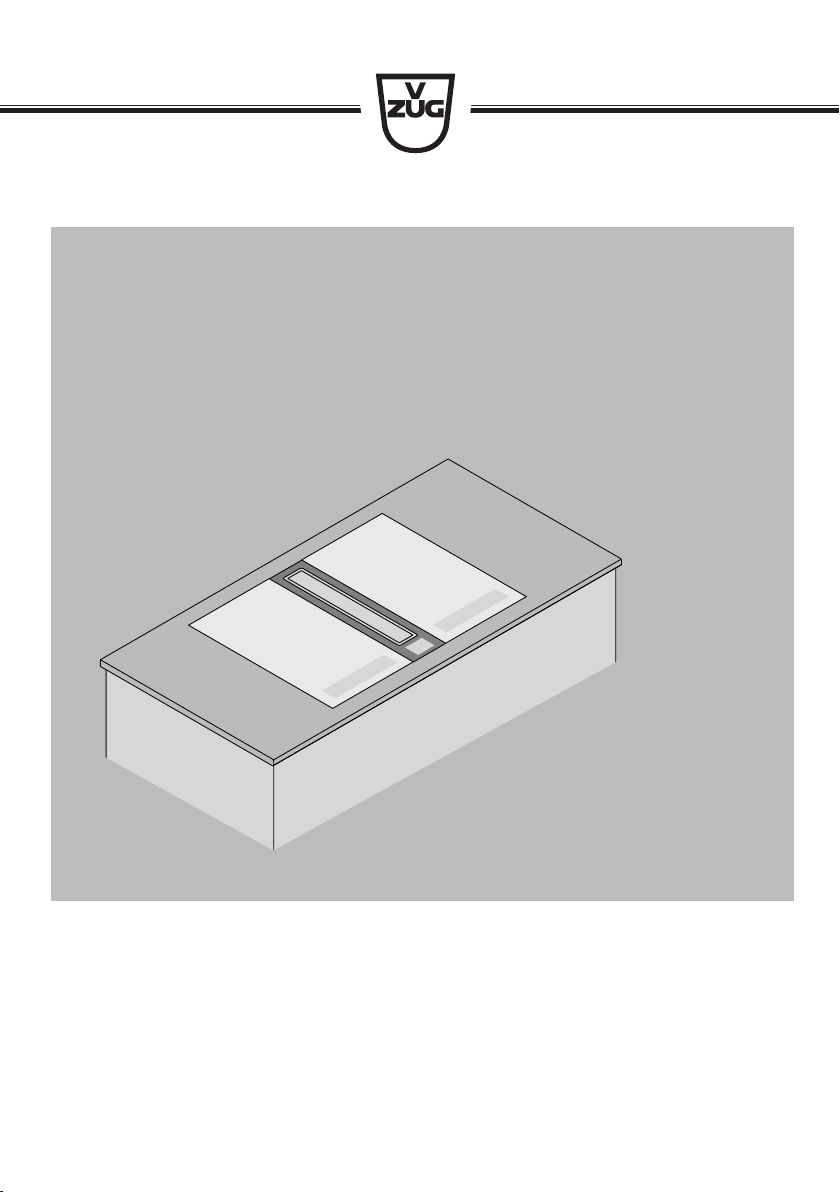
Operating Instructions
DSMS
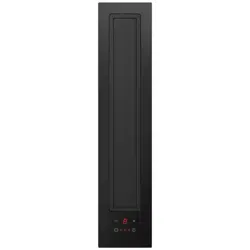
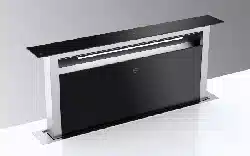
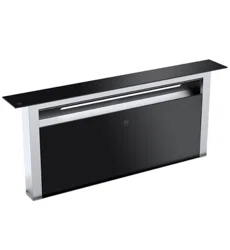
Range hood

Thank you for choosing to buy one of our products. Your appliance is made to
high standards and is easy to use. Nevertheless, please take the time to read
these operating instructions in order to familiarise yourself with the appliance
and get the best use out of it.
Please follow the safety precautions.
Modifications
Text, diagrams and data correspond to the technical standard of the appliance
at the time these operating instructions went to press. The right to make tech-
nical modifications for the purpose of the further development of the appliance
is reserved.
Validity
The product family (model number) corresponds to the first alphanumerics on
the identification plate. These operating instructions apply to:
Type Product family Size system
DSMS 64005 -
Variations depending on the model are noted in the text.
© V-ZUG Ltd, CH-6301 Zug, 2017
2

Contents
1 Safety precautions 5
1.1 Symbols used ........................................................................................................ 5
1.2 General safety precautions ................................................................................. 6
1.3 Before using for the first time ............................................................................. 7
1.4 Correct use............................................................................................................. 7
1.5 Children in the home............................................................................................ 8
1.6 Note on use ........................................................................................................... 8
2 Disposal 10
3 Appliance description 11
3.1 Appliance description ........................................................................................11
3.2 Extraction mode ..................................................................................................11
3.3 Recirculation mode with activated charcoal filters .......................................11
3.4 Features ................................................................................................................11
3.5 Construction.........................................................................................................12
3.6 Operating and display elements ......................................................................13
4 Operating the appliance 14
4.1 Using for the first time........................................................................................14
4.2 Optimizing the suction performance ...............................................................14
4.3 Switching the appliance on...............................................................................15
4.4 Setting the power level ......................................................................................16
4.5 Intensive level ......................................................................................................16
4.6 After-running time................................................................................................16
4.7 Switching the appliance off...............................................................................17
4.8 Saturation indicator.............................................................................................17
5 Care and maintenance 18
5.1 Cleaning the housing .........................................................................................18
5.2 Metal grease filters .............................................................................................19
5.3 Recirculation box with activated charcoal filters...........................................21
6 Trouble-shooting 22
6.1 What to do if…......................................................................................................22
7 Accessories and spare parts 23
8 Technical data 24
8.1 Product fiche........................................................................................................24
Index 26
9 Service & Support 27
3


1 Safety precautions
1.1 Symbols used
Denotes important safety precautions.
Failure to observe said precautions can result in injury or in damage
to the appliance or fittings!
Information and precautions that should be observed.
Information on disposal
Information about the operating instructions
▸ Indicates step-by-step instructions.
– Describes how the appliance reacts to the steps taken.
▪ Indicates a list.
5

1 Safety precautions
1.2 General safety precautions
▪ Read the operating instructions before using the appliance for
the first time!
▪ This appliance can be used by children aged 8 and above
and by persons with reduced physical, sensory or mental cap-
abilities, or lack of experience and/or knowledge, provided
they are supervised or have been instructed on the safe use
of the appliance and have understood the hazards involved.
Children shall not play with the appliance. Cleaning and user
maintenance shall not be undertaken by children without su-
pervision.
▪ If an appliance is not equipped with a mains cable and a plug
or other means for disconnecting from the mains with a con-
tact opening on each pole complying with the conditions of
overvoltage category III for full isolation, an isolating device
must be incorporated into the permanently installed electrical
installation in accordance with the installation regulations.
▪ If the mains cable of this appliance is damaged, it must be re-
placed by the manufacturer or its Customer Services or a sim-
ilarly qualified person in order to avoid hazard.
6

1 Safety precautions
1.3 Before using for the first time
▪ The appliance must be installed and connected to the electricity supply in
accordance with the separate installation instructions. Have a qualified fitter/
electrician carry out the necessary work.
▪ The use of a gas fired appliance with the hob hood is only permitted if using
a V-ZUG gas hob type listed in the installation instructions and the permitted
combination installation variants are observed. If in doubt about the gas ap-
pliance and the installation variants, please contact our Customer Services.
▪ If operating a permitted gas appliance, the hob hood must be fitted with the
dedicated gas deflector 1031218 (accessory)! Operating a gas appliance
without the gas deflector is not permitted! The content of the operating and
installation instructions for the listed gas hobs must be observed!
▪ Using another gas appliance type/model or manufacturer is not permitted
and can cause lasting damage to the range hood.
▪ Combining the hob hood with two gas hobs is not permitted! Failure to ob-
serve the above instruction can cause lasting bodily harm and lasting dam-
age to property and the appliance. In such a case, any and all liability, guar-
antee and goodwill claims will be rejected, now and in the future!
▪ Observe the official regulations for the exhaust-air layout.
▪ Dispose of the packaging material in accordance with local regulations.
1.4 Correct use
▪ The appliance is designed for use in the home for extracting cooking fumes
and smells from above the cooking surface.
▪ Any repairs, modifications or manipulations to the appliance, especially any
electrically live parts, may only be carried out by the manufacturer, its cus-
tomer service department or similarly qualified persons. Repairs if carried
out incorrectly may cause serious injury, damage to the appliance and fit-
tings, as well as affect the functioning of the appliance. If the appliance is
not working properly or in case a repair is needed, follow the instructions
given in the 'Service & Support' section. Contact our Customer Services if
necessary.
▪ Use original spare parts only.
▪ Retain these operating instructions for future reference.
7

1 Safety precautions
1.5 Children in the home
▪ Packaging material, e.g. plastic film and polystyrene, can be dangerous for
children. Danger of suffocation! Keep packaging material away from chil-
dren.
▪ The appliance is designed for use by adults who are familiar with these op-
erating instructions. Children are often unable to recognize the danger of
electrical appliances. Ensure proper supervision and do not allow children
to play with the appliance – there is a danger that children could hurt them-
selves.
1.6 Note on use
▪ If the appliance is visibly damaged, do not use it. Contact our Customer
Services.
▪ If the appliance is not functioning properly, disconnect it from the power
supply immediately.
▪ If the mains cable of the appliance is damaged, it must be replaced by Cus-
tomer Services in order to avoid hazard.
▪ Caution: Accessible parts may become hot when used with cooking appli-
ances.
▪ The appliance and surrounding components get hot during operation! Allow
the fan flap, gas deflector and other components to cool down before
touching them.
▪ Under no circumstances place heated cookware, pots and pans on the op-
erating and display field.
▪ The room must be adequately ventilated when operating the range hood at
the same time as other appliances that burn gas or other fuels.
▪ Do not flambé food underneath the range hood or next to a hob hood or
downdraft hood.
▪ When frying on the cooking surface, do not leave the appliance unattended.
The cooking oil in the frying appliance could overheat and catch fire. Con-
stantly monitor the temperature of the cooking oil, keeping it below the tem-
perature at which it can catch fire. Change the cooking oil regularly – dirty
oil catches fire more easily than clean oil.
▪ Observe the cleaning intervals. Failure to do so can increase the fire hazard
due to the build-up of grease in the metal grease filters.
8

1 Safety precautions
▪ Do not operate the individual cooking zones of the cooking surface without
a pan on them or with an empty pan on them so as to avoid damaging the
appliance or the kitchen fittings through a build-up of heat. Avoid open fires
with oil, gas, wood and coal fired cookers.
▪ Ensure there is adequate ventilation when the extractor fan is on so as to
avoid creating a disturbing underpressure in the kitchen and to achieve op-
timal air extraction.
▪ Avoid a cross-current of air, which could blow the cooking vapours over the
cooking area.
▪ If other appliances – fired by gas or other fuels – are being used at the
same time, ensure that there is a sufficient supply of fresh air. This does not
apply to air recirculation appliances.
▪ If other firing systems are being used at the same time (e.g. wood, gas, oil
or coal fired heating appliances), safe operation is only possible providing a
room negative pressure of 4Pa (0.04mbar) is not exceeded at the location
of the appliance. Risk of toxic fumes! An adequate flow of fresh air must be
guaranteed e.g. via non-closable openings in doors or windows and in com-
bination with an air-intake/exhaust-air wall box or by other technical means.
▪ When carrying out maintenance work on the appliance, including replacing
the light bulb, cut off the electricity supply to the appliance: remove the
screw fuse from the holder or switch the circuit breaker off, or disconnect
from the mains supply.
▪ When cleaning the appliance make sure no water gets inside it. Use a mod-
erately damp cloth. Do not spray the inside or outside of the appliance with
water. Do not use a steam cleaner. If water gets inside the appliance, it can
cause damage.
▪ Failure to follow the cleaning instructions may cause a fire hazard.
▪ Do not operate the appliance using an external time switch or a separate re-
mote control system.
9

2 Disposal
Packaging
▪ All packaging materials (cardboard, plastic film (PE) and polystyrene (EPS))
are marked and should be collected for recycling and disposed of in an en-
vironmentally friendly way.
Disconnection
▪ Disconnect the appliance from the mains. With a fixed appliance, this is to
be carried out by a qualified electrician!
Safety
▪ Disable the appliance to prevent accidents caused by improper use, espe-
cially through children playing.
▪ Pull the plug out of the mains socket or have the appliance disconnected
from the mains by an electrician. Then cut the mains cable off flush with the
appliance.
Disposal
▪ The old appliance should not be discarded as worthless rubbish. If dis-
posed of correctly, the raw materials can be recovered for recycling.
▪ The symbol on the identification plate warns that the appliance may not
be disposed of in normal household waste.
▪ The appliance must be disposed of in accordance with local regulations on
waste disposal. For more information on the handling, disposal and recyc-
ling of the product, please contact the local authorities, the local recycling
facilities for household waste or the retailer from whom you purchased the
appliance.
10

3 Appliance description
3.1 Appliance description
The appliance is designed for use in the home for extracting cooking odours
from above a cooking area and can be used in the extraction or recirculation
mode.
3.2 Extraction mode
A fan draws cooking fumes and smells from above the cooking area. The
metal grease filters clean the extracted air, which is passed through a connect-
ing pipe fitted with an integrated non-return valve and through the air duct to
the outside.
When in use, ensure there is a sufficient supply of fresh air to replace
the air that is being extracted.
3.3 Recirculation mode with activated charcoal filters
After being filtered through the metal grease filters, the cooking fumes and
smells above the cooking area are passed through a recirculation box with in-
tegrated activated charcoal filters, the odours are largely removed from the air
and it is then circulated back into the room.
If recirculation box is not supplied with activated charcoal filters, these
should be ordered and installed before using the appliance for the
first time.
3.4 Features
▪ 1 extractor fan with 4 power levels:
– Level 1 = low, 2 = medium, 3 = high, and intensive level.
– Power levels 1–3 are suitable for continuous operation; the intensive level
is used for short bursts of intensive extraction of cooking fumes and
smells, e.g. when searing meat. The intensive level runs for a maximum
of 6 minutes at a time.
▪ 1 metal grease filter
▪ 1 collection tray
▪ Optional separate recirculation box with activated charcoal filters, only for
recirculation mode (not included in the scope of delivery, available for order
as an accessory)
▪ Gas deflector, required for a gas appliance (not included in the scope of de-
livery, available for order as an accessory)
11
3 Appliance description
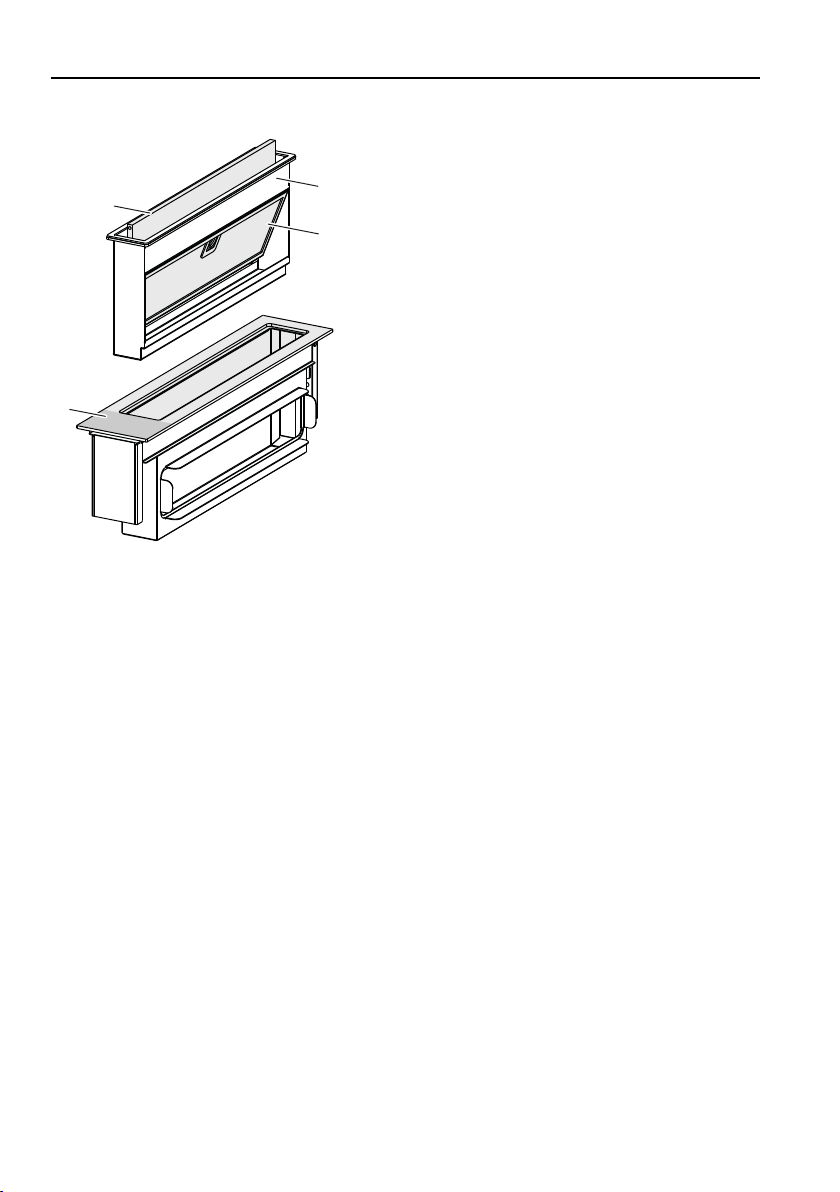
3.5 Construction
2
1
4
3
1
Operating and display elements
2
Fan flap
3
Collection tray
4
Metal grease filter
12
3 Appliance description
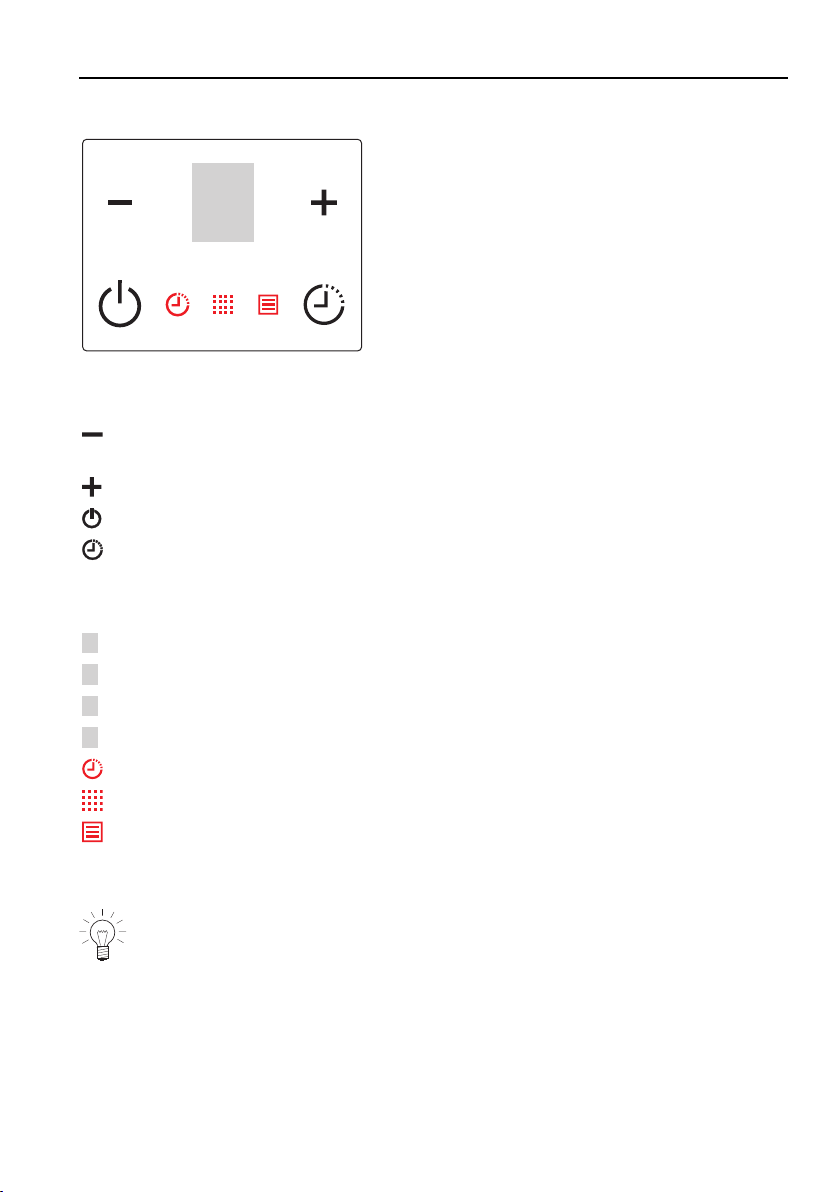
3.6 Operating and display elements
Buttons
Reduce power level /
Reset saturation indicator
Increase power level
Switch appliance on/off
After-running time
Displays
Display field (power level 1-3)
b
Intensive level
C
Setting for extraction/recirculation mode
8
Reset saturation indicator
After-running time switched on
Saturation indicator for metal grease filters
Saturation indicator for activated charcoal filters
(only for recirculation mode)
Depending on the model and features, the specification of your appli-
ance may differ in individual details from the standard specification de-
scribed.
13
4 Operating the appliance
4.1 Using for the first time
Appliance configuration
The model can be used to extract or recirculate air. The appliance is set up
ex-factory for use in the extraction mode.
If the appliance is to be operated as an extraction model, the satura-
tion indicator for the activated charcoal filters must be deactivated.
Activating the saturation indicator for the activated charcoal filters
▸ Switch the appliance off.
▸ Depress the button for 2 seconds.
–
C
flashes twice in the display.
▸ The appliance is now configured for the recirculation mode and the satura-
tion indicator for the activated charcoal filters is activated.
Deactivating the saturation indicator for the activated charcoal filters
▸ Switch the appliance off.
▸ Depress the button for 2 seconds.
–
C
flashes once in the display.
▸ The appliance is now configured for the extraction mode and the saturation
indicator for the activated charcoal filters is deactivated.
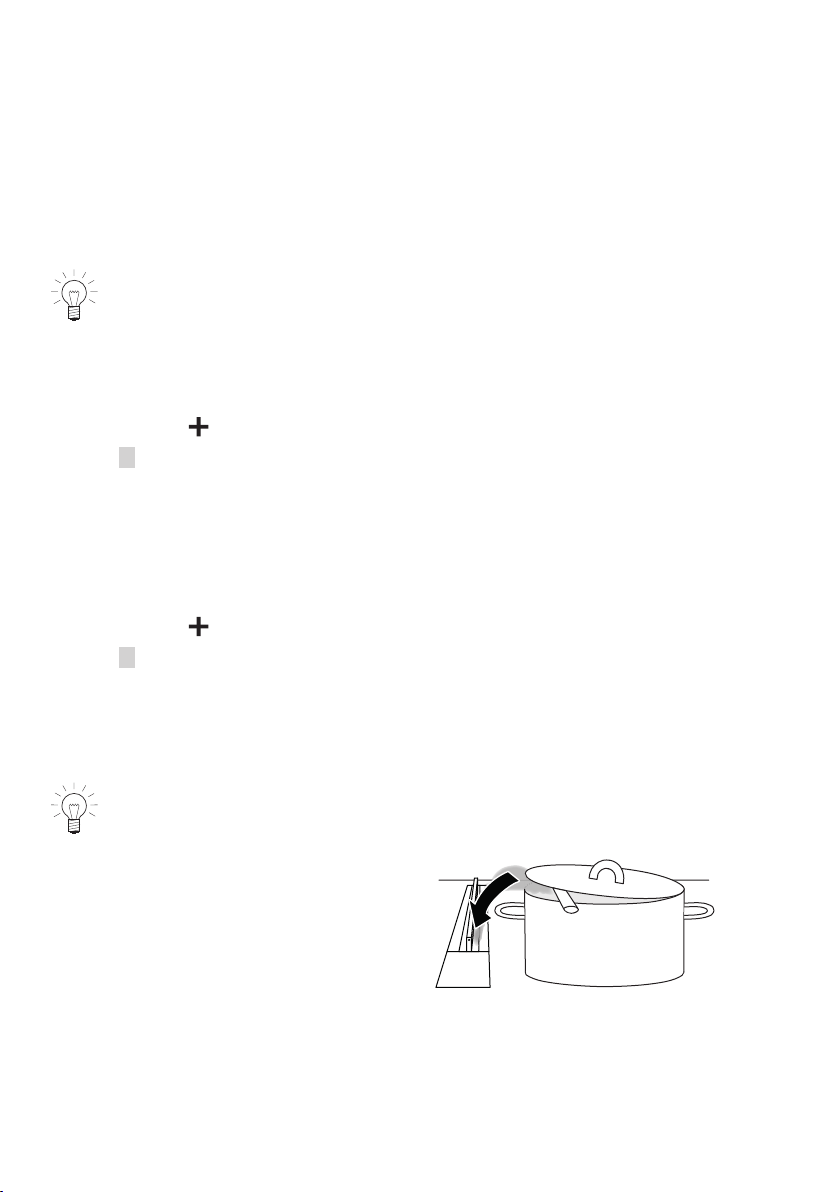
4.2 Optimizing the suction performance
Using suitable pan lids and tilting them slightly intensifies the suction
performance of the downdraft hood.
▸ Slightly tilt the pan lid so that the
steam and odours given off dur-
ing cooking can be extracted
more efficiently into the
downdraft hood. Use a wooden
spoon to keep the pan lid in pos-
ition.
– This improves and intensi-
fies the suction perform-
ance.
14
4 Operating the appliance
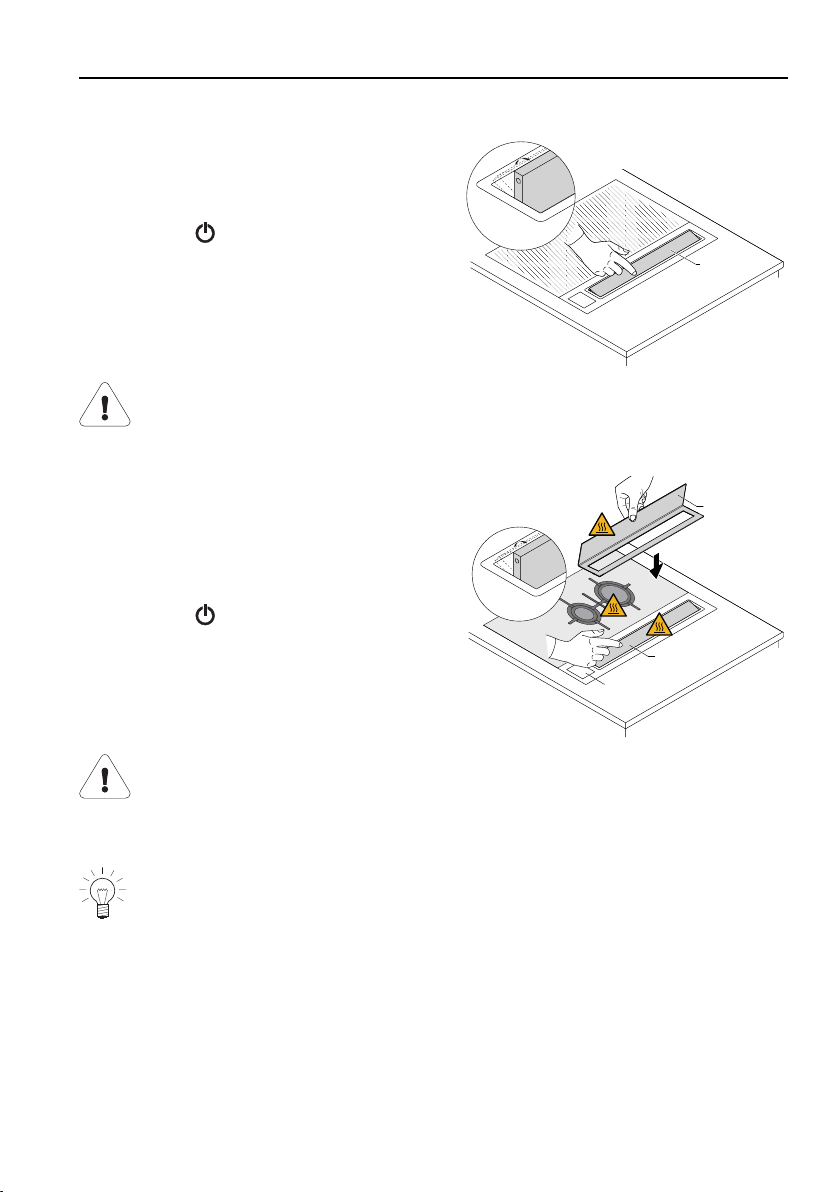
4.3 Switching the appliance on
Do not switch the appliance on un-
til the fan flap is open.
▸ Open the fan flap
1
manually.
▸ Press the button to switch the
appliance on.
– The appliance switches on
at power level1.
1
If operating a permitted gas appliance, the hob hood must be fitted
with the dedicated gas deflector 1031218 (accessory)! Operating a
gas appliance without a gas deflector is not permitted!
Procedure if using a gas appliance:
▸ Open the fan flap
1
manually.
▸ Set the gas deflector
2
in the
correct position relative to the
gas appliance.
▸ Press the button to switch the
appliance on.
– The appliance switches on
at power level1.
1
3
2
Risk of burns!
The appliance and surrounding components get hot during operation!
Allow the fan flap, gas deflector and other components to cool down
before touching them.
The gas deflector may reduce the extraction power of the hob. Select
a higher power level if required.
15
4 Operating the appliance
4.4 Setting the power level
▸ Pressing the button switches the appliance on at power level 1.
▸ Use the or button to select the required power level.
– The power level set is shown in the display field.
After opening the fan flap, we recommend switching the appliance on
at level 2 some five minutes before starting to cook. Leave the appli-
ance running for about 15minutes after cooking to extract all the
cooking smells.
4.5 Intensive level
▸ Open the fan flap and switch the appliance on with the button.
▸ Select and hold the button until
b
appears in the display field.
– The intensive level switches on and runs for 6 minutes before the appli-
ance automatically switches back to the previously set power level.
▸ Select the button to chose a different power level or to stop the intensive
level before the 6 minutes has elapsed.
– The corresponding power level is shown in the display field.
– If the appliance had not been switched on beforehand, then the appli-
ance will automatically switch off after the six minutes has elapsed.
4.6 After-running time
▸ Open the fan flap and switch the appliance on with the button.
▸ Use the or button to select the required power level.
▸ Touch the button to activate the after-running time.
– While the after-running time is activated, the corresponding display
symbol illuminates.
– The after-running time function starts at the previously set power level,
runs for 15 minutes and then the appliance switches off automatically.
▸ Select the or button to stop the after-running time earlier.
The after-running time function is not available when the intensive level
mode is active. Make sure that the fan flap is open as long as the
after-running time function is active.
16

4 Operating the appliance
4.7 Switching the appliance off
▸ Press the button to switch the appliance off.
– The appliance switches off.
4.8 Saturation indicator
Metal grease filters
The display symbol illuminates after 50 operating hours. The saturation
level has been reached and the metal grease filters must be cleaned.
Activated charcoal filter
in the recirculation box (only for recirculation
mode)
The display symbol illuminates after 550 operating hours. The saturation
level has been reached. The maximum operating time of the activated char-
coal filter is 3 years.
Only activate the saturation indicator for the activated charcoal filters if
the appliance is being used in the recirculation mode and together
with the external recirculation box designed for this purpose. For more
information, refer to the section: Using for the first time (see page 14).
17

5 Care and maintenance
5.1 Cleaning the housing
Take care that no water gets into the housing of the appliance! If wa-
ter gets into the housing, it can cause damage.
Do not use abrasive cleaners, scouring pads, steel wool, etc. for
cleaning, as they can damage the surface. Disconnect the appliance
from the mains and unscrew the fuse or switch off the automatic cir-
cuit breaker.
Cleaning the outside/inside
▸ Clean the outside of the appliance with a warm, damp cloth and a little de-
tergent and then wipe dry.
– Grease and condensate water can build up on the inside around the
metal grease filters.
▸ Clean with a warm, damp cloth and a little detergent – you can also use a
brush if necessary – and then wipe dry with a kitchen towel.
18

5 Care and maintenance
5.2 Metal grease filters
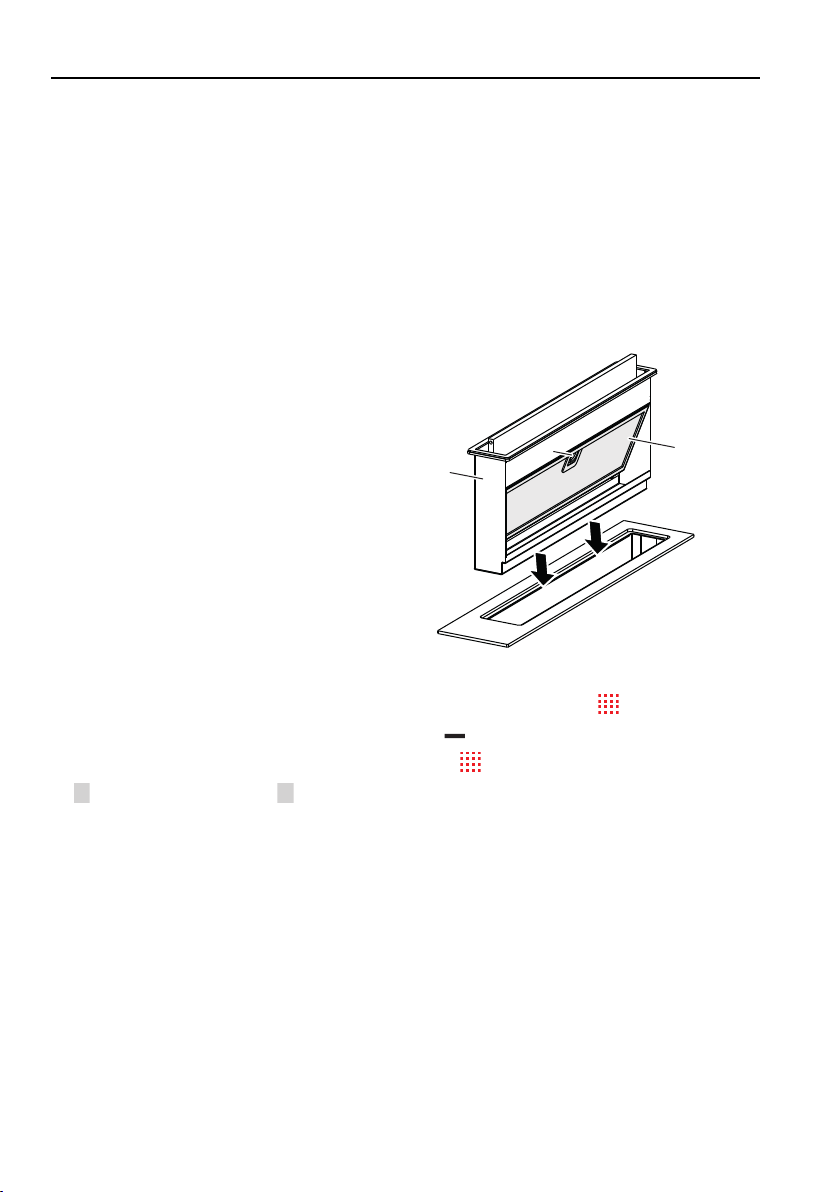
The metal grease filters must be cleaned at least once a month with normal
use or whenever the saturation indicator illuminates. If properly cared for,
the grease filters should provide years of service.
Do not damage the collection tray or metal grease filters when in-
serting/removing them.
Removing
▸ Press the button to switch the
appliance off.
▸ Open the fan flap, pull it up and
thereby lift the grease collection
tray
1
up and out.
– The grease filter
2
is visible.
▸ Push the grip
3
on the grease fil-
ter in.
– This releases the grease fil-
ter
2
.
▸ Carefully pull the grease filter
2
down and out of the collection
tray
1
.
▸ Empty and clean the collection
tray
1
as required.
▸ Clean the grease filter
2
.
2
3
1
Cleaning
▸ Clean the grease filters
2
in the dishwasher.
▸ Set the dishwasher to an «intensive» or «heavy» soiling programme.
Cleaning may cause the metal grease filters to become slightly discol-
oured. However, this will not affect the functioning of the filters in any
way.
19
5 Care and maintenance
If no dishwasher is available:
▸ Clean the grease filters
2
in the sink with hot water and detergent.
▸ Then soak the grease filters
2
in hot water in the sink for about two hours
and finally clean with a washing-up brush. Rinse well with clean cold water.
– The cleaned grease filters
2
are ready for use again.
▸ Clean the outside of the collection tray
1
with a warm, damp cloth and a
little detergent, then wipe dry well with kitchen paper.
Installing
▸ Reassemble in the reverse or-
der.
▸ Make sure that the grip
3
on the
grease filter faces upwards.
2
3
1
Resetting the saturation indicator for the metal grease filters
▸ With the appliance switched off, hold the button depressed for
3seconds to reset the saturation indicator .
▸
8
flashes thrice in the display field if reset correctly.
20
5 Care and maintenance
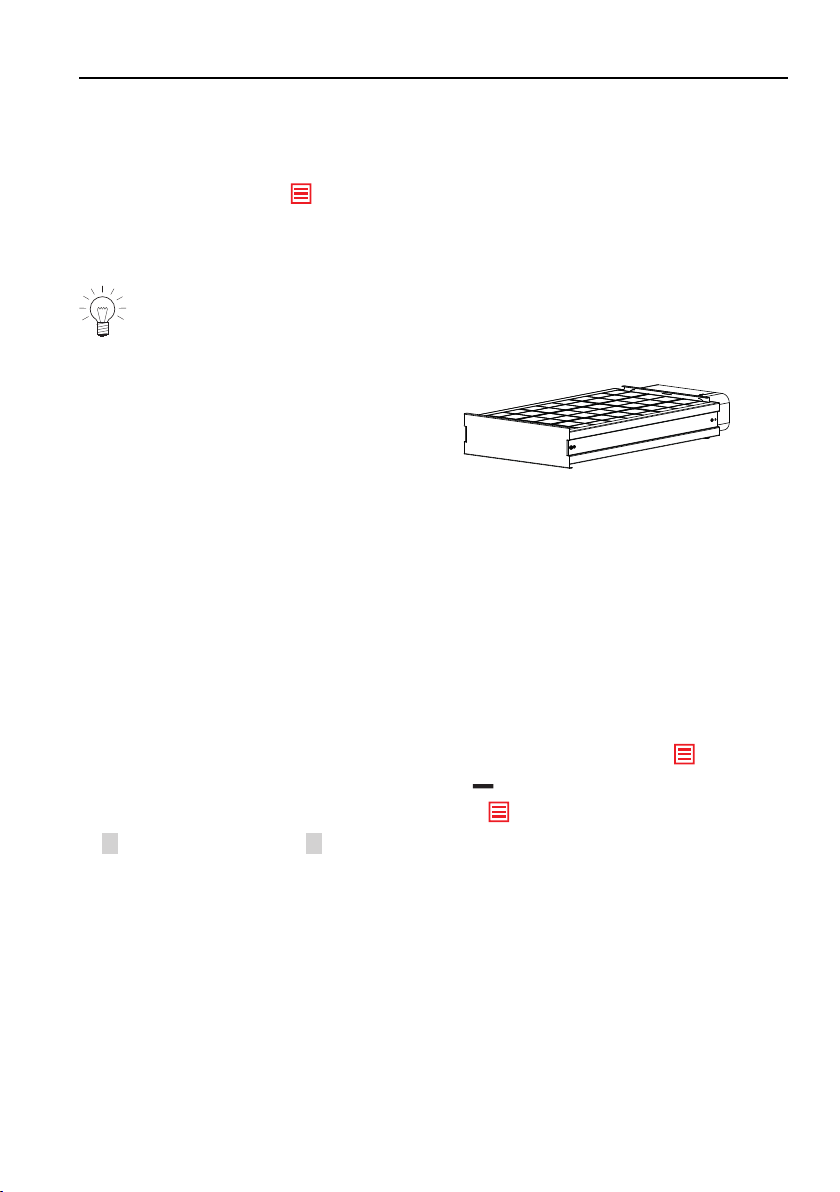
5.3 Recirculation box with activated charcoal filters
An activated charcoal filter becomes less effective with use. With normal use,
the activated charcoal filters have to be changed every 3 years or whenever
the saturation indicator illuminates. The recirculation box contains 6 activ-
ated charcoal filters. These cannot be washed or regenerated. Replace all the
activated charcoal filters at the same time. The spent activated charcoal filter
can be disposed of in the household waste or at a suitable recycling point.
Activated charcoal filters are only used in the recirculation mode and
together with the recirculation box designed for this purpose.
Cleaning
▸ Clean the housing, edges and
corners of the recirculation box –
having already taken out the 6
activated charcoal filters – with a
warm, damp cloth and a little de-
tergent, then wipe dry.
– The interior can also get
grimy and greasy.
▸ Clean with a warm, damp cloth
and a little detergent – you can
also use a brush if necessary –
and then wipe dry with a kitchen
towel.
Resetting the saturation indicator for the activated charcoal filters
▸ With the appliance switched off, hold the button depressed for
3seconds to reset the saturation indicator .
▸
8
flashes thrice in the display field if reset correctly.
21
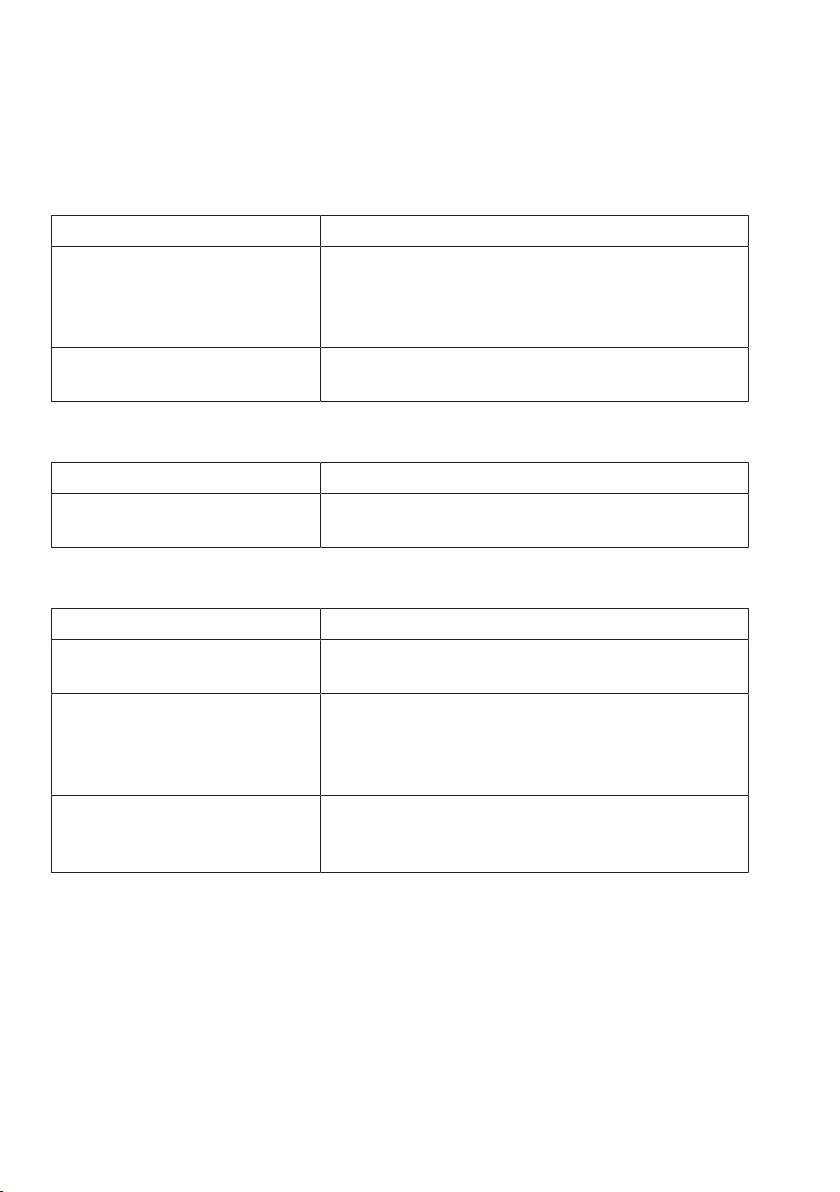
6 Trouble-shooting
6.1 What to do if…
… the appliance is not working
Possible cause Solution
▪ Fuse or automatic circuit
breaker for electrical in-
stallations in the home is
defective.
▸ Replace the fuse.
▸ Reset the automatic circuit breaker.
▪ An interruption in the
power supply.
▸ Check the power supply.
… button illumination or display elements faulty
Possible cause Solution
▪ Control unit or electronic
component is defective.
▸ Contact Customer Services.
… the appliance is not extracting enough air
Possible cause Solution
▪ The metal grease filters
are dirty.
▸ Clean the metal grease filters.
▪ Only for recirculation
mode: Activated charcoal
filters in the recirculation
box are saturated.
▸ Replace all 6 activated charcoal filters in the
recirculation box.
▪ Only for extraction mode:
The fresh air intake is in-
sufficient.
▸ Ensure the fresh air intake is sufficient.
22
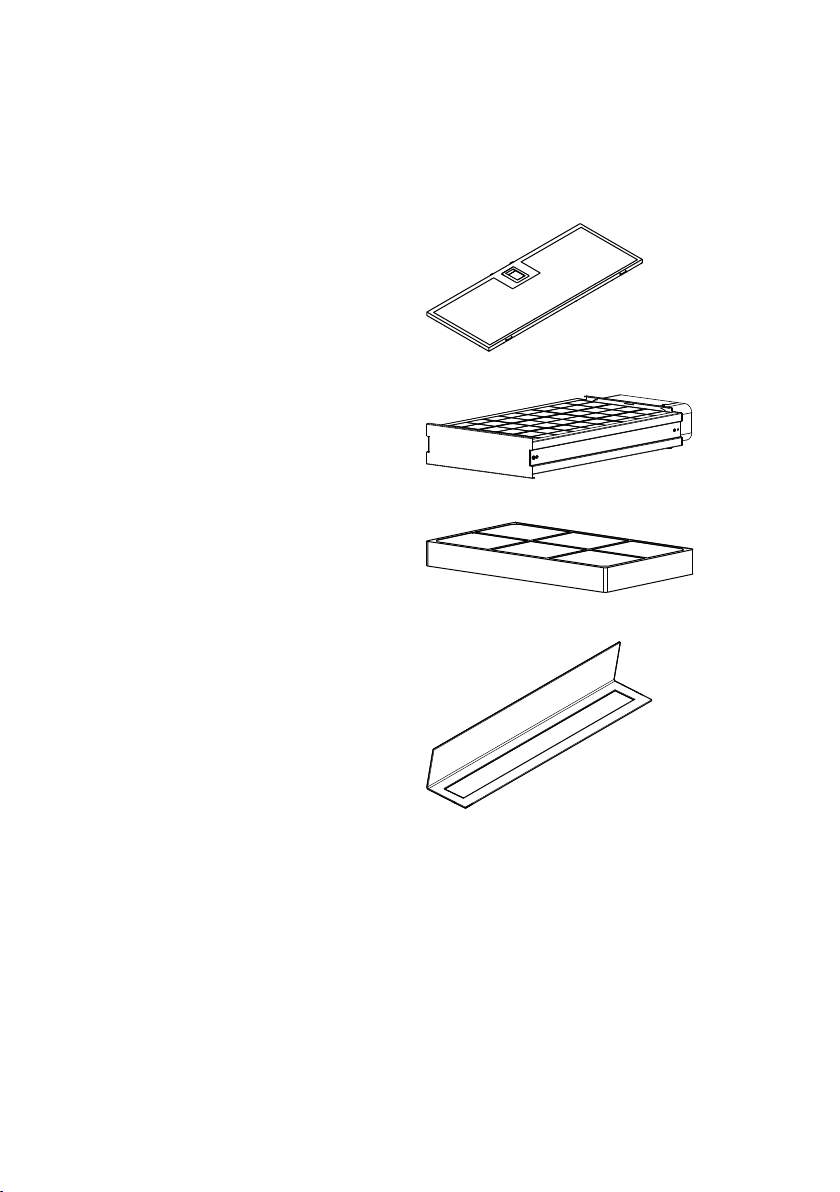
7 Accessories and spare parts
Please give model number of the appliance and exact designation of the ac-
cessory or spare part when ordering parts.
Metal grease filter
Recirculation box (recircula-
tion mode only)
Activated charcoal filter for re-
circulation box
Gas deflector (required if us-
ing a gas appliance)
23
8 Technical data
Electrical connection
▸ See identification plate.
– The identification plate is located in the base on the side panel of the
fan motor.
– A second identification plate is included in the scope of delivery and
should be retained for the purposes of appliance identification.
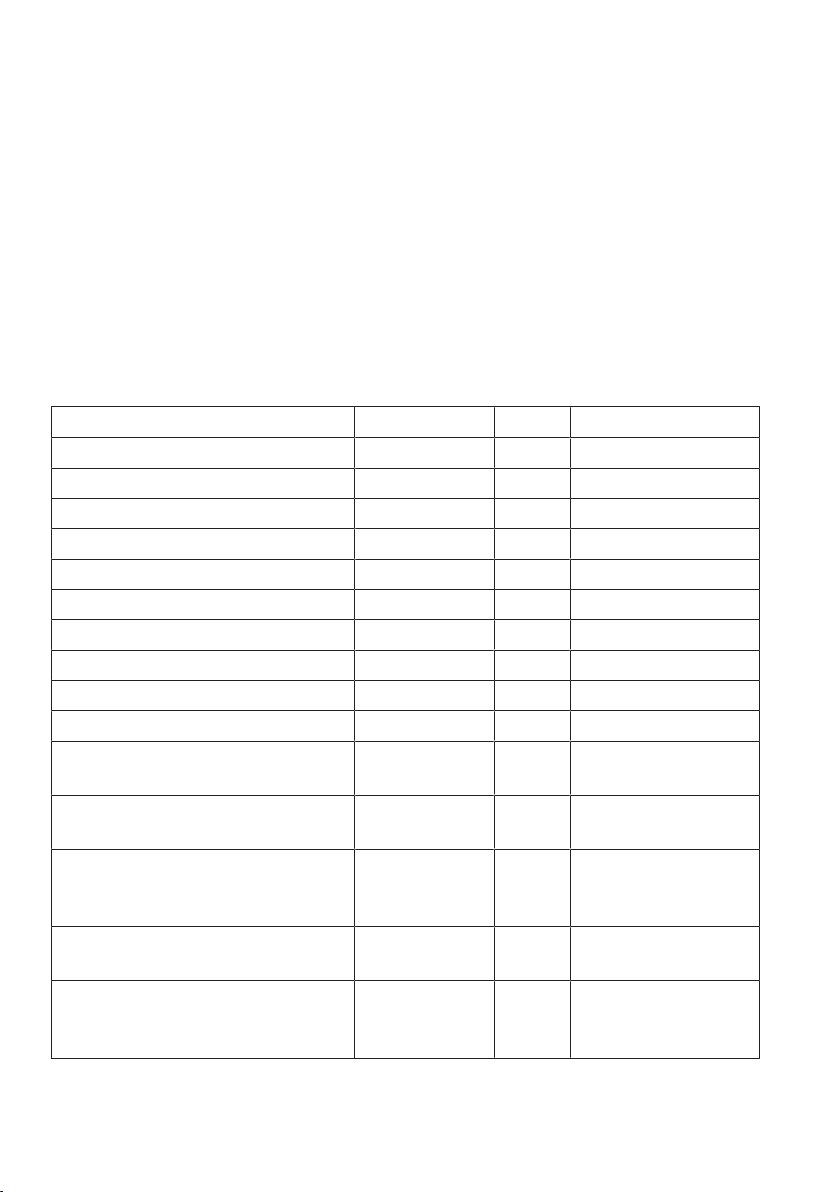
8.1 Product fiche
In accordance with EU Regulation No. 65/2014 and No. 66/2014
Description Abbreviations Unit Value
Brand S - V-ZUG LTD
Model identifier M - 64005
Annual Energy Consumption AEC
hood
kWh/a 40.4
Energy Efficiency Index EEI
hood
% 48.7
Energy Efficiency Class EEC - A
Fluid Dynamic Efficiency FDE
hood
% 31.6
Fluid Dynamic Efficiency Class FDEC - A
Lighting Efficiency LE
hood
lux/W 0.0
Lighting Efficiency Class LEC - -
Grease Filtering Efficiency GFE
hood
% 75.1
Grease Filtering
Efficiency Class
GFEC - C
Air flow at minimum
speed
Q
min
m
3
/h 360
Air flow at maximum
speed (intensive or boost ex-
cluded)
Q
max
m
3
/h 460
Air flow at intensive
or boost setting
Q
boost
m
3
/h 550
Airborne acoustical A-weighted
Sound Power Emissions at min-
imum speed
SPE
min
dBA 62
24
8 Technical data
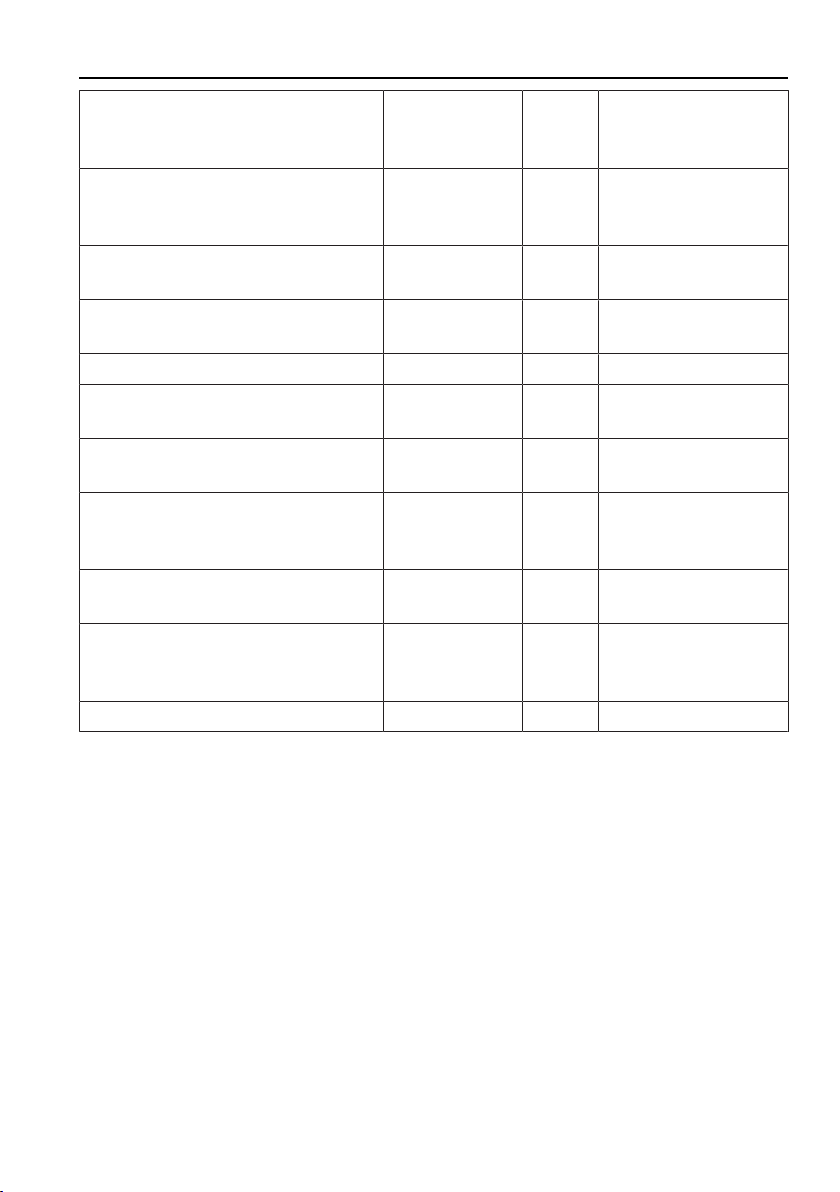
Airborne acoustical A-weighted
Sound Power Emissions at max-
imum speed
SPE
max
dBA 67
Airborne acoustical A-weighted
Sound Power Emissions at in-
tensive or boost setting
SPE
boost
dBA 70
Measured power consumption of
off mode
P
0
W 0.49
Measured power consumption of
standby mode
P
s
W -
Time increase factor f - 0.9
Measured air flow rate at the
best efficiency point
Q
BEP
m
3
/h 286.0
Measured air pressure at the
best efficiency point
P
BEP
PA 490.0
Measured value of the electric
power input at the best efficiency
point
W
BEP
W 123.0
Nominal power of the lighting
system
W
L
W 0.0
Average illumination of the light-
ing system on the cooking sur-
face
E
middle
lux 0
Sound power level L
wa
dBA 67
25

Index
A
Accessories ................................................... 23
After-running time.......................................... 16
Appliance configuration............................... 14
Appliance description .................................. 11
C
Care and maintenance ................................ 18
Children in the home...................................... 8
Cleaning
Grease filter.............................................19
Housing....................................................18
Construction................................................... 12
D
Disconnection................................................ 10
Disposal.......................................................... 10
E
Electrical connection .................................... 24
Equipment ...................................................... 11
Extraction mode ............................................ 11
I
Identification plate......................................... 24
Initial set-up ...................................................... 7
Intensive level ................................................ 16
M
Model number ................................................. 2
O
Operating elements ............................... 13, 28
Operation........................................................ 14
P
Packaging ...................................................... 10
Power level
Setting ...................................................... 16
Product family.................................................. 2
Product fiche.................................................. 25
R
Recirculation mode ...................................... 11
S
Safety .............................................................. 10
Safety precautions
Before using for the first time................ 7
Children in the home............................... 8
Correct use ............................................... 7
General ...................................................... 6
Note on use .............................................. 8
Saturation indicator....................................... 17
Service & Support......................................... 27
Suction performance
Optimizing ...............................................14
Switching off .................................................. 17
Switching on .................................................. 15
Symbols ............................................................ 5
T
Technical data ............................................... 24
Technical questions...................................... 27
Type................................................................... 2
V
Validity............................................................... 2
W
Warranty extensions ..................................... 27
What to do if
faulty button illumination.......................22
the appliance is not extracting enough
air .............................................................. 22
the appliance is not working ...............22
26

9 Service & Support
The «Troubleshooting» chapter provides valuable information for dealing with
minor operating faults. This saves you the time, effort and potential cost of having
to call out a service technician.
Information on the V-ZUG warranty can be found at www.vzug.com →Service →Warranty in-
formation. Please read this information carefully.
Please register your V-ZUG appliance online immediately at www.vzug.com →Service
→Warranty registration. This will allow you to take advantage of the best possible support
in the event of an fault in the appliance during the warranty period. You will require the
serial number (FN) and appliance designation to complete the registration process. This
information can be found on the identification plate for your appliance.
My appliance information:
FN:
___________________
Appliance
: _____________________
Always have this appliance information to hand when you contact V-ZUG. Thank you.
Your repair order
At www.vzug.com →Service→Service number you will find the telephone number of your
nearest V‑ZUG service centre.
Technical questions, accessories, warranty extensions
V-ZUG is happy to help you with any general administrative or technical queries, to take
your orders for accessories and spare parts and to inform you about our progressive ser-
vice agreements.
27
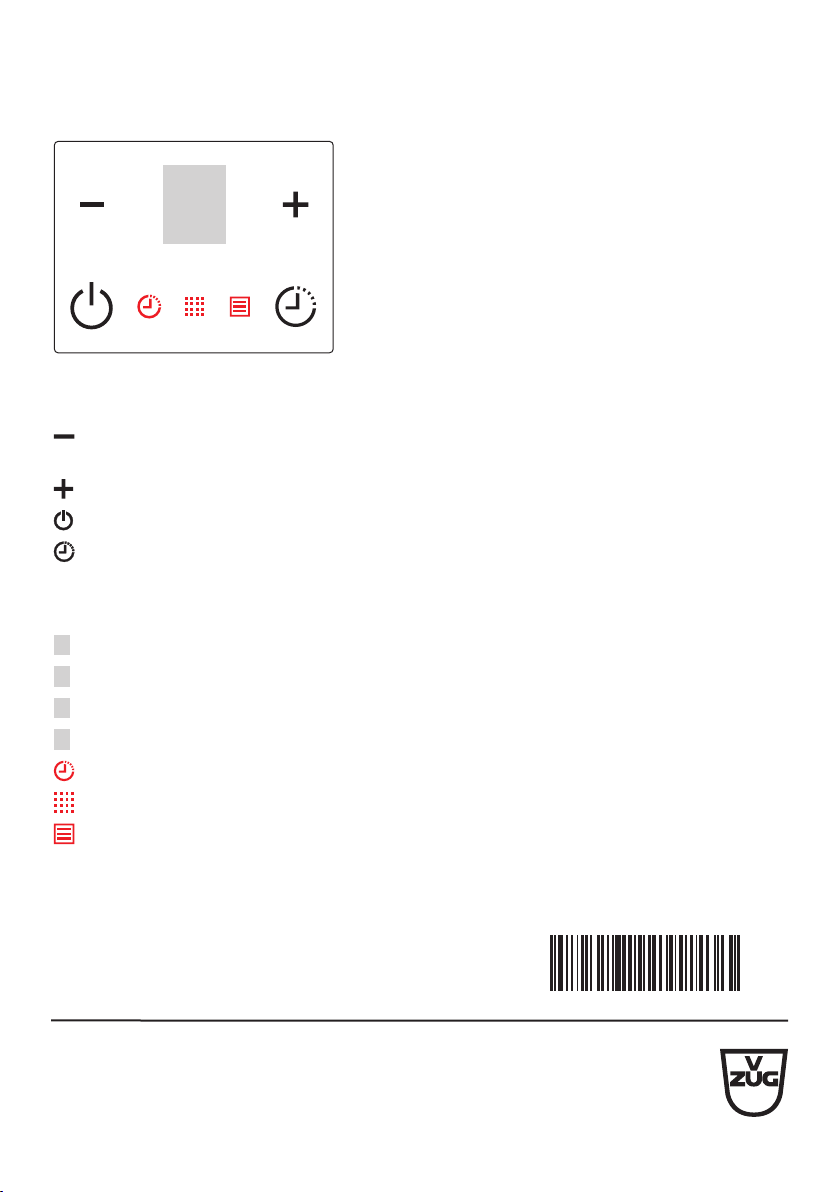
Quick instructions
Buttons
Reduce power level /
Reset saturation indicator
Increase power level
Switch appliance on/off
After-running time
Displays
Display field (power level 1-3)
b
Intensive level
C
Setting for extraction/recirculation mode
8
Reset saturation indicator
After-running time switched on
Saturation indicator for metal grease filters
Saturation indicator for activated charcoal filters
(only for recirculation mode)
V-ZUG Ltd, Industriestrasse 66, CH-6301 Zug
[email protected], www.vzug.com
1030007-R03