Operator's Manual
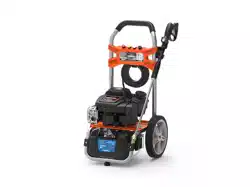
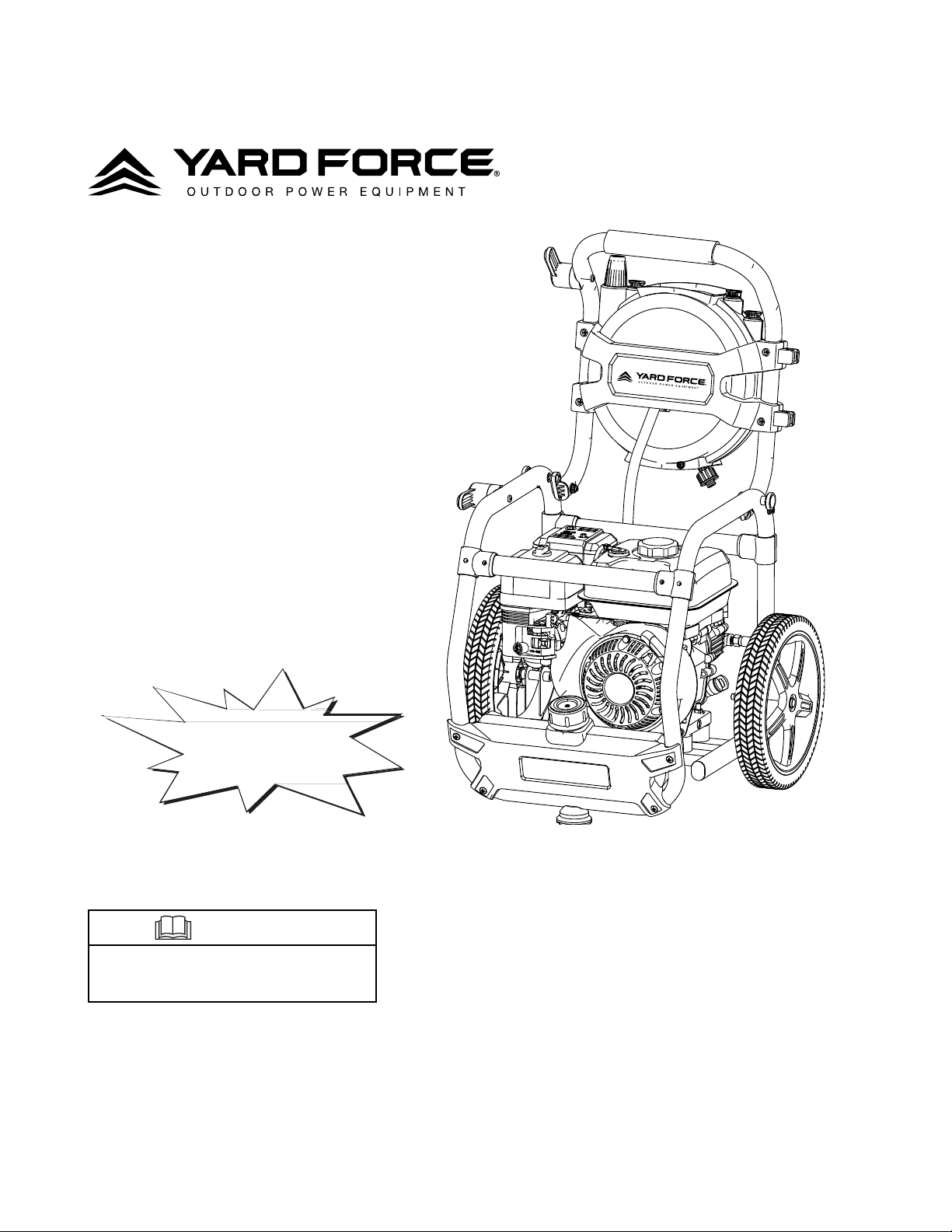
PRESSURE WASHER
CUSTOMER HELPLINE
1-866-902-9690
HOURS: Mon. - Fri. 8 a.m. to 5 p.m. (ET)
•Safety
•Assembly
•Operation
•Maintenance
•Parts
* This pressure washer is rated in accordance to the Pressure Washer Manufacturers Association (PWMA) standard
PW101-2010 (Testing and Rating Performance of Pressure Washers)
WARNING
Before using this product, read this
manual and follow all Safety Rules
and Operating Instructions.
3,200 PSI MAX* @ 2.5 GPM
2,400 PSI @ 2.7 GPM MAX*
GAS PRESSURE WASHER
Model No. Y0GWC3200R0

2
TABLE OF CONTENTS
SAFETY RULES..............................................................3-5
FEATURES AND CONTROLS............................................6
ASSEMBLY...................................................................7 -10
OPERATION................................................................11-14
SPECIFICATIONS............................................................ 15
MAINTENANCE...........................................................16-20
STORAGE........................................................................ 21
TROUBLESHOOTING......................................................22
NOTES..............................................................................23
REPLACEMENT PARTS........................................... ..24-27
EMISSION CONTROL WARRANTY............................28-29
WARRANTY......................................................................30
3
SAFETY RULES
Read this manual carefully and become familiar
with your pressure washer. Know its applications,
its limitations, and any hazards involved.
Important Safety Information
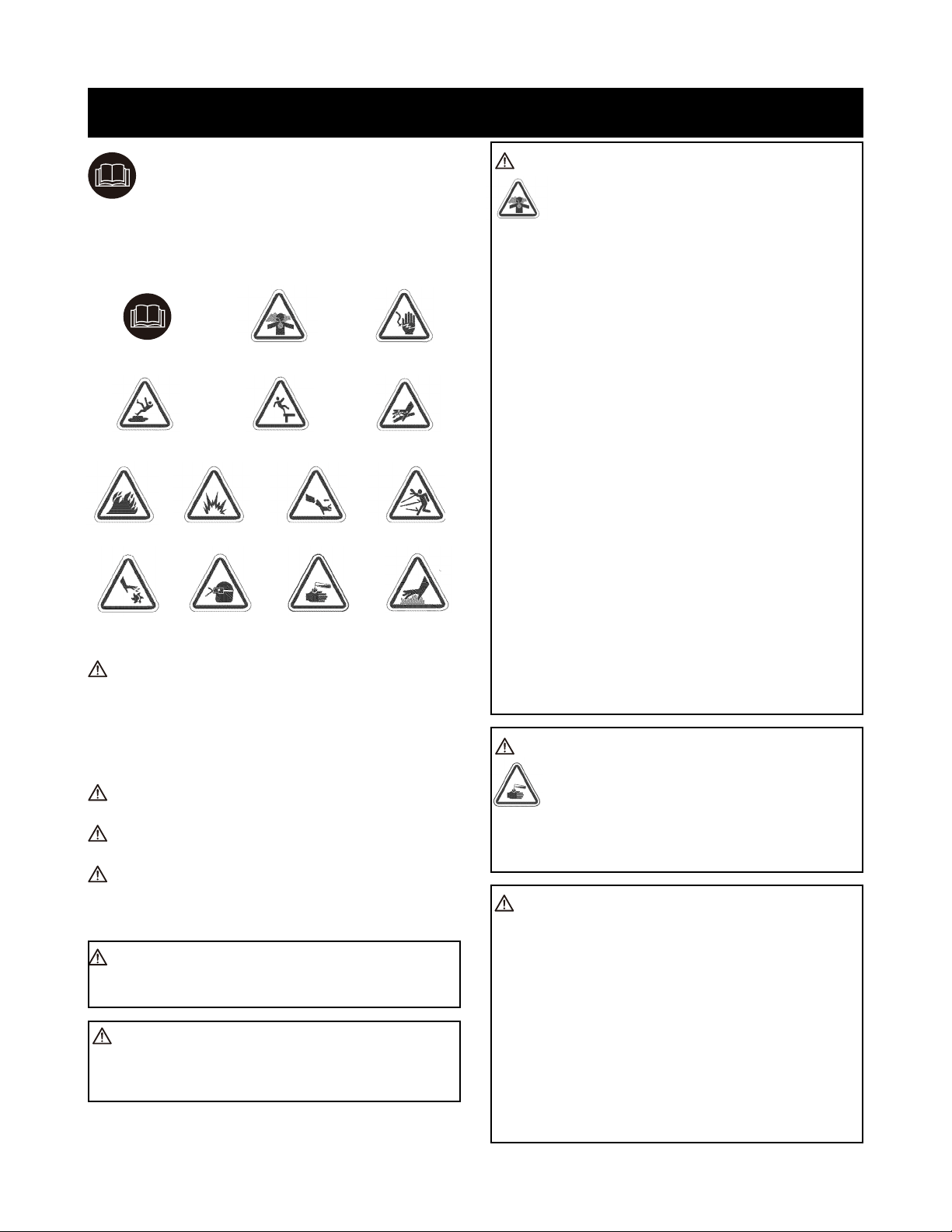
Safety Symbols and Meanings
The safety alert symbol indicates a potential personal
injury hazard. A signal word (DANGER, WARNING, or
CAUTION) is used with the alert symbol to designate a
degree or level of hazard seriousness. A safety symbol may
be used to represent the type of hazard. The signal word
NOTICE is used to address practices not related to personal
injury.
DANGER indicates a hazard which, if not avoided, will
result in death or serious injury.
WARNING indicates a hazard which, if not avoided,
could result in death or serious injury.
CAUTION indicates a hazard which, if not avoided, could
result in minor or moderate injury.
NOTICE
address practices not related to personal injury.
WARNING The engine exhaust from this product
contains chemicals known to the State of California to cause
cancer, birth defects, or other reproductive harm.
WARNING This product contains lead and lead
compounds, known to the State of California to cause birth
defects or other reproductive harm. Wash your hands after
handling this product.
Operator's Manual
Slippery Surface
Fire
Moving Parts
Explosion
Flying Objects
Kickback
Chemical Burn
Projectile
Fluid Injection
Electrical Shock
Fall
Toxic Fumes
Hot Surface
WARNING POISONOUS GAS HAZARD.
Engine exhaust contains carbon monoxide, a
poisonous gas that could kill you in minutes. You
CANNOT smell it, see it, or taste it. Even if you do
not smell exhaust fumes, you could still be exposed to
carbon monoxide gas. Some chemicals or detergents
could be harmful if inhaled or ingested, resulting in death,
serious injury, nausea, fainting or poisoning.
• Operate this product ONLY outside far away from
windows, doors and vents to reduce the risk of carbon
monoxide gas from accumulating and potentially being
drawn towards occupied spaces.
• Install battery-operated carbon monoxide alarms or
plug-in carbon monoxide alarms with battery back-up
according to the manufacturer's instructions. Smoke
alarms cannot detect carbon monoxide gas.
• DO NOT run this product inside homes, garages,
basements, crawlspaces, sheds, or other partially-
enclosed spaces even if using fans or opening doors
and windows for ventilation. Carbon monoxide can
quickly build up in these spaces and can linger for hours,
even after this product has shut o.
• ALWAYS place this product downwind and point the
engine exhaust away from occupied spaces.
If you start to feel sick, dizzy, or weak while using this
product, shut it o and get to fresh air RIGHT AWAY. See
a doctor. You may have carbon monoxide poisoning.
• Use a respirator or mask whenever there is a chance
that vapors may be inhaled when using chemicals.
• Read all instructions with mask so you are certain the
mask will provide the necessary protection against
inhaling harmful vapors when using chemicals.
WARNING Chemical Burn Hazard.
Chemicals could cause burns resulting in death or
serious injury.
• DO NOT use caustic liquid with pressure washer.
• Use ONLY pressure washer safe detergents/soaps.
Follow all manufacturers instructions.
WARNING
• Read all the instructions before using the product.
• To reduce the risk of injury, close supervision is
necessary when a product is used near children.
• Know how to stop the product and bleed pressures
quickly. Be thoroughly familiar with the controls.
• Stay alert – watch what you are doing.
• Do not operate the product when fatigued or under the
inuence of alcohol or drugs.
• Keep operating area clear of all persons
• Do not overreach or stand on unstable support. Keep
good footing and balance at all times.
• Follow the maintenance instructions specied in the
manual.
4
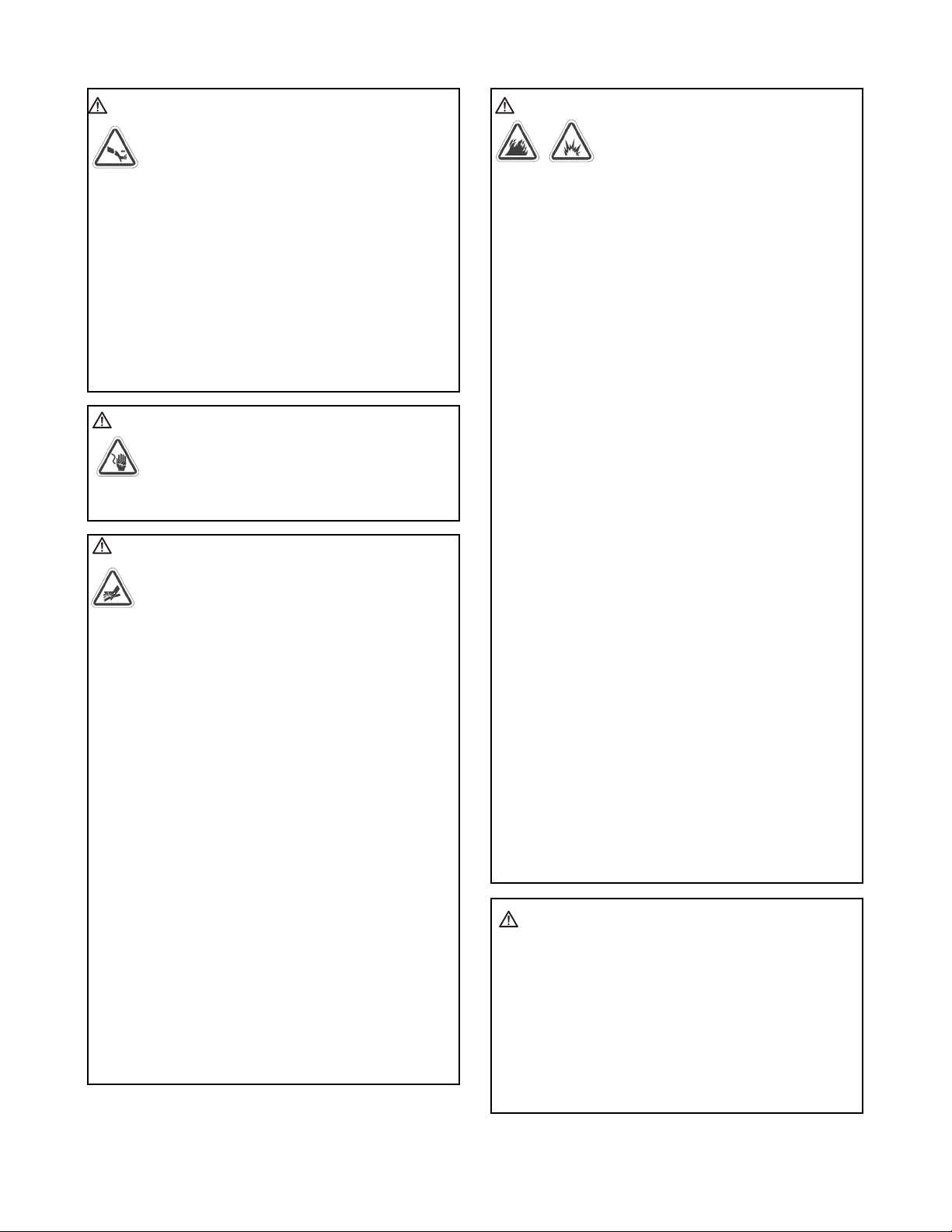
WARNING Starter cord kickback (rapid retraction) will
pull hand and arm toward engine faster than
you can let go which could cause broken bones,
fractures, bruises, or sprains resulting in serious
injury.
• NEVER pull starter cord without rst relieving spray gun
pressure.
• When starting engine, pull cord slowly until resistance is
felt and then pull rapidly to avoid kickback.
• After each starting attempt, where engine fails to run,
always point spray gun in safe direction, press red
button and squeeze spray gun trigger to release high
pressure.
• Firmly grasp spray gun with both hands when using high
pressure spray to avoid injury when spray gun kicks
back.
WARNING Risk of electrocution,
Contact with power source could cause electric
shock or burn resulting in death or serious injury.
• NEVER spray near power source.
WARNING The high pressure stream of water that
this equipment produces could cut through skin
and its underlying tissues, resulting in serious
injury and possible amputation.
Spray gun traps high water pressure, even when engine
is stopped and water is disconnected, which could result
in serious injury.
• If cut by uid, call physician immediately. DO NOT treat
as a simple cut.
• DO NOT allow CHILDREN to operate pressure washer.
• NEVER repair high pressure hose. Replace it.
• NEVER repair leaking connections with sealant of any
kind. Replace o-ring or seal.
• NEVER connect high pressure hose to nozzle extension.
• Keep high pressure hose connected to pump and spray
gun while system is pressurized.
• ALWAYS point spray gun in safe direction, press red
button and squeeze spray gun trigger to release high
pressure, every time you stop engine.
• NEVER aim spray gun at people, animals, or plants.
• DO NOT secure spray gun in open position.
• DO NOT leave spray gun unattended while machine is
running.
• NEVER use a spray gun which does not have a trigger
lock or trigger guard in place and in working order.
• Always be certain spray gun, nozzles and accessories
are correctly attached.
WARNING Fuel and its vapors are extremely
ammable and explosive which could .
cause burns, re or explosion resulting in
death or serious injury.
WHEN ADDING OR DRAINING FUEL
• Turn pressure washer engine OFF and let it cool at least
2 minutes before removing fuel cap. Loosen cap slowly
to relieve pressure in tank.
• Fill or drain fuel tank outdoors.
• DO NOT overll tank. Allow space for fuel expansion.
• If fuel spills, wait until it evaporates before starting
engine.
• Keep fuel away from sparks, open ames, pilot lights,
heat, and other ignition sources.
• Check fuel lines, tank, cap and ttings frequently for
cracks or leaks. Replace if necessary.
• DO NOT light a cigarette or smoke.
WHEN STARTING EQUIPMENT
• Ensure spark plug, muer, fuel cap, and air cleaner are
in place
• DO NOT crank engine with spark plug removed.
WHEN OPERATING EQUIPMENT
• DO NOT operate this product inside any building,
carport, porch, mobile equipment, marine applications,
or enclosure.
• DO NOT tip engine or equipment at angle which causes
fuel to spill.
• DO NOT spray ammable liquids.
WHEN TRANSPORTING, MOVING OR REPAIRING
EQUIPMENT
• Transport/move/repair with fuel tank EMPTY or with fuel
shuto valve OFF (0).
• DO NOT tip engine or equipment at angle which causes
fuel to spill.
• Disconnect spark plug wire.
WHEN STORING FUEL OR EUIPMENT WITH FUEL IN
TANK
• Store away from furnaces, stoves, water heaters, clothes
dryers, or other appliances that have pilot light or other
ignition source because they could ignite fuel vapors.
WARNING
• If you do not follow these instructions exactly, a re or
explosion may result causing property damage, personal
injury or loss of life.
• In the event of pilot outage, wait at least ve minutes to
clear out any gas before relighting.
• Use only your hand to push in or turn the gas control
knob. Never use a tool. If the knob will not push in or
turn by hand, don’t try to repair it; call a qualied service
technician.
5
WARNING Exhaust heat/gases could ignite
combustibles, structures or damage fuel
tank causing a re, resulting in death or
serious injury.
Contact with muer area could cause burns resulting in
serious injury.
• DO NOT touch hot parts and AVOID hot exhaust gases.
• Allow equipment to cool before touching,
• Keep at least 5 ft. (1.5 m) of clearance on all sides of
pressure washer including overhead.
It is a violation of California Public Resource Code, Section
4442, to use or operate the engine on any forest covered,
brush-covered, or grass-covered land unless the exhaust
system is equipped with a spark arrester, as dened in
Section 4442, maintained in eective working order. Other
states or federal jurisdictions may have similar laws.
Contact the original equipment manufacturer, retailer, or
dealer to obtain a spark arrester designed for the exhaust
system installed on this engine.
• Replacement parts must be the same and installed in
the same position as the original parts.
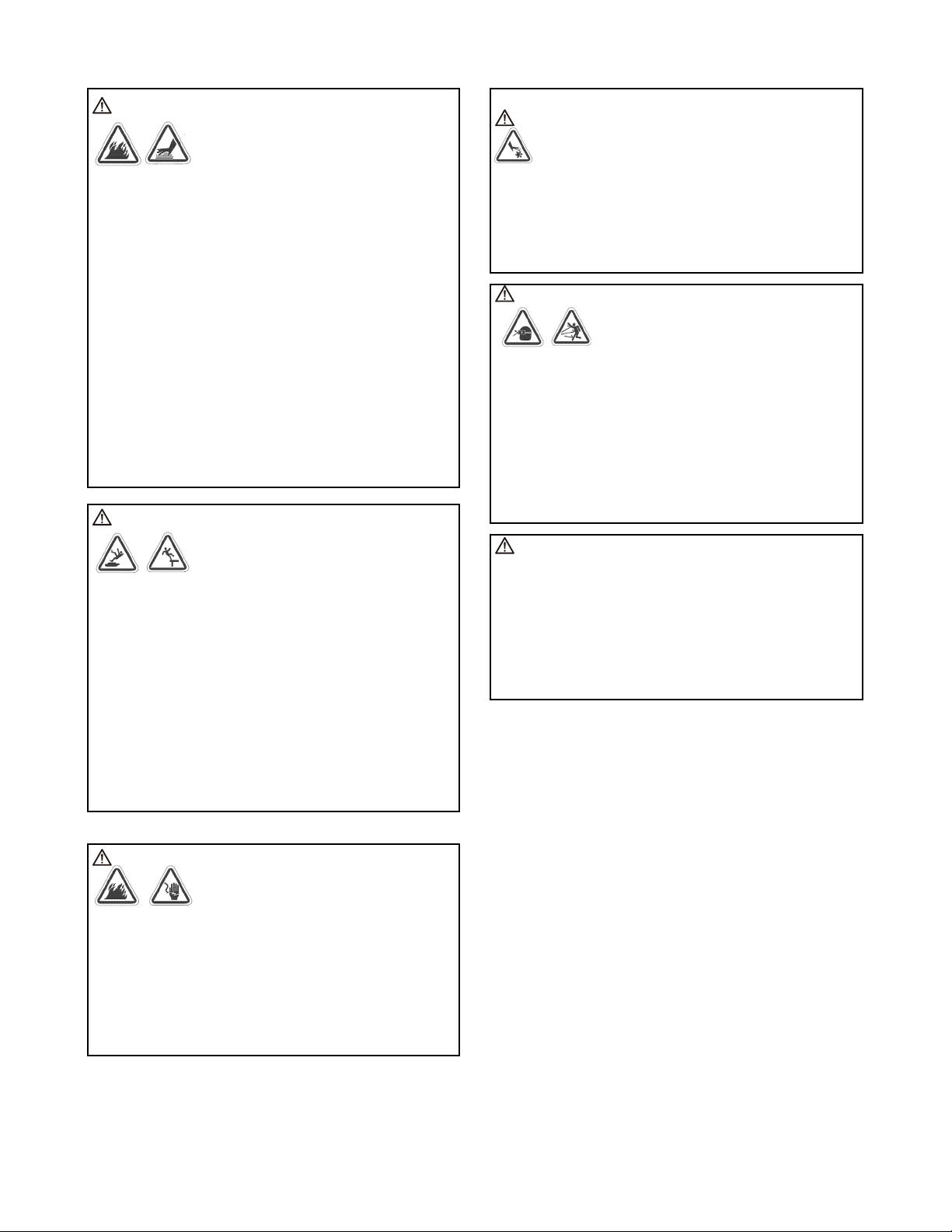
WARNING Use of pressure washer could create
puddles and slippery surfaces causing
you to fall resulting in death or serious
injury.
Kickback from spray gun could cause you to fall resulting
in death or serious injury.
• Operate pressure washer from a stable surface.
• The cleaning area should have adequate slopes and
drainage to reduce the possibility of a fall due to slippery
surfaces.
• Be extremely careful if you must use the pressure
washer from a ladder, scaolding, or any other similar
location.
• Firmly grasp spray gun with both hands when using high
pressure spray to avoid injury when spray gun kicks
back.
WARNING Unintentional sparking could cause re or
electric shock resulting in death or
serious injury.
WHEN ADJUSTING OR MAKING REPAIRS TO YOUR
PRESSURE WASHER
• Disconnect the spark plug wire from the spark plug and
place the wire where it cannot contact spark plug.
WHEN TESTING FOR ENGINE SPARK
• Use approved spark plug tester.
• DO NOT check for spark with spark plug removed.
WARNING Starter and other rotating parts
could entangle hands, hair, clothing, or accessories
resulting in serious injury.
• NEVER operate pressure washer without protective
housing or covers.
• DO NOT wear loose clothing, jewelry or anything that
could be caught in the starter or other rotating parts.
• Tie up long hair and remove jewelry.
WARNING Risk of eye or bodily injury.
Spray could splash back or propel objects
resulting in serious injury.
• Always wear indirect vented (chemical splash) safety
goggles marked to comply with ANSI Z87.1 when using
or in vicinity of this equipment.
• NEVER substitute safety glasses or dry-condition
goggles for indirect vented safety goggles.
• Always wear protective clothing such as a long-sleeved
shirt, long pants and close-toed shoes.
• NEVER operate pressure washer when barefoot or
wearing sandals or shorts.
CAUTION Excessively high operating speeds could
result in minor injury.
Excessively low speeds impose a heavy load.
• DO NOT tamper with governor spring, links or other
parts to increase engine speed. Pressure washer
supplies correct rated pressure and ow when running
at governed speed.
• DO NOT modify pressure washer in any way.
NOTICE
High pressure spray could damage fragile items
including glass.
• DO NOT point spray gun at glass when using red (0 °)
spray tip.
• NEVER aim spray gun at plants
NOTICE
Improper treatment of pressure washer could
damage it and shorten its life.
• If you have questions about intended use, ask dealer or
contact qualied service center.
• NEVER operate units with broken or missing parts, or
without protective housing or covers.
• DO NOT by-pass any safety device on this machine.
• DO NOT tamper with governed speed.
• DO NOT operate pressure washer above rated pressure.
• DO NOT modify pressure washer in any way.
• Before starting pressure washer in cold weather, check
all parts of the equipment to be sure ice has not formed
there.
• NEVER move machine by pulling on hoses. Use handle
provided on unit.
• Use only identical replacement parts as specied in the
Parts List in this manual. User assumes all risks and
liabilities if other parts are used.
6
FEATURES AND CONTROLS
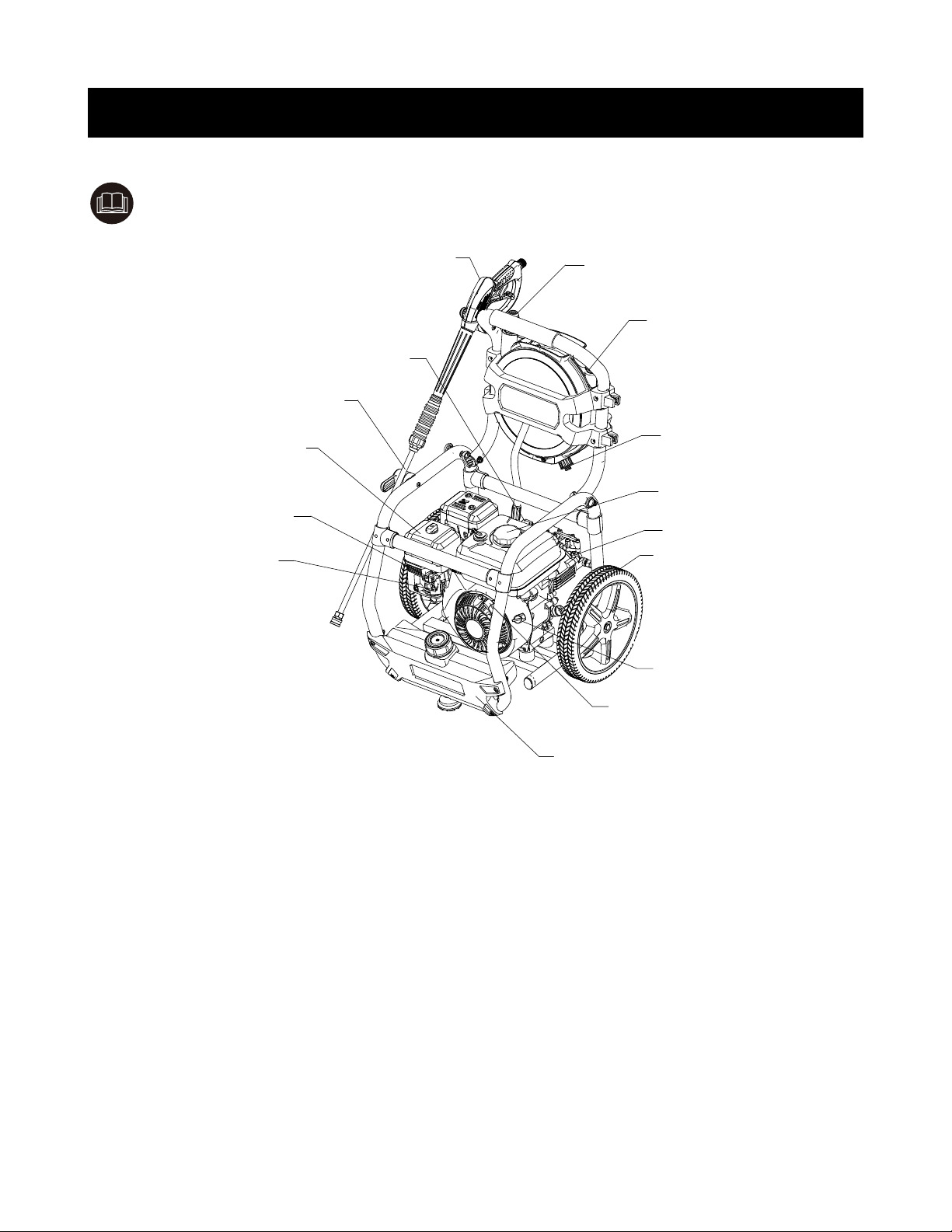
KNOW YOUR PRESSURE WASHER
Read the operator's manual and safety rules before operating your pressure washer.
Compare the illustrations with your pressure washer to familiarize yourself with the locations of various controls and
adjustments. Save this manual for future reference.
A- Quick-Connect Nozzles -15°, 40°for high pressure,
soap is for detergent function with low pressure water
steam. Turbo is for rotating ush.
B- Nozzle Needle - Clean the nozzles.
C- Spray Gun - Controls the application of water onto
cleaning surface with trigger device. Includes trigger
lock.
D- Water Inlet - Connection for garden hose.
E- Spray Wand - Attach to spray gun to use four dierent
quick-connect nozzles.
F- Air Filter - Protects engine by filtering dust and debris
out of intake air.
G- Choke lever - Used to help start a cold engine.
H- Fuel valve lever - Set the fuel supply valve.
I - Detergent Tank - Use to store detergent for the low
pressure water stream.
J- Recoil Starter - Used for starting the engine manually.
K- Engine switch - Set the engine in starting mode and
stop a running engine.
L- Oil Fill Cap/ Dipstick - Check, ll and drain engine oil
here.
M- Pump - Develops high pressure water.
N- Fuel Tank Cap- Fill engine with regular unleaded fuel
here. Always leave room for fuel expansion.
O- High Pressure Hose- Connect one end to the spray
gun, the other end to the pump (already assembled to
the pump at the factory).
A
B
C
D
E
F
G
H
I
J
K
L
M
N
O
7
Unfold
Fold
Pull
ASSEMBLY
Your pressure washer requires some assembly and is ready
for use only after it has been properly serviced with the
recommended oil and fuel.
If you have any problems with the assembly of your
pressure washer, please call the pressure washer help
line at 1-866-902-9690.
IMPORTANT: Any attempt to run the engine before it has
been serviced with the recommended oil will result in an
engine failure.
UNPACK THE PRESSURE WASHER
• Remove everything from carton except the pressure
washer.
• Open carton completely by cutting each corner from top to
bottom.
• Remove pressure washer from carton.
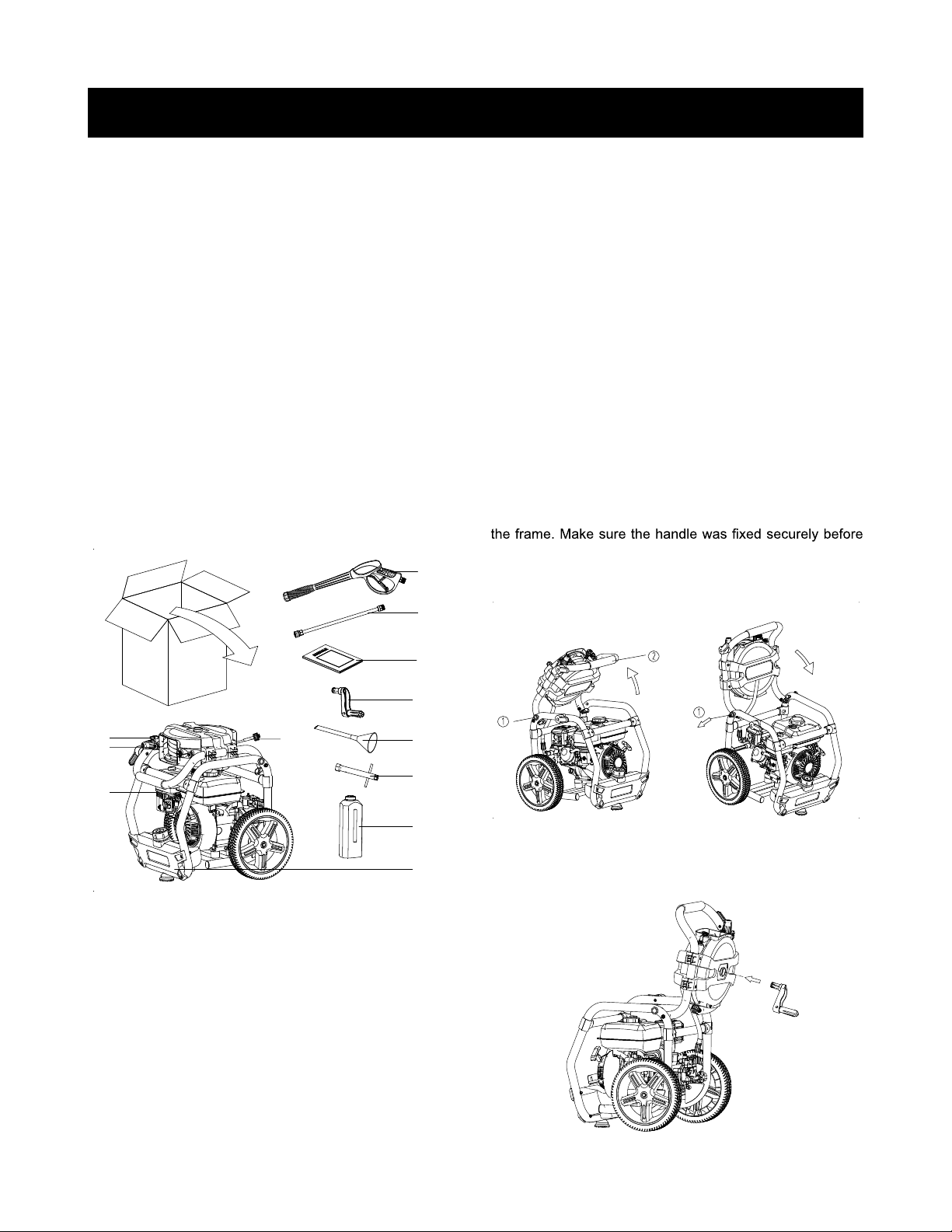
CARTON CONTENTS
Check all contents. If any parts are parts are missing or
damaged, call the pressure washer helpline at
1-866-902-9690.
●
A- Main unit
●
B- Quick-connect nozzles (4)
●
C- Nozzle needle
D- High pressure hose
●
E- Spray gun
●
F- Spray wand
●
G- Operator's Manual
●
H- Hand crack
●
I- Funnel
●
J- Spark Wrench
●
K- Oil bottle
●
L- Detergent tank
Become familiar with each piece before assembling the
pressure washer. Check all contents against the illustration.
If any parts are missing or damaged, call the pressure
washer helpline at 1-866-902-9690.
ASSEMBLING YOUR PRESSURE WASHER
Your Craftsman high pressure washer was most ly
assembled at the factory. However, you will need to perform
these tasks before you can operate your pressure washer:
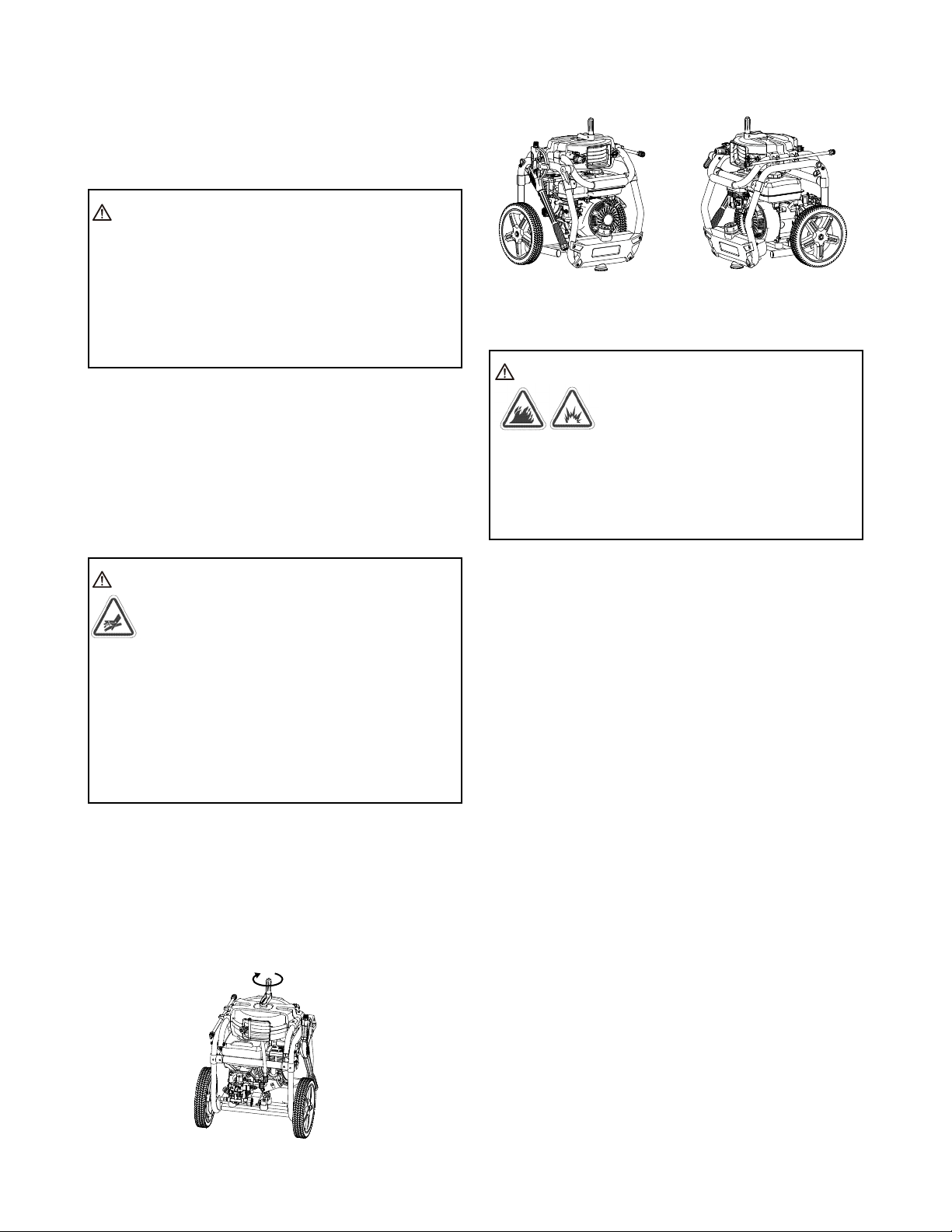
1.Handle position adjustment.
2.Connect hand crank onto hose reel.
3.Add oil to engine crankcase.
4.Add fuel to fuel tank.
5.Lubricate O-rings.
6.Connect hose and water supply to pump.
7.Connect spray wand and quick-connect nozzles.
1. Handle Position Adjustment
Turn
the handle
②
upward around 100°, until the locking/
releasing pin
①
engages into the corresponding hole on
each using.
To fold the handle. Pull the locking/releasing pin
①
outward
on the right side of the pressure washer, and turn the handle
②
downward to fold the handle.
2. Connect Hand Crank onto Hose Reel
Attach hand crank onto the hose reel. Insert in the hole and
snap into place by hand. No tools required.
A
B
C
D
E
F
G
H
I
J
K
L
●
8
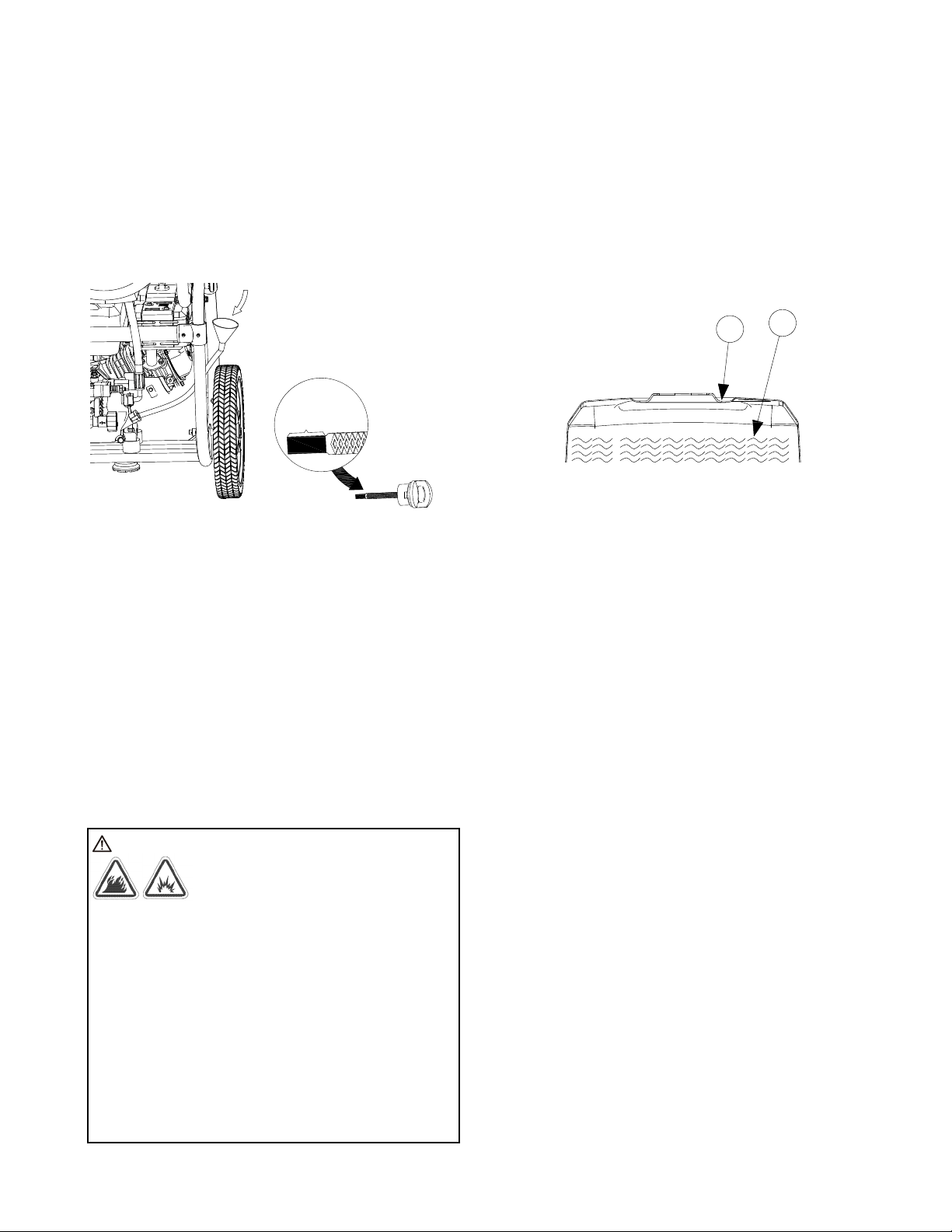
3. Add Oil to Engine Crankcase
CAUTION! DO NOT attempt to crank or start the engine
before it has been properly serviced with the recommended
oil. This may result in an engine failure.
1. Place pressure washer on a at, level surface.
2. Clean area around oil ll and remove yellow oil ll cap /
dipstick.
3.Using oil funnel (provided), slowly pour contents of
supplied oil into oil fill opening, checking oil level
frequently, ll to FULL mark (top hole) on dipstick.
NOTICE
: Pause to permit oil to settle. Wipe dipstick clean
each time oil level is checked. DO NOT Overll.
4.Replace oil ll cap/ dipstick and fully tighten.
4. Add Fuel to Fuel Tank
Fuel must meet these requirements:
• Clean, fresh, unleaded gasoline.
• A minimum of 87 octane/ 87 AKI (91 RON). For high
altitude use, see “High Altitude”.
• Gasoline with up to 10% ethanol (gasohol) is acceptable.
NOTICE
: Use of unapproved fuels could damage the engine
and voids warranty.
• DO NOT use unapproved gasoline such as E15 and E85.
• DO NOT mix oil in gasoline or modify engine to run on
alternate fuels.
WARNING! Fuel and its vapors are extremely
flammable and explosive which could
cause burns, re or explosion resulting in
death or serious injure.
WHEN ADDING FUEL
• Turn pressure washer engine OFF and let it cool at least
2 minutes before removing fuel cap.
Loosen cap slowly to relieve pressure in tank.
• Fill fuel tank outdoors.
• DO NOT overll tank. Allow space for fuel expansion.
• If fuel spills, wait until it evaporates before starting
engine.
• Keep fuel away from sparks, open flames, pilot lights,
heat, and other ignition sources.
• Check fuel lines, tank, cap and fittings frequently for
cracks or leaks. Replace if necessary.
• DO NOT light a cigarette or smoke.
0.15 LITERS
To protect the fuel system from gum formation, mix in a fuel
stabilizer when adding fuel. See “Storage”. All fuel is not the
same. If you experience starting or performance problems
after using fuel, switch to a dierent fuel provider or change
brands, This engine is certified to operate on gasoline.
The emission control system for the engine is EM (Engine
Modications).
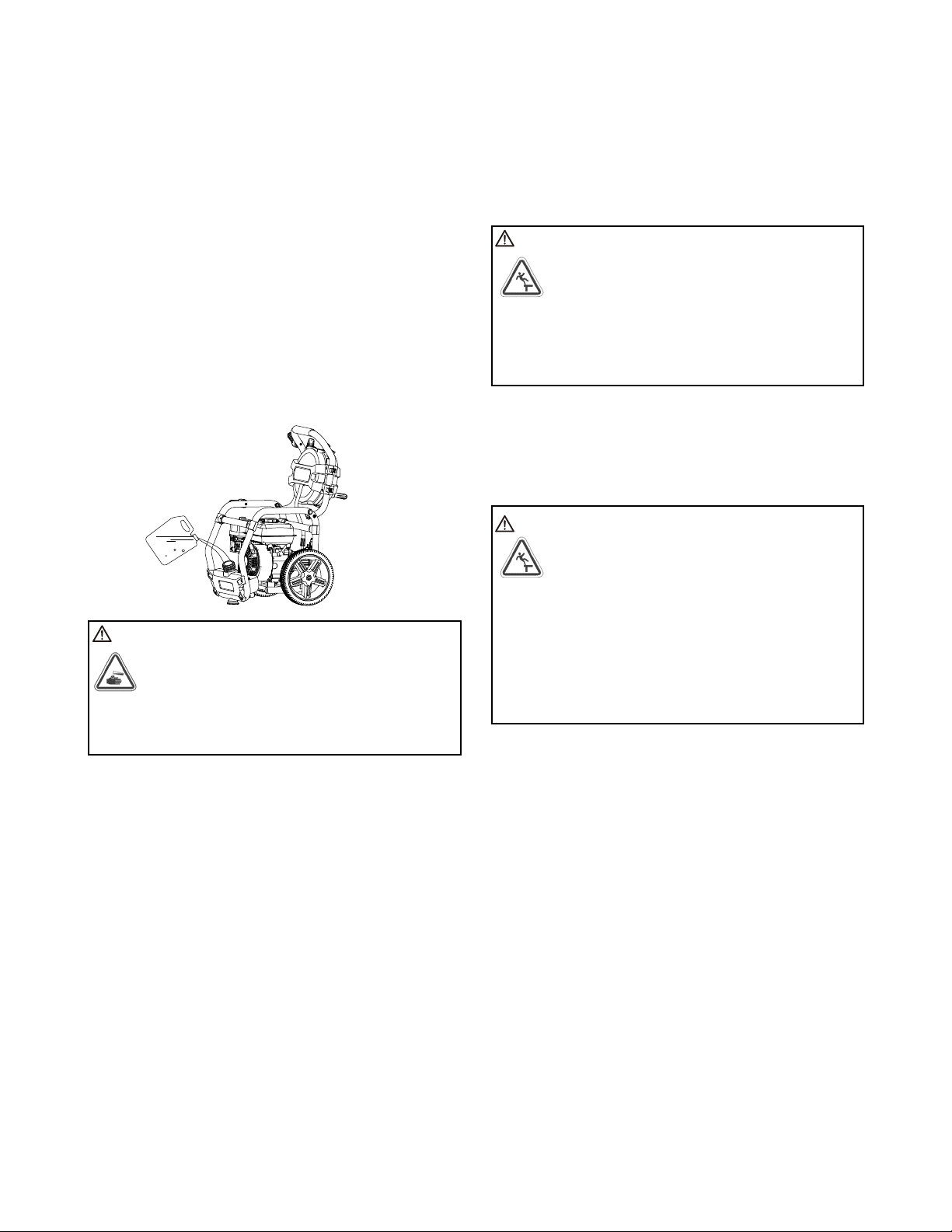
1.Clean area around fuel ll cap, remove cap.
2.Slowly add regular unleaded fuel (A) to fuel tank (B). Be
careful not to overll. To allow for fuel expansion, do not
ll above the bottom of the fuel tank neck.
3.Install fuel cap and wait for any spilled fuel to evaporate.
CAUTION! Alcohol-blended fuels (called gasohol, ethanol
or methanol) can attract moisture,
which leads to separation and formation of acids during
storage. Acidic gas can damage the fuel system of an
engine while in storage.
To avoid engine problems, the fuel system should be treated
with fuel preserver or emptied before storage of 30 days or
longer. If adding a fuel preserver, ll the fuel tank with fresh
fuel. If only partially filled, air in the tank will promote fuel
deterioration during storage. If fuel preserver is not used,
drain the fuel tank, start the engine and let it run until the
fuel lines and carburetor are empty. Use fresh fuel next
season. See “Storage” for additional information.
NEVER use engine or carburetor cleaner products in the
fuel tank as permanent damage may occur.
High Altitude
At altitude over 5,000 ft. (1524 m), a minimum 85 octane /
85 AKI (89 RON) gasoline is acceptable. To remain emission
compliant, high altitude adjustment is required. Operation
without this adjustment will cause decreased performance,
increased fuel consumption, and increased emissions. See
a qualied CRAFTSMAN dealer for high altitude adjustment
information. Operation of the engine at altitudes below 2,500
ft. (762m) with the high altitude kit is not recommended.
5.Lubricate O-Rings
Lubrication of o-rings is extremely important for installation
and operation. The use of lubricant (petroleum or synthetic
grease) during assembly helps seat o-rings properly and
provides and improved seal. It also helps protect the o-rings
from damage by abrasion, pinching or cutting and extends
the life of the o-rings.
A
B
9
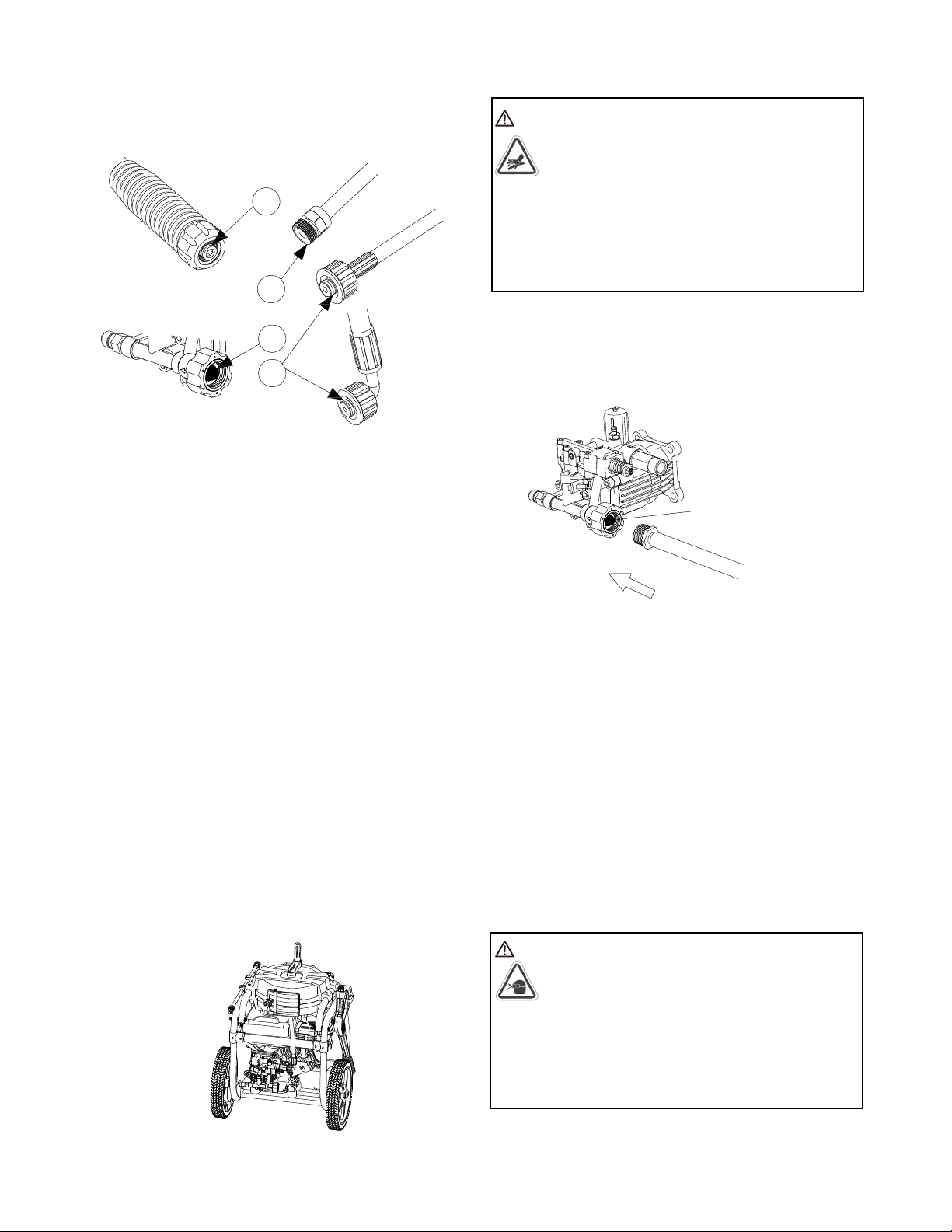
NOTICE:
ALWAYS apply a small amount of lubricant on
o-rings prior to assembling the garden hose to the pump (C),
high pressure hose (D), spray gun (E), and spray wand (F).
Lubricate all connections shown below, following these
instructions:
1) Inspect and clean connecting surfaces prior to lubrication
and assembly.
2) Use lubricants sparingly during assembly; a light lm is
all that is required.
3) Use a small brush or cotton swab to apply grease directly
to o-rings where they are not accessible(QC tting, M22
tting).
6.Connect Hose and Water Supply to Pump
IMPORTANT! DO NOT run the pump without the water
supply connected and turned on.
• Damage to pressure washer resulting from failure to follow
this instruction will void warranty.
NOTICE:
Remove and discard the shipping caps from the
pump’s high pressure outlet and water inlet before attaching
hoses.
1) Uncoil high pressure hose when handle folded, and
attach one end of hose to the base of the spray gun.
Tighten by hand. The other end already assembled to
the pump at the factory.
NOTICE:
The hose only can be uncoiled from the bottom of
the hose reel, it’s recommended to keep the handle folded
for easy unwinding and winding the hose.
WARNING! The high pressure stream of water that the
pressure washer produces could cut through skin
and its underlying tissues, resulting in serious
injury and possible amputation.
• NEVER connect high pressure hose to spray wand.
• Keep high pressure hose connected to pump and spray
gun while system is pressurized.
• Always be certain spray gun, wand, nozzles and other
accessories are correctly attached.
2) Before you connect your garden hose to the water inlet,
inspect the inlet screen. Clean the screen if it contains
debris or have it replaced if damaged. Do Not run
the pressure washer if the inlet screen is damaged or
missing.
IMPORTANT! NEVER siphon standing water for the water
supply. Use only cold water (less than 100 °F).
CAUTION! Using a One Way Valve (vacuum breaker
or check valve) at pump inlet could cause pump or inlet
connector damage.
1) There must be at least 10 ft. (3 m) of unrestricted garden
hose between pressure washer inlet and any device,
such as a vacuum breaker or check valve.
2) Damage to pressure washer resulting from failure to
follow this instruction will void warranty.
3) Run water through garden hose for 30 seconds to ush it
of debris. Turn o water.
4) Connect garden hose (not to exceed 50 ft. in length) to
water inlet. Tighten by hand.
WARNING! Risk of eye injury!
Spray could splash back or propel objects resulting
in serious injure.
• Always wear indirect vented (chemical splash) safety
goggles marked to comply with ANSI Z87.1 when using
or in vicinity of the pressure washer.
• NEVER substitute safety glasses or dry-condition
goggles for indirect vented safety goggles.
E
F
C
D
Inspect inlet screen. Do Not use if
damaged, clean if dirty
10
5) Turn ON the water, point the spray gun at a safe
direction, release the red trigger lock, then squeeze
trigger to purge the pump system of air and impurities.
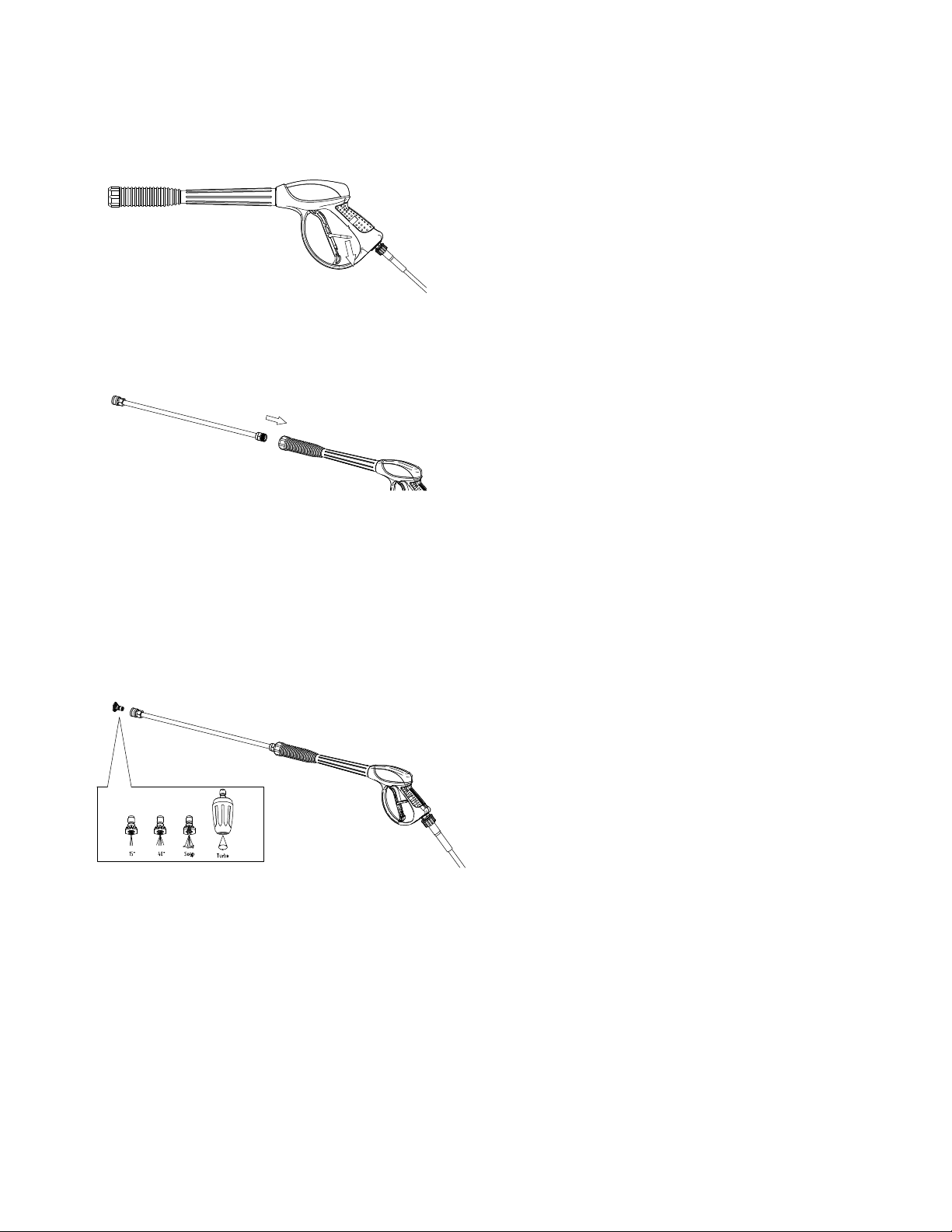
7.Connect Spray Wand and Quick-Connect Nozzles
1)Attach the spray wand into spray gun. Tighten by hand.
2) Turn OFF the water and release trigger. Point the spray
gun at a safety direction and make sure trigger is locked
and can’t be squeezed.
3) Choose the quick-connect nozzle you want to use, pull
back on collar of spray wand , insert the nozzle and
release collar. Tug on the nozzle to make sure it is
securely in place. More information please see “How to
Use Quick-Connect Nozzles” section.
CHECK LIST BEFORE STARTING ENGINE
Review the assembly to ensure you have performed all of
the following:
• Be sure to read "Safety Rules" and "Operation" sections
before using the pressure washer.
• Make sure handle is in place and secure.
• Check that oil has been added to proper level in engine
crankcase.
• Add proper gasoline to fuel tank.
• Check for properly tightened hose connections (high
pressure and water supply) and for tight connections
and that there are no kinks, cuts, or damage to the high
pressure hose.
• Provide proper water supply (not to exceed 100°F).
• If starting pressure washer after storage, see "Storage"
section below.
11
OPERATION
HOW TO USE YOUR PRESSURE
WASHER
If you have any problems operating your pressure washer,
please call the pressure washer helpline at 1-866-902-9690.
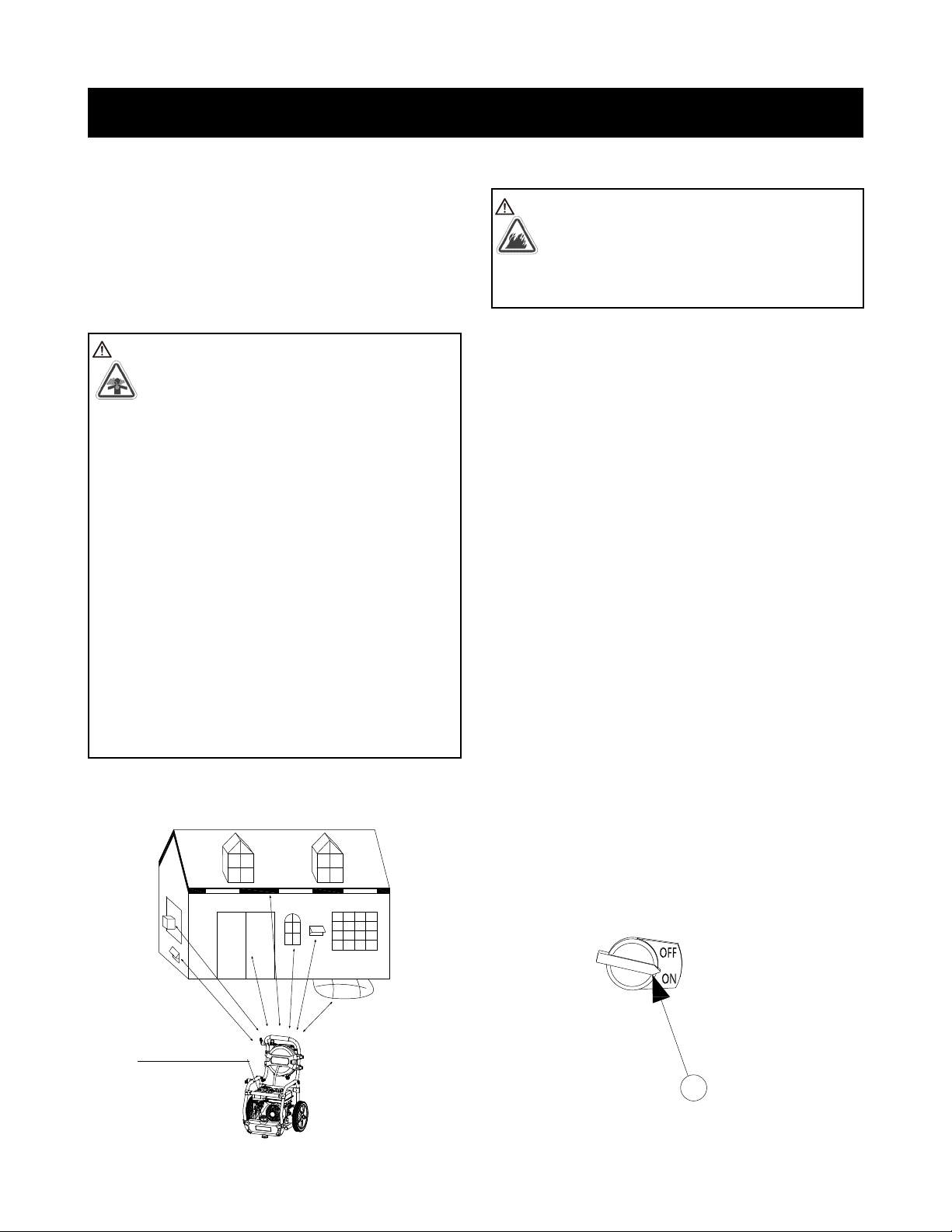
Pressure Washer Location
Carbon Monoxide Poisoning
WARNING! POISONOUS GAS HAZARD.
Engine exhaust contains carbon monoxide, a
poisonous gas that could kill you in minutes.
You CANNOT smell it, see it, or taste it, Even if you do not
smell exhaust fumes, you could still be exposed to carbon
monoxide gas.
• Operate this product ONLY outside far away from
windows, doors and vents to reduce the risk of carbon
monoxide gas from accumulating and potentially being
drawn towards occupied spaces.
• Install battery-operated carbon monoxide alarms or
plug-in carbon monoxide alarms with battery back-up
according to the manufacturer's instructions. Smoke
alarms cannot detect carbon monoxide gas.
• DO NOT run this product inside homes, garages,
basements, crawlspaces, sheds, or other partially
enclosed spaces even if using fans or opening doors
and windows for ventilation. Carbon monoxide can
quickly build up in these spaces and can linger for hours,
even after this product has shut o.
• ALWAYS place this product downwind and point the
engine exhaust away from occupied spaces.
If you start to feel sick, dizzy, or weak while using this
product, shut it o and get to fresh air RIGHT AWAY. See a
doctor. You may have carbon monoxide poisoning.
Risk of Fire Clearances
WARNING Exhaust heat/gases could ignite
combustibles, structures or damage fuel tank
causing a re, resulting in death or serious injury.
• Keep at least 5 ft. (1.5 m) clearance on all sides of
pressure washer including overhead.
To Start Your Pressure Washer
To start your engine-powered pressure washer for the rst
time, follow these instructions step-by-step. This starting
information also applies whenever you start the engine after
you have let the pressure washer sit idle for at least a day.
1.Place pressure washer outside near an water source
capable of supplying water at a ow rate greater than 3.7
gallons per minute and no less than 20 PSI at pressure
washer end of garden hose.
2.Check that high pressure hose is tightly connected to
spray gun and pump. See “Assembly” for illustrations.
3.Make sure unit is in a level position.
4.Connect garden hose to water inlet on pressure washer
pump.
CAUTION! Do Not run the pump without the water supply
connected and turned on.
• Damage to pressure washer resulting from failure to
follow this instruction will void warranty.
5.Turn ON the water, point the spray gun at a safe
direction, release the red trigger lock, then squeeze
trigger to purge the pump system of air and impurities.
See "Assembly" .
6. Attach the spray wand into spray gun. Tighten by hand.
See "Assembly" .
7.Choose the quick-connect nozzle you want to use, pull
back on collar of spray wand , insert the nozzle and
release collar. Tug on the nozzle to make sure it is
securely in place. See "Assembly" . More information
please see “How to Use Quick-Connect Nozzles”
section.
8. Engage the red trigger lock on the spray gun.
9. Push engine rocker switch (A) to ON (ON) position.
A
Exhaust port pointed away
from occupied spaces
12
NOTICE:
Before starting the pressure washer, be sure you
are wearing safety goggles as described below.
WARNING! Risk of eye injury.
Spray could splash back or propel objects resulting
in serious injury.
• Always wear indirect vented (chemical splash) safety
goggles marked to comply with ANSI Z87.1 when using
or in vicinity of this equipment.
• NEVER substitute safety glasses or dry-condition
goggles for indirect vented safety goggles.
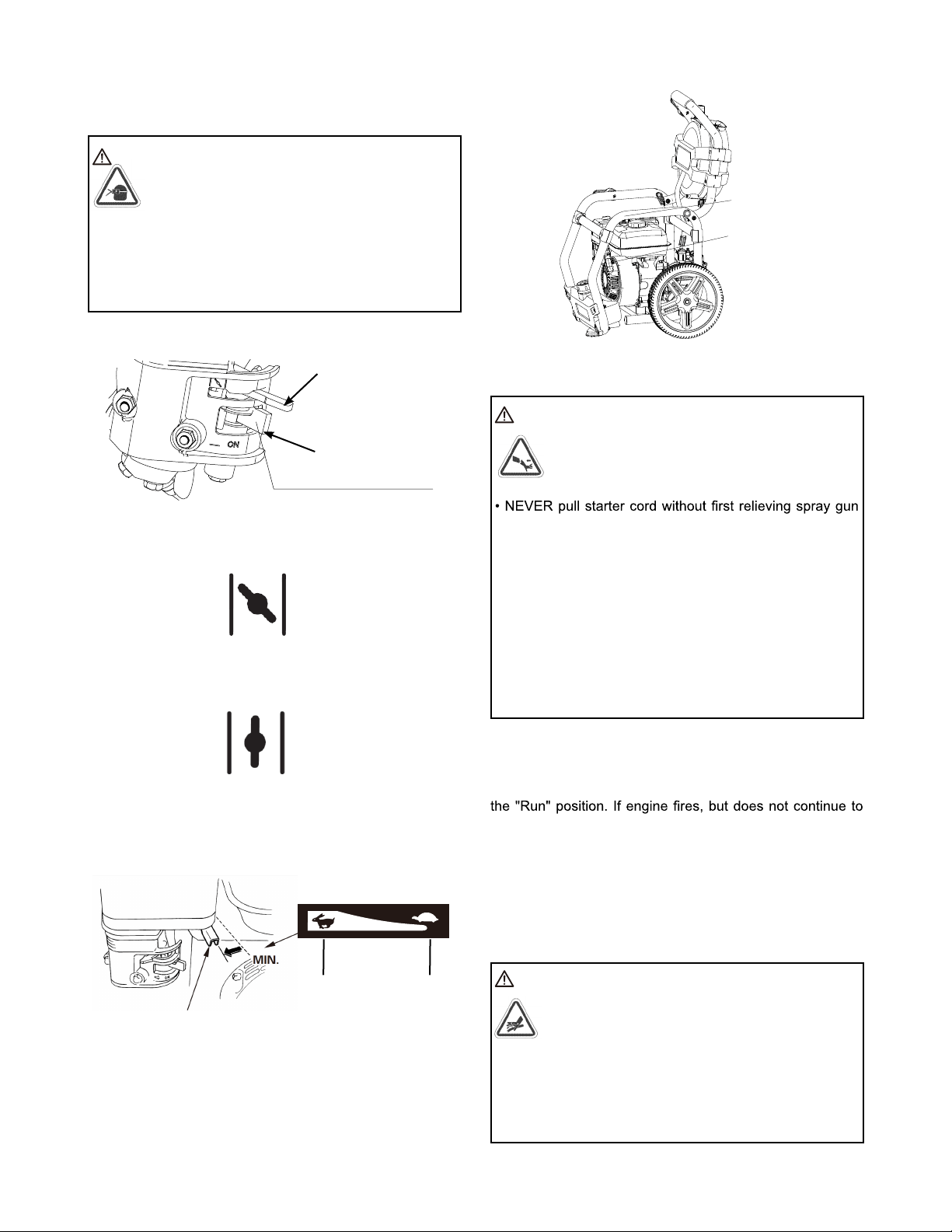
10.Move the fuel valve lever to "On" position.
11.Move the choke lever to "Choke" position.
NOTE: For a warm engine, be sure the choke lever is in
the "RUN" position.
12. Move the throttle lever away from the MIN. position
(symbol tortoise), move toward the MAX. position
(symbol rabbit).
13.When starting engine, position yourself as recommended
below and grasp starter grip handle and pull slowly until you
feel some resistance. Then pull rapidly to start engine.
14.Return the starter grip handle slowly. Do Not let rope
"snap back" against starter.
WARNING! Starter cord kickback (rapid retraction) will
pull hand and arm toward engine faster than
you can let go which could cause broken bones,
fractures, bruises, or sprains resulting in serious
injury.
pressure.
• When starting engine, pull cord slowly until resistance is
felt and then pull rapidly to avoid kickback.
• After each starting attempt, where engine fails to run,
always point spray gun at safety direction, release
the red trigger lock, and squeeze spray gun trigger to
release high pressure.
• Firmly grasp spray gun with both hands when using high
pressure spray to avoid injury when spray gun kicks
back.
15.When engine starts, slowly move choke lever to the
"Run" position. If engine falters, move choke lever to the
"Choke" position, then to the "Run" position.
16.If engine fails to start after six pulls, move choke lever to
run, move choke lever to the "Choke" position, then to the
"Run" position.
17.Point spray gun at a safety direction, relea se the red
trigger lock, and squeeze the trigger to start your washing
work.
NOTE:If the recoil starter is hard to pull, it may be necessary
to squeeze the gun trigger to relieve internal pump pressure.
WARNING! The high pressure stream of water that this
pressure washer produces could cut through skin
and its underlying tissues, resulting in serious
injury and possible amputation.
Spray gun traps high water pressure, even when engine is
stopped and water is disconnected, which could result in
serious injury.
• DO NOT allow CHILDREN to operate pressure washer.
• Keep high pressure hose connected to pump and spray
CHOKE LEVER
FUEL VALVE LEVER
Fuel Valve Lever “ON” Position
Hold By One Hand
Pull Recoil Starter By
The Other Hand
THROTTLE LEVER
MAX. MIN.
13
gun while system is pressurized.
• NEVER aim spray gun at people, animals, or plants.
• DO NOT secure spray gun in open position.
• DO NOT leave spray gun unattended while machine is
running.
• NEVER use a spray gun which does not have a trigger
lock or trigger guard in place and in working order.
• Always be certain spray gun, nozzles and accessories
are correctly attached.
WARNING! Exhaust heat/gases could ignite
combustibles, structures or damage fuel
tank causing a re, resulting in death or
serious injury.
Contact with muer area could cause burns resulting in
serious injury.
• DO NOT touch hot parts and AVOID hot exhaust gases.
• Allow equipment to cool before touching.
• Keep at least 5 ft. (1.5 m) of clearance on all sides of
pressure washer including overhead.
• It is a violation of California Public Resource Code,
Section 4442, to use or operate the engine on any forest
covered, brush-covered, or grass-covered land unless
the exhaust system is equipped with a spark arrester, as
dened in Section 4442, maintained in eective working
order. Other states or federal jurisdictions may have
similar laws.
Contact the original equipment manufacturer, retailer, or
dealer to obtain a spark arrester designed for the exhaust
system installed on this engine.
• Replacement parts must be the same and installed in
the same position as the original parts.
How to Stop Your Pressure Washer
1.Release spray gun trigger and let engine idle for two
minutes.
2. Push engine rocker switch to OFF (0) position.
3. ALWAYS point spray gun at a safety direction, release
the red trigger lock, and squeeze the trigger to release
retained high water pressure.
WARNING! The high pressure stream of water that this
pressure washer produces could cut through skin
and its underlying tissues, resulting in serious
injury and possible amputation.
Spray gun traps high water pressure, even when engine is
stopped and water is disconnected, which could result in
serious injury.
• Keep high pressure hose connected to pump and spray
gun while system is pressurized.
• Every time when you stop engine, ALWAYS point spray
gun at safety direction, release the red trigger lock, and
squeeze spray gun trigger to release high pressure.
NOTE: A small amount of water will squirt out when you
release the pressure.
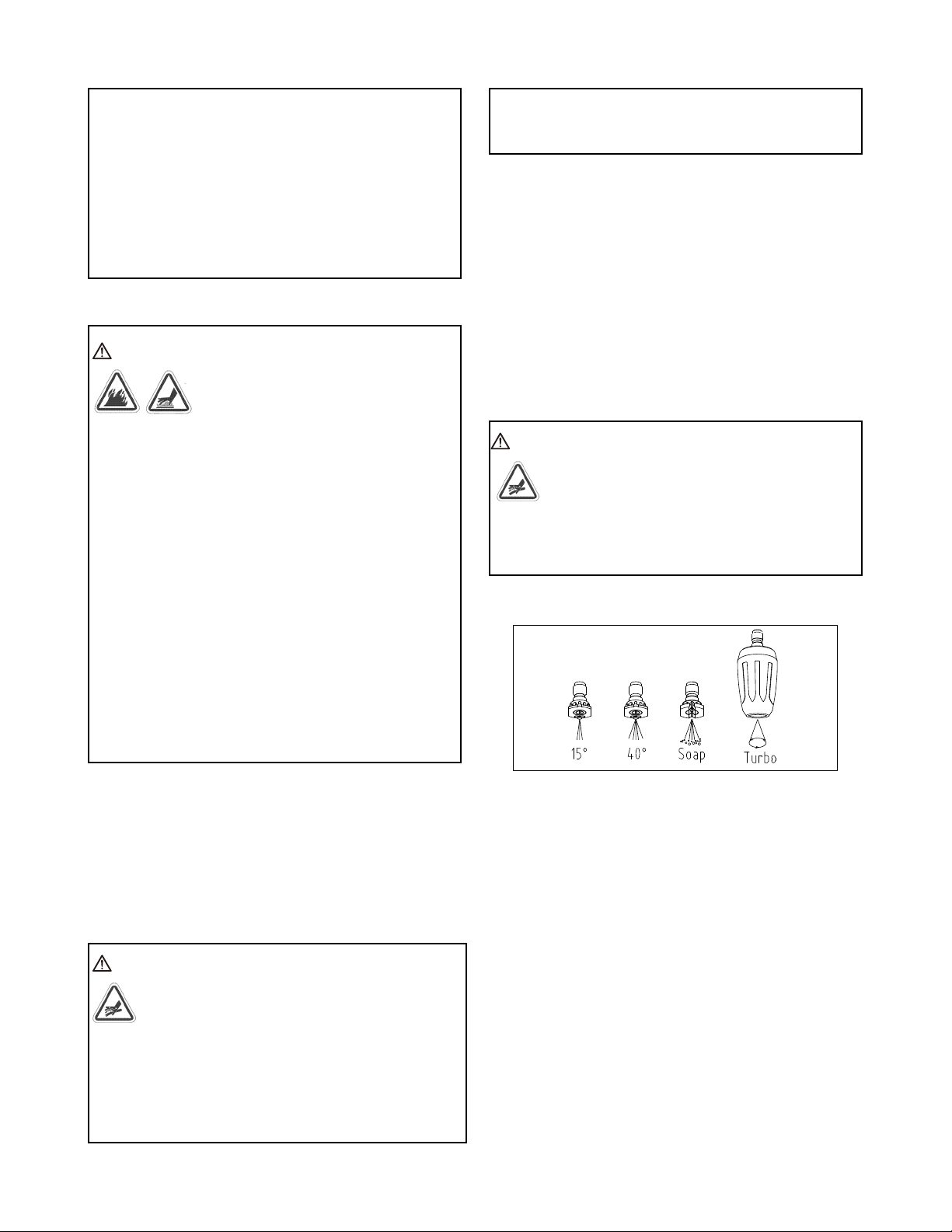
How To Use Quick-Connect Nozzles
The quick-connect on the spray wand allows you to switch
between four dierent quick-connect nozzles. Nozzles can
be changed while pressure washer is running once spray
gun trigger is locked. The nozzles vary the spray pattern as
shown.
Follow these instructions to change nozzles:
1.Pull back collar on spray wand and pull current nozzle o.
Store nozzles in holder provided on the top of hose reel.
WARNING The high pressure stream of water that
this equipment produces could cut through skin
and its underlying tissues, resulting in serious
injury and possible amputation.
• NEVER change nozzles without the trigger locked on the
spray gun.
• DO NOT twist nozzles while spraying.
2.Select desired nozzle.
The spray nozzles are in dierent colors, below are some
suggestion for dierent purposes.
• For general rinsing, ideal for most all purpose cleaning
such as home siding, brick patios, wood decks,
driveways and sidewalks, garage floors, etc., select
yellow 15° nozzle.
• For delicate rinse, for gentle cleaning of cars trucks,
boats, RV's, patio furniture, lawn equipment, etc., select
white 40° nozzle.
• To apply detergent, applies project specific cleaners to
help break down stubborn dirt and grime on a variety of
surfaces, select black detergent nozzle.
• For rotating flush, quick high flow clean up and long
reach of cleaning of second story siding and window,
select turbo nozzle.
3.Pull back on collar, insert new nozzle and release collar.
Tug on nozzle to make sure it is securely in place.
14
Usage Tips
• For most effective cleaning, keep nozzle from 8 to 24
inches (20 to 61 cm) away from cleaning surface.
• If you get nozzle too close, especially using a high
pressure nozzle, you may damage surface being
cleaned.
• Do Not get closer than 6 inches (15 cm) when cleaning
tires.
Cleaning and Applying Detergent
To apply detergent, follow these steps:
1. Review “How To Use Quick-Connect Nozzles”.
2. Prepare detergent solution as required by the job.
3.The detergent tank is fastened on the frame of the
pressure washer. Fill the detergent tank with detergent.
WARNING! Chemical Burn Hazard.
Chemicals could cause burns resulting in death or
serious injury.
• DO NOT use caustic liquid with pressure washer.
• Use ONLY pressure washer safe detergents/soaps.
Follow all manufacturer instructions.
4.Make sure black detergent nozzle is installed.
NOTICE: Detergent cannot be applied with the high
pressure nozzles (White, Yellow or Turbo).
5.Make sure the garden hose is connected to the water
inlet. Check that the high pressure hose is connected to
the spray gun and the pump. Turn on water.
6.Start the engine following instructions “How to Start Your
Pressure Washer”.
NOTICE: You must attach all hoses before you start the
engine
Starting the engine without all the hoses connected and
without the water turned on could damage the pump.
• Damage to pressure washer resulting from failure to
follow this instruction will void warranty.
7.Apply detergent to a dry surface, starting at lower portion
of area to be washed and work upward, using long, even,
overlapping strokes.
8.Allow detergent to "soak in" for 3-5 minutes before
washing and rinsing. Reapply as needed to prevent
surface from drying. DO NOT allow detergent to dry on
(prevents streaking).
Pressure Washer Rinsing
WARNING! Be extremely careful if you use the
pressure washer from a ladder, scaolding or any
other relatively unstable location. Pressure in a
running washer builds as you climb. When you
press the trigger, the recoil from the initial spray
could cause you to fall. The high pressure spray
could also cause you to fall if you are too close to
the cleaning surface.
For Rinsing:
1.Remove the black detergent nozzle, and select the
nozzles with high pressure following instructions “How
To Use Quick-Connect Nozzles”, squeeze the spray gun
trigger and wait for the detergent to clear.
WARNING Kickback from spray gun could cause you
to fall resulting in death or serious injury.
• Operate pressure washer from a stable surface.
• Be extremely careful if you must use the pressure
washer from a ladder, scaffolding, or any other similar
location.
• Firmly grasp spray gun with both hands when using high
pressure spray to avoid injury when spray gun kicks
back.
2.Keep the spray gun a safe distance from the area you
plan to spray.
3.Apply a high pressure spray to a small area, then check
the surface for damage. If no damage is found, it is okay
to continue cleaning.
4.Start at the top of the area to be rinsed, working down
with same overlapping strokes as you used for washing
and applying detergent.

15
SPECIFICATIONS
Pressure Washer Specications
Max. Outlet Pressure ....................................3200 PSI* @ 2.5 GPM
Max. Flow Rate..............................................2400 PSI @ 2.7 GPM*
Chemical Mix...............…………....................Use as directed
Water Supply Temperature............................Not to Exceed 100°F
Engine Specications
Bore .........................……………...................2.8 in. (70 mm)
Stroke ........................................................... 2.1 in. (54 mm)
Displacement ................................................ 12.7 cu. in. (208 cc)
Spark Plug Type ........................................... TORCH F6TC
Set Gap To ................................................... 0.028 - 0.031 inch (0.7 - 0.8 mm)
Armature Air Gap ......................................... 0.012 - 0.016 in.(0.3 - 0.4 mm)
Valve clearance with valve springs installed and piston past top dead center (check when engine is cold).
Intake ........................................................... 0.0051 - 0.0066 in.( 0.13 - 0.17 mm)
Exhaust ........................................................ 0.0051 - 0.0066 in.(0.13 - 0.17 mm)
Fuel Capacity ............................................... 3.8 Quarts
Oil Capacity ..................................................20 Ounces (0.6 liter)
NOTICE
For practical operation, the engine load should not exceed 85% of rated power. Engine power will decrease 3.5% for
each 1,000 ft. (300 m) above sea level and 1% for each 10° F (5.6 ° C) above 77°F (25 ° C). It should operate satisfactorily at
an angle up to 15°.
* This pressure washer is rated in accordance to the Pressure Washer Manufacturers Association
(PWMA) standard PW101-2010 (Testing and Rating Performance of Pressure Washers).
16
MAINTENANCE
OWNER'S RESPONSIBILITIES
Follow the hourly or calendar intervals, whichever occurs
first. More frequent service is required when operating in
adverse conditions noted below.
First 5 Hours
• Change engine oil
Every 8 Hours or Daily
• Check/clean water inlet screen 1
• Check high pressure hose
• Check detergent siphoning hose
• Check spray gun and assembly for leaks
• Clean debris
• Check engine oil level
Every 50 Hours or Yearly
• Clean engine air cleaner 2
• Change engine oil 2
• Inspect muer and spark arrester
Every 200 Hours or Yearly
• Replace engine air cleaner 2
Yearly
• Replace spark plug
• Clean cooling system 2
1. Clean if clogged. Replace if perforated or torn.
2. Service more often under dirty or dusty conditions.
General Recommendations
Regular maintenance will improve the performance and
extend the life of the pressure washer. See any Yardforce or
other qualied service dealer for service.
The pressure washer warranty does not cover items that
have been subjected to operator abuse or negligence.
To receive full value from the warranty, the operator must
maintain pressure washer as instructed in this manual
including proper storage as detailed in “Storage”.
Some adjustments will need to be made periodically to
properly maintain your pressure washer.
All service and adjustments should be made at least once
each season. A new spark plug and clean air lter assure
proper fuel-air mixture and help your engine run better and
last longer. Follow the requirements in the “Maintenance
Schedule” chart above.
NOTE: Once a year you should clean or replace the spark
plug and replace the air lter. A new spark plug
and clean air lter assure proper fuel-air mixture and help
your engine run better and last longer.
Pump Oil
DO NOT attempt any oil maintenance on this pump.
The pump is pre-lubricated and sealed from the factory,
requiring no additional maintenance for the life of the pump.
Emission Control
Maintenance, replacement, or repair of the emissions
control devices and systems may be performed by any
non-road engine repair establishment or individual.
However, to obtain "no charge" emissions control service,
the work must be performed by a factory unauthorized
dealer. See the “Emissions Warranty”.
Before Each Use
1. Check engine oil level.
2. Clean debris.
3. Check water inlet screen for damage.
4. Check high pressure hose for leaks.
5. Check chemical lters for damage.
6. Check spray gun, spray wand and nozzle assembly for
leaks.
7. Purge pump of air and contaminants.
PRESSURE WASHER MAINTENANCE
Clean Debris
Daily or before use, clean accumulated debris from pressure
washer. Keep linkage, spring and controls clean. Keep
area around and behind muer free from any combustible
debris. Inspect cooling air slots and openings on the
pressure washer. These openings must be kept clean and
unobstructed.
Pressure washer parts should be kept clean to reduce the
risk of overheating and ignition of accumulated debris.
• Use a damp cloth to wipe exterior surfaces clean.
NOTICE
Improper treatment of pressure washer could
damage it and shorten its life.
• DO NOT insert any objects through cooling slots.
• Use a soft bristle brush to loosen caked on dirt, oil, etc.
• Use a vacuum cleaner to pick up loose dirt and debris.
17
Check and Clean Inlet Screen
Examine garden hose inlet screen. Clean if it is clogged or
replace if it is torn. Please call help line 1-866-902-9690 for
new purchase.
Check High Pressure Hose
High pressure hoses can develop leaks from wear, kinking,
or abuse. Inspect hose before each use. Check for cuts,
leaks, abrasions, bulging of cover, or damage or movement
of couplings. If any of these conditions exist, replace hose
immediately. Or call at 1-866-902-9690 for help or new
purchase.
WARNING The high pressure stream of water that this
pressure washer produces could cut through skin
and its underlying tissues, resulting in serious
injury and possible amputation.
• Never repair a high pressure hose. Replace it.
• Replace with hose MUST equal or exceed the maximum
pressure rating of your pressure washer.
Check Detergent Siphoning Tube
Examine the detergent tube (equipped at the bottom of
detergent tank) and clean if clogged. One end of the tube
should t tightly on the tank, the other end t tightly on the
pump. Examine the tube for leaks or tears.
Replace detergent tank or tube if either is damaged. Or call
at 1-866-902-9690 for help or new purchase.
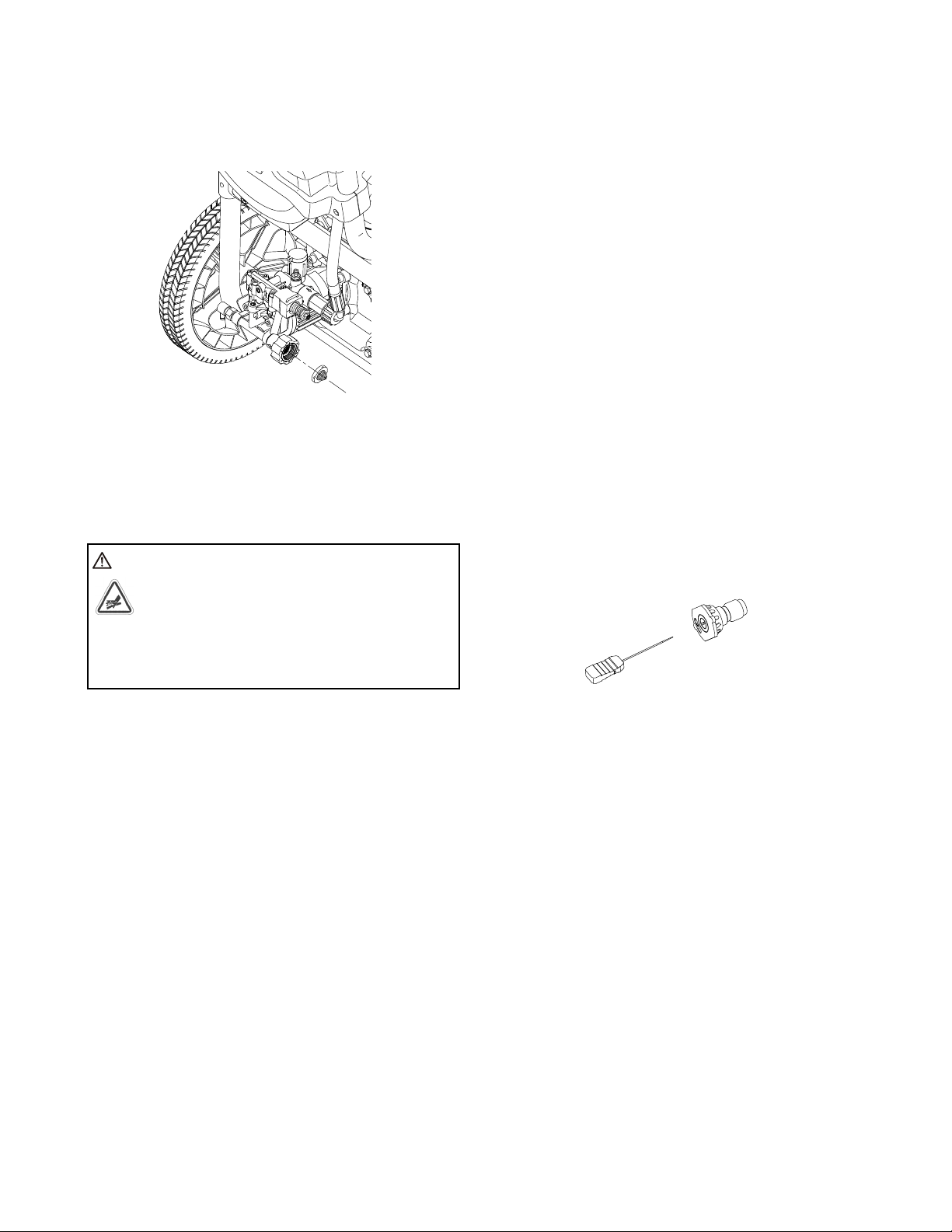
Check Spray Gun, Spray Wand and Nozzles
Examine hose connection to spray gun connected with
spray wand and make sure it is secure. Test trigger by
pressing it and make sure it springs back into place when
you release it. Engage trigger lock in UP position and test
trigger. You should not be able to squeeze the trigger.
Replace spray gun immediately if it fails any of these tests.
Purge Pump of Air and Contaminants
To remove air from the pump, follow these steps:
• Set up the pressure washer as described in the
"Assembly" section and connect the water supply.
• Squeeze the trigger on the gun and hold until a steady
stream of water appears.
To remove contaminants from the pump, follow these
steps:
• Set up the pressure washer as described in the
"Assembly" section and connect water supply.
• Remove the nozzle from the spray wand .
• Start the engine according to instructions in "How To Use
Your Pressure Washer" section.
• Squeeze the trigger on the gun and hold.
• When the water supply is steady and constant, engage
the trigger lock and install the nozzle.
Nozzle Maintenance
A pulsing sensation felt while squeezing the spray gun
trigger may be caused by excessive pump pressure. The
principal cause of excessive pump pressure is a nozzle
clogged or restricted with foreign materials, such as dirt,
etc. To correct the problem, immediately clean the nozzle by
needle provided with your pressure washer and follow these
instructions:
1. Shut o (O) the engine and turn o the water supply.
2. ALWAYS point spray gun at a safety direction, release
trigger lock and squeeze spray gun trigger to release
retained high water pressure.
3. Remove the nozzle from the end of the spray wand.
4. Use the needle to free any foreign material clogging or
restricting the nozzle.
5. Using a garden hose, remove additional debris by back
flushing water through the nozzle. Back flush between
30 to 60 seconds.
6. Reinstall the nozzle to the wand with spray gun.
7. Make sure garden hose is connected to water inlet.
Check that high pressure hose is connected to spray
gun and pump. Turn on water.
8. Start engine following instructions “How to Start Your
Pressure Washer”.
9. Test pressure washer by operating with each quick-
connect nozzle.
O-Ring Maintenance
Through the normal operation of your pressure washer,
o-rings keep the connections of the hoses and spray gun
tight and leak-free. They may become worn or damaged
with use.
You can purchase the replacement o-rings at the pressure
washer help line 1-866-902-9690.
18
WARNING The high pressure stream of water that this
pressure washer produces could cut through skin
and its underlying tissues, resulting in serious
injury and possible amputation.
• NEVER repair leaking connections with sealant of any
kind. replace o-ring or seal.
ENGINE MAINTENANCE
WARNING Unintentional sparking could cause re or
electric shock resulting in death or
serious injury.
WHEN ADJUSTING OR MAKING REPAIRSTOYOUR
PRESSUREWASHER
• Disconnect the spark plug wire from the spark plug and
place the wire where it cannot contact spark plug.
WHEN TESTING FOR ENGINE SPARK
• Use approved spark plug tester.
• DONOT check for spark with spark plug removed.
Oil
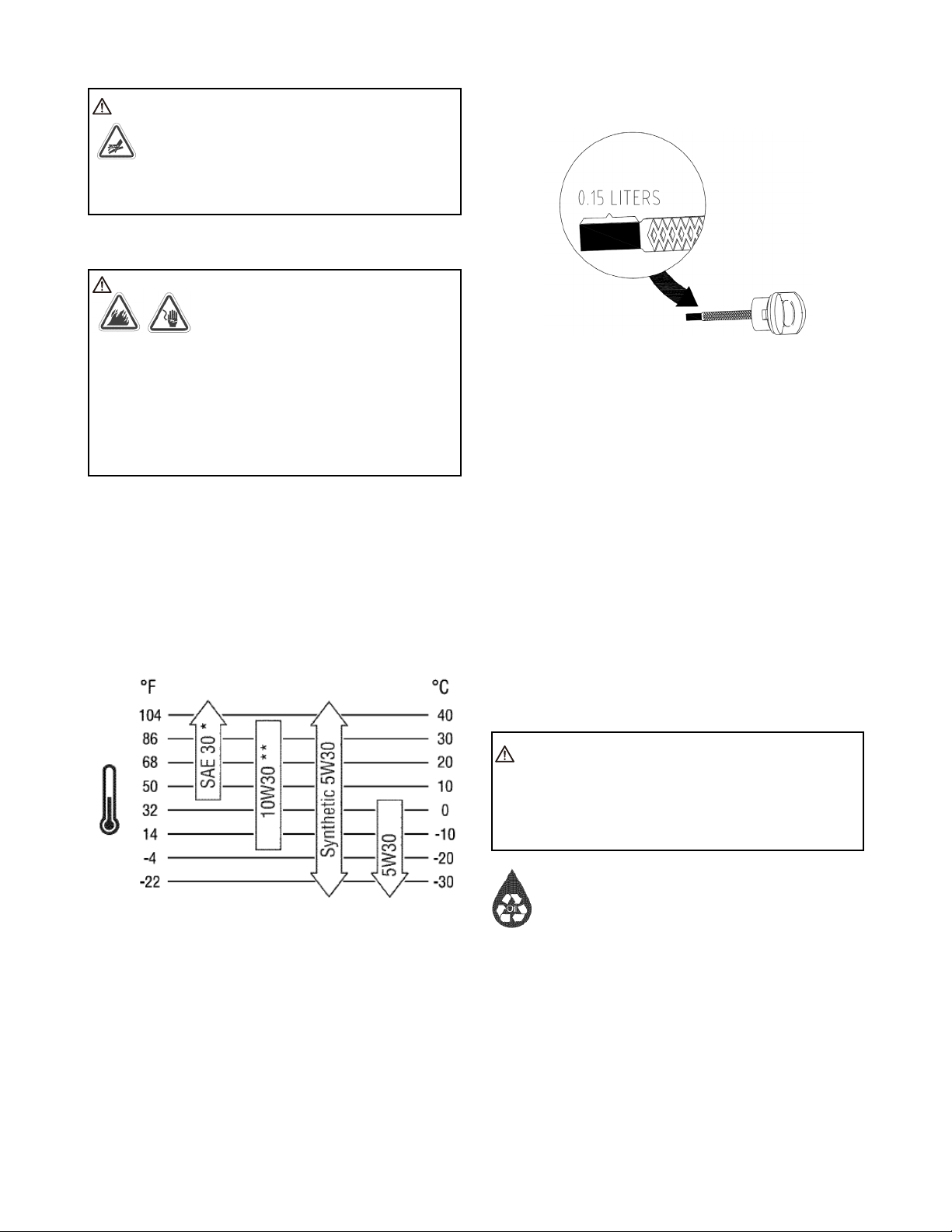
Oil Recommendations
We recommend the use of CRAFTSMAN Warranty Certied
oils for best performance. Other high-quality detergent oils
are acceptable if classified for service SF, SG, SH, SJ or
higher. DO NOT use special additives.
Outdoor temperatures determine the proper oil viscosity for
the engine. Use the chart to select the best viscosity for the
outdoor temperature range expected.
* Below 40°F (4°C) the use of SAE 30 will result in hard
starting.
* Above 80°F (27°C) the use of 10W30 may cause
increased oil consumption. Check oil level more
frequently.
Checking Oil Level.
1. Make sure pressure washer is on a level surface.
2. Remove oil dipstick and wipe dipstick with clean cloth.
Replace and tighten dipstick. Remove and check oil
level.
3. Verify oil is at FULL mark (top hole) on dipstick. Replace
and tighten dipstick.
Adding Oil.
1. Make sure pressure washer is on a level surface.
2. Check oil level as described in Checking O Level.
3. If needed, slowly pour oil into oil ll opening to the FULL
mark (top hole) on dipstick. DO NOT overll.
NOTICE
Oil level should be checked prior to each use or at
least every 5 hours of operation. Keep oil level
maintained.
Overfilling with oil could cause the engine to not start, or
hard starting.
• DO NOT overll.
• If over the FULL mark on dipstick, drain oil to reduce oil
level to FULL mark on dipstick.
Changing Oil
If you are using your pressure washer under extremely dirty
or dusty conditions, or in extremely hot weather, change oil
more often.
CAUTION Avoid prolonged or repeated skin contact
with used motor oil.
• Used motor oil has been shown to cause skin cancer in
certain laboratory animals.
• Thoroughly wash exposed areas with soap and water.
KEEP OUT OF REACH OF CHILDREN. DON'T
POLLUTE. CONSERVE RESOURCES. RETURN
USED OIL TO COLLECTION CENTERS.
Change oil while engine is still warm from running, as
follows:
1. Drain fuel tank by running pressure washer until fuel tank
is empty.
2. Disconnect spark plug wire and keep it away from the
spark plug.
3. Clean area around oil fill, remove oil fill cap/dipstick.
Wipe dipstick clean.
4. Tip your pressure washer to drain oil from the oil ll into
a suitable container making sure you tip your unit away
19
from the spark plug. When crankcase is empty, return
the pressure washer to upright position.
5. Slowly pour recommended oil (about 20 oz. (0.6 I)) into
oil ll opening. Pause to permit oil to settle. Fill to Full
mark (top hole) on dipstick.
6. Wipe dipstick clean each time oil level is checked. DO
NOT overll.
7. Replace and tighten dipstick.
8. Wipe up any remaining oil.
9. Reconnect spark plug wire to spark plug.
Service Air Cleaner
Your engine will not run properly and may be damaged
if you run it with a dirty air cleaner. Service more often if
operating under dirty or dusty conditions. Replacements are
available at your local Yardfoce service center. Or you can
purchase new by calling 1-866-902-9690.
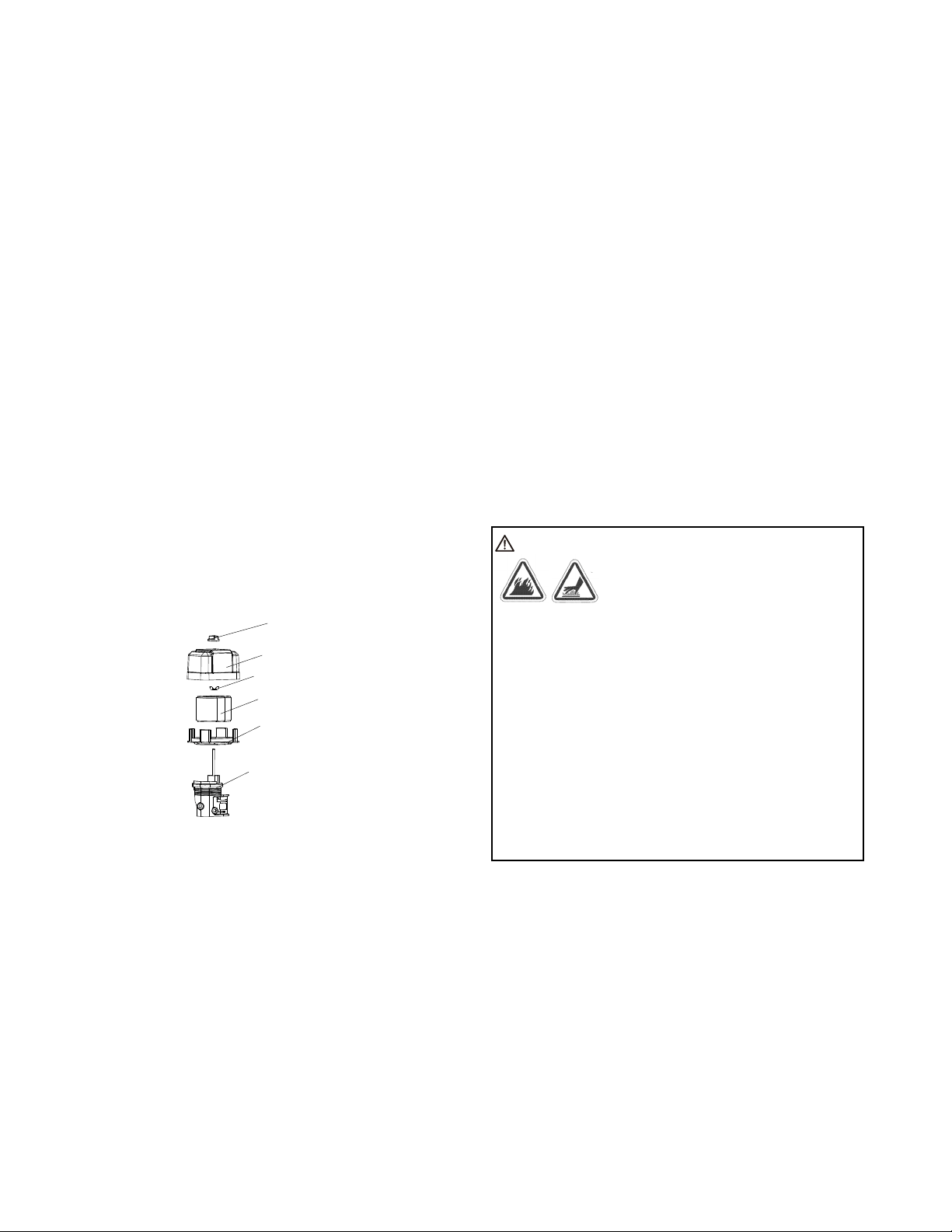
To service the air cleaner, follow these steps:
1. Loosen screw and tilt cover down.
2. Loose the disc konb and carefully remove cartridge
assembly.
3. To clean cartridge, gently tap pleated paper side on a at
surface.
4. Reinstall clean or new cartridge assembly inside cover.
5. Insert guide slot and cartridge into bottom of base.
6. Tilt cover up and tighten screw securely to cover.
Service Spark Plug
Changing the spark plug will help your engine to start easier
and run better. Disconnect spark plug wire from spark plug
and keep wire away from spark plug while servicing engine.
1. Clean area around spark plug.
2. Remove and inspect spark plug.
3. Replace spark plug if electrodes are pitted, burned or
porcelain is cracked.
4. For replacement use the standard resistor spark plug,
like TORCH F6TC.
5. Check electrode gap with wire feeler gauge and set gap
at 0.70-0.80 mm, if necessary.
Screw
Cover
Disc knob
Cartridge
Guide Slot
Base
6. Install spark plug, tighten securely.
NOTE:You can purchase a new spark plug by calling
1-866-902-9690.
Inspect Muer and Spark Arrester
Inspect the muer for cracks, corrosion, or other damage.
Remove the spark arrester if equipped, and inspect
for damage or carbon blockage. If replacement parts
are required, make sure to use only original equipment
replacement parts.
NOTICE: You can purchase a spark arrester by calling
1-866-902-9690.
WARNING! Exhaust heat/gases could ignite
combustibles, structures or damage fuel
tank causing a re, resulting in death or
serious injury.
Contact with muffler area could cause burns resulting in
serious injury.
• DO NOT touch hot parts and AVOID hot exhaust gases.
• Allow equipment to cool before touching.
• Keep at least 5 ft. (1.5 m) of clearance on all sides of
pressure washer including overhead.
• It is a violation of California Public Resource Code,
Section 4442, to use or operate the engine on any forest
covered, brush-covered, or grass-covered land unless
the exhaust system is equipped with a spark arrester, as
dened in Section 4442, maintained in eective working
order. Other states or federal jurisdictions may have
similar laws.
Contact the original equipment manufacturer, retailer, or
dealer to obtain a spark attester designed for the exhaust
system installed on this engine.
• Replacement parts must be the same and installed in the
same position as the original parts.
Air Cooling System
Over time debris may accumulate in cylinder cooling fins
and cannot be observed without partial engine disassembly.
For this reason, we recommend you have a qualified
Yardfoce service dealer clean the cooling system per
recommended intervals (see Maintenance Schedule).
Equally important is to keep top of engine free from debris.
See “Clean Debris”.
20
Carburetor Adjustment
The carburetor on this engine is low emission. It is equipped
with a non-adjustable idle mixture valve. Top speed has
been set at the factory. If adjustment is required, see an
authorized service dealer.
CAUTION! Excessively high operating speeds could
result in minor injury.
Excessively low speeds impose a heavy load.
• DO NOT tamper with governor spring, links or other parts
to increase engine speed. Pressure washer supplies
correct rated pressure and flow when running at
governed speed.
• DO NOT modify pressure washer in any way.
After Each Use
Water should not remain in pressure washer for long periods
of time. Sediments or minerals can deposit on pump parts
and "freeze" pump action. Follow these procedures after
every use:
1. Shut OFF engine, turn o water supply, point gun at a
safety direction, release trigger lock and squeeze trigger
of spray gun to relieve trapped pressure and let engine
cool.
WARNING! The high pressure stream of water that
pressure washer produces could cut through skin
ant its underlying tissues, resulting in serious injury
and possible amputation.
Spray gun traps high water pressure, even when engine is
stopped and water is disconnected, which could result in
serious injury.
Keep high pressure hose connected to pump and spray
gun while system is pressurized.
ALWAYS point spray gun in safe direction, release trigger
lock and squeeze trigger of spray gun p to release high
pressure, every time you stop engine.
2. Disconnect hose from spray gun. Drain water from hose,
gun, and wand. Use a rag to wipe o the hose. Replace
the hose please call at 1-866-902-9690.
3. Empty pump of all pumped liquids by pulling recoil handle
about 6 times. This should remove most liquid in pump.
4. Fold the handle, see “Handle Position Adjustment” .
5. Coil high pressure hose by rotary hand crank
CLOCKWISE on the hose reel when handle folded.
6.Store the spray gun, wand like below.
7.Store the pressure washer in a clean, dry area.
8.If storing for more than 30 days see “Long Term Storage”
on next page.
WARNING! Fuel and its vapors are extremely
flammable and explosive which could
cause burns, re or explosion resulting in
death or serious injury.
WHEN STORING FUELOR EQUIPMENTWITH FUEL IN
TANK
• Store away from furnaces, stoves, water heaters, clothes
dryers, or other appliances that have pilot light or other
ignition source because they could ignite fuel vapors.
21
STORAGE
WINTER STORAGE
CAUTION
You must protect your pressure washer from
freezing temperatures.
• Failure to do so will permanently damage your pump and
render your unit inoperable.
• Freeze damage is not covered under warranty.
To protect the pressure washer from freezing
temperatures:
1. Follow steps 1-6 in the previous section “After Each
USE”.
2. Use pump saver, to treat pump. This prevents freeze
damage and lubricates pistons and seals.
3. If pump saver is not available, connect a 3-foot section
of garden hose to the water inlet adapter. Pour RV-
antifreeze (antifreeze without alcohol) into the hose. Pull
the recoil handle twice. Disconnect 3-foot hose.
4. Store the pressure washer in a clean, dry area.
LONG TERM STORAGE
If you do not plan to use the pressure washer for more than
30 days, you must prepare the engine and pump for long
term storage.
It is important to prevent gum deposits from forming in
essential fuel system parts such as the carburetor, fuel
filter, fuel hose or tank during storage. Also, experience
indicates that alcohol-blended fuels (called gasohol, ethanol
or methanol) can attract moisture, which leads to separation
and formation of acids during storage. Acidic gas can
damage the fuel system of an engine while in storage.
Protect Fuel System
Fuel Additive:
Fuel can become stale when stored over 30 days. Stale fuel
causes acid and gum deposits to form in the fuei system
or on essential carburetor parts. To keep fuel fresh, we
recommend use the fuel additive supplied by a qualified
Yardforce service dealer.
There is no need to drain gasoline from the engine if a fuel
stabilizer is added according to instructions. Run the engine
for 2 minutes to circulate the stabilizer throughout the fuel
system before storage.
If gasoline in the engine has not been treated with a fuel
stabilizer, it must be drained into an approved container.
Run the engine until it stops from lack of fuel.
The use of a fuel stabilizer in the storage container is
recommended to maintain freshness.
Change Oil
While engine is still warm, drain oil from crankcase. Refill
with recommended grade. See "Changing Oil" section.
Oil Cylinder Bore
1. Remove spark plug. Squirt about 1 tablespoon of clean
engine oil into the cylinder. Cover spark plug hole with
rag. Pull recoil handle slowly to distribute oil. Avoid spray
from spark plug hole.
2. Install spark plug. Do Not connect spark plug wire.
Protect Pump
To protect the pump from damage caused by mineral
deposits or freezing, use Pump Saver, to treat pump. This
prevents freeze damage and lubricates pistons and seals.
NOTE
Pump Saver is available as an optional accessory. It
is not included with the pressure washer.
Contact your local Yardforce service center to purchase
Pump Saver.
CAUTION
You must protect your unit from freezing
temperatures.
• Failure to do so will permanently damage your pump and
render your unit inoperable.
• Freeze damage is not covered under warranty.
To use the Pump Saver:
CAUTION
Read and follow all cautions and warnings on
the pump saver can label. Always wear eye protection when
using pump saver.
1. Remove the hose connector from the pump outlet.
2. Attach hose on pump saver can to pump inlet.
3. Push in can top to dispense pump saver.
4. When pump saver uid begins to exit pump outlet, the
pump is protected.
5. Remove pump saver from pump inlet.
Other Storage Tips
1. DO NOT store fuel from one season to another unless it
has been treated as described in Protect Fuel System.
2. Replace fuel container if it starts to rust. Rust and/ or dirt
in fuel can cause problems if it's used with this pressure
washer.
3. Cover unit with a suitable protective cover that does not
retain moisture.
WARNING Storage covers could cause a re resulting
in death or serious injury.
• DO NOT place a storage cover over a hot pressure
washer.
• Let equipment cool for a sucient time before placing the
cover on the equipment.
4. Store pressure washer in a clean and dry area.
22
TROUBLESHOOTING
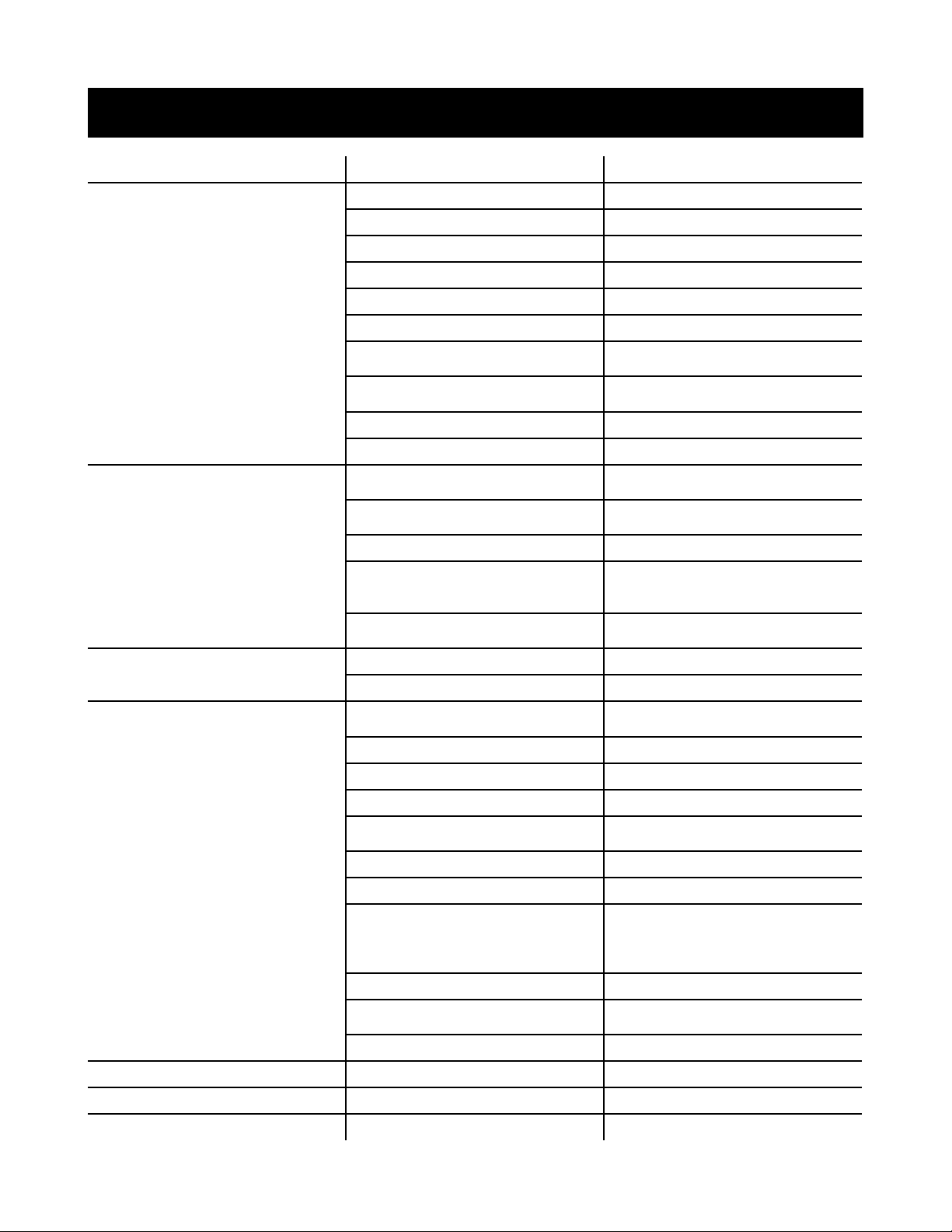
Problem Cause Correction
Pump has following
problems. No pressure, low pressure
1.Nozzle tip not attached. 1. Attached required nozzle tip
2. Water inlet is blocked. 2. Clear inlet.
3. Inadequate water supply. 3. Provide adequate water ow.
4. Inlet hose is kinked or leaking. 4. Straighten inlet hose, patch leak.
5. Clogged inlet hose strainer 5. Check and clean inlet hose strainer.
6. Water supply is over 100°F. 6. Provide cooler water supply.
7. High pressure hose is blocked or
leaks.
7. Clear blocks in outlet hose.
8. The loaded RPM is not set to HIGH
8. Set RPM (Throttle lever) to HIGH
position.
9. Nozzle is obstructed. 9. Clean nozzle.
10. Damaged pump. 10. Contact Yardforce service facility.
No intake of detergent.
1. Detergent siphoning tube is not
connected.
1. Connect detergent siphon tube
Properly.
2. Chemical lter is clogged.
2. Clean or replace lter/detergent
siphoning tube.
3. Dirty in-line lter. 3. See "Check In-Line Filter" on page 10.
4. Wrong nozzle.
4. Use black nozzle when applying
detergent. Refer to the instruction
manual.
5. Damaged detergent siphoning tube.
5. Replace detergent siphoning
tube.
Engine sounds abnormal or
overloaded
1. Engine speed is too slow. 1. Move throttle control to FAST position.
2. Pressure is too high 2. Contact Yardforce service facility.
Engine doesn't start; or
starts and runs rough.
1. The engine power switch is OFF(o)
position.
1. Ensure the switch is in ON (I) position
2. No fuel. 2. Fill the fuel tank with regular gasoline.
3. Dirty air cleaner. 3. Clean or replace air cleaner.
4. Stale gasoline. 4. Drain gas tank; ll with fresh fuel.
5. Spark plug wire not connected to
spark plug.
5. Connect wire to spark plug.
6. Bad spark plug. 6. Replace spark plug.
7. Low oil level. 7. Fill crankcase to proper level.
8. Choke lever not in right position.
8. a) When cold starting the engine, set
the choke to "Choke" position.
b.) When warm starting, set the choke to
"Run" position.
9. Clogged carburetor. 9. Clean the carburetor.
10. Excess water pressure in pump or
hose.
10. Release water pressure by
squeezing trigger on gun.
11.Engine has lost compression. 11. Contact Yardforce service facility.
Engine stops down during operation. Out of gasoline. Fill fuel tank.
Engine lacks power. Dirty air lter. Replace air lter.
Starter rope doesn't recoil Recoil mechanism is broken. Contact Yardforce service facility.

23
NOTES
24
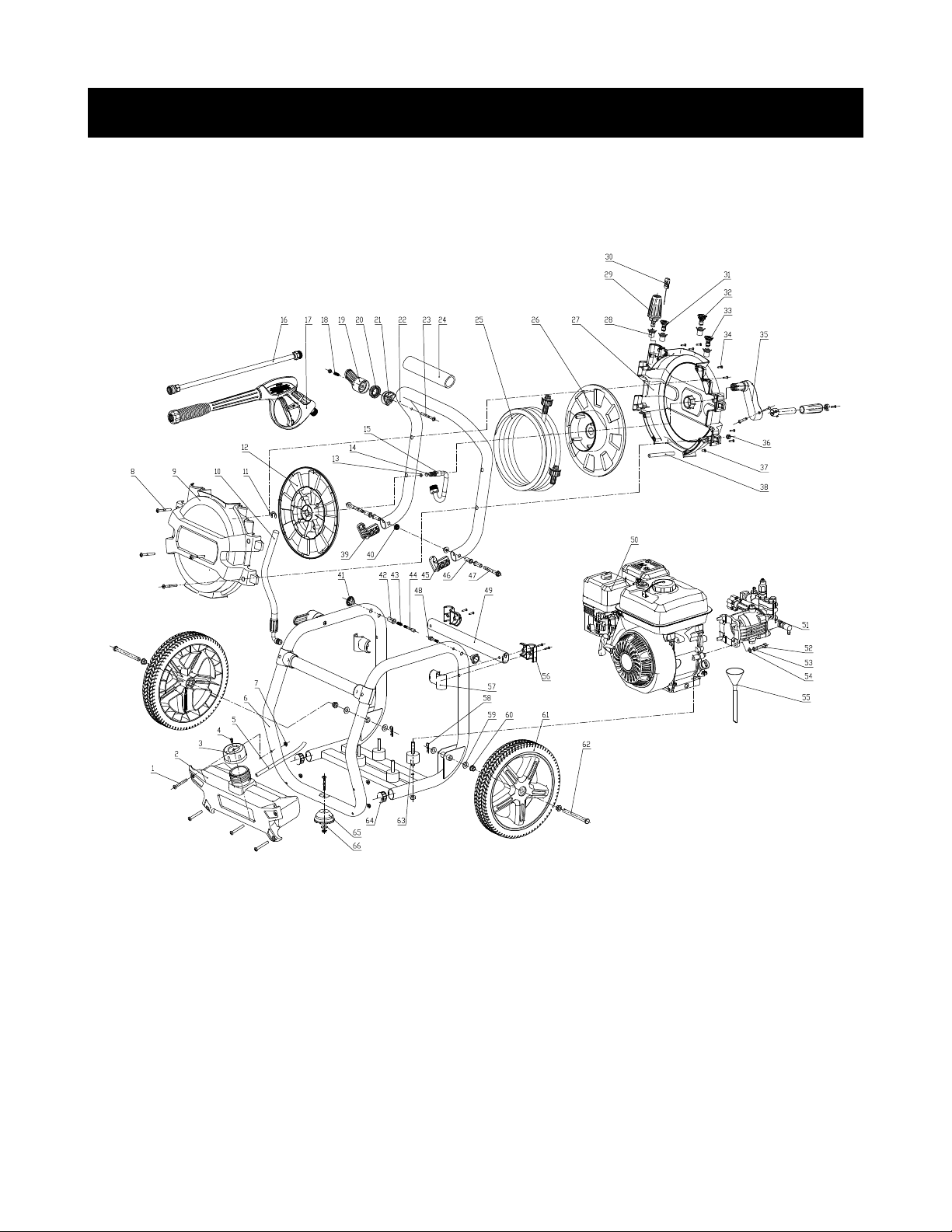
PARTS
Yard Force 3200PSI Gas Pressure Washer Y0GWC3200R0
Main Unit — Exploded View
To purchase replacement parts, call 1-866-902-9690.

25
Yard Force 3200PSI Gas Pressure Washer Y0GWC3200R0
Main Unit — Parts List
Item
1
2
3
4
5
6
7
8
9
10
11
12
13
14
15
16
17
18
19
20
21
22
23
24
25
26
27
28
29
30
31
32
33
34
35
36
37
38
39
Item
40
41
42
43
44
45
46
47
48
49
50
51
52
53
54
55
56
57
58
59
60
61
62
63
Part #
75496001
75496002
75496003
75496004
75496005
75496006
75496007
75496008
75496009
75496010
75496011
75496012
75496013
75496014
75496015
75496016
75496017
75496018
75496019
75496020
75496021
75496022
75496023
75496024
75496025
75496026
75496027
75496028
75496029
75496030
75496031
75496032
75496033
75496034
75496035
75496036
75496037
75496038
75496039
Part #
75496057
75496058
75496059
75496060
75496061
75496062
75496063
75496040
75496041
75496042
75496043
75496044
75496045
75496046
75496047
75496048
75496049
75496050
75496051
75496052
75496053
75496054
75496055
75496056
Description
Cross pan-head screws M6 x 40
Detergent bottle
Detergent bottle cap
Rubber valve core
Pick-up tube
Main frame
Non-metallic insert hex ange lock
nut M6
Cross pan-head screws M6 x 50
Front coil wheel cover
Short high-pressure rubber pipe
Open ring 9
Front coil wheel
O-ring 9X1.8
O-ring 10X1.9
Rotary joint component
Wand
Gun
Hook spring
Hook
Hook tooth ring
Hook base
Handle bracket
Cross countersunk head screw
M6 x 60
Handle sheath
Long high-pressure rubber pipe
Back coil wheel
Back coil wheel cap
PVC cover of Nozzle
Turbo
Nozzle needle
Nozzle/white / 40 degrees
Nozzle/black/Soap
Nozzle/yellow / 15 degrees
Cross trough pan-head self-
tapping screw ST3.5 x 16
Rocker handle component
I-type non-metallic insert
hexagon Lock nut M6
Bolt pipe plug
Non-metallic insert hex ange lock
nut M8
Pin connector
Description
Wheel shaft sleeve
Wheel
Wheel shaft
Column type anti-shock pad
Pipe closer
Foot pad
Washer A level 6
Latch set
Latch spring
Latch
Limit pipe plug
Handle shaft sleeve
Hex ange bolt M8 x 65
Limit shaft
Cross pipe
Engine
Pump
Pump mounting bolts
Standard spring washer 8
Flat washer A grade 8
Pipe clamp back cover
Pipe clamp front cover
Elastic split pin
Flat washer A grade 10
26
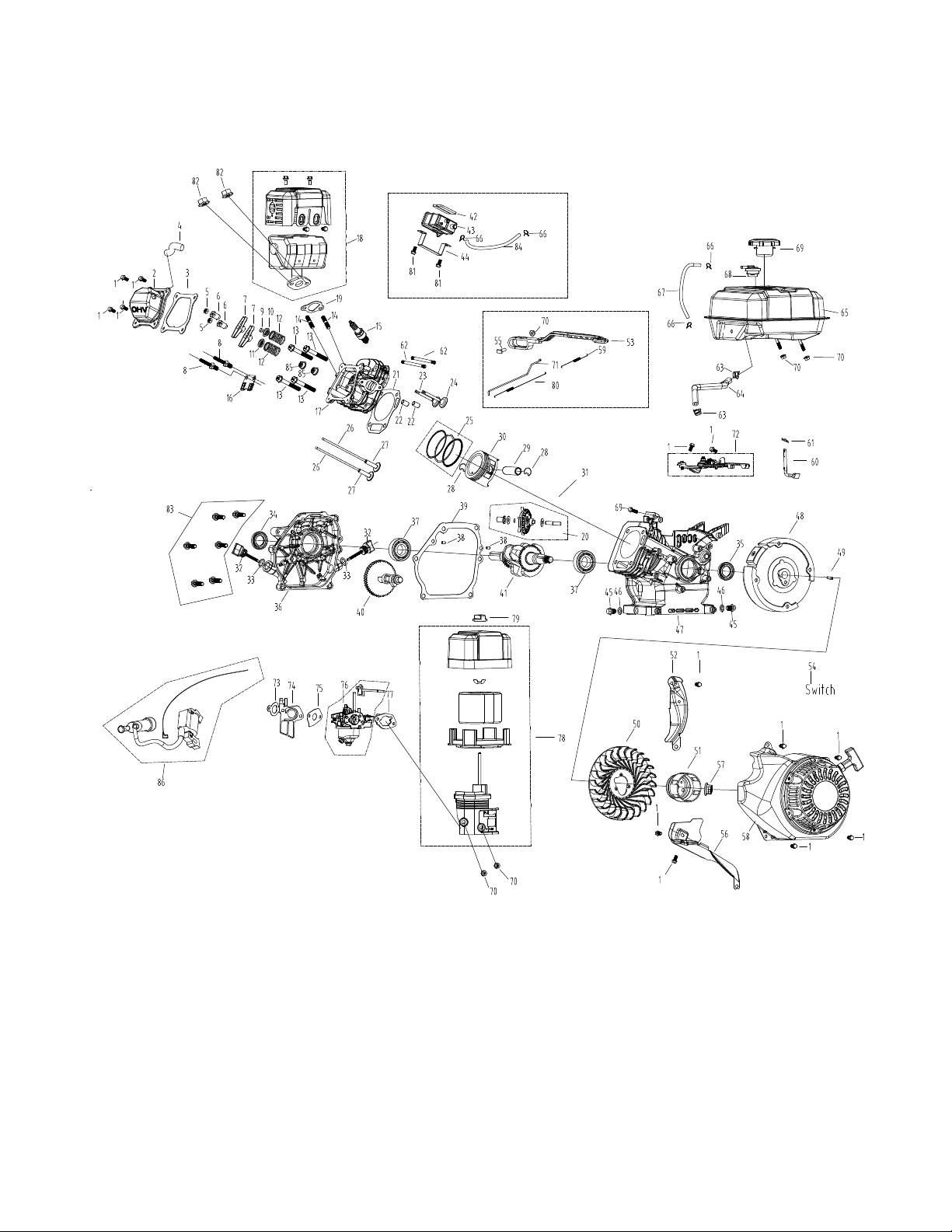
ENGINE, 7 HP, JFNT210 for Pressure Washer Y0GWC3200R0 - Exploded View
To purchase replacement parts, call 1-866-902-9690.

27
ENGINE, 7 HP, JFNT210 for Pressure Washer Y0GWC3200R0 - Parts List
Item
44
45
46
47
48
49
50
51
52
53
54
55
56
57
58
59
60
61
62
63
64
65
66
67
68
69
70
71
72
73
74
75
76
77
78
79
80
81
82
83
84
85
86
Part #
7549604844
7549604845
7549604846
7549604847
7549604848
7549604849
7549604850
7549604851
7549604852
7549604853
7549604854
7549604855
7549604856
7549604857
7549604858
7549604859
7549604860
7549604861
7549604862
7549604863
7549604864
7549604865
7549604866
7549604867
7549604868
7549604869
7549604870
7549604871
7549604872
7549604873
7549604874
7549604875
7549604876
7549604877
7549604878
7549604879
7549604880
7549604881
7549604882
7549604883
7549604884
7549604885
7549604886
Description
Carbon tank plate
Drain plug
Drain plug aluminum spacer
Body/no hole
Flywheel assembly
Woodru key
Cool fan
Wheel sleeve
Flywheel side shell
Adjusting arm
Stop Switch
Square-head screw
Wind scooper
Flywheel nut
Volute starting assembly
Speed thick spring
Rocker
Rocker circlip
Stud
Pipeline circlip
Pipeline
Fuel tank assembly
Hoop
Evaporation tube
Suppression of oil valve
Fuel tank cap
Hexagon ange nut
Throttle lever
Power control assembly
Inlet gasket
Insulation board
Carburetor paper gasket
Carburetor assembly
Carburetor iron gasket
Air lter assembly
Air lter knob
Speed ne spring
Hexagon ange nut
Hexagon ange nut
Compartment cover bolts
Evaporation tube
Valve guide oil seal
Ignition Coil
Item
1
2
3
4
5
6
7
8
9
10
11
12
13
14
15
16
17
18
19
20
21
22
23
24
25
26
27
28
29
30
31
32
33
34
35
36
37
38
39
40
41
42
43
Part #
7549604801
7549604802
7549604803
7549604804
7549604805
7549604806
7549604807
7549604808
7549604809
7549604810
7549604811
7549604812
7549604813
7549604814
7549604815
7549604816
7549604817
7549604818
7549604819
7549604820
7549604821
7549604822
7549604823
7549604824
7549604825
7549604826
7549604827
7549604828
7549604829
7549604830
7549604831
7549604832
7549604833
7549604834
7549604835
7549604836
7549604837
7549604838
7549604839
7549604840
7549604841
7549604842
7549604843
Description
Hex ange bolts
Respirator
Respirator gasket
Respirator straight pipe
Lock nut
Adjusting nut
Rocker arm
Rocker arm bolt
Exhaust valve protection caps
Exhaust valve spring seat base
Inlet valve spring seat base
Valve spring
Cylinder head bolt
Stud
Spark plug
Guide plate
Cylinder cap
Muer with Mars network
Muer gasket
Centrifugal body assembly
Cylinder head gasket
Cylinder head positioning pin
Exhaust valve
Inlet valve
Piston ring
Putters
Tappet
Piston pin retainer
Piston pin
Piston
Connecting rod
Dipstick
Dipstick ring
Oil seal / acrylate
Oil seal
Compartment cover
Bearing
Compartment cover dowel
Compartment cover gasket
Camshaft assembly
Crankshaft assembly
Carbon tank rubber mat
Carbon tank

28
EMISSION CONTROL SYSTEM WARRANTY
California, U.S. EPA, and Yardforce Emissions
Control Warranty Statement
Your Warranty Rights And Obligations
The California Air Resources Board, U.S. EPA, and Merotec
Inc. are pleased to explain the emissions control system
warranty on your Model Year 2017-2018 engine/equipment.
In California, new small o-road engines and large spark
ignited engines less than or equal to 1.0 liter must be
designed, built, and equipped to meet the State's stringent
anti-smog standards.
B&S must warrant the emissions control system on your
engine/equipment for the periods of time listed below
provided there has been no abuse, neglect, or improper
maintenance of your engine/equipment.
Your exhaust emissions control system may include parts
such as the carburetor or fuel injection system, ignition
system, and catalytic converter. Also included may be
hoses, belts, connectors, sensors, and other emissions-
related assemblies. Your evaporative emission control
system may include parts such as: carburetors, fuel tanks,
fuel lines, fuel caps, valves, canisters, lters, vapor hoses,
clamps, connectors, and other associated components.
Where a warrantable condition exists, Merotec will repair
your engine/ equipment at no cost to you including
diagnosis, parts, and Labor.
Manufacturer's Warranty Coverage:
Small o-road engines and large spark ignited engines
less than or equal to 1.0 liter, and any related emissions
components of the equipment, are warranted for two years*.
If any emissions-related part on your engine/equipment is
defective, the part will be repaired or replaced by Merotec.
* Two years or for the time period listed in the respective
engine or product warranty statement, whichever is
greater.
Owner's Warranty Responsibilities:
• As the engine/equipment owner, you are responsible for
the performance of the required maintenance listed in
your Operator's Manual. Merotec recommends that you
retain all receipts covering maintenance on your engine/
equipment, but Merotec cannot deny warranty solely
for the lack of receipts or your failure to ensure the
performance of all scheduled maintenance.
• As the engine/equipment owner, you should however be
aware that Merotec may deny you warranty coverage
if your engine/equipment or a part has failed due to
abuse, neglect, improper maintenance, or unapproved
modications.
• You are responsible for presenting your engine/
equipment to a Yardforce distribution center, servicing
dealer, or other equivalent entity, as applicable, as
soon as a problem exists. The warranty repairs should
be completed in a reasonable amount of time, not to
exceed 30 days. If you have any questions regarding
your warranty rights and responsibilities, you should
contact Yardforce after service center at (866) 902-9690
Yardforce Emissions Control Warranty Provisions
The following are specic provisions relative to your
Emissions Control Warranty Coverage. It is in addition to the
Yardforce engine warranty for non-regulated engines found
in the Operator's Manual.
1. Warranted Emissions Parts
Coverage under this warranty extends only to the parts
listed below (the emissions control systems parts) to the
extent these parts were present on the engine and/or
supplied fuel system.
a. Fuel Metering System
• Cold start enrichment system (soft choke)
• Carburetor and internal parts
• Fuel pump
• Fuel line, fuel line ttings, clamps
• Fuel tank, cap and tether
• Carbon canister
b. Air Induction System
• Air cleaner
• Intake manifold
• Purge and vent line
c. Ignition System
• Spark plug(s)
• Magneto ignition system
d. Catalyst System
• Catalytic converter
• Exhaust manifold
• Air injection system or pulse valve
e. Miscellaneous Items Used in Above Systems
• Vacuum, temperature, position, time sensitive
valves and switches
• Connectors and assemblies
2. Length of Coverage
For a period of two years from date of original
purchase*, Merotec warrants to the original purchaser
and each subsequent purchaser that the engine is
designed, built, and equipped so as to conform with all
applicable regulations adopted by the Air Resources
Board; that it is free from defects in material and
workmanship that could cause the failure of a warranted
part; and that it is identical in all material respects to the
engine described in the manufacturer's application for
certication. The warranty period begins on the date the
engine is originally purchased.
• Two years or for the time period listed in the respective
engine or product warranty statement, whichever is
Greater.

29
The warranty on emissions-related parts is as follows:
• Any warranted part that is not scheduled for
replacement as required maintenance in the Operator's
Manual supplied, is warranted for the warranty period
stated above. If any such part fails during the period
of warranty coverage, the part will be repaired or
replaced by Merotec at no charge to the owner. Any
such part repaired or replaced under the warranty will
be warranted for the remaining warranty period.
• Any warranted part that is scheduled only for regular
inspection in the Operator's Manual supplied, is
warranted for the warranty period stated above. Any
such part repaired or replaced under warranty will be
warranted for the remaining warranty period.
• Any warranted part that is scheduled for replacement
as required maintenance in the Operator's Manual
supplied, is warranted for the period of time prior to the
rst scheduled replacement point for that part. If the
part fails prior to the rst scheduled replacement, the
part will be repaired or replaced by Merotec at no
charge to the owner. Any such part repaired or replaced
under warranty will be warranted for the remainder of
the period prior to the rst scheduled replacement point
for the part.
• Add-on or modied parts that are not exempted by the
Air Resources Board may not be used. The use of any
non-exempted add-on or modied parts by the owner
will be grounds for disallowing a warranty claim. The
manufacturer will not be liable to warrant failures of
warranted parts caused by the use of a non-exempted
add-on or modied part.
3.Consequential Coverage
Coverage shall extend to the failure of any engine
components caused by the failure of any warranted
emissions parts.
4.Claims and Coverage Exclusions
Warranty claims shall be led according to the
provisions of the Yardforce engine warranty policy.
Warranty coverage does not apply to failures of
emissions parts that are not original equipment
Yardforce parts or to parts that fail due to abuse,
neglect, or improper maintenance as set forth in the
Yardforce engine warranty policy. Merotec is not liable
for warranty coverage of failures of emissions parts
caused by the use of add-on or modied parts.

30
WARRANTY
YARDFORCE TWO YEAR LIMITED WARRANTY
Product Warranty
Please keep your original purchase receipt in a safe place as proof of purchase. Warranty coverage for this product
must be veried by the original purchase receipt. The warranty period begins on the day that the product was purchased
from an authorized retailer of Yard Force products. Warranty coverage only applies to the original purchaser and is not
transferrable. Warranty coverage is only provided on products purchased and used in the USA from authorized Yard Force
retailers. Products purchased or used outside of the USA are not covered by this warranty.
(2) Two-Year Warranty – Pump and Engine
The Y0GWC3200R0 has a 2-Year Limited Warranty from the date of purchase against manufacturer defects for residential
use only. Commercial use voids the warranty. This warranty does not cover accidental damage, unreasonable use, normal
wear and tear, neglect or non-compliance with the Operating, Safety and Maintenance Instructions. All service, outside
of normal maintenance as described in this manual, must be done by an authorized service technician. Any unauthorized
service or changes to the original conguration of this product will void the warranty. All parts and accessories used on and
with this product must be manufacturer/or and authorized by Merotec Inc.
(90) Ninety-Day Warranty – Accessories
The accessories included with the Y0GWC3200R0; including hose, trigger handle and wand, and other similar parts are
warranted against manufacturer defects for residential use only for a period of 90 days from date of purchase.
Warranty does not cover loss of use or other consequential damages arising from any of the above, nor does it cover
repairs made or attempted by unauthorized persons. This warranty is void if the product is used for commercial, rental or
industrial purposes. Certain parts, attachments and accessories are subject to normal wear and tear and are excluded from
the warranty.
Service and Warranty Claims Process
Contact the Yard Force Support Center toll-free at (866) 902-9690 Monday-Friday between 8:30 AM and 5:00 PM
Eastern Time for service and warranty support.
Yard Force USA Service Support agents can help you troubleshoot problems over the phone to get you back up and
running as quickly as possible. In the situation where service or warranty inspection is needed, please follow these steps:
1.
Contact Yard Force USA at (866) 902-9690 Monday-Friday between 8:30 AM and 5:00 PM Eastern Time.
2. Send in proof-of-purchase and serial number (if applicable) to conrm warranty coverage.
3. If service or a warranty evaluation is requested, Yard Force USA will provide an RGA number that should be used in all
communications with Yard Force USA and is required to be indicated on the product itself and on the outside of the box.
4. All shipments to Yard Force USA must have an RGA number. Any shipment received that does not have an RGA number
clearly marked on the outside of the box will be refused.
5. All shipments must be sent pre-paid, Yard Force USA does not pay for any shipping costs for service or warranty
evaluation. Yard Force USA is not responsible for any packages that are lost by carrier. We recommend that shipments are
made by a carrier that provides tracking and delivery conrmation.
For more information or to ask questions, please call toll-free (866) 902-9690 Monday-Friday between 8:30 AM and 5:00
PM Eastern Time.
SAVE THESE INSTRUCTIONS
Merotec Inc.
3655 Kennesaw North Industrial Parkway, Kennesaw, GA 30144
Copyright © 2017 Merotec Inc.
Made in China at a SUMEC manufacturing facility
MADE IN CHINA