USER MANUAL
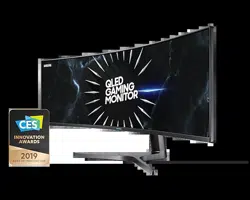
C49RG9*
Gaming Monitor
The color and the appearance may differ depending on the product, and the specifications are subject to change without prior
notice to improve the performance.
The contents of this manual are subject to change without notice to improve quality.
© Samsung
Samsung owns the copyright for this manual.
Use or reproduction of this manual in parts or entirety without the authorization of Samsung is prohibited.
Trademarks other than that of Samsung are owned by their respective owners.
An administration fee may be charged in the following situations:
(a) An engineer is called out at your request, but it is found that the product has no defect (i.e., where the user
manual has not been read).
(b) You bring the unit to a repair center, but it is found that the product has no defect (i.e., where the user manual
has not been read).
You will be informed of the administration fee amount before a technician visits.

2
Game
Picture Mode 27
Refresh Rate 28
Black Equalizer 29
Response Time 29
FreeSync 29
Low Input Lag 31
Virtual Aim Point 31
Screen Size 31
Save Settings 32
Picture
Picture Mode 33
Brightness 34
Contrast 34
Sharpness 34
Color 35
HDMI Black Level 35
Eye Saver Mode 35
Screen Adjustment 36
Calibration Report 36
Connecting and Using a Source Device
Pre-connection Checkpoints 20
Connecting and Using a PC 20
Connection Using the HDMI Cable 20
Connection Using the DP Cable 20
Connecting to Headphones 21
Connecting to Microphone 21
Connection Using the Audio Cable 21
Connecting the Product to a PC as a USB HUB 22
Connecting a PC to the Product 22
Utilizing the Product as a USB HUB 22
Connecting a USB device 23
Connecting the Power 24
Tidying Up the Connected Cables 25
Correct posture to use the product 26
Driver Installation 26
Setting Optimum Resolution 26
Table of contents
Before Using the Product
Securing the Installation Space 4
Precautions for storage 4
Safety Precautions 4
Cleaning 5
Electricity and Safety 5
Installation 6
Operation 7
Preparations
Parts 9
Control Panel 9
Function Key Guide 10
Game Setting Key 11
Changing Brightness, Contrast and Sharpness
settings 12
Changing Eye Saver Mode settings 12
Changing the Volume setting 12
Types of Ports 13
Upgrading the Software via USB 14
Anti-theft Lock 15
Installation 16
Attaching the Stand 16
Removing the Stand
(For Attaching the BRACKET WALL) 17
Adjusting the Product Tilt and Height 18
Attaching the BRACKET WALL 19
3
Specifications
General 50
Standard Signal Mode Table 51
Appendix
Responsibility for the Pay Service (Cost to
Customers) 55
Not a product defect 55
A Product damage caused by customer's fault 55
Others 55
WEEE 56
Correct Disposal of This Product
(Waste Electrical & Electronic Equipment) 56
Source Detection 43
Key Repeat Time 43
Power LED On 44
Reset All 44
Information 44
Installing the Software
Easy Setting Box 46
Restrictions and Problems with the Installation 46
System Requirements 46
Troubleshooting Guide
Requirements Before Contacting Samsung
Customer Service Center 47
Testing the Product 47
Checking the Resolution and Frequency 47
Check the following. 47
Q & A 49
PBP 36
PBP Mode 36
Aspect Ratio 37
Screen1 37
Screen2 37
Sound Source 37
OnScreen Display
Language 38
Display Time 38
System
Self Diagnosis 39
Lighting 41
Local Dimming 41
Volume 41
Smart ECO Saving+ 41
Off Timer Plus 41
PC/AV Mode 42
USB Super Charging 42
DisplayPort Ver. 43
HDMI Mode 43
Table of contents
4
Securing the Installation Space
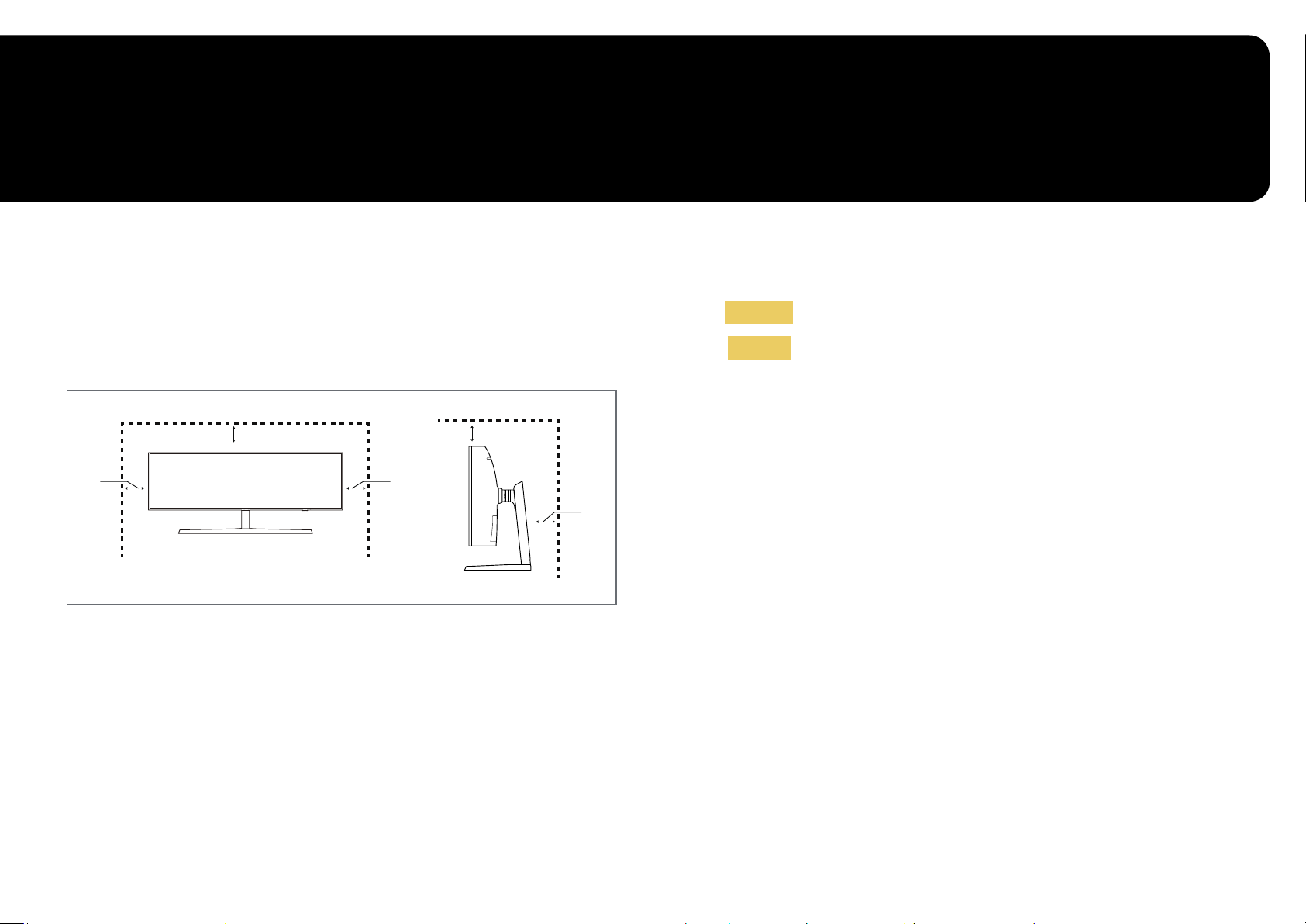
Ensure some space around the product for ventilation. An internal temperature rise may cause fire and
damage the product. Be sure to allow the amount of space as shown below or greater when installing the
product.
―
The exterior may differ depending on the product.
10 cm (3.93 Inches)
10 cm
(3.93 Inches)
10 cm
(3.93 Inches)
10 cm (3.93 Inches)
10 cm
(3.93 Inches)
Precautions for storage
High-glossy models can develop white stains on the surface if an ultrasonic wave humidifier is used
nearby.
―
Contact your nearest Samsung Customer Service Center if you want to clean the inside of the product (Service
fee will be charged.)
Safety Precautions
Warning
A serious or fatal injury may result if instructions are not followed.
Caution
Personal injury or damage to properties may result if instructions are
not followed.
Before Using the Product
Chapter 01
5
Cleaning
―
Take the following steps when cleaning.
1
Power off the product and computer.
2
Disconnect the power cord from the product.
―
Hold the power cable by the plug and do not touch the cable with wet hands. Otherwise, an electric shock
may result.
3
Wipe the monitor with a clean, soft and dry cloth.
‒ Do not apply a cleaning agent that contains alcohol, solvent, or surfactant to the monitor.
‒ Do not spray water or detergent directly on the product.
4
Wet a soft and dry cloth in water and wring thoroughly to clean the exterior of the product.
5
Connect the power cord to the product when cleaning is finished.
6
Power on the product and computer.
Electricity and Safety
Warning
• Do not use a damaged power cord or plug, or a loose power socket.
• Do not use multiple products with a single power socket.
• Do not touch the power plug with wet hands.
• Insert the power plug all the way in so it is not loose.
• Connect the power plug to a grounded power socket (type 1 insulated devices only).
• Do not bend or pull the power cord with force. Be careful not to leave the power cord under a heavy
object.
• Do not place the power cord or product near heat sources.
• Clean any dust around the pins of the power plug or the power socket with a dry cloth.
Caution
• Do not disconnect the power cord while the product is being used.
• Only use the power cord provided with your product by Samsung. Do not use the power cord with
other products.
• Keep the power socket where the power cord is connected unobstructed.
‒ The power cord must be disconnected to cut off power to the product when an issue occurs.
• Hold the plug when disconnecting the power cord from the power socket.

6
Warning
• DO NOT PLACE CANDLES, INSECT REPELLANTS OR CIGARETTES ON TOP OF THE PRODUCT. DO NOT
INSTALL THE PRODUCT NEAR HEAT SOURCES.
• Do not install the product in poorly ventilated spaces such as a bookcase or closet.
• Install the product at least 10cm away from the wall to allow ventilation.
• Keep the plastic packaging out of the reach of children.
‒ Children may suffocate.
• Do not install the product on an unstable or vibrating surface (insecure shelf, sloped surface, etc.)
‒ The product may fall and become damaged and/or cause an injury.
‒ Using the product in an area with excess vibration may damage the product or cause a fire.
• Do not install the product in a vehicle or a place exposed to dust, moisture (water drips, etc.), oil, or
smoke.
• Do not expose the product to direct sunlight, heat, or a hot object such as a stove.
‒ The product lifespan may be reduced or a fire may result.
• Do not install the product within the reach of young children.
‒ The product may fall and injure children.
• Edible oil, such as soybean oil, can damage or deform the product. Do not install the product in a
kitchen or near a kitchen counter.
Caution
• Do not drop the product while moving.
• Do not set down the product on its front.
• When installing the product on a cabinet or shelf, make sure that the bottom edge of the front of the
product is not protruding.
‒ The product may fall and become damaged and/or cause an injury.
‒ Install the product only on cabinets or shelves of the right size.
• Set down the product gently.
‒ Product failure or personal injury may result.
• Installing the product in an unusual place (a place exposed to a lot of fine dust, chemical substances,
extreme temperatures or a significant presence of moisture, or a place where the product will
operate continuously for an extended period of time) may seriously affect its performance.
‒ Be sure to consult Samsung Customer Service Center if you want to install the product at such a
place.
Installation

8
Caution
• Leaving the screen fixed on a stationary image for an extended period of time may cause afterimage
burn-in or defective pixels.
‒ Activate power-saving mode or a moving-picture screen saver if you will not be using the product
for an extended period of time.
• Disconnect the power cord from the power socket if you do not plan on using the product for an
extended period of time (vacation, etc).
‒ Dust accumulation combined with heat can cause a fire, electric shock or electric leakage.
• Use the product at the recommended resolution and frequency.
‒ Your eyesight may deteriorate.
• Do not hold the product upside-down or move it by holding the stand.
‒ The product may fall and become damaged or cause an injury.
• Looking at the screen too close for an extended period of time can deteriorate your eyesight.
• Do not use humidifiers or stoves around the product.
• Rest your eyes for more than 5 minutes or look at distance objects for every 1 hour of product use.
• Do not touch the screen when the product has been turned on for an extended period of time as it
will become hot.
• Store small accessories out of the reach of children.
• Exercise caution when adjusting the product angle or stand height.
‒ Your hand or finger may get stuck and injured.
‒ Tilting the product at an excessive angle may cause the product to fall and an injury may result.
• Do not place heavy objects on the product.
‒ Product failure or personal injury may result.
• When using headphones or earphones, do not turn the volume too high.
‒ Having the sound too loud may damage your hearing.
• Do not drop the product while moving.
‒ Product failure or personal injury may result.
9
Preparations
Chapter 02
Parts
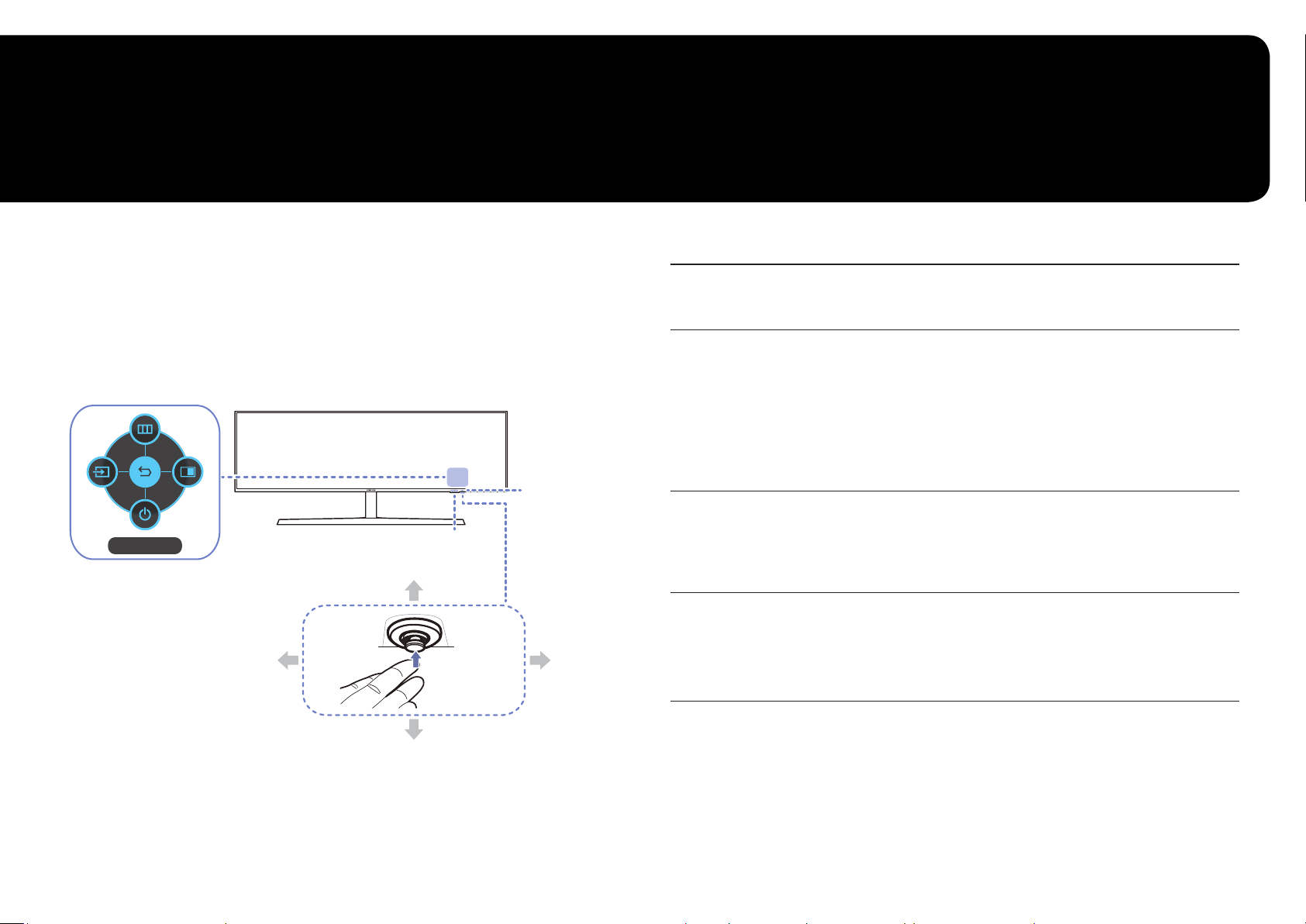
Control Panel
―
The color and shape of parts may differ from what is shown. Specifications are subject to change without
notice to improve quality.
Function Key Guide
Power LED
LEFT
JOG Button
RIGHT
UP(REAR)
DOWN(FRONT)
PRESS(ENTER)
Return
Game Setting Key
Parts Description
JOG Button
Multi directional button that helps navigate.
―
The JOG button is located at the bottom right side of the screen and has
5 directions of UP, DOWN, LEFT, RIGHT, and PRESS (ENTER).
Power LED
This LED is power status indicator and works as
• Power On (Power button): Off
• Power saving mode: Blinking
• Power Off (Power button): On
―
The power Indicator operation can be swapped by changing in the menu.
(System → Power LED On) Actual models because of functional variation
maybe haven’t this function.
Function Key Guide
Press the JOG button when the screen is turned on. The Function Key
Guide will appear. To access the onscreen menu when the guide is
displayed, press the corresponding direction button again.
―
Function Key Guide may vary depending on the function or product
model. Please refer to the actual product.
Game Setting Key
Use shortcut keys to access previously saved custom game modes.
• Game Setting 1 / Game Setting 2 / Game Setting 3
―
The Game Setting Keys are located at the bottom right on the front of
the monitor. To edit and save a custom game mode, go to Game → Save
Settings.
13
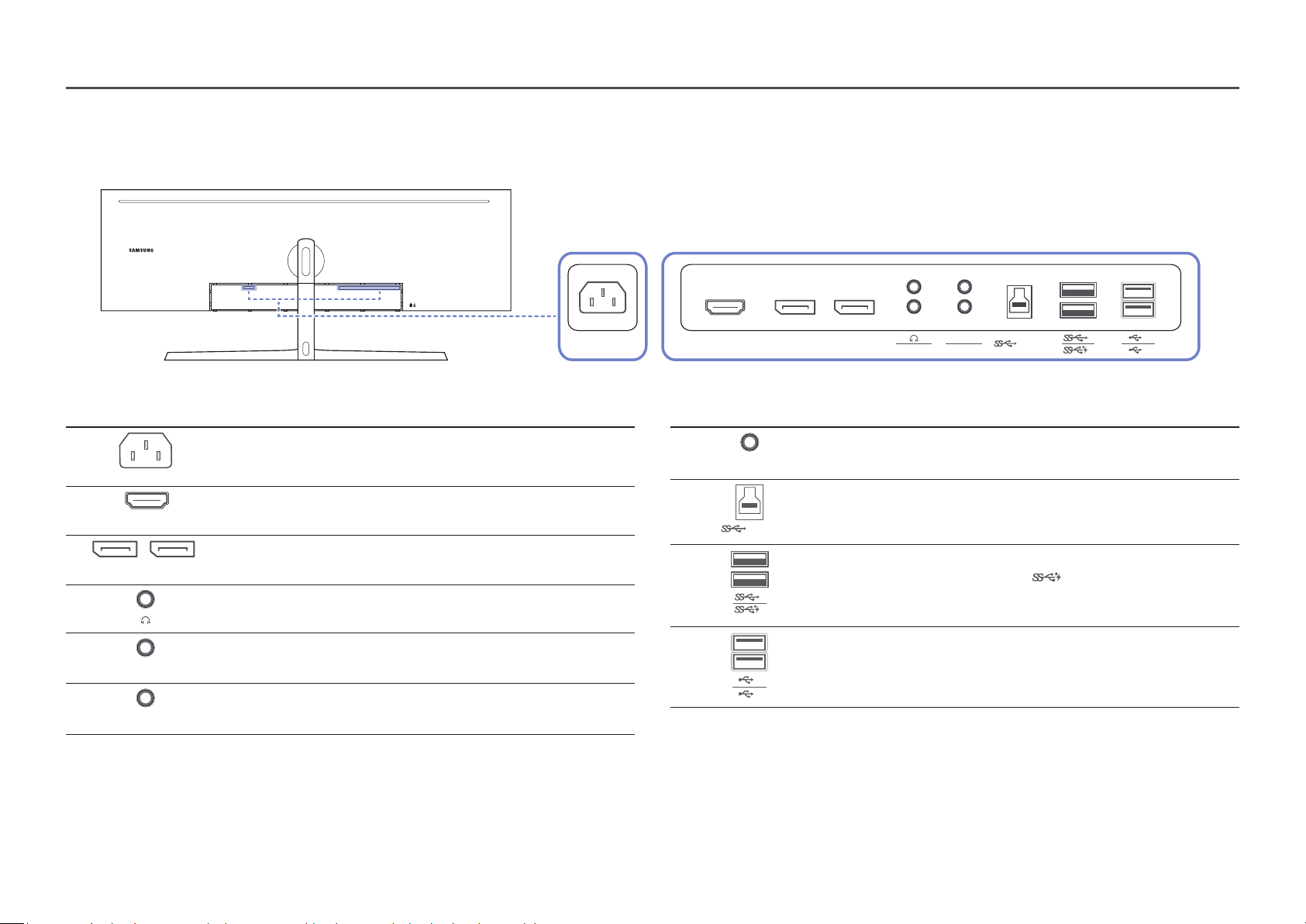
Port Description
POWER IN
Connect the power cord for your monitor to the POWER IN port on the
back of the product.
HDMI IN
Connects to a source device using an HDMI cable or HDMI-DVI cable.
DP IN 1
DP IN 2
Connects to a PC using a DP cable.
Connect to an audio output device such as headphones.
SERVICE
Dedicated to service technicians.
MIC IN
Connect to a microphone.
Port Description
MIC OUT
Connect to a PC.
(PC IN)
Connects to a PC using a USB cable. Compatible with a USB cable version
3.0 or lower.
―
This port can only connect to a PC.
1
2
Connect to a USB device.
―
Super charging is possible using the
2
port only. This port charges
devices faster than typical USB port. The speed depends on the connected
devices.
1
2
Connect to a USB device.
Types of Ports
―
The functions available may vary depending on the product model. The color and shape of parts may differ from what is shown. Specifications are subject to change without notice to improve quality. Refer to the actual product.
HDMI IN (PC IN)
POWER IN
DP IN 1
MIC IN
MIC OUT
DP IN 2
SERVICE
2
1
1
2

14
Upgrading the Software via USB
1
Be sure to insert the USB disk into the
1
port. You can upgrade the software via USB only if
either the monitor screen operates normally or the check signal is displayed on the monitor screen.
HDMI IN (PC IN)DP IN 1
MIC IN
MIC OUT
DP IN 2
SERVICE
2
1
1
2
Check the cable connection and the settings of the source device.
DisplayPort1
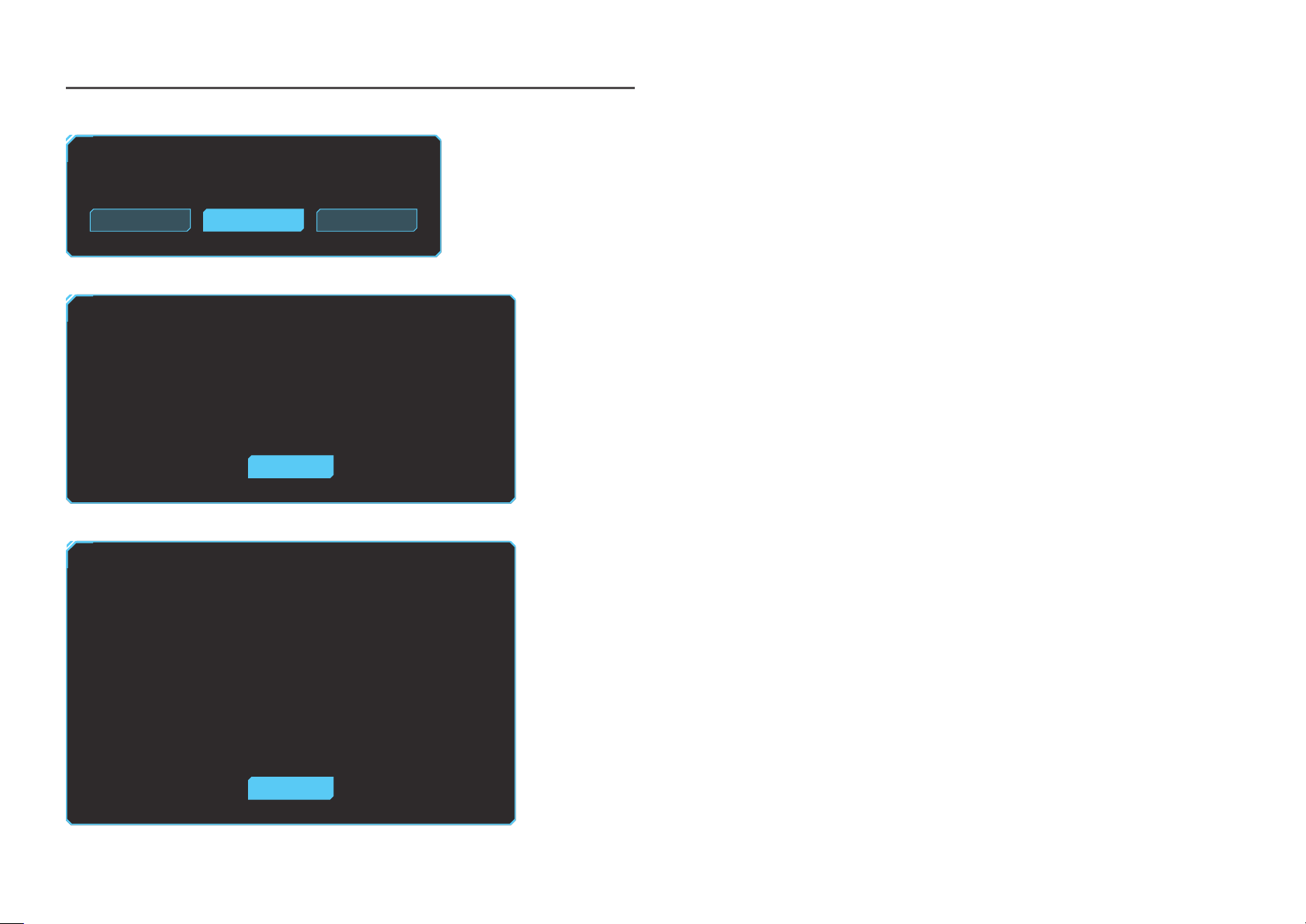
When the screen as shown in the following figure is displayed, press and hold the Down arrow key for
5 seconds.
Power Off
2
When the message as shown in the following figure is displayed on the monitor, select Yes to
upgrade the software.
Do you want to update via USB?
Yes
No
3
When the screen as shown in the following figure is displayed, select Yes.
Update now
Yes No
Update from version XXXX.X to version XXXX.X?
4
The software upgrading proceeds.
Update now
5%
Updating product Software…
Your product will turn itself off and on again automatically after completing
update.

15
Note
1
The supported USB disk formats are FAT, FAT32, and NTFS.
2
For the CRG9 model, make sure that each upgrade file is a BIN format file, follows the CRG9 model
naming rule (m-RG949CCAA-****.*[4 digits].bin, where ****.* is a version number, and 4 digits are
a checksum. For example, “m-RG949CCAA-1000.0[6E80].bin” complies with the naming rule for the
CRG9 model.), and must be copied to the root directory.
3
Make sure that the USB disk only contains one upgrade file for each model, and then follow the
instructions in this guide.
4
If the No valid update files found. Please check your USB device and try again. message is displayed,
this is probably due to the following reasons.
Update now
OK Cancel
No valid update files found.
Please check your USB device and try again.
‒ No USB disk is inserted into the
1
port.
‒ The USB disk format is not supported.
‒ The USB disk contains no valid upgrade files. (No upgrade files exist, or the file names are
incorrect.)
5
Do not turn off the monitor. And prevent the upgrading from any interruption as far as possible. If an
interruption happens, the monitor will return to the production version.
―
Note that the production version may not be the same as the version before this upgrading if some other
upgrading has been done earlier.
Anti-theft Lock
―
An anti-theft lock allows you to use the product securely even in public places.
―
The locking device shape and locking method depend on the manufacturer. Refer to the user guide provided
with your anti-theft locking device for details.
To lock an anti-theft locking device:
1
Fix the cable of your anti-theft locking device to a heavy object such as a desk.
2
Put one end of the cable through the loop on the other end.
3
Insert the locking device into the anti-theft lock slot at the back of the product.
4
Lock the locking device.
‒ An anti-theft locking device can be purchased separately.
‒ Refer to the user guide provided with your anti-theft locking device for details.
‒ Anti-theft locking devices can be purchased at electronics retailers or online.

16
Installation
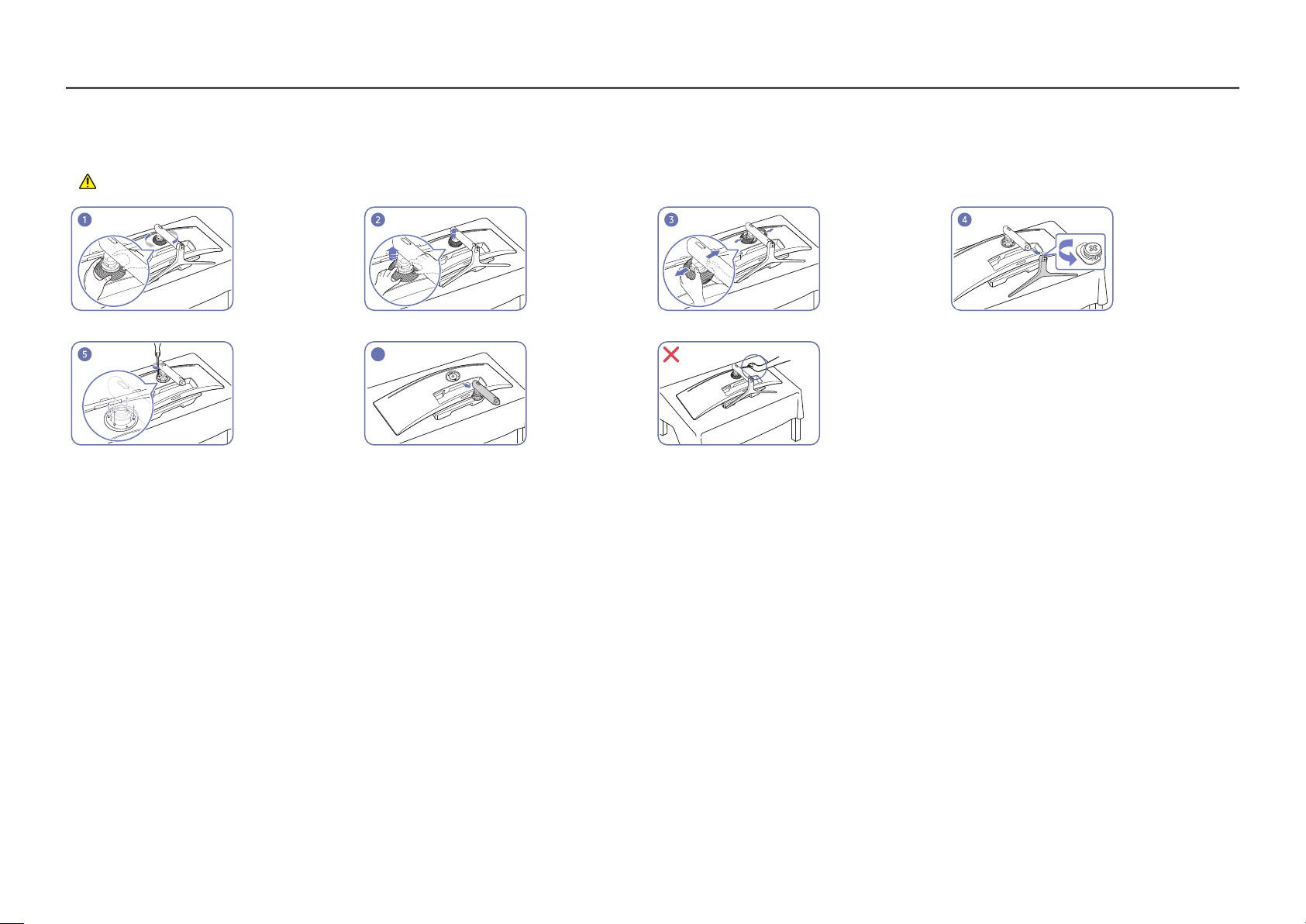
Attaching the Stand
x 2
x 4
―
Before assembling the product, place the product down on a flat and stable surface so that the screen is facing
downwards.
: The product is curved. Placing pressure on the product when on a flat surface may damage the product. When
the product is on the ground facing up or down, do not put pressure on it.
―
There is a risk of scratch damage if the screwdriver comes in contact with the product surface while fastening the
screws. Make sure the screwdriver does not touch the surface.
1 1
Caution
Hold the stand neck with both hands, not one
hand, to prevent it from falling off and causing
injury.
Place the stand neck on the monitor as shown
in the figure.
Caution
Tilt the stand neck to sides to avoid contact with the
screwdriver.
Fasten the screws at the top of the stand neck.
1 1 1 1
6
Insert the stand base into the stand neck in the
direction as shown in the figure.
Disassemble the COVER-REAR TOP. Assemble the COVER-REAR TOP to the stand neck as shown
in the figure.
Rotate the COVER-REAR TOP clockwise.
1
7
1
8
Stand up the monitor as shown in the figure. Remove the package.
17
Removing the Stand (For Attaching the BRACKET WALL)
―
Before removing the stand from the monitor, place the monitor on a flat and stable surface with the screen facing down.
: The product is curved. Placing pressure on the product when on a flat surface may damage the product. When the product is on the ground facing up or down, do not put pressure on it.
Rotate the COVER-REAR TOP counterclockwise. Lift the COVER-REAR TOP. Disassemble the COVER-REAR TOP. Remove the stand base from the stand neck.
6
Unfasten the 4 screws at the top of the stand neck. Lift and remove the stand. Caution
Do not press down on the monitor. There is a risk
of damaging the monitor.

18
Adjusting the Product Tilt and Height
―
The color and shape of parts may differ from what is shown. Specifications are subject to change without
notice to improve quality.
-15.0° (±2.0°) to Left ~ 15.0° (±2.0°) to Right
-2.0° (±2.0°) ~ +17.0° (±2.0°)
0 ~ 120.0 mm (±5.0 mm)
• The monitor tilt and height can be adjusted.
• When adjusting the tilt and height, hold both sides of the product and avoid using excessive force to
prevent damage.
• When adjusting the stand height, you may hear a noise. This noise is generated because the ball
inside the stand slides when the stand height is adjusted. It is a normal noise and not a product
malfunction.
Caution
• Grasp the left and right sides of the monitor and adjust the tilt.
After adjusting the product tilt and height, if the screen is not level, take the following actions.
• Hold the bezel at both side edges and adjust the monitor angle until the screen becomes level. (Be
careful not to directly hold the LCD display.)
• The monitor angle can be adjusted from -4° to +4°.
19
Attaching the BRACKET WALL
―
Power the product off and remove the power cable from the power socket.
1 2
43
Attach the BRACKET WALL here
BRACKET WALL
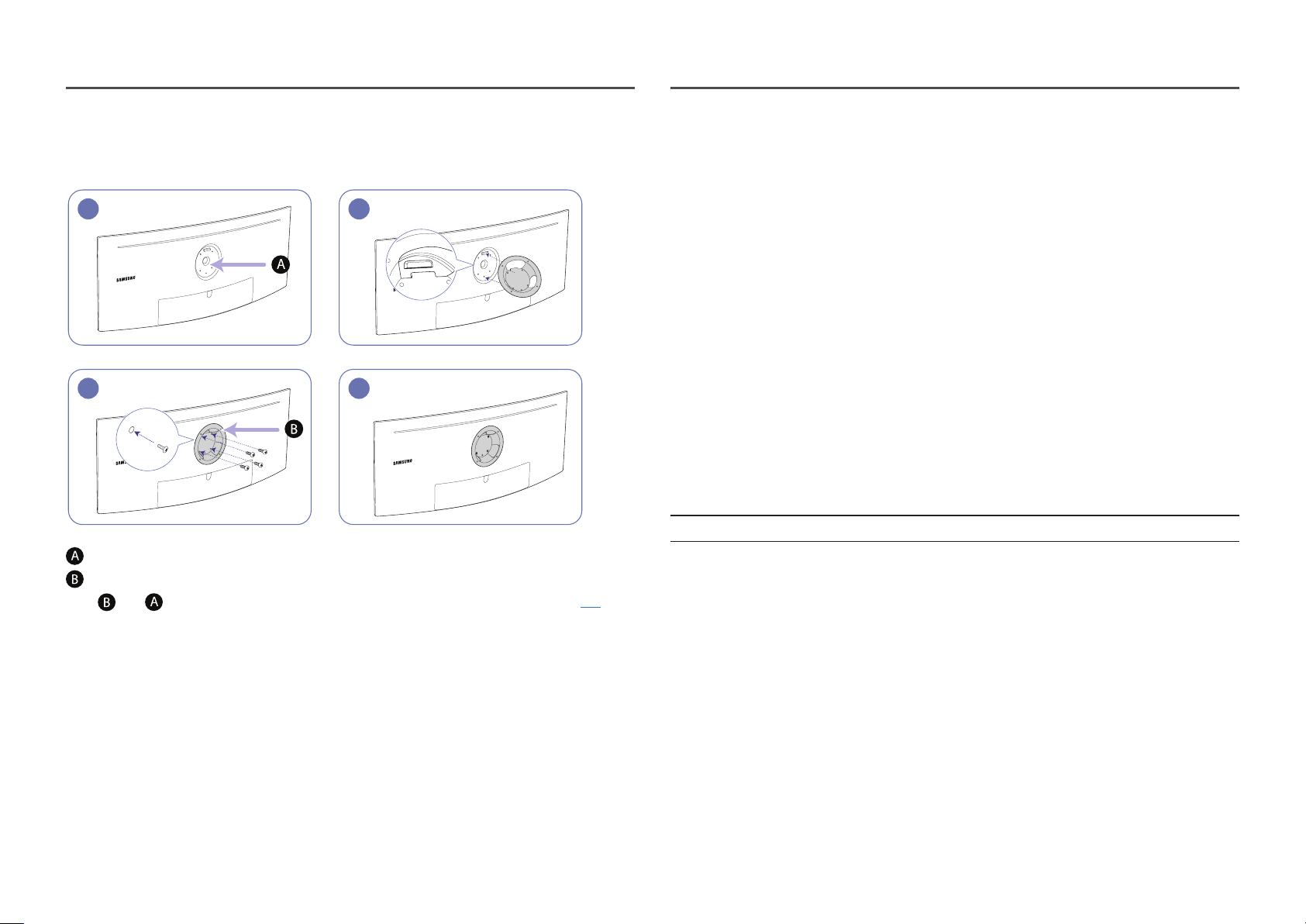
Align with on the monitor, then tightly fasten with the screws removed from the stand (P.17).
• Notes
‒ Using a screw longer than the standard length can damage the internal components of the
product.
‒ The length of screws required for a wall mount that does not comply with the VESA standards may
vary depending on the specifications.
‒ Do not use screws that do not comply with the VESA standards. Do not attach the wall-mount kit
or desktop stand using excessive force. The product may get damaged or fall and cause personal
injury. Samsung shall not be held liable for any damage or injury caused by using improper screws
or attaching the wall-mount kit or desktop stand using excessive force.
‒ Samsung shall not be held liable for any product damage or personal injury caused by using a wall-
mount kit other than the one specified or from an attempt to install the wall-mount kit on your
own.
‒ To mount the product on a wall, ensure you purchase a wall-mount kit that can be installed 10 cm
or farther away from the wall.
‒ Be sure to use a wall-mount kit that complies with the standards.
‒ To install the monitor using a wall mount, disconnect the stand base from the monitor.
Unit: mm (inches)
Model name VESA screw hole specs in
millimeters
Standard Screw Quantity
C49RG9* 100.0 x 100.0 (3.9 x 3.9) 4.0 mm Φ, 0.7 pitch * 10.0 mm long 4 EA
―
Do not attach the BRACKET WALL when the monitor is turned on. This may cause electric shock and might
result in injury.
20
Connecting and Using a Source Device
Chapter 03
Pre-connection Checkpoints
―
Before connecting a source device, read the user manual provided with it.
The number and locations of ports on source devices may differ from device to device.
―
Do not connect the power cable before connecting all other cables.
Ensure you connect a source device first before connecting the power cable.
Connecting the power cable during connection may damage the product.
―
Check the types of ports at the back of the product you want to connect.
Connecting and Using a PC
Select a connection method suitable for your PC.
―
Connecting parts may differ in different products.
―
Provided ports may vary depending on the product.
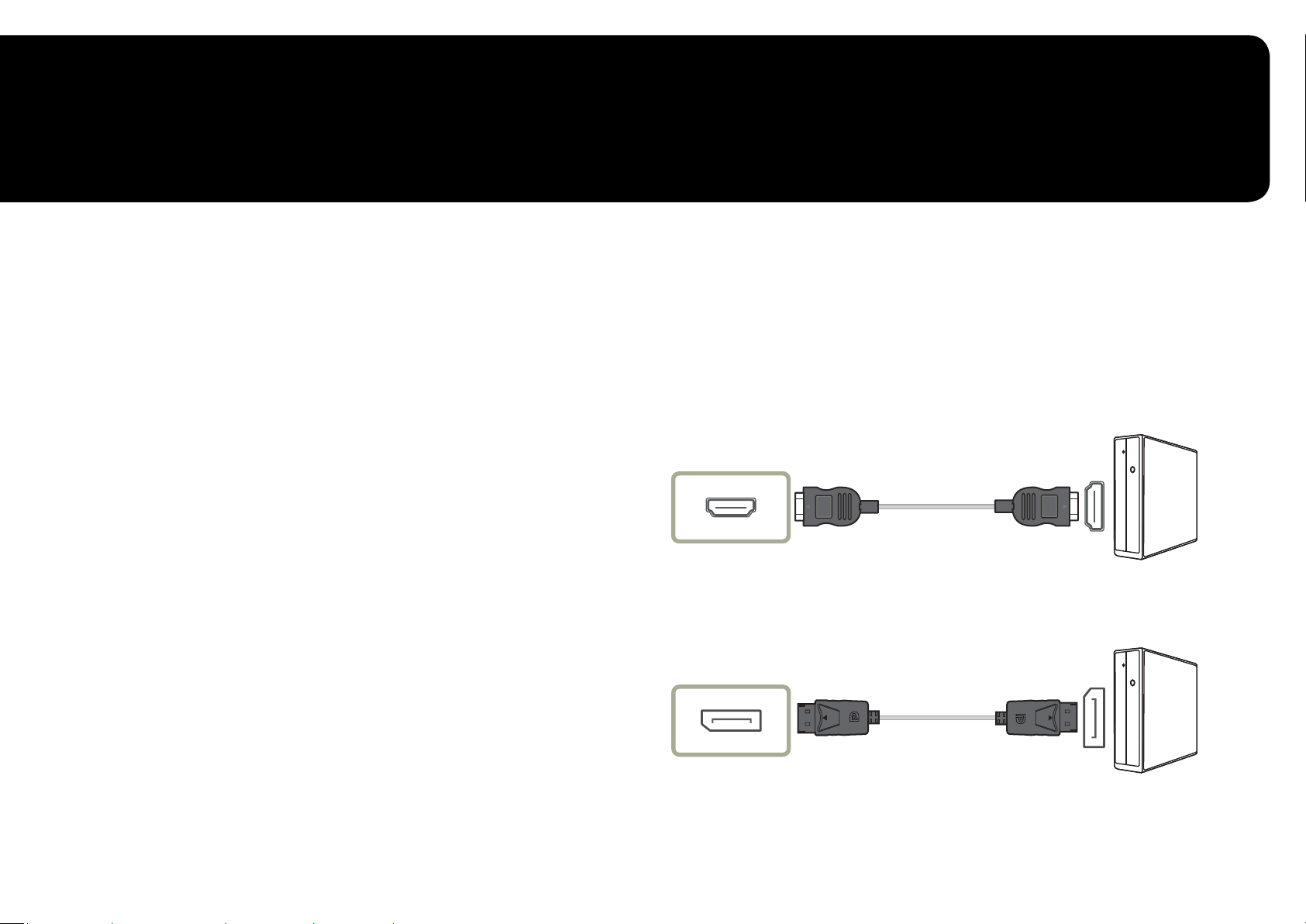
Connection Using the HDMI Cable
HDMI IN
Connection Using the DP Cable
DP IN 1, DP IN 2
23
―
To detect and start a USB device faster, connect the device to the USB 3.0 port on the product. The read/write
rate will be affected by the USB device and your PC.
―
The product does not support media play. If you need to play a file in your USB device, please connect the
product as a Hub to your PC and play the file on your PC.
―
For USB-related problems caused by OS, drive programs or software, please contact relevant suppliers.
―
With the launch of various USB devices on the market, we cannot guarantee that our products are matched
with all USB devices.
―
For an external mass-storage HDD requiring external power supply, be sure to connect it to a power source.
―
The super charging can only be provided through port
2
. According to the USB 3.0 battery charging
specification,
2
can support a maximum current of 1.5A. The actual current value depends on the device
to be charged.
If the current is too high or an exception occurs, the over-current protection will be triggered. This is a normal
setting of the product.
―
USB devices requiring high current may not be supported.
1
can support a maximum current of 1.0A,
and
2
can support a maximum current of 1.5A.
―
The battery can be charged in the power-saving mode, but it cannot be charged when the product is powered
off.
―
Charging your USB device is not possible if the power cable is disconnected from the power socket.
―
The USB device needs to be purchased separately.
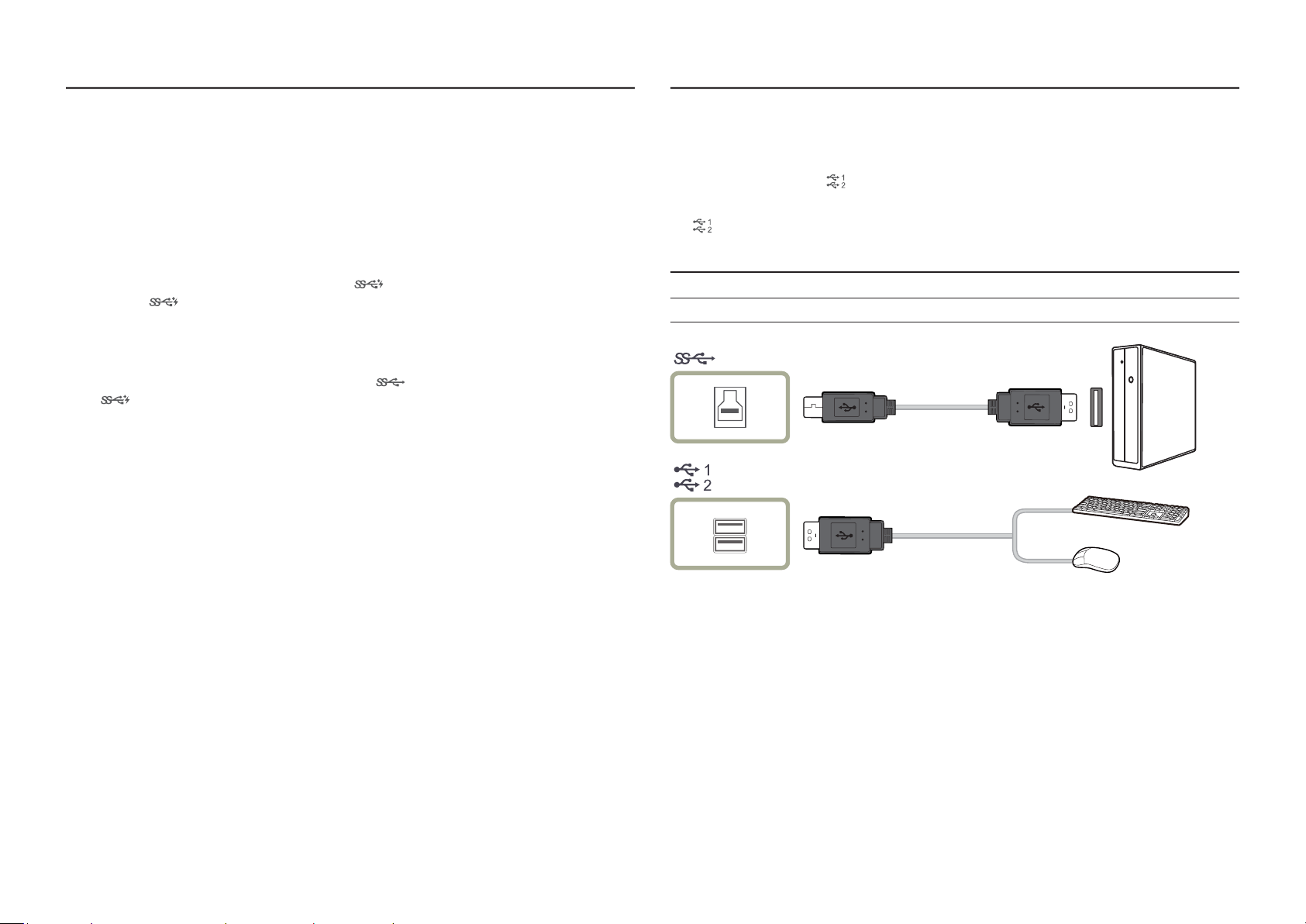
Connecting a USB device
―
You can use a USB device such as a mouse, keyboard, memory stick or external hard disk drive (HDD) by
connecting it directly to the
port on the monitor. You do not need to connect it to the computer.
For an external mass-storage HDD requiring external power supply, be sure to connect it to a power source.
The USB port of the monitor supports High-Speed Certified USB 2.0.
High speed Full speed Low speed
Data Rate 480 Mbps 12 Mbps 1.5 Mbps
Power Consumption 2.5 W (Max., each port) 2.5 W (Max., each port) 2.5 W (Max., each port)
(PC IN)
24
1
Connect the port of the monitor and the USB port of the computer with the USB cable.
―
To use
port, you have to connect the UP (Upstream Cable) to the PC.
―
Make sure to use the USB cable supplied with this monitor to connect the monitor's
port and your
computer's USB port.
2
Use the USB cable to connect a USB device to the port on the monitor.
3
The use procedures are as the same as those for using an external device connecting to the PC.
• You can connect and use a keyboard and mouse.
• You can play a file from a media device. (Examples of media devices: MP3, digital camera, etc.)
• You can run, move, copy or delete the files on the storage device. (Examples of storage devices:
external memory, memory card, memory reader, HDD-type MP3 player, etc.)
• You can use other USB devices that can be connected to a computer.
―
When connecting a device to the
port of the monitor, connect the device using a cable appropriate to the
device.
―
For the purchase of the cable and external devices, ask the service center of the corresponding product.
―
The company is not liable for problems or damages to an external device caused by using an unauthorized
cable for the connection.
―
Some products do not follow the USB standard, and it may cause a malfunction of the device.
―
If the device malfunctions even if it is connected to the computer, contact the service center of the device/
computer.
―
With the launch of various USB devices on the market, we cannot guarantee that our products are matched
with all USB devices.
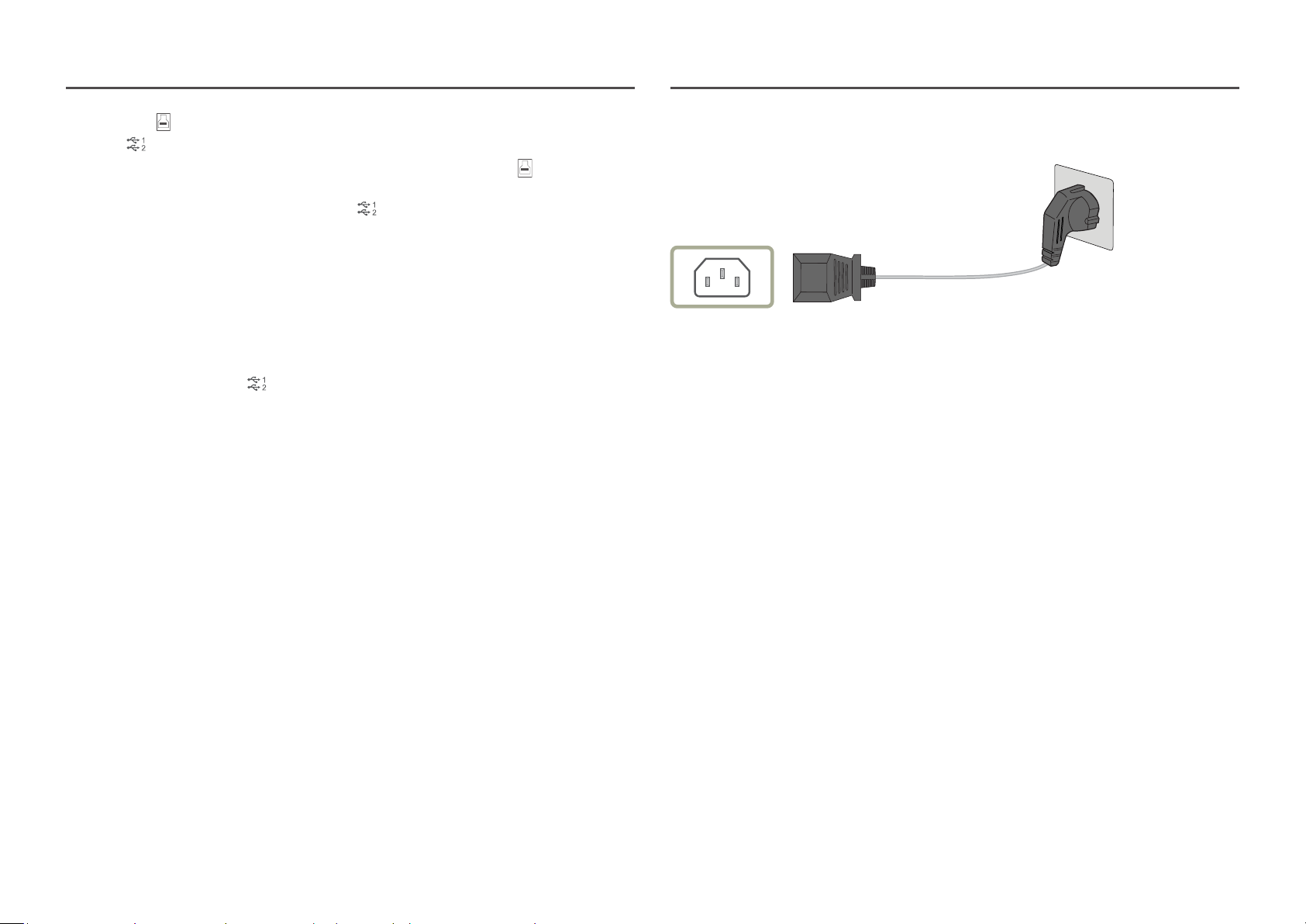
Connecting the Power
POWER IN
To use the product, connect the power cable to a power outlet and the POWER IN port on the product.
―
The input voltage is switched automatically.
25
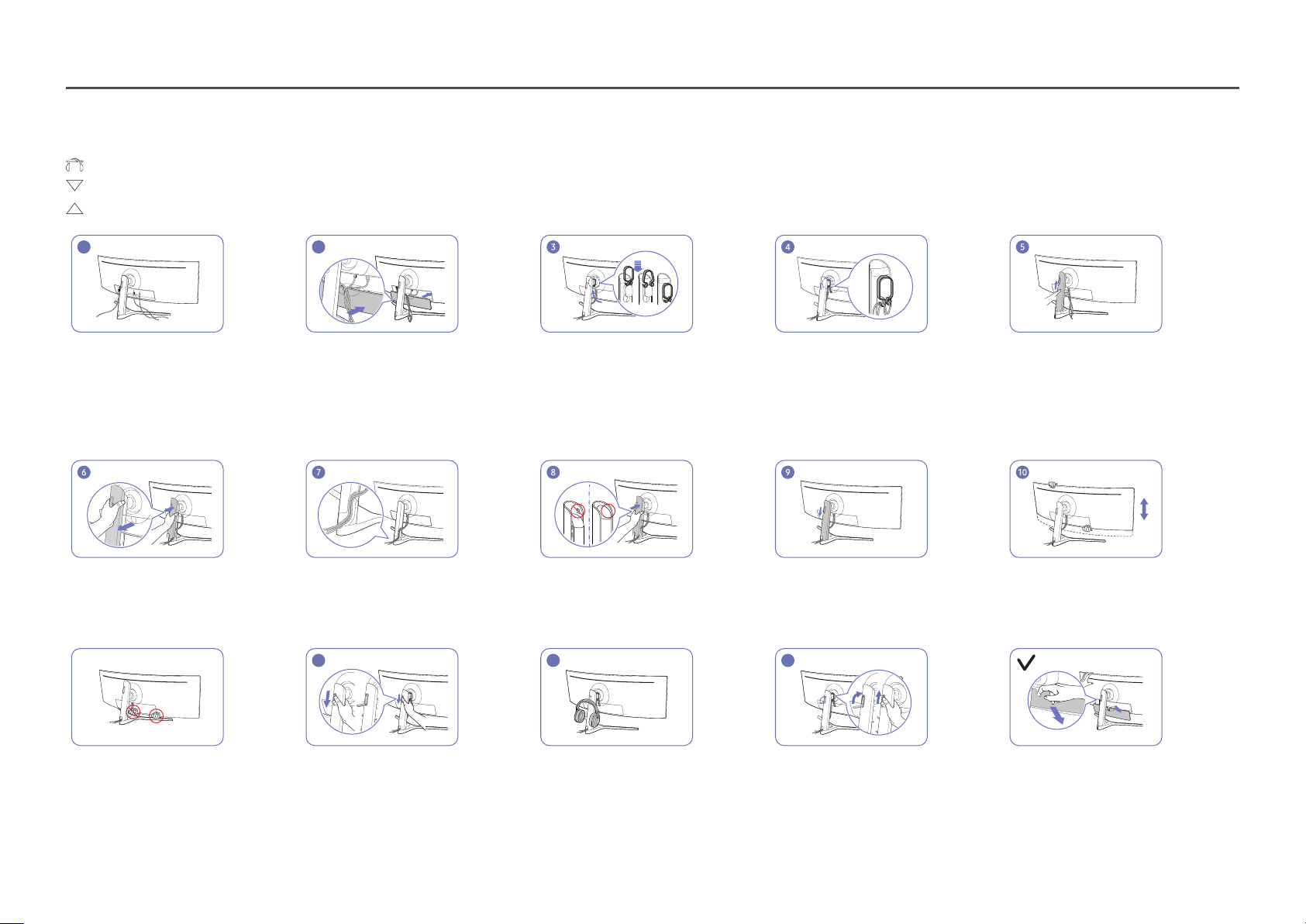
Tidying Up the Connected Cables
: Headphones hanger
: Downward
: Upward
1 2
Connect the corresponding cables. Arrange the cables against the bend
tendency of the cables and pull the cables
out of the COVER-REAR SUB grooves.
Hang the HOLDER-CABLE in the direction
as shown in the figure.
Arrange the cables against their bend
tendency, and then pull them through the
HOLDER-CABLE hangers. When the set
height is changed, you need to arrange
the cables and pull them through the
HOLDER-CABLE hangers again.
Push the COVER STAND BODY REAR in
the direction as shown in the figure.
Remove the COVER STAND BODY REAR
by pulling it in the direction as shown in
the figure.
Place the corresponding cables into
the stand-neck holder. Do not stretch
the cable. Three cables in one holder is
recommended.
Attach the COVER STAND BODY REAR in
the direction as shown in the figure with
the buckles not being exposed.
Move down the COVER STAND BODY
REAR until it covers the stand neck
completely.
Adjust the set height, if required.
11 12 13
Open the Headset Hanger by pushing it
down.
Hang the headset. Rotate and then push up the Headset
Hanger in the directions as shown in the
figure.
Caution
Open the COVER-REAR SUB in the
direction as shown in the figure.
30
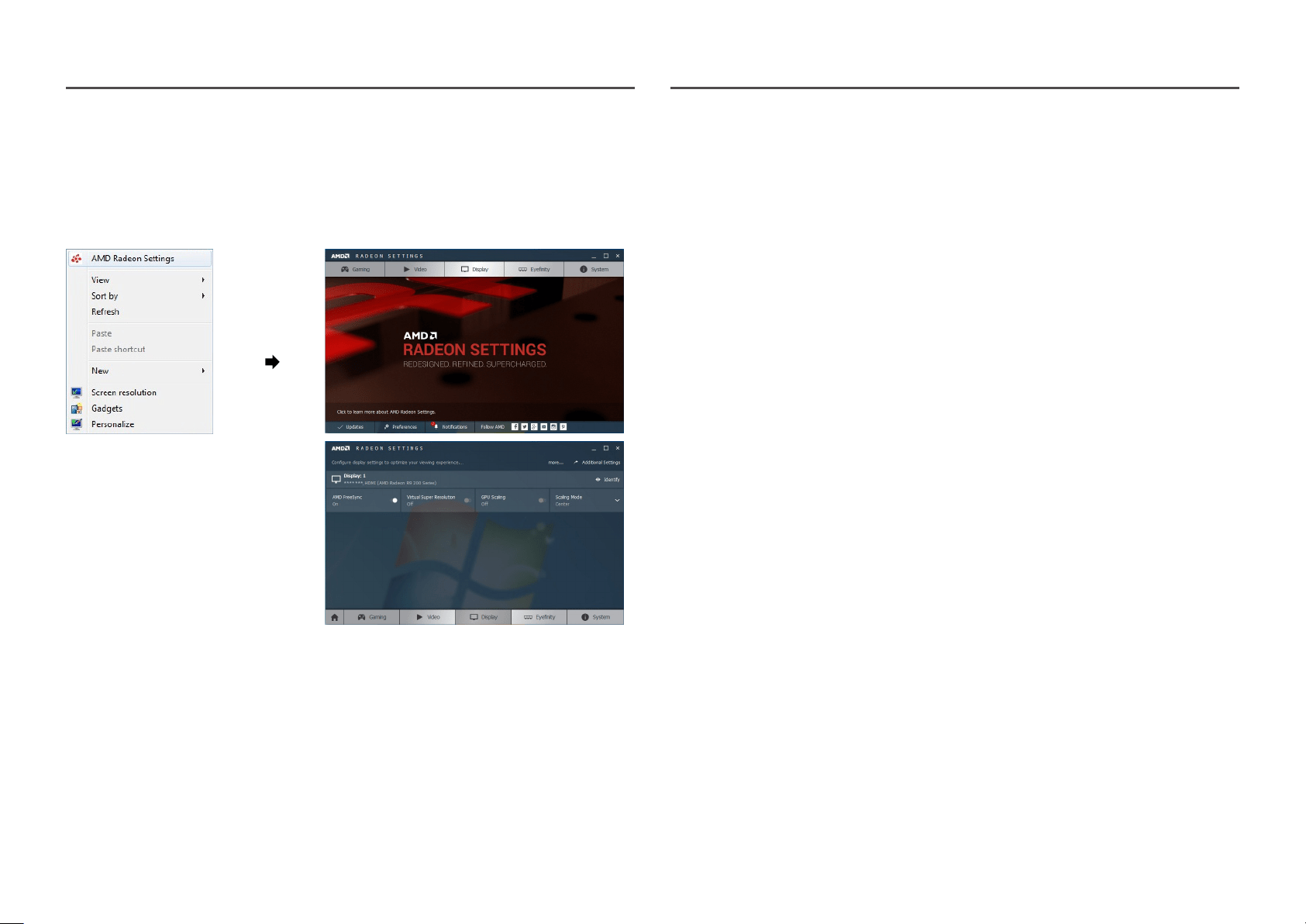
How do you enable FreeSync?
1
Set FreeSync to Standard Engine or Ultimate Engine in the OSD menu.
2
Enable FreeSync in AMD Radeon Settings:
Right-click the mouse → AMD Radeon Settings → Display
The "AMD FreeSync" feature should be set to "On". Select to "On" if not already enabled.
The models in the Graphic Cards list supports FreeSync
FreeSync can only be used with specific AMD graphics card models. Refer to the following list for
supported graphics cards:
Make sure to install the latest official graphics drivers from AMD that support FreeSync.
―
For additional AMD graphics card models that support the FreeSync feature, visit the official AMD website.
―
Select FreeSync Off if you are using a graphics card from a different manufacturer.
• AMD Radeon Vega series
• AMD Radeon RX 500 series
• AMD Radeon RX 400 Series
35
Color
Adjust the tint of the screen.
―
This menu is not available when Picture Mode is set to Cinema or Dynamic Contrast mode.
―
This menu is not available when Eye Saver Mode is enabled.
―
This menu is not available when PBP is enabled.
• Red: Adjust the red saturation level. Values closer to 100 mean greater intensity for the color.
• Green: Adjust the green saturation level. Values closer to 100 mean greater intensity for the color.
• Blue: Adjust the blue saturation level. Values closer to 100 mean greater intensity for the color.
• Color Tone: Select a color tone that best suits your viewing needs.
‒ Cool 2: Set the color temperature to be cooler than Cool 1.
‒ Cool 1: Set the color temperature to be cooler than Normal mode.
‒ Normal: Display the standard color tone.
‒ Warm 1: Set the color temperature to be warmer than Normal mode.
‒ Warm 2: Set the color temperature to be warmer than Warm 1.
‒ Custom: Customize the color tone.
―
When the external input is connected through HDMI/DP and PC/AV Mode is set to AV, Color Tone has four
color temperature settings (Cool, Normal, Warm and Custom).
• Gamma: Adjust the middle level of luminance.
‒ Mode1 / Mode2 / Mode3
HDMI Black Level
If a DVD player or set-top box is connected to the product via HDMI, image quality degradation (contrast/
color degradation, black level, etc.) may occur, depending on the connected source device. In such case,
HDMI Black Level can be used to adjust the image quality.
―
This function is only available in HDMI mode.
• Normal: Select this mode when there is no contrast ratio degradation.
• Low: Select this mode to reduce the black level and increase the white level when there is a contrast
ratio degradation.
―
HDMI Black Level may not be compatible with some source devices.
―
The HDMI Black Level feature is only activated at a certain AV resolution, such as 720P and 1080P.
―
This menu is not available when PBP is enabled.
Eye Saver Mode
Set to an optimum picture quality suitable for eye relaxation.
TÜV Rheinland “Low Blue Light Content” is a certification for products which meet requirements for
lower blue light levels. When Eye Saver Mode is 'On', the blue light that wavelength is around 400nm will
decrease, and it will provide an optimum picture quality suitable for eye relaxation. At the same time, the
blue light level is lower than in the default settings, and it was tested by TÜV Rheinland and certified as
it met the requirements of TÜV Rheinland “Low Blue Light Content” standards.

36
Screen Adjustment
―
This option is only available when PC/AV Mode is set to AV.
―
This menu is only available when Screen Size is set to Screen Fit in AV Mode.
When a 480P or 576P or 720P or 1080P signal is input in AV mode and the monitor can display normally, select
Screen Fit to adjust horizontal position in 0-6 levels.
―
This menu is not available when PBP is enabled.
Configuring H-Position & V-Position
H-Position: Move the screen to the left or right.
V-Position: Move the screen up or down.
Calibration Report
The data from this report are measured in Custom mode at the time of shipment.
• The measurements may vary according to the measuring equipment, measuring location, system
environment (e.g. computer, graphic board, etc) and other variables.
• Input signal: HDMI
• Each measurement from this report is based on the Custom mode at the time of shipment.
• This report is not provided on the menu of some products, but in an separate hardcopy report
instead.
PBP
Configuring the PBP Settings.
PBP Mode
Enable or disable the PBP Mode function.
The PBP (Picture by Picture) function separates the screen into two parts displaying output from two
different sources simultaneously on the left and right sides of the screen.
―
PBP mode is compatible with Windows 7, Windows 8, and Windows 10.
―
Make sure that the graphics card supports the PBP function. Visit the website of the graphics card
manufacturer to check and update its driver to the latest version.
―
The screen may flicker briefly or appear after a delay when you enable or disable the PBP function or when
you change the screen size with the PBP function activated.
This can typically arise when a PC and a monitor are connected to two or more input sources. It has nothing to
do with the performance of a monitor.
The issue is mainly caused when the video signals are delayed in transmission to the monitor depending on
the graphics card performance.
―
When the PBP function is enabled, the resolution will not be able to automatically switch to the optimum
resolution due to a compatibility issue between the graphics card and the Windows system.
Set PBP Mode to Off. Alternatively, restart the monitor, then set the resolution to the optimum setting using
the Windows interface.

37
Aspect Ratio
Select the image size for each screen.
• 16:9(16:9): Select this option if you want to use PBP mode where the optimum resolution for the left
and right sides of the screen is 2560 x 1440 (width x height).
• 21:9(11:9): Select this option if you want to use PBP mode where the optimum resolution for the left
side of the screen is 3360 x 1440 (width x height) and the optimum resolution for the right side of the
screen is 1760 x 1440 (width x height).
• 11:9(21:9): Select this option if you want to use PBP mode where the optimum resolution for the left
side of the screen is 1760 x 1440 (width x height) and the optimum resolution for the right side of the
screen is 3360 x 1440 (width x height).
Screen1
Select the input source you want to watch on screen1.
• HDMI / DisplayPort1 / DisplayPort2
Screen2
Select the input source you want to watch on screen2.
• HDMI / DisplayPort1 / DisplayPort2
Sound Source
Set which screen you want to hear the sound for.
• Screen1 / Screen2
39
System
A detailed description of each function is provided. Refer to your product for details.
Chapter 07
―
The functions available may vary depending on the product model. The color and shape of parts may differ
from what is shown. Specifications are subject to change without notice to improve quality.
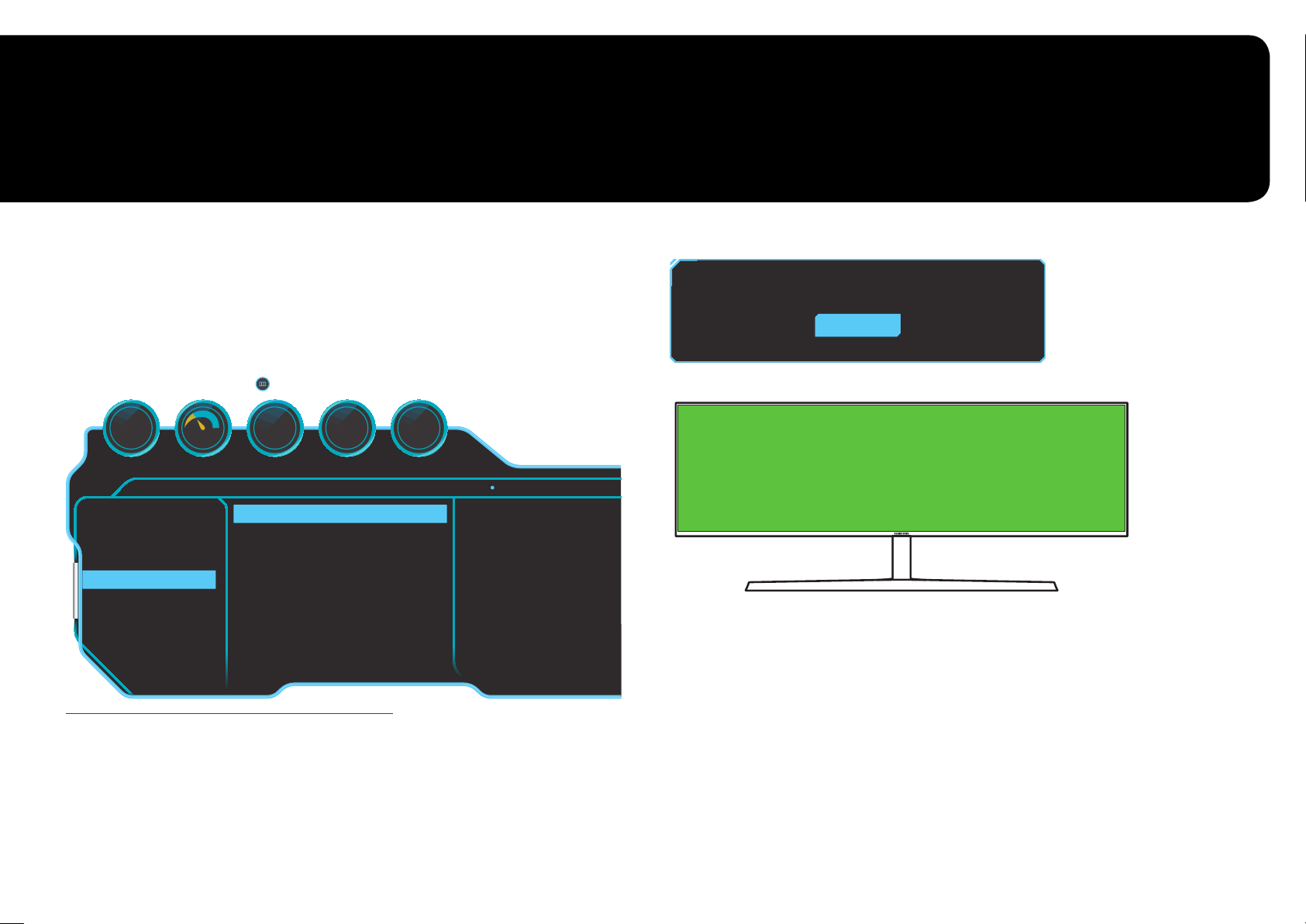
Self Diagnosis
1
Use the function key and go to → System → Self Diagnosis.
Game
Picture
OnScreen Display
System
Information
Self Diagnosis
Lighting
Local Dimming
Volume
Smart ECO Saving+
Off Timer Plus
PC/AV Mode
USB Super Charging
Off
Off
50
Off
Off
Perform this test
when you experience
a problem with your
monitor's picture.
Black Equalizer
Off12 120 On
Response Time Refresh Rate FreeSync Low Input Lag
Picture Mode: Custom
Hz
―
The displayed image may differ depending on the model.
2
Select OK when the following screen is prompted.
OK
The test screen will now be shown. Please look carefully at the screen for the next
5 seconds.
• Review the test screen.
40
3
Base on the test result, select Yes / No / Show Again.
Do you still see the same problem on the test screen?
If you need to see the photo again, click Show Again.
Yes
Show AgainNo
• You will see the following screen when you select Yes.
OK
Self Diagnosis Complete
Contact the Samsung Call Center for assistance.
Please have the following information ready:
‐
Model Code: **************
‐
Software Version: *-*********-****.*
‐
S/N: **************
• You will see the following screen when you select No.
OK
Self Diagnosis Complete
If the test screen is okay during Self Diagnosis, your monitor may not have a problem. If the problem
persists, follow the steps below:
‐
Turn off your monitor and any other connected device, such as a PC. Turn on your monitor first and
then the other connected device.
‐
Update the operating system and graphics card driver to the latest version and restart your PC.
‐
Connect the other device, such as a PC, to a different input port on your monitor.
‐
Reset your monitor by pressing the jog button on the monitor and selecting System > Reset All.
Replace the cable with the one enclosed with your monitor.

42
PC/AV Mode
Set PC/AV Mode to AV. The picture size will be enlarged.
This option is useful when you view a movie.
• Set to PC when connected to a PC.
• Set to AV when connected to an AV device.
―
Supplied for the wide models only such as 16:9, 16:10, 21:9 or 32:9.
―
If the monitor is in HDMI, DisplayPort1, DisplayPort2 mode and the screen says Check the cable connection
and the settings of the source device. or power saving mode activates, press the JOG button to display the
function-button screen and then select the
icon. You can select PC or AV.
―
This menu is not available when PBP is enabled.
USB Super Charging
Charge the battery of a connected source device quickly using the
2
port on the product.
• Off: Disable USB Super Charging.
• On: Enable the function to quickly charge a source device connected to the
2
port.
―
Super charging is available via the
2
port. The charging speed may vary, depending on the connected
device.
―
Quick battery charging may not be supported and/or charging may take more time on some mobile devices.
―
When super charging is turned off for the
2
port, use this port for regular speed charging and data
transfer.
―
If a USB 2.0 or lower device is connected to the
2
port and super charging is turned on, data transfer is
impossible, but it is possible if a USB 3.0 device is connected.
※ These ports may not be compatible with new USB devices that may be released in the future.
―
If a device, such as a mouse, keyboard or memory storage device, is connected to the
2
port and the
device is USB 2.0 or lower, turn off super charging.
―
If super charging is turned on using the OSD settings menu, all devices connected to USB ports 1 through 2 on
the monitor are re-recognized. This ensures optimum charging.
※ Before turning on super charging, close all files on storage devices connected to USB ports.

43
DisplayPort Ver.
Select your DisplayPort version.
―
Incorrect settings may cause the screen to go blank. If this occurs, check the device specifications.
―
If the monitor (when set to HDMI, DisplayPort1 or DisplayPort2) is in power saving mode or is displaying the
message Check the cable connection and the settings of the source device. or power saving mode activates,
press the JOG button to display the function-button screen and then select the
button to display the On
Screen Display (OSD). You can select 1.1, 1.2 or 1.4.
―
If setting the DisplayPort Ver. to 1.1, for the bandwidth limitation of the DisplayPort 1.1 protocol, the actual
maximum output refreshing rate of the display cards cannot achieve the level of 120 Hz.
―
If you select 1.4, the monitor can support up to 5120 x 1440 @ 120 Hz.
―
If you use 5120 x 1440 in DisplayPort source, you can't select 1.2.
HDMI Mode
Select the HDMI mode to use.
―
The supportable device and resolution may differ depending on its version.
―
When the version is changed, the screen may blink.
―
Some high resolutions may not be supported due to the bandwidth limit in HDMI 1.4 protocol while HDMI
Mode is set to 1.4 or 2.0.
―
When the setting is not appropriate, a blank screen may appear. In this case, check the specifications of the
device.
―
Set HDMI Mode to 1.4 or 2.0 if sound from the connected DVD player is missing.
―
This menu is not available when PBP is enabled.
Source Detection
Select either Auto or Manual as the method to recognize input signal.
Key Repeat Time
Control the response rate of a button when the button is pressed.
Acceleration, 1 sec, or 2 sec can be selected. If No Repeat is selected, a command responds only once
when a button is pressed.
46
Installing the Software
Chapter 08
Easy Setting Box
Easy Setting Box enables users to use the monitor by partitioning multiple sections.
To install the latest version of Easy Setting Box, download it from the Samsung website at http://www.
samsung.com.
―
The software may not work properly if you do not restart the computer after the installation.
―
The Easy Setting Box icon may not appear depending on the computer system and the product specifications.
―
If the shortcut icon does not appear, press the F5 key.
Restrictions and Problems with the Installation
The Easy Setting Box installation may be affected by the Graphics Card, Motherboard and the Networking
Environment.
System Requirements
OS Hardware
• Windows 7 32Bit/64Bit
• Windows 8 32Bit/64Bit
• Windows 8.1 32Bit/64Bit
• Windows 10 32Bit/64Bit
• At least 32MB of memory
• At least 60MB of free space on the hard disk drive

47
Troubleshooting Guide
Chapter 09
Requirements Before Contacting Samsung
Customer Service Center
―
Before calling Samsung Customer Service Center, test your product as follows. If the problem persists,
contact Samsung Customer Service Center.
Testing the Product
Check if your product is operating normally by using the product test function.
If the screen is turned off and the power indicator blinks even though the product is properly connected
to a PC, perform a self-diagnosis test.
1
Power off both the PC and product.
2
Disconnect the cables from the product.
3
Power on the product.
4
If the message Check the cable connection and the settings of the source device. appears, the
product is working normally.
―
If the screen remains blank, check the PC system, video controller and cable.
Checking the Resolution and Frequency
For a mode that exceeds the supported resolution(refer to Standard Signal Mode Table), the message
Not Optimum Mode will appear for a short time.
―
The displayed resolution may vary, depending on the computer system settings and cables.
Check the following.
Installation issue (PC mode)
The screen keeps switching on and off.
Check the cable connection between the product and PC, and ensure the connectors are locked.
Blank spaces are found on all four sides of the screen when an HDMI or HDMI-DVI cable is connected to
the product and PC.
The blank spaces found on the screen have nothing to do with the product.
Blank spaces on the screen are caused by the PC or graphics card. To resolve the problem, adjust the
screen size in the HDMI or DVI settings for the graphics card.
If the graphics card settings menu does not have an option to adjust the screen size, update the
graphics card driver to the latest version.
(Please contact the graphics card or computer manufacturer for further details about how to adjust the
screen settings.)
Screen issue
The power LED is off. The screen will not switch on.
Check that the power cable is connected properly.
The message Check the cable connection and the settings of the source device. appears.
Check that the cable is properly connected to the product.
Check that the device connected to the product is powered on.

48
Not Optimum Mode is displayed.
This message appears when the signal from the graphics card exceeds the maximum resolution or
frequency for the product.
Change the maximum resolution and frequency to suit the product performance, referring to Standard
Signal Mode Table (P.51).
The images on the screen look distorted.
Check the cable connection to the product.
The screen is not clear. The screen is blurry.
Remove any accessories (video extension cable, etc.) and try again.
Set the resolution and frequency to the recommended level.
The screen appears unstable and shaky. There are shadows or ghost images left on the screen.
Check that the resolution and frequency for the PC are within the range of resolution and frequency
compatible with the product. Next, if required, change the settings, referring to Standard Signal Mode
Table (P.51) in this manual and the Information menu on the product.
The screen is too bright. The screen is too dark.
Adjust Brightness and Contrast.
Screen color is inconsistent.
Change the Color settings.
The colors on the screen have a shadow and are distorted.
Change the Color settings.
White does not really look white.
Change the Color settings.
There is no image on the screen and the power LED blinks every 0.5 to 1 second.
The product is operating in power-saving mode.
Press any key on the keyboard or move the mouse to return to normal operating mode.
Text is blurry.
If using a Windows OS (e.g. Windows 7, Windows 8, Windows 8.1 or Windows 10): Go to Control Panel →
Fonts → Adjust ClearType text and change Turn on ClearType.
Video playback is choppy.
Playback of high-definition large video files can be choppy. This may be because the video player is not
optimized for the computer resource.
Try playing the file on another video player.
Sound issue
There is no sound.
Check the connection of the audio cable or adjust the volume.
Check the volume.
The volume is too low.
Adjust the volume.
If the volume is still low after turning it up to the maximum level, adjust the volume on your PC sound
card or software program.
Video is available but there is no sound.
Sound cannot be heard if an HDMI-DVI cable is used to connect the input device.
Connect the device using an HDMI cable or DP cable.
Source device issue
A beeping sound is heard when my PC is booting.
If a beeping sound is heard when your PC is booting, have your PC serviced.
50
Specifications
Chapter 10
General
Model Name C49RG9*
Size 49 Class (48.8 Inches / 123.9 cm)
Display area 1193.472 mm (H) x 335.664 mm (V)
46.987 Inches (H) x 13.215 Inches (V)
Pixel Pitch 0.2331 mm (H) x 0.2331 mm (V)
0.009177 Inches (H) x 0.009177 Inches (V)
Maximum Pixel Clock 970 MHz
Power Supply AC100-240V~ 50/60Hz
Refer to the label at the back of the product as the standard voltage can
vary in different countries.
Signal connectors HDMI, DisplayPort
Environmental conditions Operating
Temperature: 50 °F – 104 °F (10 °C – 40 °C)
Humidity: 10 % – 80 %, non-condensing
Storage
Temperature: -4 °F – 113 °F (-20 °C – 45 °C)
Humidity: 5 % – 95 %, non-condensing
• Plug-and-Play
This monitor can be installed and used with any Plug-and-Play compatible systems. Two-way data
exchange between the monitor and PC system optimizes the monitor settings. Monitor installation
takes place automatically. However, you can customize the installation settings if desired.
• Panel Dots (Pixels)
Due to the nature of the manufacturing of this product, approximately 1 pixel per million (1ppm) may
be brighter or darker on the LCD panel. This does not affect product performance.
• The above specifications are subject to change without notice to improve quality.
• This device is a Class B digital apparatus.
• For detailed device specifications, visit the Samsung website.
• (Europe only)
To access the EPREL registration of the model:
(1) Go to https://eprel.ec.europa.eu
(2) Get the model identifier from the energy label of the product and type it in the search box
(3) Energy Labelling information of the model is shown
* You can directly access the product information via https://eprel.ec.europa.eu/qr/#####
(registration no.)
The registration no. can be found on the rating label on your product.
• (Turkey only)
To access the energy labelling information of the model:
(1) Go to https://www.samsung.com/global/ecodesign_energy
(2) Get the model identifier from the energy label of the product and type it in the search box
(3) Energy labelling information can be found
52
HDMI
Resolution Horizontal Frequency (kHz) Vertical Frequency (Hz) Pixel Clock (MHz) Sync Polarity (H/V)
VESA DMT, 1280 x 800 49.702 59.810 83.500 -/+
VESA DMT, 1280 x 1024 63.981 60.020 108.000 +/+
VESA DMT, 1280 x 1024 79.976 75.025 135.000 +/+
VESA DMT, 1440 x 900 55.935 59.887 106.500 -/+
VESA DMT, 1600 x 900 60.000 60.000 108.000 +/+
VESA DMT, 1680 x 1050 65.290 59.954 146.250 -/+
VESA DMT, 1920 x 1080 67.500 60.
000 148.500 +/+
CEA, 1920 x 1080 112.500 100.000 297.000 +/+
CEA, 1920 x 1080 135.000 120.000 297.000 +/+
CEA, 2560 x 1080 66.000 60.000 198.000 +/+
CEA, 2560 x 1080 125.000 100.000 371.250 +/+
CEA, 2560 x 1080 150.000 120.000 495.000 +/+
VESA CVT, 2560 x 1440 88.787 59.951 241.500 +/-
VESA CVT, 3840 x 1080 66.625 59.968 266.500 +/-
VESA CVT, 3840
x 1080 113.250 99.956 453.000 +/-
VESA CVT, 3840 x 1080 137.250 119.974 549.000 +/-
VESA CVT 5120 x 1440 43.797 29.978 231.250 +/-
VESA CVT, 5120 x 1440 88.826 59.977 469.000 +/-
DisplayPort1/DisplayPort2
Resolution Horizontal Frequency (kHz) Vertical Frequency (Hz) Pixel Clock (MHz) Sync Polarity (H/V)
IBM, 720 x 400 31.469 70.087 28.322 -/+
MAC, 640 x 480 35.000 66.667 30.240 -/-
MAC, 832 x 624 49.726 74.551 57.284 -/-
MAC, 1152 x 870 68.681 75.062 100.000 -/-
VESA DMT, 640 x 480 31.469 59.940 25.175 -/-

54
DisplayPort1/DisplayPort2
Resolution Horizontal Frequency (kHz) Vertical Frequency (Hz) Pixel Clock (MHz) Sync Polarity (H/V)
VESA CVT, 3840 x 1080 137.250 119.974 549.000 +/-
VESA CVT, 5120 x 1440 88.826 59.977 469.000 +/-
VESA CVT, 5120 x 1440 150.994 99.996 797.250 +/-
VESA CVT, 5120 x 1440 182.955 119.970 966.000 +/-
―
Horizontal Frequency
The time required to scan a single line from the left to the right side of the screen is called a horizontal cycle. The reciprocal number of a horizontal cycle is called horizontal frequency. Horizontal frequency is measured in kHz.
―
Vertical Frequency
Repeating the same picture dozens of times per second allows you to view natural pictures. The repeat frequency is called "vertical frequency" or "refresh rate" and is indicated in Hz.
―
This product can be set to only one resolution for each screen size to obtain the optimum picture quality due to the nature of the panel. Using a resolution other than the specified resolution may degrade the picture quality. To
avoid this, it is recommended that you select the optimum resolution specified for your product.

55
Appendix
Chapter 11
Responsibility for the Pay Service (Cost to
Customers)
―
When the service is requested, in spite of in warranty, we may charge you for a visit from a service technician
in the following cases.
Not a product defect
Cleaning of the product, Adjustment, Explanation, Re-installation and etc.
• If a service technician gives instructions on how to use product or simply adjusts options without
disassembling product.
• If a defect is caused by external environmental factors (Internet, Antenna, Wired Signal, etc.)
• If a product is reinstalled or devices are connected additionally after installing the purchased product
for the first time.
• If a product is reinstalled to move to a different spot or to move to a different house.
• If customer requests instructions on how to use because of another company's product.
• If customer requests instructions on how to use the network or another company's program.
• If customer requests software installation and setup for the product.
• If a service technician removes/cleans dusts or foreign materials inside of the product.
• If customer requests an installation additionally after purchasing a product through home-shopping
or online.
A Product damage caused by customer's fault
Product damage caused by customer's mishandling or wrong repair
If a product damage is caused by;
• External impact or drop.
• Use of supplies or separately sold product unspecified by Samsung.
• Repair from a person besides an engineer of outsourcing service company or partner of Samsung
Electronics Co., Ltd.
• Remodeling or repairing the product by customer.
• Using it with incorrect voltage or non-authorized electrical connections.
• Not following the "cautions" in User Manual.
Others
• If product fails by natural disaster. (lightning, fire, earthquake, flood damage, etc)
• If consumable components are all used up. (Battery, Toner, Fluorescent lights, Head, Vibrator, Lamp,
Filter, Ribbon, etc.)
―
If customer requests a service in case the product has no defect, service fee may be charged. So please read
User Manual first.