
Tarraco
Owner’s manual
5FJ012720BK
Inglés
5FJ012720BK (06.21)
SEAT Tarraco Inglés (06.21)

SEAT S.A. is permanently concerned about continuous development of its types and models. For this reason we ask you to understand,
that at any given time, changes regarding shape, equipment and technique may take place on the car delivered. For this reason no
right at all may derive based on the data, drawings and descriptions in this current handbook.
All texts, illustrations and standards in this handbook are based on the status of information at the time of printing. Except for error or
omission, the information included in the current handbook is valid as of the date of closing print.
Re-printing, copying or translating, whether total or partial is not allowed unless SEAT allows it in written form.
SEAT reserves all rights in accordance with the “Copyright” Act.
All rights on changes are reserved.
❀
This paper has been manufactured using bleached non-chlorine cellulose.
© SEAT S.A. - Reprint: 15.06.21
Vehicle identification data
Model:
Vehicle Registration:
Vehicle identification
number:
Date of vehicle registration
or vehicle delivery:
SEAT Official Service:
Service advisor:
Telephone:
Confirmation of receipt of documentation
and vehicle keys
The following items were delivered
with the vehicle:
YES NO
On-board documentation
First key
Second key
Correct working order of all keys was
checked
Location:
Date:
Signature of owner:

Introduction
Thank you f
or your trust choosing a SEAT ve-
hicle.
With your new SEAT, you will be able to enjoy
a vehicle with state-of-the-art technology
and top quality features.
We recommend reading this Instruction Man-
ual carefully to learn more about your vehicle
so you can enjoy all its benefits in your daily
driving.
Information about handling is complemented
with instructions regarding the operation and
maintenance of the vehicle in order to ensure
its safety and maintain its value. Moreover, we
want to give you valuable advice and tips to
drive your vehicle efficiently and respecting
the environment.
We wish you safe and enjoyable motoring.
SEAT, S.A.
WARNING
Read and always observe safety infor-
mation concerning the passenger
's
front airbag
›››
page 33, Fitting and us-
ing child seats.
About this manual
This instruction manual is v
alid for all variants
and versions of your SEAT model. It describes
all equipment and models without specifying
whether they are optional equipment or
model variants. As a result, equipment not fit-
ted to your vehicle or only available in certain
countries may be described. Find out about
your vehicle's equipment in the documenta-
tion supplied with it and please contact your
SEAT Official SEAT Service if you require
more detailed information.
All information provided in instruction manual
corresponds to the information available at
the time of going to press. As the vehicle is
under continuous development, it may have
differences to the data included in this man-
ual. For this reason, no claims can be made in
the event of mismatching data, illustrations
and descriptions.
Ensure that the on-board documentation is
kept in the vehicle at all times if you sell it or
lend it to third parties. In addition, SEAT rec-
ommends resetting the infotainment system
to factory settings to delete all personal data.
Some details on the drawings may vary from
its vehicle and must be interpreted as a
standard representation.
The direction indicators (left, right, forwards,
backwards) in this manual refer to the travel
direction of the vehicle unless otherwise sta-
ted.
This instruction manual has been written for
left-hand drive vehicles. In right-hand drive
vehicles, the arrangement of the controls dif-
fers partly from that shown in the illustrations
or described in the texts.
Technical modifications to the vehicle or
safety-critical issues that have arisen since
the time of going to press will be included in a
supplement to the on-board documentation.
Trademarks are marked with ®. The ab-
sence of this symbol does not guarantee
that the term is not a trademark.
It indicates that the section continues on
the next page.
You can access the information in this manual
using:
●
Thematic table of contents that follows the
manual’s general chapter structure.
●
Visual table of contents that uses graphics
to indicate the pages containing “essential”
information, which is detailed in the corre-
sponding chapters.
●
Alphabetical index with many terms and
synonyms to help you find information.
®
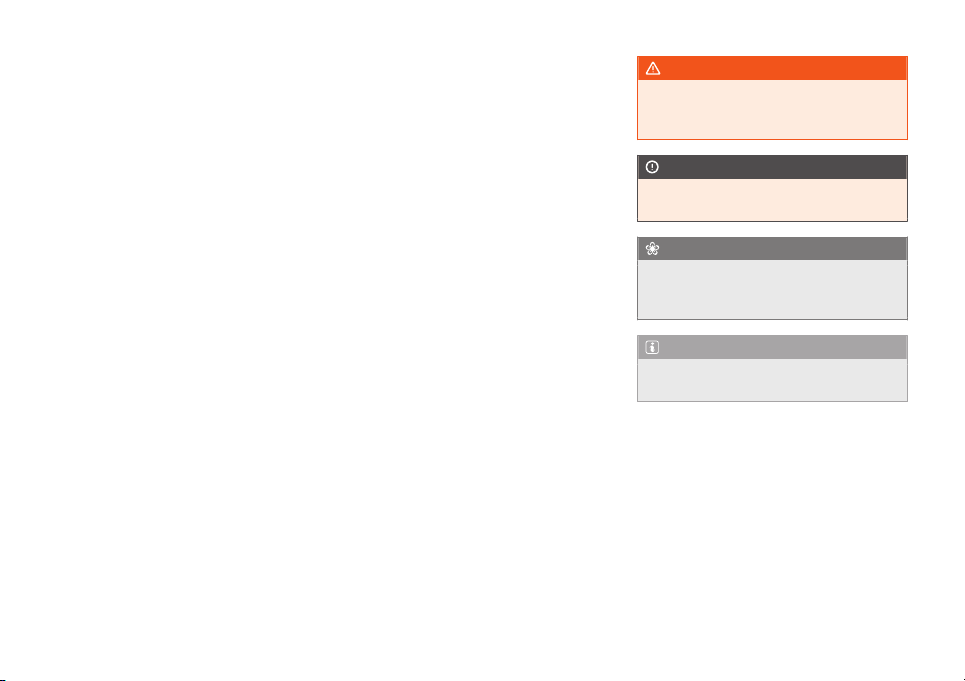
WARNING
Texts after this symbol contain informa-
tion about saf
ety and warn you about
possible accident or injury risks.
CAUTION
Texts after this symbol indicate possible
damage t
o the vehicle.
For the sake of the environment
Texts after this symbol contain informa-
tion about the pr
otection of the environ-
ment.
Note
Texts after this symbol contain addition-
al inf
ormation.
Digital instruction manual
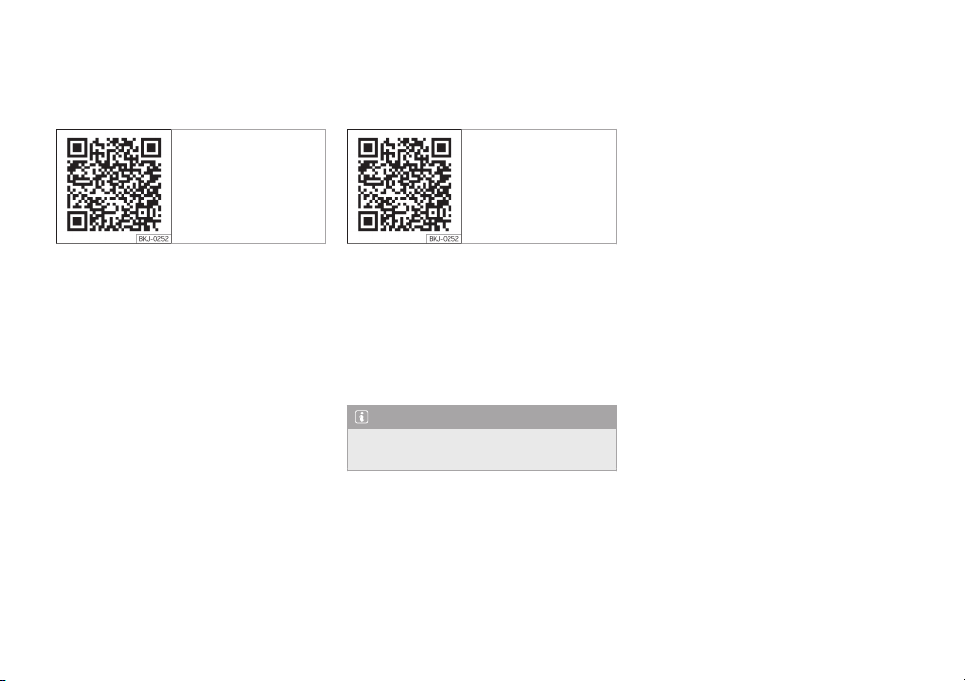
The digit
al version of the manual can be
found on SEAT's official website:
Fig. 1 SEAT website
●
scan the QR code
›
››
Fig. 1
●
OR enter the following address in the navi-
gator website:
http://www.seat.com/owners/your-
seat/manual
s-offline.html
and select your vehicle.
Related videos
The oper
ation of some of the vehicle's fea-
tures can be shown as an instruction video:
Fig. 2 SEAT website
●
scan the QR code
›
››
Fig. 2
●
OR enter the following address in the navi-
gator website:
http://www.seat.com/owners/your-
seat/manual
s-offline.html
choose your vehicle and then “Multimedia”.
Note
Video instructions are only available in
cer
tain languages.


Table of Contents
Table of Contents
Gener
al views of the vehicle . . . . . . . . 7
Exterior view . . . . . . . . . . . . . . . . . . . . . . . . . . . . . . . 7
Exterior view . . . . . . . . . . . . . . . . . . . . . . . . . . . . . . . 8
Overview (left hand drive) . . . . . . . . . . . . . . . . 9
Overview (right hand drive) . . . . . . . . . . . . . . . 10
Interior view . . . . . . . . . . . . . . . . . . . . . . . . . . . . . . . 11
Safety . . . . . . . . . . . . . . . . . . . . . . . . . . . . . . . . . . . . 12
Safe driving . . . . . . . . . . . . . . . . . . . . . . . . . . . . . . . 12
Advice about driving . . . . . . . . . . . . . . . . . . . . . . . . 12
Correct sitting position of vehicle occu-
pants . . . . . . . . . . . . . . . . . . . . . . . . . . . . . . . . . . . . . . . 13
Pedal area . . . . . . . . . . . . . . . . . . . . . . . . . . . . . . . . . 16
Seat belts . . . . . . . . . . . . . . . . . . . . . . . . . . . . . . . . . 17
The whys and wherefores of seat belts . . . . . 17
How to properly adjust your seat belt . . . . . . 20
Seat belt tensioners . . . . . . . . . . . . . . . . . . . . . . . . 22
PreCrash system . . . . . . . . . . . . . . . . . . . . . . . . . . . 23
Airbag system . . . . . . . . . . . . . . . . . . . . . . . . . . . . . 25
Brief introduction . . . . . . . . . . . . . . . . . . . . . . . . . . . 25
Operation of the airbags . . . . . . . . . . . . . . . . . . . 27
Transporting children safely . . . . . . . . . . . . . . 32
Child safety . . . . . . . . . . . . . . . . . . . . . . . . . . . . . . . . 32
Emergencies . . . . . . . . . . . . . . . . . . . . . . . . . . . . 42
Self-help . . . . . . . . . . . . . . . . . . . . . . . . . . . . . . . . . . 42
Information, assistance and emergency
call service . . . . . . . . . . . . . . . . . . . . . . . . . . . . . . . . . 42
Emergency equipment . . . . . . . . . . . . . . . . . . . . . 43
Tyre repairs . . . . . . . . . . . . . . . . . . . . . . . . . . . . . . . . . 44
Changing a wheel . . . . . . . . . . . . . . . . . . . . . . . . . . 46
Changing the windscreen wiper blades . . . . 51
Jump start . . . . . . . . . . . . . . . . . . . . . . . . . . . . . . . . . . 52
Tow start and towing . . . . . . . . . . . . . . . . . . . . . . . 54
Fuses and bulbs . . . . . . . . . . . . . . . . . . . . . . . . . . . 59
Fuses . . . . . . . . . . . . . . . . . . . . . . . . . . . . . . . . . . . . . . . 59
Bulbs . . . . . . . . . . . . . . . . . . . . . . . . . . . . . . . . . . . . . . . 63
Operation . . . . . . . . . . . . . . . . . . . . . . . . . . . . . . . 65
Controls and displays . . . . . . . . . . . . . . . . . . . . 65
Interior view . . . . . . . . . . . . . . . . . . . . . . . . . . . . . . . . 65
Instruments and warning/control
lamps . . . . . . . . . . . . . . . . . . . . . . . . . . . . . . . . . . . . . . 66
Instrument panel . . . . . . . . . . . . . . . . . . . . . . . . . . . 66
Using the instrument panel . . . . . . . . . . . . . . . . . 83
Control lamps . . . . . . . . . . . . . . . . . . . . . . . . . . . . . . 85
Infotainment system . . . . . . . . . . . . . . . . . . . . . . . . 87
Multifunction steering wheel . . . . . . . . . . . . . . . . 92
Opening and closing . . . . . . . . . . . . . . . . . . . . . . 93
Set of vehicle keys . . . . . . . . . . . . . . . . . . . . . . . . . . 93
Central locking . . . . . . . . . . . . . . . . . . . . . . . . . . . . . 95
Anti-theft alarm system . . . . . . . . . . . . . . . . . . . . 102
Doors . . . . . . . . . . . . . . . . . . . . . . . . . . . . . . . . . . . . . . 104
Rear lid . . . . . . . . . . . . . . . . . . . . . . . . . . . . . . . . . . . . . 106
Window controls . . . . . . . . . . . . . . . . . . . . . . . . . . . 110
Sunroof . . . . . . . . . . . . . . . . . . . . . . . . . . . . . . . . . . . . 112
Lights . . . . . . . . . . . . . . . . . . . . . . . . . . . . . . . . . . . . . . 115
Vehicle lighting . . . . . . . . . . . . . . . . . . . . . . . . . . . . . 115
Interior lights . . . . . . . . . . . . . . . . . . . . . . . . . . . . . . . 122
Visibility . . . . . . . . . . . . . . . . . . . . . . . . . . . . . . . . . . . 124
Windscreen wiper and rear window wiper
systems . . . . . . . . . . . . . . . . . . . . . . . . . . . . . . . . . . . . 124
Mirrors . . . . . . . . . . . . . . . . . . . . . . . . . . . . . . . . . . . . . 126
Sun protection . . . . . . . . . . . . . . . . . . . . . . . . . . . . . 128
Seats and headrests . . . . . . . . . . . . . . . . . . . . . . 129
Adjusting seats . . . . . . . . . . . . . . . . . . . . . . . . . . . . . 129
Headrest . . . . . . . . . . . . . . . . . . . . . . . . . . . . . . . . . . . 131
Seat functions . . . . . . . . . . . . . . . . . . . . . . . . . . . . . . 133
Transport and practical equipment . . . . . . 139
Storing objects . . . . . . . . . . . . . . . . . . . . . . . . . . . . . 139
Luggage compartment . . . . . . . . . . . . . . . . . . . . . 140
Net partition . . . . . . . . . . . . . . . . . . . . . . . . . . . . . . . . 147
Roof carrier . . . . . . . . . . . . . . . . . . . . . . . . . . . . . . . . 148
Storage compartment . . . . . . . . . . . . . . . . . . . . . 150
Power sockets . . . . . . . . . . . . . . . . . . . . . . . . . . . . . . 155
Air conditioning . . . . . . . . . . . . . . . . . . . . . . . . . . . 157
Heating, ventilation and cooling . . . . . . . . . . . . 157
Auxiliary heating and ventilation . . . . . . . . . . . . 167
Infotainment system . . . . . . . . . . . . . . . . . . 172
Introduction . . . . . . . . . . . . . . . . . . . . . . . . . . . . . . . 172
First steps . . . . . . . . . . . . . . . . . . . . . . . . . . . . . . . . . . 172
Overview and controls . . . . . . . . . . . . . . . . . . . . . 176
General instructions for use . . . . . . . . . . . . . . . . 178
Data transfer . . . . . . . . . . . . . . . . . . . . . . . . . . . . . . 184
SEAT CONNECT . . . . . . . . . . . . . . . . . . . . . . . . . . . . 184
Full Link . . . . . . . . . . . . . . . . . . . . . . . . . . . . . . . . . . . . . 189
WLAN access point . . . . . . . . . . . . . . . . . . . . . . . . . 193
Infotainment operation . . . . . . . . . . . . . . . . . . . 196
Voice control . . . . . . . . . . . . . . . . . . . . . . . . . . . . . . . 196
Radio mode . . . . . . . . . . . . . . . . . . . . . . . . . . . . . . . . 198
Media Mode . . . . . . . . . . . . . . . . . . . . . . . . . . . . . . . . 202
Navigation . . . . . . . . . . . . . . . . . . . . . . . . . . . . . . . . . 205
Telephone interface . . . . . . . . . . . . . . . . . . . . . . . . 212
Multimedia . . . . . . . . . . . . . . . . . . . . . . . . . . . . . . . . . 218
Driving . . . . . . . . . . . . . . . . . . . . . . . . . . . . . . . . . . . 219
Start and driving . . . . . . . . . . . . . . . . . . . . . . . . . . 219
Starting and stopping the engine . . . . . . . . . . . 219
Driving with electric drive . . . . . . . . . . . . . . . . . . . 223
5

Table of Contents
Operating mode selection . . . . . . . . . . . . . . . . . . 225
Start-Stop system . . . . . . . . . . . . . . . . . . . . . . . . . . 226
Manual gearbox . . . . . . . . . . . . . . . . . . . . . . . . . . . . 229
Automatic gearbox/DSG automatic gear-
bo
x . . . . . . . . . . . . . . . . . . . . . . . . . . . . . . . . . . . . . . . . . 230
Gear-change recommendation . . . . . . . . . . . . 237
Hill Descent Control (HDC) . . . . . . . . . . . . . . . . . 237
Steering . . . . . . . . . . . . . . . . . . . . . . . . . . . . . . . . . . . . 238
SEAT Drive Profiles . . . . . . . . . . . . . . . . . . . . . . . . . 239
Driving tips . . . . . . . . . . . . . . . . . . . . . . . . . . . . . . . . . 241
Driver assistance systems . . . . . . . . . . . . . . . . 245
General notes . . . . . . . . . . . . . . . . . . . . . . . . . . . . . . 245
Drive assist sensors and cameras . . . . . . . . . . 246
Cruise control system (CCS) . . . . . . . . . . . . . . . 249
Speed limiter . . . . . . . . . . . . . . . . . . . . . . . . . . . . . . . 250
emergency brake assistance system (Front
Assist) . . . . . . . . . . . . . . . . . . . . . . . . . . . . . . . . . . . . . . 252
ACC - Adaptive Cruise Control . . . . . . . . . . . . . 255
Proactive speed adjustment . . . . . . . . . . . . . . . . 261
Lane Assist . . . . . . . . . . . . . . . . . . . . . . . . . . . . . . . . . 263
Driving Assist (Travel Assist) . . . . . . . . . . . . . . . . . 265
Emergency Assist . . . . . . . . . . . . . . . . . . . . . . . . . . . 267
Side Assist with Rear Cross Traffic Alert
(RCTA) . . . . . . . . . . . . . . . . . . . . . . . . . . . . . . . . . . . . . 269
Braking and parking . . . . . . . . . . . . . . . . . . . . . . . 273
Braking system . . . . . . . . . . . . . . . . . . . . . . . . . . . . . 273
Stabilisation and brake assistance sys-
tems . . . . . . . . . . . . . . . . . . . . . . . . . . . . . . . . . . . . . . . . 278
Parking . . . . . . . . . . . . . . . . . . . . . . . . . . . . . . . . . . . . . 282
Help with parking and manoeuvring . . . . . 282
Assisted parking system (Park Assist) . . . . . . . 282
Parking aid parking and manoeuvring
(ParkPilot) . . . . . . . . . . . . . . . . . . . . . . . . . . . . . . . . . . 289
Parking System Plus . . . . . . . . . . . . . . . . . . . . . . . . 291
Rear parking aid . . . . . . . . . . . . . . . . . . . . . . . . . . . . 294
Trailer Assist . . . . . . . . . . . . . . . . . . . . . . . . . . . . . . . . 296
Peripheral view system (Top View Cam-
era) . . . . . . . . . . . . . . . . . . . . . . . . . . . . . . . . . . . . . . . . 298
Reverse Assist (Rear View Camera) . . . . . . . . . 302
Towing bracket device . . . . . . . . . . . . . . . . . . . . 306
Trailer mode . . . . . . . . . . . . . . . . . . . . . . . . . . . . . . . . 306
Electrically unlocking trailer hook . . . . . . . . . . 313
Retrofitting a towing bracket . . . . . . . . . . . . . . . 315
Battery . . . . . . . . . . . . . . . . . . . . . . . . . . . . . . . . . . . 316
High-voltage battery . . . . . . . . . . . . . . . . . . . . . 316
Safety instructions . . . . . . . . . . . . . . . . . . . . . . . . . 316
Conservation of the high-voltage bat-
tery . . . . . . . . . . . . . . . . . . . . . . . . . . . . . . . . . . . . . . . . . 318
Charging settings in the infotainment sys-
tem . . . . . . . . . . . . . . . . . . . . . . . . . . . . . . . . . . . . . . . . . 319
Charging the high-voltage battery . . . . . . . . . 320
Charging cable . . . . . . . . . . . . . . . . . . . . . . . . . . . . 325
Practical tips . . . . . . . . . . . . . . . . . . . . . . . . . . . 329
Checking and refilling levels . . . . . . . . . . . . . 329
Refuelling . . . . . . . . . . . . . . . . . . . . . . . . . . . . . . . . . . 329
Fuel types . . . . . . . . . . . . . . . . . . . . . . . . . . . . . . . . . . 331
AdBlue® . . . . . . . . . . . . . . . . . . . . . . . . . . . . . . . . . . . . 333
Engine management and emissions control
system . . . . . . . . . . . . . . . . . . . . . . . . . . . . . . . . . . . . . 335
Engine compartment . . . . . . . . . . . . . . . . . . . . . . . 337
Engine oil . . . . . . . . . . . . . . . . . . . . . . . . . . . . . . . . . . . 340
Cooling system . . . . . . . . . . . . . . . . . . . . . . . . . . . . 343
Brake fluid . . . . . . . . . . . . . . . . . . . . . . . . . . . . . . . . . . 345
Windscreen washer reservoir . . . . . . . . . . . . . . . 346
12-volt battery . . . . . . . . . . . . . . . . . . . . . . . . . . . . . . 347
Energy management . . . . . . . . . . . . . . . . . . . . . . . 351
Wheels . . . . . . . . . . . . . . . . . . . . . . . . . . . . . . . . . . . . 353
Wheels and tyres . . . . . . . . . . . . . . . . . . . . . . . . . . . 353
Tyre pressure monitor system . . . . . . . . . . . . . . . 359
Spare wheel . . . . . . . . . . . . . . . . . . . . . . . . . . . . . . . . 361
Maintenance . . . . . . . . . . . . . . . . . . . . . . . . . . . . 364
SEAT Maintenance Programme . . . . . . . . . . 364
Service intervals . . . . . . . . . . . . . . . . . . . . . . . . . . . . 364
Additional service offers . . . . . . . . . . . . . . . . . . . . 366
Warranty . . . . . . . . . . . . . . . . . . . . . . . . . . . . . . . . . . . 367
Vehicle maintenance . . . . . . . . . . . . . . . . . . . . . 367
Maintenance and cleaning . . . . . . . . . . . . . . . . . 367
Accessories and modifications to the ve-
hicle . . . . . . . . . . . . . . . . . . . . . . . . . . . . . . . . . . . . . . . 373
Accessories, spare parts and repair work . . . 373
Information for the user . . . . . . . . . . . . . . 375
Information for the user . . . . . . . . . . . . . . . . . . . 375
Information stored by the control units . . . . . . 375
Other important information . . . . . . . . . . . . . . . . 375
Information about the EU Directive
2014/53/EU . . . . . . . . . . . . . . . . . . . . . . . . . . . . . . . . 376
Technical data . . . . . . . . . . . . . . . . . . . . . . . . . 381
Indications about the technical data . . . . 381
Important information . . . . . . . . . . . . . . . . . . . . . . 381
Index . . . . . . . . . . . . . . . . . . . . . . . . . . . . . . . . . . . . . . 387
6
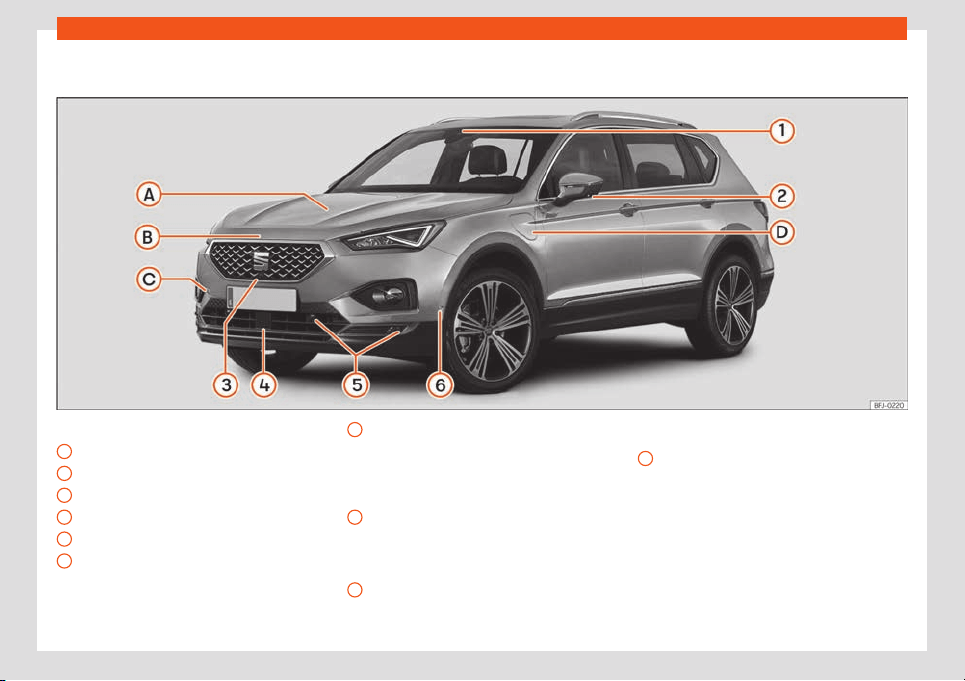
General views of the vehicle
Exterior view
Driving assistance sensors
›
››
page 245
Front multifunction camera
Rear-view cameras “Area View”
Front camera “Area View”
Front radar
Parking aid sensors
Park assist sensor
1
2
3
4
5
6
Levels control
–
Oil
›
››
page 340
–
Brake fluid
›››
page 345
–
Battery
›››
page 347
Bonnet
–
Unlocking lever
›››
page 338
–
Open/close
›››
page 338
Towing the vehicle
–
Towline anchorage
›››
page 57
A
B
C
–
T
ow-start
›››
page 55
Charging socket (hybrid vehicles)
–
Charging process display
›››
page 323
–
Emergency unlocking
›››
page 325
D
7
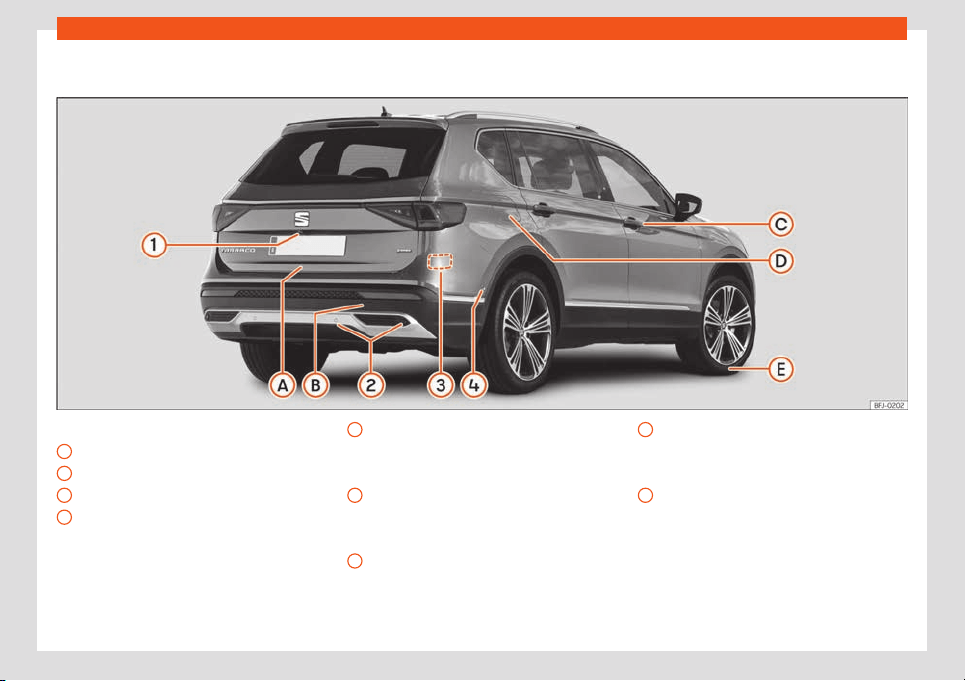
General views of the vehicle
Exterior view
Driving assistance sensors
›
››
page 245
Rear view camera
Parking aid sensors
Rear radars
Park assist sensor
1
2
3
4
Rear lid
–
Opening fr
om outside
›››
page 107
–
Emergency opening
›››
page 110
Towing the vehicle
–
Towline anchorage
›››
page 57
–
Tow-start
›››
page 55
Opening and closing
–
Doors
›››
page 104
–
Central locking
›››
page 95
–
Emergency lock
›››
page 105
A
B
C
Fuel tank
–
Fuel capacit
y
›››
page 381
–
Open/Close cap
›››
page 329
Action in the event of a puncture
–
Anti-puncture kit
›››
page 44
–
Wheel change
›››
page 46
D
E
8
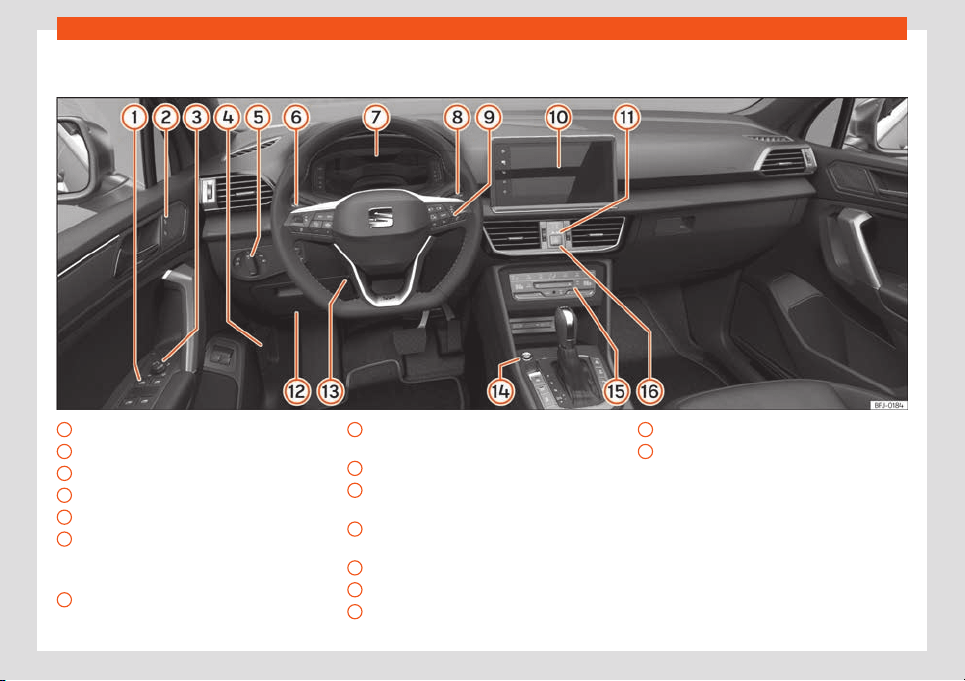
General views of the vehicle
Overview (left hand drive)
Electric windows
›
››
page 110
Central locking
›››
page 95
Exterior mirror adjustment
›››
page 126
Open bonnet lever
›››
page 338
Headlight switch
›››
page 116
Turn signal and main beam lever
›››
page 118
Cruise control
›››
page 249
Warning lamps
›››
page 85
1
2
3
4
5
6
7
Wipers and rear window wiper
›
››
page 124
Driver information system
›››
page 83
Infotainment system
›››
page 87,
›››
page 172
Front passenger airbag disconnection
display
›››
page 28
Fuses
›››
page 59
Steering wheel adjustment
›››
page 15
Starter button
›››
page 219
8
9
10
11
12
13
14
Air conditioning
›
››
page 157
Hazard warning lights
›››
page 121
15
16
9
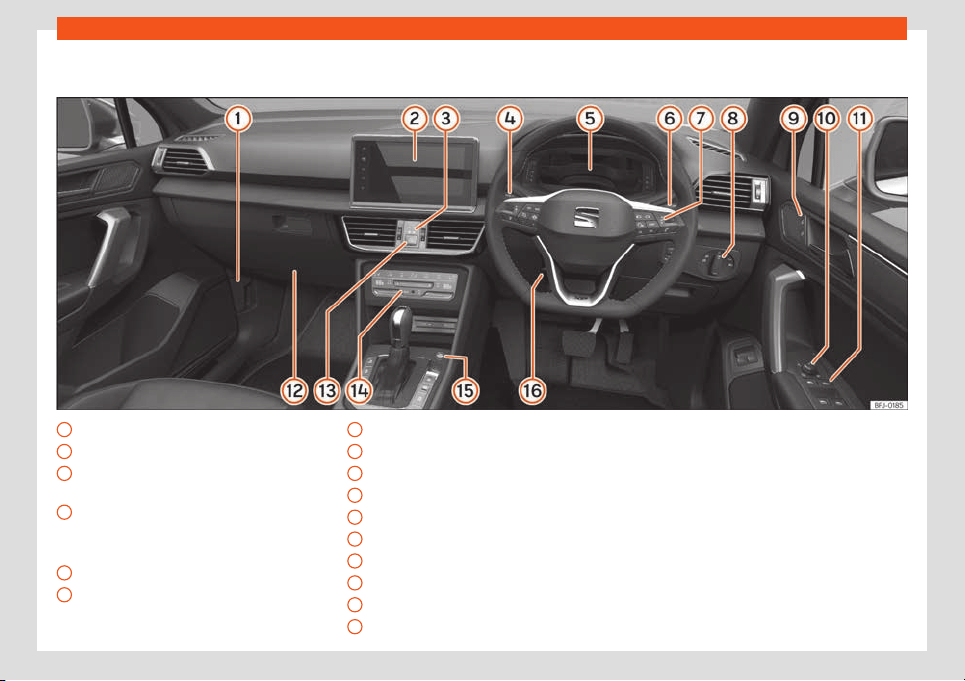
General views of the vehicle
Overview (right hand drive)
Open bonnet lever
›
››
page 338
Infotainment system
›››
page 87
Front passenger airbag disconnection
display
›››
page 28
Turn signal and main beam lever
›››
page 118
Cruise control
›››
page 249
Warning lamps
›››
page 85
Wipers and rear window wiper
›››
page 124
1
2
3
4
5
6
Driver information system
›
››
page 83
Headlight switch
›››
page 116
Central locking
›››
page 95
Exterior mirror adjustment
›››
page 126
Electric windows
›››
page 110
Fuses
›››
page 59
Hazard warning lights
›››
page 121
Air conditioning
›››
page 157
Starter button
›››
page 219
Steering wheel adjustment
›››
page 15
7
8
9
10
11
12
13
14
15
16
10
General views of the vehicle
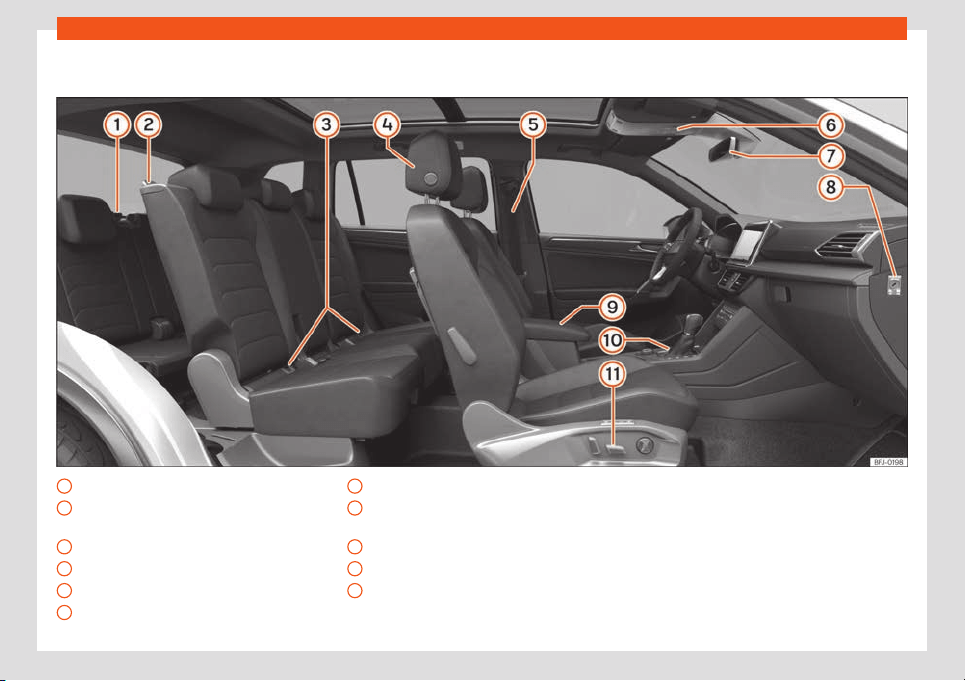
Interior view
Folding the third row of seats
›
››
page 142
Access to the third row of seats
›››
page 134
Isofix anchors
›››
page 35
Headrest adjustment
›››
page 131
Seat belts
›››
page 17
Panoramic roof
›››
page 112
1
2
3
4
5
6
Interior mirror
›
››
page 126
Disconnecting the front passenger front
airbag
›››
page 28
Armrest
›››
page 138
Electronic parking brake
›››
page 275
Seat adjustment
›››
page 129
7
8
9
10
11
11
Safety
Safety
Saf
e driving
Advice about driving
Safety first!
WARNING
●
This manual cont
ains important informa-
tion about the operation of the vehicle,
both for the driver and the passengers. The
other sections of the on-board documenta-
tion also contain further information that
you should be aware of for your own safety
and for the safety of your passengers.
●
Ensure that the on-board documentation
is kept in the vehicle at all times. This is es-
pecially important when lending or selling
the vehicle to another person.
Before driving
For your own safety and the safety of your
passengers, al
ways note the following points
before every trip:
–
Make sure that the vehicle's lights and turn
signals are working properly.
–
Check tyre pressure.
–
Ensure that all windows provide a clear and
good view of the surroundings.
–
Make sure all luggage is secured
›››
page 139.
–
Make sure that no objects can interfere with
the pedals.
–
Adjust front seat, headrest and mirrors
properly according to your size.
–
Ensure that the passengers in the rear seats
always have the headrests in the in-use po-
sition
›››
page 131.
–
Instruct passengers to adjust the headrests
according to their height.
–
Protect children with appropriate child
seats and properly applied seat belts
›››
page 32.
–
Assume the correct sitting position. Instruct
your passengers also to assume a proper
sitting position
›››
page 13.
–
Fasten your seat belt securely. Instruct your
passengers also to fasten their seat belts
properly
›››
page 17.
Factors influencing safety
As a driver, you are responsible for yourself
and your passengers.
–
Al
ways pay attention to traffic and do not
get distracted by passengers or telephone
calls.
–
Never drive when your driving ability is im-
paired (e.g. by medication, alcohol, drugs).
–
Observe traffic laws and speed limits.
–
Always reduce your speed as appropriate
for road, traffic and weather conditions.
–
When travelling long distances, take breaks
regularly - at least every two hours.
–
If possible, avoid driving when you are tired
or stressed.
WARNING
Driving under the influence of alcohol,
drugs, medication or nar
cotics may result
in severe accidents and even loss of life.
●
Alcohol, drugs, medication and narcotics
may significantly alter perception, affect
reaction times and safety while driving,
which could result in the loss of control of
the vehicle.
Safety equipment
Never put your safety or the safety of your
passengers in danger
. In the event of an acci-
dent, the safety equipment may reduce the
12
Safe driving
risk of injury. The following points cover part
of the saf
ety equipment in your SEAT
1)
:
●
three-point seat belts,
●
belt tension limiters for the front and rear
side seats,
●
belt tensioners for the front and rear side
seats,
●
Belt height adjustment for the front seats
●
front airbags,
●
knee airbags,
●
side airbags in the front seat backrests,
●
head-protection airbags,
●
“i-Size” anchor points for child seats in the
rear side seats and front passenger seat with
the “i-Size” system,
●
height-adjustable front headrests,
●
rear headrests with in-use position and
non-use position,
●
adjustable steering column.
The safety equipment mentioned above
works together to provide you and your pas-
sengers with the best possible protection in
the event of an accident. However, these
safety systems can only be effective if you
and your passengers are sitting in a correct
position and use this equipment properly.
Safety is everyone's business!
Correct sitting position of
vehicle occupants
Correct position on the seat
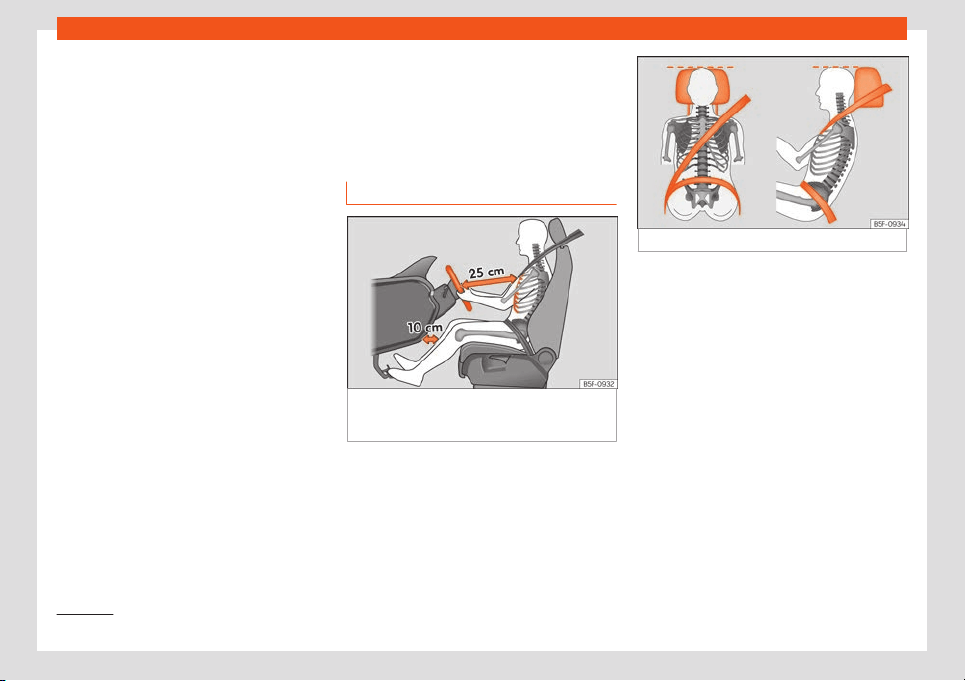
Fig. 3
The correct distance between the driver
and the st
eering wheel must be at least 25 cm
(10 inches).
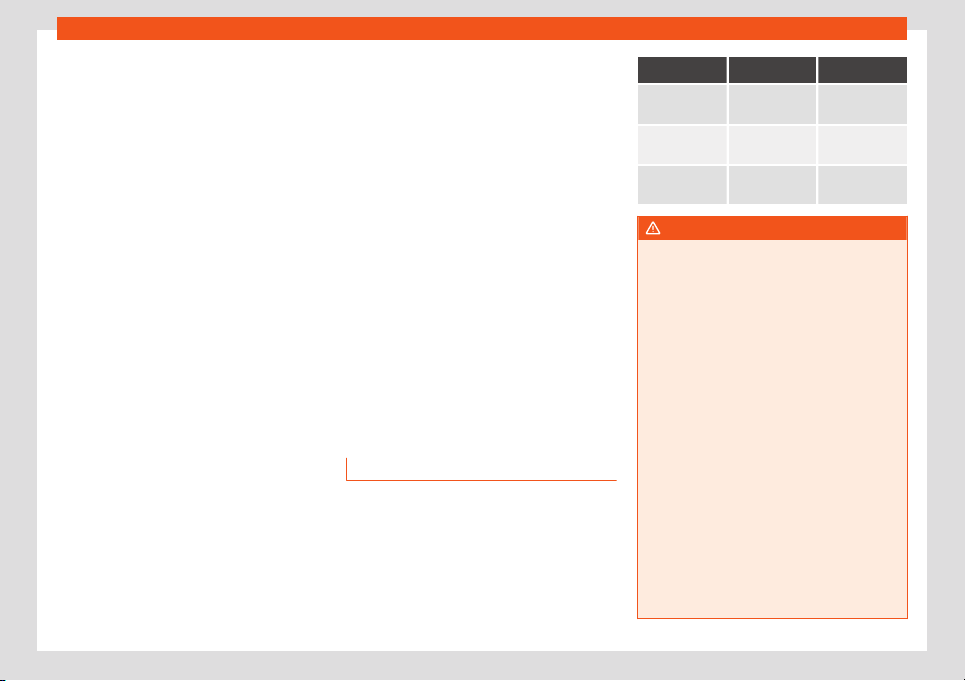
Fig. 4 Correct belt web and headrest positions
The correct sitting positions for the driver and
passengers ar
e shown below.
If your physical constitution prevents you
from maintaining the correct sitting position,
contact a specialised workshop for help with
any special devices. The seat belt and airbag
can only provide optimum protection if a cor-
rect sitting position is adopted. SEAT recom-
mends taking your car in for technical serv-
ice.
For your own safety and to reduce the risk of
injury in the event of an accident or sudden
braking or manoeuvre, SEAT recommend the
following positions:
Valid for all vehicle occupants:
●
Adjust the headrest so that its upper edge is
at the same level as the top of your head, or
»
1)
Depending on the version/market.
13
Safety
as close as possible to the same level as the
t
op of your head and under no circumstances
below eye level. Keep the back of your neck
as close as possible to the headrest
›››
Fig. 4.
●
Short people must lower the headrest com-
pletely, even if your head is below its upper
edge.
●
Tall people must raise the headrest com-
pletely.
●
Always keep your feet in the footwell while
the vehicle is in motion.
●
Adjust and fasten your seat belt correctly
›››
page 20.
The following also applies to the driver:
●
Given that the vehicle is equipped with ad-
justable headrests, move the headrest as
close as possible to the rear of the head.
●
Move the seat backrest to an almost up-
right position so that your back rests com-
pletely against it.
●
Move the steering wheel so it is at least
25 cm (10 inches) away from the sternum
›››
Fig. 3 and you can hold it with both hands
on both sides, on the outer part, with your
arms slightly bent.
●
The steering wheel must always point to-
wards the chest and never towards the face.
●
Move the seat in such a way that you can
step on the pedals with your knees slightly
bent and with a distance between the knees
and the dashboard of at least 10 cm (4 in-
ches)
›››
Fig. 3.
●
Adjust the height of the seat so that you
can reach the top of the steering wheel.
●
Always keep both feet in the footwell so
that you have the vehicle under control at all
times.
For the passenger, the following applies:
●
Given that the vehicle is equipped with ad-
justable headrests, move the headrest as
close as possible to the rear of the head.
●
Move the seat backrest to an almost up-
right position so that your back rests com-
pletely against it.
●
Move the seat as far back as possible (mini-
mum 25 cm between the chest and the dash-
board check translation). If you are sitting
closer than 25 cm, the airbag system cannot
protect you properly.
Number of seats
The vehicle has 5 or 7 seats, depending on
the f
eatures. All seats are equipped with a
safety belt.
No one taller than 1.60 m should sit on the
third row of seats.
5 seats 7 seats
Seats in the
fr
ont
2 2
Seats in the
second r
ow
3 3
Seats in the
thir
d row
– 2
WARNING
Sitting in an incorrect position may in-
crease the risk of severe or lethal injuries in
the event of sudden braking or manoeu-
vring, in case of collision or accident and if
the airbags deploy.
●
Before starting the car, all passengers
must be sitting in a correct position and
stay like that for the entire journey. This al-
so applies to a correct use of the seat belt.
●
The maximum amount of people in the
vehicle is the same as the amount of seats
with seat belts.
●
For children, always use a certified pro-
tection system, certified and suited for their
weight and height
›››
page 32.
●
While driving, always keep your feet in
the footwell. Never place them over the
seat or the dashboard, for example, or out-
side the window. Otherwise the airbag and
seat belt may offer insufficient protection
and also increase the risk of injury in the
event of an accident.
14
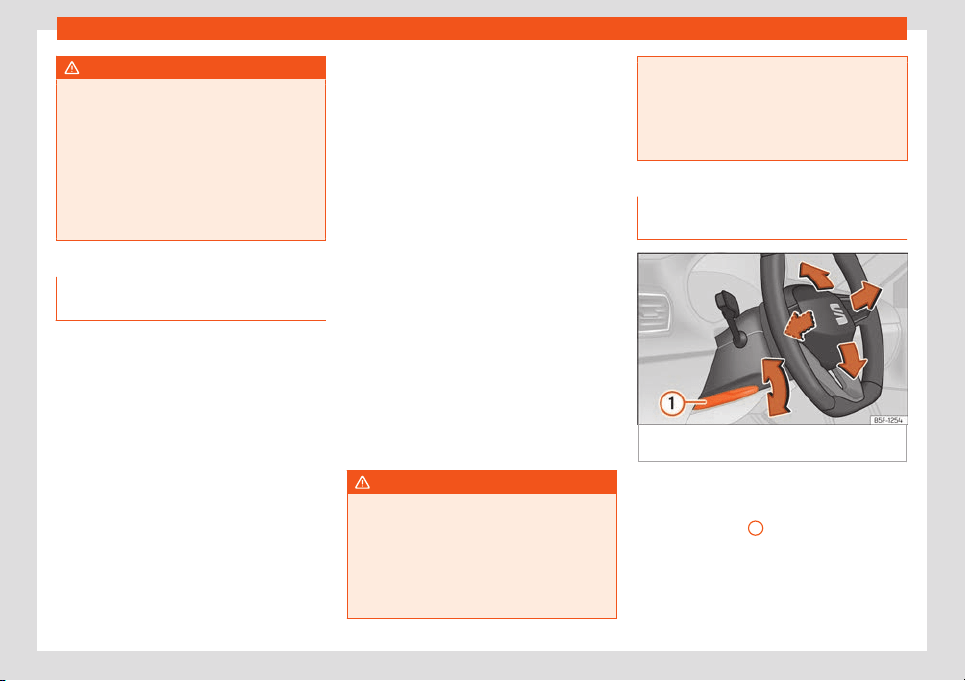
Safe driving
WARNING
Risk of suffering severe head injuries If peo-
pl
e taller than 1.60 m travel in the third row,
they may receive severe head injuries in
the event of an accident.
●
Never travel with anyone taller than 1.60
m on the third row.
●
When closing the rear lid, always be
mindful of the passengers of the rearmost
seats.
Risks of sitting in an incorrect posi-
tion
If seat belts are worn incorrectly or not at all,
the risk of se
vere or lethal injuries increases.
Seat belts can provide optimal protection on-
ly if the belt web is properly worn. Incorrect
sitting positions substantially reduce the pro-
tective function of seat belts and, therefore,
increase the risk of severe or even lethal inju-
ries. The risk of severe or fatal injuries is espe-
cially heightened when a deploying airbag
strikes a vehicle occupant who has assumed
an incorrect sitting position. The driver is re-
sponsible for all people, particularly children,
inside the vehicle.
The following list contains examples of incor-
rect sitting positions that could be dangerous
for all vehicle occupants.
When the vehicle is in motion:
●
Never stand in the vehicle.
●
Never stand on the seats.
●
Never kneel on the seats.
●
Never tilt your seat backrest too far to the
rear.
●
Never lean against the dash panel.
●
Never lie on the rear seats.
●
Never sit on the front edge of a seat.
●
Never sit sideways.
●
Never lean out of a window.
●
Never put your feet out of a window.
●
Never put your feet on the dash panel.
●
Never place your feet on the bench or on
the backrest of the seat.
●
Never travel in a footwell.
●
Never sit on the armrests.
●
Never travel without wearing the seat belt.
●
Never travel in the luggage compartment.
WARNING
Sitting in an incorrect position increases
the risk of se
vere or fatal injuries in the
event of accidents and sudden braking or
manoeuvres.
●
All occupants must sit correctly during
the journey and wear the seat belt correct-
ly.
●
Occupants of the v
ehicle that are not sit-
ting correctly, not wearing the seat belt or
are not at a proper distance of the airbag
risk suffering very serious or lethal injuries,
especially if the airbags deploy and strike
them.
Steering wheel position adjust-
ment
Fig. 5
Lever in the lower left side of the steering
column.
Adjust the steering wheel before your trip and
only when the v
ehicle is stationary.
●
Pull the
›››
Fig. 5
1
lever down, move the
st
eering wheel to the desired position and lift
the lever back up until it locks.
»
15
Safety
WARNING
Incorrect use of the steering wheel adjust-
ment function and an incorr
ect adjustment
of the steering wheel can result in severe or
fatal injury.
●
After adjusting the steering column, push
the lever
›››
Fig. 5
1
firmly upwards to en-
sur
e the steering wheel does not acciden-
tally change position while driving.
●
Never adjust the steering wheel while the
vehicle is in motion. If you need to adjust
the steering wheel while the vehicle is in
motion, stop safely and make the proper
adjustment.
●
The adjusted steering wheel should be
facing your chest and not your face so as
not to hinder the driver's front airbag pro-
tection in the event of an accident.
●
When driving, always hold the steering
wheel with both hands on the outside of the
ring at the 9 o'clock and 3 o'clock positions
to reduce injuries when the driver's front
airbag deploys.
●
Never hold the steering wheel at the 12
o'clock position or in any other manner
(e.g. in the centre of the steering wheel). In
such cases, if the driver's airbag deploys,
you may sustain injuries to your arms,
hands and head.
Pedal area
P
edals
–
Ensure that you can always press the ac-
cel
erator, brake and clutch pedals unim-
paired to the floor.
–
Ensure that the pedals can return unim-
paired to their initial positions.
–
Ensure that the floor mats are securely fas-
tened during the trip and do not obstruct
the pedals
›››
.
Only use fl
oor mats which leave the pedals
clear and which are secured to prevent them
from slipping. You can obtain suitable floor
mats from a specialised dealership. Fasteners
for floor mats are fitted in the footwells.
If a brake circuit fails, the brake pedal must be
pressed down thoroughly in order to stop the
vehicle.
Wear suitable footwear
Always wear shoes which support your feet
properly and give you a good feeling for the
pedals.
WARNING
●
R
estricting pedal operation can lead to
critical situations while driving.
●
Ne
ver lay or fit floor mats or other floor
coverings over the original floor mats. This
would reduce the pedal area and could ob-
struct the pedals. Risk of accident.
●
Never place objects in the driver footwell.
An object could move into the pedal area
and impair pedal operation.
16
Seat belts
Seat belts
The whys and wher
efores of
seat belts
Control lamps
It lights up red
Driver or passenger has not fastened seat belt.
The control lamp lights up t
o remind the
driver to fasten their seat belt.
Before starting the vehicle:
●
Fasten your seat belt securely.
●
Instruct your passengers to fasten their
seat belts properly before driving off.
●
Protect children by using a child seat ac-
cording to the child's height and weight
›››
page 32.
When starting to drive, if the vehicle's speed
exceeds approx. 25 km/h (15 mph) and the
seat belts are not fastened or are unfastened
while driving, a warning sound will be heard
for a few seconds. The warning light will also
flash .
The lamp goes out when the driver and
passenger seat belts are fastened with the
ignition switched on.
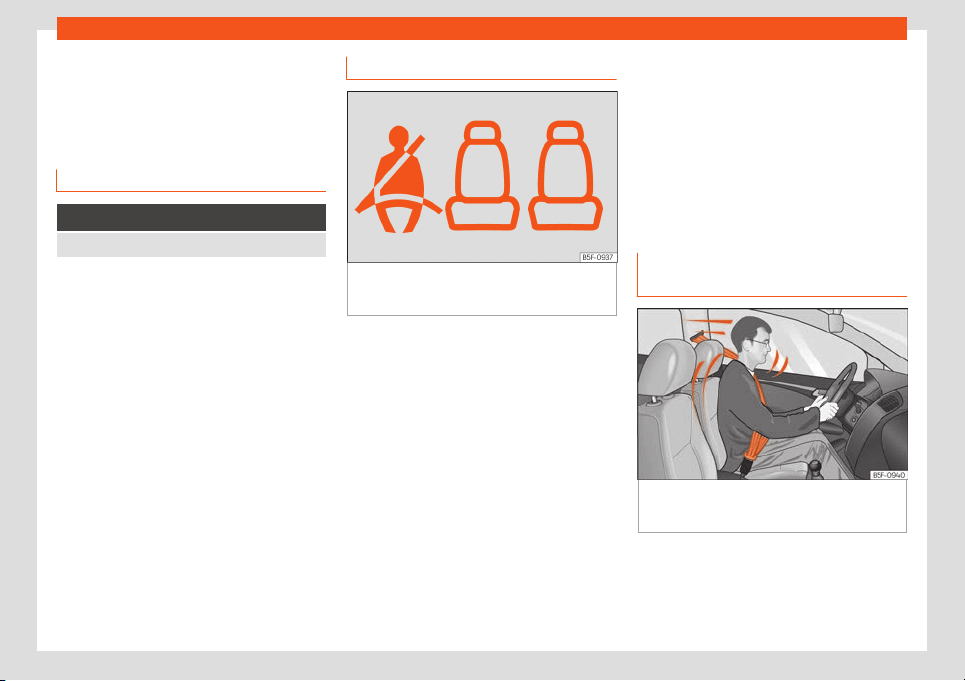
Rear seat belts fastened display
Fig. 6
Instrument panel: left rear seat occu-
pied and corr
esponding seat belt fastened dis-
play.
Depending on the model version, when the
ignition is s
witched on, the seat belt status
display
›››
Fig. 6 on the instrument panel in-
forms the driver whether the passengers in
the rear seats have fastened their seat belts.
It indicates that the corresponding seat
is empty.
A green light indicates that the seat is
occupied and the occupant is wearing
the seat belt.
A red light indicates that the seat is oc-
cupied and the occupant is not wearing
the seat belt. In this case, the seat belt
control lamp will also light up in red and,
if driving over 25 km/h (15 mph), a warn-
ing sound will be emitted for a few sec-
onds.
The seat belt status flashes for a maximum of
60 seconds when a seat belt in the rear seats
is unfastened while the vehicle is in motion. An
audible warning will also be heard if the vehi-
cle is travelling at over 25 km/h (15 mph).
If a seat belt is fastened or unfastened while
driving in some of the rear seats, the seat belt
status is displayed for approximately 30 sec-
onds.
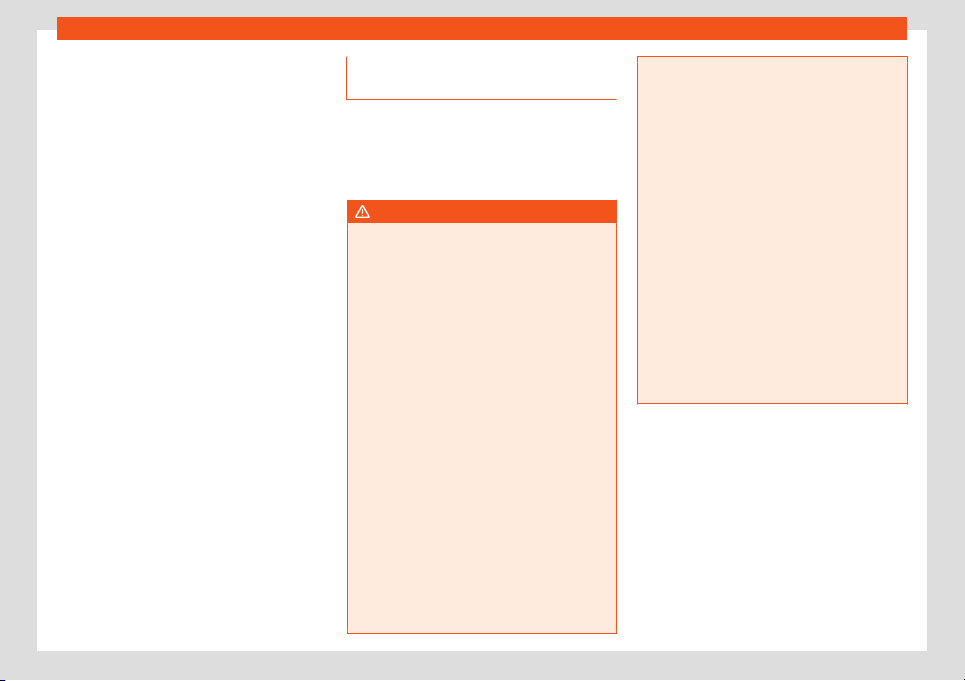
The protective function of seat
belts
Fig. 7
Drivers with properly worn seat belts will
not be thr
own forward in the event of sudden
braking.
Properly worn seat belts hold the occupants
in the pr
oper position. They also help prevent
uncontrolled movements that may result in
serious injury and reduce the risk of being
»
17
Safety
thrown out of the vehicle in case of an acci-
dent.
V
ehicle occupants wearing their seat belts
correctly benefit greatly from the ability of
the belts to absorb kinetic energy. In addition,
the front part of your vehicle and other pas-
sive safety features (such as the airbag sys-
tem) are designed to absorb the kinetic ener-
gy released in a collision. Taken together, all
these features reduce the releasing kinetic
energy and consequently, the risk of injury.
This is why it is so important to fasten seat
belts before every trip, even when "just driving
around the corner".
Ensure that your passengers wear their seat
belts as well. Accident statistics have shown
that wearing seat belts is an effective means
of substantially reducing the risk of injury and
improving the chances of survival when in-
volved in a serious accident. Furthermore,
properly worn seat belts improve the protec-
tion provided by airbags in the event of an
accident. For this reason, wearing a seat belt
is required by law in most countries.
Although your vehicle is equipped with air-
bags, the seat belts must be fastened and
worn. The front airbags, for example, are only
triggered in some cases of head-on collision.
The front airbags will not be triggered during
minor frontal or side collisions, rear-end colli-
sions, overturns or accidents in which the air-
bag trigger threshold value in the control unit
is not exceeded.
Important safety instructions for
the use of seat belts
–
Always wear the seat belt as described in
this section.
–
Ensure that the seat belts can be fastened
at all times and ar
e not damaged.
WARNING
●
If seat belts ar
e worn incorrectly or not at
all, the risk of severe injuries increases. The
optimal protection from seat belts can be
achieved only if you use them properly.
●
Never allow two passengers (even chil-
dren) to share the same seat belt.
●
Never unbuckle a seat belt while the ve-
hicle is in motion. Risk of fatal injury.
●
The seat belt should never lie on hard or
fragile objects (such as glasses or pens,
etc.) because this can cause injuries.
●
Do not allow the seat belt to be damaged
or jammed, or to rub on any sharp edges.
●
Never wear the seat belt under the arm or
in any other incorrect position.
●
Bulky and unfastened clothing (such as
an overcoat over a sweater) impairs the
proper fit and function of the seat belts, re-
ducing their capacity to protect.
●
The slot in the seat belt buckle must not
be blocked with paper or other objects, as
this can prevent the latch plate from en-
gaging securely.
●
Ne
ver use seat belt clips, fastening rings
or similar items to alter the position of the
belt webbing.
●
Frayed or torn seat belts or damage to
the connections, belt retractors or parts of
the buckle could cause severe injuries in
the event of an accident. Therefore, you
must check the condition of all seat belts
at regular intervals.
●
Seat belts which have been worn in an
accident and have been stretched must be
replaced by a specialised workshop. Re-
newal may be necessary even if there is no
apparent damage. The belt anchorage
should also be checked.
●
Do not attempt to repair a damaged seat
belt yourself. The seat belts must not be re-
moved or modified in any way.
●
The belts must be kept clean, otherwise
the retractors may not work properly.
18
Seat belts
Head-on collisions and the laws of
physics
Fig. 8
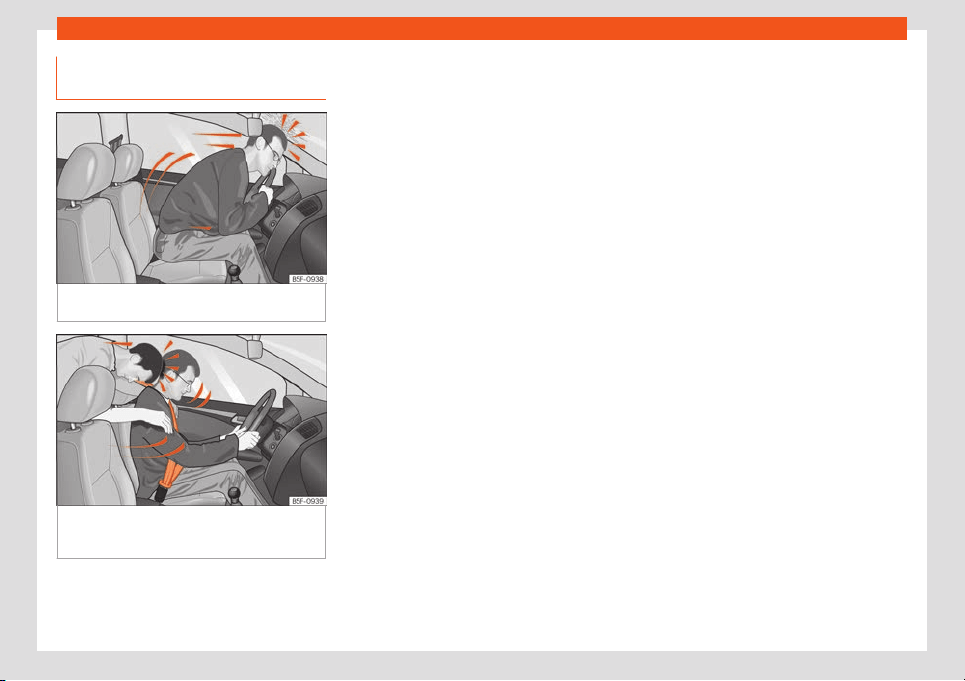
A driver not wearing a seat belt is thrown
f
orward violently.
Fig. 9
The unbelted passenger in the rear seat
is thr
own forward violently, hitting the driver
who is wearing a seat belt.
The effects of the laws of physics in the case
of a head-on collision ar
e easy to explain: the
moment a vehicle starts moving, a type of en-
ergy called “kinetic energy” starts acting on
both the vehicle and its passengers.
The amount of “kinetic energy” depends on
the speed of the vehicle and on the weight of
the vehicle and of its passengers. The higher
they are, the more energy there is to be “ab-
sorbed” in the event of an accident.
The most significant factor, however, is the
speed of the vehicle. If the speed doubles
from 25 km/h (15 mph) to 50 km/h (30 mph),
for example, the corresponding kinetic ener-
gy is multiplied by four.
Given that the passengers of the vehicle in
our example do not have their seat belts fas-
tened, in the event of a collision the entire
amount of the passengers' kinetic energy will
be only absorbed by the mentioned impact.
Even at speeds of 30 km/h (19 mph) to
50 km/h (30 mph), the forces acting on bod-
ies in a collision can easily exceed one tonne
(1000 kg). At greater speed these forces are
even higher.
Vehicle occupants not wearing seat belts are
not “attached” to the vehicle. In a head-on
collision, they will move forward at the same
speed their vehicle was travelling just before
the impact. This example applies not only to
head-on collisions, but to all accidents and
collisions.
Even at low speeds the forces acting on the
body in a collision are so great that it is not
possible to brace oneself with one's hands. In
a frontal collision, unbelted passengers are
thrown forward and will make violent contact
with the steering wheel, dash panel, wind-
screen or whatever else is in the way
›››
Fig. 8.
It is also important for rear passengers to
wear seat belts properly, as they could other-
wise be thrown forward violently through the
vehicle interior in an accident. Passengers in
the rear seats who do not use seat belts en-
danger not only themselves but also the front
occupants
›››
Fig. 9.
19
Safety
How to properly adjust your
seat belt
F
astening and unfastening the seat
belt
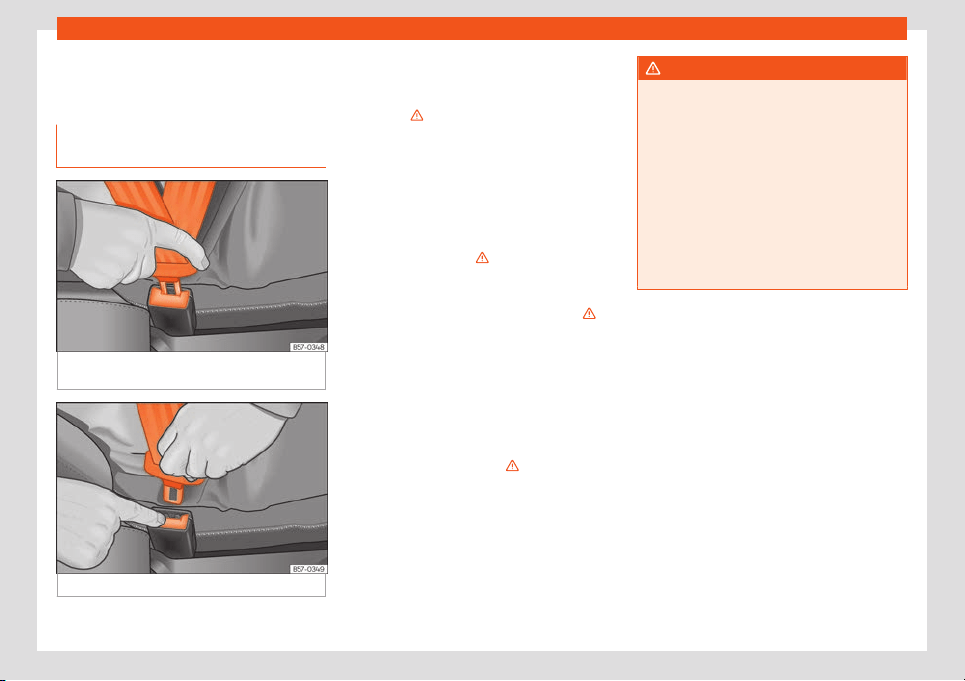
Fig. 10 Insert the latch plate of the seat belt
int
o the buckle.
Fig. 11 Release the seat belt's buckle.
Properly worn seat belts hold the vehicle oc-
cupants in the position that most pr
otects
them in the event of an accident or sudden
braking
›››
.
F
astening the seat belt
Fasten your seat belt before each trip.
●
Adjust the front seat and headrest correctly
›››
page 13.
●
Engage the seat backrest of the rear seat in
an upright position
›››
.
●
Pull the latch plate and place the belt web-
bing e
venly across your chest and lap. Do
not twist the seat belt when doing so
›››
.
●
Engage the latch plate in the buckle of the
corr
esponding seat
›››
Fig. 10.
●
Pull the belt to ensure that the latch plate is
securely engaged in the buckle.
Releasing the seat belt
Only unfasten the seat belt when the vehicle
has come to a standstill
›››
.
●
Press the red button on the buckle
›
››
Fig. 11. The latch plate is released from the
buckle.
●
Guide the belt back by hand so that it rolls
up easily and the trim will not be damaged.
WARNING
●
The seat belt cannot off
er its full protec-
tion unless the seat backrest is in an up-
right position and the seat belt is worn cor-
rectly, according to your size.
●
Unbuckling your seat belt while the vehi-
cle is in motion can cause severe or fatal
injuries in the event of an accident or sud-
den braking.
●
The seat belt itself, or a loose seat belt,
can cause severe injuries if the belt moves
from hard areas of the body to soft areas
(e.g. the stomach).
20
Seat belts
Correct seat belt position
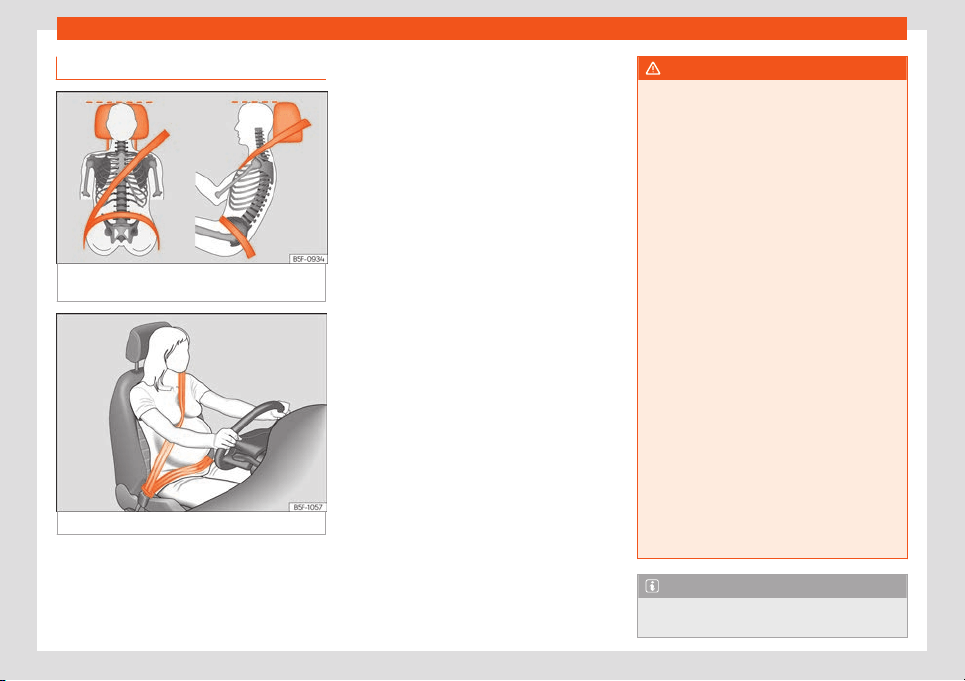
Fig. 12
Correct seat belt and headrest posi-
tions, vie
wed from front and the side.
Fig. 13 Position of seat belt during pregnancy.
Seat belts offer their maximum protection in
the e
vent of an accident and reduce the risk
of sustaining severe or fatal injuries only when
they are properly positioned. Furthermore, if
the webbing is correctly positioned, the seat
belt will hold the vehicle occupants in the op-
timum position to ensure the airbag provides
the maximum protection. The seat belt must
therefore always be worn and the webbing
correctly positioned.
Incorrectly worn seat belts can cause severe
or even fatal injuries
›››
page 13, Correct sit-
ting position of vehicle occupants.
●
The shoulder part of the seat belt must lie
on the centre of the shoulder, never across
the neck or the arm, under the arm or behind
the shoulder.
●
The lap part of the seat belt must lie across
the pelvis, never across the stomach.
●
The seat belt must lie flat and fit comforta-
bly. Pull the belt tight if necessary to take up
any slack.
In the case of pregnant women, the seat belt
must lie evenly across the chest and as low
as possible over the pelvis, never across the
stomach and must be worn properly at all
times during the pregnancy
›››
Fig. 13.
Adapting the position of the belt webbing
to your size
The seat belt can be adapted using the fol-
lowing equipment:
●
Front seat belts with height adjustment.
●
Front seat height adjustment.
WARNING
An incorrectly worn seat belt web can
cause se
vere or fatal injuries in the event of
an accident.
●
The shoulder part of the seat belt must lie
on the centre of the shoulder, never across
the neck or the arm.
●
The seat belt must lie flat and fit comfort-
ably on the torso
●
The lap part of the seat belt must lie
across the pelvis, never across the stom-
ach. The seat belt must lie flat and fit com-
fortably on the pelvis Pull the belt tight if
necessary to take up any slack.
●
For pregnant women, the lap part of the
seat belt must lie as low as possible over
the pelvis and always lie flat, “surrounding”
the stomach
›››
Fig. 13.
●
Do not twist the seat belt while it is fas-
tened.
●
Once the seat belt is positioned correct-
ly, don't pull it away from your body with
your hand.
●
Do not lie the seat belt across rigid or
fragile objects, e.g. glasses, pens or keys.
●
Never use seat belt clips, retaining rings
or similar instruments to alter the position
of the belt webbing.
Note
If your physical constitution prevents you
fr
om maintaining the correct position of the
»
21
Safety
belt webbing, contact a specialised work-
shop f
or help with any special devices to
ensure the optimum protection of the seat
belt and airbag. SEAT recommends taking
your car in for technical service.
Seat belt height adjustment
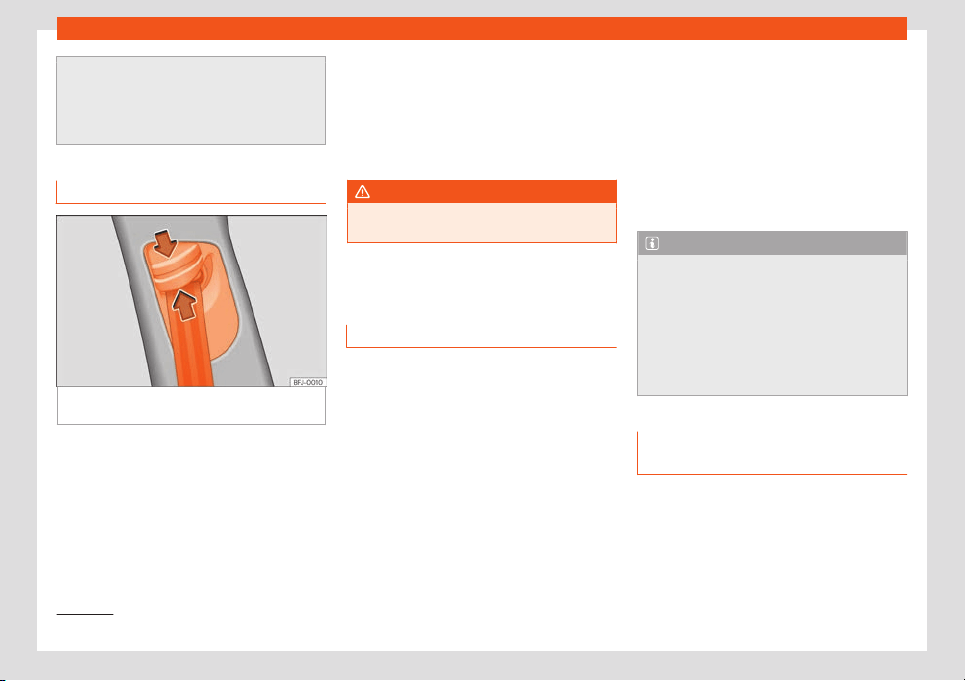
Fig. 14 Next to the front seats: belt height ad-
just
er.
Using the height adjusters for the front seats
and the out
er seats of the second row, the
position of the seat belts can be adjusted in
the shoulder area according to the height of
the occupant:
●
Keep the guide device pressed down in the
direction of the arrow
›››
Fig. 14.
●
Move the guide device up or down until the
seat belt lies over the centre of your shoulder
›››
page 20.
●
Release the guide device.
●
Pull the belt sharply to check that the de-
vice is engaged securely.
WARNING
Never adjust the belt height while the vehi-
cl
e is in motion.
Seat belt tensioners
Ho
w the seat belt tensioner works
The seat belts for the front seats and the side
r
ear seats on the second row
1)
are equipped
with belt tensioners.
The belt tensioners are activated by sensors,
although only in severe head-on, lateral and
rear-end collisions.
This retracts and tightens the seat belts, re-
ducing the forward motion of the occupants.
The belt pre-tensioners work in combination
with the airbag system. In case of overturn,
the pre-tensioners do not activate unless the
head airbags are deployed.
Reversible seat belt tensioning
In specific driving situations, a reversible ten-
sioning of the seat belts might take place
›››
page 23. For example:
●
in the event of sudden brakes
●
in the event of oversteering or understeer-
ing
●
in the event of minor collisions
Note
●
If the seat belt t
ensioners are triggered, a
fine dust is produced. This is normal and it
is not an indication of fire in the vehicle.
●
The relevant safety requirements must be
observed when the vehicle or components
of the system are scrapped. Specialised
workshops are familiar with these regula-
tions, which are also available to you.
Maintenance and disposal of seat
belt t
ensioners
The belt tensioners are components of the
seat belts that ar
e installed in the seats of
your vehicle. If you work on the belt tension-
ers or remove and install parts of the system
when performing other repair work, the seat
belt may be damaged. The consequence
1)
Depending on version/market.
22
Seat belts
may be that, in the event of an accident, the
belt t
ensioners function incorrectly or may
not function at all.
So that the effectiveness of the seat belt ten-
sioner is not reduced and that removed parts
do not cause any injuries or environmental
pollution, regulations, which are known to the
specialised workshops, must be observed.
WARNING
●
Impr
oper use or repairs not carried out by
qualified mechanics increase the risk of se-
vere or fatal injuries. The belt tensioners
may fail to trigger or may trigger in the
wrong circumstances.
●
The seat belt tensioner, seat belt and au-
tomatic retractor cannot be repaired.
●
Any work on the belt tensioners and seat
belts, including the removal and refitting of
system parts in conjunction with other re-
pair work, must be performed by a special-
ised workshop only.
●
The belt tensioners will only provide pro-
tection for one accident and must be
changed if they have been activated.
For the sake of the environment
Airbag modules and belt tensioners may
cont
ain perchlorate. Observe the legal re-
quirements for their disposal.
PreCrash system
Ho
w it works
The PreCrash system is an assistance system
that activ
es a series of measures to protect
the occupants of the vehicles in potentially
risky situations, but which cannot prevent a
collision.
It only works completely if no special driving
profile is selected and if there are no operat-
ing anomalies.
Basic features
Depending on the legal provisions of the
country and the features of the vehicle, in crit-
ical situations (e.g. in certain cases of emer-
gency braking or loss of control of the vehicle
by the driver) the following functions can be
activated separately or at the same time
when the vehicle is travelling faster than ap-
proximately 30 km/h (20 mph).
●
Reversible tensioning of front seat belts that
ar
e fastened.
●
Operation of the hazard warning lights.
●
Automatic closing of the windows until they
are just cracked open and, depending on the
equipment, of the sunroof.
●
In the event of overturning, depending on
the equipment, activation of the belt tension-
ers.
Depending on how critical the driving situa-
tion is, the belts are either tightened individu-
ally, or both belts at the same time.
In addition to Front Assist
In vehicles with Front Assist
›››
page 252,
within the limits of the system, information is
assessed on the risk of collision with the vehi-
cle in front. The functions of the PreCrash
system may also be activated if there is a
high likelihood of a rear-end collision, or dur-
ing the activation of Front Assist.
In addition to Side Assist
In vehicles with lane assist
›››
page 269, with-
in the limitations of each system, information
is assessed on the risk of collision with traffic
to the rear of the vehicle. If a rear-end colli-
sion is highly likely, the functions of the
PreCrash system may also be activated. In
this situation, the hazard warning lights are
turned on with a higher frequency of flashes.
In addition to the Emergency Assist system
In vehicles with emergency assist, driver sta-
tus information is assessed within the limita-
tions of this system. The following PreCrash
systems may be activated if a lack of activity
is detected:
●
Reversible seat belt tensioning of the driv-
er's seat belt.
»
23
Safety
●
Aut
omatic closing of the windows until they
are just cracked open and, depending on the
equipment, of the sunroof.
Activation of the PreCrash system
The PreCrash system can be partially deacti-
vated by deactivating the traction and / or
stability control, depending on the equip-
ment. When these vehicle safety controls are
switched on (by default, every time the igni-
tion is turned on), the system is fully activated.
Driving profile selection settings
In vehicles with driving profile selection,
PreCrash adapts to suit the special vehicle
configuration of the corresponding profile
›››
page 239.
Limited operation
The PreCrash system is not available or only
has limited availability in the following situa-
tions:
●
When the ASR and/or the ESC are discon-
nected.
●
When driving in reverse.
●
When the airbag control unit is not operat-
ing properly.
●
When there is a fault in the system itself, in
the ESC or in the Front Assist.
Problems and solutions
If the PreCrash is not working correctly, the
message System unavailable or System
with limited features is shown perma-
nently on the dashboard display. Have the
system checked by a SEAT workshop.
WARNING
The PreCrash system cannot overcome the
limits imposed by the l
aws of physics; it on-
ly works within the limits of the system.
Risks that compromise safety are never jus-
tified by the use of this system. The system
is not a replacement for driver awareness
and cannot prevent a collision.
●
Adapt your speed and safe distance to
the vehicle in front of you at all times to suit
the visibility, weather, road and traffic con-
ditions.
●
The system is not always able to recog-
nise objects.
●
The system may not react to people or
animals or objects that cross length-wise
or that are hard to detect.
●
Metallic objects (e.g. fences) or other el-
ements of the public road or adverse
weather conditions can hinder its operation
and thus its ability to detect collision risk.
●
Never ignore the warning lamps that light
up or the messages shown on the dash-
board.
WARNING
Distracting the driver in any way can lead
t
o an accident and cause injuries.
●
Never change settings on the Infotain-
ment System while driving.
24

Airbag system
Airbag system
Brief intr
oduction
Why is it so important to wear a
seat belt and to sit correctly?
For the inflating airbags to achieve the best
pr
otection, the seat belt must always be worn
properly and the correct sitting position must
be assumed.
The airbag system is not a substitute for seat
belts, but it is an integral part of the vehicle's
overall passive safety system. Please bear in
mind that the airbag system can only work
effectively when the vehicle occupants are
wearing their seat belts correctly and have
adjusted the headrests properly. Therefore, it
is most important to properly wear the seat
belts at all times, not only because this is re-
quired by law in most countries, but also for
your safety
›››
page 17, The whys and
wherefores of seat belts.
The airbag inflates in a matter of seconds, so
if you are not properly seated when the air-
bag is triggered, you may sustain fatal inju-
ries. Therefore, it is essential that all vehicle
occupants assume a correct sitting position
while travelling.
Sharp braking before an accident may cause
a passenger not wearing a seat belt to be
thrown forward into the area of the deploying
airbag. In this case
, the inflating airbag may
inflict critical or fatal injuries on the occupant.
This also applies to children.
Always maintain the greatest possible dis-
tance between yourself and the front airbag.
This way, the front airbags can completely
deploy when triggered, providing their maxi-
mum protection.
The most important factors for triggering the
airbag are the type of accident, the angle of
impact and the vehicle speed.
Whether or not the airbags are activated de-
pends primarily on the vehicle deceleration
rate resulting from the collision and detected
by the control unit. If the vehicle deceleration
occurring during the collision and measured
by the control unit remains below the speci-
fied reference values, the front, side and/or
head-protection airbags will not be triggered.
Take into account that the visible damage in
a vehicle involved in an accident, no matter
how serious, is not a determining factor for
the airbags to have been activated.
WARNING
●
W
earing the seat belt incorrectly or as-
suming an incorrect sitting position can
lead to critical or fatal injuries.
●
All vehicle occupants, including children,
who are not properly belted can sustain
critical or fatal injuries if the airbag is trig-
gered. Children up to 12 years old should
al
ways travel on the rear seat. Never trans-
port children in the vehicle if they are not
restrained or the restraint system is not ap-
propriate for their age, size or weight.
●
To reduce the risk of injury from an inflat-
ing airbag, always wear the seat belt prop-
erly
›››
page 17.
Description of the airbag system
The airbag system offers additional protec-
tion f
or the occupants in combination with the
seat belts.
The airbag system comprises the follow-
ing modules (as per vehicle equipment):
●
Electronic control unit
●
Front airbags for driver and passenger
●
Knee airbag for the driver
●
Side airbags
●
Head airbag
●
Airbag control lamp on the instrument
panel
›››
page 27
●
Key-operated switch for front passenger
airbag
●
Control lamp for disabled/enabled status
of the front passenger airbag.
»
25
Safety
The airbag system operation is monitored
el
ectronically. The airbag control lamp will il-
luminate for a few seconds every time the ig-
nition is switched on (self-diagnosis).
There is a fault in the system if the control
lamp :
●
does not light up when the ignition is
switched on
›››
page 27,
●
turns off after 4 seconds after the ignition is
switched on,
●
turns off and then lights up again after the
ignition is switched on,
●
illuminates or flashes while the vehicle is
moving.
The airbag system is not triggered if:
●
the ignition is switched off
●
there is a minor frontal collision
●
there is a minor side collision
●
there is a rear-end collision
●
the vehicle turns over.
WARNING
●
The seat belts and airbags can only pr
o-
vide maximum protection if the occupants
are seated correctly
›››
page 13.
●
If a fault has occurred in the airbag sys-
tem, have the system checked immediately
by a specialised workshop. Otherwise
there is a danger that during a collision, the
system may fail to trigger, or not trigger
corr
ectly.
Airbag activation
The airbags deploy extremely rapidly, within
thousands of a second, t
o provide additional
protection in the event of an accident. A fine
dust may develop when the airbag deploys.
This is normal and it is not an indication of fire
in the vehicle.
The airbag system is only ready to function
when the ignition is on.
In special accidents instances, several air-
bags may activate at the same time.
In the event of minor head-on and side colli-
sions, rear-end collisions, overturning or roll-
over of the vehicle, airbags do not activate.
Activation factors
The conditions that lead to the airbag system
activating in each situation cannot be gener-
alised. Some factors play an important role,
such as the properties of the object the vehi-
cle hits (hard/soft), angle of impact, vehicle
speed, etc.
Deceleration trajectory is key for airbag acti-
vation.
The control unit analyses the collision trajec-
t
ory and activates the respective restraint
system.
If the deceleration rate is below the prede-
fined reference value in the control unit the
airbags will not be triggered, even though the
accident may cause extensive damage to the
car.
The following airbags are triggered in seri-
ous head-on collisions:
●
Driver airbag.
●
Front passenger front airbag
●
Knee airbag for the driver.
The following airbags are triggered in seri-
ous side-on collisions:
●
Front side airbag on the side of the acci-
dent.
●
Curtain (head) airbag on the side of the ac-
cident.
In an accident with airbag activation:
●
the interior lights switch on (if the interior
light switch is in the courtesy light position);
●
the hazard warning lights switch on;
●
all doors are unlocked;
●
the fuel supply to the engine is cut;
●
in hybrid vehicles, the high voltage system
is switched off;
26
Airbag system
●
an emer
gency call is started
›››
page 42.
Operation of the airbags
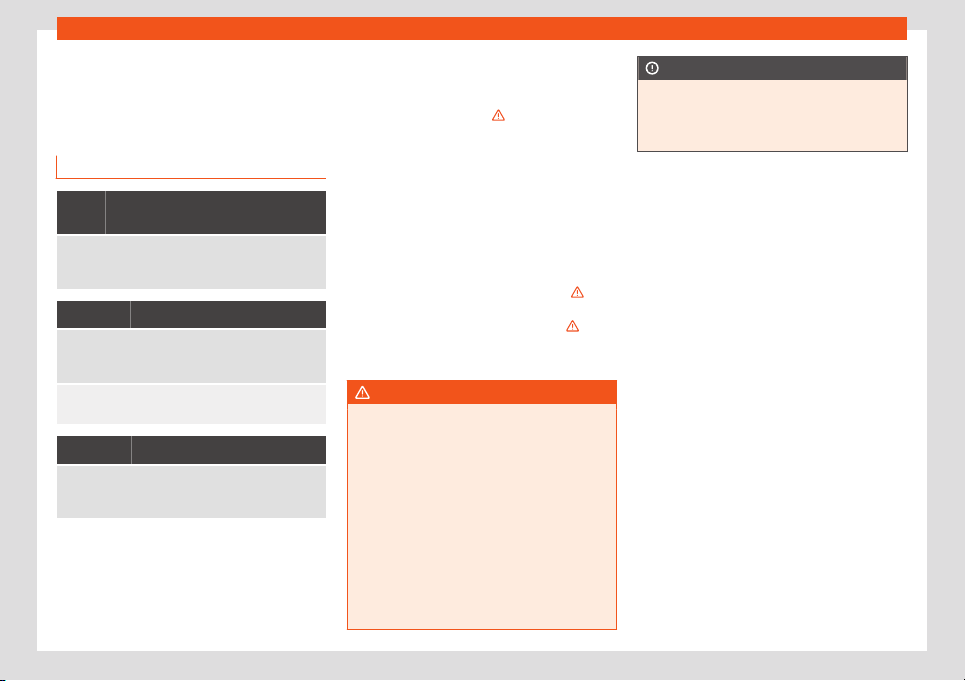
Airbag system control lamps
It lights up on the combi-instru-
ment
Fault in the airbag system and seat belt tensioners .
Have the system checked immediately by a special-
ised workshop.
It lights up on the dash panel
Fault in the airbag system.
Have the system checked immediately by a special-
ised workshop.
Front passenger front airbag deactivated.
Check if the airbag shoul
d be kept deactivated
It lights up on the dash panel
Front passenger front airbag activated.
The control lamp turns off automatically 60 seconds
after the ignition is switched on
Several warning and control lamps light up
f
or a few seconds when the ignition is switch-
ed on, signalling that the function is being
verified. They will switch off after a few sec-
onds.
If the airbag and seat belt tensioner system
control lamp remains on or flashes, it indi-
cates a malfunction in the airbag and seat
belt tensioner system
›››
. Have the system
check
ed immediately by a specialised work-
shop.
If the front passenger airbag is deactivated,
the warning lamp re-
mains lit on the dash panel to remind you that
the airbag is deactivated. If, with the front
passenger airbag deactivated, this lamp
does not remain lit or if it is lit along with the
control lamp on the instrument panel,
there is a fault in the airbag system
›››
. If
the contr
ol lamp is flashing, there is a fault in
the disabling of the airbag system
›››
. Have
the syst
em checked immediately by a speci-
alised workshop.
WARNING
In the event of a fault in the airbag and seat
belt t
ensioner system, the airbags and seat
belts may not trigger correctly, may fail to
trigger or may even trigger unexpectedly.
●
The vehicle occupants run the risk of sus-
taining severe or fatal injuries. Have the
system checked immediately by a special-
ised workshop.
●
Do not mount a child seat in the front
passenger seat or remove the mounted
child seat! The front passenger front airbag
may deploy during an accident in spite of
the fault.
CAUTION
Always pay attention to any lit control
l
amps and to the corresponding descrip-
tions and instructions to avoid damage to
the vehicle or harm to the occupants.
27
Safety
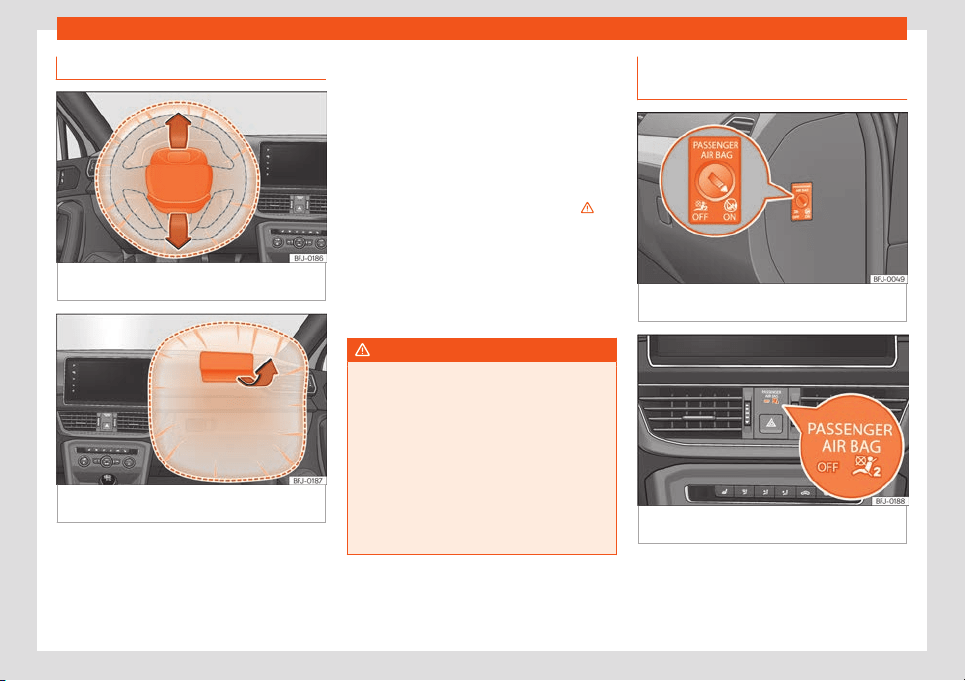
Front airbags
Fig. 15
Driver airbag located in steering
wheel
.
Fig. 16 Front passenger airbag located in
dash panel
.
The driver's front airbag is housed in the
st
eering wheel and that of the front passen-
ger, on the dash panel. Airbags are identified
by the word “AIRBAG”.
The airbag covers fold open and remain at-
tached to the steering wheel
›››
Fig. 15 and
the dash panel
›››
Fig. 16when the driver and
front passenger airbags, respectively, are
triggered.
In conjunction with the seat belts, the front
airbag system gives the front occupants ad-
ditional protection for the head and chest in
the event of a severe frontal collision
›››
.
Their special design all
ows the controlled es-
cape of the propellant gas when an occu-
pant puts pressure on the bag. Thus, the
head and chest are protected by the airbag.
After the collision, the airbag deflates suffi-
ciently to allow visibility.
WARNING
●
The depl
oyment space between the front
passengers and the airbags must not in
any case be occupied by other passenger,
pets and objects.
●
The airbags provide protection for just
one accident; replace them once they have
deployed.
●
It is also important not to attach any ob-
jects such as cup holders or telephone
mountings to the surfaces covering the air-
bag units.
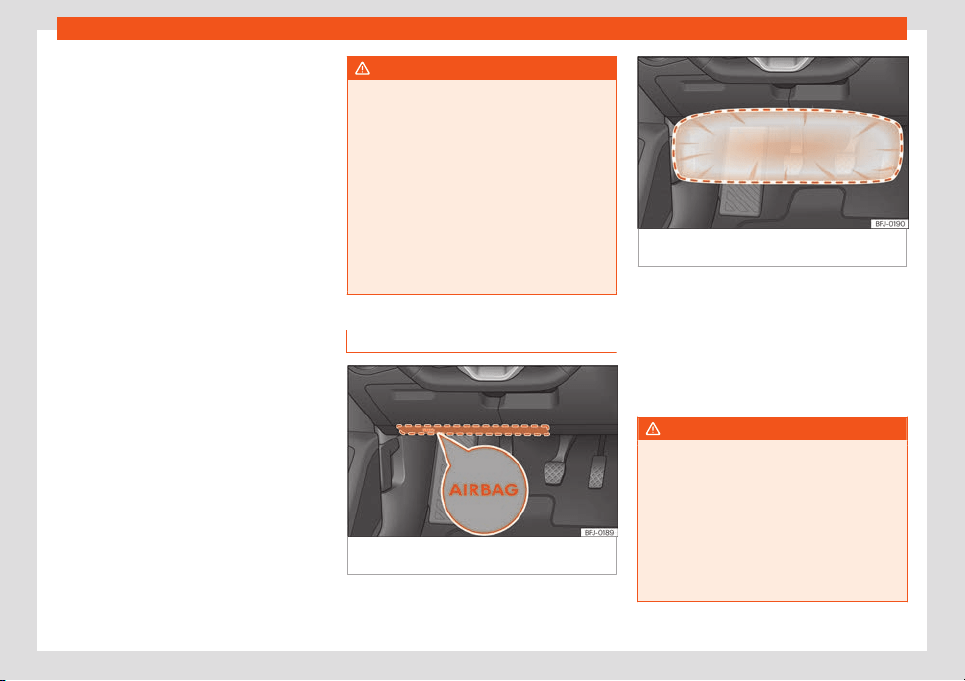
Activate and deactivate front pas-
senger fr
ont airbag
Fig. 17
Switch for activating and deactivating
the fr
ont passenger airbag.
Fig. 18
Dash panel: control lamp for the deac-
tiv
ation of the front passenger front airbag.
Deactivate the front passenger front airbag
only if you hav
e to use a rear-facing child
seat in the front passenger seat.
28
Airbag system
SEAT recommends fitting the child seat in the
r
ear seat to avoid having to deactivate the
front passenger airbag.
When the front passenger airbag is deacti-
vated, this means that only the front passen-
ger front airbag is deactivated. All the other
airbags in the vehicle remain activated.
Deactivate and activate the front passen-
ger front airbag
●
Switch the ignition off.
●
Open the door on the front passenger side.
●
Insert the key into the slot of the switch for
deactivating the front passenger airbag
›››
Fig. 17. About 3/4 of the key should enter;
this is as far as it will go.
●
Turn the key gently to change its position to
(deactivate) or to (activate). If you have
difficulty, ensure that you have inserted the
key as far as it will go.
●
Close the front passenger door.
●
When deactivating the airbag, switch the
ignition on and check that the control lamp
with the lettering re-
mains lit in the middle of the dash panel
›››
Fig. 18.
●
When reactivating the airbag, check that
when the ignition is switched on, the
control lamp does not light up and the
lamp lights up for 60 seconds and then turns
off.
WARNING
●
The driv
er of the vehicle is responsible for
disabling or switching on the airbag.
●
Always switch off the ignition before dis-
abling the front passenger airbag! Failure
to do so could result in a fault in the airbag
deactivation system.
●
Never leave the key in the airbag disa-
bling switch as it could get damaged or en-
able or disable the airbag during driving.
●
If for any reason an airbag is deactivated,
reactivate it as soon as possible so that it
can fulfil its protective function.
Knee airbag
Fig. 19 On the driver side: location of the knee
airbag
Fig. 20 On the driver side: airbag action radius
f
or the knees.
The knee airbag is located on the driver side
bel
ow the dash panel
›››
Fig. 19. Airbags are
identified by the word “AIRBAG”.
The area framed in red (deployment area)
›››
Fig. 20 is covered by the knee airbag
when it is deployed. Objects should never be
placed or mounted in this area.
WARNING
●
The knee airbag is depl
oyed in front of
the driver's knees. Always keep the deploy-
ment areas of the knee airbags free.
●
Never not fix objects to the cover or in the
deployment area of the knee airbag.
●
Adjust the driver's seat so that there is a
distance of at least 10 cm (4 inches) be-
tween your knees and the location of the
this airbag. If your physical constitution
»
29
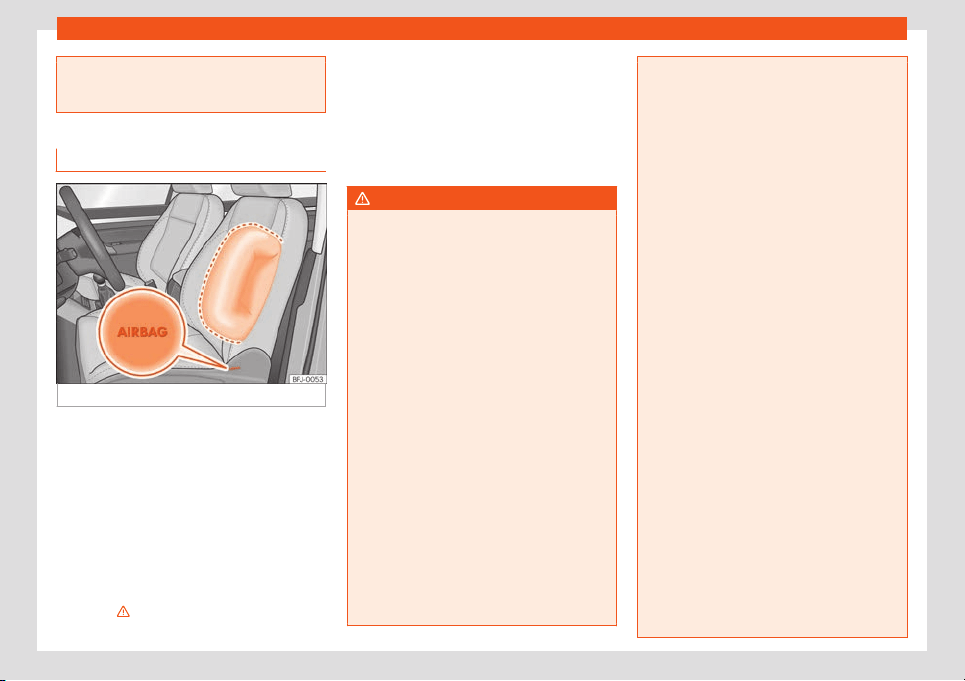
Safety
prevents you from meeting these require-
ments, mak
e sure you contact a special-
ised workshop.
Side airbags
Fig. 21 Side airbag in driver's seat.
The side airbags are located in the driver's
seat and fr
ont passenger seat backrests
›››
Fig. 21.
The locations are identified by the text “AIR-
BAG” in the lower region of the backrests.
In conjunction with the seat belts, the side air-
bags system gives additional protection for
the head and upper body in the event of a
severe side collision and, depending on the
features, also in the event of the vehicle over-
turning
›››
.
In a side collision, the side airbags reduce the
risk of injury t
o passengers to the areas of the
body facing the impact. In addition to their
normal protection, the seat belts also hold
the passengers in the event of a side collision;
this is how these airbags provide maximum
protection.
WARNING
●
If you do not w
ear a seat belt, if you lean
forward, or are not seated correctly while
the vehicle is in motion, you are at a greater
risk of injury if the side airbag system is
triggered in an accident.
●
In order for the side airbags to provide
their maximum protection, the prescribed
sitting position must always be maintained
with seat belts fastened while travelling.
●
In a side-on collision the side airbags will
not work if the sensors do not correctly
measure the pressure increase on the inte-
rior of the doors, due to air escaping
through the areas with holes or openings in
the door panel.
●
Never drive if the interior door panels
have been removed or if the panels have
not been correctly fitted.
●
Never drive the vehicle if the loudspeak-
ers in the door panels have been removed,
unless the holes left by the loudspeakers
have been closed properly.
●
Always check that the openings are
closed or covered if loudspeakers or other
equipment are fitted inside the door pan-
el
s.
●
Occupants of the outer seats must never
carry any objects or pets in the deploy-
ment space between them and the airbags,
or allow children or other passengers to
travel in this position. It is also important
not to attach any accessories (such as cup
holders) to the doors. This would impair the
protection offered by the side airbags.
●
The built-in coat hooks should be used
only for lightweight clothing. Do not leave
any heavy or sharp-edged objects in the
pockets.
●
Great forces, such as hard blows or kicks,
must not be exerted upon the backrest bol-
ster because the system may be damaged.
In this case, the side airbags would not be
triggered.
●
Under no circumstances should protec-
tive covers be fitted over seats with side
airbags unless the covers have been ap-
proved for use in your vehicle. Because the
airbag deploys from the side of the back-
rest, the use of conventional seat covers
would obstruct the side airbag, seriously
reducing the airbag's effectiveness.
●
Any damage to the original seat uphols-
tery or around the seams of the side airbag
units must be repaired immediately by a
specialised workshop.
●
The airbags provide protection for just
one accident; replace them once they have
deployed.
30
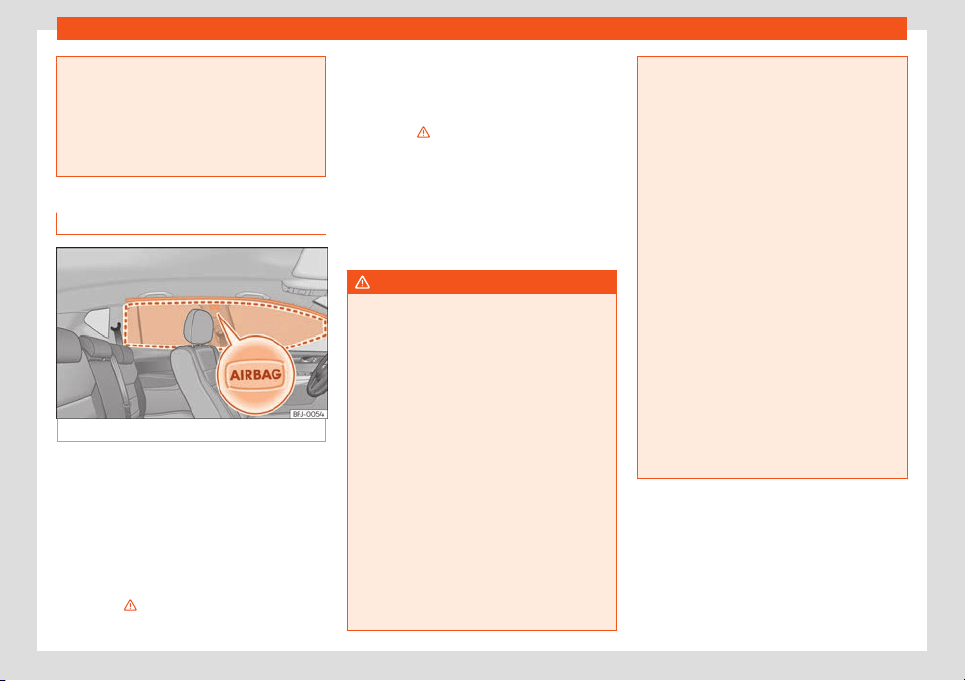
Airbag system
●
Any w
ork on the side airbag system or re-
moval and installation of the airbag com-
ponents for other repairs (such as removal
of the front seat) should only be performed
by a specialised workshop. Otherwise,
faults may occur during the airbag system
operation.
Head-protection airbags
Fig. 22
Location of head-protection airbags.
The head-protection airbags are located on
both sides in the int
erior above the doors
›››
Fig. 22 and are identified with the text “AIR-
BAG”.
In conjunction with the seat belts, the head-
protection airbag system gives the vehicle
occupants additional protection for the head
and upper body in the event of a severe side
collision
›››
.
The area framed in red is covered by the
head-pr
otection airbag when it is deployed
›››
Fig. 22 (deployment area). Therefore, ob-
jects should never be placed or mounted in
this area
›››
.
In the e
vent of a side collision the head-pro-
tection airbag is triggered on the impact side
of the vehicle.
The head-protection airbags reduce the risk
of injury to passengers in the front and rear
side seats facing the impact.
WARNING
●
In or
der for the head-protection airbags
to provide their maximum protection, the
prescribed sitting position must always be
maintained with seat belts fastened while
travelling.
●
For safety reasons, the head-protection
airbag must be disabled in those vehicles
fitted with a screen dividing the interior of
the vehicle. See your technical service to
make this adjustment.
●
There must be no other persons, animals
or objects between the occupants of the
outer seats and the deployment space of
the head-protection airbags so that the
head-protection airbag can deploy com-
pletely without restriction and provide the
greatest possible protection. Therefore,
sun blinds which have not been expressly
approved for use in your vehicle may not be
attached to the side windows.
●
The built
-in coat hooks should be used
only for lightweight clothing. Do not leave
any heavy or sharp-edged objects in the
pockets. Please, do not hang the clothes on
coat hangers.
●
The airbags provide protection for just
one accident; replace them once they have
deployed.
●
Any work on the head-protection airbag
system or removal and installation of the
airbag components for other repairs (such
as removal of the roof lining) should only
be performed by a specialised workshop.
Otherwise, faults may occur during the air-
bag system operation.
●
The side and head airbags are managed
through sensors located in the interior of
the front doors. To ensure the correct oper-
ation of the side and head-protection air-
bags neither the doors nor the door panels
should be modified in any way (e.g. fitting
loudspeakers). If the front door is dam-
aged, the airbag system may not work cor-
rectly. All work carried out on the front door
must be done in a specialised workshop.
31
Safety
Transporting children
saf
ely
Child safety
Introduction
For safety reasons, as we have learned from
accident st
atistics, we recommend that chil-
dren under 12 years of age travel in the rear
seats. Depending on their age, height and
weight, children travelling in rear seats must
use a child seat or a seat belt. For safety rea-
sons, the child seat should be installed in the
rear seat, behind the front passenger seat or
in the centre back seat.
The physical laws involved and the forces
acting in a collision apply also to children
›››
page 19. But unlike adults, children do not
have fully developed muscle and bone struc-
tures. This means that children are subject to
a greater risk of injury.
To reduce the risk of injuries, children must al-
ways use special child restraint systems
when travelling in the vehicle.
We recommend the use of child safety prod-
ucts from the SEAT Original Accessories Pro-
gramme, which includes systems for all ages
made by “Peke” (not for all countries) (see
www.seat.com).
These systems have been especially de-
signed and appr
oved, complying with the
ECE-R44. regulation.
SEAT recommends securing the child seats
shown on the website as described below:
●
Child seats in the opposite direction of trav-
el (group 0+): ISOFIX and support peg (RO-
MER BABY SAFE PLUS SHR II + ISOFIX BASE /
PEKE G0 I-SIZE + I-SIZE BASE).
●
Child seats in the direction of travel (group
1): ISOFIX and Top Tether (ROMER DUO PLUS
+ TOP TETHER / PEKE G1 TRIFIX I-SIZE).
●
Child seats directed towards the front of
the vehicle (group 2): safety belt and ISOFIX
(ROMER KIDFIX XP).
●
Child seats directed towards the front of
the vehicle (group 3): safety belt and ISOFIX
(ROMER KIDFIX XP).
Follow the manufacturer's instructions and
observe any statutory requirements when in-
stalling and using child seats. Always read
and note
›››
page 33.
We recommend you always carry the manu-
facturer's Child Seat Instruction Manual to-
gether with the on-board documentation.
Child seats group classification
Fig. 23
Examples of child seats.
Use only child seats that are officially ap-
pr
oved and suitable for the child.
These seats are subject to the ECE-R44 or
ECE-R129 standards. ECE-R stands for: Eco-
nomic Commission for Europe Regulation.
Child seats by weight group
The child seats are grouped into 5 catego-
ries:
Age group Weight of the child
Group 0 Up to 10 kg
Group 0+ Up to 13 kg
Group 1 From 9 to 18 kg
Group 2 From 15 to 25 kg
Group 3 From 22 to 36 kg
32
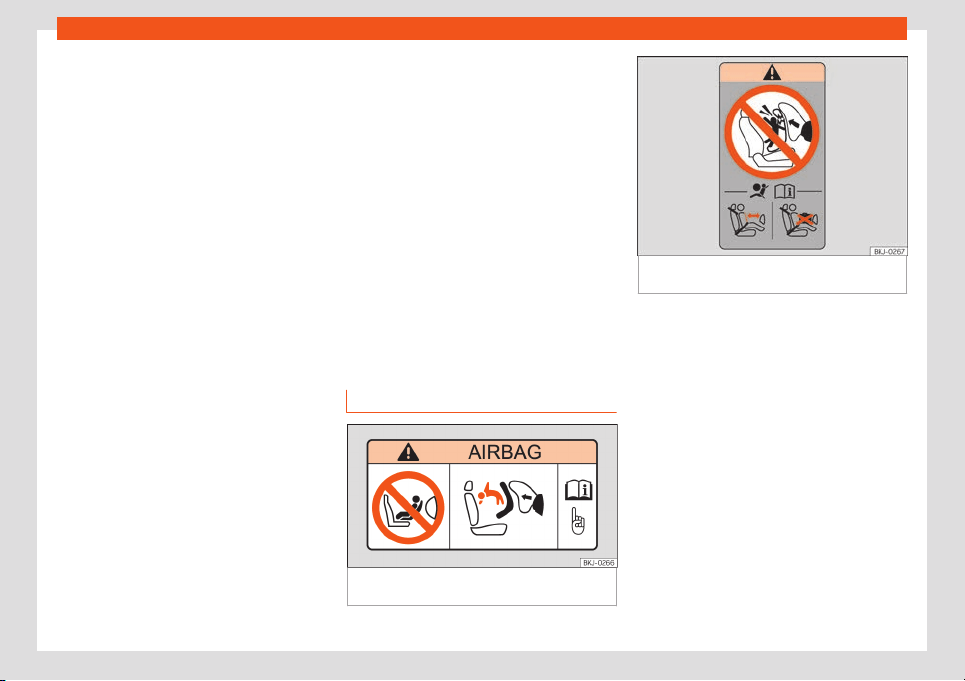
Transporting children safely
Child seats that have been tested and ap-
pr
oved under the ECE R44 or ECE-R129
standards bear the ECE-R44 or ECE-R129
test marks on the seat (the letter E in a circle
with the test number below it).
Follow the manufacturer's instructions and
observe any statutory requirements when in-
stalling and using child seats.
We recommend you to always include the
manufacturer's Child Seat Instruction Manual
together with the on-board documentation.
SEAT recommends you use child seats from
the Original Accessories Catalogue. These
child seats have been designed and tested
for use in SEAT vehicles. You can find the right
child seat for your model and age group at
SEAT dealers.
Child seats by approval category
Child seats may have the approval category
of universal, semi-universal, vehicle specific
(all according to the ECE-R44 standard) or i-
Size (according to the ECE-R129 standard).
●
Universal: child seats with universal appro-
val can be installed in all vehicles. There is no
need to consult any list of models. In the case
of universal approval for ISOFIX, the child
seat is additionally provided with a Top Tether
belt.
●
Semi-universal: semi-universal approval,
in addition to the standard requirements of
universal approval, requires safety devices to
lock the child seat, which require additional
testing. Child seats with semi-universal ap-
proval include a list of vehicle models for
which they can be installed.
●
Vehicle-specific: vehicle-specific approval
requires a dynamic test of the child seat for
each vehicle model separately. Child seats
with vehicle-specific approval also include a
list of vehicle models for which they can be
installed.
●
i-Size: child seats with i-Size approval must
meet the requirements set out in the ECE-
R129 standard in relation to installation and
safety. Child seat manufacturers can tell you
which seats have i-Size approval for this vehi-
cle.
Fitting and using child seats
Fig. 24 Airbag sticker: on the passenger’s sun
visor
Fig. 25 Airbag sticker: on the rear frame of the
passenger side door
Warnings about fitting a child seat
T
ake the following general warnings into ac-
count if you are going to fit a child seat. They
are valid for all child seats regardless of their
attachment system.
●
Please read and follow the child seat man-
ufacturer's operating instructions.
●
The child seat should preferably be fitted to
the rear seat behind the front passenger seat
so that the child can exit the vehicle on the
pavement side.
●
Set the height of the seat belt such that it
adapts to the child seat naturally, without
twisting. The lowest position of the seat belt
height regulator must be used with rear-fac-
ing child seats.
»
33
Safety
●
T
o correctly use a child seat in the back,
the front backrest must be adjusted so that
there is no contact with the child seat in the
back in the case that it goes opposite to the
direction of the car. In the case of front facing
restraint systems, the front backrest must be
adjusted so that there is no contact with the
child's feet.
●
If a semi-universal type chair is to be instal-
led, in which the method of attachment to the
car is through the seat belt and support
bracket, it should never be installed in the
central rear seat as the ground clearance is
lower than in other places and the support
bracket will not allow the seat to remain suffi-
ciently stable.
●
For a correct assembly of the children's
seat on the second row, adjust or dismount
the headrest, in order to prevent contact with
the chair.
●
When fitting a child seat on the front pas-
senger seat, the seat must be moved back-
wards as far as possible and placed in the
highest position. The backrest must also be
put in a vertical position
1)
.
Important information about the front pas-
senger front airbag
A sticker with important information about the
passenger airbag is located on the passeng-
er's sun visor and/or on the passenger side
door frame
›››
Fig. 24.
Read and always observe the safety informa-
tion included in the following chapters:
●
Safety distance with respect to the passen-
ger airbag
›››
page 25.
●
Objects between the passenger and the
passenger side airbag
›››
in Front airbags
on page 28.
The passenger side fr
ont airbag, when ena-
bled, is a serious risk for a child that is facing
backward since the airbag can strike the seat
with such force that it can cause serious or
fatal injuries. Children up to 12 years old
should always travel on the rear seat.
Therefore we strongly recommend you to
transport children on the rear seats. This is
the safest location in the vehicle. Alternative-
ly, the front passenger airbag can be disa-
bled with a key-operated switch
›››
page 28.
When transporting children, use a child seat
suitable for the age and size of each child
›››
page 32.
WARNING
●
If a chil
d seat is secured to the front pas-
senger seat, the risk to the child of sustain-
ing critical or fatal injuries in the event of an
accident increases.
●
An inflating front passenger airbag can
strike the rear-facing child seat and project
it with great force against the door, the roof
or the backrest.
●
Never install a child seat facing back-
wards on the front passenger seat unless
the front passenger front airbag has been
disabled. Risk of potentially fatal injuries to
the child! However, if necessary, the front
passenger front airbag must be deactiva-
ted
›››
page 28. If the passenger seat has a
height adjustment option, move it to the
highest, most upright position. If you have a
fixed seat, do not install any child restraint
system in this location.
●
For those vehicles that do not include a
key lock switch to deactivate the airbag,
the vehicle must be taken to a technical
service. Do not forget to reconnect the air-
bag when an adult wants to sit in the front
passenger seat.
●
Never allow a child to be transported in a
vehicle without being properly secured, or
to stand up or kneel on a seat while
1)
Compliance with current national legislation
and the manuf
acturer's instructions is required
when using or installing child seats.
34
Transporting children safely
travelling. In an accident, the child could
be flung thr
ough the vehicle, causing possi-
bly fatal injuries to themselves and to the
other vehicle occupants.
●
Never leave a child alone in the child seat
or in the vehicle.
●
Children who are less than 1.5 metres tall
must not wear a normal seat belt without a
child seat, as this could cause injuries to
the abdominal and neck areas during a
sudden braking manoeuvre or in an acci-
dent.
●
When a child seat is mounted in the rear
seats, the door child-proof lock should be
activated
›››
page 106.
Attachment systems
Depending on the country, different attach-
ment syst
ems are used for safely installing
child seats.
Attachment systems overview
●
ISOFIX: ISOFIX is a standardised attach-
ment system allowing quick and safe attach-
ment of child seats in the vehicle. ISOFIX at-
tachment establishes a rigid connection be-
tween the child seat and the car body.
The child seat has two rigid attachment clips,
called connectors. These connectors are fit-
ted into the ISOFIX attachment rings found
between the seat cushion and the backrest
of the vehicle's back seat (on the sides). ISO-
FIX attachment systems are used mainly in
Europe
›››
page 36. If necessary, ISOFIX at-
tachment may have to be supplemented with
a Top Tether belt or a support bracket.
●
Automatic three-point seat belt. When-
ever possible, it is preferable to attach the
child seats with the ISOFIX system rather than
attaching them with an automatic three-point
seat belt
›››
page 40.
Additional attachment:
●
Top Tether: the Top Tether belt is guided
over the back of the rear seat and attached
to an anchor point with a hook. Anchor points
are located at the back of the rear seat back-
rest on the boot side
›››
page 39. The rings
for retaining the Top Tether belt are marked
with an anchor symbol.
●
Support bracket: some child seats rest on
the floor of the vehicle with a support bracket.
The support bracket prevents the child seat
from tipping forward in the event of impact.
Child seats fitted with a support bracket
should only be used in the passenger seat
and side rear seats
›››
. For the assembly of
this t
ype of seat you should also consult the
list of approved vehicles for this assembly,
available in the instructions for child restraint
systems.
Recommended systems for attaching
child seats
SEAT recommends attaching child seats as
follows:
●
Baby carriers or child seats in the oppo-
site direction of travel: ISOFIX and support
bracket or i-Size.
●
Child seats in the direction of travel: ISO-
FIX and Top Tether.
WARNING
Incorrect use of the support bracket can
cause serious or f
atal injury.
●
Make sure the support bracket is correct-
ly and safely installed.
35
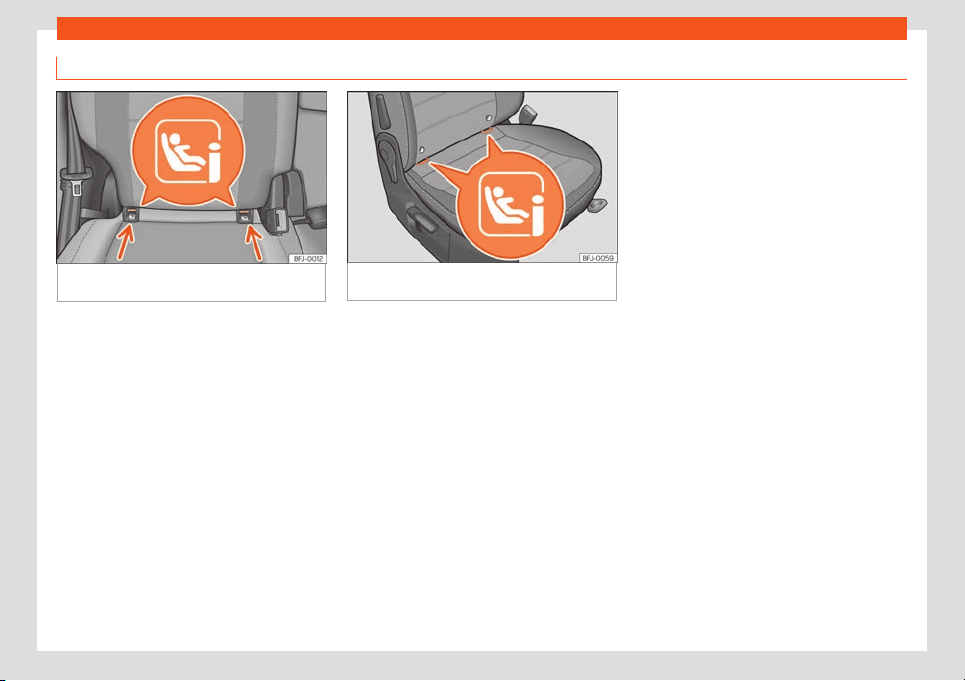
Safety
Securing the child seat with the “ISOFIX” and Top Tether system
Fig. 26 Side seats of the second row: ISOFIX/i-
Siz
e securing rings.
Fig. 27 Front passenger seat: ISOFIX securing
rings.
Child seats can be secured quickly, easily
and saf
ely on the rear side seats of the sec-
ond row of seats and the front passenger
seat with the “ISOFIX” and Top Tether system.
Each of the side rear side seats of the second
row of seats and the front passenger seat has
two “ISOFIX” fastening rings. In some vehicles,
the rings are secured to the seat frame. The
“ISOFIX” rings are located between the back-
rest and the seat cushioning of the rear seat
›››
Fig. 26 and of the front passenger seat
›››
Fig. 27.
The Top Tether rings are located on the rear
part of the backrests of the rear seats (be-
hind the seat backrest or in the boot)
›››
Fig. 28. For the front passenger seat, the
ring is below the backrest
›››
Fig. 29.
To understand the compatibility of the "ISO-
FIX" systems in the vehicle, consult the table
below.
36
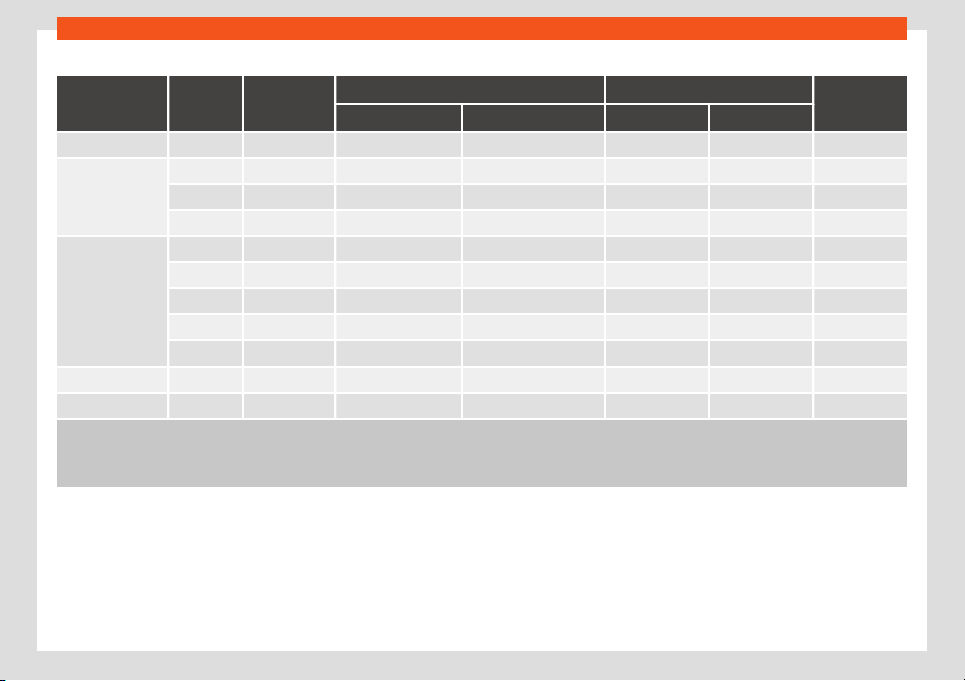
Transporting children safely
Vehicle ISOFIX positions
Weight group
Size
cl
ass
a)
Electrical
equipment
Front passenger seat Second row of seats:
Third row of
seats
b)
airbag enabled airbag disabled side centre
Group 0 to 10 kg E ISO/R1 X IL IL X X
Group 0+ to 13 kg
E ISO/R1 X IL IL X X
D ISO/R2 X IL IL X X
C ISO/R3 X IL IL X X
Group I 9 to 18 kg
D ISO/R2 X IL IL X X
C ISO/R3 X IL IL X X
B ISO/F2 X IL, IUF IL, IUF X X
B1 ISO/F2X X IL, IUF IL, IUF X X
A ISO/F3 X IL, IUF IL, IUF X X
Group II 15 to 25 kg --- --- X IL IL X X
Group III 22 to 36 kg --- --- X IL IL X X
IUF: Suitable for forward-facing ISOFIX universal child restraint systems approved for use in this weight group.
IL
: It is suitable for certain ISOFIX child restraint systems (CRS) that can be for the specific vehicle, restricted or semi-universal categories. Take the child seat manufacturer's
vehicle list into account.
X: ISOFIX position not suitable for ISOFIX child restraint systems for this weight group or size class.
a)
The indication of class according to size corresponds to the authorised bodyweight for the child seat. In child seats with universal or semi-universal approval, the class
accor
ding to size is indicated on the ECE approval label. The indication of class according to size is stated on the corresponding child seat.
b)
Third row not available for all versions.
»
37
Safety
Vehicle i-Size positions
Front passenger seat Second row of seats:
Third row of seats
a)
airbag enabled airbag disabled side centre
X i-U i-U X X
i-U: Position suitable for forward- or rear-facing i-Size child restraint systems with universal certification.
X
: Position not suitable for i-Size child restraint systems.
a)
Third row not available for all versions.
Securing the child seat with the “ISOFIX/i-
Siz
e” system
You must follow the child seat manufacturer's
instructions.
●
Press the child seat onto the “ISOFIX” re-
taining rings
›››
Fig. 26 and
›››
Fig. 27 until the
child seat is heard to engage securely. If the
child seat is equipped with Top Tether anchor
points, secure it to the correspondent ring
›››
page 39. Follow the child seat manufac-
turer’s instructions.
●
Pull on both sides of the child seat to ensure
that it is properly anchored.
Child seats with the “ISOFIX” and Top Tether
attachment system are available from Tech-
nical Services.
WARNING
The securing rings are designed only for
use with “ISOFIX” and Top Tether system
child seats.
●
Ne
ver secure other child seats that do
not have the “ISOFIX” or Top Tether system,
or safety belts or any other objects to the
securing rings – as this can result in poten-
tially fatal injuries to the child.
●
Ensure that the child seat is correctly se-
cured to the “ISOFIX” and Top Tether secur-
ing rings.
38
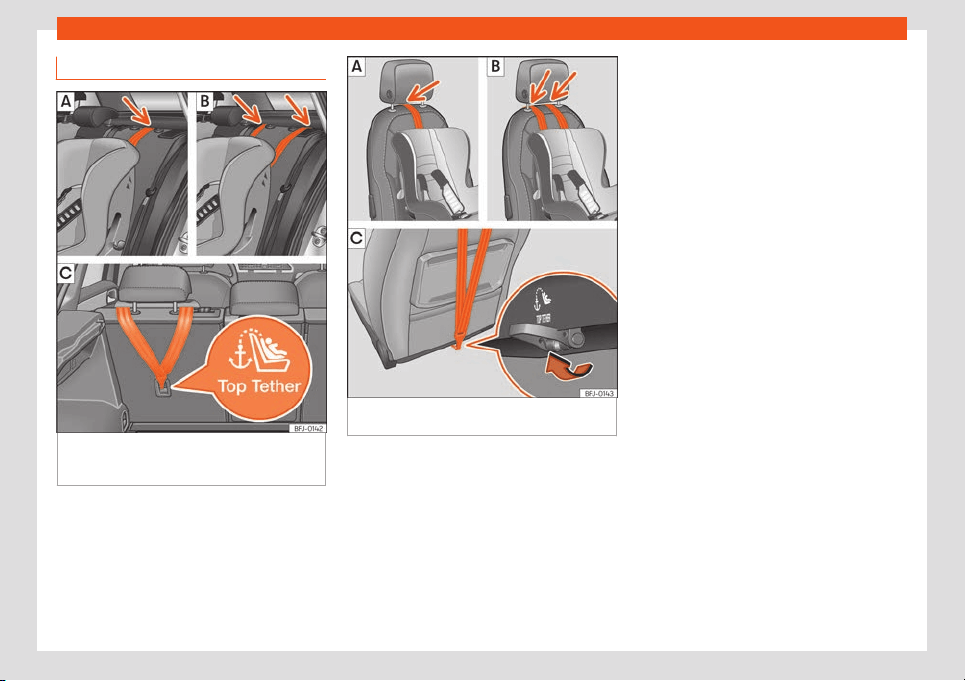
Transporting children safely
Top Tether securing belts
Fig. 28
Side seats of the second row: adjust-
ment and assembly accor
ding to the Top Tether
belt.
Fig. 29 Front passenger seat: adjustment and
assembly accor
ding to the Top Tether belt.
Child seats with the Top Tether system come
with a str
ap for securing the seat to the vehi-
cle anchor point and provide greater re-
straint.
The objective of this strap is to reduce for-
ward movements of the child seat in a crash,
to reduce the risk of injuries to the head from
hitting the inside of the vehicle.
Using the Top Tether in rear-facing moun-
ted seats
Currently, there are very few rear-facing child
safety seats that have Top Tether. Please
carefully read and follow the seat manufac-
turer instructions to learn the proper way to
install the Top Tether strap.
Securing the retainer strap
●
Follow the manufacturer's instructions to
deploy the child seat Top Tether retaining
strap.
●
Position the belt under the headrest (de-
pending on the instructions of the seat itself,
lift or remove the headrest if necessary)
›››
Fig. 28 /,
›››
Fig. 29 /.
●
Slide the strap and secure it properly with
the anchorage of the backrest
›››
Fig. 28 ,
›››
Fig. 29 .
●
Firmly tighten the strap following the manu-
facturer's instructions.
Releasing the retaining strap
●
Loosen the strap following the manufactur-
er's instructions.
●
Push the lock and release it from the an-
choring support.
»
39
Safety
WARNING
An undue installation of the safety seat will
incr
ease the risk of injury in the event of a
crash.
●
Ne
ver tie the retainer strap to a hook in
the luggage compartment.
●
Never secure or tie luggage or other
items to the lower anchorages (ISOFIX) or
the upper ones (Top Tether).
Fitting a child seat using the seat belt
If you want to fit a universal approval catego-
ry (U) chil
d seat in your vehicle, you must
check that the seat is approved for your vehi-
cle. You will find any necessary information
on the child seat’s orange ECE approval la-
bel. The following table shows the different
fitting options.
Weight group
Front passenger seat
a)
Second row of seats:
Third row of seats
b)
airbag enabled airbag disabled
c)
side centre
d)
Group 0 to 10 kg X U U U X
Group 0+ to 13 kg X U U U X
Group I 9 to 18 kg X U U U X
Group II 15 to 25 kg X UF UF UF X
Group III 22 to 36 kg X UF UF UF X
X: Not compatible for the installation of seats install chairs in this configuration.
U: Suit
able for universal restraint systems for use in this weight group.
UF: Acceptable for front-facing universal-category child restraint systems approved for this mass group.
a)
Compliance with current national legislation and the manufacturer's instructions is required when using or installing child seats.
b)
Third row not available for all versions.
c)
Seats without height adjustment shoul
d be placed in their rearmost position. Seats with height adjustment should be placed in their rearmost and highest position.
d)
For semi-universal chairs where the securing system is the car safety belt and the support bracket, do not use them in the centre rear seat or the third row.
40
Transporting children safely
Fitting a child seat using the seat belt
●
Set the height of the seat belt such that it
adapts t
o the child seat naturally, without
twisting. The lowest position of the seat belt
height regulator must be used with rear-fac-
ing child seats.
●
Put the seat belt in place and pass it
through the child seat according to the in-
structions of the child seat manufacturer.
●
Make sure that the seat belt is not twisted.
●
Insert the latch plate into the seat's buckle
until you hear the engagement click.
WARNING
When travelling, children must be secured
in the v
ehicle with a restraint system suita-
ble for age, weight and size.
●
Read and always observe information
and warnings concerning the use of child
seats
›››
page 33.
41
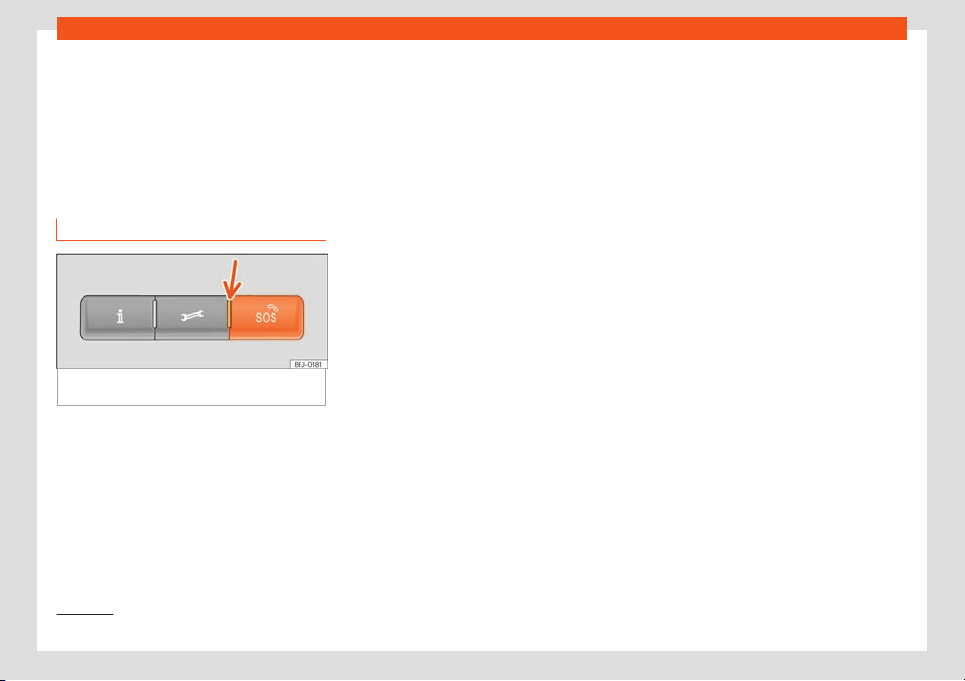
Emergencies
Emergencies
Self
-help
Information, assistance and
emergency call service
How it works
Fig. 30
On the roof console: voice service
contr
ols
Depending on the equipment, there is a con-
tr
ol on the roof console.
By pressing the buttons , and
›››
Fig. 30, you can run the following voice
services:
●
information call
●
assistance call
●
emergency call service.
A built-in control unit establishes the connec-
tion.
When a voice service is activated, a connec-
tion is established with a phone line.
Control lamp
The control has a warning lamp
›››
Fig. 30
(arrow). It shows the following statuses:
●
Off: the eCall service is not available.
●
Flashes red, approx. 20 seconds after
switching on the ignition: the eCall service
is off.
●
Lights up red: system failure. The eCall
service is available with certain restrictions.
SEAT suggests going to a specialised work-
shop.
●
Lights up green: the eCall service is avail-
able. The system works correctly.
●
Flashes green: There is an ongoing voice
connection.
Information call
1)
With the information call, a call is made to
SEAT, S.A. customer service.
Assistance call
1)
With the assistance call you can directly re-
quest specialised help in the event of a
breakdown.
Parallel to the voice call, some vehicle data is
transmitted, e.g. your current location.
Emergency call service
1)
If an emergency call is conducted manually
or activated automatically in the event of an
accident with an airbag triggering, informa-
tion relevant to the emergency is broadcast,
e.g. the current location of the vehicle
›››
page 375.
If the call is public, the person on the other
end of the line uses the language of the
country in which you are located.
If the call is private, the person on the other
end of the line will assist you in the language
you have configured in the Infotainment sys-
tem. If the configured language is not availa-
ble, English will be used.
Diversion to 112 emergency number
In some situations where the emergency call
service is limited or cannot be carried out, an
emergency call is made to 112.
1)
Only available in certain countries.
42
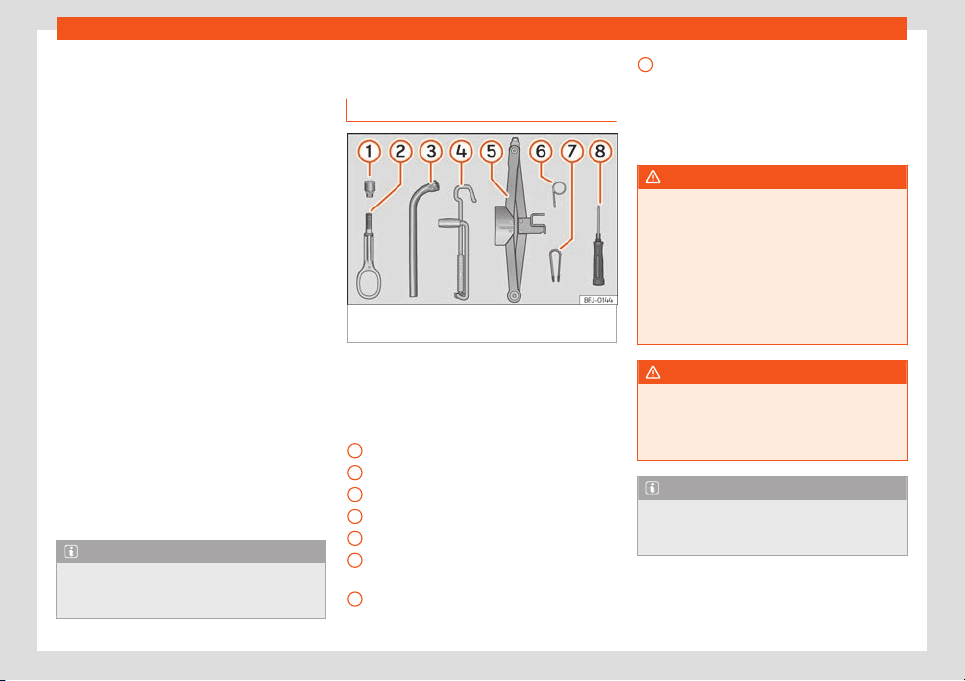
Self-help
The following conditions may cause the
emer
gency call service to function in a limi-
ted manner or the call to be diverted to the
112 emergency number:
●
The emergency call is made from an area
with weak or no mobile and GPS signal, as
well as e.g. tunnels, between very tall build-
ings, garages, underground walkways, moun-
tains and valleys.
●
In areas with sufficient mobile telephone
and GPS coverage, the mobile telephone
network of the telecommunications operator
in question may not be available.
●
In some countries, the emergency call serv-
ice may not be available due to legal rea-
sons. There is no valid license for the use of
the emergency call service.
●
The components of the vehicle required for
the emergency phone call are damaged or
do not get enough power.
●
In some countries, the emergency call serv-
ice may not be available and depending on
the location of the vehicle, the control lamp
LEDs, and even the operation of the different
types of calls, could have a specific behav-
iour.
Note
Breakdown service and information calls
can incur an additional cost on your t
ele-
phone bill.
Emergency equipment
V
ehicle tool kit
Fig. 31 Underneath the floor panel of the lug-
gage compartment: v
ehicle tool kit.
The vehicle tool kit is located under the floor
panel in the luggage compartment. T
o ac-
cess the vehicle tools
›››
page 140.
The tool kit includes:
Adapter for the anti-theft bolt
Towing eye, removable
Wheel spanner
Crank handle for jack
Jack
Hook for extracting the central wheel
trims
Clip for removing the wheel bolt caps
1
2
3
4
5
6
7
Screwdriver with hexagon socket in the
handl
e for screwing and unscrewing the
wheel nuts
Some of the items listed are only provided in
certain model versions, or are optional extras.
WARNING
When the vehicle tool kit, tyre mobility set
and spar
e wheel are loose in the interior
they can be violently thrown in case of a
sudden manoeuvre or braking and espe-
cially in accidents, causing serious injury.
●
Ensure that the vehicle tool kit, the tyre
mobility set and the spare wheel or tempo-
rary spare wheel are safely secured in the
luggage compartment.
WARNING
Unsuitable or damaged vehicle tools can
cause injury or accidents.
●
Never work with inappropriate or dam-
aged t
ools.
Note
The jack does not generally require any
maint
enance. If required, it should be
greased using universal type grease.
8
43
Emergencies
Tyre repairs
T
MS (Tyre Mobility System)
The Tyre Mobility System will reliably seal
punct
ures caused by the penetration of a for-
eign body of up to about 4 mm in diameter.
Do not remove foreign objects, e.g. screws
or nails, from the tyre.
After inserting the sealant residue in the tyre,
you must again check the tyre pressure
about 10 minutes after starting the engine.
You should only use the tyre mobility set if the
vehicle is parked in a safe place, you are fa-
miliar with the procedure and you have the
necessary tyre mobility set! Otherwise, you
should seek professional assistance.
Do not use the tyre sealant in the following
cases:
●
If the wheel rim has been damaged.
●
In outside temperatures below -20°C
(-4°F).
●
In the event of cuts or perforations in the
t
yre greater than 4 mm.
●
If you have been driving with very low pres-
sure or a completely flat tyre.
●
If the sealant bottle has passed its use by
date.
WARNING
Using the tyre mobility system can be dan-
ger
ous, especially when filling the tyre at
the roadside. Please observe the following
rules to minimise the risk of injury:
●
Stop the vehicle safely as soon as possi-
ble. Park it at a safe distance from sur-
rounding traffic to fill the tyre.
●
Ensure the ground on which you park is
flat and solid.
●
All passengers and particularly children
must keep a safe distance from the work
area.
●
Turn on the hazard warning lights to warn
other road users.
●
Use the tyre mobility system only if you
are familiar with the necessary procedures.
Otherwise, you should seek professional
assistance.
●
The tyre mobility set is intended for tem-
porary emergency use only until you can
reach the nearest specialised workshop.
●
Replace the repaired tyre with the tyre
mobility set as soon as possible.
●
The sealant is a health hazard and must
be cleaned immediately if it comes into
contact with the skin.
●
Always keep the tyre mobility set out of
the reach of small children.
●
Always stop the engine, apply the elec-
tronic parking brake and put it in gear when
using a manual gearbox, in order to reduce
the risk of involuntary movement of the ve-
hicl
e .
WARNING
A tyre filled with sealant does not have the
same perf
ormance properties as a conven-
tional tyre.
●
Never drive faster than 80 km/h
(50 mph).
●
Avoid heavy acceleration, hard braking
and fast cornering.
●
Drive for only 10 minutes at a maximum
speed of 80 km/h (50 mph) and then check
the tyre.
For the sake of the environment
Dispose of used or expired sealant observ-
ing any l
egal requirements.
Note
A new bottle of sealant can be purchased
at SEAT deal
erships.
Note
Take into account the separate instruction
manual of the t
yre mobility system’s manu-
facturer.
44
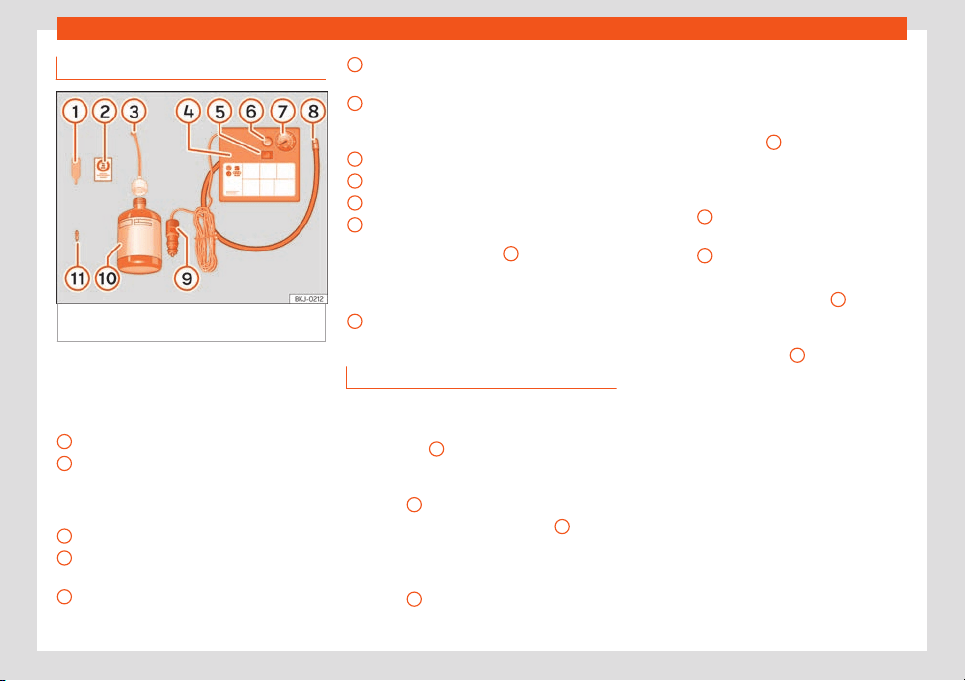
Self-help
Anti-puncture kit contents
Fig. 32
Standard representation: anti-punc-
t
ure kit contents.
The anti-puncture kit is located underneath
the fl
oor covering in the luggage compart-
ment. It includes the following components
›››
Fig. 32:
Valve insert remover
A sticker to be adhered to the instrument
cluster, within the driver's visual field, to
remind that the maximum advisable
speed “max. 80 km/h” or “max. 50 mph”
Filler tube with cap
Air compressor (depending on the ver-
sion, the model may vary).
ON/OFF switch
1
2
3
4
5
Air bleed screw (it can also be integrated
in the infl
ator tube).
Warning provided by tyre pressure moni-
toring system (it can also be integrated in
the inflator tube).
Tube for inflating tyres
12 volt connector
Bottle of sealant
Spare tyre valve
The valve insert remover
1
has a gap at
the l
ower end for a valve insert. The valve in-
sert can only be screwed or unscrewed in this
way. This also applies to its replacement part
11
.
Sealing and inflating a tyre
Sealing the tyre
●
Unscrew the tyre valve cap and insert. Use
the
›
››
Fig. 32
1
tool to remove the insert.
Pl
ace it on a clean surface.
●
Shake the tyre sealant bottle vigorously
›››
Fig. 32
10
.
●
Screw the inflator tube
›
››
Fig. 32
3
into
the seal
ant bottle. The bottle's seal will break
automatically.
●
Remove the lid from the filling tube
›››
Fig. 32
3
and screw the open end of the
t
ube into the tyre valve.
6
7
8
9
10
11
●
With the bottl
e upside down, empty all of
the contents into the tyre.
●
Remove the bottle from the valve.
●
Place the insert back into the tyre valve us-
ing the tool
›››
Fig. 32
1
.
Infl
ating the tyre
●
Screw the compressor tyre inflator tube
›››
Fig. 32
8
into the tyre valve.
●
Check that the air bleed screw is closed
›
››
Fig. 32
6
.
●
Start the engine and leave it running.
●
Insert the connector
›
››
Fig. 32
9
into the
v
ehicle's 12-volt socket
›››
page 155.
●
Turn the air compressor on with the
ON/OFF switch
›››
Fig. 32
5
.
●
Keep the air compressor running until it rea-
ches 2.
0 to 2.5 bar (29-36 psi/200-250 kPa).
A maximum of 8 minutes.
●
Disconnect the air compressor.
●
If it does not reach the pressure indicated,
unscrew the tyre inflator tube from the valve.
●
Move the vehicle 10m so that the sealant is
distributed throughout the tyre.
●
Screw the compressor tyre inflator into the
valve.
●
Repeat the inflation process.
●
If the indicated pressure still cannot be
reached, the tyre is too badly damaged. Stop
»
45
Emergencies
and request assistance from an authorised
t
echnician.
●
Disconnect the air compressor. Unscrew
the tyre inflator tube from the tyre valve.
●
When the tyre pressure is between 2.5 and
2.0 bars, continue driving without exceeding
80 km/h (50 mph).
●
Attach the sticker
›››
Fig. 32
2
to the instru-
ment clust
er, within the driver's visual field.
●
Check the pressure again after 10 minutes
›››
page 46.
WARNING
When inflating the wheel, the air compres-
sor and the infl
ator tube may become hot.
●
Protect hands and skin from hot parts.
●
Do not place the hot flexible inflator tube
or hot air compressor on flammable mate-
rial.
●
Allow them to cool before storing the de-
vice.
●
If it is not possible to inflate the tyre to at
least 2.0 bars (29 psi / 200 kPa), the tyre is
too badly damaged. The sealant is not in a
good condition to seal the tyre. Do not con-
tinue driving. Seek specialist assistance.
CAUTION
Switch off the air compressor after a maxi-
mum of 8 oper
ational minutes to avoid
overheating! Before switching on the air
compressor again, let it cool for several mi-
nut
es.
Check after 10 minutes of driving
Screw the inflator tube
›
››
Fig. 32
5
again
and check the pr
essure on the gauge
6
.
1.3 bar (19 psi / 130 kP
a) and lower:
●
Stop the vehicle! The tyre cannot be
sealed sufficiently with the tyre mobility set.
●
You should obtain professional assistance
›
››
.
1.4 bar (20 psi / 140 kP
a) and higher:
●
Set the tyre pressure to the correct value
again.
●
Carefully resume your journey until you
reach the nearest specialised workshop with-
out exceeding 80 km/h (50 mph).
●
Have the damaged tyre replaced.
WARNING
Driving with an unsealed tyre is dangerous
and can cause accidents and serious in-
jury.
●
Do not continue driving if the tyre pres-
sur
e is 1.3 bar (19 psi / 130 kPa) and lower.
●
Seek specialist assistance.
Changing a wheel
What t
o do first
●
Park the vehicle on a horizontal surface and
in a saf
e place as far away from traffic as
possible.
●
Apply the electronic parking brake.
●
Switch on the hazard warning lights.
●
Manual transmission: select the 1st gear.
●
Automatic transmission: Mo
ve the selector
lever to position P.
●
If you are towing a trailer, unhitch it from
your vehicle.
●
Make sure that the vehicle tool kit
›››
page 43 and the spare wheel
›››
page 361 are ready.
●
Observe the applicable legislation for each
country (reflective vest, warning triangles,
etc.).
●
All occupants should leave the vehicle and
wait in a safe place (for instance behind the
roadside crash barrier).
WARNING
●
Al
ways observe the above steps and pro-
tect yourself and other road users.
●
If you change the wheel on a slope, block
the wheel on the opposite side of the car
with a stone or similar to prevent the vehi-
cle from moving.
46
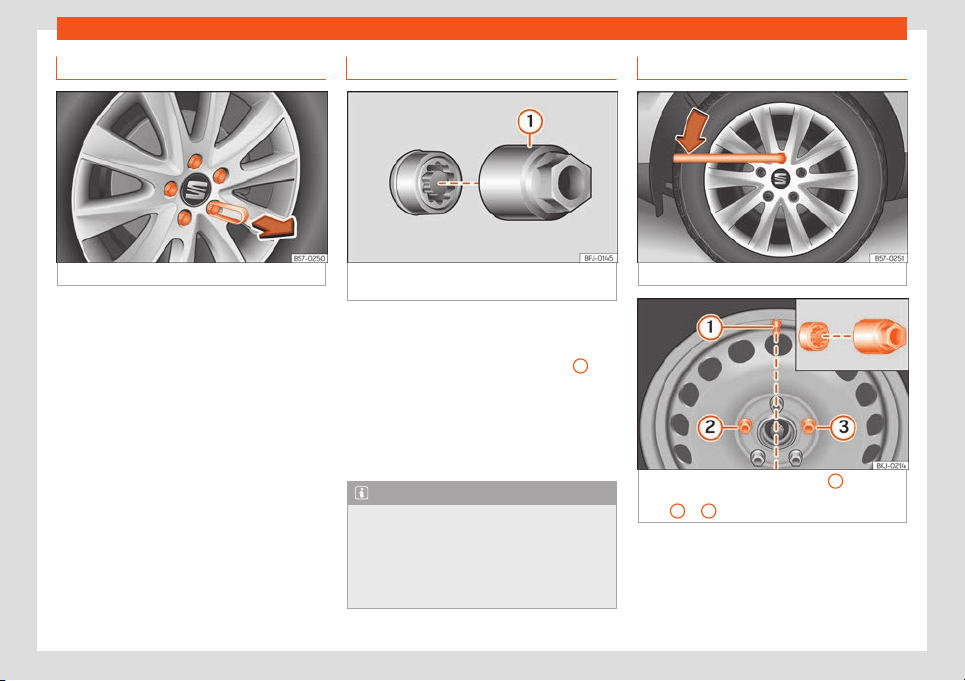
Self-help
Wheel bolt caps
Fig. 33
Wheel: wheel nuts with caps.
Removal
●
Fit the plastic clip (vehicle tools
›
››
Fig. 31)
over the cap until it clicks into place
›››
Fig. 33.
●
Remove the cap with the plastic clip.
The caps protect the wheel nuts and should
be remounted after changing the tyre.
The anti-theft wheel locking bolt has a
special cap. This only fits on anti-theft locking
bolts and is not for use with standard wheel
nuts.
Anti-theft wheel nuts
Fig. 34
Anti-theft wheel bolt with cap and
adapt
er.
Loosening the anti-theft wheel bolt
●
Remove the wheel cover or the cap.
●
Insert the special adapter
›
››
Fig. 34
1
(ve-
hicl
e tools
›››
page 43) onto the anti-theft
wheel bolt and push it on as far as it will go.
●
Insert the wheel brace (vehicle tools) onto
the adapter as far as it will go.
●
Remove the wheel bolt
›››
page 47.
Note
Make a note of the code number of the an-
ti-theft wheel bolt and k
eep it in a safe
place, but not in your vehicle. If you need a
new adapter, you can obtain it from the
SEAT Official Service, indicating the code
number.
Loosening wheel nuts
Fig. 35
Wheel change: loosen the wheel nuts.
Fig. 36
Wheel change: tyre valve
1
and the
corr
ect position for the anti-theft wheel locking
bolt
2
or
3
.
Use only the wheel wrench belonging to the
car t
o loosen the wheel nuts.
Loosen the wheel nuts only about one turn
before raising the vehicle with the jack.
»
47
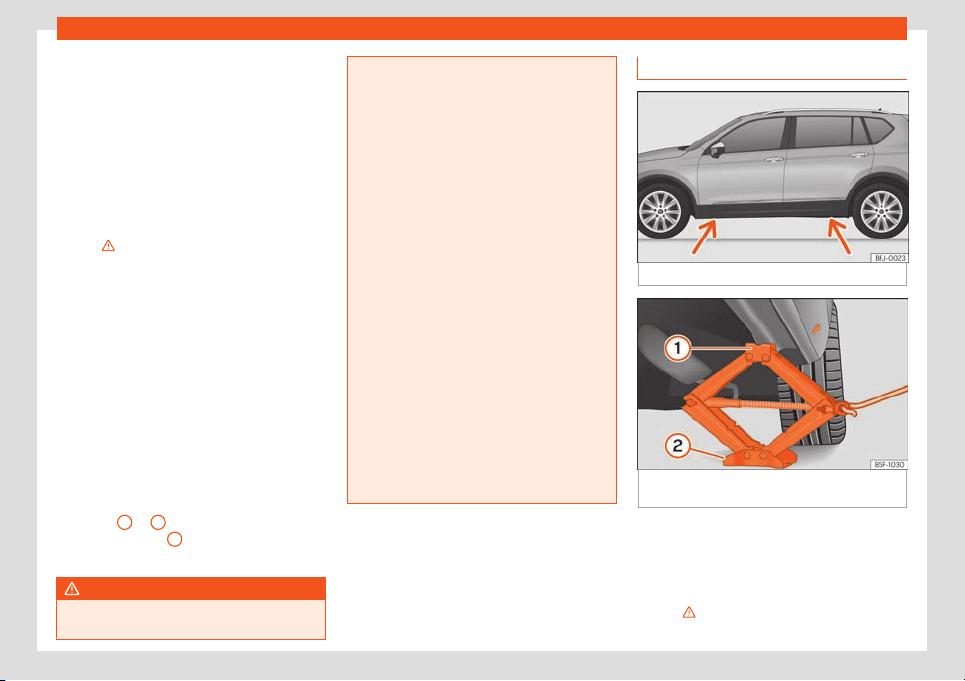
Emergencies
If the wheel bolt is very tight, carefully push
on the end of the wheel wr
ench with your
foot. Hold on to the vehicle for support and
take care not to slip during this operation.
Loosening wheel nuts
●
Fit the wheel wrench on as far as it will go
›››
Fig. 35.
●
Hold the wrench at the end and rotate the
bolt approximately one turn anticlock-
wise
›››
.
Impor
tant information about wheel nuts
Factory-fitted rims and wheel nuts are spe-
cially matched during construction. There-
fore, if different rims are fitted, the correct
wheel nuts with the right length and heads
must be used. This ensures that wheels are
fitted securely and that the brake system
functions correctly.
In certain circumstances, you should not even
use wheel nuts from vehicles of the same
model.
In wheels with full hubcaps, the anti-theft
locking bolt must be threaded onto positions
›››
Fig. 36
2
or
3
, taking the tyre valve’s po-
sition as r
eference
1
. Otherwise it will not be
possibl
e to mount the hubcap.
WARNING
If the wheel nuts are not properly tight-
ened, they coul
d come loose while driving
and cause an accident, serious injury and
l
oss of vehicle control.
●
Use only wheel nuts which correspond to
the rim in question.
●
Never use different wheel nuts.
●
Wheel nuts and threads should be clean,
free of oil and grease, and it should be pos-
sible to screw them easily.
●
To loosen and tighten wheel nuts, only
use the wheel wrench that came with the
car from the factory.
●
The wheel nuts should only be loosened
slightly (about one turn) before raising the
vehicle with the jack. Risk of accident!
●
Never apply grease or oil to wheel nuts or
to the wheel hub threads. Even if the bolts
have been tightened to the prescribed tor-
que, they could come loose while driving.
●
Never loosen the screwed joints of wheel
rims with bolted ring trims.
●
If wheel nuts are tightened below the
prescribed torque, the bolts and rims could
come loose while driving. If tightening tor-
que is too high, the wheel nuts or threads
can be damaged.
Raise the vehicle
Fig. 37
Jack position points.
Fig. 38
Cross member: positioning the jack on
the v
ehicle.
●
Rest the jack (vehicles tools) on firm
gr
ound. If necessary use a large, strong
board or similar support. If the surface is slip-
pery (for example tiles) place the jack on a
rubber mat or similar to prevent it from slip-
ping
›››
.
48
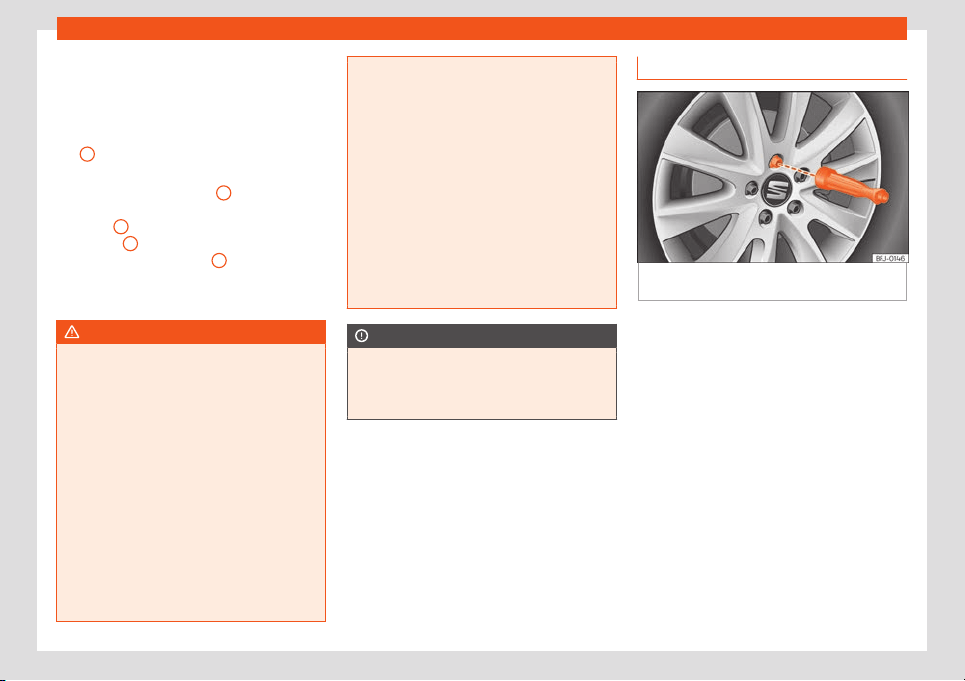
Self-help
●
Find the support point on the strut (sunk
en
area) closest to the wheel to be changed
›››
Fig. 37.
●
Turn the jack crank handle, located below
the strut support point, to raise it until the
tab
1
›
››
Fig. 38 is below the housing provi-
ded.
●
Align the jack so that tab
1
“grips” onto
the housing pr
ovided on the strut and the mo-
bile base
2
is resting on the ground. The
base pl
ate
2
should fall vertically with re-
spect t
o the support point
1
.
●
Continue turning the jack until the wheel is
slightly lift
ed off the ground.
WARNING
The factory-supplied jack is only designed
f
or changing wheels on this model. On no
account attempt to use it for lifting heavier
vehicles or other loads. Risk of injury.
●
Make sure the jack remains stable. If the
surface is slippery or soft, the jack could
slip or sink, respectively, with the conse-
quent risk of causing injuries.
●
Lift the vehicle using only the jack sup-
plied from the factory. Other jacks, even
those approved for other SEAT models
could slip, with the consequent risk of in-
jury.
●
Place the jack only at the support points
provided on the strut and align it. Other-
wise, the jack could slip because it does
not have sufficient grip on the vehicle: risk
of injury!
●
You should never place a body limb such
as an arm or l
eg under a raised vehicle that
is solely supported by the jack.
●
If you have to work underneath the vehi-
cle, you must use suitable stands addition-
ally to support the vehicle, there is a risk of
accident!.
●
Never raise the vehicle if it is tilting to one
side or the engine is running.
●
Never start the engine when the vehicle is
raised. The vehicle may come loose from
the jack due to the engine vibrations.
CAUTION
The vehicle must not be raised on the
cr
ossbar. Place the jack only at the support
points provided on the strut and align it.
Otherwise, the vehicle may be damaged.
Removing and installing a wheel
Fig. 39
Wheel change: loosen wheel nuts with
the sock
et in the handle of the screwdriver.
Change the wheel after loosening the wheel
nuts and r
aising the vehicle with the jack.
When removing/fitting the wheel, the rim may
hit and damage the brake disc. For this rea-
son, please take care and get a second per-
son to assist you.
Taking off the wheel
●
Using the hexagonal socket in the wheel
brace
›››
Fig. 39, unscrew the slackened
wheel nuts and place them on a clean sur-
face.
●
Unscrew the wheel nuts using the box
spanner and place them on a clean surface.
●
Take off the wheel.
»
49
Emergencies
Putting on the spare wheel
Check the dir
ection of rotation of the tyre
›››
page 50.
●
Place the spare wheel or temporary spare
wheel into position.
●
Replace the wheel bolts and tighten slight-
ly using the hexagonal socket on the end of
the wheel brace.
●
To tighten the anti-theft locking wheel nuts
use the corresponding adaptor.
●
Carefully lower the vehicle using the jack.
●
Use the wheel spanner to tighten all of the
wheel nuts clockwise. Tighten the bolts in di-
agonal pairs (not in a circle).
●
Fit the wheel caps
›››
page 47.
The wheel nuts should be clean and turn
easily. Before fitting the spare wheel, inspect
the wheel condition and hub mounting surfa-
ces. These surfaces must be clean before fit-
ting the wheel.
Tightening torque of the wheel nuts
The prescribed tightening torque for wheel
bolts for steel and alloy wheels is 140 Nm. Af-
ter changing a wheel, have the tightening tor-
que checked immediately with a torque
wrench that is working perfectly.
Before checking tightening torque, have any
rusty wheel nuts that are difficult to screw re-
placed and clean the wheel hub threads.
Never apply grease or oil to wheel nuts or to
the wheel hub threads. Even if the bolts have
been tightened to the prescribed torque, they
could come loose while driving.
WARNING
The hexagonal socket in the wheel brace
shoul
d be used for turning wheel nuts only.
Do not use it to loosen or tighten the wheel
nuts.
Tyres with directional tread pattern
Tyres with directional tread pattern have
been designed t
o operate best when rotating
in only one direction. An arrow on the tyre
sidewall indicates the direction of rotation on
tyres with directional tread. Always observe
the indicated direction of rotation in order to
guarantee optimum grip and help avoid
aquaplaning, excessive noise and wear.
If the tyre is mounted in the opposite direction
of rotation, drive with extreme caution, as the
tyre is no longer being used correctly. This is
of particular importance when the road sur-
face is wet. Change the tyre as soon as pos-
sible or remount it with the correct direction
of rotation.
Works after changing a wheel
●
Alloy wheels: r
eplace the wheel bolt caps.
●
Plate wheels: replace the wheel hubcap .
●
Return all tools to their proper storing loca-
tion.
●
If the replaced wheel does not fit in the
spare wheel housing, store it safely in the lug-
gage compartment
›››
page 139.
●
Check the tyre pressure of the newly moun-
ted tyre as soon as possible.
●
In vehicles fitted with a tyre pressure indica-
t
or, adjust the pressure and store it in memory
›››
page 359.
●
Have the tightening torque of the wheel
nuts checked as soon as possible with a tor-
que wrench
›››
page 50. Meanwhile, drive
carefully.
●
Have the flat tyre replaced as quickly as
possible.
50
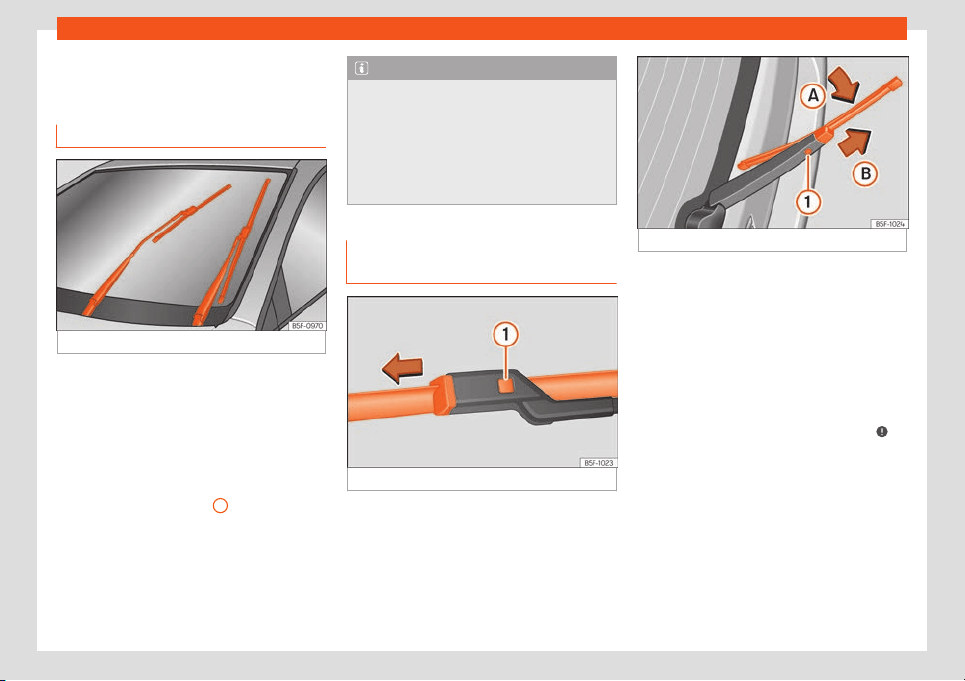
Self-help
Changing the windscreen
wiper bl
ades
Wiper service position
Fig. 40
Wipers in service position.
Ensure that the wiper blades are not frozen.
The wiper arms can be r
aised when the wip-
ers are in service position
›››
Fig. 40.
●
Close the bonnet
›››
page 337.
●
Switch the ignition on and off.
●
Press the windscreen wiper lever down-
wards briefly
›››
page 124
4
.
Bef
ore driving, always lower the wiper arms.
Using the windscreen wiper lever, the wind-
screen wiper arms return to their initial posi-
tion.
Note
●
The windscr
een wiper arms can be
moved to the service position only when
the bonnet is properly closed.
●
You can also use the service position, for
example, if you want to fix a cover over the
windscreen in the winter to keep it clear of
ice.
Changing the wiper rear wiper
bl
ades
Fig. 41 Changing the windscreen wiper blades
Fig. 42 Changing the rear wiper blade
The windscreen wiper blades are supplied as
st
andard with a layer of graphite. This layer is
responsible for ensuring that the wipe is silent.
If the graphite layer is damaged, the noise of
the water as it is wiped across the windscreen
will be louder.
Check the condition of the wiper blades reg-
ularly. If the wipers scrape across the
glass, they should be changed if they are
damaged, or cleaned if they are dirty
›››
.
If this does not pr
oduce the desired results,
the setting angle of the windscreen wiper
arms might be incorrect. They should be
checked by a specialised workshop and cor-
rected if necessary.
Damaged windscreen wiper blades should
be replaced immediately. These are availa-
ble from qualified workshops.
»
51
Emergencies
Raising and lowering windscreen wiper
arms
●
Place the windscreen wipers in the service
position
›
››
page 51.
●
Grip the wiper arms only by the blade's
fastening point.
Cleaning windscreen wiper blades
●
Raise the wiper arms.
●
Use a soft cloth to remove dust and dirt
from the windscreen wiper blades.
●
If the blades are very dirty, a sponge or
damp cloth may be used
›››
.
Changing the windscr
een wiper blades
●
Lift and unfold the wiper arms.
●
Press and hold release button
›››
Fig. 41
1
and pull gently on the wiper blade in the di-
r
ection of the arrow.
●
Fit a new wiper blade of the same length
and design on to the wiper arm and hook it
into place.
●
Rest the wiper arms back onto the wind-
screen.
Changing the rear window wiper blade
●
Lift and fold the wiper arm.
●
Turn the blade slightly
›››
Fig. 42 (arrow
A
).
●
Hol
d down the release button
1
while gen-
tly pulling the bl
ade in the direction of arrow
B
.
●
Insert a new blade of the same l
ength and
type in the rear wiper arm in the opposite di-
rection to the arrow
B
and hook into place
butt
on
1
.
●
Replace the wiper arm on the rear window.
WARNING
Worn or dirty windscreen wiper blades re-
duce visibilit
y and increase the risk of acci-
dent and serious injury.
●
Always replace damaged or worn wind-
screen wiper blades or blades that no lon-
ger clean the windscreen properly.
CAUTION
●
Damaged or dir
ty windscreen wipers
could scratch the glass.
●
If products containing solvents, rough
sponges or sharp objects are used to clean
the blades, the graphite layer will be dam-
aged.
●
Never use fuel, nail varnish remover, paint
thinner or similar products to clean the win-
dows.
●
In icy conditions, always check that the
wiper blades are not frozen to the glass be-
fore using the wipers. In cold weather, it
may help to leave the vehicle parked with
the wipers in service position
›››
page 51.
CAUTION
●
T
o prevent damage to the bonnet and the
wiper arms, only leave them in the service
position.
●
Before driving, always lower the wiper
arms.
Jump start
Jump l
eads
The jump lead must have a sufficient wire
cr
oss section.
If the engine fails to start because of a dis-
charged battery, the battery can be connec-
ted to the battery of another vehicle to start
the engine.
Jump leads must comply with standard DIN
72553 (see cable manufacturer's instruc-
tions). The wire cross section must be at least
25 mm
2
for petrol engines and at least
35 mm
2
for diesel engines.
Note
●
The v
ehicles must not touch each other,
otherwise electricity could flow as soon as
the positive terminals are connected.
●
The discharged battery must be properly
connected to the on-board network.
52
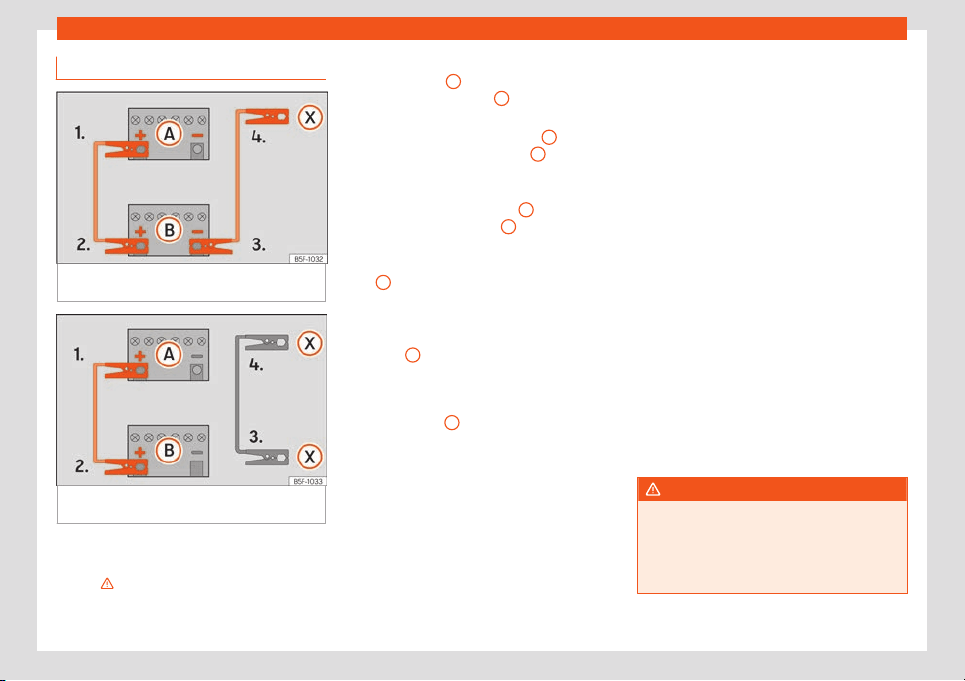
Self-help
Jump start: description
Fig. 43
Diagram of connections for vehicles
without St
art-Stop system.
Fig. 44
Diagram of connections for vehicles
with St
art-Stop system.
Jump lead terminal connections
S
witch off the ignition of both vehicles
›››
.
1.
Connect one end of the r
ed jump lead to
the positive
+
terminal of the vehicle
with the fl
at battery
A
›
››
Fig. 43.
Connect the other end of the red jump
lead to the positive terminal
+
in the ve-
hicl
e providing assistance
B
.
In v
ehicles without a Start-Stop system:
connect one end of the black jump lead
to the negative terminal
–
of the vehicle
pr
oviding the current
B
›
››
Fig. 43.
In vehicles with a Start-stop system:
connect one end of the black jump lead
X
to a suitable ground terminal, to a sol-
id piece of met
al in the engine block, or
to the engine block itself
›››
Fig. 44.
Connect the other end of the black jump
lead
X
to a solid metal component bol-
t
ed to the engine block or to the engine
block itself of the vehicle with the flat
battery. Do not connect it to a point near
the battery
A
.
P
osition the leads in such a way that
they cannot come into contact with any
moving parts in the engine compart-
ment.
Starting
Start the engine of the vehicle with the
boosting battery and let it run at idling
speed.
2.
3.
4a.
4b.
5.
6.
7.
Start the engine of the vehicle with the
flat battery and wait for 2 or 3 minutes
until the engine is running.
Removing the jump leads
Before you remove the jump leads,
switch off the dipped beam headlights if
they are switched on.
Turn on the heater blower and heated
rear window in the vehicle with the flat
battery. This helps minimise voltage
peaks which are generated when the
leads are disconnected.
When the engine is running, disconnect
the leads in reverse order to the details
given above.
Make sure the battery clamps have sufficient
metal-to-metal contact with the battery ter-
minals.
If the engine fails to start after about 10 sec-
onds, switch off the starter and try again after
about 1 minute.
WARNING
●
Pl
ease note the safety warnings referring
to working in the engine compartment
›››
page 337.
●
The battery providing assistance must
have the same voltage as the flat battery
»
8.
9.
10.
11.
53
Emergencies
(12V) and approximately the same capaci-
t
y (see imprint on battery). Failure to com-
ply could result in an explosion.
●
Never use jump leads when one of the
batteries is frozen. Danger of explosion!
Even after the battery has thawed, battery
acid could leak and cause chemical burns.
If a battery freezes, it should be replaced.
●
Keep sparks, flames and lighted ciga-
rettes away from batteries, danger of ex-
plosion. Failure to comply could result in an
explosion.
●
Observe the instructions provided by the
manufacturer of the jump leads.
●
Do not connect the negative cable from
the other vehicle directly to the negative
terminal of the flat battery. The gas emit-
ted from the battery could be ignited by
sparks. Danger of explosion.
●
Never attach the negative cable to fuel
system components or the brake lines in
the other vehicle.
●
The non-insulated parts of the battery
clamps must not be allowed to touch. The
jump lead attached to the positive battery
terminal must not touch metal parts of the
vehicle, this can cause a short circuit.
●
Position the leads in such a way that they
cannot come into contact with any moving
parts in the engine compartment.
●
Do not lean on the batteries. This could
result in chemical burns.
Note
The vehicles must not touch each other,
otherwise el
ectricity could flow as soon as
the positive terminals are connected.
Tow start and towing
Intr
oduction
Tow-starting means st
arting the engine of
the vehicle while another pulls it.
Towing means one vehicle pulling another
that is not roadworthy.
Always consider the legal provisions relating
to tow-starting and towing.
For technical reasons, towing a vehicle
with a discharged battery is not allowed.
The jump start should be used instead
›››
page 52.
If the vehicle comes with the Keyless Access
system, towing is only allowed with the igni-
tion on!
The 12-volt vehicle battery drains if the vehi-
cle is towed with the engine switched off and
the ignition connected. Depending on the
battery charge status, the drop in voltage
may be so large, even after just a few mi-
nutes, that no electrical device in the vehicle
may work e.g. the hazard warning lights. In
vehicles with the Keyless Access system, the
st
eering wheel could lock
›››
.
WARNING
A vehicle with no power should never be
t
owed.
●
During towing, never switch off the igni-
tion with the starter button. Otherwise, the
electronic lock of the steering column
could suddenly get blocked and it would be
impossible to steer the vehicle. This could
cause an accident, serious injury and loss
of control of the vehicle.
●
If during towing the vehicle runs out of
power, stop towing immediately and re-
quest the assistance of specialist person-
nel.
WARNING
Vehicle handling and braking capacity
change consider
ably during towing. Please
observe the following instructions to mini-
mise the risk of serious accidents and in-
jury:
●
As the driver of the vehicle being towed:
–
You should depress the brake much
harder as the brake servo does not op-
erate. Pay the utmost attention to avoid
crashing into the towing vehicle.
–
More strength is required at the steer-
ing wheel as the power steering does
not operate when the engine is switch-
ed off.
54
Self-help
●
As the driv
er of the towing vehicle:
–
Accelerate with particular care and
caution.
–
Avoid sudden braking and manoeuvres.
–
Brake earlier than usual and more
smoothly.
CAUTION
●
T
o avoid damaging the vehicle, for exam-
ple the paint, remove and replace the lid
and towing eye carefully.
●
Unburnt fuel could enter the catalytic
converter and damage it during towing.
Instructions for tow-starting
Vehicle's should not generally be tow-
st
arted. The jump start should be used in-
stead
›››
page 52.
For technical reasons, towing the following
vehicles is not allowed:
●
Vehicles with an automatic gearbox.
●
If the 12-volt vehicle battery is discharged,
because in vehicles with the Keyless Access
locking and ignition system the steering re-
mains locked and the electronic parking
brake cannot be deactivated nor can the
electronic lock of the steering column be re-
leased if they are activated.
●
If the battery is flat, it is possible that the
engine control units may not operate correct-
ly.
However, if the vehicle must absolutely be
tow-started (in the case of manual gear-
boxes):
●
Engage the 2nd or 3rd gear.
●
Keep the clutch pressed down.
●
Switch on the ignition and the hazard warn-
ing lights of both vehicles.
●
Once both vehicles are moving, release the
clutch.
●
Once the engine starts, press the clutch
and disengage the gear to avoid colliding
with the towing vehicle.
CAUTION
●
When t
ow-starting, unburnt fuel could
enter the catalytic converter and damage
it.
●
Do not tow a vehicle for more than 50 m
in attempt to start it. There is risk of dam-
age to the catalytic converter.
Note
The vehicle can only be jump-started if the
el
ectronic parking brake and, if appropri-
ate, the electronic lock of the steering col-
umn are deactivated. If the vehicle has no
power supply or there is an electric system
fault, the engine must be jump-started to
deactivate the electronic parking brake
and the el
ectronic lock of the steering col-
umn.
Towing instructions
Towing requires some expertise and experi-
ence
, especially when using a tow rope. Both
drivers should be familiar with the difficulties
involved in towing. For this reason, inexper-
ienced drivers should abstain from towing.
During towing, it should be ensured that no
impermissible tractive forces or shocks are
generated. When towing on an unpaved
road, there is always a risk of overloading and
damaging the anchorage points.
During towing, the towing vehicle can signal
the change of direction even with the hazard
warning lights turned on. To do so, at the
same time, the turn signal lever must be oper-
ated with ignition switched on. Meanwhile, the
hazard warning lights will go off. When the
turn signal lever is returned to the rest posi-
tion, the hazard warning lights will be auto-
matically reactivated.
Notes for the driver of the towed vehicle
●
Leave the ignition on, so that the steering is
not bl
ocked, and the electronic parking brake
may be deactivated and the turn signals and
wash/wipe operated.
»
55
Emergencies
●
Mor
e strength is required at the steering
wheel as the power steering does not oper-
ate when the engine is switched off.
●
You should depress the brake much harder
as the brake servo does not operate. Avoid
hitting the towing vehicle.
●
Bear in mind the information and instruc-
tions in the manual of the vehicle to be towed.
Notes for the driver of the towing vehicle
●
Accelerate with particular care and cau-
tion. Avoid sharp manoeuvres.
●
Brake earlier than usual and smoothly.
●
Bear in mind the information and instruc-
tions in the manual of the towed vehicle.
Tow rope or tow bar
It is safer for the vehicle to be towed using a
tow bar, avoiding damage to the vehicle. A
tow rope should only be used if a tow bar is
not available.
A tow rope should be slightly elastic to avoid
damage to both vehicles. It is advisable to
use a tow rope made of synthetic fibre or sim-
ilarly elastic material.
Only attach the tow rope or the tow bar to
the towing eyes provided or a towing bracket.
If the vehicle has a factory-fitted towing de-
vice, towing with a tow bar is only permitted
if it has been specially designed to be instal-
led on a tow hitch
›››
page 306.
When the vehicle has to be towed:
Check whether the vehicle may be towed
›››
page 56, Cases where towing the ve-
hicle is not permitted.
The vehicle can be towed using a tow bar or
tow rope in the normal way, with all four
wheels on the road; it can also be towed with
either the front or rear wheels lifted off the
road.
●
Switch the ignition on.
●
Put the gearbox lever in neutral or the se-
lector lever in the N position
›››
page 229.
●
Do not allow the vehicle to be towed at
speeds of over 50 km/h (30 mph).
●
The vehicle must not be towed further than
50 km (30 miles).
●
If a breakdown lorry is used, vehicles with
automatic transmission are only allowed to
be towed with the front wheels suspended.
Towing vehicles with four-wheel drive
(4Drive)
Four-wheel drive vehicles (4Drive) can be
towed using a tow bar or tow rope. If the vehi-
cle is towed with the front or rear axle sus-
pended, the engine must be switched off,
otherwise the transmission may be damaged.
Cases where towing the vehicle is not per-
mitted
●
If, due to a fault, the gearbox is out of lubri-
cant.
●
If the vehicle battery is discharged, be-
cause the steering remains locked and, if ap-
propriate, the electronic parking brake can-
not be deactivated or the electronic lock of
the steering column released.
●
If a distance above 50 km needs to be trav-
elled.
●
When, for example, after an accident, the
smooth rotation of the wheels or the steering
operation cannot be guaranteed.
When the vehicle is to tow another vehicle:
●
Observe legal requirements.
●
Keep in mind the instructions in the manual
on towing vehicles.
CAUTION
If there is no oil in the gearbox or no lubri-
cant in the aut
omatic transmission the car
may only be towed with the driven wheels
lifted clear of the road, or transported on a
special car transporter or trailer.
Note
The vehicle can only be towed if the elec-
tr
onic parking brake and the electronic
lock of the steering column are
56
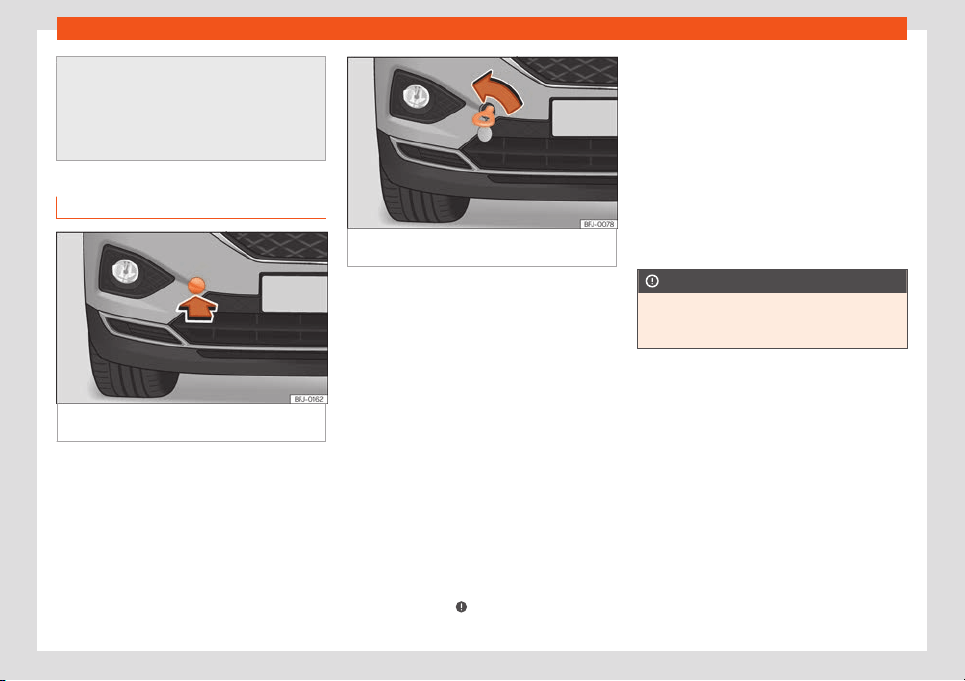
Self-help
deactivated. If the vehicle has no power
supply or ther
e is an electric system fault,
the engine must be jump-started
›››
page 52 to deactivate the electronic
parking brake and the electronic lock of the
steering column.
Front towline anchorage
Fig. 45 On the right side of the front bumper:
r
emove the cover.
Fig. 46 On the right side of the front bumper:
t
owline anchorage in position.
The housing of the removable towline an-
chor
age is on the right side of the front bump-
er underneath a cover
›››
Fig. 45.
The towing eye should always be kept in the
vehicle.
Bear in mind the instructions for towing
›››
page 55.
Fitting the towline anchorage
●
Remove the towing eye from the vehicle
tool kit in the luggage compartment
›››
page 43.
●
Remove the cover by pressing down on its
base and leave it hanging from the vehicle
›››
Fig. 45.
●
Screw the towing eye in the housing by
turning it as far as it will go anticlock-
wise
›››
Fig. 46
›››
. Use a suitable object
that can completely and securely tighten the
t
owing eye in its housing.
●
After towing, unscrew the towing eye
clockwise with a suitable object.
●
Insert the upper flange of the lid into the
opening of the bumper and press the lower
side of the lid until it is inserted into the bump-
er.
●
Clean the towing eye if necessary and then
store it in the luggage compartment along
with the other vehicle tools.
CAUTION
The towing eye must always be completely
and firmly tight
ened. Otherwise, it could be
released while towing and tow-starting.
57
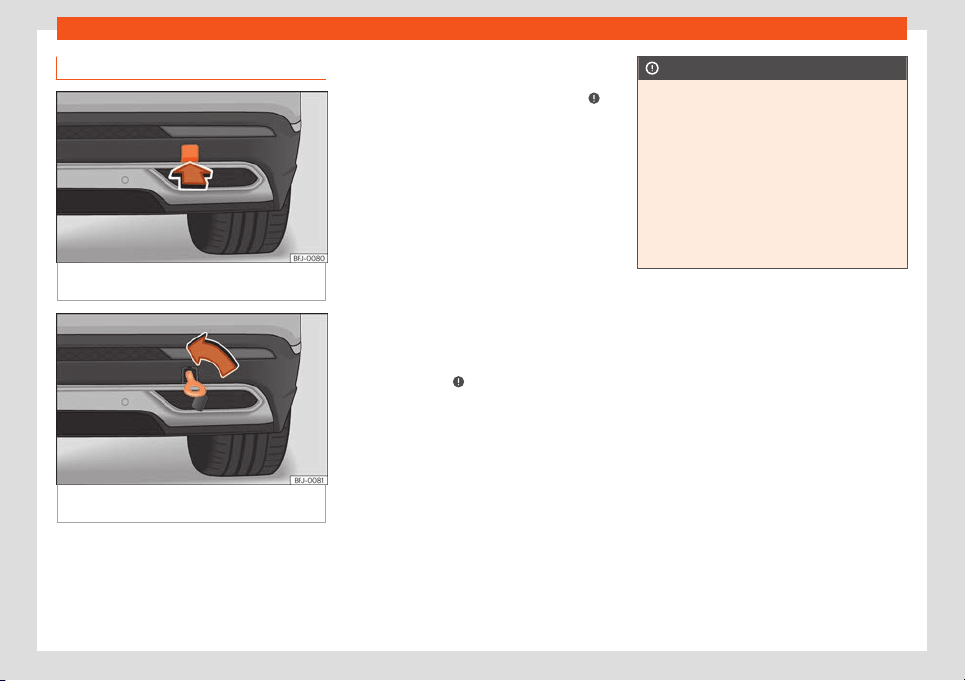
Emergencies
Rear towline anchorage
Fig. 47
On the right side of the rear bumper:
r
emove the cover.
Fig. 48 On the right side of the rear bumper:
t
owline anchorage in position.
The housing of the screw towing eye is on the
right side of the r
ear bumper behind a lid
›››
Fig. 47.
Vehicles equipped as standard with a towing
bracket do not have any housing for the
screw towing eye behind the lid. In this case,
the tow hitch needs to be extracted or instal-
led and used for towing
›››
page 306,
›››
.
Bear in mind the instructions f
or towing
›››
page 55.
Assemble the rear towing eye (cars with-
out a factory-equipped towing bracket)
●
Remove the towing eye from the vehicle
tool kit in the luggage compartment
›››
page 43.
●
Press the bottom side of the lid
›››
Fig. 47 to
unclip it.
●
Remove the lid and let it hang from the ve-
hicle.
●
Screw the towline anchorage into the hous-
ing by turning it as far as it will go anticlock-
wise
›››
Fig. 48
›››
. Use a suitable object
that can compl
etely and securely tighten the
towing eye in its housing.
●
After towing, unscrew the towing eye
clockwise with a suitable object.
●
Insert the upper flange of the lid into the
opening of the bumper and press the lower
side of the lid until the upper flange is inserted
into the bumper.
●
Clean the towing eye if necessary and then
store it in the luggage compartment along
with the other vehicle tools.
CAUTION
●
The t
owing eye must always be com-
pletely and firmly tightened. Otherwise, it
could be released while towing and tow-
starting.
●
If the vehicle is factory-equipped with a
towing bracket, it is only allowed to tow
with a tow bar if this has been specially de-
signed to be installed with a tow hitch. If an
unsuitable tow bar is used, both the tow
hitch and the vehicle may be damaged. In-
stead, a tow rope should be used.
58
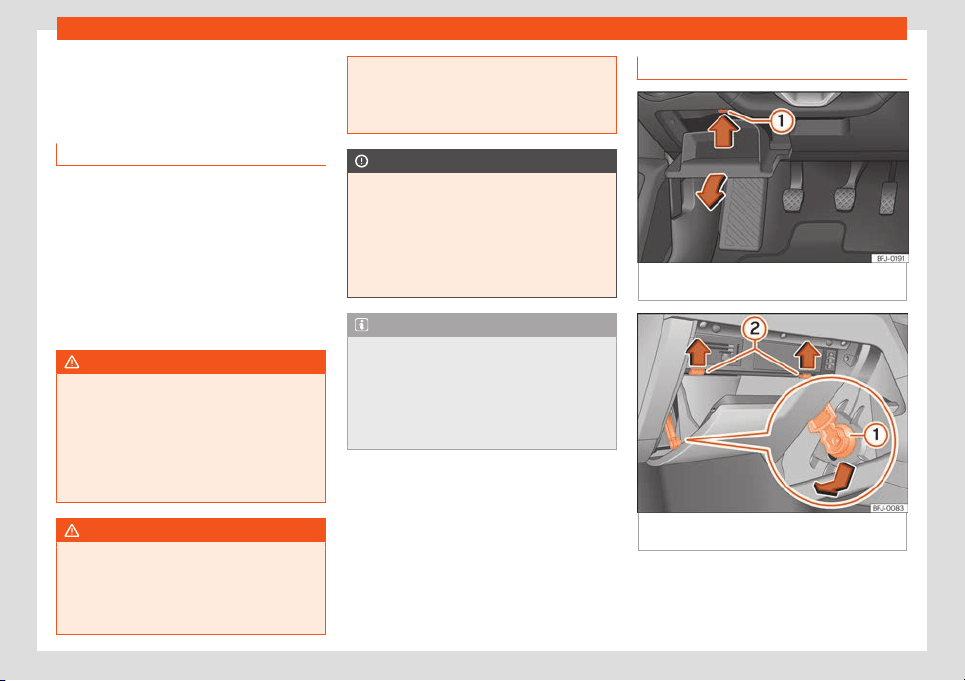
Fuses and bulbs
Fuses and bulbs
Fuses
Intr
oduction
In general, a fuse can be assigned to various
el
ectrical components. Likewise, an electrical
component can be protected by several
fuses.
Only replace fuses when the cause of the
problem has been solved. If a newly inserted
fuse blows after a short time, you must have
the electrical system checked by a special-
ised workshop as soon as possible.
WARNING
The high voltages in the electrical system
can giv
e serious electrical shocks, causing
burns and even death!
●
Never touch the electrical wiring of the
ignition system.
●
Take care not to cause short circuits in
the electrical system.
WARNING
Using unsuitable fuses, repairing fuses or
bridging a curr
ent circuit without fuses can
cause a fire and serious injury.
●
Never use a fuse with a higher value. Only
replace fuses with a fuse of the same am-
perage (same colour and markings) and
siz
e.
●
Never replace a fuse by a metal strip, sta-
ple or similar.
CAUTION
●
T
o prevent damage to the vehicle’s elec-
trical system, before replacing a fuse al-
ways turn off the ignition, the lights and all
electrical elements.
●
Protect the fuse boxes when open to pre-
vent the entry of dust or humidity as they
can damage the electrical system.
Note
●
One component may hav
e more than one
fuse.
●
Several components may run on a single
fuse.
●
In the vehicle, there are more fuses than
those indicated in this chapter.
Fuses inside the vehicle
Fig. 49
On the dashboard on the driver's side
(l
eft-hand drive): fuse box cover.
Fig. 50
glove compartment (right hand drive):
fuse bo
x access.
»
59
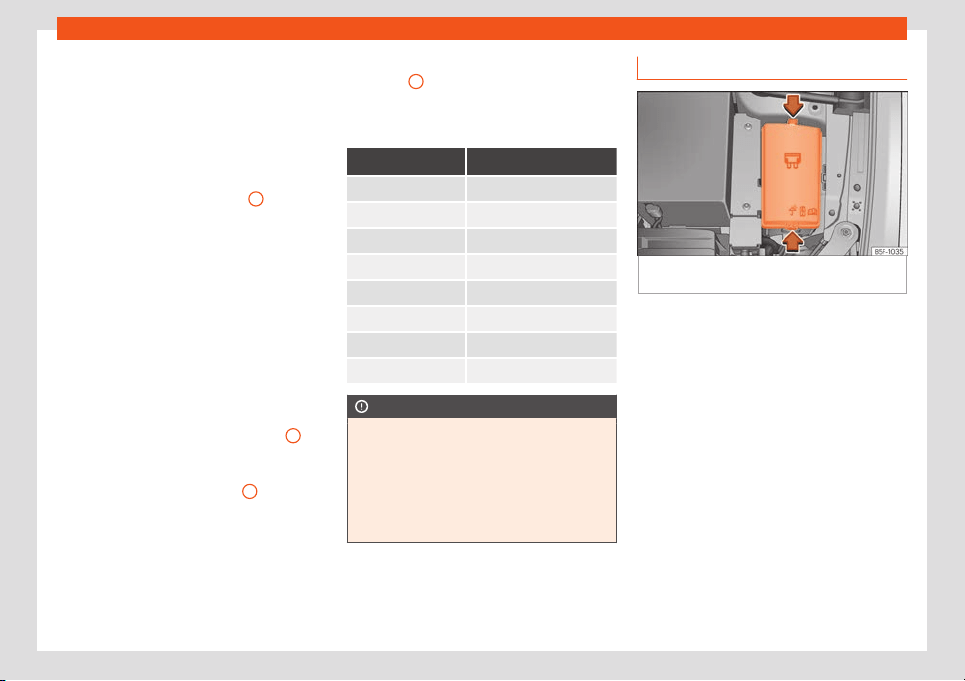
Emergencies
Opening and closing the fuse box situated
bel
ow the dash panel (left-hand steering
wheel)
●
Open the storage compartment on the
driver side
›››
Fig. 49.
●
In this case, empty the storage compart-
ment.
●
Press the locking lid
›››
Fig. 49
1
upwards,
in the dir
ection of the arrow, and at the same
time open the storage compartment even
more and remove it until the fuse box is ac-
cessible.
●
To attach the storage compartment, insert
it in the openings of the dashboard and press
it until you hear it click on both sides. Close it.
Fuses behind the glove compartment
(right-hand steering wheel)
●
Open the glove compartment and, if nec-
essary, empty it.
●
Move the braking element
›››
Fig. 50
1
into
the support hol
e facing downwards and re-
move it to one side.
●
Press the end axes
›››
Fig. 50
2
upwards,
in the dir
ection of the arrows, and at the same
time open the glove compartment even more.
●
To mount the glove compartment, place it
in the correct position. Insert the braking ele-
ment into the hole of the base and move it
upwards until you hear it click. Carefully
press the glove compartment to the front,
against the resistance of the end axes
›››
Fig. 50
2
.
Identifying fuses bel
ow the dashboard by
colours
Colour Amp rating
Light brown 5
Brown 7.5
Red 10
Blue 15
Yellow 20
White or transparent 25
Green 30
Orange 40
CAUTION
●
Al
ways carefully remove the fuse box
covers and refit them correctly to avoid
problems with your vehicle.
●
Protect the fuse boxes when open to
avoid the entry of dust or humidity. Dirt and
humidity inside fuse boxes can cause dam-
age to the electrical system.
Fuses in the engine compartment
Fig. 51
In the engine compartment: fuse box
co
ver.
To open the engine compartment fuse box
●
Open the bonnet
›
››
page 337.
●
Press the locking tabs to release the fuse
box cover
›››
Fig. 51.
●
Then lift the cover out.
●
To fit the cover, place it on the fuse box.
Push the locking tabs down until they click
audibly into place.
60
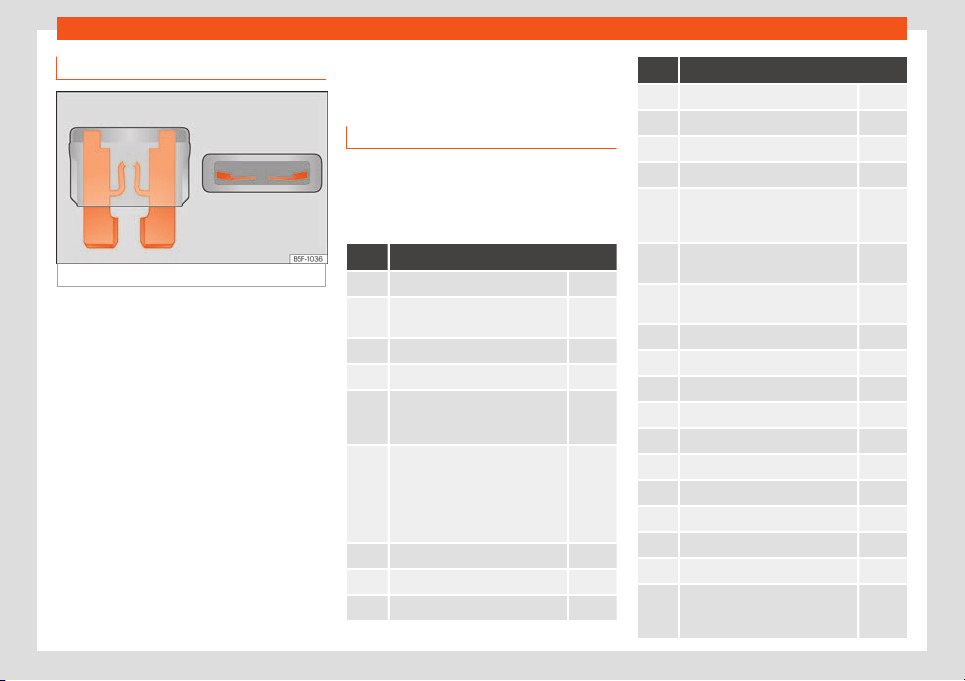
Fuses and bulbs
Replace a blown fuse
Fig. 52
Image of a blown fuse.
Preparations
●
Switch off the ignition, lights and all electri-
cal equipment.
●
Open the corresponding fuse box
›
››
page 59,
›››
page 60.
Recognise a blown fuse
A fuse is blown if its metal strip is ruptured
›››
Fig. 52.
●
Point a lamp at the fuse to see if it has
blown.
To replace a fuse
●
Remove the fuse.
●
Replace the blown fuse by one with an
identical amperage rating (same colour and
markings) and identical size.
●
Replace the cover again or close the fuse
box lid.
Fuse placement
Only replace fuses with a fuse of the same
amper
age (same colour and markings) and
size.
Fuses in the vehicle interior
No. Consumers/Amps
1 Adblue (SCR) 30
4
DWA warning horn, on-board
comput
er
7.5
5 Gateway 7.5
6 Automatic gearbox lever 7.5
7
Air conditioning and heating con-
tr
ol panel, back window heating,
auxiliary heating, rear heating
10
8
Diagnosis, electronic parking
br
ake switch, light switch, reverse
light, interior lighting, driving
mode, lit-up door sill, light/humid-
ity/rain sensor, curve lighting con-
trol unit
7.5
9 Steering column control unit 7.5
10 Radio display 7.5
11 On-board computer control unit 40
No. Consumers/Amps
12 Infotainment radio 30
13 Driver seat belt pre-tensioner 25
14 Air conditioner fan 40
15 Steering column release 10
16
GSM signal reception and stabili-
sation, mobil
e phone interface,
USB connections control unit
7.5
17
Dashboard, OCU navigation in-
t
erface
7.5
18
Surroundings camera and rear
camer
a control unit
7.5
19 Kessy 7.5
20 SCT 1.5 L engine vacuum pump 7.5/15
21 4x4 Haldex Control Unit 15
22 Trailer 15
23 Electric sunroof 20
24 On-board computer 40
25 Left doors 30
26 Heated seats 30
27 Interior light 30
28 Trailer 25
30
PHEV. Switching off the high volt-
age system for rescue tasks. Iden-
tified by a yellow label.
10
»
61
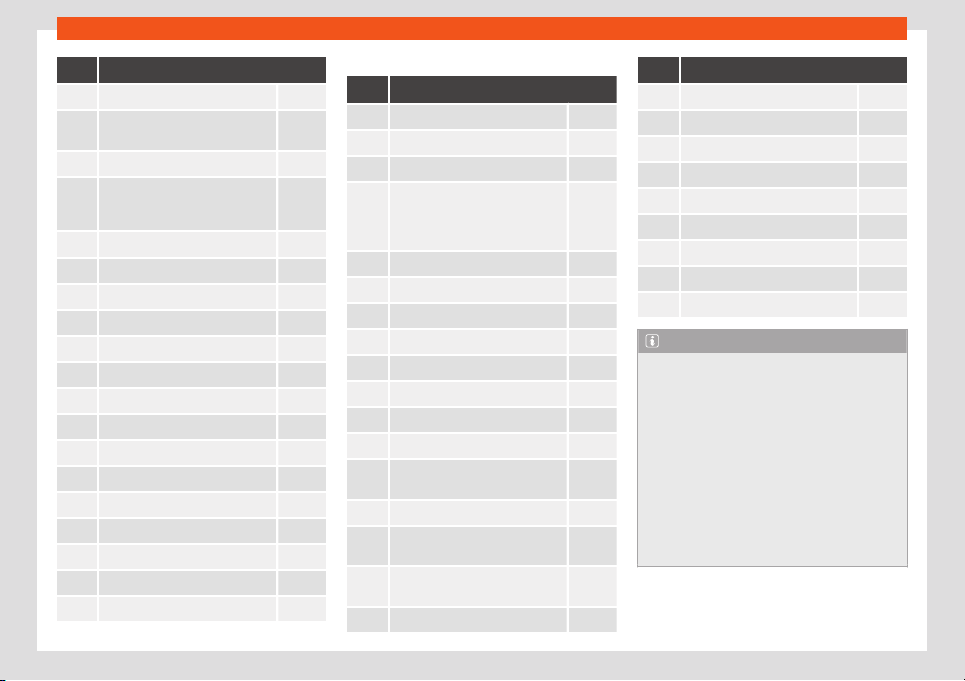
Emergencies
No. Consumers/Amps
31 Electrical lid control unit 30
32
Control unit for parking aid, front
camera and radar
10
33 Airbag 7.5
34
Reverse switch, climate sensor,
el
ectrochromic mirror, electrome-
chanical brake
7.5
35 Diagnosis connector 7.5
38 Trailer 25
39 Right doors 30
40/1 12V socket 20
41 Passenger seat belt pre-tensioner 25
42 Central locking 40
43 Digital sound control unit 30
44 Trailer 15
45 Electric driver's seat 15
47 Rear window wiper 15
48 SoundAktor 7.5
49 Starter motor 7.5
51 Rear AC 25
52 Driving mode. 15
53 Heated rear window 30
Fuse arrangement in engine compartment
No. Consumers/Amps
1 ABS/ESP control unit 25
2 ABS/ESP control unit 40/60
3 Engine control unit (petrol/diesel) 15/30
4
Engine sensors, electric fans,
pr
essure regulator, flow rate me-
ter, spark plug relay (diesel), PTC
relays
7.5/10
5 Engine sensors 10
6 Brake light sensor 7.5
7 Engine power supply 7.5/10
8 Lambda probe 10/15
9 Engine 10/20
10 Fuel pump control unit 15/20
11 PTC 40
12 PTC 40
13
Automatic transmission oil cool-
ing pump
30
15 Horn 15
16
Ignition coil relay (2.0 petrol), in-
v
erter, on-board control unit
10/20
17
Engine control unit, ABS/ESP con-
trol unit, primary relay
7.5
18 Terminal 30 (positive reference) 7.5
No. Consumers/Amps
19 Front windscreen washer 30
20 eBKV 40
21 Automatic gearbox control unit 15
22 Engine control unit 7.5
23 Starter motor 30
24 PTC 40
36 Left headlight 15
37 Parking heating 20
38 Right headlight 15
Note
●
In the v
ehicle, there are more fuses than
those indicated in this chapter. These
should only be changed by a specialised
workshop.
●
Positions not containing a fuse do not ap-
pear in the following tables.
●
Some of the equipment listed in the ta-
bles below pertain only to certain versions
of the model or are optional extras.
●
Please note that the above lists, while
correct at the time of printing, are subject
to change.
62

Fuses and bulbs
Bulbs
Changing bulbs
Full-LED headlights
Y
our vehicle is equipped with full-lead head-
light systems.
Full-LED headlights handle all light functions
(daylight, side light, turn signal, dipped beam
and route light) with light emitting diodes
(LEDs) as a light source.
Full-LED headlights are designed to last the
lifetime of the car and light bulbs cannot be
replaced. In case of headlight failure, go to an
authorised workshop to have it replaced.
Side turn signals
The side turn signals are LEDS and are inte-
grated in the exterior mirrors.
In case of failure, go to an authorised work-
shop to have them replaced.
Additional brake light
Taking into account that it consists of LED
bulbs, the change should be made at a tech-
nical service centre.
63
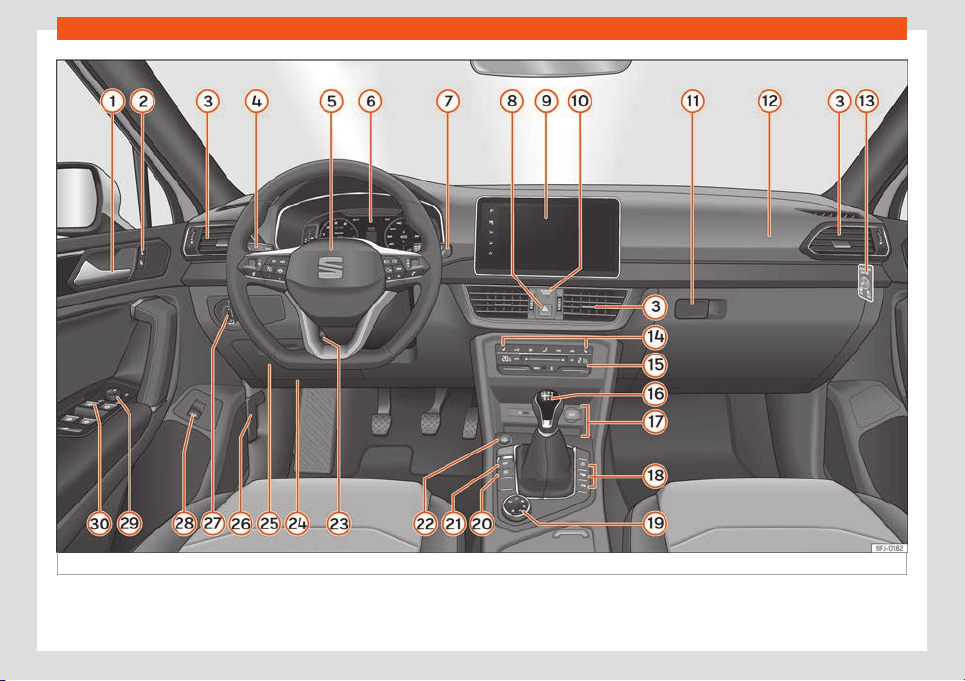
Operation
Fig. 53 Instruments and controls.
64
Controls and displays
Operation
Contr
ols and displays
Interior view
Overview
Door handle
Centr
al locking switch . . . . . . . . . . . . . . . 98
Air vents . . . . . . . . . . . . . . . . . . . . . . . . . . . . . . 162
Control lever for:
–
T
urn signals and main beam
headlights . . . . . . . . . . . . . . . . . . . . . . . . . . 118
–
Cruise control (GRA) . . . . . . . . . . . . . . . 249
–
Speed limiter . . . . . . . . . . . . . . . . . . . . . . . 250
–
Driver assistance systems . . . . . . . . . 84
Steering wheel with horn and
–
Driver airbag . . . . . . . . . . . . . . . . . . . . . . . 27
–
On-board computer controls . . . . . 83
–
Controls for radio, telephone,
navigation and speech dialogue
system . . . . . . . . . . . . . . . . . . . . . . . . . . . . . . 196
–
Paddle levers for tiptronic gear-
shift (automatic gearbox) . . . . . . . . . 232
Digital dashboard (SEAT Digital
Cockpit) . . . . . . . . . . . . . . . . . . . . . . . . . . . . . . 66
Control lever for:
1
2
3
4
5
6
7
–
Windscr
een wipers and washer . . . 124
–
Wipe and wash system . . . . . . . . . . . . 124
Hazard warning lights . . . . . . . . . . . . . . . . 121
Infotainment system . . . . . . . . . . . . . . . . . 196
Front passenger airbag disconnec-
tion display . . . . . . . . . . . . . . . . . . . . . . . . . . . 28
Glove compartment . . . . . . . . . . . . . . . . . 151
Front passenger airbag . . . . . . . . . . . . . . 28
Switch for switching off the front
passenger airbag . . . . . . . . . . . . . . . . . . . . 28
Thermal seat controls . . . . . . . . . . . . . . . 164
Depending on the equipment, con-
trols for:
–
Manual AC . . . . . . . . . . . . . . . . . . . . . . . . . 161
–
Automatic AC (Climatronic) . . . . . . . 159
Gear lever for:
–
Manual gearbox . . . . . . . . . . . . . . . . . . . 229
–
Automatic gearbox . . . . . . . . . . . . . . . . 230
Area for:
–
USB type-C port . . . . . . . . . . . . . . . . . . . 218
–
12 volt socket . . . . . . . . . . . . . . . . . . . . . . . 155
–
Connectivity Box . . . . . . . . . . . . . . . . . . . 216
–
Storage compartment . . . . . . . . . . . . . 150
Depending on the equipment, but-
tons for:
–
Start-Stop system . . . . . . . . . . . . . . . . . 226
–
Parking aid system (Park As-
sist) . . . . . . . . . . . . . . . . . . . . . . . . . . . . . . . . . 282
8
9
10
11
12
13
14
15
16
17
18
–
P
ark Pilot system . . . . . . . . . . . . . . . . . . . 289
–
Peripheral view system (Top View
Camera) . . . . . . . . . . . . . . . . . . . . . . . . . . . 298
–
S-Boost driving profile . . . . . . . . . . . . . 240
–
E-Mode operating mode . . . . . . . . . . 225
Rotating control (Driving Experience
button) for driving profiles . . . . . . . . . . . 239
Auto Hold switch . . . . . . . . . . . . . . . . . . . . . 277
Electronic parking brake switch . . . . . 275
Start-up push button (Keyless Ac-
cess closing and start-up sys-
tem) . . . . . . . . . . . . . . . . . . . . . . . . . . . . . . . . . . . 219
Steering column adjustment lev-
er . . . . . . . . . . . . . . . . . . . . . . . . . . . . . . . . . . . . . 15
Location of the knee airbag . . . . . . . . . 29
Storage compartment / fuse box . . . 59
Bonnet lock release . . . . . . . . . . . . . . . . . . 338
Headlight switch . . . . . . . . . . . . . . . . . . . . . 115
Button to open rear lid . . . . . . . . . . . . . . . 107
Control for the electric adjustment
of the exterior mirrors . . . . . . . . . . . . . . . . 127
Electric windows . . . . . . . . . . . . . . . . . . . . . 110
Note
●
Some of the equipment list
ed in this sec-
tion is only fitted on certain models or are
optional extras.
●
The arrangement of controls on right-
hand drive models may be slightly different
»
19
20
21
22
23
24
25
26
27
28
29
30
65
Operation
from the layout shown in
›
››
page 64. How-
ever, the symbols used to identify the con-
trols are the same.
Instruments and warn-
ing/contr
ol lamps
Instrument panel
Introduction
After switching the engine on with a 12-volt
batt
ery that is heavily discharged or newly
changed some system settings (such as the
time, the date, the personalised comfort set-
tings and the programming) might be altered
or deleted. Check and correct these settings
once the battery is sufficiently charged.
WARNING
Any distraction may lead to an accident,
with the risk of injury.
●
Do not operate the instrument panel con-
tr
ols when driving.
●
To reduce the risk of accident and injury,
only make adjustments to the instructions
on the screen of the instrument panel and
to the instructions on the screen of the Info-
tainment system when the vehicle is sta-
tionary.
66
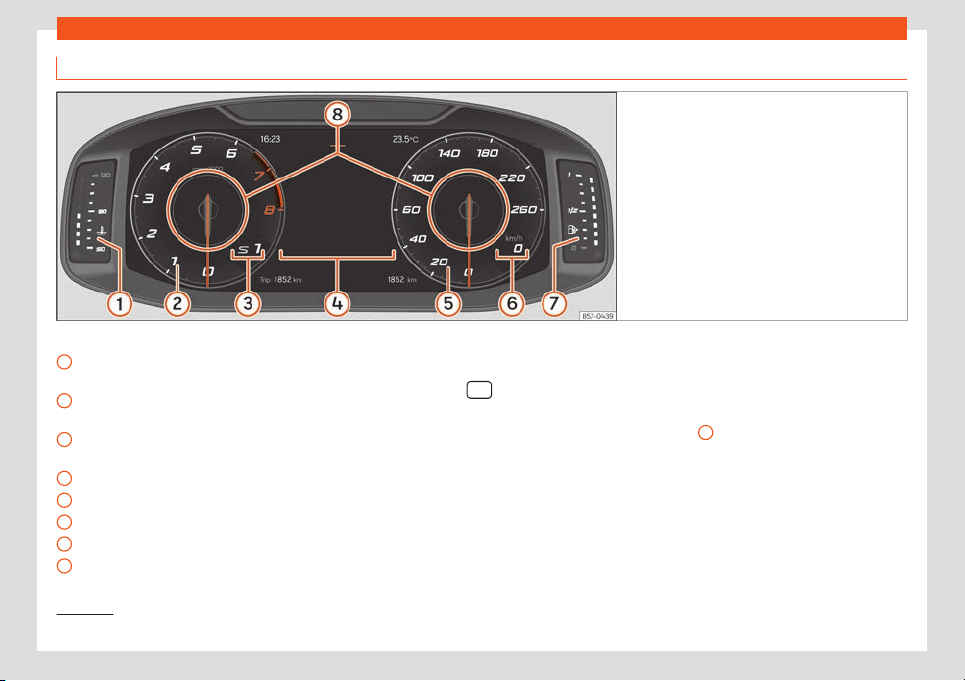
Instruments and warning/control lamps
Digital dashboard (SEAT Digital Cockpit)
Fig. 54 SEAT Digital Cockpit on the instrument
panel (cl
assic view).
Details of the instruments:
Engine cool
ant temperature display
›››
page 81
Revolution counter. Revolutions per mi-
nute the engine is running
›››
page 79.
Gear engaged or position of the selec-
tor lever currently selected
Screen display
›››
page 70
Speedometer
Digital speed display
Fuel gauge
›››
page 80.
Information Profile
›››
page 67.
1
2
3
4
5
6
7
8
The Digital SEAT Cockpit is an instrument
panel digit
al with monochrome screen in col-
our high resolution. It has a 3 views accessi-
ble using the button
of the multifunction
st
eering wheel. By selecting different infor-
mation profiles, indications other than the
classic circular instruments can be displayed,
such as navigation data, multimedia informa-
tion or travel data.
The 3 views are:
●
Classic
●
Dynamic
●
Navigation
All views will display information on the
screen about audio, phone, travel data, vehi-
cle status, navigation
1)
and driving aids
1)
.
In all views the information displayed in Infor-
mation profiles can be customised
›››
Fig. 54
8
.
Inf
ormation profiles
Using the INSTRUMENT CLUSTER option, you
can choose between the different options for
displaying the information to be displayed in
the SEAT Digital Cockpit (select > View >
Instrument cluster OR: > Interior
»
1)
Depending on the version.
67

Operation
settings > Infotainment > Instrument
cluster).
Cl
assic View
The revolutions per minute and speedometer
needles appear along the entire length
›››
Fig. 54.
View 1, 2, 3 or AUTOMATIC
1)
Personalisation of the information that ap-
pears in the Digital SEAT Cockpit. Only 2 of
these items of information can be displayed
at the same time, but the user chooses which
to display, and in what order, by moving the
finger vertically over the dials.
Depending on the version, the Views can be
memorised by exiting the menu or keeping
the View button pressed.
●
Consumption. Graphic representation of
the current consumption and digital display
of the average consumption.
●
Audio. Digital display of the current audio
playback.
●
Altitude. Digital display of the current alti-
tude above sea level.
●
Compass. Digital display of the compass.
●
Information about the final destination.
Digital display of the remaining travelling
time, distance to the destination and the esti-
mated time of arrival.
●
Operating range. Digital display of the re-
maining range.
●
Travel time.
●
Route guidance.
●
Journey. Digital display of the distance
travelled.
●
Assist systems. Graphic representation of
different assistance systems.
●
Traffic signs. Display of traffic signs detec-
ted.
●
Navigation. Graphical representation of
the navigation with arrows.
It may vary based on the features, the num-
ber and the contents of the selectable infor-
mation profiles.
1)
Pre-set information depending on the selected
“Driving mode”.
68
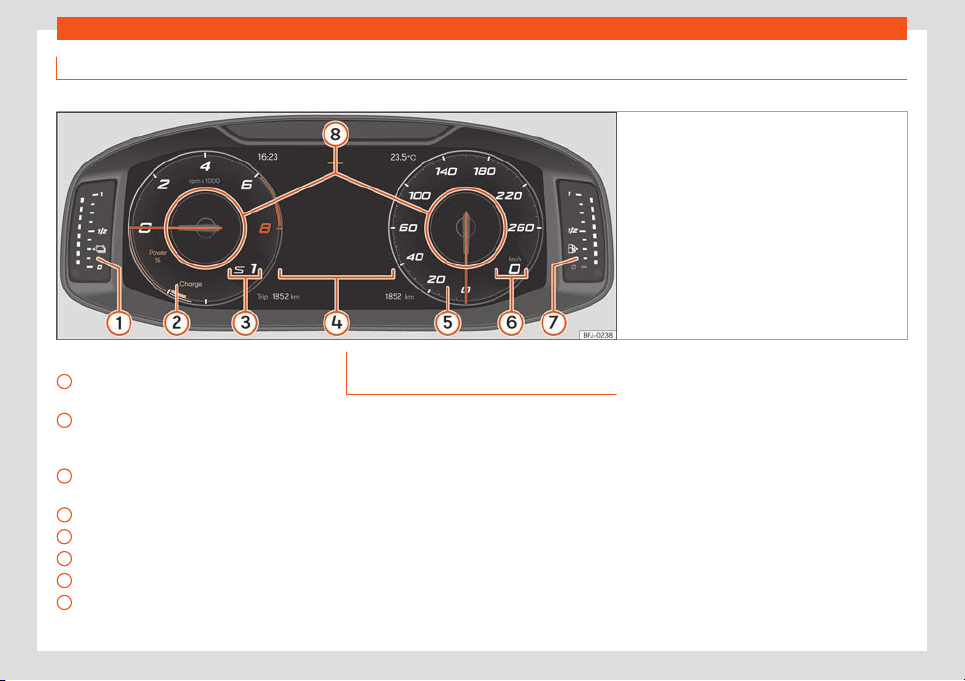
Instruments and warning/control lamps
Digital dashboard (SEAT Digital Cockpit)
3 V
alid for: hybrid vehicles
Fig. 55 SEAT Digital Cockpit on the instrument
panel (cl
assic view).
Details of the instruments
›
››
Fig. 55:
Battery charge level indicator
›››
page 80
Rev counter and Powermeter. Revolu-
tions per minute the engine is running
›››
page 79.
Gear engaged or position of the selec-
tor lever currently selected
Screen display
›››
page 70
Speedometer
Digital speed display
Fuel gauge
›››
page 80.
Information Profile
›››
page 67.
1
2
3
4
5
6
7
8
Navigation map in the SEAT Digital
Cockpit
Depending on the features, the SEAT Digital
Cockpit can displ
ay a detailed map. To do
this, select the Navigation option in the
menu on the instrument panel
›››
page 71.
Depending on the features or the navigation
map, it can be shown in the SEAT Digital
Cockpit or on the infotainment system or on
both at the same time. If it is displayed only in
the infotainment system, the SEAT Digital
Cockpit will only display the arrows for ma-
noeuvres.
Transfer of navigation map
The map is tr
ansferred from the infotainment
system to the SEAT Digital Cockpit and vice
versa using the map transfer button.
Using the right thumbwheel of the multifunc-
tion steering wheel, in the Navigation menu,
you can transfer the map back to the info-
tainment system.
69

Operation
Status display
Possible indications on the instrument
panel displ
ay
Different pieces of information can be dis-
played on the screen of the instrument panel,
depending on the features of the vehicle.
●
Doors, bonnet and rear lid open
●
Warning and information messages
●
Odometer
●
Time
›››
page 79
●
Indications of the radio and navigation sys-
t
em
●
Indications of the phone
●
Outside temperature
●
Indications of the compass
●
Selector lever positions
●
Gear-change recommendation
›››
page 237
●
Combined range (hybrid vehicles)
›››
page 71
●
Display of travel data (multifunction dis-
play) and menus for different settings
›››
page 71
●
Service interval display
›››
page 82
●
Speed warning
›››
page 72
●
Speed warning for winter tyres
●
Start-Stop system status display
›››
page 226
●
Signs detected by the traffic signal detec-
tion system
›››
page 75
●
Active cylinder management (ACT®) status
indication
›››
page 243
●
Low consumption driving
●
Identifying letters on engine (LDM)
●
Driver assistance system display
›››
page 245
●
Copyright
Doors, bonnet and rear lid open
When the vehicle is unlocked and while driv-
ing, the instrument panel display shows if any
of the doors, the bonnet or rear lid are
opened and, in some cases, it is also indica-
ted by an audible warning. The display may
vary according to the type of instrument pan-
el fitted.
Selector lever positions (DSG® dual clutch
gearbox)
The current position of the selector lever is
shown on the side of the lever and on the in-
strument panel display. When the lever is in
the D/S position or in the Tiptronic position, in
some cases, the gear engaged in each case
is shown on the instrument panel display .
Outside temperature indicator
If the outside temperature is lower than ap-
proximately +4 °C (+39 °F), the “ice crystal
symbol” on the outside temperature dis-
play also lights up. This symbol remains lit un-
til the outside temperature exceeds +6 °C
(+43 °F)
›››
.
When the v
ehicle is stationary, when the aux-
iliary heater is switched on or when driving at
very low speeds, the outside temperature in-
dicated may be higher than the actual tem-
perature due to the heat produced by the en-
gine.
The margin of measurement ranges from
-45 °C (-49 °F) to +76 °C (+169 °F).
Gear-change recommendation
While driving, the instrument panel of certain
vehicles may indicate a gear recommenda-
tion for saving fuel
›››
page 237.
Odometer
The odometer registers the total distance
travelled by the car.
The partial odometer (trip) shows the dis-
tance travelled since the last time it was reset
to zero.
●
Set the odometer to zero via the Infotain-
ment system or the multifunction steering
wheel
›››
page 72.
70
Instruments and warning/control lamps
Combined operating range display
(hybrid v
ehicles)
The value shown is calculated and updated
according to the driving style. Therefore, the
range can vary even when the fuel tank is full
and the high-voltage battery is fully charged.
Range can be increased by reducing or
switching off comfort consumers, e.g. air con-
ditioning or seat heating.
Speed warning for winter tyres
If the maximum speed set is exceeded, this is
displayed on the instrument panel
›››
page 71.
The speed warning can be set in the infotain-
ment system using the infotainment button
> Settings > Tyres; OR > Exterior
settings > tyres
›››
page 91.
Indications of the compass
Depending on the equipment, when the igni-
tion is on, the instrument panel display indi-
cates the direction in which you are driving
with a symbol, e.g. NW for Northwest.
When the Infotainment system is on and there
is no route guidance active, the graphic rep-
resentation of a compass is also shown.
Low consumption driving
Depending on the equipment, when the vehi-
cle is moving is displayed on the instru-
ment cluster display when the vehicle is in an
economical consumption status due to active
cylinder management (ACT®)
›››
page 243.
Copyright
Legal text about the property rights and
copyrights of the instrument cluster.
WARNING
Even when the outside temperature is high-
er than fr
eezing temperature, some roads
and bridges could be frozen.
●
The “ice crystal symbol” indicates that
there may be a risk of freezing.
●
At outside temperatures above +4 °C
(+39 °F), there may be ice even when the
“ice crystal symbol” is not on.
●
The outside temperature sensor takes a
guideline measurement.
Note
●
Ther
e are different instrument panels and
therefore the versions and instructions on
the display may vary. In the case of dis-
plays without warning or information texts,
faults are indicated exclusively by the con-
trol warning lamps.
●
Some indications on the instrument panel
screen may be concealed by a sudden
event, e.g. an incoming call.
●
Depending on the equipment, some set-
tings and instructions can be carried out or
displayed on the infotainment system as
w
ell.
●
If there are several warnings at the same
time, the symbols will be displayed one af-
ter the other for a few seconds. The sym-
bols will stay on until you remove the
cause.
●
If when switching on the ignition warnings
are shown about existing faults, it might not
be possible to change the settings or show
the information as described. In this case,
go to a specialised workshop and request a
repair.
Instrument panel menus
The number of menus and information items
av
ailable will depend on the vehicle’s elec-
tronics and features.
A specialised workshop can programme or
modify additional functions, according to the
vehicle equipment. SEAT recommends visiting
a SEAT dealership for this.
Some menu options can only be read when
the vehicle is stationary.
■
Driving data
›››
page 72
■
Assist systems.
■
Front Assist On/Off
›››
page 252
■
ACC (only display)
›››
page 255
■
Lane Assist On/Off
›››
page 263
»
71

Operation
■
Side Assist On/Off
›
››
page 269
■
Navigation.
■
Audio.
■
Telephone.
■
Vehicle status.
›››
page 73
Service Menu
In the Service menu various settings can be
adjust
ed depending on the features.
Open the Service menu
To open up the Service menu, select the
Range information profile while in the Driv-
ing data menu, and keep the
key press-
ed on the multifunction st
eering wheel for ap-
proximately 4 seconds. When it is released,
the Service menu will be displayed. Now
you can browse through the menu using the
keys on the multifunction steering wheel as
usual.
Restart the service interval display
Select the Service menu and follow the in-
structions on the screen of the instrument
panel.
Restart the oil service
Select the Restore Oil service menu and
follow the instructions on the instrument pan-
el display.
Reset driving data
Select the Reset trip menu and follow the
instructions on the instrument panel display
to reset the value.
Identifying letters on engine (LDM)
Select the menu Engine code. The identify-
ing letters of the engine will be shown on the
instrument cluster display at the bottom left.
Setting the clock
Select the Time menu and set the correct
time by turning the right thumbwheel of the
multifunction steering wheel.
Driving data indicator (multifunc-
tion display)
The display of the travel data (multifunction
displ
ay) shows different values about the
journey and the consumption.
Change from one display to another
●
Turn the right thumbwheel of the multifunc-
tion steering wheel
›››
page 83.
Changing memory
●
While in Travel data > General infor-
mation press on the multi-function steer-
ing wheel to switch between the 3 memo-
ries
1)
:
Since start: The memory is deleted if
the journey is interrupted for more than 2
hours.
Since refuelling: Display and stor-
age of the journey data and the con-
sumption values collected. When refuel-
ling, the memory is deleted.
Long-term: This memory contains trav-
el data up to a maximum of 19 hours and
59 minutes or 99 hours and 59 minutes,
or up to a maximum of 1999.9 km or
9999.9 km. When one of these values is
exceeded (varies depending on the ver-
sion of the instrument panel), the memo-
ry is deleted.
Delete journey data presets
●
Select the memory that you wish to erase.
–
–
–
1)
This will show all data on the display at the
same time: dist
ance travelled, average con-
sumption, average speed and autonomy.
72

Instruments and warning/control lamps
●
K
eep the button on the multi-function
steering wheel pressed for approximately 2
seconds.
Select the instructions
In the Infotainment system, in the menu Vehi-
cle settings, you can display different travel
data
›››
page 91.
Current consumption: The current
fuel consumption display operates
throughout the journey, in litres/100 km;
and with the engine running and the ve-
hicle stopped, in litres/hour.
Average consumption: The average
fuel consumption is displayed after driv-
ing for approximately 300 metres.
Travelling time: This indicates the
hours (h) and minutes (min) since the ig-
nition was switched on.
Range: Approximate distance in km that
can still be travelled if the same driving
style is maintained.
AdBlue range or : Approximate
distance in km that can still be travelled
with the current level of the AdBlue®
tank with the same driving style. The in-
dication appears from a range of less
than 2,400 km and cannot be deactiva-
ted.
1)
–
–
–
–
–
Distance: Distance covered in km (m)
after switching on the ignition.
Average speed: The average speed
will be shown after driving for approxi-
mately 100 metres.
Digital speed display: Current
speed displayed in digital format.
Eco tips: Recommendations messag-
es are shown to reduce consumption
through good driving practices, e.g. Air
conditioning on: close the win-
dow.
Setting a speed warning
●
Select the display Warning at --- km/h
or Speed warning at --- mph.
●
Press the
button on the multi-function
st
eering wheel to memorise the current
speed and activate the warning.
●
Activate: set the desired speed within 5
seconds by rotating the wheel on the multi-
function steering wheel. Next, press the
button again or wait several seconds. The
speed is st
ored and the warning activated.
●
Deactivate: press the
button. The stored
speed is del
eted.
The warning can be adjusted for speeds be-
tween 30 km/h (18 mph) and 250 km/h
(155 mph).
–
–
–
–
Display Oil temperature
The engine reaches its operating tempera-
ture when, under normal driving conditions,
the oil temperature is between 80°C (176°F)
and 120°C (248°F). If a great effort is required
from the engine and the outside temperature
is high, the engine oil temperature may in-
crease. This does not present any problem as
long as the warning lamps or
›››
page 341 do not appear on the display.
Warning and information messages
(Vehicle status)
The system runs a check on certain compo-
nents and functions when the ignition is
s
witched on and while the vehicle is moving.
Faults are displayed on the instrument cluster
display as red and yellow warning symbols
accompanied by messages and, depending
on the case, even an audible warning
›››
page 85. The representation of the mes-
sages and symbols may vary depending on
the version of the instrument panel.
Existing faults can also be checked manually.
To do so, open the menu Vehicle status or
Vehicle
›››
page 71.
»
1)
Not available in all countries.
73
Operation
Priority 1 warning (red)
The symbol lights up or fl
ashes (in part ac-
companied by audible warnings). Stop
driving! Danger! Check the fault and elimi-
nate the cause. If necessary, seek professio-
nal assistance.
Priority 2 warning (yellow)
The symbol lights up or flashes (in part ac-
companied by audible warnings). Operating
faults or the lack of operating fluids can
cause damage to the vehicle or a fault.
Check the faulty function as soon as possible.
If necessary, seek professional assistance.
Information message
It provides information about processes in the
vehicle.
Driver alert system (break recom-
mendation)
Fig. 56
On the instrument panel display: driver
al
ert system symbol.
The Fatigue detection informs the driver when
their driving behaviour sho
ws signs of fatigue.
Function and operation
Fatigue detection determines the driving be-
haviour of the driver when starting a journey,
making a calculation of tiredness. This is con-
stantly compared with the current driving be-
haviour. If the system detects that the driver is
tired, an audible warning is given with a
sound and an optic warning is shown with a
symbol and complementary message on the
instrument panel display
›››
Fig. 56. The mes-
sage on the instrument panel display is
shown for approximately 5 seconds, and de-
pending on the case, is repeated. The system
stores the last message displayed.
The message on the instrument panel display
can be switched off by pressing the button
on the multi-function steering wheel
›››
page 83.
The message can be recalled to the instru-
ment panel display using the multifunction
display
›››
page 72.
Conditions of operation
Driving behaviour is only calculated on
speeds above about 65 km/h (40 mph) up to
around 200 km/h (125 mph).
Switching on and off
Fatigue detection can be activated or deacti-
vated in the infotainment system using the
function button > Driver assistance > Fa-
tigue detector
›››
page 91. A mark indi-
cates that the adjustment has been activa-
ted.
System limitations
The Fatigue detection has certain limitations
inherent to the system. The following condi-
tions can limit the Fatigue detection or pre-
vent it from functioning.
●
At speeds below 65 km/h (40 mph)
●
At speeds above 200 km/h (125 mph)
●
When cornering
●
On roads in poor condition
74
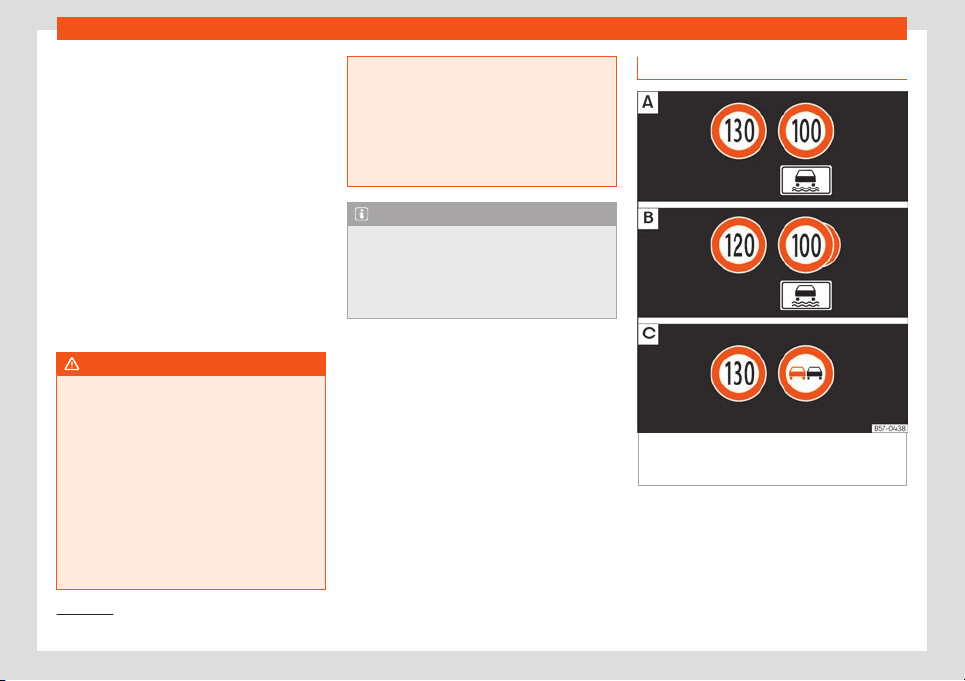
Instruments and warning/control lamps
●
In unf
avourable weather conditions
●
When a sporty driving style is employed
●
In the event of a serious distraction to the
driver
Fatigue detection will be restored when the
vehicle is stopped for more than 15 minutes,
when the ignition is switched off or when the
driver has unbuckled their seat belt and
opened the door.
In the event of slow driving during a long peri-
od of time (below 65 km/h, 40 mph) the sys-
tem automatically re-establishes the tired-
ness calculation. When driving at a faster
speed the driving behaviour will be recalcula-
ted.
WARNING
Do not let the comfort afforded by the Fati-
gue det
ection system tempt you into taking
any risks when driving. Take regular breaks,
sufficient in length when making long jour-
neys.
●
The driver always assumes the responsi-
bility of driving to their full capacity.
●
Never drive if you are tired.
●
The system does not detect the tiredness
of the driver in all circumstances. Consult
the information in the section
›››
page 74,
System limitations.
●
In some sit
uations, the system may incor-
rectly interpret an intended driving ma-
noeuvre as driver tiredness.
●
No warning is given in the event of the ef-
fect called microsleep!
●
Please observe the indications on the in-
strument panel and act as is necessary.
Note
●
F
atigue detection has been developed
for driving on motorways and well paved
roads only.
●
If there is a fault in the system, have it
checked by a specialised workshop.
Road signs detection system
1)
Fig. 57
On the instrument panel display: ex-
ampl
es of speed limits or overtaking prohibi-
tions with their respective additional signs.
The traffic sign detection system records the
st
andard traffic signs in front of the vehicle
with a camera located on the base of the in-
terior mirror and provides information about
speed limits and overtaking prohibitions.
»
1)
System available depending on the country.
75

Operation
Within its limitations, the system also displays
additional signal
s, such as time-specific pro-
hibitions, signs for vehicles towing trailers
›››
page 306 or limitations that only apply in
the event of rain. Even on journeys without
signs, the system may display any applicable
speed limits.
The traffic sign detection system does not
work in all countries. Keep this in mind when
travelling abroad.
Shown on the display
In Germany, on motorways and vehicle
roads, besides speed limits and overtaking
provisions the system also displays the end of
prohibition signs. The valid speed limit at the
time in other countries is always shown.
The traffic signs detected by the system are
displayed on the dash panel display
›››
Fig. 57 and, depending on the navigation
system fitted in the vehicle, on the infotain-
ment system as well
›››
page 87.
Road sign detection system messages:
There are no traffic signs available
●
The system is in its start-up phase.
●
OR: the camera has not recognized any
mandatory or prohibitive sign.
Error: Dynamic Road Sign Display
●
There is a fault in the system. Have the sys-
tem checked by a specialised workshop.
Speed warning currently unavailable
●
The speed warning function of the road
sign detection system is faulty. Have the sys-
tem checked by a specialised workshop.
Dynamic Road Sign Display: please
clean the windscreen.
●
The windscreen is dirty in the camera area.
Clean the windscreen.
Dynamic Road Sign Display currently
restricted.
●
The navigation system is not transmitting
data. Check if the navigation system has up-
dated maps.
●
OR: the vehicle is in a region not included
on the navigation system's map.
No data available
●
The traffic sign detection system does not
work in the current country.
Activate and deactivate the road sign dis-
play on the instrument panel
The permanent traffic sign view on the instru-
ment cluster can be switched on or off in the
infotainment system using the function button
> Settings > Driver assistance.
Display of traffic signs
When the traffic sign detection system is con-
nected, a camera located on the base of the
interior rear-view mirror records the traffic
signs in front of the vehicle. After checking
and evaluating the information from the cam-
era, the navigation system and the current
vehicle data, up to three valid road signs are
displayed,
›››
Fig. 57 with their additional
signs.
The sign that is currently valid for the
driver is shown in the left side of the
screen For example, a maximum speed
limit of 130 km/h (100 mph)
›››
Fig. 57 A.
A sign valid only in certain circum-
stances, e.g. 100 km/h (60 mph) is shown
second, together with the additional rain
sign.
The supplementary panel
will display the circumstances (rain,
times of day, fog, etc.) under which the
displayed speed limit is in force.
Thirdly, a sign prohibiting overtaking is
partially displayed. If there is no condi-
tional speed limit and overtaking is pro-
hibited, the latter sign will be displayed
in second place
›››
Fig. 57 C.
Speed warning
If the system detects that the permitted
speed is exceeded, it may warn the driver
with a “gong” and visually with a message on
the dash panel display.
The speed warning can be set or completely
switched off in the infotainment system using
the function button > Settings >
First:
Second:
Additional sign:
Third:
76
Instruments and warning/control lamps
Driver assistance
›
››
page 87. The
speed is adjusted in steps of 5 km/h (3 mph)
within a range of between 0 km/h (mph) and
10 km/h (6 mph) above the maximum permit-
ted speed.
Trailer mode
In vehicles equipped with a towing bracket
device from the factory and a trailer that is
electrically connected to the vehicle, it is
possible to activate or deactivate the display
of specific traffic signs for vehicles with trailer,
such as speed limits or overtaking prohibi-
tions. It is switched on or off in the infotain-
ment system, using the function button >
Settings > Driver assistance
›››
page 87.
For trailer mode, the display of speed limits
applicable to the type of trailer or to the legal
provisions can be adjusted. The speed is ad-
justed in steps of 10 km/h (5 mph) within a
range of between 60 km/h (40 mph) and
130 km/h (80 mph). If it is adjusted to a speed
greater than that which is permitted in the
country in question for driving with a trailer,
the system automatically displays the usual
speed limits, e.g. in Germany 80 km/h
(50 mph).
If the speed warning for the trailer is deacti-
vated, the system displays the speed limits as
if there were no trailer hitched.
Limited operation
The traffic sign detection system has certain
limitations. The following cases may lead the
system to operate with limitations or not at
all:
●
In the case of poor visibility, e.g. in snow,
rain, fog or intense mist.
●
In cases of dazzling, e.g. caused by head-
on traffic or by the sun.
●
When driving at high speeds.
●
If the camera is covered or dirty.
●
If the traffic signs are out of the camera's
field of vision.
●
If the traffic signs are partially or totally
covered, e.g. by trees, snow, dirt or other vehi-
cles.
●
In the case of traffic signs that do not fulfil
the regulations.
●
In the case of damaged or bent traffic
signs.
●
In the case of variable messages on over-
head or gantry signs (LED-based variable
traffic signs or other lighting units).
●
If the maps on the navigation system are
not up-to-date.
●
In the case of adhesives affixed to vehicles
that depict traffic signs, e.g. speed limits on
lorries.
WARNING
The technology in the traffic sign detection
syst
em cannot change the limits imposed
by the laws of physics and only works with-
in the system's limits. Do not let the extra
convenience afforded by the traffic sign
detection system tempt you into taking any
risks when driving. The system is not a re-
placement for driver awareness.
●
Adapt your speed and driving style to suit
visibility, weather, road and traffic condi-
tions.
●
Poor visibility, darkness, snow, rain and
fog may lead to the system failing to dis-
play traffic signs or not displaying them
correctly.
●
If the camera's field of vision is dirty, cov-
ered or damaged, system operation may
be impaired.
WARNING
The driving recommendations and traffic
indications sho
wn on the traffic sign detec-
tion system may differ from the actual cur-
rent traffic situation.
●
The system may not detect or correctly
show all the traffic signs.
●
Traffic signs and traffic regulations have
priority over the recommendations and dis-
plays provided by the system.
»
77
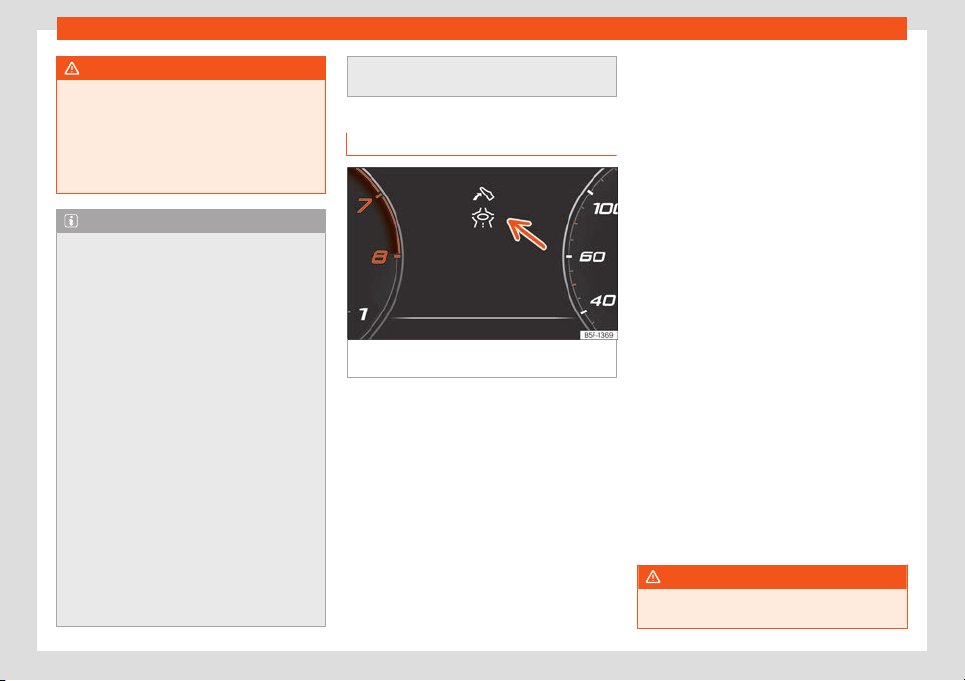
Operation
WARNING
If messages are ignored, the vehicle may
st
all in traffic and cause accidents and se-
vere injuries.
●
Never ignore the messages displayed.
●
Stop the vehicle at the next opportunity
and in a safe place.
Note
To avoid affecting the correct operation of
the syst
em, take the following points into
consideration:
●
Regularly clean the area of vision of the
camera and keep it in a clean state, without
snow or ice.
●
Do not cover the field of vision of the
camera.
●
Always replace damaged or worn blades
when required to avoid lines on the cam-
era's field of vision.
●
Check that the windscreen is not dam-
aged in the area of the camera's field of vi-
sion.
●
The use of outdated maps on the naviga-
tion system may cause the system to show
traffic signs incorrectly.
●
In the waypoints mode of the navigation
system, the traffic sign detection system is
only partly available.
●
Failure to heed the control lamps and
corresponding text messages when they
light up may result in damage to the vehi-
cl
e.
Eco-efficient driving assistance
Fig. 58
Eco-efficient driving assistance indi-
cation (schematic r
epresentation).
Eco-efficient driving assistance helps you
driv
e with care and with low energy con-
sumption by following instructions superim-
posed in the digital cockpit, depending on the
situation.
When you approach places such as a junc-
tion, a roundabout or a section of road with a
speed limit, the symbol
is displayed along
with an event in the digital cockpit
›››
Fig. 58.
As soon as you follow the indication and take
your foot off the accelerator, the vehicle
adapts, based on the selected driving profile
and distance to the incident, brake energy re-
cuperation and speed.
Eco-efficient driving assistance uses the trip
data from the infotainment system and the
sensors of some assist systems. If no destina-
tion guidance is active, the most likely route is
used.
Pressing the accelerator can cancel the in-
tervention of the assistance at any time.
Eco-efficient driving assistance can be
switched on and off in the infotainment sys-
tem, in the assist system settings
›››
page 91.
Eco-efficient driving assistance is temporarily
switched off if:
●
The gear selector is in the S position.
●
The sport driving program is used.
●
Driving with adaptive cruise control (ACC)
or cruise control (GRA).
When these conditions no longer exist, the
assistance is reactivated if it is switched on in
the assist system settings.
Eco-efficient driving assistance is available
depending on the equipment, although not in
all countries.
WARNING
The system is not a replacement for driver
aw
areness.
78
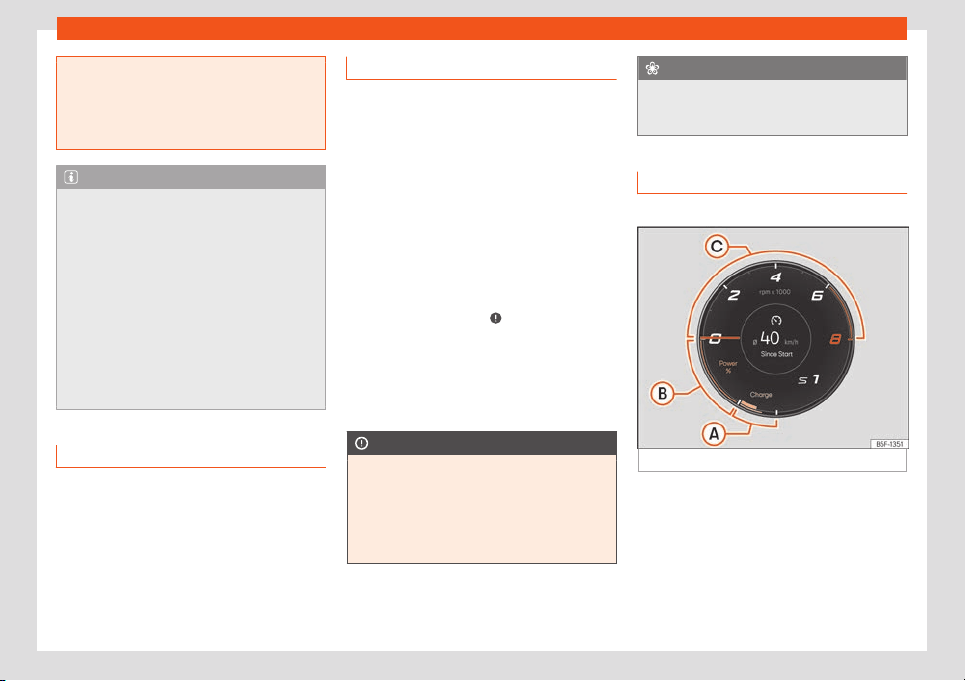
Instruments and warning/control lamps
●
Adapt your speed and driving st
yle at all
times to suit visibility, weather, road and
traffic conditions.
●
Traffic signs on the road and traffic regu-
lations have priority over eco-driving notes.
Note
●
The appear
ance of the symbols may vary
slightly depending on the equipment and
model. System updates may modify or ex-
pand the symbols.
●
When the system is switched on, eco-ef-
ficient driving assistance can also increase
recuperation without any indication being
displayed. This can occur in situations such
as when the accelerator pedal is released
when a vehicle is driving in front. In this
case, energy recuperation is adapted
match the speed of the vehicle in front
without any indication being displayed.
Time
Setting the time on the infotainment sys-
t
em
●
Press > Settings.
●
Select the menu option Time and date to
set the time
›››
page 87.
Revolution counter
The rev counter indicates the number of en-
gine r
evolutions per minute.
Together with the gear-change indicator, the
rev counter offers you the possibility of using
the engine of your vehicle at a suitable
speed.
The beginning of the red zone of the rev
counter indicates the maximum speed in any
gear after running-in and with the engine hot.
However, it is advisable to change up a gear
or move the selector lever to D (or lift your
foot off the accelerator) before the needle
reaches the red zone
›››
.
W
e recommend that you avoid high revs and
that you follow the recommendations on the
gear-change indicator. Consult the addition-
al information in
›››
page 237, Selecting the
optimal gear.
CAUTION
●
T
o prevent damage to the engine, the rev
counter needle should only remain in the
red zone for a short period of time.
●
When the engine is cold, avoid high revs
and heavy acceleration and do not make
the engine work hard.
For the sake of the environment
Changing up a gear early will help you to
sav
e fuel and minimise emissions and en-
gine noise.
Power meter
3 V
alid for: hybrid vehicles
Fig. 59
Digital instrument panel: Power meter
The lower left hand side of the rev counter
has tw
o colour coded areas:
Charge: Charging zone. Indicates the
amount of charge generated and the
maximum charge.
Power %: Electric traction zone. Indi-
cates the percentage of power used and
»
Green
Blue
79
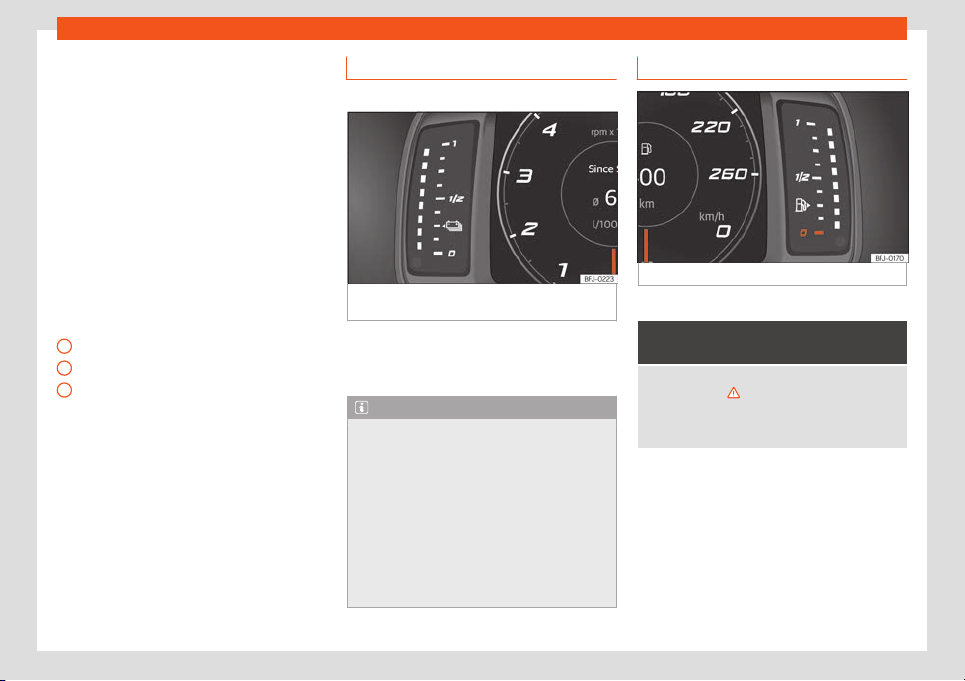
Operation
the maximum amount of power currently
av
ailable.
The power meter shows the usage level of
the electric drive. The power meter bar shows
the current usage level.
A finer coloured border indicates how much
the propulsion can currently be used. De-
pending on the selected driving program and
the current availability of electrical power,
the boundaries of the different colours can
vary.
The following displays can be seen on the
Power meter:
›››
Fig. 59
The vehicle recovers electrical energy.
e-Mode electric driving.
The combustion engine must be running.
With the Boost function, the vehicle drives
for a short period of time with maximum
power from both the electric motor and
the combustion engine.
A
B
C
Battery level indicator
3 V
alid for: hybrid vehicles
Fig. 60
Instrument panel: battery level indica-
t
or.
The small arrow next to the battery symbol
indicat
es which side of the vehicle the charg-
ing cover is on.
Note
●
Ne
ver drive with the tank completely
empty. Under certain circumstances, the
energy stored in the high-voltage battery
may not be sufficient to reach the nearest
service station.
●
When the outside temperature is very
low, and therefore the high-voltage battery
is very cold, difficulties may arise in start-
ing the internal combustion engine and the
range in the electric driving mode may be
reduced.
Fuel gauge
Fig. 61
Digital instrument panel: fuel gauge.
Control lamps
It lights up, and in addition, the
l
ower diode lights up in red
Fuel tank almost empty. The fuel reserve level has
been r
eached
›››
. Refuel as soon as you have the
opportunity.
When the fuel level is very low, the lower diode flash-
es red.
The display only works when the ignition is
s
witched on.
The fuel range is displayed on the instrument
panel.
You can consult the tank capacity of your ve-
hicle in the
›››
page 381 section.
80
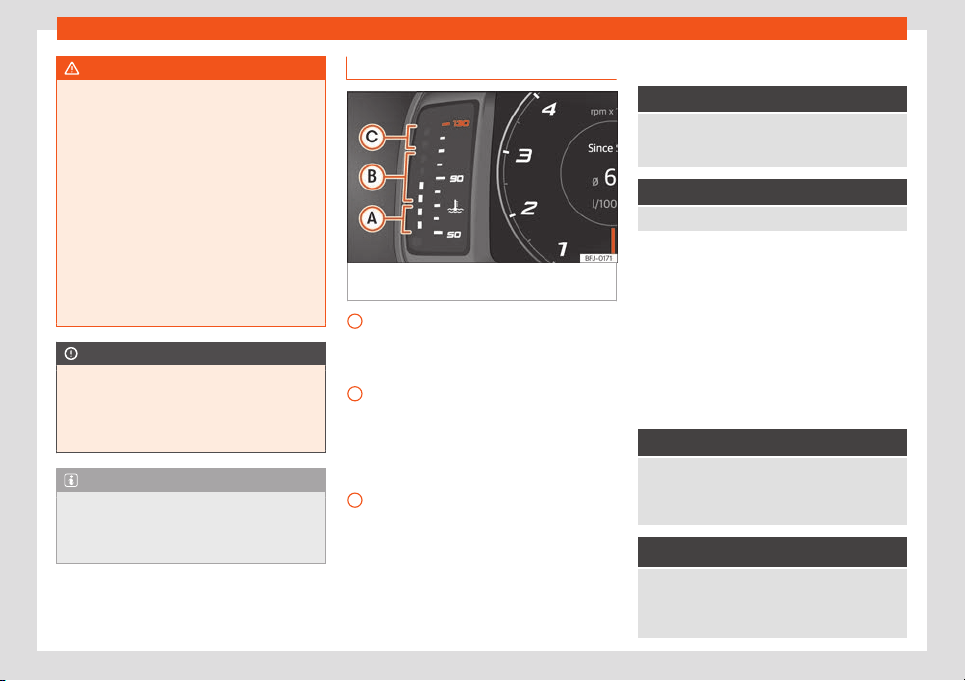
Instruments and warning/control lamps
WARNING
When driving with low fuel, the vehicle may
st
all in traffic and cause accidents and se-
vere injuries.
●
If the fuel tank level is too low, fuel could
reach the engine irregularly, particularly
when driving up or down slopes.
●
The steering system and the driver assis-
tance systems and brakes do not work
when the engine is running irregularly or
switches off due to lack of fuel or an irregu-
lar supply thereof.
●
Always refuel when there is only one
quarter of fuel in tank to prevent the vehicle
to stop due to lack of fuel.
CAUTION
Never run the fuel tank completely dry. An
irr
egular fuel supply can cause misfiring
and unburnt fuel could enter the exhaust
system. The catalytic converter or the par-
ticulate filter may get damaged!
Note
The small arrow on the fuel gauge next to
the fuel pump symbol points out t
owards
the side of the vehicle with the fuel tank
flap.
Coolant temperature indicator.
Fig. 62
Digital instrument panel: engine cool-
ant t
emperature indicator.
Cool zone. The engine has not r
eached
operating temperature yet. Avoid high
speeds and stressing the engine if it has
not reached operating temperature.
Normal zone. At high outside tempera-
tures and when making the engine work
hard, the diodes may continue lighting up
and reach the upper zone. This is no
cause for concern, provided the control
lamp does not light up
Warning area. When the engine is work-
ing hard, especially at high outside tem-
peratures, the diodes may light up in the
warning area.
The coolant temperature gauge only works
when the ignition is switched on.
A
B
C
Control and warning lamp
It lights up red
Do not carry on driving!
Engine cool
ant level too low, coolant temperature too
high.
Flashes red
Fault in the engine coolant system.
●
Stop the vehicle, switch off the engine and
l
et it cool down.
●
Check the engine coolant level
›
››
page 343.
●
If the warning lamp does not switch off even
if the coolant level is correct, request assis-
tance from specialised personnel.
Control and warning lamps (valid for hy-
brid vehicles)
It lights up red
Do not carry on driving!
Engine or high-v
oltage system coolant level too low,
engine or high-voltage system coolant temperature
too high.
and
Flashes red
Do not carry on driving!
Failure in the high-voltage cooling circuit. Discon-
nect the drive system and seek professional assis-
tance.
»
81
Operation
●
St
op the vehicle, switch off the engine and
let it cool down.
●
Check the engine coolant level
›››
page 343.
●
Check the coolant level in the high-voltage
cooling circuit
›››
page 344. If the level is too
low DO NOT add coolant. Seek specialist
assistance immediately.
●
If the warning lamp does not switch off even
if the coolant level is correct, request assis-
tance from specialised personnel.
CAUTION
●
T
o ensure a long useful life for the engine,
avoid high revs, driving at high speed and
making the engine work hard for approxi-
mately the first 15 minutes when the engine
is cold. The phase until the engine is warm
also depends on the outside temperature. If
necessary, use the engine oil temperature
›››
page 73 as a guide.
●
Additional lights and other accessories in
front of the air inlet reduce the cooling ef-
fect of the coolant. At high outside temper-
atures and high engine loads, there is a risk
of the engine overheating.
●
The front spoiler also ensures proper dis-
tribution of the cooling air when the vehicle
is moving. If the spoiler is damaged this can
reduce the cooling effect, which could
cause the engine to overheat. Seek spe-
cialist assistance.
Service intervals
The service interval display appears on the
instrument clust
er screen and in the infotain-
ment system.
There are different versions of instrument
panels and infotainment systems, so the ver-
sions and instructions on the screens may
vary.
SEAT distinguishes between services with en-
gine oil change (e.g. Oil change service) and
services without engine oil change (e.g. In-
spection).
In vehicles with Services established by
time or mileage, the service intervals are al-
ready pre-defined.
In vehicles with LongLife Service, the inter-
vals are determined individually. Thanks to
technological progress, maintenance work
has been greatly reduced. Because of the
technology used by SEAT, with this service
you only need to change the oil when the ve-
hicle so requires. To calculate this variation
(max. 2 years), the vehicle's conditions of use
and individual driving styles are considered.
The advance warning first appears 20 days
before the date established for the corre-
sponding service. The kilometres (miles) re-
maining until the next service are always
rounded up to the nearest 100 km (miles) and
the time is given in complete days. The cur-
rent service message cannot be viewed until
500 km after the last service. Prior to this, on-
ly lines ar
e visible on the display.
Inspection reminder
If a service or an inspection has to be carried
out soon, a service reminder will be dis-
played when the ignition is switched on.
The figure displayed are the kilometres that
can still be travelled or the time until the next
service.
Service due
When the time for a service or an inspec-
tion comes, an audible warning will be emit-
ted when the ignition is switched on and the
fixed key symbol may appear on the in-
strument panel for a few seconds, along with
one of the following messages:
●
Service now!
●
Please have your vehicle inspec-
ted.
●
Oil change service due!
●
Oil change service and inspection
due!
Consult a service notification
With the ignition switched on, the engine off
and the vehicle at a standstill, the current
service notification can be read:
82
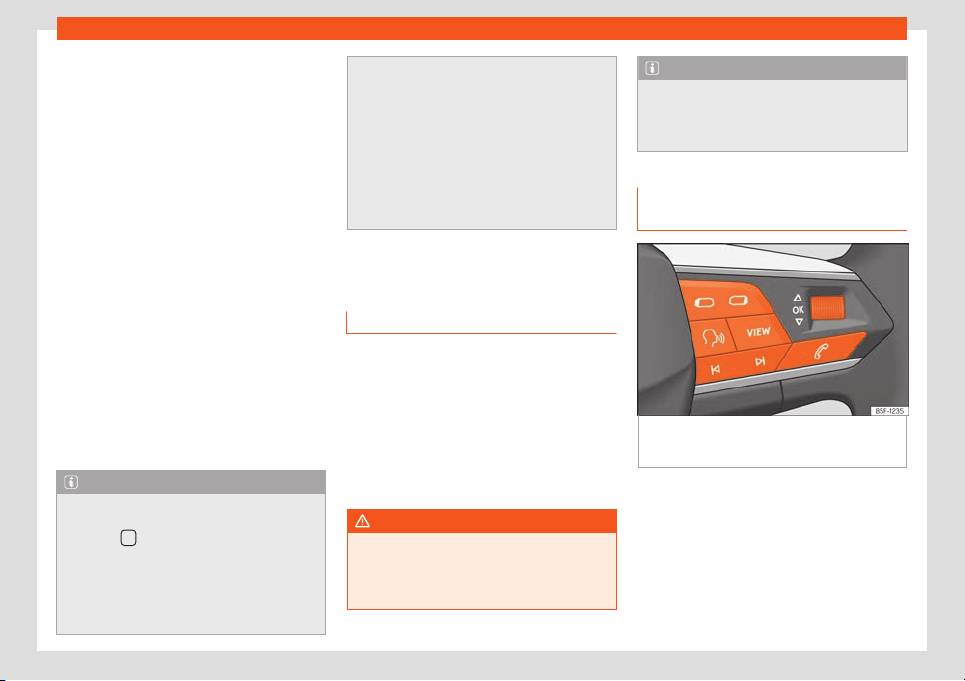
Instruments and warning/control lamps
Check the date of the current service on the
inf
otainment system
●
Press the function button Data > Set-
tings > Service; OR > Vehicle sta-
tus
›››
page 87.
●
Select the Service menu option to display
information about the services.
Resetting service interval display
If the service was not carried out by a SEAT
dealership, the display can be reset as fol-
lows:
●
The service interval display can only be re-
set through the Service menu
›››
page 72.
Do not restart the indicator between the
service intervals, otherwise the information
displayed will be incorrect.
If the oil change service is reset manually, the
service interval display changes to a fixed
service interval, also in vehicles with Flexible
oil change service.
Note
●
The service message disappears aft
er a
few seconds, when the engine is started or
when the
button is pressed on the multi-
function st
eering wheel.
●
In vehicles with the LongLife system in
which the battery has been disconnected
for a long period of time, it is not possible to
calculate the date of the next service.
Therefore the service interval display may
not be corr
ect. In this case, bear in mind the
maximum service intervals permitted
›››
page 364.
●
If you reset the display manually, the next
service interval will be indicated as in vehi-
cles with fixed service intervals. For this
reason we recommend that the service in-
terval display be reset by a SEAT author-
ised Dealer.
Using the instrument panel
Intr
oduction
With the ignition switched on, it is possible to
r
ead the different functions of the display by
scrolling through the menus.
The multifunction display can only be con-
trolled from the buttons on the multi-function
steering wheel.
Some menu options can only be read when
the vehicle is at a standstill.
WARNING
Distracting the driver in any way can lead
t
o an accident and cause injuries.
●
Never use the menus on the instrument
panel display while the vehicle is in motion.
Note
After loading or changing the 12-volt bat-
t
ery, check the system settings. If the pow-
er supply is interrupted, the system settings
might be incorrect or deleted.
Operation using the multifunction
st
eering wheel
Fig. 63 Right side of the multifunction steering
wheel
: buttons to the menus and information
displays on the instrument panel.
As long as a priority 1
›
››
page 73 warning is
active, it will not be possible to access any
menu. Some warnings can be confirmed and
hidden with the button of the multifunction
steering wheel
›››
Fig. 63.
Select a menu or an informative display
●
Switch the ignition on.
»
83
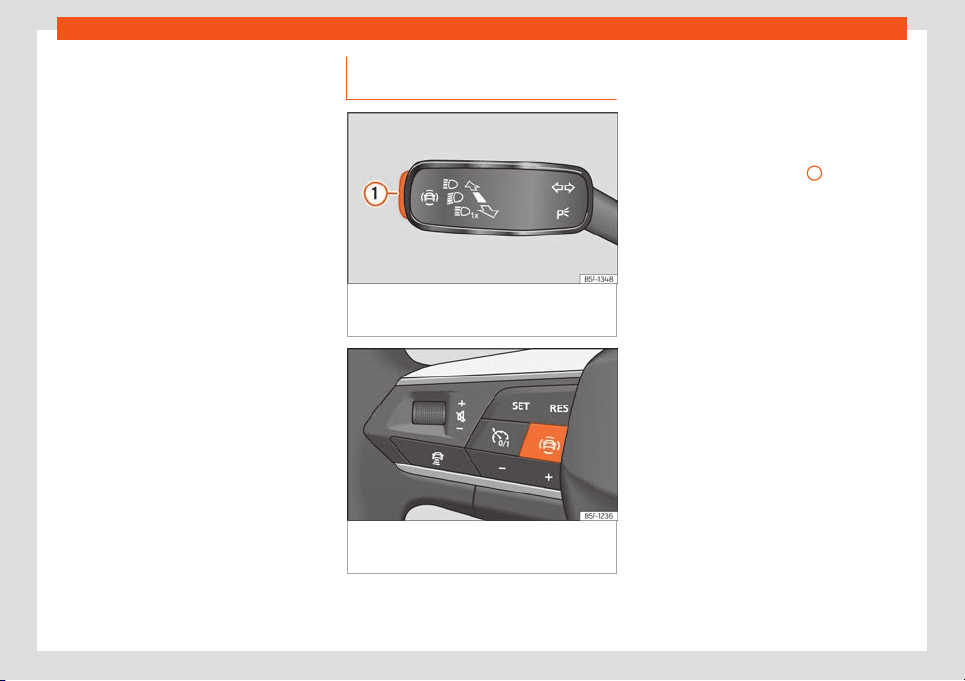
Operation
●
Cust
omisation option: select a user.
●
If a message or vehicle symbol is displayed,
press the button
›››
Fig. 63; if necessary,
several times.
●
To change menus, use buttons or
›››
Fig. 63.
●
To open the menu or the information dis-
played, press the button
›››
Fig. 63 or wait
a few seconds until the menu or the informa-
tive display opens automatically.
Changing menu settings
●
In the menu displayed, turn the right thumb-
wheel of the multifunction steering wheel
›››
Fig. 63 until the desired option of the menu
is highlighted. The option appears framed.
●
Press the button
›››
Fig. 63 to make the
required modifications. A mark indicates that
the system or function is activated.
Back to menu selection
Press the button or
›››
Fig. 63.
Button for the driver assistance
systems
Fig. 64
On the turn signal and main beam lev-
er: butt
on for driver assistance systems (de-
pending on versions).
Fig. 65
Left side of the multifunction steering
wheel
: button for driver assistance systems
(depending on versions).
With the turn signal and main beam headlight
l
ever button, you can activate or deactivate
the driver assistance systems displayed in the
Assistance systems menu .
Activating or deactivating a driver assis-
tance system using the turn signal lever
and main beam headlight
●
Briefly press the
›››
Fig. 64
1
button to
open the Assist
ants menu.
●
Select the driver assistance system and ac-
tivate or deactivate it
›››
page 83. A mark in-
dicates that driver assistance system is
switched on.
●
Next, confirm the selection by pressing the
button on the multi-function steering
wheel.
Activating or deactivating a driver assis-
tance system using the multifunction
steering wheel
●
Press the button
›››
Fig. 65 to open the
Aids menu.
●
Select the driver assistance system and ac-
tivate or deactivate it. A mark indicates that
driver assistance system is switched on.
●
Next, confirm the selection by pressing the
button on the multifunction steering wheel.
The driver assistance systems can also be
switched on and off in the infotainment sys-
tem, in the menu Vehicle settings
›››
page 91.
84

Instruments and warning/control lamps
Control lamps
Contr
ol and warning lamps
The control and warning lamps are indicators
of w
arnings
›››
, faults or certain functions.
Some contr
ol and warning lamps come on
when the ignition is switched on, and switch
off when the engine starts running, or while
driving.
Depending on the model, additional text
messages may be viewed on the instrument
panel display. These may be purely informa-
tive or they may be advising of the need for
action
›››
page 66, Instrument panel.
Depending upon the equipment fitted in the
vehicle, instead of a warning lamp, some-
times a symbol may be displayed on the in-
strument panel.
When certain control and warning lamps are
lit, an audible warning is also heard.
Red warning lamps
Notification central lamp: additional infor-
mation on the instrument panel displ
ay
Parking brake on
›
››
page 273.
Fault in the brake system
›
››
page 273.
Fault in the steering system
›
››
page 239.
Driver or passenger has not fastened seat
belt
›
››
page 17.
Engine or high voltage system coolant
(hybrid v
ehicles)
›››
page 81.
Engine oil pressure
›
››
page 341.
Anomaly in the alternator
›
››
page 348,
›››
page 349.
Press the foot brake
›
››
page 256.
Drive system
›
››
page 324
AdBlue level too low, OR f
ault in the SCR
system
›››
page 333 .
Yellow warning lamps
Notification central lamp: additional infor-
mation on the instrument panel displ
ay
Front brake pads worn
›
››
page 273.
Fault in the ESC or the system caused it to
s
witch off; OR ESC or ASR operating
›››
page 278.
ASR switched off manually; OR ESC in
Sport mode
›
››
page 278.
Fault in the ABS
›
››
page 278.
Rear fog light switched on
›
››
page 115.
Fault in the emission control system
›
››
page 335.
Pre-heating of the diesel engine; OR f
ault
in the management of the diesel engine
›››
page 335.
Fault in the petrol engine management
›
››
page 335.
Particulate filter blocked
›
››
page 335.
Fault in the steering system
›
››
page 239.
Drive system
›
››
page 224
Vehicle sound
›
››
page 224
Tyre pressure monitor system
›
››
page 359.
Fuel tank almost empty
›››
page 80.
Adblue level low, OR fault in the SCR sys-
tem
›››
page 333.
Fault in airbag system and seat belt ten-
sioners
›››
page 27.
Front passenger front airbag disabled
›››
page 27.
Front passenger airbag switched on
›››
page 27.
Defective active cruise control (ACC)
›››
page 260
Lane Assist (lane keeping system)
›››
page 263.
»
85
Operation
Error in the lane assist warning system
›
››
page 263.
Travel Assist error
›
››
page 267.
Fault in the lighting of the vehicle
›
››
page 115.
Low engine oil level
›
››
page 341.
Fault in the gearbox
›
››
page 236.
Windscreen cleaning fluid too low
›
››
page 124.
Green indicator lamps
Turn lights or emergency lights on
›
››
page 115.
Trailer turn signals
›
››
page 115.
Auto Hold activated
›
››
page 277.
Press the foot brake
›
››
page 230.
Cruise control
›
››
page 249.
Speed limiter
›
››
page 251
Adaptive cruise control (ACC)
›
››
page 256.
Lane assist active (Lane Assist) warning
›
››
page 263.
Travel Assist active
›
››
page 266.
Blue indicator lamps
Main beam on or flasher on
›››
page 115.
Other warning lamps
Door(s), rear lid or bonnet open or not
pr
operly closed
›››
page 70.
Main beam assist (Light Assist)
›
››
page 115.
Hill descent control (HDC)
›
››
page 237.
Service interval display
›
››
page 82.
Mobile phone connected by Bluetooth® .
Mobile telephone battery charge status.
Risk of freezing
›
››
page 70.
Start-Stop system activated
›
››
page 226.
Start-Stop system unavailable
›
››
page 226.
Low consumption driving status
›››
page 71.
WARNING
If the warning lamps and messages are ig-
nor
ed, faults may occur in the vehicle, it
may stall in traffic, or accidents and seri-
ous injuries may occur.
●
Never ignore the warning lamps or text
messages.
●
St
op the vehicle safely as soon as possi-
ble.
●
A faulty vehicle represents a risk of acci-
dent for the driver and for other road users.
If necessary, switch on the hazard warning
lamps and put out the warning triangle to
advise other drivers.
●
Before opening the bonnet, switch off the
engine and allow it to cool.
●
In any vehicle, the engine compartment is
a hazardous area and could cause severe
injuries
›››
page 337.
86

Instruments and warning/control lamps
Infotainment system
Intr
oduction
The infotainment system brings together im-
port
ant vehicle functions and systems into a
single central control unit, e.g. air condition-
ing, menu settings, radio equipment and the
navigation system.
The actual number of menus available and
the name of the various options will depend
on the vehicle’s electronics and equipment.
General operating information
General information on the operation of the
infotainment system, as well as on the warn-
ing and safety instructions that must be taken
into account, is found in
›››
page 172.
How to move through the different menus
and sel
ect them
●
Switch the ignition on.
●
If the infotainment system is off, switch it on.
●
The different menus are selected directly
on the touch screen using texts, icons or but-
tons.
If the box is checked , the function is activa-
ted.
Pressing the menu button will always take
you to the last menu used.
Any changes made using the settings menus
are automatically saved on closing those
menus.
Scroll bar: Some menus and functions show
more content above or below those dis-
played on the screen at that time, for exam-
ple, long lists of settings. Press on the scroll
bar and pull up or down.
Tutorial
The first time you connect the infotainment
system, a system tutorial will open with a brief
description of the main functions and how to
use it.
Help
In the Help menu can be found more informa-
tion and tips for using the infotainment sys-
tem.
WARNING
Any distraction may lead to an accident,
with the risk of injury. Oper
ating the Info-
tainment system while driving could dis-
tract you from traffic.
87
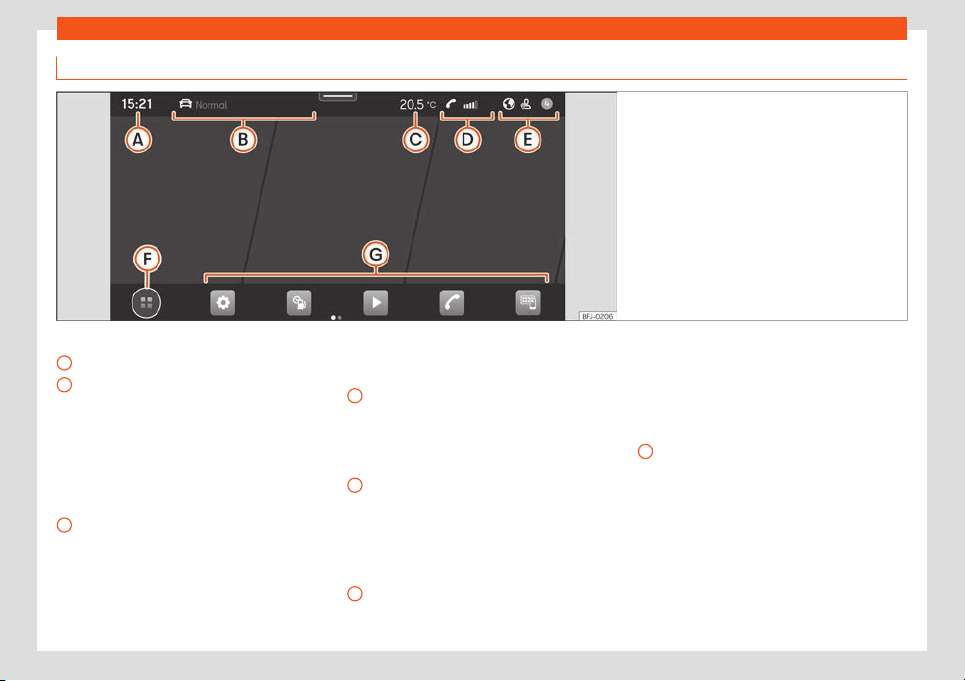
Operation
Explanation of the function buttons
Fig. 66 Schematic representation: Overview of the
possibl
e function buttons on the screen
Top part of the screen
Curr
ent time
Driving profile and navigation informa-
tion. If the user has an active route, both
the time and the distance to the destina-
tion are displayed. If there is no active
route, the driving profile is displayed. On
vehicles with no available driving profile,
the current address is displayed whenev-
er there is no active route.
Information on air conditioning (valid
for the Connect System). In vehicles with
heated steering wheels or windscreen
heating, the corresponding icon is dis-
A
B
C
played when these functions are ena-
bl
ed. If not, the current outside tempera-
ture is displayed.
Telephone information. Information re-
garding your mobile device is displayed:
available network signal strength, estab-
lished Bluetooth connection, unanswered
calls, new messages, battery status, etc.
Number of notifications and customi-
zation of the system depending on the
user and connectivity.
Lower part of the screen (valid for the
Connect System)
Main menu display mode:
D
E
F
: main menu with the 6 main functions
divided int
o 2 screens (3 + 3, customisa-
ble by the user by pressing on the func-
tion).
: main menu in mosaic mode (all func-
tions of the Infotainment system)
Direct accesses to the functions of the In-
fotainment system (up to 10 functions, 5 +
5, customisable by the user). By pressing
on the icon, you can select/deselect the
functions in question.
G
88
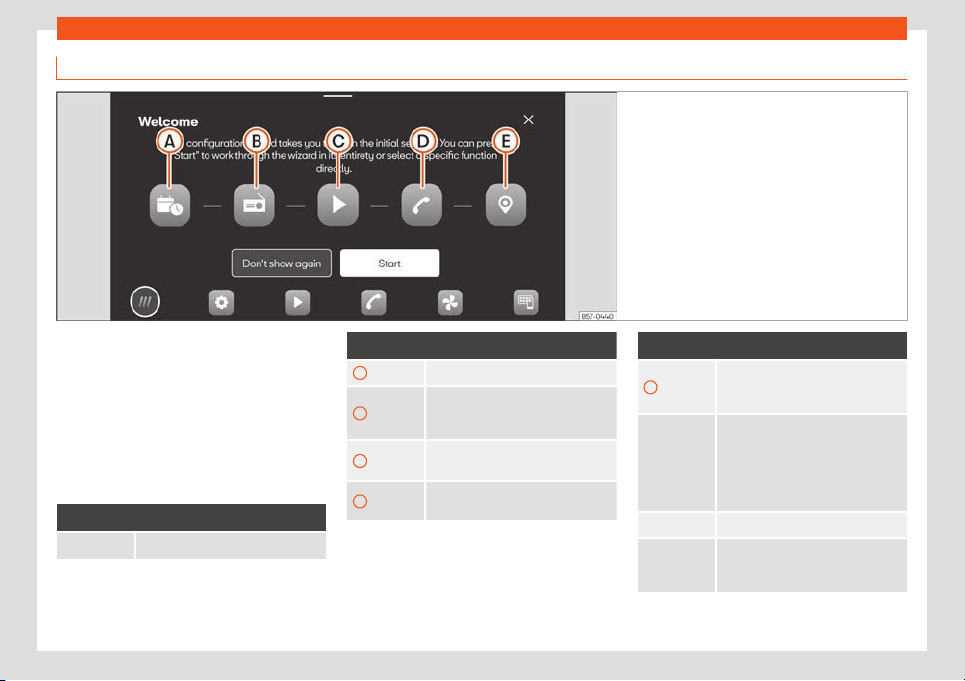
Instruments and warning/control lamps
Initial configuration wizard
Fig. 67 Schematic representation: Initial configu-
r
ation wizard
The initial configuration wizard will help you
t
o set up your Infotainment system the first
time you switch it on.
Every time you switch on the Infotainment
system, the initial setup screen will be dis-
played
›››
Fig. 67 if any parameters have not
been set (marked with “”) or if the Don't
show again function button has not been
pressed.
Function button: Function
Closes the Configuration Wizard.
Function button: Function
A
Press to set day and time.
B
Press to search and store to memory
the radio stations that have the best
reception at that moment.
C
Press to go to the Online Media set-
tings.
D
Press to link your mobile phone to
the Inf
otainment system.
Function button: Function
E
Press to select your home address
using your curr
ent position or by
manually entering an address.
Don't show
again
Disables the possibility of changing
the settings of the Inf
otainment sys-
tem. If you want to run the initial con-
figuration, it can be accessed
through Settings > Initial con-
figuration wizard.
Start Starts up the Configuration Wizard.
End
Once one or more settings have
been applied, pr
ess to finalise the
setup in the main menu of the wizard.
89
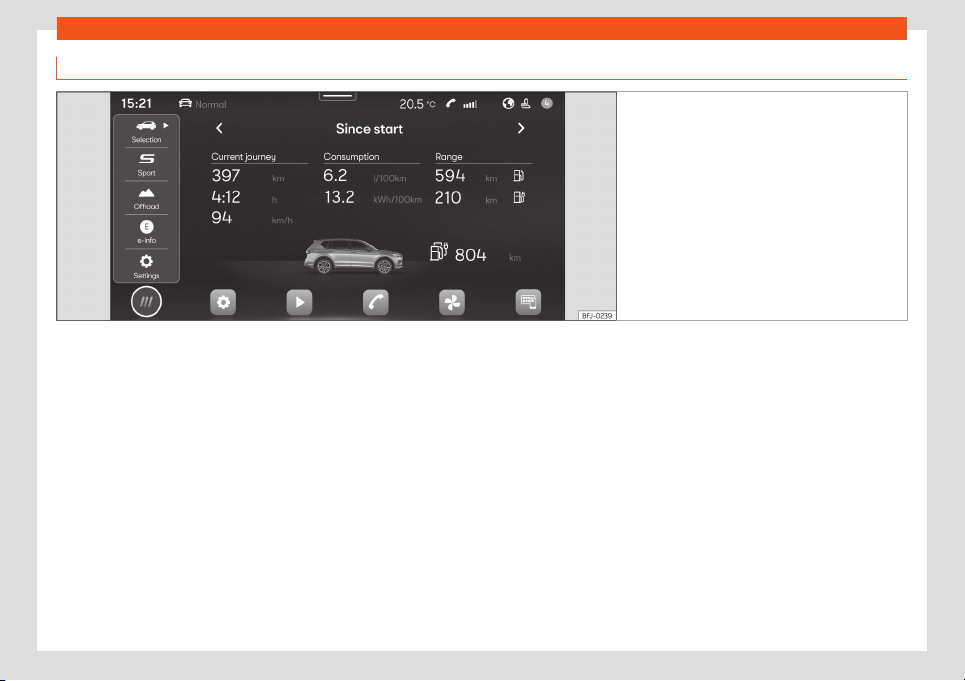
Operation
Vehicle information
Fig. 68 Schematic representation: Vehicle infor-
mation and st
atus
Pressing on
> Selection and then on
Vehicle info opens the Vehicle information
menu with the following submenus:
Driving data. The average consump-
tion, average speed, distance travelled,
trip duration and autonomy are shown. It
has 3 memories: “Since start”, “Long-
term” and “Since refuel”
›››
page 72.
Vehicle status. The warnings regarding
faults, incidents, memorisation of the
tyre pressure or information of the next
inspection service are displayed.
e-Info: shows the electric range and
power flow
›››
page 225.
–
–
–
90
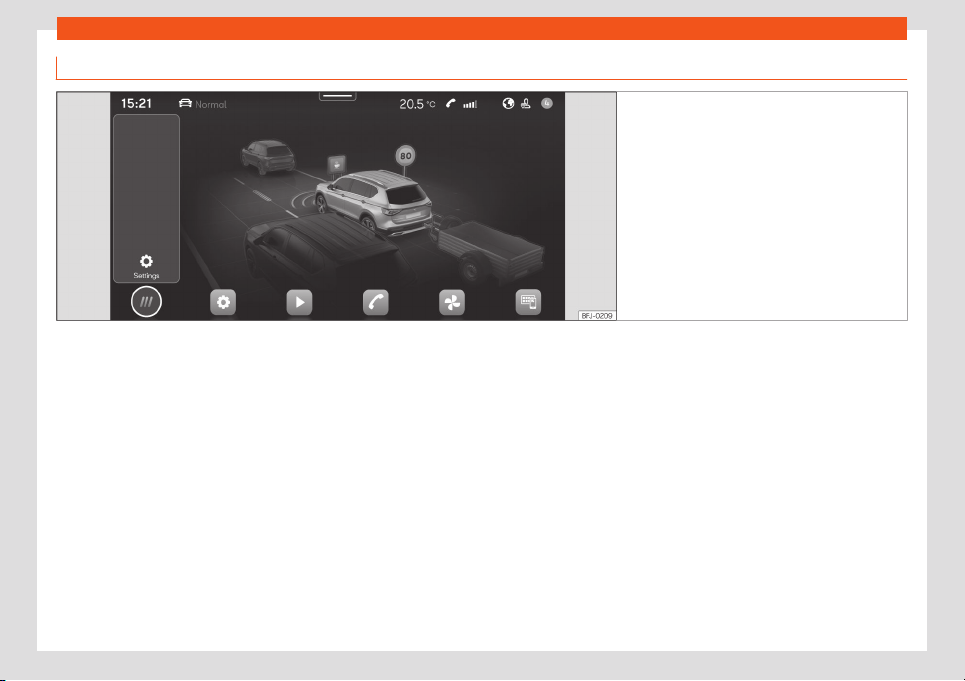
Instruments and warning/control lamps
Assist systems and vehicle settings
Fig. 69 Schematic representation: Assist systems
and v
ehicle settings
The number of assist systems and settings
depend on the v
ersion and the country in
question.
■
Driver assistance
■
Automatic parking brake activation
›››
page 275.
■
Park assist
›››
page 282.
■
Activate / deactivate ESC, stabilisation
systems and brake assist
›››
page 278.
■
Activate / deactivate the Start-Stop sys-
tem
›››
page 226.
■
Adaptive cruise control (ACC)
›››
page 255.
■
Lane Assist (lane keeping system)
›››
page 263.
■
Emergency brake assistance system
(Front Assist)
›››
page 252.
■
Fatigue detection
›››
page 74.
■
Traffic sign recognition
›››
page 75.
■
Lane assist
›››
page 269.
91
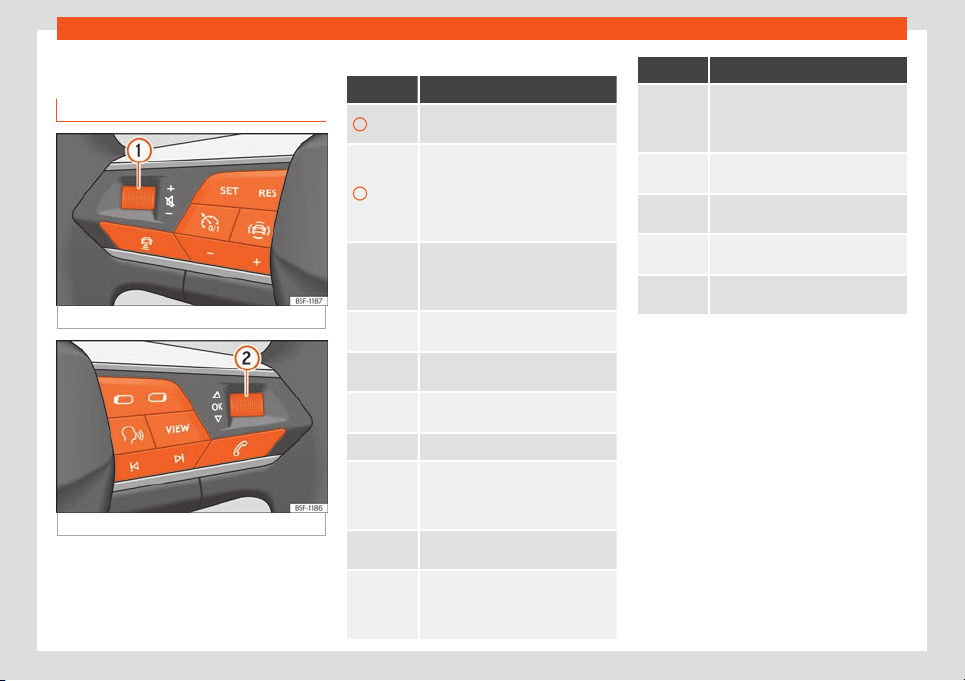
Operation
Multifunction steering wheel
Functions
Fig. 70
Controls on the steering wheel.
Fig. 71
Controls on the steering wheel.
The steering wheel includes multifunction
modul
es from where it is possible to control
the audio, telephone, navigation, voice con-
trol and assist functions without the driver
needing to be distracted from the road.
Buttons available depending on the version
Symbol Function
1
Turn: T
urn volume up/down
Press: Mute volume
2
Turn: Search in the instrument panel
menu. In Navigation mode, turn to in-
crease/decrease map size in SEAT
Digital Cockpit
Press: Select the highlighted option in
the instrument panel
Radio: Sear
ch for the previous/next
station.
Media: Short press: previous/next
track; long press: fast forward/rewind
Activate phone menu (answer call,
end call)
Switch between media and radio
sour
ces
Change the instrument panel menu
(previous/next)
Enable/disable voice control
Analogue Panel: No function
Digital Panel (SEAT Digital Cockpit):
Change digital panel views
›››
page 67
Activate or deactivate steering wheel
heating
›››
page 165
Connect/disconnect the Cruise con-
trol system
›››
page 249 / ACC
›››
page 255 / Speed limiter
›››
page 250
Symbol Function
: Activ
ate ACC / Cruise control sys-
tem / Limiter
: Reset programmed ACC speed or
cruise control system
: Incr
ease programmed speed
: Decrease programmed speed
Open the drive assist menu in the in-
strument panel
Modify the programmed ACC dis-
t
ance
Switching Travel Assist on and off
›
››
page 265
92
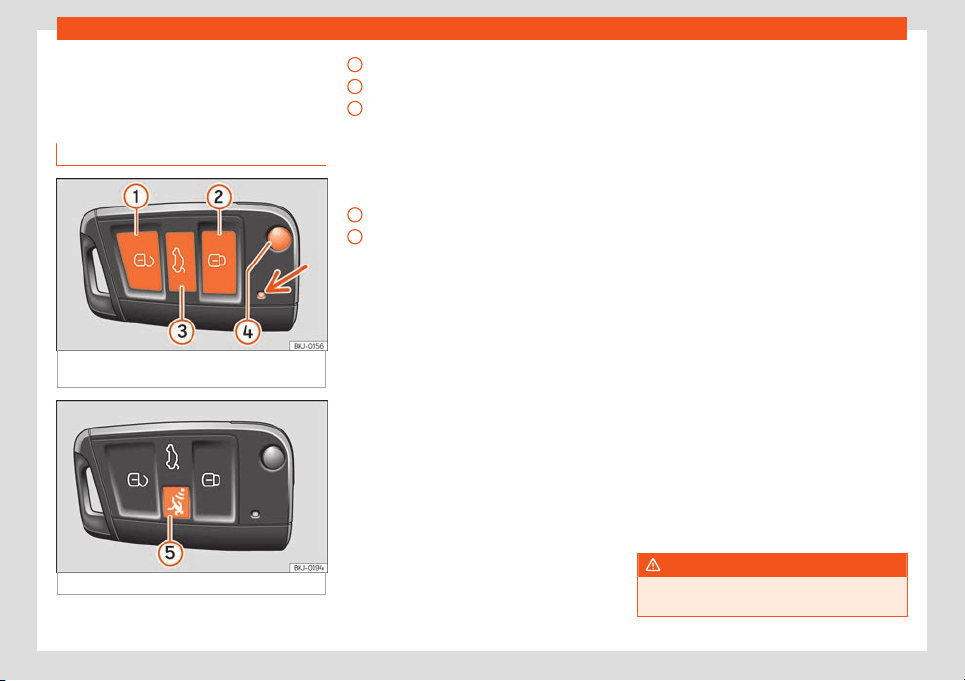
Opening and closing
Opening and closing
Set of v
ehicle keys
Vehicle key
Fig. 72 Assignment of buttons on the remote
contr
ol key.
Fig. 73
Vehicle key with alarm button.
Key to the
›
››
Fig. 72,
›››
Fig. 73
Unlock the vehicle
Lock the vehicle
Unlock only the rear lid. Press the button
until all the turn signals on the vehicle
flash briefly. You have 2 minutes to open
the rear lid. Once this time has passed, it
will lock again. In addition, the lamp on
the key flashes.
Folding the key shaft in and out
Alarm button. Only press in the event of
an emergency! When the alarm button is
pressed, the vehicle's sounds and the turn
signals light up for a short time. Press
again to disconnect.
With the vehicle key the vehicle may be
locked or unlocked remotely
›››
page 95.
The vehicle key includes an emitter and bat-
tery. The receiver is in the interior of the vehi-
cle. The range of the vehicle key with remote
control and new battery is several metres
around the vehicle.
If it is not possible to open or close the vehicle
using the remote control key, this should be
re-synchronised
›››
page 95 or the battery
changed
›››
page 94.
Different keys belonging to the vehicle may
be used.
1
2
3
4
5
Control lamp on the vehicle key
When a butt
on on the vehicle key is pressed,
the control lamp flashes
›››
Fig. 72 (arrow)
once briefly, but if the button is held down for
a longer period the control lamp flashes sev-
eral times, such as in convenience opening.
If the vehicle key control lamp does not light
up when the button is pressed, replace the
key's battery
›››
page 94.
Spare key
To obtain a spare key and other vehicle keys,
the vehicle ID number is required.
Each new key contains a microchip which
must be coded with the data from the vehicle
electronic immobiliser. A vehicle key will not
work if it does not contain a microchip or the
microchip has not been encoded. This is also
true for keys which are specially cut for the
vehicle.
The vehicle keys or new spare keys can be
obtained from a SEAT Official Service, a spe-
cialised workshop or an approved key service
qualified to create this kind of key.
New keys or spare keys must be synchronised
before use
›››
page 95.
WARNING
●
Ne
ver leave children or disabled persons
in the vehicle. In case of emergency, they
»
93
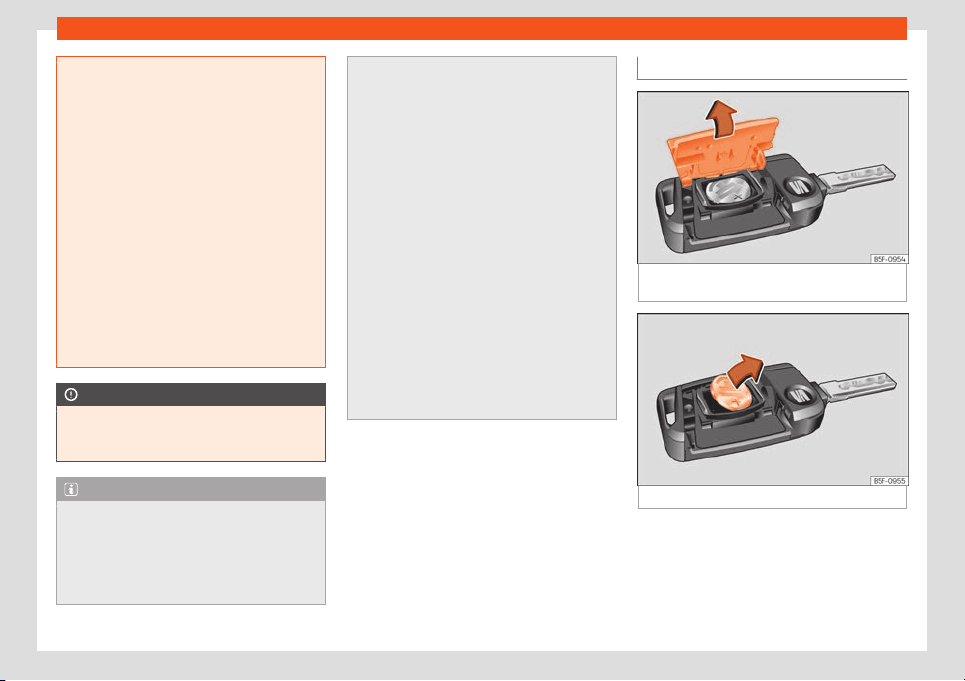
Operation
may not be able to leave the vehicle or
manage on their o
wn.
●
An uncontrolled use of the key could start
the engine or activate any electric equip-
ment (e.g. electric windows), causing risk
of accident. The doors can be locked using
the remote control key. This could become
an obstacle for assistance in an emergen-
cy situation.
●
Never forget the keys inside the vehicle.
An unauthorised use of your vehicle could
result in injury, damage or theft. Therefore
always take the key with you when you
leave the vehicle.
●
Never remove the key from the ignition if
the vehicle is in motion. Otherwise, the
steering could suddenly block and it would
be impossible to steer the vehicle.
CAUTION
All of the vehicle keys contain electronic
components. Pr
otect them from damage,
impacts and humidity.
Note
●
Only use the k
ey button when you require
the corresponding function. Pushing the
button unnecessarily could accidentally
unlock the vehicle or trigger the alarm. It is
also possible even when you are outside
the radius of action.
●
K
ey operation can be greatly influenced
by overlapping radio signals close to the
vehicle working in the same range of fre-
quencies, for example, radio transmitters or
mobile telephones.
●
Obstacles between the remote control
and the vehicle, bad weather conditions
and discharged batteries can considerably
reduce the range of the remote control.
●
If the buttons of the vehicle key are
pressed or one of the central locking but-
tons
›››
page 98 is pressed repeatedly in
short succession, the central locking brief-
ly disconnects as protection against over-
loading. The vehicle is then unlocked. Lock
it if necessary.
●
Spare remote control keys are available
at your Technical Service, where they must
be matched to the locking system.
●
Up to five remote control keys can be
used.
To change the battery
Fig. 74
Vehicle key: opening the battery com-
partment co
ver.
Fig. 75 Vehicle key: removing the battery.
SEAT recommends you ask a specialised
w
orkshop to replace the battery.
The battery is located to the rear of the vehi-
cle key, under a cover.
94
Opening and closing
Changing the battery
●
Unfold the vehicle key blade
›
››
page 93.
●
Remove the cover from the back of the ve-
hicle key
›››
Fig. 74 in the direction of the ar-
row
›››
.
●
Extract the battery from the compartment
using a suit
able thin object
›››
Fig. 75.
●
Place the new battery in the compartment
as shown
›››
Fig. 75, pressing in the opposite
direction to that shown by the arrow
›››
.
●
Fit the cover as shown
›
››
Fig. 74, pressing it
onto the vehicle key casing in the opposite di-
rection to that shown by the arrow until it
clicks into place.
WARNING
Swallowing a battery with a 20 mm diame-
t
er or any other button battery can cause
serious and even fatal injuries within a very
short time.
●
Keep the vehicle key and key fobs with
batteries out of reach of children.
●
If you suspect that someone may have
swallowed a battery, seek immediate med-
ical attention.
CAUTION
●
If the batt
ery is not changed correctly,
the vehicle key may be damaged.
●
Use of unsuitable batteries may damage
the vehicle key. For this reason, always re-
place the dead battery with another of the
same v
oltage, size and specifications.
●
When fitting the battery, check that the
polarity is correct.
For the sake of the environment
Please dispose of your used batteries cor-
r
ectly and with respect for the environ-
ment.
Synchronize the vehicle key
If the butt
on is pressed frequently outside
of the vehicle range, it is possible that the ve-
hicle can no longer be locked or unlocked us-
ing the key. In this case, the key must be re-
synchronised as described below:
●
Unfold the vehicle key blade
›››
page 93.
●
If necessary, remove the cover from the
driver door lever
›››
page 105.
●
Press the button on the vehicle key. For
this, it must remain with the vehicle.
●
Open the vehicle within one minute using
the key blade. The key has been synchron-
ised.
●
If necessary, fit the cap.
Central locking
Introduction
Central locking functions correctly when all
the doors and the r
ear lid are correctly shut. If
the driver door is open, the vehicle cannot be
locked with the key.
If the vehicle has the Keyless Access locking
and ignition system, it may only be locked
with the ignition off and the driver's door
closed.
WARNING
The incorrect use of the central locking
syst
em may cause serious injuries.
●
The central locking system will lock all
doors. A vehicle locked from the inside can
prevent any non-authorised individual from
opening the doors and accessing the vehi-
cle. Nevertheless, in case of emergency or
accident, locked doors will complicate ac-
cess to the vehicle interior to help the pas-
sengers.
●
Never leave children or disabled people
alone in the vehicle. The central locking
button can be used to lock all the doors
from within. Therefore, passengers will be
locked inside the vehicle. Individuals locked
in the vehicle can be exposed to very high
or very low temperatures.
●
Depending on the time of the year, tem-
peratures inside a locked and closed
»
95
Operation
vehicle can be extremely high or extremely
l
ow resulting in serious injuries and illness
or even death, particularly for young chil-
dren.
●
Never leave individuals locked in a closed
and locked vehicle. In case of emergency,
they may not be able to exit the vehicle by
themselves or get help.
Description
Central locking allows all doors, the rear lid
and the t
ank flap to be unlocked centrally:
●
From outside, using the vehicle key
›››
page 97.
●
From outside with the Keyless Access
›››
page 98 system,
●
From inside, by pushing the central locking
button
›››
page 98.
Various functions are available to improve the
vehicle safety:
●
Security system “Safe”
›››
page 101
●
Self-locking system to prevent involuntary
unlocking
●
Selective unlocking system
●
Automatic speed dependent locking and
unlocking system (Auto Lock)
●
Emergency unlocking system
Self-locking system to prevent involuntary
unlocking
It is an anti-theft system and prevents the un-
intentional unlocking of the vehicle. If the ve-
hicle is unlocked and none of the doors (in-
cluding the boot) are opened within 30 sec-
onds, it re-locks automatically.
Unlocking one side of the vehicle only
When you lock the vehicle with the key, the
doors and the rear lid are locked. When you
open the door, you can either unlock only the
driver door, or all the vehicle doors. To select
the required option, use the Infotainment sys-
tem setting
›››
page 97.
Automatic locking (Auto Lock)
The Auto Lock function locks the doors and
the rear lid when the vehicle exceeds a speed
of about 15 km/h (9 mph).
The vehicle is unlocked again when the igni-
tion key is removed. Alternatively, the vehicle
can also be unlocked via the central locking
switch or by pulling one of the inside door
handles.
In the event of an accident in which the air-
bags inflate, the doors will be automatically
unlocked to facilitate access and assistance.
Turn signals
The turn signals will flash twice when the ve-
hicle is unlocked and once when the vehicle
is locked.
If it does not flash, this indicates that one of
the doors, the rear lid or the bonnet is not
closed correctly.
Accidental lock-out
The central locking system prevents you from
being locked out of the vehicle in the follow-
ing situations:
●
If the driver door is open, the vehicle cannot
be locked with the central locking switch
›››
page 98.
Lock the vehicle with the remote control key,
when all the doors and the rear lid have been
closed. This prevents the accidental locking
of the vehicle.
Note
●
Ne
ver leave any valuable items in the ve-
hicle unattended. Even a locked vehicle is
not a safe.
●
If the LED on the driver door sill lights up
for about 30 seconds when the vehicle is
locked, the central locking system or anti-
theft alarm is not working properly. You
should have the fault repaired at a SEAT
Official Service or specialised workshop.
96
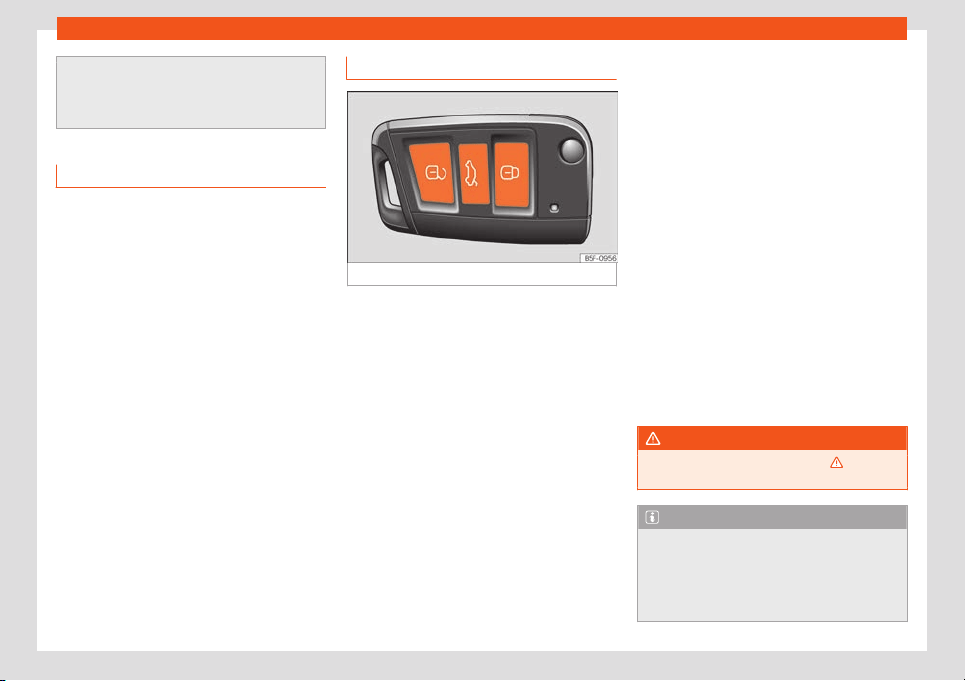
Opening and closing
●
V
ehicle interior monitoring by the anti-
theft alarm system will only function as in-
tended if the windows and sunroof are
closed.
Central locking settings
Central locking settings can be changed in
the Inf
otainment system.
Unlocking doors
●
Press the function button > Settings >
Opening and closing > Central lock-
ing > Door unlocking.
Y
ou can choose to unlock all the doors or on-
ly the driver door when you unlock the vehi-
cle. In all the options, the fuel tank flap is also
unlocked.
With the Driver setting, when you press the
button on the remote control key once, only
the driver door is unlocked. If that button is
pressed twice, the rest of the doors and the
rear lid will be unlocked.
If the button is pressed, all the vehicle
doors are locked. At the same time, a confir-
mation signal is heard.
Unlock and lock from the outside
Fig. 76
Remote control key: buttons.
●
Lock: press the
›
››
Fig. 76 button.
●
Locking the vehicle without the “Safe” se-
curity system: push the button again and
hold for 2 seconds.
●
Unlock: press the button.
●
Unlocking the rear lid: hold down the
button for at least 1 second.
The vehicle will be locked again automatical-
ly if you do not open one of the doors or the
rear lid within 30 seconds after unlocking the
car. This function prevents the vehicle from
remaining unlocked if the unlocking button is
pressed by mistake. This does not apply if you
press the button for at least one second.
Selective unlocking system
The selective unlocking system allows you to
only unlock the driver door and the fuel tank
flap. All other doors and the rear lid remain
locked.
Unlocking the driver's door and tank flap:
●
Press (once) the button on the remote
control key or turn the key once in the open-
ing direction.
Unlocking all the doors, the rear lid and the
tank flap simultaneously:
●
Within 5 seconds, press (twice) the but-
ton on the remote control key, or turn the key
twice within 5 seconds in the opening direc-
tion.
The Safe security system and the anti-theft
alarm deactivate immediately when only the
driver door is opened.
In vehicles with Infotainment system, you can
programme the security central locking sys-
tem directly
›››
page 97.
WARNING
Observe the safety warnings
›
››
in Lock-
ing syst
em “Safe” on page 102.
Note
●
Do not use the r
emote control key until
the vehicle is visible.
●
Other functions of the remote control key
›››
page 111, Convenience open/close
function.
97
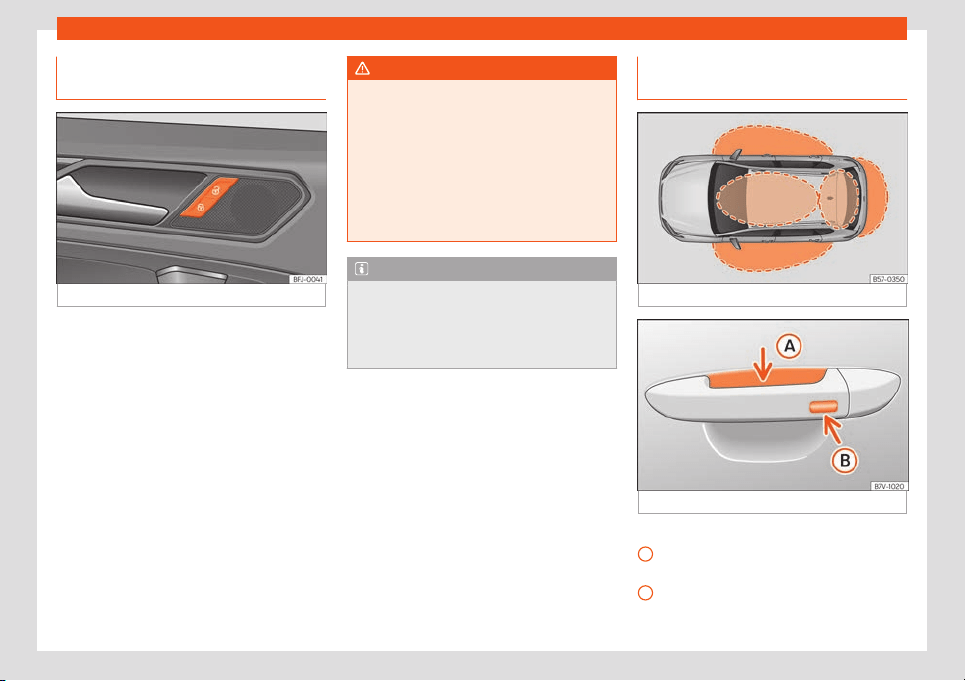
Operation
Unlocking and locking from the in-
side
Fig. 77
Driver's door: central locking switch.
●
Lock: press the
›
››
Fig. 77 button.
●
Unlock: press the
›››
Fig. 77 button.
Please note the following when using the
central locking switch to lock your vehicle:
●
It is not possible to open the doors or the
rear lid from the outside (for safety reasons,
e.g. when stopped at traffic lights).
●
The LED in the central locking switch lights
up when all the doors are closed and locked.
●
You can open the doors individually from
the inside by pulling the inside door handle.
●
In the event of an accident in which the air-
bags inflate, doors locked from the inside will
be automatically unlocked to facilitate ac-
cess and assistance.
WARNING
●
The centr
al locking switch also works
with the ignition switched off, except when
the “safe” system is activated.
●
The central locking switch does not oper-
ate if the vehicle is locked from the outside
and the security system is switched on.
●
Locked doors could delay assistance in
an emergency. Do not leave anyone, espe-
cially children, in the vehicle.
Note
Your vehicle will lock automatically when it
r
eaches a speed of about 15 km/h (9 mph)
(Auto Lock)
›››
page 96. You can unlock the
vehicle again using the button on the
central locking switch.
Unlock and lock the vehicle with
K
eyless Access
Fig. 78
Keyless Access: proximity zones.
Fig. 79 Door handle: sensor surfaces
›››
Fig. 7
9
Unlocking sensor surface on the inside of
the door handle.
Locking sensor surface on the outside of
the door handle.
A
B
98

Opening and closing
Depending on the equipment, the vehicle
may hav
e the Keyless Access system.
Keyless Access is a key-free locking and igni-
tion system to unlock and lock the vehicle
without actively using its key. To do this, all
that is required is to have a valid vehicle key in
the detection area where you are attempting
to access the vehicle
›››
Fig. 78 and to touch
one of the sensor surfaces on the door han-
dles
›››
Fig. 79 or operate the softtouch/han-
dle on the rear lid
›››
page 106
›››
.
Aut
omatic vehicle unlock
The vehicle can be unlocked and locked via
the front doors only. When doing so, the re-
mote control key must be no further than ap-
prox. 1.5 m away from the door handle.
It does not matter where you carry the key,
e.g. in your jacket pocket.
Once the doors have been locked, they can-
not be opened again immediately. This will
enable you to check that the doors are prop-
erly closed.
If you wish you may unlock only the corre-
sponding door or the entire vehicle. The nec-
essary adjustments can be performed in ve-
hicles with a driver information system
›››
page 91.
General information
If a valid key is in the proximity of the car,
›››
Fig. 78 the Keyless Access locking and
starting system gives the key entry as soon as
one of the sensor surfaces on the door han-
dles is touched or the softtouch/handle on
the rear lid is operated.
The following features are then available
without having to use the vehicle key actively:
●
Keyless Entry: unlocking the vehicle using
the handles of the front doors or the soft-
touch/handle on the rear lid.
●
Keyless Exit: locking the vehicle using the
sensor of the driver or passenger door han-
dle.
●
Easy Open: opening the rear lid moving one
foot below the rear bumper
›››
page 109.
●
Press & Drive: keyless starting of the engine
with the starter button
›››
page 219.
The central locking and locking systems op-
erate in the same way as a normal locking
and unlocking system. Only the controls
change.
Unlocking the vehicle is confirmed with a
double flash of the indicator lights; locking by
a single flash.
If the vehicle is locked and then all doors and
the rear lid are closed leaving the last key
used inside the vehicle and none outside, the
vehicle will not lock immediately. All the ve-
hicle's indicator lights will flash four times.
The vehicle will lock after a few seconds if
you do not open any door or the rear lid.
The vehicle will lock again after a few sec-
onds if you unlock the vehicle but fail to open
any door or boot hatch.
Unlocking and opening the doors
(Keyless-Entry)
●
Grip one of the front door handles. When
you do this, you touch the sensor surface
›››
Fig. 79
A
(arrow) of the handle and the
v
ehicle unlocks.
●
Open the door.
On vehicles with selective opening or info-
tainment system configuration, pulling the
door handle twice will unlock all doors.
In vehicles without the “Safe” security sys-
tem: closing and locking the doors
(Keyless-Exit)
●
Switch the ignition off.
●
Close the driver's door.
●
Touch (once) the locking sensor surface
›››
Fig. 79
B
(arrow) on one of the front door
handl
es. The door that is used must be
closed.
»
99

Operation
In vehicles with the “Safe” security sys-
t
em: closing and locking the doors
(Keyless-Exit)
●
Switch the ignition off.
●
Close the driver's door.
●
Touch (once) the sensor surface
›››
Fig. 79
B
(arrow) on one of the front door handles.
The v
ehicle locks with the “Safe” security sys-
tem
›››
page 101. The door that is used must
be closed.
●
Touch (twice) the sensor surface
›››
Fig. 79
B
(arrow) of one of the front door handles to
l
ock the vehicle without activating the
“Safelock” security system
›››
page 101.
Unlocking and locking the boot hatch
When the vehicle is locked, the rear lid auto-
matically unlocks on opening if there is a val-
id vehicle key in the proximity zone
›››
Fig. 78.
Open or close the rear lid normally.
After closing, the hatch locks automatically. If
the complete vehicle is unlocked, the rear lid
will not lock automatically after closing it.
What happens when locking the vehicle
with a second key
If there is a vehicle key inside the vehicle and
it is locked from the outside with a second ve-
hicle key, the key inside the vehicle is blocked
for engine ignition
›››
page 219. In order to
enable engine ignition, press the button on
the key inside the vehicle.
Automatically disabling sensors
If the vehicle is not locked or unlocked for a
long period of time, the proximity sensors on
the passenger doors are automatically disa-
bled.
If one of the sensor surfaces on the door han-
dles is often activated in an unusual manner
with the vehicle locked (e.g. by the branches
of a bush rubbing against it), all proximity
sensors are disabled for a certain period of
time.
Sensors will again be enabled:
●
After a time.
●
OR: if the vehicle is unlocked with the but-
ton on the key.
●
OR: if the boot is opened.
●
OR: if the vehicle is unlocked manually with
the key.
Keyless Access temporary disconnection
function
You can deactivate the vehicle's Keyless
Access unlocking for one locking and unlock-
ing cycle.
●
Move the gear lever to position P (if the ve-
hicle has automatic gearbox), since other-
wise the vehicle cannot be locked.
●
Close the door.
●
Push the central locking button on the re-
mote control and touch the locking sensor
surface of the driver door handle
›››
Fig. 79
B
within the following 5 seconds.
Do not gr
asp the door handle; otherwise the
vehicle will not unlock. Deactivation is also
possible if the vehicle is locked through the
driver’s door lock.
●
To check that the function has been deacti-
vated, wait at least 10 seconds, grip and pull
on the door handle. The door should not
open.
The next time the door can only be unlocked
via the remote control or the lock cylinder.
The next time the door is locked/unlocked,
Keyless Access will be active again.
Convenience functions
To close all the electric windows and the sun-
roof using the comfort function, keep a fin-
ger for a few seconds on the locking sensor
surface
›››
Fig. 79
B
(arrow) of the door han-
dl
e until the windows and roof have closed.
How the doors open when touching the sen-
sor surface on the door handle will depend
on the settings that have been activated in
the infotainment system, using the function
button > Settings > Opening and
closing.
100
Opening and closing
CAUTION
The sensor surfaces on the door handles
coul
d engage if hit with a water jet or high
pressure steam if there is a valid vehicle
key in the proximity. If at least one of the
electric windows is open and the sensor
surface
›››
Fig. 79
B
(arrow) on one of the
handl
es is activated continuously, all win-
dows will close.
Note
●
If the 12-v
olt vehicle battery has little or
no charge, or the vehicle key battery is al-
most or entirely out of charge, you will
probably not be able to lock or unlock the
vehicle with the Keyless Access system.
The vehicle can be unlocked or locked
manually
›››
page 105.
●
To control the proper locking of the vehi-
cle, the release function is disabled for ap-
prox. 2 seconds.
●
If the message Keyless access system
faulty is displayed on the screen of the
dash panel, abnormalities may occur in the
operation of the Keyless Access system.
Contact a specialised workshop. SEAT rec-
ommends visiting a SEAT dealership for
this.
●
Depending on the function set on the in-
fotainment system for the mirrors, the exte-
rior mirrors will unfold and the surround
lighting will come on when unl
ocking the
vehicle using the sensor surface on the
driver and passenger door handles
›››
page 126.
●
If there is no valid key inside the vehicle
or the system fails to detect one, a warning
will display on the dash panel screen. This
could happen if any other radio frequency
signal interferes with the key signal (e.g.
from a mobile device accessory) or if the
key is covered by another object (e.g. an
aluminium case).
●
If the sensors are very dirty, e.g. have a
layer of salt, the correct functioning of the
sensors on the door handles may be affec-
ted. In this case, clean the vehicle.
●
If the vehicle is equipped with an auto-
matic gearbox, it may only be locked in the
gear stick is in position P.
●
To improve the safety of your vehicle, the
remote control of the system is equipped
with a position sensor. If this remote control
does not detect movement for a certain
length of time, the system will conclude
that the vehicle cannot be opened (e.g. on
a night table) so it will be disabled.
Locking system “Safe”
1)
When the vehicle is blocked, the “Safe” se-
curit
y system puts the door handles out of
operation and prevents unauthorised persons
for entering. The doors cannot be opened
from inside
›››
.
Depending on the v
ehicle, when switching the
ignition off, a warning may be displayed on
the control panel screen stating that the
“Safe” security system is activated.
Lock the vehicle and activate the “Safe”
security system.
●
Press the locking button once on the v
e-
hicle key.
Lock the vehicle without activating the
“Safe” system.
●
Press the locking button on the vehicle
key twice.
●
On vehicles with the Keyless Access locking
and ignition system: touch the sensor surface
on the outside part of the door handle twice.
»
1)
Available depending on market and version.
101

Operation
When the “Safe” security system is disa-
bl
ed, the following needs to be taken into
account:
●
The vehicle can be unlocked and opened
from the inside using an door handle.
●
The anti-theft alarm is activated.
●
The vehicle interior monitoring system and
the anti-tow system are disabled.
“Safe” status
The flashing frequency of the diode in the
door sill immediately confirms the process.
Initially, the diode flashes in a fast sequence
for a brief period, then it stops for approxi-
mately 30 seconds and, lastly continues
flashing slowly.
WARNING
Do not leave anyone (especially children)
in the v
ehicle if it is locked from the outside
and the “Safe” security system is activa-
ted, as the doors and windows cannot then
be opened from the inside. Locked doors
could delay assistance in an emergency.
Anti-theft alarm system
Description
The anti-theft alarm makes it more difficult to
br
eak into the vehicle or steal it. The system
will initiate acoustic and optical warning sig-
nals when your vehicle is tried to be forced.
The anti-theft alarm is automatically turned
on when the vehicle is locked with the key.
The system is immediately activated and the
turn signal light located on the driver door will
flash along with the turn signals, indicating
that the alarm and the locking security sys-
tem (double lock) have been turned on.
If any of the doors or the bonnet are open,
they will not be included in the protection
zones of the vehicle when the alarm is con-
nected. If the door or the bonnet are subse-
quently closed, they will be automatically in-
cluded in the protection areas of the vehicle
and the turn signals will flash accordingly
when the doors close.
●
The turn signal light will flash twice on
opening and deactivating the alarm.
●
The turn signal light will flash once on clos-
ing and activating the alarm.
When does the system trigger an alarm?
The anti-theft alarm siren will be triggered for
about 30 seconds alongside a sound and
optical (flashing) warning signals and will be
repeated about ten times when the vehicle is
locked and the following unauthorised ac-
tions are attempted:
●
Opening a door that is mechanically un-
locked using the vehicle key without switching
on the ignition in the next 15 seconds (in cer-
tain markets, such as the Netherlands, there is
no 15 second waiting time and the alarm is
activated immediately on opening the door).
●
A door is opened.
●
Opening the bonnet.
●
The rear lid is opened.
●
When the ignition is switched on with a non-
authorised key.
●
Undue manipulation of the alarm.
●
Switching off the 12 volt battery.
●
Movement inside the vehicle (in vehicles
with interior monitoring
›››
page 103).
●
When the vehicle is towed (in vehicles with
anti-tow system
›››
page 103).
●
When the vehicle is raised (in vehicles with
anti-tow system
›››
page 103).
●
When the vehicle is transported on a ferry
or by rail (vehicles with an anti-tow system or
vehicle interior monitoring
›››
page 103).
●
When a trailer connected to the anti-theft
alarm system is disconnected.
How to turn OFF the alarm
●
Unlock the vehicle with the unlock button
of the key.
●
OR: turn the ignition on with a valid key.
102
Opening and closing
If the driver’s door is unlocked mechanically
using the k
ey, the ignition must be turned on
within 15 seconds of opening the door.
Otherwise, the alarm will trigger for 30 sec.
and the ignition will be blocked.
CAUTION
If the anti-theft security system is switched
off
, the vehicle interior monitoring and the
tow-away protection are automatically
disconnected.
Note
●
Aft
er 28 days, the indicator light will be
switched off to prevent the battery from ex-
hausting if the vehicle has been left parked
for a long period of time. The alarm system
remains activated.
●
If, after the audible warning goes off, an-
other monitored area is accessed (e.g. the
rear lid is opened after a door has been
opened), the alarm is triggered again.
●
The anti-theft alarm is not activated
when the vehicle is locked from within using
the central locking button .
●
If the driver door is unlocked mechanical-
ly with the key, only the driver door is un-
locked, the rest of the doors remain locked.
Only when the ignition has been turned on
will the other doors be available - but not
unlocked - and the central locking button
will be activated.
●
If the 12-v
olt vehicle battery is run down
or flat then the anti-theft alarm will not op-
erate correctly.
●
Vehicle monitoring remains active even if
the battery is disconnected or not working
for any reason.
●
The alarm is triggered immediately if one
of the battery cables is disconnected while
the alarm system is active.
Interior monitoring and the anti-
t
ow system
It is a monitoring or control function incorpo-
r
ated in the anti-theft alarm which detects
unauthorised vehicle entry by means of ultra-
sound.
The vehicle interior monitoring and anti-tow
sensor (tilt sensor) are automatically switch-
ed on when the anti-theft alarm is switched
on. In order to activate it, all the doors and
the rear lid must be closed.
If the “Safe”
›››
page 101 security system is
switched off, the vehicle interior monitoring
and the tow-away protection are automati-
cally disconnected.
Activation
●
It is automatically switched on when the
anti-theft alarm is activated.
Deactivation
●
Open the vehicle with the key, either me-
chanically or by pressing the button on the
remote control. The time period from when
the door is opened until the ignition is turned
on should not exceed 15 seconds, otherwise
the alarm will be triggered.
●
Press the button on the remote control
twice. The volumetric sensor and tilt sensors
will be deactivated. The alarm system re-
mains activated.
The vehicle interior monitoring and the anti-
tow system are automatically switched on
again next time the vehicle is locked.
If you wish to switch off the vehicle interior
monitoring and the anti-tow system, it must
be done each time that the vehicle is locked;
if not, they will be automatically switched on.
The vehicle interior monitoring and the anti-
tow system should be switched off if animals
are left inside the locked vehicle (otherwise,
their movements will trigger the alarm) or
when, for example, the vehicle is transported
or has to be towed with only one axle on the
ground.
Deactivation through the infotainment
system
●
Switch off the contact and select: >
Settings > Opening and closing >
»
103
Operation
Central locking > Interior monitor-
ing.
●
When the vehicle is locked now, the vehicle
int
erior monitoring and the tow-away protec-
tion are switched off until the next time the
door is opened.
False alarms
Interior monitoring will only operate correctly
if the vehicle is completely closed. Please ob-
serve related legal requirements.
The following cases may cause a false
alarm:
●
Open windows (partially or fully).
●
Panoramic/tilting sunroof open (partially or
completely).
●
Movement of objects inside the vehicle,
such as loose papers, items hanging from the
rear vision mirror (air fresheners), etc.
Note
●
If the v
ehicle is relocked and the alarm is
activated without the volumetric sensor
function, relocking will activate the alarm
with all its functions, except the volumetric
sensor. This function is reactivated when
the alarm is switched on again, unless it is
deliberately switched off.
●
If the alarm has been triggered by the
volumetric sensor, this will be indicated by
a flashing of the warning lamp on the driver
door when the vehicle is opened. The flash
is diff
erent to the flash indicating the alarm
is activated.
●
The vibration of a mobile phone left in-
side the vehicle may cause the vehicle in-
terior monitoring alarm to trigger, as both
sensors react to movements and shakes in-
side the vehicle.
●
If on activating the alarm, any door or the
rear lid is open, only the alarm will be acti-
vated. The vehicle interior monitoring and
the anti-tow system will only be activated
once all the doors are closed (including the
rear lid).
Doors
Intr
oduction
The doors and rear lid can be locked man-
ually and partially opened, f
or example if the
key or the central locking is damaged.
WARNING
Opening and closing doors carelessly can
cause serious injury.
●
If the vehicle is locked from outside, the
doors and windo
ws cannot be opened from
the inside.
●
Never leave children or disabled people
alone in the car. They could be trapped in
the car in an emergency and will not be
abl
e to get themselves to safety.
●
Depending on the time of the year, tem-
peratures inside a locked and closed vehi-
cle can be extremely high or extremely low
resulting in serious injuries and illness or
even death, particularly for young children.
WARNING
Getting in the way of the doors and the rear
lid is danger
ous and can lead to serious in-
jury.
●
Open and close the doors and the rear lid
only when there is nobody in the way.
CAUTION
When opening and closing in an emergen-
cy, car
efully disassemble components and
then reassemble them carefully to avoid
damage to the vehicle.
104
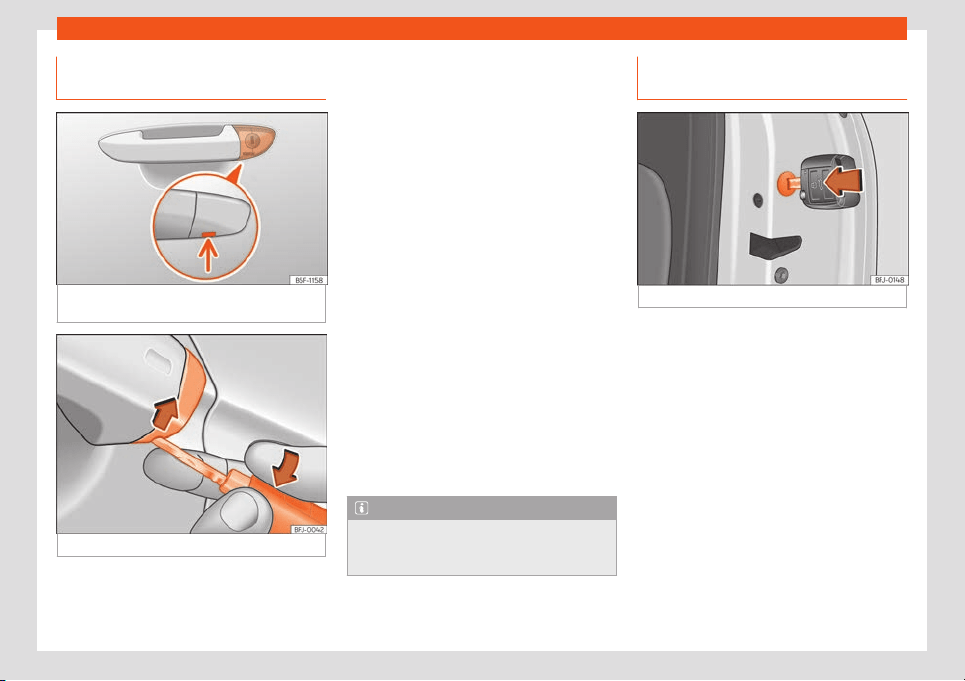
Opening and closing
Emergency unlocking or locking of
the driv
er’s door
Fig. 80
Driver door handle: Concealed lock
cylinder
.
Fig. 81
Driver door handle: lever the cover off
If the central locking system should fail to op-
er
ate, the driver door can still be locked and
unlocked by turning the key in the lock.
As a general rule, when the driver door is
locked manually all other doors are locked.
When it is unlocked manually, only the driver
door opens. Please observe the instructions
relating to the anti-theft alarm system
›››
page 102.
●
Unfold the vehicle key blade
›››
page 93.
●
Insert the key shaft into the lower opening in
the cover on the driver door handle
›››
Fig. 81
then remove the cover upwards.
●
Insert the key blade into the lock cylinder to
unlock or lock the vehicle.
Special characteristics
●
The anti-theft alarm will remain active
when vehicles are unlocked. However, the
alarm will not be triggered
›››
page 102.
●
After the driver door is opened, you have 15
seconds to switch on the ignition. Once this
time has elapsed, the alarm is triggered.
●
Switch the ignition on. The electronic immo-
bilizer recognises a valid vehicle key and de-
activates the anti-theft alarm system.
Note
The anti-theft alarm is not activated when
the v
ehicle is locked manually using the
key shaft
›››
page 95.
Emergency lock of doors without
l
ock cylinders
Fig. 82
Locking the door manually.
If the central locking system should fail to
w
ork at any time, doors with no lock cylinder
will have to be locked separately.
The emergency lock is located on the front of
the front passenger's door and the rear
doors. It can only be seen if the door is open.
●
Insert the key in the inside slot and turn it to
the right as far as it will go (if the door is on
the right side) or to the left (if the door is on
the left side).
Once the door has been closed it can no lon-
ger be opened from the outside. Pull the inte-
rior door handle once to unlock and open the
door.
105
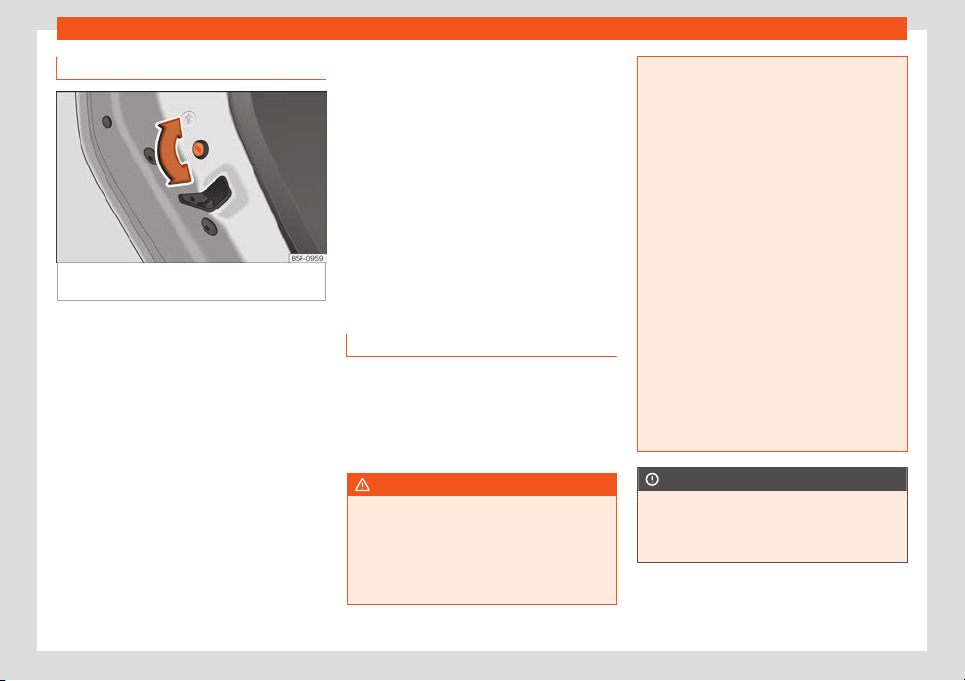
Operation
Childproof locks
Fig. 83
Childproof lock on the left hand side
door
.
The childproof lock prevents the rear doors
fr
om being opened from the inside. This sys-
tem prevents minors from opening a door ac-
cidentally while the vehicle is running.
This function is independent of the vehicle
electronic opening and locking systems. It
only affects rear doors. It can only be activa-
ted and deactivated manually, as described
below:
Activating the childproof lock
–
Unlock the vehicle and open the door in
which you wish to activate the childproof
lock.
–
With the door open, rotate the groove in the
door using the ignition key, clockwise for
the left hand side doors
›››
Fig. 83 and anti-
clockwise for the right hand side doors.
Deactivating the childproof lock
–
Unlock the vehicle and open the door
whose childproof lock you want to deacti-
vate.
–
With the door open, rotate the groove in the
door using the ignition key, anti-clockwise
for the left hand side doors
›››
Fig. 83 and
clockwise for the right hand side doors.
Once the childproof lock is activated, the
door can only be opened from the outside.
Rear lid
Introduction
The rear lid unlocks and locks together with
the doors.
On v
ehicles with Keyless Access, the rear lid
unlocks automatically when it is opened
›››
page 98.
WARNING
Careless and unsuitable locking, opening
and cl
osing of the rear lid can cause acci-
dents and serious injury.
●
The rear lid must not be opened when the
reverse or rear fog lights are lit. This may
damage the tail lights.
●
Do not cl
ose the rear lid by pushing it
down with your hand on the rear window.
The glass could smash. Risk of injury!
●
Ensure the rear lid is locked after closing
it. If not, it may open unexpectedly while
driving.
●
Closing the rear lid without observing
and ensuring it is clear could cause serious
injury to you and to third parties. Make sure
that no one is in the path of the rear lid.
●
Never drive with the rear lid open or half-
closed, exhaust gases may penetrate into
the interior of the vehicle. Danger of poi-
soning!
●
Never leave the vehicle unattended or al-
low children to play inside or next to it, es-
pecially if the rear lid is open. Children
could enter the luggage compartment,
close the rear lid and become trapped. A
locked vehicle can reach extremely high
and low temperatures, depending on the
time of year, thus causing serious injuries,
illness or even death.
CAUTION
Before opening or closing the rear lid, make
sur
e that there is enough space to open or
close it, e.g. when pulling a trailer or in a
garage.
106
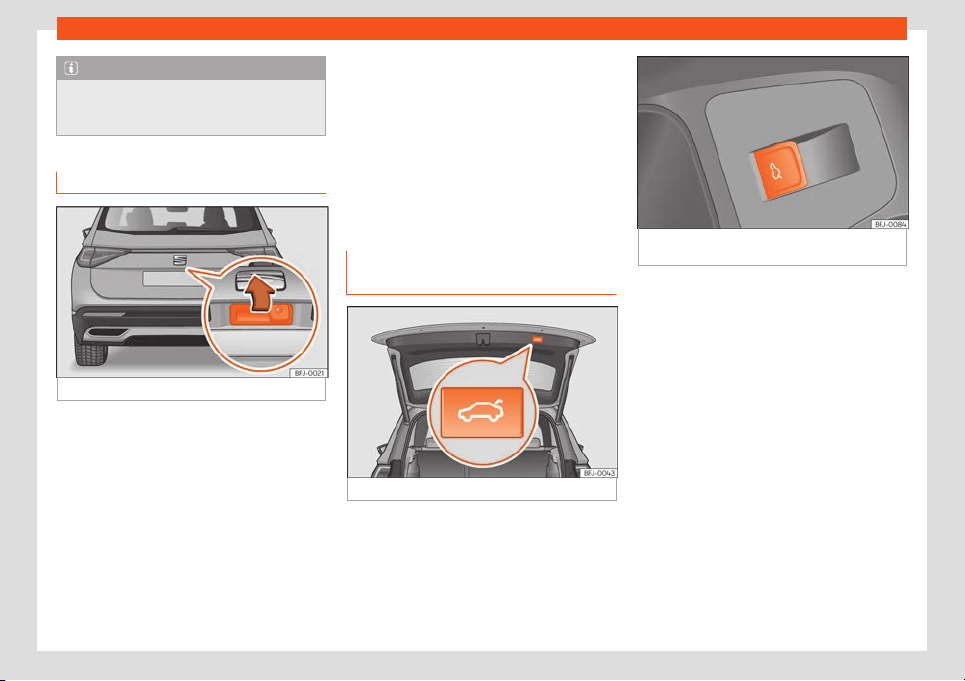
Opening and closing
Note
Before closing the rear lid, make sure that
the k
ey has not been left inside the luggage
compartment.
Opening and closing the rear lid
Fig. 84
Rear lid: handle
The rear lid opening system operates electri-
cally. It is activ
ated by exerting slight pressure
on the handle
›››
Fig. 84.
To lock or unlock the rear lid, press the or
buttons of the vehicle key.
A warning appears on the instrument panel
display if the rear lid is open or not properly
closed. An audible warning is also given if it is
opened while the vehicle is moving faster
than 6 km/h (4 mph).
Opening and closing
●
To open: place slight pressure on the han-
dle. The rear lid opens automatically.
●
To close: hold one of the handles on the in-
ner trim and close it by moving it downwards,
or press the button on the rear lid
›››
Fig. 85.
If the doors are locked, the rear lid is also
locked.
Rear lid with electric opening and
closing
Fig. 85
Rear lid: button to close the rear lid.
Fig. 86 On the driver’s door: button to open
and cl
ose the rear lid.
Opening the rear lid
●
Unlock the vehicle and briefly press the
handl
e of the rear lid. On vehicles with
Keyless Access you can directly press the
handle of the rear lid. The rear lid is unlocked
if an authorised key is recognised in the prox-
imity of the vehicle.
●
OR: depending on the features, pull the
button on the driver door upwards
›››
Fig. 86.
The button also works when the ignition is
switched off.
●
OR: press and hold the button of the ve-
hicle key for approx. 1 second. If the vehicle is
locked, only the rear lid is unlocked (the doors
remain locked).
●
OR: on vehicles with Keyless Access and
sensor-controlled opening you can open the
rear lid by moving one foot in the area of the
sensors located below the rear bumper (Easy
»
107

Operation
Open
›
››
page 109). The rear lid will be auto-
matically opened.
Closing the rear lid
●
Briefly press the button on the rear lid
›››
Fig. 85
›››
in Introduction on page 106.
●
OR: depending on the f
eatures, pull the
button on the driver door upwards
›››
Fig. 86.
●
OR: on vehicles with Keyless Access, press
and hold the vehicle key button until the
rear lid is closed, or move one foot into the
area of the sensors located below the rear
bumper (Easy Open)
›››
page 109. The vehi-
cle key must be in the Keyless Access system
detection zone at the rear outside the vehicle.
●
OR: manually move the rear lid in the direc-
tion of closing until it closes automatically.
●
The rear lid goes down automatically to the
final position and also closes automatically
›››
in Introduction on page 106.
Int
errupting opening or closing
After beginning to open or close the rear lid,
the action can be halted by pressing one of
the buttons.
If you press one of the buttons again, the
rear lid will move again in the original direc-
tion.
If the rear lid is met with resistance or an ob-
stacle during the automatic opening or clos-
ing, opening or closing will be interrupted im-
mediately. For the closing process, the rear
lid opens again slightly.
●
Check why it has not been possible to open
or close the rear lid.
●
Try to open or close the rear lid again.
●
If necessary, the rear lid can be opened or
closed by hand using reasonable force.
Restrictions if the vehicle has a third row of
seats
If the vehicle is fitted with a third row of seats,
it will not be possible to close the tailgate with
the button, on the driver’s door
›››
Fig. 86,
or with the vehicle key. This happens regard-
less of whether the seats in the third row are
folded or not.
Particular features if towing a trailer
If the factory-fitted towing bracket is electri-
cally connected to a trailer
›››
page 306, the
electric rear lid can only be opened or closed
with the buttons on the rear lid itself or by us-
ing the Easy Open function.
Acoustic warnings
Throughout the process of opening or closing
the rear lid, acoustic warnings can be heard.
Exception: when the rear lid is opened man-
ually using the handle or the Easy Open func-
tion with the movement of the foot or closed
using the button on the rear lid itself
›››
Fig. 85.
Modifying and memorising the opening
angle
If the space behind or above the vehicle is
less than the travel area of the rear lid, you
can change the opening angle of the rear lid.
To memorise a new opening angle, the rear
lid must be open at least halfway.
●
Interrupt the opening process in the desired
position.
●
Press the button
›››
Fig. 85 on the rear
lid for at least 3 seconds.
The opening angle is memorised. Memorisa-
tion is indicated by blinking of the hazard
warning lights and an audible warning.
Resetting and memorising the opening an-
gle
For the rear lid to reopen completely, the
opening angle must be reset and memorised
again.
●
Release the rear lid and open it to the
memorised height.
●
Lift the rear lid by hand as far as it goes. To
do this, some force will have to be used.
●
Press the button
›››
Fig. 85 on the rear
lid for at least 3 seconds.
108
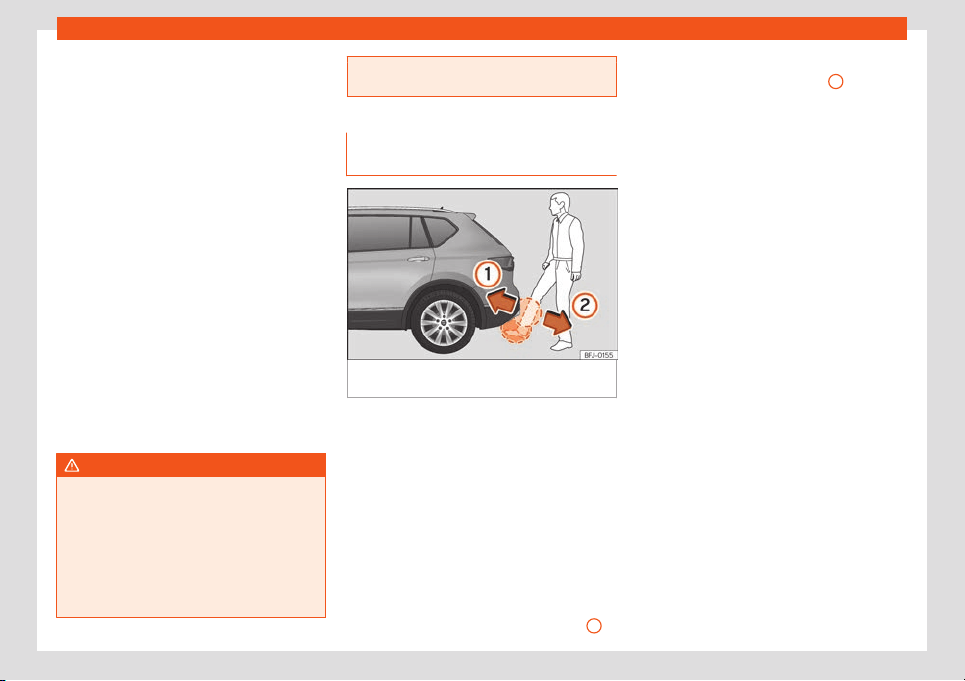
Opening and closing
●
This r
esets and memorises the factory-set
opening angle. Memorisation is indicated by
blinking of the hazard warning lights and an
audible warning.
Automatic protection against overheating
If the system is operated repeatedly in a short
space of time, it automatically switches off to
prevent overheating.
Once the system is cool again, the function
can be reused. Until then, the rear lid can only
be opened and closed by hand using reason-
able force.
If the 12-volt battery is disconnected or the
corresponding
›››
page 59 fuse burns out
while the rear lid is open, the system will have
to be reset. This requires closing the rear lid
completely once.
Emergency unlocking
›››
page 110
WARNING
If a lot of snow builds up on the rear lid or it
is heavily l
oaded, the rear lid may not open
or, after opening, it may lower by itself due
to the extra weight and cause serious in-
jury.
●
Do not open the rear lid when there is a
lot of snow on it or when carrying a load
(e.g. on a rack).
●
Bef
ore opening the rear lid, remove the
snow or the load.
Rear lid with sensor-controlled
opening and cl
osing (Easy Open)
Fig. 87
Rear lid with sensor-controlled open-
ing (Easy Open).
If there is a valid vehicle key in the proximity of
the r
ear lid, it is possible to unlock and open
or close it moving one foot in the area of the
sensors located under the rear bumper.
●
Switch the ignition off.
●
Stand in front of the rear bumper, in the
middle.
●
With a brisk movement, bring your foot and
lower leg as close as you can to the bumper.
The lower part of the leg needs to be close to
the upper sensor area and your foot must be
close to the lower sensor area
›››
Fig. 87
1
.
●
Quickly r
emove your foot and lower leg
from the sensor areas
›››
Fig. 87
2
. The rear
lid will be aut
omatically opened.
●
If the rear lid fails to open, repeat the pro-
cedure after a few seconds.
To notify that the rear lid has been opened
with the Easy Open function, the turn lights
blink twice.
The rear lid can be closed with another foot
movement similar to the opening one (provi-
ded a valid vehicle key is in the proximity of
the rear lid).
When closed, the rear lid automatically locks
if the vehicle has been locked beforehand
and there is no valid key inside.
While the rear lid is in motion (either opening
or closing), it can be stopped with another
foot movement similar to the opening one
(provided a valid vehicle key is in the proximi-
ty of the rear lid).
The Easy Open feature is not available or on-
ly has limited availability in the following sit-
uations (examples):
●
If the rear bumper is very dirty.
●
If the rear bumper is wet with salt water, e.g.
after having driven on gritted roads.
●
If the vehicle has been equipped at a later
time with a tow bracket.
»
109
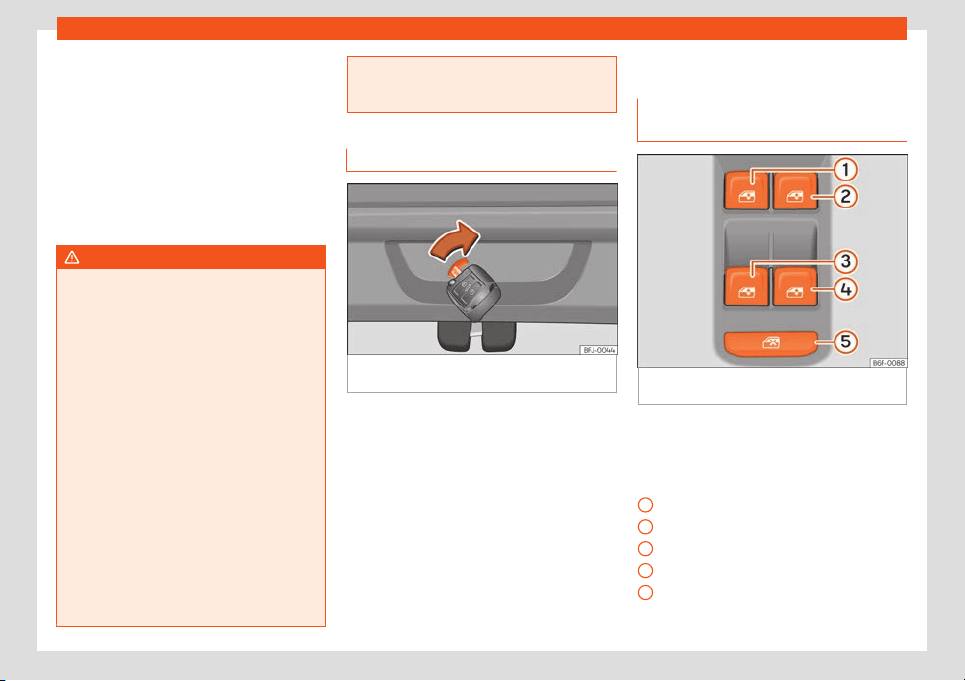
Operation
In the event of heavy rain, the Easy Open fea-
t
ure may take a little longer to open the boot
or may deactivate automatically, to avoid the
boot opening by accident, e.g. because of
the running water.
The Easy Open function can be connected
and disconnected permanently in the info-
tainment system using the function button
> Settings > Opening and closing
›››
page 91.
WARNING
If there is a valid key in the proximity of the
r
ear lid, in some cases the Easy Open func-
tion may be accidentally activated and the
rear lid will open, for example, when
sweeping under the rear bumper, when di-
recting a water jet or high pressure steam
to the area or when carrying out mainte-
nance work or repairs in that area. If acci-
dentally opened, the rear lid could injure
somebody situated in its area of operation
or cause material damage.
●
Therefore, always make sure that there is
no unsupervised valid key in the area near
the rear lid.
●
Before carrying out any maintenance or
repair work on the vehicle, always disable
the Easy Open feature via the infotainment
system.
●
Before washing the vehicle, always disa-
ble the Easy Open feature via the infotain-
ment system.
●
Bef
ore attaching a bicycle rack or a trail-
er,
›››
page 306, always disable the Easy
Open feature via the infotainment system.
Emergency unlocking of the rear lid
Fig. 88 Detail of the luggage compartment:
emer
gency unlocking
The rear lid can be unlocked from inside in
the e
vent of an emergency (e.g. no battery).
There is a groove in the luggage compart-
ment allowing access to the emergency
opening mechanism.
Unlocking the rear lid from inside the lug-
gage compartment
●
Insert the key blade into the slot and press
the lever in the direction of the arrow until the
lock unlocks
›››
Fig. 88.
Window controls
Electrically opening and closing
the windows
Fig. 89
Detail of the driver's door: window
contr
ols.
●
Opening the window: press the button .
●
Closing the window: pull the button .
Butt
ons on the driver door
Window on the front left door
Window on the front right door
Window on the rear left door
Window on the rear right door
Safety switch for deactivating the electric
window buttons in the rear doors.
1
2
3
4
5
110
Opening and closing
The front and rear electric windows can be
oper
ated by using the controls on the driver
door. The other doors each have a switch for
their own window.
Always close the windows fully if you park the
vehicle or leave it unattended
›››
.
Y
ou can use the electric windows for approx.
10 minutes after switching off the ignition if
neither the driver door nor the front passen-
ger door have been opened.
Safety switch
The safety control
›››
Fig. 89
5
on the driver
door can be used t
o disable the electric win-
dow buttons on the rear doors.
Safety switch not pressed: buttons on rear
doors are activated.
Safety switch pressed: buttons on rear doors
are deactivated.
The safety control symbol lights up in yel-
low if the buttons on the rear doors are
switched off.
Convenience open/close function
The electric windows can be opened or
closed from outside using the vehicle key:
Convenience opening:
●
Press and hold the button on the remote
control key until all the windows and the sun-
roof have reached the desired position.
●
OR: First unlock the vehicle using the but-
ton on the remote control key and then keep
the key in the driver door lock until all the win-
dows and the sunroof have reached the re-
quired position.
Convenience closing:
●
Press and hold button on the remote
control key until all the windows and the sun-
roof are closed
›››
.
●
OR: K
eep the key in the driver door in the
"lock" position until all the windows and the
sunroof are closed.
During convenience closing, first the windows
and then the sliding sunroof will be closed.
Different settings can be changed using the
infotainment system. Select: > Settings
> Opening and closing > Windows >
Convenience opening.
One-touch opening and closing
The one-touch automatic opening and clos-
ing is used to open or close the windows
completely. It will not be necessary to hold
the button of the corresponding electric win-
dow.
For the automatic raising function: pull the
button for the corresponding window up-
wards until it reaches the second position.
For the automatic lowering function: push
the button for the corresponding window up-
wards until it reaches the second position.
Stop automatic movement: push or pull on
the button of the corresponding window.
Resetting one-touch opening and closing
The one-touch opening and closing function
is not active after the vehicle battery has
been disconnected or is flat and will have to
be reset.
●
Pull the button of the corresponding win-
dow and hold it for one second in this posi-
tion.
●
Release the button and pull upwards and
hold again. The one-touch function is now
ready for operation.
The automatic one-touch electric windows
can be reinitialised individually or several at a
time.
WARNING
Observe the safety warnings
›
››
in Intro-
duction on page 104.
●
Incorrect use of the electric windows can
r
esult in injury.
●
Never close the rear lid without observing
and ensuring it is clear, to do otherwise
could cause serious injury to you and third
parties. Make sure that no one is in the path
of a window.
»
111
Operation
●
If the ignition is s
witched on, the electric
equipment could be activated with risk of
injury, for example, in the electric windows.
●
The doors can be locked using the re-
mote control key. This could become an
obstacle for assistance in an emergency
situation.
●
Therefore always take the key with you
when you leave the vehicle.
●
The electric windows will work until the
ignition has been switched off and one of
the front doors has been opened.
●
If necessary, use the safety switch to dis-
able the rear electric windows. Make sure
that they have been disabled.
●
For safety reasons, you should only use
the remote control open and close func-
tions within about 2 metres of the vehicle.
To avoid injuries, always keep an eye on the
windows when pressing the button to close
them. The windows stop moving as soon as
the button is released.
Note
If the window is not able to close because it
is stiff or because of an obstruction, the
windo
w will automatically open again
›››
page 112. If this happens, check why the
window could not be closed before at-
tempting to close it again.
Window anti-trap function
The roll-back function reduces the risk of in-
jury when the el
ectric windows close.
●
If a window is obstructed when closing au-
tomatically, the window stops at this point
and lowers immediately
›››
.
●
Next, check why the window does not close
bef
ore attempting it again.
●
If you try within the following 10 seconds
and the window closes again with difficulty or
there is an obstruction, the automatic closing
will stop working for 10 seconds.
●
If the window is still obstructed, the window
will st
op at this point.
●
If there is no obvious reason why the win-
dow cannot be closed, try to close it again by
pulling the tab within ten seconds. The win-
dow closes with maximum force. The roll-
back function is now deactivated.
●
If more than 10 seconds pass, the window
will open fully when you operate one of the
buttons. One-touch closing is reactivated.
WARNING
Observe the safety warnings
›
››
in Elec-
trically opening and cl
osing the windows
on page 111.
●
The roll-back function does not prevent
fingers or other parts of the body getting
pinched against the window frame. Risk of
accident.
Sunroof
Intr
oduction
The sunroof consists of two glass parts. The
r
ear part is fixed and cannot be opened. It al-
so has a sun blind.
The sunroof only works when the ignition is
switched on. Once the ignition has been
switched off, you can still open or close the
sunroof for a few minutes provided the driver
door and the front passenger door are not
opened.
WARNING
If the sunroof is used negligently or without
paying due att
ention, it can cause serious
injury.
●
Open or close the sunroof and the sun
blind only when no one is in their path of
movement.
●
Never leave any key inside the vehicle
when exiting.
●
Never leave a child or any other person
who may need help in the vehicle, espe-
cially if they have access to the vehicle
key. If using they key unattended, they
could lock the vehicle, start the engine,
112
Opening and closing
switch on the ignition and activate the sun-
r
oof.
●
After switching off, it is still possible to
open or close the sunroof during a short
space of time provided that neither the
driver nor passenger door is opened.
CAUTION
●
T
o prevent damage, during winter tem-
peratures remove any ice or snow that
might be on the car roof before opening the
sunroof or adjusting the tilt position.
●
Before leaving the vehicle or in case of
rainfall, always close the sunroof. With the
sunroof open or in a tilted position, water
can enter the interior and can cause con-
siderable damage to the electrical system.
As a result, other damage can occur in the
vehicle.
Note
●
L
eaves and other loose objects that ac-
cumulate on the sunroof rails should be
regularly cleaned away either by hand or
with a vacuum.
●
If the sunroof does not work correctly, the
anti-trap function will not work either. Con-
tact a specialised workshop.
Opening and closing the sunroof
Fig. 90
On the interior roof lining: sunroof but-
t
on.
The sun blind automatically opens along with
the sunr
oof if completely closed or if in front
of the sunroof. The sun blind remains in the
previous position and does not automatically
close with the sunroof. The sun blind can only
be closed completely once the sunroof has
been closed.
The button
›››
Fig. 90 has two levels. The
first level switches the sunroof to the tilted po-
sition, opening or closing it fully or partially.
On the second level, the sunroof automati-
cally moves to the corresponding final posi-
tion after briefly pressing the button. Activat-
ing the button again stops the automatic
function.
Adjusting the tilt position of the sunroof
●
Press the rear part of the button
B
to the
first l
evel.
●
Automatic function: briefly press the rear
part of button
B
to the second level.
Cl
osing the sunroof from a tilted position
●
Press the front part of the button
A
to the
first l
evel.
●
Automatic function: briefly press the front
part of the button
A
to the second level.
St
opping the automatic operation by ad-
justing the tilted position of the sunroof or
by closing the sunroof
●
Press button
A
or
B
again.
Opening the sunr
oof
●
Press button
C
backwards to the first level.
●
Automatic function to the comfort position:
briefly pr
ess button
C
backwards to the sec-
ond l
evel.
Closing the sunroof
●
Press button
D
forwards to the first level.
●
Automatic function: briefly press button
D
forwards to the second level.
»
113
Operation
Stopping the automatic operation during
the opening or cl
osing
●
Press button
C
or
D
again.
Opening and closing the sunshade
blind
Fig. 91
On the interior roof lining: sunshade
blind butt
ons.
The electrical sun blind works when the igni-
tion is s
witched on.
When the sunroof is in its most tilted position,
the sun blind automatically goes into a venti-
lation position. The sun blind remains in this
position also with the sunroof closed.
Buttons
›››
Fig. 91
1
and
2
have two levels.
The first l
evel opens or closes the sun blind
fully or partially.
By briefly pressing the button to the second
level, the sun blind automatically moves to
the corresponding final position. Activating
the button again stops the automatic func-
tion.
Once the ignition has been switched off, you
can still open or close the sun blind for a few
minutes provided the driver door and the
front passenger door are not opened.
Opening the sun blind
●
Press button
1
to the first level.
●
Automatic function: briefly press button
1
to the second level.
Cl
osing the sun blind
●
Press button
2
to the first level.
●
Automatic function: briefly press button
2
to the second level.
St
opping the automatic operation during
the opening or closing
●
Press button
1
or
2
again.
Note
When the sunroof is open, the electric sun
blind can only be cl
osed to the front edge
of the sunroof.
Convenience function to open or
cl
ose the sunroof
Fig. 92
Door handle: sensor surface.
The sunroof can be opened and closed with
the conv
enience function, just like the win-
dows.
Using the door lock
●
Hold the key in the door lock of the driver
door in either the unlocking or locking posi-
tion to open or close the roof in the tilted po-
sition. Release the key to interrupt this func-
tion.
Using the remote control
●
Keep the locking or unlocking button press-
ed to open or close the roof. If you release the
button is the opening or closing will stop.
114
Lights
Using the Keyless Access system (only
cl
osing)
●
Press and hold the locking sensor surface
›››
Fig. 92 (arrow) on the door handle to close
the sunroof. If you release the sensor surface,
the closing movement stops.
Anti-trap function of the panoramic
sunroof and sunshade
The anti-trap function can reduce the risk of
injury when cl
osing the sunroof and the sun
blind
›››
. If the sunroof or sun blind encoun-
t
er resistance or an obstacle when closing,
they reopen immediately.
●
Check why the sunroof or sun blind do not
close.
●
Try to close the sunroof or sun blind again.
●
If the sunroof or sun blind cannot be closed
due to an obstacle or some resistance, it
stops at the corresponding position and then
opens. For automatic closing, a new closing
attempt might take place.
●
If the sunroof or sun blind is still unable to
close, close it without the anti-trap function.
Closing the sunroof or sun blind without
the anti-trap function
●
Sunroof: within approximately 5 seconds of
having activated the roll-back function, press
the button
›››
Fig. 90 to the second level in
the direction of arrow
›››
Fig. 90
D
until the
sunr
oof closes completely.
●
Sun blind: within approximately 5 seconds
of activating the roll-back function, press and
hold button
›››
Fig. 91
2
until the blind is fully
cl
osed.
●
The sunroof or sun blind close without
the anti-trap function intervening!
●
If the sunroof or sun blind will still not close,
visit a specialised workshop.
WARNING
Closing the sunroof or sun blind without the
anti-tr
ap function can cause serious inju-
ries.
●
Always be careful when closing the sun-
roof and sun blind.
●
No person should ever remain in the way
of the sunroof or sun blind, especially when
closing without the anti-trap function.
●
The anti-trap function does not prevent
fingers or other parts of the body from be-
coming trapped against the roof frame and
injuries occurring.
Lights
V
ehicle lighting
Control lamps
It lights up
Driving light totally or partially faulty.
Fault in the cornering light system.
It lights up
Rear fog light switched on
›
››
page 117.
It lights up
Left or right turn signal.
The contr
ol lamp flashes twice as fast when a turn
signal is faulty.
Hazard warning lights on
›
››
page 121.
It lights up
Trailer turn signals
It lights up
Main beam on or flasher on
›
››
page 118.
It lights up
The Light Assist system is on
›
››
page 119.
»
115
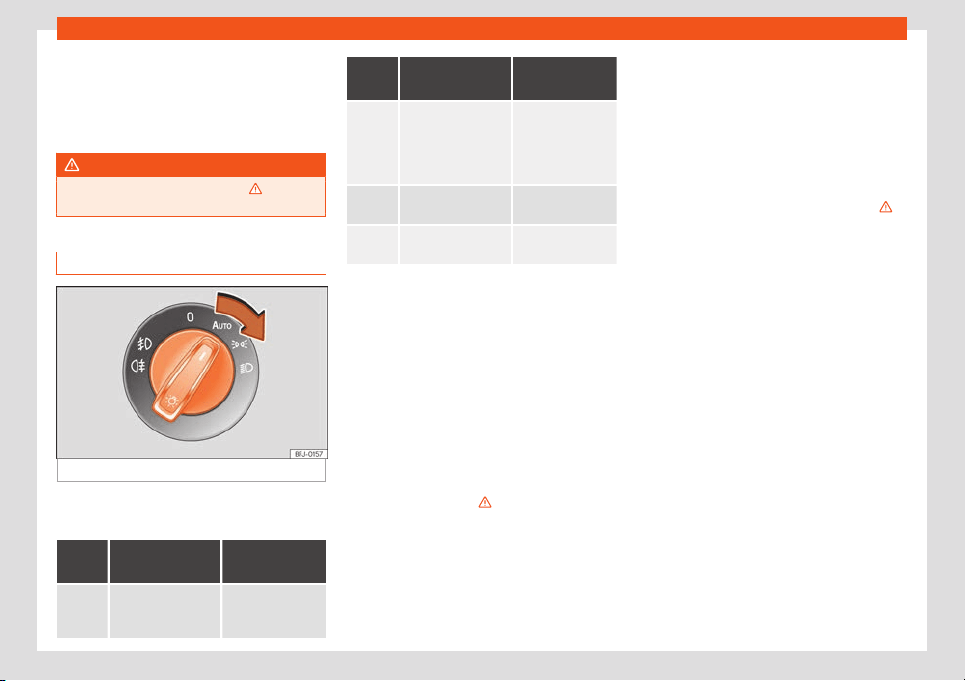
Operation
Several warning and control lamps light up
f
or a few seconds when the ignition is switch-
ed on, signalling that the function is being
verified. They will switch off after a few sec-
onds.
WARNING
Observe the safety warnings
›
››
in Con-
tr
ol and warning lamps on page 86.
Headlight switch
Fig. 93 Dash panel: lights control.
●
Turn the switch to the required position
›
››
Fig. 93.
Sym-
bol
Ignition switch-
ed off
Ignition is
s
witched on
Fog lights, dipped
beam and side
lights off
.
Daylight running
lights switched on.
Sym-
bol
Ignition switch-
ed off
Ignition is
s
witched on
The “Coming
home”, “L
eaving
home” and Wel-
come lights may be
switched on.
Automatic control
of dipped beam
and daytime run-
ning light.
Side light on.
Daylight running
lights s
witched on.
Dipped beam head-
light off
Dipped beam
s
witched on.
The driver is personally responsible for the
corr
ect use and adjustment of the lights in all
situations.
Automatic dipped beam headlight control
The automatic dipped beam control is merely
intended as an aid and is not able to recog-
nise all driving situations.
When the light switch is in position , the
vehicle lights and the instrument panel and
switch lighting switch on automatically in the
following situations
›››
:
●
The photo sensor detects d
arkness, for ex-
ample, when driving through a tunnel. They
switch off when adequate lighting is detec-
ted.
●
The rain sensor detects rain and activates
the wipers. They switch off when the wipers
have not been activated for a few minutes.
Daytime running lights
The daytime running lights consist of individu-
al lights, integrated in the front headlights.
When the daytime running lights are switched
on, the rear side light also switches on
›››
.
The daytime running lights t
urn on every time
the ignition is switched on, if the switch is in
position or , according to the level of ex-
terior lighting.
When the light switch is in position , a light
sensor automatically switches dipped beam
on and off (including the control and instru-
ment lighting) or the daytime running lights
depending on the level of exterior lighting.
Motorway light
The function is connected and disconnected
via the corresponding Infotainment system
menu.
●
Activation: when going above 110 km/h
(68 mph) for more than 10 seconds, the dip-
ped beam raises slightly to increase the driv-
er's visibility distance.
●
Deactivation: when reducing the speed of
the vehicle below 100 km/h (62 mph), the
dipped beam immediately returns to its nor-
mal position.
116
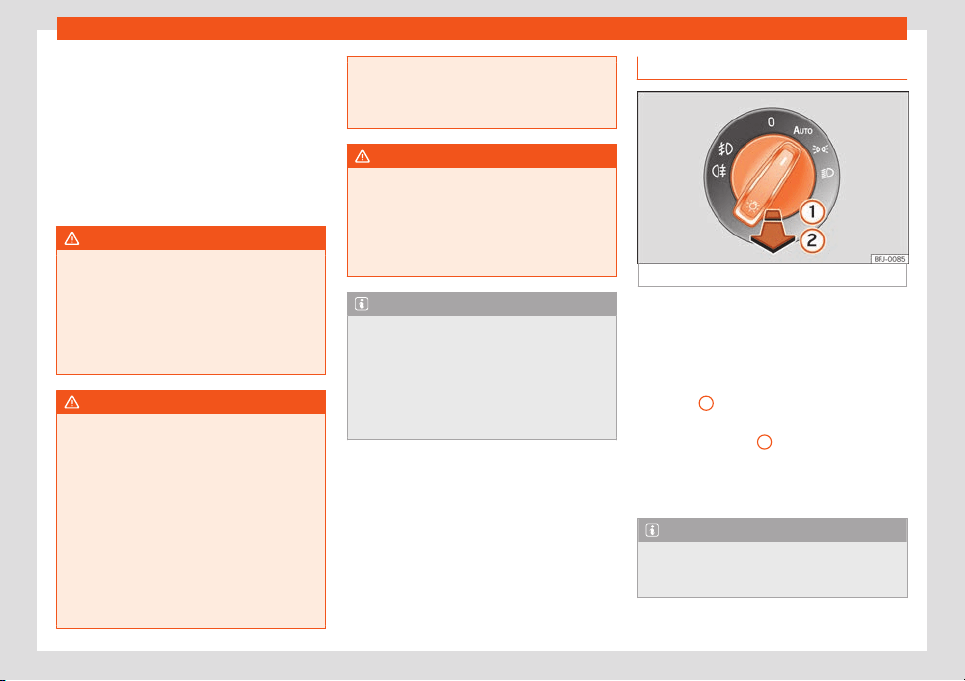
Lights
Audible warnings to advise the driver that
the lights hav
e not been switched off
If the ignition is not connected and the driver
door is open, an audible warning signal is
heard in the following cases: this will remind
you to turn the light off.
●
When the parking light is on
›››
page 118.
●
When the light switch is in position or .
WARNING
If the road is not well lit and other road
users cannot see the v
ehicle well enough
or at all, accidents may occur.
●
The automatic dipped beam control
( ) only switches on the dipped beam
when there are changes in light conditions
but not, for example, when it is foggy.
WARNING
The side lights or daytime running lights
ar
e not bright enough to illuminate the road
ahead and to ensure that other road users
are able to see you.
●
Always use your dipped beam head
lights if it is raining or if visibility is poor.
●
Never drive with daytime lights if the road
is not well lit due to weather or lighting
conditions.
●
On vehicles with rear lights with bulbs,
when activating the daytime running light
the rear lights are not switched on. A vehi-
cle which does not have the rear lights on
may not be visibl
e to other drivers in the
darkness, in the case of heavy rain or in
conditions of poor visibility.
WARNING
If the headlights are set too high and not
used corr
ectly, there is a risk of dazzling or
distracting other road users. This could re-
sult in a serious accident.
●
Always make sure that the headlights are
correctly adjusted.
Note
●
The l
egal requirements regarding the use
of vehicle lights in each country must be
observed.
●
The dipped beam headlights will only
work with the ignition on. The side lights
come on automatically when the ignition is
turned off.
Fog lights
Fig. 94
Dash panel: lights control.
The warning lamps or al
so show, on the
light switch or instrument panel, when the
front fog lights are on.
●
Turning on the front fog lights : pull the
light switch out from its first click position
›››
Fig. 94
1
, from positions , or .
●
Turning on the rear fog light : pull the
light s
witch fully out
2
from position , or
.
●
To switch off the fog lights, press the light
switch or turn it to position .
Note
The rear fog light can dazzle drivers behind
you. Y
ou should use the rear fog light only
when visibility is very poor.
117
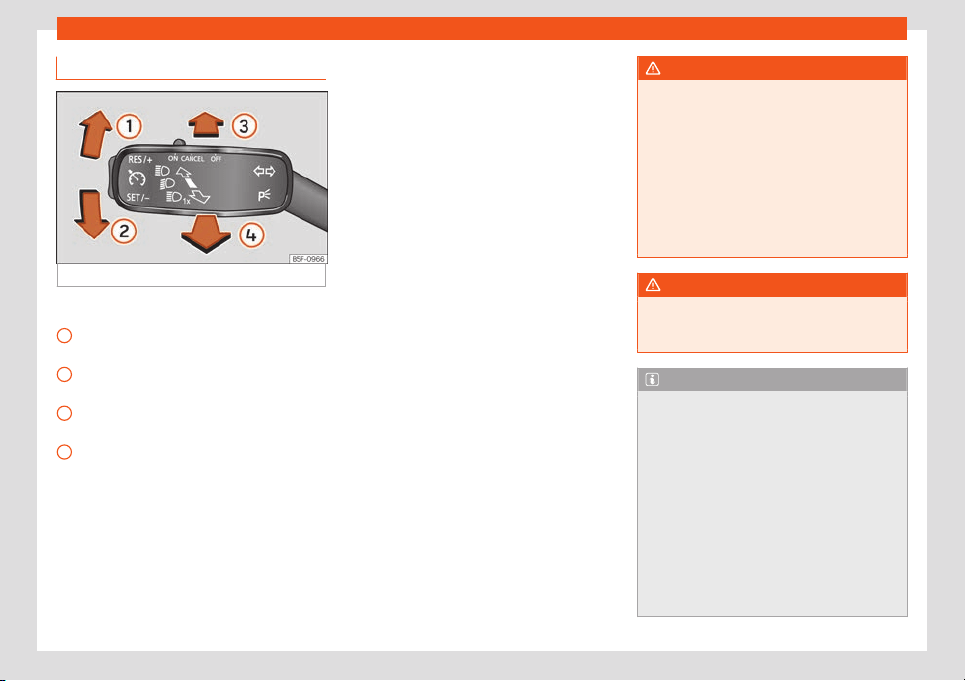
Operation
Turn signal and main beam lever
Fig. 95
Turn signal and main beam lever.
More the lever to the required position:
Right t
urn light or right-hand parking light
(ignition switched off).
Left turn light or left-hand parking light
(ignition switched off).
Turning main beam headlights on: control
lamp lit up on the instrument panel.
The headlight flasher comes on while we
pull the lever. Control lamp lit up.
Place the lever in rest position to turn off the
corresponding function.
Convenience turn signals
When the ignition is switched on, move the
lever as far as possible upwards or down-
wards and release the lever. The turn signal
will flash three times.
1
2
3
4
The convenience turn signals are switched on
and off in the inf
otainment system by means
of the function button > Settings >
Light > Light Assist > Convenience
turn signals
›››
page 91.
In vehicles that do not have the correspond-
ing menu, this function can be deactivated in
a specialised workshop.
Parking light
The parking lights will only work with the igni-
tion off. If said light is on, an audible warning
will sound while the driver door is open.
●
Switch the ignition off.
●
Move the turn signal lever up or down.
When the parking light is switched on, the
front side light and the tail light on the corre-
sponding side of the vehicle turn on.
Parking light on both sides
●
Switch the ignition off.
●
Place the light switch in position .
●
Lock the vehicle from the outside.
In doing so, only the side lights of both head-
lights light up, and additionally the tail lights
will do so partially.
WARNING
Improper or lack of use of the turn signals,
or f
orgetting to deactivate them can con-
fuse other road users. This could result in a
serious accident.
●
Always give warning when you are going
to change lane, overtake or when turning,
activating the turn signal in good time.
●
As soon as you have finished changing
lane, overtaking or turning, switch the turn
signal off.
WARNING
Incorrect use of the headlights may cause
accidents and serious injury, as the main
beam may distr
act or dazzle other drivers.
Note
●
If the conv
enience turn signals are oper-
ating (three flashes) and the other conven-
ience turn signals are switched on, the ac-
tive part stops flashing and only flashes
once in the new part selected.
●
The turn signal only works when the igni-
tion is switched on. The hazard warning
lights also work when the ignition is switch-
ed off.
●
If a trailer turn signal malfunctions, the
control lamp will stop flashing (trailer turn
signals) and the vehicle turn signal will
flash at double speed.
118
Lights
●
The main beam headlights can only be
s
witched on if the dipped beam headlights
are already on.
●
In cold or damp weather conditions, the
headlights, tail lights and turn signals may
mist up inside temporarily. This is normal
and in no way effects the useful life of the
vehicle lighting system.
●
The parking light does not activate auto-
matically if the left- or right-hand turn sig-
nal is left on and the ignition is disconnec-
ted.
Main beam assist (Light Assist)
The main beam assist automatically prevents
gl
are from vehicles moving in the opposite di-
rection or ahead in the same direction. In ad-
dition, the main beam assist detects illumina-
ted areas and disconnects the main beam
headlight when passing, e.g. by populated
areas.
Within its limitations, the assist system auto-
matically connects or disconnects the main
beam headlight depending on the environ-
mental and traffic conditions, as well as the
speed
›››
.
S
witching the main beam assist on
●
Turn on the ignition and turn the light switch
to the position .
●
From the base position, press the turn signal
and main beam headlights lever forwards
›››
Fig. 95
3
When the main beam assistant is on, the
indicat
or lamp lights up on the instrument
cluster display.
When the main beam light is on, the main
beam indicator lamp lights up on the instru-
ment cluster.
Switching the main beam assist off
●
Turn the light switch to a position other than
›››
page 116.
●
OR: while the main beam is on, pull the turn
signal light and main beam headlights lever
forwards
›››
Fig. 95
4
.
●
OR: if the main beam assist
ant is on, but the
main beam does not turn on, press the turn
signal and main beam lever forwards to turn
the main beam on manually. Pull the turn sig-
nal and main beam lever back to switch off
the main beam manually, if necessary.
●
OR: switch off the ignition.
System limitations
In the following cases, the main beam head-
light must be switched off manually because
the main beam assist will not disconnect it on
time or disconnect it at all:
●
On roads with insufficient lighting with very
reflective signs
●
If road users are insufficiently lit up, e.g. pe-
destrians or cyclists.
●
On closed curves, when the traffic in the
opposite direction is partially hidden, on pro-
nounced slopes or inclinations.
●
On roads with traffic in the opposite direc-
tion and with a central reservation barrier
where the driver can see over it e.g. lorry driv-
ers.
●
In the event of fog, snow or heavy rain
●
In the event of dust or sand storms
●
If the windscreen is damaged in the cam-
era's field of vision.
●
If the camera's field of vision is misted up,
dirty or covered by a sticker, snow or ice.
●
If the camera is damaged or if the power
supply has been cut off.
WARNING
The convenience features of the main
beam assist shoul
d not encourage the tak-
ing of risks. The system is not a replace-
ment for driver concentration.
●
You are always in control of the main
beam and adapting it to the light, visibility
and traffic conditions.
●
It is possible that the main beam head-
light control does not recognise all driving
»
119
Operation
situations and is limited under certain cir-
cumst
ances.
●
When the field of vision of the camera is
dirty, covered or damaged, operation of
the main beam control may be affected.
This also applies when changes are made
to the vehicle lighting system, for example,
if additional headlights are installed.
CAUTION
To avoid affecting the operation of the sys-
t
em, take the following points into consid-
eration:
●
Clean the field of vision of the camera
regularly and make sure it is free of snow
and ice.
●
Do not cover the field of vision of the
camera.
●
Check that the windscreen is not dam-
aged in the area of the field of vision of the
camera.
Note
●
The headlight fl
asher can be turned on
and off manually at any time with the turn
signal and main beam lever
›››
page 118.
●
If there are objects that radiate light in
the camera's area of influence, e.g. a port-
able navigation system, this may affect the
operation of the main beam assist system.
Fog lights with cornering light func-
tion
The cornering light function is an additional
function t
o the dipped beam headlights to
improve lighting of the side of the road when
taking a sharp turn at low speed.
The cornering light function works when the
dipped beam headlights are already on and
it is activated when driving at speeds below
approximately 40 km/h (25 mph).
●
If the steering wheel is turned or the turn
signal is s
witched on, the front fog light grad-
ually turns on. After the turn, the cornering
light function is gradually switched off.
●
When engaging reverse gear, both front fog
lights turn on.
“Coming home” and “Leav-
ing home” function
The “Coming home” and “Leaving home”
function lights up the v
ehicle’s immediate
proximity when getting into and out of it in the
dark. When switched on, the front position
and dipped beam lights, tail lights and li-
cense plate light come on.
The “Leaving Home” is controlled by a photo-
sensor.
In the vehicle settings menu of the infotain-
ment system you can adjust the duration of
the light switch-off delay, and activate and
deactivate the function.
Activating the “Coming Home” function
For vehicles with light and rain sensors.
●
Switch off the engine and remove the key
from the ignition with the light switch in posi-
tion
›››
page 116.
●
The automatic “Coming Home” function is
only active when the light sensor detects
darkness.
For vehicles without light and rain sensors.
●
Switch the ignition off.
●
Activate the headlight flashers for approxi-
mately 1 second.
When the driver door is opened, the “Coming
Home” lighting comes on. The headlight turn-
ing off time counts from when the last door or
rear lid are closed.
The “Coming Home” lighting turns off in
the following cases:
●
Automatically, once the headlight turning
off time has elapsed.
●
Automatically, when a vehicle door or the
rear lid is still open 30 seconds after starting
the engine.
120
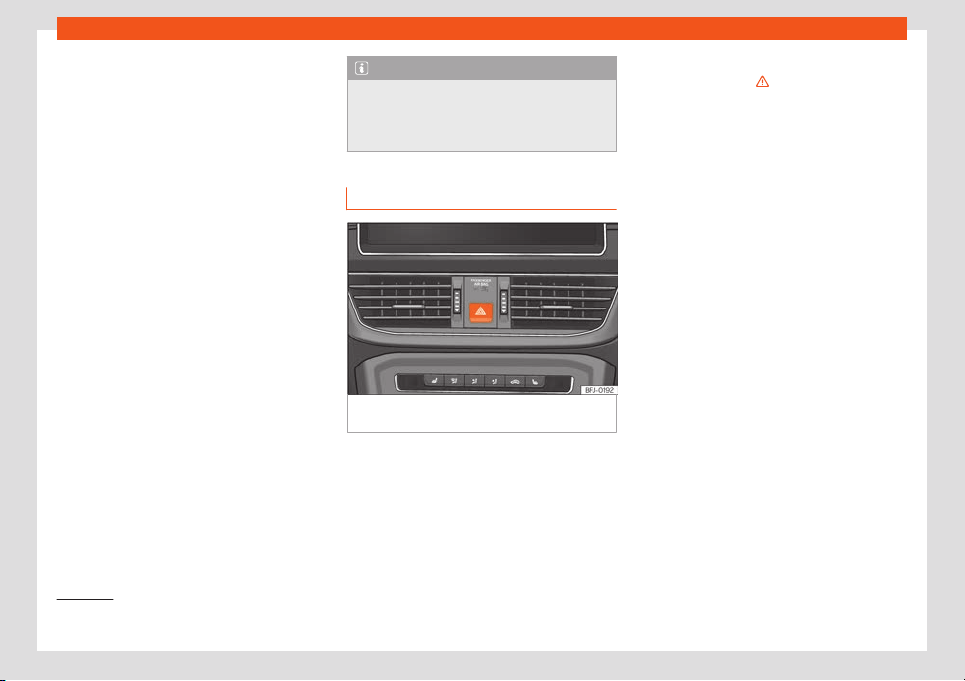
Lights
●
When the r
otary light switch is turned to po-
sition
›››
page 116.
●
With the ignition is switched on.
Activating the “Leaving Home” function
●
Unlock the vehicle using the remote control.
●
The “Leaving Home” function is only activa-
ted when the light switch is in position
and the light sensor detects darkness.
The “Leaving Home” lighting switches off
in the following cases:
●
Automatically, when the “Leaving Home”
switch-on time ends (default 30 sec).
●
When the vehicle is locked using the remote
control.
●
When the light switch is turned to position .
●
With the ignition is switched on.
Welcome light
1)
The welcome light is a light located on the
exterior mirrors, focused on the ground, which
activates or deactivates if the light switch is in
the position and the “Coming Home” or
“Leaving Home” function is turned on or off.
Note
To activate the “Coming Home” and “Leav-
ing Home” function, the r
otary light switch
must be in position and the light sensor
must detect darkness.
Hazard warning lights
Fig. 96 Dash panel: hazard warning lights
s
witch
The hazard warning lights are used to draw
the att
ention of other road users to your vehi-
cle in emergencies.
If your vehicle breaks down:
1. Park your vehicle at a safe distance from
moving traffic.
2. Press the button to switch on the hazard
warning lights
›››
.
3. Switch the ignition off.
4. Apply the electronic parking brake.
5. For a manual gearbox, engage 1st gear;
f
or an automatic gearbox, move the gear
lever to P.
6. Use the warning triangle to draw the at-
tention of other road users to your vehicle.
7. Always take the vehicle key with you when
you leave the vehicle.
All turn signals flash simultaneously when the
hazard warning lights are switched on. The
two turn signal turn signal lamps and the
turn signal lamp in the switch will flash at
the same time. The simultaneous hazard
warning lights also work when the ignition is
switched off.
Emergency braking warning
If the vehicle brakes suddenly and continu-
ously at a speed of more than 80 km/h (50
mph), the brake light flashes several times per
second to warn the vehicles driving behind. If
you continue braking, the hazard warning
lights will come on automatically when the
vehicle comes to a standstill. They switch off
»
1)
Valid for vehicles with a light and rain sensor
and full
-LED headlights.
121
Operation
automatically when the vehicle starts to
mo
ve again.
WARNING
●
The risk of an accident incr
eases if your
vehicle breaks down. Always use the haz-
ard warning lights and a warning triangle to
draw the attention of other road users to
your stationary vehicle.
●
Due to the high temperatures that the
catalytic converter can reach, never park
in an area where the catalytic converter
could come into contact with highly inflam-
mable materials, for example dry grass or
spilt petrol. This could start a fire.
Note
●
The 12-v
olt vehicle battery will run down
if the hazard warning lights are left on for a
long time, even if the ignition is switched
off.
●
The use of the hazard warning lights de-
scribed here is subject to the relevant stat-
utory requirements.
Dynamic headlight range control
The headlight range is automatically adjus-
t
ed according to the vehicle load status when
they are switched on.
WARNING
Heavy objects in the vehicle may mean
that the headlights dazzl
e and distract oth-
er drivers. This could result in a serious ac-
cident.
Driving abroad
The light beam of the dipped beam lights is
asymmetric: the side of the r
oad on which
you are driving is lit more intensely.
When a car that is manufactured in a country
that drives on the right travels to a country
that drives on the left (or vice versa), it is nor-
mally necessary to cover part of the head-
light bulbs with stickers or to change the ad-
justment of the headlights to avoid dazzling
other drivers.
In such cases, the regulations specify certain
light values that must be complied with for
designated points of the light distribution. This
is known as “Tourist light”.
The light distribution of the headlights allows
the specific “tourist light” values to be met
without the need for stickers or changes be-
ing made to the settings.
Note
“Tourist light” is only allowed temporarily. If
you ar
e planning a long stay in a country
that drives on the other side, you should
t
ake the vehicle to an Authorised Technical
Service to change the headlights.
Interior lights
Lighting of the instrument panel
,
displays and switches
Depending on the model, the lighting of the
instrument clust
er and switches can be ad-
justed in the infotainment system, using the
> Settings > Light > Interior light-
ing function button; OR: > Interior
settings > Light > Instrument clus-
ter
›››
page 91.
With the ignition on and without light activa-
tion, the analogue instrument panel lighting
remains activated in daytime light conditions.
The lighting is reduced as the exterior light di-
minishes. In some cases, e.g. when driving
through a tunnel without the function ac-
tive, the instrument panel lighting may even
switch off. The objective of this function is to
provide the driver with a visual indication that
he or she should activate the dipped beam.
If your vehicle is equipped with a digital in-
strument panel (Digital SEAT Cockpit), the
following message will appear Turn on the
lights on the instrument panel.
122
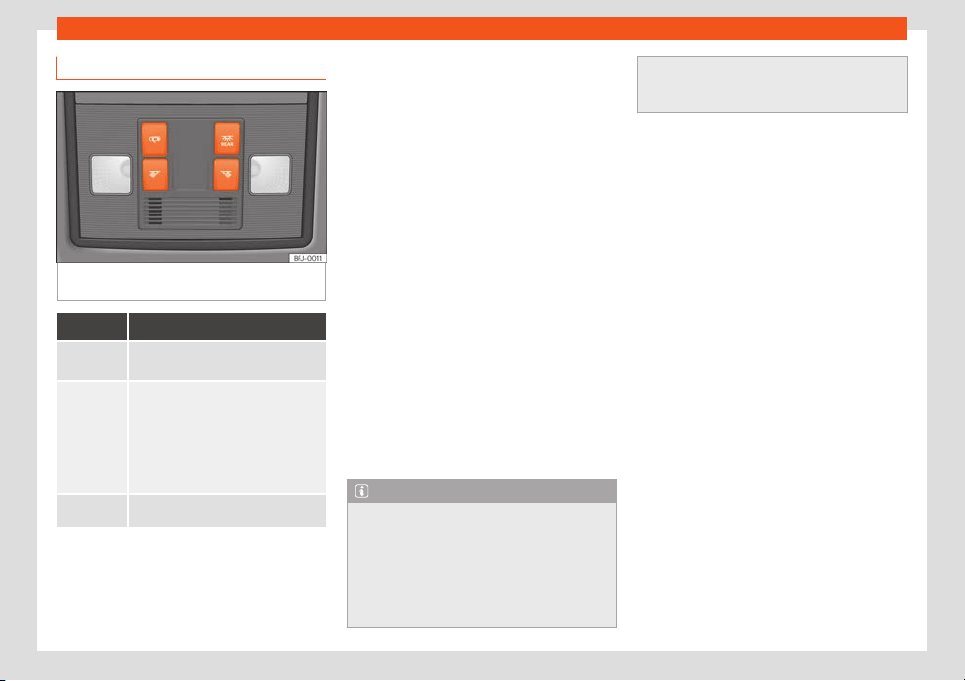
Lights
Interior and reading lights
Fig. 97
Detail of roof lining: front lighting of the
passenger compartment.
Knob Function
Turning the rear interior lights on or
off
.
The interior lights come on automati-
cally when you unl
ock the vehicle,
open a door or remove the key from
the ignition.
The light goes out a few seconds after
closing all the doors, when locking the
vehicle or connecting the ignition.
/
Turning the reading light on and off
Glove compartment and luggage com-
par
tment lighting
When opening and closing the glove com-
partment on the front passenger side and the
rear lid, the respective light will automatically
switch on and off.
Footwell lighting
The lights in the footwell area below the dash
(driver and front passenger sides) will switch
on when the doors are opened and will de-
crease in intensity while driving. This intensity
can be adjusted through the infotainment
system menu using the function button >
Settings > Light > Interior lighting
›››
page 91.
Background lighting
The background lighting lights up the area of
the centre console and the footwell area and,
depending on the version, the front door pan-
els as well.
The intensity of the background lighting can
be adjusted in the infotainment menu using
the function button > Settings > Back-
ground lighting; OR : > Background
lighting
›››
page 87.
Note
●
Depending on the f
eatures fitted in the
vehicle, LEDs can be used for the following
interior lights: front vanity mirror light, rear
vanity mirror light, footwell light, sun blind
and glove compartment light.
●
The reading lights go out when the vehi-
cle is closed and locked or after a few mi-
nutes of turning the ignition off. This pre-
v
ents the 12-volt vehicle battery from dis-
charging.
123

Operation
Visibility
Windscr
een wiper and rear
window wiper systems
Window washer lever
Fig. 98
Operating the windscreen wiper and
r
ear wiper.
More the lever to the required position:
0
Windscreen wipers off.
1
Wiper intervals.
Use contr
ol
›››
Fig. 98
A
to set the in-
t
erval (vehicles without rain sensor), or
the sensitivity of the rain sensor.
2
Slow sweep adjustable by using con-
tr
ol
›››
Fig. 98
A
.
3
Fast sweep adjustable by using control
›
››
Fig. 98
A
.
More the lever to the required position:
4
Short wipe. Brief press, short clean.
Hol
d the lever down for more time to in-
crease the wipe frequency.
5
Windscreen washer. The windscreen
washer function is activated by push-
ing the lever towards the steering
wheel, and the wipers operate simulta-
neously.
6
Interval wipe for rear window. The wip-
er will wipe the windo
w approximately
every six seconds.
7
The rear window wash function is acti-
v
ated by pressing the lever, and the
rear wiper starts simultaneously.
WARNING
In cold conditions you should not use the
w
ash/wipe system unless you have
warmed the windscreen with the heating
and ventilation system. The windscreen
washer fluid could otherwise freeze on the
windscreen and obscure your view of the
road.
CAUTION
If the ignition is switched off while the wind-
scr
een wipers are switched on, they com-
plete their wipe and return to the rest posi-
tion. When the ignition is switched back on,
the windscreen wiper will continue to oper-
ate at the same wiping level. Ice, snow and
other obstacles on the windscreen may
damage the wiper and the windscr
een wip-
er motor.
●
If necessary, remove snow and ice from
the windscreen wipers before starting your
journey.
●
Do not switch on the windscreen wipers if
the windscreen is dry. Cleaning with the
windscreen wipers while dry can cause
damage.
●
In icy conditions, always check that the
wiper blades are not frozen to the glass be-
fore using the wipers. In cold weather, it
may help to leave the vehicle parked with
the wipers in service position
›››
page 51.
Note
●
The windscr
een and window wipers only
function when the ignition is switched on
and the bonnet or rear lid, respectively, are
closed.
●
The rear wiper is automatically switched
on when the windscreen wiper is on and the
car is in reverse gear.
Wiper functions
Windscreen wipers performance in differ-
ent sit
uations
●
If you stop the vehicle with the windscreen
wiper in position 1 or 2, it will automatically
124
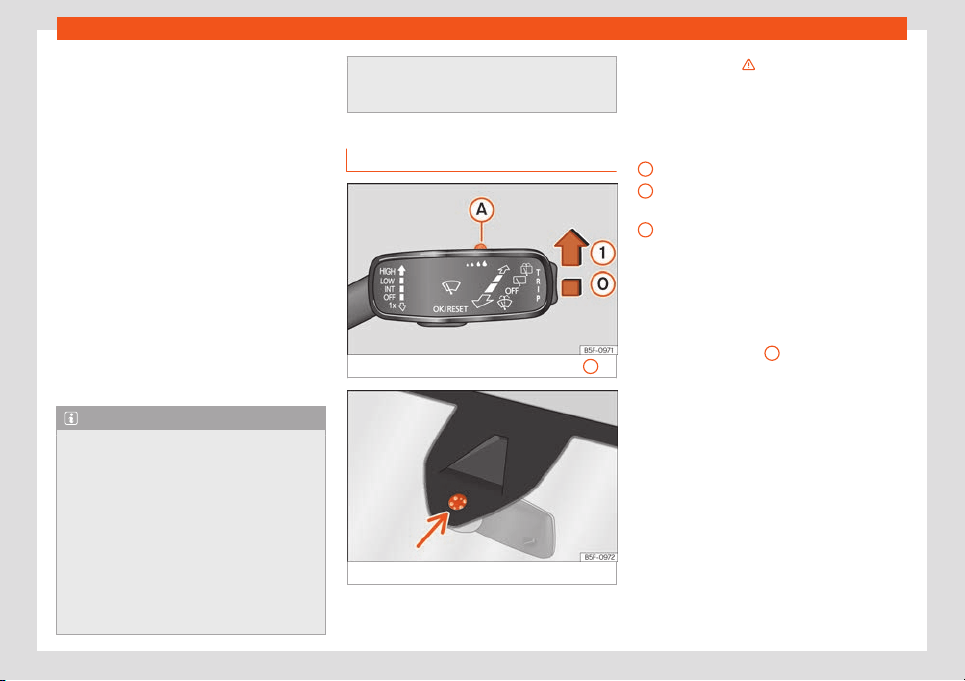
Visibility
change to a lower position speed. The set
speed will be r
esumed when the vehicle pulls
away.
●
The air conditioner comes on for approxi-
mately 30 seconds in air recirculation mode
when the windscreen washer is activated,
to prevent the smell of the windscreen wash-
er fluid entering the inside the vehicle.
●
When wiping at intervals, the intervals vary
according to the speed. The higher the vehi-
cle speed the shorter the intervals.
Heated windscreen washer jets
The heating only thaws the frozen jets, it does
not thaw the water in the washer hoses.
When the ignition is switched on the heated
windscreen washer jets automatically adjust
the heat depending on the ambient tempera-
ture.
Note
●
The wiper will try t
o wipe away any ob-
stacles that are on the windscreen. The
wiper will stop moving if the obstacle
blocks its path. Remove the obstacle and
switch the wiper back on again.
●
The windscreen will be wiped again ap-
proximately 5 seconds after the wind-
screen washer has been activated, provi-
ded the vehicle is moving (“drip” function).
If you activate the wipers less than 3 sec-
onds after the “drip” function, a new wash
sequence will begin without performing the
last wipe. For the “drip” function to work
again, you hav
e to turn the ignition off and
then on again.
Rain sensor
Fig. 99 Wiper lever: adjust the rain sensor
A.
Fig. 100 Rain sensor sensitive surface
The rain sensor controls the frequency of the
windscr
een wiper intervals, depending on the
amount of rain
›››
. The sensitivity of the rain
sensor can be adjust
ed manually. Manual
wipe
›››
page 124.
Move the lever to the required position
›››
Fig. 99:
Rain sensor off.
Rain sensor on; automatic wipe if neces-
sary.
Setting sensitivity level of rain sensor
–
Set control to the right: high sensitivity.
–
Set control to the left: low sensitivity.
When the ignition is switched off and then
back on, the rain sensor remains active and
starts operating again when the windscreen
wipers are in position
1
and the vehicle is
tr
avelling at more than 16 km/h (10 mph).
Modified behaviour of the rain sensor
Possible causes of faults and mistaken read-
ings on the sensitive surface
›››
Fig. 100 of
the rain sensor include:
●
Damaged wipers: a film of water on the
damaged blades may lengthen the activa-
tion time, reduce the washing intervals or re-
sult in a fast and continuous wipe.
●
Insects: insects on the sensor may trigger
the windscreen wiper.
»
0
1
A
125
Operation
●
Salt on the r
oad: in winter, salt spread on
the roads may cause an excessively long
wipe when the windscreen is almost dry.
●
Dirt: dry dust, wax, coating on glass (Lotus
effect) or traces of detergent (car wash) may
reduce the effectiveness of the rain sensor or
make it react more slowly, later or not at all.
●
Windscreen crack: the impact of a stone
will trigger a single wipe cycle with the rain
sensor on. Next the rain sensor detects the re-
duction in the sensitive surface area and
adapts accordingly. The behaviour of the
sensor will vary with the size of the damage
caused by the stone.
WARNING
The rain sensor may not detect enough rain
t
o switch on the wipers.
●
If necessary, switch on the wipers man-
ually when water on the windscreen ob-
structs visibility.
Note
●
R
egularly clean the sensitive surface of
the rain sensor
›››
Fig. 100 (arrow) and
check for possible damage to the wiper
blades.
●
To remove wax and coatings, we recom-
mend a window cleaner containing alco-
hol.
●
Do not put stick
ers on the windscreen in
front of the rain sensor. This may cause
sensor disruption or faults.
Mirrors
Int
erior mirror anti-dazzle function
Rear view mirror with automatic anti-daz-
zl
e function
The anti-dazzle function is activated every
time the ignition is switched on.
When the anti-dazzle function is enabled, the
interior rear vision mirror will darken auto-
matically according to the amount of light it
receives. The anti-dazzle function is cancel-
led if reverse gear is engaged.
WARNING
In the event that an automatic anti-dazzle
r
ear vision mirror breaks, an electrolyte flu-
id may leak. This could cause irritation to
the skin, eyes and respiratory organs. If you
come into contact with this liquid, it must
be rinsed with large quantities of water. If
necessary, get medial help.
CAUTION
In the event that an automatic anti-dazzle
r
ear vision mirror breaks, an electrolyte flu-
id may leak. This liquid attacks plastic sur-
f
aces. Clean it with a wet sponge as soon
as possible.
Note
●
If the light f
alling on the interior mirror is
obstructed (e.g. with the sun blind), the an-
ti-dazzle mirror with automatic adjustment
will not operate perfectly.
●
When the interior lights are on or reverse
gear engaged, the mirrors do not darken
with automatic adjustment for anti-dazzle
position.
●
If you have to stick any type of sticker on
the windscreen, do not do so in front of the
sensors. Doing so could prevent the anti-
dazzle function from working well or even
from working at all.
126
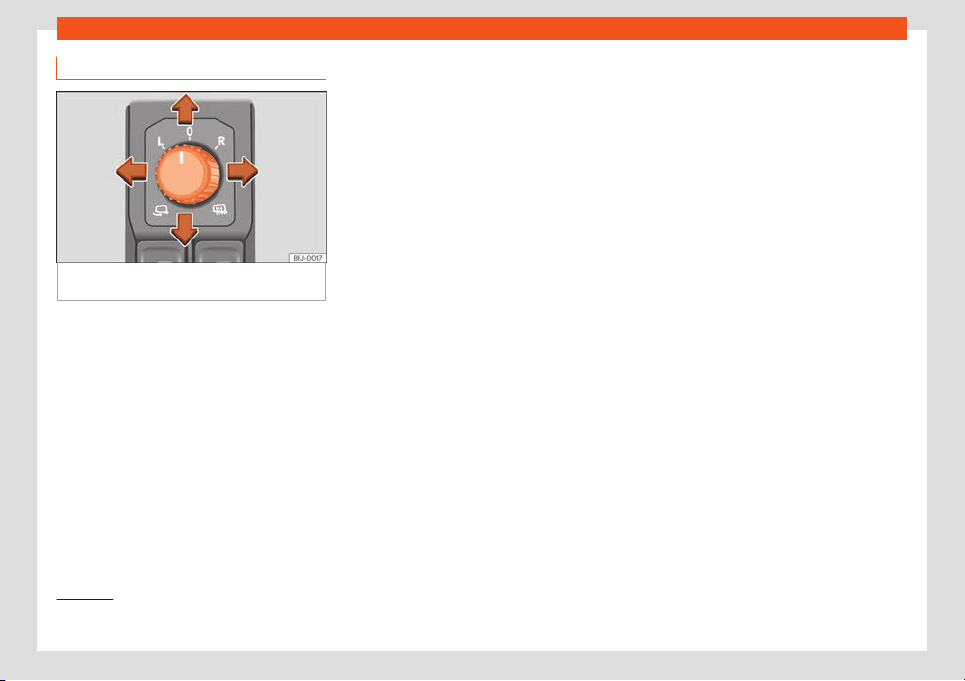
Visibility
Adjusting the exterior mirrors
Fig. 101
Detail of the driver's door: control for
the e
xterior mirror.
Turn the control to the corresponding posi-
tion:
T
urning the knob to the desired position,
adjust the mirrors on the driver side (L,
left) and the passenger side (R, right) to
the direction desired.
Depending on the equipment fitted on
the vehicle, the mirrors may be heated
according to the outside temperature.
Folding in mirrors.
L/R
Synchronized regulation of the exterior
mirrors
In the infotainment system, using the function
button > Settings > Mirrors and
wipers > Mirrors, the exterior rear view
mirrors can be selected to adjust in a
synchronised manner.
●
Turn the knob to position L
1)
.
●
Adjust the left-hand exterior mirror. The
right exterior mirror will be adjusted at the
same time (synchronised).
●
If necessary, correct the right-hand rear-
view mirror: rotate the control to position R
1)
.
Tilt function for front passenger exterior
mirror
When parking backwards, and in order to be
able to see the kerb, the passenger side mir-
ror can be automatically tilted towards the
passenger to provide a better view of the
kerb. The control must be in the position R
1)
for this feature to be operational.
The mirror returns to its original position as
soon as you drive forward at over 15 km/h
(9 mph) or switch off the ignition. It also re-
turns to its original position if the position of
the control is adjusted.
Storing the rear view mirror settings for the
tilt function
●
Switch the ignition on.
●
In the infotainment system, select >
Settings > Mirrors and wipers > Mir-
rors > Lower in reverse gear
›››
page 87.
●
Select the R
1)
position on the control.
●
Select reverse gear.
●
Adjust the front passenger exterior mirror so
that you can see, for example, the kerb area
well.
●
Release the reverse gear.
●
The adjusted position for the rear view mir-
ror is stored.
Fold the rearview mirrors when locking the
vehicle
In the infotainment system, using the function
button > Settings > Mirrors and
wipers > Mirrors, the exterior mirrors can
be selected to fold in when the vehicle is
parked and locked
›››
page 87.
When the vehicle is locked with the remote
control, the exterior mirrors are retracted au-
tomatically. When the vehicle is opened with
»
1)
Regulation in right-hand drive vehicles is sym-
metrical.
127
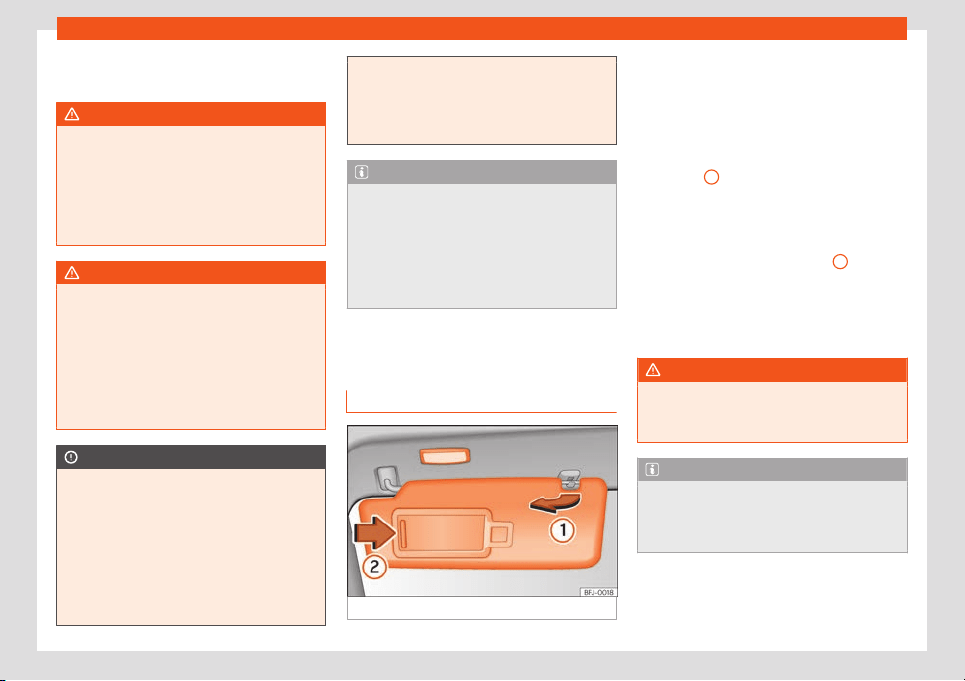
Operation
the remote control, the exterior mirrors are
depl
oyed automatically.
WARNING
Convex or wide-angle exterior mirrors give
a l
arger field of vision. However, they make
objects look smaller and further away than
they really are. If you use these mirrors to
estimate the distance to vehicles behind
you when changing lane, you could mis-
judge the distance. Risk of accident!
WARNING
Fold and unfold the exterior mirror, taking
car
e to avoid injuries.
●
Only fold or unfold the exterior mirror
when there is no-one in the way of the mir-
ror.
●
When moving the mirror, take care not to
trap fingers between the mirror and the
mirror bracket.
CAUTION
●
If f
or any reason (e.g. a bump when ma-
noeuvring) one of the rear view mirrors is
knocked out of position, the mirrors must
first be fully retracted with the electric
control. The rear view mirror must not be
placed by hand in the starting position, as
the folding mechanism can be damaged.
●
Before washing the vehicle in an auto-
matic car wash, please make sure to fold
the exterior mirrors in to prevent them from
being damaged. El
ectrically retractable
exterior mirrors must not be folded in or out
by hand, always use the electrical power
control.
Note
●
If the el
ectrical adjustment should fail to
operate, both of the mirrors can be adjus-
ted by hand by lightly pressing the edge of
the mirror glass.
●
The fold-in function on the exterior mir-
rors will not activate at speeds over
40 km/h (25 mph).
Sun protection
Sun blind
Fig. 102
Sun visor
Options for adjusting driver and front pas-
senger sun visors
●
Lower the sun visor towards the wind-
scr
een.
●
The sun visor can be pulled out of its
mounting and turned towards the door
›››
Fig. 102
1
.
●
Swing the sun visor towards the door, longi-
t
udinally backwards.
There is a vanity mirror on the sun visor, with a
cover. When the cover is opened
2
a light
comes on.
The l
amp goes out when the vanity mirror
cover is closed or the sun visor is pushed
back up.
WARNING
Folded sun blinds can reduce visibility.
●
Always store sun blinds and visors in their
housing when not in use
.
Note
The light above the sun visor automatically
s
witches off after a few minutes in certain
conditions. This prevents the 12-volt vehicle
battery from discharging.
128
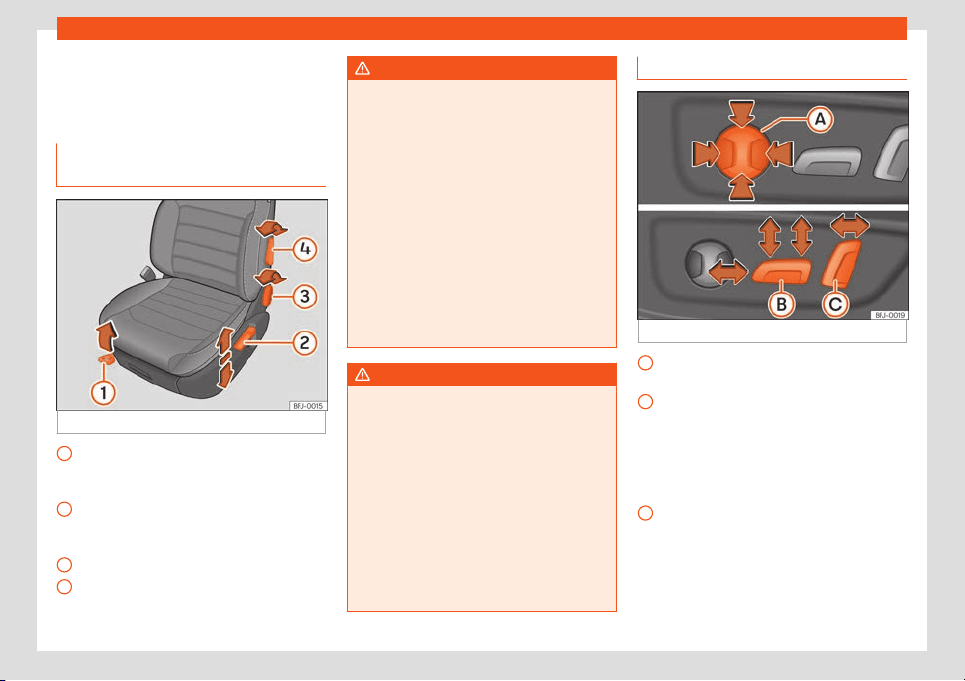
Seats and headrests
Seats and headrests
Adjusting seats
Manual adjustment of the fr
ont
seats
Fig. 103
Front seats: manual seat settings.
Forwards/backwards: pull the lever and
mo
ve the seat. The seat must engage
when the lever is released!
Raise/lower: pull the lever up or push
down (several times if necessary) from its
home position.
Tilting the backrest: turn the hand wheel.
Lumbar support: move the lever until the
required position is achieved.
1
2
3
4
WARNING
Incorrect seat adjustment may lead to ac-
cidents and se
vere injuries.
●
Only adjust the seats when the vehicle is
stationary, as the seats could move unex-
pectedly while the vehicle is in motion and
you could lose control of the vehicle. Fur-
thermore, an incorrect position is adopted
when adjusting the seat.
●
Adjust the height, position and inclination
of the front seats only when their move-
ment area is empty.
●
Make sure there are no objects in that
area.
●
Make sure that the movement and lock-
ing areas of the seats are clean.
WARNING
Incorrectly using upholstery and seat cov-
ers might cause an accident
al activation of
the electrical seat adjustment system and
make it move unexpectedly while driving.
This might cause loss of control of the vehi-
cle and thus accidents or injuries. More-
over, the electrical components of the front
seats might be damaged.
●
Never attach or place seat upholstery or
covers on the electric controls.
●
Never use upholstery or seat covers that
have not been explicitly authorised for the
seats of the vehicle.
Electric driver's seat adjustment
Fig. 104
Driver's seat: electric seat settings.
Adjust the lumbar support: press the but-
t
on according to the desired position.
Seat forwards/backwards: press the but-
ton forwards/backwards.
Seat up/down: Press the rear part of the
button up/down. To adjust the angle of
the seat cushion, press the front of the
button up/down.
Backrest further upright/further reclined:
press the button forwards/backwards.
»
A
B
C
129
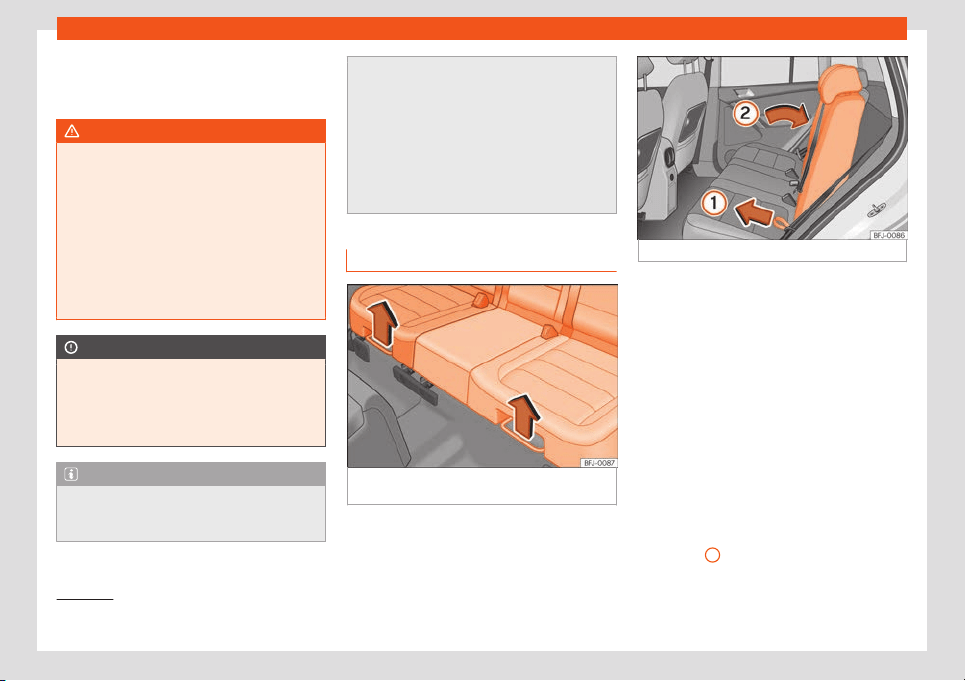
Operation
The position will be saved automatically in
the SEAT Connect Activ
e user when the igni-
tion is switched off
1)
.
WARNING
●
If the el
ectric front seats are used negli-
gently or without paying due attention, it
can cause serious injury.
●
The front seats can also be electrically
adjusted when the ignition is switched off.
Never leave a child or any other person
who may need help in the vehicle.
●
In the event of an emergency, electrical
adjustment can be stopped by pressing
any control.
CAUTION
To avoid damaging the electrical compo-
nents of the fr
ont seats, please refrain from
kneeling on the seat or applying sharp
pressure at a single point to the seat cush-
ion and backrest.
Note
●
It may not be possibl
e to electrically ad-
just the seat if the charge of the 12-volt ve-
hicle battery is very low.
●
If the engine is st
arted while the seats are
being electrically adjusted, the adjustment
will stop.
●
When changing user a warning will be
shown on the infotainment system's screen
during the time that the seat is moving to
the saved position. This movement can be
stopped by pressing the stop button on the
screen.
Adjusting the rear seat
Fig. 105
Under the bench of the rear seat: set-
ting l
evers.
Fig. 106 Rear seat backrest adjustment.
The rear seat is asymmetrical and each part
can be adjust
ed separately.
Adjusting the rear seat
●
Pull the right of left lever, in the direction of
the arrow
›››
Fig. 105, and move the part cor-
responding to the seat to the front or the
back.
●
Release the lever and lock the seat, moving
it slightly to the front or the back.
Adjusting the rear seat backrest
●
Press the right or left backrest of the seat
with one hand and, at the same time, pull
from the corresponding cord with the other
›››
Fig. 106
1
.
1)
Valid for vehicles fitted with the Infotainment
Connect Syst
em.
130
Seats and headrests
●
Mo
ve the backrest with your hand to the
desired position; there will be some resist-
ance
2
.
●
Release the cord and lock the backrest,
mo
ving it slightly to the front or the back.
WARNING
Incorrect backrest adjustment may lead to
accidents and se
vere injuries.
●
Only adjust the rear seat when the vehi-
cle is stationary; otherwise, it could move
unexpectedly while the vehicle is in motion.
Furthermore, an incorrect position is adop-
ted when adjusting the seat.
●
Adjust the rear seat only when its move-
ment area is empty.
CAUTION
●
When mo
ving the rear seat horizontally,
objects in the luggage compartment might
cause damages.
●
When the seat is in its frontmost position,
objects can be stored between the seat
and the luggage compartment. Before
moving the seat backwards, remove any
objects in this area.
Headrest
Intr
oduction
The possibilities for the adjustment and disas-
sembly of the headr
ests are described below.
Always make sure that the seats are correctly
adjusted
›››
page 13.
All seats are equipped with a headrest. The
rear headrests have been designed exclu-
sively for the corresponding seat of the sec-
ond or third row. Therefore, never mount them
on any other seat.
Correct adjustment of headrest
Adjust the headrest so that its upper edge is
at the same level as the top of your head and
under no circumstances below eye level.
Keep the back of your head always as close
to the headrest as possible.
In vehicles with horizontally adjustable headr-
ests on the front seats, move the headrest as
close as possible to the back of the head.
Adjusting the headrest for short people
Lower the headrest completely, even if your
head is below its upper edge. In the lowest
position, there may be a small distance be-
tween the headrest and the backrest.
Adjusting the headrest for tall people
Push the headr
est up as far as it will go.
WARNING
If travelling with the headrests removed or
impr
operly adjusted, the risk of severe or
fatal injuries in the event of accidents and
sudden braking or manoeuvres increases.
●
Always travel with the headrest correctly
installed and adjusted.
●
To decrease the risk of cervical injuries in
the event of an accident, adjust the head-
rest correctly based on your height, always
making sure that its upper edge is at the
same height as the top of the head, but
never below eye level. Keep the back of
your head always as close to the headrest
as possible and centred.
●
Never adjust the headrest while the vehi-
cle is in motion.
●
Under no circumstances should the rear
passengers travel while the headrests are
in the non-use position.
CAUTION
When assembling and disassembling the
headr
ests, do not let them meet the top lin-
ing of the vehicle, the back rest of the front
seat or other parts of the vehicles. If not,
this could damage the vehicle.
131
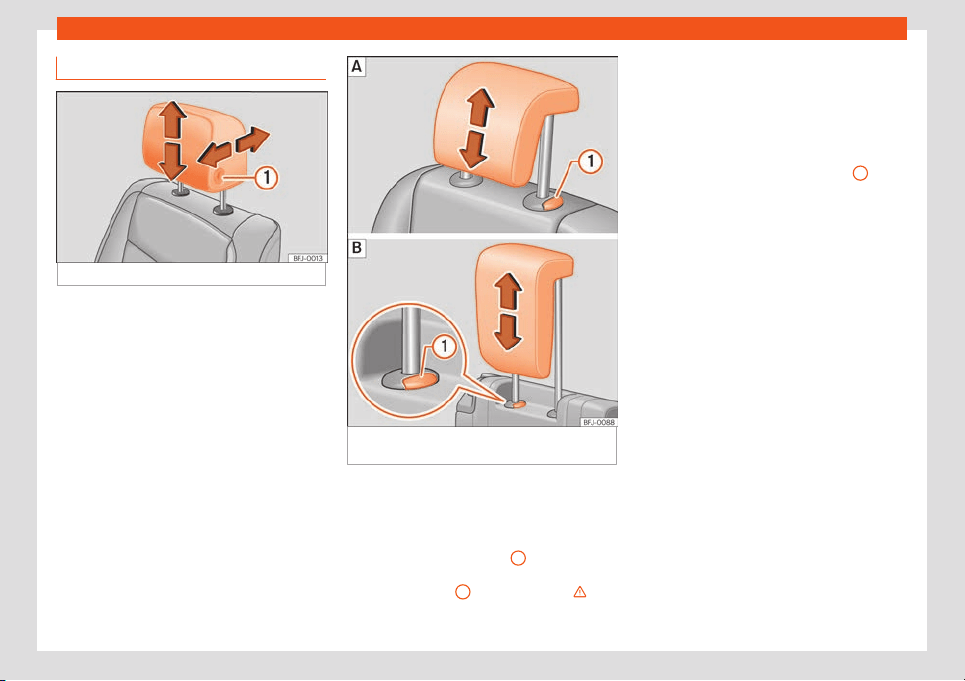
Operation
Adjusting the headrests
Fig. 107
Front seat: headrest adjustment.
Fig. 108
Adjusting the rear headrests: Sec-
ond r
ow of seats, third row of seats.
Adjusting the height of the headrests
●
Move the headrest up or down in the direc-
tion of the corr
esponding arrow. Regarding
the rear headrest, to both raise and lower,
press the button
›››
Fig. 107
1
; for the rear
headr
ests it is only necessary to press the
button
›››
Fig. 108
1
to lower them
›
››
in
Intr
oduction on page 131.
●
The headrest must lock correctly in one po-
sition.
Adjusting the front headrests horizontally
●
Move the head restraint forward or back in
the direction of the corresponding arrow
while pressing the button
›››
Fig. 107
1
.
●
The headrest must lock correctly in one po-
sition.
132
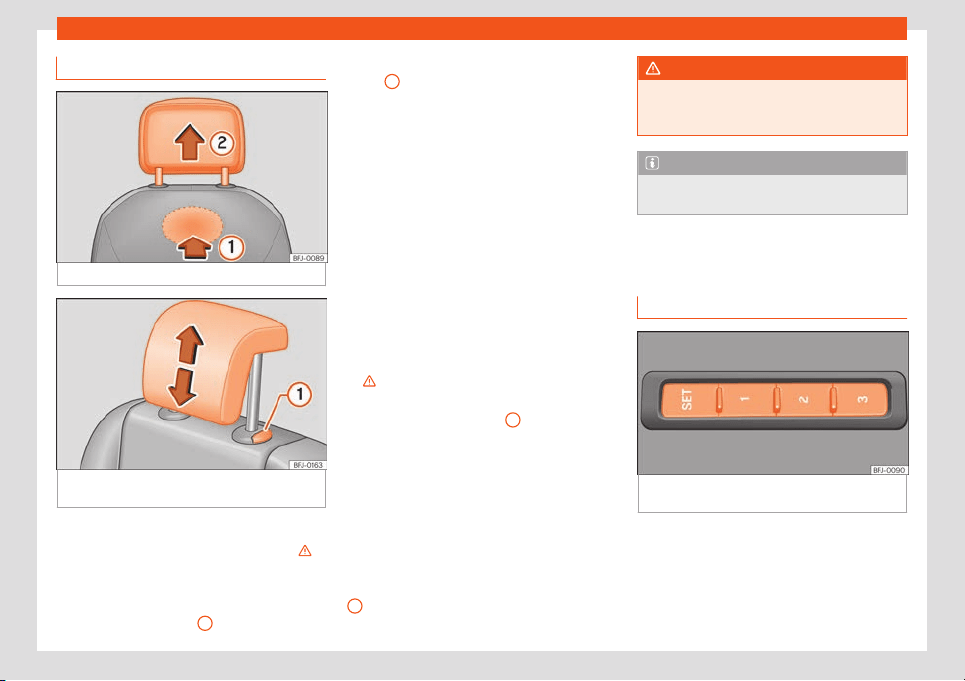
Seats and headrests
Removing and fitting the headrests
Fig. 109
Front headrest: removal.
Fig. 110
Removal of the rear headrests: sec-
ond r
ow of seats.
Removing the front headrests
●
If this is the case, lower the headrest
›
››
in
Intr
oduction on page 131.
●
To unlock it, look for the rabbet on the bot-
tom of the backrest and press in the direction
of the arrow
›››
Fig. 109
1
.
●
R
emove the headrest in the direction of the
arrow
2
.
Fitting the fr
ont headrests
●
Place the headrest in the correct position
on the guides of the corresponding backrest
and insert it.
●
Press the headrest downwards until the
bars lock.
●
Adjust the headrest according to the in-
structions on the correct position of the seat.
Removing the headrests from the second
row of seats
●
If necessary, adjust the backrest of the seat
so the headrest can be removed.
●
Push the headrest up as far as it will go
›››
in Introduction on page 131.
●
Remove the headrest completely while
pr
essing button
›››
Fig. 110
1
.
Inst
alling the headrests of the second row
of seats
●
Unlock the rear seat backrest and fold it
forward slightly
›››
page 130.
●
Place the headrest in the correct position
on the guides of the corresponding backrest
and insert it.
●
Lower the headrest while pressing button
1
.
●
Raise the rear seat backrest and lock it.
WARNING
Remove the rear headrests only when it is
necessary t
o fit a child seat. After removing
a child seat, refit the headrest immediately.
Note
The headrests of the third row of seats can-
not be r
emoved.
Seat functions
Memory function
Fig. 111
On the outer side of the driver's seat:
memory butt
ons.
Memory buttons
Individual settings f
or the corresponding seat
can be stored with the memory buttons. Addi-
tionally, settings for the exterior mirrors can
be saved with the memory buttons of the
driver seat.
»
133
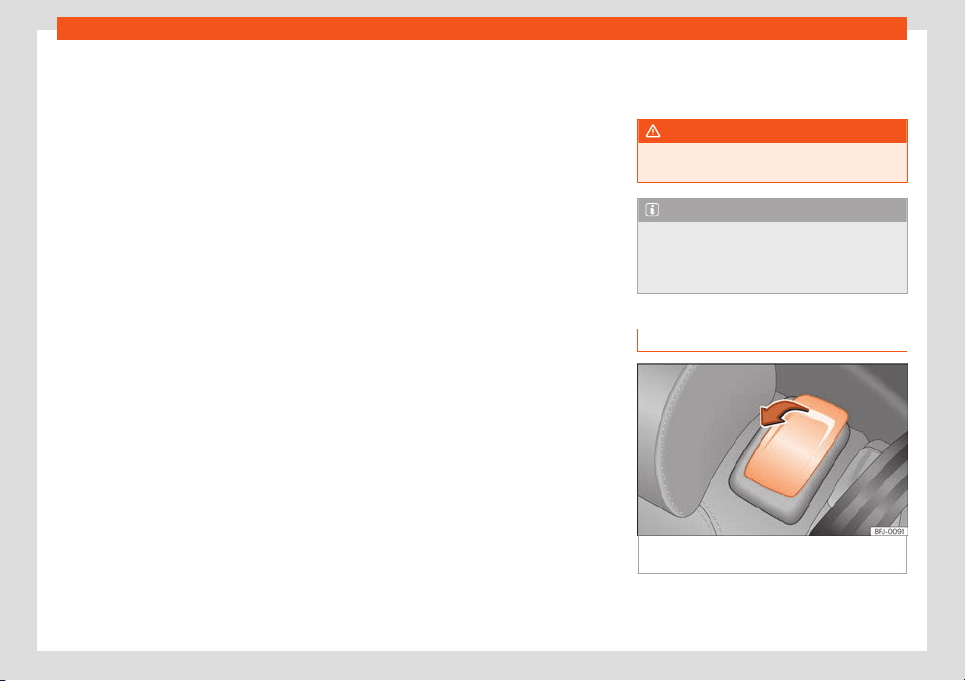
Operation
Save the settings of the driver seat and
the e
xterior mirrors while driving forward
●
Apply the electronic parking brake.
●
Move the gearshift to the neutral position.
●
Switch the ignition on.
●
Adjust the driver seat and the exterior mir-
rors.
●
Press for longer than 1 second
›››
Fig. 111.
●
Press the memory button in which to store
the settings within approx. 10 seconds. A
warning sound will confirm they have been
stored.
Storing the passenger rear view mirror
settings while driving in reverse
●
Apply the electronic parking brake.
●
Move the gearshift to the neutral position.
●
Switch the ignition on.
●
Press the required memory button.
●
Select reverse gear.
●
Adjust the front passenger exterior mirror so
that you can see, for example, the kerb area
well.
●
The new position of the mirror will be stored
automatically and allocated to the vehicle
key that was used to unlock the vehicle.
Activating settings
●
With the vehicle stopped and the ignition
switched on, press and hold the correspond-
ing memory button until the saved position is
reached.
●
OR: With the ignition switched off and the
driver's door open, briefly press the corre-
sponding button.
●
The front passenger side exterior mirror au-
tomatically changes from the position stored
for reversing as soon as the vehicle moves
forward at a speed of at least 15 km/h
(10 mph) or when the gear selection lever is
changed to a position other than R
›››
page 126.
Initialising the seat position memory
The position memory system must be restar-
ted if, for example, the driver seat has been
changed.
Restarting deletes all memories and assign-
ments for the seat with position memory. The
memory keys can then be programmed
again.
●
Open the driver door and do not get into
the vehicle.
●
Operating the seat settings from outside
the vehicle.
●
Move the angle of the seat backrest com-
pletely forwards.
●
Release the control to set the angle and
then press again until an audible warning is
heard.
WARNING
Adjust the memory function only when the
v
ehicle is stationary.
Note
If the driver door is opened approx. 10 mi-
nut
es after the vehicle was unlocked or lat-
er, the driver seat and the exterior mirrors
do not move automatically.
Access aid for the third row of seats
Fig. 112
Second row of seats:: access aid con-
tr
ols.
The convenient entry function makes it easier
t
o access the third row of seats.
134
Seats and headrests
Folding down the backrest and moving the
second r
ow seat
●
Remove any objects located in the footwell
of the second row of seats
›››
.
●
Pull the release lever
›
››
Fig. 112 in the di-
rection of the arrow.
●
Fold down the backrest of the seat and
move the seat forward.
●
Enter the vehicle or leave the vehicle care-
fully
›››
.
F
olding down the second row backrest
●
Move the rear seat to its rearmost position.
●
Pull the lever
›››
Fig. 112 and push the back-
rest backwards until it is in a vertical position.
The entire seat folds down
›››
.
●
The rear seat must be correctly engaged
›
››
.
WARNING
If the convenient entry function is used
negligently or without due car
e, this may
cause accidents and serious injury.
●
Never use the convenient entry function
when the vehicle is in motion.
●
Avoid trapping or damaging the seat belt
when folding the rear seats back.
●
When moving the backrests up and down,
keep your hands, fingers, feet and other
body parts out of the operating area of the
hinges and the locking mechanism of the
seats.
●
Mats or other objects can be caught in
the hinges of the seat backr
ests or the
seats themselves. This would cause the
backrests and benches not to lock correct-
ly when moving the seats to the vertical po-
sition.
●
For the rear seat belts to offer the neces-
sary protection all the parts of the rear
backrest must be properly engaged verti-
cally. If someone is seated in a seat whose
backrest is not properly engaged they will
be thrown forwards, along with the back-
rest, during an accident or a sudden driving
or braking manoeuvre.
●
When a rear seat or its backrest is folded
down or not correctly engaged, do not let
anyone use that seat, not even a child.
●
When going in and out of the vehicle,
never lean on or grab the tilted seat of the
second row.
WARNING
If all the seats on the second row are
equipped with chil
d seats, in the event of
an accident the seats of the second row
cannot be pushed forwards from the third.
People travelling in the third row will not be
able to leave the vehicle or help them-
selves in the event of an emergency.
●
Whene
ver there are people in the third
row, do not install child seats on all the
second row seats at the same time.
CAUTION
Before lowering and raising the rear seat
backr
est, adjust the front seats so that nei-
ther the headrests nor the cushions of the
rear backrest can hit them.
CAUTION
Any objects located in the footwell of the
second r
ow of seats may be damaged on
folding the rear seat forwards. Before fold-
ing down the seats, remove the objects.
135
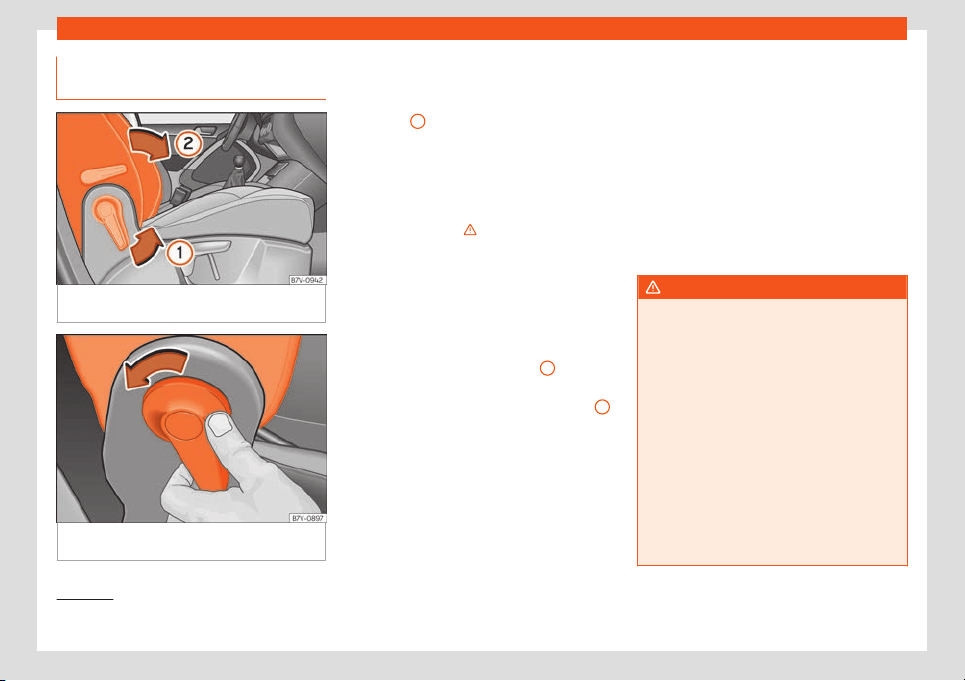
Operation
Adjusting or folding the backrest of
the fr
ont passenger seat
Fig. 113
Front passenger seat: fold the back-
r
est of the seat forwards.
Fig. 114
Unlocking the folding backrest of the
fr
ont passenger seat
Adjusting the inclination of the front pas-
senger seat backr
est
●
Move the lever in the direction of the arrow
›››
Fig. 113
1
, and adjust the backrest to the
desir
ed position.
Folding the backrest of the front passen-
ger seat forward
1)
●
Remove any objects from the front passen-
ger seat cushion
›››
.
●
Move the passenger seat to its lowest posi-
tion.
●
Move the front passenger seat back as far
as possibl
e.
●
Lower the headrest properly.
●
Unlock the backrest of the front passenger
seat in the direction of the arrow
1
.
●
Fold the backrest of the front passenger
seat f
orwards in the direction of the arrow
2
until it is horizontal.
●
Once folded down, the backrest has to be
l
ocked safely.
When carrying objects on the folded down
backrest of the passenger seat, the front air-
bag of this seat must be disabled
›››
page 28.
Lifting the backrest of the front passenger
seat
●
When lifting the passenger backrest, make
sure there are no objects or body parts within
the hinge movement area.
●
Lift the backrest of the front passenger seat
by first unlocking it again
›››
Fig. 114.
●
Lift the backrest of the seat in an upright
position.
●
Once it is raised again, the backrest must
be correctly engaged.
WARNING
Serious injuries can be caused if the pas-
senger seat backr
est is lowered or lifted
without due care and attention.
●
Only fold and lift the backrest of the front
passenger seat when the vehicle is station-
ary.
●
When folding down the passenger seat,
always make sure there are no people or
animals in the backrest area.
●
While the passenger backrest is down,
the front airbag must always be disabled
and the PASSENGER AIR BAG warning
lamp must be on.
●
When moving the passenger backrest up
and down, keep your hands, fingers, feet
1)
In the FR version with sports seats, the backrest
cannot be l
owered.
136
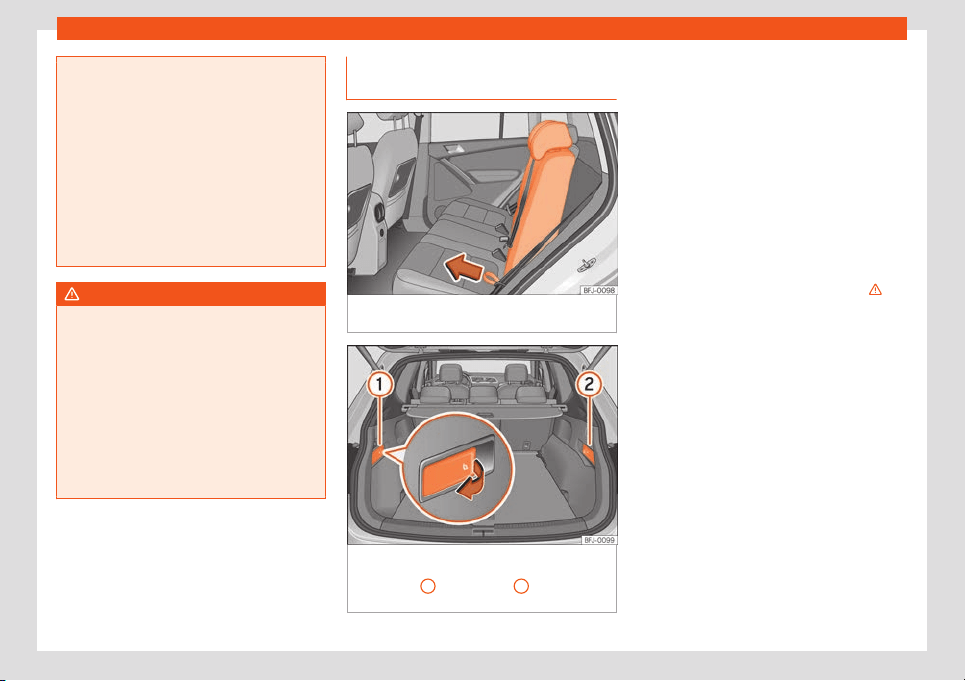
Seats and headrests
and other body parts out of the operating
ar
ea of the hinges and the locking mecha-
nism of the seat.
●
Mats or other objects can be caught in
the hinges of the backrest of the front pas-
senger seat. This would cause the backrest
not to be locked in an upright position when
lifting it.
●
Once the backrest is up, it must be cor-
rectly engaged in an upright position. Oth-
erwise, it could move unexpectedly and
cause severe injuries.
WARNING
When folding down the passenger back-
r
est, its anchor points and hinges are left
uncovered and may cause severe injuries in
the event of a sudden brake or accident.
●
When the passenger seat backrest is
lowered nobody else can travel in the cor-
responding seats (not even a child).
●
When the passenger seat backrest is
lowered, the only permitted seat is the rear
seat behind the driver seat. This also ap-
plies to children travelling on a child seat.
Folding down and raising the rear
seat backr
est
Fig. 115
Folding down and lifting the rear seat
backr
est
Fig. 116 In the luggage compartment: levers
f
or release, from the luggage compartment, of
the left part
1
and right part
2
of the rear
seat backr
est.
The rear seat backrest is split and each part
can be l
owered forward separately to extend
the luggage compartment.
Fold the backrest of the rear seat for-
wards .
●
Push the headrest down as far as it will go
›››
page 131.
●
Move the rear seat to its rearmost position.
●
If required, lower the folding table.
●
Pull the cord
›››
Fig. 115 forward in the di-
rection of the arrow while holding the seat
backrest and move it forward slowly
›››
.
●
Press the backrest down with your hand un-
til it l
ocks.
Folding down the backrest from the boot
with the unlocking levers
●
Push the headrest down as far as it will go
›››
page 131.
●
Open the rear lid
›››
page 106.
●
Pull the unlocking lever
›››
Fig. 116 of the
part of the backrest to fold down.
●
The part of the backrest in question unlocks
and can be folded down.
●
If necessary, close the rear lid
›››
page 106.
Folding up the rear seat backrest
●
Unlock the seat backrest with the cord. The
backrest disengages from its position.
»
137
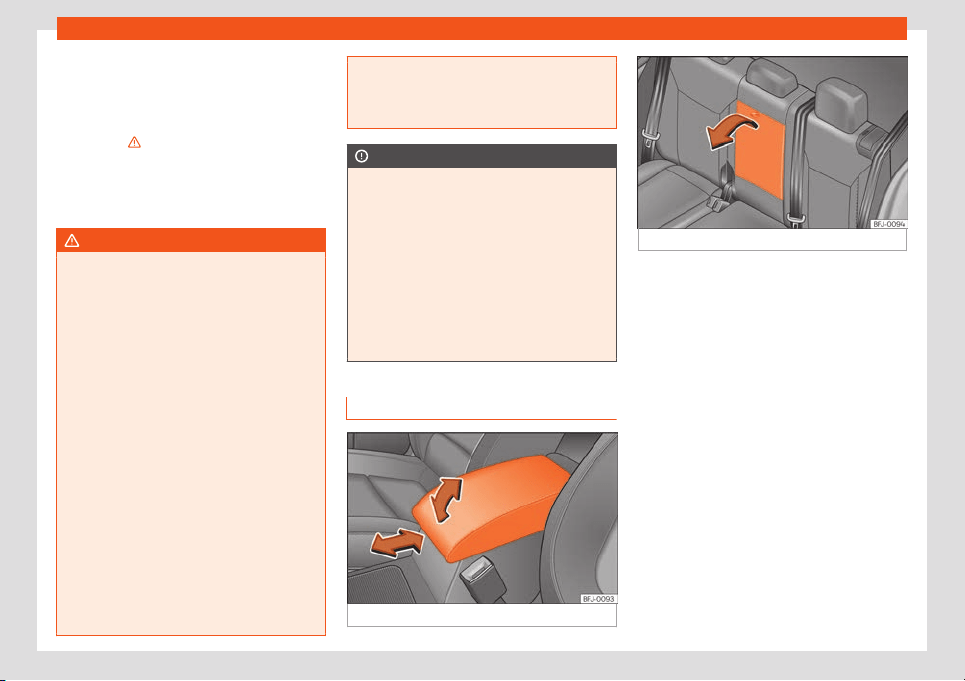
Operation
●
Without l
etting go of the cord, lift the back-
rest.
●
Make sure that the seat belt is not trapped.
●
Press the backrest firmly into the lock until it
engages
›››
.
●
The backrest must be properly engaged.
●
If necessary, adjust the backrest.
●
If necessary, adjust the headrest.
WARNING
Serious injuries can be caused if the rear
seat backr
est is lowered or lifted without
due care and attention.
●
When folding down the rear seat, always
make sure there are no people or animals in
the backrest area.
●
Never lower or lift the rear seat backrest
while driving.
●
Do no trap or damage the seat belt when
raising the rear seat backrest.
●
When lowering or lifting the rear seat
backrest, keep your hands, fingers, feet
and other body parts out of its path.
●
For the rear seat belts to offer the neces-
sary protection all the parts of the rear
backrest must be properly engaged. This is
particularly important in the case of the
centre rear seat. If someone is seated in a
seat whose backrest is not properly engag-
ed they will be thrown forwards, along with
the backrest, during an accident or a sud-
den driving or braking manoeuvre.
●
When the r
ear seat backrest is lowered or
is not properly engaged nobody else can
travel in the corresponding seats (not even
a child).
CAUTION
Serious damage can be caused to the vehi-
cl
e and other objects if the rear seat back-
rest is lowered or lifted without due care
and attention.
●
Before folding the rear seat backrest for-
ward, always adjust the front seats so that
neither the headrests nor the cushions of
the rear backrest can hit them.
●
Before folding the rear seat backrest, al-
ways make sure there are no objects in the
movement area of the backrest.
Central armrests
Fig. 117 Front centre armrest
Fig. 118 Folding rear centre armrest.
Front centre armrest
T
o raise the armrest, pull it fully up in the di-
rection of the arrow
›››
Fig. 117 up or step by
step depending on the desired opening.
To lower the armrest, first lift it to its highest
position. Then lower it down.
To move the armrest horizontally, move it for-
ward
›››
Fig. 117 or backward as much as
possible in the direction of the corresponding
arrow.
Rear centre armrest
Depending on the features, there might be a
folding armrest in the rear centre seat.
To lower the armrest, pull the cord in the di-
rection of the arrow
›››
Fig. 118.
To lift the armrest, press it down in the oppo-
site direction to the arrow
›››
Fig. 118 and lock
it in the seat backrest.
138
Transport and practical equipment
WARNING
The front centre armrest may obstruct the
driv
er's arm movements, which could
cause an accident and severe injuries.
●
Keep the storage compartments of the
centre armrest closed at all times while the
vehicle is in motion.
●
Never let anyone sit on the centre arm-
rest while the vehicle is in motion, not even
a child. This position is incorrect and may
cause severe injuries.
WARNING
To decrease the risk of injuries while driv-
ing, the r
ear centre armrest must always be
raised.
●
When the centre armrest is down, nobody
may travel in the centre rear seat, not even
a child. An incorrect sitting position may
cause severe injuries.
Transport and practical
equipment
St
oring objects
Positioning the luggage and cargo
It is possible to carry objects and luggage in
the v
ehicle, in a trailer
›››
page 306 and on
the roof
›››
page 148. When doing so, please
consider all legal provisions.
Placing luggage inside the vehicle safely
●
Distribute the load in the vehicle as evenly
as possibl
e.
●
Always place equipment and heavy ob-
jects in the boot
›››
.
●
Position heavy items in the boot as far for-
w
ard as possible.
●
Take into account the maximum authorised
weight per axle, as well as the maximum au-
thorised weight of the vehicle
›››
page 381.
●
Secure the objects to the fastening rings of
the boot using appropriate chains or belts
›››
page 145.
●
Also place small objects safely.
●
If required. raise the rear seat backrest and
lock it.
●
Adapt tyre pressure to the load. Take into
account the pressure adhesive of the tyres
›››
page 355.
●
In vehicles equipped with tyre pressure
control system, adjust to the new load status
if necessary
›››
page 359.
WARNING
Loose or unsecured objects can cause seri-
ous injury in case of sudden manoeuvring
or br
aking or in case of an accident. Partic-
ularly if the airbag hits them when deploy-
ing and they are thrown across the inside of
the vehicle. Please observe the following
rules to minimise the risk of injury:
●
Place all objects inside the vehicle safe-
ly.
●
Secure all objects, little and large.
●
Place the objects in the cabin in such a
way that they can never reach the airbag
deployment areas while the vehicle is in
motion.
●
Keep the storage compartments closed
at all times while the vehicle is in motion.
●
Place the objects in such a way that they
never force any occupant of the vehicle to
sit in an incorrect position.
●
When transporting objects that take up a
seat, never let anyone use that seat.
●
Never leave hard, sharp or heavy objects
loose in open storage compartment of the
vehicle, on the cover behind the rear seat
or on the dashboard.
»
139
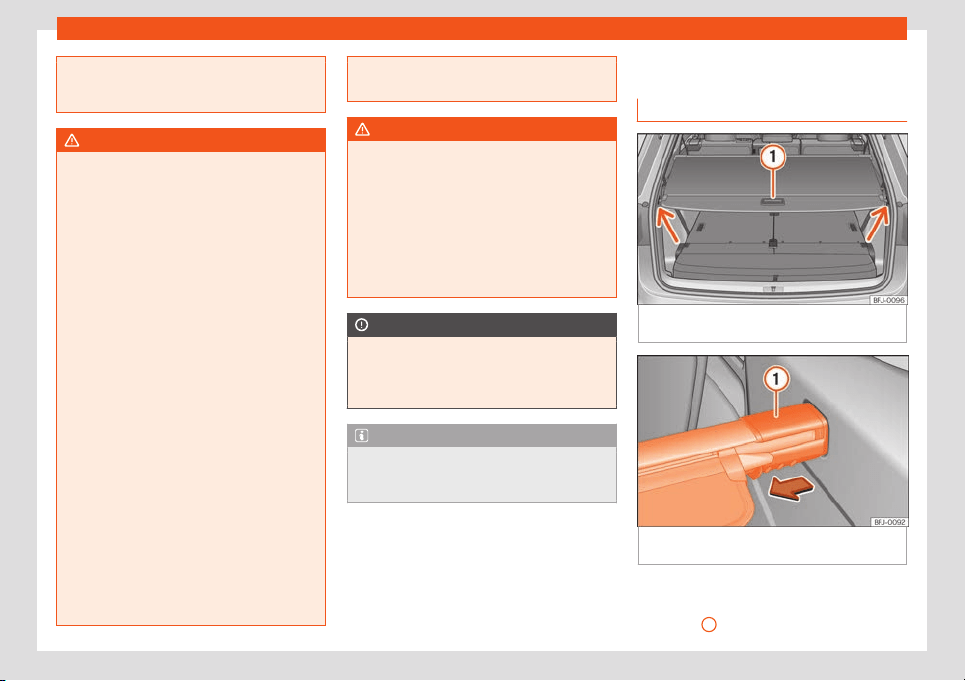
Operation
●
R
emove all hard, sharp or heavy objects
from the fabrics and bags inside the cabin
and store them safely.
WARNING
The transport of heavy object changes ve-
hicl
e handling and increases braking dis-
tance. Heavy objects that are not properly
placed or secured may cause loss of con-
trol of the vehicle and thus severe injuries.
●
Never put too much load in the vehicle.
Both the carrying capacity as well as the
distribution of the load in the vehicle have
effects on the driving behaviour and brak-
ing ability.
●
When transporting heavy objects, the
driving behaviour of the vehicle varies due
to the displacement of the centre of gravi-
ty.
●
Always distribute the load in the vehicle
as evenly and horizontally as possible.
●
Always place heavy objects in the boot
before the rear axle and as far away from it
as possible.
●
Objects in the luggage compartment
that are unsecured could move suddenly
and modify the handling of the vehicle.
●
Adapt your speed and driving style at all
times to suit visibility, weather, road and
traffic conditions.
●
Accelerate with particular care and cau-
tion.
●
Av
oid sudden braking and manoeuvres.
●
Brake earlier than usual.
WARNING
●
Ne
ver leave your vehicle unattended, es-
pecially when the rear lid is open. Children
could climb into the luggage compartment,
closing the door behind them; they will be
trapped and run the risk of death.
●
Close and lock all the doors and the rear
lid when you leave the vehicle. Before you
lock the vehicle, make sure that there are
no adults or children in the vehicle.
CAUTION
Electrical wires or, depending on the fea-
t
ures, the antenna embedded into the rear
windows could be damaged, even irrepara-
bly, if they are in contact with objects.
Note
Straps for securing the load to the fasten-
ing rings ar
e commercially available from
accessory shops.
Luggage compartment
L
uggage compartment shelf
Fig. 119 In the luggage compartment: luggage
compartment shelf cl
osed.
Fig. 120
In the luggage compartment: remove
the r
ear shelf.
Open the rear shelf
●
Pull the cover backwards with the handle
›
››
Fig. 119
1
and remove it above the
140
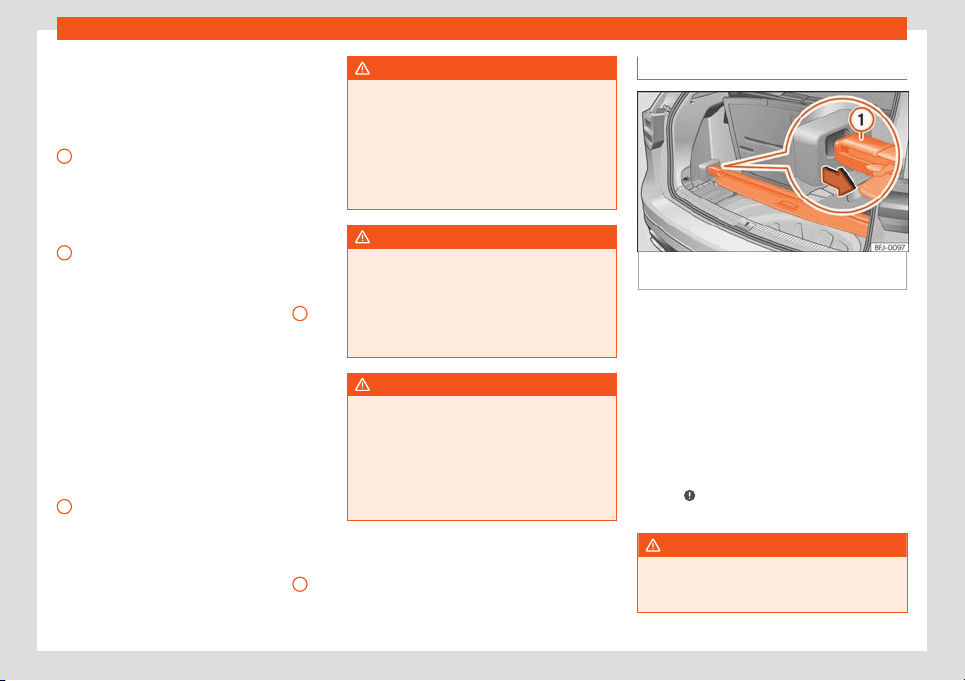
Transport and practical equipment
anchor point (arrows). Move the cover for-
w
ard carefully.
Close the rear shelf
●
Pull the cover backwards with the handle
1
and secure it to the anchor point (arrows).
R
emove the rear shelf
●
If required, open the rear shelf.
●
Press the support of the cover
›››
Fig. 120
1
in the direction of the arrow and hold it in
this position.
●
Then lift the cover out.
●
Remove the cover support
›
››
Fig. 120
1
.
Depending on the equipment, once the lug-
gage compartment shelf has been r
emoved,
it can be stored under the boot's floor
›››
page 141.
Fit the rear shelf
●
Place the left side of the rear shelf in the
housing provided in the left side cover.
●
Press the support of the cover
›››
Fig. 120
1
in the direction of the arrow and hold it in
this position.
●
Place the cover in the housing provided in
the l
eft side cover.
●
Remove the cover support
›››
Fig. 120
1
.
●
Check that the cover is correctly secured.
WARNING
Animals, loose or unsecured or objects car-
ried on the r
ear shelf can cause serious in-
jury in case of sudden manoeuvring or
braking or in case of an accident.
●
Do not leave hard, sharp or heavy ob-
jects or in bags on the rear shelf.
●
Never transport animals on the rear shelf.
WARNING
If the rear shelf is fitted in front of a rear
seat, it may cause se
vere injuries in the
event of sudden braking or in the event of
an accident.
●
If the seats of the third row are occupied,
never fit the rear shelf before that row.
WARNING
If driving without the covers of the rear
shelf inst
alled, serious injury may happen
in case of sudden manoeuvring or braking
or in case of an accident.
●
In vehicles with 7 seats, always place the
covers on the housings of the rear shelf
when it is not fitted.
Store the rear shelf
Fig. 121 Below the luggage compartment
fl
oor: store the rear shelf.
Depending on the equipment, once the lug-
gage compartment shelf has been r
emoved,
it can be stored under the boot floor.
●
Lift the floor of the boot
›››
page 143.
●
Place the rear shelf in the corresponding
housing
›››
Fig. 121.
●
Place the boot floor in its starting position.
If the 12-volt battery is fitted in the boot, do
not store the rear shelf under the boot
floor
›››
. If you are going to use the third row
of seats, k
eep the cover at home.
WARNING
During a sudden driving or braking ma-
noeuvr
e, or in the event of an accident, ob-
jects could be flung though the interior and
»
141
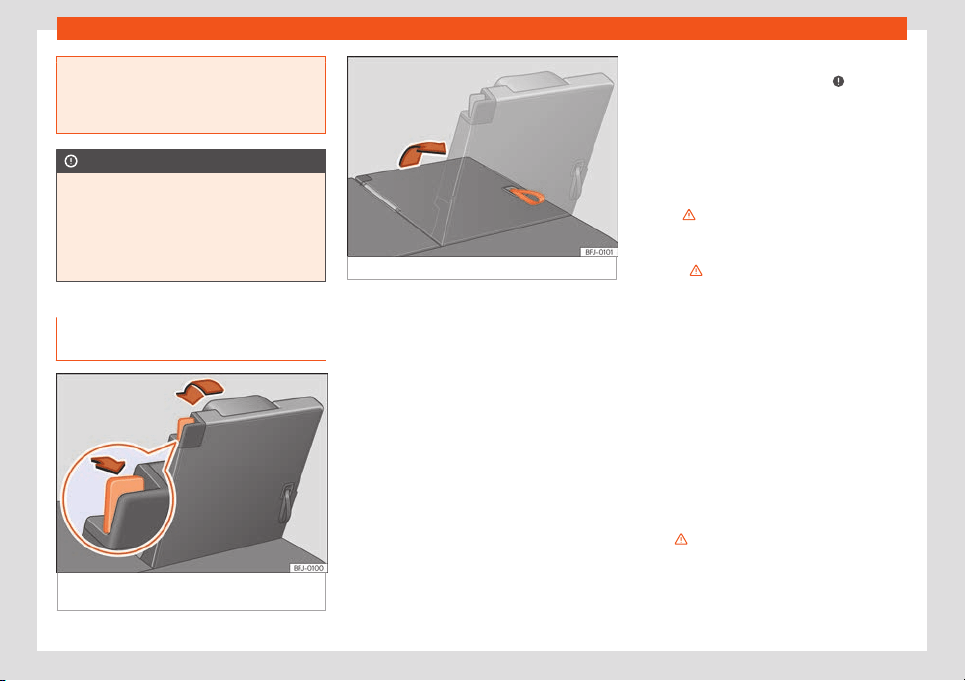
Operation
cause serious or fatal injuries or damage to
the v
ehicle.
●
Never leave the rear shelf loose in the
luggage compartment.
CAUTION
If the rear shelf is stored incorrectly, it may
cause damages t
o the electrical system or
the cabin.
●
When storing the rear shelf, always make
sure it does not touch the 12-volt battery in
the boot.
Placing the third row of seats in the
car
go floor position
Fig. 122 Third row of seats: place in the cargo
fl
oor position.
Fig. 123
Third row of seats: lift the seat.
The rear seats can be folded down separate-
ly t
o extend the boot.
Placing the third row of seats in loading
floor position
●
Disassemble the luggage compartment
tray
›››
page 140.
●
Push the headrest down as far as it will go
›››
page 131.
●
Release the seat belt from both locks to
prevent damages to the seat and the seat
belt.
●
Fold down the folding tables on the front
seats.
●
Move the seats of the second row com-
pletely forward
›››
page 130.
●
Open the rear lid
›››
page 106.
●
Remove any objects located in the footwell
in front of and behind the seat
›››
.
●
Remove objects from the space below the
corr
esponding seat.
●
Pull the unlocking lever
›››
Fig. 122 to its
rearmost position to unlock the seat backrest.
●
Move the seat down with your hand until it
is completely against the frame of the
seat
›››
.
●
When the seat is in loading floor position,
do not et anyone tr
avel in it (not even a
child)
›››
.
●
Close the tailgate.
Lifting the seats of the thir
d row
●
Move the seats of the second row com-
pletely forward
›››
page 130.
●
Open the rear lid.
●
Pull the cord on the backrest of the seat
›››
Fig. 122 to lift the backrest. OR: lift the
backrest with your hand from the cabin.
●
The red marking on the unlock lever
›››
Fig. 122 must not be seen.
●
Make sure that the seat backrest is correct-
ly engaged by tugging from it and press-
ing
›››
.
●
If required, fit the rear shelf again.
●
Close the tailgate.
142
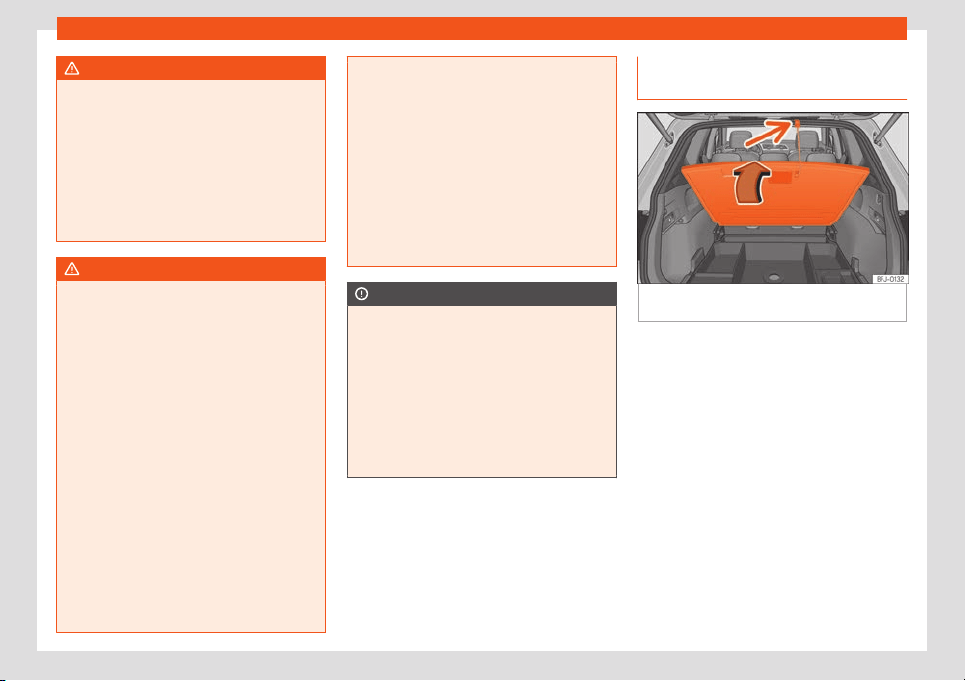
Transport and practical equipment
WARNING
Risk of suffering severe head injuries If peo-
pl
e taller than 1.60 m travel in the third row,
they may receive severe head injuries in
the event of an accident.
●
Never travel with anyone taller than 1.60
m on the third row.
●
When closing the rear lid, always be
mindful of the passengers of the rearmost
seats.
WARNING
If the rear seats are folded down or lifted
without paying att
ention or without control,
severe injuries might occur.
●
Never lower or lift the rear seat backrests
while driving.
●
Do no trap or damage the seat belt when
raising the rear seat backrests.
●
When moving the rear seat backrests up
and down, keep your hands, fingers, feet
and other body parts out of the operating
area of the hinges and the locking mecha-
nism of the seats.
●
Mats or other objects can be caught in
the hinges of the seat backrests or the
seats themselves. This would cause the
backrests not to be locked correctly in an
upright position.
●
For the rear seat belts to offer the neces-
sary protection, the rear backrests must be
properly engaged vertically. If someone is
seated in a seat whose backrest is not
pr
operly engaged they will be thrown for-
wards, along with the backrest, during an
accident or a sudden driving or braking
manoeuvre.
●
A red mark on unlock lever
›››
Fig. 122 indi-
cates that the seat backrest is not engag-
ed. If the back rest is locked correctly, the
mark is not visible.
●
When a rear seat or its backrest is folded
down or not correctly engaged, do not let
anyone use that seat (not even a child).
CAUTION
●
Ob
jects placed in the footwell in front of
and behind the rear seats can be damaged
when seats are folded down or lifted. Be-
fore folding down or lifting the seats, re-
move the objects.
●
Any objects located in the footwell be-
hind the third row of seats may be dam-
aged on folding or lifting the seats of this
row. Before folding down or lifting the seats,
remove the objects.
Adjustable luggage compartment
fl
oor (5-seater vehicles)
Fig. 124
In the luggage compartment: lift the
luggage compartment fl
oor.
»
143
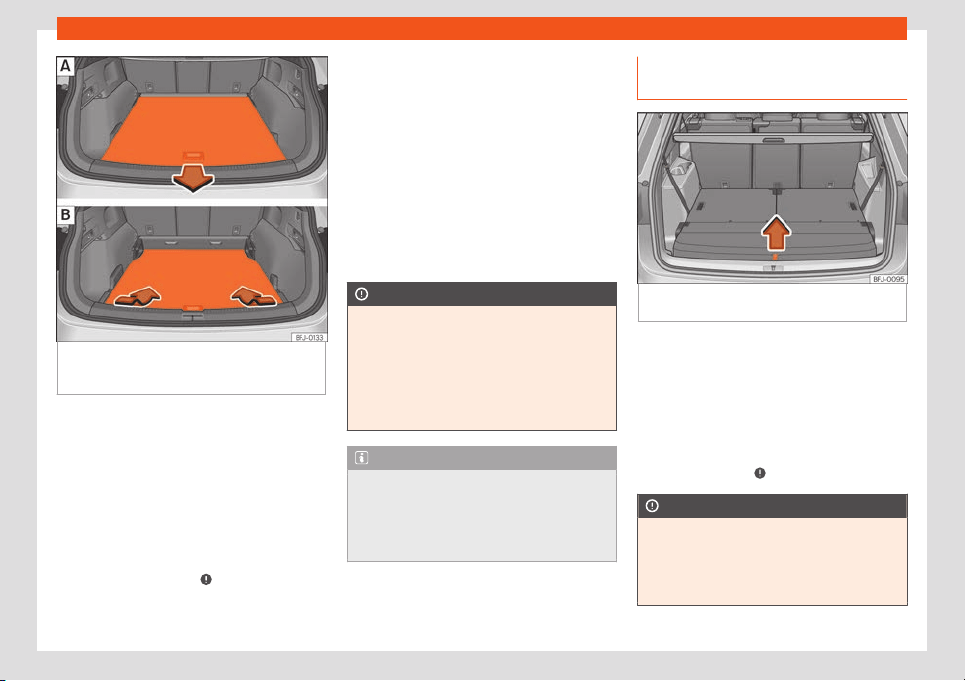
Operation
Fig. 125
In the luggage compartment: adjust
the height of the v
ariable luggage compart-
ment floor.
Open boot floor
●
Grab the boot floor by the opening
›
››
Fig. 124 and lift it in the direction of the ar-
row. Secure the belt to the rubber gasket
(small arrow).
Close boot floor
●
Loosen the belt and secure it to the support
under the boot floor. Move the floor down
carefully and let it go
›››
.
Adjust the height of the variable boot floor
Depending on the f
eatures, the height of the
boot floor can be adjusted.
●
If necessary, release the net bag
›››
page 145 and, if necessary, remove the
belts.
●
Lift the boot floor and pull it backwards to
release it from the side guides of the boot
›››
Fig. 125 .
●
Place the floor on the guides of the desired
height and move it forwards
›››
Fig. 125 .
CAUTION
●
Do not t
ug the boot floor suddenly when
opening or let it fall down when closing.
Otherwise, the lining and the floor of the
boot could be damaged.
●
The maximum weight that can be loaded
on the luggage compartment variable floor
in the top position is 125 kg.
Note
●
Depending on the f
eatures, there are
storage compartments for small objects
under the boot floor.
●
SEAT recommends the use of fastening
straps to secure objects to retaining rings.
Luggage compartment floor (7-
seat
er vehicles)
Fig. 126
In the luggage compartment: lift the
luggage compartment fl
oor.
Open boot floor
●
Grab the boot floor by the cord
›
››
Fig. 126
and lift it in the direction of the arrow and re-
move it.
Close boot floor
●
Place the boot floor on the support and
carefully lower it
›››
.
CAUTION
●
Do not l
et the luggage compartment
floor fall when closing it. Always carefully
guide it downward in a controlled manner.
Otherwise, the lining and the floor of the
boot could be damaged.
144
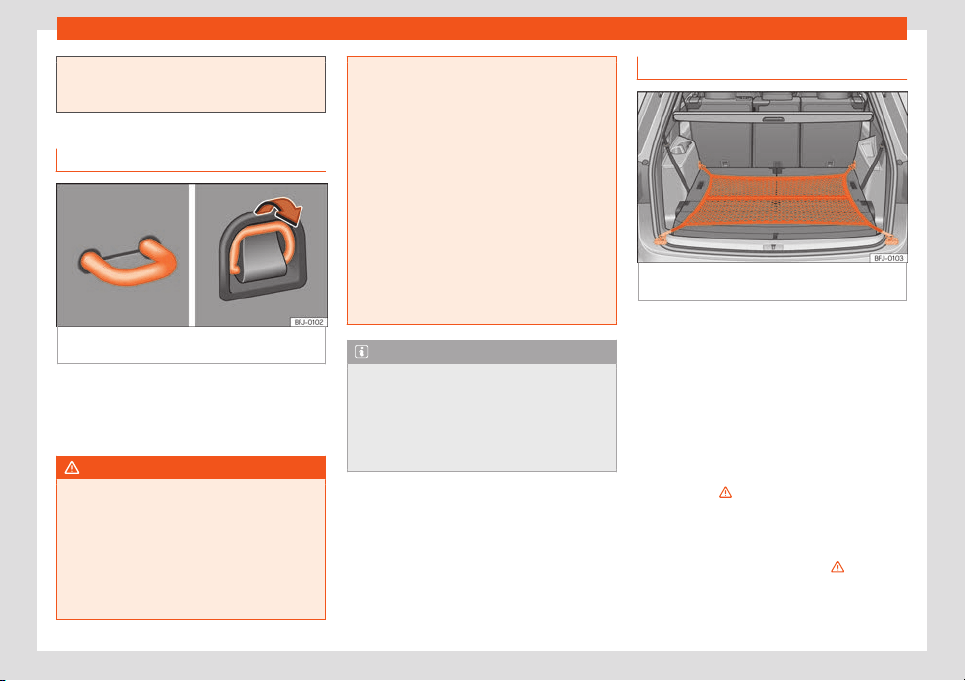
Transport and practical equipment
●
The maximum w
eight that can be loaded
on the luggage compartment variable floor
in the top position is 125 kg.
Fastening rings
Fig. 127
In the luggage compartment: fixed
and depl
oyable fastening rings.
There are fastening rings
›
››
Fig. 127 on the
front and rear of the boot to secure loose ob-
jects and luggage with fastening belts and
cords.
WARNING
If unsuitable or damaged belts or retaining
str
aps are used, they could break in the
event of braking or an accident. Objects
could then be launched across the passen-
ger compartment and cause serious or fa-
tal injuries.
●
Always use belts or straps that are suita-
ble and in good condition.
●
Tight
en the belts and straps in a cross
layout over the load placed on the boot
floor and secure them to the fastening rings
safely.
●
Never exceed the maximum tensile load
of the fastening rings when securing ob-
jects.
●
Make sure that, particularly for flat ob-
jects, the upper edge of the load is higher
than the fastening rings.
●
Depending on the features, take into ac-
count the instruction panels on the boot on
how to place the load.
●
Never secure a child seat to the fastening
rings.
Note
●
The maximum t
ensile load that the fas-
tening rings can support is approx. 3.5 kN.
●
Belts, straps and securing systems for the
appropriate load can be obtained from
specialised dealerships. SEAT recom-
mends visiting a SEAT dealership for this.
Net bag
Fig. 128
In the luggage compartment: net bag
hook
ed up at floor level.
The luggage compartment prevents light
luggage fr
om moving. The net bag has a zip
and can be used to store small objects.
Hooking the net bag into the luggage
compartment floor
If necessary, the front eyes must be unfolded
first
›››
page 145.
●
Secure the net hooks to the fastening rings
›››
Fig. 128
›››
. The bag zip should be fac-
ing up
wards.
Removing the net bag
The hooked up net bag is taut
›››
.
●
Release the net bag from the fastening
rings.
»
145
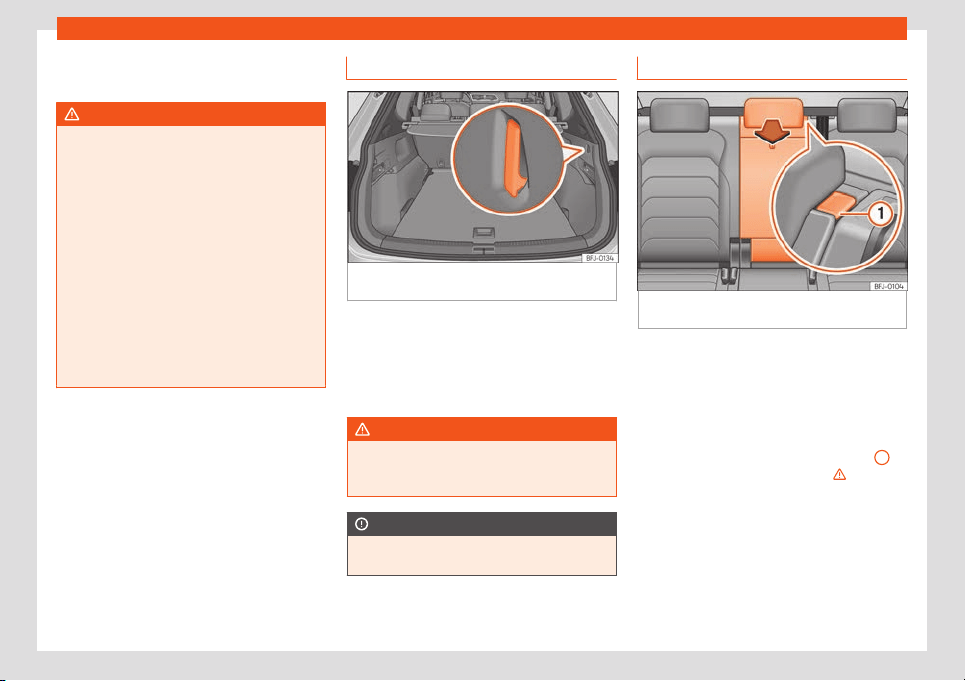
Operation
●
St
ore the net bag in the luggage compart-
ment.
WARNING
To secure the elastic net bag on the fasten-
ing rings of the boot it must be str
etched
out. Once hooked up it is taut. If the net bag
is hooked up or unhooked incorrectly the
hooks could cause injuries.
●
Always secure the bag hooks properly so
that they do not suddenly release from the
fastening rings when hooking or unhooking
them.
●
On hooking or unhooking them, protect
your eyes and face in case the hooks are
released suddenly.
●
Always hook up the net bag hooks in the
described order. If a hook is unfastened
suddenly, this may cause injuries.
Bag hooks
Fig. 129
In the luggage compartment: bag
hooks.
There may be hooks for hanging bags on
both sides of the luggage compartment
›
››
Fig. 129.
The retaining hooks have been designed to
secure light shopping bags.
WARNING
Never use the hooks to hang luggage or
other ob
jects. In case of sudden braking or
an accident, the hooks could break.
CAUTION
Each hook is designed for a maximum load
of 2.5 k
g.
Trapdoor for long loads
Fig. 130
Backrest of the rear seat: opening the
tr
apdoor for long loads
Depending on the features, on the rear seat,
behind the centr
al armrest, there is a tail-
board for transporting long items in the interi-
or, such as skis.
Opening the tailboard for long items
●
Press the unlocking button
›››
Fig. 130
1
and fold the tailboard forward
›
››
.
●
Open the rear lid.
●
Insert the long objects through the tail-
boar
d from the luggage compartment.
●
Secure the objects with the seat belt firmly.
●
Close the tailgate.
146
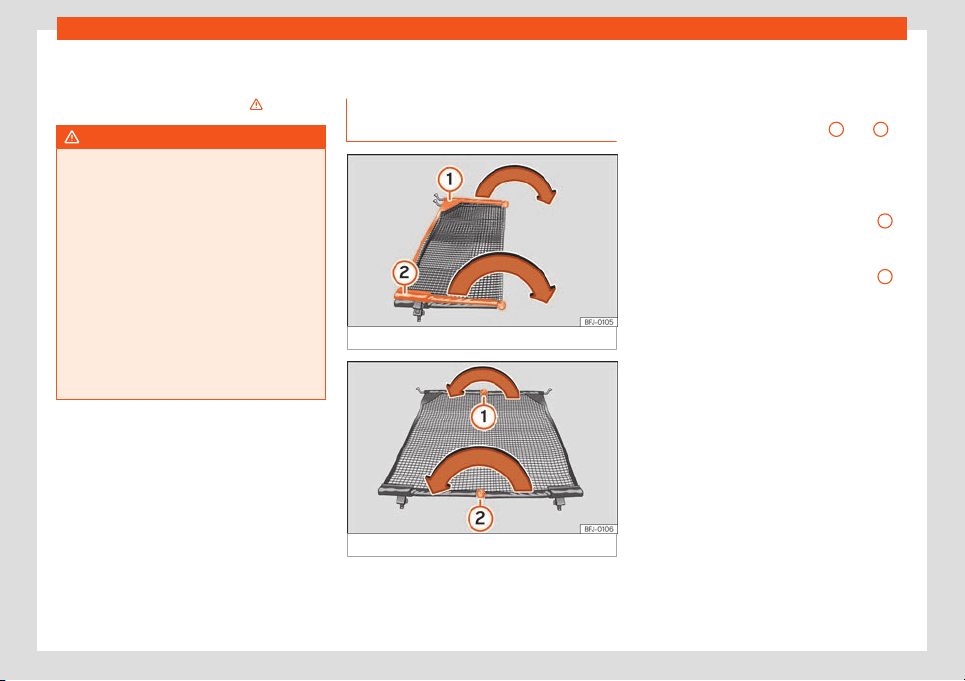
Transport and practical equipment
Closing the tailboard for long items
●
Lift the seat back and press it firmly into the
l
ock until it engages correctly
›››
.
WARNING
Serious injuries can be caused if the tail-
boar
d for long items is lowered or lifted
without due care and attention.
●
Never lower or lift the tailboard while
driving.
●
Do no trap or damage the seat belt when
raising the tailboard.
●
When lowering or lifting the tailboard,
keep your hands, fingers, feet and other
body parts out of its path.
●
When the tailboard is lowered or is not
properly engaged nobody else can travel
in the corresponding seats, particularly
children.
Net partition
Unf
olding and folding the net parti-
tion
Fig. 131
Deploying the net partition.
Fig. 132
Folding in the net partition.
Before fitting the net partition in the vehicle it
must be unf
olded.
Fold out the net partition
Take out the partition net from the corre-
sponding bag and unroll it.
Extend the cross rods
›››
Fig. 131
1
and
2
of
the net in the dir
ection of the arrows until it
“clicks”.
Folding in the net partition
●
Press on the release button
›››
Fig. 132
1
and bend the cross rod in the direction of the
arr
ow with the button pressed.
●
Press on the release button
›››
Fig. 132
2
and bend the cross rod in the direction of the
arr
ow with the button pressed.
●
Fold in the net partition and store it in its
bag.
●
Store the net partition safely in the vehicle.
147
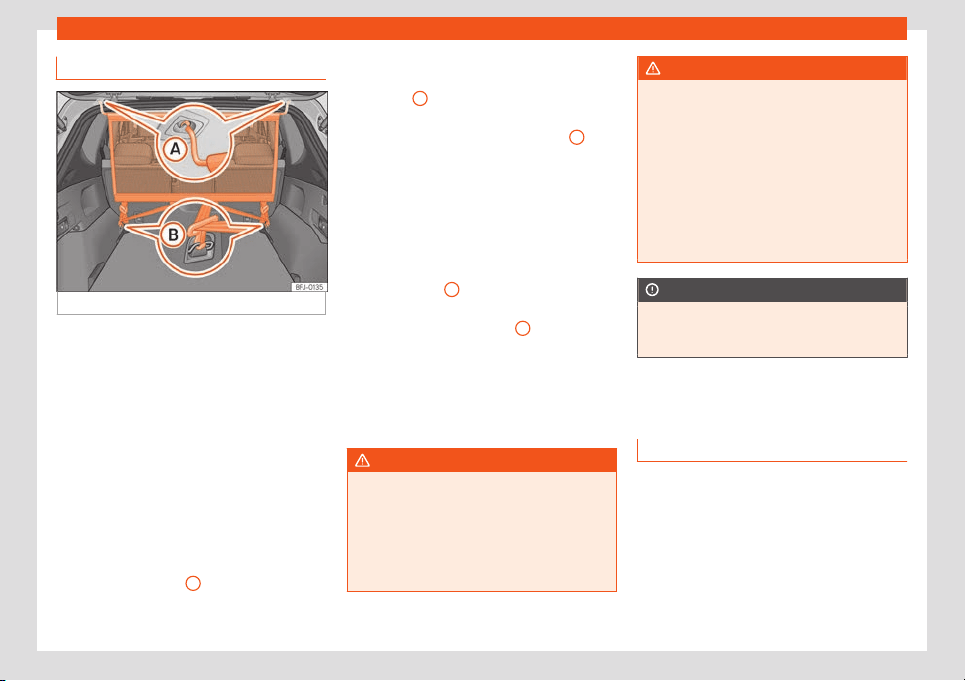
Operation
Using the net partition
Fig. 133
Net partition fitted.
The purpose of the net partition is to prevent
the it
ems in the boot from moving into the
cabin, e.g. in the event of sudden braking.
Fitting the net partition
The partition net can be fitted behind the rear
seat or, depending on the features, behind
the front seats with the second row of seats
lowered.
●
If required, remove the rear shelf
›››
page 140.
●
Folding out the net partition
›››
page 147.
●
Secure the net partition in the left housing
of the roof
›››
Fig. 133
A
. Make sure to move
the cr
oss rod down beyond the upper posi-
tion.
●
Hook in the net partition on the rear right-
hand side roof housing by pressing on the rod
›››
Fig. 133
A
.
●
Secure two hooks of the partition net to the
f
astening rings of the boot
›››
Fig. 133
B
and
tight
en the straps firmly.
Removing the net partition
●
If required, remove the rear shelf
›››
page 140.
●
Loosen the straps from the net partition.
●
Release the net hooks from the fastening
rings
›››
Fig. 133
B
.
●
Unhook the net partition on the right-hand
side r
oof support
›››
Fig. 133
A
by pressing
on the r
od.
●
Unhook the net partition from the left-hand
side roof housing.
●
Fold in the net partition
›››
page 147.
●
If required, fit the rear shelf
›››
page 140.
WARNING
In order to ensure the proper functioning of
the luggage r
estraint systems (backrests
together with the net partition), place the
second row of seats in their rearmost posi-
tion to avoid the possibility of the load on
top moving forward. Risk to vehicle occu-
pants.
WARNING
During a sudden driving or braking ma-
noeuvr
e, or in the event of an accident, ob-
jects could be flung though the interior and
cause serious or fatal injuries.
●
Check whether the cross rods are cor-
rectly engaged.
●
Always secure objects, even when the
net partition is properly assembled.
●
There should be nobody behind the net
partition when the vehicle is moving.
CAUTION
If the net partition is secured incorrectly or
t
o incorrect points, this may damage the
vehicle.
Roof carrier
Intr
oduction
The vehicle roof has been designed to opti-
mise aer
odynamics. For this reason, cross
bars or conventional roof carrier systems
cannot be secured to the roof water drains.
As the roof water drains are integrated in the
roof to reduce air resistance, only SEAT-ap-
proved cross bars and roof carrier systems
can be used.
148
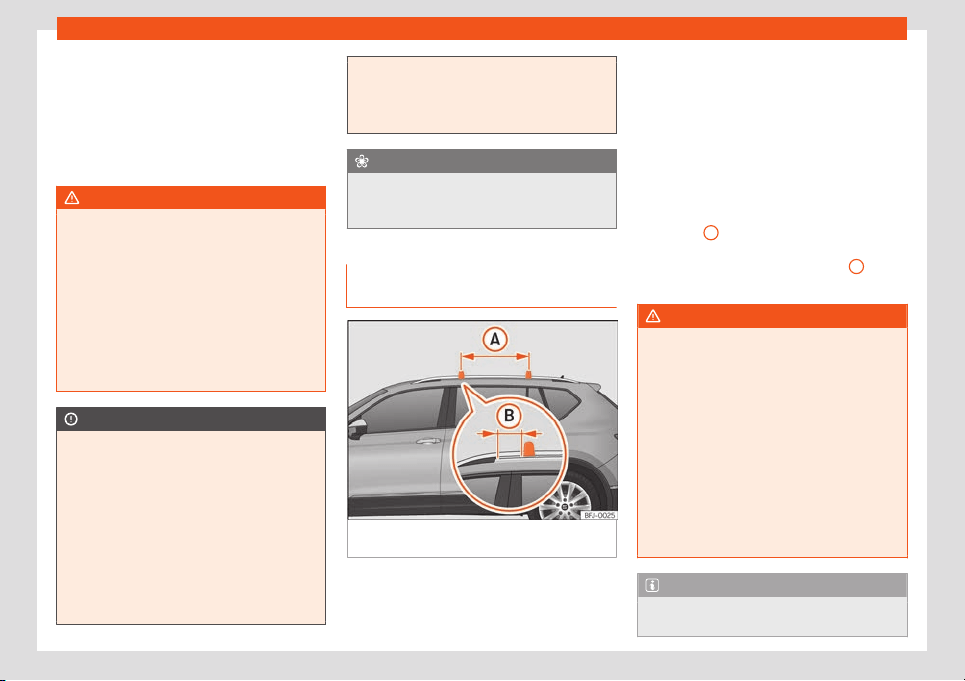
Transport and practical equipment
Cases in which cross bars and the roof
carrier syst
em should be disassembled.
●
When they are not used.
●
When the vehicle is washed in a car wash.
●
When the vehicle height exceeds the maxi-
mum height, for example, in some garages.
WARNING
●
Al
ways secure the load properly using
belts or retaining straps that are suitable
and in a good condition.
●
Bulky, heavy, long or flat loads have a
negative effect on aerodynamics, the cen-
tre of gravity and driving performance.
●
Avoid sudden braking and manoeuvres.
●
Adapt your speed and driving style at all
times to suit visibility, weather, road and
traffic conditions.
CAUTION
●
R
emove the cross bars and the roof carri-
er system before entering a car wash.
●
Vehicle height is increased by the instal-
lation of cross bars or a roof carrier system
and the load secured on them. For this pur-
pose, check that your vehicle's height does
not surpass the headspace limit, for exam-
ple, for underpasses or for entering garage
doors.
●
Cross bars, the roof carrier system and
the load secured on them should not inter-
fere with the roof aerial or hamper the path
of the panor
amic sun roof and the rear lid.
●
On opening the rear lid make sure that it
does not knock into the roof load.
For the sake of the environment
When cross bars and a roof carrier system
ar
e installed, the increased air resistance
means that the vehicle uses more fuel.
Securing the crossbars and the
r
oof carrier system
Fig. 134
Attachment points for the roof railings
f
or the roof carrier system.
The crossbars are the basis of a series of
special r
oof carrier systems. For safety rea-
sons, special fixtures must be used to safely
transport luggage, bicycles, skis, surf boards
or boats on the roof. Suitable accessories
can be acquired at SEAT dealerships.
Always secure the crossbars and the roof
carrier system properly. Always take the as-
sembly instructions that come with the cross-
bars and the roof carrier system in question
into account.
The crossbars are assembled on the roof rail-
ings. The distance between crossbars
›››
Fig. 134
A
should be between 75 and 90
cm and the dist
ance between the crossbars
and the brackets of the roof railings
B
must
be 15 cm.
WARNING
Incorrect attachment and use of the cross-
bars and the r
oof carrier system may cause
the whole system to detach from the roof
and cause an accident and injuries.
●
Always take the manufacturer assembly
instructions into account.
●
Check threaded joints and attachments
travelling and if necessary tighten them af-
ter you have travelled a short distance.
When making long trips, check the threa-
ded joints whenever you stop for a rest.
●
Do not modify or repair the crossbars or
roof carrier system.
Note
Always read the assembly instructions that
come with the cr
ossbars and the roof
»
149
Operation
carrier system carefully and keep them in
the v
ehicle.
Loading the roof carrier system
The load can only be secured if the crossbars
and the r
oof carrier system are properly in-
stalled
›››
.
Maximum authorised car
go on the roof
The maximum permissible roof load is 75 kg.
This figure comes from the combined weight
of the roof carrier, the cross bars and the load
itself on the roof
›››
.
Al
ways check the weight of the roof carrier
system, the cross bars and the weight of the
load to be transported and weigh them if
necessary. Never exceed the maximum au-
thorised roof load.
If you are using cross bars and a roof carrier
with a lower weight rating, you will not be
able to carry the maximum authorised roof
load. In this case, do not exceed the maxi-
mum weight limit for the roof carrier which is
listed in the fitting instructions.
Distributing a load
Distribute loads uniformly and secure them
correctly
›››
.
Check attachments
Once the cr
oss bars and roof carrier system
have been installed, check the bolted con-
nections and attachments after a short jour-
ney and subsequently with a certain frequen-
cy.
WARNING
●
Ne
ver exceed the maximum authorised
load on the roof and on the axles or the ve-
hicle's maximum authorised weight.
●
Never exceed the load capacity of the
cross bars and the roof carrier system,
even if the maximum authorised roof load
has not been reached.
●
Secure heavy items as far forward as
possible and distribute the vehicle load
uniformly.
WARNING
If the load is loose or not secured, it could
f
all from the roof carrier system or cause
accidents and injuries.
●
Always use belts or retaining straps that
are suitable and in a good condition.
Storage compartment
Intr
oduction
Use the storage compartments only for small
or light it
ems.
The Apple® iPod adapter or the USB port
may be housed in the storage compartment
of the front centre armrest.
WARNING
Objects inside the vehicle that are not se-
cur
ed could be thrown across the cabin in
the event of sudden braking or manoeu-
vring. This may cause severe injuries as
well as loss of control of the vehicle.
●
Do not carry animals or sharp, hard or
heavy items in open storage compartments
of the vehicle, on the dashboard or on the
cover behind the rear seats, or inside
pieces of clothing or bags inside the vehi-
cle.
●
Keep the storage compartments closed
at all times while the vehicle is in motion.
WARNING
Objects in the driver's footwell could diffi-
cult the use of the pedal
s. This may cause
loss of control of the vehicle and increases
the risk of severe injuries.
●
Make sure that nothing prevents you from
using the pedals at any time.
150
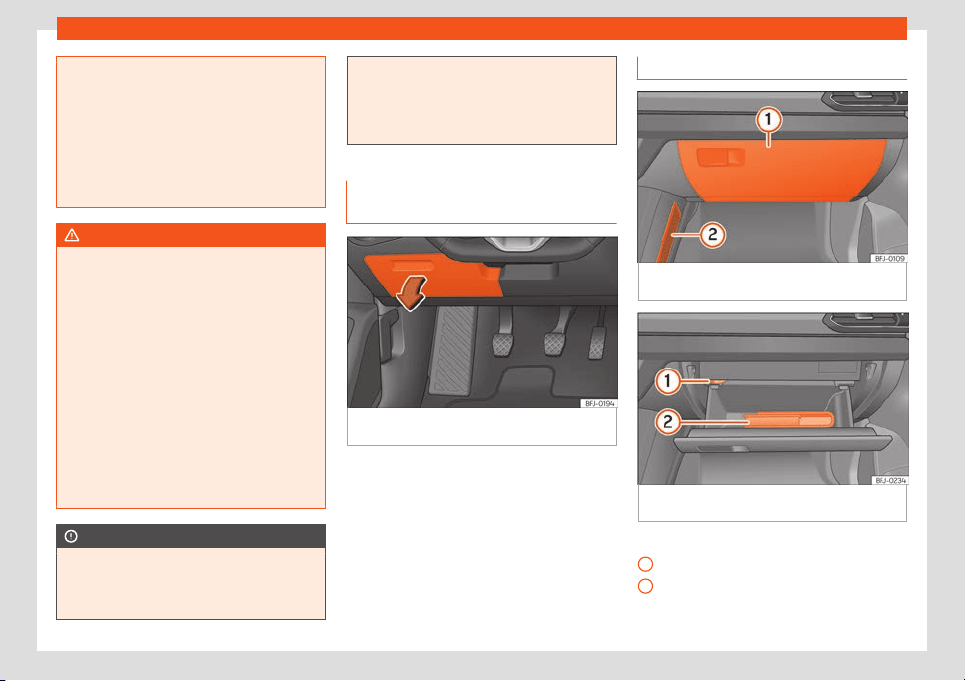
Transport and practical equipment
●
Al
ways secure the mat in the footwell.
●
Never place other mats or other type of
covers on the factory-fitted mat.
●
Ensure that no objects can fall into the
driver's footwell while the vehicle is in mo-
tion.
●
When the vehicle is stationary, remove
the objects in the footwell.
WARNING
If you leave lighters inside the vehicle, they
might be damaged or lit inadv
ertently. This
could lead to severe burns and damage to
the vehicle.
●
Before moving a seat, make sure there
are no lighters in the moving part area of
the vehicle.
●
Before closing a storage compartment,
make sure there are no lighters in the clos-
ing area.
●
Never leave a lighter inside a storage
compartment or any other surface of the
vehicle as it could ignite due to the high
temperatures on such surfaces, particular-
ly during the summer.
CAUTION
●
Do not st
ore heat- or cold-sensitive ob-
jects, food or medicines in the cabin. Heat
and cold could damage them or render
them useless.
●
Ob
jects made from transparent materi-
als left inside the vehicle, such as glasses,
magnifying glasses or transparent suction
pads stuck to the windows can concentrate
sunlight and damage the vehicle.
Storage compartment on the driv-
er
's side
Fig. 135
On the driver side: storage compart-
ment.
Opening: Pull the handl
e
›››
Fig. 135.
Closing: Press the cover upwards until it clicks
into place.
Glove compartment
Fig. 136
On the front passenger side: glove
compartment cl
osed.
Fig. 137 On the front passenger side: glove
compartment open.
Key to the Fig. 136:
Gl
ove compartment
Storage net
Key to the Fig. 137:
»
1
2
151
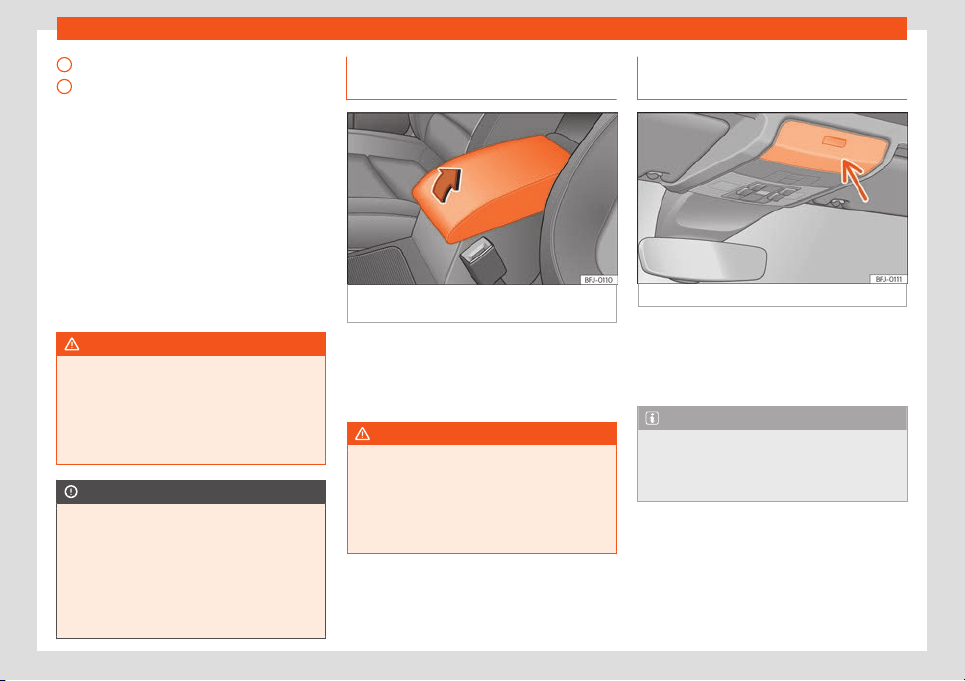
Operation
Air diffuser regulator
On-boar
d documentation
Opening and closing the glove compart-
ment
Opening: Pull the handle
›››
Fig. 136 and
open the glove compartment.
Closing: Press the glove compartment up-
wards.
Glove compartment cooling
With the AC on, cool air can be directed to-
wards the inside of the compartment. Turn
the air vent to open and close it.
WARNING
If the glove compartment is left open, the
risk of causing se
vere injuries in the event
of an accident, sudden braking or manoeu-
vring increases.
●
Always keep the glove compartment
closed while the vehicle is in motion.
CAUTION
For structural reasons, some vehicle ver-
sions will hav
e gaps behind the glove com-
partment (for instance, behind the com-
partment for on-board documentation) into
which small objects may fall. This could
lead to strange noises and damage to the
vehicle. You should therefore not keep very
small objects in the glove compartment.
1
2
Storage compartment in the front
centr
al armrest
Fig. 138
In the front central armrest: storage
compartment.
Opening: Giv
en the case, press the unlock
button and raise the centre armrest in the di-
rection of the arrow
›››
Fig. 138.
Closing: Lower the armrest.
WARNING
The centre armrest may obstruct the driv-
er
's arm movements, which could cause an
accident and severe injuries.
●
Keep the storage compartments of the
centre armrest closed at all times while the
vehicle is in motion.
Storage compartment in the roof
consol
e (glasses case)
Fig. 139
On the roof console: glasses case.
Opening: Pr
ess and release the button
›››
Fig. 139.
Closing: Press the cover upwards until it clicks
into place.
Note
For the surveillance of the cabin to work
corr
ectly, the storage compartments must
be closed when locking the vehicle
›››
page 95.
152
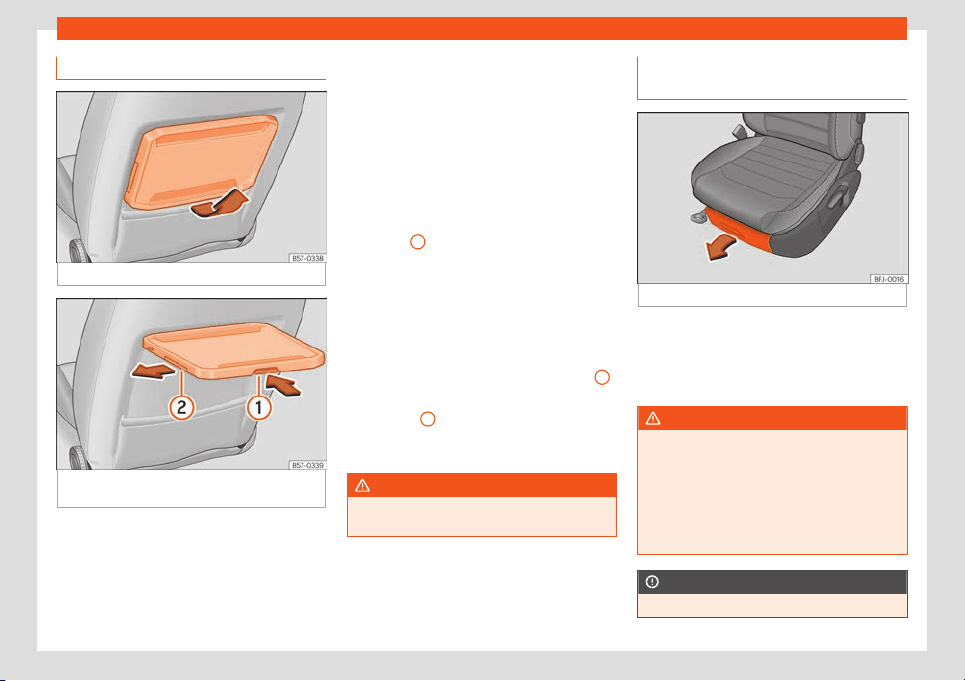
Transport and practical equipment
Folding table
Fig. 140
Front left seat: folding table.
Fig. 141
Front left seat: folding table with
drinks hol
der.
Depending on the model version, at the rear
of the fr
ont seats, there may be “plane-style”
folding tables for passengers in the rear
seats.
Opening the folding table
●
Pull the table up, in the direction of the ar-
row, until it catches
›››
Fig. 140.
Folding the table or adjusting its inclina-
tion
The foldable table can be used at different
inclinations.
●
Press the unlocking lever under the table
›››
Fig. 141
1
and keep it that way.
●
Adjust: Adjust the inclination of the t
able by
pressing the lever.
●
Fold: Push the table downwards while
pressing the lever.
Drink holder
A drink holder is built into the folding table
2
.
With the f
oldable table extended, remove the
drink holder
2
following the direction of the
arr
ow. To store the drink holder, insert it into
the table against the direction of the arrow.
WARNING
The table must always be closed while
driving t
o decrease the risk of injuries.
Storage compartment under front
seats
Fig. 142
Drawer under the front seat
Opening: Pr
ess the tab on the drawer handle
and take the drawer out.
Closing: Push the drawer under the seat until
it engages.
WARNING
If the drawer is left open, it could prevent
use of the pedal
s. This may cause serious
accidents and injuries.
●
Always keep the drawer closed while the
vehicle is in motion. Otherwise, the drawer
and any objects in it could fall into the driv-
er's footwell and obstruct the pedals.
CAUTION
The drawer can contain 1.5 kg at most.
153
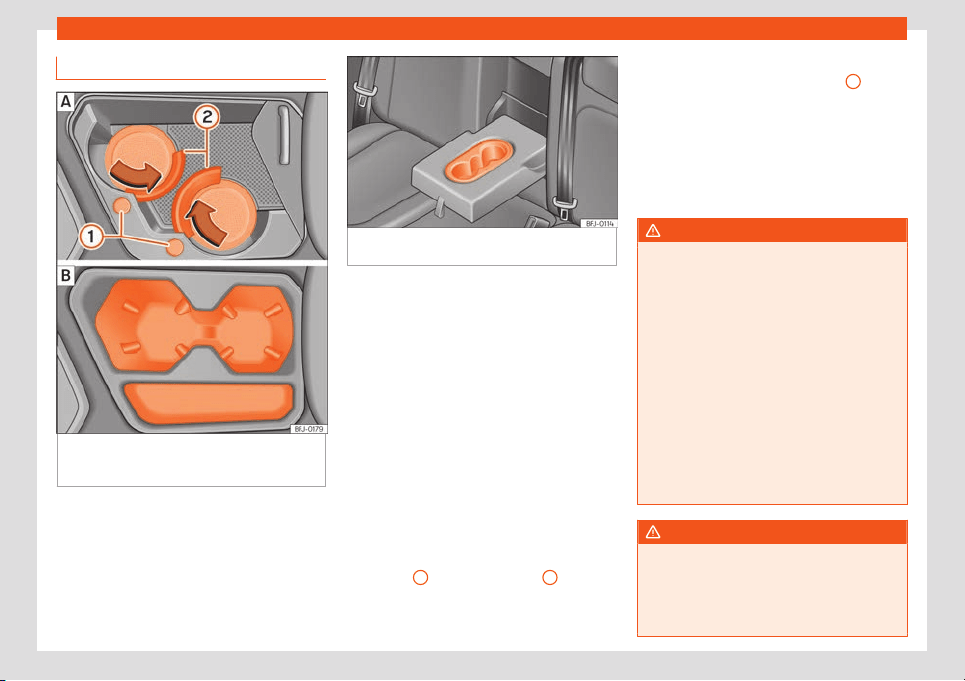
Operation
Drink holder
Fig. 143 In the front part of the centre console:
cup hol
der (variant 1);
cup holder (variant
2).
Fig. 144 In the rear central armrest: drinks
hol
der.
The storage compartments of the driver and
passenger doors cont
ain a bottle holder.
The folding tables of the front seats contain
more bottle holders
›››
page 153.
Depending on the features, there are two
drink holders in the front part of the centre
console
›››
Fig. 143.
Open and close the drink holder (variant 1)
Opening: Move the lid backwards.
Closing: Move the lid forwards.
Adjust the drink holder (variant 1)
To adapt the drink holder to the size of the
container, press the corresponding button
›››
Fig. 143
1
. The fastening ring
2
opens.
When you are not using the drink holder any
mor
e, press the corresponding ring
2
in the
opposit
e direction to the arrow until it locks.
Drinks holder in the rear central armrest
Use: Lower the centre armrest.
When the drink holder is no longer in use, lift
the armrest again.
WARNING
Incorrect use of the bottle holders may
cause injuries.
●
Never put hot drinks in the drink holders.
In the e
vent of sudden braking or an acci-
dent while driving, hot beverages in the
bottle holders might spill and cause burns.
●
Ensure that no bottles or other objects
are dropped in the driver footwell while
driving, as they could get under the pedals
and obstruct their working.
●
Never place glasses, food or other heavy
objects drink holders. These heavy objects
may be thrown across the cabin in the
event of an accident and cause serious in-
juries.
WARNING
Closed bottles may explode inside the ve-
hicl
e due to cold or heat.
●
Never leave closed bottles in the vehicle
if the temperature inside is very high or very
low.
154
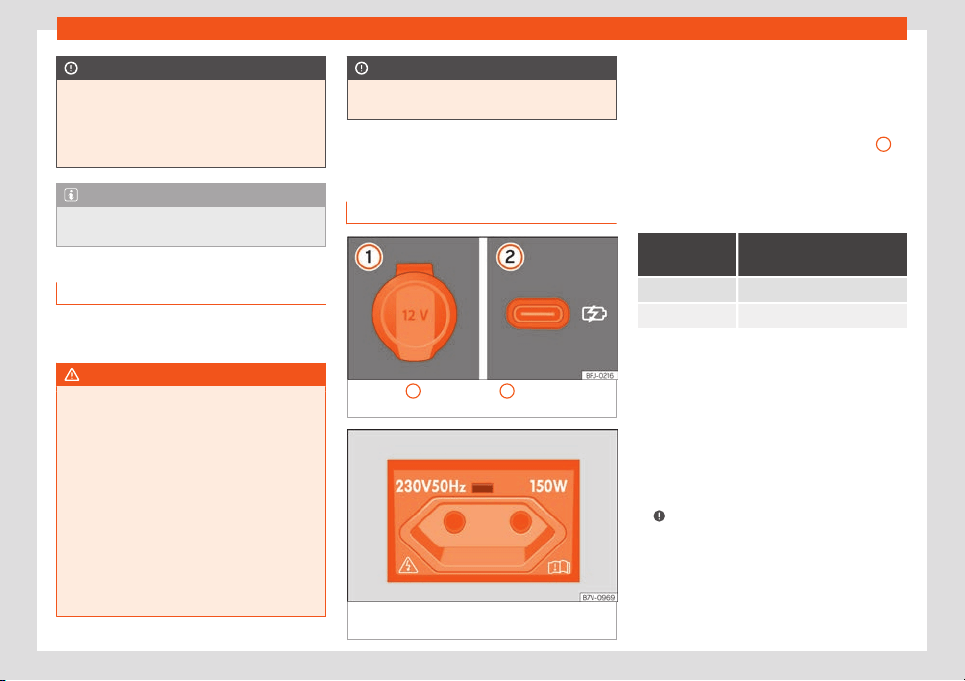
Transport and practical equipment
CAUTION
Do not leave open cans in the drink holders
when the v
ehicle is in motion. If the drink is
spilled (e.g. due to sudden braking) it may
damage the vehicle and its electrical sys-
tem.
Note
The inside elements of the drink holders
can be e
xtracted for cleaning.
Other object holders
There are hangers on the struts of the doors
and the r
ear.
WARNING
Hanging clothes may decrease the driver's
visibilit
y, which may cause serious acci-
dents and injuries.
●
Always hang clothes from hangers in
such a way that the driver's visibility is not
affected.
●
Only hang light pieces of clothing from
the hangers of the vehicle. Never leave
heavy, hard or sharp objects in the pockets
of these pieces of clothing.
●
Do not use clothes hangers to hang up
the clothing, as this could interfere with the
function of the head-protection airbags.
CAUTION
Each hanger is designed for a maximum
l
oad of 2.5 kg.
Power sockets
V
ehicle power sockets
Fig. 145
1
12 volt socket.
2
USB socket on
the r
ear part of the centre console.
Fig. 146 On the left side of the luggage com-
partment: 230 v
olt power socket.
You can find 12 volt sockets on the front cen-
tr
e console, in the rear part of the centre con-
sole (between the front seats) and in the lug-
gage compartment.
●
Lift the power socket cover
›››
Fig. 145
1
.
●
Insert the plug of the electrical appliance
int
o the power socket.
Maximum power consumption
Power socket
Maximum power con-
sumption
12 Volts 120 Watts
230 Volts 150 watts (300 watt peaks)
Electrical equipment can be connected to
the 12 v
olt power socket.
Make sure that the maximum power con-
sumption displayed on each outlet is not ex-
ceeded. The power consumption of devices is
shown on the model plate.
When connecting two or more electrical de-
vices at the same time, make sure that their
total consumption never exceeds 190 watts
›››
.
USB po
wer sockets
Depending on the equipment and the coun-
try, the vehicle may also have USB connec-
tions exclusively for charging or as a power
socket.
»
155

Operation
These USB ports are located in the rear part
of the centr
e console, between the front
seats
›››
Fig. 145
2
. These connectors can
w
ork at a maximum power of up to 10.5 W per
port.
They are not intended for file playback.
230 volt power socket
With the engine running, the power socket
›››
Fig. 146 activates automatically as soon
as a connector is plugged in. If there is
enough power available, the socket can still
be used while the engine is off
›››
Connect an electrical device: Open the co
v-
er and insert the plug into the power socket
as far as possible to unlock the built-in child
lock. The socket only supplies power once
the child lock is unlocked.
LED on the power socket
Steady green
light:
The childproof lock is unlocked.
The sock
et is ready to operate.
Flashing green
light:
The ignition is switched off, but
ther
e is enough power available
to continue supplying the socket
with current for a maximum of 10
minutes. If the connector is un-
plugged before this time elap-
ses, the socket is disconnected
and cannot be used again until
the ignition is switched on again.
LED on the power socket
Flashing red
light:
There is an anomaly, e.g. dis-
connection due t
o a current
surge or overheating.
Disconnection due to overheating
When the t
emperature exceeds a certain val-
ue, the 230 volt socket inverter is automati-
cally disconnected. The disconnection pre-
vents overheating when the power consump-
tion of the connected devices is excessive or
the ambient temperature is very high. The
230-volt power supply can be used once
again after a cooling time. First unplug the
connector of the connected device and then
plug it back in again. This prevents the elec-
trical device from being switched on again if
this is not wanted.
WARNING
The electrical system is under high voltage!
●
Do not spill liquids onto the socket.
●
Do not plug adapters or extension cords
int
o the 230 volt power socket. Otherwise,
the integrated child lock will be unlocked
and the power socket will operate.
●
Do not insert conductive objects (a knit-
ting needle, for example) into the 230 volt
power socket.
WARNING
The power socket works only when the igni-
tion is on. Impr
oper use may cause serious
injury or even fire. Children should there-
fore not be left in the vehicle unattended if
the button is also left behind. Otherwise
there is a possibility that they may be in-
jured.
CAUTION
Always use the correct type of plugs to
av
oid damaging the sockets.
CAUTION
●
230 v
olt power socket:
–
Do not leave devices or connectors
that are too heavy (e.g. a transformer)
hanging directly from the power sock-
et.
–
Do not connect neon lamps.
–
Only connect devices to the socket if
the device and socket voltage match.
–
The built-in overload disconnect func-
tion prevents any electrical devices
that require a high start-up current
from turning on. In this case, unplug the
electrical device's power supply and
re-try the connection after about 10
seconds.
156

Air conditioning
Note
●
The use of el
ectrical appliances with the
engine switched off will cause a battery
discharge.
●
Should the connected appliance over-
heat, immediately switch it off and discon-
nect it from the socket.
●
Before switching the ignition on or off, un-
plug the appliances from the USB ports to
protect them from any damage caused by
fluctuations in voltage.
●
Some appliances may not work properly
when connected to the 230 volt sockets
due to a lack of power (watts).
Air conditioning
Heating, v
entilation and
cooling
Introduction
Depending on the vehicle’s equipment, sever-
al syst
ems may have been fitted:
●
The manual air conditioning system
heats, cools and dehumidifies the air.
●
The Climatr
onic is an automatic air condi-
tioner that heats, cools and dehumidifies the
air.
With the Climatronic’s automatic mode it is
possible to automatically regulate the air
temperature, distribution and flow.
The air conditioning system is more effective
if the vehicle's interior is kept closed. When a
lot of heat builds up inside the vehicle, venti-
lation can speed up the cooling process.
To switch a specific function on, press the ap-
propriate button. Press the button again to
switch off the function.
The illuminated LEDs next to the buttons indi-
cate that the function is switched on.
In the air conditioning settings in the infotain-
ment system, the yellow function buttons in-
dicate that the function is switched on
›››
page 162.
Refrigerated glove box
When the vent is open, cold air flows into the
glove box. If the inside of the vehicle is cooled
by the air conditioning system, the cold air
can be directed towards the inside of the
glove box.
Dust and pollen filter
The dust and pollen filter with its activated
charcoal cartridge serves as a barrier
against impurities in the air taken into the ve-
hicle interior.
The dust and pollen filter must be changed
regularly so that air conditioner performance
is not adversely affected.
If the filter loses efficiency prematurely due to
use in areas with very high levels of air pollu-
tion, the filter must be changed more fre-
quently than stated in the Service Schedule.
Economic use of the air conditioning
When the air conditioning is switched on, the
compressor consumes engine power and has
influence on fuel consumption.
The air conditioner operates most effectively
with the windows and the panoramic sliding
sunroof closed. However, if the vehicle has
heated up after standing in the sun for some
»
157
Operation
time, the air inside can be cooled more quick-
ly by opening the windo
ws and the panoram-
ic sliding sunroof briefly.
Air conditioning according to seat occu-
pancy
In order to make the most efficient use possi-
ble of the air conditioning's energy consump-
tion, the air conditioning is adjusted accord-
ing to seat occupancy. When seat occupan-
cy recognition is activated, this is indicated
by the word on the infotainment system
and on the air conditioning control panel
screen.
Valid for hybrid vehicles: When a person oc-
cupies one of the seats and is wearing a seat
belt, the vehicle identifies this seat as occu-
pied when the drive system is switched on.
WARNING
Reduced visibility through the windows in-
cr
eases the risk of serious accidents.
●
Always ensure that all windows are free
of ice and snow, and that they are not fog-
ged, so as to maintain good visibility of ev-
erything outside.
●
Only drive when you have good visibility.
●
Always ensure that you use the air condi-
tioning, heater or rear window heating to
maintain good visibility to the outside.
●
Ne
ver leave the air recirculation on for a
long period of time. If the cooling system is
switched off and air recirculation mode
switched on, the windows can mist over
very quickly, considerably limiting visibility.
●
Switch air recirculation mode off when it
is not required.
CAUTION
●
T
o replace the pollen filter, always visit a
service centre.
●
Switch the climate control or air condi-
tioner off if you think it may be broken. This
will avoid additional damage. Have the cli-
mate control or air conditioning checked
by a specialised workshop.
●
Repairs to the climate control or air con-
ditioning require specialist knowledge and
special tools. SEAT recommends visiting a
SEAT Official Service.
Note
●
When the cooling syst
em is turned off, air
coming from the outside will not be dried.
To prevent fogging of the windows, SEAT
recommends leaving the cooling system
(compressor) turned on. To do this, press
the
button. The button lamp should
light up
.
●
The maximum heat output required to de-
frost windows as quickly as possible is only
available when the engine has reached its
normal running t
emperature.
●
Keep the air intake slots in front of the
windscreen free of snow, ice and leaves to
ensure heating and cooling are not im-
paired, and to prevent the windows from
misting over.
●
The air from the vents flows through the
vehicle interior and is extracted by slots in
the luggage compartment designed for this
purpose. Therefore, you should avoid ob-
structing these slots with any kind of ob-
ject.
●
Do not smoke while air recirculation
mode is on, as smoke drawn into the air
conditioning system leaves residue on the
evaporator, producing a permanent un-
pleasant odour.
●
It is advisable to turn on the air condition-
ing at least once a month, to lubricate the
system gaskets and prevent leaks. If a de-
crease in the cooling capacity is detected,
a Technical Service should be consulted to
check the system.
●
When the engine is under extreme strain,
switch off the compressor for a moment.
158
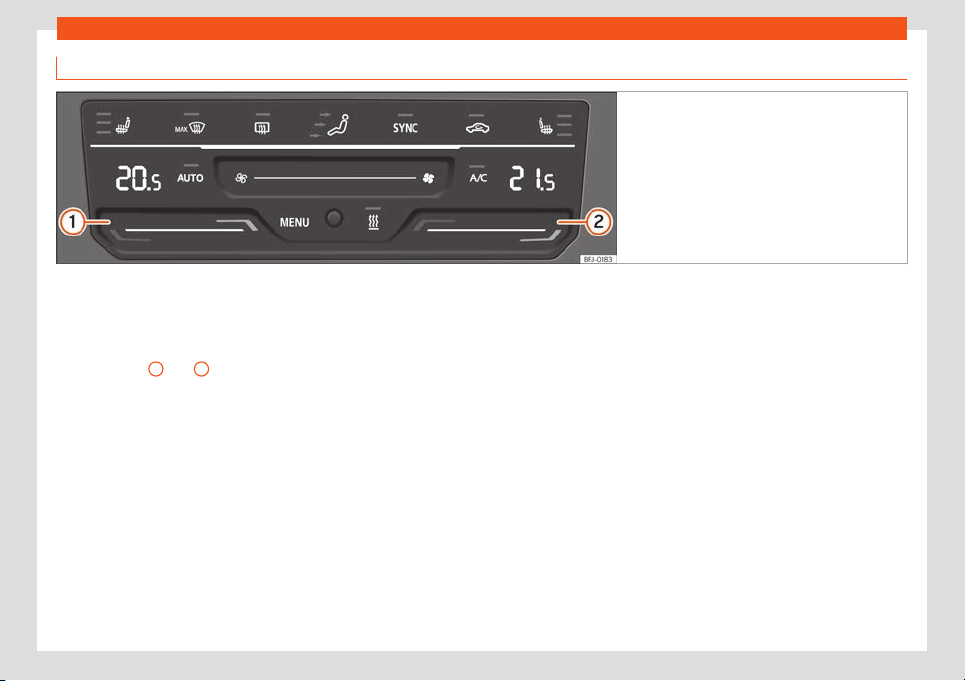
Air conditioning
Climatronic controls and functions
Fig. 147 In the centre console: Climatronic con-
tr
ols.
Some functions and buttons, as well as the
air conditioning f
or the rear seats, are only
available depending on the vehicle equip-
ment.
Sensors fields
1
and
2
The temperature of the right and left sides
can be adjust
ed separately using the adjust-
ers. The selected temperature is shown on
the display of the climate control panel.
To set the Climatronic temperature to +22 °C
(+72 °F), the centre of the touch control must
be pressed briefly. To adjust the maximum
cooling or heating power, briefly press and
hold either end of the touch control (red or
blue zone).
The set air temperature is kept constant. Tem-
perature and the amount and distribution of
air are controlled automatically. Automatic
mode is switched off when the fan power is
changed manually.
The fan power in automatic mode can be se-
lected using the air conditioning profile in the
air conditioning settings of the infotainment
system
›››
page 162 .
Cooling mode
Press the button to switch on or off the cool-
ing system.
The cooling mode cools and dehumidifies the
air.
Blower
Adjust the fan power.
Synchronisation
Active for all seats, the temperatures set for
the driver's seat.
Air distribution
●
Upper arrow: Direct the air towards the
windscreen.
●
Central arrow: Directs air to the upper
body.
●
Lower arrow: Direct the air towards the
footwell.
Defrost/demist function
The Climatronic’s defrost function removes
ice and fog from the windscreen. The air is
dehumidified and the fan is set high.
»
159

Operation
Infotainment System
Open the air conditioning settings in the info-
tainment system
›››
page 162.
The climate control operation and settings
menu will be displayed in the infotainment
system screen.
Heated rear window
Switches the heated rear window on and off.
This only works when the engine is running
and switches off automatically after a maxi-
mum of 10 minutes.
It should be switched off as soon as the glass
is demisted. By saving electrical power you
can also save fuel.
To avoid possible damage to the battery, an
automatic temporary disconnection of this
function is possible, coming back on when
normal operating conditions are re-establish-
ed.
Air recirculation
Switches the air recirculation mode on and
off
›››
page 163
Seat heating
Switches seat heating on and off
›››
page 164
Switching off
Switch off the air conditioning system.
Auxiliary heating
Switch the auxiliary heater on or off
›››
page 167.
Air Conditioning settings in Infotainment
Open the auxiliary heater menu in the air
conditioning settings in the infotainment sys-
tem
›››
page 167.
The Air Care Climatronic allergen filter can
reduce the amount of harmful substances
that get inside, including allergens
›››
page 163.
Windscreen heating
Switches the heated windscreen on and off
with the engine running
›››
page 166.
Steering wheel heating
Activate or deactivate steering wheel heating
›››
page 165.
160
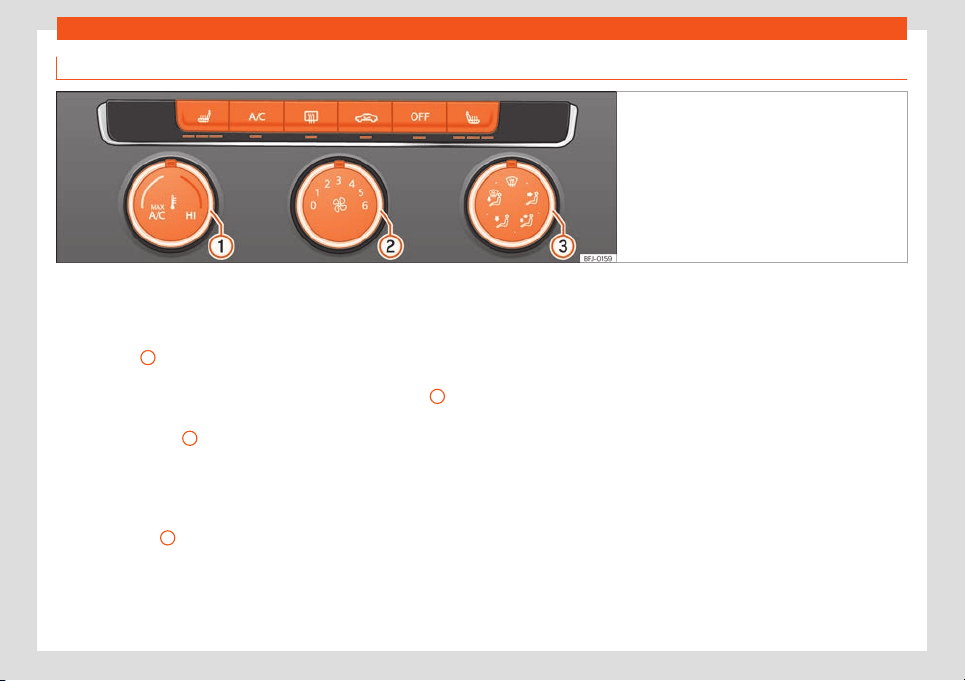
Air conditioning
Manual air conditioning controls
Fig. 148 In the centre console: manual air condi-
tioning contr
ols.
Cooling mode
Press the button to switch on or off the cool-
ing system.
Temperature
1
Turn the control to adjust the temperature.
Bl
ower
Turning the regulator
2
sets the fan power.
At l
evel 0 the fan and manual air conditioning
are disconnected. Level 6 is the maximum.
Air distribution / / / /
Turning regulator
3
distributes the air to the
desir
ed zone:
The airflow is directed towards the chest
The airflow is directed towards the chest
and the footwell area.
The airflow is directed towards the foot-
well.
The airflow is directed towards the wind-
screen and the footwell area.
Defrost/demist function
When control
3
is in position the air fl
ow is
directed at the windscreen and air recircula-
tion is disconnected automatically or not ac-
tivated. Increase the fan power to clear the
windscreen of condensation as soon as pos-
sible. To dehumidify the air, the cooling sys-
tem will automatically switch on.
Maximum cooling power
When the control is in position air recir-
culation and the cooling system are connec-
ted automatically and the air flow is automat-
ically adjusted to position .
Heated rear window
This only works when the engine is running
and switches off automatically after a maxi-
mum of 10 minutes.
It should be switched off as soon as the glass
is demisted. By saving electrical power you
can also save fuel.
To avoid possible damage to the battery, an
automatic temporary disconnection of this
function is possible, coming back on when
normal operating conditions are re-establish-
ed.
Air recirculation
›››
page 163
Seat heating
›››
page 164
»
161
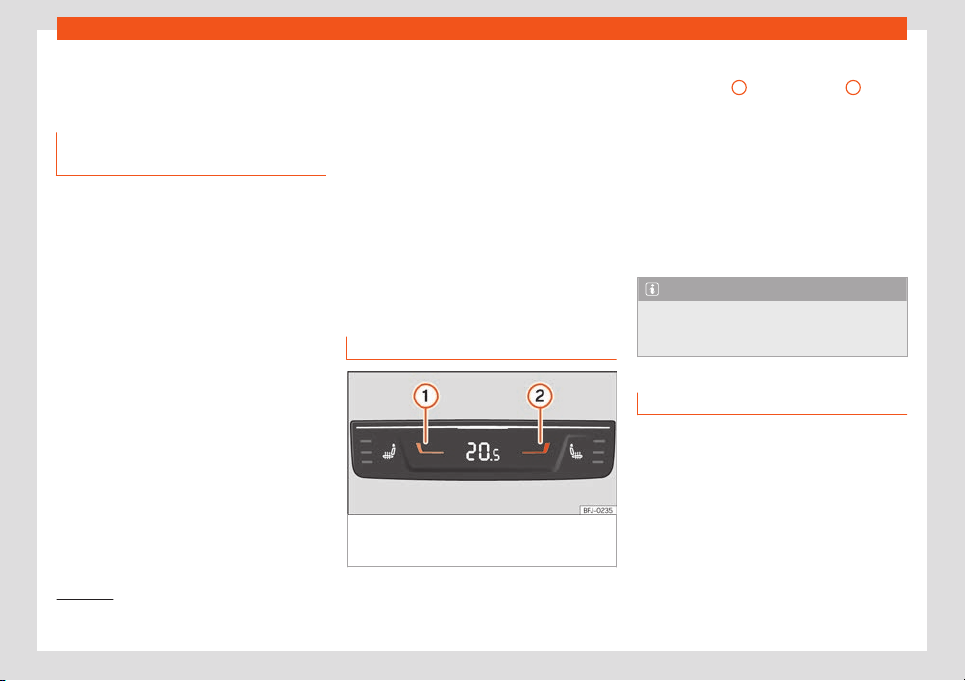
Operation
Switching off
Pr
ess button or manually set the fan to .
Setting the temperature on the in-
fotainment system
The air conditioning settings in the infotain-
ment syst
em are available in the Climatronic.
Depending on the vehicle equipment.
Open the air conditioner menu
●
Press the
button of the Climatronic
control panel.
The current air conditioning settings are dis-
played at the top of the screen. The current
air conditioning settings are displayed at the
top of the screen.
Air conditioning operating modes
The air conditioning operating modes are
colour coded:
●
Blue: Cooling.
●
Red: Heating.
General settings submenu
Sets the following functions:
●
Automatic air recirculation mode
›››
page 163.
●
Supplementary heater
›››
page 168.
●
Automatic heated windscreen
›››
page 166.
Presets submenu
Sets the automatic or manual mode of the
cooling system or switches the air condition-
ing off.
Air conditioning profile
Adjust fan power in automatic mode
1)
.
Rear controls
Fig. 149
In the rear part of the centre console:
Climatr
onic temperature controls for the rear
seats.
Temperature
●
Press buttons
1
(blue-cold) and
2
(red-
hot)
›
››
Fig. 149 to adjust the temperature.
Setting the temperature on the infotain-
ment system
●
Open the air conditioning settings in the in-
fotainment system.
●
Press the function button for the rear seat.
●
Press the function buttons to set the tem-
perature.
Note
When function button is activ
e on the In-
fotainment System, the rear controls do not
work.
Air vents
To ensure proper heating, cooling and venti-
l
ation in the vehicle interior, the air vents must
remain open.
●
Turn the corresponding thumbwheel in the
required direction to open and close the air
vents. When the thumbwheel is in the posi-
tion, the corresponding air vent is closed.
1)
Valid for the front and rear air conditioning con-
tr
ol unit.
162
Air conditioning
●
Change the air dir
ection using the ventila-
tion grille lever.
There are other additional, non-adjustable air
vents in the dash panel, in the footwells and in
the rear area of the passenger compartment.
Note
Food, medicine and other heat or cold sen-
sitiv
e objects should never be placed in
front of the air outlets as they may be dam-
aged or made unsuitable for use by the air.
Air recirculation
Air recirculation mode prevents the ambient
air fr
om entering the interior.
For safety reasons, air recirculation is switch-
ed off in the following situations:
●
When the button is pressed or the air
distributor is turned to .
●
When a sensor detects that the vehicle's
windows could mist up.
Switching the manual air recirculation
mode on and off
●
Press the button to connect or discon-
nect manual air recirculation.
Climatronic automatic air recirculation
mode
With the automatic air recirculation mode ac-
tivated, the entry of fresh air into the cabin in-
terior is enabled. If the system detects a high
concentration of hazardous substances in the
ambient air, air recirculation mode is switched
on automatically. When the level of impurities
drops to within a normal range, recirculation
mode is switched off.
The system is unable to detect unpleasant
smells.
The air recirculation will not connect auto-
matically in versions without humidity sensor
and in the following external conditions:
●
The outside temperature is lower than +3°C
(+38°F).
●
The cooling system is switched off and the
outside temperature is below +10°C (+50°F).
●
The cooling system is switched off, the out-
side temperature is below +15°C (+59°F) and
the windscreen wipers are switched on.
Air Care Climatronic with allergen filter
The Air Care Climatronic allergen filter can
reduce the amount of harmful substances, in-
cluding allergens, that get inside.
If the Air Care option is switched on, the air
conditioning’s air recirculation mode is maxi-
mised until there is a risk of the windows mist-
ing up due to humidity inside the vehicle and
the outside temperature. The air recirculation
mode is automatically regulated and incor-
porates an automatic setting to prevent the
vehicle occupants suffering from fatigue.
●
Open the air conditioning settings in the in-
fotainment system
›››
page 162.
●
Switch the Air Care function on or off using
active Air Care.
WARNING
Stuffy or used air will increase fatigue and
r
educe driver concentration possibly re-
sulting in a serious accident.
●
Never leave the fresh air fan turned off or
use the air recirculation for long periods of
time; the air in the vehicle interior will not
be refreshed.
●
If the cooling system is switched off and
air recirculation mode switched on, the
windows can mist over very quickly, con-
siderably limiting visibility.
CAUTION
Do not smoke when air recirculation is
s
witched on in vehicles with an air condi-
tioner. The smoke taken in could lie on the
cooling system vaporiser and on the acti-
vated charcoal cartridge of the dust and
pollen filter, leading to a permanently un-
pleasant smell.
»
163
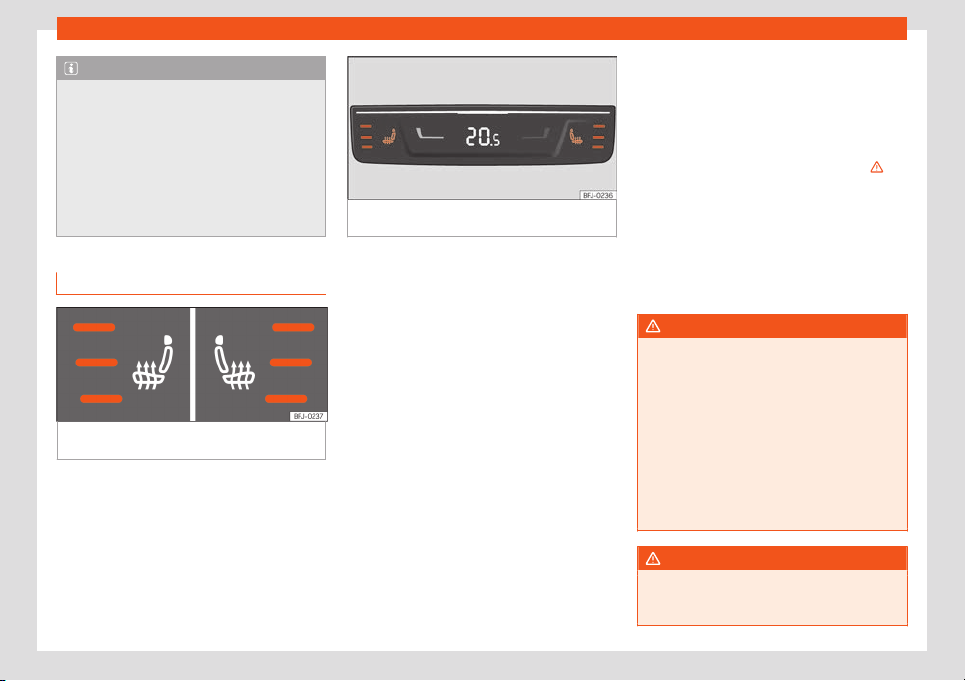
Operation
Note
●
Climatr
onic: air recirculation mode is ac-
tivated to prevent exhaust gas or unpleas-
ant odours from entering the vehicle interi-
or when it is in reverse and while the auto-
matic windscreen wiper is working.
●
When the outside temperature is very
high, selecting manual air recirculation
mode for a short period refreshes the vehi-
cle interior more quickly.
Seat heating
Fig. 150
In the centre console: front seat heat-
ing s
witches.
Fig. 151 In the rear part of the centre console:
r
ear seats heating switch.
With the engine running, the front seats and
side r
ear seats can be electrically heated to
three power levels.
Seat heating power levels
Seat heating operating modes are colour co-
ded. At the highest heating level, all three
LEDs light up.
Control seat heating
●
Press buttons or on the control panel
to turn on the seat heating as high as possi-
ble.
●
Press buttons or repeatedly to adjust it
to the required level.
●
To turn off the seat heating, press button
or repeatedly until no LEDs are lit.
When the engine is started again within ap-
proximately 10 minutes, the most recently set
heating level for the driver's seat is switched
on automatically.
Cases in which the heat seating should
not be switched on
Do not switch the seat heating on if any of the
following conditions are met:
●
If the seat is occupied by a person with limi-
ted pain or temperature perceptions
›››
.
●
The seat is not occupied.
●
The seat has a cover.
●
A child seat has been installed on the seat.
●
The seat cushion is wet or damp.
●
The outdoor or indoor temperature is great-
er than +25°C (7
7°F).
WARNING
People who cannot perceive pain or tem-
per
ature because of medications, paralysis
or chronic diseases (e.g. diabetes) or have
a limited perception of these, may suffer
burns to the back, buttocks or legs when
using seat heating.
●
People with limited pain and temperature
thresholds must never use seat heating.
●
If an abnormality in the device's temper-
ature control is detected, have it checked
by a specialist workshop.
WARNING
If the fabric of the cushion is wet, this can
adv
ersely affect the operation of the seat
heating, increasing the risk of burns.
164
Air conditioning
●
Mak
e sure the seat cushion is dry prior to
using the seat heater.
●
Do not sit on the seat with clothing that is
wet or damp.
●
Do not leave clothing that is wet or damp
on the seat.
●
Do not spill liquid on the seat.
CAUTION
●
T
o avoid damaging the heating elements
of the seat heaters, please do not kneel on
the seat or apply sharp pressure to a single
point on the seat cushion or backrest.
●
Liquids, sharps objects and insulating
materials (e.g. covers or child seats) can
damage the seat heating.
●
If the seat heating generates any kind of
odour, it must be switched off immediately
and it should be checked by a specialist
service centre.
●
If you have replaced the original uphols-
tery with another material, the seat heating
may overheat or its operation may be limi-
ted.
For the sake of the environment
To save fuel, turn off the seat heating as
soon as possibl
e.
Steering wheel heating
Steering wheel heating works only with the
engine running.
St
eering wheel heating levels
The selected flywheel heating level will be
displayed on the instrument panel display.
Level control is carried out using the button
on the multifunction steering wheel:
●
Brief press (less than 1 second): the heating
is switched on at maximum level. Press the
steering wheel button repeatedly until the
desired level is adjusted. To switch off steer-
ing wheel heating, press the steering wheel
button repeatedly until the heated steering
wheel OFF icon is displayed on the instru-
ment cluster.
●
Long press (more than 1 second): the heat
-
ing is switched off directly from the level that
is currently operating. If the steering wheel
button is pressed again for a long period, the
heating is switched on directly at the last lev-
el saved before switching off.
In hybrid vehicles it is also possible to control
heating levels through the infotainment sys-
tem’s air conditioning menu:
●
Press the steering wheel heating function
button . The heating is switched on at its
maximum level.
●
Press the function button repeatedly to set
the desired level.
●
To switch off steering wheel heating, press
the function button several times until no LED
is on.
Automatic off
The steering wheel heating will be switched
off automatically when any of the following
conditions are met:
●
Power consumption is too high.
●
The steering wheel heating system is faulty.
●
If the ignition is switched off.
Automatic connection (valid for hybrid ve-
hicles)
When the drive system is re-started within ap-
proximately 10 minutes, the last set heating
level activates automatically.
165
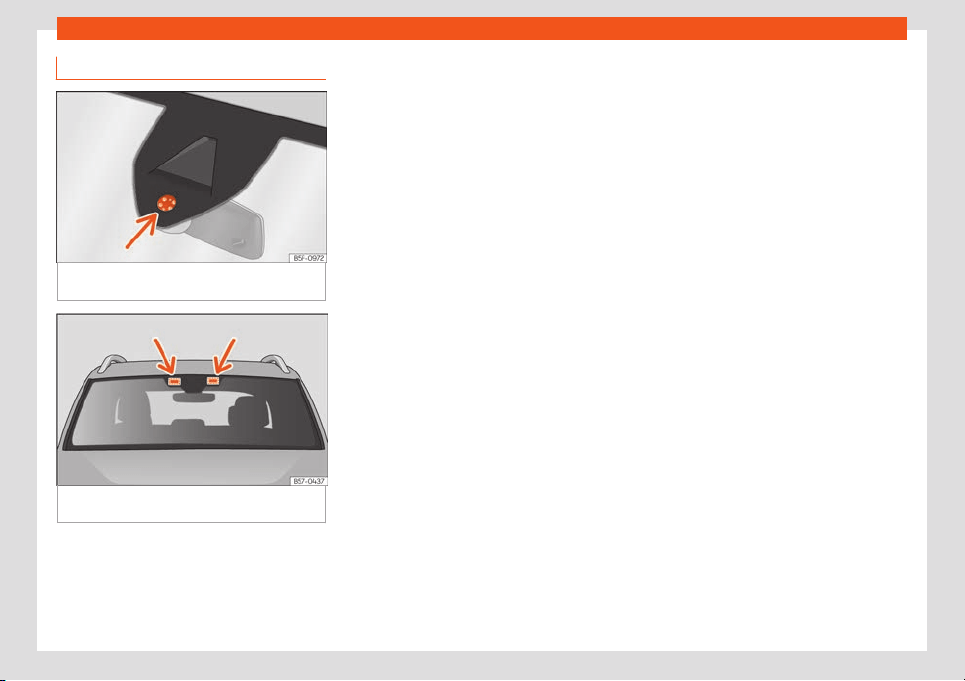
Operation
Windscreen heating
Fig. 152
Windscreen humidity and tempera-
t
ure sensor.
Fig. 153
Areas for placing electronic accesso-
ries
The brake servo works only when the engine
is running.
The heat
ed windscreen is comprised of a set
of heated wires placed between the layers of
the windscreen which, when electric current
is supplied to them, heat up and cause the
temperature of the glass to rise.
Its function is to assist the air-conditioning
system to prevent the windscreen from mist-
ing up or to demist it faster if it does mist up.
The system can be switched on manually or
automatically.
Manual activation
●
Press the button in the air conditioning
settings in the infotainment system.
The heated windscreen is switched off based
on the outside temperature and, in any case,
after approximately 8 minutes.
Automatic activation
The heated windscreen switches on automat-
ically when a window is at risk of misting up.
●
Open the air conditioning settings in the in-
fotainment system
›››
page 162.
●
Switch the automatic heated windscreen
on or off.
The automatic heated windscreen is switch-
ed on, even when the air conditioning is
switched off.
Thermal windscreen using the defrost
function
If the defrost function is switched on and a
sensor detects that the windscreen could
mist up, the heated windscreen switches on.
When does the heated windscreen switch
off?
The heated windscreen switches off when
one of the following conditions is met:
●
Power consumption is too high.
●
The air conditioner fuse is faulty.
●
If the preset time has elapsed.
Location of electronic accessories
The windscreen heating has a film that re-
flects infra-red rays. This film interferes with
the operation of electronic accessories (e.g.
remote tolls or similar devices). To avoid this,
there are defined areas next to the interior
mirror where these devices can be placed
›››
Fig. 153 (arrows).
These areas should not be covered and stick-
ers should not be placed on them, as this
could cause anomalies in the operation of
electronic components placed there.
166

Air conditioning
Troubleshooting
The cooling mode cannot be s
witched
on or operates in a limited way
The cooling mode works only with the engine
running and if the ambient temperature is
above +3 °C (+38 °F). When the engine is very
hot, the cooling mode is deactivated.
●
Switch on the fan.
●
Check the air conditioning fuse
›››
page 59.
●
Dust and pollen filter
●
If the fault continues, consult a specialised
w
orkshop.
The heating and fresh air system cannot
be switched on or operates in a limited
way
●
The heating and fresh air system and the
defrost function operate best when the en-
gine is hot.
●
Hybrid vehicles: Select the Hybrid operat-
ing mode because power in E-MODE is un-
limited.
●
If the fault continues, consult a specialised
workshop.
The windows are misted up
Windows mist up when they are cooler than
the ambient temperature and the air is very
damp. Cold air can absorb less moisture than
hot air, so the windows mist up more often in
cold weather.
●
The air vent in front of the windscreen
keeps it free of ice, snow and leaves, which
improves the performance of the heating and
cooling systems.
●
The air grooves located at the rear of the
luggage compartment must be kept clear to
allow the air to circulate through the vehicle
from front to back.
●
Switch on the demist function
›››
page 159,
›››
page 161.
The temperature unit is not correct
Use the infotainment system to change the
units for all of the vehicle's temperature dis-
plays.
Water or water vapour under the vehicle
When the outside air is very humid and the
ambient temperature is high, condensation
may drip from the evaporator of the cooling
system, which can form a puddle under the
vehicle. This is completely normal and is no
indication of a leak.
If the outside air is very humid and the ambi-
ent temperature is low, the auxiliary heating
can evaporate the condensation. In this case,
steam may come out from under the vehicle.
This does not mean that the vehicle has bro-
ken down.
Auxiliary heating and venti-
lation
Introduction
With the auxiliary heating and ventilation, it is
possibl
e to heat the vehicle interior in winter
and ventilate it in summer. It can also be used
to demist the windscreen and remove ice or
even a thin layer of snow. The auxiliary heat-
ing is powered by fuel from the vehicle’s tank
and can even continue to operate when the
ignition is switched off. The auxiliary ventila-
tion is powered by the 12-volt vehicle battery.
The auxiliary heater can be switched on using
the fast heating button of the air conditioning
controls, with the remote control or by previ-
ously programming a departure time in the
auxiliary heater menu of the infotainment sys-
tem.
If the outside temperature is very high, the ve-
hicle interior can be ventilated with the en-
gine off using the auxiliary heater.
Auxiliary heating exhaust system
The exhaust gases generated by the auxiliary
heater are removed via an exhaust pipe fitted
underneath the vehicle. This exhaust pipe
must not be blocked by snow, mud or any-
thing else.
»
167
Operation
WARNING
The auxiliary heater exhaust fumes contain
carbon mono
xide, an odourless and colour-
less toxic gas. Carbon monoxide can cause
people to lose consciousness. It can also
cause death.
●
Never switch on the auxiliary heater or
leave it running in enclosed spaces or
areas with no ventilation.
●
Never programme the auxiliary heater so
that it switches itself on and is running in an
enclosed space or an area with no ventila-
tion.
WARNING
The components of the auxiliary heater are
e
xtremely hot and could cause a fire.
●
Always park your vehicle so that no part
of the exhaust system can come in contact
with easily flammable materials that might
be below the vehicle, such as dried grass.
CAUTION
Never place food, medicines or other tem-
per
ature-sensitive objects close to the air
vents. Food, medicines and other objects
sensitive to heat or cold may be damaged
or made unsuitable for use by the air com-
ing from the vents.
Switching the auxiliary heater and
v
entilation on and off
The auxiliary heating can operate with the ig-
nition s
witched on and off.
Open the Auxiliary heater menu
●
Open the air conditioning settings in the in-
fotainment system.
●
Press the function button.
Switching on the auxiliary heater
The auxiliary heating can be switched off in
the following ways:
●
Press the immediate heat button on the
air conditioning contr
ols.
●
OR: Press button on the remote control
›››
page 170.
●
OR: Set the departure time
›››
page 169.
If the 12-volt vehicle battery is low on charge
or the tank is empty, the auxiliary heating
cannot be switched on.
Switch off the auxiliary heating manually
The auxiliary heater can be switched off
manually in the following ways:
●
Press the immediate heat button on the
air conditioning controls.
●
OR: Press button on the remote control.
The auxiliary heater switches off automat-
ically
●
At the scheduled departure time or the end
of the set operating period
›››
page 169.
●
If the yellow indicator lamp (fuel gauge)
lights up.
●
If the 12-volt battery's charge level drops
sharply.
●
The auxiliary heating can be turned off im-
mediately with the on/off button.
To burn the remaining fuel in the auxiliary
heating, it continues to operate briefly once it
has been turned off manually or automatical-
ly.
Using the auxiliary heating as a supple-
mentary heater
If the engine has been started, the auxiliary
heating can continue to operate as a supple-
mentary heating system. The following condi-
tion must be met for this to happen:
●
The Automatic supplementary heater
function can be switched on in the infotain-
ment system's air conditioning settings.
●
The outside temperature is lower than +5
°C (+41 °F).
The supplementary heating system switches
off again automatically after a while.
168
Air conditioning
Note
●
Noises will be hear
d while the auxiliary
heater is running.
●
When the air humidity is high and the in-
side temperature low, condensation from
the heating and ventilating system may
evaporate when the auxiliary heater is
switched on. In this case, steam may be re-
leased from underneath the vehicle. This
does not mean that there is a vehicle mal-
function.
●
If the vehicle is tilted, e.g. if parked on a
slope, the operation of the auxiliary heater
may be restricted if the fuel tank level is
low (just above the reserve level).
●
If the auxiliary heater is used a number of
times for a long period of time, the 12-volt
battery will lose its charge. To recharge the
battery, the vehicle must be driven for a
number of kilometres from time to time. As
a guideline: the journey should last approx-
imately as long as the heater was connec-
ted.
●
At temperatures below +5 °C (+41 °F), the
auxiliary heater may switch itself on auto-
matically when the engine is switched on.
The auxiliary heater is switched off again
after a certain time.
●
While the vehicle is stopped, the auxiliary
heating can be switched on up to a maxi-
mum of three consecutive times in a row
with the maximum operating duration.
Programming the auxiliary heater
Before pr
ogramming it, check that the vehi-
cle's date and time are set correctly
›››
.
The auxiliary heat
er is programmed in the
Auxiliary heater menu of the infotainment
system.
Set the operating duration of the auxiliary
heating
●
Open the Auxiliary heater menu.
●
Press the Set function butt
on.
●
To set the operating time, press the Oper-
ating duration button.
The set operating duration is taken into ac-
count when the auxiliary heating is switched
on using the immediate heat button or the
remote control.
The maximum duration of the auxiliary heat-
ing is 60 minutes.
Set the departure time
Activating this function only affects the heat-
ing or ventilation. The departure time must be
reactivated whenever the vehicle is started.
●
Open the Auxiliary heater menu.
●
Press the Set function button.
●
Select one of the memory spaces for a De-
parture time.
●
Press the Activate function button.
Manual air conditioning: The scheduled de-
parture time determines when the auxiliary
heating or ventilation will be switched off. The
start of the heating or ventilation process de-
pends on the programmed duration of opera-
tion.
Climatronic: The vehicle uses the program-
med departure time to automatically calcu-
late the time at which the heating or ventila-
tion process should begin to attain the set
temperature.
Checking the programming
If a departure time is activated, the yellow
LED on the immediate heat button lights up
on the Climatronic control panel, approxi-
mately ten seconds after the ignition is
switched off.
WARNING
Never programme the auxiliary heater so
that it s
witches itself on and is running in an
enclosed space or an area with no ventila-
tion. The auxiliary heater exhaust fumes
contain carbon monoxide, an odourless
and colourless toxic gas. Carbon monoxide
can cause people to lose consciousness. It
can also cause death.
169
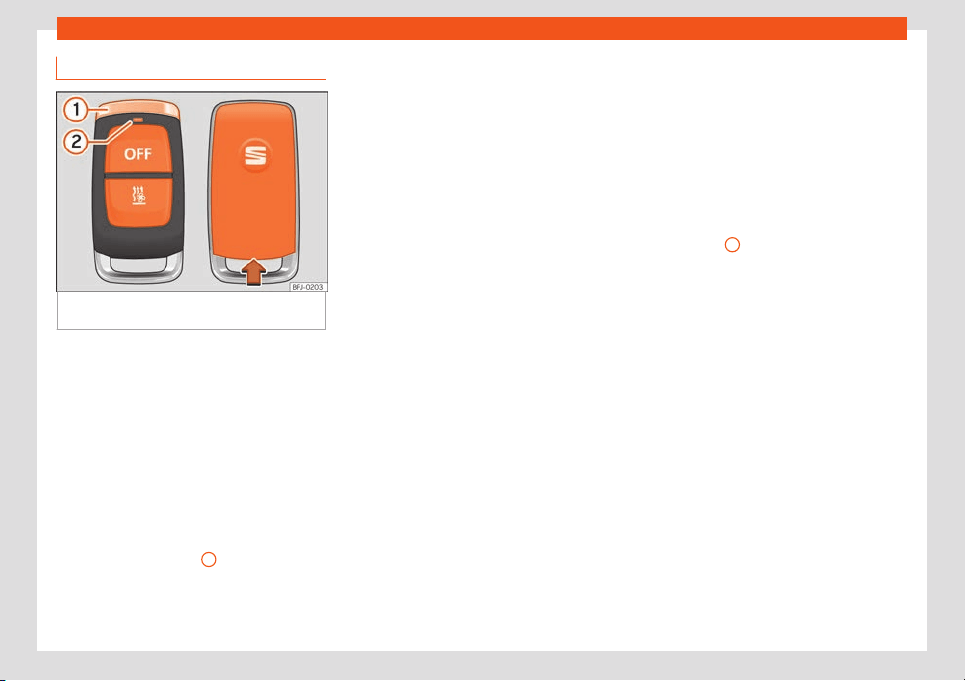
Operation
Radio-operated remote control
Fig. 154
Auxiliary heating: radio-operated re-
mot
e control.
Switch on: Pr
ess the button for about
one second
Switch off: Press the button for about
one second
If the buttons of the remote control are press-
ed unnecessarily, it could switch on the auxili-
ary heater involuntarily, even when it is out of
range or when the control lamp is flashing.
Remote control LED
When the buttons are pressed, the LED of re-
mote control
›››
Fig. 154
2
gives the user a
r
ange of information:
It lights up for approx. 2 seconds
●
In green: The auxiliary heater has been
switched on using the
button.
●
In red: The auxiliary heater has been
switched off con with button .
Flashes slowly for approx. 2 seconds
●
In green: No on signal has been received.
The remote control is out of range. Move
closer to the vehicle.
●
In red: No off signal has been received. The
remote control is out of range. Move closer to
the vehicle.
It flashes irregularly
●
In green: The independent heating is
blocked. Possible causes: the fuel tank is al-
most empty, the 12-volt battery charge is
very low or there is a fault.
It lights up or flashes steadily
●
In orange (then in green or in red): The re-
mote control battery is almost flat. However,
the on or off signal has been received.
●
In orange (then flashes green or red): The
remote control battery is almost flat. No on or
off signal has been received.
Flashes for around 5 seconds
●
In orange: The remote control battery is flat.
No on or off signal has been received.
Range
The range of the remote control is a few hun-
dred meters when the battery is fully charged
and under optimal conditions.
●
A distance of at least 2 m must be left be-
tween the remote control and the vehicle.
●
There should be no obstacle between the
remote control and the vehicle.
●
Secure the remote control with the chrome
pin
›››
Fig. 154
1
vertically facing upwards.
●
Do not cover the antenna.
The r
ange of the control is considerably less
in poor weather conditions, if there are build-
ings in the vicinity or if the battery is low.
Changing the remote control battery
If the indicator lamp does not come on, the
remote control's battery must be replaced.
●
Insert a suitable tool, e.g. a screwdriver, into
the indentation in the remote control housing,
in the direction of the arrow
›››
Fig. 154.
●
With the help of the same tool, lift the lid
until the housing locking element is released.
●
Slightly move the cover in the direction of
the arrow.
●
Remove the cover.
●
To remove the battery, carefully insert a
tool like a screwdriver into the indentation
next to the battery.
170
Air conditioning
●
Use the scr
ewdriver to lift up the battery un-
til it releases from its housing.
●
Remove the old battery.
●
Insert a new battery of the same type and
make sure it clicks into place. When inserting
the battery, make sure that the polarity is cor-
rect.
●
Fit the cover onto the remote control hous-
ing.
●
Slide the cover in the direction opposite to
the arrow until it clicks into place
›››
Fig. 154.
WARNING
Swallowing a battery with a 20 mm diame-
t
er or any other button battery can cause
serious and even fatal injuries within a very
short time.
●
Always keep the remote control, keyrings
with batteries, the spare batteries, button
batteries and all other batteries over 20
mm out of reach of children.
●
If you suspect that someone may have
swallowed a battery, seek immediate med-
ical attention.
CAUTION
●
The r
adio frequency remote control con-
tains electronic components. Therefore,
avoid getting it wet and exposing it to
knocks or direct sunlight.
●
The use of inappropriate batteries may
damage the radio frequency remote con-
trol. For this reason, always replace the
used batt
ery with another of the same volt-
age, size and specifications.
For the sake of the environment
●
Pl
ease dispose of your used batteries
correctly and with respect for the environ-
ment.
●
The remote control battery may contain
perchlorate. Observe the legal provisions
regarding disposal.
●
Care should be taken so as not to oper-
ate the remote control unintentionally so
as to prevent the auxiliary heater being
switched on accidentally.
171
Infotainment system
Infotainment system
Intr
oduction
First steps
Introduction
Infotainment functions and settings depend
on the country and equipment
Bef
ore first use
Before the first use, bear in mind the following
points, to take full advantage of the functions
and settings offered:
●
Observe the basic safety warnings
›
››
page 172.
●
Reset the Infotainment factory settings.
●
Search and store favourite radio stations on
the preset buttons so you can tune them
quickly.
●
Use only suitable audio sources and data
media.
●
Pair a mobile phone to use phone manage-
ment through the Infotainment system.
●
Use current maps for navigation.
●
Register in SEAT CONNECT to run the cor-
responding services.
Current documentation attached
For using infotainment and its components,
take into account, together with this instruc-
tion manual, the following documentation:
●
Supplements to your vehicle’s on-board
documentation.
●
Instruction Manual of the mobile phone de-
vice or audio sources.
●
Operating instructions for data media and
external players.
●
Manuals for the Infotainment accessories
subsequently installed or used additionally.
●
Description of services when running SEAT
CONNECT services.
Safety instructions
Some function areas may include links to
thir
d-party websites. SEAT, S.A. is not the
owner of the third-party websites accessible
through the links, and assumes no liability for
their content.
Some function areas may include outside in-
formation from third-party providers. SEAT,
S.A. is not responsible for such information
being correct, up-to-date or complete, or for
ensuring it does not infringe the rights of third
parties.
Radio stations and owners of data media and
audio sources are responsible for the infor-
mation they transmit.
Bear in mind that parking lots, tunnels, tall
buildings, mountains or due to the operation
of other electrical devices, such as chargers,
can also interfere with the reception of the ra-
dio signal.
Foils or adhesives with metallic layers on the
antenna and on the window panes can inter-
fere with radio reception.
WARNING
The infotainment central computer is inter-
connect
ed with the control units mounted
on the vehicle. Therefore, there is a serious
danger of accident and injury if the central
computer is repaired or disassembled and
reassembled incorrectly.
●
Never replace the central computer with
another used, recycled or from another ve-
hicle at the end of its useful life.
●
The repair or disassembly and reassem-
bly of the central computer should only be
carried out at specialised workshops. SEAT
recommends visiting a SEAT dealership for
this.
WARNING
The factory assembled radio with integra-
t
ed software is interconnected with the
control units mounted on the vehicle.
172

Introduction
Therefore, there is a serious danger of acci-
dent and injury if the r
adio is repaired or
disassembled and reassembled incorrect-
ly.
●
Never replace the radio with another ra-
dio that is used, recycled or from another
vehicle at the end of its useful life.
●
The repair or disassembly and reassem-
bly of the radio should only be carried out
at specialised workshops. SEAT recom-
mends visiting a SEAT dealership for this.
WARNING
Any distraction affecting the driver in any
w
ay can lead to an accident and cause in-
juries. Reading the information on the
screen and managing the infotainment sys-
tem can distract your attention from traffic
and cause an accident.
●
Always drive as carefully and responsibly
as possible.
WARNING
Connecting, inserting or removing an audio
sour
ce or data media while driving can dis-
tract your attention from the traffic and
cause an accident.
WARNING
Select volume settings that allow you to
easily hear signal
s from outside the vehicle
at all times (e.g. emergency services si-
r
ens).
●
Hearing may be impaired if using too high
a volume setting, even if only for short peri-
ods of time.
WARNING
The following circumstances may result in
an emer
gency call, phone call or data
transmission not being made or being inter-
rupted:
●
When in areas with zero or insufficient
mobile telephony or GPS signal. Also in
tunnels, confined areas between very tall
buildings, garages, underpasses, moun-
tains and valleys.
●
When in areas with sufficient mobile
phone or GPS signal, the telephony net-
work of the telecommunications provider
has interference or is not available.
●
When the vehicle components necessary
to make emergency calls, phone calls and
to transmit data are damaged, do not work
or do not have sufficient electrical power.
●
When the battery of the mobile phone
device is discharged or its charge level is
insufficient.
WARNING
In some countries and some telephone net-
w
orks it is only possible to make an emer-
gency call, if a mobile telephone device is
connected to the telephone interface of
the v
ehicle, inside it there is an “unlocked”
SIM card with sufficient balance to make
calls and with sufficient network signal
coverage.
WARNING
Read and observe the operating instruc-
tions pr
ovided by the manufacturer in
question when using mobile phone devices,
data media, external devices, external au-
dio and multimedia sources.
WARNING
Position the connection cables of the audio
sour
ces and external devices so that they
do not interfere with the driver.
WARNING
When changing or connecting an audio or
multimedia sour
ce may cause sudden
changes in the volume.
●
Lower the volume before connecting or
switching to audio or multimedia sources.
WARNING
If mobile phone and radiocommunication
de
vices are used without connection to an
external antenna, the maximum electro-
magnetic radiation levels inside the vehicle
might be surpassed, thus posing a risk to
the health of the driver and passengers.
»
173
Infotainment system
This is also the case if the external antenna
has not been corr
ectly installed.
●
Keep a distance of at least 20 centime-
tres between the antennas of the mobile
phone device and an active medical de-
vice, such as a pacemaker, as mobile
phones might alter the functioning of these
devices.
●
Do not carry a mobile phone switched on
very close or directly on top of an active
medical device, for instance in a chest
pocket.
●
Immediately turn off the mobile phone if
you suspect it is causing interferences in an
active medical device or any other medical
device.
WARNING
Mobile phones, external devices and ac-
cessories that ar
e loose or not properly se-
cured could move around the passenger
compartment during a sudden driving or
braking manoeuvre or an accident and
cause damage or injury.
●
Set mobile phone devices, external devi-
ces and their accessories outside the air-
bag deployment areas or store them se-
curely.
WARNING
The centre armrest may obstruct the driv-
er
's arm movements, which could cause an
accident and severe injuries.
●
Keep the storage compartments of the
centre armrest closed at all times while the
vehicle is in motion.
WARNING
If the light conditions are not good and the
scr
een is damaged or dirty, the indications
and information displayed on the screen
may not be read or be read incorrectly.
●
The indications and information dis-
played on the screen should never induce
to take any risk that compromises safety.
The screen is not a replacement for driver
awareness.
WARNING
Radio stations can transmit disaster or haz-
ar
d announcements. The following condi-
tions prevent such notices from being re-
ceived or issued:
●
When in areas with zero or insufficient ra-
dio signal. Also in tunnels, confined areas
between very tall buildings, garages, un-
derpasses, mountains and valleys.
●
When the frequency bands of the radio
station have interference or are not availa-
ble in areas with sufficient radio signal re-
ception.
●
When the speak
ers and the vehicle com-
ponents necessary for radio reception are
damaged, do not work or do not have suffi-
cient electrical power.
●
When the infotainment is switched off.
WARNING
Switch off mobile phone devices in areas
with a risk of e
xplosion!
WARNING
The driving recommendations and traffic
indications sho
wn on the navigation system
may differ from the current traffic situation.
●
Traffic signs, signalling systems, traffic
regulations and local circumstances pre-
vail over driving recommendations and
navigation system indications.
●
Adapt your speed and driving style to suit
visibility, weather, road and traffic condi-
tions.
●
Certain circumstances can significantly
initially planned lengthen both the duration
of the trip and the route to the destination,
or even temporarily prevent navigation to
it, for example, if a road is closed to traffic.
Note
In areas where special regulations apply or
the use of mobil
e phones is forbidden, the
mobile device in question must be switched
off at all times. The radiation produced by
174
Introduction
a mobile phone device when switched on
may int
erfere with sensitive technical and
medical equipment, possibly resulting in
malfunction or damage to the equipment.
Note
If the playback volume is excessive or dis-
t
orted, the speakers may be damaged.
175
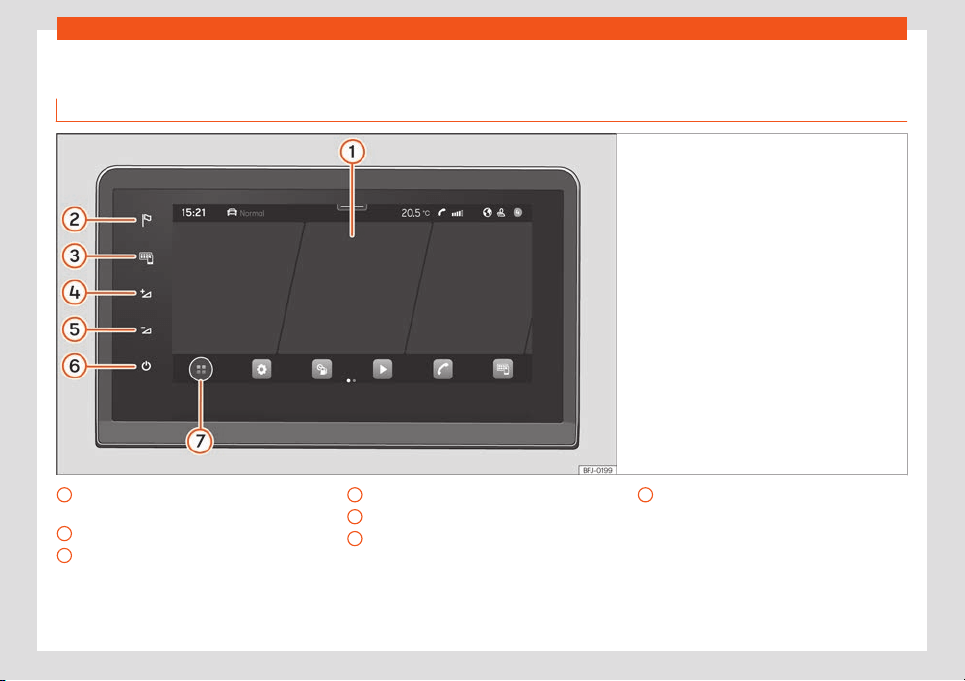
Infotainment system
Overview and controls
Connect Syst
em
Fig. 155
Overview: control unit and indication in
the 9.
2-inch version
Touch screen. The infotainment functions
can be used thr
ough the screen.
Navigation Menu
Full Link menu
1
2
3
Turn volume up
T
urn volume down
Turn the infotainment on/off
4
5
6
HOME button.
: main menu with widget vie
ws.
: main menu in mosaic mode.
7
176
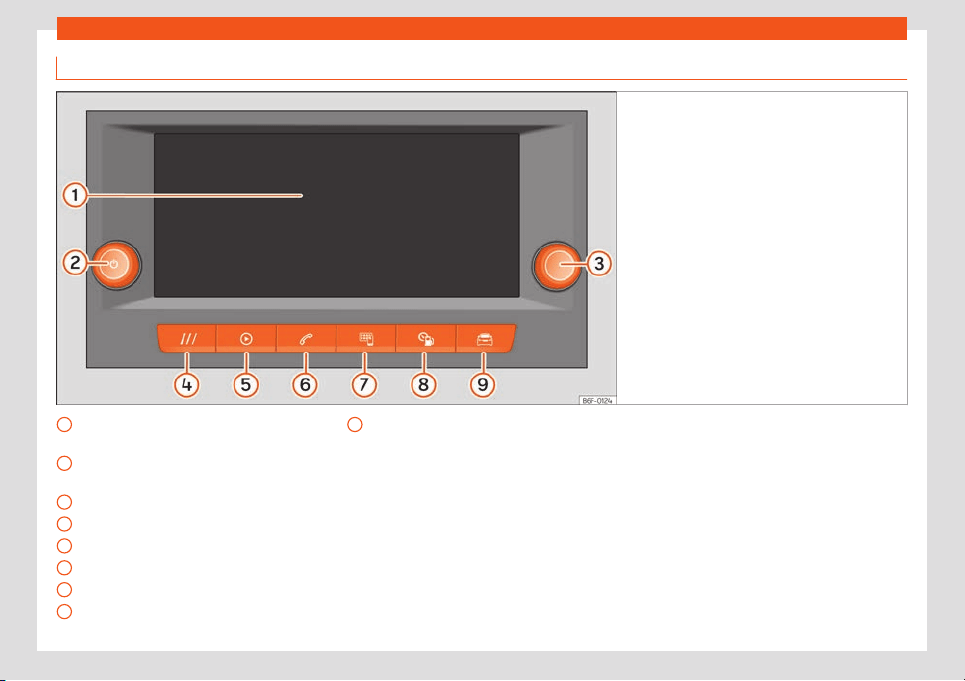
Introduction
Media System
Fig. 156
Overview: control unit and indication in
the 8.
25-inch version
Touch screen. The infotainment functions
can be used thr
ough the screen.
Rotary push button (to adjust the volume
and to switch the infotainment on/off)
Rotary push button (to search and select)
HOME button (to open the home page)
Radio/Multimedia
›››
page 198
Telephone
›››
page 212
Full Link
›››
page 189
Vehicle information
›››
page 90
1
2
3
4
5
6
7
8
Vehicle settings
›
››
page 91
9
177
Infotainment system
General instructions for use
Oper
ating indications
●
The infotainment needs a few seconds for
the compl
ete start-up of the system and dur-
ing that time it does not react to inputs. Only
the image of the rear view camera system
can be displayed during system start-up.
●
The display of all indications and the exe-
cution of functions only takes place once the
infotainment system has finished booting. The
duration of the system booting depends on
the number of infotainment functions and
may take longer than normal in the event of
very high or very low temperatures.
●
When using the infotainment system and
corr
esponding accessories, e.g., head-
phones, bear in mind country-specific regu-
lations and legal provisions.
●
Some functions of the infotainment system
require an active SEAT CONNECT user ac-
count and an Internet connection for the ve-
hicle. The data transmission must not be limi-
ted to perform the functions.
●
To use the infotainment system, simply
lightly press a button or touch the screen.
●
For the correct operation of the infotain-
ment system it is important that it is switched
on and that, if necessary, the time and date
of the vehicle are set correctly.
●
If a function button is missing on the screen,
it is not a device defect, but corresponds to
the specific equipment of the country or ver-
sion.
●
Some infotainment functions can only be
selected when the vehicle is at a standstill. In
some countries, the selector lever must also
be in the parking position P or in neutral posi-
tion N. It is not a malfunction, but is due to
compliance with legal provisions.
●
Restrictions on the use of devices using
Bluetooth® technology may apply in some
countries. For further information, contact the
local authorities.
●
If you disconnect the 12-volt battery, turn
on the ignition before restarting the infotain-
ment system.
●
If the setup is changed, this may change
the display on the screen and in some cases,
the infotainment system may behave in a
manner different to that described in this in-
struction manual.
●
Ensure that any repairs or modifications
that need to be carried out on the infotain-
ment system are carried out by a specialised
workshop. SEAT recommends visiting a SEAT
dealership for this.
●
Using a mobile phone device inside the ve-
hicle may cause noise in the speakers.
●
In some countries, the infotainment system
automatically shuts off when the engine is
switched off and the vehicle's 12-volt battery
charge level is low.
●
On vehicles with park assist, the audio
source volume is automatically lowered when
reverse gear is selected, as well as when the
doors are opened. The volume reduction can
be adjusted.
●
Information about the included software
and the license conditions can be found in
Settings > Copyright.
●
When selling or lending the vehicle, make
sure that all saved data, files and settings
have been deleted and, if necessary, external
audio sources and data media have been re-
moved.
Note
You will find more information and tips for
using the inf
otainment system in the Help
menu.
HOME screen
In the control and display unit you can set up
the vie
ws and representation on the home
screen or use the factory setting templates.
If an icon is missing on the screen, it is not a
device defect, but corresponds to the specific
equipment of the country or version.
The following menus can be included as an
icon on the home screen:
178
Introduction
Main menus on the home screen
Navigation
›
››
page 205
Radio
›››
page 198, Multimedia
›››
page 202
Telephone
›››
page 212
Full Link
›››
page 189
Setup
›››
page 180
Vehicle
›››
page 91
Data
›››
page 90
Air conditioning
›››
page 157
Sound
Users
Store
Legal
Help
Managing the infotainment system
Execute the functions and settings with the in-
f
otainment controls.
Depending on the equipment, the infotain-
ment syst
em has different controls:
●
Touch screen.
●
Off-screen sensor fields.
Help Menu
This menu displays information on the opera-
tion of the infotainment system and gives
practical tips.
●
Press Help.
Connecting and disconnecting the info-
tainment system
The infotainment system turns on when the
ignition is switched on, unless it has been
manually turned off beforehand.
The infotainment system starts-up with the
last set volume, provided that this does not
exceed the preset maximum start-up volume.
The infotainment system automatically turns
off when the driver's door is opened, provided
the ignition has been switched off before-
hand.
Moving objects and adjusting volume
Move objects on the screen to adapt settings,
for example, with scrollable buttons or to
move the areas of a menu.
Depending on the equipment, customise me-
nus and views.
Increasing and reducing images or map
sizes
Tip: use your thumb and index finger.
●
Press on the map with both fingers at the
same time and leave them on the screen.
●
To enlarge views, slowly separate one fin-
ger from the other. To reduce views, slowly
bring one finger towards the other.
Note
If you turn on the infotainment system man-
ually with the ignition off
, it will automati-
cally turn off after about 30 minutes.
Customising the infotainment sys-
t
em
Customise the menus and infotainment views
t
o quickly access your favourite or most fre-
quently used functions.
The main menu contains function buttons for
accessing all of the Infotainment apps.
Customise shortcuts
At the bottom of the screen you will find
shortcuts to customisable system functions.
Use the settings to delete or replace them, or
change their order.
»
179
Infotainment system
●
Pr
ess and hold one of the icons (or press +
of an empty position) to display an additional
window.
●
Select one of the icons from the apps bar.
●
Press to delete an icon.
●
Click on an icon in the additional window to
replace the value.
●
Hold your finger on one of the icons and
drag it to the desired position.
●
To close the edit mode, press in the addi-
tional window, or press .
Note
The shortcut bar cannot be edited when
the v
ehicle is moving.
Settings (system and sound)
The selection of possible settings varies de-
pending on the country, the equipment in
question and the equipment of the v
ehicle.
Modifying settings
The meaning of the following symbols are
valid for all system and sound settings.
All changes are automatically applied when
the menus are closed.
Symbol and its meaning
/
The setting is selected and activated or
connect
ed.
/
The setting is not selected, disabled or
disconnect
ed.
To open a drop-down list.
To increase a setting value.
To increase a setting value.
To go back step by step.
To go forward step by step.
To change a setting value with the
scr
ollable button without adjusting.
Sound settings
Accessing the sound settings: pr
ess Sound
In the sound settings there may be the follow-
ing functions, information and setting options:
●
Equaliser.
●
Position.
●
Settings.
System settings
Accessing the system settings: press Set-
tings.
In the system settings there may be the fol-
lowing functions, information and setting op-
tions:
●
Screen.
●
Time and date.
●
Language.
●
Additional keypad languages.
●
Units.
●
Voice control.
●
Wi-Fi.
●
Data connection.
●
Manage mobile devices.
●
Reset factory settings.
●
System information.
●
Copyright.
●
Configuration wizard.
Adjust the volume of external audio sour-
ces
If you need to increase the playback volume
for the external audio source, first lower the
volume on the infotainment system.
If the sound from the connected audio source
is very low, increase the output volume on
the external audio source. If this is not
enough, change the input volume to medi-
um or high.
180
Introduction
If the sound from the connected external au-
dio sour
ce is too loud or distorted, lower the
output volume on the external audio source.
If this is not enough, change the input vol-
ume to medium or low.
Clean the screen
Remove persistent dirt carefully and without
using aggr
essive cleaning products. To clean
the screen we recommend that:
●
The infotainment system is switched off.
●
Use a clean, soft cloth dampened with wa-
t
er
›››
page 367.
●
In case of persistent dirt: soften the dirt by
moistening with a little water. Then carefully
remove with a clean, soft cloth.
CAUTION
Cleaning the screen with inappropriate
cl
eaning products or when dry, may dam-
age it.
●
When cleaning, only press lightly.
●
Do not use aggressive cleaning products
or that contain solvents. Such products
may damage the equipment and “darken”
the screen.
Trademarks, licenses and copy-
rights
Registered trademarks and licenses
Cert
ain terms in this manual bear the symbol
® or ™. These symbols indicate that it is a
trademark or a registered trademark. The ab-
sence of this symbol, however, does not nec-
essarily mean that the term in question can
be used freely.
Other product names are registered trade-
marks or trademarks of the respective rights
holders.
●
Manufactured under license from Dolby
L
aboratories. Dolby and the double-D sym-
bol are trademarks of Dolby Laboratories.
●
Manufactured under license from Dolby
Laboratories. Dolby and the double-D sym-
bol are trademarks of Dolby Laboratories.
●
Android Auto™ is a trademark of Google Inc.
●
Apple CarPlay™ is a trademark of Apple
Inc.
●
Bluetooth® is a registered trademark of
Bluetooth® SIG, Inc.iPod®, iPad® and
iPhone® are trademarks of Apple Inc.
●
MirrorLink™ and MirrorLink Logo are certi-
fied trademarks of Car Connectivity Consor-
tium LLC.
●
Windows® is a registered trademark of Mi-
crosoft Corporation, Redmond, USA.
●
MPEG-4 HE-AAC audio coding technology
and patents are licensed by Fraunhofer IIS.
●
This product is protected by certain Micro-
soft Corporation industrial and intellectual
property rights. The use or commercialization
of technology of this type outside the config-
uration of this product, without a licence from
Microsoft or an authorised Microsoft branch
is prohibited.
Copyright
As a general rule, audio and video files stored
on data media and audio sources are subject
to intellectual property protection in accord-
ance with the national and international pro-
visions applicable in each case. Please bear
in mind all legal provisions!
Technical data
Radio with integrated hardware (8.25 ")
1)
The f
actory-mounted radio in the vehicle with
integrated hardware includes country-specif-
ic components and software for connectivity
and for the execution of vehicle, comfort and
infotainment functions.
»
1)
Equipment name: Media System
181

Infotainment system
The corresponding indications are shown on
the r
adio screen and partly on the instrument
panel.
■
Capacitive colour screen:
■
8.25 inch version, TFT, WVGA: 1082 x 480
pixels.
■
Touch operation via the device screen, ro-
tary push-button, menu button and buttons
on the multifunction steering wheel.
Central computer with control and display
unit (9,2”)
1)
The factory-mounted central computer in the
vehicle includes country-specific compo-
nents and software for connectivity and for
the execution of vehicle, comfort and infotain-
ment functions.
The corresponding indications are shown on
the control and display unit screen and partly
on the instrument panel.
■
Capacitive colour screen:
■
Using the equipment with:
■
Touch zones Touch operation.
■
Buttons on the multifunction steering
wheel.
■
Approach sensors (driver and passenger
side recognition, gesture control).
Vehicle and comfort functions
■
Driver assistance system settings.
■
Heating and air conditioning settings.
■
Lights and visibility function settings.
■
Vehicle comfort settings.
■
Parking and manoeuvring settings.
Sound system
Basic equipment:
The inf
otainment system that is supplied from
the factory is equipped as follows:
■
Speakers in different locations and with dif-
ferent power levels (watts).
■
Internal amplifier depending on the system:
■
8 speakers: 4 x 20 W
■
Setting options:
■
Equaliser, depending on the system:
■
8 speakers: 5 frequency bands or pre-
defined settings.
■
Sound distribution, depending on the sys-
tem:
■
8 speakers: Balance + Fader (left /
right / front / rear).
■
Sound optimisation by zones (valid for the
8 speaker system):
■
Manual (Driver and All)
■
Aut
omatic depending on the seats oc-
cupied.
Optional sound system
The infotainment system can be extended
with an optional sound system as follows:
■
10 speakers in different locations and with
different power levels (watts).
■
External amplifier (400 W Ethernet) that
processes the audio signals sent by the
central computer.
■
Excitation of speaker channels through
class AB final stages.
■
Audio signal processing in digital internal
signal processor (DSP).
■
Independent subwoofer in the luggage
compartment.
■
Setting options:
■
User equaliser: 5 bands.
■
Sound distribution: Balance + Fader (left /
right / front / rear).
■
Sound optimisation by zones:
■
Manual (Driver, Front and All)
■
Subwoofer volume.
■
Surround settings.
1)
Equipment name: Connect System.
182

Introduction
Connectivity
Wi-Fi
■
Wi-Fi conf
orming to IEEE 802.11 b/g/n
■
2.4 GHz and 5 GHz transfer (depending on
the country)
■
Apple CarPlay and Android Auto over Wi-Fi.
■
Simultaneous connection of up to 8 Wi-Fi
devices.
■
Media System:
■
5GHz access point for Full Link Wireless
only
■
Connect System:
■
Access point
■
Tethering
■
Pairing process simplified by WPS or QR
code
Bluetooth® profiles
There can be a maximum of two mobile devi-
ces connected to the Bluetooth® hands-free
and a third device connected to the Blue-
tooth® as a music player.
When a mobile phone is connected to the tel-
ephone management system, a data ex-
change takes place via one of the Bluetooth®
profiles.
●
Hands-free telephone profile (HFP): the
HFP can be used t
o manage calls through the
infotainment system.
●
Audio profile (A2DP): This profile allows
audio to be transmitted with stereo quality. It
may require connecting other profiles for
managing and controlling playback.
●
Phone book access profile (PBAP): Allows
phone book contents to be downloaded from
the mobile telephone.
●
Message profile (MAP): It allows short
messages (SMS) and emails to be downloa-
ded and synchronised.
183
Infotainment system
Data transfer
SEAT CONNEC
T
Introduction
To use it, SEAT CONNECT must first be activa-
t
ed online by entering into a SEAT CONNECT
contract with SEAT, S.A. and is subject to a
temporary use limitation depending on the
country.
Both the SEAT CONNECT service portfolios
offered by SEAT and individual services can
be modified, cancelled, deactivated, reacti-
vated, renamed and extended, even without
prior notification.
In https://my.seat you can create the user
account, see the description of services and
more information.
The execution and availability of the SEAT
CONNECT services and service portfolios
may vary depending on the country, as well
as the vehicle, its equipment and connectivi-
ty.
Connectivity statuses
(whit
e)
Full connectivity, all services active
(gr
ey)
Limited connectivity, some services
may not be av
ailable.
no icon
No connectivity, no services availa-
bl
e.
SEAT CONNECT's voice recognition or search
t
echnology does not recognise or offer re-
sults for all words.
There are SEAT CONNECT services for which
registration is mandatory and others for
which it is not mandatory.
Description of services
Before running SEAT CONNECT services,
read and take into account the description of
the corresponding services. Descriptions are
updated non-periodically and are available
online at https://my.seat.
●
Always use the most up-to-date version of
the corr
esponding service description.
WARNING
In areas with insufficient mobile phone and
GPS co
verage, neither emergency calls or
phone calls can be made, and data cannot
be transmitted. Change location if possi-
ble.
CAUTION
The vehicle may be damaged by factors
outside the contr
ol of SEAT, S.A. These
damaged can include:
●
Misuse of mobile terminals
●
Data loss during transmission.
●
Unsuitable or defective third party appli-
cations.
●
Malicious software on data storage devi-
ces, computers, tablets or mobile phones.
Services portfolio
The initial service allocation shown here cor-
r
esponds to the third generation of SEAT
CONNECT services and represents the maxi-
mum services portfolio. The maximum possi-
ble portfolio is only available on some vehicle
models. During the useful life of the vehicle,
you can change the assignment shown here.
After activating the services management in
the infotainment system you can check if the
vehicle has services and what they are.
In some countries and in the event of a con-
tract renewal, the services offered may be
combined differently than indicated here.
They may also vary depending on the year of
production of the vehicle. The services men-
tioned correspond to the third generation of
SEAT CONNECT.
184
Data transfer
SEAT CONNECT services and functions
that do not r
equire activation
The following services also work without the
activation of SEAT CONNECT:
●
Public emergency call service.
●
Privacy mode.
●
Legal.
SEAT CONNECT services
The SEAT CONNECT services are:
●
Private emergency call
●
Public emergency call
●
Roadside assistance call
●
Customer support
●
Service appointment planning
●
Online system update
●
Customisation
●
Activating SEAT CONNECT
●
Private mode (deactivation of services)
●
Delete user / Reset factory settings
●
Remote opening
●
Horn and turn signals
●
Vehicle status incl. doors and lights
●
Driving data
●
Vehicle status report
●
Anti-theft alarm warning
●
Zone warning
●
Speed warning
●
Online map update
●
Search for points of interest
●
Petrol stations
●
Online traffic information
●
Parking lots
●
Online infotainment system update
●
Online route calculation
●
Information on risks
●
Dictation
●
Natural voice control for destinations and
addresses
●
Online radio
●
Online media
●
Online route import
●
Online destination import
●
Remote auxiliary ventilation
●
Parking position
●
Privacy mode
●
Legal
SEAT CONNECT services for hybrid vehi-
cles
Available only in electric and hybrid vehicles.
●
Remote air conditioning
●
Electrical power manager
●
Departure times
●
plus all SEAT CONNECT services in the pre-
vious section
›››
page 185.
SEAT CONNECT individual options
●
In-Car Applications. These applications
can be purchased and installed directly in
the infotainment system through the In-Car
store.
●
Full Link.
●
Data package. Pay per use data rates for
the use of online functions, for example, 2 GB
per month.
Note
●
The public emer
gency call service is
available regardless of whether the info-
tainment system is logged in.
●
Customisation and purchase of In-Car
applications require logging into infotain-
ment system, but the activation of the vehi-
cle in a SEAT CONNECT account is not nec-
essary.
Activation of SEAT CONNECT and S-
PIN
Activating SEAT CONNECT
The f
ollowing steps are necessary for the ac-
tivation of SEAT CONNECT (including regis-
tration):
»
185
Infotainment system
●
Cr
eate a user account at https://my.seat or
directly through the infotainment system in
the User Management menu.
●
Place the SEAT CONNECT order and acti-
vate it.
●
Add the vehicle to your user account.
●
Prove ownership.
●
Prove your identity. It is only necessary if
you are to run SEAT CONNECT services rele-
vant to security.
●
You can activate it at https://my.seat or di-
rectly through the infotainment system. To
activate it through the infotainment system,
proceed as follows:
HOME > Manage users > Become pri-
mary user.
MENU > Settings > SEAT Connect >
Register
Follow the rest of the indications and the in-
formation shown in the infotainment system.
During activation, you may be asked to cre-
ate an S-PIN.
Update option
9.2” Infotainment yes
8.25” Infotainment yes
SEAT CONNECT portal yes
SEAT CONNECT application yes
9.2"
8.25"
More information at https://my.seat/faqs.
S-PIN
The S-PIN is a sequence of se
veral digits,
which can be selected when completed the
SEAT CONNECT registration.
When creating the S-PIN, avoid easy-to-
guess number sequences and known dates
of birth. You can change the S-PIN in the SEAT
CONNECT user account in “Account set-
tings”.
The S-PIN is necessary, for example, to pro-
tect your user profile or to run a SEAT CON-
NECT service relevant to the security of your
vehicle.
You must manage this S-PIN with absolute
confidentiality. If you reveal the S-PIN to third
parties, for security reasons you must change
it immediately.
Ownership and identity accredita-
tion
Depending on the Infotainment system, the
o
wnership accreditation method will be the
2-key method or the registration code meth-
od.
9.2” Infotainment system
To become a main user and thus prove own-
ership of the vehicle, you need both of the ve-
hicle’s physical keys. Ownership accredita-
tion takes place in the vehicle during registra-
tion or, if you already have a SEAT CONNECT
user account, you must log in through the in-
fotainment system and then go to Manage
users
●
Switch on the ignition and the infotainment
system.
●
In the infotainment system, register in SEAT
CONNECT.
●
Or: open the menu Manage users > Set-
tings > Become primary user and follow the
instructions.
●
Press the unlock button on the first vehicle
key.
●
Press the unlock button on the second vehi-
cle key.
8.25” Infotainment system
To become the main user and therefore ac-
credit ownership of the vehicle, you will need
the registration code found on the SEAT Web
Portal and in the APP after linking the vehicle
to your account (My Garage > Add Vehicle
> Accept terms and conditions and SEAT
privacy policy). Ownership is accredited in-
side the vehicle. Go to Vehicle settings >
SEAT CONNECT > Registration and enter
186
Data transfer
the registration code shown on the Web Por-
t
al or in the App.
Once the infotainment system has processed
the orders by radiofrequency, the accredita-
tion of the ownership will have been comple-
ted. You can control the current status in the
SEAT CONNECT portal.
How is ownership accredited?
9.2” Infotainment 2-Key method.
8.25” Infotainment Registration code
SEAT CONNECT portal No, it is not possible
SEAT CONNECT appli-
cation
No, it is not possible
Identity accreditation (SEAT Ident)
Identit
y accreditation must be done before
you can use SEAT CONNECT services that
are relevant to security, such as the “Remote
Opening” service. Identity accreditation can
be done in two ways:
●
In person at the SEAT dealership.
●
You can find more information about SEAT
Ident on the SEAT CONNECT portal at
https://my.seat.
Legal provisions
During the use of SEAT CONNECT services,
inf
ormation is transferred and processed on-
line through the vehicle. Such data can also
provide (at least indirectly) information about
the driver in question, for example, driving be-
haviour and location. As a contracting party
in the SEAT CONNECT contract with SEAT,
S.A., you must ensure that when your vehicle
is used by other drivers (for example, family or
friends), data protection and personal rights
are respected. Therefore, you must inform
drivers in advance that the vehicle transfers
and receives data online, and that you can
access such data.
Not taking into account this obligation to in-
form, can infringe certain rights of the occu-
pants.
Users can manage data sending and trans-
fers through the privacy mode at any time.
More information at: https://my.seat/faq.
Follow-up services: ask all occupants
The follow-up services need geographical
and vehicle data to determine whether the
vehicle is being used within defined speed
ranges, where it has been parked or if it is be-
ing used in an established geographical area.
This information is displayed on the SEAT
CONNECT portal and in the SEAT CONNECT
app.
Therefore, before moving off, ask all the vehi-
cl
e occupants if they agree with the activa-
ted services. If they do not, deactivate the
service in question (if possible) or do not al-
low the occupants to use the vehicle.
GPS tracking: marking
If the vehicle has a factory-assembled con-
trol unit that transmits the its current geo-
graphical position and speed, the vehicle
usually has this GPS marking (e.g., on the roof
console). The absence of the marking on the
vehicle does not guarantee that the control
unit does not transmit the vehicle’s current
geographical position and speed.
Personal information
SEAT protects your personal data and only
uses them, as long as the law allows it or you
have given your consent on the occasion of a
use. You will find detailed information on data
processing in relation to SEAT CONNECT
services in the Privacy Policy, which you can
access in its corresponding current version
on the SEAT website.
Permanent transfer of the vehicle
If another person has left you the vehicle for
permanent use (for example, if you buy a
used vehicle), SEAT CONNECT may already
be activated and the previous user still has
»
187

Infotainment system
the possibility of accessing the data regis-
t
ered through SEAT CONNECT and control
certain functions of your vehicle.
In the infotainment system you can check if
your vehicle is assigned to a person as the
main user. In this case, you can register your-
self as the main user of the vehicle and thus
automatically delete the previous main user.
Alternatively, through the infotainment sys-
tem you can directly and permanently delete
the previous user as the main user, as well as
put the vehicle in offline mode and thus limit
both the communication of your vehicle with
the SEAT, S.A. data server and the processing
of personal and vehicle data.
Deactivating SEAT CONNECT serv-
ices
The following functions are available in the
inf
otainment system to deactivate and acti-
vate SEAT CONNECT services:
●
Central deactivation or activation
●
Individual deactivation or activation
You can rerun the corresponding services af-
ter cancelling their deactivation in the info-
tainment system.
Note
The services required by law and their data
tr
ansmission, such as the public emergen-
cy call system, cannot be disconnected or
deactivated.
Faults
Even if the prerequisites for the use of SEAT
CONNEC
T services are met, there may be
factors beyond the control of SEAT, S.A. that
interfere with the execution of such services
or prevent them. These may be specifically:
●
Maintenance, repair, deactivation, software
updat
e and technical expansion of telecom-
munication equipment, satellites, servers and
data banks.
●
Change of the mobile telephony standard
for the transmission of mobile data by the tel-
ecommunications service provider, for exam-
ple, from UMTS to EDGE or GPRS.
●
Disconnection of an existing mobile phone
standard by the telecommunications service
provider.
●
Interference, disturbance or interruption in
the reception of the mobile phone and GPS
signal due to aspects such as high-speed
driving, solar storms, meteorological influen-
ces, topography, blocking equipment and the
intensive use of mobile phones in the radio
cells in question.
●
When in areas with zero or insufficient mo-
bile telephony or GPS signal. Also, for exam-
ple, in tunnels, confined areas between very
tall buildings, garages, underpasses, moun-
tains and valleys.
●
External information from third party sup-
plies available with limitations, incomplete or
incorrect, e.g. representations of maps.
●
Countries and regions where SEAT CON-
NECT is not offered.
Service management
Open the settings in Users and go t
o Privacy
settings and services. In vehicles equipped
with the 9.2” Infotainment, it is accessed from
Users > Settings > Private Mode (deactiva-
tion of services). In vehicles equipped with
the 8.25” Infotainment it is accessed from
Settings > SEAT Connect > Privacy set-
tings and services.
●
Check which SEAT CONNECT services are
currently available in the vehicle.
●
The number of SEAT CONNECT services
that are enabled or disabled.
●
Activate or deactivate SEAT CONNECT
services.
More information at https://my.seat.
188
Data transfer
Privacy and Services Settings
SEAT CONNEC
T services can be activated
and deactivated individually. To do this, just
check the box corresponding to the service
you want to activate or deactivate. Use the
privacy mode option if you want to deacti-
vate all of the services at the same time.
Privacy mode
Allows you to deactivate or activate the serv-
ices depending on the selected privacy level.
T
racking
Share location. Main users and co-
users can vie
w position data on the
SEAT CONNECT portal or app.
L
ocation
Use location. P
osition, vehicle, and
user data are used for services.
P
ersonal
No location. Only the v
ehicle data
and user data are used for services.
Incognit
o
Maximum privacy. Y
our services are
disabled. Only services required for
legal reasons use data.
Setting options are not available in all mar-
k
ets or in all vehicle models.
Note
If you deactivate each and every SEAT
CONNEC
T service, the OCU may continue
to transmit data.
Full Link
Intr
oduction
With Full Link it is possible to view and use the
cont
ents and functions that are shown on the
mobile phone device on the infotainment
screen.
To do this, the mobile phone device must be
connected with the infotainment system
through a USB interface.
Some technologies can also be used by
Wireless Full Link through the Bluetooth® in-
terface and a Wi-Fi connection.
The following technologies may be availa-
ble:
●
Apple CarPlay™
●
Android Auto™
●
MirrorLink®
The av
ailability of the technologies that Full
Link includes depends on the country and the
mobile phone device used.
You will find more information on the SEAT
website (www.seat.com).
Access the Full Link main menu
Browsing the Full Link main menu depends on
the infotainment system used.
●
Click on Full Link.
Configure Wireless Full Link
In order to use Wireless Full Link, you must first
pair the mobile phone device with the info-
tainment system. To do this, proceed as fol-
lows:
Connect a mobile phone device for the first
time.
●
Unlock the mobile phone device.
●
Enable Wi-Fi reception and Bluetooth® on
the mobile phone device.
●
Connect the mobile phone device to the in-
fotainment system using a USB cable or via
Bluetooth®.
●
Access the Full Link main menu, unless it
appears automatically.
●
Select the mobile phone device and the
technology you want.
●
Confirm authorisation inquiries on the mo-
bile phone device to grant the necessary au-
thorisations to the infotainment system.
●
Disconnect the USB connection and con-
nect with the infotainment system again via
Wi-Fi or Bluetooth®. Wireless Full Link is now
configured.
The pairing has concluded. The connected
mobile phone device can also use Wireless
Full Link from now on without the USB con-
nection.
»
189
Infotainment system
If pop-up menus are rejected during the con-
nection pr
ocess, Wireless Full Link will not be
available. In this case, SEAT recommends de-
leting the devices in both the telephone set-
tings and the infotainment system, and re-
starting the connection process.
WARNING
The use of applications while driving can
distr
act your attention from the traffic. Any
distraction affecting the driver in any way
can lead to an accident and cause injuries.
●
Always drive as carefully and responsibly
as possible.
WARNING
Any applications that are not suitable or
e
xecute incorrectly may cause damage to
the vehicle, accidents and serious injuries.
●
Protect the mobile phone device and its
applications from inappropriate use.
●
Never carry out modifications to the ap-
plications.
●
Follow instructions in the instruction
manual for the mobile phone device.
CAUTION
SEAT cannot be held liable for any damage
caused t
o the vehicle as a result of the use
of applications that are of poor quality or
are defective, the inadequate program-
ming of the applications, the insufficient
coverage of the network, the loss of data
during tr
ansmission or the improper use of
mobile phone devices.
Note
●
Wir
eless Full Link may not be compatible
with all technologies.
●
Wireless Full Link (Android Auto ™ and Ap-
ple CarPlay ™) is disabled in countries
whose radio frequency regulations do not
allow it to operate.
Applications (apps)
With SEAT Full Link, the display of the con-
t
ents of SEAT applications and other provid-
ers installed on mobile phone devices can be
transferred to the infotainment screen.
In the case of third-party applications, there
may be compatibility problems.
Applications, their use and the necessary
mobile phone connection may be pay per
use.
The offer of applications can be varied and
designed for a vehicle or a specific country.
The content and volume of applications, as
well as the companies that offer them, may
vary. Some applications also depend on the
availability of third-party services.
It cannot be guaranteed that all the applica-
tions offered will work on all mobile phone
devices or with all their operating systems.
The applications offered by SEAT can be
modified, cancelled, deactivated, reactivated
and extended without prior notification.
To avoid distracting the driver while driving,
only certified applications can be used.
Full Link symbols and settings
To show more information
T
o open the Full Link settings menu
To select Apple CarPlay technology.
To select Android Auto™ technology.
To select Mirror Link® technology.
Apple CarPlay™
In order to use Apple CarPlay, the following
r
equirements must be met:
●
The iPhone™ must be compatible with Ap-
ple CarPlay™.
●
Voice control (Siri ™) must be active on the
iPhone™.
●
Apple CarPlay™ must be active without
limitations in the iPhone™ settings.
190
Data transfer
●
The iPhone ™ must be connect
ed to the in-
fotainment system via a USB connection. On-
ly USB connections with data transmission
are suitable for the use of Apple CarPlay™.
●
The USB cable used must be an original
Apple™ cable.
Apple CarPlay™ Wireless: Bluetooth® and
Wi-Fi must also be activate on the iPhone™.
Establish connection
When you first connect an iPhone™, follow
the instructions on the infotainment system
screen and on the iPhone ™.
The requirements must be met to use Apple
CarPlay™.
Launch Apple CarPlay™:
●
Press Full Link to access the Full Link
main menu.
●
Press Apple CarPlay™ to establish a con-
nection with the iPhone™.
Disconnecting
●
On the Apple CarPlay™ mode, press the
SEAT icon to access the Full Link main menu.
●
Press to interrupt the active connection.
The representation of function buttons on the
screen may vary.
Special characteristics
During an active Apple CarPlay™ connection,
the following characteristics are applicable:
●
Bluetooth® connections between the
iPhone™ and the infotainment system are not
possible.
●
If there is an active Bluetooth® connection,
it is automatically interrupted.
●
The phone functions are only available
through Apple CarPlay™. The functions de-
scribed for the Infotainment system are not
available.
●
The connected iPhone™ cannot be used as
a multimedia device in the Media main menu.
●
It is not possible to use the built-in naviga-
tion system and the Apple CarPlay™ naviga-
tion system at the same time. The last route
started interrupts the one that was previously
active.
●
Depending on the infotainment system you
use, on the instrument panel screen you can
view data from the Telephone and Media
mode.
●
With the multifunction steering wheel you
can accept or reject incoming calls, as well
as end an ongoing telephone conversation.
Voice control
●
Press briefly to start voice control using
the infotainment system.
●
Press this button for a long time to start
voice control (Siri™) of the connected
iPhone™.
Note
●
The av
ailability of technologies depends
on the country and may vary.
●
You will find information about technical
requirements, compatible iPhones, certi-
fied applications and their availability on
the SEAT (www.seat.com) and Apple Car-
Play ™ websites, or at SEAT dealerships.
Android Auto™
Requirements for Android Auto™
In or
der to use Android Auto™, the following
requirements must be met:
●
The mobile phone device, called smart-
phone from here on, has to be compatible
with Android Auto™.
●
The smartphone must have an Android Au-
to™ application installed.
●
The smartphone has to be connected
through the USB connection with data trans-
mission with the infotainment system.
●
The USB cable used must be an original ca-
ble provided by the smartphone manufactur-
er.
»
191
Infotainment system
Android Auto™ Wireless: Bluet
ooth® and Wi-Fi
also have to be activated on the device.
Establish connection
When you first connect a smartphone, follow
the instructions on the infotainment system
screen and on the smartphone.
The requirements must be met to use Android
Auto™.
Launch Android Auto™:
●
Press Full Link to access the Full link
main menu
●
Press Android Auto™ to establish a connec-
tion with the smartphone.
Disconnecting
●
In Android Auto™ mode, press the Exit/SEAT
icon to access the Full Link main menu.
●
Press to interrupt the active connection.
Special characteristics
During an active Android Auto™ connection,
the following characteristics are applicable:
●
An active Android Auto™ device can be
connected at the same time via Bluetooth®
(HFP profile) with the infotainment system.
●
It is possible to use the phone’s functions
through Android Auto™. If the Android Auto™
device is connected at the same time via
Bluetooth® with the infotainment system, the
telephone function of the infotainment can
also be used.
●
An active Android Auto™ device cannot be
used as a multimedia device in the Media
main menu.
●
It is not possible to use the built-in naviga-
tion system and the Android Auto™ navigation
system at the same time. The last route star-
ted interrupts the one that was previously ac-
tive.
●
On the instrument panel screen you can
view data from the Telephone and Media
mode.
●
With the multifunction steering wheel you
can accept or reject incoming calls, as well
as end an ongoing telephone conversation.
voice control
●
Press briefly to start voice control using
the infotainment system.
●
Press and hold this button to start voice
control (Google Assistant) on the connected
smartphone.
Note
●
The av
ailability of technologies depends
on the country and may vary.
●
You will find information about technical
requirements, compatible mobile phone
devices, certified applications and their
availability on the SEAT (www.seat.com)
and Android Auto™ websites, or at SEAT
deal
erships.
MirrorLink®
Requirements for MirrorLink®
In or
der to use MirrorLink™, the following re-
quirements must be met:
●
The mobile device must be compatible with
MirrorLink™.
●
The mobile phone device must be connec-
t
ed to the infotainment system via a USB con-
nection that is suitable for data transmission.
●
The USB cable used must be an original ca-
ble provided by the mobile phone device
manufacturer.
●
Depending on the mobile phone device
used, a Car-Mode application that is suitable
for using MirrorLink® must be installed.
Establish connection
When you first connect a mobile phone de-
vice, follow the instructions on the infotain-
ment system screen and on the mobile phone
device.
The requirements must be met to use Mirror-
Link™.
192
Data transfer
Launch MirrorLink®:
●
Press Full Link t
o access the Full Link
main menu.
●
Press to establish the connection with the
mobile phone device.
Disconnecting
●
In the MirrorLink® mode, press the APP icon
to access the Full Link main menu.
●
OR: press to access the MirrorLink® main
menu.
●
Press to interrupt the active connection.
Special characteristics
During an active MirrorLink® connection, the
following characteristics are applicable:
●
An active MirrorLink® device can be con-
nected to the infotainment system at the
same time via Bluetooth®.
●
If the MirrorLink® device is connected to the
infotainment system via Bluetooth®, the tele-
phone function of the infotainment system
can be used.
●
You cannot use an active MirrorLink® de-
vice as a multimedia device in the Media
main menu.
●
On the instrument panel screen you can
view data from the Telephone mode.
●
The instrument panel screen does not dis-
play any indication to turn or the Media
mode.
●
With the multifunction steering wheel you
can accept or reject incoming calls, as well
as end an ongoing telephone conversation.
Function buttons
Function buttons and their function:
Return the Full Link main menu. Here you
can end the MirrorLink® connection,
connect another mobile phone device or
select another technology.
Press to close the open apps. Then press
the apps to be closed or the Close all
function button to close all the open ap-
plications.
Press to display the mobile phone device
screen on the infotainment system
screen.
To open the MirrorLink® settings.
Press to return to the MirrorLink® main
menu.
Note
You will find information about technical re-
quir
ements, compatible mobile phone de-
vices, certified applications and their avail-
ability on the SEAT (www.seat.com) and
MirrorLink® websites, or at SEAT dealer-
ships.
APP
WLAN access point
Intr
oduction
3 Not av
ailable for model: Media System
The infotainment system can be used to
share a WLAN connection with up to 8 devi-
ces
›››
page 194, Configuration for sharing
a connection over WLAN.
The infotainment system can also use the
WLAN hotspot of an external device to pro-
vide Internet to the devices connected to the
hotspot (WLAN client)
›››
page 194.
Note
●
Dat
a transmission may incur charges.
Due to the high volume of data exchanged,
SEAT recommends the use of a flat rate tar-
iff for data transmission. Mobile phone op-
erators can provide the relevant informa-
tion.
●
The exchange of data packages may
generate additional costs, depending on
your mobile phone rate, particularly if you
are abroad (for example, roaming rates).
193

Infotainment system
Configuration for sharing a con-
nection o
ver WLAN
Establishing the connection with the wire-
l
ess network (WLAN)
●
Press the Settings button.
●
Activate the wireless network. To do this,
press the function button Wi-Fi > Infotain-
ment system as hotspot.
●
Activate the wireless network (WLAN) on the
device that is to be connected. If necessary,
refer to the manufacturer’s instruction man-
ual.
●
Activate the mobile device assignment in
the inf
otainment system. To do this, press the
function button Enable as hotspot and
check the checkbox.
●
Enter and confirm the network key dis-
played on the device.
The following adjustments can also be made
in the Infotainment system as hotspot
menu:
●
Security level: WPA2 encryption automati-
cally generates a network key.
●
Network key: Network key automatically
generated. Press the function button to man-
ually change the network key. The network
key must have a minimum of 8 characters
and a maximum of 63.
●
SSID: WLAN Network name (maximum of 32
characters).
The wireless (WLAN) connection is establish-
ed. To complete the connection, it may be
necessary to enter other data into the device.
Repeat this process to connect other devices.
There is also the option of scanning the QR
code by connecting the device directly to the
infotainment system’s Wi-Fi network without
having to enter the password: select Settings
> Wi-Fi > Quick connection to infotainment
system.
Wi-Fi Protected Setup (WPS)
3 This depends on the equipment and the coun-
try in question.
Wi-Fi Pr
otected Setup can be used to create
a ciphered local wireless network quickly and
simply.
●
Establish the connection with the wireless
netw
ork (WLAN).
●
Press the WPS button on the WLAN router
until the warning light on the router starts
flashing. If the WLAN router does not support
WPS the network must be configured man-
ually.
●
OR: Press and hold the WLAN button on the
WLAN router until the WLAN light on the router
starts flashing.
●
Press the WPS button on the WLAN device.
The wireless (WLAN) connection is establish-
ed.
Repeat this process to connect other devices.
Configure Internet access
The infotainment system can use the WLAN
hotspot of an e
xternal device to establish an
Internet connection.
Establishing the connection with the wire-
less network (WLAN)
●
Activate and check the wireless hotspot on
the e
xternal device. If necessary, refer to the
manufacturer’s instruction manual.
●
Press the Settings button; OR access
the Media and press the Settings menu.
●
Press the Wi-Fi > Connect to Wi-Fi menu
and put a check in the checkbox.
●
Press the Search for Wi-Fi button and se-
lect the device you want from the list.
●
If necessary, enter the network key of the
device in the infotainment system and con-
firm with OK.
Manual settings:
●
To manually enter the network settings of
an external (WLAN) device.
194

Data transfer
The wireless (WLAN) connection is establish-
ed. T
o complete the connection, it may be
necessary to enter other data into the device.
Note
Due to the large number of devices on the
mark
et, it is not possible to guarantee fault-
free operation of all functions.
195
Infotainment system
Infotainment operation
V
oice control
Introduction
Voice control works both online and offline. In
online mode
, commands are recorded more
accurately, as more data is available.
Voice control understands questions and ex-
pressions without having to learn commands.
Commands can be formulated freely and
can be colloquial. You will find proposals for
commands in the infotainment system.
Functions are reduced in offline mode.
Loud noises inside or outside the vehicle can
cause malfunctions, as well as confusing
phrases and answers.
Languages available depending on the
market
Online and offline: German, American Eng-
lish, British English, French, Italian, Spanish
and Czech. These languages have advanced
functions such as Online Commands, natural
interaction, etc.
The other languages of the infotainment sys-
tem do not offer Online Commands, air con-
ditioning control or natural interaction.
Requirements
●
Online and offline: v
oice control with the
corresponding infotainment installed in the
vehicle.
●
Online current active SEAT CONNECT Plus
contract.
Note
●
V
oice control only recognises commands
in the language that is set in the infotain-
ment system.
●
Test the voice control with the vehicle
stopped before starting to move to famili-
arise yourself with its operation.
●
Additional information and examples can
be found in the menu Help > Voice con-
trol
Activation word and commands
Voice control activation words
If you hav
e connected the voice control via
the wake word, the connected infotainment
responds with How can I help you?. It then
scans the words spoken in the vehicle after
the activation word.
Voice control starts when the infotainment
recognises the activation word.
Connect and disconnect the activation
word
●
Press Settings > Voice control > Acti-
vate/deactivate wake word.
Activation word: Hola Hola
Commands
F
or voice control to recognise commands re-
liably, bear in mind the following tips for the
commands to work properly:
●
Pronounce clearly. Confusing commands
ar
e not recognised. Speak in a normal tone of
voice. Speak a little louder if you are driving
at high speed.
●
Avoid outside noises. Open windows and
doors can interfere with voice control.
●
Avoid other secondary noises, such as con-
versations in the vehicle. Do not direct the air
flow from the outlets towards the microphone
or the interior lining of the roof.
●
Do not use a very strong accent or dialec-
tal.
●
Do not make long pauses.
Voice control is active and recognises the
w
ords pronounced.
Note
●
When the activ
ation word is disconnec-
ted, the infotainment system cannot be
196

Infotainment operation
activated by means of the activation word.
V
oice control is still available via the
button on the multifunction steering wheel.
●
Availability depends on the country and
equipment.
●
Depending on the content of the phone
book and to ensure reliable recognition of
the names of the phone book, it may be
useful to change the order of the first and
last name of the contact in question.
Start and stop voice control
Depending on the equipment, you can start
v
oice control in different ways.
Start voice control
●
Voice control activation: say the word that
activates voice control.
●
Multifunction steering wheel: press the
voice control button .
The voice control ends automatically, if you
use infotainment functions, if the parking sys-
tem is activated or by incoming calls.
In some cases you can also start voice con-
trol of the connected mobile phone device,
by pressing and holding the voice control
button.
Manually ending voice control
Voice control can be cancelled with the Can-
cel command.
●
Multifunction steering wheel: press the
voice control button twice in a row, or a
long press.
197
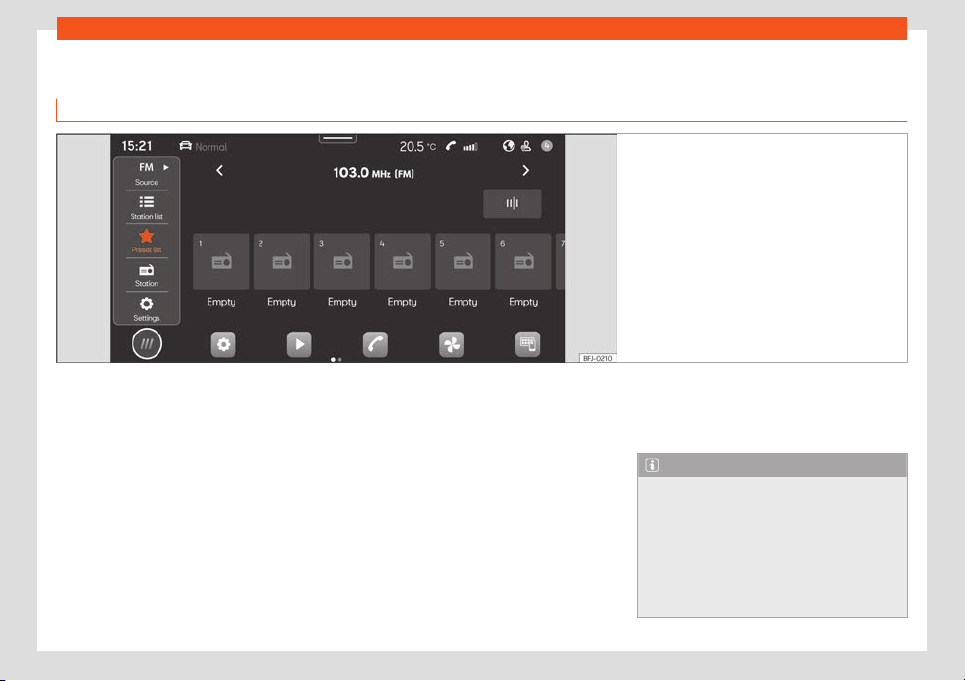
Infotainment system
Radio mode
Intr
oduction
Fig. 157
Schematic representation: Radio view
In Radio mode you can tune in the available
r
adio stations in different frequency bands
and memorise your favourites on the preset
buttons to access them quickly.
The types of reception and frequency bands
available depend on the equipment and the
country. In certain countries, frequency
bands may stop broadcasting or not be
available again.
Access the RADIO menu
●
Press HOME >
›››
Fig. 157.
Access the settings
●
Press HOME > > .
Online functions in Radio mode
Online functions in Radio mode are only
available under the following conditions:
●
SEAT CONNECT or SEAT CONNECT Plus
equipment.
●
You have an active SEAT CONNECT user
account.
●
Add the vehicle is assigned to your user ac-
count.
●
You have a corresponding data package
acquired from the In-Car store or have a data
volume for your own mobile phone device via
Wi-Fi access point.
Note
●
F
or streaming services you need to have
an account with the provider in question.
●
Radio stations are responsible for the
content of the information they transmit.
Additional electrical equipment connected
to the vehicle can cause interference in the
reception of the radio signal and noise in
the speakers.
198

Infotainment operation
●
F
oil or metal-coated stickers attached to
the windows may affect reception on vehi-
cles with a window aerial.
Radio equipment and symbols
The functions, as well as the types of recep-
tion and fr
equency bands available depend
on the equipment and the country.
●
AM tuner.
●
Dual FM receiver (diversity antenna).
●
Summarised FM station list.
●
Fusion of DAB and FM stations into one list.
●
Fusion of all stations stored in preset but-
t
ons into one list. Maximum 36 favourite sta-
tions.
●
Station logos.
●
DAB presentation (slideshow). Images that
are emitted sequentially.
●
Internet radio.
Universal symbols in Radio mode
To select the desired AM frequency
band.
To select the desired FM/DAB fre-
quency band.
To select the type of Internet
radio reception.
AM
FM/DAB
Online radio
Next to the name of the station, monitor-
ing of active traffic information stations
(TP).
Symbols on the FM/DAB frequency band
To display the frequency band for man-
ual selection of the FM frequency. Only
possible when the summary station list is
disconnected.
DAB not available.
DAB stations support presentations (sli-
deshow).
Symbols on the AM frequency band
Manually updating the station list.
To display the frequency band for man-
ual selection of the AM frequency.
Menus in Internet radio mode
Show station selection.
Open text search.
Show the last online radio stations
heard.
Show the 100 most played radio stations
and podcasts.
Show available online radio podcasts.
Show online radio stations, grouped by
country.
Show online radio stations by the de-
sired language.
TP
Show online radio stations whose pro-
gramme belongs to the desired musical
genre.
Selecting, tuning and saving a sta-
tion
Select the frequency band
Bef
ore selecting a station you have to select
a frequency band or a type of reception. Dif-
ferent stations are available depending on
the frequency band selected or the type of
reception.
The types of reception and frequency bands
available depend on the equipment and the
country.
●
Select the frequency band or type of re-
ception: AM, FM/D
AB, FM (for devices that do
not have DAB), Internet radio.
Search and select a station
You can select radio stations in different
ways. The options vary depending on the fre-
quency band and the type of reception.
Select via the frequency band (AM and
FM)
●
Activate the frequency band.
»
199

Infotainment system
●
Click on the cursor
, scroll through the fre-
quency band and release it when you reach
the frequency band you want.
●
OR: press on a point on the frequency
band. The cursor will automatically jump to
the corresponding frequency.
The station of the set frequency is tuned.
Select from the station list (AM and
FM/DAB)
The station list shows the stations that are
currently tunable. In the AM frequency band,
you may have to update the station list if you
are no longer in the area where you last ac-
cessed the station list. In the FM/DAB fre-
quency band, the station list is automatically
updated.
●
Open the station list
●
Press the station you want.
The selected station is tuned. In the case of
FM/DAB and if the station is available, the
best quality reception is automatically selec-
ted.
Search and filter stations (Internet radio)
In Online Radio mode, stations can be filtered
by categories and can be searched by text.
●
Open the station list.
●
Select the category by which the stations
are to be filtered.
●
OR: press to start the text search. The in-
put field is displayed.
●
Enter the name of the station you want. The
list of the stations found is updated while en-
tering the text.
●
Press the station you want.
The selected station is tuned.
Search in SCAN mode (AM and FM/DAB)
In SCAN mode the stations are automatically
tuned in a sequential manner and each of
them is played for approx. 5 seconds.
●
To start the SCAN mode, under Settings
press SCAN.
SCAN mode starts and the station currently
tuned in is shown on the screen. Next to it is a
SCAN function button.
●
To select a station press SCAN.
SCAN mode stops and the station is tuned.
The SCAN function button is hidden.
Storing the station on the preset buttons
You can store up to 36 stations of different
frequency bands and reception types as fa-
vourites using the preset buttons.
●
Tune the station you want.
●
Access the preset buttons.
●
Press the preset button and keep it pressed
until the station is stored.
●
OR: press the station on the station list and
keep it pressed. The preset buttons are dis-
played.
●
Press the preset button.
The station is stored in the selected preset
button.
If a station was already stored in the preset
button, it is overwritten with the new station.
Special functions in Radio mode
Traffic information (TP)
The TP function monit
ors the announcements
of a station with traffic information and auto-
matically reproduces them in the Radio mode
or in the multimedia playback that is active.
To do this, you have to be able to tune into a
station with traffic information.
Some stations without their own traffic infor-
mation support the TP function by broad-
casting traffic information from other stations
(EON).
In the AM frequency band or in the Multime-
dia mode, a station with traffic information in
the background is automatically tuned while
200

Infotainment operation
it is possible to tune into a station with traffic
inf
ormation.
If no station with traffic information can be
tuned in, the device automatically searches
for stations with tunable traffic information.
Stations with traffic information are not avail-
able in all countries.
Activating and deactivating the TP func-
tion
●
In Radio mode or Multimedia mode, press
Settings > Traffic station (TP).
Online radio
Online radio is a type of reception for Internet
radio stations and podcasts that are inde-
pendent of AM, FM and DAB. Thanks to Inter-
net transmission, reception is not limited to
the region.
Online radio is only available through the In-
ternet connection of the active infotainment
system. The use of online radio can generate
expenses due to the transmission of data
from the Internet.
●
In Online radio mode, press and set the au-
dio quality to high or low to tune the online ra-
dio.
Station logos
In the case of some frequency bands, station
logos may already be pre-installed in the in-
fotainment system.
If in the FM/DAB frequency band settings the
automatic selection of station logos is ac-
tivated, station logos are automatically as-
signed to the stations.
In the Online radio mode, the infotainment
system accesses the station logos of the on-
line database and automatically assigns
them to the stations
Assign station logos manually
●
In FM/DAB mode, press Station logos.
●
Press on the icon and then select the
station to which a station logo is to be as-
signed.
●
Select the station logo. If desired, repeat
the same process with other stations.
●
OR, via the menu Settings > Station logos.
201
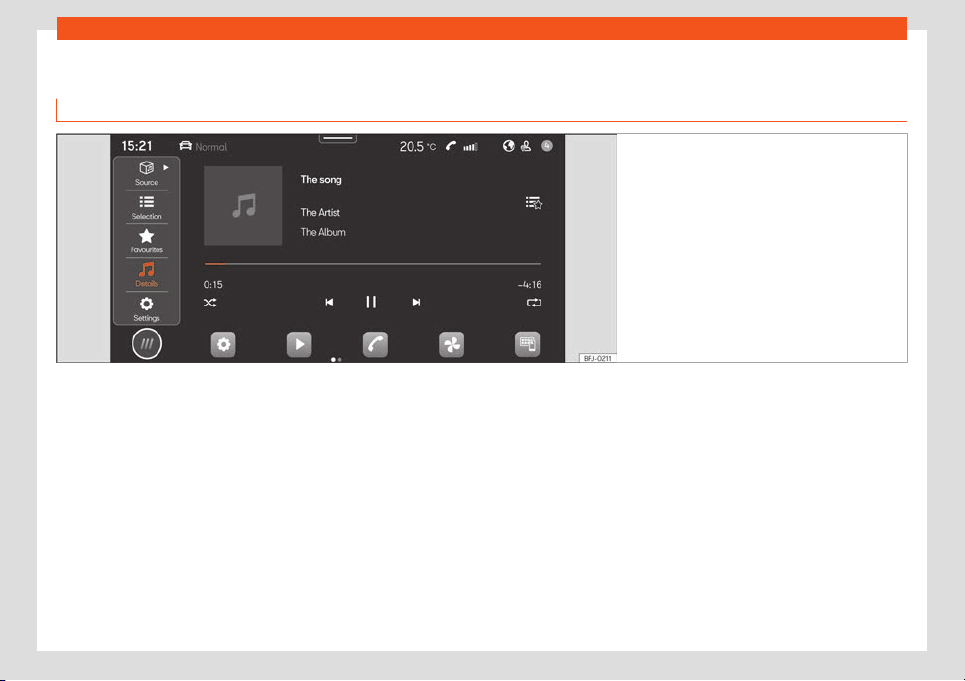
Infotainment system
Media Mode
Intr
oduction
Fig. 158 Schematic representation: Multimedia
vie
w
In Media mode you can play multimedia files
fr
om data media and streaming services
through the infotainment system.
Depending on the equipment, the following
data media can be used:
●
USB storage support (for example, a USB
stick, a mobile phone connected via USB).
●
Bluetooth® device (for example, a mobile
phone or a tablet).
Depending on the equipment, the following
types of multimedia files can be played:
●
Audio files.
●
Video files (depends on the system).
You can also use streaming services. The
availability of streaming services depends on
the equipment and the country.
To use streaming services you need to have
your own user account in the streaming serv-
ice in question.
Access the MEDIA menu
●
Press HOME >
›››
Fig. 158.
Access the settings
●
Press HOME > > .
Limitations and indications of data media
Data media may not work if they have been
exposed to high temperatures or have been
damaged. Please bear in mind the manufac-
turer’s indications.
Quality differences between data media pro-
duced by different manufacturers can cause
multimedia playback malfunctions.
Incorrect configuration on a data media may
cause the data media to be unreadable.
Playlists only specify a playback order and
refer to the storage location of the multime-
dia files within the folder structure. In a
202
Infotainment operation
playlist there are no multimedia files saved.
T
o play a playlist, multimedia files have to be
found in the storage places of the data media
to which the playlist refers.
Note
SEAT assumes no liability for any deteriora-
tion or l
oss of files on data storage devices.
Features of the multimedia equip-
ment and symbol
s
Audio, multimedia and connectivity:
●
Multimedia playback and control via Blue-
t
ooth®.
●
Audio playback in these formats: AAC,
ALAC, AVI, FLAC, MP3, MP4, WMA.
●
Video playback in these formats: MPEG-1
and MPEG-2 (.mpg, .mpeg), ISO MPEG4, DivX
3, 4 and 5 Xvid (.avi), ISO MPEG4 H.264
(.mp4, .m4v, .mov), Windows Media Video 10
(.wmv, .asf).
●
Playlists on any type of device.
●
Multimedia streaming (online).
●
Multimedia search.
Universal symbols in Media mode
To start playback.
To pause playback.
To change to the previous title.
To change to the next title.
Repeat the current track.
Repeat all titles.
To activate the shuffle playback order.
To display the favourites list.
Add multimedia file as favourite.
Top right: Select multimedia source.
Access the settings.
Open the search.
To return to the top folder of the multi-
media source.
Select and play a multimedia
source
Select multimedia source
Bef
ore playing multimedia files you must first
connect a multimedia source.
To use streaming services you must be con-
nected to the Internet.
●
Connect an external multimedia source.
●
Select the connected media source to be
used for playback.
Playing audio and video files
You can search and play multimedia files
from an available multimedia source in differ-
ent ways.
Search in the folder structure
Multimedia files can be catalogued by cate-
gories (for example, album, artist, title). In My
media this category view is always dis-
played. The classic folder structure of individ-
ual USB data media is also found in My me-
dia.
Activate the folder structure.
The folder structure of the selected mul-
timedia source is displayed. When My
media is selected, the categories (mu-
sic, videos, playlists) and connected
multimedia sources are displayed first.
Search for the title you want in the folder
structure.
OR: press to start the text search. The
input field is displayed.
Enter the name of the desired title. The
list of the titles found is updated while
entering the text.
Press the desired title.
If at the beginning of the playback your
selection is in a folder of a multimedia
source, the multimedia files that are in it
are also added to the playback.
»
1.
2.
3.
4.
203

Infotainment system
If a playlist is played, all available titles
in the pl
aylist are added to the play-
back.
Close your selection with .
Select favourites
In favourites you can save titles, music gen-
res, artists and albums individually for play-
back.
●
Access favourites .
●
Press the favourite you want.
Depending on your selection, all the titles be-
longing to the favourite are added to the
playback.
Configure streaming services
Depending on the equipment you can use
streaming services directly through the info-
tainment system. For this you need to have a
premium user account of the streaming serv-
ice in question and you have to log in with it in
the infotainment system. You also need to be
connected to the Internet.
Select Streaming as the multimedia
source.
A list of available streaming services is
displayed.
5.
1.
Select the streaming service you want.
Follow the steps indicated by the info-
tainment system.
The streaming service is added to the list
of multimedia sources as a new function
button.
Save favourites
Only multimedia files in My media of the info-
tainment system can be saved as favourites.
You can save up to a maximum of 30 titles, al-
bums, artists and music genres individually as
favourites.
Start playback.
Access favourites.
Tap a favourite that is not assigned.
OR: press on an existing favourite and
old for approx. 3 seconds.
Select from the selection list: Title, Al-
bum, Artist, Music genres, Playlist.
The selection is saved instead of the previ-
ously selected favourite. If the favourite was
already assigned, the previously saved fa-
vourite is overwritten.
The selectable options in the selection list
depend on the data attached to the multime-
2.
3.
1.
2.
3.
4.
dia file. If the music genre is not indicated in
the music files, for example, you cannot save
the music genre as favourite.
If a video file is playing, only that video can
be saved as favourite.
Playing entertainment content in
the infotainment system
Depending on the infotainment system, vid-
eos can be pl
ayed.
Video mode
When in video mode, a video can be played
on the infotainment screen if this is stored on
a data media, in My media or is sourced from
a streaming service. In this case, the video
sound is played through the vehicle's speak-
ers.
The image is only displayed if the vehicle is
stopped. When the vehicle is in motion, the in-
fotainment screen turns off. The sound of the
video can still be heard.
A stable Internet connection is required for
playback from a streaming service. In this
case, telephony costs may be generated.
204
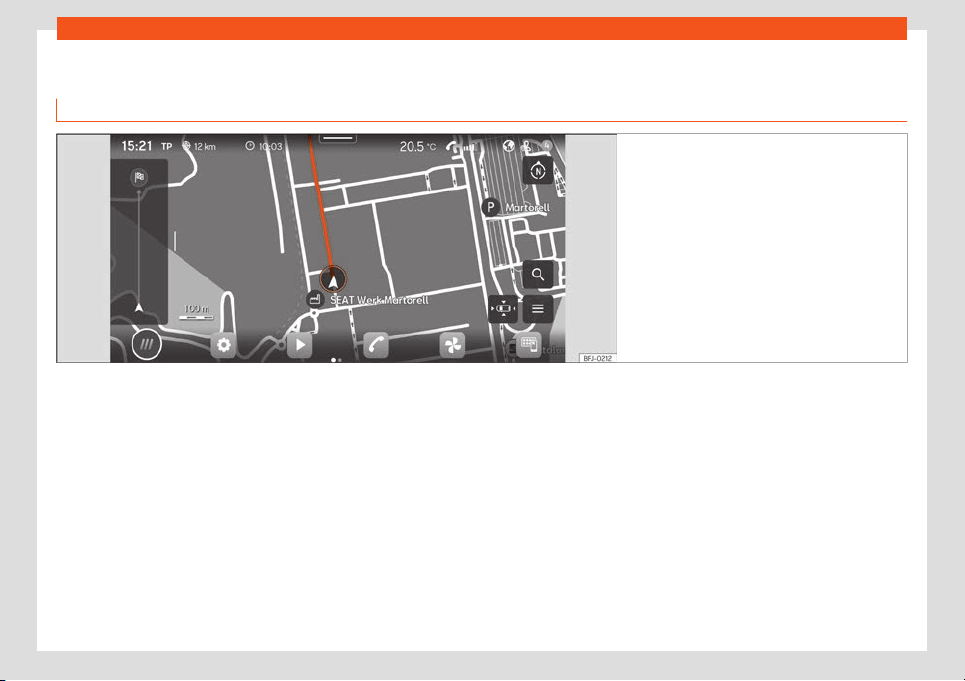
Infotainment operation
Navigation
Intr
oduction
Fig. 159 Schematic representation: Navigation
vie
w
A global satellite system determines the cur-
r
ent position of the vehicle and the sensors
mounted on the vehicle analyse the routes
taken. All measured values and possible traf-
fic events are compared with the available
maps to allow optimal navigation to the des-
tination.
Navigation announcements and graphic rep-
resentations will guide you to your destina-
tion.
Navigation management is carried out on the
screen.
Depending on the country, some functions of
the infotainment system will not be available
on the screen when travelling above a certain
speed. It is not a malfunction, but is due to
compliance with legislation.
Navigation announcements
Navigation announcements are acoustic indi-
cations for driving referred to the current
route.
The type and frequency of navigation an-
nouncements depend on the driving situation,
for example, starting the guide to the destina-
tion, driving on the motorway or on a round-
about and the settings.
If the exact destination cannot be reached
because, for example, it is in a non-digitised
area, indications relating to the address and
the distance to the destination are displayed
on the screen.
During dynamic route guidance, you will re-
ceive information about reported traffic con-
gestion on the route. An additional navigation
announcement is provided if the route is re-
calculated due to traffic congestion.
While a navigation announcement is playing,
its volume can be adjusted. The following
navigation announcements provided will be
played with the newly adjusted volume.
»
205
Infotainment system
Limitations during navigation
If the inf
otainment system cannot receive da-
ta from GPS satellites, for example, in a tunnel
or in an underground garage, navigation con-
tinues using the vehicle's sensors.
In areas that are not digitised or are only par-
tially digitised on the infotainment memory,
the infotainment system will still attempt to
provide route guidance.
In the case of missing or incomplete naviga-
tion data, it may not be possible to determine
the exact position of the vehicle. This may
mean that navigation is not as precise as usu-
al.
Roads and streets are subject to constant
change (e.g. new roads, road works, roads
closed to traffic, changes to street names
and building numbers). If the navigation data
is obsolete, this may lead to errors or inaccur-
acies during the route guidance.
Managing the navigation map
To allow an optimal view, you can also man-
age the navigation map with additional finger
movements.
Move the map (tip: use your index finger).
●
Move the map with your finger.
Zoom in the view (tip: use your index finger).
●
To increase the view in a certain position,
double-click on the map.
Zoom out the view (tip: use your index and
middle fingers).
●
Press on the map with both fingers at the
same time.
Change view (tip: use your index finger).
●
Press twice on the map and keep your fin-
ger pressed on the screen.
●
To zoom out the view of the map, move your
finger upwards. To zoom in the view of the
map, move your finger downwards.
Change view (tip: use your index and middle
fingers).
●
Press on the map with both fingers at the
same time and keep them pressed.
●
To zoom out the view of the map, move one
finger towards the other. To zoom in the view
of the map, move one finger away from the
other.
Tilt the view (tip: use your index and middle
fingers).
●
Press on the map with both fingers at the
same time and horizontal to each other, keep
them pressed.
●
To tilt the view of the map forward, move
your fingers upwards. To tilt the view of the
map backward, move your fingers down-
wards.
Rotate view (tip: use your index and middle
fingers).
●
Press on the map with both fingers at the
same time and keep them pressed.
●
To rotate the map view, turn your fingers
clockwise anticlockwise.
Saved data
The infotainment system saves certain data,
for example, frequent routes and position da-
ta, to make the entry of the destination more
agile and optimise the route guidance.
Delete saved data
●
Press Settings > Basic function settings >
Delete and then OK
WARNING
Select the settings, enter the destination
and the modifications f
or navigation only
with the vehicle at a standstill.
Note
●
If a det
our is passed during route guid-
ance, navigation may recalculate the
route.
●
The quality of the navigation recommen-
dations given by the Infotainment system
depends on the navigation data available
and any reported traffic congestions.
206
Infotainment operation
●
Navigation announcements ar
e not emit-
ted if the sound is muted in the infotainment
system.
Navigation functions and symbols
Navigation
Navigation functions depend on the equip-
ment and country.
Functions
●
Entering destination and route calculation
(offline and online).
●
Displaying two navigation maps at the
same time (displ
ay and instrument cluster).
●
Update of online maps.
●
Predictive navigation.
●
3D urban maps.
●
Online traffic information
●
Dynamic POIs (points of interest)
Symbols on the map
The buttons and indications depend on the
settings and the current driving situation.
Symbols for traffic events and points of inter-
est (POIs) are displayed on the map, for ex-
ample, petrol stations, train stations or inter-
esting stopovers, provided navigation has
such data
›››
page 210.
Current position
Search for destinations.
Destinations along the route.
Final destination
Home address
Work address
Favourite destinations
Additional window with more options.
Additional window with route options.
Centre the map on the current position.
Change view: 2D oriented to the north,
or 2D oriented to the direction of travel,
or 3D to the direction of travel.
Information about the current route
guidance.
Map scale.
Symbols in the additional window
●
To open the additional window, press .
Repeat the last navigation announce-
ment.
Volume of navigation announcements.
Map lighting in Automatic, Day or Night
mode.
Offer new guidance routes.
360° electric range indicator (hybrid ve-
hicles)
Other symbols
Entering the detailed destination for an
address.
Search for destinations.
Frequent destinations.
Last destinations.
Favourite destinations
Back
Symbols in the route details
Current position.
Destination of the current guidance.
POI symbols (points of interest)
POIs (points of interest) are shown on the
map, provided the navigation has said data.
Click on the desired POI (point of interest) to
start a route guidance
›››
page 208.
Petrol station.
Parking lot.
Tourist information offices.
Train station.
Restaurant.
Traffic information.
POIs (points of interest) are shown on the
map, provided the navigation has said data
›››
page 210.
»
207
Infotainment system
Click on a traffic event to open an additional
windo
w with further details
›››
page 210.
Slow traffic.
Traffic jam.
Accident.
Broken down vehicle.
Slippery surface (ice or snow).
Road closed to traffic.
Slippery road hazard.
Danger.
Road works.
Strong wind.
Reduced visibility.
Navigation data
The Infotainment system is equipped with a
built
-in navigation data memory. Depending
on the country, the necessary navigation da-
ta may already be pre-installed.
To provide correct route guidance and make
the most of the functions offered, the infotain-
ment system should be updated on a regular
basis.
Using obsolete data may lead to errors dur-
ing navigation. Current routes cannot be
traced or the route guidances will lead to
mistaken destinations.
Ensure navigation data is updated at all
times.
Online updating of navigation data
The navigation data of the regions through
which you travel frequently is automatically
updated in the background if the Internet
connection is established and the privacy
settings are valid.
●
With the ignition switched on, the naviga-
tion data is updated automatically.
Manual update of navigation data
Current navigation data for large regions, for
example Western Europe, can be downloa-
ded from www.seat.com and stored on USB
data devices. Navigation through USB data
devices is not possible.
●
Download the navigation data to a USB da-
ta device.
●
Turn on the ignition of the vehicle.
●
Connect the USB data device to the info-
tainment system. Navigation data is automat-
ically updated in the background.
The map version is displayed in Settings >
System information.
WARNING
If you update the navigation data manually
whil
e driving, it may cause accidents with
serious injuries.
●
Update the navigation data only with the
vehicle at a standstill.
Note
Automatic update of the navigation data is
sub
ject to the privacy settings. In “Incogni-
to” mode, no update is carried out.
Start route guidance
Depending on the country and equipment,
diff
erent functions are available to enter des-
tinations.
The different functions for entering destina-
tions are found in the navigation main menu.
Opening the Navigation main menu
●
Press Navigation.
Select the destination and start naviga-
tion
Press .
Select the desired destination. You can
chose from Frequent destinations,
Last destinations and Favourite
destinations.
1.
2.
208
Infotainment operation
OR: pr
ess and enter the address in
the input screen.
OR: detailed address.
Press Start.
Frequent destinations
The destination synopsis uses recorded data
to propose possible destinations.
Select the destination and start naviga-
tion
Press and then .
Select the desired destination. The route
guidance starts automatically.
Quick start: for a quick start, press and hold
the desired destination for a few seconds.
Last destinations
Navigation saves the last destinations to
make them available for a route guidance.
Select the destination and start naviga-
tion
Press and then .
Press the desired destination.
Press Start.
Quick start: for a quick start, press and hold
the desired destination for a few seconds.
3.
1.
2.
1.
2.
3.
Favourite destinations
Save up to 20 destinations as favourites.
To save a destination as a favourite press
in the split screen when entering the destina-
tion.
Select the destination and start naviga-
tion
Press and then .
Press the desired destination.
Press Start.
Note
Enter the destination as accurately as pos-
sibl
e. If you enter a destination incorrectly,
the route guidance will not be able to start
or it will guide you to an incorrect destina-
tion.
Start route guidance by selecting
fr
om the map
The navigation map includes active areas at
many points that ar
e suitable for entering the
destination. To do this, press the desired posi-
tion or place on the map. If there is map data
at this point, you can start a route guidance.
Whether it is possible to enter the destination
through the navigation map depends on the
1.
2.
3.
state of the data and it is not possible for all
positions.
To start “offroad navigation”, press an empty
area without position data.
Start navigation
●
Press .
●
Move the view on the map until the desired
position can be selected. The navigation map
can be used by means of additional finger
movements
›››
page 206.
●
Press the desired destination on the map.
●
Press Route.
Offroad navigation
“Offroad navigation” calculates routes to se-
lected destination points using unknown da-
ta. When a destination point is outside the
known roads or position data, navigation
finds the route to the next point of the known
road and completes the path to the next des-
tination point with a direct connection.
Start navigation
●
Move the view on the map until the desired
position can be selected. The navigation map
can be used by means of additional finger
movements
›››
page 206.
●
Press on any point on the map without posi-
tion data.
●
Press Route.
209
Infotainment system
Start route guidance using contact
det
ails
Start route guidance with the saved address
dat
a of a contact. Contacts saved without
address data cannot be used for route guid-
ance.
Start navigation
●
Press .
●
Press on the contact you want.
●
Press R
oute.
Note
If the address details of a contact are ob-
sol
ete, the route guidance will nevertheless
take you to the registered address. Check
that the contact address is updated.
Traffic information
The infotainment system receives detailed
tr
affic information automatically if the Inter-
net connection is established. This informa-
tion is shown with symbols and highlighting
the road network in colour on the map.
Traffic incidents
Traffic incidents, for example, traffic jams or
congested traffic, are shown on the naviga-
tion map using symbols.
With an active route guidance, traffic inci-
dents that are on the current route are shown
in the route details. Such traffic incidents can
be avoided
›››
page 210.
Hazard information
Hazard information is shown on the naviga-
tion map with symbols in the same way as
traffic incidents. In this case, the source of this
information is another vehicle that has detec-
ted the hazard and has uploaded the infor-
mation to the service provider.
The hazards shown are: accident, broken
down vehicle and slippery road surface.
Traffic flow indication
The navigation map shows traffic flow ac-
cording to current traffic events, highlighting
the road network in colour.
●
Orange: Slow traffic.
●
Red: Traffic jam.
Note
Traffic information receipt is subject to the
priv
acy settings. In maximum Privacy
mode, no traffic information is received.
Tracking or Location level setting is neces-
sary.
Function descriptions
Route details
The r
oute details contain information on all
incidents, for example, the starting point,
stopovers, traffic events, POIs and destina-
tion, provided the navigation has such data.
If you press on an incident, an additional win-
dow opens providing more options. The avail-
able options depend on the incident and the
current settings.
Open and close the route details
●
To open, press
|
or s
wipe it.
●
To close, press
|
or swipe it.
Edit route guidance
To edit route guidance, move the stopovers to
the destination in the TripView view.
●
Hold the desired destination pressed until it
is visibly highlighted.
●
Move the destination to the desired posi-
tion.
●
Remove your finger from the screen. The
route will recalculate.
Avoid traffic incidents
The details of the route show the current traf-
fic incidents if the navigation has such data.
210

Infotainment operation
Avoid traffic incidents by editing route details
›
››
page 210.
●
Press on a traffic event.
●
Press on Avoid. The route will recalculate.
Split screen
When handling navigation functions, an addi-
tional window with other options may open.
Possible options depend on the function be-
ing used.
Close the additional screen
●
Press on an empty area outside the addi-
tional window.
●
OR: press .
●
OR: press Accept.
Functions in the additional window:
Show on map Show what is selected on the
map
.
Add stopover Add a stopover to the route guid-
ance
.
Direct route Starts direct route guidance.
Delete Delete a stopover from the route
guidance
.
Avoid Avoid traffic jam. The route will re-
cal
culate.
Functions in the additional window:
Stopping route
guidance
Ends the current route guidance.
Close the additional window.
Add a destination to favourites.
Learn usage pattern
When the v
ehicle is in motion, navigation
saves routes and destinations used to auto-
matically generate destination proposals.
Destinations are learned based on the time of
day and the day of the week.
Navigation can propose up to 5 routes at the
same time. The proposed routes may be dif-
ferent from the routes of the normal route
guidance.
If one of the proposed destinations is selec-
ted, the guide to that destination is started.
The route guidance follows the selected route
until the vehicle deviates from it. In that case,
the route is recalculated and takes you back
along the most direct path to the initially se-
lected destination.
Important traffic jams are taken into account
in the route guidance, and are avoided if al-
ternative routes are available, provided navi-
gation has such dat
a.
You can activate and deactivate the function
whenever you want.
Enable and disable learning usage pattern
The setting is in the corresponding navigation
menu > Basic function settings.
●
To activate the function, activate Learn us-
age pattern.
●
To disable the function, disable Learn us-
age pattern.
●
To delete saved data, press Delete usage
pattern.
360° electric operating range display
3 Valid for: hybrid vehicles
The 360° operating range display shows the
possible range with the current charge level
of the high voltage battery.
Switch on the 360° electric operating
range display
●
Open the additional map window and
press the symbol .
211
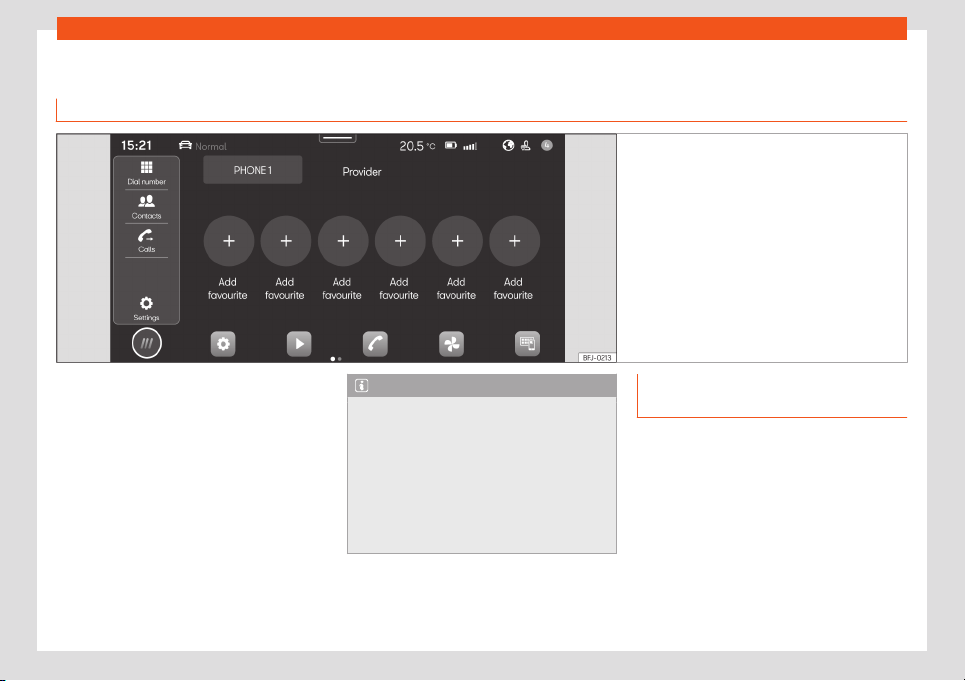
Infotainment system
Telephone interface
Intr
oduction
Fig. 160
Schematic representation: Phone view
You can use the telephone interface to con-
nect your mobil
e to the infotainment system
and operate phone functions through it. The
sound is played through the vehicle's speak-
ers.
You can connect up to two mobile phone de-
vices simultaneously to the infotainment sys-
tem.
High speeds, poor weather or road conditions
and a noisy ambience (even outside of the
vehicle), as well as the quality of reception
can all affect the quality of a telephone con-
versation in the vehicle.
Note
●
As a gener
al rule, pairing a device (for ex-
ample, a mobile phone device) is only nec-
essary once. You can restore the device
connection via Bluetooth® or Wi-Fi with the
infotainment system whenever you want
without having to pair the device again.
●
The availability of some telephone func-
tions will depend on the mobile phone con-
nected to the infotainment system.
Telephone interface equipment and
symbol
s
Equipment features
●
Hands-free function.
●
Use up to two phones at the same time.
●
Phone book with up to 5,000 contacts, de-
pending on the inf
otainment system.
●
SMS functions via Bluetooth®: SMS reading,
SMS writing (templates included), SMS play-
back, message history.
●
Email functions via Bluetooth®: reading
email, writing email.
212
Infotainment operation
●
Connection t
o wireless charging option.
●
Connection to the microphone mounted on
the vehicle.
Symbols in the main menu
Contacts.
List of incoming and outgoing calls.
Enter telephone number.
Text messages (SMS and emails).
Telephone interface settings.
Symbols for calls
The symbols may be different depending on
the infotainment system.
Start a call or bringing it to the fore-
ground.
End or reject a call.
Open contact list.
Enter telephone number.
Mute the sound of the hands-free
Hold call.
Continue call.
Start conference call.
Pass call to private mode
Make an emergency call.
Get help in case of breakdown.
Obtain information on the SEAT brand
and selected additional services related
to traffic and your travel.
Voice mail.
Call list symbols
●
To open the call lists, press .
Incoming call.
Outgoing call.
Missed call.
Telephone number (company).
Telephone number (private).
Mobile telephone number (company).
Mobile telephone number (private).
Fax (private).
Fax.
Symbols for text messages
The symbols may be different depending on
the infotainment system.
●
To open the text messages, press .
Activate voice control input
›››
page 196.
Templates for text messages.
Places with special regulations
Switch off the mobile telephone and the tele-
phone int
erface in places with a risk of explo-
sion. These places are not always clearly
marked. They include, for example:
●
The vicinity of chemical pipelines and
tanks.
●
The lower decks of boats and ferries.
●
In the proximity of vehicles that run on liq-
uefied gas (such as propane or butane).
●
Places where the air is laden with chemi-
cal
s or particles such as flour, dust or metal
powder.
●
All other places where the vehicle engine or
telephone must be switched off.
WARNING
Switch off the mobile phone in areas with a
risk of e
xplosion!
Note
In areas where special regulations apply or
the use of mobil
e phones is forbidden, it
must be switched off at all times. The radi-
ation produced by the mobile phone when
switched on may interfere with sensitive
technical and medical equipment, possibly
resulting in malfunction or damage to the
equipment.
213
Infotainment system
Pair, connect and manage
Requirement for pairing:
●
Bluetooth® is activated on the mobile
phone de
vice.
●
Bluetooth® is activated on the infotainment
system.
●
Depending on the mobile device, it will be
necessary to have the Bluetooth® menu open
or activate the Visibility option so that the
device is visible from the infotainment system.
Pair a mobile phone device suitable for tel-
ephony with the infotainment system to use
the telephone interface functions. On the first
connection, the mobile phone device is
paired with the infotainment system. Doing so
saves a user profile
›››
page 214.
The pairing can take a few minutes. The func-
tions available depend on the mobile phone
device used and its operating system.
Pair a mobile phone device
●
Open the list of available Bluetooth® devi-
ces on the mobil
e phone device and select
the name of the infotainment system.
●
Please note and, if necessary, confirm the
messages that appear on the mobile phone
device and on the infotainment system. If the
pairing was successful, the phone data is
saved in the user profile.
●
Optional: confirm the data transfer mes-
sage on the mobile phone device.
Active and passive connection
To use the functions of the telephone inter-
face, there must be at least one mobile
phone device connected to the infotainment
system. If there are several mobile phone de-
vices connected to the infotainment system,
you can switch between active and passive
connections. To use the telephone interface
with the desired mobile phone device, estab-
lish the active connection with the infotain-
ment system.
Difference between connection types
Primary
The mobile phone device is paired and
connect
ed. The functions of the tele-
phone interface are performed with the
data of said mobile phone device.
Secon-
dary
The mobile phone device is paired and
connect
ed. Calls can be managed but
the phone book, messages or other
functions will not be active.
Paired mobile phone devices are stored in the
inf
otainment system, even if they are not cur-
rently connected.
Connect a mobile phone device
Requirement: the mobile phone device is
paired with the infotainment system.
●
Bluetooth® is activated on the mobile
phone device.
Establish an active connection
Requirement: several mobile phone devices
are connected to the infotainment system at
the same time.
●
Select the desired mobile phone device
from the drop-down menu. All other mobile
phone devices are automatically in the pas-
sive connection.
User profiles
For each of the paired mobile phone devices
an individual user profile is automatically cre-
ated. In the user profile, data from the mobile
phone device is stored, for example, contact
details or settings. A maximum of four user
profiles can be saved in the infotainment sys-
tem at the same time.
WARNING
If you perform the pairing while driving, it
coul
d cause an accident or injury.
●
Perform pairing only with the vehicle at a
standstill.
214
Infotainment operation
Note
●
In the pairing of some mobil
e phone devi-
ces, a PIN number is shown on the screen of
the mobile phone device. Enter that number
in the infotainment system to complete the
pairing.
●
While the infotainment system is in the
Known mobile phones menu, the wireless
charging function is disabled. When you
exit this menu, the wireless charging func-
tion is activated again.
Basic and Comfort Telephony
Depending on the equipment, two types of
t
elephone interface can be used:
●
Basic telephone interface.
●
Comfort telephone interface.
Basic telephone interface
The Basic telephone interface uses the Blue-
tooth® HFP profile for transmission. This inter-
face allows the use of telephone functions
through the infotainment system and play-
back through the vehicle's speakers.
Comfort telephone interface
Like the Basic telephone interface, the Com-
fort telephone interface also uses the Blue-
tooth® HFP profile.
The Comfort phone interface can be equip-
ped with the wireless charging function
›››
page 216.
In order to use the functions of the wireless
charging function, you have to place a suita-
ble mobile phone device correctly in the stor-
age compartment. The mobile phone device
will then connect to the vehicle antenna. This
improves the reception and sound quality of
calls.
To call
Open the telephone interface
●
Press T
elephone.
Make a call
Select a phone number to start a call. Differ-
ent functions are available for selecting a
phone number:
Contacts
If a contact has several registered phone
numbers you have to select one.
●
Press and press a number on the list to
start the call.
●
OR: press and enter the contact name in
the input field to search for it. Press on the
contact to start the call.
●
OR: press a favourite in the telephone inter-
face main menu to start the call.
Calls
The telephone interface shows the call list of
the mobile telephone device. Start a call from
the call list.
●
Press > All and press a number on the list
to start the call.
●
OR: press and filter the call list entries
(for example, missed calls or dialled num-
bers). In filtered list, press a number to start
the call.
Dial
Manually enter a phone number to start a
call. While entering the phone number, con-
tacts that match that number are shown on
the infotainment screen.
●
Press and enter telephone number.
●
Press to start the call
The last call is dialled by pressing and hold-
ing the button on the multifunction steering
wheel.
Send messages
Depending on the mobile phone device and
the inf
otainment system used, you can send
»
215
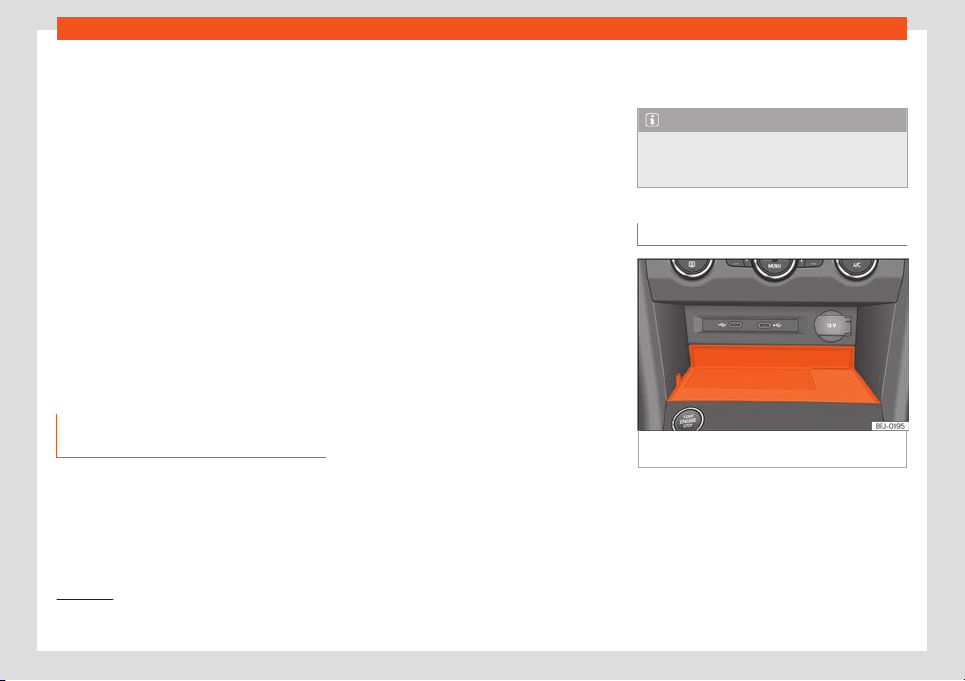
Infotainment system
and receive SMS and e-mails through the tel-
ephone int
erface.
Send an SMS
●
Press > Text message > Enter new
message and enter the message on the
screen.
●
Enter the contact you want in the search
bar.
●
To send the message press OK.
Send an e-mail
●
Press > E-mail > Enter new message
and enter the message on the screen.
●
Enter the contact you want in the search
bar.
●
To send the message press OK.
Phone book, favourites and speed
dial buttons
In the first connection of a telephone with the
inf
otainment system, the phone book is saved
in the infotainment system. It may be neces-
sary to confirm the data transmission on the
mobile phone.
Each time the phone is reconnected, the
phone book is updated.
If conference calls are supported, the phone
book can be accessed during a call. If there
is a saved image for a contact, it can be dis-
played in the list next to the entry.
Favourites
A speed dial button can be assigned to a
phone book favourite up to a maximum of six.
If there is a registered photo saved to the
contact, it is shown on the speed dial button.
All speed dial buttons have to be manually
edited and will be assigned to a user profile.
Assign the speed dial button
●
In the Favourites menu, press the button,
then open the phone book to select a con-
tact as a favourite. If the contact has several
phone numbers, press on the number in the
list.
Edit the speed dial button
●
To edit or delete a favourite contact press
on the icon in the Favourites menu screen.
You can delete one or more favourites.
Call a favourite
●
Press the assigned speed dial button.
Note
Favourites are not updated automatically.
If you change a cont
act's phone number,
you have to reassign the speed dial button.
Connectivity Box
Fig. 161
In the centre console: pad for the mo-
bil
e phone connection.
The Connectivity Box includes different func-
tions that will help t
o use your mobile device.
These are:
●
Wireless Charger
1)
.
1)
It only includes the wireless charge functionali-
t
y.
216
Infotainment operation
●
Signal amplifier / (Mobil
e Signal Amplifier)
(Wireless Charger)
The Wireless Charger allows mobile devices
with Qi
1)
technology to be charged without a
cable.
To charge your mobile phone wirelessly:
●
Place your mobile device in the middle of
the pad with the screen facing up
›››
Fig. 161
›››
.
Mak
e sure there are no objects between the
pad and the mobile phone.
The mobile phone will start charging auto-
matically. For further information about
whether your mobile device uses Qi technol-
ogy, check your phone's user manual or visit
the SEAT website.
Signal amplifier / (Mobile Signal Amplifier)
It allows you to reduce radiation in the vehicle
and have better reception.
For safety reasons, it is recommended that
you pair the system and the mobile using
Bluetooth
®
and place it on the Connectivity
Box pad, for the best reception without hav-
ing to handle the mobile phone.
To establish a connection with the vehicle's
external aerial:
●
Place your mobile device in the middle of
the pad with the screen facing up
›››
Fig. 161
›››
.
Mak
e sure there are no objects between the
pad and the mobile phone.
Your mobile phone will automatically be
ready to make use of the external aerial.
WARNING
●
The mobil
e phone may heat up due to the
wireless charging. Think about this before
you pick it up, and take care when removing
it.
●
There must be no metallic or other ob-
jects between the mobile phone and the
housing, to prevent the functionality of the
Connectivity Box from being affected.
Note
●
Y
our mobile device must support the Qi
inductive charging interface standard for
proper operation.
●
The charging time and the temperature
vary in accordance with the device used.
●
The maximum charging capacity is 5 W.
●
Qi t
echnology does not allow you to
charge more than one mobile device simul-
taneously.
●
No improvement in reception can be
guaranteed if there is more than one mo-
bile phone on the pad.
●
You are advised to keep the engine run-
ning to guarantee proper wireless charg-
ing.
●
When a telephone with Qi technology is
connected by USB, it will be charged by the
means specified by the manufacturer.
1)
Qi technology allows you to charge your mo-
bil
e phone wirelessly.
217
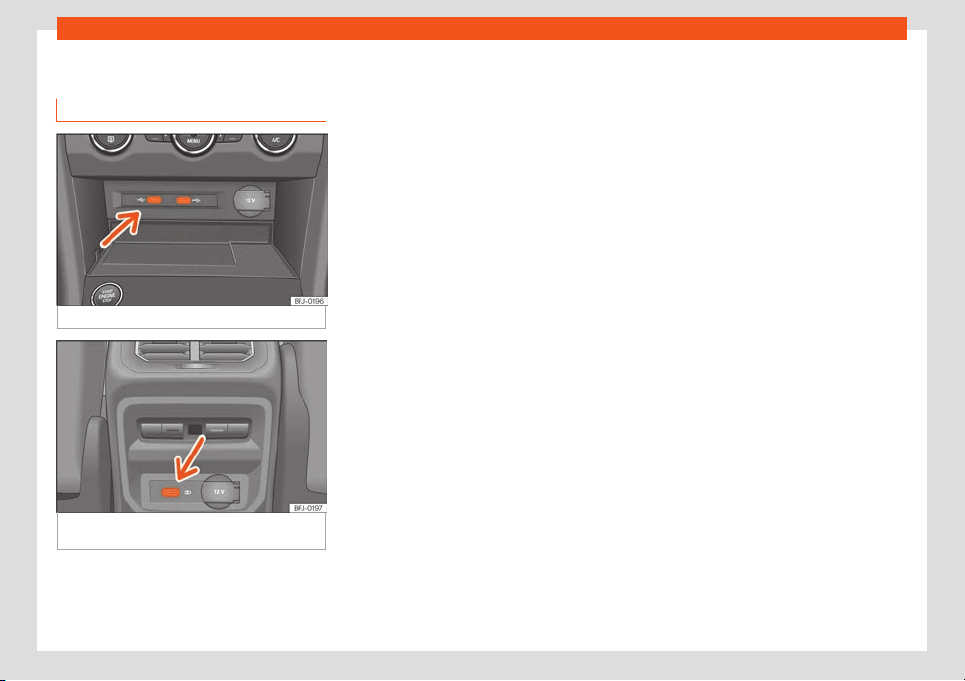
Infotainment system
Multimedia
USB por
t
Fig. 162
Centre console: USB port.
Fig. 163
Rear part of the centre console: USB
connect
ors with power outlet function.
The USB port can be found in the storage
compartment ar
ea of the front centre con-
sole
›››
Fig. 162.
Depending on the equipment and the coun-
try, the vehicle may also have USB connec-
tions exclusively for charging or as a power
socket.
These USB ports are located at the rear of
the console, between the front seats
›››
Fig. 163.
218
Start and driving
Driving
St
art and driving
Starting and stopping the
engine
Ignition and start button
Fig. 164 In the lower part of the centre con-
sol
e: start button.
The engine can be started with a start button
(Pr
ess & Drive). To do so, there must be a valid
key inside the vehicle in the area of the front
or rear seats, or on the centre console.
In vehicles with the Keyless Access
›››
page 95 system, the engine can also be
started with the key in the luggage compart-
ment.
Opening the driver's door when exiting the
vehicle activates the electronic lock on the
steering column if the ignition is disabled.
Switching the ignition on/off
If you only want to switch on the ignition
(without starting the engine), briefly press the
start button once without pressing the brake
pedal or the clutch pedal
›››
.
The
push-button text flashes
lik
e a heartbeat when the system is ready for
the ignition to be turned on or off.
Automatic ignition disconnection
If the driver leaves the vehicle, taking the key
with them but leaving the ignition on, the igni-
tion does not switch off automatically. The ig-
nition is switched off by pressing the lock but-
ton on the remote control or by pressing
the sensor surface on the door lever
›››
Fig. 79.
Automatic deactivation of the ignition on
vehicles with the Start-Stop system
The ignition is switched off automatically
when the vehicle is stopped and the auto-
matic engine shutdown is active, if:
●
The driver's seat belt is not fastened,
●
the driver does not step on any pedal,
●
the driver door is opened.
After automatically turning off the ignition, if
the dipped beam is on, the side light re-
mains on for approx. 30 minutes (if there is
enough charge in the battery). If the driver
locks the vehicle or manually turns off the
light, the side light goes out.
Engine restart feature
If no key is detected inside the vehicle after
the engine stops, you will only have 5 sec-
onds to restart it. A warning will display on the
dash panel screen.
After this interval, it will not be possible to
start the engine without a valid key inside the
vehicle.
“My Beat” function
For vehicles with a convenience key there is
the “My Beat” function. This feature provides
an additional indication of the vehicle ignition
system.
When entering the vehicle, the start button
›››
Fig. 164 flashes to draw attention to it.
When the ignition is on/off, the engine start
button flashes. With the ignition is switched
off, the start button goes off after a few sec-
onds.
With the engine running, the start button light
stays on, indicating that the engine is running.
The time elapsed between the moment the
user starts the engine with the start button
»
219
Driving
and the lighting changes from flashing to
fix
ed will depend on specific engine size
characteristics. When the start button is used
to stop the engine, the button starts flashing
again.
In vehicles with the Start-Stop system, the
“My Beat” function also offers additional in-
formation:
●
When the engine stops during the Stop
phase, the light of the start button stays on,
as the Start-Stop system remains active even
though the engine is off.
●
When the engine cannot be started again
with the Start-Stop system,
›››
page 226, and
needs to be started manually, the start but-
ton flashes to indicate this situation.
WARNING
When switching on the ignition, d
o not
press the brake or clutch pedal, otherwise
the engine could start immediately.
WARNING
If vehicle keys are used negligently or with-
out due car
e, this may cause accidents and
serious injury.
●
Never leave any key inside the vehicle
when you leave it. Otherwise, a child or un-
authorised person could lock the vehicle,
start the engine or connect the ignition and
operate any of the electrical equipment.
Note
●
Bef
ore leaving the vehicle, always dis-
connect the ignition and, if appropriate,
take into account the instructions on the
screen of the dash panel.
●
If the vehicle is stationary for a long time
with the engine off and the ignition on, the
12-volt vehicle battery might be dis-
charged and it might not be possible to
start the engine.
●
In vehicles with diesel engines, wait until
the warning light
›››
page 220 goes off
before starting the engine.
●
If during the STOP phase you press the
button, the ignition is switch-
ed off and the push-butt
on flashes.
●
If the indication is displayed on the in-
strument panel display “Start-Stop system
deactivated: Start the engine manually”;
the
button will flash.
Starting the engine
●
Vehicles with manual transmission: put the
gear l
ever in neutral, press the clutch pedal
and keep it pressed in this position until the
engine starts.
●
Vehicles with automatic transmission: put
the selector lever in P or N, press the brake
pedal and keep it pressed in this position until
the engine starts.
●
Press the starter button
›››
Fig. 164; do not
press the accelerator. There needs to be a
valid key inside the vehicle for the engine to
start. After starting the engine, the lighting of
the
button remains fixed indicat-
ing that the engine is running.
●
Once the engine starts, release the start-up
butt
on.
●
If the engine does not start, stop and wait
for around 1 minute to try again. If necessary,
perform an emergency start
›››
page 222.
Diesel engines can take a few seconds longer
than usual to start on cold days. During pre-
heating, the warning lamp remains lit. To
avoid unnecessary discharging of the bat-
tery, do not use any other major electrical
equipment while the glow plugs are pre-
heating.
The preheating time depends on the coolant
and exterior temperatures. With the engine at
operating temperature, or at outside temper-
atures above +8°C, the warning lamp will
light up for about one second. This means
that you can start the engine almost immedi-
ately.
Starting a diesel engine after having run
out of fuel
If the fuel tank of a diesel vehicle was run until
completely empty, after refuelling it can last
longer than normal to start the engine, even
220
Start and driving
up to a minute. This is because the fuel sys-
t
em must eliminate air first.
WARNING
Do not keep the engine running in confined
spaces, as ther
e is a risk of poisoning.
●
The exhaust gases contain carbon mon-
oxide, an odourless and colourless poison-
ous gas that can cause loss of conscious-
ness and death.
WARNING
Do not get out of the vehicle with the en-
gine running, especially if a gear is engag-
ed. The v
ehicle could then suddenly move
or something strange could happen that
would cause damage, fire or serious injury.
WARNING
Never use cold start sprays, they could ex-
pl
ode or cause the engine to run at high
revs. Doing this risks injury.
CAUTION
●
The st
arter motor or the engine may be
damaged if you try to restart the engine im-
mediately after switching it off.
●
When the engine is cold, you should
avoid high engine speeds, driving at full
throttle and over-loading the engine, as
this could cause engine damage.
For the sake of the environment
Do not warm-up the engine by running the
engine with the v
ehicle stationary. Start off
immediately, driving gently. This helps the
engine reach operating temperature faster
and reduces emissions.
Note
●
El
ectrical components with a high power
consumption are switched off temporarily
when the engine starts.
●
When starting with a cold engine, noise
levels may briefly increase. This is quite
normal, and no cause for concern.
●
When the outside temperature is below
+5 °C (+41 °F), if the engine is diesel, some
smoke may appear under the vehicle when
the fuel-operated auxiliary heater is on.
Turning off the engine
●
Bring the vehicle to a full stop
›
››
.
●
With manual transmission, press the clutch
all the w
ay down. If the vehicle is automatic,
set the selector lever to the P position.
●
Apply the electronic parking brake.
●
Briefly press the start-up button
›››
Fig. 164.
Emergency disconnection
If the engine does not switch off after briefly
pressing the starter button, an emergency
disconnect will be required:
●
Press the starter button twice within 3 sec-
onds or press it once for more than 1 sec-
ond
›››
in Ignition and start button on
page 220.
Car w
ash function (hybrid vehicles)
When the ignition is turned off with gear N ac-
tivated, the vehicle can roll for the next 30 mi-
nutes. After that time, if the vehicle is stopped
the parking lock P activates automatically.
The corresponding warning message is dis-
played on the instrument cluster display one
minute before this happens.
WARNING
Never switch off the engine while the vehi-
cl
e is moving. This could cause loss of con-
trol of the vehicle, accidents and serious in-
jury.
●
The airbags and belt tensioners do not
work when the ignition is switched off.
●
The brake servo does not work with the
engine off. Therefore, you need to press the
break pedal harder to brake the vehicle.
●
Power steering does not work when the
engine is not running. You need more
strength to steer when the engine is switch-
ed off.
»
221
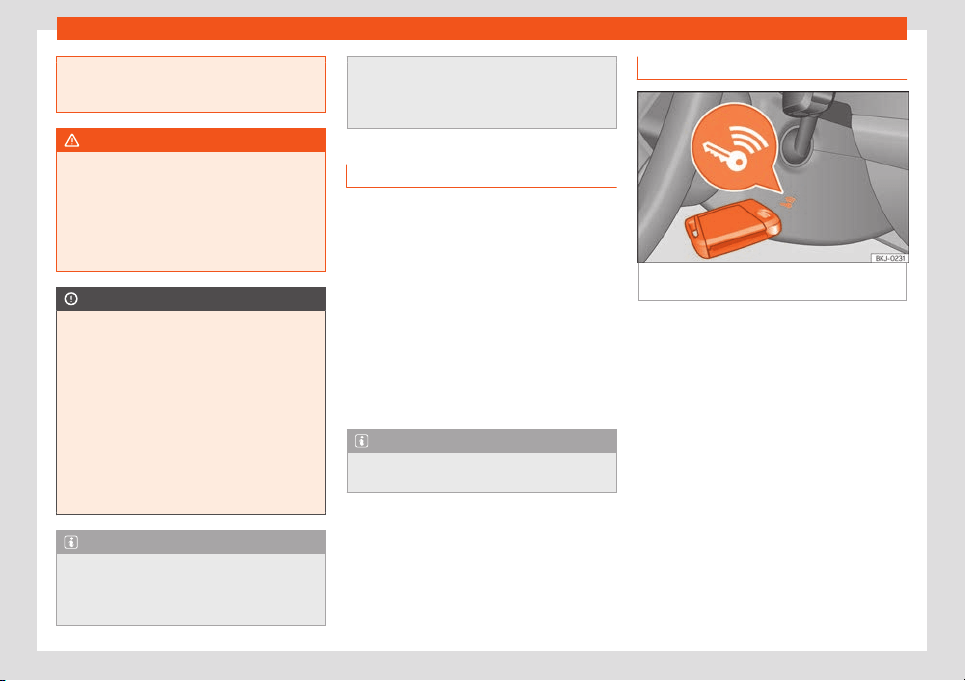
Driving
●
If the ignition is s
witched off, the steering
column could be locked, making it impossi-
ble to control the vehicle.
WARNING
Always take the key with you when you
l
eave the vehicle. This is particularly impor-
tant if there are children in the vehicle, as
they might otherwise be able to start the
engine or use power-operated equipment
(e.g. the electric windows), which could
cause injuries.
CAUTION
●
If the v
ehicle is stopped and the Start-
Stop system switches off the engine, the ig-
nition remains switched on. Make sure that
the ignition is switched off before leaving
the vehicle, otherwise the battery could
discharge.
●
If the engine has been driven at high
speed for a prolonged period of time, it
may overheat when switched off. To avoid
damage, allow the engine to run for ap-
proximately two minutes in neutral before
switching it off.
Note
After the engine is switched off the radiator
f
an may run on for up to 10 minutes, even if
the ignition is switched off. It is also possi-
ble that the fan turns itself on once more if
the coolant temperature increases due to
the heat accumul
ated in the engine com-
partment or due to its prolonged exposure
to solar radiation.
Electronic immobilizer
The electronic immobiliser prevents unau-
thorised persons fr
om driving the vehicle.
In the key there is a chip that automatically
deactivates the electronic immobiliser.
The electronic immobiliser is automatically
activated when the key is outside the vehicle.
If the following message is shown on the in-
strument panel display: SAFE, the vehicle
cannot be started.
The engine can only be started using a genu-
ine SEAT key with its correct code.
Note
A perfect operation of the vehicle is ensur-
ed if genuine SEAT k
eys are used.
Emergency starting function
Fig. 165
On the right of the steering column:
emer
gency start.
If no valid key is detected inside the vehicle,
an emer
gency start-up will be required. The
relevant message will appear in the dash
panel display. This may happen when, for ex-
ample, the vehicle key battery is very low:
●
Immediately after pushing the starter but-
ton, keep the key next to the right trim of the
steering column
›››
Fig. 165, as close as pos-
sible to the Kessy logo.
●
The ignition connects and the engine starts
automatically.
222

Start and driving
Instructions for the driver on the in-
strument panel displ
ay
Press the clutch
●
This message appears on vehicles with a
manual gearbo
x if the driver tries to start the
engine without having the clutch pedal
pressed. The engine will only start if you press
the clutch pedal.
Press the brake
●
This message appears on vehicles with an
automatic gearbox if the driver tries to start
the engine without having the brake pedal
pressed.
Select N or P
●
This message appears if you try to start or
st
op the engine when the selector lever of the
automatic gearbox is not in position P or N.
The engine can only be started and stopped
in those positions.
Engage position P; the vehicle can
move; doors can only close in posi-
tion P.
●
For safety reasons, this driver message ap-
pears and an audible warning sounds if the
selector lever of the automatic gearbox is not
in position P after you switch off the ignition.
Move the selector lever to the P position, oth-
erwise the vehicle could move.
Gear change: selector lever in the
drive position!
●
This driver message is displayed when the
selector lever is not in the position P when the
driver door is opened. Additionally, a buzzing
sound is emitted. Put the selector lever in po-
sition P, otherwise the vehicle could roll away.
Ignition is switched on
●
This driver message is displayed and a buz-
zer is sounded when the driver door is
opened with the ignition switched on.
Driving with electric drive
Switching on the hybrid drive sys-
tem
3 V
alid for: hybrid vehicles
Switching on the hybrid drive activates the
vehicle's propulsion system. When the vehi-
cle’s drive system is switched on, the electric
drive is activated. The combustion engine
starts automatically when the charge level of
the high-voltage battery is not sufficient to
run with the electric drive, or if high drive
power is required.
Requirements for switching on the drive
syst
em
The drive system can be switched on when
the following conditions are met:
●
The high voltage battery has a sufficient
charge level.
●
There is no charging cable plugged in.
●
The temperature of the high-voltage bat-
tery is within the operating range.
●
There is a valid remote control key in the
vehicle.
Switching on the drive system
●
Press the ignition and start button once.
The ignition must be switched on.
●
Press the brake pedal and keep it pressed.
●
Set the gear selector switch to position N or
activate the parking lock P.
●
Press the ignition and start button
›››
Fig. 164 until indicator lamp lights up
on the instrument cluster. Do not press the
accelerator. Release the ignition and start
button when the indicator lamp lights up
on the instrument cluster. The mark on the
power display changes from to .
●
If the indicator lamp does not light up,
cancel and repeat the operation.
●
If the vehicle has been locked with the re-
mote control key, the ignition and start button
is deactivated. If you are inside the vehicle
»
223
Driving
and have to start the engine, first unlock the
v
ehicle or perform an emergency start
›››
page 222.
Detecting the drive system
With the electric drive, the motor makes no
noticeable noise when the drive system is
switched on or while driving. Therefore, you
cannot defect that the vehicle's drive system
is on by engine noise. Instead, the following
characteristics show that the vehicle is ready
to drive:
●
The power display on the instrument cluster
displays
›››
page 79.
●
The display light on the instrument cluster is
on, regardless of whether the vehicle’s exteri-
or lighting is on.
●
The indicator lamp on the instrument clus-
ter switches on .
●
An audio signal is heard.
Switching on the drive system in very low
outside temperatures
If the outside temperature is very low (ap-
proximately -27°C (-16°F) or lower), the high-
voltage battery may freeze and stop working.
In this case it's not possible to switch on the
drive system.
As soon as the temperature of the high-volt-
age has increase enough, the drive system
can be switched on again.
To ensure that the drive system can be
switched on, even in very low outside temper-
atures, SEAT recommends parking the vehicle
in a place protected from the cold.
Note
A click is heard when the drive system is
t
urned on. This is completely normal and
does not mean there is a problem.
Vehicle sound
3 V
alid for: hybrid vehicles
The electric drive makes much less noise
than a combustion engine. In the versions for
some countries, artificial vehicle sound is
generated to allow the vehicle to be heard
better from the outside. At higher speeds,
when the noise produced by the tyres and
the wind increases, the vehicle's sound auto-
matically fades out.
WARNING
During electric driving, the auditory per-
ception of the v
ehicle by other road users
may be much lower. This is especially true
in traffic-restricted areas and when ma-
noeuvring or reversing. Accident hazard!
Troubleshooting
3 V
alid for: hybrid vehicles
Drive: Fault! Stop the vehicle safely
The warning lamp lights up red. There is
a fault in the vehicle’s drive system. The
vehicle's drive system is no longer avail-
able. Park the vehicle in a safe place as
soon as possible. Seek professional as-
sistance.
Error: Hybrid system. Visit the work-
shop
The warning lamp lights up yellow. There
is a fault in the vehicle’s drive system.
Drive slowly to a specialised workshop
to have the fault repaired.
Limited power
The warning lamp lights up yellow. Per-
formance limited. The high-voltage bat-
tery may not be sufficiently charged or
may have reached its operating temper-
ature limit, for example in very cold out-
side temperatures.
Vehicle sound: Fault! Pedestrians
cannot hear the vehicle. Visit a work-
shop
The warning lamp lights up yellow. There
is a vehicle sound fault. Drive with utmost
care, as other road users may not be
able to hear the electric vehicle. Go
224
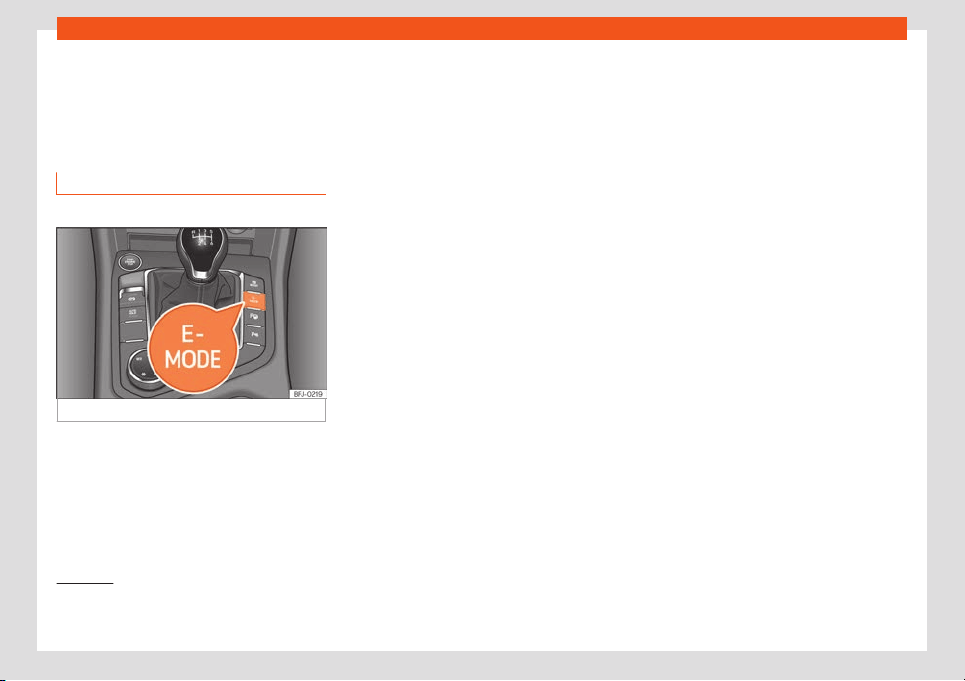
Start and driving
immediately to a specialised workshop
t
o have the fault repaired.
Operating mode selection
Operating mode selection
3 V
alid for: hybrid vehicles
Fig. 166
Centre console: E-MODE button.
The vehicle has different operating modes so
that it can al
ways be optimally adjusted to
every situation while driving. Once the drive
system has been turned on, and provided
that all of the operating conditions required
for this purpose have been met, the E-MODE
operating mode is always activated in the
first instance for electric driving.
Operating mode selection
●
Switch on the drive system
›››
page 223.
●
Press the on the centre console.
Further information about the operating
mode can be found in .
E-MODE (electric driving)
1)
In the E-MODE electric driving mode, the ve-
hicle basically drives in electric only mode. To
the extent possible, the vehicle's combustion
engine is not used.
All of the following conditions must be met for
E-MODE to be activated:
●
The high voltage battery has a sufficient
charge level.
●
The vehicle speed is lower than 130 km/h
(80 mph).
●
The high voltage battery temperature is
above -10°C.
If, while driving in E-MODE mode, the neces-
sary conditions are no longer met, the com-
bustion engine starts and electric driving is
suspended. In this case, the display lights
up on the instrument cluster display.
The combustion engine starts when a kick-
down occurs in E-MODE. However, E-MODE
remains activated.
Hybrid (use the battery's charge)
1)
This is the operating mode that allows you to
save most fuel.
The operating mode control unit tries to make
the most of the battery charge. For this pur-
pose, with active directions the navigation
data are also accessed.
In this operating mode, the electric motor and
the combustion engine share the work of
driving the vehicle.
In hybrid operating mode, the power from the
battery charge is used optimally. If route
guidance is activated, the vehicle may auton-
omously recharge the high-voltage battery
using the combustion engine.
Manual control of the battery charge
Manual control of the battery charge is only
possible in Hybrid operating mode. The op-
tion selected by the user is only valid until the
»
1)
The displayed symbol varies depending on the
activ
e operating mode and the charge level of
the high-voltage battery.
225
Driving
ignition is switched off or the vehicle is switch-
ed t
o Hybrid mode or E-MODE.
Press the function button and use the sym-
bols ,
=
and to control the battery charge:
Pressing this symbol selects a higher
theoretical charge level. The vehicle
tries to reach that new theoretical high-
voltage battery charge level while driv-
ing. The vehicle is powered by the com-
bustion engine. If the combustion engine
has “excess” power, it is used to charge
the high-voltage battery. This option in-
creases fuel consumption. SEAT there-
fore recommends using the charging
socket to charge the high-voltage bat-
tery, whenever possible
›››
page 320 .
The high-voltage battery charge level is
kept at around the current level while
driving. If you accelerate harder or in-
crease the vehicle speed, the combus-
tion engine starts up. When permitted by
the driver’s demand for acceleration and
the vehicle speed, the vehicle switches
back to electric mode.
Pressing this symbol selects a lower the-
oretical charge level. The vehicle only
uses the battery's charge when it is
above the selected theoretical charge
level. The rest is kept until the end of the
journey.
=
Show the active operating mode
The operating mode active at any given time
is displayed on the instrument cluster display,
e.g. .
WARNING
Switching to a different operating mode
whil
e driving can distract you from traffic
conditions and cause accidents.
Note
Information about the operating mode that
is curr
ently active is displayed on the in-
strument cluster display, along with the
charge level of the high-voltage battery.
Troubleshooting
The E-MODE oper
ating mode is not
available
The indicator lamp lights up in white.
The E-MODE operating mode
(driving in
electric mode) cannot be used temporarily
because one or more conditions are not met.
●
The conditions must be met to use the E-
MODE oper
ating mode
›››
page 225.
Start-Stop system
Control lamps
It lights up
The Start-Stop system is available, the automatic en-
gine shutdown is active.
It lights up
The Start-Stop system is not available or has been
disconnect
ed.
Instructions for the driver on the instru-
ment panel displ
ay
Start-Stop system deactivated. Start
the engine manually
●
This indication for the driver shows that the
Start-Stop system cannot start the engine
again.
Start-Stop system: Fault! Function
not available
●
There is a fault in the Start-Stop system.
Take the vehicle to a workshop to have the
fault repaired.
Description and operation
The Start-Stop system helps you to save fuel
and r
educe CO
2
emissions.
226

Start and driving
In Start-Stop mode, the engine will automati-
cally s
witch off when the vehicle stops or is
stopping. The ignition remains switched on.
The engine automatically switches back on
when required.
In this scenario, the light of the
button stays lit.
When the ignition is s
witched on, the Start-
Stop function is automatically activated.
Vehicles with a manual gearbox
●
When the vehicle or when it is stopped, put
it into neutral and release the clutch pedal.
The engine will switch off. The warning lamp
will light up. The engine can be stopped
before stopping completely (approximately 7
km/h).
●
When the clutch pedal is pressed the en-
gine will start up again. The warning lamp will
switch off.
Vehicles with an automatic gearbox
●
Brake until the vehicle has come to a stand-
still, and keep your foot on the brake pedal or
activate the Auto Hold system so that the ve-
hicle remains braked. The engine will switch
off. The warning lamp will appear in the
display. The engine can be stopped before
stopping completely (approximately 7 or 2
km/h depending on the vehicle's gearbox).
●
When you take your foot off the brake ped-
al the engine will start up again. The warning
lamp will switch off. With the Auto Hold sys-
tem, the engine will not start if you remove
your foot from the brake pedal. The car starts
when you press the accelerator pedal.
Basic requirements for the Start-Stop
mode
●
The driver door must be closed.
●
The driver's seat belt must be fastened.
●
The bonnet must be closed.
●
The engine has reached operating temper-
ature.
●
The reverse gear must not be engaged.
●
The vehicle must not be on a very steep
slope.
The engine does not turn off for various
reasons
Before stopping the vehicle, the system veri-
fies whether certain conditions are met. The
engine does not switch off, in the following
situations for example:
●
The engine has not yet reached the re-
quired temperature for the Start-Stop mode.
●
The temperature selected on the climate
control has not been reached.
●
The interior temperature is very high/low.
●
Defrost function button activated
›››
page 157.
●
Park assist is switched on.
●
The battery is very low.
●
The steering wheel is overly turned or is be-
ing turned.
●
If there is a danger of misting.
●
After engaging reverse gear.
●
In case of a very steep gradient.
is displayed on the instrument cluster
screen; it is also displayed in the driver infor-
mation system, .
The engine starts by itself
When stopped, the normal system mode may
be interrupted in the following situations. The
engine restarts by itself without involvement
from the driver.
●
The interior temperature differs from the
temperature selected on the climate control.
●
Defrost function button activated
›››
page 157.
●
The brake has been pressed several times
consecutively.
●
The battery is too low.
●
High power consumption.
Additional information related to the auto-
matic gearbox
The engine stops when the selector lever is in
the positions P, D, N and S in addition to when
in Tiptronic mode. With the selector lever in P,
»
227
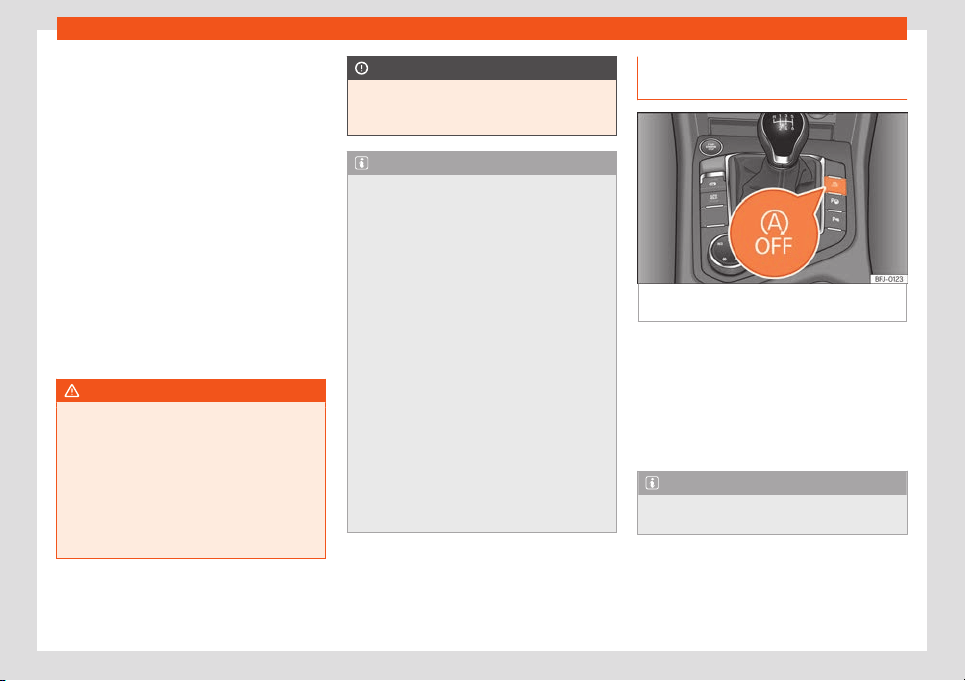
Driving
the engine will also remain switched off when
you t
ake your foot off the brake pedal. In or-
der to start the engine up again the accelera-
tor must be pressed, or another gear engag-
ed or the brake released.
If the selector lever is placed in R while stop-
ped, the engine will start up again.
Change from D to P to prevent the engine
from accidentally starting when passing
through R.
Additional information about vehicles with
Adaptive Cruise Control (ACC)
In vehicles with ACC function, the engine will
start up again in certain operating conditions
if the radar sensor detects that the vehicle
ahead drives off again.
WARNING
●
Ne
ver switch the engine off until the vehi-
cle is stationary. The operation of the brake
and steering will not be fully guaranteed.
More force will be needed to turn the steer-
ing wheel or to brake. You could suffer an
accident and even serious injuries.
●
To avoid injury, make sure that the Start-
Stop system is switched off when working
in the engine compartment
›››
page 228.
CAUTION
The Start-Stop system must always be
s
witched off when driving through flooded
areas
›››
page 244.
Note
●
In v
ehicles with an automatic gearbox,
you can control whether the engine should
switch off or not by reducing or increasing
the brake force applied. While the vehicle
remains stopped, the engine will not stop if
the brake pedal is slightly pressed, in traffic
jams with frequent stopping and starting
for example. As soon as strong pressure is
applied to the brake pedal, the engine will
stop.
●
When stopped, the brake pedal must be
kept pressed to ensure that the vehicle
does not move.
●
If the engine “stalls” with a manual gear-
box, it can be directly started up again by
immediately pressing the clutch pedal.
●
With an automatic gearbox, if the lever is
placed in position D, N or S after engaging
reverse gear, 10 km/h (6 mph) in a forwards
direction must be reached for the system to
be in a status to stop the engine.
Manually connecting and discon-
necting the St
art-Stop system
Fig. 167
Centre console: Start-stop system
butt
on.
If you do not wish to use the system, you can
s
witch it off manually.
●
To manually switch on/off the Start-Stop
system, press the button
›››
Fig. 167.
The button symbol remains lit up yellow
when the system is switched off.
Note
The system switches on every time the en-
gine is t
urned off voluntarily.
228
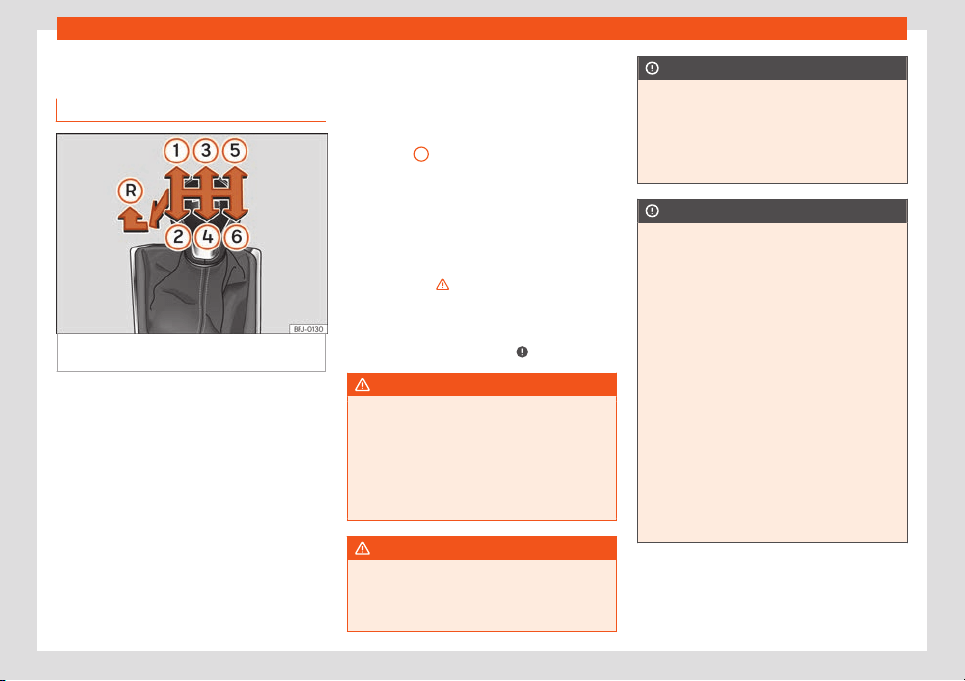
Start and driving
Manual gearbox
Changing gears
Fig. 168 Gear shift pattern of a 6-speed man-
ual gearbo
x
The position of the gears is indicated on the
gearbo
x lever
›››
Fig. 168.
●
Press the clutch pedal and keep your foot
right down.
●
Move the gearbox lever to the required po-
sition.
●
Release the clutch.
Selecting reverse gear
Engage reverse gear only when the vehicle is
stopped.
●
Press the clutch pedal and keep your foot
right down.
●
With the gearbox lever in neutral, push it
downwards, move it to the left as far as it will
go and then forwards to select reverse
›››
Fig. 168
R
.
●
Release the clutch.
Changing do
wn gears
While driving, changing down a gear must al-
ways be done gradually, i.e. to the gear di-
rectly below and when the engine speed is
not too high
›››
. Changing down while by-
passing one or v
arious gears at high speeds
or at high engine speeds can damage the
clutch and the gearbox, even if the clutch
pedal remains depressed
›››
.
WARNING
When the engine is running, the vehicle will
st
art to move as soon as a gear is engaged
and the clutch released. This also happens
if the electronic parking brake is switched
on.
●
Never engage reverse gear when the ve-
hicle is moving.
WARNING
If the gear is changed down inappropriate-
ly by sel
ecting a gear that is too low, you
may lose control of the vehicle, causing an
accident and serious injuries.
CAUTION
When travelling at high speeds or at high
engine speeds, sel
ecting a gear that is too
low can cause considerable damage to the
clutch and the gearbox. This can also oc-
cur if the clutch pedal is pressed and held
and it does not engage.
CAUTION
To prevent damage and avoid premature
w
ear, please observe the following:
●
Do not rest your hand on the gear lever
while driving. The pressure applied by your
hand is transmitted to the gearbox selector
forks.
●
Do not leave your foot on the clutch ped-
al; although the pressure may seem insig-
nificant, it can cause the premature wear of
the clutch plate. Use the foot rest when you
do not need to change gear.
●
Always ensure that the vehicle is com-
pletely stopped before engaging the re-
verse gear.
●
Always press the clutch to the floor when
changing gears.
●
Never hold the vehicle “on the clutch” on
hills with the engine on.
229
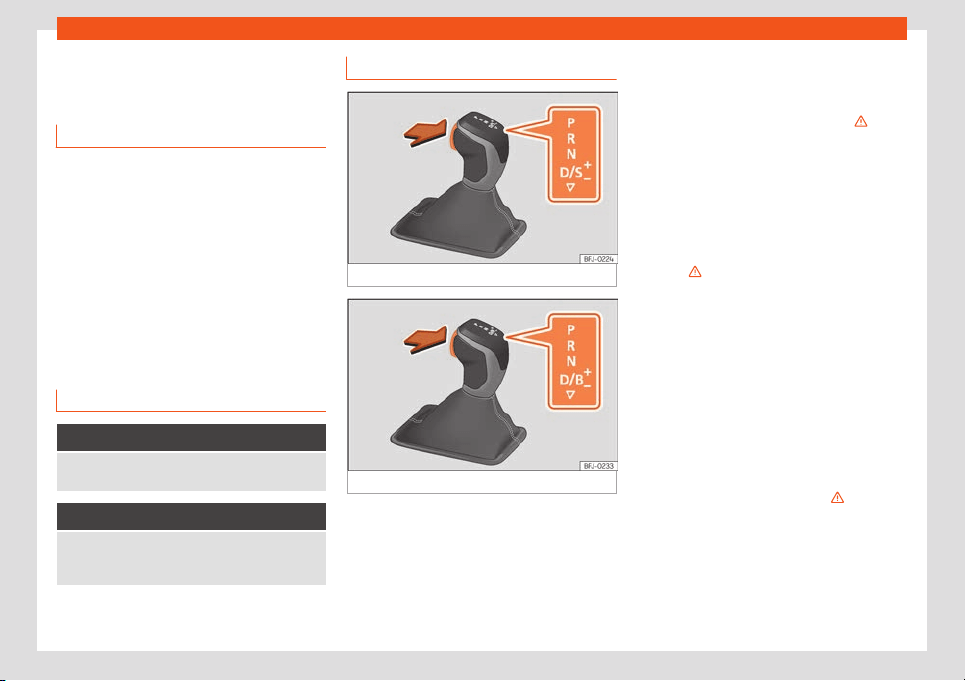
Driving
Automatic gearbox/DSG au-
t
omatic gearbox
Introduction
Your vehicle is equipped with an electronical-
ly contr
olled manual gearbox. Torque be-
tween the engine and the gearbox is trans-
mitted via two independent clutches. They
replace the torque converter found on con-
ventional automatic gearboxes and allow for
smooth, uninterrupted acceleration of the ve-
hicle.
The Tiptronic system allows the driver to
change gears manually
›››
page 232,
Changing gear in Tiptronic mode.
Control lamps
It lights up green
The brake is not pressed.
T
o select a gear range, press the brake pedal.
Flashes green
The selector lever locking button is not engaged.
The v
ehicle is prevented from moving forwards. En-
gage the selector lever lock.
Selector lever positions
Fig. 169
Selector lever lock.
Fig. 170
Selector lever lock (hybrid vehicles).
The selector lever position is shown when the
corr
esponding sign lights up. With the selec-
tor lever in the manual gearbox positions M, D
and S, the engaged gear is also shown on the
display.
– Parking lock
When the lever is put in this position, the drive
wheels are locked. The lever must only be put
in P when the vehicle is stationary
›››
.
T
o put the lever in P or take it out of P , the
locking button must be pressed and held and
the brake pedal pressed simultaneously.
– Reverse gear
Reverse gear must be engaged only when
the vehicle is stationary and the engine is
idling
›››
.
T
o move the lever to position R, the lock but-
ton must be pressed and held while pressing
the brake pedal at the same time. The reverse
lights come on when the lever is in the R posi-
tion with the ignition on.
– Neutral
With the lever in this position, the gear is in
neutral.
Press the brake pedal to move the lever from
N to D/S when the vehicle is stationary or at
speeds below 3 km/h (2 mph)
›››
.
– P
ermanent forward drive position
The lever in the D/S position enables the
gears to be operated in normal mode (D) or
sport mode (S). To select Sport mode S,
move the lever backwards. Pushing the lever
again will select normal mode D. The
230
Start and driving
selected driving mode is shown on the instru-
ment panel displ
ay.
In normal mode (D), the gearbox selects the
best gear ratio. This depends on the engine
load, the road speed and the dynamic gear
control programme (DCP).
Sport mode (S) should be selected for a
sporty driving style. This setting makes use of
the engine's maximum power output. When
accelerating the gear shifts will be noticea-
ble.
Under certain circumstances (e.g. on moun-
tain roads) it can be advantageous to switch
tiptronic mode
›››
page 232, to adapt the
gears to suit the road conditions.
– Permanent forward drive position
(valid for hybrid vehicles)
The lever in the D/B position allows the gears
to be operated in coasting or recuperation
mode.
Push the lever backwards to select mode B.
Pushing it again will return to mode D.
●
In mode D: if the accelerator is not pressed,
the car moves by its own inertia.
●
In mode B: the vehicle is slowed by the
electric motor, taking advantage of the ener-
gy to recharge the high-voltage battery
Selector lever lock
In P or N, the lever lock prevents a gear range
from being engaged, and prevents the vehi-
cle from moving off accidentally.
To release the gear lever lock, press and hold
the brake pedal with the ignition on. At the
same time, press the lever lock in the direc-
tion of the arrow
›››
Fig. 169.
As a reminder to the driver, when the lever is
in positions P or N the following indication will
be shown on the screen:
When stationary, apply footbrake
while selecting a gear.
The lever is not locked if it is moved quickly
through position N (e.g. when shifting from R
to D). This makes it possible, for instance, to
“rock the vehicle backwards and forwards” if
it is stuck in snow or mud. The lever lock en-
gages automatically if the brake pedal is not
pressed and the lever is in position N for more
than about one second at a speed of less
than 5 km/h (3 mph).
WARNING
●
T
ake care not to press the accelerator
pedal when the vehicle is stopped. The ve-
hicle could start moving immediately (in
some cases even if the parking brake is en-
gaged) resulting in the risk of an accident.
●
Ne
ver move the lever to R or P when driv-
ing. Failure to follow this instruction could
result in an accident or failure.
●
With the lever in any position (except P),
the foot brake must be pushed down when-
ever the engine is running. This is because
an automatic gearbox still transmits power
even at idling speed.
●
While you are selecting a gear and the
vehicle is stopped with the engine running,
do not accelerate. Failure to follow this in-
struction could result in an accident.
●
As a driver you should never leave your
vehicle if the engine is running and a gear is
engaged. Switch on the electronic parking
brake and select the parking lock (P).
Note
●
If the l
ever is moved accidentally to N
when driving, release the accelerator and
let the engine speed drop to idling before
selecting gear range D or S again.
●
Should the power supply to the lever be
interrupted in position P, it will not be possi-
ble to move the lever. If this should happen
the manual release can be used
›››
page 236.
Note
●
If the l
ever lock does not engage, there is
a fault. The transmission is interrupted to
prevent the vehicle from accidentally
»
231
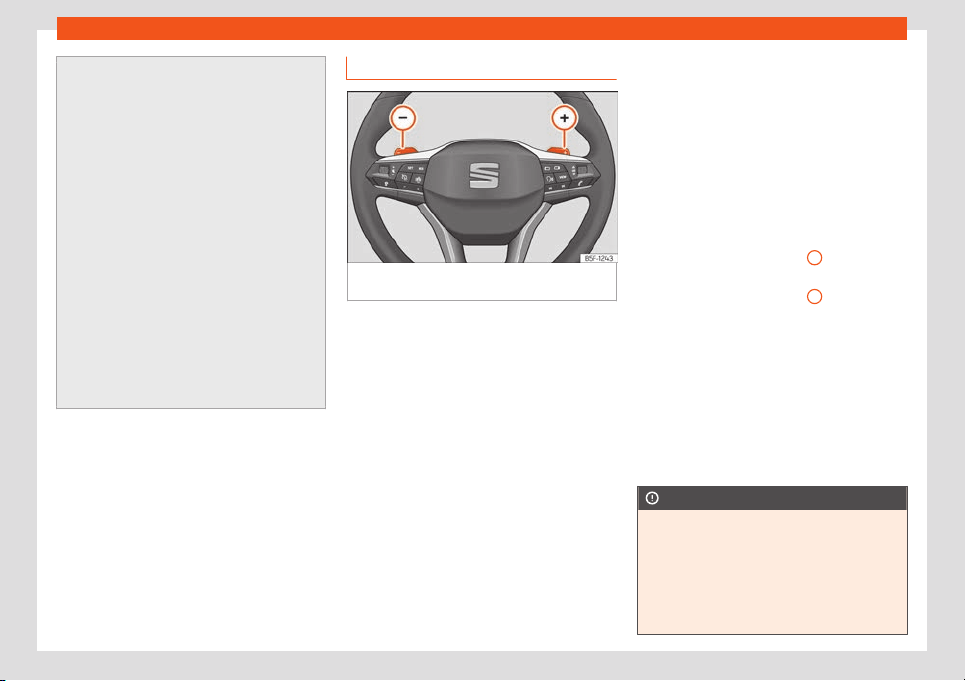
Driving
moving. Follow the procedure below in or-
der f
or the lever lock to engage again:
–
With a 6-speed gearbox: press the
brake pedal and release it again.
–
With a 7-speed gearbox: press the
brake pedal. Move the lever to posi-
tion P or N and subsequently engage a
gear.
●
Despite a gear being engaged, the vehi-
cle does not move forwards or back. Pro-
ceed to the next mode:
–
When the vehicle does not move in the
required direction, the system may not
have the gear range correctly engag-
ed. Press the brake pedal and engage
the gear range again.
–
If the vehicle still does not move in the
required direction, there is a system
malfunction. Seek specialist assistance
and have the system checked.
Changing gear in Tiptronic mode
Fig. 171
Steering wheel: automatic transmis-
sion l
evers
Tiptronic gives the driver the option to
change gears manually.
When you change t
o the Tiptronic pro-
gramme, the vehicle remains in the currently
selected gear. This is possible as long as the
system is not changing gear automatically
due to a traffic situation.
Using Tiptronic with the selector lever
It is possible to change to Tiptronic mode,
both when the vehicle is stopped and while
driving.
●
Starting from the D/S position, move the
lever to the right. The instrument panel will
show whether the lever is in manual or Tip-
tronic mode (e.g. M4).
●
Push the lever forwards + or backwards – to
change up or down a gear.
●
To exit Tiptronic mode, move the lever to the
left.
Using Tiptronic with the steering wheel
paddles
The gearshift paddles can be used when the
selector lever is in the D/S or M (Tiptronic)
positions.
●
Press the gearshift paddle
+
to select a
higher gear
›
››
Fig. 171.
●
Press the gearshift paddle
–
to select a
l
ower gear.
●
To exit the Tiptronic mode, pull the right-
hand lever towards the steering wheel for ap-
proximately 1 second or move the lever to the
left.
If the paddles are not operated for some time
and the lever is not in the Tiptronic selection
position, it will automatically exit from Tip-
tronic mode.
CAUTION
●
When accel
erating, if a higher gear is not
selected, it will automatically change
shortly before reaching the maximum per-
mitted RPM.
●
Also, if a lower gear is selected, the sys-
tem will not change until it detects that the
engine will not reach its maximum RPM.
232
Start and driving
Driving with an automatic gearbox
The gearbox changes gear ratios automati-
cally as the v
ehicle moves.
The engine can only start with the selector
lever in position P or N. At low temperatures,
below -10 °C (+14 °F), the engine can only
start with the selector lever in position P.
Driving down hills
Under certain circumstances it may be ad-
vantageous to use the Tiptronic mode to se-
lect the gear manually according to driving
conditions
›››
.
St
op/Park
On level ground, just use the lever to engage
position P. On slopes you should first apply
the parking brake and then set the lever to P.
This makes it easier to remove the lever from
position P when starting.
If the driver door is opened and the lever is
not in position P, the vehicle could move. The
following warning is displayed on the instru-
ment panel: Gear change: selector
lever in the drive position!. Addi-
tionally, a buzzer will sound.
Stopping on a downhill
Always apply the brake pedal firmly to pre-
vent the vehicle from moving; if necessary,
apply the electronic parking brake
›››
.
Do not accel
erate while a range of gears is
engaged to prevent the car from rolling
downhill
›››
.
St
arting off uphill with the Auto Hold func-
tion
●
Once you have engaged a gear, take your
foot off the brake pedal and gently press the
accelerator.
Starting off uphill without the Auto Hold
function
●
Pull on the electronic parking brake button.
●
Once you have engaged a gear, gently
press the accelerator and pull on the elec-
tronic parking brake button.
Back-up programme
If all the positions of the lever are shown over
a light background on the instrument panel
display, there is a system fault and the auto-
matic gearbox will operate in with the backup
programme. It is still possible to drive the ve-
hicle, however, at low speeds and within a se-
lected range of gears. Driving in reverse
gear may not be possible.
Kick-down
The kick-down system provides maximum ac-
celeration when the gear selector lever is in
the positions D, S or in the Tiptronic mode.
When the accelerator pedal is pressed right
down, the automatic gearbox will shift down
to a lower gear, depending on road speed
and engine speed. This takes advantage of
the maximum acceleration of the vehicle
›››
.
The upshift t
o the next higher gear is delayed
until the engine reaches maximum rpm.
WARNING
Observe the safety warnings
›
››
in Selec-
t
or lever positions on page 231.
●
Never allow the brake to rub and do not
use the brake pedal too often or for long
periods, as the brakes can overheat. This
reduces the braking power, increases the
braking distance or even causes a brake
system fault.
●
If you have to stop on a hill, keep the vehi-
cle’s brakes applied with the brake pedal or
parking brake.
WARNING
Please note that if the road surface is slip-
pery or w
et, the kick-down feature could
cause the driving wheels to spin, which
could result in skidding.
CAUTION
●
If you st
op the vehicle on a gradient, do
not attempt to stop it from rolling by de-
pressing the accelerator when a gear has
»
233
Driving
been selected. This could cause overheat-
ing and damage the aut
omatic gearbox.
●
If you allow the vehicle to roll with the
lever in position N and the engine off, the
automatic gearbox will be damaged by
lack of lubrication.
●
In certain driving situations or traffic con-
ditions, the gears could overheat and be
damaged! If the warning lamp lights up,
stop the vehicle as soon as you can and
wait for the gearbox to cool
›››
page 236.
●
If the gearbox operates with the backup
programme, take the vehicle to a special-
ised workshop and have the fault repaired
without delay.
Launch-control program
The Launch-control programme enables
maximum accel
eration from a standstill.
Condition: the engine must have reached op-
erating temperature and the steering wheel
must not be turned.
The engine speed for Launch-control is differ-
ent on petrol and diesel engines.
To use the Launch-control you must discon-
nect the anti-slip regulation (ASR) through the
infotainment system menu
›››
page 87. The
warning lamp will stay switched on or will
flash slowly depending on whether or not the
vehicle has a driver information system.
On vehicles with the driver information sys-
tem, the ESC lamp lights up permanently and
the corresponding text message Stability
control deactivated (temporary) appears
on the instrument panel to indicate the deac-
tivation status.
●
With the engine running, switch off traction
control (ASR)
›››
page 280
1)
.
●
Press the brake pedal with your left foot
and hold it down for at least one second.
●
Set the selector lever to position S or Tip-
tronic, or select the sport driving profile from
the SEAT Drive Profile
›››
page 239.
●
With your right foot, press the accelerator
down to the full throttle or kick-down position.
The engine speed will stabilise at about
3,200 rpm (petrol engine) or about
2,000 rpm (diesel engine).
●
Take your left foot off the brake pedal. The
vehicle starts with maximum acceleration.
WARNING
●
Al
ways adapt your driving style to the
traffic conditions.
●
Only use the Launch control programme
when road and traffic conditions permit,
and make sure your manner of driving and
accelerating the vehicle does not incon-
venience or endanger other road users.
●
Make sure that the ESC remains switched
on. Please note that when the ASR and ESC
are deactivated, the wheels may start to
spin, causing the vehicle to lose grip. Risk
of accident!
●
After moving off, the ESC “sport” mode
should be deactivated by briefly pressing
the button.
Note
●
Aft
er using the Launch control pro-
gramme, the temperature in the gearbox
may have increased considerably. In this
case, the programme could be disabled for
several minutes. The programme can be
used again after the cooling phase.
●
Accelerating with the launch control pro-
gramme places a heavy load on all parts of
1)
Vehicles without a driver information system:
the w
arning lamp flashes slowly. Vehicles with a
driver information system: the warning lamp re-
mains on.
234
Start and driving
the vehicle. This can result in increased
w
ear and tear.
downhill assistant
Downhill speed control is activated when the
l
ever is in the D/S position and the brake is
applied. An appropriate lower gear is engag-
ed.
The assistant attempts to maintain the speed
at which the vehicle was travelling when the
brake was applied, within logical limits. It may
be necessary to correct the speed by press-
ing the brake.
The assistant can only change down as far
as 3rd gear. It is possible that on very steep
slopes you may have to switch to tiptronic
mode and thus manually change down to
2nd or 1st gear to take advantage of engine
braking and take the load off the brake sys-
tem.
Downhill speed control is deactivated as
soon as the road levels out again or you press
the accelerator pedal.
On vehicles with a cruise control system
›››
page 249, downhill speed control is acti-
vated when you set a cruising speed.
WARNING
The downhill speed control cannot defy the
l
aws of physics. Therefore, speed cannot
be maintained constant in all situations. Al-
ways be prepared to use the brakes!
Inertia mode
The inertia mode allows you to travel certain
dist
ances without using the accelerator,
which saves fuel. Plan ahead and use the in-
ertia mode to “let” the vehicle “roll”.
Activation of the inertia mode
Condition: lever in position D, slopes of less
than 12% and speeds between 20 and 130
km / h (12 and 80 mph).
●
Gently take your foot off the accelerator.
The indication will be sho
wn on the instru-
ment cluster , the engaged gear and cur-
rent consumption will disappear and the
word Inertia will appear.
The gears will automatically disengage and
the vehicle will roll freely, without the effect of
the engine brake. While the vehicle rolls, the
engine runs at idling speed.
Stopping inertia mode
●
Press the brake or the accelerator pedal.
To take advantage of the engine's inertia
mode, simply remove your foot from the ac-
celerator.
Applying both the inertia mode (= prolonged
section with less energy) and inertia discon-
nection (= shorter section without the need
for fuel) facilitates improved fuel consumption
and emission balance.
If the vehicle has SEAT Drive Profile
›››
page 239, the inertia mode can be activa-
ted in Normal, Eco and Individual modes. In
Eco mode, it is activated whenever the oper-
ating conditions are met, regardless of the
smoothness with which the foot is removed
from the accelerator.
WARNING
●
If the iner
tia mode has been switched on,
take into account, when approaching an
obstacle, that the vehicle will not deceler-
ate in the usual manner: risk of accident!
●
When using inertia mode while travelling
down hills, the vehicle can increase speed:
risk of accident!
●
If other users drive your vehicle, warn
them about inertia mode.
»
235
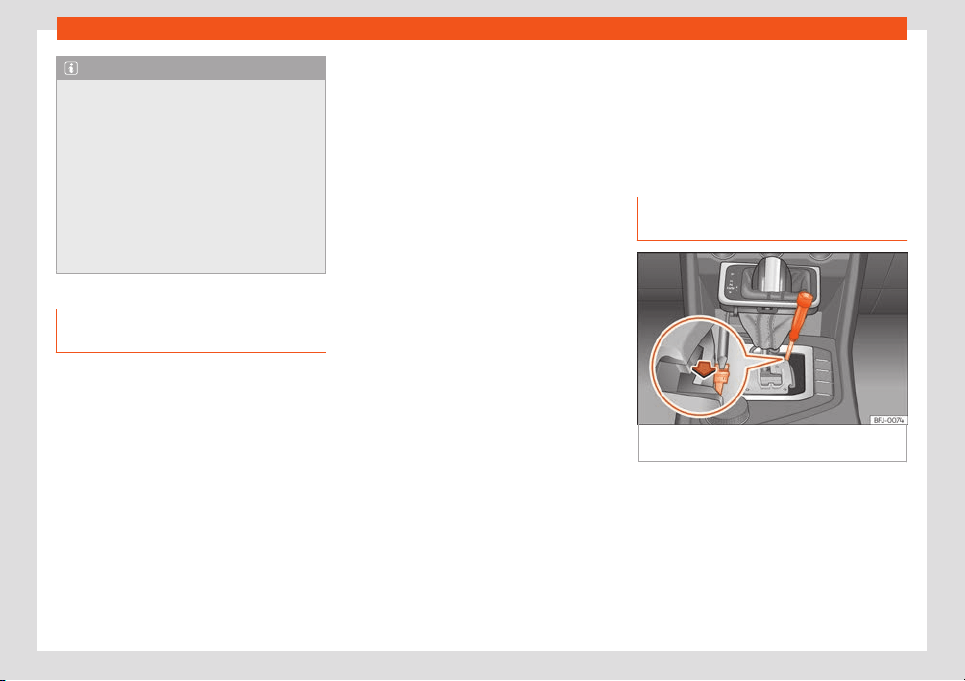
Driving
Note
●
The driv
er message Inertia is only dis-
played with the current consumption. In in-
ertia mode the gear will no longer be dis-
played (for example “D” or “E” will appear
instead of “D7” or “E7”).
●
The operation of the inertia mode in com-
bination with hybrid engines can cause the
combustion engine to switch off.
●
The inertia mode will be automatically
disconnected on gradients steeper than
15%.
Indications on the instrument panel
displ
ay
Clutch
Clutch overheating! Please stop!
●
The clutch has overheated and could be
damaged. St
op and wait for the gearbox to
cool with the engine at idling speed and the
selector lever in position P. When the warning
lamp and the driver message switch off, have
the fault corrected by a specialised work-
shop without delay. If they do not turn off, do
not continue driving. Seek specialist assis-
tance.
Faults in the gearbox
Gearbox: Fault! Stop the vehicle
and place the lever in the position
P.
●
There is a fault in the gearbox. Stop the ve-
hicle in a safe place and do not continue driv-
ing. Seek specialist assistance.
Gearbox: System fault! You may
continue driving.
●
Have the fault corrected by a specialised
workshop without delay.
Gearbox: System fault! You can
continue driving with restrictions.
Reverse gear disabled
●
Take the vehicle to a specialised workshop
and have the fault repaired.
Gearbox: System fault! You can
continue driving in D until switch-
ing off the engine
●
Park the vehicle in a safe place. Seek spe-
cialist assistance.
Gearbox: too hot. Adapt your
driving accordingly
●
Continue driving at moderate speeds.
When the warning lamp switches off, you can
continue driving in a normal manner.
Gearbox: press the brake and en-
gage a gear again.
●
If the warning was caused by the tempera-
ture of the gearbox, this driver message will
be displayed when the gearbox has cooled
again.
Manual release of the selector lev-
er
Fig. 172 Gear selector lever: manual release
fr
om the parking position.
In the event of a power failure when starting
(e
.g. discharged battery), the lever will remain
locked in position P. To move it to position N to
move the vehicle, there is an emergency re-
lease device under the centre console, on the
right side. Releasing the selector lever re-
quires a certain degree of practical skill.
236
Start and driving
Removing the cover from the selector lev-
er
●
Apply the electronic parking brake
›
››
.
●
Carefully pull the corners of the selector
l
ever boot and twist it upwards over the lever
handle.
Releasing the selector lever
●
Using the flat part of a screwdriver, press
the yellow tab sideways and keep it pressed
down
›››
Fig. 172.
●
Press the lock button on the selector lev-
er and move it to position N.
●
After completing the emergency release,
reattach the selector lever boot to the gear-
box console.
WARNING
Do not move the lever from position P if the
parking br
ake is not firmly engaged. If you
still think the car could move, press the
brake pedal. Danger! The vehicle could
move in an unforeseen way and cause an
accident or serious injury.
Gear-change recommenda-
tion
Sel
ecting the optimal gear
Depending on the equipment on the instru-
ment panel scr
een, a recommendation is
shown with the gear that should be engaged
to optimise consumption.
On vehicles with automatic transmission, the
lever must be in Tiptronic mode
›››
page 232.
No recommendation will appear if the opti-
mal gear is engaged. The current gear will be
displayed.
Display Meaning
Optimum gear.
Changing to a higher gear is rec-
ommended.
Changing to a lower gear is rec-
ommended.
Information regarding the “cleanliness” of
the par
ticulate filter
When the exhaust system detects that the
particulate filter is close to saturation, this
system’s self-cleaning function recommends
the optimal gear for that function
›››
page 336.
WARNING
The gear change recommendation is an
auxiliary function and in no case shoul
d be
a substitute for careful driving.
●
Responsibility for selecting the correct
gear, depending on the circumstances,
rests solely with the driver.
For the sake of the environment
Selecting the correct gear can help to save
fuel.
Note
The recommended gear indication turns off
when the clut
ch pedal is or when the vehi-
cle is no longer in Tiptronic mode.
Hill Descent Control (HDC)
Contr
ol lamps
3 V
alid for vehicles: 4Drive all-wheel drive
It lights up white
Hill Descent Control is active.
It lights up grey
Hill Descent Control is not active. The system is
s
witched on, but is not adjusting.
»
237
Driving
Some control and warning lamps will light up
briefly when the ignition is s
witched on to
check certain functions. They will switch off
after a few seconds.
WARNING
Observe the safety warnings
›
››
in Con-
tr
ol and warning lamps on page 86.
Description and operation
Hill Descent Control limits the speed on steep
descents by aut
omatically braking all four
wheels, both when moving forward and in re-
verse. As the anti-lock brake system remains
active, it prevents the wheels from locking. In
vehicles with manual transmission, the Hill
Descent Control adapts the theoretical
speed without slowing the engine below its
idling speed.
After starting the descent of a slope below
30 km/h (18 mph), speed is limited to a mini-
mum of 2 km/h (1 mph) and a maximum of
30 km/h (18 mph). When appropriate, the
driver may increase or decrease the speed
within the limit by pressing the accelerator or
the brake. At this point the function is interrup-
ted and, if necessary, it is then reactivated.
Even so, it is imperative that the surface guar-
antees sufficient adhesion. For this reason,
the Hill Descent Control will not fulfil its func-
tion when, for example, descending a slope
with a frozen or slippery surface.
Hill Descent Control is available when the
dash panel display shows the message .
Hill Descent Control automatically intervenes
if the following conditions are met:
●
The vehicle engine is running.
●
The Offroad driving profile has been selec-
ted
›››
page 239. Driving at a speed below
30 km/h (18 mph) (the message is shown
on the instrument panel).
●
The slope of the descent is at least 10%
when driving forward and 9% when driving in
reverse.
●
The brake and the accelerator are not
pressed.
Hill Descent Control is deactivated on press-
ing the brake and the accelerator or if the
slope is below 5%. The function can be
switched off manually in the infotainment
system using the > HDC function button.
WARNING
Always be ready to brake. Otherwise, an
accident coul
d occur and cause injury.
●
Hill Descent Control is only an auxiliary
system that in some situations may not suf-
ficiently brake the vehicle when going
down a slope.
●
The speed of the v
ehicle may increase
despite the intervention of Hill Descent
Control.
Steering
Inf
ormation relating to different ve-
hicle processes.
Electro-mechanical power steering adapts
el
ectronically to the speed of the car, torque
and steering angle.
Even if the power steering fails or the engine
is stopped, it is possible to continue to rotate
the steering wheel as long as the key remains
in the ignition, but more force must be ap-
plied.
Progressive steering
Depending on the vehicle’s features, it may or
may not incorporate a progressive steering
system.
In city traffic you do not need to turn so much
on parking, manoeuvring or in very tight turns.
On the road or on the motorway, progressive
steering transmits, for example, in bends, a
sportier, more direct and noticeably more dy-
namic driving sensation.
238
Start and driving
Steering assist
This help assists the driv
er in critical situa-
tions. It recommends turning the steering
wheel to perform a corrective manoeuvre
(counter-steering), turning slightly to avoid
skidding
›››
.
WARNING
Steering assist helps the driver in critical
sit
uations. The driver is the person who has
to control the vehicle's steering at all times.
Control lamp
It lights up red
Faulty steering.
Do not continue driving, st
op the vehicle as soon as
possible and in a safe manner.
Take the vehicle to a specialised workshop and have
the fault repaired as soon as possible.
It lights up yellow
Limited steering operation.
Driv
e carefully to a specialised workshop to have the
steering checked.
If the warning light does not come on again after re-
starting the engine and driving a short distance, it is
not necessary to check the steering.
OR: The 12-v
olt battery was disconnected and re-
connected.
Drive a short distance at 15-20 km / h (9-12 mph).
It flashes yellow
The steering column is jammed.
When st
opped, turn the steering wheel in both direc-
tions.
OR: The st
eering column does not unlock or lock.
Turn off the ignition and turn it on again. Consider the
messages shown on the instrument panel display.
Do not continue driving if the steering column re-
mains locked after switching on the ignition. Seek
specialist assistance.
The control lamp should light up for a few
seconds when the ignition is s
witched on. It
should go out once the engine is started.
WARNING
Never ignore the warning lamps or messag-
es.
●
If the warning lamps and the correspond-
ing messages ar
e ignored, the vehicle may
stall in traffic, causing serious damage or
accidents and injuries.
●
Stop the vehicle at the next opportunity
and in a safe place.
SEAT Drive Profiles
Intr
oduction
The SEAT Drive Profile enables the driver to
choose betw
een the Eco, Normal, Sport and
Individual profiles, which modify the behav-
iour of several vehicle functions, providing dif-
ferent driving experiences.
In addition, the 4Drive version features the
Offroad and Snow profiles.
The Individual profile can be configured ac-
cording to personal preferences.
Description
Depending on the equipment fitted in the ve-
hicl
e, SEAT Drive Profile can operate on the
following functions:
Engine
Depending on the profile selected, the engine
responds more quickly or smoothly to the ac-
celerator being pressed. When the Eco pro-
file is selected, the Start-stop function is acti-
vated.
In vehicles with automatic transmission, the
gear change timing is changed to put the
changes at higher or lower revolutions. The
Eco profile activates the Inertia function,
thereby reducing consumption. The rest of
the driving profiles will activate the inertia use
function when the selector lever is not in the S
position, depending on how the accelerator
pedal is released
›››
page 235. When the ve-
hicle is turned on again, the function is activa-
ted by default to reduce consumption.
»
239
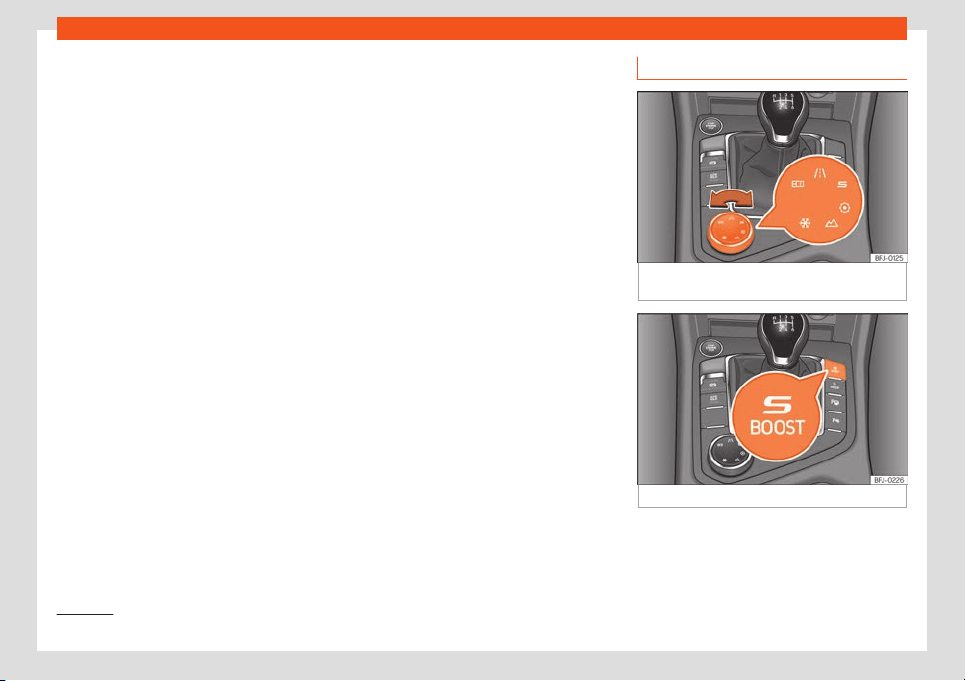
Driving
With manual transmission, the Eco pr
ofile
changes the gear change recommendations
to facilitate more efficient driving.
Dynamic chassis control (DCC)
DCC continuously adapts the shock absorb-
ers to the condition of the road and current
driving conditions, according to the pre-set
programme.
In the event of a fault in the DCC, the follow-
ing message is displayed on the instrument
screen Fault: shock absorber regula-
tion
Steering
The power steering varies its driving modes
and adapts to the profile selected, thus offer-
ing the best behaviour for each situation.
Air conditioning
The Climatronic can operate in Eco mode
with particularly limited consumption.
Adaptive Cruise Control (ACC)
Depending on the driving profile, the perform-
ance of the ACC varies, to allow more sporty
acceleration and braking or a more respect-
ful fuel consumption.
Electronic Stability Control (ESC)
In the Offroad and Snow driving profiles, the
electronic stability Control (ESC)
›››
page 278 adjusts to adapt to the terrain.
PreCrash system
The PreCrash system adapts according to
the selected configuration. The Sport and
Offroad driving profiles have specific settings
to adapt them to driving and terrain charac-
teristics
›››
page 23.
Hill descent control assistant
This assistant can be activated or deactiva-
ted in the Offroad profile. Hill Descent Con-
trol limits the speed on steep descents by au-
tomatically braking all four wheels, both
when moving forward and in reverse
›››
page 237.
Setting the driving profile
Fig. 173
Centre console: Driving Experience
butt
on.
Fig. 174 Centre console: S-BOOST button
You can select the Eco, Normal, Spor
t, Indi-
vidual, Offroad
1)
and Snow
1)
.
1)
Only for 4Drive models.
240
Start and driving
Selecting the driving profile:
●
Turn the Driving Experience button to select
the desir
ed driving profile
›››
Fig. 173.
The features of each profile can be seen by
pressing the Profile information function
button.
In the Individual profile it is possible to con-
figure the characteristics of the vehicle using
the Profile setup function button.
An icon on the touch screen provides infor-
mation about the active profile. The selector
displays the selected profile with a yellow
LED.
Hybrid vehicles
PHEV versions include the S-BOOST driving
profile as an exclusive additional.
Activate the profile:
●
Press the S-BOOST
›››
Fig. 174 button. The
indicator lamp on the button will light up and
its activation will also be indicated on the in-
fotainment system.
Deactivate the profile:
●
Press the S-BOOST button again.
●
Press the E-Mode button.
In hybrid versions the Eco, Normal and Sport
profiles do not change the behaviour of the
engine and hybrid system. This is only
changed with the S-BOOST profile.
Driving profiles
Driving pro-
fil
e
Characteristics
Places the vehicle in a low state
of consumption, f
acilitating a
fuel-saving driving style that is
respectful to the environment.
Normal
Offers a balanced driving experi-
ence
, suitable for everyday use.
Sport
Provides a complete dynamic
perf
ormance in the vehicle, ena-
bling the user a more sporty driv-
ing style.
Individual
It allows you to personalise the
configur
ation. The functions that
can be adjusted depend on the
equipment fitted in the vehicle.
Offroad
a)
Maintains optimal off-road driv-
ing by allowing the personalisa-
tion of the vehicle’s configuration
parameters.
Snow
a)
It adjusts the vehicle's behaviour
for driving on slippery road sur-
faces, optimising grip and ma-
noeuvrability.
BOOST
b)
This gives the vehicle and the hy-
brid system a dynamic overall
behaviour.
a)
Only for 4Drive models.
b)
Only for PHEV models.
WARNING
When operating SEAT Drive Profile, pay at-
t
ention to all traffic: doing otherwise could
cause an accident.
Note
●
When the engine is s
witched off it will
store the driving profile that was selected
when the ignition was turned off. When re-
started, the engine and the gearbox will
start in their Normal mode. To return the en-
gine and gearbox to the desired mode, re-
select the corresponding driving profile by
turning the Driving Experience button or se-
lect from the infotainment display.
●
When the vehicle is restarted after using
the Offroad or Snow settings, the system is
always activated in the Normal profile.
●
Your speed and driving style must always
be adjusted to visibility, weather, and traf-
fic conditions.
●
The Eco profile is not recommended
when towing a vehicle.
Driving tips
Running in
Please observe the instructions for running-in
ne
w components.
»
241
Driving
Running-in the engine
A ne
w engine must be driven through a run-in
period during its first 1500 kilometres (1000
miles). During its first few hours of running, the
internal friction in the engine is greater than
later on when all the moving parts have bed-
ded down.
How the vehicle is driven for the first 1500 km
(1000 miles) influences the future engine per-
formance. Throughout the life of the vehicle, it
should be driven at a moderate speed (espe-
cially when the engine is cold) this will reduce
engine wear and increase its useful life. Never
drive at extremely low engine speeds. Always
engage a lower gear when the engine works
“irregularly”. For the first 1000 km or
600 miles, please note:
●
Do not use full throttle.
●
Do not force the engine above two thirds of
its maximum speed.
●
Do not tow a trailer.
Between 1000 and 1500 kilometres (600
to 1000 miles), gradually increase power
until reaching the maximum speed and high
engine speeds.
Running in new tyres and brake pads
●
Replacement of wheel rims and new tyres
›››
page 354.
●
Information about brakes
›››
page 274.
For the sake of the environment
If the engine is run in gently, the life of the
engine will be incr
eased and the engine oil
consumption reduced.
Four-wheel drive (4Drive)
3 V
alid for vehicles: 4Drive all-wheel drive
On four-wheel drive models, the engine pow-
er is distributed to all four wheels
General notes
On four-wheel drive vehicles, the engine
power is distributed to all four wheels. The
distribution of power is controlled automati-
cally according to your driving style and the
road conditions. Also see
›››
page 278.
The four-wheel drive is specially designed to
complement the superior engine power. This
combination gives the vehicle exceptional
handling and performance capabilities, both
on normal roads and in more difficult condi-
tions, such as snow and ice. Even so (or per-
haps especially for this reason), it is important
to observe certain safety points
›››
.
Wint
er tyres
Thanks to four-wheel drive, your vehicle will
have plenty of traction in winter conditions,
even with the standard tyres. Nevertheless,
we still recommend that winter tyres or all-
season tyres be fitted on all four wheels to
give even better braking response.
Snow chains
On roads where snow chains are mandatory,
this also applies to cars with four-wheel drive
›››
page 359.
Changing tyres
On vehicles with four-wheel drive, all four
tyres must have the same rolling circumfer-
ence. Also avoid using tyres with varying
tread depths
›››
page 354.
Off-roader?
Your SEAT vehicle is not an off-roader: it does
not have enough ground clearance to be
used as such. It is therefore best to avoid
rough tracks and uneven terrain as much as
possible.
WARNING
●
Ev
en with four-wheel drive, you should al-
ways adjust your speed to suit the condi-
tions. Do not let the extra safety features
tempt you into taking any risks when driv-
ing. Risk of accident!
●
The braking capability of your vehicle is
limited by the tyres' grip. It is therefore no
different from a car without four-wheel
drive. So do not be tempted to drive too fast
on firm or slippery roads just because the
242

Start and driving
vehicle still has good acceleration in these
conditions. Risk of accident
!
●
On wet roads bear in mind that the front
wheels may start to “aquaplane” and lose
contact with the road if the car is driven too
fast. If this should happen, there will be no
sudden increase in engine speed to warn
the driver, as occurs with a front-wheel
drive car. For this reason you should always
choose a driving speed suitable for the
road conditions. Risk of accident!
Economical and environmentally
friendly driving
Fuel consumption, environmental pollution
and w
ear to the engine, brakes and tyres all
depend largely on driving style. Consumption
can be reduced between 10-15% with an effi-
cient driving type. The following section gives
you some tips on lessening the impact on the
environment and reducing your operating
costs at the same time.
Active cylinder management (ACT®)
Depending on vehicle equipment, the active
cylinder management (ACT®) may deacti-
vate some of the engine cylinders if the driv-
ing situation does not require too much pow-
er. The number of active cylinders can be
seen on the instrument panel display.
›››
page 70.
Foresight when driving
If you think ahead when driving, you will need
to brake less and thus accelerate less. Take
advantage of the inertia of the vehicle when-
ever possible, with a gear engaged. This
takes advantage of the engine braking effect,
reducing wear on the brakes and tyres. Emis-
sions and fuel consumption will drop to zero.
Changing gear to save energy
An effective way of saving is to change in ad-
vance to a higher gear.
Manual transmission: shift up from first to
second gear as soon as possible. Choosing
the right gear enables fuel savings. Select the
highest possible gear appropriate for the
driving situation (the engine should continue
functioning with cyclical regularity).
Automatic transmission: accelerate gradu-
ally and without reaching the “kick-down”
position.
Avoid driving at high speed
Avoid travelling at your vehicle’s top speed,
whenever possible. Fuel consumption, emis-
sion of harmful gases and noise pollution
multiply as speed is increased. Driving at
moderate speeds will help to save fuel.
Reduce idling time
In vehicles with the Start-Stop system idling is
automatically reduced. In vehicles without
the Start-Stop system it is worth switching off
the engine, for example, at level crossings
and at traffic lights that remain red for long
periods of time. When an engine has reached
operating temperature, and depending on
the cylinder capacity, keeping it switched off
for a minimum of about 5 seconds already
saves more than the amount of fuel necessa-
ry for restarting.
The engine takes a long time to warm up
when it is idling. Mechanical wear and pollu-
tant emissions are also especially high during
this initial warm-up phase. It is therefore best
to drive off immediately after starting the en-
gine. Avoid running the engine at high speed.
Regular maintenance
Regular servicing helps in saving fuel even
before the engine is started. A well-serviced
engine gives you the benefit of improved fuel
efficiency as well as maximum reliability and
an enhanced resale value. A badly serviced
engine can consume up to 10% more fuel
than necessary.
Avoid short journeys
The engine and catalytic converter need to
reach their optimal operating temperature
»
243
Driving
in order to minimise fuel consumption and
emissions.
A col
d engine consumes a disproportionate
amount of fuel. The engine reaches its work-
ing temperature after about four kilometres
(2.5 miles), when fuel consumption will return
to a normal level.
Check tyre pressure
Always make sure the tyres are inflated to the
correct pressures
›››
page 355 to save fuel. If
the pressure is below half bar, fuel consump-
tion may increase by 5%. Due to the greater
rolling resistance, under-inflation also increa-
ses tyre wear and impairs handling.
Do not use winter tyres all year round as
they increase fuel consumption by up to 10%.
Avoid carrying unnecessary loads
Given that every kilo of extra weight will in-
crease the fuel consumption, it is advisable
make sure that no unnecessary loads are be-
ing transported.
Since the luggage rack increases the aero-
dynamic drag of the vehicle, you should re-
move it when not needed. At speeds of
100-120 km/h (62-75 mph), this will save 12%
of fuel.
Save electrical energy
The engine drives the alternator, thereby
generating electricity. This implies that any
increase in power consumption also increa-
ses fuel consumption! For this reason, switch
off any unneeded electrical devices. Devices
that use a lot of electricity include the blower
at a high setting, the rear window heating or
the seat heating.
Plug-in hybrid drive: brake early and evenly
to take advantage of energy recovery.
Note
●
If you hav
e the Start-Stop system, it is
recommended that it should not be discon-
nected.
●
It is recommended that you close the
windows when driving at more than
60 km/h (37 mph).
●
Do not drive with your foot resting on the
clutch pedal, as the pressure can make the
plate slip. This causes wear and can dam-
age the clutch plate.
●
Do not ride the clutch on a hill, use the
brake. The fuel consumption will be lower
and you will prevent the clutch plate from
being damaged.
●
Use the engine brake on downhills by
changing to the gear that is best suited for
the gradient. Fuel consumption will be
“zero” and the brakes will not suffer.
Driving on flooded roads
To prevent damage to the vehicle driving on
fl
ooded roads, take the following into ac-
count:
●
The water should never come above the
lower edge of the bodywork.
●
Drive at pedestrian speed.
WARNING
After driving through flooded zones, brak-
ing eff
ectiveness can decrease if the brake
discs or pads are damp
›››
page 274.
CAUTION
●
Driving thr
ough flooded areas may dam-
age vehicle components such as the en-
gine, transmission or electrical system.
●
Whenever driving through water, the
Start-Stop system must be switched off
›››
page 226.
Note
●
Check the depth of the w
ater before en-
tering the flooded zone.
●
Do not stop in the water, drive in reverse,
or stop the engine.
●
Vehicles travelling in the opposite direc-
tion cause waves that could exceed your
vehicle's critical height.
244
Driver assistance systems
●
Av
oid driving through salt water (corro-
sion)
›››
page 367.
Trips abroad
●
With petrol vehicles, it should be ensured
that l
ead-free petrol is available throughout
the journey
›››
page 331, Fuel types. Seek
information about service station networks
selling unleaded fuel.
●
In some countries, it is possible that your
v
ehicle is not sold and some spare parts may
not be available or the technical services
may only be able to make limited repairs.
SEAT importers and distributors will provide
information about the technical preparation
that your vehicle requires and also about
necessary maintenance and repair possibili-
ties.
CAUTION
SEAT does not accept liability for any dam-
age t
o the vehicle due to the use of a lower
quality fuel, an inadequate service or the
non-availability of genuine spare parts.
Driver assistance systems
Gener
al notes
Safety advice
WARNING
●
R
esponsibility for driving rests with the
driver at all times. The drive assist systems
are not a replacement for driver attention.
Focus all your attention on driving and be
prepared to intervene at all times.
●
Use the drive assist systems only when
conditions allow. The driving style must al-
ways be suitable for the weather, visibility,
road and traffic conditions.
●
In order for drive assist systems to react
correctly, sensors and cameras must oper-
ate without limitations. Please read the
notes on sensors and cameras in this chap-
ter.
Note
●
K
eep in mind the specific rules of each
country, especially when it comes to driv-
ing, formation of an emergency corridor,
braking distance, speed, parking position,
wheel position, etc. The driver is solely re-
sponsible for always complying with the
specific regulations of each country.
●
The area in front of and around the radar
sensor should not be covered with adhe-
sives, additional headlights or similar
it
ems, as this could have a negative impact
on the operation of the assistants. If the ve-
hicle is not properly repaired or structural
modifications are made to it, the operation
of the assistants may be affected.
●
The repair and adjustment of sensors and
cameras requires special knowledge and
tools. It is recommended to visit a SEAT
dealership for this purpose.
System limits
WARNING
●
Driv
e assist systems can not overcome
the laws of physics. Depending on the cir-
cumstances, a collision may not be avoida-
ble.
●
Warnings, notices and indicator lamps
may not be displayed on time, or may be
displayed incorrectly, e.g. if a vehicle ap-
proaches too quickly.
●
Corrective interventions by drive assist
systems (e.g. interventions in the steering
or brakes) may be insufficient or may never
occur, depending on the circumstances. As
a driver, you must be prepared to act at all
times.
»
245
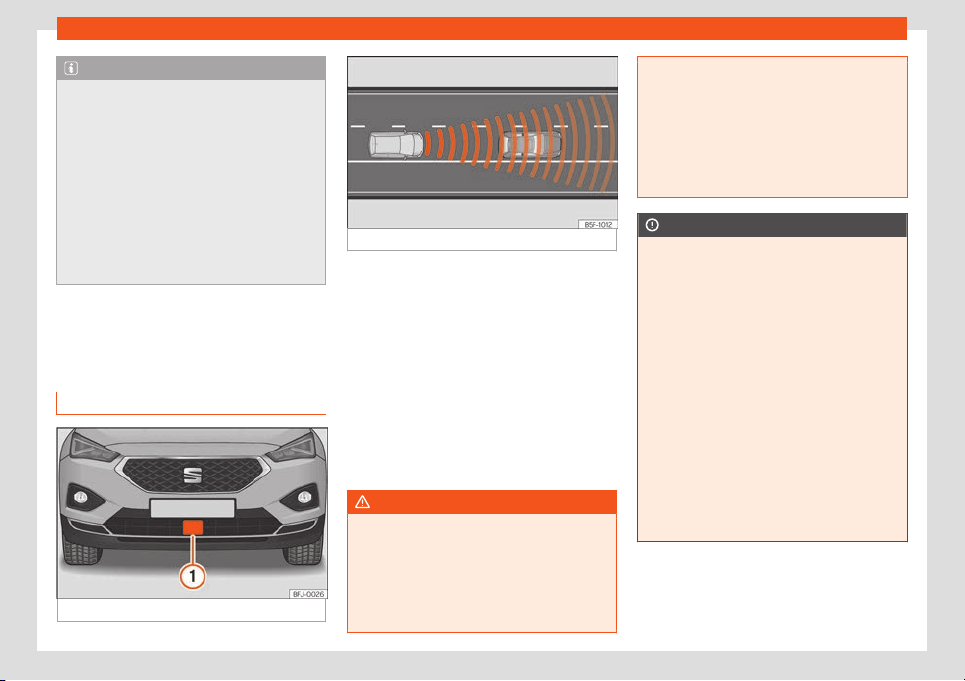
Driving
Note
●
Due t
o the system's detection limits in the
surroundings, the systems may not give
warnings or intervene on time, or they
might do so even if it is not desired. In addi-
tion, the auxiliary systems may incorrectly
interpret a manoeuvre and, as a result,
warn the driver in an unexpected manner.
●
When the towing mode is selected, some
assist systems may react with limitations,
in an unusual way or may not be available.
Keep in mind the instructions relating to the
towing mode.
Drive assist sensors and
camer
as
Front radar
Fig. 175
On the front bumper: radar sensors.
Fig. 176 Detection area.
A radar sensor may be fitted to the front
bumper of the v
ehicle
›››
Fig. 175. The front
radar detects any objects in its detection
zone
›››
Fig. 176 and provides support for the
following functions:
●
Front Assist
›››
page 252.
●
Adaptive Cruise Control (ACC)
›››
page 255.
The radar can have a range of up to 120m
(400ft) depending on road and weather con-
ditions.
WARNING
The visibility of the radar sensor can be im-
pair
ed by dirt or environmental influences
such as rain, fog, snow, mud, dust, insects
etc. In this case the Front Assist and ACC
functions may stop working. The instrument
panel displays the following message: No
sensor vision! And the Front Assist un-
available or ACC unavailable warning
lights come on.
●
Clean the sensor area on the bumper as
indicat
ed in
›››
page 369, Cleaning the ex-
terior. When the radar sensor starts cor-
rectly detecting again, the message disap-
pears from the screen and the functions
become available again.
CAUTION
●
If the r
adar sensor is dirty or poorly ad-
justed, the Front Assist system may give un-
necessary warnings and apply the brakes
inappropriately.
●
The operation of the radar can be affec-
ted by strong reflections of the emitted sig-
nal. This may occur, for example, in an en-
closed car park or due to the presence of
metallic objects (e.g. guard rails or sheets
used in road works).
●
The sensor may not be adjusted correct-
ly if it receives an impact. This may com-
promise the system's efficacy or discon-
nect it. If you have the feeling that the ra-
dar sensor is damaged or adjusted incor-
rectly, switch off the Front Assist and ACC
functions to avoid any damage. If this oc-
curs have it adjusted.
246
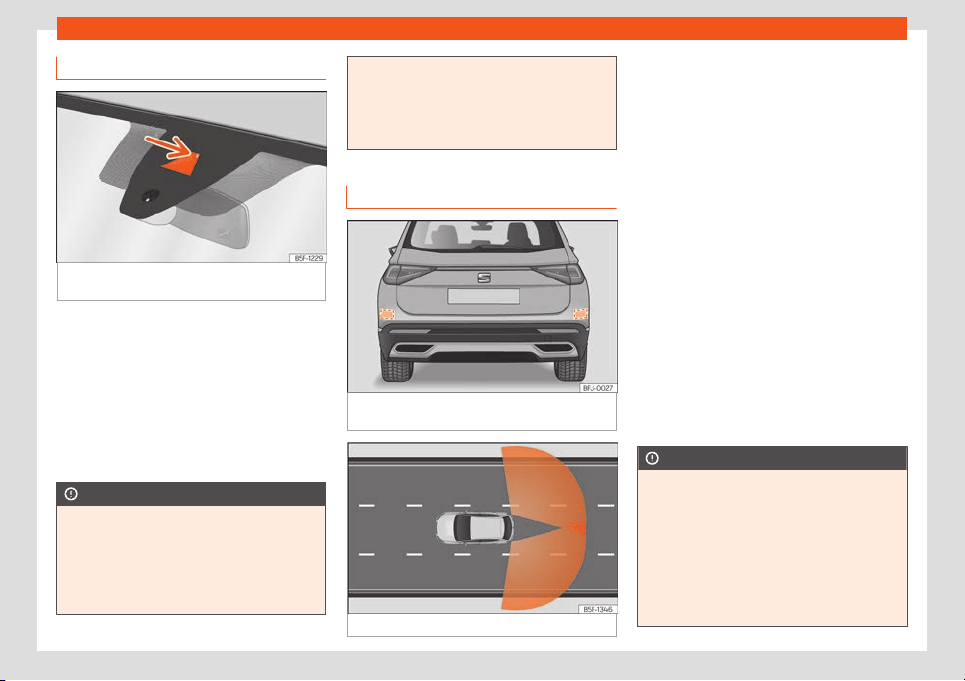
Driver assistance systems
Front camera
Fig. 177
On the windscreen: field of vision of
the L
ane Assist system.
Depending on the equipment, the vehicle
may be fitt
ed with a front camera on the front
windscreen
›››
Fig. 177. This camera detects
lane boundaries (lines) to provide support for
the following functions:
●
Lane Assist
›››
page 263.
●
Travel Assist
›››
page 265.
●
Emergency assist
›››
page 267.
CAUTION
To avoid affecting the operation of the sys-
t
ems, take the following points into consid-
eration:
●
Clean the field of vision of the camera
regularly and make sure it is free of snow
and ice.
●
Do not co
ver the field of vision of the
camera.
●
Check that the windscreen is not dam-
aged in the area of the camera's field of vi-
sion.
Rear radar
Fig. 178 Rear view of the vehicle: radar sensor
z
ones.
Fig. 179 Sensor detection zones
The radar sensors are located on the left and
right of the bumper and ar
e not visible from
the outside
›››
Fig. 178. The sensors monitor
both the blind spot and traffic behind the ve-
hicle
›››
Fig. 179.
They support the following functions:
●
Lane departure warning (Side Assist)
›››
page 270.
●
Rear cross traffic alert (RCTA)
›››
page 272.
Automatic deactivation of supported func-
tions
The rear radar sensors deactivate automati-
cally when, among other reasons, one of the
sensors is detected to be permanently cov-
ered. This may be the case if, for example,
there is a layer of snow or ice over one of the
sensors.
The relevant text message will appear in the
dash panel display.
CAUTION
●
The r
adar sensors on the rear bumper
may be damaged or shifted in the event of
a collision, for example, when entering or
exiting a parking space. This may result in
the system disconnecting itself, or at least
possibly having its functionality diminished.
●
In order to ensure that the radar sensors
work properly, keep the rear bumper free of
snow and ice and do not cover it.
»
247
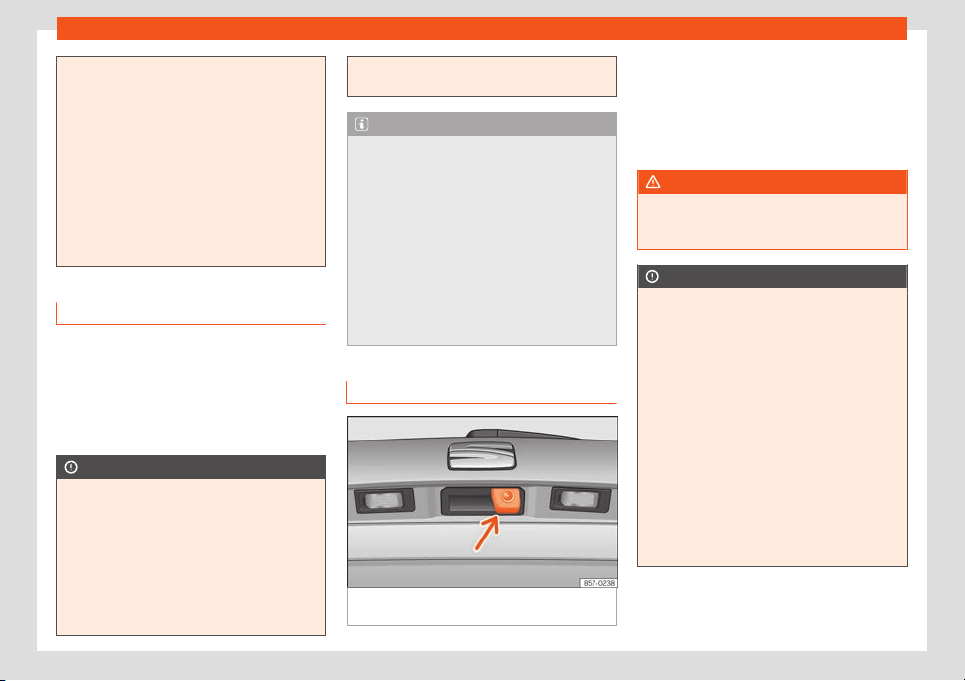
Driving
●
The r
ear bumper should only be painted
with paint authorised by SEAT. The lane de-
parture warning's functions may be limited
or work incorrectly if other paints are used.
●
The visibility of radar sensors may be af-
fected due to leaves, snow, strong haze or
dirt, among others. Clean the area in front
of the sensors.
●
Never use the lane departure warning,
the rear cross traffic alert or the door
opening warning if the radar sensors are
dirty.
Ultrasound sensors
The bumpers are fitted with ultrasound sen-
sors t
o perform the following functions:
●
Park Assist
›››
page 282.
●
Parking aid Plus
›››
page 291.
●
Rear parking aid
›››
page 294.
CAUTION
●
Damage t
o the radiator grille, bumper,
wheel arch and vehicle underbody can
modify the orientation of the sensors. This
can affect the parking aid function. Have
the function checked by a specialised
workshop.
●
A number plate or number plate holder
with dimensions that exceed the space for
the number plate, or a cured or deformed
number plate can cause false detections or
a l
oss of visibility for the sensors.
Note
●
In or
der to guarantee good operation,
keep the sensors clean, free of snow and
ice, and do not cover them with stickers or
other objects.
●
If you use high-pressure or vapour equip-
ment for cleaning, do not apply it directly,
unless you do so very briefly, and always
keep a distance of more than 10 cm away.
●
Fitting certain accessories to the front of
the vehicle, such as a plate holder with ad-
vertising, may interfere with the operation
of the Park Assist.
Area View system
Fig. 180 In the rear lid handle: Area View sys-
t
em
Depending on your vehicle’s equipment, it
can be fitt
ed with 1 or 4 cameras that provide
support to the following functions:
●
Area View
›››
page 298
●
Rear View Camera
›››
page 302.
WARNING
The use of a number plate may interfere in
the vie
ws shown on the screen, since the
cameras' field of vision may be reduced.
CAUTION
●
In or
der to guarantee good system oper-
ation, keep the cameras clean, free of snow
or ice, and do not cover them with adhe-
sives or other objects.
●
The vehicle is fitted with a cleaning sys-
tem for the rear camera. To operate it, push
the wiper lever away from the steering
wheel (the camera will be cleaned at the
same time as the rear window). If the cam-
era is still dirty after using it, clean it man-
ually.
●
Never use abrasive cleaning products to
clean the camera lenses.
●
Do not use hot or warm water to remove
ice or snow from the camera lenses. Doing
so could damage the lenses.
248
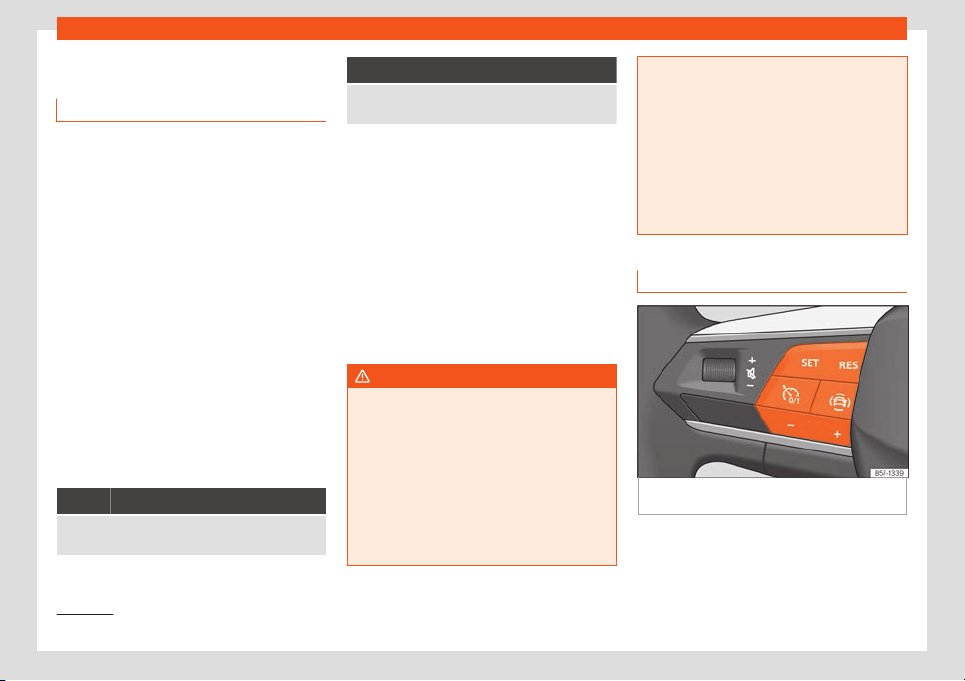
Driver assistance systems
Cruise control system (CCS)
Intr
oduction
The cruise control system (GRA) helps main-
t
ain a constant speed set by you.
Speed range
The cruise control system is available when
driving in forward gear at a speed of over ap-
prox. 20 km/h (15 mph).
Temporarily switching off the cruise con-
trol
The saved speed can be exceeded at any
time, e.g. for overtaking. The cruise control is
suspended during acceleration and is then
resumed with the saved speed.
Status display
When the cruise control system is switched
on, the instrument cluster display shows the
saved speed and the system status:
It lights up grey
The cruise control system is switched on, but regula-
tion is not activ
e.
It lights up green
The cruise control system is switched on and regula-
tion is activ
e.
If there is no speed saved, the instrument
clust
er display shows instead of speed.
Changing gears
As soon as the clutch pedal is depressed,
regulation is suspended and resumes once
the gear change has been made.
Driving down slopes
1)
Shift into a low gear before descending a
long hill. This makes use of engine braking
and relieves the brakes.
WARNING
If it is impossible to drive with sufficient
br
aking distance and at a constant speed,
using the cruise control system may cause
accidents and serious injuries may occur.
●
Do not use Travel Assist when visibility is
bad, on steep roads, on windy roads or in
slippery circumstances (such as snow, ice,
rain or loose gravel), or on flooded roads.
●
Only use the cruise control system on
paved roads with a firm surface.
●
Adapt your speed and saf
ety distance to
the vehicle in front of you at all times to suit
the visibility, weather, road and traffic con-
ditions.
●
After use, always switch off the speed
limiter to prevent the speed being regula-
ted against your wishes.
●
It is dangerous to use a set speed which is
too high for the prevailing road, traffic or
weather conditions.
Operating the cruise control
Fig. 181
On the multifunction steering wheel:
butt
ons to operate the speed limiter.
Connecting
●
Press the butt
on.
»
1)
Valid for hybrid vehicles
249

Driving
There is no speed saved and regulation is not
yet oper
ating.
Start regulation
●
When the vehicle is moving, press the but-
ton .
The cruise control system saves and regu-
lates the current speed.
Adjusting the speed
While the GRA is set, the stored speed can be
adjusted:
+ 1 km/h (1 mph)
- 1 km/h (1 mph)
+ 10 km/h (5 mph)
- 10 km/h (5 mph)
In conventional drive vehicles, the cruise con-
trol system only operates the acceleration, it
does not brake the vehicle. In hybrid vehicles
the cruise control system changes the cur-
rent speed by accelerating or braking.
Interrupting the adjustment
●
Briefly press the button on the multifunc-
tion steering wheel or press the brake pedal.
The speed is stored.
Reinstating the cruise control
●
Press the button.
The cruise control system resumes the saved
speed and regulates it.
Switching off
●
Press and hold the button .
The cruise control system switches off and
the saved speed is deleted.
Switching off the speed limiter
●
Press the button.
●
Select the speed limiter on the instrument
cluster display.
The cruise control system is switched off.
Troubleshooting
Temporarily switching off the cruise
contr
ol
The control lamp switches on yellow.
●
Abnormal operation. Switch off the cruise
control system and take the vehicle to a spe-
cialist workshop.
The adjustment is interrupted unexpect-
edly
●
If the clutch pedal is pressed for a long
time.
●
The vehicle has exceeded the saved speed
for a long time.
●
No forward gear has been selected.
●
A brake assistance system has intervened,
e.g. TCS or ESC.
●
Front Assist has braked the vehicle.
●
If the fault continues, disconnect the Emer-
gency Assist and consult a specialised work-
shop.
Speed limiter
Introduction
The speed limited helps the driver not to ex-
ceed a set speed.
Speed r
ange
The speed limiter helps avoid exceeding a
programmed speed, from 30 km/h (20 mph)
approx. and faster.
By selecting the speed limiter
The speed limitation can be interrupted at
any time by depressing the accelerator ped-
al fully, beyond the point of resistance. As
soon as the saved speed is exceeded, the
green indicator light flashes and an audible
warning signal sounds. The speed is stored.
250
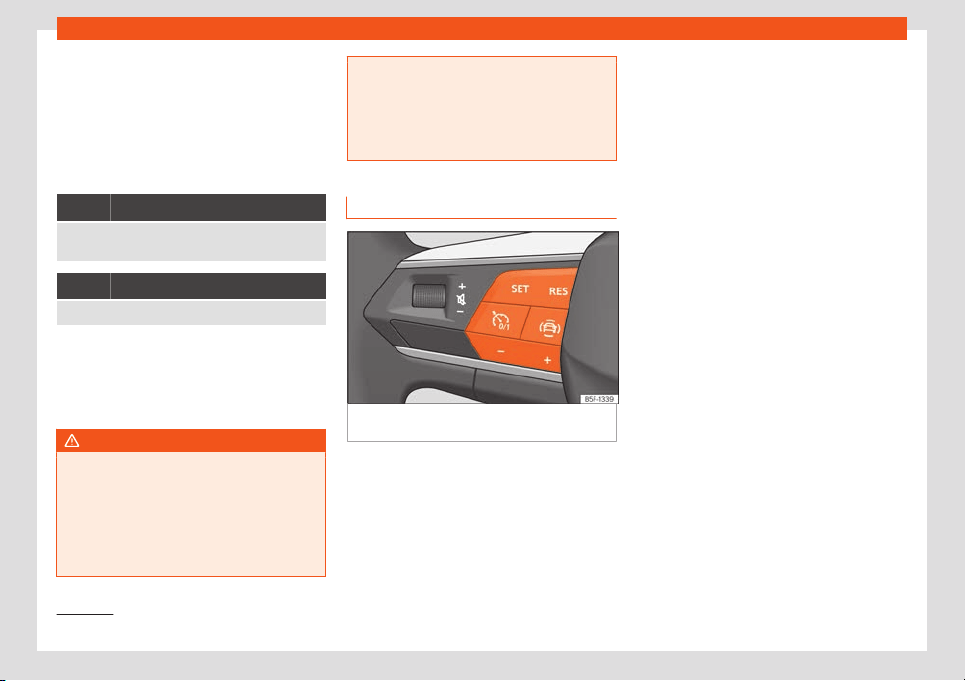
Driver assistance systems
The limiter is reactivated automatically after
r
eturning to less than the set speed.
Status display
When the speed limiter is switched on, the in-
strument cluster display shows the saved
speed and the system status:
It lights up grey
The speed limiter is switched on but regulation is not
activ
e.
It lights up green
The speed limiter is switched on and active.
Driving down slopes
1)
Shift int
o a low gear before descending a
long hill. This makes use of engine braking
and relieves the brakes.
WARNING
After use, always switch off the speed limit-
er t
o prevent the speed being regulated
against your wishes.
●
The speed limiter does not relieve the
driver of their responsibility to drive at the
appropriate speed. Do not drive at high
speed if not necessary.
●
Using the speed limit
er under adverse
weather conditions is dangerous and can
cause serious accidents, e.g. aquaplaning,
snow, ice, leaves, etc. Only use the speed
limiter when the status of the road and the
weather conditions allow it.
Operating the speed limiter
Fig. 182 On the multifunction steering wheel:
butt
ons to operate the speed limiter.
Connecting
●
Press the butt
on.
It does not take effect yet.
Start regulation
●
When the vehicle is moving, press the but-
ton .
The current speed is saved as a limit speed.
Adjusting the speed
The programmed speed can be set:
+ 1 km/h (1 mph)
- 1 km/h (1 mph)
+ 10 km/h (5 mph)
- 10 km/h (5 mph)
Interrupting the adjustment
●
Press the button.
The speed is stored.
Reinstating the cruise control
●
Press the button.
The limiter will re-activate as soon as the ve-
hicle is moving at a speed lower than the
saved one.
Switching off
●
Press and hold the button .
»
1)
Valid for hybrid vehicles
251
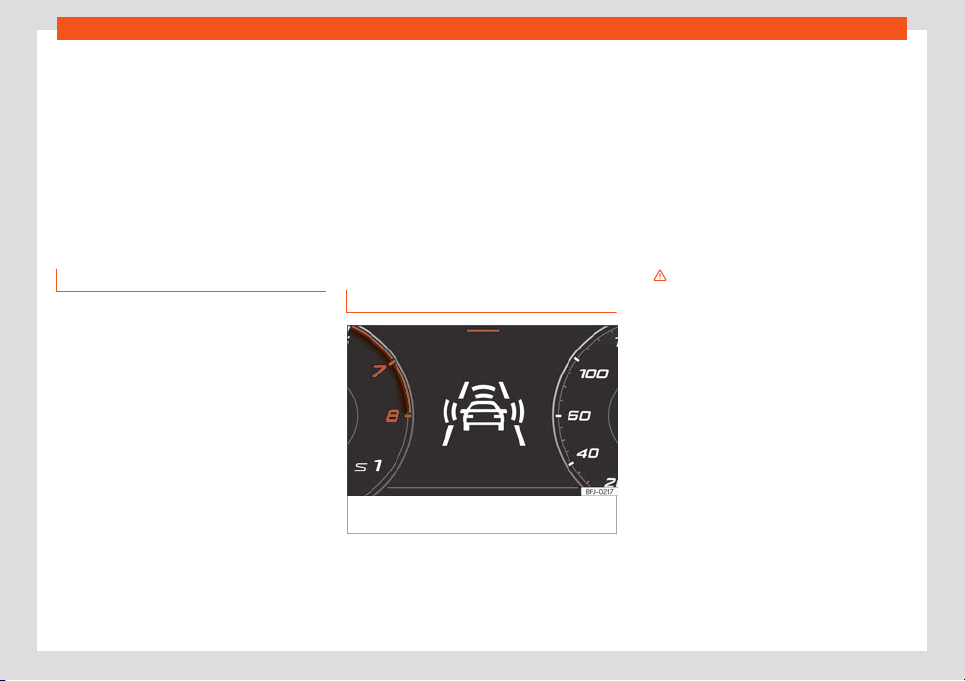
Driving
The speed limiter switches off and the speed
is del
eted.
Switch to cruise control (GRA) or adaptive
cruise control (ACC)
●
Press the button.
●
Observe the corresponding message on
the instrument cluster display.
The speed limiter is switched off.
Troubleshooting
The speed limiter is not active.
The contr
ol lamp switches on yellow.
●
Malfunctions Switch off the speed limiter
and go to a specialist workshop.
The adjustment is interrupted unexpect-
edly
●
You have switched off the Electronic Stabili-
zation Control (ESC).
●
The brakes have overheated. Wait for the
brakes to cool down and check the operation
again.
●
If the fault continues, consult a specialised
workshop.
For safety reasons, the speed limiter only
switches off fully whenever the driver stops
pressing the accelerator pedal or switches
the system off manually.
Not possible to start regulation
●
The selected driving profile does not allow
regulation to start. Select another profile and
repeat the procedure.
emergency brake assistance
system (Front Assist)
Introduction
Fig. 183 On the instrument panel display: ad-
v
ance warning indications.
The objective of the system is to prevent
head-on collisions against ob
jects that may
be in the vehicle’s path or minimise the con-
sequences of such impacts.
Depending on several factors and how criti-
cal the situation is, the system operates in a
staggered manner. First it warns the driver,
and if the driver’s reaction does not occur or
is insufficient, it activates independent emer-
gency braking.
The function is intended to prevent collisions
with parked vehicles or vehicles in the same
lane travelling in the same direction, or with
pedestrians crossing the vehicle’s path or
travelling in the same lane and direction. It
may not activate in other hazard situations
›››
.
Fr
ont Assist is enabled between 4 km/h (2.5
mph) and 250 km/h (156 mph). Depending
on a range of conditions, some of the func-
tions described below are omitted to optimize
the behaviour of the system.
Front Assist is a driving assistance function
that can never replace the driver’s atten-
tion.
Safety distance warning
If the system detects that you are driving too
close to the vehicle in front, it will warn the
driver with this indication on the instrument
panel display .
The timing of the warning varies according to
other factors: driver behaviour and speed.
252
Driver assistance systems
Advance warning
If the syst
em detects a possible collision with
the vehicle in front, it alerts the driver by
means of an audible warning and an indica-
tion on the instrument panel display
›››
Fig. 183.
The warning moment varies depending on
the traffic situation and driver behaviour. At
the same time, the vehicle will prepare for a
possible emergency braking
›››
.
Critical w
arning
If the driver fails to react to the advance
warning, the system may actively intervene
in the brakes and generate a brief jolt to warn
the driver of the imminent danger of a colli-
sion.
Automatic braking
If the driver also fails to react to the critical
warning, the system may initiate independ-
ent emergency braking by progressively in-
creasing the braking in accordance with how
critical the situation is.
Driver emergency brake assistance sys-
tem
The system may detect that the driver is not
braking hard enough to avoid the collision. In
this case, it will increase the braking intensity.
The system cannot prevent a collision, al-
though it can significantly minimise the con-
sequences by reducing the speed and the
force of the impact.
WARNING
Observe the safety warnings
›
››
in Con-
tr
ol and warning lamps on page 86.
WARNING
Front Assist cannot change the laws of
physics or r
eplace the driver in terms of
keeping control of the vehicle and reacting
to a possible emergency situation.
WARNING
Following a Front Assist emergency warn-
ing, pay immediat
e attention to the situa-
tion and try to avoid the collision as appli-
cable.
●
If the Front Assist does not work as de-
scribed in this chapter (e.g. it repeatedly
intervenes unnecessarily), switch it off.
Have the system checked by a specialised
workshop. SEAT recommends visiting a
SEAT dealership.
●
Always adapt your speed and distance
away from the vehicle in front of you at all
times to suit visibility, weather, road and
traffic conditions.
●
The Front Assist alone cannot avoid acci-
dents and serious injuries.
●
In compl
ex driving situations, Front Assist
may issue warnings and intervene in brak-
ing unnecessarily.
●
If the operation of the Front Assist is im-
paired by dirt or because the radar sensor
has lost its settings, the system may issue
unnecessary warnings and intervene inop-
portunely in the braking.
●
The Front Assist does not react to animals
or vehicles crossing your path or ap-
proaching head-on down the same lane.
●
The Front Assist does not react to pedes-
trians walking head-on in the same lane.
●
The driver must always be ready to take
over the control of the vehicle.
Note
●
When Fr
ont Assist is connected, the indi-
cations of other functions on the screen
may be hidden.
●
When the Front Assist causes a braking,
the brake pedal is “harder”.
●
Automatic interventions by the Front As-
sist on the brakes may be interrupted by
pressing the clutch, accelerator or moving
the wheel.
●
The Front Assist may brake the vehicle
until it stops completely. However, the
brake system does not halt the vehicle per-
manently. Use the foot brake!
»
253
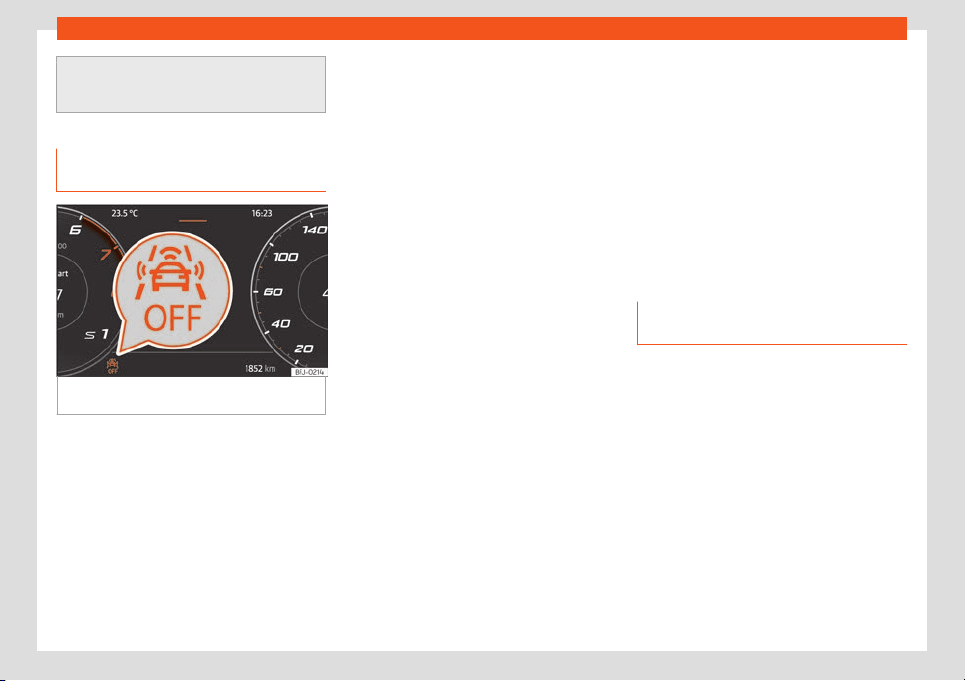
Driving
●
If the Fr
ont Assist does not work as de-
scribed in this chapter (e.g. in intervenes
several times unnecessarily), switch it off.
Operation of the emergency brake
assist
ance system (Front Assist)
Fig. 184 On the instrument panel display:
Fr
ont Assist deactivated indication.
The Front Assist is active whenever the igni-
tion is s
witched on.
When the Front Assist is switched off, so too
are the advance warning and the distance
warning functions.
SEAT recommends leaving the Front Assist
activated. Exceptions
›››
page 254, Deacti-
vating Front Assist temporarily in the fol-
lowing situations.
Switching the Front Assist on and off
With the ignition switched on, the Front Assist
can be deactivated or activated as follows:
●
Select the corresponding menu option us-
ing the button for the driver assistance sys-
tems
›››
page 84.
●
OR: in the infotainment system with the
function button > Assistants
›››
page 91.
When the Front Assist is deactivated, the indi-
cation
›››
Fig. 184 will be displayed on the
instrument panel.
Activating or deactivating the pre-warning
(advance warning)
The advance warning can be switched on or
off in the infotainment system using the func-
tion button > Assistants
›››
page 91.
The system will store the setting for the next
time the ignition is switched on.
SEAT recommends keeping advance warning
active.
Depending on the vehicle’s infotainment sys-
tem the advance warning function may be
adapted in the following modes:
●
Advance
●
Medium
●
Delayed
●
Deactivated
SEAT recommends driving with the function in
“Medium” mode.
Switching distance warning on and off
The distance warning can be switched on or
off in the infotainment system using the func-
tion button > Assistants
›››
page 91.
The system will store the setting for the next
time the ignition is switched on.
SEAT recommends keeping the distance
warning active.
Deactivating Front Assist tempora-
rily in the following situations
In the following situations the Front Assist
shoul
d be deactivated due to the system's
limitations:
●
When the vehicle is to be towed.
●
If the vehicle is on a test bed.
●
When the radar sensor is damaged.
●
If the radar sensor receives a violent im-
pact.
●
If it intervenes several times unnecessarily.
●
If the radar sensor is temporarily covered
by an accessory.
●
When the vehicle is going to be loaded onto
transportation.
254
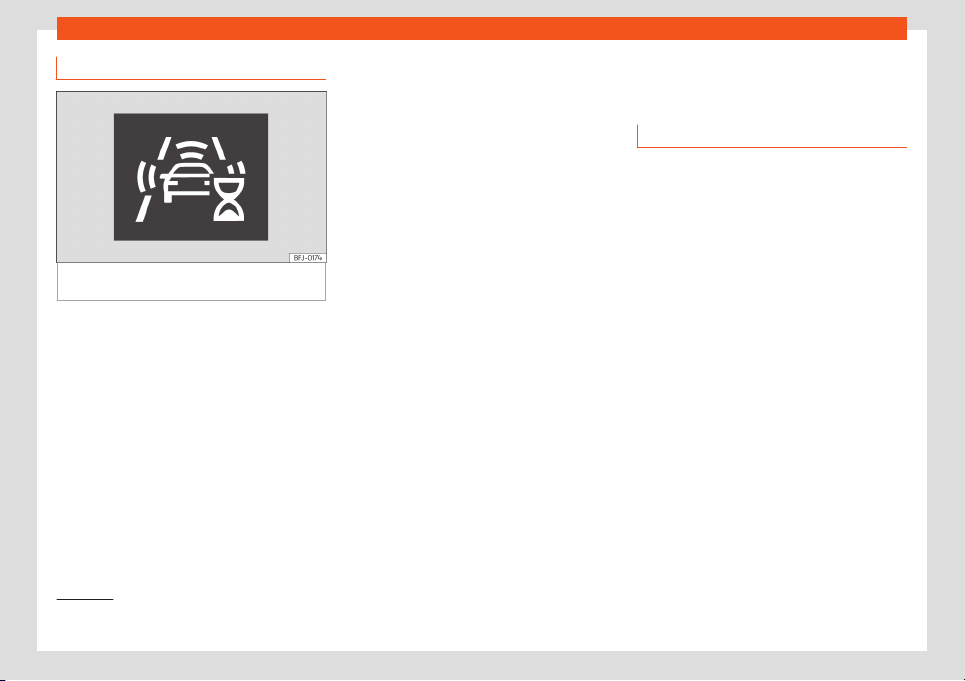
Driver assistance systems
System limitations
Fig. 185
On the instrument panel display: ini-
tial syst
em self-calibration indication.
Front Assist has certain limitations inherent to
the syst
em. Thus, in certain circumstances,
some of the reactions may be inappropriate
from the driver's standpoint. So pay attention
in order to intervene if necessary.
The following conditions may cause the
Front Assist not to react or to do so too
late:
●
In the first few instants of driving after
switching on the ignition, due to the system’s
initial auto-calibration. During this period, a
status icon
›››
Fig. 185is displayed.
●
If the Front Assist is switched off or dam-
aged.
●
If the radar sensor is dirty or covered.
●
On taking tight bends or complex paths.
●
Pressing the accelerator all the way down.
●
If the ASR has been disconnected or the
ESC activated in Sport mode
›››
page 280.
●
If the ESC is controlling.
●
If several brake lights of the vehicle or elec-
trically connected trailer are damaged.
●
If there are metal objects, e.g. guard rails or
sheets used in road works.
●
If the vehicle is reversing.
●
In case of snow or heavy rain.
●
In case of narrow vehicles, such as motor-
bikes.
●
Misaligned vehicles.
●
Vehicles crossing the other's path.
●
Vehicles approaching in the opposite direc-
tion.
●
Loads and accessories of other vehicles
that protrude over the sides, backwards or
over the top.
ACC - Adaptive Cruise Con-
trol
Introduction
Adaptive Cruise Control (ACC) maintains
a const
ant speed set by the driver. When
approaching another vehicle in front, the
ACC detects it and adapts the speed au-
tomatically, maintaining a distance set by
the driver.
Does my vehicle have ACC?
Your vehicle has ACC if it has a configuration
menu in the infotainment system
›››
page 91
and if it has the ACC function buttons on the
multifunction steering wheel
›››
Fig. 186.
Speed range
ACC regulates speeds between 30 km/h (20
mph) and 210 km/h (130 mph).
1)
If the vehicle is fitted with an automatic gear-
box, the ACC can bring the vehicle to a
standstill if a vehicle in front of it stops.
If your vehicle is fitted with a manual gearbox,
you must pay attention to speed and gear
changes. The ACC is deactivated if the
»
1)
When E-Mode is activated in hybrid vehicles,
the ACC speed r
ange may vary.
255
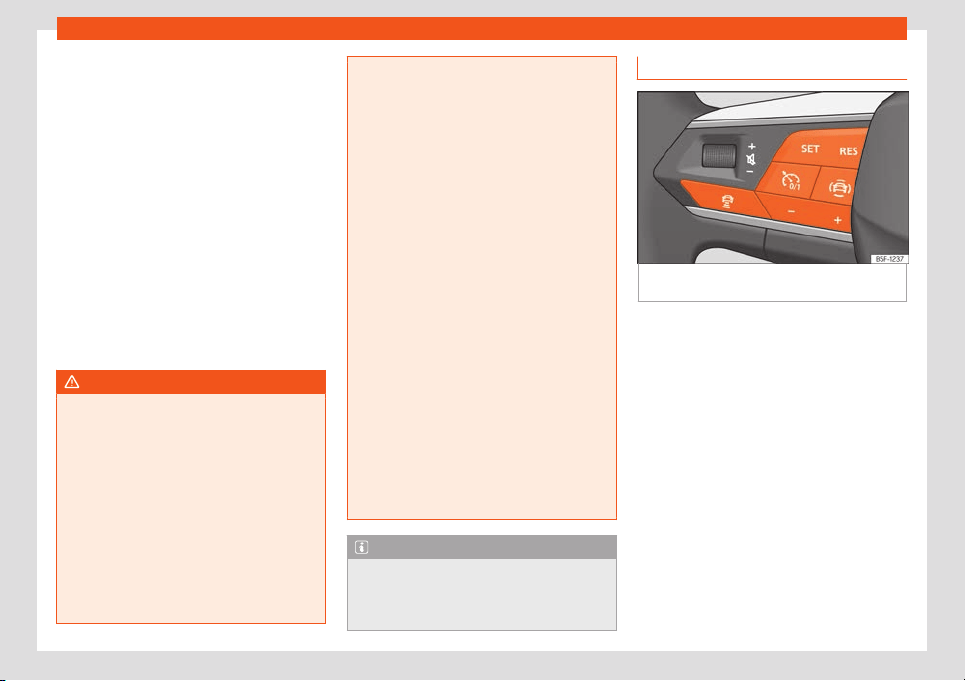
Driving
speed is too low (less than 30 km/h) of the
engine RP
M is too low or high.
Driver intervention prompt
ACC is subject to certain limitations in-
herent to the system. This means that
the driver will have to control the speed
and distance from other vehicles in cer-
tain situations. In this case, the instru-
ment cluster display will tell you to in-
tervene by applying the brake, and an
audio warning will be played.
Radar sensors
The ACC uses the front radar technology.
Read its maintenance instructions and infor-
mation about its limitations
›››
page 245.
WARNING
The ACC’s technology cannot overcome
the syst
em's inherent limitations or change
the laws of physics. If used negligently or
involuntarily, it may cause serious acci-
dents and injuries. The system is not a re-
placement for driver awareness.
●
Always be prepared to brake or acceler-
ate.
●
If you press the accelerator pedal the
ACC will stop working. Therefore, it will not
brake or request any braking intervention.
●
Adapt your speed and safe distance to
the vehicle in front of you at all times to suit
visibility, weather, road and traffic condi-
tions.
●
Do not use the ACC in poor visibility, or
on r
oads that are steep, with lots of curves
or slippery.
●
Never use ACC when driving off-road or
on unpaved roads.
●
The system does not react to stationary
obstacles (such as a traffic jam queue). Re-
act soon enough to avoid a hazardous sit-
uation.
●
The system does not react to people, ani-
mals or vehicles that are crossing or ap-
proaching in the opposite direction.
●
If you are driving with a spare wheel fit-
ted, the ACC system could automatically
switch off. Switch off the system when
starting off.
●
Brake immediately if the ACC does not
slow down enough.
●
Brake immediately when a driver inter-
vention instruction is displayed on the in-
strument cluster screen.
●
If the vehicle continues to move involun-
tarily after a driver intervention prompt,
brake the vehicle.
Note
If the ACC does not work as described in
this chapt
er, do not use it until it has been
checked by a specialised workshop. Visit-
ing a SEAT dealership is recommended.
ACC operation
Fig. 186
On the multifunction steering wheel:
butt
ons to operate the ACC
Connecting
●
Press the butt
on on the multifunction
steering wheel.
The ACC does not regulate anything yet
(standby).
Start regulation
●
To start regulation, press the button
›››
Fig. 186.
The ACC sets the current speed, or the clos-
est speed within the valid range (30-210
km/h), as the cruise speed.
With manual transmission, the gear lever
must be in any gear except first and reverse,
and the speed must be higher than approxi-
mately 30 km/h (18 mph). On vehicles with
256
Driver assistance systems
automatic transmission, the gear lever must
be in the D, S or M position.
Depending on the driving sit
uation, the fol-
lowing indicator lamps come on:
It lights up green
ACC connected, no vehicle detected in front.
It lights up green
ACC connected, vehicle detected in front.
When the ACC is in standby, the indicator
l
amps light up in grey.
Setting speed
To program the speed, press the or
›››
Fig. 186 buttons to the desired speed. The
speed is adjusted at intervals of 10 km/h (5
mph).
When the ACC is active, the button can be
pressed to increase the desired speed by 1
km/h (1 mph). You can then press to de-
crease it by 1 km/h (1 mph).
Setting your distance level
The distance can be set to one of five levels,
from very short to very long:
●
Press the button and then the button or
›››
Fig. 186.
●
Alternatively, press the button as many
times as necessary to set the desired dis-
tance.
Keep in mind each country’s regulations on
minimum braking distances.
Suspend regulation (standby)
●
Briefly press the button on the multifunc-
tion steering wheel or press the brake pedal.
The ACC indicator lamp is grey; the speed
and distance are saved.
If the ESC ASR
›››
page 280 is disconnected,
the ACC is automatically suspended.
Reinstating the cruise control
●
Press the button. The ACC regulates to
the last speed and distance setting.
●
OR: Press the button to use the current
speed.
Switching off
●
Press and hold the button . The set speed
is cleared.
Exceeding the speed regulated by the
ACC
While driving with the ACC switched on, the
driver can increase speed by pressing the
accelerator pedal. ACC regulation is suspen-
ded until you release the accelerator pedal
›››
.
Set the def
ault distance setting
In the Infotainment system, you can pre-se-
lect the distance level when connecting the
ACC from:
●
Very short, Short, Medium, Long and Very
long using the Infotainment system: > Driv-
er assistance > ACC
›››
page 91.
Changing the driving profile
In vehicles with SEAT Drive Profile, the driving
profile selected can have an influence on the
ACC’s acceleration and braking behaviour
›››
page 239.
In vehicles without SEAT Drive Profile, the be-
haviour of the ACC can also be affected if
any of the following drive profiles are selec-
ted in the infotainment system in Drive assist.
ACC settings will be the same as those in the
SEAT Drive Profile.
WARNING
Before driving off, check that the road is
cl
ear. The radar sensor may not detect ob-
stacles on the road. This could cause an
accident and serious injuries. If necessary,
apply the brake.
»
257
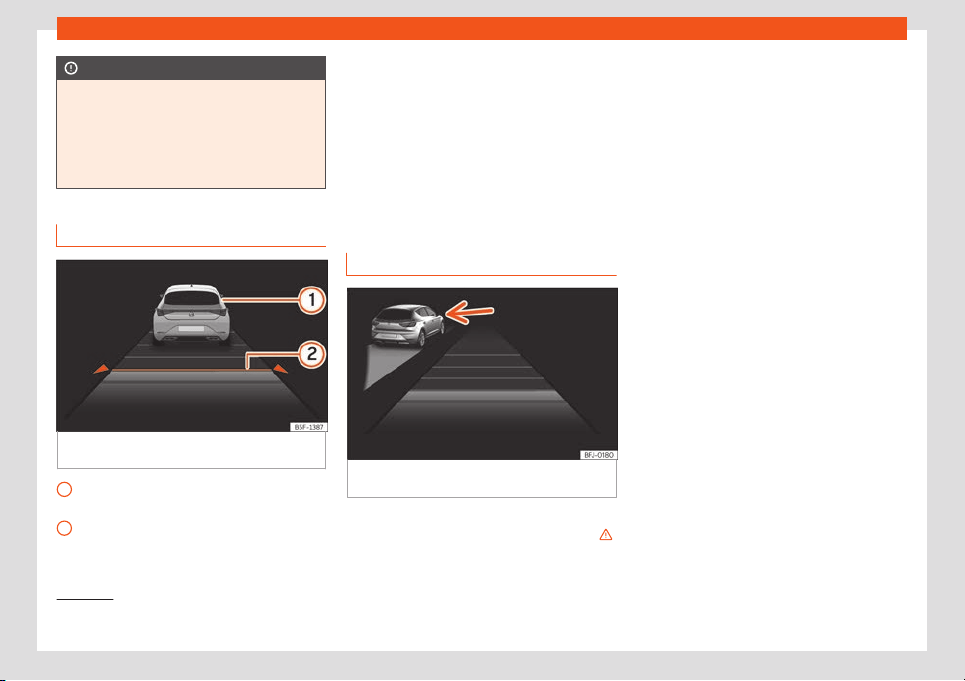
Driving
CAUTION
If you increase speed using the accelerator
pedal, the ACC may not be abl
e to safely
adjust the speed of the distance due to the
limitations of the system.
●
Be prepared to react if required by the
situation.
Status display
Fig. 187
On the instrument panel display: ACC
activ
e.
Vehicle ahead detected. It will light up if
the dist
ance to the vehicle is adjusted.
Selected distance level 2.
1
2
This information can be displayed on the
centr
al panel of the Assists view, or in the left
hand information profile
›››
page 67. If these
views are not selected, it will be automatical-
ly displayed in the lower central part of the
instrument cluster in a simplified manner.
The set speed will be displayed next to the
function status indicator described in
›››
page 256, Start regulation.
Special driving situations
Fig. 188 On the instrument panel display: ACC
activ
e, vehicle detected in an outer lane.
Be aware of the limitations and warnings de-
scribed at the beginning of this chapt
er.
›››
in Introduction on page 256.
Avoid undertaking on the right
1)
If a v
ehicle is detected in the left lane that is
travelling at a speed slower than that set by
the driver, it will brake the vehicle within the
comfort limits of the system to avoid passing
it on the right
›››
Fig. 188.
You can cancel this regulation by changing
the set speed or by pressing the accelerator
pedal.
The function works at speeds over 80 km/h
(50 mph). It may not be available in certain
countries.
Overtaking
When the turn signal is switched on for over-
taking, the ACC reduces the distance from
the vehicle in front to help with the overtaking
manoeuvre. The set cruising speed will not be
exceeded.
The function works at speeds over 80 km/h
(50 mph). It may not be available in certain
countries.
Stop&Go function
3 Valid for: vehicles with an automatic gearbox
The ACC can bring the vehicle to a standstill
(0 km/h) if the vehicle in front stops.
1)
Or on the left, in countries that drive on the left
hand side of the r
oad.
258
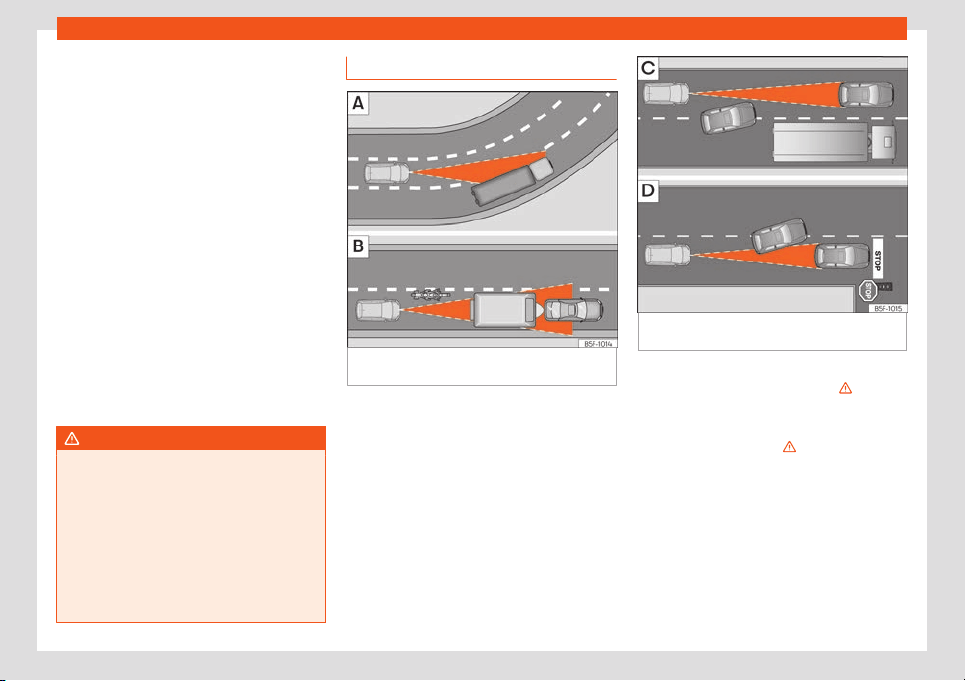
Driver assistance systems
The ACC remains active and the message
ACC ready to start is displ
ayed on the in-
strument cluster for a few seconds. You can
extend or reactivate this warning by pressing
the button or, depending on your vehicle’s
equipment, by grabbing the steering wheel.
During this time, the vehicle will move off
again if the vehicle in front moves forwards.
To move off when the message ACC ready
to start is not longer displayed, once the
vehicle in front has moved off:
●
Press the accelerator pedal.
●
OR: press the button or on the multi-
function steering wheel.
The ACC is deactivated while stopped in the
following cases:
●
If the vehicle stops for several minutes.
●
If a door is opened.
WARNING
If the message ACC ready to start is dis-
pl
ayed on the instrument cluster display
and the vehicle in front moves off, your ve-
hicle will move off automatically. In this
case, any obstacles in the road may not be
detected. This may cause serious acci-
dents and injuries.
●
Always check the road before moving off,
and apply the vehicle brakes yourself if
necessary.
ACC system limitations
Fig. 189
V
ehicle on a bend.
Motorcyclist
ahead, out of range of the radar sensor.
Fig. 190 V
ehicle changing lanes. One
vehicle turning and another stationary.
The limits of the ACC system mean that it is
not appr
opriate in all situations
›››
in Intro-
duction on page 256.
SEAT does not r
ecommend using the function
in the following cases
›››
:
●
Heavy rain, snow or fog.
●
When going through tunnels.
●
In sections with roadworks.
●
On routes with curves, e.g. on mountain
r
oads.
●
On off-road routes.
●
In covered car parks.
»
259
Driving
●
On r
oads with embedded metal objects
such as train or tram tracks.
●
On roads with loose gravel.
Pay special attention when using ACC in the
following situations:
On curves
The ACC may not detect the vehicle in front
on a curve, or may regulate the distance from
vehicles in other lanes
›››
Fig. 189 .
Vehicles outside the sensor zone
In the following situations the ACC may not
react, or may react slowly or inappropriately:
●
Vehicles that are not aligned while driving
or that are outside the sensor's detection
area, such as motorcycles
›››
Fig. 189
●
Vehicles that move into your lane, a short
distance from your vehicle
›››
Fig. 190 .
●
Vehicles with loads or accessories that pro-
trude from the sides, rear or roof.
Objects that are not detected
The ACC function only detects and reacts to
vehicles moving in the same direction. There-
fore it does not detect:
●
People
●
Animals
●
Vehicles travelling in the opposite direction
or crossing the road.
●
Other stationary obstacles
The ACC does not react to stationary vehi-
cles. If, for example, a vehicle detected by the
ACC turns or moves over and there is a sta-
tionary vehicle in front of it, the ACC will not
react to the second vehicle
›››
Fig. 190 .
WARNING
Using the ACC in the above situations can
cause serious accidents and injuries, and
you coul
d break the law.
Troubleshooting
ACC not available
The indicat
or lamp lights up yellow:
●
The radar sensor is dirty or adjusted incor-
rectly. Take into account the warnings descri-
bed at the beginning of this chapter
›››
page 246
●
There is a fault or a defect. Turn off the vehi-
cle's ignition and turn it on again after a few
minutes.
●
If the problem persists, consult a special-
ised workshop.
The ACC does not work as expected
●
Make sure that the conditions are met for
the radar sensor to operate properly
›››
page 246.
●
If the brakes overheat, regulation stops au-
tomatically. Wait for them to cool down and
check the operation again.
●
Unusual noises during automatic ACC
braking are normal and do not indicate any
anomalies.
The following conditions may lead the
ACC not to react:
●
The accelerator or brake is depressed.
●
No gear is engaged or the vehicle is in gear
R.
●
The vehicle is reversing.
●
ESC is operating.
●
The driver is not wearing his/her seat belt.
●
A vehicle or trailer brake light is faulty.
●
The RPM is too high or too low.
●
The parking brake is applied.
●
Driving on an excessive slope.
260
Driver assistance systems
Proactive speed adjustment
Intr
oduction
The proactive speed adjustment adapts the
speed t
o the speed limitations detected and
to the road layout (curves, crossings, round-
abouts, etc.).
Proactive speed adjustment is an additional
function of the ACC
›››
page 255 and uses
the traffic signal detection system
›››
page 75 and the navigation data of the in-
fotainment system.
Proactive speed adjustment is available de-
pending on the equipment, although not in all
countries.
WARNING
The proactive speed adjustment smart
t
echnology cannot overcome the limits im-
posed by the laws of physics and it only
works within the limits of the system. Never
allow the enhanced convenience of this
function induce you to take any risk that
compromises safety. If used negligently or
involuntarily, it may cause serious acci-
dents and injuries. The system is not a re-
placement for driver awareness.
●
Always adapt your speed to suit visibility,
weather, road and traffic conditions.
●
Always pay attention to traffic and al-
ways keep the vehicle environment in mind.
●
Al
ways be prepared to adjust the speed
yourself. If the traffic sign recognition sys-
tem is not working properly or the naviga-
tion data is not updated, the speed may
change unexpectedly and suddenly or may
not be suitable for the current traffic situa-
tion. In addition, the speed adjusted by the
system may not suit your driving style.
●
Always be prepared to adjust the speed
yourself. If you drive without any active gui-
ded route, if you leave the route calculated
by the navigation system or if the position
of the vehicle cannot be determined cor-
rectly because the GPS does not provide
accurate data, the speed may change un-
expectedly and suddenly or may not adapt
to the current traffic situation.
●
Always use up to date navigation data.
●
Always take into account the maximum
permitted speed. In the case of speed limi-
tations that are not included in the naviga-
tion data, the maximum permitted speed
may be exceeded.
Note
Also note the information related to the
ACC r
elevant to safety
›››
page 255.
Limitations of the proactive speed
adjustment
In addition to the limitations of the traffic sig-
nal det
ection system
›››
page 75 and of the
limitations of the ACC, proactive speed ad-
justment has the following limitations inherent
to the system:
●
Proactive speed adjustment only recogni-
ses traffic signals that show a speed limita-
tion. The proactive speed adjustment does
not take into account, above all, the rules on
priority of passage or traffic lights.
●
On roads that are not included in the navi-
gation dat
a, or that are included with little
accuracy, proactive speed adjustment is not
available.
●
If a speed limitation is notified based on the
navigation data without it being detected by
the traffic signal detection system, the indica-
ted speed will be adjusted to the speed that
was saved the last time.
●
Proactive speed adjustment is not available
for speed limitations below approx. 20 km/h
(approx. 15 mph). In this case, a relevant mes-
sage is displayed on the instrument panel
screen.
261
Driving
Activating the proactive speed ad-
justment
In the infotainment system, in the assist serv-
ices menu, you can individually adjust the
t
ype of incident the vehicle should react to
›››
page 91:
●
Response to road layout.
●
Reaction at permitted speeds.
Driving with the proactive speed
adjustment
●
Connect the ACC
›
››
page 256.
●
Set the distance and speed.
●
Activate the proactive speed adjustment.
As soon as the system recognises a speed
limitation or a relevant road layout during the
route, a warning will appear on the instru-
ment panel display. This warning will indicate
the reason and the speed to which the vehi-
cle will adjust due to said limitation.
Adjustment due to a speed limitation.
Adjustment due to a road layout.
In the event of adjustment due to a speed lim-
itation, the detected speed will be saved as
the new desired speed. In the event of adjust-
ment due to the road layout, the vehicle will
accelerate again after leaving the reason for
the adjustment behind and the speed will be
adjustment to that which has been saved.
The speeds indicated for curves depend on
the driving profile
›››
page 239.
Interrupting speed adjustment
●
During the warning, press the button .
●
During the adjustment, press the button .
Adjust the announced speed
The announced speed can only be adjusted
in the event of adjustment due to a speed lim-
itation.
Multifunction steering wheel:
+ 1 km/h (1 mph), only while the ACC is
adjusting
- 1 km/h (1 mph), only while the ACC is
adjusting
+ 10 km/h (5 mph)
- 10 km/h (5 mph)
If you adjust the indicated speed excessively,
the proactive speed adjustment is interrup-
ted.
Note
●
When a speed limit
ation is recognised,
the proactive speed adjustment also
+
–
adapts the saved speed even if the ACC is
s
witched off. However, it will not adjust.
●
If the speed of travel considerably ex-
ceeds the speed limit detected by the traf-
fic signal detection system, a relevant
warning is displayed in the instrument pan-
el display.
●
In the event of joining a highway without
speed limitation, the recommended speed
is automatically saved as the desired
speed. If a higher speed has previously
been saved for a motorway without a
speed limit, this is used instead of the rec-
ommended speed.
Troubleshooting
A message is displayed indicating that
pr
oactive speed adjustment is not current-
ly available or not in your country.
●
If this message is displayed for a long time
and proactive speed adjustment is available
in your country, contact a specialised work-
shop.
Note
Depending on the anomaly in question, ad-
ditional inf
ormation may be displayed in
Vehicle status
›››
page 90.
262
Driver assistance systems
Lane Assist
Intr
oduction
The Lane Assist System helps the driver
st
ay in his/her lane within the physical lim-
its of the system. This function is not suita-
ble and is not designed to keep the vehicle
automatically in the lane.
Using the camera located in the windscreen,
the Lane Assist system detects the limits (lane
lines) dividing the lanes in which the vehicle is
travelling. If the vehicle gets too close to the
detected lane limits, the system alerts the
driver through a corrective motion of the
steering wheel. The driver can cancel the
steering corrective action at any time.
No warning is produced with the turn signals
activated, given that the Lane Assist system
understands that a lane change is required.
System limits
Use the Lane Assist system only on large,
well-maintained motorways and highways.
The system is not available under the follow-
ing conditions:
●
The driving speed allowed is below approx.
55 km/h (30 mph).
●
The system has not detected any lane
lines.
●
On tight bends.
●
Temporarily in very sporty driving situations.
WARNING
The intelligent technology in the Lane As-
sist syst
em cannot change the limits im-
posed by the laws of physics and by the
very nature of the system. Careless or un-
controlled use of the Lane Assist system
may cause accidents and injury. The sys-
tem is not a replacement for driver aware-
ness or manoeuvres when driving.
●
Always adapt your speed and the dis-
tance to the vehicles ahead in line with visi-
bility, weather conditions, the condition of
the road and the traffic situation.
●
Always keep your hands on the steering
wheel so it can be turned at any time. The
responsibility of staying in the lane is al-
ways the driver's.
●
The Lane Assist system does not detect
all road markings. The road surfaces, road
structures or objects in poor condition can
be incorrectly detected as road markings
under certain circumstances by the Lane
Assist system. Immediately counter any un-
wanted intervention of the system.
●
Please observe the indications on the in-
strument panel and act as is necessary if
the traffic situation permits.
●
In the following situations there may be
undesired interventions of the system or it
may be that the system does not intervene
at all. In these situations, special attention
is r
equired from the driver and, where ap-
propriate, the temporary deactivation of
the lane assist warning system:
–
In very sporty driving situations.
–
In adverse weather conditions and
roads in poor condition.
–
When passing through areas undergo-
ing works.
–
Before gradient changes of grade and
river beds.
●
Always observe the vehicle surroundings
carefully and drive proactively.
●
When the area of vision of the camera
becomes dirty, covered or is damaged, the
Lane Assist system function can be affec-
ted.
Control lamp
It lights up green
Lane Assist system active and available.
It lights up yellow
The Lane Assist system intervening with a rectifica-
tion of the st
eering.
Some control and warning lamps will light up
briefly when the ignition is s
witched on to
»
263
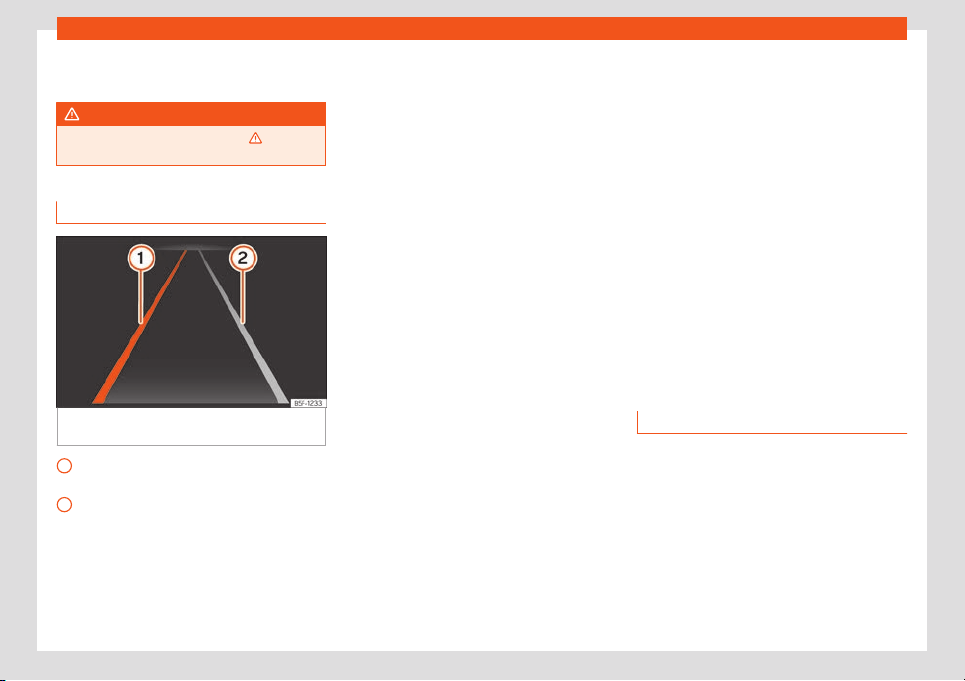
Driving
check certain functions. They will switch off
aft
er a few seconds.
WARNING
Observe the safety warnings
›
››
in Con-
tr
ol and warning lamps on page 86.
Driving with the Lane Assist System
Fig. 191
On the instrument panel display: indi-
cations of the L
ane Assist System.
Lane line detected. The system inter-
v
enes assisting on the represented side.
Lane line detected. The system does not
intervene.
Switching the lane assist system on or off
In some countries, the Lane Assist System is
always activated when the ignition is switch-
ed on. The connection status is shown in the
Driver assistance menu of the Infotainment
1
2
system or the driver assistance systems menu
aft
er pressing the corresponding button. The
Lane Assist system can be activated and de-
activated in these menus.
The Lane Assist system is ready to actively in-
tervene as of approximately 60 km/h (35
mph) and if it has detected the lane limits
(system status: active). The control lamp
emits a green light. When the system inter-
venes by rectifying the direction, the control
lamp emits a yellow light.
If the control lamp of the instrument panel
display is off, it means that the Lane Assist
system is connected but not ready to inter-
vene or it is disconnected.
When you activate a turn signal, the system
temporarily goes into a passive state in order
to allow manual lane change.
An energetic rotation or rectification of the
steering wheel by the driver causes the sys-
tem to temporarily switch to a passive state.
Driver intervention prompt
If the steering is not corrected manually, the
system prompts the driver through an indica-
tion on the instrument panel display and
acoustic warnings.
If no reaction is obtained from the driver, the
system switches to a passive state.
Regardless of the steering manoeuvres,
through an indication on the instrument panel
display and acoustic warnings, the driver is
also prompted to drive through the centre of
the lane if the steering correction lasts more
than reasonable.
Steering wheel vibration
The following situations may result in a steer-
ing wheel vibration:
●
The lane ceases to be recognised during a
sudden intervention in the direction of the
system.
It is also possible to select steering wheel vi-
bration in the Assistants menu of the infotain-
ment system. In this case, when a vehicle with
Lane Assist switched on crosses over a detec-
ted lane marking, the steering wheel will vi-
brate.
Troubleshooting
Error message, the system disconnects
●
Clean the windscreen.
›
››
page 367
●
Check that the windscreen is not damaged
in the area of the camera's field of vision.
System behaviour is different than expec-
ted
●
Clean the field of vision of the camera reg-
ularly and make sure it is free of dirt, snow
and ice.
264
Driver assistance systems
●
Do not co
ver the field of vision of the cam-
era.
●
Check that the windscreen is not damaged
in the area of the camera's field of vision.
●
Do not mount objects on the steering
wheel.
In the event of doubts or queries, go to a spe-
cialised workshop.
Driving Assist (Travel Assist)
Introduction
The driving assist (Travel Assist) combines
adaptiv
e cruise control (ACC) and adap-
tive lane guidance. Within the limitations
of the system, the vehicle can maintain a
distance from the vehicle in front that is
preselected by the driver and remain in
the preferred position within the lane.
Travel Assist uses the same sensors as Adap-
tive Cruise Control (ACC) and Lane Assist.
Therefore, carefully read the information
about the ACC
›››
page 255 and the Lane
Assist
›››
page 263 and take into account the
limitations of the systems and the indications
given in the information.
Speed range
Travel Assist adjusts at speeds between ap-
prox. 30 km/h (approx. 20 mph) and approx.
210 km/h (approx. 130 mph); in the case of
the adaptive lane guidance function, be-
tween 0 km/h (0 mph) and approx. 250 km/h
(approx. 155 mph).
Driving with Travel Assist
Travel Assist automatically controls the ac-
celerator pedal, the brakes and the steering.
In addition, Travel Assist may, within its limita-
tions, decelerate the vehicle until it stops be-
hind another that stops and automatically
starts again.
You can override assisted adjustment at all
times.
How to know if the vehicle is fitted with
Travel Assist
The vehicle is fitted with Travel Assist if the
multifunction steering wheel has the button
›››
Fig. 194.
Driver intervention prompt
If you remove your hands from the steering
wheel, after a few seconds the system asks
you to take over the steering with an indica-
tion on the instrument panel display and
acoustic warnings.
WARNING
The Travel Assist smart technology cannot
o
vercome the limits imposed by the laws of
physics and it only works within the limits of
the system. If Travel assist is used negli-
gently or involuntarily, it may cause serious
accidents and injuries. The system is not a
replacement for driver awareness.
●
Bear in mind the system limitations and
the indications regarding the control of the
Adaptive Cruise Control (ACC) and Lane
Assist.
●
Adapt your speed and safety distance to
the vehicle in front of you at all times to suit
visibility, weather, road and traffic condi-
tions.
●
Do not use Travel Assist when visibility is
bad, on steep roads, on windy roads or in
slippery circumstances (such as snow, ice,
rain or loose gravel), or on flooded roads.
●
Do not use Travel Assist offroad or on
roads where the surface is not firm. Travel
Assist has been designed for use on paved
roads only.
●
Travel Assist does not react to people or
animal or vehicles crossing your path or
which approach you head-on in the same
lane.
●
Brake immediately if Travel Assist does
not slow down enough.
●
Brake immediately when a braking mes-
sage is displayed on the instrument panel
screen.
»
265
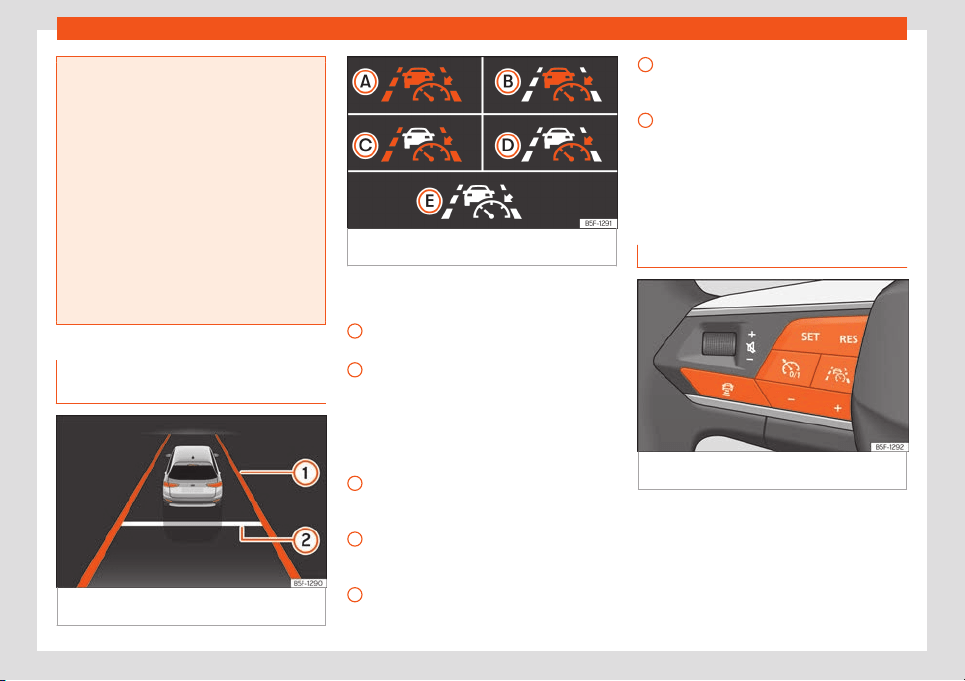
Driving
●
Br
ake when, after an indication to brake,
the vehicle rolls without it being desired.
●
Keep your hands on the steering wheel at
all times, to ensure you have control over
the steering at all times. The driver is al-
ways responsible for keeping the vehicle in
its own lane.
●
If possible, do not wear gloves while driv-
ing. The system could interpret this as no
driving activity.
●
If driver intervention is requested on the
instrument panel display, immediately re-
sume control of the vehicle.
●
Always be prepared to adjust the speed
yourself.
Indications on the instrument panel
displ
ay
Fig. 192
On the instrument panel display: indi-
cation with activ
e adjustment.
Fig. 193 On the instrument panel display: con-
tr
ol lamps.
Displays on the screen
›
››
Fig. 192
The adaptive lane guidance function is
active.
Distance set.
In addition, depending on the equipment,
control lamps indicate the status of the sys-
tem on the instrument panel display:
›››
Fig. 193
Travel Assist active, adaptive cruise con-
trol and adaptive lane guidance function
are active.
Travel Assist active, adaptive cruise con-
trol active and adaptive lane guidance
function passive.
Travel Assist active, adaptive cruise con-
trol passive and adaptive lane guidance
function active.
1
2
A
B
C
Travel Assist active, adaptive cruise con-
tr
ol and adaptive lane guidance function
are passive.
Inactive Travel Assist.
Depending on the equipment, more details
may be displayed on the instrument cluster,
such as dashed lines or other vehicles on the
road.
Operating Travel Assist
Fig. 194
Left side of the multifunction steering
wheel
: buttons for operating Travel Assist.
Connecting
●
Press the butt
on on the multifunction
steering wheel.
The control lamp will light up green. The
following warning is also displayed on the in-
strument panel screen: The Travel Assist
maintains the current speed and the preset
D
E
266

Driver assistance systems
distance from the vehicle in front. At the same
time
, if it detects road markings it keeps the
vehicle in the lane by moving the steering
wheel.
Interrupting the adjustment
●
Briefly press the button on the multifunc-
tion steering wheel or press the brake pedal.
The set distance remains saved.
Making other adjustments
For all else, Travel Assist is operated like the
ACC
›››
page 256.
Troubleshooting
T
ravel Assist is not available or does
not work as expected
The control lamp switches on yellow. A rele-
vant warning is also displayed on the instru-
ment panel screen.
●
There is a fault in the sensors. Check the
causes and solutions described in
›
››
page 246.
●
The system limits are exceeded.
●
If the fault continues, consult a specialised
workshop.
Take the wheel
The warning lamp comes on white or red, de-
pending on the urgency of the intervention. A
message is also displayed.
●
You released the steering wheel for a few
seconds. Take hold of the steering wheel and
take control of the vehicle.
●
The system limits have been reached. Take
hold of the steering wheel and take control of
the vehicle.
Travel Assist disconnects automatically
Vehicles without Emergency Assist: You have
released the steering wheel for a long period.
●
Abnormal operation. Contact a specialised
workshop.
The adjustment is interrupted unexpect-
edly
Vehicles without lane departure warning: You
have turned on the turn signal.
Emergency Assist
How it works
Emergency Assist can detect whether
ther
e is inactivity by the driver and can au-
tomatically keep the car within the lane
and stop it altogether if necessary. This
way the system can actively help avoid an
accident or reduce its consequences.
Emergency Assist uses the same sensors as
Adaptive Cruise Control (ACC) and Lane As-
sist. Therefore, carefully read the information
about the ACC
›››
page 255 and the Lane
Assist
›››
page 263 and take into account the
limitations of the systems and the indications
given in the information.
If the Emergency Assist detects that the driver
does not perform any activity, it requests that
the driver take control of the vehicle. To do
this, it emits optical and acoustic warnings
and causes braking jolts. The seat belt is
tightened (depending on the equipment). The
system slows down the vehicle and keeps it in
its lane.
You can cancel the adjustment at any time
by moving the steering wheel, over-acceler-
ating or braking.
While the emergency assistant is in operation,
other road users are warned as follows:
●
The hazard warning lights are switched on
soon after.
The following happens as soon as the vehicle
stops:
●
The electronic parking brake is activated.
»
267
Driving
The Emergency Assist is only activated if the
f
ollowing requirements are met:
●
The adaptive cruise control (ACC) must be
switched on .
●
The Travel Assist or the Lane Assist are
switched on.
●
The system has detected a road lane mark-
ing on both sides of the vehicle.
Troubleshooting
Emergency Assist not available
The control lamp switches on yellow. A rele-
vant warning is also displayed on the instru-
ment panel screen.
●
The field of vision of the camera is dirty.
Clean the windscreen.
●
The visibility of the camera is diminished
due to weather factors, e.g. snow, or deter-
gent residue or some coating. Clean the
windscreen.
●
The visibility of the camera is diminished
due to accessories or adhesives. Leave the
area around the camera’s field of vision free.
●
The camera has been altered or damaged,
e.g. because of damage caused to the wind-
screen. Check for visible damage.
●
There is a fault or a defect. Turn the drive
system off and on again.
●
If the fault continues, disconnect the Emer-
gency Assist and consult a specialised work-
shop.
WARNING
The smart technology fitted into the Emer-
gency Assist cannot o
vercome the limits
imposed by the laws of physics; it only
works within the limits of the system. The
driver is responsible for driving the vehicle.
●
Adapt your speed and safety distance to
the vehicle in front of you at all times to suit
the visibility, weather, road and traffic con-
ditions.
●
The Emergency Assist cannot always
avoid accidents or serious injuries by itself.
●
If possible, do not wear gloves while driv-
ing. The system could interpret this as no
driving activity.
●
If the radar sensor or the camera are cov-
ered or have been altered or damaged, the
system may intervene on the brakes or on
the direction in an inappropriate manner.
●
The Emergency Assist does not react to
people or animal or vehicles crossing your
path or which approach you head-on in the
same lane.
WARNING
If the Emergency Assist Intervenes inoppor-
t
unely, serious accidents and injuries may
occur.
●
If the v
ehicle behaves differently than ex-
pected, interrupt the intervention of the
Emergency Assist by over-accelerating,
braking or moving the steering wheel.
●
Do not use Travel Assist or Lane Assist.
Have the system checked by a specialised
workshop.
Note
●
Aut
omatic interventions by the Emergen-
cy Assist on the brakes may be interrupted
by pressing the accelerator or brake or by
moving the wheel.
●
Hazard warning lights that come on auto-
matically can be switched off by pressing
the accelerator or the break, moving the
steering wheel or pressing the hazard
warning light switch.
●
If this occurs, the Emergency Assist may
decelerate the vehicle until it comes to a
complete stop.
●
When the Emergency Assist is activated,
it is only available again after the ignition
has been switched off and back on again.
268
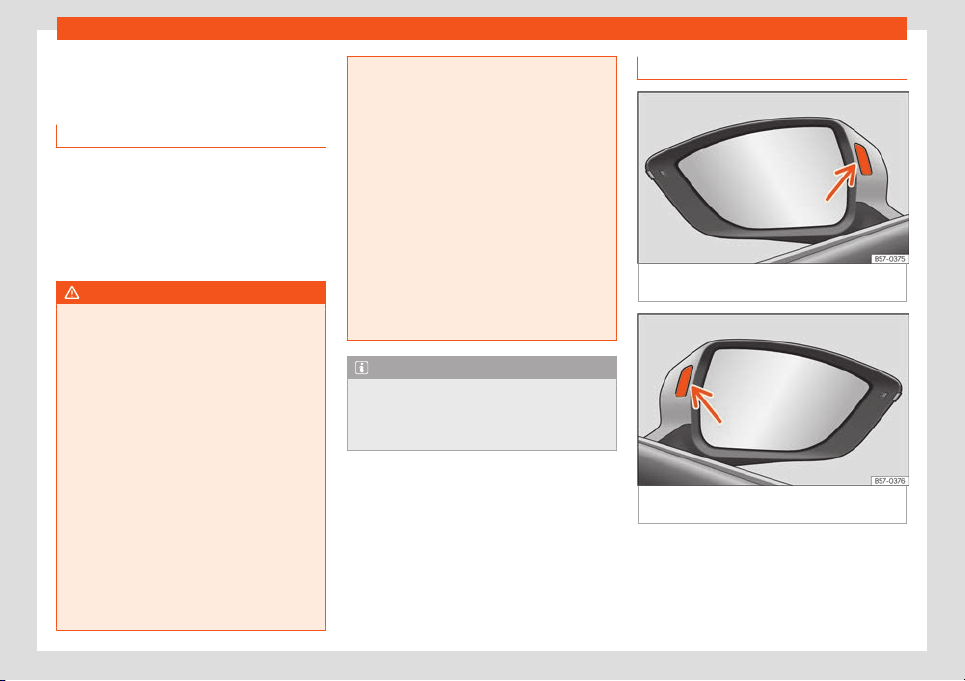
Driver assistance systems
Side Assist with Rear Cross
T
raffic Alert (RCTA)
Introduction
The lane departure warning (LCA) helps
det
ect traffic that is at the rear of the vehi-
cle.
The rear cross traffic alert (RCTA) helps
the driver when backing out of a parallel
parking spot and when manoeuvring.
WARNING
The smart technology incorporated into
the blind spot det
ector (BSD) with parking
assistance (RCTA) included cannot over-
come the limits imposed by the laws of
physics; it only works within the limits of the
system. Accidents and severe injury may
occur if the blind spot detection system or
the rear cross traffic alert are used negli-
gently or involuntarily. The system is not a
replacement for driver awareness.
●
Adapt your speed and safe distance to
the vehicle in front of you at all times to suit
visibility, weather, road and traffic condi-
tions.
●
Keep your hands on the wheel at all times
to be ready to intervene in the steering at
any time.
●
Pay attention to the indicator lamps that
may come on in the external rear view mir-
rors and on the instrument cluster, and fol-
l
ow any instructions they may give.
●
The lane departure warning could react
to any special constructions that might be
present to the sides of the vehicle, e.g. high
or irregular dividers. This may cause erro-
neous warnings.
●
Never use the lane departure warning on
unpaved roads. The lane departure warn-
ing has been designed for use on paved
roads.
●
Always pay attention to the vehicle's sur-
roundings.
●
The control lamps of the lane departure
warning may have limited functionality due
to solar radiation.
Note
If the blind spot detector with parking as-
sist
ant does not work as described in this
chapter, stop using it and contact a speci-
alised workshop.
Control lamp
Fig. 195
Control lamp of the lane departure
w
arning.
Fig. 196 Control lamp of the lane departure
w
arning.
indicator lamp in external rear view mir-
r
ors:
»
269

Driving
It lights up
It turns on once briefly: the lane departure warning is
activ
ated and ready to operate, i.e. when activating
the system.
It lights up continuously: the lane departure warning
has det
ected a vehicle in the blind spot.
Flashes
A vehicle has been detected in the adjacent lane and
the t
urn signal has been engaged in the direction of
the detected vehicle
›››
.
For vehicles that are also equipped with Lane Assist
›
››
page 263, a warning to switch lanes will also ap-
pear even though the turn signal has not been en-
gaged (Lane Assist “Plus”
›››
page 270).
The control lamps light up when the ignition is
s
witched on and should turn off after approxi-
mately 2 seconds. This is the time taken for
the function check.
If there are no indications from the control
lamp of the lane departure warning, this
means that the lane departure warning has
not detected any other vehicles at the rear
area
›››
.
When the e
xterior lighting is low, the intensity
with which the control lamps come on is dim-
med. The user can modify the intensity of the
control lamps with up to 5 levels in the info-
tainment system menu.
WARNING
If the warning lamps and the corresponding
messages ar
e ignored when they light up,
the vehicle may stall in traffic and cause
accidents and severe injuries.
●
Never ignore the warning lamps or mes-
sages.
●
Carry out the necessary operations.
CAUTION
Failure to heed the control lamps and cor-
r
esponding text messages when they light
up may result in damage to the vehicle.
Lane departure warning (Side As-
sist)
The lane departure warning uses radar sen-
sors t
o monitor the areas behind the vehicle
›››
page 8. The system does this by measur-
ing the vehicle's distance from other vehicles
and its speed differential. The lane departure
warning will not work at speeds of less than
approx. 15 km/h (9 mph). The system uses
optical signals in the external rear view mir-
rors to notify the driver.
The lane width is not detected individually,
but is rather pre-configured in the system.
Thus if you are driving in wide lanes or in be-
tween two lanes, the indications may be in-
correct. Furthermore, the system can detect
vehicles driving in the lane next to you (if
there are any), and can also detect station-
ary objects such as dividers, and thus give an
incorrect indication.
Indication on the exterior mirror
The control lamp provides an indication on
the corresponding side regarding the traffic
situation behind the vehicle, if it is deemed to
be critical. The control lamp of the left-hand
side
›››
Fig. 195 indicates the traffic situation
to the rear left of the vehicle, and the control
lamp of the right-hand side
›››
Fig. 196, indi-
cates the traffic situation to the rear right of
the vehicle.
In the case of retrofitted tinted windows or
windows with tinted film, the indications of the
external mirrors may not be seen clearly or
correctly.
Keep the external mirrors clean and free of
snow and ice, and do not cover them with ad-
hesives or other similar materials.
Lane assist Plus.
The Lane Assist Plus function can be used by
activ
ating the Lane Assist
›››
page 263 and
Side Assist functions. In this case its functions
are expanded as described below.
If the driver initiates a lane change manoeu-
vre in a potential critical situation:
270
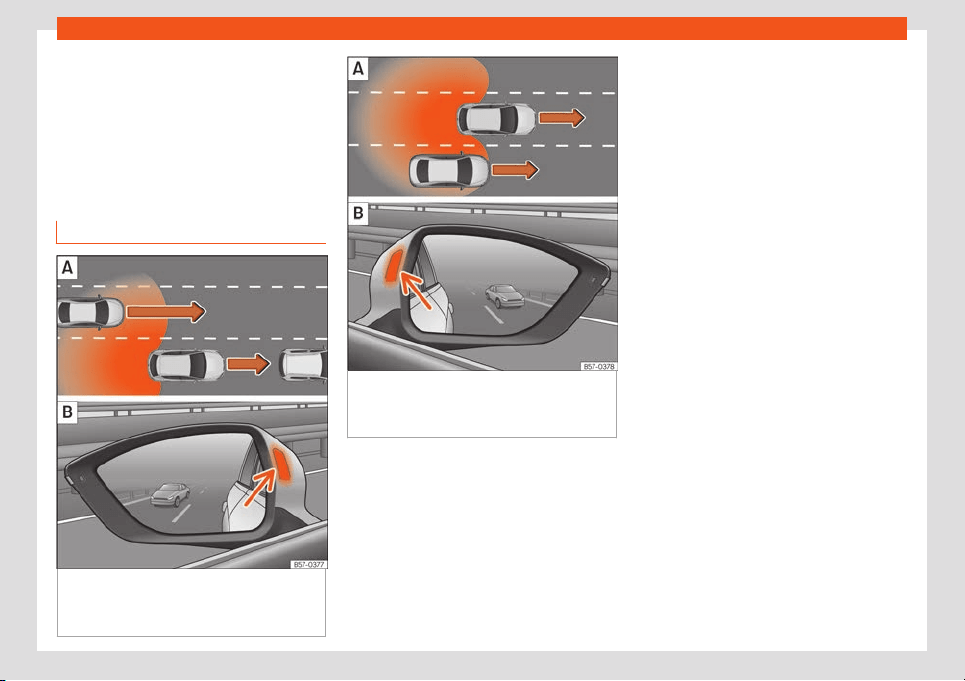
Driver assistance systems
●
The l
amp flashes in the corresponding rear-
view mirror even though the turn signal has
not been activated.
●
The steering wheel vibrates to warn the
driver of the risk of collision.
●
torque is applied to correct the steering
and return the vehicle to its lane.
Driving situations
Fig. 197
Schematic representation: P
assing
situation with traffic behind the vehicle. Indi-
cation from the blind spot detector in the left-
hand external mirror.
Fig. 198
Schematic representation:
Sit
ua-
tion of passing and then moving into the right-
hand lane.
Indication from the blind spot de-
tector in the right-hand external mirror.
In the following situations, an indication will
be displ
ayed in the external mirror
›››
Fig. 197
(arrow) or
›››
Fig. 198 (arrow):
●
When being overtaken by another vehicle
›››
Fig. 197
.
●
When passing another vehicle
›››
Fig. 198
with a speed differential of approx. 10 km/h
(6 mph). If the vehicle is passing at a consid-
erably higher speed, no indication will be dis-
played.
The faster a vehicle approaches, the sooner
an indication will be displayed in the exterior
mirror, because Side Assist takes into account
the different in speed compared to other ve-
hicles. Thus even though the distance from
the other vehicle is identical, the indication
will appear sooner in some cases and later in
others.
Physical limitations inherent to the system
In some situations the lane departure warning
may not interpret the traffic situation correct-
ly. I.e. in the following situations:
●
on tight bends;
●
in the case of lanes with different widths;
●
in areas with significant gradient changes;
●
in adverse weather conditions;
●
in the case of special constructions to the
side of the vehicle, e.g., high or irregular divid-
ers.
271
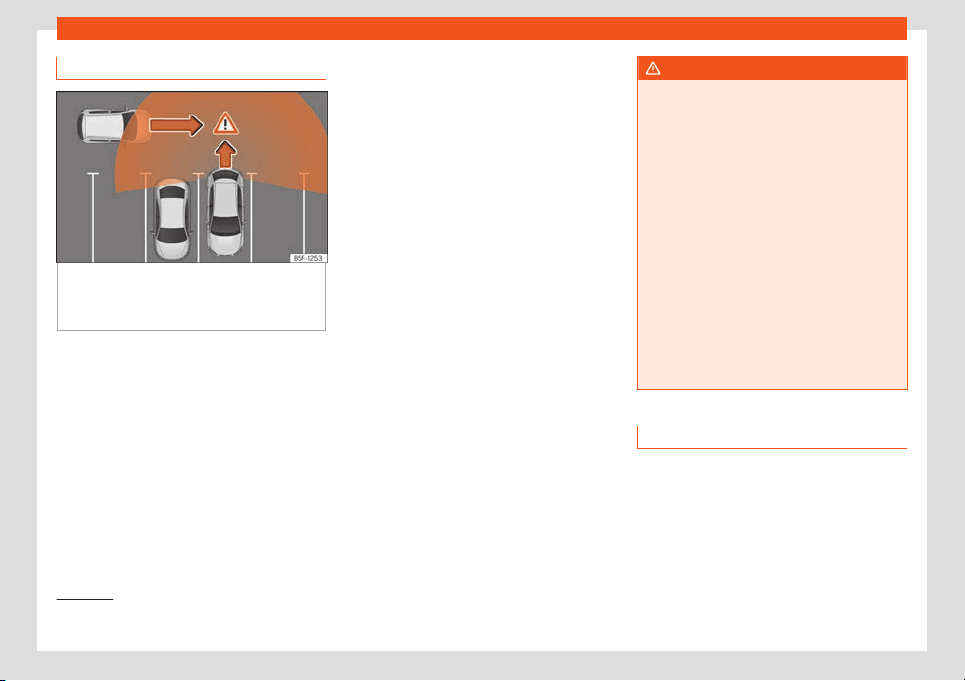
Driving
Rear cross traffic alert (RCTA)
Fig. 199
Schematic representation of the rear
cr
oss traffic alert assistant: zone monitored
around the vehicle while leaving a parking
space.
Park Assist uses the radar sensors on the rear
bumper
›
››
page 246 to monitor the traffic
crossing behind the vehicle as it backs out of
a parallel parking space or as it is being man-
oeuvred, for example in very low visibility con-
ditions.
When the system detects a relevant vehicle
on the road that is approaching the rear of
the vehicle
›››
Fig. 199, an acoustic alarm
may sound if the relevance so requires it.
In addition to the acoustic alarm, the driver is
also informed by means of a visual signal on
infotainment system display. This signal is dis-
played in the form of a red or yellow strip at
the back of the image of the vehicle on the in-
fotainment system screen. This strip displays
the side of the vehicle towards which traffic is
approaching in transverse direction
1)
.
Automatic braking to reduce damages
If the rear cross traffic alert detects that
someone else on the road is approaching the
rear of the vehicle and the driver does not
step on the brake, the system will engage the
brakes automatically.
The parking system helps the driver by auto-
matically engaging the brakes to reduce any
damage. The automatic intervention on the
brakes takes place when driving in reverse at
approx. 1-12 km/h (1-7 mph). After detecting
that the vehicle is stationary, the system
keeps it that way for around 2 seconds.
After automatically braking to reduce dam-
age, the system will not be able to automati-
cally brake again for approximately 10 sec-
onds.
You can interrupt the automatic braking by
stepping hard on the accelerator pedal or
the brake pedal in order to regain control of
the vehicle.
WARNING
The smart technology incorporated into
the r
ear cross traffic alert cannot over-
come the limits imposed by the laws of
physics; it only works within the limits of the
system. The parking assistant function
should not tempt you into taking any risks.
The system is not a replacement for driver
awareness.
●
The system should never be used in limi-
ted visibility conditions or complicated
traffic, e.g., in high-traffic areas or when
crossing multiple lanes.
●
Be sure to always be aware of the vehi-
cle's surroundings, since the system often
fails to detect things such as bicycles or
pedestrians.
●
The rear cross traffic alert itself will not
brake the vehicle to a complete stop.
Managing the assist systems
Enabling and disabling the assist systems
The blind spot det
ector with parking assistant
can be switched on and off by accessing the
Assistance systems menu on the dash panel
display using the steering wheel controls. If
the vehicle is equipped with a multifunction
1)
It is only displayed if the vehicle is equipped
with a parking syst
em.
272
Braking and parking
camera, it can also be accessed by means of
the driv
er assistance systems key located on
the main beam headlight lever.
Open the Assistants menu.
●
Side Assist
●
Rear cross traffic alert
If the verification box on the instrument panel
or the infotainment system is checked , the
functionality will be automatically activated
when switching on the ignition.
When the Side Assist is ready to operate, the
indicator turns on briefly on the exterior rear
view mirrors as confirmation.
When the vehicle is restarted, the last adjust-
ment in the system will remain active.
Trailer mode
Side Assist and the rear cross traffic alert are
automatically deactivated and cannot be
switched on if the factory-fitted tow-bar is
electrically connected to a trailer or similar
device.
As soon as the driver starts to drive with a
trailer connected electrically to the vehicle, a
message is displayed on the instrument pan-
el display indicating that the Side Assist and
the rear cross traffic alert are switched off.
Once the trailer has been unhooked from the
vehicle, if you want to use the Side Assist and
the rear cross traffic alert, you will have to re-
activate them in the corresponding menu.
If the tow-bar is not factory fitted, Side Assist
and the rear cross traffic alert should be
switched off manually when driving with a
trailer.
Braking and parking
Br
aking system
Control lamps
It lights up red
Brake fluid level too low
›››
page 345 or fault in the
brake system.
Do not carry on driving!
It lights up red
Electronic parking brake
›
››
page 275.
The warning lamp turns off when the handbrake is re-
leased.
It lights up green
Auto Hold function activated
›
››
page 277.
It lights up yellow
Front brake pads worn.
Cont
act a specialised workshop immediately.
WARNING
●
When the ignition is s
witched on, the sta-
tus of the brake system and the brake as-
sist functions is automatically checked.
The control lights on the instrument cluster
light up briefly and then turn off again. If a
warning light stays on permanently, there
»
273

Driving
is a fault. Seek qualified technical assis-
t
ance immediately.
●
If the brake warning lamp does not go
out or if it lights up when driving, the brake
fluid level in the reservoir is too lo so there
is a risk of an accident
›››
page 345, Brake
fluid. Stop the vehicle and do not drive on.
Obtain technical assistance.
●
If the brake warning lamp lights up to-
gether with the ABS lamp this could be
due to an ABS fault. When this function
fails, the rear wheels can lock up. Under
certain circumstances, the rear of the vehi-
cle may skid, with the danger of losing con-
trol. Stop and seek technical assistance.
●
If the lamp lights up, alone or accom-
panied by a warning message on the in-
strument panel display, please go immedi-
ately to a specialised workshop to check
the brake pads and to replace them if they
are worn.
Information about the brakes
New brake pads
F
or the first 200 to 300 km (100 to 200
miles), new brake pads have not yet reached
their maximum braking capacity, and need to
be “run in” first. However, you can compen-
sate for the slightly reduced braking effect by
applying more pressure on the brake pedal.
Avoid overloading the brakes while running
them in.
Wear
The rate of wear on the brake pads depends
a great deal on how you drive and the condi-
tions in which the vehicle is operated. This is a
particular problem in urban traffic and short
stretches, or with very sporty driving.
Depending on the speed, the braking force
and the environmental conditions (e.g. tem-
perature, air humidity, etc.) noises may be
produced when braking.
Wet roads or road salt
In certain situations (for example, on driving
through flooded areas, in severe downpours
or after washing the vehicle) the braking ac-
tion could be delayed if the discs and pads
are damp, or frozen in winter. In this case the
brakes should be “dried” by pressing the
brake pedal several times.
At high speed and with the windscreen wipers
activated, the brake pads will briefly touch
the brake discs. This takes place, although
unnoticeable to the driver, at regular intervals
to improve the response time of the brakes
when they are wet.
The effectiveness of the brakes can also be
temporarily reduced if the vehicle is driven for
some distance without using the brakes when
there is a lot of salt on the road in winter. The
layer of salt that accumulates on the discs
and pads can be removed by gently apply-
ing the brakes a few times.
Corrosion
There may be a tendency for corrosion to
form on the discs and dirt to build up on the
brake pads if the vehicle is used infrequently
or the brakes are not used very often.
If the brakes are not used frequently, or if rust
has formed on the disks, it is advisable to
clean off the pads and disks by braking firmly
a few times at a moderately high speed
›››
.
F
ault in the brake system
If the brake pedal travel should ever increase
suddenly, this may mean that one of the two
brake circuits has failed. Drive immediately to
the nearest specialised workshop and have
the fault repaired. Drive there slowly and re-
member that you will have to apply more
pressure on the brake pedal and allow for
longer stopping distances.
Low brake fluid level
Malfunctions can occur in the brake system if
the brake fluid level is too low. The brake fluid
level is monitored electronically.
274
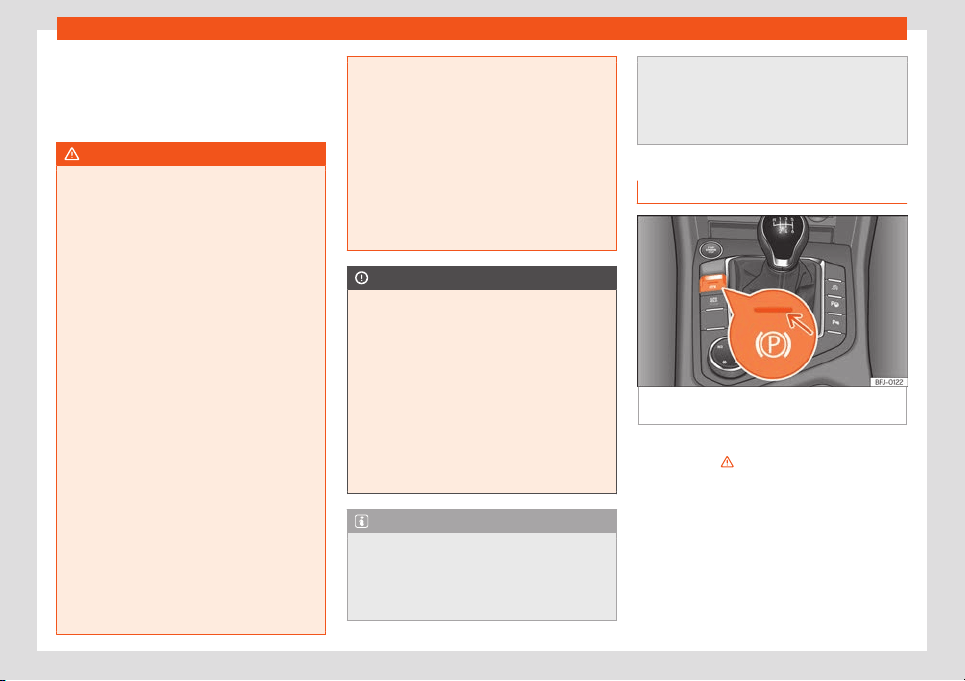
Braking and parking
Brake servo
The br
ake servo increases the pressure you
apply to the brake pedal. It works only when
the engine is running.
WARNING
Any anomaly in the brake system can in-
cr
ease the braking distance, with the re-
sulting risk of an accident.
●
New brake pads and discs must be run in
and do not have the correct friction during
the first 200 km (124 miles). This reduced
braking capacity may be offset by pressing
on the brake pedal a little harder.
●
If you are driving on roads which have
been salted, braking effectiveness may be
decreased.
●
Brakes can overheat if used excessively
on slopes. Before driving down a long steep
slope, it is advisable to reduce speed and
change down into a lower gear or range.
Therefore, using the engine brake relieves
the brakes.
●
Gentle continuous braking causes the
brakes to overheat and the braking dis-
tance will increase. Apply and then release
the brakes alternately.
●
Apply the brakes heavily to clean the
brake system only in a suitable traffic situa-
tion. Do not put other road users in danger:
there is risk of causing an accident.
●
Ensure the vehicle does not move while in
neutral, when the engine is stopped. The
braking distance is increased considerably
when the br
ake servo is not active.
●
If the brake is subjected to high stresses,
vapour bubbles may form in the brake sys-
tem's pipes. This reduces the efficiency of
the brakes.
●
Non-standard or damaged front spoilers
could restrict the airflow to the brakes and
cause them to overheat. Before purchasing
accessories please read the relevant in-
structions.
CAUTION
●
Ne
ver let the brakes “drag” by leaving
your foot on the pedal when it is not neces-
sary to brake. This overheats the brakes, re-
sulting in longer stopping distances and
greater wear.
●
Before driving down a long, steep gradi-
ent, it is advisable to reduce speed and se-
lect a lower gear. This makes use of engine
braking and relieves the brakes. If you still
have to use the brakes, it is better to brake
firmly at intervals than to apply the brakes
continuously.
Note
●
If the br
ake servo is out of action, for ex-
ample when the car is being towed, you will
have to press the brake pedal considerably
harder than normal to make up for the lack
of servo assistance.
●
If you wish t
o equip the vehicle with ac-
cessories such as a front spoiler or wheel
covers, it is important that the flow of air to
the front wheels is not obstructed, other-
wise the brakes can overheat.
Electronic parking brake
Fig. 200 In the lower part of the centre con-
sol
e: electronic parking brake button
The electronic parking brake replaces the
handbr
ake
›››
.
Applying the el
ectronic parking brake
The electronic parking brake can be activa-
ted whenever the vehicle is at a standstill,
even when the ignition is switched off. Acti-
vate it whenever you leave or park the vehi-
cle.
●
Pull and hold the
›››
Fig. 200 button.
»
275
Driving
●
The parking br
ake is activated when the
control light of button
›››
Fig. 200 (arrow) is
on and the red control lamp on the instru-
ment panel is always on.
●
Release the button.
Disconnecting the electronic parking
brake
●
Switch the ignition on.
●
Press the button
›››
Fig. 200. At the
same time step hard on the brake pedal or, if
the engine is running, press the accelerator
pedal slightly.
●
The control lamp of button
›››
Fig. 200 (ar-
row) and the red control lamp on the in-
strument panel go out.
Automatic release of the electronic park-
ing brake upon moving off
The electronic parking brake is automatically
switched off when starting if, after the driver's
door is closed and the driver's seat belt fas-
tened, any of the following situations take
place:
●
In vehicles with automatic gearboxes: a
gear is engaged or changed to another and
the accelerator is pressed gently.
●
In vehicles with manual gearboxes: the
clutch pedal is pressed fully before starting
off and the accelerator is pressed gently.
●
To facilitate certain manoeuvres there are
exceptions that allow the automatic parking
brake to be released without the driver's seat
belt being fastened.
The parking brake can be prevented from be-
ing automatically released by continuously
pulling up the
›››
Fig. 200 switch when
starting off.
The electronic parking brake is not discon-
nected until the button is released. This
can facilitate starting off when a heavy load
is towed
›››
page 306.
Automatic activation of the electronic
parking brake when exiting the vehicle in-
correctly
In vehicles with automatic transmission, the
electronic parking brake is activated auto-
matically when exiting the vehicle incorrectly
if:
●
The selector lever is in the D/S or R position
or in the Tiptronic selector gate.
●
AND: the vehicle is stationary.
●
AND: the driver door is open.
Emergency brake function
Only use the emergency brake function if you
are unable to stop the vehicle with the foot
brake
›››
.
●
Pull and hol
d the
›››
Fig. 200 button in
this position to forcefully stop the vehicle. At
the same time, an acoustic warning can be
heard.
●
To stop the braking process, release the
button or press the accelerator.
WARNING
The improper use of the electronic parking
br
ake can cause accidents and serious in-
jury.
●
Never use the electronic parking brake to
stop the vehicle, unless it is an emergency.
Braking distances can be considerably lon-
ger, since, under certain circumstances,
only the rear wheels brake. Always use the
foot brake.
●
Never accelerate from the engine when a
gear range or a gear is engaged and the
engine is running. The vehicle could move,
even if the electronic parking brake is acti-
vated.
●
When the electronic parking brake is
switched on or off, there is a slight move-
ment of the brake pedal. Be careful not to
position your foot under the pedal.
CAUTION
To prevent the vehicle from unintentionally
mo
ving when parking it, first apply the
electronic parking brake and then remove
your foot from the brake pedal.
276
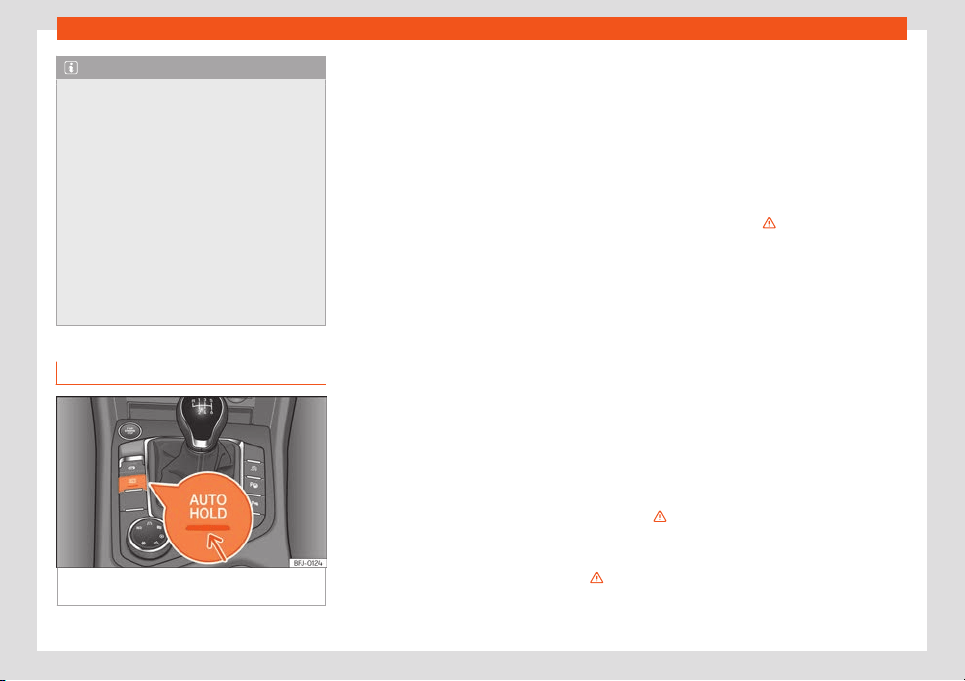
Braking and parking
Note
●
In v
ehicles with a manual gearbox, re-
leasing the clutch and accelerating at the
same time automatically disconnects the
electronic parking brake.
●
If the 12-volt vehicle battery is flat, it will
not be possible to switch off the electronic
parking brake. Use the jump-start
›››
page 52.
●
When the electronic parking brake is ap-
plied or released, noises may be heard.
●
The system performs automatic and au-
dible tests sporadically in the parked vehi-
cle if some time elapses without the elec-
tronic parking brake being used.
Auto Hold Function
Fig. 201 In the lower part of the centre con-
sol
e: Auto Hold function button.
The
›››
Fig. 201 button's indicator
lamp remains on while the Auto Hold function
is switched on.
Once connected, the Auto Hold function as-
sists the driver in keeping the vehicle station-
ary at repeated intervals or for a certain peri-
od of time with the engine running, for exam-
ple, when going up a slope, when stopped at
traffic lights or in heavy traffic with intermit-
tent stops.
When connected, the Auto Hold function au-
tomatically prevents the vehicle from rolling
when stationary without pressing the brake
pedal.
After detecting that the vehicle is stationary
and the brake pedal has been released, the
Auto Hold function holds the vehicle. The driv-
er can lift their foot off the brake pedal.
When the driver touches the accelerator
pedal or accelerates slightly to continue driv-
ing, the Auto Hold function releases the brake.
The vehicle moves according to the slope of
the road.
If the vehicle is stationary and one of the con-
ditions required by the Auto Hold function is
impaired, it disconnects itself and the button's
control light goes out
›››
Fig. 201. The elec-
tronic parking brake connects automatically,
if necessary, to park the vehicle safely
›››
.
Conditions for keeping the vehicle station-
ary with the Aut
o Hold function
●
The driver door must be closed.
●
The driver's seat belt must be fastened.
●
The engine is running.
Switching the Auto Hold function on and
off
Press the
›››
button. The control
l
amp on the button goes out when the Auto
Hold function is switched off.
Automatically engaging and disengaging
the Auto Hold function
If the Auto Hold function was switched on with
the button before switching off the
ignition, the function will remain on the next
time the ignition is switched on.
If the Auto Hold function was not switched on,
it will automatically remain off next time the
ignition is engaged.
The Auto Hold function connects automat-
ically if the following conditions are met
(all points must be met at the same time
›››
):
The v
ehicle is kept stationary with the
brake pedal on a flat surface or on a
slope.
The engine rotates “correctly”.
»
1.
2.
277
Driving
The Auto Hold function is automatically
t
urned off if the following conditions are
met:
If any of the conditions mentioned on
›››
page 277, Conditions for keeping
the vehicle stationary with the Au-
to Hold function are no longer met.
If the engine is running irregularly or an
anomaly is detected.
If the engine is turned off or stalls.
Manual gearbox: The clutch and the ac-
celerator are pressed at the same time.
Automatic gearbox: If the accelerator is
pressed
Automatic gearbox: If any of the tyres
has only minimal contact with the
ground, e.g. in the case of axle articula-
tion.
WARNING
The smart technology incorporated into
the Aut
o Hold function cannot defy the
laws of physics; it only works within the lim-
its of the system. The greater convenience
provided by the Auto Hold function should
never tempt you to take any risk that may
compromise safety.
●
Never leave the vehicle running and with
the Auto Hold function switched on.
●
The Auto Hold function cannot always
keep the vehicle stationary uphill or down-
1.
2.
3.
4.
5.
hill or stop it sufficiently, for example, on
slippery or fr
ozen surfaces.
Note
Before entering a car wash, always switch
off the Aut
o Hold function, because if the
electronic parking brake is automatically
connected, it may cause damage.
Stabilisation and brake as-
sist
ance systems
Control lamps
It lights up
Fault in the ESC or ABS, or disconnection caused by
the syst
em.
The ESC works in combination with the ABS. If the
ABS fails, the lamp also lights up.
Flashes
ESC or ASR activated.
It lights up
ASR switched off manually.
Or: ESC in Sport mode
›››
page 280.
It lights up
ABS faulty or does not work.
WARNING
When the ignition is switched on, the status
of the br
ake system and the brake assist
functions is automatically checked. The
control lights on the instrument cluster
light up briefly and then turn off again. If a
warning light stays on permanently, there
is a fault. Seek qualified technical assis-
tance immediately.
Brake assist systems
Electronic Stability Control (ESC)
The ESC helps t
o improve safety. It reduces
the tendency to skid and improves the stabili-
ty and roadholding of the vehicle. The ESC
detects critical handling situations, such as
vehicle understeer or oversteer, or wheelspin
on the driving wheels. It stabilises the vehicle
by braking individual wheels or by reducing
the engine torque. The warning lamp will
flash on the instrument panel when the ESC is
intervening .
The ESC includes the anti-lock brake system
(ABS), the hydraulic brake assist (HBA), the
traction control system (ASR), electronic dif-
ferential lock (EDS), electronic torque control
(XDS) and tractor-trailer sway mitigation.
278

Braking and parking
ESC also helps stabilise the vehicle by
changing the t
orque.
The ASR can be deactivated when wheel spin
is desirable
›››
page 280.
Anti-lock brake system (ABS)
ABS prevents the wheels from locking up un-
der braking until the vehicle has reached a
virtual standstill. You can continue to steer the
vehicle even when the brakes are on full.
Keep your foot on the brake pedal and do not
pump the brakes. You will feel the brake pedal
pulsate while the ABS is working.
If the running gear or brake system is modi-
fied, the effectiveness of the ABS could be se-
verely limited.
Hydraulic Brake Assist (HBA)
The brake assist system can reduce the re-
quired braking distance. The braking force is
automatically boosted if you press the brake
pedal quickly in an emergency. You must
keep pressing the brake pedal until the dan-
ger has passed.
Traction control system (ASR)
In the event of the wheels spinning, the ASR
reduces the engine torque to adapt to the
road condition. This helps the car to start
moving, accelerate or climb a gradient.
Electronic differential lock (EDL)
When the EDL detects wheelspin, it brakes
the spinning wheel and directs the power to
the other driven wheel. This function is active
up to approximately 100 km/h (62 mph).
To prevent the disc brake of the braked wheel
from overheating, the EDL cuts out automati-
cally if subjected to excessive loads. The ve-
hicle can still be driven. The EDL will switch on
again automatically when the brake has
cooled down.
Tractor-trailer sway mitigation
If the vehicle is pulling a trailer, it will control
the following: tractor-trailers tend to sway.
When the swaying of the trailer is felt by the
vehicle and detected by the ESC, it will auto-
matically brake the towing vehicle within the
limits of the system and mitigate the sway.
Tractor-trailer sway mitigation is not available
in all countries
›››
page 312.
Electronic engine torque management
(XDS)
When taking a curve, the driveshaft differen-
tial allows the outer wheel to turn at a higher
speed than the inner wheel. In this way, the
wheel that is turning faster (outer wheel) re-
ceives less drive torque than the inner wheel.
This may mean that in certain situations the
torque delivered to the inner wheel is too
high, causing the wheels to spin. On the other
hand, the outer wheel is receiving a lower
drive torque than it could transmit. This can
cause a loss of grip on the drive axle, in this
case the front axle, which results in under-
steer or “lengthening” of the trajectory.
The XDS can detect and correct this effect
via the sensors and signals of the ESC.
Via the ESC, the XDS will brake the inside
wheel and counter the excess driving torque
of that wheel. This means that the requested
trajectory is much more precise.
XDS works in combination with the ESC and is
always active, even when ASR is switched off,
or when the ESC is in Sport mode or discon-
nected.
Multi-collision brake
The multi-collision brake consists of automat-
ic braking activated by the Airbag control
unit. It is activated when, in the event of an
accident, the Airbag control unit detects de-
celerations above the activation level, and
braking is managed by the ESC system.
In the event of an accident, the multi-collision
brake can help the driver by braking to avoid
the risk of skidding during the accident and
causing other collisions.
The following actions control automatic brak-
ing during the accident:
●
When the driver presses the accelerator,
the automatic braking does not take place.
»
279
Driving
●
When the br
aking pressure through press-
ing the brake pedal is greater than the sys-
tem’s braking pressure the vehicle will brake
automatically.
●
Multi-collision braking will not be available
if there is an anomaly in the ESC system.
Brake blending
1)
The brake energy recuperation can generate
a braking effect. This braking effect depends
on the selected driving programme and the
level of charge of the high-voltage battery.
If the braking effect caused by the recupera-
tion is very intense, the vehicle’s brake lights
with turn on. The electric engine, when oper-
ating as an alternator, can generate braking
torque on the front wheels based on the RPM
and the temperature and charge level of the
high-voltage battery.
These variable parameters cause fluctuating
electric decelerations which are hydraulical-
ly compensated according to the driver’s de-
sires. This function is called “brake blending”
and it combines mechanical braking with the
engine brake effect.
WARNING
Driving at high speed on icy, slippery wet
gr
ound can result in loss of vehicle control
and serious injury to the driver and passen-
gers.
●
The ESC, ABS, ASR, EDS or electronic tor-
que management ar
e not in a position to
overcome the limits imposed by physics.
Always bear this in mind, especially on wet
or slippery roads. If you notice the systems
cutting in, you should reduce your speed
immediately to suit the road and traffic
conditions. Do not be encouraged to take
risks by the presence of more safety sys-
tems. If you do, an accident may occur.
●
Please remember that the accident risk
always increases if you drive fast, espe-
cially in corners or on a slippery road, or if
you follow too close behind the vehicle in
front of you. The ESC, ABS, brake assist,
EDS and the electronic torque control sys-
tem cannot prevent accidents: risk of acci-
dents!
●
Accelerate with caution on slippery sur-
faces (for example, icy or snow-covered).
Despite the control systems, the driven
wheels could spin, affecting the stability of
the vehicle: risk of accident!
Note
●
The ABS and ASR will only oper
ate cor-
rectly if the four wheels have identical
tyres. Any differences in the rolling radius
of the tyres can cause the system to re-
duce engine po
wer when this is not desired.
●
The regulating processes of the systems
can make noises due to their operation.
●
If the warning lamp or lights up,
there could be a fault
›››
page 85.
●
Any modifications made to the vehicle
(for example, to the engine, brake system,
running gear or to the combination of
wheels and tyres) may affect the operation
of the ABS, ASR and EDS.
Connecting and disconnecting the
ESC and ASR
The ESC is switched on automatically when
the engine is st
arted, and only works when
the engine is running and includes the ABS,
EDS and ASR systems.
The ASR function should only be switched off
in situations where traction is insufficient.
Depending on the finishes and versions, it is
possible to only switch off the ASR, or to
switch on the ESC in “Sport” mode.
1)
Valid for hybrid vehicles
280
Braking and parking
Switching the ASR off and on
●
The ASR can be switched off and on using
the inf
otainment system
›››
page 87. In vehi-
cles with a driver information system the cor-
responding indication will be displayed.
When the ASR is switched off, the indicator
lamp lights up on the instrument cluster.
Disconnecting and connecting the ESC in
“Sport” mode
●
In “Sport” mode, the ESC can be discon-
nected and connected using the infotainment
system
›››
page 87. In vehicles with a driver
information system the corresponding indica-
tion will be displayed.
When “Sport” mode is connected, the inter-
ventions of the ESC to stabilise the vehicle,
and the anti-slip regulation (ASR
1)
) interven-
tions are limited. In addition, the control
lamp lights up on the instrument panel.
ESC in “Offroad” mode
2)
Turn the Driving Experience button to select
the Offroad mode and connect it
›››
page 240. The interventions of the ESC,
as well as of the ASR, EDS and the ABS, adapt
to irregular terrain.
In the following exceptional situations it may
make sense to activate the Offroad mode to
allow the wheels to spin:
●
When “swinging” the vehicle to get it un-
stuck.
●
Driving in deep snow or on loose surfaces.
●
When driving on rough terrain with much of
the car's weight is lifted off the wheels (axle
articulation).
●
Steep descents with braking on unpaved
terrain.
For your safety we recommend that you turn
off the Offroad mode when it is not absolute-
ly necessary.
To disconnect the “Offroad” mode, select a
different driving mode.
ESC in “Snow” mode
2)
Turn the Driving Experience button to select
the “Snow” mode and connect it
›››
page 240. Traction control system (ASR)
interventions adjust to the adhesion of snowy
roads.
To disconnect the “Snow” mode, select a dif-
ferent driving mode.
WARNING
The ESC Sport mode should be activated
only when tr
affic conditions and the ability
of the driver allow it. Danger of skidding!
●
With ESC in Sport mode, the stabilising
function will be limited to allow for a sporti-
er drive. The driving wheels could spin and
the vehicle could skid.
WARNING
You should only activate the Offroad Mode
or disabl
e the ASR if the driver is experi-
enced and if permitted by the traffic condi-
tions. Danger of skidding!
●
The stabilisation function is limited when
the Offroad profile is switched on. In partic-
ular, if the road is too smooth and slippery,
the driving wheels could spin and the vehi-
cle could skid.
Note
If the ASR is switched off or the Sport mode
is sel
ected, the cruise control is switched
off.
1)
In vehicles with 4-wheel drive, the ASR is dis-
connect
ed completely
›››
.
2)
Only for 4Drive models.
281
Driving
Parking
T
o park the vehicle
When parking your vehicle, all legal require-
ments shoul
d be observed.
Always note the following points when park-
ing the vehicle:
●
Park the vehicle on a suitable surface
›››
.
●
Connect the electronic parking brake
›
››
page 275.
●
For an automatic gearbox, move the selec-
t
or lever to position P.
●
Stop the engine and turn off the ignition.
Turn the steering wheel slightly to engage the
steering lock.
●
With a manual gearbox, engage first gear
on flat ground and slopes, or even reverse
gear on hills, and release the clutch pedal.
●
When leaving the vehicle, take all keys with
you.
Additionally, on steep slopes and inclines
Before switching off the engine, rotate the
steering wheel so that if the vehicle should
move, it will be held by the kerb.
●
On slopes, turn the front wheels so that
they are against the edge of the kerb.
●
Uphill, turn the wheels towards the centre of
the road.
WARNING
●
Av
oid parking the vehicle where the hot
exhaust system could ignite inflammable
materials, such as dry grass, low bushes,
spilt fuel or flammable materials.
●
Do not leave passengers inside a closed
vehicle, they may not be able to open
doors or windows. Locked doors hinder the
possibility of a rescue.
●
Children should not be left alone in the
vehicle. They could tamper with the hand-
brake or the gears, which could cause the
vehicle to move without control.
●
Depending on weather conditions, it may
become extremely hot or cold inside the
vehicle. This can be fatal.
Help with parking and ma-
noeuvring
Assist
ed parking system
(Park Assist)
Introduction
The parking assist system is an additional
function of the P
arkPilot
›››
page 289 and
helps the driver find a suitable parking space
from among the following types:
●
park driving in reverse in suitable perpen-
dicul
ar and parallel spaces,
●
park driving forwards in suitable perpendic-
ular spaces,
●
exit a parking space driving forwards from a
parallel space.
In vehicles with a Park Assist system and fac-
tory infotainment system, the front, rear and
side areas are represented, and the position
of obstacles is shown relative to the vehicle.
The Park Assist system is subject to certain
limitations inherent to the system and its use
requires special attention by the driver
›››
.
WARNING
The technology used in the park assist sys-
t
em involves a series of limitations inherent
282
Help with parking and manoeuvring
in the actual system and in the use of ultra-
sonic sensors. The use of P
ark Assist should
never tempt you to take any risk that may
compromise safety. The system is not a re-
placement for driver awareness.
●
Any accidental movement of the vehicle
could result in serious injury.
●
Adapt your speed and driving style at all
times to suit visibility, weather, road and
traffic conditions.
●
Certain surfaces of objects and gar-
ments do not reflect the ultrasound sen-
sors' signals. The system cannot detect, at
least correctly, these objects or people
wearing such clothes.
●
Ultrasound sensor signals may be affec-
ted by external sound sources. In certain
circumstances this may prevent them from
detecting people or objects.
●
The ultrasound sensors may have blind
spots in which obstacles and people are
not detected.
●
Monitor the area around the vehicle at all
times, since the ultrasound sensors do not
detect small children, animals or certain
objects in all situations.
WARNING
Quick turns of the steering wheel when
parking or e
xiting a parking space with
Park Assist can cause serious injury.
●
Do not hol
d the steering wheel during
manoeuvres to park or exit a parking space
until the system requests it. Doing so disa-
bles the system during the manoeuvre, re-
sulting in the parking being cancelled.
CAUTION
●
In cer
tain circumstances, the ultrasonic
sensors do not detect objects such as trail-
er tongues, bars, fences, posts or thin trees,
or an open (or opening) rear lid, which
could damage the vehicle.
●
Retrofitting of certain accessories to the
vehicle, such as a bicycle rack, may inter-
fere with the operation of the Park Assist
system and cause damage.
●
The Park Assist system uses as a refer-
ence parked vehicles, curbs and other ob-
jects. Make sure that the tyres and wheels
are not damaged while parking. If necessa-
ry, opportunely interrupt the parking ma-
noeuvre to avoid damaging the vehicle.
●
The ultrasound sensors on the bumper
may be damaged or shifted in the event of
a collision, for example, when entering or
exiting a parking space.
●
If you use high-pressure or vapour equip-
ment to clean the ultrasound sensors, do
not apply it directly unless very briefly and
always from a distance of more than 10 cm.
●
A registration plate or plate holder on the
front with larger than the space for the reg-
istration plate, or a registration plate that is
curv
ed or warped can cause:
–
False detections.
–
The sensors to lose visibility.
–
Cancellation of the parking manoeuvre
or defective parking.
●
If one of the ultrasonic sensors is dam-
aged, the area corresponding to that group
of sensors (front or rear) is deactivated and
cannot be activated until the fault is cor-
rected. However, you can still use the sen-
sors of the other bumper as per usual. If
there is a fault in the system, consult a spe-
cialist workshop. SEAT recommends visiting
a SEAT dealership for this.
Note
●
In or
der to guarantee good system oper-
ation, keep the ultrasound sensors of the
bumper clean, free of snow or ice, and do
not cover them with adhesives or other ob-
jects.
●
Certain sources of noise, such as rough
asphalt or paving stones and the noise of
other vehicles can induce the Park Assist
system or ParkPilot to give erroneous warn-
ings. The presence of metal objects can al-
so affect the manoeuvre.
●
In order to become familiar with the sys-
tem and its functions, SEAT recommends
that you practice operating the Park Assist
system in an area where there is not too
much traffic or in a car park.
283
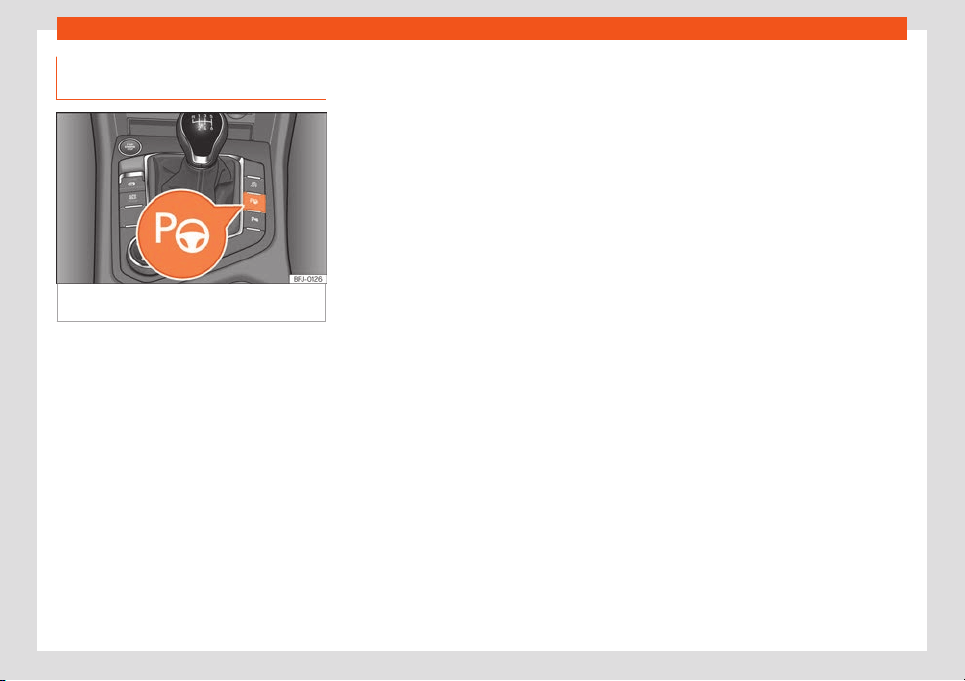
Driving
Description of the parking assist
syst
em
Fig. 202
In the upper part of the centre con-
sol
e: button to switch on the Park Assist system.
The components of the Park Assist system
ar
e the ultrasonic sensors located in the front
and rear bumpers, the
›››
Fig. 202 to
switch the system on and off and the mes-
sages on the instrument cluster display.
Prerequisites for parking
●
The traction control system (ASR) must be
turned on
›››
page 280.
●
Speed when passing next to the parking
space (parallel parking): do not exceed ap-
prox. 40 km/h (25 mph).
●
Speed when passing next to the parking
space (angle parking): do not exceed approx.
20 km/h (12 mph).
●
Keep a distance between 0.5 and 2.0 me-
tres when driving past the parking space.
●
Space length (parallel parking): vehicle
length + 0.8 meters.
●
Space width (angle parking): vehicle width
+ 0.8 meters.
●
Do not exceed approximately 7 km/h
(4 mph) when parking.
Requirements for leaving the parking
space (only for parallel parking)
●
The traction control system (ASR) must be
turned on
›››
page 280.
●
Space length: length of the vehicle + 0.5
metres.
●
Do not exceed approximately 7 km/h
(4 mph) when exiting the parking space.
Prematurely stopping or automatically in-
terrupting the manoeuvres for parking or
exiting a parking space
Park Assist interrupts the manoeuvres for
parking or exiting a parking space in any of
the following cases:
●
Press the button.
●
The speed exceeds approximately 7 km/h
(4 mph).
●
The driver takes control of the steering
wheel.
●
The parking manoeuvre does not end within
6 minutes from the activation of automatic
steering.
●
There is a fault in the system (the system is
temporarily unavailable).
●
The ASR is disconnected.
●
ASR or ESC intervene with regulation.
●
The driver door is opened.
To restart the manoeuvre it is necessary that
none of these things occur and that the
button is pressed again.
Special characteristics
The Park Assist system is subject to certain
limitations inherent to the system. For exam-
ple, it is therefore not possible to enter or exit
a parking space on sharp bends.
While entering or exiting a parking space, a
brief signal sounds to prompt the driver to
change between forward and reverse gears
(depending on the case). In successive ma-
noeuvres, the assistant tells the driver to
change gears, at the latest, when the contin-
uous audible signal is given (object present at
a distance of ≤30 cm) by Park Pilot.
When the Park Assist system turns the steer-
ing wheel with the vehicle stationary, the in-
strument panel also displays the symbol .
Keep the brake pedal depressed while the
symbol remains on the dash panel display to
turn the wheels with the vehicle stopped. This
284
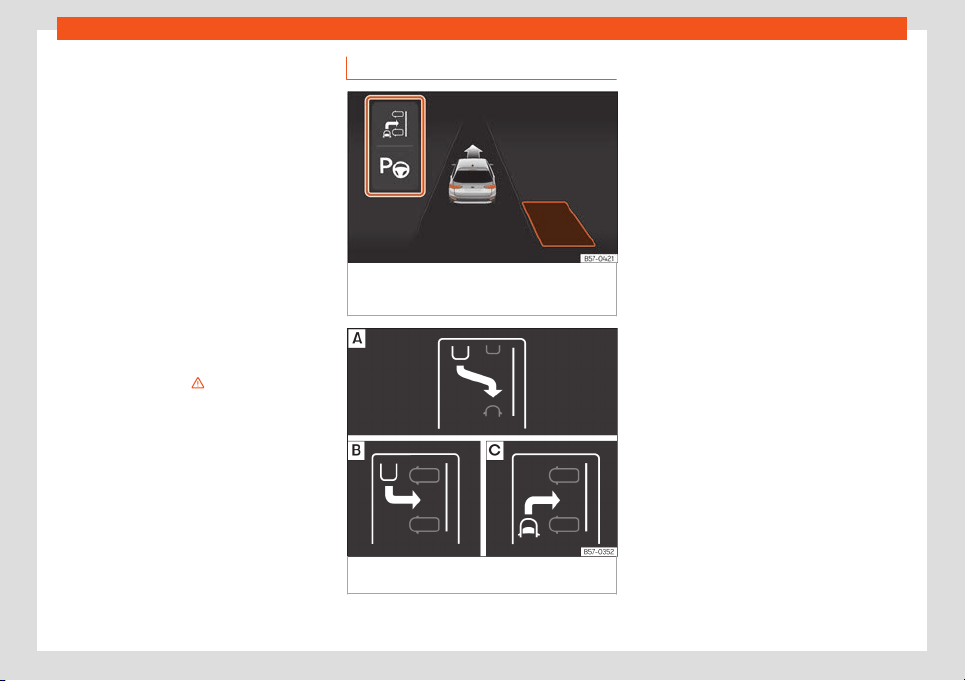
Help with parking and manoeuvring
way, the system will require fewer manoeu-
vr
es to complete the parking action.
Trailer mode
The Park Assist system cannot be switched
on if the factory-fitted towing bracket
›››
page 306 is electrically connected to a
trailer.
After changing a wheel
If, after changing a wheel, the vehicle stops
entering and exiting parking spaces correct-
ly, the circumference of the new wheel may
be different and the system may need to
adapt to it. The adaptation is automatic and
takes place during driving. Making turns slow-
ly and in both directions (20 km/h [12 mph])
for a few minutes may contribute to this
adaptation process
›››
in Introduction on
page 282.
Selecting a parking mode
Fig. 203
On the instrument panel display:
vie
w of the parking assist system with reduced
view.
Fig. 204
On the instrument panel display: in-
dication of parking modes.
Parking assist has the following 3 parking
modes:
Reverse parallel parking.
R
everse angle parking.
Forward angle parking.
Selecting a parking mode after passing in
front of the space
After activating the Park Assist system and af-
ter detecting a parking space, the display on
the instrument panel proposes a parking
mode. The Park Assist system selects the
parking mode automatically. The selected
mode is shown on the instrument panel dis-
play
›››
Fig. 203. The reduced display of oth-
er possible parking modes is also shown
›››
Fig. 204. If the mode selected by the sys-
tem does not correspond to the desired
mode, you can select another mode by
pressing the button
›››
Fig. 202.
●
The necessary conditions to park with Park
Assist have to be met
›››
page 284.
●
Press the button.
●
A control lamp on the button lights up
when the system is switched on. Additionally,
the selected parking mode is shown on the
instrument panel display and the reduced
display shows another parking mode it can
be changed to.
●
Turn on the corresponding turn signal to-
wards the side of the road where you are
parking. The instrument panel displays the
side corresponding to the road. By default, if
»
285

Driving
the turn signal is not on, it parks on the right in
the dir
ection of traffic.
●
If necessary, press the button again to
change to the next parking mode.
●
Once you have switched to all possible
parking modes, if the button is pressed
again, the system switches off.
●
Press the button again to switch the sys-
tem back on.
●
Follow the instructions displayed on the in-
strument panel while paying attention to traf-
fic and drive the vehicle past the parking
space.
Special case of perpendicular parking
space to park forwards without driving
past first
●
The necessary conditions to park with Park
Assist have to be met
›››
page 284.
●
Drive forward towards the parking space
while paying attention to traffic and stop the
vehicle.
●
Press the button once.
●
A control lamp on the button lights up
when the system is switched on. Additionally,
the selected parking mode is shown on the
instrument panel display without reduced
display.
●
Release the steering wheel
›››
in Intro-
duction on page 283.
286
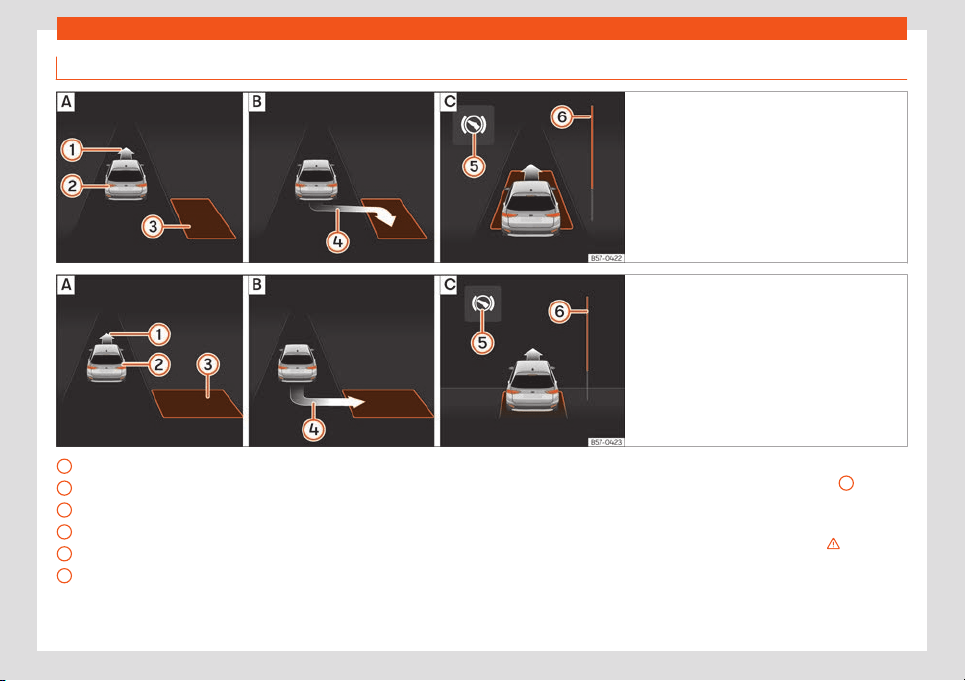
Help with parking and manoeuvring
Parking with the parking assist system
Fig. 205 On the instrument panel display: paral-
l
el parking. Finding a parking space. Park-
ing position. Manoeuvring.
Fig. 206 On the instrument panel display: angle
parking. Finding a parking space
. Parking
position. Manoeuvring.
Message to move forwards
Y
our vehicle
Parking space detected
Message to park
Message to press the brake pedal
Progress bar
1
2
3
4
5
6
The necessary conditions have to be met to
park with P
ark Assist
›››
page 284 and the
parking mode must be selected
›››
page 285.
Parking
●
Look at the display on the instrument panel
to see if the space has been detected as “ap-
propriate” and if the correct position for park-
ing has been reached
›››
Fig. 205
or
›››
Fig. 206 . The space is considered
“appropriate” if the display on the instrument
panel shows the message to park
4
.
●
Stop the vehicle and, after a brief pause,
engage the r
everse gear.
●
Release the steering wheel
›››
in Intro-
duction on page 283.
●
Please note the following message: Inter-
vention in active direction. Watch
your surroundings!. Whil
e you keep watch
»
287
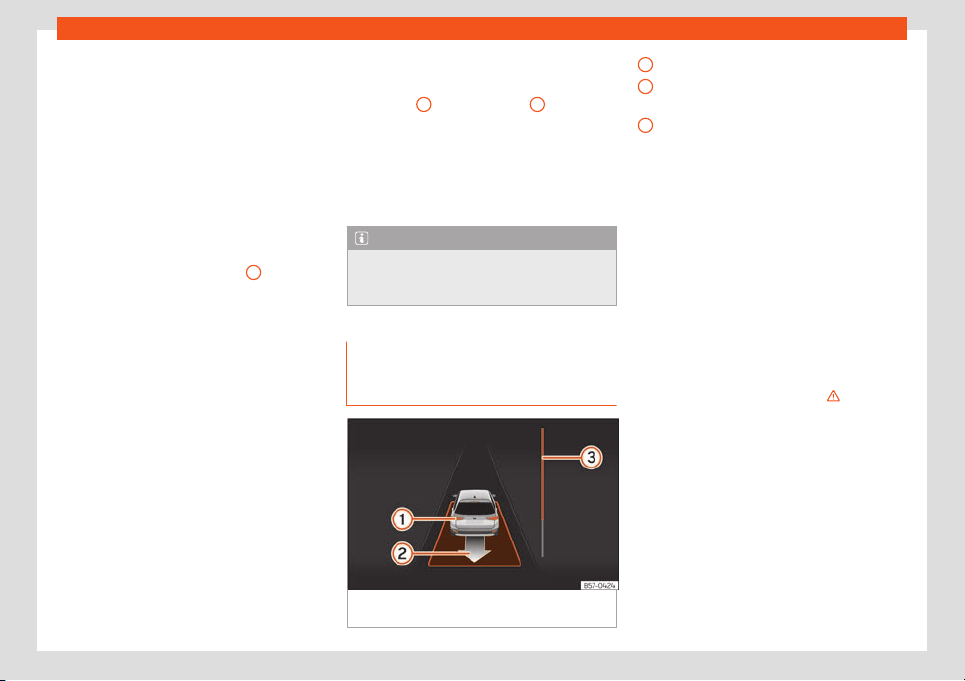
Driving
around you, carefully start accelerating up to
no mor
e than 7 km/h (4 mph). During the
parking manoeuvre, the system only takes
charge of the steering. You, as the driver,
have to accelerate, engage the clutch if
necessary, change gears and brake.
●
Reverse until the continuous ParkPilot sig-
nal sounds; OR: reverse until the indication to
move forward appears on the instrument
panel display
›››
Fig. 205 or
›››
Fig. 206
; OR: reverse until the Park Assist fin-
ished message appears on the instrument
panel display. The progress bar
6
indicates
the dist
ance to cover
›››
page 288.
●
Press the brake pedal until the parking as-
sist system completes the steering wheel
turns; OR: until the symbol goes out on the
instrument panel screen.
●
Select first gear.
●
Move forward until the continuous ParkPilot
signal sounds; OR: move forward until the re-
verse indication appears on the instrument
panel display. The Park Assist system steers
the vehicle forward and back until it centres it
in the space
›››
Fig. 205 or
›››
Fig. 206 .
●
For best results, wait at the end of each
manoeuvre until the Park Assist system has
finished turning the steering wheel. The park-
ing manoeuvre ends when a corresponding
message is displayed on the instrument pan-
el and, in some cases, an acoustic signal
sounds.
Progress bars
The progress bar
›››
Fig. 205
6
and
›
››
Fig. 206
6
on the
scr
een of the instrument panel displays the
relative distance to be covered. The greater
the distance, the fuller the progress bar.
When driving forward, the content of the pro-
gress bar decreases upwards, and when re-
versing, it decreases downwards.
Note
If the manoeuvre is terminated prematurely
during parking, the r
esult may not be the
best.
Leaving a parking space with the
parking assist syst
em (only for par-
allel parking)
Fig. 207 On the instrument panel display: exit
a par
allel parking space.
Your vehicle in reverse gear
Message giving the pr
oposed manoeuvre
to exit the parking space
Progress bar to indicate the distance left
to cover
Leaving a parking space (parallel parking)
The necessary conditions to exit a parking
space with Park Assist have to be met
›››
page 284.
●
Press the button
›››
Fig. 202. A control
lamp on the button lights up when the sys-
tem is switched on.
●
Turn on the corresponding turn signal to-
wards the road you will enter when exiting the
parking space.
●
Select reverse gear.
●
Release the steering wheel
›››
in Intro-
duction on page 283. Pl
ease note the fol-
lowing message: Intervention in active
steering. Watch your surroundings!.
While you keep watch around you, carefully
start accelerating up to no more than 7 km/h
(4 mph). When exiting the parking space, the
system only takes charge of the steering.
You, as the driver, have to accelerate, en-
gage the clutch if necessary, change
gears and brake.
●
Reverse until the continuous ParkPilot sig-
nal sounds; OR: reverse until the instrument
panel display shows the forward indication.
1
2
3
288
Help with parking and manoeuvring
The progress bar
›
››
Fig. 207
3
indicates the
dist
ance to cover
›››
page 288.
●
Press the brake pedal until the parking as-
sist system completes the steering wheel
turns; OR: press the brake pedal until the
symbol goes out on the instrument panel
screen.
●
Move forward until the continuous ParkPilot
signal sounds; OR: move forward until the re-
verse indication appears on the instrument
panel display. The Park Assist system steers
the vehicle forward and back until it can exit
the space.
●
The vehicle can exit the space when a cor-
responding message is displayed on the in-
strument panel and, in some cases, an
acoustic signal sounds. Take charge of the
steering with the turning angle set by the Park
Assist system.
●
Paying attention to the traffic, exit the park-
ing space.
Automatic operation of the brakes
by the parking assist system
Park Assist helps the driver by automatically
br
aking in certain situations.
The driver is always responsible for braking in
time
›››
.
Automatic braking intervention to avoid
e
xceeding the speed limit
To avoid exceeding the allowed speed of ap-
prox. 7 km/h (4 mph) when entering or leaving
a parking space, the brakes may activate au-
tomatically. After automatically activating
the brakes, the manoeuvres to enter or exit a
parking space may continue.
The brakes are only automatically activated
once for each attempt to enter or exit a park-
ing space. If the speed of approximately
7 km/h (4 mph) is exceeded again, the corre-
sponding operation is halted.
Automatic braking to reduce damages
Depending on certain conditions, the Park
Assist system can automatically brake the
vehicle when faced with an obstacle, briefly
actioning and holding down the brake ped-
al
›››
. Following this the driver must press
the br
ake pedal.
Automatic braking intervention to reduce
damage leads to the parking manoeuvre fin-
ishing.
WARNING
The automatic braking intervention by Park
Assist shoul
d never tempt you to take any
risk that may compromise safety. The sys-
tem is not a replacement for driver aware-
ness.
●
The P
ark Assist system is subject to cer-
tain limitations inherent to the system. In
certain situations, the automatic braking
intervention may only work in a limited way
or not work at all.
●
Always be ready to use the brakes your-
self!
●
The automatic braking intervention will
end after approximately 1.5 seconds. After-
wards, brake the vehicle yourself.
Parking aid parking and ma-
noeuvring (P
arkPilot)
Introduction
These assist systems help you when parking
and manoeuvring:
–
Plus Parking Aid
›
››
page 291. It is an as-
sist system that provides a visual and audio
warning of obstacles detected in front and
behind the vehicle .
–
Rear Parking Aid
›››
page 294. This is an
assistant that gives a visual and audio
warning of obstacles detected behind the
vehicle
›››
page 294.
WARNING
●
Al
ways pay attention, by looking directly,
to traffic and the area around the vehicle.
»
289
Driving
Assistance systems are not a replacement
f
or driver awareness. Responsibility always
lies with the driver.
●
The sensors have blind spots in which ob-
stacles and people are not detected. Pay
special attention to children and animals.
●
Always keep visual control of the sur-
roundings: use the mirrors for additional
help.
CAUTION
Parking distance warning system functions
can be aff
ected by different factors that
can cause damage:
●
Under certain circumstances, the system
does not detect or display certain objects:
–
Chains, trailer draw bars, bars, fences,
posts and thin trees.
–
Objects that are located above the
sensors, such as protrusions in a wall.
–
Objects with certain surfaces or struc-
tures, such as wire mesh fences or pow-
der snow.
●
Certain surfaces of objects and gar-
ments do not reflect the ultrasound sen-
sors' signals. The system cannot detect
these objects or people wearing such
clothes correctly.
●
Sensor signals may be affected by exter-
nal sound sources. This may prevent them
from detecting people or objects.
●
If the syst
em warns you of the proximity
of a low obstacle, please note that after
being detected by the system, the obstacle
in question may disappear from the meas-
urement sensors as the vehicle moves clos-
er, and the system will no longer warn of its
presence. In certain circumstances, ob-
jects such as high kerbs that could damage
the underside of the vehicle are not detec-
ted.
●
If the parking distance warning system is
ignored, the vehicle could suffer considera-
ble damage.
●
Damage to the radiator grille, bumper,
wheel arch and vehicle underbody can
modify the orientation of the sensors. This
can affect the parking aid function. Have
the function checked by a specialised
workshop.
●
A number plate or number plate holder
with dimensions that exceed the space for
the number plate, or a cured or deformed
number plate can cause false detections or
a loss of visibility for the sensors.
Note
●
The displ
ay on the Infotainment system
screen shows a slight time delay.
●
In certain situations, the system can give
a warning even though there is no obstacle
in the detected area:
–
Rough or cobbled surfaces or surfaces
with long grass.
–
Ext
ernal ultrasound sources, such as
other vehicles equipped with ultra-
sound systems.
–
Heavy rain or snow, hail or dense ex-
haust gases.
–
If the number plate is not properly se-
cured to the surface of the bumper.
–
Gradient changes.
●
In order to guarantee good operation,
keep the sensors clean, free of snow and
ice, and do not cover them with stickers or
other objects.
●
If you use high-pressure or vapour equip-
ment for cleaning, do not apply it directly,
unless you do so very briefly, and always
keep a distance of more than 10 cm away.
●
Fitting certain accessories to the front of
the vehicle, such as a plate holder with ad-
vertising, may interfere with the operation
of the Park Assist.
●
We recommend that you practice park-
ing in an area without traffic.
●
The volume and tone of the signals and
indications can be changed
›››
page 295.
●
Please observe information on towing a
trailer
›››
page 295.
290
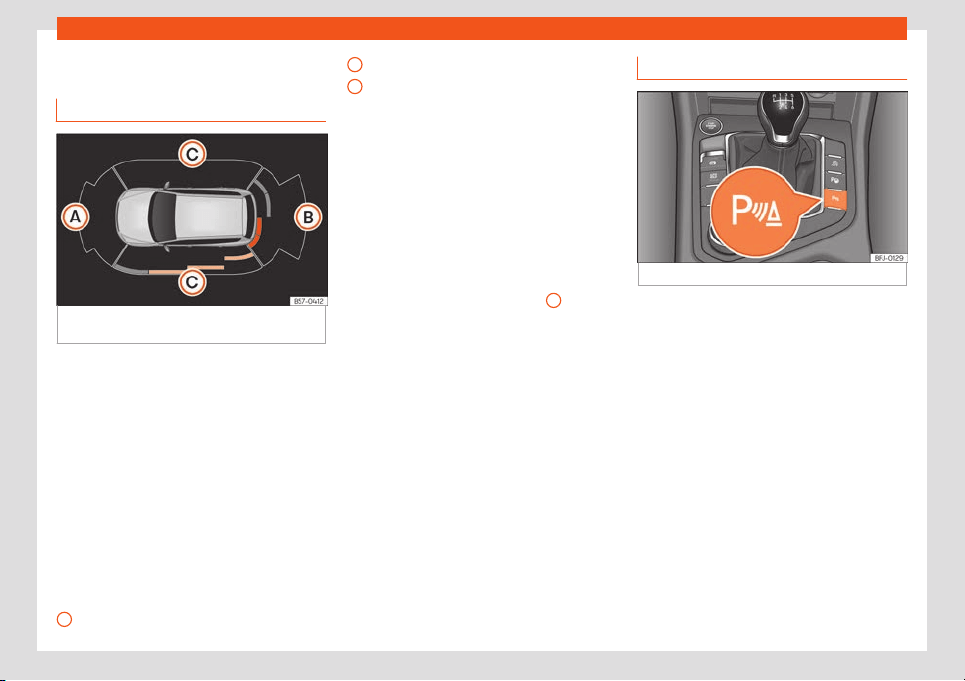
Help with parking and manoeuvring
Parking System Plus
Description
Fig. 208
Parking aid view on the Infotainment
syst
em display.
Parking aid plus assists the driv
er by giving
visual and audio warnings about obstacles
detected in front of and behind the vehicle.
The bumpers are fitted with sensors. When an
obstacle is detected, it is indicated by audible
signals and in the Infotainment system
›››
Fig. 208.
When moving close to an obstacle, it is possi-
ble to know if the obstacle is in front of the ve-
hicle or behind it by choosing different
sounds.
The approximate measurement range of the
sensors is:
1.20 m
A
1.60 m
0.90 m
As you appr
oach the obstacle, the frequency
of the audible signals will increase. The signal
will sound continuously at around 0.30 m:
Stop!
If the separation is maintained, the warning
volume is reduced after about 4 seconds.
In order to view the entire periphery of the ve-
hicle, the vehicle must be moved a few me-
tres forwards or backwards. Thus, the missing
areas are screened and obstacles at the
sides of the vehicle are displayed
C
.
Special f
eatures of ParkPilot with Area
View
In the following situations the screened area
on the side of the vehicle is automatically hid-
den:
●
When a vehicle door is opened.
●
When the ASR is switched off.
●
When there is ASR or ESC regulation.
●
If the vehicle remains stationary for more
than approximately 3 minutes.
B
C
Parking Aid operation
Fig. 209
Centre console: parking aid button.
Manually connecting and disconnecting
the parking aid
●
Press the butt
on once.
Manual disconnection of Parking Aid dis-
play (the audible sounds remain active)
●
Press the BACK function button.
Automatic connection of Parking Aid
●
Select reverse gear.
●
OR: If you drive forward at a speed of less
than 15 km/h (9 mph) and an obstacle is en-
countered, it is detected when it is approx.
less than 95 cm. away. If the automatic con-
nection is activated, a reduced view is shown.
●
OR: if the vehicle moves backwards.
»
291
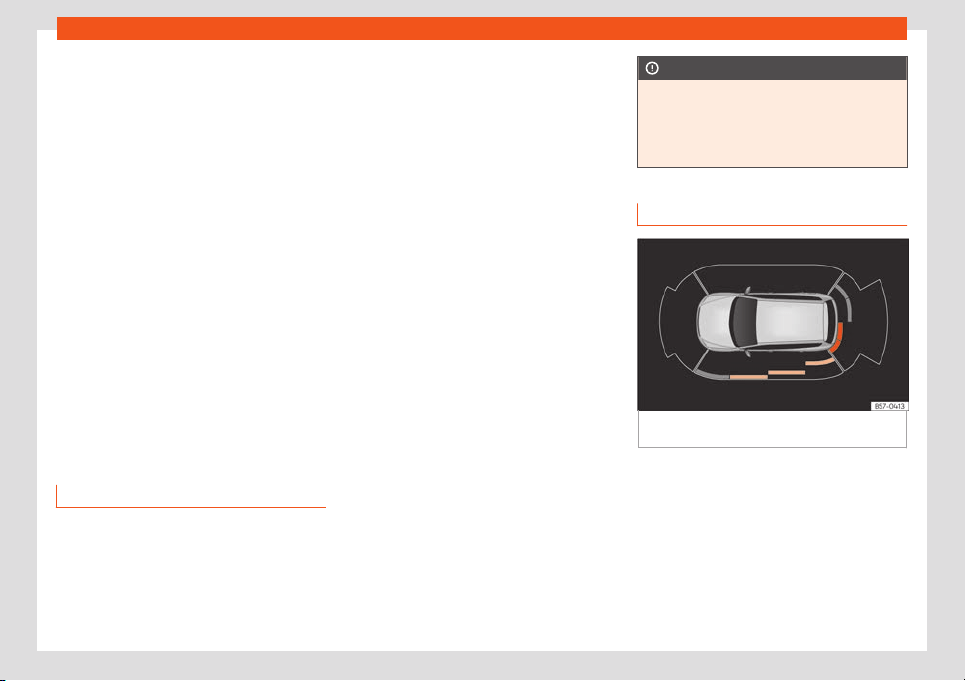
Driving
Automatic disconnection of Parking Aid
●
Move the selector lever to position P.
●
OR: driv
e forwards at 15 km/h (9 mph) or
faster.
Temporary suppression of sound in Park-
ing Aid
●
Press the function button.
Change from reduced view to full view
●
Select reverse gear.
●
OR: press the car icon on the reduced view.
Switch to the reverse assist image (Rear
View Camera “RVC”)
●
Select reverse gear.
●
OR press the RVC function button.
A short confirmation signal will be heard and
the button symbol will light up when the sys-
tem is switched on.
Automatic activation
When the Plus P
arking Aid connects auto-
matically, a diagram of the vehicle and the
segments will appear on screen.
It only operates every time the speed is re-
duced below 15 km/h (9 mph) for the first
time.
If it is switched off using the button, one of
the following actions must be taken for it to
reactivate automatically:
●
Switch off the ignition and switch it on
again.
●
OR: drive forward at over 15 km/h (9 mph)
approx.
●
OR: move the lever into position P and pack
again.
●
OR: switch the automatic activation on and
off in the Infotainment system.
Automatic activation of the park assist can be
switched on and off in the infotainment sys-
tem
›››
page 91:
●
Switch the ignition on.
●
Press the function button > Settings >
Parking and manoeuvring.
●
Select Automatic activation. If the box is
checked , the function will be switched on.
●
OR, in the Park distance control function,
select Settings > Automatic activa-
tion.
If activated automatically, an audible sound
warning will only be given when obstacles in
front are at a distance of less than 50 cm. ap-
prox.
CAUTION
The automatic connection of the Parking
Aid only w
orks when you are driving slowly.
If driving style is not adapted to the circum-
stances, an accident and serious injury or
damage may be caused.
Visual indication segments
Fig. 210
Parking aid view on the Infotainment
syst
em display.
The optical indication of the segments works
as f
ollows:
White and grey: the obstacle is more
than approx. 30 cm away from the path
or in the direction opposite to travel.
They are also displayed when the elec-
tronic parking brake is activated.
–
292
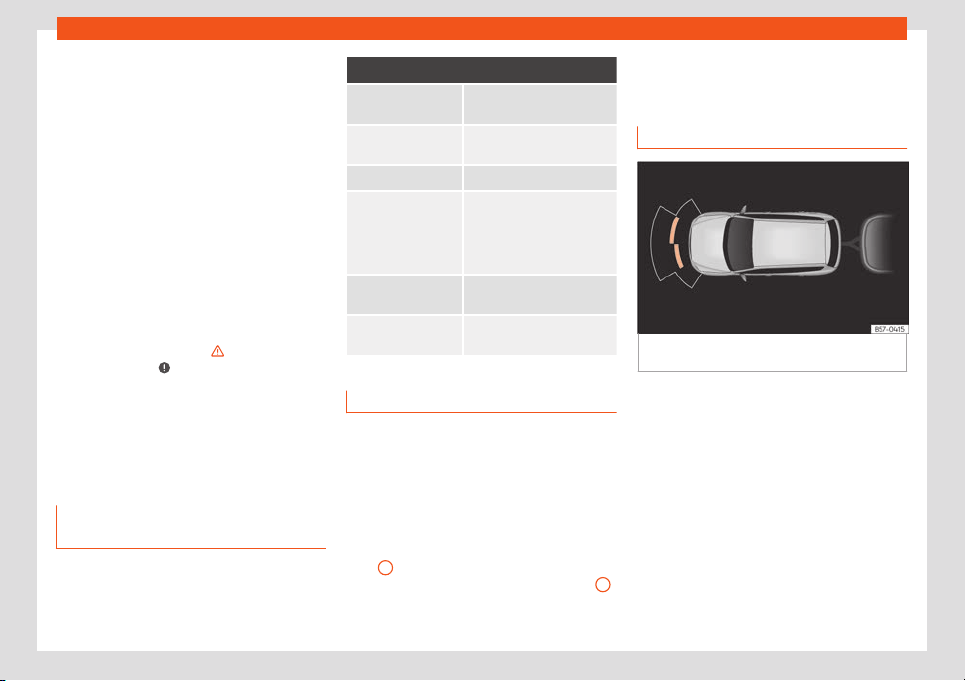
Help with parking and manoeuvring
Yellow segments: the obst
acles lie on
the vehicle’s path and are at a distance
of less than approx. 30 cm away.
Red segments: obstacles are less than
approx. 30 cm away.
A wake will indicate the anticipated forward
or backward trajectory, depending on the en-
gaged gear.
If an obstacle is located in the vehicle’s way,
the corresponding audible warning will
sound.
When the penultimate segment is displayed,
the vehicle has reached the collision zone. In
the collision zone, the obstacles are repre-
sented in red (including those out of the
path). Stop the vehicle!
›››
in Introduction
on page 289,
›
››
in Introduction on
page 290 !
In the e
vent the car is equipped with the Top
View Camera system, Park Assist visual guid-
ance will appear in accordance with the view
selected in the Top View Camera system.
Setting the indications and audio
signals
The audio indications and signals are set in
the inf
otainment system
›››
page 87:
–
–
Setup
Automatic activa-
tion
On/off
Front volume
Volume in the front and rear
area.
Rear volume Volume in the rear area.
Adjust volume
When the parking aid is
s
witched on, the volume of
the audio source will be re-
duced, depending on the se-
lected option.
Front sound set-
tings/sharpness
Sound tone in the front area.
Rear sound set-
tings/sharpness
Sound tone in the rear area.
Error messages
If a an error or fault message appears on the
instrument clust
er in Park Assist, there is a
fault.
If the fault doesn't disappear before discon-
necting the ignition, it will not be indicated
next time the parking aid is connected.
If a rear sensor is faulty, only the obstacles in
area
A
are displayed
›
››
Fig. 208. If a front
sensor is faulty, only the obstacles in area
B
are displayed. Symbol
is displ
ayed.
We recommend taking the vehicle to a speci-
alised workshop to have the fault repaired.
Trailer mode
Fig. 211
Parking assist display on the screen
with tr
ailer attached.
On vehicles with a factory-fitted trailer hitch,
when the tr
ailer is connected, the rear sen-
sors will not activate when reverse gear is en-
gaged or button is pressed. Therefore, any
objects behind or to the side of the vehicle
will not be indicated on the screen and no
audio signals will sound.
The screen will only display objects detected
at the front, and the vehicle's trajectory will
be hidden.
293

Driving
Manoeuvre braking function
The emergency braking function is used to
minimise damage in the e
vent of a collision.
Depending on the equipment, if the Parking
Aid is active, the braking while manoeuvring
function activates emergency braking when it
detects an obstacle in the vehicle’s path that
could cause a collision, driving forwards or in
reverse.
The function will not brake if the Parking Aid is
activated automatically. For the system to
operate, manoeuvring speed must be be-
tween 2.5-10 km/h (1.5-6 mph) for the front
area and between 1.5-10 km/h (1-6 mph) for
the rear.
Following an intervention, the braking while
manoeuvring function will be inactive in the
same direction of travel for 5 metres. Once
the gear is changed, or the selector lever’s
position is changed, the function will be ac-
tive again. The Parking Aid’s limitations apply.
The manoeuvre brake function (RBF) can be
set in the infotainment system using the func-
tion button > Settings > Parking and
manoeuvring.
●
on – permits the use of the br
aking while
manoeuvring function.
●
off – does not permit the use of the
braking while manoeuvring function.
Temporary suppression of emergency
br
aking
●
When the function is deactivated with the
Braking while manoeuvring button that ap-
pears on the Parking aid screen of the Info-
tainment system.
●
Whenever any of the car doors, rear lid or
bonnet are opened.
Rear parking aid
Description
The r
ear parking aid is an optical and audi-
ble assistant that warns of obstacles located
behind the vehicle.
There are sensors integrated in the rear
bumper. When they detect an obstacle, you
are alerted by audible and visible warnings
on the Infotainment system.
If the Top View Camera is installed, the rear
parking aid will issue an audible warning
about objects near the rear of the vehicle,
and the Top View Camera image will be
available on the infotainment screen, giving a
real image of the objects around the car.
Make particularly sure that the sensors are
not covered by adhesives, residues, dirt and
the like, as this could affect the system's op-
eration. Cleaning instructions
›››
page 369.
The approximate measurement range of the
rear sensors is:
●
Side area: 0.60 m
●
Central area: 1.60 m
As you approach the obstacle, the frequency
of the audible signals will increase. The signal
will sound continuously at around 0.30 m:
Stop!
›››
in Introduction on page 289,
›
››
in Introduction on page 290!
If the separ
ation is maintained, the warning
volume is reduced after about 4 seconds.
Parking Aid operation
Parking Aid connection
●
Select reverse gear.
P
arking Aid disconnection
●
Place the selector level in position P, N or D
(for automatic gearboxes) or disengage re-
verse (for manual gearboxes).
Set the lever to the N or D position to maintain
the system active for approximately 8 sec-
onds before switching off. During that time,
Parking assist will switch off if:
●
The selector lever is moved to position P.
●
OR: the vehicle accelerates to approx.
15 km/h (9 mph) or faster.
294
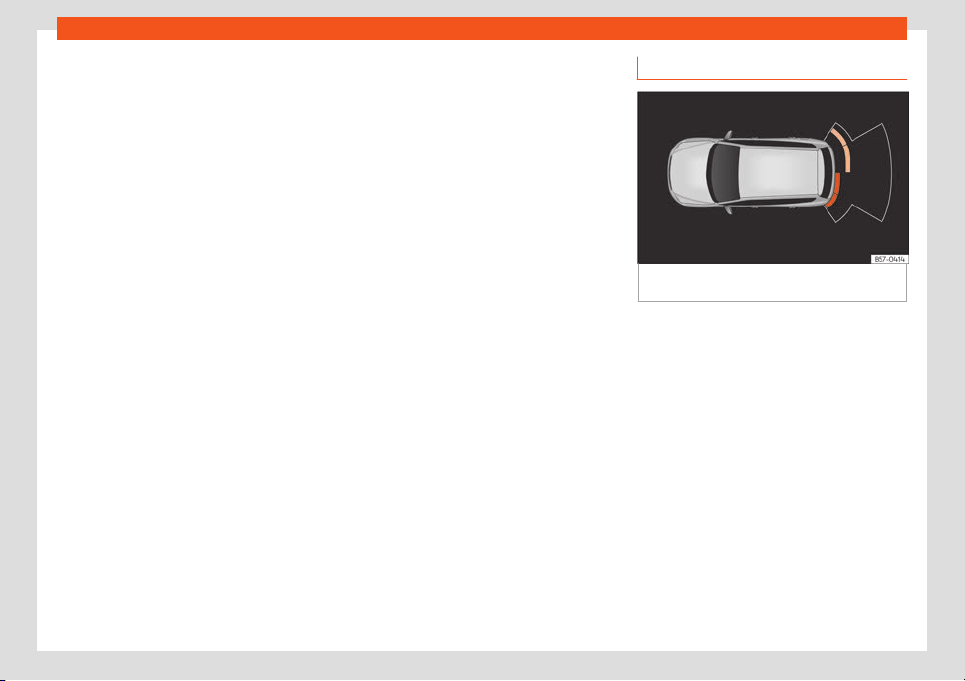
Help with parking and manoeuvring
If the Top View Camera is installed, rear park-
ing aid will be aut
omatically deactivated
when disengaging reverse gear.
Manual disconnection of Parking Aid dis-
play (the audible sounds remain active)
●
Press a button on the main menu of the fac-
tory-assembled infotainment system.
●
OR press the BACK function button.
Temporary suppression of sound in Park-
ing Aid
●
Press the function button. If you have the
Top View Camera system installed, you can-
not use the temporary suppression of sound
in Parking Aid.
Change from reduced view to full view
●
Select reverse gear.
●
OR: on vehicles fitted with reverse assist
(Rear View Camera “RVC”) click on the car
icon of the reduced display.
Switch to the reverse assist image (Rear
View Camera “RVC”)
●
Select reverse gear.
●
OR: press the RVC function button.
Setting the indications and audio signals
The indications and audio signal settings are
in the infotainment system
›››
page 87.
●
Rear volume: volume in the rear area.
●
Rear sound settings/treble: sound
tone in the rear area.
●
Lower volume: when the parking aid is
switched on, the volume of the audio source
will be reduced, depending on the selected
option.
Error messages
If a an error or fault message appears on the
instrument panel in Parking assist, there is a
fault.
If the fault doesn't disappear before discon-
necting the ignition, it will not be indicated
next time the parking aid is connected.
If there is a fault in a sensor, the symbol is
displayed on the infotainment system display.
We recommend taking the vehicle to a speci-
alised workshop to have the fault repaired.
Towing device
In vehicles equipped with a towing bracket
device from the factory, when the trailer is
connected, the parking aid will not be activa-
ted when reverse gear is engaged.
Visual indication segments
Fig. 212
Parking aid view on the Infotainment
syst
em display.
The distance to the obstacles can be estima-
t
ed with the help of the segments at the rear
of the vehicle.
The optical indication of the segments works
as follows:
White segments: the obstacle is more
than approx. 30 cm away from the path
or in the direction opposite to travel.
They are also displayed when the elec-
tronic parking brake is activated.
Yellow segments: the obstacles lie on
the vehicle’s path and are at a distance
of less than approx. 30 cm away.
Red segments: obstacles are less than
approx. 30 cm away.
»
–
–
–
295
Driving
Whenever the obstacle is located in the vehi-
cl
e’s direction of travel, the corresponding
audible warning will sound.
As the vehicle approaches an obstacle, the
segments are displayed closer to the vehicle.
When the penultimate segment is displayed,
this means that the vehicle has reached the
collision zone. In the collision zone, the obsta-
cles are represented in red (including those
out of the path). Do not continue to reverse
›››
in Introduction on page 289,
›
››
in
Intr
oduction on page 290!
If equipped with the Top View Camera
Segments are not displayed when the vehicle
is equipped with a Top View Camera.
The Parking Aid system will issue an audible
warning for objects that are near the rear of
the vehicle, and the Top View Camera image
will be available on the screen, giving a real
image of the objects around the car.
Trailer Assist
Introduction
Trailer assist helps the driver to reverse and
manoeuvr
e with a trailer.
By moving the rotary knob of the exterior mir-
rors, the trailer assist directs the trailer that is
hitched. The driver has to accelerate, change
gears and brake!
System limitations
Under certain circumstances, the camera
does not detect objects such as trailer draw
bars, bars, fences, posts or thin trees, or an
open (or opening) rear lid, which could dam-
age the vehicle.
In order to guarantee good system operation,
keep the camera clean, free of snow or ice,
and do not cover it with adhesives or other
objects. Do not allow the draw bar to be cov-
ered by external influences.
Use the trailer manoeuvre assistant only
when the rear lid is closed correctly.
CAUTION
The trailer maneuver assistant does not
t
ake the vehicle’s surrounding as a refer-
ence. No obstacle detection takes place.
The driver alone has to assess whether it is
possible to manoeuvre safely with the tow
vehicle and trailer set.
●
Always observe the movement of the
trailer and, if necessary, actively interrupt
the manoeuvre to avoid damage. Even if
the trailer manoeuvring assistant is operat-
ed correctly, on rare occasions the trailer
may move in a different way to the setting.
●
Do not rely solely on the indications on
the instrument cluster display.
Note
The trailer manoeuvre assistant automati-
cally s
witches off approx. 10 minutes after
being activated. The assistant is also deac-
tivated if the driver does not perform any
action over the course of approx. 3 mi-
nutes.
Requirements
The following requirements must be met for
the tr
ailer manoeuvre assistant to work:
●
The engine is running.
●
The ESC must be connected.
●
The driver's door and the rear lid are
cl
osed.
●
The exterior mirrors are not folded.
●
There is a non-articulated one or two axle
trailer hitched and electrically connected.
●
Both the tow vehicle and trailer are stop-
ped.
●
The maximum bending angle has not been
exceeded.
●
The length of the trailer’s drawbar has been
determined.
296
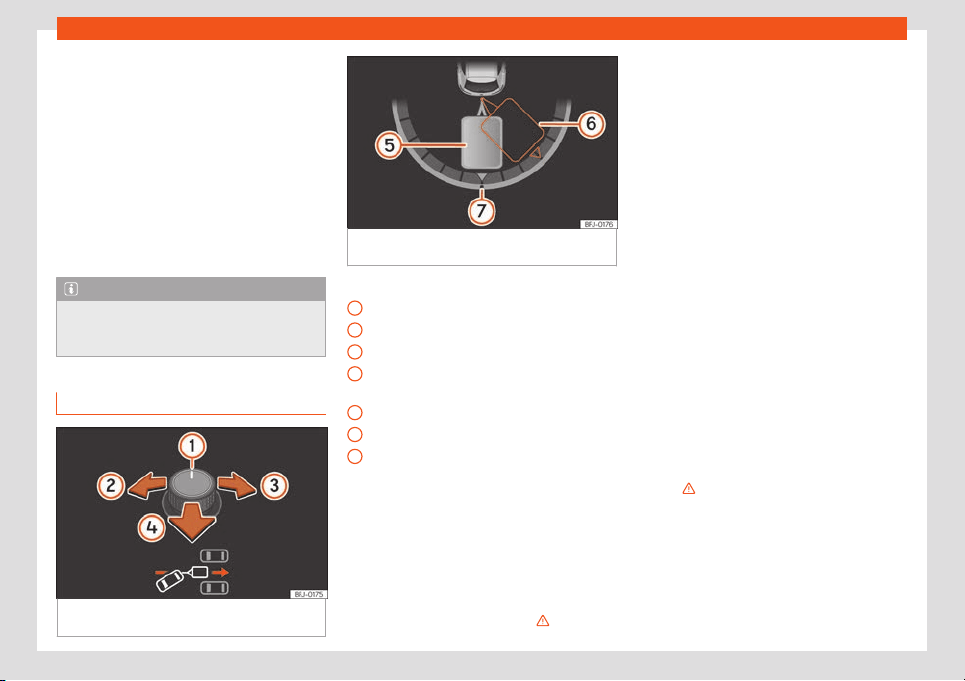
Help with parking and manoeuvring
Determine the length of the trailer's draw-
bar
In or
der for the trailer manoeuvre assistant to
determine the length of the trailer’s drawbar,
drive the vehicle-trailer set through some
turning manoeuvres or curves. The more pre-
cisely the length of the drawbar is deter-
mined, the wider the angles that will be avail-
able when manoeuvring. The assistant subdi-
vides the maximum available end stops of the
angle indicator into four levels: approx. 30°,
45°, 60° and 75°.
Note
For technical reasons, the trailer manoeu-
vr
e assistant cannot always correctly de-
tect trailers with LED technology taillights.
Operating
Fig. 213
Rotary exterior mirror controls.: adjust
the tr
ailer angle.
Fig. 214 Instrument panel display: engage re-
v
erse gear
Key of the Fig. 2
13,
›››
Fig. 214:
Rotary exterior mirror controls.
Trailer orientation to the left
Trailer orientation to the right
Move the vehicle in the direction of the
towing device.
Actual trailer position
Target trailer position
Angle indicator zero position
Manoeuvre with the tow vehicle and trailer
set
The system requirements must be met
›››
page 296.
●
Select reverse gear.
●
Press button .
●
Release the steering wheel
›››
.
1
2
3
4
5
6
7
●
T
ilt the rotary control until the desired di-
rection is reached
›››
Fig. 213. A representa-
tion of the tow vehicle and trailer set is shown
on the instrument cluster screen for guidance
purposes
›››
Fig. 214.
●
Reverse by accelerating slowly. Pay atten-
tion to your surroundings!
●
If necessary, correct the angle with the ro-
tary control. Press the control towards the left
or right: the set will move to the left or right.
Press the control backwards: the vehicle will
follow the trailer.
●
Reverse and move forwards until the de-
sired position is reached.
●
The manoeuvre ends when a message is
displayed on the instrument cluster display
and, in some cases, an audio signal sounds.
Automatic brake operation
The trailer manoeuvre assistant helps the
driver by automatically operating the brakes
in certain situations.
The driver is responsible for braking in
time
›››
.
The br
akes may be applied automatically
and the function deactivated in the following
situations:
●
A certain speed is exceeded.
●
The steering wheel is grabbed. The vehicle
brakes automatically until it stops.
»
297
Driving
●
If the k
ey is pressed during the manoeu-
vre or the driver’s door opens.
WARNING
The quickly turning steering wheel can
cause serious injuries.
●
Do not hold the steering wheel during the
manoeuvr
e until the system requests it.
●
Exception: If a dangerous situation oc-
curs, intervene and take over the steering.
WARNING
Never allow the automatic operation of
br
akes to lead you to take any risk that
compromises safety. The system is not a
replacement for driver awareness.
●
The manoeuvre assist system is subject
to certain limitations inherent to the sys-
tem. In certain situations, the automatic
braking intervention may only work in a
limited way or not work at all.
●
Always be ready to use the brakes your-
self!
●
Automatic brake operation ends after 1.5
seconds approx. if the vehicle is stopped.
After this, brake the vehicle yourself.
Note
The exterior mirrors cannot be adjusted
whil
e the assistant is active. The saved set-
ting for the passenger’s mirror can be acti-
vated
›››
page 127.
Troubleshooting
Camera with no visibility, fault message,
the syst
em disconnects
●
Clean the camera or remove possible ad-
hesives or accessories from it
›››
page 369.
●
Check for visible damage.
The system behaves differently than ex-
pected
There can be several causes:
●
The camera is dirty
›
››
page 369. In addi-
tion to dirt and snow, camera visibility can be
reduced by detergent residue or any type of
coating.
●
The system requirements must be met
›››
page 296.
●
The camera is covered with water.
●
The vehicle has some type of damage in
the camera area, e.g. due to a parking im-
pact.
●
The field of view of the camera is blocked
by an accessory, e.g. a bicycle carrier sys-
tem.
●
Changes have been made to the paint in
the camera area and structural modifications
have been made, e.g. to the front part of the
vehicle and the running gear.
Solution for all cases
●
Temporarily disconnect the system.
●
Check if one of the causes indicated above
has occurred.
●
Once the source of the problem has been
eliminated, the system may be reconnected.
●
If the system still behaves unpredictably,
have it checked by a specialised workshop.
Peripheral view system (Top
View Camera)
Introduction
Using 4 cameras, the system generates a
r
epresentation that is shown on the infotain-
ment system display. The cameras are loca-
ted on the radiator grille, the exterior mirrors
and the rear lid.
The functions and representations of the Area
View system may vary depending on whether
or not the vehicle has ParkPilot.
WARNING
The image from the cameras does not
mak
e it possible to calculate the distance
to the obstacles (people, vehicles, etc.)
precisely, so using them could cause seri-
ous accidents and injury.
●
The camera lenses augment and distort
the visual field and the objects on the
298
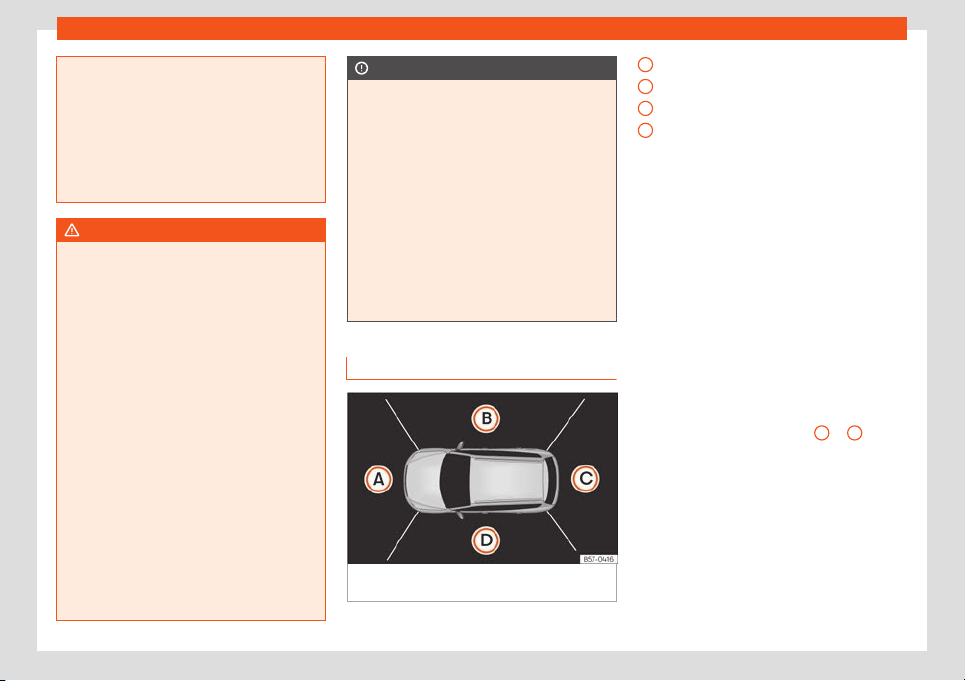
Help with parking and manoeuvring
screen are seen differently and imprecise-
ly.
●
Certain objects may not be shown or may
not be sho
wn very clearly, for example,
posts or thin rails, due to the screen resolu-
tion or if light conditions are insufficient.
●
The cameras have blind spots in which
obstacles and people are not registered.
WARNING
The smart technology incorporated into
the T
op View Camera system cannot over-
come the limits imposed by the laws of
physics and it only works within the limits of
the system. The greater convenience provi-
ded by the Area View system should never
tempt you to take any risk that may com-
promise safety. If used negligently or invol-
untarily, it may cause serious accidents
and injuries. The system is not a replace-
ment for driver awareness.
●
Adapt your speed and driving style to suit
visibility, weather, road and traffic condi-
tions.
●
Do not be distracted from the traffic by
looking at the screen.
●
Monitor the area around the vehicle at all
times, since the cameras do not capture
small children, animals and certain objects
in all situations.
●
The system will probably be unable to
represent all areas clearly.
CAUTION
●
The camer
a images are only two-dimen-
sional. Due to a lack of spatial depth, ob-
jects that jut out or holes on the road, for
example, are more difficult to detect or
may not be seen at all.
●
In certain circumstances, the camera
does not capture objects such as beams,
fences, posts or thin trees, which could
damage the vehicle.
●
The system displays the auxiliary lines
and boxes regardless of the vehicle's envi-
ronment, no objects are detected. The driv-
er is responsible for determining that the
vehicle will fit in the parking space.
Area View system
Fig. 215
Viewing the top view system: aerial
vie
w.
There are four different views to choose from:
Front camera area
Right camer
a area
Rear camera area
Left camera area
Function buttons:
Exit the current display.
Adjust the display: bright, contrast and
colour.
Three-dimensional views
Depending on the equipment: connect-
ing and disconnecting the ParkPilot
sound.
The aerial view is generated by combining
the images from all the cameras
›››
Fig. 215. The aerial view can be selected
by pressing the vehicle in the area.
Select the corresponding view by pressing
the different areas
›››
Fig. 215
A
to
D
of the
aerial vie
w or the reduced aerial view.
Conditions necessary for the use of the
Area View system
●
The doors and the rear lid must be closed.
●
The image must be reliable and clear. For
this reason, for example, the camera lens
must be clean.
●
The area around the vehicle must be clear-
ly and totally visible.
»
A
B
C
D
299
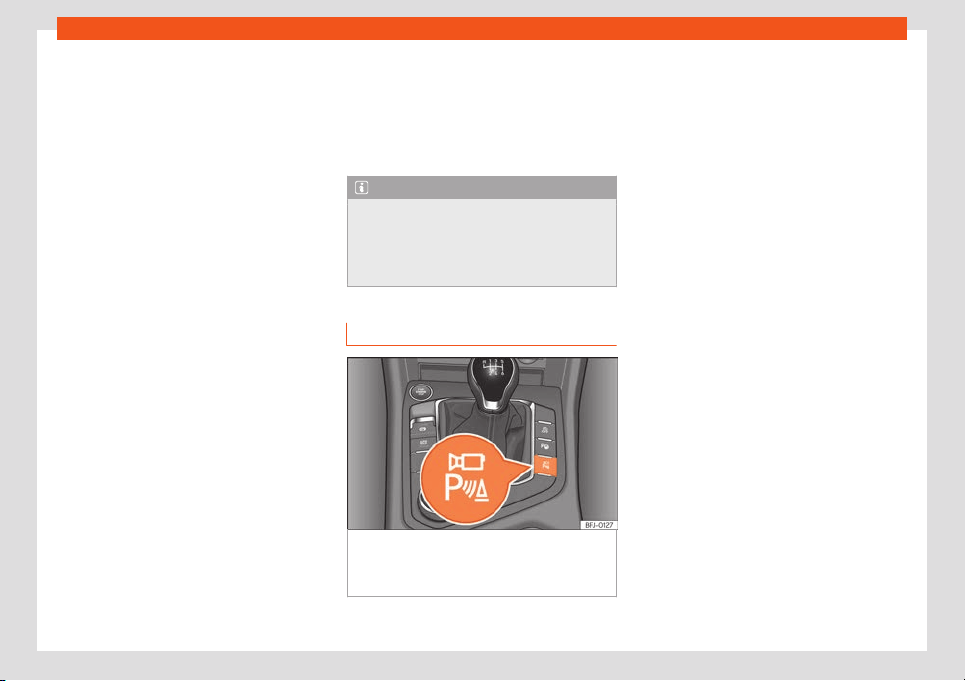
Driving
●
The ar
ea for parking or manoeuvring
should be a flat surface.
●
The vehicle should not be loaded very
heavily at the rear.
●
The driver must be used to the system.
●
There should be no damage to the vehicle
in the camera area. If the position or installa-
tion angle of the cameras have been
changed, e.g. after a rear-end collision, the
system should be checked by a specialised
workshop.
Special characteristics
The images on the area view system cameras
are only two-dimensional. Due to a lack of
spatial depth, it is difficult or impossible to
make out on-screen any holes there may be
on the ground, objects jutting out from the
ground or parts protruding from other vehi-
cles.
Situations in which the objects or other vehi-
cles appear to be further away or closer than
they really are:
●
On moving from a horizontal plane to a
slope.
●
On moving from a slope to a horizontal
plane.
●
If the vehicle is heavily loaded at the rear.
●
If the vehicle approaches protruding ob-
jects. These objects may be outside the cam-
eras' angle of visibility.
Trailer mode
The Area View system conceals, in the rear
camera area, all the auxiliary guiding lines
when the factory-fitted towing bracket is
connected electrically to a trailer
›››
page 306.
Note
In order to become familiar with the system
and its functions, SEAT r
ecommends that
you practice handling the Area View sys-
tem in an area where there is not too much
traffic or in a car park.
Connecting and disconnecting
Fig. 216 Centre console: button to manually
activ
ate/deactivate the peripheral vision sys-
tem when combined with the park assist sys-
tem.
Manual activation
●
Press button once
›
››
Fig. 216.
The infotainment system screen displays the
aerial view
›››
Fig. 215. If you press the
button when driving at over 15 km/h (9 mph),
the image will not be displayed.
Automatic activation
●
Select reverse gear.
●
OR: The vehicle moves backwards.
The view of the image of the vehicle's rear
camera is shown in parallel parking mode
with the reduced aerial view.
Manual disconnection
●
Press button again
›››
Fig. 216.
●
OR: press a button on the factory-equip-
ped infotainment system, for example the
button.
●
OR: press the function button.
Automatic off
●
Drive forwards at over 15 km/h (9 mph) ap-
proximately.
●
OR: switch off the ignition. The Area View
system menu disappears immediately.
300
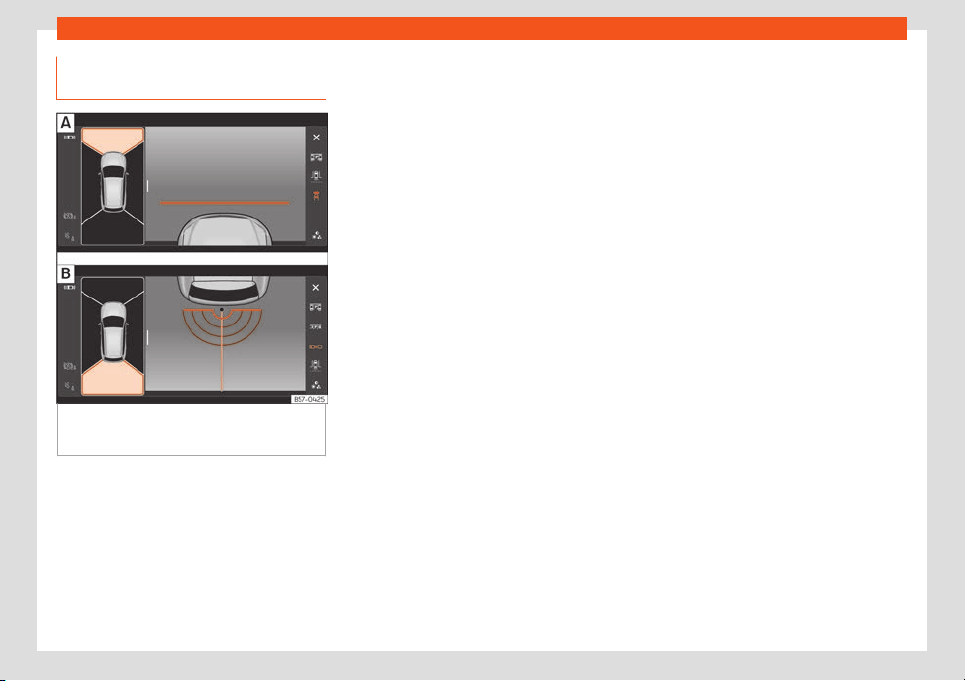
Help with parking and manoeuvring
Views of the peripheral vision sys-
t
em (modes)
Fig. 217
Display on the top view system
scr
een:
Front camera: off-road view.
Rear
camera: off-road view.
Depending on the equipment: connect-
ing and disconnecting the P
arkPilot
sound.
Exiting the Area View system screen:
Adjust the display: bright, contrast and
colour.
The selected view is displayed on the right
side of the screen. The reduced aerial view
shown on the right side displays the view
framed in yellow. In addition, the right margin
of the screen displays the menu options pos-
sible and the views (the so-called “modes”)
of the camera in question. The active view
(mode) at the time is highlighted.
The red lines are indicate a distance of ap-
prox. 40 cm away from the vehicle.
Aerial views (bird's eye view)
Main mode:
The vehicle and its immediate vicinity
seen from above are shown. Depending
on the equipment, the ParkPilot's path
may also be displayed.
Three-dimensional views:
The vehicle and its vicinity seen from
above are shown.
The vehicle and its vicinity seen from
above are shown obliquely.
The vehicle and its vicinity seen obli-
quely are shown.
Swipe the infotainment system display with
your finger in the direction of the arrows to
change the angle of vision in the three-di-
mensional views of the vehicle and its vicinity.
Front camera views (front view)
Cross traffic. This visualization helps to
monitor traffic to the left, front and right
of the vehicle and can be used, for ex-
ample, when exiting garages or narrow
exits.
Angle parking. The area in front of the
vehicle is shown. Orientation lines are
shown to give guidance.
Off-road. The area directly in front of the
vehicle seen from above is shown. For
example, on a slope, in order to see the
area directly in front of the vehicle.
Side camera views (side view)
Right and left sides. The areas located
directly to the side of the vehicle seen
from above are represented in order to
navigate possible obstacles more pre-
cisely.
The driver’s or passenger's side seen
from above is shown. This makes it
possible to visualize the blind spots
along the vehicle.
Rear camera views (rear view)
Angle parking. The area behind the vehi-
cle is shown. Auxiliary lines are shown to
give guidance.
Parallel parking. The area directly be-
hind the vehicle is shown. The coloured
boxes and auxiliary lines serve as orien-
tation.
Off-road or hitching a trailer function.
The vehicle's rear is presented.
»
301

Driving
Green and red semicircular auxiliary
lines ar
e displayed in vehicles with a fac-
tory-fitted towing bracket. The auxiliary
lines indicate the distance from the tow-
ing bracket. The distance between the
auxiliary lines (green and red) is approx.
30 cm The orange auxiliary line indi-
cates, according to how the steering
wheel is turned, the precalculated direc-
tion of the towed device.
Cross traffic. This visualization helps to
monitor traffic to the left, front and right
of the vehicle and can be used, for ex-
ample, when exiting garages or narrow
exits.
Reverse Assist (Rear View
Camera)
Operating and safety warnings
WARNING
●
The r
everse assist does not make it possi-
ble to precisely calculate the distance from
obstacles and nor can it overcome the sys-
tem's own limits, hence its negligent use
may cause serious accidents and injuries if
used without due care. The driver should be
aware of his/her surroundings at all times
to ensure safe driving.
●
The camer
a lens expands and distorts
the field of view and displays the objects
on the screen in a way that is different from
reality. Distance perception is also distor-
ted.
●
Due to the screen resolution or light con-
ditions, some items may be blurry or not
displayed at all. Take care with thin posts,
fences, railings or trees that might not be
seen on the screen and could damage the
vehicle.
●
The reverse assist has blind spots where
it cannot see people or objects. Monitor the
vehicle's surrounding area at all times.
●
The system is not a replacement for driv-
er awareness. Supervise the parking ma-
noeuvre and the vehicle's surrounding area
at all times.
●
Do not be distracted from the traffic by
looking at the screen.
●
The images are only two-dimensional.
Protruding objects or holes in the road, for
example, are more difficult to detect or
may not be seen at all.
●
Vehicle load modifies the representation
of the guide lines. The width represented
by the lines decreases with vehicle load.
Pay special attention to the surroundings
when the inside of the vehicle of the lug-
gage compartment are loaded.
●
In the following situations, objects or oth-
er vehicles appear to be further away or
closer than they actually are. Pay special
att
ention:
–
If moving from a flat surface to a slope
and vice-versa.
–
If the vehicle is heavily loaded.
–
When the vehicle approaches objects
that are not on the ground surface or
that protrude from it. These objects
may be outside the camera angle when
reversing.
Note
●
It is impor
tant to take great care and pay
special attention if the driver is not familiar
with the system.
●
The reverse assist reference lines disap-
pear when the rear lid is open.
Introduction
A camera installed in the rear lid handle as-
sists the driv
er with reverse parking or ma-
noeuvring
›››
page 248.
The camera image is viewed together with
orientation lines projected on the Infotain-
ment system screen. Part of the bumper can
be seen at the bottom, which can be used by
the driver as a reference point.
302

Help with parking and manoeuvring
Reverse assist modes
Depending on the equipment, the f
ollowing
modes are available:
●
Angle parking: reverse parking perpendic-
ular to the road.
●
Parallel parking: reverse parking parallel
to the road.
●
Assistance function for hitching a trailer:
helps to hitch a trailer.
●
Cross traffic: traffic is monitored in a trans-
verse direction.
Connecting and disconnecting
Connect the reverse assist
●
Select reverse gear.
●
OR: pr
ess button .
Disconnect the reverse assist
Drive forward at least 15 km/h (9 mph).
Shown on the display
The system’s functions and representations
may v
ary depending on the equipment.
The assistant's image view changes when the
factory-fitted tow hitch is electronically con-
nected to a trailer
›››
page 313.
Reverse assist functions and symbols
When the reverse assist is connected, you
can make adjustments using the function but-
tons. Some adjustments are equipment-de-
pendent.
Exit the current display
Switch to angle parking
›››
page 304
Switch to parallel parking
›››
page 305
Switch to the trailer hitching assistance
function
Switch to cross traffic
Adjust the display: brightness, contrast
and colour.
Switch to park assist
›››
page 289
Display the parking aid view
Hide the parking aid view
Turn the steering wheel (parallel park-
ing)
Stop the vehicle (parallel parking)
Guide lines
Green horizontal lines: extension of the vehi-
cle.
Red lateral line: when the steering wheel
needs to be turned the other way, a yellow
line turns red (parallel parking).
Yellow lines: vehicle path depending on the
steering angle.
Yellow auxiliary boxes: front and rear delimi-
tation of the parking space (parallel parking).
Green lateral line: point for turning the other
way when parking (parallel parking).
Red and green frame: outline of the vehicle
(parallel parking).
Assistance function for hitching a trailer
On vehicles with a factory-fitted towing de-
vice, this function can be used to move the
vehicle close to a tow bar. Due to the high
level of magnification of the image in this
mode, objects behind the vehicle are seen
very late.
Auxiliary lines are shown in the infotainment
system.
Red lines: position of the tow hitch.
Green lines: distance to the tow hitch. The
distance between the lines is approx. 0.1 m
Orange line: precalculated direction of the
tow hitch depending on steering wheel rota-
tion.
Cross traffic
This visualization helps to monitor traffic be-
hind the vehicle and can be used, for exam-
ple, when exiting garages or narrow exits.
303
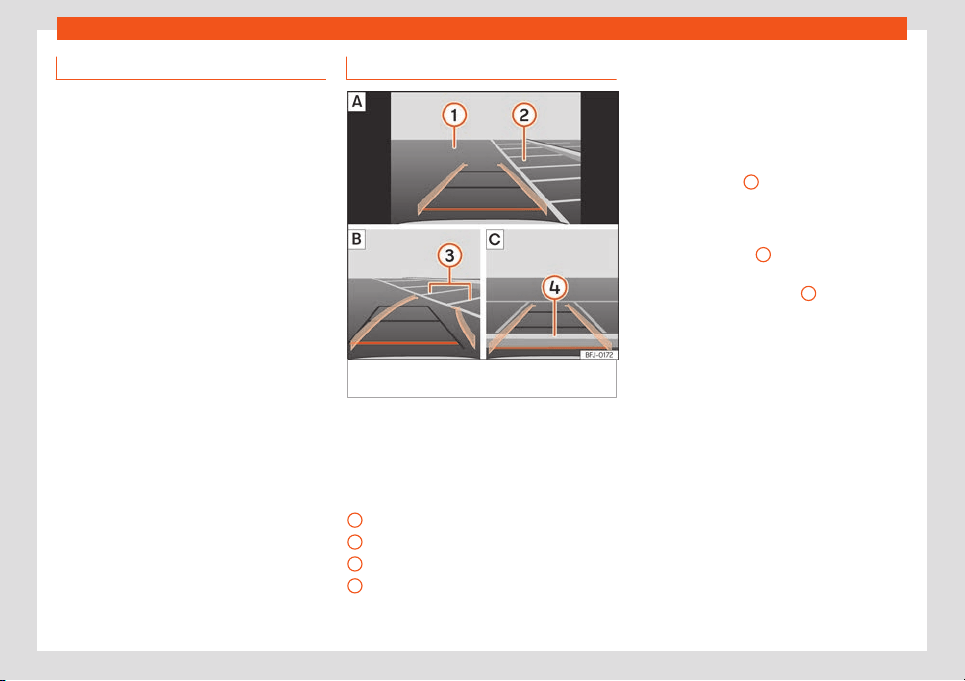
Driving
Requirements
To park with reverse assist, the following re-
quir
ements must be met:
●
Do not exceed a speed of approx. 15 km/h
(9 mph).
●
Parking space width: vehicle width + 0.2 m
●
Distance: approx. 1 meter from the parking
space (parallel only).
●
Length of the parking space: approx. 8 m
(parallel only)
To display a real image, the following require-
ments must be met:
●
The luggage compartment rear door is
cl
osed.
●
The surroundings are on a flat surface.
●
The vehicle should not be loaded very
heavily at the rear.
Parallel parking
Fig. 218 Display on the Infotainment system
scr
een.: parking with reverse assist.
Key to the Fig. 2
18:
Finding a parking space
Go to the selected parking space
Centre the vehicle inside the parking
space
Road
Parking space
Lateral boundary of the parking space
Rear boundary of the parking space
1
2
3
4
Parking
●
Press the or butt
on before passing in
front of the selected parking space.
●
With reverse assist connected and in work-
ing order, press the function button .
●
Place the vehicle in front of the parking
space
›››
Fig. 218
2
.
●
Reverse while turning the steering wheel so
that the yell
ow lines enter the parking space.
The green and yellow lines must match the
side boundary lines
3
.
●
Stop the vehicle when the red line has
r
eached the rear boundary
4
.
304

Help with parking and manoeuvring
Parallel parking
Fig. 219 Display on the Infotainment system
scr
een.: Reverse assist, mode 2.
Key to the Fig. 2
19:
Finding a parking space
Go to the selected parking space
Centre the vehicle inside the parking
space
Road
Obstacle or auxiliary box
Lateral boundary of the parking space
Obstacle or auxiliary box
1
2
3
4
Parking
●
If necessary, press the butt
on before
passing in front of the selected parking
space.
●
With reverse assist connected and in work-
ing order, press the function button .
●
Turn on the corresponding turn signal on
the side of the road where you want to park.
●
Place the vehicle parallel to the parking
space, approx. 1 meter away.
●
If obstacles protrude from the auxiliary box-
es, find another parking space or realign the
vehicle.
●
Select reverse gear. A red frame represents
the target position of your vehicle.
●
Turn the steering wheel until the red frame
is between the auxiliary boxes and has
changed to green. Keep the steering wheel in
this position and start driving slowly.
●
When an arrow appears, reverse. A yellow
line and a green line appear. The arrow indi-
cates the distance that still has to be cov-
ered.
●
While reversing, keep the steering wheel in
the adjusted position. Adjust the steering
wheel rotation correctly when an indication
appears on the steering wheel symbol .
●
Reverse until the STOP signal is shown or
until the green line matches up with the later-
al boundary of the parking space.
●
Stop the vehicle. Turn the steering wheel as
far as it’ll go in the opposite direction.
●
Reverse until the STOP signal is shown or
until the red line reaches the rear boundary.
Troubleshooting
The system behaves differently than ex-
pect
ed
There can be several causes:
●
The camera is dirty
›
››
page 369. In addi-
tion to dirt and snow, camera visibility can be
reduced by detergent residue or any type of
coating.
●
The system requirements must be met
›››
page 304.
●
The camera is covered with water.
●
The factory-fitted towing bracket must not
be electrically connected to a trailer
›››
page 313.
●
The vehicle has some type of damage in
the camera area, e.g. due to a parking im-
pact.
●
The field of view of the camera is blocked
by an accessory, e.g. a bicycle carrier sys-
tem.
●
Changes have been made to the paint in
the camera area, or structural modifications
have been made to a component such as the
running gear.
»
305

Driving
Camera with no visibility, fault message,
the syst
em disconnects
●
Clean the camera or remove possible ad-
hesives or accessories from it
›››
page 369.
●
Check for visible damage.
Possible solution
●
Temporarily disconnect the system.
●
Check if one of the causes indicated above
has occurred.
●
Once the source of the problem has been
eliminated, the system may be reconnected.
●
If the system still behaves unpredictably,
have it checked by a specialised workshop.
Towing bracket device
T
railer mode
Introduction
Take into account country-specific regula-
tions about driving with a tr
ailer and the use
of a towing bracket.
The vehicle has been developed primarily for
carrying people, although it can also be used
to tow a trailer if fitted with the corresponding
technical equipment. This additional load has
an effect on the useful life, fuel consumption
and vehicle performance and in some cases
can reduce the service intervals.
Driving with a trailer requires more force from
the vehicle, and thus more concentration
from the driver.
In winter, winter tyres should be fitted on both
the vehicle and the trailer.
Maximum vertical load technically permit-
ted on the coupling device
The maximum technical permitted vertical
load of the trailer's towing bracket on the
hook of the tow-bar is 100 kg.
Vehicles with the Start-Stop system
If the vehicle has a factory-fitted towing
bracket or one that is retrofitted by SEAT, the
Start-Stop system operates as normal. No
special char
acteristics need to be taken into
account.
If the system does not recognise the trailer or
the trailer bracket has not been retrofitted by
SEAT, the Start-Stop system must be discon-
nected by pressing the corresponding button
in the lower part of the centre console before
driving with the trailer, and it should remain
off for the rest of the journey
›››
.
V
ehicles with driving profile selection
If you are going to be towing a trailer, the use
of the Eco driving profile is not recommen-
ded. You are advised to select another of the
available driving profiles before beginning to
drive with a trailer.
Trailer weight/drawbar load
Never exceed the authorised trailer weight. If
you do not load the trailer up to the maximum
permitted trailer weight, you can then climb
correspondingly steeper slopes.
The maximum trailer weights listed are only
applicable for altitudes up to 1000 m above
sea level. Since higher altitude decreases en-
gine performance and the ability to climb
slopes, the tow load decreases proportional-
ly. The weight of the vehicle and trailer com-
bination must be reduced by 10% for every
1000 m of altitude. When possible, operate
the trailer with the maximum authorised
306
Towing bracket device
drawbar load on the ball joint of the t
owing
bracket, but do not exceed the specified lim-
it.
WARNING
Never use the trailer to transport people,
since it w
ould put their life in danger and is
also prohibited.
WARNING
Undue use of the towing bracket may
cause injury and accidents.
●
Only use the towing bracket if it is in a
perf
ect state of repair and is properly se-
cured.
●
Never modify or repair the towing bracket
in any way.
●
In order to reduce the danger of injury in
the event of rear-end collisions and to
avoid injury to pedestrians and cyclists
when parking the vehicle, cover or remove
the tow hook when you are not using a trail-
er.
●
Never fit a towing bracket “with weight
distribution” or “load compensation”. The
vehicle has not been designed for this type
of towing bracket. The towing bracket
could fail and the trailer could be released
from the vehicle.
WARNING
Driving with a trailer and transporting
heavy or l
arge objects can affect driving
properties and even cause an accident.
●
Always secure the load properly using
belts or straps that are suitable and in
good condition.
●
Adapt your speed and driving style at all
times to suit visibility, weather, road and
traffic conditions.
●
Trailers with a high centre of gravity are
more likely to overturn than those with a
low one.
●
Avoid sudden braking and manoeuvres.
●
Take great care when overtaking.
●
Reduce speed immediately if you notice
that the trailer is swaying, however slightly.
●
Never drive at more than 80 km/h
(50 mph) when towing a trailer (or at more
than 100 km/h (60 mph) in exceptional cir-
cumstances). This also applies in countries
where driving at higher speeds is permit-
ted. Take into account the speed limit for
vehicles with trailers in the corresponding
country, as it could be less than the speed
limit for vehicles without a trailer.
●
Never attempt to “straighten” the towing
vehicle and trailer while accelerating.
WARNING
If the towing bracket has been retrofitted
by a non-SEAT w
orkshop, the Start-Stop
system must be disconnected manually
whene
ver driving with a trailer. Otherwise
the brake system could be damaged and
could consequently cause a serious acci-
dent or injury.
●
Always disconnect the Start-Stop system
manually when using a towing bracket that
has not been fitted by a SEAT workshop.
Note
●
Bef
ore hitching or unhitching a trailer, al-
ways deactivate the anti-theft alarm
›››
page 95. Otherwise, the tilt sensor could
cause the alarm to go off.
●
Do not drive with a trailer for the engine's
first 1000 km
›››
page 241.
●
If a removable and retractable tow hook
is fitted, it should not be mounted when not
in use. In the event of a rear-end collision,
the damage to the vehicle could be greater
if the tow hook is fitted.
●
Some retrofitted towing brackets cover
the rear towing eye. In these cases, the
towing eye should not be used for tow-
starting or for towing other vehicles. For
this reason, if the vehicle has been retrofit-
ted with a towing bracket, always keep the
tow hook in the vehicle when you remove it.
307
Driving
Technical requirements
Vehicles that are f
actory-mounted with a
towing device meet all the technical and le-
gal requirements for driving with a trailer
›››
page 313.
If the vehicle is retrofitted with a towing
bracket, only a bracket that is authorised for
the maximum authorised load of the trailer
that is to be towed may be fitted. The towing
bracket must be suitable for the vehicle and
the trailer and must be properly secured to
the vehicle's chassis. Only use a towing
bracket that has been authorised by SEAT for
this vehicle. Always check and take into ac-
count the towing bracket manufacturer's in-
structions.
Towing bracket fitted on the bumper
Never fit a towing bracket to the bumper or to
the area where the bumper is mounted. The
towing bracket should not impair the bum-
per's function. Do not make modifications or
repairs to the exhaust system or the brake
system. Make regular checks to ensure that
the towing bracket is secure.
Engine cooling system
Driving with a trailer increases the load on the
engine and cooling system. The cooling sys-
tem should have sufficient coolant and be
prepared for the additional effort involved in
driving with a trailer.
Trailer brakes
If the tr
ailer has its own brake system, please
take the relevant legal requirements into ac-
count. Never connect the trailer's brake sys-
tem to the vehicle's brake system.
Tow cable
Always use a cable between the vehicle and
the trailer
›››
page 309.
Trailer tail lights
The trailer's rear lights should comply with
the statutory safety regulations
›››
page 309.
Never connect the trailer's rear lights directly
to the vehicle's electric system. If you are not
sure that the trailer's electrical connection is
correct, have it checked by a specialised
workshop. SEAT recommends visiting a SEAT
dealership for this.
Exterior mirrors
If you cannot see the area behind the trailer
with the exterior mirrors of the towing vehicle,
additional mirrors will have to be installed in
accordance with the regulations of the coun-
try in question. The exterior mirrors should be
adjusted before you start driving and must
provide a sufficient field of vision at the rear.
Trailer maximum electricity consumption
Never exceed the values indicated!
Europe, Asia, Africa, South America and Central
America
Brake lights (total) 84 Watts
Turn signal (on each side) 42 Watts
Side lights (on each side) 50 Watts
Reverse lights (in total) 42 Watts
Rear fog light 42 Watts
Australia
Brake lights (total) 108 Watts
Turn signal (on each side) 54 Watts
Side lights (on each side) 100 Watts
Reverse lights (in total) 54 Watts
Rear fog light 54 Watts
WARNING
If the towing bracket is wrongly fitted or is
not the right one
, the trailer could become
detached from the vehicle and cause seri-
ous injury.
CAUTION
●
If the r
ear lights of the trailer are not cor-
rectly connected, the vehicle's electronic
system may be damaged.
●
If the trailer absorbs excessive electric
current, the vehicle's electronic system
may be damaged.
308
Towing bracket device
●
Ne
ver connect the trailer's electric sys-
tem directly to the electrical connections
of the tail lights or any other power sour-
ces. Only use the connections intended for
providing electric current to the trailer.
Hitching and connecting a trailer
Fig. 220 Schematic representation: assign-
ment of the pins of the tr
ailer's electrical sock-
et.
Pin Meaning
1 Left turn signal
2 Rear fog light
3 Earth for pins 1, 2, 4, 5, 6, 7 and 8
4 Right turn signal
5 Rear light, right
6 Brake lights
Pin Meaning
7 Rear light, left
8 Reverse lights
9 Permanent live
10 Live charge cable
11 Earth for pin 10
12 Unassigned
13 Earth for pin 9
Power socket for trailer
The v
ehicle is fitted with a 13-pole power
socket for the connection between the trailer
and the vehicle. With the engine running,
electrical devices on the trailer receive power
from the electrical connection (pin 9 and pin
10 of the trailer power socket).
If the system detects that a trailer has been
connected, the consumers on the trailer will
receive electricity through this connection
(pins 9 and 10). Pin 9 has a permanent live.
This powers, for example, the trailer's interior
lighting. Electrical devices such as a fridge in
a caravan only receive electrical power if the
engine is running (through pin 10).
To avoid overloading the electrical system,
you cannot connect the ground wires of pin
3 , pin 11 or pin 13 to each other.
If the trailer has a 7-contact connector, you
will need to use an adapter cable. In this case
the function corresponding to pin 10 will not
be available.
Tow cable
The tow rope must always be securely fixed
to the towing vehicle and loose enough so
that the vehicle can handle turns smoothly.
However, make sure that the cable does not
rub on the ground while driving.
Trailer tail lights
Always check the trailer's rear lights to ensure
they are working correctly and that they
comply with the relevant safety regulations.
Make sure that the maximum permissible
power that can be absorbed by the trailer is
not exceeded
›››
page 308.
Include in the anti-theft alarm
The trailer is included in the anti-theft system
if the following conditions are met:
●
If the vehicle is factory-equipped with an
anti-theft alarm and towing bracket.
●
If the trailer is electrically connected to the
towing vehicle through the trailer power sock-
et.
●
If the electrical systems of the vehicle and
trailer are in perfect condition and have no
faults or damage.
»
309
Driving
●
If the v
ehicle is locked with the key and the
anti-theft alarm is activated.
When the vehicle is locked, the alarm is trig-
gered if the electrical connection with the
trailer is cut off.
Before hitching or unhitching a trailer, always
turn off the anti-theft alarm. Otherwise, the tilt
sensor could cause the alarm to go off.
Trailers with LED tail lights
For technical reasons, trailers fitted with LED
rear lights cannot be connected to the anti-
theft alarm system.
When the vehicle is locked, the alarm does
not go off when the electrical connection
with the trailer is cut if it has rear lights with
light-emitting diodes.
If the Eco driving profile was selected when
hitching the trailer, this will automatically
switch to the Normal profile. If the system
cannot detect the attached trailer or if the
towing bracket has been retrofitted by an au-
to repair shop other than SEAT, you must
manually select the Normal profile before
you start driving with a trailer attached. To re-
connect the Eco profile once the trailer has
been unhitched, switch the ignition off and
back on once.
WARNING
If the cables are improperly or incorrectly
connect
ed, it may lead to an excessive
amount of current supplied to the trailer,
which can cause abnormalities in the entire
vehicle electronic system, as well as acci-
dents and serious injuries.
●
Ensure that any repairs that need to be
carried out on the electrical system are
carried out by a specialised workshop.
●
Never connect the trailer's electric sys-
tem directly to the electrical connections
of the tail lights or any other power sour-
ces.
WARNING
Contact between the pins of the trailer
po
wer socket can cause short circuits,
overloading of the electrical system or fail-
ure of the lighting system, and consequent-
ly can cause accidents and serious injuries.
●
Never connect the pins of the trailer pow-
er socket to each other.
●
Make sure any work on bent pins is car-
ried out by a specialised workshop.
CAUTION
Do not leave the trailer connected to the
v
ehicle when parked; place it on its support
wheel or its supports. If the vehicle rises or
falls due, for example, to a variation of the
load or a burst tyre, increased pressure will
be placed on the towing bracket and the
tr
ailer, and both the vehicle and the trailer
can be damaged.
Note
●
In case of anomalies in the el
ectrical sys-
tems of the vehicle or trailer, as well as in
the anti-theft alarm system, have them in-
spected by a specialised workshop.
●
If the trailer accessories consume energy
through the power socket to the trailer and
the engine is turned off, the battery will dis-
charge.
●
If the 12-volt vehicle battery is running
low, the electrical connection with the trail-
er will be automatically cut off.
Trailer loading
Technically permissible maximum trailer
w
eight and vertical load on the coupling
device
The technically permissible maximum trailer
weight is the weight that the vehicle can tow
›››
. The vertical load on the coupling is ex-
ert
ed vertically from above on the hook of the
towing bracket.
The information on the maximum trailer
weight and vertical load on the coupling de-
vice contained in the type plate of the towing
bracket are experimental values only. The
310

Towing bracket device
correct figures for your specific model, which
may be l
ower than these figures, are given in
the vehicle documentation. The information in
the vehicle documentation takes precedence
at all times.
To promote safety while driving, SEAT recom-
mends making the most of the maximum ver-
tical load technically permissible on the
coupling device
›››
page 306. An insufficient
vertical load has a negative influence on the
behaviour of both the vehicle and trailer.
The vertical load increases the weight on the
rear axle, reducing the vehicle's carrying ca-
pacity.
Gross combination weight of the towing
vehicle and trailer
The gross combination weight is the actual
weight of the loaded vehicle plus the actual
weight of the loaded trailer.
In some countries trailers are classified into
distinct categories. SEAT recommends ob-
taining information from a specialised work-
shop regarding which type of trailer is most
suitable for your vehicle.
Trailer loading
The weight of the towing vehicle and trailer
must be balanced. In order to do this, the
load must be as close as possible to the max-
imum vertical load technically permissible on
the coupling point, and it must be evenly dis-
tributed between the back and front of the
trailer:
●
Distribute loads in the trailer so that heavy
objects are as near to the axle as possible or
above it.
●
Secure the trailer load properly.
Tyre pressure
Set the tyre pressure of the trailer tyres in ac-
cordance with the trailer manufacturer's rec-
ommendations.
When towing a trailer, inflate the tyres of the
towing vehicle with the maximum allowable
pressure
›››
page 355.
WARNING
If the maximum permissible axle weight, the
maximum l
oad technically permissible on
the coupling point, the maximum author-
ised vehicle weight or the gross combina-
tion weight of the towing vehicle and trailer
are exceeded, accidents and serious inju-
ries may occur.
●
Never exceed the values indicated!
●
The actual weight on the front and rear
axles must never exceed the maximum per-
missible axle weight. The weight on the
front and rear axles must never exceed the
maximum permissible weight.
WARNING
A shift in weight could jeopardize the stabil-
it
y and security of the towing vehicle and
trailer, which could lead to accidents and
serious injuries.
●
Always load the trailer correctly.
●
Always secure the load properly using
belts or straps that are suitable and in
good condition.
Driving with a trailer
Adjusting the headlights
The fr
ont part of the vehicle may be raised
when the trailer is connected and the light
may dazzle the rest of the traffic.
Specific features of driving with a trailer
●
If your trailer has an overrun brake, brake
gently at first and then rapidly. This will pre-
vent the jerking that can be caused by the
locking of trailer wheels.
●
Due to the gross combination weight of the
towing vehicle and trailer, the braking dis-
tance increases.
●
When going down a slope, go into a lower
gear (if using a manual gearbox or the tip-
tronic automatic gearbox mode) to take ad-
vantage of the braking power provided by the
engine. Otherwise, the braking system could
overheat and even fail.
»
311
Driving
●
The tr
ailer weight, as well as the gross com-
bination weight of the towing vehicle and
trailer, change the centre of gravity and the
properties of the vehicle.
●
If the towing vehicle is empty and the trailer
is loaded, then the load distribution is incor-
rect. Under these conditions, drive slowly and
with extra caution.
Hill starts with a trailer
Depending on the slope of the hill and the
combination weight of the towing vehicle and
trailer, the vehicle might start rolling back-
wards slightly when you first start up.
For hill-starting with a trailer, do the following:
●
Press and hold the brake pedal.
●
Press the button once to disconnect the
electronic parking brake
›››
page 275.
●
If the vehicle is equipped with a manual
gearbox, push the clutch pedal all the way
down.
●
Engage first gear or move the selector lever
to the position D/S.
●
Pull out the button and hold it in that po-
sition to immobilise the towing vehicle and
trailer with the electronic parking brake.
●
Release the brake pedal.
●
Start driving slowly. To do this, in the case of
a manual gearbox, slowly release the clutch
pedal.
●
Do not release the button until the en-
gine has sufficient power to start driving.
WARNING
If a trailer is pulled incorrectly, this may
l
ead to loss of control of the vehicle and
serious injury.
●
Driving with a trailer and transporting
heavy or large objects will change the ve-
hicle handling and braking distances.
●
Always drive cautiously and carefully.
Brake earlier than usual.
●
Adapt your speed and driving style at all
times to suit visibility, weather, road and
traffic conditions. Slow down, especially
when driving down hills or slopes.
●
Accelerate with particular care and cau-
tion. Avoid sudden braking and manoeu-
vres.
●
Take great care when overtaking. Reduce
speed immediately if you notice that the
trailer is swaying, however slightly.
●
Never attempt to “straighten” the towing
vehicle and trailer while accelerating.
●
Take into account the speed limit for vehi-
cles with a trailer, as it could be lower than
for vehicles without a trailer.
Stabilisation of the towing vehicle
and tr
ailer combination
The stabilisation of the vehicle and trailer
combination is an additional function of the
el
ectronic stability control (ESC).
If the vehicle and trailer stabilisation system
detects that the trailer is weaving, it takes ac-
tion on the steering control to reduce the
weaving of the trailer.
Vehicle and trailer combination stabilisa-
tion requirements
●
The vehicle is factory-equipped with a tow-
ing br
acket or has been retro-fitted with a
compatible towing bracket.
●
The ESC and the ASR are switched on. The
control lamp or is not lit up on the instru-
ment cluster.
●
The trailer is connected to the towing vehi-
cle through the trailer power socket.
●
The vehicle is travelling at over 60 km/h
(approx. 37 mph).
●
The maximum vertical load technically per-
missible is not being exceeded on the cou-
pling device.
●
The trailer has a rigid draw bar.
●
If the trailer has brakes, it must be equipped
with a mechanical overrun brake.
312
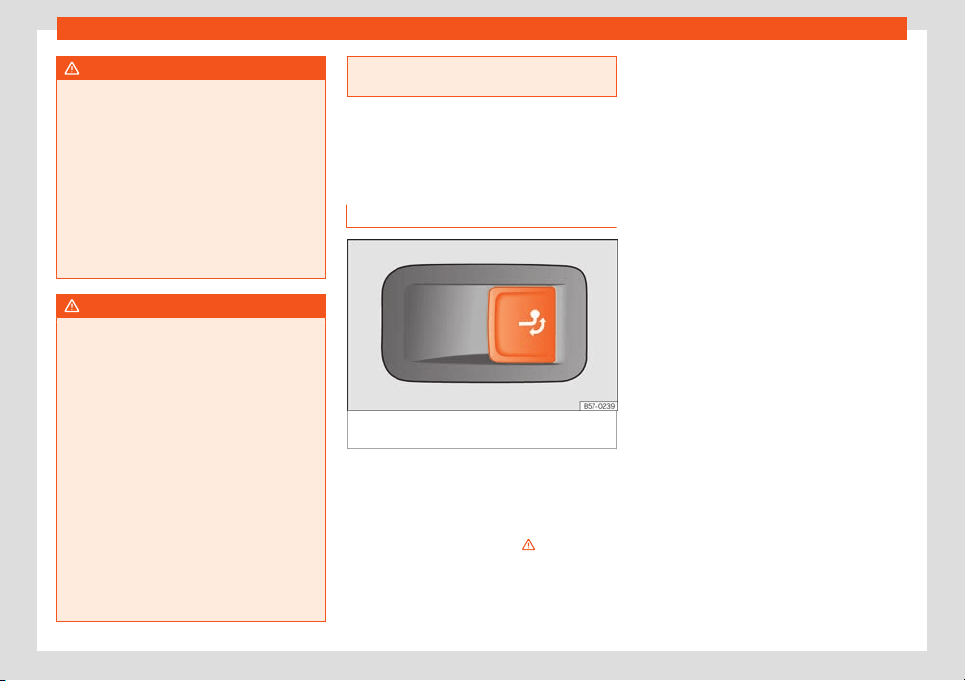
Towing bracket device
WARNING
The enhanced safety provided by the elec-
tric st
ability control of the vehicle and trail-
er should not lead you to take any risks that
could compromise your safety.
●
Adapt your speed and driving style at all
times to suit visibility, weather, road and
traffic conditions.
●
Accelerate with caution when the road is
slippery.
●
When adjusting any settings, stop accel-
erating.
WARNING
The electric stability control for the vehicle
and tr
ailer may not correctly detect all
driving conditions.
●
When the ESC is switched off, the stabili-
sation of the towing vehicle and trailer is al-
so switched off.
●
The stability system does not always de-
tect light trailers, so it may not stabilise
these correctly.
●
When driving on surfaces with poor grip,
the trailer can even interfere with the sta-
bility system.
●
Trailers with a high centre of gravity can
tip over without having previously weaved.
●
If a trailer is not attached, but a connec-
tor is plugged into the power socket (e.g.
installation of a bicycle rack with lights),
repeated automatic braking may occur in
e
xtreme driving conditions.
Electrically unlocking trailer
hook
Description
Fig. 221
On the right side of the luggage com-
partment: butt
on for unlocking the tow hook.
The towing bracket’s hook is located in the
bumper
. Tow hooks for electrical unlocking
cannot be removed.
There should be no person, animal or object
in the path of the tow hook
›››
.
Unl
ocking the tow hook and removing it
●
Stop the vehicle and connect the electronic
parking brake
›››
page 275.
●
Switch off the engine.
●
Open the rear lid.
●
Pull the
›››
Fig. 221 button briefly. The tow
hook unlocks electrically and automatically
turns outwards. The button's control lamp
flashes.
●
Finish remove the tow hook by hand until
you feel and hear that it has engaged and
the control lamp on the button stays on.
●
Close the rear lid.
●
Hitching and connecting a trailer
›››
page 309.
Retracting the tow hook
●
Stop the vehicle and apply the electronic
parking brake.
●
Switch off the engine.
●
Unhook the trailer and interrupt the electri-
cal connection between it and the vehicle. If
you are using an adapter, remove it from the
trailer's power socket.
●
Open the rear lid.
●
Pull the
›››
Fig. 221 button briefly. The tow
hook unlocks electrically.
●
Turn the tow hook under the bumper with
your hand until you feel and hear that it en-
gages and the control lamp on the button re-
mains on continuously.
●
Close the rear lid.
»
313
Driving
The control lamp
●
If the warning light on the button
›
››
Fig. 221
flashes, this means that the tow hook has
not been attached properly or is damaged
›››
.
●
If the warning lamp
›
››
Fig. 221 remains
on with the rear lid open, the tow hook is cor-
rectly in place both when extracted and
when covered.
The control light of the lamp switches off ap-
proximately 1 minute after closing the read lid.
WARNING
Undue use of the towing bracket may
cause injury and accidents.
●
Only use the tow hook if it is properly en-
gaged.
●
Always ensure that no person, animal or
ob
ject is to be found in the path of the tow
hook.
●
Never use a tool or instrument while the
tow hook is moving.
●
Never press the
›››
Fig. 221 button when
there is a trailer hooked to the vehicle or
when a carrier system or other accessories
are mounted on the tow hook.
●
If the tow hook is not attached properly,
do not use it. Instead, go to a specialised
workshop and have the towing bracket
checked.
●
If you det
ect any fault in the electrical
system or in the towing bracket, contact a
specialised workshop and ask them to
check it.
●
If the ball has a diameter of less than 49
mm at any one point, do not use the towing
bracket under any circumstances.
CAUTION
If you clean the vehicle with high-pressure
or st
eam devices, do not point the jet di-
rectly towards the retractable tow hook or
the trailer power socket, as this may dam-
age the joints or remove the grease neces-
sary for lubrication.
Note
At extremely low temperatures, the tow
hook may be impossibl
e to operate. In this
case, place the vehicle in a warmer loca-
tion (for example, a garage).
Fitting a bicycle carrier on the re-
tr
actable towbar
The maximum allowed weight of the carrier
syst
em, including the load, is 100 kg. The car-
rier system should not protrude more than
700 mm backwards from the spherical head.
Only carrier systems on which up to 3 bikes
can be mounted are allowed. Heavier bicy-
cles must be mounted as close to the vehicle
as possible (tow hook).
WARNING
The incorrect use of the tow hitch with a bi-
cycl
e rack mounted on the tow hook can
cause accidents and injury.
●
Never exceed the maximum weight or the
limits indicated above.
●
The bicycle rack may not be mounted to
the neck of the hook below the ball be-
cause, due to the shape of the neck and
depending on the rack model, the rack
could be incorrectly mounted on the vehi-
cle.
●
Always read and take the manufacturer
assembly instructions into account.
CAUTION
If the maximum weight and limits indicated
abo
ve are exceeded, the vehicle may suf-
fer considerable damage.
●
Never exceed the values indicated!
Note
SEAT recommends removing, as far as pos-
sibl
e, all removable parts of the bicycles
before setting off. These parts include, for
example, baskets and saddlebags, child
seats or batteries. This improves aerody-
namics and the centre of gravity of the rack
system.
314
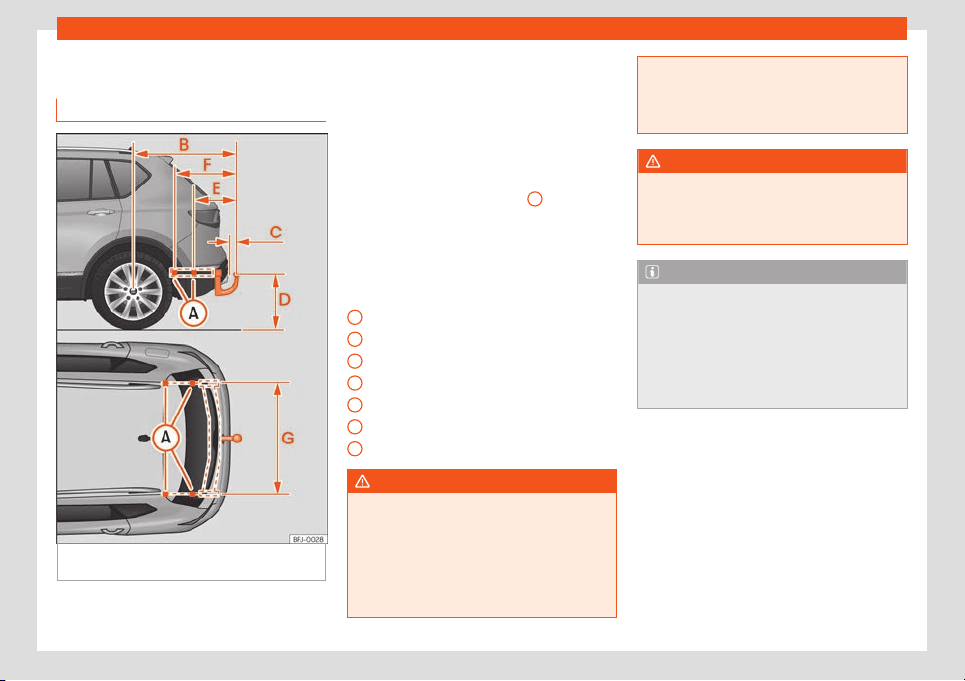
Towing bracket device
Retrofitting a towing bracket
Description
Fig. 222
Limits and attachment points for ret-
r
ofitting a towing bracket.
SEAT recommends that towing brackets be
r
etrofitted at a specialised workshop. For ex-
ample, it may very well be necessary to ad-
just the cooling system or mount thermal pro-
tection plates. SEAT recommends visiting a
SEAT dealership for this.
If a towing bracket is retrofitted, the distance
specifications should always be kept in mind.
The distance between the centre of the ball
head and the road
›››
Fig. 222
D
must never
be l
ess than indicated. This also applies when
the vehicle is fully loaded, including the tech-
nically permissible maximum vertical load on
the coupling device.
Distance specifications
›››
Fig. 222:
Mounting points on the vehicle
1,095 mm
75 mm (minimum)
365 mm
353 mm
600 mm
1,050 mm
WARNING
If the cables are improperly or incorrectly
connect
ed, this may lead to malfunctions
in the entire vehicle electronic system, as
well as to accidents and serious injuries.
●
Never connect the trailer's electric sys-
tem to the electrical connections of the tail
lights or any other unsuitable power sour-
A
B
C
D
E
F
G
ces. Only use suitable connectors to con-
nect the tr
ailer.
●
The towing bracket should be retrofitted
only at a specialised workshop.
WARNING
If the towing bracket is badly fitted or un-
suit
able, the trailer may separate from the
vehicle while driving. This could cause seri-
ous accidents and fatal injuries.
Note
●
Only use t
owing brackets that have been
approved by SEAT for the model in ques-
tion.
●
In some versions, the fitting of a conven-
tional towing hook solution is not recom-
mended. Please consult your Technical
Service.
315
Battery
Battery
High-v
oltage battery
Safety instructions
Introduction
3 V
alid for: hybrid vehicles
WARNING
The vehicle’s high-voltage network and the
high-v
oltage battery are hazardous and
can cause burns and other injuries, includ-
ing fatal electric shocks.
●
It should always be assumed that the
high-voltage battery is fully charged and
that all of its components are live. This may
also be the case when the ignition is
switched off.
●
Never touch the high-voltage cables, the
high-voltage battery or its poles, or allow
them to come into contact with jewellery or
other metal objects, especially if the high-
voltage cables, the high-voltage battery or
its poles are damaged.
●
Never take it upon yourself to perform
any type of work on the high-voltage net-
work, on the high-voltage cables or the
high-voltage battery.
●
Never open or perform maintenance or
repairs on components or parts of the high
voltage network, or disconnect them from
this netw
ork.
●
Never damage, modify or remove the or-
ange high voltage cables or disconnect
them from the high voltage network.
●
Never open, modify or remove the cover
from the high-voltage battery.
●
Work on the high-voltage system, as well
as on any systems that may be indirectly
influenced by it, should only be carried out
by specialized personnel with the corre-
sponding qualifications and training.
●
Work in the immediate vicinity of high-
voltage cables and high-voltage compo-
nents with tools that are sharp, give off
shavings or that have heat sources, such as
hot air, thermal bonding or welding work,
may only be performed after disconnecting
the voltage. The high voltage should only
be disconnected by specialized personnel
with the corresponding qualifications and
training.
●
All SEAT guidelines and standards must
be followed when performing any work on
the high-voltage system and the high-volt-
age battery.
●
The gases that are emitted or leaked
from the high-voltage battery may be toxic
or flammable.
●
Damage to the vehicle or high voltage
battery could cause an immediate or de-
layed leak of toxic gases. The emitted
gases could also cause a fire. Do not inhale
the gases.
●
Never touch the liquids that spill from the
high v
oltage battery and do not touch the
emitted gases, particularly if the battery is
damaged.
●
In the event of a fire, leave the danger
area and call the fire department. Inform
the fire fighters that the vehicle is fitted
with an electric drive system.
●
Always inform the fire fighters and the
emergency service that the vehicle is fitted
with a high-voltage battery.
WARNING
If works are performed on the high-voltage
syst
em and on the high-voltage compo-
nents in an inappropriate manner, this may
lead to faults in the operation, accidents
and injuries.
●
Work on the high-voltage system must
only be performed by authorized special-
ized services with the corresponding per-
mit.
CAUTION
●
If the v
ehicle suffers an accident or colli-
sion with an obstacle, the high-voltage bat-
tery must be checked by specialized per-
sonnel with the corresponding qualifica-
tions and training.
316
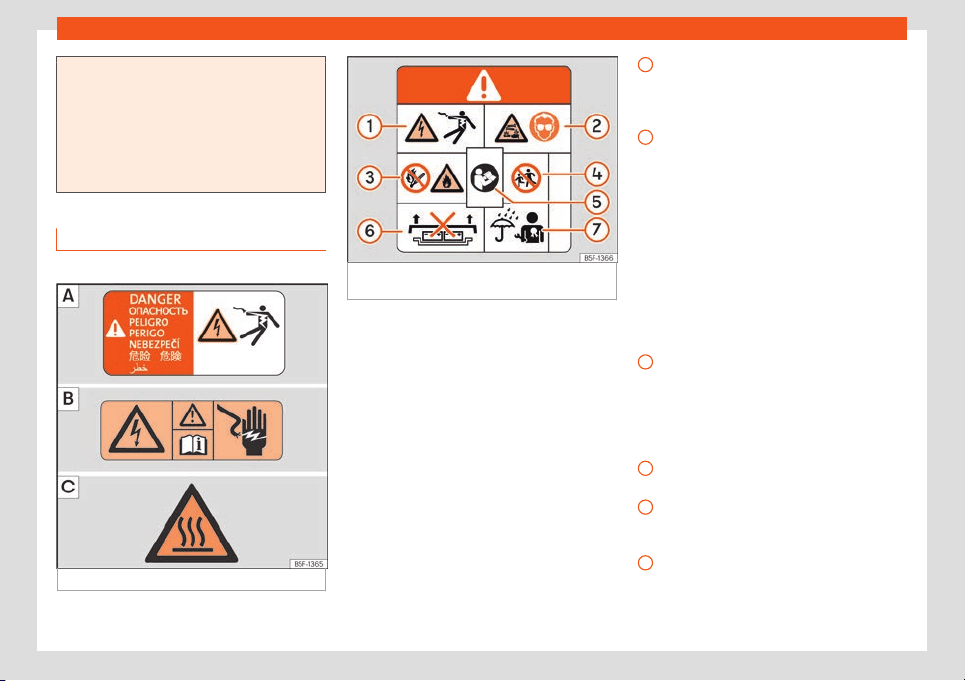
High-voltage battery
●
If the 12-v
olt vehicle battery has been
disconnected, discharged or replaced,
there is a chance that the combustion en-
gine may not initially turn off automatically
after moving off. If this situation lasts for
several days, contact a qualified special-
ized workshop. SEAT recommends visiting a
SEAT partner for this.
High voltage warning lettering
3 V
alid for: hybrid vehicles
Fig. 223
Warning lettering.
Fig. 224
High-voltage battery warning letter-
ing.
Warning lettering on the vehicle
The f
ollowing parts of the vehicle can be
identified with the depicted warning lettering
›››
Fig. 223,
›››
Fig. 224:
●
Covers and lids behind which live high-volt-
age components are located.
●
All the high-voltage components, including
the high-voltage battery.
●
Under the front bonnet.
The warning lettering
›››
Fig. 223
and
in-
dicate high electrical voltage.
The components of the high voltage system
can become very hot and should not be
touched
›››
Fig. 223
.
›››
Fig. 224
High voltage can cause serious injury or
even death. Never touch the battery
poles with bare fingers, tools, jewellery or
other metal objects.
The high-voltage battery contains haz-
ardous liquid and solid substances. Emit-
ted gases can cause severe burns and
blindness. Suitable eye protection and
protective clothing must always be worn
when working on the high voltage battery
to prevent battery fluid coming into con-
tact with the skin and eyes. If the battery
fluid comes into contact with the skin or
eyes, the affected areas should be rinsed
with clean running water for at least 15
minutes, and then a doctor should be
consulted immediately.
The high-voltage battery may burn. The
high-voltage battery should never be ex-
posed to fire, sparks or naked flame. The
high voltage battery must always be han-
dled with care to avoid damage and fluid
leakages.
The high-voltage battery should always
be kept out of the reach of children.
You will find further information and warn-
ings in the usage instructions and work-
shop documentation.
Incorrect handling of the high-voltage
battery can cause serious injuries or
death. Never disassemble the high volt-
age battery or remove its cover.
»
1
2
3
4
5
6
317
Battery
Incorrect handling of the high-voltage
batt
ery can cause serious injuries or
death. Maintenance work on the high-
voltage battery must only be performed
by specialized personnel with the corre-
sponding qualifications and training. Nev-
er modify the high-voltage battery. When
the high-voltage battery is open, ensure it
does not come into contact with water or
other liquids. Liquids may cause short cir-
cuits, electrical shocks and burns.
Conservation of the high-
voltage battery
Conservation instructions
3 V
alid for: hybrid vehicles
Reliability and capacity of the high-volt-
age battery
Lithium ion batteries are subject to ageing
and wear and tear throughout their useful life
due to their physical and chemical charac-
teristics. Correct handling of the high-voltage
battery makes an essential contribution to
keeping it in a reliable state in the long term
and to achieving high battery capacity and
range. Therefore, it is extremely important to
respect the following conservation instruc-
tions for the high voltage battery. These
7
maintenance instructions are essential for
maint
aining the vehicle's value over time.
Please also observe the applicable SEAT
warranty conditions for the high-voltage bat-
tery.
Conservation instructions
SEAT recommends the following conserva-
tion instructions:
●
Only charge the high-voltage battery when
a low charge level is displayed on the instru-
ment cluster, or when the electric range is low
›››
page 80.
●
Do not directly charge the high-voltage
battery after only a short drive in full electric
mode.
●
As much as possible avoid fully discharging
the high-voltage battery, such as by leaving
the vehicle parked for a prolonged time with
a low load level. The charge level must not
drop below 20% for long periods of time
›››
.
●
When the high-voltage battery has been
fully char
ged, start driving immediately if
possible.
Vehicle parking times
●
If there is a frost, do not park the vehicle for
several hours with a charge level of lower
than 40%
›››
.
●
If you plan to leave your vehicle stationary
f
or prolonged periods of time, park with a
charge level of at least 30%. This situation
occurs, for example, when you leave your ve-
hicle at the airport before a trip.
●
Do not expose the vehicle to outside tem-
peratures below -30°C or above 60°C for
over 24 hours.
CAUTION
The high-voltage battery must not be used
as a st
ationary power supply. This can
cause irreversible damage to the high-volt-
age battery.
CAUTION
If the vehicle is parked for a long time with
the high-v
oltage battery discharged, it
may no longer be possible to charge the
battery or start the vehicle. Irreversible
damage could be caused to the high volt-
age battery in the long term.
●
Charge the high-voltage battery at regu-
lar intervals.
318

High-voltage battery
Charging settings in the info-
t
ainment system
Battery Manager Menu
3 V
alid for: hybrid vehicles
The Battery Manager allows you to set or
select departure times for the programmed
charging of the high-voltage battery and for
the vehicle’s electric heating and air condi-
tioning.
Open the Battery Manager menu
●
Switch the ignition on.
●
Switch on the infotainment system.
●
Select Batt
ery Manager from the main
menu.
It is possible to change the settings for imme-
diate charging (the next charging process).
●
Reduce the charging current, e.g. when
other major consumers are operating on a
single line of the electrical installation at the
same time. Charging power is reduced and
charging time is extended.
●
Set the desired temperature for the station-
ary air conditioning .
Departure time settings menu
Programmed charging (departure times) can
be set
›››
page 319.
●
Specify the amount of time for which you
want the high-voltage battery to charge and
the air conditioning to be switched on inside
the vehicle.
Extended Stationary Air Conditioning
Menu
●
Set the desired temperature for the station-
ary air conditioning .
The air conditioning works both when the ve-
hicle is connected to the grid and disconnec-
ted. If you want to use the high-voltage bat-
tery as the power supply, change the setting
in the Settings menu.
Charging settings menu
It is possible to configure the general settings
for the charging process.
●
Lower battery charge limit (minimum de-
sired charge level of the high voltage bat-
tery): a minimum range can be ensured with
this function. The vehicle charges directly
once it has been connected to a charging
station or electrical socket. The function is
available if a departure time has been activa-
ted
›››
page 319.
●
Air conditioning using the high-voltage bat-
tery: if the vehicle is not plugged in to an ex-
ternal network and this option is enabled, the
electric range of the vehicle can be signifi-
cantly reduced!
Departure time settings
3 V
alid for: hybrid vehicles
Fig. 225
Behind the cover of the battery
char
ging socket: charging buttons.
With programmed charging, the battery
char
ge can be programmed and delayed so
that the desired battery level is reached at a
certain time when the vehicle is connected to
the charging socket.
Viewing the departure times
●
Select Battery Manager from the Infotain-
ment main menu.
●
Select to open the overview of departure
times.
Departure time settings
To set the desired departure time, touch the
corresponding function button or check the
box .
»
319
Battery
●
Depar
ture times: Time, day of the week or
set a single or weekly departure time.
●
Air conditioning: the vehicle interior is
heated or cooled by the departure time.
●
Trough or night-time tariff: a preferred pe-
riod of time for charging can be set.
Activating the departure time
Activate the departure time by checking the
box in the departure times overview.
Displays
Charging activated at a departure time.
Air conditioning switched on at a depar-
ture time.
The departure time is used regularly.
Immediate charge buttons and scheduled
charge button
›››
Fig. 225
Immediate charge button
Scheduled charge button
When the high-voltage battery is charged im-
mediately, the immediate charge button
lights up on the charging socket
1
. Press
the immediat
e charge button
1
to inter-
rupt the char
ging process.
If a departure time has been programmed
and the charging cable is connected, the
programmed charging button lights up
2
.
1
2
Charging the high-voltage
batt
ery
Introduction
3 V
alid for: hybrid vehicles
Check that the driving mode is deactivated
and that the charging cable and infrastruc-
ture are in perfect condition.
Charging modes
Your vehicle has the following possible charg-
ing modes:
●
Fixed AC (alternating current) charging sta-
tion or W
allbox, also known as Mode 3 charg-
ing
›››
page 322: The vehicle can be charg-
ed at maximum power at these stations, e.g.
at a public charging station or home Wallbox.
●
Portable charging station or ICCB (In-Ca-
ble Control Box) cable, also known as Mode 2
charging or cable
›››
page 322: The Mode 2
cable is included as standard and is connec-
ted to a conventional household electrical
socket, meaning that the maximum power will
be limited
›››
. You must plan for a longer
char
ging time, e.g. overnight.
The home's electrical installation must be
verified and in perfect condition.
Direct current (DC) or Mode 4 charging is not
compatible with this vehicle.
Differential protection
The vehicle is fitted with a direct current leak-
age (DC leakage) protection device. This
prevents any DC leaks that may occur during
charging from flowing into the home’s electri-
cal installation through the charging cable.
WARNING
Charging the battery improperly, failing to
observ
e generally applicable safety meas-
ures, using unsuitable or damaged elec-
tricity sockets and charging cables, charg-
ing from an unsuitable electrical installa-
tion or incorrectly handling the high-volt-
age battery can cause short circuits, elec-
trical discharges, explosions, fires, burns,
serious injury and even death.
●
Always follow the steps in the order in
which they are shown to avoid the risk of an
electrical discharge and serious injury
caused by the residual energy present in
the charging accumulator. Never pull on
the mains connector during charging.
●
Only charge the vehicle from correctly
installed power sockets that have been
tested and are undamaged, and from elec-
trical installations in a perfect state of re-
pair. Get specialized personnel to periodi-
cally inspect the power sockets and the
electrical installation.
●
Only plug in the charging cable to an
electrical socket that is protected from wa-
ter, humidity and other liquids.
320
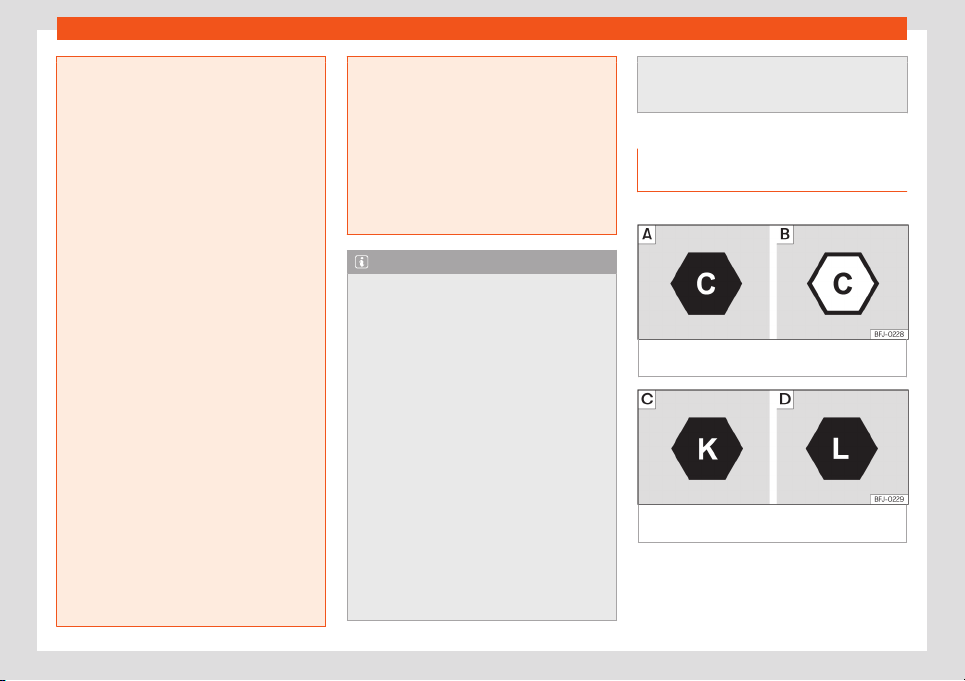
High-voltage battery
●
Ne
ver charge the vehicle in potentially
explosive atmospheres. The components of
the charging cable can cause sparks and,
therefore, may ignite flammable or explo-
sive vapours.
●
Never use damaged charging connectors
or cables. Before each use, check that the
connector and charging cable are not
damaged.
●
Never use the charging cable with an ex-
tension lead, rolled cable, power strip or
adapter, e.g. adapter for other countries or
timer.
●
Always protect the connectors to prevent
water, moisture and other liquids from di-
rectly getting inside.
●
For safety reasons, no other work should
be performed on the vehicle while it is
charging.
●
Always end the charging process before
unplugging the mains connector. Other-
wise the charging cable and the electrical
installation may also be damaged.
●
Never charge several vehicles simultane-
ously from electrical sockets of the same
safety circuit. Use a different safety circuit
to charge additional vehicles. Always
check the maximum current or power of the
safety circuit that is used. If necessary,
seek advice from qualified electrical instal-
lation professionals.
●
Only use the charging cables supplied
with the vehicle or the charging station ca-
ble. If the cable needs to be replaced, it is
r
ecommended to exclusively use SEAT
charging cables.
●
Never make changes or repairs to electri-
cal components, particularly the high volt-
age system.
●
Always unplug the charging cable before
starting the vehicle. Place the protective
caps and close the cover of the battery
charging socket.
Note
●
The high-v
oltage battery can only be
charged at charging stations that meet the
following requirements and regulations:
–
IEC 61851 and IEC 62196 (type 2 con-
nector).
●
Very low or very high temperatures can
noticeably reduce the high voltage bat-
tery’s charging power.
●
To avoid possible compatibility problems
with charging infrastructures, SEAT recom-
mends the use of cables and home charg-
ing stations recommended by the Volkswa-
gen Group.
●
For charging with alternating current,
SEAT recommends charging the high-volt-
age battery at maximum charging power
from a fixed charging station or Wallbox.
This achieves greater efficiency when
compared to charging from an electrical
socket.
●
Check the t
echnical information about
your vehicle’s charging capacity. You can
get more information from any SEAT dealer.
Identification of compatible charg-
ing infr
astructure
3 V
alid for: hybrid vehicles
Fig. 226 Identification of alternating current
(AC) and t
ype 2 connector.
Fig. 227
Identification of direct current (DC)
and the v
ehicle's CCS connector
Compatibility between vehicles and
char
ging infrastructure
The following indicators according to DIN EN
17186 report whether the infrastructure's
»
321
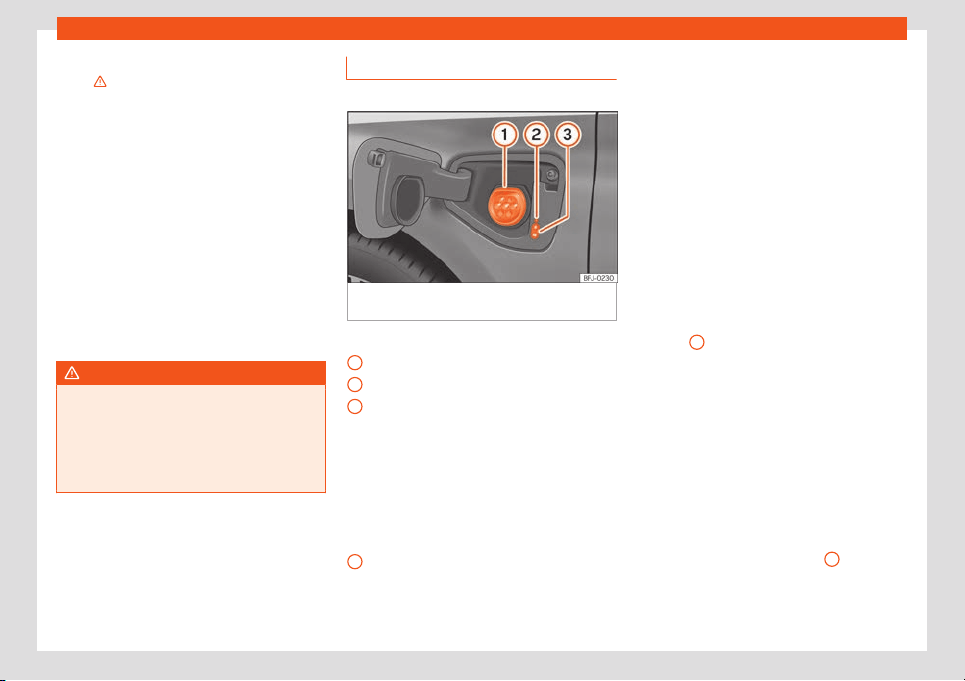
Battery
charging connectors are suitable for the vehi-
cl
e
›››
.
Indicat
ors
›››
Fig. 226
In the vehicle
At the charging station
Indicators
›››
Fig. 227
Voltage up to 500 volts
Voltage of up to 1000 volts.
The indicators are located on the vehicle's
charging socket, on components of the local
charging infrastructure (charging station,
socket) and on the charging cable. The indi-
cators refer to standardized charging sys-
tems as per the DIN EN 62196 standard.
WARNING
Charging the vehicle at unverified electri-
cal inst
allations can cause serious injury
and damage.
●
If there is no indicator or if the charging
infrastructure is unknown, an electrical in-
stallation expert should be consulted first.
AC charging
3 V
alid for: hybrid vehicles
Fig. 228
Behind the battery charging cover on
the fr
ont left-hand side: Charging socket
›››
Fig. 228
char
ging socket
Charging process display
Charging buttons
The battery charger installed in the vehicle
converts alternating current from the public
supply into direct current.
AC Charging Station, Wallbox or mode 2 ca-
ble: The vehicle’s high-voltage battery can be
charged using alternating current (AC)
through the corresponding charging socket
1
.
1
2
3
Connecting the charging cable
●
Firstly, connect the charging cable to the
el
ectrical socket, charging station or Wallbox.
Next, fully unwind it.
●
Charging cable for power sockets: The pro-
tection device performs a self-test
›››
page 327.
●
With the vehicle unlocked, the battery
charging cover opens when it is pressed
›››
Fig. 228.
●
Plug the charging connector into the
charging socket. Check that the charging
connector is fully plugged in.
The connector locks automatically.
The LED
2
(charging process indicator) of
the char
ging connector lights up. The indica-
tor lamp lights up on the instrument cluster
display.
Automatic start of the charging process
If programmed charging is not activated, the
charging process starts immediately
›››
page 319. The external charging infra-
structure must be active.
During the charging
The charging process indicator
2
on the
char
ging socket flashes green. The indicator
lamp flashes green on the instrument clus-
ter.
322
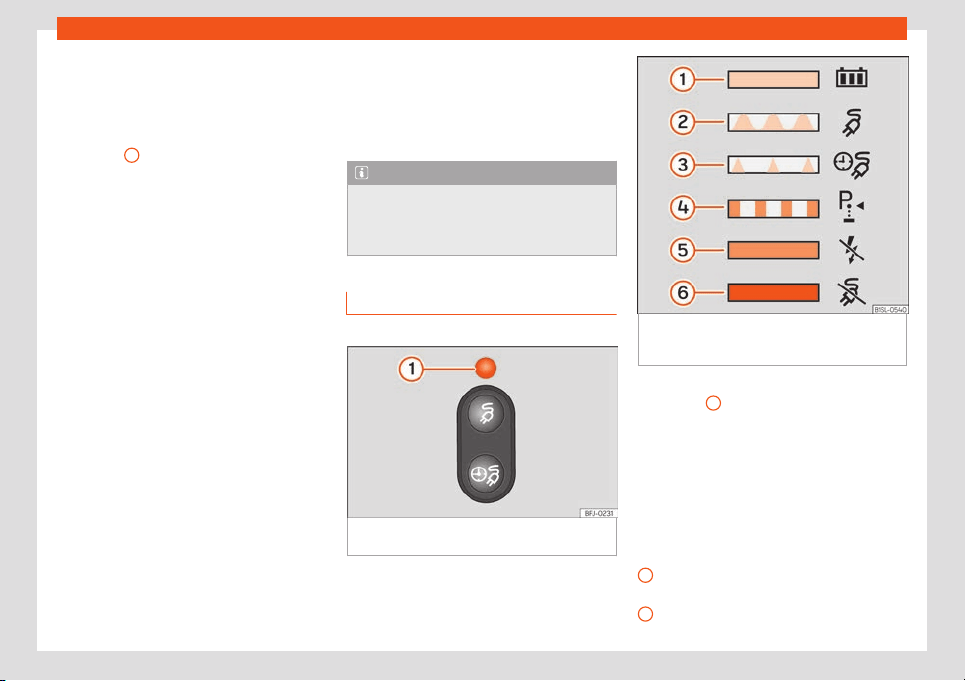
High-voltage battery
Interrupt the charging process
The char
ging process can be interrupted:
●
Unlock the vehicle.
●
Press the immediate charge button
›››
Fig. 225
1
. The charging connector re-
mains l
ocked.
●
Unlock the vehicle to unlock the charging
connector.
The charging process can continue by press-
ing the immediate charge button again .
After charging
When the high-voltage battery is fully charg-
ed, the charging process display on the
charging socket lights up green.
●
Unlock the vehicle.
●
Unplug the charging connector from the
charging socket within 30 seconds.
●
Disconnect the charging cable from the
power supply and replace the protective cap.
●
Close the charging cover and make sure
you hear it click into place.
First charge and charging after a long time
If the high-voltage battery is new or has not
been charged for a long time, the maximum
charge level of the battery can only be
reached after several charging processes.
This is for technical reasons and is not a vehi-
cle malfunction.
If the vehicle is not used for a long period of
time, the high-voltage battery must be charg-
ed at least once every four months.
Note
If you leave the charging cable connected
aft
er charging, the vehicle's electrical con-
sumers will not drain the high-voltage bat-
tery.
Charging process display
3 V
alid for: hybrid vehicles
Fig. 229 Behind the cover of the battery
char
ging socket: charging process display
Fig. 230 On the inside of the cover of the bat-
t
ery charging socket: sticker with information
on the charging process display.
The charging process indicator is an LED
›
››
Fig. 229
1
located on the charging sock-
et that sho
ws the status of the charging proc-
ess.
A sticker on the battery charging cover pro-
vides information on the meaning of the LEDs
›››
Fig. 230.
charging process displays:
Green LED
›››
Fig. 230:
Always on: Charge completed success-
fully.
Turn signals: The high-voltage battery is
charging.
»
1
2
323
Battery
Short flashes: Programmed charging is
activ
e. The charging process has not yet
started.
Yellow LED
›››
Fig. 230:
Turn signals: The parking lock P has not
been enabled.
Briefly lights up: The charging connector
has been plugged into the charging sock-
et and the vehicle has detected it.
Always on: No electrical network has
been detected. Arrange an inspection of
the power supply and network. Seek pro-
fessional assistance.
Red LED
›››
Fig. 230:
Turn signals: Error in the charging system.
The charging process cannot start or has
paused.
Always on: The charging connector has
not been locked. Unplug the charging
connector and plug it back in to the
charging socket, making sure it is proper-
ly inserted. If the problem persists, check
the compatibility of the cable or ask a
professional for help.
Note
If the charging process display permanent-
ly indicat
es an error in the power supply or
vehicle’s charging system, you should seek
professional assistance.
3
4
5
6
Troubleshooting
3 V
alid for: hybrid vehicles
Error in the electric drive system
The warning lamp lights up red. You must
park the vehicle in a safe place.
The corresponding error message is dis-
played on the instrument cluster display.
Fault in the electric drive system. The high
voltage components may be damaged
›››
.
●
Park the vehicle outdoors as soon as it is
possibl
e and safe to do so.
●
Switch off the drive system.
●
Seek professional assistance.
The charging process is not possible or
has been paused
An error may be displayed on the instrument
cluster display or on the charging socket’s
charging process display.
You can try the following to solve the problem
before seeking professional assistance:
●
Unlocking the charging connector and plug
the charging cable in again.
●
OR: Make sure that the charging settings
are as desired: “immediate” or “program-
med”.
●
OR: Check if the charging connector is
properly plugged in.
●
OR: Check if a fault is displayed on the
charging station or, depending on the fea-
tures, on the displays of the mode 2 charging
cable.
If the fault cannot be rectified, seek professio-
nal assistance directly.
WARNING
High-voltage components, including the
batt
ery and high-voltage cables, may be
live and damaged. The high voltage system
voltage is dangerous and can cause burns,
other injuries and fatal electric shocks.
●
Do not touch the high voltage compo-
nents!
324
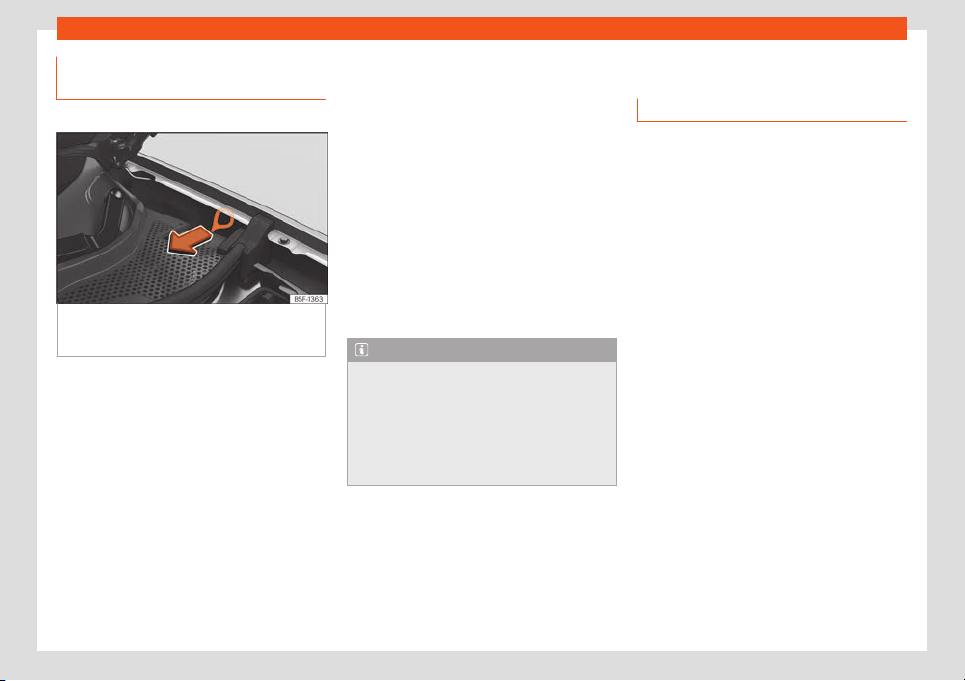
High-voltage battery
Emergency release of the charging
connect
or
3 V
alid for: hybrid vehicles
Fig. 231
Between the left wing panel and the
engine bonnet hinge: Char
ging connector
manual release mechanism puller.
Unlocking the charging connector
Pr
erequisites:
●
The charging connector is plugged in cor-
rectly
›››
page 322.
●
The vehicle is unlocked.
●
The charging process has ended or has
paused
›››
page 320.
The manual release mechanism must be
used if these prerequisites are met and it is
still impossible to unplug the charging con-
nector.
Manual release of the charging connector
The puller for the manual release is located
on the left hand side of the engine compart-
ment (between the left wing panel and the
engine bonnet hinge), above the charging
socket
›››
Fig. 231.
●
Disconnect the power supply at the charg-
ing station or electrical socket.
●
Open the bonnet and make sure it is held in
place with the prop.
●
Use the wire hook in the vehicle’s toolkit
›››
Fig. 31 to hook the puller and pull on it.
●
Immediately unplug the charging connec-
tor.
Note
●
The manual r
elease mechanism of the
charging connector should only be used in
the event of a failure.
●
After using the charging connector’s
manual release mechanism, the charging
socket must be inspected immediately by a
professional.
Charging cable
Intr
oduction
3 V
alid for: hybrid vehicles
The type of charging cable supplied with the
vehicle depends on the delivery volume and
the specific technical specifications of each
country, e.g. charging connector connections
for power sockets.
SEAT recommends exclusively using the
supplied charging cable.
Notes on the charging cable
●
Handle with care.
●
Unroll and roll fully.
●
Do not twist or bend it over sharp edges.
●
Do not crush it or drive the vehicle over it.
●
Always unplug it by pulling on the connec-
t
or.
●
Children should not use the charging cable.
●
Keep animals away from the charging ca-
ble.
●
After use, store it safely and without twisting
it.
Notes on charging connectors and the
charging cable protection device
●
Do not touch the charging connector’s
contacts.
»
325
Battery
●
Pr
otect from strong sunlight (outside tem-
peratures no higher than 50°C or 122°F).
●
Do not drop them.
●
Protect from immersion in fluids such as rain
water.
●
Fit the protective caps after each use.
Cleaning the charging cable
●
Clean the surface of the charging cable
with a dry or slightly damp cloth
›››
,
›
››
.
WARNING
Items that are not secured, or incorrectly
secur
ed can cause serious injury during
sudden manoeuvres or braking, or in the
event of an accident.
●
Store the charging cable securely in the
luggage compartment.
●
Use the organizer/protective cover provi-
ded with the cable for this purpose.
WARNING
Using a charging cable that has been dam-
aged or t
ampered with can cause serious
injury and fatal electric shocks.
●
Before each use check that the connec-
tors and the charging cable are undam-
aged, e.g. check for cracks.
●
Never use a charging cable that is dam-
aged or has been tampered with.
●
If the char
ging cable does not work prop-
erly, get a SEAT dealer to check it.
WARNING
The charging cable for electrical sockets
must al
ways be connected directly to an
electrical socket. Failure to do so could re-
sult in fire damage and damage to the
charging cable or home electrical installa-
tion.
●
Never connect the charging cable to an
extension lead, cable reel, power strip or
adapter or timer.
WARNING
The high voltage system voltage is danger-
ous and can cause burns, other injuries and
f
atal electric shocks.
●
Only clean the charging cable when it is
unplugged.
CAUTION
The charging cable, as portable electrical
equipment, may hav
e to be checked peri-
odically. This requires a test adapter.
CAUTION
The charging cable can be damaged if not
cl
eaned properly.
●
Only w
ater should be used for this pur-
pose, and never additional cleaning prod-
ucts.
●
Water should be prevented from getting
into the contacts.
For the sake of the environment
Charging cables must be disposed of in an
envir
onmentally friendly way and should
not be thrown in the household waste.
Note
The maximum charging capacity of the
saf
ety circuit that is used must be ob-
served. If the charging cable is planned in-
to an electrical socket on the same circuit
as other consumers, the circuit's fuses may
trip.
326
High-voltage battery
Charging cable for alternating cur-
r
ent (AC) charging stations
3 V
alid for: hybrid vehicles
Fig. 232
Charging cable for alternating cur-
r
ent (AC) charging stations.
The maximum charging current is 16 or 32
amps, depending on the v
ehicle’s features
and the charging cable that is supplied
›››
.
WARNING
Charging the high-voltage battery with an
inappr
opriate charging cable could cause
short circuits, serious injuries and fatal
electrical shocks.
WARNING
The charging cable should not be used as
an e
xtension lead. The charging process
could be affected.
CAUTION
Follow the manufacturer’s instructions and
indications when using the char
ging sta-
tion.
Note
Charging with a 16 A charging cable is not
possibl
e in some charging stations that
support 32 A. This depends on the features
of the charging station.
●
Before charging the vehicle, find out
about the available charging technology.
Charging cable for power sockets
3 V
alid for: hybrid vehicles
Fig. 233 Charging cable for electrical sockets
Fig. 234 On the charging cable for power
sock
ets: Indicator lamps on the protection de-
vice.
›››
Fig. 234:
Indicat
or lamp of the connector and the
power supply.
Control lamp of the protection device
Control lamp of the vehicle
Failure warning lamp
Charging cable information
Before using the charging cable, also follow
the instructions displayed on it and on the
rear of the protective device.
Protection device
The electronic protection device
›››
Fig. 234
ensures that the charging connector does
not receive current until it is plugged in to the
vehicle's charging connector.
»
1
2
3
4
327
Battery
Self-check
When the char
ging cable is plugged into the
electrical socket, the protective device auto-
matically performs a self-test. During this
check, all warning and indicator lamps turn
on briefly and go out one after the other.
Upon completion, the operational status at
that time is displayed.
Operating displays
One or more indicator lamps
›››
Fig. 234
1
,
2
or
3
light up green.
Display
›
››
Fig. 234
Meaning
1
on
The charging cable is plug-
ged int
o the mains but has
not been connected to the
vehicle.
1
,
2
on,
3
flashes
slowly
a)
The high-voltage battery is
charging.
1
,
2
and
3
on
The charging process is
compl
ete. The high-voltage
battery has charged.
a)
The available supply voltage depends on each
country.
Set the char
ging current
The charging cable limits the charging cur-
rent according to the available power supply.
If the local mains supply does not allow
charging at the maximum charging current,
the charging current can be reduced, de-
pending on the charging setting features in
the infotainment system
›››
page 319.
Temperature control
The charging cable temperature control
switches on when the charging cable over-
heats, such as when it has been stored in a
luggage compartment exposed to high tem-
peratures or strong sunlight.
When the charging process is interrupted,
the status indicator that is lit up at the time
switches off and one of the indicator lamps
starts slowly flashing green. Warning lamp
4
starts slowly flashing red.
●
Unplug the charging cable and let it cool
do
wn.
●
If the error occurs again, seek professional
assistance.
If charging continues with a lower charging
current, warning lamp
4
lights up in red in
addition t
o the status indicator. The charging
cable must be allowed to cool down for a
while. The charging current automatically in-
creases again.
Fault display
If the red warning light
4
flashes or turns on
without one of the indicat
or lamps
›››
Fig. 234
1
,
2
or
3
also turning on continuously on
the st
atus indicator, there is a fault.
Display
›
››
Fig. 234
Meaning
1
flashes,
4
on or
fl
ashing
Failure in the power supply.
2
flashes,
4
on or
flashing
Failure in the protection de-
vice.
3
flashes,
4
on or
fl
ashing
Failure in the vehicle.
The charging process pauses or is cancelled.
●
Check the instructions located on the back
of the pr
otective devices.
●
Seek professional assistance if the fault
persists.
Note
If there is any other mains connection dur-
ing the char
ging process, or if the vehicle is
right next to the high voltage cables,
charging from an electrical socket is not
possible in some cases. Additional mains
connections:
●
Connecting a 12 volt battery charger.
●
Contact with a work tool connect to the
mains, such as a vehicle lift.
328
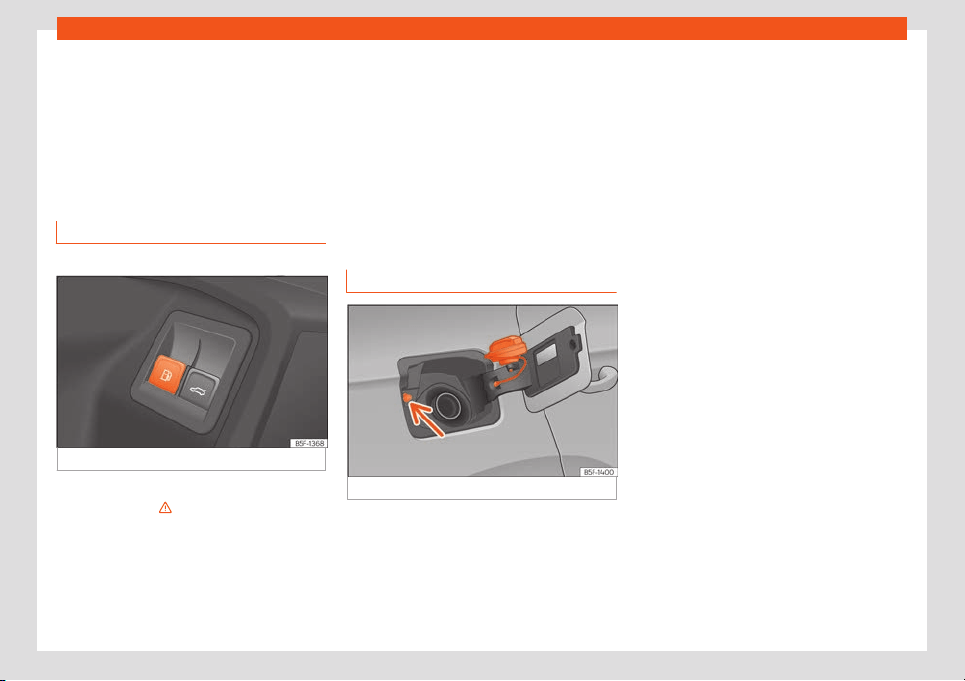
Checking and refilling levels
Practical tips
Checking and r
efilling lev-
els
Refuelling
Purging the fuel tank
3 V
alid for: hybrid vehicles.
Fig. 235 Driver's door: tank flap release.
Before refuelling the fuel system must be
depr
essurised
›››
in Refuelling on
page 330. T
o do this, press the button on
the driver’s door.
An audible sound will be played and a warn-
ing will be displayed on the instrument cluster
display.
After a few seconds the fuel tank flap will un-
lock and remain unlocked for a few minutes. If
you have not refuelled after this time, you
must press the button again before refuel-
ling.
Avoid touching the fuel tank flap lock button
›››
Fig. 236 (arrow). The system will interpret
that you have finished and cannot continue
refuelling. Press the button on the driver’s
door again to continue.
Refuelling
Fig. 236 Fuel tank flap with tank cap attached.
The fuel tank flap is on the rear right of the
v
ehicle.
The flap that covers the tank cap is unlocked
and locked automatically using the central
locking.
●
Hybrid vehicles: Use the button on the
driver’s door to release the tank flap.
●
Open the fuel tank flap by pressing on the
retainer zone.
●
Unscrew the cap by turning it to the left.
●
Place it in the space on the hinge of the
open flap
›››
Fig. 236.
●
Start refuelling. The tank is full as soon as
the pump’s automatic nozzle cuts off the fuel
supply. Do not try to put in more fuel after the
nozzle cuts out, as this will fill the expansion
chamber in the fuel tank.
●
Unscrew the cap by turning it to the right as
far as it will go.
●
Close the lid.
The correct fuel grade for your vehicle is giv-
en on a sticker on the inside of the fuel tank
flap. Further notes on fuel can be found at
›››
page 331.
The capacity of your vehicle's fuel tank is giv-
en in
›››
page 381.
Vehicles with natural gas engines and hy-
brids
Every 6 months it is necessary to run on pet-
rol until the control lamp switches off, and
then the tank must be refilled. This is neces-
sary to ensure that the system works proper-
ly, as well as the fuel quality required for driv-
ing with petrol.
»
329
Practical tips
WARNING
Fuel is highly flammable and can cause se-
rious burns and other injuries.
●
When refuelling, turn off the engine, the
auxiliary heat
er
›››
page 167 and turn off
the ignition for safety reasons.
●
The fuel system of PHEV models is pres-
surized to prevent petrol vapours from es-
caping into the atmosphere.
●
Do not smoke when filling the fuel tank or
a canister. Naked flames are forbidden in
the vicinity due to the risk of explosion.
●
Observe legislation governing the use,
storage and carrying of a spare fuel canis-
ter in the vehicle.
●
For safety reasons we do not recommend
carrying a spare fuel canister in the vehi-
cle. In an accident the canister could be
damaged and could leak.
●
If, in exceptional circumstances, you
have to carry a spare fuel canister, please
observe the following points:
–
Never fill fuel into the spare fuel canis-
ter if it is inside or on top of the vehicle.
This could cause an explosion. Always
place the canister on the ground to fill
it.
–
Insert the filling nozzle as far as possi-
ble into the spare fuel canister.
–
If the spar
e fuel canister is made of
metal, the filling nozzle must be in con-
tact with the canister during filling. This
helps prevent an electrostatic charge
building up.
–
Never spill fuel in the vehicle or in the
luggage compartment. Fuel vapour is
explosive. Risk of fatal accident!
CAUTION
●
If any fuel is spilt ont
o the vehicle, it
should be removed immediately. It could
otherwise damage the paintwork.
●
Never run the tank completely dry. The
catalytic converter can be damaged.
●
When filling the fuel tank after having run
it completely dry on a vehicle with a diesel
engine, the ignition must be switched on for
at least 30 seconds before starting the en-
gine. When you then start the engine it may
take longer than normal (up to one minute)
to start firing.
For the sake of the environment
Do not overfill the fuel tank, it may cause
the fuel t
o overflow if it becomes warm.
Note
There is no emergency mechanism for the
manual r
elease of the fuel tank flap. If nec-
essary, request assistance from special-
ised personnel.
Note
Diesel vehicles are fitted with a protective
de
vice that prevents the insertion of the
wrong fuel hose
1)
. It is only possible to re-
fuel with Diesel nozzles.
●
If the pump nozzle is worn, damaged, or if
it is very small, it is possible that it will not
be able to open the protective device. Be-
fore trying to insert the pump nozzle by
turning it, try a different pump or request
specialist help.
●
If you fill the tank from a reserve fuel can-
ister, the protective device will not open.
One way to resolve this is to pour the fuel in
very slowly.
1)
Depending on country
330
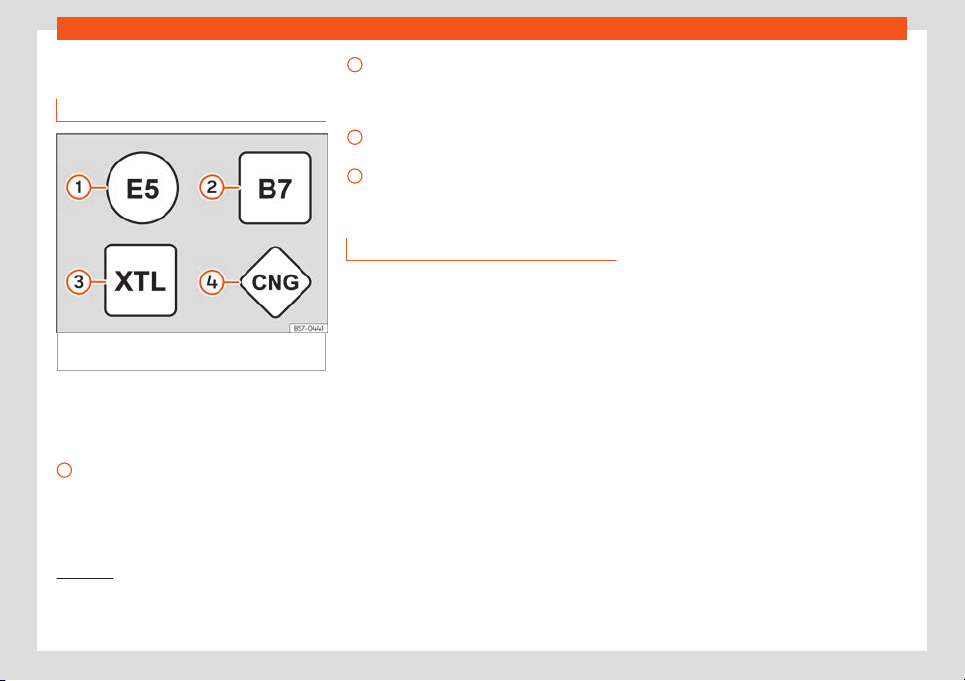
Checking and refilling levels
Fuel types
Identification of fuel
s
1)
Fig. 237
Identification of fuels according to
Eur
opean Union (EU) Directive 2014/94/
Fuels are identified by different symbols on
the pump and on your v
ehicle's tank flap. The
identification serves to prevent confusion
when choosing the fuel.
Petrol with ethanol (“E” stands for Etha-
nol). The number indicates the percent-
age of ethanol in the petrol. “E5” means,
for example, an ethanol ratio of 5% max.
1
Diesel accor
ding to EN590 standard. The
number indicates the maximum percent-
age of Biodiesel in the fuel. “B7” means a
maximum of 7% Biodiesel.
Synthetic diesel according to EN15940
standard.
Natural gas: “CNG” means Compressed
Natural Gas.
Type of petrol
3 V
alid for: vehicles with petrol engines
The correct grade of petrol is listed inside the
fuel tank flap.
The vehicle is equipped with a catalytic con-
verter and must only be run on unleaded
petrol. The petrol must comply with the
standard EN 228 and be sulphur-free. Fuels
with a 10% ethanol ratio can be refuelled
(E10)
2)
. The types of petrol are differentiated
by using the octane numbers (RON) or via
the anti-knock index (AKI).
2
3
4
Super unleaded petrol 95 octane petrol or
normal 91 oct
ane petrol at least
We recommend refuelling with super 95 oc-
tane petrol (91 AKI). If not available, normal 91
octane petrol (87 AKI) (with a slight power
loss) may be used.
Super unleaded petrol, 95 octanes at
least
You should use super 95 octane petrol (91
AKI) at least.
If super is not available, if necessary, use nor-
mal 91 octane petrol (87 AKI). In this case only
use moderate engine speeds and a light
throttle. Refuel with super as soon as possi-
ble.
Unleaded super plus 98 octane petrol or
super 95 octane petrol at least
We recommend refuelling with super plus 98
octane petrol (93 AKI). If not available: super
95 octane petrol (91 AKI) (with a slight power
loss).
If super is not available, if necessary, use nor-
mal 91 octane petrol (87 AKI). In this case only
use moderate engine speeds and a light
»
1)
Depending on country
2)
Follow the regulations of the country you are
driving in.
331
Practical tips
throttle. Refuel with super as soon as possi-
bl
e.
CAUTION
●
Fuel
s high percentage of ethanol, e.g.
E30 - E100 button must not be used. The
fuel system would be damaged. Exception:
vehicles with Totalflex engine
›››
page 332,
Ethanol fuel.
●
A single refuelling with leaded fuel or
other metal additives entails a permanent
deterioration of the effectiveness of the
catalytic converter.
●
Only use fuel additives that have been
approved by SEAT. The products that con-
tain substances to increase the octane rat-
ing or decrease knocking may contain met-
al additives that damage the engine and
catalytic converter. This type of products
must not be used.
●
Do not use fuels shown in the pump as
containing metals. LRP (lead replacement
petrol) fuels contain high concentrations of
metal additives. Risk of engine damage!
●
High engine speed and full throttle can
damage the engine when using petrol with
an octane rating lower than the correct
grade for the engine.
Note
●
Fuel with an oct
ane rating higher than the
one required by the engine can be used.
●
In countries in which there is no sulphur-
free fuel, it is also allowed to use low sul-
phur content fuel.
Ethanol fuel
3 V
alid for: vehicles with Totalflex engines
You can recognise vehicles with Totalflex en-
gines
1)
by label on the fuel tank lid with the
marking “Petrol/ethanol”.
Vehicles with Totalflex engine can run with
unleaded petrol (95 octane / 91 AKI) accord-
ing to ANP No. 57 and with fuels with any high
percentage of ethanol. The vehicle is refuel-
led in the same way as petrol refuelling.
Also consider that
›››
page 331, Type of pet-
rol
Note
SEAT recommends filling the tank exclu-
siv
ely with petrol every 10,000 km to de-
crease impurities that using E100 ethanol
fuel might have left in the engine.
Diesel
3 V
alid for: vehicles with diesel engines
Please note the information on the inside of
the fuel tank flap.
The diesel can thicken at very low tempera-
tures, thus affecting the start or operation of
the engine. Ask your service station attendant
if their diesel is suitable for winter use.
Water in the fuel filter
2)
If your vehicle has a diesel engine and is
equipped with a fuel filter with a water sep-
arator, the instrument panel may display the
following warning:
Water in the fuel
filter. If this is the case, take the vehicle to
a specialised workshop so that they can
drain the fuel filter.
CAUTION
●
Ne
ver use of FAME (biodiesel that does
not meet the EN590 standard), petrol,
heating oil, other fuels or thinning agents
as they can cause severely damage the
fuel system and the engine.
●
If the wrong fuel has been filled, do not
start the engine under any circumstances.
1)
This motor is only available in some markets.
2)
Depending upon country.
332
Checking and refilling levels
Risk of damaging the fuel system and the
engine! Obt
ain technical assistance.
AdBlue®
Inf
ormation about AdBlue®
AdBlue® consumption depends on your per-
sonal driving st
yle, the temperature of the
system and the outdoor temperature when
the vehicle is used.
AdBlue® freezes at temperatures of -11 °C
(+13°F). The system has heating elements
that guarantee its operation even at low tem-
peratures.
The AdBlue® tank has a capacity of approx.
18 litres.
When the range is less than 2400 km the
instrument cluster screen displays a message
requesting an AdBlue® refill.
If this message is ignored, the yellow warning
lamp will come on when the remaining
range is less than 1000 km. . The indica-
tion that in XXX km it will no longer be possible
to restart the engine will appear on the instru-
ment panel display.
If the yellow indicator lamp is ignored, when
remaining range of 0 km is displayed, it will
no longer be possible to restart the engine.
The r
ed warning lamp will light up .
AdBlue® is a registered trademark of the Ger-
man Association of the Automotive Industry
(VDA) and is also known as AUS32 or DEF
(Diesel Exhaust Fluid).
CAUTION
Overfilling with AdBlue® can cause dam-
age t
o the tank system.
Control and warning lamps
It lights up red
The engine cannot be restarted! The AdBlue l
evel
is too low.
Stop the vehicle in a suitable, safe and flat area then
top up with the minimum required quantity of AdBlue
›››
page 334.
and
They light up red
The engine cannot be restarted! F
ault in the
AdBlue system.
Contact a specialised workshop. Have the system
checked there.
It lights up yellow
The AdBlue reserve is low.
R
efill AdBlue within the next kilometres (or miles) that
are indicated
›››
page 334. SEAT recommends con-
tacting a specialised workshop.
and
They light up yellow
There is a fault in the AdBlue system or unsuitable
AdBlue fluid has been used.
Cont
act a specialised workshop. Have the system
checked there.
Several warning and control lamps should
light up f
or a few seconds when the ignition is
switched on, signalling that the function is be-
ing verified. They will switch off after a few
seconds.
WARNING
Observe the safety warnings
›
››
in Con-
tr
ol and warning lamps on page 86.
333
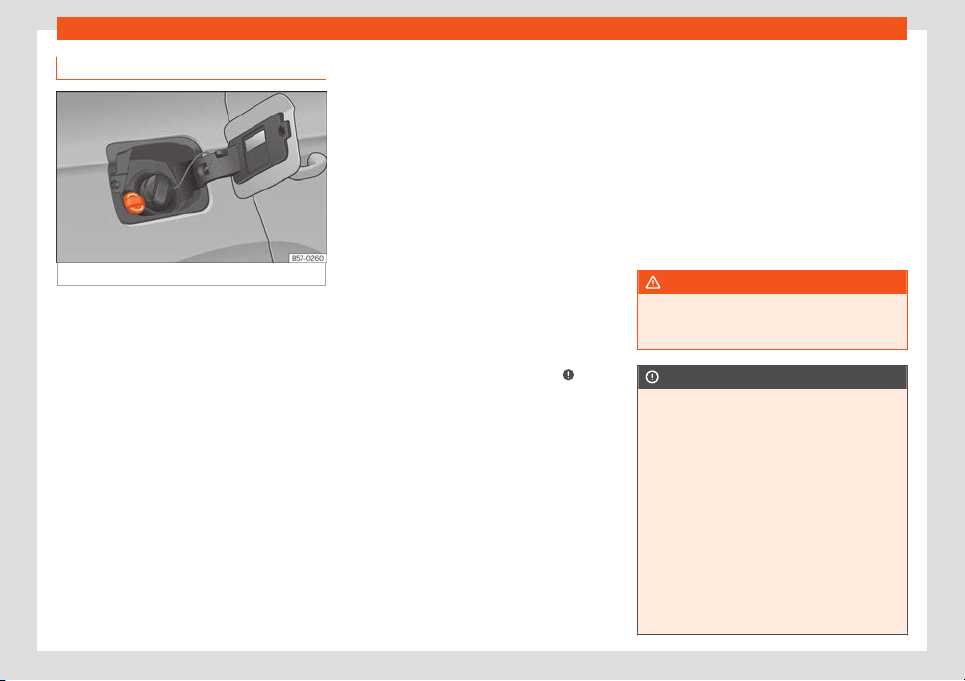
Practical tips
Fill AdBlue®
Fig. 238
AdBlue tank cap.
Operations prior to refilling
P
ark the vehicle on a flat surface and turn off
the ignition. If the vehicle is on a slope or on a
curb, the level indicator may not detect the
refill properly.
If an AdBlue® warning message is shown on
the instrument cluster display, fill with at
least the minimum required amount (ap-
prox. 5 litres). Only after adding this amount
will the system detect that AdBlue® has been
added and you will be able to start the en-
gine again. The maximum amount that can
be refilled is 11 litres.
Fill with a refill bottle
Only use AdBlue® that complies with the
ISO 22241-1 standard. Only use original
containers.
●
Open the tank cover
›››
Fig. 238.
●
Unscrew the tank cap by turning it in an an-
ti-clockwise direction.
●
Please observe the manufacturer's instruc-
tions, indicated on the refill bottle.
●
Check the expiry date.
●
Remove the cap of the refill bottle.
●
Insert the neck of the bottle in the tank filler
neck vertically and screw the bottle on by
hand, by turning it in a clockwise direction.
●
Press the refill bottle in the direction of the
filler neck and hold it in this position.
●
Wait until the contents of the refill bottle
have been poured into the AdBlue® tank. Do
not compress or break the bottle!
●
Turn the bottle in a counter-clockwise di-
rection and gently pull it upwards
›››
.
●
The AdBlue® tank is full when no more liq-
uid comes out of the bottl
e.
●
Screw on the tank cap in a clockwise direc-
tion until it is tightly closed.
●
Close the fuel tank flap.
Operations before driving
●
After refilling the tank, only switch on the ig-
nition.
●
Leave the ignition on for at least 30 sec-
onds for the system to detect the fluid load.
●
Make sure you wait for at least 30 seconds
before starting the engine!
Refilling the dispenser with AdBlue
Valid for vehicles with selective catalytic re-
duction.
●
Open the tank cap.
●
Turn the SCR tank cap anti-clockwise
›››
Fig. 238.
●
Add AdBlue until the nozzle stops for the
first time.
●
Close the SCR tube by turning it clockwise
until you hear a click.
WARNING
AdBlue® should only be stored in its origi-
nal cont
ainer, which should be tightly
closed and kept in a safe place.
CAUTION
●
When r
efilling, the nozzle grip should be
aligned downward. Otherwise the nozzle
will not connect automatically.
●
Do not try to add any more additive after
the nozzle has stopped for the first time.
The AdBlue tank could overflow and AdBlue
could spill out.
●
Only use AdBlue® that complies with the
ISO 22241-1 standard. Only use original
containers.
●
Never mix AdBlue® with water, fuel or ad-
ditives. Any type of damage caused by
such a mixture will not be covered by the
warranty.
334
Checking and refilling levels
●
Ne
ver pour AdBlue® into the fuel tank!
This could result in engine damage.
●
Do not carry the refill bottle inside the
vehicle. If there is a leak (due to tempera-
ture changes or damage to the bottle), the
AdBlue® may damage the vehicle's interior.
For the sake of the environment
Dispose of the refill bottle in an environ-
ment
-friendly manner.
Note
Suitable AdBlue® refill bottles can be pur-
chased fr
om SEAT dealerships.
Engine management and
emissions contr
ol system
Introduction
WARNING
●
Due t
o the high temperatures reached by
the exhaust gas scrubbing system, you
should not park your vehicle near a surface
that can catch fire easily. Fire hazard!
●
Do not apply wax underneath the vehicle
around the area of the exhaust system: Fire
hazard!
Control lamps
It lights up
Fault in the emission control system.
Reduce speed and drive carefully to the nearest spe-
cialised workshop to have the engine checked.
Flashes
Combustion failures that can damage the catalytic
conv
erter.
Reduce speed and drive carefully to the nearest spe-
cialised workshop to have the engine checked.
It lights up
Particulate filter blocked
›
››
page 336.
It lights up
Fault in the petrol engine management.
Hav
e the engine checked as soon as possible by a
specialised workshop.
When the ignition is switched on, the (El
ectronic
Power Control) lights up and should go off once the
engine has started.
It lights up
Diesel engine preheating system.
The engine can be st
arted straight away when the
lamp switches off.
Flashes
Fault in the diesel engine management.
Hav
e the engine checked as soon as possible by a
specialised workshop.
Note
While the control lamps , , or ar
e
on, there might be faults in the engine, fuel
consumption may go up and the engine
might lose power.
Catalytic converter
To maintain the useful life of the catalytic
conv
erter
●
Only use unleaded petrol with petrol en-
gines.
●
Never run the fuel tank dry.
●
When changing or adding engine oil, do not
exceed the necessary amount
›››
page 342,
Topping up the engine oil.
●
Never tow the vehicle to start it, use jump
leads if necessary
›››
page 52.
If you should notice misfiring, uneven running
or loss of power when the car is moving, have
the vehicle inspected by a specialised work-
shop. In general, the emissions warning lamp
will light up when any of these symptoms
occur. If this happens, any unburnt fuel can
enter the exhaust system and escape into the
»
335
Practical tips
atmosphere. The catalytic converter can also
be damaged by o
verheating.
CAUTION
Never run the fuel tank completely dry be-
cause an irr
egular fuel supply can cause
ignition faults. This allows unburnt fuel to
enter the exhaust system, which could
cause overheating and damage the cata-
lytic converter.
For the sake of the environment
Even when the emission control system is
w
orking perfectly, there may be a smell of
sulphur from the gases on occasions. This
depends on the sulphur content of the fuel
used. This can quite often be avoided by
changing to another brand of fuel.
Particulate filter
3 V
alid for: vehicles with petrol or diesel particu-
late filters
The particulate filter eliminates most of the
soot from the exhaust gas system. Under nor-
mal driving conditions the filter cleans itself. If
the filter does not clean itself (e.g. if short
journeys are made continuously), it becomes
blocked with soot and the following indica-
tion is displayed to the driver: Particu-
late filter: cleaned while the vehi-
cle is moving. See Manual. The partic-
ul
ate filter needs cleaning (regeneration).
Regeneration of the petrol particulate fil-
ter (only for 2.0l TSI engines)
Requirements for the regeneration journey:
the engine is at operating temperature.
●
Drive at a speed of at least 80 km/h
›››
●
Completely remove your foot from the ac-
cel
erator pedal for a few seconds to let the
vehicle roll with the gear engaged.
●
Consider the legal speed limits as well as
the recommended gears.
●
Repeat this procedure (accelerate and let
roll) until the control lamp turns off.
This procedure involves an autonomous par-
ticulate filter cleaning process and may take
some time.
If the warning lamp does not turn off, go im-
mediately to a specialised workshop to repair
the fault.
Regeneration of the petrol (except the TSI
2.0l engine) and diesel particulate filter
Requirements for the regeneration journey:
the engine is at operating temperature.
●
Drive at a speed of between 50-120 km/h
(31-75 mph). This increases the temperature
and burns the soot in the filter
›››
.
●
Consider the l
egal speed limits as well as
the recommended gears.
●
End the regeneration journey once the con-
trol warning lamp has gone out.
If the warning lamp stays on after 30 minutes
of running in regeneration mode, have a spe-
cialised workshop repair the fault
WARNING
Always adjust your speed to suit the weath-
er conditions, r
oads, braking distance and
traffic if the particulate filter is in its regen-
eration phase. Route recommendations
should never make you disregard each
country's specific traffic regulations.
CAUTION
●
When the e
xhaust system detects that
the particulate filter is close to saturation,
the self-cleaning function of this system
recommends optimal driving for this func-
tion.
●
Due to the high temperatures caused by
the regeneration of the particulate filter, it
is possible that the radiator fan will acti-
vate after stopping the engine, even it its
operating temperature has not been
reached.
●
Noise, smells and high idle speeds can
occur during regeneration.
●
Always use the correct engine oil and the
correct fuel to make sure the useful life of
336
Checking and refilling levels
the particulate filter is not affected. Also
av
oid making short trips all the time.
Engine compartment
W
orking in the engine compart-
ment
Always be aware of the danger of injury and
scal
ding as well as the risk of accident or fire
when working in the engine compartment
(e.g. when checking and refilling fluids).
Always observe the warnings listed below
and follow all general safety precautions.
The vehicle's engine compartment is a po-
tentially hazardous area
›››
.
WARNING
When work is done in the engine compart-
ment, injuries, burns, accidents and e
ven
fires can occur.
●
Turn off the engine, disconnect the igni-
tion e and apply the electronic parking
brake. If the vehicle has a manual gearbox,
place the lever in neutral; if it has an auto-
matic gearbox, place the selector lever in
position P. Wait for the engine to cool down.
●
Never open the bonnet if you see steam
or drips of coolant being released from the
engine compartment. Wait until no steam
or coolant can be seen before opening the
bonnet.
●
Keep children away from the engine
compar
tment.
●
Never spill liquids used for vehicle opera-
tion on the engine compartment, as these
may catch fire (e.g. the antifreeze in cool-
ant).
●
Avoid causing short-circuits in the elec-
trical system, particularly at the points
where the jump leads are attached
›››
page 52. The battery could explode.
●
If working inside the engine compart-
ment, remember that, even when the igni-
tion is switched off, the radiator fan may
start up automatically, and therefore there
is a risk of injury.
●
Never cover the engine with additional in-
sulating materials such as a blanket. Risk of
fire!
●
Do not unscrew the cap on the coolant
expansion tank when the engine is hot. The
cooling system is under pressure.
●
Protect face, hands and arms by cover-
ing the cap with a large, thick rag to protect
against escaping coolant and steam.
●
Always make sure you have not left any
objects, such as cleaning cloths or tools, in
the engine compartment.
●
If you have to work underneath the vehi-
cle, you must use suitable stands addition-
ally to support the vehicle, there is a risk of
accident!. A hydraulic jack is insufficient for
securing the vehicle and there is a risk of
injury.
●
If any work has to be performed when the
engine is st
arted or with the engine running,
there is an additional, potentially fatal,
safety risk from the rotating parts, such as
the drive belts, alternator, radiator fan, etc.,
and from the high-voltage ignition system.
You should also observe the following:
–
Never touch the electrical wiring of the
ignition system.
–
Ensure that jewellery, loose clothing
and long hair do not get trapped in ro-
tating engine parts. Danger of death.
Before starting any work remove jewel-
lery, tie back and cover hair, and wear
tight-fitting clothes.
–
Never accelerate with a gear engaged
without taking the necessary precau-
tions. The vehicle could move, even if
the handbrake is applied. Danger of
death.
●
Observe the following additional warn-
ings if work on the fuel system or the elec-
trical system is necessary:
–
Always disconnect the 12-volt vehicle
battery from the on-board network.
–
Do not smoke.
–
Never work near naked flames.
–
Always keep an approved fire extin-
guisher immediately available.
»
337
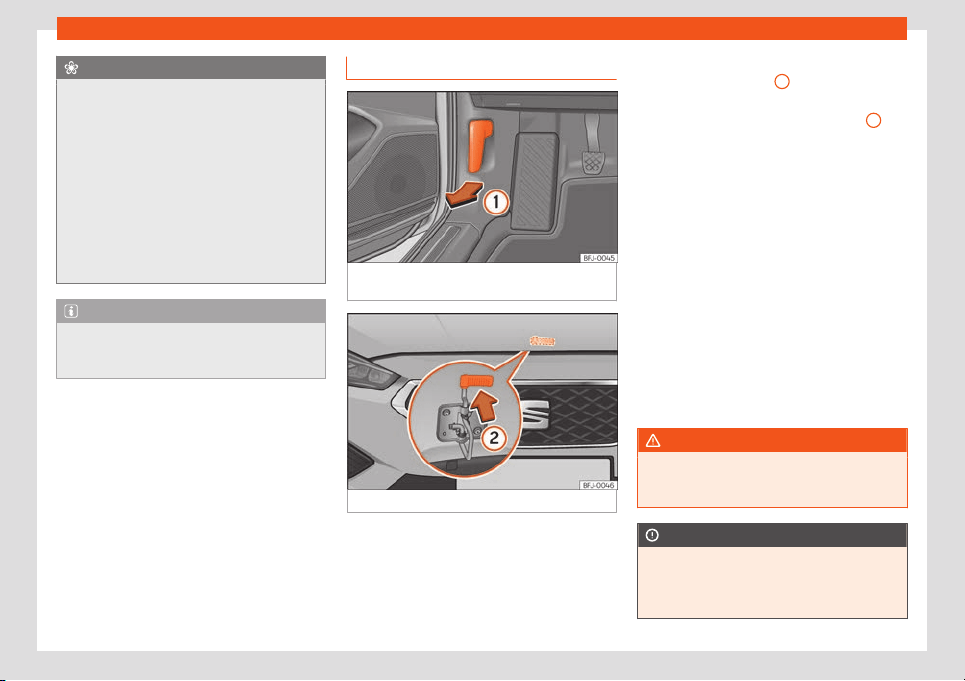
Practical tips
For the sake of the environment
●
Inspect the gr
ound underneath your vehi-
cle regularly so that any leaks are detec-
ted at an early stage. If you find spots of oil
or other fluids in the area where it was
parked, have your vehicle inspected at the
workshop.
●
Service fluids leaks are harmful to the en-
vironment. For this reason you should make
regular checks on the ground underneath
your vehicle. If you find spots of oil or other
fluids, have your vehicle inspected in a
specialised workshop.
Note
In right-hand drive vehicles some brake flu-
id r
eservoirs are on the other side of the en-
gine compartment
›››
Fig. 241.
Opening and closing the bonnet
Fig. 239
Release lever in the driver's footwell
ar
ea.
Fig. 240
Cam under the bonnet
Opening the bonnet
The bonnet is r
eleased from inside the vehi-
cle.
Before opening the bonnet, make sure that
the windscreen wiper arms are in place
against the windscreen.
●
Open the door and pull the lever under the
dashboard
›››
Fig. 239
1
.
●
To lift the bonnet, press the release catch
under the bonnet up
wards
›››
Fig. 240
2
.
The arr
ester hook under the bonnet is re-
leased.
●
The bonnet can be opened. Release the
bonnet stay and secure it in the fixture de-
signed for this in the bonnet.
Closing the bonnet
●
Slightly lift the bonnet.
●
Release the bonnet stay and replace it in its
support.
●
At a height of approximately 20 cm let it fall
so it locks.
If the bonnet does not close, do not press
downwards. Open it again and let it fall as
mentioned above.
WARNING
Make sure that the bonnet is properly
cl
osed. If it opens when driving, it can
cause an accident.
CAUTION
To avoid damage to the bonnet and to the
windscr
een wiper arms, only open it when
the windscreen wipers are in place against
the windscreen.
338
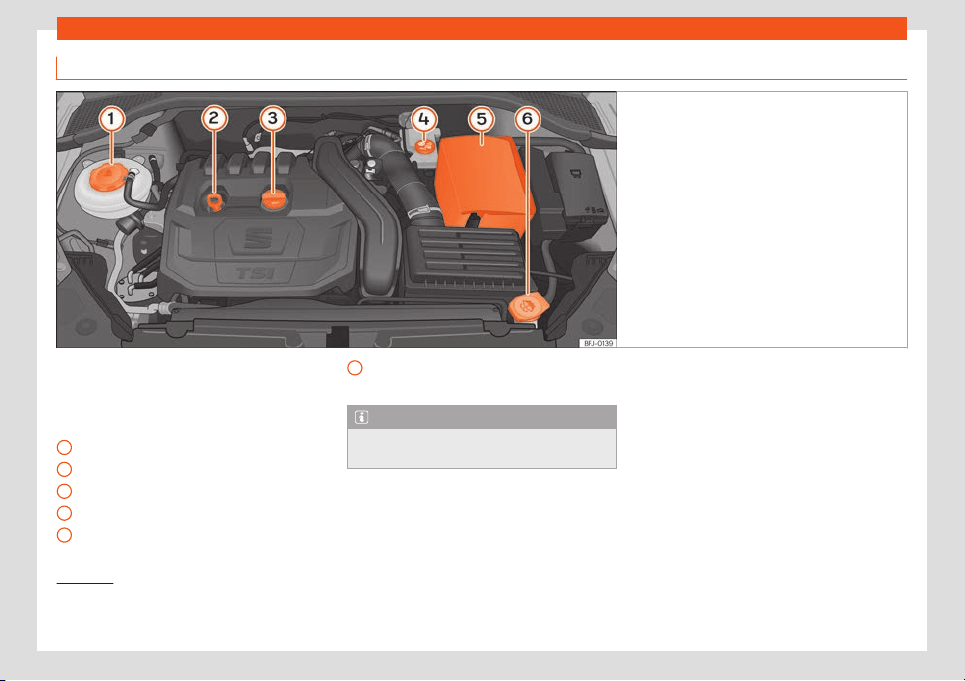
Checking and refilling levels
Checking levels
Fig. 241
Diagram for the location of the various el-
ements.
From time to time, the levels of the different
fluids in the v
ehicle must be checked. Never
fill with incorrect fluids, otherwise serious
damage to the engine may be caused.
Coolant expansion tank
›››
page 343
Engine oil level dipstick
›››
page 341
Engine oil filler cap
›››
page 342
Brake fluid reservoir
›››
page 345
Battery (under the cover)
1)
›››
page 347
1
2
3
4
5
Windscreen washer reservoir
›
››
page 346
Note
The layout of parts may vary depending on
the engine
.
6
1)
In hybrid vehicles the battery can be found in
the l
eft hand side of the luggage compartment
›››
page 349.
339
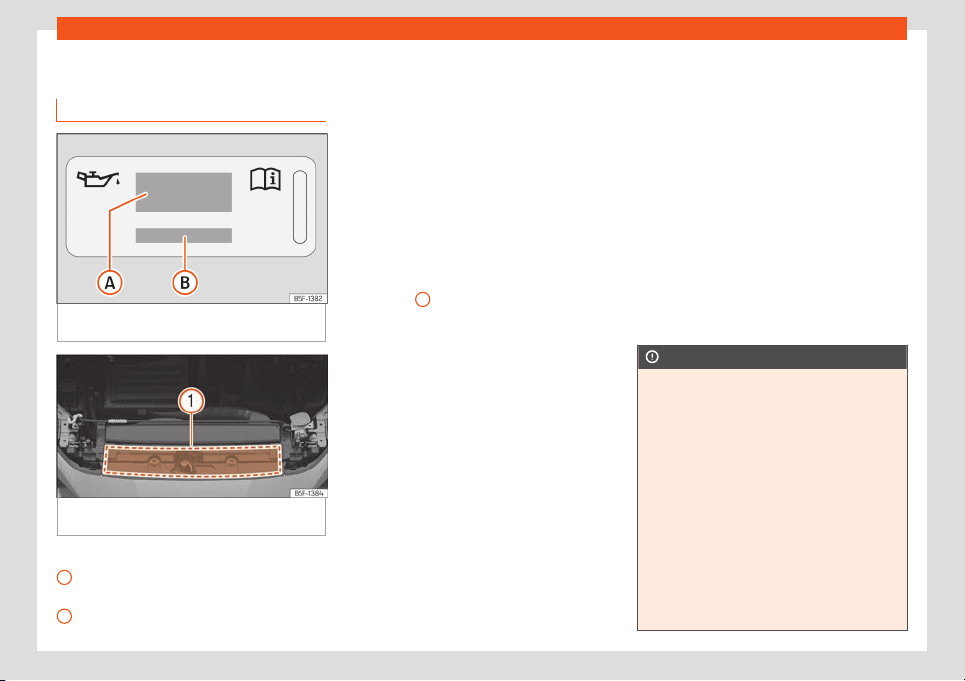
Practical tips
Engine oil
Gener
al notes
Fig. 242
In the engine compartment: engine
oil l
abel
Fig. 243
In the engine compartment: area
wher
e the engine oil label is located
Key to the
›
››
Fig. 242:
Information about the engine oil stand-
ard.
Information about engine oil viscosity.
A
B
The engine comes with a special, multi-grade
oil that can be used all year r
ound.
Because the use of high-quality oil is essen-
tial for the correct operation of the engine
and its long useful life, when topping up or
changing oil, use only those oils that comply
with VW standards.
For vehicles with an engine oil label
If the engine oil has to be topped up, use one
of the oils shown on the label
›››
Fig. 242. The
label with the prescribed standard is located
at the front of the engine compartment
›››
Fig. 243
1
. If you use the recommended
engine oil, you can t
op up the oil as often as
necessary.
For vehicles without an engine oil label
Contact a specialised workshop or SEAT offi-
cial service for information about the corre-
sponding standard.
If the engine oil level is too low
If the recommended engine oil is not availa-
ble, in the event of an emergency you can
change the oil once with a maximum of 0.5 L
of the next oil until the next oil change:
Petrol: VW 504 00, ACEA C3 or API SN
standard.
Diesel engines: VW 507 00, ACEA C3 or
API CJ-4, viscosity 0W-30.
–
–
SEAT recommends changing the oil at a spe-
cialised workshop. SEAT recommends an Of-
ficial SEAT Service.
SEAT recommends the use of engine oils ap-
proved according to the appropriate VW
standard. Use of engine oils that do not meet
these quality requirements can cause engine
damage.
SEAT recommends the use of Original SEAT
Spare Part engine oils.
Engine oil additives
No type of additive should be mixed with the
engine oil. The deterioration caused by these
additives is not covered by the warranty.
CAUTION
Take the following into account if you have
r
efilled with an engine oil different to those
specified in the aforementioned standards,
or by your SEAT technical service centre:
●
There is no way of completely avoiding
the danger of causing damage to the en-
gine and particulate filter.
●
You can continue driving with the vehicle
if the refill was no more than 0.5 l of engine
oil. Go to a specialised workshop as soon
as possible and request an oil change. Oth-
erwise, there is a danger of engine dam-
age.
●
If you have topped up more than 0.5 l of
engine oil, drive with the engine at low load
340
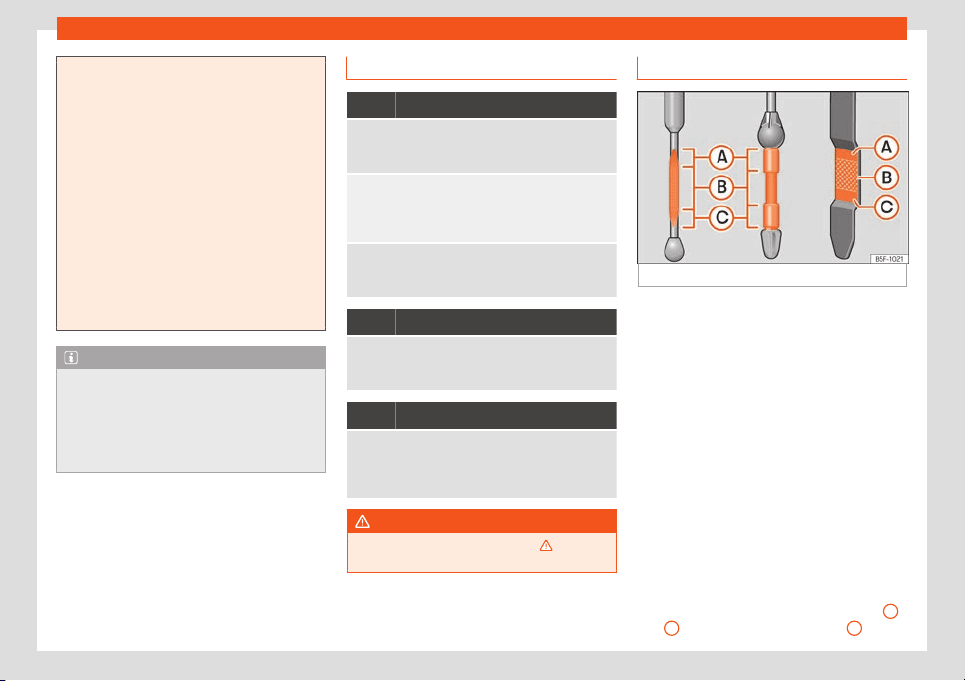
Checking and refilling levels
levels and within the medium RPM range as
a maximum. Do not driv
e at more than 80
km/h and do not travel more than 300 km
(approximately). Go to a specialised work-
shop as soon as possible and request an oil
change. Otherwise, there is a danger of en-
gine damage.
●
You are responsible for the risk of possi-
ble damage to the vehicle (engine, exhaust
system). If in doubt, do not start the engine
and request assistance from the technical
service centre.
●
Do not start the engine if you have top-
ped up with a fluid other than engine oil.
Request assistance from the technical
service centre. Danger of engine damage!
Note
Before a long trip, we recommend finding
an engine oil that conf
orms to the corre-
sponding VW specifications and recom-
mend keeping it in the vehicle. This way, the
correct engine oil will always be available
for a top-up if needed.
Warning lamp
It lights up red
Do not carry on driving!
Engine oil pressure too low.
Switch off the engine. Check the engine oil level.
If this warning lamp st
arts to flash, and is accom-
panied by three audible warnings, switch off the en-
gine and check the oil level. If necessary, add more
oil
›››
page 342.
If the warning lamp fl
ashes although the oil level
is correct, stop driving. Do not even run the engine at
idle speed! Obtain technical assistance.
It lights up yellow
Check the engine oil level as soon as possible.
R
eplace oil as soon as you have the opportunity to
do so
›››
page 342.
It flashes yellow
Fault in the oil level sensor.
Hav
e the check done by a specialised workshop. Un-
til then it is advisable to check the oil level every time
you refuel.
WARNING
Observe the safety warnings
›
››
in Con-
tr
ol and warning lamps on page 86.
Checking the engine oil level
Fig. 244
Engine oil dipstick.
The engine oil dipstick indicates the level of
the oil.
Checking oil l
evel
–
Park the vehicle in a horizontal position.
–
Briefly run the engine at idle speed until the
operating temperature is reached and then
stop.
–
Wait for about two minutes.
–
Pull out the dipstick. Wipe the dipstick with
a clean cloth and insert it again, pushing it
in as far as it will go.
–
Then pull it out once more and check the oil
level
›››
Fig. 244. Top up with engine oil if
necessary.
The oil must leave a mark between zones
A
and
C
. It can never go above zone
A
.
»
341

Practical tips
●
Z
one
A
: do not add oil.
●
Zone
B
: you can add oil but keep the level
in that z
one.
●
Zone
C
: add oil until zone
B
.
Depending on ho
w you drive and the condi-
tions in which the vehicle is used, oil con-
sumption can be up to 0.5 l/1000 km. Oil
consumption is likely to be higher for the first
5,000 km. For this reason the engine oil level
must be checked at regular intervals, prefera-
bly when filling the tank and before a journey.
WARNING
Any work carried out in the engine com-
par
tment or on the engine must be carried
out cautiously.
●
When working in the engine compart-
ment, always observe the safety warnings
›››
page 337.
CAUTION
If the oil level is above area
A
, do not start
the engine
. This could result in damage to
the engine and catalytic converter. Con-
tact a Technical Service.
Topping up the engine oil
Fig. 245
In the engine compartment: Engine
oil fill
er cap.
Before opening the bonnet, read and observe
the w
arnings
›››
in Working in the engine
compar
tment on page 337.
Topping up engine oil
●
Unscrew cap from engine oil filler opening
›››
Fig. 245.
●
Carefully add oil in small quantities (no
more than 0.5 l).
●
To avoid adding too much oil, whenever you
add a certain amount, wait about 2 minutes
and recheck the oil level
›››
page 341.
●
If necessary, add some more oil.
●
When the oil level reaches at least zone
›››
Fig. 244
B
, unscrew the engine oil filler
cap car
efully
›››
.
The position of the oil filler opening is shown
in the corr
esponding engine compartment il-
lustration
›››
page 339.
Engine oil specification
›››
page 340.
WARNING
Oil is highly inflammable! Ensure that no oil
comes int
o contact with hot engine compo-
nents when topping up.
CAUTION
If the oil level is above area
›
››
Fig. 244
A
,
do not st
art the engine. This could result in
damage to the engine and catalytic con-
verter. Contact a specialised workshop.
For the sake of the environment
The oil level must never be above zone
›
››
Fig. 244
A
. Otherwise oil can be drawn
in thr
ough the crankcase breather and leak
into the atmosphere via the exhaust sys-
tem.
Note
Before a long trip, we recommend finding
an engine oil that conf
orms to the corre-
sponding VW specifications and recom-
mend keeping it in the vehicle. This way, the
correct engine oil will always be available
for a top-up if needed.
342
Checking and refilling levels
Engine oil change
We recommend that you have the engine oil
changed by a T
echnical Service.
WARNING
Only change the engine oil yourself if you
hav
e the specialist knowledge required!
●
Before opening the bonnet, read and ob-
serve the warnings
›››
page 337.
●
Wait for the engine to cool down. Hot oil
may cause burn injuries.
●
Wear eye protection to avoid injuries,
such as acid burns, caused by splashes of
oil.
●
When removing the oil drain plug with
your fingers, keep your arm horizontal to
help prevent oil from running down your
arm.
●
Wash your skin thoroughly if it comes into
contact with engine oil.
●
Engine oil is poisonous! Used oil must be
stored in a safe place out of the reach of
children.
CAUTION
No additives should be used with engine oil.
This coul
d result in engine damage. Any
damage caused by the use of such addi-
tives would not be covered by the factory
warranty.
For the sake of the environment
●
W
e recommend that you change the en-
gine oil and the filter at a technical service
centre.
●
Never pour oil down drains or into the
ground.
●
Use a suitable container when draining
the used oil. It must be large enough to hold
all the engine oil.
Cooling system
Cool
ant specifications
The engine cooling system is supplied from
the f
actory with a specially treated mixture of
water and at least 40 % of the additive
G12evo (TL-VW 774 J), purple. This mixture
gives the necessary frost protection down to
-25°C (-13°F) and protects the light alloy
parts of the engine cooling system against
corrosion. It also prevents scaling and con-
siderably raises the boiling point of the cool-
ant.
To protect the cooling system, the percent-
age of additive must always be at least 40 %,
even in warm climates where anti-freeze pro-
tection is not required.
If for weather reasons further protection is
necessary, the proportion of additive may be
increased, but only up to 60 %; otherwise an-
tifreeze protection will diminish and this will
worsen cooling.
When the coolant is topped up, use a mixture
of distilled water and at least 40 % of the
additive G12evo for optimal protection
against corrosion. Mixing G12evo with G13
(TL-VW 774 J), G12 plus-plus (TL-VW 774 G),
G12 plus (TL-VW 774 F), G12 (red) or G11
(green blue) engine coolants decreases pro-
tection again corrosion and should be avoi-
ded.
WARNING
If there is not enough anti-freeze in the
cool
ant system, the engine may fail lead-
ing to serious damage.
●
Ensure that the percentage of additive is
correct for the lowest expected ambient
temperature in the zone in which the vehi-
cle is to be used.
●
When the outside temperature is very
low, the coolant could freeze and the vehi-
cle would be immobilised.
CAUTION
The original additives should never be
mix
ed with coolants which are not ap-
proved by SEAT.
●
If the fluid in the expansion tank is not
purple but is, for example, brown, this indi-
cates that the G12evo additive has been
»
343
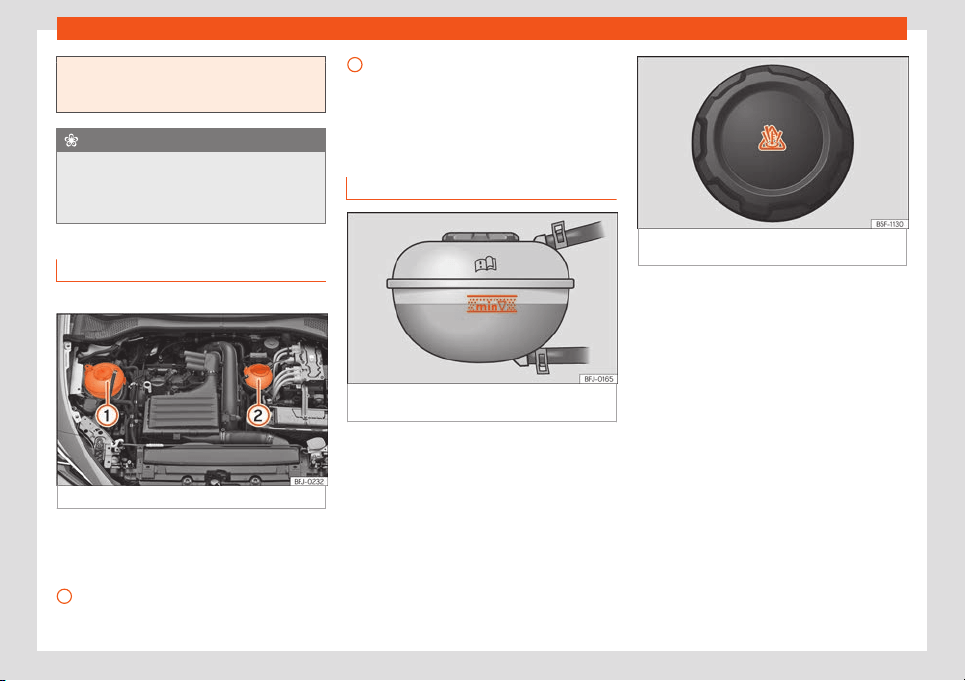
Practical tips
mixed with an inadequate coolant. The
cool
ant must be changed as soon as possi-
ble if this is the case!
For the sake of the environment
Coolants and additives can contaminate
the envir
onment. If any fluids are spilled,
they should be collected and correctly dis-
posed of, with respect to the environment.
Coolant tank
3 V
alid for: hybrid vehicles.
Fig. 246
Engine compartment: Coolant tanks
The vehicle has 2 independent coolant ex-
pansion t
anks.
›››
Fig. 246
Coolant expansion tank for the combus-
tion engine cooling circuit.
1
Coolant expansion tank for the high-volt-
age cooling cir
cuit. Do not continue driv-
ing if there is a lack of fluid in the expan-
sion tank. Do not top up coolant. Go im-
mediately to a specialised workshop.
Refilling coolant
Fig. 247 In the engine compartment: marking
on cool
ant expansion tank.
2
Fig. 248 Engine compartment: coolant expan-
sion t
ank cap.
The coolant tank is located in the engine
compartment
›
››
page 339.
Top up coolant when the level is below the
(minimum) mark.
Checking coolant level
–
Park the vehicle in a horizontal position.
–
Switch the ignition off.
–
Read off the coolant level on coolant ex-
pansion tank. When the engine is cold, the
coolant level should be between the marks
›››
Fig. 247. When the engine is hot, it may
be slightly above the upper mark.
Topping up coolant
–
Wait for the engine to cool down.
344
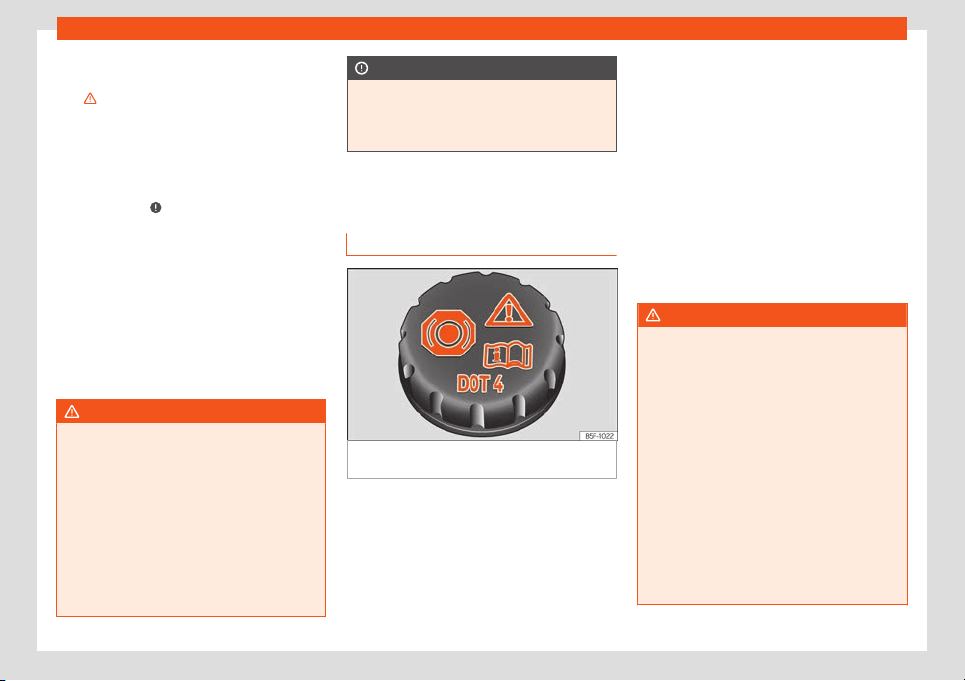
Checking and refilling levels
–
Co
ver the coolant expansion tank cap with
a cloth and carefully unscrew it to the left
›››
.
–
Top up the coolant only if there is still cool-
ant in the e
xpansion tank, otherwise you
could damage the engine. If there is no
coolant in the expansion tank, do not con-
tinue driving. You should obtain professional
assistance
›››
.
–
If there is still some coolant in the expansion
t
ank, top up to the upper mark.
–
Top up with coolant until the level becomes
stable.
–
Screw the cap back on correctly.
If there is a coolant leak, take the vehicle spe-
cialised workshop to have the cooling system
examined.
WARNING
●
The cooling syst
em is under pressure. Do
not unscrew the cap on the coolant expan-
sion tank when the engine is hot: risk of
burns!
●
Store the antifreeze in its original con-
tainer and keep it out of reach of children.
●
If working inside the engine compart-
ment, remember that, even when the igni-
tion is switched off, the radiator fan may
start up automatically, and therefore there
is a risk of injury.
CAUTION
If you run out of coolant in the expansion
t
ank, park the car in a safe place and do
not continue driving. Obtain technical as-
sistance.
Brake fluid
Check and r
efill the brake fluid
Fig. 249 Engine compartment: brake fluid res-
erv
oir cap.
The brake fluid reservoir is located in the en-
gine compartment
›
››
page 339.
Checking the brake fluid level
The brake fluid level must be between the
and markings.
However, if the brake fluid level goes down
noticeably in a short time, or drops below the
mark, there may be a leak in the brake
system. Seek specialist assistance. A warning
light on the instrument panel display monitors
the brake fluid level
›››
page 85.
In right-hand drive vehicles the brake fluid
reservoir is on the other side of the engine
compartment.
Changing brake fluid
We recommend that you have the brake fluid
changed by a Technical Service.
WARNING
If the brake fluid level is low or unsuita-
bl
e/old brake fluid is used, the brake sys-
tem may fail or braking power may be re-
duced.
●
Check the brake system and the brake
fluid level regularly!
●
When the brake fluid is used and brakes
are subjected to extreme braking forces,
bubbles of vapour form in the brake sys-
tem. These bubbles can significantly re-
duce braking power, notably increasing
braking distance, and could result in the to-
tal failure of the brake system.
●
Be sure to always use the correct brake
fluid. Only use brake fluid that expressly
meets the VW 501 14 standard.
»
345
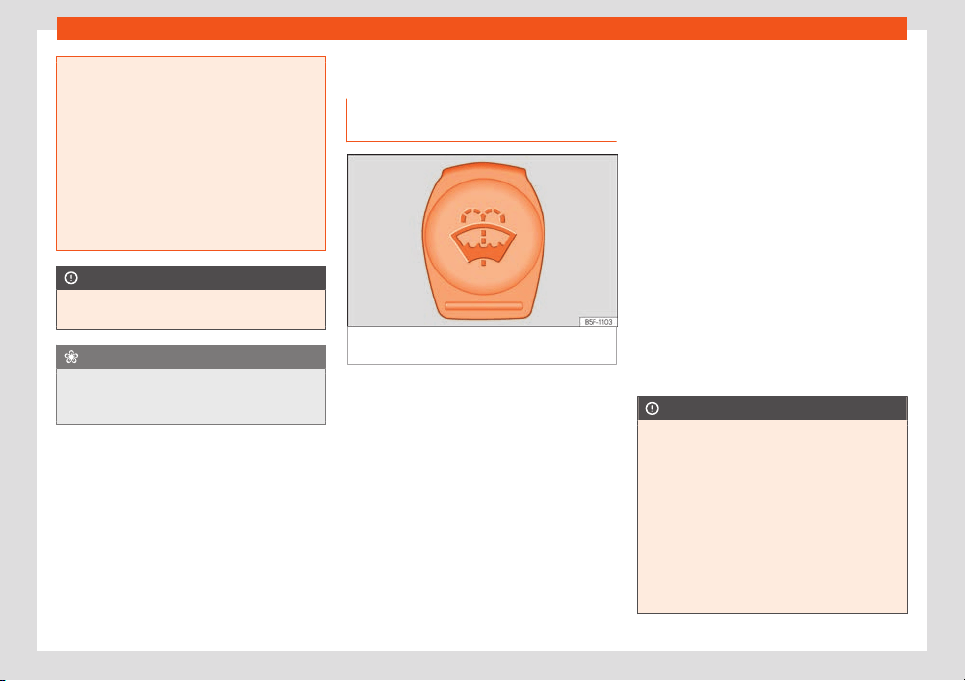
Practical tips
●
Y
ou can buy VW 501 14 standard brake
fluid in a SEAT dealership or a SEAT Official
Service. If none is available, use only high-
quality brake fluid that meets DIN ISO 4925
CLASS 4 standards, or USA Standards
FMVSS 116 DOT 4.
●
The replacement brake fluid must be
new.
●
Brake fluid should be stored in the closed
original container in a safe place out of
reach of children. Risk of poisoning!
CAUTION
Brake fluid should not come into contact
with the v
ehicle paintwork, as it is abrasive.
For the sake of the environment
Brake fluid is an environmental pollutant.
Coll
ect any spilt service fluids and allow a
professional to dispose of them.
Windscreen washer reservoir
Checking the l
evel of the window
washer tank and refilling it
Fig. 250
In the engine compartment: window
w
asher tank cap.
The window washer tank is in the engine
compartment
›
››
page 339.
Check the water level in the windscreen
washer reservoir regularly and top up as re-
quired.
The window washer tank contains liquid de-
tergent for the windscreen and rear window.
●
Open the bonnet
›››
page 337.
●
The window washer tank is marked with the
symbol on the cap.
●
Check there is enough windscreen water in
the reservoir.
Plain water is not enough to clean the wind-
screen and headlights. We recommend that
you always add a product to the windscreen
washer fluid.
Recommended windscreen wipers
●
For the hottest seasons we recommend
summer G 052 184 A1 for clear glass. Propor-
tions of the mixture in the washer fluid tank:
1:100 (1 part concentrate per 100 parts wa-
ter).
●
All year round, G 052 164 A2 for clear glass.
Approximate proportion of the winter mixture,
up to -18°C (0°F): 1:2 (1 part concentrate per 2
parts water); otherwise, a 1:4 proportion of
mixture in the washer fluid tank.
The capacity of the window washer tank can
be found in
›››
page 381.
CAUTION
If the water from the windscreen washer
does not cont
ain enough anti-freeze, it may
freeze on the windscreen and rear window,
reducing forward and rear visibility.
●
In winter, ensure the windscreen washer
contains enough anti-freeze.
●
In cold conditions, you should not use the
windscreen wiper system unless you have
warmed the windscreen with the ventila-
tion system. The antifreeze could freeze on
the windscreen and reduce visibility.
346
Checking and refilling levels
CAUTION
Never mix an unsuitable antifreeze or other
simil
ar additives with the windscreen wash-
er water. A greasy layer may be formed on
the windscreen which will impair visibility.
●
Use clean water with a window cleaner
recommended by SEAT.
●
If necessary, add a suitable antifreeze to
the water in the reservoir.
CAUTION
●
Do not mix cl
eaning products recommen-
ded by SEAT with other products. This
could lead to flocculation and may block
the windscreen washer jets.
●
When topping up service fluids, make ab-
solutely certain that you fill the fluids into
the correct reservoirs. Using the wrong flu-
ids could cause serious malfunctions and
engine damage!
●
Lack of window washer fluid causes the
view through the windscreen to be ob-
scured.
12-volt battery
Gener
al information
The battery is located in the engine compart-
ment
›
››
page 339 or luggage compartment
(PHEV hybrid vehicles)
›››
page 349 and is
practically maintenance free. It is checked
as part of the Inspection Service. Neverthe-
less, check the terminals are clean and have
the correct tightening torque, especially in
summer and winter.
All work on batteries requires specialist
knowledge. Please refer to a SEAT Official
Service or a workshop specialising in batter-
ies: risk of burns or exploding battery!
The battery must not be opened. Never try
to change the fluid level of the battery. Oth-
erwise explosive gas is released from the bat-
tery that could cause an explosion.
Battery warning indications
Wear eye protection.
Battery acid is extremely corrosive. Wear pro-
t
ective gloves and eye protection. Rinse any
splashes of electrolyte with plenty of water.
Fires, sparks, open flames and smoking are
pr
ohibited.
The battery should only be charged in a well-
v
entilated zone. Risk of explosion!
Keep children away from acid and batteries!
Always follow the instruction manual.
Disconnecting the battery
The batt
ery should only be disconnected in
exceptional cases. When the battery is dis-
connected, some of the vehicle's functions
are lost. These functions will require resetting
after the battery is reconnected.
When disconnecting the battery from the ve-
hicle on-board network, disconnect first the
negative cable and then the positive cable.
Deactivate the anti-theft alarm before you
disconnect the battery. Otherwise the alarm
will be triggered.
If the vehicle is not used for long periods
The vehicle has a system for monitoring the
current consumption when the engine is left
unused for long periods of time
›››
page 351.
Some functions, such as the interior lights, or
the remote door opening, may be temporarily
disabled to prevent the battery from running
flat. These functions will come back on as
soon as the ignition is switched on and the
engine started.
Winter conditions
During the winter, the starting power may be
reduced, and if necessary, the battery should
be charged
›››
page 350.
WARNING
Any work to be done on the 12-volt vehicle
batt
ery or electrical system can cause in-
juries, burns, accidents and fires:
»
347
Practical tips
●
W
ear eye protection. Protect your eyes,
skin and clothing from acid and particles
containing lead.
●
Battery acid is extremely corrosive. Wear
protective gloves and eye protection. Do
not tilt the batteries. This could spill acid
through the vents.
●
Neutralise any electrolyte splashes on
the skin, eyes or clothing with a soapy solu-
tion, and rinse off with plenty of water. If
acid is swallowed by mistake, consult a
doctor immediately.
●
Fires, sparks, open flames and smoking
are prohibited. When handling cables and
electrical equipment, avoid causing sparks
and electrostatic charge. Never short the
battery terminals. High-energy sparks can
cause injury.
●
A highly explosive mixture of gases is re-
leased when the battery is under charge.
The batteries should be charged in a well-
ventilated room only.
●
Keep children away from acid and bat-
teries.
●
Before working on the electrical system,
you must switch off the engine, the ignition
and all electrical devices. The negative ca-
ble on the battery must be disconnected.
When a light bulb is changed, you need on-
ly switch off the light.
●
Deactivate the anti-theft alarm by un-
locking the vehicle before you disconnect
the battery! The alarm will otherwise be
trigger
ed.
●
When disconnecting the battery from the
vehicle on-board network, disconnect first
the negative cable and then the positive
cable.
●
Switch off all electrical devices before
reconnecting the battery. Reconnect first
the positive cable and then the negative
cable. Never reverse the polarity of the
connections. This could cause an electrical
fire.
●
Never charge a frozen battery, or one
which has thawed. This could result in ex-
plosions and chemical burns. Always re-
place a battery which has frozen. A flat
battery can also freeze at temperatures
close to 0°C (+32°F).
●
Ensure that the vent hose is always con-
nected to the battery.
●
Never use a defective battery. This could
cause an explosion. Replace a damaged
battery immediately.
WARNING
The 12 volt battery is a subject to wear. A
r
eduction in battery power can mean that
some important safety systems, such as
power steering, braking intervention, lights
or airbag systems, operate with limitations
or stop working entirely. This may cause
serious accidents and injuries. To avoid
this, it is necessary to take the following
saf
ety measure:
●
Get a professional service centre to re-
place the 12-volt vehicle battery every four
years.
CAUTION
●
Do not e
xpose the battery to direct sun-
light over a long period of time, as the in-
tense ultraviolet radiation can damage the
battery housing.
●
If the vehicle is left standing in cold con-
ditions for a long period, protect the bat-
tery from “freezing”. If it freezes it will be
damaged.
Control lamp
It lights up red
Alternator fault.
The control lamp lights up when the ignition is
s
witched on. It should go out when the engine
has started running.
If the indicator lamp lights up while driving,
the alternator is no longer charging the 12-
volt vehicle battery. You should immediately
drive to the nearest specialised workshop.
348
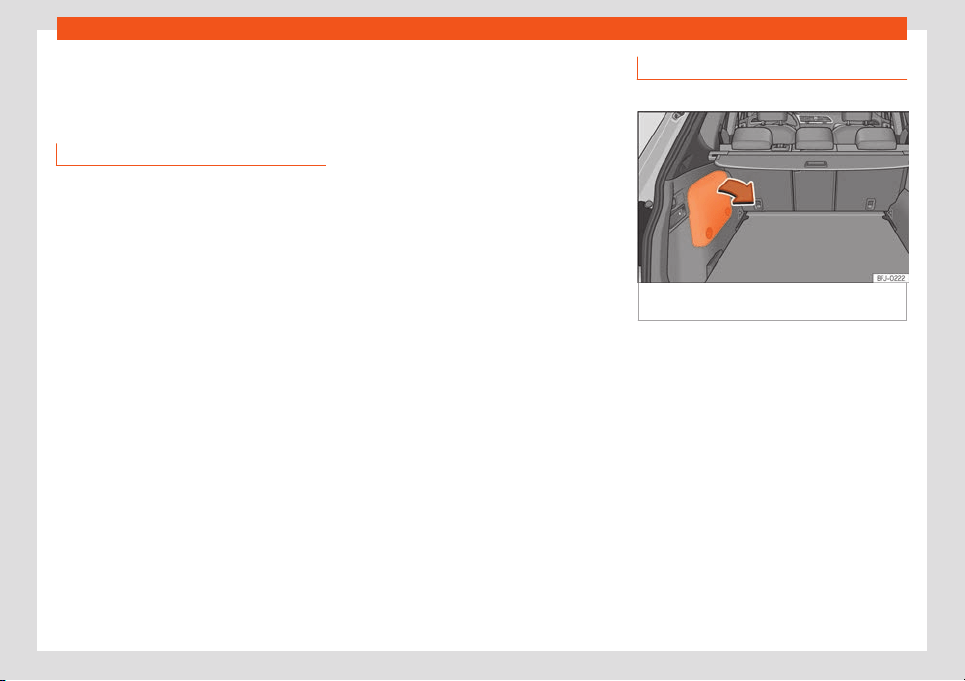
Checking and refilling levels
You should avoid using electrical equipment
that is not absolut
ely necessary because this
will drain the battery.
Control lamp
3 V
alid for: hybrid vehicles.
Indicator lamps and driver messages on the
instrument cluster display or infotainment
system:
The 12 V vehicle battery does not
charge. Stop safely!
●
The indicator lamp lights up red. Stop the
v
ehicle and switch off the ignition. Obtain
technical assistance.
Error: 12 V vehicle battery. En-
gine cannot be started. Go to the
workshop.
●
The indicator lamp lights up yellow. If the
ignition is switched off, it is not possible to
start the vehicle again. There may be limita-
tions on the vehicle’s functions/stability. Con-
tact a specialised workshop immediately.
Low level of the 12 V vehicle
battery. Charge while driving.
●
The indicator lamp lights up yellow. Starting
capacity may be limited. If this driver mes-
sage goes out after a certain amount of time,
the vehicle's battery has recharged while
driving and reached a sufficient level. If the
driver message does not go out, take the ve-
hicle to a specialized workshop.
Replace the 12V vehicle battery.
Take the vehicle to a workshop.
●
The indicator lamp lights up yellow. The 12
volt vehicle battery has almost reached the
end of its useful life. Visit a professional and
request an inspection and replacement, if
necessary, of the 12-volt vehicle battery
›››
page 350.
Check the 12V vehicle battery.
●
The indicator lamp lights up yellow. The
connection between the electrical system
and the 12-volt vehicle battery does not work.
Get the electrical system checked by a pro-
fessional.
Error: 12-volt vehicle battery
diagnosis. Visit a workshop.
●
The indicator lamp lights up yellow. The
system that controls the 12-volt vehicle bat-
tery does not work. Get the electrical system
checked by a professional.
Access to the 12 volt battery
3 V
alid for vehicles: plug-in hybrid (PHEV)
Fig. 251
Location of the battery in the luggage
compartment
●
Open the rear lid.
●
The 12V battery is located inside the left
side compartment.
●
Remove the side trim cover to gain access
t
o the 12V battery
›››
Fig. 251.
349
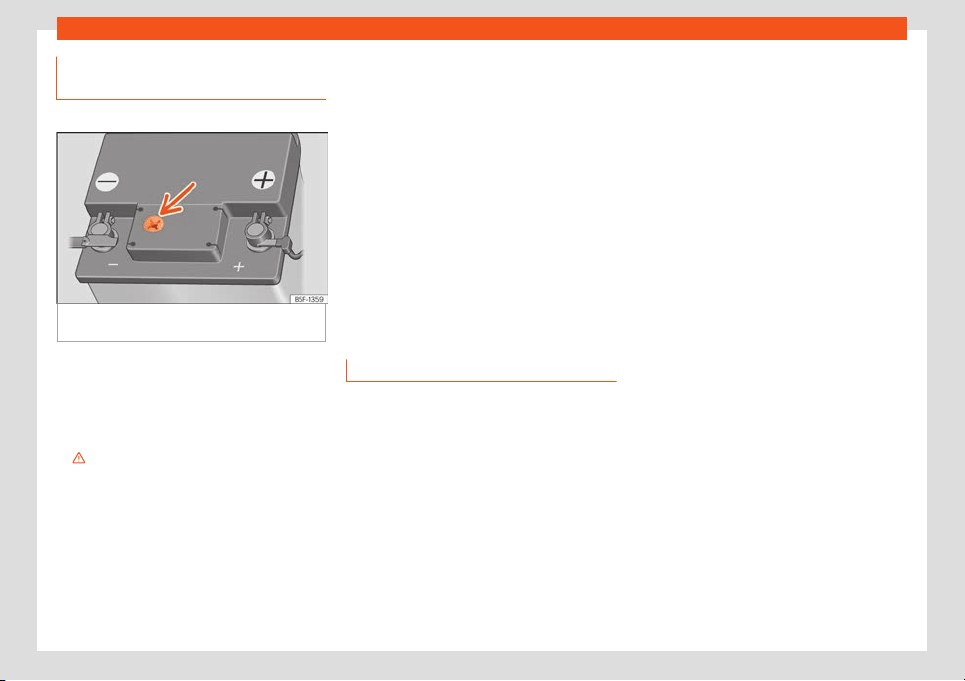
Practical tips
Checking the battery electrolyte
l
evel
3 Not v
alid for hybrid vehicles.
Fig. 252
Sight glass on the top of the 12 volt
batt
ery (schematic representation).
The electrolyte level should be checked reg-
ul
arly in high-mileage vehicles, in hot coun-
tries and in older batteries.
●
Open the bonnet and then lift the cover
that protects the front part of the battery
›››
in Working in the engine compart-
ment on page 337.
●
Check the colour display in the sight glass
on the t
op of the battery
›››
Fig. 252. Ensure
sufficient lighting to clearly identify the colour
shown in the battery window. Never use
flames or objects that burn without a flame
as a light source.
●
If there are air bubbles in the window, tap
the window gently until they disperse.
The position of the battery is shown in the
corresponding engine compartment diagram
›››
page 339.
The “magic eye” indicator, located on the top
of the battery changes colour, depending on
the charge state and electrolyte level of the
battery.
There are two different colours:
The battery's electrolyte
level is too low. Go to a specialised work-
shop to have the battery checked and
replaced if necessary.
The battery’s electrolyte level is cor-
rect.
Charging or changing the battery
If you often drive short distances or if the ve-
hicl
e is not driven for long periods, the 12-volt
battery should be checked by a specialised
workshop more frequently than the service
intervals.
If the battery has discharged and you have
problems starting the vehicle, the battery
might be damaged. If this happens, we rec-
ommend you have the vehicle battery
checked by a Technical Service where it will
be re-charged or replaced.
Yellow or colourless:
Black:
Charging the battery
The vehicle battery should be charged by a
specialised workshop only, as batteries using
special technology have been installed and
they must be charged in a controlled environ-
ment.
Replacing a vehicle battery
The 12-volt vehicle battery has been de-
signed to suit its location and has specific
safety features. If the battery needs to be re-
placed, it is recommended that it be installed
by an official SEAT qualified workshop. These
workshops have the technical documenta-
tion and equipment required to find out the
size, technology, and maintenance and safe-
ty requirements of the new battery.
Start-Stop systems (
›››
page 226) are equip-
ped with a special battery. Therefore, it must
only be replaced with a battery of the same
specifications.
Your vehicle is equipped with an intelligent
power management system to control the
distribution of electrical energy
›››
page 351.
The power management function ensures
that the battery is charged much more effi-
ciently than on vehicles without a power
management system. To maintain this func-
tion after replacing the battery, we recom-
mend that the replacement battery used is of
the same make and type as the original fitted
battery. To make proper use of the power
350
Checking and refilling levels
management function after the battery has
been changed, hav
e the battery coded to the
power management mode at a specialised
workshop.
WARNING
●
Al
ways use only maintenance free bat-
teries that do not run flat alone and whose
properties, specifications and size corre-
spond to the standard battery. The specifi-
cations are indicated on the battery case.
●
Before starting any work on the batteries,
you must read and observe the warnings
›››
in General information on page 347.
For the sake of the environment
Batt
eries contain toxic substances such
as sulphuric acid and lead. They must be
disposed of appropriately and must not be
disposed of with ordinary household waste.
Energy management
Optimisation of the st
arting ca-
pacity
The power management controls the distri-
bution of el
ectrical energy and thus helps to
ensure that there is always enough power
available to start the engine.
If a vehicle with a conventional electrical sys-
tem is left parked for a long time, the battery
will gradually lose its charge because certain
electrical devices, such as the electronic
gearbox lock continues to draw current even
when the ignition is off. In some cases there
may not be enough power available to start
the engine.
Your vehicle is equipped with an intelligent
power management system to control the
distribution of electrical energy. This signifi-
cantly improves reliability when starting the
engine, and also prolongs the useful life of the
battery.
The main functions incorporated in the power
management system are battery diagnosis,
residual current management and dynam-
ic power management.
Battery diagnosis
The battery diagnosis function constantly
registers the condition of the battery. Sensors
detect the battery voltage, battery current
and battery temperature. This enables the
system to calculate the current power level
and charge condition of the battery.
Residual current management
The residual current management reduces
power consumption while the vehicle is
parked. It controls the supply of power to the
various electrical devices while the ignition is
switched off. The system takes the battery di-
agnosis data into consideration.
Depending on the power level of the battery,
switch off the individual electrical devices
one after the other to prevent the battery
from losing too much charge and to ensure
that the engine can be started reliably.
Dynamic power management
While the vehicle is moving, this function dis-
tributes the available power to the various
electrical devices and systems according to
their requirements. The power management
ensures that on-board systems do not con-
sume more electrical power than the alterna-
tor can supply, and thus maintains the maxi-
mum possible battery power level.
Note
●
Neither is the po
wer management system
able to overcome the given physical limits.
Please remember that the power and use-
ful life of the battery are limited.
●
If there is a risk that the vehicle may not
start, the alternator electrical failure or low
battery charge level warning lamp will be
shown
›››
page 348
›››
page 349.
Flat battery
Starting ability has first priority.
»
351

Practical tips
Short trips, city traffic and low temperatures
all pl
ace a heavy load on the battery. In
these conditions a large amount of power is
consumed, but only a small amount is sup-
plied. The situation is also critical if electrical
devices are in use when the engine is not run-
ning. In this case power is consumed when
none is being generated.
In these situations you will be aware that the
power management system is intervening to
control the distribution of electrical power.
When the vehicle is parked for long peri-
ods
If you do not drive your vehicle for a period of
several days or weeks, the power manage-
ment will gradually shut off the electrical de-
vices one by one or reduce the amount of
current they are using. This limits the amount
of power consumed and helps to ensure reli-
able starting even after a long period. Some
convenience functions, such as remote vehi-
cle opening, may not be available under cer-
tain circumstances. These functions will be
restored when you switch on the ignition and
start the engine.
With the engine switched off
For example, if you listen to the sound system
with the engine switched off the battery will
run down.
If the energy consumption means there is a
risk that the engine will not start, a text will be
displayed in vehicles with a driver information
system.
This driver indicator tells you that you must
start the engine so that the battery can re-
charge.
When the engine is running
Although the alternator generates electrical
power, the battery can still become dis-
charged while the vehicle is being driven. This
can occur when a lot of power is being con-
sumed but only a small amount supplied, es-
pecially if the battery is not fully charged ini-
tially.
To restore the necessary energy balance, the
system will then temporarily shut off the elec-
trical devices that are using a lot of power, or
reduce the current they are consuming. Heat-
ing systems in particular use a large amount
of electrical power. If you notice, for instance,
that the seat heating or the rear window
heater is not working, they may have been
temporarily switched off or regulated to a
lower heat output. These systems will be
available again as soon as sufficient electri-
cal power is available.
You may also notice that the engine runs at a
slightly faster idling speed when necessary.
This is quite normal, and no cause for con-
cern. The increased idling speed allows the
alternator to meet the greater power require-
ment and charge the battery at the same
time.
352

Wheels
Wheels
Wheel
s and tyres
General notes
–
When driving with ne
w tyres, be especially
careful during the first 500 km (300 miles).
–
If you have to drive over a kerb or similar
obstacle, drive very slowly and as near as
possible at a right angle to the obstacle.
–
Check from time to time if the tyres are
damaged (punct
ures, cuts, cracks or
dents). Remove any foreign objects em-
bedded in the treads.
–
Damaged wheels and tyres must be re-
placed immediately.
–
Keep grease, oil and fuel off the tyres.
–
Replace any missing valve caps as soon as
possible.
–
Mark the wheels before taking them off so
that they rotate in the same direction when
put back.
–
When removed, the wheels or tyres should
be stored in a cool, dry and preferably dark
place.
Low profile tyres
Low profile tyres have a wider tread, a larger
wheel diameter and a lower sidewall height.
Therefore, its driving behaviour is more agile.
Low profile tyres may deteriorate more quick-
ly than standard tyres, for instance due to
strong knocks, potholes, manhole covers and
kerbs. Correct tyre pressure is very important
›››
page 356.
To avoid damage to tyres and wheels, drive
with special care when driving on roads in
poor condition.
Visually check your wheels every 3000 km.
If the tyres or rims have received a heavy im-
pact or have been damaged, have a special-
ised workshop check whether or not it is nec-
essary to change the tyre.
Low profile tyres may deteriorate more quick-
ly than standard tyres.
Concealed damage
Damage to tyres and rims is often not readily
visible. If you notice unusual vibration or the
car pulling to one side, this may indicate
that one of the tyres is damaged. Reduce
speed immediately if there is any reason to
suspect that damage may have occurred. In-
spect the tyres for damage. If no external
damage is visible, drive slowly and carefully
to the nearest specialised workshop and
have the car inspected.
Foreign objects inserted in the tyre
●
Do not remove foreign bodies if they have
penetrated through the tyre wall!
●
If the vehicle comes with a tyre mobility
system, where necessary seal the damaged
tyre as shown in section
›››
page 44. Use a
specialised workshop for repair or replace-
ment. SEAT recommends visiting a SEAT
dealership for this.
The sealant at the lower part of the tyre tread
wraps around the foreign body and provision-
ally seals the tyre.
Tyres with directional tread pattern
An arrow on the tyre sidewall indicates the di-
rection of rotation on single drive tyres. Al-
ways note the direction of rotation indicated
when mounting the wheel. This makes sure
that optimal use is made of tyre properties in
terms of aquaplaning, grip, excessive noise
and wear.
Subsequent fitting of accessories
If you wish to change or fit wheels, rims or
wheel trims, we recommend that you consult
with a SEAT Official Service centre for advice
regarding current techniques.
Speed symbols
The speed rating indicates the maximum
speed permitted for the tyres.
»
353
Practical tips
max. 150 km/h (93 mph)
max. 160 km/h (99 mph)
max. 1
70 km/h (106 mph)
max. 180 km/h (112 mph)
max. 190 km/h (118 mph)
max. 200 km/h (124 mph)
max. 210 km/h (130 mph)
max. 240 km/h (149 mph)
max. 240 km/h (149 mph)
max. 270 km/h (168 mph)
max. 300 km/h (186 mph)
Some manufacturers use the letters “ZR” for
tyres with a maximum authorised speed
above 240 km/h (149 mph).
WARNING
●
Ne
w tyres do not have maximum grip dur-
ing the first 500 km. Drive particularly
carefully to avoid possible accidents.
●
Never drive with damaged tyres. This
may cause an accident.
●
If you notice unusual vibrations or if the
vehicle pulls to one side when driving, stop
the vehicle immediately and check the
tyres.
●
Never use old tyres or those with an un-
known history of use.
P
Q
R
S
T
U
H
V
Z
W
Y
New wheels and tyres
It is best to have all wheels and tyres serviced
by a specialised w
orkshop. There they have
the required knowledge, the special tools and
the corresponding spare parts.
●
Even winter tyres lose their grip on ice. If you
have installed new tyres, drive the first 500
km carefully and at a moderate speed.
●
All four wheels must be fitted with tyres of
the same type, size (rolling circumference)
and, if possible, tread pattern.
●
When changing tyres, do not change just
one; change at l
east two on the same axle.
●
If you want to equip your vehicle with a
combination tyres and rims that are different
to those fitted in the factory, inform your spe-
cialised workshop before purchasing them
›››
The sizes of the rims and tyres approved for
your v
ehicle are listed in the vehicle docu-
mentation (e.g. EC Certificate of Conformity
or COC document
1)
). The vehicle documen-
tation varies depending on the country of res-
idence.
If the type of spare wheel is different form the
normal wheels — e.g. in the case of winter
tyres or particularly wide tyres — the spare
wheel should only be used temporarily in the
event of a puncture, and the vehicle should
be driven with care. Refit the normal road
wheel as soon as possible.
In vehicles with four-wheel drive, the 4 wheels
must be fitted with tyres of the same brand,
type and tread so that the traction system is
not damaged by a difference in the number
of turns of the wheels. Therefore, in the event
of a puncture, only a spare wheel with the
same perimeter as normal tyres should be
used.
Manufacturing date
The manufacturing date is also indicated on
the tyre sidewall (or on the inside face of the
wheel):
DOT ... 2218 ...
it means, for example, that the tyre was man-
ufactured in the 22nd week of 2018.
WARNING
●
Use only combinations of t
yres and rims,
as well as suitable wheel nuts, approved by
SEAT. Otherwise the vehicle may be dam-
aged, causing an accident.
●
For technical reasons it is not possible to
use wheels of other vehicles; in some cases
not even wheels from the same vehicle
model should be used.
1)
COC = certificat
e of conformity.
354
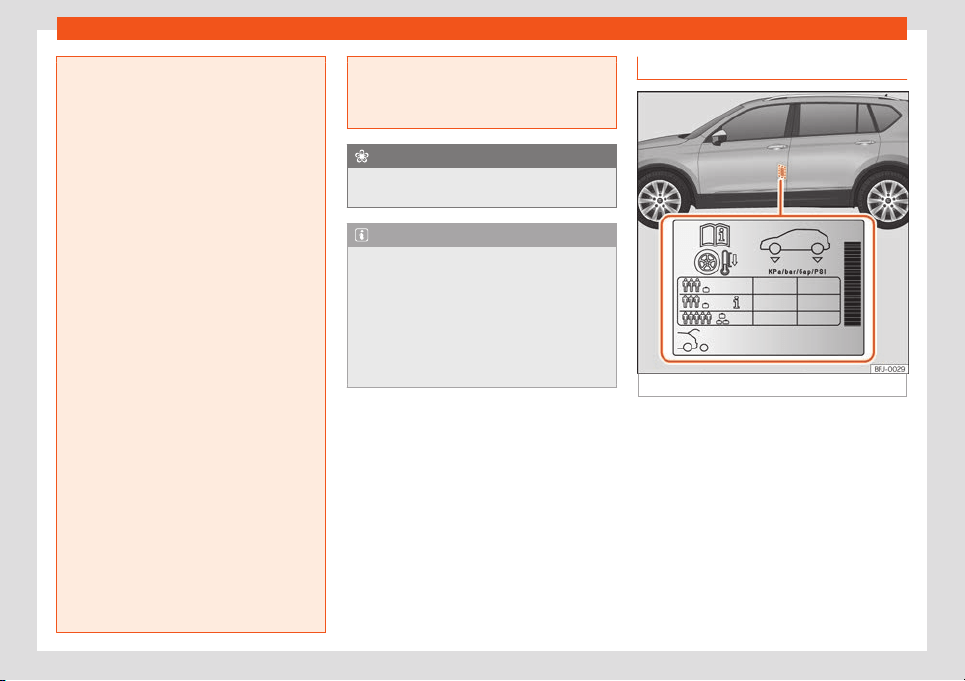
Wheels
●
Al
ways ensure that the tyres you have
chosen have adequate clearance. When
selecting replacement tyres, do not rely
entirely on the nominal tyre size marked on
the tyre, since the nominal tyre size can dif-
fer significantly depending on the manu-
facturer. Lack of clearance can damage
the tyres or the vehicle and, as a result, en-
danger road safety. Risk of accident!
●
Only use tyres that are over 6 years old in
an emergency, and drive with due care.
●
The fitting of tyres with run-flat proper-
ties is not permitted on your vehicle! Pro-
hibited use can cause accidents or can
damage your vehicle.
●
If decorative hubcaps are subsequently
fitted, make sure that they allow enough air
in to cool the braking system. Risk of acci-
dent!
●
Models with aerodynamic wheel rims
and/or with bolt-on plastic elements (more
closed design) increase the likelihood of
ice and snow accumulating on the inside.
This should be taken into account, depend-
ing on the driving situations, as snow or ice
accumulated in the wheels can cause vi-
bration in the vehicle when it drives at over
40 km/h. It is advisable to remove ice and
snow from the inside of the wheels using
hot water.
●
If you drive on dirt or gravel tracks, the
likelihood of stones becoming trapped in-
side wheel rims with plastic elements in-
creases when driving at high speed or in a
sporty manner. If you see that there are
st
ones trapped between the aluminium
wheel rim and the insert, you can attempt
to remove them using pressurised water.
For the sake of the environment
Old tyres must be disposed of according to
the l
aws in the country concerned.
Note
●
A SEAT Service Centr
e should be consul-
ted to find out whether wheels or tyres of
different sizes to those originally fitted by
SEAT can be fitted, and to find out about
the combinations allowed between the
front axle (axle 1) and the rear axle (axle 2).
●
Never mount used tyres if you are not
sure of their “previous history”.
Tyre life
Fig. 253 Location of the tyre pressure sticker.
Correct inflation pressures and sensible driv-
ing habits will incr
ease the useful life of your
tyres.
●
Check tyre pressure at least once a month,
and also prior to any long trip.
●
The tyre pressure should only be checked
when the tyres are cold. Do not reduce the
pressure of warm tyres.
●
Adjust tyre pressure to the load being car-
ried by the vehicle
›››
Fig. 253.
●
In vehicles with a tyre pressure indicator,
save the modified tyre pressure
›››
page 359.
»
355
Practical tips
●
Av
oid fast cornering and hard acceleration.
●
Inspect the tyres for irregular wear from
time to time.
Tyre pressure
The tyre inflation pressures are listed on a
sticker on the rear of the front left door frame
›››
Fig. 253.
Insufficient or excessive pressure greatly re-
duces the useful life of the tyres and adverse-
ly affects vehicle performance and ride. Cor-
rect inflation pressures are very important,
especially at high speeds.
Depending on the vehicle, tyre pressure can
be adjusted to medium load to improve driv-
ing comfort (tyre pressure
›››
Fig. 253).
When driving with comfort tyre pressure fuel
consumption may increase slightly.
The tyre pressure must be adjusted accord-
ing to the load the vehicle is carrying. If the
vehicle is going to carry the maximum load,
the tyre pressure should be increased to the
maximum value indicated on the sticker
›››
Fig. 253.
Do not forget the spare wheel when checking
the tyre pressures: Keep this spare wheel in-
flated to the highest pressure required for the
road wheels.
In the case of a minimised temporary spare
wheel (), inflate to a pressure of 4.2 bar as in-
dicated on the tyre pressure label
›››
Fig. 253.
Driving style
Fast cornering, heavy acceleration and hard
braking (squealing tyres) all increase tyre
wear.
Wheel balance
The wheels on new vehicles are balanced.
However, certain circumstances may lead to
imbalance (run-out), which is detected as vi-
brations in the steering wheel.
Unbalanced wheels should be rebalanced,
as they otherwise cause excessive wear on
steering, suspension and tyres. A wheel must
also be rebalanced when a new tyre is fitted
or if a tyre is repaired.
Incorrect wheel alignment
Incorrect running gear alignment causes ex-
cessive tyre wear, impairing the safety of the
vehicle. If you notice excessive tyre wear, you
should check wheel alignment at a SEAT Of-
ficial Service.
WARNING
Unsuitable handling of the wheels and
t
yres may lead to sudden tyre pressure los-
ses, to tread separation or even to a blow-
out.
●
The driver is responsible for ensuring that
all of the vehicle tyres are correctly infla-
ted to the right pressure. The recommen-
ded tyre pressure is indicated on the label
›
››
Fig. 253.
●
Check tyre pressures regularly and en-
sure they are maintained at the pressures
indicated. Tyre pressure that is too low
could cause overheating, resulting in tread
detachment or even burst tyres.
●
When the tyres are cold, tyre pressure
should be that indicated on the label
›››
Fig. 253.
●
Regularly check the cold inflation pres-
sure of the tyres. If necessary, change the
tyre pressure of the vehicle tyres while they
are cold.
●
Regularly check your tyres for damage
and wear.
●
Never exceed the maximum permitted
speed or loads specified for the type of
tyre fitted on your vehicle.
For the sake of the environment
Under-inflated tyres will increase fuel con-
sumption.
356
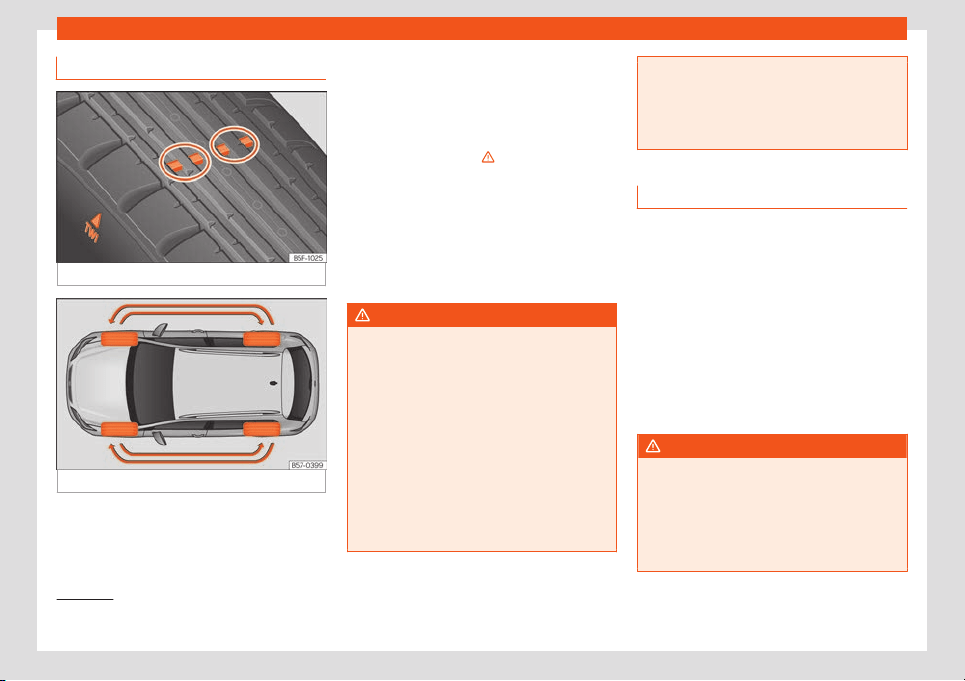
Wheels
Tread wear indicators
Fig. 254
Tyre profile: tread wear indicators.
Fig. 255
Interchanging tyres.
Wear indicators around 1.6 mm high can be
f
ound on the base of the original tyre treads,
ordered at regular intervals and running
across the tread
›››
Fig. 254. The letters "TWI"
or triangles on the sidewall of the tyre mark
the position of the wear indicators.
The minimum permitted profile depth
1)
have
been reached when the tyres have worn
down to the wear indicators. Replace the
tyres with new ones
›››
.
Changing wheel
s around
To ensure that the wear is equal on all tyres
the wheels should be changed round from
time to time according to the system
›››
Fig. 255. The useful life of all the tyres will
then be about the same time.
WARNING
The tyres must be replaced at the latest
when the tr
ead is worn down to the tread
wear indicators. Failure to follow this in-
struction could result in an accident.
●
Particularly in difficult driving conditions
such as wet or icy roads. It is important that
the tyre tread be as deep as possible and
be approximately the same on the tyres of
both the front and the rear axles.
●
The scant driving safety due to insuffi-
cient tread depth is particularly evident in
vehicle handling, when there is a risk of
“aquaplaning” in deep puddles of water
and when driving through corners, and
br
aking is also adversely affected.
●
The speed has to be adapted according-
ly, otherwise there is a risk of losing control
over the vehicle.
Wheel nuts
The wheel nuts ar
e matched to the rims.
When installing different wheels (for instance
alloy wheels or wheels with winter tyres) it is
important to use the correct wheel nuts with
the right length and correctly shaped bolt
heads. This ensures that wheels are fitted se-
curely and that the brake system functions
correctly.
The wheel nuts must be clean and turn easily.
A special adapter is required to remove the
anti-theft wheel bolts
›››
page 47.
WARNING
Wheel nuts should never be greased or
oil
ed.
●
Use only wheel nuts which belong to the
wheel.
●
If the prescribed torque of the wheel nuts
is too low, they could loosen whilst the
»
1)
Follow the regulations of the country you are
driving in.
357
Practical tips
vehicle is in motion. Risk of accident! If the
tight
ening torque is too high, the wheel nuts
and threads can be damaged.
CAUTION
See
›
››
page 50 to find out the recommen-
ded tightening torque for wheel nuts for
steel and alloy rims.
Winter tyres
–
Winter tyres must be fitted on all f
our
wheels.
–
Only use winter tyres that are approved for
your vehicle.
–
Please note that the maximum permissible
speed for winter tyres may be lower than
for summer tyres.
–
Also note that winter tyres are no longer ef-
fective when the tread is worn down.
–
After fitting the wheels you must always
check the tyre pressures. When doing so,
take into account the correct tyre pressures
listed on the rear of the front left door frame
›››
page 355.
In winter road conditions winter tyres will con-
siderably improve vehicle handling. The de-
sign of summer tyres (width, rubber com-
pound, tread pattern) gives less grip on ice
and snow. This applies particularly to vehicles
equipped with wide section tyres or with
high speed tyres (code letters H, V or Y on
the sidewall).
Only use winter tyres of the correct type ap-
proved for your vehicle. The sizes of these
tyres are specified in the vehicle's documents
(e.g. EC Certificate of Conformity or COC
1)
).
The vehicle documentation varies depending
on the country of residence.
Winter tyres lose a great deal of their proper-
ties when the tread is worn down to a depth
of 4 mm.
The performance of winter tyres is also se-
verely impaired by ageing, even if the tread is
still much deeper than 4 mm.
A code letter indicating the speed limit is
stamped on all winter tyres
›››
page 353.
Vehicles capable of exceeding these speeds
must have an appropriate sticker attached
so that it is visible to the driver. Suitable stick-
ers are available from the SEAT Official Serv-
ice and specialised workshop. Please note
the regulations to this effect in your country.
“All-weather” tyres can also be used instead
of winter tyres.
Using winter tyres with V-rating
Please note that the generally applicable
240 km/h (149 mph) speed for winter tyres
with the letter V is subject to technical re-
strictions; the maximum permissible speed
for your vehicle may be significantly lower.
The maximum speed limit for these tyres de-
pends directly on the maximum axle weights
for your car and on the listed weight rating of
the tyres being used.
It is best to contact a SEAT Official Service to
check the maximum speed which is permissi-
ble for the V-rated tyres fitted on your car on
the basis of this information.
WARNING
Exceeding the maximum speed permitted
f
or the winter tyres fitted on your car can
cause tyre failure, resulting in a loss of con-
trol of the vehicle – risk of accident.
For the sake of the environment
When winter is over, change back to sum-
mer t
yres at an appropriate moment. In
temperatures above +7°C (+45°F), perform-
ance will be improved if summer tyres are
used. Fuel consumption, wear and noises
while driving will all be reduced.
1)
COC = certificat
e of conformity.
358
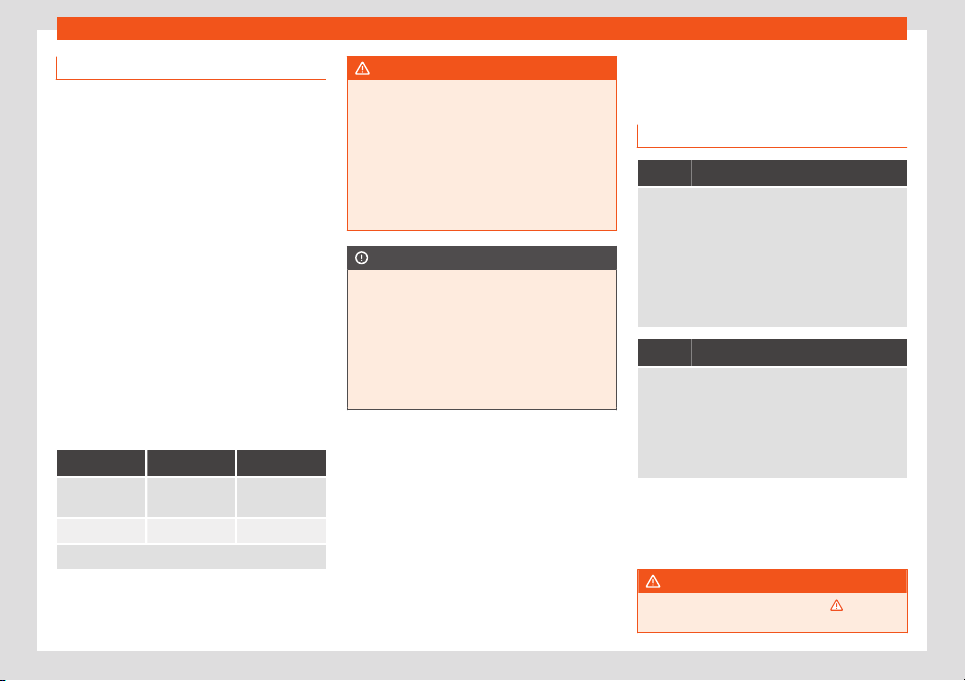
Wheels
Snow chains
Snow chains must only be fitted t
o the front
wheels, even on vehicles with four-wheel
drive.
●
Check that they are correctly seated after
driving for a few yards; correct the position if
necessary, in accordance with the manufac-
turer's fitting instructions.
●
Keep your speed below 50 km/h (30 mph).
●
If there is a danger of being trapped de-
spite having mounted the chains, it is best to
disable the driving wheels (ASR) in the ESC
›››
page 280, Connecting and disconnect-
ing the ESC and ASR.
Snow chains will improve braking ability as
well as traction in winter conditions.
For technical reasons snow chains may only
be used with the following wheel rim/tyre
combination.
Tyres Wheel rim Chains
215/65 R17 6.5x17 ET38
Max. link 13.5
mm
215/65 R17 7x17 ET40 Max. link 9 mm
Other dimensions do not allow chains
Remove any central wheel trims before fitting
sno
w chains.
WARNING
The use of unsuitable or incorrectly fitted
chains coul
d lead to serious accidents and
damage.
●
Always the appropriate snow chains.
●
Observe the fitting instructions provided
by the snow chain manufacturer.
●
Never exceed the maximum permitted
speeds when driving with snow chains.
CAUTION
●
R
emove the snow chains to drive on
roads without snow. Otherwise they will im-
pair vehicle handling, damage the tyres
and wear out very quickly.
●
Wheel rims may be damaged or scratch-
ed if the chains come into direct contact
with them. SEAT recommends the use of
covered snow chains.
Tyre pressure monitor sys-
t
em
Control lamp
It lights up
The inflation pressure of one or more wheels is much
lower than the value set by the driver, or the tyre has
structural damage.
In addition, a audible warning sounds and a text
message is displayed on the instrument panel
screen.
Stop the vehicle! Stop the vehicle safely as soon
as possible. Check all tyres and pressures. Replace
any damaged tyres.
Flashes
System fault
The control lamp flashes for approximately 1 minute
and then lights up permanently.
If the tyre is inflated correctly, switch the ignition off
and on again. Re-calibrate the tyre pressure monitor
indicator
›››
page 360. If the fault continues, go to a
specialised workshop.
Several control and warning lamps light up
f
or a few seconds when the ignition is switch-
ed on while the function is verified. They will
switch off after a few seconds.
WARNING
Observe the safety warnings
›
››
in Con-
tr
ol and warning lamps on page 86.
359
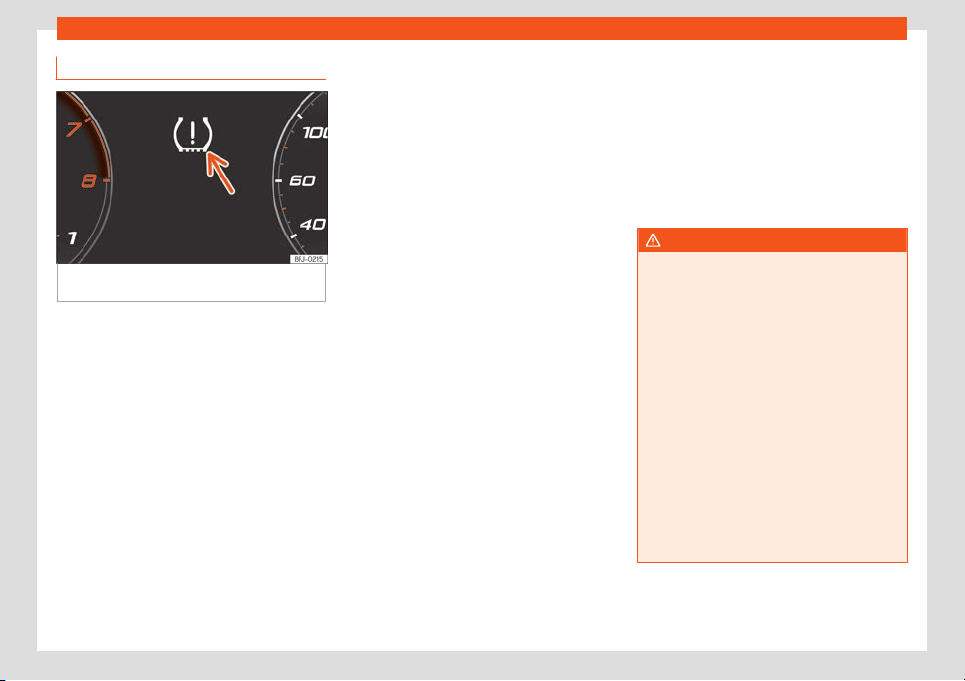
Practical tips
Tyre pressure monitor system
Fig. 256
Instrument panel: warning of loss of
t
yre pressure.
The tyre pressure monitoring system com-
par
es the individual speeds of each wheel
and thus the dynamic radius with the help of
the ABS sensors.
If the rolling circumference of one or more
wheels has changed, the tyre pressure moni-
toring indicator will indicate this on the instru-
ment panel through a warning lamp and a
warning to the driver
›››
Fig. 256. When only
one specific tyre is affected, its position within
the vehicle will be indicated.
Loss of pressure: Check left
tyre pressure!
Wheel tread change
The wheel diameter changes when:
●
Tyre pressure is changed manually.
●
Tyre pressure is insufficient.
●
The tyre structure is damaged.
●
The vehicle is unbalanced because of a
load.
●
The wheels on an axle are subject to a
heavier load (e.g. with a heavy load).
●
The vehicle is fitted with snow chains.
●
The temporary spare wheel is fitted.
●
The wheel on one axle is changed.
There may be a delay in the reaction of the
tyre pressure monitoring indicator or it may
not indicate anything under certain circum-
stances (e.g. sporty driving, snow-covered or
unpaved roads, or when driving with snow
chains).
Calibrate the tyre pressure monitoring in-
dicator
After changing the tyre pressure or replacing
one or more wheels, the tyre pressure moni-
toring indicator must be recalibrated. Do the
same, for example, when the front and rear
wheels are swapped.
●
Switch the ignition on.
●
Save the new inflation pressure in the Info-
tainment system: function button > Vehi-
cle status > Tyres; OR: > Exterior
settings > Tyres
›››
page 90 .
When driving, the system self-calibrates the
tyre pressure provided by the driver and the
wheels fitted. After a long journey with varied
speeds the programmed values are collected
and monitored.
With the wheels under very heavy loads, the
tyre pressure must be increased to the total
recommended tyre pressure before calibra-
tion
›››
Fig. 253.
WARNING
When the tyres are inflated at different
pr
essures or at a pressure that is too low
then a tyre may be damaged resulting in a
loss of control of the vehicle and a serious
or fatal accident.
●
If the lamp lights up, reduce speed im-
mediately and avoid any sudden turning or
braking manoeuvre. Stop when possible,
and check the tyre pressure and status.
●
The tyre pressure monitoring system can
only operate correctly if all of the tyres are
inflated to the correct pressure when cold.
●
If a tyre has not been punctured and it
does not have to be changed immediately,
drive to the nearest specialised workshop
at a moderate speed and have the tyre
checked and inflated to the correct pres-
sure.
360
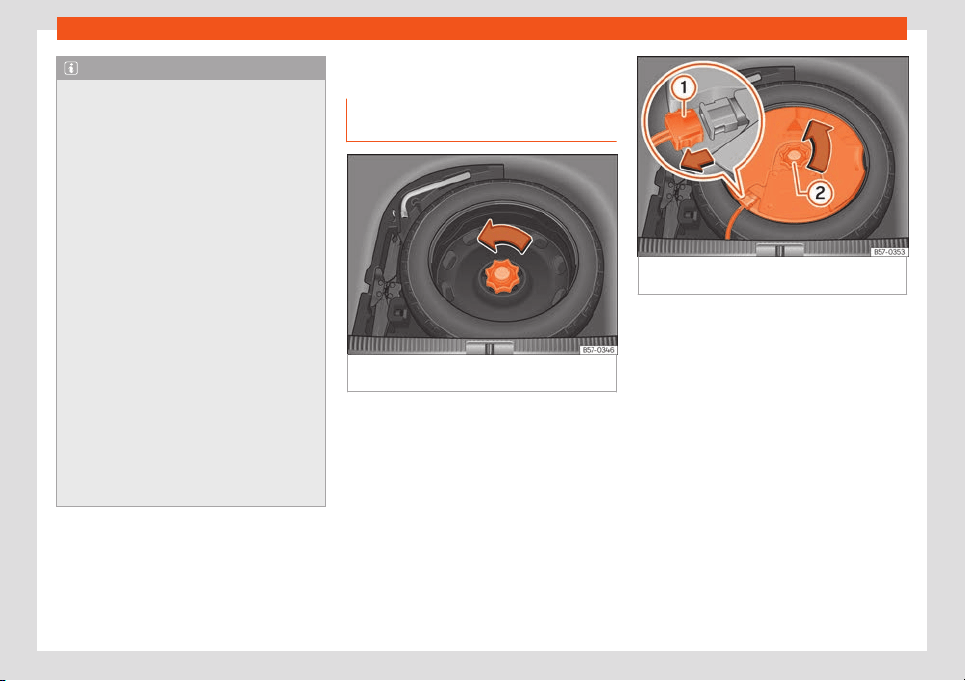
Wheels
Note
●
Driving f
or the first time with new tyres at
a high speed can cause them to slightly ex-
pand, which could then produce an air
pressure warning.
●
If excessively low tyre pressure is detec-
ted with the ignition on, an audible warning
will sound. In the event that there is a fault
in the system, an audible warning will
sound.
●
Driving on dirt tracks for a long period of
time or driving in a sporty style can tempo-
rarily deactivate the TPMS. The control
lamp shows a fault, but disappears when
road conditions or the driving style change.
●
Do not only rely on the tyre pressure
monitoring system. Regularly check your
tyres to ensure that the tyre pressure is cor-
rect and that the tyres are not damaged
due to puncture, cuts, tears and im-
pacts/dents. Remove objects from the
tyres only when they have not pierced the
tyres.
●
The tyre pressure monitoring indicator
does not function when there is a fault in
the ESC or ABS
›››
page 278.
Spare wheel
L
ocation and use of the temporary
spare wheel
Fig. 257
In the luggage compartment: load
fl
oor raised.
Fig. 258
In the luggage compartment: remove
the sub
woofer.
The temporary spare wheel is stored under
the fl
oor panel in the luggage compartment
and is attached by a thumbnut.
The temporary spare wheel has been de-
signed to be used for short periods of time.
Have the tyres checked and replaced as
soon as possible at a SEAT Official Service or
at a specialised workshop.
The spare wheel must not be switched for a
spare wheel from another vehicle.
Removing the temporary spare wheel (5-
seat vehicles)
●
Lift and hold up the floor panel to remove
the temporary spare wheel
›››
page 143.
●
Turn the thumb wheel anti-clockwise
›››
Fig. 257.
»
361
Practical tips
●
T
ake out the temporary spare wheel.
Removing the temporary spare wheel (7-
seat vehicles)
●
Remove the luggage compartment floor.
●
Pull up on the bottom, side cords of the 3rd
row of seats until latching in the upper posi-
tion.
●
Remove the transversal side wall.
●
Turn the thumb wheel anticlockwise
›››
Fig. 257
1)
.
●
Take out the temporary spare wheel.
●
To put the temporary spare wheel back in
place, proceed in the reverse order.
Getting the spare wheel out of vehicles
with BEATS Audio 10 speakers (with sub-
woofer)
To remove the spare wheel, you must first re-
move the subwoofer.
●
Lift and secure the luggage compartment
floor as explained in
›››
page 143.
●
Disconnect the subwoofer
›››
Fig. 258
1
speaker cable.
●
T
urn the securing wheel in an anti-clock-
wise direction
›››
Fig. 258
2
.
●
Remove the sub
woofer speaker and the
spare wheel.
●
When re-mounting the spare tyre, place the
subwoofer on the base of the wheel rim with
care. When doing so, the tip of the “FRONT”
arrow on the subwoofer should point forward.
●
Reconnect the speaker cable and firmly ro-
tate the securing wheel clockwise so that the
subwoofer system and wheel are firmly in
place.
Chains
For technical reasons, snow chains must not
be used on the temporary spare wheel.
If you have a puncture on one of the front
wheels when using snow chains, fit the tem-
porary spare wheel in place of one of the rear
wheels. Fit the snow chains on the rear wheel
that you have removed and replace the
punctured front wheel with this wheel.
WARNING
Keep in mind that the standard wheel is
wider than the emer
gency spare wheel, so
the 3rd row of seats cannot be completely
l
owered when that standard wheel is
placed in the emergency spare wheel well.
●
Do not drive if the 3rd row of seats is not
correctly fastened by the anchors. Risk of
serious injury.
WARNING
●
Aft
er fitting the temporary spare wheel,
check the tyre pressures as soon as possi-
ble. Failure to do so may cause an acci-
dent. The tyre pressure is listed on the back
of the left front door frame
›››
Fig. 253.
●
Do not drive at over 80 km/h (50 mph)
when the temporary spare wheel is fitted
on the vehicle: risk of accident!
●
Never travel more than 200 km using a
temporary spare wheel.
●
Avoid heavy acceleration, hard braking
and fast cornering: risk of accident!
●
Never use more than one temporary
spare wheel at the same time, risk of acci-
dent.
●
No other type of tyre (normal summer or
winter tyre) may be fitted on the compact
temporary spare wheel rim.
1)
If the vehicle is equipped with the Beats Audio
syst
em with a subwoofer, before removing the
spare wheel, proceed as instructed in
›››
page 362.
362

Wheels
●
If you ar
e driving using the spare wheel,
the ACC system could automatically
switch off during the journey. Switch off the
system when starting off.
363
Maintenance
Maintenance
SEAT Maint
enance Pro-
gramme
Service intervals
Service work and the Digital Main-
tenance Plan
Log of services performed (“Digital Main-
t
enance Plan”)
The SEAT dealership or a specialised work-
shop records Service receipts in a central
system. Thanks to this comprehensive docu-
mentation of the service history, it is possible
to reproduce the services performed any
time. SEAT recommends requesting a Service
receipt after every service carried out con-
taining all the services carried out on the sys-
tem.
Whenever there is a new service the receipt is
replaced with a current one.
The Digital Maintenance Plan is not avail-
able in some markets. In this case, your
SEAT dealer will inform you about the cur-
rent documentation of the work.
Service works
In the Digital Maintenance Plan, your SEAT
authorised service or specialised workshop
documents the following information:
●
When each one of the services was carried
out.
●
Whether a specific repair has been sugges-
ted, e.g. changing the brake pads in the near
future.
●
If you have expressed a special request for
the maintenance. Your Service Advisor will
write the work order.
●
The components or fluids that were
changed.
●
The date of the next service.
The Long Life Mobility Warranty is valid until
the next inspection. This information is docu-
mented in all checks performed.
The type and the volume of the service may
vary from one vehicle to another. A special-
ised workshop will be able to provide specific
information on the jobs for your vehicle.
WARNING
If the services are insufficient or not per-
f
ormed and if the service intervals are not
observed, the vehicle may be immobilised
in traffic cause an accident and severe in-
juries.
●
Mak
e sure that any repairs are carried
out by a SEAT authorised service or speci-
alised workshop.
CAUTION
SEAT cannot be held liable for any damage
t
o the vehicle due to insufficient work or of
lack of availability of spare parts.
Note
Regular services on the vehicle not only
maint
ain its value, but also its correct oper-
ation and road safety. For this reason, con-
duct the services in accordance with SEAT
guidelines.
Set Service or Flexible Service In-
t
ervals
Services are classified as oil change service
and inspection. The service int
erval display
on the instrument panel display serves as a
reminder of the next service.
Depending on the features, the engine and
the conditions of use of the car, either the
Fixed service or the Flexible service will be
applied for an oil change service..
364
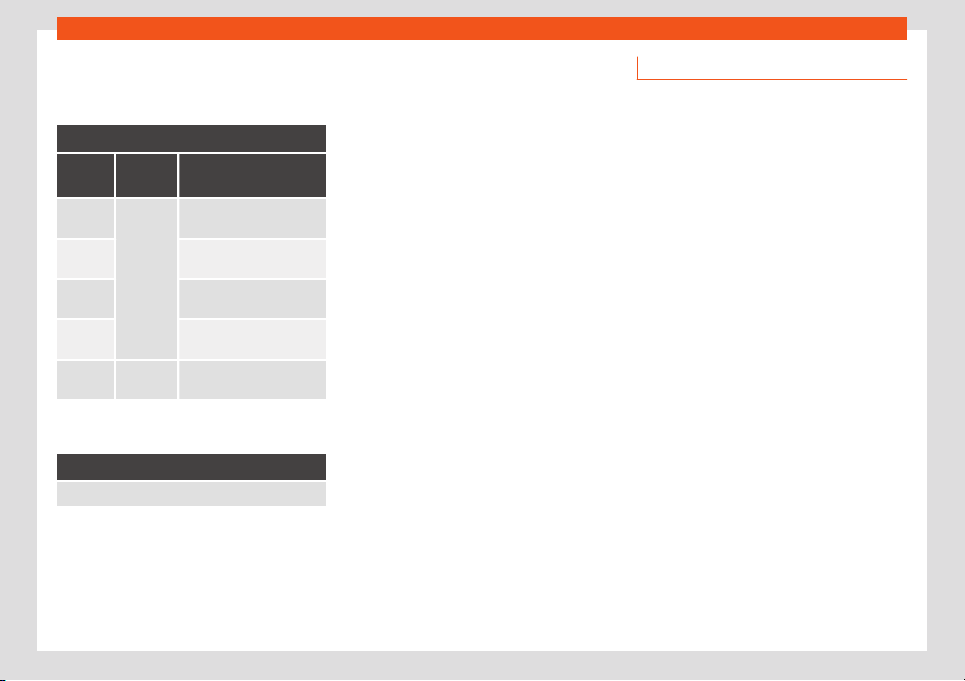
SEAT Maintenance Programme
How to know which type of service needs
t
o his vehicle
●
Check the tables below:
Oil change service
a)
PR No.
Type of
service
Service interval
QI1
Fixed
Every 5000 km or after
1 year
b)
QI2
Every 7500 km or aft
er
1 year
b)
QI3
Every 10000 km or aft
er
1 year
b)
QI4
Every 15000 km or aft
er
1 year
b)
QI6 Flexible
According to the service in-
t
erval display
a)
The data are based on normal conditions of use.
b)
Whatever happens first.
Inspection Service
a)
According to the service interval display
a)
The data are based on normal conditions of use.
P
articular characteristics of the Flexible
Service
Regarding the Flexible Service, the oil
change service only has to be performed
when the vehicle needs it. To calculate when
you have to carry out this service, take into
account the individual conditions of use and
personal driving style. A major component of
the flexible service the use of LongLife oil in-
stead of conventional engine oil.
Bear in mind the information about the speci-
fications of the engine oil according to the
VW standard
›››
page 340.
If you do not want to the flexible service
you can select the fixed service However,
a fixed service may affect service costs
The Service Advisor will gladly advise you.
Service interval display
At SEAT, the dates of the services are indica-
ted by the service intervals display:
●
on the instrument panel
›››
page 82
●
in the infotainment system: menu > Set-
tings > Service; OR > Vehicle status >
Service
›››
page 87.
The service interval display gives information
for service dates that involve an engine oil
change or an inspection. When the time for
the corresponding service comes, additional
work required, such as the change of brake
fluid and the spark plugs, can be carried out.
Information about the terms of use
The service intervals and groups are usually
based on normal conditions of use.
If
, on the other hand, the vehicle is under ad-
verse conditions of use, some of the work
must be carried out before the next service
period or even between service intervals.
Conditions of use adverse include:
●
The use of fuel with a high sulphur content.
●
Frequent short trips.
●
Letting the engine idle for a long period of
time
, as in the case of taxis.
●
Using the vehicle in areas with thick dust.
●
Frequent driving with a trailer (depending
on equipment).
●
Using the vehicle mostly in situations with a
lot of traffic and stops (e.g. in a city).
●
Using the vehicle mostly in winter.
This applies especially for the following
parts (depending on equipment):
●
Dust and pollen filter
●
Air Care allergen filter
●
Air filter
●
Toothed chain
●
Particulate filter
●
Engine oil
»
365
Maintenance
The Service Advisor of your specialised
w
orkshop will gladly inform you about the
need of performing service work between
normal service intervals, always considering
the conditions of use of your vehicle.
WARNING
If the services are insufficient or not per-
f
ormed and if the service intervals are not
observed, the vehicle may be immobilised
in traffic and cause accidents and severe
injuries.
●
Have the services conducted at author-
ised SEAT services or specialised work-
shops.
CAUTION
SEAT cannot be held liable for any damage
t
o the vehicle due to insufficient work or of
lack of availability of spare parts.
Service sets
Sets of services include all the maint
enance
works needed to ensure the safety and the
smooth running of the vehicle (depending on
the conditions of use and the features of
the vehicle, such as the engine, gearbox, or
operating fluids). Maintenance services are
divided into inspection and review services.
Consult the details of the jobs required for
your vehicle at:
●
Your SEAT authorised service
●
Your specialised workshop
Due to technical reasons (continuous devel-
opment of components) the sets of services
may vary. Your SEAT authorised service or
specialised workshop is always receiving up-
dates in time.
Additional service offers
Approved spare parts
Original SEAT Spare Parts have been con-
ceiv
ed for their vehicles and approved by
SEAT, with a special emphasis on safety.
These parts correspond exactly to the manu-
facturer's requirements in terms of design,
accuracy of the measurements and materi-
als. The original SEAT Spare Parts have been
conceived exclusively for your vehicle. For this
reason, we always recommend the use of
Original SEAT Spare Parts. SEAT cannot be
held liable for the safety and suitability of
parts from other manufacturers.
Approved spare parts
Approved spare parts, following the manu-
f
acturer's requirements, are an additional
service to you, offering the possibility of re-
placing complete sets, such as: light engine,
gearboxes, heads, control units, electrical
components, etc.
These parts are, approved parts, and are the
same as the factory parts, which are also ap-
proved spare parts.
Original accessories
We recommend you only use SEAT Original
Accessories and SEAT appr
oved accessories
for your vehicle. The reliability, safety and
suitability of these accessories have been in-
spected specifically for this type of vehicle.
SEAT cannot be held liable for the safety and
suitability of parts from other manufacturers.
SEAT Service Mobility
Since the moment you purchase your SEAT
v
ehicle you will be able to enjoy the benefits
and coverage of the SEAT Mobility Service.
For the first two years after the purchase,
your new SEAT vehicle is automatically cov-
ered by the SEAT Mobility Service without ad-
ditional costs.
If you wish to enjoy this service after this peri-
od, you can extend SEAT Mobility as long as
you carry out the recommended Inspection
366
Vehicle maintenance
and Maintenance Services at a SEAT Author-
ised Service
.
If your SEAT vehicle is immobilised due to a
fault or an accident, our assistance services
will help you keep moving.
Take into account that the SEAT Mobility
Service differs depending on the country in
which the vehicle was purchased. For further
information ask your SEAT dealership or the
SEAT website in your country.
Warranty
Fault-free operation warranty
SEAT Authorised Services ensure the perfect
condition of ne
w vehicles. Check the pur-
chase agreement or complementary addi-
tional documentation provided by your Tech-
nical Service to see the conditions and the
terms of the warranty. Consult further infor-
mation in this regard in your SEAT Official
Service.
Commercial warranty for the high-
voltage battery of electric and hy-
brid vehicles of SEAT S.A.
1. Compl
ementing the aforementioned war-
ranties, the seller SEAT dealer grants the
high-voltage batteries of the vehicles that it
has sold an 8-year or 160,000-km warranty,
whichever comes first, for any material or fin-
ish defect.
2. The reduction in battery capacity over time
depends on the component itself and is not a
defect from a warranty perspective.
3. The warranty for high-voltage batteries will
be invalidated when the defect is due to use,
handling or maintenance not in accordance
with the content of the instruction manual.
This is particularly applicable the battery
charge.
4. In addition, except for the duration of the
warranty, all conditions relating to the legal
warranty of the SEAT dealer (requirements,
criteria for assessing the absence of defects,
exclusion grounds, processing of entitlements
to benefits, entry into force, start and scope
of the warranty validity period, etc.) shall ap-
ply in relation to the high-voltage battery.
Vehicle maintenance
Maint
enance and cleaning
Basic observations
Regular and careful care helps to maintain
the v
alue of your vehicle. In addition, it may
become a prerequisite to demand the war-
ranty in the event of corrosion damage and
deficiencies in the paint coat of the body-
work.
Specialised workshops have the necessary
care products. Please follow the instructions
for application on the packaging.
WARNING
●
Cl
eaning products and other materials
used for car care can be damaging to your
health if misused.
●
Always keep care products in a safe
place, out of the reach of children. Danger
of poisoning!
For the sake of the environment
●
When pur
chasing car care products,
chose products that are compatible with
the environment.
●
The waste from car-care products should
not be disposed of with ordinary household
waste.
367
Maintenance
Washing the vehicle
The longer you take to clean the tanks, e.g.
r
emains of insects, bird excrements, tree resin
or anti frost salt adhered to your vehicle, the
more damage it can cause to the surface.
High temperatures, for instance strong sun-
light, further intensify the damage.
Before washing the car, soften the dirt using
plenty of water.
To remove encrusted dirt such as insects, bird
droppings or tree resin, use a lot of water and
a microfibre cloth.
Have the underside of the vehicle washed af-
ter the end of the anti frost salts in winter.
High pressure cleaning equipment
When washing the vehicle with a high-pres-
sure cleaner, always follow the operating in-
structions for the equipment. This applies
particularly to the operating pressure and the
distance between the spraying water. Do not
aim the jet directly to the side window gas-
kets, doors, covers or the panoramic sunroof;
the same applies to tyres, rubber hoses,
soundproofing material, sensors or camera
lenses. Keep a distance of at least 40 cm.
Do not remove snow and ice with a high-
pressure cleaner.
Do not use a nozzle that sprays the water out
in a dir
ect stream or one that has a rotating
jet for forcing off dirt.
The water temperature must not exceed
60°C.
Automatic car washes
Spray the vehicle before starting the car
wash.
Make sure that the windows and the panor-
amic sunroof are closed and the windscreen
wipers are deactivated. Bear in mind the in-
structions of the car wash tunnel operator,
especially if your vehicle has detachable
parts.
Use of car washes without brushes if possible.
Washing by hand
Clean your vehicle from top to bottom with a
soft sponge or with a brush. Only use clean-
ing products that do not contain solvents.
Washing vehicles with a matte paint by
hand
To prevent damage to the vehicle when
washing it, first remove the thicker dust and
dirt. To remove traces of insects, grease and
fingerprints, it is best to use a special cleaner
for matte paint.
Apply the product with a microfibre cloth. To
avoid damaging the surface of the paint, do
not apply too much pressure.
Rinse with plenty of water. Then clean it with
a neutral cleaning product and a soft microfi-
bre cloth.
Rinse the vehicle again with plenty of water
and then leave it to dry. Remove traces of
water with a leather cloth.
WARNING
●
Only w
ash the vehicle with the ignition
switched off or according to the specifica-
tions of the car wash tunnel operator. Risk
of accident!
●
When cleaning the underbody or the in-
side of the wheel arches, protect yourself
from sharp or pointy metal parts. Risk of
cut!
●
After cleaning the brakes could act more
slowly due to moisture or, in winter, the ice
on the brake discs and pads. Risk of acci-
dent! In this case the brakes should be
dried by pressing the brake pedal several
times.
CAUTION
●
Bef
ore washing the vehicle in an auto-
matic car wash, please make sure to re-
tract the exterior mirrors to prevent them
368
Vehicle maintenance
from being damaged. Electric exterior rear-
vie
w mirrors must always be folded/de-
ployed electrically!
●
Do not wash the vehicle in direct sunlight.
Risk of damaging the paint job!
●
Do not use sponges, abrasive household
sponges or similar to clean insect remains.
Risk of damaging the surface!
●
Vehicle parts with matte paint:
–
Do not use polish or hard wax. Risk of
damaging the surface!
–
Never select washing programs that in-
clude the use of wax. This could dam-
age the appearance of matte paint.
–
Do not put stickers or magnets on parts
with matte paint, as removing them
may damage the paint.
For the sake of the environment
The car should only be washed in special
w
ash bays. These places are prepared to
prevent oily water from getting into the
public drains.
Cleaning and maintenance instruc-
tions
The cleaning and maintenance of individual
components of the v
ehicle can be checked in
the following tables. The contents should be
understood merely as a recommendation. Go
to your specialised workshop if you have spe-
cial questions or parts that are not listed. Take
he general considerations into account
›››
in Take special care with... on page 372.
Cleaning the exterior
Windscreen wipers
Problem Solution
Dirt Soft cloth with wipers
Headlights / Tail lights
Problem Solution
Dirt Soft sponge with neutral soap
solution
a)
a)
Neutral soap solution: two tablespoons maximum in
1 litr
e of water
Sensors / Camera lenses
Problem Solution
Dirt
Sensors: soft cl
oth with a sol-
vent-free cleaning product
Camera lenses: soft cloth with
an alcohol-free cleaning prod-
uct
Snow/ice
Hand brush/Anti frost spray
with no sol
vents
Wheels
Problem Solution
Antifreeze salt Water
Brake abrasion
dust
Acid-free special cleaning
product
End exhausts
Problem Solution
Antifreeze salt Water, if a steel cleaning prod-
uct is r
equired
Covers / Trims
Problem Solution
Dirt Neutral soap solution
a)
, if a
st
eel cleaning product is re-
quired
a)
Neutral soap solution: two tablespoons maximum in
1 litr
e of water
Paint
Problem Solution
Paint flaws
Check the paint's colour code
in an authorised service and r
e-
store with a touch-up pencil
Spilled fuel Immediately rinse with water
Environmental rust
t
ank
Apply rust remover and then
apply har
d wax. Go you your
specialised workshop if you
have any queries
»
369

Maintenance
Problem Solution
Corrosion
Have your specialised work-
shop t
ake care of this
The water does
not cr
eate drop-
lets on the clean
paint
Maintain with hard wax (at
l
east 2 times a year)
No shine de-
spit
e sober main-
tenance/paint
Treat with suitable wax and ap-
ply paint pr
eservative after-
wards if the wax used does not
contain preservative ingredi-
ents
Tanks, e.g. insect
r
emains, bird
droppings, tree
sap, road salt
Immediately soften with water
and remove with a microfibre
cloth
Fat-based dirt,
e.g. cosmetic
products or
sunscreen
Delete immediately with a neu-
tral soap solution
a)
and a soft
cloth
a)
Neutral soap solution: two tablespoons maximum in
1 litr
e of water
Carbon fibre parts
Problem Solution
Dirt Clean the same way as pain-
t
ed parts
›››
page 368
Decoration slides
Problem Solution
Dirt Soft sponge with neutral soap
solution
a)
a)
Neutral soap solution: two tablespoons maximum in
1 litr
e of water
Interior cleaning
Windows
Problem Solution
Dirt Apply windscreen cleaner and
then dry with a cl
oth
Covers / Trims
Problem Solution
Dirt Neutral soap solution
a)
a)
Neutral soap solution: two tablespoons maximum in
1 litr
e of water
Plastic parts
Problem Solution
Dirt Damp cloth
Encrusted dirt Neutral soap solution
a)
, if pos-
sible solvent-free plastic clean-
er
a)
Neutral soap solution: two tablespoons maximum in
1 litr
e of water
Displays/instrument panel
Problem Solution
Dirt Soft cloth with a liquid crystal
displ
ay cleaner
Control panels
Problem Solution
Dirt Soft brush, then soft cloth with
neutr
al soap solution
a)
a)
Neutral soap solution: two tablespoons maximum in
1 litr
e of water
Seat belts
Problem Solution
Dirt Neutral soap solution
a)
, al
-
lowed to dry before retracting
a)
Neutral soap solution: two tablespoons maximum in
1 litr
e of water
Fabrics, artificial, Alcantara leather
Problem Solution
Particles of dirt
st
uck to surfaces
Vacuum cleaner
Water-based dirt,
e
.g. coffee, tea,
blood etc.
Absorbent cloth and neutral
soap solution
a)
370

Vehicle maintenance
Problem Solution
Grease-based
dirt, e
.g. oil, make-
up, etc.
Apply a neutral soap solution
a)
.
Absorb the dissolved grease
and paint particles drying with
an absorbent cloth, in case you
must treat it with water after-
wards
Special dirt, e.g.
pens, nail polish,
dispersion paint,
shoe cr
eam etc.
Special stain remove: dry with
an absorbent cloth, if applica-
ble, apply neutral soap solution
afterwards
a)
a)
Neutral soap solution: two tablespoons maximum in
1 litr
e of water
Natural leather
Problem Solution
Recent dirt Cotton cloth with neutral soap
solution
a)
Water-based dirt,
e.g. coffee, tea,
blood etc.
Recent stains: absorbent cloth
Dry stains: stain remover suita-
ble for leather
Grease-based
dirt, e
.g. oil, make-
up, etc.
Recent stains: absorbent cloth
and suitable stain remover for
leather
Dry stains: grease solvent
spray
Special dirt, e.g.
pens, nail polish,
dispersion paint,
shoe cr
eam etc.
Stain remover suitable for
leather
Problem Solution
Care Apply preservative cream regu-
l
arly to protect from sunlight.
Use a colour preservative if re-
quired
a)
Neutral soap solution: two tablespoons maximum in
1 litr
e of water
Carbon fibre parts
Problem Solution
Dirt Clean like plastic parts
Take special care with...
Headlights/tail lights
●
Do not clean the headlights/tail lights with
a dry cl
oth or sponge.
●
Do not use cleaning products that contain
alcohol. Risk of cracks!
Wheels
●
Do not use for paint wax or other abrasive
products.
●
If the protective coating on the paint of the
rim has been damaged due to stone impacts,
scratches, etc., the damage should be re-
paired immediately.
Camera lenses
●
Do not use hot or warm water to remove ice
or snow from the camera lenses. Risk of
cracking the lens!
●
To clean the camera lens, never use abra-
sive cleaning products or products with alco-
hol. Risk of scratches and cracks!
Windows
●
Remove snow and ice from windows and
exterior mirrors with a plastic scraper only. To
avoid scratches, the scraper should only be
pushed in one direction and not moved to
and fro.
●
Never remove snow or ice from windows
and rearview mirrors with warm or hot water.
Risk of cracks on the windows!
●
To prevent damage to the heating of the
rear window, do not put stickers over the
heating elements.
Covers/trims
●
Do not use cleaning products or chrome
based cleaning agents.
Paint
●
The vehicle must be free from dirt and dust
before applying wax or care products. Risk of
scratches!
●
Do not apply wax or care products if the
vehicle is exposed to direct sunlight. Risk of
damaging the paint job!
»
371
Maintenance
●
The ambient rust deposits must not be r
e-
moved through friction. Risk of damaging the
paint job!
●
Remove cosmetic products and sunlight
immediately. Risk of damaging the paint job!
Displays/instrument panel
●
The screens, the instrument panel and the
trim around it must not be cleaned dry. Risk of
scratches!
●
Make sure that the instrument panel is
switched off and cooled down before clean-
ing.
●
Make sure that no liquid leaks between the
instrument panel and the trim. Risk of dam-
age!
Control panels
●
Make sure that no liquid leaks into the con-
trol panels. Risk of damage!
Seat belts
●
Do not remove the seat belts to clean them.
●
Seat belts and their components must nev-
er be cleaned with chemical products, nor
should they be allowed to come into contact
with corrosive liquids, solvents or sharp ob-
jects. Risk of damaging the fabric!
●
If you find any damage to the belt webbing,
belt fittings, the belt retractor or the buckle,
ask your specialised workshop to replace the
belt in question.
Fabrics/artificial leather/Alcantara leath-
er
●
Do not treat artificial leather/Alcantara
leather with leather care products, solvents,
floor wax, shoe polish, stain removers or simi-
lar products.
●
If the stain is very hard to remove, take the
vehicle to a specialised workshop to have it
removed there. This will prevent damage.
●
Do not use steam cleaners, brushes, hard
sponges, etc. to clean.
●
Do not turn on seat heating to dry the
seats.
●
Sharp objects on clothing, such as zips, riv-
ets or belts can damage the surface.
●
Open Velcro, e.g. on clothes can damage
the seat upholstery. Make sure that Velcro
fasteners are closed.
Natural leather
●
Never use solvents, wax polish, shoe cream,
spot removers or similar products on leather.
●
Sharp objects on clothing, such as zips, riv-
ets or belts can damage the surface.
●
Do not use steam cleaners, brushes, hard
sponges, etc. to clean.
●
Do not turn on seat heating to dry the
seats.
●
Avoid exposing leather to direct sunlight for
long periods, otherwise it may tend to lose
some of its colour. If the car is left for a pro-
longed period in the bright sun, it is best to
cover the leather.
WARNING
Do not use water-repellent coatings on the
windscr
een. In bad visibility conditions
such as humid weather, darkness or when
the sun is in its lowest point, visibility may
be impacted. Risk of accident! Such coat-
ings can also cause the windscreen wiper
blades to make noise.
Note
●
R
emains of insects can be removed much
more easily with previously treated paint.
●
Regular car care treatments can prevent
deposits of ambient rust.
Remove the vehicle from traffic
If you want to leave your vehicle stationary
f
or a long period of time, contact a qualified
workshop. They will gladly inform you about
the necessary measures, such as anti-corro-
sion protection, Service and storage.
Also take into account the indications relating
to the vehicle’s battery
›››
page 318, Conser-
vation of the high-voltage bat-
tery,
›››
page 347, 12-volt battery.
372
Accessories and modifications to the vehicle
Accessories and modifi-
cations t
o the vehicle
Accessories, spare parts and
repair work
Introduction
Always ask your dealer or specialist retailer
f
or advice before purchasing accessories
and replacement parts.
Your vehicle is designed to offer a high stand-
ard of active and passive safety. For this rea-
son, we recommend that you ask a SEAT Offi-
cial Service for advice before fitting accesso-
ries or replacement parts. Your SEAT Official
Service has the latest information from the
manufacturer and can recommend accesso-
ries and replacement parts which are suita-
ble for your requirements. They can also an-
swer any questions you might have regarding
official regulations.
We recommend only using SEAT accesso-
ries and genuine SEAT parts®. SEAT has
tested these parts and accessories for suita-
bility, reliability and safety. SEAT Official
Services have the necessary experience and
facilities to ensure that the parts are installed
correctly and professionally.
Any r
etro-fitted equipment which has a di-
rect effect on the vehicle and/or the way it is
driven, such as a cruise control system or
electronically-controlled suspension, must
be approved for use in your vehicle and bear
the e mark (the European Union's authorisa-
tion symbol).
If any additional electrical devices are fit-
ted which do not serve to control the vehicle
itself (for instance a refrigerator box, laptop
or ventilator fan, etc.), they must bear the
sign (manufacturer conformity declaration in
the European Union).
WARNING
Accessories, for example telephone hold-
ers or cup hol
ders, should never be fitted
on the covers, or within the working range
of the airbags. Otherwise, there is a danger
of injury if the airbag is triggered in an acci-
dent.
Technical modifications
Unauthorised modifications to the electronic
components, softw
are, wiring or data transfer
in the vehicle may cause malfunctioning.
You will appreciate that your SEAT dealership
cannot be held liable for any damage
caused by modifications and/or work per-
formed incorrectly.
For this reason we recommend asking official
SEAT service centres to do any necessary
work using genuine SEAT parts®.
WARNING
Incorrectly performed modifications or
other w
ork on your vehicle can lead to mal-
functions and cause accidents.
Radio telephones and office equip-
ment
Radio transmitters (fixed installation)
Any r
etrofit installations of radio transmitters
in the vehicle require prior approval. SEAT
generally authorises in-vehicle installations
of approved types of radio transmitters provi-
ded that:
●
The antenna is installed correctly.
●
The aerial is installed on the exterior of the
vehicle (and shielded cables are used to-
gether with non-reflective aerial trimming).
●
The effective transmitting power does not
exceed 10 Watts at the aerial base.
A SEAT Official Service and specialised work-
shop will be able to inform you about options
for installing and operating radio transmitters
with a higher transmitting power.
»
373

Maintenance
Mobile radio transmitters
Commer
cial mobile telephones or radio
equipment might interfere with the electron-
ics of your vehicle and cause malfunctions.
This may be due to:
●
No external aerial.
●
External aerial incorrectly installed.
●
Transmitting power more than 10 W.
You must, therefore, do not operate portable
mobile telephones or radio equipment inside
the vehicle without a properly installed exter-
nal aerial
›››
.
Pl
ease note also that the maximum range of
the equipment can only be achieved with an
external aerial.
Business equipment
Retrofit installation of business or private
equipment in the vehicle is permitted, provi-
ded the equipment cannot interfere with the
driver's immediate control of the vehicle and
that any such equipment carries the mark.
Any retrofit equipment that could influence
the driver's control of the vehicle must have a
type approval for your vehicle and must carry
the e mark.
WARNING
Mobile telephones or radio equipment
which is oper
ated inside the vehicle without
a properly installed external aerial can
cr
eate excessive magnetic fields that
could cause a health hazard.
Note
●
The post
erior fitting of electric and elec-
tronic equipment in this vehicle affects its
licence and could lead to the withdrawal of
the vehicle registration document under
certain circumstances.
●
Please use the mobile telephone/radio
operating instructions.
374

Information for the user
Information for the user
Inf
ormation for the user
Information stored by the
control units
Storage of accident data (Event
Data Recorder)
Your vehicle has an event data recorder
(EDR).
The EDR’
s function is to record data in the
event of a mild or serious accident. These da-
ta are used to support the analysis of how dif-
ferent vehicle systems behaved.
The EDR records, over a reduced time range
(normally 10 seconds or less), dynamic driv-
ing data and data from the restraint systems,
such as:
●
How different vehicle systems worked.
●
Whether the driver and the occupants were
wearing their seat belts.
●
How hard the acceleration or brake pedal
was pressed.
●
Vehicle speed.
These data will provide a better understand-
ing of the circumstances of the accident.
Data from the driving assist systems are also
recorded. This includes data such as whether
the systems were inactive or active and if
such action had an impact on the vehicle’s
dynamic behaviour, changing its path in the
aforementioned situations, accelerating or
decelerating the vehicle.
Depending on vehicle equipment, this in-
cludes data from systems such as:
●
Adaptive Cruise Control (ACC)
●
Emergency brake assistance system (Front
Assist).
●
Park Pilot system
●
Parking aid system (Park Assist).
●
Lane Assist
The EDR data are only recorded in specific
accident situations. No data are recorded in
normal driving conditions.
No audio or video data inside or around the
vehicle are recorded. Under no circumstan-
ces are personal data such as name, age, or
gender recorded. Nevertheless, third parties
(such as criminal proceedings authorities)
may relate the contents of the EDR data to
other data sources and create a personal
reference in the context of an accident inves-
tigation.
In order to read the EDR data it is necessary
to access (if legally permitted to do so) the
vehicle's ODB (“On-Board-Diagnose”) inter-
face while the vehicle is switched on.
SEAT will not have access to EDR data unless
the owner (or, in “Leasing” cases, the lessee
or hirer) gives their consent. There may be ex-
ceptions to this, depending on legal or con-
tractual provisions.
Due to legal requirements in safety-related
products, SEAT may use the EDR data for
field research and in order to improve vehicle
system quality. Any data used for the purpo-
ses of research will be treated anonymously
(in other words, no reference will be made to
the vehicle, their owner or the lessee/hirer).
Other important information
Environmental compatibility
Environmental protection is a top priority in
the design, choice of mat
erials and manufac-
ture of your new SEAT.
Constructive measures to encourage re-
cycling
●
Joints and connections designed for easy
dismantling.
●
Modular construction to facilitate disman-
tling.
●
Increased use of single-grade materials.
»
375

Information for the user
●
Pl
astic parts and elastomers are marked in
accordance with ISO 1043, ISO 11469 and
ISO 1629.
Choice of materials
●
Use of recycled materials.
●
Use of compatible plastics in the same part
if its components are not easily separated.
●
Use of recycled materials and/or materials
originating from renewable sources.
●
Reduction of volatile components, including
odour, in plastic materials.
●
Use of CFC-free coolants.
Ban on heavy metals, with the exceptions
dictated by law (Annex II of ELV Directive
2000/53/EC): cadmium, lead, mercury,
hexavalent chromium.
Manufacturing methods
●
Reduction of the quantity of thinner in the
protective wax for cavities.
●
Use of plastic film as protection during vehi-
cle transport.
●
Use of solvent-free adhesives.
●
Use of CFC-free coolants in cooling sys-
tems.
●
Recycling and energy recovery from resi-
dues (RDF).
●
Improvement in the quality of waste water.
●
Use of systems for the recovery of residual
heat (thermal recovery, enthalpy wheels,
etc.).
●
The use of water-soluble paints.
Recycling of electrical or electron-
ic devices
All electrical or electronic devices (EED) that
ar
e not permanently fitted in the vehicle must
be marked with the following symbol:
This symbol indicates that EED must not be
discarded as home waste but through selec-
tive waste collection.
Information about the EU Di-
r
ective 2014/53/EU
Simplified EU compliance declara-
tion
Your vehicle has different radioelectrical devi-
ces. The manuf
acturers of these devices de-
clare that they comply with Directive
2014/53/EU when legally required.
The full text of the EU compliance declaration
is available online at the following address:
www.seat.com/generalinfo
Addresses of the manufacturers
According to the Directive 2014/53/EU, all
r
elevant components must include the ad-
dress of the manufacturer.
The address of the manufacturers of compo-
nents that, due to their size or nature, cannot
include a sticker are listed below, as long as it
is legally required:
Central control unit (BCM)
Robert Bosch GmbH/Braunschweig
Theodor-Heuss-Strasse 12
38122 - Braunschweig, Germany
Phone: 0049 53188890
Keyless Access system
HELLA GmbH & Co. KGaA/Hamm
Roemerstr. 66
59075 - Hamm, Germany
Phone: 0049 23817980
Roof antenna
ASK Industries S.p.A
Via dell'Industria n.12/14/16
60037 Monte San Vito (AN), Italy
Phone: +3907174521
Website: www.askgroup.it
376

Information for the user
Mitsumi Electronics Europe GmbH
Siemensstr
asse 32
63225 Langen, Germany
Phone: +49 (0) 6103913-0
Website: www.minebeamitsumi.co.jp
Molex CVS Hildesheim GmbH
Daimlerring 31
31135 Hildesheim, Germany
Phone: +49 3377 3160
Website: www.molex.com
Antenna amplifiers
ASK Industries S.p.A
Via dell'Industria n.12/14/16
60037 Monte San Vito (AN), Italy
Phone: +3907174521
Website: www.askgroup.it
Calearo Antenne S.P.A
Corso Matteotti, 1
20121 Milan, Italy
Phone: +39 0444 90 13 11
Website: www.calearo.com
Hirschmann Car Communication GmbH
Stuttgarter Strasse 45-51
72654 Neckartenzlingen, Germany
Phone: +49 7127 140
Website: www.te.com
KATHREIN Automotive GmbH
Römerring 1
31137 Hildesheim, Germany
Phone: +498031184-0
Website: www.kathrein.com
Molex CVS Hildesheim GmbH
Daimlerring 31
31135 Hildesheim, Germany
Phone: +49 3377 3160
Website: www.molex.com
Navigation antenna
Hirschmann Car Communication GmbH
Stuttgarter Strasse 45-51
72654 Neckartenzlingen, Germany
Phone: +49 7127 140
Website: www.te.com
KATHREIN Automotive GmbH
Römerring 1
31137 Hildesheim, Germany
Phone: +498031184-0
Website: www.kathrein.com
Connectivity Box
Molex CVS Dabendorf GmbH
Märkische Strasse 72
15806 Zossen OT Dabendorf, Germany
Phone:+49 3377 3160
Website: www.molex.com
Basic infotainment system
Panasonic Automotive Systems Czech
U Panasonicu 266
530 06, Pardubice, Czech Republic
Optional infotainment system
LG Electronics Mlawa SP
LG Electronics 7
06 500, Mlawa
Remote control key
Digades GmbH Digitales Und Ana/Zittau
Äußere Weberstr. 20
02763 - Zittau, Germany
Phone: 0049 358357750
Instrument panel
Analogue SE38x/SE316
Visteon Electronics Germany GmbH
Visteonstr. 4-10
50170 Kerpen, Germany
Analogue all other models
Continental Automotive Spain, S.A.
Crta. de Rubí a Ullastrell, nº 12-30
08191 Rubí (Barcelona - Spain)
FPK (digital)
Continental Automotive GmbH
VDO-Strasse 1,
64832 Babenhausen, Germany
»
377
Information for the user
Panasonic Automotive Systems Europe
GmbH
R
obert Bosch Str. 27-29
63225 Langen, Germany
Panasonic Automotive Systems Czech,
s.r.o.
U Panasonicu 266
530 06, Pardubice, Czech Republic
Front radar sensors
MRR for SE38X
Robert Bosch GmbH
Markwiesenstrasse, 46
72770 Reutlingen (Kusterdingen) Germany
MRR for Tarraco, Ateca, Ibiza, Arona
Automotive Distance Control Systems
GmbH
Peter-Dornier-Strasse, 10
88131, Lindau, Germany
Rear radar sensors
Hella GmbH & Co. KGaA
Rixbecker Straße 75
59552 Lippstadt (Germany)
Online Connectivity Unit
LG ELECTRONICS INC.
10, Magokjungang 10-ro,
Gangseo-gu, Seoul, Republic of Korea
Frequency bands, station power
Radioelectrical equipment
a)
Frequency band Max. station power Valid for models
Radiofrequency remote control (vehicle)
433.05-434.78 MHz 10 mW (ERP)
All SEAT models
433.05-434.79 MHz 10 mW
868.0-868.6 MHz 25 mW
434.42 MHz 32 µW
Radio frequency remote control (auxiliary
heater)
868.7-869.2 MHz (869.0 MHz) 25 mW Leon, Ateca and Tarraco
868.0-868.6 MHz (868.3 MHz) 3.1 mW Alhambra
Transmitted-Receiver (independent heating)
868.0-868.6 MHz (868.3 MHz) 23.5 mW Alhambra
868.7-869.2 MHz (869.0 MHz) 23.5 mW Leon, Ateca and Tarraco
378
Information for the user
Radioelectrical equipment
a)
Frequency band Max. station power Valid for models
Bluetooth
2402-2480 MHz 6 dBm
All SEAT models
2400-2483.5 MHz 10 dBm
Connection to the external antenna of the car
GSM 900: 880-915 MHz 33 dBm
Leon, Alhambra and TarracoGSM 1800: 1710-1785 MHz 30 dBm
WCDMA FDD I: 1920-1980 MHz 24 dBm
WCDMA FDD lll: 1710-1785 MHz 21 dBm
Tarraco and Leon
WCDMA FDD VIII: 880-915MHz 21 dBm
LTE FDD1: 1920-1980 MHz 23 dBm
LTE FDD3: 1710-1785 MHz 23 dBm
LTE FDD7: 2500-2570 MHz 23 dBm
LTE FDD8: 880-915 MHz 23 dBm
LTE FFD20: 832-862 MHz 23 dBm
Wireless hotspot 2400-2483.5 MHz 10 dBm Leon, Ateca and Tarraco
Keyless Access 434.42 MHz 32 µW Ibiza, Arona, Leon, Ateca and Tarraco
Radar sensors for assistance systems
76 GHz-77 GHz
28.2 dBm Leon and Alhambra
35.0 dBm Ibiza, Arona, Ateca and Tarraco
24050-24250 MHz 20 dBm Arona, Ateca, Tarraco and Alhambra
Wireless charging 110-120 kHz 5 W Ibiza, Arona, Leon, Ateca and Tarraco
Instrument panel 125 kHz 40 dBµA/m
Ibiza, Arona, Ateca, Tarraco and
Alhambr
a
»
379
Information for the user
Radioelectrical equipment
a)
Frequency band Max. station power Valid for models
Online Connectivity Unit
EGSM900: 880-915 MHz 33 dBm
Ibiza, Arona, Leon, Ateca and Tarraco
DCS1800: 1710-1785 MHz 31 dBm
UMTS FDD 1: 1920-1980 MHz 24 dBm
UMTS FDD 3: 1710-1785 MHz 24 dBm
UMTS FDD 8: 880-915 MHz 24 dBm
E-UTRA FDD 1: 1920-1980 MHz 23.5 dBm
E-UTRA FDD 3: 1710-1785 MHz 23.0 dBm
E-UTRA FDD 7: 2500-2570 MHz 23.5 dBm
E-UTRA FDD 8: 880-915 MHz 23.0 dBm
E-UTRA FDD 20: 832-862 MHz 23.5 dBm
E-UTRA FDD 28: 703-748 MHz 23.0 dBm
a)
The commissioning or authorisation of radioelectrical technology may be restricted in some European countries, forbidden or only allowed with additional requirements.
Hereby, Molex CVS Dabendorf GmbH de-
cl
ares that the radio equipment type LTE-
MBC-EU2 is in compliance with Directive
2014/53/EU. The full text of the EU declara-
tion of conformity is available at the following
internet address:
http://www.molex.com/doc
Importer for United Kingdom mar-
ket
The Radio Equipment Regulations 2017
This v
ehicle has various radio equipment de-
vices installed.
The following acts as importer of the radio
equipment devices for the United Kingdom
market within the meaning of The Radio
Equipment Regulations 2017:
Volkswagen Group United Kingdom Ltd.
Y
eomans Drive, Blakelands
Milton Keynes, MK 14 5AN
United Kingdom
380

Indications about the technical data
Technical data
Indications about the
t
echnical data
Important information
Introduction
The values indicated in the technical data
may diff
er depending on optional equipment
or version of the model, as well as in the case
of special vehicles and equipment for certain
countries.
The information in the official vehicle docu-
mentation takes precedence at all times.
Abbreviations used in the Technical Speci-
fications section
kW Kilowatt, engine power measurement.
PS
Pferdestärke (horsepower), formerly
used t
o denote engine power.
rpm, 1/min Revolutions per minute - engine speed.
Nm Newton metres, unit of engine torque.
CZ
Cetane number, indication of the die-
sel combustion po
wer.
RON
Research octane number, indication of
the knock r
esistance of petrol.
Vehicle identification data
Vehicle ID number
The v
ehicle ID number can be found in the
following places:
●
One the vehicle's data label.
●
In front, under the windscreen.
●
To the right in the engine compartment.
Type plate
The type plate is located on the vehicle’s right
hand door frame. Vehicles for certain export
countries do not have a type plate.
Fuel consumption
Approved consumption values are derived
fr
om measurements performed or supervised
by certified EU laboratories, according to the
legislation in force at the time (for more infor-
mation, see the Publications Office of the Eu-
ropean Union on the EUR-Lex website: © Eu-
ropean Union, http://eur-lex.europa.eu/) and
apply to the specified vehicle characteristics.
The values relating to fuel consumption and
CO
2
emissions can be found in the documen-
tation provided to the purchaser of the vehi-
cle at the time of purchase.
Fuel consumption and CO
2
emissions de-
pend on the equipment/features of each indi-
vidual vehicle, as well as on the driving style,
road conditions, traffic conditions, environ-
mental conditions, load or number of passen-
gers.
Filling capacities
Tank level
Vehicles with front-wheel
driv
e:
58 l, of which approx. 7l
reserve
Vehicles with four-wheel
driv
e:
60 l, of which approx.
8.5 l reserve
Vehicles with a plug-in
hybrid driv
e (PHEV):
45 l, of which approx 5 l
is a reserve
Capacity of the windscreen washer fluid con-
t
ainer
approx. 3.2 litres
High-voltage battery
Type and capacity
Plug-in hybrid vehi-
cl
es (PHEV)
Li-ion 12.8 kWh 48V
381
Technical data
Weights
Load on the roof
The maximum authorised l
oad on the roof of
your vehicle is 75 kg.
Empty weight, total weight, axle loads
The empty weight of the vehicle with driver
(75 kg) was calculated according to the (EU)
1230/2012 standard. Optional equipment can
increase the empty weight, which means that
the possible useful load decreases propor-
tionally.
Trailer weight
The maximum permitted drawbar load on the
ball head of the towing bracket is 80 kg.
WARNING
The values indicated for the maximum per-
mitt
ed weights must not be exceeded.
There is a risk of accident and damage!
382
Indications about the technical data
Engine specifications
Petrol engine 1.4 TSI Start-Stop PHEV
TSI engine power in kW (hp) at 1/min 110 (150)/5,000-6,000
Electric motor power in kW (hp) at 1/min 85 (116)/2,600-6,500
TSI engine + electric motor power in kW (hp) at 1/min 180 (245)/5,000-6,000
TSI engine maximum torque (Nm at 1/min) 250/1,550-3,500
Electric motor maximum torque (Nm at 1/min) 330/0-2,600
Maximum torque of TSI engine + electric motor (Nm at 1/min) 400/0-3,500
No. of cylinders/displacement (cm
3
) 4/1,395
Fuel Super 95 ROZ
Gearbox DSG
Top speed (km/h) 205 (V)
Acceleration from 0-100 km/h (seconds) 7.5
Maximum authorized weight (kg) (5 seats) 2,390
»
383

Technical data
Petrol engines 1.4 TSI Start-Stop 1.5 TSI Start-Stop ACT® 2.0 TSI Start-Stop
Power output in kW (PS) at 1/min 110 (150) 5,000-6,000 110 (150)/5,000-6,000 140 (190)/4,200-6,000 180 (245)/5,000-6,500
Maximum torque (Nm at 1/min) 250/1,500-3,500 250/1,500-3,500 320/1,500-4,100 370/1,600-4,300
No. of cylinders/displacement (cm
3
) 4/1,395 4/1,498 4/1,984 4/1,984
Fuel Super 95 / Normal 91 (with a slight power loss) ROZ
Gearbox DSG manual DSG DSG DSG
Top speed (km/h) 195 (V) 199 (V) 199 (VI) 210 (V) 228 (V)
Acceleration from 0-100 km/h (sec-
onds)
9.3 9.9 9.5 7.8
6.2
Maximum authorized weight (kg) (5 /
7 seats)
2,170/2,350 2,150/2,330 2,190/2,370 2,360/2,440
2,360/2,430
Diesel engines 2.0 TDI CR Start-Stop 2.0 TDI CR Start-Stop
Power output in kW (PS) at 1/min 110 (150)/3,250-4,200 110 (150)/3,000-4,200 147 (200)/3,600-4,100
Maximum torque (Nm at 1/min) 340/1,600-3,000 360/1,600-2,750 400/1,750-3,500
No. of cylinders/displacement (cm
3
) 4/1,968 4/1,968 4/1,968
Fuel Diesel according to standard EN 590, min. 51 CN
Gearbox manual DSG DSG
Top speed (km/h) 199 (VI) 196 (VI) 210 (VI)
Acceleration from 0-100 km/h (seconds) 10.2 10.1 7.8
Maximum authorized weight (kg) (5/7 seats) 2,240/2,410 2,270/2,440 2,380/2,450
384
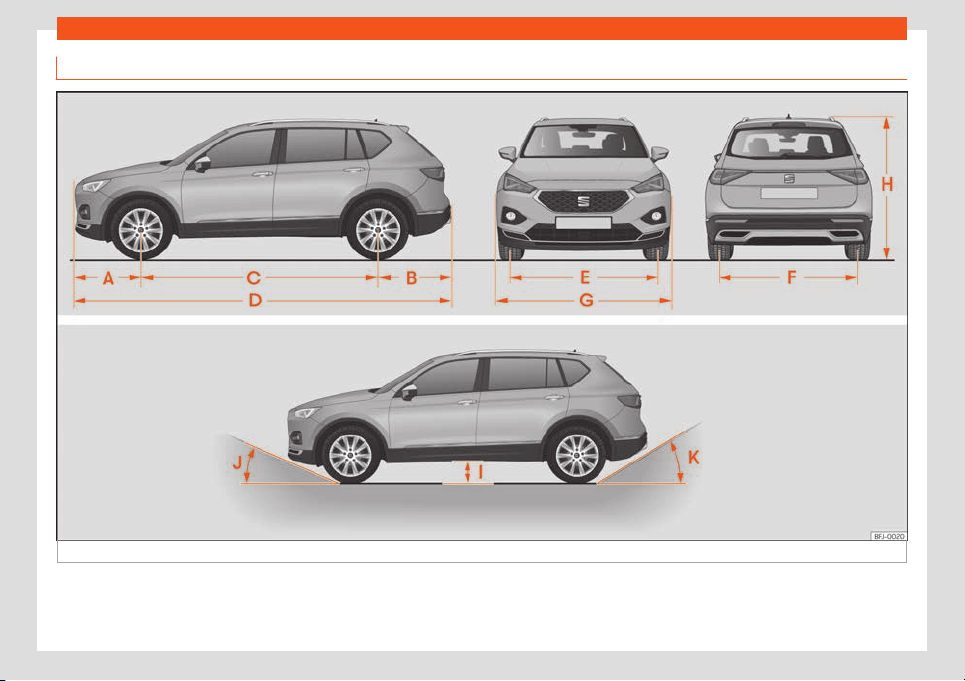
Indications about the technical data
Dimensions
Fig. 259
Dimensions.
»
385
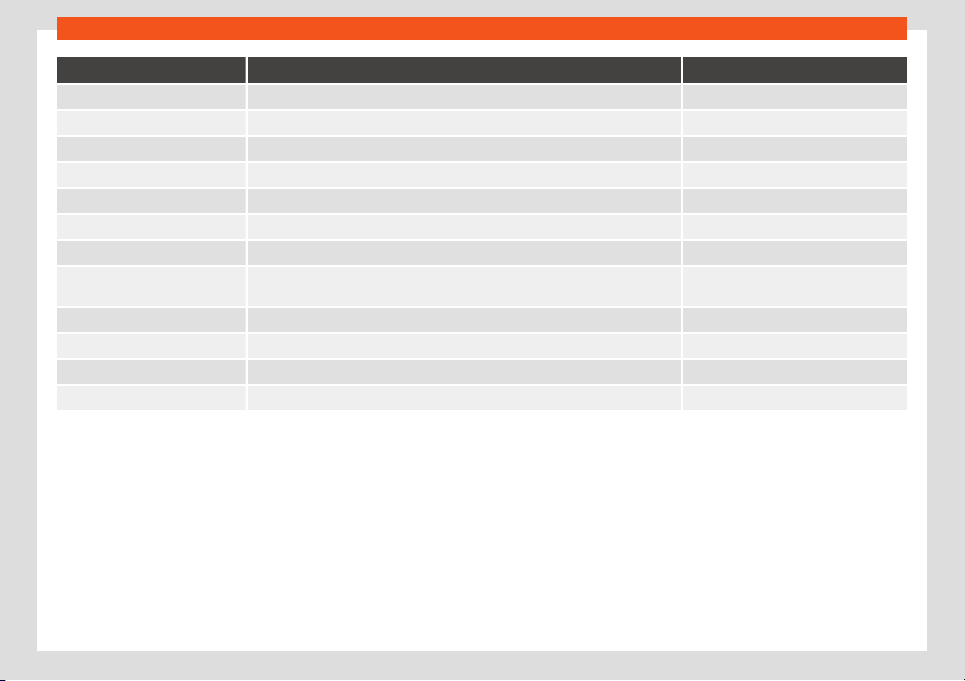
Technical data
›››
Fig. 259 TARRACO
A Front projection (mm) 926
B Rear projection (mm) 1,019
C Wheelbase (mm) 2,790
D Length (mm) 4,735
E Front
a)
tr
ack (mm) 1,585
F Back
a)
tr
ack (mm) 1,574
G Width (mm) 1,839
H Height at kerb weight (mm)
1,658
b)
1,
674
c)
I Ground clearance between the axles (mm) 192
J Front projection angle limited by the bumper maximum 19.1°
K Rear projection angle limited by the bumper maximum 21.4°
Turning radius (m) 11.9
a)
This data will change depending on the type of wheel rim. Values for wheel 215/65 R17 ET38.
b)
Distance to the roof.
c)
Dimension to the roof bars.
386

Index
Index
Numbers and Symbol
s
12-volt battery
assisted start . . . . . . . . . . . . . . . . . . . . . . . . . . . . . . . 52
charge level . . . . . . . . . . . . . . . . . . . . . . . . . . . . . . . 351
charging . . . . . . . . . . . . . . . . . . . . . . . . . . . . . . . . . . 350
disconnect and connect . . . . . . . . . . . . . . 83, 347
electrolyte level . . . . . . . . . . . . . . . . . . . . . . . . . . 350
energy management . . . . . . . . . . . . . . . . . . . . . . 351
location . . . . . . . . . . . . . . . . . . . . . . . . . . . . . . . . . . . 349
replacement . . . . . . . . . . . . . . . . . . . . . . . . . . . . . . 350
winter operations . . . . . . . . . . . . . . . . . . . . . . . . . 347
4Drive . . . . . . . . . . . . . . . . . . . . . . . . . . . . . . . . . . . . . . . 242
A
ABS
see Anti-lock brake system . . . . . . . . . . . . . . . . 278
ACC . . . . . . . . . . . . . . . . . . . . . . . . . . . . . . . . . . . . . . . . 255
Access aid for the third row . . . . . . . . . . . . . . . . . . 134
Accessories . . . . . . . . . . . . . . . . . . . . . . . . . . . . . 155, 373
Activating SEAT CONNECT . . . . . . . . . . . . . . . . . . 185
Active cylinder management (ACT)
status indication . . . . . . . . . . . . . . . . . . . . . . . . . . . . 70
Adapting the playback volume . . . . . . . . . . . . . . 180
Adaptive Cruise Control . . . . . . . . . . . . . . . . . . . . . 255
control and warning lamp . . . . . . . . . . . . . . . . . 256
malfunction . . . . . . . . . . . . . . . . . . . . . . . . . . . . . . . 260
noises . . . . . . . . . . . . . . . . . . . . . . . . . . . . . . . . . . . . 260
operation . . . . . . . . . . . . . . . . . . . . . . . . . . . . . . . . . 256
special driving situations . . . . . . . . . . . . . . . . . . 258
status display . . . . . . . . . . . . . . . . . . . . . . . . . . . . . 258
system limitations . . . . . . . . . . . . . . . . . . . . . . . . . 259
AdBlue
control and warning lamps . . . . . . . . . . . . . . . . 333
information . . . . . . . . . . . . . . . . . . . . . . . . . . . . . . . 333
loading . . . . . . . . . . . . . . . . . . . . . . . . . . . . . . . . . . . 334
minimum filling capacity . . . . . . . . . . . . . . . . . . 333
specification . . . . . . . . . . . . . . . . . . . . . . . . . . . . . . 334
tank capacity . . . . . . . . . . . . . . . . . . . . . . . . . . . . . 333
Additional heating
see Auxiliary heating . . . . . . . . . . . . . . . . . . . . . . . 167
Adjust
fold down the front passenger’s backrest . . 136
front seats . . . . . . . . . . . . . . . . . . . . . . . . . . . . . . . . . 129
headrest . . . . . . . . . . . . . . . . . . . . . . . . . . . . . . . . . . . 132
lights . . . . . . . . . . . . . . . . . . . . . . . . . . . . . . . . . . . . . . 122
rear seat . . . . . . . . . . . . . . . . . . . . . . . . . . . . . . . . . . 130
seats . . . . . . . . . . . . . . . . . . . . . . . . . . . . . . . . . . . . . . . 13
seat with memory . . . . . . . . . . . . . . . . . . . . . . . . . 133
time . . . . . . . . . . . . . . . . . . . . . . . . . . . . . . . . . . . . . . . . 79
Adjusting the seat belt . . . . . . . . . . . . . . . . . . . . . . . . 21
Airbags . . . . . . . . . . . . . . . . . . . . . . . . . . . . . . . . . . . . . . . 25
activating and deactivating . . . . . . . . . . . . . . . . 28
control lamp . . . . . . . . . . . . . . . . . . . . . . . . . . . . . . . . 27
description . . . . . . . . . . . . . . . . . . . . . . . . . . . . . . . . . 25
for the head . . . . . . . . . . . . . . . . . . . . . . . . . . . . . . . . 31
for the knees . . . . . . . . . . . . . . . . . . . . . . . . . . . . . . . 29
front . . . . . . . . . . . . . . . . . . . . . . . . . . . . . . . . . . . . . . . . 28
side . . . . . . . . . . . . . . . . . . . . . . . . . . . . . . . . . . . . . . . . 30
Airbag system . . . . . . . . . . . . . . . . . . . . . . . . . . . . . . . . 25
activation . . . . . . . . . . . . . . . . . . . . . . . . . . . . . . . . . . 26
control lamp . . . . . . . . . . . . . . . . . . . . . . . . . . . . . . . . 27
deactivation of the front airbag . . . . . . . . . . . . 28
description . . . . . . . . . . . . . . . . . . . . . . . . . . . . . . . . . 25
front airbags . . . . . . . . . . . . . . . . . . . . . . . . . . . . . . . . 27
how it works . . . . . . . . . . . . . . . . . . . . . . . . . . . . . . . . 26
Air conditioning
air recirculation . . . . . . . . . . . . . . . . . . . . . . . . . . . . 163
air vents . . . . . . . . . . . . . . . . . . . . . . . . . . . . . . . . . . . 162
Climatronic . . . . . . . . . . . . . . . . . . . . . . . . . . . . . . . 159
manual air conditioning . . . . . . . . . . . . . . . . . . . . 161
Air recirculation . . . . . . . . . . . . . . . . . . . . . . . . . . . . . . 163
Air vents . . . . . . . . . . . . . . . . . . . . . . . . . . . . . . . . . . . . . 162
Alternator
warning lamp . . . . . . . . . . . . . . . . . . . . . . . . . . . . . 348
Android Auto™
Disconnecting . . . . . . . . . . . . . . . . . . . . . . . . . . . . . 192
establish connection . . . . . . . . . . . . . . . . . . . . . . 192
menu . . . . . . . . . . . . . . . . . . . . . . . . . . . . . . . . . . . . . . 191
requirements . . . . . . . . . . . . . . . . . . . . . . . . . . . . . . . 191
special characteristics . . . . . . . . . . . . . . . . . . . . 192
Anti-lock brake system . . . . . . . . . . . . . . . . . . . . . . 278
Anti-puncture . . . . . . . . . . . . . . . . . . . . . . . . . . . . . 44, 45
Anti-puncture kit . . . . . . . . . . . . . . . . . . . . . . . . . . 43, 44
check after 10 minutes . . . . . . . . . . . . . . . . . . . . . 46
components . . . . . . . . . . . . . . . . . . . . . . . . . . . . . . . 45
inflating the tyre . . . . . . . . . . . . . . . . . . . . . . . . . . . . 45
sealing the tyre . . . . . . . . . . . . . . . . . . . . . . . . . . . . . 45
Anti-puncture set . . . . . . . . . . . . . . . . . . . . . . . . . . . . . 44
Anti-theft alarm system . . . . . . . . . . . . . . . . . . . . . . 102
trailer . . . . . . . . . . . . . . . . . . . . . . . . . . . . . . . . 309, 310
Anti-trap function
sunroof . . . . . . . . . . . . . . . . . . . . . . . . . . . . . . . . . . . . 115
sunshade blind (glass roof) . . . . . . . . . . . . . . . . 115
windows . . . . . . . . . . . . . . . . . . . . . . . . . . . . . . . . . . . 112
Antifreeze . . . . . . . . . . . . . . . . . . . . . . . . . . . . . . . . . . . 343
Apple CarPlay
Disconnecting . . . . . . . . . . . . . . . . . . . . . . . . . . . . . 191
establish connection . . . . . . . . . . . . . . . . . . . . . . . 191
menu . . . . . . . . . . . . . . . . . . . . . . . . . . . . . . . . . . . . . . 190
387

Index
requirements . . . . . . . . . . . . . . . . . . . . . . . . . . . . . . 190
special char
acteristics . . . . . . . . . . . . . . . . . . . . . 191
Applications (apps) . . . . . . . . . . . . . . . . . . . . . . . . . 190
Aspects to think about before starting the ve-
hicle . . . . . . . . . . . . . . . . . . . . . . . . . . . . . . . . . . . . . . . . 12
ASR
see Traction control system . . . . . . . . . . . . . . . 278
Assistance systems
adaptive cruise control . . . . . . . . . . . . . . . . . . . 255
assisted parting system (Park Assist) . . . . . . 282
Auto Hold function . . . . . . . . . . . . . . . . . . . . . . . . . 277
connecting . . . . . . . . . . . . . . . . . . . . . . . . . . . . . . . . . 84
cruise control . . . . . . . . . . . . . . . . . . . . . . . . . . . . . 249
disconnecting . . . . . . . . . . . . . . . . . . . . . . . . . . . . . . 84
driver alert system . . . . . . . . . . . . . . . . . . . . . . . . . . 74
driving assist (Travel Assist) . . . . . . . . . . . . . . . 265
Emergency Assist . . . . . . . . . . . . . . . . . . . . . . . . . 267
emergency braking (Front Assist) . . . . . . . . . . 252
front camera . . . . . . . . . . . . . . . . . . . . . . . . . . . . . . 247
front radar . . . . . . . . . . . . . . . . . . . . . . . . . . . . . . . . 246
general notes . . . . . . . . . . . . . . . . . . . . . . . . . . . . . 245
hill descent control (HDC) . . . . . . . . . . . . . . . . . 237
Lane Assist . . . . . . . . . . . . . . . . . . . . . . . . . . . . . . . . 263
lane departure warning (Side Assist) . . . . . . 269
parking aid Plus . . . . . . . . . . . . . . . . . . . . . . . . . . . 291
peripheral view system (Top View Cam-
era) . . . . . . . . . . . . . . . . . . . . . . . . . . . . . . . . . . . . . 298
PreCrash system . . . . . . . . . . . . . . . . . . . . . . . . . . . 23
proactive speed adjustment . . . . . . . . . . . . . . . 261
rear camera . . . . . . . . . . . . . . . . . . . . . . . . . . . . . . 248
rear cross traffic alert (RCTA) . . . . . . . . . 269, 272
rear parking aid . . . . . . . . . . . . . . . . . . . . . . . . . . . 294
rear radar . . . . . . . . . . . . . . . . . . . . . . . . . . . . . . . . . 247
road sign detection system messages . . . . . . 75
safety advice . . . . . . . . . . . . . . . . . . . . . . . . . . . . . 245
speed limiter . . . . . . . . . . . . . . . . . . . . . . . . . . . . . . 250
system limits . . . . . . . . . . . . . . . . . . . . . . . . . . . . . . 245
Trailer assist . . . . . . . . . . . . . . . . . . . . . . . . . . . . . . 296
Tyre pressure monitor indicator . . . . . . . . . . . 360
Tyre pressure monitoring . . . . . . . . . . . . . . . . . . 359
ultrasound sensors . . . . . . . . . . . . . . . . . . . . . . . . 248
Assisted start . . . . . . . . . . . . . . . . . . . . . . . . . . . . . . . . . 52
Audible warning
control and warning lamps . . . . . . . . . . . . . . . . . 85
lights . . . . . . . . . . . . . . . . . . . . . . . . . . . . . . . . . . . . . . . 115
unbuckled seat belt . . . . . . . . . . . . . . . . . . . . . . . . . 17
Auto Hold . . . . . . . . . . . . . . . . . . . . . . . . . . . . . . . . . . . . 277
Auto Hold Function . . . . . . . . . . . . . . . . . . . . . . . . . . 277
Auto Lock (central locking) . . . . . . . . . . . . . . . . . . . 96
Automatic car wash . . . . . . . . . . . . . . . . . . . . . . . . . 368
disconnecting the Auto Hold function . . . . . . 277
Automatic dipped beam headlight control . . . 116
Automatic gearbox . . . . . . . . . . . . . . . . . . . . . . . . . . 230
control lamp . . . . . . . . . . . . . . . . . . . . . . . . . . . . . . 230
downhill assistant . . . . . . . . . . . . . . . . . . . . . . . . . 235
driving tips . . . . . . . . . . . . . . . . . . . . . . . . . . . . . . . . 233
emergency release of the selector lever. . . 236
kick-down . . . . . . . . . . . . . . . . . . . . . . . . . . . . . . . . . 233
launch-control program . . . . . . . . . . . . . . . . . . 234
operating fault . . . . . . . . . . . . . . . . . . . . . . . . . . . . 233
parking lock . . . . . . . . . . . . . . . . . . . . . . . . . . . . . . 230
selector lever lock . . . . . . . . . . . . . . . . . . . . . . . . . 231
selector lever positions . . . . . . . . . . . . . . . . . . . 230
steering wheel with shift paddles . . . . . . . . . . 232
tiptronic . . . . . . . . . . . . . . . . . . . . . . . . . . . . . . 230, 232
towing . . . . . . . . . . . . . . . . . . . . . . . . . . . . . . . . . . . . . . 55
Auxiliary heating . . . . . . . . . . . . . . . . . . . . . . . . . . . . . 167
activate . . . . . . . . . . . . . . . . . . . . . . . . . . . . . . . . . . . 169
connecting . . . . . . . . . . . . . . . . . . . . . . . . . . . . . . . . 168
disconnecting . . . . . . . . . . . . . . . . . . . . . . . . . . . . . 168
electricity consumers . . . . . . . . . . . . . . . . . . . . . . 167
programming . . . . . . . . . . . . . . . . . . . . . . . . . . . . . 169
radio-operated remote control . . . . . . . . . . . . 170
remote control range . . . . . . . . . . . . . . . . . . . . . . 170
special characteristics . . . . . . . . . . . . . . . . . . . . 167
Average fuel consumption . . . . . . . . . . . . . . . . . . . . 67
B
Background lighting . . . . . . . . . . . . . . . . . . . . . . . . . 123
Backrest of the rear seat
folding . . . . . . . . . . . . . . . . . . . . . . . . . . . . . . . . . . . . . 137
raise . . . . . . . . . . . . . . . . . . . . . . . . . . . . . . . . . . . . . . . 137
Bag hooks . . . . . . . . . . . . . . . . . . . . . . . . . . . . . . 146, 155
Battery . . . . . . . . . . . . . . . . . . . . . . . . . . . . . . . . . . . . . . . 94
change on the remote control (independ-
ent heating) . . . . . . . . . . . . . . . . . . . . . . . . . . . . . 170
Battery Manager Menu . . . . . . . . . . . . . . . . . . . . . . 319
Before starting the vehicle . . . . . . . . . . . . . . . . . . . . . 12
Belt tightening . . . . . . . . . . . . . . . . . . . . . . . . . . . . . . . . 22
Bicycle carrier
fitting onto the coverable tow hook . . . . . . . . 314
max. load rating . . . . . . . . . . . . . . . . . . . . . . . . . . . 314
Biodiesel . . . . . . . . . . . . . . . . . . . . . . . . . . . . . . . . . . . . 332
Blown bulbs
change a bulb . . . . . . . . . . . . . . . . . . . . . . . . . . . . . 63
Bluetooth® . . . . . . . . . . . . . . . . . . . . . . . . . . . . . . . . . . 183
profiles . . . . . . . . . . . . . . . . . . . . . . . . . . . . . . . . . . . . 183
Bonnet . . . . . . . . . . . . . . . . . . . . . . . . . . . . . . . . . 337, 339
opening and closing . . . . . . . . . . . . . . . . . . . . . . 338
Brake fluid . . . . . . . . . . . . . . . . . . . . . . . . . . . . . . . . . . . 345
Brakes . . . . . . . . . . . . . . . . . . . . . . . . . . . . . . . . . . . . . . . 274
brake fluid . . . . . . . . . . . . . . . . . . . . . . . . . . . . . . . . 345
brake servo . . . . . . . . . . . . . . . . . . . . . . . . . . . . . . . 274
braking assistant . . . . . . . . . . . . . . . . . . . . . . . . . . 278
electronic parking brake . . . . . . . . . . . . . . . . . . 275
388

Index
emergency brake function . . . . . . . . . . . . . . . . 276
ne
w brake pads . . . . . . . . . . . . . . . . . . . . . . . . . . . 274
Braking assistant . . . . . . . . . . . . . . . . . . . . . . . . . . . . 278
Braking system
warning lamp . . . . . . . . . . . . . . . . . . . . . . . . . . . . . 273
C
Camera
cleaning . . . . . . . . . . . . . . . . . . . . . . . . . . . . . . . . . . . . 77
Care
see Cleaning the vehicle . . . . . . . . . . . . . . . . . . 367
Catalytic converter . . . . . . . . . . . . . . . . . . . . . . . . . 335
Central armrests . . . . . . . . . . . . . . . . . . . . . . . . . . . . 138
Central locking . . . . . . . . . . . . . . . . . . . . . . . . . . . . . . . 95
anti-theft alarm . . . . . . . . . . . . . . . . . . . . . . . . . . . 102
central locking switch . . . . . . . . . . . . . . . . . . . . . . 98
emergency lock . . . . . . . . . . . . . . . . . . . . . . . . . . . 105
remote control key . . . . . . . . . . . . . . . . . . . . . . . . . 97
selective unlocking system . . . . . . . . . . . . . . . . . 97
settings . . . . . . . . . . . . . . . . . . . . . . . . . . . . . . . . . . . . 97
unlock and lock the vehicle (Keyless Ac-
cess) . . . . . . . . . . . . . . . . . . . . . . . . . . . . . . . . . . . . . 98
Cetane index (diesel fuel) . . . . . . . . . . . . . . . . . . . 332
Change a bulb . . . . . . . . . . . . . . . . . . . . . . . . . . . . . . . 63
Change the wiper blades . . . . . . . . . . . . . . . . . . . . . 51
Changing a wheel . . . . . . . . . . . . . . . . . . . . . . . . . . . 46
subsequent work . . . . . . . . . . . . . . . . . . . . . . . . . . . 50
wheel nuts . . . . . . . . . . . . . . . . . . . . . . . . . . . . . . . . . . 47
Changing parts . . . . . . . . . . . . . . . . . . . . . . . . . . . . . 373
Charging cable
for charging stations (AC) . . . . . . . . . . . . . . . . . 327
for sockets . . . . . . . . . . . . . . . . . . . . . . . . . . . . . . . . 327
Charging socket . . . . . . . . . . . . . . . . . . . . . . . . . . . . 322
Charging the high-voltage battery
charging cable . . . . . . . . . . . . . . . . . . . . . . . . . . . . 327
charging modes . . . . . . . . . . . . . . . . . . . . . . . . . . 320
charging process display . . . . . . . . . . . . . . . . . 323
charging socket . . . . . . . . . . . . . . . . . . . . . . . . . . . 322
emergency unlocking . . . . . . . . . . . . . . . . . . . . . 325
programmed charging . . . . . . . . . . . . . . . . . . . . 319
settings in the infotainment system . . . . . . . . 319
troubleshooting . . . . . . . . . . . . . . . . . . . . . . . . . . . 324
Checking levels
engine compartment . . . . . . . . . . . . . . . . . . . . . 339
Check lists
requirements for Android Auto™ . . . . . . . . . . . . 191
requirements for Apple CarPlay . . . . . . . . . . . 190
requirements for MirrorLink® . . . . . . . . . . . . . . . 192
reverse assist (Rear View) . . . . . . . . . . . . . . . . . 304
Childproof locks
electric windows . . . . . . . . . . . . . . . . . . . . . . . . . . . 110
Child seats
group classification . . . . . . . . . . . . . . . . . . . . . . . . 32
ISOFIX/i-Size system . . . . . . . . . . . . . . . . . . . . . . . 38
ISOFIX system . . . . . . . . . . . . . . . . . . . . . . . . . . . . . . 36
safety instructions . . . . . . . . . . . . . . . . . . . . . . . . . . 33
securing with the seat belt . . . . . . . . . . . . . . . . . 40
Top Tether system . . . . . . . . . . . . . . . . . . . . . . 36, 39
Cleaning the vehicle
high pressure cleaning equipment . . . . . . . . 368
special care . . . . . . . . . . . . . . . . . . . . . . . . . . . . . . . 371
vehicle exterior . . . . . . . . . . . . . . . . . . . . . . . . . . . 369
vehicle interior . . . . . . . . . . . . . . . . . . . . . . . . . . . . 370
wash the vehicle . . . . . . . . . . . . . . . . . . . . . . . . . . 368
Climate control
auxiliary heating . . . . . . . . . . . . . . . . . . . . . . . . . . . 167
controls . . . . . . . . . . . . . . . . . . . . . . . . . . . . . . . . . . . 162
setting the temperature . . . . . . . . . . . . . . . . . . . 162
windscreen heating . . . . . . . . . . . . . . . . . . . . . . . 166
Climatronic . . . . . . . . . . . . . . . . . . . . . . . . . . . . . . . . . . 159
Clocks
set the time . . . . . . . . . . . . . . . . . . . . . . . . . . . . . . . . . 79
Closing . . . . . . . . . . . . . . . . . . . . . . . . . . . . . . . . . . . . . . . 95
bonnet . . . . . . . . . . . . . . . . . . . . . . . . . . . . . . . . . . . . 338
rear lid . . . . . . . . . . . . . . . . . . . . . . . . . . . . . . . . . . . . 107
sunroof . . . . . . . . . . . . . . . . . . . . . . . . . . . . . . . . . . . . 113
sunshade blind (glass roof) . . . . . . . . . . . . . . . . 114
windows . . . . . . . . . . . . . . . . . . . . . . . . . . . . . . . . . . . 110
Clutch (lamp) . . . . . . . . . . . . . . . . . . . . . . . . . . . . . . . 236
Coming Home . . . . . . . . . . . . . . . . . . . . . . . . . . . . . . . 120
Connectivity . . . . . . . . . . . . . . . . . . . . . . . . . . . . . . . . . 183
WLAN access point . . . . . . . . . . . . . . . . . . . . . . . . 193
Connectivity Box . . . . . . . . . . . . . . . . . . . . . . . . . . . . 216
Connectors
faults . . . . . . . . . . . . . . . . . . . . . . . . . . . . . . . . . . . . . . 156
Control and warning lamps . . . . . . . . . . . . . . . . . . 85
adaptive cruise control . . . . . . . . . . . . . . . . . . . 256
adBlue . . . . . . . . . . . . . . . . . . . . . . . . . . . . . . . . . . . . 333
airbags . . . . . . . . . . . . . . . . . . . . . . . . . . . . . . . . . . . . . 28
airbag system . . . . . . . . . . . . . . . . . . . . . . . . . . . . . . 27
alternator . . . . . . . . . . . . . . . . . . . . . . . . . . . . . . . . . 348
anti-lock brake system ABS . . . . . . . . . . . . . . . 278
ASR . . . . . . . . . . . . . . . . . . . . . . . . . . . . . . . . . . 278, 280
audible warning . . . . . . . . . . . . . . . . . . . . . . . . . . . . 85
braking system . . . . . . . . . . . . . . . . . . . . . . . . . . . . 273
cruise control (GRA) . . . . . . . . . . . . . . . . . . . . . . 249
diesel preheating system . . . . . . . . . . . . . . . . . 335
EDL . . . . . . . . . . . . . . . . . . . . . . . . . . . . . . . . . . . . . . . 278
electric drive . . . . . . . . . . . . . . . . . . . . . . . . . . . . . . 324
electromechanical steering . . . . . . . . . . . . . . . 239
electronic parking brake . . . . . . . . . . . . . . . . . . 273
Emergency Assist . . . . . . . . . . . . . . . . . . . . . . . . . 268
389

Index
emissions control . . . . . . . . . . . . . . . . . . . . . . . . . 335
engine cool
ant . . . . . . . . . . . . . . . . . . . . . . . . . . . . . 81
engine management . . . . . . . . . . . . . . . . . . . . . . 335
engine oil . . . . . . . . . . . . . . . . . . . . . . . . . . . . . . . . . . 341
ESC . . . . . . . . . . . . . . . . . . . . . . . . . . . . . . . . . . 278, 280
fuel reserve . . . . . . . . . . . . . . . . . . . . . . . . . . . . . . . . 80
gear change . . . . . . . . . . . . . . . . . . . . . . . . . . . . . . 236
hill descent control . . . . . . . . . . . . . . . . . . . . . . . . 237
Lane Assist . . . . . . . . . . . . . . . . . . . . . . . . . . . . . . . . 263
lane departure warning (Side Assist) . . . . . . 269
lights . . . . . . . . . . . . . . . . . . . . . . . . . . . . . . . . . . . . . . . 115
particulate filter . . . . . . . . . . . . . . . . . . . . . . 335, 336
press on the brake . . . . . . . . . . . . . . . . . . . 252, 255
rear cross traffic alert (RCTA) . . . . . . . . . . . . . 269
refuelling . . . . . . . . . . . . . . . . . . . . . . . . . . . . . . 80, 329
remote control (independent heating) . . . . . 170
replacement . . . . . . . . . . . . . . . . . . . . . . . . . . . . . . 230
seat belt . . . . . . . . . . . . . . . . . . . . . . . . . . . . . . . . . . . . 17
Start-Stop . . . . . . . . . . . . . . . . . . . . . . . . . . . . . . . . 226
steering column lock . . . . . . . . . . . . . . . . . . . . . . 239
tow hook . . . . . . . . . . . . . . . . . . . . . . . . . . . . . . . . . . 314
Travel Assist . . . . . . . . . . . . . . . . . . . . . . . . . . . . . . . 267
Tyre pressure monitor system . . . . . . . . . . . . . 359
Controls
rear seat . . . . . . . . . . . . . . . . . . . . . . . . . . . . . . . . . . 130
Controls and displays
overview . . . . . . . . . . . . . . . . . . . . . . . . . . . . . . . . . . . 65
Controls on the steering wheel . . . . . . . . . . . . . . . 92
Convenience close function
windows . . . . . . . . . . . . . . . . . . . . . . . . . . . . . . . . . . . 111
Convenience open function
windows . . . . . . . . . . . . . . . . . . . . . . . . . . . . . . . . . . . 111
Cooling system
check the coolant . . . . . . . . . . . . . . . . . . . . . . . . 344
refilling coolant . . . . . . . . . . . . . . . . . . . . . . . . . . . 344
Copyright . . . . . . . . . . . . . . . . . . . . . . . . . . . . . . . . . . . . 181
Correct sitting position . . . . . . . . . . . . . . . . . . . . . . . . 13
driver . . . . . . . . . . . . . . . . . . . . . . . . . . . . . . . . . . . . . . . 13
Cruise control . . . . . . . . . . . . . . . . . . . . . . . . . . . . . . . 249
operation . . . . . . . . . . . . . . . . . . . . . . . . . . . . . . . . . 249
Current . . . . . . . . . . . . . . . . . . . . . . . . . . . . . . . . . . . . . . 155
Current documentation attached . . . . . . . . . . . . 172
D
Dangers of not using the seat belt . . . . . . . . . . . . 19
Data label . . . . . . . . . . . . . . . . . . . . . . . . . . . . . . . . . . . 381
Data transfer . . . . . . . . . . . . . . . . . . . . . . . . . . . . . . . . 184
Deactivating SEAT CONNECT services . . . . . . 188
Deactivation of cylinders
see Active cylinder management (ACT) . . . . 70
Deactivation of the front airbag . . . . . . . . . . . . . . 28
Diesel
engine oil . . . . . . . . . . . . . . . . . . . . . . . . . . . . . . . . . 340
particulate filter . . . . . . . . . . . . . . . . . . . . . . . . . . . 336
refuelling . . . . . . . . . . . . . . . . . . . . . . . . . . . . . . . . . . 332
Display of road signs on the instrument panel
activate . . . . . . . . . . . . . . . . . . . . . . . . . . . . . . . . . . . . 76
deactivate . . . . . . . . . . . . . . . . . . . . . . . . . . . . . . . . . 76
Disposal
seat belt tensioners . . . . . . . . . . . . . . . . . . . . . . . . 22
Distance control
see Adaptive Cruise Control . . . . . . . . . . . . . . 255
Door cylinder . . . . . . . . . . . . . . . . . . . . . . . . . . . . . . . 105
Door handle . . . . . . . . . . . . . . . . . . . . . . . . . . . . . . . . . 105
Door lock . . . . . . . . . . . . . . . . . . . . . . . . . . . . . . . . . . . . 105
Doors . . . . . . . . . . . . . . . . . . . . . . . . . . . . . . . . . . . . . . . 104
child lock . . . . . . . . . . . . . . . . . . . . . . . . . . . . . . . . . . 106
Downhill assistance function . . . . . . . . . . . . . . . . 235
Downhill assistant . . . . . . . . . . . . . . . . . . . . . . . . . . . 235
Drawers . . . . . . . . . . . . . . . . . . . . . . . . . . . . . . . . . . . . . 153
Drink holder
bottle holder . . . . . . . . . . . . . . . . . . . . . . . . . . . . . . 154
in the rear central armrest . . . . . . . . . . . . . . . . . 154
Driver
see Correct sitting position . . . . . . . . . . . . . . . . . 13
Driver alert system . . . . . . . . . . . . . . . . . . . . . . . . . . . 74
Driving
driving on flooded roads . . . . . . . . . . . . . . . . . . 244
economical . . . . . . . . . . . . . . . . . . . . . . . . . . . . . . . 243
parking on inclines . . . . . . . . . . . . . . . . . . . . . . . . 282
park on upward slopes . . . . . . . . . . . . . . . . . . . . 282
safe . . . . . . . . . . . . . . . . . . . . . . . . . . . . . . . . . . . . . . . . . 12
trips abroad . . . . . . . . . . . . . . . . . . . . . . . . . . 122, 245
with trailer . . . . . . . . . . . . . . . . . . . . . . . . . . . . . . . . . 311
Driving Assist (Travel Assist) . . . . . . . . . . . . . . . . . 265
operation . . . . . . . . . . . . . . . . . . . . . . . . . . . . . . . . . 266
status display . . . . . . . . . . . . . . . . . . . . . . . . . . . . . 266
troubleshooting . . . . . . . . . . . . . . . . . . . . . . . . . . . 267
Driving data . . . . . . . . . . . . . . . . . . . . . . . . . . . . . . . . . . 72
Driving data indicator . . . . . . . . . . . . . . . . . . . . . . . . . 72
Driving mode. . . . . . . . . . . . . . . . . . . . . . . . . . . . . . . . 240
Driving on flooded roads . . . . . . . . . . . . . . . . . . . . 244
Driving profile . . . . . . . . . . . . . . . . . . . . . . . . . . . . . . . 240
DSG . . . . . . . . . . . . . . . . . . . . . . . . . . . . . . . . . . . . . . . . 230
Duplicate keys . . . . . . . . . . . . . . . . . . . . . . . . . . . . . . . 93
Dust and pollen filter . . . . . . . . . . . . . . . . . . . . . . . . . 157
Dynamic headlight range control . . . . . . . . . . . . 122
E
e-Call . . . . . . . . . . . . . . . . . . . . . . . . . . . . . . . . . . . . . . . . 42
E-Mode . . . . . . . . . . . . . . . . . . . . . . . . . . . . . . . . . . . . . 225
E10
see Ethanol (fuel) . . . . . . . . . . . . . . . . . . . . . . . . . 332
Easy Open
special characteristics . . . . . . . . . . . . . . . . . . . . 109
390

Index
Eco-driving notes . . . . . . . . . . . . . . . . . . . . . . . . . . . . . 78
EDL
see El
ectronic differential lock . . . . . . . . . . . . . 278
Electric
windows . . . . . . . . . . . . . . . . . . . . . . . . . . . . . . . . . . . 110
Electrical accessories
see Power sockets . . . . . . . . . . . . . . . . . . . . . . . . . 155
Electric windows . . . . . . . . . . . . . . . . . . . . . . . . . . . . . 110
Electrolyte . . . . . . . . . . . . . . . . . . . . . . . . . . . . . . . . . . 350
Electronic differential lock . . . . . . . . . . . . . . . . . . . 278
Electronic engine torque management
(XDS) . . . . . . . . . . . . . . . . . . . . . . . . . . . . . . . . . . . . . 279
Electronic immobilizer . . . . . . . . . . . . . . . . . . 105, 222
Electronic parking brake . . . . . . . . . . . . . . . . . . . . . 275
automatic connection . . . . . . . . . . . . . . . . . . . . . 276
automatic disconnection . . . . . . . . . . . . . . . . . . 276
connecting . . . . . . . . . . . . . . . . . . . . . . . . . . . . . . . . 275
disconnecting . . . . . . . . . . . . . . . . . . . . . . . . . . . . . 276
emergency brake function . . . . . . . . . . . . . . . . 276
lamp . . . . . . . . . . . . . . . . . . . . . . . . . . . . . . . . . . . . . . 273
Electronic self-locking . . . . . . . . . . . . . . . . . . . . . . . 278
Electronic Stability Control (ESC) . . . . . . . . . . . 278
Emergencies . . . . . . . . . . . . . . . . . . . . . . . . . . . . . . . . . 42
anti-puncture kit . . . . . . . . . . . . . . . . . . . . . . . . . . . 44
bulbs . . . . . . . . . . . . . . . . . . . . . . . . . . . . . . . . . . . . . . . 63
changing a wheel . . . . . . . . . . . . . . . . . . . . . . . . . . 46
changing the battery . . . . . . . . . . . . . . . . . . . . . 350
emergency vehicle towing . . . . . . . . . . . . . . . . . 55
hazard warning lights . . . . . . . . . . . . . . . . . . . . . . 121
jump leads . . . . . . . . . . . . . . . . . . . . . . . . . . . . . . . . . 52
replace a blown fuse . . . . . . . . . . . . . . . . . . . . . . . 61
vehicle tool kit . . . . . . . . . . . . . . . . . . . . . . . . . . . . . . 43
Emergency Assist . . . . . . . . . . . . . . . . . . . . . . . . . . . 267
Troubleshooting . . . . . . . . . . . . . . . . . . . . . . . . . . 268
see also Emergency Assist . . . . . . . . . . . . . . . . 267
Emergency brake function . . . . . . . . . . . . . . . . . . 276
Emergency braking assist system . . . . . . . . . . . 246
operation . . . . . . . . . . . . . . . . . . . . . . . . . . . . . . . . . 254
status display . . . . . . . . . . . . . . . . . . . . . . . . . . . . . 252
system limitations . . . . . . . . . . . . . . . . . . . . . . . . . 255
temporarily deactivating . . . . . . . . . . . . . . . . . . 254
Emergency braking warning . . . . . . . . . . . . . . . . . 121
Emergency call . . . . . . . . . . . . . . . . . . . . . . . . . . . . . . 42
Emergency call service . . . . . . . . . . . . . . . . . . . . . . . 42
Emergency locking of the front passenger
door . . . . . . . . . . . . . . . . . . . . . . . . . . . . . . . . . . . . . . . 105
Emergency opening
driver's door . . . . . . . . . . . . . . . . . . . . . . . . . . . . . . . 105
rear lid . . . . . . . . . . . . . . . . . . . . . . . . . . . . . . . . . . . . . 110
Emergency operation
front passenger door . . . . . . . . . . . . . . . . . . . . . . 105
gear selector lever . . . . . . . . . . . . . . . . . . . . . . . . 236
Emissions control system
AdBlue . . . . . . . . . . . . . . . . . . . . . . . . . . . . . . . . . . . . 333
catalytic converter . . . . . . . . . . . . . . . . . . . . . . . . 335
control lamp . . . . . . . . . . . . . . . . . . . . . . . . . . . . . . 335
particulate filter . . . . . . . . . . . . . . . . . . . . . . . . . . . 336
Energy management . . . . . . . . . . . . . . . . . . . . . . . . 351
Engine
assisted start . . . . . . . . . . . . . . . . . . . . . . . . . . . . . . . 52
noises . . . . . . . . . . . . . . . . . . . . . . . . . . . . . . . . . . . . . 220
running in . . . . . . . . . . . . . . . . . . . . . . . . . . . . . . . . . . 241
Start-Stop system . . . . . . . . . . . . . . . . . . . . . . . . . 226
start (driver instructions with the mechani-
cal contact) . . . . . . . . . . . . . . . . . . . . . . . . . . . . . 223
Engine and ignition
automatic ignition disconnection . . . . . . . . . . 219
emergency start . . . . . . . . . . . . . . . . . . . . . . . . . . 222
My Beat . . . . . . . . . . . . . . . . . . . . . . . . . . . . . . . . . . . 219
preheat the engine . . . . . . . . . . . . . . . . . . . . . . . . 220
starting the engine . . . . . . . . . . . . . . . . . . . . . . . . 220
starting the engine with Press & Drive . . . . . 220
switching off the engine . . . . . . . . . . . . . . . . . . . 221
Engine compartment . . . . . . . . . . . . . . . . . . . 337, 339
battery . . . . . . . . . . . . . . . . . . . . . . . . . . . . . . . . . . . . 347
brake fluid . . . . . . . . . . . . . . . . . . . . . . . . . . . . . . . . 345
coolant . . . . . . . . . . . . . . . . . . . . . . . . . . . . . . 343, 344
engine oil . . . . . . . . . . . . . . . . . . . . . . . . . . . . . . . . . 342
opening and closing . . . . . . . . . . . . . . . . . . . . . . 338
safety instructions . . . . . . . . . . . . . . . . . . . . . . . . . 337
window washer tank . . . . . . . . . . . . . . . . . . . . . . 346
Engine coolant . . . . . . . . . . . . . . . . . . . . . . . . . . . . . . 343
check the level . . . . . . . . . . . . . . . . . . . . . . . . . . . . 344
control lamp . . . . . . . . . . . . . . . . . . . . . . . . . . . . . . . . 81
G12evo . . . . . . . . . . . . . . . . . . . . . . . . . . . . . . . . . . . . 343
G12 plus-plus . . . . . . . . . . . . . . . . . . . . . . . . . . . . . 343
G13 . . . . . . . . . . . . . . . . . . . . . . . . . . . . . . . . . . . . . . . 343
specifications . . . . . . . . . . . . . . . . . . . . . . . . . . . . . 343
tank . . . . . . . . . . . . . . . . . . . . . . . . . . . . . . . . . . . . . . . 344
temperature indicator . . . . . . . . . . . . . . . . . . . . . . 81
warning lamp . . . . . . . . . . . . . . . . . . . . . . . . . . . . . . . 81
Engine failure
control lamp . . . . . . . . . . . . . . . . . . . . . . . . . . . . . . 335
Engine management . . . . . . . . . . . . . . . . . . . . . . . . 335
control lamp . . . . . . . . . . . . . . . . . . . . . . . . . . . . . . 335
Engine oil
change . . . . . . . . . . . . . . . . . . . . . . . . . . . . . . 340, 343
checking the oil level . . . . . . . . . . . . . . . . . . . . . . 341
consumption . . . . . . . . . . . . . . . . . . . . . . . . . . . . . . 341
dipstick . . . . . . . . . . . . . . . . . . . . . . . . . . . . . . . . . . . . 341
inspection service . . . . . . . . . . . . . . . . . . . . . . . . 340
maintenance frequencies . . . . . . . . . . . . . . . . . 340
refill . . . . . . . . . . . . . . . . . . . . . . . . . . . . . . . . . . . . . . . 342
specifications . . . . . . . . . . . . . . . . . . . . . . . . . . . . . 340
391

Index
Engine oil pressure
contr
ol lamp . . . . . . . . . . . . . . . . . . . . . . . . . . . . . . 341
Engine specifications . . . . . . . . . . . . . . . . . . . . . . . 383
Environment
ecological driving . . . . . . . . . . . . . . . . . . . . . . . . . 243
environmental compatibility . . . . . . . . . . . . . . . 375
refuelling . . . . . . . . . . . . . . . . . . . . . . . . . . . . . . . . . . 329
Environmental tip
refuelling . . . . . . . . . . . . . . . . . . . . . . . . . . . . . . . . . . 329
Equipment
telephone interface . . . . . . . . . . . . . . . . . . . . . . . . 212
ESC
electronic stability control (ESC) . . . . . . . . . . 278
multi-collision brake . . . . . . . . . . . . . . . . . . . . . . . 279
Sport mode . . . . . . . . . . . . . . . . . . . . . . . . . . . . . . . 281
Ethanol (fuel) . . . . . . . . . . . . . . . . . . . . . . . . . . . . . . . . 332
Event Data Recorder . . . . . . . . . . . . . . . . . . . . . . . . 375
Exhaust gases . . . . . . . . . . . . . . . . . . . . . . . . . . . . . . . 335
Exterior lighting
change a bulb . . . . . . . . . . . . . . . . . . . . . . . . . . . . . 63
Exterior mirrors
driving with a trailer . . . . . . . . . . . . . . . . . . . . . . . 308
folding . . . . . . . . . . . . . . . . . . . . . . . . . . . . . . . . . . . . . 127
heated . . . . . . . . . . . . . . . . . . . . . . . . . . . . . . . . . . . . . 127
settings . . . . . . . . . . . . . . . . . . . . . . . . . . . . . . . . . . . . 127
Exterior view . . . . . . . . . . . . . . . . . . . . . . . . . . . . . . . . . . . 7
External antenna . . . . . . . . . . . . . . . . . . . . . . . . . . . . 373
external audio sources
adapting the playback volume . . . . . . . . . . . . 180
F
Fabrics: clean . . . . . . . . . . . . . . . . . . . . . . . . . . . . . . . 370
Factors that have a negative influence on
safe driving . . . . . . . . . . . . . . . . . . . . . . . . . . . . . . . . . 12
Fastening rings . . . . . . . . . . . . . . . . . . . . . . . . . . . . . . 145
Filling capacities
AdBlue tank . . . . . . . . . . . . . . . . . . . . . . . . . . . . . . . 333
fuel tank . . . . . . . . . . . . . . . . . . . . . . . . . . . . . . . . . . . 381
window washer tank . . . . . . . . . . . . . . . . . . . . . . . 381
window washer water . . . . . . . . . . . . . . . . . . . . . 346
Filling the tank . . . . . . . . . . . . . . . . . . . . . . . . . . . . . . . 329
Fog lights with cornering light function . . . . . . . 120
Folding table . . . . . . . . . . . . . . . . . . . . . . . . . . . . . . . . 153
Four-wheel drive . . . . . . . . . . . . . . . . . . . . . . . . . . . . 242
snow chains . . . . . . . . . . . . . . . . . . . . . . . . . . . . . . . 242
towing . . . . . . . . . . . . . . . . . . . . . . . . . . . . . . . . . . . . . . 55
winter tyres . . . . . . . . . . . . . . . . . . . . . . . . . . . . . . . 242
Frequency bands . . . . . . . . . . . . . . . . . . . . . . . . . . . . 199
Front Assist
see Emergency braking assist system . . . . . 252
Fuel
diesel . . . . . . . . . . . . . . . . . . . . . . . . . . . . . . . . . . . . . 332
ethanol . . . . . . . . . . . . . . . . . . . . . . . . . . . . . . . . . . . 332
fuel gauge . . . . . . . . . . . . . . . . . . . . . . . . . . . . . . . . . 80
identification . . . . . . . . . . . . . . . . . . . . . . . . . . . . . . 331
petrol . . . . . . . . . . . . . . . . . . . . . . . . . . . . . . . . . . . . . . 331
refuelling . . . . . . . . . . . . . . . . . . . . . . . . . . . . . . . . . . 329
saving . . . . . . . . . . . . . . . . . . . . . . . . . . . . . . . . . . . . . 243
Fuel consumption
inertia disconnection . . . . . . . . . . . . . . . . . . . . . . 243
why does consumption increase? . . . . . . . . . 335
Fuel gauge . . . . . . . . . . . . . . . . . . . . . . . . . . . . . . . . . . . 80
control lamp . . . . . . . . . . . . . . . . . . . . . . . . . . . . . . . 80
Fuel tank cap
opening and closing . . . . . . . . . . . . . . . . . . . . . . 329
Fuel tank flap
opening and closing . . . . . . . . . . . . . . . . . . . . . . 329
Full-LED headlights . . . . . . . . . . . . . . . . . . . . . . . . . . . 63
Full Link . . . . . . . . . . . . . . . . . . . . . . . . . . . . . . . . . . . . . . 189
applications . . . . . . . . . . . . . . . . . . . . . . . . . . . . . . . 190
settings . . . . . . . . . . . . . . . . . . . . . . . . . . . . . . . . . . . 190
symbols . . . . . . . . . . . . . . . . . . . . . . . . . . . . . . . . . . . 190
Fuses . . . . . . . . . . . . . . . . . . . . . . . . . . . . . . . . . . . . . . . . . 59
colour coded . . . . . . . . . . . . . . . . . . . . . . . . . . . . . . 60
fuse box . . . . . . . . . . . . . . . . . . . . . . . . . . . . 59, 60, 61
preparations for replacing fuses . . . . . . . . . . . . 61
recognise blown fuses . . . . . . . . . . . . . . . . . . . . . . 61
replace . . . . . . . . . . . . . . . . . . . . . . . . . . . . . . . . . . . . . 61
G
Gear-change recommendation . . . . . . . . . . . . . 237
Gearbox DSG
see Automatic gearbox . . . . . . . . . . . . . . . . . . . 230
Gear change
manual gearbox . . . . . . . . . . . . . . . . . . . . . . . . . . 229
Gear indication . . . . . . . . . . . . . . . . . . . . . . . . . . . . . . 237
Glasses case . . . . . . . . . . . . . . . . . . . . . . . . . . . . . . . . 152
Glove compartment . . . . . . . . . . . . . . . . . . . . . . . . . 151
H
Handbrake
see Electronic parking brake . . . . . . . . . . . . . . 275
Hangers . . . . . . . . . . . . . . . . . . . . . . . . . . . . . . . . . . . . . 155
Hazard warning lights . . . . . . . . . . . . . . . . . . . . . . . . 121
HDC
see Hill descent control (HDC). . . . . . . . . . . . . 237
Head-on collisions and the laws of physics . . . 19
Headlights
trips abroad . . . . . . . . . . . . . . . . . . . . . . . . . . . . . . . 122
Headrest . . . . . . . . . . . . . . . . . . . . . . . . . . . . 131, 132, 133
Heating and fresh air . . . . . . . . . . . . . . . . . . . . . . . . . 161
392

Index
High-voltage battery . . . . . . . . . . . . . . . . . . . . . . . . 316
car
e . . . . . . . . . . . . . . . . . . . . . . . . . . . . . . . . . . . . . . . 318
Warning lettering . . . . . . . . . . . . . . . . . . . . . . . . . . 317
High-voltage battery charging cable . . . . . . . . 325
Hill descent control (HDC).
control lamp . . . . . . . . . . . . . . . . . . . . . . . . . . . . . . 237
Horn . . . . . . . . . . . . . . . . . . . . . . . . . . . . . . . . . . . . . . . . . . 65
Hybrid drive
E-Mode . . . . . . . . . . . . . . . . . . . . . . . . . . . . . . . . . . . 225
Hybrid mode . . . . . . . . . . . . . . . . . . . . . . . . . . . . . . 225
operating modes . . . . . . . . . . . . . . . . . . . . . . . . . . 225
switching on the drive system . . . . . . . . . . . . . 223
system power indicator . . . . . . . . . . . . . . . . . . . . 79
vehicle sound . . . . . . . . . . . . . . . . . . . . . . . . . . . . . 224
I
Identification of fuels . . . . . . . . . . . . . . . . . . . . . . . . 331
Identifying letters on engine (LDM) . . . . . . . . . . . . 72
Identity accreditation . . . . . . . . . . . . . . . . . . . . . . . . 186
Inertia mode . . . . . . . . . . . . . . . . . . . . . . . . . . . . . . . . 235
Information profiles . . . . . . . . . . . . . . . . . . . . . . . . . . . 67
Infotainment . . . . . . . . . . . . . . . . . . . . . . . . . . . . . . 87, 172
adapt menus . . . . . . . . . . . . . . . . . . . . . . . . . . . . . . 179
Android Auto™ . . . . . . . . . . . . . . . . . . . . . . . . . . . . . 191
Apple CarPlay . . . . . . . . . . . . . . . . . . . . . . . . . . . . 190
before first use . . . . . . . . . . . . . . . . . . . . . . . . . . . . . 172
connecting and disconnecting . . . . . . . . . . . . 179
customise . . . . . . . . . . . . . . . . . . . . . . . . . . . . . . . . . 179
customised menus . . . . . . . . . . . . . . . . . . . . . . . . 179
drop-down menu . . . . . . . . . . . . . . . . . . . . . . . . . . 179
executing functions . . . . . . . . . . . . . . . . . . . . . . . . 179
function buttons . . . . . . . . . . . . . . . . . . . . . . . . . . . . 88
initial configuration . . . . . . . . . . . . . . . . . . . . . . . . . 89
Internet access . . . . . . . . . . . . . . . . . . . . . . . . . . . . 194
Media mode . . . . . . . . . . . . . . . . . . . . . . . . . . . . . . 202
MirrorLink® . . . . . . . . . . . . . . . . . . . . . . . . . . . . . . . . 192
navigation . . . . . . . . . . . . . . . . . . . . . . . . . . . . . . . . 205
operating . . . . . . . . . . . . . . . . . . . . . . . . . . . . . . . . . . 179
overview and controls . . . . . . . . . . . . . . . . . 176, 177
Radio mode . . . . . . . . . . . . . . . . . . . . . . . . . . . . . . . 198
safety instructions . . . . . . . . . . . . . . . . . . . . . . . . . 172
share a WLAN connection . . . . . . . . . . . . . . . . . 194
sound settings . . . . . . . . . . . . . . . . . . . . . . . . . . . . 180
system settings . . . . . . . . . . . . . . . . . . . . . . . . . . . 180
telephone interface . . . . . . . . . . . . . . . . . . . . . . . . 212
vehicle information . . . . . . . . . . . . . . . . . . . . . . . . . 90
vehicle settings . . . . . . . . . . . . . . . . . . . . . . . . . . . . . 91
Wi-Fi Protected Setup (WPS) . . . . . . . . . . . . . . 194
WLAN . . . . . . . . . . . . . . . . . . . . . . . . . . . . . . . . . . . . . 194
Infotainment system
see Infotainment . . . . . . . . . . . . . . . . . . . . . . . . . . . 87
Inspection . . . . . . . . . . . . . . . . . . . . . . . . . . . . . 340, 364
Inspection reminder . . . . . . . . . . . . . . . . . . . . . . . . . . 82
Inspection service . . . . . . . . . . . . . . . . . . . . . . . . . . 340
Instrument panel . . . . . . . . . . . . . . . . . . . . . . . . . . . . . 66
control and warning lamps . . . . . . . . . . . . . . . . . 85
digital (SEAT Digital Cockpit) . . . . . . . . . . . . . . . 67
menu structure . . . . . . . . . . . . . . . . . . . . . . . . . . . . . . 71
service intervals display . . . . . . . . . . . . . . . . . . . . 82
status display . . . . . . . . . . . . . . . . . . . . . . . . . . . 70, 71
use with the multifunction steering wheel . . . 83
Instrument panel display . . . . . . . . . . . . . . . . . . 67, 70
Hybrid vehicles . . . . . . . . . . . . . . . . . . . . . . . . . . . . . 69
Instrument panel lighting . . . . . . . . . . . . . . . . . . . . 122
Interior door handle . . . . . . . . . . . . . . . . . . . . . . . . . . 65
Interior mirror
anti-dazzle . . . . . . . . . . . . . . . . . . . . . . . . . . . . . . . . 126
Interior monitoring and the anti-tow system
activation . . . . . . . . . . . . . . . . . . . . . . . . . . . . . . . . . 103
Interior view . . . . . . . . . . . . . . . . . . . . . . . . . . . . . . . . . . . 11
Interlock button . . . . . . . . . . . . . . . . . . . . . . . . . . . . . . 231
iPod adapter . . . . . . . . . . . . . . . . . . . . . . . . . . . . . . . . 150
ISOFIX . . . . . . . . . . . . . . . . . . . . . . . . . . . . . . . . . . . . . . . . 36
ISOFIX system . . . . . . . . . . . . . . . . . . . . . . . . . . . . . . . . 36
J
Jack . . . . . . . . . . . . . . . . . . . . . . . . . . . . . . . . . . . . . . . . . . 43
position points . . . . . . . . . . . . . . . . . . . . . . . . . . . . . 48
Jump leads . . . . . . . . . . . . . . . . . . . . . . . . . . . . . . . . . . . 52
Jump start . . . . . . . . . . . . . . . . . . . . . . . . . . . . . . . . . . . . 52
description . . . . . . . . . . . . . . . . . . . . . . . . . . . . . . . . . 53
K
Keyless Access
Easy Open . . . . . . . . . . . . . . . . . . . . . . . . . . . . . . . . . 98
Keyless Entry . . . . . . . . . . . . . . . . . . . . . . . . . . . . . . . 98
Keyless Exit . . . . . . . . . . . . . . . . . . . . . . . . . . . . . . . . . 98
Press & Drive . . . . . . . . . . . . . . . . . . . . . . . . . . . . . . 219
special characteristics . . . . . . . . . . . . . . . . . . . . 100
starting the engine . . . . . . . . . . . . . . . . . . . . . . . . 220
unlocking and locking the vehicle . . . . . . . . . . 98
Keyless Access lock and ignition system:
see Keyless Access . . . . . . . . . . . . . . . . . . . . . . . . 98
Keys
assign a key . . . . . . . . . . . . . . . . . . . . . . . . . . . . . . . . 93
changing the battery . . . . . . . . . . . . . . . . . . . . . . . 94
instructions for the driver (mechanical con-
tact) . . . . . . . . . . . . . . . . . . . . . . . . . . . . . . . . . . . . 223
remote control . . . . . . . . . . . . . . . . . . . . . . . . . . . . . 93
spare key . . . . . . . . . . . . . . . . . . . . . . . . . . . . . . . . . . 93
synchronise . . . . . . . . . . . . . . . . . . . . . . . . . . . . . . . . 95
unlock and lock . . . . . . . . . . . . . . . . . . . . . . . . 97, 105
vehicle key . . . . . . . . . . . . . . . . . . . . . . . . . . . . . . . . . 93
Key switch . . . . . . . . . . . . . . . . . . . . . . . . . . . . . . . . . . . . 28
393

Index
Kick-down
aut
omatic gearbox . . . . . . . . . . . . . . . . . . . . . . . . 233
L
Lane Assist . . . . . . . . . . . . . . . . . . . . . . . . . . . . . . . . . . 263
control and warning lamp . . . . . . . . . . . . . . . . . 263
how it works . . . . . . . . . . . . . . . . . . . . . . . . . . . . . . 264
Lane assist Plus. . . . . . . . . . . . . . . . . . . . . . . . . . . . . . 270
Lane Assist system
see Lane Assist . . . . . . . . . . . . . . . . . . . . . . . . . . . . 263
Lane departure warning (Side Assist)
control lamp . . . . . . . . . . . . . . . . . . . . . . . . . . . . . . 269
driving situations . . . . . . . . . . . . . . . . . . . . . . . . . . . 271
how it works . . . . . . . . . . . . . . . . . . . . . . . . . . . . . . . 270
indication on the exterior mirror . . . . . . . . . . . 270
Launch-control (automatic transmission) . . . 234
Leather: clean . . . . . . . . . . . . . . . . . . . . . . . . . . . . . . . 370
Leaving a parking space with the parking as-
sist system . . . . . . . . . . . . . . . . . . . . . . . . . . . . . . . . 288
Leaving Home . . . . . . . . . . . . . . . . . . . . . . . . . . . . . . . 120
Legal provisions . . . . . . . . . . . . . . . . . . . . . . . . . . . . . 187
Levels control . . . . . . . . . . . . . . . . . . . . . . . . . . . . . . . . 381
Licenses . . . . . . . . . . . . . . . . . . . . . . . . . . . . . . . . . . . . . 181
Lift the vehicle . . . . . . . . . . . . . . . . . . . . . . . . . . . . . . . . 48
Light Assist . . . . . . . . . . . . . . . . . . . . . . . . . . . . . . . . . . . 119
Light range control . . . . . . . . . . . . . . . . . . . . . . . . . . . 122
Lights . . . . . . . . . . . . . . . . . . . . . . . . . . . . . . . . . . . . . . . . 115
audible warnings . . . . . . . . . . . . . . . . . . . . . . . . . . 115
AUTO . . . . . . . . . . . . . . . . . . . . . . . . . . . . . . . . . . . . . . 116
change a bulb . . . . . . . . . . . . . . . . . . . . . . . . . . . . . 63
coming home . . . . . . . . . . . . . . . . . . . . . . . . . . . . . 120
control and warning lamps . . . . . . . . . . . . . . . . 115
control lighting . . . . . . . . . . . . . . . . . . . . . . . . . . . . 122
controlling the lights . . . . . . . . . . . . . . . . . . . . . . . 115
cornering light . . . . . . . . . . . . . . . . . . . . . . . . . . . . . 120
daylight . . . . . . . . . . . . . . . . . . . . . . . . . . . . . . . . . . . 116
dipped beam headlights . . . . . . . . . . . . . . . . . . . 115
fog light . . . . . . . . . . . . . . . . . . . . . . . . . . . . . . . . . . . . 117
fog light with cornering light function . . . . . . 120
headlight range control . . . . . . . . . . . . . . . . . . . 122
instrument lighting . . . . . . . . . . . . . . . . . . . . . . . . . 122
interior lights . . . . . . . . . . . . . . . . . . . . . . . . . . . . . . . 123
leaving home . . . . . . . . . . . . . . . . . . . . . . . . . . . . . . 120
main beam headlight lever . . . . . . . . . . . . . . . . 118
main beam headlights . . . . . . . . . . . . . . . . . . . . . 115
motorway light . . . . . . . . . . . . . . . . . . . . . . . . . . . . 116
reading lights . . . . . . . . . . . . . . . . . . . . . . . . . . . . . . 123
side lights . . . . . . . . . . . . . . . . . . . . . . . . . . . . . . . . . . 115
switch . . . . . . . . . . . . . . . . . . . . . . . . . . . . . . . . . . . . . 116
switching on and off . . . . . . . . . . . . . . . . . . . . . . . 116
turn signal lever . . . . . . . . . . . . . . . . . . . . . . . . . . . . 118
welcome light . . . . . . . . . . . . . . . . . . . . . . . . . . . . . . 121
Loading the luggage compartment
fastening rings . . . . . . . . . . . . . . . . . . . . . . . . . . . . . 145
general advice . . . . . . . . . . . . . . . . . . . . . . . . . . . . 139
luggage compartment . . . . . . . . . . . . . . . 107, 139
positioning the load . . . . . . . . . . . . . . . . . . . . . . . 139
positioning the luggage . . . . . . . . . . . . . . . . . . . 139
roof carrier system . . . . . . . . . . . . . . . . . . . . . . . . 150
trailer . . . . . . . . . . . . . . . . . . . . . . . . . . . . . . . . . . . . . . 310
trapdoor for long loads . . . . . . . . . . . . . . . . . . . . 146
Load on the roof . . . . . . . . . . . . . . . . . . . . . . . . . . . . . 150
technical data . . . . . . . . . . . . . . . . . . . . . . . . . . . . 150
Lock and unlock . . . . . . . . . . . . . . . . . . . . . . . . . . . . . . 98
in the locking cylinder . . . . . . . . . . . . . . . . . . . . . 105
with the central locking switch. . . . . . . . . . . . . . 98
Luggage compartment . . . . . . . . . . . . . . . . . 107, 139
cover . . . . . . . . . . . . . . . . . . . . . . . . . . . . . . . . . . . . . . 140
electric opening and closing . . . . . . . . . . . . . . 107
emergency unlocking . . . . . . . . . . . . . . . . . . . . . . 110
enlarge . . . . . . . . . . . . . . . . . . . . . . . . . . . . . . . . . . . . 142
features of the electric rear lid . . . . . . . . . . . . . 108
luggage compartment lighting . . . . . . . . . . . . 123
net bag . . . . . . . . . . . . . . . . . . . . . . . . . . . . . . . . . . . . 145
net partition . . . . . . . . . . . . . . . . . . . . . . . . . . . . . . . 148
opening and closing controlled by sensors
(Easy Open) . . . . . . . . . . . . . . . . . . . . . . . . . . . . 109
placing the third row of seats in the cargo
floor position . . . . . . . . . . . . . . . . . . . . . . . . . . . . 142
unfolding and folding the net partition. . . . . . 147
Luggage compartment floor
7-seater vehicles . . . . . . . . . . . . . . . . . . . . . . . . . . 144
variable (5-seater vehicles) . . . . . . . . . . . . . . . 143
Luggage compartment shelf . . . . . . . . . . . . . . . . 140
Lumbar support . . . . . . . . . . . . . . . . . . . . . . . . . . . . . 129
M
Main beam assist . . . . . . . . . . . . . . . . . . . . . . . . . . . . 119
Main beam headlight lever . . . . . . . . . . . . . . . . . . . 118
Maintenance
see Service . . . . . . . . . . . . . . . . . . . . . . . . . . . . . . . 364
Maintenance frequencies . . . . . . . . . . . . . . . . . . . 340
Malfunction
adaptive cruise control . . . . . . . . . . . . . . . . . . . 260
assisted parting system (Park Assist) . . . . . . 282
clutch . . . . . . . . . . . . . . . . . . . . . . . . . . . . . . . . . . . . . 236
PreCrash system . . . . . . . . . . . . . . . . . . . . . . . . . . . 24
replacement . . . . . . . . . . . . . . . . . . . . . . . . . . . . . . 236
sunroof . . . . . . . . . . . . . . . . . . . . . . . . . . . . . . . . . . . . 112
towing device . . . . . . . . . . . . . . . . . . . . . . . . . . . . . 309
Manual gearbox . . . . . . . . . . . . . . . . . . . . . . . . . . . . 229
towing . . . . . . . . . . . . . . . . . . . . . . . . . . . . . . . . . . . . . . 55
Mats . . . . . . . . . . . . . . . . . . . . . . . . . . . . . . . . . . . . . . . . . . 16
Media Mode . . . . . . . . . . . . . . . . . . . . . . . . . . . . . . . . 202
Memory function . . . . . . . . . . . . . . . . . . . . . . . . . . . . 133
394

Index
MirrorLink®
Disconnecting . . . . . . . . . . . . . . . . . . . . . . . . . . . . .
193
establish connection . . . . . . . . . . . . . . . . . . . . . . 192
menu . . . . . . . . . . . . . . . . . . . . . . . . . . . . . . . . . . . . . . 192
requirements . . . . . . . . . . . . . . . . . . . . . . . . . . . . . . 192
settings . . . . . . . . . . . . . . . . . . . . . . . . . . . . . . . . . . . 190
special characteristics . . . . . . . . . . . . . . . . . . . . 193
Mirrors
adjusting the exterior mirrors . . . . . . . . . . . . . . . 127
anti-dazzle interior . . . . . . . . . . . . . . . . . . . . . . . . 126
see also Mirrors . . . . . . . . . . . . . . . . . . . . . . . . . . . 126
Mobile . . . . . . . . . . . . . . . . . . . . . . . . . . . . . . . . . . . . . . . 373
Mobile phones . . . . . . . . . . . . . . . . . . . . . . . . . . . . . . 373
Mobile Signal Amplifier . . . . . . . . . . . . . . . . . . . . . . 216
Multi-collision brake . . . . . . . . . . . . . . . . . . . . . . . . . 279
Multifunction display . . . . . . . . . . . . . . . . . . . . . . . . . . 72
Multimedia . . . . . . . . . . . . . . . . . . . . . . . . . . . . . . 198, 218
favourites . . . . . . . . . . . . . . . . . . . . . . . . . . . . . . . . . 203
play . . . . . . . . . . . . . . . . . . . . . . . . . . . . . . . . . . . . . . 203
select source . . . . . . . . . . . . . . . . . . . . . . . . . . . . . 203
use streaming services . . . . . . . . . . . . . . . . . . . . 204
My Beat . . . . . . . . . . . . . . . . . . . . . . . . . . . . . . . . . . . . . 219
N
Navigation . . . . . . . . . . . . . . . . . . . . . . . . . . . . . . . . . . 205
decrease the navigation map . . . . . . . . . . . . . 206
detailed view . . . . . . . . . . . . . . . . . . . . . . . . . . . . . . 211
edit route . . . . . . . . . . . . . . . . . . . . . . . . . . . . . . . . . . 210
enter an address for a guide destination . . 208
favourite destinations . . . . . . . . . . . . . . . . . . . . . 209
frequent destinations . . . . . . . . . . . . . . . . . . . . . 209
functions . . . . . . . . . . . . . . . . . . . . . . . . . . . . . . . . . . 207
function: entering destination . . . . . . . . . . . . . 208
increase the navigation map . . . . . . . . . . . . . . 206
last destinations . . . . . . . . . . . . . . . . . . . . . . . . . . 209
learn usage pattern . . . . . . . . . . . . . . . . . . . . . . . . 211
limitations . . . . . . . . . . . . . . . . . . . . . . . . . . . . . . . . 206
managing the map . . . . . . . . . . . . . . . . . . . . . . . 206
map . . . . . . . . . . . . . . . . . . . . . . . . . . . . . . . . . 206, 209
navigation announcements . . . . . . . . . . . . . . . 205
offroad mode . . . . . . . . . . . . . . . . . . . . . . . . . . . . . 209
Other options . . . . . . . . . . . . . . . . . . . . . . . . . . . . . . 211
route details . . . . . . . . . . . . . . . . . . . . . . . . . . . . . . . 210
saved data . . . . . . . . . . . . . . . . . . . . . . . . . . . 206, 211
saved destinations . . . . . . . . . . . . . . . . . . . . . . . . 209
save destination . . . . . . . . . . . . . . . . . . . . . . . . . . 209
split screen . . . . . . . . . . . . . . . . . . . . . . . . . . . . . . . . 211
symbols . . . . . . . . . . . . . . . . . . . . . . . . . . . . . . . . . . . 207
use contact details . . . . . . . . . . . . . . . . . . . . . . . . 210
use the map . . . . . . . . . . . . . . . . . . . . . . . . . . . . . . 209
use the map to enter the destination . . . . . . 209
Net bag
luggage compartment . . . . . . . . . . . . . . . . . . . . 145
Net for luggage
luggage compartment . . . . . . . . . . . . . . . . . . . . 145
Net partition . . . . . . . . . . . . . . . . . . . . . . . . . . . . . . . . . 148
unfolding and folding . . . . . . . . . . . . . . . . . . . . . . 147
Noise
auxiliary heating . . . . . . . . . . . . . . . . . . . . . . . . . . . 167
brakes . . . . . . . . . . . . . . . . . . . . . . . . . . . . . . . . . . . . . 274
ESC . . . . . . . . . . . . . . . . . . . . . . . . . . . . . . . . . . . . . . . 278
parking brake . . . . . . . . . . . . . . . . . . . . . . . . . . . . . 275
tyres . . . . . . . . . . . . . . . . . . . . . . . . . . . . . . . . . 353, 358
Number of seats . . . . . . . . . . . . . . . . . . . . . . . . . . . . . . 14
O
Octane (petrol) . . . . . . . . . . . . . . . . . . . . . . . . . . . . . . 331
Odometer . . . . . . . . . . . . . . . . . . . . . . . . . . . . . . . . . . . . 67
partial . . . . . . . . . . . . . . . . . . . . . . . . . . . . . . . . . . . . . . 70
total . . . . . . . . . . . . . . . . . . . . . . . . . . . . . . . . . . . . . . . . 70
Oil change . . . . . . . . . . . . . . . . . . . . . . . . . . . . . . . . . . 343
One-touch signalling function . . . . . . . . . . . . . . . 118
Online services . . . . . . . . . . . . . . . . . . . . . . . . . . . . . . 184
Opening . . . . . . . . . . . . . . . . . . . . . . . . . . . . . . . . . . . . . 95
bonnet . . . . . . . . . . . . . . . . . . . . . . . . . . . . . . . . . . . . 338
rear lid . . . . . . . . . . . . . . . . . . . . . . . . . . . . . . . . . . . . 107
sunroof . . . . . . . . . . . . . . . . . . . . . . . . . . . . . . . . . . . . 113
sunshade blind (glass roof) . . . . . . . . . . . . . . . . 114
tank cap . . . . . . . . . . . . . . . . . . . . . . . . . . . . . . . . . . 329
windows . . . . . . . . . . . . . . . . . . . . . . . . . . . . . . . . . . . 110
Opening and closing . . . . . . . . . . . . . . . . . . . . . . . . . 95
bonnet . . . . . . . . . . . . . . . . . . . . . . . . . . . . . . . . . . . . 338
by remote control . . . . . . . . . . . . . . . . . . . . . . . . . . 97
doors . . . . . . . . . . . . . . . . . . . . . . . . . . . . . . . . . . . . . 104
in the locking cylinder . . . . . . . . . . . . . . . . . . . . . 105
rear lid . . . . . . . . . . . . . . . . . . . . . . . . . . . . . . . . . . . . 107
rear lid with electric opening and closing . . 107
sunroof . . . . . . . . . . . . . . . . . . . . . . . . . . . . . . . . . . . . 113
tank cap . . . . . . . . . . . . . . . . . . . . . . . . . . . . . . . . . . 329
windows . . . . . . . . . . . . . . . . . . . . . . . . . . . . . . . . . . . 110
with the central locking switch. . . . . . . . . . . . . . 98
Operating fault
automatic gearbox . . . . . . . . . . . . . . . . . . . . . . . . 233
Operation in winter
battery . . . . . . . . . . . . . . . . . . . . . . . . . . . . . . . . . . . . 347
diesel . . . . . . . . . . . . . . . . . . . . . . . . . . . . . . . . . . . . . 332
heated windscreen washer jets . . . . . . . . . . . . 125
salt on the roads . . . . . . . . . . . . . . . . . . . . . . . . . . . 125
snow chains . . . . . . . . . . . . . . . . . . . . . . . . . . . . . . 359
tyres . . . . . . . . . . . . . . . . . . . . . . . . . . . . . . . . . . . . . . 358
Original accessories . . . . . . . . . . . . . . . . . . . . . . . . 366
Original SEAT Spare Parts . . . . . . . . . . . . . . . . . . 366
Overview (left hand drive) . . . . . . . . . . . . . . . . . . . . . 9
Overview (right hand drive) . . . . . . . . . . . . . . . . . . . 10
Ownership accreditation . . . . . . . . . . . . . . . . . . . . 186
395

Index
P
P
ainting the vehicle
care . . . . . . . . . . . . . . . . . . . . . . . . . . . . . . . . . . . . . . 369
Panoramic roof
see Sunroof . . . . . . . . . . . . . . . . . . . . . . . . . . . . . . . . 112
Park Assist
see the assisted parking system (Park As-
sist) . . . . . . . . . . . . . . . . . . . . . . . . . . . . . . . . . . . . . 282
Parking . . . . . . . . . . . . . . . . . . . . . . . . . . . . . . . . . . . . . . 282
at an angle with the reverse assist . . . . . . . . 304
automatic gearbox . . . . . . . . . . . . . . . . . . . . . . . . 233
in parallel with the reverse assist . . . . . . . . . . 305
with the assisted parking system (Park As-
sist) . . . . . . . . . . . . . . . . . . . . . . . . . . . . . . . . . . . . . 287
Parking aid
automatic activation . . . . . . . . . . . . . . . . . . . . . . 292
braking during the manoeuvre . . . . . . . . . . . . 294
fault . . . . . . . . . . . . . . . . . . . . . . . . . . . . . . . . . 293, 295
parking aid plus . . . . . . . . . . . . . . . . . . . . . . . . . . . 291
rear parking aid . . . . . . . . . . . . . . . . . . . . . . . . . . . 294
see the assisted parking system (Park As-
sist) . . . . . . . . . . . . . . . . . . . . . . . . . . . . . . . . . . . . . 282
sensors and camera: clean . . . . . . . . . . . . . . . 369
setting the indications and audio sig-
nals . . . . . . . . . . . . . . . . . . . . . . . . . . . . . . . . 293, 295
surroundings warning . . . . . . . . . . . . . . . . . . . . . 291
towing device . . . . . . . . . . . . . . . . . . . . . . . . . . . . . 295
trailer mode . . . . . . . . . . . . . . . . . . . . . . . . . . . . . . . 293
visual indication . . . . . . . . . . . . . . . . . . . . . . 292, 295
Parking aid system
see Parking aid . . . . . . . . . . . . . . . . . . 289, 291, 294
Parking aid system (Park Assist) . . . . . . . . . . . . . 282
angle parking . . . . . . . . . . . . . . . . . . . . . . . . . . . . . 287
automatic brake operation . . . . . . . . . . . . . . . . 289
automatic interruption . . . . . . . . . . . . . . . . . . . . 284
conditions for leaving a parking space . . . . 288
leaving a parking space (only when paral-
lel parked) . . . . . . . . . . . . . . . . . . . . . . . . . . . . . . 288
malfunction . . . . . . . . . . . . . . . . . . . . . . . . . . . . . . . 282
parallel parking . . . . . . . . . . . . . . . . . . . . . . . . . . . 287
parking conditions . . . . . . . . . . . . . . . . . . . . . . . . 287
stop early . . . . . . . . . . . . . . . . . . . . . . . . . . . . . . . . . 284
Parking distance warning system
see Parking aid . . . . . . . . . . . . . . . . . . 289, 291, 294
Parking lock . . . . . . . . . . . . . . . . . . . . . . . . . . . . . . . . . 230
ParkPilot
see Parking aid . . . . . . . . . . . . . . . . . . 289, 291, 294
Particulate filter . . . . . . . . . . . . . . . . . . . . . . . . . . . . . 336
Pedals . . . . . . . . . . . . . . . . . . . . . . . . . . . . . . . . . . . . . 14, 16
Peripheral view system (Top View Camera) . 298
display . . . . . . . . . . . . . . . . . . . . . . . . . . . . . . . . . . . 300
menus . . . . . . . . . . . . . . . . . . . . . . . . . . . . . . . . . . . . . 301
modes . . . . . . . . . . . . . . . . . . . . . . . . . . . . . . . . . . . . 301
special characteristics . . . . . . . . . . . . . . . . . . . 300
usage instructions . . . . . . . . . . . . . . . . . . . . . . . . 300
Petrol
additives . . . . . . . . . . . . . . . . . . . . . . . . . . . . . . . . . . 331
particulate filter . . . . . . . . . . . . . . . . . . . . . . . . . . . 336
refuelling . . . . . . . . . . . . . . . . . . . . . . . . . . . . . . . . . . 331
Places with risk of explosion . . . . . . . . . . . . . . . . . 213
Places with special regulations . . . . . . . . . . . . . . 213
Power meter . . . . . . . . . . . . . . . . . . . . . . . . . . . . . . . . . . 79
Power socket
faults . . . . . . . . . . . . . . . . . . . . . . . . . . . . . . . . . . . . . . 156
Power sockets . . . . . . . . . . . . . . . . . . . . . . . . . . . . . . . 155
trailer . . . . . . . . . . . . . . . . . . . . . . . . . . . . . . . . . . . . . 309
Power steering
see Steering . . . . . . . . . . . . . . . . . . . . . . . . . . . . . . 238
PreCrash system . . . . . . . . . . . . . . . . . . . . . . . . . . . . . 23
Front Assist monitoring system . . . . . . . . . . . . . . 23
malfunction . . . . . . . . . . . . . . . . . . . . . . . . . . . . . . . . 24
selecting the driving profile . . . . . . . . . . . . . . . . . 24
status display . . . . . . . . . . . . . . . . . . . . . . . . . . . . . . 24
Preheating system
control lamp . . . . . . . . . . . . . . . . . . . . . . . . . . . . . . 335
Preheat the engine . . . . . . . . . . . . . . . . . . . . . . . . . . 220
Press & Drive
start button . . . . . . . . . . . . . . . . . . . . . . . . . . . . . . . . 219
starting the engine . . . . . . . . . . . . . . . . . . . . . . . . 220
Proactive speed adjustment . . . . . . . . . . . . . . . . . 261
activation . . . . . . . . . . . . . . . . . . . . . . . . . . . . . . . . . 262
driving . . . . . . . . . . . . . . . . . . . . . . . . . . . . . . . . . . . . 262
limitations . . . . . . . . . . . . . . . . . . . . . . . . . . . . . . . . . 261
Troubleshooting . . . . . . . . . . . . . . . . . . . . . . . . . . . 262
R
Radar sensors . . . . . . . . . . . . . . . . . . . . . . . . . . . . . . 246
Radio . . . . . . . . . . . . . . . . . . . . . . . . . . . . . . . . . . . . . . . . 198
equipment . . . . . . . . . . . . . . . . . . . . . . . . . . . . . . . . 199
frequency bands . . . . . . . . . . . . . . . . . . . . . . . . . . 199
preset buttons . . . . . . . . . . . . . . . . . . . . . . . . . . . . . 199
symbols . . . . . . . . . . . . . . . . . . . . . . . . . . . . . . . . . . . 199
Traffic information (TP) . . . . . . . . . . . . . . . . . . . 200
tune station . . . . . . . . . . . . . . . . . . . . . . . . . . . . . . . 199
Radio-operated remote control
see Keys . . . . . . . . . . . . . . . . . . . . . . . . . . . . . . . . . . . 93
Radio mode . . . . . . . . . . . . . . . . . . . . . . . . . . . . . . . . . 198
Radio screen: clean . . . . . . . . . . . . . . . . . . . . . . . . . 370
Radio telephones . . . . . . . . . . . . . . . . . . . . . . . . . . . . 373
Rain sensor . . . . . . . . . . . . . . . . . . . . . . . . . . . . . . . . . . 125
function control . . . . . . . . . . . . . . . . . . . . . . . . . . . 125
Raise the vehicle . . . . . . . . . . . . . . . . . . . . . . . . . . . . . 48
396

Index
RCTA . . . . . . . . . . . . . . . . . . . . . . . . . . . . . . . . . . . . . . . . 272
see R
ear cross traffic alert (RCTA) . . . . . . . . 269
Rear cross traffic alert (RCTA) . . . . . . . . . . 269, 272
control lamp . . . . . . . . . . . . . . . . . . . . . . . . . . . . . . 269
Rear fog light
control lamp . . . . . . . . . . . . . . . . . . . . . . . . . . . . . . . 115
Rear lid . . . . . . . . . . . . . . . . . . . . . . . . . . . . . . . . . . 107, 110
see also Luggage compartment . . . . . . . . . . . 107
Rear mounting
towing device . . . . . . . . . . . . . . . . . . . . . . . . . . . . . 315
Rear parking aid . . . . . . . . . . . . . . . . . . . . . . . . . . . . 294
Rear Traffic Alert . . . . . . . . . . . . . . . . . . . . . . . . . . . . . 272
Rear View Camera . . . . . . . . . . . . . . . . . . . . . . . . . . 302
Rear window wiper . . . . . . . . . . . . . . . . . . . . . . . . . . 124
Refuelling
control lamp . . . . . . . . . . . . . . . . . . . . . . . . . . . . . . . 80
fuel gauge . . . . . . . . . . . . . . . . . . . . . . . . . . . . . . . . . 80
opening the fuel tank flap. . . . . . . . . . . . . . . . . 329
Releasing the seat belt . . . . . . . . . . . . . . . . . . . . . . . 20
Remote control key
unlock and lock . . . . . . . . . . . . . . . . . . . . . . . . . . . . 97
Remote control (independent heating) . . . . . . 170
changing the battery . . . . . . . . . . . . . . . . . . . . . . 170
Repair work . . . . . . . . . . . . . . . . . . . . . . . . . . . . . . . . . 373
Requirements for Apple CarPlay . . . . . . . . . . . . 190
Reverse assist . . . . . . . . . . . . . . . . . . . . . . . . . . . . . . . 302
Reverse assist system . . . . . . . . . . . . . . . . . . . . . . . 302
Reverse assist (Rear View)
angle parking . . . . . . . . . . . . . . . . . . . . . . . . . . . . . 304
check list . . . . . . . . . . . . . . . . . . . . . . . . . . . . . . . . . 304
cross traffic . . . . . . . . . . . . . . . . . . . . . . . . . . . . . . . 303
hitching a trailer . . . . . . . . . . . . . . . . . . . . . . . . . . 303
parallel parking . . . . . . . . . . . . . . . . . . . . . . . . . . . 305
requirements . . . . . . . . . . . . . . . . . . . . . . . . 304, 305
settings . . . . . . . . . . . . . . . . . . . . . . . . . . . . . . . . . . . 305
usage instructions . . . . . . . . . . . . . . . . . . . . . . . . 305
Reverse (automatic gearbox) . . . . . . . . . . . . . . . 230
Revolution counter . . . . . . . . . . . . . . . . . . . . . . . . 67, 79
Road signs
shown on the display . . . . . . . . . . . . . . . . . . . . . . . 76
Road signs detection system . . . . . . . . . . . . . . . . . 76
how it works . . . . . . . . . . . . . . . . . . . . . . . . . . . . . . . . 75
limited operation . . . . . . . . . . . . . . . . . . . . . . . . . . . 77
shown on the display . . . . . . . . . . . . . . . . . . . . . . . 76
speed warning . . . . . . . . . . . . . . . . . . . . . . . . . . . . . 76
trailer . . . . . . . . . . . . . . . . . . . . . . . . . . . . . . . . . . . . . . . 77
windscreen damage . . . . . . . . . . . . . . . . . . . . . . . . 77
Roof carrier . . . . . . . . . . . . . . . . . . . . . . . . . . . . . . . . . 148
fix the crossbars . . . . . . . . . . . . . . . . . . . . . . . . . . . 149
Roof carrier system . . . . . . . . . . . . . . . . . . . . . . . . . . 148
Roof rack . . . . . . . . . . . . . . . . . . . . . . . . . . . . . . . . . . . . 148
Rotation direction
tyres . . . . . . . . . . . . . . . . . . . . . . . . . . . . . . . . . . . . . . . 50
Running in
new brake pads . . . . . . . . . . . . . . . . . . . . . . . . . . . 274
new engine . . . . . . . . . . . . . . . . . . . . . . . . . . . . . . . . 241
new tyres . . . . . . . . . . . . . . . . . . . . . . . . . . . . . . . . . 353
S
S-PIN . . . . . . . . . . . . . . . . . . . . . . . . . . . . . . . . . . . . . . . . 186
Safe . . . . . . . . . . . . . . . . . . . . . . . . . . . . . . . . . . . . . . . . . 222
Safe driving . . . . . . . . . . . . . . . . . . . . . . . . . . . . . . . . . . . 12
Safe security system . . . . . . . . . . . . . . . . . . . . . . . . . 101
Safety
child safety . . . . . . . . . . . . . . . . . . . . . . . . . . . . . . . . . 32
child seats . . . . . . . . . . . . . . . . . . . . . . . . . . . . . . . . . . 32
safe driving . . . . . . . . . . . . . . . . . . . . . . . . . . . . . . . . . 12
Safety equipment . . . . . . . . . . . . . . . . . . . . . . . . . . . . . 12
Safety instructions . . . . . . . . . . . . . . . . . . . . . . . . . . . 172
head-protection airbags . . . . . . . . . . . . . . . . . . . . 31
seat belt tensioners . . . . . . . . . . . . . . . . . . . . . . . . 22
side airbags . . . . . . . . . . . . . . . . . . . . . . . . . . . . . . . . 30
using child seats . . . . . . . . . . . . . . . . . . . . . . . . . . . . 33
using seat belts . . . . . . . . . . . . . . . . . . . . . . . . . . . . . 18
Save fuel
inertia mode . . . . . . . . . . . . . . . . . . . . . . . . . . . . . . 235
Screen
clean . . . . . . . . . . . . . . . . . . . . . . . . . . . . . . . . . . . . . . 181
Seat belt height adjustment . . . . . . . . . . . . . . . . . . 22
Seat belts . . . . . . . . . . . . . . . . . . . . . . . . . . . . . . . . . . . . . 17
adjusting the seat belt . . . . . . . . . . . . . . . . . . . . . . 21
adjustment . . . . . . . . . . . . . . . . . . . . . . . . . . . . . . . . . 20
control lamp . . . . . . . . . . . . . . . . . . . . . . . . . . . . . . . . 17
protective function . . . . . . . . . . . . . . . . . . . . . . . . . . 17
purpose . . . . . . . . . . . . . . . . . . . . . . . . . . . . . . . . . 17, 25
safety instructions . . . . . . . . . . . . . . . . . . . . . . . . . . 18
seat belt height adjustments . . . . . . . . . . . . . . . 22
unfastened . . . . . . . . . . . . . . . . . . . . . . . . . . . . . . . . . 19
Seat belt tensioners . . . . . . . . . . . . . . . . . . . . . . . . . . 22
control lamp . . . . . . . . . . . . . . . . . . . . . . . . . . . . . . . . 27
SEAT CONNECT . . . . . . . . . . . . . . . . . . . . . . . . . . . . . 184
deactivate . . . . . . . . . . . . . . . . . . . . . . . . . . . . . . . . 188
faults . . . . . . . . . . . . . . . . . . . . . . . . . . . . . . . . . . . . . . 188
legal provisions . . . . . . . . . . . . . . . . . . . . . . . . . . . . 187
SEAT Digital Cockpit . . . . . . . . . . . . . . . . . . . . . . . . . 67
information profiles . . . . . . . . . . . . . . . . . . . . . . . . . 67
navigation map . . . . . . . . . . . . . . . . . . . . . . . . . . . . 69
SEAT Drive Profile . . . . . . . . . . . . . . . . . . . . . . . . . . . 239
Seat functions
access aid for the third row . . . . . . . . . . . . . . . . 134
Seat heating . . . . . . . . . . . . . . . . . . . . . . . . . . . . . . . . 164
SEAT Ident . . . . . . . . . . . . . . . . . . . . . . . . . . . . . . . . . . . 186
397

Index
Seats
access aid f
or the third row . . . . . . . . . . . . . . . . 134
adjusting the headrests . . . . . . . . . . . . . . . . . . . . 132
adjusting the rear seat . . . . . . . . . . . . . . . . . . . . 130
backrest of the rear seat . . . . . . . . . . . . . . . . . . . 137
electric settings . . . . . . . . . . . . . . . . . . . . . . . . . . . 129
fitting the headrest . . . . . . . . . . . . . . . . . . . . . . . . 133
fold down the front passenger’s backrest . . 136
heating . . . . . . . . . . . . . . . . . . . . . . . . . . . . . . . . . . . . 164
incorrect positions . . . . . . . . . . . . . . . . . . . . . . . . . . 15
manual adjustment . . . . . . . . . . . . . . . . . . . . . . . . 129
memory function . . . . . . . . . . . . . . . . . . . . . . . . . . 133
number of seats . . . . . . . . . . . . . . . . . . . . . . . . . . . . 14
removing the headrest . . . . . . . . . . . . . . . . . . . . . 133
third row seats . . . . . . . . . . . . . . . . . . . . . . . . . . . . . 142
SEAT Service Mobility . . . . . . . . . . . . . . . . . . . . . . . 366
Seat's Mobility Service . . . . . . . . . . . . . . . . . . . . . . 366
Selective catalytic reduction . . . . . . . . . . . . . . . . 333
Selective unlocking system . . . . . . . . . . . . . . . . . . . 97
Selector lever lock . . . . . . . . . . . . . . . . . . . . . . . . . . . 231
Selector lever (automatic gearbox)
emergency unlocking . . . . . . . . . . . . . . . . . . . . . 236
positions . . . . . . . . . . . . . . . . . . . . . . . . . . . . . . . . . . 230
Selling the vehicle . . . . . . . . . . . . . . . . . . . . . . . . . . . 187
Service
Digital Maintenance plan . . . . . . . . . . . . . . . . . 364
flexible service . . . . . . . . . . . . . . . . . . . . . . . . . . . . 364
inspection . . . . . . . . . . . . . . . . . . . . . . . . . . . . . . . . 364
oil change service . . . . . . . . . . . . . . . . . . . . . . . . 364
proof of Service . . . . . . . . . . . . . . . . . . . . . . . . . . . 364
services . . . . . . . . . . . . . . . . . . . . . . . . . . . . . . . . . . . 364
service sets . . . . . . . . . . . . . . . . . . . . . . . . . . . . . . . 366
service works . . . . . . . . . . . . . . . . . . . . . . . . . . . . . 364
set service intervals . . . . . . . . . . . . . . . . . . . . . . . 364
terms of use . . . . . . . . . . . . . . . . . . . . . . . . . . . . . . . 365
Service interval display . . . . . . . . . . . . . . . . . . . . . 365
Service intervals . . . . . . . . . . . . . . . . . . . . . . . . . . . . . . 82
Service Menu
identifying letters on engine . . . . . . . . . . . . . . . . 72
restart the oil service . . . . . . . . . . . . . . . . . . . . . . . 72
restart Trip . . . . . . . . . . . . . . . . . . . . . . . . . . . . . . . . . . 72
service intervals display . . . . . . . . . . . . . . . . . . . . 72
time . . . . . . . . . . . . . . . . . . . . . . . . . . . . . . . . . . . . . . . . 72
Service notification: consult . . . . . . . . . . . . . . . . . . 82
Set of vehicle keys . . . . . . . . . . . . . . . . . . . . . . . . . . . . 93
Shift paddles (automatic transmission) . . . . . . 232
Signal amplifier . . . . . . . . . . . . . . . . . . . . . . . . . . . . . . 216
Snow chains . . . . . . . . . . . . . . . . . . . . . . . . . . . . . . . . 359
four-wheel drive . . . . . . . . . . . . . . . . . . . . . . . . . . . 242
Sound settings . . . . . . . . . . . . . . . . . . . . . . . . . . . . . . 180
Sound system . . . . . . . . . . . . . . . . . . . . . . . . . . . . . . . 182
Spare parts . . . . . . . . . . . . . . . . . . . . . . . . . . . . . . . . . 373
Spare wheel . . . . . . . . . . . . . . . . . . . . . . . . . . . . . . . . . 361
Special characteristics
Android Auto™ . . . . . . . . . . . . . . . . . . . . . . . . . . . . . 192
Apple CarPlay . . . . . . . . . . . . . . . . . . . . . . . . . . . . . 191
high pressure cleaning equipment . . . . . . . . . 313
MirrorLink® . . . . . . . . . . . . . . . . . . . . . . . . . . . . . . . . 193
peripheral view system (Top View Cam-
era) . . . . . . . . . . . . . . . . . . . . . . . . . . . . . . . . . . . . 300
towing . . . . . . . . . . . . . . . . . . . . . . . . . . . . . . . . . . 54, 56
tow start . . . . . . . . . . . . . . . . . . . . . . . . . . . . . . . . . . . 54
trailer mode . . . . . . . . . . . . . . . . . . . . . . . . . . . . . . . . 311
Speed limiter
indication on display . . . . . . . . . . . . . . . . . . . . . . 250
operation . . . . . . . . . . . . . . . . . . . . . . . . . . . . . . . . . . 251
Speed symbol . . . . . . . . . . . . . . . . . . . . . . . . . . . . . . 353
Speed warning . . . . . . . . . . . . . . . . . . . . . . . . . . . . . . . 73
Sport Mode . . . . . . . . . . . . . . . . . . . . . . . . . . . . . . . . . . 281
Stabilisation of the towing vehicle and trailer
combination . . . . . . . . . . . . . . . . . . . . . . . . . . . . . . . 312
Start-Stop . . . . . . . . . . . . . . . . . . . . . . . . . . . . . . . . . . . 226
Start-Stop system
disconnect and connect manually . . . . . . . . 228
driver indications . . . . . . . . . . . . . . . . . . . . . . . . . . 226
how it works . . . . . . . . . . . . . . . . . . . . . . . . . . . . . . . 226
lamps . . . . . . . . . . . . . . . . . . . . . . . . . . . . . . . . . . . . . 226
stopping and starting the engine . . . . . . . . . . 226
the engine does not turn off . . . . . . . . . . . . . . . 226
the engine starts by itself . . . . . . . . . . . . . . . . . 226
Starter button . . . . . . . . . . . . . . . . . . . . . . . . . . . . . . . 219
Start the engine by towing . . . . . . . . . . . . . . . . . . . . 55
special characteristics . . . . . . . . . . . . . . . . . . . . . 54
Status display . . . . . . . . . . . . . . . . . . . . . . . . . . . . . . . . . 71
ACT . . . . . . . . . . . . . . . . . . . . . . . . . . . . . . . . . . . . . . . 243
active cylinder management status (ACT) . . 70
adaptive cruise control . . . . . . . . . . . . . . . . . . . 258
compass indication . . . . . . . . . . . . . . . . . . . . . . . . . 71
doors, bonnet and rear lid open . . . . . . . . . . . . 70
ECO . . . . . . . . . . . . . . . . . . . . . . . . . . . . . . . . . . . . . . . . 71
Eco-driving notes . . . . . . . . . . . . . . . . . . . . . . . . . . . 78
Emergency brake assistance system (Front
Assist) . . . . . . . . . . . . . . . . . . . . . . . . . . . . . . . . . . . 252
gear-change recommendation . . . . . . . . . . . . 70
instrument panel . . . . . . . . . . . . . . . . . . . . . . . . . . . 70
odometer . . . . . . . . . . . . . . . . . . . . . . . . . . . . . . . . . . 70
outside temperature . . . . . . . . . . . . . . . . . . . . . . . . 70
PreCrash system . . . . . . . . . . . . . . . . . . . . . . . . . . . 24
road signs . . . . . . . . . . . . . . . . . . . . . . . . . . . . . . . . . . 76
SEAT Drive Profile . . . . . . . . . . . . . . . . . . . . . . . . . 239
selector lever positions . . . . . . . . . . . . . . . . 70, 230
service intervals . . . . . . . . . . . . . . . . . . . . . . . . . . . . 82
speed limiter . . . . . . . . . . . . . . . . . . . . . . . . . . . . . . 250
speed warning . . . . . . . . . . . . . . . . . . . . . . . . . . . . . . 71
398

Index
time . . . . . . . . . . . . . . . . . . . . . . . . . . . . . . . . . . . . . . . . 79
T
ravel Assist . . . . . . . . . . . . . . . . . . . . . . . . . . . . . . . 266
Tyre pressure monitoring . . . . . . . . . . . . . . . . . . 360
warning and information messages . . . . . . . . 73
Steering
control lamp . . . . . . . . . . . . . . . . . . . . . . . . . . . . . . 239
electromechanical steering . . . . . . . . . . . . . . . 238
steering assist . . . . . . . . . . . . . . . . . . . . . . . . . . . . . 239
Steering assist . . . . . . . . . . . . . . . . . . . . . . . . . . . . . . 239
Steering wheel
adjust . . . . . . . . . . . . . . . . . . . . . . . . . . . . . . . . . . . . . . . 15
controls . . . . . . . . . . . . . . . . . . . . . . . . . . . . . . . . . . . . 92
heating . . . . . . . . . . . . . . . . . . . . . . . . . . . . . . . . . . . . 165
multifunction . . . . . . . . . . . . . . . . . . . . . . . . . . . . . . . 92
shift paddles (automatic transmission) . . . . 232
Steering wheel heating . . . . . . . . . . . . . . . . . . . . . . 165
Storage compartment . . . . . . . . . . . . . . . . . . . . . . 150
drawers . . . . . . . . . . . . . . . . . . . . . . . . . . . . . . . . . . . 153
folding table . . . . . . . . . . . . . . . . . . . . . . . . . . . . . . . 153
glasses case . . . . . . . . . . . . . . . . . . . . . . . . . . . . . . 152
glove compartment . . . . . . . . . . . . . . . . . . . . . . . . 151
glove compartment light . . . . . . . . . . . . . . . . . . 123
in the front central armrest . . . . . . . . . . . . . . . . 152
in the roof console . . . . . . . . . . . . . . . . . . . . . . . . . 152
on-board documentation . . . . . . . . . . . . . . . . . . 151
on the driver's side . . . . . . . . . . . . . . . . . . . . . . . . . 151
on the front passenger side . . . . . . . . . . . . . . . . 151
other object holders . . . . . . . . . . . . . . . . . . . . . . . 155
Storage compartment accessories
see Storage . . . . . . . . . . . . . . . . . . . . . . . . . . . . . . . 150
Storage of accident data . . . . . . . . . . . . . . . . . . . 375
Storing objects
bag hooks . . . . . . . . . . . . . . . . . . . . . . . . . . . . . . . . . 146
fastening rings . . . . . . . . . . . . . . . . . . . . . . . . . . . . . 145
fold down the front passenger’s backrest . . 136
loading the trailer . . . . . . . . . . . . . . . . . . . . . . . . . 310
net bag . . . . . . . . . . . . . . . . . . . . . . . . . . . . . . . . . . . . 145
positioning the load . . . . . . . . . . . . . . . . . . . . . . . 139
positioning the luggage . . . . . . . . . . . . . . . . . . . 139
roof carrier . . . . . . . . . . . . . . . . . . . . . . . . . . . . . . . . 148
roof carrier system . . . . . . . . . . . . . . . . . . . 148, 150
trailer . . . . . . . . . . . . . . . . . . . . . . . . . . . . . . . . . . . . . 306
trailer mode . . . . . . . . . . . . . . . . . . . . . . . . . . . . . . . . 311
trapdoor for long loads . . . . . . . . . . . . . . . . . . . . 146
Sun blind . . . . . . . . . . . . . . . . . . . . . . . . . . . . . . . . . . . . 128
Sun protection . . . . . . . . . . . . . . . . . . . . . . . . . . . . . . . 128
Sunroof . . . . . . . . . . . . . . . . . . . . . . . . . . . . . . . . . . . . . . 112
anti-trap function . . . . . . . . . . . . . . . . . . . . . . . . . . 115
closing . . . . . . . . . . . . . . . . . . . . . . . . . . . . . . . . . . . . . 113
malfunction . . . . . . . . . . . . . . . . . . . . . . . . . . . . . . . . 112
opening . . . . . . . . . . . . . . . . . . . . . . . . . . . . . . . . . . . . 113
sunshade blind . . . . . . . . . . . . . . . . . . . . . . . . . . . . 114
Sunshade blind
anti-trap function (glass roof) . . . . . . . . . . . . . . 115
sunroof . . . . . . . . . . . . . . . . . . . . . . . . . . . . . . . . . . . . 114
Switching off
telephone . . . . . . . . . . . . . . . . . . . . . . . . . . . . . . . . . 213
telephone interface . . . . . . . . . . . . . . . . . . . . . . . 213
System settings . . . . . . . . . . . . . . . . . . . . . . . . . . . . . 180
T
Technical data . . . . . . . . . . . . . . . . . . . . . . . . . . . . . . 381
fuel consumption . . . . . . . . . . . . . . . . . . . . . . . . . . 381
load on the roof . . . . . . . . . . . . . . . . . . . . . . . . . . . 150
vehicle dimensions . . . . . . . . . . . . . . . . . . . . . . . . 385
vertical load on the tow hitch . . . . . . . . . . . . . 306
weights . . . . . . . . . . . . . . . . . . . . . . . . . . . . . . . . . . . 382
Technical modifications . . . . . . . . . . . . . . . . . . . . . 373
Telephone
contacts . . . . . . . . . . . . . . . . . . . . . . . . . . . . . . . . . . 216
disconnecting . . . . . . . . . . . . . . . . . . . . . . . . . . . . . 213
favourites . . . . . . . . . . . . . . . . . . . . . . . . . . . . . . . . . . 216
pairing a mobile phone . . . . . . . . . . . . . . . . . . . . 214
Phone book . . . . . . . . . . . . . . . . . . . . . . . . . . . . . . . 216
send messages . . . . . . . . . . . . . . . . . . . . . . . . . . . . 215
speed dial buttons . . . . . . . . . . . . . . . . . . . . . . . . 216
to call . . . . . . . . . . . . . . . . . . . . . . . . . . . . . . . . . . . . . 215
Telephone interface . . . . . . . . . . . . . . . . . . . . . . . . . 212
places with risk of explosion . . . . . . . . . . . . . . . 213
Temperature indicator
exterior . . . . . . . . . . . . . . . . . . . . . . . . . . . . . . . . . . . . . 70
Third row of seats
place in the cargo floor position . . . . . . . . . . . 142
Time
adjust . . . . . . . . . . . . . . . . . . . . . . . . . . . . . . . . . . . 72, 79
Tiptronic (automatic transmission) . . . . . 230, 232
To change the battery
of the vehicle key . . . . . . . . . . . . . . . . . . . . . . . . . . . 94
Top Tether . . . . . . . . . . . . . . . . . . . . . . . . . . . . . . . . 36, 39
Top Tether System . . . . . . . . . . . . . . . . . . . . . . . . 36, 39
Top View Camera
see the Peripheral view system (Top View
Camera) . . . . . . . . . . . . . . . . . . . . . . . . . . . . . . . . 298
Torque
wheel nuts . . . . . . . . . . . . . . . . . . . . . . . . . . . . . . . . . 50
Touch screen . . . . . . . . . . . . . . . . . . . . . . . . . . . . 176, 177
Touch zones . . . . . . . . . . . . . . . . . . . . . . . . . . . . . . . . . 176
Towable loads
loading the trailer . . . . . . . . . . . . . . . . . . . . . . . . . 310
Tow cable . . . . . . . . . . . . . . . . . . . . . . . . . . . . . 308, 309
Tow hook
control lamp . . . . . . . . . . . . . . . . . . . . . . . . . . . . . . 314
unlocking electrically . . . . . . . . . . . . . . . . . . . . . . 313
399

Index
Towing device
fitting a bicycl
e carrier . . . . . . . . . . . . . . . . . . . . 314
fitting later . . . . . . . . . . . . . . . . . . . . . . . . . . . . . . . . . 315
malfunction . . . . . . . . . . . . . . . . . . . . . . . . . . . . . . . 309
tow hook with electric unlocking . . . . . . . . . . . 313
Towing the vehicle . . . . . . . . . . . . . . . . . . . . . . . . 54, 56
automatic gearbox . . . . . . . . . . . . . . . . . . . . . 55, 56
four-wheel drive . . . . . . . . . . . . . . . . . . . . . . . . . . . . 55
front towline anchorage . . . . . . . . . . . . . . . . . . . . 57
manual gearbox . . . . . . . . . . . . . . . . . . . . . . . . 55, 56
rear towline anchorage . . . . . . . . . . . . . . . . . . . . 58
special characteristics . . . . . . . . . . . . . . . . . 54, 56
tow bar . . . . . . . . . . . . . . . . . . . . . . . . . . . . . . . . . . . . . 55
towing cable . . . . . . . . . . . . . . . . . . . . . . . . . . . . . . . 55
towing prohibited . . . . . . . . . . . . . . . . . . . . . . . . . . . 55
with towing device . . . . . . . . . . . . . . . . . . . . . . . . . 55
Traction control system . . . . . . . . . . . . . . . . . . . . . 278
Trademarks . . . . . . . . . . . . . . . . . . . . . . . . . . . . . . . . . . 181
Traffic information (TP) . . . . . . . . . . . . . . . . . . . . . . 200
Traffic programme
see Traffic information (TP) . . . . . . . . . . . . . . . 200
Trailer . . . . . . . . . . . . . . . . . . . . . . . . . . . . . . . . . . . . . . . 306
adjusting the headlights . . . . . . . . . . . . . . . . . . . 311
anti-theft alarm . . . . . . . . . . . . . . . . . . . . . . 309, 310
connecting . . . . . . . . . . . . . . . . . . . . . . . . . . . . . . . 309
exterior mirrors . . . . . . . . . . . . . . . . . . . . . . . . . . . . 308
hitching . . . . . . . . . . . . . . . . . . . . . . . . . . . . . . . . . . . 309
LED tail lights . . . . . . . . . . . . . . . . . . . . . . . . 308, 309
loading . . . . . . . . . . . . . . . . . . . . . . . . . . . . . . . . . . . . 310
malfunction . . . . . . . . . . . . . . . . . . . . . . . . . . . . . . . 309
parking aid . . . . . . . . . . . . . . . . . . . . . . . . . . 293, 295
power socket . . . . . . . . . . . . . . . . . . . . . . . . . . . . . 309
retrofitting a towing bracket . . . . . . . . . . . . . . . 315
special characteristics . . . . . . . . . . . . . . . . . . . . 273
stabilisation of the towing vehicle and trail-
er combination . . . . . . . . . . . . . . . . . . . . . . . . . . 312
tail lights . . . . . . . . . . . . . . . . . . . . . . . . . . . . 308, 309
technical requirements . . . . . . . . . . . . . . . . . . . 308
towable loads . . . . . . . . . . . . . . . . . . . . . . . . . . . . . 310
towing cable . . . . . . . . . . . . . . . . . . . . . . . . 308, 309
Trailer assist . . . . . . . . . . . . . . . . . . . . . . . . . . . . . . 296
trailer mode . . . . . . . . . . . . . . . . . . . . . . . . . . . . . . . . 311
unlocking the tow hook electrically . . . . . . . . 313
vertical load on the tow hitch . . . . . . . . 306, 310
Trailer Assist . . . . . . . . . . . . . . . . . . . . . . . . . . . . . . . . . 296
automatic brake operation . . . . . . . . . . . . . . . . 297
check list . . . . . . . . . . . . . . . . . . . . . . . . . . . . . . . . . 296
malfunction . . . . . . . . . . . . . . . . . . . . . . . . . . . . . . . 296
operating . . . . . . . . . . . . . . . . . . . . . . . . . . . . . . . . . 297
see Trailer Assist . . . . . . . . . . . . . . . . . . . . . . . . . . 296
troubleshooting . . . . . . . . . . . . . . . . . . . . . . . . . . . 298
Trailer mode
see Trailer . . . . . . . . . . . . . . . . . . . . . . . . . . . . . . . . 306
Transportation of children . . . . . . . . . . . . . . . . . . . . 32
Trapdoor for long loads . . . . . . . . . . . . . . . . . . . . . . 146
Travel Assist
see Driving Assist (Travel Assist) . . . . . . . . . . . 265
Trips abroad
headlights . . . . . . . . . . . . . . . . . . . . . . . . . . . . . . . . . 122
petrol . . . . . . . . . . . . . . . . . . . . . . . . . . . . . . . . . . . . . 245
Troubleshooting
Trailer assist . . . . . . . . . . . . . . . . . . . . . . . . . . . . . . 298
Turning off the lights . . . . . . . . . . . . . . . . . . . . . . . . . 115
Turning on the lights . . . . . . . . . . . . . . . . . . . . . . . . . . 115
Turn signal lever . . . . . . . . . . . . . . . . . . . . . . . . . . . . . . 118
Tyre Mobility System
see Anti-puncture kit . . . . . . . . . . . . . . . . . . . . . . . 44
Tyre pressure . . . . . . . . . . . . . . . . . . . . . . . . . . . . . . . . 355
Tyre pressure monitor system . . . . . . . . . . . . . . . 359
Tyre pressure monitor systems
Tyre pressure monitor indicator . . . . . . . . . . . 360
Tyre profile . . . . . . . . . . . . . . . . . . . . . . . . . . . . . . . . . . 357
Tyre repair kit . . . . . . . . . . . . . . . . . . . . . . . . . . . . . . . . . 43
see also Anti-puncture kit . . . . . . . . . . . . . . . . . . 44
Tyre repairs . . . . . . . . . . . . . . . . . . . . . . . . . . . . . . . . . . . 44
Tyres
accessories . . . . . . . . . . . . . . . . . . . . . . . . . . . . . . . 353
change . . . . . . . . . . . . . . . . . . . . . . . . . . . . . . . . . . . . 46
directional tread pattern . . . . . . . . . . . . . . . . . . . 50
foreign objects inserted . . . . . . . . . . . . . . . . . . . 353
for winter . . . . . . . . . . . . . . . . . . . . . . . . . . . . . . . . . 358
new tyres . . . . . . . . . . . . . . . . . . . . . . . . . . . . . . . . . 354
speed symbol . . . . . . . . . . . . . . . . . . . . . . . . . . . . . 353
tread wear indicators . . . . . . . . . . . . . . . . . . . . . 357
tyre pressure . . . . . . . . . . . . . . . . . . . . . . . . . . . . . . 355
useful life . . . . . . . . . . . . . . . . . . . . . . . . . . . . . . . . . 355
with directional tread pattern . . . . . . . . . . . . . 353
Tyre tread depth . . . . . . . . . . . . . . . . . . . . . . . . . . . . 357
Tyre wear . . . . . . . . . . . . . . . . . . . . . . . . . . . . . . . . . . . 357
U
Unlock and lock . . . . . . . . . . . . . . . . . . . . . . . . . . . . . . 98
by remote control . . . . . . . . . . . . . . . . . . . . . . . . . . 97
doors . . . . . . . . . . . . . . . . . . . . . . . . . . . . . . . . . . . . . 104
with the central locking switch. . . . . . . . . . . . . . 98
USB . . . . . . . . . . . . . . . . . . . . . . . . . . . . . . . . . . . . . . . . . . 218
USB port . . . . . . . . . . . . . . . . . . . . . . . . . . . . . . . . 150, 218
V
Vanity mirror . . . . . . . . . . . . . . . . . . . . . . . . . . . . . . . . . 128
Vehicle
data label . . . . . . . . . . . . . . . . . . . . . . . . . . . . . . . . . 381
identification data . . . . . . . . . . . . . . . . . . . . . . . . . 381
400

Index
identification number . . . . . . . . . . . . . . . . . . . . . . 381
l
ending or selling . . . . . . . . . . . . . . . . . . . . . . . . . . 187
parking on inclines . . . . . . . . . . . . . . . . . . . . . . . . 282
parking on upward slopes . . . . . . . . . . . . . . . . . 282
raise . . . . . . . . . . . . . . . . . . . . . . . . . . . . . . . . . . . . . . . 48
unlocking and locking (Keyless Access) . . . . 98
vehicle ID number . . . . . . . . . . . . . . . . . . . . . . . . . 381
Vehicle care
wiper blade service position . . . . . . . . . . . . . . . . 51
Vehicle conservation products . . . . . . . . . . . . . . 367
Vehicle dimensions . . . . . . . . . . . . . . . . . . . . . . . . . . 385
Vehicle information . . . . . . . . . . . . . . . . . . . . . . . . . . . 90
Vehicle location . . . . . . . . . . . . . . . . . . . . . . . . . . . . . . 187
Vehicle maintenance . . . . . . . . . . . . . . . . . . . . . . . . 367
Vehicle seats . . . . . . . . . . . . . . . . . . . . . . . . . . . . . . . . . . 14
Vehicle settings . . . . . . . . . . . . . . . . . . . . . . . . . . . . . . . 91
Vehicle sound . . . . . . . . . . . . . . . . . . . . . . . . . . . . . . . 224
Vehicle tool kit . . . . . . . . . . . . . . . . . . . . . . . . . . . . . . . . 43
Vehicle wallet compartment . . . . . . . . . . . . . . . . . 151
Vertical load on the tow hitch . . . . . . . . . . . . . . . 306
loading the trailer . . . . . . . . . . . . . . . . . . . . . . . . . 310
voice control
Android Auto™ . . . . . . . . . . . . . . . . . . . . . . . . . . . . . 192
Siri™ (Apple CarPlay™) . . . . . . . . . . . . . . . . . . . . 191
Voice control . . . . . . . . . . . . . . . . . . . . . . . . . . . . . . . . 196
Volume
set for external audio sources . . . . . . . . . . . . . 180
W
Warning symbols
see Control and warning lamps . . . . . . . . . . . . 85
Warning triangle . . . . . . . . . . . . . . . . . . . . . . . . . . . . . 121
Warranty . . . . . . . . . . . . . . . . . . . . . . . . . . . . . . . . . . . . 367
Washing the vehicle
conserving the exterior of the vehicle . . . . . 368
high pressure cleaning equipment . . . . . . . . 368
special characteristics . . . . . . . . . . . . . . . . . . . . 109
Weights . . . . . . . . . . . . . . . . . . . . . . . . . . . . . . . . . . . . . 382
Welcome light . . . . . . . . . . . . . . . . . . . . . . . . . . . . . . . . 121
Wheel balance . . . . . . . . . . . . . . . . . . . . . . . . . . . . . 355
Wheel nuts . . . . . . . . . . . . . . . . . . . . . . . . . . . . . . 47, 357
anti-theft device . . . . . . . . . . . . . . . . . . . . . . . . . . . . 47
caps . . . . . . . . . . . . . . . . . . . . . . . . . . . . . . . . . . . . . . . 47
torque . . . . . . . . . . . . . . . . . . . . . . . . . . . . . . . . . . . . . . 50
Wheels
change . . . . . . . . . . . . . . . . . . . . . . . . . . . . . . . . 46, 49
changing . . . . . . . . . . . . . . . . . . . . . . . . . . . . . . . . . . 357
changing a wheel . . . . . . . . . . . . . . . . . . . . . . . . . . 46
new wheels . . . . . . . . . . . . . . . . . . . . . . . . . . . . . . . 354
snow chains . . . . . . . . . . . . . . . . . . . . . . . . . . . . . . 359
spare wheel . . . . . . . . . . . . . . . . . . . . . . . . . . . . . . . 361
wheel nuts . . . . . . . . . . . . . . . . . . . . . . . . . . . . . . . . 357
Wheel spanner . . . . . . . . . . . . . . . . . . . . . . . . . . . . . . . 43
Wheel trim
remove . . . . . . . . . . . . . . . . . . . . . . . . . . . . . . . . . . . . . 47
Wi-Fi . . . . . . . . . . . . . . . . . . . . . . . . . . . . . . . . . . . . . . . . . 183
Window controls . . . . . . . . . . . . . . . . . . . . . . . . . . . . . 110
Windows
automatic opening/closing . . . . . . . . . . . . . . . . . 111
automatic operation . . . . . . . . . . . . . . . . . . . . . . . 111
convenience closing . . . . . . . . . . . . . . . . . . . . . . . 111
convenience opening . . . . . . . . . . . . . . . . . . . . . . 111
Window washer
window washer lever . . . . . . . . . . . . . . . . . . . . . . 124
Window washer system . . . . . . . . . . . . . . . . . . . . . 346
Window washer water
check . . . . . . . . . . . . . . . . . . . . . . . . . . . . . . . . . . . . . 346
filling quantities . . . . . . . . . . . . . . . . . . . . . . . . . . . 346
refill . . . . . . . . . . . . . . . . . . . . . . . . . . . . . . . . . . . . . . . 346
Windscreen
heating . . . . . . . . . . . . . . . . . . . . . . . . . . . . . . . . . . . . 166
Windscreen heating . . . . . . . . . . . . . . . . . . . . 159, 166
Windscreen washer . . . . . . . . . . . . . . . . . . . . . . . . . 124
Windscreen wipers . . . . . . . . . . . . . . . . . . . . . . . . . . 124
functions . . . . . . . . . . . . . . . . . . . . . . . . . . . . . . . . . . 124
lift the blade . . . . . . . . . . . . . . . . . . . . . . . . . . . . . . . . 51
rain sensor . . . . . . . . . . . . . . . . . . . . . . . . . . . . . . . . . 125
reposition the blade . . . . . . . . . . . . . . . . . . . . . . . . 51
service position . . . . . . . . . . . . . . . . . . . . . . . . . . . . . 51
special characteristics . . . . . . . . . . . . . . . . . . . . 124
thermal washing ejectors . . . . . . . . . . . . . . . . . . 124
Winter conditions
sunroof . . . . . . . . . . . . . . . . . . . . . . . . . . . . . . . . . . . . 112
trailer . . . . . . . . . . . . . . . . . . . . . . . . . . . . . . . . . . . . . 306
Winter tyres . . . . . . . . . . . . . . . . . . . . . . . . . . . . . . . . . 358
four-wheel drive . . . . . . . . . . . . . . . . . . . . . . . . . . . 242
Wiper and rear window wiper blades
cleaning . . . . . . . . . . . . . . . . . . . . . . . . . . . . . . . 51, 369
replacement . . . . . . . . . . . . . . . . . . . . . . . . . . . . . . . . 51
service position . . . . . . . . . . . . . . . . . . . . . . . . . . . . . 51
Wireless Charger . . . . . . . . . . . . . . . . . . . . . . . . . . . . 216
Wireless charging . . . . . . . . . . . . . . . . . . . . . . . . . . . 216
WLAN . . . . . . . . . . . . . . . . . . . . . . . . . . . . . . . . . . . . . . . . 193
X
XDS . . . . . . . . . . . . . . . . . . . . . . . . . . . . . . . . . . . . . . . . . 279
401

SEAT S.A. is permanently concerned about continuous development of its types and models. For this reason we ask you to understand,
that at any given time, changes regarding shape, equipment and technique may take place on the car delivered. For this reason no
right at all may derive based on the data, drawings and descriptions in this current handbook.
All texts, illustrations and standards in this handbook are based on the status of information at the time of printing. Except for error or
omission, the information included in the current handbook is valid as of the date of closing print.
Re-printing, copying or translating, whether total or partial is not allowed unless SEAT allows it in written form.
SEAT reserves all rights in accordance with the “Copyright” Act.
All rights on changes are reserved.
❀
This paper has been manufactured using bleached non-chlorine cellulose.
© SEAT S.A. - Reprint: 15.06.21
Vehicle identification data
Model:
Vehicle Registration:
Vehicle identification
number:
Date of vehicle registration
or vehicle delivery:
SEAT Official Service:
Service advisor:
Telephone:
Confirmation of receipt of documentation
and vehicle keys
The following items were delivered
with the vehicle:
YES NO
On-board documentation
First key
Second key
Correct working order of all keys was
checked
Location:
Date:
Signature of owner:
Tarraco
Owner’s manual
5FJ012720BK
Inglés
5FJ012720BK (06.21)
SEAT Tarraco Inglés (06.21)