1
WARNING – POTENTIAL FIRE AND SHOCK HAZARD
• Use only rigid or flexible metal 100 mm (4″) diameter ductwork for exhausting to the outdoors. Never use plastic
or other combustible ductwork.
• This appliance must be properly grounded (earthed) and installed as described in these instructions and governing codes.
• Do not install or store appliance in an area where it will be exposed to water/weather.
Important
• Exhausting the dryer to the outdoors is strongly
recommended to prevent large amounts of moisture
and lint from being blown into the room.
• Before the old dryer is removed from service or
discarded, remove the door to the drying compartment.
• Service information and wiring diagram are located in
control console.
Tools and Materials you will need
• Slip joint pliers
• Screwdrivers (slotted or Phillips head)
• One 3/4″ recognized strain relief
• 4 inch dia. rigid metal duct, elbows and exhaust hood.
• Basic safety protection such as safety goggles, gloves,
and arm protection is recommended.
Step 1
Remove and save literature and parts package from
dryer drum.
Step 2
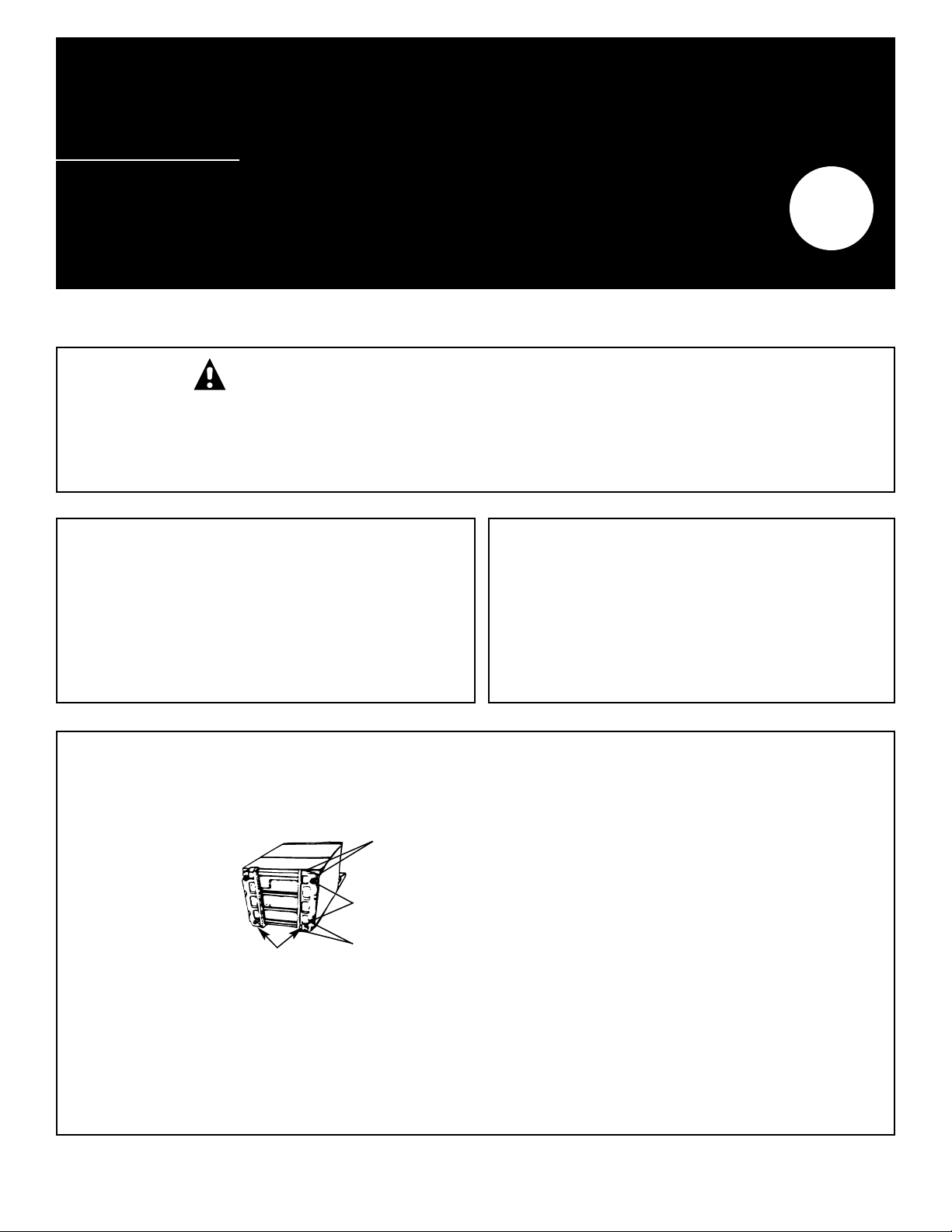
Lay carton corner
posts or two boards
on floor. Lay dryer
on its back.
Step 3
Remove foam
shipping pads by
pulling at sides and breaking away from dryer legs.
Be sure to remove all foam pieces from around legs.
Step 4
Stand dryer upright.
Step 5
Move dryer to desired operating location.
Step 6
Adjust leveling legs to match washer height. Dryer must
be level and rest firmly on all four leveling legs.
Step 7
Connect to power supply.
(See ELECTRICAL CONNECTION INFORMATION
section of this instruction.)
Step 8
Connect external exhaust or deflector. (See EXHAUST
INFORMATION section of this instruction.)
Step 9
Check for proper operation.
Step 10
Place Owner’s Manual and installation instructions
in a location where they may be found by the
customer.
Installation instructions
for your new
Electric Dryer
Before you begin - Read these instructions completely and carefully.
IMPORTANT - Save these instructions for local inspector’s use.
IMPORTANT - OBSERVE ALL GOVERNING CODES AND ORDINANCES.
Note to Installer - Be sure to leave these instructions with the Consumer.
Note to Consumer - Keep these instructions with your Owner’s Manual for future reference.
Installation
Foam shipping pads
Pull here to separate
from rear leg
Dryer legs
Pull here to separate
from front leg
500A187P031 49-90048 02-00 JR
31-16027
31
Note: Installation of this dryer requires basic mechanical and electrical skills.
It is your responsibility to contact a qualified electrical installer to make the electrical connection.
2
WARNING:
TO REDUCE THE RISK OF FIRE,
ELECTRIC SHOCK, OR PERSONAL INJURY
• DO NOT USE AN EXTENSION CORD
WITH THIS APPLIANCE.
• THIS APPLIANCE MUST BE PROPERLY
GROUNDED (EARTHED).
Dryer must be electrically grounded (earthed) in
accordance with local codes and ordinances.
Electrical requirements:
• The operating voltage (volts), amperage (amps) or
wattage (watts) and frequency (Hz) of your dryer are
indicated on the rating plate located on the upper
right corner of the door opening.
• The dryer must be connected to an individual branch
circuit corresponding to that indicated on the rating
plate and protected by the required time-delay fuses or
circuit breakers in accordance with governing codes.
• If the electrical supply does not meet what is indicated
on the rating plate, call a licensed electrician.
IF THE DRYER IS SUPPLIED WITH A FLEXIBLE POWER CORD
Plug the cordset into its own separate grounded outlet. DO NOT, UNDER ANY CIRCUMSTANCES, CUT OR
REMOVE THE GROUND PRONG FROM THE POWER CORD.
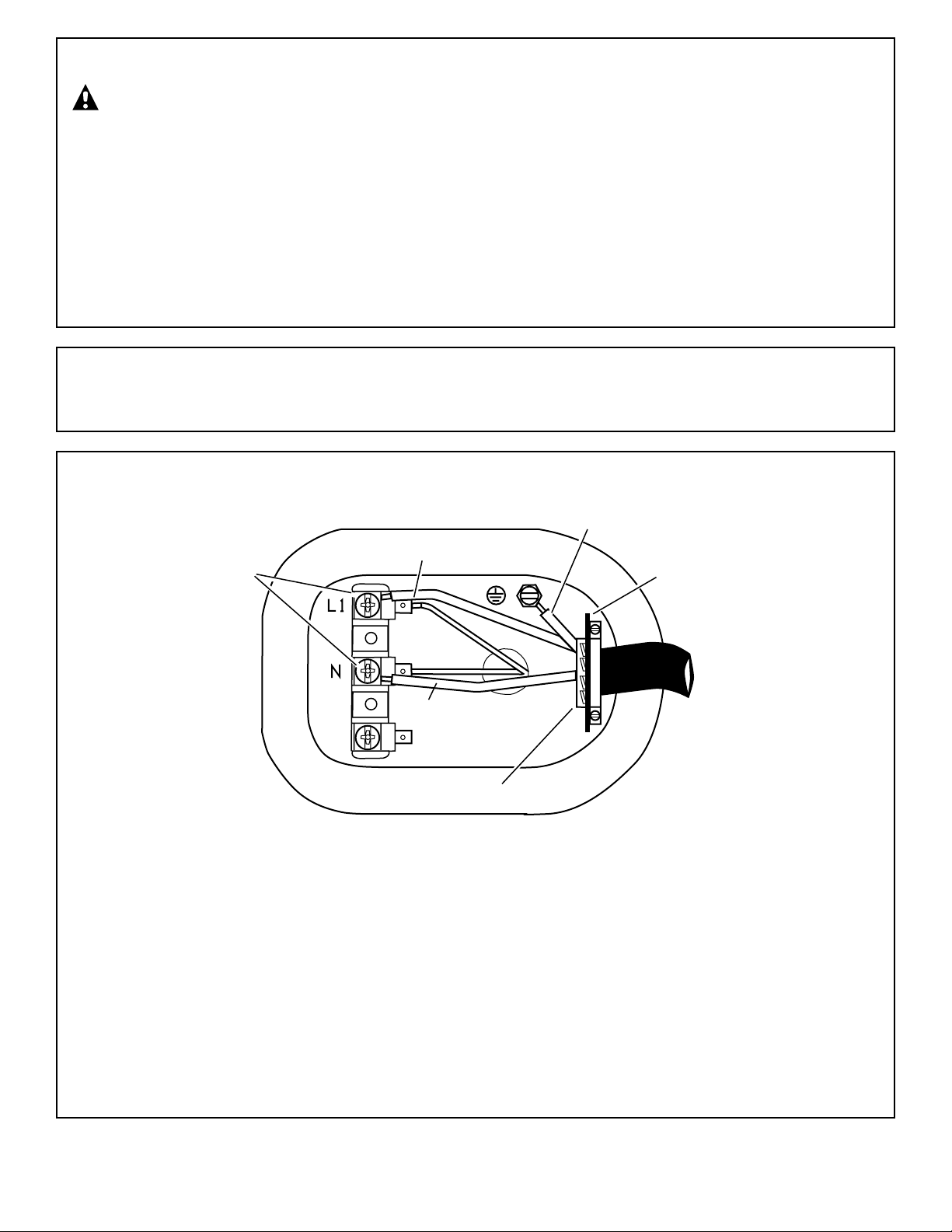
1. Remove cover near the power supply entry hole.
2. Install 3/4 inch, recognized strain relief to power entry
hole. Bring power supply through strain relief.
3. Connect power supply as follows:
A. Live (brown) line to upper screw of terminal block
(marked L1).
B. Neutral (blue) line to center screw of terminal block
(marked N).
4. Attach ground (earth) wire (green, green and
yellow, or bare) to the green ground screw (hole
above strain relief bracket). Tighten all terminal
block screws firmly.
5. Properly secure power supply to strain relief.
6. Reinstall the cover.
Electrical Connection Information
MAKE SURE SCREWS ARE
PROPERLY TIGHTENED
BLUE
BROWN
USE PROPER
STRAIN RELIEF
POWER SUPPLY CORD
220/240 VAC 30A
ASSURE GROUND (EARTH) WIRE
IS PROPERLY CONNECTED
WIRING DIAGRAM AND SOME SERVICE INFORMATION LOCATED IN CONTROL HOUSING
IF THE DRYER IS SUPPLIED WITH A TERMINAL BLOCK
WARNING: NEVER LEAVE THE TERMINAL BLOCK WITHOUT THE COVER.
STRAIN RELIEF
BRACKET
3
Exhaust Information
WARNING:
TO REDUCE THE RISK OF FIRE
AND PERSONAL INJURY
• Use only metal duct for exhausting dryer to outdoors.
• Do not terminate exhaust in a chimney, any gas vent,
under an enclosed floor (crawl space), or into an attic.
The accumulated lint could create a fire hazard.
• Provide an access for inspection and cleaning of the
exhaust system, especially at turns. Inspect and clean
at least once per year.
• Never terminate the exhaust into a common duct with
a kitchen exhaust. A combination of lint and grease
could create a fire hazard.
• Do not obstruct incoming or exhausted air.
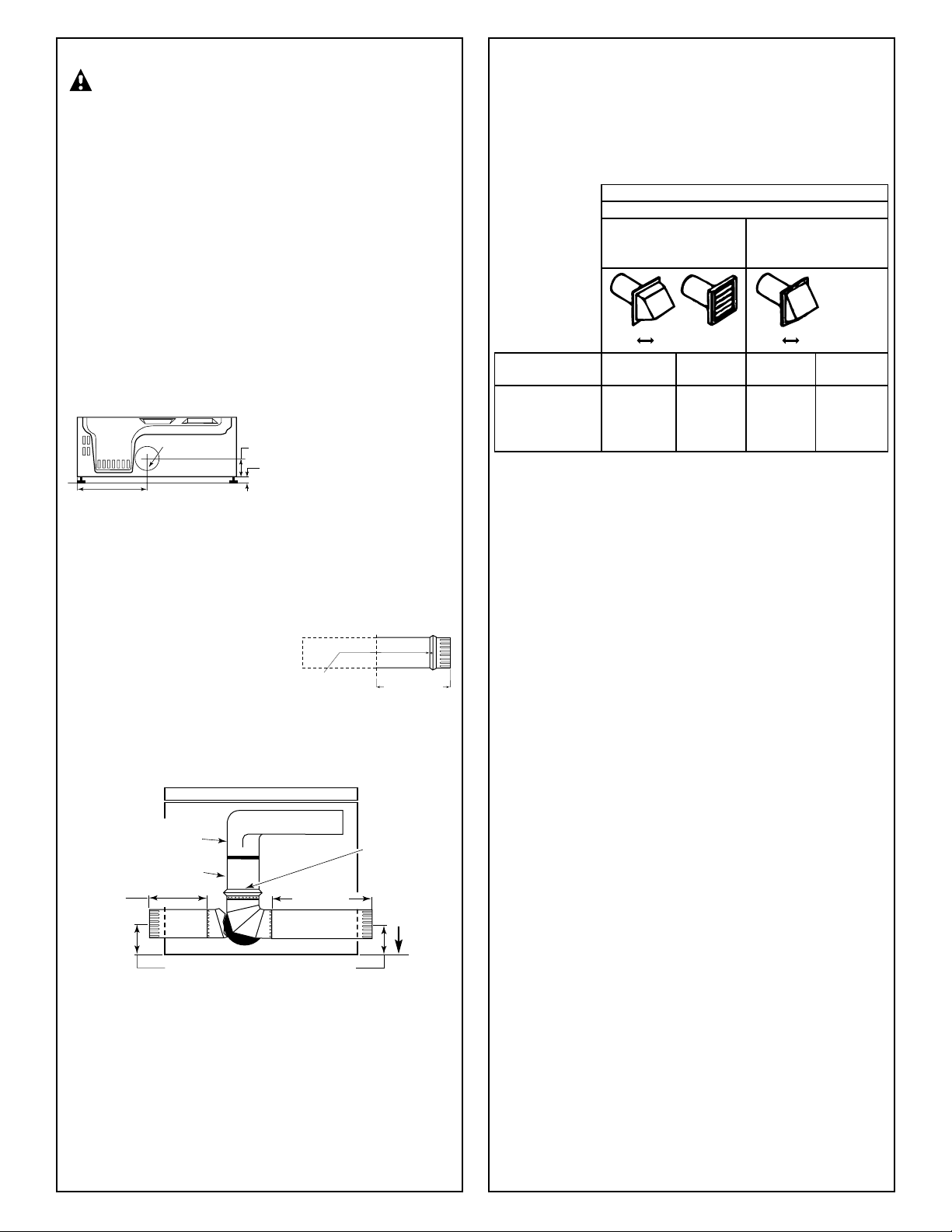
Rear Exhaust Location
This dryer comes ready for rear exhausting. If space is limited,
use the following instructions to exhaust directly from the side
or bottom of the cabinet.
Steps to Change Dryer to Side or Bottom Exhaust
Directly on Cabinet
WARNING: Protect your hands and arms from sharp edges
when working inside the dryer cabinet.
1. Detach and remove the desired knockout.
2. Remove the screw inside the
dryer exhaust duct end. Keep
the screw for step 5. Pull on
the duct to remove it.
3. Cut the duct as shown. Keep portion A.
4. Through the rear opening, locate the tab in the
middle of the dryer base. Lift the tab to about 45°
using a flat screwdriver.
5. Reconnect and secure the cut portion (A) of the duct
to the blower housing. Make sure the fixing hole is
aligned with the tab in the base. Use the screw from
step 2 to secure the duct in place through the tab on
the dryer base.
6. Use standard metal elbows and duct to complete
the exhaust system. Insert standard elbows and ducts
through rear and side or bottom openings.
7. Cover the opening at the back with the plate (Kit
WE1M454
) available from your local service provider.
WARNING: NEVER LEAVE THE BACK OPENING WITHOUT THE PLATE.
Exhaust Length
The MAXIMUM ALLOWABLE length of the exhaust
system depends upon the type of duct, number of turns,
type of exhaust hood (wall cap) and all conditions noted
below. The maximum allowable length for both rigid and
flexible metal duct is shown in the table below. More than
two 90° turns are not recommended.
• Do not use non-metallic flexible duct.
Hood or Wall Cap
• Terminate in a manner to prevent back drafts or entry
of birds or other wildlife.
• Termination should present minimal resistance
to the exhaust airflow and should require little
or no maintenance to prevent clogging.
• Never install screen over exhaust duct.
• Wall caps must be installed at least 300 mm (12″)
above ground level or any other obstruction with the
opening pointed down.
•
If roof vents or louvered plenums are used, they must be
equivalent to a 100 mm (4″) dampered wall cap in regard
to resistance to airflow, prevention of back drafts and
maintenance required to prevent clogging.
Separation of Turns
For best performance, separate all turns by at least 1.2 m
(4′ ) of straight duct, including distance between last turn
and dampered wall cap.
Turns Other Than 90°
• One turn of 45° or less may be ignored.
• Two 45° turns should be treated as one 90°.
• Each turn over 45° should be treated as one 90°.
Sealing of Joints
• All joints should be tight to avoid leaks. The male end
of each section of duct must point away from the dryer.
• Do not assemble the duct work with fasteners that
extend into the duct. They will serve as a collection
point for lint.
• Duct joints can be made air- and moisture-tight by
wrapping the overlapped joints with duct tape.
NOTE: Add to vertical dimension the
distance between cabinet bottom
and floor surface.
Back
of side
panel
Only metal
duct may be
used inside the
dryer cabinet
229 mm (9″)
Cut portion
Blower housing
Number of
Rigid Flexible Rigid Flexible
90° elbows
Metal Metal
0 10.7m (35 ft) 7.6m (25 ft) 7.6m (25 ft) 4.0m (13 ft)
1 9.1m (30 ft) 4.6m (15 ft) 4.6m (15 ft) 3.0m (10 ft)
2 6.1m (20 ft) 3.0m (10 ft) 3.0m (10 ft)
RECOMMENDED MAXIMUM LENGTH
Weather Hood Type
Recommended Use only for
short run
installations
10 cm (4″) 6 cm (2
1
/
2
″)
FOR ELECTRIC
DRYER ONLY
298 mm (11
3
⁄4″)
90 mm (3
1
⁄2″)
121 mm (4
3
⁄4″)
216 mm
(8
1
⁄
2
″)
285 mm
(11
1
⁄4″)
Screw inside duct
229 mm (9″)
Fixing hole
B A
121 mm (4
3
⁄4″)
A
Base tab
location
(under duct)
4
Exhaust Information (cont.)
Insulation
• Ductwork which runs through an unheated area or is near an air-conditioning duct should be insulated to reduce
condensation and lint buildup.
Parts Available From Local Service Organization
Inside Exhausting
BEDROOM, BATHROOM, ALCOVE, OR CLOSET INSTALLATIONS
MUST BE EXHAUSTED TO THE OUTDOORS.
EXHAUSTING TO THE OUTDOORS IS STRONGLY RECOMMENDED.
EXHAUSTING INDOORS MAY CAUSE
LINT ACCUMULATION AND MOISTURE DAMAGE
INCLUDING MOLD AND MILDEW.
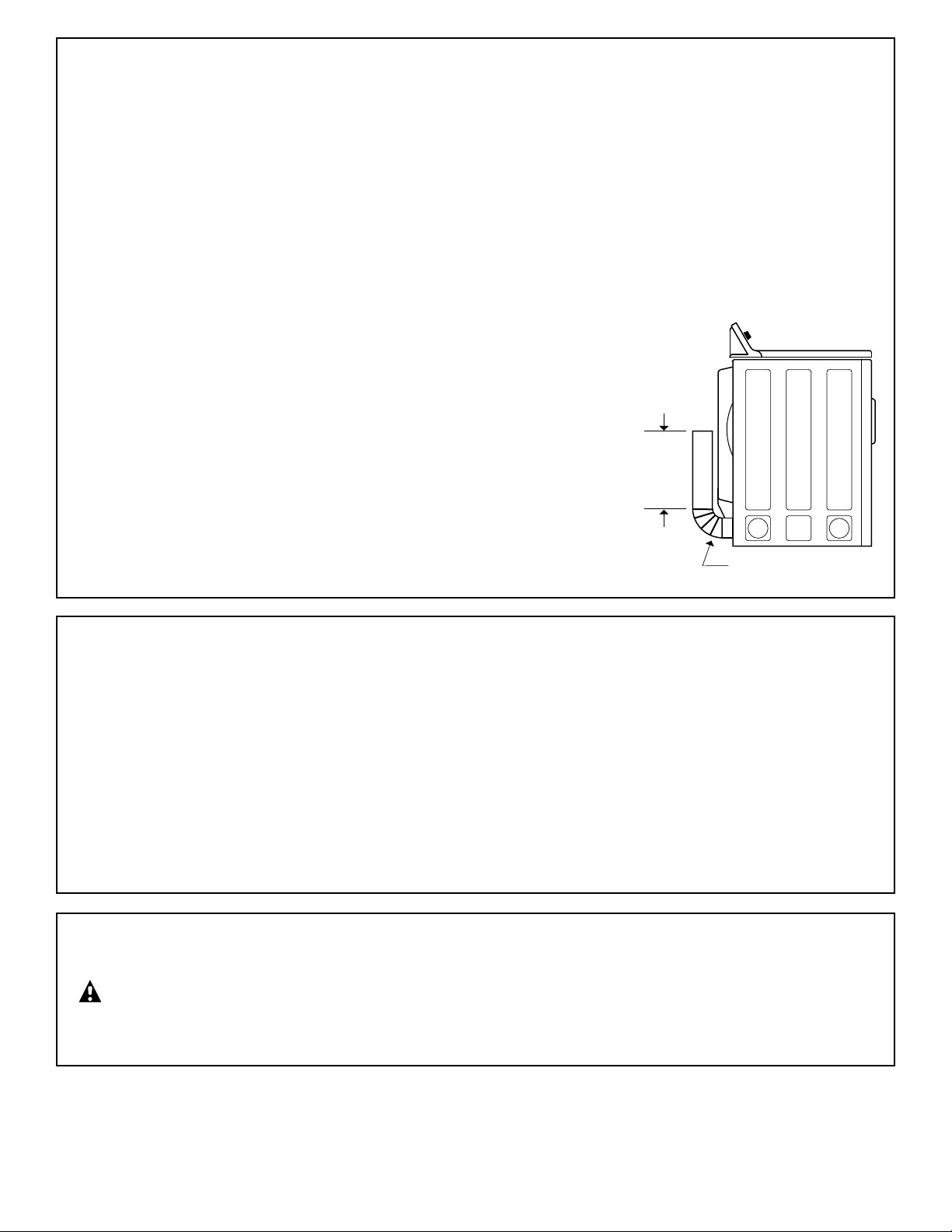
If the installation makes it impossible to exhaust to the
outdoors, a 100 mm (4″) exhaust deflector (WE25X28)
and 600 mm (2′) rigid metal duct (WX8X64) must be installed
over exhaust duct. A clearance of 200 mm (8″) is required
between rear of dryer and the wall, and the deflector
should be pointing up.
Special Installation Requirements
Alcove or Closet Installation
• If your dryer is approved for installation in an alcove or closet it will be stated on a label on the dryer back.
• The dryer must be exhausted to the outdoors.
• Minimum clearances between dryer cabinet and adjacent walls or other combustible surfaces are:
0 mm clearance on either side
80 mm (3″) front and rear
• Minimum vertical space from floor to overhead cabinets, ceilings, etc. is 1.3 m (52″).
• Closet doors must be louvered or otherwise ventilated and must contain at least 400 cm
2
(60 square inches) open area
equally distributed. If this closet contains both a washer and a dryer, doors must contain 800 cm
2
(120 square inches)
of open space equally distributed.
SERVICING:
Consideration must be given to provide adequate clearances
for installation and servicing.
CAUTION:
Label all wires prior to disconnection when servicing controls.
Wiring errors can cause improper and dangerous operation
(verify proper operation after servicing/installation).
• Rigid Metal Duct Components
WX8X64 100 mm (4″) x 60 cm (2′) Duct
WX8X51 100 mm (4″) Elbow
WX8X88 100 mm (4″) Aluminum Hood
WE25X28 Exhaust Deflector
• Flexible Metal Duct Components
Kit WX8X75
2.1 m (7′) Aluminum Flexible Duct
100 mm (4″) Clamps (2)
100 mm (4″) Aluminum Hood
600 mm (24″) RIGID
OR FLEXIBLE DUCT
EXHAUST DEFLECTOR
(WE25X28)