
User Guide
(UG template version 15a)
[Sprint_Samsung_SM-N900P_UM_Eng_052815_R5]

TOC i
Table of Contents
Get Started ....................................................................................................................................................
........................................................................................................................
...............................................................................................................................
.............................................................................................................................
..............................................................................................................................
...................................................................................................................................
....................................................................................................
............................................................................................................
..................................................................................................................
................................................................................................................
................................................................................................................................................
.............................................................................................................................
..............................................................................................................
.............................................................................................................
..................................................................................................................................
..............................................................................................................................
..................................................................................................................
................................................................................................................................
...................................................................................................................................
...............................................................................................................................
................................................................................................................................
.......................................................................................................................................
.............................................................................................................................
...........................................................................................................................
.............................................................................................................................
...............................................................................................................................
.....................................................................................................................
..............................................................................................................................
...................................................................................................
............................................................................................................
.......................................................................................................
1
Your Phone at a Glance 1
Set Up Your Phone 1
Activate Your Phone 3
Complete the Setup 4
Set Up Voicemail 5
Sprint Account Information and Help 6
Sprint Account Passwords 6
Manage Your Account 6
Sprint Support Services 7
Phone Basics 8
Your Phone’s Layout 8
Turn Your Phone On and Off 10
Turn Your Screen On and Off 10
S Pen Overview 11
Air Command 11
Access Action Memo 12
Smart Select 13
Image Clip 14
Screen Write 15
Pen Window 15
Air View 16
S Pen Options 16
Screen View Options 16
Motion Control 16
Multi Window 18
Touchscreen Navigation 21
Your Home Screen 24
Customize Your Home Screen 25
Extended Home Screens 27
Status Bar and Notification Panel 28

TOC ii
Status Bar ...................................................................................................................................
........................................................................................................................
............................................................................................................................................
.....................................................................................................................
...................................................................................................................
....................................................................................................................
.........................................................................................................................................
....................................................................................................................
.................................................................................................................................................
........................................................................................................................................
...............................................................................................................................
................................................................................................................
.............................................................................................................................
......................................................................................................................
..............................................................................................
............................................................................
............................................................................................................
...........................................................................................................................
.............................................................................................................................
............................................................................................................................
......................................................................................................................................
.................................................................................................................................
..............................................................................................................................
...........................................................................................................................
............................................................................................................................
.............................................................................................................................................
..........................................................................................................................
............................................................................................
..................................................................................................................................
..............................................................................................................
.............................................................................................................
............................................................................................................
...........................................................................................
.......................................................................................................
................................................................................................................
28
Notification Panel 30
Enter Text 31
Text Input Methods 31
Google Voice Typing 32
Samsung Keyboard 32
Swype 33
Tips for Editing Text 34
Phone Calls 35
Wi-Fi Calling 35
Make Phone Calls 35
Call Using the Keypad 35
Call from Logs 35
Call from Contacts 36
Call a Number in a Text Message 36
Call a Number in an Email or Gmail Message 36
Make an Emergency Call 36
Receive Phone Calls 37
Phone Call Options 38
Dialing Options 38
Caller ID 39
Call Waiting 39
3-Way Calling 39
Call Forwarding 40
In-Call Options 40
Voicemail 41
Voicemail Setup 41
Retrieve Your Voicemail Messages 42
Visual Voicemail 43
Set Up Visual Voicemail 43
Review Visual Voicemail 43
Visual Voicemail Options 44
Configure Visual Voicemail Settings 45
Change Your Main Greeting 45
Edit the Display Name 46

TOC iii
Logs ....................................................................................................................................................
...........................................................................................................................
......................................................................................................................................................
...................................................................................................................
.........................................................................................................................
.............................................................................................................................
.....................................................................................................................................
........................................................................................................................
......................................................................................................................................
.........................................................................................
......................................................................................................
..................................................................................................
..............................................................................................................................
..........................................................................................................................
...................................................................................................
....................................................................................................................................
.........................................................................................................................................
.............................................................................................................................................
................................................................................................................................................
...................................................................................................................................
................................................................................................................
...................................................................................................................
............................................................................................................................
...................................................................................................................................
............................................................................................................
.................................................................................................
..............................................................................................................................
...............................................................................................................
..........................................................................................
...............................................................................................................................
...................................................................................................................................................
.................................................................................................................
.........................................................................
..........................................................................................................
.........................................................................................................
46
Access Call Settings 48
Contacts 49
Get Started with Contacts 49
Access Contacts 49
Find a Contact 49
Add a Contact 50
Save a Phone Number 50
Edit a Contact 51
Add or Edit Information for a Contact 51
Assign a Picture to a Contact 51
Assign a Ringtone to a Contact 51
Link Contacts 52
Delete Contacts 52
Save a Business Card as a Contact 53
Move Contacts 53
Speed Dials 53
Favorites 54
Groups 55
Share Contacts 57
Export and Import Contacts 58
Access Contacts Settings 59
Accounts and Messaging 60
Google Account 60
Create a Google Account 60
Sign In to Your Google Account 60
Access Gmail 61
Send a Gmail Message 61
Read and Reply to Gmail Messages 62
Samsung Account 62
Email 63
Add an Email Account 63
Add a Microsoft Exchange ActiveSync Account 64
Compose and Send Email 65
Reply To or Forward Email 65

TOC iv
Manage Your Email Inbox ...........................................................................................................
................................................................................................................
.............................................................................................................
.........................................................................................................
......................................................................................................
...........................................................................................
...........................................................................................
.........................................................................................................
...............................................................................................................
......................................................................................................................
...............................................................................................................
....................................................................................................................................
......................................................................................................................................
.....................................................................................................................................
...........................................................................................................................
......................................................................................................................................
..............................................................................................................................
...............................................................................................................................
...............................................................................................................
................................................................................................................
..........................................................................................................................
...............................................................................................................................................
..........................................................................................................................................
..................................................................................................................................
...............................................................................................................................
...........................................................................................................................................
..........................................................................................................................................
......................................................................................................................
...................................................................................................................................
...........................................................................................................................................
........................................................................................................................
..............................................................................................................................
............................................................................................................................
...................................................................................................................
......................................................................................................................
66
Access Email Settings 67
Delete an Email Account 69
Text and Multimedia Messaging 69
Send a Text Message (SMS) 69
Send a Multimedia Message (MMS) 70
Save and Resume a Draft Message 71
New Messages Notification 71
Manage Conversations 71
Messages Settings 73
Social Networking Accounts 75
Facebook 75
Google+ 76
Hangouts 76
Messaging Plus 77
YouTube 77
Apps and Entertainment 78
Google Play Store 78
Find and Install an App 78
Open an Installed App 79
Uninstall an App 79
Amazon 79
Group Play 79
Navigation Apps 80
Google Maps 80
Scout 81
Music Apps 81
Google Play Music 81
NextRadio 82
Music 82
Sprint Music Plus 85
Google Play Books 86
Google Play Games 86
Google Play Movies & TV 86
Google Play Newsstand 86

TOC v
Samsung/GALAXY Apps ....................................................................................................................
..........................................................................................................................
............................................................................................................................
..........................................................................................................................................
.............................................................................................................................
.............................................................................................................................................
.............................................................................................................................................
..................................................................................................................................
.................................................................................................................................
...............................................................................................................................................
.............................................................................................................................................
....................................................................................................................................................
...................................................................................................................
.........................................................................
................................................................................................................................................
...............................................................................................................................................
................................................................
........................................................................................................................................
.........................................................................................................................
......................................................................................
................................................................................................................................................
...........................................................................................................
..................................................................................
..................................................................................................................................
.......................................................................................................................
...............................................................................................................
......................................................................................................................................
...............................................................................................................................................
.......................................................................................................................
.............................................................................................................................
............................................................................................................................
.........................................................................
...............................................................................................................
...........................................................................................................................
......................................................................................................
87
Sprint Family Locator 87
Sprint Fun & Games 87
Sprint Zone 87
Sprint TV & Movies 87
1Weather 88
App Pass 88
NASCAR Mobile 89
NBA Game Time 89
PEN.UP 89
Web and Data 90
Wi-Fi 90
Turn Wi-Fi On or Off 90
Turn Wi-Fi On and Connect to a Wi-Fi Network 90
Internet 91
Chrome 92
Data Services General Information (3G and 4G Networks) 92
4G LTE 92
Your User Name 93
Data Connection Status and Indicators 93
Hotspot 93
Virtual Private Networks (VPN) 94
Prepare Your Phone for VPN Connection 94
Add a VPN 95
Connect to a VPN 96
Disconnect from a VPN 97
Camera and Video 98
Camera 98
Open the Camera 98
Take a Picture 99
Record Videos 99
Review Pictures and Videos from the Camera 100
Configure the Camera 101
Quick Settings 102
Advanced Camera Settings 103

TOC vi
Gallery ...............................................................................................................................................
...........................................................................................................
.................................................................................................................
.........................................................................................................
.........................................................................................................................
..................................................................................................................................
......................................................................................................................................
...................................................................................................................................
.....................................................................................................................................
.....................................................................................................................................
...........................................................................................................................................
...........................................................................................................
...................................................................................
...............................................................................................
.........................................................................
............................................................................................
.......................................................................................
............................................................................................................................................
...................................................................................................
.....................................................................................................
..............................................................................................................................
.............................................................................................................................
.........................................................................................................
..........................................................................................................................................
.................................................................................................................................................
........................................................................................................................................
..................................................................................................................................................
.............................................................................................................................................
...........................................................................................................................................
......................................................................................................................................
..................................................................................................................................
...................................................................................................................................................
.........................................................................................................................................
................................................................................................................................................
...............................................................................................................................
104
View Photos and Videos 105
Working with Photos 107
Share Photos and Videos 108
Gallery Settings 109
Google Photos 110
Video Player 110
Tools and Calendar 111
Action Memo 111
App Spotlight 112
Bluetooth 112
Turn Bluetooth On or Off 112
Connect a Bluetooth Headset or Car Kit 112
Reconnect a Headset or Car Kit 113
Disconnect or Unpair from a Bluetooth Device 113
Send Information Using Bluetooth 114
Receive Information Using Bluetooth 115
Calendar 115
Add an Event to the Calendar 116
Event Alerts and Reminders 117
View Events 117
Erase Events 119
Access Calendar Settings 119
Calculator 120
Clock 120
Downloads 121
Drive 121
Dropbox 122
Flipboard 122
Google Now 122
Google Search 122
Help 122
Kids Mode 123
KNOX 123
Lookout Security 123

TOC vii
My Files .............................................................................................................................................
.....................................................................................................................................
..................................................................................................................................
............................................................................................................................................
...............................................................................................................................................
.......................................................................................................................................
..............................................................................................................................................
...................................................................................................................................
.........................................................................................................................................
.....................................................................................................................
........................................................................................................................................
.................................................................................................................................
.....................................................................................................................................
...........................................................................................................................................
..................................................................................................................
................................................................................................................
....................................................................................................................................
..............................................................................................................
..........................................................................................................
.....................................................................................................
............................................................................................................
.........................................................................................................
......................................................................
................................................................................................................................
...............................................................................................
..................................................................................................................
.........................................................................................................................................
..............................................................................
.............................................................................................................................
........................................................................
.................................................................
..........................................................................................................
.................................................................................................
..............................................................................................
..................................................
123
My Magazine 124
Polaris Office 5 124
S Health 124
S Note 126
S Translator 128
S Voice 128
Samsung Link 129
Scrapbook 131
SketchBook for Galaxy 132
TripAdvisor 132
Voice Recorder 132
Voice Search 135
WatchON 135
Configure WatchON 135
Customize WatchON 136
microSD Card 137
Install a microSD Card 137
Remove a microSD Card 138
View microSD Card Memory 138
Format a microSD Card 138
Unmount a microSD Card 138
Transfer Files Between Your Phone and a Computer 139
System Updates 140
Before Updating Your Firmware 140
Update Your Phone 140
Global Services 142
Set the Communications Method for Global Use 142
Setting the Carrier 142
Activate Sprint Worldwide Service on Your Account 143
Your Phone’s SIM Card for International GSM Roaming 143
Enable Global Roaming Mode 144
Make and Receive Worldwide Calls 144
Sprint International Voicemail Service 145
Set Up Your Voicemail Access Number for International Use 145

TOC viii
Access Your Voicemail Internationally ......................................................................................
..............................................................................................................
......................................................................
..................................................................
.....................................................................................................................................................
...................................................................................................................................
........................................................................................................................
....................................................................................................................................
...........................................................................................................
...........................................................................................................
.................................................................................................................
................................................................................................................................
.............................................................................................................................
.............................................................................................................................
...................................................................................................................................
.........................................................................................................................
...............................................................................................................................
....................................................................................................................
...............................................................................................
........................................................................................................................
.........................................................................................................
.............................................................................................................................
......................................................................................................................
.....................................................................................................................................
.............................................................................................................
..............................................................................................................................
...............................................................................................................................
...................................................................................................................
.................................................................................................................
....................................................................................................
........................................................................................................................
................................................................................................
................................................................................................................................
.......................................................................................................................
....................................................................................................................................
146
International Data Roaming 146
Access Email and Data Services Internationally 147
Contact Sprint for Assistance with International Service 147
Settings 149
Using Settings 149
Wi-Fi Calling Settings 150
Wi-Fi Settings 150
Configure Wi-Fi Settings 150
Advanced Wi-Fi Settings 151
Wi-Fi Direct Settings 152
Hotspot Settings 152
Bluetooth Settings 154
Tethering Settings 155
Airplane Mode 155
Data Usage Settings 156
Location Settings 157
More Networks Settings 158
Default Messaging App Settings 158
Printing Settings 158
Mobile Networks Settings 159
VPN Settings 160
Roaming Settings 161
NFC Settings 161
Android Beam Settings 161
Tap and Pay 162
S Beam Settings 162
Nearby Devices Settings 163
Screen Mirroring Settings 163
Sounds and Notifications Settings 164
Volume Settings 164
Sound and Notification Options 164
Display Settings 165
Multi Window Settings 166
LED Indicator 166

TOC ix
Lock Screen Settings ........................................................................................................................
..............................................................................................................................
..........................................................................................................
....................................................................................................
........................................................................................................
..............................................................................................................
....................................................................................................
............................................................................................................................
...................................................................................................................................................
................................................................................................................
..........................................................................................................................
.........................................................................................................................
.....................................................................................
..................................................................................
............................................................................
......................................................................................
...............................................................................................
......................................................................................................................................
............................................................................................................................
.....................................................................................................
.................................................................................................................
............................................................................................................
..................................................................................................................................
.......................................................................................................................
.................................................................................................................................
..............................................................................................................................
...................................................................................................
.............................................................................................................
........................................................................................................................
.......................................................................................................
.................................................................................................................................
..................................................................................................................
.............................................................................................................................
....................................................................................................................
............................................................................................................
167
Screen Lock 167
Set a Swipe Screen Lock 167
Set a Signature Screen Lock 168
Set a Pattern Screen Lock 169
Set a PIN Screen Lock 170
Set a Password Screen Lock 171
Wallpaper Settings 171
Font 172
Notification Panel Settings 172
Easy Mode Settings 173
Accessibility Settings 173
Configure Vision Accessibility Settings 173
Configure Hearing Accessibility Settings 174
Configure Dexterity and Interaction Settings 175
Configure Other Accessibility Settings 176
Configure Accessibility Services 176
Call Settings 177
Call Rejection 177
Answering and Ending Calls 177
Call-related Pop-ups 178
Show Caller Information 178
Call Alerts 178
Call Accessories 179
TTY Mode 179
Hearing Aids 179
Ringtones and Keypad Tones 180
Personalize Call Sound 180
Noise Reduction 180
Increase Volume in Pocket 181
US Dialing 181
International Dialing 181
DTMF Tones 181
Voicemail Settings 181
Language and Input Settings 182

TOC x
Choose a Default Language .....................................................................................................
.......................................................................................................
....................................................................................................
.........................................................................................................................
...................................................................................................
...........................................................................................................
........................................................................................................................
.........................................................................................................
.....................................................................................................................................
................................................................................................................
..................................................................................................................................
.......................................................................................................
.....................................................................................................................
..................................................................................................................
.......................................................................................................................
..............................................................................................................
.......................................................................................................................
................................................................................................................
..............................................................................................................
........................................................................................................
.............................................................................................................................
...................................................................................................................................
...............................................................................................................
....................................................................................................................
.........................................................................................................................
...........................................................................................................
............................................................................................................
.................................................................................................................................
......................................................................................................................
................................................................................................................................
...............................................................................................................................
...............................................................................................................
.................................................................................................................................
.................................................................................................................................
...........................................................................................................
182
Set a Default Input Method 182
Samsung Keyboard Settings 182
Swype Settings 184
Google Voice Typing Settings 186
Handwriting Recognition 186
Speech Settings 186
Mouse/Trackpad Settings 187
Voice Control 187
Hands-free Mode Settings 188
S Pen Settings 188
One-Handed Operation Settings 189
Motion Control Settings 189
Air Gesture Settings 189
Air View Settings 190
Air Command Settings 191
Motions Settings 191
Palm Motion Settings 192
Smart Screen Settings 192
Increase Touch Sensitivity 193
Accounts Settings 193
Cloud Settings 194
Backup and Reset Settings 194
Date and Time Settings 195
Accessories Settings 195
Application Manager Settings 196
Default Applications Settings 197
Battery Settings 197
Power Saving Settings 197
Storage Settings 198
Security Settings 198
Device Administration 198
Encryption 199
Passwords 199
Security Update Service 200

TOC xi
Credential Storage ....................................................................................................................
....................................................................................................................
..........................................................................................................................
...................................................................................................................
.......................................................................................................................
................................................................................................................................
..........................................................................................................................................................
200
Advanced Settings 200
Activate This Device 201
System Update Settings 201
About Device Settings 201
Copyright Information 203
Index 204
Get Started 1
Get Started
The following topics give you all the information you need to set up your phone and Sprint service for the
first time.
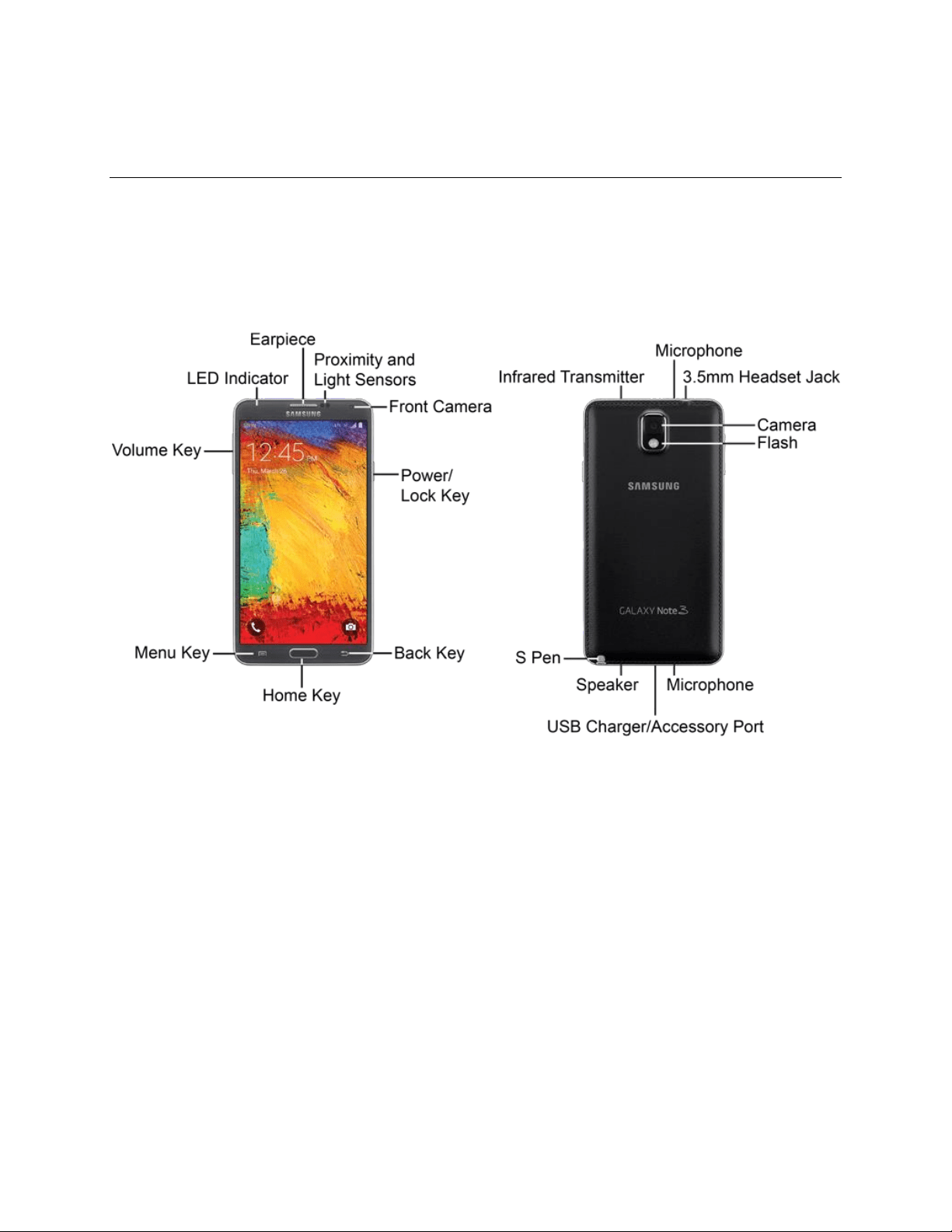
Your Phone at a Glance
The following illustration outlines your phone’s primary features.
Set Up Your Phone
Before using your new phone, you must install and charge the battery.
Note: Your phone’s battery should have enough charge to turn the phone on and find a signal, complete
the setup wizard, set up voicemail, and make a call. You should fully charge the battery as soon as
possible.
Get Started 2
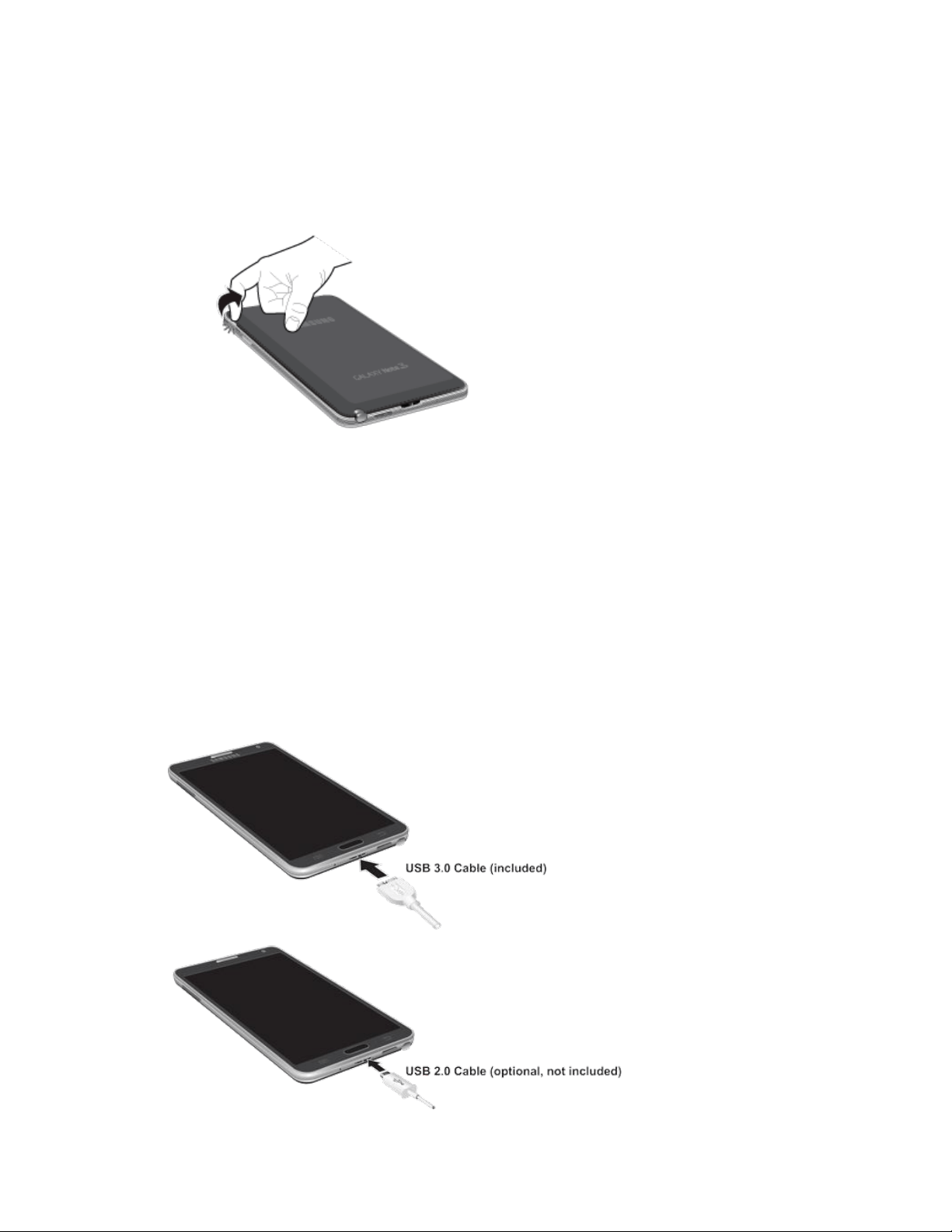
You must first install and charge the battery to begin setting up your phone.
Install the battery. ■
Using the slot on the upper left side of the battery cover, gently lift the cover off the phone.
Insert the battery, aligning the gold contacts on the battery with the gold contacts on the
phone, and gently press the battery into place.
Replace the battery compartment cover, making sure all the tabs are secure and there are no
gaps around the cover.
Charge the Battery
1. Plug the USB cable into the Charger/Accessory Port on the bottom of the phone.
2. Plug the other end of the USB cable into the Charging Head, and then plug the Charging Head
into an electrical outlet to charge your battery. Fully charging a battery may take up to three
hours.

Get Started 3
Note: Your phone supports USB 3.0 and USB 2.0, and includes a USB 3.0 cable for higher data transfer
speeds when connected to another USB 3.0 device. You can also use USB 2.0 cables (not included) to
charge and connect your phone.
Activate Your Phone
Follow the instructions below to activate your phone if it has not already been activated. Depending on
your account or how and where you purchased your phone, it may be ready to use or you may need to
activate it on your Sprint account.
● If you purchased your phone at a Sprint Store, it is probably activated and ready to use.
● If you received your phone in the mail and it is for a new Sprint account or a new line of service, it
is designed to activate automatically.
When you turn the phone on for the first time, you should see a Hands Free Activation
screen, which may be followed by a PRL Update screen and a Firmware Update screen.
Follow the onscreen instructions to continue.
● If you received your phone in the mail and you are activating a new phone for an existing number
on your account (you are swapping phones), you can activate on your computer online or directly
on your phone.
Activate on your computer:
• Go to sprint.com/activate and complete the online instructions to activate your phone.
Activate on your phone:
• Turn on your new phone. (Make sure the old one is turned off.) Your phone will
automatically attempt Hands-Free Activation.
• Tap Activate to override auto-activation and start the manual activation wizard.
• Follow the onscreen prompts to complete the activation process.
To confirm activation, make a phone call. If your phone is still not activated, visit sprint.com/support for
assistance. If you do not have access to the Internet, call Sprint Customer Service at 1-888-211-4727
from another phone.
Tip: Do not press the Power key while the phone is being activated. Pressing the Power key cancels the
activation process.
Note: If you are having any difficulty with activation, visit sprint.com/support.

Get Started 4
Complete the Setup
After you turn on your phone and activate it, your phone displays a Welcome screen. From the Welcome
screen follow the prompts to set up features and preferences on your phone.
Note: In some cases, you may be able to complete the setup process before your phone has been
activated on your Sprint account.
1. At the Welcome screen, choose options, and then tap START to begin setup:
Language: Choose the default language for your phone’s operation.
Accessibility: Configure settings to access settings to improve the accessibility of your
phone’s features if you are visually impaired or hard of hearing.
2. Follow the onscreen instructions to complete setup for each topic. Tap NEXT, or the right arrow,
to move through the steps. You can skip options to continue to the next one. During setup, you
may see these options:
Wi-Fi: By default, your phone prompts you to use Wi-Fi when accessing data services. Tap a
Wi-Fi access point to connect to it, or you can continue setup using your phone’s connection
to the wireless network.
Tap & Go: Quickly copy any Google Accounts, backed up apps and data from your existing
Android device. Follow the onscreen instructions.
Google Account (Add your account): Your phone uses your Google Account to provide
access to many features and apps. Complete the steps to sign in to your current Google
Account, or tap Or create a new account to sign up for a new Google Account right from
your phone. You can also skip signing in to your Google Account, or sign in later.
Set up payment info: You can set up payment accounts to purchase items from
Google Play.
Google services: Select Google service preferences, including Location and Communication
options.
Samsung account: Some apps and features use your Samsung account. You can sign in to
your Samsung account, or follow the prompts to create a new account.
Dropbox: Dropbox provides Web-based “cloud” storage, so you can save your pictures and
videos to the web, and any computers you link to. You can create a new account here, or
sign in to your existing Dropbox account.
Device name: Your device name is how you and other devices identify your phone, such as
when sharing via Bluetooth or Wi-Fi Direct. If you want to use a different name, tap the field
and enter a name.
Easy mode: Easy mode offers a simpler Home screen layout, with larger text and icons. Tap
the check box to turn on Easy mode. You can also choose Easy mode from Settings at any
time.

Get Started 5
3. Tap FINISH to complete setup.
You may see a series of informational or update screens. Follow the prompts to continue.
Note: During or after setup, you may see a Connections Optimizer notice. Read the notice and then tap
I Agree to allow your phone to connect automatically to the best available data network, including Wi-Fi.
To turn Connections Optimizer off at any time, from home tap Apps > Settings >
CONNECTIONS tab > More networks > Mobile networks > Connections optimizer and uncheck the
Connections Optimizer box. See Mobile Networks Settings for details.
Set Up Voicemail
Your phone automatically transfers all unanswered calls to voicemail, even if your phone is in use or
turned off. You should set up your voicemail and personal greeting as soon as your phone is activated.
Always use a password to protect against unauthorized access.
Note: Voicemail Password – It is strongly recommended that you create a password when setting up
your voicemail to protect against unauthorized access. Without a password, anyone who has access to
your phone is able to access your voicemail messages.
1. From home, tap Phone.
If your screen is locked, press the Power/Lock key to turn on the display and then swipe your
screen in any direction. See Turn Your Screen On and Off.
2. Touch and hold
to dial your voicemail number.
3. Follow the system prompts to:
Create your password.
Record your name announcement.
Record your greeting.
Tip: You can also access and set up voicemail with the Visual Voicemail app. From home, tap Apps
> Voicemail, and then tap Personalize now.

Get Started 6
Sprint Account Information and Help
Find out about account passwords and information about managing your account and finding help.
Sprint Account Passwords
As a Sprint customer, you enjoy unlimited access to your personal account information, your voicemail
account, and your data services account. To ensure that no one else has access to your information, you
will need to create passwords to protect your privacy.
Account User Name and Password
If you are the account owner, you will create an account user name and password when you sign on to
sprint.com/mysprint. (Click Sign in/Sign up and then click Sign up now to get started.) If you are not the
account owner (if someone else receives the bill for your Sprint service), you can get a sub-account
password at sprint.com/mysprint.
Voicemail Password
You’ll create your voicemail password when you set up your voicemail. See Set Up Voicemail for more
information on your voicemail password.
Data Services Password
With your Sprint phone, you may elect to set up an optional data services password to control access and
authorize Premium Service purchases.
For more information, or to change your passwords, sign on to sprint.com/mysprint.
Manage Your Account
Manage your Sprint account from your computer, your Sprint phone, or any other phone.
Online: sprint.com/mysprint
● Access your account information.
● Check your minutes used (depending on your Sprint service plan).
● View and pay your bill.
● Enroll in Sprint online billing and automatic payment.
● Purchase accessories.
● Shop for the latest Sprint phones.
● View available Sprint service plans and options.
● Learn more about data services and other products like games, ringtones, screen savers,
and more.
Get Started 7
From Your Sprint Phone
1. From home, tap Phone.
2. Do any of the following:
Tap to access a summary of your Sprint service plan or to get answers
to other questions.
Tap to make a payment.
Tap to check minute usage and account balance.
Note: For additional account information, you can access Sprint Zone from your device. From home, tap
Apps > Sprint Zone.
Sprint Support Services
Sprint 411 and Sprint Operator Services let you easily access information and calling assistance from
your Sprint phone.
Sprint 411
Sprint 411 gives you access to a variety of services and information, including residential, business, and
government listings, movie listings or show times, driving directions, restaurant reservations, and major
local event information. You can get up to three pieces of information per call, and the operator can
automatically connect your call at no additional charge.
There is a per-call charge to use Sprint 411, and you will be billed for airtime.
1. From home, tap Phone.
2. Tap .
Sprint Operator Services
Sprint Operator Services provides assistance when you place collect calls or when you place calls billed
to a local telephone calling card or third party.
1. From home, tap Phone
2. Tap .
Note: For more information or to see the latest in products and services, visit us online at
sprint.com/mysprint.
Phone Basics 8
Phone Basics
Your phone is packed with features that simplify your life and expand your ability to stay connected to the
people and information that are important to you. The following topics will introduce the basic functions
and features of your phone.
Your Phone’s Layout
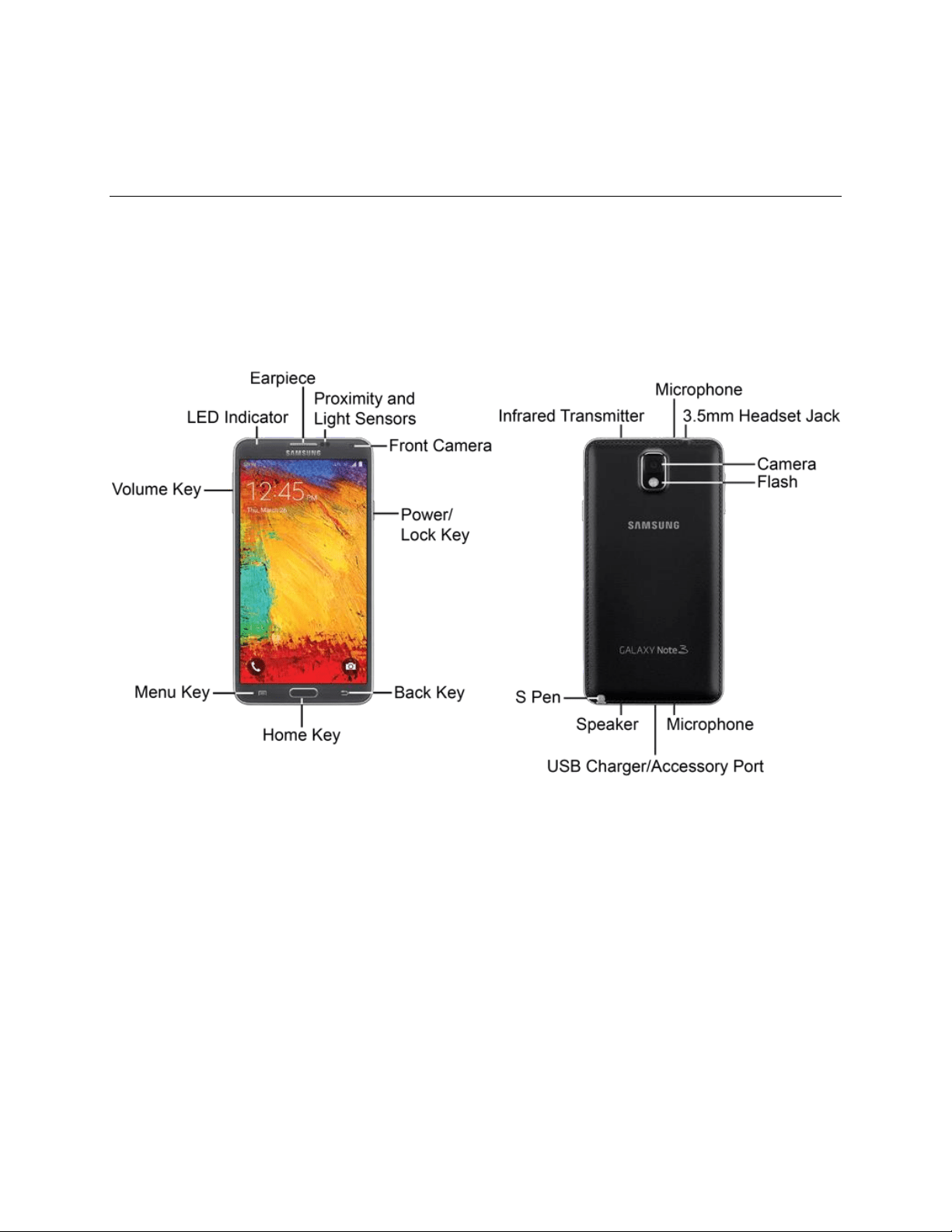
This illustration outlines your phone’s basic layout.
Features
The following list defines the features listed in the above illustrations.
● LED Indicator: Glows or blinks in different colors to show status when the screen is turned off.
The LED glows red when charging, and blinks red when the battery is low; blinks blue when there
is a new notification, or when you are recording voice with the screen turned off; and glows green
when the battery is fully charged and the phone is attached to a charger.
● Earpiece: Lets you hear the caller and automated prompts during calls.
● Proximity Sensor: Detects the presence of objects near the phone, such as when using air
gesture or motion settings. For example, while talking on the phone the sensor detects when it is
near your ear and turns off the screen to prevent accidental key presses.

Phone Basics 9
● Light Sensor: Detects the ambient light level, such as when setting screen brightness when
Automatic brightness is enabled, and when using the Camera.
● Front Camera: Allows you to take pictures and videos of yourself.
● Power/Lock Key: Lets you turn the phone on or off, turn the screen on or off, or lock the screen.
Press and hold for a Device options menu, where you can turn the phone off or restart it, or for
easy access to Airplane mode, Emergency Mode, and to Mute, Vibrate, and Sound modes.
● Back Key: Lets you return to the previous screen, or close a dialog box, options menu, the
Notification Panel, or onscreen keyboard.
● Home Key: Returns you to the Home screen.
● Menu Key: Access a menu of options from most of your phone’s screens.
● Volume Key: Adjusts the volume of your phone’s sounds. From home, press to adjust master
volume. During calls or playback, press to adjust volume. Press to mute the ringtone of an
incoming call.
● Infrared Transmitter: Allows you to control other devices, such as a TV.
● Microphones: Allow other callers to hear you when you are using the speakerphone, and
captures sound during recording.
● 3.5 mm Headset Jack: Allows you to plug in either a stereo headset or an optional headset for
convenient, hands-free conversations.
● Camera: Lets you take pictures and record videos.
● Flash: Helps illuminate subjects in low-light environments when the camera is focusing and
capturing a photo or video.
● USB Charger/Accessory Port: Allows you to connect the phone charger/USB cable (included)
and other optional accessories (not included).
● Speaker: Plays ringtones and sounds. The speaker also lets you hear the caller’s voice in
speakerphone mode.
● S Pen: Input information and interact with your phone.
Note: Your phone supports USB 3.0 and USB 2.0, and includes a USB 3.0 cable for higher data transfer
speeds when connected to another USB 3.0 device. You can also use USB 2.0 cables (not included) to
charge and connect your phone.
Caution: Inserting an accessory into the incorrect jack or port may damage the phone.

Phone Basics 10
Turn Your Phone On and Off
Use the Power/Lock key to turn the phone on or off.
Turn the Phone On
Press and hold the Power/Lock key. ■
Turn the Phone Off
1. Press and hold the Power/Lock key to display the Device options menu.
2. Tap Power off > POWER OFF to turn the phone off.
The screen remains blank while your phone is off. If the phone is off during charging, the screen displays
a charging animation.
Turn Your Screen On and Off
Your phone allows you to quickly turn the screen off when not in use and to turn it back on and unlock it
when you need it.
Turn the Screen Off When Not in Use
To quickly turn the screen off, press the Power/Lock key. Pressing the Power/Lock key again ■
will turn on the screen and display the lock screen.
To save battery power, the phone automatically turns off the screen (times out) after a certain period of
time when you leave it idle. You will still be able to receive messages and calls while the phone’s screen
is off.
Note: For information on how to adjust the time before the screen turns off, see Screen timeout under
Display Settings.
Turn the Screen On and Unlock It
1. To turn the screen on, press the Power/Lock key.
2. Unlock the screen:
If you are using the default screen lock, swipe the screen in any direction to unlock it.
If you have set up a screen lock, use your screen lock. See Screen Lock.
Phone Basics 11
S Pen Overview
Use S Pen and your device to create and collaborate. With S Pen, you can:
● Write directly into a Gmail message.
● Write directly on the calendar.
● Annotate documents (Word, Excel, PPT, PDF).
● Write a note on the back of a picture.
● Quickly open S Note from any screen.
Removing S Pen from Your Phone
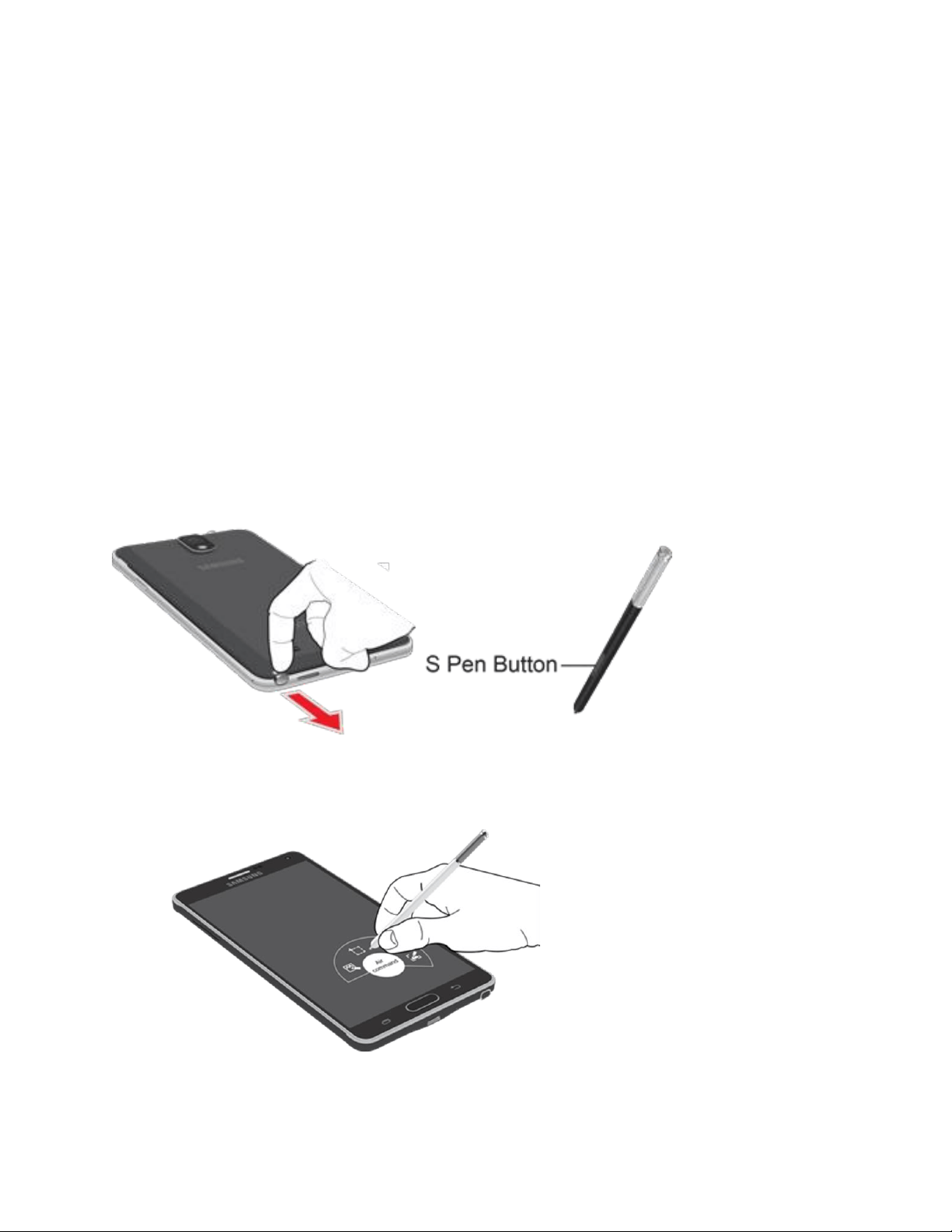
S Pen is stored in your phone to keep it protected and easy to locate.
Slide S Pen from your phone using the notch on the end of the S Pen. ■
Air Command
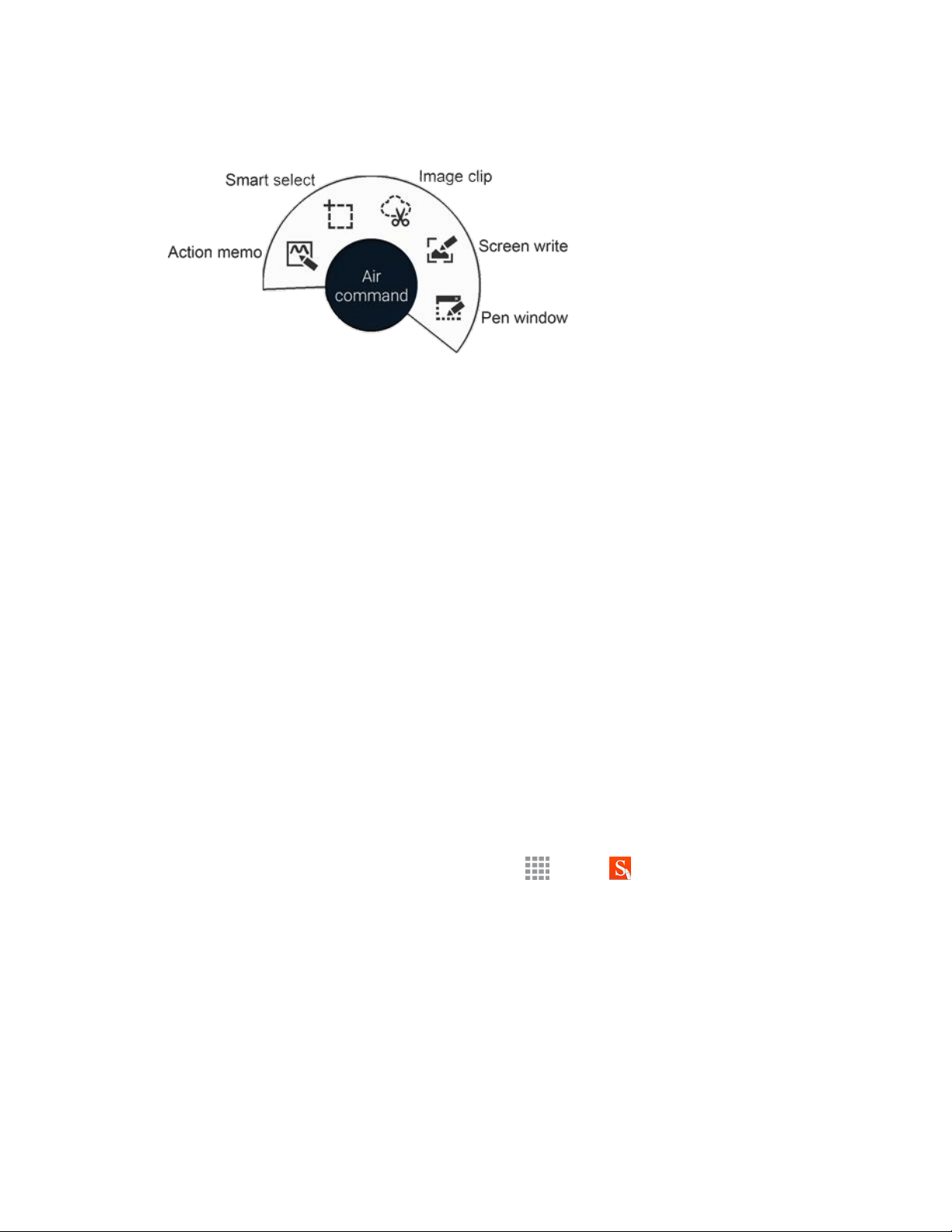
Air command allows you to quickly activate frequently-used applications or perform actions.
Phone Basics 12
To launch the Air command menu, remove the S Pen from the S Pen slot, hold the S Pen near ■
the screen so that the pointer appears, and then press the S Pen button once.
Action memo: Create memos and link actions to them. Action memos are saved in the
S Note app.
Smart select: Draw around an area of the screen to collect content for later use.
Image clip: Outline and crop images on the screen, in any shape, to share or paste.
Screen write: Capture, edit, and write memos on screenshots, and then share them.
Pen window: Draw a window on the screen to open an app in a small window while using
other apps.
Access Action Memo
An Action memo is a special type of note that turns your written text into actions on your phone. For more
information, see Action Memo.
To open an Action memo:
Remove the S Pen from the S Pen slot, hold the S Pen near the screen so that the pointer ■
appears, and press the S Pen button once. Select Action memo.
– or –
Press and hold the S Pen button and double-tap the screen with the pen.
Note: To view your Action memos, from a Home screen tap Apps > S Note, See S Note for more
information.

Phone Basics 13
Smart Select
Smart select provides a capture tool to select content on a screen and add it to your Scrapbook app or
share it with your contacts.
To use the Smart select tool:
1. Remove the S Pen from the S Pen slot, hold the S Pen near the screen so that the pointer
appears, and press the S Pen button once. Select Smart select.
2. To capture an item on the screen, simply draw around the item. The captured item appears on
the screen and can be saved to the Scrapbook or shared. The following options are available:
Tap the Collect icon to collect the content. It will appear in minimized form on the screen
until you save or delete the capture.
Tap the Save in Scrapbook icon to save the content in the Scrapbook. See Scrapbook
for more information.
Tap the Share via icon to share the captured content with your contacts.
If the captured item contains text, tap View text to copy only the text. Draw a line through
the text you wish to copy, tap Share via and select a destination, app, or service.
When you tap the Collect icon, the captured content is stored on top of the Home screen as a thumbnail.
The following options are available:
● Tap the Collect more icon to take another Smart select capture.
● If more than one capture has been taken, tap the Expand arrow to view all of the capture
thumbnails.
● Tap a thumbnail to view the capture and see the options available. You can save the captured
content to the Scrapbook, share the capture, or delete it.
● To delete captured content, tap More options > Select. Select the item(s) to delete, tap
Delete > DELETE.

Phone Basics 14
Image Clip
Outline and crop images from the screen, in any shape, to share or paste. You can edit the cropped
content, or personalize it with your handwriting.
To use Image clip:
1. Remove the S Pen from the S Pen slot, hold the S Pen near the screen so that the pointer
appears, and press the S Pen button once. Select Image clip.
2. Use the S Pen to draw around the content you wish to capture.
The selected clip is centered on the screen. To refine your selection, use the Transform
buttons:
• Transform back to original shape: Revert the selection back to its original shape.
• Transform into circle: Change the selection into a circle.
• Transform into rectangle: Change the selection into a rectangle.
• Transform into auto shape: Automatically refine the selection based on the image.
You can manually add or subtract from the selection, as well as rotate the selection left or
right.
Tap to save the image clip to your Scrapbook. See Scrapbook.
Tap to share your image clip via various social networks and services.
Tap More options > Help for information on using Image clip.

Phone Basics 15
Screen Write
Screen write allows you to capture a screen shot and then write notes on the screen shot.
To use Screen write:
Remove the S Pen from the S Pen slot, hold the S Pen near the screen so that the pointer ■
appears, and press the S Pen button once. Select Screen write.
The current screen is captured, and a pen tool appears. The following editing tools are provided:
Pen settings: Write or draw on the screen shot. Press the Pen settings icon a second
time to change the pen tip, size, color, and to save presets.
Eraser settings: Erase the writing or drawings on the screen shot. Tap the Eraser
settings icon a second time to change the size of the eraser area and to see the Clear all
option.
Crop: Crop the screenshot. Tap the Crop icon a second time to change the shape to
either Lasso or Rectangle.
Undo: Undo the last action.
Redo: Redo the last action.
Share via: Share the image using a variety of methods and accounts.
Cancel: Discard the image.
Save: Save the image.
When you are finished writing, either tap the check mark to save the screen shot or tap the Share
icon to share the image using another app. The screen shot is saved in the Gallery app.
Pen Window
Draw a window on the screen to open an app in a small window while using other apps.
Note: Note all applications can be used with the Pen window feature.
To use Pen window:
1. Remove the S Pen from the S Pen slot, hold the S Pen near the screen so that the pointer
appears, and press the S Pen button once. Select Pen window.
2. Draw a square on the screen.
3. Select an app to open in the window.
Note: Tap Edit to add or remove apps from the Select application pop-up menu.

Phone Basics 16
Air View
● Hover the S Pen over items on the screen to display more information:
● Hover over an email in a list to preview the message before opening it.
● Hover over a photo album to preview the contents, or see a picture enlarged.
● Hover over the timeline during video playback to preview and navigate to specific scenes.
● In Calendar, hover over dates and events to see details.
● Hover over an icon or screen button to view the item’s title.
Configure Air View
Enable Air View features, and learn about using them.
From home, tap Apps > Settings > Controls tab > Air View. ■
S Pen Options
Configure S Pen settings, including options for gestures and sounds, and for tracking S Pen when it is not
stored in your phone.
To access S Pen Settings, tap Apps > Settings > Controls tab > S Pen. ■
Note: For more information about S Pen settings, see S Pen Settings.
Screen View Options
Your Galaxy Note 3 lets you use additional motions and gestures, along with features such as
Multi Window, to maximize your productivity and enjoyment.
Motion Control
Control your phone by making specific gestures with your hand above the phone’s screen or with natural
movement of the phone.
Access Motion Control Settings
From home, tap Apps > Settings > CONTROLS tab. ■
The following motion control options are available:
● Air Gesture: Control your phone by making specific gestures with your hand.
Quick glance: When the screen is off, reach toward your phone to see important information
at a glance.

Phone Basics 17
Air browse: Move between pictures, pages, or music tracks by moving your hand up and
down, or left and right, over the screen.
Air call-accept: Answer incoming calls by waving your hand over the screen.
● Air View: View useful information by hovering the S pen or a finger over the screen.
Information preview: Hover over items to display information previews, extended text, or
enlarged images, depending on the type of item.
Progress preview: Hover over a progress bar, such as for video playback, to display a
scene preview or elapsed playback time.
Speed dial preview: Hover over a speed dial to display the name of the contact assigned to
the speed dial.
Icon labels: Hover over an app icon to display the app name.
List scrolling: Hover over the edge of the screen to scroll up or down a list of items.
Link preview: Hover your S Pen over a link to preview the linked content.
Air menu: Hover your S Pen over the action button to attach or insert content, attach
contacts, or add recipients to a message.
Sound and haptic feedback: Play sound and vibrate when hovering your pen over Air view
items.
● Air Command: Display the Air command feature when you press the S Pen button while
hovering your S Pen over the screen. See Air Command.
● Motions: Control your phone with natural movements.
Direct call: Call the contact whose call log, message, or contact details are currently on the
screen by bringing the phone close to your ear.
Smart alert: Set the phone to vibrate when you pick it up to notify you about missed calls and
messages.
Zoom: Zoom in or out of the screen when in Gallery or Internet.
Browse an image: Move around an image when zoomed in.
Mute/pause: Mute or pause sounds and video by covering the screen or turning over the
phone.
● Palm Motion: Capture a screen or mute or pause sounds by using the palm of your hand.
Capture screen: Capture an image of the screen when you swipe your hand left or right
across the screen.
Mute/pause: Mute or pause sounds and video by covering the screen or turning over the
phone.

Phone Basics 18
● Smart Screen: The Smart screen options allow you to customize your screen settings to make
the screen more responsive and easier to use.
Smart stay: Disables the screen timeout if your phone detects that your face is watching the
screen.
Smart rotation: Disables the auto screen rotation by checking the orientation of your face
and the device.
Smart pause: Pauses videos when your device detects that your head has moved away from
the screen.
● Increase Touch Sensitivity: Increase the sensitivity of the touch screen to improve results when
wearing gloves.
Multi Window
Multi window allows you to use two apps on the same screen, in separate, resizable windows.
Turn Multi Window On or Off
Turn Multi window on or off in Settings.
1. From home, tap Apps > Settings > DEVICE tab > Multi window.
2. Tap the ON/OFF switch to turn the option on or off.
Display Multi Window
After you turn Multi window on in Settings, you can control whether the Multi window tray displays on the
screen for easy access to its features.
To display the Multi window tab, touch and hold Back. ■
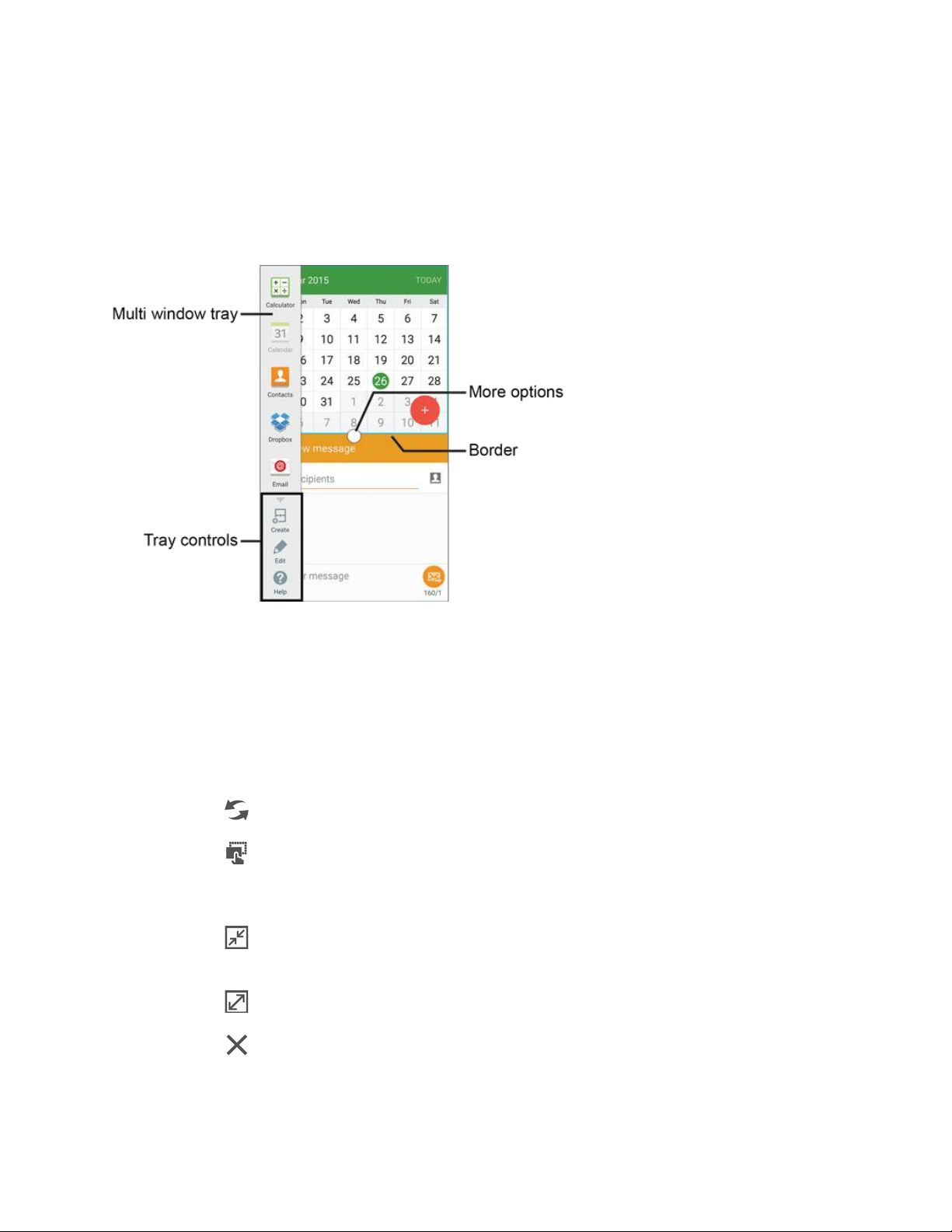
Phone Basics 19
Work with Multi Window
After enabling Multi window, you can use it to run two apps at the same time. You can launch apps from
Multi window, or drag an app to the screen to run multiple apps at the same time.
The apps display together on a split screen. You can switch between the apps, adjust the size of their
display on the screen, and copy information from one app to the other.
1. Tap the Multi window tab to display the tray, and then drag apps to the windows.
2. You can also use these Multi window options:
Adjust the Size of Apps in Multi Window: Drag the border between the windows to a new
position.
Multi Window Toolbar: Touch and hold the circle on the border to view the active window as
a pop-up. Tap the circle on the border to view more options:
• Switch windows: Switch the two apps’ locations.
• Drag and drop content: Enables drag and drop. In selected apps, you can you can
tap text in a window, or tap the window, and then drag to copy content to the app in the
other window.
• Minimize window: Change the app into a floating pop-up app you can drag
anywhere on the screen. Tap the icon to reopen the app.
• Maximize window: Open the active app in full screen view.
• Close window: Closes the active application window.
Tip: In Multi window, the currently active application will have an outline around it.
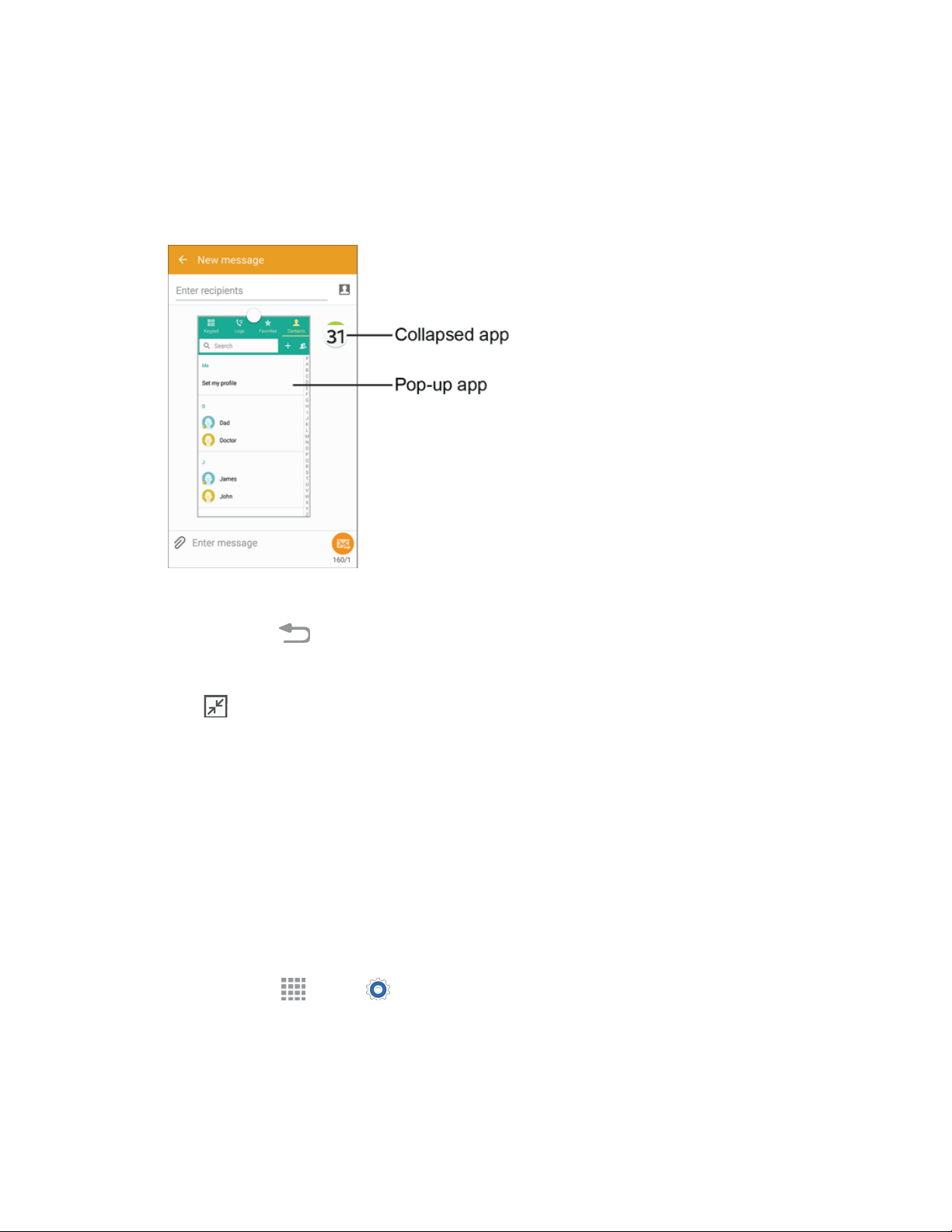
Phone Basics 20
Pop-Up Apps
You can open Multi window apps as pop-up windows, which can float above other apps. You can also
collapse apps into floating icons, allowing you great access to apps below them.
Note: Certain apps, such as Contacts, can only be opened as pop-up apps.
To turn a standard Multi window app into a pop-up app:
1. Touch and hold Back to display the tray, and then drag two apps off the Multi window tray.
2. Tap the circle on the border between the windows to display the Multi window toolbar.
3. Tap to collapse the currently active application into pop-up window or icon.
Tip: In Multi window, the currently active application will have an outline around it.
Drag the icon to reposition it on the screen.
4. Tap the pop-up app to expand it into a floating window.
Drag the circle at top of the window to reposition it on the screen.
Tap the circle at the top of the window for more options.
Access Multi Window Settings
Configure the Multi window feature. See Multi Window Settings for more information.
From home, tap Apps > Settings > DEVICE tab > Multi window. ■
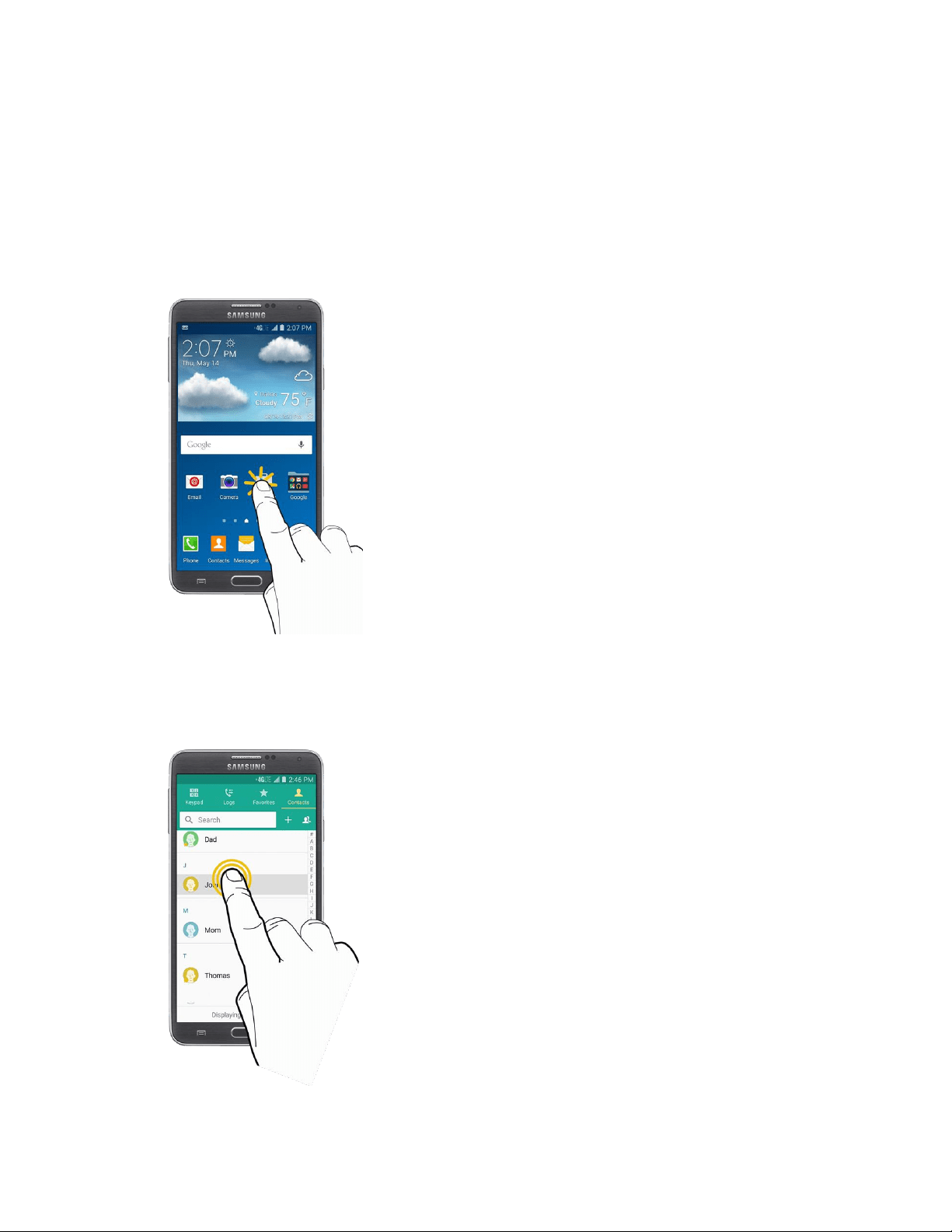
Phone Basics 21
Touchscreen Navigation
Your phone’s touchscreen lets you control actions through a variety of touch gestures.
Tap
When you want to type using the onscreen keyboard, select items onscreen such as application and
settings icons, or other items, simply tap them with your finger.
Touch and Hold
To open the available options for an item (for example, a contact or link in a Web page), touch and hold
the item.
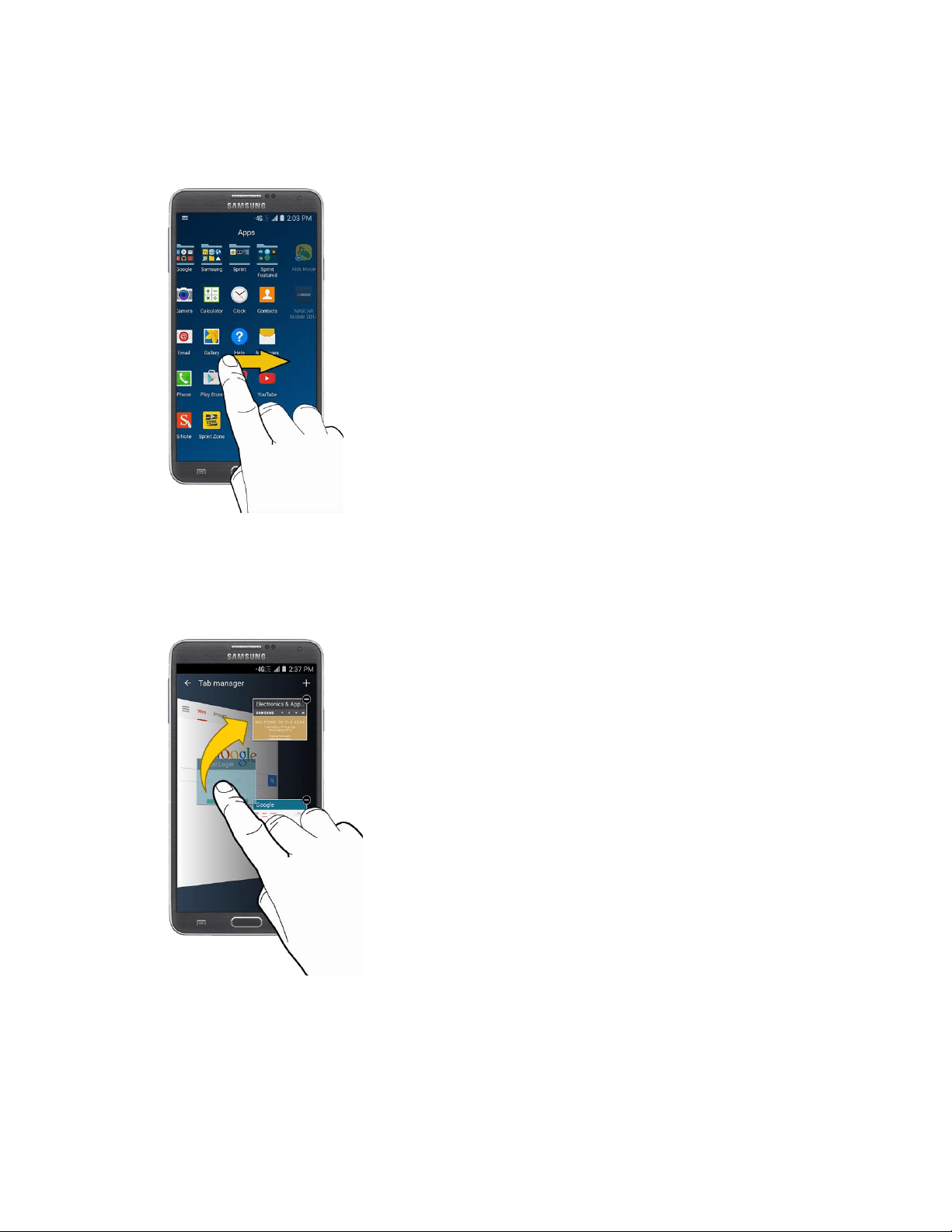
Phone Basics 22
Swipe or Slide
To swipe or slide means to quickly drag your finger vertically or horizontally across the screen.
Drag
To drag, touch and hold your finger with some pressure before you start to move your finger. While
dragging, do not release your finger until you have reached the target position.
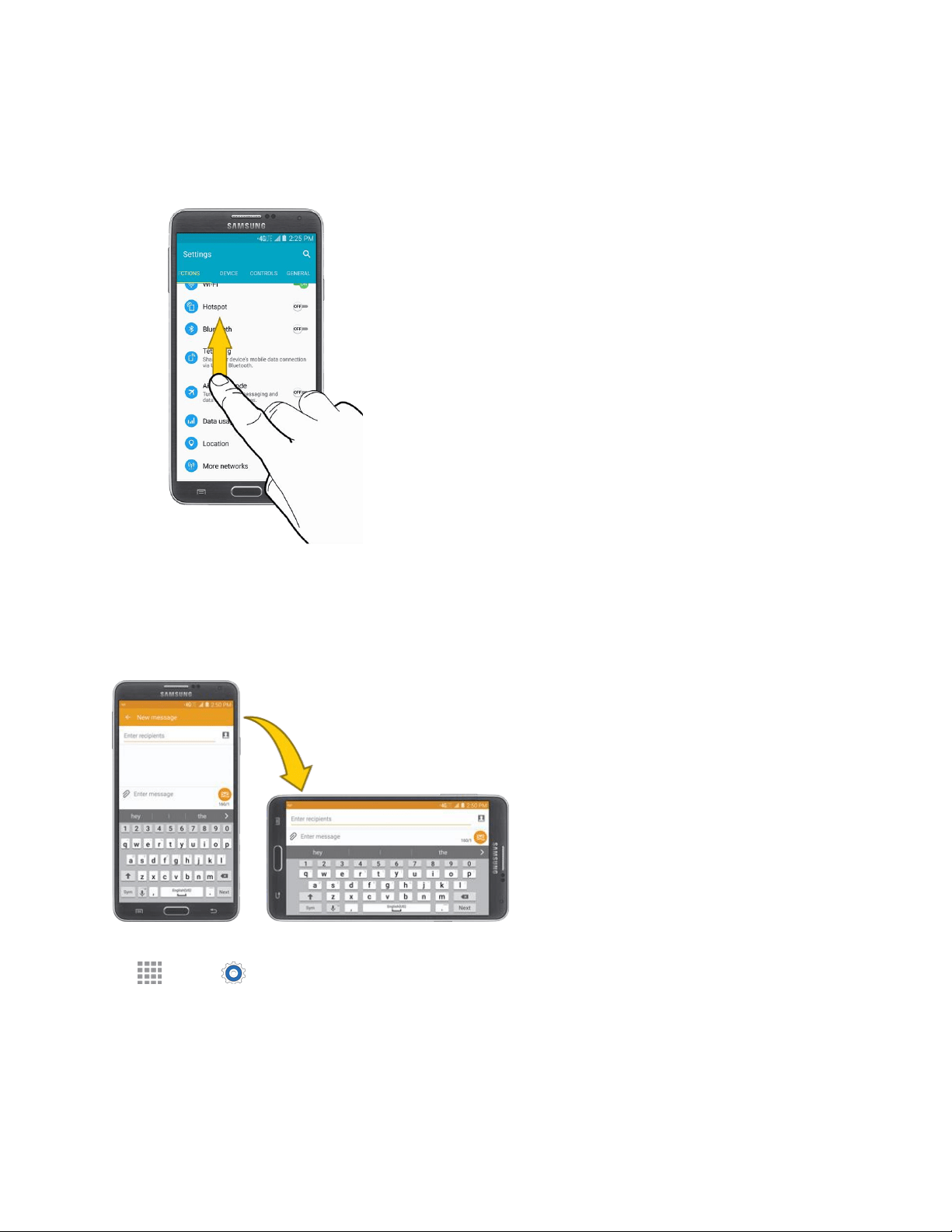
Phone Basics 23
Flick
Flicking the screen is similar to swiping, except that you need to swipe your finger in light, quick strokes.
This finger gesture is always in a vertical direction, such as when flicking the contacts or message list.
Rotate
For most screens, you can automatically change the screen orientation from portrait to landscape by
turning the phone sideways. When entering text, you can turn the phone sideways to bring up a bigger
keyboard.
Note: You can control screen rotation with the Screen rotation setting. To make this selection, from home
tap Apps > Settings > DEVICE tab > Display and then tap Auto rotate screen.
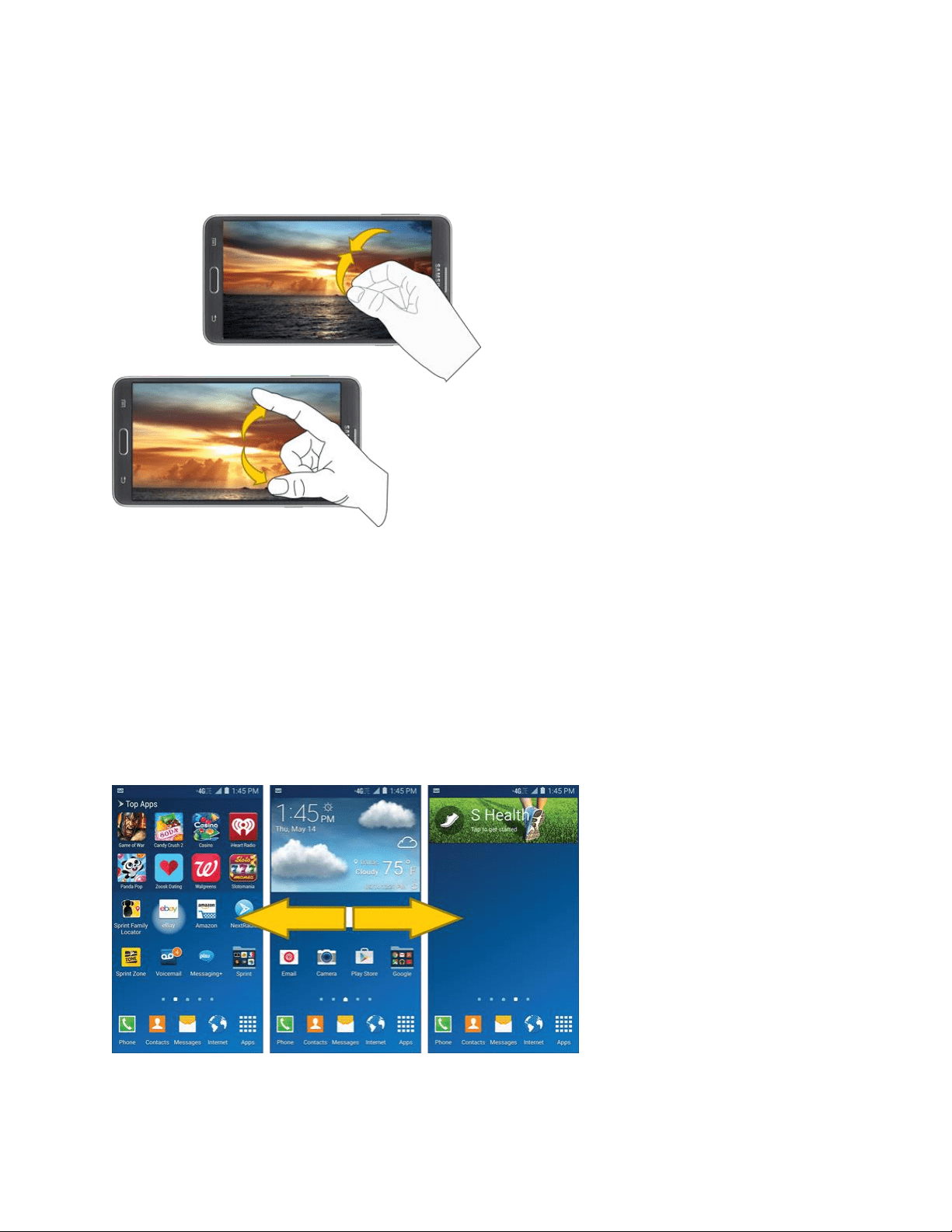
Phone Basics 24
Pinch and Spread
“Pinch” the screen using your thumb and forefinger to zoom out or “spread” the screen to zoom in when
viewing a picture or a Web page. (Move fingers inward to zoom out and outward to zoom in.)
Tip: Pinching any Home screen will show you options to customize Home screens, or tap a thumbnail to
go straight to another screen.
Your Home Screen
The Home screen is the starting point for your phone’s applications, functions, and menus. You can
customize your Home screen by adding application icons, shortcuts, folders, widgets, and more. The
Home screen extends beyond the initial screen. Swipe the screen left or right to display additional
screens.
Tip: Press the Home Key to return to the main Home screen from any other screen.

Phone Basics 25
Customize Your Home Screen
You can customize your Home screen by adding shortcuts, shortcuts, folders, widgets, and more.
Create a Shortcut
Use shortcuts to launch an app from the Home screen.
1. From home, tap Apps.
2. Touch and hold an app icon, and then drag it to a Home screen and release it.
Move a Shortcut
Move a shortcut to another Home screen.
1. From home, touch and hold a shortcut to undock it.
2. Drag the icon to a different location and release it.
Remove a Shortcut
Remove a shortcut from the Home screen.
1. From home, touch and hold a shortcut to undock it.
2. Drag the icon to Remove and release it.
Note: Removing a shortcut does not delete the app, it just removes the shortcut from the Home screen.
Remove a Primary Shortcut
Primary shortcuts are the Phone, Contacts, Messages, Internet, and Apps shortcuts that appear at the
bottom of the Home screen by default. You can remove or replace any of your primary shortcuts, except
the Apps shortcut.
1. From home, touch and hold a shortcut to undock it.
2. Drag it to another screen, or to Remove and release it.
Create a Primary Shortcut
Primary shortcuts appear at the bottom of the Home screen by default. You can remove or replace any of
the primary shortcuts, except the Apps shortcut.
1. From home, touch and hold a shortcut to undock it.
– or –
Tap Apps, and then touch and hold an app icon.
2. Drag the shortcut to a new position in the primary shortcuts.

Phone Basics 26
Note: If there are already four primary shortcuts (plus Apps), the new shortcut will replace one of the
existing shortcuts.
Add a Widget
Widgets are self-contained apps that display on a Home screen. Unlike a shortcut, the Widget works like
as an onscreen application. There are all kinds of widgets, including links to a specific contact, Internet
bookmarks, Facebook
®
status windows, Gmail and email accounts, and many others.
1. From home, pinch the screen.
– or –
Touch and hold an empty space on the screen.
2. Tap Widgets.
3. Touch and hold a widget, and then drag it to a Home screen and release it
Remove a Widget
1. From home, touch and hold a widget to undock it.
2. Drag the widget to Remove and release it.
Note: Removing a widget does not delete the widget; it just removes the widget from the Home screen.
Choose Wallpapers
Change the look of the home and lock screens with wallpaper. You can display a favorite picture, or
choose from preloaded wallpapers.
1. From home, pinch the screen.
– or –
Touch and hold an empty space on the screen.
2. Tap Wallpapers, and then choose Home screen, Lock screen, or Home and lock screen.
3. Tap a wallpaper to see a sample, and then tap SET AS WALLPAPER.

Phone Basics 27
Configure Home Screen Settings
Choose options for the Home screen.
1. From home, pinch the screen.
– or –
Touch and hold an empty space on the screen.
2. Tap Home screen settings, and then configure, enable, or disable these options:
Transition effect: Display a page-turning effect as you scroll through the Home screens.
My Magazine: View all My Magazine updates in one place on the Home screen. For more
information, see My Magazine.
Extended Home Screens
In addition to the main Home screen, your phone has up to six extended Home screens to provide more
space for adding shortcuts, widgets, and more.
Add a Home Screen
You can have up to seven Home screens.
1. From home, pinch the screen.
– or –
Touch and hold an empty space on the screen.
2. Scroll to the right, and then tap on a screen to add it to home.
Delete a Home Screen
You can delete Home screens the default main Home screen.
1. From home, pinch the screen.
– or –
Touch and hold an empty space on the screen.
2. Scroll to the screen you want to delete, and touch and hold it to release it, and then drag it to
Remove.
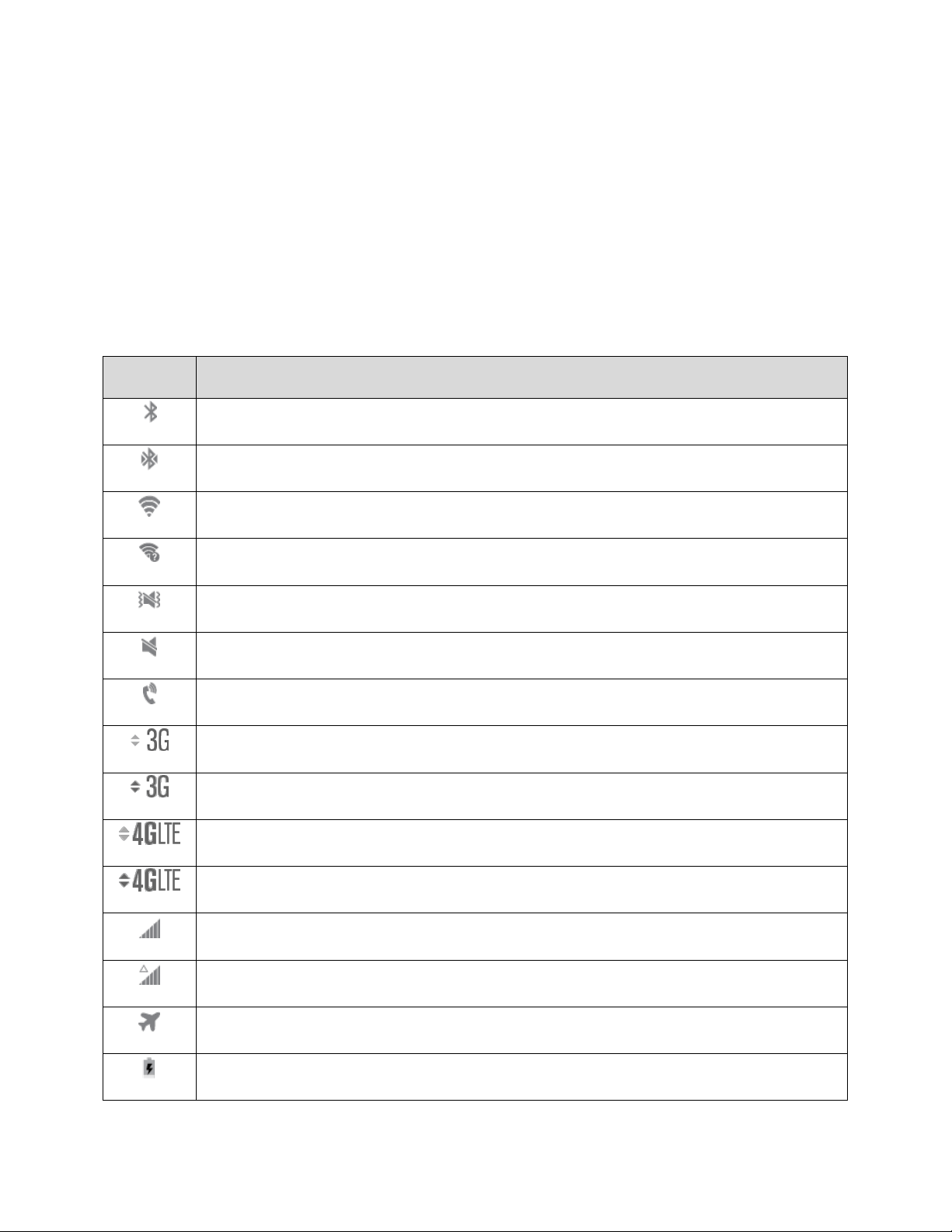
Phone Basics 28
Status Bar and Notification Panel
The Status Bar at the top of the Home screen provides phone and service status information on the right
side and notification alerts on the left. To view notifications, open the Notification Panel by touching and
holding the Status Bar and dragging it down.
Status Bar
The Status Bar displays icons to notify you of your phone’s status, as well as notifications.
Status Icons
Icon
Description
Bluetooth is on.
Bluetooth is on, and your phone is connected to another device.
Wi-Fi is on.
Wi-Fi networks available.
Sound is set to Vibrate.
Sound is set to Mute.
Speakerphone is active.
3G data service is available.
3G data service in use.
4G LTE data service is available.
4G LTE data service is in use.
Signal strength. More bars indicate a stronger signal.
Roaming signal strength. More bars indicate a stronger signal.
Airplane Mode is on.
Battery is charging.
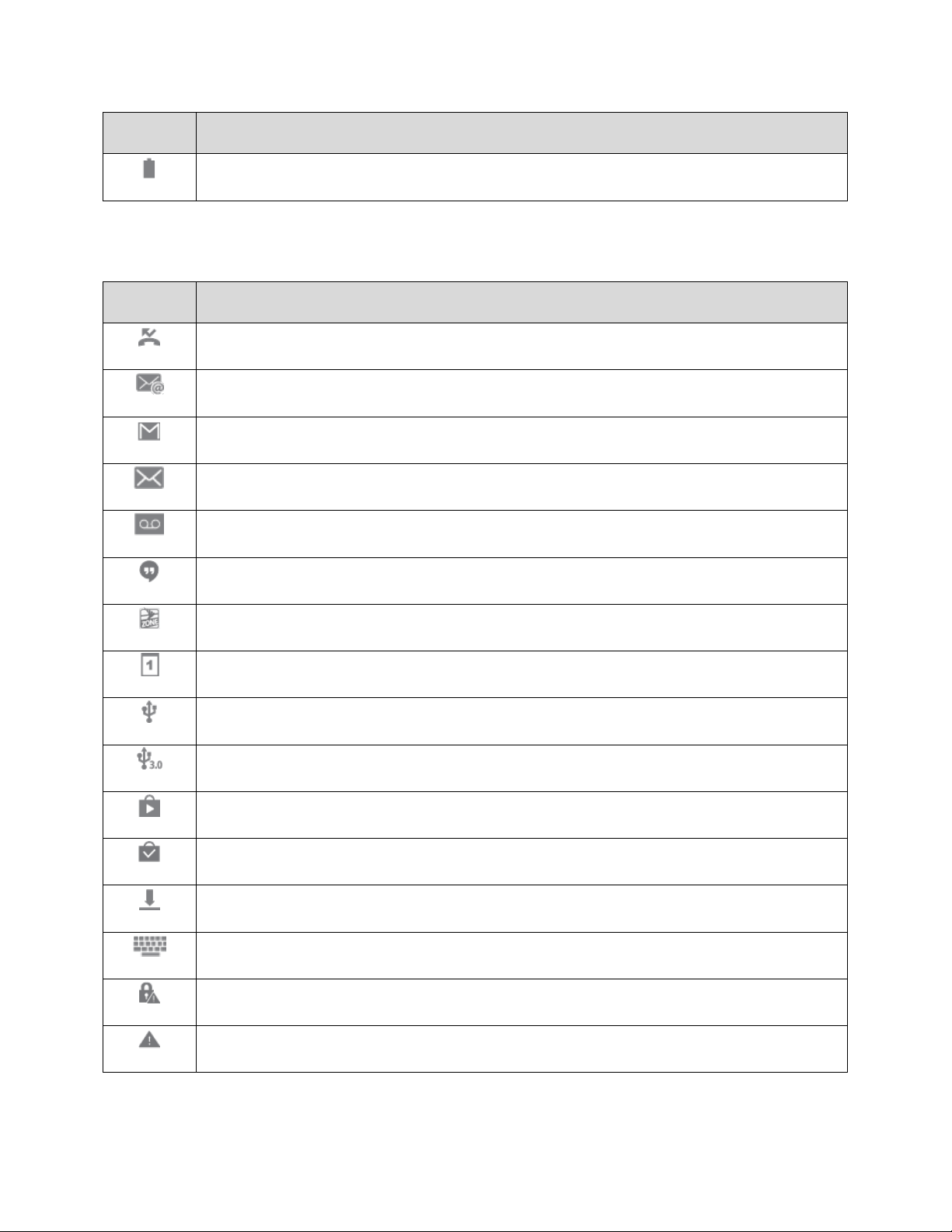
Phone Basics 29
Icon
Description
Battery is fully charged.
Notification Icons
Icon
Description
Missed call.
New email.
New Gmail.
New message.
New voicemail.
New Hangouts message.
New Sprint Zone message.
Calendar Event alert.
USB 2.0 or lower connection.
USB 3.0 connection.
App update(s) available.
App update(s) successful.
Downloading is in progress.
Keyboard is active (choose input method).
Screen lock setup needed.
Attention needed: System error or alert.

Phone Basics 30
Icon
Description
More notifications are available. See Notification Panel.
Determining location.
Note: Additional notification icons may appear. All notifications may be accessed through the
Notification Panel.
Notification Panel
The Notification Panel displays details about your phone’s status, and it provides easy access to common
settings and features.
Use the Notification Panel
1. Open the Notification Panel by swiping your finger down from the Status Bar at the top of the
screen.
2. On the Notification Panel, you have these options:
Quick Settings: Quickly access popular settings. Tap a setting to turn the option on or off, or
touch and hold to display its settings. You can swipe your finger across the quick settings, to
see all available settings.
S Finder: Search for content on your device, and find more on the Web. You can apply filters
to your results, and view your search history.
Quick connect: Search for nearby devices to share files and information.
Quick Settings
Use Quick settings from the Notification Panel to control popular settings.
1. From home, swipe your finger down from the Status Bar at the top of the screen to display the
Notification Panel.
2. Tap a setting to turn the option on or off, or touch and hold a setting to display its settings. You
can swipe your finger across the quick settings, to see all available settings. You also have these
options:
Tap to display more quick settings.
Choose which settings display on the Notification Panel. Tap at the top of the Notification
Panel, and then tap Edit for options:
• Brightness adjustment: When enabled, a Brightness option displays on the Notification
Panel, so you can make adjustments to the screen brightness.

Phone Basics 31
• Recommended apps: When on, your phone will display a selection of app icons on the
Notification Panel, according to your actions. For example, when you connect a headset,
Music and other entertainment apps will display. Tap the ON/OFF switch to turn the
option on, and then tap Edit to choose apps to display.
• Set quick setting buttons: You can customize which quick settings display on the
Notification Panel, and change the order they appear. To replace settings, touch and hold
a button, and drag it to a new position. You can drag buttons from the Available buttons
area of the screen to a position in the Notification Panel area, or from the Notification
Panel area to the Available buttons.
Tap Settings to access the full Settings menu.
Enter Text
You can type on your device using the available touchscreen QWERTY keyboard, or by speaking your
inputs.
Text Input Methods
Your device offers several text input methods.
● Google voice typing allows you to speak your entries.
● Samsung keyboard allows you to enter text by touching keys on a virtual QWERTY keyboard.
Samsung keyboard includes optional predictive text, which matches your key touches to common
words so you can select a word to insert it into your text.
● Swype lets you enter words by swiping across the virtual QWERTY keyboard. Instead of tapping
each key, use your finger to trace over each letter of a word. You can also tap letters to enter
words.
Select a Default Text Input Method
You can select a default Text Input Method from Settings, or choose one at any time while entering text.
From Settings:
From home, tap Apps > Settings > Language and input > Default, and then ■
choose a default entry method.
While entering text:
1. From a screen where you can enter text, drag down from the top of the screen to open the
Notification Panel.
2. Tap Select keyboard, and then choose a text entry method.

Phone Basics 32
Google Voice Typing
This feature uses Google voice recognition to convert your spoken words into text.
Use Google Voice Typing to Enter Text
1. Tap on the Samsung keyboard or on the Swype keyboard.
2. Speak into the microphone and watch your text being entered onscreen.
3. If the text is incorrect, tap DELETE.
Note: Select a language from the menu in the Speak now area. Tap Settings > Languages to
assign a new language via the Google voice typing menu.
Configure Google Voice Typing
From home, tap Apps > Settings > CONTROLS tab > Language and input > ■
Google voice typing.
Samsung Keyboard
With Samsung keyboard, it is easy to enter text, symbols, and numbers.
Use Samsung Keyboard to Enter Text
1. From a screen where you can enter text drag down from the top of the screen to open the
Notification Panel, and then tap Select keyboard > Samsung keyboard.
2. Tap keys to enter text. While entering text, use these options:
If you make a mistake, tap to delete incorrect characters. Touch and hold to delete
a whole word or field.
Tap to change the case of the text (the arrow will turn blue). Tap twice to switch to
all capitals (the key will turn blue).
Tap to switch to a symbols keyboard, to enter symbols. There are two symbol
keyboards.
Tap to switch to Google Voice typing to enter text by speaking. Touch and hold for
additional options including Google Voice typing, S Pen writing entry, clipboard, settings,
emojis, and keyboard layout.
If you have more than one language selected in Samsung keyboard settings, you can swipe
your finger over to switch between languages.

Phone Basics 33
Configure Samsung Keyboard
From home, tap Apps > Settings > CONTROLS tab > Language and input > ■
Samsung keyboard.
Note: For more information about Samsung keyboard settings, see Samsung Keyboard Settings.
Swype
Swype lets you enter words by tracing over the letters on the virtual QWERTY keyboard. Instead of
tapping each key, use your finger to trace over each letter of a word. You can also tap letters to enter
words.
Swype provides next-letter prediction and regional error correction, which can compensate for tapping the
wrong keys on the virtual QWERTY keyboards.
Use Swype to Enter Text
1. From a screen where you can enter text drag down from the top of the screen to open the
Notification Panel, and then tap Select keyboard > Swype.
2. Swipe your finger continuously over the letters to form a word. As you swipe over letters, words
matching your pattern display at the top of the Swype keyboard. To enter a word, lift your finger,
or tap a word at the top of the keyboard.
3. While entering text, use these options:
If you make a mistake, tap to delete a single character. Touch and hold to delete an
entire word or field.
By default, Swype starts with a capital at the beginning of text. Tap to start with a capital
letter, or tap twice to enter all capitals.
Tap to switch to a symbols keyboard, and then tap keys to enter symbols.
Configure Swype
From home, tap Apps > Settings > CONTROLS tab > Language and input > Swype. ■
– or –
From the Swype keyboard, touch and hold .
Note: For more information about Swype settings, see Swype Settings.

Phone Basics 34
Tips for Editing Text
These tips allow you to cut or copy selected text and paste it into a separate selected area.
1. In a text entry field, double-tap the text, and then drag the sliders to select the text.
2. Tap an onscreen option from the Edit text toolbar. You can drag your finger along the toolbar to
see all the options:
Select all: Highlights all the text in the field.
Cut: Removes the selected text and saves it to the clipboard.
Copy: Copies the selected text to the clipboard.
Paste: Insert the last copied or cut text into the current field.
Clipboard: Display the clipboard to choose previously cut or copied text.
Phone Calls 35
Phone Calls
The following topics outline the use of your device’s phone app to place and receive calls, use voicemail,
set up and manage contacts, and more.
Wi-Fi Calling
Wi-Fi Calling uses Wi-Fi networks to help improve voice and data coverage. It sends and receives calls
and text messages over a Wi-Fi network and may offer better coverage in buildings and areas of poor
cellular reception.
1. From home, tap Apps > Settings > CONNECTIONS tab.
2. Tap Wi-Fi Calling and follow the online prompts to set up Wi-Fi Calling.
Note: For more information, see Wi-Fi Calling Settings.
Make Phone Calls
There are several convenient ways to place calls from your phone.
Call Using the Keypad
The most “traditional” way to place a call is by using the phone’s keypad screen.
1. From home, tap Phone > Keypad.
2. Tap the number keys to enter the phone number.
As you enter digits, matching numbers from recent calls or contacts display. If you see the
number you want, tap it to call it without having to enter the rest of the number.
3. Tap to call the number.
Note: If you have Wi-Fi Calling set up and you are connected to a Wi-Fi network, the call and end call
icons appear differently ( and ).
Call from Logs
All incoming and outgoing calls are recorded in Logs. You can call a number from a recent call from Logs.
1. From home, tap Phone > Logs.
2. Tap a call record, and then tap to call the number.
Tip: You can also swipe across a recent call from left to right to call the number, or from right to left to
send a message.
Phone Calls 36
Call from Contacts
You can place calls directly from Contacts.
Note: You can access Contacts directly from the Phone app. Tap Phone > Contacts tab at the top of
the screen.
1. From home, tap Contacts.
2. Tap a contact, and then tap .
– or –
Swipe your finger across the contact from left to right.
Call a Number in a Text Message
While viewing a text message, you can place a call to a number that is in the body of the message. For
more information, see Text and Multimedia Messaging.
1. From home, tap Messages.
2. Open the message with the phone number and then tap the phone number.
3. Tap to dial the number.
Call a Number in an Email or Gmail Message
While viewing an email or Gmail message, you can place a call to a number that is in the body of the
message.
1. From home, tap Apps > Email or Gmail.
2. Open the message with the phone number and then tap the phone number.
3. The Phone screen opens, with the phone number automatically entered and ready to be dialed.
To place the call, tap .
Make an Emergency Call
You can place calls to 9-1-1 even if the phone’s screen is locked or your account is restricted.
Note: To call the 9-1-1 emergency number when the phone’s screen is locked, press the Power/Lock
key to turn the screen on, drag the Call icon up, and then tap EMERGENCY CALL to display the
Emergency dialer keypad.
1. From home, tap Phone.
2. Tap .

Phone Calls 37
Enhanced 9-1-1 (E9-1-1) Information
This phone features GPS (Global Positioning System), which is used for E9-1-1 emergency location
service, where available.
When you place a call to 9-1-1, the GPS feature of your phone provides information about your
approximate location. Depending on several variables, including availability and access to satellite
signals, it may take up to 30 seconds or more to determine and report your approximate location.
Important: Always report your location to the 9-1-1 operator when placing an emergency call. Some
designated emergency call takers, known as Public Safety Answering Points (PSAPs), may not be
equipped to receive GPS location information from your phone.
Receive Phone Calls
When you receive a call, you can accept the call, or reject the call to send it to voicemail. You can also
reject a call with a message, to send a text message to the caller.
Note: If your phone is turned off, all calls automatically go to voicemail.
Answer an Incoming Call
When you receive a phone call from a number stored in Contacts, the contact’s information displays on
the screen. When you receive a phone call from a number that is not stored in Contacts, the phone
number displays on the screen.
When your phone notifies you of an incoming call, drag to the right to answer the call.
■
Mute the Ringing Sound
You can mute the ringtone without rejecting the call by doing one of the following.
● Press the Volume key down.
● Place the phone screen-down on a level surface. See Palm Motion Settings for options, including
the Mute/pause palm motion to mute incoming calls by turning over the phone.
● Cover the screen with your hand. See Palm Motion Settings for options, including the Mute/pause
palm motion to mute incoming calls by covering the screen with your hand.
Reject an Incoming Call
When you reject a call, the caller is sent to voicemail where they can leave a voice message.
When your phone notifies you of an incoming call, drag to the left to reject the call. ■

Phone Calls 38
Reject an Incoming Call with a Text Message
You can reject an incoming call by sending a text message to the caller.
1. When your phone notifies you of an incoming call, drag Reject call with message toward
the top of the screen.
2. Select an existing message.
– or –
Tap to compose a new text message.
Phone Call Options
The Phone app provides many useful features and options to help you make the most of your calling
experience.
Dialing Options
Several options are available when dialing a phone number.
1. From home, tap Phone.
2. While dialing a call, tap Menu for options, including:
Add 2-sec pause (,): Insert a 2-second pause into the number you are dialing. This can be
useful when storing numbers for automated phone menus.
Add wait (;): Insert a pause into the number you are dialing, to wait for input from you. This
can be useful when storing numbers for automated phone menus.
Add to Contacts: Save the number to a new contact, or update an existing contact. See Add
a Contact.
Send message: Send a text message to the number you dialed.
One-handed operation on: Use a keypad for use by one hand. See One-Handed Operation
Settings.
Speed dial: View speed dials. See Speed Dials.
WiFi Calling: Use WiFi Calling whenever possible. See Wi-Fi Calling.
Settings: Configure call settings. See Call Settings.
Help: Learn about using the Phone app.
Phone Calls 39
Caller ID
Caller ID identifies a caller while the phone is ringing, by displaying the number of the incoming call.
Block Caller ID
You can block your Caller ID (visible to other when you make a call), before making a call. The blocking
only lasts for that call, and then returns to regular Caller ID.
1. From home, tap Phone.
2. Tap .
3. Enter a phone number, and then tap .
Call Waiting
When you are on a call, your phone notifies you by displaying the call information on the screen, and
vibrating, if you’ve set up vibration for incoming calls.
Respond to an Incoming Call While You Are on a Call
Slide to the right. This puts the first caller on hold and answers the incoming call. ■
To switch between calls, tap Swap.
3-Way Calling
With 3-Way Calling, you can talk to two people at the same time. When using this feature, the normal
airtime rates will be charged for each of the two calls.
1. From home, tap Phone.
2. Make the first call by entering the phone number and pressing .
3. When the first call is established, tap Add call to put the first call on hold, and then dial the
second number.
4. When the second call is established, tap Merge.
If one of the people you called hangs up during your call, you and the remaining caller stay
connected.
If you set up the call and are the first to end the call, all callers are disconnected.
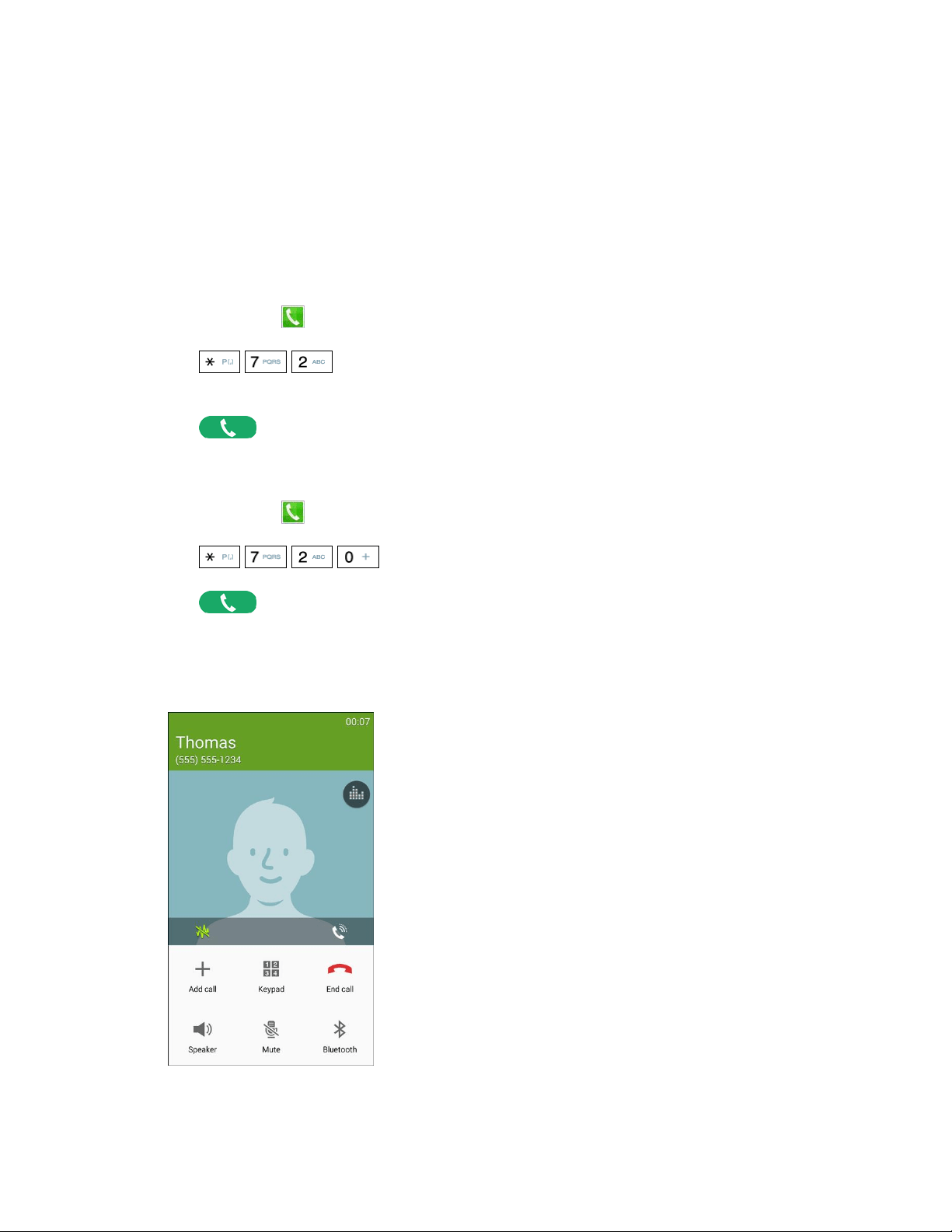
Phone Calls 40
Call Forwarding
Call Forwarding lets you forward all your incoming calls to another phone number – even when your
phone is turned off. You can continue to make calls from your phone when you have Call Forwarding is
activated.
Note: You are charged a higher rate for forwarded calls.
Activate Call Forwarding
1. From home, tap Phone.
2. Tap , and then enter the phone number to which you want your calls
forwarded.
3. Tap . A tone confirms the activation of Call Forwarding.
Deactivate Call Forwarding
1. From home, tap Phone.
2. Tap .
3. Tap . A tone plays to confirm the deactivation of Call Forwarding.
In-Call Options
While you are on a call, you can use options to find information or multitask during the call.

Phone Calls 41
● Add call: Display the keypad to dial another call.
● Keypad: Display the keypad, where you can enter numbers to use DTMF (Dual Tone Multi-
Frequency). This can be useful if you need to enter an access code or other information while on
a call.
● End call: Hang up the call.
● Speaker: Control whether call audio plays through the speaker or the earpiece.
Warning: Because of higher volume levels, do not place the phone near your ear while using the
speaker.
● Mute: Control whether the other party can hear your side of the call.
● Bluetooth: Connect to a Bluetooth device, or disconnect from a device.
● Tap Menu for more options:
Contacts: Launch Contacts.
Action Memo: Launch Memo, to create memo during a call.
Message: Launch Messages, to create a new message.
One-handed operation on: Arrange the layout of the in-call options buttons for easier use
with one hand.
Settings: Launch Call Settings. For more information, see Call Settings.
Voicemail
The following topics outline your phone’s voicemail service.
Note: Your phone also supports the Visual Voicemail app. For information on setting up and using
Visual Voicemail, see Visual Voicemail.
Voicemail Setup
You should set up your voicemail and personal greeting as soon as your phone is activated.
● To set up voicemail using your phone’s traditional voicemail, see Set Up Voicemail.
● For information on using the Visual Voicemail app, see Visual Voicemail.

Phone Calls 42
Retrieve Your Voicemail Messages
You can review your messages directly from your phone (using either traditional voicemail or
Visual Voicemail), or from any other touch-tone phone.
Use Traditional Voicemail to Access Your Messages
1. From home, tap Phone.
2. Touch and hold .
3. Follow the system prompts to enter your voicemail password and manage voicemail.
Use Visual Voicemail to Access Your Messages
1. From home, tap Apps > Voicemail.
2. Tap an entry to listen to the message.
Note: You are charged for airtime minutes when you access voicemail from your wireless phone.
Use Another Phone to Access Messages
1. Dial your wireless phone number.
2. When your voicemail answers, press the asterisk key on the phone (*).
3. Enter your password.
Voicemail Notification
There are several ways your phone alerts you to a new message:
● By sounding the notification ringtone.
● By displaying in the Notifications area of the Status Bar when there is a new voicemail
message.
● By displaying the number of new voicemail message(s) on the Voicemail app icon.
Note: When you are roaming off the network, you may not receive notification of new voicemail
messages. It is recommended that you periodically check your voicemail by dialing 1 + area code + your
wireless phone number. When your voicemail answers, tap and enter your password. Roaming
rates apply when you access voicemail while roaming off the network.
Note: Your phone accepts messages even when it is turned off. However, your phone notifies you of new
messages only when it is turned on and you are in a network service area.

Phone Calls 43
Visual Voicemail
Visual Voicemail gives you a quick and easy way to access your voicemail. Now you can find exactly the
message you are looking for without having to listen to every voicemail message first. This new feature
periodically goes out to your voicemail, and gathers the caller information from all of the current
voicemails. It then populates a list with the caller name and number, along with the length of time and
priority level of the voicemail message.
1. From home, tap Apps > Voicemail.
2. Follow the prompts to set up an account and learn about using Visual Voicemail.
Note: You can also access Visual Voicemail from the Phone keypad by tapping .
Set Up Visual Voicemail
Setting up Visual Voicemail follows many of the same procedures as setting up traditional voicemail. You
should set up your voicemail and personal greeting as soon as your phone is activated. Your phone
automatically transfers all unanswered calls to your voicemail, even if your phone is in use or turned off.
Note: To set up your traditional voicemail, see Voicemail Setup.
1. From home, tap Apps > Voicemail.
2. Tap Personalize now and follow the system prompts to:
Create a password (part of standard voicemail).
Record your name announcement.
Record your greeting.
Review Visual Voicemail
Visual Voicemail lets you easily access and select which messages you want to review.
1. From home, tap Apps > Voicemail.
2. Tap a message to review it.
Tip: There are icons at the bottom of the review screen for maintenance, storage, messaging, and other
options. For an explanation of all your options, tap Menu > Help.
Phone Calls 44
Listen to Multiple Voicemail Messages
When you are done listening to a voicemail message you can easily access other voicemail messages
without returning to the main voicemail screen.
You can navigate through voicemail messages as frequently as you'd like. You can even move to the next
or previous message before you are finished listening to the current one.
1. Listen to the current voicemail message.
2. Swipe your finger left or right to display the next or previous message. (It will begin playing
automatically.)
Use Visual Voicemail to Delete Your Messages
1. From home, tap Apps > Voicemail.
2. Open a message and tap Delete.
Tip: You can restore messages you have sent to the trash folder. tap Inbox > Trash, touch and hold the
message you want to restore to the inbox, and then tap the Restore icon.
Visual Voicemail Options
Your visual voicemail options appear as icons at the bottom of the voicemail review screen.
Note: Not all options are available for all messages.
1. From home, tap Apps > Voicemail.
2. The following options are available when viewing new voicemail messages:
Subscribe: Subscribe to the premium Voice-to-Text transcription service. (This service
requires an additional monthly charge.)
Play all new: Play all new messages.
Select multiple: Perform an action on multiple messages.
Compose Avatar message: Send an animated voice message to friends. You can also
compose an Avatar message by tapping .
Menu: Access Search, Settings, and Help features.
Phone Calls 45
3. Tap a message to review it. The following options are available while listening to voicemail
messages:
Call: Dial the number the message came from.
Share: Send the message via Wi-Fi Direct, social accounts, and so on.
Delete: Delete selected messages.
Reply: Reply to the message via text or voice message.
Menu: Access Archive, Settings, and Help features.
4. Touch and hold a message to manage your messages. The following options are available:
All: Select all messages.
Delete: Delete selected messages.
Archive: Save this message.
Mark as Read: Mark this voicemail as being read.
Mark as Unread: Mark this voicemail as not being read.
Configure Visual Voicemail Settings
The Visual Voicemail settings menu lets you access settings for notifications, pictures, greetings, and
more.
1. From home, tap Apps > Voicemail.
2. Tap Menu > Settings. Select an option to change its settings.
Note: Voicemail settings can also be accessed in Settings. From home, tap Apps > Settings >
DEVICE tab > Call > Voicemail settings.
Change Your Main Greeting
Your main greeting can be changed directly via the Visual Voicemail system. This direct access saves
you from having to navigate within the voicemail menu.
1. From home, tap Apps > Voicemail.
2. Tap Menu > Settings > Preferences > Personalize voicemail.
3. Tap OK to connect to the voicemail system. Follow the prompts to change your current greeting.

Phone Calls 46
Edit the Display Name
From your Visual Voicemail menu, you can quickly change the name or number attached to your voice
messages. This name or number identifies you to recipients of your voicemail messages.
1. From home, tap Apps > Voicemail.
2. Tap Menu > Settings > Display > Display name.
3. Tap the existing identification field and enter a new identifying name or number (used to identify
you to recipients of your voice messages).
4. Tap OK to save your information.
Logs
The Logs tab of the Phone app lists all missed, dialed, received, and rejected calls.
View Logs
From Logs, you manage the list of recent calls.
1. From home, tap Phone > Logs.
2. While viewing the list of calls, you can use these options:
Tap the menu to display All calls, Missed calls, Dialed calls, Received calls, or
Rejected calls.
Tap a call to display the call record, where you can tap to return the call, or to send
a message to the caller.
Touch and hold on a call record to select it.
Make a Call from Logs
You can return a call from a recent call record.
1. From home, tap Phone > Logs.
2. Tap a call record, and then tap to call the number.
Tip: You can also swipe across a call record from left to right to call the number.
Phone Calls 47
Send a Message from Logs
You can send a message to a number from a recent call record.
1. From home, tap Phone > Logs.
2. Tap a call record, and then tap to create a message to the number.
Tip: You can also swipe across a call record from right to left to create a message.
Save a Number to Contacts from Logs
You can save a number from a recent call record to create a new contact, or update an existing contact.
1. From home, tap Phone > Logs.
2. Tap a call record, and then CREATE CONTACT or UPDATE EXISTING.
Send a Number from Logs
You can send a number from a call record in a text message.
1. From home, tap Phone > Logs.
2. Tap a call record, and then tap Menu > Send number.
3. Enter recipients for the message, and then tap Send.
Add Numbers to the Reject List from Logs
You can save numbers from recent logs to the reject list, to automatically reject incoming calls from the
number. For more information about rejecting calls automatically, see Call Rejection.
1. From home, tap Phone > Logs.
2. Tap a call record, and then tap Menu > Add to Auto reject list.
Delete Logs
Follow these steps to clear the Logs list.
1. From home, tap Phone > Logs.
2. Tap Menu > Delete.
3. Tap entries to select them, or tap the [xx] selected checkbox at the top of the screen to select all
entries.
4. Tap DONE > DELETE.

Contacts 49
Contacts
The Contacts application lets you store and manage contacts from a variety of sources, including
contacts you enter and save directly in your phone as well as contacts synchronized with your Google
Account, your PC, compatible email programs (including Exchange Server), and your Facebook friends.
Get Started with Contacts
When you set up an account on your phone, the contacts you have stored in the account are also
available on your phone. When you add contacts, you can choose to save the contacts to the phone, or to
one of the accounts you have set up on the phone.
● Google contacts are synchronized between your phone and a Google Account you set up on
your phone.
● Microsoft Exchange ActiveSync contacts are synchronized between your phone and an
Exchange Server or Microsoft Outlook
®
account set up on your phone.
● Samsung account contacts are synchronized between your phone and your Samsung account,
if you have a Samsung account set up on your phone.
● Device contacts are stored locally on the phone.
Access Contacts
There are a couple of ways to access Contacts.
From home, tap Apps > Contacts. ■
– or –
From home, tap Phone > Contacts tab.
Find a Contact
You can search for a contact, or scroll the list to find one by name.
1. From home, tap Apps > Contacts.
2. Tap the Search field, and then enter characters to find contacts that match.
– or –
Tap a letter on the side of the list to go directly to that letter in the alphabetical list.

Contacts 50
Add a Contact
You can add contacts directly from the Contacts application. Enter details such as name, phone numbers,
email addresses, mailing addresses, and more.
1. From home, tap Apps > Contacts.
2. Tap Add, and then tap contact fields to enter information.
Choose a storage account for the contact. You can choose Device to store the contact on the
phone, or choose an account.
Tap to assign a picture to the new contact:
Tap the Name field to use the onscreen keyboard to enter the full name. Tap for
additional name fields.
Tap the Phone number field, and then enter the phone number. Tap to add another
phone number. Tap to choose a label for the number. If you add more than one phone
number, you will be prompted to choose a default phone number. The default phone number
is the one your phone will use in most cases.
Tap beside Email to enter an email address. If you add more than one email address,
you will be prompted to choose a default email address. The default email address is the one
your phone will use in most cases.
Tap Groups to assign the contact to a group.
Tap Ringtone to choose a ringtone to play for calls from the contact.
Tap ADD ANOTHER FIELD to add new fields for the contact.
3. Tap SAVE to save the new contact.
Save a Phone Number
You can save a phone number to Contacts directly from the phone keypad.
1. From home, tap Phone.
2. Enter a phone number using the onscreen keypad.
3. Tap Add to Contacts, and then tap CREATE CONTACT or UPDATE EXISTING.
4. Continue adding information for the contact, as desired.
5. Tap SAVE to save the contact.
Note: If you have accounts set up on your phone, you can save the contact to an account.

Contacts 51
Edit a Contact
Once you’ve added a contact, you can add or edit any of the information in the entry, assign a picture,
customize it with a unique ringtone, and more.
Add or Edit Information for a Contact
You can modify existing contact information to keep your information up-to-date.
1. From home, tap Apps > Contacts.
2. Tap a contact to display it, and then tap
Edit.
3. Tap any field you want to change or add. See Add a Contact.
4. Add or edit the information, and then tap SAVE.
Assign a Picture to a Contact
Adding a picture to a contact entry creates a more personal and easily recognized entry. For example,
when receiving a call from one of your contacts, the associated picture will display. You can assign a
picture from Gallery, or take a new picture with Camera.
1. From home, tap Apps > Contacts.
2. Tap a contact to display it, and then tap
Edit.
3. Tap to assign a picture to the contact:
Image: Choose a picture from Gallery.
Take picture: Take a new picture.
S Note: Use an image from S Note.
Tagged pictures: Choose a tagged photo from Gallery.
4. Follow the prompts to save the picture to the contact.
Assign a Ringtone to a Contact
You can assign a special ringtone to individual contacts for more personalization.
1. From home, tap Apps > Contacts.
2. Tap a contact to display it, and then tap the Ringtone field.
3. Choose a ringtone preloaded on your phone, or tap ADD to choose a song from Music.
4. Tap OK or DONE to assign the ringtone, and then tap SAVE.

Contacts 52
Link Contacts
When you have contacts from various sources (Gmail, phone, Facebook, etc.), you may have multiple
similar entries for a single contact. Your phone’s Contacts application lets you link multiple entries into a
single contact.
1. From home, tap Apps > Contacts.
2. Tap a contact to display it, and then tap Menu > Link contacts.
3. Tap another entry to link it to the original contact.
4. Tap DONE to complete the link(s).
Note: You can link up to nine contacts in a single entry.
Tip: To unlink contacts, from the Menu in step 2 above, tap Unlink contacts and then tap Unlink
next to the element you want to unlink.
Delete Contacts
You can delete a single contact, or choose multiple contacts to delete.
Delete a Contact
1. From home, tap Apps > Contacts.
2. Tap a contact to display it, and then tap
Menu > Delete > DELETE.
Delete Multiple Contacts
1. From home, tap Apps > Contacts.
2. Tap Menu > Delete, and then tap contacts to select them, or tap the check box next to
0 selected to select all.
3. Tap DONE > DELETE.

Contacts 53
Save a Business Card as a Contact
Take a picture of a business card and your phone recognizes the information to save the business card in
Contacts, and create a new contact from the info on the business card.
1. From home, tap Apps > Contacts.
2. Tap Menu > Business cards > Add.
3. When the camera opens, center the business card in the guidelines on the screen. If the camera
can recognize the business card, it will take the picture automatically, or you can take the picture
manually.
4. Your phone analyzes the picture of the business card, and uses information it recognizes to
create a new contact. You can also add more information to the contact.
5. Tap SAVE to save the new contact. The business card is displayed as the picture for the contact.
Tip: You can view all your business cards by tapping Menu > Business cards.
Move Contacts
If you have accounts set up on your phone, you can merge device contacts with the account’s contacts.
Device contacts are stored only in the phone’s memory, and could be lost if you lose your phone or reset
it to the factory defaults. Merging with an account means the contacts are synced with the account and
stored there.
1. From home, tap Apps > Contacts.
2. Tap Menu > Move device contacts to.
3. Choose an account to merge with, and then follow the prompts to complete the merge.
Speed Dials
Speed dials are 1-to-3 digit shortcuts you can assign to contacts, to make dialing faster. Speed dial 1 is
reserved for Voicemail.
Assign Speed Dials
1. From home, tap Apps > Contacts.
2. Tap Menu > Speed dial.
3. Tap an unused speed dial, and then select a contact to assign to the number.
Contacts 54
Remove Speed Dials
1. From home, tap Apps > Contacts.
2. Tap Menu > Speed dial, and then tap X beside the speed dials you want to remove.
Make a Call with a Speed Dial
1. From home, tap Phone.
2. Tap the speed dial digits, holding the last digit until the number dials.
Favorites
The Favorites tab is a listing that can help you quickly access your most used or preferred Contacts
entries.
Mark Contacts as Favorites
1. From home, tap Apps > Contacts.
2. Tap a contact to display it, and then tap Favorite to turn the star yellow.
Remove Contacts from Favorites
1. From home, tap Apps > Contacts > Favorites tab.
2. Touch and hold a contact, and then tap Remove from Favorites.
– or –
Tap Menu > Remove from Favorites. Tap each contact to delete, or tap 0 Selected to
select all contacts. Tap DONE.
Make a Call from Favorites
1. From home, tap Apps > Contacts > Favorites tab.
2. Tap a contact to dial the contact’s default telephone number. The default number is set in
Contacts when you enter multiple phone numbers for a contact.

Contacts 55
Create a Shortcut to a Favorite
You can create a shortcut to a favorite, to access their information directly from the Home screen.
1. From home, tap Apps > Contacts > Favorites tab.
2. Touch and hold a contact, and then tap Add shortcut to Home screen. The new shortcut
displays in an empty area of the Home screen.
Groups
You can use groups to organize your contacts. Your phone comes with preloaded groups, and you can
create your own. You might create a group for your family, for coworkers, or a team. Groups make it easy
to find contacts, and you can send messages to the members of a group.
Create a Group
1. From home, tap Apps > Contacts.
2. Tap Groups, and then tap Create group.
3. Tap fields to enter information about the group:
Create group in: Choose where to save the group. You can save it to a specific account, to
the device memory, or to all accounts.
Group name: Enter a name for the new group.
Group ringtone: Select a ringtone for notifications for incoming calls from group members.
Group message tone: Select a ringtone for notifications for new messages from group
members.
Group vibration pattern: Select a vibration pattern for alerts to incoming calls or messages
from group members.
4. Tap Add member and select a member or members to add to the new group, and then tap
DONE.
5. Tap SAVE to save the new group.
Add Contacts to a Group
1. From home, tap Apps > Contacts.
2. Tap Groups, and then tap a group.
3. Tap Add member, and then tap the contact(s) you want to add.
4. Tap DONE.

Contacts 56
Send a Message to a Group
You can send a message to members of a group, if the members have a telephone number stored in their
contact record.
A message to multiple recipients is treated as a group conversation.
1. From home, tap Apps > Contacts.
2. Tap Groups, and then tap a group.
3. Tap Menu > Send message or email > Message.
4. Tap contacts to select them, or tap the 0 Selected checkbox to select all members, and then
tap DONE. Note that you will only see group members that have phone numbers in their
contact records.
5. Continue to enter your message and send it. For more information, see Text and Multimedia
Messaging.
Send an Email to a Group
You can send an email to members of a group, if the members have an email address stored in their
contact record.
1. From home, tap Apps > Contacts.
2. Tap Groups, and then tap a group.
3. Tap Menu > Send message or email > Email.
4. Tap contacts to select them, or tap the 0 Selected checkbox to select all members, and then tap
DONE. Note that you will only see group members that have email addresses in their contact
records.
5. Choose an email account, compose your email, and then send it. For more information, see
Compose and Send Email or Send a Gmail Message.
Delete a Group
You can delete any group you created. When removing a group, you will have the option to also remove
any members of the group from your accounts.
1. From home, tap Apps > Contacts > Groups.
2. Tap Menu > Delete group.
3. Tap groups to select them, or tap the 0 selected checkbox to select all groups, and then tap
DONE.

Contacts 57
4. Tap Group only to delete the group but not the members, or tap Group and members to
remove the group and all members from your Contacts.
5. Tap OK to confirm.
Share Contacts
You can quickly share contacts via Bluetooth, Email, Gmail, Messages, or Wi-Fi Direct, or you can add
them to Dropbox or send them to print.
Send Contact Information
You can copy a contact’s information into a text message and send it.
1. From home, tap Apps > Contacts.
2. Tap a contact to display it, and then tap Menu > Send contact information.
3. If prompted, choose information to send, and then tap DONE.
4. Enter a recipient, and then continue with the text message. For more information, see Text and
Multimedia Messaging.
Share a Name Card
When you share a name card, the contact’s information is sent as a vCard file (.vcf). You can attach a
vCard to a message, or save it to a storage location.
1. From home, tap Apps > Contacts.
2. Tap a contact to display it, and then tap Menu > Share name card.
3. Choose a sharing method and follow the prompts.

Contacts 58
Export and Import Contacts
You can import or export contacts from the phone’s memory (USB storage), or from an optional, installed
memory card (SD card, not included). You might have contacts stored in phone memory or on a memory
card if you are moving from an old phone, or if you received them via Bluetooth from another device.
Contacts you export are saved as name cards (.vcf), which can be imported into other apps or devices
that support the name card format.
Export Contacts
1. From home, tap Apps > Contacts.
2. Tap Menu > Settings > Contacts > Import/Export contacts.
3. Choose an option:
Export to device storage: Save the contacts to the phone’s memory.
Export to SD card: Save the contacts to an optional memory card, if one is installed.
4. Tap OK to complete the export.
Import Contacts
1. From home, tap Apps > Contacts.
2. Tap Menu > Settings > Contacts > Import/Export contacts.
3. Choose an option:
Import from device storage: Save contacts from the phone’s memory.
Import from SD card: Save contacts from an optional memory card, if one is installed.
4. Choose an account for the imported contacts, or choose Device to import the contacts to the
device.

Contacts 59
Access Contacts Settings
Choose options for contacts, including choosing how contacts display, importing and exporting contacts,
and more.
From home, tap Contacts > Menu > Settings > Contacts for options: ■
Import/Export contacts: You can import contacts from your phone’s internal memory, from
the SIM card, or from an optional installed memory card. Tap an import source, and then
follow the prompts to import contacts.
Contacts to display: Choose contacts to display in Contacts. You can choose only contacts
from your phone’s memory, or from an account, or choose other sources. You can also
create a customized list of contacts to display.
Swipe to call or message: When enabled, you can swipe your finger across a contact
record to call or send a message to the contact’s default number. Swipe right to call, or left to
create a message addressed to the contact.
Only contacts with phones: When enabled, only contacts with at least one phone number
display in Contacts. Other contacts will be hidden.
Sort by: Choose how contacts are sorted, by first or last name.
Display contacts by: Choose how contacts are displayed, by first or last name.
Send multiple name cards: You can choose how to transfer contacts, when sharing them
with other devices, such as via Bluetooth.
• Send together: Multiple contacts are sent together. This method can be faster, but
depends on whether the target device can accept multiple name cards. If not, only one
contact will be sent.
• Send individually: Name cards are sent individually. This method may take longer,
because the other device must accept each name card individually, but it helps ensure
that no name cards are missed.
Accounts: Add or manage accounts. Many accounts include contacts, which are synced with
your phone when you set up the account on your phone.

Accounts and Messaging 60
Accounts and Messaging
With your phone’s messaging capabilities, you have the opportunity to share information through many
different channels and accounts.
Google Account
Many of your phone’s applications, such as Gmail, Google Maps, Google Hangouts, and the Google Play
store, require a free Google Account. To use these applications, you must set up your Google Account on
your phone. Setting up your account on your phone syncs your phone and your online Google Account.
Create a Google Account
If you do not already have a Google Account, you can create one using your phone. The first time you
turn on your phone, the setup process prompts you to sign in to your Google Account, or you can sign in
anytime.
Although you need a Gmail account to use certain features of your phone, such as Google Play, you do
not need to use Gmail as the default account for your phone.
1. From home, tap Apps > Settings > GENERAL tab > Accounts.
2. Tap Add account > Google.
3. Tap Or create a new account and follow the prompts to create your free account.
Sign In to Your Google Account
If you have a Google Account but have not yet signed in with your phone, follow these instructions to sign
in to your Google Account.
1. From home, tap Apps > Settings > GENERAL tab > Accounts.
2. Tap Add account > Google.
3. Tap Enter your email and follow the prompts to enter your Google Account email and password,
and choose options for your account on your phone.
Accounts and Messaging 61
Access Gmail
After you set up your Google Account on your phone, you can access Gmail from your phone.
1. From home, tap Google folder > Gmail.
2. Do any of the following:
Swipe your finger up the screen to view more messages and conversations.
Tap a message or conversation to read it.
If you have more than one Google Account set up on your phone, tap the menu at the top of
the screen to choose an account to view.
Send a Gmail Message
Send and receive Gmail from your phone.
1. From home, tap Google folder > Gmail.
2. From the Inbox, tap , and then enter the email address(s) in the To field. To send a carbon
copy (Cc) or a blind carbon copy (Bcc) of the email to other recipients, tap the expand arrow
next to the To field to display the Cc and Bcc fields.
3. Tap the Subject field and enter the email subject.
4. Tap the Compose email field and compose your email. To add an attachment, tap
Attach file.
5. To send the message, tap Send.
To save the current email as a draft, tap More options > Save draft. To view your draft
email messages, from the Inbox, tap Inbox and then tap Drafts.
To delete the current email message, tap More options > Discard.

Accounts and Messaging 62
Read and Reply to Gmail Messages
Below are procedures for reading and replying to Gmail messages.
1. From home, tap Google folder > Gmail.
2. Tap a message to display its contents.
3. Tap Reply to display the reply screen.
4. Tap the menu at the top of the screen, and then tap Reply, Reply All, or Forward.
5. To send the message, tap Send.
Tip: You can also access new messages from the Notification Panel. When a new Gmail message
arrives, you will see the icon in the Status Bar. Touch and hold the bar and slide it down to display the
Notification Panel. Tap a message to display it.
Samsung Account
Create a Samsung account for access to Samsung apps and services, such as Samsung Link,
Group Play, and much more.
When you sign in to your Samsung account on your phone, you can access Samsung-specific content
and features.
1. From home, tap Apps > Settings > GENERAL tab > Accounts.
2. Tap Add account > Samsung account.
3. Follow the prompts to sign into your account, or create a new account.
Note: Tap HELP for more information about Samsung accounts, or for help with your account.

Accounts and Messaging 63
Email
Use the Email application to send and receive email on your phone.
Add an Email Account
Email allows you to send and receive email using various email services. You can also receive text
message alerts when you receive an important email.
Note: If your phone does not recognize the type of account you want to set up, you may need to consult
the account administrator for some information, such as incoming and outgoing server settings, before
you set up the account.
1. From home, tap Apps > Email.
Enter your email address in the Email address field. 2.
Enter your password in the Password field. To see your password as you enter it, tap 3.
Show password.
Tap NEXT to start automatic email setup. If you need to configure custom settings, tap MANUAL 4.
SETUP and then enter your settings. These may include mail type, user name, password, server,
security type, etc.
Follow the onscreen prompts to configure options for the account. 5.
Tap DONE to complete setup.
6.
Add Additional Email Accounts
If you already have an email account set up on your phone, you can still add a new account from Email.
1. From home, tap Apps > Email.
2. Tap Menu > MANAGE ACCOUNTS.
3. Tap Add account and follow the prompts to enter your account information and configure
options for the account.
Note: You can also add email accounts from Settings. From home, tap Apps > Settings >
GENERAL tab > Accounts > Add account > Email.

Accounts and Messaging 64
Add a Microsoft Exchange ActiveSync Account
You can set up your Microsoft Exchange ActiveSync account on your phone, to sync your email,
Contacts, and Task information between your phone and account.
Note: Before setting up a Microsoft Exchange ActiveSync Account, contact your company’s Exchange
Server administrator for information you will need while setting up the account.
1. From home, tap Apps > Settings > GENERAL tab > Accounts > Add account >
Microsoft Exchange ActiveSync.
2. Enter your email address in the Email address field.
3. Enter your password in the Password field. To see your password as you enter it, tap
Show password.
4. Tap MANUAL SETUP and then enter your settings. You may need to consult your network
administrator for this information:
Domain\username: Enter your network domain and username, separated by “\”.
Password: Enter your network access password (case-sensitive).
Exchange server: Enter your system’s Exchange server remote email address. Obtain this
information from your company network administrator.
Use secure connection (SSL): Tap to place a checkmark in the box, if your system requires
SSL encryption.
Use client certificate: Tap to place a checkmark in the box, if your system requires
certification.
5. Follow the onscreen prompts to configure options for the account.
6. Tap DONE to complete setup.

Accounts and Messaging 65
Compose and Send Email
Compose and send email using any account you have set up on your phone. Increase your productivity
by attaching files such as pictures, videos, or documents to your email messages.
1. From home, tap Apps > Email.
2. From the Inbox, tap Compose.
3. Tap fields to compose your message:
Tap the To field and enter the recipient’s email address. You can add multiple message
recipients.
• To add recipients from Contacts, tap Contacts, select the contact(s) you want to
include, and then tap DONE.
To send a carbon copy (Cc) or a blind carbon copy (Bcc) of the current email to other
recipients, tap
, and then tap Cc or Bcc.
Tap the Subject field and enter the email subject.
Tap the text entry field and compose your email.
• To add an attachment, tap and select an file type.
• Tap Menu for more options, including Send email to myself, Schedule email,
Priority, and Security options.
4. To send the message, tap .
Reply To or Forward Email
Reading and replying to email on your phone is as simple as on your computer.
1. From home, tap Apps > Email.
2. On the email account Inbox, tap a message to view it.
3. Choose an option:
Reply: Send a message to the original sender.
Reply all: Send a reply to the original recipient list.
Forward: Send the message to new recipient(s).
4. Enter a message (if desired) and then tap .
Accounts and Messaging 66
Manage Your Email Inbox
The following procedures allow you to view, refresh, sort, and delete your email messages.
View Your Email Inbox
1. From home, tap Apps > Email.
2. If you have multiple accounts set up on your phone, tap the toolbar at the top of the screen and
then choose one from the menu.
Synchronize an Email Account
Whatever your automatic synchronization settings are, you can also synchronize your sent and received
email messages manually at any time.
1. From home, tap Apps > Email.
2. Select an email account.
If you are already in an email account, tap the account name field (upper-left) to open the
complete email account list page.
Select an available email account.
3. Tap Refresh.
Filter Email Messages
1. From home, tap Apps > Email.
2. On the email account Inbox, tap Menu > Filter by.
3. Select an option, to display messages that match the filter.
Delete an Email Message
1. From home, tap Apps > Email.
2. Touch and hold the message you want to delete, and then tap Delete.
– or –
Tap an email to display it, and then tap Delete.

Accounts and Messaging 67
Delete Multiple Email Messages
1. From home, tap Apps > Email.
2. Tap Menu > Select, and tap each message you want to delete.
– or –
Touch and hold on a message you want to delete, and then tap additional messages to delete.
3. Tap Delete.
Access Email Settings
You can edit general preferences, which apply to all email accounts, or configure settings for specific
email accounts, such as email address and password, name display and signature, frequency of retrieval,
and more.
General Email Preferences
You can edit email settings which affect all of your email accounts.
1. From home, tap Apps > Email > Menu > Settings.
2. Configure general email settings:
Display: Choose how emails are shown in the email list, and when you open them.
• Auto fit content: When enabled, email content shrinks to fit the screen. You can still
view details by zooming in.
• Message preview line: Choose whether up to 3 lines display with the email subject in
the Inbox.
• Title line in list: Choose what displays as the title in the list of emails, the sender, or the
subject of the email.
• Hide checkboxes: Enable or disable the display of checkboxes beside each email.
When checkboxes are displayed, you can use them to select email(s). If you choose to
hide checkboxes, you can touch and hold an email to temporarily display them, such as
when you want to select multiple emails.
Default display: Select what’s displayed after you move or delete emails. You can choose to
move to the next email, or the previous email, or return to the list of emails in the inbox.
Priority sender settings: Choose options for handling emails from priority senders.
• Set as default folder: When enabled, the priority sender inbox displays when you open
the Email app.

Accounts and Messaging 68
• Email notifications: When enabled, notifications for new emails display in the Status
Bar. When disabled, you can control notifications for each of your email accounts
individually in the account’s settings.
• Notification sound: Choose a ringtone to use for notifications for new email from priority
senders.
• Vibrate: Enable vibration for notifications for new email from priority senders.
Spam addresses: Create and maintain a list of email addresses and domains, to
automatically block emails from those senders.
Delay email sending: Choose options for delaying the sending of emails, so that they can be
cancelled if needed.
• Delay email sending: When enabled, the sending of emails is delayed, and a cancel
button is displayed, for a period of time you set below.
• Set length of delay: Choose a time period to delay sending of emails.
Split view mode: Turn on split view when the phone is in landscape mode.
Manage Email Account Settings
You can edit settings for your individual email accounts, such as email address and password, name
display and signature, frequency of retrieval, and more.
Note: Actual settings vary by account type. Contact your email service provider for more information.
1. From home, tap Apps > Email > Menu > Settings.
2. Tap Manage accounts, and then tap an account to configure:
Sync settings: Tap to configure options for synchronizing your phone with your account:
• Sync Email: When enabled, your phone maintains synchronization with your email
account. The last synchronization is displayed.
• Sync schedule: When Sync email is enabled, set options for synchronizing your phone
with your email account.
• Period to sync Email: Choose a time period to have your phone maintain
synchronization.
• Limit retrieval size: Choose a maximum size for emails for your phone to automatically
retrieve during synchronization. For larger emails, your phone will prompt you to
download the contents when you open them. You can set a separate retrieval limit to use
when roaming.
Signature: When on, a text signature is automatically added to emails you send.
Out of office settings: Configure options for automatically sending replies when you are out
of the office.

Accounts and Messaging 69
Default account: Assign an account as the default email account for outgoing messages.
When you launch an email from other apps, the email will automatically be from this account.
Password: Update your account password to match the password set on your account.
Email notifications: When enabled, an icon displays in the Status Bar when you receive
new emails.
Notification sound: Choose a ringtone to play for new email notifications.
Vibrate: When enabled, vibration plays for new email notifications.
MORE SETTINGS: Configure other options, including the account name, carbon copy and
blind carbon copy, synchronization, and security options.
Delete an Email Account
If you no longer want an email account on your phone, you can remove it.
1. From home, tap Apps > Email.
2. Tap Menu > Settings > MANAGE ACCOUNTS.
Tap Delete and select the email account(s) you want to delete.
3. Tap Done > REMOVE.
Text and Multimedia Messaging
With Text Messaging (SMS), you can send and receive text messages between your phone and another
phone that supports messaging.
Multimedia messages, (MMS), can contain text and pictures, recorded voice, audio or video files, picture
slideshows, contact name cards (vCard), or calendar events (vCalendar).
See your service plan for applicable charges for messaging.
Note: If you choose a default messaging app other than Messages (for example, Google Hangouts), you
will not be able to use the Messages app unless you restore it as the default messaging app. For details,
see Default Messaging App Settings.
Send a Text Message (SMS)
Quickly compose and sent text messages on your phone.
1. From home, tap Messages.
2. Tap Compose.

Accounts and Messaging 70
3. Tap Enter recipients, and then enter a contact name, a mobile phone number, or an email
address using the onscreen keyboard. As you enter letters, possible matches from your accounts
and contacts display on the screen. Tap a match to add it to the message.
To add recipients from Contacts, tap Contacts, select the contact(s) you want to include,
and then tap DONE.
4. Tap Enter message and enter your message.
5. Review your message and tap Send.
Send a Multimedia Message (MMS)
When you need to add a little more to a text message, you can send a multimedia message (MMS) text
and pictures, recorded voice, audio or video files, picture slideshows, contact name cards (vCard), or
calendar events (vCalendar).
Composing MMS messages is the same as composing text messages, except that you attach a file to the
message.
1. From home, tap Messages.
2. Tap Compose.
3. Tap Enter recipients, and then enter a contact name, a mobile phone number, or an email
address using the onscreen keyboard. As you enter letters, possible matches from your accounts
and contacts display on the screen. Tap a match to add it to the message.
To add recipients from Contacts, tap Contacts, select the contact(s) you want to include,
and then tap DONE.
4. Tap Enter message and enter your message.
5. To add an attachment, tap , and then select a file to attach:
Image: Choose a picture from Gallery.
Take picture: Launch the Camera to take a photo, and then add it to your message by
tapping Save.
Video: Choose a video from Gallery.
Record video: Launch the Camera to record a video, and then add it to your message by
tapping Save.
Audio: Choose a sound from Music.
Record audio: Launch Voice Recorder to record a new sound.
S Note: Launch S Note to choose or create a note.
Scrapbook: Launch Scrapbook to add content.
Calendar: Add an event from your calendar.

Accounts and Messaging 71
My location: Attach a map showing your location.
Maps: Attach a map.
Contacts: Add a contact entry (name card) to the message.
6. Review your message and tap Send.
Save and Resume a Draft Message
If you tap Back while composing a text or multimedia message, or leave the Messages screen, the
message is automatically saved as a draft.
To resume composing a Draft message:
1. From home, tap Messages.
2. On the Messages screen, tap the message with the with Draft marked.
3. When you finish editing the message, tap Send.
New Messages Notification
Depending on your notification settings, the phone will play a ringtone, vibrate, or display the message
briefly in the Status Bar when you receive a new text or multimedia message. To change the notification
for new text and multimedia messages, see Messages Settings for details.
A new message icon also appears in the notifications area of the Status Bar to notify you of a new
text or multimedia message. The Messages app icon also displays the number of new messages.
To open the message, slide the Status Bar down to open the Notification Panel. Tap the new ■
message to open and read it. For information on reading and replying to messages see Manage
Conversations.
Manage Conversations
Text and multimedia messages that are sent to and received from a contact (or a number) are grouped
into conversations or message threads in the Messages screen. Threaded text or multimedia messages
let you see all the messages you exchange with a contact on the screen, similar to a chat program.
Read a Text Message
● On the Messages screen, tap the text message or conversation to open and read it.
● If you have a new message notification, slide the Status Bar down to open the Notification Panel.
Tap the new message to open and read it.
Note: To view the details of a particular message, in the conversation, touch and hold the message to
open the options menu, and then tap View message details.

Accounts and Messaging 72
If a message contains a link to a Web page, tap the message and then tap the link to open it in the
Web browser.
If a message contains a phone number, tap the message and then tap the phone number to dial the
number or add it to your contacts.
View a Multimedia Message (MMS)
1. From home, tap Messages.
2. From the message list, tap a message to display it.
3. While the message is open, tap the play icon (on a video or audio file) to play back the file or tap
an image to view a picture.
Note: The file attachment on a MMS message can be saved to an optional installed memory card (not
included). Touch and hold on the attachment, and then tap Save attachment. Select the attachment
check box and tap Save.
Reply to a Message
1. From home, tap Messages.
2. From the message list, tap a message.
3. Tap the Enter message field and then type your reply message.
4. When the message is complete, tap Send.
Protect a Message from Deletion
You can lock a message so that it will not be deleted even if you delete the other messages in the
conversation.
1. From home, tap Messages.
2. On the Messages screen, tap a conversation.
3. Touch and hold the message that you want to lock.
4. Tap Lock on the options menu. A lock icon displays at the lower right hand side of the message.
Delete a Conversation
1. From home, tap Messages.
2. Touch and hold the conversation you want to delete.
3. Tap Delete > DELETE.

Accounts and Messaging 73
Delete Multiple Conversations
1. From home, tap Messages.
2. Tap Menu > Delete.
3. Select the conversations you want to delete, and then tap DONE > DELETE.
Note: Locked messages will not be deleted, unless you select the Include protected messages check
box before confirming the deletion.
Delete a Message
1. From home, tap Messages.
2. While viewing a conversation, touch and hold the message that you want to delete.
3. Tap Delete > DELETE.
Messages Settings
The messages settings menu lets you control options for your text and MMS messages including
message limits, size settings, and notifications.
1. From home, tap Messages.
2. Tap Menu > Settings for options:
Default messaging app: Choose an app to use by default.
Display:
• Bubble style: Choose how messages appear on the screen. Bubbles are the boxes that
surround each message.
• Background style: Choose the background of the message screen.
• Split view: Turn on split view when the phone is in landscape mode.
• Change font size: When enabled, you can change the text size while reading a message
by pressing the Volume key up or down.
Text templates: Create and manage text phrases that you can add to messages.
Text messages:
• Auto combination: Choose whether long messages that are received in multiple parts
are automatically re-assembled to display as a single message.

Accounts and Messaging 74
Multimedia messages:
• Group conversation: Control how messages to multiple recipients are handled. When
enabled, a single message is sent to multiple recipients. When disabled, a separate
message is sent to each recipient.
• Auto retrieve: Choose whether message attachment(s) are automatically downloaded
when you display a multimedia message. If you disable this option, only the message
header displays in the message list, and you will be prompted to download the
attachment(s).
• Roaming auto retrieve: Automatically retrieve messages while roaming.
• MMS alert: When enabled, your phone will alert you when you make a change to a
message that will convert the message to a multimedia message (MMS).
Delete old messages: When turned on, your phone will automatically delete the oldest
messages when the maximum number of messages is reached. Tap the ON/OFF switch to
turn the setting on, and then set the maximum number of messages with the Text message
limit and Multimedia message limit settings below.
• Text message limit: Set the maximum number of text messages per conversation.
• Multimedia message limit: Set the maximum number of multimedia messages per
conversation.
Notifications: When turned on, notifications for new messages display in the Status Bar. Tap
the ON/OFF switch to turn the setting on, and then configure options:
• Notification sound: Choose a sound to play for new message notifications.
• Vibrate: Choose whether vibration plays along with the sound for new message
notifications.
• Repeat message alert: Choose how often your phone notifies you of new message(s).
• Pop-up display: Choose whether a new message pops up on the display to notify you.
• Preview message: Choose whether a short preview of new messages displays in the
Lock screen and/or Status Bar.
Emergency alerts: Configure emergency alert settings. You can enable or disable some
alerts: Extreme Alert, Severe Alert, Amber Alert, and Emergency alert test messages. You
cannot disable Presidential alerts.
• Emergency alerts: Choose types of messages to receive. You can enable or display any
of the message types, except for Presidential Alert. You can also choose to receive
emergency alert test messages.
Important: The Commercial Mobile Alert System (CMAS) system provides the government the ability to
send geographically targeted notifications of emergencies, such as threats to public safety, severe
weather events, a hazardous material spill or a missing child in the phone user’s area.

Accounts and Messaging 75
• Emergency notification preview: Play a sample emergency alert tone. Tap Stop to
cancel the playback.
• Vibrate: Select vibration options for emergency message notifications.
• Alert reminder Configure the reminder interval.
Signature: When turned on, a text signature is included in all messages you send. Tap the
ON/OFF switch to turn the setting on, and then tap Edit signature to customize the
signature.
Spam filter: When turned on, your phone block messages that may be spam, by filtering
based on criteria you set. Tap the ON/OFF switch to turn the setting on, and then configure
filters:
• Add to spam numbers: Enter telephone numbers, to automatically flag messages from
the numbers as spam, when Spam settings is enabled.
• Add to spam phrases: Enter text phrases, to automatically flag messages as spam
when they contain the phrase. Available when Spam settings are enabled.
• Block unknown senders: When enabled, your phone blocks messages from numbers
that are not stored as contacts.
Social Networking Accounts
Stay in touch on the go with all your social networking accounts. Post updates on Facebook and Twitter
®
,
review your LinkedIn
®
contacts, see what everyone’s talking about on YouTube, and more.
Facebook
Post updates, read what your friends are up to, upload pictures and check-ins, and more with on-the-go
Facebook access.
Install the Facebook App on Your Phone
Before you use Facebook on your phone, you must download and install the app from the Google Play
store app.
1. From home, tap Play Store.
2. Tap the Google play field at the top of the screen and search for "facebook".
3. Tap Facebook from the results list.
4. Tap INSTALL, and then tap ACCEPT.
5. When the download and installation is complete, tap OPEN. To open the app from the Home
screen, tap Apps > Facebook.
Accounts and Messaging 76
Sign In to Your Facebook Account from Settings
1. From home, tap Apps > Settings > GENERAL tab > Accounts.
2. Tap Add account and follow the prompts to enter your Facebook account details and complete
sign-in.
Google+
Google+ makes messaging and sharing with your friends a lot easier. You can set up Circles of friends,
visit the Stream to get updates from your Circles, use Hangouts for fast messaging with everyone in your
Circles, or use Instant Upload to automatically upload videos and photos to your own private album on
Google+.
Visit google.com/mobile/+ for more information.
Google+ is part of your Google Account, and uses your Google Account sign-in. Before using Google+,
set up your Google Account on your phone. For more information, see Create a Google Account or Sign
In to Your Google Account.
1. From home, tap Apps > Google folder > Google+.
2. If you are signed into more than one Google Account, choose an account to use with Google+.
3. Follow the onscreen instructions to use Google+.
Hangouts
Hangouts is an application for instant messaging offered by Google. Conversation logs are automatically
saved to a Chats area in your Gmail account. This allows you to search chat logs and store them in your
Gmail accounts.
1. From home, tap Apps > Google folder > Hangouts.
2. If you have already signed in to a Google Account, it displays on the Hangouts screen.
– or –
If you have not already signed in to a Google Account, follow the prompts to create a new Google
Account or to sign in to an existing Google Account.
3. Follow the prompts to begin using Google Hangouts.
Note: You can use Hangouts as your phone’s default messaging app, or as a stand-alone IM app. If you
set Hangouts as the default messaging app, the Messages app will be disabled. For more information,
see Default Messaging App Settings.

Accounts and Messaging 77
Messaging Plus
Messaging Plus gives you the highest quality video calling, group chat, and sharing experience on
mobile. Share your favorite photos, videos, and current location.
From home, tap Apps > Sprint Featured folder > Messaging+. ■
The first time you access the app, you will be prompted to provide permissions. Follow the
onscreen instructions to get started.
Note: You can use Messaging Plus as your phone’s default messaging app, or as a standalone IM app. If
you set Messaging Plus as the default messaging app, the Messages app will be disabled. For more
information, see Default Messaging App Settings.
YouTube
YouTube is a video sharing website on which users can upload and share videos. The site is used to
display a wide variety of user-generated video content, including movie clips, TV clips, and music videos,
as well as video content such as video blogging, informational shorts, and other original videos.
1. From home, tap Apps > YouTube.
2. Tap to enter keywords in the Search field to search for specific videos, scroll down to browse
through the main page thumbnails, or scroll to the bottom to explore additional options.
3. To view a video, tap an available preview thumbnail or tap the title link.
Note: It is not necessary to sign in to YouTube to view content. However, if you wish to sign in to access
additional options, tap Menu > Sign in. Select an account (if available) or create a new account.
(Even if you sign in to YouTube via the Web, you must separately sign in via your phone.)

Apps and Entertainment 78
Apps and Entertainment
All your phone’s features are accessible through the Applications list.
Note: Available apps and services are subject to change at any time.
Google Play Store
The Google Play store app is the place to go to find new Android apps, games, movies, music, and books
for your phone. Choose from a wide variety of free and paid apps ranging from productivity apps to
games. When you find an app you want, you can easily download and install it on your phone.
To access the Google Play store app, you must first connect to the Internet using your phone’s Wi-Fi or
mobile data connection and sign in to your Google Account. See Web and Data and Google Account for
details.
Important: Our policies often do not apply to third-party applications. Third-party applications may access
your personal information or require us to disclose your customer information to the third-party application
provider. To find out how a third-party application will collect, access, use, or disclose your personal
information, check the application provider’s policies, which can usually be found on their website. If you
aren’t comfortable with the third-party application’s policies, don’t use the application.
Find and Install an App
When you install apps from the Google Play store app and use them on your phone, they may require
access to your personal information (such as your location, contact data, and more) or access to certain
functions or settings of your phone. Download and install only apps that you trust.
Note: If you have not already done so, you will need to set up a payment method to purchase paid apps
from Google Play.
1. From home, tap Play Store.
2. Browse through the categories to find and learn about apps.
3. Tap INSTALL (for free applications) or the price (for paid applications).
4. Follow the prompts to learn about how the app uses your personal information, or access to
certain functions or settings of your phone. If you agree to the conditions, tap Accept (for free
apps) or ACCEPT and then BUY (for paid apps) to begin downloading and installing the app.
If you have not already set up a payment method, tap CONTINUE and then follow the
prompts to arrange payment and complete the purchase.
Warning: Read the notification carefully! Be especially cautious with apps that have access to many
functions or a significant amount of your data. Once you agree to the download and installation on this
screen, you are responsible for the results of using this item on your phone.

Apps and Entertainment 79
Open an Installed App
After you install an app, it is available in the Apps tray.
From home, tap Apps, and then tap the app icon.
■
Uninstall an App
You can uninstall any app that you have downloaded and installed from Google Play.
1. From home, tap Apps > Settings > GENERAL tab > Application manager.
2. Tap the DOWNLOADED tab, and then select the app you want to uninstall.
3. Tap UNINSTALL > UNINSTALL to remove the app from your phone.
Amazon
Shop at Amazon.com from your phone.
1. From home, tap Apps > Amazon.
2. Follow the prompts to install the app, and then customize your experience by signing in with your
Amazon account.
Group Play
Use Group Play to share media from your phone to other devices, via Wi-Fi, using your phone as an AP
(Access Point).
Many of your phone’s apps offer sharing via Group Play. Tap Menu to find sharing options, usually
from the Share via list of options.
To use Group Play, all participants must be connected to the same Wi-Fi network.
Important: If you are using Group Play via an unsecured Wi-Fi network, your information may be
vulnerable to unauthorized third parties while being transferred.
Use Group Play only for personal and non-profit purposes. Using Group Play for commercial use violates
copyright law. The company is not responsible for copyright infringement by users.
Create a Group and Share
Note: To use Group Play, all participants must be connected to the same Wi-Fi network.
1. From home, tap Apps > Samsung folder > Group Play.
The first time you access Group Play, you will be prompted to accept the Terms and
Conditions. Read the terms and tap I agree > CONFIRM to continue.

Apps and Entertainment 80
2. Tap Set group password, tap CREATE GROUP, and then follow the prompts to create a group.
You will need to set up a group password, which participants will use to join your Group Play
session.
3. After you create the group, your phone turns on the mobile AP (Access Point). Follow the
onscreen directions to bring other devices back-to-back with your phone to join the group.
4. Choose options for sharing:
Share music: Select music stored on your phone or on an optional installed memory card
(not included).
Share images: Select images stored on your phone or on an optional installed memory card
(not included).
Share video: Select videos stored on your phone or on an option installed memory card (not
included).
Share documents: Select documents stored on your phone or on an optional installed
memory card (not included).
Play games and more: Play games with other participants.
Note: For more information about using Group Play, tap Menu > Help.
Join a Group
1. From home, tap Apps > Samsung folder > Group Play.
2. Tap JOIN GROUP. Your phone scans for nearby available groups. Your device can only detect
groups on the same Wi-Fi network your phone is connected to.
3. Select a group to join and enter the password. After connecting, you can see and interact with the
group’s shared media.
Navigation Apps
Your phone offers a number of location-based navigation programs to help you figure out where you are
and get you where you are going.
Google Maps
Use Google Maps to find directions, location information, business addresses, etc. Determine your
current location with or without GPS, get driving and transit directions, and find phone numbers and
addresses for local businesses.
For more information about Google Maps, visit maps.google.com.
Apps and Entertainment 81
Enable Location
To use Google Maps, enable your phone’s GPS location service and agree to share location information
with Google.
1. From home, tap Apps > Settings > CONNECTIONS tab > Location.
2. Tap the ON/OFF switch to turn the service on.
To launch the Google Maps application:
From home, tap Apps > Maps. ■
Scout
Scout by Telenav is a daily personal navigator that helps you get where you are going. It lets you see and
hear turn-by-turn directions and it can provide important, personalized information about traffic and
alternate routes.
1. From home, tap Apps > Sprint Featured folder > Scout.
2. If prompted, follow the onscreen instructions to update the app in Google Play.
3. Once the app has launched, follow the prompts to customize your experience with your name,
picture, frequent locations, and more.
Note: To use Scout, you will need to have your phone's Location feature turned on. See Location Settings
for information about enabling Location on your phone.
Music Apps
Your phone lets you discover, download, and listen to your favorite music through a variety of
applications.
Note: For information about loading music onto your phone, see Transfer Files Between Your Phone and
a Computer.
Google Play Music
Google Play Music lets you browse, shop, and play back songs purchased from the Google Play store
app, as well as songs you have loaded from your own music library. The music you choose is
automatically stored in your Google Music library and instantly ready to play or download.
For more information about Google Play Music, visit play.google.com/music.
Note: For information about loading music onto your phone, see Transfer Files Between Your Phone and
a Computer.
From home, tap Apps > Google folder > Play Music. ■

Apps and Entertainment 82
NextRadio
NextRadio is an FM tuner application that receives FM radio broadcasts in your local area. NextRadio
also provides a data service for radio broadcasters to share information about their station and their
broadcast content so that listeners can receive real-time updates as they listen.
From home, tap Apps > Sprint Featured folder > NextRadio. ■
Note: To listen to radio from your phone, you must plug in either headphones or a speaker cable to the
headphone jack on top of the phone. To listen through the phone's speaker (after plugging in
headphones), tap Menu > Output to Speaker.
Music
The Music app plays music files. Use Music to browse your music library, play songs, and create playlists.
You can also set songs as ringtones for incoming calls, or as alarm tones.
Note: For information about loading music onto your phone, see Transfer Files Between Your Phone and
a Computer.
When you close the Music screen, playback will continue in the background, so you can listen to music
while you use other features of your phone. When music is playing in the background, you can access
playback controls from the Notification Panel.
Play Music
1. From home, tap Apps > Music.
2. Tap the category tabs at the top of the screen. The default tabs are PLAYLISTS, TRACKS,
ALBUMS, ARTISTS, FOLDERS, and DEVICES. You may have to swipe your finger right or left
along the tabs to see all of them.
3. Scroll through the list and tap a song to begin. While playing music, use these controls:
Tap to pause playback. To start playback again, tap .
Tap to move to the previous song. Tap to move to the next song.
Tap the repeat button to control playback. Choose to play all songs once. Choose to
repeat all songs. Choose to repeat the current song.
Tap the shuffle button to control the order songs are played. Choose to play songs in the
order they appear in the list. Choose to play songs in random order.
Tap to mark a song as a favorite. When a song is a favorite, the star is orange. Favorite
songs are included in the Favorites playlist.
Tap to set the volume. Tap to choose a SoundAlive option. You can also set volume
by pressing the Volume key on the side of the phone.

Apps and Entertainment 83
Tap to share music with nearby devices.
Tap to display the song queue.
Tap to add the current song to a playlist.
Use Playlists
Create playlists to group songs, so you can listen to them together.
1. From home, tap Apps > Music.
2. Tap the Playlists tab, and then use these options:
Tap an existing playlist to play its songs. While playing, tap Menu for playlist options.
Tap Create playlist to create a new playlist. Follow the prompts to name the playlist, and
then tap Add tracks to select songs for the playlist.
Tap Menu for other options, including Edit title, to rename playlists.
Note: While playing music, you can touch and hold a song and tap to add the song to an existing
playlist or to create a new playlist.
Set a Song as a Ringtone or Alarm Tone
You can set a song as a ringtone for all incoming calls, or for a contact. You can also set a song as an
alarm tone.
1. From home, tap Apps > Music.
2. Scroll to find a song, and then tap the song.
3. Choose Menu > Set as, and then use these options:
Choose how to use the song:
• From the beginning: Plays the song from the beginning.
• Auto recommendations: Plays the best part of the song, as detected by the Music app.
Choose what to set the song as:
• Phone ringtone: Plays the song for all incoming calls.
• Caller ringtone: Plays the song for calls from a Contact.
• Alarm tone: Plays the song as the notification for alarms.
4. After choosing options, tap DONE and follow the prompts to complete the setup.

Apps and Entertainment 84
Share Music
You can share music with other nearby DLNA-compatible devices.
Note: Your phone, and the other DLNA-compatible device, must be connected to the same Wi-Fi
network, and the other device must have its Nearby devices feature turned on. For more information, see
Nearby Devices Settings.
1. From home, tap Apps > Music.
2. Tap the Devices tab, and then select the target device from the list.
Music Options and Settings
Tap the Menu key to view options for the music player. Available options will differ depending which
screen you're viewing.
1. From home, tap Apps > Music.
2. Tap Menu for options. Available options depend on the tab:
Select: Choose items.
Add to playlist/Create playlist: Depending on the tab, you can add songs to a playlist, or
create a new playlist.
Listen via Bluetooth: Play music through a Bluetooth-compatible device that is paired with
your phone. For more information about using Bluetooth, see Bluetooth.
View as: Choose a format for displaying items.
Music square: Create a playlist based on mood using the songs on your phone.
Settings:
• Tabs: Choose tabs to display on the Music screen.
• Playlists: Choose default playlists. These default playlists will automatically update to
include songs you play.
• SoundAlive: Choose a setting to match the type of music you are playing.
• Adapt Sound: Customize sound output when you are listening with earphones. Only
available when earphones or a headset are inserted into the 3.5mm Headset Jack.
• Play speed: Touch and drag the slider to set the default speed for music playback.
• Music auto off: Choose a time period for music to play, after which Music will close.
• Lyrics: When enabled, lyrics display for songs as they play, if the lyric information is
stored in the music file.

Apps and Entertainment 85
• Smart volume: When enabled, Music automatically adjusts the volume of all songs to an
equal level.
• Voice control: Use voice commands to control the music player.
Sprint Music Plus
With Sprint Music Plus and the Music Store, Ringtone Store, and Ringback Tone Store, you can
purchase, download, and play music, ringtones, and ringback tones for your phone.
Install the Sprint Music Plus App on Your Phone
Before you use Sprint Music Plus on your phone, you may need to download and install or update the
app from Sprint Fun & Games.
1. From home, tap Apps > Sprint folder > Sprint Music Plus.
2. Follow the prompts to download and install or update the app.
3. When the download has completed, tap OPEN.
Access Sprint Music Plus
1. From home, tap Apps > Sprint folder > Sprint Music Plus.
2. The first time you launch the app, tap Accept to accept the Terms of Use.
3. Tap a store option from the main page (Ringbacks Store, Music Store, or Ringtones Store), or
tap > Music (under Library) to access your music.
Tap the onscreen navigation tools to skip ahead or rewind. Tap at any time to see
additional options.
For more information, tap Menu > Settings > About or Help.
Note: If you have loaded music on to your phone from your computer (see Transfer Files Between Your
Phone and a Computer), you will need to sync your music to listen to it through Sprint Music Plus. From
the Sprint Music Plus app, tap > Settings > Synchronize your music library. Once synced, you will
see your music in the library.
Purchase and Download Music from the Sprint Music Plus Store
From the Sprint Music Plus Store, you can shop for songs to purchase and download to your phone.
1. From home, tap Apps > Sprint folder > Sprint Music Plus.
2. Enter a song or artist in the search field or browse through options in the tabs in the center of the
screen.
3. Tap a song to select it.
Apps and Entertainment 86
4. Follow the onscreen instructions to preview or purchase the song. Tap at any time to display
the Sprint Music Plus menu.
Tip: For ringtones or ringback tones, tap Ringtone Store or Ringback Tone Store from the Sprint Music
Plus main menu.
Google Play Books
Discovering your favorite books and authors has never been easier. With Google Play Books, you can
shop the world's largest selection of eBooks and read them anywhere you like, such as on a tablet,
phone, eReader, or the Web.
From home, tap Apps > Google folder > Play Books. ■
Google Play Games
Google Play Games is the easiest way for you to discover new games, track achievements and scores,
and play with friends around the world. It brings all your gaming on Google Play together in a unified
Android experience.
From home, tap Apps > Google folder > Play Games. ■
Google Play Movies & TV
Google Play Movies & TV allows you to watch movies and TV shows purchased on Google Play. You can
stream instantly on your Android phone or tablet, or download so you can watch from anywhere, even
when you are not connected. Also, get quick access to your personal video collection, including those
taken on your phone or tablet.
From home, tap Apps > Google folder > Play Movies & TV. ■
Google Play Newsstand
With Google Play Newsstand, discover more of the news and magazines you care about all in one app on
your Android tablet or phone. Enjoy breaking news and in-depth articles featuring audio, video and more.
From sports, business, cooking, entertainment, fashion and more. Now get both free and paid news plus
subscribe to vibrant full HD magazines, all in one place.
From home, tap Apps > Google folder > Play Newsstand. ■

Apps and Entertainment 87
Samsung/GALAXY Apps
Discover apps designed exclusively for your Galaxy phone.
Note: Your phone may only have Samsung Apps. Once you tap the icon to use the app store, you are
prompted to update the app. Once updated, the Samsung Apps icon is replaced with the GALAXY Apps
icon. You must sign in to a Samsung account in order to download GALAXY apps.
From home, tap Apps > Samsung Apps or GALAXY Apps (whichever is available). ■
Sprint Family Locator
Sprint Family Locator lets you locate any phone on your Sprint family plan instantly—from your mobile
phone, tablet or computer.
From home, tap Apps > Sprint Family Locator. ■
Sprint Fun & Games
Download new apps and games from Sprint.
■ From home, tap Apps > Sprint Fun & Games.
Sprint Zone
Access your Sprint account, get device information and help, find recommended apps, and more.
1. From home, tap Apps > Sprint Zone.
2. Touch My Account to sign in to and manage your Sprint account, Support to get help with your
device or service, Sprint News to learn the latest Sprint information, or Network to see or test
your current data connectivity.
Note: Sprint Zone categories and options are subject to change. Check back frequently for new content
and updates.
Sprint TV & Movies
With Sprint TV & Movies, you can watch live TV and access movies and other on demand entertainment
on the go.
Note: Coverage not available everywhere. Content and lineup subject to change. Select channels also
available for casual usage. Go to sprintchannels.mobitv.com for more information.

Apps and Entertainment 88
Your Sprint TV Channel Options
The Sprint TV application offers a wide variety of accessible channels. Subscription options include
comprehensive basic packages as well as a full menu of “a la carte” channels. Visit
sprintchannels.mobitv.com for more information on channels and pricing.
Watch TV
1. From home, tap Apps > Sprint TV & Movies.
2. Follow the prompts to browse categories and find programs.
Depending on your settings, your phone may prompt you to accept a data connection.
You may be prompted to update your app. Tap Update to update Sprint TV & Movies.
Browse horizontally through the category options in the center of the screen to see what's
available. For quick access, touch a featured item in the center of the screen or select a live
channel from the bottom bar.
Scroll up and down in a category list and then touch a clip or channel to view the program.
Note: The first time you access a channel that requires a subscription, you will be prompted to purchase
access. Touch Subscribe to purchase access, or touch Preview to see a preview of the selected
channel.
1Weather
Receive real-time local weather information at any location in the world. Access 7-day and hourly weather
forecasts for your area.
1. From home, tap Apps > Sprint Featured folder > 1Weather.
2. Follow the prompts to update the app in Play Store, and then explore the app to customize your
views, add locations, and more.
App Pass
Sprint’s App Pass is a subscription service giving you unlimited access to a hand-selected catalog of
premium apps and games across two devices.
1. From home, tap Apps > App Pass.
2. Follow the prompts to install the app, and then tap Get Started! to subscribe to the service.

Apps and Entertainment 89
NASCAR Mobile
NASCAR Mobile is designed to bring you what you, the fans, want directly to your Android phone. Follow
NASCAR News, Video Highlights, and immerse yourself even further into the NASCAR experience with
driver informational stats, plus more.
1. From home, tap Apps > NASCAR Mobile.
2. Follow the prompts to update the app and customize your experience with your favorite drivers,
notification options, and more.
NBA Game Time
The award-winning NBA Game Time is the official app to follow the NBA wherever you are.
1. From home, tap Apps > NBA Game Time.
2. Follow the prompts to update the app and customize your experience with favorite teams and
more.
PEN.UP
PEN-UP is an online community app that brings together anyone that uses the S Pen to draw, sketch,
scribble or paint. Share photos, comment on other creations, or just browse through the pages for
something to add to your personal collection.
1. From home, tap Apps > Samsung folder > PEN.UP.
2. Follow the prompts to sign up and sign in to the community.

Web and Data 90
Web and Data
The following topics address your phone’s data connections and the built-in Web browser. Additional
data-related features can be found in Accounts and Messaging, Apps and Entertainment, and Tools and
Calendar.
Your phone’s data capabilities let you wirelessly access the Internet or your corporate network through a
variety of connections.
Wi-Fi
Wi-Fi provides wireless Internet access over distances of up to 300 feet. To use your phone’s Wi-Fi, you
need access to a wireless access point or “hotspot”.
The availability and range of the Wi-Fi signal depends on a number of factors, including infrastructure and
other objects through which the signal passes.
Turn Wi-Fi On or Off
When Wi-Fi is turned on, your device will notify you of available Wi-Fi networks, and you can connect to
the Wi-Fi networks. Turn Wi-Fi off when not in use, to conserve battery power.
1. From home, tap Apps > Settings > CONNECTIONS tab > Wi-Fi.
2. Tap the ON/OFF switch to turn Wi-Fi on or off.
Note: You can also turn Wi-Fi on or off from the Notification Panel. Drag down from the top of the screen,
and then tap Wi-Fi.
Turn Wi-Fi On and Connect to a Wi-Fi Network
By default, your phone’s Wi-Fi feature is turned off. Turning Wi-Fi on makes your phone able to discover
and connect to compatible in-range Wi-Fi networks (or WAPs - wireless access points).
Note: Wi-Fi networks are self-discoverable, which means no additional steps are required for your phone
to connect to a Wi-Fi network. It may be necessary to provide a user name and password for certain
closed wireless networks.
Scan and Connect to a Wi-Fi Network
1. From home, tap Apps > Settings > CONNECTIONS tab > Wi-Fi.
2. Tap the ON/OFF switch to turn Wi-Fi on.
3. The network names and security settings (Open network or Secured) of detected Wi-Fi networks
are displayed.
When you select an open network, you will be automatically connected to the network.

Web and Data 91
When you select a secured network, you will need to enter the wireless password to connect
to the network. Enter the password and tap CONNECT. You can use the Show password
option to display the password as you enter it.
Add a New Wi-Fi Network Manually
1. From home, tap Apps > Settings > CONNECTIONS tab > Wi-Fi.
2. Tap the ON/OFF switch to turn Wi-Fi on.
3. Tap Add Wi-Fi network.
4. Enter the Network SSID. This is the name of the Wi-Fi network.
5. Tap the Security field and select the security method used by the Wi-Fi network. If a password is
required, enter it in the Enter password field.
6. Tap CONNECT to store the new information and connect to the Wi-Fi network.
Note: The next time your phone connects to a previously accessed or secured wireless network, you will
not be prompted to enter the wireless password again unless you reset your phone back to its factory
default settings.
Connect to a Different Wi-Fi Network
The following information is designed to help you connect your device to a different Wi-Fi network.
1. From home, tap Apps > Settings > CONNECTIONS tab > Wi-Fi.
2. Tap the ON/OFF switch to turn Wi-Fi on.
3. Detected Wi-Fi networks are displayed. To manually scan for available Wi-Fi networks, on the
Wi-Fi settings screen, tap Menu > Scan.
4. Tap another Wi-Fi network to connect to it.
Note: If the Wi-Fi network you want to connect to is not in the list of detected networks, scroll down the
screen, and tap Add Wi-Fi network. Enter the Wi-Fi network settings and tap CONNECT.
Internet
Your phone’s Internet browser gives you full access to both mobile and traditional websites on the go,
using your phone’s 3G or 4G mobile data or Wi-Fi connections.
From home, tap Apps > Internet. ■
Note: The first time you launch Internet, you may be prompted to enter your 10-digit wireless phone
number to access the Sprint home page.

Web and Data 92
Chrome
Use Chrome for Mobile to browse fast and sign in to bring your Chrome experience from your computer,
anywhere you go.
For more information, visit: google.com/chrome.
From home, tap Apps > Google folder > Chrome. ■
Data Services General Information
(3G and 4G Networks)
The following topics will help you learn the basics of using your data services, including managing your
user name, launching a data connection, and navigating the Web with your phone.
Important: Certain data services requests may require additional time to process. While your phone is
loading the requested service, the touchscreen or QWERTY keyboard may appear unresponsive when in
fact they are functioning properly. Allow the phone some time to process your data usage request.
4G LTE
The 4G LTE network provides your phone with wireless Internet access over greater distances than Wi-Fi
and delivers data transfer rates of up to 60 Mbps.
For more information about the availability of 4G in your location, visit sprint.com/coverage.
Note: The availability and range of the network depends on a number of factors, including your distance
to the base station and infrastructure and other objects through which the signal passes.
Set Your Network Options
1. From home, tap Apps > Settings > CONNECTIONS tab > More networks >
Mobile networks > Network mode.
2. Select your preferred network mode, such as LTE/CDMA or Automatic. The phone will scan for
the best available Sprint network and will automatically connect to it.
When your phone is connected to the 4G network, the 4G icon appears in the Status Bar.
Note: The 4G network is self-discoverable, which means no additional steps are required for your phone
to connect to it.
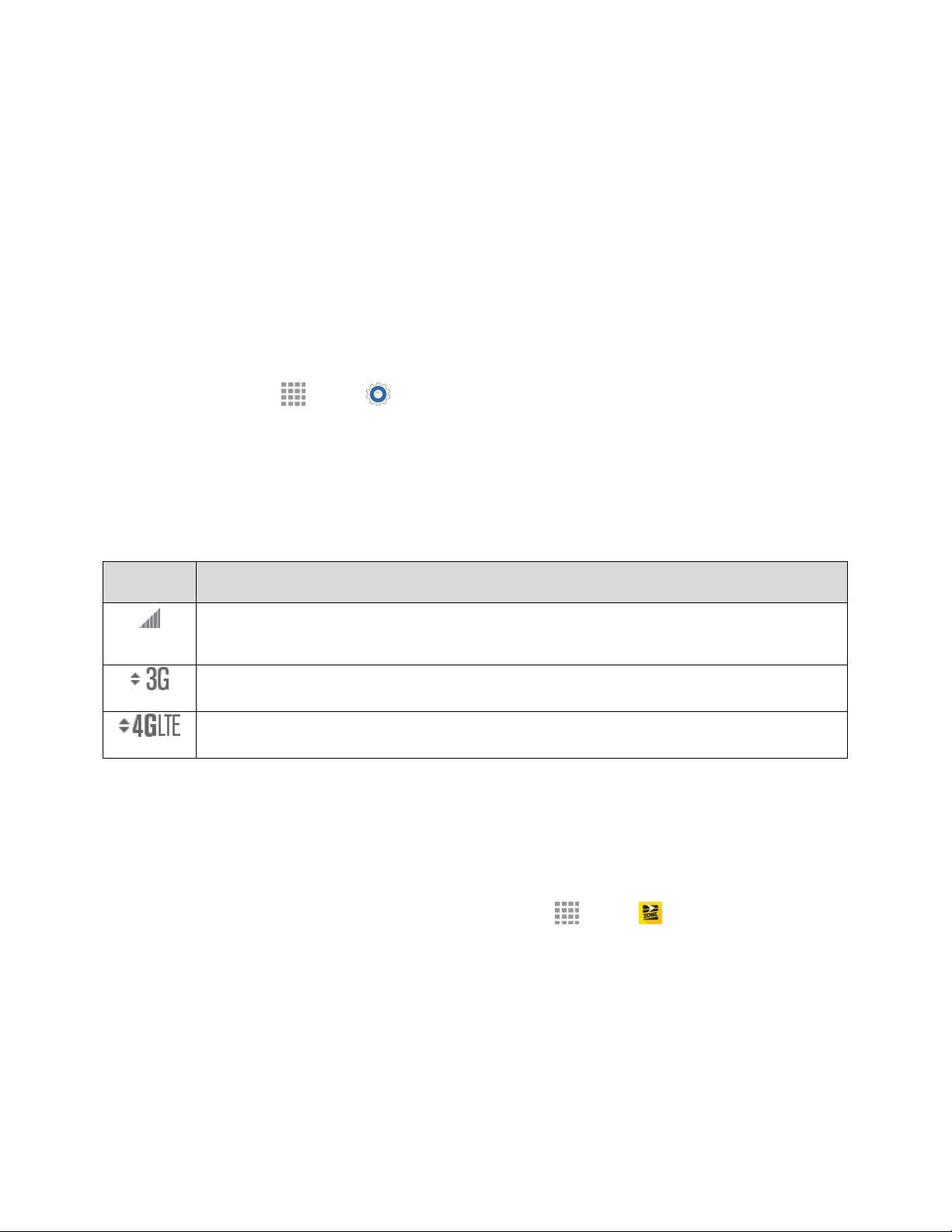
Web and Data 93
Your User Name
When you buy your phone and sign up for service, you are automatically assigned a user name, which is
typically based on your name and a number, followed by “@sprintpcs.com”. (For example, the third John
Smith to sign up for Sprint data services might have jsmith003@sprintpcs.com as his user name.)
When you use data services, your user name is submitted to identify you to the Nationwide Sprint
Network. Your user name is automatically programmed into your phone. You don’t have to enter it.
Update Your User Name
If you choose to change your user name and select a new one online, or make any changes to your
services, you must then update the profile on your phone.
1. From home, tap Apps > Settings > GENERAL tab > System update.
2. Tap Update Profile.
Data Connection Status and Indicators
Your phone displays the current status of your data connection through indicators at the top of the screen.
The following symbols are used:
Icon
Description
Network (full signal): The number of bars indicate the strength of the signal. More bars
mean a better signal.
3G (data service): Your phone is connected to the 3G network.
4G LTE: Your phone is connected to the 4G network.
Hotspot
Use the Hotspot feature to share your phone’s data connection with other devices via Wi-Fi.
Important: Use of the Hotspot feature requires an additional subscription. Sign on to your account at
sprint.com/mysprint or access your account via Sprint Zone (tap Apps > Sprint Zone) to learn
more.
Note: Turning on Hotspot on will disable your phone's connection to other Wi-Fi networks.
Note: Using the Hotspot feature consumes battery power and uses data services.

Web and Data 94
Turn Hotspot On or Off
To conserve battery life, turn Hotspot on when you need it and turn it off when you are finished. You can
control Hotspot from Settings.
1. From home, tap Apps > Settings > CONNECTIONS tab > Hotspot.
2. Tap the ON/OFF switch to turn Hotspot on or off.
Connect a Device to Your Phone’s Hotspot
When you connect a device to your phone’s Hotspot feature, the device can access your phone’s
connection to the mobile data network.
1. From home, tap Apps > Settings > CONNECTIONS tab > Hotspot.
2. Tap the ON/OFF switch to turn Hotspot on.
3. On the other device, scan for Wi-Fi hotspots, and then select your phone’s hotspot.
Your phone’s Network SSID will appear in the list of available devices. To find your phone’s
Network SSID, go to Settings > CONNECTIONS tab > Hotspot. The network SSID is
displayed near the top of the screen.
4. At the prompt, enter your phone’s password.
Your phone uses WPA2 security, which requires a password. To find your phone’s password,
go to Settings > CONNECTIONS tab > Hotspot, and look for the password in the
connection instructions.
For more information, see Hotspot Settings.
Virtual Private Networks (VPN)
From your phone, you can add, set up, and manage virtual private networks (VPNs) that allow you to
connect and access resources inside a secured local network, such as your corporate network.
Prepare Your Phone for VPN Connection
Depending on the type of VPN, you may be required to enter your login credentials or install security
certificates before you can connect to your company’s local network. You can get this information from
your network administrator.
To connect to a VPN, you must have Mobile data enabled, or your phone must be connected to a Wi-Fi
network. For information about setting up and using these connections on your phone, see Data Usage
Settings and Turn Wi-Fi On and Connect to a Wireless Network.

Web and Data 95
Set a Screen Lock
Before setting up a VPN, you must set a screen lock to prevent access to your phone by unauthorized
users. A PIN or password screen lock provides sufficient security to set up trusted credential storage.
1. From home, tap Apps > Settings > DEVICE tab > Lock screen > Screen lock.
2. Choose a screen lock type: Pattern, PIN, or Password.
3. Follow the prompts to configure the screen lock. For more information, see Screen Lock.
Add a VPN
Configure a connection to a VPN. You must have a PIN or Password screen lock set before adding a
VPN.
Tip: You may need to contact your network administrator for some of the information needed to set up a
VPN connection.
Add a Basic VPN
From home, tap Apps > Settings > CONNECTIONS tab > More networks. 1.
Tap VPN > Basic VPN. 2.
Tap Add to configure options: 3.
Name: Enter the name of the VPN.
Type: Choose the type of VPN.
Server address: Enter the address for the VPN server.
PPP Encryption (MPPE): Tap to enable, if applicable for the VPN.
Show advanced options:
• DNS search domains
• DMS servers
• Forwarding routes
Tap SAVE to save the VPN settings. 4.
Note: Available configuration options may differ depending on the type of VPN you are setting up.

Web and Data 96
Add an Advanced IPsec VPN
1. From home, tap Apps > Settings > CONNECTIONS tab > More networks.
2. Tap More networks > VPN > Advanced IPsec VPN.
3. Tap Add VPN connection to configure options:
VPN connection name: Enter the name of the VPN.
IPsec connection type: Choose the type of VPN.
Gateway: Enter the IP address or DNS name.
Identity: Enter the key ID.
Pre-shared key: Enter the PSK.
Show advanced options: Tap to set other options, depending on the type of VPN.
• Extended authentication
• Aggressive mode
• Perfect forward secrecy (PFS)
• Disable split tunneling
• Algorithm suite
• IKE groups
• IKE lifetime
• IPsec lifetime
• Connection attempt timeout
4. Tap SAVE to save the VPN.
Connect to a VPN
Connect to a VPN that’s already set up on your phone.
1. From home, tap Apps > Settings > CONNECTIONS tab.
2. Tap More networks > VPN.
3. In the VPNs section, tap a VPN.
4. Follow the prompts to enter your login credentials, and connect. When you are connected, the
VPN connected icon appears in the notification area of the title bar.

Web and Data 97
Disconnect from a VPN
The following describes how to disconnect from a VPN connection.
1. Slide the Status Bar down to open the Notification Panel.
2. Tap the VPN connection to return to the VPN settings screen, and then tap the VPN connection
to disconnect from it.
When your phone has disconnected from the VPN, the VPN disconnected icon displays in the notification
area of the title bar.
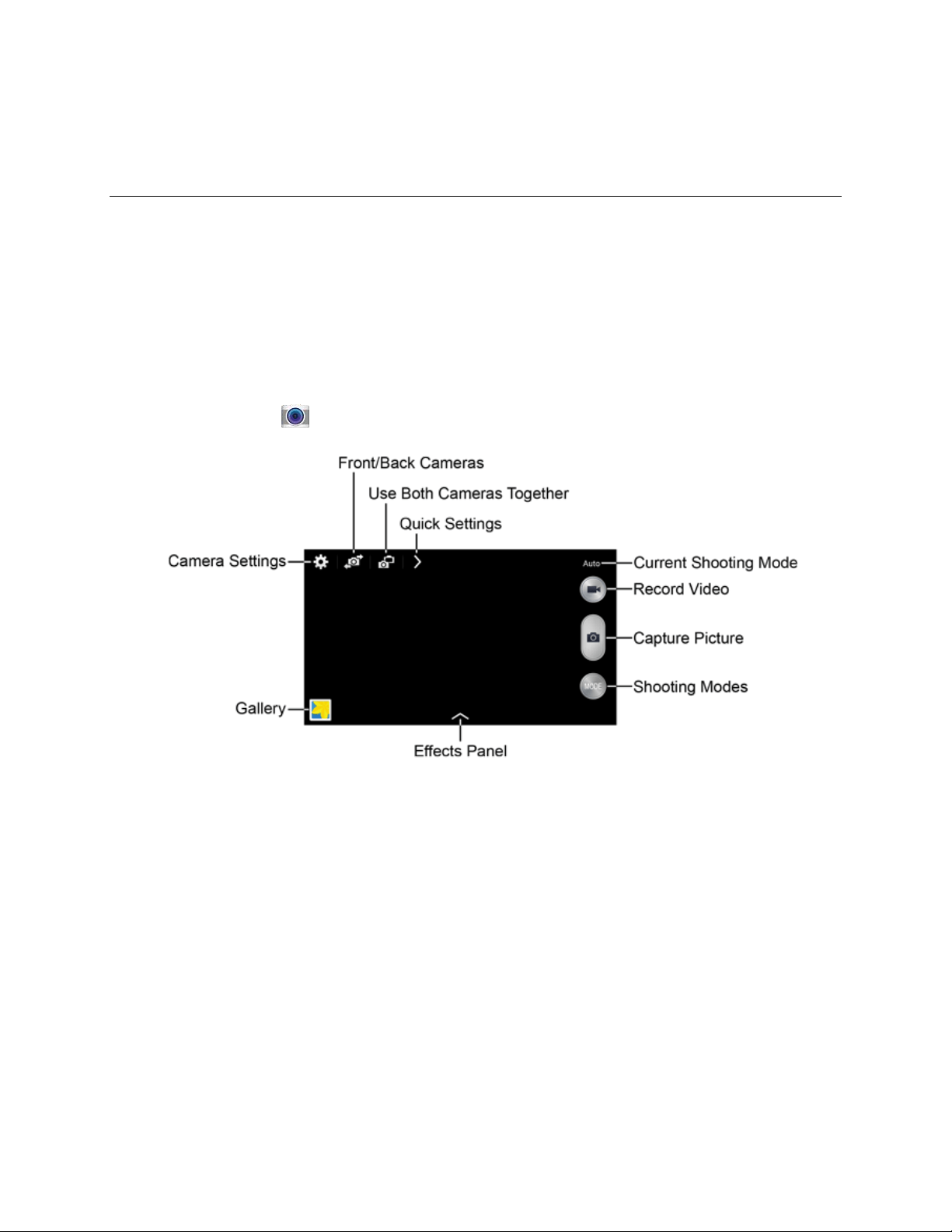
Camera and Video 98
Camera and Video
Use the camera or camcorder to take and share pictures and videos.
Camera
You can use the camera or camcorder to take and share pictures and videos.
Open the Camera
Follow the below procedure to access your phone’s camera.
From home, tap Camera. ■
Camera Settings: Access camera settings.
Front/Back Cameras: Switch between the front and back cameras.
Use Both Cameras Together: Take photos and videos with both cameras at the same time.
Quick Settings: Shortcuts to favorite settings which you can customize.
Current Shooting Mode: Shows the current shooting mode.
Record Video: Tap to start recording.
Capture Picture: Tap to take a picture.
Shooting Modes: Tap to choose a shooting mode. Shooting modes automatically adjust
settings to suit conditions, or to access special features like Beauty face or other specialty
shots.

Camera and Video 99
Effects Panel: Apply special effects when using the back camera.
Gallery: View your pictures or video in the Gallery App.
Take a Picture
You can take pictures with your phone’s front or back camera, or combine shots with Dual mode.
1. From home, tap Camera.
2. Using the phone’s screen as a viewfinder, compose your shot by aiming the camera at the
subject. While composing your picture, use the onscreen options, or these gestures:
Press the Volume key up or down to zoom in or out, or touch the screen with two fingers and
pinch or spread them on the screen to zoom.
Tap the screen to focus on the area you tapped.
3. Tap Capture to take the picture.
Tip: Depending on your settings or the camera orientation, you may also take a picture using your voice,
tapping the screen, or pressing the volume key. See Configure the Camera.
Note: To include your location in photos, turn on GPS tag in Settings.
Record Videos
In addition to taking pictures, you can record, view, and send videos with your phone’s built-in video
camera.
From home, tap Camera. 1.
Using the phone’s screen as a viewfinder, compose your shot by aiming the camera at the 2.
subject. While composing your shot, use the onscreen options, or these gestures:
Press the Volume key up or down to zoom in or out, or touch the screen with two fingers and
pinch or spread them on the screen to zoom.
Tap the screen to focus on the area you tapped.
Tap Record to begin recording. While recording, you can use these options: 3.
Tap the screen to change the focus area to the area you tapped.
Tap Capture to take a still picture while continuing recording.
Tap Pause to temporarily stop recording.
Tap Resume to resume a paused recording.
Tap Stop to stop recording.

Camera and Video 100
Tip: If Voice Control is active, you can begin recording by saying “Record video.” See Configure
the Camera.
Review Pictures and Videos from the Camera
After you take a picture or record a video, you can review and edit it right from the camera using special
Studio options.
Review and Edit a Picture from the Camera
1. From home, tap Camera.
2. Take a picture, and then tap Gallery at the corner of the screen.
3. While reviewing a picture, you can use these options:
Change player: Share the picture with a nearby device.
Share: Choose a method for sharing the picture.
Studio: Edit the picture using the Studio tool. Options include:
• Adjustment: Rotate or crop the photo.
• Color: Adjust the brightness, contrast, saturation, the red/green/blue color, the color
temperature, or the hue.
• Effect: Add an effect to the picture.
• Portrait: Adjust pictures of faces. You can remove redeye, brighten faces, airbrush, or
adjust the focus on faces in the picture.
• Decoration: Add stickers and frames to your picture. You can also draw on the picture,
and add additional images.
Delete: Erase the current picture.
Menu: Choose other options.

Camera and Video 101
Review and Edit a Video from the Camera
1. From home, tap Camera.
2. Record video, and then tap the Gallery thumbnail at the corner of the screen.
3. While reviewing a video, you can use these options:
Share: Choose a method for sharing the video.
Video trimmer: Edit the length of the video. Drag the trimmer from either end of the video
to shorten the video.
Delete: Erase the current video.
Menu: Choose other options.
Configure the Camera
Camera settings are special options that you can choose, right on the camera screen, to make taking
pictures or recording videos easy, and to make your pictures or videos special.
Choose a Shooting Mode
Your phone’s camera offers many shooting modes, to make your pictures or videos special.
1. From home, tap Camera.
2. On the Camera screen, tap to choose a shooting mode. Scroll available modes, and then tap
a mode to select it. Modes include:
Auto: Automatically adjusts the exposure to optimize the color and brightness of pictures. In
Auto mode, you can take single or burst shots (take burst shots by holding Capture to take
multiple shots until you lift your finger).
Virtual tour: Create an interactive virtual tour of your surroundings.
Sports: Take pictures of fast movement.
Surround shot: Take 360° pictures to create a spherical panorama.
Panorama: Take multiple pictures to merge into one expansive picture. You can create a
horizontal or vertical panorama picture.
Eraser: Save the best picture after erasing moving objects from five consecutive pictures.
Rich tone (HDR): Enhances the realism of your pictures by capturing greater intensity and
contrast of both color and light.
Golf: Take pictures of a golf-swing. You can then play the pictures forwards and backwards.

Camera and Video 102
Animated photo: Create a picture containing selected moving objects by animating part of
the picture.
Drama: Take multiple pictures of a moving subject and merge them into one dramatic picture.
Sound & shot: Enrich pictures by adding background sounds for a few minutes.
Best face: Select the best picture of each person from five consecutive pictures to get the
best merged group picture.
Best photo: Take a series of pictures, and then select the best picture to save.
Beauty face: Automatically enhances facial features when taking portraits.
Note: Tap to display all shooting modes. Tap to quickly select Auto shooting mode.
Quick Settings
Use Quick settings to quickly configure settings while you take pictures and record videos.
1. From home, tap Camera.
2. From the Camera screen, tap to access quick settings:
Flash: Tap to choose a flash setting.
Smart stabilization: When turned On, the camera automatically adjusts in low light to
give you brighter, clearer pictures without the flash.
Voice control: Tap to access voice control settings, for using voice commands to take
pictures and record video.
Recording mode: Tap to choose a mode for recording. Choose Limit for MMS to restrict
recordings to a size that can be attached to a multimedia message. Choose Normal, Slow
motion, Fast motion or Smooth motion to control the speed of recording.
Share: Tap to choose a method for sharing pictures and videos. You can choose
Share shot, Buddy photo share, or Remote viewfinder.
Customize Quick Settings
The Camera screen offers five customizable shortcuts, giving you the ability to quickly choose your
favorite settings.
1. From home, tap Camera.
2. Tap Quick Settings, and then touch and hold any settings icon to display the shortcuts menu.
3. Touch and drag settings to or from the five shortcuts.

Camera and Video 103
Advanced Camera Settings
Use Advanced settings to configure default options for pictures and videos.
1. From home, tap Camera.
2. Tap Settings to configure options:
Photos:
• Photo size: Choose the default size for pictures.
• Burst shot: When on, you can take multiple pictures when you touch and hold the
Capture button.
• Tap to take pics: When turned on, you can tap the screen to take a picture.
• Face detection: When on, the Camera will automatically adjust settings for taking
pictures of faces.
• Metering modes: Set how the Camera measures the light source.
• ISO: Set the sensitivity of the camera’s light meter (available when Smart stabilization is
turned off).
• Smart stabilization: When turned on, the camera automatically adjusts in low light to
give you brighter, clearer pictures without the flash.
• Save as: When the Mode is set to Rich Tone (HDR), you can choose whether pictures
are saved with Rich Tone only, or as Rich tone and original.
Videos:
• Video size: Choose the default size for videos.
• Video stabilization: When on, the Camera adjusts settings to improve image stability in
videos.
• Audio zoom: When turned On, the microphone will focus on the sound from the area
where you zoom into while recording.
General:
• Location tag: When on, GPS location information is stored in picture files.
• Review pics/videos: When on, pictures display briefly after you take them so you can
review them.
• Volume key: Choose a function for the Volume Key while using the Camera.
• Timer: Choose a timer setting to delay the taking of pictures or recording.
• White balance: Choose a setting for current light conditions.

Camera and Video 104
• Exposure value: Adjust the brightness of pictures.
• Guidelines: When on, guidelines display on the screen to aid in composition.
• Flash: Choose a flash setting.
• Voice control: When on, you can take pictures or record videos by speaking commands.
• Contextual filename: When on, filenames include GPS information. GPS tag must be
enabled to use contextual filenames.
• Save as flipped: When on, pictures or recordings you make using the front camera are
saved as a mirror-image.
• Storage: If you have an optional memory card installed (not included), you can choose
whether to save files to device memory or to the memory card.
• Reset: Return settings to the factory defaults.
Gallery
Using the Gallery application, you can view pictures and watch videos that you’ve taken with your phone’s
camera, downloaded, or copied to an optional memory card (not included).
For pictures stored on an optional memory card, you can do basic editing such as rotating and cropping.
You can also set a picture as your contact picture or wallpaper and share pictures with your friends.
While viewing pictures in the Gallery, scroll up the screen to view more albums. Simply tap an album to
view the photos or videos in that album.
If you have pictures or videos stored on an optional memory card (not included), they will be display
folders they are stored in, and folders are treated as albums. The actual folder names will be used as the
album names. If you have downloaded any photos and videos, these will be placed in the All downloads
album.
1. From home, tap Apps > Gallery.
2. Select a folder location (such as Camera) and tap a thumbnail to view the picture or video.
3. From the Gallery screen, you can use these options:
Tap a picture or video to display it in full screen view.
Touch and hold thumbnails to select them (indicated by a check mark).
Tap to filter your pictures and videos. You can view items by Album, All, Time,
Locations, People, and Favorites.
Tap New album to create a new album.
Tap Camera to launch the Camera to take pictures or record video.

Camera and Video 105
Tap Menu for options. Available options depend on which gallery screen you are
viewing, and may include:
• Select album/Select item: Tap albums or items to select them. After selection, you can
tap Menu again for options you can use with the selected items.
• Slideshow: Choose options to create a slideshow for viewing your pictures and videos.
• Content to display: Choose content to display in Gallery. You can choose content saved
to your phone’s memory or content from other sources such as Dropbox, Facebook, and
so on.
• Sort by oldest/latest: Display items sorted by date.
• Scan for nearby devices: Search for nearby devices for sharing photos or videos.
• Show/Hide nearby devices: Choose whether to display nearby DLNA devices (available
when Nearby devices is turned On, and a device is nearby with File sharing enabled).
• Settings: Configure Gallery settings. For more information, see Gallery Settings.
• Help: Learn about Gallery.
View Photos and Videos
After selecting an album from the Albums tab, you can browse the photos and videos of that album in
either photo pile or grid view. Tap a photo or video to view it in full screen.
View Photos
1. From home, tap Apps > Gallery.
2. Tap a thumbnail to view the picture. While viewing a picture full-screen you can use these
options:
Change player: Choose a conne4cted device to share the picture with.
Share: Choose method for sharing the picture.
Delete: Erase the current picture.
Menu: Choose other options, including:
• Edit: Edit the picture using the photo editing tools.
• Write on image: Write on the picture using the S Pen.
• Favorite: Mark the picture as a Favorite.
• Slideshow: Create a slideshow.
• Photo Frame: Add a frame to the picture.
Camera and Video 106
• Draw on image: Draw on the picture using the S Pen.
• Signature: Add your signature to the picture.
• Copy to clipboard: Save a copy of the picture to the clipboard so you can paste it into
another app.
• Print: Print the picture to a compatible Wi-Fi printer (not included).
• Rename: Change the name of the picture.
• Buddy photo share: Send the picture to people you have tagged in the picture.
• Rotate left/Rotate right: Change the orientation of the picture.
• Crop: Adjust the size of the picture.
• Set as: Set the picture as a Contact photo or wallpaper on the Home screen or Lock
screen.
• Details: View information about the picture.
• Settings: Configure Gallery settings.
View Videos
Note: If no icons are displayed on the screen in addition to the picture, tap anywhere on the screen to
display them.
1. From home, tap Apps > Gallery.
2. Tap a video to select it. When the video is displayed full-screen, you can use these options:
Share: Choose an option for sharing the video. Options may include Bluetooth, Dropbox,
Email, Gmail, Google+, Messages, Picasa, Wi-Fi Direct, or YouTube.
Video trimmer: Edit the length of the video. Drag the trimmer from either end of the video
to shorten the video.
Delete: Erase the current video.
Tap to play the video.
Menu: Choose other options, including:
• Favorite: Mark the video as a Favorite.
• Slideshow: Create a slideshow.
• Rename: Change the name of the video file.

Camera and Video 107
• Details: View information about the video.
• Settings: Configure Gallery settings.
Working with Photos
You can touch and hold a photo to open a selection menu and choose what to do with it. You can choose
to delete the photo, rotate or crop it, and more.
Rotate and Save a Photo
To rotate or save your photo, follow the below procedures.
1. From home, tap Apps > Gallery.
2. Select a folder location (such as Camera) and tap an image to view your picture.
3. Tap Menu > Rotate left or Rotate right.
The rotated picture is saved in your default storage location.
Crop a Photo
To crop your photos, follow the below procedures.
1. From home, tap Apps > Gallery.
2. Select a folder location (such as Camera) and tap an image to view your picture.
3. Tap Menu > Crop.
4. To adjust the crop box size, touch and hold the edge of the box. Drag your finger inward to or
outward to resize the crop box.
5. To move the crop box to the part of the photo that you want to crop, drag the crop box to the
desired position.
6. Tap SAVE to apply the changes to the picture.
The cropped picture is saved along with the original copy in your default storage location.
Camera and Video 108
Share Photos and Videos
You can share and send pictures and videos from your phone using several different methods, including
messaging, email, social media apps, Bluetooth, cloud storage, and so on.
Send Photos and Videos by Email or Gmail
You can send several photos, videos, or both in an email message. They are added as file attachments in
your email.
1. From home, tap Apps > Gallery.
2. Tap the album that contains the photos or videos you want to share.
3. Tap the photos you want to send.
4. Touch the screen and then tap Share > Email or Gmail.
5. Compose your message and then tap Send or Send.
Note: If you selected Email and you have multiple email accounts, the default email account will be used.
Send a Photo or Video by Multimedia Message
Although you can send several photos or videos in a multimedia message, it may be better to send one at
a time, especially if the files are large in size.
1. From home, tap Apps > Gallery.
2. Tap the album that contains the photos or videos you want to send.
3. Tap the photo or video you want to send.
4. Touch the screen and then tap Share > Messages.
5. Compose your message and then tap Send.
Send Photos and Videos via Bluetooth
You can select several photos, videos, or both and send them to someone’s phone or your computer
using Bluetooth.
1. From home, tap Apps > Gallery.
2. Tap the album that contains the photos or videos you want to send.
3. Select the photos or videos you want to send.
4. Touch the screen and then tap Share > Bluetooth.
Camera and Video 109
In the next few steps, you will be asked to turn on Bluetooth on your phone and connect to the receiving
Bluetooth phone so the files can be sent. For more information, see Bluetooth.
Share Photos and Videos on Google+
1. From home, tap Apps > Gallery.
2. Tap the album that contains the photos or videos you want to send.
3. Tap the photo or video you want to send.
4. Touch the screen and then tap Share > Google+.
5. Compose your message and then tap Send.
Share Videos via YouTube
You can share your videos by uploading them to YouTube. Before you do this, you must create a
YouTube account and sign in to that account on your phone.
1. From home, tap Apps > Gallery.
2. Tap the album that contains the videos you want to share.
3. Select the video you want to share.
4. Touch the screen and then tap Share > YouTube.
5. Enter the prompted information, such as description and tags, and select a privacy option.
6. Tap Upload.
Gallery Settings
Configure options for the Gallery app.
From home, tap Apps > Gallery > Menu > Settings for options: ■
Accounts: Tap an account to enable or disable sync options. The sync options for pictures
and videos affect Gallery.
SNS Data Management: Configure options for synchronizing pictures and videos with your
SNS (Social Networking Site) accounts.
• Sync only via Wi-Fi: When enabled, Gallery will only sync pictures with your SNS
(Social Networking Site) accounts when connected to Wi-Fi.
Tag buddy: Automatically add tag information to pictures you take. Tap the ON/OFF switch
to turn the option on, and then tap items to enable tags in pictures.
Face tag: When enabled, your phone identifies faces in the pictures you take, so you can tag
them in the picture.
Auto play sound: Play the recorded sound when viewing pictures taken in Sound & shot
mode.

Camera and Video 110
Google Photos
Keep all your photos backed up and organized with Google+ Photos.
From home, tap Apps Google folder > Photos. ■
Video Player
Play videos stored on your phone, or from your other devices (you must sign in to your Samsung account
to play videos synced from your other devices).
1. From home, tap Apps > Video.
2. Scroll through the videos stored on your device. After a few seconds, each video thumbnail
begins playing a preview of the clip.
3. Tap a video to view it.
Use Pop-up Play
Multitask with Pop-up Play by transforming your video player into a pop-up window floating on the screen.
The video will continue to play, and the pop-up window can be resized or moved anywhere on the screen.
1. From home, tap Apps > Video.
2. Tap a video to view it.
3. Tap to continue playing the video in a floating window. Drag the window to any location on
the screen, and use two fingers to pinch or spread to resize the floating window.

Tools and Calendar 111
Tools and Calendar
Learn how to use many of your phone’s productivity-enhancing apps and features.
Action Memo
Use Action Memo to quickly write memos and link them to actions, such as making a call, sending, a
message, or searching the Web.
You can launch Action Memo from Apps, or you have other options, including:
● Press the S Pen button and double-tap the home screen.
● Hover S Pen over the home screen and press the S Pen button
● When the Action Memo on lock screen option is enabled, you can open Action Memo by pressing
the S Pen button and double tapping the lock screen with S Pen.
● When the Pen detachment option is set to Action Memo, Action Memo launches when you detach
the S Pen from your phone.
Note: Action Memo is now part of S Note. See S Note for more information.
1. From home, tap Apps > Samsung folder > Action memo.
2. Tap to create a new Action memo.
3. While creating a memo, you can use these options (tap to display all the options):
Pen color: Choose the color of the pen cursor.
Eraser: Delete parts of the memo. Tap Clear all to erase everything from the memo.
Link to action: Perform an action on the memo.
Pin to Home screen: Add the memo to the Home scree as a widget.
Discard: Delete the memo without saving.
Save: Save the memo.
More options:
• Minimize: Shrink the size of the memo to a thumbnail.
• Change background color: Choose a color for the background of the memo.
• Create Action memo: Create a new Action memo.
• View action memo list: View a list of all of your Action memos.

Tools and Calendar 112
S Note: Edit your Action memo with S Note.
Resize: Change the size of your Action Memo.
App Spotlight
Explore recommended apps from the Google Play store.
From home, tap Apps > App Spotlight. ■
Bluetooth
Bluetooth is a short-range communications technology that allows you to connect wirelessly to a number
of Bluetooth phones, such as headsets and hands-free car kits, and Bluetooth-enabled handhelds,
computers, printers, and wireless phones. The Bluetooth communication range is usually approximately
30 feet.
Turn Bluetooth On or Off
When Bluetooth is on, you can scan and find other Bluetooth devices, to share information between the
devices. Turn Bluetooth off when not in use to conserve battery power.
1. From home, tap Apps > Settings > CONNECTIONS tab > Bluetooth.
2. Tap the ON/OFF switch to turn Bluetooth on or off.
Note: You can also turn Bluetooth on or off from the Notification Panel. Drag down from the top of the
screen, and then tap Bluetooth.
Note: for Bluetooth settings information see Bluetooth Settings.
Connect a Bluetooth Headset or Car Kit
You can listen to music over a Bluetooth stereo headset, or have hands-free conversations using a
compatible Bluetooth headset or car kit. It is the same procedure to set up stereo audio and hands-free
devices.
To listen to music with your headset or car kit, the headset or car kit must support the A2DP Bluetooth
profile.
1. From home, tap Apps > Settings > CONNECTIONS tab > Bluetooth.
2. Tap the ON/OFF switch to turn Bluetooth on.
3. Make sure that the target device is discoverable, so that your phone can find it. Refer to the
instructions that came with the device to find out how to set it to discoverable mode.
4. Tap SCAN. Your phone will start to scan for Bluetooth devices within range.

Tools and Calendar 113
5. When you see the name of the target device displayed in the Bluetooth devices section, tap the
name. Your phone then automatically tries to pair with the target device.
6. If automatic pairing fails, enter the passcode supplied with the target device.
The pairing and connection status is displayed below the hands-free headset or car kit name in the
Bluetooth devices section. When the Bluetooth headset or car kit is connected to your phone,
(Bluetooth connected) displays in the Status Bar. Depending on the type of headset or car kit you
have connected, you can then start using the headset or car kit to listen to music or make and receive
phone calls.
Note: Due to different specifications and features of other Bluetooth-compatible devices, display and
operations may be different, and functions such as transfer or exchange may not be possible with all
Bluetooth-compatible devices.
Reconnect a Headset or Car Kit
When you have paired a headset with your phone, you should be able to reconnect it automatically by
turning on Bluetooth on your phone and then turning on the headset. However, sometimes you will need
to reconnect manually, for example if you have been using your headset with another Bluetooth device.
1. From home, tap Apps > Settings > CONNECTIONS tab > Bluetooth.
2. Tap the ON/OFF switch to turn Bluetooth on.
3. Make sure that the target device has Bluetooth turned on.
4. Tap the target device’s name in the Bluetooth devices section.
5. If prompted to enter a passcode, try 0000 or 1234, or consult the target device’s documentation to
find the passcode.
Tip: If you still cannot reconnect to the target device, follow the instructions in Disconnect or Unpair From
a Bluetooth Device, and then follow the instructions in Connect a Bluetooth Headset or Car Kit.
Disconnect or Unpair from a Bluetooth Device
Follow these instructions to disconnect or unpair your phone from a Bluetooth device.
Disconnect from a Bluetooth Device
You can disconnect from a Bluetooth device, without removing the pairing relationship between the
devices.
1. From home, tap Apps > Settings > CONNECTIONS tab > Bluetooth.
2. Tap the device’s name, and then tap OK.

Tools and Calendar 114
Unpair from a Bluetooth Device
You can make your phone forget its pairing connection with another Bluetooth device. To connect to the
device again, you will need to pair with it again.
1. From home, tap Apps > Settings > CONNECTIONS tab > Bluetooth.
2. In the Bluetooth devices section, tap beside the device name, and then tap Unpair.
Send Information Using Bluetooth
You can use Bluetooth to transfer information between your phone and another Bluetooth-enabled device
such as a phone or notebook computer. The first time you transfer information between your phone and
another device, you need to enter or confirm a security passcode. After that, your phone and the other
device are paired, and you will not need to exchange passcodes to transfer information in the future.
You can send the following types of information, depending on the device you are sending to:
● Images and videos
● Calendar events
● Contacts
● Audio files
Send Information from Your Phone to Another Device
Follow these instructions to use Bluetooth to send information from your phone to a Bluetooth device.
1. Set the receiving device to discoverable mode. You may also need to set it to “Receive Beams”
or “Receive Files”. Refer to the device’s documentation for instructions on receiving information
over Bluetooth.
2. On the phone, open the application that contains the information or file you want to send. Follow
the steps for the type of item you want to send:
Photos and videos (in Gallery): Tap a picture or video, and then tap Share via >
Bluetooth.
Calendar event: In the Calendar’s Day view, Agenda view, or Week view, tap the event and
then tap Share via > Share as (VCD file or Text) > Bluetooth.
Music: While playing a song in the Music app, tap Menu > Listen via Bluetooth.
Voice recording: On the main Voice Recorder screen, touch and hold a recording and tap
Share via > Bluetooth.
3. If you are prompted to turn on Bluetooth, tap Yes.
4. Tap the name of the receiving device.

Tools and Calendar 115
5. If prompted, accept the connection on the receiving phone, and enter the same passcode on both
your phone and the other device, or confirm the auto-generated passcode.
6. On the receiving device, accept the file.
Receive Information Using Bluetooth
Your phone is capable of receiving a wide variety of file types with Bluetooth, including photos, music
tracks, and documents such as PDFs.
1. From home, tap Apps > Settings > CONNECTIONS tab > Bluetooth.
2. Tap the ON/OFF switch to turn Bluetooth on.
3. Tap the check box beside your phone's Bluetooth name to make it discoverable.
4. On the sending device, send one or more files to your phone. Refer to the device’s
documentation for instructions on sending information over Bluetooth.
5. If prompted, enter the same passcode on both your phone and the other device, or confirm the
auto-generated passcode. A Bluetooth authorization request is displayed on your phone.
6. When your phone receives a file transfer request notification, tap ACCEPT.
7. When the file is transferred, a notification displays. To open the file immediately, slide down the
Notification Panel, and then tap the relevant notification.
When you open a received file, what happens next depends on the file type:
● Media files and documents are usually opened directly in a compatible application. For example,
if you open a music track, it starts playing in the Music application.
● For a vCalendar file, select the calendar where you want to save the event, and then tap
Import event.
The vCalendar is added to your Calendar events. For more information on using the
Calendar, see Calendar.
For a vCard contact file, if there are multiple vCard files on your storage card, you can
choose to import one, several, or all of those contacts to your contacts list.
Calendar
Use Calendar to create and manage events, meetings, and appointments. Your Calendar helps organize
your time and reminds you of important events. Depending on your synchronization settings, your
phone’s Calendar stays in sync with your Calendar on the Web, Exchange ActiveSync calendar, and
Outlook calendar.

Tools and Calendar 116
Add an Event to the Calendar
Add events to your Calendar to help you organize your time and remind you of important events.
Note: To synchronize calendar events among your Google and Corporate accounts, make sure they are
being managed by your phone. See Accounts and Messaging for more information.
1. From home, tap Apps > Calendar.
2. Tap Add new.
3. If you have accounts set up on your phone, you can assign the new event to an account by
tapping the Calendar field and then selecting an account.
My calendar: Calendar entries that are stored locally on the phone and not part of an
account.
Samsung Calendar: Calendar entries that are synchronized between your phone and your
Samsung account.
Google/Gmail: Calendar entries that are synchronized between your phone and your Google
Account.
Microsoft Exchange ActiveSync: Calendar entries that are synchronized between your
phone and a Microsoft Exchange ActiveSync account.
4. Enter information about the event (not all accounts support all fields):
Tap the Title field and enter a title for the event.
Tap the Location field to enter a location for the event in the Location field or tap the icon to
select the location on the a map.
Select a Start and End date and time for the event by tapping the corresponding fields, and
adjusting the month, day, and year. Tap the All day field to set this as an all-day event. If set
as an all-day event, the time fields are removed.
5. Select an alarm time by tapping the Reminder field.
6. Tap SAVE, or tap VIEW MORE OPTIONS to enter more information about the event. Available
options depend on the type of event, and the account it is assigned to:
Enter participants in the Participants field.
Tap Show me as to choose how the event shows on your calendar to other event organizers.
Tap Privacy to select who is allowed to see this event. Private allows only the participants to
see the event. Public allows anyone with access to your calendar to see the event.
Select a recurrence cycle for the event by tapping the Repeat field.
Enter a description for the event in the Description field.

Tools and Calendar 117
Tap a sticker to add an sticker to the event.
Tap the Time zone to adjust the time zone.
7. Tap SAVE to store the new event and synchronize it with your selected account.
Event Alerts and Reminders
When your phone is turned on and you have an event alarm scheduled, your phone alerts you and
displays the event summary. There are several ways your phone alerts you to scheduled events:
● By playing the assigned ringtone.
● By showing the Alert screen.
● By playing a short beep.
● By indicating an icon within the Status Bar.
To view additional options:
1. Touch and hold the Status Bar, and then slide your finger down the screen to open the
Notification Panel.
2. Tap the upcoming event name from the onscreen list to display the event within the Calendar
notifications screen.
3. Tap an option.
SET SNOOZE DURATION to set the length of time to allow before you are reminded of the
event. Choose from: 3 minute, 5 minutes, 10 minutes,15 minutes, or 30 minutes.
SNOOZE to be reminded of the event at a future time.
DISMISS to dismiss the reminder.
View Events
The following procedure helps you view your calendar events.
1. From home, tap Apps > Calendar.
2. To customize your Calendar view, tap , and then tap a time period (Year, Month, Month and
agenda, Week, Day, or Agenda).
3. Tap the day for which you would like to view events.
4. To display an event’s details, tap it from the current screen.

Tools and Calendar 118
Day and Agenda Views
● Day view displays a list of the events of one day.
● Agenda view shows a list of events in chronological order.
● The color bars on the left side of the events indicate the type of calendar that includes the event.
● When in Day view, slide left or right across the screen to view earlier or later days.
Month and Agenda View
Month and Agenda view shows the month, with a list of events for the month below.
While in Month and agenda view:
● You can touch and hold a day to create a new event on that day.
● Tap an event to view its details.
● Slide left or right across the screen to view earlier or later months.
Week View
Week view displays a chart of the events of one week.
When in Week view:
● You can touch and hold a time slot to create a new event at that time.
● Tap an event to view its details.
● Slide left or right across the screen to view earlier or later weeks.
Year and Month Views
In Year or Month view, you will see markers on days that have events.
When in Year or Month view:
● Tap a day to view the events of that day.
● Touch and hold a day to create a new event on that day.
● Slide left or right to view earlier or later months or years.

Tools and Calendar 119
Erase Events
The following procedures show you how to erase your calendar events.
1. From home, tap Apps > Calendar.
2. Open the calendar event details:
In Agenda, Day, and Week views, tap the calendar event you want to delete.
In Month view, tap the date where the calendar event occurs, and then tap the calendar
event.
In Year view, tap the month in which the event is located.
3. Tap the event, and then tap Delete.
4. In the Delete confirmation box, tap DELETE.
– or –
If the calendar event is recurring, select Only this event, This and future events, or All events
in series, and tap DELETE.
Access Calendar Settings
Configure settings for your phone’s Calendar app.
1. From home, tap Apps > Calendar.
2. Tap Menu > Settings to configure these options:
View styles: Select a style for your Week view.
First day of week: Choose a day to start each calendar week.
Show week numbers: Enable or disable display of week numbers on the calendar.
Hide declined events: Events for which you declined the invitation are not shown on the
calendar.
Hide completed tasks: Tasks you’ve completed are no longer shown on the calendar.
Weather: Weather information from AccuWeather.com displays on the calendar.
Lock time zone: Lock events times and dates to your selected time zone.
Select time zone: Set your current time zone.
View today according to: Select a fixed time zone to use.
Set snooze duration: Set the length of time before the next alarm while snoozing.

Tools and Calendar 120
Select alert type: Choose the type of notifications for calendar events. You can choose to be
notified with a sound, or by an icon in the Status Bar, or choose no notifications.
Notification sound: Choose a sound for calendar event notifications.
Vibration: Enable or disable vibration, to play for calendar event notifications.
Quick responses: Manage text phrases, which you can use to send to event attendees.
Calculator
Use the Calculator app to perform mathematical calculations.
Note: Rotate the phone to switch to a scientific calculator for advanced calculator functions.
1. From home, tap Apps > Calculator.
2. Tap the keypad to enter your equation. You can touch and hold C to clear all numbers.
Clock
The Clock app offers features for keeping track of time and setting alarms.
From home, tap Apps > Clock. 1.
Tap a tab to use a feature: 2.
Alarm: This feature allows you to set an alarm to ring at a specific time.
World clock: allows you to view the time of day or night in other parts of the world. World
Clock displays time in hundreds of different cities, within all 24 time zones around the world.
Stopwatch: You can use this option to measure intervals of time.
Timer: You can use this option to set a countdown timer. Use a timer to count down to an
event based on a preset time length (hours, minutes, and seconds).
Create an Alarm
Create an alarm event. You can set one-time or recurring alarms, and choose options for how to be
notified for the alarm.
1. From home, tap Apps > Clock > Alarm tab.
2. Tap Create alarm, and then enter information for the alarm. Alarm options include:
Time: Choose a time for the alarm.
Days: Choose the days to use this alarm.
Repeat weekly: When enabled, the alarm will repeat every week on the selected days.

Tools and Calendar 121
Alarm type: Choose whether the alarm will use sound, vibration, or vibration and sound to
alert you.
Alarm tone: If you have chosen an alarm type that includes sound, choose a sound to play
for the alarm.
Volume: Set the volume of an audible alarm.
Location alarm: Active the alarm only when you are at a specified location.
Snooze: Allow snoozing for this alarm. Set the interval as well as the number of times to
repeat the alarm while snoozing.
Smart alarm: When on, the alarm will start playing a tone at a low volume at an interval
before the alarm time, and slowly increase in volume. Choose a time interval and a tone to
use with smart alarm. Available when you have chosen an alarm type that includes sound.
Name: Enter a name for the alarm.
3. Tap DONE.
Delete an Alarm
1. From home, tap Apps > Clock.
2. Touch and hold an alarm, and then tap Delete.
Downloads
Use Downloads to view and manage files you’ve downloaded to your phone.
From home, tap Apps > Downloads. ■
Drive
With the Google Drive application, everything that you add to your Drive from work or home is also
available on your device. You can create and edit documents on your device and the changes are saved
everywhere.
For more information, visit drive.google.com.
Note: You will need to set up your Google Account on your phone to use Drive.
From home, tap Apps > Google folder > Drive. ■

Tools and Calendar 122
Dropbox
Use this application to save and share files with others via the Dropbox cloud storage. When you save
files to Dropbox, your phone automatically syncs with the Web server and any other computers that have
Dropbox installed.
From home, tap Apps > Galaxy Plus folder > Dropbox. ■
Flipboard
Use Flipboard to create a personalized digital “magazine” out of everything being shared with you.
Access news stories, personal feeds and other related material. Flip through your Facebook newsfeed,
tweets from your Twitter account, photos from friends and much more.
From home, tap Apps > Galaxy Plus folder > Flipboard. ■
Google Now
Google Now gets you just the right information at just the right time.
It tells you today’s weather before you start your day, how much traffic to expect before you leave for
work, when the next train will arrive as you are standing on the platform, or your favorite team's score
while they’re playing. And the best part? All of this happens automatically. Cards appear throughout the
day at the moment you need them.
For more information, visit google.com/now.
1. Press and hold the Home Key, and then tap .
2. Follow the prompts to learn about Google Now, and set up your preferences.
Google Search
Use Google Search to search the Internet.
From home, tap Apps > Google folder > Google. ■
Help
Help provides information to help with your phone questions.
From home, tap Apps > Help. ■

Tools and Calendar 123
Kids Mode
Kids Mode provides fun and safe content for your child. You can allow access to contacts, applications,
and media content stored in your device.
From home, tap Apps > Kids Mode. ■
KNOX
KNOX gives you protection, privacy and productivity for your mobile business life. Use KNOX to gain
secure access to your work email and business apps on your personal Samsung smartphone, along with
the tools to remotely find, lock or wipe your device in the event of loss or theft.
From home, tap Apps > Samsung folder > KNOX. ■
Lookout Security
Lookout Security provides mobile phone-specific security features that are coupled with a minimal
performance hit. Lookout Mobile Security provides key security options that are unique to the mobile
market. Along with the antivirus and anti-malware tech, there's a lost and stolen phone locator service, an
application privacy adviser, and a backup service.
From home, tap Apps > Sprint Featured folder > Lookout. ■
My Files
My files allows you to manage your manage your sounds, images, videos, Bluetooth files, Android files,
and other memory card data in one convenient location. This application allows you to launch a file if the
associated application is already on your phone.
1. From home, tap Apps > Samsung folder > My files.
2. Files stored in the phone are organized into the following categories:
All: View all your files.
Images: View image files.
Videos: View video files.
Music: View audio files.
Documents: View document files.
Downloaded apps: View downloaded apps.
Dropbox: View items in your Dropbox account.
Recent files: View recently saved files.
Shortcuts: Create shortcuts to files, folders, or ftp sites.

Tools and Calendar 124
3. Tap a file or folder to open it.
Note: Different folders may appear depending on how your phone is configured.
My Magazine
Find content, information and apps, recommended for you, all in one place.
You can enable location services for personalized results based on your results. For more information
about location services, see Location Settings.
To launch My Magazine:
From home, drag the bottom of the screen upwards. ■
Tip: To remove the My Magazine pop-up option, pinch a Home screen, tap Home screen settings, and
clear the check mark next to My Magazine.
Polaris Office 5
Polaris Office 5 is a Microsoft Office compatible office suite. This application provides a central place for
managing your documents online or offline.
Polaris Office lets you open, create, and edit Word documents, PowerPoint presentations, Excel
spreadsheets, and text files. Polaris Office can also open Adobe PDF (Portable Document Format) files.
From home, tap Apps > Galaxy Plus folder > POLARIS Office 5.
■
S Health
S Health is a wellness application that can help you manage your health. Set fitness goals, check your
progress, and keep track of your overall health.
Note: This device and related software are not intended for use in the diagnosis of disease or other
conditions, or in the cure, mitigation, treatment or prevention of disease.
1. From home, tap Apps > Samsung folder > S Health.
2. Follow the prompts to get started:
Read the introduction and tap NEXT.
Read and agree to the terms and conditions, and then tap NEXT.
Sign in to your Samsung account if you have not already done so. For more information, refer
to Samsung Account. You must sign in to a Samsung account to set and save goals, and use
other advanced S Health features.
Follow the onscreen instructions to enter information about yourself, and then tap START.

Tools and Calendar 125
3. Use S Health to track your health activities:
Pedometer: Count the number of steps you take. Tap Start to start counting. You can pause
counting and then tap Start to begin again. If you signed in to your Samsung account, you
can set goals, track your progress, and share your results.
Exercise: Set and manage exercise goals, and track your progress. You can track activities
by type, such as running, walking, cycling, and hiking. S Health also offers access to the
Music app, to work out to your favorite songs.
Thermohygrometer: Measure the temperature and humidity of your environment.
Food: Track your daily food intake, by entering your meals and snacks. You can keep track
of your favorite foods, and take pictures of your meals.
Weight: Track your weight and BMI (body mass index).
Sleep: Samsung wearable devices (not included) can record your sleep data and sync it with
Sleep in S Health.
Partner apps: Manage additional S health-compatible apps you install here.
Note: Tap Menu > Help for more detailed information.
Before You Start Exercising
This app can be used to monitor your exercise. While moderate physical activity, such as brisk walking, is
safe for most people, health experts suggest that you talk with your doctor before you start an exercise
program, particularly if you have any of the following conditions:
● Heart disease;
● Asthma or lung disease;
● Diabetes, or liver or kidney disease;
● Arthritis.
You should also check with your doctor if you have symptoms suggestive of heart, lung, or other serious
disease, such as:
● Pain or discomfort in your chest, neck, jaw, or arms during physical activity;
● Dizziness or loss of consciousness;
● Shortness of breath with mild exertion or at rest, or when lying down or going to bed;
● Ankle swelling, especially at night;
● A heart murmur or a rapid or pronounced heartbeat;
● Muscle pain when walking upstairs or up a hill that goes away when you rest.

Tools and Calendar 126
Finally, the American College of Sports Medicine recommends that you see your doctor before engaging
in vigorous exercise if two or more of the following apply:
● You are a man older than age 45 or a woman older than age 55;
● You have a family history of heart disease before age 55;
● You smoke or quit smoking in the past six months;
● You have not exercised for three months or more;
● You are overweight or obese;
● You have high blood pressure or high cholesterol;
● You have impaired glucose tolerance, also called pre-diabetes.
When in Doubt–Check it Out
If you are unsure of your health status, have several health problems, or are pregnant, you should speak
with your doctor before starting a new exercise program. Working with your doctor ahead of time is a
good way to plan an exercise program that is right and safe for you. Consider it the first step on your path
to physical fitness.
S Note
The S Note application allows you to create memos using the keyboards, the S Pen, your finger, or all
three. You can add images, voice recordings, and text all in one place.
From home, tap Apps > S Note. 1.
The first time you launch S Note, follow the prompts to choose options for your notes. 2.
From the S Note screen, tap Menu to access the following options: 3.
Use new template: Choose a template for a new S Note. This is a one-time selection; it does
not replace the default template you chose when you launched
S Note.
Settings:
• Accounts: Choose an account to sync notes with the account.
• Wi-Fi sync only: Sync you S Notes only when connected to a Wi-Fi network.
• Change default cover: Choose a cover for your notes.
• Change default template: Choose a template, to be used for all new notes.
• Add page options: Choose an option for the phone to use when adding new pages to
your notes.

Tools and Calendar 127
• Size of inserted image: Choose a size for images you insert into notes, relative to the
original size of the image.
• Location tag: When enabled, location information is stored in notes.
• Writing sound: When enabled, a sound plays when you write on the screen with your
finger or S Pen.
• Haptic feedback: When enabled, a vibration plays when you write on the screen with
your finger or S Pen.
Help: Get help with S Note.
Create a New Note
Use the following instructions to create a new S Note.
From home, tap Apps > S Note. 1.
Tap Create new note. 2.
Use the S Pen to create content.
To use a template, tap Menu > Add template.
While creating a note, you can use these options: 3.
Handwriting mode: Access pen settings for handwriting notes.
Eraser mode: Delete parts of your S Note.
Text mode: Enter text using a keyboard.
Photo note: Add images the Gallery or take photos of document.
Selection mode: Select a part of your S Note.
Undo: Undo the last action.
Redo: Redo the last action.
S Pen only mode: Switch between S Pen only mode and S Pen and finger mode.
Save: Save the S Note.
Tap Menu for more options:
• Insert: Choose items to insert into your note, including a voice memos, voice memos,
images, videos, illustrations, items from the clipboard, maps, items from your Scrapbook,
an Easy chart, or items created with Idea Sketch.

Tools and Calendar 128
• Add page: Insert a new page.
• Add template: Add a new template page to your note.
• Edit pages: Copy or delete pages in your note, or copy pages from other notes.
• Delete page: Delete the current page.
• Page options: Choose options for pages, including adding tags and an index, add a
background image, or display guide lines on the page.
• Show Magnified note: Enlarge the note for viewing details.
• Record sketching: Record your sketch as an animation.
• Reduce toolbar: Reduce the toolbar.
• Save as: Save the note with a different filename.
S Translator
Easily translate words and phrases, either spoken or in text.
From home, tap Apps > Samsung folder > S Translator. ■
S Voice
S Voice is a voice recognition application you can use to activate a wide variety of functions on your
phone.
This is a natural language recognition application. You can ask questions (Is it raining in Dallas?) or
speak commands (Show me where to find cheap gas).
1. From home, tap Apps > Samsung folder > S Voice.
2. Follow the prompts to learn about S Voice, and to review and accept the terms and conditions.
3. Tap NEXT to learn about S Voice, or tap SKIP to skip the tutorial and start using
S Voice.
4. Speak a command. The screen gives you some examples.
5. Tap the microphone icon if the phone does not hear you, or to give it a command.
Configure S Voice
Configure options for interacting with your phone with S Voice.
1. From home, tap Apps > Samsung folder > S Voice.
2. Tap Menu > Settings to configure options:

Tools and Calendar 129
Language: Choose a language to use for S Voice.
Open via the Home Key: When enabled, you can launch S Voice by pressing the Home key
twice quickly.
Use location data: Use your current location to improve accuracy.
Hide offensive words: When enabled, potentially offensive words are replaced with
asterisks (*).
Help: See help topics on using S Voice.
About: Learn about S Voice.
Auto start speakerphone: Automatically turn the speaker on when you make a call with
S Voice.
Show body of message: Show message content when new messages arrive.
Wake up command: Say “Hi Galaxy” to prepare S Voice to listen to your commands.
Voice wake-up: Say “Hi Galaxy” to wake up S Voice while the screen is off.
Check missed events: When enabled, you can check missed events when you open
S Voice via an optional headset.
Home address: Configure your home address.
Log in to Facebook: Log in to your Facebook account. If you have not already installed an
optional Facebook app, follow the prompts to do so before logging in.
Log in to Twitter: Log in to your Twitter account. If you have not already installed an optional
Twitter app, follow the prompts to do so before logging in.
Samsung Link
Samsung Link makes staying connected easy. You can wirelessly synchronize your Samsung device with
your TV, stream content, and even keep tabs on who calls or sends text messages with real-time, on-
screen monitoring.
Samsung Link allows users to share their in-device media content with other external devices using
DLNA certified
™
(Digital Living Network Alliance) Devices. These external devices must also be DLNA-
compliant. Wi-Fi capability can be provided to TVs via a digital multimedia streamer.
Samsung Link uses your Samsung account. For more information, see Samsung Account.
Both your device, and the devices that connect to your device, must be on the same Wi-Fi access point
(AP). For more information about using Wi-Fi, see Wi-Fi.
1. From home, tap Apps > Samsung folder > Samsung Link.
2. Follow the prompts to sign in to your Samsung account and learn about Samsung Link.

Tools and Calendar 130
3. On the Samsung Link screen, swipe your finger left or right across the screen to scroll between
Photos, Music, Video, or Document types.
4. To set options for Samsung Link, swipe right from the edge of the screen for options:
All content: Display all content categories.
Registered devices: Stream or share multimedia content from your device to other DLNA-
compliant devices connected to the same Wi-Fi network. When you launch Samsung Link,
compatible devices on the same Wi-Fi network display automatically in Registered devices.
Registered storage: Add storage service(s) to view multimedia files anywhere. Storage
services include Web storage, such as Dropbox or other services. Web storage is sometimes
referred to as the “cloud.”
Configure Samsung Link Settings
Configure Samsung Link options, such as storage location, account information, and registered storage
services.
1. From home, tap Apps > Samsung folder > Samsung Link.
2. Tap Menu > Settings for options:
Registered storage: Add a Web storage service, to view or share files.
Auto upload: Photos and videos from your device will be automatically uploaded to a Web
storage service. You can also choose how files are uploaded. Turn on Use mobile network to
allow your phone to use your phone’s connection to the wireless data network, or turn it off to
only allow uploads when connected to Wi-Fi.
Video optimization: Video quality for streamed video content is optimized depending on
current network conditions.
Password lock: Access to Samsung Link on your device is password-protected. You must
enter your Samsung account password to start Samsung Link.
My account: Access information about your Samsung account.
Information: Learn about Samsung Link.
Use Samsung Link to Share Media with Another Device
Share media with another DLNA-compliant device via Samsung Link.
Both your device, and the device(s) that connect to your device, must be on the same Wi-Fi access point
(AP). For more information about using Wi-Fi, see Wi-Fi.
1. From home, tap Apps > Samsung folder > Samsung Link.
2. Launch AllShare Play or Samsung Link on the target device.
3. On your phone, tap media file(s) to select them for streaming.

Tools and Calendar 131
4. Tap and then choose a device for sharing. Your device requests permission for sharing from
the target device.
5. Follow the prompts on the target device to allow sharing.
Scrapbook
The Scrapbook app provides a place for you to manage the multimedia content you capture with the
S Pen. Scrapbook provides storage and organization tools for content you capture while using your
mobile phone. Using the S Pen, you can capture articles, images, and even videos and music. You
can then add a title, text, a handwritten memo, or content tags. When you capture content online, the
Web link is saved with the content.
From home, tap Apps > Samsung folder > Scrapbook. ■
Using the Smart Select and Image Clip Tools
Use the S Pen to select content on the screen and adding it to your Scrapbook.
To capture content with the S Pen:
1. Launch the Air command menu and select Smart select or Image clip.
2. Use the S Pen to draw around the content to capture.
3. Tap Scrapbook to copy the selected content to the Scrapbook, and then tap Save to
save it.
Edit the Scrapbook
Content in the Scrapbook can be edited. You can edit both Categories and the content files within them.
1. From home, tap Apps > Samsung folder > Scrapbook.
2. Tap the drop-down button in the top left corner.
3. Tap the category that contains the file.
4. Locate the file to edit and tap it to open.
5. Tap the Edit icon.
6. Change the Title, Text, Drawing memo, or Tags as desired. When finished, tap SAVE.

Tools and Calendar 132
Edit a Category
1. From home, tap Apps > Samsung folder > Scrapbook.
2. Tap the drop-down in the top left corner. Categories and tags are listed in the menu, along
with the number of content files contained.
3. Tap a category to open it.
4. Tap Menu > Edit category.
5. You can edit the Category name and the Layout. When finished, tap DONE.
SketchBook for Galaxy
Explore your imagination through sketches using the SketchBook for Galaxy app and S Pen.
1. From home, tap Apps > Galaxy Plus folder > SketchBook for Galaxy.
2. The first time you launch SketchBook for Galaxy, you must install it. Follow the prompts to
download and install the app.
3. Follow the on-screen instructions to set up SketchBook and start sketching.
TripAdvisor
With the TripAdvisor, you can plan and have your perfect trip. With over 75 million reviews and opinions
by travelers, it is easy to find the best hotels, restaurants, and fun things to do.
From home, tap Apps > Galaxy Plus folder > TripAdvisor. ■
Voice Recorder
The Voice recorder allows you to record an audio file up to one minute long and then immediately share
it. Recording time will vary based on the available memory within the phone.
Make a Voice Recording
1. From home, tap Apps > Samsung folder > Voice Recorder.
2. Use the Voice Recorder controls:
To start recording, tap Record and speak into the microphone.
To pause recording, tap Pause. To end the recording, tap Stop.
To cancel the recording, tap Cancel > OK.

Tools and Calendar 133
Share a Voice Recording
1. From home, tap Apps > Samsung folder > Voice Recorder.
2. Tap List, and then touch and hold a recording to display options.
3. Tap Share via and follow the prompts to choose a method for sharing the file.
Edit a Voice Recording
1. From home, tap Apps > Samsung folder > Voice Recorder.
2. Tap List, and then tap a recording to hear it.
To trim the beginning and ending of a recording, tap Trim.
To automatically repeat a recording, tap Repeat.
To change the playback speed of a recording, tap Playback speed.
To automatically skip empty (or silent) portions of the recording, tap Skip.
To mark a spot in the recording so you can find it later, tap Bookmark.
Modify a Recording File
1. From home, tap Apps > Samsung folder > Voice Recorder.
2. Tap List, and then touch and hold a recording to select it.
3. Tap More options to display options:
Change category: You can use categories to organize voice recordings. Choose a category,
or tap Add category to create a new one.
Rename: Change the name of the voice recording.
Set as: Use the recording as the default Phone ringtone, as a Caller ringtone, or as an Alarm
tone.
Write to Voice Label: You can save the voice recording to a Voice Label via NFC.
Details: View information about the voice recording.

Tools and Calendar 134
Voice Recorder Options
1. From home, tap Apps > Samsung folder > Voice Recorder.
2. Tap List to view a list of recordings. While viewing the list, you can use these options:
Search: Enter keywords to search for a recording.
Delete: Erase recording(s).
Close: Return to the recording screen.
Select mode: Choose a recording mode (Normal, Interview, Conversation, or Voice
Memo) to match the type of voice recording.
3. Tap Menu for options:
Select: Choose voice recording(s). After selection, you can Share or Delete the selected
recordings, or use other menu options.
Sort by: Choose an order to display the list.
Filter by category: Choose a category, to display only voice recordings assigned to that
category.
Edit categories: Enter and manage a list of categories you can use to organize voice
recordings.
Settings: the following settings are available:
• Save to: If you have an optional memory card installed (not included), you can choose
whether your recordings will be saved to phone memory, or to the card.
• Recording quality: Set the recording quality to High or Normal.
• Recording volume: Choose the default volume for recordings.
• Contextual file name: Choose whether the phone automatically creates a filename that
includes location information, when the Location tags option is enabled (below).
• Default file name: Choose the name prefix for your recordings. For example, if your
Default name is Voice, your recordings would be named Voice 001, Voice 002, Voice
003, etc.
• Noise reduction: Choose whether the phone uses noise reduction during recording, to
improve recording quality.
• Display logo: Display your logo on the recording screen.
• Location tags: When enabled, location information will be saved in recording files.
• Language: Choose a language.
• Skip interval: Set the length of time when skipping through a recording.

Tools and Calendar 135
Voice Search
Use Google Voice Search to search the web by speaking commands.
1. From home, tap Apps > Google folder > Voice Search.
2. When the Google Voice Search screen displays, say “Ok Google” or tap the microphone icon,
and then speak your command.
3. Some examples include:
Make phone calls
Get directions
Send messages
Set reminders
Ask questions
Schedule meetings
Play music and movies
Set alarms
WatchON
Use your phone to control your TV, Set-top box, DVR, Stereos, and other electronic devices.
Configure WatchON
Choose your TV service and personalize your selections.
1. From home, tap Apps > Samsung folder > WatchON.
2. Follow the prompts to configure the service:
Find your TV service: Follow the prompts to select your country or region, enter your
ZIP code, and then select your TV service provider from the list.
Personalize: WatchON offers Just For You suggestions based on what you like to watch.
Personalize your top picks by answering a few questions, and then tap the star on shows you
like. WatchON will suggest similar programs. You can skip personalization and continue with
configuration.
3. Continue following the prompts to read and agree to the disclaimer and complete configuration.

Tools and Calendar 136
Customize WatchON
Set up your phone to control your TV, Set-top box, DVR, Stereos, and other electronic devices.
Note: Your TV or other device must be turned off to customize WatchON.
Set Up WatchON to Control Your TV
1. From home, tap Apps > Samsung folder > WatchON.
2. Tap Universal Remote Control > NEXT.
3. Turn off your TV and point the infrared transmitter on your phone at the TV.
4. Tap to select your TV brand and tap NEXT.
If your TV is not listed, tap SHOW ALL BRANDS to choose from a full list of brands.
If you are using a projector, tap I HAVE A PROJECTOR, and then choose the brand of
projector.
5. Aim your phone at the TV, and then tap Power to turn on your TV. Be sure the Infrared
Transmitter on the top of your phone is pointed at the TV.
6. Confirm the codes:
If the TV turned on, tap YES.
If the TV did not turn on, tap NO. Try the next power button. Depending on the model of your
TV, you may need to try several buttons to find the one that works.
7. If you have a cable/satellite box, follow the prompts to configure your phone to control the box.
Use WatchON to Control Your TV
After customizing WatchON, you can use it to control your TV.
1. From home, tap Apps > Samsung folder > WatchON.
2. From the WatchON screen, tap Universal Remote Control to bring up the remote and
control your TV.
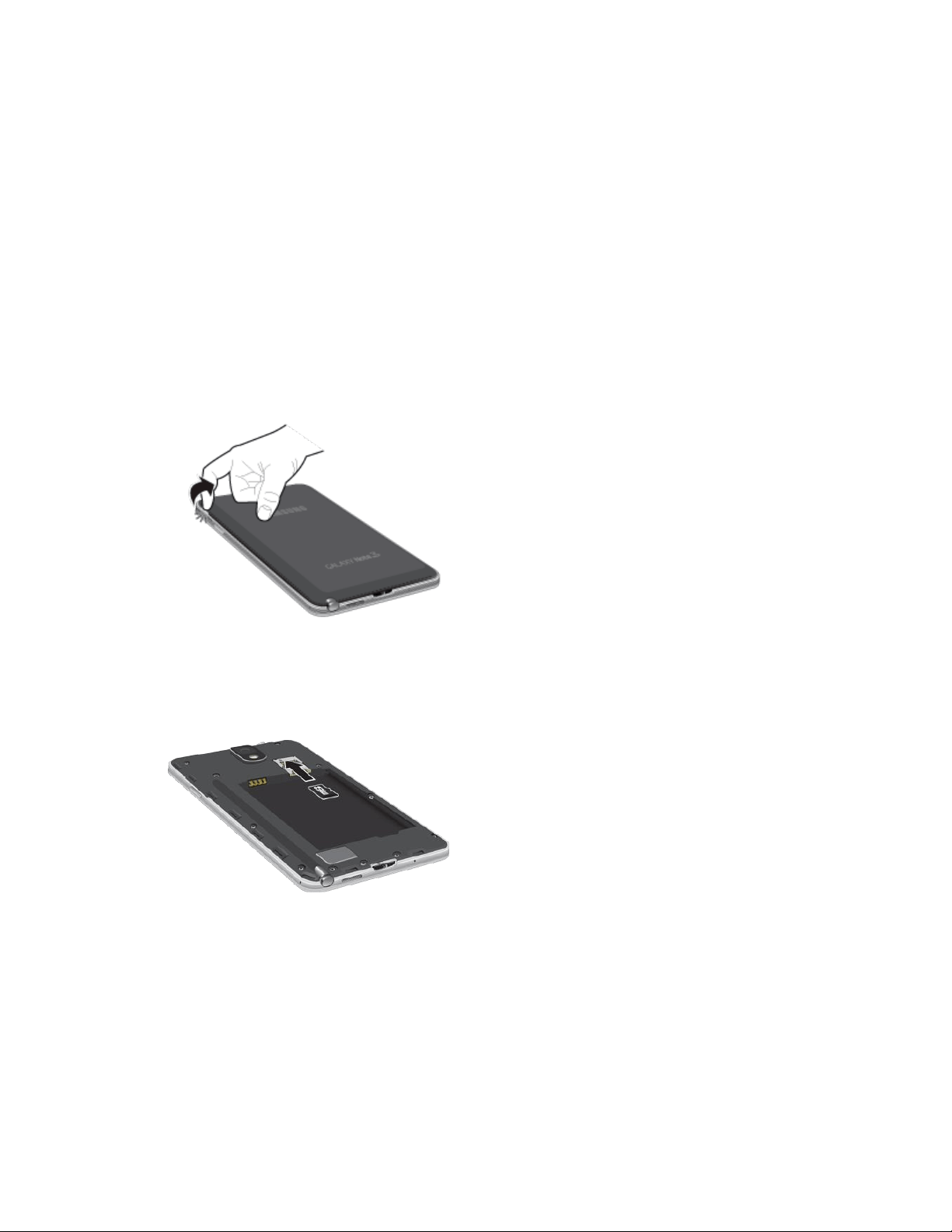
Tools and Calendar 137
microSD Card
A microSD memory card is an optional accessory (not included) that allows you to store images, videos,
music, documents, and other data on your phone.
Important: You can damage a microSD card by improper installation. Please be careful when inserting,
removing, or handling it.
Install a microSD Card
Follow the instructions below to install an optional memory card (not included).
1. Using the slot on the upper left side of the battery cover, gently lift the cover off the phone.
2. With the gold contacts facing down, slide the card into the slot. Note that the microSD card slot is
on top of the SIM card, which holds information about your phone and service, and should remain
installed.
3. Replace the battery compartment cover, making sure all the tabs are secure and there are no
gaps around the cover.
Important: Ensure that the back cover is closed tightly to prevent water and dust entering the device.
Open or loose covers may allow water and dust to enter the device and cause damage.

Tools and Calendar 138
Remove a microSD Card
Use the following procedure to remove an optional microSD card from your phone.
Important: Before removing an optional installed microSD card, you must unmount the card first to
prevent corrupting the data stored on it or damaging the card. For more information, see Unmount a
microSD Card.
1. Using the slot provided, gently lift the cover off the phone.
2. Carefully slide the card out of the slot.
3. Replace the battery compartment cover, making sure all the tabs are secure and there are no
gaps around the cover.
View microSD Card Memory
Use the following procedure to view memory usage information for an optional installed microSD card
(not included).
From home, tap Apps > Settings > GENERAL tab > Storage. (The total and available ■
memory space will be displayed.) See Storage Settings for more information.
Format a microSD Card
Formatting a microSD card permanently removes all files stored on the card.
1. From home, tap Apps > Settings > GENERAL tab > Storage.
2. Scroll down the screen, tap Format SD card > FORMAT SD CARD > DELETE ALL.
Note: Formatting erases all the data on an installed microSD card, after which the files CANNOT be
retrieved. To prevent the loss of important data, please check the contents before you format the card.
Unmount a microSD Card
When you need to remove an optional installed microSD card, you must unmount the card first to prevent
corrupting the data stored on it or damaging the card.
1. From home, tap Apps > Settings > GENERAL tab > Storage.
2. Tap Unmount SD card > OK.
3. Remove the microSD card. See Remove a microSD Card.

Tools and Calendar 139
Transfer Files Between Your Phone
and a Computer
You can use the supplied USB cable to connect your phone directly to your computer and transfer music,
pictures, and other content files. For example, if you have a music album stored on your computer that
you want to listen to on your phone with the music player or Google Play Music, just attach your phone to
the computer and copy the files to the Music folder.
1. Connect your phone to your computer using the supplied USB/charging cable. You may need to
remove the USB cable from the Charging Head.
Insert one end of the cable into the USB Charger/Accessory port at the bottom of the phone.
Insert the other end of the cable into an available USB port on your computer.
2. Your phone will automatically detect the connection. Continue to set up the connection:
Swipe your finger down from the Status Bar to open the Notification Panel. The Notification
Panel shows the type of connection.
To change the connection type, tap it in the Notification Panel, and then choose an option:
• Media device (MTP): Used for most transfers. You can transfer files in Windows or from
a Mac.
• Camera (PTP): Used for transfers of photos using camera software on your computer.
3. On your computer, navigate to view the contents of your phone (for example, using
My computer).
4. Select a folder (for example, Music for songs and albums) and copy files to it from your
computer.
5. When you are done, disconnect your phone from the computer.

Tools and Calendar 140
System Updates
From time to time, updates may become available for your phone. Use System update options to update
your phone’s internal software.
Before Updating Your Firmware
Updating your phone firmware will erase all user data from your phone. You must back up all critical
information before updating your phone firmware.
Back Up Information to Your Google Account
1. From home, tap Apps > Settings > GENERAL tab > Backup and reset.
2. Tap Back up my data to turn on the feature.
Tap Backup account to choose or sign in to a Google Account to use for backups.
Tap Automatic restore if you want information saved to the Google Account above to be
restored when you reinstall apps, such as after a firmware update, or when setting up a new
device.
Back Up Account Information
1. From home, tap Apps > Settings > GENERAL tab.
2. Tap Accounts, and then tap an account.
3. Tap SYNC ALL.
Preserve Information on an Optional Installed Memory Card
As an added precaution, to preserve any data on an optional installed microSD card, please remove it
from your phone prior to starting the update process.
Update Your Phone
Use the System Update setting to update your phone’s software, firmware, Preferred Roaming List (PRL),
and other features.
1. From home, tap Apps > Settings > GENERAL tab > System update.
2. Select an option:
Update now: Check for software updates, and install them, if desired.
Auto update: When enabled, your phone will automatically check for updates and install
them.
Wi-Fi only: When enabled, your phone will only download updates when your phone is
connected to a Wi-Fi network.

Tools and Calendar 141
Update PRL: Download and the latest Preferred Roaming List (PRL), used by your phone to
access the network.
Update Profile: Update the user profile related to your wireless service account. If you
choose to change your user name online, use this option to update the user name on your
phone.
UICC Unlock: Unlock your device’s Universal Integrated Circuit Card.

Global Services 142
Global Services
With your phone and global roaming service from Sprint Worldwide Wireless Service, you can make
phone calls and use wireless data services around the globe on compatible CDMA and GSM/UMTS
networks. For a country-specific travel guide, select your phone and destination from sprint.com/traveltips.
Get Information for Sprint Worldwide Service
View contact information for Sprint Worldwide.
From home, tap Apps > Sprint folder > Sprint Worldwide. ■
Set the Communications Method for
Global Use
Select a communications method for an overseas carrier as needed.
1. From home, tap Apps > Settings > CONNECTIONS tab.
2. Tap More networks.
3. Tap Mobile networks.
4. Tap Network mode > CDMA / LTE/CDMA / GSM/UMTS / Automatic.
Note: At the time of purchase, your phone’s default mode of Automatic is set. This allows global usage
and normally will not need to be changed.
Setting the Carrier
You can select a specific local carrier to use when traveling internationally. At the time of purchase, your
phone is preset to connect automatically to an appropriate carrier in your current area.
1. From home, tap Apps > Settings > CONNECTIONS tab.
2. Tap More networks.
3. Tap Mobile networks.
4. Tap Network operators.
5. Tap an available network.
To select automatically to an appropriate carrier (default), tap Choose automatically.
To search for all available networks, tap Search networks.

Global Services 143
Activate Sprint Worldwide Service
on Your Account
Before using your phone in global roaming mode, you must activate Sprint Worldwide service.
To activate Sprint Worldwide service:
Chat with or email an international support rep by visiting sprint.com/swwsupport. ■
– or –
Call Sprint Worldwide Customer support at 1-888-226-7212. ■
Your Phone’s SIM Card for International
GSM Roaming
Your phone comes with a preinstalled SIM (Subscriber Identity Module) card to support roaming on
compatible GSM networks.
Note: Your SIM card should be preinstalled. If you need to reinstall your SIM card, follow the instructions
below.
Note: The SIM included contains information specific to your phone and should be retained with the
phone for use on GSM networks.
Insert a SIM Card
Follow these instructions to insert a SIM card. Remember to power off your phone before inserting a
SIM card.
1. Remove the back cover.
2. Remove the battery.
3. Insert SIM card. Insert gently with gold IC chip facing downward.
4. Insert the battery. Align the contacts of the battery with the contacts in the phone.
5. Attach the back cover.
Make sure all the tabs are secure and there are no gaps around the cover.

Global Services 144
Enable Global Roaming Mode
Your phone is designed to enter global roaming mode automatically when you activate your Sprint
Worldwide service, meaning that it should automatically connect to an appropriate CDMA/LTE network or
GSM/UMTS network when you travel. You may set global roaming options through the settings menu.
You may also need to set your network mode options through the settings menu. See Set the
Communications Method for Global Use.
To set your roaming options manually:
1. From home, tap Apps > Settings > CONNECTIONS tab.
2. Tap More networks.
3. Tap Roaming.
4. Tap Roaming network.
5. Tap Home only or Automatic.
6. Tap Roaming Settings.
7. Select Domestic CDMA, International CDMA, and GSM networks settings.
8. Tap Roaming guard.
9. Select roaming guard options for each category.
Make and Receive Worldwide Calls
When traveling on international networks, you can place and answer calls as you would on the Sprint
network, although some additional instructions may be required to place a call. Some features and
services are not available in all countries. For more information on services that are available while
roaming, visit sprint.com/sww.
Make Calls Using Plus (+) Code Dialing
Placing calls from one country to another country is simple with the Plus (+) Code Dialing feature. When
placing international calls, you can use Plus Code Dialing to enter the appropriate international access
code for your location (for example, 011 for international calls placed from the United States).
Note: Plus Code Dialing is only available when roaming internationally on GSM networks and on certain
CDMA networks in the United States, Canada, and the Caribbean.
Note: International access codes and dialing information are available online at sprint.com/sww.

Global Services 145
To use Plus Code Dialing to place an international call:
1. From home, tap Phone > Keypad tab to display the phone screen.
2. If you are on the GSM network, touch and hold to insert a “+” on the phone dial screen.
(The “+” symbol automatically inserts the international access code for the country from which
you are calling.)
3. If you are on the CDMA network outside Canada or the Caribbean, enter the international access
code for the country from which you are calling.
4. Tap to insert the US country code, and then enter the area code and number.
5. Tap to place the call.
Sprint International Voicemail Service
Your Sprint voicemail will follow you as you travel. All of your unanswered calls will be forwarded to your
Sprint voicemail. You will need to be sure your voicemail box is already set up and that you know your
voicemail password.
Note: Sprint voicemail may not be available on all networks; check sprint.com/sww for service
information.
International Voicemail Troubleshooting
There are a few tips to keep in mind when using Sprint voicemail while traveling.
● Some carriers may not support voicemail indicators. It may be necessary to call your voicemail to
see if you have any new messages.
● If you hear the message “Please enter the number of the subscriber you wish to call,” enter your
10-digit wireless phone number.
Set Up Your Voicemail Access Number for
International Use
To simplify accessing your Sprint Voicemail while traveling, you can set up your voicemail access number
as a Contacts entry. This will make it faster and easier to access your messages while roaming
internationally.
1. From home, tap Phone > Contacts tab.
2. Tap to add a contact.
3. Type the contact information (for example, “My Voicemail”).
4. Touch and hold , and then tap (+1), your area code, and your wireless phone number.
5. Tap Save.

Global Services 146
Access Your Voicemail Internationally
You will need to call your voicemail number to access your voicemail while roaming internationally.
New Message Indicators
Your voicemail message indicators may be displayed differently when roaming internationally.
● A “Message Waiting” indicator icon or a text message is displayed when a voicemail message is
received.
● You may see “Missed Call” on your screen prior to receiving a message notification.
● You must call voicemail in order to retrieve messages. Follow the instructions on the previous
page to store your voicemail number for easy access.
Retrieve Voicemail Messages
The voicemail retrieval process while traveling is the same as on the Sprint Network; however, you will be
required to enter your voicemail password.
To retrieve your voicemail messages:
1. From home, tap Phone > Contacts tab.
2. Tap the voicemail entry and then tap the number to call it.
3. When your voicemail answers, tap , enter the password, and tap to access your
voicemail.
International Data Roaming
Sprint Worldwide Wireless Service can also keep you connected via email and Web browsing when
traveling in countries in which Sprint offers data service.
Data services are available on both CDMA and GSM/UMTS networks. Check sprint.com/traveltips and
sprint.com/sww to determine the services available where you are traveling.
Note: Prior to using your Sprint Worldwide GSM/UMTS Data Services, you must establish and utilize your
CDMA data services domestically on the Sprint Network.
Get Started With Sprint Worldwide Data Services
To use Sprint Worldwide Data Services, you will need to have these services activated on your account.
To activate, call Sprint Worldwide Customer Support at 1-888-226-7212. Representatives are ■
available 24 hours a day, 7 days a week to assist you.

Global Services 147
Access Email and Data Services Internationally
To access your email and browse the Web when traveling, you may need to manually select the carrier
that provides Sprint service in your location. You can find a list of carriers for each country where GSM
data service is offered at sprint.com/sww. Then, follow the instructions below to select the appropriate
carrier network on your phone.
Access International Data Services on GSM/UMTS Networks
To select a GSM data service carrier for a specific country:
1. From home, tap Apps > Settings > CONNECTIONS tab.
2. Tap More networks.
3. Tap Roaming.
4. Tap Roaming Settings.
5. Under GSM networks, select the Data checkmark.
Access Email and Data Services Internationally on CDMA Networks
If data service is available on an international CDMA network, then you only need to set the phone to
CDMA; you will not need to select the specific carrier. Selecting a specific carrier is only necessary for
providers on the GSM network. If your phone has automatically selected a GSM network while traveling,
then you will need to set the phone to CDMA to access CDMA data services. (See Enable Global
Roaming Mode.) Visit sprint.com/sww for a list of services available in each country.
Contact Sprint for Assistance with
International Service
If you experience any issues with voice or data services while outside of the United States, Sprint offers
customer support 24 hours a day. In the event that you do experience an issue, try the following actions:
● First try powering your phone off and then back on; this will force your phone to reregister with the
network.
● Try manually selecting another network. Information for selecting networks can be found in the
phone guide.
If neither of these actions resolves your issue, you will need to contact customer service (see below).
When calling to report an issue, the following information will be beneficial in trying to resolve your issue
as quickly as possible:
● Your wireless phone number.
● The city and country you are traveling in.
● Any error message that displays on your phone or that you heard when trying to place a call.
Global Services 148
● If the issue is with data, were you able to place voice calls?
● If the issue is with voice service, were you able to access data?
Please call the numbers below if you need assistance:
While in the United States: Call 1-888-226-7212.
While traveling outside the United States:
● In GSM mode: tap and then dial 1-817-698-4199.
● In CDMA mode: enter the country code and then dial 1-817-698-4199.
There is no charge for this call from your wireless phone.
From a landline phone when outside the United States:
Sprint Worldwide Customer Support can be reached from a landline phone at 1-817-698-4199. Access or
connection fees may apply. The toll free numbers below can also be used to contact Sprint Worldwide
Customer Support in the following countries:
Country
From Landline Phone
Canada
1-866-805-9890
Caribbean (Anguilla, Barbados,
Cayman Islands, and Dominica)
1-866-313-6672
France
0800-903200
Germany
0800-180-0951
Italy
800-787-986
Mexico
001-877-294-9003
Trinidad and Tobago
1-800-201-7545
United Kingdom
0808-234-6616
Note: This toll free service is available on ordinary landline phones and some public pay phones. This
service does not cover any hotel access charges.

Settings 149
Settings
The following topics provide an overview of items you can change using your phone’s Settings menus.
Using Settings
Use Settings to configure your phone to your preferences.
Access Settings
You can access Settings in a variety of ways. Settings are arranged on taps by category.
1. From home, tap Apps > Settings.
– or –
From home, touch and hold the Status Bar, and then drag down to display the Notification Panel.
Tap Settings to access Settings.
2. Tap a tab to access settings by category:
CONNECTIONS: Connect to wireless networks, including 3G, 4G, and Wi-Fi, and to other
devices.
DEVICE: Personalize your phone, including sounds and the display, accessibility, and call
settings.
CONTROLS: Configure your phone's voice and input options, and set up customized motion
control features.
GENERAL: Set up accounts on your phone, configure backup options, set security permissions,
and manage your device.
Search Settings
Enter key words to search for settings.
1. From home, tap Apps > Settings.
2. Tap Search, and then enter key words.

Settings 150
Wi-Fi Calling Settings
Wi-Fi Calling uses Wi-Fi networks to help improve voice and data coverage. It sends and receives calls
and text messages over a Wi-Fi network and may offer better coverage in buildings and areas of poor
cellular reception.
1. From home, tap Apps > Settings > CONNECTIONS tab.
2. Tap Wi-Fi Calling and follow the online prompts to set up Wi-Fi Calling.
Wi-Fi Settings
Use Wi-Fi settings to control your phone’s connections to Wi-Fi networks, and for using Wi-Fi Direct to
connect directly to other Wi-Fi Direct devices.
Configure Wi-Fi Settings
Set up and manage wireless access points.
1. From home, tap Apps > Settings > CONNECTIONS tab > Wi-Fi.
2. Tap the ON/OFF switch to turn Wi-Fi on.
3. Configure settings:
Tap Add Wi-Fi network to connect to a new Wi-Fi network. For more information about
using Wi-Fi, see Wi-Fi.
Tap Menu for these options:
• Scan: Search for available Wi-Fi networks.
• Wi-Fi Direct: Connect to other Wi-Fi Direct devices. For more information, see Wi-Fi
Direct Settings.
• Advanced: Configure more settings. For more information, see Advanced Wi-Fi Settings.
• WPS push button: Set up a connection to a WPS (Wi-Fi Protected Setup) router or other
equipment.
• WPS PIN entry: View the PIN used by your device to set up a PIN-secured connection to
a Wi-Fi router or other equipment.
• Share Wi-Fi profile: Send your profile for a Wi-Fi network to another device. You can
also set the duration of the Wi-Fi profile.
• Help: Learn about setting up and using Wi-Fi networks, and other settings.

Settings 151
Advanced Wi-Fi Settings
Set up and manage wireless access points.
1. From home, tap Apps > Settings > CONNECTIONS tab > Wi-Fi.
2. Tap the ON/OFF switch to turn Wi-Fi on.
3. Tap Menu > Advanced to configure these settings:
Network notification: When enabled, your phone alerts you when a new Wi-Fi network is
available.
Passpoint: When turned on, your phone will connect to passpoint-enabled Wi-Fi networks
automatically.
Sort by: Choose a sorting order for Wi-Fi networks on the Wi-Fi screen.
Keep Wi-Fi on during sleep: Specify when to switch from Wi-Fi to mobile data for data
communications, when the device goes to sleep (when the backlight goes out). This setting
can affect data usage and the behavior of devices you connect to your device.
Always allow scanning: When enabled, your phone will allow Google location service and
other apps to scan for networks, even when Wi-Fi is turned off.
Smart network switch: When enabled, your phone will automatically switch between known
Wi-Fi networks and mobile networks. Known Wi-Fi networks are those you have already
connected to.
Install certificates: If you have certificates stored on an installed optional memory card (not
included), you can use this option to install the certificates.
Wi-Fi timer: When turned on, your phone will automatically connect or disconnect from a Wi-
Fi network, using the Starting time and Ending times you set.
MAC address: (Not configurable) View your device’s MAC address, needed for connecting to
some secured networks.
IP address: (Not configurable) View your device’s IP address.

Settings 152
Wi-Fi Direct Settings
Wi-Fi Direct allows devices to connect to each other directly via Wi-Fi without a Wi-Fi network, and
without having to set up the connection. For example, your device can use Wi-Fi Direct to share photos,
contacts and other content with other Wi-Fi Direct devices.
1. From home, tap Apps > Settings > CONNECTIONS tab > Wi-Fi.
2. Tap the ON/OFF switch to turn Wi-Fi on. Wi-Fi must be on to configure Wi-Fi Direct settings.
3. Tap Menu > Wi-Fi Direct. Your device automatically scans for nearby Wi-Fi Direct devices,
or you can tap SCAN to start scanning.
On the Wi-Fi Direct page, tap Menu > Rename device to change the name of your
device as seen by other Wi-Fi Direct devices.
4. After scanning for devices, select a device and follow the prompts to complete the connection.
Hotspot Settings
Use the Hotspot feature to share your phone’s data connection with other devices via Wi-Fi.
For information on using the Hotspot feature, see Hotspot.
Note: Using the Hotspot feature consumes battery power and use data services.
Turn Hotspot On or Off
To conserve battery life, turn Hotspot on when you need it and turn it off when you are finished. You can
control Hotspot from Settings.
1. From home, tap Apps > Settings > CONNECTIONS tab > Hotspot.
2. Tap the ON/OFF switch to turn Hotspot on or off.
Allowed Devices
Control whether devices can connect to your phone’s Hotspot with the Allowed devices list. After you add
devices to the list, they can scan for your phone and connect using your phone’s Hotspot name and
password.
1. From home, tap Apps > Settings > CONNECTIONS tab > Hotspot.
2. Tap Menu > Allowed devices.
3. Tap and enter the other device’s Device name and MAC address. Consult the other device’s
settings to find these details.
4. Tap OK to add the device to the Allowed devices list.

Settings 153
Configure Hotspot
Set up Hotspot to your preferences.
1. From home, tap Apps > Settings > CONNECTIONS tab > Hotspot.
2. Tap Menu to set these options:
Configure:
• Network SSID: View and change the name of your mobile hotspot.
• Hide my device: When enabled, your mobile hotspot is not visible to other Wi-Fi devices
during a scan. Other devices can still connect to your mobile hotspot, but will have to set
up the connection manually with your Network SSID and Password.
• Security: Choose the security level for your Mobile Hotspot.
• Password: If you choose a security level that uses a password, set a password. By
default, the password is your mobile telephone number.
• Show password: When enabled, the contents of the Password field are visible.
• Show advanced options: When enabled, you can access advanced options, including
Broadcast channel to specify the channel your phone uses for Hotspot, and you can set
the maximum number of connections to your Hotspot (from one to ten allowed
connections).
Timeout settings: Choose a time period, after which Hotspot will automatically turn off if
there is no connection.
LAN settings: View and configure settings related to using your Hotspot as a Local Area
Network.
• IP address: View the default IP address, or tap to enter a valid IPv4 address.
• Subnet mask: View the default subnet mask, or tap to enter a subnet mask.
• DHCP: Tap to enable or disable DHCP. When DHCP is enabled, your phone assigns
IP addresses to devices that connect to Hotspot.
• Starting IP: When DHCP is enabled, view the default starting IP address for assigning
IP addresses to connecting devices, or enter a enter a valid IPv4 address. When other
devices connect to your phone using DHCP, the IP address your phone assigns will
be between the Starting IP and Ending IP.
• Ending IP: When DHCP is enabled, view the default ending IP address for assigning
IP addresses to connecting devices, or enter a enter a valid IPv4 address. When other
devices connect to your phone using DHCP, the IP address your phone assigns will
be between the Starting IP and Ending IP.

Settings 154
• Lease time: When DHCP is enabled, set a length of time a connected device may use
an assigned IP address.
• Maximum DHCP users: When DHCP is enabled, set the maximum number of devices
allowed to connect to your Hotspot.
Bluetooth Settings
Bluetooth is a short-range wireless communications technology for exchanging information over a
distance of about 30 feet. You don’t need to line up the devices to send information with Bluetooth. If the
devices are in range, you can exchange information between them, even if they are in different rooms.
For more information on using Bluetooth, see Bluetooth.
1. From home, tap Apps > Settings > CONNECTIONS tab > Bluetooth.
2. Tap the ON/OFF switch to turn Bluetooth on.
3. From the Bluetooth screen, configure these settings:
Tap your device’s name to enable or disable visibility to other Bluetooth devices. When your
device is visible, other devices can find your devices during a scan. Your device remains
visible for the period of time set in the Visibility timeout setting.
Tap a paired device to connect to it, or tap beside a device to change its settings.
Tap SCAN to search for visible Bluetooth devices. After searching, tap a device to pair
with it.
4. Tap Menu for more settings:
Visibility timeout: Set the length of time your device is visible to other devices when you turn
on visibility.
Received files: View files transferred to your device via Bluetooth.
Rename device: Change the name your phone uses to identify itself when you make your
phone visible to other Bluetooth devices.
Help: Learn about using Bluetooth.

Settings 155
Tethering Settings
Use Tethering to share your phone's Internet connection with a computer that connects to your phone
using a USB cable or via Bluetooth.
Note: Using the tethering feature consumes battery power and use data services.
To conserve battery life, turn tethering on when you need it and turn it off when you are finished.
1. From home, tap Apps > Settings > CONNECTIONS tab > Tethering.
2. Tap USB tethering to connect a computer to your phone using a USB cable.
– or –
Tap Bluetooth tethering to pair your phone with the computer via Bluetooth. Consult the
computer's documentation for more information about configuring your computer to pair via
Bluetooth.
Airplane Mode
When you turn on Airplane mode, your phone disconnects from all networks, meaning you cannot use
make calls, send or receive messages, or access the Internet. It also turns off other connectivity features,
such as Wi-Fi and Bluetooth.
While in airplane mode, you can use other features of your device, such as playing music, watching
videos, or other applications.
To use Wi-Fi and Bluetooth after turning on Airplane mode, turn them on in Settings or on the Notification
Panel.
1. From home, tap Apps > Settings > CONNECTIONS tab > Airplane mode.
2. Tap the ON/OFF switch to turn Airplane mode on or off.
Note: You can also control Airplane mode from the Device options menu (press and hold the
Power/Lock key, and then tap Airplane mode) or from the Notification Panel (slide the Status Bar down
and tap Airplane mode in the Quick Settings panel).

Settings 156
Data Usage Settings
Monitor data usage, and control your device’s connection to mobile data service.
Note: Data is measured by your phone. Your service provider may account for data usage differently.
1. From home, tap Apps > Settings > CONNECTIONS tab.
2. Tap Data usage to configure options:
Mobile data: Enable or disable your phone’s access to mobile data service. You can also
control mobile data at the Notification Panel.
Limit mobile data usage: When enabled, your mobile data connection will be disabled when
the specified limit is reached. After enabling the setting, drag the red limit line on the graph
below to set the data usage limit.
Alert me about data usage: When enabled, your device will alert you when mobile data
usage reaches the warning limit you set. After enabling the setting, drag the orange warning
line on the graph below to set the data usage warning limit.
Data usage cycle: Tap the menu, and then choose a time period for data usage. Data usage
for the period displays on the graph, along with usage by application below.
3. Tap Menu for other options:
Restrict background data: Your device is capable of connecting to the network in the
background, for synchronization or other services. When enabled, background connections
will not occur.
Show Wi-Fi usage: When turned on, a separate tab displays data used while connected to
Wi-Fi.
Mobile hotspots: Select Wi-Fi networks that are mobile hotspots. You can restrict apps from
using these networks, and you can configure apps to warn you before using these networks
for large downloads.
Mobile networks: Configure your mobile networks. See Mobile Network Settings.
Help: Learn about data usage settings.

Settings 157
Location Settings
Control apps’ access to your location, and configure location sources. Some apps may require one or
more location services be turned on for full app functionality. When Location is turned on, you are
allowing Google’s location service to collect anonymous location data. Some data may be stored on your
device, and collection may occur even when no apps are running.
GPS signals may be affected by your surroundings, including:
● Buildings
● Tunnels or underground structures
● Weather conditions
● High-voltage or electromagnetic fields
● Tinted windows
Note: E9-1-1 location service is standard on all mobile phones, to allow sharing of GPS information with
emergency personnel when you make a call to emergency services, such as 9-1-1.
1. From home, tap Apps > Settings > CONNECTIONS tab > Location.
2. Tap the ON/OFF switch to turn location services on or off. Location must be turned on to
configure settings. When you turn Location on, you are allowing Google’s location service to
collect anonymous location data. Some data may be stored on your device, and collection may
occur even when no apps are running.
3. After you turn Location on, you can configure settings:
Mode: Choose the method your phone uses to determine your location.
• High accuracy: When enabled, your phone uses GPS information, Wi-Fi, and mobile
networks to estimate your location.
• Power saving: When enabled, your phone uses Wi-Fi and mobile networks to estimate
your location.
• GPS only: When enabled, your only phone uses GPS information to estimate your
location.
Recent location requests: View services or apps that have recently accessed your location
information.
Location services: Select sources for reporting your location information to Google.
Location sources: Tap My places to save your favorite locations, to allow your device to
provide relevant information by recognizing saved locations.
• Tap Home, Work, or Car and follow the prompts to configure options for identifying the
location.
• Tap to set up a new location.
Tag current location: Tap Camera, S Note, Scrapbook, and Voice Recorder to allow them
to use location services.

Settings 158
More Networks Settings
More networks settings provide additional options for configuring connections between your phone and
the network or to other devices.
Default Messaging App Settings
If you have multiple messaging apps installed on your phone, you can choose the app your phone uses
for messaging. The app you select here will be used when you choose Messages in other apps, such as
when sharing items like pictures or video.
1. From home, tap Apps > Settings > CONNECTIONS tab.
2. Tap More networks > Default messaging app.
3. Choose a messaging app. The default Messages app included with your phone is available,
along with any other messaging apps you’ve installed.
Note: If you choose a default messaging app other than Messages (for example, Google Hangouts), you
will not be able to use the standard Messages app unless you restore it as the default messaging app.
Printing Settings
You can print from your phone, via Wi-Fi, to an optional compatible printer (not included). Your phone and
the optional printer must be connected to the same Wi-Fi network.
Turn Print Services On or Off
Before you can print from your phone, a print service must be turned on. The print service communicates
with the printer when you select something to print.
1. From home, tap Apps > Settings > CONNECTIONS tab.
2. Tap More networks > Printing, and then choose a print service from the list. The Samsung Print
Service Plugin is available by default.
3. Tap the ON/OFF switch to turn the service on or off. The service must be on to configure settings
or print.
Add a Printer
Before you can print to a printer, you must set it up on your phone. You will need to know the IP address
of the printer; consult the printer’s documentation for this information.
1. From home, tap Apps > Settings > CONNECTIONS tab.
2. Tap More networks > Printing.
3. Choose a print service from the list, and then tap the ON/OFF switch to turn the service on or off.
The service must be on to add a printer.

Settings 159
4. Tap Menu > Add printer > ADD PRINTER and then enter a name and the IP address of
the printer.
Configure Print Settings
Choose options for printing from your phone.
Note: Below settings are examples only. Available settings will differ depending on the type of print
service and printer you are using.
1. From home, tap Apps > Settings > CONNECTIONS tab.
2. Tap More networks > Printing.
3. Choose a print service from the list, and then tap the ON/OFF switch to turn the service on or off.
The service must be on to configure settings.
4. Tap Menu > Settings to configure options. Available options may vary depending on the
type of printer, and not all printers support all options.
Double sided printing: Choose to print one page per piece of paper, or choose Long Edge
or Short Edge to print on both sides. Short Edge and Long Edge refer to how the pages flip
when moving through multiple pages.
Secure Release: If the optional printer supports secure release, and it is enabled, you must
enter a User ID to retrieve your printouts. Tap Secure release, and then enter a User ID.
Confidential Print: If the optional printer supports confidential printing, and it is enabled, you
must enter a User ID and Password to retrieve your printouts. Tap Confidential Print, and
then enter a User ID and Password.
Job Accounting: If the optional printer supports job accounting, and it is enabled, you must
enter a User ID and Password when printing, to track printing by group or other set.
Version: View the version of the print service software.
Open source licenses: View licenses related to the print service software.
Share data: Share data with Samsung services.
Mobile Networks Settings
Set options for network selection and data service.
1. From home, tap Apps > Settings > CONNECTIONS tab.
2. Tap More networks > Mobile networks.
3. Configure options:

Settings 160
Mobile data: When enabled, your device connects to the mobile data network, and can use
the network to access the Internet and transfer information.
Network mode: Choose a preferred network mode. Available options depend on your
phone’s features.
Connections optimizer: Manage and enhance your data experience with the following
options:
• Sprint Connections Optimizer: Automatically select the best mobile network.
• Automatic login: Find and connect to “remembered” Wi-Fi networks on your phone and
your service provider’s networks.
• Unmanaged Wi-Fi Networks: Specify Wi-Fi Networks not to manage.
Access Point Names: Configure access points (not common).
Network operators: Configure network operators, if applicable.
VPN Settings
Set up and manage Virtual Private Networks (VPN).
Note: VPN settings include storage of login credentials on your device. You must configure a screen
unlock PIN or password before setting up a VPN.
1. From home, tap Apps > Settings > CONNECTIONS tab.
2. Tap More networks > VPN > Basic VPN. (If prompted, configure a screen lock pattern, PIN, or
password before continuing.)
3. Tap to add a VPN, and then enter details for the VPN. Available options depend on the type
of VPN; consult your VPN’s administrator for more information.
Name: Enter the name of the VPN.
Type: Choose the type of VPN.
Server address: Enter the VPN server address.
PPP Encryption (MPPE): Tap to enable, if applicable for the VPN.
Show advanced options: Tap to set other options, depending on the type of VPN.
4. Tap SAVE to save the VPN.
Tip: For advanced VPN setup, tap Advanced IPSec VPN from the VPN screen, and then follow the
prompts.

Settings 161
Roaming Settings
When you are outside your home network area, your phone can still connect to other networks that your
provider supports via roaming. There may be additional costs for accessing networks while roaming, so
you may want to control your phone’s roaming behavior with Roaming settings.
1. From home, tap Apps > Settings > CONNECTIONS tab.
2. Tap More networks > Roaming.
3. Configure options:
Roaming network: Select a roaming default. Choose Home only to only connect to the
Sprint network, or Automatic to allow connections to Sprint’s partner networks when
available.
Roaming Settings: Choose options for roaming, including Voice and Data for Domestic
CDMA and International CDMA networks, and Data for GSM networks (if supported by your
phone).
Roaming guard: Choose options for displaying an onscreen roaming notice for certain
functions. Enable or disable roaming notices for Voice and Data for Domestic CDMA, Voice,
Data and Outgoing text message for International CDMA networks, and Voice, Data and
Outgoing text message for GSM networks (if supported by your phone).
NFC Settings
Use NFC (Near Field Communication) to share information between your device and another NFC device
by touching the devices together, typically back-to-back.
NFC is used with S Beam and Android Beam, and must be turned on to use these features.
Turn NFC On or Off
Use NFC (Near Field Communication) to share information between your device and another NFC-
capable device or NFC tag, by touching the devices together, typically back-to-back. For example, you
can beam web pages from the browser, contacts from Contacts, and videos from YouTube. The app
determines what is beamed.
1. From home, tap Apps > Settings > CONNECTIONS tab.
2. Tap NFC, and then tap the ON/OFF switch to turn NFC on or off.
Android Beam Settings
With Android beam, you can transmit app content via NFC to other NFC devices that support Android
Beam.
Android Beam uses NFC, so NFC must be turned on before you can turn on Android Beam.

Settings 162
Turn Android Beam On or Off
Turn on NFC and Android Beam, so that beaming is available from the apps on your phone.
1. From home, tap Apps > Settings > CONNECTIONS tab.
2. Tap NFC, and then tap the ON/OFF switch to turn NFC on or off.
3. Tap Android Beam, and then tap the ON/OFF switch to turn Android Beam on or off.
Tap and Pay
With your phone and a payment app, you can use your device to pay for items by tapping it to an item at
the point-of-purchase. Google Wallet is an example of a payment app. You must have the payment app
set up on your phone to use it with Tap and Pay.
1. From home, tap Apps > Settings > CONNECTIONS tab.
2. Tap NFC, and then tap the ON/OFF switch to turn NFC on. NFC must be on to use Tap and pay.
3. Tap Tap and pay to access Tap and pay settings. Available settings depend on the payment
app(s) you have set up on your phone.
S Beam Settings
Share more and share it faster with S Beam. From photos to documents, large video files to maps, you
can share almost anything instantly with one touch, simply by placing your devices back-to-back.
S Beam uses your device’s NFC (Near Field Communication) feature to send, or “beam,” content to other
NFC devices.
S Beam works in the background. Use the sharing options from your favorite apps to select content to
share via S Beam. For example, you can beam pictures or videos from Gallery, or songs from Music
player. Just bring the devices together (typically back to back), and then tap the screen.
Note: You must have both NFC and S Beam turned on to use S Beam to share information.
Turn S Beam On or Off
When S Beam is turned on, you can send or receive data by touching your device to another NFC-
capable device.
1. From home, tap Apps > Settings > CONNECTIONS tab.
2. Tap S Beam, and then tap the ON/OFF switch turn S Beam on or off.
Turning S beam on automatically turns NFC on. NFC must be turned on to use S Beam.

Settings 163
Nearby Devices Settings
Share files with devices that support DLNA (Digital Living Network Alliance) standards, over Wi-Fi.
To use Nearby devices, you must connect to the same Wi-Fi network as the devices you wish to share
with, and the other devices must support DLNA. From an app, look for the Nearby devices sharing
options.
Note: Use care when enabling file sharing. When enabled, other devices can access data on your device.
Turn Sharing via Nearby Devices On or Off
To use sharing with nearby devices, you must have the option turned on.
1. From home, tap Apps > Settings > CONNECTIONS tab.
2. Tap Nearby devices to configure these options:
Tap the ON/OFF switch to turn Nearby devices on or off. Nearby devices must be turned on
to configure options.
Under Advanced, configure options to control how content is shared from your device:
• Content to share: Choose the type of content to share, from Videos, Photos, or Music.
• Allowed devices: View and manage a list of devices allowed to connect to your device.
• Denied devices: View and manage a list of devices restricted from connecting to your
device.
• Download to: Choose a location to save downloaded content, from USB storage (device
memory) or optional installed SD card (not included).
• Receive files from other devices: Choose how to handle incoming files from other
devices, from Always accept, Always ask, or Always reject.
Screen Mirroring Settings
With Screen mirroring, you can share your device’s screen with another device, using an optional
AllShare Cast accessory (not included).
1. From home, tap Apps > Settings > CONNECTIONS tab.
2. Tap Screen Mirroring. Your phone will scan for available devices.
3. Tap a device and follow the prompts to connect.

Settings 164
Sounds and Notifications Settings
Configure the sounds, vibrations, and notifications your phone plays for incoming calls, notifications,
screen touches, connections, and other options.
Volume Settings
Set the system volume level, and set default volume for call ringtones, notifications, and other media.
Note: You can also set System volume by pressing the Volume key.
1. From home, tap Apps > Settings > DEVICE tab > Sounds and notifications.
2. Drag the sliders to set the default volume for:
Ringtone
Media
Notifications
System
Sound and Notification Options
Additional Sound options let you choose a variety of options including vibration options, ringtones,
notification sounds, and more.
1. From home, tap Apps > Settings > DEVICE tab > Sounds and notifications.
2. Tap an item to set your sound and notification options:
Sound mode: Set your phone to Sound, Vibrate, or Mute mode.
Vibration intensity: Set the level for vibration to accompany incoming calls, notifications,
and feedback for your screen touches (also known as haptic feedback).
Vibrate when ringing: Enable a vibration for calls and notifications along with the ringtone or
sound. You can use the Vibration intensity and Vibrations settings to customize the vibration.
Ringtones: Choose a ringtone for incoming calls.
Vibrations: Choose vibrations to play for notifications, such as for incoming calls, new
messages, and event reminders.
Notification ringtone: Choose a sound for notifications, such as for new messages and
event reminders.
Other sounds:
• Dialing keypad tone: Play tones when you tap keys on the Phone keypad.
• Screen lock sound: Play tones when you touch the screen to lock or unlock it.

Settings 165
• Touch sounds: Play tones when you tap or touch the screen to make selections.
• Haptic feedback: Set the phone to vibrate when you tap the Recent Apps key and Back
keys, and for certain screen touches.
• Emergency tone: Play a tone or have your phone vibrate, periodically during an
emergency call.
• Samsung keyboard: Play sounds and enable vibrations when you tap keys on the
Samsung keyboard.
• Samsung applications: Configure options for sound used in the Call app, Messages
app, Email app, and Calendar app.
Do not disturb: Mute all calls and alerts, except for your selected exceptions:
• Allow exceptions: Select which alarms, calls, messages, contacts, events and
reminders can interrupt when Do not disturb mode is enabled.
• Set schedule: Turn Do not disturb mode on and off automatically at scheduled times.
• Days: Schedule which days to enable Do not disturb mode when Scheduling is enabled.
• Start time: Schedule when to start Do not disturb mode when Scheduling is enabled.
• End time: Schedule when to end Do not disturb mode when Scheduling is enabled.
Notifications on lock screen: Set whether to show or hide sensitive content and
notifications when the phone is locked.
Application notifications: Set notification options for all applications and services (if
available).
Notification access: Select which applications is allowed to read aloud notifications, which
may include personal information.
Adapt sound: Follow the prompts to configure the best sound for you during calls and while
playing music.
Display Settings
Configure settings for your phone’s display.
1. From home, tap Apps > Settings > DEVICE tab > Display.
2. Set display options:
Brightness: Adjust the screen brightness to suit your surroundings or to your personal
preference. You may also want to adjust screen brightness to conserve battery power.
Screen timeout: Choose how long the display screen remains lit after you touch the screen
or press any key.

Settings 166
Touch key light duration: Set the length of time the Recent Apps key and Back key
remain lit after you touch them.
Screen mode: Automatically adapt the display depending on the type of image being
displayed to save power.
Reading mode: Optimize the screen for reading. This mode is only available for selected
applications.
Auto adjust screen tone: Set your phone to analyze the images displayed on the screen
and automatically adjusts the brightness to conserve battery power.
Daydream: The Daydream setting controls what the screen displays when the phone is
docked or while charging. You can choose to display colors, or display photos stored on your
phone.
Auto rotate screen: Automatically update the screen when you rotate the phone.
Show battery percentage: Display the battery icon plus the percentage of remaining charge
on the Status Bar.
Edit after screen capture: Go to edit screen after capturing screen.
Multi Window Settings
Multi window allows you to use two apps on the same screen, in separate, resizable windows. For more
information, see Multi window.
After you turn on Multi window in Settings, you can control whether the Multi window tab displays on the
screen by touching and holding Back.
1. From home, tap Apps > Settings > DEVICE tab.
2. Tap Multi window, and then tap the ON/OFF switch to turn the feature on and off. Set additional
options:
Open in split screen view: Open content in split window view automatically when an
application in open in full screen view.
Pop-up view shortcut: Change to pop-up view by swiping down diagonally from either
corner at the top of the screen.
LED Indicator
The LED indicator on the front of the device notifies you of status changes and events displays when the
device is locked.
1. From home, tap Apps > Settings > DEVICE tab.
2. Tap LED indicator to enable these options:
Charging: The LED glows red during charging, and green when the battery is fully charged.

Settings 167
Low battery: The LED blinks red to indicate low battery charge.
Notifications: The LED glows blue to show that you have missed calls, new messages, or
application events.
Voice recording: The LED blinks blue when recording with the screen turned off.
Lock Screen Settings
Configure settings for locking the screen, to improve security.
Screen Lock
Choose a screen lock, to secure the screen. Depending on the Screen lock you choose, you can also
choose screen lock options to work along with the screen lock.
1. From home, tap Apps > Settings > DEVICE tab.
2. Tap Lock screen > Screen lock, and then select a screen lock option.
Note: If you have already set a Signature, Pattern, PIN, or Password screen lock, you will need to enter it
before accessing the Screen lock menu.
Set a Swipe Screen Lock
When a Swipe screen is set, you swipe your finger across the screen to unlock the device.
This is the default screen lock on your phone and offers no security, but you can set special lock screen
options.
1. From home, tap Apps > Settings > DEVICE tab.
2. Tap Lock screen > Screen lock > Swipe.
3. When you have a Swipe screen lock set, you can also configure these options:
Clock widget options:
• Dual Clock: Display the time in your home city and in your current location when your
phone is roaming.
• Clock size: Select the clock size.
• Show date: Display of the current date on the lock screen.
Phone shortcut: Display a shortcut to the Phone keypad displays on the lock screen. You
can drag the Phone shortcut to unlock the screen and launch the Phone app in one step.
Camera shortcut: When enabled, a shortcut to Camera displays on the lock screen. You can
drag the Camera shortcut to unlock the screen and launch the Camera in one step.
Personal message: Display a custom message on the lock screen.
Owner information: Display owner information on the lock screen.

Settings 168
Action memo on lock screen: To create Active memos, double-tap the screen when the S
Pen while pressing the pen button.
Unlock effect: You can choose an effect to display on the screen when you touch it without
swiping to unlock.
Additional information: Choose whether to display weather information or information from
S Health when then Pedometer is enabled in the S Health app.
Wake up in lock screen: Use wake-command when swipe unlock is turned on.
Help text: When enabled, your phone displays helpful hints on the lock screen.
Set a Signature Screen Lock
When a Signature screen lock is enabled, you unlock the device by signing with S Pen on the screen.
This option offers low security, because someone who can imitate your signature can access your phone.
When you set up a Signature screen lock, you will also set up a back-up PIN screen lock.
1. From home, tap Apps > Settings > DEVICE tab.
2. Tap Lock screen > Screen lock > Signature, and then follow the prompts to create or change
your screen unlock signature.
Select whether to show or hide sensitive notification content on the lock screen.
3. When you have a Signature screen lock set, you can also configure these options:
Clock widget options:
• Dual Clock: Display the time in your home city and in your current location when your
phone is roaming.
• Clock size: Select the clock size.
• Show date: Display of the current date on the lock screen.
Camera shortcut: Display a shortcut to Camera displays on the lock screen. You can drag
the Camera shortcut to unlock the screen and launch the Camera in one step.
Personal message: Display a custom message on the lock screen.
Owner information: Display owner information on the lock screen.
Action memo on lock screen: To create Active memos, double-tap the screen when the S
Pen while pressing the pen button.
Additional information: Choose whether to display weather information or information from
S Health when then Pedometer is enabled in the S Health app.
Make signature visible: Display your signature when writing it on the lock screen.
Accuracy level: Set the accuracy level required of your signature.

Settings 169
Lock automatically: Set a time delay or lock the phone immediately when the screen
turns off.
Lock instantly with power key: Lock the phone instantly when the Power/Lock key is
pressed.
Set a Pattern Screen Lock
When a Pattern screen lock is set, you draw a pattern, which you create, on the screen to unlock the
device. You will also set a PIN to use as a backup, in case you forget the pattern.
1. From home, tap Apps > Settings > DEVICE tab.
2. Tap Lock screen > Screen lock > Pattern, and then follow the prompts to create or change your
screen unlock pattern.
Select whether to show or hide sensitive notification content on the lock screen.
3. When you have a Pattern screen lock set, you can also configure these options:
Clock widget options:
• Dual Clock: Display the time in your home city and in your current location when your
phone is roaming.
• Clock size: Select the clock size.
• Show date: Display of the current date on the lock screen.
Camera shortcut: Display a shortcut to Camera displays on the lock screen. You can drag
the Camera shortcut to unlock the screen and launch the Camera in one step.
Personal message: Display a custom message on the lock screen.
Owner information: Display owner information on the lock screen.
Action memo on lock screen: To create Active memos, double-tap the screen when the S
Pen while pressing the pen button.
Unlock effect: You can choose an effect to display on the screen when you draw your
pattern to unlock the screen.
Additional information: Choose whether to display weather information or information from
S Health when then Pedometer is enabled in the S Health app.
Make pattern visible: Display the pattern when drawing it on the lock screen.
Vibration feedback: Vibrate when the unlock pattern is entered incorrectly.
Lock automatically: Set a time delay or lock the phone immediately when the screen
turns off.
Lock instantly with power key: Lock the phone instantly when the Power/Lock key is
pressed.

Settings 170
Set a PIN Screen Lock
With a PIN screen lock, you enter a Personal Identification Number, which you create, on the screen to
unlock the device.
1. From home, tap Apps > Settings > DEVICE tab.
2. Tap Lock screen > Screen lock > PIN, and then follow the prompts to create or change your
screen unlock PIN.
Select whether to show or hide sensitive notification content on the lock screen.
3. When you have a PIN screen lock set, you can also configure these options:
Clock widget options:
• Dual Clock: Display the time in your home city and in your current location when your
phone is roaming.
• Clock size: Select the clock size.
• Show date: Display of the current date on the lock screen.
Camera shortcut: Display a shortcut to Camera displays on the lock screen. You can drag
the Camera shortcut to unlock the screen and launch the Camera in one step.
Personal message: Display a custom message on the lock screen.
Owner information: Display owner information on the lock screen.
Action memo on lock screen: To create Active memos, double-tap the screen when the S
Pen while pressing the pen button.
Additional information: Choose whether to display weather information or information from
S Health when then Pedometer is enabled in the S Health app.
Lock automatically: Set a time delay or lock the phone immediately when the screen
turns off.
Lock instantly with power key: Lock the phone instantly when the Power/Lock key is
pressed.

Settings 171
Set a Password Screen Lock
With a Password screen lock, you enter an alphanumeric password, which you create, on the screen to
unlock the device.
1. From home, tap Apps > Settings > DEVICE tab.
2. Tap Lock screen > Screen lock > Password, and then follow the prompts to create or change
your screen unlock password.
Select whether to show or hide sensitive notification content on the lock screen.
3. When you have a password screen lock set, you can also configure these options:
Clock widget options:
• Dual Clock: Display the time in your home city and in your current location when your
phone is roaming.
• Clock size: Select the clock size.
• Show date: Display of the current date on the lock screen.
Camera shortcut: Display a shortcut to Camera displays on the lock screen. You can drag
the Camera shortcut to unlock the screen and launch the Camera in one step.
Personal message: Display a custom message on the lock screen.
Owner information: Display owner information on the lock screen.
Action memo on lock screen: To create Active memos, double-tap the screen when the S
Pen while pressing the pen button.
Additional information: Choose whether to display weather information or information from
S Health when then Pedometer is enabled in the S Health app.
Lock automatically: Set a time delay or lock the phone immediately when the screen
turns off.
Lock instantly with power key: Lock the phone instantly when the Power/Lock key is
pressed.
Wallpaper Settings
Customize the background of the Home and Lock screens.
1. From home, tap Apps > Settings > DEVICE tab.
2. Tap Wallpaper, and then choose a screen to customize, from Home screen, Lock screen, or
Home and lock screen.
3. Select a wallpaper to preview it, and then tap SET AS WALLPAPER.

Settings 172
Font
You can set the font style and size for all text that displays on the screen.
1. From home, tap Apps > Settings > DEVICE tab > Font.
2. Tap Font style to select a different font.
Tip: Tap DOWNLOAD in the Font style menu to find new fonts from Google Play store.
3. Tap Font size to change the font size.
Notification Panel Settings
Configure options for the Notification Panel, available when you swipe your finger down from Status Bar
at the top of the screen.
At the top of the Notification Panel, you can control settings with the Quick settings. Choose the quick
settings to display in Notification Panel settings.
1. From home, tap Apps > Settings > DEVICE tab.
2. Tap Notification panel to configure settings:
Brightness adjustment: Tap the check box to display a slider for adjusting the screen
brightness on the Notification Panel.
Recommended apps: When on, your phone will display a selection of app icons on the
Notification Panel, according to your actions. For example, when you connect a headset,
Music and other entertainment apps will display. Tap the ON/OFF switch to turn the option
on, and then tap Edit to choose apps to display.
Set quick setting buttons: Quick setting buttons display at the top of the Notification Panel,
to allow you to set favorite options quickly.
• Tap buttons to add or hide the button from the Notification Panel.
• Touch and hold a button, and then drag it into a new position in the list.
Note: You can only move buttons from Active to Available or vice-versa if there is space in the destination
area. For example, if there are already ten Active buttons, you will need to move one to Available before
dragging a different Available button up to the Active area.

Settings 173
Easy Mode Settings
Easy mode provides an simpler experience using your phone, with a simpler Home screen layout and
simpler app interactions. If you are a first-time smartphone user, or just to want to simplify the operation of
your phone, you can turn on Easy mode at any time.
1. From home, tap Apps > Settings > DEVICE tab.
2. Tap Easy mode, and then tap the ON/OFF switch to turn the option on.
Accessibility Settings
Your device offers features to make using the device easier for those with certain physical disabilities.
Use Accessibility settings to configure these features.
Configure Vision Accessibility Settings
Your phone offers many features to assist users who are blind or low-vision.
1. From home, tap Apps > Settings > DEVICE tab.
2. Tap Accessibility > Vision to configure options:
Switch access: control your device using configurable key combinations. You can move
focus to clickable items and select them.
TalkBack: TalkBack speaks descriptions of items you touch or activate on your phone, to
help blind and low-vision users. When TalkBack is turned on, you may need to use a double-
tap to select items, because a single tap is used to trigger TalkBack.
Dark screen: When TalkBack is on, you can enable Dark screen to keep your phone’s
screen turned off at all times. When Dark screen is enabled, double-press the Power/Lock
key to turn it on or off while using your phone.
Rapid key input: When TalkBack is on, you can enable Rapid key input, to allow you to
release your finger to enter a selection, instead of double-tapping it. By default, when you
have TalkBack turned on, you must double-tap items on the screen to select them. If you turn
on Rapid key input, you can tap and release your finger to select and item instead of double-
tapping.
Speak passwords: When Explore by touch is turned on, you can enable Speak passwords
to have your phone read out characters entered in password fields.
Note: Use caution with this feature, because others near you will be able to hear your passwords.
Font size: Choose the size of text for your phone’s screens.
Magnification gestures: Use special magnification gestures, including:
• Triple-tap on most screens to zoom in or out.

Settings 174
• While zoomed in, you can drag two or more fingers across the screen to pan (move
around the screen).
• While zoomed in, you can use pinch with two fingers to adjust the zoom level. Move your
fingers closer together to zoom in, or apart to zoom out.
• Triple-tap and hold to temporarily magnify what’s under your finger. You can then drag
your finger across the screen to explore the screen. Lift your finger to return to the
regular-size screen.
Negative colors: Screen colors are reversed.
Color adjustment: Adjust the color of the screen if you have difficulty reading the screen
because of the color.
Accessibility shortcut: Quickly turn on accessibility features by performing a special
gesture:
• Press and hold the Power/Lock key until you hear a sound or feel a vibration, and then
press and hold with two fingers until you hear an audio confirmation.
Text-to-speech options: Configure options for converting text to speech.
Configure Hearing Accessibility Settings
Your phone offers many features to assist users who are deaf or hearing-impaired.
1. From home, tap Apps > Settings > DEVICE tab.
2. Tap Accessibility > Hearing to configure options:
Flash notification: Blink the Camera flash for notifications.
Turn off all sounds: When enabled, every sound made by the phone during taps, selections,
notifications, etc. is muted.
Hearing aids: Improve the sound quality of your device for use with hearing aids.
Samsung subtitles (CC): When turned on, your phone displays Samsung subtitles where
available. Tap the ON/OFF switch to turn the option on or off, and then tap Samsung
subtitles to configure options.
Google subtitles (CC): When turned on, your phone displays Google subtitles where
available. Tap the ON/OFF switch to turn the option on or off, and then tap Google subtitles
to configure options like Language, Text size, and Caption style.
Sound balance: Adjust the sound sent to the left and right when using earphones.
Mono audio: Enable or disable the compression of stereo audio into a single mono audio
stream for use with a single earphone.

Settings 175
Auto haptic: Set the phone to vibrate in time to the sound when listening to music, watching
videos, or playing games. It will also vibrate when buttons are tapped in supported
applications.
Configure Dexterity and Interaction Settings
Your phone offers many features to improve accessibility related to the way you interact with touch and
movement.
1. From home, tap Apps > Settings > DEVICE tab.
2. Tap Accessibility > Dexterity and interaction to configure options:
Assistant menu: Assistant menu can improve device accessibility by providing quick access
to important functions.
When turned on, a shortcut appears on all screens to give you access to the Assistant
menu.
Tap Assistant menu to configure options:
• Tap the ON/OFF switch to turn the feature on or off.
• Dominant hand: Choose whether the Assistant menu displays on the left or right side of
the screen
• Edit: Re-order or remove items from the Assistant menu.
• Assistant plus: When turned on, Assistant plus displays contextual menu options for
some apps in Assistant menu. Not all apps support this option.
• Touchpad size: Choose a size for touchpads for use in your phone’s screens.
• Cursor size: Choose the size of cursors.
• Cursor speed: Choose a speed for cursor blinks.
Press and hold delay: Choose how long your phone waits during a tap and hold gesture on
the screen, before continuing with the tap and hold action.
Interaction control: Control how your phone interprets motions and screen touches. To turn
Interaction control on or off at any time, press and hold the Home Key and the down Volume
key at the same time. When Interaction control is on, you can use motions to control your
phone, and screen timeout is turned on. You can also block areas of the screen from touch
interaction. Automatic screen rotation and hard-key functions (Power/Lock Key, Volume key,
etc.) will be turned off, and app notifications will only be shown in the Notification Panel and
Status Bar.

Settings 176
Configure Other Accessibility Settings
Your phone offers many features to improve device accessibility.
1. From home, tap Apps > Settings > DEVICE tab.
2. Tap Accessibility to configure options:
Direct access: When turned on, you can access common accessibility settings from any
screen by pressing the Home Key rapidly three times in a row.
Notification reminder: When turned on, your phone beeps at set intervals to remind you of
unread notifications.
Answering/ending calls: Select options for answering and ending calls.
• Answer calls by: You can choose to answer calls by pressing the Home key or with
voice commands.
• End calls by: You can choose to end calls by pressing the Power/Lock key.
Single tap mode: When enabled, you can use a single tap to dismiss or snooze alarms,
notifications and alerts, and answer or reject calls.
Manage accessibility: Choose settings for exporting, updating, and sharing the accessibility
settings as a file.
Configure Accessibility Services
If you have installed any accessibility-related services on your phone, you can access their settings from
the main Accessibility settings menu.
1. From home, tap Apps > Settings > DEVICE tab.
2. Tap Accessibility.
Services you have installed display under the Services heading.

Settings 177
Call Settings
Configure options for calling with your phone.
Tip: You can also access Call settings from the Phone app. From home, tap Phone > Menu >
Settings > Call.
Call Rejection
Create and manage a list of phone numbers, to have your device automatically reject calls you receive
from those numbers.
1. From home, tap Apps > Settings > DEVICE tab.
2. Tap Call > Call rejection to configure these options:
Auto reject mode: When All numbers is selected, calls from all numbers are rejected. When
Auto reject numbers is selected, calls from numbers on the Auto reject list are rejected.
Auto reject list: Enter telephone numbers, to reject calls from the numbers when Auto reject
mode is turned on.
Rejection messages: Create and manage text messages to send to callers when rejecting
incoming calls. Messages you create here are available from the incoming call screen when
you use the Reject with message option.
• To create new messages, tap Add, and then follow the prompts.
• To modify an existing message, tap the message, edit the text, and then tap SAVE.
Answering and Ending Calls
Manage settings for answering and ending calls.
1. From home, tap Apps > Settings > DEVICE tab.
2. Tap Call > Answering/ending calls to configure these options:
Answer calls by:
• Pressing the Home key: Answer incoming calls by pressing the Home Key.
• Voice control: Answer or reject calls with the voice commands “Answer” and “Reject”.
When you answer a call with a voice command, the Speaker will automatically turn on for
hands-free calls. Voice control will not be available if you set call alerts to vibration.
End calls by:
• Pressing the Power key: End calls by pressing the Power/Lock Key. In this case,
pressing the Power Key during a call will not lock the screen.

Settings 178
Call-related Pop-ups
Show notifications for incoming calls display in pop-ups if an application is open on the screen.
1. From home, tap Apps > Settings > DEVICE tab.
2. Tap Call > Call-related pop-ups for options:
Call notifications pop-ups: Show incoming call notifications as pop-ups if another
application is already open in full screen view.
Show Caller Information
When enabled, information about the caller’s recent social network activity, and the history of your
communication with them, displays when you receive a call.
1. From home, tap Apps > Settings > DEVICE tab.
2. Tap Call > Show caller information to enable or disable the option.
Call Alerts
Set options for sounds and vibrations to occur during calls.
1. From home, tap Apps > Settings > DEVICE tab.
2. Tap Call > Call alerts to configure settings:
Vibrate when answered: When enabled, your phone will vibrate when a call is answered.
Vibrate when call ends: When enabled, the phone vibrates when the other caller ends the
call.
Call connect tone: When enabled, the phone plays a tone when the other caller answers a
call.
Minute minder: When enabled, a tone plays once per minute during a call.
Call end tone: When enabled, the device plays a tone when the other caller ends the call.
Notify during calls: When enabled, notifications for alarms and new messages play during
calls. When disabled, these notifications will be muted during a call.

Settings 179
Call Accessories
Configure options for using an optional headset for calling.
1. From home, tap Apps > Settings > DEVICE tab.
2. Tap Call > Call accessories to configure settings:
Automatic answering: When enabled, and you have a headset connected to the Headset
Jack, incoming calls are answered automatically after a delay, which you can set at
Automatic answering timer. Tap to enable or disable the setting.
Automatic answering timer: Choose a time period to delay before automatically answering
an incoming call when Automatic answering is enabled and a headset is connected to the
device. Tap to choose 2 seconds, 5 seconds, or 10 seconds.
Outgoing call conditions: When the device is paired with a Bluetooth headset, you can
choose to make calls even when the device is locked. Tap to choose Even when device
locked, or Only when device unlocked.
TTY Mode
A TTY (teletypewriter, also known as a TDD or Text Telephone) is a telecommunications phone that
allows people who are deaf, hard of hearing, or who have speech or language disabilities, to
communicate by telephone.
Your phone is compatible with select TTY phones. Please check with the manufacturer of your TTY
phone to ensure that it supports digital wireless transmission. Your phone and TTY phone will connect
using a special cable that plugs into your phone’s headset jack. If this cable was not provided with your
TTY phone, contact your TTY phone manufacturer to purchase the connector cable.
1. From home, tap Apps > Settings > DEVICE tab.
2. Tap Call > More settings > TTY mode to choose a mode, from TTY Off, TTY Full, TTY HCO, or
TTY VCO.
Hearing Aids
Improve the sound quality for use with hearing aids.
1. From home, tap Apps > Settings > DEVICE tab.
2. Tap Call > More settings > Hearing aids to enable or disable the option.

Settings 180
Ringtones and Keypad Tones
Choose tones and vibrations to play for incoming calls and keypad taps.
1. From home, tap Apps > Settings > DEVICE tab.
2. Tap Call > Ringtones and keypad tones to configure settings:
Tap Ringtones, and then select a ringtone for incoming calls.
Tap Vibrations, and then select a vibration pattern to play for incoming calls when the
Vibrate when ringing option is enabled. You can tap CREATE to create a custom pattern.
Tap Vibrate when ringing to play a vibration for incoming calls. The vibration pattern is set
at the Vibrations setting.
Tap Dialing keypad tone to enable or disable tones for keypad taps.
Personalize Call Sound
Choose options for call audio, in cases where you might need the sound softer or more clear, or
optimized for your right or left ear.
Note: This option is can only be configured during a call. For more details, see In-Call Options.
1. From home, tap Apps > Settings > DEVICE tab.
2. Tap Call > Personalize call sound.
3. Tap a setting, and then configure options if available:
Adapt sound: Tap Start and follow the onscreen prompts to find the best sound for you.
Soft sound: Use softer sounds during calls.
Clear sound: Use clearer sounds during calls.
Off: Use the default call sound settings.
Noise Reduction
Noise reduction suppresses background noise from your environment during calls.
1. From home, tap Apps > Settings > DEVICE tab.
2. Tap Call > Noise reduction to enable or disable noise reduction.

Settings 181
Increase Volume in Pocket
Increase ringtones, alerts, and notifications when the phone is in a dark tight space, such as a pocket or
bag.
1. From home, tap Apps > Settings > DEVICE tab.
2. Tap Increase volume in pocket to enable or disable the feature.
US Dialing
When enabled, the US dialing option replaces “+” with the international access code for your location.
1. From home, tap Apps > Settings > DEVICE tab.
2. Tap Call, and then tap US dialing to enable or disable the setting.
International Dialing
When US dialing is enabled, it uses the International dialing code to replace “+”. US dialing must be
disabled to access the International dialing code.
1. From home, tap Apps > Settings > DEVICE tab.
2. Tap Call, and then tap US dialing to disable the setting. US dialing must be disabled to access
the International dialing setting.
3. Tap International dialing and use the keypad to enter the international dialing code.
DTMF Tones
Set the length of Dual-tone Multi-frequency (DTMF) tones, which play when you use the keypad during a
call, such as when navigating menus.
1. From home, tap Apps > Settings > DEVICE tab.
2. Tap Call > DTMF tones to choose a tone length.
Voicemail Settings
Set options for Visual Voicemail.
1. From home, tap Apps > Settings > DEVICE tab.
2. Tap Call > Voicemail settings to configure options for voicemail:
Avatar: Configure your avatar for voicemail messages.
Display: Configure themes and your display name.
Help: Tap for help with Visual Voicemail.

Settings 182
Preferences: Change Visual Voicemail preferences.
Sound: Change sound or speakerphone options.
Updates: Check for updates.
About Voicemail: View technical and legal information about Visual Voicemail.
Language and Input Settings
Use Language and input settings to choose a default language for your phone’s operations, plus settings
for text entry and other inputs.
Choose a Default Language
Choose the language for operating your phone.
1. From home, tap Apps > Settings > CONTROLS tab > Language and input.
2. Tap Language to select a language.
Set a Default Input Method
The following procedure allows you to select and set the default method you will use when accessing the
keyboard.
1. From home, tap Apps > Settings > CONTROLS tab > Language and input.
2. Tap Default to select the default input method.
Samsung Keyboard Settings
The Samsung keyboard is an onscreen QWERTY keyboard, so you can enter text by “typing” on the
keyboard. Samsung keyboard is enabled by default, and you can choose options for using it.
1. From home, tap Apps > Settings > CONTROLS tab > Language and input.
2. Tap Samsung keyboard to configure these options:
Select input languages: Choose language(s) for use with Samsung keyboard. When you
have more than one language enabled, you can slide your finger on the space bar while
entering text to switch languages.
Predictive text: Tap the ON/OFF switch to turn predictive text on or off. Predictive text
suggests words matching your text entries, and optionally, complete common words
automatically. Tap Predictive text to configure options:
• Live word update: When enabled, predictive text automatically updates with popular
new words.

Settings 183
• Personalized data: When enabled, predictive text uses personal language data you
have entered to make better predictions. Samsung keyboard can collect all the text you
enter, including personal data and credit card numbers, in order to give better prediction
results.
• Learn from Facebook: When Personalized data is enabled, you can log into Facebook
to allow your device to learn from your Facebook postings.
• Learn from Gmail: When Personalized data is enabled, you can log into Gmail to allow
your device to learn from your Gmail email.
• Learn from Twitter: When Personalized data is enabled, you can log into Twitter to allow
your device to learn from your Twitter postings.
• Learn from Messages: When Personalized data is enabled, you can allow your device
to learn from your text and multimedia messages.
• Learn from Contacts: When Personalized data is enabled, you can allow your device to
learn from your Contacts entries.
• Clear server data: Delete your anonymous information stored on the personalization
server.
• Clear personal data: Remove all personalized data you have entered.
• Privacy Policy: Read the privacy policy.
Auto replace: When turned on, predictive text will complete or replace the word you are
typing with the most probable word when you tap the Space bar or a punctuation mark.
Auto capitalize: When enabled, predictive text automatically capitalizes words in your text
based on common usage, such as at the beginning of sentences.
Auto spacing: When enabled, predictive text automatically inserts spaces between words.
Auto punctuate: When enabled, a period and space are automatically entered to end a
sentence, when you tap the space bar twice.
Keyboard swipe: When enabled, you can enter text by sliding your finger across the keys on
the keyboard.
• None: When enabled, Samsung keyboard will not accept text entry by swiping.
• Swiftkey Flow: When enabled, you can enter text by swiping your finger across the
keyboard.
• Cursor control: When enabled, you can slide your finger across the keyboard to move
the cursor to begin entering text.

Settings 184
Key-tap feedback: Enable or disable options for sound or vibration feedback to your
onscreen keyboard touches.
• Sound: When enabled, a sound plays for your key touches.
• Vibration: When enabled, a vibration plays for your key touches.
• Character preview: When enabled, the character appears in a bubble as you tap keys.
More settings:
• Pen detection: Show the handwriting pad when the S Pen is detected.
• Reset settings: Return settings to the defaults.
Swype Settings
Swype is a new way to enter text on touch screens. Instead of touching each key individually, use your
finger to trace over the letters of a word. For each word, place your finger on the first letter and glide to
the subsequent letters, lifting on the last letter.
1. From home, tap Apps > Settings > CONTROLS tab > Language and input.
2. Tap Swype to configure these options:
Settings: Set Swype options:
• Vibrate on keypress: When enabled, the device vibrates for your Swype touches.
• Sound on keypress: When enabled, the device plays sounds for your Swype touches.
• Pop-up on keypress: When enabled, the characters display briefly as you tap keys.
• Long-press delay: Choose a period for the keyboard to wait before interpreting a touch
as a press and hold.
• Show complete trace: When enabled, Swype displays the trace of each word until you
start the next word.
• Auto-Capitalization: When enabled, Swype automatically capitalizes the first word of
sentences.
• Auto-spacing: When enabled, Swype automatically inserts spaces between words as
you complete them.
• Next Word Prediction: When enabled, Swype predicts the next word based on the
previous word.
• Show Voice Key: When enabled, a Voice input key displays on the Swype keyboard.
• Recognition speed: Set handwriting recognition speed.

Settings 185
Themes: Configure options for the look and position of the keyboard.
• Keyboard height: Choose how tall the keyboard is, when the phone is in Portrait
(upright) and Landscape (on its side) position.
• Word choice list font size: Set the size of the text for the words Swype suggests as you
enter text.
• Bold font on keys: Enable or disable bold font for the letters and symbols on the keys of
the Swype keyboard.
My Words: Choose options for customizing Swype based on your text entries.
• Backup & Sync: Use Swype Connect to back up your words.
• Import recent contact: Update Swype with recent contact information.
• Living Language: When enabled, Swype will automatically update with popular new
words.
• Personalization: Log into your favorite social networking sites to use your entries there
to update Swype.
• Edit my dictionary: Modify words added to Swype.
• Clear language data: Delete all the words you’ve added to the Swype dictionary.
• Contribute usage data: Allow Nuance to collect usage data to provide better text
prediction.
• Cellular data: When enabled, Swype can use your phone’s connection to the wireless
data network for updates, language downloads, and other Swype Connect features.
Languages: Choose the current language for Swype, and download new languages to use
with Swype.
Gestures: Learn about shortcuts you can use on the keyboard to quickly accomplish
common tasks.
Help: Learn about using Swype.
• How to Swype: Learn about using Swype.
• Show helpful tips: When enabled, tips display on the screen as you enter text.
• Version: Tap to see specific version information and Nuance Communications copyright.

Settings 186
Google Voice Typing Settings
Google voice typing allows you to speak your entries. When you enable Google voice typing, it is
available for use when you tap a field to enter text.
1. From home, tap Apps > Settings > CONTROLS tab > Language and input.
2. Tap Google voice typing to configure options:
Choose input languages: Choose language(s) for use with Google voice typing.
“OK Google” Detection: Configure settings for voice detection when you say “OK Google.”
Hands-free: Allow Bluetooth and wired headset requests when the phone is locked.
Speech output: Set this feature to On or Hands-free only.
Offline speech recognition: Download and install speech recognition engines, to allow you
to use voice input while not connected to the network, such as during Airplane mode.
Block offensive words: Tap the check box to control whether Google displays words
generally recognized as offensive.
Bluetooth headset: Record audio through Bluetooth headset, if available.
Handwriting Recognition
Select a language for handwriting recognition in S Note and Action Memo.
1. From home, tap Apps > Settings > CONTROLS tab > Language and input.
2. Tap Language (under Handwriting recognition) > MORE LANGUAGES to download additional
languages.
Speech Settings
Configure options for using your voice to control your phone.
Voice Input Settings
Use Voice input to perform Google searches by speaking the criteria.
1. From home, tap Apps > Settings > CONTROLS tab > Language and input.
2. Tap Voice input for these options:
Enhanced Google services: Control all applications that support voice commands.
Basic Google recognition: Perform Google searches and basic functions using voice
commands

Settings 187
Text-to-speech Options
Text-to-speech (TTS) provides audible readout of text, for example, the contents of text messages and
the Caller ID for incoming calls.
1. From home, tap Apps > Settings > CONTROLS tab > Language and input,
2. Tap Text-to-speech options:
Preferred TTS engine: Select Samsung text-to-speech engine, or Pico TTS. Tap to
configure options.
General:
• Speech rate: Choose a rate for text readouts.
• Listen to an example: Play an example of speech used for readouts.
• Default language status: View the status of language support for voice recognition.
Mouse/Trackpad Settings
This feature allows you to adjust the speed of an external mouse/trackpad (not included).
1. From home, tap Apps > Settings > CONTROLS tab > Language and input.
2. Tap Pointer speed to set the pointer speed.
Voice Control
Use voice commands to control your phone.
1. From home, tap Apps > Settings > CONTROLS tab.
2. Tap Voice control, and then tap ON/OFF to turn the feature on. Options include:
Incoming calls: Answer or reject calls with the voice commands “Answer” and “Reject”. The
speaker will turn on when you answer a call with a voice command.
Alarm: Stop or snooze alarms with the voice commands “Stop” and “Snooze”.
Camera: Take pictures with the voice commands “Capture”, “Shoot”, “Smile”, and “Cheese”,
or record videos with the voice command “Record video”.
Music: Control Music with the voice commands “Next”, “Previous”, “Play”, “Pause”, “Volume
up”, and “Volume down”.

Settings 188
Hands-free Mode Settings
When Hands-free mode is turned on, notifications, alarms, calendar event information, and incoming call
information will be automatically read aloud.
1. From home, tap Apps > Settings > CONTROLS tab.
2. Tap Hands-free mode, and then tap the ON/OFF switch to turn the option on.
Incoming call: Read out callers’ information when receiving incoming calls.
Air call-accept: Wave your hand over the screen to accept incoming calls.
Messages: read out senders’ information when new messages arrive.
Alarm: Read out alarm information when alarms sound.
Calendar event info: Read event information aloud when Calendar even alarms sound.
S Pen Settings
Configure options for using S Pen to input information or control your device.
1. From home, tap Apps > Settings > CONTROLS tab.
2. Tap S Pen to configure options:
Turn off pen detection: When enabled, pen detection is turned off when the pen is attached
to the phone (inserted). This can extend battery life.
S Pen keeper: sounds an alert and shows a pop-up message if you move the phone away
from the pen without attaching the pen to the phone.
Pointer: When enabled, a pointer displays on the screen when you hover S Pen over the
screen.
Direct pen input: When turned On, the phone will automatically display the handwriting pad
in the text input area when it detects the S Pen.
Detachment options: Choose an option to automatically display when you detach the S Pen
from the phone.
Attach/detach sound: Choose a sound to be played when the pen is attached or detached.
Attach/detach vibration: Receive vibration feedback when the pen is attached or detached.

Settings 189
One-Handed Operation Settings
Adjust the layout of various keyboards, services, and layouts for one-handed operation.
1. From home, tap Apps > Settings > CONTROLS tab.
2. Tap One-handed operation to configure features. Tap each option to enable:
Use for all screen: Adjust the scale and position of all screens by swiping the edge of the
screen.
Keypad and in-call buttons: Adjust the position of the dialing keypad and in-call buttons left
or right.
Samsung keyboard: Adjust the position of the Samsung keyboard left or right.
Calculator: Adjust the position of the Samsung calculator keypad left or right.
Unlock pattern: Adjust the scale of the unlock pattern for use with one hand.
Learn about one-handed operation: View additional information for using this feature.
Motion Control Settings
Your phone offers several motion control settings that allow you to access options quickly, often without
even touching the phone.
Air Gesture Settings
Control your device by making specific gestures with your hand.
1. From home, tap Apps > Settings > CONTROLS tab.
2. Tap Air gesture, and then tap the ON/OFF switch to enable the feature.
3. Tap the ON/OFF switch next to each feature to turn it on. When a feature is on, tap the feature
name to configure options:
Quick glance: When the screen is off, reach toward your phone to see important information
at a glance.
Air browse: Move between pictures, pages, or music tracks by moving your hand left or right
above the sensor.
Air call-accept: Answer incoming calls by moving your hand above the sensor.

Settings 190
Air View Settings
With Air view, you can preview information, extend text selection, or enlarge pictures by hovering your
finger over the screen.
Use Air view in these applications:
● Calendar: See more details by hovering your finger over an events.
● Gallery: View the pictures in an album by hovering your finger over the album.
● Video player: Preview a scene or show the elapsed time by hovering your finger over the
progress bar.
● Phone: Preview the contacts assigned to speed dial numbers by hovering your finger over the
keypad.
Access Air View Settings
1. From home, tap Apps > Settings > CONTROLS tab.
2. Tap Air view, and then tap the ON/OFF switch to turn the feature on.
3. Set options:
Air view mode: Use the S Pen, your Finger, or Auto switch between the two when using Air
view.
Air view pen options:
• Information preview: A preview of information, the full text, or zoomed-in image is
shown on the screen.
• Progress preview: Preview a scene or show the elapsed time by hovering your pen over
the progress bar.
• Speed dial preview: Preview the contacts assigned to speed dial numbers by hovering
your pen over the keypad.
• Icon labels: Icon labels will be shown.
• List scrolling: Scroll down or up lists by holding the pen over the edge over the screen.
• Link preview: Hover your pen over a link to preview the linked content.
• Air menu: Hover your pen over the action button to attach or insert content, attach
contacts, or add recipients to a message.
• Sound and haptic feedback: Play sound and vibrate when hovering your pen over air
view items.

Settings 191
Air view finger options:
• Information preview: A preview of information, the full text, or zoomed-in image is
shown on the screen by hovering your finger over the screen.
• Progress preview: Preview a scene or show the elapsed time by hovering your finger
over the progress bar.
• Speed dial preview: Preview the contacts assigned to speed dial numbers by hovering
your finger over the keypad.
• Sound and vibration feedback: Play sound and vibrate when hovering your finger over
air view items.
Air Command Settings
When you press the S Pen button while hovering your pen over the screen, the Air command features will
appear.
1. From home, tap Apps > Settings > CONTROLS tab.
2. Tap Air command, and then tap the ON/OFF switch to turn the feature on.
Motions Settings
When you press the S Pen button while hovering your pen over the screen, the Air command features will
appear.
1. From home, tap Apps > Settings > CONTROLS tab.
2. Tap Motions, and then tap the ON/OFF switch to turn Motions on. Tap the ON/OFF switch to
enable each feature:
Direct call: Lift the device to your ear while viewing a contact to call the contact.
Smart alert: Lift the phone to receive notifications of missed calls and notifications that
occurred while the device was stationary.
Zoom: Zoom in or out of the screen when in Gallery or Internet.
Browse an image: Move around an image when zoomed in.
Mute/pause: Mute incoming calls and pause playback by turning the phone screen-side
down.

Settings 192
Palm Motion Settings
When you press the S Pen button while hovering your pen over the screen, the Air command features will
appear.
1. From home, tap Apps > Settings > CONTROLS tab.
2. Tap Palm Motion, and then tap the ON/OFF switch to turn Palm motion on. Tap the ON/OFF
switch to enable each feature:
Capture screen: Capture an image of the screen when you swipe your hand left or right
across the screen.
Mute/pause: Mute or pause sounds and video by covering the screen or turning over the
phone.
Smart Screen Settings
Use Smart screen options to have your phone automatically adjust screen timeout, rotation when it
detects you are looking at the screen, and control scrolling and playback based whether you are facing
the screen.
Smart screen options use the front camera to detect when you are facing the screen. Some factors that
may affect the ability of the front camera to detect your face are:
● When the phone is not docked or held upright, for example when placed on a table.
● When the front camera cannot detect your face and eyes.
● When the front camera is being used for the current application.
● When the source of light is behind you, or when using the phone in the dark.
Smart Stay
When Smart stay is enabled, the screen will not time out as long as you are looking at it.
When enabled, the Smart stay icon displays in the Status Bar.
1. From home, tap Apps > Settings > Controls.
2. Tap Smart screen, and then tap the check box beside Smart stay to enable the option.
Note: Tap Smart screen for tips on using the feature.

Settings 193
Smart Rotation
When Smart rotation is enabled, the screen automatically updates to match the angle at which you are
viewing.
1. From home, tap Apps > Settings > Controls.
2. Tap Smart screen, and then tap the check box beside Smart rotation to enable the option.
Note: Tap Smart rotation for tips on using the feature.
Smart Pause
When Smart pause is enabled, the phone will automatically pause video playback when you look away
from the screen.
1. From home, tap Apps > Settings > Controls.
2. Tap Smart screen, and then tap the check box beside Smart pause to enable the option.
Note: Tap Smart pause for tips on using the feature.
Increase Touch Sensitivity
Use your device while wearing gloves by increasing the touch sensitivity of the screen.
1. From home, tap Apps > Settings > CONTROLS tab.
2. Tap Increase touch sensitivity to turn the feature on.
Accounts Settings
When you set up accounts on your phone, such as your Google or Samsung accounts, and your email or
social networking accounts, you can synchronize account information between your phone and the
account. Types of information you can synchronize include contacts, pictures, videos, and other types of
files.
You can also set up options for backing up information from your phone to the cloud, and back up or reset
your device.
Add an Account
Add an account to your phone to share information between your phone and the account.
1. From home, tap Apps > Settings > GENERAL tab > Accounts.
2. Tap Add account, and then choose a type of account.
3. Follow the prompts to enter your account credentials and complete the account set up.

Settings 194
Manage Existing Accounts
1. From home, tap Apps > Settings > GENERAL tab > Accounts.
2. Tap an existing account type, and the tap an account.
3. Select available settings from the account menu, or tap Menu for additional options.
Cloud Settings
Set up accounts on your phone to save information from your phone to the account.
1. From home, tap Apps > Settings > GENERAL tab.
2. Tap Cloud, and then configure options:
Add Samsung account: Sign in to your Samsung account, or create a new Samsung
account. You can sync contacts, calendar events, memos, and Internet shortcuts. You can
back up Logs, SMS and MMS messages, and current wallpaper settings.
Link Dropbox account: Sign in to your Dropbox account, or set up a new account, to sync
pictures, videos and documents.
Backup and Reset Settings
Set options for backing up your data to the Google servers.
Backup and Restore Settings
You can back up your data to a Google Account, and use the backed-up date to restore information when
you re-install an app, or when you get a new device.
1. From home, tap Apps > Settings > GENERAL tab.
2. Tap Backup and reset to configure backup features:
Back up my data: Tap the check box to turn on automatic backup to a Google Account, and
then set up an account for the backups.
Backup account: When Back up my data is turned on, set up a Google Account for backups.
You can set up a new Google Account, or sign in to an existing account.
Automatic restore: When Back up my data is turned on, you can also turn on Automatic
restore to automatically restore settings and other information from the backup when you
reinstall an app.

Settings 195
Factory Data Reset
When you perform a Factory data reset, all your personal information is erased from the phone, and all
settings are returned to the factory defaults. All data will be erased, and cannot be recovered. A factory
data reset also erases the key for decrypting files stored on an optional installed memory card, so files on
the card cannot be used after the reset.
1. From home, tap Apps > Settings > GENERAL tab.
2. Tap Backup and reset > Factory data reset > RESET DEVICE > DELETE ALL.
Date and Time Settings
By default, your device receives date and time information from the wireless network. When you are
outside network coverage, you may want to set date and time information manually using the Date and
time settings.
1. From home, tap Apps > Settings > GENERAL tab.
2. Tap Date and time to configure settings:
Automatic date and time: When enabled, the device takes date and time updates from the
wireless network.
Set date: Enter the current date (only available when Automatic date and time is disabled).
Set time: Enter the current time (only available when the Automatic setting is disabled).
Automatic time zone: When enabled, the device takes the time zone from the wireless
network.
Select time zone: Choose your local time zone (only available when the Automatic setting is
disabled).
Use 24-hour format: Set the format for time displays.
Select date format: Set the format for date displays.
Accessories Settings
Configure your device’s behavior when it is connected to optional accessories (not included).
1. From home, tap Apps > Settings > GENERAL tab.
2. Tap Accessories to configure settings:
Dock: Configure settings for connecting your phone to an optional dock accessory
(not included).
• Dock sound: When enabled, a sound plays when you insert and remove the device from
the dock.

Settings 196
• Audio output mode: When enabled, audio plays through the dock speakers when the
device is docked.
• Desk Home screen display: When enabled, displays a special screen when the device
is docked.
S View Cover: Configure settings for using an optional S View cover accessory (not
included).
• Automatic unlock: When enabled, flipping a cover open automatically unlocks the
screen, when no screen lock is enabled.
• Set style clock: Set the style for the clock.
• S View window wallpaper: Choose the color used for the S View wallpaper that displays
when you are using an optional S View cover accessory (not included).
• Select items to show: Choose what kind of information displays in the S View window
when you are using an optional S View cover accessory (not included).
HDMI: Configure settings when you connect your phone to other devices via an optional
HDMI cable (not included).
• Audio output: Choose a destination for audio output when you connect to devices via
HDMI cable.
Application Manager Settings
You can download and install applications from the Google Play store or Samsung Apps, or create
applications using the Android SDK and install them on your device. Use Application manager to manage
applications on your device.
Warning: Because this device can be configured with system software not provided by or supported by
Google or any other company, end-users operate these devices at their own risk.
1. From home, tap Apps > Settings > GENERAL tab.
2. Tap Application manager to view app status. While in Application manager, you can use these
options:
Tap DOWNLOADED, SD CARD, RUNNING, or ALL to view the status of apps and services.
Tap an app or service for more information, and for app options, such as stopping and
uninstalling.
Tap Menu for other options, including sorting by app size or name, or resetting app
preferences.

Settings 197
Default Applications Settings
If you have installed multiple apps that perform the same kind of task, for example more than one
messaging app, you can choose the app you want to use as the default.
1. From home, tap Apps > Settings > GENERAL tab.
2. Tap Default applications to configure options:
Home: Choose a default Home screen mode.
Messages: Choose a default app for messaging (SMS and MMS).
Clear defaults: Tap CLEAR to clear the defaults.
Note: If you choose a default messaging app other than Messages (for example, Google Hangouts), you
will not be able to use the Messages app unless you restore it as the default messaging app. For details,
see Default Messaging App Settings.
Battery Settings
See what is using battery power.
1. From home, tap Apps > Settings > GENERAL tab.
2. Tap Battery to view battery usage for apps and services. Tap an item for more information, or to
configure options for managing power use.
Show Battery Percentage
The battery charge level displays as an icon in the Notification Panel by default. This feature allows you to
display the battery icon plus the percentage of remaining charge.
1. From home, tap Apps > Settings > GENERAL tab.
2. Tap Battery > Show battery percentage to enable the option.
Power Saving Settings
Configure Power saving mode settings to conserve battery power.
1. From home, tap Apps > Settings > GENERAL tab.
2. Tap Power saving, and then tap the ON/OFF switch to turn the mode on. Options include:
• CPU performance: Limit the maximum performance of the CPU to save power.
• Screen output: Decrease the screen brightness to save power.
• Turn off haptic feedback: Turn off haptic feedback to save power.
Learn about power saving: Read tips for conserving battery power.

Settings 198
Storage Settings
Manage the use of memory resources in your phone’s Device memory, and on an optional installed
memory card (not included).
1. From home, tap Apps > Settings > GENERAL tab.
2. Tap Storage to view information about memory usage, and for other options:
Device memory: View memory usage for the different types of information stored on your
phone’s memory. Tap an item for more information.
SD card: View memory usage for the different types of information stored on an optional
installed memory card (not included). See microSD Card for more information.
• Mount SD card: Prepare an optional installed memory card for use as storage in the
phone. This option is only available if an optional memory card is installed, and is not
already mounted. Usually, your phone mounts a memory card as soon as you install it.
• Unmount SD card: Prepare an optional installed memory card for safe removal or
formatting.
• Format SD card: Permanently remove all content from an optional installed memory
card. After formatting, the content cannot be retrieved.
Security Settings
Configure options for securing information on your phone.
Device Administration
Some applications, such as Corporate email, may require you allow access to your device by device
administrators in certain circumstances, such as if your device is lost or stolen.
Some features a device administrator might control include:
● Setting the number of failed password attempts before the device is restored to factory settings.
● Automatically locking the device.
● Restoring factory settings on the device.

Settings 199
Configure Device Administration Options
1. From home, tap Apps > Settings > GENERAL tab.
2. Tap Security, and then tap an option:
Device administrators: Tap to view, enable, or disable device administrators.
• Android Device Manager: When enabled, Android Device Manager can lock or erase a
lost device.
Unknown sources: Enable your phone’s ability to install apps from sources other than
Google Play store.
Encryption
You can encrypt accounts, settings, downloaded apps and their data, media, and other files. After
encryption, you must enter the PIN or password you set each time you turn on your phone. You can also
encrypt information stored on an optional installed memory card (not included).
Encryption may take an hour or more to complete. Start with a charged battery, and keep the device on
the charger until encryption is complete. Interrupting the encryption process may result in the loss of
some or all data.
1. From home, tap Apps > Settings > GENERAL tab.
2. Tap Security, and then tap an option:
Encrypt device: Tap SET SCREEN LOCK TYPE to start, and then follow the prompts to
encrypt information.
Encrypt external SD card: Tap SET SCREEN LOCK TYPE to start, and then follow the
prompts to encrypt information on an optional installed memory card (not included).
Tip: To perform encryption, your battery must be charged to at least 80%. It is best to plug your phone in
and leave it charging during the encryption process.
Passwords
Use the Make passwords visible setting to briefly display password characters as you enter them into
password fields.
1. From home, tap Apps > Settings > GENERAL tab.
2. Tap Security, and then tap the check box beside Make passwords visible to enable or disable
the setting.

Settings 200
Security Update Service
Choose options for updating your phone’s security policy.
1. From home, tap Apps > Settings > GENERAL tab.
2. Tap Security, and then tap an option:
Security policy updates: When enabled, your phone will automatically check for changes to
the security policy and download any updates, to improve security and service.
• Tap the check box beside Automatic updates to enable or disable automatic updating of
the security policy when connected to preferred networks.
• Tap Preferred networks to select an option for downloading security updates.
• To manually check for updates, tap Check for updates.
Send security reports: When enabled, your phone will only send security reports to
Samsung when it is connected to a Wi-Fi network.
Credential Storage
You can install credentials from an optional installed memory card (not included), and use the Credential
storage settings to allow applications to access the security certificates and other credentials.
1. From home, tap Apps > Settings > GENERAL tab.
2. Tap Security, and then tap an option:
Storage type: Select a storage type to store data in key-value pairs, on the device memory,
in a private database, or your own network server.
Trusted credentials: Tap to view credentials you’ve installed.
Install from device storage: Tap to install encrypted certificates from an optional installed
memory card (not included).
Clear credentials: Tap to clear stored credentials and reset the password (only available
when credentials are installed).
Advanced Settings
Configure advanced security settings.
1. From home, tap Apps > Settings > GENERAL tab.
2. Tap Security, and then tap an option:
Trust agents: Set screen lock type to use.
Apps with access to usage data: View which applications can access your device’s usage
data.
Smart Lock: Set screen type to use.

Settings 201
Activate This Device
Connect to the network and activate your device. If your device is already activated, use this option to
view information about your plan and usage.
1. From home, tap Apps > Settings > GENERAL tab.
2. Tap Activate this device and follow the prompts to activate your device on the network.
System Update Settings
Use System update options to update your phone’s software.
1. From home, tap Apps > Settings > GENERAL tab.
2. Tap System Update to use these options:
Update now: Tap to check for updates, and install them if desired.
Auto update: Enable or disable automatic checking for security updates. You can still
choose whether to install updates.
Wi-Fi only: When enabled, your phone will only download updates when connected to a
Wi-Fi network.
Update PRL: Download the latest Preferred Roaming List (PRL), used by your phone to
access the network.
Update Profile: Update the user profile related to your wireless service account. If you
choose to change your user name online, use this option to update the user name on your
phone.
UICC Unlock: Unlock your device’s Universal Integrated Circuit Card.
About Device Settings
View information about your device, including status, legal information, hardware and software versions,
and a tutorial.
1. From home, tap Apps > Settings > GENERAL tab.
2. Tap About device, and then tap items for more details:
Software version: View your phone’s software version.
Hardware version: View the hardware version of your device.

Settings 202
Status: View information about your device’s current status.
• Status information includes helpful information about battery status and level, network
information, service, roaming, addresses for IP, MAC, and Bluetooth, and more. It also
includes the phone number and username assigned to your phone.
Legal information: Display open source licenses, Google legal information, Samsung legal
information, and a privacy alert.
Report diagnostic info: When enabled, your phone reports diagnostic and usage data to
Samsung, to improve the quality and performance of products.
Device name: View your device’s name, and enter a new name if desired.
Model number: View your device’s model number.
Android version: View the firmware version of your device.
Baseband version: View the baseband version of your device.
Kernel version: View the kernel version of your device.
Build number: View the build number of your device.
SE for Android status: View your device’s current status.
Security software version: View your device’s security software version.
KNOX version: View your device’s KNOX version.

Copyright Information 203
Copyright Information
©2015 Sprint. Sprint and the logo are trademarks of Sprint. Other marks are trademarks of their
respective owners.
©2015 Samsung. Samsung, Galaxy, S Beam, Air View, S Health, and S Voice are trademarks of
Samsung Electronics Co., Ltd.
Android, Chrome, Gmail, Google Maps, Play Music, Play Movies & TV, Play Books, Play Newsstand,
Play Games, Drive, YouTube, Photos, Hangouts, Google Mobile Services, and Google Play are
trademarks of Google, Inc.
Other marks are property of their respective owners.
Screen images are simulated.
Appearance of device may vary.
The actual available capacity of the internal memory is less than the specified capacity because the
operating system and default applications occupy part of the memory. The available capacity may change
when you upgrade the device.

Index 204
Index
1Weather, 88
3G Networks, 92
4G, 92
About Device, 201
Accessibility, 173
Accessories Settings, 195
Account
Manage, 6
Services, 7
Account Information and Help, 6
Account Passwords, 6
Accounts, 60, 193
Email, 63
Gmail, 61
Google, 60
Social Network, 75
Action Memo, 12, 111
Activate This Device, 201
Activation, 3
Air Command Settings, 191
Air Gesture Settings, 189
Air View, 16
Air View Settings, 190
Airplane Mode, 155
Alarm & Timer, 120
Amazon, 79
Android Beam, 161
App Pass, 88
App Spotlight, 112
Application Manager, 196
Applications, 78
Backup and Reset, 194
Battery
Charge, 2
Install, 2
Battery Settings, 197
Bluetooth, 112
Connect to headset or car kit, 112
Disconnect, 113
Receive information, 115
Reconnect to headset or car kit, 113
Turn on and off, 112
Unpair, 114
Bluetooth Settings, 154
Business Card
Save as contact, 53
Calculator, 120
Calendar, 115
Calendar Settings, 119
Call Forwarding, 40
Call Settings, 177
Call Waiting, 39
Caller ID, 39
Camera, 98
Edit video, 101
Record video, 99
Review pictures and videos, 100
Settings, 101, 102
Shooting mode, 101
Take a picture, 99
Charge the Battery, 2
Clipboard, 34
Clock, 120
Cloud Settings, 194
Conference Calls, 39
Contacts, 49
Add, 50
Assign photo, 51
Assign ringtone, 51
Delete, 51
Edit, 51
Export and import, 58
Favorites, 54
Groups, 55
Linking, 51
Make call from, 36
Merge with account, 53
Save a number, 50
Save business card as, 53
Share, 57
Speed dials, 53
Data, 91

Index 205
Data Connection Status and Indicators, 93
Data Services, 92
Password, 6
Data Usage, 156
Date and Time Settings, 195
Default Applications, 197
Default Messaging App, 158
Display Settings, 165
Downloads, 121
Drag Gesture, 22
Drive, 121
Dropbox, 122
Earpiece, 8
Easy Mode Settings, 173
Editing Text, 34
Email, 63
Add account, 63
Compose and send, 64
Corporate Accounts, 64
Delete, 66
Delete account, 69
Filter, 66
Manage inbox, 65
Reply to or forward, 65
Synchronize, 66
Email Message
Make call from, 36
Email Settings, 67
Emergency Numbers, 36
Enhanced 9-1-1 (E9-1-1), 37
Enter Text, 31
Entering Text
Tips, 34
Entertainment, 78
Export Contacts, 58
Extended Home Screen, 27
Facebook, 75
Favorites, 54
Files
Transfer between phone and computer, 139
Flash, 9
Flick Gesture, 23
Flipboard, 122
Font
Display, 172
GALAXY Apps, 87
Gallery, 104
Crop photo, 107
Crop Share photos and videos, 108
Rotate photo, 107
Share via Bluetooth, 108
Share via email or Gmail, 108
Share via Google+, 109
Share via multimedia message, 108
Share via YouTube, 109
View photos and videos, 105
Gallery Settings, 109
Gestures, 21
Drag, 22
Flick, 23
Pinch or spread, 23
Rotate, 23
Swipe or Slide, 22
Tap, 21
Touch and hold, 21
Global Roaming Mode, 144
Gmail, 61
Read and reply, 62
Send, 61
Gmail Message
Make call from, 36
Google
Maps, 80
Photos, 110
Play Books, 86
Play Games, 86
Play Movies & TV, 86
Play Music, 81
Play Newsstand, 86
Sign in, 60
Google Drive, 121
Google Now, 122
Google Play Store, 78
Install an App, 78
Uninstall app, 79
Google Search, 122
Google Voice Typing, 186
Configuring, 32
Using, 31
Google+, 76
Group Play, 79
Groups, 55
Hands-free Mode, 188
Handwriting Recognition, 186
Headset Jack, 9
Help, 122
Home Screen, 24
Customize, 24

Index 206
Extended, 27
Settings, 26
Shortcuts, 25
Wallpaper, 26
Widgets, 26
Hotspot Settings, 152
Icons
Notification, 28
Status, 27
Image Clip, 14
Import Contacts, 58
Infrared transmitter, 9
International Data Roaming, 146
Internet
Browser, 91
Keyboard, 182, 184
Samsung, 182, 184
Keyboards, 31
Google Voice Typing, 31
Samsung Keyboard, 32
Swype, 33
Kids Mode, 123
KNOX, 123
Language and Input, 182
LED Indicator, 8
Light Sensor, 9
Location Settings, 157
Lock Screen Settings, 167
Logs/Recent Calls, 46
Delete, 47
Lookout Security, 123
Maps
Google, 80
Messaging, 60, 69
Drafts, 71
Manage conversations, 71
Notification, 71
Send multimedia message, 70
Send text message, 69
Settings, 73
Messaging Plus, 77
Microphones, 9
Microsoft Exchange ActiveSync, 64
MMS Messaging, 69
Mobile Networks Settings, 159
More Networks Settings, 158
Motions Control, 16
Motions Settings, 191
Multi Window, 18
Multi Window Settings, 166
Multimedia Message
Send, 70
Music
NextRadio, 82
Player, 82
Sprint Music Plus, 85
Music Apps, 81
Google Play Music, 81
Music Player, 82
My Files, 123
My Magazine, 124
Name Card
Share contact as, 57
NASCAR Mobile, 89
Navigation Apps, 80
NBA Game Time, 89
Nearby Devices Settings, 163
NextRadio, 82
NFC Settings, 161
Notification Icons, 28
Notification Panel, 30
Quick settings, 30
Notification Panel Settings, 172
One-Handed Operation, 189
Palm Motion Settings, 192
Pen Window, 15
PEN.UP, 89
Phone, 35
Features, 8
Layout, 8
Navigation, 21
Turn on and off, 10
Phone Calls
Emergency numbers, 36
From email message, 36
From Gmail message, 36
From text messages, 36
In-call options, 40
Make calls, 35
Mute ringing, 37
Receive, 37
Recent calls/Logs, 46
Reject call, 37
Reject call with text message, 38
Three-way calling, 39
Using contacts, 36
Using phone keypad, 35
Using recent calls, 35

Index 207
Pinch Gesture, 23
Play Store, 78
Plus (+) Code Dialing, 144
Polaris Office 5, 124
Power Saving Settings, 197
Primary Shortcuts, 25
Printing, 158
Proximity Sensor, 8
Quick Settings, 30
Recent Calls
Make call from, 35
Recent Calls/Logs, 46
Delete, 47
Rotate Gesture, 23
S Beam, 162
S Health, 124
S Note, 126
S Pen
Action Memo, 12
Air Command, 11
Image Clip, 14
Overview, 11
Pen Window, 15
Removing, 11
Screen Write, 15
Settings, 188
Smart Select, 13
S Translator, 128
S Voice, 128
Samsung Account, 62
Samsung Keyboard, 32, 182, 184
Samsung Link, 129
Scout, 81
Scrapbook, 131
Screen
Turn off, 10
Turn on, 10
Screen Mirroring, 163
Screen Write, 15
SD Card, 137
Remove, 138
Security Settings, 198
Settings, 149
About Device, 201
Accessibility, 173
Accounts, 193
Activate This Device, 201
Application Manager, 196
Backup and Reset, 194
Battery, 197
Bluetooth, 154
Calendar, 119
Call, 177
Cloud, 194
Data Usage, 156
Date and Time, 195
Default Applications, 197
Display, 165
Email, 67
Gallery, 109
Language and Input, 182
Location, 157
Lock Screen, 167
More Networks, 158
Multi Window, 166
Notification Panel, 172
Power Saving, 197
Security, 198
Sound, 164
Storage, 198
System Update, 201
Wi-Fi, 150
Setup Application, 4
Shortcuts, 25
Primary, 25
SIM Card, 143
SketchBook for Galaxy, 132
Slide Gesture, 22
Smart Screen
Settings, 192
Smart Select, 13
SMS
Messaging, 69
Social Network Accounts, 75
Sound Settings, 164
Speaker, 9
Speech Settings, 186
Speed Dials, 53
Spread Gesture, 23
Sprint 411, 7
Sprint Family Locator, 87
Sprint Fun & Games, 87
Sprint Music Plus, 85
Sprint Operator Services, 7
Sprint TV & Movies, 87
Sprint Worldwide Wireless Service, 143
Sprint Zone, 87
Status Bar, 27

Index 208
Notification icons, 28
Status icons, 27
Storage Settings, 198
Swipe Gesture, 22
Swype, 33
System Update, 201
Tap and Pay, 162
Tap Gesture, 21
Tethering Settings, 155
Text Editing, 34
Text Entry, 31
Text Input
Methods, 31
Tips, 34
Text Message
Send, 69
Text Messaging, 69
Make call from, 36
Text-to-Speech, 187
Three-Way Calling, 39
Tools, 111
Touch and Hold Gesture, 21
TripAdvisor, 132
Typing, 31
Tips, 34
Update
Firmware, 140
USB Charger/Accessory Port, 9
USB Support, 3, 9
Video Player, 110
Videos
Record, 99
Virtual Private Networks, 94
Add, 95
Connect to, 96
Disconnect from, 97
Prepare your phone, 94
Visual Voicemail, 43
Delete messages, 44
Display name, 46
Listen to multiple messages, 44
Options, 44
Review messages, 43
Set up, 43
Settings, 45
Voice Recorder, 132
Voice Search, 134
Voice Typing
Configuring, 32
Using, 31
Voicemail, 41
Greeting, 45
International, 145
Notification, 42
Password, 6
Retrieve, 42
Setup, 5, 41
Volume Settings, 164
VPN, 160
Wallpaper Settings, 171
Wallpapers, 26
WatchON, 135
Web, 90
Widgets, 26
Wi-Fi, 90
Connect to network, 90
Settings, 150
Turn on or off, 90
Wi-Fi Calling, 35
Settings, 150
Wi-Fi Direct, 152
YouTube, 77
Zoom In or Out, 23