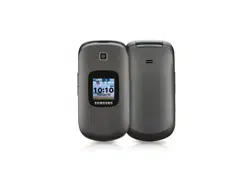

SCH-S336C
MOBILE PHONE
User Manual
Please read this manual before operating your
phone and keep it for future reference.
GH68_38883A Printed in Korea

Intellectual Property
All Intellectual Property, as defined below, owned by or which is
otherwise the property of Samsung or its respective suppliers relating to
the SAMSUNG Phone, including but not limited to, accessories, parts, or
software relating there to (the “Phone System”), is proprietary to
Samsung and protected under federal laws, state laws, and international
treaty provisions. Intellectual Property includes, but is not limited to,
inventions (patentable or unpatentable), patents, trade secrets,
copyrights, software, computer programs, and related documentation
and other works of authorship. You may not infringe or otherwise violate
the rights secured by the Intellectual Property. Moreover, you agree that
you will not (and will not attempt to) modify, prepare derivative works of,
reverse engineer, decompile, disassemble, or otherwise attempt to create
source code from the software. No title to or ownership in the Intellectual
Property is transferred to you. All applicable rights of the Intellectual
Property shall remain with SAMSUNG and its suppliers.
Open Source Software
Some software components of this product incorporate source code
covered under GNU General Public License (GPL), GNU Lesser General
Public License (LGPL), OpenSSL License, BSD License and other open
source licenses. To obtain the source code covered under the open
source licenses, please visit:
http://opensource.samsung.com
.
TF_S336C_UM_ENG_MF4_CH_070913_F6

Disclaimer of Warranties; Exclusion of
Liability
EXCEPT AS SET FORTH IN THE EXPRESS WARRANTY CONTAINED ON THE
WARRANTY PAGE ENCLOSED WITH THE PRODUCT, THE PURCHASER
TAKES THE PRODUCT "AS IS", AND SAMSUNG MAKES NO EXPRESS OR
IMPLIED WARRANTY OF ANY KIND WHATSOEVER WITH RESPECT TO THE
PRODUCT, INCLUDING BUT NOT LIMITED TO THE MERCHANTABILITY OF
THE PRODUCT OR ITS FITNESS FOR ANY PARTICULAR PURPOSE OR USE;
THE DESIGN, CONDITION OR QUALITY OF THE PRODUCT; THE
PERFORMANCE OF THE PRODUCT; THE WORKMANSHIP OF THE PRODUCT
OR THE COMPONENTS CONTAINED THEREIN; OR COMPLIANCE OF THE
PRODUCT WITH THE REQUIREMENTS OF ANY LAW, RULE, SPECIFICATION
OR CONTRACT PERTAINING THERETO. NOTHING CONTAINED IN THE
INSTRUCTION MANUAL SHALL BE CONSTRUED TO CREATE AN EXPRESS
OR IMPLIED WARRANTY OF ANY KIND WHATSOEVER WITH RESPECT TO
THE PRODUCT. IN ADDITION, SAMSUNG SHALL NOT BE LIABLE FOR ANY
DAMAGES OF ANY KIND RESULTING FROM THE PURCHASE OR USE OF
THE PRODUCT OR ARISING FROM THE BREACH OF THE EXPRESS
WARRANTY, INCLUDING INCIDENTAL, SPECIAL OR CONSEQUENTIAL
DAMAGES, OR LOSS OF ANTICIPATED PROFITS OR BENEFITS.
Modification of Software
SAMSUNG IS NOT LIABLE FOR PERFORMANCE ISSUES OR
INCOMPATIBILITIES CAUSED BY YOUR EDITING OF REGISTRY SETTINGS,
OR YOUR MODIFICATION OF OPERATING SYSTEM SOFTWARE.
USING CUSTOM OPERATING SYSTEM SOFTWARE MAY CAUSE YOUR
DEVICE AND APPLICATIONS TO WORK IMPROPERLY. YOUR CARRIER MAY
NOT PERMIT USERS TO DOWNLOAD CERTAIN SOFTWARE, SUCH AS
CUSTOM OS.

Samsung Telecommunications America
(STA), LLC
Headquarters:
1301 E. Lookout Drive
Richardson, TX 75082
Customer Care Center:
1000 Klein Rd.
Plano, TX 75074
Toll Free Tel: 1.888.987.HELP (4357)
Internet Address:
http://www.samsung.com
©2013 Samsung Telecommunications America, LLC. Samsung is a
registered trademark of Samsung Electronics Co., Ltd.
Do you have questions about your Samsung Mobile Phone?
For 24 hour information and assistance, we offer a new FAQ/ARS
System (Automated Response System)
at:
www.samsung.com/us/support
Nuance
®
, VSuite™, T9
®
Text Input, and the Nuance logo are
trademarks or registered trademarks of Nuance Communications,
Inc., or its affiliates in the United States and/or other countries.
ACCESS
®
and NetFront™ are trademarks or registered trademarks
of ACCESS Co., Ltd. in Japan and other countries.

The Bluetooth
®
word mark, figure mark (stylized “B Design”), and
combination mark (Bluetooth word mark and “B Design”) are
registered trademarks and are wholly owned by the Bluetooth SIG.
microSD™, microSDHC™, and the microSD logo are Trademarks of
the SD Card Association.

Table of Contents
Section 1: Getting Started ....................................................5
Understanding this User Manual . . . . . . . . . . . . . . . . . . . . . . . . . . . 5
Activating your Phone
. . . . . . . . . . . . . . . . . . . . . . . . . . . . . . . . . . . 7
Displaying Your Telephone Number
. . . . . . . . . . . . . . . . . . . . . . . . 7
Battery
. . . . . . . . . . . . . . . . . . . . . . . . . . . . . . . . . . . . . . . . . . . . . . 8
Turning Your Phone On and Off
. . . . . . . . . . . . . . . . . . . . . . . . . . . 13
Easy Setup
. . . . . . . . . . . . . . . . . . . . . . . . . . . . . . . . . . . . . . . . . . 14
TTY Mode
. . . . . . . . . . . . . . . . . . . . . . . . . . . . . . . . . . . . . . . . . . . 15
Roaming
. . . . . . . . . . . . . . . . . . . . . . . . . . . . . . . . . . . . . . . . . . . . 16
Voicemail
. . . . . . . . . . . . . . . . . . . . . . . . . . . . . . . . . . . . . . . . . . . 16
Section 2: Understanding Your Phone ...............................18
Features of Your Phone . . . . . . . . . . . . . . . . . . . . . . . . . . . . . . . . . 18
Closed View of Your Phone
. . . . . . . . . . . . . . . . . . . . . . . . . . . . . . 19
Open View of Your Phone
. . . . . . . . . . . . . . . . . . . . . . . . . . . . . . . 20
Side Views of Your Phone
. . . . . . . . . . . . . . . . . . . . . . . . . . . . . . . 22
Navigation Keys
. . . . . . . . . . . . . . . . . . . . . . . . . . . . . . . . . . . . . . 23
Functional Keys
. . . . . . . . . . . . . . . . . . . . . . . . . . . . . . . . . . . . . . 26
Understanding the Home Screen
. . . . . . . . . . . . . . . . . . . . . . . . . . 30
Understanding the Menu
. . . . . . . . . . . . . . . . . . . . . . . . . . . . . . . . 41
Prepaid Services
. . . . . . . . . . . . . . . . . . . . . . . . . . . . . . . . . . . . . . 43
Section 3: Entering Text .....................................................44
Changing the Text Entry Mode . . . . . . . . . . . . . . . . . . . . . . . . . . . 44
Entering Text Using T9 Word
. . . . . . . . . . . . . . . . . . . . . . . . . . . . . 45
Entering Text using Palabra
. . . . . . . . . . . . . . . . . . . . . . . . . . . . . 46
Entering Text using Abc/ABC/abc Mode
. . . . . . . . . . . . . . . . . . . . 47
Entering Numbers
. . . . . . . . . . . . . . . . . . . . . . . . . . . . . . . . . . . . . 48
Entering Symbols
. . . . . . . . . . . . . . . . . . . . . . . . . . . . . . . . . . . . . 48
Entering Quick Text
. . . . . . . . . . . . . . . . . . . . . . . . . . . . . . . .
. . .
49
Section 4: Call Functions ...................................................50
Making a Call . . . . . . . . . . . . . . . . . . . . . . . . . . . . . . . . . . . . . . . . 50
1

Answering a Call
. . . . . . . . . . . . . . . . . . . . . . . . . . . . . . . . . . . . . 50
Recent Calls
. . . . . . . . . . . . . . . . . . . . . . . . . . . . . . . . . . . . . . . . . 52
Sound Alert Mode
. . . . . . . . . . . . . . . . . . . . . . . . . . . . . . . . . . . . . 55
Section 5: Understanding Your Contacts ...........................57
Adding a New Contact . . . . . . . . . . . . . . . . . . . . . . . . . . . . . . . . . 57
Erasing Contacts
. . . . . . . . . . . . . . . . . . . . . . . . . . . . . . . . . . . . . 60
Editing a Contact
. . . . . . . . . . . . . . . . . . . . . . . . . . . . . . . . . . . . . 61
Managing Contacts
. . . . . . . . . . . . . . . . . . . . . . . . . . . . . . . . . . . 62
Adding Pauses or Waits
. . . . . . . . . . . . . . . . . . . . . . . . . . . . . . . . 63
Finding a Contact
. . . . . . . . . . . . . . . . . . . . . . . . . . . . . . . . . . . . . 64
Making Calls using Contacts
. . . . . . . . . . . . . . . . . . . . . . . . . . . . 64
Groups
. . . . . . . . . . . . . . . . . . . . . . . . . . . . . . . . . . . . . . . . . . . . . 65
Speed Dials
. . . . . . . . . . . . . . . . . . . . . . . . . . . . . . . . . . . . . . . . . 67
Emergency Contacts
. . . . . . . . . . . . . . . . . . . . . . . . . . . . . . . . . . 69
My Name Card
. . . . . . . . . . . . . . . . . . . . . . . . . . . . . . . . . . . . . . . 70
Section 6: Messaging .........................................................75
Types of Messages . . . . . . . . . . . . . . . . . . . . . . . . . . . . . . . . . . . 75
Creating and Sending Text Messages
. . . . . . . . . . . . . . . . . . . . . . 75
Creating and Sending Picture Messages
. . . . . . . . . . . . . . . . . . . . 76
Creating and Sending Voice Messages
. . . . . . . . . . . . . . . . . . . . . 79
Receiving Messages
. . . . . . . . . . . . . . . . . . . . . . . . . . . . . . . . . . 81
Message Folders
. . . . . . . . . . . . . . . . . . . . . . . . . . . . . . . . . . . . . 83
Voicemail
. . . . . . . . . . . . . . . . . . . . . . . . . . . . . . . . . . . . . . . . . . . 88
Social Networks
. . . . . . . . . . . . . . . . . . . . . . . . . . . . . . . . . . . . . . 89
Messaging Settings
. . . . . . . . . . . . . . . . . . . . . . . . . . . . . . . . . . . 91
Section 7: Bluetooth ...........................................................93
Bluetooth Service Profiles . . . . . . . . . . . . . . . . . . . . . . . . . . . . . . . 93
Turning Bluetooth On or Off
. . . . . . . . . . . . . . . . . . . . . . . . . . . . . 94
Bluetooth Options
. . . . . . . . . . . . . . . . . . . . . . . . . . . . . . . . . . . . . 94
Adding a New Device
. . . . . . . . . . . . . . . . . . . . . . . . . . . . . . . . . . 95
2

Section 8: Games & Apps ...................................................97
Games . . . . . . . . . . . . . . . . . . . . . . . . . . . . . . . . . . . . . . . . . . . . . 97
My Folder
. . . . . . . . . . . . . . . . . . . . . . . . . . . . . . . . . . . . . . . . . . . 98
Tunes & Tones
. . . . . . . . . . . . . . . . . . . . . . . . . . . . . . . . . . . . . . . 98
Pictures
. . . . . . . . . . . . . . . . . . . . . . . . . . . . . . . . . . . . . . . . . . . 101
My Pictures
. . . . . . . . . . . . . . . . . . . . . . . . . . . . . . . . . . . . . . . . 101
Taking Pictures
. . . . . . . . . . . . . . . . . . . . . . . . . . . . . . . . . . . . . . 106
Memory Status
. . . . . . . . . . . . . . . . . . . . . . . . . . . . . . . . . . . . . . 109
Section 9: Tools ................................................................110
Voice Commands . . . . . . . . . . . . . . . . . . . . . . . . . . . . . . . . . . . . 110
Calculator
. . . . . . . . . . . . . . . . . . . . . . . . . . . . . . . . . . . . . . . . . . 111
Calendar
. . . . . . . . . . . . . . . . . . . . . . . . . . . . . . . . . . . . . . . . . . . 114
Alarm Clock
. . . . . . . . . . . . . . . . . . . . . . . . . . . . . . . . . . . . . . . . 116
Stop Watch
. . . . . . . . . . . . . . . . . . . . . . . . . . . . . . . . . . . . . . . . . 118
World Clock
. . . . . . . . . . . . . . . . . . . . . . . . . . . . . . . . . . . . . . . . 118
Notepad
. . . . . . . . . . . . . . . . . . . . . . . . . . . . . . . . . . . . . . . . . . . 119
Phone Search
. . . . . . . . . . . . . . . . . . . . . . . . . . . . . . . . . . . . . . . 120
Section 10: Web ................................................................121
Browser . . . . . . . . . . . . . . . . . . . . . . . . . . . . . . . . . . . . . . . . . . . 121
Section 11: Settings .........................................................128
Master Volume . . . . . . . . . . . . . . . . . . . . . . . . . . . . . . . . . . . . . . 128
Bluetooth
. . . . . . . . . . . . . . . . . . . . . . . . . . . . . . . . . . . . . . . . . . 128
Sounds
. . . . . . . . . . . . . . . . . . . . . . . . . . . . . . . . . . . . . . . . . . . . 129
Display
. . . . . . . . . . . . . . . . . . . . . . . . . . . . . . . . . . . . . . . . . . . . 133
Phone
. . . . . . . . . . . . . . . . . . . . . . . . . . . . . . . . . . . . . . . . . . . . . 137
Call Settings
. . . . . . . . . . . . . . . . . . . . . . . . . . . . . . . . . . . . . . . . 146
Phone Info
. . . . . . . . . . . . . . . . . . . . . . . . . . . . . . . . . . . . . . . . . 150
Set-up Wizard
. . . . . . . . . . . . . . . . . . . . . . . . . . . . . . . . . . . . . . . 151
Section 12: Health and Safety Information ......................152
Exposure to Radio Frequency (RF) Signals . . . . . . . . . . . . . . . . . . 152
Specific Absorption Rate (SAR) Certification Information
. . . . . . . 159
FCC Part 15 Information to User
. . . . . . . . . . . . . . . . . . . . . . . . . 161
3

Smart Practices While Driving
. . . . . . . . . . . . . . . . . . . . . . . . . . 162
Battery Use and Safety
. . . . . . . . . . . . . . . . . . . . . . . . . . . . . . . . 164
Samsung Mobile Products and Recycling
. . . . . . . . . . . . . . . . . . 166
UL Certified Travel Charger
. . . . . . . . . . . . . . . . . . . . . . . . . . . . 168
Display / Touch-Screen
. . . . . . . . . . . . . . . . . . . . . . . . . . . . . . . 169
GPS & AGPS
. . . . . . . . . . . . . . . . . . . . . . . . . . . . . . . . . . . . . . . . 169
Emergency Calls
. . . . . . . . . . . . . . . . . . . . . . . . . . . . . . . . . . . . 171
Care and Maintenance
. . . . . . . . . . . . . . . . . . . . . . . . . . . . . . . . 172
Responsible Listening
. . . . . . . . . . . . . . . . . . . . . . . . . . . . . . . . 173
Operating Environment
. . . . . . . . . . . . . . . . . . . . . . . . . . . . . . . . 176
FCC Hearing Aid Compatibility (HAC) Regulations for
Wireless Devices
. . . . . . . . . . . . . . . . . . . . . . . . . . . . . . . . . . 179
Rest
ricting Children's Access to Your Mobile Device
. . . . . . . . . . 181
FCC Notice and Cautions
. . . . . . . . . . . . . . . . . . . . . . . . . . . . . . 182
Other Important Safety Information
. . . . . . . . . . . . . . . . . . . . . . . 182
End User License Agreement for Software
. . . . . . . . . . . . . . . . . 184
Index ..................................................................................195
4

Section 1: Getting Started
This section allows you to quickly start using your phone by installing
and charging the battery, activating your service, and setting up
voicemail.
Understanding this User Manual
The sections of this manual generally follow the features of your
phone. A robust index for features begins on page 195.
Also included is important safety informa
tion that you should know
before using your phone. Most
of this information is near the back of
the guide.
This manual gives naviga
ti
on instructions according to the default
display settings. If you select other settings, navigation may be
different.
Unless otherwise specified, all instructions in this manual assume
that the phone is open, and you are starting from the Home screen.
Note:
Instructions in this manual are based on default settings, and
may vary from your phone, depending on the software version
on your phone, and any changes to the phone’s Settings.
Unless stated otherwise, instructions to perform tasks in this
User Manual assume that the phone is open, and start at the
Home screen.
All screen images in this manual are simulated. Actual displays
may vary, depending on the software version of your phone and
any changes to the phone’s Settings.
5
Special Text
Throughout this manual, you’ll find text that is set apart from the
rest. These are intended to point out important information, share
quick methods for activating features, to define terms, and more.
The definitions for these methods are as follows:
•
Notes
: Presents alternative options for the current feature, menu, or sub-
menu.
•
Tips
: Provides quick or innovative methods, or useful shortcuts.
•
Important
: Points out important information about the current feature that
could affect performance.
•
Warning
: Brings to your attention important information to prevent loss of
data or functionality, or even prevent damage to your phone.
Text Conventions
This manual provides condensed information about how to use your
phone. To make this possible, the following text conventions are
used:
Highlight Use the
Directional Key
to move focus to
an item on the screen.
Select Use the
Directional Key
to highlight an
item on the screen, then press the
OK Key
.
The OK Key function changes according to the
type of item highlighted.
Getting Started 6

Arrows are used to represent the “highlight, then
select” steps in longer, or repetitive, procedures.
For example:
From the Home screen, press the
Left Soft
Key
Menu
Settings
Phone Info
My Number
.
Activating your Phone
If you purchased your phone at a store, it is activated and ready to
use. If you received a new phone by mail, it may need to be activated
before you can use it.
To activate your phone, choose from the following:
•
Visit a retail store.
•
Contact customer support.
Displaying Your Telephone Number
My Number displays the ten-digit telephone number assigned to
your phone.
From the Home screen, press the
Left Soft Key Menu
Settings
Phone Info
My Number
.
7
Battery
Your phone is powered by a rechargeable, standard Li-Ion battery. A
Charger is included with the phone, for charging the battery.
Note:
The battery comes partially charged. You must fully charge the
battery before using your phone for the first time. A fully
discharged battery can require up to 4 hours of charge time.
After the first charge, you can use the phone while charging.
Important!
Use only Samsung-approved charging devices and
batteries. Samsung accessories are designed to maximize
battery life. Using other accessories may invalidate your
warranty and may cause damage.
Battery Indicator
The battery icon in the upper-right corner of the display shows
battery power level, with four bars
indicating a full charge.
Before the battery becomes too low to operate, the empty battery
icon will flash and a tone will sound. If you continue to operate the
phone without charging, the phone will power off.
Battery Cover
The battery cover on the back of the phone protects the battery.
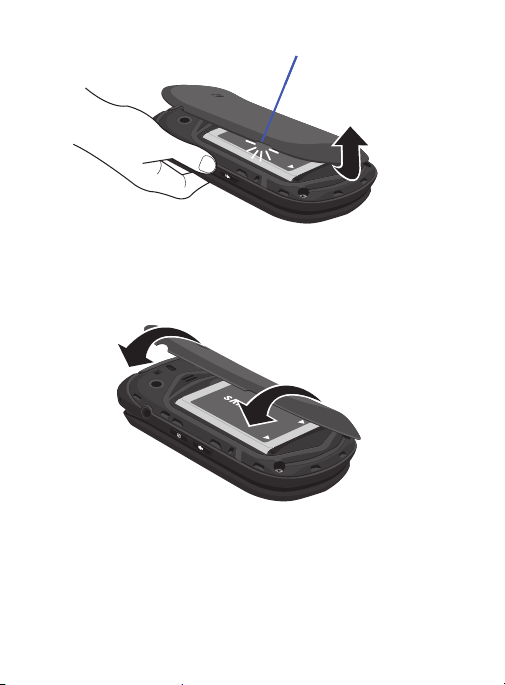
Removing the battery cover
1. Hold the phone firmly and locate the Cover Release Latch.
2. Firmly “pop” the cover off the phone.
Getting Started 8
Release Latch
Installing the battery cover
9
Align the cover and press it into place, making sure it snaps
securely.
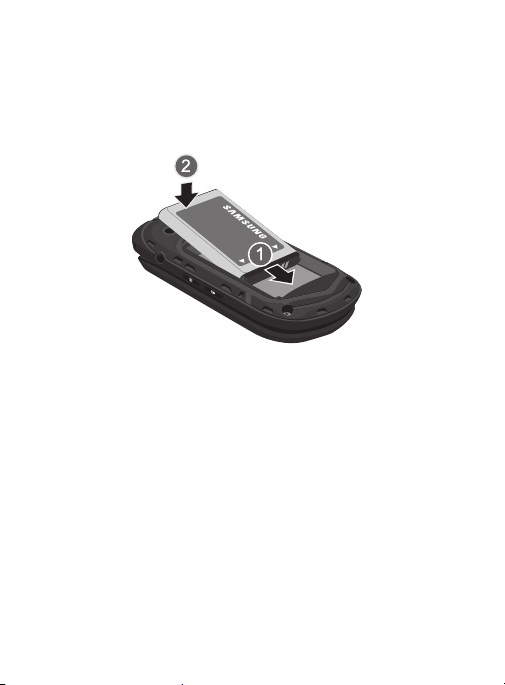
Installing the Battery
1. Remove the battery cover (see “Removing the battery cover”
on page 8).
2. Insert the battery int
o the phone (1), aligning the gold contacts
on the battery with the gold contacts in the phone (2).
3. Install the battery cover (see “Installing the battery cover” on
page 9).
Getting Started 10
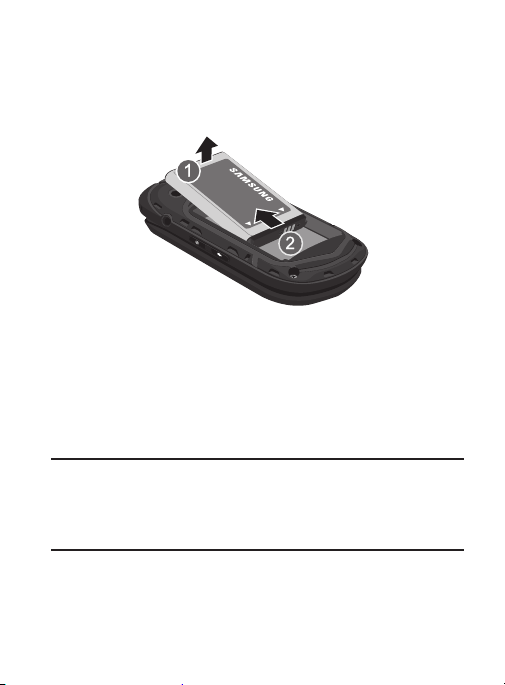
Removing the Battery
1. Remove the battery cover (see “Removing the battery cover”
on page 8).
2. Lift the ba
ttery from the bottom end (see arrow 1) and remove.
3. Install the battery cover (see “Installing the battery cover” on
page 9).
Charging the Battery
Your phone comes with a travel adapter to charge your phone from
any 120/220 VAC outlet.
Note:
The battery comes partially charged. You must fully charge the
battery before using your phone for the first time. A fully
discharged battery can require up to 4 hours of charge time.
After the first charge, you can use the phone while charging.
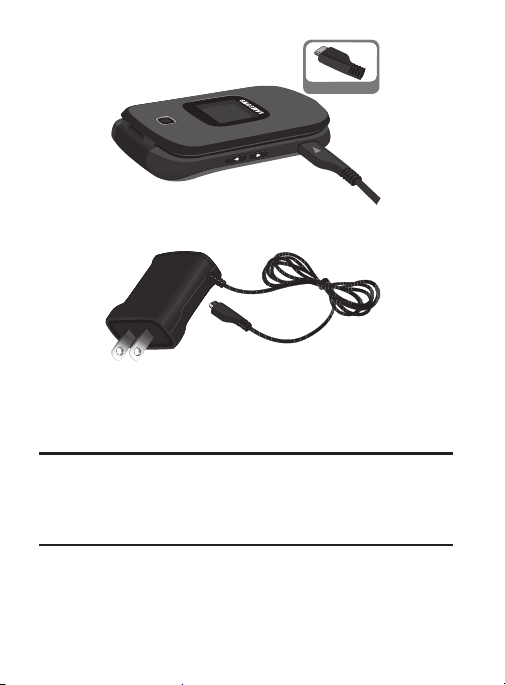
1. Insert the
charger cable into the Charging/Accessory port.
11
Incorrect Incorrect
2. Plug the charging head into a standard AC power outlet.
3. When charging is complete
, unplug the charging head from the
power outlet and remove the cable from the phone.
Non-Supported Batteries
Important!
Samsung handsets do not support the use of a non-
approved battery. Using a non-approved battery may
cause damage to your phone. Use a Samsung approved
battery only.
Getting Started
12
Samsung charging accessories (such as a wall charger, and
cigarette lighter adapter) will
only charge a Samsung approved
battery.
When using a non-approved battery the handset can only
be
used for the duration of the life of t
he battery and cannot be
recharged.
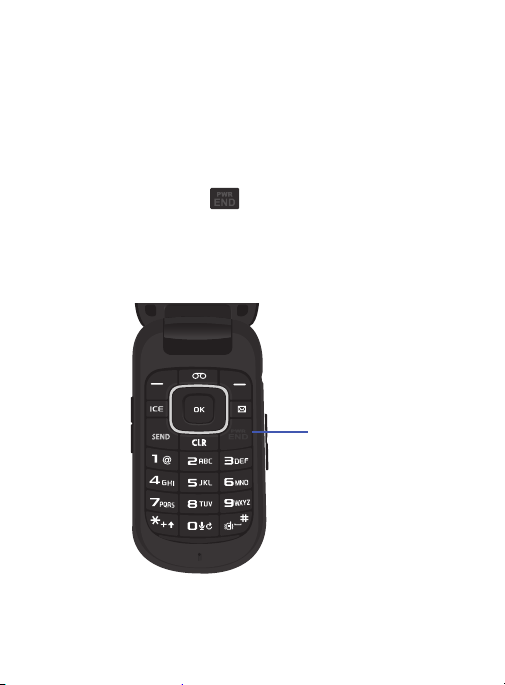
Turning Your Phone On and Off
Turning Your Phone On
Press and hold the
End/Power Key
to turn the phone on
or off.
While powering on, the phone connects with the home
network, then displays the Home screen and active alerts.
13
End/Power Key
Easy Setup
Set basic preferences, to start using your phone quickly.
1. Fr
om the Home screen, press the
Left Soft Key
Menu
Settings
Easy Set-up
.
2. Follow the prompts to set preferences for these settings and
tap :
•Font Size Control
: When enabled, you can use the Volume Key to
control the size of fonts for your phone’s displays, while using the phone.
• Call Sounds
: Configures the call sound to use when you receive a call
as we ll the ringtone to use for calls.
•Main Cl ock
: Select a format for the clock displayed on the Home
screen.
•Front Cl ock
: Select a format for the clock that appears on the external
display .
3. While setting preferences:
•
Use the
Directional Key
to highlight an option in a list.
•
Press to make a selection and go to the next setting.
•
Press the
Left Soft Key Preview
or
Play
for an example of the
highlighted selection.
•
Press the
Right Soft Key Skip
to move to the next setting without
making a selection.
Getting Started 14

Easy Set-up for Sounds
Use Easy Set-up to set the sounds your phone makes, including
sounds to alert you to calls and messsages.
1. Fr
om the Home screen, press the
Left Soft Key
Menu
Settings
Sounds
Easy Set-up
.
2. Follow the screen prompts to choose settings for
Call Sounds
,
Keypad Volume
,
Text Msg Alert
,
Multimedia Msg
Alert
, and
Voicemail Msg Alert
.
Easy Set-up for Displays
Use Easy-Setup to configure your phone’s displays, including the
wallpaper, menu layout, and clocks.
1. Fr
om the Home screen, press the
Left Soft Key
Menu
Settings
Display
Easy Set-up
.
2. Follow the screen prompts to choose settings for
Display
Backlight
,
Keypad Backlight
,
Main Wallpaper
,
Front Wallpaper
,
Dial Fonts
,
Font Size Control
,
Main Clock
, and
Front Clock
.
TTY Mode
Your phone is fully TTY-compatible, allowing you to connect a TTY
device to the phone’s headset jack. Before you can use your phone
with a TTY device, you’ll need to enable TTY Mode. For more
information about TTY settings, see “TTY Mode” on page 147.
15
Roaming
When you travel outside your home network’s coverage area, your
phone can roam to acquire service on other compatible digital
networks. when Roaming is active, the Roaming icon
appears
in the Annunciator Line of the display.
During roaming, some services may not be available. Depending on
your coverage area and service plan, extra charges may apply when
making or receiving call.
Note:
Contact your carrier for more information about your coverage
area and service plan.
Voicemail
All unanswered calls to your phone are sent to voicemail, even if
your phone is turned off, so you’ll want to set up your voicemail and
personal greeting as soon as you activate your phone.
Setting up Voicemail
1. From the Home screen, press the
Voicemail Key
.
– or –
2. From the Home screen, press and hold the
Key
to
activate Voicemail.
3. Follow the automated instructions to set up your new
password and record a greeting.
Getting Started 16
Checking Voicemail
1. From the Home screen, press the
Voicemail Key
.
– or –
2. From the Home screen, press and hold the
Key
to
activate Voicemail.
3. Enter your passwor
d, then press
.
4. Follow the recorded prompts to listen to messages and
manage your voicemail.
Note:
You can also access voicemail using the pre-set speed dial,
, then , or by dialing y
our phone
number from any touch-tone phone.
17

Section 2: Understanding Your Phone
This section outlines key features of your phone as well as screens
and icons that display when the phone is in use.
Features of Your Phone
•
All Digital CDMA 1x Technology
•
Sound Alert Mode
•
Personal Organization Tools
–
Calculator
–
Calendar
–
Alarm Clock
–
Stop Watch
–
World Clock
–
Notepad
•
Messaging Services
–
Standard and Enhanced TXT Messaging
–
Picture Messaging
–
Voice Messaging
•
1.3 MP Camera
•
Advanced Voice Commands, using Nuance Voice Recognition technology
•
Speakerphone
•
Bluetooth
®
Wireless Technology
Understanding Your Phone 18
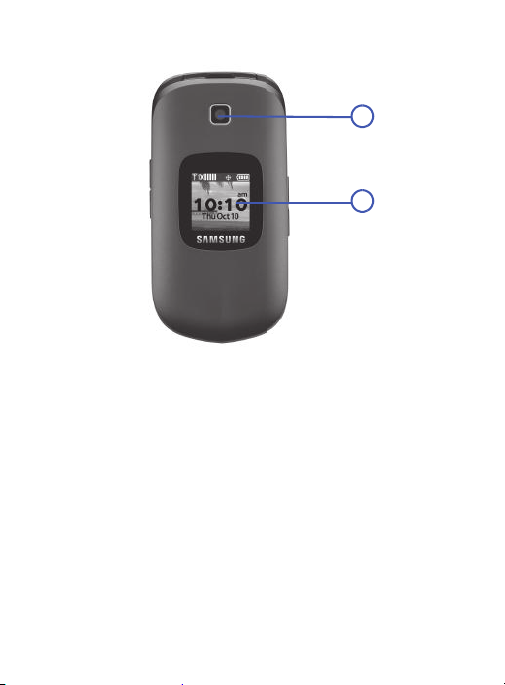
Closed View of Your Phone
1
2
Features
1.
Camera Lens
: The lens of the built-in camera.
2.
Front Screen
: Shows signal and battery strength, time, day,
and date, plus calls or message notifications.
19
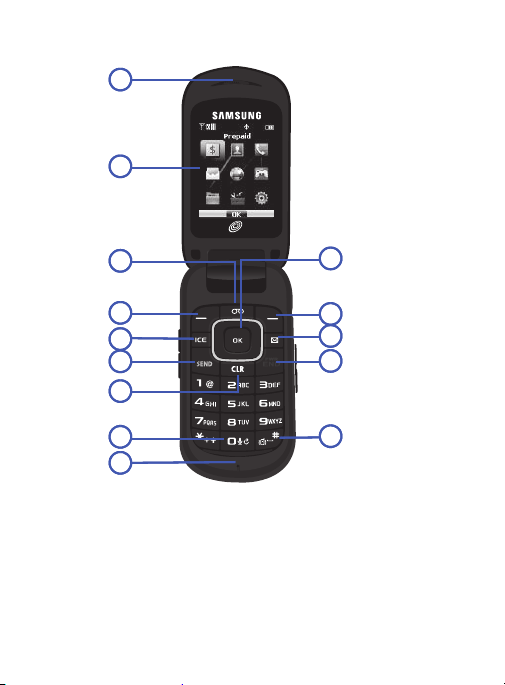
Open View of Your Phone
1
2
3
4
5
6
7
8
9
1
2
3
4
5
6
7
8
9
11
10
12
13
14
11
10
12
13
14
Features
1.
Earpiece
: Allows you to hear the caller.
2.
Main Screen
: Displays phone features.
3.
Voicemail Key
: Press to access voicemail.
Understanding Your Phone 20

4.
Left Soft Key
: Press to select the command at the lower left
area of the display screen.
5.
In Case of Emergency (ICE) Key
: Press to access stored
emergency numbers and information.
6.
Send Key
: Press to place or receive a call. From the Home
screen, press once to access the All Calls log.
7.
Clear Key
: Press to delete numbers or characters from the
display, or to return to the previous item or screen.
8.
Voice Commands Key
: Press and hold for Voice
Commands
.
9.
Microphone
: Provides an on-board microphone function.
10.
Vibrate Mode Key
:
Press and hold to activate Vibrate Mode
.
11.
End/Power Key
: Press to end a call. Press and hold to turn the
phone On or Off.
12.
Messaging Key
: Press to access the Messaging menu.
13.
Right Soft Key
: Press to select the command at the lower right
area of the display screen.
14.
Directional and OK Keys
: Press left, right, up and down to scroll
lists or screens, or to select a highlighted item.
21
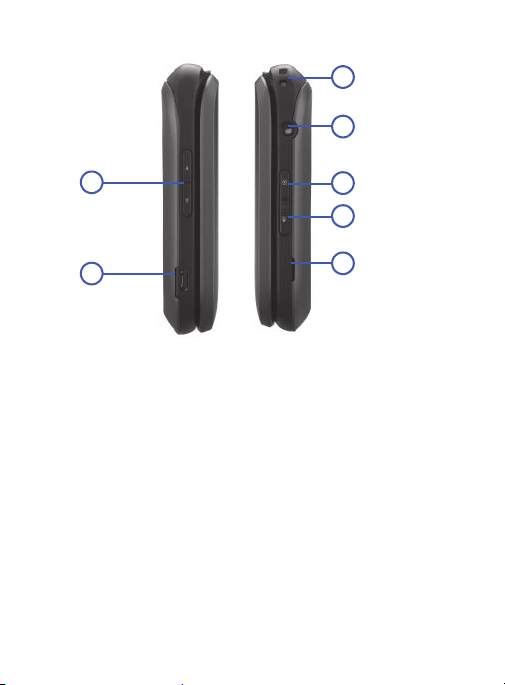
Side Views of Your Phone
1
2
3
4
5
6
7
Features
1.
Volume Key
: Press to adjust Volume. Press and hold Up to set
the volume level to High, or press and hold Down to Down to
silence an incoming call ringtone. From the Home screen,
press and hold Down to switch between Sound Off and the
previous Volume level.
2.
Charging/Accessory Port
: Plug in charging accessories, and
connect compatible accessory cables.
3.
Cover Release Latch
: Pull here with your finger to remove the
battery cover.
Understanding Your Phone 22

4.
Speakerphone Key
: With the flip open, press and hold to
activate the Speakerphone. With the flip closed, press and hold
to activate Voice Commands.
5.
Camera Key
: From the Home screen, press to activate the
Camera. When using Camera, press to take a photo.
6.
2.5 mm Headset Jack
: Plug in an optional headset for music, or
for safe, convenient conversations.
7.
Strap Attachment
: Attach an optional strap (not included).
Navigation Keys
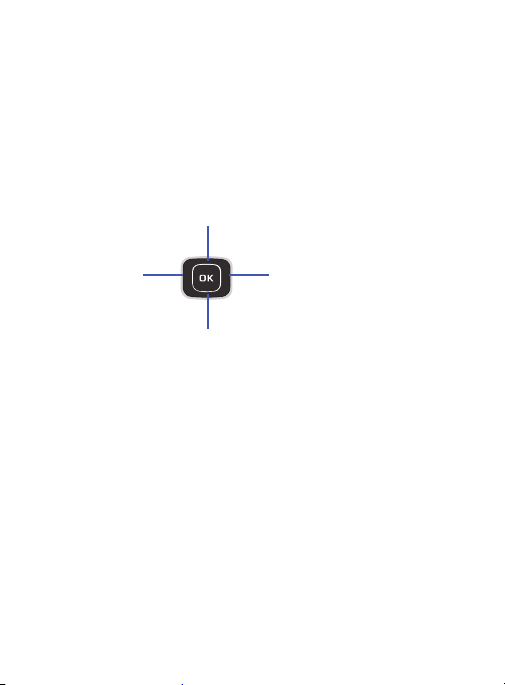
Directional Key
Press the
Directional Key
to
Up
Left
Right
Down
browse menus and lists, or to
launch applica
tions from the
Home screen.
23
Directional Key Shortcuts
From the Home screen, press a
Directional Key Up
,
Down
,
Left
or
Right
to launch its corresponding application. My Shortcuts presents
a list of shortcuts that you can customize to include your favorite
features.
You can customize the Directional Key shortcuts. For more
information, see “My Shortcuts” on page 138.
Sound Alert Mode
Tools
My Shortcuts
New Text Message
Understanding Your Phone 24
Soft Keys
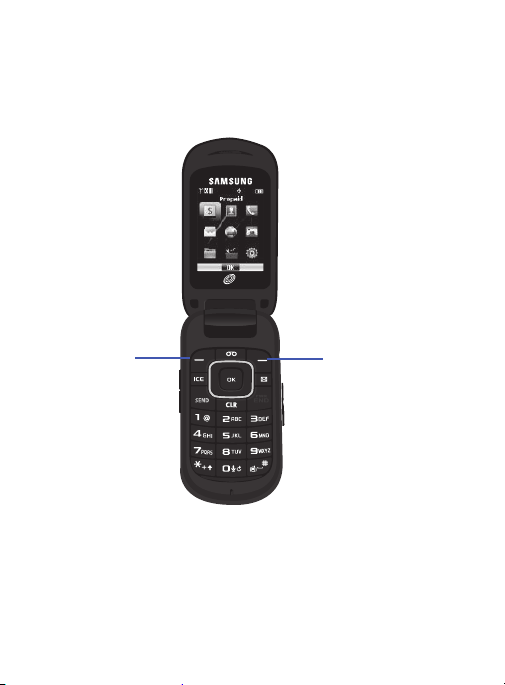
Soft key functions are defined by what appears above them, in the
bottom line of the display. There are three soft keys: the
Left Soft Key
,
the
Right Soft Key
, and the
OK Key
.
Left Soft Key
Right Soft Key
25

Left Soft Key
Some functions of the
Left Soft Key
are:
•
From the Home screen, press the
Left Soft Key Menu
to open the Menu.
•
When the
Left Soft Key
function is
Settings
, press to choose settings for
the feature.
•
When the
Left Soft Key
function is
Edit
, press to edit the item or field.
Right Soft Key
Some functions of the
Right Soft Key
are:
•
From the Home screen, press the
Right Soft Key Browser
to launch the
browser.
•
When the
Right Soft Key
function is
Options
, press to choose options for
the current item.
OK Key
Some functions
of the
OK Key
are:
•
From the Home screen, press the
OK Key
to open the
Prepaid
menu.
•
Press the
OK Key
to select a highlighted option.
Functional Keys
End/Power Key
Use the
End/Power
Key
to end calls, to turn the phone on or off,
and to return to a previous menu. For example:
•
Press and hold the
End/Power Key
to turn your phone on or off.
•
Press the
End/Power Key
to disconnect a call.
•
Press the
End/Power Key
to return to the home screen from any menu, or
to cancel the last input.
•
Press the
End/Power Key
to send an incoming call to Voicemail.
Understanding Your Phone 26
Voicemail Key
Use the
Voicemail Key
to set up and check Voicemail.
Send Key
•
From the Home screen, press the
Voicemail Key
to call Voicemail.
Use the
Send
Key
to answer calls, dial calls, and to recall the
last number(s) dialed, received, or missed. For example:
•
Press the
Send Key
to answer incoming calls.
•
Enter a number and press the
Send Key
to make a call.
•
Press the
Send Key
from the Home screen to display a list of all calls to
and from your phone.
•
Press and hold the
Send Key
from the Home screen to call the last dialed,
received, or missed number.
In Case of Emergency Key
The
Messaging Key
accesses the Messages menu.
Messaging Key
•
From the Home screen, press the
ICE Key
to access Emergency Contacts
and Personal Info.
Use the
ICE Key
to access special emergency contacts, plus
person al information, that may be helpful to other using your phone
in case of an emergency.
•
From the Home screen, press the
Messaging Key
to launch the Messages
menu.
27
Clear Key
Use the
Clear Key
to erase or clear numbers, text, or symbols
from the display, or to return to a previous menu or to the Home
screen from any menu.
•
If you enter an incorrect character, press
the
Clear Key
to backspace (and
delete) the character.
•
To erase the previous word in a sentence, press and hold
the
Clear Key
.
•
To back up one menu level, press
the
Clear Key
.
•
Press and hold
the
Clear Key
to return to the home screen.
Volume Key
Use the
Volume Key
to adjust volume:
Speakerphone Key
•
From the Home screen, press the to set Master Volume.
•
From the Home screen, press and hold the
Volume Key
down or up to
activate Sounds Off/Normal mode.
•
During
calls,
pres
s the
Volume Key
to adjust voice volume.
•
During music pl
ay
back, press the
Volume Key
to adjust audio
volume.
•
Press the
Volume Key
to mute the ringtone of an incoming call.
Volume Key
Use the side
Speakerphone Key
to enable or disable the
speakerphone or launch Voice Commands:
•
During a call with the flip open, press and hold the
Speakerphone Key
to
switch between the earpiece and the speakerphone.
•
When answering a call with the flip open or closed, press and hold the
Speakerphone Key
to answer the call with the speakerphone. To end a
call with the flip closed, press and hold the
Speakerphone Key
.
Understanding Your Phone 28
•
With the flip closed, press and hold the
Speakerphone Key
to launch
Voice Commands.
Note:
You can also launch Voice Commands from the Home screen by
pressing and holding the
Voice Commands Key
on the
phone keypad.
Camera Key
Use the side
Camera Key
for Camera functions:
•
From the Home screen, press and hold the
Camera Key
to launch the
camera.
•
While in Camera mode, press the
Camera Key
to take a photo.
•
With the flip closed, press and hold the
Camera Key
to launch the camera,
then press the
Camera Key
to take a self-portrait.
Vibrate Key
Use the
Vibrate Key
to control Vibrate Only mode:
•
From the Home screen, press and hold the
Vibrate Key
to set your phone
to Vibrate Only mode.
•
Press and hold the
Vibrate Key
to return to the previous sound profile.
29
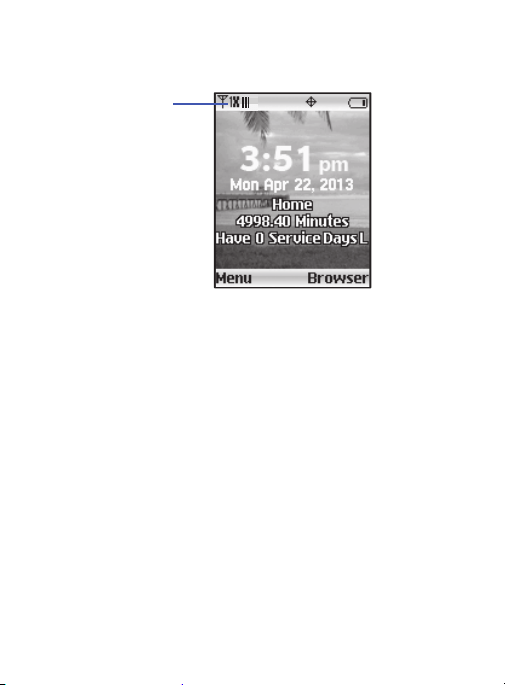
Understanding the Home Screen
The Home screen is the starting point for using your phone.
Status Bar
•
Status Bar
: Presents icons to show network status, battery power, and
connection details. For more information, refer to
“System Status Icons”
on page 31.
Customizing the Home screen
You can customize the Home screen to suit your preferences.
•
Wallpaper
: Select a background image for the Lock Screen and Home
screen, from pre-loaded images, or your own pictures. For more
information, see
“Wallpaper”
on page 134.
•
Clock Format
: Choose a format and color for the clock on the Home
screen. For m
ore information,
see
“Clock Format”
on page 136.
Understanding Your Phone 30
Home Screen Icons
System Status Icons
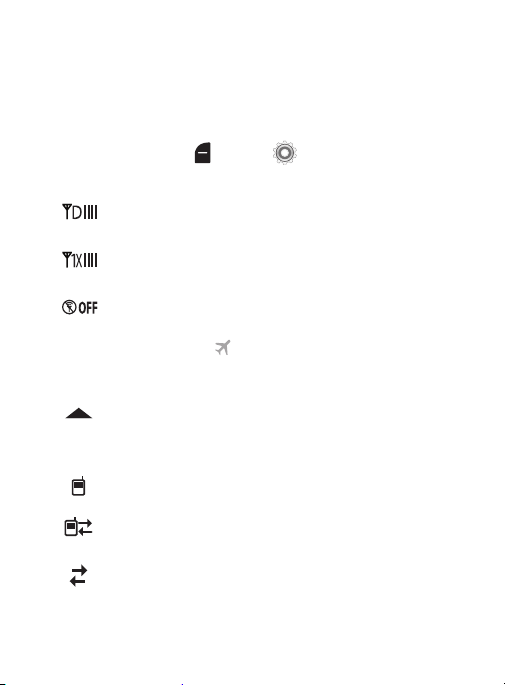
Icons display in the top line of the Home screen to show the status of
the phone.
For a list of icons, see the Icon Glossary. From the Home screen,
press the
Left Soft Key
Menu
Settings
Phone Info
Icon Glossary
System Status
.
Digital
: The number of bars show signal strength,
with more bars meaning a stronger signal.
1X
: The number of bars show the CDMA signal
strength. More bars indicate stronger signal.
Airplane Mode
: When activated, you cannot send
or receive calls or messages, but other features
are available.
appears on the Home screen.
For more
info
rmation, see “Airplane Mode” on
page 137.
Roaming
: The phone is roaming outside the home
service area. Consult your carrier for roaming
plans and rates.
Voice Call
: A voice call is in progress.
Data Call
: A data connection is active, and data is
being transmitted and received.
Dormant
: A data connection is active, but no data
is being transmitted or received (dormant).
31
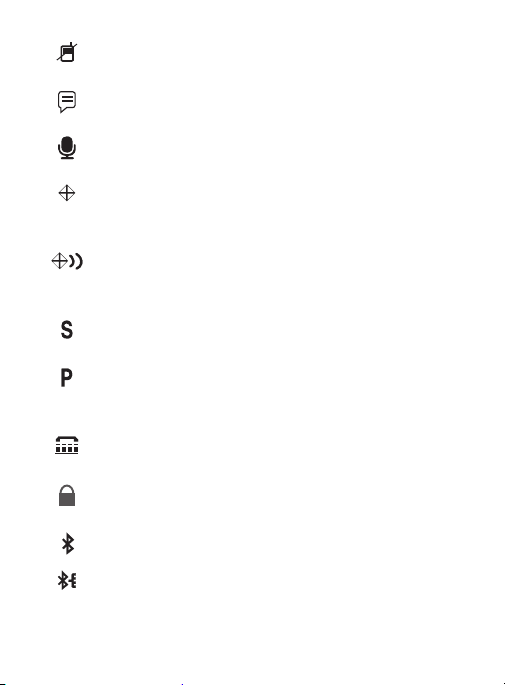
No Service
: No coverage is available. You cannot
send or receive calls or messages.
Voice Listening
: Voice Commands is active.
Voice Readout:
Voice Commands is listening for a
command.
E911 Only
: GPS location information is available to
network during Emergency calls only. For details,
see “Location Detection” on page 142.
Location On
: GPS location information is available
to the network. For more information about this
setting, see “Location Detection” on page
142.
SSL
: Data is encrypted by Secure Socket Layer
encryption, for increased privacy.
Voice Privacy
: The Voice Privacy setting is active,
to increase privacy of voice calls. For more
information, see “Voice Privacy” on page 148.
TTY
: TTY Mode is active. For more information, see
“TTY Mode” on page 147.
Keypad Lock
: TTY Mode is active. For more
information, see “Side Key Lock” on page 139.
Bluetooth
: Bluetooth service is On.
Bluetooth Connected
: The phone is paired with
another Bluetooth device.
Understanding Your Phone 32
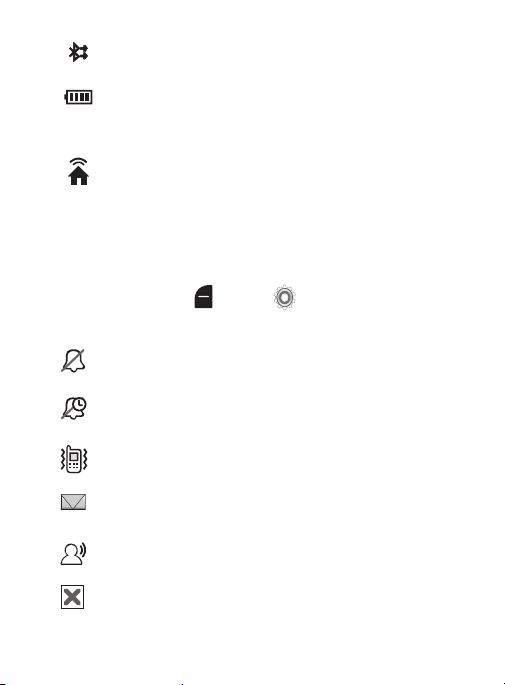
Bluetooth Transfer
: The phone is exchanging
information with another Bluetooth device.
Battery Level
: Battery charge indicator. The
number of bars show available battery power,
with more bars indicating more charge.
Network Extender
: Provides the connection status
of the device’s connection to a Network Extender.
Service Alert and Settings Icons
Icons display in the Status and Settings area of the Home screen.
For a list of icons, see the Icon Glossary. From the Home screen,
press the
Left Soft Key Menu
Settings
Phone Info
Icon Glossary
Service Alert & Settings
.
All Sounds Off
: Volume set to All Sounds Off. No
sounds are played for calls or alerts.
Alarm Only
: Volume set to Alarm Only. The only
sounds played will be for alarms.
Vibrate Only
: Volume is set to Vibrate Only. The
phone will vibrate for calls and alerts.
Unread Msg
: You have new, unread text
message(s).
Voicemail
: You have new voicemail.
Missed Calls
: You have missed calls.
33
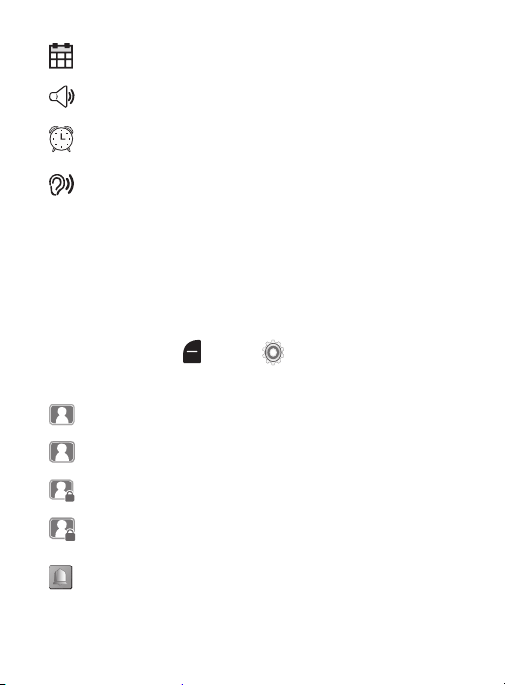
Calendar Event
: You have an active calendar event.
Speakerphone
: Speakerphone mode is active.
Alarm On
: You have an alarm set to go off in the
next 24 hours.
Sound Alert Mode
: All alerts are made with sound,
and other information may be read out for alerts. For
more information, see “Sound Alert Mode” on
page 55.
Multimedia Settings Icons
Icons display in the Status and Settings area of the Home screen.
For a list of icons, see the Icon Glossary. From the Home screen,
press the
Left Soft Key
Menu
Settings
Phone Info
Icon Glossary
Multimedia
.
Picture
: Represents a picture.
Picture Protected
: This picture is protected.
Picture Locked
: This picture is locked.
Picture Protected Locked
: This picture is both
protected and locked.
Ringtone
: Represents a ringtone.
Understanding Your Phone 34
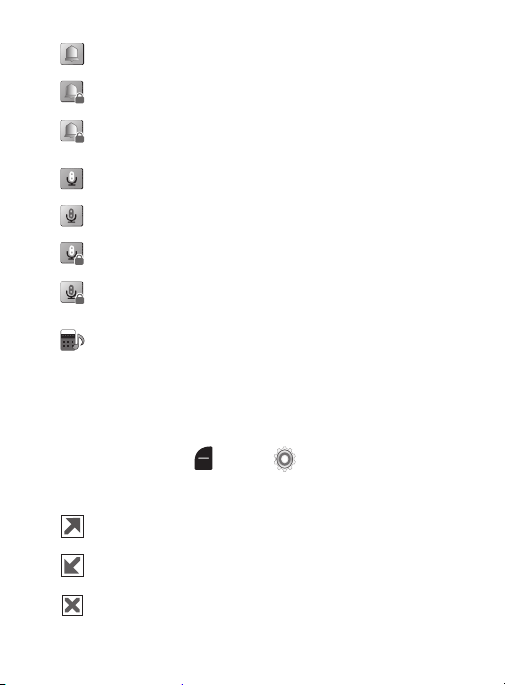
Ringtone Protected
: This ringtone is protected.
Ringtone Locked
: This ringtone is locked.
Ringtone Protected Locked
: This ringtone is both
protected and locked.
Sound
: Represents a sound file.
Sound Protected
: This sound file is protected.
Sound Locked
: This sound file is locked.
Sound Protected Locked
: This sound file is both
protected and locked.
Selected Ringtone
: A ringtone was selected.
Recent Calls & Contacts Settings Icons
Icons display in the Status and Settings area of the Home screen.
For a list of icons, see the Icon Glossary. From the Home screen,
press the
Left Soft Key
Menu
Settings
Phone Info
Icon Glossary
Recent Calls & Contacts
.
Dialed Call
: Represents a recently Dialed call.
Received Call
: Represents a newly Received call.
Missed Call
: Represents a Missed call.
35
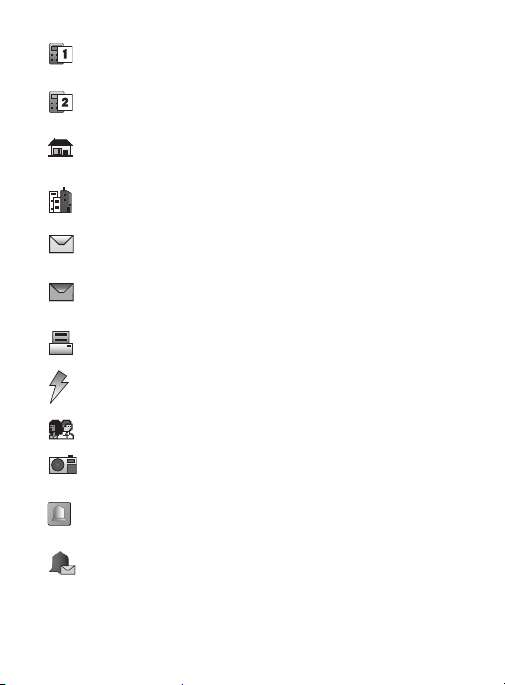
Mobile 1
: Represents a Mobile phone number field
in Contacts.
Mobile 2
: Represents a Mobile phone number field
in Contacts.
Home
: Represents the Home phone number field in
Contacts.
Business
: Represents the Business phone number
field in Contacts.
Personal Email
: Represents the Personal Email
field in Contacts.
Business Email
: Represents the Business Email
field in Contacts.
Fax
: Represents the Fax number field in Contacts.
Speed Dial
: Represents a Speed Dial number
field in Contacts.
Group
: Represents a Group name field in Contacts.
Picture ID
: Represents the Picture ID field in
Contacts.
Ringtone
: Represents the Ringtone field in
Contacts.
Message Tone
: Represents the Message Tone field
in Contacts.
Understanding Your Phone 36
Home Address
: Represents the Home Address
field in Contacts.
Work Address
: Represents the Work Address field
in Contacts.
Company
: Represents the Company field in
Contacts.
Title
: Represents the Title field in Contacts.
Birthday
: Represents the Birthday field in
Contacts.
Note
: Represents the Note field in Contacts.
In Case of Emergency
: Represents a Contact
number marked for In Case of Emergency.
Go To
: Represents the Go To (URL) for a website.
Favorites
: Represents a contact marked as a
Favorite.
Messaging Settings Icons
Icons display in the Status and Settings area of the Home screen or
in the Inbox, Sentbox, or Drafts folder.
For a list of icons, see the Icon Glossary. From the Home screen,
press the
Left Soft Key
Menu
Settings
Phone Info
Icon Glossary
Messaging
.
37
New TXT Msg
: Displays when you received a New
Text message.
Read TXT Msg
: Represents a Text message that
was read.
New Multimedia Message
: Displays when you
receive a New Multimedia message.
Opened Multimedia Message
: Represents an
multimedia message that was opened.
Unread Multimedia Message
: Represents an
Unread multimedia message.
Read Multimedia Message
: Represents a
multimedia message that was read.
Unread WAP Push
: Represents an Unread WAP
push message.
Read WAP Push
: Represents a WAP Push message
that was read.
Msg Delivered
: Displays when a message was
delivered.
Msg Sending Failed
: Displays when a message fails
to send.
Sent Msg
: Displays when a message was sent.
Incomplete Msg
: Displays when the complete
message fails to send.
Understanding Your Phone 38
TXT Msg Draft
: Represents a text message Draft.
Multimedia Msg Draft
: Represents a multimedia
message Draft.
High Priority
: Displays to indicate a High Priority
message.
Name card
: Represents a Name Card.
Lock
: Represents a message that was Locked.
Settings & Tools Icons
Icons display in the Status and Settings area of the Home screen.
For a list of icons, see the Icon Glossary. From the Home screen,
press the
Left Soft Key
Menu
Settings
Phone Info
Icon Glossary
Settings & Tools
.
BT Headset
: Displays when a Bluetooth Headset is
connected.
BT Computer
: Displays when connected to a
Bluetooth compatible computer.
BT PDA
: Displays when connected to a PDA.
39
BT Mobile Phone
: Displays when connected/paired
with a Bluetooth enabled Mobile Phone.
BT Handsfree
: Displays when using the Bluetooth
Handsfree mode.
BT Unknown Device
: displays when an unknown
Bluetooth device is discovered.
Device Connected
: Displays when a Bluetooth
connection was established.
Calendar Event Name
: Represents the Calendar
Event Name field.
Event Date & Time
: Represents the Event Date &
Time settings field.
Recurrence
: Represents the Recurrence settings
field.
Alert
: Represents the Alert settings field.
Reminder
: Represents the Reminder settings field.
Alert Time
: Represents the Alert Time settings field.
Alarm On
: Represents the Alarm On settings field.
Alarm Off
: Represents the Alarm Off settings field.
Understanding Your Phone 40
$ $
Auto Answer
: Displays when Auto Answer mode is
enabled.
Understanding the Menu
The Menu is the starting point for launching applications and
features.
From the Home screen, press the
Left Soft Key
to select
Menu
.
Menu Items
These items appear on the Menu by default. You can replace some
menu items with your favorite features, and change the order items
appear in the menu.
Prepaid
: Access your account’s prepaid
func
tionality.
For more information, refer to
“Prepaid Services” on page 43.
Contacts
: Open the Contacts menu, to enter, view
and manage your daily contacts.
Recent Calls
: Open the Recent Calls log, to
view recent received, missed and dialed calls. For
more information, see “Recent Calls” on page 52.
Messages
: Access your phone’s messaging
features.
Browser
: Launch Mobile Web, where you can
manage your account and browse the web.
41
Games & Apps
: Launch Media Center, for the
multimedia features of your phone.
My Folder
: Provides access to files found on the
phone.
Tools
: Access productivity tools.
Settings
: Configure your phone to your
preferences.
Menu Number Accelerators
Each menu item has a number assigned to it, and you can access
menu items using these menu numbers.
For example, access Airplane Mode using
standard navigation
:
1. From the Home screen, press the
Left Soft Key
Menu
.
2. Press the
Directional Key Down
to highlight
Settings
and
press
OK
.
3. Press the
Directional Key Down
to highlight
Phone
and
press
OK
.
4. Press
OK
to set Airplane Mode.
Example using
number accelerators
:
From the Home screen, press the
Left Soft Key
Menu
Settings
Call
Answer
Options
.
Understanding Your Phone 42

Prepaid Services
From the Home screen, press the
Left Soft Key
Menu
Prepaid.
$
For prepaid services, this menu provides access to the following
items, among others:
•
Add Airtime
•
Buy Airtime
•
My Phone Number
•
My AIrtime Info
•
Airtime Display
•
Serial Number
•
Code Entry Mode
43

Section 3: Entering Text
Your phone provides convenient ways to enter words, letters,
punctuation, and numbers when you need to enter text. This section
describes text input modes and entering characters or symbols,
using the keypad.
Your phone offers these text entry modes:
•
T9 Word
: English predictive text
•
Palabra
: Spanish predictive text
•
Abc/ABC/abc
: Standard text entry for phones
•
123
: Numbers
•
Symbols
: Common text symbols
•
Quick Text
: Pre-entered phrases (text fields only)
•
Domain extensions
: Common Internet phrases and symbols
Note:
Available text entry modes will depend on the type of field.
Changing the Text Entry Mode
While entering text, you can change the text entry mode to your
preference.
Tip:
You can set a default Text Entry Mode. For more information, see
“Messaging Settings” on page 91.
While entering text, press the
Left Soft Key
Entry Mode,
then use the
Directional Key
to highlight a mode and
press
to sele
ct the mode.
Entering Text 44
Note:
Available text entry modes will depend on the type of field.
When you are entering text, the
Left Soft Key
shows the current
text entry mode.
Entering Text Using T9 Word
T9 Word is a predictive text entry mode that recognizes common
English words matching the sequence of your key presses and
inserts the most common word into your text. T9 Word requires only
one key press per letter of the word, and is much faster than
traditional text entry.
To switch to T9 Word mode, press the
Left Soft Key
Entry Mode
T9 Word
.
While entering text:
•
Press the key for each letter only once.
•
Enter the entire word before editing or deleting characters. Press to
backspace and clear one character, or press and hold to clear an entire
word
.
•
If T9 Word inserts the wrong word , press to toggle between
other
matching words.
•
Press
to toggle between T9 Word (initial case), T9 word (lower case)
and T9 WORD (upper case).
•
To enter
a space, press
.
•
Press once to enter a period, twice to enter
:)
, or three times to
enter
:-)
.
•
Press and hold any key to enter the number on the key.
45
•
•
Entering Text using Palabra
Palabra is a predictive text entry mode for Spanish that recognizes
common words matching the sequence of your key presses and
inserts the most common word into your text. Palabra requires only
one key press per letter of the word, and is much faster than
traditional text entry.
To switch to T9 Word mode, press the
Left Soft Key
Entry Mode
Palabra
.
While entering text:
•
Press the key for each letter only once.
•
Enter the entire word before editing or deleting characters. Press to
backspace and clear one character, or press an d hold to clear an entire
word.
•
If Palabra inserts the wrong word , press to toggle between other
matching words.
•
Press
to toggle between PalabraT9 Word (initial case), palabra
(lower case) and PALABRA (upper case).
•
To enter a space, press .
•
Press once to enter a period, twice to enter
:)
, or three times to
enter
:-)
.
•
Press and hold any key to enter the number on the key.
Entering Text 46
Entering Text using Abc/ABC/abc Mode
Abc mode is standard text entry mode for mobile telephones.
To switch to Abc mode, press the
Left Soft Key
Entry Mode
Abc
.
While entering text:
•
Press the appropriate key once for the first letter on the key, twice for the
second letter, three times for the third letter, and four times for the fourth
letter.
•
When the correct letter displays, pause briefly to advance to the next
letter, or press another key.
•
Press to backspace to clear one character. Press and hold to clear
an entire word.
•
Press to toggle between Abc (initial case), abc (lower case) and ABC
(upper case).
•
To enter a space, press .
•
Press once to enter a period, twice for “@”, three times for a
question mark “?”, and four times for an exclamation mark “!”.
•
Press and hold any key to enter the number on the key.
47
Entering Numbers
Use 123 mode to enter numbers into a text field.
To switch to 123 mode, press the
Left Soft Key
Entry Mode
123
.
While entering numbers:
•
Press the appropriate key for each number.
•
Press to backspace to clear one number. Press and hold to clear
multiple numbers in a string
.
Entering Symbols
Use Symbols mode to enter common symbols into a text field.
To switch to Abc mode, press the
Left Soft Key
Entry Mode
Symbols
.
To enter symbols:
•
Use the
Directional Key
to highlight a symbol, then
press
OK
to insert it.
•
There are three pages of symbols. To access more symbols, press the
Left
Soft Key
Prev
or the
Right Soft Key
Next
to move to another
page of symbols.
Tip:
You can also press the key for the number corresponding to a
symbol.
Entering Text 48
Entering Quick Text
Use Quick Text mode to insert pre-loaded messages into a text
message, or to create and insert your own Quick Text phrases.
To switch to Abc mode, press the
Left Soft Key
Entry Mode
Quick Text
.
While in Quick Text mode:
•
Press the
Directional Key
to highlight a phrase, then press
OK
to insert the Quick Text.
•
To erase a Quick Text phrase, use the
Directional Key
to highlight a
phrase, then press the
Left Soft Key Erase
.
•
Press the
Right Soft Key Options
for these options:
–
New
: Create a new phrase.
–
Edit
: Modify the highlighted phrase.
–
Move
: Change the order of the phrases.
49
Section 4: Call Functions
This section describes how to make, answer, and end calls. It also
includes information about the Recent Calls log and Voice
Commands.
Making a Call
Your phone offers multiple ways to make calls:
•
Enter the phone or speed dial number, then press the
Send Key
.
•
Enter the speed dial number, holding the last digit until the number dials.
•
Call a contact from Contacts.
•
Return a call, or call a recent caller via Recent Calls. For more information,
see
“Making Calls Using Recent Calls”
on page 53.
•
Voice dial using Voice Commands. For more information, see
“Voice
Commands”
on page 110.
Answering a Call
You can answer calls with either the flip open or closed.
•
With the flip closed, open to answer automatically.
•
With the flip open, press the
Send Key
.
Note:
These are default Answer Options. You can choose other options
for answering calls. For more information, see “Answer
Options” on pa
ge 146.
Ca
ll Functions 50

In-Call Options
While in a call, use the soft keys to access in-call options:
Press the
Left Soft Key Mute
to mute the microphone so the
other caller cannot hear your voice.
Press the
Right Soft Key Options
for these options:
• Messaging
: Display the Messages menu to create or view a Text,
Picture, Voice Message, and Social Networks.
• Contact List
: Open Contact list to view your contacts.
• Recent Calls
: Display recent incoming, missed and outgoing calls.
• Bluetooth Menu
: Choose Bluetooth options, such as switching to a
paired Bluetooth headset.
•Main Menu
: Display the Main menu.
•Notepad
: Opens the Notepad.
• Whisper Mode
: Increase the microphone to maximum volume level, to
improve the other caller’s ability to hear you clearly.
•Voice Privacy
: Enable or disable advanced voice encryption.
Tip:
Whisper Mode can be useful when you must speak softly, or while
calling in noisy environments.
Answering Call-Waiting Calls
When you receive a call while on a call:
•
Press to place the first call on hold and answer the new call.
•
To return to the original call, press again.
51
Sending Calls to Voicemail
Ignoring a call sends the caller directly to voicemail, and stops the
incoming call ringtone. Use one of these methods to ignore an
incoming call:
•
Press the
Left Soft Key Quiet
to silence the ringer.
•
Press
TXT
to send the call to voi cemail, and choose a p re-entered
phrase to se nd as a text message, or create a new text message to send
to the caller .
•
Press the
Right Soft Key
Ignore
to send the call to voicemail.
Recent Calls
Recent Calls saves a record of every call that you dial, miss, or
answer.
1. From the Home screen, press the
Left Soft Key
Menu
Recent Calls
.
– or –
From the home screen, press
to view
All Calls
.
• Missed
: Calls you did not answer.
2. Use the
Directional Key
to highlight a call type, then
press
OPEN
to display call records:
• Received
: Answered calls.
• Dialed
: Outgoing calls.
•All
: All, missed, received and dialed calls.
•View Timers
: Statistics about calls.
Call Functions 52
Directional Key
to highlight a call
record, then press
•
Press
OPEN
to view details.
•
Press the
Right Soft Key
Options
for these options:
3. Calls display by date, time and contact or phone number. If the
number is saved as a contact, the call record includes icons to
indicate the type of number.
4. Use the
Directional Key
to highlight a call, then choose from
these options:
•
Press the
Left Soft Key Message
to send a reply.
–
Save to Contacts
: Save the caller’s phone number as a new contact, or
update an existing contact.
–
Erase
: Delete the highlighted call record.
–
Lock/Unlock
: Locks or unlocks the entry to prevent deletion.
–
Erase All
: Delete all call records of this type.
–
View Timers
: Displays call statistics.
Making Calls Using Recent Calls
1. From the Home screen, press the
Left Soft Key
Menu
Recent Calls
.
– or –
From the home screen, press
to view
All Calls
.
2. Find a call from
All Calls
,
Missed Calls
,
Received Calls
, or
Dialed
Calls
.
3. Use the
.
53
Creating or Updating Contacts Using Recent Calls
1. From the Home screen, press the
Left Soft Key
Menu
Recent Calls
All
.
– or –
From the home screen, press
to view
All Calls
.
2. Find a call from
All Calls
,
Missed Calls
,
Received Calls
, or
Dialed
Calls
.
3. Highlight a call record, then press the
Right Soft Key
Options
Save to Contacts
.
4. Use the
Directional Key
to highlight
Add New Contact
or
Update Existin g
, then press
OK
.
5. Follow the prompts to save the number to a contact record.
Deleting Recent Calls Records
1. From the Home screen, press the
Left Soft Key
Menu
Recent Calls
.
– or –
From the home screen, press to view
All Calls
.
2. Find a call f
rom
All Calls
,
Missed Calls
,
Received Calls
, or
Dialed
Calls
.
3. Highlight a call record, then press the
Right Soft Key
Options
Erase
.
4. At the
Erase entry?
prompt, use the
Directional Key
to
highlight
Yes
, then press .
OK
Call Functions 54
.
Deleting All Recent Calls Records
1. From the Home screen, press the
Left Soft Key
Menu
Recent Calls
.
– or –
From the home screen, press to view
All Calls
.
2. Find a call from
All Calls
,
Missed Calls
,
Received Calls
, or
Dialed
Calls
.
3. Highlight a call record, then press the
Right Soft Key
Options
Erase All
.
4. At the
Erase all?
prompt, use the
Directional Key
to
highlight
Yes
, then press
Sound Alert Mode
When Sound Alert Mode is enabled, your phone uses sounds to alert
you to notifications, regardless of other phone or call settings.
Turning on Sound Alert Mode temporarily replaces your previous
sound settings, so you can switch between Sound Alert Mode and
your favorite default settings easily.
For example, when you receive a call, your phone reads out the
name (if stored in Contacts) or number of the caller or sender, and
Call Alert
sounds will play, even if you have set Master Volume to
Sounds Off or Vibrate Only.
55
r
Enabling Sound Alert Mode
Using Settings to Enable Sound Alert Mode
1. From the Home screen, press the
Left Soft Key
Menu
Settings
Sounds
Sound Alert Mode
.
2. Use the
Directional Key
to highlight an option, then press
SET
:
•On
: Volume is set to high and the caller’s name is read aloud.
Using the Sound Alert Mode Directional Key Shortcut
You can quickly set and configure Sound Alert Mode from the Home
screen.
1. From the Home screen, press the
Directional Key
Up.
Use the Directional
Key to highlight
On
or
Off
, then
pr
ess
SET
.
When set to
Off
, all sounds revert to their previous settings.
F om the Home screen, press and hold the
Voice Commands
Key
.
– or –
With the flip c
losed, press and hold the
Speakerphone Key
.
When you enable So
und Alert Mode using Voice Commands, Sound
Alert Mode is automatically started in ID & Message mode.
Using the Sound Alert Mode Voice Command
2.
3. At the audio prompt “
Please say a command
”, say “
Sound Alert
Mode On
”.
Call
Functions 56
.
Section 5: Understanding Your
Contacts
This section allows you to manage your daily contacts by s aving
information in Contacts.
Contacts provides access to powerful features such as Groups,
creating and sending vCards, and viewing the phone number
assigned to your phone.
To access
Contacts
for all contacts-related functions:
From the Home screen, press the
Left Soft Key
Menu
Contacts
.
Adding a New Contact
1. From the Home screen, press the
Left Soft Key
Menu
Contacts
.
2. Use the
Directional Key
to highlight
New Contact
and
press
3. Use the keypad to enter a name for the contact in the
Name:
field. For more information, see “Entering Text” on page 44.
4. Use the
Directional Key
to highlight
Mobile 1
,
Home
,
Business
,
Mobile 2
, or
Fax
and enter at least one telephone
number.
5. Continue using the
Directional Key
to move to fields to add
additional information, if desired.
6. When you’re finished entering information, press
SAVE
to save the contact.
57
Contacts Fields
These icons represent all available fields for Contacts.
Mobile 1
: Enter the contact’s Primary mobile number.
Home
: Enter the contact’s Home number.
Business
: Enter the contact’s Work telephone number.
Mobile 2
: Enter the Secondary mobile number.
Fax
: Enter the contact’s Fax telephone number.
Personal Email
: Enter the contact’s Personal Email
address.
Business Email
: Enter a Work Email address.
Picture
: Choose a Picture ID for the contact.
Ringtone
: Choose a tone for calls from the contact.
Message Tone
: Choose a tone for new message alerts
for the contact.
Group
: Press the
Left Soft Key Set
to assign the contact
to a Group.
Home Address Street
: Enter the Home street address.
Home Address City
: Enter the Home city.
Home Address State
: Enter the Home state.
Home Address Zip Code
: Enter the Home Zip Code.
Understanding Your Contacts 58
Home Address Country
: Enter the Home country.
Work Address Street
: Enter the Work street address.
Work Address City
: Enter the Work city.
Work Address State
: Enter the Work state.
Work Address Zip Code
: Enter the Work Zip Code.
Work Address Country
: Enter the Work country.
Company
: Enter the contact’s place of employment.
Title
: Enter the contact’s job title.
Birthday
: Enter the contact’s date of birth.
Notes
: Enter Notes about the contact.
Adding a New Contact from the Keypad
Enter a telephone number with the external keypad, then save it.
1. From the Home screen, use the keypad to enter the telephone
number.
3. Use the
Directional Key
to highlight
Mobile 1
,
Mobile 2
,
Home
,
Business
or
Fax
, then press .
2. Press the
Left Soft Key Save
Add New Contact
.
4. Enter a name for the contact in the
Name:
field.
5. Continue adding information to fields, or press
SAVE
.
59
.
Adding a New Contact from Recent Calls
Save a telephone number from a recent call record as a contact.
1. From the Home screen, press
to display All Calls.
2.
Press
OPEN
.
3. Use the
Directional Key
to highlight a call record.
4.
Press the
Right Soft Key
Options
Save to Contacts
Add
New Contact
.
5. Use
the
Directional Key
to highlight
Mobile 1
,
Mobile 2
,
Home
,
Business
or
Fax
, then press
OK
.
6. Enter a name for the contact in
the
Name:
field.
7. Continue adding information to fields, or press
SAVE
.
Erasing Contacts
1. From the Home screen, press the
Left Soft Key
Menu
Contacts
.
2. Use the
Directional Key
to highlight
Contact List
.and
press
3. Find a cont act, by pressing the
Directional Key
to browse
contacts, or
see “Findi
ng a Contact” on page 64.
4. Highlight the contact to erase and press the
Right Soft Key
Options
Erase
.
5. Highligh
t
Yes
and press
OK
.
Understanding Your Contacts 60
Editing a Contact
Make changes to an existing contact.
2.
Find a contact, by pressing the
Directional Key
to browse contacts, or
see “Finding a Contact” on page 64.
Use the
Directional Key
to highlight the contact, then press the
Left Soft Key
Edit
.
1. From the Home screen, press the
Left Soft Key
Menu
Contacts
.
3. Use the
Directional Key
to move to fields to modify or add
information for the contact. For a list of available fields,
see
“Contacts Fields” on page
58.
3. Find a contact, by pressing the
Directional Key
to browse
contacts, or
see “Finding a Contact” on page 64.
Use the
Directional Key
to highlight the contact, then press
OK
.
2. Pre
ss the
Left Soft Key Save
Update Existing
.
1. From the Home screen, use the external keypad to enter the
telephone number.
Enter a telephone number with the keypad, then save it to an
existing contact.
Editing a Contact from the Keypad
4. When you’re finished, press
SAVE
to save the contact.
4. Use the
Directional Key
to highlight
Mobile 1
,
Mobile 2
,
Home
,
Business
or
Fax
, then press
OK
.
5. Continue editing fields, or press
SAVE
to save the contact.
61
Editing a Contact from Recent Calls
Save a telephone number from a call record to a contact.
1. From the home screen, press
to view
All Calls
.
3. Press the
Right Soft Key Options
Save to Contacts
Update Existing
.
2. Use the
Directional Key
to highlight a call
record, then press
to view the call record. For more
information about using Recent Calls logs,
see “Recent Calls”
on page 52.
4.
Find a contact, by pressing the
Directional Key
to browse
contacts,
or see “Finding a Contact” on page 64. Use the
Directional Key
to highlight a contact, then press
OK
.
5. Use the
Directional Key
to highlight
Mobile 1
,
Mobile 2
,
Home
,
Business
or
Fax
, then press
OK
.
6. Continue editing fields, or press
SAVE
to save the contact.
Managing Contacts
Use Manage Contact s to perform actions such as erasing, locking, or
unlocking, on multiple contacts at one time.
1. From the Home screen, press the
Left Soft Key
Menu
Contacts
Contact list
.
2. Press the
Right Soft Key
Options
and choose
Manage
Contacts
.
3. Choose an option:
•Erase
: Select Yes to delete this entry.
•Lock
: Mark multiple contact(s) to lock. Locked contacts cannot be
deleted.
Understanding Your Contacts 62
•Unlock
: Unlock multiple contact(s) for deletion or editing.
Adding Pauses or Waits
Calls to automated systems can require you to press keys to
navigate menus, or to enter a password or account number. You can
store those phone numbers, with special pause or wait characters, in
a contact record to make dialing easier.
1. From the Home screen, press the
Left Soft Key
Menu
Contacts
.
2. Create a new contact entry, or edit an existing contact. For
more inf
ormation, see “Adding a New Contact” on page 57,
or
“Editing a Contact” on page
61.
3. Enter/edit the phone number up to the pause or wait, then
press the
Right Soft Key Options
to select an option:
• Add 2-Sec Pause
: Stops the dialing sequence for two seconds, then
automatically dials the remaining digits. A “P” appears in the field to
indicate the pause.
•Add Wait
: Stops the dialing sequence, to wait for further input from you.
A “W” appears in the field to indicate the wait.
4. When you’re finished, press
SAVE
to save.
Note:
You can enter multiple pauses to extend the length of a pause.
Each pause counts as a digit.
63
Finding a Contact
3. In the
Go To
field, enter the first few characters of the Contact
name to see matching entries.
2. Use the
Directional Key
to highlight Contact List and
press
1. From the Home screen, press the
Left Soft Key
Menu
Contacts
.
4. Use the
Directional Key
to highlight Contact, then:
•
Press to call the contact.
•
Press the
Left Soft Key
Edit
to edit the contact entry.
•
Press
VIEW
to open the contact entry.
•
Press the
Right Soft Key Options
for Contacts options.
Making Calls using Contacts
You can make calls directly from your Contacts list.
1. From the Home screen, press the
Left Soft Key
Menu
Contacts
.
2. Find a contact, by pressing the
Directional Key
to
highlight a contact
, or
see “Finding a Contact” on page 64.
3. Press to call the contact.
Understanding Your Contacts 64
Groups
You can assign Contact entries to categories, called Groups, to make
searching your contacts faster, or to quickly send messages to group
members.
Adding Contacts to Groups
1. From the Home screen, press the
Left Soft Key
Menu
Contacts
Groups
.
2. Available groups appear in the display. The
Business
,
Colleague
,
Family
, and
Friends
groups are available by default,
or you can create a new group. For more information about
creating groups, see “Creating a New Group” on page 66.
3. Use the
Directional Key
to highlight a group, then press
VIEW
to display a list of group members.
4. Pre
ss
ADD
, then find contact(s), by pressing the
Directional
Key
to browse contacts,
or see “Finding a Contact” on
page 64.
Use the
Directional Key
to highlight contacts, then
press
MARK
.
5. Press th
e
Left Soft Key
Done
to add the contacts to the
group.
Changing a Contact’s Group Assignment
Edit a contact’s Group field to change the group assignment.
1.
From the Home screen, press the
Left Soft Key
Menu
Contacts
Contact List
.
2. Use the
Directional Key
to highlight a contact, then press
the
Left So ft Key
Edit
.
65
Understanding Your Contacts
3. Use the
Directional Key
to highlight the Group field, then press
the
Left Soft Key Edit
.
4. Use the
Directional Key
to highlight groups, then press
MARK
to mark or un-mark groups for assignment.
5. When you finish marking groups, press the
Left Soft Key
Done
to save the changes.
6. Press
SAVE
to save the contact entry.
Creating a New Group
In addition to the default groups, you can create addit
ional groups.
1. F
r
om the Home screen, press the
Left Soft Key
Menu
Contacts
Groups
.
2. Press the
Left Soft Key
New
.
3. At the
NEW GROUP
screen, enter a name of up to 32 characters
for the new group in the “
Enter Name
” field. For more
information, see “Entering Text” on page 44.
4. When finished, press
SAVE
.
Sending a Message to Group Members
Send a message to all members of a group at once.
Note:
Messaging availability varies when roaming outside the cellular
network.
1. From the Home screen, press the
Left Soft Key
Menu
Contacts
Groups
.
2. Use the
Directional Key
to highlight a group, then press
VIEW
to display it.
66

3. Press the
Right Soft Key Options
to choose
New Message
,
then select a message type:
• TXT Message
: Creates a new text message, with all group members
entered as recipients.
• Picture Message
: Creates a new picture message, with all group
members entered as recipients.
• Voice Message
: Creates a new Voice message, with all group members
entered as recipients.
4. The new message opens, with the cursor positioned in the
Text
field. Continue creating the message. For more information,
see “Messaging” on page 75.
Speed Dials
Speed Dials are 1-, 2- or 3-digit shortcuts you assign to contacts, to
allow you to quickly call the contact.
Note:
Some Speed Dials are reserved by default, and cannot be
assigned:
1 is reserved for Voicemail.
211 is reserved for health and human services.
311 is reserved for non-emergency services.
611 is reserved for customer service access.
911 is reserved for emergency calls.
67
Assigning a Speed Dial
1. From the Home screen, press the
Left Soft Key
Menu
Contacts
Speed Dials
.
2. Use the
Directional Key
to highlight a speed dial, or enter
the speed dial digits into the
Go To
field, then press
SET
.
3. At the
SET SPEED DIAL
screen, use the
Directional Key
to
highlight a contact, or enter the first few characters into the
Go
To
field.
4. Press
OK
.
5. At the
Set speed dial to contact?
prompt, highlight
Yes
, then
press
OK
.
Removing a Speed Dial
1. From the Home screen, press the
Left Soft Key
Menu
Contacts
Speed Dials
.
2. Use the
Directional Key
to highlight a speed dial, or enter
the speed dial digits into the
Go To
field, then press the
Right
Soft Key Remove
.
3. At the
Remove speed dial?
prompt, highlight
Yes
, then press
.
Understanding Your Contacts 68
Emergency Contacts
Set up to 3 emergency contacts, plus enter personal information that
may be helpful to others using your phone in an emergency.
Tip:
Emergency contacts display in red in the Contacts List.
Assigning Emergency Contacts
1. From the Home screen, press the
Left Soft Key
Menu
Contacts
Emergency Contacts
.
•From Contacts
: Choose an existing contact from Contacts List, then
press
OK
.
3. In the
ADD CONTACT
screen, use the
Directional Key
to highlight
an option and press
OK
:
2. Use the
Directional Key
to highlight
Contact 1
,
Contact 2
,
or
Contact 3
, then press
ADD
.
•New Contact
: Enter a new contact, then press
OK
.
Re-assigning or Unassigning Emergency Contacts
•Re-assign
: Choose another contact from Contacts List, or create a new
contact for this assignment.
• Unassign
: Remove the contact from this emergency contact.
1. From the Home screen, press the
Left Soft Key
Menu
Contacts
Emergency
Contacts
.
2. Use the
Directional Key
to highlight a contact.
3. Press the
Right Soft Key
Options
, then choose an option:
69
Entering Personal Information
Enter up to 3 notes containing information that might be helpful to
others using your phone in an emergency.
1. From the Home screen, press the
Left Soft Key
Menu
Contacts
Emergency Contacts
.
2. Use the
Directional Key
to highlight
Personal Info
, and
press
VIEW
.
3. Use the
Directional Key
to highlight
Note 1
,
Note 2
, or
Note 3
,
then pres s
ADD
.
4. Enter your personal information into the note, then press
SAVE
to save the note.
My Name Card
My Name Card is your personal contact entry in Contacts, which you
can send to recipients as a virtual business card (vCard) attached to
a message, or via Bluetooth.
Editing My Name Card
By default, My Name Card contains your mobile telephone number.
Edit My name Card to include other information.
1. From the Hom
e screen, press the
Left Soft Key
Menu
Contacts
My Name Card
.
2. Press
EDIT
.
3. Press the
Directional Key
to highlight contact fields to
enter information. For more information, see
“Editin
g
a
Contact” on page 61.
4. Press
SAVE
to save My Name Card.
Understandi
ng Your Contacts 70
:
Sending My Name Card (vCard) by Message
1. From the Home screen, press the
Left Soft Key
Menu
Contacts
My Name Card
.
2. Press the
Right Soft Key Options
, then highlight an option
and press
• Send via Picture Message
: Creates a new picture message, with My
Name Card as an attachment.
• Send via Voice Message
: Creates a new voice message, with My
Name Card as an attachment.
3.
see “Messaging on page
75.
Sending Name Cards (vCards) by Message
You can send up to 10 contacts as attachments to a text or picture
message, to devices that support vCards.
Important!
Not all devices will accept a name card, and not
all devices
support transfers of multiple name
cards. Check your
target device
’
s documentation.
1.
2.
Use the
Directional Key
to highlight a contact, then press
the
Right Soft Key
Options
Send Name Card
.
Continue with creating the new message, then press
Send
. For more information,
”
F
rom the Home screen, press the
Left Soft Key
Menu
Contacts
Contact List
.
3. At the
SEND NAME CARD
screen, use the
Directional Key
to
highlight an option, then press
:
• Picture Message
: Create a new picture message.
•Voice Message
: Create a new voice message.
71
4. Press the
Directional Key
to highlight contacts, then press
MARK
to mark them for sending, then press the
Left Soft Key
Done
.
5. Continue creating the text or picture message as desired. For
more information, see “Messaging” on page 75.
Note:
A vCard contains all contact information except Group,
Ringtone, and Emergency (ICE) contact status.
Sending My Name Card (vCard) by Bluetooth
Send your contact information, as My Name Card, to Bluetooth
devices that support vCards.
1. From the Home screen, press the
Left Soft Key
Menu
Contacts
My Name Card
.
2. Press the
Right Soft Key Options
, then select
Send via
Bluetooth
and press :
At the
CHOOSE DEVICE
screen, press the
Directional Key
to highlight an option, then
press
:
• Add New Device
: Searches for a new Bluetooth device for pairing, to
send My Name Card.
• <Device Name>
: Sends My Name Card to a previously-paired
Bluetooth device.
4. Continue with the Bluetooth transfer. For more information
about adding devices and sending via Bluetooth, see
“Bluetooth” on page 93.
3.
Understanding Your Contacts 72
Sending Name Cards (vCards) by Bluetooth
Send individual contacts, or your entire contact list, to Bluetooth
devices that support vCards.
Important!
Not all Bluetooth devices accept a name cards, and not all
devices support transfers of multiple name cards. Check
your target device’s documentation.
2. Use the
Directional Key
to highlight a contact, then press
the
Right Soft Key
Options
Send Name Card
.
1. Fr
om the Home screen, press the
Left Soft Key
Menu
Contacts
Contact List
.
3. At the
SEND NAME CARD
screen, use the
Directional Key
to
highlight
Bluetooth
, then press .
4. Press the
Directional Key
to highlight contacts, then press
MARK
, or press the
Right Soft Key
Mark All
to mark all
contacts, then press the
Left Soft Key
Done
.
5. At the
CHOOSE DEVICE
screen, use the
Directional Key
to
highlight an option, then press
:
• Add New Device
: Search for a new Bluetooth device for pairing.
•<Device Name>
: Send to a previously-paired Bluetooth device.
6. Continue with the Bluetooth transfer. For more information
about adding devices and sending via Bluetooth, see
“Bluetooth” on page 93.
73

Note:
A vCard contains all contact information except Group,
Ringtone, and Emergency (ICE) contact status.
Understanding Your Contacts 74
Section 6: Messaging
Types of Messages
Your phone can send and receive:
•
Text Messages, also known as SMS (Short Message Service)
•
Picture Messages, also known as MMS (Multimedia Messaging Service)
•
Voice Messages (Multimedia Messaging Service)
•
Voicemail
•
Social Networks updates
Note:
Some message services are only available in the enhanced
services area.
Creating and Sending Text Messages
Short Message Service (SMS) allows you to send and receive short
text messages to and from other mobile phones.
1. From the Home screen, press the
Messaging Key
New
Message
TXT Message
.
2. At the
NEW TXT MSG
screen, enter recipients in the
To:
fields.
•
Use the keypad to enter a recipient’s phone number.
•
Press the
Right Soft Key Add
to select recipients:
–
From Contacts
: Choose contacts from the Contacts List.
–
Recent Calls
: Choose numbers from Recent Calls.
–
Favorites
: Choose contacts you have marked as Favorites.
–
Groups
: Choose a contacts Group.
75

3. Use the
Directional Key
to move to the
Text:
field to compose
your message. For more information about entering text, see
“Entering Text” on page 44.
4. While entering text, press the
Right Soft Key Options
for
these options:
• Insert Quick Text
: Insert a pre-loaded phrase. For more information,
see
“Entering Quick Text”
on page 49.
• Save As Draft
: Save a copy of the message in the Drafts folder.
•Copy
: Copy text from the body of the message to the clipboard.
•Add
: Add a Contact Number.
•Priority Level
: Set the urgency of the message, to High or Normal.
• Callback #
: Include a callback number with the message. By default,
this is your mobile telephone number, or you can enter a different
number. For more information, see
“Messaging Settings”
on
page 91.
• Cancel Message
: Cancel the message, with the option to save it in the
Drafts folder.
5. Press
SEND
, or to send the message.
Creating and Sending Picture Messages
Picture Messages combine text, pictures, and sound, and can be
sent to other mobile phones.
1. From the Home screen, press the
Messaging Key
New
Message
Picture Message
.
2. At the
NEW PICTURE MSG
screen, enter recipients:
Messaging 76
•
Use the keypad to enter a recipient’s phone number, contact name, or
Email address. As you enter characters, matching contacts display in a
list. Use the
Directional Key
to highlight a contact, then press
OK
.
3. Press the
Right Soft Key Add
to select recipients from:
–
From Contacts
: Choose contacts from the Contacts List.
–
Recent Calls
: Choose numbers from Recent Calls.
–
Favorites
: Choose contacts you have marked as Favorites.
–
Groups
: Choose a contacts Group.
4. Use the
Directional Key
to move to the
Text
field and
compose the message. While entering text, press the
Right
Soft Key Options
for these options:
• Attach Picture
: Choose a picture to attach to the message, or
• Take Picture
: Takes a picture and saves it to the My Pics folder.
•Preview
: View the message before sending.
• Save As Draft
: Save a copy of the message in the Drafts folder.
• Insert Quick Text
: Insert a pre-loaded phrase.
•Copy
: Copies the entered text and places it on the clipboard. Only
displays if text was entered into this field.
• Add Slide
: Add a second slide to the message.
5.
6.
Use the
Directional Key
to move to the
Picture
field.
Press the
Left Soft Key
MyPics
, then use the
Directional Key
to select a slide and press .
Pictures you attach are placed on
Slides
. The slide is added to
the message.
•
Press the
Right Soft Key Options
for these options:
–
Take Picture
: Launch Camera to capture a new picture.
77
–
Rename
: Change the name of the highlighted picture.
–
File Info
: View information about the highlighted picture.
•
While adding a picture, press the
Right Soft Key Options
for
these options:
–
Preview
: View the message before sending.
–
Save As Draft
: Save a copy in the Drafts folder.
–
Add Slide
: Add a second slide to the message.
–
Priority Level
: Set the urgency, High or Normal.
–
Remove Picture
: If you have already added a picture, remove the picture
from the message.
–
Remove Slide
: Delete the current slide from the message.
–
Cancel Message
: Cancel the message, with the option to save it in the
Drafts folder.
7. Use the
Directional Key
to move to the
Sound:
field to
add a sound, if desired. Press the
Left Soft Key
Sounds
to
launch My Sounds to add a pre-loaded sound, or record a new
sound.
8. Use the
Directional Key
to move to the
Subject:
field to
enter a subject for the message, if desired.
9. Use the
Directional Key
to move to the
Name Card:
field
to add a name card, if desired. Press the
Left Soft Key
Add
,
then select
My Name Card
, or
Contacts
to choose another
contact’s name card.
10. Pr
ess
SEND
, or to send the message.
Messaging 78
OK
.
Creating and Sending Voice Messages
Voice Messages combine text and voice recordings, and can be sent
to other mobile phones, or to Email addresses.
1. From the Home screen, press the
Messaging Key
New
Message
Voice Message
.
2. Create a voice recording:
•
Press
OK
to start recording.
•
Press the
Left Soft Key Pause
to pause recording.
Press the
Left Soft Key Resume
to restart recording.
•
Press
STOP
to stop recording and attach it to a message.
3. At the
NEW VO ICE MSG
screen, enter recipients:
•
Press the
Right Soft Key
Add
to select recipients:
–
From Contacts
: Choose contacts from the Contacts List.
–
Recent Calls
: Choose numbers from Recent Calls.
–
Favorites
: Choose contacts you have marked as Favorites.
–
Groups
: Choose a contacts Group.
•
Use the keypad to enter a phone number, contact name, or Email
address. As you enter characters, matching contacts display. Use the
Directional Key
to highlight, then press
4. Use the
Directional Key
to move to the
Voice:
field, where
your voice recording appears. Press the
Left Soft Key
Record
to record a new voice recording, if desired.
79
5. Use the
Directional Key
to move to the
Text:
field, then
compose y
o
ur message. For more information about entering
te
xt, see
“Entering Text” on page 44. While entering text, press
th
e
Right Soft Key
Options
to:
•Review
: Listen to the message before sending.
• Save As Draft
: Save a copy in the Drafts folder.
• Insert Quick Text
: Insert a pre-loaded phrase.
•Copy
: Select text to copy, for pasting in another field. Use the
Directional Key
to highlight the text, then press
DONE
.
•Paste
: If you have already copied text, insert the copied text into the
message.
•Priority Level
: Set the urgency, High or Normal.
• Cancel Message
: Cancel the message, with the option to save it in the
Drafts folder.
6. Use the
Directional Key
to move to the
Subject:
field to
enter a subject for the message, if desired. Press the
Left Soft
Key
to switch between text entry modes.
7. Use the
Directional Key
to move to the
Name Card:
field
to add a name card, if desired. Press the
Left Soft Key
Add
,
then select
My Name Card
, or
Contacts
to choose another
contact’s name card.
8. Press
SEND
, or to send the message.
Messaging 80
Receiving Messages
When you receive a message, you can choose to:
•
View Now
: Open the message for viewing.
•
View Later
: Dismiss the alert, and save the message in the Messages
folders. For more information, see
“Message Folders”
on page 83.
Viewing Text Messages
When you receive a text message, the alert sounds (unless turned
off), and
New TXT Message
appears in the display.
1. At the
New TXT Message
prompt, press
OK
to
View Now
.
– or –
Use the
Directional Key
to select
View Later
.
2. While viewing the message, press the
Right Soft Key
Options
for these options:
•Forward
: Send the message to another recipient.
• Reply w. Copy
: Reply to the sender, plus other recipients if desired, and
include a copy of the original message.
• Save As Quick Text:
Save message text to the Quick Text list.
•Lock/Unlock
: Lock or unlock the message to prevent deletion.
•Add To Contacts
: If the sender’s information is not already saved to
Contacts, save it as a new entry or update to an existing entry.
•Text Size:
Adjusts the on-screen size of the visible text.
• Extract Addresses
: Display all Contact Numbers, Email Addresses, and
URLs extracted from the message, to call, send an email, or open the
web page.
• Message Info
: Display details about the message.
81
Viewing Picture or Voice Messages
When you receive a Picture or Voice message, the alert sounds
(unless turned off), and
New Multimedia MSG
appears in the display.
1.
At the
New Messages
prompt, pr
ess
OK
to
View Now
,
View
Later
, or
Reject
the new message.
2. Af
ter loading, the attachment (and t ext, if any), the message
appears in the display . Use the
Directional Key
to scroll
to see the entire message, if necessary.
3.
While viewing the message, you have these options:
•
Press
REPLY
to respond to the message with a new Text, Picture,
or Voice message.
•
Press the
Left Soft Key Play/Mute/Unmute
to playback an
attached sound file.
•
Press the
Left Soft Key Erase
to erase an attached picture file.
•
Press the
Right Soft Key Options
(options depend on the type of
message and attachments):
–
Play Again
: (Voice or Picture message with attached Sound) Play the
attached sound again.
–
Forward
: Send the message to another recipient.
–
Reply w. Copy
: Reply to the sender, plus other recipients if desired, and
include a copy of the original message.
–
Set As
: Assign the attached picture as Wallpaper or Picture ID.
–
Save Picture
: Save the attached picture to My Pictures. (Picture
messages only.)
–
Erase
: (Voice or Picture message with attached Sound) Delete the
message.
Messaging 82

–
Save Sound
: (Voice or Picture message with attached Sound) Save the
attached sound to My Sounds.
–
Save as Ringtone
: (Voice or Picture message with attached Sound)
Save the attached sound as a ringtone.
–
View Name Card
: (If Name card is attached) Display the attached name
card.
–
Save Name Card
: (If Name card is attached) Save the attached name
card to Contacts.
–
Save As Quick Text:
Save message text to the Quick Text list.
–
Lock/Unlock
: Lock or unlock the message to prevent deletion.
–
Add To Contacts
: Save the number of the sender to Contacts as a new
entry or additional to an existing entry.
–
Extract Addresses
: Display all Contact Numbers, Email Addresses, and
URLs extracted from the message, to call, send an email, or open the web
page.
–
Message Info
: Display details about the message.
Message Folders
Messages are stored in the message folders.
Tip:
To scroll through all messages in the Inbox, Sent, or Drafts folder,
open one message, then press the
Directional Key
Left message
information displays.
83
Directional Key
to highlight a contact/number, then press
the
Right Soft Key
Options
for options (available options
depend on the type of message):
Viewing Messages by Sender/Time/Size
While viewing the Inbox you can set your phone to sort messages by
Sender, Time, or Size. The selections change depending on the
current view. Messages are automatically stored in the Messages
folder and grouped by time. The options allow you to sort inbox
messages by sender or size.
1. From the Home screen, press the
Messaging Key
Inbox
.
2. The most recent message from each contact displays.
Numbers to the right of the contact/number indicate the
number of messages from this contact/number.
3. To send a message back to the sender, press the
Right Soft Key
Options
Reply
.
4. While viewing the list of contacts/messages, use the
•Reply
: Reply to the sender with a new message.
• Reply w. Copy
: Reply to the sender, plus other recipients if desired, and
include a copy of the original message.
•Forward
: Send the message to another recipient.
•Add To Contacts
: Save the number of the sender to Contacts as a new
entry or additional to an existing entry.
• Extract Addresses
: Display numbers, Email Addresses, and URLs from
the message, to call, send an email, or open the web page.
• Message Info
: Display details about the highlighted message.
Messaging 84
• Manage Inbox
: Perform actions on messages, including Erase, Lock,
and Unlock.
•Sort by Time
: List all message in the Inbox by Time.
•Sort by Size
List all messages in the Inbox by Size.
Inbox folder
When the Inbox is sorted by Time, incoming messages are stored in
the Inbox message folder by date and time.
1. From the Home screen, press the
Messaging Key
Inbox
.
2. Use the
Directional Key
to scroll through the list of
messages. Highlight a message, then press the
Left Soft Key
Erase
to delete the message, or press
OPEN
to view
the message. For more information,
see "Viewing Text
Messages" on page 81
or "Viewing Picture or Voice
Messages" on page 82.
3. While viewing the list of messages, use the
Directional Key
to highlight a message, then press the
Right Soft Key Options
for message options (available
options depend on the type of message):
•Reply
: Reply to the sender with a new message.
• Reply w. Copy
: Reply to the sender, plus other recipients if desired, and
include a copy of the original message.
•Forward
: Send the message to another recipient.
•Add To Contacts
: Save the number of the sender to Contacts as a new
entry or additional to an existing entry.
85
"Viewing Text Messages" on page 81
• Extract Addresses
: Display numbers, Email Addresses, and URLs from
the message, to call, send an email, or open the web page.
• Message Info
: Display details about the highlighted message.
•Manage Inbox
: Perform actions on messages, including Erase, Lock,
and Unlock.
• Sort by Sender/Sort by Time
: Toggles the listing of all messages in the
Inbox by either Sender or by Time.
•Sort by Size:
List all messages in the Inbox by Size.
Sent folder
When the Sort by Type option in the Sent folder is set to
Sort by Time, outgoing messages are stored in the Sent message
folder by date and time.
1. From the Home screen, press the
Messaging Key
Sent
.
2. Use the
Directional Key
to highlight a message, then
press the
Left Soft Key
Erase
to delete the message, or
press
OPEN
to view the message. For more information,
3. While viewing the list of messages, press the
Right Soft Key
Options
for message options (available options depend on
the type of message):
see
or Voice Messages" on page 82
.
or "Viewing Picture
•Forward
: Send the message to another recipient.
• Resend
: Send the message again, to the original recipient(s), plus new
recipients if desired.
•Add To Contacts
: Save the number of the sender to Contacts as a new
entry or additional to an existing entry.
Messaging 86
• Message Info
: Display details about the message.
• Manage Sent
: Perform actions on messages, including Erase, Lock, or
Unlock.
• Sort by Recipient/Sort by Time
: Toggles the listing of all messages by
the first addressee or by Time.
• Sort by Type
: List messages by type (Text, Picture or Voice) or by time
received.
Drafts folder
Drafts are messages that you’ve created, but have not yet sent. You
can return to the Drafts folder at any time to review, edit or send a
draft message.
1. From the Home screen, press the
Messaging Key
Drafts
.
2. Use the
Directional Key
to scroll through the list of
messages. While viewing the list of messages, press the
Right
Soft Key Options
for message options (available options
depend on the type of message):
•Send
: Send the message, as-is, to the listed recipients.
•Add To Contacts
: Save the number of the recipient(s) to Contacts as a
new entry or additional to an existing entry.
• Manage Drafts
: Perform actions on messages, including Erase, Lock,
or Unlock.
• Sort by Recipient/Sort by Time
: Toggles the listing of all messages by
the first addressee or by Time.
• Sort by Type
: List messages by type (Text, Picture or Voice).
87
3. Use the
Directional Key
to highlight a message, then
press the
Left Soft Key
Erase
to delete the message, or
press
EDIT
to edit the message.
Voicemail
From the Messaging menu, you can view the total of your new
voicemail messages, clear the voicemail counter, and call voicemail
to check messages.
Note:
Text Mess aging charges do not apply when checking voicemail.
1.
From the Home screen, press the
Messaging Key
Voicemail
.
2. On the
VOICEMAIL
screen, view the number of new messages.
Press
CALL
to dial voicemail to check messages.
Note:
For more information about setting up and checking voicemail,
see “Voicemail” on page 16.
Messaging 88
Social Networks
Use the Social Networks feature to update Facebook or Twitter, or
access the mobile Facebook or Twitter sites.
Setting up Your Phone with Facebook or Twitter
Set up your phone to access Facebook and Twitter to share posts,
photos and links.
You can activate your phone with your Facebook or Twitter account’s
mobile account settings. Activating allows the sites to send text
messages to your phone, so you can receive notifications and status
updates, and allows you to update your status from your phone.
From your account settings, follow the instructions in the Mobile
area to complete your phone registration. You can also initiate
registration from your phone, to receive a confirmation code you can
enter in the Mobile settings.
Initiating registration from your phone
1. From the Home screen, press the
Messaging Key
Social Networks
Update Status
.
2. Press .
3. Enter text, t hen press
SEND
.
4. Select sites to update. U se the
Directional Key
to
highlight sites, then press
MARK
, or press the
Right Soft
key
Mark All
to select Facebook and Twitter. Once you
make selections, these site(s) will be updated automatically
each time you use Update Status. If you choose
Always ask
before update
, your phone will prompt you to choose site(s)
each time you use Update Status.
89
2.
3.
5. The site(s) will send a text message to your phone with
information about registration. Follow the instructions to
complete registration.
Updating your Status
After you register your phone with Facebook or Twitter, updating your
status is easy and quick.
1. From the Home screen, press the
Messaging Key
Social Networks
Update Status
.
Enter text, then press
SEND
.
Select sites to update. Use the
Directional Key
to
highlight sites, then press
MARK
, or press the
Right Soft
Key
Mark All
to select Facebook and Twitter. Once you
make selections, these site(s) will be updated automatically
each time you use Update Status. If you choose
Always ask
before update
, your phone will prompt you to choose site(s)
each time you use Update Status.
Accessing Facebook
1. From the Home screen, press the
Messaging Key
Social Networks
Facebook
.
2. Press
.
3. Choose an option:
• What’s on your mind?
: Enter text to update your Facebook page.
•Post Picture
: Select a picture from My Pictures to post to Facebook.
• m.facebook.com
: Launch the Facebook site.
Messaging 90

Choose an option:
• Twitter. com
: Launch the Twitter site.
Messaging Settings
Define settings f or messages you send and receive with your phone.
From the Home screen, press the
Messaging Key
.
Accessing Twitter
1. From the Home screen, press the
Messaging Key
Social Networks
Twitter
.
2. Press .
3.
• Tweet
: Enter text to update your Twitter account.
1.
2. Press the
Left Soft Key
Settings
for these options:
•Entry Mode
: Choose a default text entry mode, from
T9 Word
,
Palabra
,
Abc
,
ABC
, or
123
.
•Auto Save Sent
: Choose the default save mode for messages you send.
Choose
On
to save all sent messages,
Off
to discard sent messages, or
Prompt
to have the phone prompt you each time.
• Auto Erase Inbox:
Choose
On
to automatically replace the oldest
message of the same type when the Inbox exceeds the maximum
number of messages of that type. Picture and video messages are
replaced when the phone’s memory is full. Choose
Off
to disable
automatic erasures.
•Text Size
: Set the default size for display of message text to
Normal
or
Large
.
91

• Domain Extensions
: Create and manage a list of web and Email
extensions. Press the
Left Soft Key Erase
to delete extensions. Press
the
Right Soft Key New
to create new extensions. To modify an
extension, highlight the extension, then press
EDIT
.
•Quick Text
: Create and manage pre-loaded phrases to insert into
messages. Press the
Left Soft Key Erase
to delete phrases. Press the
Right Soft Key Options
New
to add new phrases. To modify a
phrase, highlight the phrase and press
EDIT
. To rearrange the order of
Quick Text phrases, press the
Right Soft Key Options
Move
.
• Voicemail #
: The default voicemail speed dial number is *86. You can
modify the number to add Waits or Pauses, plus any other characters
used to access voicemail.
• Callback #
: Choose
On
to add a callback phone number to your
messages, and set the phone number. Choose
Off
to omit a callback
number (you can manually add a callback number when composing
messages).
•Signature
: Choose
Custom
to add a signature to all messages, then
use the
Directional Key
to move to the signature field to create the
signature. Choose
None
to disable signatures.
Messaging 92

Section 7: Bluetooth
Bluetooth is a short-range wireless communications technology
capable of exchanging information over a distance of about 30 feet,
without a physical connection.
You don't need to line up the devices to send information with
Bluetooth. If the devices are in range, you can exchange information
between them, even if they are located in different rooms.
Note:
When paired with a Bluetooth headset, you can press the multi-
function key on the headset to use Voice Commands, including
voice dialing.
Bluetooth Service Profiles
Bluetooth profiles are specifications for services supported by
individual devices. Profiles improve the ability of different devices to
work together.
Note:
This phone does not support all Bluetooth profiles.
Your phone supports these Bluetooth profiles:
•
Headset
: HSP profile supports the use of a compatible Bluetooth headset
for mono voice.
•
Handsfree
: HFP profile supports Bluetooth headsets, and may also
support other installed compatible Bluetooth devices with speakerphone
capabilities, such as car kits or conference room devices.
•
Phonebook Access
: PBAP profile allows sharing of your name card and
contact entries as vCards with compatible Bluetooth devices.
93
•
Object Push
: OPP profile allows sending and receiving of contact name
cards (vCard), calendar events (vCalendar), and other non-protected data
between devices.
Tip:
You can find a list of supported profiles on your phone. Press
Menu
Settings
Bluetooth
Options
Supported Profiles
.
Turning Bluetooth On or Off
Turn Bluetooth on to exchange information with a Bluetooth device.
To save battery life, or in situations where use of wireless devices is
prohibited, turn Bluetooth off.
1. From the Home screen, press the
Left Soft Key
Menu
Settings
Bluetooth
.
2. Press the
Left Soft Key Set On
or
Set Off
.
Note:
When Bluetooth is turned on, the
Bluetooth On
icon appears
in the Annunciator Line of the display.
Bluetooth Options
Use Bluetooth options to view and change your phone’s name,
display supported profiles, and set visibility and pairing.
1. From the Home screen, press the
Left Soft Key
Menu
Settings
Bluetooth
.
2. Press the
Right Soft Key Options
for these options:
•My Phone Info
: Enter a custom name for your phone, visible to other
Bluetooth devices during searches, and view other information about
your phone.
Bluetooth 94
• Discovery Mode
: Select
On
to allow other Bluetooth devices to detect
your device, or
Off
for no visibility.
Note:
After selecting
On
, your phone will be discoverable for one
minute, then Discover Mode will automatically reset to Off.
• Supported Profiles
: View a list of supported Bluetooth profiles and
their descriptions. Highlight a profile and press
VIEW
to see a
description.
• Searching Setting
: Choose types of devices to search during pairings,
from All, Audio Device, PC, or Phone.
•Auto Pairi ng
: Choose
On
to allow your phone to
pair with other
Bluetooth devices without entering a passkey, or
Off
to prevent
automatic pairing.
Adding a New Device
Search for a Bluetooth device and pair with it, to exchange
information between your phone and the device.
1. From the Home screen, press the
Left Soft Key
Menu
Settings
Bluetooth
Add New Device
.
Bluetooth turns on, if it is not already on.
2. At the prompt, activate the target device’s Bluetooth
discoverable mode, then press
OK
.
3. Your phone searches for discoverable Bluetooth devices and
displays them.
4. Use the
Directional Key
to highlight the target device and
press
PAIR
. Follow the prompts:
95

• Auto Pairing
: If you enabled Auto Pairing in Bluetooth Options, and the
selected device supports it, your phone sends a default passkey to the
device and pairs automatically.
• Pairing with Passkey
: Enter a passkey, then press
SET
. Follow the
prompts on the target device to confirm the passkey and complete the
pairing.
5. After pairing, you can continue on to send information to the
paired device.
6. Use the
Directional Key
to highlight the new device and press
the
Right Soft Key
Options
to set options for this paired
device:
• Remove Device
: Remove this device from your phone’s pairing list.
• Rename Device
: Change the name of this device as it appears in the
pairing list.
• Incoming Security
: Choose
Always Ask
or
Always Connect
for future
pairings with this device.
• Service Discovery
: View the service profiles supported for pairing with
this device.
• Device Info
: View information about the paired device.
Bluetooth 96
Section 8: Games & Apps
This menu provides access to in-phone games (My Games and Buy
Games) and your built-in Camera feature.
From the Home screen, press the
Left Soft Key
Menu
Games & Apps
.
Note:
Before downloading content, check available memory. For more
information, see “Memory Status” on page 109.
Games
Play fun and interesting Games, right on your phone.
1. From the Home screen, press the
Left Soft Key
Menu
Games & Apps
Games
My Games
.
2. Use the
Directional Key
to highlight a game, then press
OK
to launch the game.
Accessing your current Games
From the Home screen, press the
Left Soft Key
Menu
Games & Apps
Games
My Games
.
Purchasing New Games
1. From the Home screen, press the
Left Soft Key
Menu
Games & Apps
Games
Buy Games
.
2. Follow the on-screen instructions to purchase new games.
97
My Folder
Tunes & Tones
Tunes & Tones offers features and applications for managing songs,
tones and sounds.
Buy Ringtones
You can browse and download new ringtones.
Note:
Charges apply for downloading ringtones and ringback tones.
1. From the Home screen, press the
Left Soft Key
Menu
My Folder
Tunes & Tones
Buy
Ringtones
.
2. Use the
Directional Key
to navigate to the Tones area of
the page an d highlight an option, then press
OK
to
proceed.
3. Select a tone, then use the
Directional Key
to highlight
Buy
and press
to buy the ringtone.
My Ringtones
Download and manage ringtones for use as alerts for calls and
messages.
1. Fr
om the Home screen, press the
Left Soft Key
Menu
My Folder
Tunes & Tones
My Ringtones
.
Games & Apps 98
2. Use the
Directional Key
to highlight a ringtone, then
choose one of these actions:
•
Press the
Left Soft Key
Set As
to assign the sound as the default
Ringtone
, as a ringtone for a
Contact ID
,
Alert Sounds
for
All
Messages
,
TXT Message
,
Multimedia Message
, or
Voicemail
.
•
Press
PLAY
to hear the ringtone.
•
Press the
Right Soft Key
Info
for details about the ringtone. The
Options
menu displays if the ringtone was downloaded.
3. To download new ringtones, use the
Directional Key
to highlight
Buy Ring tones
, then press . For more information,
see
“Buy Ringtones” on page 98.
My Sounds
In My Sounds, record and manage sounds for use as alerts for calls
and messages.
1. From the Home screen, press the
Left Soft Key
Menu
My Folder
Tunes & Tones
My Sounds
.
2. Use the
Directional Key
to highlight a sound, then choose
one of these actions:
•
Press the
Left Soft Key
Set As
to assign the sound as the default
Ringtone
, or as a ringtone for a
Contact ID
, as
Alert Sounds
for
All
Messages
,
TXT Message
,
Multimedia Message
, or
Voicemail
.
•
Press
PLAY
to hear the sound.
•
Press the
Right Soft Key
Options
for options. Available options
depend on the type of sound.
–
Send
: Attach the sound to a new Picture Message.
99
–
Rename
: Change the name of the sound file. (For sounds you recorded.)
–
Lock/Unlock
: Protect the sound file from deletion, or remove protection.
(For sounds you have recorded.)
–
Erase
: Delete the highlighted sound file. (For sounds you recorded.)
–
Erase Files
: Delete sound files you have recorded (pre-loaded sounds
cannot be erased).
–
File Info
: View details about the sound file.
Recording a new sound
1. From the Home screen, press the
Left Soft Key
Menu
My Folder
Tunes & Tones
My Sounds
.
2. Use the
Directional Key
to highlight
Record New
, then press
OK
.
3. Press the
Left Soft Key RecTime
to set the recording time.
Use the
Directional Key
to highlight an option, then press
OK
:
•Limit for
Send
: Set the time limit for the new sound to 1 minute, suitable
for sending in a Voice or Picture Message.
• For Save
: Remove time limit for the new sound.
4. Use these actions to record a sound file:
•
Press
OK
to start recording.
•
Press the
Left Soft Key
Pause
to pause recording.
Press the
Left Soft Key
Resume
to restart recording.
5. Press
STOP
to stop recording and save the sound.
Games & Apps 100
Directional Key
to navigate to the Graphics area
and highlight an option, then press
OK
to proceed:
Pictures
Pictures offers features and applications for creating, downloading,
and managing pictures on your phone.
Buy Graphics
Download new pictures and wallpapers.
1. From the Home screen, press the
Left Soft Key
Menu
My Folder
Pictures
Buy Graphics
.
4. Select a graphic, then use the
Directional Key
to
highlight
Buy
and press to buy the graphic.
3. Use the
Directional Key
to highlight a category of graphics,
then press
OK
.
2. Use the
Note:
Charges may apply when downloading pictures.
My Pictures
View and manage pictures pre-loaded on your phone, taken with the
built-in camera, or downloaded to your phone.
Note:
Pictures protected by copyright, including the pictures pre-
loaded on your phone, cannot be uploaded or sent as a
message attachment.
101

Options
for these options:
Viewing and Managing Pictures
1. From the Home screen, press the
Left Soft Key
Menu
My Folder
Pictures
My Pictures
.
2. Use the
Directional Key
to browse the list of photos. To
view a photo, highlight the photo, then
press
VIEW
.
3. While browsing photos, press the
Right Soft Key
•Send
: (For pictures you have taken) Send the highlighted picture as an
attachment to a
Picture Message
,
Via Bluetooth
, or
To Facebook
.
•Set As
: Set the picture as the
Main Wallpaper
(Home screen), as the
Front Wallpaper
, or as
Picture ID
for a contact.
• Take Picture
: Launch the Camera.
•Full View
: Display the picture in full-screen mode.
• Manage Pictures
:
–
Erase
: (For pictures you have taken.) Use the
Directional Key
to highlight a picture, then press
MARK
to mark the picture for deletion.
To mark all pictures, press the
Right Soft Key Mark All
. After
marking, press the
Left Soft Key Done
to erase.
–
Lock
: Protect the highlighted picture from deletion.
–
Unlock
: Remove protection from the highlighted picture.
•Rename
: Change the name of the highlighted picture file (for pictures
you have taken).
Games & Apps 102
•Slide Show
: Watch a slide show of all pictures in My Pictures. Use the
Directional Key
to select a time to display each picture, then press
PLAY
. While watching the slide show, control playback with the
Left Soft
Key
Pause/Resume
.
To close the slide show, press the
Right Soft Key Done
.
•File Info
: View details about the highlighted picture file.
• Get New Pictures
: Launch Get Pictures to download pictures. For more
information, see
“Buy Graphics”
on page 101.
Editing Pictures
1. From the Home screen, press the
Left Soft Key
Menu
My Folder
Pictures
3. Press the
Right Soft Key Options
for editing options (other
options appear in t
he list; for more information
see “Viewing
and Managing
Pictures” on page 102):
•Send
: (For pictures you have taken) Send the highlighted picture as an
attachment to a
Picture Message
,
Via Bluetooth
, or
To Facebook
.
•Set As
: Set the picture as the
Main Wallpaper
(Home screen), as the
Front Wallpaper
, or as
Picture ID
for a contact.
•Take Picture
: Launch the Camera.
• Full View
: Displays the picture in full-screen view.
My Pictures
.
2. Use the
Directional Key
to browse the list of photos.
Highlight the photo, then press
VIEW
to open it for editing.
103

• Zoom/Rotate
: Adjust the zoom ratio of the picture by pressing the
Volume Key
, or press
ROTATE
to change the picture’s orientation. Press
the
Right Soft Key
to select
Fit to Screen
, or
Preview On
/
Preview Off
,
to control whether a preview of your changes appears on the screen in a
thumbnail.
•Edit
: Use tools to modify the selected picture.
–
Effects
: Choose an effect to apply to the picture, from
Normal
,
Black &
White, Sepia
,
Green
,
Blue
,
Sketch Effect
,
Emboss
,
Soft-Glamorous
,
Soft-Elegant
,
Soft-Charismatic
,
Spring Sun
,
Dawn
,
Fright
,
Cinema-Normal
,
Cinema-Black & White
, or
Cinema-Old
.
–
Decorate
: Press the
Left Soft Key Add
to add a
Frame
,
Clip Art
, or
Text
to the picture, then press
SAVE
.
–
Revision
: Adjust the
Brightness
,
Saturation
,
Contrast
or
Blur
.
–
Merge
: Combine two pictures. Use the
Directional Key
to highlight
Main, then press the
Left Soft Key Set
and select a picture. Repeat the
process for the second picture, then press
MERGE
to combine the
pictures.
–
Rotate/Flip
: Rotate the selected picture in incremental steps or flip the
picture horizontally or vertically.
•Rename
: Change the name of the picture.
•Lock/Unlock
: Lock the picture to protect it from deletion, or Unlock it.
Games & Apps 104
•Slide Show
: Watch a slide show of all pictures in My Pictures. Use the
Directional Key
to select a time to display each picture, then press
PLAY
. While watching the slide show, control playback with the
Left Soft
Key Pause/Resume
. To close the slide show, press the
Right Soft
Key Done
.
•File Info
: View details about the picture.
Sharing Pictures
Send pictures you've taken or downloaded to your phone as an
attachment to a Picture Message, using Bluetooth, or
to Facebook.
Note:
Pictures protected by copyright, including the pictures pre-
loaded on your phone, cannot be uploaded or sent as a
message attachment.
1. From the Home screen, press the
Left Soft Key
Menu
My Folder
Pictures
My Pictures
.
2.
Use the
Directional Key
to browse the list of photos. To
view a photo, highlight the photo, then press
VIEW
.
3. While browsing and viewing photos, press the
Right Soft Key
Options
Send
for sharing options. These options will only
appear for pictures that can be sent, such as those you have
taken with the Camera, or downloaded.
4. Choose an option:
• Picture Message
: Create a new Picture Message with the photo
attached. For more information, see
“Creating and Sending Picture
Messages”
on page 76.
105
• Via Bluetooth
:
Use the
Directional Key
to highlight picture(s), then press
MARK
to mark them, or press the
Right Soft Key Mark All
. After marking,
press the
Left Soft Key Done
, and follow the prompts. For more
information, see
“Bluetooth”
on page 93.
• To Facebook
: Post a picture to Facebook, using your personalize upload
email address. You will need to set up your phone with your Facebook
account before posting; for more information see the Mobile account
information of your Facebook account.
Taking Pictures
Your phone’s built-in Camera takes pictures in JPEG format. From
the Camera, you can send pictures as attachments to email or by
Bluetooth, or upload pictures to your social networks.
You can take pictures with the flip open or closed.
Caution!
Do not take pictures of people without their permission.
Do not take pictures in places where cameras are not
allowed.
Do not take pictures in places or in a manner where you may
interfere with another person’s privacy.
Taking Pictures with the Phone Open
1. From the Home screen, press and hold the
Camera Key
on the right side of the phone.
2. press the
Right Soft Key Options
, if desired. For more
information, see “Camera Options” on page 107.
3. Using the display screen as a viewfinder, compose your picture
by aiming the lens at your subject.
Games & Apps 106
4. Press the
Camera Key
or
TAKE
to take the picture.
•
Press the
Right Soft Key
Erase
to delete the new photo.
5. After taking a photo, use the soft keys for these options:
•
Press the
Left Soft Key
Save
to save the picture to My Pictures.
•
Press
Send
to resize the new photo and attach it to a new picture
message.
Taking Pictures with the Phone Closed
Take pictures, including self-portraits, without opening the flip.
1. With the phone closed, press and hold the
Camera
Key
on the right side of the phone.
Camera Options
Use Camera Options to customize your photos.
1. From the Home screen, press and hold the
Camera
Key
on the right side of the phone.
2. Using the front screen as a viewfinder, compose your picture
by aiming t he lens at your subject.
3. Press the
Camera
Key
to take
the picture. The picture
is
automatically saved to My Pictures.
2. Press the
Right Soft Key
Options
for options, then use the
Directional Key
to scroll Left and Right, and to
configure options:
• Shooting Mode
: Select
Single
to take one picture at a time, or
Continuous
, to take multiple pictures with each press of the Camera
Key.
•Resolution
: Choose a resolution for new photos, from
1280x960
,
640x480
, or
320x240
.
107

•Brightness
: Choose to set the brightness value.
• White Balance
: Choose a setting for the light source, from
Auto
,
Daylight
,
Incandescent
,
Fluorescent
, or
Cloudy
.
•Exposure
: Select a setting for measuring light before taking a picture,
from
Matrix
,
Center-weighted
, or
Spot
.
• Effects
: Choose an effect to add to photos, from
None
,
Black & White
,
Antique
, or
Negative
.
•Night Mode
: Select
On
to adjust exposure for low light conditions, or
Off
to use available light.
•Timer
: Select a timer value
to delay between pressing the Camera Key and
taking the picture. Choose from:
Off
,
2 Sec
,
5 Sec
, or
10 Sec
.
• Viewfinder Mode
: Choose what elements appear on the screen as you
take your photo, choose from
Icons
,
No Icons
, or
Guideline
.
•Preview Mode
: Choose a mode for viewing the preview screen and
pictures after you take them, from
Full Screen
or
Standard Screen
.
• Settings
:
–
Photo Quality
: Set picture
Quality
.
–
Review:
Control whether the picture is displayed after you take it, before
saving.
–
Shutter sound
: Activate/deactivate the shutter sound.
–
Auto Name
: Control whether the picture taken is automatically named.
Games & Apps 108

Directional Key
to highlight a setting, then
press
OK
to view the statistics for these items:
Memory Status
Manage memory settings for saving pictures, videos, music, sounds
and ringtones to your phone’s memory.
1. From the Home screen, press the
Left Soft Key
Menu
My Folder
Memory Status
.
2. Use the
•Memory Usage
: Available, Used and Total memory.
• My Pictures
: Pictures saved from a Picture message, downloaded via
Media Center, or taken using Camera.
• My Ringtones
: Ringtones downloaded via Media Center.
• My Sounds
: Sounds you have saved, downloaded, or recorded using
your phone.
•My Contacts
: Contact records saved on your phone.
109
Section 9: Tools
Voice Commands
Voice Commands is advanced speech recognition software that
recognizes your spoken commands to dial phone numbers, create
messages, and launch phone features such as Contacts, Calendar
and My Pictures. To use Voice Commands, speak naturally into your
phone, at a distance of 3-12 inches. There is no need to “train”
Voice Commands, it is designed to recognize natural speech.
At each step, Voice Commands displays a list of available
commands. If Voice Commands does not recognize your command,
it will prompt you to confirm.
For more information about configuring Voice Commands settings,
see “Voice Commands” on page 140.
There are several ways to launch Voice Commands:
•
From the Home screen, press and hold the
Voice Commands Key
.
•
With the phone closed, press and hold the
Speakerphone Key
.
• From the Home screen, press the
Left Soft Key
Menu
Tools
Voice Commands
.
Using Voice Commands
1. From the Home screen, press and hold the
Voice
Commands Key
.
2. At the prompt “
Please say a command
”, speak a command.
Available commands display for reference:
• Call <Name or #>
: Speak the name of a contact, or a number.
Tools 110
• Send <MSG Type>
: Speak a type of message, such as Text, Picture or
Video.
•Go To <Menu>
: Launch a Menu item.
•Check <Item>
: Speak the name of an item to check its status.
• Contacts <Name>
: Speak a contact’s name to display the record.
•Redial
: Call the last number you dialed.
• Sound Alert Mode On
or
Sound Alert Mode Off
: Enable or disable
Sound Alert Mode.
•Help
: Get spoken help for using Voice Commands.
Tip:
For help using Voice Commands, highlight a command on screen
and press the
Left Soft Key Info
.
Calculator
Normal
Perform simple mathematical calculations.
1. From the Home screen, press the
Left Soft Key
Menu
Tools
Calculator
Normal
.
2. Enter the first number in your equation, up to 15 digits.
3. Use the
Directional Key
to enter an operator:
•Up
: [
+
] Addition
•Down
: [
-
] Subtraction
• Right
: [
x
] Multiplication
• Left
: [
÷
] Division
111
While entering equations, you can use these options:
•
Press the
Left Soft Key Clear
or the to delete.
•
Press the
Right Soft Key Operator
to enter Left [
(
] and
Right [
)
] parentheses or raise a number by a power.
•
Press after a number to change the sign.
•
Press to enter a decimal point.
4. Press to perform the calculation.
Tip Calculator
Calculate a tip and how much each person should pay.
1. From the Home screen, press the
Left Soft Key
Menu
Tools
Calculator
Tip Calculator
.
2. Use the
Directional Key
to move to each field:
•Bill
: Enter the amount of the bill.
•Tip
: Enter the tip percentage.
•# Paying
: Enter the number of people paying.
Tip:
Press to enter a decimal point.
3. As you enter numbers in the fields, the Calculator
automatically displays the
Tip
,
Total
bill including the tip, and
Each
person’s share of the bill.
Tools 112
Converter
Convert values you enter into selected units.
1. From the Home screen, press the
Left Soft Key
Menu
Tools
Calculator
Converter
.
2. Use the
Directional Key
to highlight a conversion type,
from
Temperature
,
Length,
Weight
,
Area
,
Volume
, or
Currency
, then
press
.
3. Use the
Directional Key
to highlight the
From
units field, then
press the
Directional Key
Left or Right to choose the units for
conversion.
4. Use the
Directional Key
to highlight the
From
quantity field,
then enter the quantity.
Note:
Press to enter a decimal point.
Press after a temperature value to change the sign.
5. Use the
Directional Key
to highlight the
To
units field, then
press the
Directional Key
Left or Right to choose the units for
conversion.
113

Calendar
Schedule events, with reminders, so that you can track them. Set
alarms for events to be alerted of an upcoming event.
1. From the Home screen, press the
Left Soft Key
Menu
Tools
Calendar
.
2. From the Calendar screen, find an event:
•
Use the
Directional Key
to highlight a date on the calendar.
•
Press the
Right Soft Key Options
Go To Date
.
•
Press the
Right Soft Key Options
Search
.
3. While viewing the event list, press the
Right Soft Key
Options
for event options:
• Monthly View
: Return to the month view.
•Go To Date
: Find a date on the calendar.
•Erase
: Delete the event from the calendar.
•Erase all
: Delete all events from the calendar.
• Erase All Old
: Delete events that are in the past.
•Search
: Enter keywords to find an event.
•Copy Event
: Create a duplicate of an event.
• Send via Bluetooth
: Mark event(s) to send as vCalendar object(s) to a
Bluetooth device.
Tools 114

Adding an Event
1. From the Home screen, press the
Left Soft Key
Menu
Tools
Calendar
.
2. Press the
Left Soft Key New
.
3. On the
NEW EVENT
screen, use the
Directional Key
to
highlight each field, then enter the details:
•Subject
: Enter the name of the event.
•Start Time
and
End Time
: Enter the start and end times, then press the
Directional Key
to set am or pm.
• Start Date
and
End Date
: Enter the starting and ending dates for the
event.
• Recurrence
: Press the
Left Soft Key Set
to set the frequency of the
event.
• Alert Time
: Press the
Directional Key
to choose a time period before
the event that you want to be alerted.
•Reminder
: Press the
Directional Key
to set a reminder.
• Alert Tone
: Press the
Left Soft Key Set
and select a tone from the
ringtone list.
•Vibrate
Press the
Directional Key
to choose whether vibration
accompanies the Alert Tone.
4. Press
SAVE
to save the event.
115
Alarm Clock
Set up to ten alarms, to go off once, or periodically at the same time.
Once set, alarms are easy to change or turn off.
Note:
Alarms coming up in the next 24 hours will cause the Alarm icon
to appear in the Event Status line on the Home screen.
Setting An Alarm
1. From the Home screen, press the
Left Soft Key
Menu
Tools
Alarm Clock
.
2. For the first alarm you set, press
ADD
, then use the
Directional Key
to highlight fields to enter alarm details. For
additional alarms, press the
Left Soft Key Add
to create a new
alarm.
3. Configure options for the alarm:
•Alarm
: Use the
Directional Key
to toggle the alarm
On
or
Off
.
•Time
: Enter the time for the alarm. Use the
Directional Key
to select
am
or
pm
.
•Frequency
: Press the
Left Soft Key Set
, then choose whether the alarm
repeats:
–
Once
: The alarm sounds only once at the specified time.
–
Daily
: The alarm sounds every day.
–
Weekdays
: The alarm sounds Monday through Friday.
–
Weekends
: The alarm sounds Saturday and Sunday.
–
Custom
: Choose days of the week for the alarm to sound.
Tools 116
•Snooze
: Press the
Left Soft Key Set
, then set snooze options for
delaying a ringing alarm.
•Ringer
: Use the
Directional Key
to set a type of alert tone, and select a
ringtone.
4. When you finish entering information, press
SAVE
.
Disabling or Enabling an Alarm
You can turn an alarm off to control whether the alarm goes off,
without changing any other settings.
1. From the Home screen, press the
Left Soft Key
Menu
Tools
Alarm Clock
.
2. Use the
Directional Key
to highlight the alarm you wish
to turn off.
3. Press the
Right Soft Key Options,
then select
Turn Off
or
Turn On
.
Erasing Alarms
1. From the Home screen, press the
Left Soft Key
Menu
Tools
Alarm Clock
.
2. Press the
Right Soft Key Options
, then select
Erase
to erase the
highlighted alarm, or
Erase All
to delete all alarms. Follow the
prompts to complete the action.
117
Stop Watch
Measure lap times and total elapsed time.
1. From the Home screen, press the
Left Soft Key
Menu
Tools
Stop Watch
.
2. Press
START
to start timing.
3. Press the
Left Soft Key Lap
to record lap times.
4. Press
STOP
to stop timing.
5. Press the
Right Soft Key Reset
to erase recorded times.
World Clock
View the local time, and the time in time zones around the world.
1. From the Home screen, press the
Left Soft Key
Menu
Tools
World Clock
.
2. Choose a time zone with one of these methods:
•
Use the
Directional Key
to scroll through the time zones around the
world.
•
Press the
Left Soft Key Cities
to select from a list of supported cities.
Select a city and press
OK
to view your entry.
3. To select the displayed time zone, press
OK
.
4. To enable or disable Daylight Savings Time for the displayed
times, press the
Right Soft Key
to toggle between
DST On
and
DST Off
.
Tools 118
Notepad
Create, store and edit notes in Notepad.
1. From the Home screen, press the
Left Soft Key
Menu
Tools
Notepad
.
2. To add a new note, press the
Left Soft Key Add
, then enter
the note, up to 130 characters.
3. When you’re finished entering the note, press
SAVE
.
Managing Notes
1. From the Home screen, press the
Left Soft Key
Menu
Tools
Notepad
.
2. Press the
Directional Key
to highlight a note, then press
the
Right Soft Key Options
to choose options:
•Edit
: Modify the highlighted note.
•Erase
: Delete the highlighted note.
•Erase Notes
: Mark multiple notes for deletion. Press
MARK
to mark a
specific note to be erased or press the
Right Soft Key Mark All
.
Press the
Left Soft Key Done
to delete the notes.
•Lock/Unlock
: Locks or unlocks the entry to prevent deletion or unlocks
the entry to allow editing.
119
Phone Search
Search for items on your phone.
1. From the Home screen, press the
Left Soft Key
Menu
Tools
Phone Search
.
2. Enter characters to use as criteria for your search.
3. Use the
Directional Key
to highlight categories to search,
then press
MARK
or the
Right Soft Key Mark All
to select
them, then press the
Left Soft Key Done
.
4. Press
OK
to search and display results. Highlight a result
and press
VIEW
to access the item.
Tools 120
Section 10: Web
This section outlines the web and social networking applications
available on your phone.
Browser
Browse the Web from your phone.
Note:
When the
Data Call
icon appears in the Annunciator Line,
you are connected to the Internet and billed accordingly. Rates
and prices vary according to your service contract. For more
information, contact your carrier.
Launching Mobile Web
From the Home screen, press the
Right Soft Key Browser
.
The Web browser application launches.
Exiting Mobile Web
To exit the Browser, press the
End/Power Key
.
Entering a URL
Enter a URL, or Web address, to go to the Web page or create a
Bookmark bookmark.
1. From the Home screen, press the
Right Soft Key
Browser
.
2. Mobile Web launches, displaying various services.
3. Press the
Right Soft Key Menu
, then select
Go to URL
.
121
4.
Use
your
phone’s command keys to navigate web content.
Navigating Mobile Web
5.
Use the
Directional Key
to move the cursor to the
URL
Ad
dress
field, where the
http://
prefix is entered for you, and
enter the web address.
Use the
Directional Key
to move the cursor to Go then press
.
Directional Key
: Press in any direction to move the
cursor, to scroll through lists and highlight options.
OK Key
: Press to select a highlighted item, or to
accept a prompt.
Select
: To select and display an option.
End/Power Key
: Press to exit Mobile Web and
return to the Home screen.
Send Key
: Press to dial a highlighted number.
CLR Key
: Press once to back up one page. Press
and hold to go back to Mobile Web home page.
When entering text, press to clear the last
character. Press and hold to completely clear the
text field.
Numbers 1 - 0
: Use the number keys to select
numbered list items, or enter numbers in text
fields.
Web 122

•
Go
: Press to go to the highlighted URL or link.
•
Edit
: Press to insert the cursor into a text
field.
•
OK
: Press to accept the text in a text field.
Right Soft Key
: The Right Soft Key function
depends on the type of content that’s highlighted.
For example:
Left Soft Key
: The Left Soft Key function depends
on the type of content that’s highlighted. For
example:
•
Select
: Press to open a list of items, then use
the
Directional Key
to highlight an item. Press
the
Left Soft Key
again, or press .
•
Menu
: Press to display a list of web options.
•
Back
: Press to go back to the previous page.
Using Bookmarks
While browsing the web, you can bookmark a page to quickly and
easily access it in the future.
Accessing Bookmarks
To access Bookmarks directly from the home page:
1. From the Home screen, press the
Right Soft Key
Browser
.
2. Press
Menu
Bookmarks
and use the
Directional Key
to
highlight a bookmark, then tap
to launch.
123
Adding Bookmarks
1. From the Home screen, press the
Right Soft Key Browser
.
2. Press
Menu
Bookmarks
then press
Menu
New Bookmark
.
3. Enter a title for this Bookmark, then use the
Directional
Key
to highlight the URL field, enter the URL for this bookmark,
then press
OK
.
Managing Bookmarks
1. From the Home screen, press the
Right Soft Key
Browser
.
2. Press
Menu
Bookmarks
.
3. Use the
Directional Key
to highlight
Bookmarks
.
4. Highlight a Bookmark, then press the
Right Soft Key
Menu
.
5. Use
the
Directional Key
to highlight an option, then press
:
•New Bookmark
: Enter the URL and name to create a new
bookmark
.
• New Folder
: Enter the folder name to create a new folder.
• Delete all
: Prompts to delete all bookmarks and folders.
• Hot Keys
: Assign hotkeys to bookmarked sites.
• Cancel
: Closes the screen and returns to the Browser page.
6. Use
the
Directional Key
to highlight a Bookmark, then
press the
Right Soft Key
Menu
for these options:
•Details
: Displays details for the selected bookmark.
•Delete
: Deletes the selected bookmark.
•New Bookmark
:
Enter the URL and name to create a new
bookmark
.
• New Folder
: Enter the folder name to create a new folder.
Web 124

•Move
:
Move this bookmark to a new position in the list
.
• Move to folder
:
Moves this bookmark to another folder.
• Delete all
: Deletes all bookmarks.
•Hot Keys
: Assign hotkeys to bookmarked sites.
• Cancel
: Closes the screen and returns to the Browser page.
Mobile Web Menu
While browsing, press the
Right Soft Key Menu
to choose from a
list of menu options:
1. From the Home screen, press the
Right Soft Key Browser
.
Mobile Web launches displaying the
Home
page.
2. Press the
Right Soft Key Menu
for these options:
•Home
: Go to the Today Mobile Web home page.
•Back
: Go to the previous page.
•Forward
: Goes forward one URL page.
• Bookmarks
: Displays bookmarked URLs.
•Refresh
: Refreshes the screen.
•Go To URL
: Navigates to the entered URL.
•History
: Displays browsing history.
• Show URL
: Display the URL for the current page.
•Clear Memory
: Choose
Cache
to delete saved pages,
History
to delete
the list of recently-viewed pages,
Cookies
to delete web cookies, or
Autofill
to clear autofill memory.
• Settings
: Choose settings to customize Mobile Web to your preferences.
For more information, see
“Mobile Web Settings”
on page 126.
125

• Advanced
: Choose
About
to view information about Mobile Web, or
Encryption
for encryption settings.
•Exit
: Exits the menu and displays the Home screen.
Mobile Web Settings
Use Mobile Web settings to customize Mobile Web to your
preferences.
1. From the Home screen, press the
Right Soft Key Browser
.
Mobile Web launches displaying the
Home
page.
2. Press the
Right Soft Key Menu
Settings
for these
options:
•Downloads
: Placing a check mark within the
Disable
field and selecting
Save, you turn off the phone’s ability to download Images/Backgrounds/
Sounds/Object Downloads. Remove the check mark to re-enable the
automatic downloading of these file types.
•Restart Browser
: Re-launch Mobile Web.
• Scroll Mode
: Choose Scroll Mode is to set the scroll mode to Block or
Smooth. Choose
Scroll Speed
to set the speed of scrolling with the
Directional Key
to Fast, Medium, or
Slow
. Highlight Save and press
.
• Send Referrer
: Choose
On
or
Off
to control sending of referrer
message.
• Key Press Time Out
: Set the length of time Mobile Web will wait before
a key press times out, to
Slow
,
Medium
, or
Fast
, or choose
Off
.
Web 126
Go
or to call the phone number.
Placing a Call from Mobile Web
You can place a call directly from a phone number on a web page,
while using Mobile Web.
1. From the Home screen, press the
Right Soft Key Browser
.
Mobile Web launches displaying the
Home
page.
2. Locate the desired telephone number on a web page, then use
the
Directional Key
to highlight the phone number.
3. Press the
Left Soft Key
4. To end the call, press the
End/Power
Key
to return to the
Home screen, or press the
Clear Key
to return to the
web page in Mobile Web.
Tip:
If you make or answer a call while using Mobile Web, the web
session is suspended during the call. When the call ends, your
Mobile Web session resumes at the last web page.
127
Section 11: Settings
2. Press the
Volume
Key
or
Directional Key
Up or Down to highlight a volume level,
then press
SET
:
Master Volume
Set the default Volume for all the sounds on your phone.
1. From the Home screen, press the
Left Soft Key
Menu
Settings
Master Volume
.
•High
: All sounds play at High volume.
•Medium High
: All sounds play at medium high volume.
•Medium
: All sounds play at medium volume.
• Medium Low
: All sounds play at medium low volume.
•Low
: All sounds play at medium volume
• Vibrate Only
: No sounds play, but the phone vibrates for incoming calls
and messages, alarms and other alerts.
• Alarm Only
: Sounds play for alarms, but not for calls or alerts.
• All Sounds Off
: No sounds play.
Tip:
Press
Play
to hear a sample of a highlighted volume level.
Bluetooth
Use Bluetooth to exchange information over a distance of about 30
feet without requiring a physical connection.
From the Home screen, press the
Left Soft Key
Menu
Settings
Bluetooth
.
Settings 128
Sounds
Customize your phone’s sounds.
Easy Set-up
Quickly set Sounds settings.
1. From the Home screen, press the
Left Soft Key
Menu
Settings
Sounds
Easy Set-up
.
2. Follow the screen prompts to choose settings for the following
options:
Call Sounds
,
Keypad Volume
,
Text Msg Alert
,
Multimedia Msg Alert
, and
Voicemail Msg Alert
.
Call Sounds
1. From the Home screen, press the
Left Soft Key
Menu
Settings
Sounds
Call Sounds
.
2. Use the
Directional Key
to select a setting, then press
SET
:
•Call Ringtone
: Select from a list of pre-loaded ringtones, or choose
Buy
Ringtones
to find and download new ringtones.
• Call Vibrate
: Choose
On
to select a vibration pattern for use with the Call
Ringtone, or select
Off
.
• Caller ID Readout
: Choose
Ring Only
to have the phone play the Call
Ringtone for incoming calls. Choose
Caller ID + Ring
to have the phone
announce the caller ID, plus play the Call Ringtone for incoming calls.
Select
Name Repeat
to have the phone repeat the caller’s information
for incoming calls.
129
Tip:
While setting a ringtone press the
Left Soft Key Play
to hear a
sample of the highlighted ringtone.
Alert Sounds
Choose sounds for new message alerts, emergency tones, missed
calls, and device connection alerts.
1. From the Home screen, press the
Left Soft Key
Menu
Settings
Sounds
Alert Sounds
.
2. Make selections for the following settings:
•TXT Message
: Choose a
Tone
,
Vibrate
setting and
Reminder
options
for incoming text messages.
• MMS Message
: Choose a
Tone
,
Vibrate
setting and
Reminder
options
for incoming multimedia messages.
• Voicemail
: Choose a
Tone
,
Vibrate
setting and
Reminder
options for
incoming voicemail messages.
•Emergency Tone
:
–
Alert
:
Plays the Emergency Dialing tone, except when the master volume
setting is Vibrate or All Sounds Off.
–
Vibrate
:
Vibrates only, no Emergency Dialing tone plays.
–
Off
:
The phone will not play the Emergency Dialing tone, or vibrate.
• Missed Call:
Choose a
Tone
,
Vibrate
setting and
Reminder
options for
missed call alerts.
• Device Connect
: Choose whether a tone plays when you connect the
phone to another device with a USB cable.
Settings 130
Tip:
While setting a ringtone, press the
Left Soft Key Play
to hear a
sample of the highlighted ringtone.
Keypad Sounds
Choose a tone for keypad presses.
1. From the Home screen, press the
Left Soft Key
Menu
Settings
Sounds
Keypad Sounds
.
2. Use the
Directional Key
to highlight
Default
or
Lucid
, then
press
SET
.
Keypad Volume
Set the volume of tones played for keypad presses.
1. From the Home screen, press the
Left Soft Key
Menu
Settings
Sounds
Keypad Volume
.
2. Press the
Directional Key
or Volume Key to highlight a volume
level,
Off
,
Low
,
Medium Low
,
Medium
,
Medium High
, or
High
,
then press
SET
.
Digit Dial Readout
Enable or disable the readout of numbers as you dial.
1. From the Home screen, press the
Left Soft Key
Menu
Settings
Sounds
Digit Dial Readout
.
2. Select
On
to have the phone read the numbers as you dial
them, or
Off
to disable readout.
131

Service Alerts
Enable or disable sounds your phone plays to notify you of changes
in system or service status.
1. From the Home screen, press the
Left Soft Key
Menu
Settings
Sounds
Service Alerts
.
2. Choose
On
or
Off
for these Service Alerts:
• Minute Beep
:
While on a call, your phone beeps at every minute.
• Call Connect
:
Your phone plays an alert when a call connects and
ends.
Power On
Control whether your phone plays sounds when you turn the phone
on.
1. From the Home screen, press the
Left Soft Key
Menu
Settings
Sounds
Power On
.
2. Choose
On
or
Off
to control the sounds.
Sound Alert Mode
When Sound Alert Mode is On, all visual alerts on your phone are
converted to sounds. Volume is set to High, Call Alert sounds will ring
regardless of the vibrate setting, and you can choose whether a
caller’s contact name and number and/or message are read out
when you receive a call. For more information, see “Sound Alert
Mode” on page 55.
1. From the Home screen, press the
Left Soft Key
Menu
Settings
Sounds
Sound Alert Mode
.
Settings 132
2. Choose a setting, then press
SET
:
•On
: Volume is set to high, and when you receive a call, the caller’s name
or number is read out.
•Off
: All sounds revert to their previous settings.
Display
Customize the appearance of your phone’s screens.
From the Home screen, press the
Left Soft Key
Menu
Settings
Display
.
Easy Set-Up
Quickly configure Display settings.
1. From the Home screen, press the
Left Soft Key
Menu
Settings
Display
Easy Set-up
.
2. Follow the screen prompts to choose settings for
Display
Backlight
,
Keypad Backlight
,
Main Wallpaper
,
Front Wallpaper
,
Dial Fonts
,
Font Size Control
,
Main Clock
, and
Front Clock
.
Backlight
Set the duration and brightness of the backlight for the display and
keypad.
Tip:
The backlight setting also determines how long the screen is
illuminated before locking.
1. From the Home screen, press the
Left Soft Key
Menu
Settings
Display
Backlight
.
133
2. Choose
Display
to make selections for the LCD display’s
backlight:
•Duration
: Set the length of time the backlight is illuminated, from
7
seconds
,
15 seconds
,
30 seconds
or
Always On
.
•Brightness
: Press the
Directional Key
Left or Right to adjust the
brightness.
3. Choose
Keypad
to make selections for the keypad backlight.
choose from
7 Seconds
,
15 Seconds
,
30 Seconds
,
Always On
or
Always Off
.
4. Press
SET
to save your settings.
Note:
Pr
olon
ged backlight durations can drain your battery.
Wallpaper
Select a background image for the Main (Home) Screen and Front
Screen, from pre-loaded images, or your own pictures.
Main Screen
1. From the Home screen, press the
Left Soft Key
Menu
Settings
Display
Wallpaper
Main
Screen
.
2. Use the
Directional Key
to highlight a picture from My
Wallpaper, or press the
Right Soft Key
to choose
Options
Take Picture
with the Camera, or view File Info. While browsing
pictures, press the
Left Soft Key
View
to see a larger image.
3. Press
SET
to set the picture as wallpaper.
Settings 134
Front Screen
1. From the Home screen, press the
Left Soft Key
Menu
Settings
Display
Wallpaper
Front
Screen
.
2. Use the
Directional Key
to highlight a picture from Front
Wallpaper, or press the
Right Soft Key
to choose
Options
Take Picture
with the Camera. While browsing pictures, press
the
Left Soft Key View
to see a larger image.
3. Press
SET
to set the picture as wallpaper.
Fonts
Size
Set the style and size of fonts in your phone’s display.
1. From the Hom
e screen, press the
Left Soft Key
Menu
Settings
Display
Fonts
Size
.
2. Press the
Directional Key
Up or Down to highlight font
attribute, then press the
Directional Key
Left or Right to choose
a setting:
•Dialer
: Select
Normal
or
Large Only
.
•Menus
: Select
Normal
or
Large
.
• Message Text
: Select
Normal
or
Large
.
3. When finished, press
SET
to save your selections.
135
Font Size Control
When Font Size Control is set to On, you can adjust the size of fonts
by pressing the Volume Key while viewing a screen, such as
message text or the menu.
1. From the Home screen, press the
Left Soft Key
Menu
Settings
Display
Fonts
Font Size Control
.
2. Choose
On
or
Off
.
3. When finished, press
SET
to save your selections.
Clock Format
Select the format for the clock displayed each of your phone’s
displays.
Main Clock
1. From the Home screen, press the
Left Soft Key
Menu
Settings
Display
Clock Format
Main Clock
.
2. Press the
Directional Key
Left or Right to highlight a
format. Choose from
Digital 12
(hour),
Large Digital 12
(hour),
Digital 24
(hour),
Large Digital 24
(hour), or
Off
.
3. Press the
Directional Key
Down to the
Clock Color
selector, then
press Right or Left to highlight a color for the clock display.
Tip:
Press the
Le ft Soft Key
Preview
to scroll through examples of
the clock formats, then press
SET
to make your selection.
4. Press
SET
to save your selections.
Settings 136
Front Clock
1. From the Home screen, press the
Left Soft Key
Menu
Settings
Display
Clock Format
Front Clock
.
2. Press the
Directional Key
Left or Right to highlight
Digital
12
,
Digital 24
, or
Off
.
3. Press the
Directional Key
Down to the
Clock Color
selector, then
press Right or Left to highlight a color for the clock display.
4. Press
SET
to save your selections.
Phone
Choose settings for the phone’s behavior.
From the Home screen, press the
Left Soft Key
Menu
Settings
Phone
.
Airplane Mode
When Airplane Mode is set to On, all wireless functions of your
phone are disabled, and you cannot send or receive calls or
messages. While in Airplane Mode, you can use other features of
your phone, such as Calendar.
1. From the Home screen, press the
Left Soft Key
Menu
Settings
Phone
Airplane Mode.
2. Select
On
to activate Airplane Mode, or
Off
to deactivate
Airplane Mode, then press
SET
.
Set Shortcuts
Customize My Shortcuts and Directional Key shortcuts, for easy
access to your favorite applications or menus.
137
My Shortcuts
My Shortcuts are available from the Home screen, by pressing the
Directional Key
Right. For more information about using the
Directional Key, see “Directional Key Shortcuts” on page 24.
1. From the Home screen, press the
Left Soft Key
Menu
Settings
Phone
Set Shortcuts
Set My Shortcuts
.
2. Use the
Directional Key
to highlight
Shortcut 1
,
Shortcut
2
,
Shortcu t 3
or
Shortcut 4
then press
SET
.
3. Use the
Directional Key
to highlight an item, then press to
set the shortcut.
4. To reset shortcut(s), highlight a shortcut, then press the
Right
Soft Key
Options
for options.
Directional Keys
From the Home screen, you can press the
Directional Key
Up,
Down, or Left to quickly access features. You can customize the Up,
Left and Down shortcuts to your favorites. For more information
about the Directional Key,
see “ Directional Key Shortcuts” on
page 24.
1. F
rom the Hom
e screen, press the
Left Soft Key
Menu
Settings
Phone
Set Shortcuts
Set
Directional Keys
.
2. Use the
Directional Key
to highlight
UP Key
,
LEFT Key
, or
DOWN Key
then press
SET
.
3. Use the
Directional Key
t o highlight an item, then press
OK
.
Settings 138
4. To reset Directional Key shortcuts, highlight a shortcut, then
press the
Right Soft Key Options
for options:
• Reset <XX> Key
: Resets the highlighted shortcut.
• Reset Directional Keys
: Resets all shortcuts.
Side Key Lock
Set how long the external keys remain active after you close the
phone.
1. From the Home screen, press the
Left Soft Key
Menu
Settings
Phone
Side Key Lock
.
2. Highlight a setting, then press
SET
to save your selection.
139

Voice Commands
Configure the Voice Commands feature of your phone.
You can also access Voice Command settings from Voice
Commands. For
more information,
see “Voice Commands” on
page 110.
1. Fr
om the Home screen, press the
Left Soft Key
Menu
Settings
Phone
Voice Commands
.
2. Select a setting for customization:
•TXT Msg Readout
: Choose
On
to have the phone read the text in a TXT
message, or
Off
for no readout.
• Confirm Choices
: Choose whether the phone prompts you with a list of
potential matches to your voice command. Select
Automatic
,
Always
,
or
Never
.
• Sensitivity
: Select a setting:
–
More Sensitive
if the phone frequently does not recognize names,
numbers, or commands.
–
Automatic
for the default sensitivity level.
–
Less Sensitive
if the phone frequently recognizes a command even if
you said nothing.
• Adapt Voice
: Train Voice Commands to recognize your voice.
•Prompts
: Select settings for voice command prompts.
–
Mode
: Select the level of audio guidance you prefer, from
Prompts
,
Readout+Alerts
,
Readout
, or
Tones Only
.
–
Audio Playback
: Control whether audio is played through the
Speakerphone
or
Earpiece
.
Settings 140
–
Timeout
: Control how long the Voice Commands system listens for a
command from you. Choose
5 seconds
or
10 seconds
.
• Key Setting
: Select the method for launching Voice Commands.
–
Choose
Voice Key Only
to launch with the Voice Commands key(s).
–
Choose
Voice Key/Headset
to launch with the Voice Commands key(s),
OR with headset controls when you attach an optional headset.
–
Choose
Voice Key/Flip
to launch with the Voice Commands key(s), OR
by flipping the phone open.
•About
: View information about Voice Commands.
Tip:
For most settings, you can press the
Left Soft Key Info
for
more information about the setting.
Language
Choose the language for the phone’s operation and displays.
1. From the Home screen, press the
Left Soft Key
Menu
Settings
Phone
Language
.
2. Use the
Directional Key
to highlight a language, then
press
.
141
Location Detection
Choose whether your phone’s GPS (Global Positioning System)
location is available to the network at all times, or only when you’ve
dialed an Emergency Number, such as 911.
Note:
Location service is required by some applications on your
phone, and is only available via the cellular network. It is not
available when roaming.
1. From the Home screen, press the
Left Soft Key
Menu
Settings
Phone
Location Detection
.
2. Use the
Directional Key
to highlight a setting, then press
SET
:
•On
: GPS location is on wherever the feature is available.
•E911 Only
: GPS location setting turns on only when you dial 911.
Set Country
To assure that your phone works properly when you travel, set the
country, so that the correct Country Code is applied when you dial.
1.
From the Home screen, press the
Left Soft Key
Menu
Settings
Phone
Set Country
.
2. Use
the
Directional Key
to highlight a country, then press
.
Settings 142
Security
Choose your phone’s security settings.
Your phone uses Lock Codes to lock the phone.
From the Home screen, press the
Left Soft Key
Menu
Settings
Phone
Security
.
Note:
Access to all Security settings requires the phone lock code. By
default, both the Phone Lock Code and the Calls & Services
Lock Code are the last four digits of your phone number.
Important!
For security reasons, your phone does not display lock
codes. If you change a lock code, be sure to record the
new code for future reference.
Edit Codes
Set a new Phone Lock Code (for locking and unlocking the phone).
1. From the Home screen, press the
Left Soft Key
Menu
Settings
Phone
Security
.
2. Enter the Phone Lock Code at the prompt. The default lock
code is the last four digits of your phone number.
3. Choose
Edit Codes
, then enter a new, four-digit Edit code.
4. Re-enter the new four-digit Edit code.
143
Phone Lock Setting
Set the locking behavior of your phone. When the phone is locked,
you must enter the Phone Lock Code to use it, except when dialing
emergency numbers.
1. From the Home screen, press the
Left Soft Key
Menu
Settings
Phone
Security
.
2. Enter the Phone Lock Code at the prompt. The default lock
code is the last four digits of your phone number, or you can
set a custom lock code under
Phone Settings
Security
Edit Codes
.
3. Choose
Phone Lock Setting
, then use the
Directional Key
to highlight a setting and press
:
• Unlocked
: The phone is unlocked at all times.
• On Power Up
: The phone is automatically locked when you power it on.
You can make phone calls, but must enter the lock code to access other
features.
Lock Phone Now
You can manually lock your phone, to prevent access until you
unlock it with the Phone Lock Code. This is a one-time lock; your
phone returns to its Phone Lock Setting after you unlock it.
1. From the Home screen, press the
Left Soft Key
Menu
Settings
Phone
Security
.
2. Enter the Phone Lock Code at the pr
ompt. The default lock
code is the last four digits of your phone number, or you can
set a custom lock code under
Phone Settings
Security
Edit Codes
.
Settings 144
3. Select
Lock Phone Now
. The phone locks and returns to the
Home screen. To unlock the phone, press
Unlock
and enter the
Phone Lock Code.
Restore Phone
Return all phone settings to the factory defaults and permanently
erase all user data.
Warning!
Choosing Restore Phone will return your phone to the default
settings and permanently erase all your entries and
information, including pictures, videos, music, messages,
contacts and downloaded applications.
1. From the Home screen, press the
Left Soft Key
Menu
Settings
Phone
Security
.
2. Enter the Phone Lock Code at the prompt. The default lock
code is the last four digits of your phone number, or you can
set a custom lock code under
Phone Settings
Security
Edit Codes
.
3. Choose
Restore Phone
. At the prompt, highlight
Yes
, then press
and re-enter the lock code to restore default settings.The
phone turns off and back on.
145
Reset Settings
Return all settings to factory defaults. This setting does not erase
user data such as pictures, videos, music, messages, contacts or
downloaded applications stored on the phone.
1. From the Home screen, press the
Left Soft Key
Menu
Settings
Phone
Security
.
2. Enter the Phone Lock Code at the prompt. The default lock
code is the last four digits of your phone number, or you can
set a custom lock code under
Phone Settings
Security
Edit Codes
.
3. Choose
Reset Settings
. At the prompt, highlight
Yes
, then press
OK
.
1. From the Hom
e screen, press the
Left Soft Key
Menu
Select a method f
or answering incoming calls.
Answer Options
Customize settings related to placing and receiving calls.
Call Settings
Settings
Call
Answer Options
.
2. Use
the
Directional Key
to highlight option(s) and press
MARK
to mark them for selection, or press the
Right Soft
Ke
y
to
Mark All
:
• Flip Open
: Answer incoming calls by flipping the phone open.
•Any Key
: When the phone is open, answer calls by pressing any key on
the keypad.
• Auto w/ Handsfree
: Calls are answered automatically after a 5-
second delay.
Settings 146
3. Press the
Left Soft Key Done
to save your selections.
Auto Retry
Select settings for automatic re-dialing of calls that did not connect,
after a set period of time.
1. From the Home screen, press the
Left Soft Key
Menu
Settings
Call
Auto Retry
.
2. Use the
Directional Key
to highlight
10 Seconds
,
30
Seconds
,
60 Seconds
, or
Off
, then
SET
.
press
TTY Mode
Your phone is TTY-compatible, allowing you to connect a TTY device
to the phone’s headset jack. Before you can use your phone with a
TTY device, you’ll need to enable TTY Mode.
Enabling TTY Mode
1. From the Home screen, press the
Left Soft Key
Menu
Settings
Call
TTY Mode
.
2. At the prompt “
Enabling TTY will disable headset audio.
Continue?
”, use the
Directional Key
to highlight
Yes
and
press
.
3. On the TTY MODE screen, use the
Directional Key
to
highlight a TTY mode and press
SET
to select it:
• TTY Full
• TTY + Talk (VCO)
• TTY + Hear (HCO)
• TTY Off
147
One Touch Dial
Enable or disable the speed dialing feature.
1. From the Home screen, press the
Left Soft Key
Menu
Settings
Call
One Touch Dial
.
2. Highlight
On
to enable one touch dialing, or
Off
to disable, then
press
SET
.
Voice Privacy
Note:
This feature is only available via the cellular network.
Enable or disable encryption of voice signals for enhanced privacy.
1. From the Home screen, press the
Left Soft Key
Menu
Settings
Call
Voice Privacy
.
2. Highlight
Enhanced
to enable Voice Privacy, or
Standard
to
disable, then press
SET
.
Data Settings
Select a port for connecting the phone to a PC, and set connection
speed.
1. From the Home screen, press the
Left Soft Key
Menu
Settings
Call
Data Settings
.
2. Configure these data settings:
• Select Port
: Choose
USB
to allow connections via the USB port, or
NULL
to allow no connections. Press
SET
to save the setting.
• Port Speed
: Choose a speed, from
Auto
,
19200
,
38400
,
57600
,
115200
, or
230400
. Press
SET
to save the setting.
Settings 148
Highlight
Normal
or
Long
, then press
SET
.
Assisted Dialing
Assisted dialing makes dialing of international calls easier while
roaming in another country, by inserting the appropriate access
codes automatically, based on the Reference Country.
From the Home screen, press the
Left Soft Key
Menu
Settings
Call
Assisted Dialing
.
DTMF Tones
Set DTMF tone length. DTMF tones are used as input by some
automated phone systems, where you may need to transmit DTMF
tones from your phone to make selections.
1. From the Home screen, press the
Left Soft Key
Menu
Settings
Call
DTMF Tones
.
2.
2. In the
Assisted Dialing
field, highlight
On
to enable Assisted
Dialing, or
Off
to disable.
3. Move to the
Reference Country
field, then press the
Left Soft
Key
Set
to display a list of countries. Highlight a country to
select it. While selecting a country, press the
Left Soft Key
Details
to see dialing codes and modify them, if necessary.
4. Press
OK
to save your selections.
1.
Note:
When Assisted Dialing is On, the Home screen will display
“Assisted On” when dialing an international number.
149
Phone Info
View software and hardware information for your phone, your
assigned telephone number, an icon glossary, and manage software
updates.
1. From the Home screen, press the
Left Soft Key
Menu
Settings
Phone Info
.
2. Use the
Directional Key
to highlight
My Number
, then
pr
ess
OK
to display the Mobile Device and Identification
numbers.
3. Use the
Directional Key
to highlight
SW / HW Version
, then press
OK
to view the phone’s software version, PRL, Browser,
and Hardware version.
4. Use the
Directional Key
to highlight
Icon Glossary
, then press
OK
to view icons used on the phone, with brief
descriptions.
5. Use the
Directional Key
to highlight
ESN/MEID
, then press
OK
to review the related information.
Settings 150
Set-up Wizard
Set basic preferences, to start using your phone quickly.
1. From the Home screen, press the
Left Soft Key
Menu
Settings
Easy Set-up
.
2. Follow the prompts to set preferences for settings:
•Font Size Control
: When enabled, you can use the Volume Key to
control the size of fonts while using the phone.
• Call Sounds
: Choose how your phone alerts you to calls.
•Main Clock
: Select a format for the clock on the Home screen.
•Front Clock
: Select a format for the clock that appears on the external
display.
3. While setting preferences:
•
Use the
Directional Key
to highlight an option in a list.
•
Press the
Right Soft Key Skip
to move to the next setting without
making a selection.
•
Press to make a selection and go to the next setting.
•
Press the
Left Soft Key
Preview
or
Play
for an example of the
highlighted selection.
151

Section 12: Health and Safety
Information
This section outlines the safety precautions associated with using
your phone. The terms “mobile device” or “cell phone” are used in
this section to refer to your phone.
Read this information before using
your mobile device
.
Exposure to Radio Frequency (RF) Signals
The U.S. Food and Drug Administration (FDA) has published
information for consumers relating to Radio Frequency (RF) exposure
from wireless phones. The FDA publication includes the following
information:
Do cell phones pose a health hazard?
Many people are concerned that cell phone radiation will cause
cancer or other serious health hazards. The weight of scientific
evidence has not linked cell phones with any health problems.
Cell phones emit low levels of Radio Frequency (RF) energy. Over the
past 15 years, scientists have conducted hundreds of studies looking
at the biological effects of the radio frequency energy emitted by cell
phones. While some researchers have reported biological changes
associated with RF energy, these studies have failed to be replicated.
The majority of studies published have failed to show an association
between exposure to radio frequency from a cell phone and health
problems.
The low levels of RF cell phones emit while in use are in the
microwave frequency range. They also emit RF at substantially
reduced time intervals when in the stand-by mode. Whereas high
Health and Safety Information 152

levels of RF can produce health effects (by heating tissue), exposure
to low level RF that does not produce heating effects causes no
known adverse health effects.
The biological effects of radio frequency energy sh
ould not be
confused with the effects from other types of electromagnetic
energy.
Very high
levels of electromagnetic energy, such as is found in
X-rays and gamma rays, can ionize biological tissues. Ionization is a
process where electrons are stripped away from their normal
locations in atoms and molecules. It can permanently damage
biological tissues including DNA, the genetic material.
The energy levels associated with radio frequency energy, including
both radio waves and microwaves, are not great enough to cause
ionization of atoms and molecules. Therefore, RF energy is a type of
non-ionizing radiation. Other types of non-ionizing radiation include
visible light, infrared radiation (heat), and other forms of
electromagnetic radiation with relatively low frequencies.
While RF energy does not ionize particles, large amounts can
increase body temperatures and cause tissue damage. Two areas of
the body, the eyes and the testes, are particularly vulnerable to RF
heating because there is relatively little blood flow in them to carry
away excess heat.
Research Results to Date: Is there a connection between RF
and certain health problems?
The results of most studies conducted to date say no. In addition,
attempts to replicate and confirm the few studies that have shown a
connection have failed.
153

The scientific community at large therefore believes that the weight
of scientific evidence does not show an association between
exposure to Radio Frequency (RF) from cell phones and adverse
health outcomes. Still the scientific community has supported
additional research to address gaps in knowledge. Some of these
studies are described below.
Interphone Study
Interphone is a large international study designed to determine
whether cell phones increase the risk of head and neck cancer. A
report published in the International Journal of Epidemiology (June,
2010) compared cell phone usage for more than 5,000 people with
brain tumors (glioma and meningioma) and a similar number of
healthy controls.
Results of this study did NOT show
that
cell phones cause
d brain
cancer. In this study, most people had no increased risk of brain
cancer from using cell phones. For people with the heaviest use of
cell phones (an average of more than ½ hour per day, every day, for
over 10 years)
the study suggested a slight increase in brain cancer.
However, the authors determined that biases and errors prevented
any conclusions being drawn from this data. Additional information
about Interphone can be found at
http://www.iarc.fr/en/media-centre/pr/2010/pdfs/pr200_E.pdf.
Interphone is the largest cell phone study to date, but it did not
answer all questions about cell phone safety. Additional research is
being conducted around the world, and the FDA continues to monitor
developments in this field.
Health and Safety Informat
ion 154

International Cohort Study on Mobile Phone Users (COSMOS)
The COSMOS study aims to conduct long-term health monitoring of
a large group of people to determine if there are any health issues
linked to long-term exposure to radio frequency energy from cell
phone use. The COSMOS study will follow approximately 300,000
adult cell phone users in Europe for 20 to 30 years. Additional
information about the COSMOS study can be found at
http://www.ukcosmos.org/index.html
.
Risk of Brain Cancer from Exposure to Radio Frequency
Fields in Childhood and Adolescence (MOBI-KIDS)
MOBI-KIDS is an international study investigating the relationship
between exposure to radio frequency energy from communication
technologies including cell phones and brain cancer in young people.
This is an international multi-center study involving 14 European and
non-European countries. Additional information about MOBI-KIDS
can be found at
http://www.creal.cat/programes-recerca/en_projectes-creal/
view.php?ID=39.
Surveillance, Epidemiology, and End Results (SEER) Program
of the National Cancer Institute
The National Cancer Institute (NCI) actively follows cancer statistics
in the United States to detect any change in rates of new cases for
brain cancer. If cell phones play a role in risk for brain cancer, rates
should go up, because heavy cell phone use has been common for
quite some time in the U.S. Between 1987 and 2005, the overall
age-adjusted incidence of brain cancer did not increase. Additional
information about SEER can be found at
http://seer.cancer.gov/
.
155

Cell Phone Industry Actions
Although the existing scientific data do not justify FDA regulatory
actions, the FDA has urged the cell phone industry to take a number
of steps, including the following:
•
Support-needed research on possible biological effects of RF for the type
of signal emitted by cell phones;
•
Design cell phones in a way that minimizes any RF exposure to the user;
and
•
Cooperate in providing users of cell phones with the current information
on cell phone use and human health concerns.
The FDA also is working with voluntary standard-setting bodies such
as the Institute of Electrical and Electronics Engineers (IEEE), the
International Commission on Non-Ionizing Radiation Protection
(ICNIRP), and others to assure that safety standards continue to
adequately protect the public.
Reducing Exposure: Hands-Free Kits and Other
Accessories
Steps to Reduce Exposure to Radio Frequency Energy
If there is a risk from being exposed to radio frequency energy (RF)
from cell phones - and at this point we do not know that there is - it
is probably very small. But, if you are concerned about avoiding even
potential risks, you can take a few simple steps to minimize your RF
exposure.
•
Reduce the amount of time spent using your cell phone;
•
Use speaker mode or a headset to place more distance between your head
and the cell phone.
Health and Safety Information 156

Hands-Free Kits
Hands-free kits may include audio or Bluetooth
®
headsets and
various types of body-worn accessories such as belt-clips and
holsters. Combinations of these can be used to reduce RF energy
absorption from cell
phones.
Headsets can substantially reduce exposure
because the phone is
held away from the head in the user's hand or in approved
body-worn accessories. Cell phones marketed in the U.S. are
required to meet RF exposure compliance requirements when used
against the head and against the body.
Because there are no known risks from exposure to RF emissions
from cell phones, there is no reason to believe that hands-free kits
reduce risks. Hands-free kits can be used for convenience and
comfort.
They are also required by law in many states if you want to
use your phone while driving.
Cell Phone Accessories that Claim to Shield the Head from RF
Radiation
Because there are no known risks from exposure to RF emissions
from cell phones, there is no reason to believe that accessories
which claim to shield the head from those emissions reduce risks.
Some products that
claim to shield the user from RF absorption use
special phone cases, while others involve nothing more than a
metallic accessory attached to the phone.
Studies have shown that these products generally do not work as
advertised. Unlike “hands-free” kits, these so-called “shields” may
interfere with proper operation of the phone. The phone may be
forced to boost its power to compensate, leading to an increase in
RF absorption.
157

Children and Cell Phones
The scientific evidence does not show a danger to any users of cell
phones from RF exposure, including children and teenagers. The
steps adults can take to reduce RF exposure apply to children and
teenagers as well.
•
Reduce the amount of time spent on the cell phone;
•
Use speaker mode or a headset to place more distance between the head
and the cell phone.
Some groups sponsored by other national governments have advised
that children be discouraged from using cell phones at all. For
example, The Stewart Report from the United Kingdom made such a
recommendation in December 2000. In this report, a group of
independent experts noted that no evidence exists that using a cell
phone causes brain tumors or other ill effects. Their
recommendation to limit cell phone use by children was strictly
precautionary; it was not based on scientific evidence that any
health hazard exists.
Additional information on the safety of RF exposures from various
sources can be obtained from the following organizations (updated
10/1/2010):
•
FCC RF Safety Program:
http://www.fcc.gov/oet/rfsafety/.
•
Environmental Protection Agency (EPA):
http://www.epa.gov/radtown/wireless-tech.html.
•
Occupational Safety and Health Administration (OSHA):
http://www.osha.gov/SLTC/radiofrequencyradiation/.
(Note: This web address is case sensitive.)
Health and Safety Information 158

•
National Institute for Occupational Safety and Health (NIOSH):
http://www.cdc.gov/niosh/.
•
World Health Organization (WHO):
http://www.who.int/peh-emf/en/.
•
International Commission on Non-Ionizing Radiation Protection:
http://www.icnirp.de.
•
Health Protection Agency:
http://www.hpa.org.uk/Topics/Radiation/.
•
US Food and Drug Administration:
http://www.fda.gov/Radiation-EmittingProducts/
RadiationEmittingProductsandProcedures/
HomeBusinessandEntertainment/CellPhones/default.htm.
Specific Absorption Rate (SAR)
Certification Information
Your wireless phone is a radio transmitter and receiver. It is designed
and manufactured not to exceed the exposure limits for Radio
Frequency (RF) energy set by the Federal Communications
Commission (FCC) of the U.S. Government.
These FCC RF exposure limits are derived from the
recommendations of two expert organizations: the National Council
on Radiation Protection and Measurement (NCRP) and the Institute of
Electrical and Electronics Engineers (IEEE). In both cases, the
recommendations were developed by scientific and engineering
experts drawn from industry, government, and academia after
extensive reviews of the scientific literature related to the biological
effects of RF energy.
159

The RF exposure limit set by the FCC for wireless mobile phones
employs a unit of measurement known as the Specific Absorption
Rate (SAR). The SAR is a measure of the rate of absorption of RF
energy by the human body expressed in units of watts per kilogram
(W/kg). The FCC requires wireless phones to comply with a safety
limit of 1.6 watts per kilogram (1.6 W/kg).
The FCC SAR limit incorporates a substantial margin of safety to give
additional protection to the public and to account for any variations in
measurements.
SAR tests are conducted using standard operating positions
accepted by the FCC with the phone transmitting at its highest
certified power level in all tested frequency bands. Although the SAR
is determined at the highest certified power level, the actual SAR
level of the phone while operating can be well below the maximum
reported value. This is because the phone is designed to operate at
multiple power levels so as to use only the power required to reach
the network. In general, the closer you are to a wireless base station
antenna, the lower the power output of the phone.
Before a new model phone is available for sale to the public, it must
be tested and certified to the FCC that it does not exceed the SAR
limit established by the FCC. Tests for each model phone are
performed in positions and locations (e.g. at the ear and worn on the
body) as required by the FCC. For body-worn operation, this phone
has been tested and meets FCC RF exposure guidelines when used
with an accessory that contains no metal and that positions the
mobile device a minimum of 1.5 cm from the body.
Use of other accessories may not ensure compliance with FCC RF
exposure guidelines. The FCC has granted an Equipment
Authorization for this mobile device with all reported SAR levels
Health and Safety Informat
ion
160

evaluated as in compliance with the FCC RF exposure guidelines.
This device has a FCC ID number: A3LSCHU365 [Model Number:
SCH-S336C] and the specific SAR levels for this device can be found
at the following FCC website:
http://www.fcc.gov/oet/ea/
.
The SAR information for this device can also be found on Samsung’s
website:
http://www.samsung.com/sar
.
SAR information on this and other model phones can be accessed
online on the FCC's website through
http://transition.fcc.gov/oet/
rfsafety/sar.html
. To find information that pertains to a particular
model phone, this site uses the phone FCC ID number which is
usually printed somewhere on the case of the phone. Sometimes it
may be necessary to remove the battery pack to find the number.
Once you have the FCC ID number for a particular phone, follow the
instructions on
the website and it should provide values for typical or
maximum SAR for a particular phone. Additional SAR information
can also be obtained at
http://www.fcc.gov/encyclopedia/specific-absorption-rate-sar-cellular-
telephones
.
FCC Part 15 Information to User
Pursuant to part 15.21 of the FCC Rules, you are cautioned that
changes or modifications not expressly approved by Samsung could
void your authority to operate the device.
This device complies with part 15 of the FCC Rules. Operation is
subject to the following two conditions: (1) This device may not
cause harmful interference, and (2) this device must accept any
interference received, including interference that may cause
undesired operation.
161

Note: This equipment has been tested and found to comply with the
limits for a Class B digital device, pursuant to part 15 of the FCC
Rules. These limits are designed to provide reasonable protection
against harmful interference in a residential installation. This
equipment generates, uses and can radiate radio frequency energy
and, if not installed and used in accordance with the instructions,
may cause harmful interference to radio communications.
However, there is no guarantee that interference will not occur in a
particular installation. If this equipment does cause harmful
interference to radio or television reception, which can be
determined by turning the equipment off and on, the user is
encouraged to try to correct the interference by one or more of the
following measures:
•
Reorient or relocate the receiving antenna.
•
Increase the separation between the equipment and receiver.
•
Connect the equipment into an outlet on a circuit different from that to
which the receiver is connected.
•
Consult the dealer or an experienced radio/TV technician for help.
Smart Practices While Driving
On the Road - Off the Phone
The primary responsibility of every driver is the safe operation of his
or her vehicle.
Responsible drivers understand that no secondary task should be
performed while driving whether it be eating, drinking, talking to
passengers, or talking on a mobile phone - unless the driver has
assessed the driving conditions and
is confident that the secondary
task will not interfere with their primary responsibility.
Do not engage
in any activity while driving a moving vehicle which may cause you to
Health and Safety Information 162

take your eyes off the road or become so absorbed in the activity that
your ability to concentrate on the act of driving becomes impaired
.
Samsung is committed to promoting responsible driving and giving
drivers the tools they need to understand and address distractions.
Check the laws and regulations on the use of mobile devices and their
accessories in the areas where you drive. Always obey them. The use
of these devices may be prohibited or restricted in certain areas. For
example, only hands-free use may be permitted in certain areas.
Before answering calls, consider your circumstances. Let the call go
to voicemail when driving conditions require. Remember, driving
comes first, not the call!
If you consider a call necessary and appropriate, follow these tips:
•
Use a hands-free device;
•
Secure your phone within easy reach;
•
Place calls when you are not moving;
•
Plan calls when your car will be stationary;
•
Do not engage in stressful or emotional conversations;
•
Let the person with whom you are speaking know that you are driving and
will suspend the call if necessary;
•
Do not take notes or look up phone numbers while driving;
Notice regarding legal restrictions on mounting this device in an
automobile:
Laws in some states may prohibit mounting this device on or near
the windshield of an
automobile. In
other states, the law may permit
mounting this device only in specific locations in the automobile. Be
sure to consult the state and local laws or ordinances where you
163

drive before mounting this device in an automobile. Failure to comply
with these restrictions could result in fines, penalties, or other
damages.
Never mount this device in a manner that will obstruct the driver's
clear view of the street and traffic.
Never use wireless data services such as text messaging, Web
browsing, or e-mail while operating a vehicle.
Never watch videos, such as a movie or clip, or play video games while
operating a vehicle.
For more information, go to
http://www.ctia.org
.
Battery Use and Safety
Important! Handle and store batteries properly to avoid injury or
damage
. Most battery issues arise from improper handling
of batteries and, particularly, from the continued use of
damaged batteries.
•
Do not disassemble, crush, puncture, shred, or otherwise attempt to
change the form of your battery
. Do not put a high degree of pressure on
the battery. This can cause leakage or an internal short-circuit, resulting in
overheating.
•
Do not let the phone or battery come in contact with liquids.
Liquids
can get into the phone's circuits, leading to corrosion. Even when the
phone appears to be dry and appears to operate normally, the circuitry
could slowly corrode and pose a safety hazard. If the phone and/or battery
get wet, have them checked by your service provider or contact Samsung,
even if they appear to be working properly.
Health and Safety Information 164

•
Do not place your battery in or near a heat source
. Excessive heating
can damage the phone or the battery and could cause the phone or the
battery to explode. Do not dry a wet or damp battery with an appliance or
heat source such as a microwave oven, hair dryer, iron, or radiator. Avoid
leaving your phone in your car in high temperatures.
•
Do not dispose of the phone or the battery in a fire
. The phone or the
battery may explode when overheated.
•
Do not handle a damaged or leaking battery
. Do not let leaking battery
fluid come in contact with your eyes, skin or clothing. For safe disposal
options, contact your nearest Samsung-authorized service center.
•
Avoid dropping the cell phone
. Dropping the phone or the battery,
especially on a hard surface, can potentially cause damage to the phone
and battery. If you suspect damage to the phone or battery, take it to a
service center for inspection.
•
Never use any charger or battery that is damaged in any way
.
•
Do not allow the battery to touch metal objects
. Accidental
short-circuiting can occur when a metallic object (coin, key, jewelry, clip,
or pen) causes a direct connection between the + and - terminals of the
battery (metal strips on the battery), for example when you carry a spare
battery in a pocket or bag. Short-circuiting the terminals may damage the
battery or the object causing the short-circuiting.
Important!
Use only Samsung-approved batteries, and recharge your
battery only with Samsung-approved chargers which are
specifically designed for your phone.
165

WARNING!
Use of a non-Samsung-approved battery or charger may present a risk
of fire, explosion, leakage, or other hazard
. Samsung's warranty does
not cover damage to the phone caused by nonSamsung-approved
batteries and/or chargers.
•
Do not use incompatible cell phone batteries and chargers
. Some
websites and second-hand dealers not associated with reputable
manufacturers and carriers, might be selling incompatible or even
counterfeit batteries and chargers. Consumers should purchase
manufacturer or carrier-recommended products and accessories. If
unsure about whether a replacement battery or charger is compatible,
contact the manufacturer of the battery or charger.
•
Misuse or use of incompatible phones, batteries, and charging
devices could result in damage to the equipment and a possible risk
of fire, explosion, or leakage, leading to serious injuries, damages to
your phone, or other serious hazard
.
Samsung Mobile Products and Recycling
Samsung cares for the environment and encourages its customers to
recycle Samsung mobile devices and genuine Samsung accessories.
Proper disposal of your mobile device and its battery is not only
important for safety, it benefits the environment. Batteries must be
recycled or disposed of properly.
Recycling programs for your mobile device, batteries, and
accessories may not be available in your area.
We've made i
t easy for you to recycle your old Samsung mobile
device by working with respected take-back companies in every
state in the country.
Health and Safety Information
166

Drop It Off
You can drop off your Samsung-branded mobile device and
batteries for recycling at one of our numerous Samsung
Recycling Direct (SM) locations. A list of these locations may be
found at:
http://pages.samsung.com/us/recyclingdirect/
usactivities_environment_samsungrecyclingdirect_locations.jsp
.
Samsung-branded devices and batteries will be accepted at
these locations for no fee.
Consumers may also recycle their used mobile device or
batteries at many retail or carrier-provided locations where
mobile devices and batteries are sold. Additional information
regarding specific locations may be found at:
http://www.epa.gov/epawaste/partnerships/plugin/cellphone/index.htm
or at
http://www.call2recycle.org/
.
Mail It In
The Samsung Mobile Take-Back Program will provide Samsung
customers with a free recycling mailing label. Just go to
http://www.samsung.com/us/aboutsamsung/citizenship/
usactivities_environment_samsungrecyclingdirect.html?INT=STA_recyl
e_your_phone_page
and follow the instructions to print out a free
pre-paid postage label and then send your old mobile device or
battery to the address listed, via U.S. Mail, for recycling.
Dispose of unwanted electronics through an approved recycler.
To find the nearest recycling location, go to our website:
www.samsung.com/recyclingdirect
Or call, (877) 278-0799.
167

Follow local regulations regarding disposal of mobile devices
and batteries
Dispose of your mobile device and batteries in accordance with local
regulations. In some areas, the disposal of these items in household
or business trash may be prohibited. Help us protect the environment
- recycle!
Warning!
Never dispose of batteries in a fire because they may
explode.
UL Certified Travel Charger
The Travel Charger for this phone has met applicable UL safety
requirements. Please adhere to the following safety instructions per
UL guidelines:
FAILURE TO FOLLOW THE INSTRUCTIONS OUTLINED MAY LEAD TO
SERIOUS PERSONAL INJURY AND POSSIBLE PROPERTY DAMAGE.
IMPORTANT SAFETY INSTRUCTIONS - SAVE THESE
INSTRUCTIONS.
DANGER - TO REDUCE THE RISK OF FIRE OR ELECTRIC
SHOCK, CAREFULLY FOLLOW THESE INSTRUCTIONS.
FOR CONNECTION TO A SUPPLY NOT IN NORTH AMERICA,
USE AN ATTACHMENT PLUG ADAPTOR OF THE PROPER
CONFIGURATION FOR THE POWER OUTLET.
THIS POWER UNIT IS INTENDED TO BE CORRECTLY
ORIENTED IN A VERTICAL OR HORIZONTAL OR FLOOR
MOUNT POSITION.
Health and Safety Information 168

Display / Touch-Screen
Please note the following information when using your mobile
device:
WARNING REGARDING DISPLAY
The display on your mobile device is made of glass or acrylic
and could break if your mobile device is dropped or if it
receives significant impact. Do not use if screen is broken or
cracked as this could cause injury to you.
WARRANTY DISCLAIMER: PROPER USE OF A TOUCH-SCREEN
MOBILE DEVICE
If your mobile device has a touch-screen display, please note
that a touch-screen responds best to a light touch from the
pad of your finger or a non-metallic stylus. Using excessive
force or a metallic object when pressing on the touch-screen
may damage the tempered glass surface and void the
warranty. For more information, please refer to the “Standard
Limited Warranty”.
GPS & AGPS
Certain Samsung mobile devices can use a Global Positioning
System (GPS) signal for location-based applications. A GPS uses
satellites controlled by the U.S. Government that are subject to
changes implemented in accordance with the Department of
Defense policy and the 2008 Federal Radio navigation Plan (FRP).
Changes may affect the performance of location-based technology
on your mobile device.
169

Certain Samsung mobile devices can also use an Assisted Global
Positioning System (AGPS), which obtains information from the
cellular network to improve GPS performance. AGPS uses your
wireless service provider's network and therefore airtime, data
charges, and/or additional charges may apply in accordance with
your service plan. Contact your wireless service provider for details.
Your Location
Location-based information includes information that can be used to
determine the approximate location of a mobile device. Mobile
devices which are connected to a wireless network transmit
location-based information. Additionally, if you use applications that
require location-based information (e.g. driving directions), such
applications transmit location-based information. The location-based
information may be shared with third-parties, including your wireless
service provider, applications providers, Samsung, and other
third-parties providing services.
Use of AGPS in Emergency Calls
When you make an emergency call, the cellular network may
activate AGPS technology in your mobile device to tell the emergency
responders your approximate location.
AGPS has limitations and
might not work in your area
. Therefore:
•
Always tell the emergency responder your location to the best of your
ability; and
•
Remain on the mobile device for as long as the emergency responder
instructs you.
Health and Safety Information 170

Navigation
Maps, directions, and other navigation-data, including data relating
to your current location, may contain inaccurate or incomplete data,
and circumstances can and do change over time. In some areas,
complete information may not be available. T
herefore, you should
always visually confirm that the navigational instructions are
consistent with what you see before following them. All users should
pay attention to road conditions, closures, traffic, and all other factors
that may impact safe driving or walking. Always obey posted road
signs
.
Emergency Calls
This mobile device, like any wireless mobile device, operates using
radio signals, wireless and landline networks, as well as
user-programmed functions, which cannot guarantee connection in
all conditions, areas, or circumstances.
Therefore, you should never rely solely on any wireless mobile
device for essential communications (medical emergencies, for
example). Before traveling in remote or underdeveloped areas, plan
an alternate method of contacting emergency services personnel.
Remember, to make or receive any calls, the mobile device must be
switched on and in a service area with adequate signal strength.
Emergency calls may not be possible on all wireless mobile device
networks or when certain network services and/or mobile device
features are in use. Check with local service providers.
171

To make an emergency call:
1. If the mobile device is not on, switch it on.
2. Key in the emergency number for your present location (for
example, 911 or other official emergency number). Emergency
numbers vary by location.
3. Press the “Send” key.
If certain feature
s are in use (call blocking, for example),
you may
first need to deactivate those features before you can make an
emergency call. Consult your User Manual and your local cellular
service provider. When making an emergency call, remember to give
all the necessary information as accurately as possible. Remember
that your mobile device may be the only means of communication at
the scene of an accident; do not cut off the call until given
permission to do so.
Care and Maintenance
Your mobile device is a product of superior design and craftsmanship
and should be treated with care. The suggestions below will help you
fulfill any warranty obligations and allow you to enjoy this product for
many years:
Keep your Samsung Mobile Device away from:
Liquids of any kind
Keep the mobile device dry. Precipitation, humidity, and liquids
contain minerals that
will corrode electronic circuits. If the mobile
device does get wet, do not accelerate drying with the use of an
oven, microwave, or dryer, because this may damage the mobile
device and could cause a fire or explosion.
Health and Safety Information 172

Do not use the mobile device with a wet hand. Doing so may
cause an electric shock to you or damage to the mobile device.
Extreme heat or cold
Avoid temperatures below 0°C / 32°F or above 45°C / 113°F.
Microwaves
Do not try to dry your mobile device in a microwave oven. Doing
so may cause a fire or explosion.
Dust and dirt
Do not expose your mobile device to dust, dirt, or sand.
Cleaning solutions
Do not use harsh chemicals, cleaning solvents, or strong
detergents to clean the mobile device. Wipe it with a soft cloth
slightly dampened in a mild soap-and-water solution.
Shock or vibration
Do not drop, knock, or shake the mobile device. Rough handling
can break internal circuit boards.
Paint
Do not paint the mobile device. Paint can clog the device’s
moving parts or ventilation openings and prevent proper
operation.
Responsible Listening
Caution! Avoid potential hearing loss
.
Damage to hearing occurs when a person is exposed to loud sounds
over time. The risk of hearing loss increases as sound is played
louder and for longer durations. Prolonged exposure to loud sounds
173

(including music) is the most common cause of preventable hearing
loss. Some scientific research suggests that using portable audio
devices, such as portable music players and cell phones, at high
volume settings for long durations may lead to permanent
noise-induced hearing loss.
This includes the use of headphones (including headsets, earbuds,
and Bluetooth
®
or other wireless devices). Exposure to very loud
sound has also been associated in some studies with tinnitus (a
ringing in the ear), hypersensitivity to sound, and distorted hearing.
Individual susceptibility to noise-induced hearing loss and potential
hearing problem varies. Additionally, the amount of sound produced
by a portable audio device varies depending on the nature of the
sound, the device settings, and the headphones that are used. As a
result, there is no single volume setting that is appropriate for
everyone or for every combination of sound, settings, and
equipment.
You should follow some common sense recommendations when
using any portable audio device:
•
Always turn the volume down before plugging the earphones into an audio
source.
•
Set the volume in a quiet environment and select the lowest volume at
which you can hear adequately.
•
Be aware that you can adapt to higher volume settings over time, not
realizing that the higher volume may be harmful to your hearing.
•
When using headphones, turn the volume down if you cannot hear the
people speaking near you or if the person sitting next to you can hear what
you are listening to.
Health and Safety Information 174

•
Do not turn the volume up to block out noisy surroundings. If you choose
to listen to your portable device in a noisy environment, use
noise-cancelling headphones to block out background environmental
noise. By blocking background environment noise, noise cancelling
headphones should allow you to hear the music at lower volumes than
when using earbuds.
•
Limit the amount of time you listen. As the volume increases, less time is
required before you hearing could be affected.
•
Avoid using headphones after exposure to extremely loud noises, such as
rock concerts, that might cause temporary hearing loss. Temporary
hearing loss might cause unsafe volumes to sound normal.
•
Do not listen at any volume that causes you discomfort. If you experience
ringing in your ears, hear muffled speech, or experience any temporary
hearing difficulty after listening to your portable audio device, discontinue
use and consult your doctor.
You can obtain additional information on this subject from the
following sources:
American Academy of Audiology
11730 Plaza American Drive, Suite 300
Reston, VA 20190
Voice: (800) 222-2336
Email: info@audiology.org
Internet:
http://www.audiology.org/Pages/
default.aspx
175

National Institute on Deafness and Other
Communication Disorders
National Institutes of Health
31 Center Drive, MSC 2320
Bethesda, MD 20892-2320
Email: [email protected]
Internet:
http://www.nidcd.nih.gov/
National Institute for Occupational Safety
and Health (NIOSH)
395 E Street, S.W., Suite 9200
Patriots Plaza Building
Washington, DC 20201
Voice: 1-800-35-NIOSH
(1-800-356-4674)
1-800-CDC-INFO (1-800-232-4636)
Outside the U.S. 513-533-8328
Email: [email protected]
Internet:
http://www.cdc.gov/niosh/topics/noise/
default.html
1-888-232-6348 TTY
Operating Environment
Remember to follow any special regulations in force in any area, and
always switch your mobile device off whenever it is forbidden to use
it, or when it may cause interference or danger. When connecting the
Health and Safety Information 176

mobile device or any accessory to another device, read its user's
guide for detailed safety instructions. Do not connect incompatible
products.
Using Your Mobile Device Near Other Electronic Devices
Most modern electronic equipment is shielded from Radio Frequency
(RF) signals. However, certain electronic equipment may not be
shielded against the RF signals from your wireless mobile device.
Consult the manufacturer to discuss alternatives.
Implantable Medical Devices
A minimum separation of six (6) inches should be maintained
between a handheld wireless mobile device and an implantable
medical device, such as a pacemaker or implantable cardioverter
defibrillator, to avoid potential interference with the device.
Persons who have such devices:
•
Should ALWAYS keep the mobile device more than six (6) inches from their
implantable medical device when the mobile device is turned ON;
•
Should not carry the mobile device in a breast pocket;
•
Should use the ear opposite the implantable medical device to minimize
the potential for interference;
•
Should turn the mobile device OFF immediately if there is any reason to
suspect that interference is taking place;
•
Should read and follow the directions from the manufacturer of your
implantable medical device. If you have any questions about using your
wireless mobile device with an implantable medical device, consult your
health care provider.
For more information see:
http://www.fcc.gov/oet/rfsafety/rf-faqs.html#
.
177

Other Medical Devices
If you use any other personal medical devices, consult the
manufacturer of your device to determine if it is adequately shielded
from external RF energy. Your physician may be able to assist you in
obtaining this information. Switch your mobile device off in health
care facilities when any regulations posted in these areas instruct
you to do so. Hospitals or health care facilities may be using
equipment that could be sensitive to external RF energy.
Vehicles
RF signals may affect improperly installed or inadequately shielded
electronic systems in motor vehicles. Check with the manufacturer
or its representative regarding your vehicle before using your mobile
device in a motor vehicle. You should also consult the manufacturer
of any equipment that has been added to your vehicle.
Posted Facilities
Switch your mobile device off in any facility where posted notices
require you to do so.
Potentially Explosive Environments
Switch your mobile device off when in any area with a potentially
explosive atmosphere and obey all signs and instructions. Sparks in
such areas could cause an explosion or fire resulting in bodily injury
or even death. Users are advised to switch the mobile device off
while at a refueling point (service station).
Users are reminded of the need to observe restrictions on the use of
radio equipment in fuel depots (fuel storage and distribution areas),
chemical plants, or where blasting operations are in progress. Areas
with a potentially explosive atmosphere are often, but not always,
clearly marked. They include below deck on boats, chemical transfer
Health and Safety Information 178

or storage facilities, vehicles using liquefied petroleum gas (such as
propane or butane), areas where the air contains chemicals or
particles, such as grain, dust, or metal powders, and any other area
where you would normally be advised to turn off your vehicle engine.
When your Device is Wet
Do not turn on your device if it is wet. If your device is already on,
turn it off and remove the battery immediately (if the device will not
turn off or you cannot remove the battery, leave it as-is). Then, dry
the device with a towel and take it to a service center.
FCC Hearing Aid Compatibility (HAC)
Regulations for Wireless Devices
The U.S. Federal Communications Commission (FCC) has established
requirements for digital wireless mobile devices to be compatible
with hearing aids and other assistive hearing devices.
When individuals employing some assistive hearing devices (hearing
aids and cochlear implants) use wireless mobile devices, they may
detect a buzzing, humming, or whining noise. Some hearing devices
are more immune than others to this interference noise, and mobile
devices also vary in the amount of interference they generate.
The wireless telephone industry has developed a rating system for
wireless mobile devices to assist hearing device users find mobile
devices that may be compatible with their hearing devices. Not all
mobile devices have been rated. Mobile devices that are rated have
the rating on their box or a label located on the box.
The ratings are not guarantees. Results will vary depending on the
user's hearing device and hearing loss. If your hearing device
happens to be vulnerable to interference, you may not be able to use
179

a rated mobile device successfully. Trying out the mobile device with
your hearing device is the best way to evaluate it for your personal
needs.
M-Ratings
: Wireless mobile devices rated M3 or M4 meet FCC
requirements and are likely to generate less interference to hearing
devices than mobile devices that are not labeled. M4 is the better/
higher of the two ratings. M-ratings refer to enabling acoustic
coupling with hearing aids that do not operate in telecoil mode.
T-Ratings
: Mobile devices rated T3 or T4 meet FCC requirements and
are likely to generate less interference to hearing devices than
mobile devices that are not labeled. T4 is the better/higher of the two
ratings. T-ratings refer to enabling inductive coupling with hearing
aids operating in telecoil mode.
Hearing devices may also be rated. Your hearing aid manufacturer or
hearing health professional may help you find this rating. Higher
ratings mean that the hearing device is relatively immune to
interference noise.
Under the current industry standard, American National Standards
Institute (ANSI) C63.19, the hearing aid and wireless mobile device
rating values are added together to indicate how usable they are
together. For example, if a hearing aid meets the M2 level rating and
the wireless mobile device meets the M3 level rating, the sum of the
two values equals M5.
Under the standard, this should provide the hearing aid user with
normal use while using the hearing aid with the particular wireless
mobile device. A sum of 6 or more would indicate excellent
performance.
Health and Safety Information
180
M3 + M2 = 5
T3 + T2 = 5
M3 + M2 = 5
T3 + T2 = 5
However, these are not guarantees that all users will be satisfied. T
ratings work similarly.
The HAC rating and measurement procedure are described in the
American Na
tional Standards Institute (ANSI) C63.19 standard.
Restricting Children's Access to Your
Mobile Device
Your mobile device is not a toy. Do not allow children to play with it
because they could hurt themselves and others, damage the mobile
device, or make calls that increase your mobile device bill.
Keep the mobile device and all its parts and accessories out of the
reach of small children.
181

FCC Notice and Cautions
FCC Notice
The mobile device may cause TV or radio interference if used in
close proximity to receiving equipment. The FCC can require you to
stop using the mobile device if such interference cannot be
eliminated. Vehicles using liquefied petroleum gas (such as propane
or butane) must comply with the National Fire Protection Standard
(NFPA-58). For a copy of this standard, contact the National Fire
Protection Association.
Cautions
Any changes or modifications to your mobile device not expressly
approved in this document could void your warranty for this
equipment and void your authority to operate this equipment. Only
use approved batteries, antennas, and chargers. The use of any
unauthorized accessories may be dangerous and void the mobile
device warranty if said accessories cause damage or a defect to the
mobile device.
Although your mobile device is quite sturdy, it is a complex piece of
equipment and can be broken. Avoid dropping, hitting, bending, or
sitting on it.
Other Important Safety Information
•
Only qualified personnel should service the mobile device or install the
mobile device in a vehicle. Faulty installation or service may be dangerous
and may invalidate any warranty applicable to the device.
•
Ensure that any mobile devices or related equipment installed in your
vehicle are securely mounted.
Health and Safety Information 182

•
Check regularly that all wireless mobile device equipment in your vehicle
is mounted and operating properly.
•
When using a headset in dry environments, static electricity can build up
in the headset and cause a small quick static electrical shock. To minimize
the risk of electrostatic discharge from the headset avoid using the
headset in extremely dry environments or touch a grounded unpainted
metal object to discharge static electricity before inserting the headset.
•
Do not store or carry flammable liquids, gases, or explosive materials in
the same compartment as the mobile device, its parts, or accessories.
•
For vehicles equipped with an air bag, remember that an air bag inflates
with great force. Do not place objects, including installed or portable
wireless equipment near or in the area over the air bag or in the air bag
deployment area. If wireless equipment is improperly installed and the air
bag inflates, serious injury could result.
•
Switch your mobile device off before boarding an aircraft. The use of
wireless mobile devices in aircraft is illegal and may be dangerous to the
aircraft's operation. Check with appropriate authorities before using any
function of a mobile device while on an aircraft.
•
Failure to observe these instructions may lead to the suspension or denial
of cell phone services to the offender, or legal action, or both.
•
While using your device, leave some lights on in the room and do not hold
the screen too close to your eyes.
•
Seizures or blackouts can occur when you are exposed to flashing lights
while watching videos or playing games for extended periods. If you feel
any discomfort, stop using the device immediately.
183

•
Reduce risk of repetitive motion injuries. When you repetitively perform
actions, such as pressing keys, drawing characters on a touch screen with
your fingers, or playing games, you may experience occasional discomfort
in your hands, neck, shoulders, or other parts of your body. When using
your device for extended periods, hold the device with a relaxed grip,
press the keys lightly, and take frequent breaks. If you continue to have
discomfort during or after such use, stop use and see a physician.
•
If your device has a camera flash or light, do not use the flash or light close
to the eyes of people or pets. [122011]
End User License Agreement for Software
IMPORTANT. READ CAREFULLY: This End User License Agreement
("EULA") is a legal agreement between you (either an individual or a
single entity) and Samsung Electronics Co., Ltd. ("Samsung") for
software, owned by Samsung and its affiliated companies and its
third party suppliers and licensors, that accompanies this EULA,
which includes computer software and may include associated
media, printed materials, "online" or electronic documentation in
connection with your use of this device ("Software").
This device requires the use of preloaded software in its normal
operation. BY USING THE DEVICE OR ITS PRELOADED SOFTWARE,
YOU ACCEPT THE TERMS OF THIS EULA. IF YOU DO NOT ACCEPT
THESE TERMS, DO NOT USE THE DEVICE OR THE SOFTWARE.
1.
GRANT OF LICENSE
. Samsung grants you the following rights
provided that you comply with all terms and conditions of this EULA:
You may install, use, access, display and run one copy of the
Software on the local hard disk(s) or other permanent storage media
of one computer and use the Software on a single computer or a
mobile device at a time, and you may not make the Software
Health and Safety Information 184

available over a network where it could be used by multiple
computers at the same time. You may make one copy of the
Software in machine readable form for backup purposes only;
provided that the backup copy must include all copyright or other
proprietary notices contained on the original.
Certain items of the Software may be subject to open source
licenses. The open source license provisions may override some of
the terms of this EULA. We make the applicable open source
licenses available to you on the Legal Notices section of the Settings
menu of your device.
2.
RESERVATION OF RIGHTS AND OWNERSHIP
. Samsung reserves all
rights not expressly granted to you in this EULA. The Software is
protected by copyright and other intellectual property laws and
treaties. Samsung or its suppliers own the title, copyright and other
intellectual property rights in the Software. The Software is licensed,
not sold.
3.
LIMITATIONS ON END USER RIGHTS
. You may not reverse engineer,
decompile, disassemble, or otherwise attempt to discover the source
code or algorithms of, the Software (except and only to the extent
that such activity is expressly permitted by applicable law not
withstanding this limitation), or modify, or disable any features of,
the Software, or create derivative works based on the Software. You
may not rent, lease, lend, sublicense or provide commercial hosting
services with the Software.
4.
CONSENT TO USE OF DATA
. You agree that Samsung and its
affiliates may collect and use technical information gathered as part
of the product support services related to the Software provided to
you, if any, such as IMEI (your device’s unique identification number),
device number, model name, customer code, access recording, your
185

device’s current SW version, MCC (Mobile Country Code), MNC
(Mobile Network Code). Samsung and its affiliates may use this
information solely to improve their products or to provide customized
services or technologies to you and will not disclose this information
in a form that personally identifies you. At all times your information
will be treated in accordance with Samsung’s Privacy Policy, which
can be viewed at:
http://account.samsung.com/membership/pp
.
5.
SOFTWARE UPDATES
. Samsung may provide to you or make
available to you updates, upgrades, supplements and add-on
components (if any) of the Software, including bug fixes, service
upgrades (parts or whole), products or devices, and updates and
enhancements to any software previously installed (including entirely
new versions), (collectively “Update”) after the date you obtain your
initial copy of the Software to improve the Software and ultimately
enhance your user experience with your device. This EULA applies to
all and any component of the Update that Samsung may provide to
you or make available to you after the date you obtain your initial
copy of the Software, unless we provide other terms along with such
Update. To use Software provided through Update, you must first be
licensed for the Software identified by Samsung as eligible for the
Update. After the Update, you may no longer use the Software that
formed the basis for your Update eligibility. The updated Software
version may add new functions and, in some limited cases, may
delete existing functions.
While the Update will be generally available, in some limited
circumstances, the Software updates will only be offered by your
network carrier, and such Software updates will be governed by your
contractual relationship with your network carrier.
Health and Safety Information
186

With the “Automatic Update” function enabled (as in the default
setting in the System Update menu in the Setting), your device
downloads some Updates automatically from time to time. Your
device will, however, ask for your consent before installing any
Update If you choose to disable the “Automatic Update” function,
then you can check the availability of new Updates by clicking on the
“Check Update” menu in the Setting. We recommend that you check
availability of any new Updates periodically for optimal use of your
device. If you want to avoid any use of network data for the Update
downloads, then you should choose the “Wi-Fi Only” option in the
Setting. (Regardless of the option you choose, the “Automatic
Update” function downloads Updates only through Wi-Fi connection.)
6. Some features of the Software may require your device to have
access to the internet and may be subject to restrictions imposed by
your network or internet provider. Unless your device is connected to
the internet through Wi-Fi connection, the Software will access
through your mobile network, which may result in additional charges
depending on your payment plan. In addition, your enjoyment of
some features of the Software may be affected by the suitability and
performance of your device hardware or data access.
7.
SOFTWARE TRANSFER
. You may not transfer this EULA or the rights
to the Software granted herein to any third party unless it is in
connection with the sale of the mobile device which the Software
accompanied. In such event, the transfer must include all of the
Software (including all component parts, the media and printed
materials, any upgrades, this EULA) and you may not retain any
copies of the Software. The transfer may not be an indirect transfer,
such as a consignment. Prior to the transfer, the end user receiving
the Software must agree to all the EULA terms.
187

8.
EXPORT RESTRICTIONS
. You acknowledge that the Software is
subject to export restrictions of various countries. You agree to
comply with all applicable international and national laws that apply
to the Software, including all the applicable export restriction laws
and regulations.
9.
TERMINATION
. This EULA is effective until terminated. Your rights
under this License will terminate automatically without notice from
Samsung if you fail to comply with any of the terms and conditions of
this EULA. Upon termination of this EULA, you must cease all use of
the Software and destroy all copies, full or partial, of the Software.
10.
DISCLAIMER OF WARRANTY
. UNLESS SEPARATELY STATED IN A
WRITTEN EXPRESS LIMITED WARRANTY ACCOMPANYING YOUR
DEVICE, ALL SOFTWARE PROVIDED BY SAMSUNG WITH THIS MOBILE
DEVICE (WHETHER INCLUDED WITH THE DEVICE, DOWNLOADED, OR
OTHERWISE OBTAINED) IS PROVIDED "AS IS" AND ON AN "AS
AVAILABLE" BASIS, WITHOUT WARRANTIES OF ANY KIND FROM
SAMSUNG, EITHER EXPRESS OR IMPLIED. TO THE FULLEST EXTENT
POSSIBLE PURSUANT TO APPLICABLE LAW, SAMSUNG DISCLAIMS
ALL WARRANTIES EXPRESS, IMPLIED, OR STATUTORY, INCLUDING,
BUT NOT LIMITED TO, IMPLIED WARRANTIES OF MERCHANTABILITY,
SATISFACTORY QUALITY OR WORKMANLIKE EFFORT, FITNESS FOR A
PARTICULAR PURPOSE, RELIABILITY OR AVAILABILITY, ACCURACY,
LACK OF VIRUSES, QUIET ENJOYMENT, NON INFRINGEMENT OF
THIRD PARTY RIGHTS OR OTHER VIOLATION OF RIGHTS. SOME
JURISDICTIONS DO NOT ALLOW EXCLUSIONS OR LIMITATIONS OF
IMPLIED WARRANTIES, SO THE ABOVE EXCLUSIONS OR LIMITATIONS
MAY NOT APPLY TO YOU. NO ADVICE OR INFORMATION, WHETHER
ORAL OR WRITTEN, OBTAINED BY YOU FROM SAMSUNG OR ITS
Health and Safety Information 188

AFFILIATES SHALL BE DEEMED TO ALTER THIS DISCLAIMER BY
SAMSUNG OF WARRANTY REGARDING THE SOFTWARE, OR TO
CREATE ANY WARRANTY OF ANY SORT FROM SAMSUNG.
11.
THIRD-PARTY APPLICATIONS
. Certain third party applications may
be included with, or downloaded to this mobile device. Samsung
makes no representations whatsoever about any of these
applications. Since Samsung has no control over such applications,
you acknowledge and agree that Samsung is not responsible for the
availability of such applications and is not responsible or liable for
any content, advertising, products, services, or other materials on or
available from such applications. You expressly acknowledge and
agree that use of third party applications is at your sole risk and that
the entire risk of unsatisfactory quality, performance, accuracy and
effort is with you. It is up to you to take precautions to ensure that
whatever you select to use is free of such items as viruses, worms,
Trojan horses, and other items of a destructive nature. References on
this mobile device to any names, marks, products, or services of any
third-parties are provided solely as a convenience to you, and do not
constitute or imply an endorsement, sponsorship, or
recommendation of, or affiliation with the third party or its products
and services. You agree that Samsung shall not be responsible or
liable, directly or indirectly, for any damage or loss, including but not
limited to any damage to the mobile device or loss of data, caused or
alleged to be caused by, or in connection with, use of or reliance on
any such third party content, products, or services available on or
through any such application. You acknowledge and agree that the
use of any third-party application is governed by such third party
application provider's Terms of Use, License Agreement, Privacy
Policy, or other such agreement and that any information or personal
189

data you provide, whether knowingly or unknowingly, to such
third-party application provider, will be subject to such third party
application provider's privacy policy, if such a policy exists.
SAMSUNG DISCLAIMS ANY RESPONSIBILITY FOR ANY DISCLOSURE
OF INFORMATION OR ANY OTHER PRACTICES OF ANY THIRD PARTY
APPLICATION PROVIDER. SAMSUNG EXPRESSLY DISCLAIMS ANY
WARRANTY REGARDING WHETHER YOUR PERSONAL INFORMATION
IS CAPTURED BY ANY THIRD PARTY APPLICATION PROVIDER OR THE
USE TO WHICH SUCH PERSONAL INFORMATION MAY BE PUT BY
SUCH THIRD PARTY APPLICATION PROVIDER.
12.
SAMSUNG APPLICATIONS
. Certain Samsung applications and
services may be included with, or downloaded to, this mobile device.
Many of them require Samsung Services membership registration
(“Samsung Account”), and your rights and obligations will be set
forth in separate Samsung Account terms and conditions and privacy
policies. There are non-Samsung Account applications and services
that require your consent to their separate terms and conditions and
privacy policies. You expressly acknowledge and agree that your use
of such applications and services will be subject to the applicable
terms and conditions and privacy policies.
13.
LIMITATION OF LIABILITY
. SAMSUNG WILL NOT BE LIABLE FOR
ANY DAMAGES OF ANY KIND ARISING OUT OF OR RELATING TO THE
USE OR THE INABILITY TO USE THE SOFTWARE OR ANY THIRD PARTY
APPLICATION, ITS CONTENT OR FUNCTIONALITY, INCLUDING BUT
NOT LIMITED TO DAMAGES CAUSED BY OR RELATED TO ERRORS,
OMISSIONS, INTERRUPTIONS, DEFECTS, DELAY IN OPERATION OR
TRANSMISSION, COMPUTER VIRUS, FAILURE TO CONNECT,
NETWORK CHARGES, IN-APP PURCHASES, AND ALL OTHER DIRECT,
INDIRECT, SPECIAL, INCIDENTAL, EXEMPLARY, OR CONSEQUENTIAL
Health and Safety Information
190

DAMAGES EVEN IF SAMSUNG HAS BEEN ADVISED OF THE
POSSIBILITY OF SUCH DAMAGES. SOME JURISDICTIONS DO NOT
ALLOW THE EXCLUSION OR LIMITATION OF INCIDENTAL OR
CONSEQUENTIAL DAMAGES, SO THE ABOVE EXCLUSIONS OR
LIMITATIONS MAY NOT APPLY TO YOU. NOTWITHSTANDING THE
FOREGOING, SAMSUNG ELECTRONIC CO.'S TOTAL LIABILITY TO YOU
FOR ALL LOSSES, DAMAGES, CAUSES OF ACTION, INCLUDING BUT
NOT LIMITED TO THOSE BASED ON CONTRACT, TORT, OR
OTHERWISE, ARISING OUT OF YOUR USE OF THE SOFTWARE OR
THIRD PARTY APPLICATIONS ON THIS MOBILE DEVICE, OR ANY
OTHER PROVISION OF THIS EULA, SHALL NOT EXCEED THE AMOUNT
PURCHASER PAID SPECIFICALLY FOR THIS MOBILE DEVICE OR ANY
SUCH THIRD PARTY APPLICATION THAT WAS INCLUDED WITH THIS
MOBILE DEVICE. THE FOREGOING LIMITATIONS, EXCLUSIONS, AND
DISCLAIMERS (INCLUDING SECTIONS 10, 11, 12 AND 13) SHALL
APPLY TO THE MAXIMUM EXTENT PERMITTED BY APPLICABLE LAW,
EVEN IF ANY REMEDY FAILS ITS ESSENTIAL PURPOSE.
14.
U.S. GOVERNMENT END USERS RESTRICTED RIGHTS
. The Software
is licensed only with "restricted rights" and as "commercial items"
consisting of "commercial software" and "commercial software
documentation" with only those rights as are granted to all other end
users pursuant to the terms and conditions herein. All Products are
provided only with "restricted rights" with only those rights as are
granted to all other end users pursuant to the terms and conditions
herein. All Software and Products are provided subject to Federal
Acquisition Regulation (FAR) 52.227.19.
15.
APPLICABLE LAW
. This EULA is governed by the laws of the
jurisdiction where you are a resident or, if a resident of the United
States, by the laws of the state of Texas, without regard to its conflict
191

of law provisions. This EULA shall not be governed by the UN
Convention on Contracts for the International Sale of Goods, the
application of which is expressly excluded.
16.
DISPUTE RESOLUTION
.
(a) Non-United States residents. If a dispute
, controversy or
difference arising in any way from this EULA or your use of the
Software is not amicably settled, it shall be subject to the non-
exclusive jurisdiction of the courts of the jurisdiction where you are a
resident. Notwithstanding the foregoing, Samsung may apply for
injunctive remedies (or an equivalent type of urgent legal relief) in
any jurisdiction.
(b) United States residents. ALL DISPUTES WITH SAMSUNG ARISING
IN ANY WAY FROM THIS EULA OR YOUR USE OF THE SOFTWARE
SHALL BE RESOLVED EXCLUSIVELY THROUGH FINAL AND BINDING
ARBITRATION, AND NOT BY A COURT OR JURY. Any such dispute
shall not be combined or consolidated with any other person’s or
entity’s claim or
dispute, and specifically, without limitation of the
foregoing, shall not under any circumstances proceed as part of a
class action. The arbitration shall be conducted before a single
arbitrator, whose award may not exceed, in form or amount, the
relief allowed by the applicable law. The arbitration shall be
conducted according to the American Arbitration Association (AAA)
Commercial Arbitration Rules applicable to consumer disputes. This
arbitration provision is entered pursuant to the Federal Arbitration
Act. The laws of the State of Texas, without reference to its choice of
laws principles, shall govern the interpretation of the EULA and all
disputes that are subject to this arbitration provision. The arbitrator
shall decide all issues of interpretation and application of this
arbitration provision and the EULA. For
any arbitration in which your
He
alth and Safety Information
192

total damage claims, exclusive of attorney fees and expert witness
fees, are $5,000.00 or less ("Small Claim"), the arbitrator may,
if you
prevail, award your reasonable
attorney fees, expert witness fees
and costs as part of any award, but may not grant Samsung its
attorney fees, expert witness fees or costs unless it is determined
that the claim was brought in bad faith. In a
Small Claim case, you
shall be required to
pay no more
than half of the total administrative,
facility and
arbitrator
fees, or $50.00 of such fees, whichever is less,
and Samsung shall pay the remainder of such fees. Administrative,
facility and arbitrator fees for arbitrations in which your total damage
claims, exclusive of attorney fees and expert witness fees, exceed
$5,000.00 ("Large Claim") shall be determined according to AAA
rules. In a Large Claim case, the arbitrator may grant to the
prevailing party, or apportion among the parties, reasonable attorney
fees, expert witness fees
and costs. Judgment may be entered on
the arbitrator's award in any court of competent jurisdiction. This
arbitration provision also applies to claims against Samsung’s
employees, representatives and affiliates if any such claim arises
from the licensing or use of the Software. You may opt out of this
dispute resolution procedure by providing notice to
Samsung no later
than 30 calendar days from the date of the first consumer
purchaser’s purchase of this device. To opt out, you must send
notice by e-mail to [email protected]sung.com, with the subject line:
"Arbitration Opt Out." Y
ou must include in the opt out e-mail (a) your
name and address; (b) the
date on
which the device was purchased;
(c) the device model name or model number; and (d) the IMEI or
MEID or Serial Number, as applicable, if you have it (the IMEI or MEID
or Serial Number
can be found
(i) on the device box; (ii) on the device
information screen, which can be found under "Settings;" (iii) on a
193

label on the back of the device beneath the battery, if the battery is
removable; and (iv) on the outside of the device if the battery is not
removable). Alternatively, you may opt out by calling
1-888-987-4357 no later than 30 calendar days from the date of the
first consumer purchaser's purchase of the device and providing the
same information. These are the only two forms of notice that will be
effective to opt out of this dispute resolution procedure. Opting out of
this dispute resolution procedure will not affect your use of the
device or its preloaded Software, and you will continue to enjoy the
benefits of this license.
17.
ENTIRE AGREEMENT; SEVERABILITY
. This EULA is the entire
agreement between you and Samsung relating to the Software and
supersedes all prior or contemporaneous oral or written
communications, proposals and representations with respect to the
Software or any other subject matter covered by this EULA. If any
provision of this EULA is held to be void, invalid, unenforceable or
illegal, the other provisions shall continue in full force and effect.
[050113]
Health and Safety Information
194

Index
A C
Adding a New Contact 57
Airtime
Adding
43
Alarm Clock
disabling alarms
117
setting an alarm 116
Answer Options 146
Assisted Dialing 149
Auto Retry
147
B
Battery 8
charging 11
indicator
8
installing 10
removing 11
use of non-supported
batteries
12
Battery Use & Safety 164
Bluetooth
options 94
sending My Name Card 72
sending name cards
(vCards)
73
service profiles 93
Calculator 111
Normal 111
Tip
112
Calendar
adding an event
115
Call Functions
answering a call
50
Recent Calls
52
Call Settings
Answer Options 146
Auto Retry
147
data settings 148
DTMF Tones 149
One Touch Dial 148
TTY Mode 147
Voice Privacy 148
Camera
key
29
lens 19
Options 107
taking pictures 106
Care and Mainte
nance 172
Children and Cell Phones 158
Clear Key 21
, 28
195

Clock Format 136
Contacts
adding
57
editing 61
erasing 60
fields
58
finding 64
Groups 65
managing 62
My Name Card 70
speed dials 67
Converter 113
D
Data Settings 148
Directional Key 21
, 23
Display
backlight
133
Easy Set-up 133
external
19
settings 133
Display / Touch-Screen 169
Do cell phones pose a health
hazard?
152
DTMF Tones 149
E
Earpiece 20
Easy Set-up
Displays
15
, 133
Sounds
15
, 129
Easy Setup 14
, 151
Emergency Calls 171
Emergency Contacts
adding 69
re-assigning or
unassigning 69
End/Power Key 26
Enteri
ng Text 44
chan
ging text entry mode
44
entering numbers
48
entering symbols 48
entering upper an
d lower
case
47
using Palabra mode 46
Using T9 Word
45
Exposure to
Radio Frequency
(RF) Signals
152
F
FCC Hearing Aid Compatibility
(HAC) Regulations for
Wireless Devices 179
FCC Notice and Cautions 182
Font Size
dial font
135
messaging font 135
196

G
Games 97
Getting Started 5
GPS & AGPS 169
Graphics
Buy New 101
Groups
65
changing contact
assignments 65
creating 66
sending messages 66
H
Headset Jack 22, 23
Health and Safety Information
152
Home screen
changing wallpaper
30
event status icons 33
setting clock format 30
I
ICE
In Case of Emergency
27
Icons
Event Status
33
In Case of Emer
gency
assigning emergency
contacts 69
entering per
sonal info
70
removing emergency
contacts
69
Installing the Battery 10
L
Language 141
Left Soft Key 21
, 26
Lock
edit codes 143
setting 144
M
Making a call 50
Media Center
Tunes & Tones 98
Memory Status 109
Menu Number Accelerators
42
Messaging 75
creating and sending
pictures
76
creating and sending text
75
creating and sending voice
79
Message Folders 83
settings
91
types of messages 75
viewing by contact
(threaded)
84
197

Mobile Web 121
entering a URL 121
exiting
121
launching 121
navigating 122
options
125
placing calls 127
settings
126
using Favorites 123
My Folder
Tunes & Tones
98
My Name Card
editing
70
sending by Bluetooth 72
sending by message 71
My Ringtones 98
My Sounds 99
N
Navigation Keys 23
Non-Supported Battery 12
Notepad
119
O
OK Key 21, 26
Operating Environment 176
Other Important Safety
Information 182
P
Pauses
adding to phone numbers
63
Personal Information 70
Phone Info 150
Phone Settings 137
airplane mode
137
restoring default settings
145
se
curity 143
set shortcuts 137
Picture Messages
creating and sending
76
sending name cards
(vCards)
71
viewing 82
Pictures
Buy New
101
taking with Camera 106
Power Key 26
Powering on 13
Prepaid Services 43
R
Readout 131
Receiving Messages 81
Recent Calls
deleting records 54
making calls 53
198

new contact 54
updating existing contact
54
Reducing Exposure
Ha
nds-Free Kits and Other
Accessories
156
Removing battery 11
Responsible Listening 173
Restricting Children's Access
to Your Mobile device 181
Right Soft Key 21
, 26
Ringtones
98
Buy New 98
S
Samsung Mobile Products
and Recycling
166
Security 143
edit lock code 143
lock phone 144
restoring default settings
145
voice pri
vacy setting
148
Send Key 21
, 27
Settings 128
backlight
133
display 133
language 141
lock phone 144
Set-up Wizard 151
Shortcuts
setting
137
setting Directional Keys
138
setting My Short
cuts
138
Smart Practices While Driving
162
Soft Key 25
Sound Alert Mode
enabling in Settings
55
enabling with Voice
Commands
55
settings 132
Sound Settings
call sounds
129
Easy Set-up 129
keypad sounds 131
keypad volume 131
power on/off 132
service alerts 132
Sounds 99
Sounds settings 129
Speakerpho
ne
key 28
Specific Absorption Rate
(SAR) Certification
199

Information 159
Speed Dials 67
assigning
68
removing 68
Status Bar
Icons
31
Stop Watch 118
T
Text Messages
creating and sending
75
sending name cards
(vCards)
71
viewing 81
Tip Calculator 112
Tools
Alarm Clock
116
Calculator 111
Calendar 114
Notepad 119
Stop Watch 118
Tip calculator 112
Voice Commands 110
World Clock 118
TTY Mode
Enabling
147
Tunes & Tones 98
Turning Your Phone On and
Off
13
U
UL Certified Travel Charger
168
V
vCards
sending by Bluetooth
73
sending by message 71
Vibrate Mode
key
21
, 29
Voice Commands 110
settings
140
Voice Messages
creating and sending
79
viewing 82
Voice Privacy 148
Voice Recognition Key 21
Voicemail
checking 17
in Messaging 88
key 20
, 27
setting up 16
Volume
key
22
, 28
keypad
131
Master Volume 128
200