
E-MANUAL
Thank you for purchasing this Samsung product.
To receive more complete service, please register your
product at
www.samsung.com
Model Serial No.
To directly go to the page that provides instructions on
how to use the manual for visually impaired users, select
the Menu Learning Screen link below.
"Menu Learning Screen
" Link

Contents
Guide
Connections
5
Connection Guide
7 Connecting an Antenna (Aerial)
8
Connecting to the Internet
12 Screen Sharing (Smart View) with your Mobile Device
15 Connecting to a Network via a Mobile Dongle (For India
Only)
16
Connection Cables for External Devices
18
ADB (Auto Data Backup) functions (For India Only)
19
Switching between external devices connected to the TV
21
Connection Notes
Remote Control and Peripherals
24 About the Samsung Smart Remote (QLED TV/AU9 Series or
higher/The Frame)
27
About the Samsung Smart Remote (AU8 Series)
30
Connecting the Samsung Smart Remote to the TV
31
Controlling External Devices with a Samsung Remote
Control - Using the Universal Remote
32 Using Anynet+ (HDMI-CEC)
33 Controlling the TV with a Keyboard, Mouse or Gamepad
35 Entering Text using the On-Screen Virtual Keyboard
Smart Features
37
Using Smart Hub
46
Using a Samsung account
48
Using Ambient Mode
53
Using Art Mode
61
Using PC on TV
67
Using the Apps Service
71
Using the e-Manual
73
Using the Internet
74
Using SmartThings
77
Playing pictures/video/music
84 Using Multi View
86
Using Bixby
91
Using the Game Bar
TV Viewing
94
Using the Guide
96
Recording Programmes
98 Setting Up Schedule Viewing
100
Using Timeshift
100
Buttons and functions available while recording a
programme or Timeshift
102 Using the Channel List
103 Editing channels
104 Using a Personal Favourites List
105 TV-Viewing Support Functions
Picture and Sound
112
Using Intelligent Mode
114
Adjusting the Picture Quality
116 Setting the Viewing Environment for External Devices
119 Picture Support Functions
120 Conguring a Sound Mode and Expert Settings
122 Using the Sound Support Functions
System and Support
124
Using the Time Functions and the Timers
126
Using the Power and Energy Saving Functions
127
Updating the TV's Software
128
Audio and Video Functions for the Visually or Hearing
Impaired
133 Using Voice Assistants on the TV
134 Using Other Functions
136 HbbTV
137 Using a TV Viewing Card (“CI or CI+ Card”) (For India Only)
140 Teletext Feature

Precautions and Notes
144 Before Using the Recording and Timeshift Functions
146
Supported broadcasting audio options
147 Read Before Using Apps
148 Read Before Using the Internet Function
150
Read Before Playing Photo, Video or Music Files
160 Read After Installing the TV
161 Supported Resolutions for UHD Input Signals
162 Resolutions for Input Signals supported by 8K models
(QN7**A series or higher)
163
Supported Resolutions for FreeSync (VRR)
164
Supported Resolutions for Wide Screen
165 Read Before Connecting a Computer (Supported
Resolutions)
168
Supported Resolutions for Video Signals
170
Read Before Using Bluetooth Devices
171
Sufx : Parental Rating - Thailand only
172
Licences
Troubleshooting
Picture Issues
173
Testing the picture
Sound and Noise Issues
179 Testing the sound
Channel and Broadcast Issues
External Device Connectivity Issues
Network Issues
Anynet+ (HDMI-CEC) Issues
Remote Control Issues
Recording Issues
Apps
Media Files
Voice Assistant Issues
Other issues
Diagnosing TV operational issues
Getting Support
195
Getting support through Remote Management
195
Finding the contact information for service
195 Requesting service

FAQ
The TV Screen does not Display Properly
196
When the TV screen does not display properly
The TV does not Turn On
201 When your TV does not turn on
The Picture is Distorted, or No Sound Comes Out of the
Sound Bar
207 When the TV does not connect with an external device
properly
Internet Access is not Available
211
When the TV can't connect to the Internet
There is No Sound or the Speakers are Making an Odd Sound
216
When no sound comes out of the TV, or the sound is
breaking up
The Remote Control does not Work
222 When the remote control does not work
Updating the Software
226
Updating to the latest TV's software
Accessibility Guidance
Menu Learning Screen
232
Using the Remote control
234 Using the accessibility menu
238
Using the TV with Voice Guide on
240 Using the guide
243 Using Schedule Viewing
244 Using the Channel List
246 Recording
249
Using Smart Hub
253
Launching the e-Manual
254
Using Bixby

Guide
Learn how to use various features.
Connections
You can watch live broadcasts by connecting an antenna cable to your TV and can get access to the Internet by
using a LAN cable or wireless access point. Using various connectors, you can also connect external devices.
Connection Guide
You can view detailed information about external devices that can be connected to the TV.
Source Connection Guide Try Now
It shows you how to connect various external devices such as video devices, game consoles and PCs using pictures.
If you select the connection method and an external device, the connection details appear.
• Audio Device: HDMI (eARC), Optical, Bluetooth, Wi-Fi, Wi-Fi Speaker Surround Setup
• Video Device: HDMI, AV
• Smartphone: Screen Sharing (Smart View), SmartThings, Apple AirPlay, NFC on TV, Tap View
• PC: HDMI, Screen Sharing (Wireless), Apple AirPlay
• Input Device: Remote Control, Keyboard, Mouse, USB Gamepad, USB Camera, Bluetooth Device
• Game Console: HDMI, AV
- 5 -

• External Storage: USB Flash Drive, Hard Disk Drive (HDD)
Using HDMI Troubleshooting, you can check the connection to HDMI cable and external devices (takes approximately 2
minutes).
Some functions may not be supported depending on the model or geographical area.
The connection method and available external devices may differ depending on the model.
Connection Guide
Audio Device
Video Device
Smartphone
PC
Input Device
Game Console
External Storage
HDMI (eARC)
Optical
Bluetooth
Wi-Fi
Wi-Fi Speaker Surround Setup
HDMI Troubleshooting
Connect audio devices, such as speakers, sound bars,
headphones, or home theatres, to your TV.
The image on your TV may differ from the image above depending on the model and geographical area.
- 6 -

Connecting to the Internet
You can get access to the Internet through your TV.
Settings General Network Open Network Settings Try Now
Congure network settings to connect to an available network.
Establishing a wired Internet connection
Settings General Network Open Network Settings Wired
If you connect a LAN cable, the TV automatically accesses the Internet.
If the TV does not automatically connect to the network, refer to "Network Issues" in "Troubleshooting".
To connect a LAN cable, use a CAT 7 (*STP type) cable for the connection. (100/10 Mbps)
* Shielded Twisted Pair
The TV will not be able to connect to the Internet if your network speed is below 10 Mbps.
This function may not be supported depending on the model.
- 8 -
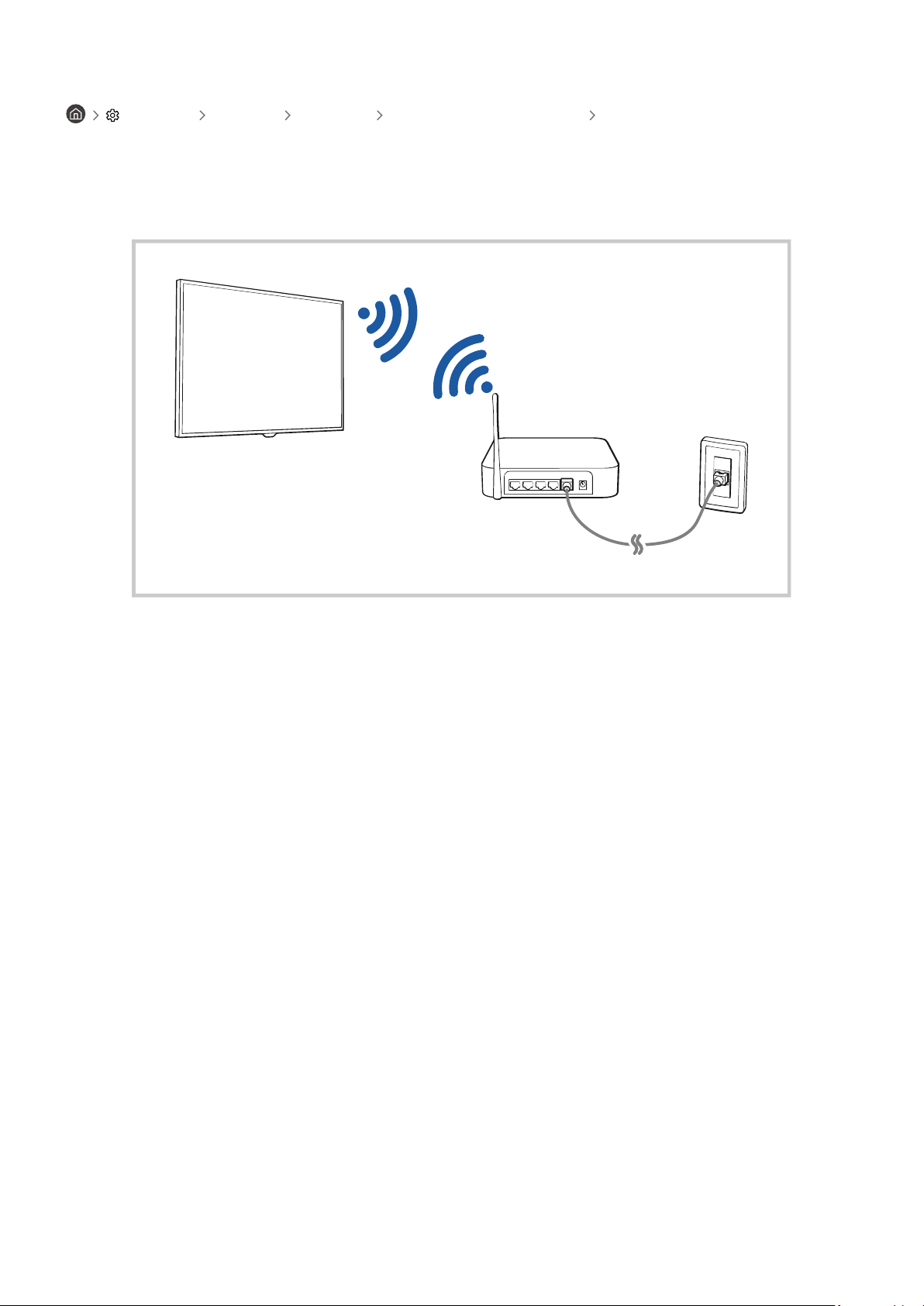
Establishing a wireless Internet connection
Settings General Network Open Network Settings Wireless
Make sure that you have the wireless access point's name (SSID) and password settings before attempting to
connect. The network name (SSID) and security key are available on the wireless access point's conguration
screen. See the wireless access point's user manual for more information.
- 9 -

Using Tap View
Tap your mobile device on the TV, you can watch the Multi View or mobile device's screen through the TV screen.
When you tap a mobile device on your TV while running a music app on your mobile device, the TV screen switches
to the Music Wall screen.
This function may not be supported depending on the model.
This function is available in Samsung mobile devices with Android 8.1 or higher.
Music Wall screen is a function that allows you to enjoy music along with visual video effects that change according to the
genre and beat of the music.
1.
Enable Tap View on your mobile device.
For more information about conguration, refer to 'Enabling Tap View'.
2.
Turn on the screen of your mobile device.
3.
Tap your mobile device on the TV. The TV screen switches to Multi View, Music Wall or mobile device's screen.
When you perform Tap View while in Ambient Mode or Art Mode, only the mobile device's screen appears on the TV.
4.
Watch the Multi View, Music Wall or mobile device's screen on the TV screen.
The displayed TV screen may differ depending on the model.
This function enables Screen/Sound Mirroring by detecting vibrations generated when you tap the mobile device on the TV.
Be sure to tap away from the TV screen and bezel corners. It may be scratched or broken to the TV or mobile device screen.
We recommend using your mobile device with the cover in place and lightly tap it on any external edge of the TV.
- 13 -

Enabling Tap View
Enable Tap View in the SmartThings app.
This function may not be supported depending on the model.
Depending on the SmartThings app version, you may need to register the TV with your mobile device.
1.
Launch the SmartThings app on your mobile device.
2.
Select Settings ( ) in SmartThings app on your mobile device.
3.
Set Tap View to on.
Upon connection for the rst time, select Allow on a pop-up window of the TV.
Mobile Screen Viewing in Multi View
When you start screen sharing with a mobile device (Smart View / Apple AirPlay / Tap View), the TV screen switches
to the Multi View or mobile device's screen. Watch multiple contents at the same time with the Multi View screen.
This function may not be supported depending on the model.
For more information, refer to "Using Multi View".
- 14 -

Connecting to a Network via a Mobile Dongle (For India Only)
Make network connection by connecting a mobile dongle to the TV.
You can make the TV to connect to a network via a mobile device by connecting a mobile dongle to the TV. Connect
the mobile dongle to the USB port that are marked as Dongle in the TV.
This function is not available on certain models in specic geographical areas.
When you use a large mobile dongle(Data Card), USB devices may not work properly due to interferences among the USB
ports, or the wireless network may not work properly due to interferences from the peripherals and surroundings. In this
case, use a USB extension cable to connect a large mobile dongle to a USB port.
When using the optical cable or 3G dongle, interference may occur due to the large size of the dongle.
Channel-Bound Apps is not available when you set up mobile network.
If you have any problems using online services, please contact your Internet service provider.
The mobile service providers and their devices that support this function are as follows:
• Airtel (Model No: E3276s LTE, E1731, E303C, E303U, E3131B, E3121B, E8221, E8231, E3276 LTE)
• Idea, Vodafone
- 15 -
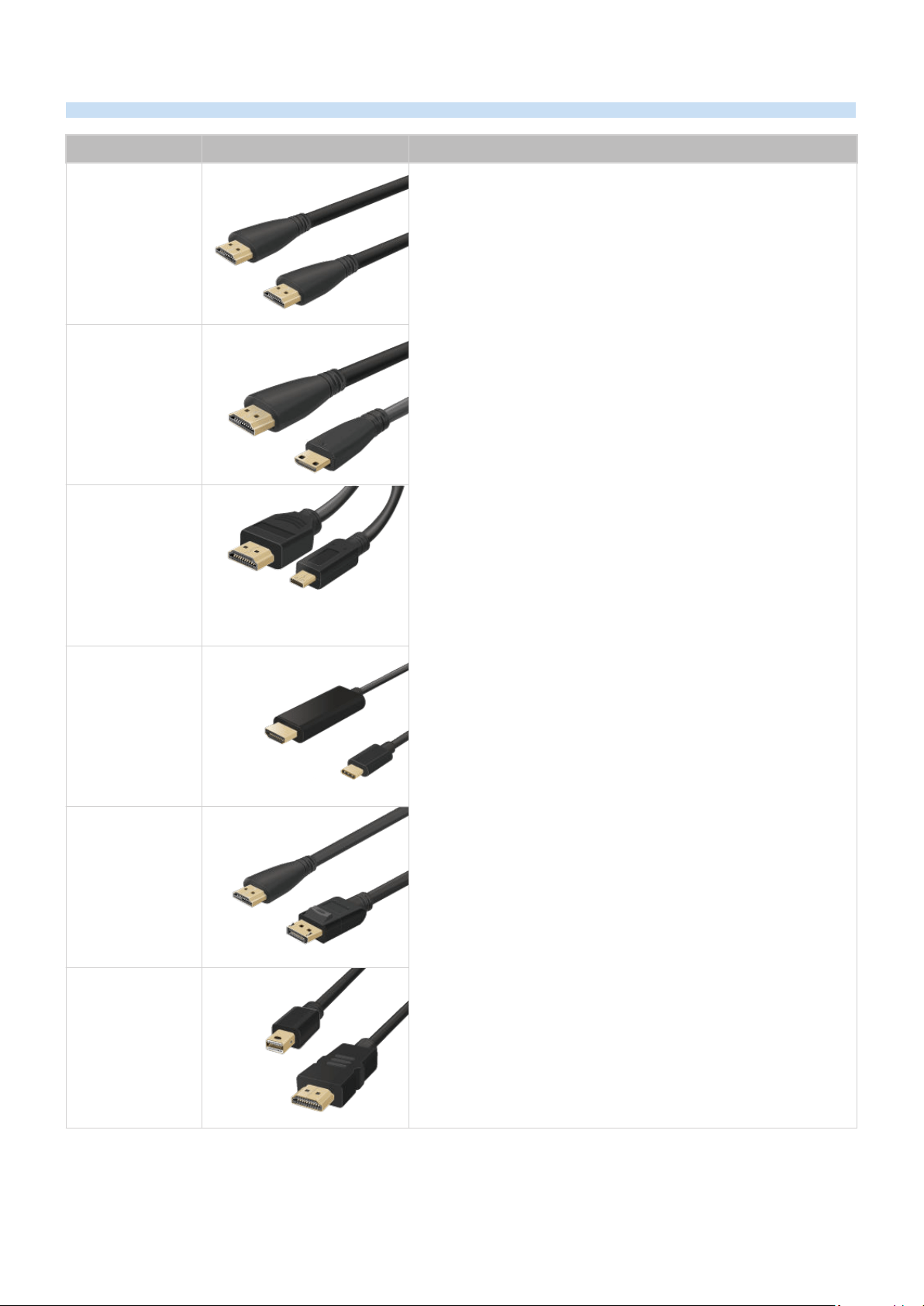
Connection Cables for External Devices
You can view detailed information about the connection cables for external devices that can be connected to the TV.
Cable name Image Description
HDMI
to
HDMI
Each cable simultaneously transmits digital video and audio signals
from an external device to the HDMI port on the TV.
Cables are divided into various types according to the types of input/
output ports on external devices.
HDMI
to
MINI HDMI
HDMI
to
Micro HDMI
HDMI
to
USB Type-C
HDMI
to
DisplayPort
Mini DisplayPort
to
HDMI
- 16 -
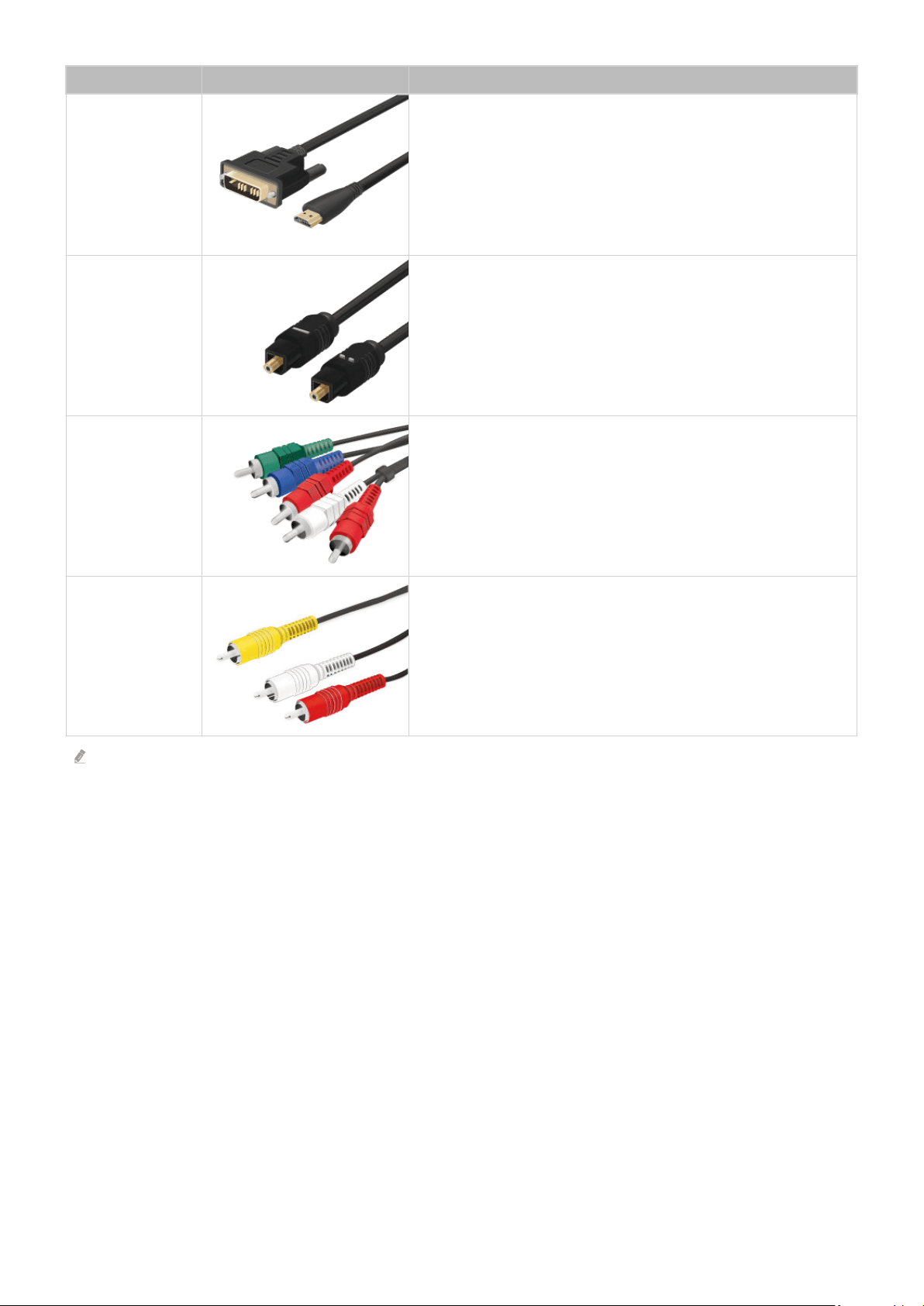
Cable name Image Description
DVI
to
HDMI
DVI to HDMI cables can transmit only digital video signals and not
audio signals. We recommend that you use HDMI to HDMI cables.
Optical
Optical cables are used to transmit audio signals to external
speakers with low signal loss.
Optical cables can't transmit video signals.
Component
Component cables transmit analogue signals.
The video signal is separated and transmitted to the red, green and
blue terminals to provide HD (1080i) pictures. The audio signal is
transmitted to the red and white terminals.
Composite
Composite cables transmit analogue signals.
The video signal is transmitted to the yellow terminal and the audio
signal is transmitted to the red and white terminals.
Available connection cables may differ depending on the model or geographical area.
- 17 -

ADB (Auto Data Backup) functions (For India Only)
This function may not be supported depending on the model or geographical area.
Your mobile device comes close to the TV, the ADB (Auto Data Backup) feature backs up your mobile data such
as images and videos into a pre-congured specic folder on a USB storage device or an external hard disk drive
connected to the TV. You can also transfer les from the ADB (Auto Data Backup) folder to a Samsung mobile
device over Wi-Fi Direct.
• Transferring data from a mobile device to the TV
Your mobile device comes close to the TV, images and videos are copied from your mobile device to a USB
storage device or an external hard disk drive connected to the TV.
• Transferring data from the TV to a mobile device
You can select and transfer files from the ADB (Auto Data Backup) folder on the TV to a Samsung mobile device.
How to Use ADB (Auto Data Backup)
1.ADB (Auto Data Backup) Registration
First, register the TV using the USB Backup app, and then select a USB storage device or an external hard disk drive
connected to the TV. The ADB (Auto Data Backup) folder is automatically created on the selected storage device.
Then, select folders from your mobile device's gallery, set the password to open the ADB (Auto Data Backup) folder
on the selected storage device connected to the TV.
2.Auto File Copy
When your mobile device comes close to the TV, data are automatically copied from the selected folders on your
mobile device to the selected storage device connected to the TV.
3.Share les back from the ADB folder to a mobile device
You can also share le back from ADB folder to Samsung Mobile, by rst connecting Samsung Mobile with TV over
Wi-Fi direct & then select the les to be transferred from TV, and press "Share" option to send les to connected
Mobile device.
- 18 -

Switching between external devices connected to the TV
You can switch between TV programmes and the content of external devices.
Source
When you select a connected external device on the Source screen, the output of the selected device is displayed on
the TV's screen.
On the Standard Remote Control, press the SOURCE button.
To control a device (Blu-ray player, game console, etc.) that supports universal remote control with the TV's remote control,
connect the device to an HDMI port on the TV, and then turn on the device. The output displayed on the TV is automatically
switched to the output of the device or you can congure universal remote control for the device automatically. For more
information, refer to "Controlling External Devices with a Samsung Remote Control - Using the Universal Remote".
When a USB device is connected to the USB port, a pop-up message appears that lets you switch easily to the media
content listed on the device.
This function may not be supported depending on the device and geographical area.
Editing the name and icon of an external device
Source
You can change the port name for a connected external device or add it to the Home Screen.
Sources
Universal Remote
Edit
Information
Add to Home
Source
The image on your TV may differ from the image above depending on the model and geographical area.
1.
Move the focus to a connected external device.
2.
Press the up directional button. The following functions become available.
Available functions may differ depending on the port type.
- 19 -

1.Universal Remote
You can control external devices connected to the TV using a Samsung remote control. To control external devices,
register them by following the instructions on the screen.
This function may not be supported depending on the model or geographical area.
For more information, refer to "Controlling External Devices with a Samsung Remote Control - Using the Universal
Remote".
2.Edit
You can rename the input ports and change the device icons.
3.Information
You can view detailed information about an external device.
4.Add to Home
You can add the port of an external device to the Home Screen for quick switching.
Using additional functions
You can use the following features on the Source screen.
• PC on TV
Use the TV to access your PC via remote PC or Screen Sharing (Wireless).
For more information, refer to "Using PC on TV".
• Connection Guide
Displays device connection instructions.
For more information about the Connection Guide, refer to "Connection Guide".
• Remote Key Guide
You can view how to use the remote control.
This function may not be supported depending on the model or geographical area.
• Universal Remote
Lets you register external devices to your Samsung remote control and control them using the Remote.
This function may not be supported depending on the model or geographical area.
For more information, refer to "Controlling External Devices with a Samsung Remote Control - Using the Universal
Remote".
- 20 -

Connection notes for mobile devices
• To use the Smart View function, the mobile device must support a mirroring function such as Screen Mirroring or
Smart View. To check whether your mobile device supports the mirroring function, refer to the mobile device's
user manual.
• The Screen Sharing (Smart View) feature may not operate smoothly in a 2.4 GHz environment. For better
experience, 5.0 GHz is recommended. 5 GHz may not be available depending on the model.
• To use Wi-Fi Direct, the mobile device must support the Wi-Fi Direct function. To check whether your mobile
device supports Wi-Fi Direct, refer to the mobile device's user manual.
• The mobile device and your Smart TV must be connected to each other on the same network.
• Use AirPlay if you are an iPhone or iPad user. For more information, refer to
Source Connection Guide
Smartphone Apple AirPlay.
This function may not be supported depending on the model.
• The video or audio may stop intermittently, depending on network conditions.
• When sharing content with other network-based devices such as those in an IP (Internet Protocol) storage
system, sharing may not be supported due to the network’s configuration, quality or functionality, for example, if
the network has an NAS (Network-Attached Storage) device.
- 23 -
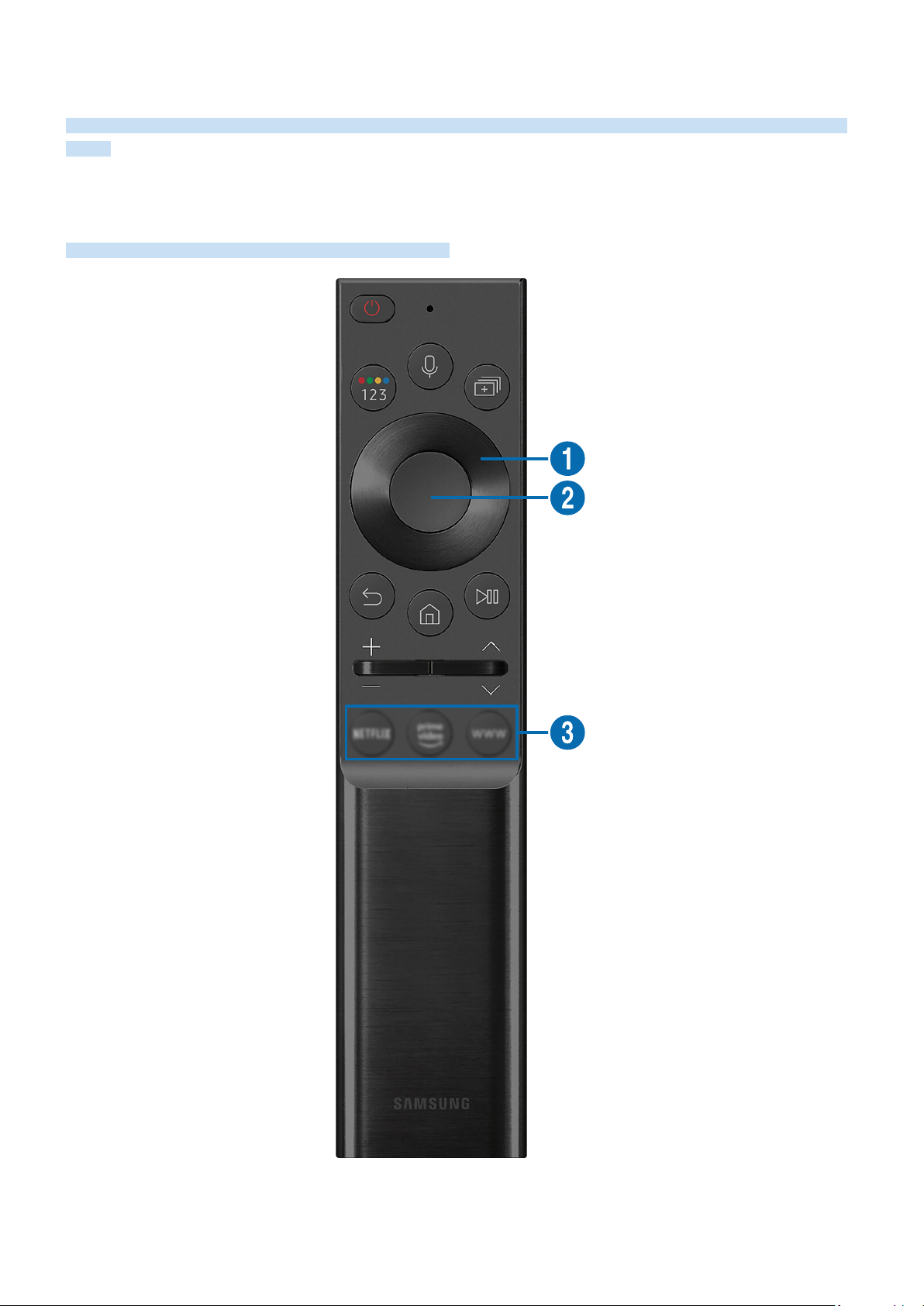
Remote Control and Peripherals
You can control TV operations with your Samsung Smart Remote. Pair external devices such as a keyboard for ease
of use.
About the Samsung Smart Remote (QLED TV/AU9 Series or higher/The
Frame)
Learn about the buttons on the Samsung Smart Remote.
- 24 -
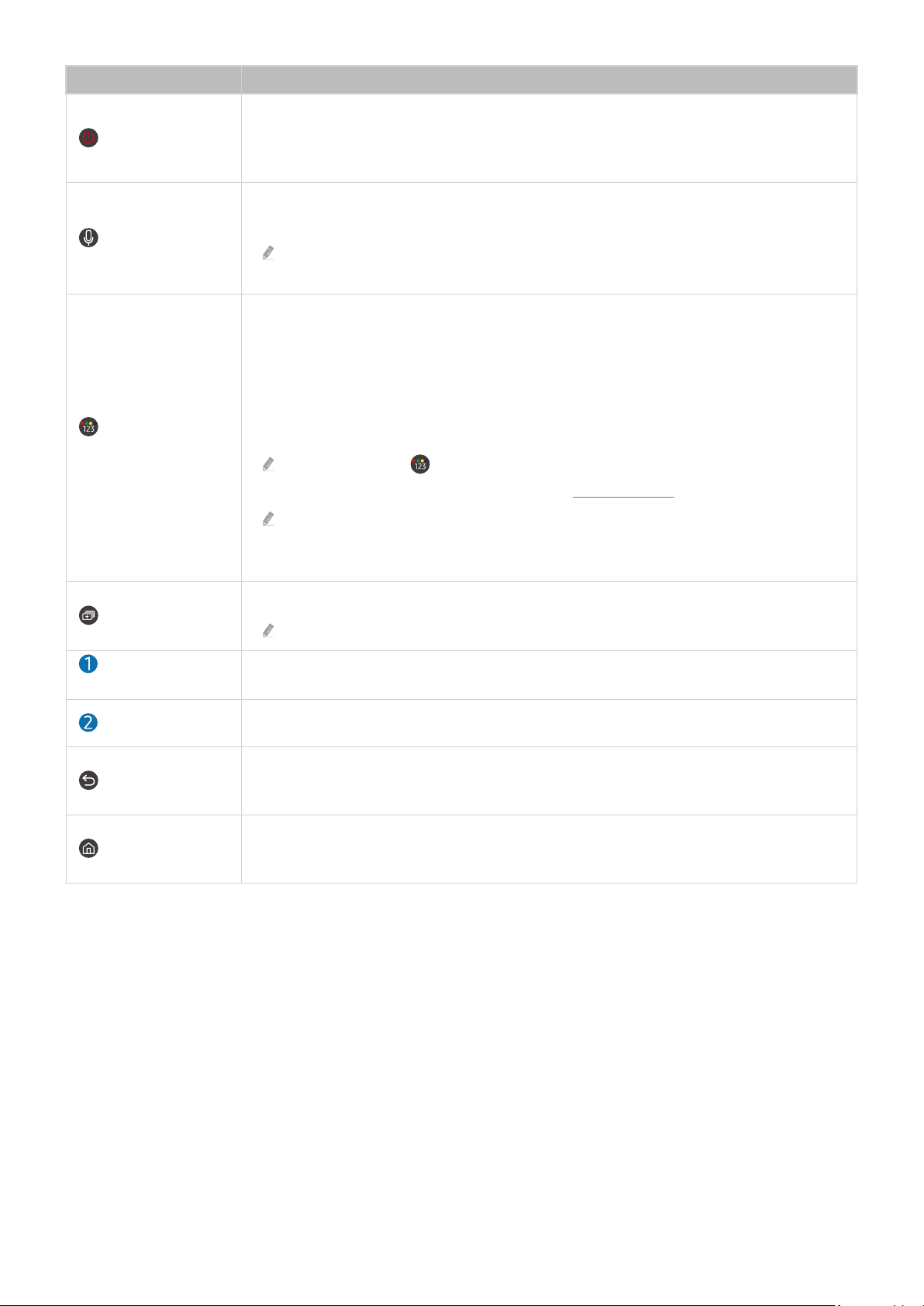
Button Description
(Power)
Press to turn the TV on or off.
For The Frame model, When watching TV, press to switch to Art mode. In Art mode, press to
switch to watching TV. Press and hold to turn off the TV completely.
(Voice Assistant)
Runs Voice Assistant. Press and hold the button, say a command, and then release the button to
run Voice Assistant.
The supported Voice Assistant's languages and features may differ by geographical
region.
(Colour / Number
button)
Each time you press this button, the coloured buttons window and the virtual numeric pad are
displayed alternately.
• Use this button to access additional options that are specific to the feature in use.
• Press to bring up the virtual numeric pad on the screen. Use the numeric keypad to enter
numeric values. Select numbers and then select Done to enter a numeric value. Use to
change the channel, enter a PIN, ZIP code and etc.
When you press the button, and then select TTX/MIX from the pop-up list, the TTX
menu appears. For more information, refer to "Teletext Feature".
If the Colour Button appears with a number strip on the screen, select the Colour Button
and then select a specic colour by using the directional button (up/down/left/right). Use
this to access additional options that are specic to the feature in use.
(Multi View)
Press the button to directly enter the Multi View function.
This function may not be supported depending on the model or geographical area.
Directional button
(up/down/left/right)
Moves the focus.
Select
Selects or runs a focused item. When pressed while you are watching a broadcast programme,
detailed programme information appears.
(Return)
Press to return to the previous menu. When pressed for 1 second or more, the running function
is terminated. When pressed while you are watching a programme, the previous channel
appears.
(Smart Hub)
Press to return to the Home Screen.
For The Frame model, Press in Art mode to switch to TV mode.
- 25 -

Button Description
(Power)
Press to turn the TV on or off.
(Voice Assistant)
Runs Voice Assistant. Press and hold the button, say a command, and then release the button to
run Voice Assistant.
The supported Voice Assistant's languages and features may differ by geographical
region.
(Number button)
Press to bring up the virtual numeric pad on the screen. Use the numeric keypad to enter
numeric values.
Select numbers and then select Done to enter a numeric value. Use to change the channel,
enter a PIN, ZIP code and etc.
When you press the button, and then select TTX/MIX from the pop-up list, the TTX
menu appears. For more information, refer to "Teletext Feature".
(Colour button)
When pressed, coloured buttons appear on the screen. Use this button to access additional
options that are specic to the feature in use.
Directional button
(up/down/left/right)
Moves the focus.
Select
Selects or runs a focused item. When pressed while you are watching a broadcast programme,
detailed programme information appears.
(Return)
Press to return to the previous menu. When pressed for 1 second or more, the running function
is terminated. When pressed while you are watching a programme, the previous channel
appears.
(Smart Hub)
Press to return to the Home Screen.
- 28 -
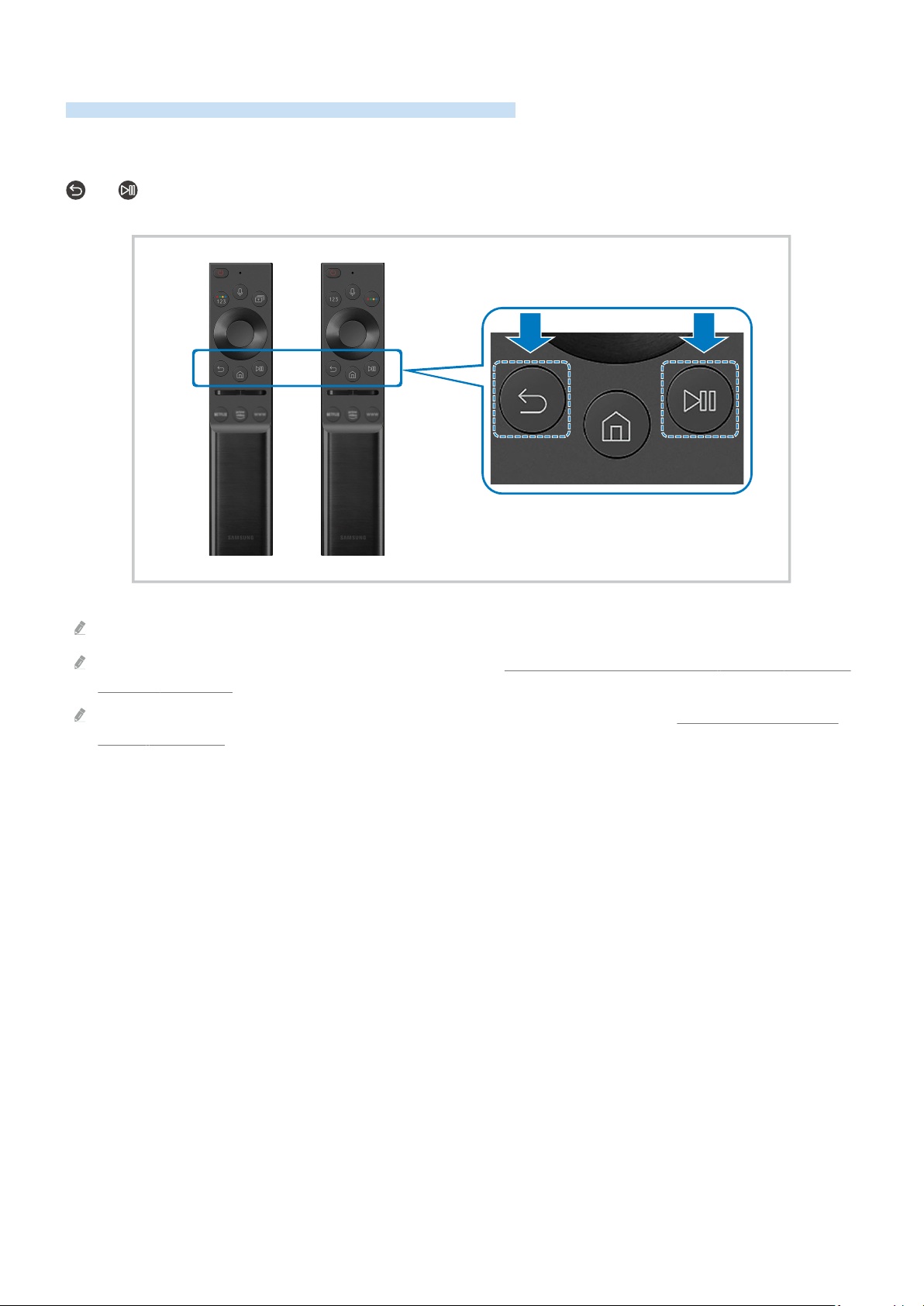
Connecting the Samsung Smart Remote to the TV
Connect the Samsung Smart Remote to your TV to operate the TV.
When you turn on the TV for the rst time, the Samsung Smart Remote pairs to the TV automatically. If the
Samsung Smart Remote does not pair to the TV automatically, point it at the front of the TV, then press and hold the
and buttons simultaneously for 3 seconds or more.
The images, buttons and functions of the Samsung Smart Remote may differ with the model or geographical area.
For more information about the Samsung Smart Remote, refer to "About the Samsung Smart Remote (QLED TV/AU9 Series
or higher/The Frame) ".
For more information about the Samsung Smart Remote that comes with AU8 Series, refer to "About the Samsung Smart
Remote (AU8 Series)".
- 30 -

Using Anynet+ (HDMI-CEC)
Control an external device connected via Anynet+ (HDMI-CEC) with the remote control.
You can use the TV's remote control to control external devices that are connected to the TV by an HDMI cable and
that support Anynet+ (HDMI-CEC). Note that you can only set up and operate Anynet+ (HDMI-CEC) with the remote
control.
Connecting an external device through Anynet+ and using their menus
Settings General External Device Manager Anynet+ (HDMI-CEC) Try Now
1.
Set Anynet+ (HDMI-CEC) to On.
2.
Connect an HDMI-CEC-compliant device to the TV.
3.
Turn on the connected external device.
The device is automatically connected to the TV. After the connection process is nished, you can access the menu
of the connected device using your TV remote and control the device.
The connecting process can take up to 2 minutes to complete.
Read before connecting an Anynet+ (HDMI-CEC) device
Anynet+ (HDMI-CEC)-enabled devices must be connected to the TV with an HDMI cable. Note that some HDMI cables may
not support Anynet+ (HDMI-CEC).
You can congure the TV's Universal Remote to control third-party cable boxes, Blu-ray players and home theatres that
do not support HDMI-CEC. For more information, refer to "Controlling External Devices with a Samsung Remote Control -
Using the Universal Remote".
Anynet+ cannot be used to control external devices that do not support HDMI-CEC.
The TV remote control may not work under certain circumstances. If this occurs, set up the device as an Anynet+ (HDMI-
CEC)-enabled device again.
Anynet+ (HDMI-CEC) works only with external devices that support HDMI-CEC and when those devices are either in standby
mode or turned on.
Anynet+ (HDMI-CEC) can control up to 12 compliant external devices (up to 3 of the same type) except for home theatres.
Anynet+ (HDMI-CEC) can control only one home theatre system.
To listen to 5.1 channel audio from an external device, connect the device to the TV via an HDMI cable and connect a 5.1
home theatre system directly to the external device's digital audio output connector.
If an external device has been set up for both Anynet+ and a universal remote control, the device can be controlled only
with the universal remote control.
- 32 -
Setting up the input devices
Settings General External Device Manager Input Device Manager
• Keyboard Settings
You can set up the keyboard with the Keyboard Language and Keyboard type functions.
• Mouse Settings
You can set up the mouse with the Primary Button and Pointer Speed functions.
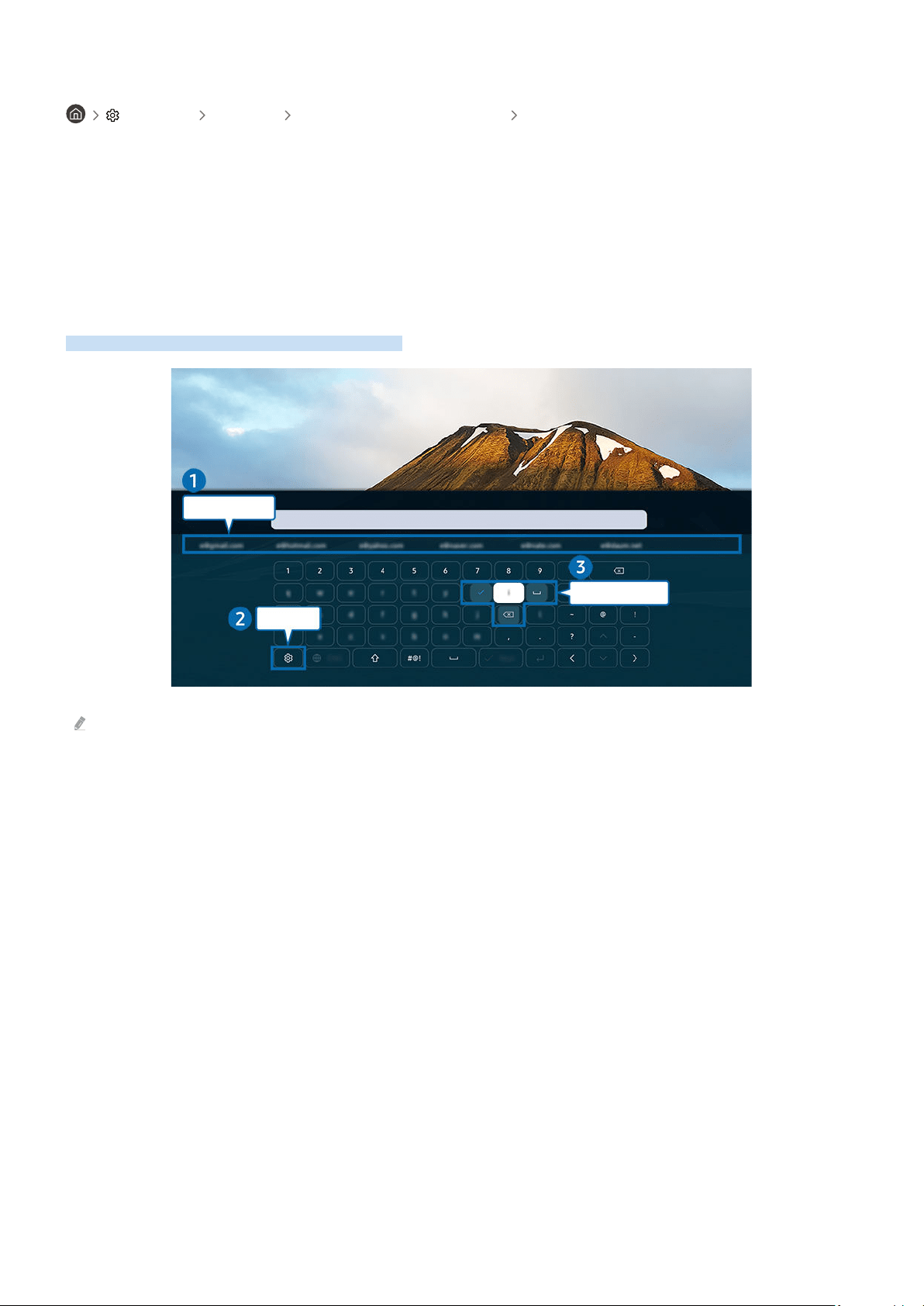
Entering Text using the On-Screen Virtual Keyboard
Use the virtual keyboard to enter text on your TV.
Recommend text
Options
Editing Buttons
The image on your TV may differ from the image above depending on the model and geographical area.
1.Recommend text
When you type a word you want to use as a search term, this function displays related suggestions from which you
can choose one.
- 35 -

2.Options
Select on the virtual keyboard screen. The following options are available:
The options available may differ depending on the function running currently.
• Recommend text
• Reset Recommended Text Memory
• Show Editing Buttons
• Language
3.Editing Buttons
By selecting any of pop-up Editing Buttons after entering characters on the virtual keyboard, you can quickly
perform the editing function.
Entering Text using the remote control's microphone and the on-screen virtual keyboard
When the virtual keyboard is on the screen, press and hold the button on the Samsung Smart Remote, speak into
the microphone on the Samsung Smart Remote, and then release the button. What you say appears on the screen as
text.
Entering text with your voice may not be supported for some functions.
This function may not be supported depending on the model or geographical area.
The Samsung Smart Remote may not be supported depending on the model or geographical area.
- 36 -

Smart Features
You can enjoy various apps with Smart Hub.
Using Smart Hub
View descriptions of Smart Hub's basic functions.
From Smart Hub, you can use the Internet search function, install and use various apps, view photos and videos or
listen to music stored on external storage devices, and perform more functions.
Some Smart Hub services are paid services.
To use Smart Hub, the TV must be connected to the Internet.
Some Smart Hub features may not be supported depending on the service provider, language or geographical area.
Smart Hub service outages can be caused by disruptions in your Internet service.
To use Smart Hub, you must agree to the Smart Hub service agreement and the collection and use of personal information.
Without giving consent, you cannot use the additional features and services. You can view the entire text of the Terms &
Privacy by navigating to Settings Terms & Privacy. Try Now
If you want to stop using Smart Hub, you can cancel the agreement. To cancel the Smart Hub service agreement, select
Reset Smart Hub ( Settings Support Device Care Self Diagnosis Reset Smart Hub).
- 37 -

• Sound Mode
You can select a sound mode to optimise your listening experience. To change the sound mode, press the Select
button. To make ne adjustments, press the up directional button, and then select Equaliser Setup.
• Sound Output
You can select which speakers the TV uses for audio output. To change the audio output, press the Select
button. To connect to a Bluetooth speaker, press the up directional button, and then select Bluetooth Speaker
List.
Connecting Bluetooth speaker may not be supported depending on the model or geographical area.
• Game Mode
You can set the Game Mode to optimise the TV screen for better gaming performance. To turn Game Mode on
or off, press the Select button. To set the detailed options, press the up directional button, and then select Go
to Game Mode Settings.
For more information about Game Mode, refer to "Setting the Viewing Environment for External Devices".
This function is only available when an external input source is being used.
• Subtitle
You can watch TV broadcasts with subtitles. To activate/deactivate the Subtitle function, press the Select
button. To run Accessibility Shortcuts, press the up directional button, and then select Accessibility Shortcuts.
• Audio Language
You can change to the audio language you want to hear. To make ne adjustments, press the up directional
button, and then select Go to Audio Options.
• Sleep Timer
You can turn off the TV automatically at a specic time.
To set the sleep time to up to 180 minutes, press the Select button. To make detail off timer, press the up
directional button, and then select Set Up Off Timer.
• Network
You can view the current network and Internet status. Press the up directional button, and then select Network
Status or Network Settings.
• Picture Size
You can change to the picture size you want to view. To make ne adjustments, press the up directional button,
and then select Go to Picture Size.
• Colour Tone
You can select a colour tone suitable for your viewing preferences. To change to a colour tone that you want,
press the Select button.
- 39 -

• Picture Clarity
You can optimise pictures that contain a lot of motions. To turn this function on or off, press the Select button.
To set the detailed options, press the up directional button, and then select Picture Clarity Settings.
• Contrast Enhancer
You can prevent excessive differences between bright and dark areas on the TV screen. To change the Contrast
Enhancer setting, press the Select button.
• Digital Output Audio Format
You can select an output format for digital audio. Note that the Dolby Digital+ option is only available via HDMI
(eARC) for external devices that support the Dolby Digital+ format.
• Colour Space
You can set the spectrum of colours on the TV screen. To change to a colour space that you want, press
the Select button. To set the detailed options, press the up directional button, and then select Colour Space
Settings.
• Device Care
You can run Device Care to diagnose and optimise your TV. Device Care can also check and optimise the TV's
storage. If any trouble found, it needs for technical support.
• On Timer
You can set On Timer to turn on the TV automatically at a specic time. On Timer is only available if the Clock
has been set.
This function may not be supported depending on the model or geographical area.
• Off Timer
You can set Off Timer to shut off the TV automatically at a specic time. Off Timer is only available if the Clock
has been set.
This function may not be supported depending on the model or geographical area.
• All Settings
Display the Settings menu.
These functions may not be supported depending on the model or geographical area.
2. Source
You can select an external device connected to the TV.
For more information, refer to "Switching between external devices connected to the TV".
- 40 -

8. Home
This menu appears rst when you press the button. Then you can quickly use any of Samsung Account,
Notication or Privacy Choices.
The available features may differ depending on the model or geographical area.
• Samsung Account
Go to the Samsung Account screen to create a new account or sign out of your account.
For more information about the Samsung Account, refer to "Using a Samsung account".
• Notication
You can view a list of notications for all events that occur on your TV. A notication appears on the screen
when it is time to schedule viewing, schedule recording or when an event occurs on a registered device.
If you move the focus to Notication, and then press the Select button, a notication window appears on the
right and the following functions are available:
–
Delete All
You can delete all your notifications.
– Settings
You can select services you want to be notified about.
When you select Allow sound, notifications are displayed with a notification sound.
• Privacy Choices
You can view and set the privacy policy for Smart Hub and various other services.
9.Universal Guide
Universal Guide is an app that allows you to search for and enjoy various contents such as TV shows, dramas and
movies in one place. Universal Guide can recommend content tailored to your preferences.
You can use this feature on your mobile device with the Samsung SmartThings app.
To access Universal Guide, press the down directional button on the remote control in Home Screen.
To enjoy the content from these apps on your TV, they must be installed on the TV.
When you watch some paid content, you may need to make a payment using their associated app.
Some content may be restricted depending on your network conditions and your subscriptions to paid channels.
Parental control is necessary when children use this service.
Images may look blurry depending on the service provider's circumstances.
This function may not be supported depending on the model or geographical area.
- 42 -
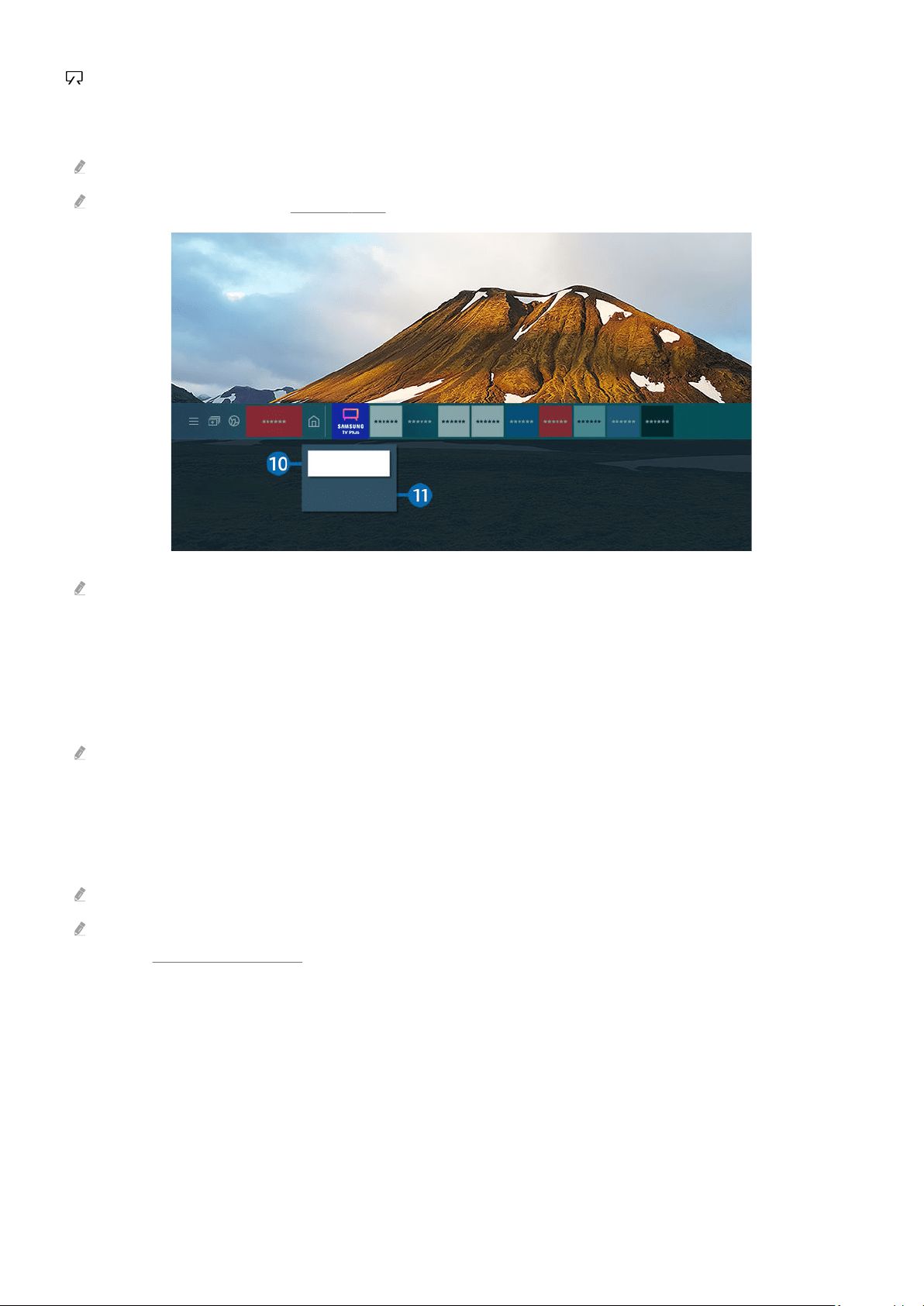
. Art
When you are not watching TV or when the TV is turned off, you can use the Art mode function to edit image
content, such as artworks, photos, or to display the content.
This function is supported only in The Frame.
For more information, refer to "Using Art Mode".
Move
Remove
The image on your TV may differ from the image above depending on the model and geographical area.
0.Moving an item on the Home Screen
Move the focus to the app you want to move, press and hold the Select button on the remote control, and then
select Move in option menu. Move the app to the desired position by pressing the left or right directional button,
and then press the Select button. The selected app is moved on the Home screen.
In the region that does not support the Universal Guide, press the down directional button on the remote control.
!.Removing an item on the Home Screen
Move the focus to the app you want to delete, press and hold the Select button on the remote control, and then
select Remove in option menu. The selected app is deleted.
In the region that does not support the Universal Guide, press the down directional button on the remote control.
You can add the apps you want to use often to the Home Screen using Apps. To add your favourite apps to the Home Screen,
refer to "Managing installed apps".
- 43 -

Automatic casting in Multi View
Settings General Smart Features Autorun Multi View Casting
When you cast content on your mobile device by using YouTube, it automatically appears in Multi View. You can
turn on or off the function by pressing the Select button.
It is available on the screen for any broadcast, external device, or app that supports Multi View.
This function may not be supported depending on the model.
Testing Smart Hub connections
Settings Support Device Care Self Diagnosis Smart Hub Connection Test Try Now
Resetting Smart Hub
Settings Support Device Care Self Diagnosis Reset Smart Hub Try Now
You can reset the Smart Hub settings. To reset Smart Hub, enter the PIN. The default PIN is "0000". You can set the PIN in
Settings General System Manager Change PIN.
Change PIN may not be supported depending on the model or geographical area.
- 45 -

Using a Samsung account
Create and manage your own Samsung account.
Settings General System Manager Samsung Account Try Now
You can view the entire text of the Terms & Policy in Settings General System Manager Samsung Account
My Account Terms & Conditions, Privacy Policy after logging in to your Samsung account.
Follow the instructions on your TV screen to create or log in to a Samsung Account.
Samsung Account can be used on TV, mobile device and website with one ID.
Signing in to a Samsung account
Settings General System Manager Samsung Account Sign In
Creating a new account
Settings General System Manager Samsung Account Create Account
Managing your Samsung account
Settings General System Manager Samsung Account My Account
When you sign in to your Samsung account, you can use the following functions:
• Sign out
When multiple people share the TV, you can sign out of your account to prevent others from using it.
To sign out of your Samsung Account ( Settings General System Manager Samsung Account), move
the focus to your account's icon, and then press the Select button. When a pop-up window appears, select Sign out.
• Edit profile
You can edit your account information.
To protect personal information, enter Edit profile and then Sign-in Method is set to Enter password when ID is selected
(high security).
If you want the TV to log you into your account automatically whenever you turn on the TV, click Stay Signed In.
When the TV is used by multiple people, turn off Stay Signed In to protect personal information.
- 46 -

• Payment Info
You can view or manage your payment information.
• Back up
You can back up the TV settings to your Cloud storage. When resetting or replacing the TV, you can also restore
its settings with the backed-up settings.
• TV Registration
You can register the current TV or see the registered information. You can easily receive services after product
registration.
You can see the registered information or delete it at the Samsung account website (http://account.samsung.com).
• Sync Internet
Once you sign in to your Samsung account and configure the Sync Internet settings, you can share the favourites
and website bookmarks that you registered on other devices.
• Remove Account
You can delete an account from the TV. Although you have deleted your Samsung account from the TV, you are
not unsubscribed.
To unsubscribe from your Samsung Account, visit the Samsung Accounts website (http://account.samsung.com).
• Terms & Conditions, Privacy Policy
You can view the user agreement and privacy policy.
For more information about the terms and conditions, privacy policy, select View Details.
- 47 -

Using Ambient Mode
Learn about the functions available in Ambient Mode.
Ambient Mode
You can enhance your living space with decorative content that matches the surroundings or view essential
real-time informations such as weather, time and news on the TV screen when you are not watching TV.
This function may not be supported depending on the model.
In Ambient Mode, some functions may not be supported.
Ambient Mode browser screen
Featured
Routine
Special Edition
Mood
Relaxation
Décor
My Album
Info
Artwork
The image on your TV may differ from the image above depending on the model and geographical area.
When you press the button in Ambient Mode, the Ambient Mode browser screen appears at the bottom of the
screen. In the Ambient Mode browser screen, you can select content and change the Ambient Mode settings.
- 48 -

3. TV
You can enter the TV viewing screen.
4.Selecting a content category
You can select your preferred content and background for the Ambient Mode screen.
This function may not be supported depending on the model.
You can use the SmartThings app on your mobile device to select the desired content and then change the settings.
Available content categories may differ depending on the model or geographical area.
• Routine
Enjoy a range of routines, each displaying content to suit each part of your day or create your very own routines
via the SmartThings app.
• Q Collection
Provides content that is dedicated to Samsung QLED.
• Special Edition
Allows you to enjoy creative artwork and interior design content created by the world's nest artists and
designers.
• Mood
Enjoy a range of options to create the right ambience to suit your mood.
• Relaxation
Relax with a selection of calming content inspired by nature to soothe your mood.
• Décor
Allows you to select content with a sensible and beautiful design.
- 50 -

Applying effects to the content
When you are enjoying content in Ambient Mode, press the down directional button to change the following
settings for the content:
Available functions may not be supported depending on the model or content.
• Weather Filter
You can add a weather effect to content.
• Time Filter
You can select any background time format for content.
• Photo Filter
You can select a photo effect for content.
• Colour & Theme
Changes the colour or theme of the content.
• Vibes
Selects a mood that matches the content.
• Backgrounds
Changes the background of the content.
You can use the SmartThings app on your mobile device to take a picture of a wall and create a custom background.
For more information, select the How-To icon. This function may be a delay in image transmission and optimisation
depending on network conditions.
• Shadow Effects
Applies a shadow effect that you select to the content.
Viewing detailed information about the content
When you are enjoying content in Ambient Mode, press the up directional button to view detailed information about
the content.
Entering the TV viewing screen from Ambient Mode
To enter the TV viewing screen from Ambient Mode, press the
button or select TV in the Ambient Mode
browser screen.
If you press the button when the TV is turned off, the TV viewing screen appears.
- 52 -

Viewing images
Recent
Art Store
Recent
My Collection
Search
The image on your TV may differ from the image above depending on the model and geographical area.
To view an image in Art mode, select one of the menus below. To switch to the sub menu where you can select
images, press the Select button, one of the four directional buttons, or button in Art mode. Then, use the
directional buttons on the remote control to move to desired image, and then press the Select button. Set
appears at the bottom of the selected image, and you can view the selected image in Art mode.
While viewing images in Art Mode, you can nd the detailed information about the images by pressing the down directional
button on the remote control.
• Art Store
You can go to Art Store to purchase various images.
The Art Store may not appear depending on the network connection status.
To purchase or appreciate images, first log in with your Samsung Account.
• Recent
You can manipulate the last selected images.
• My Collection
You can view a list of artworks and photos that you set as Favourite in Favourites. You can also select the
desired ones among the images saved on an external storage device or a mobile device and save them in My
Photos.
Using the SmartThings app, you can save photos on your mobile device.
• Search
You can conveniently find the artworks by searching the artist, artwork name and etc.
This function only allows you to search terms in English.
• News & Events
You can find the informations about the recent news or events.
- 54 -

Viewing images by time
1.
Use the directional buttons on the remote control to move to My Collection.
2.
Use the directional buttons to move to Favourites or My Photos.
To view the images on the mobile device connected via the USB or SmartThings app, select the desired
images on the connected device and then save them into My Photos.
3.
Use the directional buttons on the remote control select the Start Slideshow or Start Slideshow (Random).
4.
Use the directional buttons on the remote control to select the time interval at which images are to be
switched, and then press the Select button.
Import images from an external storage device
1.
Connect an external storage device that contains images to the TV.
2.
Use the directional buttons on the remote control to move to My Collection, and then move to the connected
external storage device.
3.
Use the directional buttons on the remote control to move to an image, and then press the Select button.
You can select multiple images.
4.
Use the directional buttons on the remote control to move to Save to My Photos at the bottom of the screen,
and then press the Select button.
5.
The selected image or images are saved in My Photos.
Recommended resolutions: 3840 x 2160 (16:9)
- 55 -

Setting the style of the selected image
Mount
Details
Favourite
The image on your TV may differ from the image above depending on the model and geographical area.
Use the directional buttons on the remote control to move to an image you want. You can use the following menus:
• Details
You can find more information about the image.
• Photo Filter
You can apply the selected filter's effect to the image according to your preferences.
This function is only available for saved images on My Photos.
• Mount
You can apply various border styles and colours to the image according to your preferences.
• Favourite
You can set (or not set) an image that you prefer as a favourite item by pressing the Select button on the remote
control. You can view a list of items set as your favourites in My Collection Favourites.
– Favourite: Not set as a favourite.
–
Favourite: Set as a favourite.
- 57 -

Apply a border style and a colour to an image
1.
Using the directional buttons on the remote control to move to the image whose border style and colour you
want to change, move to Mount at the bottom of the screen, and then press the Select button.
Depending on whether the image ratio is 16:9 or not, the border styles may differ.
2.
Use the directional buttons on the remote control to select the border style and colour that you want.
3.
Change the border style and colour, and then press the Select button to move the focus to the image.
If you want to change only either the border style or the colour, change it, and then press the Select button to save the
changes.
4.
To save the selected border style and colour, press the Select button again.
If you press the button to exit, the border style and colour you changed are not saved.
Setting up Art mode
In Art mode, use the directional buttons on the remote control to move to the Settings menu item at the bottom of
the screen. You can adjust the following functions:
• Brightness
Use the directional buttons on the remote control to move to Modify at the bottom of the screen, and then press
the Select button. In the next screen, adjust the picture brightness. After selecting the desired settings, press the
Select button on the remote control.
• Colour Tone
Use the directional buttons on the remote control to move to Modify at the bottom of the screen, and then press
the Select button. In the next screen, adjust the colour of your displayed artwork. After selecting the desired
settings, press the Select button on the remote control.
• Sleep After
If no motion is detected around the TV for the set time, the TV turns off automatically. Use the directional
buttons on the remote control to move to the bottom items. After selecting the desired time, press the Select
button on the remote control.
Sleep After may not be supported depending on the model or geographical area.
- 58 -

• Motion Detector
The sensitivity of the motion detector function can be adjusted. Use the directional buttons on the remote
control to move to the bottom items. After selecting the desired sensitivity, press the Select button on the
remote control.
Motion Detector may not be supported depending on the model or geographical area.
• Night Mode
When this function is turned on, the TV turns off automatically if no light is detected around the TV. Use the
directional buttons on the remote control to move to the bottom items, and then turn this function on or off.
Using Art mode with the SmartThings app
Once you have installed the SmartThings app on your mobile device, you can use the following functions:
You can download the SmartThings app from Google Play Store, Samsung Apps, or the App Store.
The features or terminology may vary depending on the version of the SmartThings app.
On tablet devices, Art mode features may not be supported by the SmartThings app.
• Selecting images.
• Subscribing to Art Store Membership.
• Creating Collage: Combine multiple images into one image.
• Applying border styles and colours to images.
• Setting the brightness for Art mode.
• Setting Sleep After: When no motion is detected for the time specified in Art mode, the TV turns off
automatically.
Sleep After may not be supported depending on the model or geographical area.
• Setting Motion Detector Sensitivity: Set the sensor sensitivity so that the TV turns on automatically when
motion is detected in Art mode.
Motion Detector Sensitivity may not be supported depending on the model or geographical area.
• Setting Night Mode: Set The Frame to turn off automatically if no light is detected in the room.
- 59 -

Using PC on TV
Use the TV to access your PC via Screen Sharing (Windows PC), AirPlay (Mac), Remote PC or Easy Connection to
Screen.
Source PC on TV Windows PC
Source PC on TV Mac
You can use the TV to access your PC via Screen Sharing (Windows PC), AirPlay (Mac), Remote PC or Easy Connection
to Screen.
For smooth use as in a computer, connect a keyboard and a mouse to your TV in advance.
Using Screen Sharing (Windows PC) / AirPlay (Mac)
Follow the instructions on the screen to adjust the PC settings and wirelessly connect the TV to the PC.
This function is only available for PCs that support wireless screen sharing.
• Connection via Windows OS is available in Windows 10.
• Connection via Mac OS is available in AirPlay.
Using Easy Connection to Screen
You can easily use remote access function after installing Easy Connection to Screen on your PC.
Follow the instructions on the screen to download and install the Easy Connection to Screen PC app. Then you can
easily connect a remote PC.
1.
Download the Easy Connection to Screen PC app from smsng.co/PConTV and then install it on your PC.
2.
Log in with the same Samsung Account for both TV and PC.
3.
When the PC is turned on and connected via the network, PC on TV's Home screen displays the PC.
The Easy Connection to Screen PC app is available in Windows 10.
Depending on the network environment including the rewall conguration, router type, and wireless signal strength,
connection problems may occur, such as low speed, disconnection, or limited connection.
- 61 -

2.
Enter the required settings for connecting the computer remotely.
Manage User Proles
PC/Prole
IP address or prole
Username
Enter a username.
Password
Enter a password.
Remember my credentials and add to the TV Home screen. You can connect
directly from the Home screen via shortcuts.
Help
Connect
Cancel
The image on your TV may differ from the image above depending on the model and geographical area.
1.PC/Prole
Enter the IP address or prole of the PC you want to connect to.
• In case of Windows, when the computer to connect is within the same network (router/AP), run “cmd" command
in Settings Network and Internet View Network properties or in Start Run, and then run “ipconfig” to
check the IPv4 address of the computer.
• In case of Mac, you can check the IP address in Settings
Remote Access.
• When the TV and computer are not within the same network, it is required to know the public IP and configure
the router and AP. Check whether the router connected to the computer supports port forwarding. When the
company provides additional security features such as firewall, seek help from a security officer.
Home
Ofce
- 63 -

Using Samsung DeX
Samsung DeX can be connected from the TV via wireless network.
Some models may not be searched when connecting the TV from a mobile device through Samsung DeX. In this
case, access the Dex Guide on the screen in which you can perform connection by following the screen instructions.
This function is available only on mobile devices that support the wireless Samsung DeX.
Using Microsoft 365
You can read or create a document after accessing the Microsoft 365 website.
Run the browser in full screen mode.
URL modication is impossible in the Microsoft 365 page.
Adding the Cloud Service
Select the Add Cloud Service icon. Use the bookmarking function of the browser, you can add or delete the cloud
service link to or from PC on TV.
To add the cloud service, you must be signed in to your Samsung account.
The number of cloud services that can be added to PC on TV is limited.
- 65 -

Installing an app
1.
Move to the app you want to install, and then press the Select button. The detailed information screen appears.
2.
Select Install. When the installation is complete, the Open menu appears.
3.
Select Open to run the app immediately.
You can view installed apps on the Settings screen.
If the TV's internal memory is insufcient, you can install some specic apps on a USB device.
You can run an app installed on a USB device only when the USB device is connected to the TV. If the USB device is
disconnected while an app is running, the app is terminated.
You cannot run an app installed on a USB device on a PC or another TV.
Launching an app
You can run the app desired from Downloaded App.
The icons below appear within the selected app's icon and indicate the following:
– : The app is installed on a USB device.
– : The app has a password.
–
: The app needs to be updated.
– : The app supports the mirroring function.
- 68 -
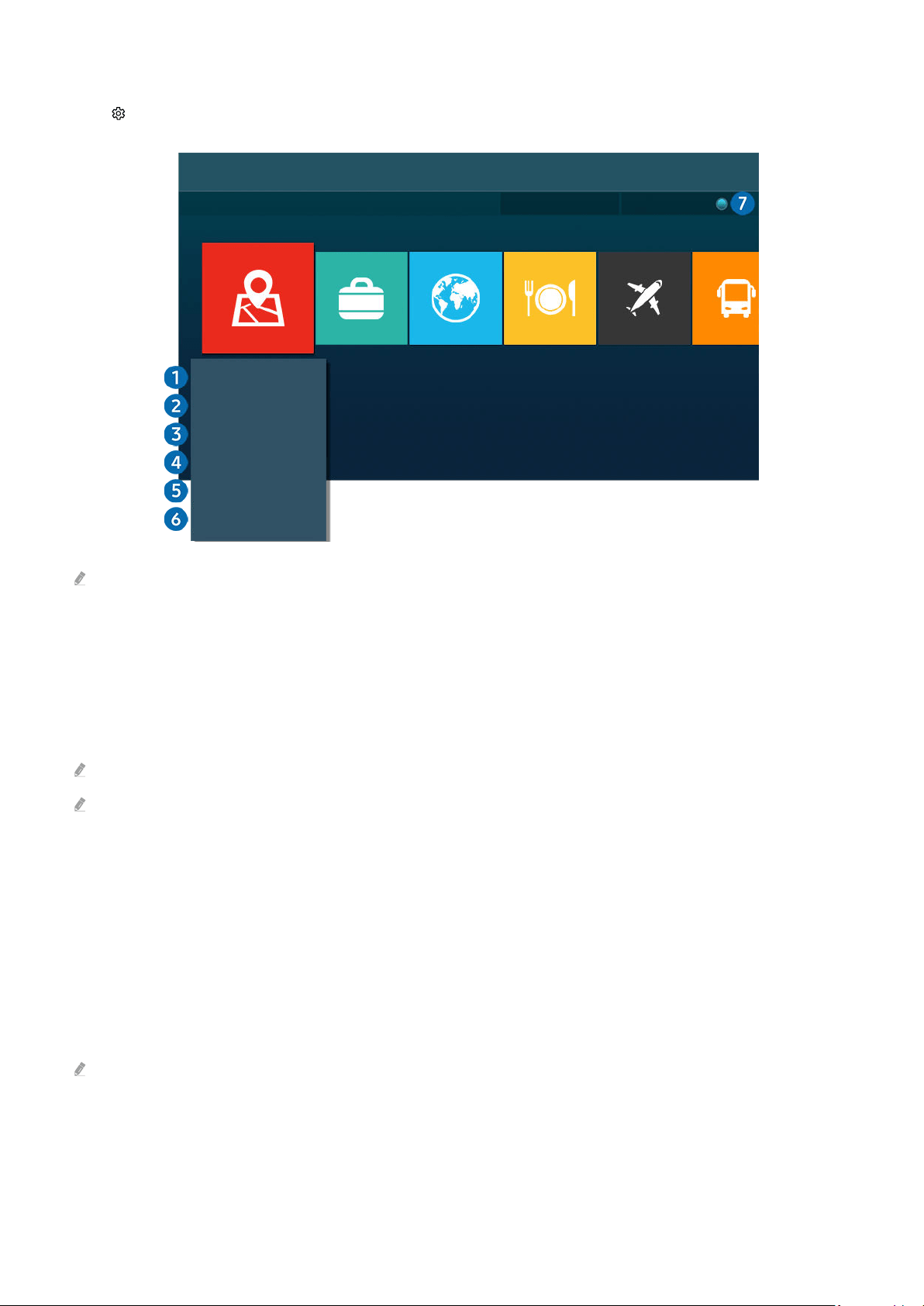
Managing installed apps
Select Settings on Apps. You can manage installed apps.
Settings
Auto update : ON
Update All
Delete
Add to Home
Lock
Move
Reinstall
View Details
The image on your TV may differ from the image above depending on the model and geographical area.
1.Removing an app
1.
Select an app to delete.
2.
Select Delete.
The selected app is deleted.
Ensure that the related app data is also removed when you remove an app.
Standard apps cannot be uninstalled.
2.Adding apps to the Home Screen
1.
Select an app to add.
2.
Select Add to Home.
3.
After the Home screen appears, move the selected app to the desired location.
4.
Press the Select button.
The selected app is added to the Home Screen.
If the selected app is already added to the Home Screen, this function is disabled.
- 69 -

4. (Index)
Select a keyword to navigate to the relevant page.
This function may not be supported depending on the model or geographical area.
5.Device Care
Optimise and diagnose the condition of your TV. You can check and clean your storage space, diagnose problems or
request technical support.
e-Manual
Internet
Surf the Internet on your TV.
Before using the Internet, refer to "Read Before Using the Internet Function".
Words in blue (e.g., Internet) indicate a menu item.
The image on your TV may differ from the image above depending on the model and geographical area.
6. (Try Now)
Allows you to access the corresponding menu item and try out the feature right away.
7. (Link)
Access an underlined topic referred to on an e-Manual page immediately.
- 72 -

Using the Internet
Surf the Internet on your TV.
Internet
When you run Internet, you can see recently viewed web sites or featured recommendations. When you select a
desired web site, you can get immediate access to it.
You can use the Internet function more easily after connecting a keyboard and mouse.
You can scroll web pages with the directional button on the Samsung Smart Remote or Remote Control.
The web pages may differ from those on a PC.
Before using the Internet, refer to "Read Before Using the Internet Function".
The Internet app has an embedded Samsung Pass Settings ( Internet Internet Menu Settings Samsung Pass).
With Samsung Pass, you can log into the website easily and securely. When you visit the website again, you can log in with
Samsung Pass Biometrics Authentication on your mobile device without entering your ID and password.
However, this Samsung Pass login may not work depending on the website policy. For this purpose, you must have been
logged in the mobile device with a Samsung account registered in Samsung Pass.
- 73 -

Using SmartThings
It allows the TV to connect and control the detected various devices in the same space.
SmartThings
Using the TV, you can control devices connected via Bluetooth, BLE(Bluetooth Low Energy), or Wi-Fi by using the
remote control.
Depending on the TV or device position, you may not operate functions with the remote control. In this case, move the
device.
This function may not be supported depending on the model.
This function may not be supported depending on the device type.
Registering a device
1.
When there is any device detected near the TV, a registration pop-up appears on the TV screen.
When there is no device detected, the pop-up may not appear.
2.
Select Register to register the device.
Select Close. Then the device registration pop-up does not appear.
You can register a device in SmartThings Add Device.
Any device connected via USB or HDMI cable is automatically registered.
SmartThings, you can see available options for each device.
Supportable options may differ depending on the device.
- 74 -

SmartThings screen layout
SmartThings
SmartThings
Add Device
List
Map
Devices near TV
The image on your TV may differ from the image above depending on the model and geographical area.
1. Samsung Account
Go to the Samsung Account screen to create a new account or sign out of your account.
If you are signed out of your Samsung Account, select Sign In to sign in.
2. Settings
You can congure the SmartThings settings.
3.Add Device
Displays the list of devices that can be registered on your TV. You can register any by selecting a device.
4.List / Map
Displays the detected devices in a map or list.
- 75 -

Playing pictures/video/music
Play media content stored on your TV, USB devices, mobile devices, cameras, PCs, etc.
Source Connected Device Try Now
Samsung USB
Samsung USB
Filter By : All
Sort By : Title
Options
The image on your TV may differ from the image above depending on the model and geographical area.
You can play media content saved on storage devices, such as USB devices, mobile devices and cameras on the TV.
You cannot play media content if the content or the storage device is not supported by the TV. For more information, refer
to "Read Before Playing Photo, Video or Music Files".
Backup important les before connecting a USB device. Samsung is not responsible for damaged or lost les.
You can use the following functions on the media content list screen of a storage device.
1.Filter By
Filters the media content by type of media.
2.Sort By
Sorts the content list.
This function may not be supported depending on the type of external device.
3.Options
Deletes or plays the selected media content in the media content list. When you select Refresh, the content list is
reloaded.
You can delete only the recorded content. To delete content, change the Filter By option to Recorded.
Recorded may not be supported depending on the geographical area.
- 77 -

Tune Station (MusicTV) functions
Tune Station is an all-purpose dashboard to simplify the entire musical experience when user wants to play music
le from USB source.
It provides feature to user like themes, concert mode control, external speakers indicator - all from single display
interface.
This function may not be supported depending on the model or geographical area.
How to use Tune Station
Tune Station Registration
1.
Search "Tune Station" from App Search and install Tune Station Launcher.
2.
After Install, add to home. Now Tune Station App Icon will show on Home Screen.
When you select the Tune Station App icon in Home Screen, app will be launched in full screen and all Music les
will be loaded, if USB is attached to TV.
Launching Tune Station
You can launch Tune Station in following ways:
1.
Select Music les on USB storage device or hard disk drive attached to TV. On clicking Music File Tune Station
App will be launched.
2.
You can manually launch Tune Station from Home Screen. On launch it shows Music les if USB storage device
is attached to TV.
3.
On clicking any recent played songs from Home Screen, Tune Station App will be launched.
- 79 -

Buttons and functions available while playing multimedia content
Press the Select button while playing any video, photo or recorded content. The following buttons appear.
The provided buttons and functions may not be supported depending on the model or geographical area.
The available buttons and functions may differ with the content you are viewing or playing.
• Pause / Play
Pauses or plays the multimedia content.
• Jump Backward / Jump Forward
Press the up directional button to move the focus to the playback control bar, and then select the left or right
directional button in the playback control bar to move backward or forward by 10 seconds in the video.
• Move to a specific playback section, move up the focus on the playback bar, and then select one of the five
thumbnails.
This function may not be supported depending on the file format.
• Stop
Stop the contents being played.
• Previous / Next
Displays the previous or the next multimedia content file.
• Rewind / Fast Forward
Rewinds or fast forwards the multimedia content. To increase the rewind or fast forward speed up to 3 times
faster than normal, select the button repeatedly. To return to normal speed, select the option or press the
button.
You can use the following functions when the video is paused. Note that with the video paused, the TV does not
play audio.
– Slow Rewind or Slow Forward: Allows you to play a video slowly backward or forward by selecting the
or
option. There are 3 playback speeds. To change the playback speed, press the option repeatedly. To
return to normal speed, select the option or press the button.
- 80 -

• 360 Mode
Provides a 360-degree view for videos and photos.
This function may not be supported depending on the file format.
Video files using the mjpeg codec do not support a 360-degree view.
When a video or photo does not support a 360-degree view, applying 360 rotation to it may cause the screen to look
distorted.
Videos may be interrupted if 360 rotation is applied during double speed playback.
Videos that support a 360-degree view may be interrupted if 360 rotation is simultaneously applied with other
functions during playback.
This function may not be supported for some resolutions.
This function may not be supported depending on the model.
• 360 Auto Rotation
Automatically adjusts the video's viewing angle by analysing the amount of image changes during playback of a
video file that provides a 360-degree view. When this function is started, the rotation starts in a short time.
When 360 Auto Rotation is focused, press the Select button to change to the following modes:
– General
– Dynamic
– Natural
This function is only available when 360 Mode is selected.
When 360 Auto Rotation is activated, automatic adjustment is followed. The adjustment position may differ depending
on the image.
The video's viewing angle is manually adjusted in General mode.
This function may not be supported depending on the file format.
Video files that use the mjpeg codec do not support a 360-degree view.
When a video does not support a 360-degree view, applying 360 rotation to it may cause the screen to look distorted.
Videos may be interrupted if 360 rotation is applied during double speed playback.
Videos that support a 360-degree view may be interrupted if 360 rotation is simultaneously applied with other
functions during playback.
This function may not be supported for some resolutions.
This function may not be supported depending on the model.
- 81 -

• Repeat
Plays the current multimedia content repeatedly or all multimedia content files in the same folder repeatedly.
• Shuffle
Plays music files in random order.
• Picture Off
Plays music files with the screen off.
• Fit to Screen
Fits a photo to the screen.
• Rotate left / Rotate right
Rotates a photo left or right.
• Zoom
Zooms in a photo.
• Background Music
Pauses or resumes the background music while the TV displays photos.
This function is available after enabling the Background Music option.
- 82 -
• Options
The available options may differ with the model and content.
Function Description
Slideshow Speed
Sets the slideshow speed.
If there is only one image le in the USB device, the slide show is not played.
Slideshow Effect
Applies transition effects to the slide show.
If there is only one image le in the USB device, the slide show is not played.
Background Music
Plays background music as you set in the pop-up window while the TV displays photos.
The music les must be saved in the same USB device as the photo les.
To pause the background music, select Background Music on the playback screen bottom.
Subtitles
You can set the detailed subtitle options such as the language, sync, size and colour.
If subtitles are not displayed correctly, check the encoding setting.
Rotate Rotates the video.
Audio Language
Changes the audio language.
This function is only available if the video supports multi-track sound.
Information Displays detailed information about the current multimedia content.
- 83 -

• (Set Picture-in-Picture.)
Selects the position of a small screen on the full screen. The focusing left or right screen appears as small
window.
This function may not be supported depending on the model.
• (Listen to the sound from two screens.)
You will hear the sound of both screens at the same time by adjusting the ratio of each screens sound.
This function may not be supported depending on the model.
• (Delete screen.)
You can delete the selected screen.
This function may not be supported depending on the model.
• (Connect Bluetooth speaker.)
You can hear the sound by connecting the Bluetooth speaker.
This function may not be supported depending on the model.
• (Exit to full screen.)
Multi View is ended and then the full screen appears.
To stop Multi View, press and hold the button on the Samsung Smart Remote. A short press of the Samsung
Smart Remote's button allows you to choose whether to save exit the current layout.
• Save and Exit
You can save the layout of the current Multi View before closing the function.
The saved layout can be used after selecting it at the top of the Multi View ( Multi View up directional
button).
- 85 -

• Voice response
You can change or turn off Bixby's voice.
This function may not be supported depending on the language selected for Bixby.
• Voice Wake-up
You can set to call Bixby to respond to your voice. If Bixby does not respond to your voice, turn on the Voice
Wake-up function, and then try again. ( Explore Now Settings Voice Wake-up)
This function can be used only when the sound sensor at the bottom of the TV is active.
When the distance to the TV is within 3 to 4 m, optimal performance is provided. For more information on how to use
this function, refer to "Voice Assistant Issues".
The Voice Wake-up function may not be supported depending on the model or geographical area.
• Sound feedback
Play a sound when Bixby starts and stops listening.
This function may not be supported depending on the model or geographical area.
• Privacy
You can permit or prohibit Bixby from utilising your personal information when you are using Bixby services.
• About Bixby Voice
Displays the detailed terms and conditions.
4.Recommended commands
Displays recommended commands you can use to control the TV with Bixby given the current context.
If you do not want to see the recommended commands, set Voice Hint to Off. ( Settings General Voice
Voice Hint)
5.All Services
You can learn the voice commands that let you use Bixby in various situations. Use the directional buttons to move
to the desired command, and then press the Select button. You can operate the TV with various voice commands.
- 89 -

Read Before Using Bixby
• The supported voice interaction languages and features may differ depending on the geographical area.
• If the language set differs from the language of your country, some features are not available.
• Bixby is available only when the TV is connected to the Internet.
• Even if the TV is connected to the Internet, there may be no response due to a Bixby server error.
• The existing functional specifications may be changed if Bixby is updated.
• Bixby is available only on TVs that support it and come with remote controls that have a microphone.
• Symbols including "-" and special characters are not supported. Consequently, if a word or sentence contains
numeric values or symbols, the function may not operate properly.
• Searched results may not provide complete results.
• You may be required to pay for some apps. Consequently, you may encounter a service application or contract.
• To change the current channel by saying channel names as voice commands, you must finish Service Provider
Settings. Service Provider Settings can be set in
Settings Broadcasting Service Provider Settings.
If the settings for the service provider are configured yet, configure them in Settings General
Reset. Try Now
Service provider settings in initial setup may not be supported on geographical area.
• To use the voice text input function and the search function, you must consent to provisions allowing third
parties to collect and use your voice data.
• To use the Bixby function, you must:
– Agree to Smart Hub's Terms of Use.
– Agree to a guidance regarding the collection and use of personal information for the Smart Hub service.
– Consent to the collection and use of personal information for the voice interaction-based service.
Provisions for using Bixby
• The voice interaction rate differs with the volume/tone, pronunciation and ambient sound environment (TV
sound and ambient noise).
- 90 -
Using the Game Bar
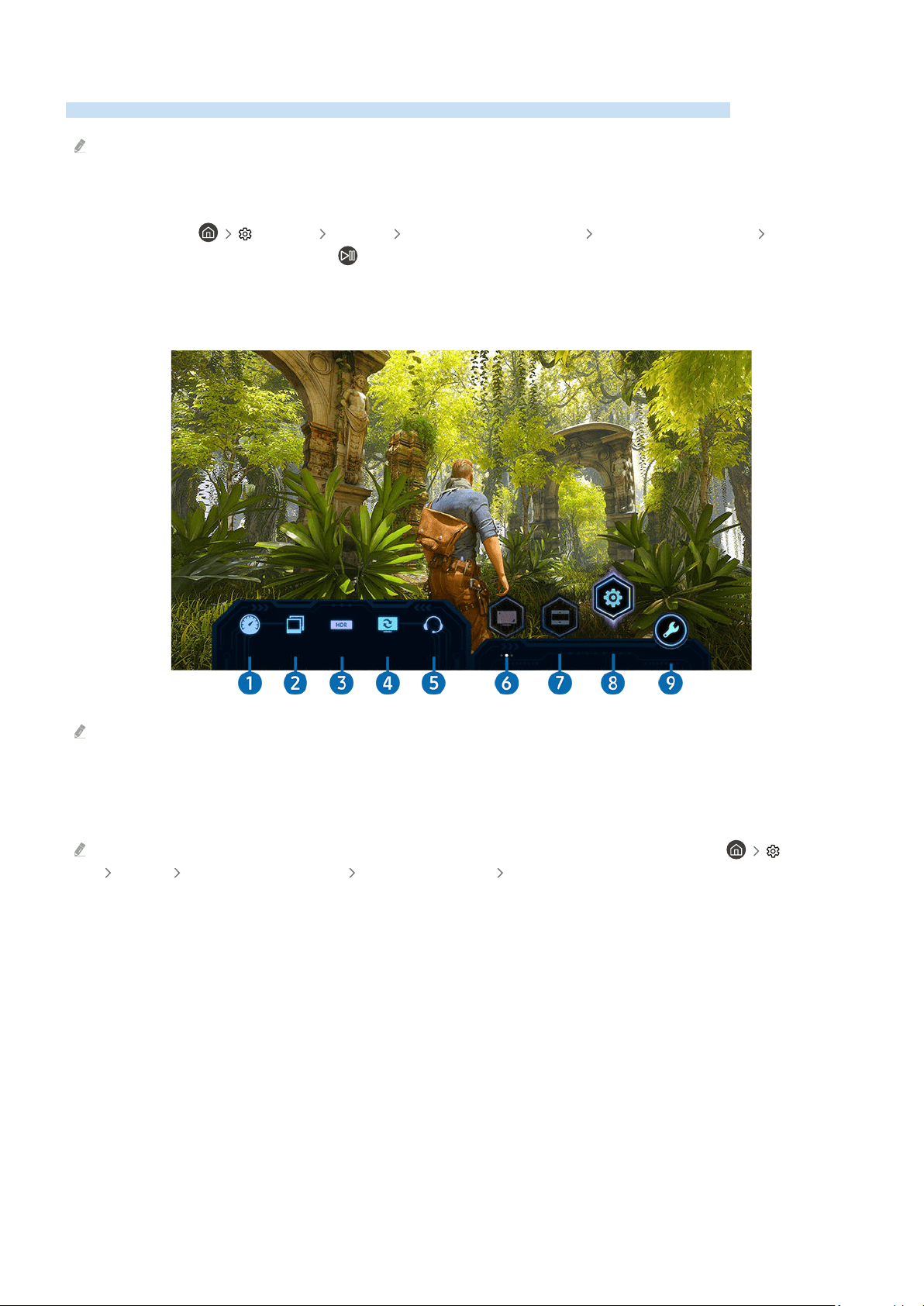
Control the Game Settings Monitoring and Game Enhancer Settings easily by using the Game Bar.
This function may not be supported depending on the model.
Starting the Game Bar
When Game Mode ( Settings General External Device Manager (Game Mode Settings) Game
Mode) is On or Auto, press and hold the button on your Samsung Smart Remote to start the Game Bar.
Learning about the Game Bar
Input Lag
FPS
HDR
VRR
Sound Output
16:9
Screen
Position
Game Mode Settings
Troubleshootin
g
The image on your TV may differ from the image above depending on the model.
1.Input Lag
Shows the Input Lag of the game. When Game Motion Plus is Off, the game operates with the minimum input lag.
When you increase the values for Blur Reduction and Judder Reduction in Game Motion Plus Settings ( Settings
General External Device Manager Game Mode Settings Game Motion Plus Settings), the input lag increases.
2.FPS (Frames Per Second)
Shows the frame rate per second in real time. The frame rate changes when VRR is active.
- 91 -

Move the focus to the programme you want in the Guide, and then press and hold the Select button. You can use the
following functions:
These functions may not be supported in the Guide depending on the model or geographical area.
• Record
You can make a recording of a current programme.
• Stop
You can stop the recording function that is currently running.
• Edit Recording Time
You can change the start and end times of scheduled programme recordings.
• Schedule Viewing
You can schedule the viewing of a broadcast scheduled programme.
• Schedule Recording
You can schedule recording of a broadcast scheduled programme.
• Cancel Scheduled Viewing
You can cancel scheduled viewings.
• Cancel Scheduled Recording
You can cancel scheduled recordings.
• View Details
You can see detailed information about the selected programme. The information may differ or may not be
provided depending on the broadcast signal.
To move to the Channel Filter or Aerial Type, Schedule Manager screen: Press the
or button. (If the remote
control button is , press it twice.)
• Channel Filter
You can view channels and programmes categorised by the types defined in Channel List.
• Aerial Type
You can change the type of broadcast signals the TV receives.
This function may not be supported depending on the incoming broadcast signal.
• Schedule Manager
You can see the Schedule Manager or Recording & Schedule Manager screen.
These functions may not be supported in the Guide depending on the model or geographical area.
- 95 -

Recording Programmes
Record a current or upcoming programme using a USB device instead of a video recorder.
This function may not be supported depending on the model or geographical area.
Read all precautions before using the recording feature. Refer to "Before Using the Recording and Timeshift Functions" for
more information.
You can record only the programmes that are received through an aerial.
The appears next to the programmes and channels scheduled for recording.
If you go to Live TV while no USB device is connected, the Schedule Manager screen appears in place of the
Recordings screen.
Using the instant and schedule recording options from the Guide screen
• Instant Recording
Select a live programme from the Guide, press and hold the Select button, and then select Record from the
pop-up menu to start recording immediately.
• Schedule Recording
Select a programme scheduled to be broadcast, press the Select button, and then select Schedule Recording to
set up a scheduled recording of the scheduled programme.
Using the instant and schedule recording options while watching a programme
• Instant Recording
If you select Record after pressing the button twice, and then press the Select button or after pressing the
button once while watching a broadcast, recording starts.
• Schedule Recording
Press the Select button while watching a programme to display the programme info window. Use the left or
right directional button to select a scheduled programme. Press the Select button, and then select Schedule
Recording to set up a scheduled recording of the scheduled programme.
- 96 -

Scheduling a video recording after entering the date and time
Live TV Recordings Schedules Add Recording
To schedule a recording, set the values for Aerial, Channel, Repeat, Date, Start Time and End Time of the broadcast
programme to record, and then select Save.
Check the current time in Settings General System Manager Time Clock.
The menus may not appear depending on the model or geographical area.
Managing the schedule recording list
Live TV Recordings Schedules
You can change scheduled recording information or cancel scheduled recordings.
The menus may not appear depending on the model or geographical area.
You can schedule up to 30 recordings or viewings at once using Schedule Recording and Schedule Viewing.
• Edit
You can set the start and end times for a schedule recording. You can set the start time up to 10 minutes before
the programme starts and the end time up to 10 minutes after the programme ends.
• Delete
You can delete scheduled recordings.
• View Details
You can view detailed information about scheduled recordings.
Viewing recorded programmes
Live TV Recordings Recordings
Select a le containing a recording from the list. The le is played back.
Move the focus to the recorded le, and then view Play, Delete or View Details on the right menu.
Buttons that appear may differ depending on the le being played. For more information about control buttons, refer to
"Buttons and functions available while recording a programme or Timeshift".
This function may not be supported depending on the model or geographical area.
- 97 -

Using schedule viewing to view programmes at a specied time on a specied date
Live TV Schedule Manager Add Viewing
Live TV Recordings Schedules Add Viewing
To schedule a viewing, set the values for Aerial, Channel, Repeat, Date and Start Time of the broadcast programme
to view, and then select Save.
Check the current time in Settings General System Manager Time Clock.
This function may not be supported depending on the geographical area.
Setting the schedule Viewing Time
Live TV Schedule Manager
Live TV Recordings Schedules
You can change scheduled viewing information or cancel scheduled viewings.
You can set up a maximum total of 30 Schedule Viewing and Schedule Recording entries.
The menus may not appear depending on the model or geographical area.
• Edit
You can set the start time of a scheduled viewing. If you choose a programme from the Guide, the Start Time can
be set to up to 10 minutes before the programme.
• Delete
You can delete scheduled viewings.
• View Details
You can view detailed information about scheduled viewings.
- 99 -

• Jump Backward / Jump Forward
Press the up directional button to move the focus to the playback control bar, and then select the left or right
directional button in the playback control bar to move backward or forward by 10 seconds in the video.
When the Jump Backward function is activated, you can view the difference between the current recording time and the
current rewind time.
• Rewind / Fast Forward
This function is not available while you are watching a programme that is currently being broadcast.
• Stop Recording / Stop Timeshift
Ends the recording or Timeshift function.
• Record
You can switch from the Timeshift function to the recording function. When switching to the recording function,
you can include the content recorded by the Timeshift function in the new recording.
This function is only available when the Timeshift function is running.
• Edit Recording Time
You can set for what period of time the programme will be recorded.
This function is only available when a programme is being recorded.
• Go to Live TV
Select to return to the current scenes of the programme when the Timeshift function is playing its past scenes.
• Info
Displays the programme info window of the programme you are recording or time-shifting.
- 101 -

Using the Channel List
Change the channel or check programmes on other digital channels.
Live TV Channel List
Using the Channel List, you can change the channel or check programmes on other digital channels while watching
TV. On Standard Remote Control, press the CH LIST button.
The Channel List categories may vary depending on the incoming broadcast signals.
The Channel List screen contains the following icons:
– : A favourite channel.
– : A locked channel.
–
: CI card required channel. (For India Only)
If you press the left directional button when viewing the Channel List screen, you can use the following functions:
• All
Displays the channels that have been automatically searched.
The channels received to the currently selected Terrestrial, Cable or Satellite are displayed.
This function may differ depending on the model or geographical area.
• Samsung TV Plus
While the TV is connected to the Internet, you can watch popular programmes or highlights for each theme
through a virtual channel at any time. As with regular channels, the TV provides the daily programme schedules
for Samsung TV Plus.
This function may not be supported depending on the model or geographical area.
• Favourites
Displays Favourites 1 to Favourites 5.
It displays only the favourites list that includes the favourite channel.
• Channel Type
Sorts the list so that it includes channels of a selected type. However, Channel Type can only be used channels
contain the type information.
This function may not be supported depending on the incoming broadcast signal.
• Sort
Sorts the list by Number or by Name.
This option is only available on digital channels and may not always be available.
• Terrestrial, Cable or Satellite
Allows you to choose between Terrestrial, Cable and Satellite.
This function may not be supported depending on the incoming broadcast signal.
This function may not be supported depending on the model or geographical area.
- 102 -

Using a Personal Favourites List
Designate frequently watched channels as favourite channels.
Favourite channels are highlighted in the Edit Channels and Channel List screens with the
symbol. You can create
up to ve favourites lists so that your family members can create their own personal favourites list.
Create a favourites list
Live TV Channel List Edit Channels
1.
Press the left directional button on the remote control to select the desired Favourites list.
2.
Press the right directional button to select Add Channels.
3.
Select the desired channel in the list on the screen.
4.
Press Add to add the selected channel in the Favourites list.
Select Favourites 1 - Favourites 5 on the Edit Channels screen and the following functions are available:
• Add Channels
In the channel list, select one or more channels to add in the favourites list and then select Add Channels.
• Remove
Removes one or more channels from a favourites list.
• Change order
Changes the order of one or more channels selected in a favourites list.
• Rename Favourites
Renames a favourites list.
• Save and Exit
Saves and closes the Edit Channels screen.
- 104 -

TV-Viewing Support Functions
Use the functions that are available while watching TV.
Changing the broadcast signal
Live TV Channel List
Press the directional button on your remote control, move the focus to Terrestrial, Cable or Satellite, and then press
the Select button.
You do not need to use this function if your TV is connected to a cable box or satellite box.
The Channel List categories may vary depending on the incoming broadcast signals.
Scanning for available channels
Settings Broadcasting (Auto Tuning Settings) Auto Tuning
This function may not be supported depending on the model or geographical area.
If the TV is connected to a cable box or satellite box, you do not need to do this.
The DVB-T2 system may not be supported depending on the geographical area.
The Auto Tuning Settings may not appear depending on the model or geographical area.
Selecting the cable network search option
Settings Broadcasting (Auto Tuning Settings) Cable Search Option
Sets additional search options such as the frequency and symbol rate for a cable network search.
This function may not be supported depending on the model or geographical area.
The Auto Tuning Settings may not appear depending on the model or geographical area.
- 105 -

Tuning broadcast signals manually
Settings Broadcasting Expert Settings Manual Scan Try Now
You can scan for all the channels manually and store the scanned channels in the TV.
This function may not be supported depending on the model or geographical area.
Tuning digital channels
Settings Broadcasting Expert Settings Manual Scan Digital Channel Tuning
Select New, and then congure Channel, Frequency and Bandwidth, and then select Search to automatically scan
and store a list of digital channels in the TV.
Tuning analogue channels
Settings Broadcasting Expert Settings Manual Scan Analogue Channel Tuning
Select New and congure Programme, Colour System, Sound System, Channel and Search to scan for analogue
channels. Then, select Store to store the scanned channels in the TV.
This function is only available for analogue broadcasts.
Channel mode
• P (pogramme mode)
When tuning is complete, the broadcasting stations in your area have been assigned to position numbers from
P0 to P99. You can select a channel by entering the position number in this mode.
• C (aerial channel mode) / S (cable channel mode)
These two modes allow you to select a channel by entering the assigned number for each aerial broadcasting
station or cable channel.
- 109 -

Fine-tuning analogue broadcasts
Settings Broadcasting Expert Settings Fine Tune Try Now
This function is only available for analogue broadcasts.
Transferring channel list
Settings Broadcasting Expert Settings Transfer Channel List
You can import or export the channel list to a USB storage. To use this function, the PIN number is required.
• Import from USB: Imports channel list from a USB storage.
• Export to USB: Exports channel list saved in the TV to a USB storage.
This function is available when USB is connected.
This function may not be supported depending on the model or geographical area.
Enabling/Disabling Edit Channel Numbers
Settings Broadcasting Expert Settings Edit Channel Numbers
Use this to change channel number. When channel number is changed, channel information is not updated
automatically.
This function may not be supported depending on the model or geographical area.
Changing teletext language
Settings Broadcasting Expert Settings Teletext Language Settings Teletext
Language
You can set or change the teletext language. To watch the teletext broadcast in your preferred language, select
a language to use in Primary Teletext Language. If this language is not supported, you can watch the teletext
broadcast in your secondary preferred language set in Secondary Teletext Language.
This function may not be supported depending on the model, channel or geographical area.
- 110 -

Selecting the broadcast audio language
Settings Broadcasting Expert Settings Audio Options Try Now
This is the language you will hear while watching TV if the language is included in the broadcast signal. Audio
Options functions differently for analogue and digital channels.
This function may not be supported depending on the model or geographical area.
This function may not be supported depending on the incoming broadcast signal.
• Audio Language Settings
You can change the audio language you want to hear.
The available language may differ with the broadcast.
• Audio Format
You can change the audio format you want to hear.
The supported audio format may differ with the broadcast programme.
This option is only available on digital channels.
Showing TVkey Interface menu
Settings Broadcasting Expert Settings TVkey Interface
You can use the following functions:
• TVkey Menu: Show TVkey Interface menu.
• Delete TV Service: Show the TVkey operator list to delete.
This function may not be supported depending on the model or geographical area.
- 111 -

Conguring advanced picture settings
Settings Picture Expert Settings Try Now
Congure the screen settings to your taste by using the following functions:
• Brightness Try Now
• Contrast
Try Now
• Sharpness Try Now
• Colour Try Now
• Tint (G/R) Try Now
• Apply Picture Settings
Try Now
• Picture Clarity Settings Try Now
When LED Clear Motion is set to On, the screen appears darker than when it is Off.
• Local Dimming
Control the brightness of individual areas on the screen to automatically maximise contrast.
This function may not be supported depending on the model or geographical area.
• Contrast Enhancer Try Now
• Film Mode Try Now
This function is only available when the input signal is TV, AV, or HDMI (1080i).
• Colour Tone Try Now
• White Balance Try Now
• Gamma
Try Now
• Shadow Detail Try Now
• RGB Only Mode Try Now
• Colour Space Settings
Try Now
• Reset Picture Try Now
- 115 -

Setting the Viewing Environment for External Devices
You can optimise the TV for viewing specic video formats.
Playing games on an optimised screen
Settings General External Device Manager (Game Mode Settings) Game Mode
You can set the Game Mode to optimise the TV screen for better gaming performance.
When you connect a video game console such as PlayStation and Xbox, Game Mode is set to Auto. When you
connect the other game source such as PC, set the Game Mode to On through the above path. You can also set the
Game Mode quickly from Home Screen ( Settings up directional button Game Mode ).
This function may not be supported depending on the model or geographical area.
The game mode is not available for normal TV viewing.
The screen may shake somewhat.
When you press and hold the button on the Samsung Smart Remote for 1 second or more in Game Mode, the Game Bar
appears. This function may not be supported depending on the model.
When Game Mode is enabled, Picture Mode and Sound Mode are switched to Game automatically. Sound Mode may not be
automatically switched depending on the selected audio device on the Sound Output menu.
When Game Mode is set to On, some functions are not available.
To use a different external device on the same port, remove the game console connection, set Game Mode to Off, and then
connect the external device to the port.
The Game Mode functions used for Nintendo Switch™ are subject to change without prior notice.
- 116 -

Setting the Game Mode details
Settings General External Device Manager Game Mode Settings
These functions may not be supported depending on the model or geographical area.
• Surround Sound
You can make your games more immersive by using intense, three-dimensional sound optimised for games.
• Dynamic Black Equalizer
You can easily detect items or hidden enemies lurking in dark corners by improving visibility and object details in
dark scenes without washing out colours and contrast in brighter scenes.
• Game Motion Plus Settings
You can configure the Game Motion Plus settings.
This function may not be supported depending on the model.
• Game HDR
In accordance with the HGiG (HDR Gaming Interest Group) standard, it sets the optimal image quality for HDR
games according to the brightness information of the contents.
When HDR sources are input in Game Mode, this menu is activated.
Game HDR entry path may be different in some models. ( Settings General External Device Manager
Game HDR)
- 117 -

Picture Support Functions
Congure the picture settings for your TV.
Changing the picture size settings
Settings Picture Picture Size Settings Try Now
• Picture Size Try Now
You can change the size of the picture displayed on the TV screen to 16:9 Standard, Custom or 4:3.
Supported picture sizes differ with the input signal. For more information about supported picture sizes, refer to
"Picture sizes and input signals".
• Auto Wide Try Now
Changing the picture size automatically.
This function may not be supported depending on the model or geographical area.
• 4:3 Screen Size Try Now
You can select a picture size suitable for your geographical area while you are watching TV in the 4:3 or Fit
to screen mode. The supported screen sizes differ with the country and this function allows you to adjust the
picture size in this case.
The 4:3 mode is not available when an external device is connected to the TV via a Component connector or an HDMI
connector.
This function may not be supported depending on the model or geographical area.
• Fit to screen Try Now
Fitting the picture to the screen.
This function may not be supported depending on the Picture Size setting.
This function may not be supported depending on the broadcast signals.
• Zoom and Position Try Now
Adjusting the picture size and/or position.
This function is available only if Picture Size is set to Custom.
To change the picture position on analogue channels, first enlarge the picture and then change the position.
These functions may not be available on Samsung TV Plus and some applications.
- 119 -

Conguring a Sound Mode and Expert Settings
Change the Sound Mode and adjust Expert Settings.
Choosing a sound mode
Settings Sound Sound Mode Try Now
You can select the available sound mode that you prefer for a content type or your listening environment.
When an external device is connected, Sound Mode may change accordingly.
This function may not be supported depending on the model.
Conguring advanced sound settings
Settings Sound Expert Settings Try Now
You can personalise the sound quality by adjusting the following settings.
• Balance
Try Now
• Equaliser Try Now
This function is not available when the Adaptive Sound+ function is turned on.
This function is not available when the Sound Mode function is set to Adaptive Sound, Game, or Amplify.
The name and properties of this function may appear differently depending on the connected external device.
• HDMI-eARC Mode
You can connect an audio device that supports eARC via HDMI-eARC. Muting occurs temporarily during device
connection.
• Digital Output Audio Format
Try Now
Select the digital audio output format. If you select the Auto option, the audio device automatically outputs in a
supported format.
If you select the Pass-through option, audio data is output with no processing.
- 120 -

•
Digital Output Audio Delay Try Now
This feature is only available when the external device is connected via HDMI (eARC) and SPDIF (Sony Philips Digital
Interface).
This function may not be supported depending on the model.
• Dolby Atmos Compatibility Try Now
You can set the TV to allow Dolby Digital+ with Atmos streams that are inputted from external devices.
Set to On if the audio device connected via HDMI (eARC) supports Dolby Atmos. The TV screen may flicker when
this function is turned on or off.
If this function is on, set Digital Output Audio Format to Auto.
• Auto Volume Try Now
Automatically adjusts the sound to a certain level when changing channels or switching to another external
input.
• Sound Feedback Try Now
Plays the notification sound when manipulating a menu or selecting an option.
• Reset Sound Try Now
Standard audio signals are sampled at 48 kHz while HD audio signals are sampled at 96 kHz.
Some SPDIF receivers may not be compatible with HD audio format.
- 121 -

Using the Sound Support Functions
Congure the sound settings for your TV.
Selecting speakers
Settings Sound Sound Output Try Now
You can select which speakers the TV uses for audio output.
External speakers may not be controlled with the Samsung Smart Remote. When an external speaker is enabled, some
sound menus are not supported.
Samsung TV supports the Q-Symphony function.
This function may not be supported depending on the model.
This function is unavailable when using The Frame 43LS03A vertically. To use the product horizontally, set the function
again.
• This function works synchronised with the Samsung Soundbar that supports Q-Symphony so that your TV
speaker and Soundbar simultaneously output the sound for best surround effects.
• When a Samsung Soundbar that supports Q-Symphony is connected, the menu name such as "TV + Soundbar"
appears under Sound Output (
Settings Sound Sound Output). Select the menu.
Menu name example) TV + [AV] Soundbar Series name (HDMI) or TV + Optical
It works based on the Codec supported by your TV. For more information about Codec information, refer to "Read Before
Playing Photo, Video or Music Files".
This function is supported only when connected via HDMI or optical cable.
This function is available only in some Samsung TVs and Soundbars released in 2021.
Refer to the sound bar's user manual when connecting it to the TV.
Listening to the TV through Bluetooth devices
Settings Sound Sound Output Bluetooth Speaker List
You can connect Bluetooth audio devices to the TV. They must be paired using the TV's Bluetooth function. Refer
to the user manual for your audio device such as Bluetooth speaker, sound bar and headphones for detailed
connection and usage.
If the TV fails to nd a Bluetooth audio device, place the device closer to the TV, and then select Refresh.
When you turn on a paired Bluetooth audio device, the TV detects it automatically, and then displays a pop-up window. Use
this pop-up window to activate/deactivate the Bluetooth audio device.
The sound quality may be affected by the condition of the Bluetooth connection.
Before using a Bluetooth audio device, refer to "Read Before Using Bluetooth Devices".
- 122 -

Listening to the TV through a Samsung audio device that supports the Wi-Fi function
Settings Sound Wi-Fi Speaker Surround Setup Try Now
If you've connected one or more Samsung wireless audio devices that support the Wi-Fi function to the TV, you
can create an optimal sound set up by conguring the surround effect settings. You can select any of the surround
sound congurations, with or without a sound bar.
A surround sound conguration can be used if all of the following conditions are met:
• Two or more Samsung wireless speakers of the same type must be connected to the same wireless network.
• The Samsung audio devices that support the Wi-Fi function must be connected to the same wireless network as
the TV.
For more information about how to connect and use a Samsung audio device that supports the Wi-Fi function, refer to its
user manual.
Surround sound congurations with a sound bar may not be supported depending on the product.
If you activate the Screen Mirroring function while using Samsung audio devices that support the Wi-Fi function, the Wi-Fi
connection is disconnected.
Mismatched video and audio lip-syncing may occur depending on the device type.
- 123 -

Using the Power and Energy Saving Functions
Reduce the TV's energy consumption.
Reducing the energy consumption of the TV
Settings General Power and Energy Saving Try Now
Reduce energy consumption by changing your power preferences and other energy-saving options.
• Brightness Optimisation Try Now
Automatically adjust the picture brightness based on the ambient light level.
This function is not available when the Adaptive Picture function is turned on.
• Minimum Brightness Try Now
When Brightness Optimisation is turned on, you can manually adjust the minimum brightness of the TV screen.
This function acts only when the value is less than the setting in Settings Picture Expert Settings
Brightness.
This function is not available when the Adaptive Picture function is turned on.
• Brightness Reduction Try Now
Reduce power consumption by adjusting brightness settings.
This function is not available when the Adaptive Picture function is turned on.
• Motion Lighting Try Now
Adjusts the brightness in response to on-screen movements to reduce power consumption.
This function is not available when the Adaptive Picture or Game Mode function is turned on.
• Screen Saver Try Now
Activate a screensaver when your TV displays a still image for two hours or more.
• Auto Power Off Try Now
Automatically turns off the TV to reduce unnecessary power consumption if the TV Controller and the remote
control are not used for the set period of time.
• Available Remote Battery
You can check the Samsung Smart Remote's remaining amount of the battery.
This function may not be supported depending on the model.
- 126 -

Updating the TV's Software
View your TV's software version and update it if necessary.
DO NOT turn off the TV's power until the update is complete. The TV will turn off and on automatically after
completing the software update. Video and audio settings will be reset to their defaults after a software
update.
Settings Support Software Update Try Now
Updating through the Internet
Settings Support Software Update Update Now Try Now
Updating from the Internet requires an active Internet connection.
Updating through a USB device
Settings Support Software Update Update Now
After downloading the update le from the Samsung website and storing it on a USB device, connect the USB
device to the TV to update.
To update using a USB device, download the update package from Samsung.com to your computer. Then, save the update
package in the USB device's top-level folder. Otherwise, the TV will not be able to locate the update package.
Updating the TV automatically
Settings Support Software Update Auto update Try Now
If the TV is connected to the Internet, you can have the TV's software update itself automatically while you are
watching the TV. When the background update is completed, it is applied the next time the TV is turned on.
If you agree to the Smart Hub terms and conditions, Auto update is set to On automatically. If you want this function
disabled, use the Select button to turn it off.
This function may take a longer time if another network function is running concurrently.
This function requires an Internet connection.
- 127 -

Audio and Video Functions for the Visually or Hearing Impaired
You can congure the functions for the visually or hearing impaired.
Running the accessibility functions
Settings General Accessibility Try Now
Running Accessibility Shortcuts
The Accessibility Shortcuts provide easy access to the accessibility functions. To display the Accessibility Shortcuts,
press and hold the (Volume) button for 1 second or more. You can easily turn on or turn off the functions such
as Voice Guide, Picture Off, Audio Description, Subtitle, High Contrast, Enlarge, Greyscale, Colour Inversion, Learn
TV Remote, Menu Learning Screen, Multi-output Audio, Sign Language Zoom, Slow Button Repeat, Accessibility
Settings, etc.
On the Standard Remote Control, press the AD/SUBT. button or press and hold the MUTE button.
Even if the Voice Guide is set to Off or muted, the voice guide for Accessibility Shortcuts is enabled.
The shortcut menus may not appear depending on the model or geographical area.
Enabling voice guides for the visually impaired
Settings General Accessibility Voice Guide Settings Try Now
You can activate voice guides that describe the menu options aloud to aid the visually impaired. To activate this
function, set Voice Guide to On. With Voice Guide on, the TV provides voice guides for channel change, volume
adjust, information on current and upcoming programmes, schedule viewing, other TV functions and various
content in the Internet and in Search.
You can go to Voice Guide, and then press the Select button to turn the function on or off.
The Voice Guide is provided in the language that is specied on the TV Language. However, some languages are not
supported by Voice Guide even though they are listed in the TV Language. English is always supported.
For more information about the TV Language settings, refer to "Changing the menu language".
- 128 -

Changing the volume, speed, pitch and the TV background volume of the Voice Guide
You can congure the Volume, Speed, Pitch and the TV Background Volume of the voice guide.
Audio Description
Settings General Accessibility Audio Description Settings
You can activate an audio guide that provides an audio description of video scenes for the visually impaired. This
function is only available with broadcasts that provide this service.
This function is only available on digital channels.
• Audio Description
Turns the audio description function on or off.
• Audio Description Volume
Adjusts the audio description volume.
The TV screen is turned off but audio continues
Settings General Accessibility Picture Off
Turn off the TV screen and provide only sound to reduce overall power consumption. When you press a button on
the remote control other than Volume and Power while the screen is off, the TV screen turns back on.
This function may not be supported depending on the geographical area.
White text on black background (high contrast)
Settings General Accessibility High Contrast Try Now
You can change Smart Hub and setting menu screens to white text on a black background and change the
transparent TV menus to opaque automatically so that text can be more easily read.
If High Contrast is on, some Accessibility menus are not available.
- 129 -

Setting the screen to black and white
Settings General Accessibility Greyscale Try Now
You can change the colour of the TV screen to black and white to sharpen blurred edges caused by colours.
If Greyscale is on, some Accessibility menus are not available.
This function may not be supported depending on the model or geographical area.
Inverting the screen colour
Settings General Accessibility Colour Inversion Try Now
You can invert the colours of the text and background for the setting menus displayed on the TV screen to make it
easier to read them.
If Colour Inversion is on, some Accessibility menus are not available.
This function may not be supported depending on the model or geographical area.
Enlarging the font (for the visually impaired)
Settings General Accessibility Enlarge Try Now
You can enlarge the size of the font on the screen. To activate, set Enlarge to On.
Learning about the remote control (for the visually impaired)
Settings General Accessibility Learn TV Remote Try Now
This function helps individuals with a visual impairment to learn the positions of the buttons on the remote control.
When this function is activated, you can press a button on the remote control and the TV will tell you its name. Press
the button twice to exit Learn TV Remote.
Learning about the TV menu
Settings General Accessibility Menu Learning Screen Try Now
Learn the menus on the TV screen. Once enabled, your TV will tell you the structure and features of the menus you
select.
- 130 -

Watching TV broadcasts with subtitles
Settings General Accessibility Subtitle Settings Try Now
Set Subtitle to On. Then you can watch the programme with the subtitle displayed.
This function may not be supported depending on the model or geographical area.
This function has no relationship with the features for controlling sub-titles of DVD or Blu-ray players. To control DVD or
Blu-ray subtitles, use the sub-title feature of the DVD or Blu-ray player and the player's remote control.
• Subtitle
Turns on or off the subtitle.
• Subtitle Mode
Sets the subtitle mode.
• Subtitle Language
Sets the subtitle language.
• Spoken Subtitles
Listen to an audio version of the subtitles. Only available with broadcasts that provide this service.
This function may not be supported depending on the model or geographical area.
Selecting the broadcasting subtitle language
You can select the default subtitle language. The list may vary depending on the broadcast.
• Primary Subtitle Language
Sets the primary subtitle language.
• Secondary Subtitle Language
Sets the secondary subtitle language.
- 131 -

Listening to the TV through Bluetooth devices (for the hearing impaired)
Settings General Accessibility Multi-output Audio
You can turn on both the TV speaker and Bluetooth headphone at the same time. When this function is active, you
can set the volume of the Bluetooth headphone higher than the volume of the TV speaker.
This function may not be supported depending on the model or geographical area.
For more information about connecting Bluetooth devices to the TV, refer to "Listening to the TV through Bluetooth
devices".
Enlarging the sign language screen for the hearing impaired
Settings General Accessibility Sign Language Zoom Settings Try Now
You can zoom in the sign language screen when the programme you are watching provides it. First, set Sign
Language Zoom to On, and then select Edit Sign Language Zoom to change the position and magnication of the
sign language screen.
Conguring the repeat settings for remote control buttons
Settings General Accessibility Remote Button Repeat Settings Try Now
You can congure the operation speed of the remote control buttons so that they slow down when you continually
press and hold them. First, set Slow Button Repeat to On, and then adjust the operation speed in Repeat Interval.
App for the Visually Impaired (SeeColors App)
You can download SeeColors App in Apps.
This application helps colour blind people feel rich colours on TV through a simple self-check. Through self-check,
colours are changed to be suitable so that each person can experience a richer view of colours.
When the SeeColors App is run, specic menus are disabled.
This function may not be supported depending on the model.
- 132 -

Using Voice Assistants on the TV
You can change the settings of a Voice Assistant after selecting it.
Select the Voice Assistant
Settings General Voice Voice Assistant
Select which Voice Assistant you would like to help control your TV.
To use this function, the TV must be connected to the Internet.
This function may not be supported depending on the model or geographical area.
Voice Assistant only supports some languages, and the supported functions may differ depending on the geographical
area.
The Voice Wake-up function may not be supported depending on the model, Voice Assistant or geographical area.
• Bixby / Amazon Alexa / Google Assistant
To use the Voice Assistant, follow the instructions on the TV screen to enable the selected Voice Assistant.
To change the settings for Voice Assistant, run the Settings menu under each Voice Assistant ( Settings
General Voice Voice Assistant).
To enable the Settings menus for each Voice Assistant, log in each Voice Assistant.
For an example of Voice command, see the Settings menus for each Voice Assistant.
- 133 -

Using Other Functions
You can view other functions.
Changing the menu language
Settings General System Manager Language Try Now
Setting up a password
Settings General System Manager Change PIN Try Now
The PIN input window appears. Enter a PIN. Enter it again to conrm it. The default PIN is "0000".
This function may not be supported depending on the model or geographical area.
If you forget your PIN, you can reset it with your remote control. With the TV turned on, press the following buttons on the
remote control in the order shown to reset the PIN to "0000".
On the Samsung Smart Remote or Remote Control: Press (Volume) button. Volume Up Volume Down
Volume Up .
On the Standard Remote Control: Press button. ( ) (Volume Up) Press RETURN button. ( ) (Volume Down)
Press RETURN button. ( ) (Volume Up) Press RETURN button.
Selecting Usage or Retail Mode
Settings General System Manager Usage Mode Try Now
You can set the TV for retail environments by setting Usage Mode to Retail Mode.
For all other uses, select Home Mode.
Use Retail Mode only in a store. With Retail Mode, some functions are disabled and the TV settings automatically reset after
a preset amount of time.
This function may not be supported depending on the model.
Setting up the Button Lock
Settings General System Manager Button Lock
You can set the TV Controller button lock. If this function is On, you cannot use TV Controller button.
This function may not be supported depending on the model.
Setting up the USB Lock
Settings General System Manager USB Lock
You can block connection to any external USB device.
This function may not be supported depending on the model.
- 134 -

Managing External Devices
Settings General External Device Manager Device Connection Manager Try Now
When you connect external devices such as mobile devices or tablets connected to the same network as the TV so
you can share content, you can view the list of allowed devices and connected devices.
• Access Notification
Set whether to display a notification when an external device such as a mobile device or tablet attempts to
connect to the TV.
• Device List
Manage a list of external devices registered to the TV.
Using AirPlay
Settings General Apple AirPlay Settings
You can use AirPlay to view content from your iPhone, iPad or Mac on the TV screen.
This function may not be supported depending on the model or geographical area.
Restoring the TV to the factory settings
Settings General Reset Try Now
You can restore all TV settings to the factory defaults.
1.
Select Reset. The security PIN entry window appears.
2.
Enter the security PIN, and then select Reset. All settings are then reset. The TV turns off and on again
automatically and displays the Initial Setup screen.
For more information on Reset, refer to the user manual that came with the TV.
If you skipped some steps in the initial setup, run Set Up TV ( Source up directional button TV up
directional button
Set Up TV), and then congure the settings in the steps you skipped.
- 135 -

Using the “CI or CI+ Card”
To watch paid channels, the “CI or CI+ CARD” must be inserted.
• Samsung TV follow up CI+ 1.4 standard. When Samsung TV display the pop-up message, it may happen due to
CI+ 1.4 Version inconsistency. If you have a problem, please contact Samsung Call Centre.
Your Samsung TV conforms to the CI+ 1.4 standards.
Where a CI+ Common Interface module is incompatible with Samsung TV then please remove the module and contact
the CI+ operator for assistance.
• If you don’t insert the “CI or CI+ CARD”, some channels will display the pop-up message.
• The pairing information will be displayed in about 2-3 minutes. If an error message is displayed, please contact
your service provider.
• When the configuration of channel information has finished, the message “Updating Completed” is displayed,
indicating the channel list is updated.
You must obtain a “CI or CI+ CARD” from a local cable service provider.
When removing the “CI or CI+ CARD”, carefully pull it out with your hands since dropping the “CI or CI+ CARD” may cause
damage to it.
Insert the “CI or CI+ CARD” in the direction marked on the card.
The location of the COMMON INTERFACE slot may be different depending on the model.
“CI or CI+ CARD” is not supported in some countries and regions. Check with an authorised dealer to nd out if “CI or CI+
CARD” is supported in your locality.
If you have any problems, please contact a service provider.
Insert the “CI or CI+ CARD” that supports the current aerial settings. If not, the screen may not look normal.
- 139 -

Teletext Feature
Learn how to use Teletext and run the functions provided by Teletext Service.
This function is available only in the channel that supports the teletext service.
This function may not be supported depending on the model or geographical area.
To enter the Teletext feature,
On the Samsung Smart Remote or Remote Control: Press the or button, and then select TTX/MIX on the pop-up list.
On the Standard Remote Control: Press the / TTX/MIX button.
To exit from the Teletext feature,
On the Samsung Smart Remote or Remote Control: Press the TTX/MIX button on the pop-up list until a live TV programme
appears.
On the Standard Remote Control: Press the / TTX/MIX button on the remote control until live TV appears.
The index page of the Teletext service gives you information on how to use the Service. For Teletext information
to be displayed correctly, channel reception must be stable. Otherwise, information may be missing or some pages
may not be displayed.
To change the Teletext page,
On the Samsung Smart Remote or Remote Control: Press the numeric button on the TTX menu.
On the Standard Remote Control: Press the numeric button.
On the Samsung Smart Remote or Remote Control
TTX/MIX (Full TTX / Double TTX / Mix / Live TV): The teletext mode is activated in the channel that is being watched.
Each time you press the TTX/MIX button, the teletext mode changes in the order of Full TTX → Double TTX → Mix →
Live TV.
• Full TTX: The teletext mode appears on the full screen.
• Double TTX: The teletext mode appears on the half screen along with the currently viewed channel on the other
half.
• Mix: The teletext mode appears transparently on the currently viewed channel.
• Live TV: It returns to the live TV screen.
Colour buttons (red, green, yellow, blue): If the FASTEXT system is used by the broadcasting company, the different
topics on a Teletext page are colour-coded and can be selected by coloured buttons. Press the colour corresponding
to the topic of your choice. A new colour coded page appears. Items can be selected in the same way. To display the
previous or next page, select corresponding coloured button.
- 140 -

6 Index: Displays the index (contents) page at any time while you are viewing Teletext.
1 Sub Page: Displays the available sub-page.
0 List/Flof: Selects the Teletext mode. If pressed during LIST mode, switches the mode to List save mode. In List
save mode, you can save a Teletext page into a list using the 8 (Store) button.
8 Store: Stores the Teletext pages.
2 Page Up: Displays the next Teletext page.
3 Page Down: Displays the previous Teletext page.
5 Reveal/Conceal: Displays or hides the hidden text (answers to quiz games, for example). To display the normal
screen, press it again.
4 Size: Displays the teletext on the upper half of the screen in double-size. To move the text to the lower half of
the screen, press it again. For normal display, press it once again.
9 Hold: Holds the display at the current page, in the case that there are several secondary pages that follow
automatically. To undo, press it again.
7 Cancel: Shrinks the Teletext display to overlap with the current broadcast. To undo, press it again.
On the Standard Remote Control
On the Standard Remote Control, the Teletext function icons are printed on some remote control buttons. To run a Teletext
function, nd its icon printed on a remote control button, and then press the found button.
/ TTX/MIX
Full TTX / Double TTX / Mix / Live TV: The teletext mode is activated in the channel that is being watched. Each time
you press the / TTX/MIX button, the teletext mode changes in the order of Full TTX → Double TTX → Mix → Live
TV.
• Full TTX: The teletext mode appears on the full screen.
• Double TTX: The teletext mode appears on the half screen along with the currently viewed channel on the other
half.
• Mix: The teletext mode appears transparently on the currently viewed channel.
• Live TV: It returns to the live TV screen.
Colour buttons (red, green, yellow, blue): If the FASTEXT system is used by the broadcasting company, the different
topics on a Teletext page are colour-coded and can be selected by coloured buttons. Press the colour corresponding
to the topic of your choice. A new colour coded page appears. Items can be selected in the same way. To display the
previous or next page, select corresponding coloured button.
- 141 -

6 SETTINGS
Index: Displays the index (contents) page at any time while you are viewing Teletext.
1 PRE-CH
Sub Page: Displays the available sub-page.
0 SOURCE
List/Flof: Selects the Teletext mode. If pressed during LIST mode, switches the mode to List save mode. In List save
mode, you can save a Teletext page into a list using the 8 (CH LIST) button.
8 CH LIST
Store: Stores the Teletext pages.
2 CH <
Page Up: Displays the next Teletext page.
3 CH >
Page Down: Displays the previous Teletext page.
5 INFO
Reveal/Conceal: Displays or hides the hidden text (answers to quiz games, for example). To display the normal
screen, press it again.
- 142 -

4 AD/SUBT.
Depending on the model or geographical area.
Size: Displays the teletext on the upper half of the screen in double-size. To move the text to the lower half of the
screen, press it again. For normal display, press it once again.
9 RETURN
Hold: Holds the display at the current page, in the case that there are several secondary pages that follow
automatically. To undo, press it again.
7 EXIT
Cancel: Shrinks the Teletext display to overlap with the current broadcast. To undo, press it again.
Typical Teletext page
Part Contents
A Selected page number.
B Broadcasting channel identity.
C Current page number or search indications.
D Date and time.
E Text.
F Status information. FASTEXT information.
- 143 -

Precautions and Notes
You can get instructions and information that you must read after installation.
Before Using the Recording and Timeshift Functions
Read these instructions before using Recording and Timeshift.
Before using the recording and schedule recording functions
Recording may not be supported depending on the model or geographical area.
• To set up a Schedule Recording, you must first set the TV's clock. Set the Clock.
– Settings General System Manager Time Clock
• You can set up a maximum total of 30 Schedule Viewing and Schedule Recording entries.
• Recordings are DRM-protected and therefore cannot be played back on a computer or on a different TV. In
addition, these files cannot be played back on your TV if its video circuit has been replaced.
• For a USB device for recording, it is recommended to use the USB hard disk that supports USB 2.0 or later and
5,400 rpm or higher. However, RAID-type USB hard drives are not supported.
• USB memory sticks are not supported.
• The total recording capacity may differ with the amount of available hard drive space and the recording quality
level.
• Schedule Recording requires at least 100 MB of free space on the USB storage device. Recording will stop if the
available storage space falls below 50 MB while recording is in progress.
• If the available storage space falls below 500 MB while both the Schedule Recording and Timeshift functions are
in progress, only the recording will stop.
• The maximum recording time is 720 minutes.
• Videos are played according to the TV settings.
• If the input signal is changed while recording is in progress, the screen will go blank until the change is made. In
this case, recording will resume, but
will not be available.
• When using the Record or Schedule Recording function, the actual recording may start a second or two later
than the specified time.
• If the Schedule Recording function is operating while a recording is being made on an HDMI-CEC external device,
the priority is given to the Schedule Recording.
• Connecting a recording device to the TV automatically deletes abnormally saved recorded files.
- 144 -

• If the Sleep Timer or Auto Power Off has been set, the TV will override these settings, continue to record and
turn off after the recording has ended.
–
Settings General System Manager Time Sleep Timer
– Settings General Power and Energy Saving Auto Power Off
Before using the timeshift function
Timeshift may not be supported depending on the model or geographical area.
• For a USB device for recording, it is recommended to use the USB hard disk that supports USB 2.0 or later and
5,400 rpm or higher. However, RAID-type USB hard drives are not supported.
• USB memory sticks or flash drives are not supported.
• The total recording capacity may differ with the amount of available hard drive space and the recording quality
level.
• If the available storage space falls below 500 MB while both the Schedule Recording and Timeshift functions are
in progress, only the recording will stop.
• The maximum amount of time available for the Timeshift function is 90 minutes.
• The Timeshift function is not available for locked channels.
• Time-shifted videos are played according to the TV settings.
• The Timeshift function may be terminated automatically once it reaches its maximum capacity.
• The Timeshift function requires at least 1.5 GB of free space available on the USB storage device.
- 145 -

Read Before Using the Internet Function
Read this information before using the Internet function.
• File download is not supported.
• The Internet function may not be able to access certain websites, including websites operated by certain
companies.
• The TV does not support playback of flash videos.
• E-commerce for online purchases is not supported.
• ActiveX is not supported.
• Only a limited number of fonts are supported. Certain symbols and characters may not be displayed properly.
• The response to remote commands and the resulting on-screen display may be delayed while a web page is
loading.
• Loading a web page may be delayed or suspended completely depending on the status of the participating
systems.
• Copy and paste operations are not supported.
• When composing an email or a simple message, certain functions such as the font size and colour selection may
not be available.
• There is a limit to the number of bookmarks and the size of the log file that can be saved.
• The number of windows that can be opened concurrently is limited.
• Web browsing speed will differ with the network environment.
• Embedded videos in a web page cannot be played at the same time while the PIP (picture-in-picture) function is
operating.
This function may not be supported depending on the model or geographical area.
• Browsing history is saved from latest to oldest, with the oldest entries being overwritten first.
• Depending on the types of video/audio codecs supported, you may not be able to play certain HTML5 video and
audio files.
• Video sources from PC-optimised streaming service providers may not play properly on our proprietary Internet
browser.
- 148 -

Read before setting up a wireless Internet connection
Precautions for wireless Internet
• This TV supports the IEEE 802.11 a /b /g /n /ac communication protocols. Video files stored on a device
connected to the TV via a Home Network may not play back smoothly.
Some of the IEEE 802.11 communication protocols may not be supported depending on the model or geographical area.
QN9**A Series supports the IEEE 802.11 a /b /g /n /ac /ax communication protocols.
For models other than the QN9**A Series, Samsung recommends using IEEE 802.11n.
• To use wireless Internet, the TV must be connected to a wireless access point or modem. If the wireless access
point supports DHCP, the TV can use a DHCP or static IP address to connect to the wireless network.
• Select a channel that is not currently being used by the wireless access point. If the channel set is currently
being used by the wireless access point to communicate with another device, the result is usually interference
and/or a communications failure.
• Most wireless networks have an optional security system. To enable a wireless network's security system,
you need to create a password using characters and numbers. This password is then needed to connect to a
security-enabled access point.
Wireless security protocols
The TV only supports the following wireless network security protocols. The TV cannot connect to non-certied
wireless access point.
– Authentication Modes: WEP, WPAPSK, WPA2PSK
– Encryption Types: WEP, TKIP, AES
In compliance with the Wi-Fi certication specications, Samsung TVs do not support WEP or TKIP security
encryption in networks running in the 802.11n mode. If the wireless access point supports WPS (Wi-Fi Protected
Setup), you can connect the TV to your network using PBC (Push Button Conguration) or a PIN (Personal
Identication Number). WPS automatically congures the SSID and WPA key settings.
- 149 -

Supported video codecs (QLED TV/The Frame)
For Q6*A Series, refer to the next section.
File format Container Video codecs Resolution Frame rate (fps)
Bitrate
(Mbps)
Audio codecs
*.avi
*.mkv
*.asf
*.wmv
*.mp4
*.mov
*.3gp
*.vro
*.mpg
*.mpeg
*.ts
*.tp
*.trp
*.v
*.vob
*.svi
*.m2ts
*.mts
AVI
MKV
ASF
MP4
3GP
MOV
FLV
VRO
VOB
PS
TS
SVAF
H.264 BP/MP/HP 4096 x 2160
4096 x 2160: 30
3840 x 2160: 60
1920 x 1080: 120
60
Dolby Digital
LPCM
ADPCM(IMA,
MS)
AAC
HE-AAC
WMA
Dolby Digital+
MPEG(MP3)
AC-4
G.711(A-Law, μ-
Law)
OPUS
HEVC (H.265 -
Main, Main10)
4096 x 2160
4096 x 2160: 60
3840 x 2160: 120
80
Motion JPEG 3840 x 2160 30 80
MVC
1920 x 1080
60
20
MPEG4 SP/ASP
Window Media
Video v9 (VC1)
MPEG2
MPEG1
Microsoft MPEG-4
v1, v2, v3
30
Window Media
Video v7 (WMV1),
v8 (WMV2)
H.263 Sorrenson
VP6
AV1 3840 x 2160 60 40
*.webm WebM
VP8 1920 x 1080 60 20
Vorbis
VP9 (Prole
0, prole 2
supported)
3840 x 2160 60 80
AV1 3840 x 2160 60 40
*.rmvb RMVB
RV8/9/10
(RV30/40)
1920 x 1080 60 20 RealAudio 6
- 153 -

Other restrictions
• Codecs may not function properly if there is a problem with the content.
• Video content does not play or does not play correctly if there is an error in the content or container.
• Sound or video may not work if they have standard bit rates/frame rates above the TV’s compatibility ratings.
• If the Index Table is has an error, the Seek (Jump) function will not work.
• When playing video over a network connection, the video may not play smoothly because of data transmission
speeds.
• Some USB/digital camera devices may not be compatible with the TV.
• HEVC codec is only available in MKV / MP4 / TS containers.
• The MVC codec is supported partly.
Video decoders
• H.264 UHD is supported up to Level 5.1, and H.264 FHD is supported up to Level 4.2. (TV does not support FMO /
ASO / RS)
• HEVC UHD is supported up to Level 5.2, and HEVC FHD is supported up to Level 4.1. (QLED TV except for Q6*A
Series/The Frame)
• VC1 AP L4 is not supported.
• GMC 2 or above is not supported.
Audio decoders
• WMA is supported up to 10 Pro 5.1 channels, M2 profile.
• WMA1, WMA lossless / Voice are not supported.
• QCELP and AMR NB/WB are not supported.
• Vorbis is supported for up to 5.1 channels.
• Dolby Digital+ is supported for up to 5.1 channels.
• The supported sample rates are 8, 11.025, 12, 16, 22.05, 24, 32, 44.1, and 48 KHz, and differ with the codec.
- 154 -

Supported video codecs (Q6*A/AU9/AU8 Series)
File format Container Video codecs Resolution Frame rate (fps)
Bitrate
(Mbps)
Audio codecs
*.avi
*.mkv
*.asf
*.wmv
*.mp4
*.mov
*.3gp
*.vro
*.mpg
*.mpeg
*.ts
*.tp
*.trp
*.v
*.vob
*.svi
*.m2ts
*.mts
AVI
MKV
ASF
MP4
3GP
MOV
FLV
VRO
VOB
PS
TS
SVAF
H.264 BP/MP/HP 4096 x 2160
4096 x 2160: 30
3840 x 2160: 60
60
Dolby Digital
LPCM
ADPCM(IMA,
MS)
AAC
HE-AAC
WMA
Dolby Digital+
MPEG(MP3)
AC-4
G.711(A-Law, μ-
Law)
OPUS
HEVC (H.265 -
Main, Main10)
4096 x 2160 60 80
Motion JPEG 3840 x 2160 30 80
MVC
1920 x 1080
60
20
MPEG4 SP/ASP
Window Media
Video v9 (VC1)
MPEG2
MPEG1
Microsoft MPEG-4
v1, v2, v3
30
Window Media
Video v7 (WMV1),
v8 (WMV2)
H.263 Sorrenson
VP6
AV1 3840 x 2160 60 40
*.webm WebM
VP8 1920 x 1080 60 20
Vorbis
VP9 (Prole
0, prole 2
supported)
3840 x 2160 60 80
AV1 3840 x 2160 60 40
*.rmvb RMVB
RV8/9/10
(RV30/40)
1920 x 1080 60 20 RealAudio 6
- 155 -

Supported video codecs (AU7/BEA Series)
File format Container Video codecs Resolution Frame rate (fps)
Bitrate
(Mbps)
Audio codecs
*.avi
*.mkv
*.asf
*.wmv
*.mp4
*.mov
*.3gp
*.vro
*.mpg
*.mpeg
*.ts
*.tp
*.trp
*.v
*.vob
*.svi
*.m2ts
*.mts
AVI
MKV
ASF
MP4
3GP
MOV
FLV
VRO
VOB
PS
TS
SVAF
H.264 BP/MP/HP
3840 x 2160
3840 x 2160: 30
1920 x 1080: 60
50
Dolby Digital
LPCM
ADPCM(IMA,
MS)
AAC
HE-AAC
WMA
Dolby Digital+
MPEG(MP3)
AC-4
G.711(A-Law, μ-
Law)
OPUS
HEVC (H.265 -
Main, Main10)
60 50
Motion JPEG
1920 x 1080
60
20
MVC
MPEG4 SP/ASP
Window Media
Video v9 (VC1)
MPEG2
MPEG1
Microsoft MPEG-4
v1, v2, v3
30
Window Media
Video v7 (WMV1),
v8 (WMV2)
H.263 Sorrenson
VP6
AV1 3840 x 2160 60 40
*.webm WebM
VP8 1920 x 1080 60 20
Vorbis
VP9 (Prole
0, prole 2
supported)
3840 x 2160 60 50
AV1 3840 x 2160 60 40
*.rmvb RMVB
RV8/9/10
(RV30/40)
1920 x 1080 60 20 RealAudio 6
- 156 -

Supported video codecs (QN7**A Series or higher)
File format Container Video codecs Resolution Frame rate (fps)
Bitrate
(Mbps)
Audio codecs
*.avi
*.mkv
*.asf
*.wmv
*.mp4
*.mov
*.3gp
*.vro
*.mpg
*.mpeg
*.ts
*.tp
*.trp
*.v
*.vob
*.svi
*.m2ts
*.mts
AVI
MKV
ASF
MP4
3GP
MOV
FLV
VRO
VOB
PS
TS
SVAF
H.264 BP/MP/HP 3840 x 2160
3840 x 2160: 60
1920 x 1080: 120
60
Dolby Digital
LPCM
ADPCM(IMA,
MS)
AAC
HE-AAC
WMA
Dolby Digital+
MPEG(MP3)
AC-4
G.711(A-Law, μ-
Law)
OPUS
HEVC (H.265 -
Main, Main10)
7680 x 4320
7680 x 4320: 60
3840 x 2160: 120
100
Motion JPEG 3840 x 2160 30 80
MVC
1920 x 1080
60
20
MPEG4 SP/ASP
Window Media
Video v9 (VC1)
MPEG2
MPEG1
Microsoft MPEG-4
v1, v2, v3
30
Window Media
Video v7 (WMV1),
v8 (WMV2)
H.263 Sorrenson
VP6
AV1 7680 x 4320
7680 x 4320: 60
3840 x 2160: 120
80
*.webm WebM
VP8 1920 x 1080 60 20
Vorbis
VP9 (Prole
0, prole 2
supported)
3840 x 2160 60 80
AV1 7680 x 4320
7680 x 4320: 60
3840 x 2160: 120
80
*.rmvb RMVB
RV8/9/10
(RV30/40)
1920 x 1080 60 20 RealAudio 6
Because the specications are based on the current 8K connectivity and decoding standards, future connectivity,
broadcasting, and decoding standards may not be supported. Upgrading for meeting future standards may require
purchase of additional devices.
Some 3rd party standards may not be supported.
- 158 -

Other restrictions
• Codecs may not function properly if there is a problem with the content.
• Video content does not play or does not play correctly if there is an error in the content or container.
• Sound or video may not work if they have standard bit rates/frame rates above the TV’s compatibility ratings.
• If the Index Table is has an error, the Seek (Jump) function will not work.
• When playing video over a network connection, the video may not play smoothly because of data transmission
speeds.
• Some USB/digital camera devices may not be compatible with the TV.
• HEVC codec is only available in MKV / MP4 / TS containers.
• The MVC codec is supported partly.
Video decoders
• H.264 UHD is supported up to Level 5.1, and H.264 FHD is supported up to Level 4.2. (TV does not support FMO /
ASO / RS)
• HEVC UHD is supported up to Level 5.2, and HEVC FHD is supported up to Level 4.1.
• HEVC 8K is supported up to Level 6.1.
• VC1 AP L4 is not supported.
• GMC 2 or above is not supported.
Audio decoders
• WMA is supported up to 10 Pro 5.1 channels, M2 profile.
• WMA1, WMA lossless / Voice are not supported.
• QCELP and AMR NB/WB are not supported.
• Vorbis is supported for up to 5.1 channels.
• Dolby Digital+ is supported for up to 5.1 channels.
• The supported sample rates are 8, 11.025, 12, 16, 22.05, 24, 32, 44.1, and 48 KHz, and differ with the codec.
- 159 -

Resolutions for Input Signals supported by 8K models (QN7**A series or
higher)
Check the resolutions for input signals supported by 8K models (QN7**A series or higher).
If Input Signal Plus is set to Off
Frame rate (fps)
Colour Depth /
Chroma
Sampling
RGB 4:4:4 YCbCr 4:4:4 YCbCr 4:2:2 YCbCr 4:2:0
50 / 60 8 bit - - - O
If Input Signal Plus is set to On
• Resolution: 3840 x 2160p, 4096 x 2160p
Frame rate (fps)
Colour Depth /
Chroma
Sampling
RGB 4:4:4 YCbCr 4:4:4 YCbCr 4:2:2 YCbCr 4:2:0
50 / 60
8 bit O O O O
10 bit O O O O
120
8 bit O O O O
10 bit O O O O
• Resolution: 7680 x 4320p
Frame rate (fps)
Colour Depth /
Chroma
Sampling
RGB 4:4:4 YCbCr 4:4:4 YCbCr 4:2:2 YCbCr 4:2:0
24 / 30 / 50 / 60
8 bit O O O O
10 bit O O O O
- 162 -

Supported Resolutions for FreeSync (VRR)
Check the supported resolutions for the FreeSync (VRR) signal.
When Game Mode is set to On or Auto, the FreeSync (VRR) function is activated.
• FreeSync (VRR) is supported only in the following models:
– For QLED TV (except for Q6*A series and 50Q8*A, 43QN9*A model)
– For The Frame (55LS03A, 65LS03A, 75LS03A)
– For AU9 Series (supported only 1920 x 1080 resolution)
This function may not be supported depending on the model.
Resolution
(Dots x lines)
Display format
Horizontal
frequency
(KHz)
Vertical
frequency
(Hz)
Clock frequency
(MHz)
SCAN
1920 x 1080 120 Hz 135.000 120.000 297.000 progressive
2560 x 1440 120 Hz 150.000 120.000 495.000 progressive
3840 x 2160 120 Hz 270.000 120.000 1188.000 progressive
4096 x 2160 120 Hz 270.000 120.000 1188.000 progressive
*7680 x 4320 60 Hz 264.000 60.000 2376.000 progressive
*: The resolution may not be supported depending on the model.
- 163 -

Read Before Connecting a Computer (Supported Resolutions)
Check the resolutions supported for PC input signals.
When you connect your TV to a computer, set the computer's video card to one of the standard resolutions listed
in the tables below. The TV will automatically adjust to the resolution you choose. Note that the optimal and
recommended resolutions are 3840 x 2160 @ 60 Hz (UHD models) and 7680 x 4320 @ 60 Hz (QN7**A Series or
higher). Choosing a resolution not included in the tables can result in a blank or ickering screen or can turn on only
the receiver of the remote control. Refer to the user manual of your graphics card for compatible resolutions.
The native resolutions are 3840 x 2160 @ 60 Hz (UHD models) and 7680 x 4320 @ 60 Hz (QN7**A Series or higher) with the
Input Signal Plus set to On. The native resolution is 3840 x 2160 @ 30 Hz with the Input Signal Plus set to Off.
IBM
Resolution
(Dots x lines)
Display format
Horizontal
frequency
(KHz)
Vertical
frequency
(Hz)
Clock frequency
(MHz)
Polarity
(horizontal /
vertical)
720 x 400 70 Hz 31.469 70.087 28.322 - / +
MAC
Resolution
(Dots x lines)
Display format
Horizontal
frequency
(KHz)
Vertical
frequency
(Hz)
Clock frequency
(MHz)
Polarity
(horizontal /
vertical)
640 x 480 67 Hz 35.000 66.667 30.240 - / -
832 x 624 75 Hz 49.726 74.551 57.284 - / -
1152 x 870 75 Hz 68.681 75.062 100.000 - / -
- 165 -

VESA DMT
Resolution
(Dots x lines)
Display format
Horizontal
frequency
(KHz)
Vertical
frequency
(Hz)
Clock frequency
(MHz)
Polarity
(horizontal /
vertical)
640 x 480 60 Hz 31.469 59.940 25.175 - / -
640 x 480 72 Hz 37.861 72.809 31.500 - / -
640 x 480 75 Hz 37.500 75.000 31.500 - / -
800 x 600 60 Hz 37.879 60.317 40.000 + / +
800 x 600 72 Hz 48.077 72.188 50.000 + / +
800 x 600 75 Hz 46.875 75.000 49.500 + / +
1024 x 768 60 Hz 48.363 60.004 65.000 - / -
1024 x 768 70 Hz 56.476 70.069 75.000 - / -
1024 x 768 75 Hz 60.023 75.029 78.750 + / +
1152 x 864 75 Hz 67.500 75.000 108.000 + / +
1280 x 720 60 Hz 45.000 60.000 74.250 + / +
1280 x 800 60 Hz 49.702 59.810 83.500 - / +
1280 x 1024 60 Hz 63.981 60.020 108.000 + / +
1280 x 1024 75 Hz 79.976 75.025 135.000 + / +
1440 x 900 60 Hz 55.935 59.887 106.500 - / +
1600 x 900 60 Hz 60.000 60.000 108.000 + / +
1680 x 1050 60 Hz 65.290 59.954 146.250 - / +
1920 x 1080 60 Hz 67.500 60.000 148.500 + / +
- 166 -

VESA CVT
Resolution
(Dots x lines)
Display format
Horizontal
frequency
(KHz)
Vertical
frequency
(Hz)
Clock frequency
(MHz)
Polarity
(horizontal /
vertical)
2560 x 1440 60 Hz 88.787 59.951 241.500 + / -
2560 x 1440 120 Hz 192.996 119.998 497.750 + / -
The resolution may not be supported depending on the model.
2560 x 1440 @ 60 Hz resolution is not supported in Game Mode.
CTA-861
Resolution
(Dots x lines)
Display format
Horizontal
frequency
(KHz)
Vertical
frequency
(Hz)
Clock frequency
(MHz)
Polarity
(horizontal /
vertical)
1920 x 1080i 50 Hz 28.125 50.000 74.250 + / +
1920 x 1080i 60 Hz 33.750 60.000 74.250 + / +
*1920 x 1080 100 Hz 112.500 100.000 297.000 + / +
*1920 x 1080 120 Hz 135.000 120.003 297.000 + / +
3840 x 2160 30 Hz 67.500 30.000 297.000 - / -
*3840 x 2160 60 Hz 135.000 60.000 594.000 - / -
*3840 x 2160 100 Hz 225.000 100.000 1188.000 + / +
*3840 x 2160 120 Hz 270.000 120.000 1188.000 + / +
4096 x 2160 24 Hz 54.000 24.000 297.000 + / +
4096 x 2160 30 Hz 67.500 30.000 297.000 + / +
*4096 x 2160 50 Hz 112.500 50.000 594.000 + / +
*4096 x 2160 60 Hz 135.000 60.000 594.000 + / +
*4096 x 2160 100 Hz 225.000 100.000 1188.000 + / +
*4096 x 2160 120 Hz 270.000 120.000 1188.000 + / +
*7680 x 4320 24 Hz 108.000 24.000 1188.000 + / +
*7680 x 4320 30 Hz 132.000 30.000 1188.000 + / +
*7680 x 4320 50 Hz 220.000 50.000 2376.000 + / +
*7680 x 4320 60 Hz 264.000 60.000 2376.000 + / +
*: The resolution may not be supported depending on the model.
- 167 -

Troubleshooting
If you have a problem with your TV, you can access various solutions while watching TV. If your problem is not
addressed in the Troubleshooting section, view the FAQ section or contact the Samsung Call Centre.
Picture Issues
When the TV has trouble with the picture, these steps may help resolve the problem.
Testing the picture
Settings Support Device Care Self Diagnosis Picture Test Try Now
Before you review the list of problems and solutions below, use Picture Test to determine if the problem is caused
by the TV. Picture Test displays a high denition picture you can examine for aws or faults.
The problem Try this!
Flickering and Dimming
If your TV is ickering or dimming sporadically, you may need to disable some of the energy
efciency features.
Disable Brightness Optimisation, Brightness Reduction, Motion Lighting or Contrast
Enhancer.
• Settings General Power and Energy Saving Brightness Optimisation
• Settings General Power and Energy Saving Brightness Reduction
• Settings General Power and Energy Saving Motion Lighting
•
Settings Picture Expert Settings Contrast Enhancer
Run Picture Test. When the tested image quality is normal, check the signal of the
connected device.
• Settings Support Device Care Self Diagnosis Picture Test
- 173 -
The problem Try this!
Unwanted Powering Off
If your TV appears to turn off by itself, try disabling some of the TV's energy efciency
functions.
See if Sleep Timer has been enabled. The Sleep Timer automatically turns the TV off after a
specied period of time.
• Settings General System Manager Time Sleep Timer
If the Sleep Timer has not been enabled, see if Auto Power Off or Off Timer has been
enabled and disable it.
• Settings General Power and Energy Saving Auto Power Off
• Settings General System Manager Time Off Timer
Problems Powering On
If you are having problems powering on your TV, there are a number of things to check
before calling the service department.
Conrm that the TV's power cable is connected correctly at both ends and that the remote
control is operating normally.
Make sure that the antenna cable or cable TV cable is rmly connected.
If you have a cable box or satellite box, conrm that it is plugged in and turned on.
In case of a model that supports One Connect Box, check the One Invisible Connection or
One Connect Cable between the TV and One Connect Box.
Unable to nd a Channel
If your TV is not connected to a cable box or satellite box, run Auto Tuning.
•
Settings Broadcasting (Auto Tuning Settings) Auto Tuning
The Auto Tuning Settings may not appear depending on the model or geographical
area.
When using a broadcast receiver such as set-top box and IPTV, check the connection to the
TV.
• Source Connection Guide
When the symptom persists, contact your service provider.
- 175 -

The problem Try this!
The TV image does not look
as good as it did in the
store.
Store displays are tuned to a digital UHD channel or HD channel.
Change the output resolution of your devices such as digital broadcast receiver, IPTV and
set-top box to UHD or HD.
Be sure to use an HDMI cable to enjoy high quality videos.
• Source Connection Guide Video Device HDMI
To connect the TV with your PC, make sure that your PC's graphic card supports UHD
resolutions.
For more information about the supported UHD resolutions, refer to "Supported Resolutions
for UHD Input Signals".
For more information about the supported 8K resolutions, refer to "Resolutions for Input
Signals supported by 8K models (QN7**A series or higher)".
Make sure that the set-top box or cable box supports the content or broadcast for
UHD and set the resolution. For more information, contact your service provider.
When using a Samsung TV Plus channel, check the network connection. When the
network speed is slow, the app may not work or the image quality may be poor.
The picture is distorted.
The compression of video content may cause picture distortions, especially in fast moving
pictures from sports programmes and action movies.
If the signal reception is weak or poor, screen distortion may be visible but it is not a
malfunction.
Mobile phones used close to the TV (within 1 m) may cause noise on analogue and digital
channels.
The colour is wrong or
missing.
If you’re using a Component connection, make sure that the Component cables are
connected to the correct jacks.
Incorrect or loose connections may cause colour problems or a blank screen.
- 176 -
The problem Try this!
The colour is poor or
the picture is not bright
enough.
Go to Picture and then adjust the Picture Mode, Brightness, Sharpness and Colour settings.
•
Settings Picture Picture Mode
• Settings Picture Expert Settings Brightness
• Settings Picture Expert Settings Sharpness
• Settings Picture Expert Settings Colour
See if Brightness Reduction has been enabled.
• Settings General Power and Energy Saving Brightness Reduction
Try resetting the picture.
• Settings Picture Expert Settings Reset Picture
There is a dotted line on the
edge of the screen.
Change Picture Size to 16:9 Standard.
•
Settings Picture Picture Size Settings
Change the output resolution of your external device.
The picture is black and
white.
Use a composite cable when you connect AV equipment to the TV.
If you are using the composite cable, connect the video cable (Yellow) to the VIDEO (Yellow /
Green) input port.
The COMPONENT IN port may not be supported depending on the model or
geographical area.
Check whether Greyscale is set to On.
•
Settings General Accessibility Greyscale
The picture won’t display in
full screen.
HD channels will have black bars on either side of the screen when displaying upscaled SD
(4:3) content.
Black bars will appear at the top and bottom of the screen when you watch movies that have
aspect ratios different from your TV.
Adjust the picture size options on your external device or set the TV to full screen.
• Settings Picture Picture Size Settings Picture Size
- 177 -

The problem Try this!
The Subtitle function in the
TV menu is deactivated.
When an external device is connected with an HDMI or Component cable, the Subtitle
function is unavailable. Adjust the subtitle setting on the external device.
Subtitles appear on the TV
screen.
Turn off the Subtitle function in Subtitle Settings.
•
Settings General Accessibility Subtitle Settings Subtitle
The HDR of the connected
external device turns off.
Expand the reception range of the corresponding HDMI input signal in Input Signal Plus.
•
Settings General External Device Manager Input Signal Plus
The TV remains on or does
not turn on automatically.
If the surrounding area is too dark or bright, the motion sensor may not work normally. The
performance of the motion sensor may be affected by the installation environment (height,
tilt, obstacles). If the clothes you wear or your skin colour is similar to the surrounding
shading, the motion sensor may not work properly.
Motion Sensor may not be supported depending on the model or geographical area.
The TV responds to all visual changes around it (lights, displays, dogs, out-of-window
changes and other occurrences). You can adjust the response level by adjusting the
sensitivity of the motion detector.
• Art Settings Motion Detector
Motion Detector may not be supported depending on the model or geographical area.
If the test picture does not appear or there is noise or distortion, the TV may have a problem. Contact Samsung’s Call Centre
for assistance.
If the test picture is displayed properly, there may be a problem with an external device. Please check the connections.
If the problem persists, check the Signal Information or refer to the external device’s user manual.
- 178 -
Sound and Noise Issues
When the TV has difculties with sound, these steps may help resolve the problem.
Testing the sound
Settings Support Device Care Self Diagnosis Sound Test Try Now
If the TV plays the Sound Test melody without distortion, there may be a problem with an external device or the
broadcast signal's strength.
The problem Try this!
How can I connect an audio device
to the TV?
The connection method may differ depending on the audio device such as HDMI
(eARC), Optical, Bluetooth and Wi-Fi.
For more information about how to connect an audio device, run Connection Guide.
• Source Connection Guide Audio Device
There is no sound or the sound is
too low at maximum volume.
Check the volume control of your TV, and then check the volume control of the
external device (cable box or satellite box, DVD, Blu-ray, etc.) connected to your TV.
Check the cable connection between an external device and the TV, and then try cable
connection again.
The picture is good but there is no
sound.
Set Sound Output to TV Speaker.
•
Settings Sound Sound Output
If you are using an external device, check the device’s audio output option.
For example, you may need to change your cable box’s audio option to HDMI if the box
connected to your TV is using an HDMI cable.
To listen to computer sound, connect an external speaker to the computer’s audio
output connector.
If your TV has a headphone jack, make sure there is nothing plugged into it.
Reboot the connected device by disconnecting and then reconnecting the device’s
power cable.
With a set-top box or cable box, check the cable connection and reboot the external
device. When the symptom persists, contact your service provider.
- 179 -
The problem Try this!
No sound is heard.
Check whether Digital Output Audio Format is set to Pass-through.
If you select the Pass-through option to use an AV receiver that does not support
Dolby Digital+, no sound is output with Dolby Digital+ content.
It is recommended to set Digital Output Audio Format to Auto when the connected
receiver supports only the limited audio formats.
• Settings Sound Expert Settings Digital Output Audio Format
Auto
The speakers are making an odd
sound.
Run Sound Test.
•
Settings Support Device Care Self Diagnosis Sound Test
Make sure that the audio cable is connected to the correct audio output connector on
the external device.
For antenna or cable connections, check the Signal Information. A low signal level
may cause sound distortions.
• Settings Support Device Care Self Diagnosis Signal
Information
The sound is interrupted.
The sound may frequently be interrupted when a Bluetooth speaker is used. Make
sure that the Bluetooth speaker and the wireless access point are on a straight line
and the Bluetooth speaker is placed as close as possible to the TV.
To minimise interruptions, we recommend a wireless access point that uses a 5 GHz
frequency. 5 GHz may not be available depending on the model.
When the symptom persists, it is recommended to use wired connection such as HDMI
(eARC) and Optical.
Whenever a function is used on
the TV or the channel is changed,
the TV voices the activity.
The TV explains in voice-over the
video scenes displayed on the
screen.
Turn off the Voice Guide function in Voice Guide Settings.
• Settings General Accessibility Voice Guide Settings Voice
Guide
The TV audio is not being played
through the AV receiver.
Check the A/V receiver's power supply and its settings.
• When connecting the optical cable between the TV and A/V receiver, make sure
that the sound output is set Optical on your TV.
• In case of HDMI-eARC connection, make sure that it is connected to the eARC
dedicated HDMI port on your TV. However, the eARC can be used only when the
A/V receiver supports the eARC feature.
- 180 -
The problem Try this!
The sound is not heard clearly.
Change to an appropriate sound mode.
• Settings Sound Sound Mode
When Intelligent Mode and Adaptive Sound+ are turned on, the sound effects are
automatically adjusted to the surroundings.
• Settings General Intelligent Mode Settings Intelligent Mode
This function may not be supported depending on the model.
To optimise the sound depending on the surroundings, select Adaptive Sound+.
• Settings General Intelligent Mode Settings Adaptive Sound+
This function may not be supported depending on the model.
The volume of the external device
cannot be adjusted.
Check the cable connection between the TV and the external device.
When connecting an external speaker such as home theatre via HDMI, make sure it
is connected to the HDMI (eARC) port on the TV. Make sure that the Settings
General External Device Manager Anynet+ (HDMI-CEC) is active on your TV.
I want to turn off and on the
TV and audio device at the same
time.
When you connect the Samsung Soundbar to the TV via Bluetooth, the power turns
off and on together. It may not be supported depending on the Samsung Soundbar
model.
When you connect an audio device that supports HDMI eARC to the HDMI (eARC) port
on the TV, the power turns off and on together.
- 181 -
Channel and Broadcast Issues
When the TV has difculties receiving broadcasts, these steps may help resolve the problem.
The problem Try this!
"Weak or No Signal" displayed in TV
mode or cannot nd channel.
Make sure that the external device is connected securely and turned on. Move
to Sources to switch to other input sources.
• Source Sources
When using a set-top box or cable box, check the broadcast signals or the
network that is connected to the external device.
The TV is not receiving all channels.
Conrm that the coaxial cable is securely connected to the TV.
Run Reset or Auto Tuning.
•
Settings General Reset
• Settings Broadcasting (Auto Tuning Settings) Auto
Tuning
The Auto Tuning Settings may not appear depending on the model or
geographical area.
The subtitles are not provided on a
digital channel.
When watching channels with the antenna cable connected, run Subtitle
Settings.
•
Settings General Accessibility Subtitle Settings
Some channels may not have subtitle data.
When watching a channel on an external device such as a set-top box and cable
box, turn on the subtitle function on the device. For more information, contact
your service provider.
Broadcasting is deactivated.
Broadcasting is only available when Source is set to TV.
Broadcasting cannot be accessed while you watch TV using a cable box or
satellite box.
Broadcasting cannot be accessed while a recording is in progress or the
Timeshift function is running.
- 182 -
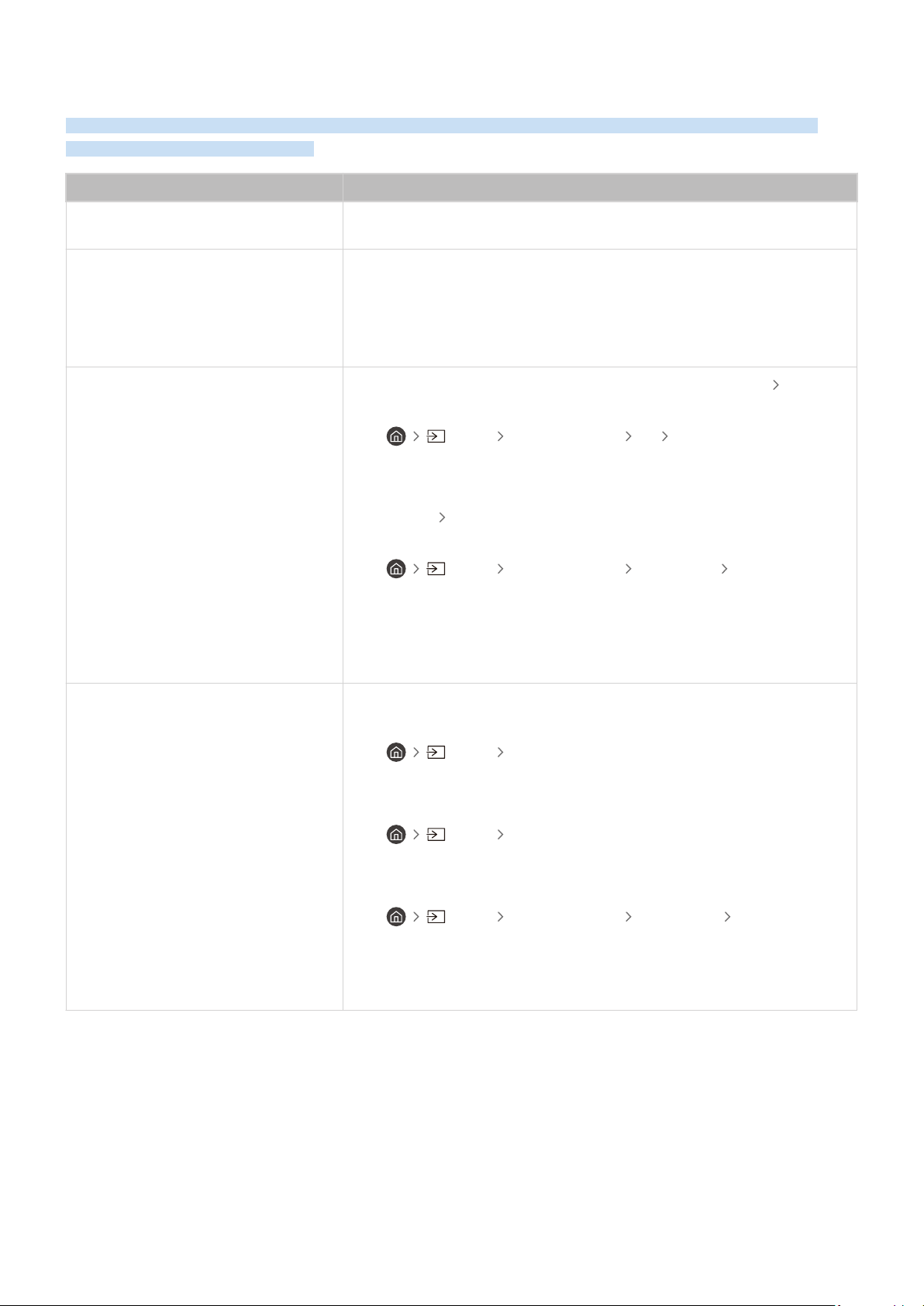
External Device Connectivity Issues
When the TV has difculties connecting to external devices such as a PC, game console or mobile device, these
steps may help resolve the problem.
The problem Try this!
The "Mode Not Supported" message
appears.
Adjust the output resolution of the external device to a resolution supported by
the TV.
The video is OK but there is no audio.
If you are using an HDMI connection, check the audio output setting on your PC.
If you are using a DVI to HDMI cable, a separate audio cable is required.
To listen to the computer sound, connect external speakers to the audio output
connection of the computer.
I want to connect to a PC and mobile
device via screen mirroring.
To wirelessly connect the TV to your PC, read the instructions at PC Screen
Sharing (Wireless) in Connection Guide, and then try to connect.
•
Source Connection Guide PC Screen Sharing (Wireless)
Conrm that the TV and your PC are connected to the same network.
To wirelessly connect the TV to your mobile device, read the instructions at
Smartphone
Screen Sharing (Smart View) in Connection Guide, and then try
to connect.
•
Source Connection Guide Smartphone Screen Sharing
(Smart View)
If the TV has difculties connecting to your PC or mobile device due to
surrounding radio interferences, change the frequency of the wireless access
band, and then try to connect.
No screen appears when connecting the
TV to an external device.
For more information about how to connect an external device, run Connection
Guide.
•
Source Connection Guide
Make sure that the external device is connected securely and turned on. Move
to Sources to switch to other input sources.
•
Source Sources
Using HDMI Troubleshooting, you can check the connection to HDMI cable and
external devices (takes approximately 2 minutes).
• Source Connection Guide Video Device HDMI
Troubleshooting
When using a set-top box or cable box, check the broadcast signals or the
network that is connected to the external device.
- 183 -

The problem Try this!
I want to connect to a Bluetooth
speaker.
For more information on how to connect a Bluetooth speaker, see Audio
Device Bluetooth in Connection Guide.
•
Source Connection Guide Audio Device Bluetooth
The PC screen does not appear or it
ickers.
When the PC screen does not appear or the PC is not recognised, check the
power supply of the PC and then reconnect the HDMI cable between the PC and
TV. When the symptom persists, check that the PC is in Sleep mode, and then
set Input Signal Plus to On.
• Settings General External Device Manager Input Signal
Plus
When the set resolution is not matched, it may cause a blank or ickering
screen. For the PC supported resolution, see '
Read Before Connecting a
Computer (Supported Resolutions).'
- 184 -
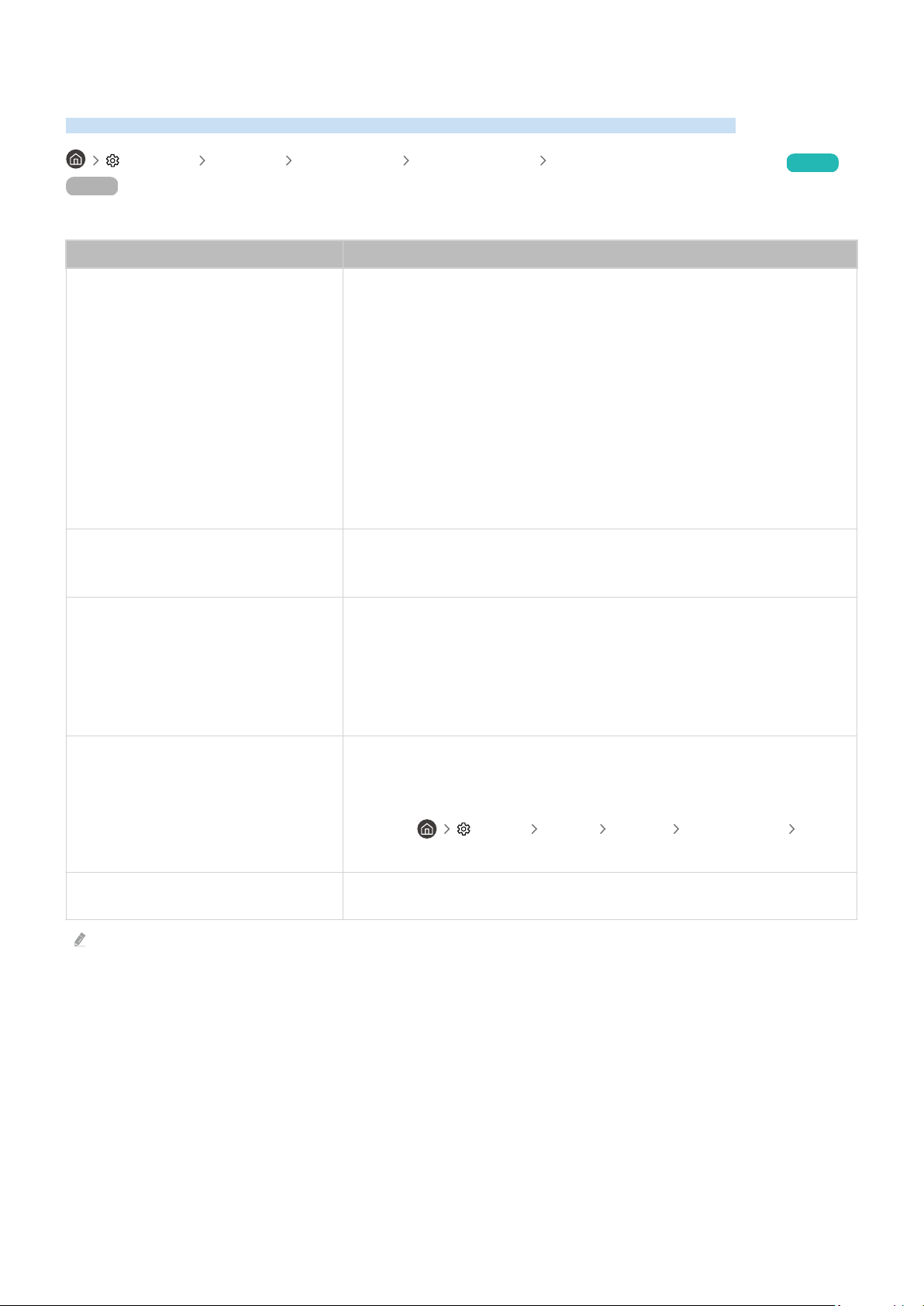
Network Issues
When the TV has difculties connecting to the Internet, these steps may help resolve the problem.
Settings Support Device Care Self Diagnosis Smart Hub Connection Test Try Now
Try Now
If the TV has trouble with network connection or TV services, check the Smart Hub connection status.
The problem Try this!
Wireless network connection failed.
Unable to connect to a wireless access
point.
Make sure that no items that can generate electromagnetic interferences are
placed between the TV and the wireless/wired access point.
Check if the access point is turned on. If it is on, turn it off, wait 1 or 2 minutes,
and then turn it on.
Enter the correct password if required.
If the wireless connection fails, connect the TV to the access point via a LAN
cable.
If the TV can connect to the Internet normally via the wired connection, there
might be a problem with the access point. In this case, try using a different
access point.
Wired network connection failed.
Check if the LAN cable is plugged in on both ends. If it is plugged in, check if the
access point is turned on. If it is on, turn it off, wait 1 or 2 minutes, and then turn
it on.
Auto IP conguration failed.
Unable to connect to the network.
Check if the LAN cable is plugged in on both ends. If it is plugged in, check if the
access point is turned on.
If the access point is on, turn it off, wait 1 or 2 minutes, and then turn it on.
Disconnect and then reconnect the power cable of the TV or press and hold the
power button for 3 seconds.
Connected to a local network, but not to
the Internet.
1.
Check if the Internet LAN cable is connected to the access point's external
LAN port.
2.
Check the DNS setting in IP Settings.
–
Settings General Network Network Status IP
Settings
Network setup is completed, but unable
to connect to the Internet.
If the problem persists, contact your Internet service provider.
Wired networks are not supported by some models.
- 185 -

Apps
When apps aren't working, these steps may help resolve the problem.
The problem Try this!
I launched an app, but it's in a
different language. How can I change
the language?
Languages supported by an app may be different from the TV Language set in
the menu.
The ability to change the language depends on the app's provider.
The app does not work properly.
Its image quality is poor.
Check the network connection. When the network speed is slow, the app may
not work or its image quality may be poor.
The services of your application are not provided by the TV but by the
application service provider.
Refer to the Help section on the application service provider's website.
The Smart Hub home screen keeps
appearing whenever you turn on the TV.
Turn off the Autorun Smart Hub function in Smart Features.
•
Settings General Smart Features Autorun Smart Hub
Media Files
When les don't play, this may help resolve the problem.
The problem Try this!
Some les are interrupted during
playback.
This problem may occur with unsupported les or high-bitrate les. Most les
can be played back, but some les may not play smoothly.
Some les can't be played.
Some les that use an unsupported codec may not be played back.
Make sure that the codec is supported by the TV. For more information about
the supported codecs, refer to "
Read Before Playing Photo, Video or Music
Files".
- 190 -

Voice Assistant Issues
When the Voice Assistant isn't working, these steps may help resolve the problem.
This function may not be supported depending on the model or geographical area.
The Voice Wake-up function may not be supported depending on the model, Voice Assistant or geographical area.
The problem Try this!
The voice commands do not work well.
Voice commands may differ depending on the Voice Assistant.
Refer to the command examples for each Voice Assistant.
• Bixby:
Explore Now
• Amazon Alexa: Settings General Voice Amazon Alexa
Settings
• Google Assistant:
Settings General Voice Google
Assistant Settings
Bixby or Alexa answers automatically.
The TV may recognise an ambient noise or everyday conversation as a call to
Voice Assistant.
Turn off the Voice Wake-up function or set the Wake-up Sensitivity to Low.
• Explore Now Settings Voice Wake-up
I spoke "Hi, Bixby" but Bixby does not
answer.
I spoke "Alexa" but Amazon Alexa does
not answer.
When the TV is far from you or the ambient noise is so loud, the TV may be
unable to recognise your voice.
• When the distance to the TV is within 3 to 4 m, optimal performance is
provided. Please look at your TV screen and speak.
Turn on the Voice Wake-up function.
• Explore Now Settings Voice Wake-up
Voice recognition does not work with
the Samsung Smart Remote unlike other
features.
There is no response even if the Voice
Assistant button is pressed.
The connection between the remote control and the TV may be lost. Try pairing
the remote control with the TV.
Point the Samsung Smart Remote at the front of the TV, and then press and
hold the and buttons simultaneously for 3 seconds or more.
Also, if the remote control does not work properly or its response is very slow,
the battery might be low or dead.
• Charge the remote control by using the solar cell or the USB port(C-type)
on the bottom.
– You can check remaining battery of Samsung Smart Remote with
solar cell in Settings General Power and Energy Saving
Available Remote Battery.
• If the remote control has batteries, replace them with new ones.
During voice recognition, the heavy load
message appears and the function does
not work.
Unplug and then plug the TV power cable and then try again after 1 minute
and 30 seconds. It may take a while if the voice recognition server is being
inspected.
I want to see weather information of the
desired area.
Say with the area name included.
- 191 -
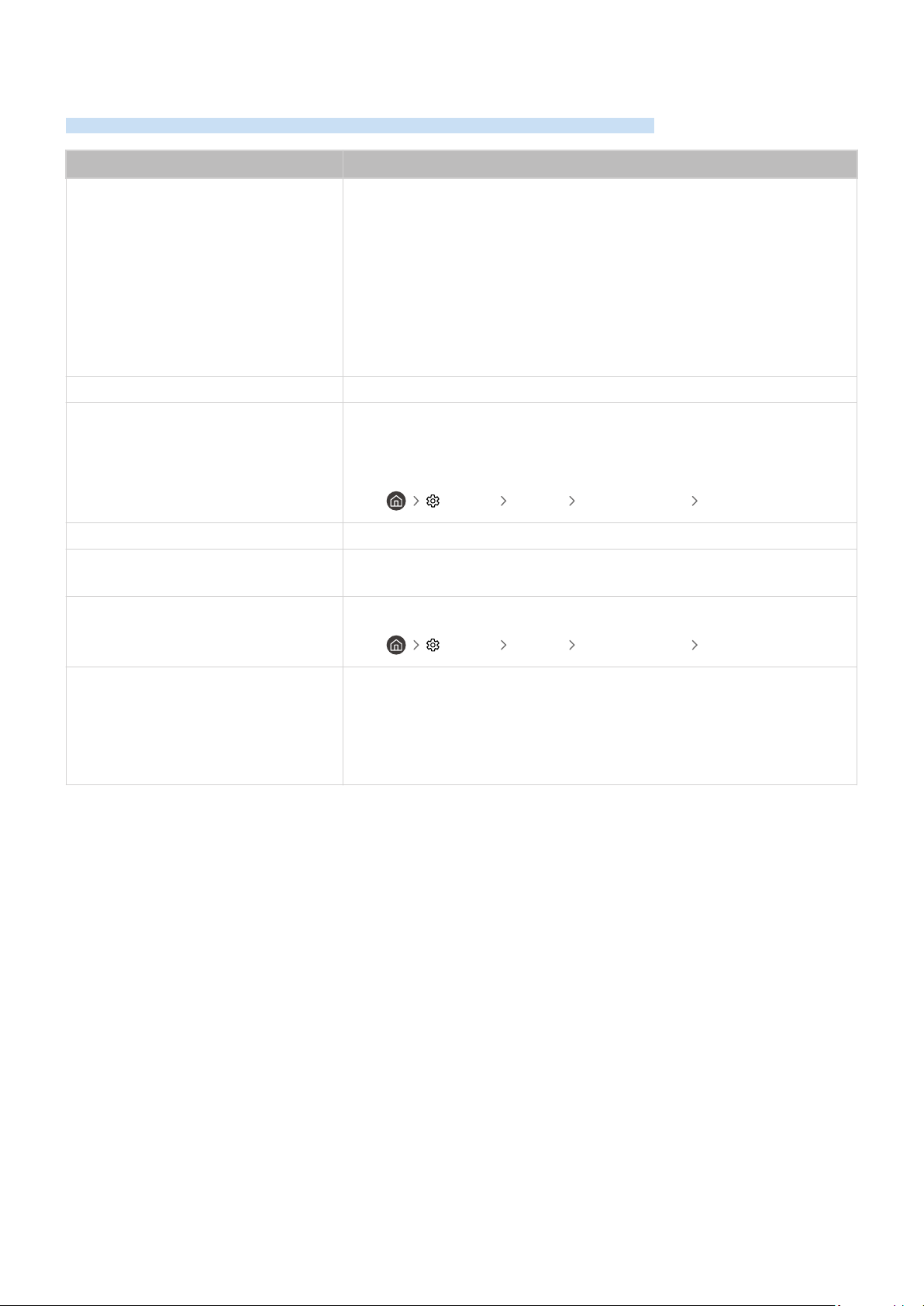
Other issues
Use these procedures to resolve other issues that may occur in relation to the product.
The problem Try this!
The TV is hot.
Watching TV for an extended period of time causes the panel to generate heat.
The heat from the panel is dissipated through internal vents running along the
top of the TV.
The bottom, however, may feel hot to the touch after extended use.
Children watching TV need constant adult supervision to prevent them from
touching the TV.
This heat, however, is not a defect and does not affect the TV's functionality.
The TV smells like plastic. This smell is normal and will dissipate over time.
The settings are lost after 5 minutes or
every time the TV is turned off.
If Usage Mode is set to Retail Mode, the TV's audio and video settings are
automatically reset every 5 minutes.
Change Usage Mode to Home Mode.
• Settings General System Manager Usage Mode
The TV is tilted to the side. Remove the base stand from the TV and reassemble it.
The stand is wobbly or crooked.
Refer to the Quick Setup Guide and make sure that the stand is assembled
correctly.
A POP (TV’s internal banner ad) appears
on the screen.
Change Usage Mode to Home Mode.
•
Settings General System Manager Usage Mode
The TV is making a popping noise.
The expansion and contraction of the TV's outer casing may cause a popping
noise.
This does not indicate a product malfunction.
The TV is safe to use.
- 192 -

The problem Try this!
The TV is making a humming noise.
Your TV utilises high-speed switching circuits and high levels of electrical
current. Depending on the TV's brightness level, the TV may seem slightly
noisier than a conventional TV.
Your TV has undergone strict quality control procedures that meet our
demanding performance and reliability requirements.
Some noise coming from the TV is considered normal and is not an acceptable
cause for an exchange or refund.
The software update over the Internet
has failed.
Check the network connection status.
• Settings General Network Network Status
If the TV is not connected to a network, connect it to a network.
The upgrade stops if you already have the latest software version.
The TV narrates the screen events in
voice-over.
To turn off Voice Guide, move the focus from Accessibility Shortcuts to Voice
Guide and then press the Select button. You can turn on or off Voice Guide. To
run Accessibility Shortcuts, see the following:
• Press and hold the (Volume) button on your Samsung Smart Remote
or Remote Control.
• Press the AD/SUBT. button on the Standard Remote Control or press and
hold the MUTE button.
- 193 -
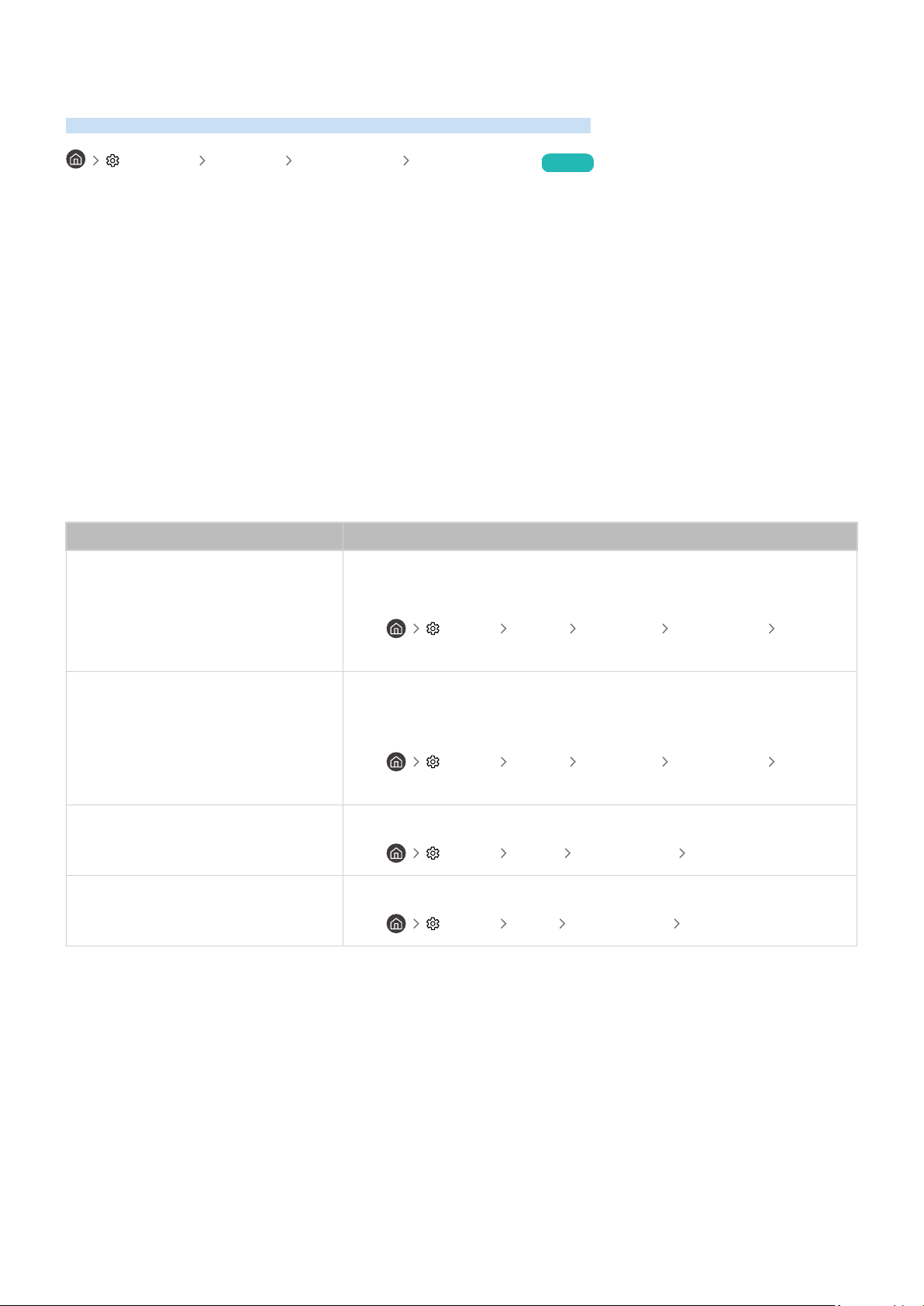
Diagnosing TV operational issues
You can diagnose issues with your TV and Smart Hub and run reset functions.
Settings Support Device Care Self Diagnosis Try Now
You can use the Picture Test to help diagnose video issues and the Sound Test to diagnose sound issues. You can
also view signal strength information for over-the-air digital signals, test the Smart Hub Internet connection and
run the Smart Hub and TV factory reset functions.
• Video Test
• Picture Test
• Sound Test
• HDMI Troubleshooting
• Signal Information
• Smart Hub Connection Test
• Reset Smart Hub
The problem Try this!
Cannot select Signal Information in Self
Diagnosis.
Verify that the current channel is a digital channel.
Signal Information is only available for digital channels.
•
Settings Support Device Care Self Diagnosis Signal
Information
Reset Smart Hub
Resets all Smart Hub settings to their factory defaults and deletes all
information related to Samsung accounts, linked service accounts, Smart Hub
service agreements and Smart Hub applications.
• Settings Support Device Care Self Diagnosis Reset
Smart Hub
Reset picture
Resets current picture settings to the default settings.
•
Settings Picture Expert Settings Reset Picture
Reset sound
Resets current sound settings to the default settings.
•
Settings Sound Expert Settings Reset Sound
- 194 -
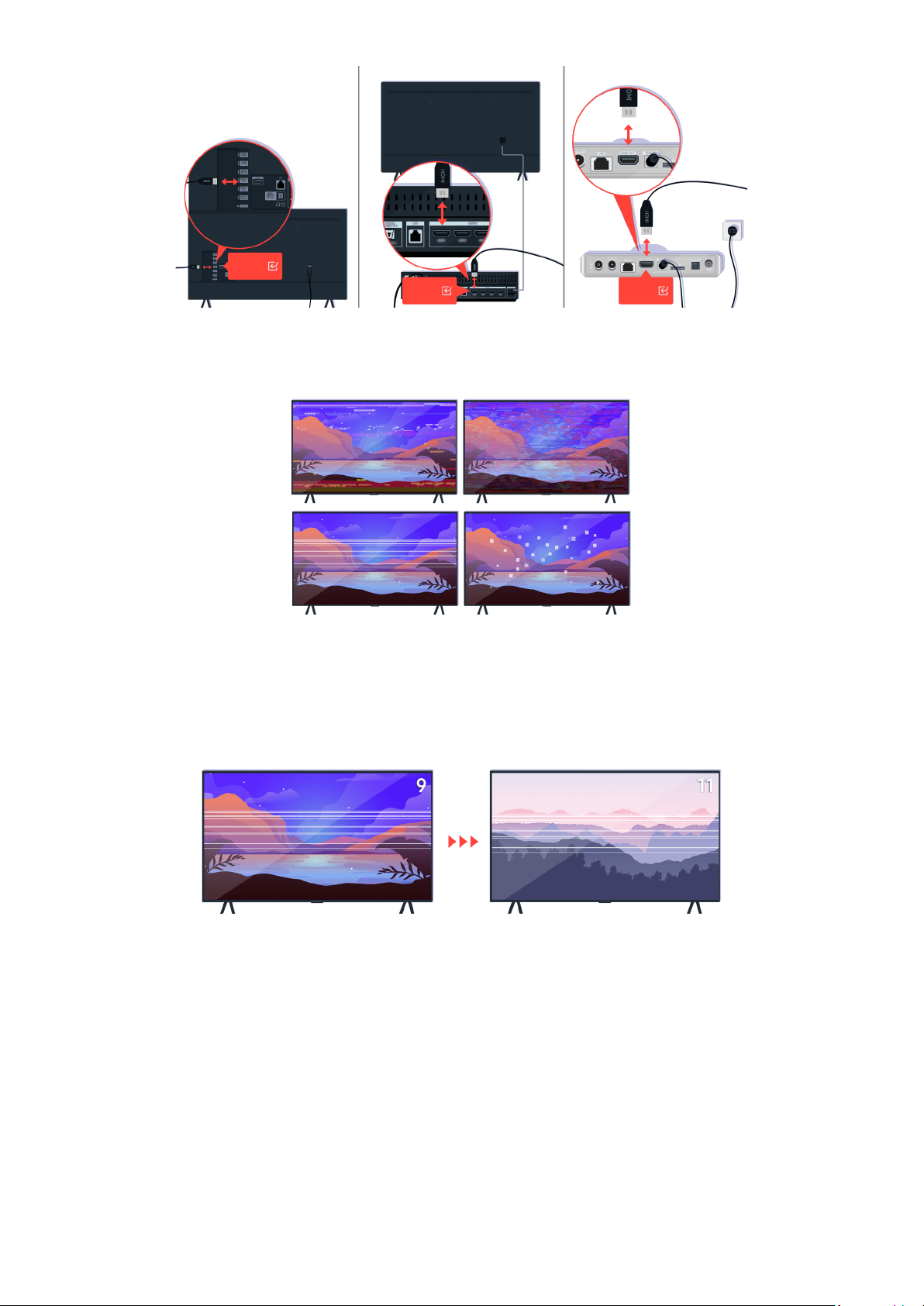
HDMI
HDMI
HDMI
Check the antenna and HDMI cable connections.
If the issue persists, define exactly what is wrong with the display. For example, mosaics and blocks, multiple lines or
white dots or fixed horizontal or vertical lines.
Try changing channels using the remote control.
- 197 -
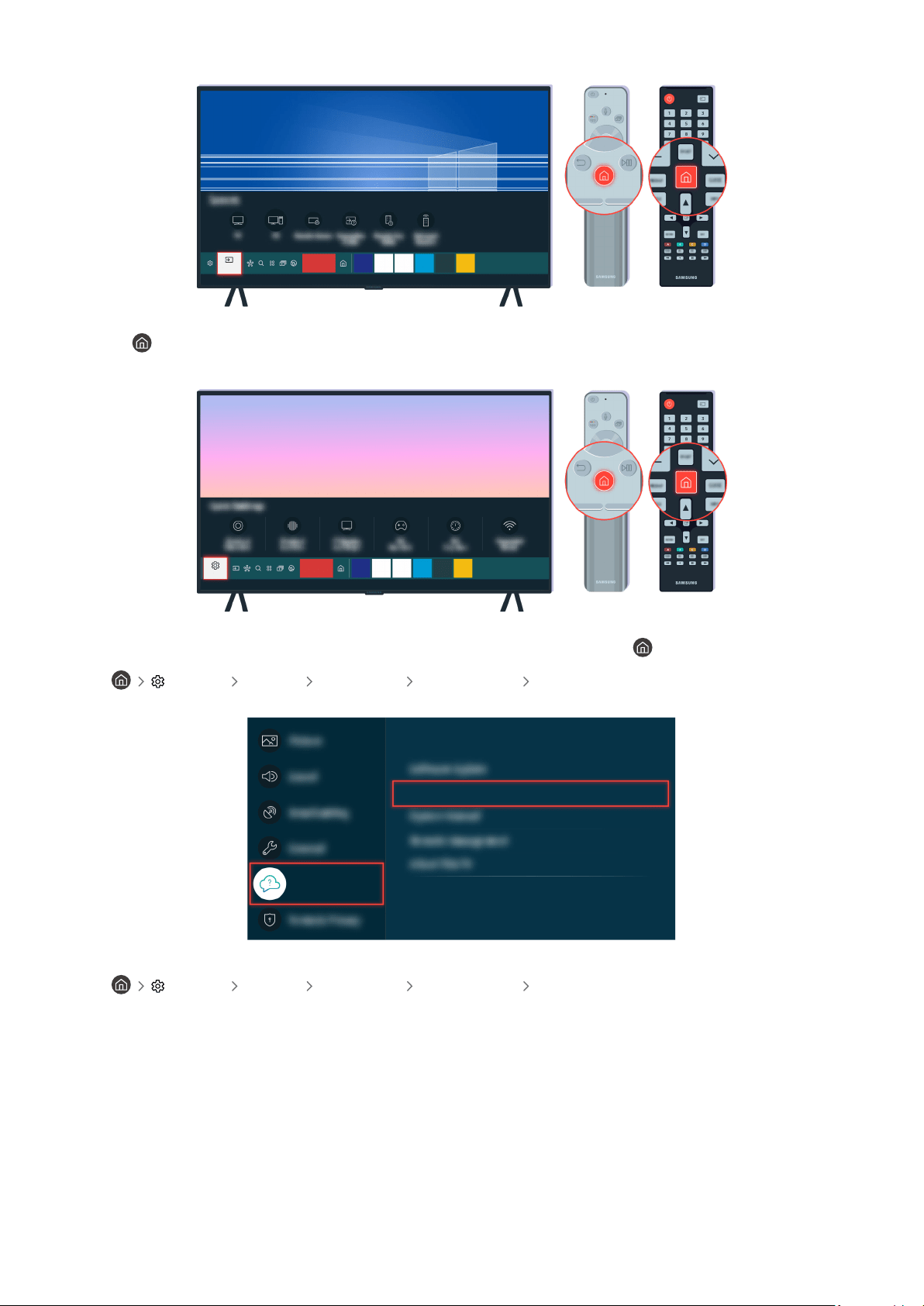
Source
Press the button, select Source, choose another input source.
Settings
If the same problem persists, run a diagnostic test. On the remote control, press the button.
Select Settings Support Device Care Self Diagnosis Picture Test.
Support
Support
Device Care
Select Settings Support Device Care Self Diagnosis Picture Test.
- 198 -
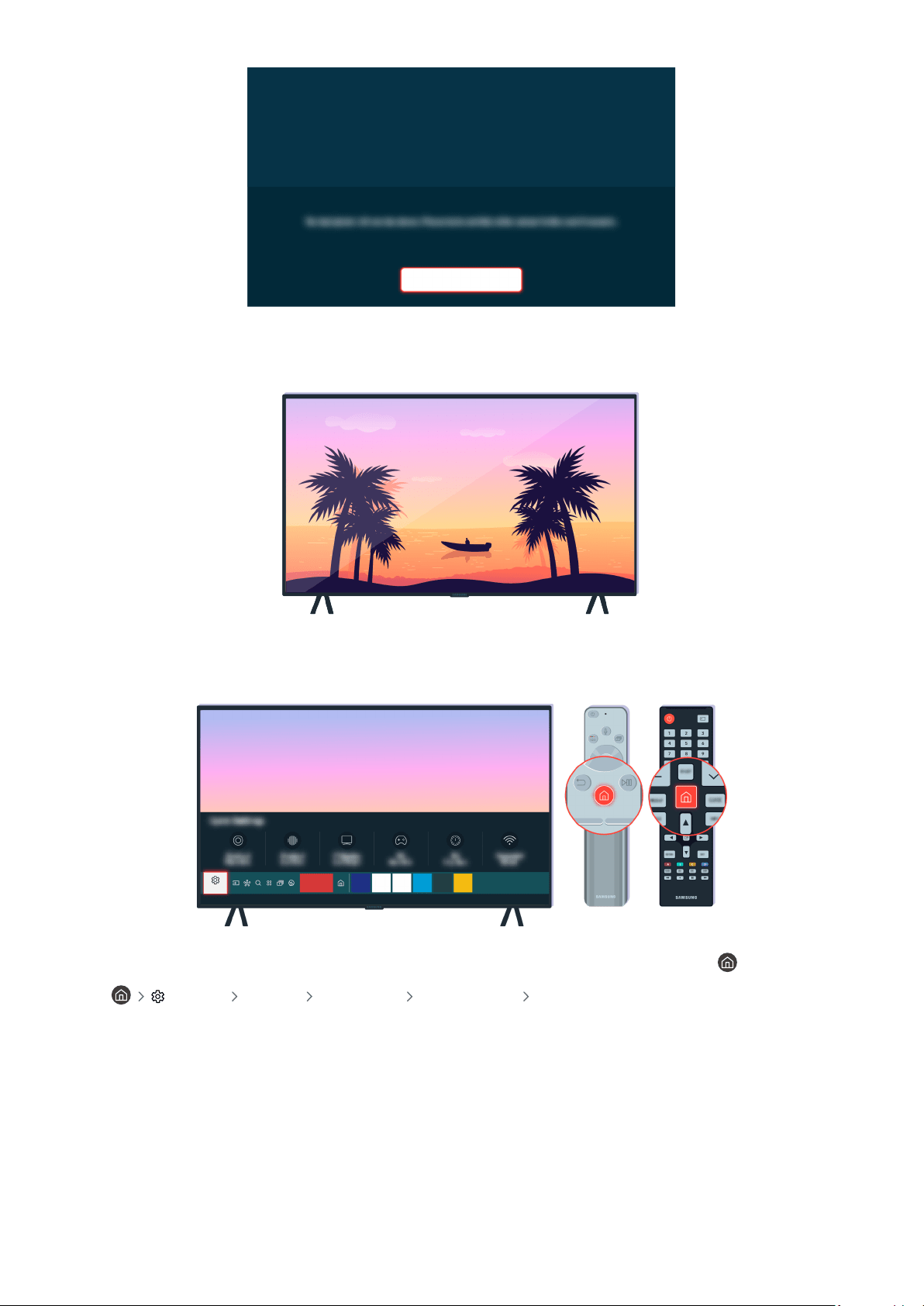
Picture Test
OK
When a message appears, select OK and follow the on-screen instructions to complete the test.
When a message appears, select OK and follow the on-screen instructions to complete the test.
Settings
If the problem disappears during the test, check your TV signal. On the remote control, press the button.
Select Settings Support Device Care Self Diagnosis Signal Information to check the signal
strength.
- 199 -

Support
Support
Device Care
Select Settings Support Device Care Self Diagnosis Signal Information to check the signal
strength.
Signal Information
Check whether the signal strength is too weak or not.
Related menu path
Settings Support Device Care Self Diagnosis Picture Test Try Now
Settings Support Device Care Self Diagnosis Signal Information Try Now
- 200 -
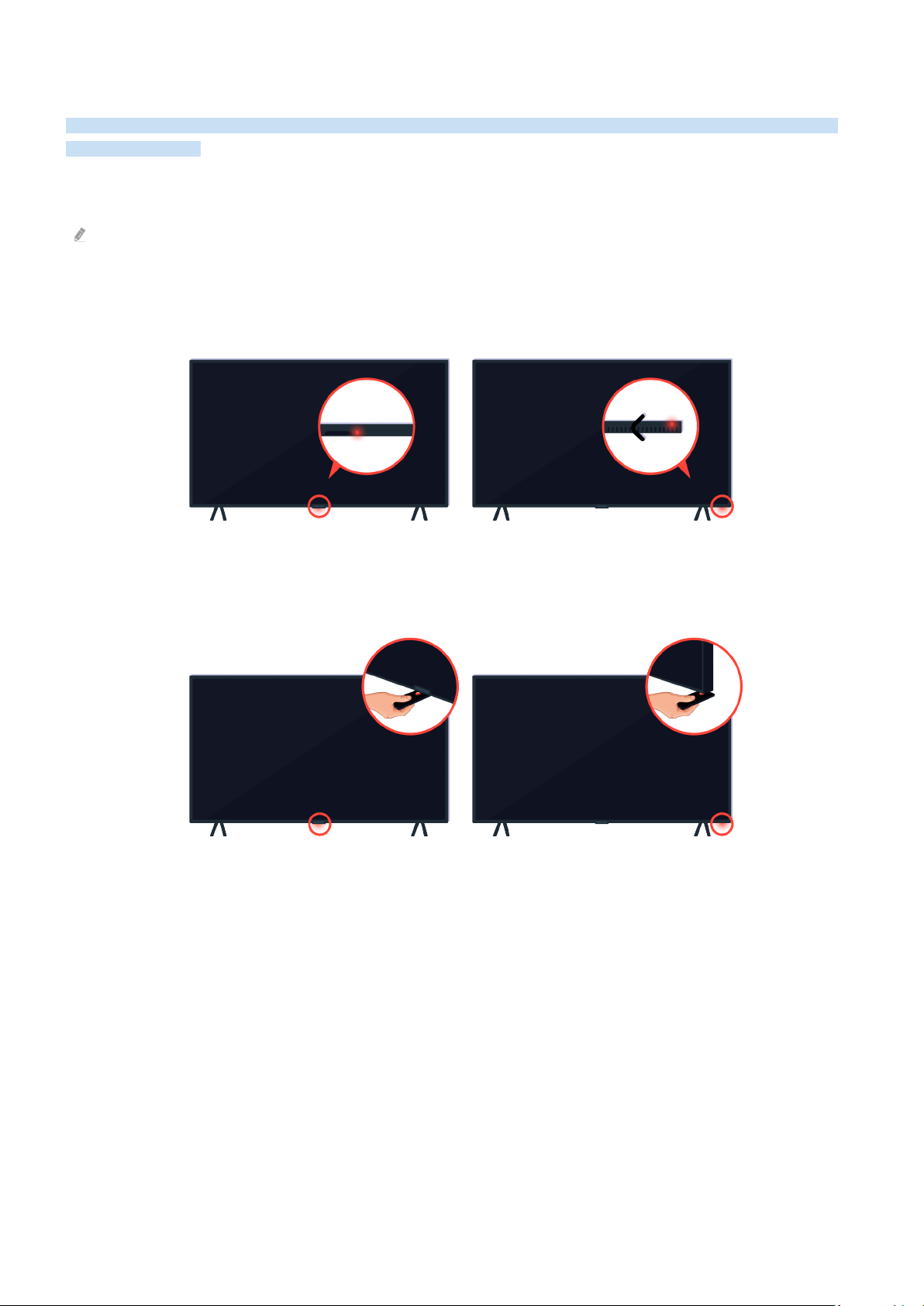
The TV does not Turn On
If there is no screen on the TV, it often occurs when the contact point of the power cable is loose or the peripheral
device is turned off.
When your TV does not turn on
The TV's colour, design, accessories (including the remote control) and features may differ depending on the model or
geographical area.
If your TV does not turn on, check whether the remote control sensor is on.
By holding a reflective object like mirror under the TV, you can easily find the remote control sensor.
- 201 -

Power
If the remote control sensor is not turned on, unplug the power cable and plug it back in.
One Invisible
Connection/One
Connect Cable
One Invisible
Connection/One
Connect Cable
Disconnect and reconnect the One Invisible Connection or One Connect Cable between the TV and the One Connect
Box. Make sure that the One Invisible Connection or One Connect Cable is not pinched or bent sharply.
Check the remote control sensor again. If the LED is turned on, press the power button on your remote control to turn
on your TV.
- 202 -
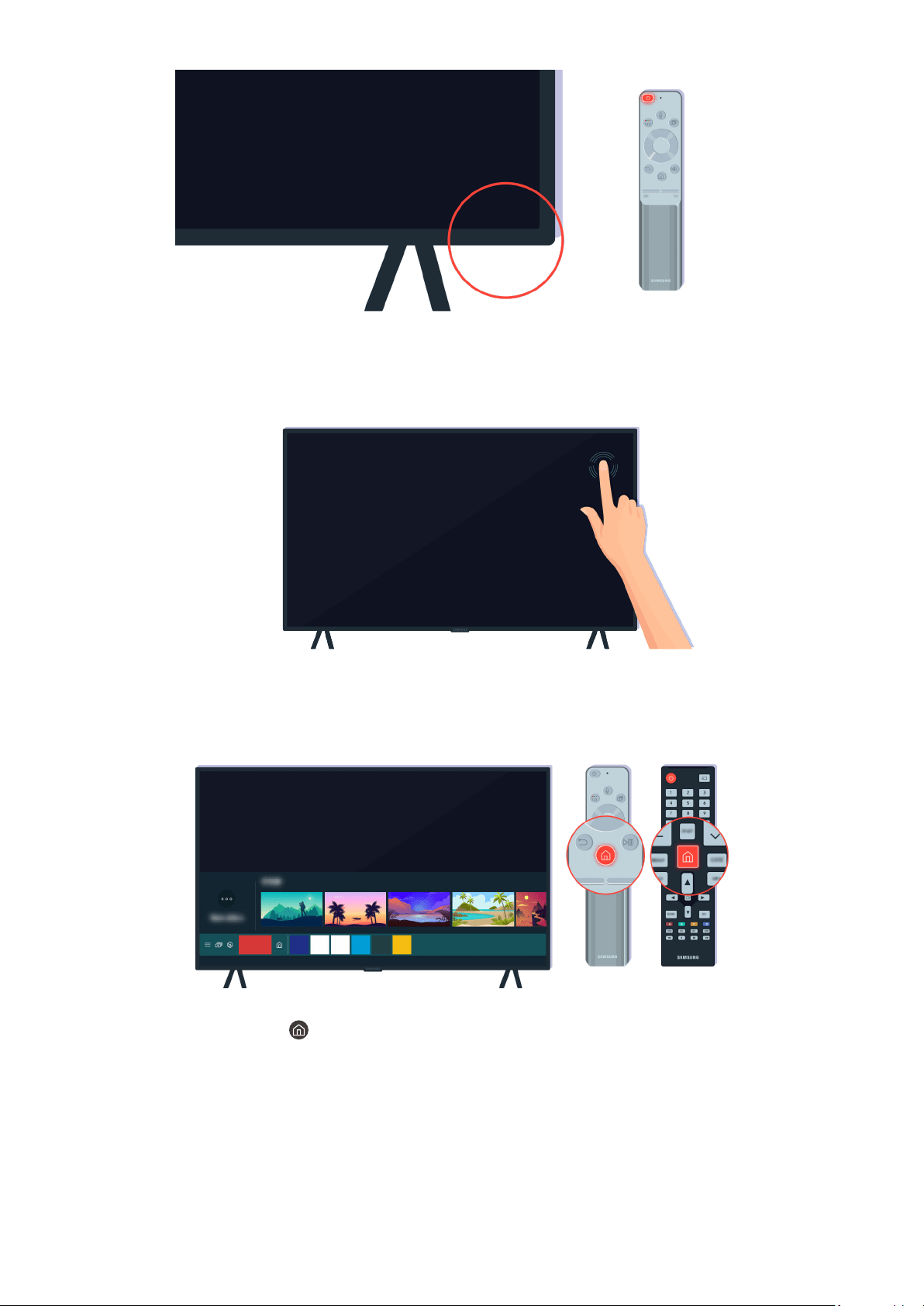
If the remote control sensor turns off when you press the power button, your TV is correctly connected to the power
supply.
If the TV screen is still blank, softly tap it with your finger. If the part of the screen you tapped on blinks, your TV is
correctly connected to the power supply.
On the remote control, press the button. When the Home Screen appears, the TV is turned on but the connected
external device does not work or is not connected correctly.
- 203 -
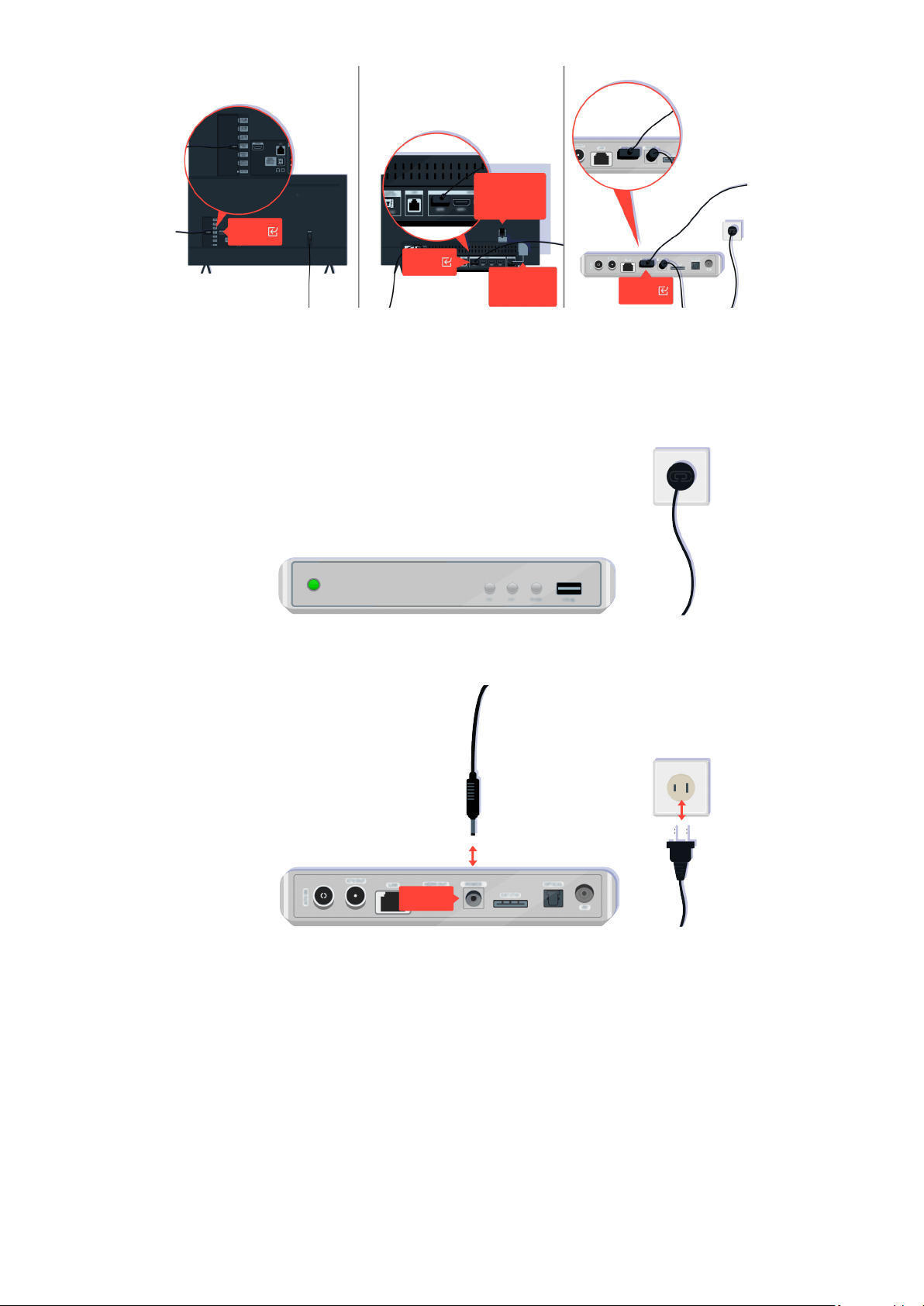
HDMI
HDMI
HDMI
One Invisible
Connection/One
Connect Cable
One Invisible
Connection/One
Connect Cable
Check the connection of the HDMI cable to your TV or One Connect Box.
Make sure that the external device is turned on.
Power
If it does not turn on, make sure the power cable is properly connected to the device and to the wall outlet.
- 204 -
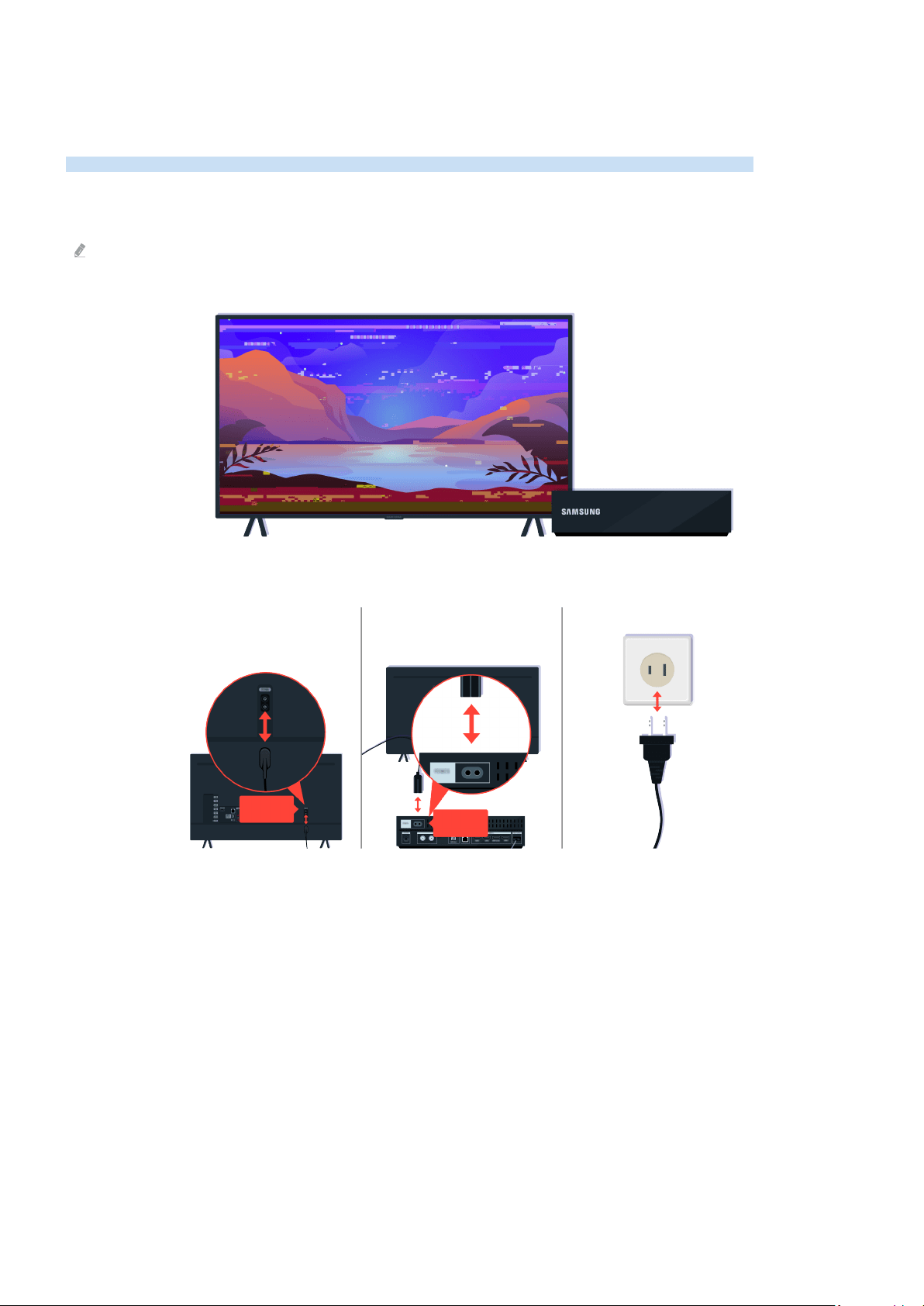
The Picture is Distorted, or No Sound Comes Out of the Sound
Bar
No TV sound from the sound bar, or distorted TV picture are often caused by loose cable connections.
When the TV does not connect with an external device properly
The TV's colour, design, accessories (including the remote control) and features may differ depending on the model or
geographical area.
When the picture looks distorted,
Power
Power
First disconnect and reconnect the power cables and HDMI cables on the back of your TV or the One Connect Box,
then unplug the power cable and plug it back into the wall outlet.
- 207 -
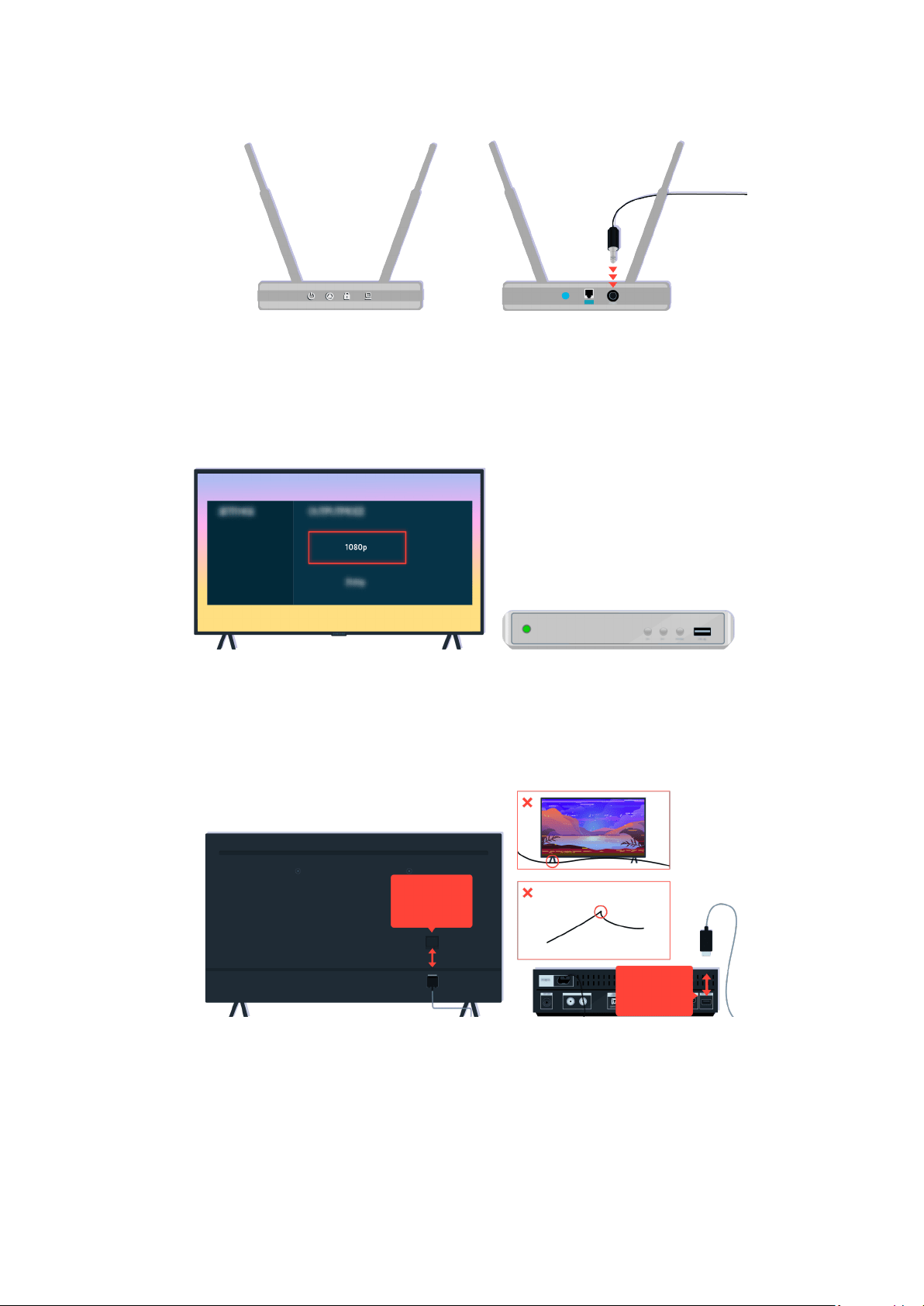
Make sure that your access point is connected to the Internet. If not, disconnecting and reconnecting its power cable
may be required.
If the problem persists, check the video output settings in the settings menu of the external device and ensure that
your TV supports the video output mode.
FHD TVs support up to 1080p video output and UHD TVs support up to 2160p video output.
One Invisible
Connection/One
Connect Cable
One Invisible
Connection/One
Connect Cable
If the problem persists and if your TV uses the One Invisible Connection or One Connect Cable, disconnect and
reconnect the One Invisible Connection or One Connect Cable to the TV and the One Connect Box. Ensure that the
One Invisible Connection or One Connect Cable is not pinched or bent sharply.
- 209 -

Internet Access is not Available
When the TV has difculties connecting to the Internet, these steps may help resolve the problem.
When the TV can't connect to the Internet
The TV's colour, design, accessories (including the remote control) and features may differ depending on the model or
geographical area.
On the remote control, press the button and move to Settings using the directional button.
Settings
Select Settings General Network Network Status to check the network status.
- 211 -

If you are using a wireless access point, check the access point location. If the access point is too far from the TV,
move it closer.
Try rebooting the access point by disconnecting and reconnecting the power connector. It may take 1 to 2 minutes
until the access point comes back online after a reboot.
Settings
If the same problem continues, select Settings General Network Network Status IP Settings to
change to a different DNS server. If a test occurs, cancel it and select IP Settings.
- 213 -

General
General
Network
If the same problem continues, select Settings General Network Network Status IP Settings to
change to a different DNS server. If a test occurs, cancel it and select IP Settings.
Network Status
IP Settings
If the same problem continues, select Settings General Network Network Status IP Settings to
change to a different DNS server. If a test occurs, cancel it and select IP Settings.
IP Settings
DNS setting
Enter manually
Select DNS setting Enter manually.
- 214 -

Settings
Go to Settings Support Device Care Self Diagnosis Sound Test to check the sound.
Support
Support
Device Care
Go to Settings Support Device Care Self Diagnosis Sound Test to check the sound.
Settings
If the test reveals a problem, select Settings Sound Expert Settings Reset Sound.
- 219 -
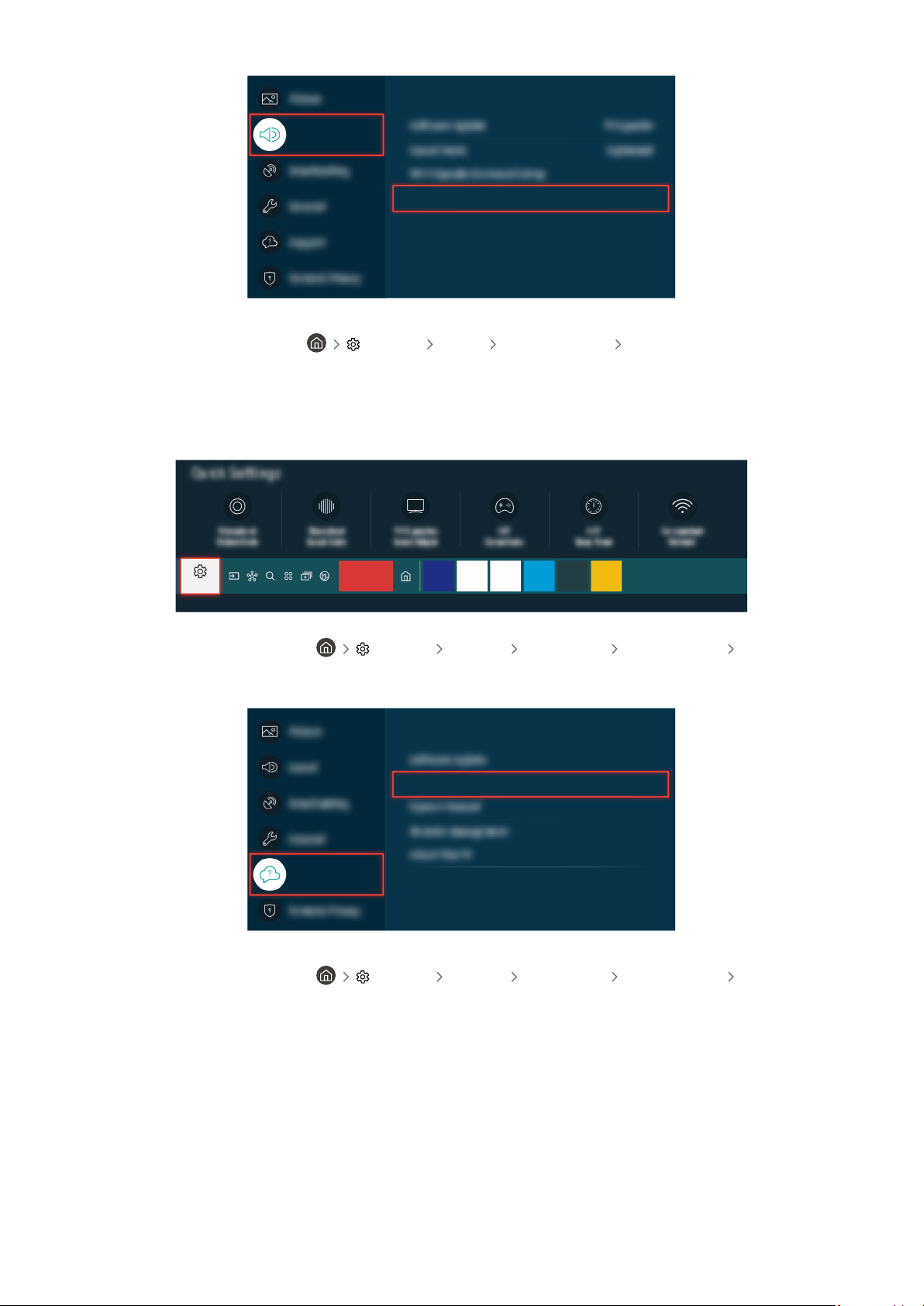
Sound
Sound
Expert Settings
If the test reveals a problem, select Settings Sound Expert Settings Reset Sound.
Settings
If the test shows no problems, select Settings Support Device Care Self Diagnosis Signal
Information.
Support
Support
Device Care
If the test shows no problems, select Settings Support Device Care Self Diagnosis Signal
Information.
- 220 -

Signal Information
Check whether the signal strength is too weak or not.
Update now
If the same problem continues, a software update or factory reset may be required.
Related menu path
Settings Sound Sound Output Try Now
Settings Support Device Care Self Diagnosis Sound Test Try Now
Settings Sound Expert Settings Reset Sound Try Now
Settings Support Device Care Self Diagnosis Signal Information Try Now
Settings Support Software Update Try Now
Settings General Reset Try Now
- 221 -

Press the and buttons simultaneously to display the pairing animation clip.
Follow the on-screen instructions to proceed with the pairing.
The remote control will work more effectively if you point it at the remote control sensor.
- 224 -

Updating the Software
If you want to keep the TV in its best condition or if you have an intermittent issue, please update it to the latest
version.
Updating to the latest TV's software
The TV's colour, design, accessories (including the remote control) and features may differ depending on the model or
geographical area.
Settings
If your TV is connected to the Internet, you can set it to receive periodic updates automatically. On the remote
control, press the button and move to Settings using the directional button.
Support
Support
Software Update
To enable automatic updates, select Settings Support Software Update Auto update.
- 226 -
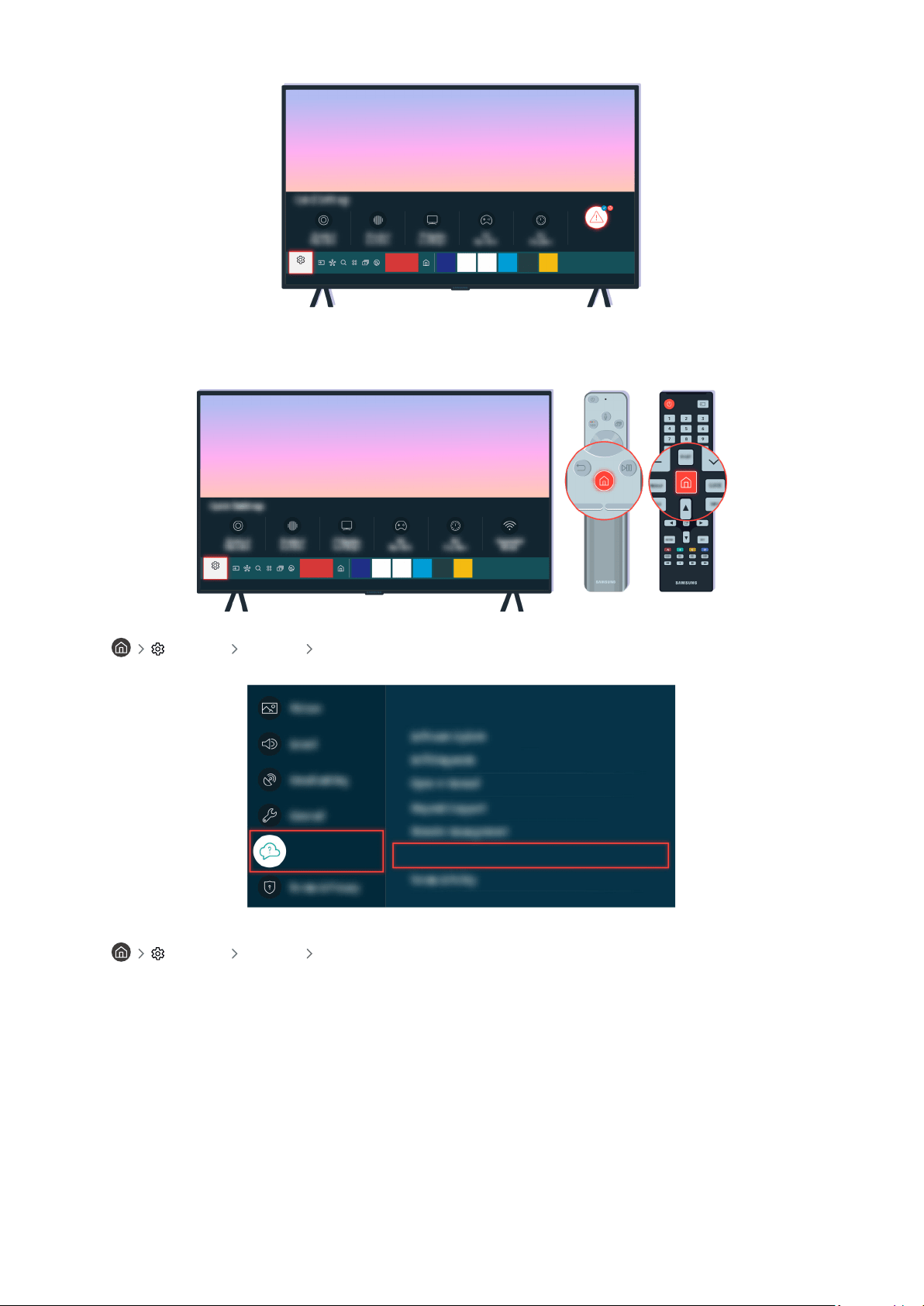
Settings
No Access
Network
If your TV is not connected to the Internet, you can update the software using a USB drive.
Settings
Select Settings Support About This TV and check the model code and software version.
Support
Support
About This TV
Select Settings Support About This TV and check the model code and software version.
- 227 -
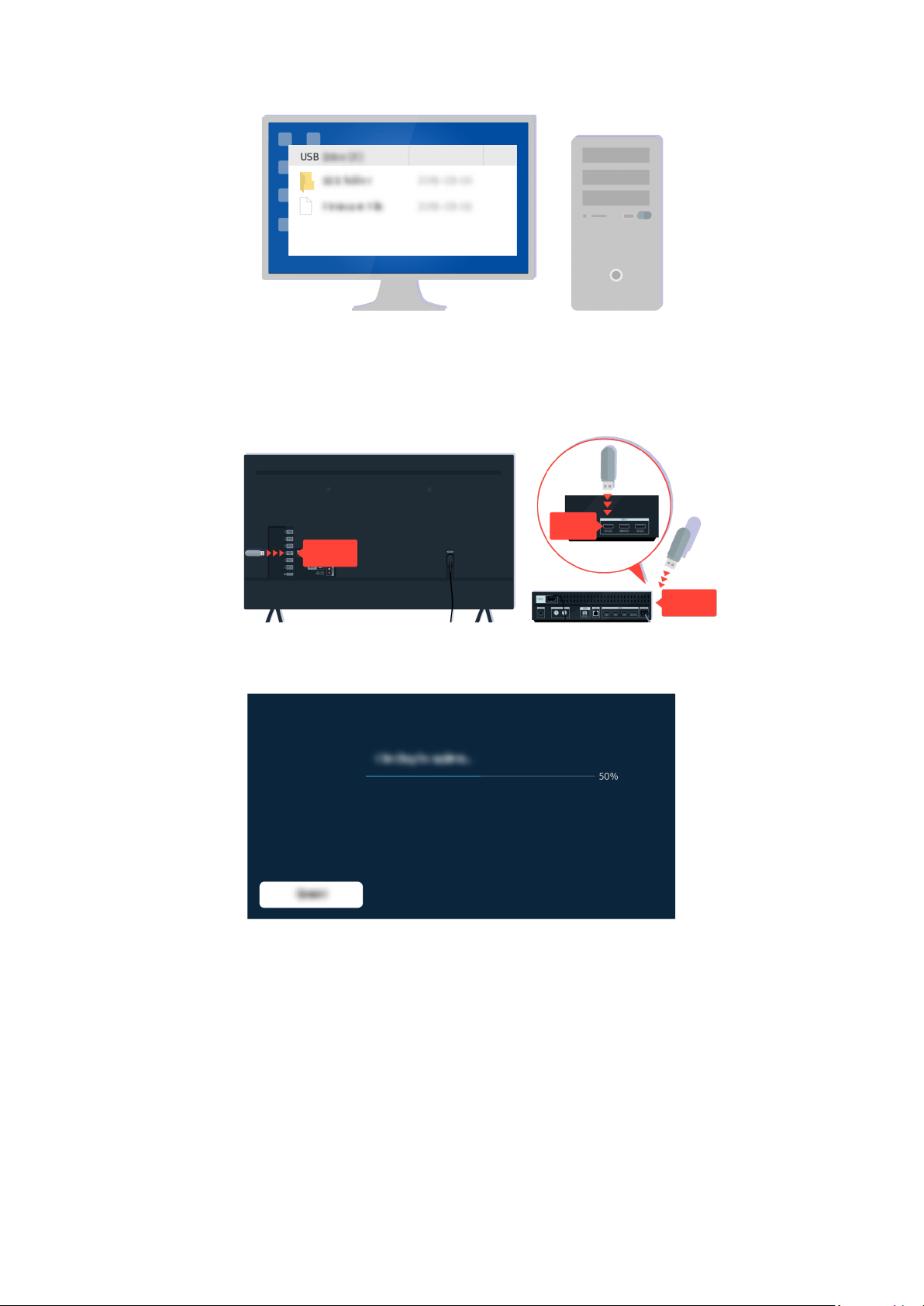
Unzip the downloaded file and store it in your USB drive top folder.
USB
USB
USB
Insert the USB device into the USB slot on the back of your TV or the side of the One Connect Box.
Update now
The firmware update begins automatically. Your TV will be automatically reset when the firmware update is
completed. Do not turn off your TV while the firmware update is in progress.
- 230 -

Settings
After your TV has been reset, select Settings Support About This TV and check the new firmware
version.
Support
Support
About This TV
After your TV has been reset, select Settings Support About This TV and check the new firmware
version.
About This TV
Product Information
Model code:
Software version:
After your TV has been reset, select Settings Support About This TV and check the new firmware
version.
Related menu path
Settings Support Software Update Auto update Try Now
Settings Support About This TV Try Now
- 231 -

Accessibility Guidance
Provides a menu and a remote control guide that aid the visually impaired.
Menu Learning Screen
Learn the menus on the TV screen. Once enabled, your TV will tell you the structure and features of the menus you
select.
Using the Remote control
You can see the description of the buttons on the Samsung Smart Remote or Remote Control.
The Samsung Smart Remote or Remote Control may not be supported depending on the model or geographical area.
Orientation of the Samsung Smart Remote or Remote Control
Hold the remote control with the buttons facing towards you. The remote is slightly thinner towards the top and
thicker towards the bottom.
Description of the Samsung Smart Remote or Remote Control
The images, buttons and functions of the remote control may differ with the model or geographical area.
From top to bottom and left to right:
• The button is at the top left.
• There is a small LED(microphone) to the right of the button, but it cannot be felt by hand.
• For the Samsung Smart Remote, there is a round button below the LED, which is the
button.
• Of the 2 buttons below the button on the Samsung Smart Remote that comes with the QLED TV, The Frame
or AU9 Series the left one is the button and the right one is the button.
• Of the 2 buttons below the button on the Samsung Smart Remote that comes with AU8 Series, the left one is
the button and the right one is the button.
• Of the 2 buttons below the
button on the Remote Control that comes with AU7/BEA Series, the left one is the
button and the right one is the button.
- 232 -

• If you press the button twice, and then press the Select button or press the button while viewing a
programme, the Record, Timeshift, Stop (when Record or Timeshift is running), Info, red, green, yellow, blue and
Move to the top (or Move to the bottom) options appear.
Record and Timeshift may not be supported depending on the model or geographical area.
Select the Move to the top button to move the menu to the top.
This function may not be supported depending on the geographical area.
• Underneath these two buttons are a round button and a large outer circle button. The round button is the Select
button and the large outer circle button consists of 4 directional buttons (up / down / left / right).
• Underneath the directional button are three buttons, one on the left, one on the right and one in the centre. The
one on the left is the button and the one on the right is the button. The round button in the middle is the
button.
• If you press the button while watching a TV programme, the screen you are watching stops and a control
bar appears. You can select Rewind, Play, Pause, Fast Forward, Stop Timeshift, Record, Go to Live TV or Info. You
can press the up directional button to go to the playback screen and check the time that the actual broadcast
programme is running and the timeshift time.
You can use the Slow Rewind or Slow Forward functions when you select the Pause option.
To use Record or Timeshift, you must connect a USB device.
This function may not be supported depending on the model or geographical area.
• Underneath the button are two thin horizontal buttons. These buttons protrude higher above the surface
than the other buttons on the remote control. The one on the left is the volume button and the one on the right
is the channel button. Push up from beneath or down from above to use these as rocker buttons to change the
channel or volume.
– Briefly press the
(Volume) button to mute the sound.
– Press and hold the (Volume) button to open the Accessibility Shortcuts menu.
– Briefly press the (Channel) button to open the Guide.
– Press and hold the
(Channel) button to open the Channel List.
This function may not be supported depending on the model or geographical area.
- 233 -

Using the accessibility menu
View how to use the Accessibility menu functions and description of its functions.
This function may not be supported depending on the model or geographical area.
Running the Accessibility Shortcuts menu
You can turn on or turn off the accessibility functions such as Voice Guide, Picture Off, Audio Description, Subtitle,
High Contrast, Enlarge, Greyscale, Colour Inversion, Learn TV Remote, Menu Learning Screen, Multi-output Audio,
Sign Language Zoom, Slow Button Repeat, Accessibility Settings, and you can move to the Learn TV Remote and
Menu Learning Screen pages.
• Samsung Smart Remote / Remote Control
On the Samsung Smart Remote or Remote Control, there are two thin horizontal rocker buttons next to each
other located slightly below the middle of the remote. The one on the left is the volume button. Press and hold
the volume button to open the Accessibility Shortcuts menu.
Even if the Voice Guide is set to Off or muted, when you press and hold the volume button, the voice guide for
Accessibility Shortcuts is enabled.
• Standard Remote Control
Press the AD/SUBT. button or press and hold the MUTE button to open the Accessibility Shortcuts menu.
Running the Accessibility menu functions using the General menu
Settings General Accessibility
You can also go to the Accessibility menu from the TV settings menu. This provides more options, for example, to
change the speed of Voice Guide.
The TV will not verbalize this menu unless Voice Guide is already turned on.
1.
Press the button.
2.
Press the left directional button until you reach Settings.
3.
Press the Select button to open the TV's Settings menu.
4.
Press the down directional button to reach General, and then press the Select button to open this menu.
- 234 -

Learning about the Accessibility menu functions
• Voice Guide Settings
This function works on every screen on the TV and when turned on verbally tells you what the TV's current
settings are and verbally provides details about the programme you are watching. For example, it tells you
the selected volume and the current channel and gives you programme information. It also reads out the
programme information from the Guide screen.
• Audio Description Settings
You can activate an audio guide that provides an audio description of video scenes for the visually impaired. This
function is only available with broadcasts that provide this service.
• Picture Off
Turn off the TV screen and provide only sound to reduce overall power consumption. When you press a button on
the remote control other than Volume and Power while the screen is off, the TV screen turns back on.
• Graphic Zoom
Enlarge the screen to make the picture or text bigger. You can adjust the zoom level or move the zoom area.
This function may not be supported depending on the model or geographical area.
• High Contrast
To display all menus with an opaque black background and a white font, providing maximum contrast.
If High Contrast is on, some Accessibility menus are not available.
• Greyscale
You can change the colour of the TV screen to black and white to sharpen blurred edges caused by colours.
If Greyscale is on, some Accessibility menus are not available.
This function may not be supported depending on the model or geographical area.
• Colour Inversion
You can invert the colours of the text and background displayed on the TV screen to make it easier to read the
text.
If Colour Inversion is on, some Accessibility menus are not available.
This function may not be supported depending on the model or geographical area.
- 236 -

• Enlarge
You can enlarge important elements on the menu such as the names of programmes.
• Learn TV Remote
Learn the names and functions of the buttons on remote control. On this screen, pressing the power button (top
left button) will turn off the TV, but when any other button is pressed the TV will say the button name and briefly
tell what that button does. This teaching mode helps you to learn the location and operation of the buttons on
the remote without affecting normal TV operation. Press the
button twice to exit Learn TV Remote.
• Menu Learning Screen
Learn the menus on the TV screen. Once enabled, your TV will tell you the structure and features of the menus
you select.
• Subtitle Settings
You can view the subtitle in programmes that provide broadcast subtitles.
In programmes that provide broadcast subtitles, the Position function is activated so that you can change the subtitle
position.
When watching a channel on an external device such as set-top box and cable box, turn on the subtitle function on the
device. For more information, contact your service provider.
• Multi-output Audio
You can turn on both the TV speaker and Bluetooth headphone designed for the hearing impaired at the same
time. The hearing impaired can then set the volume of their Bluetooth headphone higher than the volume of
the TV speaker without affecting the volume of the TV speaker, allowing both the hearing impaired and their
families to listen to the TV at comfortable sound levels.
This function may not be supported depending on the model or geographical area.
• Sign Language Zoom Settings
You can zoom in the sign language screen when the programme you are watching provides it.
• Remote Button Repeat Settings
You can configure the operation speed of the remote control buttons so that they slow down when you
continually press and hold them.
- 237 -

Using the guide
See an overview of each channel's programme lineup.
When you want to know the programme information for each channel while watching a broadcast programme,
press the
(Channel) button on the Samsung Smart Remote or Remote Control. Use the directional buttons to
view the programme information.
On Standard Remote Control, press the GUIDE button.
Live TV Guide
You can see the daily programme schedules for each broadcaster and programme information in the Guide. You can
select programmes to schedule for viewing or recording.
You can also open the Guide using Bixby. Press and hold the button on your Samsung Smart Remote, and then
say “Guide”.
This function may not be supported depending on the model or geographical area.
The information in the Guide is for digital channels only. Analogue channels are not supported.
If the Clock is not set, the Guide is not provided. Set the Clock rst. ( Settings General System Manager
Time Clock)
If you need to set the clock again, follow the instructions below.
1.
Press the button to open Smart Hub.
2.
Press the left directional button to move to Settings.
3.
Press the Select button to open the TV's Settings menu.
4.
Use the up and down directional buttons to move to the General menu, and then press the Select button.
5.
Use the up and down directional buttons to move to the System Manager menu, and then press the Select
button.
6.
Select the Time menu, and then press the Select button.
7.
Select the Clock menu, and then press the Select button.
8.
Select the Clock Mode menu, press the Select button, and then select Auto or Manual.
If you select Manual, you can move to the Date or Time menu below to set the time or date.
- 240 -

When you open the Guide, a table grid of channels and programmes is displayed. The top row displays Filter By : All
then the day and times. Each row has a channel name on the left and programmes on that channel on the right.
In the Guide, use the up and down directional buttons to move between channels and use the left and right
directional buttons to move between programmes at different times within a channel.
You can also use the or button to enter a channel number and go to that channel directly. You can use the
button to move to the programme currently broadcasting.
When you move the focus to a programme, you will hear the detailed informations about the selected programme.
When you move the focus to a different channel, you will hear the channel name and number and the programme
details. If you move to a different day, you will hear the day announced for the rst programme you reach on that
day. The day is not repeated, so if you are not sure what the day is, you can move forwards and backwards 24 hours
and then the day will be announced.
To view a programme on now
In the Guide, move to the programme currently broadcasting, and then press the Select button to go to live TV on
the selected channel and programme.
Other options in the guide
In the Guide, move to a broadcast scheduled programme, and then press the Select button. A pop-up menu listing
the functions below appears.
Use the up and down directional buttons to move within this menu, and then press the Select button to choose an
item. Press to close the menu and go back to the Guide.
For the programme you are currently watching, press and hold the Select button.
• Record
You can record the programme that you are currently watching or a programme on another channel.
This function may not be supported depending on the model or geographical area.
• Stop
You can stop the recording function that is currently running.
This function may not be supported depending on the model or geographical area.
- 241 -

Using Schedule Viewing
Congure the TV to show a specic channel or programme at a specic time and date.
The
icon appears next to programmes that have been congured for a schedule viewing.
To set up a schedule viewing, you must rst set the TV's clock ( Settings General System Manager Time
Clock).
Setting up a schedule viewing
You can set up a schedule viewing on two screens.
• The Guide Screen
On the Guide screen, select a programme you would like to view, and then press and hold the Select button.
Select Schedule Viewing on the pop-up menu that appears.
• The Programme Info Screen
Press the Select button while watching the TV. The Programme Info window appears. Select a broadcast
scheduled programme by using the left or right directional buttons, and then press the Select button. You can
schedule watching the programme by selecting Schedule Viewing.
Cancelling a scheduled viewing
You have two ways to cancel a scheduled viewing.
• Cancelling a scheduled viewing from the Guide
1.
In the Guide ( Live TV Guide), move to the programme to cancel its scheduled viewing, and then
press the Select button.
2.
Move to Cancel Scheduled Viewing, and then press the Select button.
3.
When a pop-up message asking you to cancel the selected scheduled viewing appears, select Yes. The
scheduled viewing is cancelled and the Guide screen appears.
• Cancelling a scheduled viewing from Smart Hub
1.
Press the button to open Smart Hub, and then press the left or right directional button to move to Live
TV. Press the up directional button to move to the top row, and then press the left or right directional button
to move to Schedule Manager or Recordings.
2.
Press the Select button to open Schedule Manager or Recordings.
If the TV supports the Recordings function, press the directional buttons to move to Schedules.
3.
Use the down directional button to move to the list of programmes scheduled to view.
4.
Use the right directional button to move to the Delete option, and then press the Select button to delete the
selected item.
This function may not be supported depending on the model or geographical area.
- 243 -

Using the Channel List
See how to list the channels available on your TV.
Live TV Channel List
Using Channel List, you can change the channel or check programmes on other digital channels while watching TV.
Press the button. The Smart Hub home screen appears. Use the left or right directional buttons to move to Live
TV, press the up directional button to move to the top row, press the right directional button to move to Channel
List, and then press the Select button. This shows a list of the channels and the programme currently on. The focus
will be on the channel you are currently watching, showing channel name, channel number and programme title.
Use the up and down directional buttons to move within the channel list (or use the (Channel) button to go up
and down a page at a time). You can also use the or button to enter a channel number and go to that channel
directly.
Press the left directional button in the Channel List to move to the Category list. Use the up and down directional
buttons to move within this list. Press the Select button to choose a category you want from the Category list. The
Category list contains All, Samsung TV Plus, Favourites and Terrestrial, Cable or Satellite. Use the up and down
directional buttons to move to a channel you want to view, and then press the Select button.
This function may differ depending on the model or geographical area.
• All
Displays the channels that have been automatically searched.
The channels received to the currently selected Terrestrial, Cable or Satellite are displayed.
- 244 -

• Samsung TV Plus
While the TV is connected to the Internet, you can watch popular programmes or highlights for each theme
through a virtual channel at any time. As in a general channel, it provides the daily programme schedules of
Samsung TV Plus.
This function may not be supported depending on the model or geographical area.
• Favourites
Displays Favourites 1 to Favourites 5. Use the up and down directional buttons to move between the lists of
favourites. Highlight the one you want, and then press the Select button. The channel list will now show only the
channels in this list.
• Channel Type
Sorts the list so that it includes channels of a selected type. However, Channel Type can only be used channels
contain the type information.
This function may not be supported depending on the incoming broadcast signal.
• Sort
Sorts the list by Number or by Name.
This option is only available on digital channels and may not always be available.
• Terrestrial, Cable or Satellite
Allows you to choose between Terrestrial, Cable and Satellite.
This function may not be supported depending on the incoming broadcast signal.
This function may not be supported depending on the model or geographical area.
- 245 -

Recording
Recording a programme to an external hard drive connected via USB.
This function may not be supported depending on the model or geographical area.
Read all precautions before using the recording feature. For more information, refer to "Before Using the Recording and
Timeshift Functions".
Using the instant and schedule recording options from the guide screen:
To record a programme that is on now, open the programme guide, move to the programme, and then press
and hold the Select button. You will get a pop-up menu. Use the up and down directional buttons to move to
Record. Press the Select button to record the programme. You will be returned to the programme guide. Recording
automatically ends at the time when the programme ends.
To stop recording, press the down directional button while the programme being recorded is displayed. The control
bar appears. Move the focus to Stop Recording, and then press the Select button. When a popup window appears,
select Stop.
To record a programme that is on later, move to the programme in the Guide, and then press and hold the Select
button. You will get a pop-up menu. Use the up and down directional button to move within this menu. Move to the
Schedule Recording, and then press and hold the Select button. You will hear a message saying the programme has
been set to record and then you will be returned to the programme guide.
The icon is placed visually next to the programme title to show it is set to record. To nd out if a programme is
set to record or to cancel a scheduled recording, press the Select button on the programme. If it is already set to
record, then the option on the menu will be Cancel Scheduled Recording. You can press the Select button to cancel
the scheduled recording or just press the button to go back to the programme guide without cancelling the
recording.
- 246 -

Recording the programme you are watching
To display a menu for recording a programme or starting the Timeshift function, press the button twice or
press the button, and then press the Select button while watching the programme. You can select the following
functions on the menu:
• Record
Immediately starts to record the programme you are watching.
• Timeshift
Starts the Timeshift function.
• Stop
Stops the recording or the Timeshift function that is running.
• Info
Displays the details about the programme you ware watching.
Scheduling recording from the programme info window
Press the Select button while viewing a programme to display the programme info window. In the programme info
window, use the left and right directional buttons to select a broadcast scheduled programme, and then press the
Select button. To schedule a recording for the programme, select Schedule Recording.
Changing the recording time
When recording a live programme you can specify how long you want to record for.
Press the down directional button to display the control bar at the bottom. Press the left or right directional buttons
to move to Edit Recording Time, and then press the Select button. A slider scale appears and you will hear the
recording time currently set. Use the left and right directional buttons to change the time, and then press the Select
button. You will hear a menu that gives information about the recording time. To return to the programme you are
watching, press the
button on the remote.
The maximum recording time differs depending on the capacity of the USB device.
- 247 -

Using Smart Hub
Learn how to open Smart Hub to access apps, games, movies and more.
Smart Hub
After pressing the
button on your remote control, you can surf the web and download apps with Smart Hub.
Some Smart Hub services are for pay services.
To use Smart Hub, the TV must be connected to the Internet.
Some Smart Hub features may not be supported depending on the service provider, language or geographical area.
Smart Hub service outages can be caused by disruptions in your Internet service.
To use Smart Hub, you must agree to the Smart Hub service agreement and the collection and use of personal information.
Without giving consent, you cannot use the additional features and services. You can view the entire text of the Terms &
Privacy by navigating to Settings Terms & Privacy.
If you want to stop using Smart Hub, you can cancel the agreement. To cancel the Smart Hub service agreement, select
Reset Smart Hub ( Settings Support Device Care Self Diagnosis Reset Smart Hub).
Press the button on your remote. This will bring up a display with 2 rows. Try moving the focus to Live TV or
another item on the bottom row. The options on the top row change depending on the item selected in the bottom
row.
The buttons to the right of Live TV provide quick access to apps such as Netix and Prime Video.
Supported apps may vary depending on the model.
Use the left and right directional buttons to move between a menu or apps on a row and the up and down
directional buttons to move between rows. Press the Select button to access a menu or apps.
When the Smart Hub home screen appears, use the left or right directional button to move the focus to Live TV or
Samsung TV Plus. Press the up directional button to move to the top row. You will be on the Guide item. The items
in this row may include Guide, Channel List, Schedule Manager, Recordings and others.
Samsung TV Plus may not be supported depending on the model or geographical area.
- 249 -

Using the Smart Hub Home Screen
On the leftmost part of the Smart Hub home screen is the static menu listed below. You can quickly and easily use
the listed menu items to access the main TV settings or external devices, search and apps.
• Settings
When the focus is moved to Settings, a list of quick settings icons appears above the top of the menu. You
can quickly set frequently used functions by clicking the icons. You can set e-Manual, Intelligent Mode, Picture
Mode, Sound Mode, Sound Output, Game Mode, Subtitle, Audio Language, Sleep Timer, Network, Colour Tone,
Picture Clarity, Digital Output Audio Format, Device Care and All Settings.
These functions may not be supported depending on the model or geographical area.
• Source
You can select an external device connected to the TV.
For more information, refer to "Switching between external devices connected to the TV".
• SmartThings
This function allows the TV to connect and control the detected devices in the same space.
For more information, refer to "Using SmartThings".
This function may not be supported depending on the model or geographical area.
• Search
A virtual keyboard appears on the screen and you can search for channels, programmes, titles of movies or apps
provided by the Smart Hub service.
To use this feature, the TV must be connected to the Internet.
This function may not be supported depending on the model.
• Apps
You can enjoy a wide range of content including news, sports, weather and games by installing the
corresponding apps on your TV.
To use this feature, the TV must be connected to the Internet.
For more information, refer to "Using the Apps Service".
• Multi View
While watching the TV, you can simultaneously view multiple screens that are split.
This function may not be supported depending on the model or geographical area.
For more information about the Multi View, refer to "Using Multi View".
- 250 -

• Ambient Mode
You can enhance your living space with decorative content that matches the surroundings or view essential
real-time information such as weather, time and news on the TV screen when you are not watching TV.
To return to the TV mode, press the button in Ambient Mode. To shut off the TV, press the button. In case
of any The Frame model, press and hold the button.
This function may not be supported depending on the model.
For more information about the Ambient Mode, refer to "Using Ambient Mode".
• Home
This menu appears first when you press the button. Then you can quickly use any of Samsung Account,
Notification or Privacy Choices.
The available features may differ depending on the model or geographical area.
– Samsung Account
Go to the Samsung Account screen to create a new account or sign out of your account.
For more information about the Samsung Account, refer to "Using a Samsung account".
– Notification
You can view a list of notifications for all events that occur on your TV. A notification appears on the screen
when it is time to schedule viewing, schedule recording or when an event occurs on a registered device.
If you move the focus to Notification, and then press the Select button, a notification window appears on the
right containing the following functions, Delete All and Settings.
– Privacy Choices
You can view and set the privacy policy for Smart Hub and various other services.
- 251 -