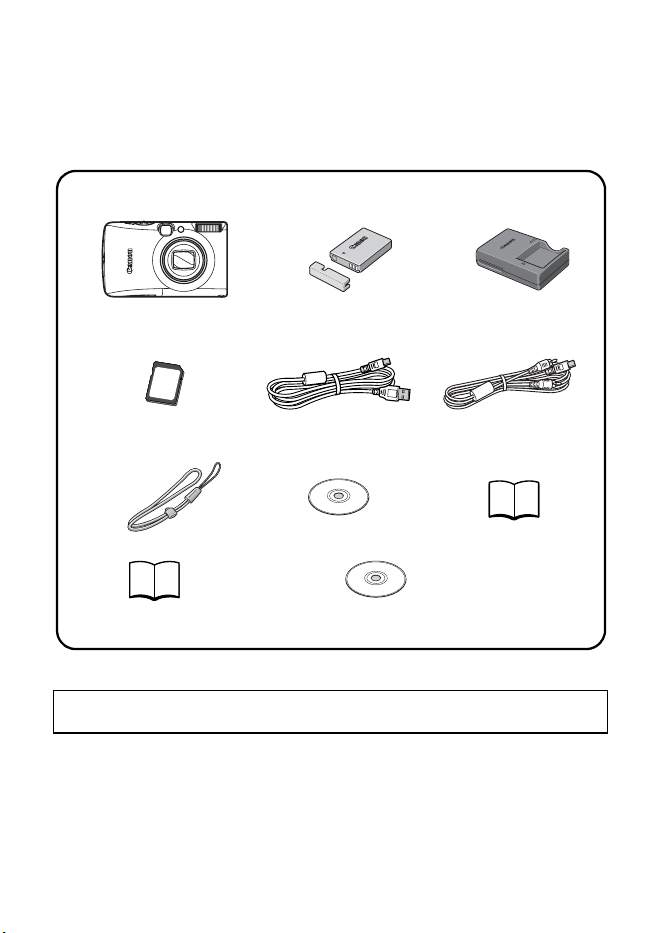
Confirming the Package Contents
The following items are included in the package. If something is
missing please contact the retail outlet at which you purchased the
product.
You may not be able to achieve the full performance of this camera with the
included memory card.
h
a
b
ef
i
Camera Battery Pack NB-5L
(With Terminal Cover)
Battery Charger
CB-2LX/CB-2LXE
Interface Cable
IFC-400PCU
AV Cable
AVC-DC400
Canon Digital
Camera Solution
Disk
User Guides
c
j
Wrist Strap
WS-DC2
g
Memory Card
(32 MB)
d
• Getting Started Guide
European
Warranty System
(EWS) Booklet
• Canon Digital Camera
Manuals Disk
• “Use of Genuine Canon Accessories Recommended” Leaflet
Let’s Get Started!
1
Let’s Get Started!
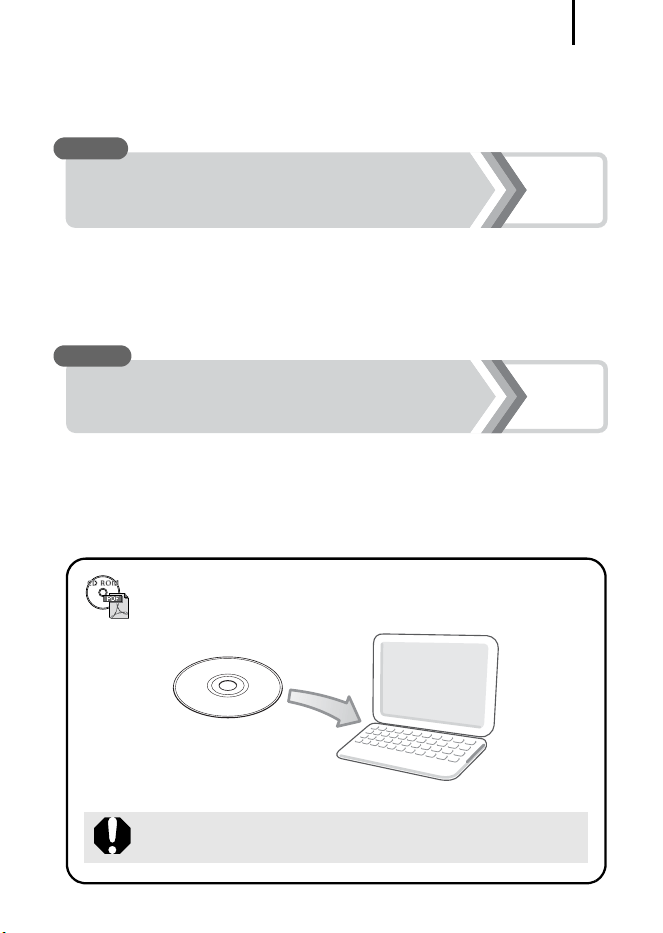
This guide is divided into the following two sections.
This section explains how to prepare the camera for use and the
basics of shooting, viewing and printing images. Start out by
familiarizing yourself with the camera and mastering the basics.
Once you have mastered the basics, use the camera’s many features
to shoot more challenging photos. Details on using each function are
described in this section, including how to connect the camera to a
television to view images, and how to make My Camera settings.
First...
Next...
p. 9
Learning More
p. 39
Getting Started
Adobe Reader is required to view the PDF Manuals.
http://www.adobe.com
The PDF Manuals are included in the supplied CD-ROM.
Table of Contents
2
Table of Contents
Items marked with a are lists or charts that summarize camera functions
or procedures.
Please Read . . . . . . . . . . . . . . . . . . . . . . . . . . . . . . . . . . . . 7
Components Guide 40
Using the Control Dial . . . . . . . . . . . . . . . . . . . . . . . . . . . . 43
Using the Button . . . . . . . . . . . . . . . . . . . . . . . . . . . . . . 44
How to Use the Mode Dial . . . . . . . . . . . . . . . . . . . . . . . . . 45
Indicators . . . . . . . . . . . . . . . . . . . . . . . . . . . . . . . . . . . . . . 46
Basic Operations 48
Menus and Settings . . . . . . . . . . . . . . . . . . . . . . . . . . . . . . 48
Information Displayed on the LCD Monitor and Menus . . . 50
Using the LCD Monitor. . . . . . . . . . . . . . . . . . . . . . . . . . . . 60
Commonly Used Shooting Functions 62
Using the Optical Zoom . . . . . . . . . . . . . . . . . . . . . . 62
Using the Digital Zoom/ Digital Tele-Converter . . . . . . . . . 62
Magnified Close-Up Shooting (Digital Macro) . . . . . . . . . . 66
Learning More . . . . . . . . . . . . . . . . . . . . . . . . . . . . . 39
Preparations . . . . . . . . . . . . . . . . . . . . . . . . . . . . . . . . . 10
Shooting Still Images
( Mode) . . . . . . . . . . . . . . . . . 16
Viewing Still Images . . . . . . . . . . . . . . . . . . . . . . . . . . . 18
Erasing. . . . . . . . . . . . . . . . . . . . . . . . . . . . . . . . . . . . . . 19
Printing . . . . . . . . . . . . . . . . . . . . . . . . . . . . . . . . . . . . . 20
Embedding the Date in the Image Data . . . . . . . . . . . 22
Shooting Movies
( Standard Mode) . . . . . . . . . . . . . . . 24
Viewing Movies . . . . . . . . . . . . . . . . . . . . . . . . . . . . . . . 26
Downloading Images to a Computer . . . . . . . . . . . . . 27
System Map. . . . . . . . . . . . . . . . . . . . . . . . . . . . . . . . . . 34
Getting Started . . . . . . . . . . . . . . . . . . . . . . . . . . . . 9
Table of Contents
3
Using the Flash . . . . . . . . . . . . . . . . . . . . . . . . . . . . . . . 66
Shooting Close-Ups/Infinity . . . . . . . . . . . . . . . . . . . 67
Using the Self-Timer . . . . . . . . . . . . . . . . . . . . . . . . . . . 68
Changing the Recording Pixels (Still Images) . . . . . . . . . . 70
Changing the Compression (Still Images) . . . . . . . . . . . . . 71
Setting the Image Stabilizer Function . . . . . . . . . . . . . . . . 72
Adjusting the ISO Speed . . . . . . . . . . . . . . . . . . . . . . . 74
Advanced Shooting Functions 75
Shooting Modes for Specific Scenes . . . . . . . . . . . . . . . . . 75
Shooting in Manual Mode . . . . . . . . . . . . . . . . . . . . . . . . . 78
Continuous Shooting . . . . . . . . . . . . . . . . . . . . . . . . . . . 78
Setting the Flash . . . . . . . . . . . . . . . . . . . . . . . . . . . . . . . . 80
Movie Shooting . . . . . . . . . . . . . . . . . . . . . . . . . . . . . . 82
Shooting Panoramic Images (Stitch Assist). . . . . . . . . . . . 88
Checking the Focus and Peoples’ Expressions. . . . . . . . . 90
Selecting an AF Frame Mode . . . . . . . . . . . . . . . . . . . . . . 93
Selecting a Subject to Focus On (Face Select and Track) 96
Shooting Hard-to-Focus Subjects (Focus Lock, AF Lock) . 97
Locking the Exposure Setting (AE Lock) . . . . . . . . . . . . . . 99
Locking the Flash Exposure Setting (FE Lock) . . . . . . . . 100
Adjusting the Exposure Compensation . . . . . . . . . . . . . . 101
Switching between Metering Modes . . . . . . . . . . . . . . . . 102
Setting the Shutter Speed (Long Shutter Mode) . . . . . . . 103
Adjusting the Tone (White Balance) . . . . . . . . . . . . . . . . 104
Shooting in a My Colors Mode. . . . . . . . . . . . . . . . . . . . . 107
Changing the Colors and Shooting . . . . . . . . . . . . . . . . . 109
Setting the Display Overlays . . . . . . . . . . . . . . . . . . . . . . 114
Categorizing Images Automatically (Auto Category) . . . . 115
Registering Settings to the Button . . . . . . . . . . . . 116
Playback/Erasing 118
Viewing Magnified Images . . . . . . . . . . . . . . . . . . . . . 118
Viewing Images in Sets of Nine (Index Playback) . . . 119
Checking the Focus and Peoples’ Expressions (Focus
Check Display) . . . . . . . . . . . . . . . . . . . . . . . . . . . . . . . 120
Jumping to Images . . . . . . . . . . . . . . . . . . . . . . . . . . . 122
Table of Contents
4
Organizing Images by Category (My Category). . . . . . . . 124
Trimming a Portion of an Image. . . . . . . . . . . . . . . . . . . . 127
Viewing Movies . . . . . . . . . . . . . . . . . . . . . . . . . . . . . . . . 129
Editing Movies . . . . . . . . . . . . . . . . . . . . . . . . . . . . . . . . . 131
Rotating Images in the Display . . . . . . . . . . . . . . . . . . . . 134
Playback with Transition Effects . . . . . . . . . . . . . . . . . . . 135
Automated Playback (Slide Shows). . . . . . . . . . . . . . . . . 136
Red-Eye Correction Function. . . . . . . . . . . . . . . . . . . . . . 142
Adding Effects with the My Colors Function . . . . . . . . . . 147
Resizing Images . . . . . . . . . . . . . . . . . . . . . . . . . . . . . . . 149
Attaching Sound Memos to Images . . . . . . . . . . . . . . . . . 151
Sound-Only Recording (Sound Recorder) . . . . . . . . . . . . 152
Protecting Images . . . . . . . . . . . . . . . . . . . . . . . . . . . . . . 154
Erasing Images . . . . . . . . . . . . . . . . . . . . . . . . . . . . . . . . 158
Registering Functions to the Button . . . . . . . . . . . . . 163
Print Settings/Transfer Settings 165
Setting the DPOF Print Settings . . . . . . . . . . . . . . . . . . . 165
Setting the DPOF Transfer Settings . . . . . . . . . . . . . . . . 172
Configuring the Camera 174
Power Saving Function . . . . . . . . . . . . . . . . . . . . . . . . . . 174
Setting the World Clock . . . . . . . . . . . . . . . . . . . . . . . . . . 175
Formatting Memory Cards . . . . . . . . . . . . . . . . . . . . . . . . 178
Resetting the File Number . . . . . . . . . . . . . . . . . . . . . . . . 179
Creating an Image Destination (Folder). . . . . . . . . . . . . . 181
Setting the Auto Rotate Function . . . . . . . . . . . . . . . . . . . 183
Resetting Settings to Their Default Values . . . . . . . . . . . 184
Connecting to a TV 186
Shooting/Playback Using a TV . . . . . . . . . . . . . . . . . . . . 186
Customizing the Camera (My Camera Settings) 188
Changing My Camera Settings . . . . . . . . . . . . . . . . . . . . 188
Registering My Camera Settings . . . . . . . . . . . . . . . . . . . 189
Troubleshooting 191
Table of Contents
5
List of Messages 201
Appendix 205
Safety Precautions. . . . . . . . . . . . . . . . . . . . . . . . . . . . . . 205
Preventing Malfunctions. . . . . . . . . . . . . . . . . . . . . . . . . . 210
Using the AC Adapter (Sold Separately) . . . . . . . . . . . . . 214
Using an Externally Mounted Flash (Sold Separately) . . 215
Camera Care and Maintenance. . . . . . . . . . . . . . . . . . . . 217
Specifications. . . . . . . . . . . . . . . . . . . . . . . . . . . . . . . . . . 218
Index 228
Functions Available in Each Shooting Mode 232
Table of Contents
6
Symbol Conventions in this Guide
About this Guide
: This mark denotes issues that may affect the camera’s
operation.
: This mark denotes additional topics that complement the basic
operating procedures.
Explanations in this guide are based on the camera’s default settings
at time of purchase.
Specifications are subject to change without prior notice. As a result,
the illustrations and screenshots used in this guide may differ from the
actual camera.
You can use SD memory cards, SDHC (SD High Capacity) memory
cards, MultiMediaCards, MMCplus cards and HC MMCplus cards in
this camera. These memory cards are collectively referred to as
memory cards in this guide.
Using the Flash
Available Shooting Modes p. 232
1
Press the button.
Some functions may not be available in certain shooting modes.
If there is no notation to that effect, the function may be used in
all modes.
Mode dial position:
Auto ( )/Manual ( )/
Special Scene ( )/
Movie( )
Playback ( ) button

Please Read
7
Please Read
Test Shots
Before you try to photograph important subjects, we highly recommend
that you shoot several trial images to confirm that the camera is
operating and being operated correctly.
Please note that Canon Inc., its subsidiaries and affiliates, and its
distributors are not liable for any consequential damages arising from
any malfunction of a camera or accessory, including memory cards,
that results in the failure of an image to be recorded or to be recorded
in a way that is machine readable.
Warning Against Copyright Infringement
Please note that Canon digital cameras are intended for personal use
and should never be used in a manner that infringes upon or
contravenes international or domestic copyright laws and regulations.
Please be advised that in certain cases the copying of images from
performances, exhibitions, or commercial properties by means of a
camera or other device may contravene copyright or other legal rights
even if the image was shot for personal use.
Warranty Limitations
For information on your camera’s warranty, please refer to the Canon
European Warranty System (EWS) Booklet supplied with your camera.
For Canon Customer Support contacts, please see the European
Warranty System (EWS) Booklet.

Please Read
8
Video Format
Please set the camera’s video signal format to the one used in your
region before using it with a TV monitor (p.186).
Language Setting
Please see Setting the Display Language (p.15) to change the
language setting.
Camera Body Temperature
If your camera is used for prolonged periods, the camera body
may become warm. Please be aware of this and take care when
operating the camera for an extended period.
About the LCD Monitor
The LCD monitor is produced with extremely high-precision
manufacturing techniques. More than 99.99% of the pixels
operate to specification. Less than 0.01% of the pixels may
occasionally misfire or appear as red or black dots. This has no
effect on the recorded image and does not constitute a
malfunction.

Preparations
10
Getting Started
Preparations
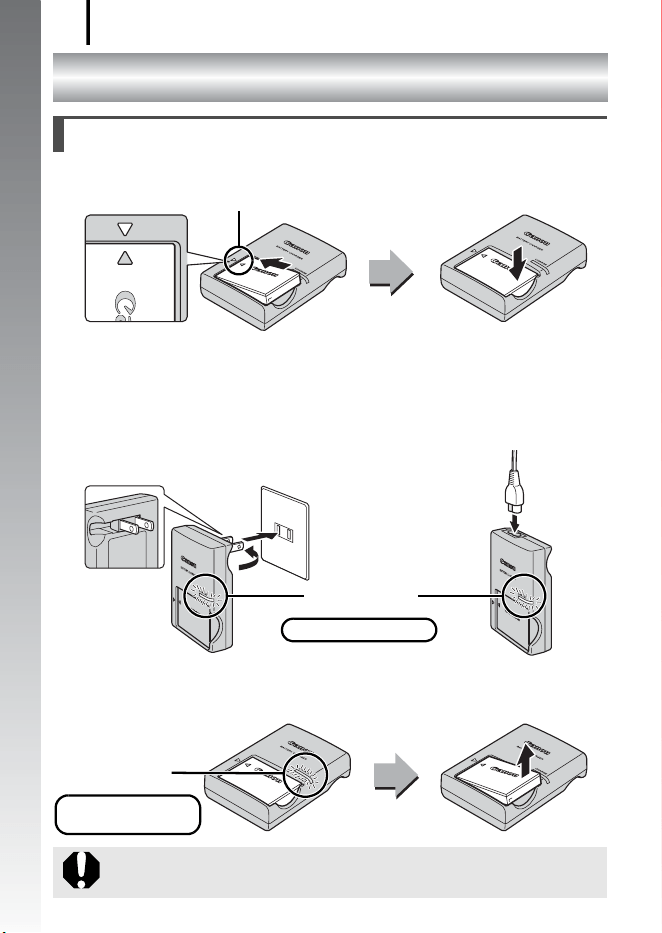
1. Insert the battery into the battery charger.
2.
Plug the battery charger (CB-2LX) into a power outlet, or
attach the power cord to the battery charger (CB-2LXE)
and plug it into a power outlet.
Battery charger model names and types vary by region.
3. Remove the battery after charging is complete.
Charging takes approximately 2 hours 5 minutes.
Charging the Battery
To protect the battery and prolong its life, do not charge it for
longer than 24 hours continuously.
Align the S symbols.
Charge Indicator
Charging: Lights red
Charge Indicator
Charging Complete:
Lights green
Preparations
11
Getting Started
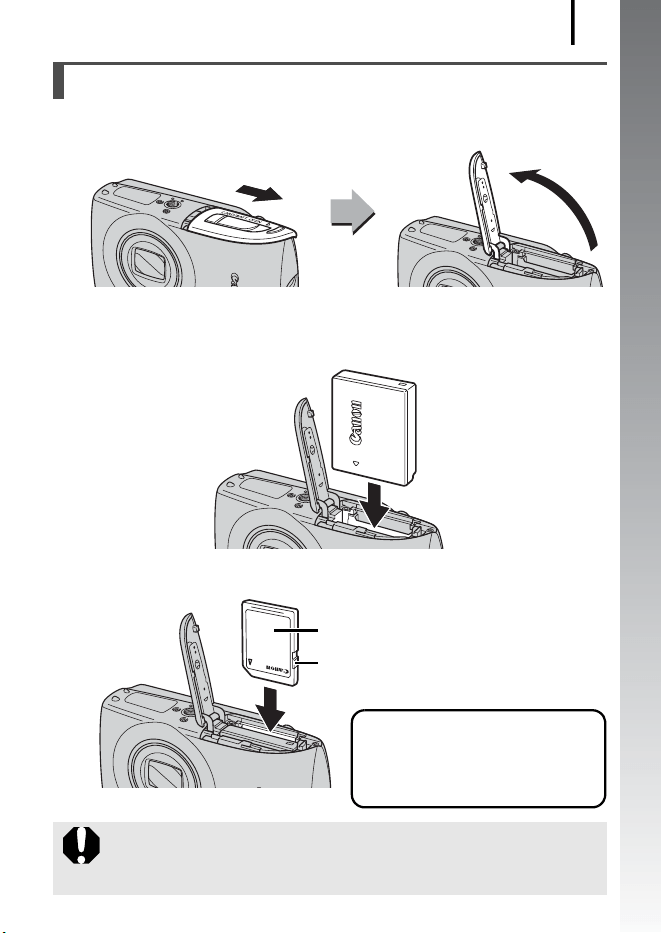
1. Slide the cover (a) and open it (b).
2. Insert the battery.
It will lock into place with a click.
3. Insert the memory card until it clicks into place.
Installing the Battery and Memory Card
Ensure that the memory card is correctly oriented before
inserting it in the camera. Inserting it backward may cause the
camera to fail to recognize the memory card or to malfunction.
ab
Front
•Confirm that the write protect tab
is unlocked (only SD and SDHC
memory cards).
•Check the card for the correct
orientation.
Write Protect Tab
(only SD and SDHC memory cards)
Preparations
12
Getting Started
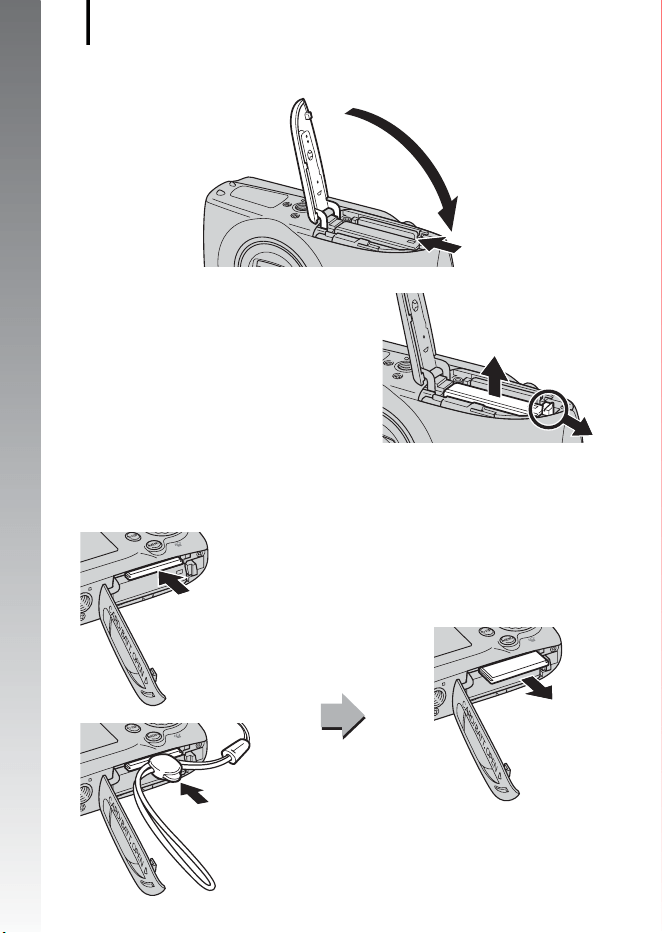
4. Close the cover (c, d).
To Remove the Battery
Press the battery lock in the direction of
the arrow (a) and pull the battery out
(b).
To Remove the Memory Card
Push the memory card with your finger or the toggle on the wrist strap
until the memory card clicks and then release it.
c
d
b
a
Preparations
13
Getting Started
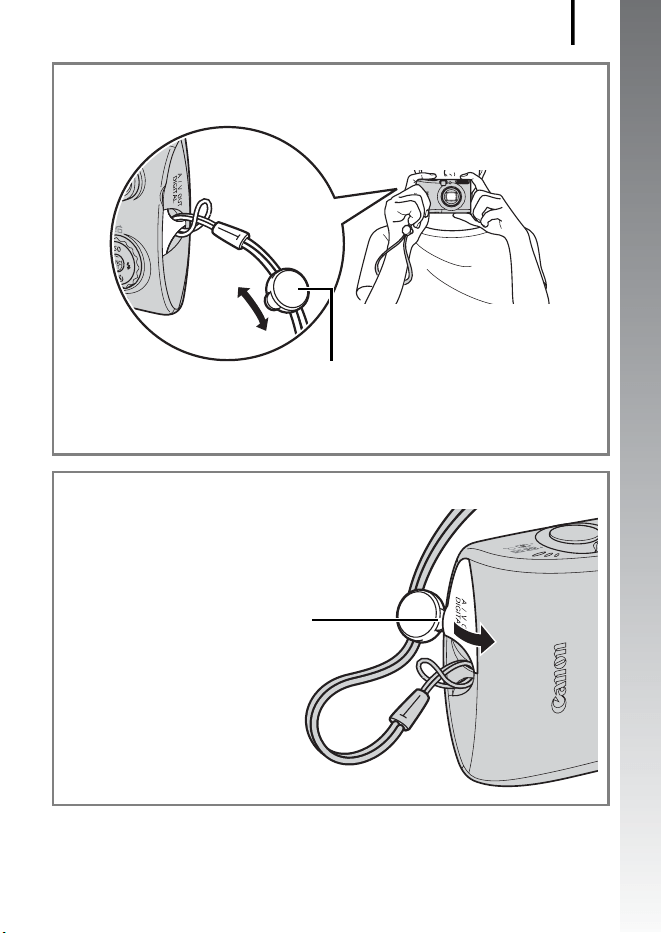
Attaching the Wrist Strap
Use the wrist strap to avoid dropping the camera during use.
Opening the Terminal Cover
Toggle
The toggle’s position on the strap can be
changed. The toggle can be used to open
the terminal cover and when inserting or
removing a memory card.
Hook your fingernail or the wrist strap
toggle under the left edge of the
terminal cover and open it to the
right.
Preparations
14
Getting Started
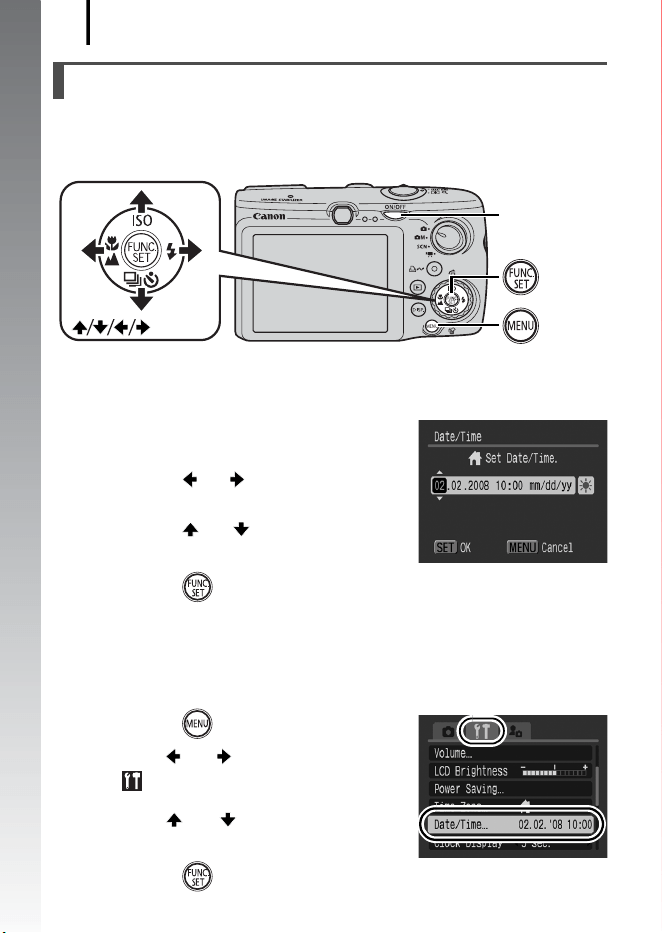
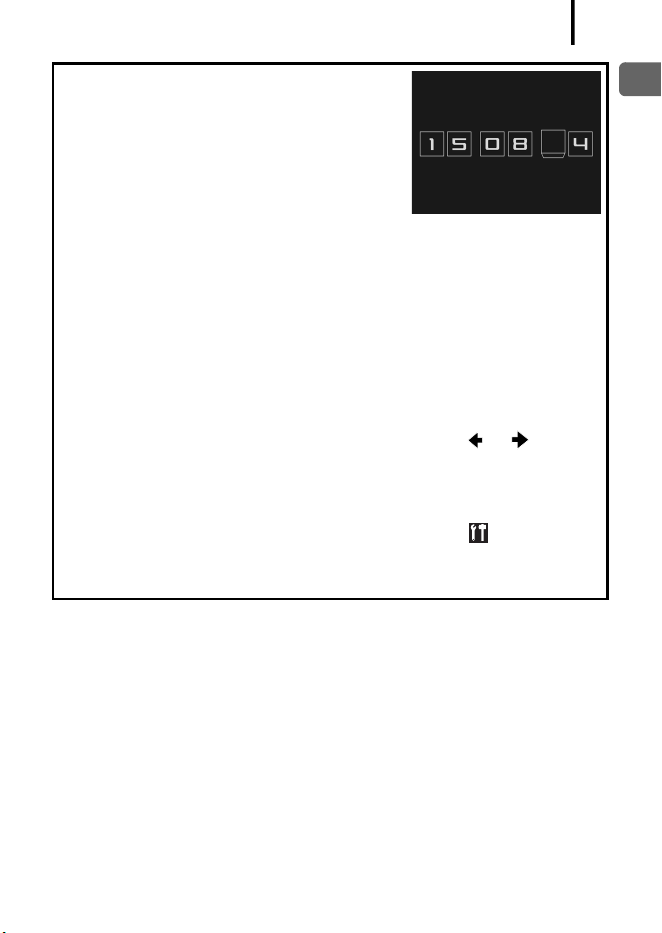
The Date/Time settings menu will appear the first time the power is
turned on.
1. Press the ON/OFF button.
2. Select the month, day, year and
time, and the display order.
1. Use the or button to select
an option.
2. Use the or button to set the
value.
3. Press the button.
To Change a Previously Set Date/Time
Use the following procedures to display the Date/Time settings menu,
and then perform Steps 2 and 3 above.
1. Press the button.
2. Use the or button to select
the (Set up) menu.
3. Use the or button to select
[Date/Time].
4. Press the button.
Setting the Date and Time
ON/OFF Button
Button
Button
Buttons
Preparations
15
Getting Started
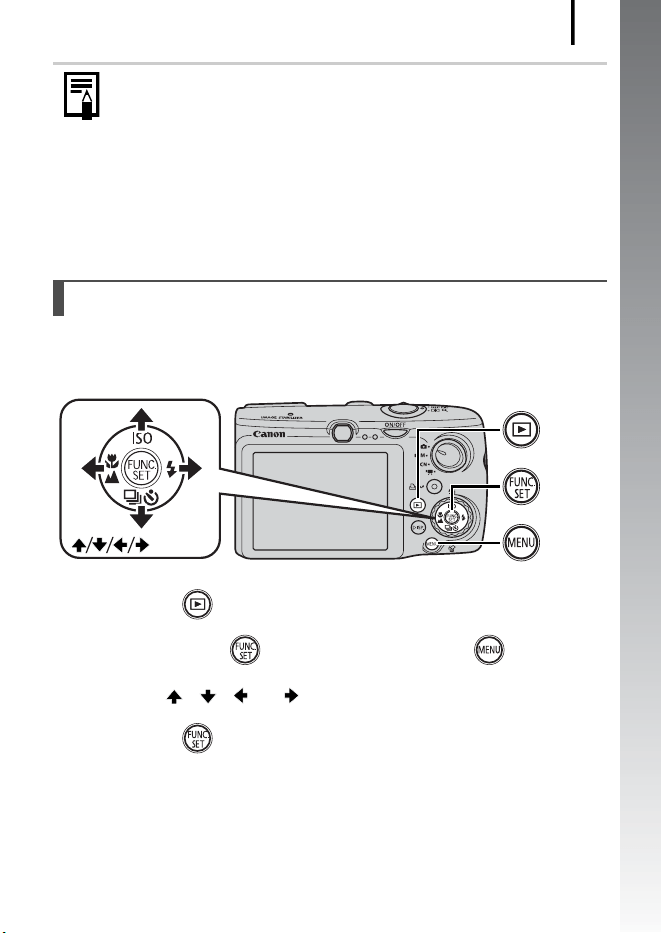
You can change the language displayed in the LCD monitor menus
and messages.
1. Press the button.
2. Hold down the button and press the button.
3. Use the , , or button to select a language.
4. Press the button.
z A rechargeable lithium battery is built into the camera to save
such settings as the date/time. Insert a charged battery into
the camera. Or if you use the separately sold AC Adapter Kit
ACK-DC30, the battery will charge in about four hours. It will
charge even if the camera is turned off.
z The date/time settings may be lost after approximately three
weeks if you remove the main battery. Reset the date/time
settings if this occurs.
Setting the Display Language
Button
Button
Button
Buttons
Shooting Still Images
16
Getting Started
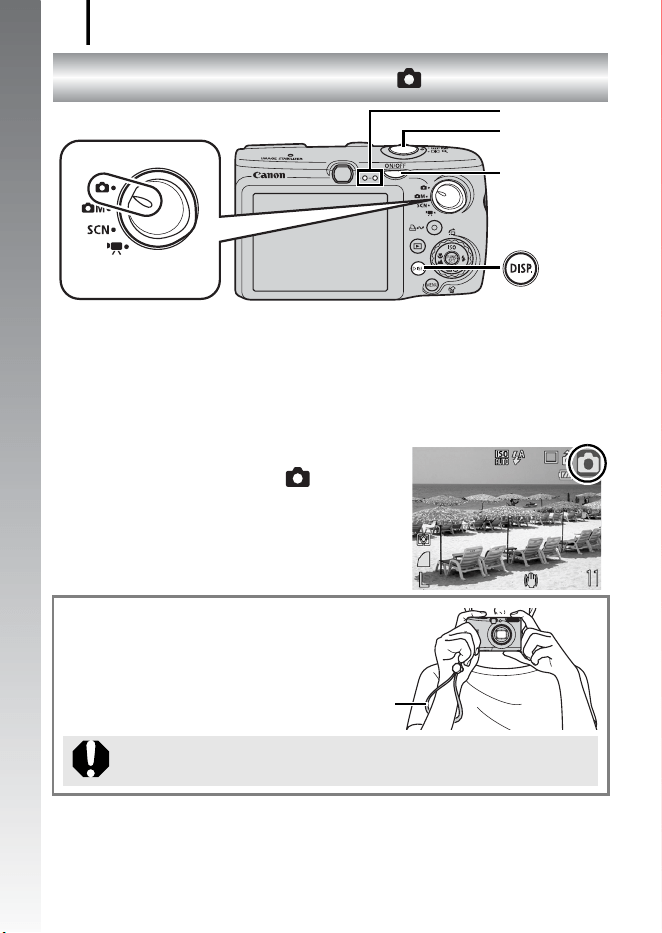
Shooting Still Images
1.
Press the ON/OFF button.
• The start-up sound will play and the start-up image will display in
the LCD monitor.
• Pressing the ON/OFF button again turns the power off.
2. Select a shooting mode.
1. Set the mode dial to (Auto).
3. Aim the camera at the subject.
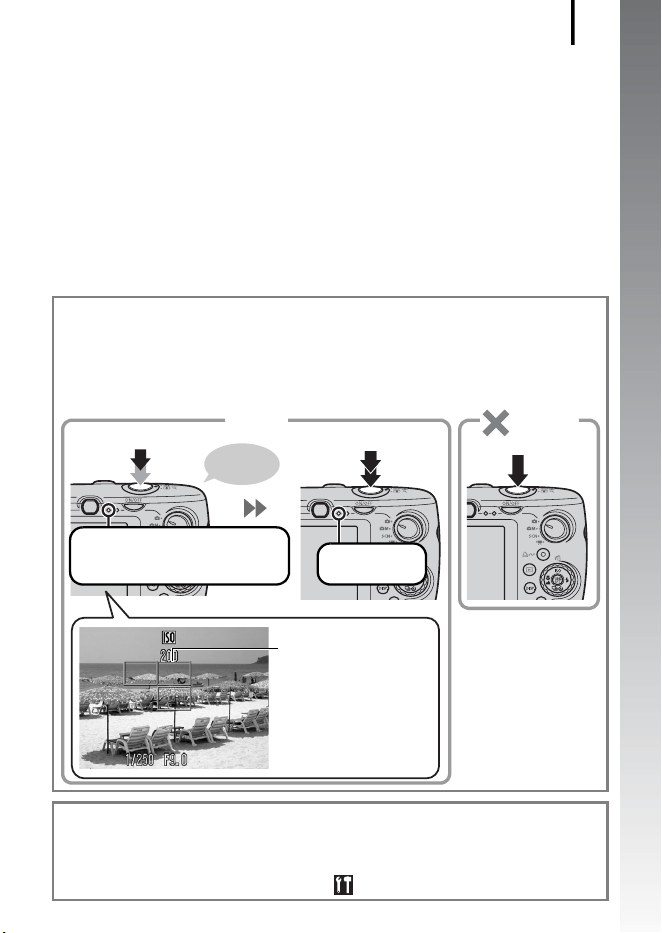
4. Press the shutter button lightly (halfway) to focus.
• When the camera focuses, it beeps twice and the indicator lights
green (orange when the flash fires).
Avoiding Camera Shake
Keep your arms tight against your body
while holding the camera firmly by the
sides. Using a tripod is also effective.
( Mode)
Mode Dial
Shutter Button
ON/OFF Button
Indicators
Button
Use the wrist strap to avoid dropping the camera during use.
Wrist Strap
Shooting Still Images
17
Getting Started
5. Press the shutter button fully (all the way) to shoot.
• The shutter sound will play once and the image will record.
• Recorded images are displayed on the LCD monitor for
approximately 2 seconds immediately after shooting (Rec.
Review). You can shoot by pressing the shutter button even
when an image is being displayed.
• If you hold the shutter button down after a shot, the image will
continue to display.
• The indicator will blink green and the file will record to the
memory card.
To Shoot Images in Focus
The camera automatically sets the focus when you press the shutter
button halfway*.
* The shutter button has a two-stage action. Pressing it down to the first stage is
referred as “pressing halfway”.
Mute Setting
Pressing the DISP. button while turning on the camera power will
silence all camera sounds except for warning sounds. You can
change the setting in [Mute] in the (Set up) menu (p. 57).
Correct
Incorrect
Press halfway to set
the focus
An AF frame will
display in green on
the LCD monitor at
the point of focus.
Press fully
Shooting Preparations
Complete: Lights green
(orange when the flash will fire)
Recording:
Blinks green
Just pressing fully
AF Frame
Beep,
beep…
Viewing Still Images
18
Getting Started
Viewing Still Images
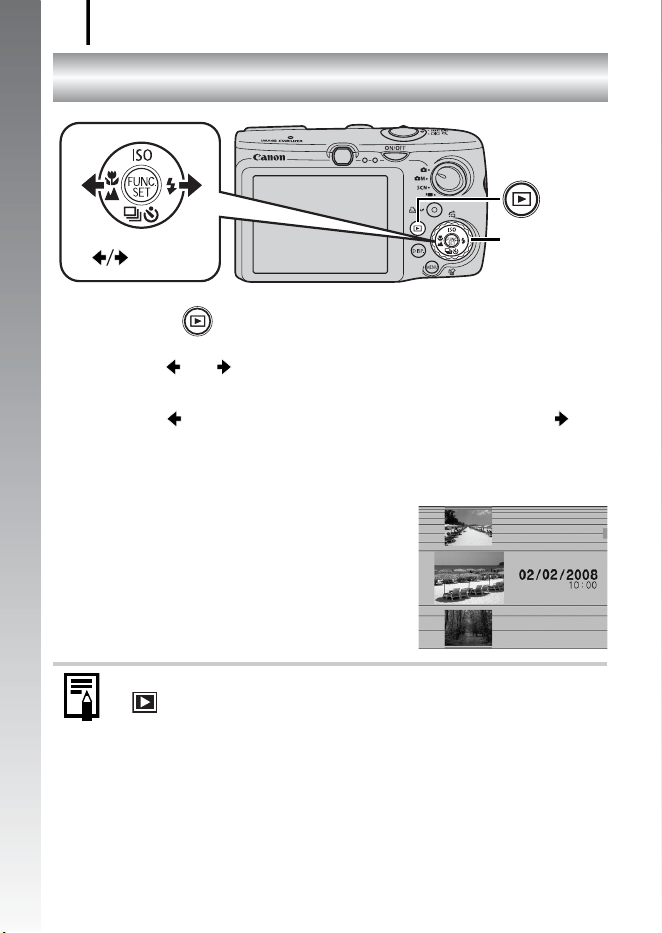
1. Press the button.
2. Use the or button to display the image you wish
to view.
• Use the button to move to the previous image and the
button to move to the next image.
• The images advance more quickly if you keep the button
pressed, but they will appear coarse.
• You can also select images by using
the control dial. Turning it
counterclockwise displays the
previous image while turning it
clockwise displays the next image.
z Setting [Resume] to either [Last seen]* or [Last shot] in the
menu allows you to specify the image to display in
playback mode. (* Default setting). If you select [Last seen],
the last image viewed will display (Resume Playback).
z The following actions will display the most recent image
regardless of the [Resume] settings.
Shooting an image, changing the memory card, or editing an
image on the memory card using a computer.
Button
Buttons
Control Dial
Erasing
19
Getting Started
Erasing
1.
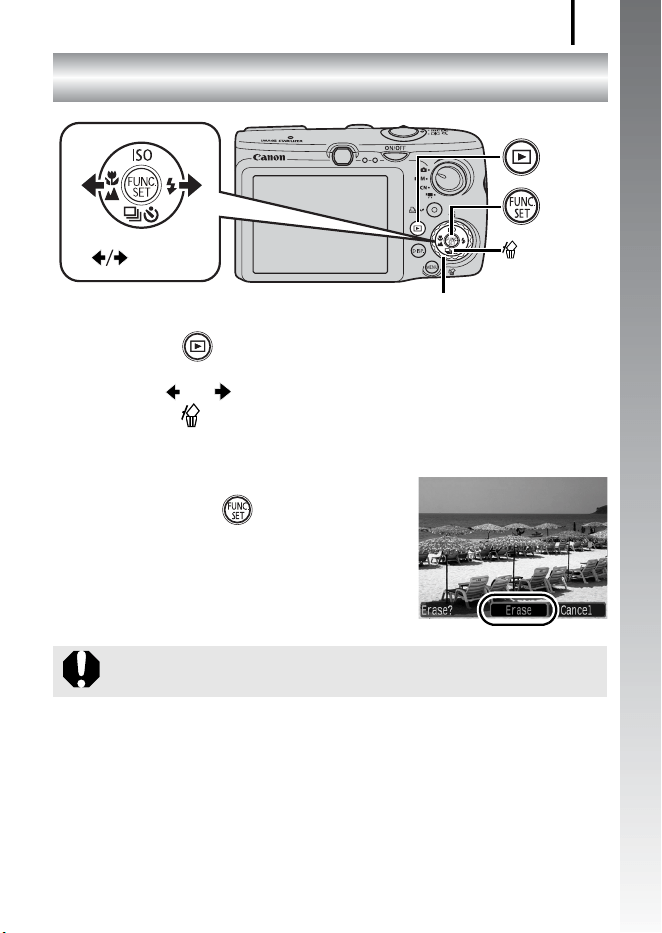
Press the button.
2. Use the or button to select an image to erase and
press the button.
You can also select images by using the control dial.
3. Confirm that [Erase] is selected
and press the button.
To exit instead of erasing, select
[Cancel].
Please note that erased images cannot be recovered. Exercise
adequate caution before erasing an image.
Button
Button
Button
Control Dial
Buttons
Printing
20
Getting Started
Printing
1.
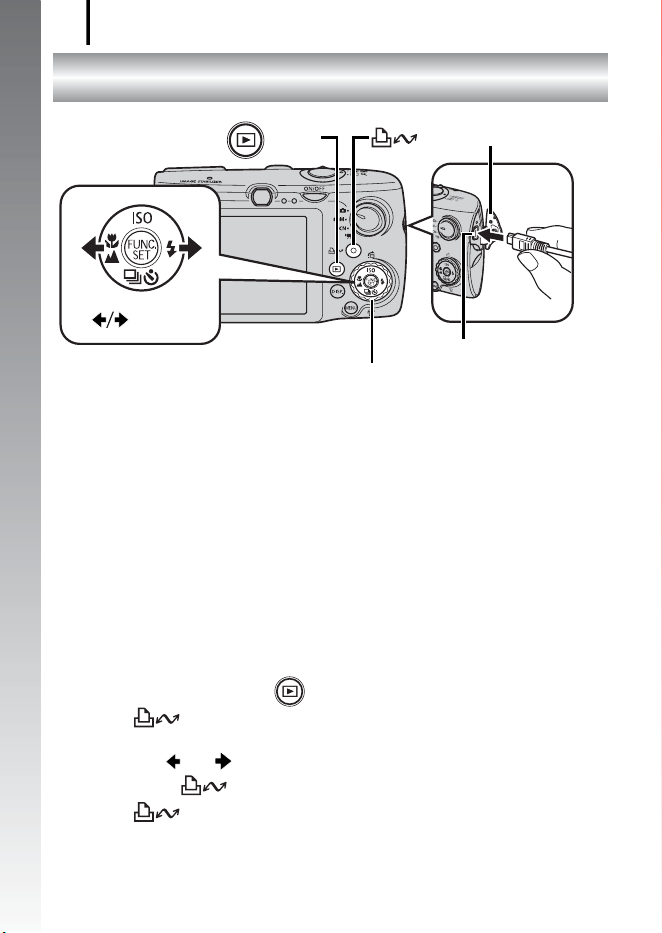
Connect the camera to a direct print compatible printer.
• Slip your fingernail or the toggle on the wrist strap under the left
edge of the terminal cover to open it and insert the interface
cable all the way into the connector.
• See the printer’s user guide for connection instructions.
• Since this camera uses a standard protocol (PictBridge), you can
use it with other PictBridge-compliant printers in addition to
Canon-brand printers.
For detail, see the Direct Print User Guide.
2. Turn on the printer.
3. Press the camera’s button to turn on the power.
• The button will light blue.
4. Use the or button to select an image to print and
press the button.
• The button will blink blue and printing will start.
• You can also select images by using the control dial.
• After you finish printing, turn off the camera and the printer and
disconnect the interface cable.
Terminal Cover
A/V OUT and DIGITAL Terminal
Button
Button
Control Dial
Buttons
Printing
21
Getting Started
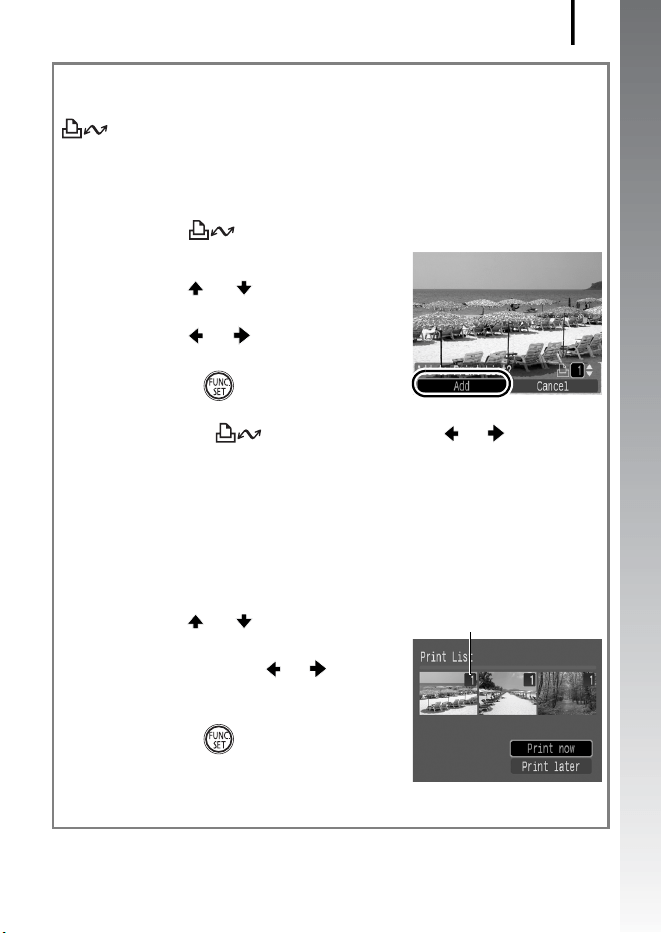
Printing from a Print List
You can add images directly to a print list by merely pressing the
button immediately after shooting or playing back an image.
You can then print the images from the print list easily, when
connecting the camera to a printer.
Add to the Print List
1. Press the button (still images only).
2. Add to the print list.
1. Use the or button to select
the number of print copies.
2. Use the or button to select
[Add].
3. Press the button.
• To remove an image from the print
list, press the button again, use the or button to
select [Remove] and press the FUNC./SET button.
Printing Images in a Print List
This explanation is based on the use of a Canon SELPHY ES series
or SELPHY CP series printer.
1. Connect the camera to the printer.
2. Print the image.
1. Use the or button to select
[Print now].
• You can use the or button
to confirm the images added to
the print list.
2. Press the button.
• Printing will start.
• If printing is halted and resumed,
printing will start from the next image in the queue.
Number of copies to print
Embedding the Date in the Image Data
22
Getting Started
Embedding the Date in the Image Data
This section explains how to embed date information on images as
they are recorded (Date Stamp).
• The date stamp cannot be deleted from the image data once it has
been embedded. Ensure that the camera’s date/time is set correctly
beforehand (p. 14).
• The image size is fixed to the 2M (1600 × 1200) setting and the
compression to Fine (appropriate for printing L-size or postcard-size
prints.)
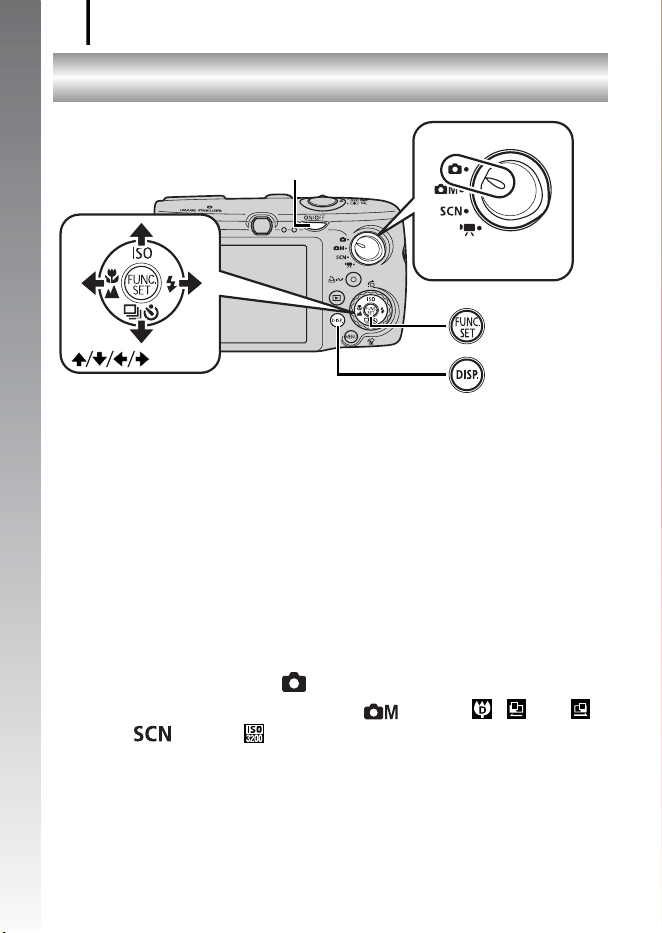
1. Press the ON/OFF button.
2. Set the mode dial to (Auto).
• You can also make this setting in (except , and )
and (except ) modes.
Mode Dial
Button
Button
ON/OFF Button
Buttons
Embedding the Date in the Image Data
23
Getting Started
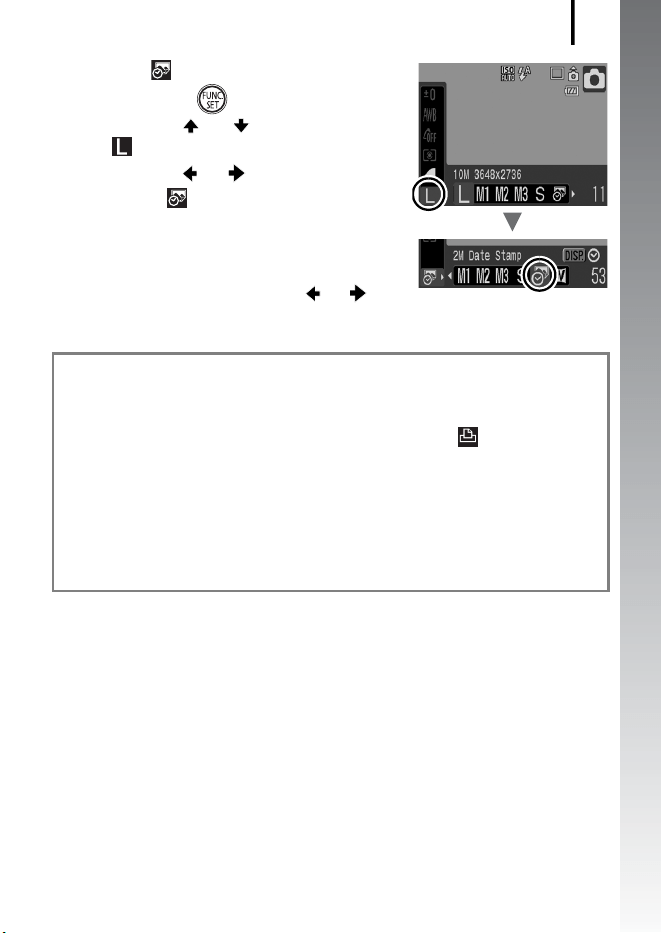
3. Select (Date Stamp).
1. Press the button.
2. Use the or button to select
.
3. Use the or button to
select .
• The area that will not print displays
in gray.
• Press the DISP. button to switch to
[Date & Time] with the or
button.
You can use the following methods to imprint the date on images
lacking imprinted date stamps.
• Set with the camera’s Digital Print Order Format (DPOF) function.
Set [Date] option to [On] in [Print Settings] in the (Print) menu.
• Connect the camera to a printer and imprint the date.
See the Direct Print User Guide.
• Insert a memory card into the printer and imprint the date.
See your printer user guide.
• Use the supplied software.
See the Software Starter Guide.
Shooting Movies
24
Getting Started
Shooting Movies
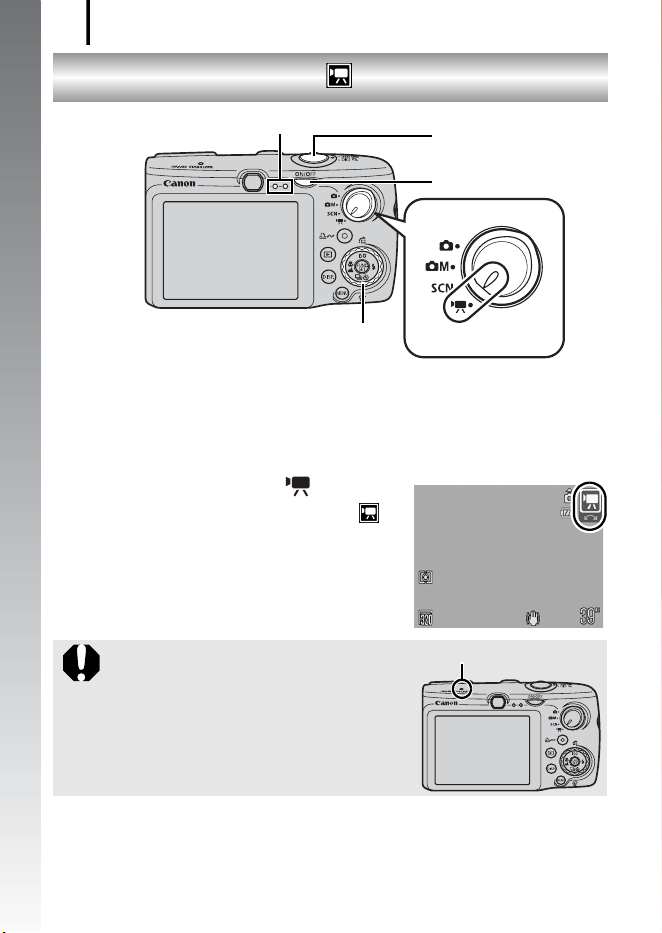
1. Press the ON/OFF button.
2. Select a shooting mode.
1. Set the mode dial to (Movie).
2. Use the control dial to select
(Standard).
3. Aim the camera at the subject.
z Do not touch the microphone while
recording.
z Do not press any buttons other
than the shutter button. The
sound that buttons make will be
recorded in the movie.
( Standard Mode)
Indicators
Control Dial
Mode Dial
ON/OFF Button
Shutter Button
Microphone
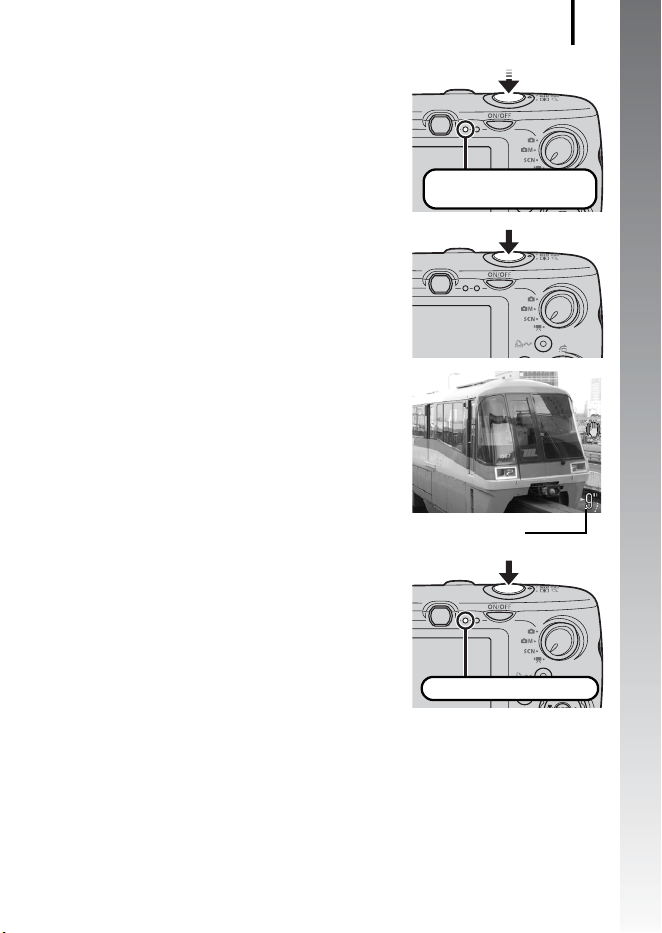
Shooting Movies
25
Getting Started
4. Press the shutter button halfway
to focus.
• When the camera focuses, it beeps
twice and the indicator lights green.
• The exposure, focus and white
balance are automatically set.
5. Press the shutter button fully to
shoot.
• Recording starts.
• During the recording, the elapsed
recording time and [zRec.] will
display in the LCD monitor.
6. Press the shutter button fully
again to stop recording.
• The indicator will blink green and the
data will be recorded onto the memory
card.
• Recording will stop automatically
when the maximum recording time
elapses, or the built-in memory or memory card become full.
Shooting Preparations
Complete: Lights green
Elapsed Time
Recording: Blinks green
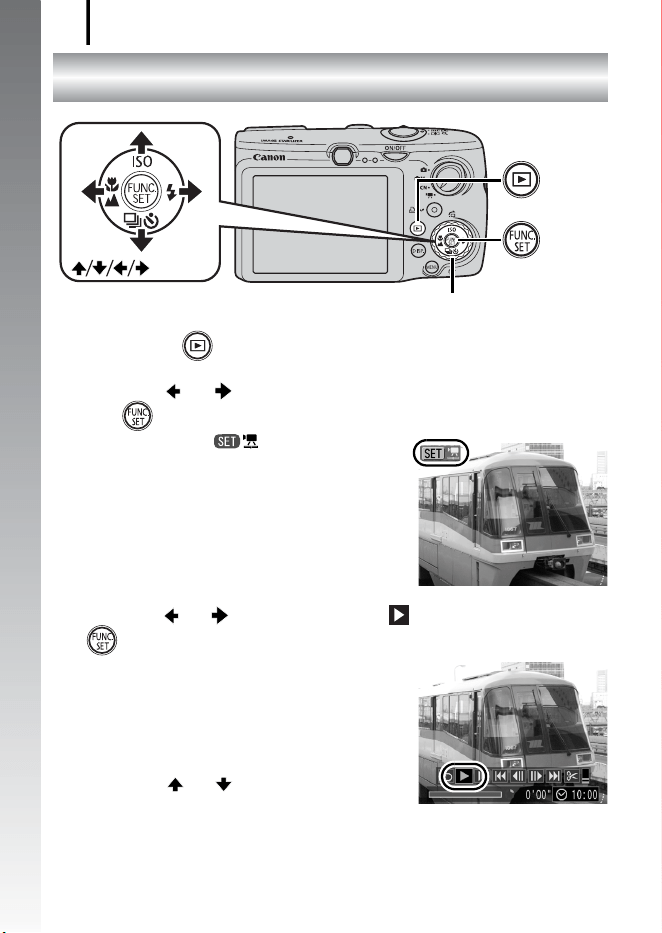
Viewing Movies
26
Getting Started
Viewing Movies
1. Press the button.
2. Use the or button to display a movie and press
the button.
• Images with a icon are movies.
• You can also select images by using
the control dial.
3. Use the or button to select (Play) and press the
button.
• The movie will start playing.
• If you press the FUNC./SET button
during playback, you can pause and
restart the movie.
• You can adjust the playback volume
with the or button.
Button
Button
Control Dial
Buttons
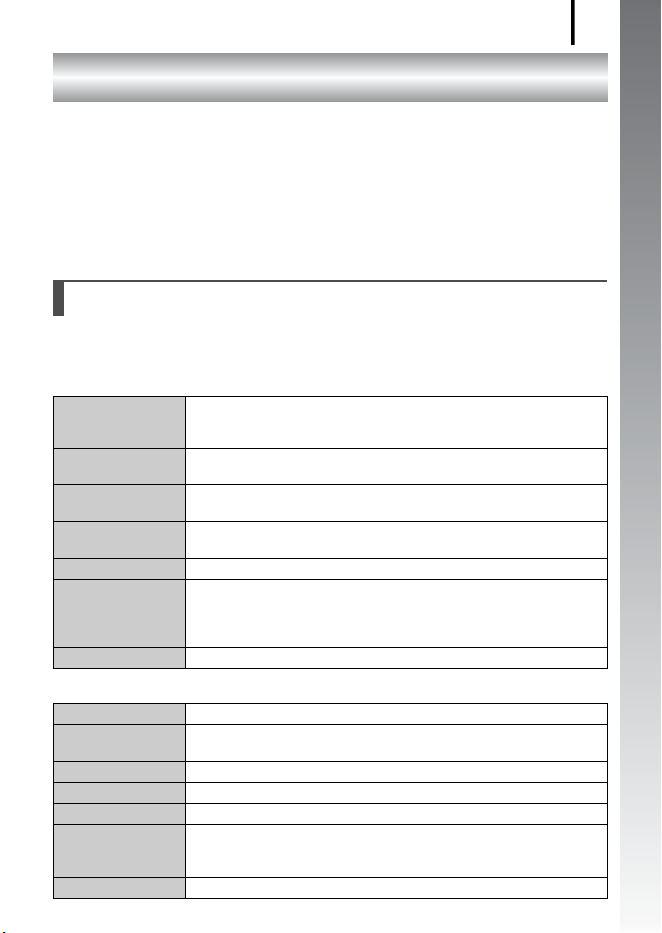
Downloading Images to a Computer
27
Getting Started
Downloading Images to a Computer
We recommend to use the supplied software.
Items to Prepare
• Camera and computer
• Canon Digital Camera Solution Disk supplied with the camera
• Interface cable supplied with the camera
Please install the software on a computer meeting the following
minimum requirements.
Windows
Macintosh
System Requirements
OS Windows Vista
Windows XP Service Pack 2
Windows 2000 Service Pack 4
Computer Model The above OS should be pre-installed on computers with built-
in USB ports.
CPU Windows Vista : Pentium 1.3 GHz or higher
Windows XP / Windows 2000 : Pentium 500 MHz or higher
RAM Windows Vista : 512 MB or more
Windows XP / Windows 2000 : 256 MB or more
Interface USB
Free Hard Disk
Space
• Canon Utilities
- ZoomBrowser EX : 200 MB or more
- PhotoStitch : 40 MB or more
• Canon Camera TWAIN Driver : 25 MB or more
Display 1,024 × 768 pixels/High Color (16 bit) or better
OS Mac OS X (v10.3 – v10.4)
Computer Model The above OS should be pre-installed on computers with built-
in USB ports.
CPU PowerPC G3/G4/G5 or Intel Processor
RAM 256 MB or more
Interface USB
Free Hard Disk
Space
• Canon Utilities
- ImageBrowser : 300 MB or more
- PhotoStitch : 50 MB or more
Display 1,024 × 768 pixels/ 32,000 Colors or better
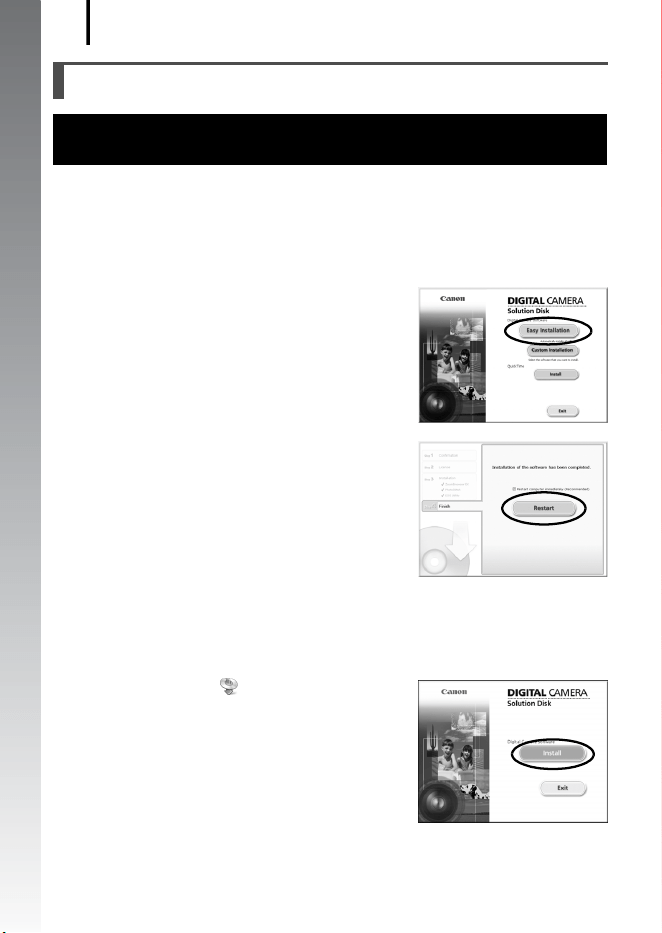
Downloading Images to a Computer
28
Getting Started
1. Installing the software.
Windows
1. Place the Canon Digital Camera Solution Disk in the
computer’s CD-ROM drive.
2. Click [Easy Installation].
Follow the onscreen messages to
proceed with the installation.
3. Click [Restart] or [Finish] once the
installation is complete.
When the installation is finished,
[Restart] or [Finish] will display. Click
the button that appears.
4. Remove the CD-ROM from the
drive when your normal desktop screen appears.
Macintosh
Double-click the icon in the CD-
ROM window. When the installer panel
appears, click [Install]. Follow the
onscreen instructions to proceed.
Preparing to Download Images
With Windows 2000, ensure that you install the software first
before connecting the camera to the computer.
Downloading Images to a Computer
29
Getting Started
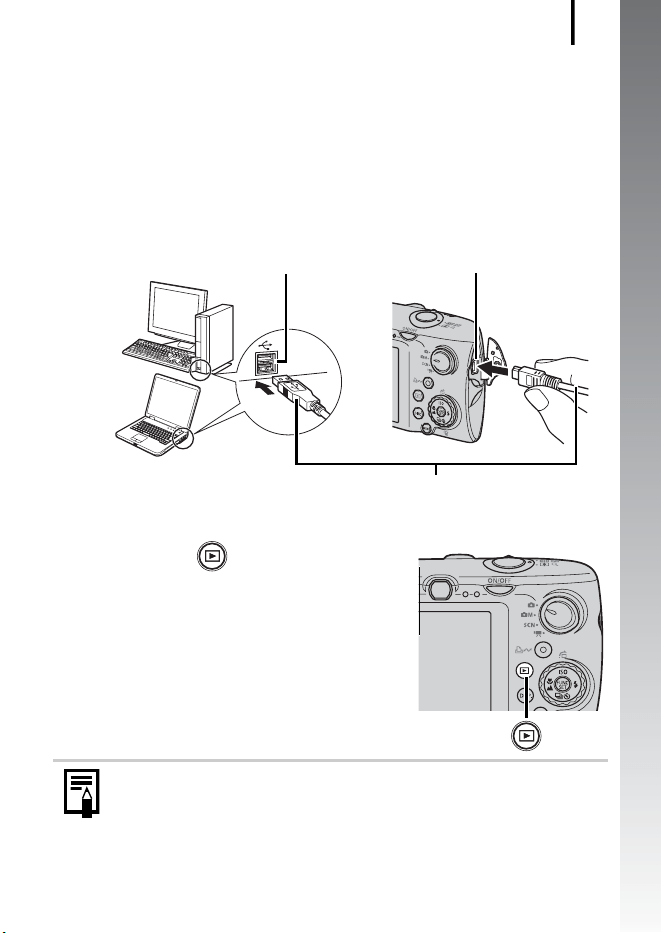
2. Connecting the camera to a computer.
1. Connect the supplied interface cable to the computer’s
USB port and to the camera’s A/V OUT and DIGITAL
terminal.
Slip your fingernail or the toggle on the wrist strap under the left
edge of the terminal cover to open it and insert the interface
cable all the way into the connector.
3. Preparing to download images to the computer.
1. Press the button to turn the
camera on.
If the Digital Signature Not Found window appears, click [Yes].
The USB driver will automatically finish installing onto the
computer when you attach the camera and open a connection.
USB Port
Interface Cable
A/V OUT and DIGITAL Terminal
Button
Downloading Images to a Computer
30
Getting Started
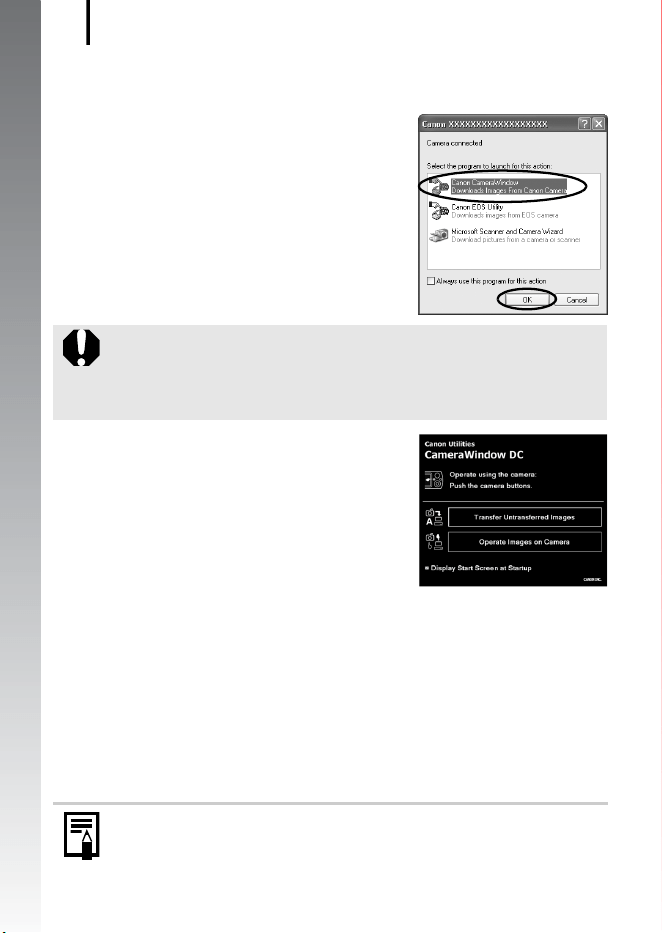
4. Open the CameraWindow.
Windows
Select [Canon CameraWindow] and
click [OK].
CameraWindow appears.
Macintosh
The CameraWindow will appear when you establish a connection
between the camera and computer. If it fails to appear, click the
[CameraWindow] icon on the Dock (the bar which appears at the
bottom of the desktop).
Preparations for downloading images are now finished. Please
proceed to the Downloading Images Using the Camera section
(p. 31) (except Windows 2000).
If the window above does not appear, click the [Start] menu
and select [All Programs] or [Programs], followed by [Canon
Utilities], [CameraWindow], [CameraWindow] and
[CameraWindow].
z Refer to the Software Starter Guide for details on
downloading images using the computer.
z With Windows 2000, you can download images using the
computer.
Downloading Images to a Computer
31
Getting Started
Use this method to download images using camera operations (except
Windows 2000).
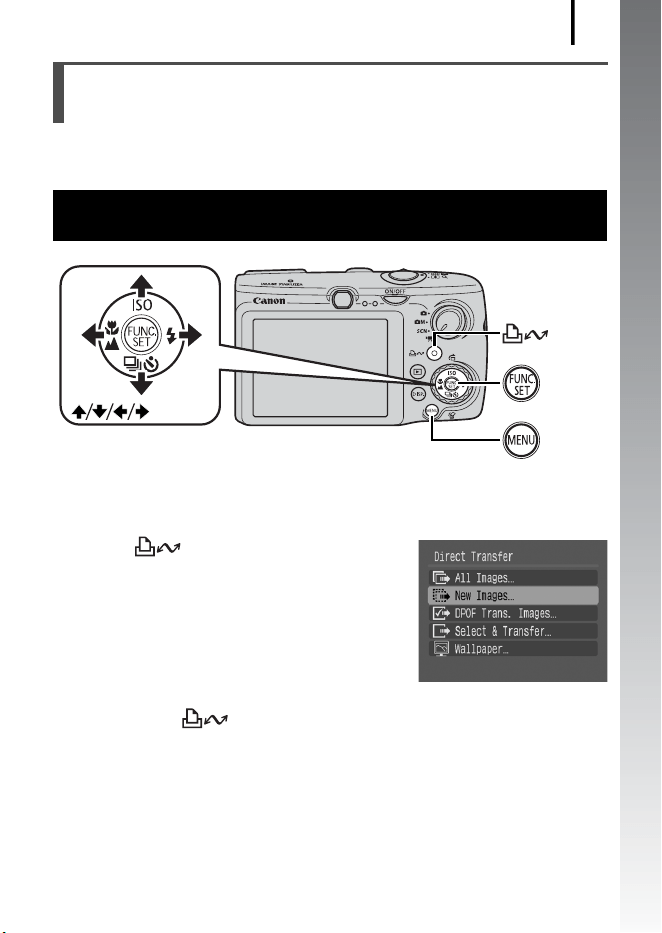
1. Confirm that the Direct Transfer menu is displayed on
the camera’s LCD monitor.
• The button will light blue.
• Press the MENU button if the Direct
Transfer menu fails to appear.
2. Press the button.
• Images not previously downloaded will download to the
computer.
Downloading Images Using the Camera
(Direct Transfer)
Install the software before downloading images via the direct
transfer method for the first time (p. 28).
Button
Button
Button
Buttons
Direct Transfer Menu
Downloading Images to a Computer
32
Getting Started
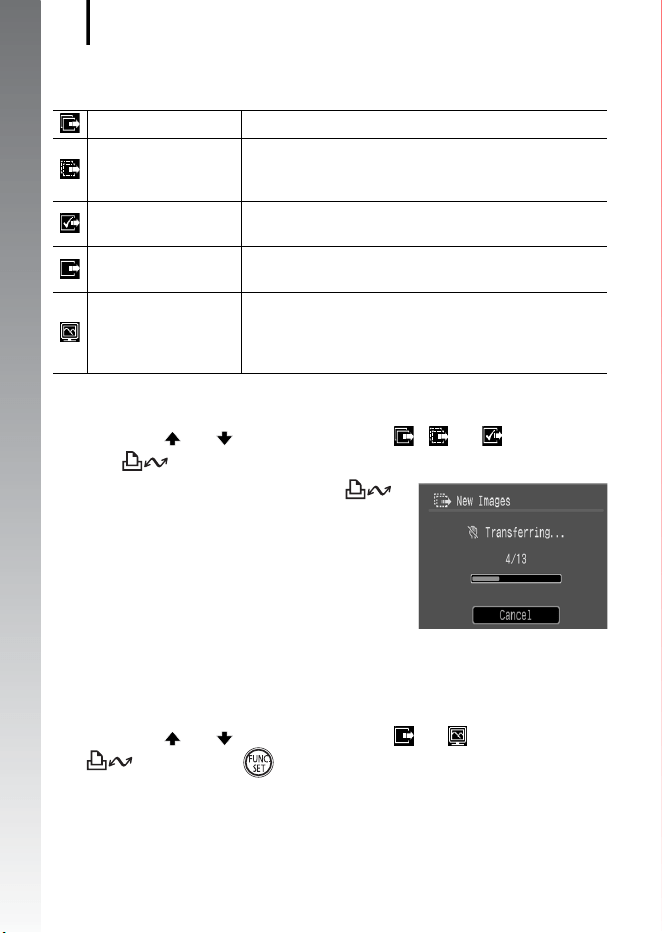
You can also use the following options in the Direct Transfer menu to
set the method for downloading images.
All Images/New Images/DPOF Trans. Images
1. Use the or button to select , or and press
the button.
• The images will download. The
button will blink blue while
downloading is in progress.
• The display will return to the Direct
Transfer menu when the download is
complete.
• Pressing the FUNC./SET button will
cancel a download in progress.
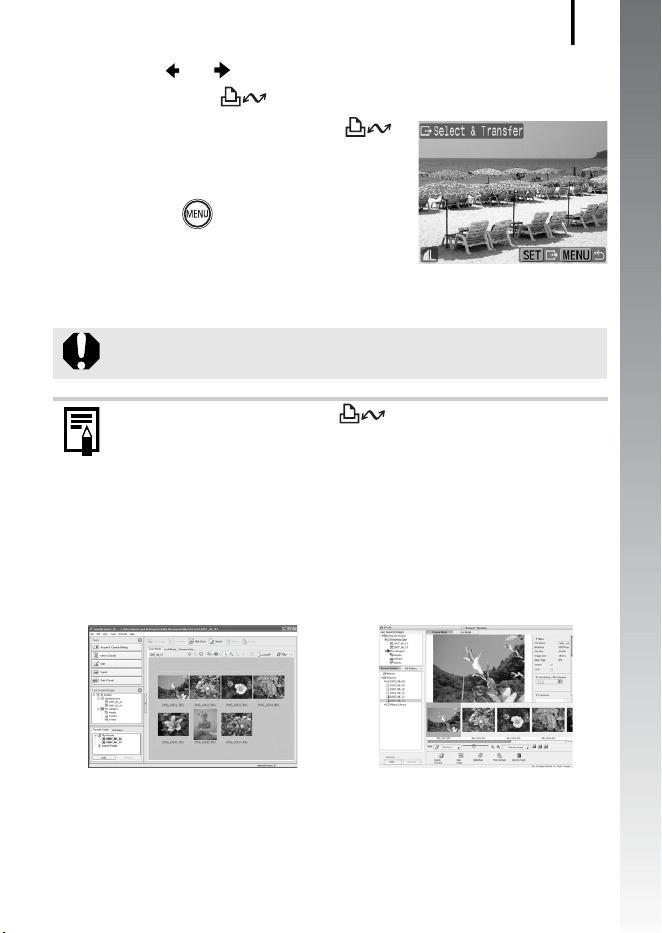
Select & Transfer/Wallpaper
1. Use the or button to select or and press the
button (or button).
All Images Transfers and saves all images to the computer.
New Images
Transfers and saves to the computer only the
images that have not been previously
transferred.
DPOF Trans.
Images
Transfers and saves to the computer only the
images with DPOF Transfer Order settings.
Select & Transfer
Transfers and saves single images to the
computer as you view and select them.
Wallpaper
Transfers and saves single images to the
computer as you view and select them. The
transferred images display as the background on
the computer desktop.
Downloading Images to a Computer
33
Getting Started
2. Use the or button to select images to download
and press the button.
• The images will download. The
button will blink blue while
downloading is in progress.
3. Press the button after
downloading finishes.
• You will return to the Direct Transfer
menu.
Click [×] at the bottom right of the window to close CameraWindow, the
downloaded images will display on the computer.
By default, the downloaded images are saved into folders according to
their shooting dates.
Only JPEG images can be downloaded as wallpaper for a
computer.
The option selected with the button is retained even
when the camera’s power is turned off. The previous setting will
be in effect the next time the Direct Transfer menu is displayed.
The image selection screen will appear directly when the
[Select & Transfer] or the [Wallpaper] option was last selected.
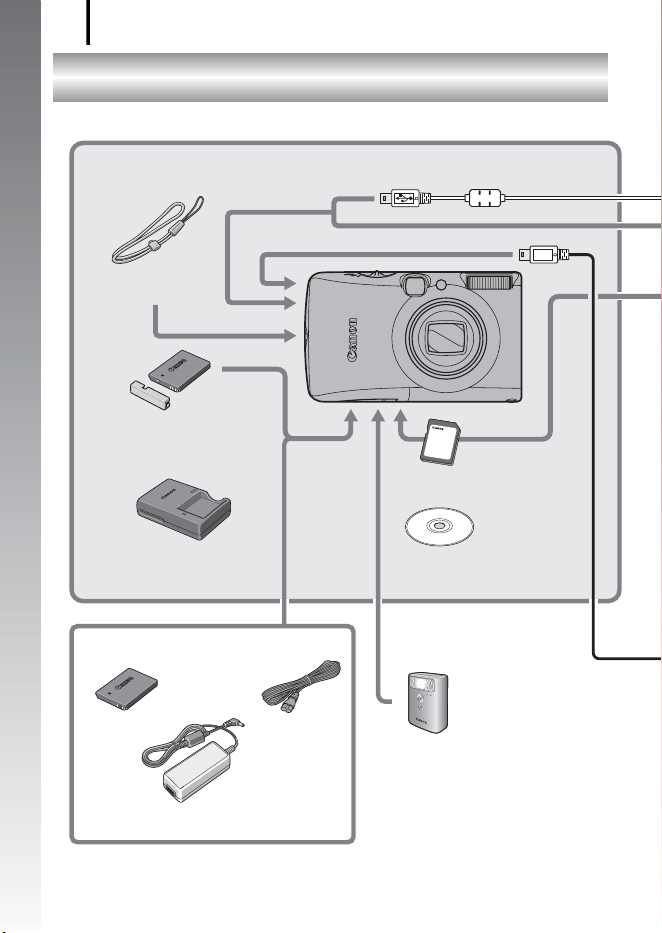
Windows Macintosh
ZoomBrowser EX ImageBrowser
System Map
34
Getting Started
System Map
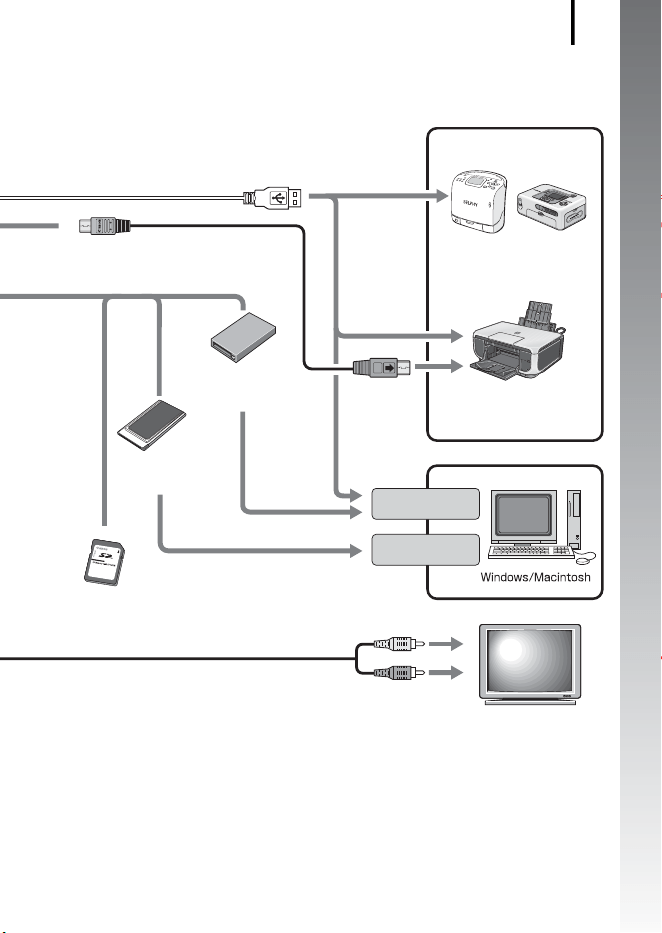
Wrist Strap
WS-DC2
Battery Pack NB-5L*
1
(with Terminal Cover)
Battery Charger
CB-2LX/CB-2LXE*
1
DC Coupler
DR-30
Power Cord
Compact Power Adapter
CA-DC10
AC Adapter Kit ACK-DC30
Supplied with Camera
Interface Cable IFC-400PCU*
1
Memory Card (32 MB)
Canon Digital Camera
Solution Disk
AV Cable
AVC-DC400*
1
High-Power Flash
HF-DC1
System Map
35
Getting Started
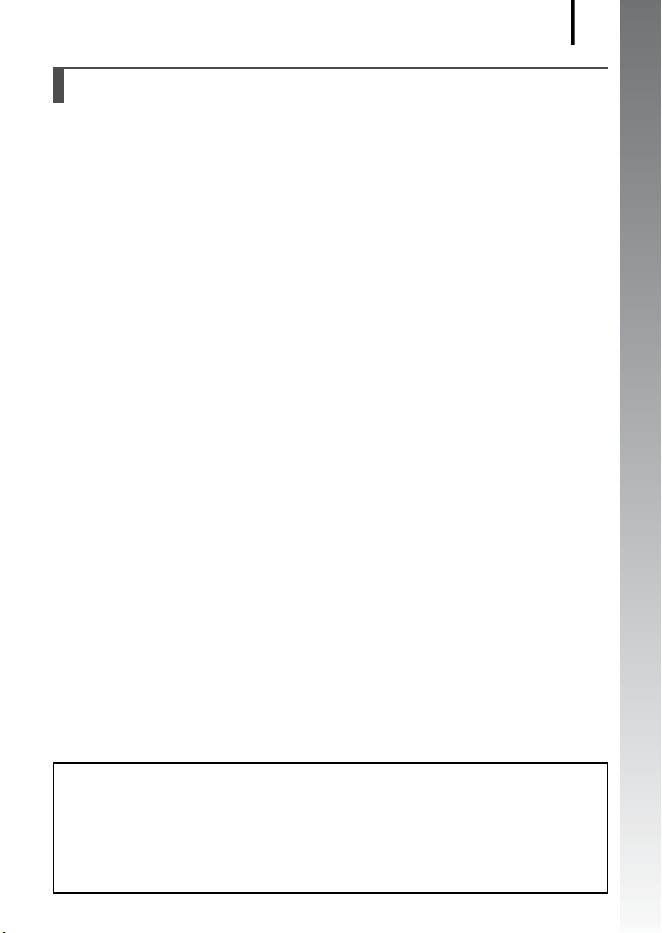
Direct Interface Cable
USB Card
Reader
PCMCIA
Adapter
SD Memory Card*
5
• SDC-128M
• SDC-512MSH
Compact Photo Printers*
2
*
3
(SELPHY series)
Inkjet Printers*
4
TV/Video
Video IN Terminal
Audio IN Terminal
*1 Also available for purchase separately.
*2 See the user guide supplied with the printer for more information on the printer.
*3 This camera can also be connected to the Card Photo Printer CP-10/CP-100/
CP-200/CP-300.
*4 See the user guide supplied with the inkjet printer for more information on the
printer and interface cables.
*5 Not sold in some regions.
USB Port
PC Card Slot
Canon brand Direct Print
Compatible Printers

System Map
36
Getting Started
The following camera accessories are sold separately.
Some accessories are not sold in some regions, or may no longer be
available.
Flash
• High-Power Flash HF-DC1
This attachable supplementary flash can be used to capture
photographic subjects that are too distant for the built-in flash to
illuminate.
Power Supplies
• AC Adapter Kit ACK-DC30
This kit lets you power the camera from any standard household
power outlet. Recommended to power a camera for an extended
period of time or when connecting to a computer.
(Cannot be used to charge the camera battery.)
• Battery Charger CB-2LX/CB-2LXE
An adapter for charging Battery Pack NB-5L.
• Battery Pack NB-5L
Rechargeable lithium-ion battery.
Other Accessories
• SD Memory Card
SD memory cards are used to store images recorded by the camera.
Canon brand cards are available in 128 MB and 512 MB capacities.
• Interface Cable IFC-400PCU
Use this cable to connect the camera to a computer, Compact Photo
Printer (SELPHY series), or to a inkjet printer (refer to your inkjet
printer user guide).
• AV Cable AVC-DC400
Use this cable to connect the camera to a TV set.
Optional Accessories
System Map
37
Getting Started
Canon offers the following separately sold printers for use with the
camera. You can produce photo quality prints quickly and easily by
connecting them to the camera with a single cable and operating the
camera’s controls.
• Compact Photo Printers (SELPHY series)
• Inkjet Printers
For more information, visit your nearest Canon retailer.
Direct Print Compatible Printers
Use of genuine Canon accessories is recommended.
This product is designed to achieve excellent performance when used with genuine
Canon accessories. Canon shall not be liable for any damage to this product and/or
accidents such as fire, etc., caused by the malfunction of non-genuine Canon
accessories (e.g., a leakage and/or explosion of a battery pack). Please note that this
warranty does not apply to repairs arising out of the malfunction of non-genuine
Canon accessories, although you may request such repairs on a chargeable basis.

38

39
Learning More
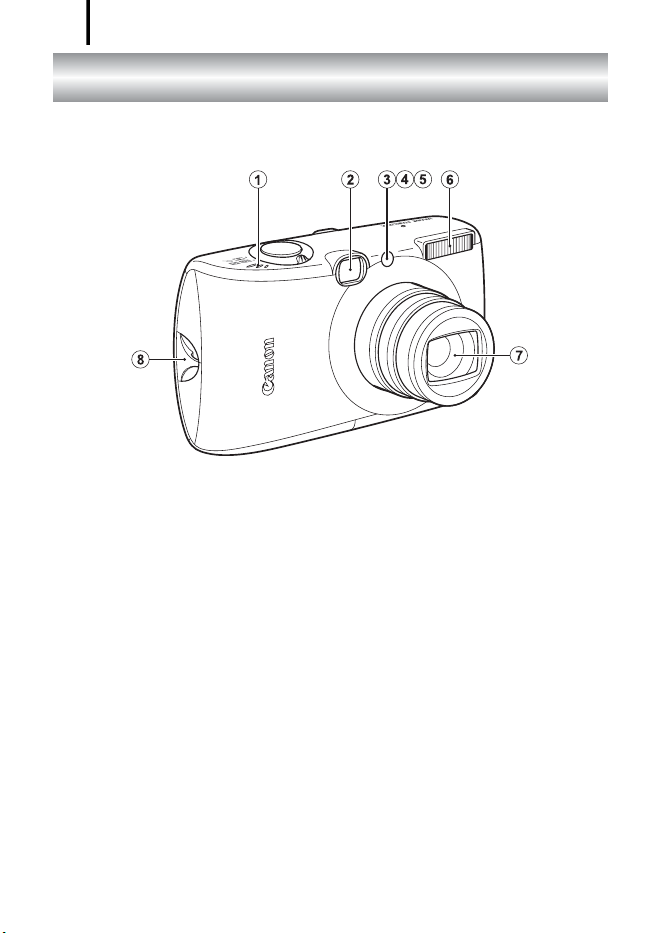
Components Guide
41
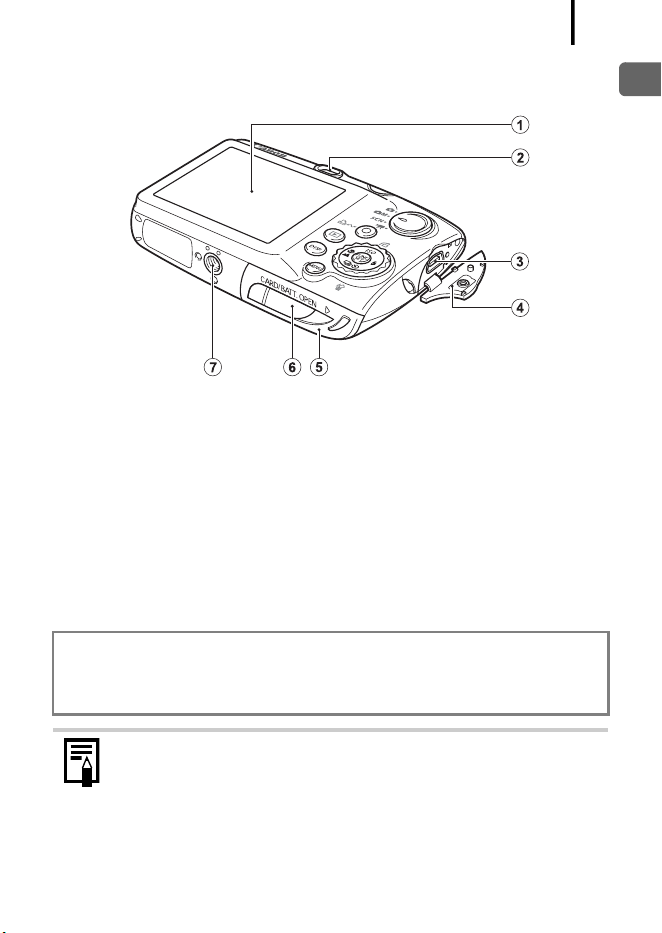
Back View
a LCD Monitor (p. 60)
b Viewfinder
c A/V OUT (Audio/Video output) and DIGITAL Terminal (pp. 20, 29,
186)
d Terminal Cover (p. 13)
e Memory Card Slot / Battery Cover (p. 11)
f DC Coupler Terminal Cover (p. 214)
g Tripod Socket
Using the Viewfinder
The viewfinder can be used to conserve power by turning the LCD
monitor off (p. 60) while shooting.
The LCD monitor may be covered with a thin plastic film for
protection against scratches during shipment. If so, remove the
film before using the camera.
42
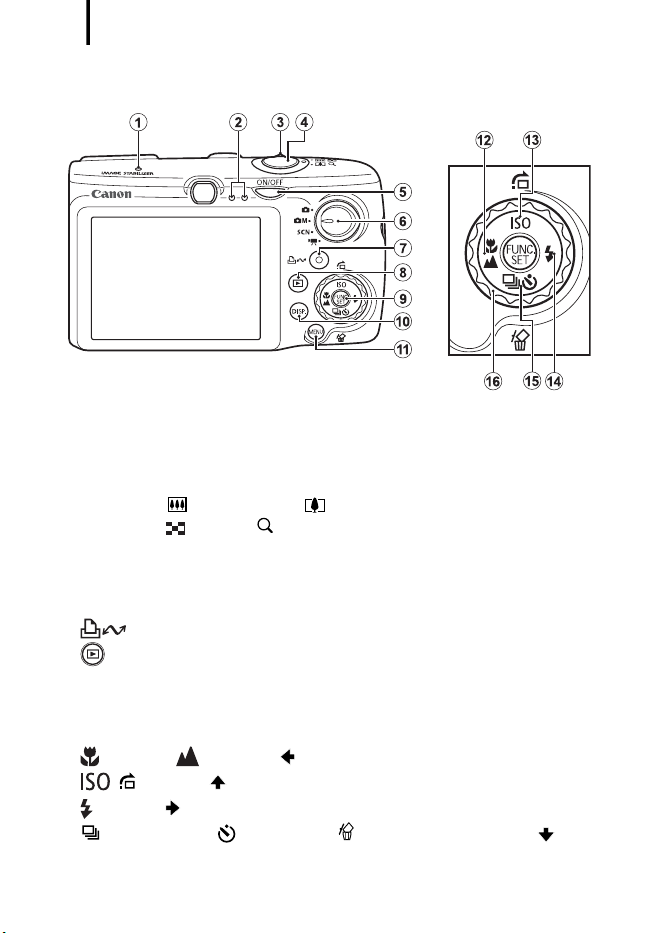
Controls
a Microphone (pp. 24, 151)
b Indicator (p. 46)
c Zoom Lever (pp. 62, 118)
Shooting: (Wide Angle)/ (Magnify)
Playback: (Index)/ (Magnify)
d Shutter Button (pp. 16, 24)
e ON/OFF Button (p. 14)
f Mode Dial (pp. 16, 24, 45)
g (Print/Share) Button (pp. 20, 31, 116)
h (Playback) Button (pp. 18, 26, 44)
i FUNC./SET (Function/Set) Button (p. 48)
j DISP. (Display) Button (p. 60)
k MENU Button (p. 49)
l (Macro)/ (Infinity)/ Button (p. 67)
m / (Jump)/ Button (pp. 74, 122)
n (Flash)/ Button (p. 66)
o (Continuous)/ (Self-timer)/ (Single Image Erase)/
Button (pp. 19, 68, 78)
p Control Dial (p. 43)
Components Guide
43
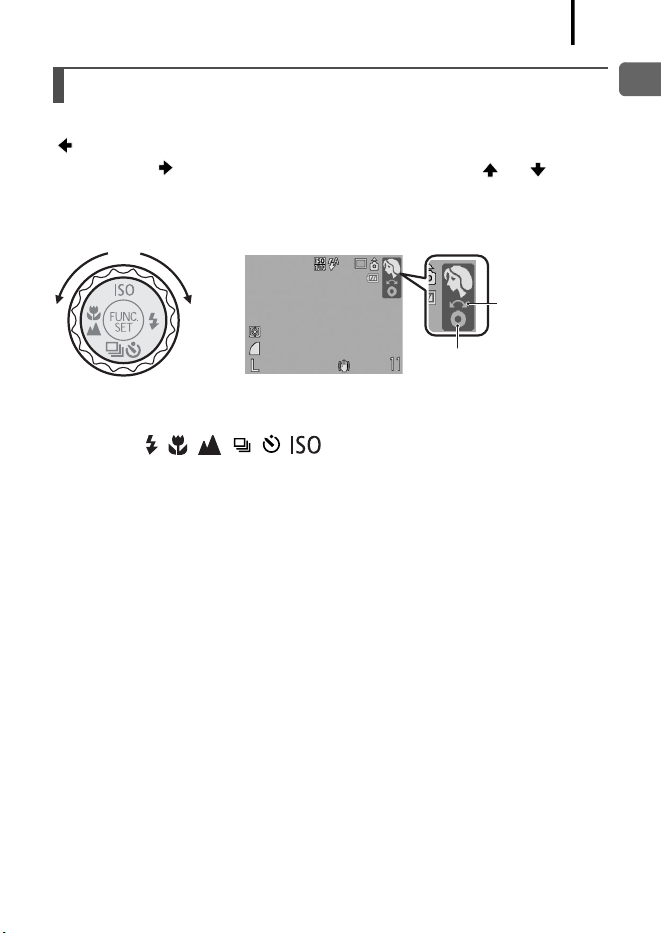
Turning the control dial counterclockwise is equivalent to pressing the
button, while turning the control dial clockwise is equivalent to
pressing the button (it is equivalent to pressing the or button
with some functions).
You can perform the following operations when you turn the control
dial.
The Shooting Functions
• Selecting the shooting modes (pp. 75, 82)
• Selecting / / / / / (pp. 66, 67, 68, 74, 78)
• Selecting the FUNC. menu item (p. 48)
• Moving the Face Detect function’s face frame (p. 96)
• Adjusting the exposure (p. 101)
The Playback Functions
• Selecting an image (pp. 18, 118, 119, 122)
• Operating when viewing/editing movies (pp. 26, 129, 131)
• Operating the sound memos or sound recorder (pp. 151, 152)
• Operating DPOF print settings and transfer settings (pp. 165, 172)
The Shooting and Playback Functions
• Selecting a menu item (pp. 48, 49)
• Selecting a time zone (p. 175)
• Changing the clock display color (p. 47)
• Registering My Camera contents (p. 188)
Using the Control Dial
Disappears after a few
seconds.
Operation is
carried out using
control dial.
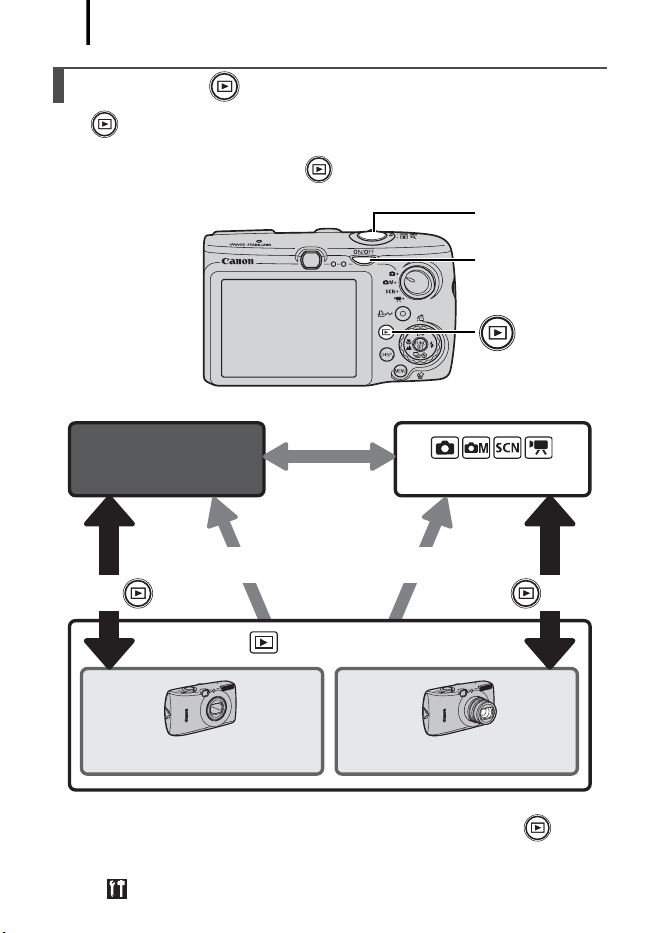
44
The button can turn the camera on/off and switch between the
shooting/playback modes. In addition, you can register slideshow or
sound recorder functions to the button (p. 163).
• May operate differently than above when functions are registered to the button
(p. 163).
* The amount of time before the lens automatically retracts can be set in [Lens Retract]
in the (Set up) menu (p. 58).
Using the Button
Button
Shutter Button
ON/OFF Button
Shooting Mode
Turning
the Camera Off
Lens retracted*
Press the button
Press the
ON/OFF button
Playback Mode
Press the
ON/OFF button
Lens extended
Press the button
Press the shutter
button halfway
Components Guide
45
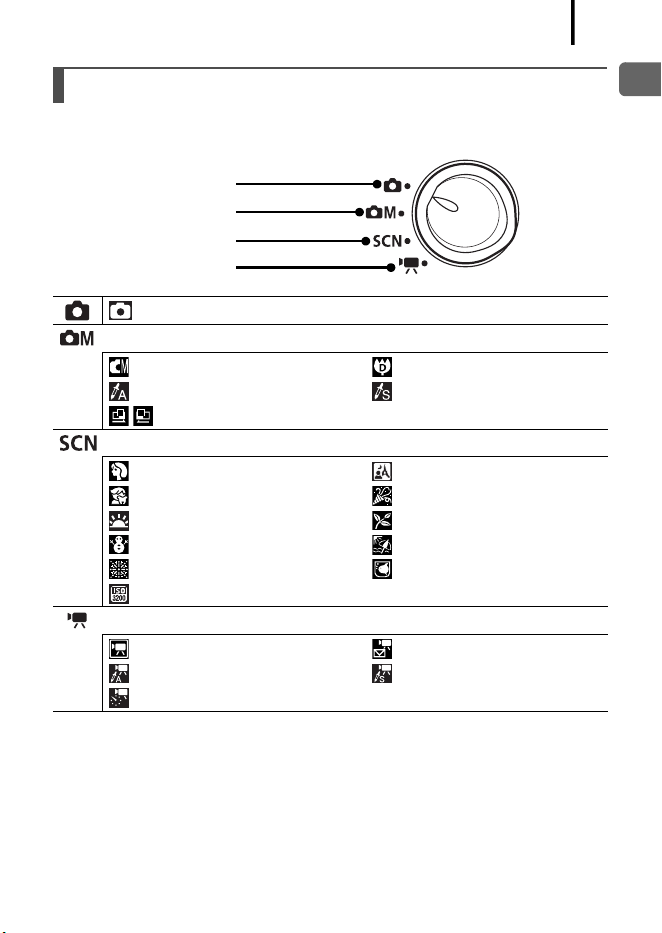
Turn the mode dial to the mode you wish to use.
How to Use the Mode Dial
: Auto Mode (p. 16)
Manual Mode
: Manual (p. 78)
: Color Accent (p. 109)
: Stitch Assist (p. 88)
: Digital Macro (p. 66)
: Color Swap (p. 111)
Special Scene Mode
: Portrait (p. 75)
: Kids&Pets (p. 76)
: Sunset (p. 76)
: Snow (p. 76)
: Fireworks (p. 77)
: ISO 3200 (p. 77)
: Night Snapshot (p. 75)
: Indoor (p. 76)
: Foliage (p. 76)
: Beach (p. 76)
: Aquarium (p. 77)
Movie Mode (pp. 24, 82)
: Standard
: Color Accent
: Time Lapse
: Compact
: Color Swap
Special Scene Mode
Movie Mode
Auto Mode
Manual Mode
46
The camera indicators will light or blink under the following conditions.
• Left Side Indicator
Green : Ready to shoot (camera beeps twice)/when display
off
Blinking Green : Time Lapse (movie) recording/Image recording/
reading/erasing/transferring (when connected to a
computer or printer)
Orange : Ready to shoot (flash on)
Blinking Orange : Ready to shoot (camera shake warning)
• Right Side Indicator
Yellow: Macro mode/Infinity mode/AF lock mode
Blinking Yellow: Focusing difficulty (camera beeps once)
Indicators
Never do the following while the indicator blinks green. These
actions may corrupt image data.
- Shake or jolt the camera.
- Shut off the power, or open the memory card slot/battery
cover.
Components Guide
47
Using the Clock
You can display the current date and time
for a 5-second* interval using the following
two methods.
* Default setting
a Hold the FUNC./SET button down while turning on the power.
b In a shooting/playback mode, press the FUNC./SET button for
more than one second.
If you hold the camera horizontally, it displays the time. If you hold it
vertically, the time and date display. However, if you hold the
camera vertically and use method
a to display the date and time,
the time will be initially displayed in the same way as when the
camera is held horizontally.
• You can change the display color by pressing the or button,
or using the control dial.
• The clock display will disappear when the display interval is over or
when a button is operated for a subsequent operation.
• The clock’s display interval can be changed in the menu (p. 58).
• The clock cannot be displayed when images are magnified or it is in
the index playback mode.
48
Basic Operations
Settings for the shooting or playback modes or such camera settings
as the print settings, date/time and sounds are set using the FUNC.
menu or the Rec., Play, Print, Set up or My Camera menu.
FUNC. Menu ( Button)
This menu sets many of the common shooting functions.
Menus and Settings
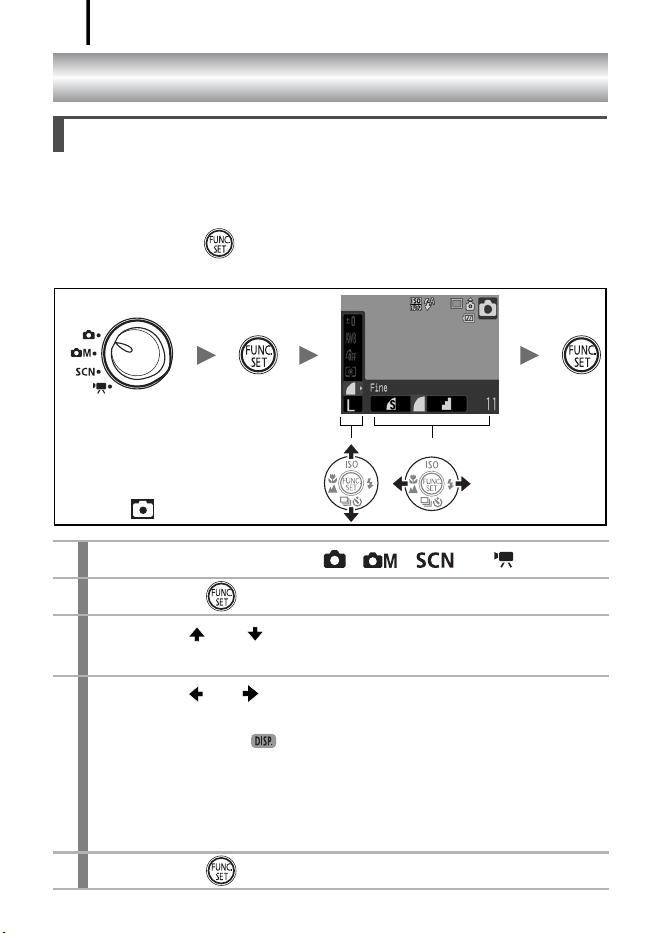
1
Set the mode dial to , , or .
2
Press the button.
3
Use the or button to select a menu item.
Some items may not be selectable in some shooting modes.
4
Use the or button to select an option for
the menu item.
• Items showing the icon can be changed with the
DISP.
button.
• After selecting an option, you can press the shutter button to
shoot immediately. After shooting, the menu will appear again,
allowing you to adjust the settings easily.
• You can also use the control dial to select an option for the menu item.
5
Press the button.
12
34
5
• This example shows the FUNC.
menu in (Auto) mode.
49
Basic Operations
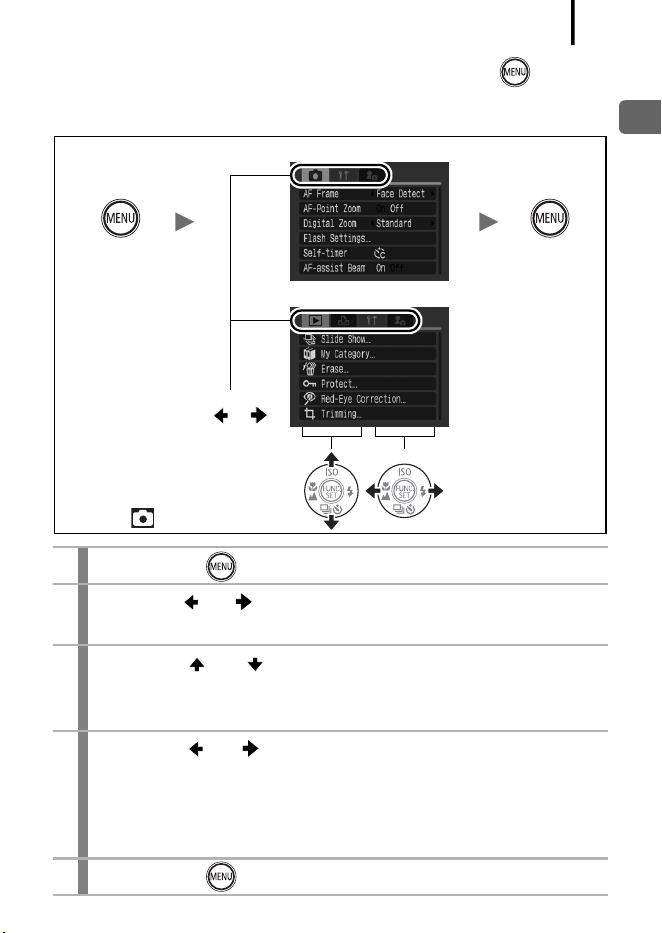
Rec., Play, Print, Set up and My Camera Menus ( Button)
Convenient settings for shooting, playback or printing can be set with
these menus.
1
Press the button.
2
Use the or button to switch between menus.
• You can also use the zoom lever to switch between menus.
3
Use the or button to select a menu item.
• Some items may not be selectable in some shooting modes.
• You can also use the control dial to select a menu item.
4
Use the or button to select an option.
• Menu items followed by an ellipsis (...) can only be set after
pressing the FUNC./SET button to display the next menu. Press
the FUNC./SET button again to confirm the setting and press
the MENU button to return the menu screen.
5
Press the button.
You can switch between
menus with the or
button.
1
2
34
5
Shooting Mode (Auto)
Playback Mode
• This example shows the Rec.
menu in (Auto) mode.
50
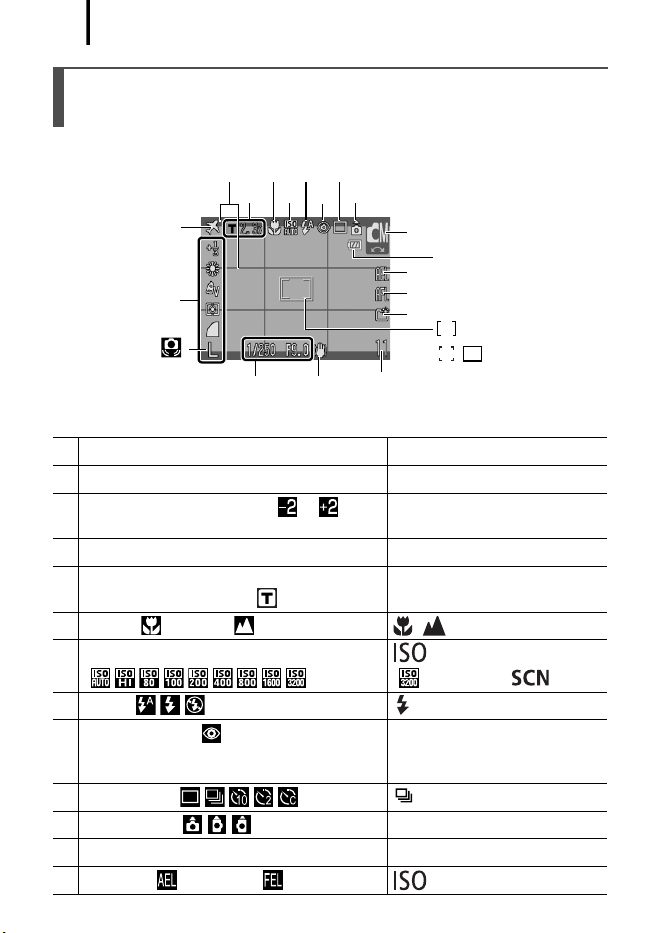
Shooting Mode
Information Displayed on the LCD
Monitor and Menus
Information Displayed Setting Method
a
Time Zone (Home/World) MENU button (Set up menu)
b
Exposure Compensation (
…
) or
Recording Pixels, etc.
FUNC./SET button
c
Display Overlays MENU button (Rec. menu)
d
Digital Zoom Factor/
Digital Tele-Converter ( 1.4x/2.3x)
MENU button (Rec. menu)
e
Macro ( )/Infinity ( ) / button
f
ISO Speed
()
button
( selected in mode)
g
Flash ( ) button
h
Red-Eye Corr. ( ) MENU button
([Flash Settings] menu in the
Rec. menu)
i
Drive Mode ( ) button
j
Auto Rotate ( ) MENU button (Set up menu)
k
Shooting Mode Mode dial, Control dial
l
AE Lock ( )/FE Lock ( ) button
Recordable Shots (Stills)/
Remaining Time/Elapsed Time
(Movies)
Spot AE Point Frame/
AF Frame
b
j
l
k
o
i
h
c
d
e
f
g
m
n
Battery Charge
Indicator
Shutter Speed,
Aperture Value,
p
Camera Shake ( )
(pp. 51, 193)
a
51
Basic Operations
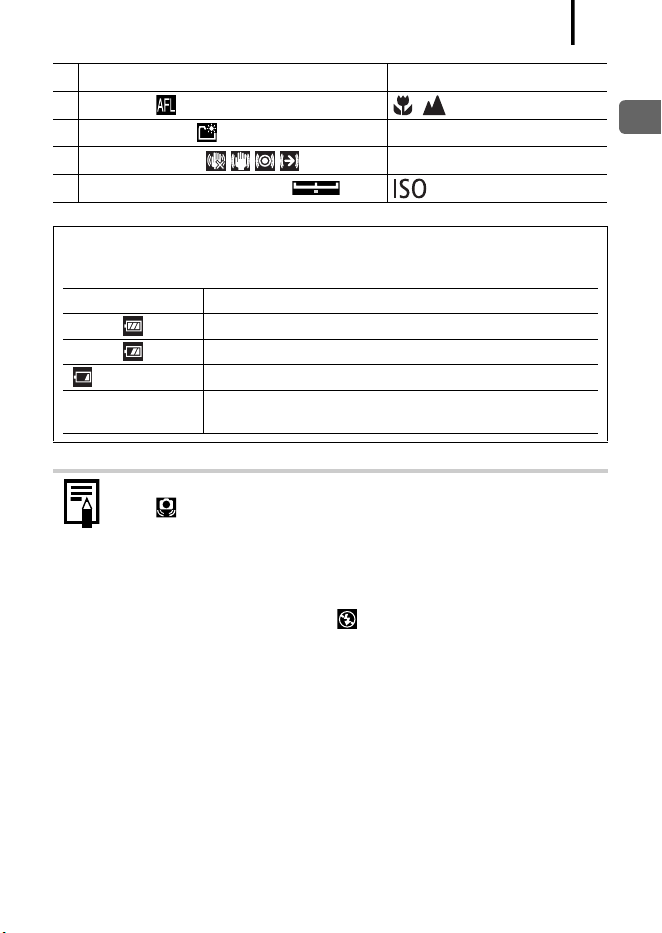
m
AF Lock ( ) / button
n
Create Folder ( ) MENU button (Set up menu)
o
Camera Shake ( ) MENU button (Rec. menu)
p
Exposure Shift Bar (Movies) button
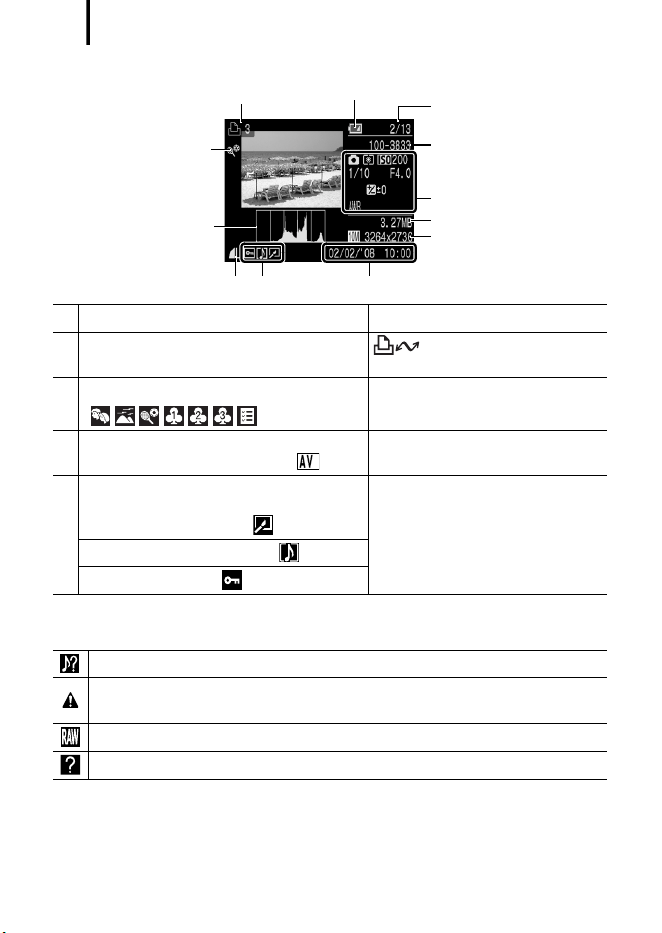
About the Battery Charge Indicator
• The following icon and message will display.
If the indicator blinks orange and the camera shake warning
icon ( ) displays, this indicates that a slow shutter speed may
have been selected due to insufficient illumination. Use the
following methods to shoot:
- Set the IS mode to any setting other than [Off] (p. 72)
- Raise the ISO speed (p. 74)
- Select a setting other than (flash off) (p. 66)
- Attach the camera to a tripod or other device
Information Displayed Setting Method
Icons/message Summary
Sufficient battery charge.
Recharge the battery soon for extended use.
(blinking red) Low battery charge. Recharge the battery.
Change the
battery
Battery is depleted and the camera can no longer
operate. Charge the battery immediately.
52
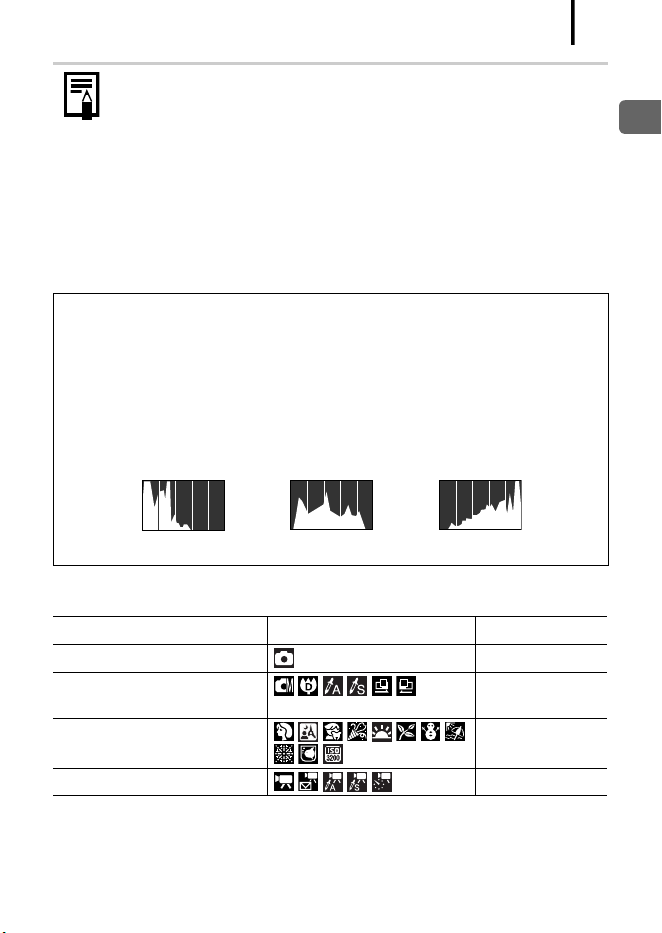
Playback Mode (Detailed)
The following information may also be displayed with some images.
Information Displayed Setting Method
q
Print List button,
MENU button (Print menu)
r
Auto Category/My Category
()
MENU button
(Rec. menu/Play menu)
s
Compression (Still Images)/Recording
Pixels (Still Images), Movie ( )
FUNC./SET button
(FUNC. menu)
t
Red-Eye Correction Function/
Resized image/Trimmed image/
My Colors (Playback) ( )
MENU button (Play menu)
Image with Sound Memo ( )
Protection Status ( )
A file in a format other than the WAVE format is attached.
JPEG image not conforming to Design rule for Camera File System
Standards.
RAW image
Unrecognized data type
t
Shooting Date/Time
Battery Charge Indicator
Displayed image number/
Total number of images
Folder Number-File
Number
Shooting information
Histogram
r
s
q
Recording Pixels (Stills)/
Recording Length (Movies)
File Size
53
Basic Operations
Shooting Mode
z Information for images shot on other cameras may not
display correctly.
z Overexposure Warning
In the following cases, overexposed portions of the image
blink.
- When reviewing an image right after shooting in the LCD
monitor (detailed display)
- When using the detailed display mode of the playback
mode
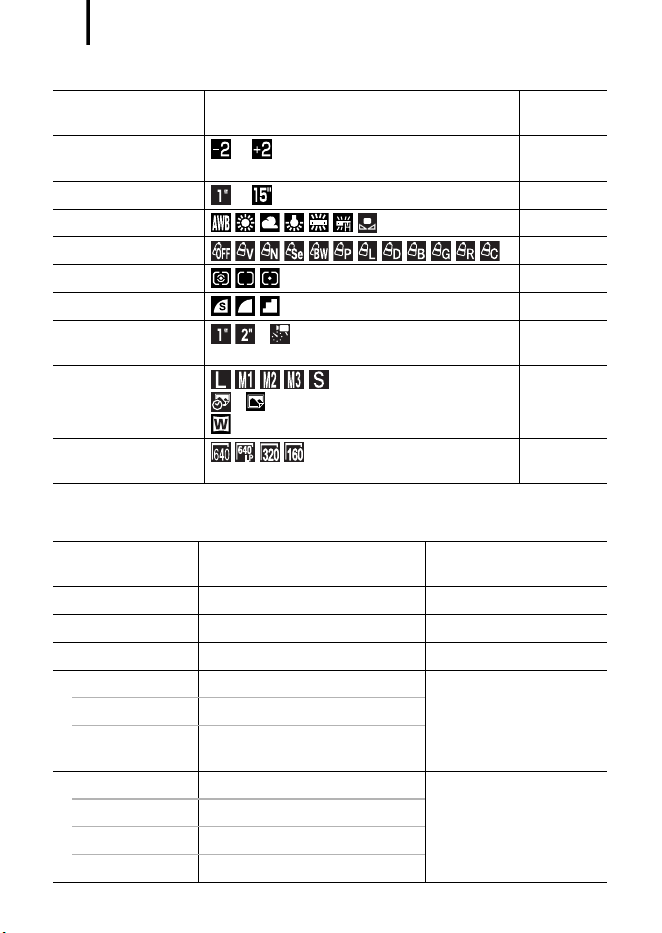
Histogram Function
The histogram is a graph that allows you to check the brightness of
an image. The greater the bias toward the left in the graph, the darker
the image. The greater the bias toward the right, the brighter the
image. By using the exposure compensation function, you can
correct the image brightness before shooting (p. 101).
Menu Item Reference Page
Auto Mode p. 16
Manual Mode pp. 66, 78, 88,
109, 111
Special Scene Mode
p. 75
Movie Mode pp. 24, 82
Sample Histograms
Balanced ImageDark Image Bright Image
54
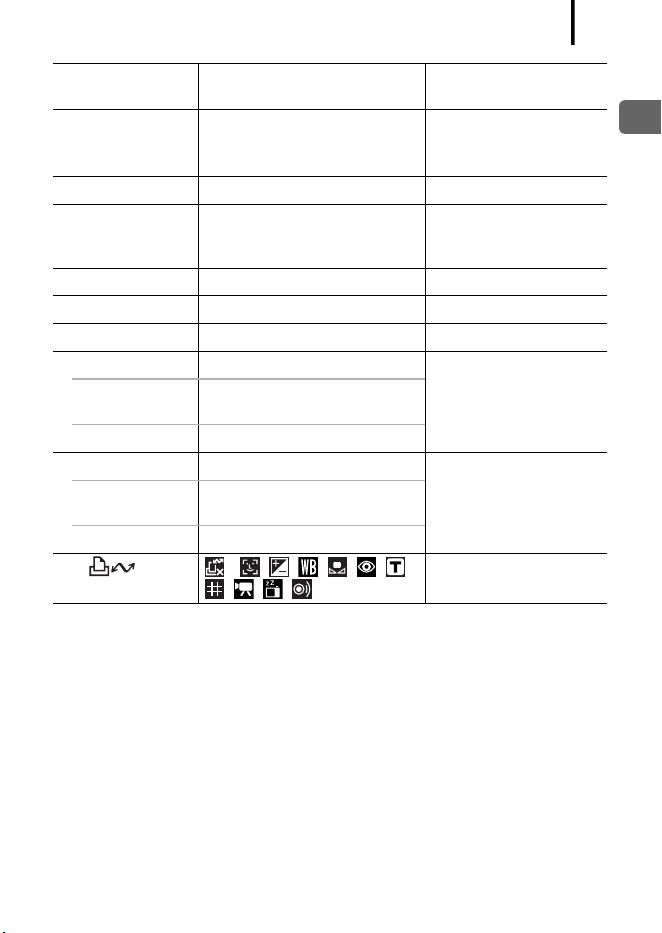
FUNC. Menu
Rec. Menu
Menu Item
Reference
Page
Exposure
Compensation
…
p. 101
Long Shutter Mode
…
p. 103
White Balance p. 104
My Colors p. 107
Metering Mode p. 102
Compression p. 71
Shooting Interval
(Movie)
( selected)
p. 87
Recording Pixels
(Still Image)
( when the date has not been set) p. 70
Recording Pixels
(Movie)
p. 86
Menu Item Options
Summary/
Reference Page
AF Frame Face Detect*/AiAF/Center p. 93
AF Frame Size On*/Off p. 95
AF-Point Zoom On/Off* p. 90
Digital Zoom
p. 62
(Still Image) Standard*/Off/1.4x/2.3x
(Movies) Standard*/Off (In standard
movie mode only)
Flash Settings
p. 80
Slow Synchro On/Off*
Red-Eye Corr. On/Off*
Red-Eye Lamp On*/Off
* Default setting
55
Basic Operations
Self-timer
Delay: 0 – 10*, 15, 20, 30 sec.
Shots: 1 – 10
(Default setting is 3 shots.)
p. 68
AF-assist Beam On*/Off p. 40
Review Off/ 2* sec. to 10 sec./Hold You can set the length
of time images display
after being shot (p. 17).
Review Info Off*/Detailed/Focus Check p. 96
Save Original On/Off* p. 113
Auto Category On*/Off p. 115
Disp. Overlay
p. 114
(Still image) Off*/Grid Lines/3:2 Guide/
Both
(Movie) Off*/Grid Lines
IS Mode
p. 72
(Still image) Continuous*/Shoot Only/
Panning/Off
(Movie) Continuous*/Off
Set button *///////
///
p. 116
Menu Item Options
Summary/
Reference Page
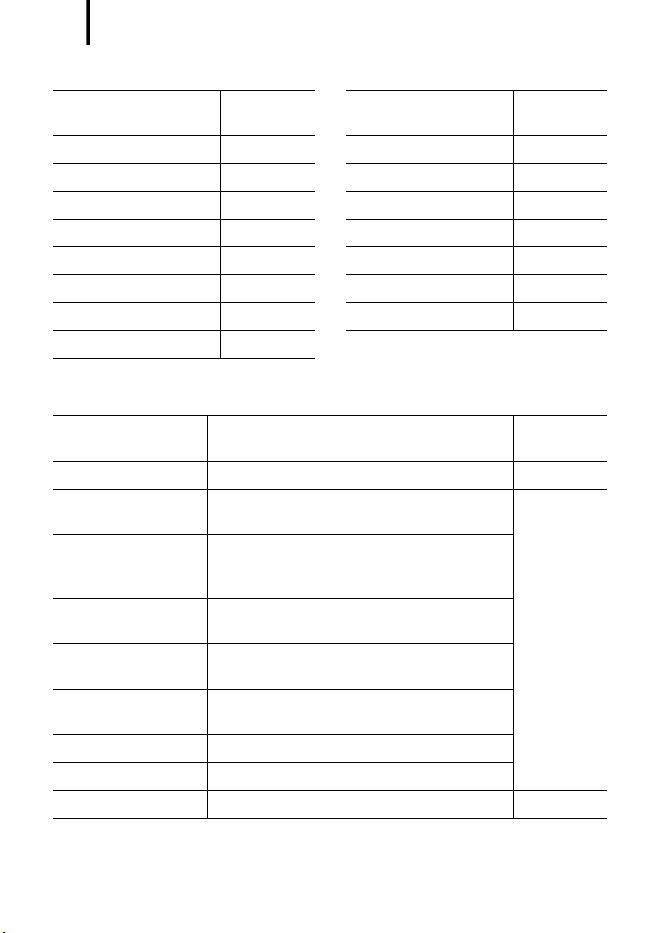
56
Play Menu
Print Menu
Menu Item
Reference
Page
Menu Item
Reference
Page
Slide Show p. 136 Sound Memo p. 151
My Category p. 124 Sound Recorder p. 152
Erase p. 158 Rotate p. 134
Protect p. 154 Transfer Order p. 172
Red-Eye Correction p. 142 Set Play button p. 163
Trimming p. 127 Resume p. 18
Resize p. 149 Transition p. 135
My Colors p. 147
Menu Item Summary
Reference
Page
Print Displays the print menu. –
Select Image &
Qty.
Configures print settings for individual
images as you view them.
p. 165
Select Range Selects a range of sequential images
and makes print settings for all the
images in that range.
Select by Date Configures print settings for images
corresponding to the selected date.
Select by Category Configures print settings for images in
the selected category.
Select by Folder Configures print settings for images in
the selected folder.
Select All Images Configures print settings for all images.
Clear All Selections Removes all print settings from images.
Print Settings Sets the print style. p. 165
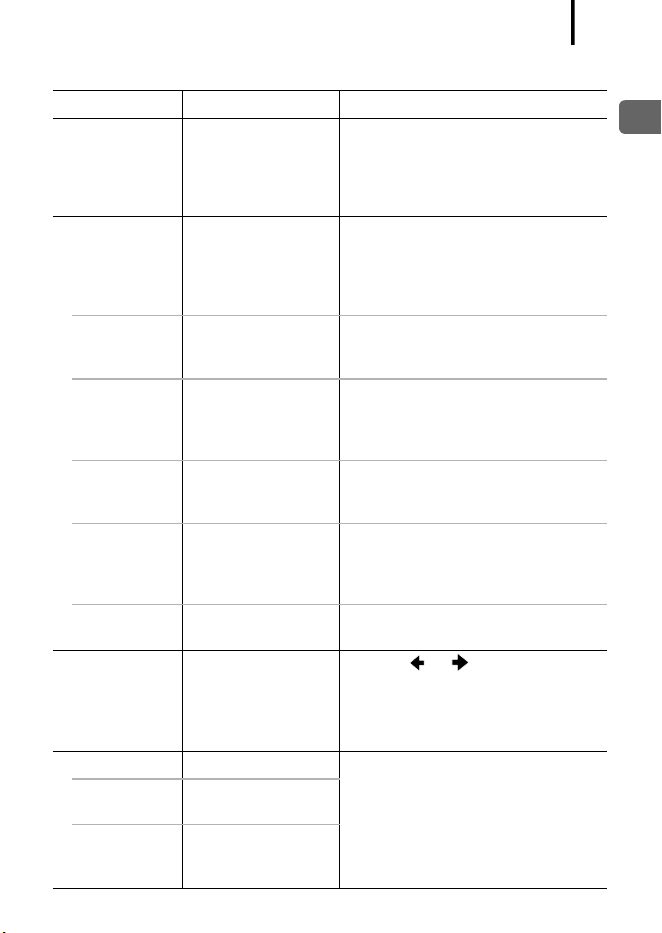
57
Basic Operations
Set up Menu
Menu Item Options Summary/Reference Page
Mute On/Off* Set to [On] to silence all operation
sounds*.
* Except for when the memory card slot/
battery cover is opened during
recording.
Volume Off/ 1 / 2*/ 3 / 4 / 5 Adjusts the volume of the start-up
sound, operation sound, selftimer
sound, shutter sound and playback
sound. The volume cannot be
adjusted if [Mute] is set to [On].
Start-up Vol. Adjusts the volume of the start-up
sound when the camera is turned
on.
Operation
Vol.
Adjusts the volume of the operation
sound that beeps when any button
other than the shutter button is
pressed.
Selftimer
Vol.
Adjusts the volume of the selftimer
sound played 2 sec. before the
shutter is released.
Shutter
Volume
Adjusts the volume of the sound
played when the shutter releases.
The shutter sound does not play
when a movie is recording.
Playback Vol. Adjusts the volume of movie
sounds or sound memos.
LCD Brightness –7 to 0* to +7 Use the or button to adjust
the brightness.
You can check the brightness in
the LCD monitor while you are
adjusting the setting.
Power Saving
p. 174
Auto Power
Down
On*/Off
Display Off 10 sec./20 sec./30
sec./1 min.*/ 2 min./
3 min.
* Default setting
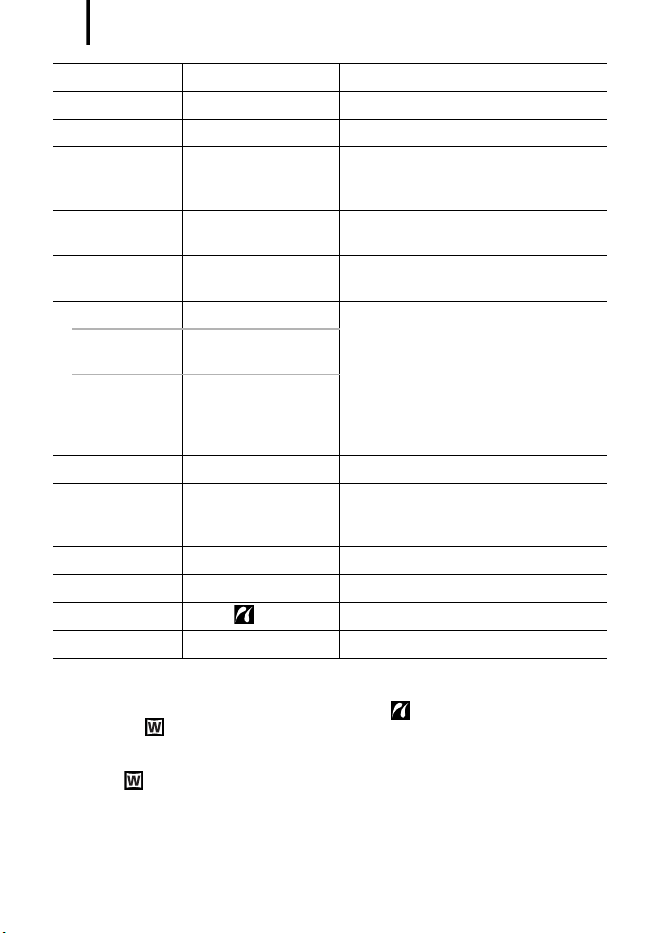
58
Print Method
The connection method with the printer can be changed for printing. Although it is
normally not necessary to change the setting, select when borderless printing an
image shot in (Widescreen) mode on wide size paper using Canon compact photo
printer SELPHY CP750/CP740/CP730/CP720/CP710/CP510/CP520. As this setting
will be stored to memory even when the power is turned off, to print using an image size
other than , return the mode to [Auto] (however, the connection method cannot be
changed while connected to a printer).
Time Zone Home*/World p. 175
Date/Time p. 14
Clock Display 0 – 5* – 10 sec./
20 sec./30 sec./
1min./2min./3min.
Format You can also select a low level
format (p. 178).
File Numbering Continuous*/
Auto Reset
p. 179
Create Folder
p. 181
Create New
Folder
Check mark (On)/
No check mark (Off)
Auto Create Off*/Daily/Monday-
Sunday/Monthly
(Creation time also
can be set)
Auto Rotate On*/Off p. 183
Lens Retract 1 minute*/0
seconds
Sets the lens retraction timing
when switching from shooting
mode to playback mode (p. 44).
Language p. 15
Video System NTSC/PAL p. 186
Print Method Auto*/ See below.
Reset All p. 184
Menu Item Options Summary/Reference Page
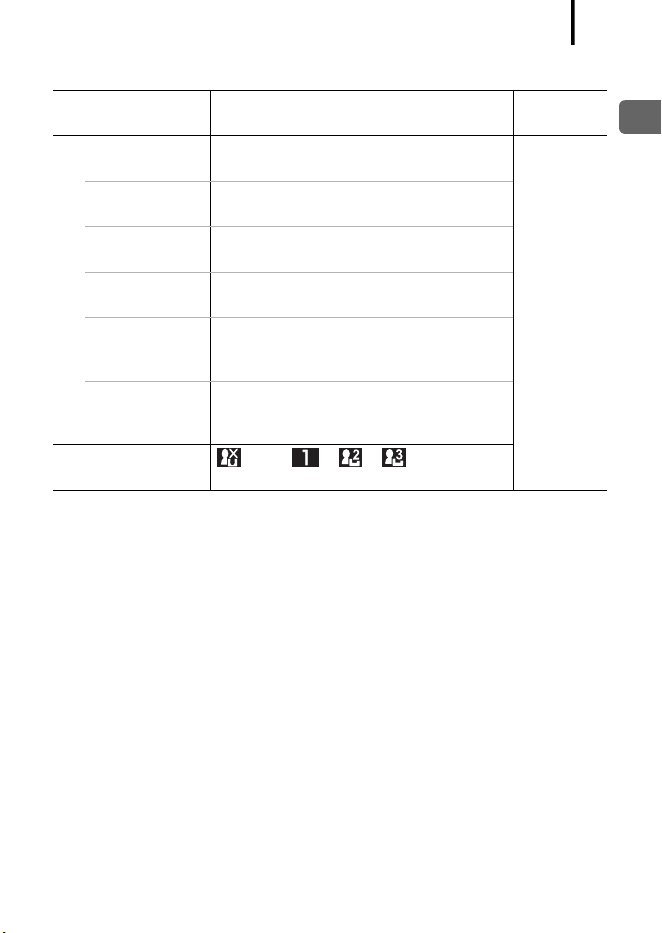
59
Basic Operations
My Camera Menu
Menu Item Summary
Reference
Page
Theme Selects a common theme for each My
Camera settings item.
p. 188
Start-up Image Sets the image displayed when the
camera power is turned on.
Start-up Sound Sets the sound played when the
camera power is turned on.
Operation
Sound
Sets the sound played when any button
other than the shutter button is pressed.
Selftimer
Sound
Sets the sound played 2 seconds
before the shutter releases in self-timer
mode.
Shutter Sound Sets the sound played when the shutter
button is pressed. (There is no shutter
sound for movies.)
My Camera Menu
Contents
(Off)/
*/ /
* Default setting
60
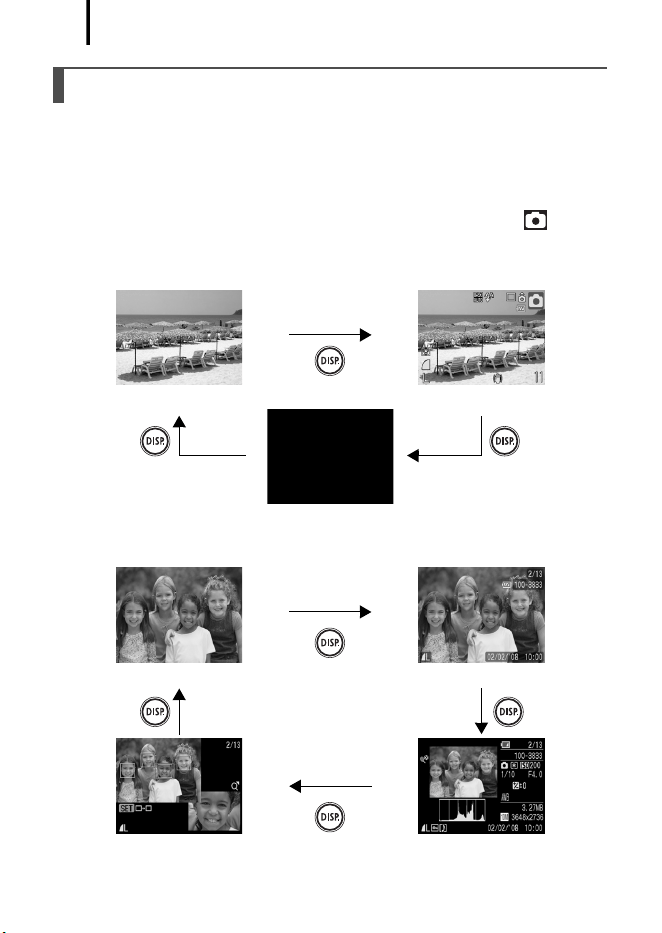
Switching LCD Monitor Display Modes
Each press of the DISP. button, changes the display mode of the LCD
monitor. See Information Displayed on the LCD Monitor and Menus for
details (p. 50).
(The following are the screens that display when shooting in (Auto)
mode.)
Shooting Mode
Playback Mode or Rec. Review (Right After Shooting)
Using the LCD Monitor
No Information Information View
Off
No Information Standard Display*
1
Focus Check*
2
Detailed Display
*1 Playback mode only
*2 Still image only
61
Basic Operations
LCD Monitor Brightness Settings
The brightness of the LCD monitor can be changed in the following two
ways.
• Changing settings using the Set up menu (p. 57)
• Changing settings using the DISP. button (Quick-bright LCD
Function)
You can set the LCD monitor to the brightest setting regardless of the
option selected in the Set up menu by pressing the DISP. button for
more than one second*.
- To restore the previous brightness setting, press the DISP. button
for more than one second again.
- The next time you turn on the camera, the LCD monitor will be at
the brightness setting selected in the Set up menu.
* You cannot change the brightness of the LCD monitor with this function if you have
already set it to its highest setting in the Set up menu.
z The LCD monitor on or off setting is retained even after the
camera power is turned off.
z The LCD monitor does not shut off in the , , , ,
or Movie mode.
z The LCD monitor is set to the Information View in the ,
, , , or mode.
z The LCD monitor will not switch to the detailed display or
focus check display in magnified display (p. 118), or index
playback mode (p. 119).
Night Display
When shooting at dusk or during the evening when the dark
surroundings make it difficult to view the LCD monitor, the camera’s
“night view” option* displays the subject brightly in the LCD monitor.
This will allow you to compose a shot even in dark environments (this
setting cannot be turned off).
* Although noise may appear and the movement of the subject shown on the LCD
monitor may appear somewhat jagged, there is no effect on the recorded image.
The brightness of the image displayed in the monitor, and the brightness of the
actual image recorded will be different.
62
Commonly Used Shooting Functions
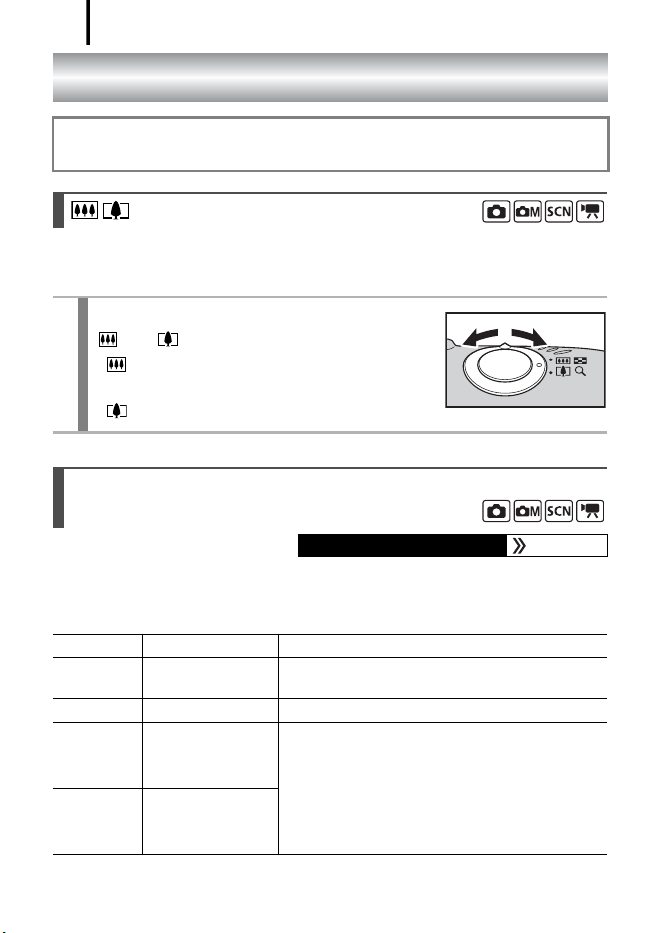
The zoom can be adjusted from 37 – 185 mm (focal length) in 35mm
film equivalent terms.
You can combine digital zoom with optical zoom when shooting.
The available shooting characteristics and focal lengths (35mm film
equivalent) are as follows.
You can also use the control dial to select shooting modes or FUNC.
menu options. See p. 43.
Using the Optical Zoom
1
Press the zoom lever toward
or .
• Wide Angle: Zooms out from the
subject.
• Telephoto: Zooms in on the subject.
Using the Digital Zoom/
Digital Tele-Converter
Available Shooting Modes p. 232
Selection Focal Length Shooting Characteristics
Standard 37 – 740 mm
Enables shooting at zoom factors of up to
20x with digital and optical zoom combined.
Off 37 – 185 mm Enables shooting without digital zoom.
1.4x 51.8 – 259 mm
Digital zoom is fixed at the selected zoom
factor, and the focal length shifts to
maximum telephoto.
This enables a faster shutter speed and
less chance of camera shake than a shot
taken at the same angle of view with
[Standard] or [Off].
2.3x 85.1 – 425.5 mm
63
Commonly Used Shooting Functions
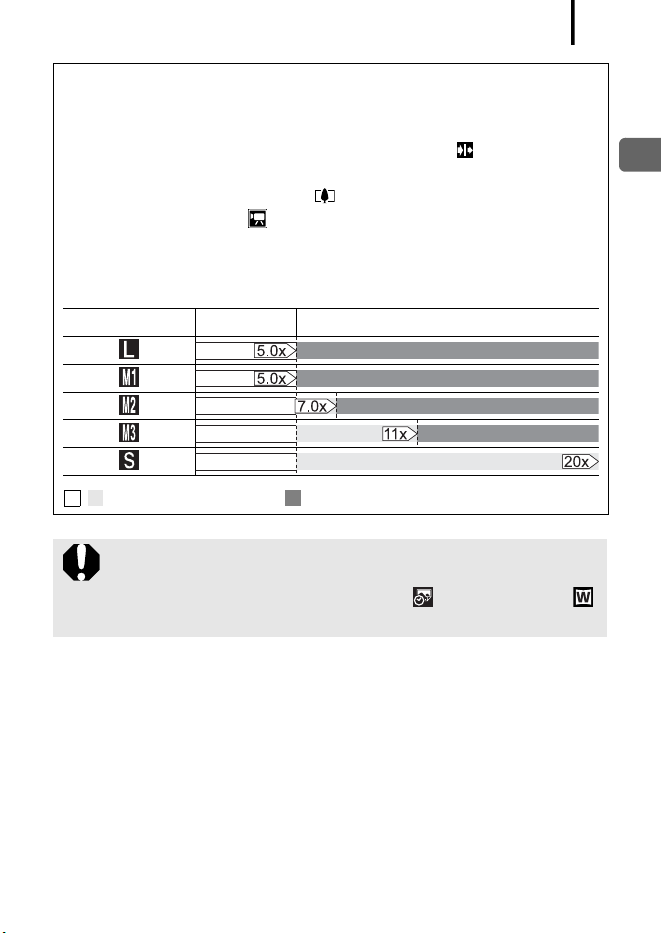
About the Safety Zoom
Depending on the number of recording pixels set, you can shift from
optical zoom to digital zoom without pausing up to a factor where the
image quality does not deteriorate (Safety Zoom). displays when
reaching the maximum zoom factor without image deterioration.
Pressing the zoom lever toward again allows you to zoom even
further (not available in ).
Depending on the number of recording pixels set, the Safety Zoom
zone varies as follows.
z The digital zoom cannot be used when the LCD monitor is
turned off.
z The digital zoom cannot be used in (Date Stamp) or
(Widescreen) modes.
Safety Zoom Factor
: Zone without deterioration : Zone with deterioration
Recording pixels
Optical zoom
Digital zoom
5.0x
5.0x
7.0x
11x
20x
64
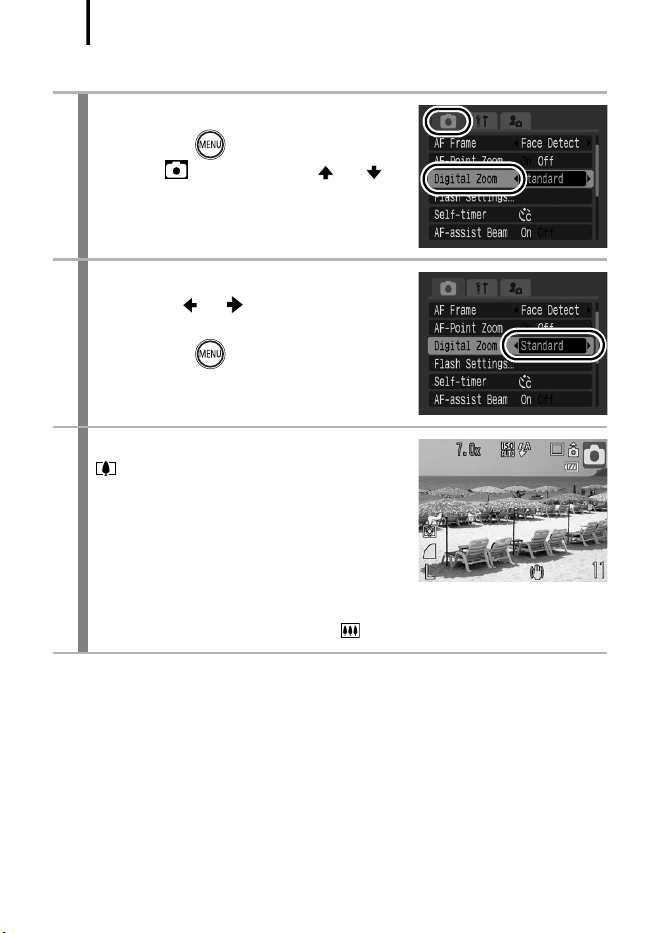
Shooting with the Digital Zoom
1
Select [Digital Zoom].
1. Press the button.
2. In the menu, use the or
button to select [Digital Zoom].
2
Make settings.
1. Use the or button to select
[Standard].
2. Press the button.
3
Press the zoom lever toward
and shoot.
• The combined digital and optical
zoom factor will display in the LCD
monitor.
• The image may appear coarse
depending upon the selected
recording pixels. The zoom factor appears in blue.
• Press the zoom lever toward to zoom out.
65
Commonly Used Shooting Functions
Shooting with the Digital Tele-Converter
The digital tele-converter feature uses digital zoom to achieve the
effects of a tele-converter (a lens used in telephoto shooting).
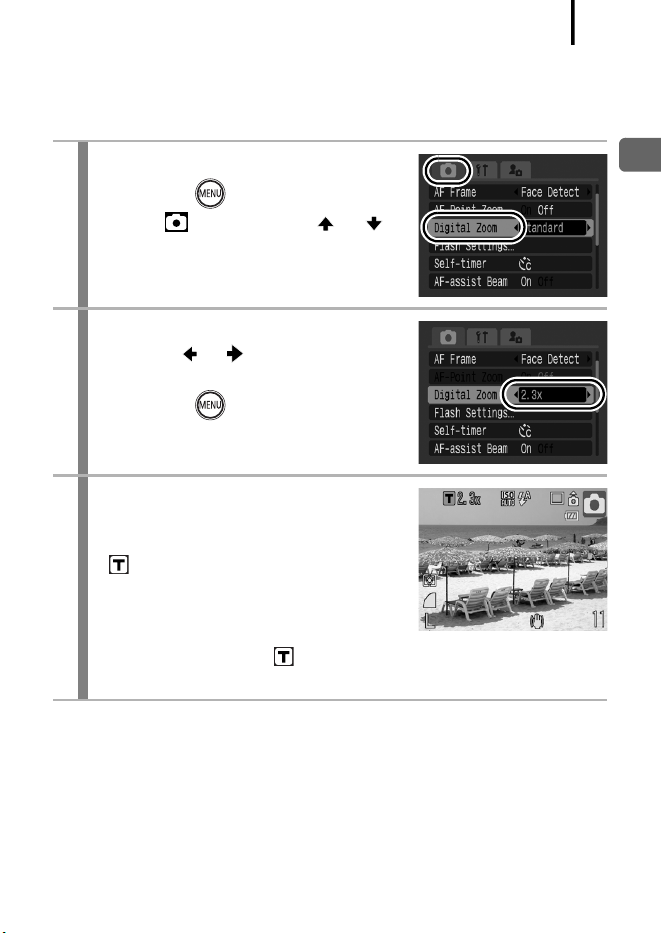
1
Select [Digital Zoom].
1. Press the button.
2. In the menu, use the or
button to select [Digital Zoom].
2
Make settings.
1. Use the or button to select
[1.4x] or [2.3x].
2. Press the button.
3
Adjust the angle of view
with the zoom lever and
shoot.
• and the zoom factor appear on the
LCD monitor.
• The image may appear coarse
depending upon the selected
recording pixels (the icon and the zoom factor appear in
blue).
66
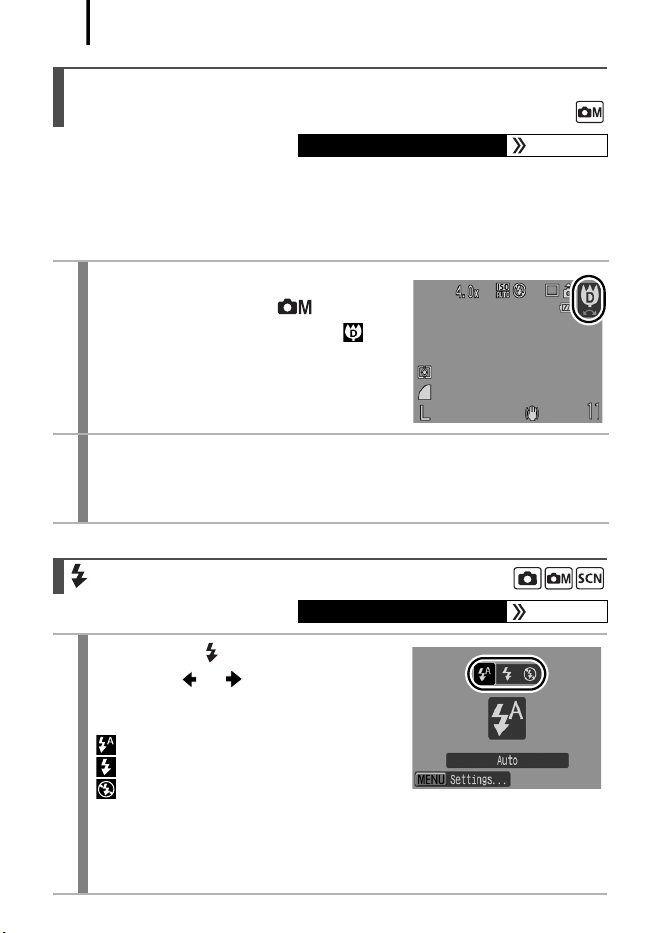
You can shoot a subject 2 – 10 cm (0.79 – 3.9 in.) from the end of the
lens at the maximum wide angle setting. With the digital zoom, the
image area is 7 × 5 mm (0.28 × 0.20 in.) at maximum zoom
(approximately 4.0x).
Magnified Close-Up Shooting
(Digital Macro)
Available Shooting Modes p. 232
1
Select Digital Macro.
1. Set the mode dial to .
2. Use the control dial to select .
2
Choose the angle of view with the zoom lever
and shoot.
• The zoom factor appears on the LCD monitor.
Using the Flash
Available Shooting Modes p. 232
1
Press the button.
1. Use the or button to select the
flash settings.
: [Auto]
: [On]
: [Off]
• You can configure detailed settings for the flash (Slow Synchro,
Red-Eye Corr. and Red-Eye Lamp) when you press the MENU
button while this screen is displayed (p. 80).
67
Commonly Used Shooting Functions
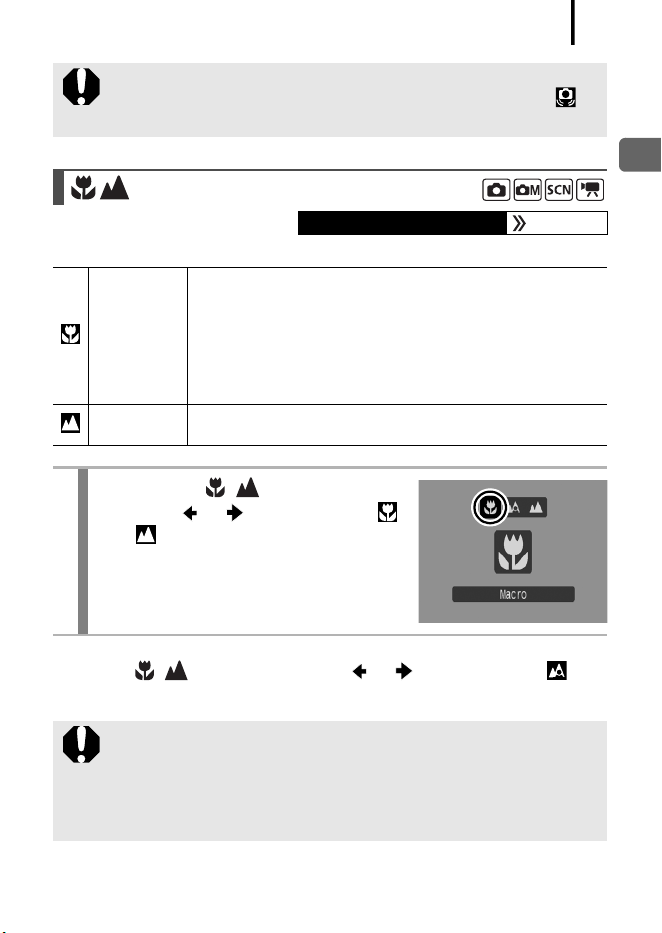
You can shoot close-ups or infinity shots.
To Cancel the Macro Mode:
Press the / button and use the or button to select
(Normal).
You are recommended to shoot with the camera attached to a
tripod or other device if the camera shake warning icon ( )
appears.
Shooting Close-Ups/Infinity
Available Shooting Modes p. 232
Macro
Use this mode to shoot close-ups of flowers or small
items.
Area at Minimum Focusing Distance from End of Lens
to Subject
Maximum wide angle setting: 30 × 22 mm (1.2 × 0.87
in.) (Minimum focusing distance: 2 cm (0.79 in.))
Infinity
Use this mode to record subjects 3 m (9.8 ft.) or more
from the end of the lens.
1
Press the / button.
1. Use the or button to select
or .
z Use the LCD monitor to compose close-ups in macro mode
since the view through the viewfinder may not match the
image taken.
z Using the flash in macro mode may cause image edges to
darken.
68
You can set the time delay and the numbers of shots you wish to take
in advance.
* This may differ depending on your My Camera settings (p. 188).
Using the Self-Timer
Available Shooting Modes p. 232
10 sec. Self-Timer: The shutter releases 10 seconds after the shutter
button is pressed.
• 2 seconds before the shutter releases, the self-timer sound beeps
quickly* and the lamp will speed up.
2 sec. Self-Timer: The shutter releases 2 seconds after the shutter
button is pressed.
• The self-timer sound beeps quickly* and the self-timer lamp blinks
when the shutter button is pressed and the shutter releases 2
seconds later.
Custom Timer: You can change the delay time (0 – 10, 15, 20, 30
sec.) and number of shots (1 – 10).
• When a delay time of over 2 seconds is set for the [Delay] option,
the self-timer sound beeps* quickly 2 seconds before the shutter
releases. If multiple shots have been specified for the [Shots]
option, the sound will play for the first shot only.
1
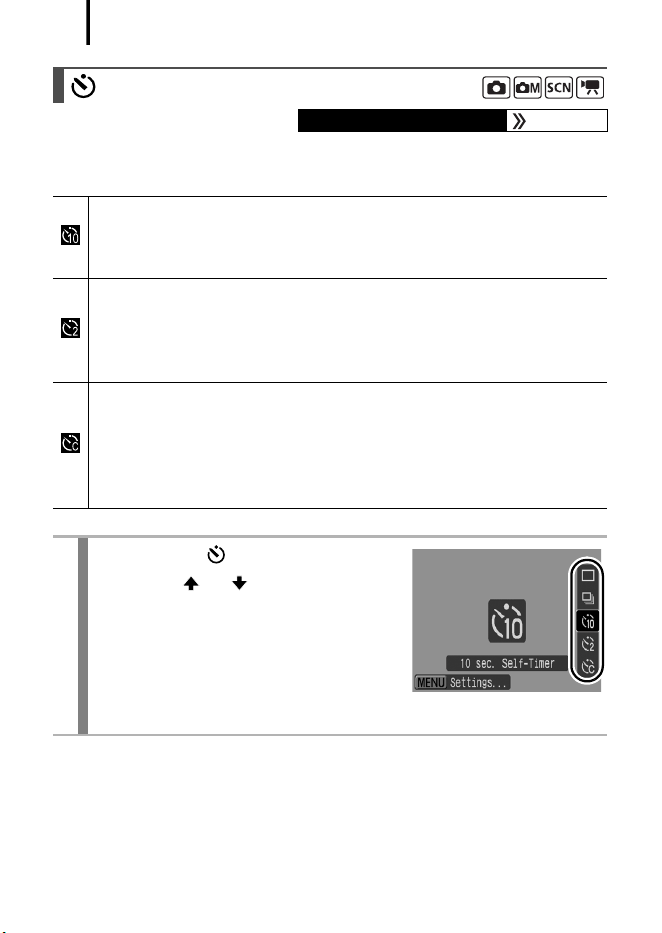
Press the button.
1. Use the or button to change
the self-timer mode.
• Pressing the MENU button while this
screen is displayed will allow you to
set the delay and number of shots as
when Custom Timer is selected (p. 69).
69
Commonly Used Shooting Functions
To Cancel the Self-Timer:
Press the button and the or button to select .
Changing the Delay Time and Number of Shots ( )
2
Shoot.
• When you press the shutter button fully, the self-timer lamp will
blink.*
* When [Red-Eye Lamp] is set to [On] in [Flash Settings] in the Rec. menu, the
self-timer lamp will light 2 seconds before the flash fires (p. 80).
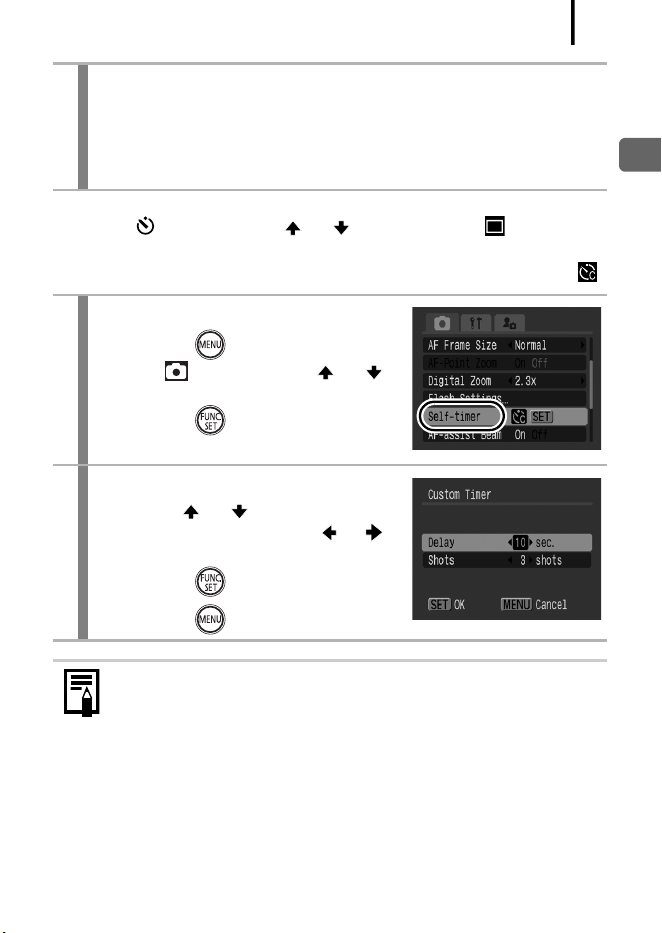
1
Select [Self-timer].
1. Press the button.
2. In the menu, use the or
button to select [Self-timer].
3. Press the button.
2
Make settings.
1. Use the or button to select
[Delay] or [Shots] and the or
button to change the settings.
2. Press the button.
3. Press the button.
If the [Shots] option is set to 2 or more shots, the following
occurs.
- The exposure and white balance are locked at the settings
selected for the first shot.
- If the flash is used, the interval between shots lengthens.
- The interval between shots may lengthen when the built-in
memory of the camera fills.
- Shooting will automatically cease if the memory card
becomes full.
70
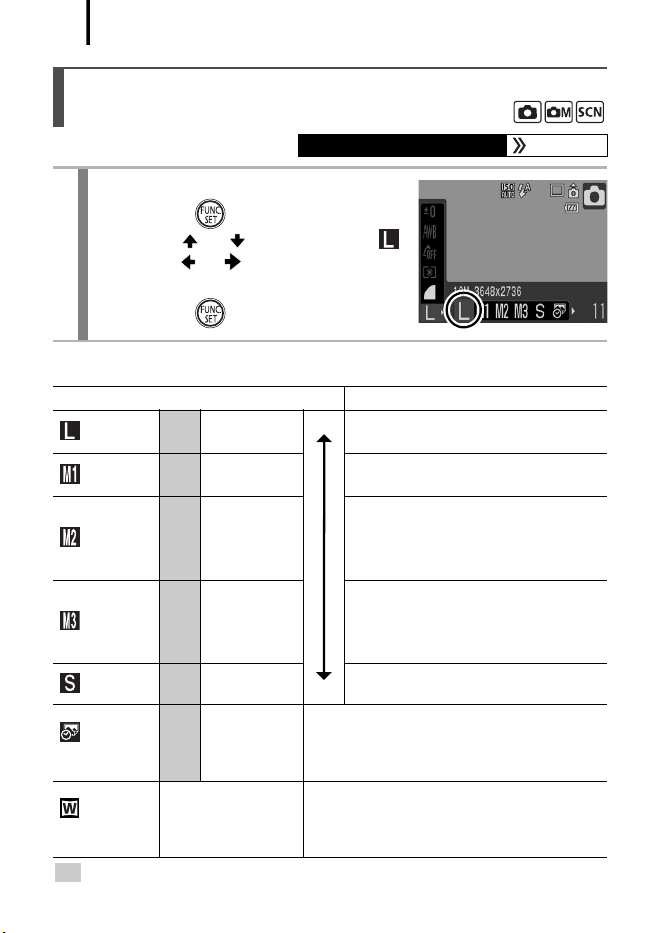
Approximate Values for Recording Pixels
: Approximate recording pixel numbers are shown. (M is short for megapixels.)
* Paper sizes vary according to region.
Changing the Recording Pixels
(Still Images)
Available Shooting Modes p. 232
1
Select the recording pixels.
1. Press the button.
2. Use the or button to select
and the or button to change
the recording pixels.
3. Press the button.
Recording Pixels Purpose*
Large
10M
3648 × 2736
High
Low
Printing to about A2-size
420 × 594 mm (16.5 × 23.4 in.)
Medium 1 6M 2816 × 2112
Printing to about A3-size
297 × 420 mm (11.7 × 16.5 in.)
Medium 2
4M 2272 × 1704
Printing to about A4-size
210 × 297 mm (8.3 × 11.7 in.)
Printing to about Letter-size
216 × 279 mm (8.5 × 11 in.)
Medium 3 2M 1600 × 1200
Printing postcard-size prints
148 × 100 mm (6 × 4 in.)
Printing L-size prints
119 × 89 mm (4.7 × 3.5 in.)
Small
0.3M
640 × 480
Sending images as e-mail
attachments or shoot more images.
Date Stamp
2M 1600 × 1200
Printing date-stamped images (p. 22), in
L-size or postcard-size (you can check
the print area at a 3:2 aspect ratio as
you shoot).
Widescreen
3648 × 2048
Printing on wide size paper (you can check
the composition at a 16:9 aspect ratio.
Areas that will not be recorded appear on
the LCD monitor as a black border.)
71
Commonly Used Shooting Functions
Approximate Values for Compression Settings
z
See Memory Cards and Estimated Capacities (p. 223)
z See Image Data Sizes (Estimated) (p. 225)
Changing the Compression (Still Images)
Available Shooting Modes p. 232
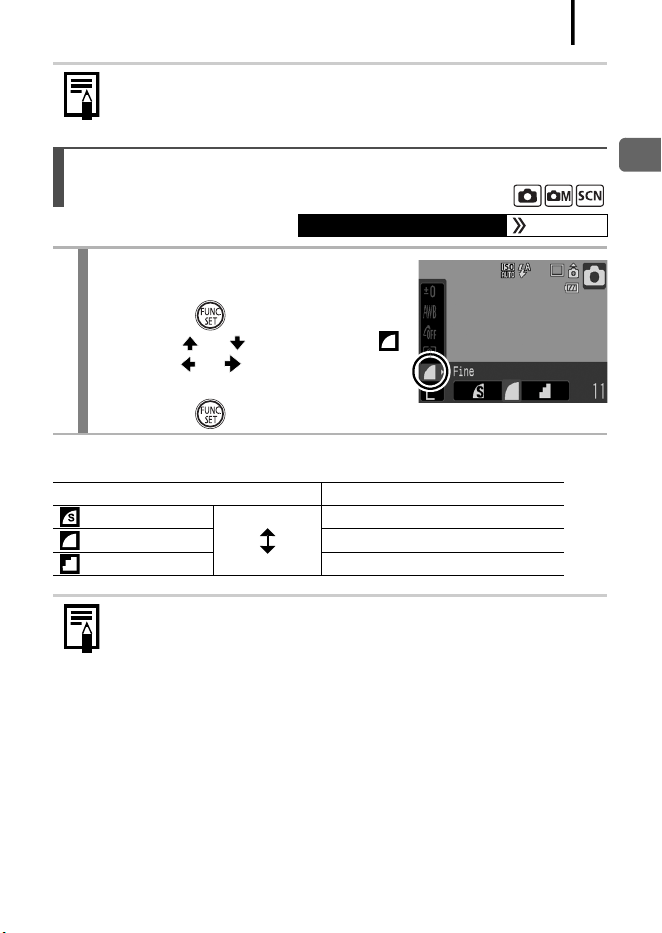
1
Select a compression
setting.
1. Press the button.
2. Use the or button to select
and the or button to change
the option.
3. Press the button.
Compression Purpose
Superfine High Quality
Normal
Shoot higher quality images.
Fine Shoot normal quality images.
Normal Shoot more images.
z
See Memory Cards and Estimated Capacities (p. 223)
z See Image Data Sizes (Estimated) (p. 225)
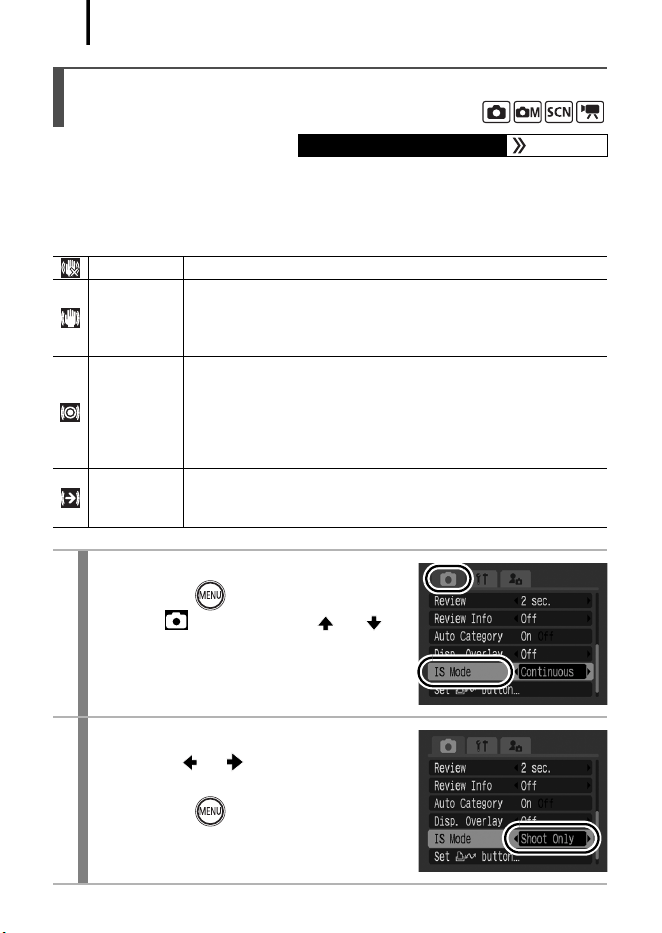
72
The lens-shift type image stabilizer function allows you to minimize the
camera shake effect (blurred images) when you shoot distant subjects
that have been magnified or when you shoot in dark conditions without
a flash.
Setting the Image Stabilizer Function
Available Shooting Modes p. 232
Off –
Continuous
You can check the effect of the IS mode on image blur
on the LCD monitor since the IS mode runs continually.
This makes it easier to compose images and focus on
subjects.
Shoot Only
Shoot Only IS mode is only activated when the shutter
button is pressed. When set to [Continuous], some
blurring may occur depending on the subjects. In Shoot
Only mode, subjects can be taken without concern for
any unnatural movement that may appear on the LCD
monitor.
Panning
This option only stabilizes the effect of up and down
camera motions on the image. This option is
recommended for shooting objects moving horizontally.
1
Select [IS Mode].
1. Press the button.
2. In the menu, use the or
button to select [IS Mode].
2
Make settings.
1. Use the or button to select the
image stabilizer settings.
2. Press the button.

73
Commonly Used Shooting Functions
z Camera shake may not be fully corrected when shooting
with slow shutter speeds, such as with evening shots. Use of
a tripod is recommended.
z If camera shake is too strong, it may not be fully corrected.
z Hold the camera horizontally while [Panning] (stabilization
does not work when the camera is held vertically).
z If you shoot a movie after setting [IS Mode] to [Shoot Only]
or [Panning], the setting will change to [Continuous].
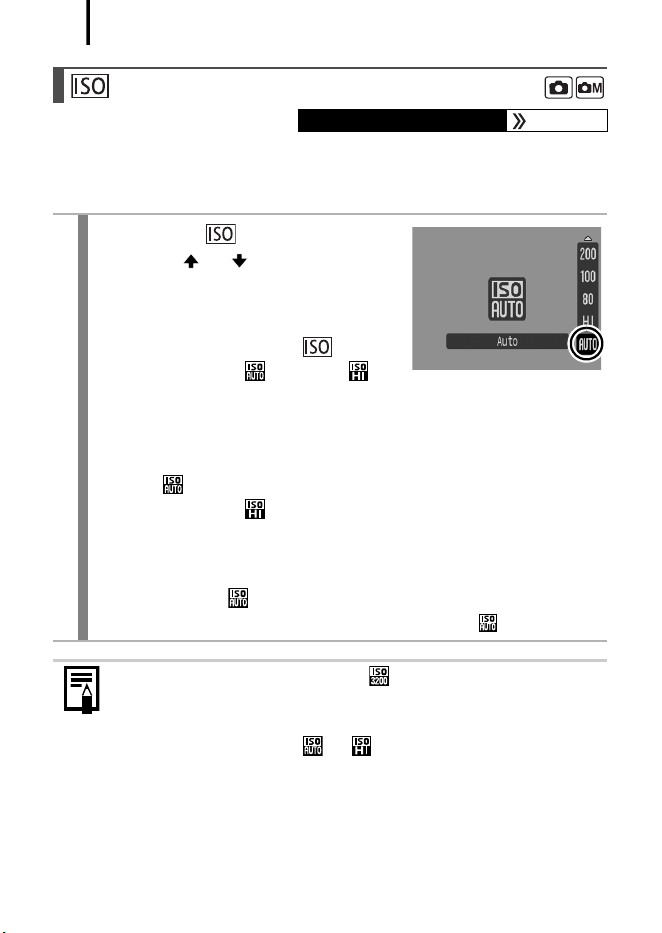
74
Raise the ISO speed to use a fast shutter speed when you wish to
reduce the effects of camera shake or avoid blurry subjects, or to turn
the flash off when shooting in a dark area.
Adjusting the ISO Speed
Available Shooting Modes p. 232
1
Press the button.
1. Use the or button to change
the ISO speed.
• You can advance to the next option
each time you press the button.
• When you select (Auto) or
(High ISO Auto), the camera sets the optimal ISO speed for the
light level when shooting. As the ISO speed will automatically be
raised in dark places, shutter speed will increase, reducing
camera shake and subject blurring.
• Select to put priority on image quality.
• When you select , the camera also detects motion and sets
the optimum ISO speed. As the shutter speed becomes even
faster*, camera shake and blurred photos caused by subject
movement will be reduced even more than when shooting the
same scene in .
* Noise may increase in the captured image compared to .
z You can set the ISO speed to (p. 74).
z The camera automatically applies noise reduction
processing when you shoot at a high ISO speed.
z If the camera is set at or , the ISO speed automatically
set by the camera will be displayed when pressing the
shutter button halfway or in playback information.
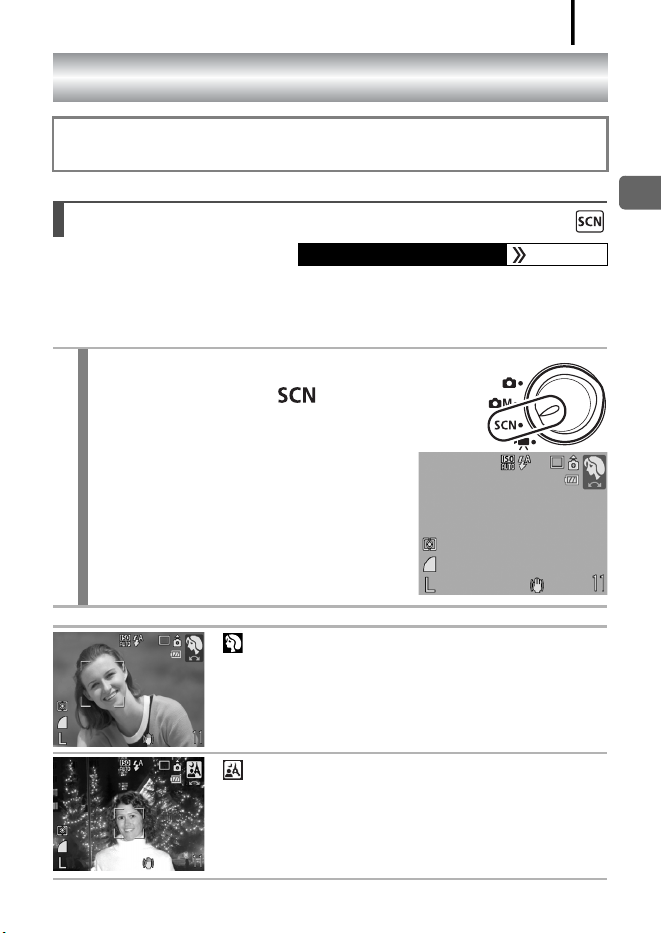
75
Advanced Shooting Functions
When a shooting mode appropriate for the shooting conditions is
selected, the camera automatically adjusts settings for optimal
shooting.
You can also use the control dial to select shooting modes or FUNC.
menu options (p. 43).
Shooting Modes for Specific Scenes
Available Shooting Modes p. 232
1
Select a shooting mode.
1. Set the mode dial to .
2. Use the control dial to select the scene mode.
Portrait
Produces a soft effect when photographing people.
Night Snapshot
Allows you to take snapshots of people against
twilight or night backgrounds by reducing the effects
of camera shake when firmly holding the camera,
even without using a tripod.
Advanced Shooting Functions
76
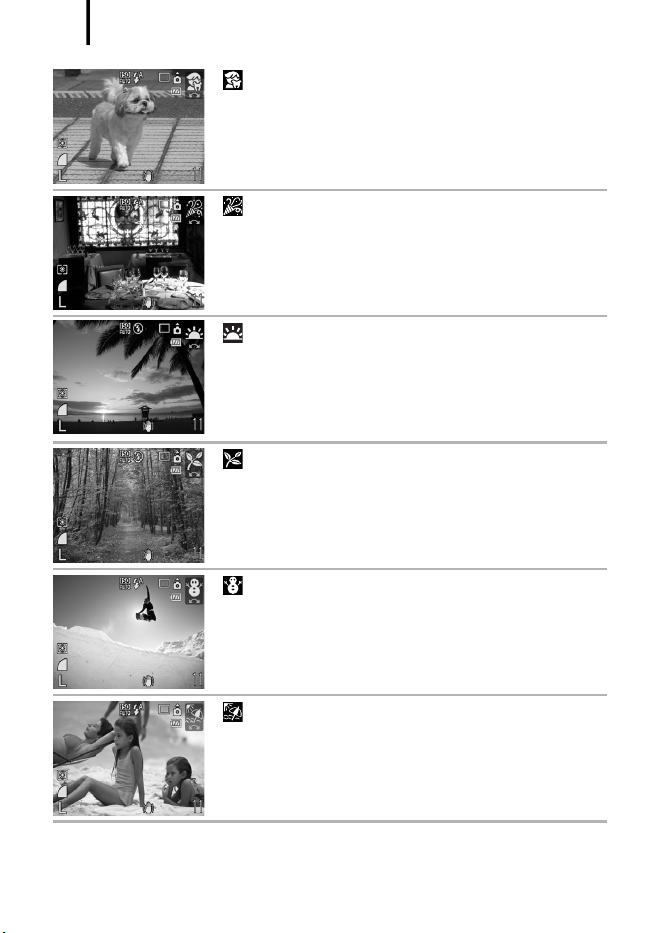
Kids&Pets
Allows you to capture subjects that move around,
such as children and pets, without missing photo
opportunities.
Indoor
Prevents camera shake and maintains the subject’s
true color when shooting under fluorescent or
tungsten lighting.
Sunset
Allows you to shoot sunsets in vivid colors.
Foliage
Shoots trees and leaves - such as new growth,
autumn leaves or blossoms - in vivid colors.
Snow
Shoots without a blue tinge and without making
people appear dark against a snowy background.
Beach
Shoots without making people appear dark near
water or sand where reflected sunlight is strong.
77
Advanced Shooting Functions
Fireworks
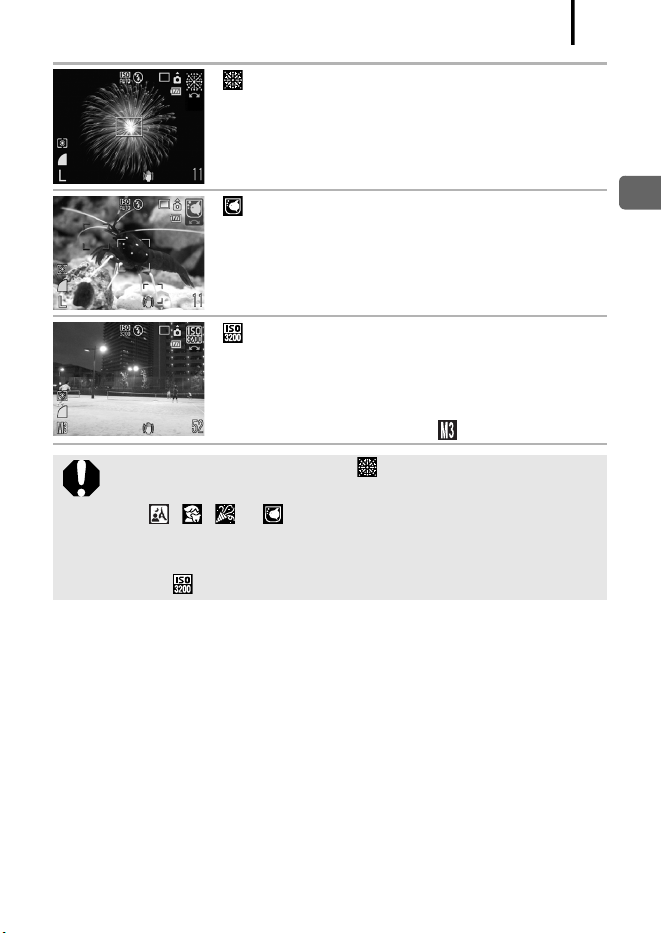
Captures fireworks in the sky sharply and at optimal
exposure.
Aquarium
Selects the optimal ISO speed, white balance and
color balance to capture fish and other items in an
indoor aquarium.
ISO 3200
Shoots with the ISO speed set to 3200, twice as fast
as ISO 1600. Use when a high ISO speed is
required. Avoids blurring of the subject and the
effects of camera shake.
Recording pixels are fixed at (1600 × 1200).
z The shutter speed is slow in mode. Always use a tripod
to avoid camera shake.
z
In
, , or
mode, the ISO speed may increase and
cause noise in the image depending on the scene being
shot.
z With , image noise may be prominent.
78
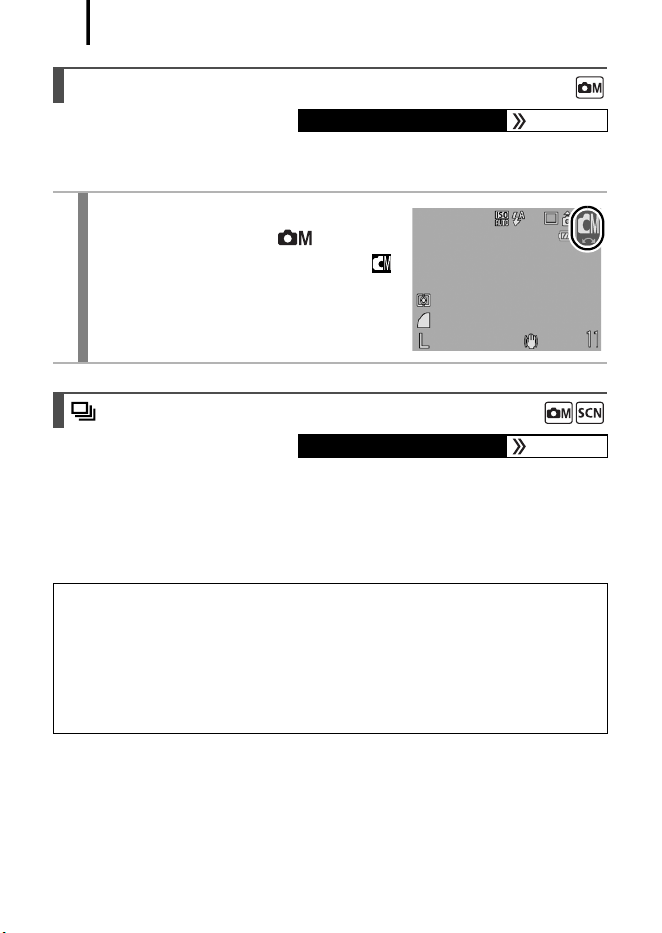
Allows you to select settings yourself, such as the exposure
compensation, white balance or My Colors.
In this mode, the camera shoots continuously while the shutter button
is held down.
If you use the recommended memory card*, you can shoot
continuously (smooth continuous shooting) at a set shooting interval
until the memory card is full (p. 223).
Shooting in Manual Mode
Available Shooting Modes p. 232
1
Select manual mode.
1. Set the mode dial to .
2.
Use the control dial to select .
Continuous Shooting
Available Shooting Modes p. 232
*Recommended Memory Card:
Super high-speed SDC-512MSH memory card (sold separately) to
which low-level formatting (p. 178) is conducted immediately before
shooting.
• This reflects standard shooting criteria established by Canon. Actual results may
vary according to the subject and shooting conditions.
• Even if continuous shooting suddenly stops, the memory card may not be full.
79
Advanced Shooting Functions
To Cancel Continuous Shooting:
Follow Step 1 to select .
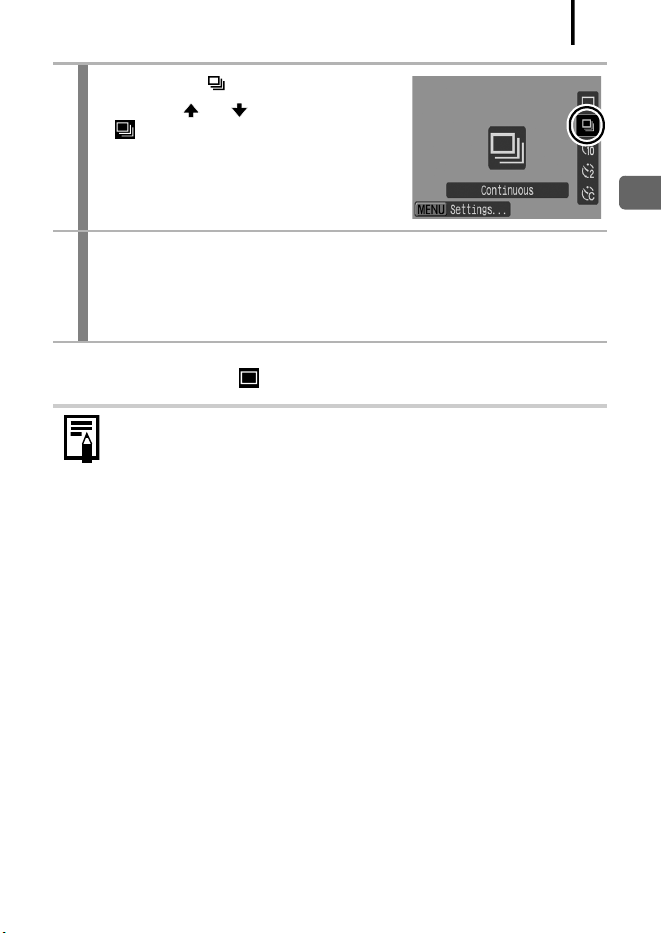
1
Press the button.
1. Use the or button to select
.
2
Shoot.
• The camera will continue to record successive images while the
shutter button is held down.
Recording will cease when the shutter button is released.
z The interval between shots lengthens when the built-in
memory of the camera fills.
z If the flash is used, the interval between shots lengthens
because the flash must charge.
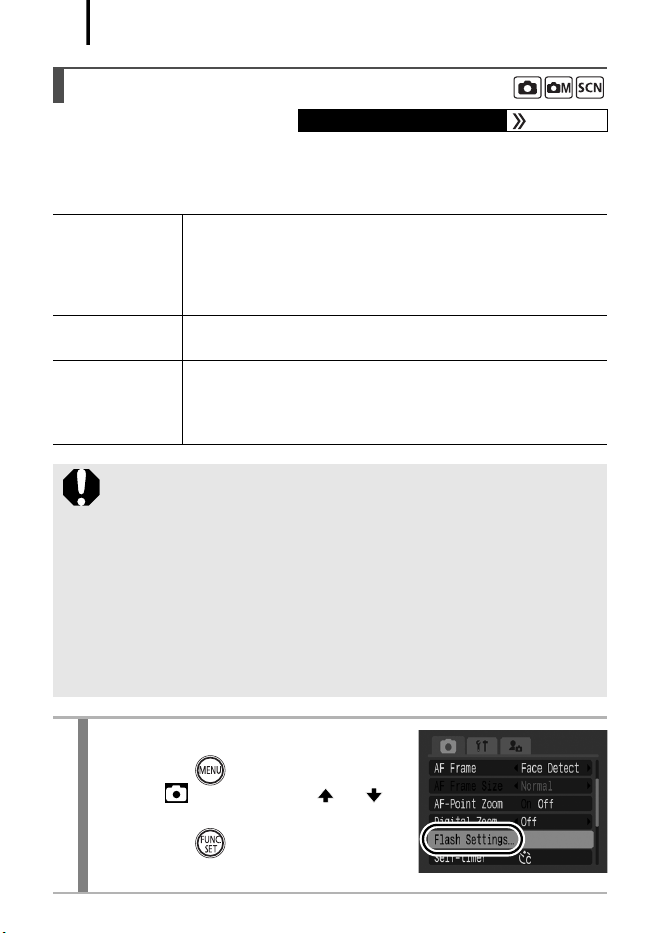
80
You can make detailed flash settings to fit the shooting conditions.
Flash Settings
Setting the Flash
Available Shooting Modes p. 232
Slow Synchro The flash timing is adjusted to slow shutter speeds. This
reduces the chance that only the background will appear
dark when a night scene or an interior shot is taken.
Using Slow Synchro increases the chances for camera
shake. Use of a tripod is recommended.
Red-Eye Corr. Automatically searches for and corrects red eyes in the
image when the flash fires.
Red-Eye Lamp This feature reduces the effect of light reflecting back
from the eyes and making them appear red.
When set to [On], the red-eye reduction lamp lights
orange before the flash fires.
About Red-Eye Correction
z When [Red-Eye Corr.] is set to [On], only the corrected
image is recorded to the memory card.
z If the area around the eyes is red, for example from using
red eye shadow, that area may also be corrected. If this
happens, set [Red-Eye Corr.] to [Off].
z Red eyes may not be automatically detected or may not be
fully corrected on some images. In either case, you can
correct images with [Red-Eye Correction] in the Play menu
(p. 142).
1
Select [Flash Settings].
1. Press the button.
2. In the menu, use the or
button to select [Flash Settings].
3. Press the button.
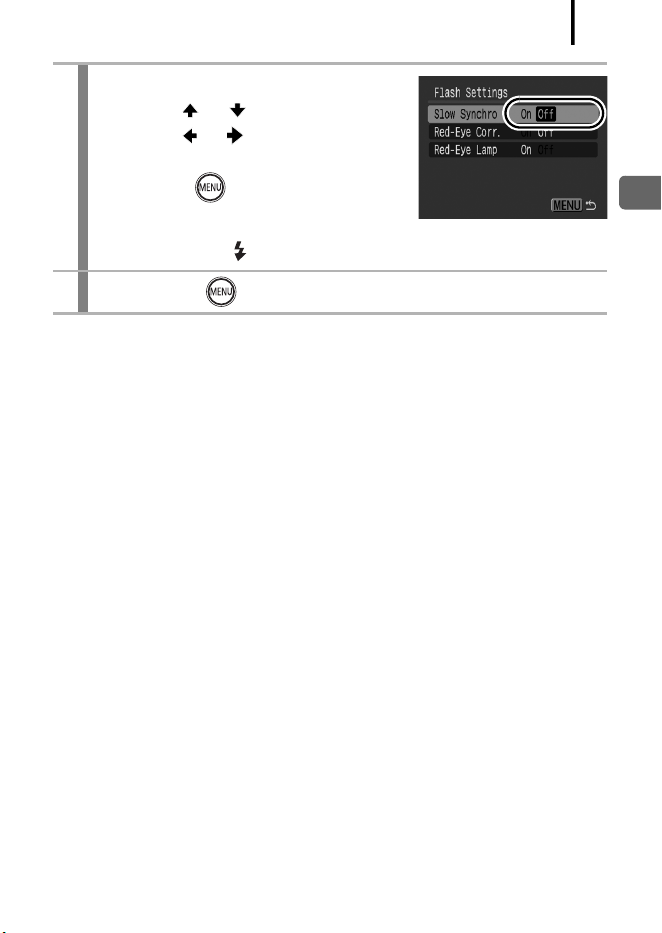
81
Advanced Shooting Functions
2
Make settings.
1. Use the or to select the option.
2. Use the or button to make the
setting.
3. Press the button.
• [Flash Settings] can also be displayed
by pressing the button, followed by the MENU button.
3
Press the button.
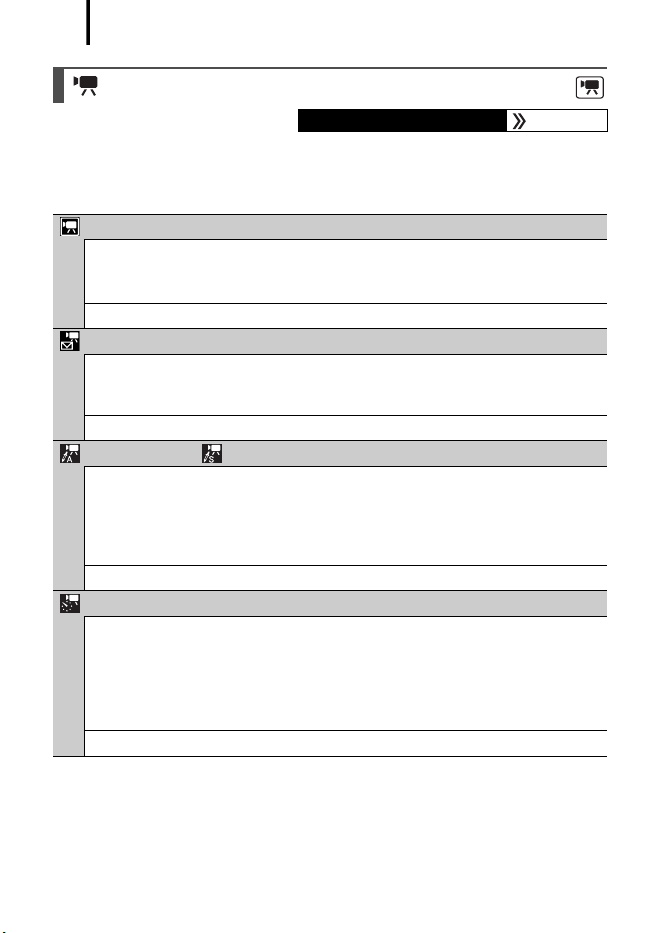
82
The following movie modes are available.
The recording time will differ according to the memory card used
(p. 224).
*1 When a super high-speed memory card is used, such as the recommended SDC-
512MSH.
*2 Even if the file size has not reached 4 GB, the recording is stopped when the
recording time reaches one hour. Depending on memory card capacity and data
write speed, recording may stop before the file size reaches 4 GB or the recording
time reaches one hour.
Movie Shooting
Available Shooting Modes p. 232
Standard
You can select the recording pixels and record until the memory card
is full*
1
.
The digital zoom can be used while shooting in this mode (p. 62).
• Maximum Size: 4 GB/movie
*
2
Compact
Since there are few recording pixels and also the data size is small,
this mode is convenient for sending movies as e-mail attachments or
when the memory card capacity is low.
• Maximum Clip Length: 3 minutes
Color Accent, Color Swap
You can have only the specified color remain and change all others
into black and white, or change a specified color into a different color.
(pp. 109, 111).
As with the Standard mode, you can select the recording pixels and
record until the memory card is full*
1
.
• Maximum Size: 4 GB/movie*
2
Time Lapse
Select a shooting interval (1 or 2 sec.) to have a single frame shot at
that interval. When played back, two hours worth of recorded frames
is compressed to 8 minutes (1-sec. interval) or 4 minutes (2-sec.
interval). You can record events from a fixed perspective, such as the
spectacle of a flower budding over time, or view changing elements in
a short period. Sound cannot be recorded in this mode.
• Maximum recording session: 2 hours
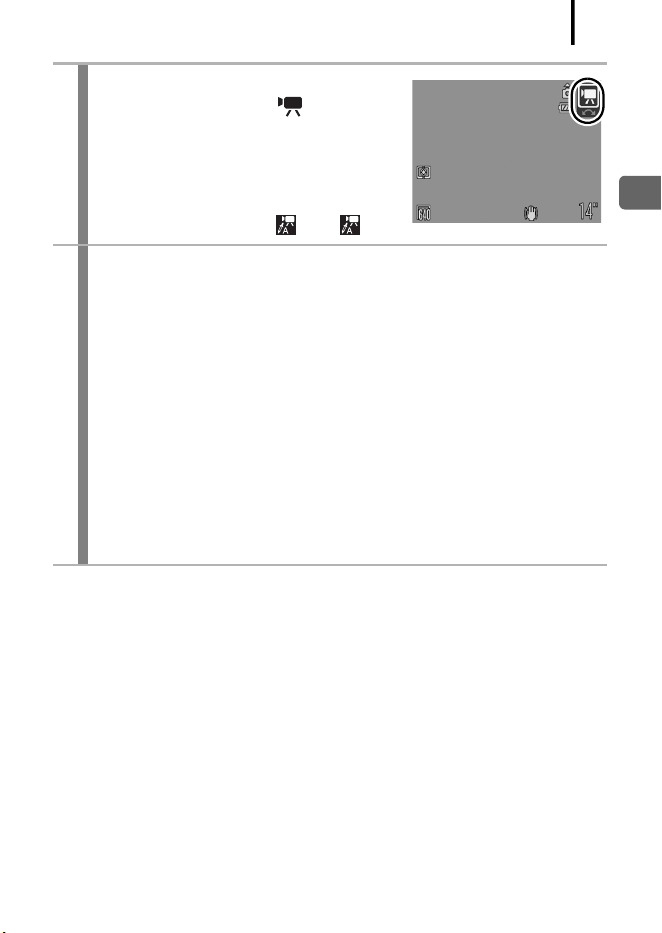
83
Advanced Shooting Functions
1
Select a movie mode.
1. Set the mode dial to .
2. Use the control dial to select a movie
mode.
• See Changing Colors (p. 109) for the
procedures for using and .
2
Shoot.
• Pressing the shutter button halfway automatically sets the
exposure, focus and white balance settings.
• Pressing the shutter button fully starts recording video and
sound simultaneously.
• During shooting, the recording time and [zRec] appear on the
LCD monitor.
• Pressing the shutter button fully again stops recording.
Recording will stop automatically under the following
circumstances.
- When the maximum recording time or maximum recording
capacity is reached
- When the built-in memory or memory card becomes full

84
z You are recommended to use a memory card that has been
formatted in your camera to shoot movies (p. 178). The card
supplied with the camera may be used without further
formatting.
z Be careful of the following while recording.
- Try not to touch the microphone (p. 42).
- Do not press any buttons other than the shutter button.
The sound that buttons make will be recorded in the movie.
- The camera will automatically adjust the exposure and
white balance to suit the shooting conditions during a
recording. Please note, however, that the sounds made by
the camera while automatically adjusting the exposure
may also be recorded.
z The focus and optical zoom settings remain fixed for
subsequent frames at the values selected for the first frame.
85
Advanced Shooting Functions
z Adjust the zoom setting before shooting. The combined
digital and optical zoom factor will display on the LCD
monitor. When the zoom factor displays in blue, the image
will deteriorate.
z You can use digital zoom during the movie shooting in
mode only.
z Before recording, you can set the AE lock and exposure shift.
This is effective on ski slopes and the beach when the
contrast is too strong between the subject and background or
where there are both light and dark areas in the scene and it
is desirable to adjust the exposure.
1 Press the button.
The exposure will lock (AE lock) and the exposure shift bar
will appear in the LCD monitor.
2 Use the or button to adjust the exposure.
Press the button again to release the setting. Also,
the setting will be canceled if you press the MENU button
or change the white balance, My Colors or shooting mode
settings.
z If you register the function to the button, you can
start shooting a movie simply by pressing the button
even if the mode dial is set to , or (p. 163).
z QuickTime is required to play back movies (Data type: AVI/
Compression method: Motion JPEG) on a computer
(Windows 2000 only).
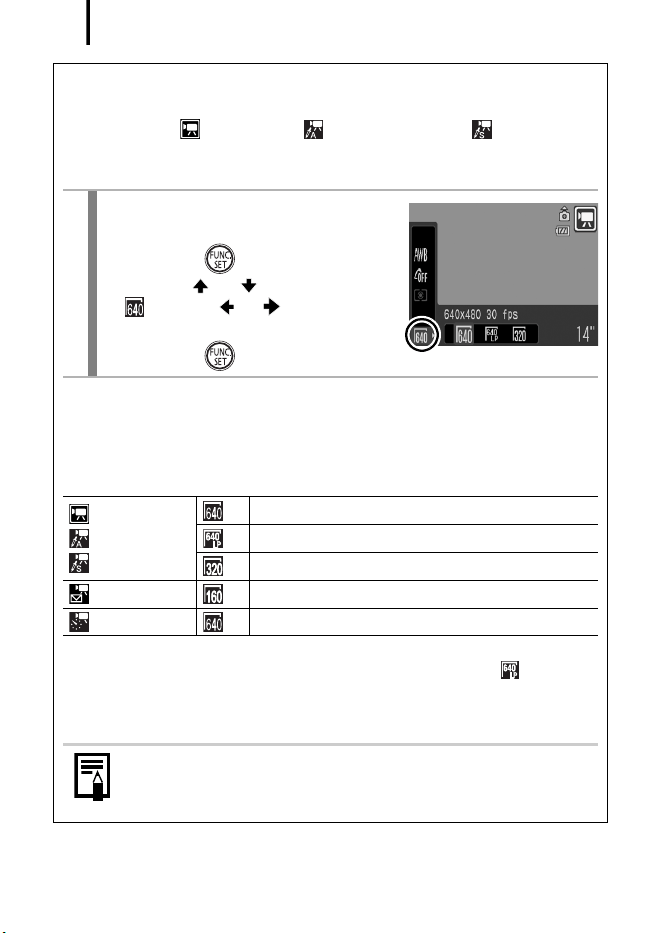
86
Changing Movie Recording Pixels/Frame Rates
You can change the recording pixels and frame rate when the movie
mode is set to (Standard), (Color Accent) or (Color
Swap). (The frame rate can be set depending on the recording
pixels.)
1
Select the recording
pixels.
1. Press the button.
2. Use the or button to select
and the or button to
change the recording pixels.
3. Press the button.
Movie Recording Pixels and Frame Rates
Frame rates indicate the number of frames recorded or played back
each second. The higher the frame rate, the smoother the
appearance of motion.
*1 Default setting.
*2 When priority is on movie length rather than image quality, select . You can
shoot for twice as long in this mode compared to a file of the same size shot in the
other modes.
*3 Frame rate when playing back.
Standard
Color Accent
Color Swap
*
1
640 × 480 recording pixels, 30 frames/sec.
*
2
640 × 480 recording pixels, 30 frames/sec. LP
320 × 240 recording pixels, 30 frames/sec.
Compact 160 × 120 recording pixels, 15 frames/sec.
Time Lapse 640 × 480 recording pixels, 15 frames/sec.*
3
z See Memory Cards and Estimated Capacities (p. 224).
z See Image Data Sizes (Estimated) (p. 225)
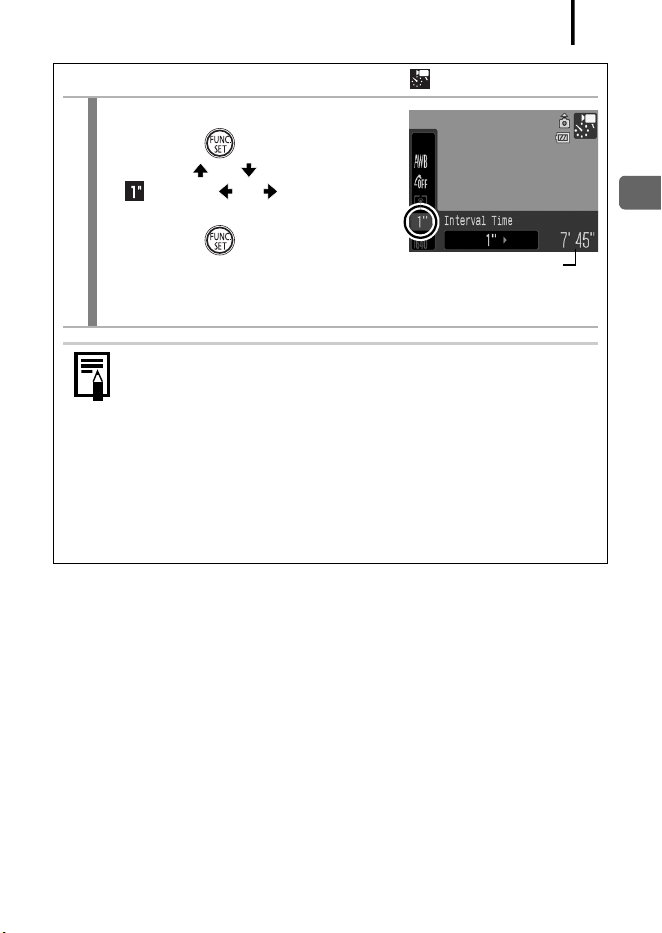
87
Advanced Shooting Functions
Changing the Shooting Interval (Time Lapse)
1
Select a shooting interval.
1. Press the button.
2. Use the or button to select
and the or to change the
option.
3. Press the button.
• The indicator will blink green while
the camera is recording.
Recordable Duration
z You are recommended to use a fully charged battery or an
AC adapter since the recording period may be lengthy.
z The power saving setting (p. 174) will determine whether
or not the LCD monitor shuts off. The LCD monitor will turn
on if something other than the ON/OFF button or shutter
button is operated.
z The LCD monitor displays the elapsed time from the start
of recording to the end in playback mode, but the actual
playback time is shorter than the displayed time.
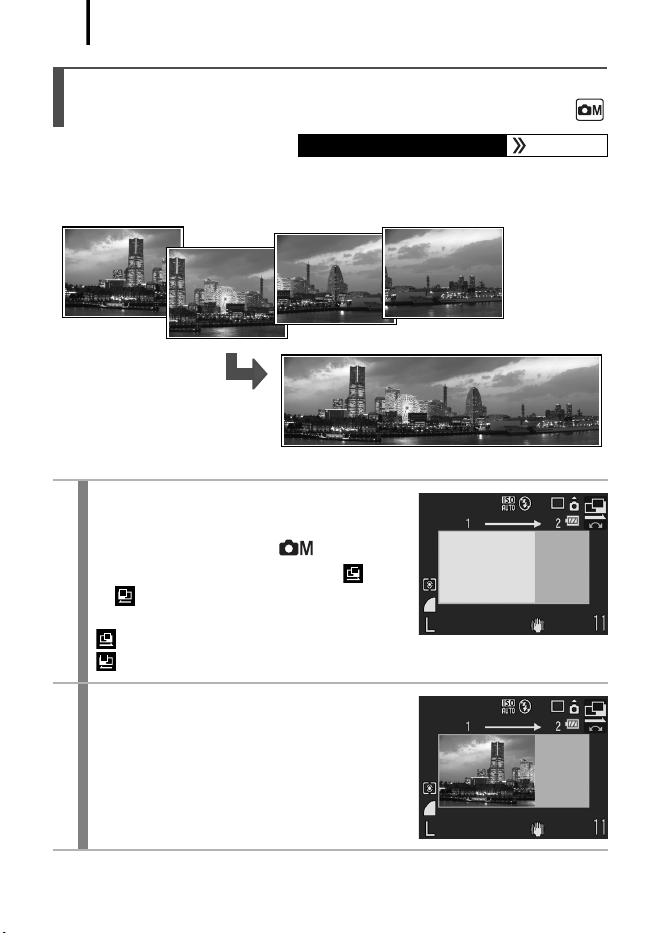
88
Stitch Assist can be used to shoot overlapping images that can later be
merged (stitched) to create one panoramic image on a computer.
Shooting Panoramic Images
(Stitch Assist)
Available Shooting Modes p. 232
1
Select the shooting
direction.
1. Set the mode dial to .
2. Use the control dial to select or
.
: Left to right horizontally
: Right to left horizontally
2
Shoot the first frame of the
sequence.
• The exposure and white balance are
set and locked with the first image.
The overlapping seams of several
adjacent images can be joined
into a single panoramic image.
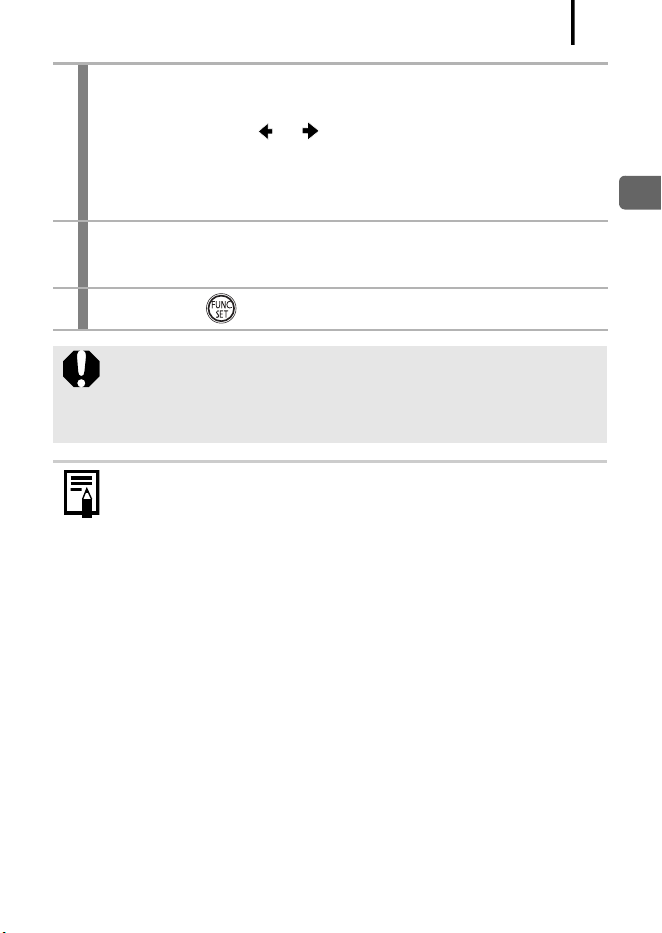
89
Advanced Shooting Functions
3
Compose the second image so that it overlaps
a portion of the first and shoot.
• You can press the or button to return to the previously
recorded image to retake the shot.
• Minor discrepancies in the overlapping portions can be
corrected when the images are stitched together.
4
Repeat the procedure for additional images.
• A sequence may contain up to 26 images.
5
Press the button after the last shot.
z You cannot display the images on a TV when shooting in
Stitch Assist mode.
z The settings for the first image are applied to the second
image onward.
Use PhotoStitch, a supplied software program, to merge the
images on a computer.
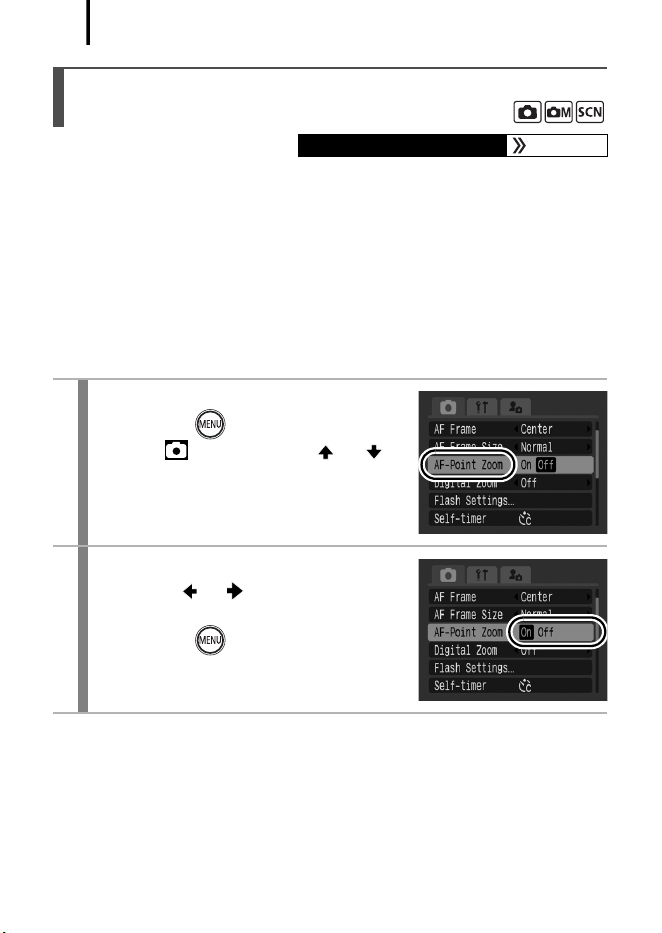
90
You can zoom the display of the AF frame to check focus when
shooting or right after taking a shot.
Zooming the AF Frame and Shooting
When [AF Frame] is set to [Face Detect] or [Center], the AF frame area
can be zoomed to check focus while shooting. When you want to
capture people’s expressions, set [AF Frame] to [Face Detect]. When
you want to check the focus while shooting in macro mode, set [AF
Frame] to [Center].
Checking the Focus and Peoples’
Expressions
Available Shooting Modes p. 232
1
Select [AF-Point Zoom].
1. Press the button.
2. In the menu, use the or
button to select [AF-Point Zoom].
2
Make settings.
1. Use the or button to select
[On].
2. Press the button.
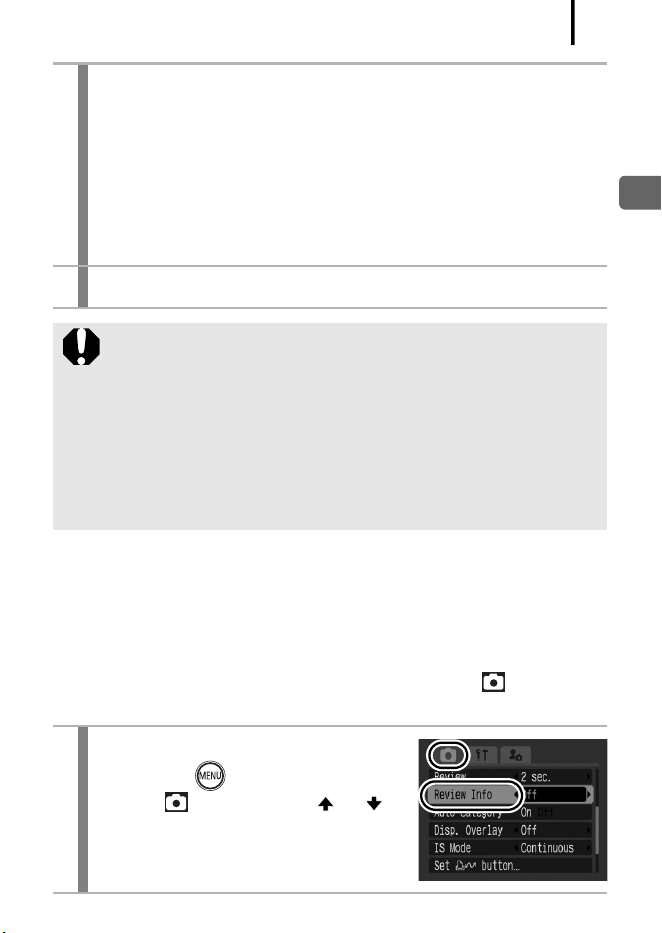
91
Advanced Shooting Functions
Checking Focus Right After Shooting (Focus Check)
Allows you to check the focus of an image taken. It is also easy to
check peoples’ expressions and look for closed eyes when shooting
because a frame the size of the face displays when AF frame mode is
set to [Face Detect] (p. 93).
You are recommended to set [Review] to [Hold] in the menu in
advance.
3
Press the shutter button halfway.
• Pressing the shutter button halfway zooms a section of the
display according to the following AF Frame mode settings
(p. 93).
- [Face Detect] : The face detected as the main subject will
appear zoomed.
- [Center] : The center of the image will appear zoomed in
the LCD monitor.
4
Press the shutter button fully to shoot.
The AF frame cannot be zoomed under the following
circumstances:
- When [AF Frame] is set to [Face Detect] and a face is not
detected, or when the face is extremely large in relation to
the overall composition.
- When the camera cannot focus.
- When the digital zoom is in use.
- When the LCD monitor is off.
- When a TV is being used as the display.
1
Select [Review Info].
1. Press the button.
2. In the menu, use the or
button to select [Review Info].
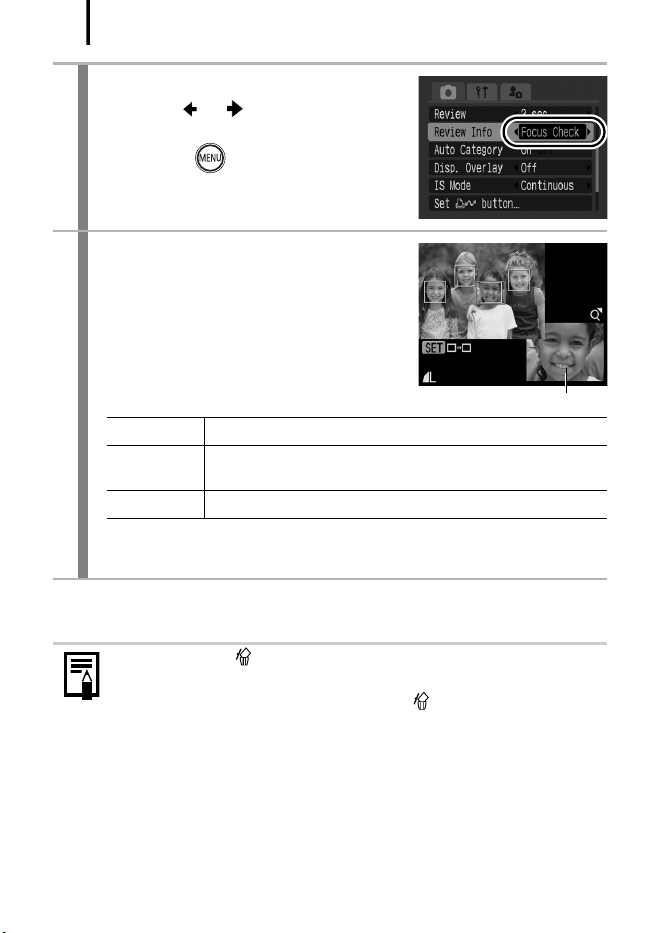
92
To Cancel the Focus Check:
Press the shutter button halfway.
2
Make settings.
1. Use the or button to select
[Focus Check].
2. Press the button.
3
Shoot.
• The recorded image will be displayed.
• Frames are displayed as follows.
• The orange frame can be shown at a different magnification,
moved or switched to a different frame (p. 120).
z Pressing the button while the image is displayed will
erase the image (p. 19). However, when the bottom right of
the image is enlarged, pressing the button will not delete
the image.
z You can check the focus even during playback mode
(p. 120).
Orange frame contents
Frame color Content
Orange Displays the area of the image shown at the bottom
right.
White Displays at the focal point (AF frame).
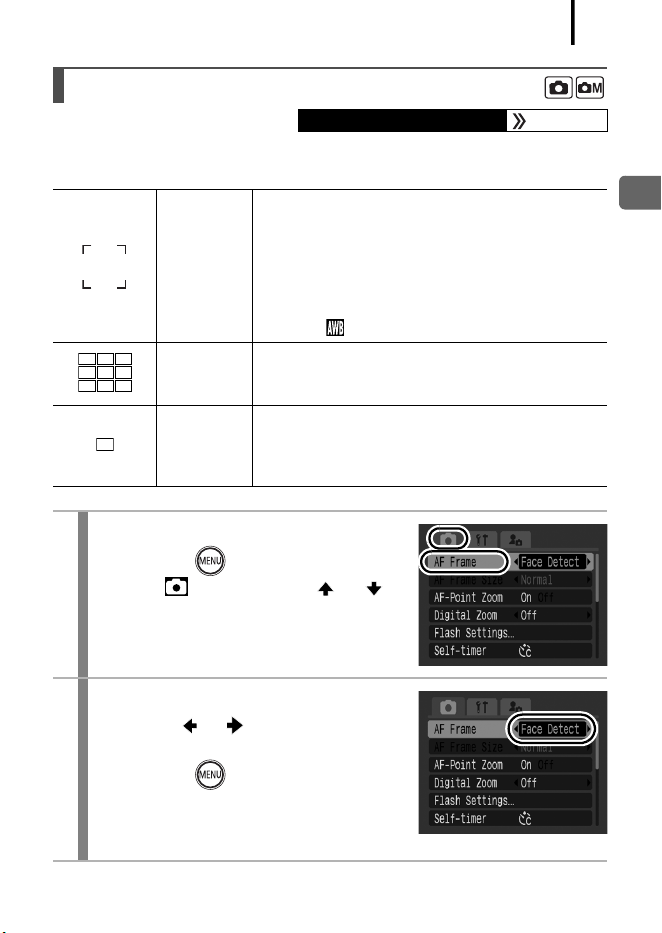
93
Advanced Shooting Functions
The AF frame indicates the area of the composition on which the camera
focuses.
Selecting an AF Frame Mode
Available Shooting Modes p. 232
Face
Detect
The camera detects a face and sets the focus,
exposure
*1
and white balance
*2
. In addition,
the camera meters the subject so that the face
is correctly illuminated when the flash fires. If
no face is detected, the camera shoots using
[AiAF].
*1 Only in evaluative metering mode (p. 102).
*2 Only in (p. 104)
AiAF
The camera automatically selects between 9
AF frames to focus on according to the
shooting conditions.
Center
The AF frame will be fixed to center. This is
recommended when the target subject is at the
center of the composition. You can change the
AF frame size (p. 95).
1
Select [AF Frame].
1. Press the button.
2. In the menu, use the or
button to select [AF Frame].
2
Make settings.
1. Use the or button to select an
AF frame option.
2. Press the button.
• See Changing the AF Frame Size
(p. 95).
94
z [Face Detect] cannot be used when the LCD monitor is
turned off.
z The AF frame appears as follows when the shutter button is
pressed halfway.
- Green : In focus
- Yellow : Focusing difficulty ([Center] option)
- No AF frame : Focusing difficulty ([Face Detect] or [AiAF]
option)
Face Detect Feature
z Maximum of three AF frames will be displayed at the positions of
faces the camera recognizes. At this point, the frame the camera
judges to be the main subject appears in white while the others
appear in gray. When the shutter button is pressed halfway and
the camera focuses, up to 9 green AF frames may appear.
z The camera will shoot using [AiAF] not the [Face Detect] function if
a white frame fails to appear and only gray frames display, or if a
face is not detected.
z The camera may mistakenly identify non-human subjects as a
face.
z In certain cases, faces may not be detected.
Examples:
- If faces are at the edge of the screen, or appear extremely small,
large, dark or bright, relative to the overall composition.
- Faces turned to the side or at a diagonal, or faces with a portion
hidden.
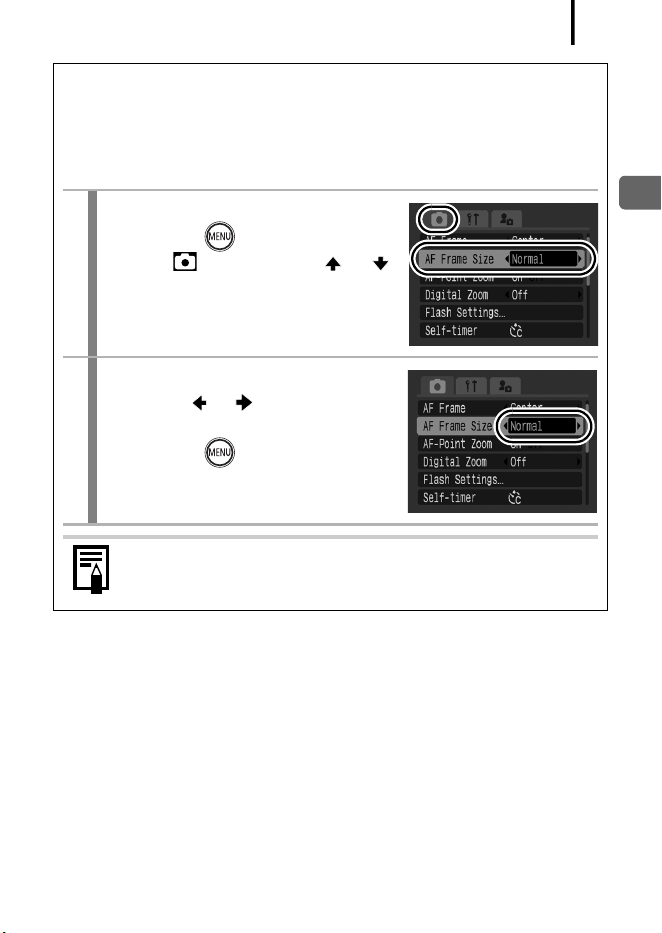
95
Advanced Shooting Functions
Changing the AF Frame Size
When the [AF Frame] is set to [Center], the AF frame can be resized
to correspond to the subject. Select [Small] to constrict the focal
frame to suit a small subject or to focus on a particular area of a
subject.
1
Select [AF Frame Size].
1. Press the button.
2. In the menu, use the or
button to select [AF Frame Size].
2
Make settings.
1. Use the or button to select
[Normal] or [Small].
2. Press the button.
The setting is configured to [Normal] when the digital zoom
or digital tele-converter is used.
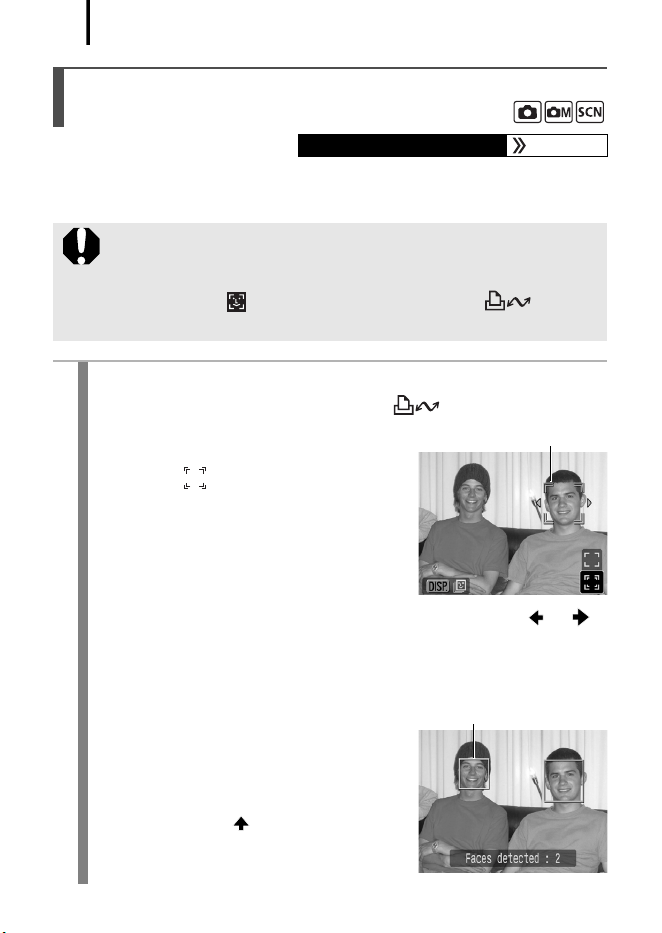
96
Once the focus is fixed to a subject’s face, the frame can be set to
follow the subject within a certain range.
Selecting a Subject to Focus On
(Face Select and Track)
Available Shooting Modes p. 232
To use the Face Select and Track function, first configure the
following settings.
- Set [AF Frame] to [Face Detect] (p. 93).
- Register the (Face Detect) function to the button
(p. 116).
1
Select a face you wish to focus on.
1. When a face is detected, press the button.
• The camera enters face
designation mode, and the face
frame ( ) of the main subject
displays in green. Even if the
subject moves, the frame will follow
the subject within a certain range.
2. Select the person you wish to focus
on.
• When several faces have been detected, using the or
button or control dial will move the face frame to another
subject.
• The face frame will not display when a face is not detected.
• Holding down the DISP. button will
display face frames (up to 35) of all
the detected faces (green: face of
main subject, white: detected
faces).
• Pressing the button will release
the face designation mode.
Face Frame
Face Frame
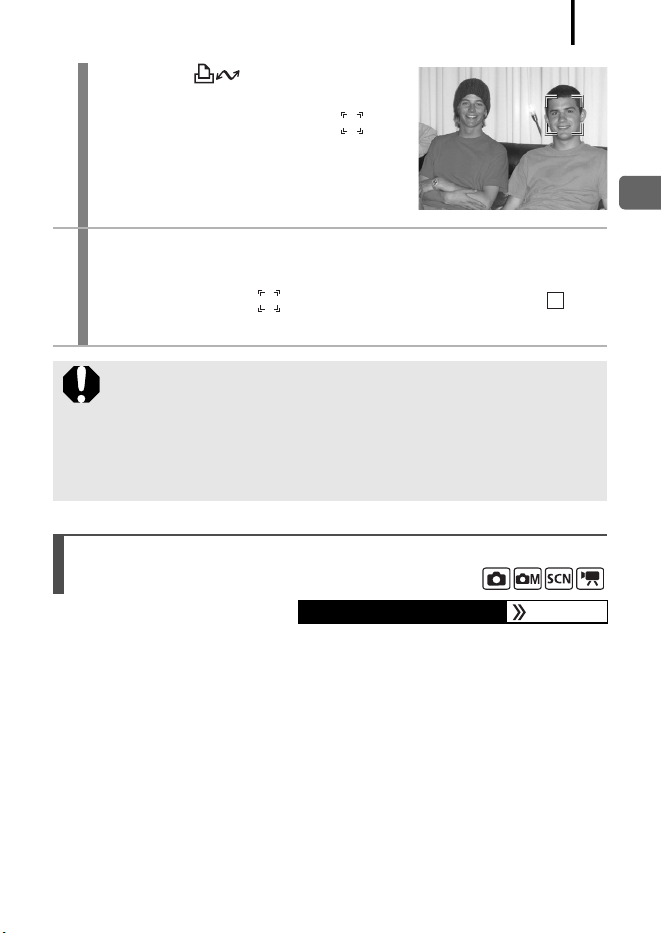
97
Advanced Shooting Functions
It may be difficult to focus on the following types of subjects.
• Subjects with extremely low contrast to the surroundings
• Scenes with a mixture of near and far subjects
• Subjects with extremely bright objects at the center of the
composition
• Subjects that are moving quickly
• Subjects through glass
3. Press the button again.
• The camera exits face designation
mode, and the face frame ( ) of
the main subject will change to
white (the frame will continue to
follow the subject within a certain
range).
2
Shoot.
1. Press the shutter button halfway.
• The face frame ( ) of main subject will change into .
2. Press the shutter button fully.
In the following cases, the face select mode will be canceled.
- When turning the power back on
- Using the digital zoom
- When the MENU button is pressed to display the menu
- When a selected face cannot be tracked for several seconds
- When the display is turned off
Shooting Hard-to-Focus Subjects
(Focus Lock, AF Lock)
Available Shooting Modes p. 232
98
Shooting with the Focus Lock
You can operate in all shooting modes.
Shooting with the AF Lock
To Release the AF Lock:
Press the / button.
1
Aim the camera so that an object at the same
focal distance as the main subject is centered
in the viewfinder or in the AF frame displayed
on the LCD monitor.
2
Keep the shutter button pressed halfway while
you recompose the image.
3
Press the shutter button fully to shoot the
image.
1
Turn on the LCD monitor.
2
Aim the camera so that an object at the same
focal distance as the main subject is centered
in the AF frame.
3
Press and hold the shutter button halfway and
press the /
button.
• The icon will display.
4
Re-aim the camera to compose the shot as
desired and shoot.
99
Advanced Shooting Functions
You can set the exposure and focus separately. This is effective when
the contrast is too strong between the subject and background or when
a subject is backlit.
To Release the AE Lock:
Press the button.
z When shooting with the focus lock or AF lock using the LCD
monitor, setting [AF Frame] to [Center] (p.93) makes
shooting easier since the camera focuses using the center
AF frame only.
z The AF lock is convenient because you can let go of the
shutter button to compose the image. Moreover, the AF lock
is still effective after the picture is taken, allowing you to
capture a second image with the same focus.
z AF frames do not display in movie mode.
z Try to shoot as close to the glass as possible to reduce the
chances of light reflecting back off the glass when you shoot
a subject through glass.
Locking the Exposure Setting (AE Lock)
Available Shooting Modes p.232
1
Turn on the LCD monitor.
2
Press the button and select (flash off).
3
Aim the camera at the subject on which you
wish to lock the exposure.
4
Press and hold the shutter button halfway and
press the button.
• The icon will display.
5
Re-aim the camera to compose the shot as
desired and press the shutter button fully.
100
You can lock the flash exposure so that the exposure settings are
correctly set regardless of the composition of your subject.
To Release the FE Lock:
Press the button.
z In movie mode, AE lock can also be set/canceled (p.85).
z You can use the FE lock when using the flash.
Locking the Flash Exposure Setting
(FE Lock)
Available Shooting Modes p.232
1
Turn on the LCD monitor.
2
Press the button and select (flash on).
3
Aim the camera at the subject on which you
wish to lock the exposure.
4
Press and hold the shutter button halfway and
press the button.
• The flash will pre-fire and will display.
5
Re-aim the camera to compose the shot as
desired and press the shutter button fully.
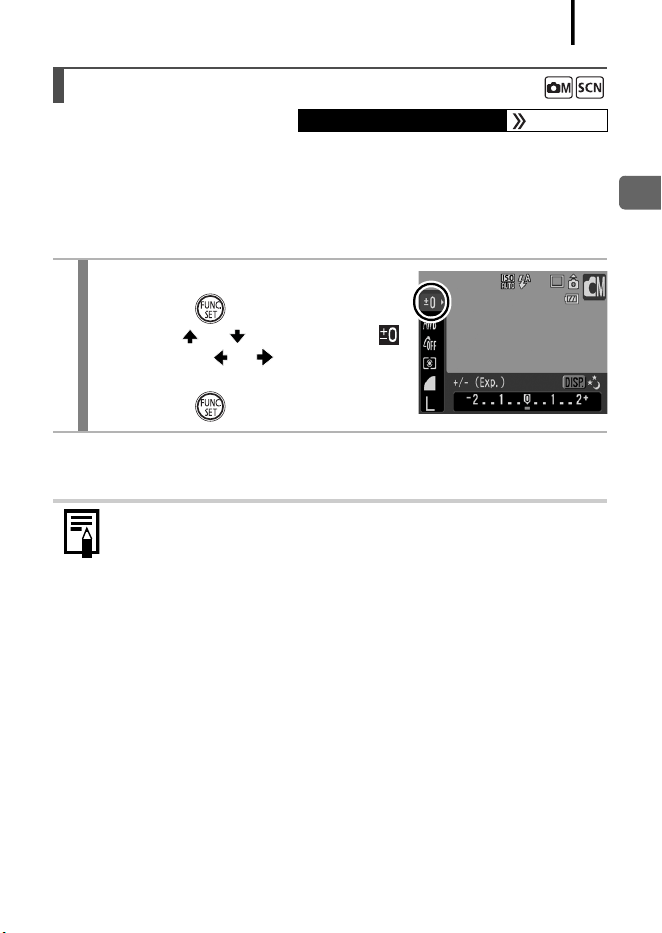
101
Advanced Shooting Functions
Adjust the exposure compensation to a positive value to avoid making
the subject too dark when it is backlit or shot against a bright
background. Adjust the exposure compensation to a negative value to
avoid making the subject too bright in night shots or when shot against
a dark background.
To Cancel the Exposure Compensation:
Restore the compensation value to [0].
Adjusting the Exposure Compensation
Available Shooting Modes p.232
1
Configure the setting.
1. Press the button.
2. Use the or button to select
and use the or button to adjust
the exposure compensation.
3. Press the button.
In movie mode, the exposure shift can be set/canceled (p.85).
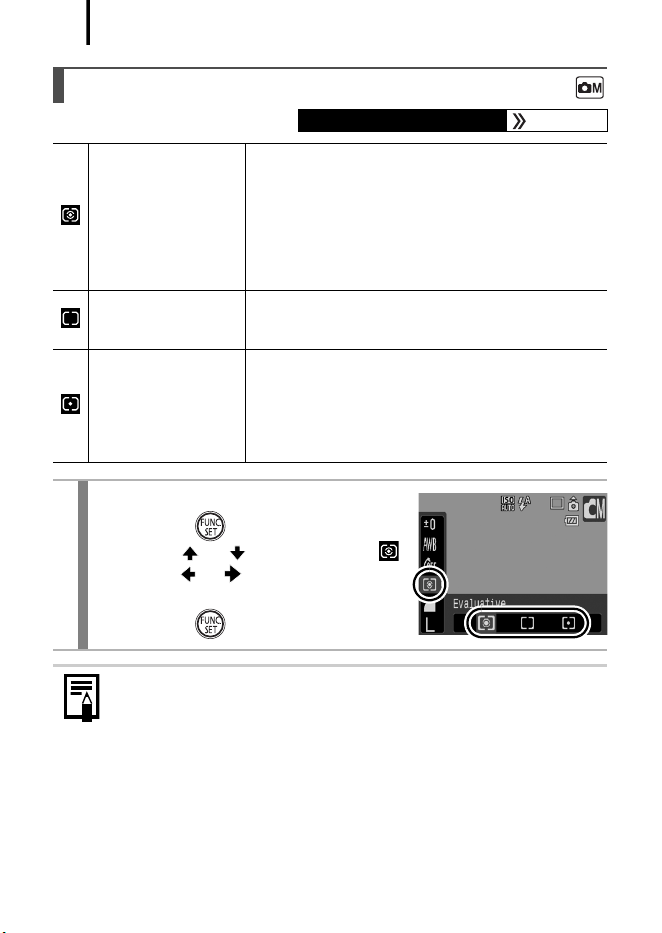
102
Switching between Metering Modes
Available Shooting Modes p.232
Evaluative
Appropriate for standard shooting conditions,
including backlit scenes. The camera divides
images into several zones for metering. It
evaluates complex lighting conditions, such as
the position of the subject, the brightness, the
direct light, and the backlighting, and adjusts the
settings to the correct exposure for the main
subject.
Center Weighted
Avg.
Averages the light metered from the entire
frame, but gives greater weight to the subject
matter at the center.
Spot
Adjusts the exposure according to the subject in
the center of the frame (meters the area within
the spot AE point at the center of the LCD
monitor). Use this mode when there is a large
divergence in brightness between the subject
and surroundings.
1
Change the metering mode.
1. Press the button.
2. Use the or button to select
and the or button to change
the option.
3. Press the button.
The metering method is fixed to Evaluative in the Long Shutter
mode.
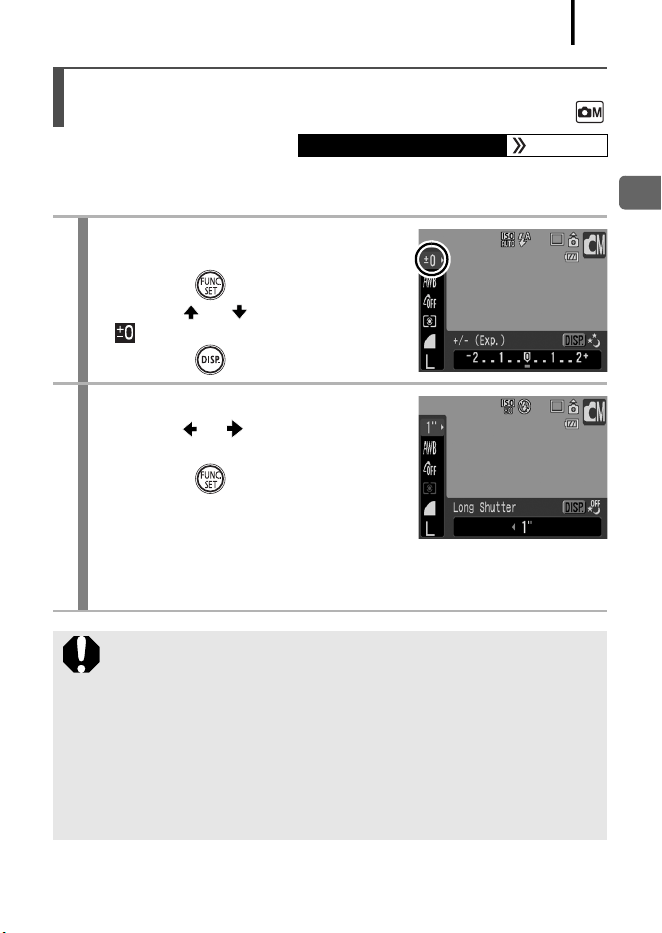
103
Advanced Shooting Functions
You can set the shutter speed to a slow setting to make dark subjects
appear brighter.
Setting the Shutter Speed
(Long Shutter Mode)
Available Shooting Modes p.232
1
Select the Long Shutter
Mode.
1. Press the button.
2. Use the or button to select
.
3. Press the button.
2
Change the shutter speed.
1. Use the or button to change
the shutter speed.
2. Press the button.
• The higher the value, the brighter the
recorded image becomes.
• If you press the DISP. button at this point, you will return to the
Exposure Compensation setting screen.
z The brightness of the image appearing on the LCD monitor
and the recorded image may differ.
z The nature of CCDs is such that noise in the recorded image
increases at long shutter speeds. This camera, however,
applies special processing to images shot at shutter speeds
of 1.3 seconds or slower to eliminate the noise, thereby
producing high-quality images. A certain amount of
processing time, however, may be required before the next
image can be shot.
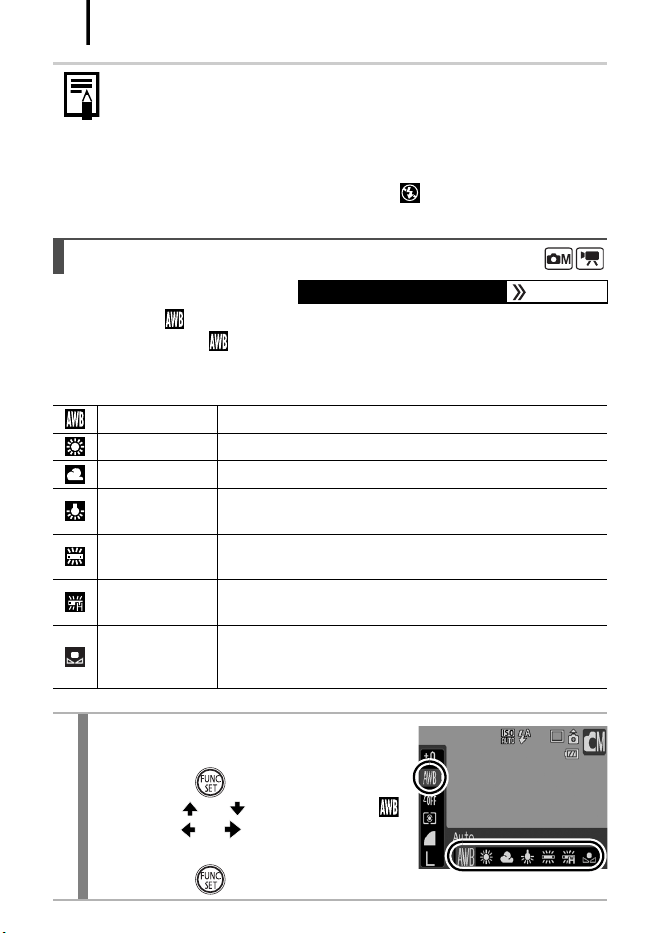
104
Normally, the (Auto) white balance setting selects an optimal white
balance. When the setting cannot produce natural looking colors,
change the white balance using a setting appropriate for the light
source.
z Use the LCD monitor to confirm that the image was recorded
at the desired brightness.
z Please note that camera shake becomes a factor at low
shutter speeds. Shoot with the camera attached to a tripod.
z Use of the flash may result in an over-exposed image. If this
occurs, shoot with the flash set to
.
Adjusting the Tone (White Balance)
Available Shooting Modes p.232
Auto Settings are automatically set by the camera.
Day Light For recording outdoors on a bright day.
Cloudy
For recording under overcast, shady or twilight skies.
Tungsten
For recording under tungsten and bulb-type 3-
wavelength fluorescent lighting.
Fluorescent
For recording under warm-white, cool-white or
warm-white (3-wavelength) fluorescent lighting.
Fluorescent H
For recording under daylight fluorescent, or daylight
fluorescent-type 3-wavelength fluorescent lighting.
Custom
For recording with the optimal white balance data
memorized in the camera from a white-colored
object, such as white paper or cloth.
1
Select a white balance
setting.
1. Press the button.
2. Use the or button to select
and the or button to change
the option.
3. Press the button.
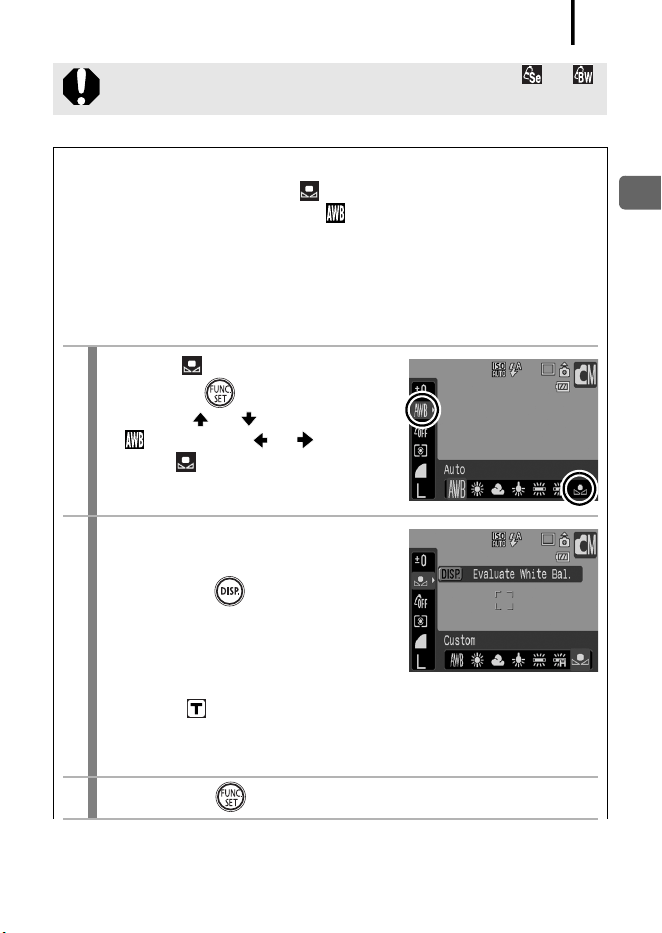
105
Advanced Shooting Functions
The white balance setting cannot be adjusted when or
is selected for My Colors.
Using the Custom White Balance
Take a custom white balance (Custom) reading for the following
situations that are difficult for the (Auto) setting to detect
correctly.
• Shooting subjects of monotone color (such as sky, sea or forest)
• Shooting with a particular source of light (such as a mercury-vapor
lamp)
• Shooting close-ups (Macro)
1
Select .
1. Press the button.
2. Use the or button to select
and use the or button to
select .
2
Aim the camera at a piece
of white paper or cloth and
press the button.
• Ensure that the LCD monitor is
completely filled with the white
image. Please note, however, that
the center frame will not display when the digital zoom is used
or when is displayed.
• You can also use the viewfinder to take a custom white
balance reading.
3
Press the button.
106
z You are recommended to set the shooting mode to
and the exposure compensation setting to [±0] before
setting a custom white balance. The correct white balance
may not be obtained when the exposure setting is
incorrect (image appears completely black or white).
z Shoot with the same settings as when reading the white
balance data. If the settings differ, the optimal white
balance may not be set. In particular, the following should
not be changed.
- ISO speed
-Flash:
Setting the flash to or is recommended. If the
flash fires when reading the white balance data with the
flash set to , make sure that you also use the flash
when you shoot.
z Since the white balance data cannot be read in Stitch
Assist mode, preset the white balance in another shooting
mode beforehand.
z The white balance data is retained even after the camera
power is turned off.
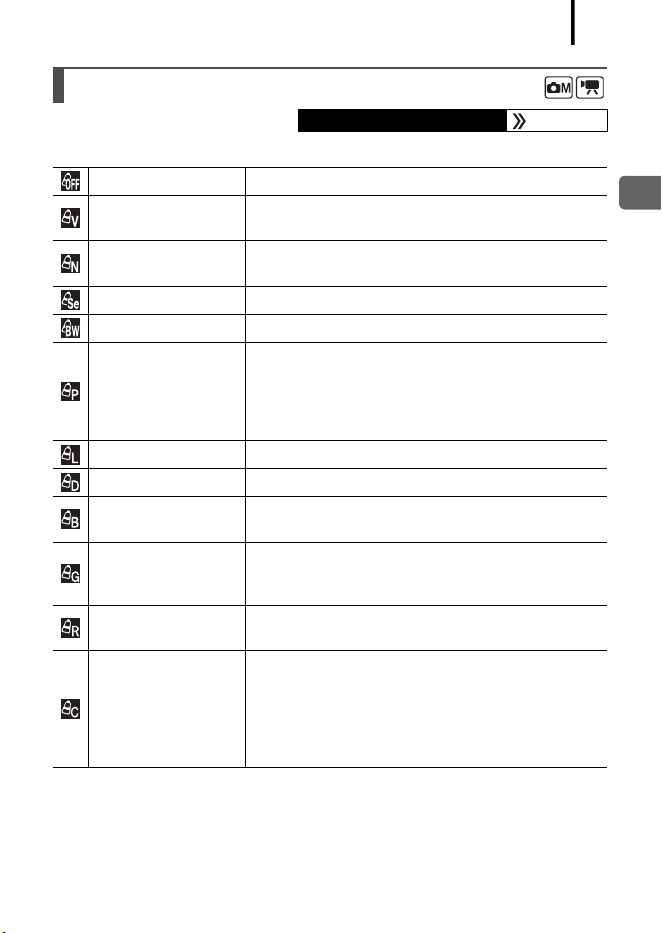
107
Advanced Shooting Functions
You can change the look of an image when it is shot.
* If the image contains colors that are the same as human skin, those colors will also
be changed. You may not obtain the expected results depending on the skin color.
Shooting in a My Colors Mode
Available Shooting Modes p.232
My Colors Off Records normally with this setting.
Vivid
Emphasizes the contrast and color saturation to
record bold colors.
Neutral
Tones down the contrast and color saturation to
record neutral hues.
Sepia Records in sepia tones.
B/W Records in black and white.
Positive Film
Use this option to make blue, green or red
colors more intense like the Vivid Blue, Vivid
Green or Vivid Red effects. It can produce
intense natural-appearing colors like those
obtained with positive film.
Lighter Skin* Use this option to make skin tones lighter.
Darker Skin* Use this option to make skin tones darker.
Vivid Blue
Emphasize blue tints. Use to make blue
subjects, such as the sky or ocean, more vivid.
Vivid Green
Emphasize green tints. Use to make green
subjects, such as mountains, new growth,
flowers and lawns, more vivid.
Vivid Red
Emphasize red tints. Use to make red subjects,
such as flowers or cars, more vivid.
Custom Color
Use this option to adjust the contrast, sharpness
or saturation settings or the color balance
between red, green, blue and skin tones*. It can
be used to make subtle adjustments, such as
making blue colors more vivid or face colors
brighter.
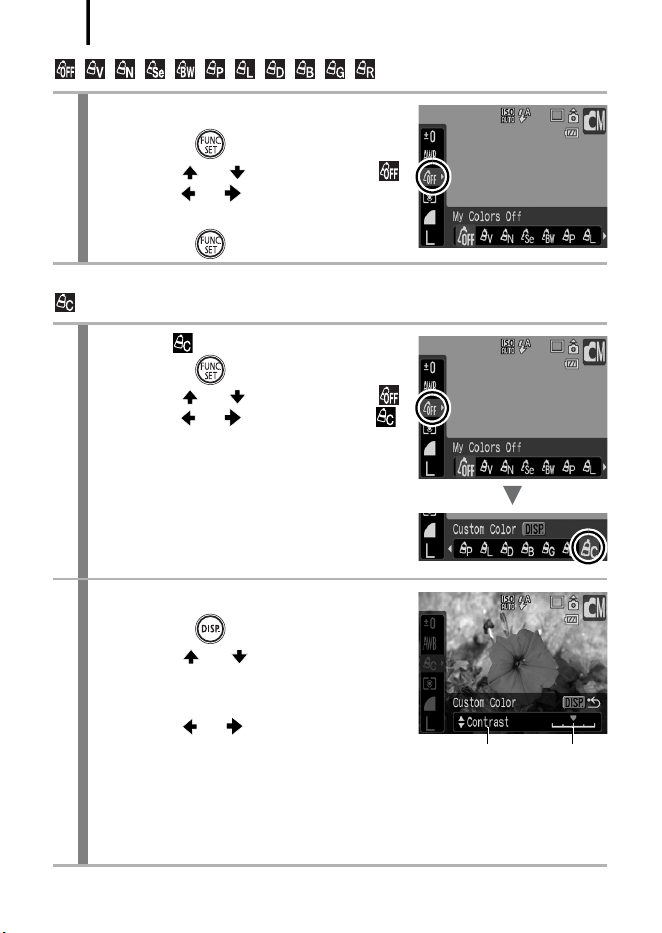
108
//////////
(Setting the Custom Color Mode)
1
Select a My Colors setting.
1. Press the button.
2. Use the or button to select
and the or button to change
the option.
3. Press the button.
1
Select .
1. Press the button.
2. Use the or button to select
and the or button to select .
2
Adjust the setting.
1. Press the button.
2. Use the or button to select
[Contrast], [Sharpness], [Saturation],
[Red], [Green], [Blue] or [Skin Tone].
3. Use the or button to adjust the
setting.
• The adjustment results show in the
LCD monitor.
• If you press the DISP. button, you will return to the screen
where you can select a My Colors mode.
Select an item Adjust
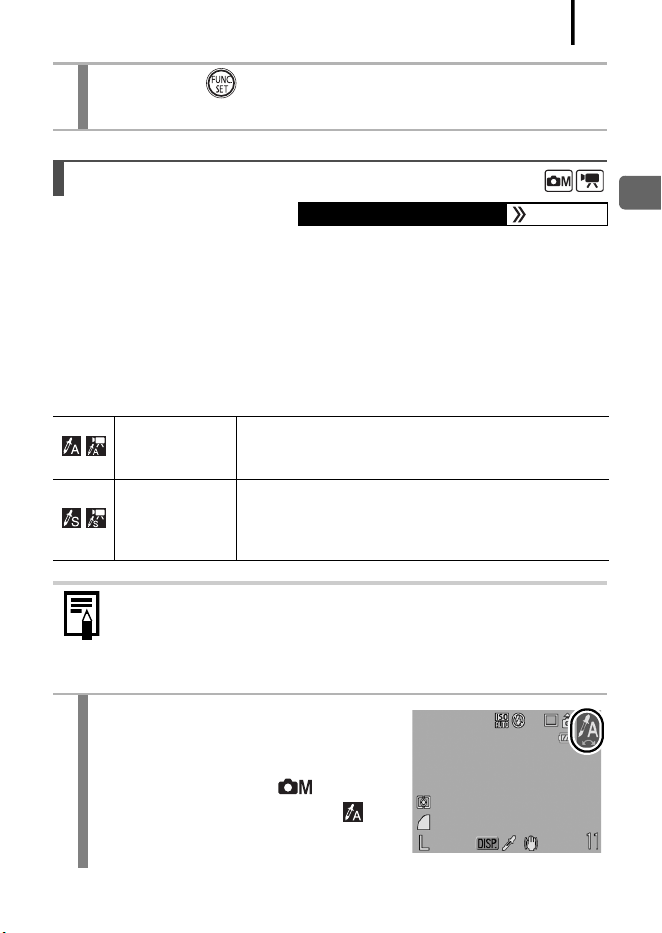
109
Advanced Shooting Functions
You can easily change the colors in an image when it is shot both stills
and movies, allowing you to enjoy producing various effects.
Depending on the shooting conditions, however, the images may
appear rough, or you may not get the expected color. Before
photographing important subjects, we recommend taking trial shots
and checking the results. By setting the [Save Original] function
(p.113) to [On] when shooting stills, you can also record both the
altered image and the original, unaltered image.
Shooting with Color Accent Mode
3
Press the button.
• Return to the shooting screen to shoot.
Changing the Colors and Shooting
Available Shooting Modes p.232
Color Accent
Use this option to have only the color specified in
the LCD monitor remain and to transform all
others to black and white.
Color Swap
Use this option to transform a color specified in
the LCD monitor into another. The specified color
can only be swapped into one other color, and
multiple colors cannot be chosen.
Depending on the scene being shot, the ISO speed may
increase, increasing the amount of noise in the image.
1
Select the Color Accent
mode.
Still image:
1. Set the mode dial to .
2. Use the control dial to select .
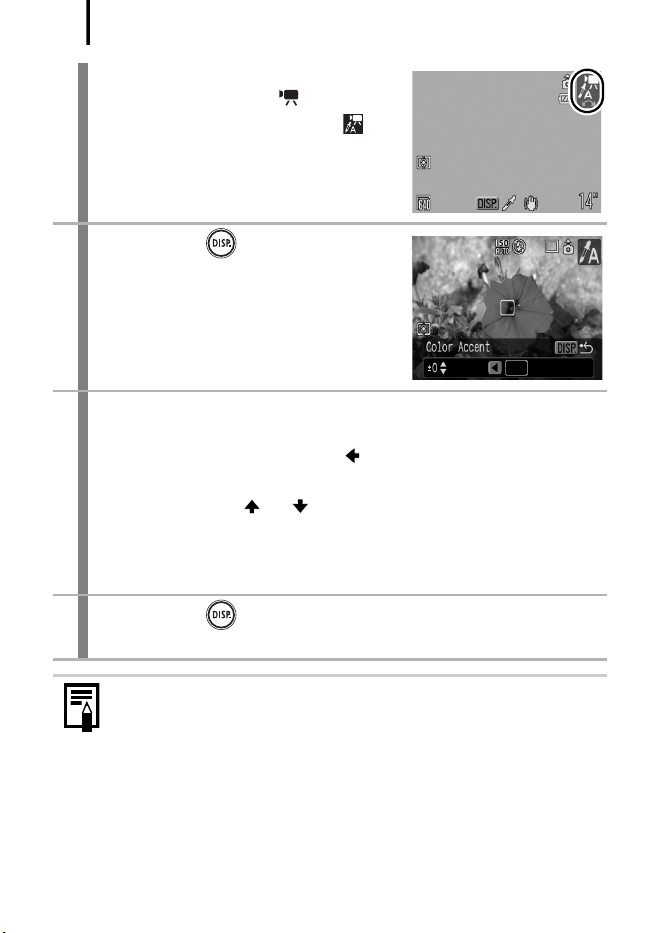
110
Movie:
1. Set the mode dial to .
2. Use the control dial to select .
2
Press the button.
• The camera will switch to color input
mode, and the display will alternate
between the original image and the
Color Accent image (using the
previously set color).
3
Aim the camera so that the color you wish to
retain appears at the center of the LCD
monitor and press the button.
• Only one color can be specified.
• You can use the or button or the control dial to specify
the range of the colors that are retained.
–
5 : Only takes the color that you want to retain.
+5 : Also takes colors close to the one that you want to retain.
4
Press the button to complete the setting,
then shoot.
z The default Color Accent is green.
z You may not obtain the expected results after color input
mode if you use the flash.
z The specified Color Accent is retained even if the camera’s
power is turned off.
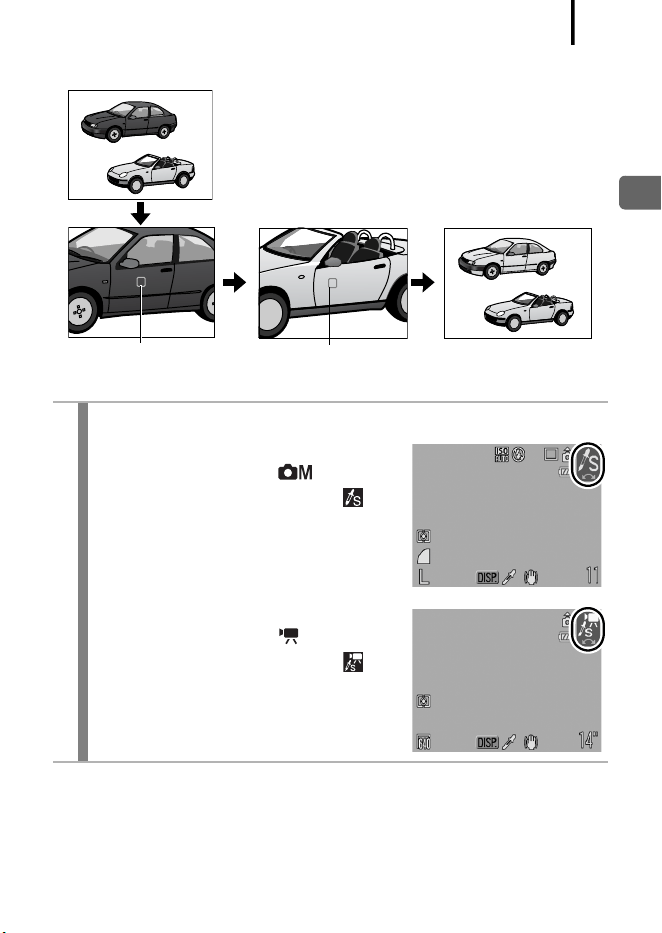
111
Advanced Shooting Functions
Shooting with Color Swap Mode
1
Select the Color Swap mode.
Still image:
1. Set the mode dial to .
2. Use the control dial to select .
Movie:
1. Set the mode dial to .
2. Use the control dial to select .
Original Color
(Before Swapping)
Desired Color
(After Swapping)
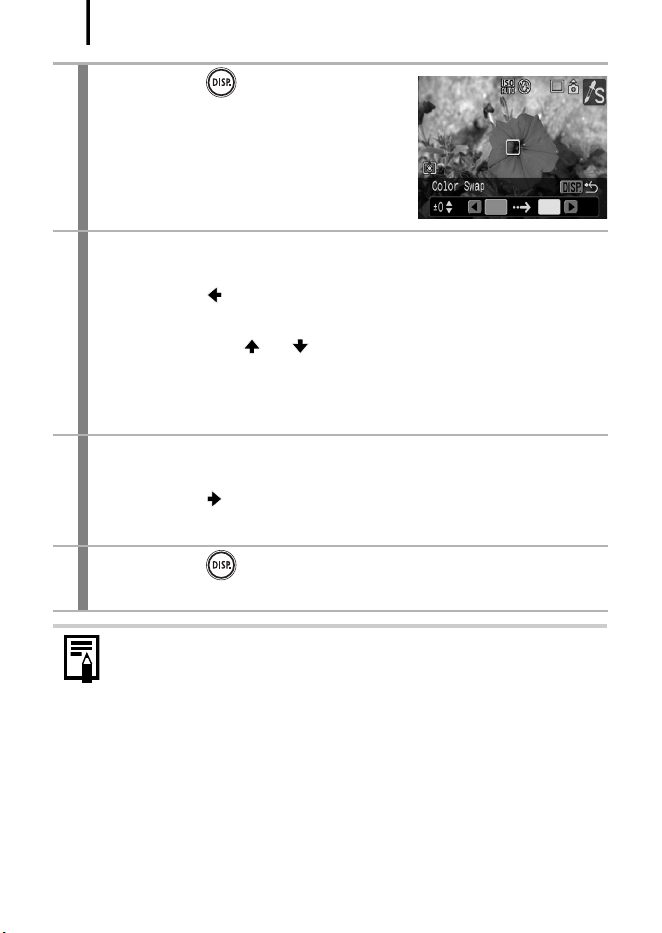
112
2
Press the button.
• The camera will switch to color input
mode, and the display will alternate
between the original image and the
color swap image (using the
previously set color).
3
Aim the camera so that the original color
appears at the center of the LCD monitor and
press the button.
• Only one color can be specified.
• You can use the or button or the control dial to specify
the range of colors that are changed.
–
5 : Only takes the color that you want to swap.
+5 : Also takes colors close to the one that you want to swap.
4
Aim the camera so that the desired color
appears at the center of the LCD monitor and
press the button.
• Only one color can be specified.
5
Press the button to complete the setting,
then shoot.
z The default setting for Color Swap changes green into white.
z You may not obtain the expected results if you use the flash.
z The colors specified in the Color Swap mode are retained
even if the camera’s power is turned off.
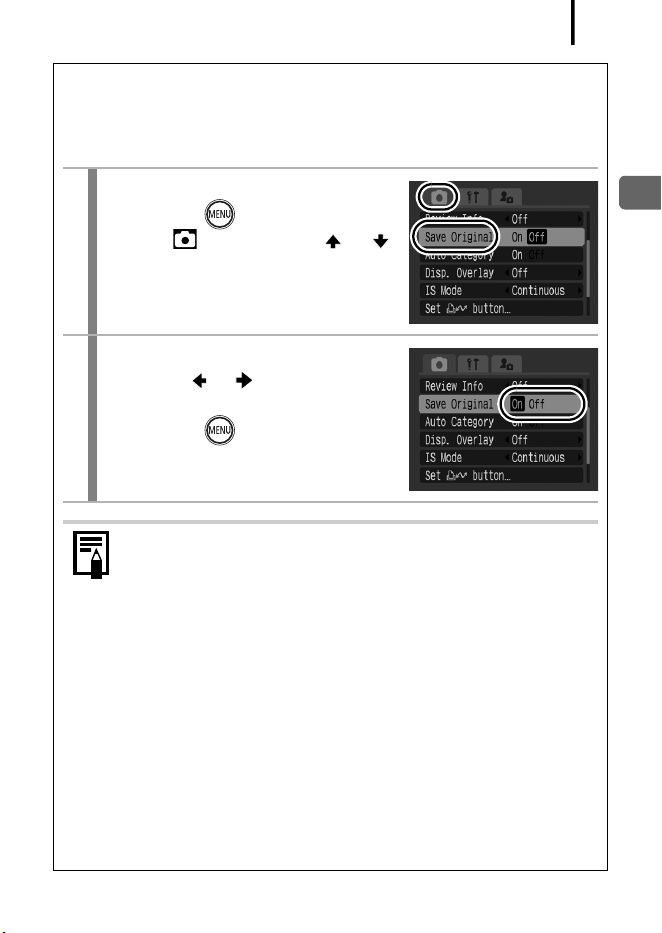
113
Advanced Shooting Functions
Saving Original Images
Not only can you save images with altered colors when shooting still
images with the Color Accent or Color Swap modes, but you can
also choose to save the original images (before the color change).
1
Select [Save Original].
1. Press the button.
2. In the menu, use the or
button to select [Save Original].
2
Make settings.
1. Use the or button to select
[On] or [Off].
2. Press the button.
If [Save Original] is set to [On]
- Only the transformed image displays in the LCD monitor
while shooting in the Color Accent or Color Swap mode.
- The transformed image is reviewed in the LCD monitor
after shooting in the Color Accent or Color Swap mode. If
you erase the image at this point, the original image is
erased along with the transformed image. Exercise
adequate caution before deleting a file.
- The images are numbered consecutively. The original
images are assigned the lower number and the
transformed color accent or color swap images the next
number.
- Since two images are recorded with each shot, the number
of shots remaining is approximately half the number
displayed when this function is set to [Off].
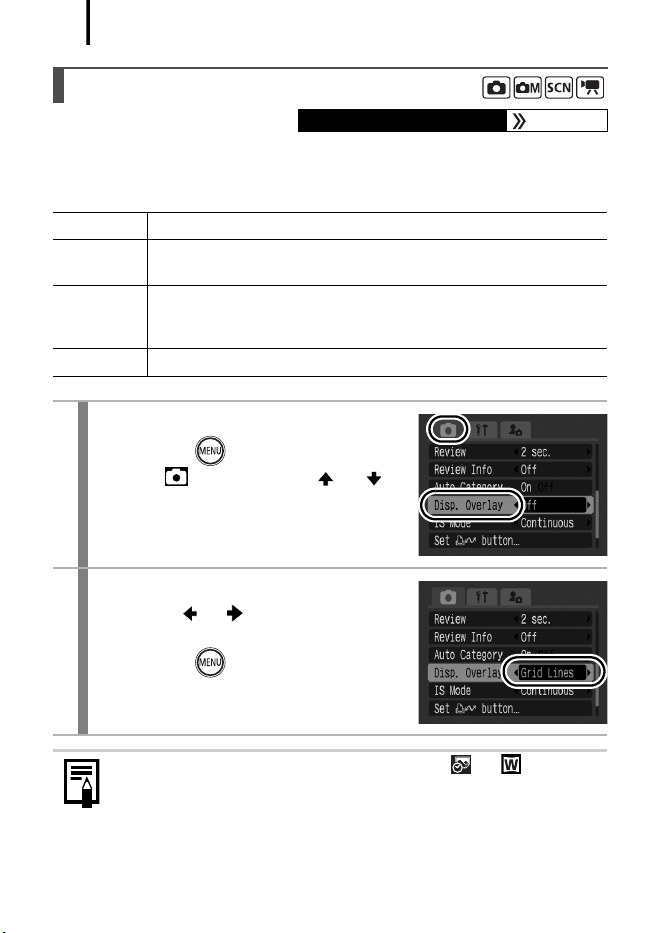
114
You can display vertical and horizontal grid lines, a 3:2 print area
guide, or both on the LCD monitor while shooting to help check the
position of your subject.
Setting the Display Overlays
Available Shooting Modes p.232
Off –
Grid Lines
Displays grid lines to divide the screen into 9 parts. Helps
confirm the vertical and horizontal positioning of the subject.
3:2 Guide
Helps confirm the print area for L-size or postcard size in 3:2
aspect ratio*. Areas outside the printable area are grayed out.
* Images are still recorded at the standard aspect ratio of 4:3.
Both Displays both the grid lines and the 3:2 guide simultaneously.
1
Select [Disp. Overlay].
1. Press the button.
2. In the menu, use the or
button to select [Disp. Overlay].
2
Make settings.
1. Use the or button to select the
option.
2. Press the button.
z Only grid lines can be configured for the or mode.
z The grid lines and 3:2 guide will not be recorded in the
image.
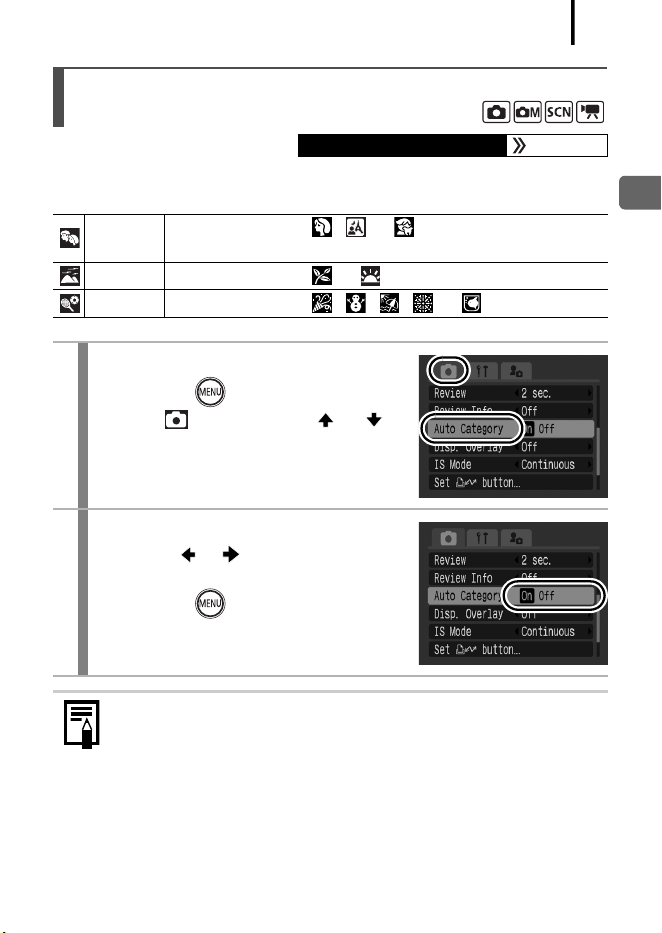
115
Advanced Shooting Functions
If you set Auto Category to [On], images are automatically sorted into
preset categories as they are recorded.
Categorizing Images Automatically
(Auto Category)
Available Shooting Modes p.232
People
For images shot in , or mode, or images with
faces detected when [AF Frame] is set to [Face Detect].
Scenery For images shot in or mode.
EventsFor images shot in , , , or mode.
1
Select [Auto Category].
1. Press the button.
2. In the menu, use the or
button to select [Auto Category].
2
Make settings.
1. Use the or button to select [On]
or [Off].
2. Press the button.
Movies are not automatically categorized, but they can be
categorized using the My Category function (p.124).
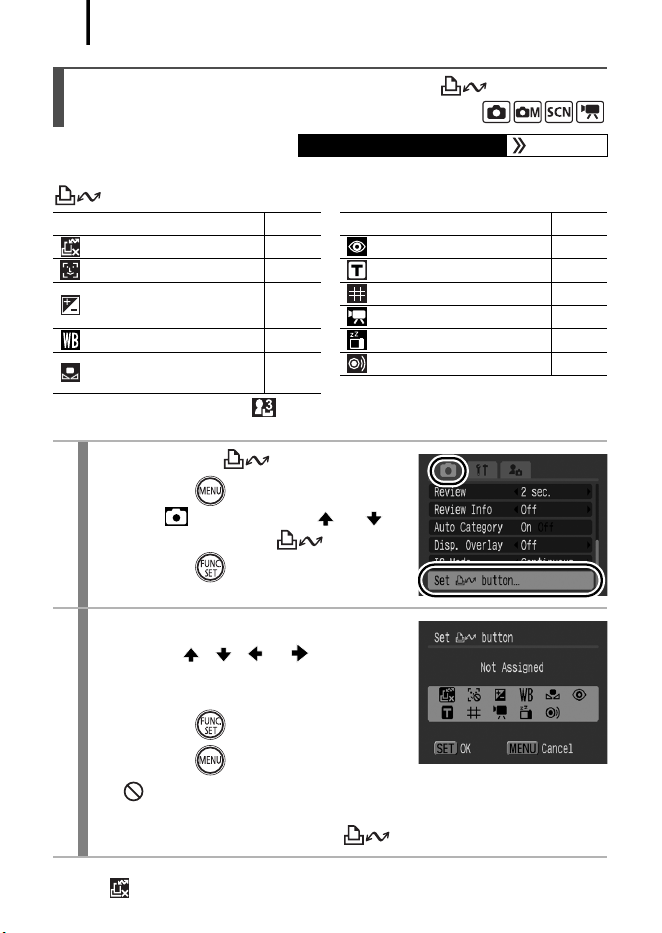
116
You can register a function that you often use when shooting with the
button.
* Sets the sound registered to , found in the [Shutter Sound] section of the My
Camera menu.
To Cancel the Shortcut Button:
Select in Step 2.
Registering Settings to the Button
Available Shooting Modes p.232
Menu Item Page Menu Item Page
Not Assigned – Red-Eye Corr. p.80
Face Select and Track p.96 Digital Tele-converter p.65
Exposure
Compensation
p.101
DISP. Overlay p.114
Movies p.82
White Balance p.104 Display Off p.117
Custom White
Balance
p.105
Play Sound Effect* p.117
1
Select [Set button].
1. Press the button.
2. In the menu, use the or
button to select [Set button].
3. Press the button.
2
Make settings.
1. Use the , , or button to
select the function you wish to
register.
2. Press the button.
3. Press the button.
• If displays to the icon’s lower right, you can register the
function, but you cannot use it with some shooting modes or
settings even if you press the button.
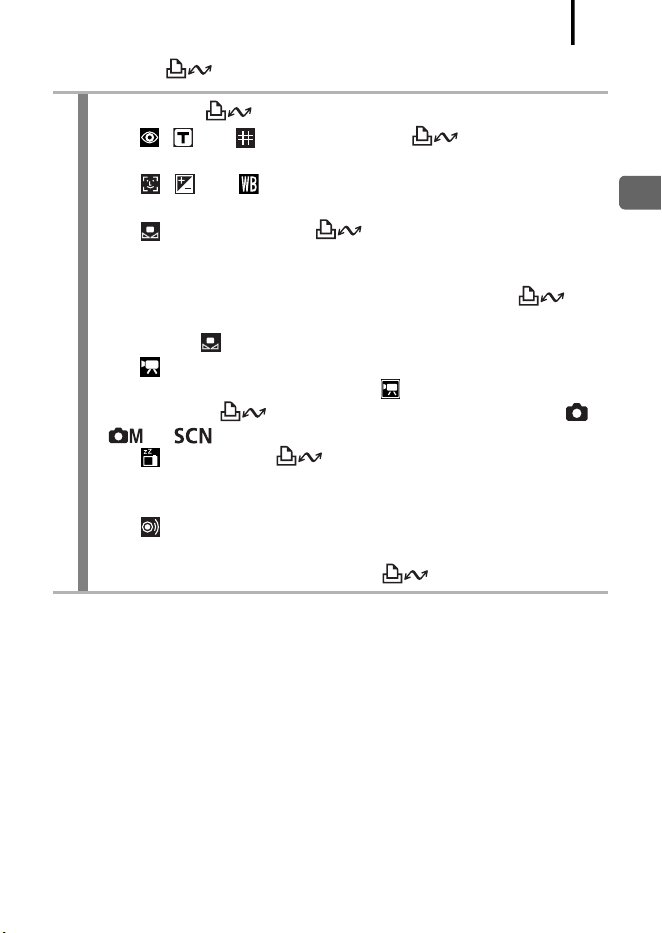
117
Advanced Shooting Functions
Using the Button
1
Press the button.
• For , and , each time that the button is pressed,
the settings of the registered functions are switched.
• For , and , the corresponding setup screen is
displayed.
• For , each press of the button records the white
balance data. Since the frame does not appear at this point,
ensure that the white paper or cloth is positioned so it appears
at the center of the LCD monitor and then press the
button. After using this function once, the white balance setting
changes to .
• For , the movie recording starts with the recording pixels and
frame rate settings selected in the (Standard) mode when
you press the button even if the mode dial is set to ,
or .
• For , pressing the button turns off the LCD monitor.
The next time a button is pressed, the LCD monitor will turn
back on.
• For , this function is useful for directing your subject’s
attention to the camera right before taking a shot because it
plays a sound when you press the button.
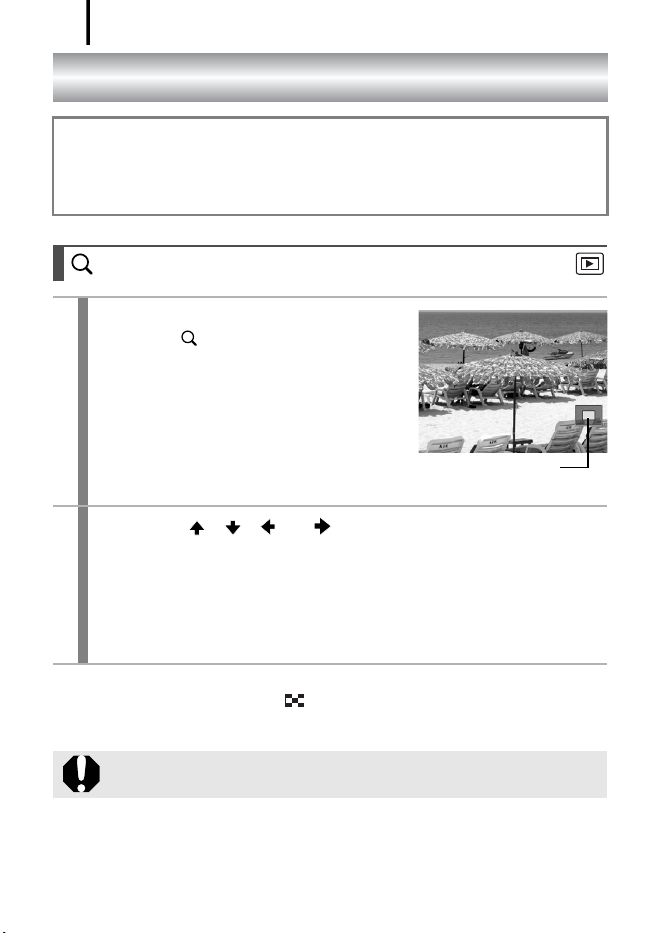
118
Playback/Erasing
To Cancel the Magnified Display:
Press the zoom lever toward . (You can also cancel it immediately
by pressing the MENU button.)
In playback mode, you can select images with the control dial.
Turning it counterclockwise selects the previous image while turning
it clockwise selects the next image. Please also see Viewing Still
Images (p.18).
Viewing Magnified Images
1
Press the zoom lever
toward .
• A magnified portion of the image will
display.
• Images can be magnified up to a
factor of approximately 10x.
2
Use the , , or button to move around
the image.
• If you use the control dial while in the magnified display mode,
the camera will switch to the previous or next image at the same
level of magnification.
• You can change the magnification level with the zoom lever.
Movie frames and index playback images cannot be magnified.
Approximate location
of the displayed area
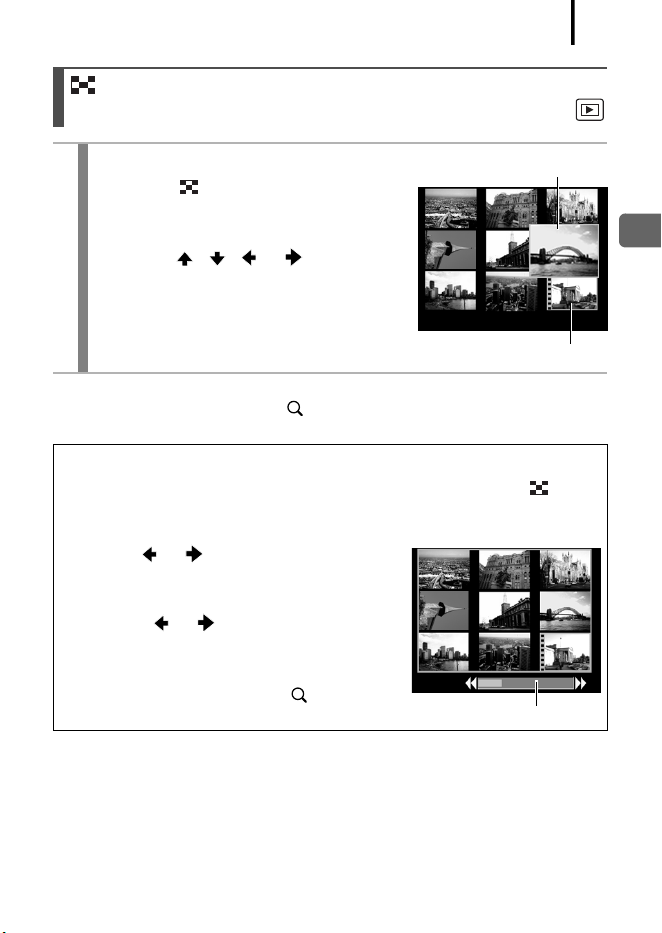
119
Playback/Erasing
To Return to Single Image Playback:
Press the zoom lever toward .
Viewing Images in Sets of Nine
(Index Playback
)
1
Press the zoom lever
toward .
• Up to nine images can be viewed at
once in index playback.
• Use the , , or button or
control dial to change the image
selection.
Switching between Sets of Nine Images
The jump bar will display if you press the zoom lever toward while
in index playback and you can switch the display between sets of
nine images.
• Use the or button to move to the
previous or next set of 9 images.
• Hold the FUNC./SET button down and
press the or button to jump to the
first or last set.
To Return to Single Image Playback:
Press the zoom lever toward .
Selected Image
Movie
Jump Bar
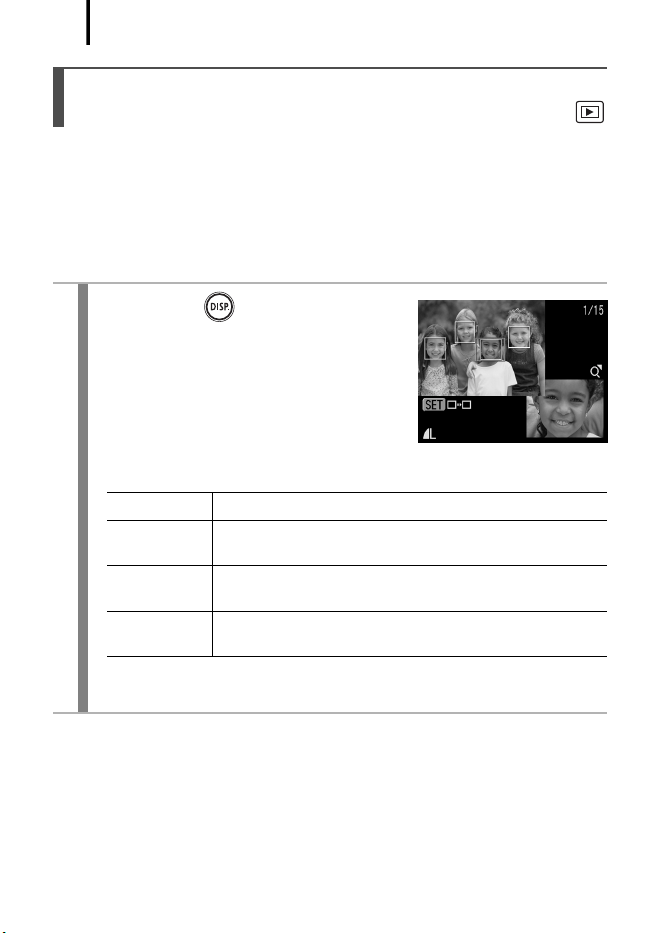
120
Focus Check display allows you to check the focus of images taken.
Moreover, as you can change the display size and switch images, you
can easily check facial expressions and whether a subject’s eyes are
closed.
Displaying the Focus Check
Checking the Focus and Peoples’
Expressions (Focus Check Display)
1
Press the button several
times until the Focus Check
displays.
• Frames are displayed on the image as follows.
• The orange frames allow you to change the display size, move
the display position, and switch between display frames.
Frame color Content
Orange Displays the range of the image displayed at bottom
right.
White The frame is displayed at a position at which the
image is in focus.
Gray Displays frames in positions where faces were
detected during playback.
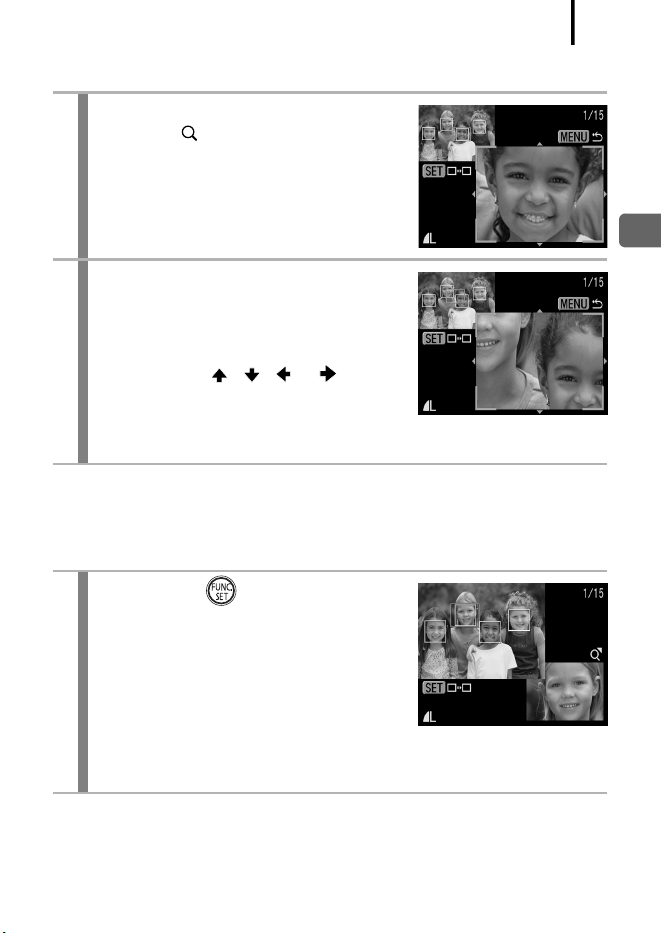
121
Playback/Erasing
Changing the Display Size and Switching Frames
To Cancel Changing the Display Position:
Press the MENU button.
Switching Frames
2
Press the zoom lever
toward .
• Bottom right of the screen will be
displayed prominently and the display
size and display position can be
changed.
3
Change the setting.
• You can change the display size by
pressing the zoom lever.
• You can change the display position
by using the , , or button.
• When you press the FUNC./SET
button, the orange frame returns to its
original position.
2
Press the button.
• When multiple in-focus frames are
displayed, or when multiple faces are
detected, the position of the orange
colored frame will change each time
the FUNC./SET button is pressed.
After you change the display size, the
orange frame will adjust to the size of the face when you switch
the position of the frame.
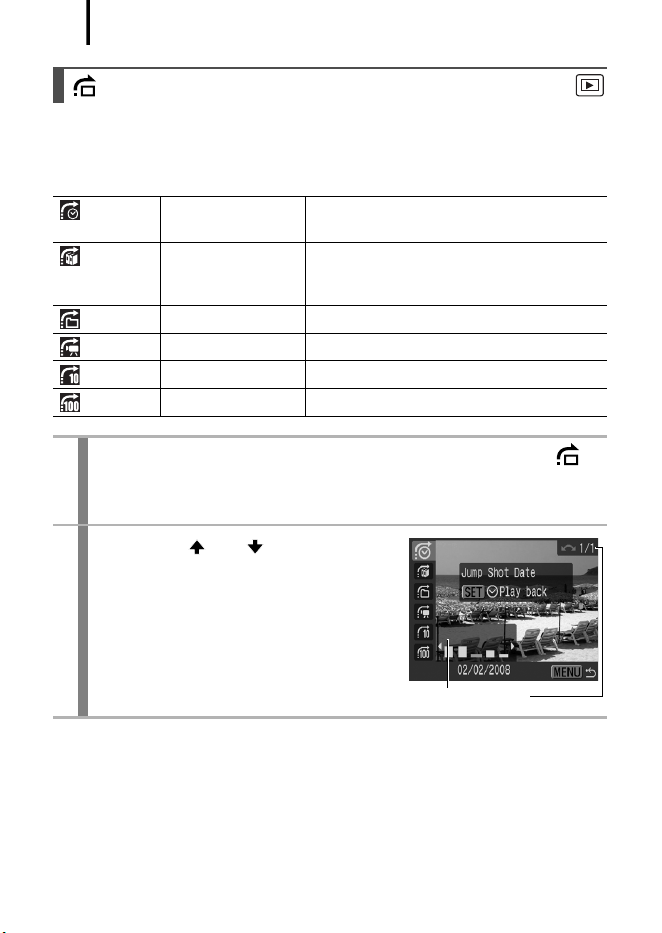
122
When you have many images recorded onto a memory card, it is
handy to use the search keys below to jump over images to find the
object of your search.
Jumping to Images
Jump Shot Date Jumps to the first image of each
shooting date.
Jump to My
Category
Jumps to the first image of each folder
sorted by the Auto Category (p.115) or
My Category (p.124) functions.
Jump to Folder Displays the first image in each folder.
Jump to Movie Jumps to a movie.
Jump 10 images Jumps over 10 images at a time.
Jump 100 images Jumps over 100 images at a time.
1
In single image playback mode, press the
button.
• The camera will switch to jump search mode.
2
Use the or button to
select a search key.
• The screen sample will vary slightly
according to the search key.
• You can show/hide image
information using the DISP. button.
Image Information
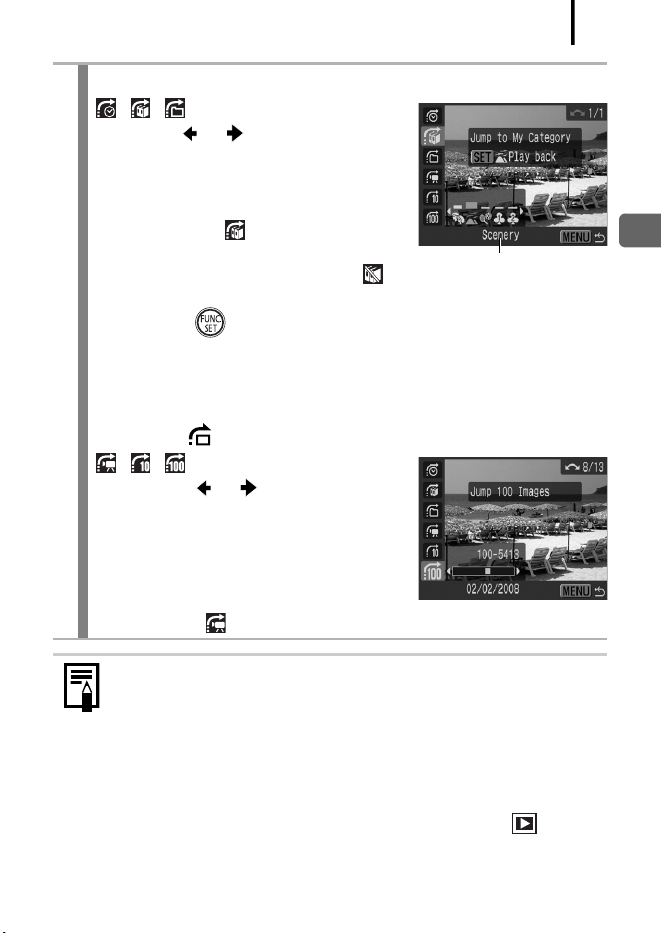
123
Playback/Erasing
3
Display the Images.
, , Selected
1. Use the or to select date,
category or folder for playback.
• You can check the target image by
using the control dial.
• If you select when an image has
not been assigned to any category,
you will only be able to select
(none) as a search key.
2. Press the button.
• The camera will switch to defined playback mode and display a
blue frame. You can limit playback to the images corresponding
to the search key.
• Press the button to cancel defined playback mode.
, , Selected
1. Press the or button.
• Pressing the MENU button cancels
the setting.
• Press the FUNC./SET button to
switch the camera to defined playback
mode when is selected.
The defined playback mode will be canceled under the
following circumstances.
- Changing categories (while using My Category to define
images).
- When selecting images in a range
- When displaying images not supported in defined playback
- When newly saving images that have effects added or edited
- When images are deleted using [Erase] from the menu
Select the search key
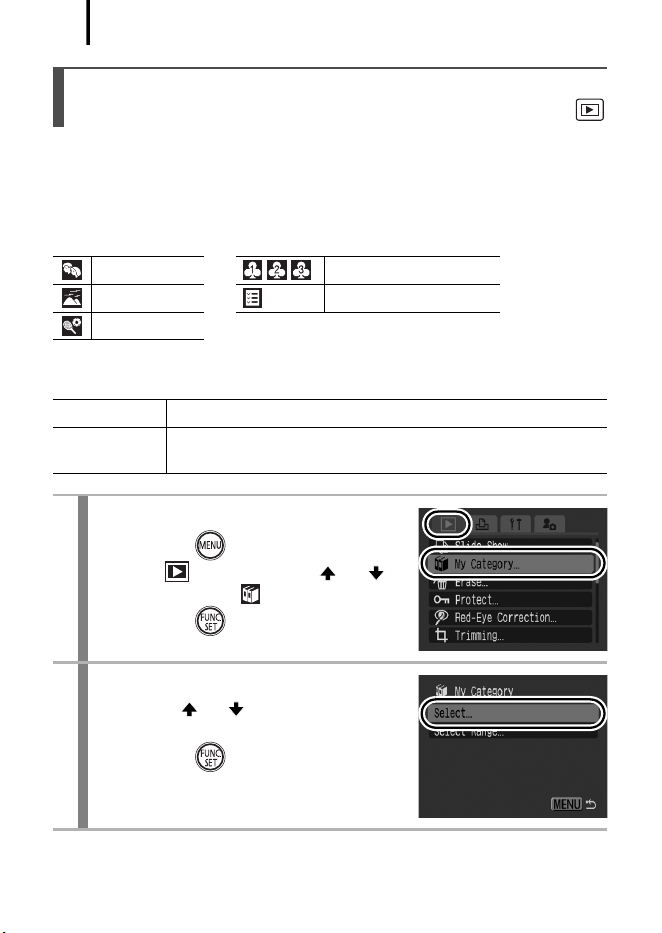
124
You can organize images into prepared categories. The following
operations can be performed if the images are sorted into categories.
• Image searches (p.122) •Slide Show (p.136) • Protect (p.154)
• Erase (p.158) •Configure print settings (p.165)
Category Selection Methods
Organizing Images by Category
(
My Category)
People My Category 1 – 3
Scenery To Do
Events
Select For viewing and selecting images singly.
Select Range For picking a first and last image and selecting all the
images in the range.
1
Select [My Category].
1. Press the button.
2. In the menu, use the or
button to select .
3. Press the button.
2
Choose a selection method.
1. Use the or button to choose a
selection method.
2. Press the button.
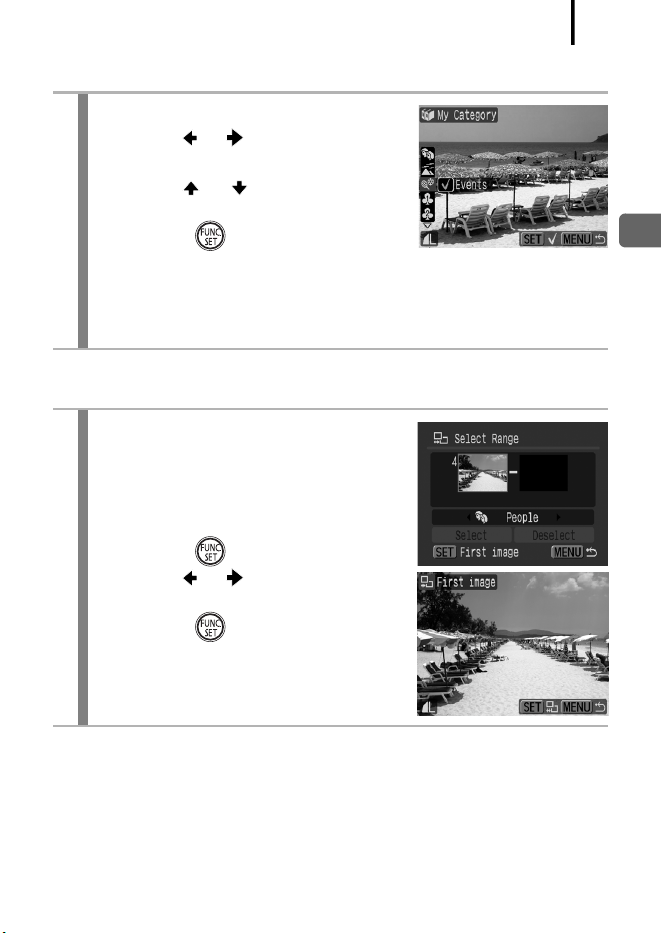
125
Playback/Erasing
[Select]
[Select Range]
3
Categorize the images.
1. Use the or button to select
images to categorize.
2. Use the or button to select a
category.
3. Press the button.
• Pressing the FUNC./SET button again cancels the setting.
• This also can be set in the index playback mode.
• Press the MENU button to complete the setting.
3
Select the first image.
• You can use the control dial to select
the first or last image.
1. Press the button.
2. Use the or button to select the
first image in the range to categorize.
3. Press the button.
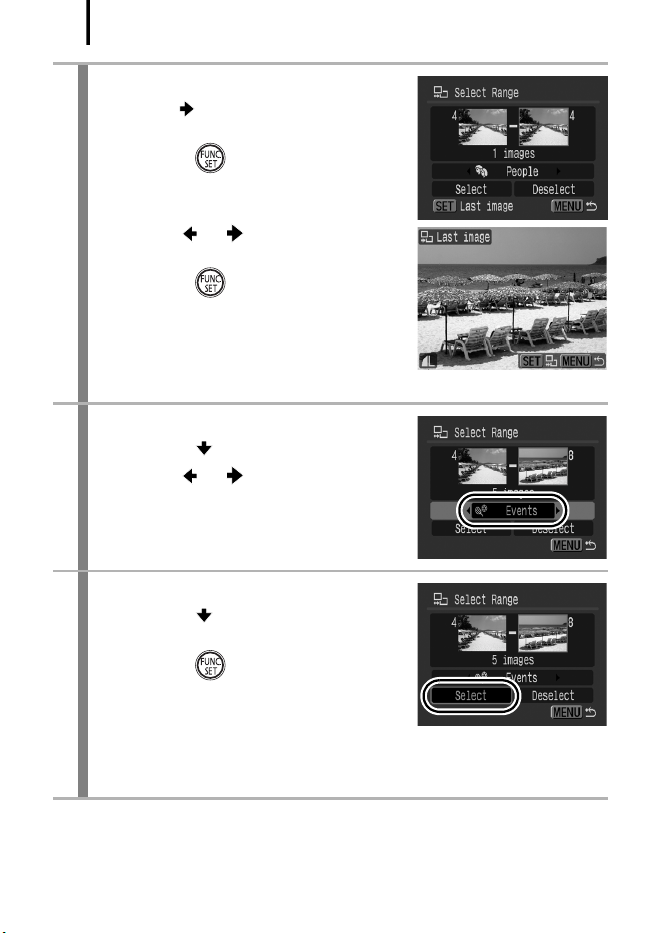
126
4
Select the last image.
1. Use the button to highlight the last
image window.
2. Press the button.
3. Use the or button to select the
last image in the range to categorize.
4. Press the button.
• An image with a lower number than
the first image cannot be selected as
the last image.
• Up to 500 images can be selected.
5
Select a category.
1. Press the button.
2. Use the or button to select a
category.
6
Make settings.
1. Press the button to choose
[Select].
2. Press the button.
• The screen will return to the selection
method screen.
• Selecting [Deselect] cancels categorization of the selected
range.
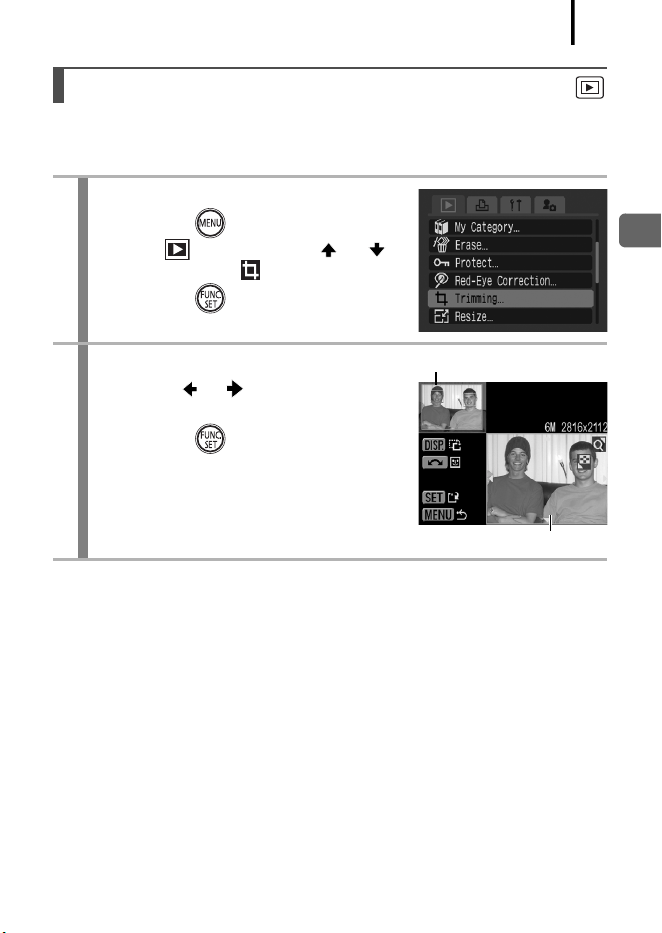
127
Playback/Erasing
You can trim a required portion of a recorded image and save it as a
new image file.
Trimming a Portion of an Image
1
Select [Trimming].
1. Press the button.
2. In the menu, use the or
button to select .
3. Press the button.
2
Select an image.
1. Use the or button to select an
image for trimming.
2. Press the button.
• The trimming frame (the area of the
image which can be trimmed) is
displayed in green.
Trimming Frame
Image After Trimming
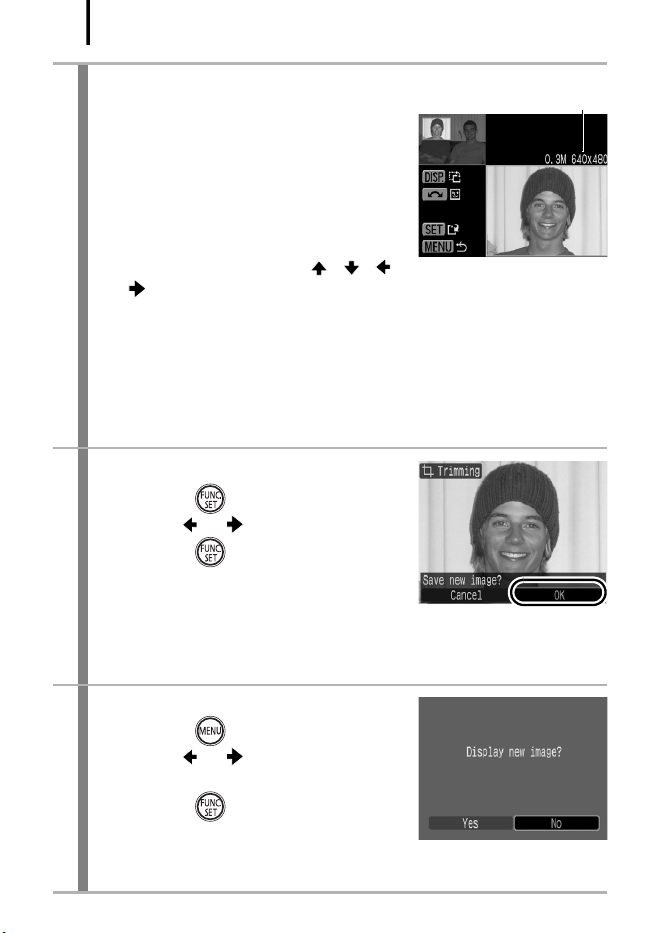
128
3
Adjust the trimming frame.
• You can change the size of the
trimming frame using the zoom lever.
However, the number of the recording
pixels of the saved image will differ
according to the size of the trimmed
image.
• You can change the position of the
trimming frame using the , ,
or button.
• Press the DISP. button to change the vertical/horizontal
orientation of the trimming frame.
• If a face is detected, a gray frame appears around the face
displayed in the top left screen. Trimming can be performed
around this gray frame. If multiple frames are displayed, you can
switch between frames by turning the control dial.
4
Save the image.
1. Press the button.
2. Use the or to select [OK].
3. Press the button.
• The trimmed image will be saved in a
new file.
• If you wish to continue trimming of another image, repeat
operations from Step 2.
5
Display the saved image.
1. Press the button.
2. Use the or button to select
[Yes].
3. Press the button.
• Selecting [No] returns to the Play
menu.
Recording Pixels
After Trimming
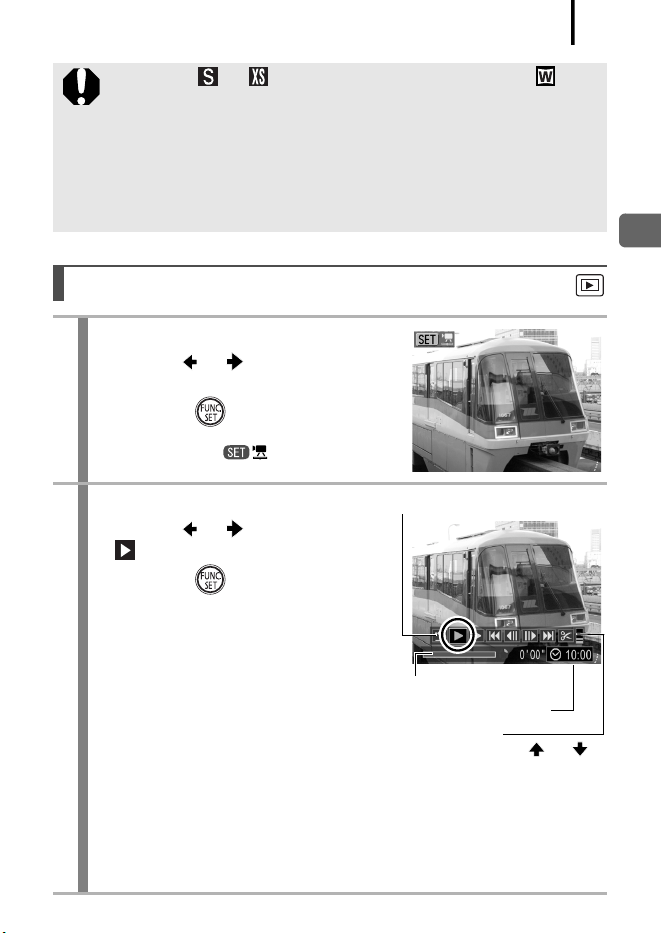
129
Playback/Erasing
z Movies, or images, and images recorded in
cannot be trimmed.
z Some images shot with another camera cannot be trimmed.
z The aspect ratio for images which can be trimmed will be
fixed to 4:3 (or 3:4 if the image is vertically oriented).
z The recording pixels of a trimmed image will be less than the
image before trimming.
Viewing Movies
1
Display a movie.
1. Use the or button to select a
movie.
2. Press the button.
• Images with a icon are movies.
2
Play the movie.
1. Use the or button to select
.
2. Press the button.
• The movie will pause if you press
the FUNC./SET button during
playback. It will resume when you
press the button again.
• When playback ends, the movie
stops at the last frame displayed.
Press the FUNC./SET button to
display the movie control panel.
• You can switch between showing/hiding the playback progress
bar by pressing the DISP. button while playing a movie.
• If playback was halted partway through in the prior viewing
session, playback will resume from the last frame displayed.
Volume Level
(Adjust it with the or
button)
Movie Control Panel
Playback Progress Bar
Time movie was shot
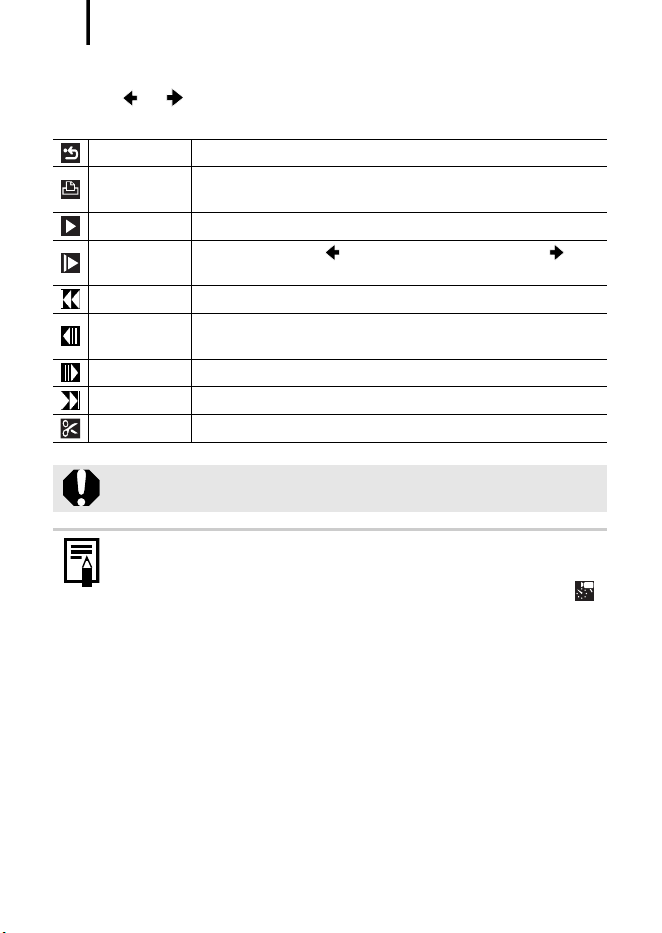
130
Operating the Movie Control Panel
Use the or button to select a control and press the FUNC./SET
button.
Exit Ends playback and returns to single image playback.
Print
An icon will display when a printer is connected. See
the Direct Print User Guide for details.
Play Starts playback.
Slow Motion
You can use the button to slow down or the
button to speed up playback.
First Frame Displays the first frame.
Previous
Frame
Rewinds if the FUNC./SET button is held down.
Next Frame Fast Forwards if the FUNC./SET button is held down.
Last Frame Displays the last frame.
Edit Switches to the movie editing mode.
Movies cannot be played in the index playback mode.
z Use the television’s controls to adjust the volume when
playing a movie on a TV set (p. 186).
z The sound cannot be played in slow motion playback or .
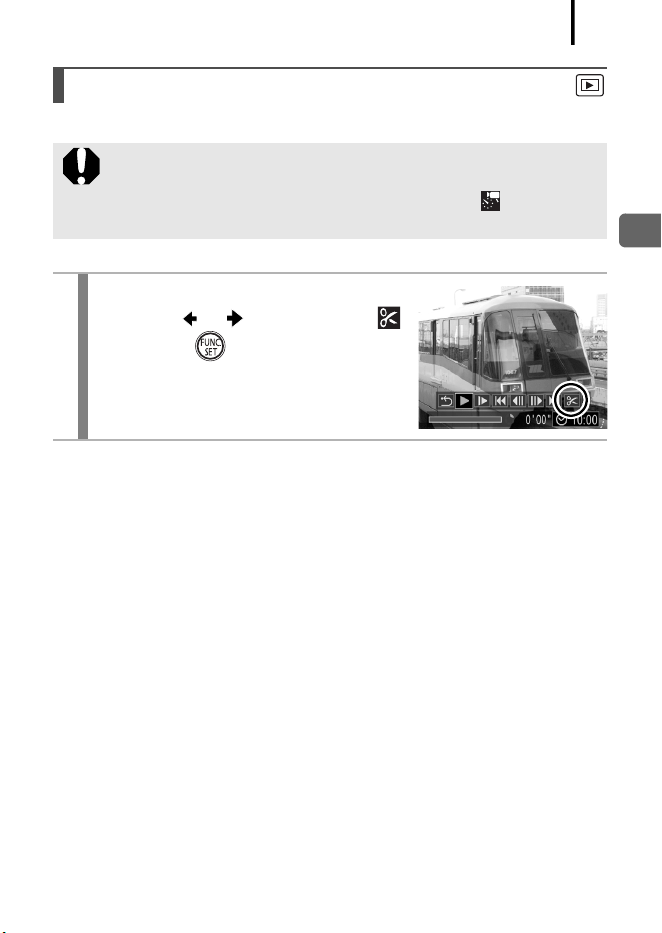
131
Playback/Erasing
You can delete portions of recorded movies.
*1 [Interval Time]: 1 second *2 [Interval Time]: 2 seconds
Editing Movies
Movies 1 second or longer before editing can be edited in 1-
second increments, but those that are protected or less than 1
second long (15 seconds*
1
or 30 seconds*
2
in ) cannot be
edited.
1
Select [Edit].
1. Use the or button to select .
2. Press the button.
• The movie editing panel and the movie
editing bar will display.
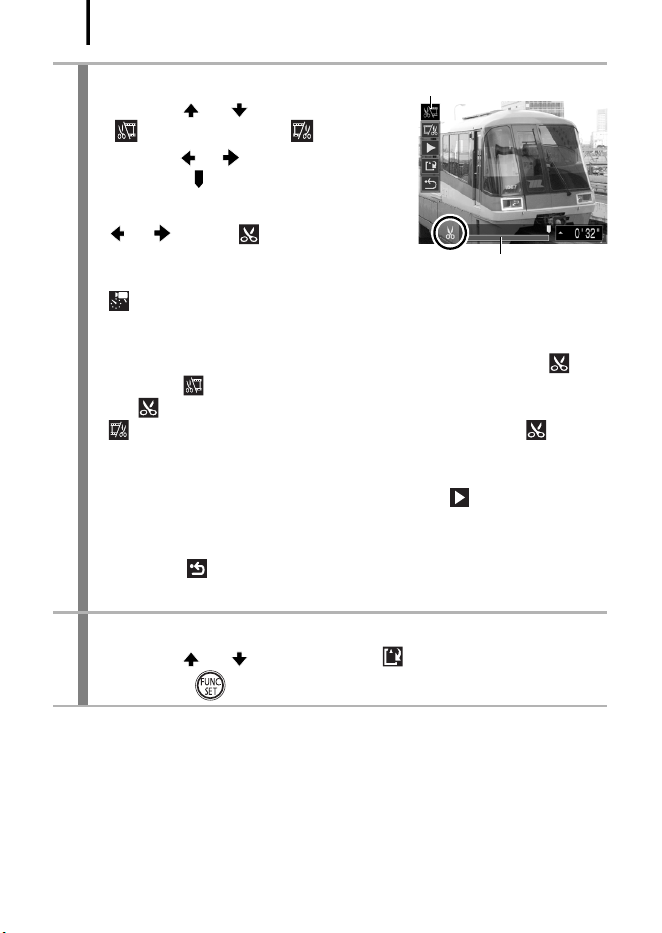
132
2
Edit the movie.
1. Use the or button to select
(Cut Beginning) or (Cut End).
2. Use the or button to specify the
cut point ( ).
• While moving the cut point using the
or button, is displayed at
each 1 second interval (or every 15
second*
1
or 30 second*
2
interval in
), allowing you to cut the movie at the indicated point.
*1 When the shooting interval is 1 sec.
*2 When the shooting interval is 2 sec.
• Even if you specify the cut point at a position other than ,
selecting will delete the beginning portion of the movie up to
the point just before your specified cut point, and selecting
will delete the latter portion of the movie from the point
just after your specified cut point. The edited movie will be
saved.
• To check a temporarily edited movie, select (Play) and press
the FUNC./SET button.
• To continue editing, repeat Step 2.
• Selecting (Exit) cancels the edit and restores the movie
control panel.
3
Select [Save].
1. Use the or button to select .
2. Press the button.
Movie Editing Bar
Movie Editing Panel
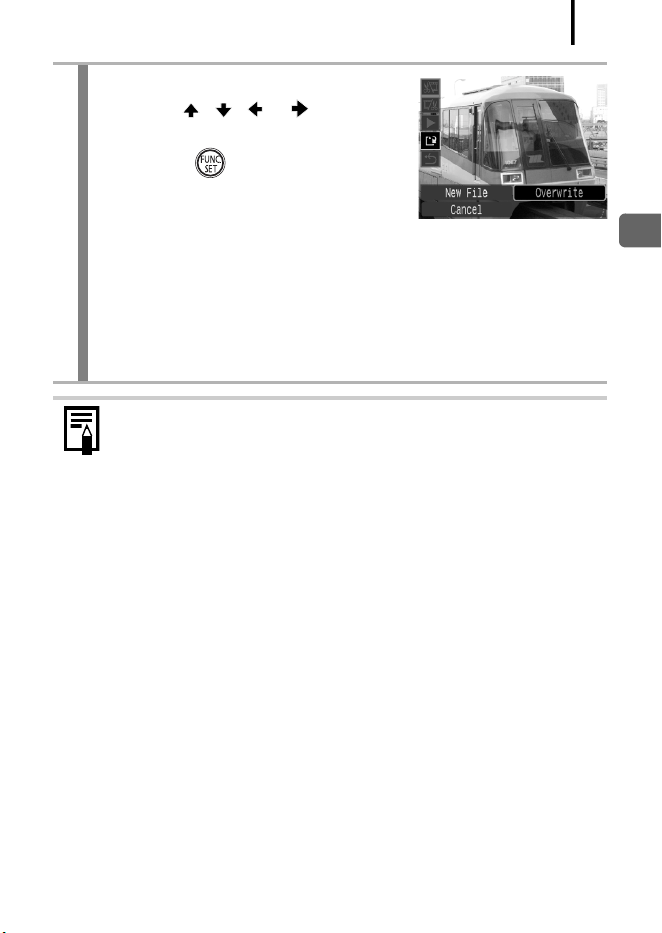
133
Playback/Erasing
4
Save the file.
1. Use the , , or button to
select [New File] or [Overwrite].
2. Press the button.
• [New File] saves the edited movie
under a new file name. The pre-edit
data is left unchanged. Note, if you press the FUNC./SET button
while saving the movie, saving is canceled.
• [Overwrite] saves the edited movie with its original name. The
pre-edit data is lost.
• When there is not enough space left on the memory card, only
[Overwrite] can be selected.
Depending on the movie’s file size, it may take some time to
save an edited movie. If the battery runs out of charge partway
through, edited movie clips cannot be saved. When editing
movies, it is recommended to use a fully charged battery or the
separately sold AC Adapter Kit ACK-DC30 (p. 214).
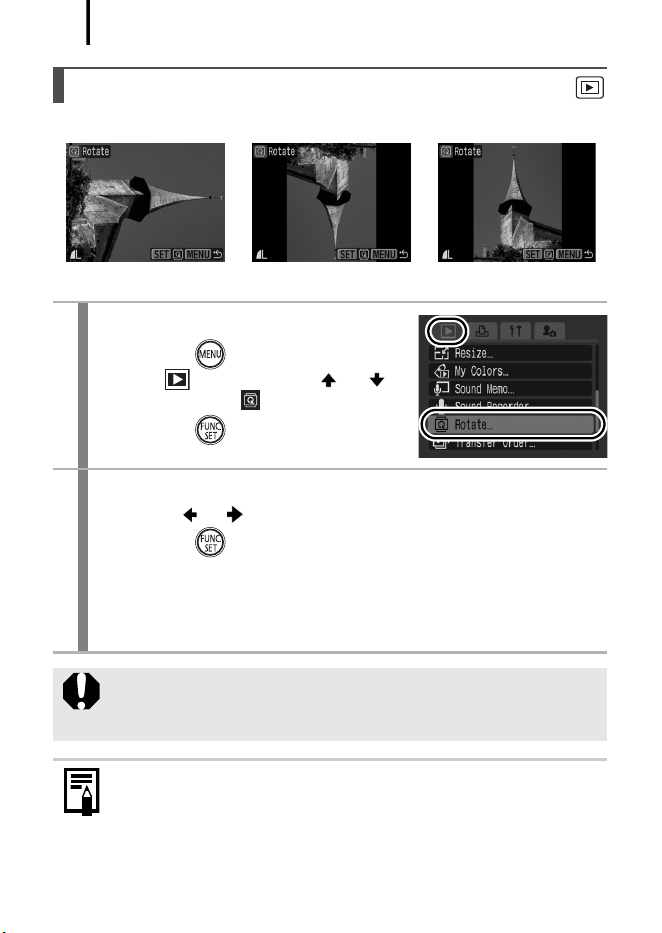
134
Images can be rotated clockwise 90° or 270° in the display.
Rotating Images in the Display
1
Select [Rotate].
1. Press the button.
2. In the menu, use the or
button to select .
3. Press the button.
2
Rotate the image.
1. Use the or button to select an image to rotate.
2. Press the button.
• Cycle through the 90°/270°/original orientations with each press
of the FUNC./SET button.
• This also can be set in the index playback mode.
When images are downloaded to a computer, the orientation of
images rotated by the camera will depend upon the software
used to download the images.
As the orientation of an image is recorded, the image will be
shown in its rotated orientation the next time it is displayed.
Original 90° 270°
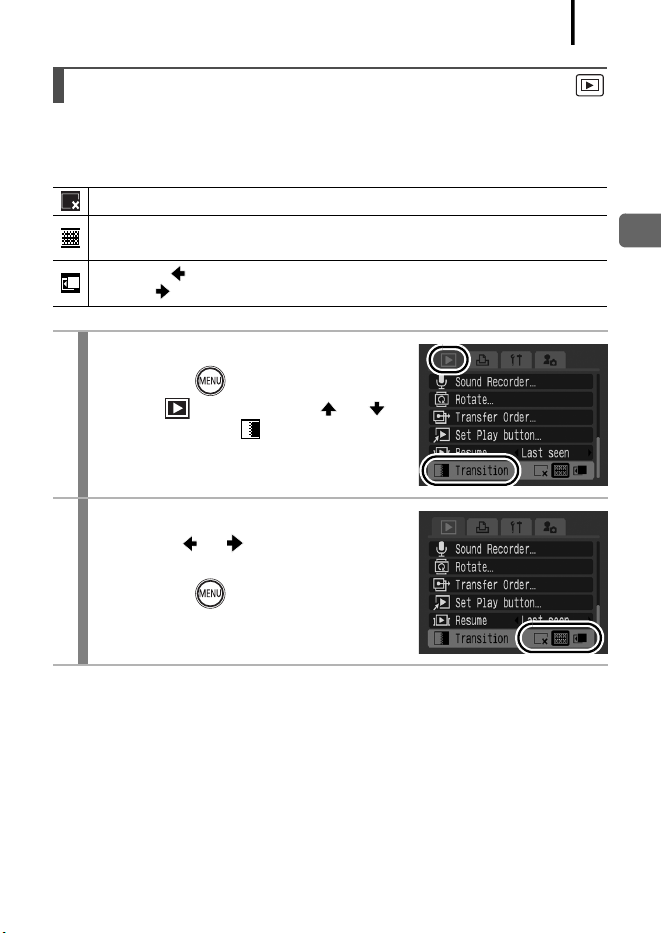
135
Playback/Erasing
You can select the transition effect displayed when switching between
images.
Playback with Transition Effects
No transition effect.
The displayed image darkens and the next image gradually brightens
until it is displayed.
Press the button to have the previous image display from the left
and the button to have the next image display from the right.
1
Select [Transition].
1. Press the button.
2. In the menu, use the or
button to select .
2
Make settings.
1. Use the or button to select a
transition effect.
2. Press the button.
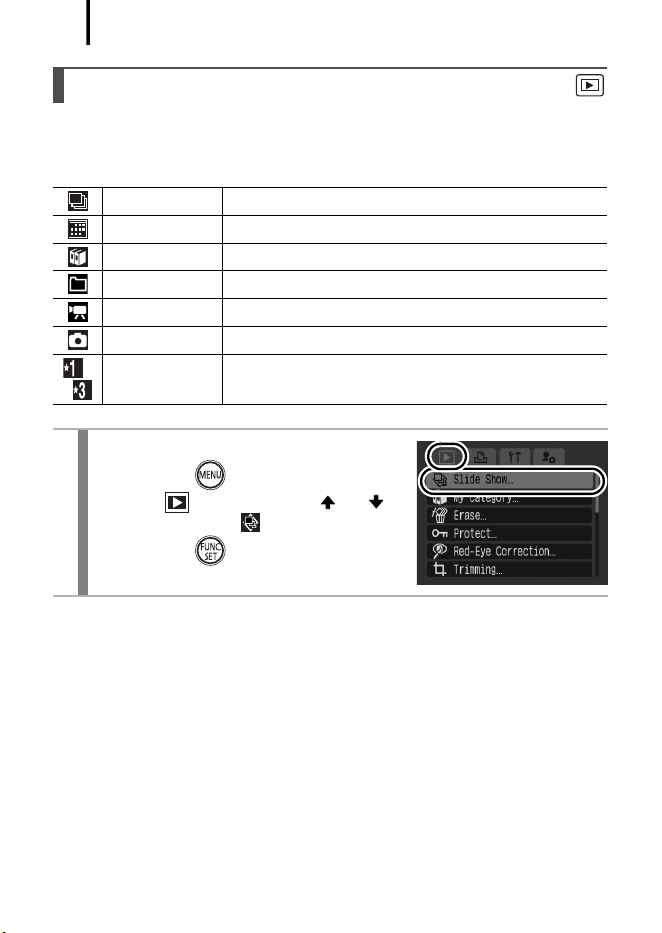
136
Automated playback of memory card images.
Image settings for slide shows are based on the Digital Print Order
Format (DPOF) standard (p. 165).
Automated Playback (Slide Shows)
All Images Plays all images on a memory card in order.
Date Plays images bearing a specified date in order.
My Category
Plays the images in the selected category in order.
Folder Plays images in a specified folder in order.
Movies Plays movie files only, in order.
Stills Plays still images only, in order.
–
Custom 1 – 3 Plays the images selected for each slide show,
Custom 1, Custom 2 or Custom 3, in order (p. 140).
1
Select [Slide Show].
1. Press the button.
2. In the menu, use the or
button to select .
3. Press the button.
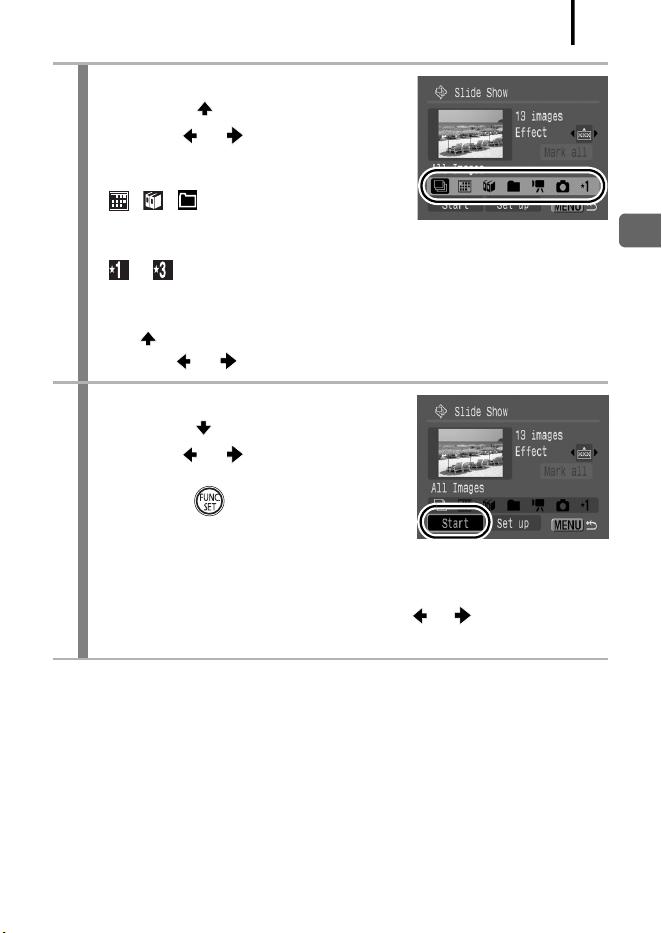
137
Playback/Erasing
To Stop the Slide Show:
Press the MENU button.
2
Select a playback method.
1. Press the button.
2. Use the or button to select the
slide show type.
• , , : Press the FUNC./SET
button to select a date, category or
folder to be played back (p. 139).
• – : Press the FUNC./SET button to select the images to
be played back (p. 140).
• If you want to add a transition effect to play back images, use
the button to select [Effect] and choose the type of effect
with the or button (p. 138).
3
Start the slide show.
1. Press the button.
2. Use the or button to select
[Start].
3. Press the button.
• The following functions are available
during slide shows.
- Pausing/resuming: Press the FUNC./SET button.
- Fast forwarding/rewinding: Press the or button (continue
to hold the button to switch between images more rapidly).
138
Transition Effects
You can select the transition effect used when one image is replaced
by another.
No transition effect.
The new image gradually brightens as it moves upward from the
bottom.
The new image first appears in a cross shape and gradually expands
to display the full image.
Portions of the new image move horizontally, then the image expands
to display the full image.
In single image playback mode, you can start a slide show from
the current image displayed by holding the FUNC./SET button
while you press the button. Please note that if you do
this while the last image shot is displayed, the slide show will
start from the first image using the same date.
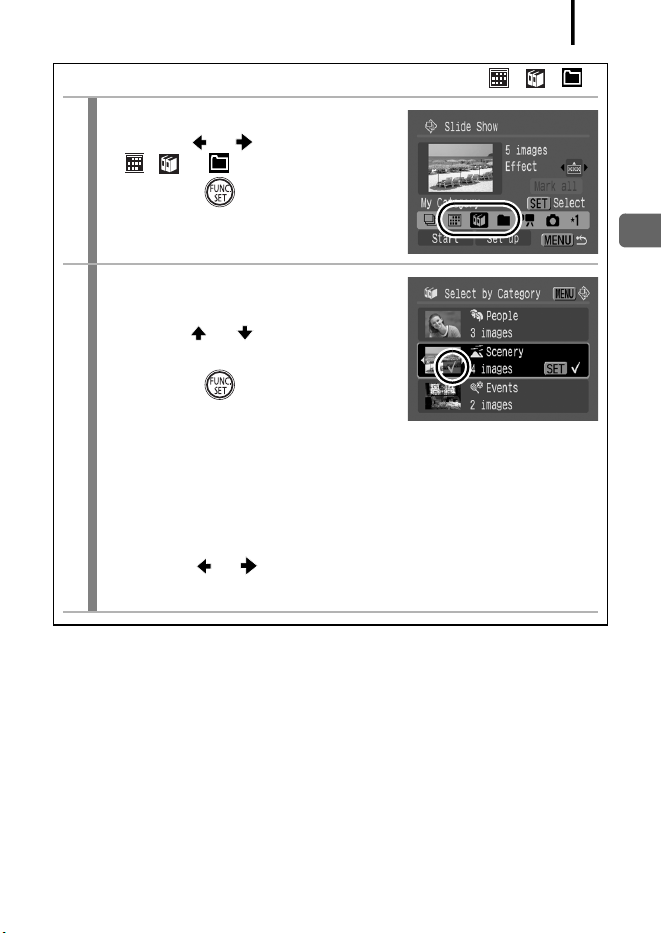
139
Playback/Erasing
Select a date/category/folder to play back ( , , )
1
Select a playback method.
1. Use the or button to select
, or .
2. Press the button.
2
Select images to play
back.
1. Use the or button to select a
date/category/folder to playback.
2. Press the button.
•A
3 will appear on selected
images.
• To cancel the selection: Press the FUNC./SET button again.
• Multiple selections can be made for the date/category/folder.
• The images will play back in the order of selection.
• You can check the images for each date/category/folder by
using the or button.
• Pressing the MENU button completes the setting.
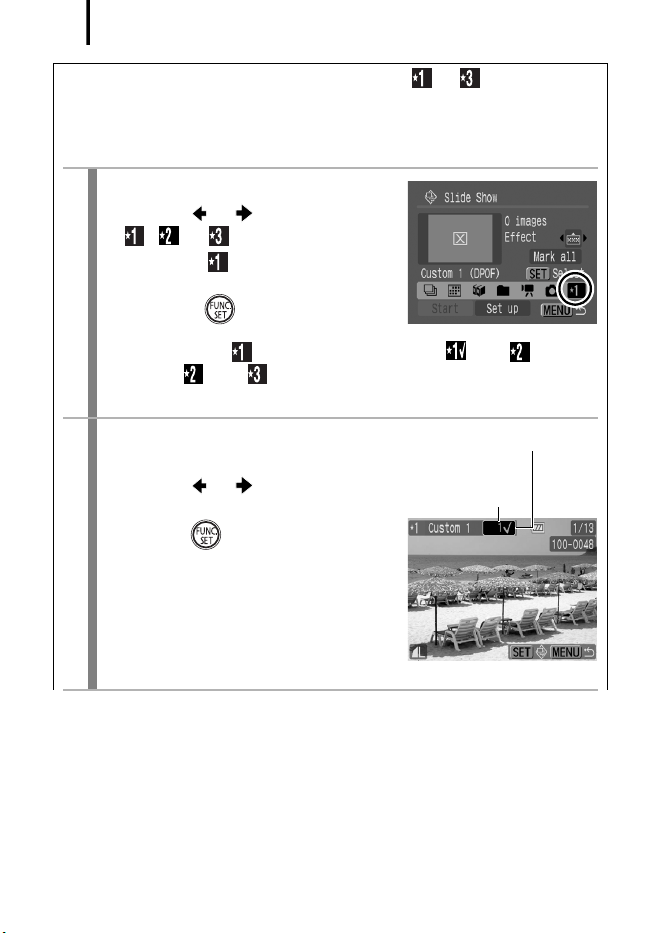
140
Selecting Images for Playback ( – )
Select only the images that you wish to play back and save them as
a slide show (Custom 1, 2 or 3). Up to 998 images can be selected.
They will be played back in their order of selection.
1
Select a playback method.
1. Use the or button to select
, or .
• Only the icon will display at
first.
2. Press the button.
• When you set , the icon will change to and will
display. and will change in the same way when they
are set.
2
Select images to play
back.
1. Use the or button to choose
images to play back.
2. Use the button to select/
deselect the images.
• You can also select images in the
index playback mode.
• Pressing the MENU button
completes the setting.
Number indicating
the selection order
Check mark indicating
selection
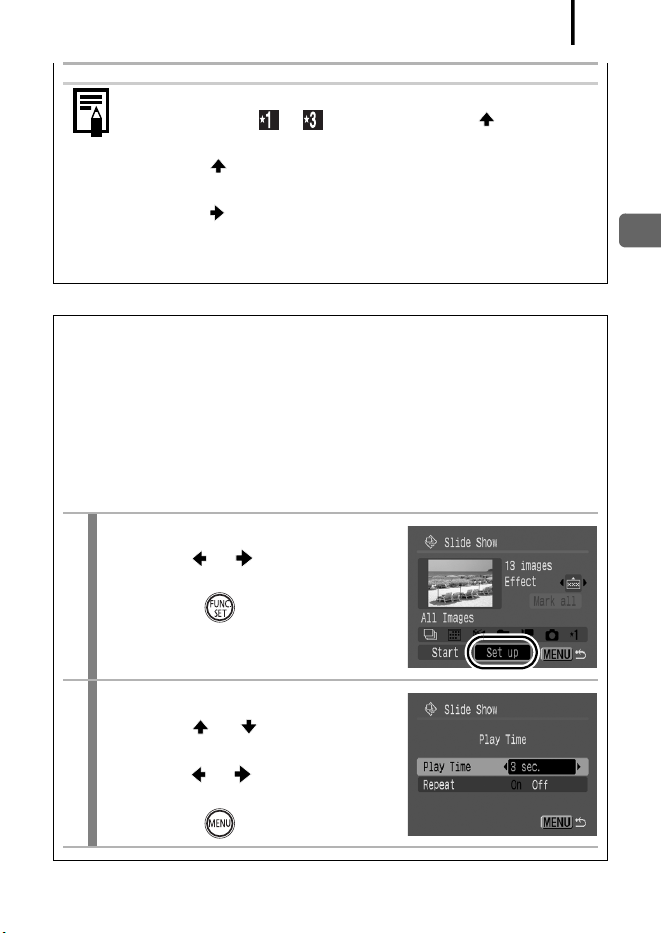
141
Playback/Erasing
Adjusting the Play Time and Repeat Settings
• Play Time
Sets the duration that each image displays. Choose between 3 –
10 seconds, 15 seconds and 30 seconds. Displaying time can vary
slightly depending on the image.
•Repeat
Sets whether the slide show stops when all the slides have been
displayed or continues until stopped.
1
Select [Set up].
1. Use the or button to select
[Set up].
2. Press the button.
2
Configure the setting.
1. Use the or button to select
[Play Time] or [Repeat].
2. Use the or button to select a
setting.
3. Press the button.
Selecting All Images
1 After selecting – in Step 1, use the button to
select [Mark all] and press the FUNC./SET button.
2 Use the button to select [Mark all], press the FUNC./
SET button.
3 Use the button to select [OK] and press the FUNC./
SET button.
To deselect all images, select [Reset].
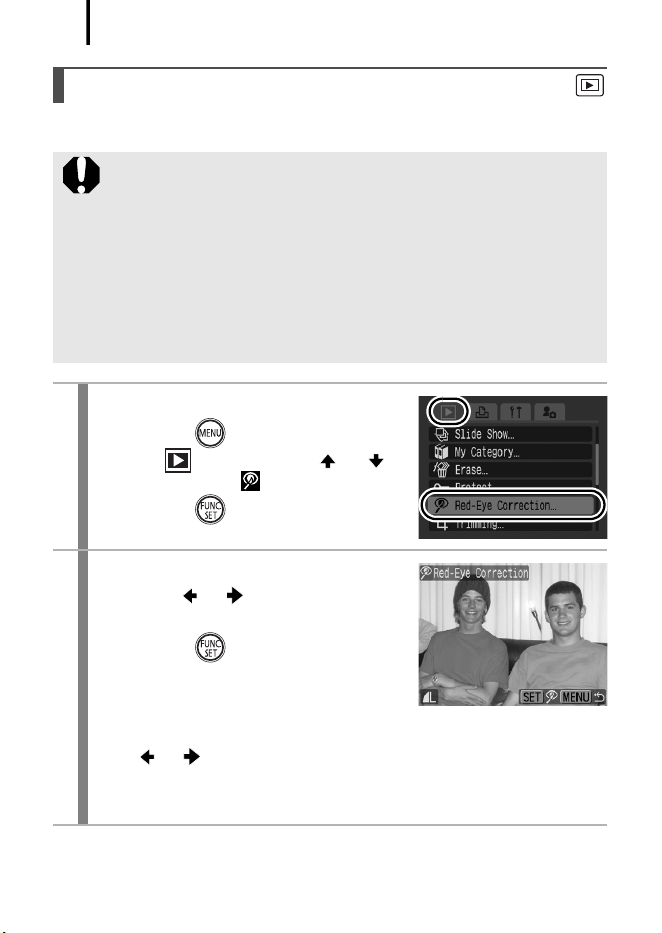
142
You can correct red eyes in recorded images.
Red-Eye Correction
Function
Red eyes may not be automatically detected in some images
or the results may not turn out as you intended.
We recommend that you use [New File] to save corrected
images.
Examples:
- Faces near the screen edges or faces that appear extremely
small, large, dark or bright in relation to the overall image.
- Faces turned to the side or at a diagonal, or faces with a
portion hidden.
1
Select [Red-Eye Correction].
1. Press the button.
2. In the menu, use the or
button to select .
3. Press the button.
2
Select an image.
1. Use the or button to select the
image you wish to correct red eyes.
2. Press the button.
• A frame will automatically display
where red-eye is detected.
• If red-eye is not automatically detected, select [Add Frame] with
the or button and press FUNC./SET button (p. 145).
• To cancel the correction frame, select [Remove Frame] and
press the FUNC./SET button (p. 146).
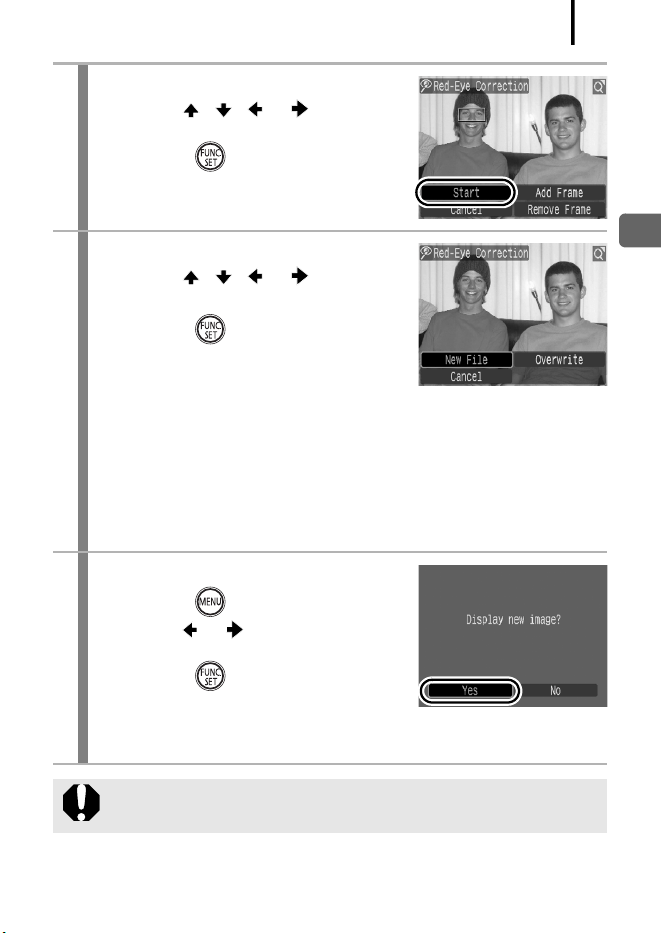
143
Playback/Erasing
3
Correct the image.
1. Use the , , or button to
select [Start].
2. Press the button.
4
Save the image.
1. Use the , , or button to
select [New File] or [Overwrite].
2. Press the button.
• [New File]: Saved as new file with a
new name. The uncorrected image is
stored. The new image is stored as the last file.
• [Overwrite]: Saved with the same file name as the uncorrected
image. The uncorrected image is erased.
• When [New File] is selected, proceed to Step 5.
• If you wish to continue correcting another image, repeat
operations from Step 2.
5
Display the saved image.
1. Press the button.
2. Use the or button to select
[Yes].
3. Press the button.
• Selecting [No] returns to the Play
menu.
z Red-eye correction cannot be performed on movies.
z Overwriting cannot be performed on protected images.
144
z When there is not enough space left on the memory card,
red-eye correction cannot be performed.
z Although you can apply red-eye correction any number of
times to an image, the image quality will gradually deteriorate
with each application.
z Since the correction frame will not appear automatically on
images that have already been corrected once with the Red-
Eye Correction function, use the [Add Frame] option to
correct them.
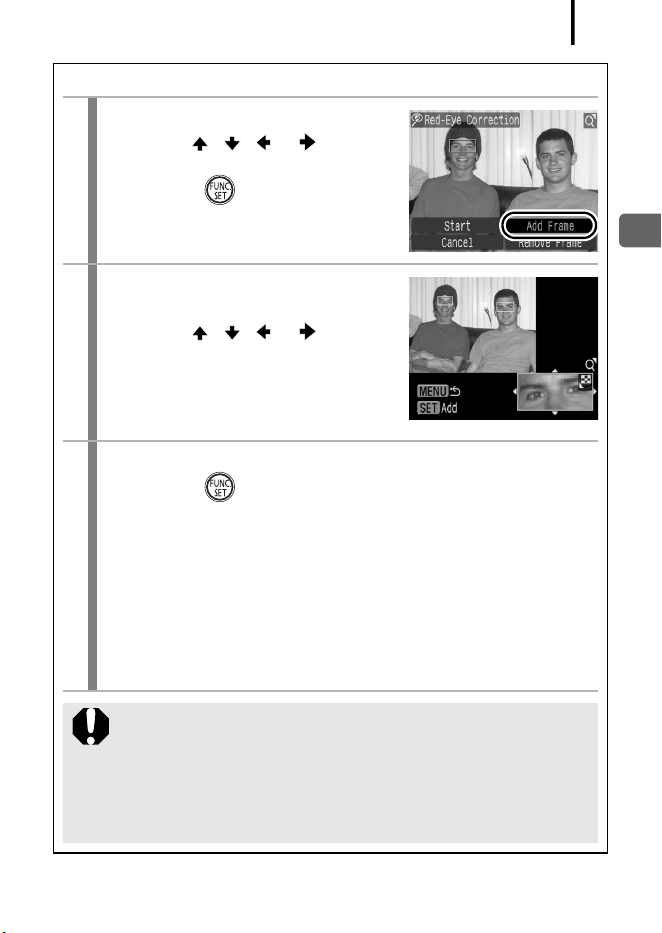
145
Playback/Erasing
Add Correction Frame
1
Select [Add Frame].
1. Use the , , or button to
select [Add Frame].
2. Press the button.
• A green frame will display.
2
Adjust the position of the
correction frame.
1. Use the , , or button to
move the frame.
• Size of the frame can be changed
with the zoom lever.
3
Add additional correction frames.
1. Press the button.
• A correction frame is added and the frame color changes to
white.
• If you wish to add additional frames, adjust the position and
press the FUNC./SET button.
• Up to 35 additional frames can be added.
• To end the adding of correction frames, press the MENU
button.
To correctly perform red-eye correction, take note of the
following (refer to the image in Step 2):
- Adjust the correction frame size so that it only surrounds
the red-eye portion to be corrected.
- When there are several subjects with red-eye, be sure to
add one correction frame per subject.
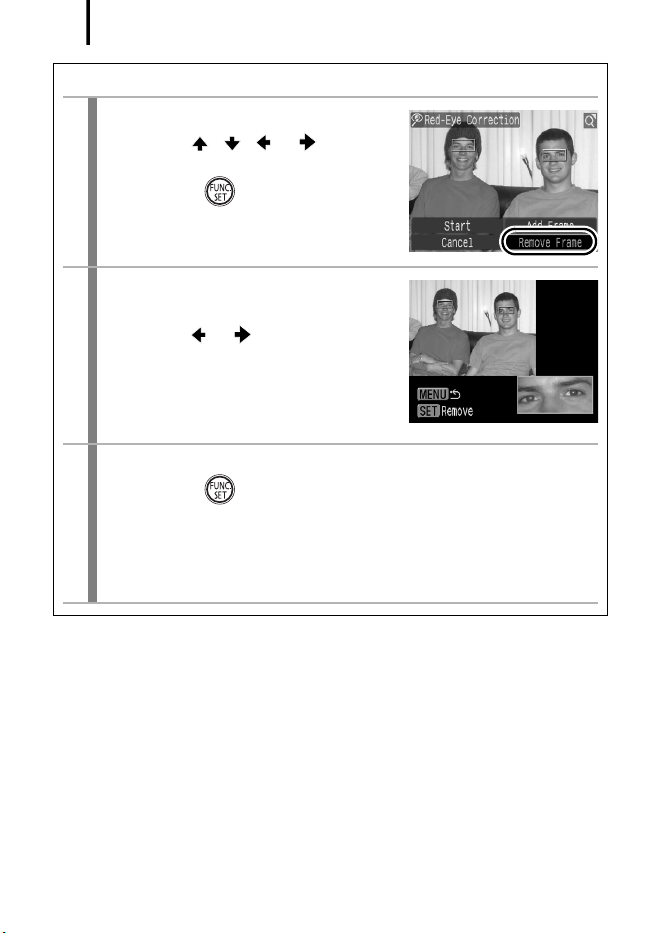
146
Removing Correction Frames
1
Select [Remove Frame].
1. Use the , , or button to
select [Remove Frame].
2. Press the button.
2
Select a frame you wish to
remove.
1. Use the or button to select a
frame to remove.
• The selected frame will appear in
green.
3
Delete the frame.
1. Press the button.
• The selected frame will disappear.
• To continue deleting frames, repeat operations from Step 2.
• When you finish deleting frames, press the MENU button.
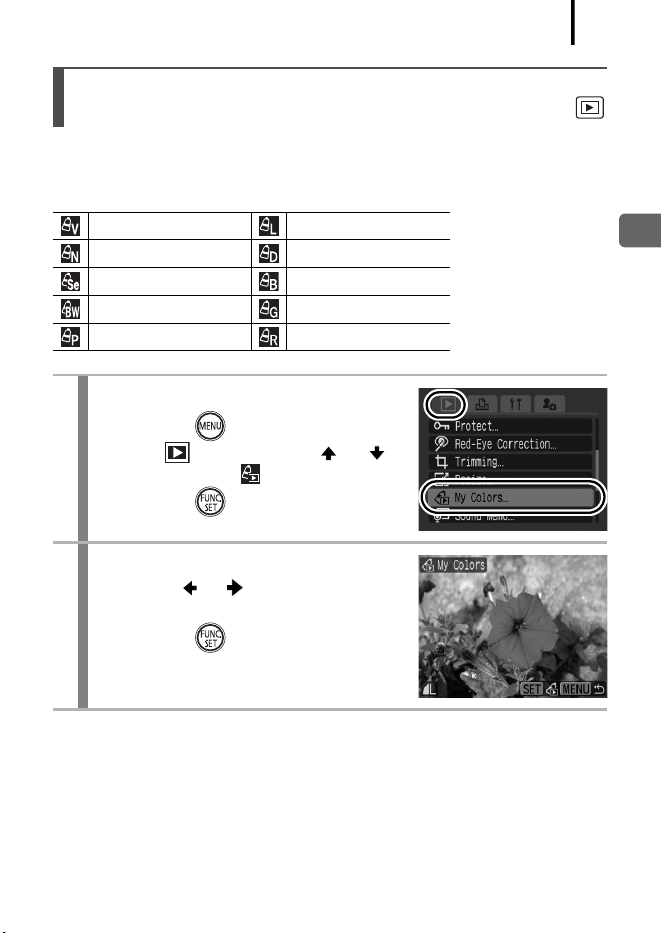
147
Playback/Erasing
You can add effects to recorded images (stills only) using the My
Colors function. The following selection of My Colors effects is
available. For details, see p. 107.
Adding Effects with the My Colors
Function
Vivid Lighter Skin Tone
Neutral Darker Skin Tone
Sepia Vivid Blue
B/W Vivid Green
Positive Film Vivid Red
1
Select [My Colors].
1. Press the button.
2. In the menu, use the or
button to select .
3. Press the button.
2
Select an image.
1. Use the or button to select an
image.
2. Press the button.
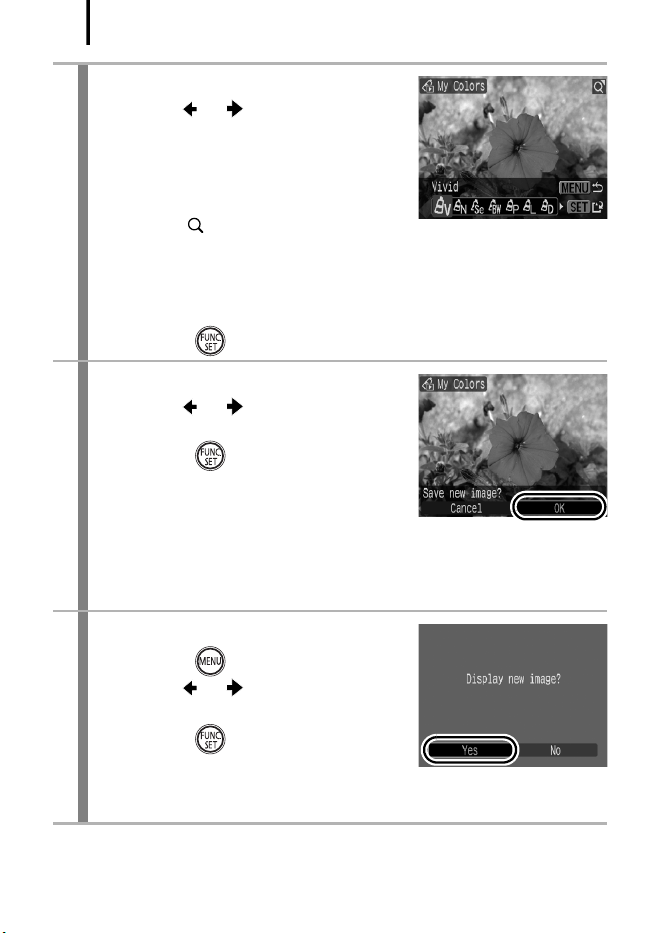
148
3
Select a My Colors type.
1. Use the or button to select the
My Colors type.
• The displayed image will reflect the
My Colors effect.
• You can press the zoom lever
toward to check the image at a
higher magnification. While the image is zoomed, you can
press the FUNC./SET button to switch between the image
transformed with the My Colors effect and the original non-
transformed image.
2. Press the button.
4
Save the image.
1. Use the or button to select
[OK].
2. Press the button.
• The newly saved image transformed
with the My Colors effect will be the
last one in the list.
• To continue adding effects to other images, repeat the
procedures from Step 2 onward.
5
Display the saved image.
1. Press the button.
2. Use the or button to select
[Yes].
3. Press the button.
• Selecting [No] returns to the Play
menu.
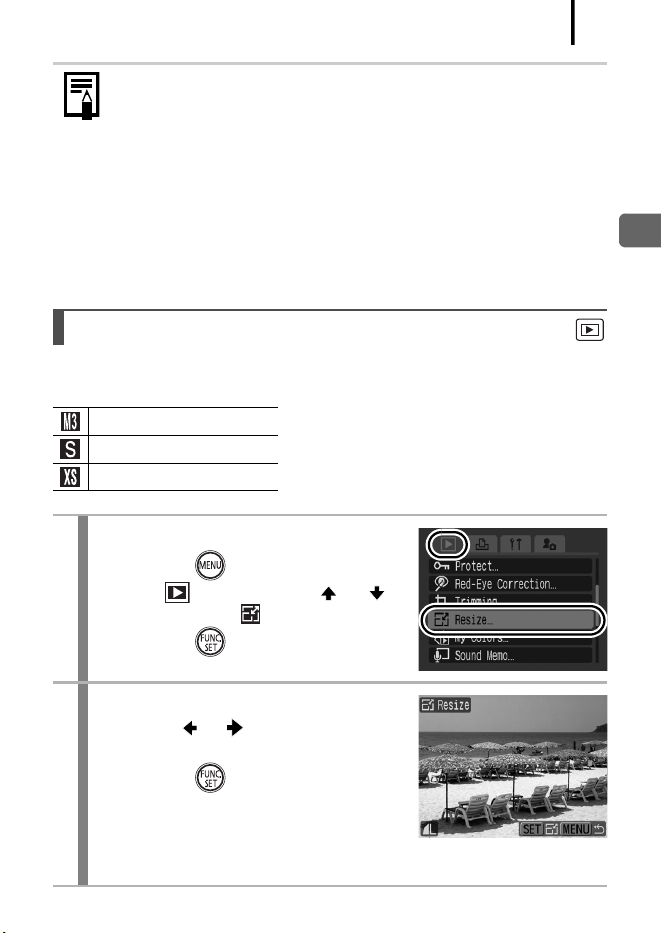
149
Playback/Erasing
You can resave images that were recorded at high recording pixel
settings at lower settings.
z When there is not enough space left on the memory card, the
My Colors effects cannot be added.
z Although My Colors effects can be added any number of
times to an image, the image quality will gradually deteriorate
with each application and the intended colors may not be
achieved.
z Color in images taken using My Colors (p. 107) in shooting
mode and images edited with the My Colors function in
playback mode may differ slightly.
Resizing Images
1600 × 1200 pixels
640 × 480 pixels
320 × 240 pixels
1
Select [Resize].
1. Press the button.
2. In the menu, use the or
button to select .
3. Press the button.
2
Select an image.
1. Use the or button to select an
image to resize.
2. Press the button.
•The FUNC./SET button is not
selectable for images that cannot be
resized.
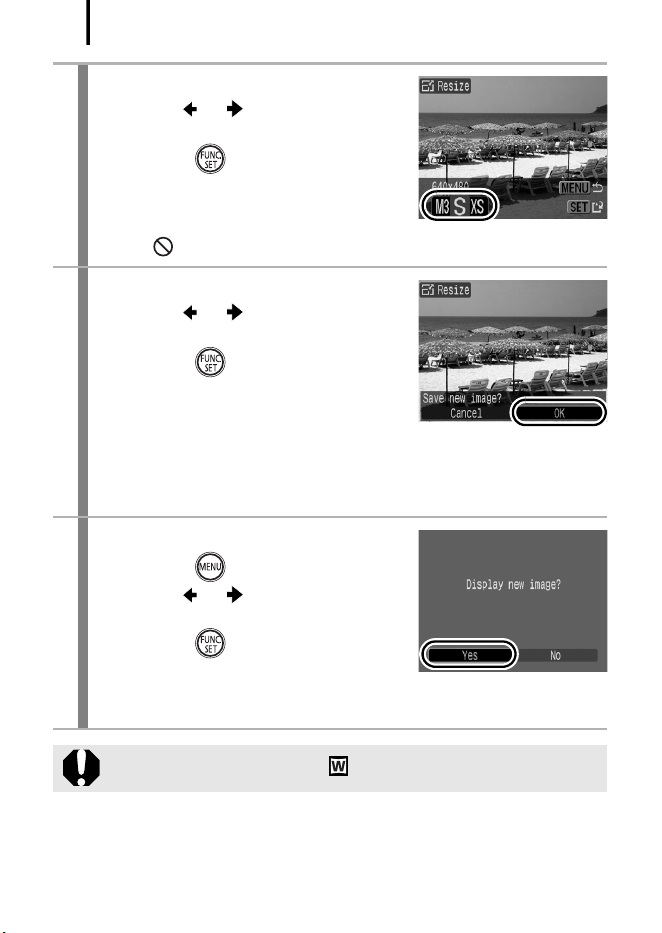
150
3
Select a resolution.
1. Use the or button to select a
resolution.
2. Press the button.
• If a resolution cannot be selected due
to a lack of free space on the memory
card, will display.
4
Save the image.
1. Use the or button to select
[OK].
2. Press the button.
• The resized image will be saved in a
new file. The original image will
remain.
• If you wish to continue resizing of another image, repeat
operations from Step 2.
5
Display the saved image.
1. Press the button.
2. Use the or button to select
[Yes].
3. Press the button.
• Selecting [No] returns to the Play
menu.
Movies and images shot in mode cannot be resized.
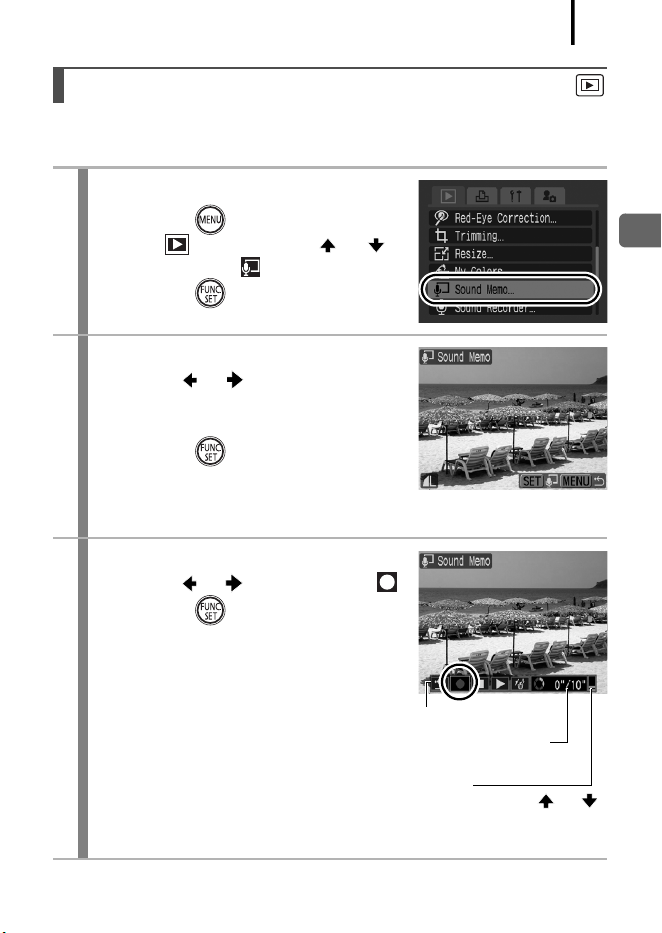
151
Playback/Erasing
In playback mode, you can attach sound memos (up to 1 min.) to an
image. The sound data is saved in the WAVE format.
Attaching
Sound Memos to Images
1
Select [Sound Memo].
1. Press the button.
2. In the menu, use the or
button to select .
3. Press the button.
2
Select an image.
1. Use the or button to select an
image to which you wish to attach a
sound memo.
2. Press the button.
• The sound memo control panel will
display.
3
Record the memo.
1. Use the or button to select .
2. Press the button.
• The elapsed time and the remaining
time display.
• Pressing the FUNC./SET button
pauses the recording. Pressing it
again resumes recording.
• Up to 1 minute of recordings can be
added to any one image.
• Press the MENU button several times
to complete the setting.
Volume
(Adjust it with the or
button)
Elapsed Time/
Remaining Time
Sound Memo Panel
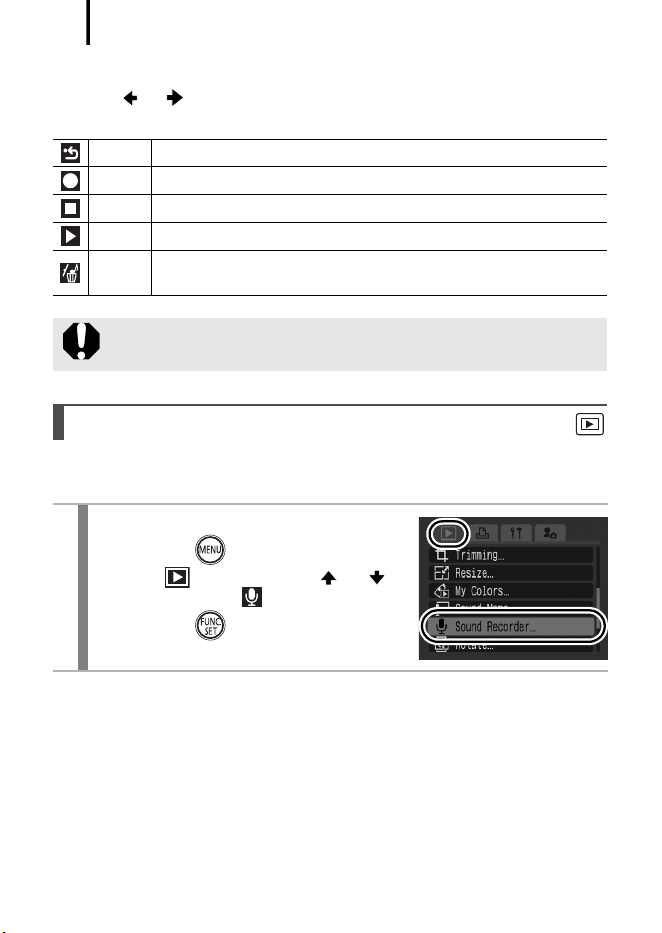
152
Sound Memo Panel
Use the or button to select an option and press FUNC./SET
button.
You can record sound only, without images, for up to two hours at one
time.
Exit Returns to the playback screen.
Record Starts recording.
Pause Pauses recording or playback.
Play Begins playback.
Erase
Erases sound memos. (Select [Erase] and in the
confirmation screen press the FUNC./SET button.)
z You cannot attach sound memos to movies.
z Sound memos for protected images cannot be erased.
Sound-Only Recording (Sound Recorder)
1
Select [Sound Recorder].
1. Press the button.
2. In the menu, use the or
button to select .
3. Press the button.
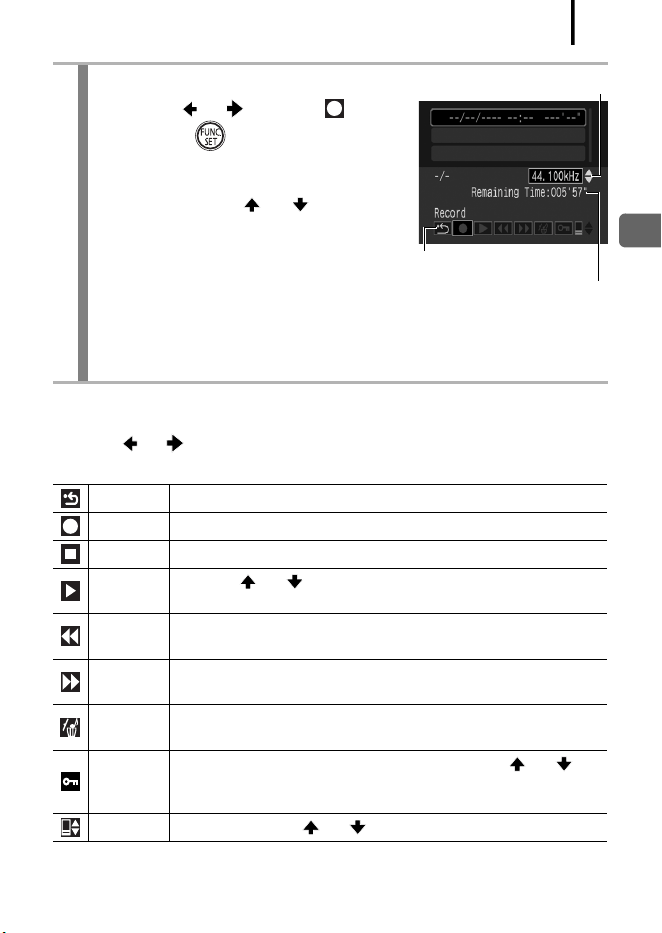
153
Playback/Erasing
Sound Recorder Panel
Use the or button to select an option and press FUNC./SET
button.
2
Record a sound.
1. Use the or to select .
2. Press the button.
• The elapsed recording time displays.
• You can use the or button to
change the sampling rate. The
recording quality rises progressively
as you select [11.025 kHz], [22.050
kHz] or [44.100 kHz], but the recorded
file sizes increase correspondingly.
• Press the FUNC./SET button to stop the recording session.
Pressing the button again starts a new recording session.
Exit Returns to the menu screen.
Record Starts recording.
Pause Stops recording, playback.
Play
Use the or button to select a sound to play and
press the FUNC./SET button.
Rewind
Holding down the FUNC./SET button rewinds. The sound
cannot be heard while rewinding.
Fast
Forward
Holding down the FUNC./SET button fast forwards. The
sound cannot be heard while fast forwarding.
Erase
Select [Erase] or [Erase all] in the confirmation screen and
press the FUNC./SET button.
Protect
Protects against accidental erasure. Use the or
button to select a sound and the FUNC./SET button to
select/deselect protection.
Volume You can use the or button to adjust the volume.
Sampling Rate
Sound Recorder Panel
Remaining Time
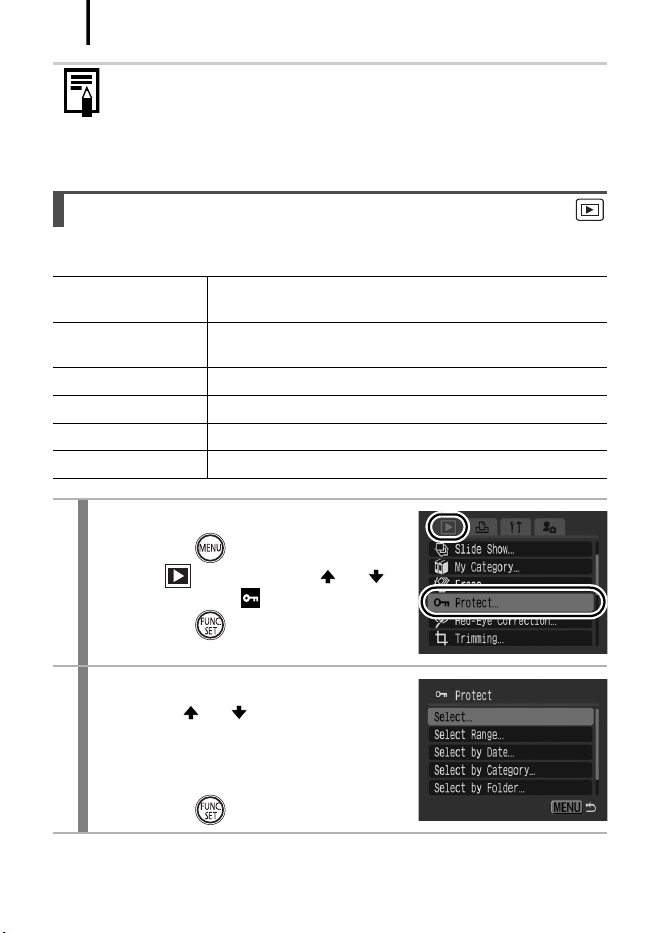
154
You can protect important images and movies from accidental erasure.
z See Sound Recorder Data Rates and Recording Durations
(Estimated) (p. 224).
z Recording will automatically stop when the memory card is
full.
Protecting Images
Select You can configure the protection settings for each
image singly while viewing them.
Select Range You can select a first and last image and protect all
the images in the range.
Select by Date You can protect the images from a specified date.
Select by Category You can protect the images in a specified category.
Select by Folder You can protect the images in a specified folder.
All Images You can protect all the images on a memory card.
1
Select [Protect].
1. Press the button.
2. In the menu, use the or
button to select .
3. Press the button.
2
Choose a selection method.
1. Use the or button to choose a
selection method.
• Pressing the MENU button returns
to the prior screen.
2. Press the button.
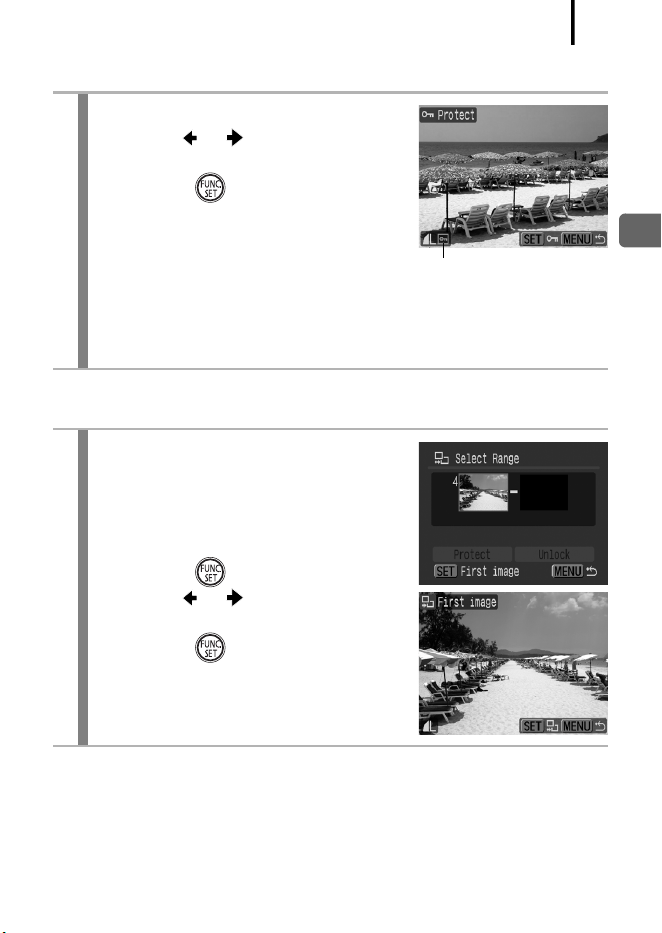
155
Playback/Erasing
[Select]
[Select Range]
3
Protect the image.
1. Use the or button to select an
image to protect.
2. Press the button.
• Pressing the FUNC./SET button again
cancels the setting.
• To continue protecting other images,
repeat the procedure.
• You can also protect images in the index playback mode.
• Press the MENU button to complete the setting.
3
Select the first image.
• You can use the control dial to select
the first or last image.
1. Press the button.
2. Use the or button to select the
first image in the range to protect.
3. Press the button.
Protection Icon
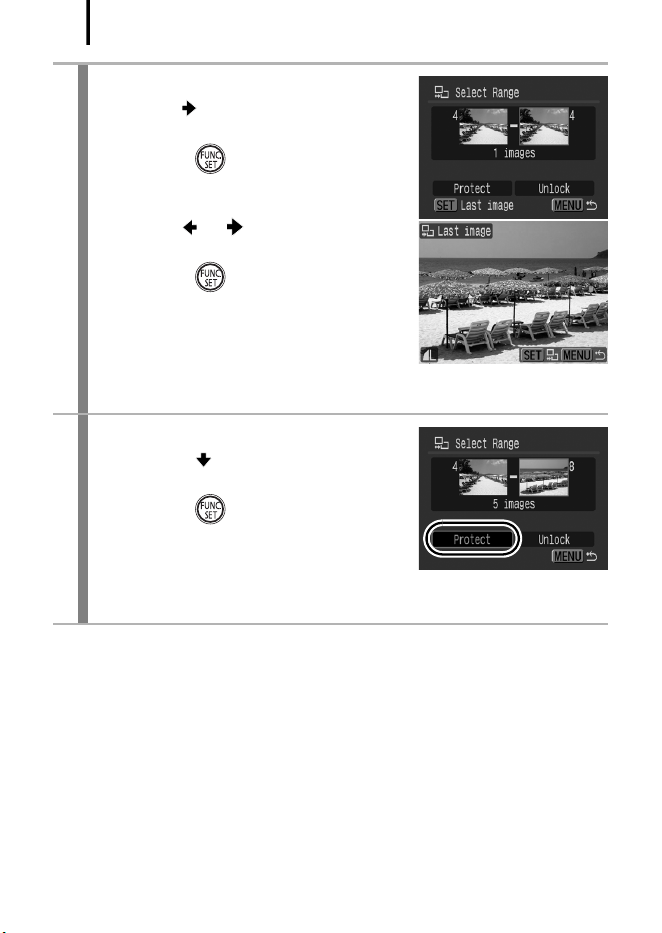
156
4
Select the last image.
1. Use the button to switch to
selecting the last image.
2. Press the button.
3. Use the or button to select the
last image in the range.
4. Press the button.
• An image with a lower number than
the first image cannot be selected as
the last image.
• Up to 500 images can be selected.
5
Protect the images.
1. Press the button to select
[Protect].
2. Press the button.
• The screen will return to the selection
method screen.
• Selecting [Unlock] cancels selection of the protected image.
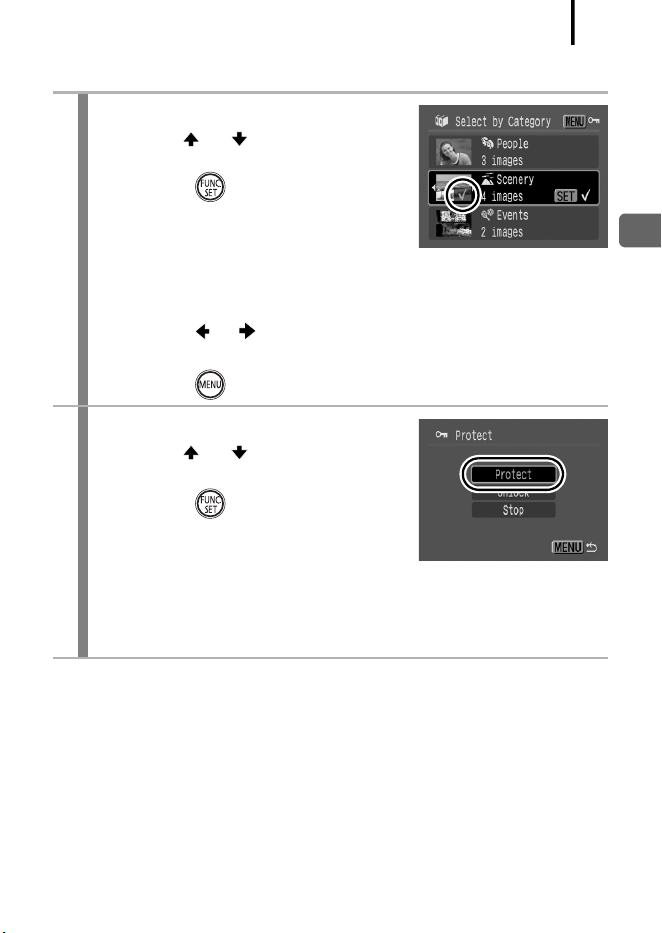
157
Playback/Erasing
[Select by Date]/[Select by Category]/[Select by Folder]
3
Select the images.
1. Use the or button to select a
date/category/folder to protect.
2. Press the button.
•A
3 will appear on selected
images.
• Pressing the FUNC./SET button
again cancels the setting.
• You can select multiple dates, categories or folders.
• Use the or button to confirm each date, category or
folder image.
3. Press the button.
4
Protect the images.
1. Use the or button to select
[Protect].
2. Press the button.
• Returns to the selection method
screen.
• Selecting [Unlock] removes protection for the selected images.
• Selecting [Stop] cancels protection settings for the current
selection.
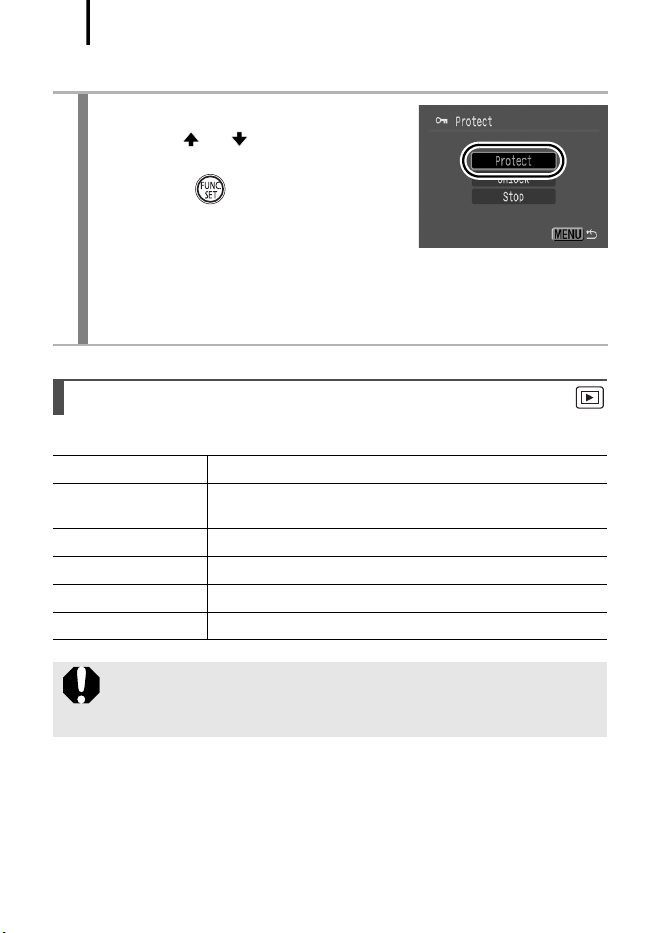
158
[All Images]
You can erase images from a memory card.
3
Protect the images.
1. Use the or button to select
[Protect].
2. Press the button.
• Returns to the selection method
screen.
• Selecting [Unlock] removes protection for all the images.
• Selecting [Stop] cancels protection settings for the current
selection.
Erasing Images
Select Erase images after selecting them one at a time.
Select Range For picking a first and last image and erasing all the
images in the range.
Select by Date Erases images corresponding to the selected date.
Select by Category Erases images in the selected category.
Select by Folder Erases images in the selected folder.
All Images Erases all images on a memory card.
z Note that erased images cannot be recovered. Exercise
adequate caution before erasing an image.
z Protected images cannot be erased with this function.
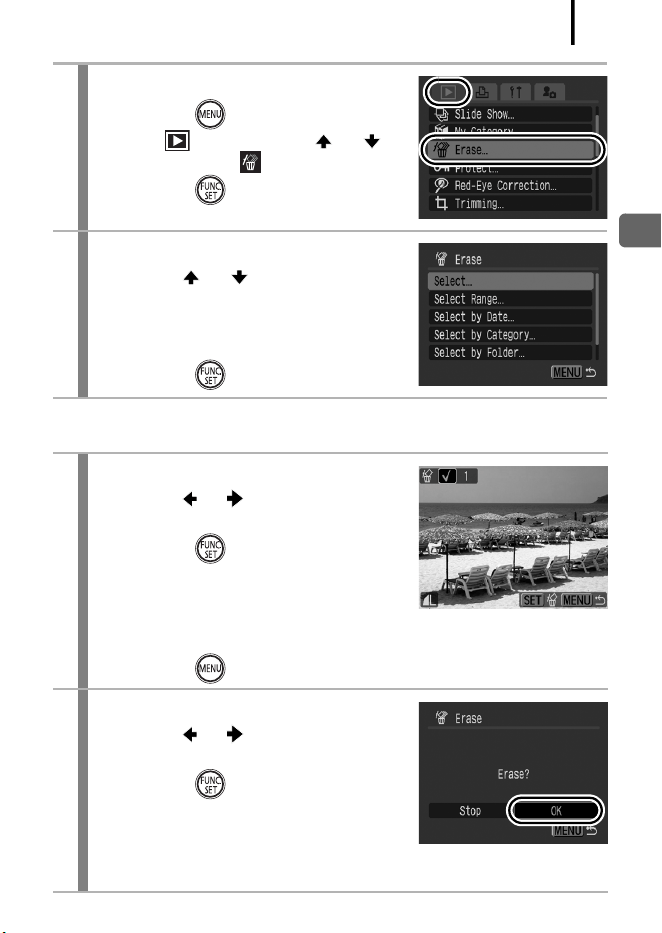
159
Playback/Erasing
[Select]
1
Select [Erase].
1. Press the button.
2. In the menu, use the or
button to select .
3. Press the button.
2
Select an erasure method.
1. Use the or button to select an
erasure method.
• Pressing the MENU button returns
to the prior screen.
2. Press the button.
3
Select the image.
1. Use the or button to select an
image to erase.
2. Press the button.
• Pressing the FUNC./SET button
again deselects the setting.
• This also can be set in the index
playback mode.
3. Press the button.
4
Erase the image.
1. Use the or button to select
[OK].
2. Press the button.
• Selecting [Stop] cancels selection of
the image you are about to erase and
returns to Step 2.
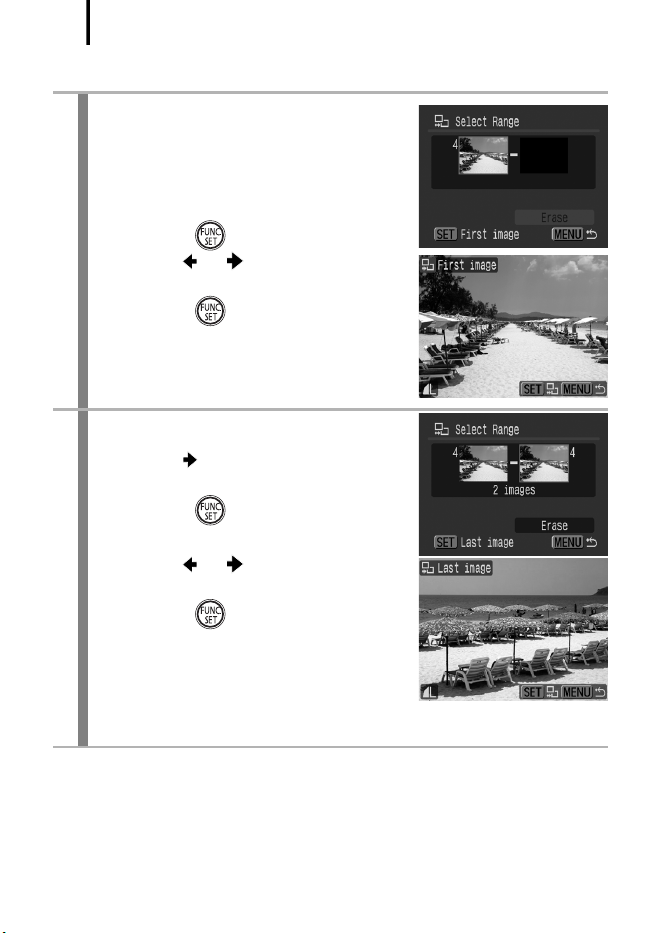
160
[Select Range]
3
Select the first image.
• You can use the control dial to select
the first or last image.
1. Press the button.
2. Use the or button to select the
first image in the range to erase.
3. Press the button.
4
Select the last image.
1. Use the button to switch to
selecting the last image.
2. Press the button.
3. Use the or button to select the
last image in the range.
4. Press the button.
• An image with a lower number than
the first image cannot be selected as
the last image.
• Up to 500 images can be selected.
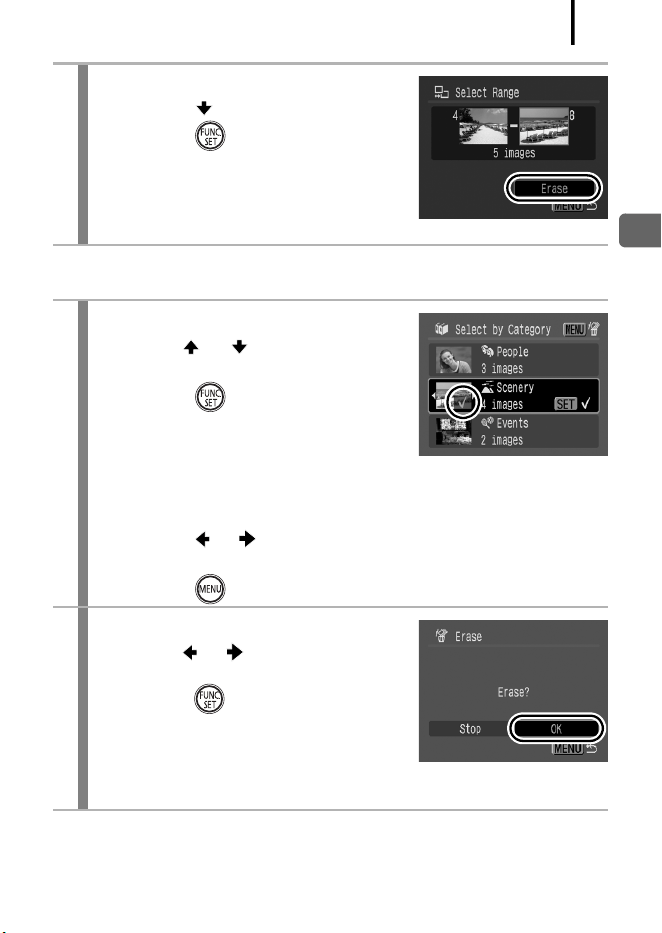
161
Playback/Erasing
[Select by Date]/[Select by Category]/[Select by Folder]
5
Erase the images.
1. Press the button to select [Erase].
2. Press the button.
• Pressing the MENU button cancels
selection of the image you are about
to erase and returns to Step 2.
3
Select the images.
1. Use the or button to select a
date/category/folder to erase.
2. Press the button.
•A
3
will appear on selected
images.
• Pressing the FUNC./SET button
again cancels the setting.
• You can select multiple dates, categories or folders.
• Use the or button to confirm each date, category or
folder image.
3. Press the button.
4
Erase the images.
1. Use the or button to select
[OK].
2. Press the button.
• Selecting [Stop] cancels selection of
the image you are about to erase and
returns to Step 2.
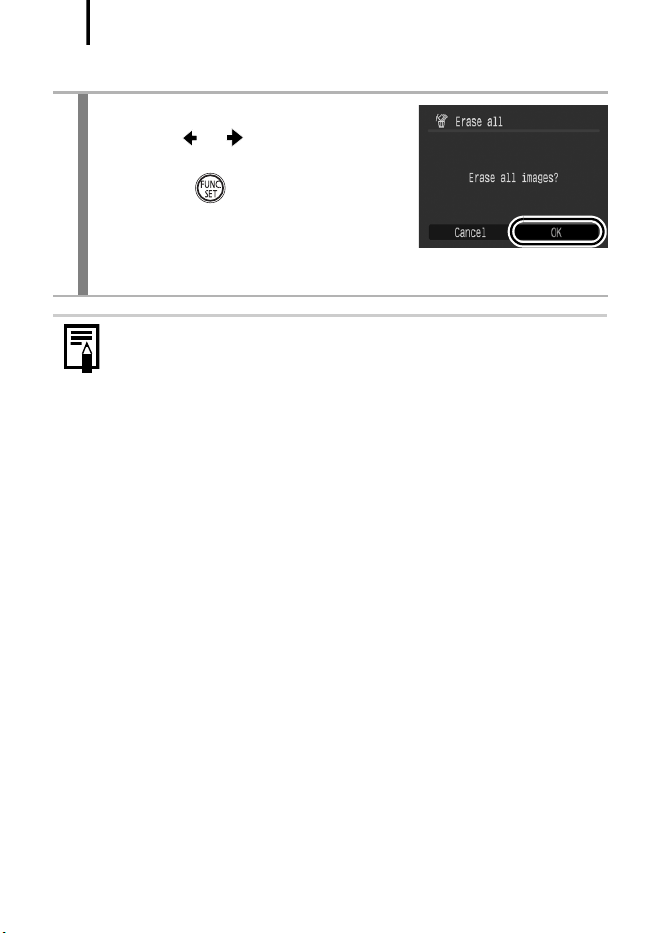
162
[All Images]
3
Erase the images.
1. Use the or button to select
[OK].
2. Press the button.
• Selecting [Cancel] cancels selection
of the image you are about to erase
and returns to Step 2.
z Pressing the FUNC./SET button while erasing is in progress
cancels the procedure.
z Please format the memory card when you want to erase not
only image data but also all the data contained on the
memory card (p. 178).
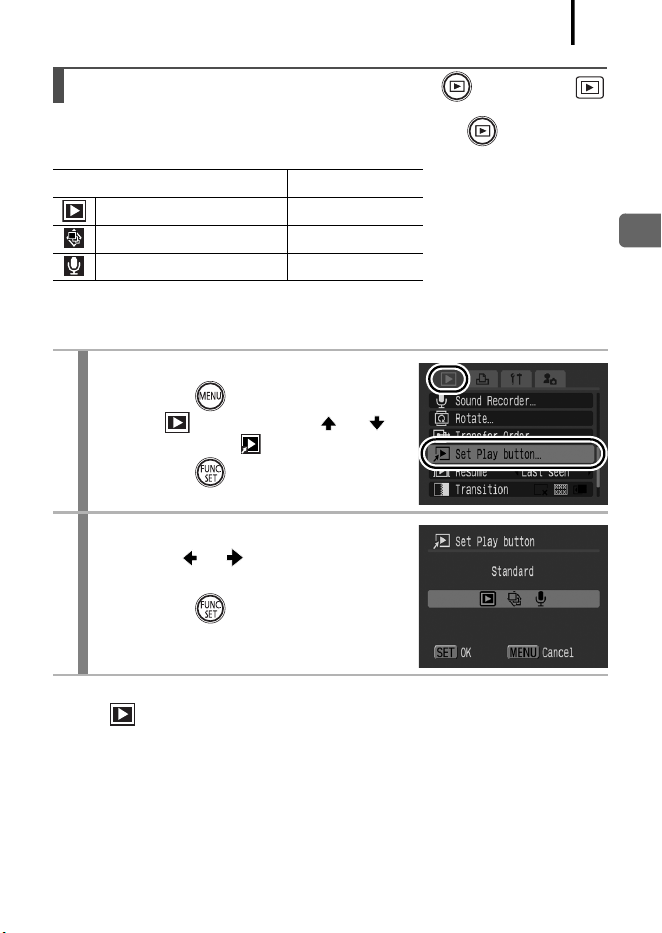
163
Playback/Erasing
You can register a function that you often use to the button. The
following functions can be registered.
*1 Default setting (It can be used to switch between power off/playback mode/shooting
mode (p. 44).
*2 Slide Show will not play in the index playback mode.
To cancel:
Select in Step 2.
Registering Functions to the Button
Function Reference Page
Standard*
1
–
Slide Show*
2
p. 136
Sound Recorder p. 152
1
Select [Set Play button].
1. Press the button.
2. In the menu, use the or
button to select .
3. Press the button.
2
Make settings.
1. Use the or button to select a
function you wish to register.
2. Press the button.
164
Using the Button
1
In playback mode, press the button.
• This will call up the registered function.
z When you press the button in shooting mode, it switches
the camera to playback mode. Then when it is pressed a
second time, the registered function is called up.
z Registering a function other than to the button
disables its ability to turn off the camera power.
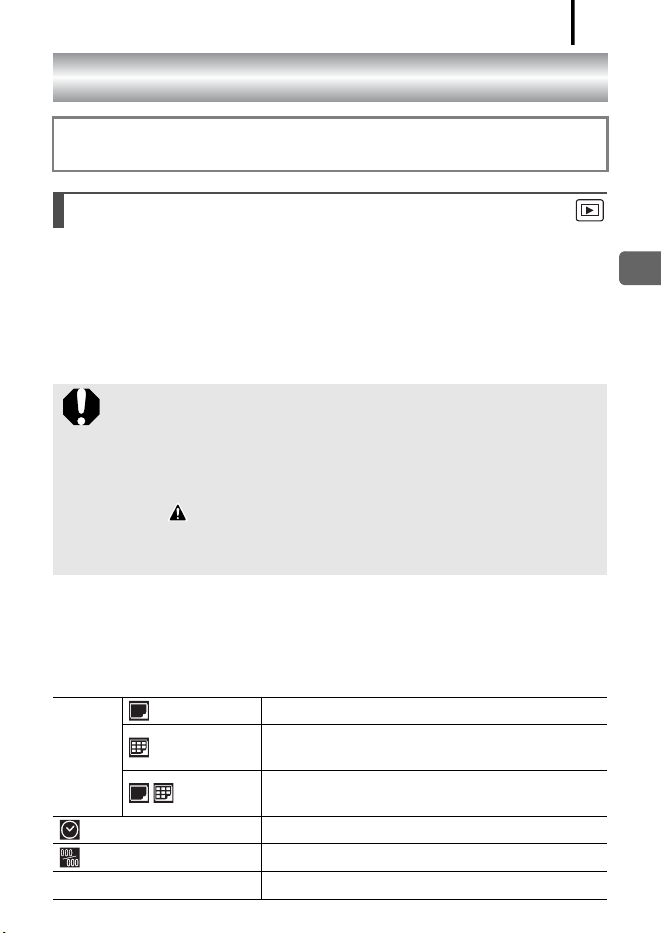
165
Print Settings/Transfer Settings
You can select images on a memory card for printing and specify the
number of print copies in advance using the camera. The settings used
on the camera comply with the Digital Print Order Format (DPOF)
standards. This is extremely convenient for printing on a direct print
compatible printer, or for sending the images to a photo developing
service that supports DPOF.
Setting the Print Style
After setting the print style, select the images for printing. The following
settings can be selected.
* Default setting
You can also use the control dial to select images and perform
various operations. See p. 43.
Setting the DPOF Print Settings
z The specified print settings are also applied to the Print List
(p. 21).
z The output of some printers or photo developing services
may not reflect the specified print settings.
z Print settings cannot be set for movies.
z The icon may display for a memory card with print
settings set by a different DPOF-compliant camera. These
settings will be overwritten by those set by your camera.
Print
Type
Standard* Prints one image per page.
Index
Prints the selected images together at a
reduced size in an index format.
Both
Prints the images in both the standard and
index formats.
Date (On/Off*) Adds the date to the print.
File No. (On/Off*) Adds the file number to the print.
Clear DPOF data (On*/Off) Clears all print settings after the images print.
Print Settings/Transfer Settings
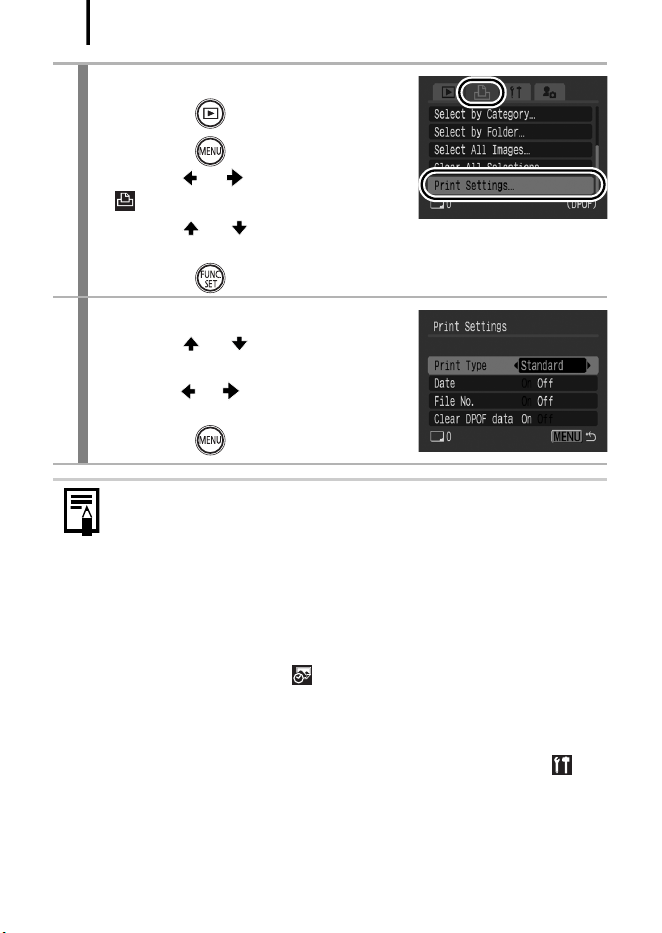
166
1
Select [Print Settings].
1. Press the button.
2. Press the button.
3. Use the or button to select the
menu.
4. Use the or button to select
[Print Settings].
5. Press the button.
2
Make settings.
1. Use the or button to select an
option.
2. Use the or button to specify the
settings.
3. Press the button.
z The Date and File No. settings change according to the Print
Type as follows.
- [Index]:
[Date] and [File No.] cannot be set to [On] at the same time.
- [Standard] or [Both]:
[Date] and [File No.] can be set to [On] at the same time,
however, the printable information may vary between
printers.
z Images dated using (Date Stamp) (p. 22) are always
printed with the date, regardless of the [Date] setting. As a
result, some printers may print the date twice on these
images if [Date] is also set to [On].
z Dates print in the style specified in [Date/Time] in the
menu (pp. 14, 58).
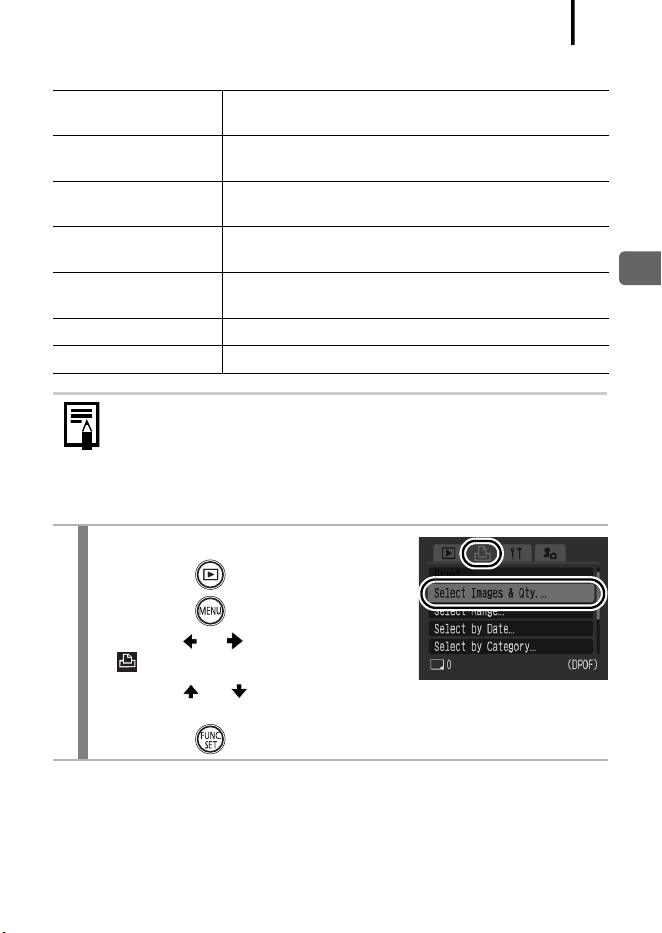
167
Print Settings/Transfer Settings
Select a print settings method
Select Images & Qty.
Configures print settings for single images as you
view them.
Select Range
For picking a first and last image and printing all the
images in the range.
Select by Date
Configures print settings for images corresponding
to the selected date.
Select by Category
Configures print settings for images in the selected
category.
Select by Folder
Configures print settings for images in the selected
folder.
Select All Images Configures print settings for all images.
Clear All Selections Removes all print settings from images.
Only one copy will be printed for each selected image.With the
[Select Images & Qty.] option, you can only set the number of
copies to print when the [Print Type] option is set to [Standard]
or [Both] (p. 165).
1
Choose a selection method.
1. Press the button.
2. Press the button.
3. Use the or button to select the
menu.
4. Use the or button to choose a
selection method.
5. Press the button.
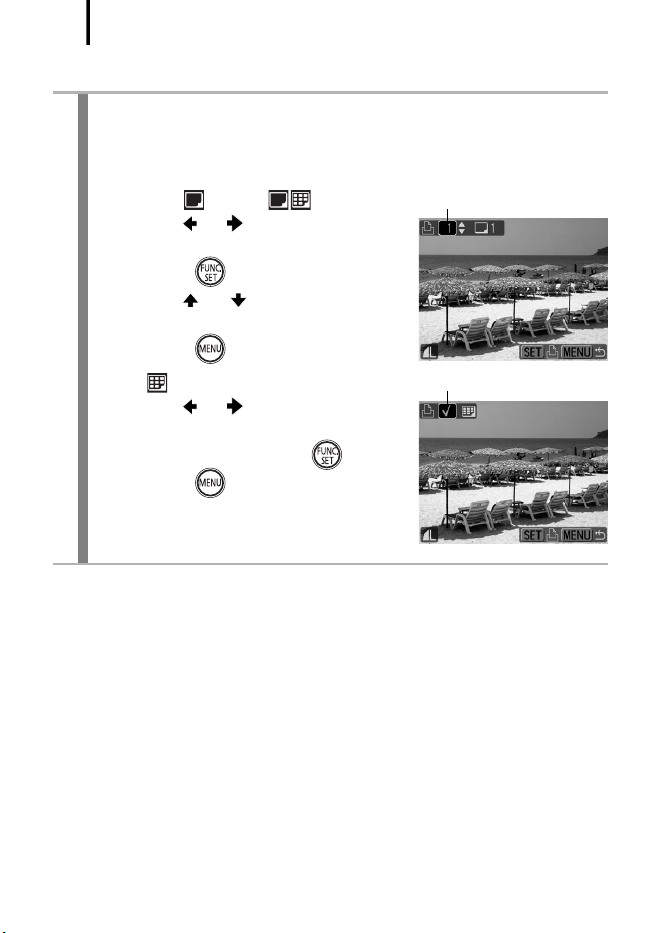
168
[Select Images & Qty.]
2
Select the images.
Selection methods differ depending on the Print Type settings
(p. 165).
Standard ( )/Both ( )
1. Use the or button to select the
images.
2. Press the button.
3. Use the or button to select the
number of print copies (up to 99).
4. Press the button.
Index (
)
1. Use the or button to select the
images.
2. Select and deselect with button.
3. Press the button.
• This also can be set in the index
playback mode.
Number of Print Copies
Index Print Selection
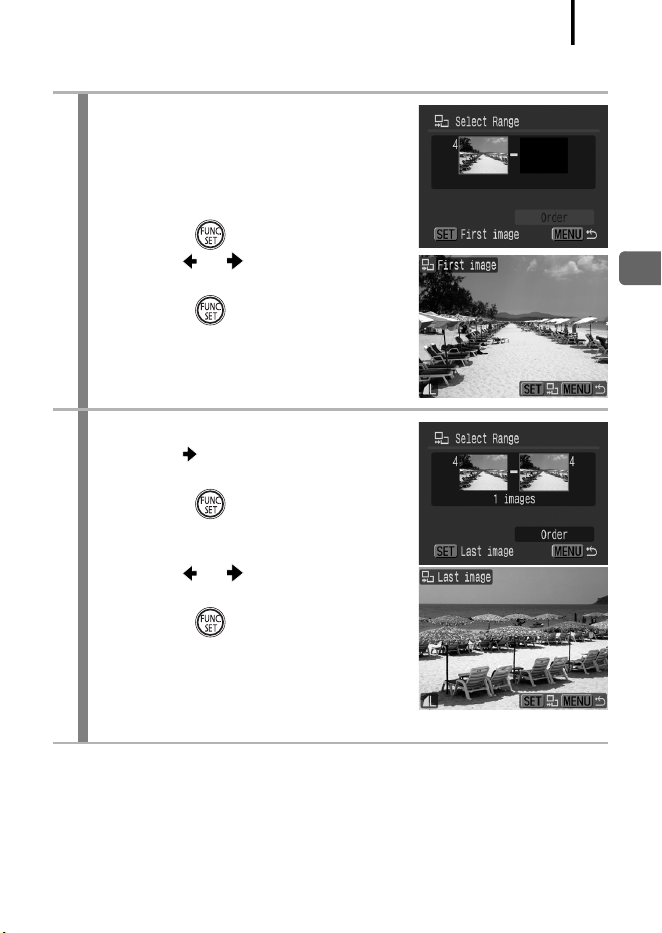
169
Print Settings/Transfer Settings
[Select Range]
2
Select the first image.
• You can use the control dial to select
the first or last image.
1. Press the button.
2. Use the or button to select the
first image in the print range.
3. Press the button.
3
Select the last image.
1. Use the button to switch to
selecting the last image.
2. Press the button.
3. Use the or button to select the
last image in the range.
4. Press the button.
• An image with a lower number than
the first image cannot be selected as
the last image.
• Up to 500 images can be selected.
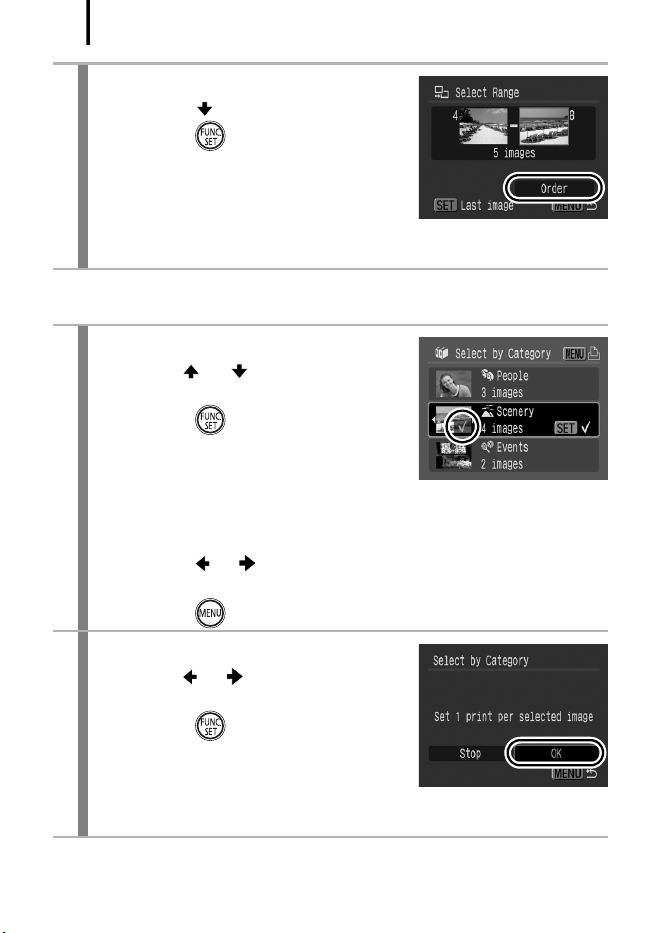
170
[Select by Date]/[Select by Category]/[Select by Folder]
4
Configure the print settings.
1. Press the button to select [Order].
2. Press the button.
• The screen will return to the selection
method screen.
• Pressing the MENU button cancels
the print settings for the selected range of images.
2
Select the images.
1. Use the or button to select a
date/category/folder to print.
2. Press the button.
•A
3
will appear on selected
images.
• Pressing the FUNC./SET button
again cancels the setting.
• You can select multiple dates, categories or folders.
• Use the or button to confirm each date, category or
folder image.
3. Press the button.
3
Configure the print settings.
1. Use the or button to select
[OK].
2. Press the button.
• The screen will return to the selection
method screen.
• Selecting [Stop] cancels print settings of the selected image.
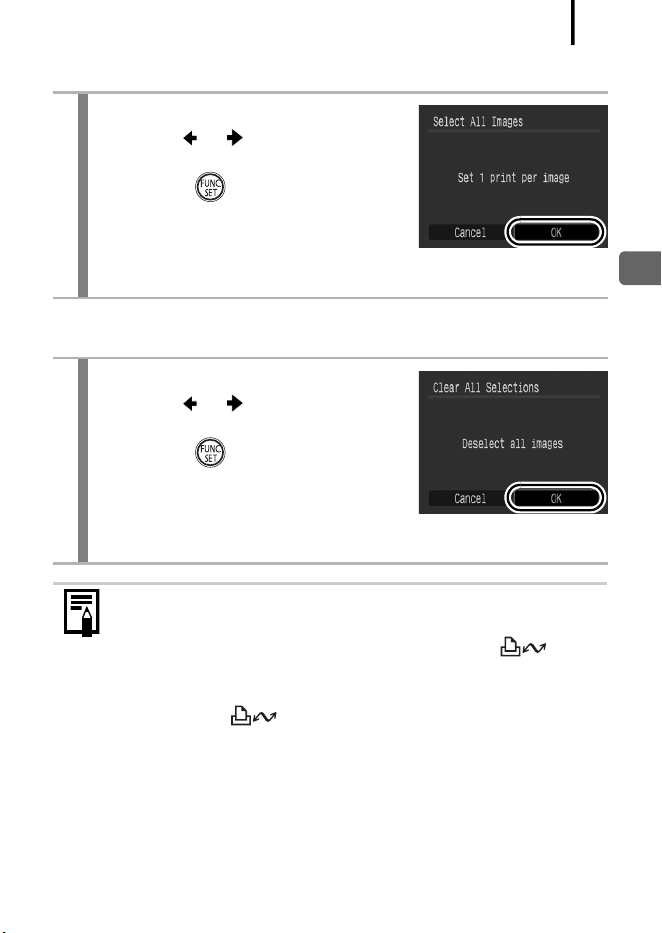
171
Print Settings/Transfer Settings
[Select All Images]
[Clear All Selections]
2
Configure the print settings.
1. Use the or button to select
[OK].
2. Press the button.
• The screen will return to the selection
method screen.
• Selecting [Cancel] cancels print settings of the selected image.
2
Deselect the images.
1. Use the or button to select
[OK].
2. Press the button.
• The screen will return to the selection
method screen.
• Selecting [Cancel] cancels the operation.
z Images are printed in order according to the file number.
z A maximum of 998 images can be selected.
z When the camera is connected to a printer, the button
will light blue. At this time, printing will begin after performing
the following.
1 Press the button.
2 Confirm that [Print] is selected, then press the FUNC./SET
button.
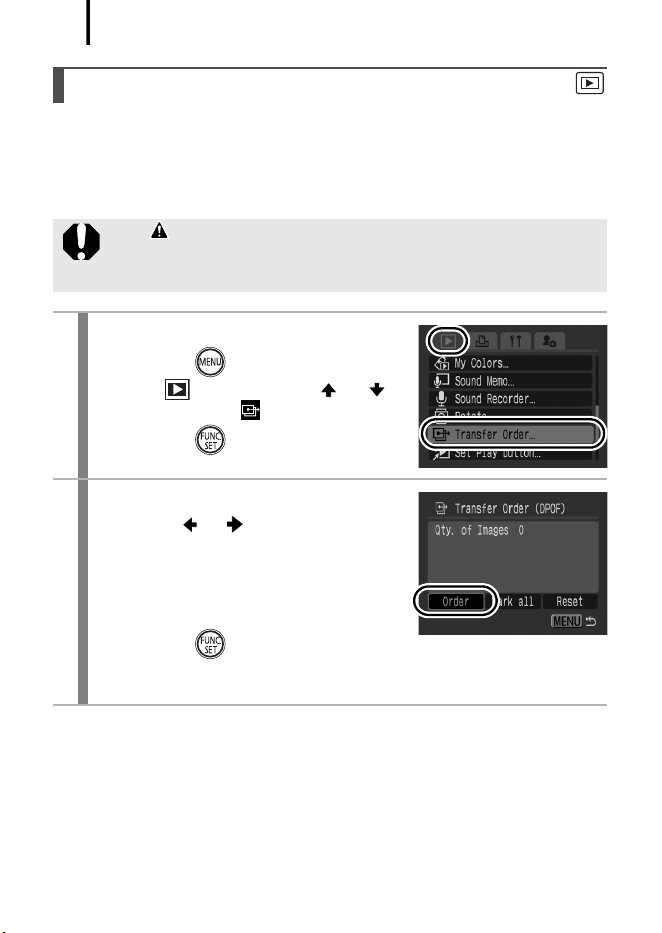
172
You can use the camera to specify settings for images before
downloading to a computer. Refer to the Software Starter Guide for
instructions on how to transfer images to your computer. The settings
used on the camera comply with the DPOF standards.
Setting the DPOF Transfer Settings
The icon may display for a memory card with transfer
settings set by a different DPOF-compliant camera. These
settings will be overwritten by those set by your camera.
1
Select [Transfer Order].
1. Press the button.
2. In the menu, use the or
button to select .
3. Press the button.
2
Select an order method.
1. Use the or button to select an
order method.
Order : Select single images.
Mark all : Select all the images on a
memory card.
2. Press the button.
• Selecting [Reset] cancels all transfer order settings.
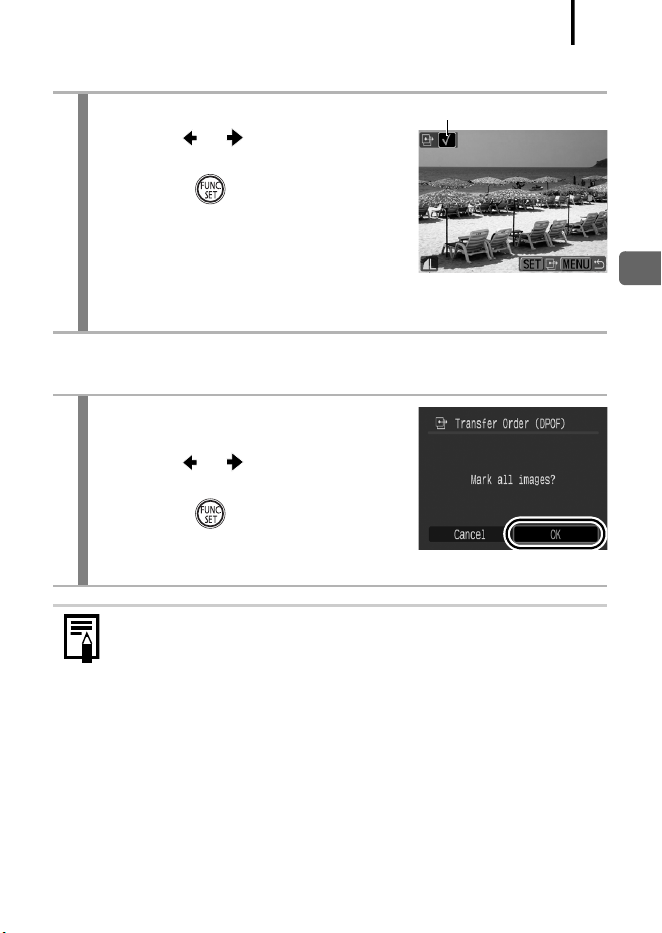
173
Print Settings/Transfer Settings
Single Images
Mark all
3
Select an image to transfer.
1. Use the or button to select an
image to transfer.
2. Press the button.
• Pressing the FUNC./SET button
again deselects the setting.
• You can also select images in the
index playback mode.
• Press the MENU button to end the setting.
3
Execute the transfering
images.
1. Use the or button to select
[OK].
2. Press the button.
• Press the MENU button to end the
setting.
z Images are transferred in order according to the file number.
z A maximum of 998 images can be selected.
Transfer Selection
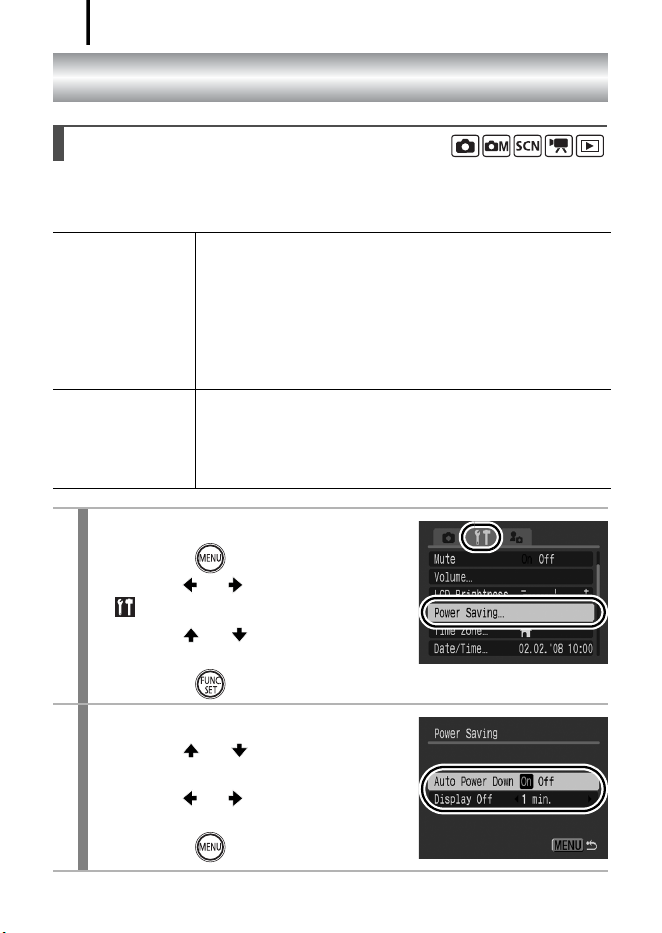
174
Configuring the Camera
This camera is equipped with a power saving function, which can
automatically turn off the power or LCD monitor.
Power Saving Function
Auto Power Down When set to [On], the power will shut off in the following
circumstances. Press the ON/OFF button again to
restore power.
Shooting mode: Approximately 3 minutes after the last
control is accessed on the camera
Playback mode or when connected to a printer:
Approximately 5 minutes after the last control is
accessed on the camera.
Display Off In shooting mode, the LCD monitor automatically turns
off after the selected time if no control is accessed,
regardless of the [Auto Power Down] setting. Press any
button other than the ON/OFF button or change the
camera orientation to turn the LCD monitor back on.
1
Select [Power Saving].
1. Press the button.
2. Use the or button to select the
menu.
3. Use the or button to select
[Power Saving].
4. Press the button.
2
Make settings.
1. Use the or button to select an
option.
2. Use the or button to make
settings.
3. Press the button.
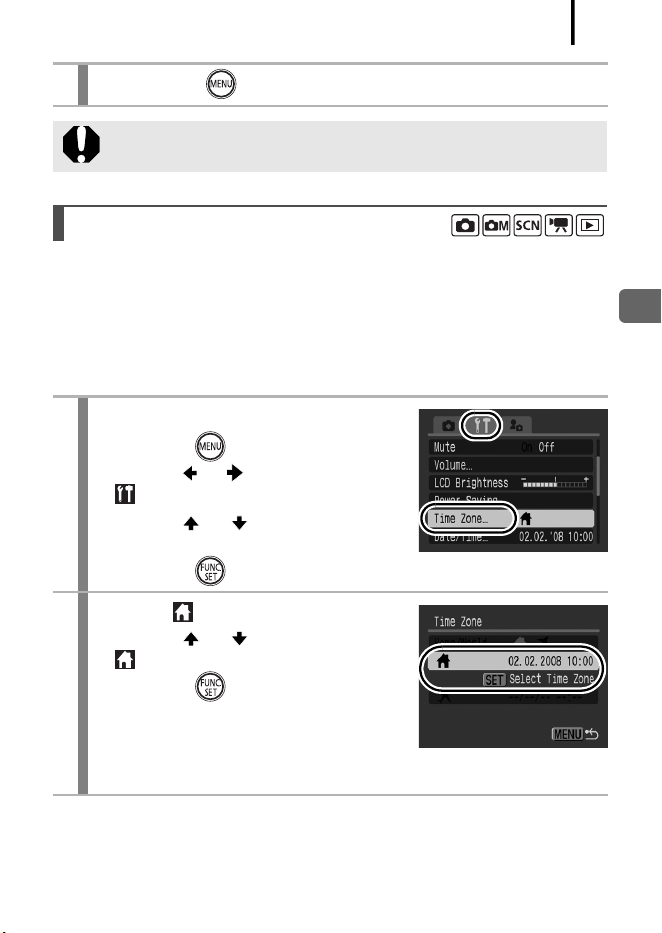
175
Configuring the Camera
When traveling abroad, you can record images with local dates and
times simply by switching the time zone setting if you pre-register the
destination time zones. You can enjoy the convenience of not having
to switch the Date/Time settings.
Setting the Home/World Time Zones
3
Press the button.
The power saving function will not activate during a slide show
or while the camera is connected to a computer.
Setting the World Clock
1
Select [Time Zone].
1. Press the button.
2. Use the or button to select the
menu.
3. Use the or button to select
[Time Zone].
4. Press the button.
2
Select (Home).
1. Use the or button to select
.
2. Press the button.
• When using for the first time, confirm
that the screen to the right appears,
then press the FUNC./SET button.
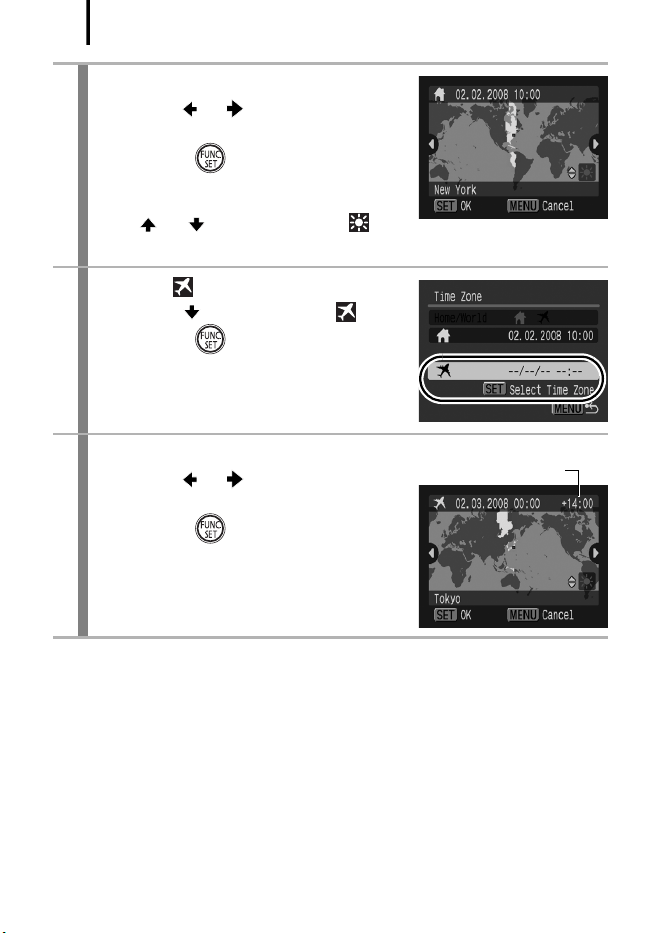
176
3
Select an area as home.
1. Use the or button to select a
home time zone.
2. Press the button.
• To set the daylight saving option, use
the or button to display .
The time will advance by 1 hour.
4
Select (World).
1. Use the button to select .
2. Press the button.
5
Select a destination area.
1. Use the or button to select a
destination time zone.
2. Press the button.
• As in Step 3, you can set daylight
saving time.
Time Difference from
the Home Time Zone
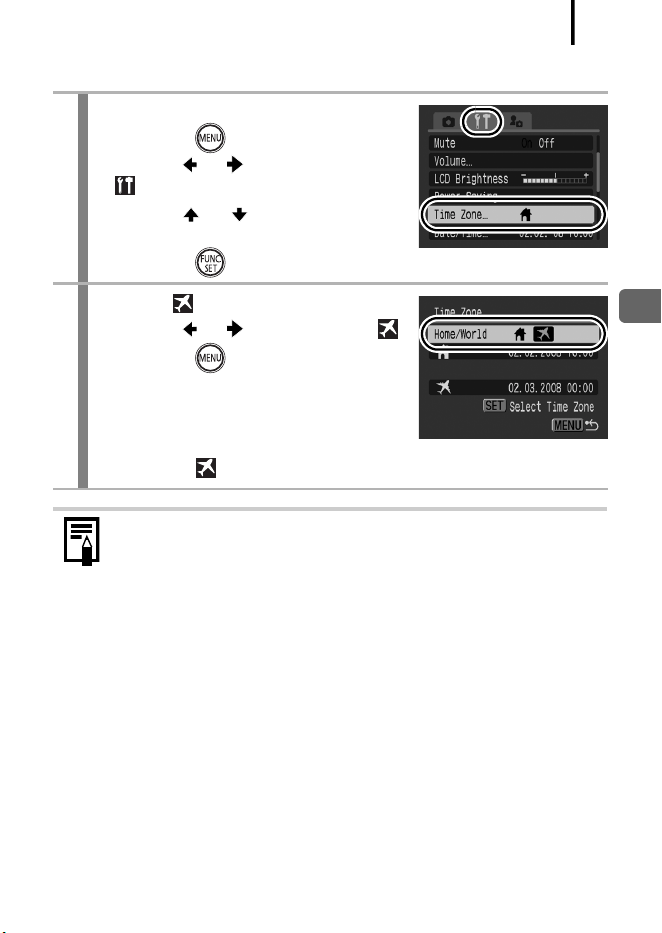
177
Configuring the Camera
Switching to the Destination Time Zone
1
Select [Time Zone].
1. Press the button.
2. Use the or button to select the
menu.
3. Use the or button to select
[Time Zone].
4. Press the button.
2
Select (World).
1. Use the or button to select .
2. Press the button twice.
• To change the destination time zone,
use the FUNC./SET button.
• When you switch to the destination
time zone, will display on the LCD monitor.
If you change the date and time when the World option is
selected, the Home date and time will also change
automatically.
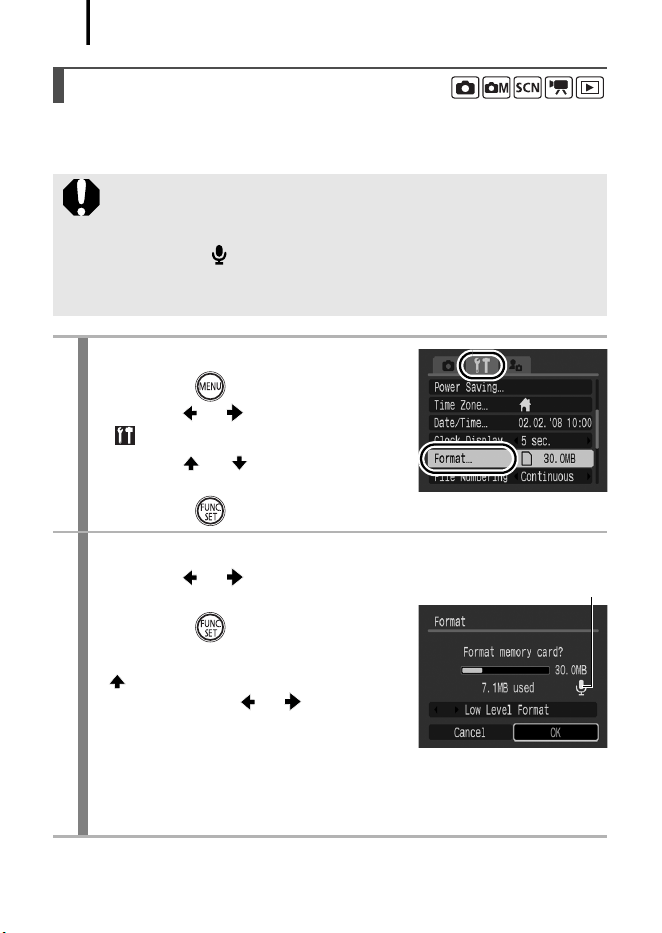
178
You should always format a new memory card or one from which you
wish to erase all images and other data.
Formatting Memory Cards
z Please note that formatting (initializing) a memory card
erases all data, including protected images and other file
types.
z When the icon is displayed, sound data recorded with the
sound recorder exists. Exercise adequate caution before
formatting the memory card.
1
Select [Format].
1. Press the button.
2. Use the or button to select the
menu.
3. Use the or button to select
[Format].
4. Press the button.
2
Make settings.
1. Use the or button to select
[OK].
2. Press the button.
• To perform a low level format, use the
button to select [Low Level
Format] and the or button to
add a check mark.
• You can stop formatting a memory
card when [Low Level Format] is selected by pressing the
FUNC./SET button. You can still use a memory card without
problem when formatting is halted, but its data will be erased.
Displays when sound data
recorded with the sound
recorder is present (p. 152)
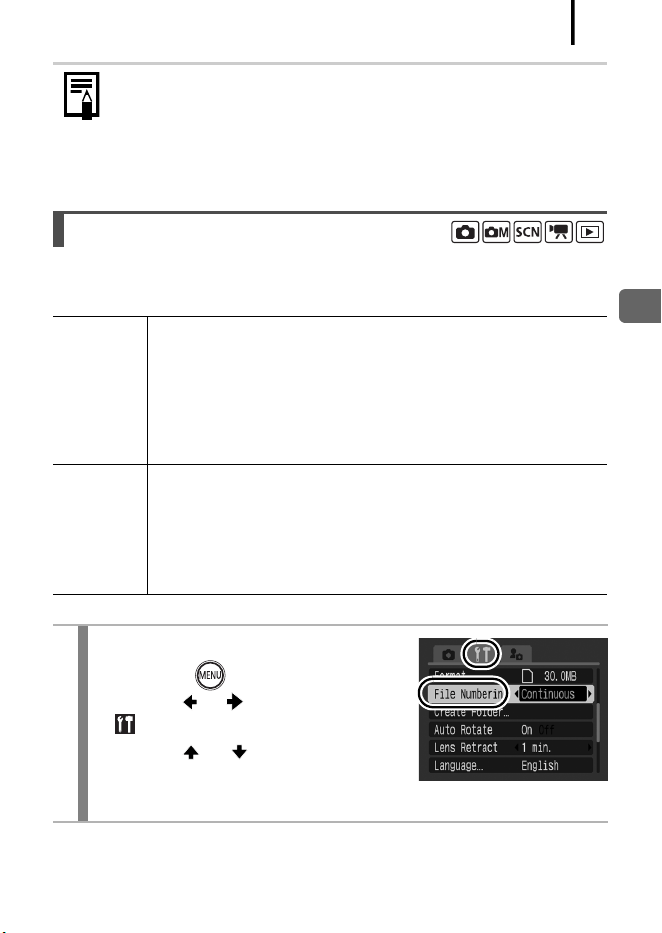
179
Configuring the Camera
The images you shoot are automatically assigned file numbers. You
can select how the file number is assigned.
Low Level Format
We recommend you select [Low Level Format] when you think
that the recording/reading speed of a memory card has
dropped. A low level format may require 2 to 3 minutes with
some memory cards.
Resetting the File Number
Continuous
A number one higher than the last one recorded is assigned
to the next image. This is convenient for managing all your
images together on a computer because you avoid file name
duplication when changing folders or memory cards.*
* When a blank memory card is used. If a memory card with recorded
data is used, the 7-digit number for the last recorded folder and
image is compared with the last one on the memory card, and the
larger of the two is utilized as the basis for new images.
Auto Reset
The image and folder number are reset to the starting value
(100-0001).* This is convenient for managing images on a
folder-by-folder basis.
* When a blank memory card is used. If a memory card with recorded
data is used, the number following the 7-digit number for the last
recorded folder and image on the memory card is utilized as the
basis for new images.
1
Select [File Numbering].
1. Press the button.
2. Use the or button to select the
menu.
3. Use the or button to select
[File Numbering].
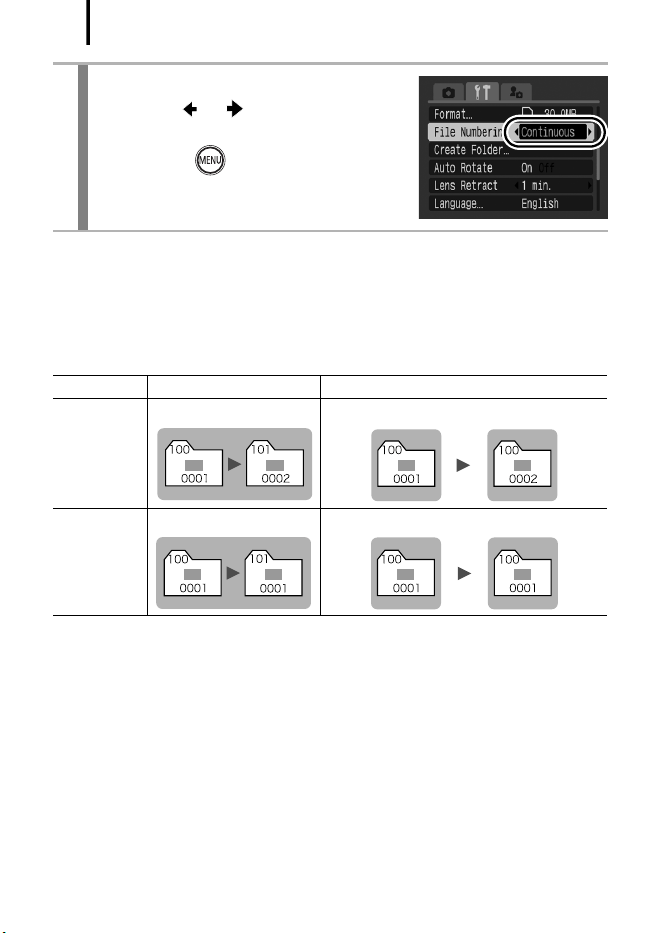
180
File and Folder Numbers
Recorded images are assigned consecutive file numbers starting with
0001 and ranging up to 9999, while folders are assigned numbers
starting with 100 and ranging up to 999. Up to 2000 images can be
saved into a single folder.
• Images may be saved to a new folder when there is insufficient free space even if the
total number of images in a folder is less than 2000 because the following types of
images are always saved together into the same folder.
- Images from continuous shooting
- Self-timer images (custom)
- Stitch Assist mode images
- Still images shot in Color Accent/Color Swap mode with the [Save Original] category
set to [On].
• Images cannot be played back when the folder numbers are duplicated or image
numbers are duplicated within folders.
• Please refer to the Software Starter Guide for information regarding folder structures
or image types.
2
Make settings.
1. Use the or button to select a
file numbering setting.
2. Press the button.
New Folder Created Memory Card Exchanged for Another
Continuous
Memory Card 1
Memory Card 1 Memory Card 2
Auto Reset
Memory Card 1 Memory Card 1 Memory Card 2
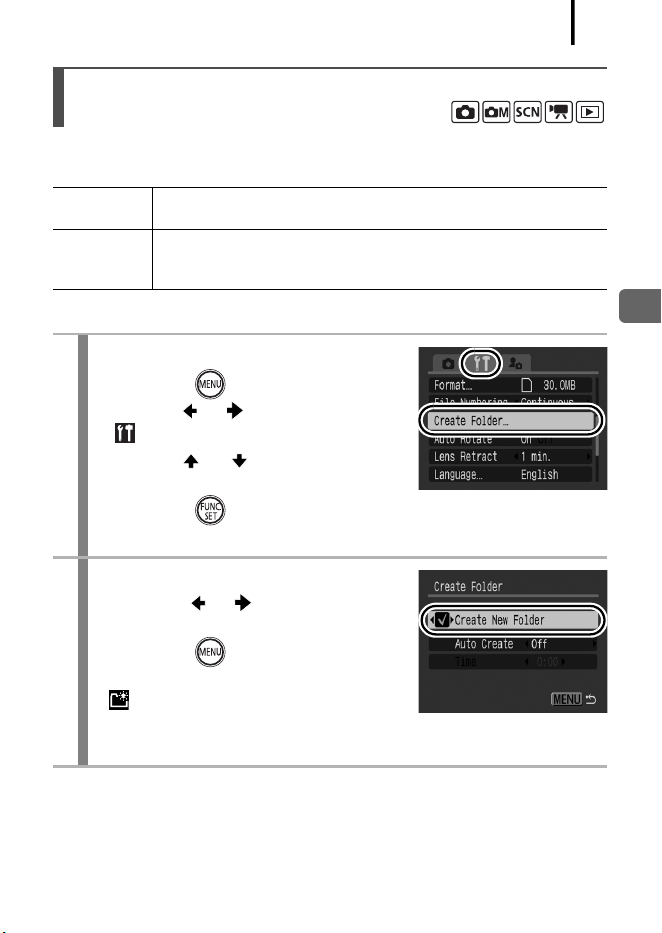
181
Configuring the Camera
You can create a new folder at any time and the recorded images will
be automatically saved to that folder.
Creating a Folder the Next Time You Shoot
Creating an Image Destination (Folder)
Create New
Folder
Creates a new folder the next time you shoot images. To
create an additional folder, insert the check mark again.
Auto Create
You can also specify a date and time if you wish to create a
new folder using a shooting time after the specified date and
time.
1
Select [Create Folder].
1. Press the button.
2. Use the or button to select the
menu.
3. Use the or button to select
[Create Folder].
4. Press the button.
2
Make settings.
1. Use the or button to check
mark [Create New Folder].
2. Press the button twice.
• will be displayed on the LCD
monitor when shooting. The symbol
will disappear from the screen when a new folder is created.
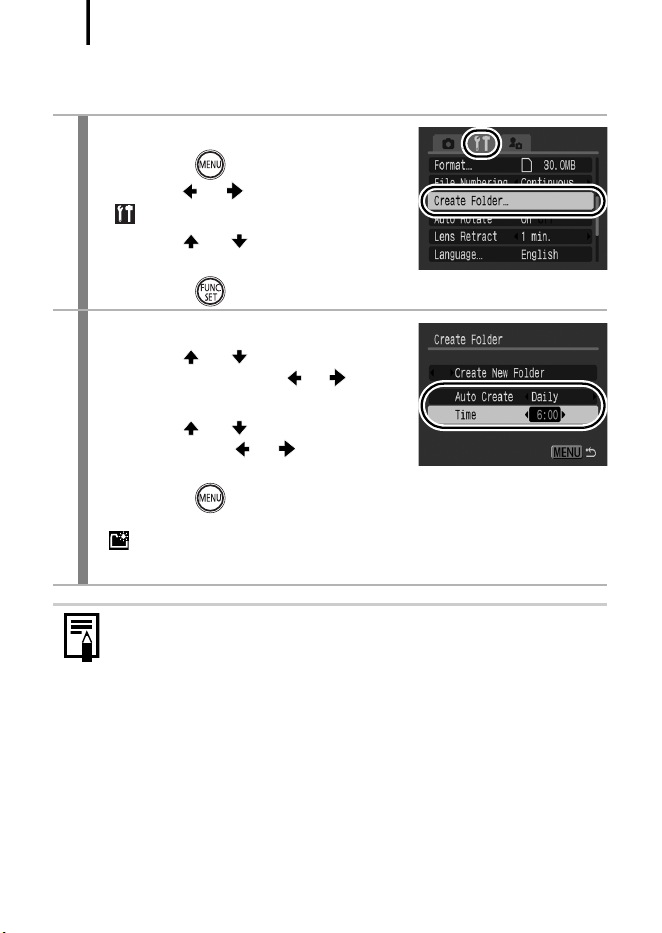
182
Setting the Day or Time for Automatic Folder
Creation
1
Select [Create Folder].
1. Press the button.
2. Use the or button to select the
menu.
3. Use the or button to select
[Create Folder].
4. Press the button.
2
Make settings.
1. Use the or button to select
[Auto Create] and the or button
to select a creation date.
2. Use the or button to select
[Time] and the or button to
select a time.
3. Press the button twice.
• displays when the specified time arrives. The symbol will
cease to display after the new folder is created.
Up to 2000 images can be saved into one folder. A new folder
will automatically be created when you record more than that
number even if you are not creating new folders.
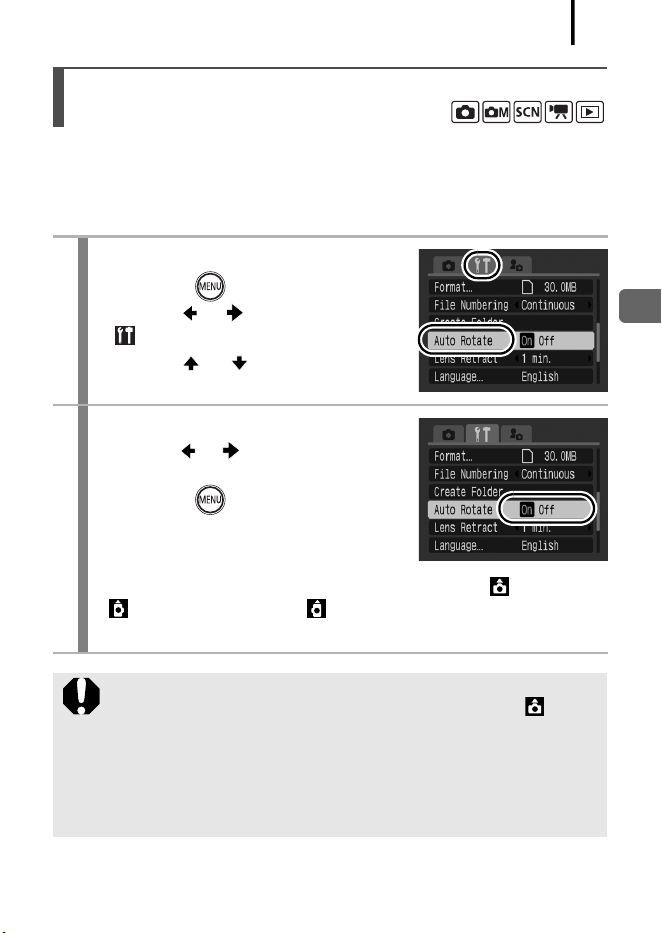
183
Configuring the Camera
Your camera is equipped with an Intelligent Orientation sensor that
detects the orientation of an image shot with the camera held
vertically and automatically rotates it to the correct orientation when
viewing it in the LCD monitor.
Setting the Auto Rotate Function
1
Select [Auto Rotate].
1. Press the button.
2. Use the or button to select the
menu.
3. Use the or button to select
[Auto Rotate].
2
Make settings.
1. Use the or button to select [On]
or [Off].
2. Press the button.
• When the Auto Rotate function is set
to [On] and the LCD monitor is set to
the detailed display mode in the shooting mode, (normal),
(right end is down) or (left end is down) will appear in the
display.
z This function may not operate correctly when the camera is
pointed straight up or down. Check that the arrow is
pointing in the right direction and if it is not, then set the Auto
Rotate function to [Off].
z Even if the Auto Rotate function is set to [On], the orientation
of images downloaded to a computer will depend upon the
software used to download the images.
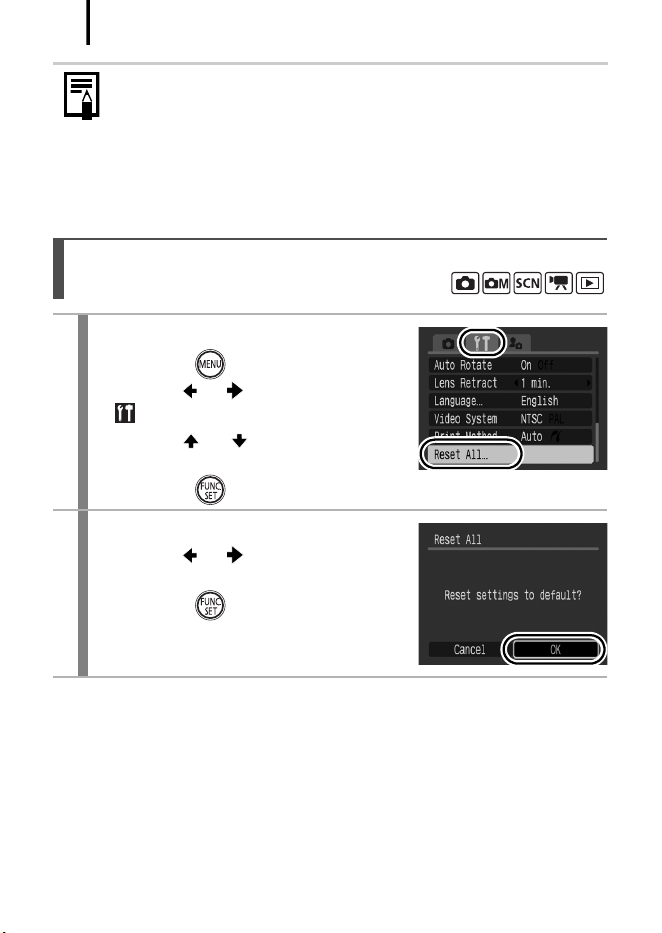
184
When the camera is held vertically to shoot, the Intelligent
Orientation sensor judges the upper end to be “up” and the
lower end to be “down”. It then regulates the optimal white
balance, exposure and focus for vertical photography. This
function operates regardless of the on/off status of the Auto
Rotate function.
Resetting Settings to Their Default
Values
1
Select [Reset All].
1. Press the button.
2. Use the or button to select the
menu.
3. Use the or button to select
[Reset All].
4. Press the button.
2
Make settings.
1. Use the or button to select
[OK].
2. Press the button.
185
Configuring the Camera
z Settings cannot be reset when the camera is connected to a
computer or to a printer.
z The following cannot be reset.
- The shooting mode.
- The [Time Zone], [Date/Time], [Language] and [Video
System] options in the menu (p. 58)
- White balance data recorded with the custom white
balance function (p. 105)
- Colors specified in the [Color Accent] (p. 109) or [Color
Swap] (p. 111) modes
- Newly added My Camera settings (p. 189)
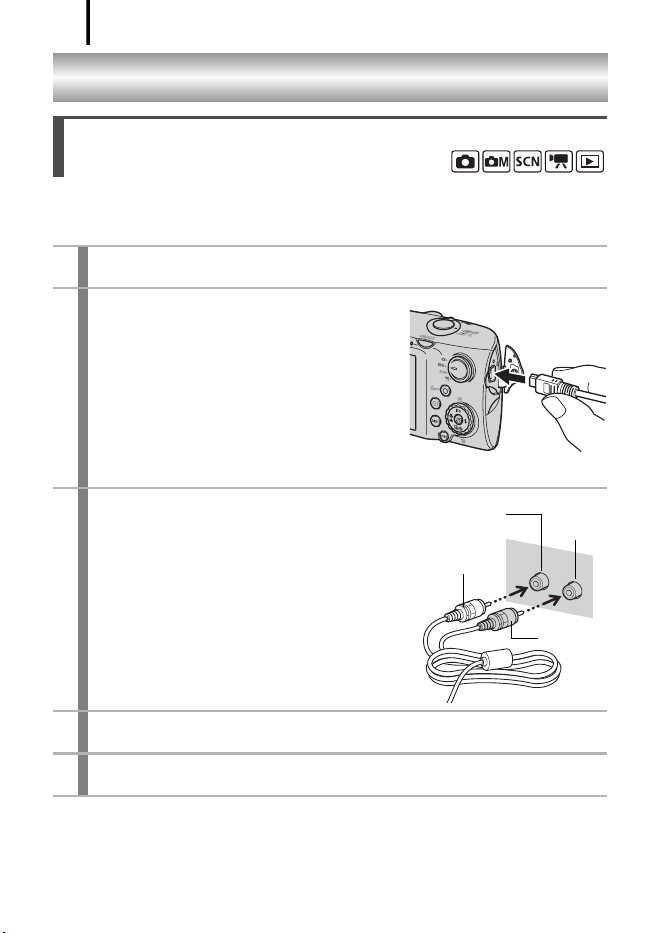
186
Connecting to a TV
You can use the supplied AV cable to shoot or playback images using
a TV.
Shooting/Playback Using a TV
1
Turn off the camera and the TV.
2
Connect the AV cable to
the camera’s A/V OUT and
DIGITAL terminal.
• Slip your fingernail or the toggle on
the wrist strap under the left edge of
the terminal cover to open it and
insert the AV cable all the way into
the connector.
3
Plug the other ends of the
AV cable to the VIDEO IN
and AUDIO IN jacks on the
TV.
4
Turn on the TV and switch it to video mode.
5
Turn on the camera.
VIDEO
Yellow
Black
AUDIO
187
Connecting to a TV
z The video output signal can be switched (NTSC or PAL) to
accommodate different regional standards (p. 58). The
default setting varies between regions.
- NTSC: Japan, U.S.A., Canada, Taiwan and others
- PAL: Europe, Asia (excluding Taiwan), Oceania and others
z If the video system is set incorrectly, the camera output may
not display properly.
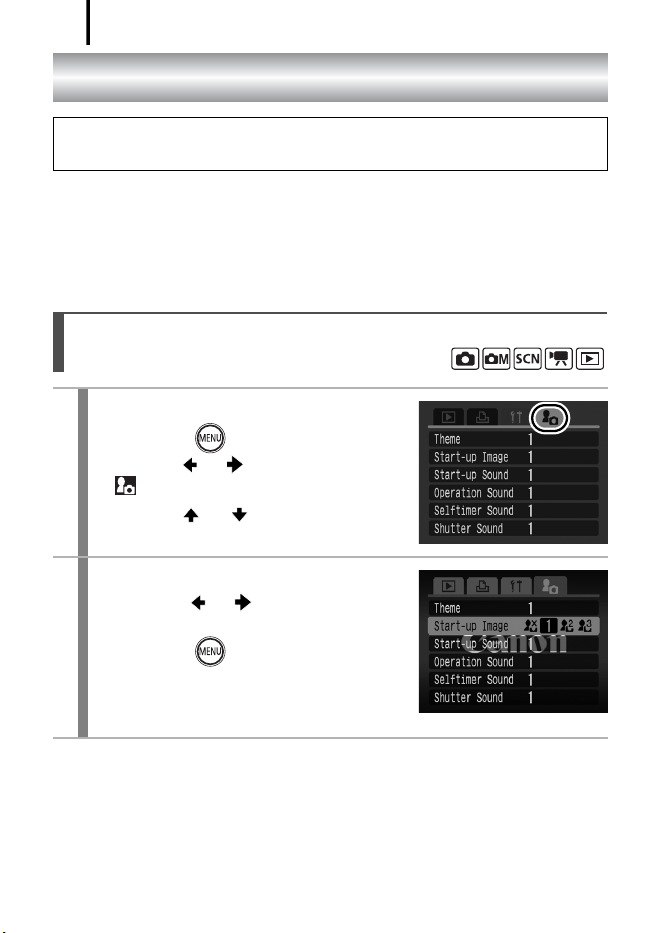
188
Customizing the Camera (My Camera Settings)
My Camera allows you to customize the start-up image and start-up,
operation, self-timer and shutter sounds. You can change and register
these settings, enabling you to customize the camera to suit your own
tastes.
You can also use the control dial to select images and perform
various operations. See p. 43.
Changing My Camera Settings
1
Select a menu item.
1. Press the button.
2. Use the or button to select the
menu.
3. Use the or button to select
menu item.
2
Make settings.
1. Use the or button to select
contents you wish to set.
2. Press the button.
• Select [Theme] to set all to the same
settings.
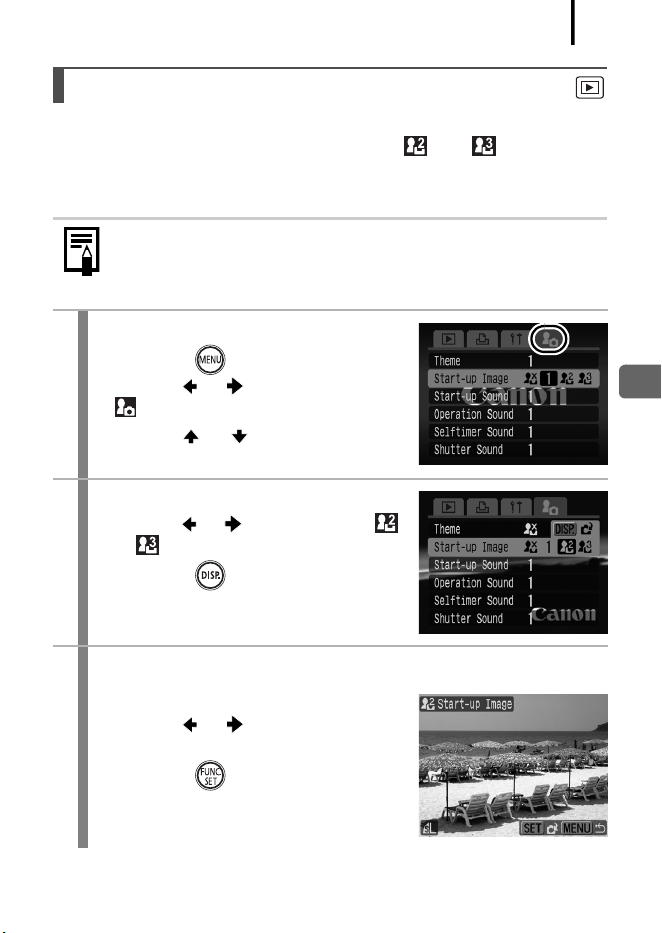
189
Customizing the Camera (My Camera Settings)
Images recorded onto the memory card and newly recorded sounds
can be added as My Camera settings to the and menu items.
You can also use the supplied software to upload your computer’s
images and sounds to the camera.
Registering My Camera Settings
A computer is required to restore the My Camera settings to the
defaults. Use the supplied software (ZoomBrowser EX/
ImageBrowser) to restore the default settings to the camera.
1
Select a menu item.
1. Press the button.
2. Use the or button to select the
menu.
3. Use the or button to select
menu item to register.
2
Select a setting.
1. Use the or button to select
or .
2. Press the button.
3
Make settings.
[Start-up Image]
1. Use the or button to select
image to register.
2. Press the button.
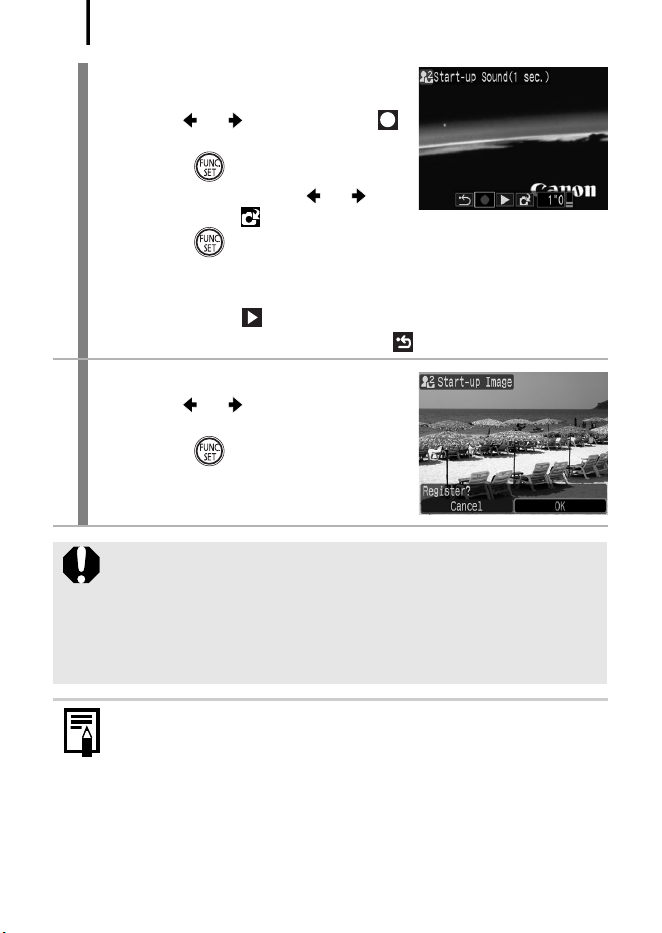
190
[Start-up Sound]/[Operation Sound]/
[Selftimer Sound]/[Shutter Sound]
1. Use the or button to select
(Record).
2. Press the button.
3. After recording, use the or
button to select (Register).
4. Press the button.
• Recording will automatically stop when the recording time
elapses.
• To play it, select (Play).
• To exit instead of registering, select (Exit).
4
Register the setting.
1. Use the or button to select
[OK].
2. Press the button.
• To cancel registering, select [Cancel].
z The following cannot be registered as My Camera settings.
-Movies
- Sounds recorded with the sound memo function (p. 151)
- Sounds recorded with the Sound Recorder (p. 152)
z The prior setting is erased when a new My Camera setting is
added.
See the supplied Software Starter Guide for more information
on creating and adding to the My Camera data.
191
Troubleshooting
• Camera (p. 191)
• When the power is turned on (p. 192)
• LCD monitor (p. 192)
• Shooting (p. 194)
• Shooting movies (p. 198)
• Playback (p. 199)
• Battery/Battery Charger (p. 199)
• TV monitor output (p. 200)
• Printing with a direct print compatible printer (p. 200)
Camera
Camera will not operate.
Power is not turned on. z Press the ON/OFF button (p. 42).
Memory card slot/battery
cover is open.
z Confirm that the Memory card slot/
battery cover is securely closed
(p. 11).
Battery charge insufficient
to operate camera
(“Change the battery
pack” message displays).
z Insert a fully charged battery into the
camera (p. 10).
z Use the AC Adapter Kit ACK-DC30
(sold separately) (pp. 36, 214).
Poor contact between
camera and battery
terminals.
z Polish the terminals with a soft cotton
swab before charging or using the
battery (p. 207).
Sounds come from the camera interior.
The camera’s horizontal/
vertical orientation was
changed.
z The camera’s orientation mechanism
is operating. There is no malfunction.
Troubleshooting
192
When the power is turned on
“Card locked!” message appears.
The SD memory card’s or
SDHC memory card’s
write protect tab is set to
“Write protect”.
z When recording to, erasing from or
formatting the memory card, slide the
write protect tab upward (p. 212).
The Date/Time menu appears.
The built-in rechargeable
lithium battery charge is
low.
z Recharge the built-in battery
immediately (p. 15).
LCD monitor
Nothing displays.
The LCD monitor is set
not to display.
z Press the DISP. button to turn on the
LCD monitor (p. 60).
[Power Saving] is set to
[Display Off].
z Press any button other than the
ON/OFF button or change the camera
orientation to turn the LCD monitor
back on (p. 174).
The LCD monitor will shut off during shooting.
If [Power Saving] is set to [Display Off], the power saving function
will shut down the LCD monitor while shooting in mode.
Camera screen is black at start-up.
Incompatible image has
been selected as the
startup image in the My
Camera settings.
z Change the start-up image in the My
Camera settings (p. 188) or use the
supplied software program
ZoomBrowser EX or ImageBrowser to
restore the default settings.
193
Troubleshooting
The display darkens.
The image in the LCD
monitor will darken in
strong sunlight or bright
light.
z This is a normal occurrence in devices
containing CCDs and does not
constitute a malfunction. This image
will not be recorded when shooting
still photos, but it will be recorded
when shooting movies.
Display flickers.
Display flickers when shot
under fluorescent lighting.
z This is not a camera malfunction
(flickering recorded in movies, but not
in still images).
A bar of light (purplish red) appears on the LCD
monitor.
Sometimes appears when
shooting a bright subject,
such as the sun or other
light source.
z This is a normal occurrence in devices
containing CCDs and does not
constitute a malfunction. (This bar of
light will not be recorded when
shooting still photos, but it will be
recorded when shooting movies.)
appears.
A slow shutter speed has
likely been selected
because of insufficient
lighting.
z Set the IS Mode to any setting other
than [Off] (p. 72).
z Raise the ISO speed (p. 74).
z Set the flash to any setting other than
(flash off) (p. 66).
z Set the self-timer and secure the
camera to something, such as a
tripod.
appears.
This displays when using
a memory card that has
print settings, transfer
settings or slide show
image settings set by
other DPOF-compliant
cameras.
z These settings will be overwritten by
those set by your camera (pp. 136,
165, 172).
194
Noise displays./Subject’s movements are
irregular.
Camera automatically
lightened the image
displayed on the LCD
monitor to make it easier
to see when shooting in a
dark area (p. 61).
z There is no effect on the recorded
image.
Shooting
Camera will not record.
Camera is in playback
mode.
z Switch to Shooting mode (p. 44).
Camera is connected to
computer or printer.
z Disconnect the interface cable, and
switch to a shooting mode.
Flash is charging. z When the flash is charged, the
indicator will light orange. Shooting is
now possible (p. 46).
Memory card is full. z Insert a new memory card (p. 11).
z If required, download the images to a
computer and erase them from the
memory card to make space.
Memory card is not
formatted correctly.
z Format the memory card (p. 178).
z If reformatting does not work, the
memory card logic circuits may be
damaged. Consult the nearest Canon
Customer Support Help Desk.
SD memory card or SDHC
memory card is write
protected.
z Slide the write protect tab upward
(p. 212).
195
Troubleshooting
Image Seen in Viewfinder vs. Recorded Image.
Usually the recorded
image contains more of
the scene than is seen in
the viewfinder.
z Confirm the actual image size with the
LCD monitor. Use the LCD monitor
when taking close-up shots (p. 60).
Image is blurred or out of focus.
The camera moves when
the shutter button is
pressed.
z Confirm the procedures in
“ appears” (p. 193).
AF-assist Beam is set to
[Off].
z In dark places where it is difficult for
the camera to focus, the AF-assist
Beam will emit to assist focusing. As
the AF-assist Beam will not function
when turned off, set it [On] to activate
it (p. 55). Take care not to obstruct the
AF-assist Beam with your hand when
used.
Subject is out of focal
range.
z Shoot with the subject at the correct
focusing distance (p. 218).
z The camera may be set to an
unintended function (such as macro).
Cancel the setting.
The subject is hard to
focus on.
z Use the focus lock or AF lock to shoot
(p. 97).
Subject in recorded image is too dark.
Insufficient light for
shooting.
z Set the built-in flash to (Flash on)
(p. 66).
The subject is
underexposed because
the surroundings are too
bright.
z Set the exposure compensation to a
positive (+) setting (p. 101).
z Use the AE lock or spot metering
function (pp. 99, 102).
Subject is too far away for
flash to reach.
z Shoot within correct flash range of the
subject when using the built-in flash
(p. 219).
z Raise the ISO speed and then shoot
(p. 74).
196
Subject in recorded image is too bright, or image
flashes white.
Subject is too close,
making the flash too
strong.
z Shoot within correct flash range of the
subject when using the built-in flash
(p. 219).
The subject is
overexposed because the
surroundings are too dark.
z Set the exposure compensation to a
negative (–) setting (p. 101).
z Use the AE lock or spot metering
function (pp. 99, 102).
Too much light is shining
directly into the camera, or
is being reflected off the
subject.
z Change the shooting angle.
Flash is set to (Flash
on).
z Set the flash to (Flash off) (p. 66).
Image contains noise.
ISO speed is too high. z Higher ISO speeds and (High ISO
Auto) setting may increase image
noise. For higher image quality, use
as low an ISO speed as possible
(p. 74).
z In , , , , , and
mode, the ISO speed increases and
noise can appear.
White dots appear on the image.
Light from the flash has
reflected off dust particles
or insects in the air. This is
particularly noticeable
when shooting using the
wide angle.
z This is a phenomenon that occurs
with digital cameras and does not
constitute a malfunction.
197
Troubleshooting
Eyes appear red.
Light is reflected back
from the eyes when the
flash is used in dark
areas.
z Shoot with [Red-Eye Lamp] in the
[Flash Settings] menu set to [On]
(p. 80). For this mode to be effective,
the subject must be looking right at
the red-eye reduction lamp. Try
asking them to look directly at the
lamp. Even better results can be
obtained by increasing the lighting in
indoor settings or approaching closer
to the subject. The shutter will not
activate for approximately 1 second
after the red-eye reduction lamp fires
in order to improve the effect.
z If you set the [Red Eye Corr.] in the
[Flash Settings] to [On], the camera
will automatically correct red eyes
while shooting and record the image
to the card (p. 80).
z You can correct red eyes in recorded
images using the [Red-Eye
Correction] in the Playback menu
(p. 142).
Continuous shooting slows down.
The memory card’s
performance has dropped.
z To enhance the continuous shooting
performance, you are recommended
to low level format the memory card in
the camera after you save all its
images to your computer (p. 178).
Recording images to memory card takes a long
time.
Memory card was
formatted in another
device.
z Use a memory card formatted in your
camera (p. 178).
198
Lens will not retract.
Memory card slot/battery
cover was opened with
power on.
z After closing the memory card slot/
battery cover, turn the power on then
back off.
Shooting movies
The recording time may not display properly or
shooting may stop unexpectedly.
The following types of
memory cards are used.
- Slow recording cards.
- Cards formatted on a
different camera or a
computer.
- Cards which have had
images recorded and
erased repeatedly.
z Although the recording time may not
display properly during shooting, the
movie will be recorded correctly on
the memory card. Recording time will
display properly if you format the
memory card in this camera
(excluding slow recording memory
cards) (p. 178).
“!” displayed on the LCD monitor in red and
shooting automatically stopped.
There is insufficient free
space in the camera’s
built-in memory.
z Try the following procedures.
- Format the card with a low level
format before filming (p. 178).
- Lower the recording pixels or frame
rate (p. 86).
- Use a high-speed memory card
(SDC-512MSH, etc.).
Zoom does not operate.
Zoom lever was pressed
while shooting in movie
mode.
z Operate the zoom before shooting in
movie mode (p. 62). Note the digital
zoom is available while shooting (only
in Standard movie mode) (p. 62).
199
Troubleshooting
Playback
Cannot play back.
You attempted to play
back images shot with
another camera or images
edited with a computer.
z Computer images that cannot be
played back may play back if they are
added to the camera using the
supplied software program
ZoomBrowser EX or ImageBrowser.
File name was changed
with a computer or file
location was changed.
z Set the file name or location on the file
format/structure of the camera (Refer
to the Software Starter Guide for
details).
Images cannot be edited.
Some images shot with another camera cannot be edited.
Movies do not play back correctly.
Movies recorded with high recording pixels may momentarily stop
playing if played on slow reading memory cards.
You may experience frame dropping and audio breakup when
playing back a movie on a computer with insufficient system
resources.
Movies shot with this camera may not play back correctly on another
camera.
Reading images from memory card is slow.
Memory card was
formatted in another
device.
z Use a memory card formatted in your
camera (p. 178).
Battery
Battery consumed quickly.
Battery is not being used
to its full capacity.
z See Battery (p. 210).
200
Battery life exceeded if
battery loses its charge
quickly at normal
temperature (23 °C/73 °F).
z Replace the battery with a new one
(p. 11).
Battery will not charge.
Battery life exceeded.
z
Replace the battery with a new one
(p. 11)
.
TV monitor output
Image is distorted or not showing on TV monitor.
Incorrect video system
setting.
z Set the video system to the
appropriate setting, NTSC or PAL, for
your TV (p. 58)
.
Shooting in Stitch Assist
mode.
z The output will not appear on a TV in
Stitch Assist mode. Shoot in a
different shooting mode (p. 45).
Printing with a direct print compatible
printer
Cannot print
The camera and printer
are not properly
connected.
z Securely connect the camera and
printer with the specified cable.
The printer power is not
turned on.
z Turn on the printer power.
The print connection
method is not correct.
z Select [Print Method] and select [Auto]
(p. 58).
201
List of Messages
The following messages may appear on the LCD monitor during
shooting or playback. Please refer to the Direct Print User Guide for
the messages that display during a printer connection.
Busy...
Image is being recorded onto the memory card, red eye correction is
being processed. Resetting all the camera and menu settings to
default.
No memory card
You turned on the camera without a memory card installed, or with a
memory card installed in the wrong orientation (p. 11).
Card locked!
The SD memory card or SDHC memory card is write protected
(p. 212).
Cannot record!
You attempted to shoot an image without a memory card installed,
with a memory card installed in the wrong orientation, or attempted
to attach a sound memo to a movie.
Memory card error
The memory card may be malfunctioning. By formatting the
malfunctioning memory card with the camera, you may be able to
continue using it (p. 178). However, if this error message appears
even when using the supplied memory card, contact your Canon
Customer Support Help Desk as there may be a problem with the
camera.
Memory card full
Memory card is full of images and no more can be recorded or
saved. In addition, no more image settings, or sounds or sound
memos can be recorded.
List of Messages

202
Naming error!
The file name could not be created because there is an image with
the same name as the folder that the camera is attempting to create,
or the highest possible file number has already been reached. In the
Set up menu, set [File Numbering] to [Auto Reset]; alternatively,
save all the images you wish to retain onto a computer, then
reformat the memory card. Please note that formatting will erase all
the existing images and other data.
Change the battery pack.
Battery charge is insufficient to operate the camera. Replace it at
once with a charged one or recharge the battery. Also refer to
Battery (p. 210).
No image.
No images recorded on memory card.
Image too large.
You attempted to play back an image larger than 5616 × 3744 pixels
or with a large data size.
Incompatible JPEG
You attempted to play back an incompatible JPEG image (edited
with a computer, etc.).
RAW
You attempted to play back a different type of RAW image.
Unidentified Image
You attempted to play back an image with corrupted data, an image
with a recording type specific to another manufacturer’s camera, or
an image that has been downloaded to a computer and altered.
Cannot magnify!
You attempted to magnify an image recorded in a different camera
or data type, an image edited with a computer, or a movie.
Cannot rotate
You attempted to rotate the image shot with a different camera or
data type, or an image edited with a computer.
203
List of Messages
Incompatible WAVE
A sound memo cannot be added to this image since the data type of
the existing sound memo is incorrect. In addition, sound cannot be
played back.
Cannot register this image!
You attempted to register an image recorded in a different camera
or a movie as a start-up image.
Cannot modify image
You attempted to resize or perform red eye correction on a movie or
an image recorded with another camera. Or you attempted to resize
an image already resized to or an image shot in . Or, you
attempted to trim an image recorded using , or a or
image.
Cannot assign to category
You attempted to categorize an image recorded in a different
camera.
Cannot Modify
Cannot apply red-eye correction as no red-eye is detected.
Cannot transfer!
When transferring images to your computer using the Direct
Transfer menu, you attempted to select a RAW image, an image
with corrupted data, an image taken with a different camera or data
type. You may have also attempted to select a movie when
[Wallpaper] was selected in the Direct Transfer menu.
Protected!
You attempted to erase or edit a protected image, movie or sound
memo.
Too many marks
Too many images have been marked with print settings or transfer
settings. Cannot process any more.
Cannot complete!
Could not save a part of the print or transfer settings.

204
Unselectable image
You attempted to set the print settings for a non-JPEG image.
Cannot select
In selecting the image range for categorizing via the My Category
function, protecting images, erasing images or specifying print
settings, you selected a starting image with a file number higher
than the last image or a last image with a file number lower than the
starting image. Or, you specified more than 500 images.
Communication error
The computer was unable to download the image due to the large
amount of images (approx. 1000) stored on the memory card. Use a
USB card reader or a PCMCIA card adapter to download the
images.
Lens error, restart camera
An error was detected while the lens was in motion, and the power
has been automatically turned off. This error can occur if you hold
the lens while it is in motion or you operate it in a location with
excessive dust or sand in the air. Try turning the power back on, and
resume shooting or playback. If this message continues to display,
contact your Canon Customer Support Help Desk as there may be a
problem with the lens.
Exx
(xx: number) Camera detected an error. Turn the power off and then
back on, then shoot or play back. A problem exists if the error code
reappears. Note the number and contact your Canon Customer
Support Help Desk. If an error code displays directly after taking a
picture, the shot may not have been recorded. Check image in
playback mode.
205
Appendix
z Before using the camera, please ensure that you read the safety
precautions described below and in the “Safety Precautions” section.
Always ensure that the camera is operated correctly.
z The safety precautions noted on the following pages are intended to
instruct you in the safe and correct operation of the camera and its
accessories to prevent injuries or damage to yourself, other persons
and equipment.
z Equipment refers to the camera, battery charger or compact power
adapter (sold separately).
z Battery refers to the battery pack.
Safety Precautions
Warnings
Equipment
z Do not point the camera at bright light sources (the sun in
bright clear skies, etc.).
• Doing so could damage the camera’s CCD.
• Doing so can damage your eyesight.
z Store this equipment out of the reach of children and infants.
• Wrist strap: Placement of the strap around the child’s neck could
result in asphyxiation.
• Memory card: It may be swallowed accidentally. If this occurs,
contact a doctor immediately.
Appendix

206
z Do not attempt to disassemble or alter any part of the
equipment that is not expressly described in this guide.
z To avoid the risk of high-voltage electrical shock, do not touch
the flash portion of the camera if it has been damaged.
z Stop operating the equipment immediately if it emits smoke or
noxious fumes.
z Do not allow the equipment to come into contact with, or
become immersed in, water or other liquids. If the exterior
comes into contact with liquids or salt air, wipe it dry with a
soft, absorbent cloth.
Continued use of the equipment may result in fire or electrical shock.
Immediately turn the camera power off and remove the camera
battery or unplug the battery charger or compact power adapter from
the power outlet. Please consult your camera distributor or the closest
Canon Customer Support Help Desk.
z Do not use substances containing alcohol, benzine, thinners
or other flammable substances to clean or maintain the
equipment.
z Do not cut, damage, alter or place heavy items on the power
cord.
z Use only recommended power accessories.
z Remove the power cord on a regular periodic basis and wipe
away the dust and dirt that collects on the plug, the exterior of
the power outlet and the surrounding area.
z Do not handle the power cord if your hands are wet.
Continued use of the equipment may result in fire or electrical shock.
207
Appendix
Battery
z Do not place the battery near a heat source or expose it to
direct flame or heat.
z The battery should not be immersed in water or sea water.
z Do not attempt to disassemble, alter or apply heat to the
battery.
z Avoid dropping or subjecting the battery to severe impacts
that could damage the casing.
z Use only recommended battery and accessories.
Failure to follow these precautions may cause explosions or leaks,
resulting in fire, injury and damage to the surroundings. In the event
that a battery leaks and the eyes, mouth, skin or clothing contact these
substances, immediately flush with water and seek medical
assistance.
z Disconnect the battery charger and compact power adapter
from both the camera and the power outlet after recharging or
when not in use to avoid fire and other hazards.
z Do not place anything, such as tablecloths, carpets, bedding or
cushions, on top of the battery charger while it is charging.
Leaving the units plugged in for a long period of time may cause them
to overheat and distort, resulting in fire.
z Use only the specified battery charger to charge the battery.
z The battery charger and compact power adapter are designed
for exclusive use with your camera. Do not use it with other
products or batteries.
There is a risk of overheating and distortion which could result in fire or
electrical shock.
z Before you discard a battery, cover the terminals with tape or
other insulators to prevent direct contact with other objects.
Contact with the metallic components of other materials in waste
containers may lead to fire or explosions.
208
Others
z Do not trigger the flash in close proximity to human or animal
eyes. Exposure to the intense light produced by the flash may
damage eyesight.
In particular, remain at least one meter (39 inches) away from infants
when using the flash.
z Keep objects that are sensitive to magnetic fields (such as
credit cards) away from the speaker of the camera.
Such items may lose data or stop working.
Cautions
Equipment
z Do not sit with the camera in your back pocket.
Doing so may cause malfunction or damage the LCD monitor.
z Be careful not to bang the camera or subject it to strong
impacts or shocks that could lead to injury or damage the
equipment when wearing or holding it by the strap.
z Be careful not to bump or strongly push the end of the lens.
The above-mentioned could lead to injury or damage the equipment.
z Be careful not to allow dust or sand into the camera when
using it at a beach or place with strong winds.
Such conditions could lead to damage.
z Do not store the equipment in humid or dusty areas.
z During shooting, do not allow metal objects (such as pins or
keys) or dirt to contact the charger terminals or plug.
Such conditions could lead to fire, electrical shock or other damage.
209
Appendix
z Avoid using, placing or storing the equipment in places
subject to strong sunlight or high temperatures, such as the
dashboard or trunk (boot) of a car.
z Do not use the equipment in a manner that exceeds the rated
capacity of the electrical outlet or wiring accessories. Also, do
not use the equipment if the cable or plug is damaged, or if the
plug is not fully inserted into the power outlet.
z Do not use in locations with poor ventilation.
The above-mentioned can cause leakage, overheating or explosion,
resulting in fire, burns or other injuries. High temperatures may also
cause deformation of the casing.
z When not using the camera for extended periods of time,
remove the battery from the camera or battery charger and
store the equipment in a safe place.
If the battery is are left inside the camera, damage caused by leakage
may occur.
z Do not connect compact power adapters or battery chargers to
devices such as electrical transformers for foreign travel
because it may lead to malfunctions, excessive heat
generation, fire, electric shock or injury.
Flash
z Do not operate the flash with dirt, dust or other items stuck to
the surface of the flash.
z Be careful not to cover the flash with your fingers or clothing
when shooting.
The flash may be damaged and emit smoke or noise. The resulting
heat build-up could damage the flash.
z Do not touch the surface of the flash after taking several
pictures in rapid succession.
Doing so could result in burns.
210
Preventing Malfunctions
Camera
Avoid Strong Magnetic Fields
z Never place the camera in close proximity to electric motors or
other equipment generating strong electromagnetic fields.
Exposure to strong magnetic fields may cause malfunctions or corrupt
image data.
Avoid Condensation Related Problems
z When moving the equipment rapidly from cold to hot
temperatures, you can avoid condensation by placing the
equipment in an airtight, resealable plastic bag and letting it
adjust to temperature changes slowly before removing it from
the bag.
If condensation forms on the camera, remove the memory card and
battery, and set the camera aside in room temperature to allow the
condensation to naturally evaporate before using the camera again.
Battery
z Keep the battery terminals clean at all times.
Dirty terminals may cause poor contact between the battery and
camera. Polish the terminals with a soft cotton swab before charging
or using the battery.
z At low temperatures, battery performance may be reduced and
the low battery icon (blinks red) may appear earlier than
usual.
Under these conditions, restore the battery performance by warming it
in a pocket immediately before use.
z Do not put the battery into a pocket together with metallic
items such as a key ring.
The battery may be short circuiting.
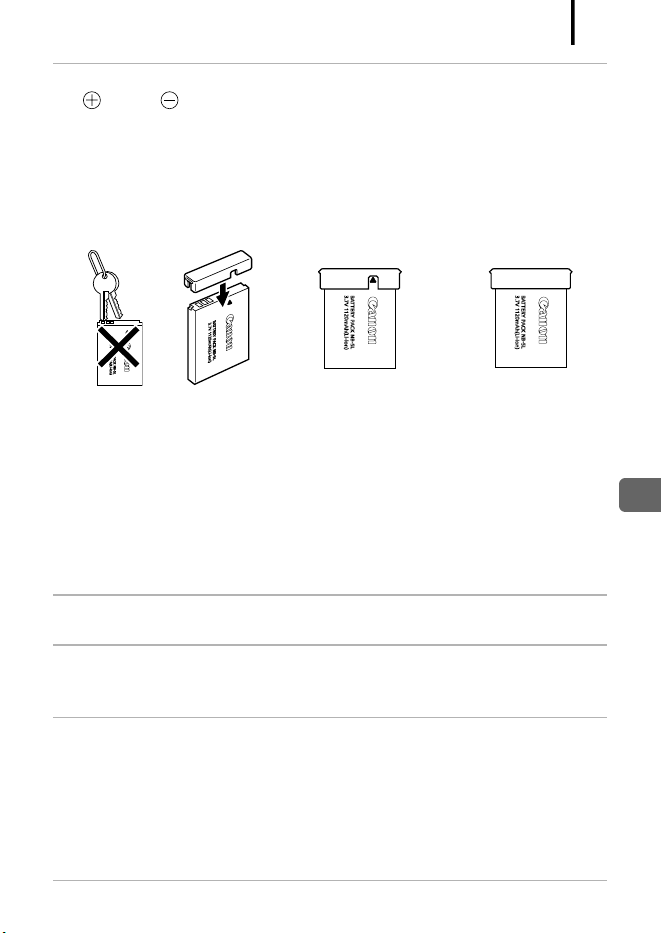
211
Appendix
z Do not allow any metal objects such as key rings to touch the
( ) and ( ) terminals (Fig. A). To carry the battery or store it
during periods of disuse, always replace the terminal cover
(Fig.B).
These conditions can damage the battery. You may be able to check
the charge state depending upon how the terminal cover is attached
(Fig. C, D).
z You are recommended to use it in the camera until it is
depleted and to store it in an indoor location with low relative
humidity and between the temperatures of 0 – 30 °C (32 – 86
°F).
Storing a fully charged battery for long periods of time (about one
year) may shorten its life cycle or affect its performance. If you do not
use the battery for long periods of time, charge it fully and discharge it
in the camera about once a year before returning it to storage.
z Since this is a lithium-ion battery, you need not deplete it
before recharging.
z You are advised to charge the battery on the day of use, or one
day before, to ensure a full charge.
Even charged batteries continue to discharge naturally.
z It takes approximately 2 hours 5 minutes to fully charge the
battery from a depleted state (based on Canon’s testing
standards).
• Charging it within a temperature range of 5 – 40 °C (41 – 104 °F) is
recommended.
• Charge times may vary according to the ambient temperature and
the battery’s charge state.
Fig. C
Fully Charged Battery
Fig. D
Used Battery
Attach it so the S is
visible
Attach in the opposite
way of Fig. C.
Fig. A Fig. B
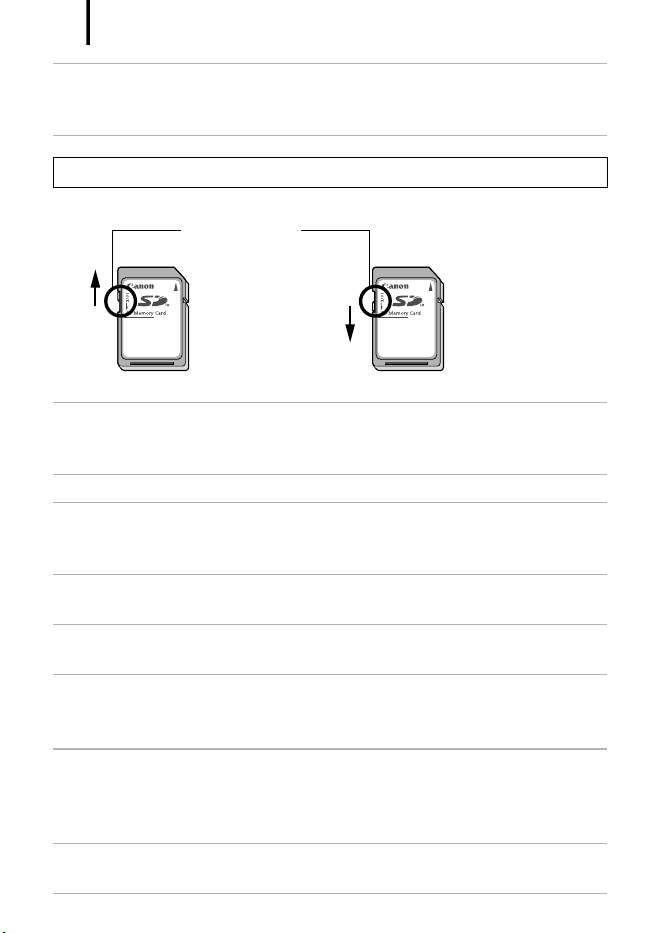
212
z If the performance of the battery diminishes substantially even
when it is fully charged, its life has been exceeded and it
should be replaced.
Memory Card
z SD Memory Card or SDHC Memory Card Write Protect Tab
z Memory cards are high-precision electronic devices. Do not
bend them, apply force to them, or subject them to shocks or
vibration.
z Do not attempt to disassemble or alter the memory card.
z Do not allow dirt, water or foreign objects to contact the
terminals on the back of the memory card. Do not touch the
terminals with your hands or metal objects.
z Do not peel away the original label on the memory card or
cover it with another label or sticker.
z When writing on the memory card, do not use a pencil or
ballpoint pen. Only use a soft point pen (e.g. felt-tip pen).
z Do not use or store memory cards in the following locations.
• Locations subject to dust or sand
• Locations subject to high humidity and high temperatures
z Since some or all of the data recorded on the memory card
may be corrupted or erased by electrical noise, static
electricity, camera or memory card malfunction, making a
backup copy of important data is recommended.
z Please note that formatting (initializing) an memory card
erases all data, including protected images.
Slide the
switch up.
Slide the switch
down (you can
protect the images
and other data on
the memory card).
Write Protect Tab
Writing/Erasing Possible
Writing/Erasing Impossible
213
Appendix
z You are recommended to use memory cards that have been
formatted in your camera.
• The memory card supplied with the camera may be used without
further formatting.
• When the camera is malfunctioning, a corrupted memory card might
be the cause. Reformatting the memory card may solve the problem.
• When a non-Canon brand memory card is malfunctioning,
reformatting it may solve the problem.
• Memory cards formatted in other cameras, computers, or peripheral
devices may not operate correctly in this camera. When that
happens, reformat the memory card with this camera.
z If formatting in the camera does not work properly, turn the
camera off and re-insert the memory card. Then turn the
camera back on and format again.
z Be careful when transferring or disposing of a memory card.
Formatting or erasing the data on a memory card merely
changes the file management information on the memory card
and does not ensure that its contents are completely deleted.
When disposing of a memory card, take precautions, such as
physically destroying the memory card, to prevent personal
information leaks.
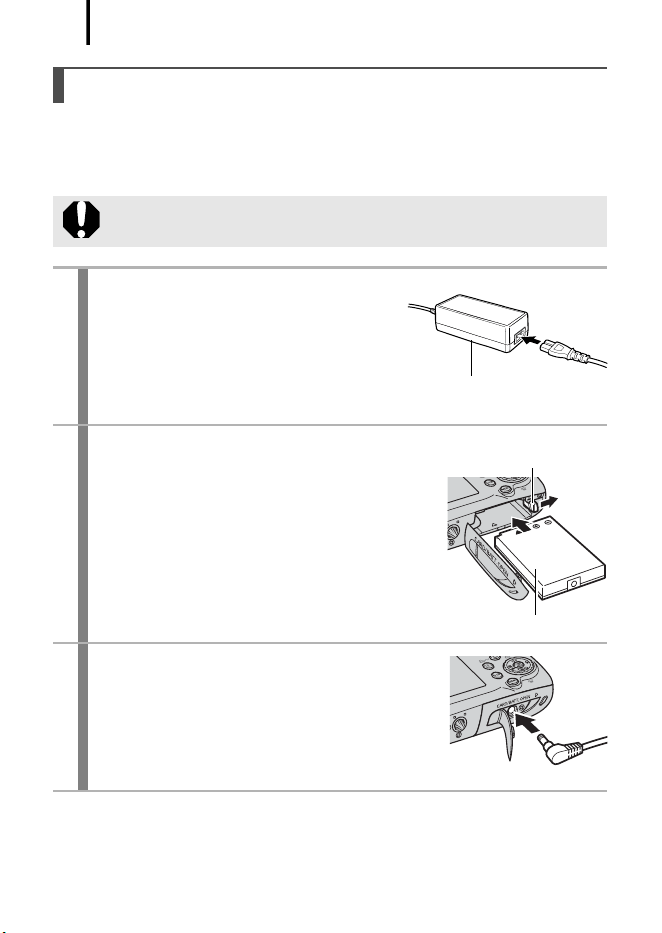
214
It is best to power the camera with AC Adapter Kit ACK-DC30 (sold
separately) when you are using it for long periods of time or connecting
it to a computer.
Using the AC Adapter (Sold Separately)
Turn the camera power off before connecting or disconnecting
the AC adapter.
1
Connect the power cord to
the compact power adapter
first and then plug the other
end into the power outlet.
2
Open the memory card slot/
battery cover, push the battery
lock in the direction of the
arrow and insert the DC
coupler until it locks.
• Slide the memory card slot/battery cover
closed.
3
Open the DC coupler terminal
cover and attach the cord to
the DC terminal.
Compact Power Adapter
CA-DC10
Battery Lock
DC Coupler DR-30
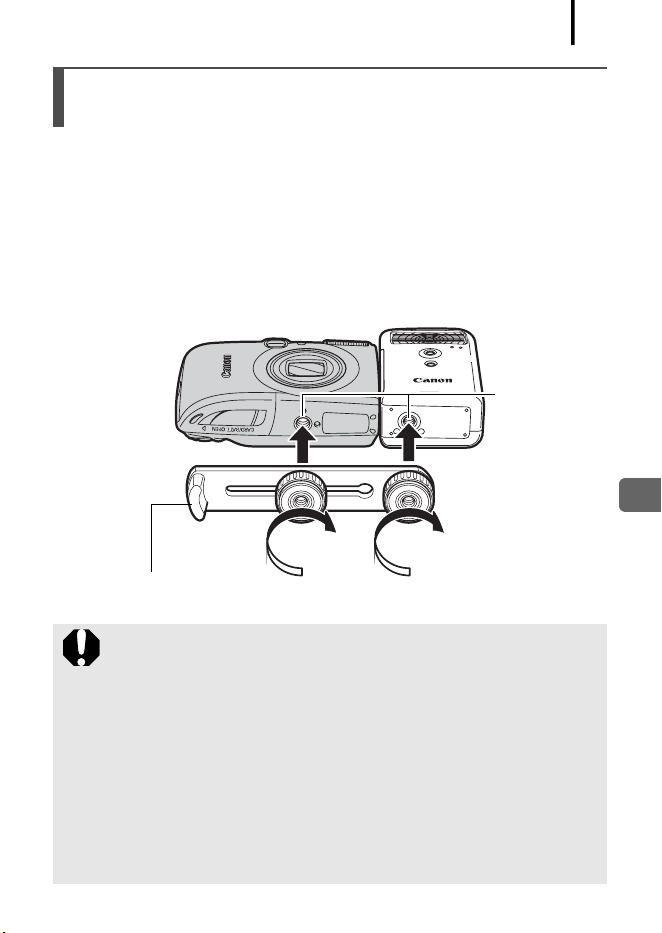
215
Appendix
High-Power Flash HF-DC1
This flash is used to supplement the camera’s built-in flash when the
subject is too far away for proper illumination. Use the following
procedures to affix the camera and High-Power Flash to the supporting
bracket.
Please read the instructions accompanying the flash along with this
explanation.
Using an Externally Mounted Flash
(Sold Separately)
z The flash charge time will lengthen as the battery charge
gets weaker. Always set the power/mode switch to off when
you finish using the flash.
z Be careful not to touch the flash window or sensor windows
with your fingers while the flash is in use.
z The flash may fire if another flash is being used in close
proximity.
z The High-Power Flash may not fire outdoors in daylight or
when there are no reflective items.
z For continuous shooting, although the flash fires for the first
shot, it does not fire for subsequent shots.
Tripod
Sockets
Bracket
(Comes with the flash)
216
Batteries
z Charge becomes Severely Limited
If the battery usage time has considerably diminished, wipe the battery
terminals well with a dry cloth. The terminals may be dirty from
fingerprints.
z Usage in Cold Temperatures
Get a spare generic lithium battery (CR123A or DL123). You are
recommended to place the spare battery in your pocket to warm it up
before switching it for the battery in the flash.
z Non-Use over Extended Periods
Leaving batteries in the High-Power Flash could allow the battery fluid
to leak, damaging the product. Remove the batteries from the High-
Power Flash and store them in a cool, dry place.
z Fasten the attachment screws securely so that they do not
loosen. Failure to do so may lead to the dropping of the
camera and flash resulting in damage to both.
z Before attaching the bracket to the flash, check that the
lithium battery (CR123A or DL123) is installed.
z To illuminate the subjects properly, install the flash so that it
is up against the side of the camera and parallel with the
camera’s front panel.
z A tripod can be used even when the flash is attached.
217
Appendix
Camera Body
Gently wipe dirt off the camera body with a soft cloth or eyeglass lens
wiper.
Lens
First use a lens blower brush to remove dust and dirt, then remove any
remaining dirt by wiping the lens lightly with a soft cloth.
Viewfinder and LCD Monitor
Use a lens blower brush to remove dust and dirt. If necessary, gently
wipe with a soft cloth or an eyeglass lens wiper to remove stubborn
dirt.
Camera Care and Maintenance
Never use thinners, benzine, detergents or water to clean the
camera. These substances may distort or damage the
equipment.
Never use organic solvents on the camera body or lens. If dirt
remains, contact the closest Canon Customer Support Help
Desk as listed in the European Warranty System (EWS)
Booklet.
Never rub or press strongly on the LCD monitor. These actions
may damage it or lead to other problems.
218
All data is based on Canon’s standard testing methods. Subject to
change without notice.
DIGITAL IXUS 970 IS (W): Max. wide angle (T): Max. telephoto
Specifications
Camera Effective Pixels : Approx. 10.0 million
Image Sensor : 1/2.3-inch type CCD (Total number of pixels:
Approx. 10.3 million pixels)
Lens : 6.6 (W) – 33.0 (T) mm
(35mm film equivalent: 37 (W) – 185 (T) mm)
f/3.2 (W) – f/5.7 (T)
Digital Zoom : Approx. 4.0x (Up to approx. 20x in combination
with the optical zoom)
Optical Viewfinder : Real-image zoom viewfinder
LCD Monitor : 2.5-inch type, low-temperature polycrystalline
silicon TFT color LCD (Pure Color LCD II),
approx. 230,000 dots, picture coverage 100%
AF System : TTL autofocus
AF frame mode: Face Detect*
1
*
2
/
AiAF (9-points)/Center*
3
*1 AF frame can be moved and fixed to specified face.
*2 If no face is detected, AiAF (9-points) is used.
*3 Normal or small sizes can be selected.
Focusing Range
(From the front of the
lens)
: Normal: 50 cm (1.6 ft.) – infinity
Macro: 2 – 50 cm (W) (0.79 in. – 1.6 ft. (W))
Infinity: 3 m (9.8 in.) – infinity
Kids&Pets: 1 m (3.3 ft.) – infinity (W/T)
Shutter : Mechanical shutter and electronic shutter
Shutter Speeds : 1/60 – 1/1600 sec.
15 – 1/1600 sec. (Total shutter speed range.
Available range varies by shooting mode.)
• Slow shutter speeds of 1.3 sec. or slower
operate with noise reduction.
219
Appendix
Image Stabilization : Lens-shift type
Continuous/Shoot Only*/Panning*/Off
* Still images only.
Metering System : Evaluative*
1
/Center-weighted average or Spot*
2
*1 Facial brightness is also evaluated in Face Detect AF.
*2 Fixed to center.
Exposure Compensation
: ±2 stops in 1/3-stop increments
ISO Speed
(Standard Output
Sensitivity,
Recommended
Exposure Index)
: Auto*
1
, High ISO Auto*
2
, ISO 80/100/200/400/
800/1600
*1 Camera automatically sets the optimal speed
according to shooting mode and subject brightness.
*2 Camera automatically sets the optimal speed
according to shooting mode, subject brightness and
subject movement. However, the ISO speed is set
relatively higher than Auto.
White Balance : Auto*, Day Light, Cloudy, Tungsten,
Fluorescent, Fluorescent H or Custom
* The colors of faces are evaluated in Face Detect AF.
Built-in Flash : Auto*, on*, off
* Facial brightness is also evaluated in Face Detect AF.
Built-in Flash Range : 30 cm – 3.5 m (12 in. – 11 ft.) (W)/
30 cm – 2.0 m (12 in. – 6.6 ft.) (T)
• Brightness of image periphery may reduce
depending on shooting distance.
Shooting Modes : Auto, Manual, Digital macro, Color Accent,
Color Swap, Stitch Assist, SCN*
1
, Movie*
2
*1 Portrait, Night Snapshot, Kids&Pets, Indoor, Sunset,
Foliage, Snow, Beach, Fireworks, Aquarium, ISO
3200.
*2 Standard, Compact, Color Accent, Color Swap, Time
Lapse.
Continuous Shooting : Approx. 1.2 shots/sec.
Self-timer : Approx. 10-sec./approx. 2-sec. delay or custom
Recording Media : SD memory card/SDHC memory card/
MultiMediaCard/MMCplus card/HC MMCplus
card
File Format : Design rule for camera file system and DPOF
compliant

220
Data Type : Still images: Exif 2.2 (JPEG)*
:
:
Movies: AVI (Image data: Motion JPEG; Audio
data: WAVE (monaural))
Sound Memo or Sound Recorder: WAVE (monaural)
* This digital camera supports Exif 2.2 (also called “Exif
Print”). Exif Print is a standard for enhancing the
communication between digital cameras and printers.
By connecting to an Exif Print-compliant printer, the
camera’s image data at the time of shooting is used
and optimized, yielding extremely high quality prints.
Compression : Superfine, Fine, Normal
Number of
Recording
Pixels
(Still images)
: Large : 3648 × 2736 pixels
Medium 1 : 2816 × 2112 pixels
Medium 2 : 2272 × 1704 pixels
Medium 3 : 1600 × 1200 pixels
Small : 640 × 480 pixels
Date Stamp : 1600 × 1200 pixels
Widescreen : 3648 × 2048 pixels
(Movies) :
:
:
Standard, Color Accent, Color Swap
: 640 × 480 pixels (30 frames/sec.)
640 × 480 pixels (30 frames/sec. LP)
: 320 × 240 pixels (30 frames/sec.)
Recording can continue until the memory card is
full*
1
(can record up to a maximum of 4 GB at
one time*
2
)
Compact: 160 × 120 pixels (15 frames/sec.)
Maximum recording length per clip: 3 min.
Time Lapse
: 640 × 480 pixels (1 frame/sec. (shooting
interval: 1 sec.), 0.5 frame/sec. (shooting
interval: 2 sec.)) (15 frames/sec. (during
playback))
Maximum recording length per clip: 2 hours
*1 Using super high-speed memory cards (SDC-512
MSH recommended).
*2 Even if the file size has not reached 4 GB, the recording
is stopped when the recording time reaches one hour.
Depending on memory card capacity and data write
speed, recording may stop before the file size reaches
4 GB or the recording time reaches one hour.
221
Appendix
Sound Memo : Bit Rate: 16 bits
Sampling Rate
Sound memo, movie (Compact): 11.025 kHz
Movie (other than Compact): 44.100 kHz
Sound Recorder: 11.025 kHz/22.050 kHz/
44.100 kHz
Playback Modes : Single (histogram displayable), Index
(9 images), Magnified (approx. 2x to 10x max.),
Resume Playback, Image Inspection Tool,
Jump, My Category, Movie Playback (slow
motion available), Rotate, Slide Show, Red-Eye
Correction, Trimming, Resize, My Colors,
Sound (recording/playback up to 1 min.), Sound
Recorder (up to 2 hours sound-only recording/
playback possible) or Protect.
Direct Print : PictBridge compliant, and Canon Direct Print
and Bubble Jet Direct compatible
My Camera Settings : Start-up image, start-up sound, operation
sound, self-timer sound, and shutter sound.
Interface : Hi-Speed USB (Dedicated connector with
integrated type of digital, audio and video*)
* mini-B compatible.
Audio/Video output (NTSC or PAL selectable,
monaural audio)
Communication Settings
:MTP, PTP
Power Source : Battery Pack NB-5L
(Rechargeable lithium-ion battery)
AC Adapter Kit ACK-DC30
Operating
Temperatures
: 0 – 40 °C (32 – 104 °F)
Operating Humidity : 10 – 90%
Dimensions
(excluding protrusions)
: 95.4 × 57.3 × 27.4 mm
(3.76 × 2.26 × 1.08 in.)
Weight
(camera body only)
: Approx. 155 g (5.47 oz.)
222
Battery Capacity
z The actual figures will vary according to the shooting conditions and
settings.
z Movie data is excluded.
z At low temperatures, the battery performance may diminish and the
low battery icon (blinks red) may appear very rapidly. In these
circumstances, the performance can be improved by warming the
battery in a pocket before use.
Test Conditions
Number of Images Shot
Playback Time
LCD Monitor On Playback Time
(Based on the CIPA standard)
LCD Monitor Off
Approx. 320 images Approx. 800 images Approx. 7 hours
Shooting: Normal temperature (23 °C ±2 °C/73 °F ±3.6 °F), normal
relative humidity (50% ±20%), alternating wide angle end
and telephoto end shots at 30 second intervals with the flash
fired once every two shots and the camera power turned off
after every tenth shot. Power is left off for a sufficient amount
of time*, then the power is turned back on and the testing
procedure is repeated.
• A Canon-brand memory card is used.
* Until the battery returns to normal temperature
Playback: Normal temperature (23 °C ±2 °C/73 °F ±3.6 °F), normal
relative humidity (50% ±20%), continuous playback at 3
seconds per image.
See Battery (p. 210).
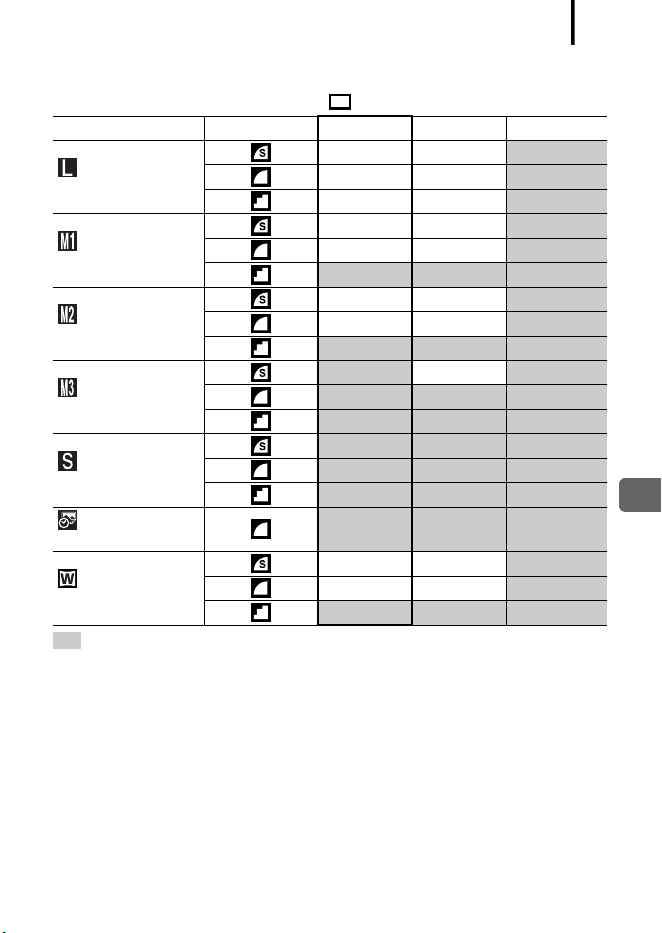
223
Appendix
Memory Cards and Estimated Capacities
: Memory card included with the camera
: Capable of smooth continuous shooting (p. 78) (When card has been formatted
with a low level format).
This reflects standard shooting criteria established by Canon. Actual results may vary
according to the subject and shooting conditions.
Recording Pixels Compression 32 MB SDC-128M
SDC-512MSH
(Large)
3648 × 2736 pixels
628
110
11 47 186
23 99
386
(Medium 1)
2816 × 2112 pixels
10 45
176
17 75 292
37 156 603
(Medium 2)
2272 × 1704 pixels
14 61
237
26 109 425
52 217 839
(Medium 3)
1600 × 1200 pixels
29 121 471
52 217 839
99 411 1590
(Small)
640 × 480 pixels
111 460 1777
171 711 2747
270 1118 4317
(Date Stamp)
1600 × 1200 pixels
52 217 839
(Widescreen)
3648 × 2048 pixels
837
147
15 64 249
31 132 511
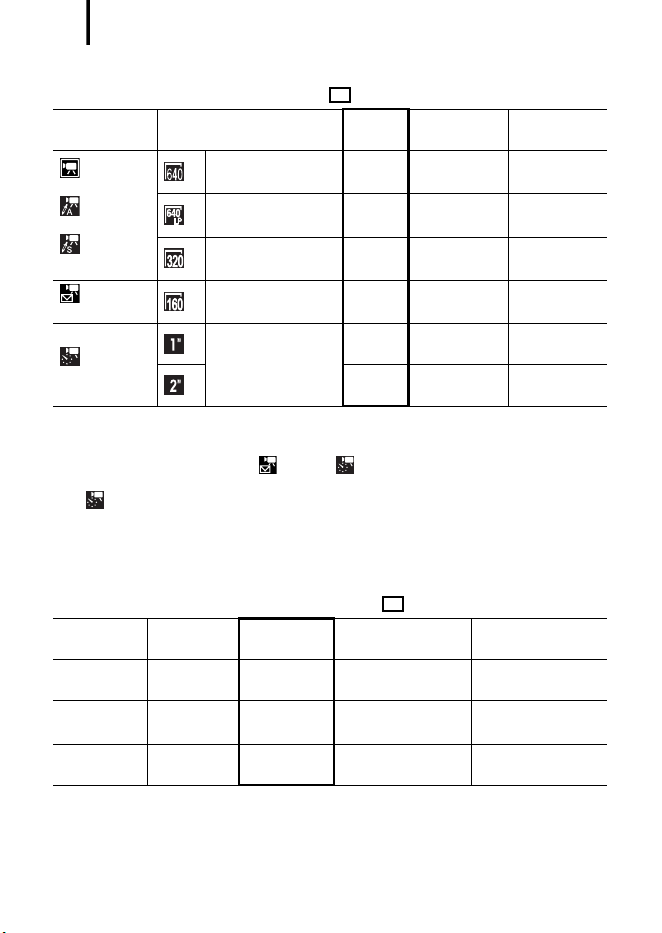
224
Movie
: Memory card included with the camera
*1 1 frame/sec. (shooting interval: 1 sec.)
*2 0.5 frame/sec. (shooting interval: 2 sec.)
• Maximum movie clip length at : 3 min., : 2 hours. The figures indicate the
maximum continuous recording time.
• As plays back at 15 frames/sec., the recording time and the playback time will
differ.
Sound Recorder Data Rates and Recording
Durations (Estimated)
: Card included with the camera
Recording Pixels/
Frame Rate
32 MB
SDC-128M
SDC-
512MSH
Standard
Color Accent
Color Swap
640 × 480 pixels
30 frames/sec.
14 sec.
1 min.
1 sec.
3 min.
57 sec.
640 × 480 pixels
30 frames/sec. LP
27 sec.
1 min.
56 sec.
7 min.
30 sec.
320 × 240 pixels
30 frames/sec.
38 sec.
2 min.
42 sec.
10 min.
29 sec.
Compact
160 × 120 pixels
15 frames/sec.
3 min.
9 sec.
13 min.
2 sec.
50 min.
21 sec.
Time Lapse
*
1
640 × 480 pixels
7 min.
30 sec.
31 min.
45 sec.
2 hrs. 3 min.
30 sec.
*
2
15 min.
1 hr. 3 min.
30 sec.
4 hrs. 7 min.
Sound
Size
32 MB SDC-128M SDC-512MSH
11.025 kHz 22 KB/sec.
23 min.
28 sec.
1 hr. 36 min.
59 sec.
6 hrs. 14 min.
16 sec.
22.050 kHz 44 KB/sec.
11 min.
44 sec.
48 min. 30 sec.
3 hrs. 7 min.
8 sec.
44.100 kHz 88 KB/sec.
5 min.
52 sec.
24 min. 15 sec.
1 hr. 33 min.
34 sec.
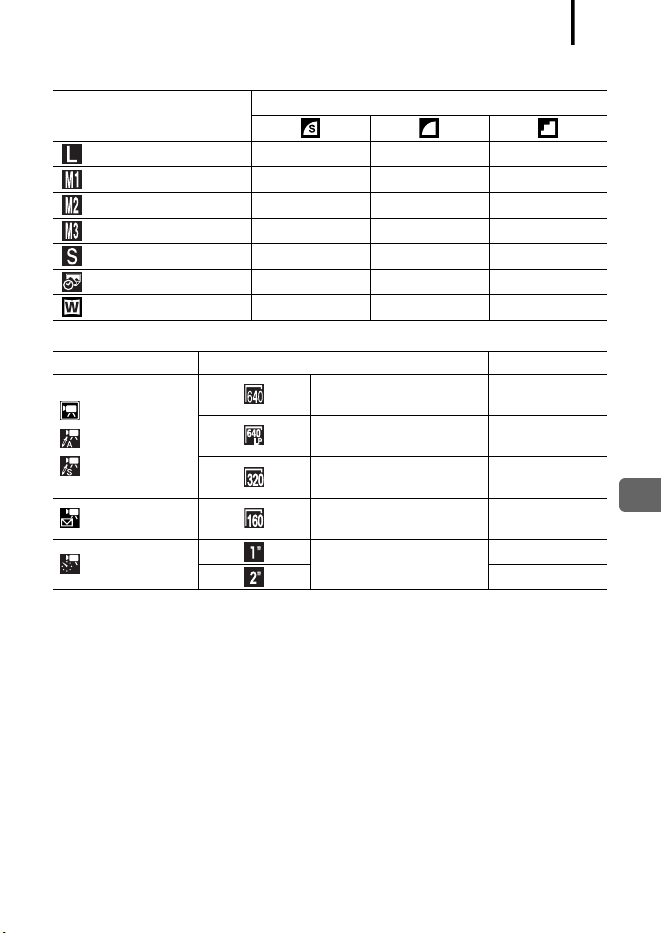
225
Appendix
Image Data Sizes (Estimated)
*1 1 frame/sec. (shooting interval: 1 sec.)
*2 0.5 frames/sec (shooting interval: 2 sec.)
Recording Pixels
Compression
3648 × 2736 pixels 4332 KB 2565 KB 1226 KB
2816 × 2112 pixels 2720 KB 1620 KB 780 KB
2272 × 1704 pixels 2002 KB 1116 KB 556 KB
1600 × 1200 pixels 1002 KB 558 KB 278 KB
640 × 480 pixels 249 KB 150 KB 84 KB
1600 × 1200 pixels – 558 KB –
3648 × 2048 pixels 3243 KB 1920 KB 918 KB
Recording Pixels/Frame Rate File size
Standard
Color Accent
Color Swap
640 × 480 pixels
30 frames/sec.
1963 KB/sec.
640 × 480 pixels
30 frames/sec. LP
1003 KB/sec.
320 × 240 pixels
30 frames/sec.
703 KB/sec.
Compact
160 × 120 pixels
15 frames/sec.
131 KB/sec.
Time Lapse
*
1
640 × 480 pixels
64 KB/sec.
*
2
32 KB/sec.
226
SD Memory Card
MultiMediaCard
Battery Pack NB-5L
Battery Charger CB-2LX/CB-2LXE
Interface Compatible with SD memory card standards
Dimensions 32.0 × 24.0 × 2.1 mm (1.26 × 0.94 × 0.08 in.)
Weight Approx. 2 g (0.07 oz.)
Interface Compatible with MultiMediaCard standards
Dimensions 32.0 × 24.0 × 1.4 mm (1.26 × 0.94 × 0.06 in.)
Weight Approx. 1.5 g (0.05 oz.)
Type Rechargeable lithium-ion battery
Nominal Voltage 3.7 V DC
Typical Capacity 1120 mAh
Battery Life
(Charge Cycles)
Approx. 300 times
Operating Temperatures 0 – 40 °C (32 – 104 °F)
Dimensions 32.0 × 44.9 × 7.9 mm (1.26 × 1.77 × 0.31 in.)
Weight Approx. 25 g (0.88 oz.)
Rated Input 100 – 240 V AC (50/60 Hz)
0.085 A (100 V) – 0.05 A (240 V)
Rated Output 4.2 V DC, 0.70 A
Charging Time Approx. 2 hrs. 5 min. (for Battery Pack NB-5L)
Operating Temperatures 0 – 40 °C (32 – 104 °F)
Dimensions 57.5 × 81.6 × 21.0 mm (2.26 × 3.21 × 0.83 in.)
Weight Approx. 65 g (2.29 oz.) (CB-2LX)
Approx. 59 g (2.08 oz.) (CB-2LXE) (excluding
power cord)
227
Appendix
Compact Power Adapter CA-DC10
(Included with the separately sold AC Adapter Kit ACK-DC30)
Rated Input 100 – 240 V AC (50/ 60 Hz)
Rated Output 4.3 V DC, 1.5 A
Operating Temperatures 0 – 40 °C (32 – 104 °F)
Dimensions 42.6 × 104.4 × 31.4 mm (1.68 × 4.11 × 1.24 in.)
Weight Approx. 180 g (6.35 oz.) (excluding power
cord)

Index
228
Index
Numerics
3:2 Guide .................................114
A
AC Adapter Kit ACK-DC30 ......214
Accessory ..................................36
AE Lock......................................99
AF Frame.............................50, 93
AF Lock......................................98
AF-assist Beam....................40, 55
AF-Point Zoom...........................90
Auto Category..........................115
AUTO Mode...............................16
Auto Rotate..............................183
B
Battery
Battery Charge Indicator........51
Capacity...............................222
Charging ................................10
Installing.................................11
C
Camera Shake Warning.....51, 193
Card
Estimated Capacities ...........223
Formatting............................178
Installing.................................11
Checking Focus .................90, 120
Clock Display .............................47
Components Guide....................40
Compression..............................71
Computer
Connecting ............................ 29
Downloading Images............. 27
System Requirements ........... 27
Continuous Shooting ................. 78
Control Dial................................ 43
Create Folder........................... 181
D
Date and Time ........................... 14
Date Stamp................................ 22
Date/Time
Clock Display......................... 47
World Clock ......................... 175
Default setting............................ 54
Digital Tele-Converter................ 62
Digital Zoom .............................. 62
Direct Print Compatible Printers
................................................... 37
Direct Transfer........................... 31
Display Language...................... 15
Display Overlays...................... 114
DPOF Print Settings ................ 165
DPOF Transfer Settings .......... 172
E
Embedding the Date in the
Image Data ............................... 22
Erasing .............................. 19, 158
Exif Print .................................. 220
F
Face Detect ............................... 93
Face Select and Track............... 96
FE Lock ................................... 100
File Numbering ........................ 179

Index
229
Flash
Settings..................................80
Shooting.................................66
Focus .........................................17
Focus Check Display ...60, 91, 120
Focus Lock.................................98
Frame Rates ..............................86
G
Grid Lines.................................114
H
High-Power Flash ....................215
Histogram...................................53
I
Image Stabilizer .........................72
Index Playback.........................119
Indicators ...................................46
Infinity.........................................67
ISO Speed .................................74
J
Jump (Searching the Images).. 122
L
LCD Monitor.........................41, 60
Display ...................................50
Quick-bright LCD Function ....61
Lens Retract...............................58
List of Messages......................201
Long Shutter Mode ..................103
M
Macro.........................................67
Manual Mode .............................78
Memory Cards
Estimated Capacities ...........223
Menu
FUNC. Menu.......................... 54
My Camera Menu.................. 59
Play Menu.............................. 56
Print Menu ............................. 56
Rec. Menu ............................. 54
Set up Menu .......................... 57
Settings.................................. 48
Metering Mode......................... 102
Microphone.......................... 24, 42
Mode Dial .................................. 45
Movie
Editing.................................. 131
Shooting .......................... 24, 82
Viewing.......................... 26, 131
Mute........................................... 57
My Camera .............................. 188
Changing ............................. 188
Registering .......................... 189
My Category ............................ 124
My Colors ................................ 107
My Colors (Playback) .............. 147
N
Night View ................................. 61
O
Overexposure Warning.............. 53
P
Playback Button......................... 44
Power Saving .................... 57, 174
Pressing Fully...................... 17, 25
Pressing Halfway................. 16, 25
Print List..................................... 21
Print Method .............................. 58
Print/Share Button ............. 42, 116
Printing ...................................... 20
Protect ..................................... 154

Index
230
R
Rec. Review...............................17
Recording Pixels..................70, 86
Red-Eye Correction (Playback)
.................................................142
Red-Eye Correction (Shooting)..80
Red-Eye Reduction....................80
Registering Functions
Set Play Button ....................163
Registering Settings.................116
Reset All...................................184
Resize......................................149
Review .......................................55
Review Info ................................55
Rotate ......................................134
S
Safety Zoom...............................63
Self-Timer ..................................68
Shooting Mode...........................75
Color Accent ........................109
Color Swap ..........................111
Digital Macro..........................66
Functions Available..............232
Special Scene........................75
Stitch Assist ...........................88
Shutter Button......................16, 42
Slide Shows .............................136
Sound Memos..........................151
Sound Recorder.......................152
System Map...............................34
T
Telephoto...................................62
Time Lapse ................................87
Time Zone................................175
Transfer Settings (DPOF) ........172
Transition .................................135
Trimming..................................127
TV Set......................................186
V
Video Output Signal........... 58, 186
Viewfinder.................................. 41
Volume ...................................... 57
W
White Balance ......................... 104
Wide Angle ................................ 62
Wrist Strap................................. 13

231
Trademark Acknowledgments
• Microsoft, Windows Vista and the Windows Vista logo are
trademarks or registered trademarks of Microsoft Corporation in the
United States and/or other countries.
• Macintosh, the Mac logo, QuickTime and the QuickTime logo are
trademarks of Apple Inc., registered in the U.S. and other countries.
• The SDHC logo is a trademark.
Copyright © Canon Inc. 2008 All rights reserved.
Disclaimer
• While every effort has been made to ensure that the information
contained in this guide is accurate and complete, no liability can be
accepted for any errors or omissions.
• Canon reserves the right to change the specifications of the
hardware and software described herein at anytime without prior
notice.
• No part of this guide may be reproduced, transmitted, transcribed,
stored in a retrieval system, or translated into any language in any
form, by any means, without the prior written permission of Canon.
• Canon makes no warranties for damages resulting from corrupted
or lost data due to a mistaken operation or malfunction of the
camera, the software, SD memory cards (SD cards), personal
computers, peripheral devices, or use of non-Canon SD cards.
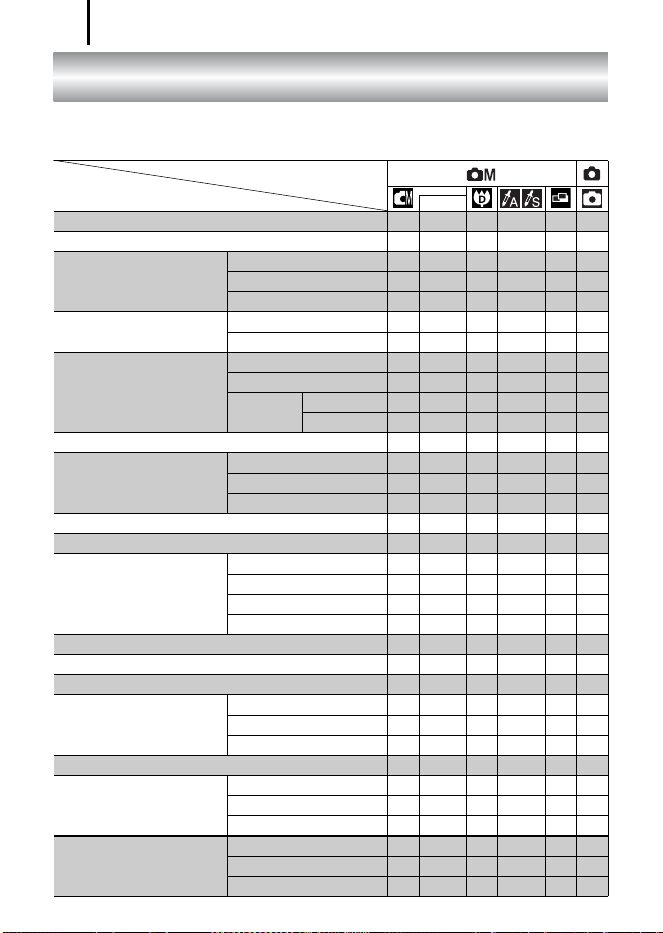
Functions Available in Each Shooting Mode
232
Functions Available in Each Shooting Mode
Only functions with settings that change with the shooting mode are
listed here.
Shooting Mode
Function
Long Shutter
Exposure Compensation (p. 101)
{
–
{
–
{
–
Long Shutter Mode (p. 103)
–
{
––––
ISO Speed (p. 74)
Auto
1)
{
–
{ { { {
High ISO Auto
{
–
{
– –
{
ISO 80 – 1600
{ { {
– – –
White Balance (p. 104)
Auto
1)
{{{{{{
Other than Auto
{{{
–
{
–
Drive Mode (pp. 68, 78)
Single Shot
{ { { { { {
Continuous
{ { {
– – –
Self-timer
2 sec. / 10 sec.
{ { { { { {
Custom Timer
{ { {
– –
{
My Colors (p. 107)
{{{
–
{
–
Metering System (p. 102)
Evaluative
{ { { { { {
Center Weighted Average
{
–
{
– – –
Spot
{
–
{
– – –
Number of Recording Pixels, Compression (still images) (pp. 70, 71)
{{{
3)
{{
3)
{
Date Stamp (Date, Date & Time) (p. 22)
{ {
–
{
–
{
Number of Recording Pixels,
Frame Rate, (movies) (p. 82)
640 × 480, 30 fps / 30 fps LP
––––––
640 × 480, 1/0.5 fps
––––––
320 × 240, 30 fps
––––––
160 × 120, 15 fps
––––––
AE Lock (p. 99)
{
–
{
– – –
FE Lock (p. 100)
{
–––––
AF Lock (p. 97)
{ { {
– – –
Shooting Zone (p. 67)
Normal
{{
–
{{{
Macro
{{{{{{
Infinity
{{
–
{{
–
Face Select and Track (p. 96)
{ { { {
–
{
Flash (p. 66)
Auto
{
––
{
–
{
On
{{
–
{{
–
Off
{{{{{{
LCD Monitor Setting (p. 60)
Off
{ {
– – –
{
No Infomation
{ { {
– –
{
Infomation View
{ { { { { {
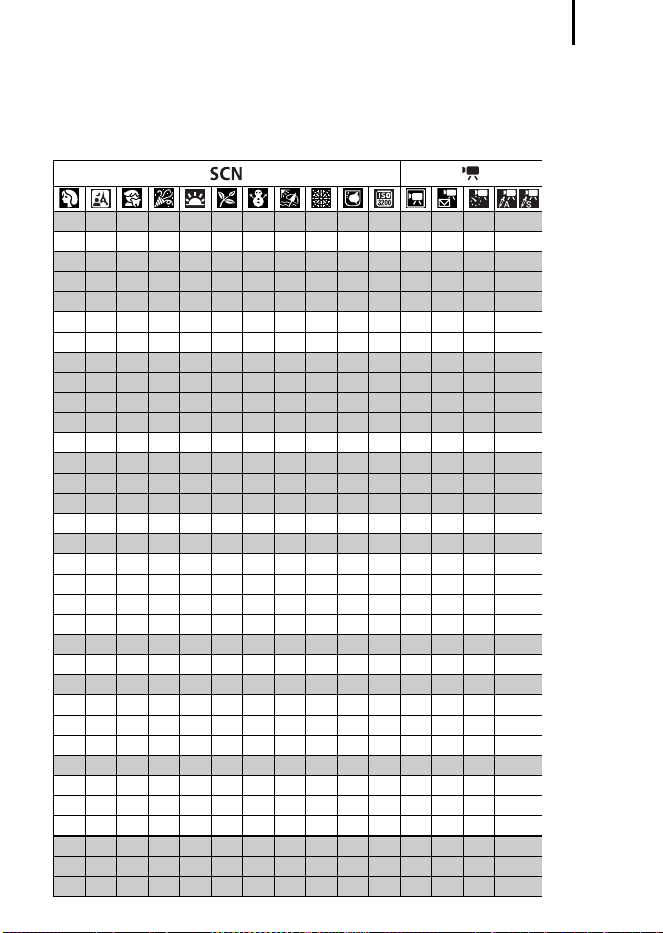
Functions Available in Each Shooting Mode
233
{ { { { { { { { { {
– – – – –
–––––––––––––– –
{ { { { { { { { { {
–
{ { { {
– – – – – – – – – – – – – – –
– – – – – – – – – – –
2)
– – – –
{{{{{{{{{{{{{{ {
–––––––––––
{{{
–
{ { { { { { { { { { { { { { {
{ { { { { { { { { { {
– – – –
{ { { { { { { { { { { { { { {
{ { { { { { { { { { {
– – – –
–––––––––––
{{{
–
{ { { { { { { { { { { { { { {
– – – – – – – – – – – – – – –
– – – – – – – – – – – – – – –
{{{{{{{{{{{
4)
––– –
{ { { { { { { { { {
– – – – –
–––––––––––
{
––
{
–––––––––––––
{
5)
–
–––––––––––
{
––
{
––––––––––––
{
––
– – – – – – – – – – –
{ { {
–
–––––––––––––– –
– – – – – – – – – – –
{ { {
–
{{{{{{{{{{{{{{ {
{{
–
{
–
{{{
–
{{{{{ {
{{
–
{
–
{{{
–
{{{{{ {
{ { { { { { { {
–
{ {
– – – –
{{{{{{{{
–––––– –
{{{{{{{{
–
{
–––– –
{{{{{{{{{{{
––– –
{ { { { { { { { { { {
– – – –
{ { { { { { { { { { { { { {
–
{ { { { { { { { { { { { { { {
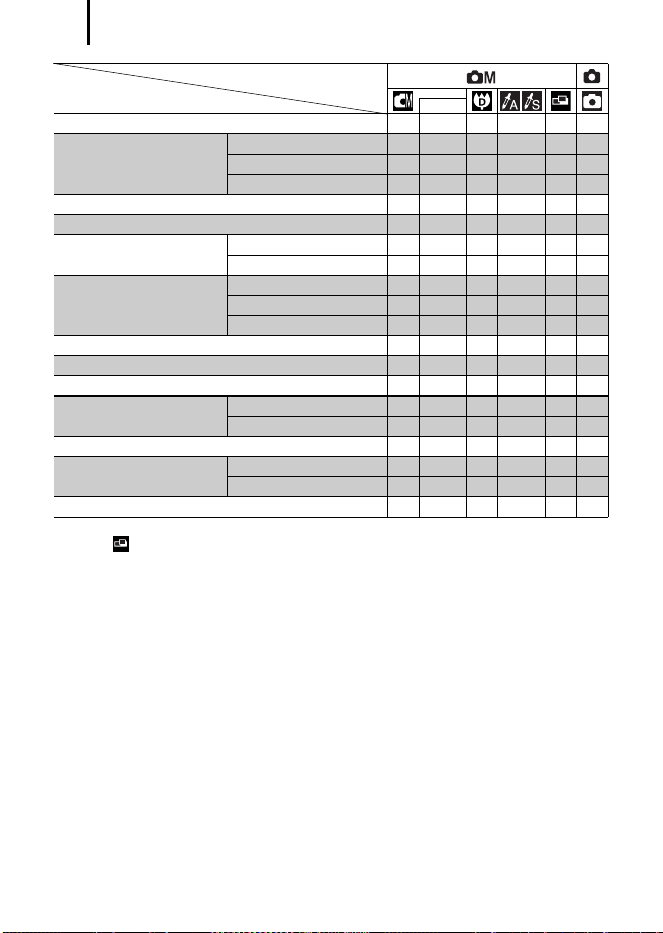
Functions Available in Each Shooting Mode
234
{ : Setting available or optimum value is automatically set by the camera. As a rule,
with , only the first image is available.
– : Not available.
1) Set to optimum value depending on each shooting mode.
2) The value is fixed to ISO 3200.
3) Date Stamp or Widescreen cannot be selected.
4) The recording size is fixed to Medium 3 (1600 × 1200).
5) 15 fps in playback mode.
6) Not available when Date Stamp or Widescreen is selected.
7) Always set to on.
8) Only available when the flash is set to [On].
Stitch Direction Selection (Right, Left) (p. 88)
––––
{
–
AF Frame (p. 93)
Face Detect
{ { { {
–
{
AiAF (9-point)
{ { { {
–
{
Center
{ { { { { {
AF Frame Size Selection (p. 95)
{{
––––
AF-Point Zoom (p. 90)
{ {
–
{
–
{
Digital Zoom
6)
(p. 62)
Standard
{{{
7)
––
{
Digital Tele-converter
{{
–––
{
Flash Settings (p. 80)
Slow Synchro
{ {
7)
– –
{
–
Red-Eye Lamp
{ {
–
{ { {
Red-Eye Correction
{ {
– – –
{
Custom Timer (delay, shots) (p. 68)
{{{
––
{
AF-assist Beam (p. 55)
{ { { { { {
Review (Rec. Review) (p. 17)
{{{{{{
Review Info. (p. 55)
Off
{ { { { { {
Detailed / Focus Check
{ { { {
–
{
Auto Category (p. 115)
{{{{{{
Disp. Overlay (p. 114)
Grid Lines
{ { { {
–
{
3:2 Guide / Both
{ { { {
–
{
Registering settings to the Print/Share button (p. 116)
{{{{{{
Shooting Mode
Function
Long Shutter
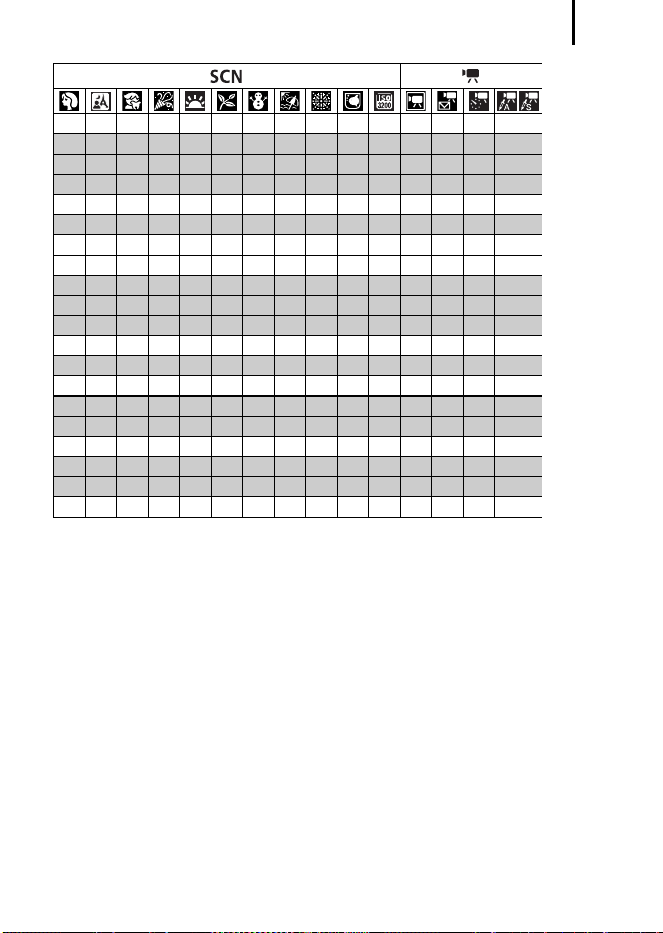
Functions Available in Each Shooting Mode
235
–––––––––––––– –
{ { { { { { { {
–
{ {
– – – –
{ { { { { { { {
–
{ { { { { {
{ { { { { { { { { { {
– – – –
–––––––––––––– –
{ { { { { { { { { { {
– – – –
{{{{{{{{{{
–
{
–– –
{{{{{{{{{{
–––– –
–
{
7)
– –
{
7)
– – – – – – – – – –
{ { { { { { { {
–
{
– – – – –
{ { { { { { { {
–
{
– – – – –
{{{{{{{{{{{
––– –
{ { { { { { { {
–
{
8)
{ { { { {
{{{{{{{{{{{
––– –
{ { { { { { { { { { {
– – – –
{ { { { { { { { { { {
– – – –
{{{{{{{{{{{{{{ {
{ { { { { { { { { { { { { { {
{ { { { { { { { { { {
– – – –
{{{{{{{{{{{{{{ {

Camera User Guide
CEL-SH7TA210 © CANON INC. 2008
ENGLISH
Ensure that you read the Safety Precautions (pp. 205 – 213).
Getting Started
p. 9