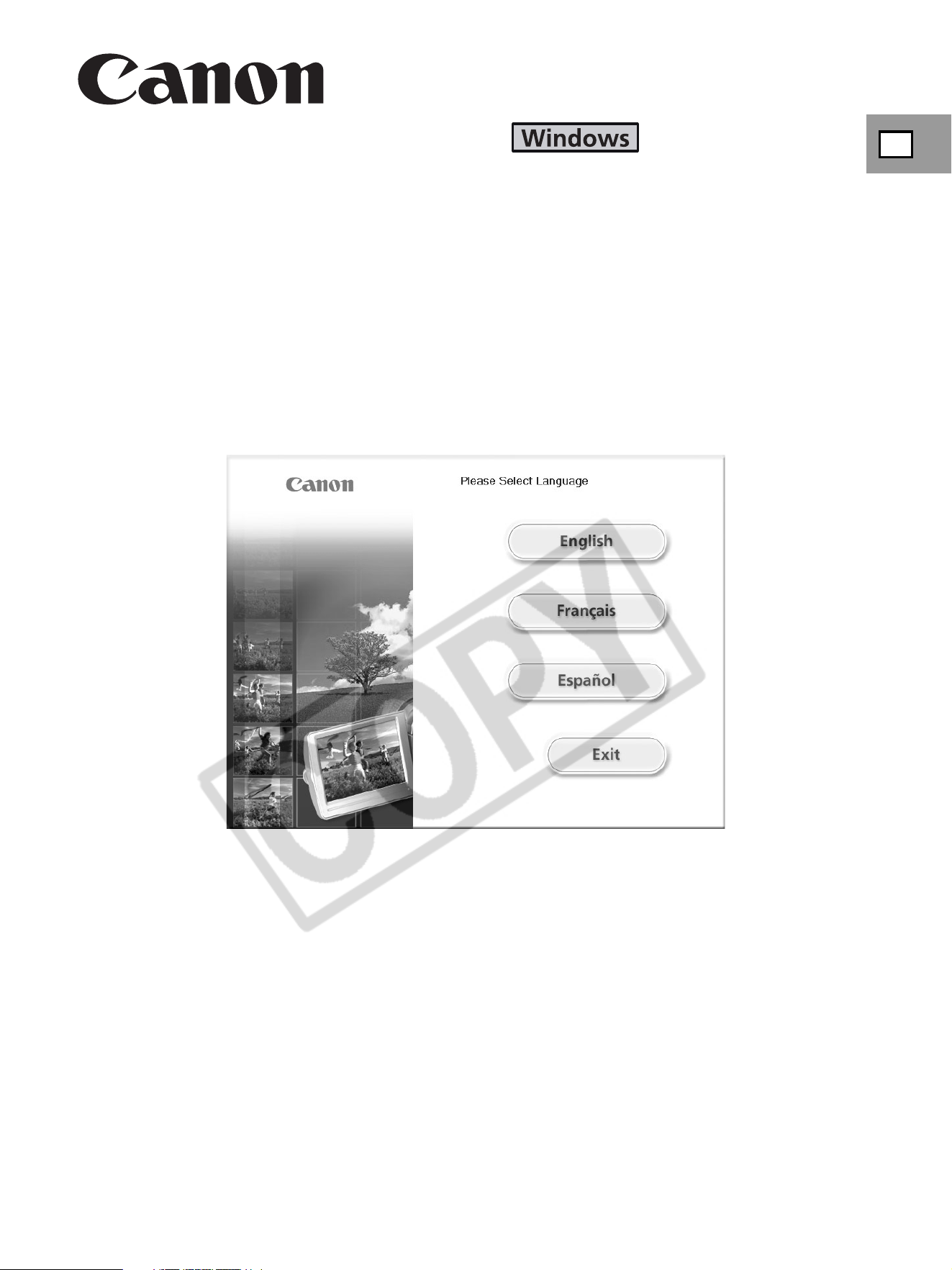
E
Digital Video Software
Version 20
Instruction Manual
2
Contents
Contents
Read This First ........................................................................................................... 4
Checking Supplied Accessories ............................................................................ 5
System Requirements............................................................................................... 6
What is Digital Video Software.................................................................................. 7
Windows ..................................................................................................................... 8
CameraWindow ..................................................................................................... 8
[Acquire Images] Tab ........................................................................................ 8
[Print] Tab .......................................................................................................... 9
[Set to Camera] Tab ........................................................................................ 10
Camera Browser Window ................................................................................11
Main Window ....................................................................................................... 12
[Image Viewer] Window ....................................................................................... 17
[Red Eye Correction] Window ......................................................................... 18
[Auto Adjustment] Window .............................................................................. 19
[Color/Brightness Adjustment] Window ........................................................... 19
[Sharpness] Window ....................................................................................... 20
[Trim Image] Window ...................................................................................... 20
[Insert Text] Window ........................................................................................ 21
Installing the Digital Video Software ...................................................................... 22
Before Downloading Images................................................................................... 26
Connecting the Camcorder to a Computer .......................................................... 26
Downloading Images (ZoomBrowser EX).............................................................. 28
Starting CameraWindow ...................................................................................... 29
Using the Computer to Download Images ........................................................... 30
Auto-Downloading ........................................................................................... 30
Auto-Downloading Settings ............................................................................. 31
Downloading the Selected Images from the CameraWindow ......................... 34
Using a Card Reader/Writer ............................................................................ 37
Using the Camcorder to Download Images (Direct Transfer Function) ............... 38
Direct Transfer ................................................................................................ 38
Setting the Direct Transfer Download Destination Folder ............................... 39
Printing Still Images................................................................................................. 41
Printing Still Images Recorded on the Memory Card........................................... 41
Printing Still Images Downloaded to the Computer ............................................. 46
[One Photo per Page Print] ............................................................................. 46
[Index Print] ..................................................................................................... 48
[Layout Print] ................................................................................................... 50
Organizing Images ................................................................................................... 53
Applying Star Ratings and Keywords................................................................... 53
Classifying the Images......................................................................................... 54
Renaming Multiple Files ...................................................................................... 56
Searching for Images........................................................................................... 58
Playing Back and Editing Movies ........................................................................... 61
Playing Back Movies............................................................................................ 61
Editing Movies ..................................................................................................... 63
Exporting Images ..................................................................................................... 67
Changing the File Type and Save........................................................................ 67
Exporting Movies ................................................................................................. 71
E
3
Contents
Windows
Extracting Still Images from Movies (Windows XP Only)..................................... 74
Saving on CD-R/RW Disks (Windows XP Only).................................................. 77
Adding Still Images from Your Computer to the Memory Card ............................ 80
Adding Still Images to the Memory Card ......................................................... 80
Adding Sample Images to the Memory Card .................................................. 82
Using Various Functions ......................................................................................... 85
Attaching Still Images to E-mail Messages.......................................................... 85
Running a Slide Show ......................................................................................... 88
Adding Sound to an Image .................................................................................. 90
Reviewing and Changing the Owner Name of the Camcorder............................ 91
Uninstalling the Software ........................................................................................ 93
Uninstalling ZoomBrowser EX ............................................................................. 93
Uninstalling the TWAIN Driver/WIA Driver........................................................... 94
Troubleshooting ....................................................................................................... 95

4
Read This First
Read This First
Disclaimer
• While every effort has been made to ensure that the information contained in
this guide is accurate and complete, no liability can be accepted for any
errors or omissions. Canon reserves the right to change the specifications of
the hardware and software described herein at any time without prior notice.
• No part of this guide may be reproduced, transmitted, transcribed, stored in a
retrieval system, or translated into any language in any form, by any means,
without the prior written permission of Canon.
•Canon makes no warranties for damages resulting from corrupted or lost
data due to mistaken operation or malfunction of the camcorder, the
software, memory cards (SD Memory Cards), personal computers, or
peripheral devices, or due to use of a memory card not initialized by a Canon
camcorder.
Trademark Acknowledgments
•QuickTime is a trademark of Apple Computer, Inc.
•Microsoft
®
and Windows
®
are either registered trademarks or trademarks of
Microsoft Corporation in the United States and/or other countries.
•Other names and products not mentioned above may be registered
trademarks or trademarks of their respective companies.
© Canon Inc. 2006 All rights reserved.
Safety Precautions
Do not play the supplied CD-ROM(s) in any CD player that does not support
data CD-ROMs. Playing the CD-ROM(s) in an audio CD player (music player)
could damage the speakers. It is also possible to suffer from hearing loss from
listening with headphones to the loud sounds of a CD-ROM played on a music
CD player.
E
5
Read This First
Windows
Checking Supplied Accessories
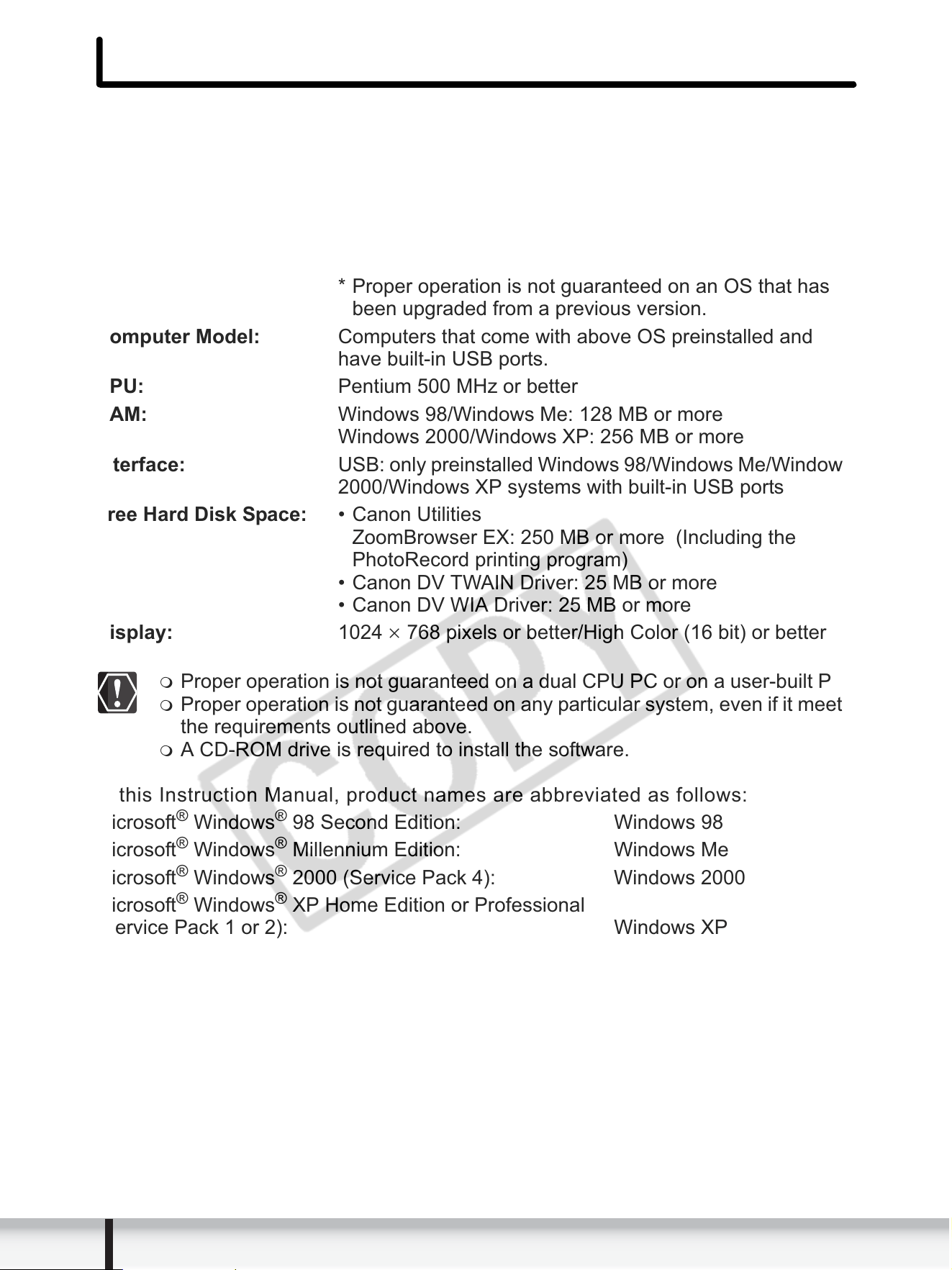
Use the following accessories to download recorded images from a memory card
to your computer.
• IFC-300PCU USB Cable • DIGITAL VIDEO SOLUTION DISK
The explanations in this manual use mainly Windows XP screen shots. The
steps and windows may vary depending on your computer and the version of
software.
6
System Requirements
System Requirements
Please install the software on a computer meeting the following minimum
requirements.
Proper operation is not guaranteed on a dual CPU PC or on a user-built PC.
Proper operation is not guaranteed on any particular system, even if it meets
the requirements outlined above.
A CD-ROM drive is required to install the software.
In this Instruction Manual, product names are abbreviated as follows:
OS: Windows 98 (Second Edition)
Windows Me
Windows 2000 (Service Pack 4)
Windows XP Home Edition or Professional
(Service Pack 1 or 2)
* Proper operation is not guaranteed on an OS that has
been upgraded from a previous version.
Computer Model: Computers that come with above OS preinstalled and
have built-in USB ports.
CPU: Pentium 500 MHz or better
RAM: Windows 98/Windows Me: 128 MB or more
Windows 2000/Windows XP: 256 MB or more
Interface: USB: only preinstalled Windows 98/Windows Me/Windows
2000/Windows XP systems with built-in USB ports
Free Hard Disk Space: • Canon Utilities
ZoomBrowser EX: 250 MB or more (Including the
PhotoRecord printing program)
• Canon DV TWAIN Driver: 25 MB or more
• Canon DV WIA Driver: 25 MB or more
Display: 1024
u 768 pixels or better/High Color (16 bit) or better
Microsoft
®
Windows
®
98 Second Edition: Windows 98
Microsoft
®
Windows
®
Millennium Edition: Windows Me
Microsoft
®
Windows
®
2000 (Service Pack 4): Windows 2000
Microsoft
®
Windows
®
XP Home Edition or Professional
(Service Pack 1 or 2): Windows XP
E
7
What is Digital Video Software
Windows
What is Digital Video Software
The following software will be installed by installing the Digital Video Software.
ZoomBrowser EX
•Viewing downloaded images
•Categorizing, organizing, and searching large volumes of images
•Editing still images
•Editing movies recorded on a memory card and capturing still images from
movies
•Changing the data for still images and save them as new files
•Viewing still images in a slide show
•Adding sound to an image
CameraWindow
•Downloading images from a memory card to your computer
•Printing still images recorded on the memory card without downloading the
still images to the computer
•Viewing images recorded on a memory card
PhotoRecord
• Printing downloaded still images with background, frame, title and comments
•Creating downloaded still image albums
USB Driver
• Driver software that enables you to download images from a memory card to
a computer. Users of Windows XP do not need to install this driver software.
An OS standard driver will be installed automatically.
•Windows 98/Windows 2000: Canon DV TWAIN Driver
•Windows Me: Canon DV WIA Driver
This instruction manual explains how to install the software, what you can do
with the main features and how to operate them. For more detailed operational
instructions, refer to the Help menu of each software program.
8
Windows
Windows
CameraWindow
CameraWindow is a program created to download still images from the memory
card to the computer. Furthermore, you can print still images recorded on the
memory card without having the images downloaded to the computer ( 41).
Refer to Starting CameraWindow ( 29) for launching the software. Remote
capture function is not supported by the camcorder.
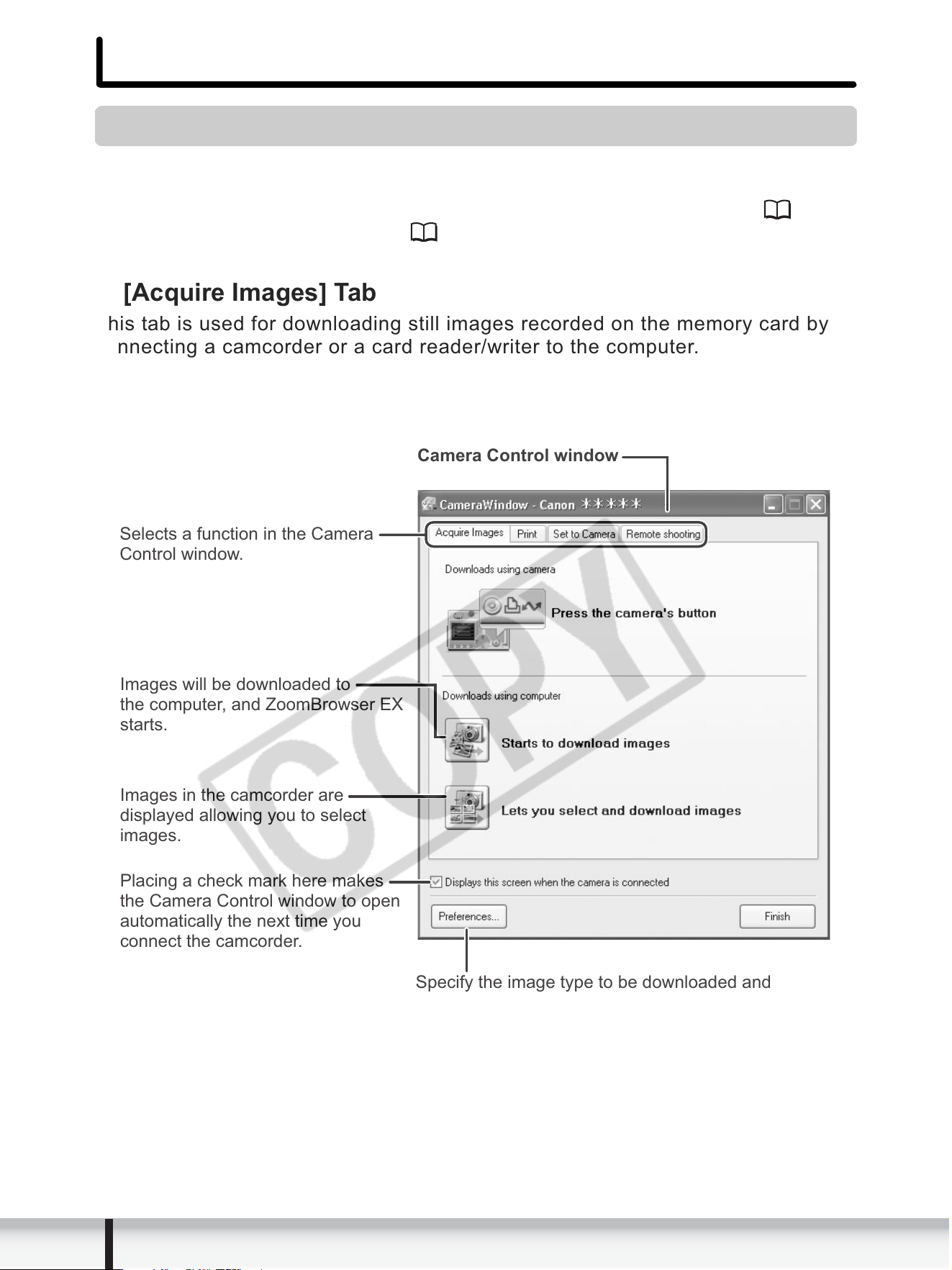
[Acquire Images] Tab
This tab is used for downloading still images recorded on the memory card by
connecting a camcorder or a card reader/writer to the computer.
Camera Control window
Images will be downloaded to
the computer, and ZoomBrowser EX
starts.
Images in the camcorder are
displayed allowing you to select
images.
Placing a check mark here makes
the Camera Control window to open
automatically the next time you
connect the camcorder.
Specify the image type to be downloaded and
the destination folder.
Selects a function in the Camera
Control window.
E
9
Windows
Windows
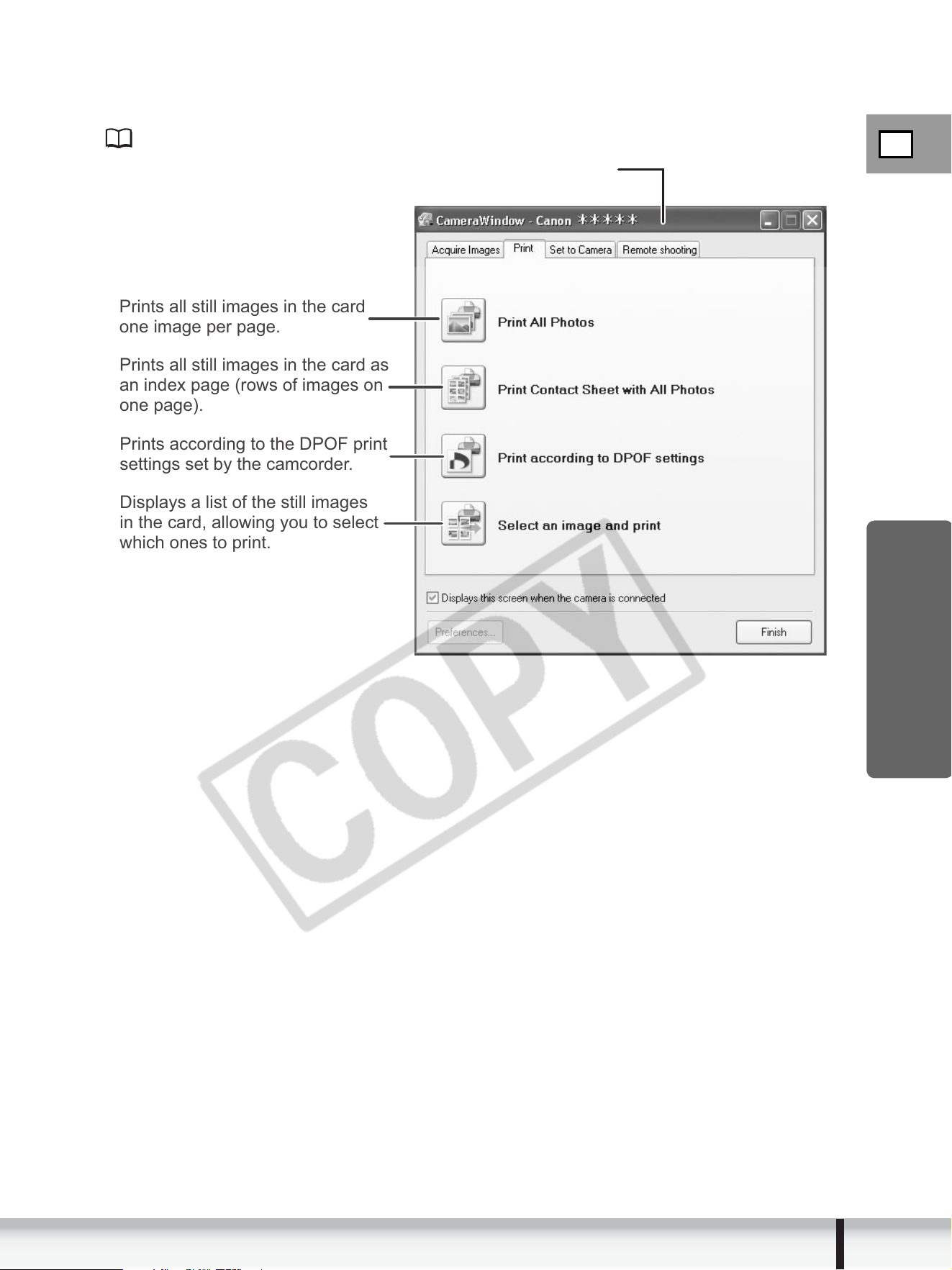
[Print] Tab
This tab is used for printing still images on the memory card without having the
images downloaded to the computer. The window varies depending on the
selected printing type. Refer to Printing Still Images Recorded on the Memory Card
(41).
Prints all still images in the card
one image per page.
Prints all still images in the card as
an index page (rows of images on
one page).
Prints according to the DPOF print
settings set by the camcorder.
Displays a list of the still images
in the card, allowing you to select
which ones to print.
Camera Control window
10
Windows
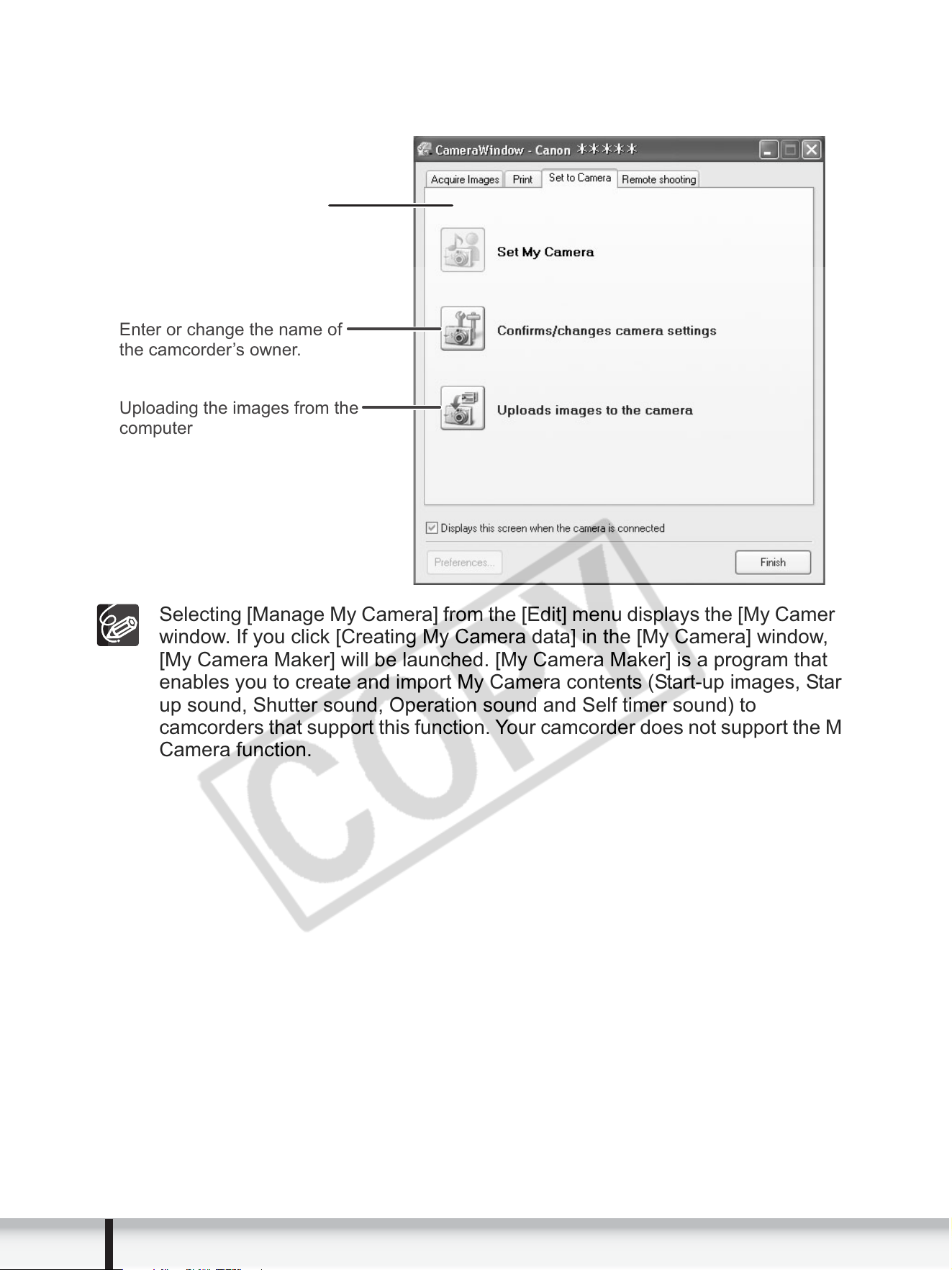
[Set to Camera] Tab
This tab is used for confirming and changing the camcorder settings and
uploading the images to the card. My Camera function is not supported by the
camcorder.
Selecting [Manage My Camera] from the [Edit] menu displays the [My Camera]
window. If you click [Creating My Camera data] in the [My Camera] window,
[My Camera Maker] will be launched. [My Camera Maker] is a program that
enables you to create and import My Camera contents (Start-up images, Start-
up sound, Shutter sound, Operation sound and Self timer sound) to
camcorders that support this function. Your camcorder does not support the My
Camera function.
Uploading the images from the
computer
Enter or change the name of
the camcorder’s owner.
Camera Control window
E
11
Windows
Windows
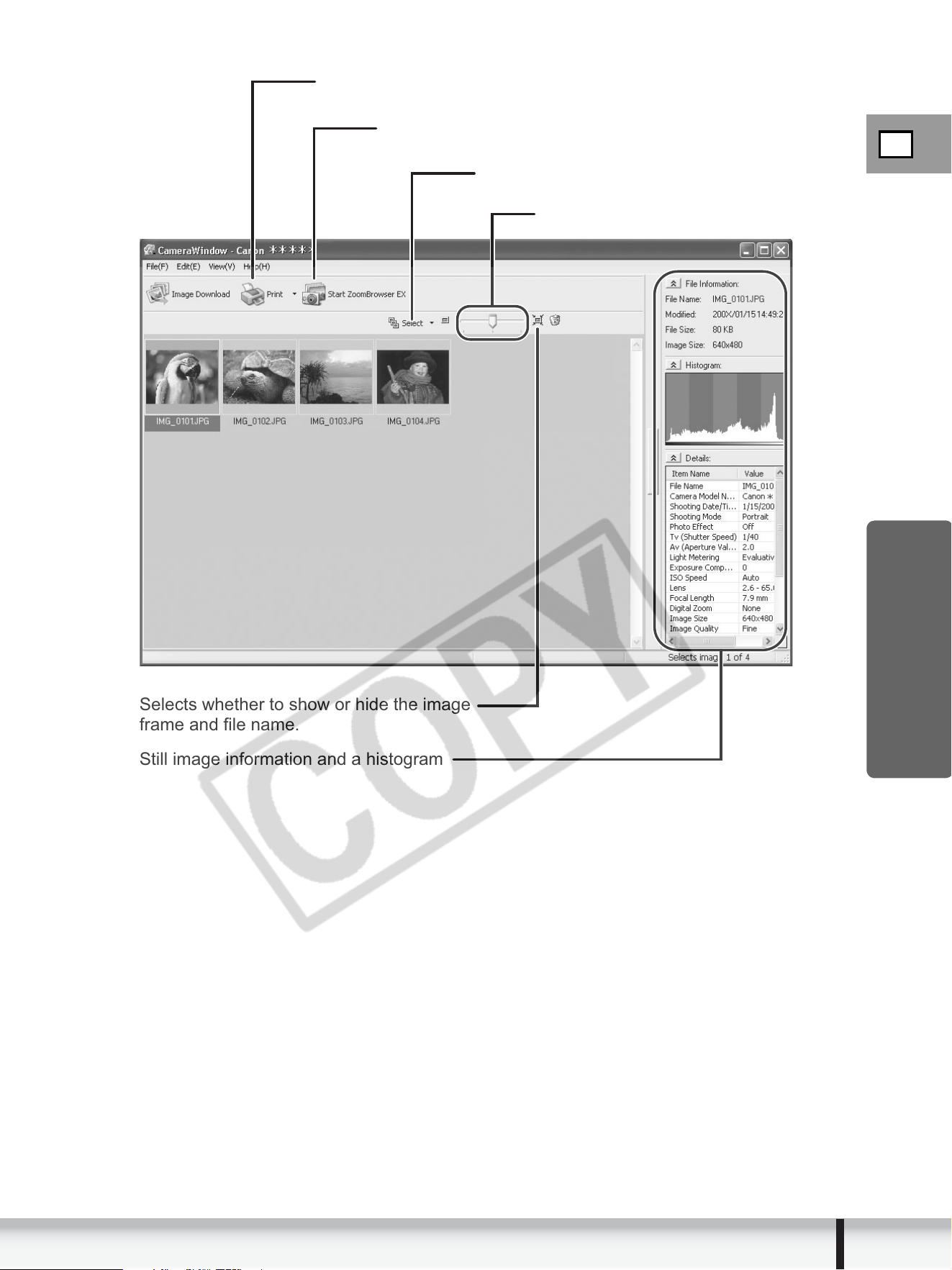
Camera Browser Window
Prints the selected still images.
Starts ZoomBrowser EX.
Selects the still image selection method.
Changes the size of the thumbnail.
Selects whether to show or hide the image
frame and file name.
Still image information and a histogram
12
Windows
Main Window
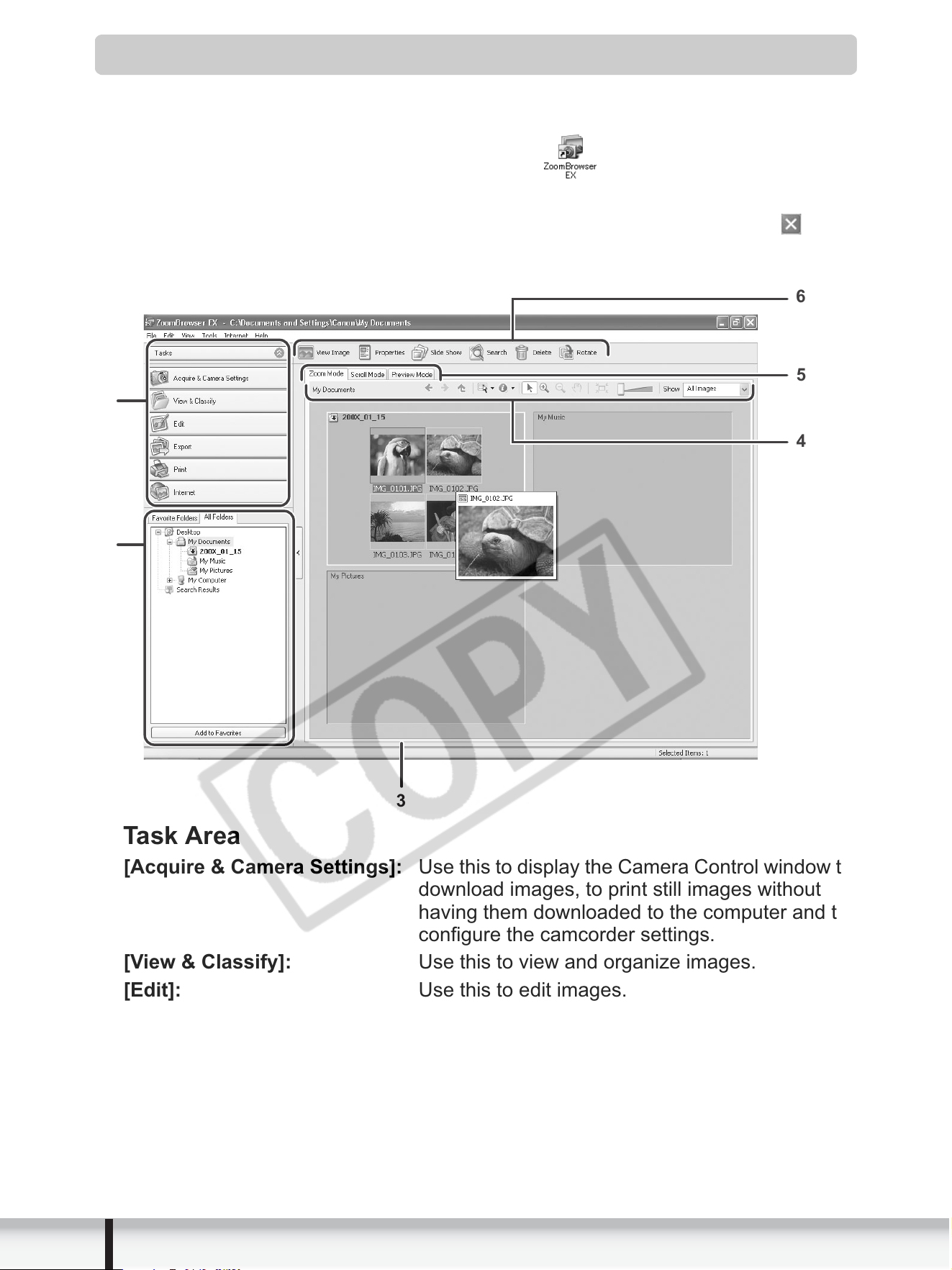
ZoomBrowser EX is a software program used for organizing, printing and editing the
downloaded images. If you wish to start ZoomBrowser EX without connecting the
camcorder or card reader/writer, double-click the on the desktop, or click the
Windows [start] menu and select [All Programs] [Canon Utilities]
[ZoomBrowser EX] and [ZoomBrowser EX]. To exit ZoomBrowser EX, click or
select [Exit] from the [File] menu.
1 Task Area
[Acquire & Camera Settings]: Use this to display the Camera Control window to
download images, to print still images without
having them downloaded to the computer and to
configure the camcorder settings.
[View & Classify]: Use this to view and organize images.
[Edit]: Use this to edit images.
[Export]: Use this to change the data for still images and
save them as new files, extract still images from
movies, back up to CD-R/RW, or export shooting
properties to a text file.
[Print]: Use this to print downloaded still images.
[Internet]: Use this to attach selected still images to E-mail
messages.
1
2
3
4
6
5
E
13
Windows
Windows
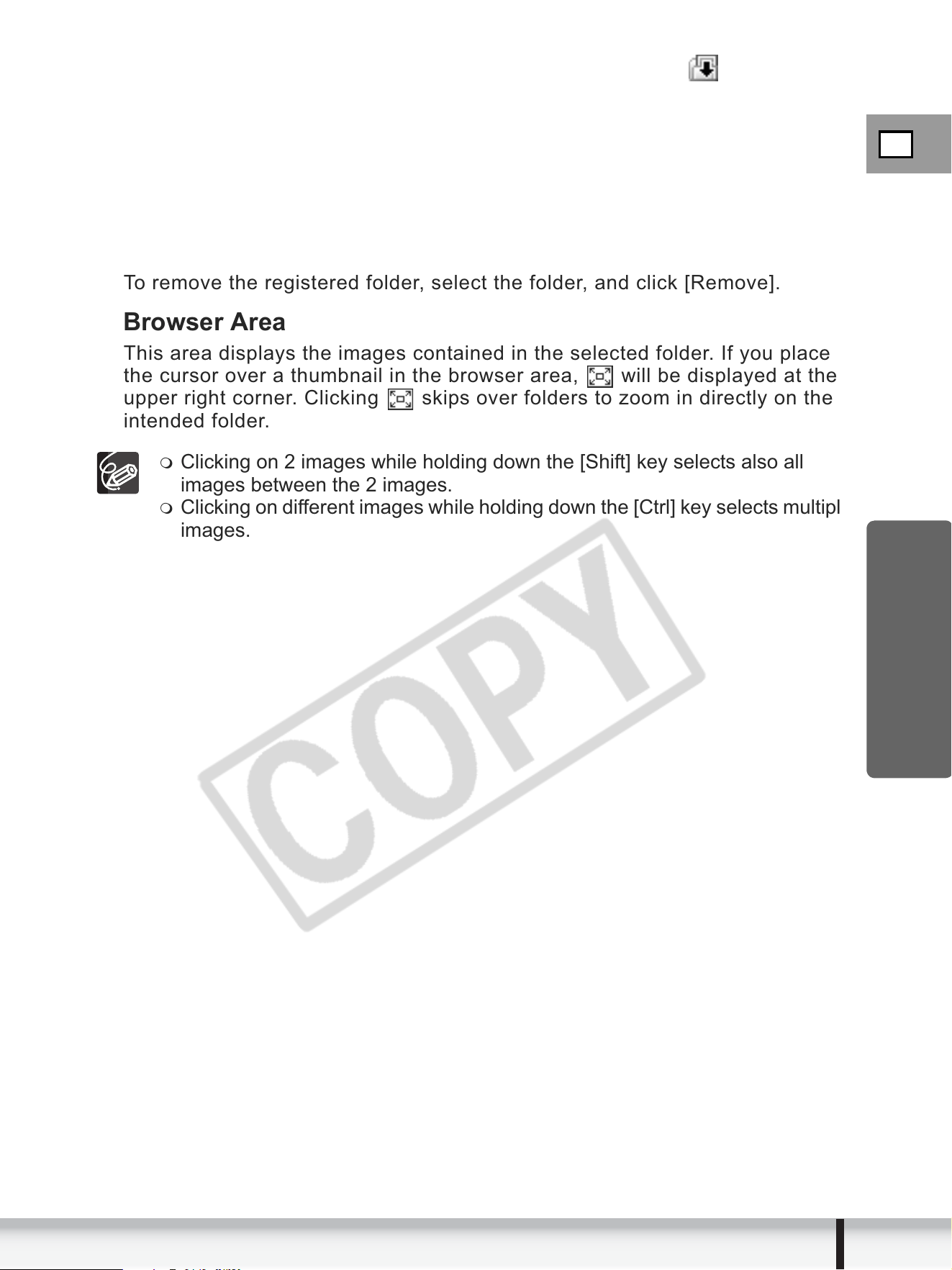
2 Folders Area
You can select a folder to be displayed in the Browser Area. indicates that
newly downloaded images are in the folder.
Selecting the [Favorite Folders] tab shows only the folders that are registered
as Favorites. To register folders as Favorites, follow the instructions below.
To remove the registered folder, select the folder, and click [Remove].
3 Browser Area
This area displays the images contained in the selected folder. If you place
the cursor over a thumbnail in the browser area, will be displayed at the
upper right corner. Clicking skips over folders to zoom in directly on the
intended folder.
Clicking on 2 images while holding down the [Shift] key selects also all
images between the 2 images.
Clicking on different images while holding down the [Ctrl] key selects multiple
images.
When the [All Folders] tab is selected:
Select a folder and click [Add to Favorites].
When the [Favorite Folders] tab is selected:
Click [Add] and select a folder.
14
Windows
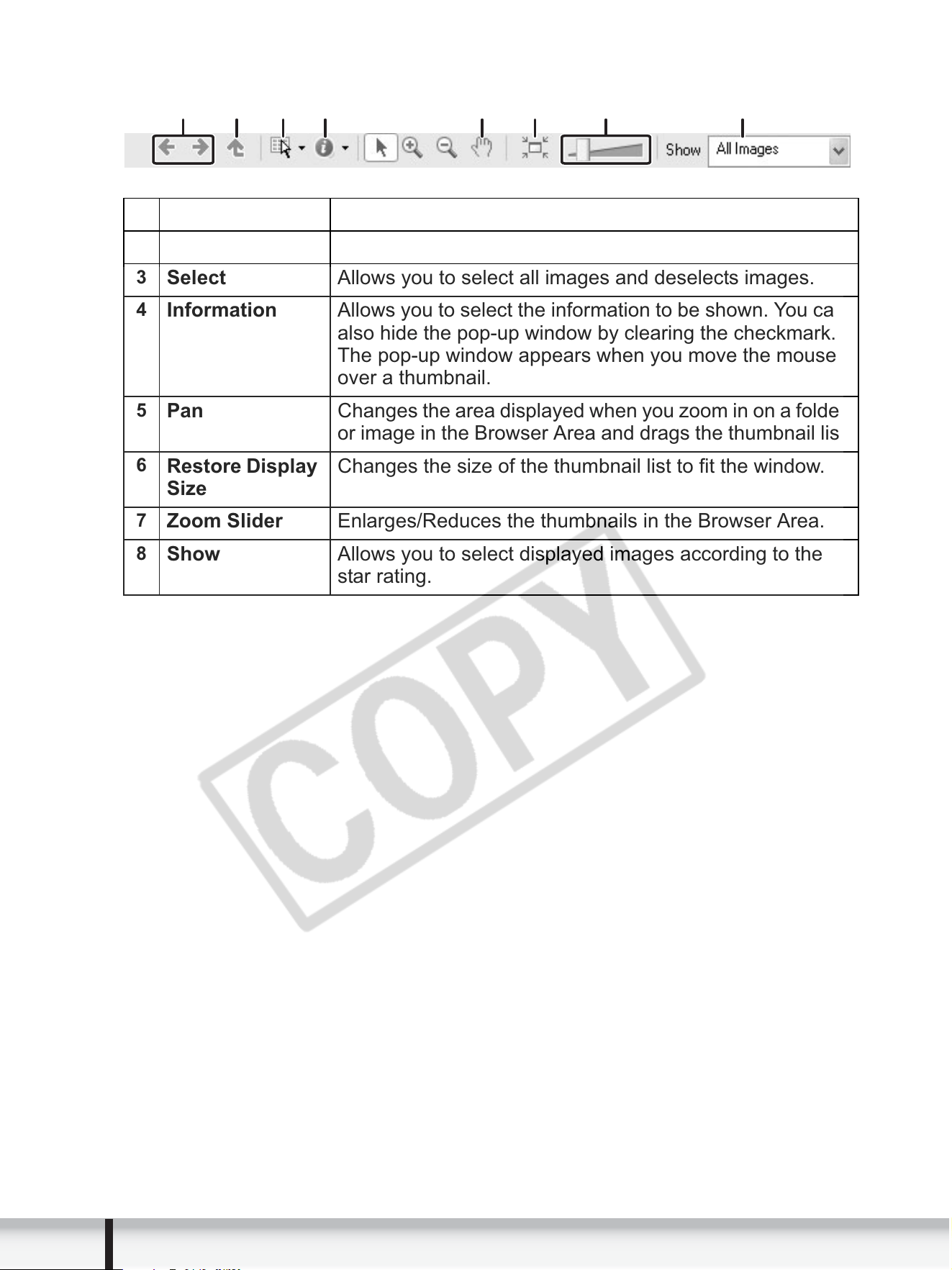
4 Browser Area Tool Bar
The menu items vary depending on the View Mode.
1 Previous/Next Displays the previous/next image in the current folder.
2
Up Displays the folder in the upper tiers of the hierarchy.
3
Select Allows you to select all images and deselects images.
4
Information Allows you to select the information to be shown. You can
also hide the pop-up window by clearing the checkmark.
The pop-up window appears when you move the mouse
over a thumbnail.
5
Pan Changes the area displayed when you zoom in on a folder
or image in the Browser Area and drags the thumbnail list.
6
Restore Display
Size
Changes the size of the thumbnail list to fit the window.
7
Zoom Slider Enlarges/Reduces the thumbnails in the Browser Area.
8
Show Allows you to select displayed images according to the
star rating.
1 2
3
4
8
56
7
E
15
Windows
Windows
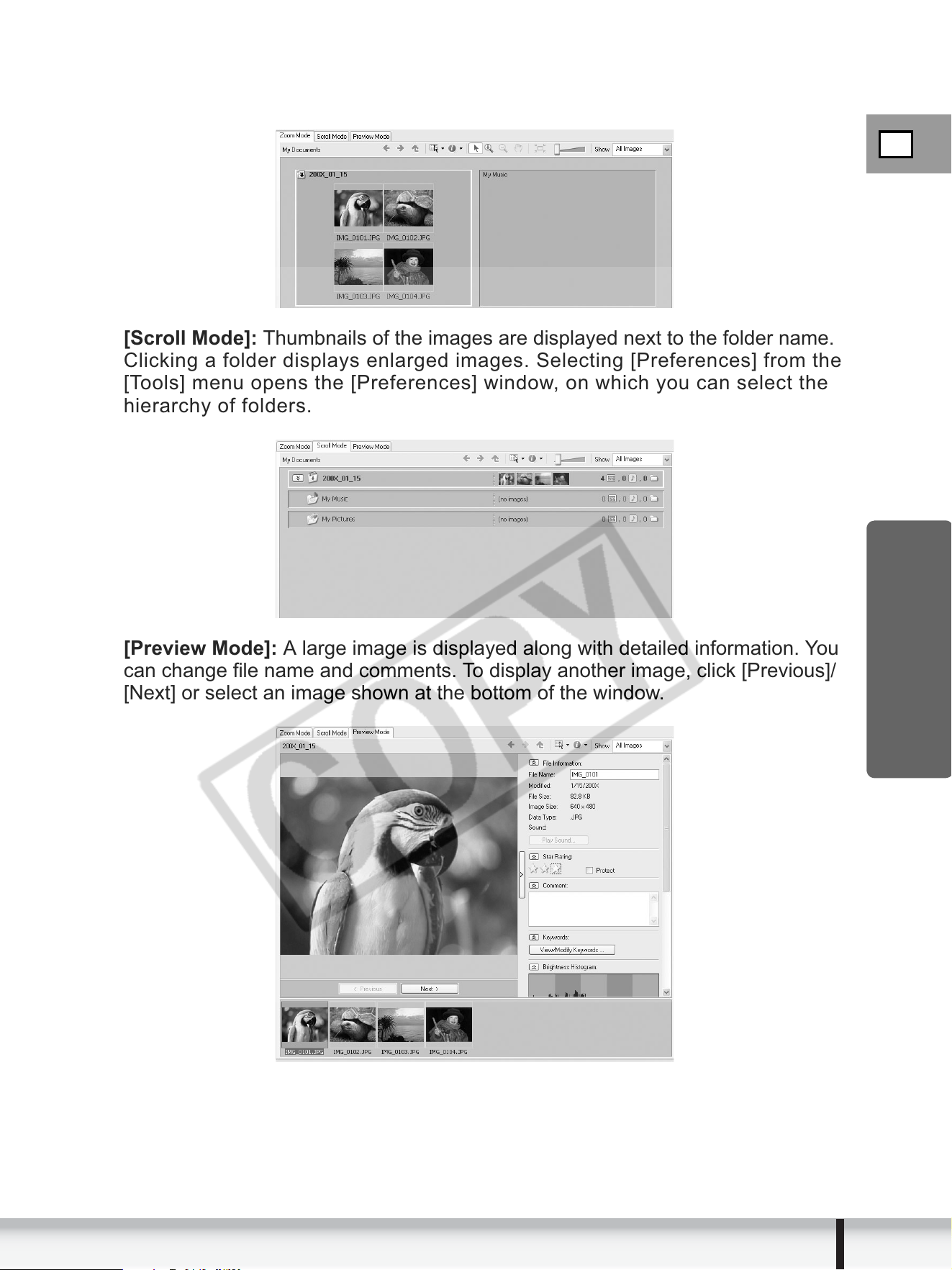
5 View Mode
You can select the view mode of images in the Browser Area.
[Zoom Mode]: The images in the selected folder are shown as thumbnails.
[Scroll Mode]: Thumbnails of the images are displayed next to the folder name.
Clicking a folder displays enlarged images. Selecting [Preferences] from the
[Tools] menu opens the [Preferences] window, on which you can select the
hierarchy of folders.
[Preview Mode]: A large image is displayed along with detailed information. You
can change file name and comments. To display another image, click [Previous]/
[Next] or select an image shown at the bottom of the window.
16
Windows
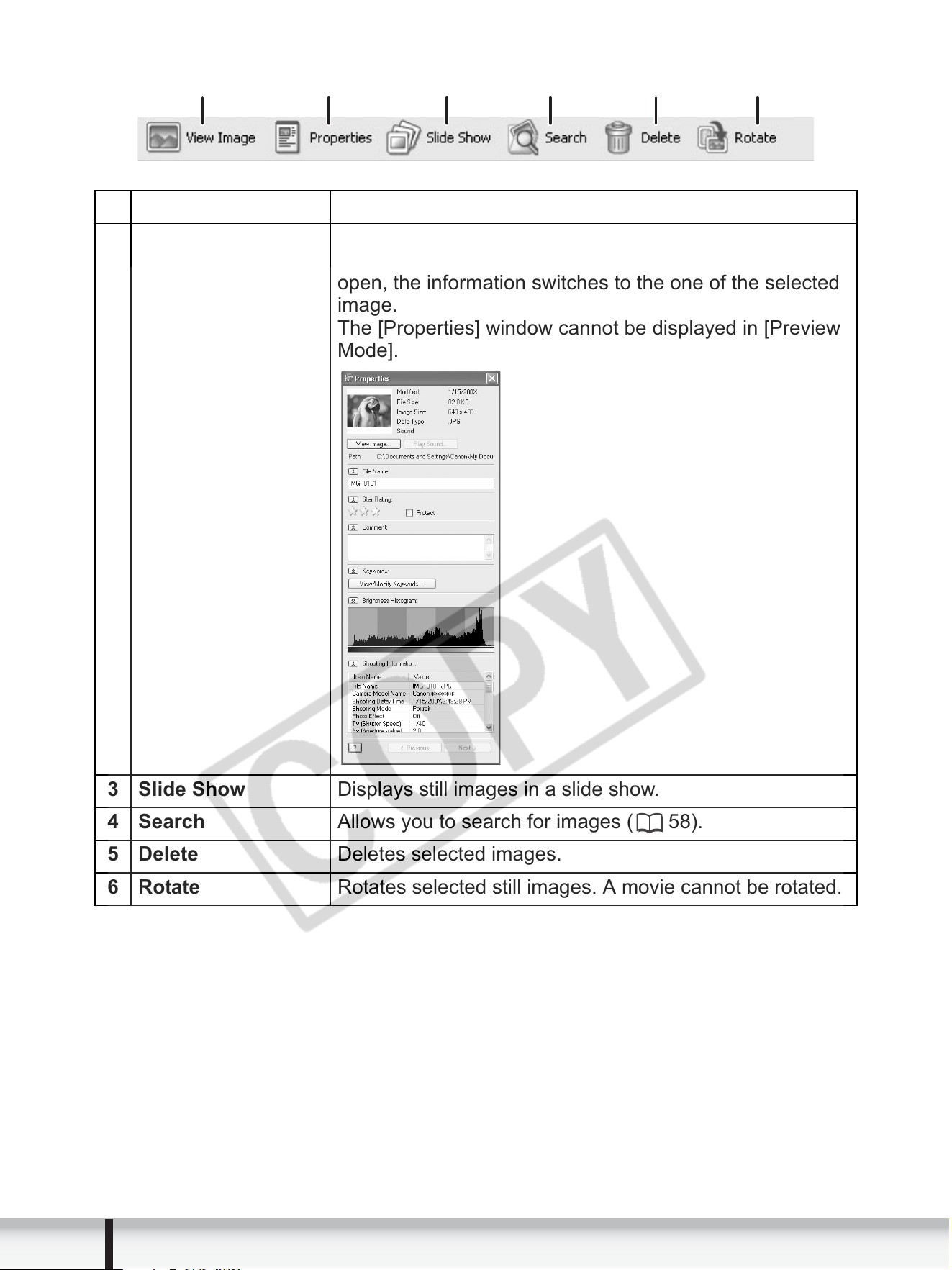
6 Application Tool Bar
1 View Image Displays a selected image in the [Image Viewer] window.
2 Properties Displays properties of the selected image. When you
select a different image while the [Properties] window is
open, the information switches to the one of the selected
image.
The [Properties] window cannot be displayed in [Preview
Mode].
3 Slide Show Displays still images in a slide show.
4 Search Allows you to search for images ( 58).
5Delete Deletes selected images.
6Rotate Rotates selected still images. A movie cannot be rotated.
1
2
3
4
5
6
E
17
Windows
Windows
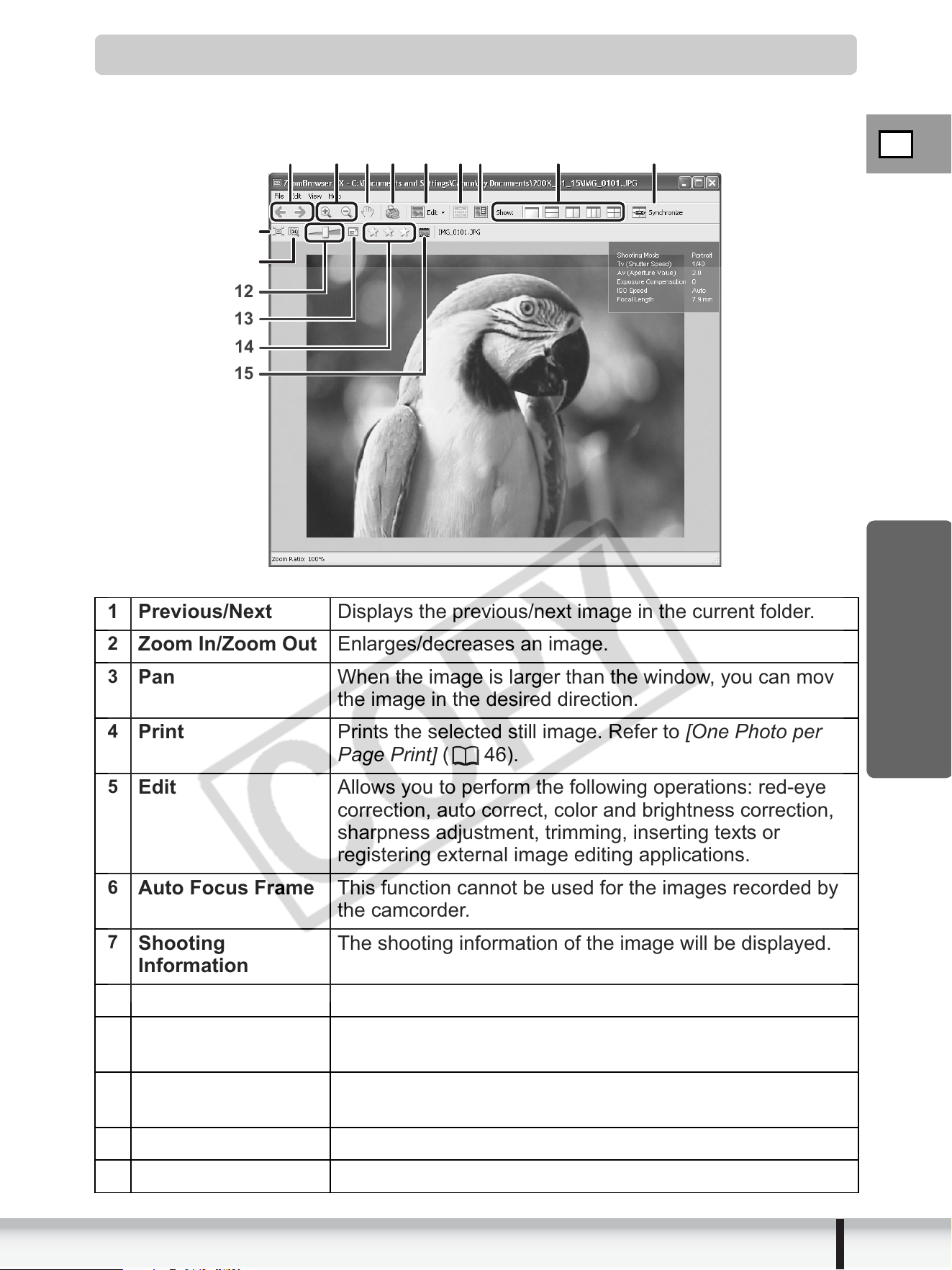
[Image Viewer] Window
The [Image Viewer] window appears when you select an image and click [View
Image] or double-click an image.
1 Previous/Next Displays the previous/next image in the current folder.
2
Zoom In/Zoom Out Enlarges/decreases an image.
3
Pan When the image is larger than the window, you can move
the image in the desired direction.
4
Print Prints the selected still image. Refer to [One Photo per
Page Print] (46).
5
Edit Allows you to perform the following operations: red-eye
correction, auto correct, color and brightness correction,
sharpness adjustment, trimming, inserting texts or
registering external image editing applications.
6
Auto Focus Frame This function cannot be used for the images recorded by
the camcorder.
7
Shooting
Information
The shooting information of the image will be displayed.
8
Show Allows you to display multiple images at the same time.
9
Synchronize Synchronizes the View functions across all displayed
images.
10
Fit to Window Matches the image size to the size of the Image Viewer
Window.
11
Restore Restores the standard display size.
12
Zoom Slider Allows you to enlarge/decrease the displayed image.
13
15
12
11
10
14
1
3
85 6 7 94
2
18
Windows
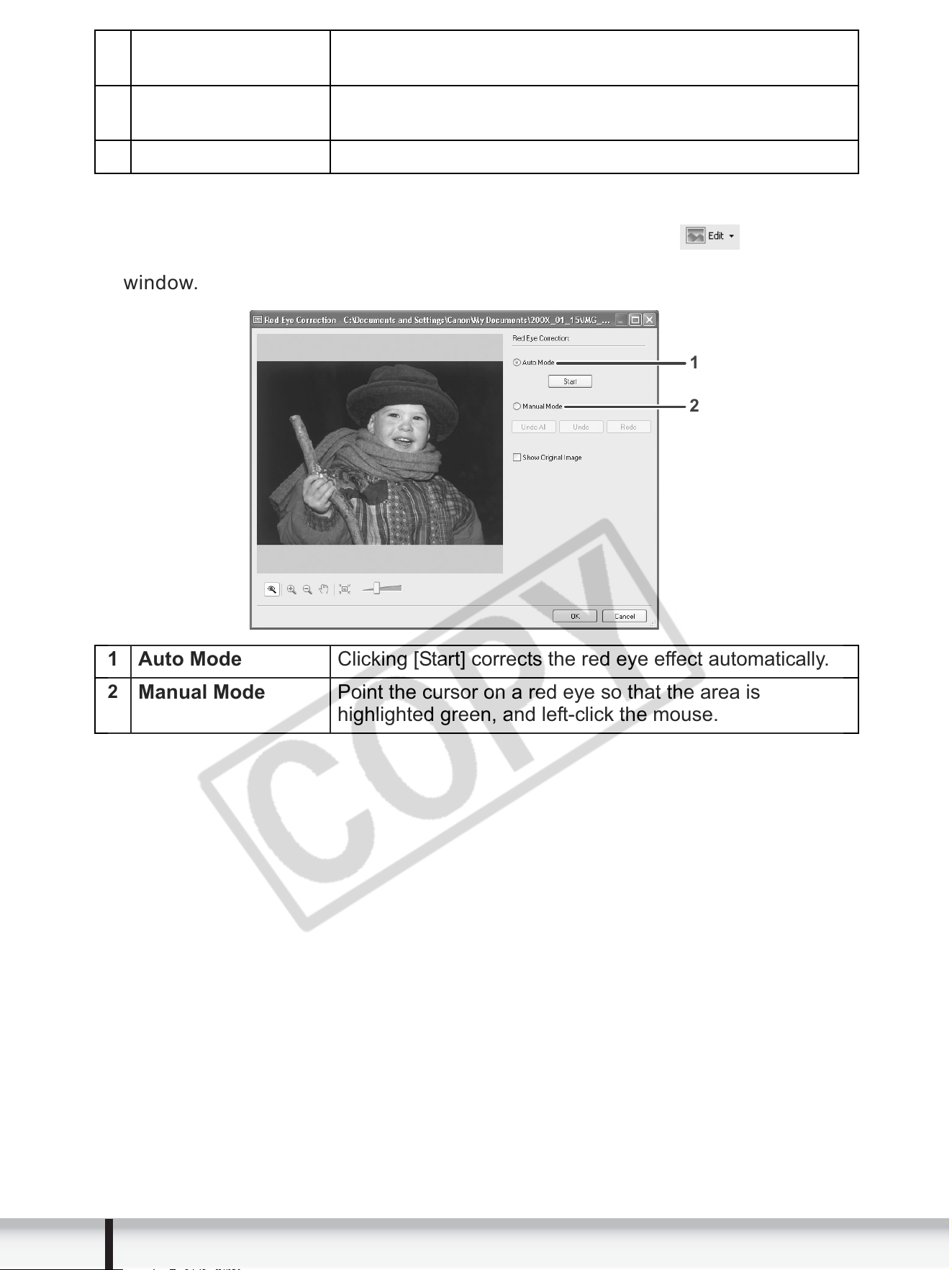
[Red Eye Correction] Window
Selecting [Red Eye Correction] from the [Edit] menu or the icon allows
you to correct the red eye effect on an image in the [Red Eye Correction]
window.
13
Show Image Full
Screen
Displays an image in full screen size.
14
Change the Star
Rating
Allows you to change the star rating.
15
Capturing Frames Extracts still images from movies. (Windows XP only)
1 Auto Mode Clicking [Start] corrects the red eye effect automatically.
2
Manual Mode Point the cursor on a red eye so that the area is
highlighted green, and left-click the mouse.
1
2
E
19
Windows
Windows
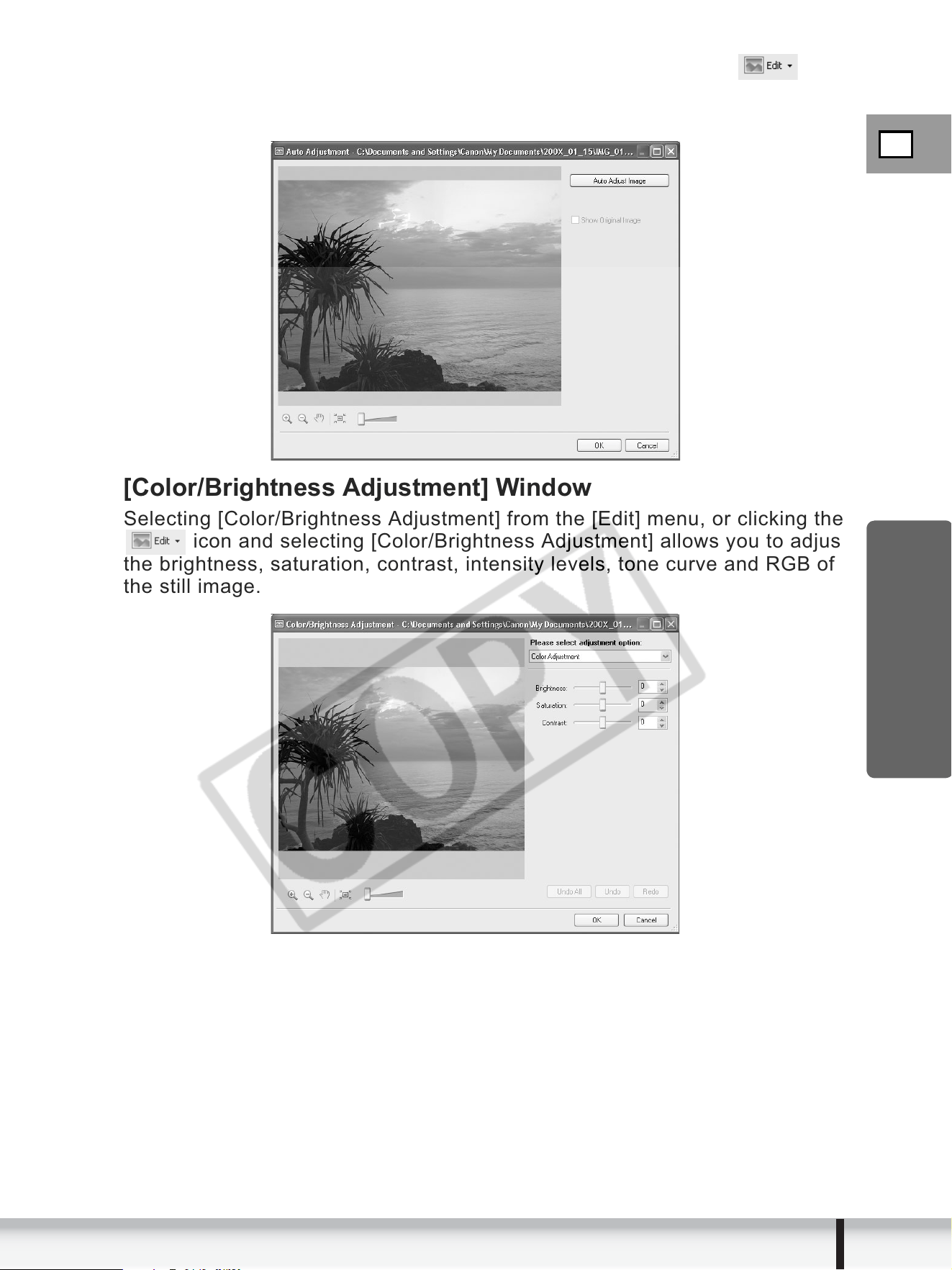
[Auto Adjustment] Window
Selecting [Auto Adjustment] from the [Edit] menu, or clicking the icon
and selecting [Auto Adjustment] allows you to automatically correct the color
balance of the still image.
[Color/Brightness Adjustment] Window
Selecting [Color/Brightness Adjustment] from the [Edit] menu, or clicking the
icon and selecting [Color/Brightness Adjustment] allows you to adjust
the brightness, saturation, contrast, intensity levels, tone curve and RGB of
the still image.
20
Windows
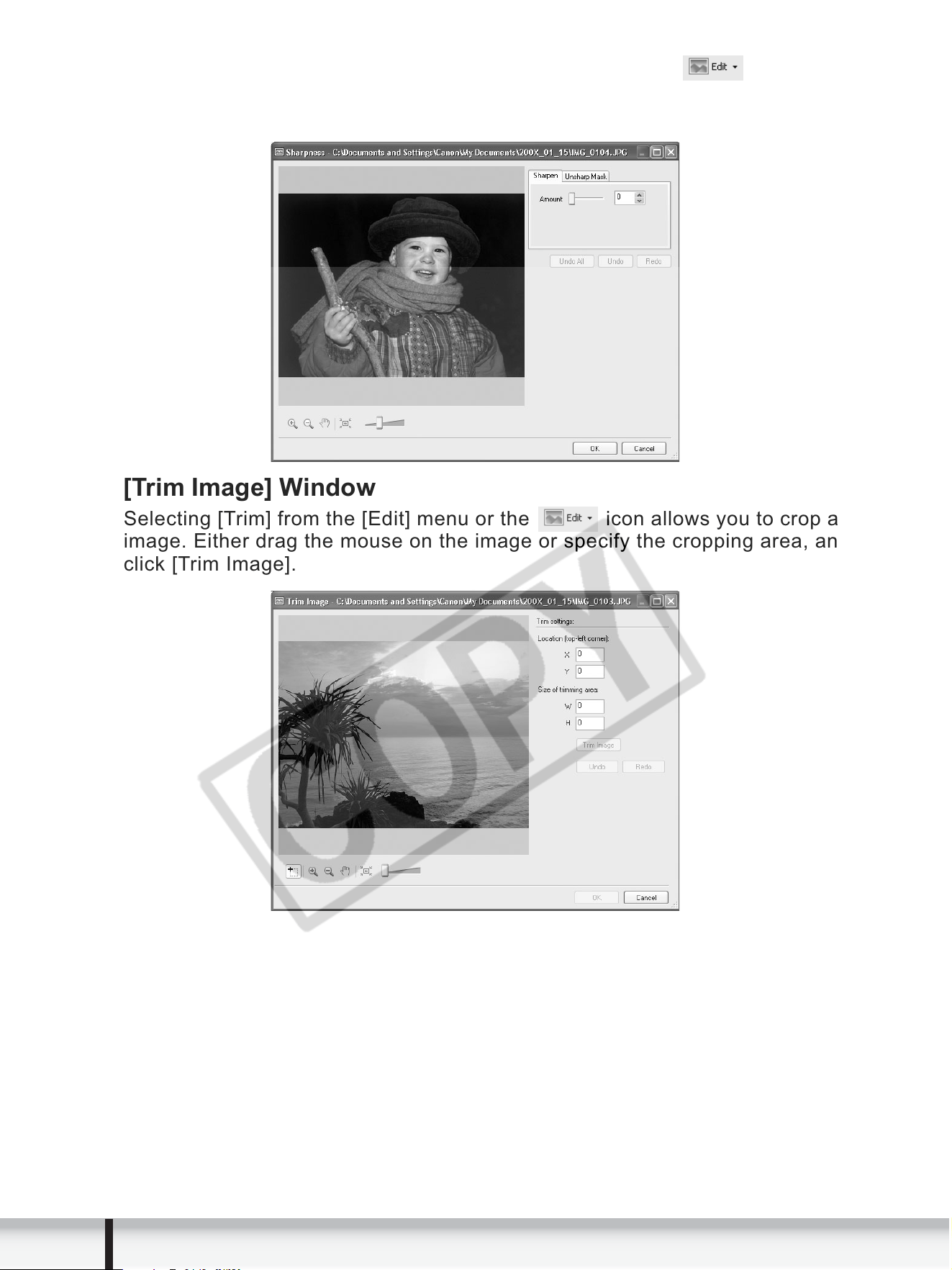
[Sharpness] Window
Selecting [Sharpness] from the [Edit] menu, or clicking the icon and
selecting [Sharpness] allows you to emphasize and clarify the outlines of
people and objects.
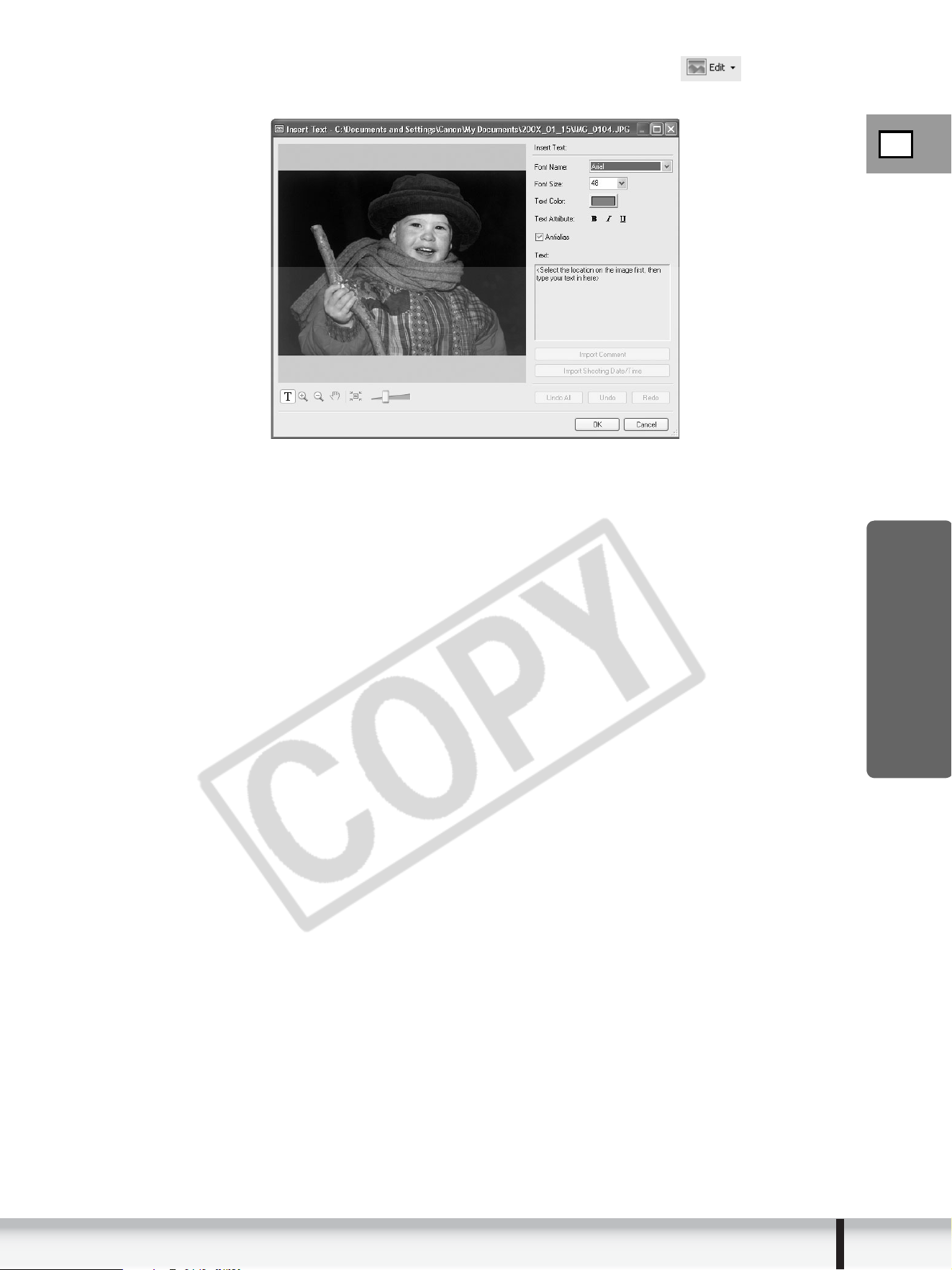
[Trim Image] Window
Selecting [Trim] from the [Edit] menu or the icon allows you to crop an
image. Either drag the mouse on the image or specify the cropping area, and
click [Trim Image].
E
21
Windows
Windows
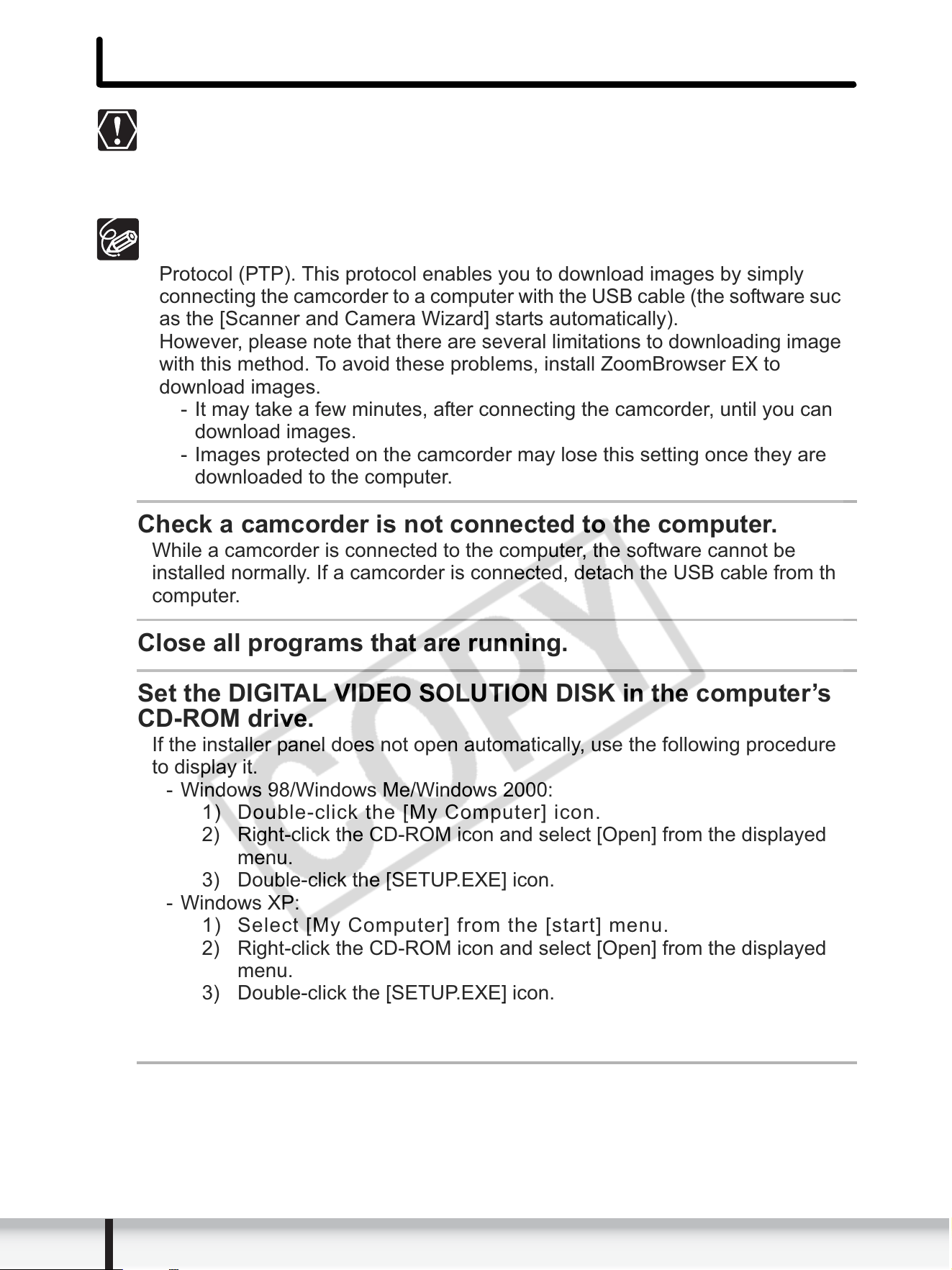
[Insert Text] Window
Selecting [Insert Text] from the [Edit] menu, or clicking the icon, and
select [Insert Text] allows you to write text on still images.
22
Installing the Digital Video Software
Installing the Digital Video Software
Be sure to install the Digital Video Software before connecting the
camcorder to the computer.
Users of Windows 2000 or Windows XP must first log in as an Administrator
to install programs.
Windows XP Users:
Your digital video camcorder is equipped with the standard Picture Transfer
Protocol (PTP). This protocol enables you to download images by simply
connecting the camcorder to a computer with the USB cable (the software such
as the [Scanner and Camera Wizard] starts automatically).
However, please note that there are several limitations to downloading images
with this method. To avoid these problems, install ZoomBrowser EX to
download images.
- It may take a few minutes, after connecting the camcorder, until you can
download images.
- Images protected on the camcorder may lose this setting once they are
downloaded to the computer.
1
Check a camcorder is not connected to the computer.
While a camcorder is connected to the computer, the software cannot be
installed normally. If a camcorder is connected, detach the USB cable from the
computer.
2
Close all programs that are running.
3
Set the DIGITAL VIDEO SOLUTION DISK in the computer’s
CD-ROM drive.
If the installer panel does not open automatically, use the following procedures
to display it.
- Windows 98/Windows Me/Windows 2000:
1) Double-click the [My Computer] icon.
2) Right-click the CD-ROM icon and select [Open] from the displayed
menu.
3) Double-click the [SETUP.EXE] icon.
-Windows XP:
1) Select [My Computer] from the [start] menu.
2) Right-click the CD-ROM icon and select [Open] from the displayed
menu.
3) Double-click the [SETUP.EXE] icon.
Depending on the setting of your computer, the file extension “.EXE” may not
appear.
4
Select your language.
E
23
Installing the Digital Video Software
Windows
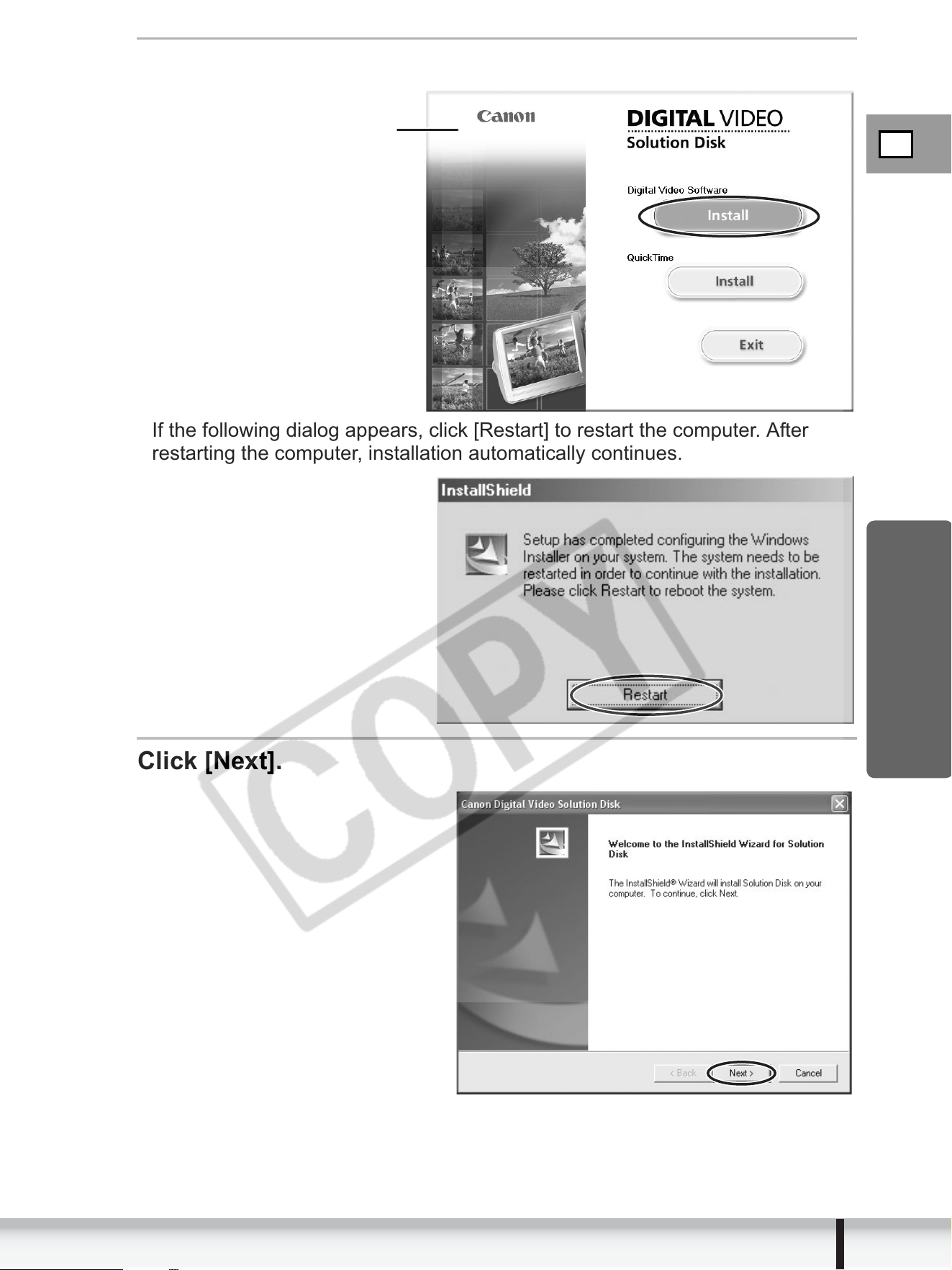
5
Click Digital Video Software [Install].
If the following dialog appears, click [Restart] to restart the computer. After
restarting the computer, installation automatically continues.
6
Click [Next].
Installer Panel
24
Installing the Digital Video Software
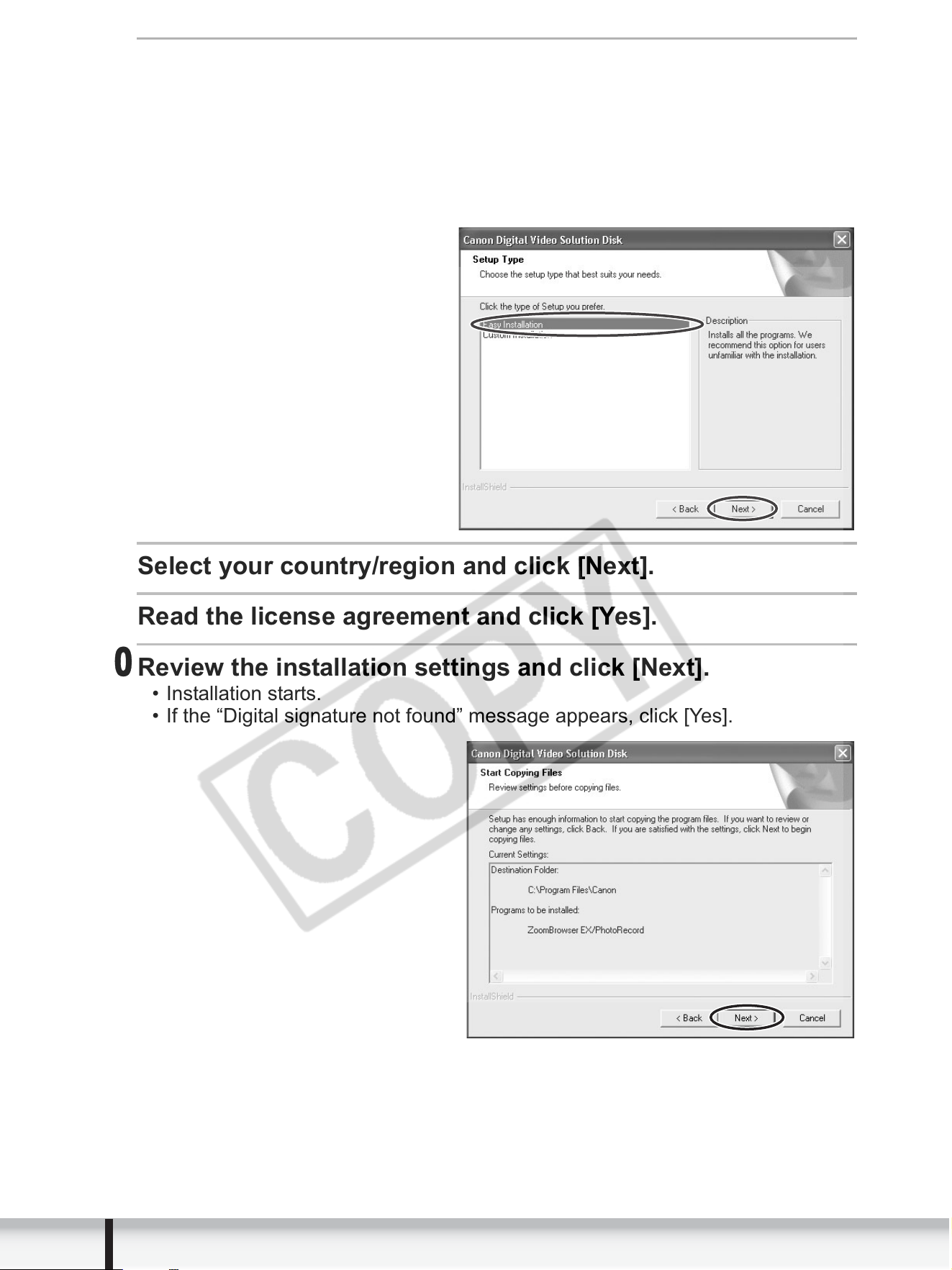
7
Select [Easy Installation] and click [Next].
To install the software individually, select [Custom Installation]. When you select
[Custom Installation], select a USB driver. (Windows XP: The USB driver
supplied with the Windows operating system is used. You do not need to install
a USB driver.)
• Windows 98/Windows 2000: Canon DV TWAIN Driver
• Windows Me: Canon DV WIA Driver
8
Select your country/region and click [Next].
9
Read the license agreement and click [Yes].
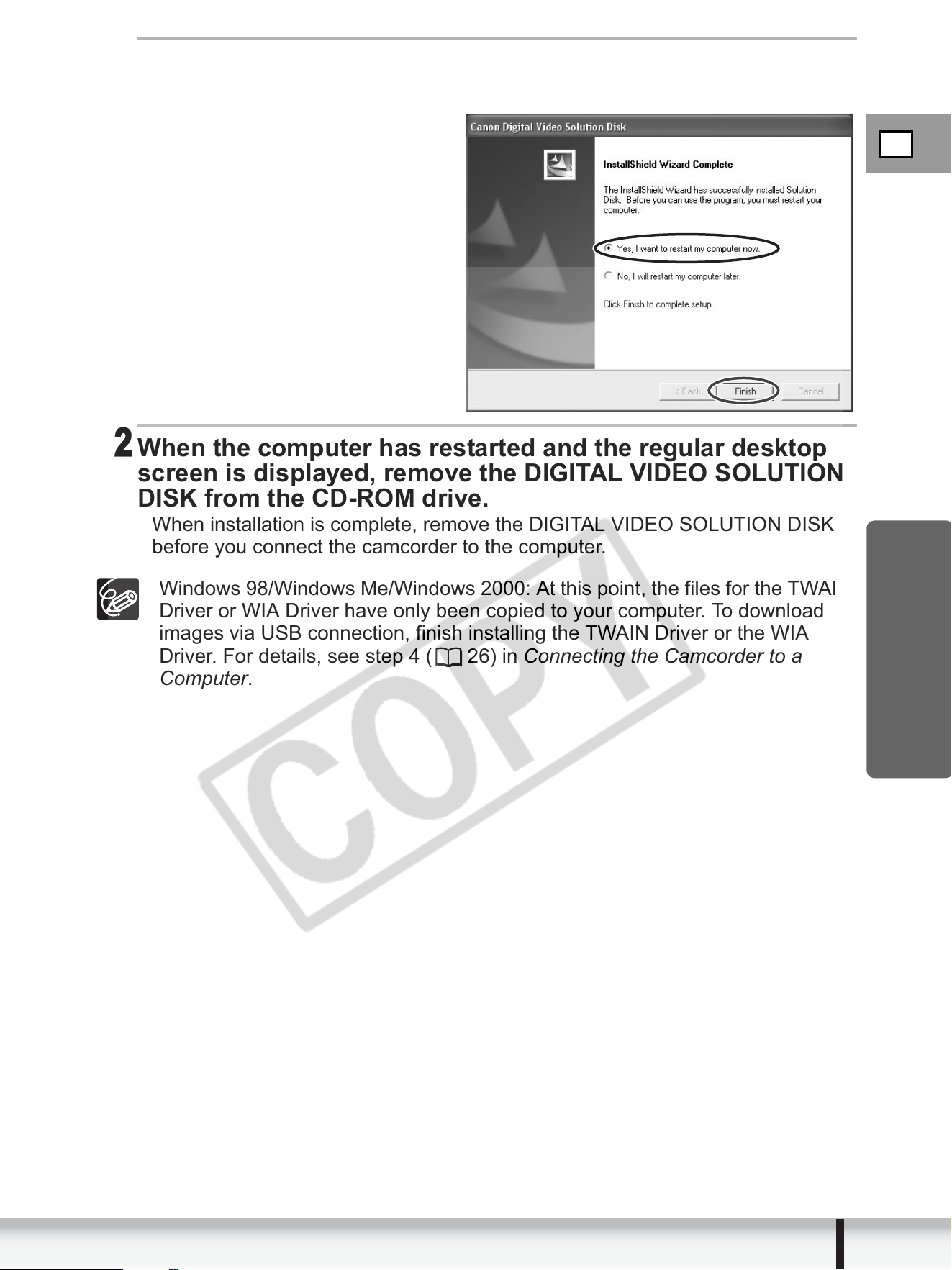
10
Review the installation settings and click [Next].
• Installation starts.
• If the “Digital signature not found” message appears, click [Yes].
E
25
Installing the Digital Video Software
Windows
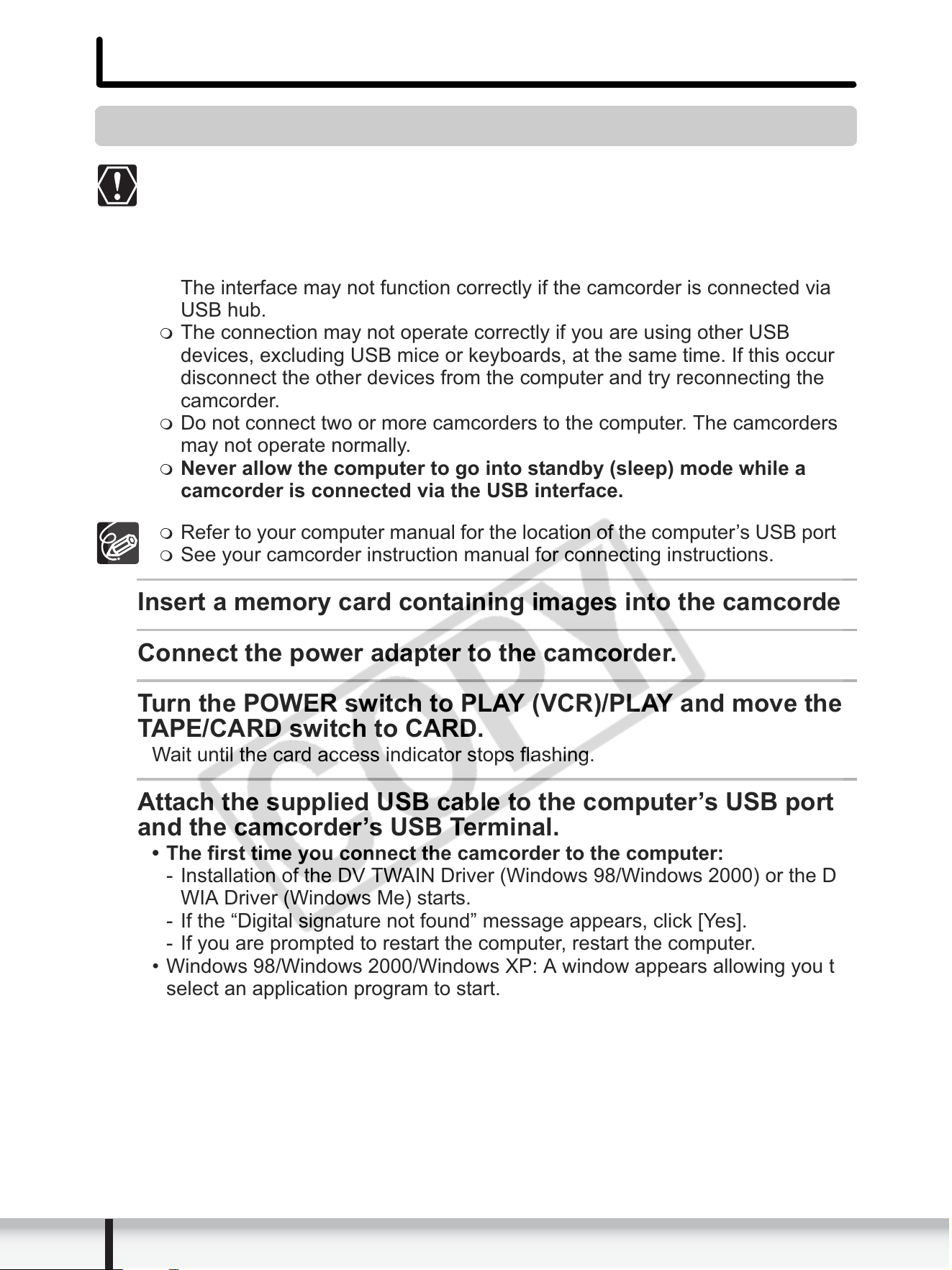
11
When installation is complete, select [Yes, I want to restart
my computer now.] and click [Finish].
12
When the computer has restarted and the regular desktop
screen is displayed, remove the DIGITAL VIDEO SOLUTION
DISK from the CD-ROM drive.
When installation is complete, remove the DIGITAL VIDEO SOLUTION DISK
before you connect the camcorder to the computer.
Windows 98/Windows Me/Windows 2000: At this point, the files for the TWAIN
Driver or WIA Driver have only been copied to your computer. To download
images via USB connection, finish installing the TWAIN Driver or the WIA
Driver. For details, see step 4 ( 26) in Connecting the Camcorder to a
Computer.
26
Before Downloading Images
Before Downloading Images
Connecting the Camcorder to a Computer
Be sure to install the Digital Video Software before you connect the
camcorder to the computer.
Make sure the camcorder is being powered using the power adapter before
connecting it to a computer.
Connect the USB cable directly to one of the computer’s main USB ports.
The interface may not function correctly if the camcorder is connected via a
USB hub.
The connection may not operate correctly if you are using other USB
devices, excluding USB mice or keyboards, at the same time. If this occurs,
disconnect the other devices from the computer and try reconnecting the
camcorder.
Do not connect two or more camcorders to the computer. The camcorders
may not operate normally.
Never allow the computer to go into standby (sleep) mode while a
camcorder is connected via the USB interface.
Refer to your computer manual for the location of the computer’s USB ports.
See your camcorder instruction manual for connecting instructions.
1
Insert a memory card containing images into the camcorder.
2
Connect the power adapter to the camcorder.
3
Turn the POWER switch to PLAY (VCR)/PLAY and move the
TAPE/CARD switch to CARD.
Wait until the card access indicator stops flashing.
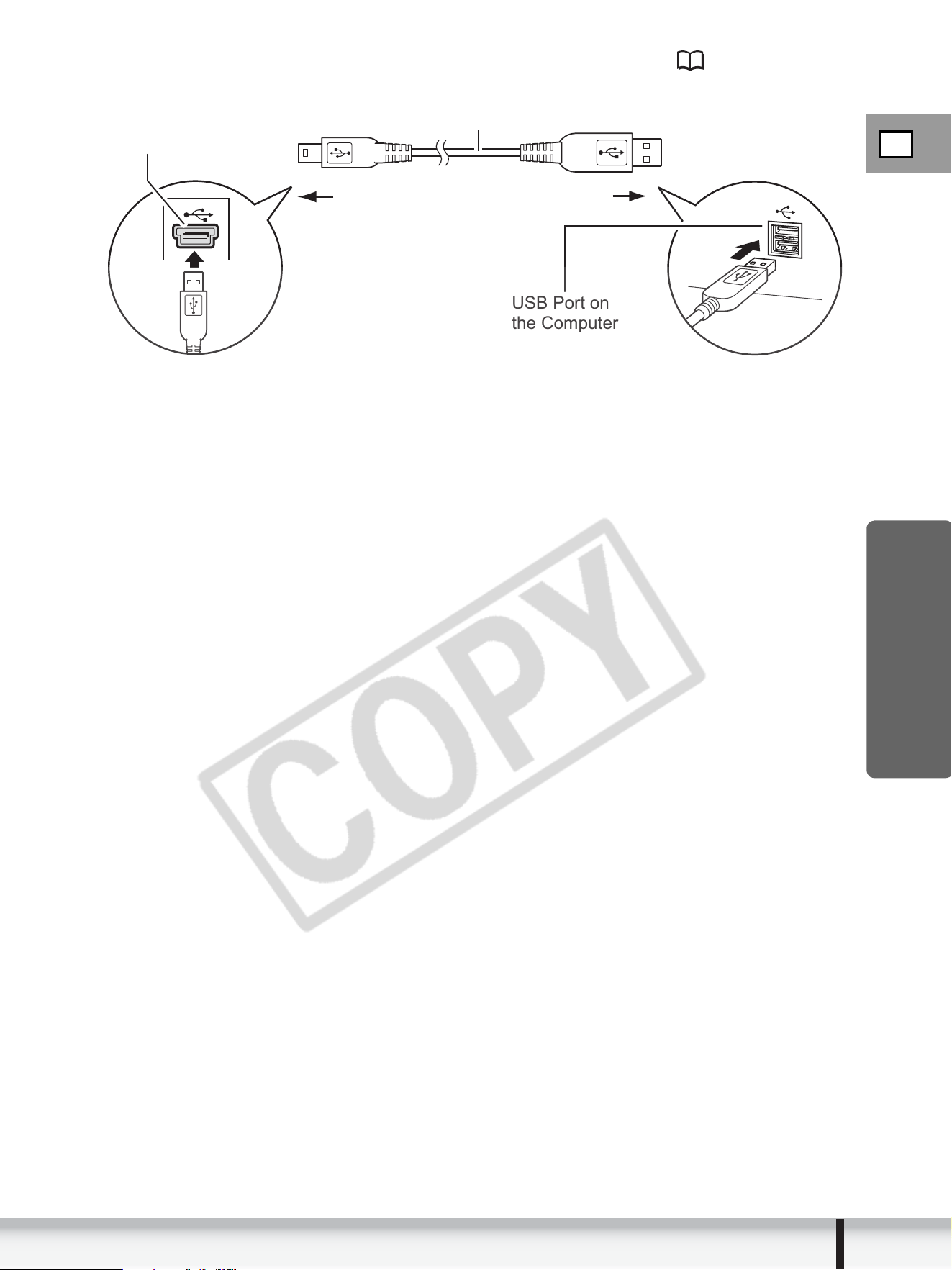
4
Attach the supplied USB cable to the computer’s USB port
and the camcorder’s USB Terminal.
• The first time you connect the camcorder to the computer:
- Installation of the DV TWAIN Driver (Windows 98/Windows 2000) or the DV
WIA Driver (Windows Me) starts.
- If the “Digital signature not found” message appears, click [Yes].
- If you are prompted to restart the computer, restart the computer.
• Windows 98/Windows 2000/Windows XP: A window appears allowing you to
select an application program to start.
Windows Me: The Scanners and Cameras Wizard starts. Click [Cancel] to
close the Wizard.
E
27
Before Downloading Images
Windows
• For instructions on how to start ZoomBrowser EX and download images to the
computer, see Downloading Images (ZoomBrowser EX) ( 28).
USB Cable
USB Terminal
on the Camcorder
Camcorder End Computer End
USB Port on
the Computer
28
Downloading Images (ZoomBrowser EX)
Downloading Images (ZoomBrowser EX)
Observe following precautions when the camcorder’s card access indicator
is flashing (the camcorder is reading or writing from or to the memory card).
Failure to do so may cause memory card data to become corrupted.
- Do not open the memory card cover, remove the memory card or detach
the USB cable.
- Do not turn off the camcorder or the computer.
- Do not change the position of the POWER switch or the TAPE/CARD
switch.
Images recorded onto the memory card or downloaded to the hard disk are
important original data files. Create a copy of the file first before working on it
on your computer.
For Windows XP Users:
- Do not rotate the image in the [Windows Picture and Fax Viewer] or in the
explorer view. The data for the original image will be changed and the
image can no longer be displayed in ZoomBrowser EX or on the
camcorder.
- A movie file exceeding 210 MB cannot be downloaded.
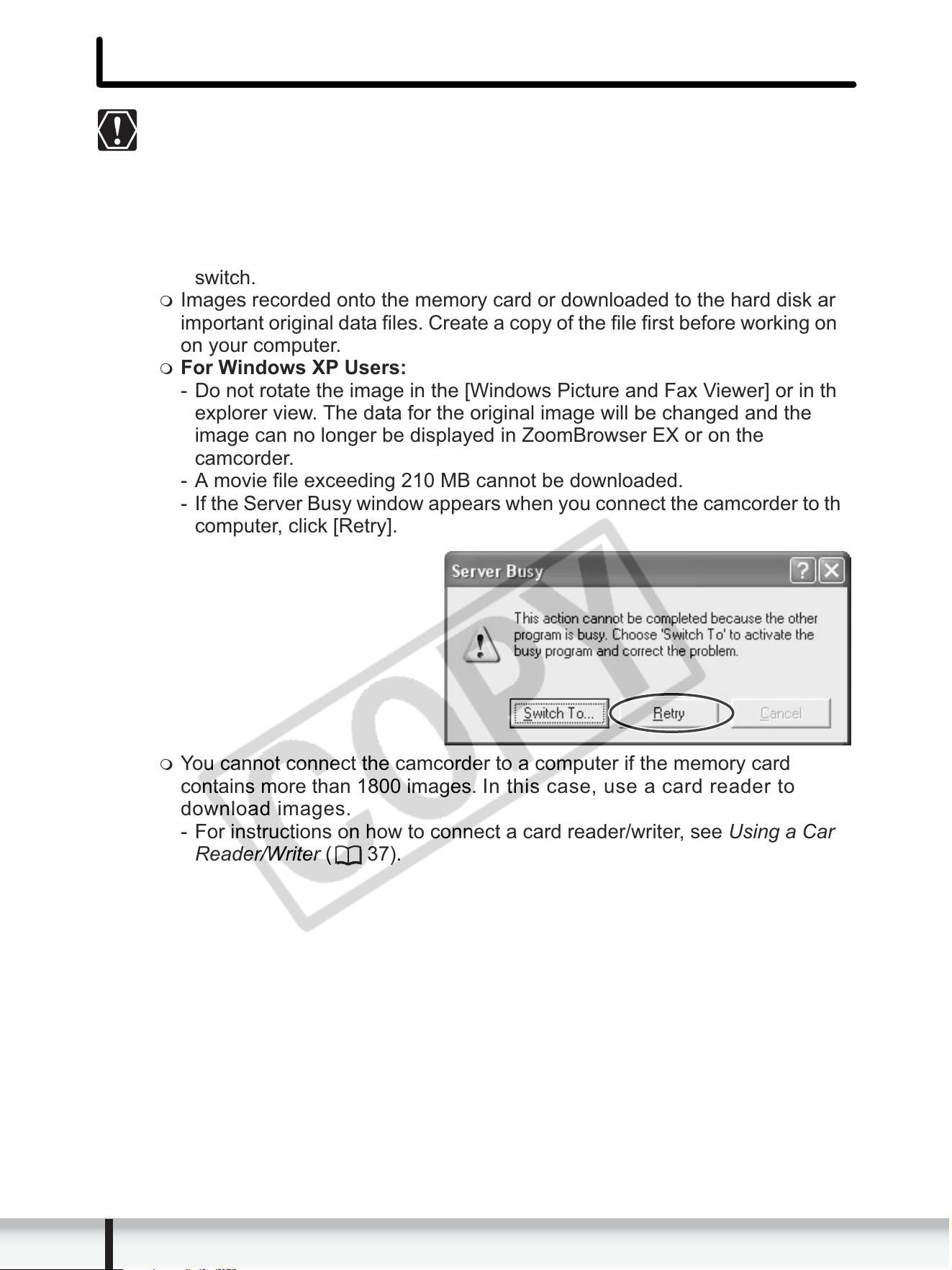
- If the Server Busy window appears when you connect the camcorder to the
computer, click [Retry].
You cannot connect the camcorder to a computer if the memory card
contains more than 1800 images. In this case, use a card reader to
download images.
- For instructions on how to connect a card reader/writer, see Using a Card
Reader/Writer (37).
E
29
Downloading Images (ZoomBrowser EX)
Windows
Starting CameraWindow
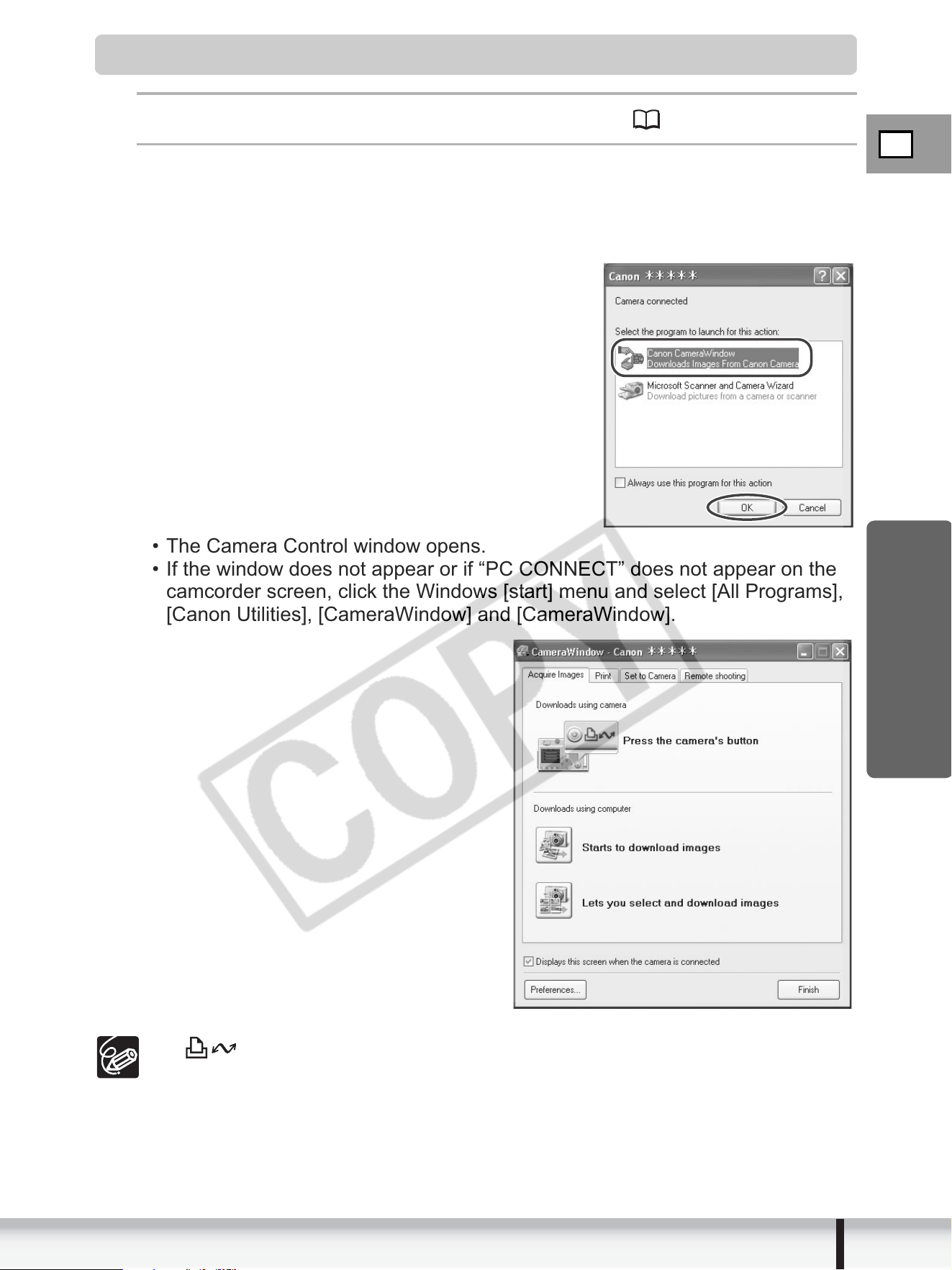
1
Connect the camcorder to the computer ( 26).
2
Select [Canon CameraWindow] and click [OK].
• If a camcorder and card reader are connected at the same time, a dialog
appears allowing you to select the camcorder model. Confirm that [Canon
Camera] or your camcorder model name is displayed and click [OK].
• The Camera Control window opens.
• If the window does not appear or if “PC CONNECT” does not appear on the
camcorder screen, click the Windows [start] menu and select [All Programs],
[Canon Utilities], [CameraWindow] and [CameraWindow].
(print/share) button may not be supported by your camcorder.
If the camcorder is already connected to the computer, you can start the
CameraWindow and display the Camera Control window by clicking [Acquire
& Camera Settings] followed by [Acquire Images] in the ZoomBrowser EX
Main Window.
The Remote shooting function is not supported by your camcorder.
30
Downloading Images (ZoomBrowser EX)
Using the Computer to Download Images
You can select a downloading method in the Camera Control window.
Auto-Downloading
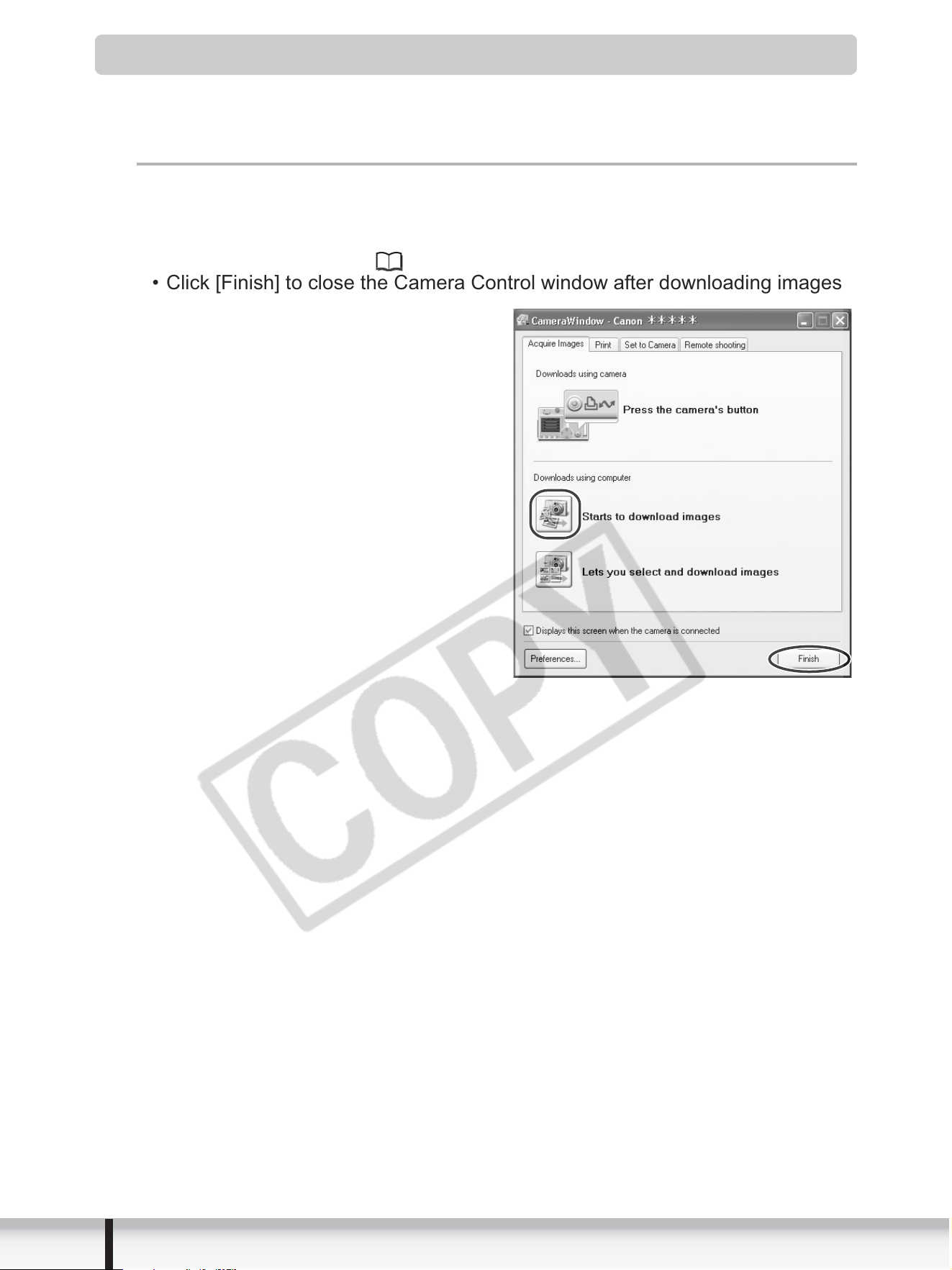
1
Click [Starts to download images] in the Camera Control
window.
• For instructions on how to set the Auto-download settings, see Auto-
Downloading Settings ( 31).
• Click [Finish] to close the Camera Control window after downloading images.
E
31
Downloading Images (ZoomBrowser EX)
Windows
Auto-Downloading Settings
Select the setting for downloading images by operating your computer. You can
change the image type and the destination folder.
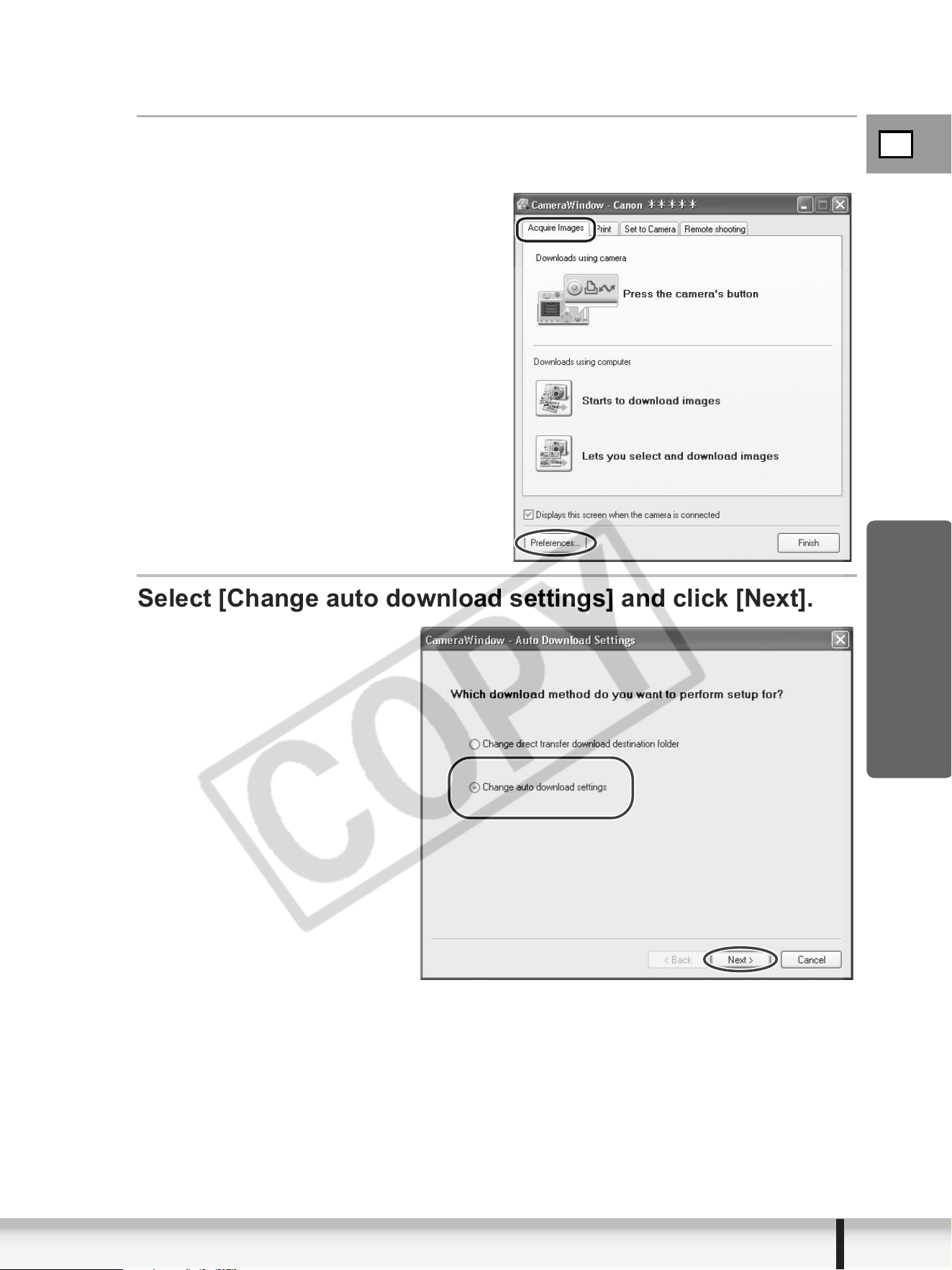
1
In the Camera Control window, click the [Acquire Images]
tab and click [Preferences].
2
Select [Change auto download settings] and click [Next].
32
Downloading Images (ZoomBrowser EX)
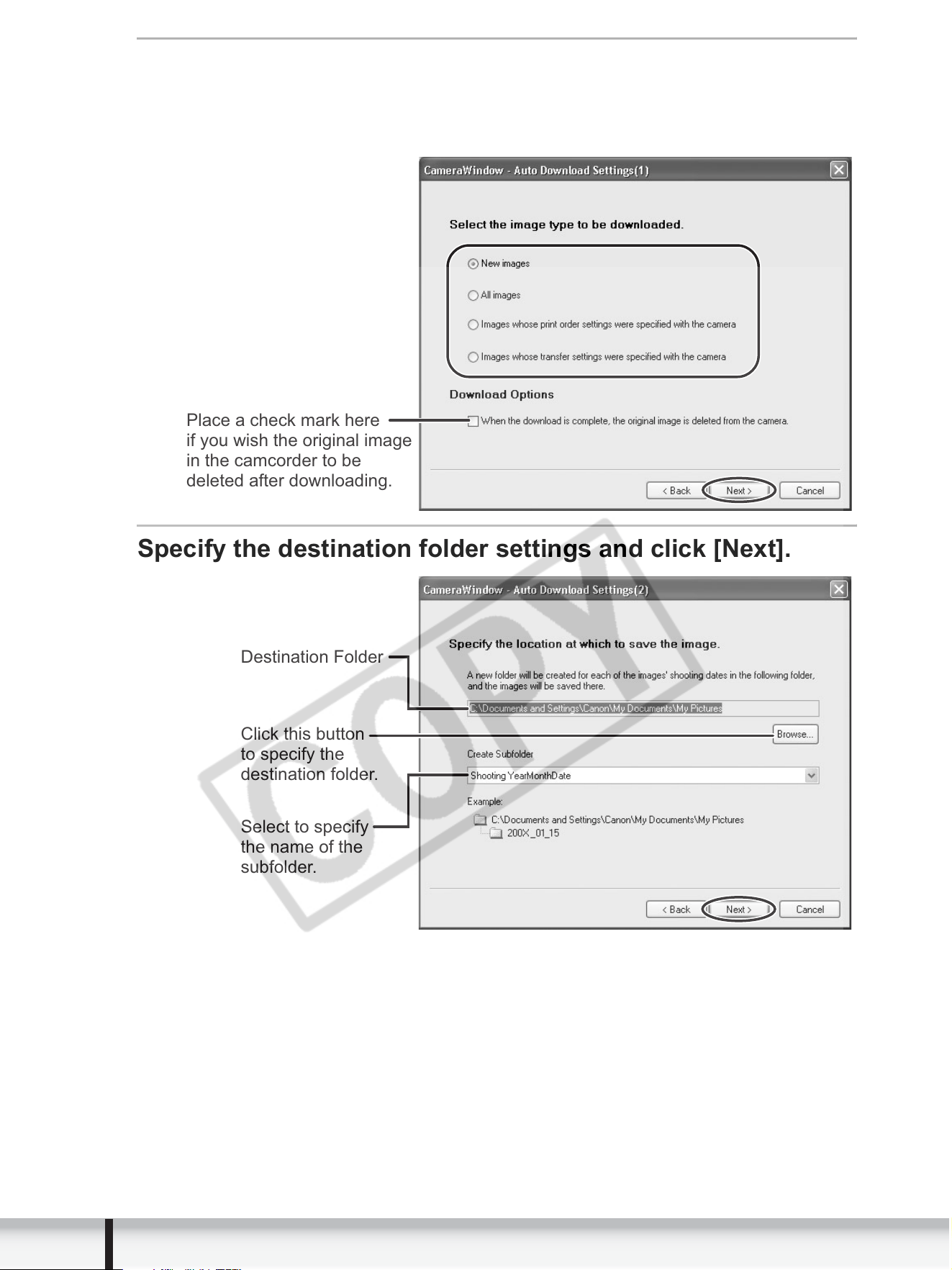
3
Select the image type to be downloaded and click [Next].
When the protect switch of the SD Memory Card is activated, those downloaded
new images will not be marked as “already transferred” even having selected
[New images] and downloaded.
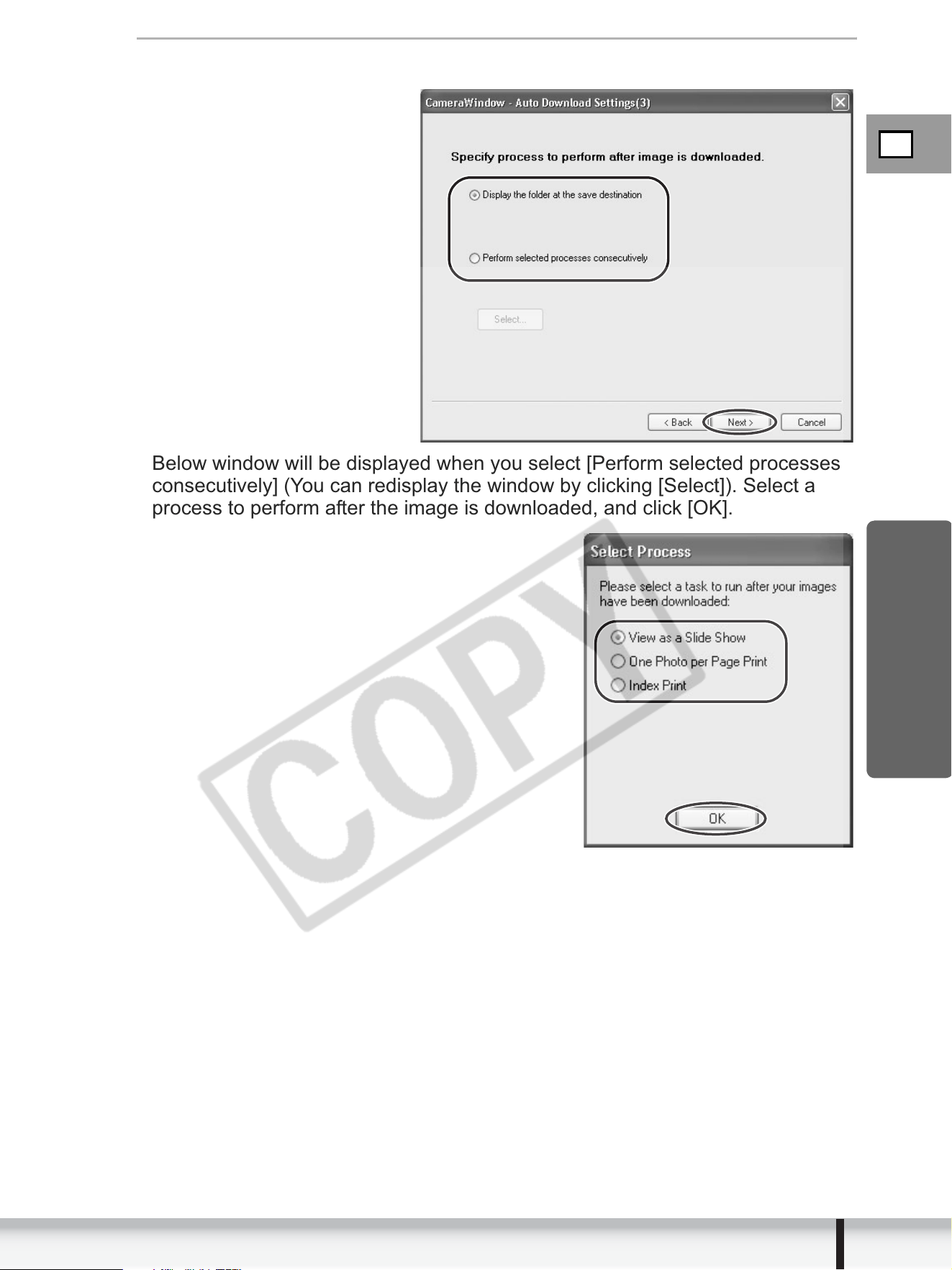
4
Specify the destination folder settings and click [Next].
Place a check mark here
if you wish the original image
in the camcorder to be
deleted after downloading.
Click this button
to specify the
destination folder.
Destination Folder
Select to specify
the name of the
subfolder.
E
33
Downloading Images (ZoomBrowser EX)
Windows
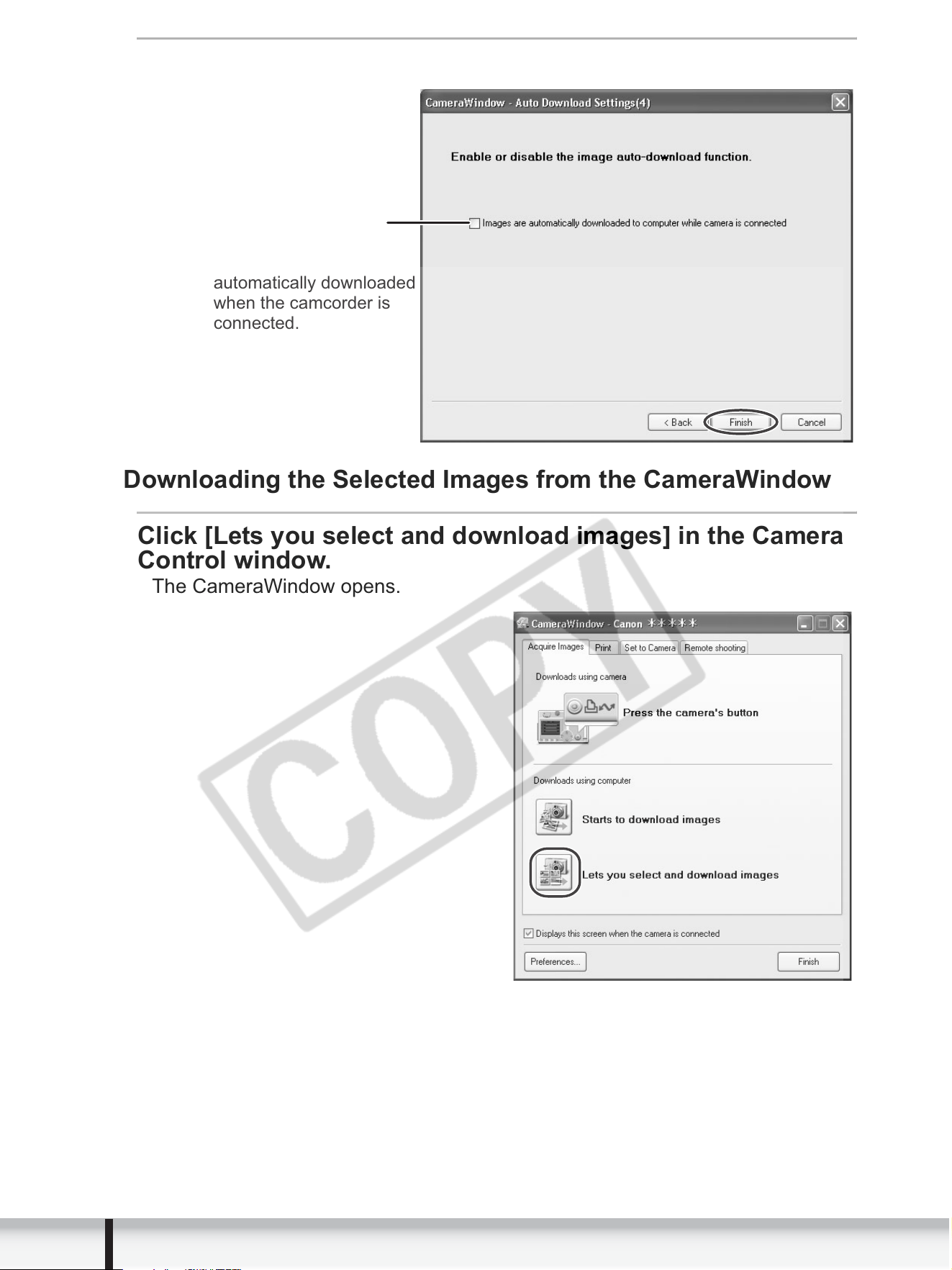
5
Specify a process to perform after the image is downloaded.
Below window will be displayed when you select [Perform selected processes
consecutively] (You can redisplay the window by clicking [Select]). Select a
process to perform after the image is downloaded, and click [OK].
34
Downloading Images (ZoomBrowser EX)
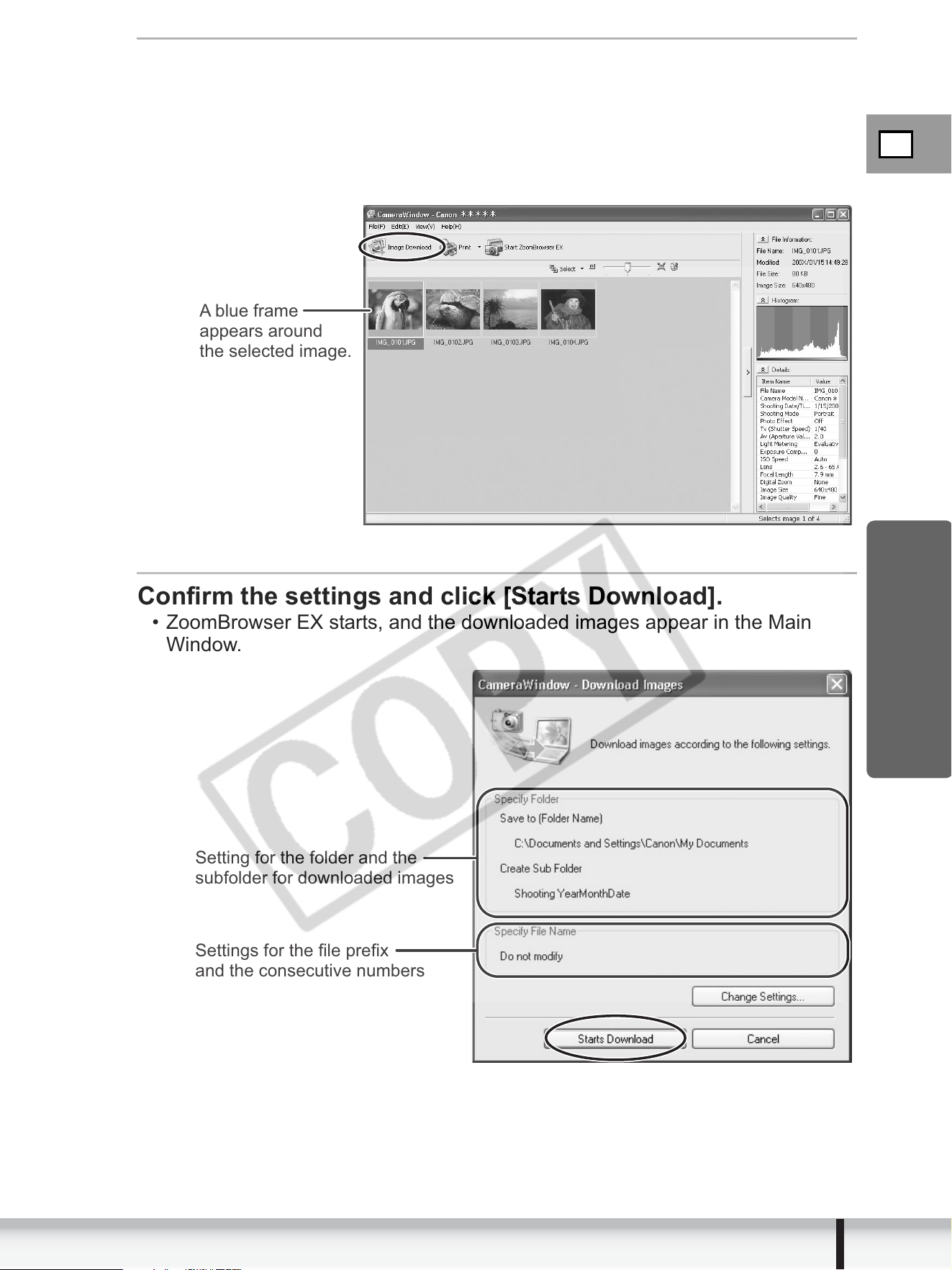
6
Click [Finish].
Downloading the Selected Images from the CameraWindow
1
Click [Lets you select and download images] in the Camera
Control window.
The CameraWindow opens.
Placing a check mark
here makes images in
the camcorder to be
automatically downloaded
when the camcorder is
connected.
E
35
Downloading Images (ZoomBrowser EX)
Windows
2
In the CameraWindow, select the image you wish to
download and click [Image Download].
• Clicking on 2 images while holding down the [Shift] key selects also all images
between the 2 images.
• Clicking on different images while holding down the [Ctrl] key selects multiple
images.
3
Confirm the settings and click [Starts Download].
• ZoomBrowser EX starts, and the downloaded images appear in the Main
Window.
A blue frame
appears around
the selected image.
Settings for the file prefix
and the consecutive numbers
Setting for the folder and the
subfolder for downloaded images
36
Downloading Images (ZoomBrowser EX)
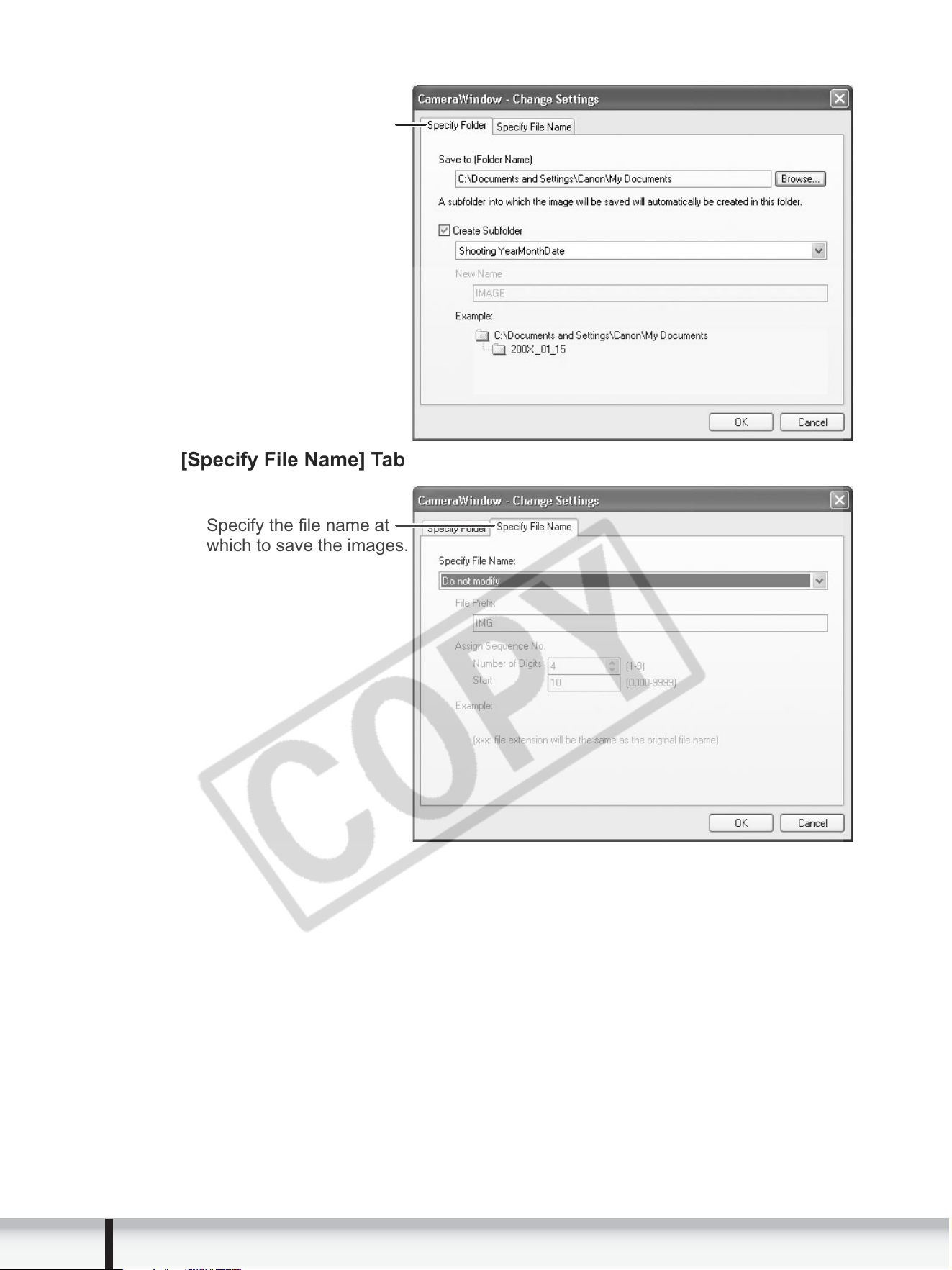
• To make changes, click [Change Settings].
[Specify Folder] Tab
[Specify File Name] Tab
Specify the settings of
the folder and subfolder.
Specify the file name at
which to save the images.
E
37
Downloading Images (ZoomBrowser EX)
Windows
Using a Card Reader/Writer
The basic operations of ZoomBrowser EX are the same as when you connect the
camcorder to the computer. Follow the procedure below to open the
CameraWindow. For instructions on how to connect the card reader/writer,
please refer to its manual.
1
Insert a memory card containing images recorded with the
camcorder into the reader.
2
Windows 98/Windows Me/Windows 2000: Click the Windows
[Start] menu, and select [Programs], [Canon Utilities],
[CameraWindow] and [CameraWindow].
Windows XP: When a window appears allowing you to select
an application program to start, select [View/Download
Images using Canon CameraWindow] and click [OK].
The Camera Control window opens.
3
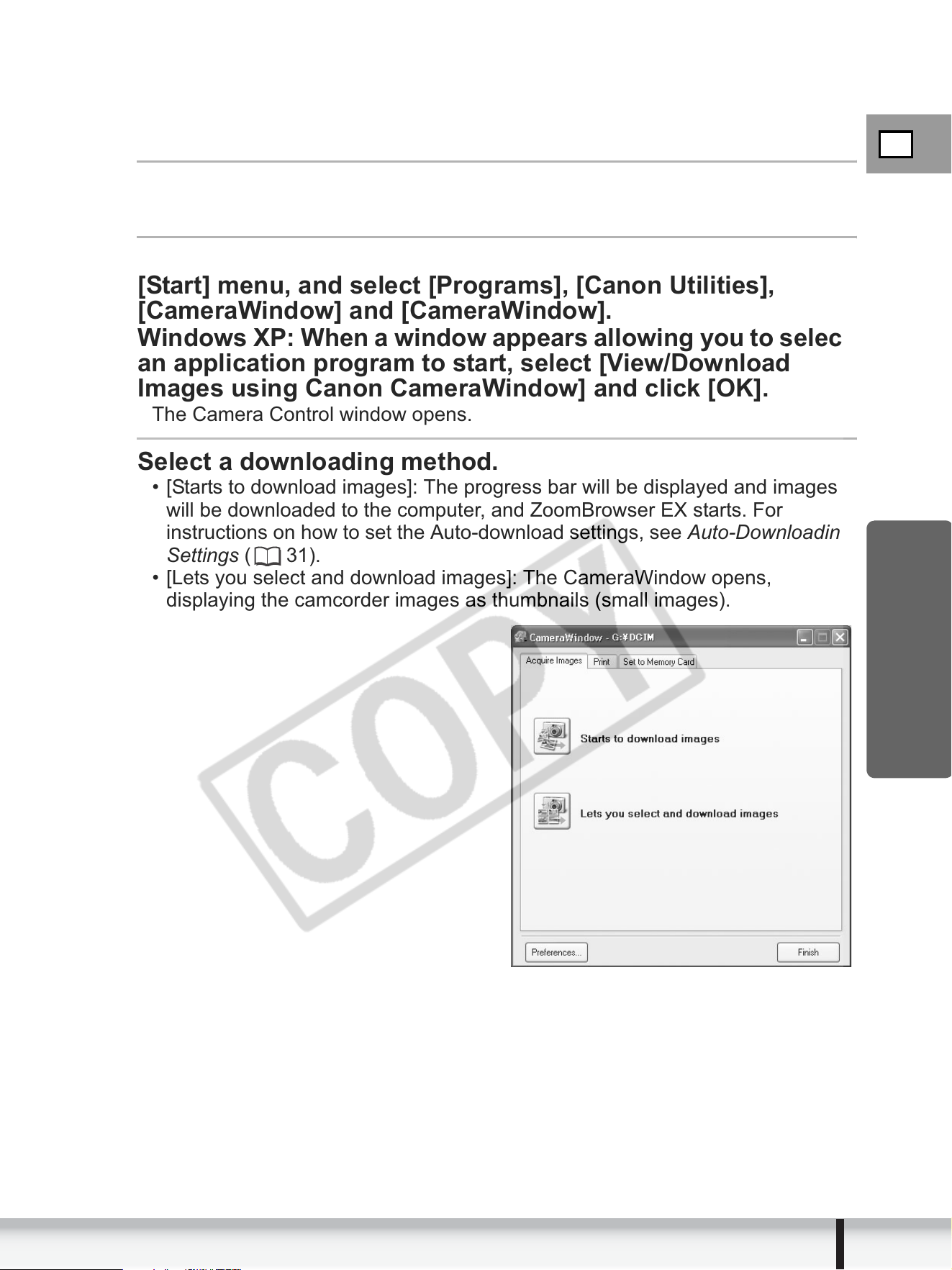
Select a downloading method.
• [Starts to download images]: The progress bar will be displayed and images
will be downloaded to the computer, and ZoomBrowser EX starts. For
instructions on how to set the Auto-download settings, see Auto-Downloading
Settings (31).
• [Lets you select and download images]: The CameraWindow opens,
displaying the camcorder images as thumbnails (small images).
38
Downloading Images (ZoomBrowser EX)
Using the Camcorder to Download Images (Direct
Transfer Function)
If your camcorder supports the Direct Transfer Function, you can use the
camcorder to download images.
If your camcorder is not equipped with the button, operate the direct
transfer menu using the P.SET button. For details, please refer to the
instruction manual of your camcorder.
Direct Transfer
1
Select a transfer option on the camcorder screen and press
the button.
• See your camcorder instruction manual for how to set and operate the
camcorder to transfer images.
• For instructions on how to change the destination folder and the folder name,
see step 3 ( 32) in Auto-Downloading Settings.
• The button cannot be used when it is not lighted.
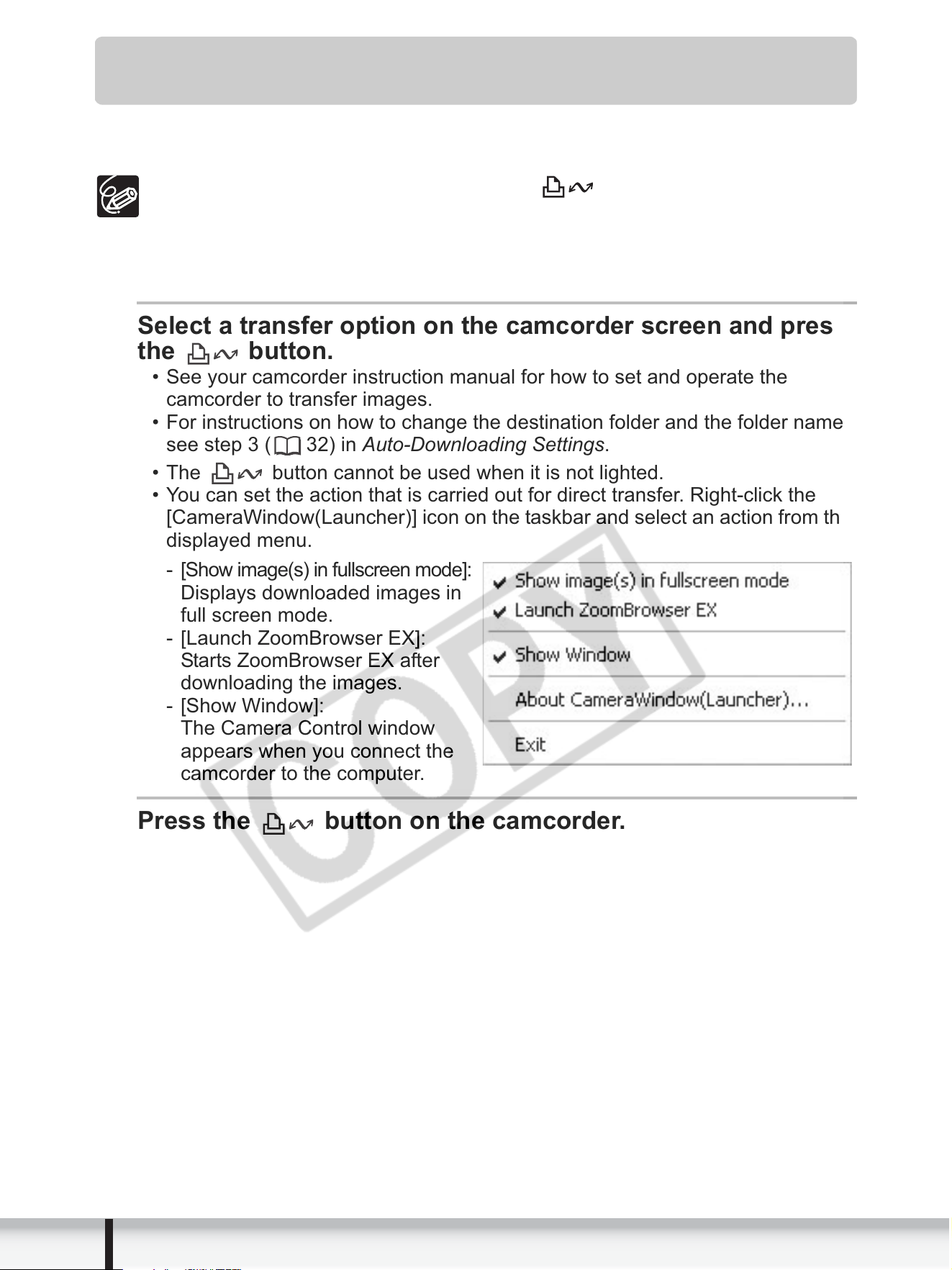
• You can set the action that is carried out for direct transfer. Right-click the
[CameraWindow(Launcher)] icon on the taskbar and select an action from the
displayed menu.
- [Show image(s) in fullscreen mode]:
Displays downloaded images in
full screen mode.
- [Launch ZoomBrowser EX]:
Starts ZoomBrowser EX after
downloading the images.
- [Show Window]:
The Camera Control window
appears when you connect the
camcorder to the computer.
2
Press the button on the camcorder.
E
39
Downloading Images (ZoomBrowser EX)
Windows
Setting the Direct Transfer Download Destination Folder
1
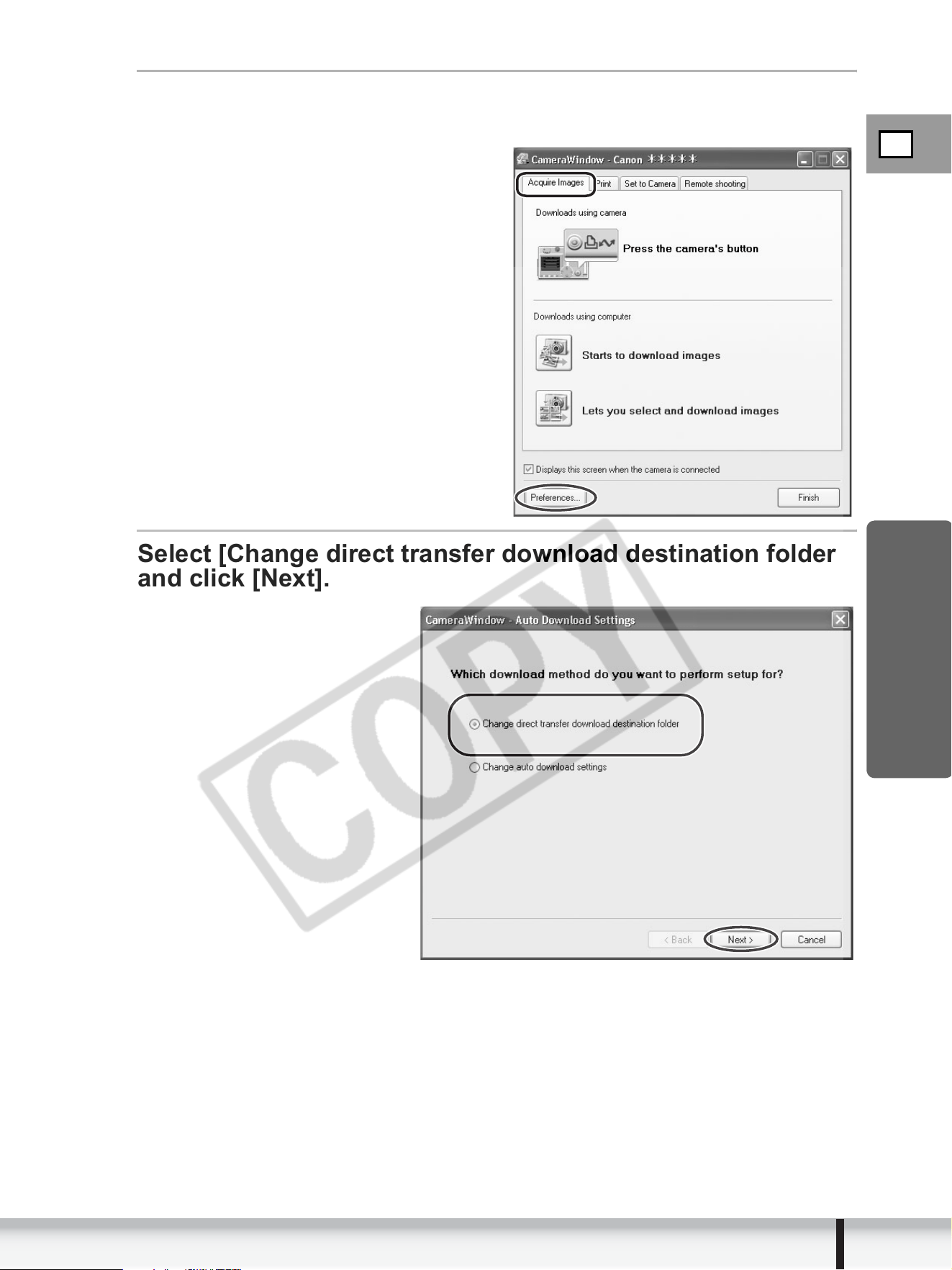
In the Camera Control window, click the [Acquire Images]
tab and click [Preferences].
2
Select [Change direct transfer download destination folder]
and click [Next].
40
Downloading Images (ZoomBrowser EX)
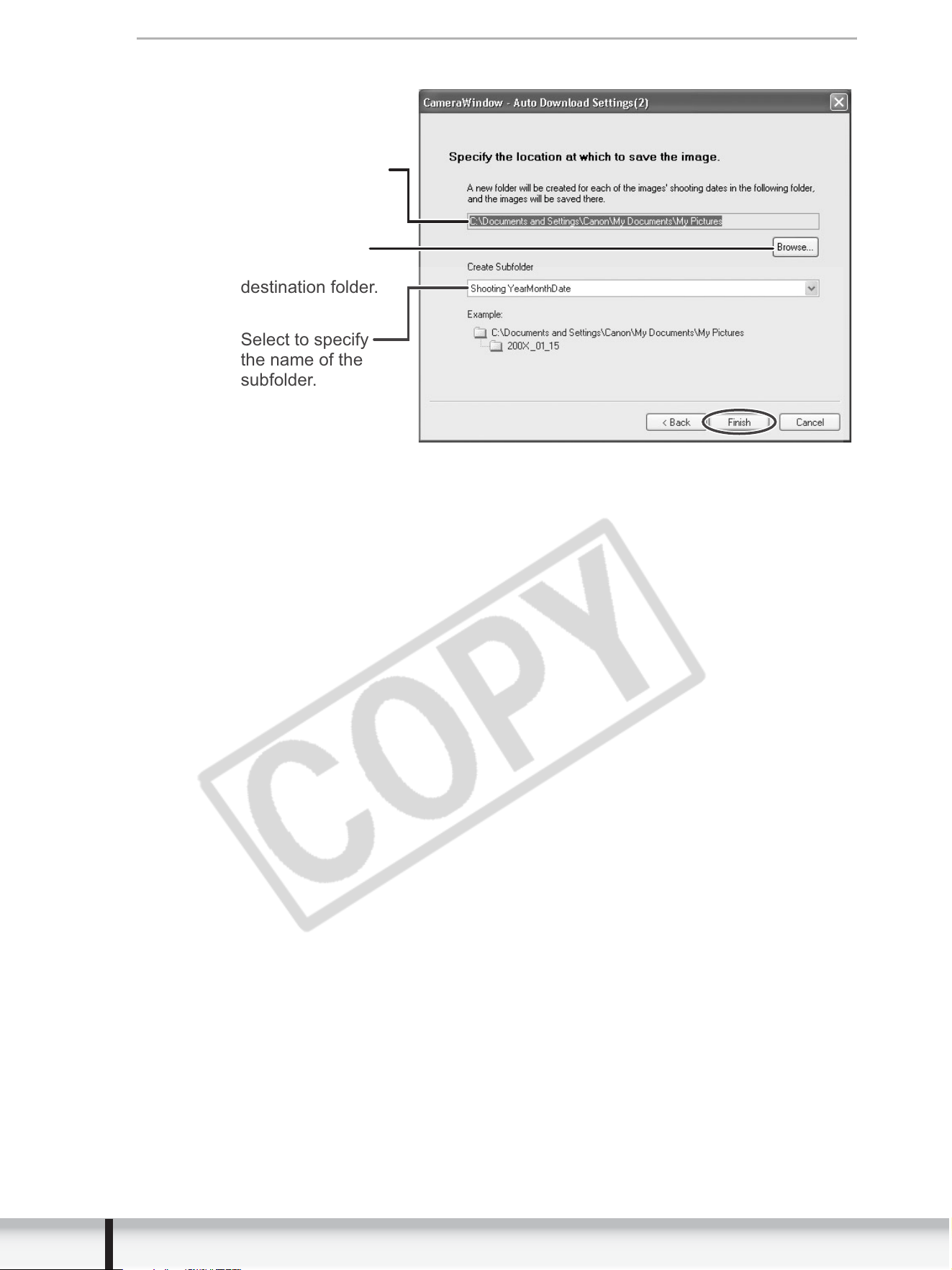
3
Specify the destination folder settings and click [Finish].
Click this button
to specify the
destination folder.
Destination Folder
Select to specify
the name of the
subfolder.
E
41
Printing Still Images
Windows
Printing Still Images
Printing Still Images Recorded on the Memory Card
You can select one of the following 4 methods to print still images in the card
without downloading them to the computer.
• [Print All Photos]
- Prints all still images recorded on a memory card in the connected camcorder
or in a card reader/writer one image per page.
• [Print Contact Sheet with All Photos]
- Prints all still images recorded on a memory card in the connected camcorder
or in a card reader/writer in an index (rows of images on one page).
• [Print according to DPOF settings]
- Prints according to the DPOF print settings set by the camcorder.
• [Select an image and print]
- A list of the still images recorded on a memory card in the connected
camcorder or in a card reader/writer will be displayed, and you can select
images you wish to print.
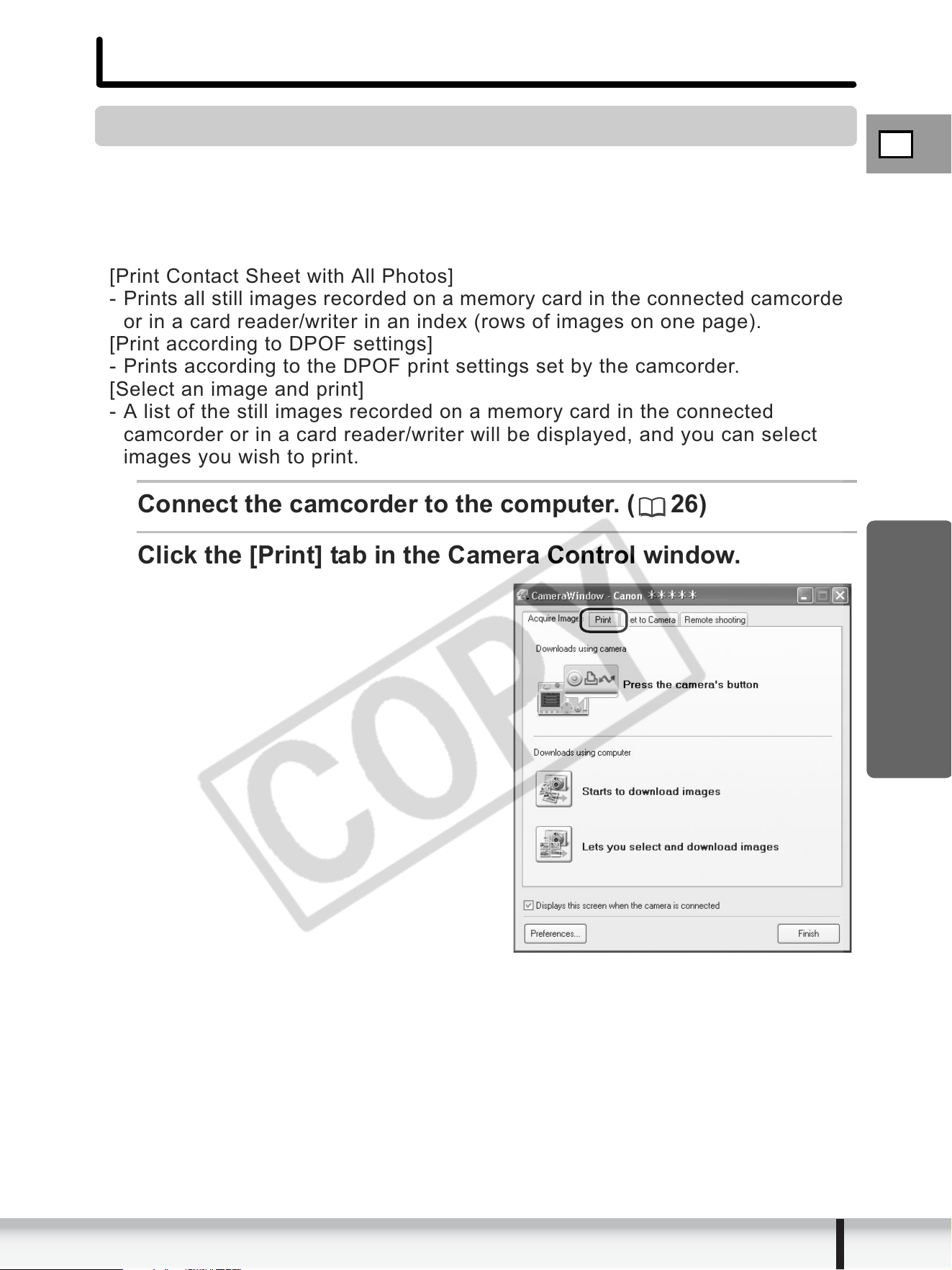
1
Connect the camcorder to the computer. ( 26)
2
Click the [Print] tab in the Camera Control window.
42
Printing Still Images
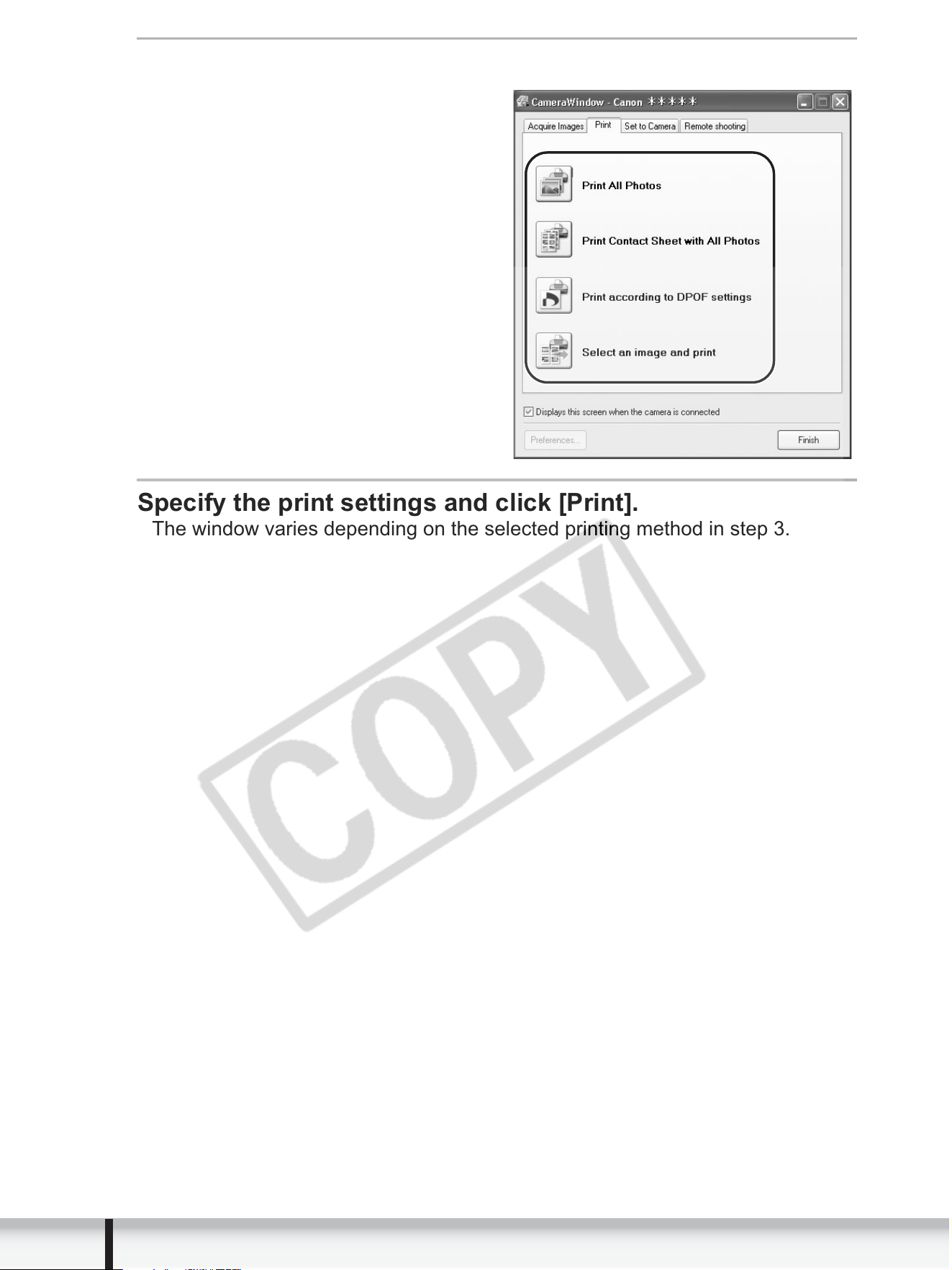
3
Click one of the 4 printing methods.
4
Specify the print settings and click [Print].
The window varies depending on the selected printing method in step 3.
E
43
Printing Still Images
Windows
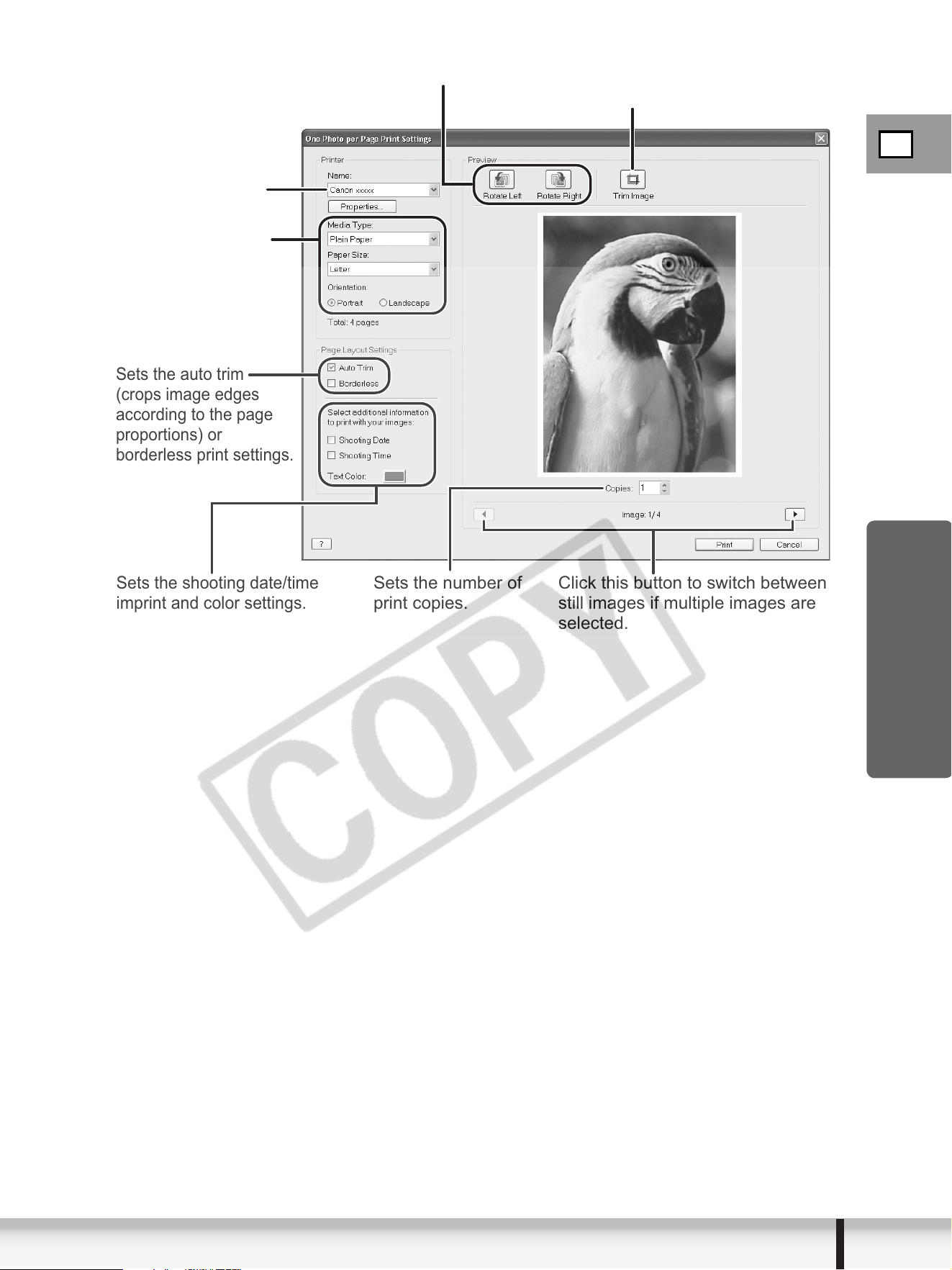
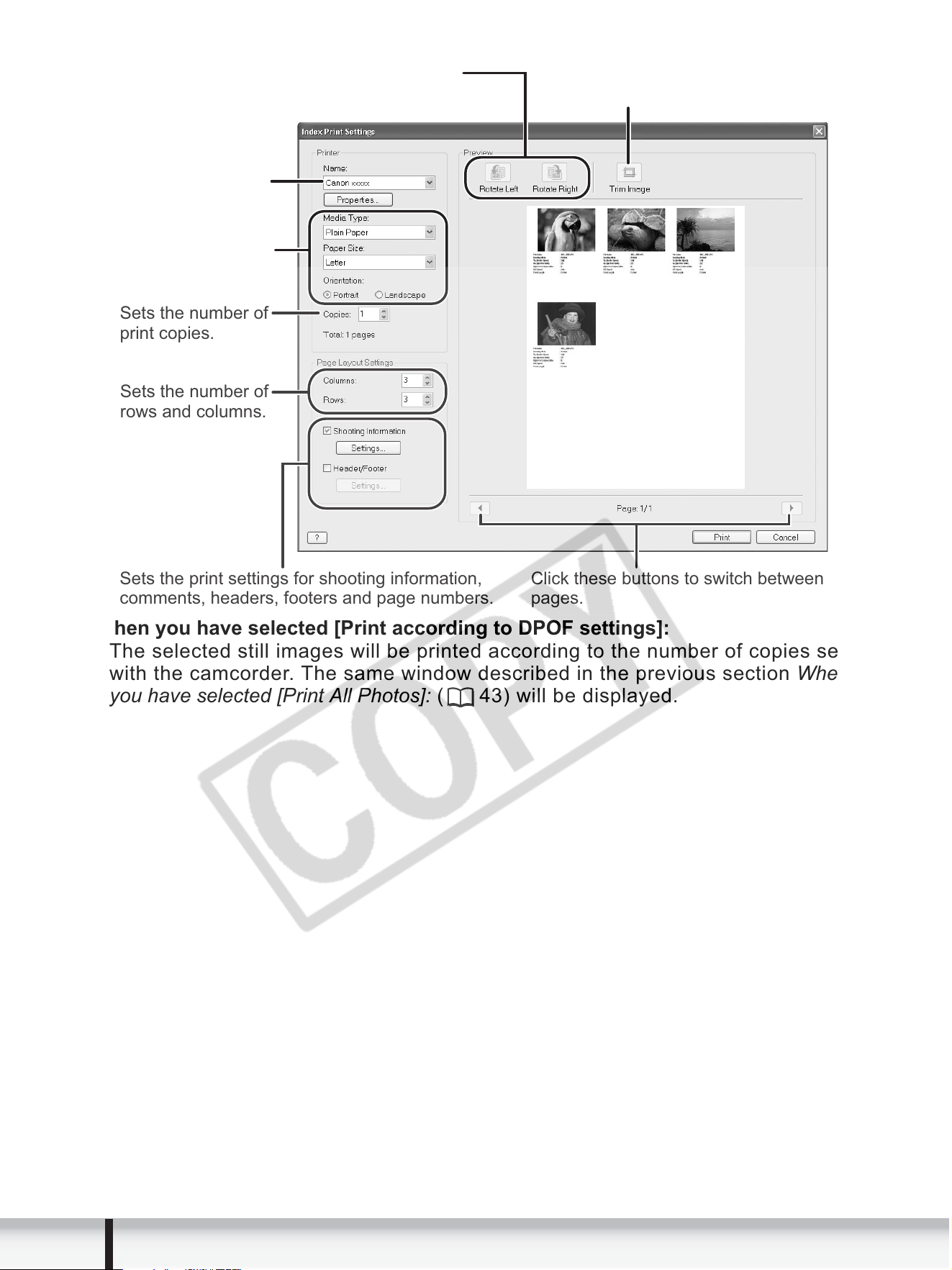
When you have selected [Print All Photos]:
Click this to use the trimming function
(crops a portion of the still image).
Selects the printer.
Rotates still images.
Sets the shooting date/time
imprint and color settings.
Sets the auto trim
(crops image edges
according to the page
proportions) or
borderless print settings.
Sets the number of
print copies.
Click this button to switch between
still images if multiple images are
selected.
Sets the paper size
and orientation.
44
Printing Still Images
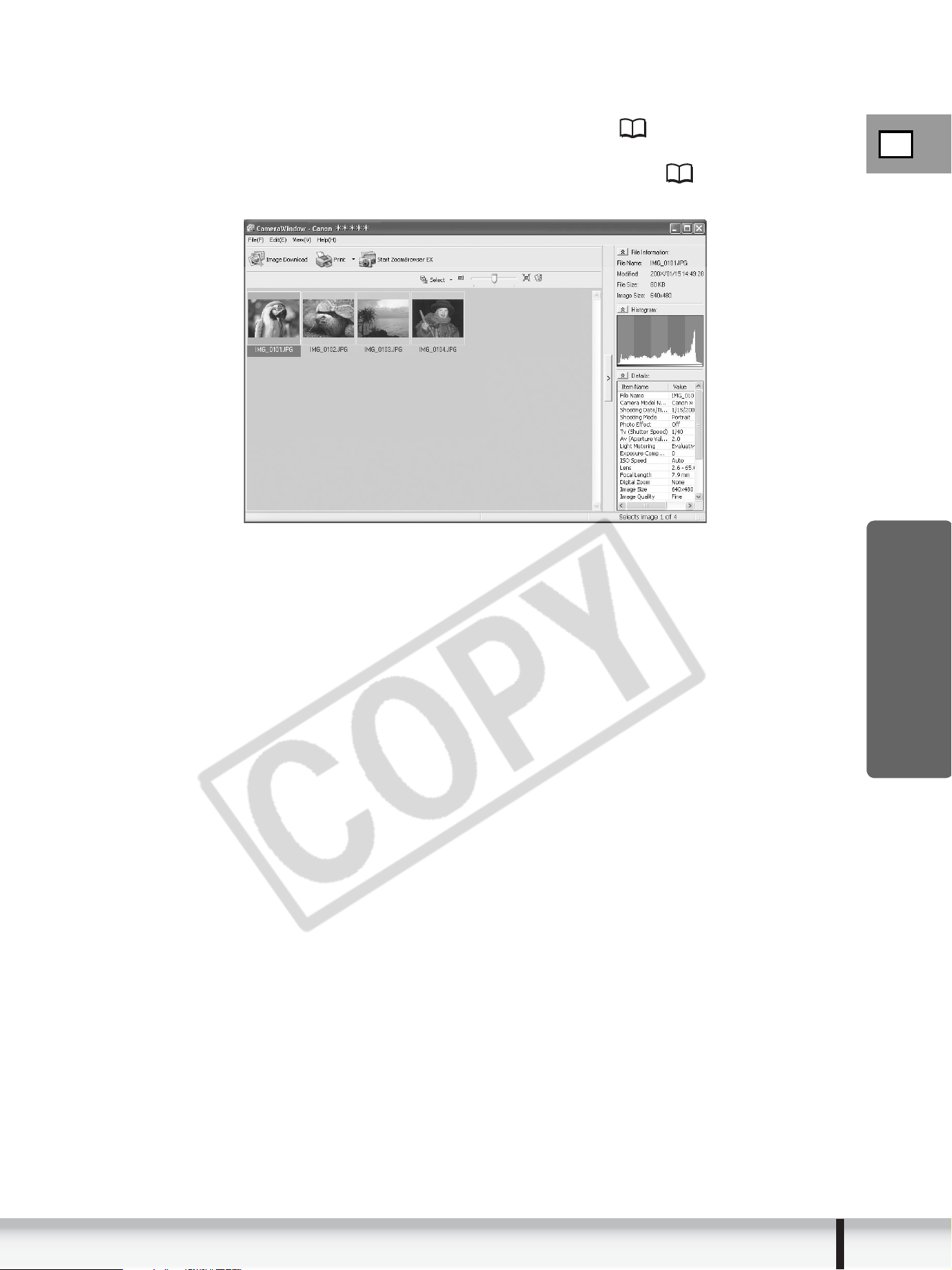
When you have selected [Print Contact Sheet with All Photos]:
When you have selected [Print according to DPOF settings]:
• The selected still images will be printed according to the number of copies set
with the camcorder. The same window described in the previous section When
you have selected [Print All Photos]: ( 43) will be displayed.
Selects the printer.
Rotates still images.
Sets the number of
print copies.
Sets the number of
rows and columns.
Sets the print settings for shooting information,
comments, headers, footers and page numbers.
Click this to use the trimming function
(crops a portion of the still image).
Sets the paper size
and orientation.
Click these buttons to switch between
pages.
E
45
Printing Still Images
Windows
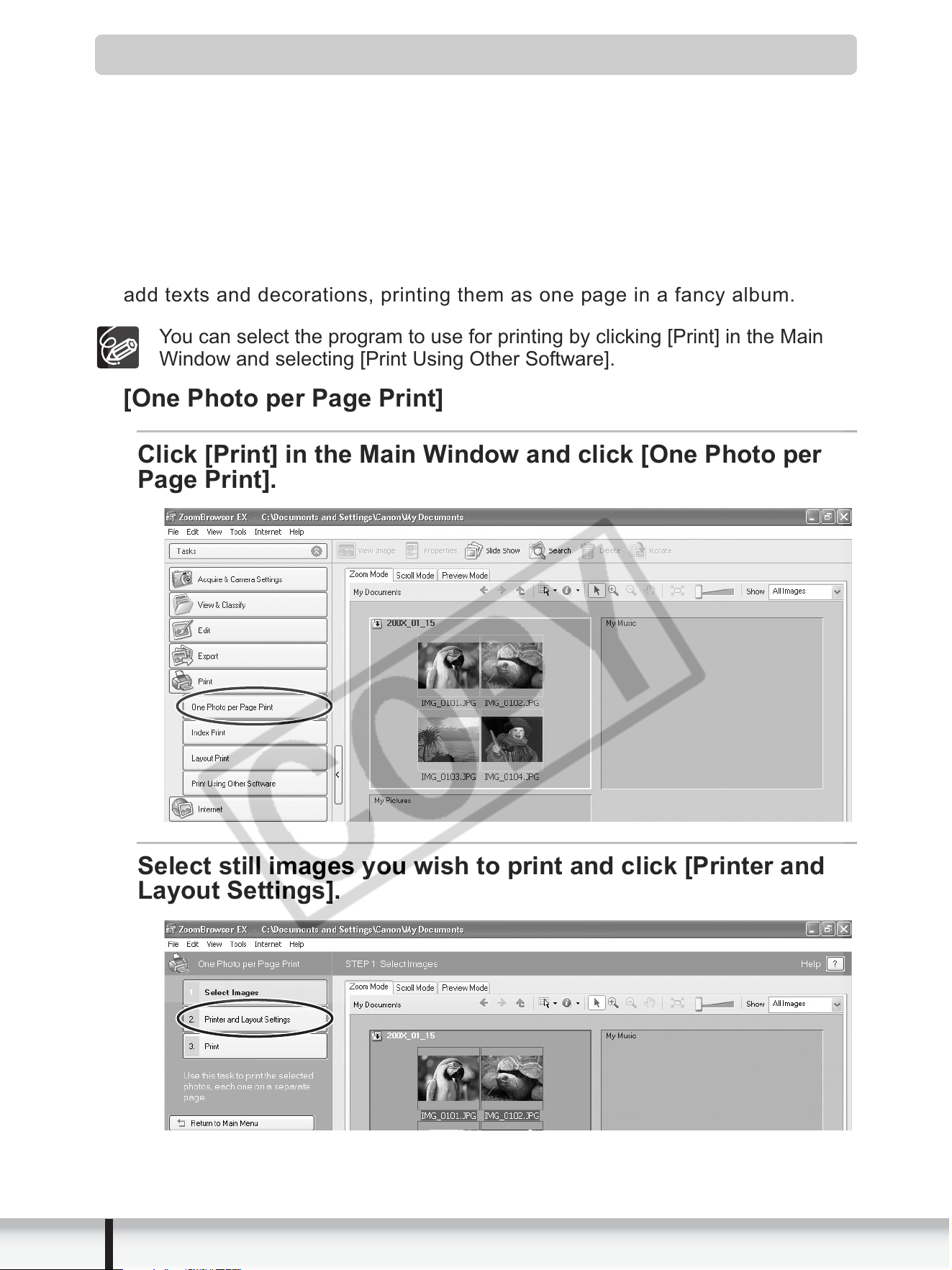
When you have selected [Select an image and print]:
• If you selected [Select an image and print], the following window will be
displayed. Select still images you wish to print, and click [Print]. If you selected
[Contact Sheet Print], the same window described in the previous section When
you have selected [Print Contact Sheet with All Photos]: ( 44) will be displayed.
If you selected [One Photo Per Page Print], the same window described in the
previous section When you have selected [Print All Photos]: ( 43) will be
displayed instead. Set the print settings and print the still images.
46
Printing Still Images
Printing Still Images Downloaded to the Computer
You can select one of the following 3 methods to print still images downloaded to
the computer.
• [One Photo per Page Print]
- Prints one still image per page.
• [Index Print]
- Prints a selection of multiple still images in columns and rows in an index
form.
• [Layout Print]
- Allows you to lay out the selected still images in special arrangements and
add texts and decorations, printing them as one page in a fancy album.
You can select the program to use for printing by clicking [Print] in the Main
Window and selecting [Print Using Other Software].
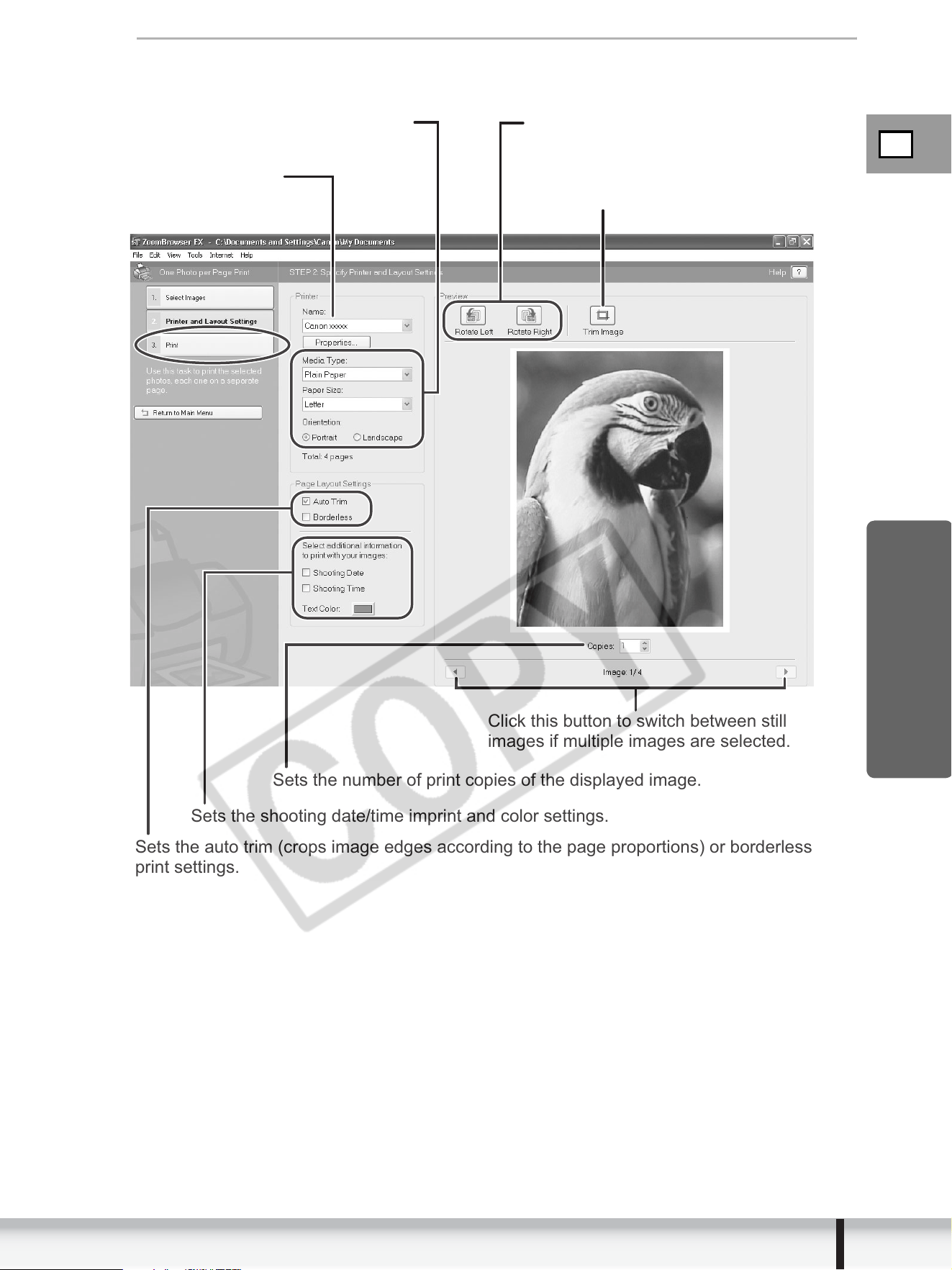
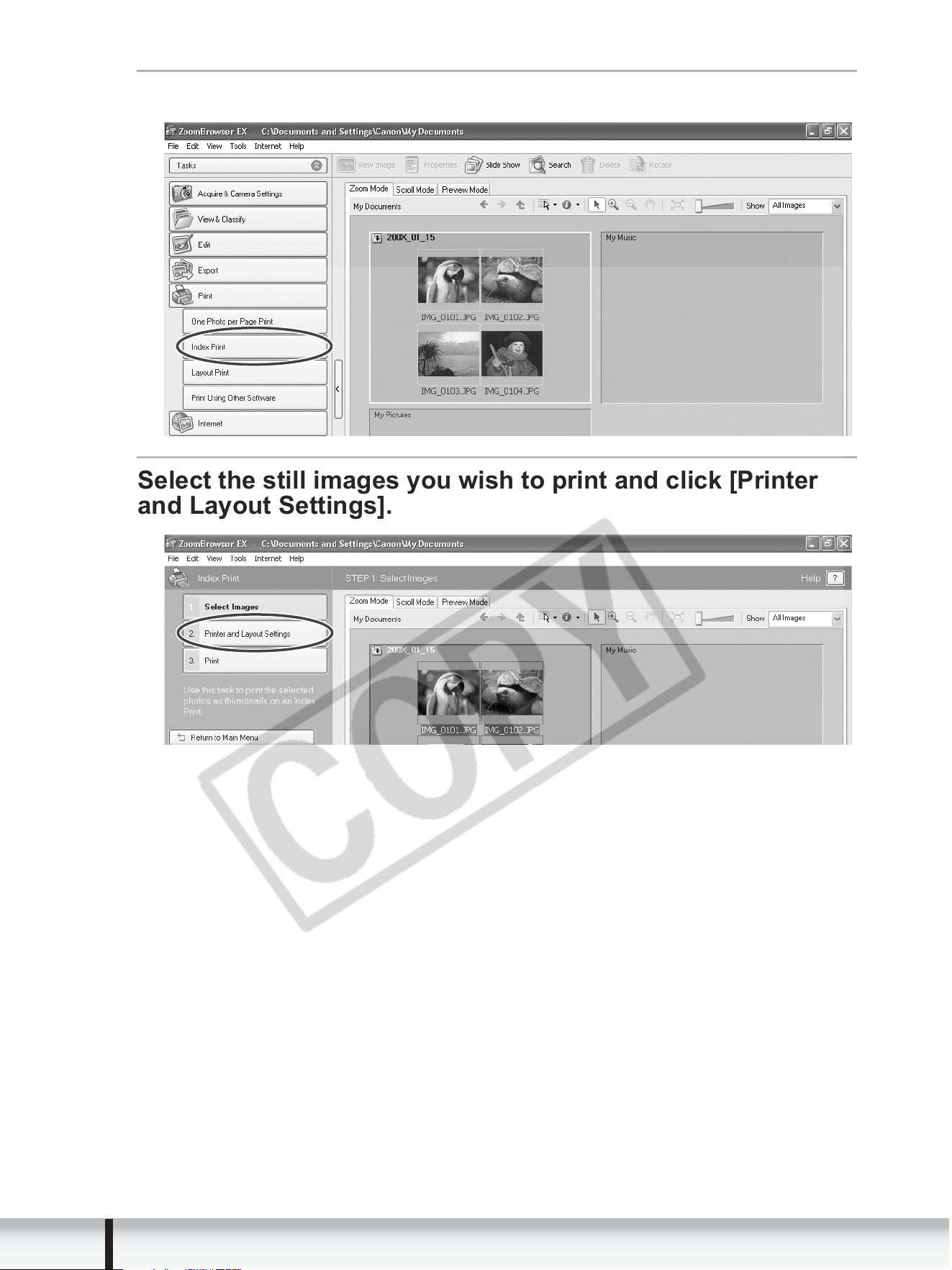
[One Photo per Page Print]
1
Click [Print] in the Main Window and click [One Photo per
Page Print].
2
Select still images you wish to print and click [Printer and
Layout Settings].
E
47
Printing Still Images
Windows
3
Specify the print settings and click [Print].
Click this button to switch between still
images if multiple images are selected.
Selects the printer.
Click this to use the trimming function
(crops a portion of the still image).
Rotates still images.
Sets the shooting date/time imprint and color settings.
Sets the auto trim (crops image edges according to the page proportions) or borderless
print settings.
Sets the paper size and orientation.
Sets the number of print copies of the displayed image.
48
Printing Still Images
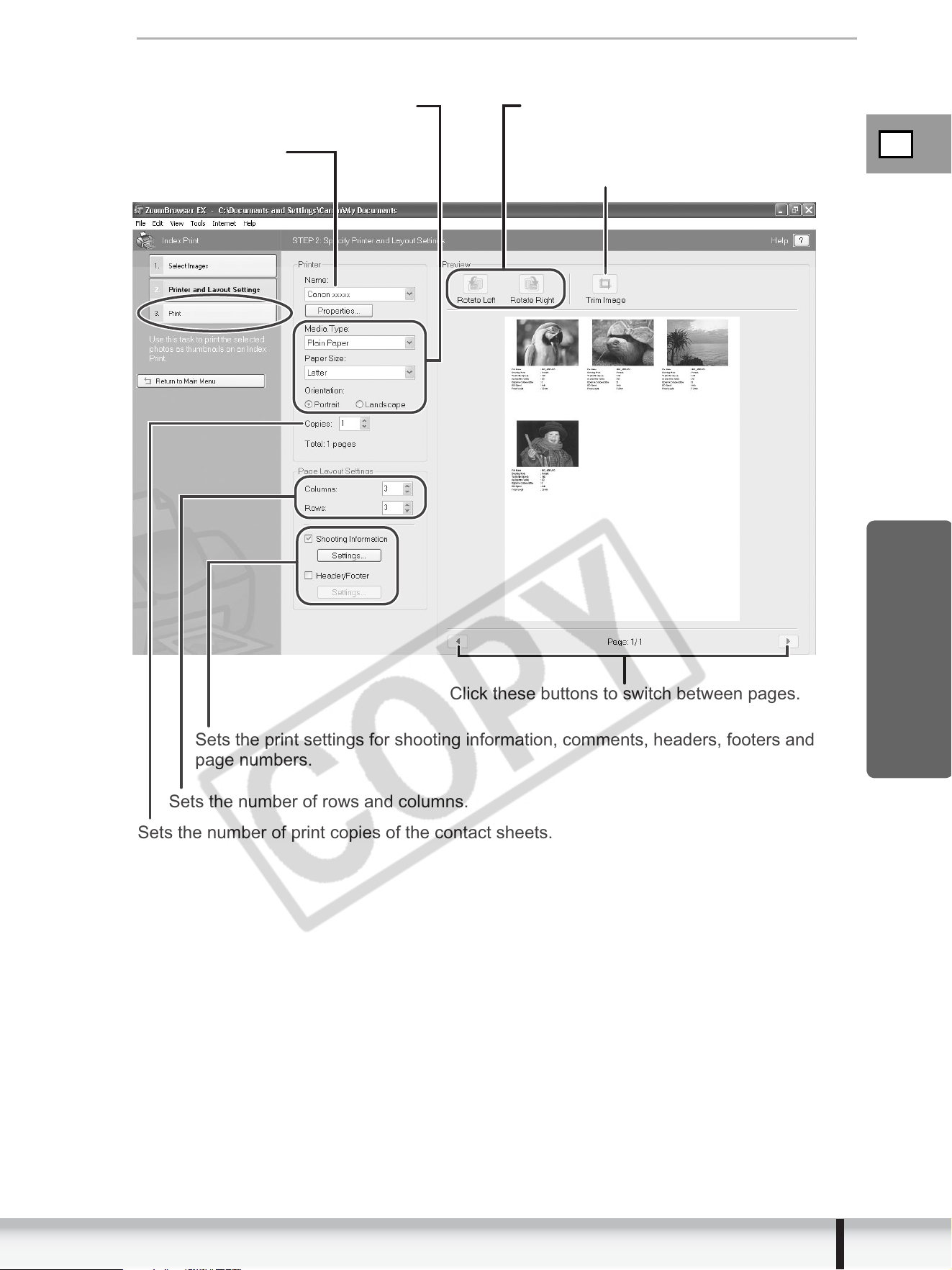
[Index Print]
1
Click [Print] in the Main Window and click [Index Print].
2
Select the still images you wish to print and click [Printer
and Layout Settings].
E
49
Printing Still Images
Windows
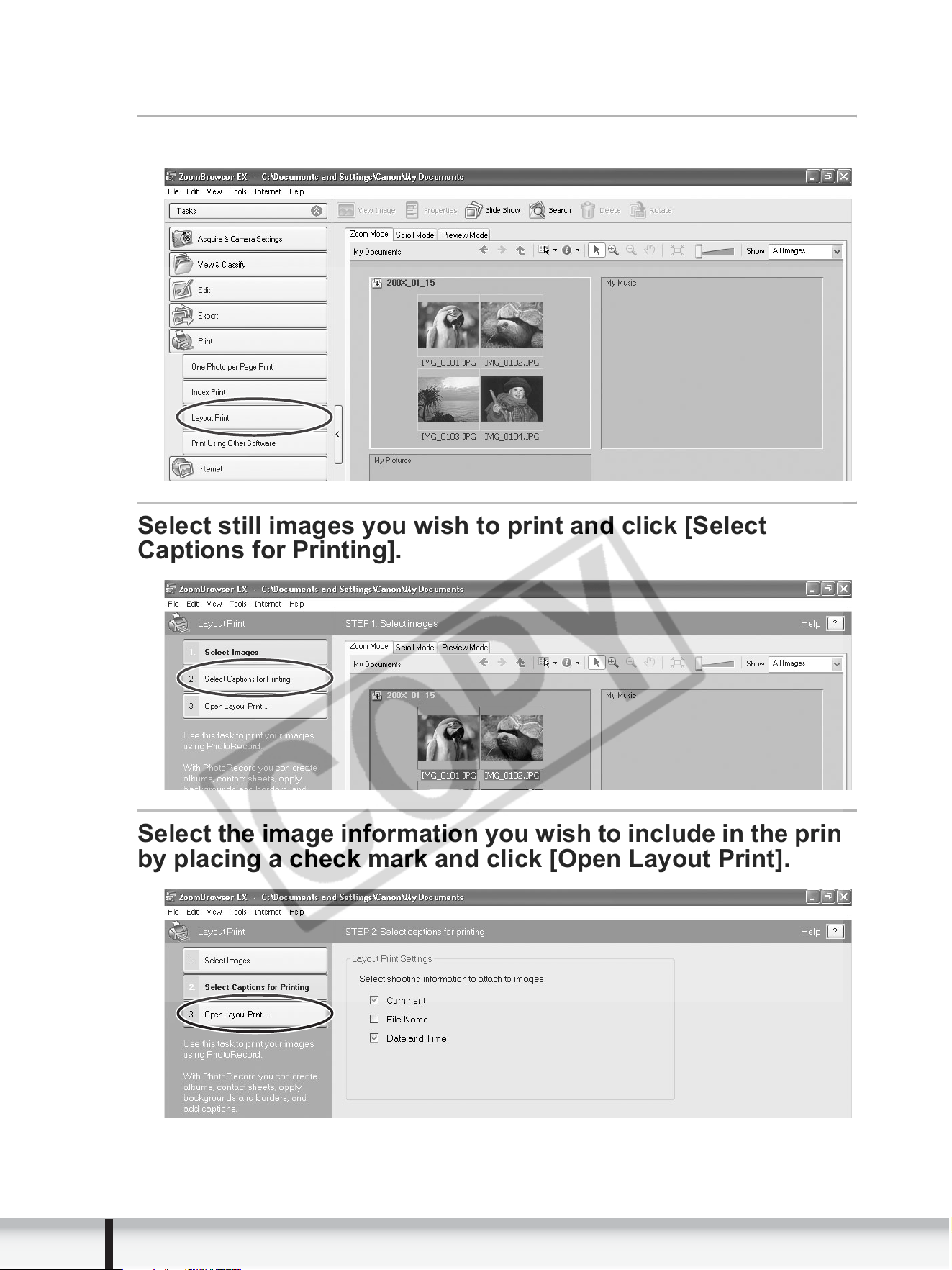
3
Specify the print settings and click [Print].
Click these buttons to switch between pages.
Selects the printer. Click this to use the trimming function
(crops a portion of the still image).
Rotates still images.
Sets the print settings for shooting information, comments, headers, footers and
page numbers.
Sets the paper size and orientation.
Sets the number of print copies of the contact sheets.
Sets the number of rows and columns.
50
Printing Still Images
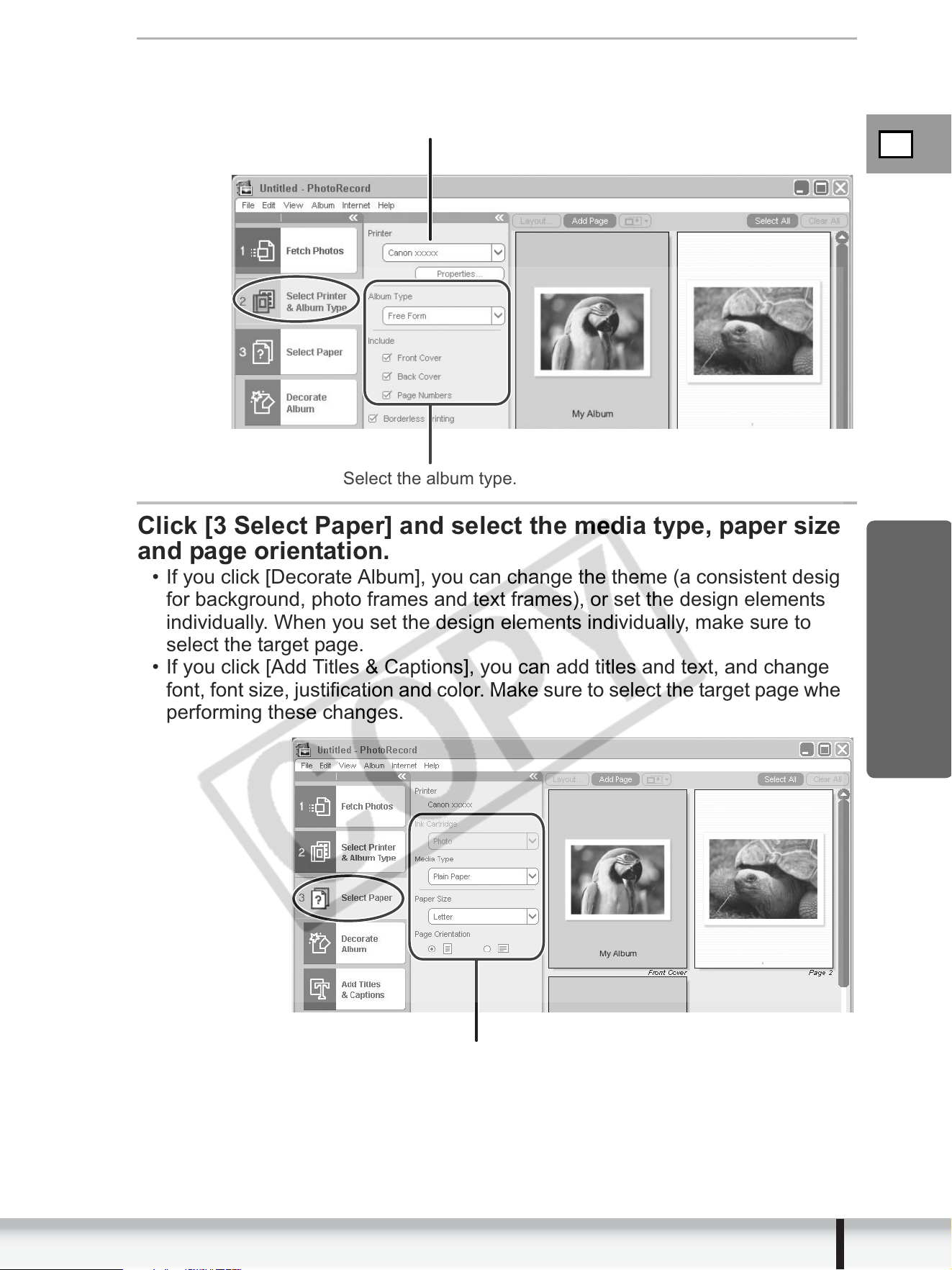
[Layout Print]
A program called PhotoRecord is used to print under the layout print method.
• Please refer to the PhotoRecord Help menu for more details.
1
Click [Print] in the Main Window and click [Layout Print].
2
Select still images you wish to print and click [Select
Captions for Printing].
3
Select the image information you wish to include in the print
by placing a check mark and click [Open Layout Print].
E
51
Printing Still Images
Windows
4
Click [2Select Printer & Album Type] and select a printer
and album type.
5
Click [3Select Paper] and select the media type, paper size
and page orientation.
• If you click [Decorate Album], you can change the theme (a consistent design
for background, photo frames and text frames), or set the design elements
individually. When you set the design elements individually, make sure to
select the target page.
• If you click [Add Titles & Captions], you can add titles and text, and change
font, font size, justification and color. Make sure to select the target page when
performing these changes.
Select the album type.
Select the printer.
Set the paper type and orientation.
52
Printing Still Images
6
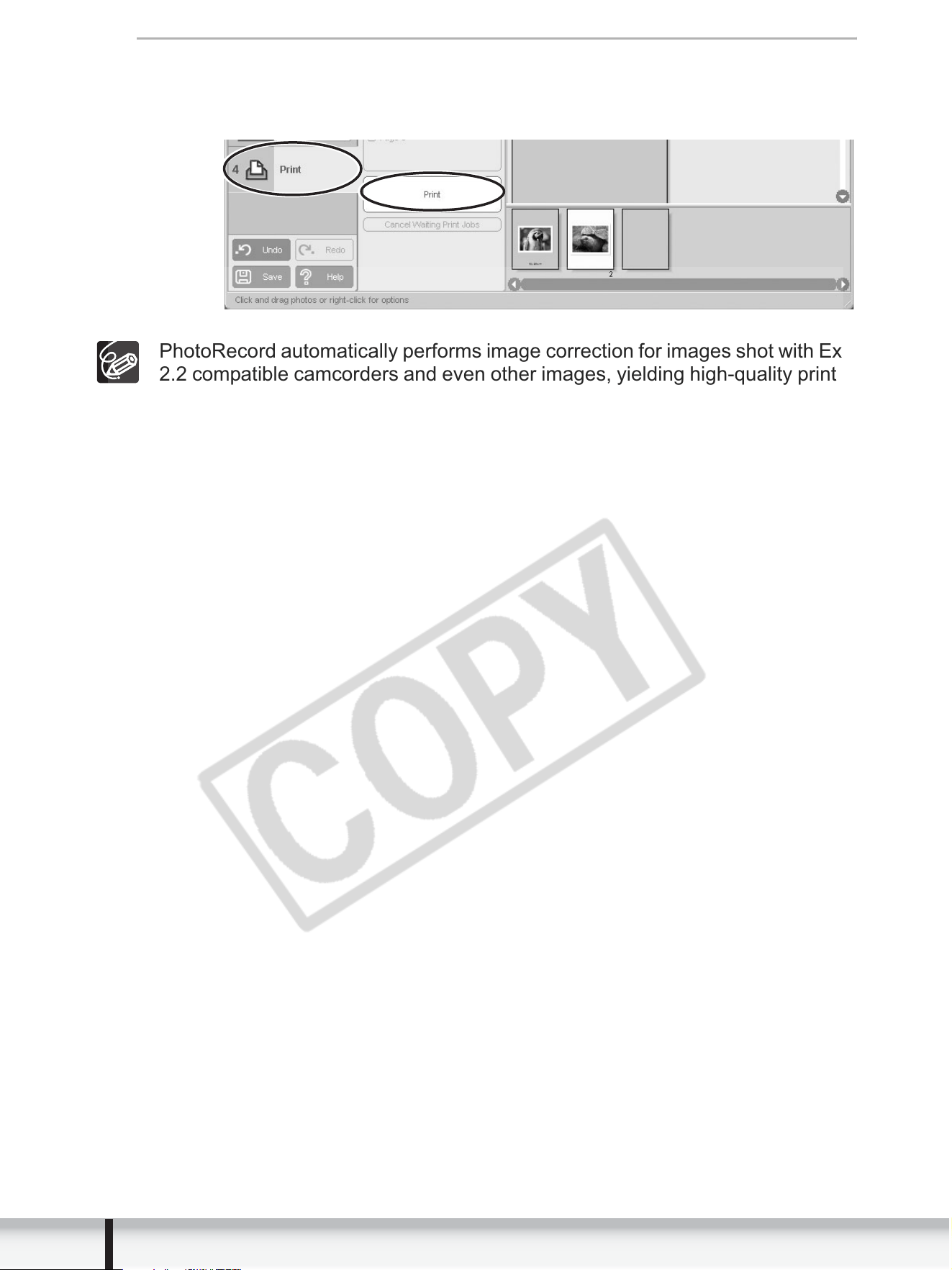
Click [4Print], confirm the number of copies and other print
settings, and click [Print].
Printing starts.
PhotoRecord automatically performs image correction for images shot with Exif
2.2 compatible camcorders and even other images, yielding high-quality prints.
E
53
Organizing Images
Windows
Organizing Images
Applying Star Ratings and Keywords
This task allows you to apply ratings to your images from one star to three stars.
The Star Rating can be used as one of the search conditions, or for the selection
of images to be displayed in the Browser Window. The keyword can be used as
one of the search conditions.
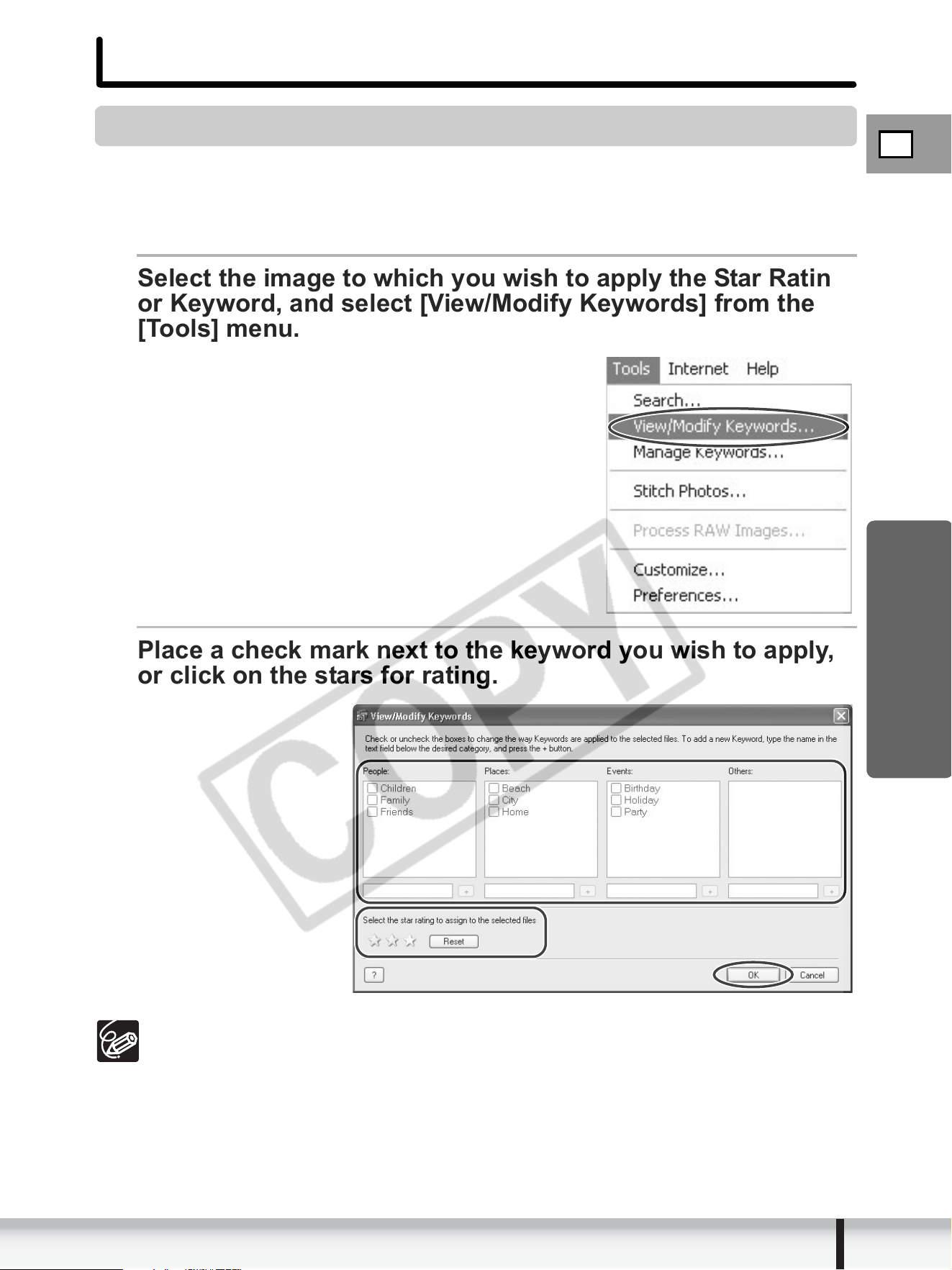
1
Select the image to which you wish to apply the Star Rating
or Keyword, and select [View/Modify Keywords] from the
[Tools] menu.
2
Place a check mark next to the keyword you wish to apply,
or click on the stars for rating.
The default setting of the Star Rating is two stars.
You can display images according to Star Rating by selecting [Filter by Star
Rating] from the [View] menu.
You can add and delete keywords, or change the keyword list in the [Manage
Keywords] window by selecting [Manage Keywords] from the [Tools] menu.
54
Organizing Images
Classifying the Images
This task allows you to classify selected images according to the shooting date.
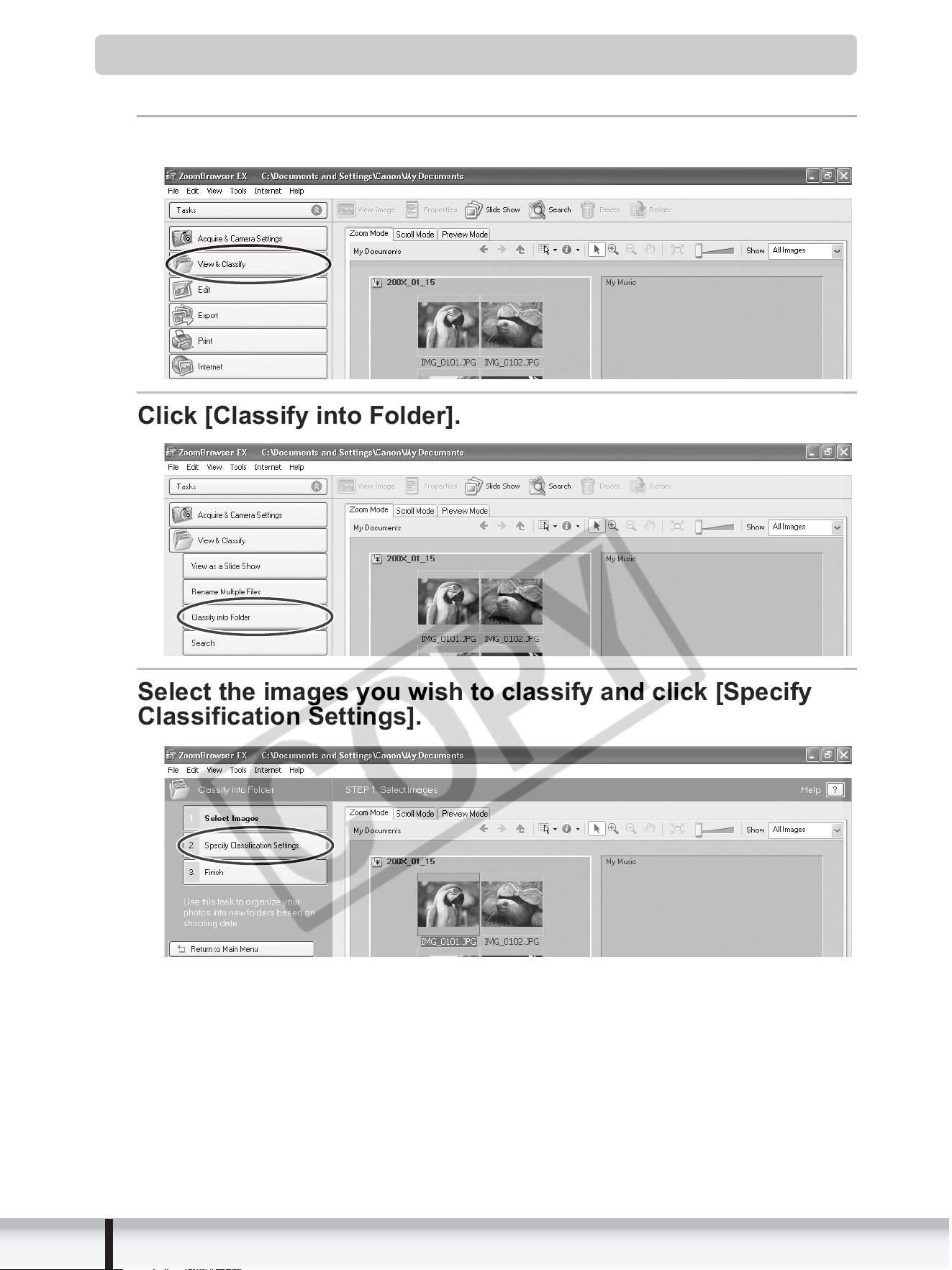
1
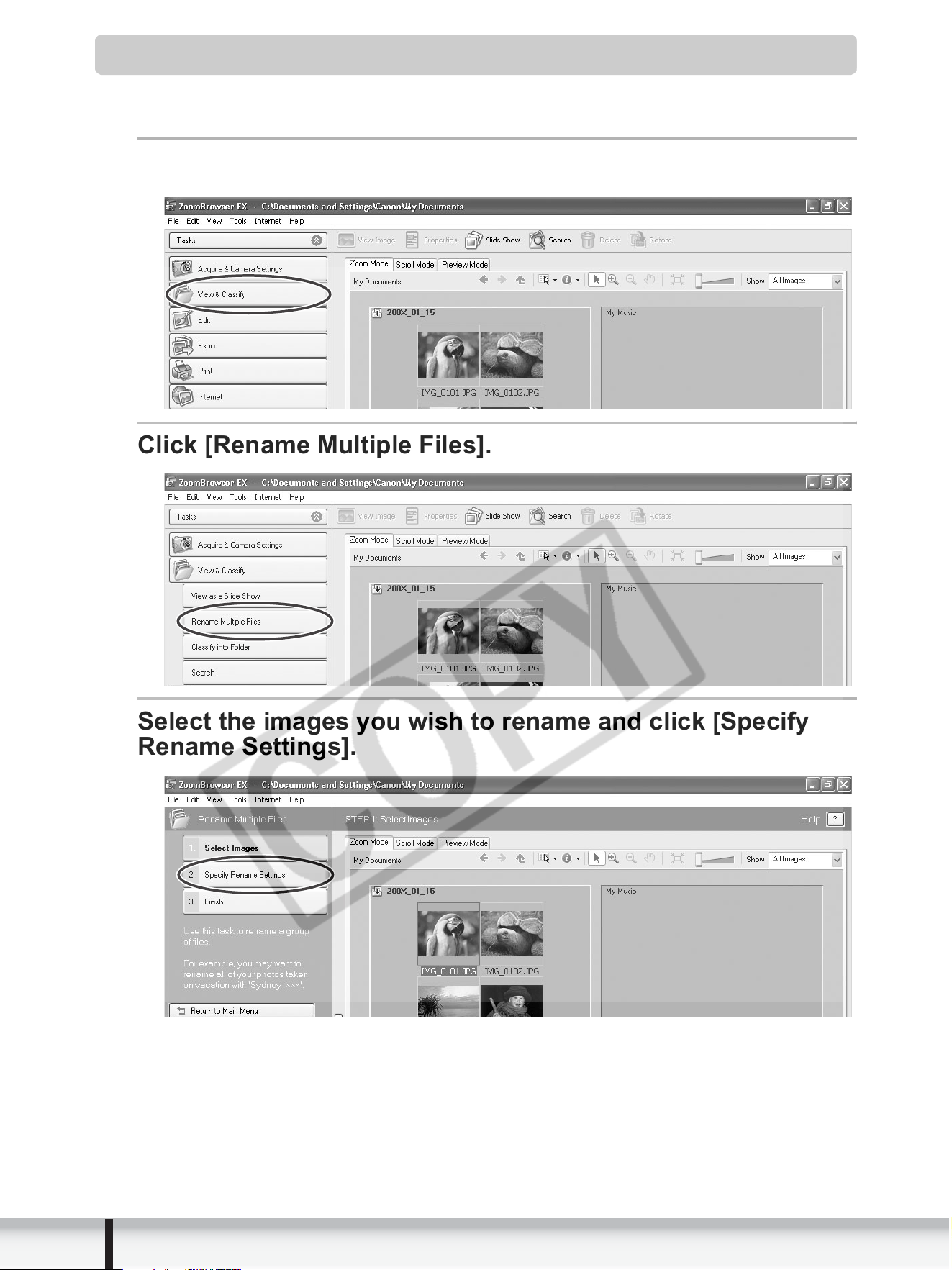
Click [View & Classify] in the Main Window.
2
Click [Classify into Folder].
3
Select the images you wish to classify and click [Specify
Classification Settings].
E
55
Organizing Images
Windows
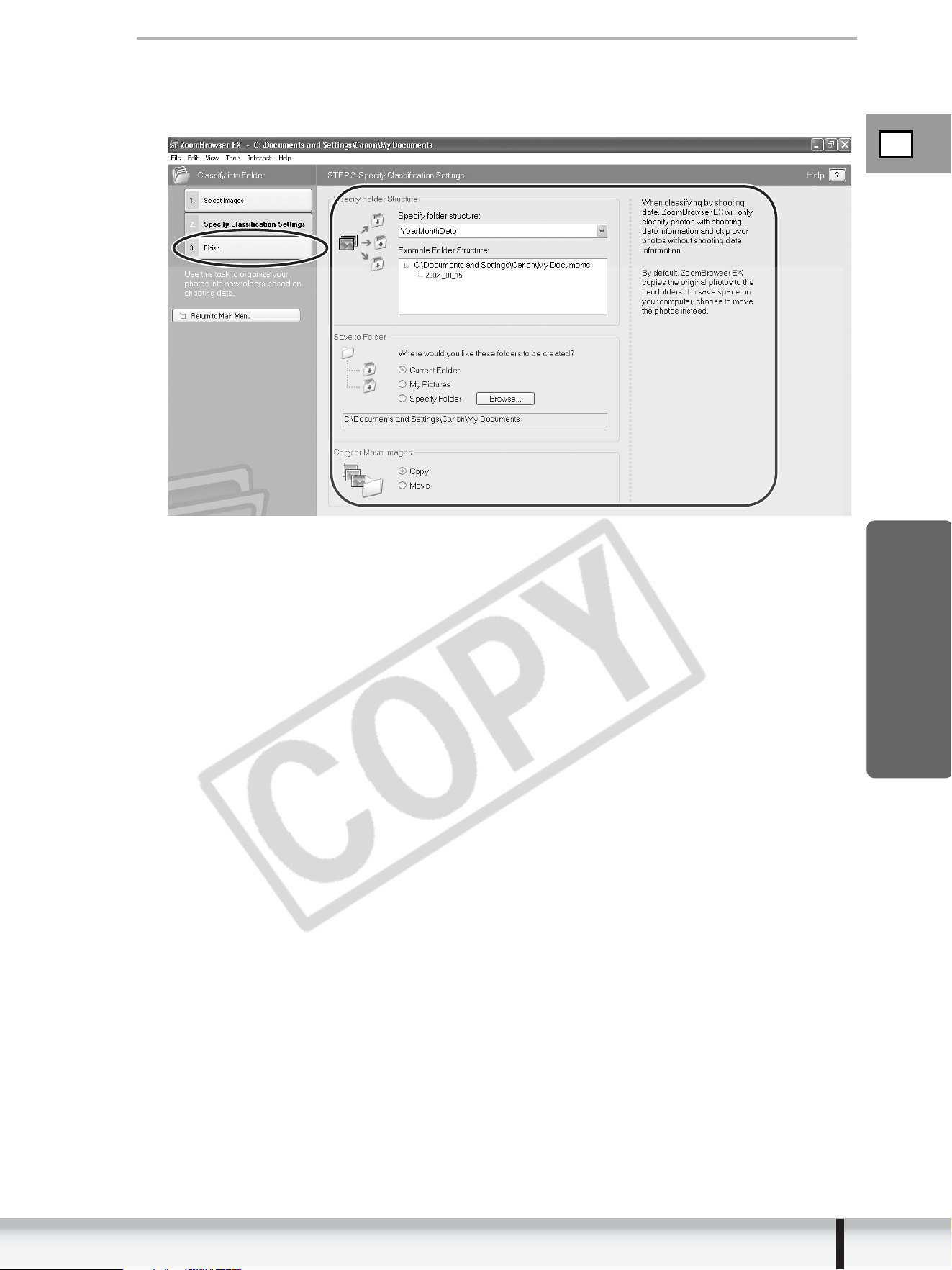
4
Specify the folder structure and the saving folder and click
[Finish].
The selected images are classified into the specified folder.
56
Organizing Images
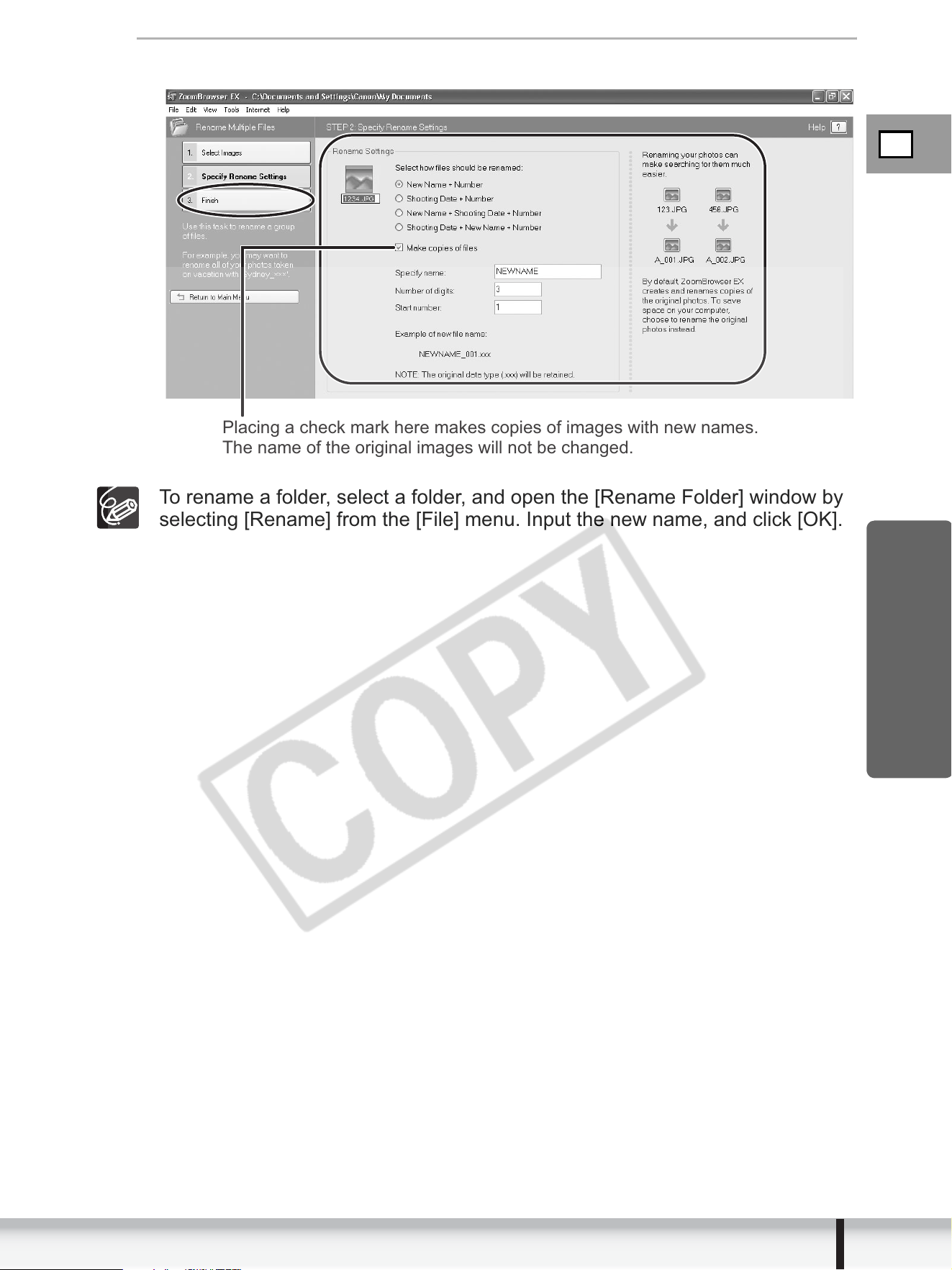
Renaming Multiple Files
This task allows you to rename multiple files at the same time, or to rename and
copy multiple files.
1
Click [View & Classify] in the Main Window.
2
Click [Rename Multiple Files].
3
Select the images you wish to rename and click [Specify
Rename Settings].
E
57
Organizing Images
Windows
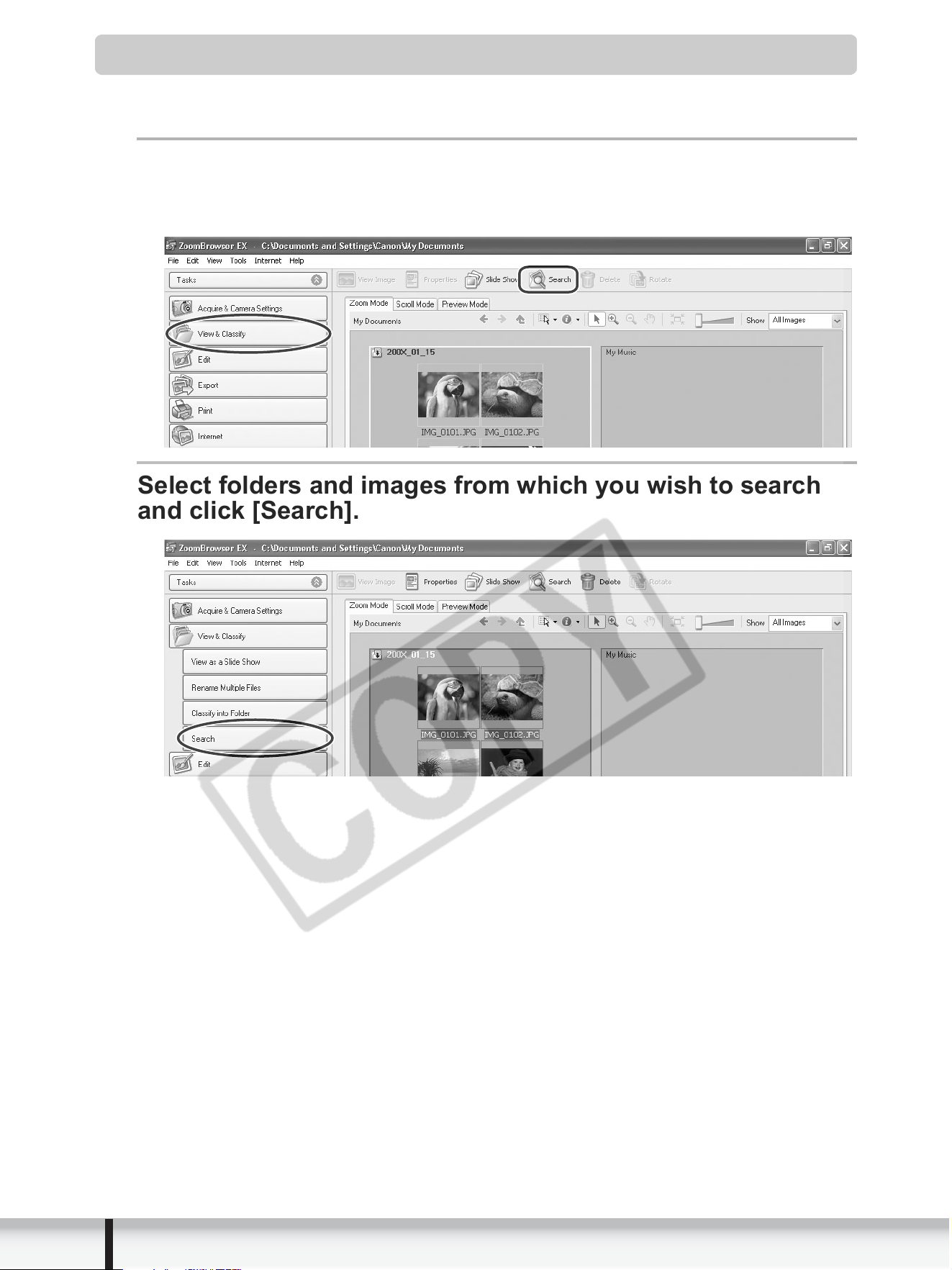
4
Specify the settings and click [Finish].
To rename a folder, select a folder, and open the [Rename Folder] window by
selecting [Rename] from the [File] menu. Input the new name, and click [OK].
Placing a check mark here makes copies of images with new names.
The name of the original images will not be changed.
58
Organizing Images
Searching for Images
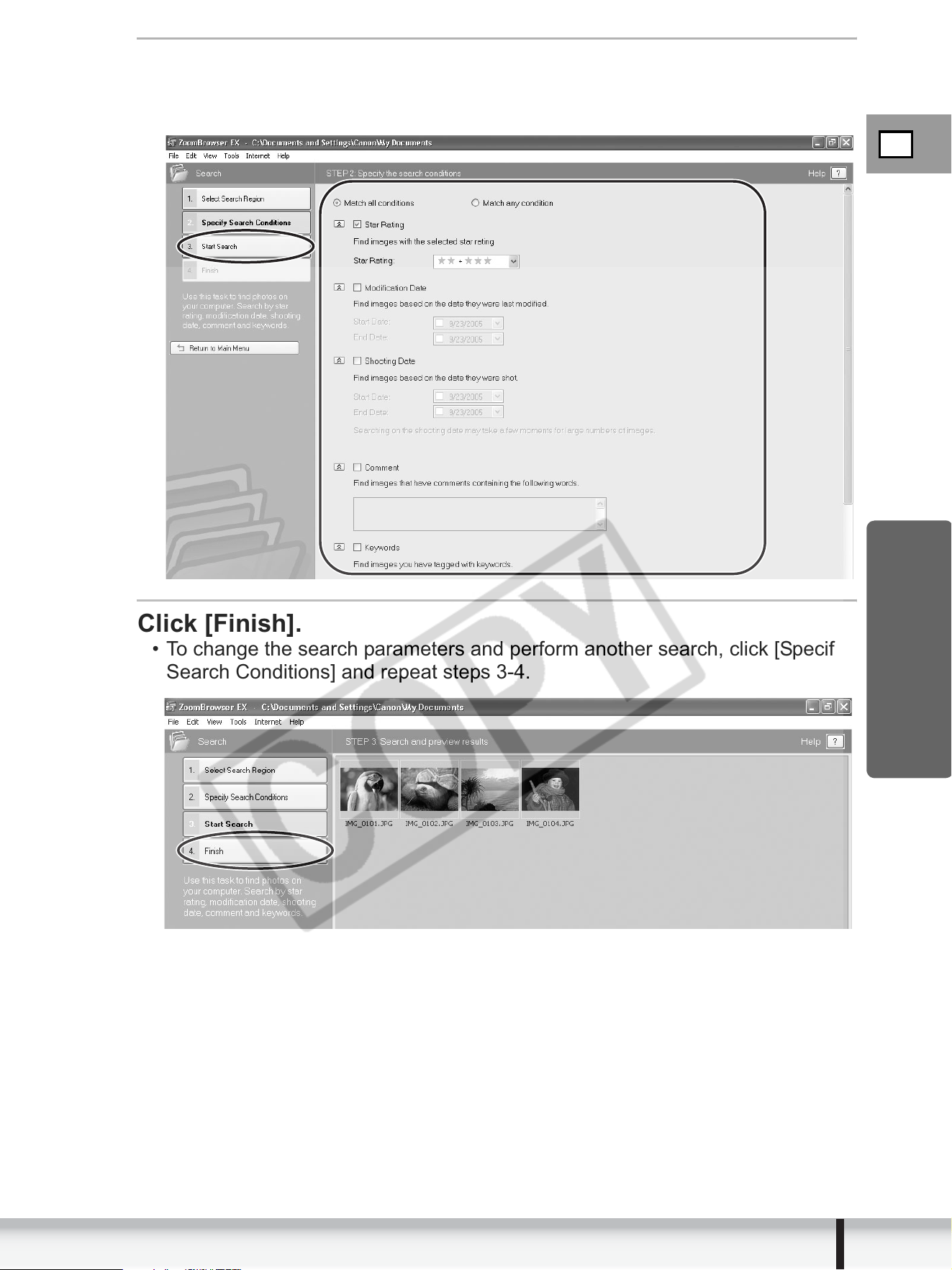
This task allows you to search for images by Star Rating, Modification Date,
Shooting Date, Comment or Keywords.
1
Click [View & Classify] in the Main Window.
You can also search for images by clicking [Search] on Application Tool Bar.
Please skip forward to step 3.
2
Select folders and images from which you wish to search
and click [Search].
E
59
Organizing Images
Windows
3
Specify the search conditions and click [Start Search].
• The search results are displayed as thumbnails.
• Select at least one search condition.
4
Click [Finish].
• To change the search parameters and perform another search, click [Specify
Search Conditions] and repeat steps 3-4.
60
Organizing Images
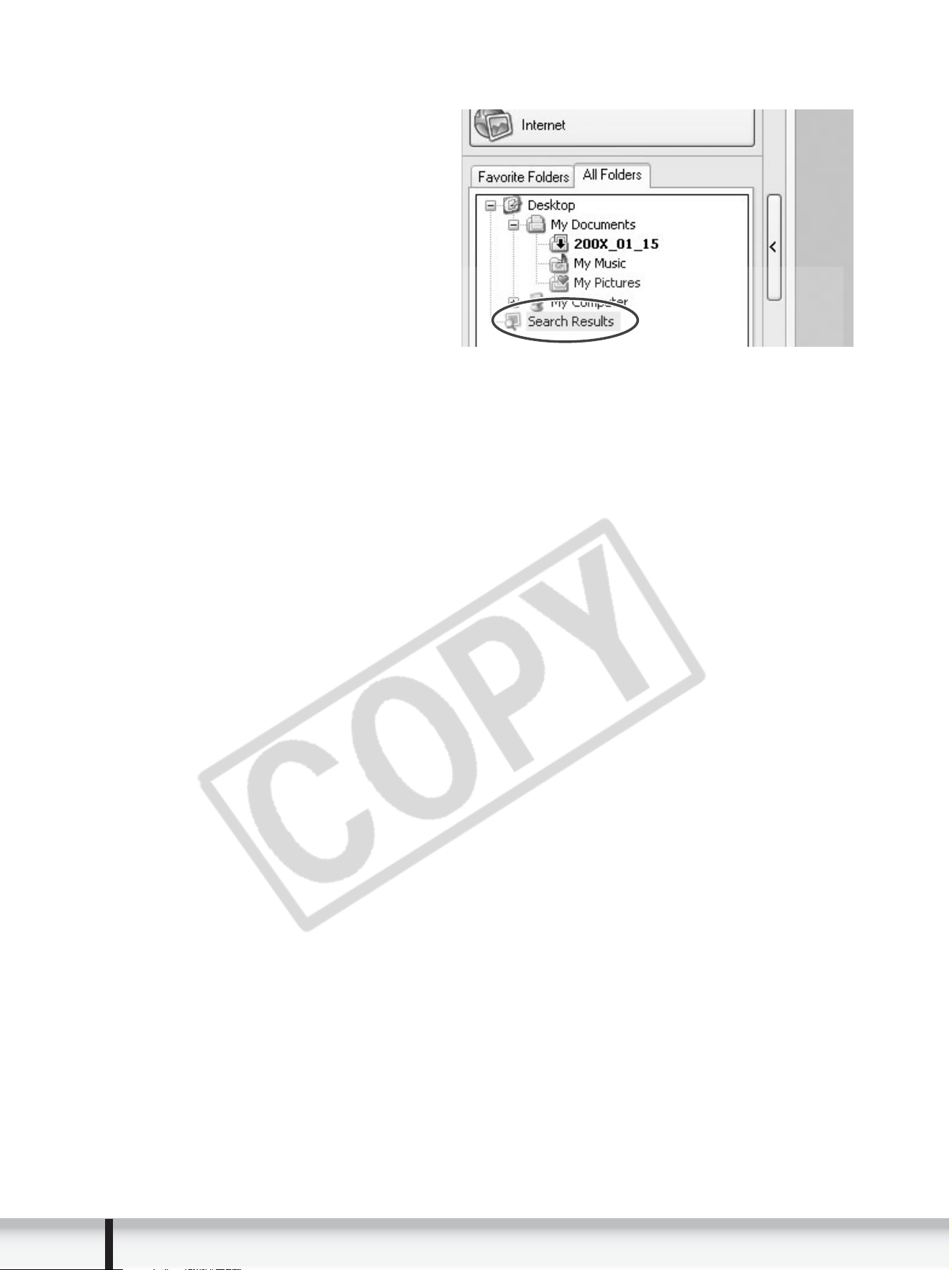
• The images of the search result are displayed in the [Search Results] folder.
You can print or copy these images to another folder. The images will remain
in this folder until ZoomBrowser EX is closed or another search is performed.
E
61
Playing Back and Editing Movies
Windows
Playing Back and Editing Movies
Playing Back Movies
In the CameraWindow and Main Window, movies are displayed with the first
scene as a still image with a (movie) icon.
If you are not using Windows XP and QuickTime 6.5 is not already installed
on your computer, install QuickTime from the DIGITAL VIDEO SOLUTION
DISK.
Do not double-click a movie file (.AVI extension) in Windows Explorer. That
will start Windows Media Player, which may not support this file type. To play
back movies, double-click the thumbnail with a movie icon in the Main
Window’s Browser Area.
1
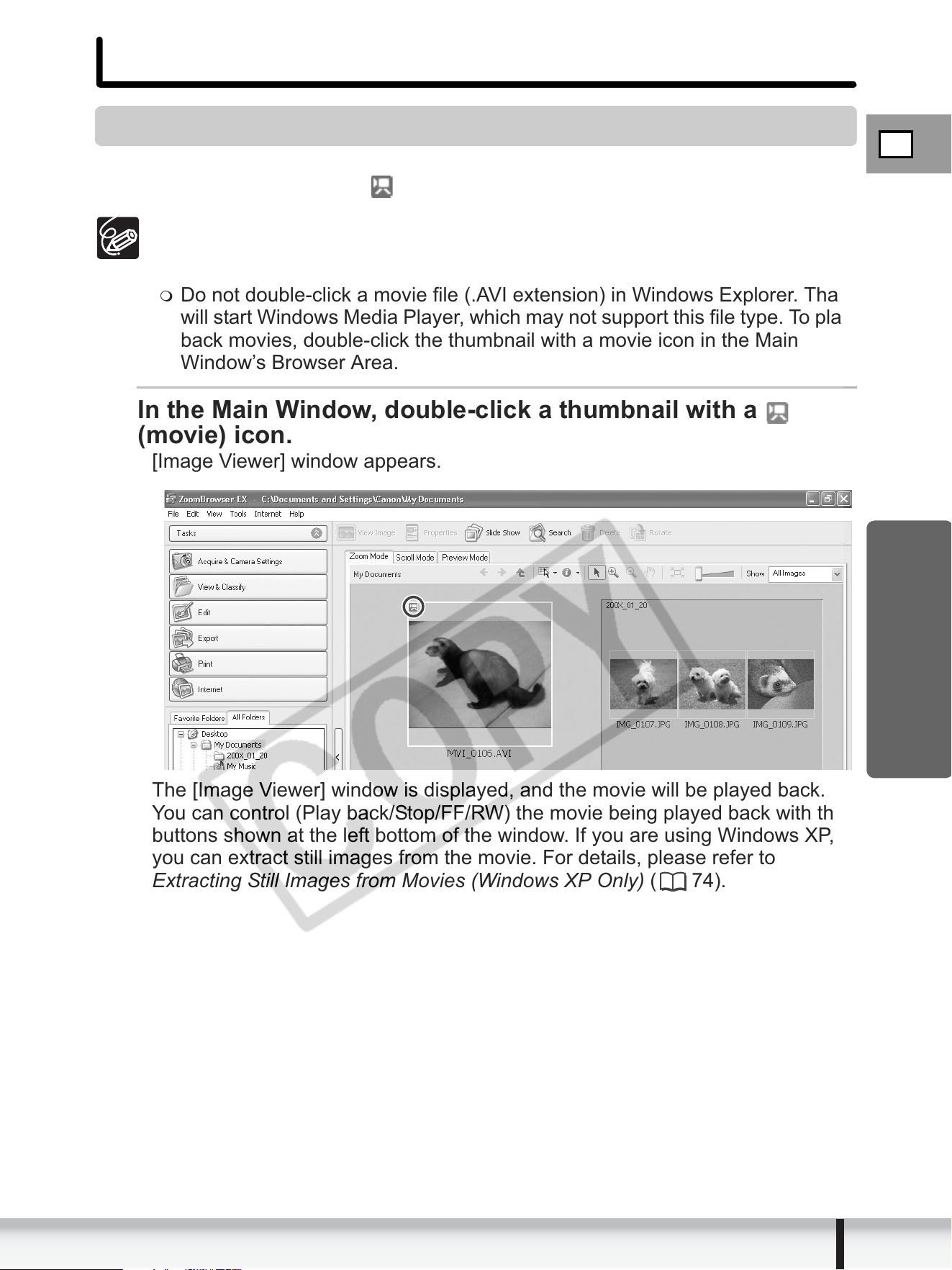
In the Main Window, double-click a thumbnail with a
(movie) icon.
[Image Viewer] window appears.
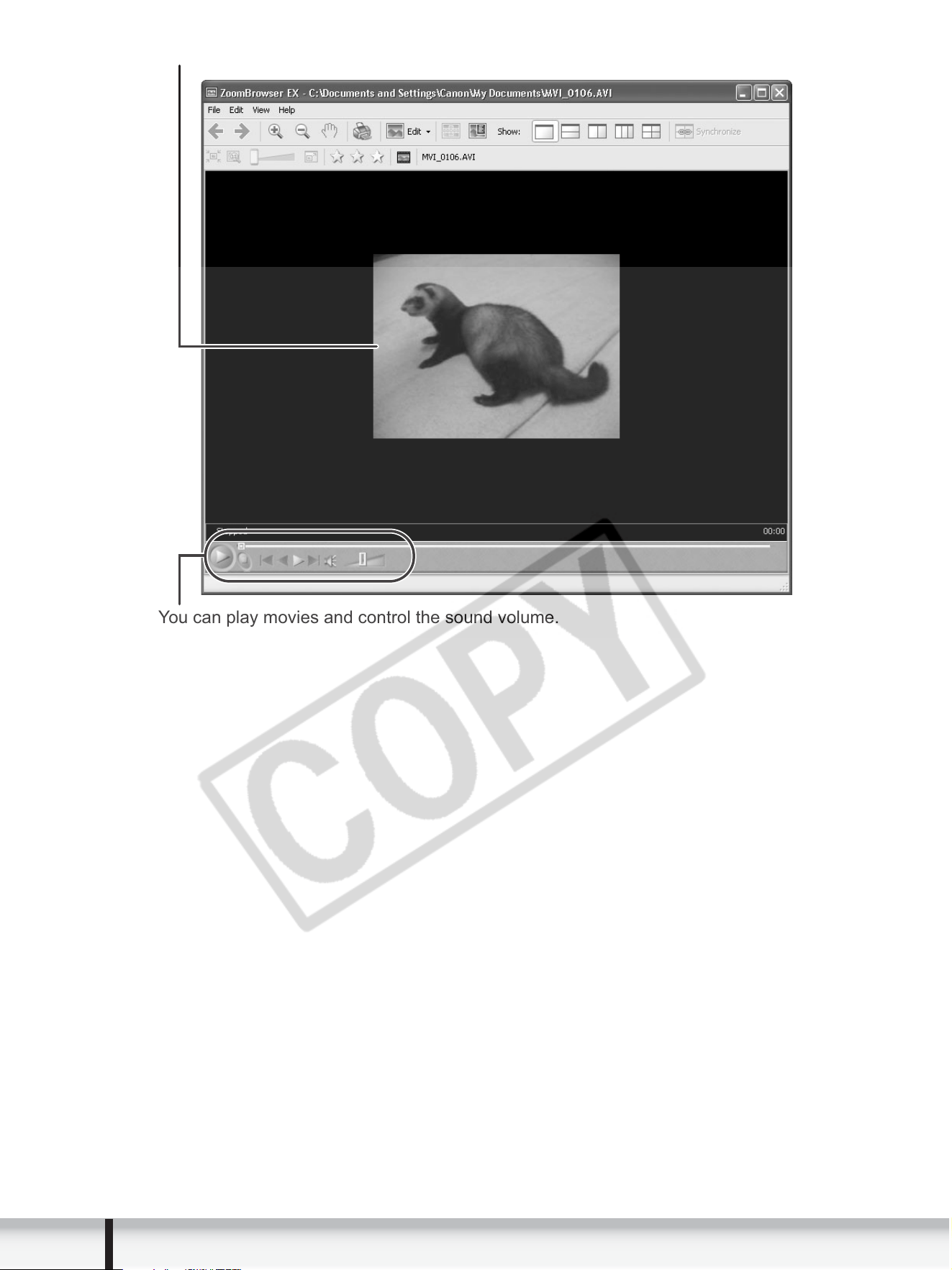
The [Image Viewer] window is displayed, and the movie will be played back.
You can control (Play back/Stop/FF/RW) the movie being played back with the
buttons shown at the left bottom of the window. If you are using Windows XP,
you can extract still images from the movie. For details, please refer to
Extracting Still Images from Movies (Windows XP Only) ( 74).
62
Playing Back and Editing Movies
You can play movies and control the sound volume.
You can save the displayed scene as a still image.
E
63
Playing Back and Editing Movies
Windows
Editing Movies
You can link images, insert text and background music, and add effects. You can
also change the size of selected movies and save them as new files.
If you are not using Windows XP, QuickTime 6.5 is required to edit movies. If it
is not already installed on your computer, install it from the DIGITAL VIDEO
SOLUTION DISK. Place the disk in the CD-ROM drive and click QuickTime
[Install] in the installer panel.
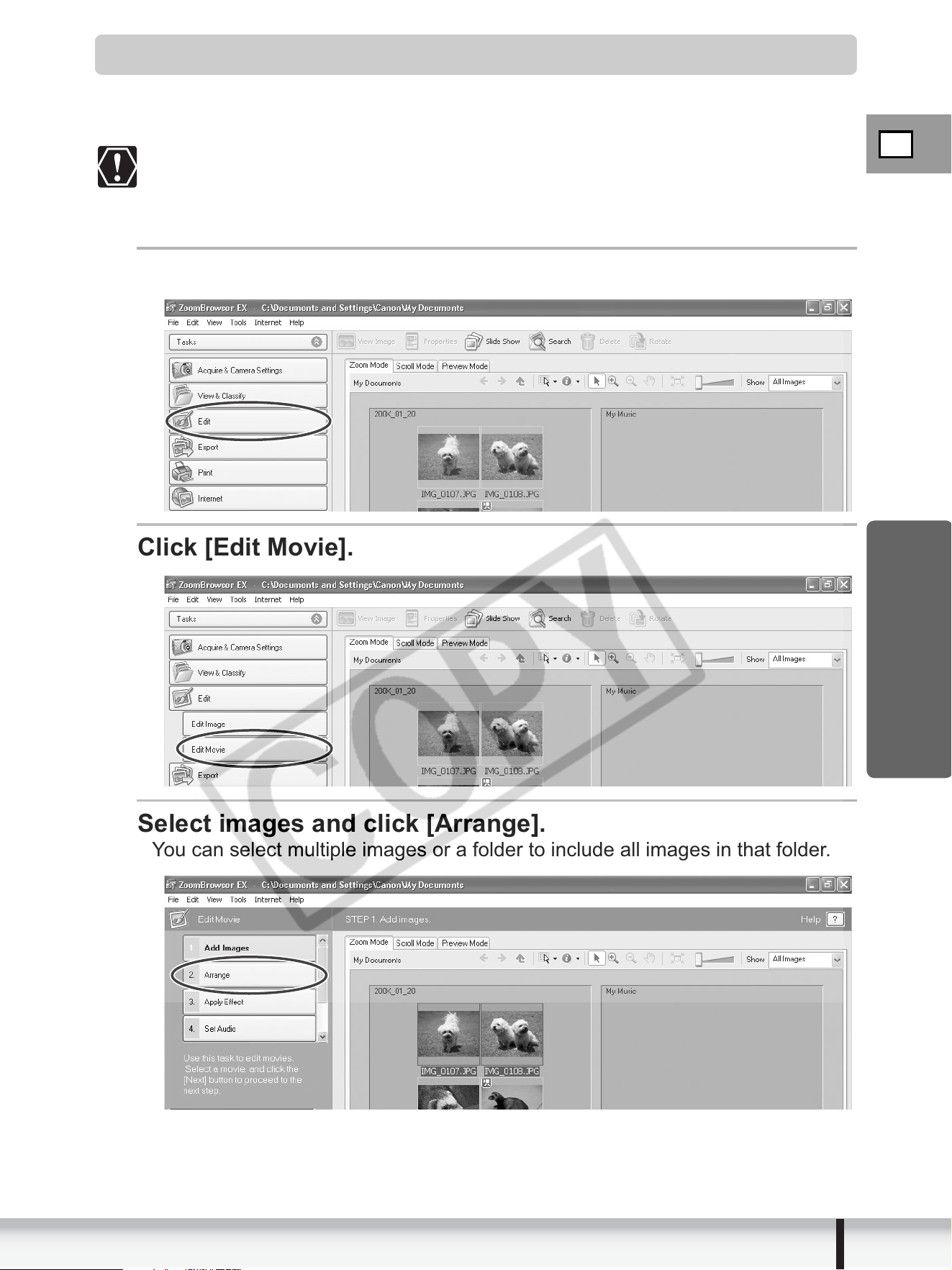
1
Click [Edit] in the Main Window.
2
Click [Edit Movie].
3
Select images and click [Arrange].
You can select multiple images or a folder to include all images in that folder.
64
Playing Back and Editing Movies
4
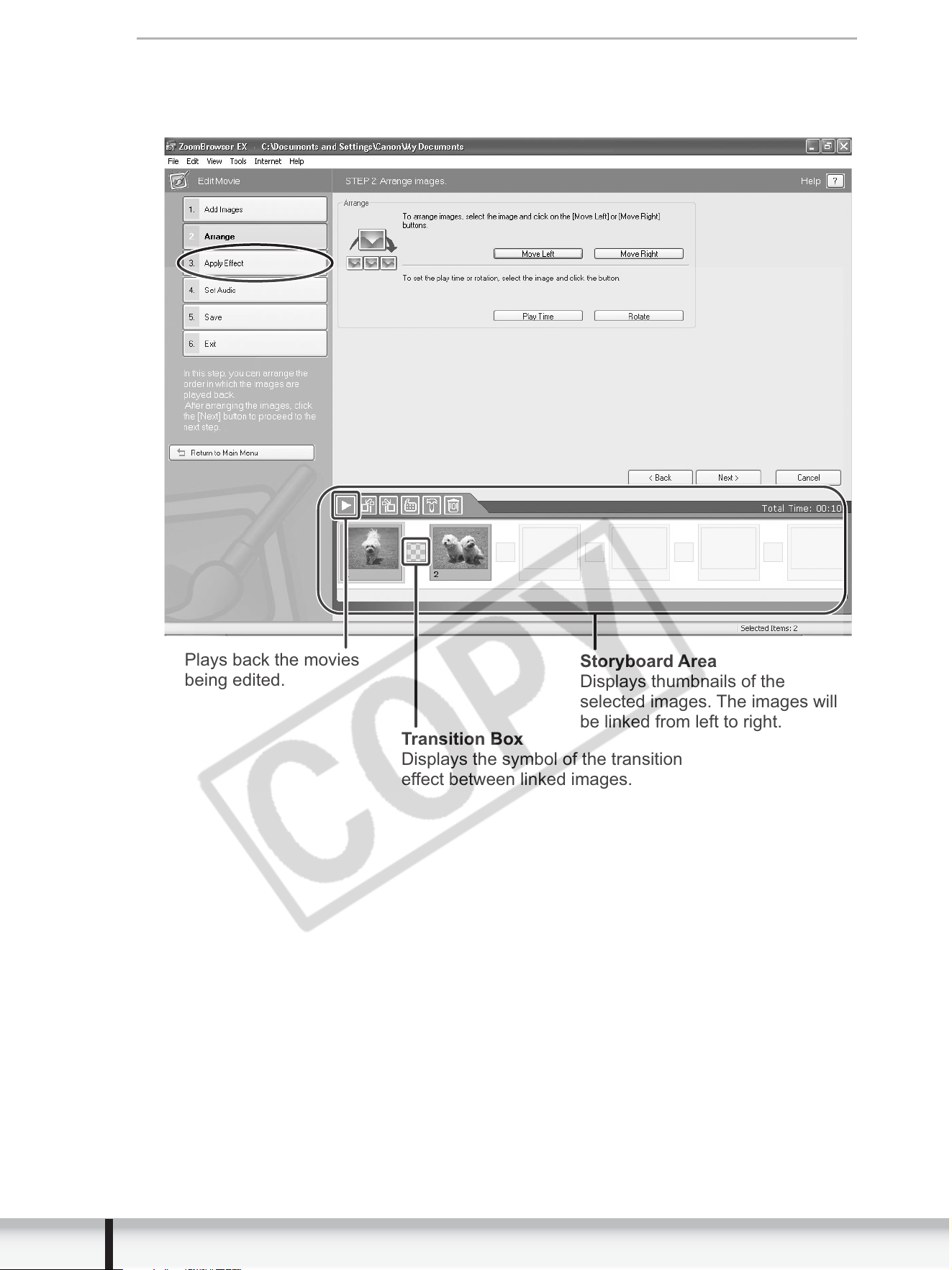
Arrange images and click [Apply Effect].
To change the order of images, select an image in the Storyboard Area and click
[Move Left] or [Move Right].
Storyboard Area
Displays thumbnails of the
selected images. The images will
be linked from left to right.
Transition Box
Displays the symbol of the transition
effect between linked images.
Plays back the movies
being edited.
E
65
Playing Back and Editing Movies
Windows
5
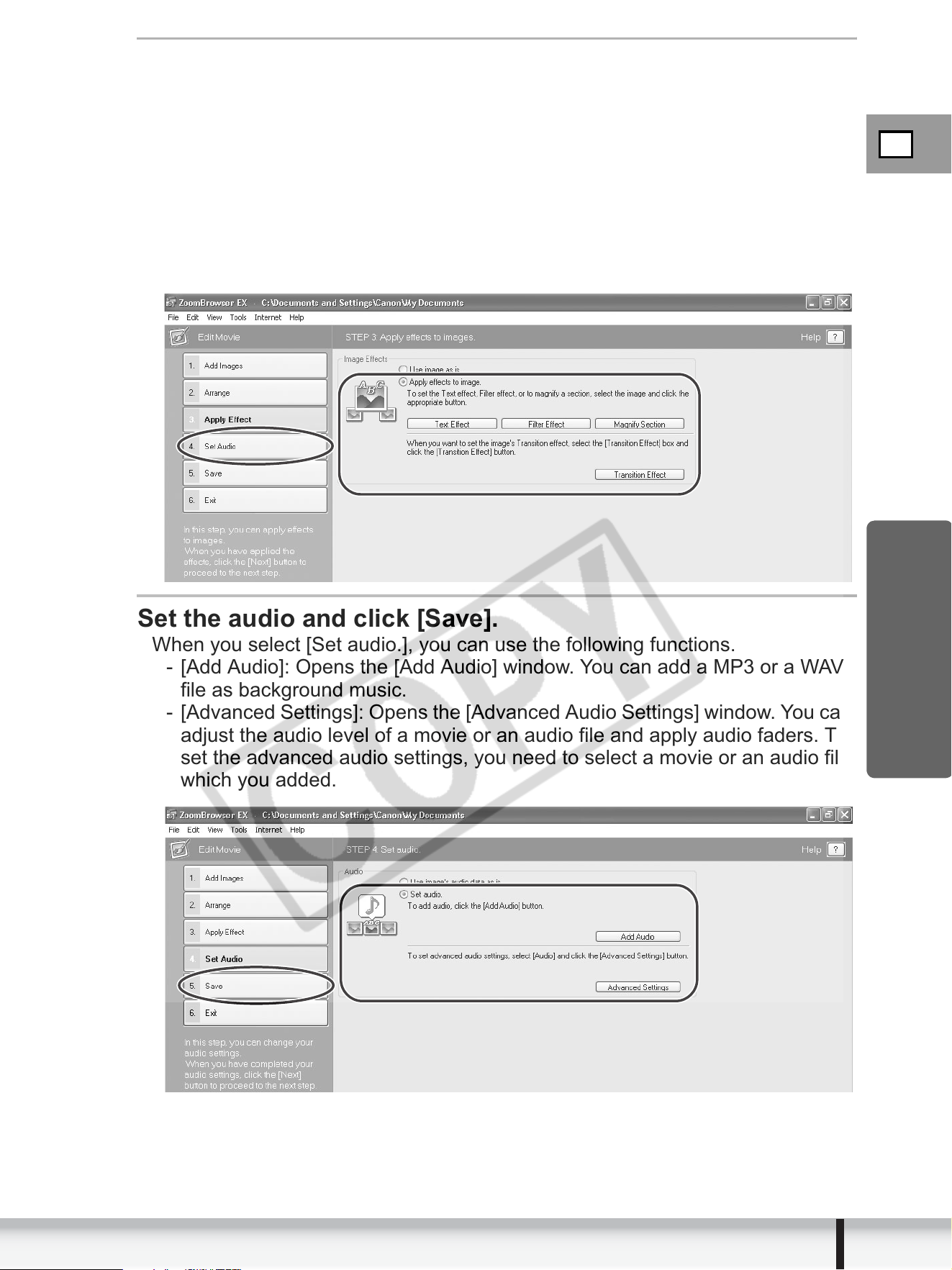
Apply effects to the images and click [Set Audio].
When you select [Apply effects to image.], you can use the following functions.
- [Text Effect]: Opens the [Text Effect Settings] window. You can enter text,
change the font and preview the effect.
- [Filter Effect]: Opens the [Filter Effect Settings] window. You can set the filter
effect type, the start and end point, and preview the effect.
- [Magnify Section]: Allows you to view a part of the image in enlarged size.
- [Transition Effect]: Opens the [Transition Effect Settings] window. You can
set the transition effect type and display time, and preview the effect. To set
a transition effect, you need to select a transition box in the Storyboard Area.
6
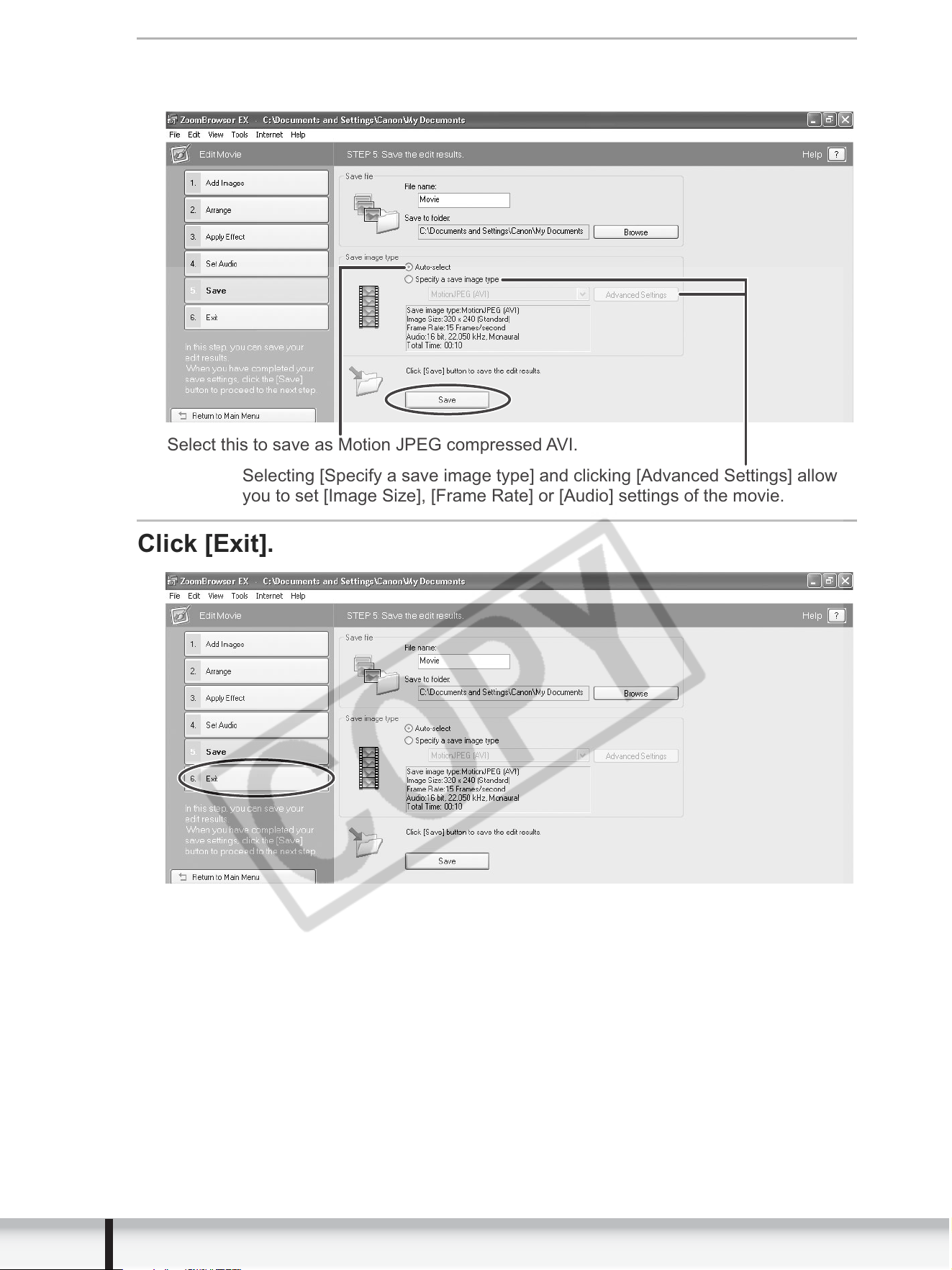
Set the audio and click [Save].
When you select [Set audio.], you can use the following functions.
- [Add Audio]: Opens the [Add Audio] window. You can add a MP3 or a WAV
file as background music.
- [Advanced Settings]: Opens the [Advanced Audio Settings] window. You can
adjust the audio level of a movie or an audio file and apply audio faders. To
set the advanced audio settings, you need to select a movie or an audio file
which you added.
66
Playing Back and Editing Movies
7
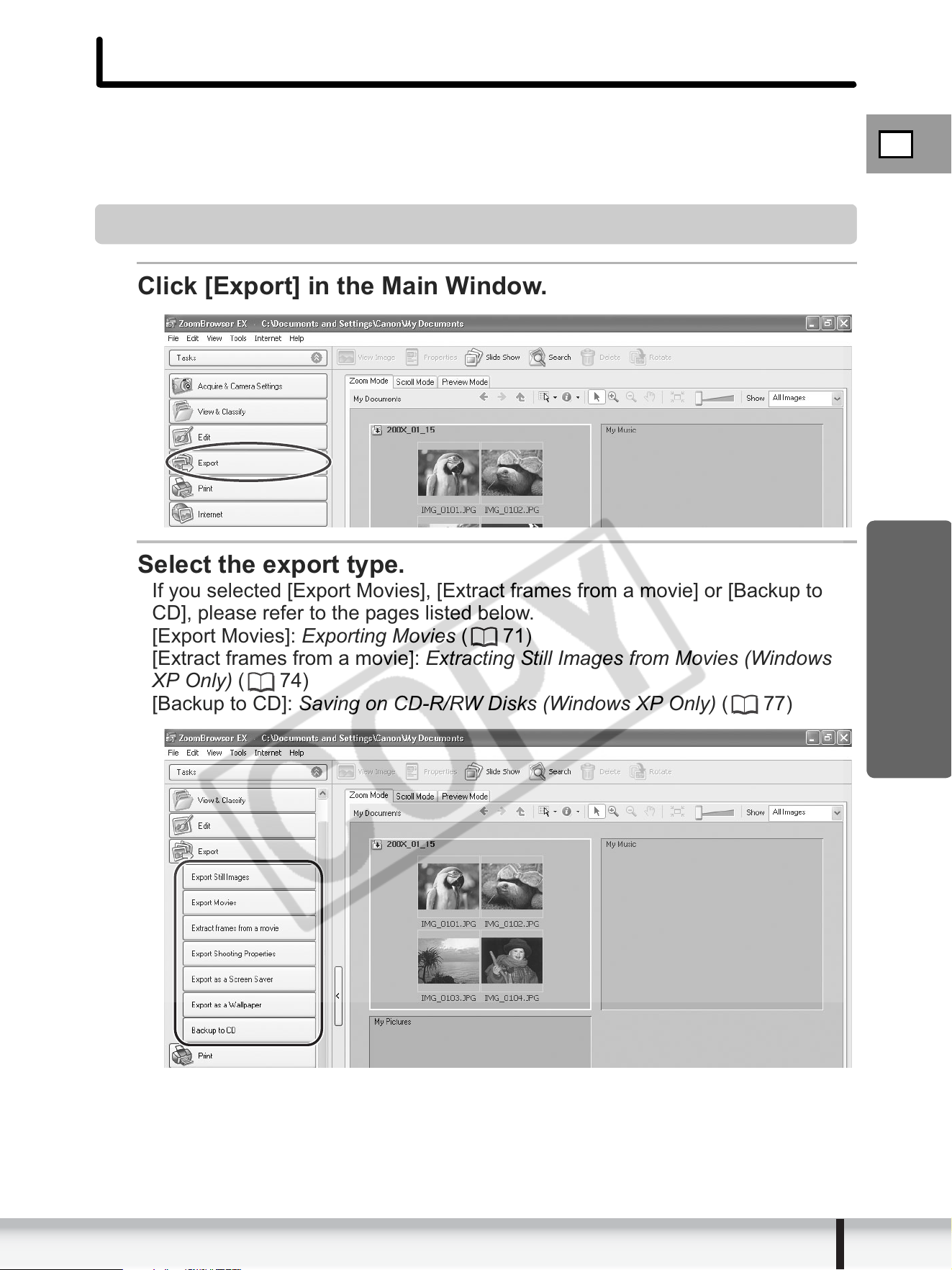
Click [Save].
Movies are saved in DCF type files with Motion JPEG/AVI compression.
8
Click [Exit].
Select this to save as Motion JPEG compressed AVI.
Selecting [Specify a save image type] and clicking [Advanced Settings] allows
you to set [Image Size], [Frame Rate] or [Audio] settings of the movie.
E
67
Exporting Images
Windows
Exporting Images
You can change the data type for selected still images and movies and save
them as new files. You can also export selected movies and still image properties
to a text file or copy and rename movies and still images. Furthermore, you can
export still images for use as a screen saver or a wallpaper.
Changing the File Type and Save
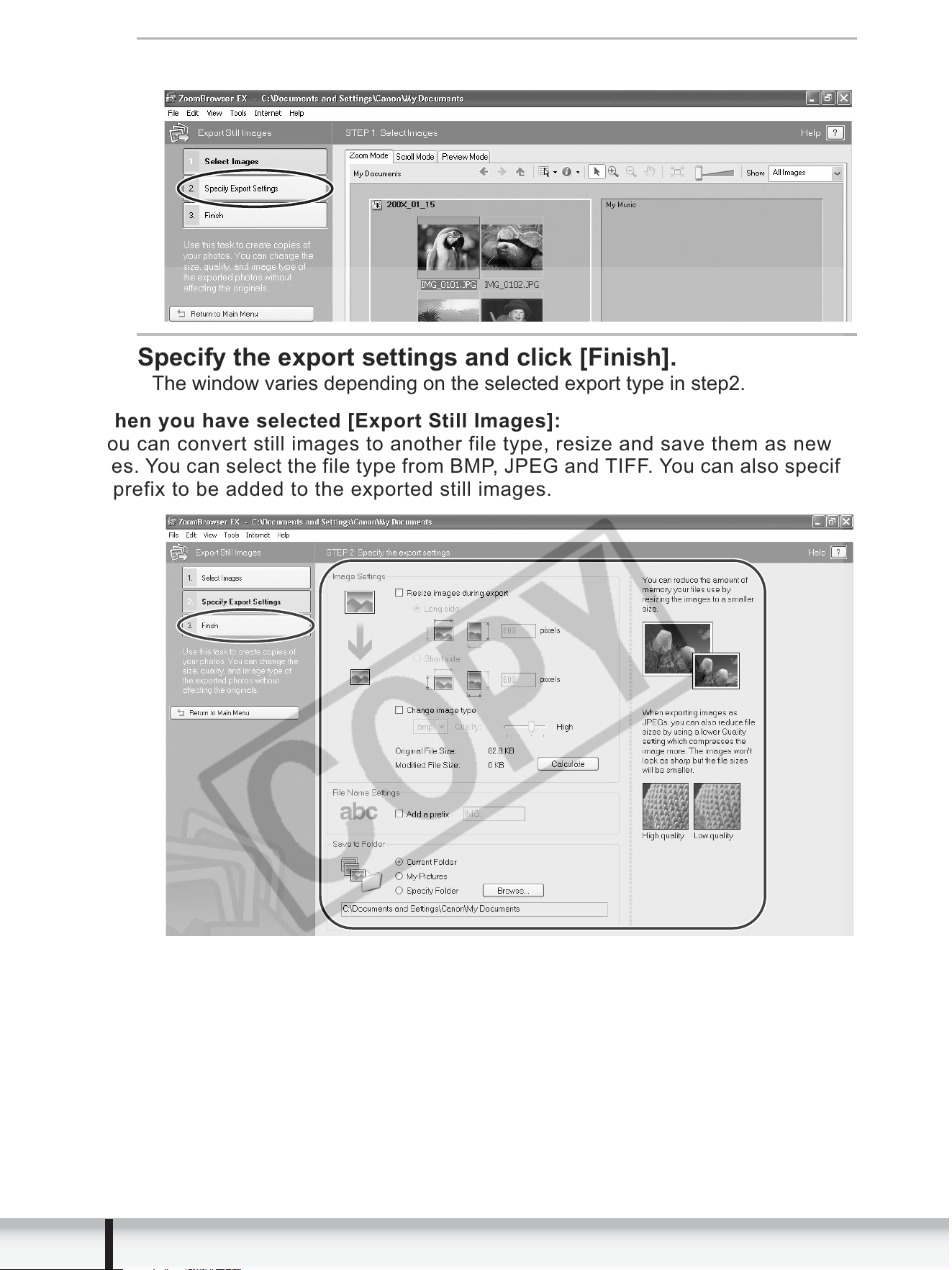
1
Click [Export] in the Main Window.
2
Select the export type.
If you selected [Export Movies], [Extract frames from a movie] or [Backup to
CD], please refer to the pages listed below.
[Export Movies]: Exporting Movies ( 71)
[Extract frames from a movie]: Extracting Still Images from Movies (Windows
XP Only) (74)
[Backup to CD]: Saving on CD-R/RW Disks (Windows XP Only) (77)
68
Exporting Images
3
Select images and click [Specify Export Settings].
4
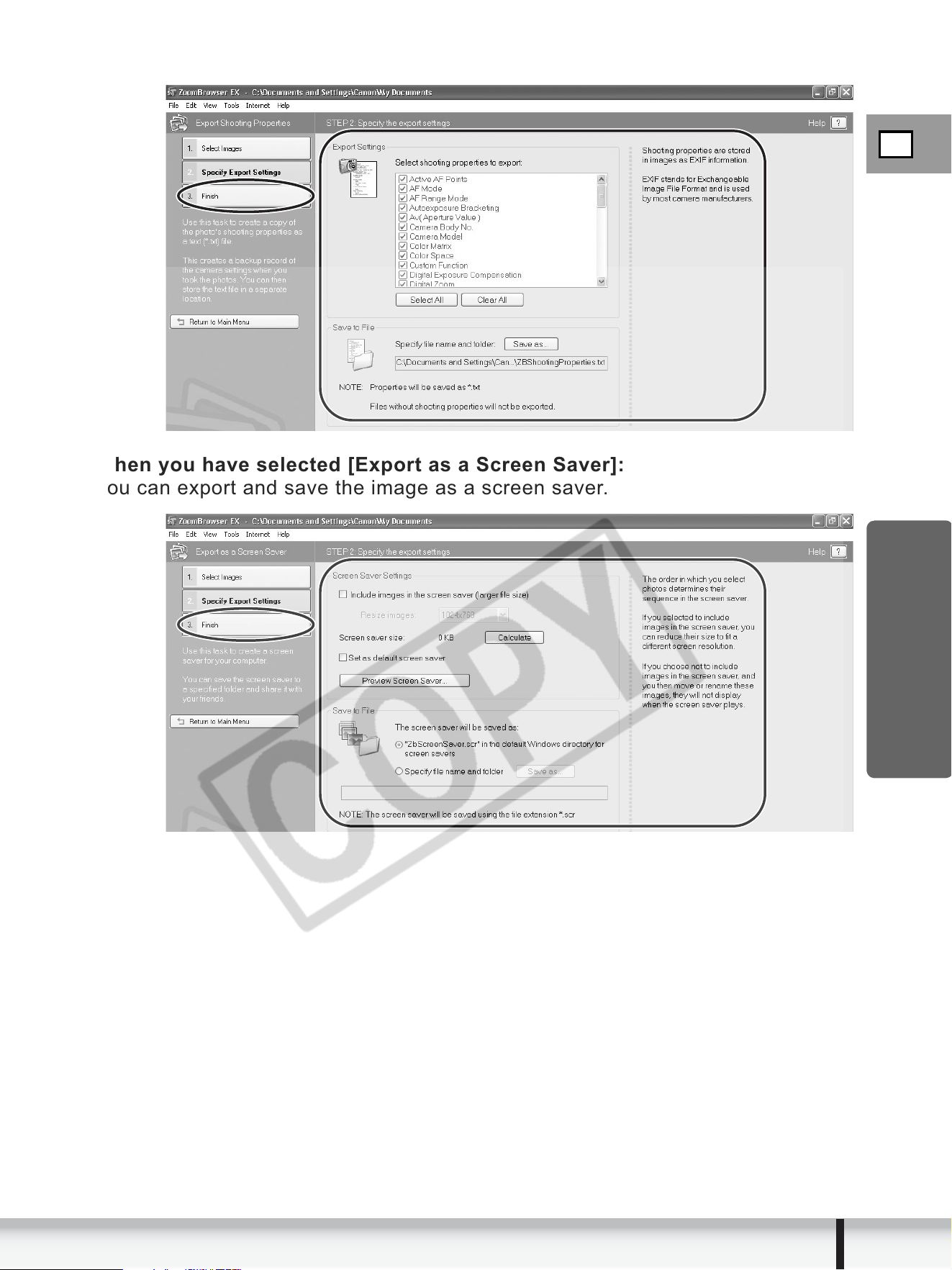
Specify the export settings and click [Finish].
The window varies depending on the selected export type in step2.
When you have selected [Export Still Images]:
You can convert still images to another file type, resize and save them as new
files. You can select the file type from BMP, JPEG and TIFF. You can also specify
a prefix to be added to the exported still images.
E
69
Exporting Images
Windows
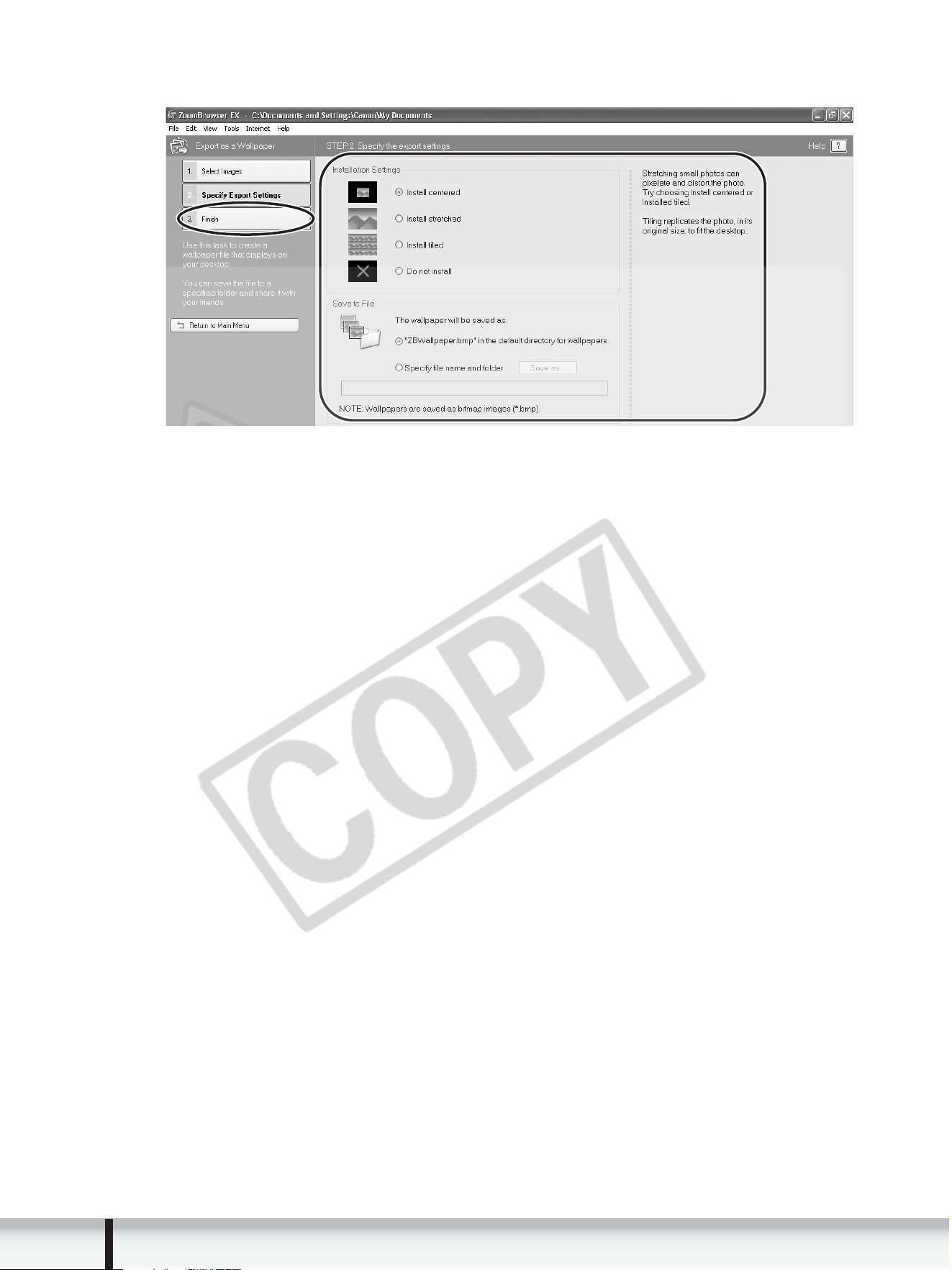
When you have selected [Export Shooting Properties]:
You can select the information you wish to export and save as a text file.
When you have selected [Export as a Screen Saver]:
You can export and save the image as a screen saver.
70
Exporting Images
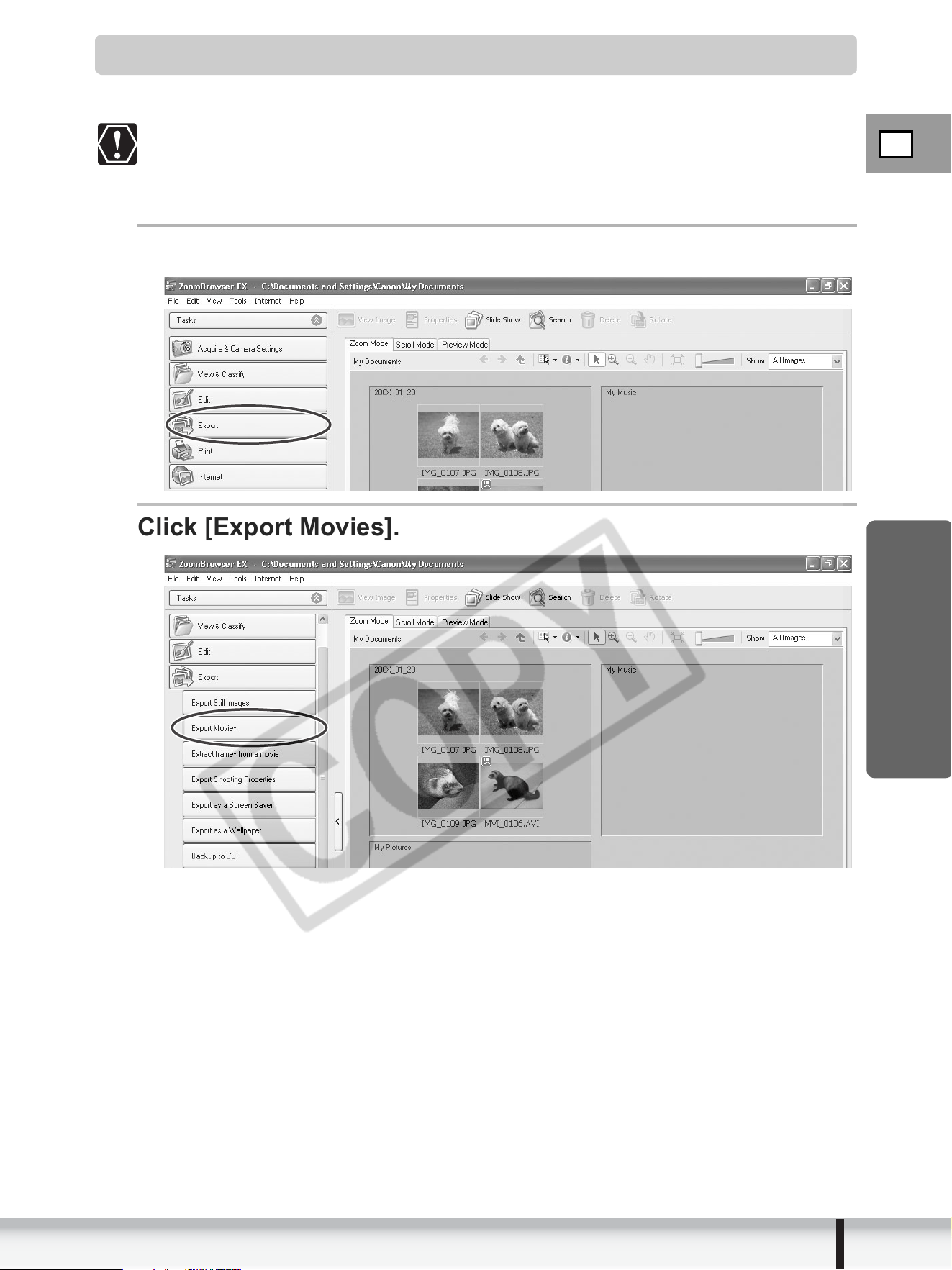
When you have selected [Export as a Wallpaper]:
You can export and save the image as Windows wallpaper. This task cannot be
performed if you have selected multiple images.
E
71
Exporting Images
Windows
Exporting Movies
You can change the size or data for selected movies and save them as new files.
If you are not using Windows XP, QuickTime 6.5 is required to export movies. If
it is not already installed on your computer, install it from the DIGITAL VIDEO
SOLUTION DISK. Place the disk in the CD-ROM drive and click QuickTime
[Install] in the installer panel.
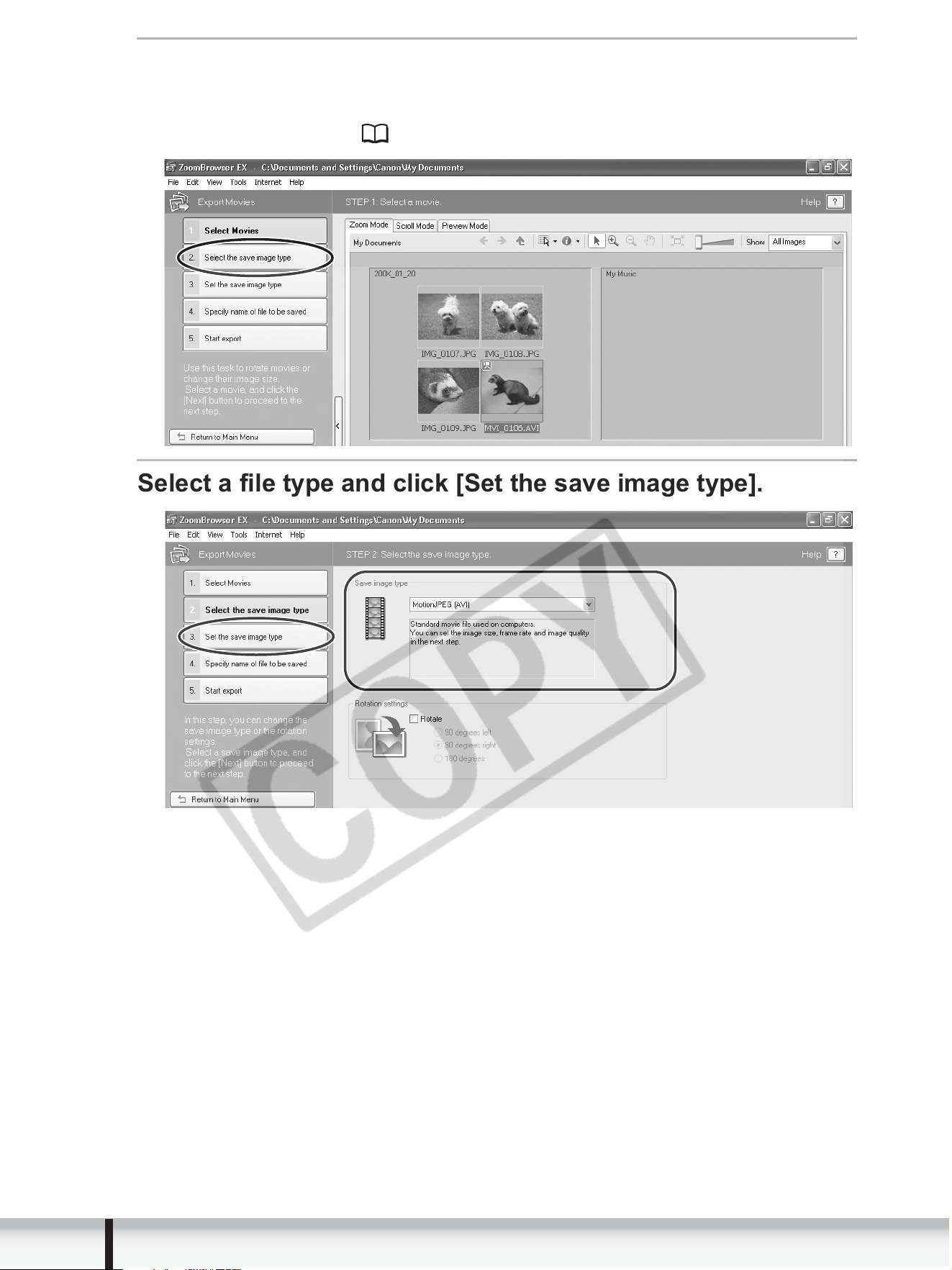
1
Click [Export] in the Main Window.
2
Click [Export Movies].
72
Exporting Images
3
Select a movie and click [Select the save image type].
You can select multiple images or a folder to include all images in that folder.
Still images cannot be selected. For instructions on how to export still images,
seeExporting Images (67).
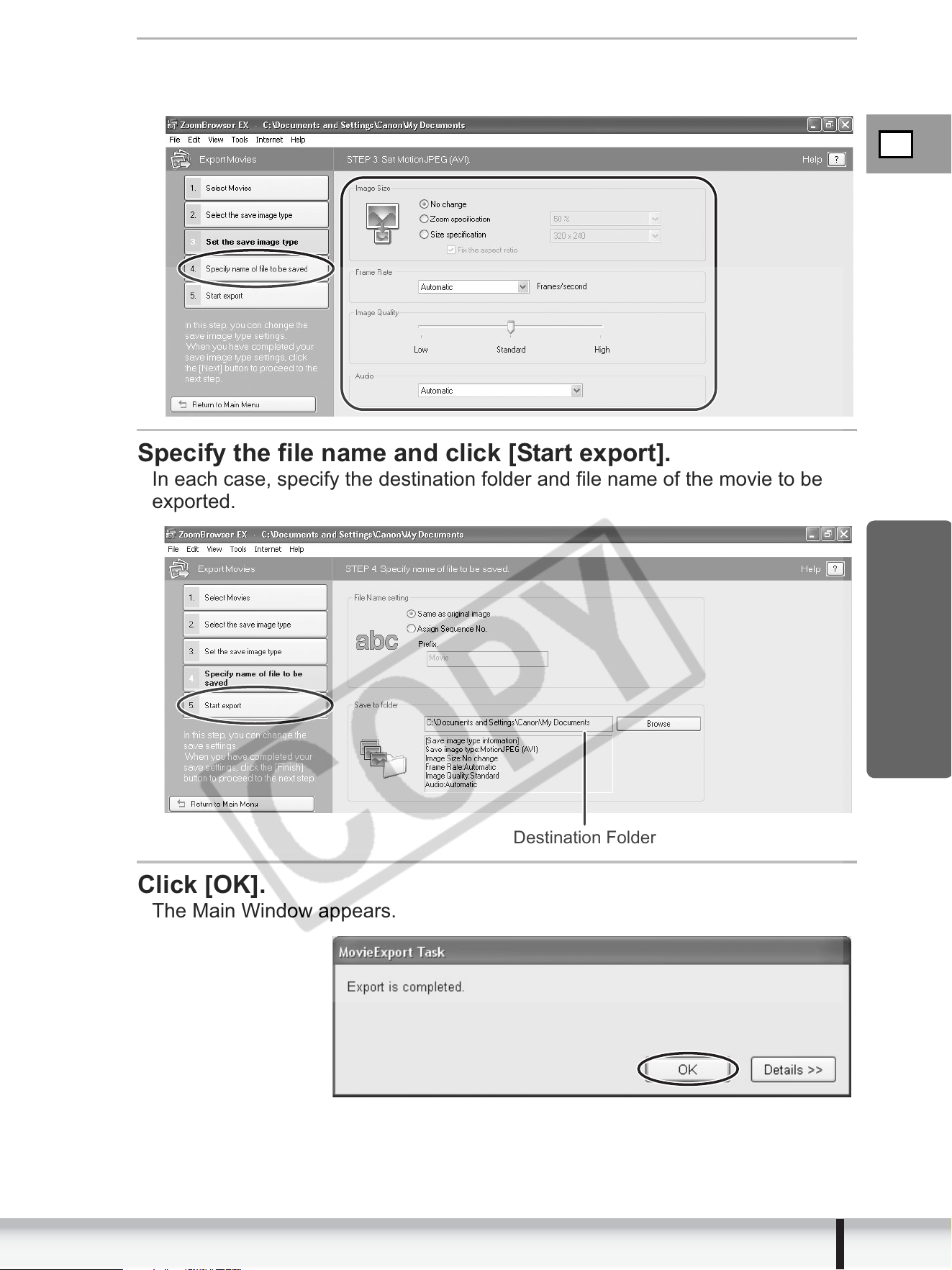
4
Select a file type and click [Set the save image type].
E
73
Exporting Images
Windows
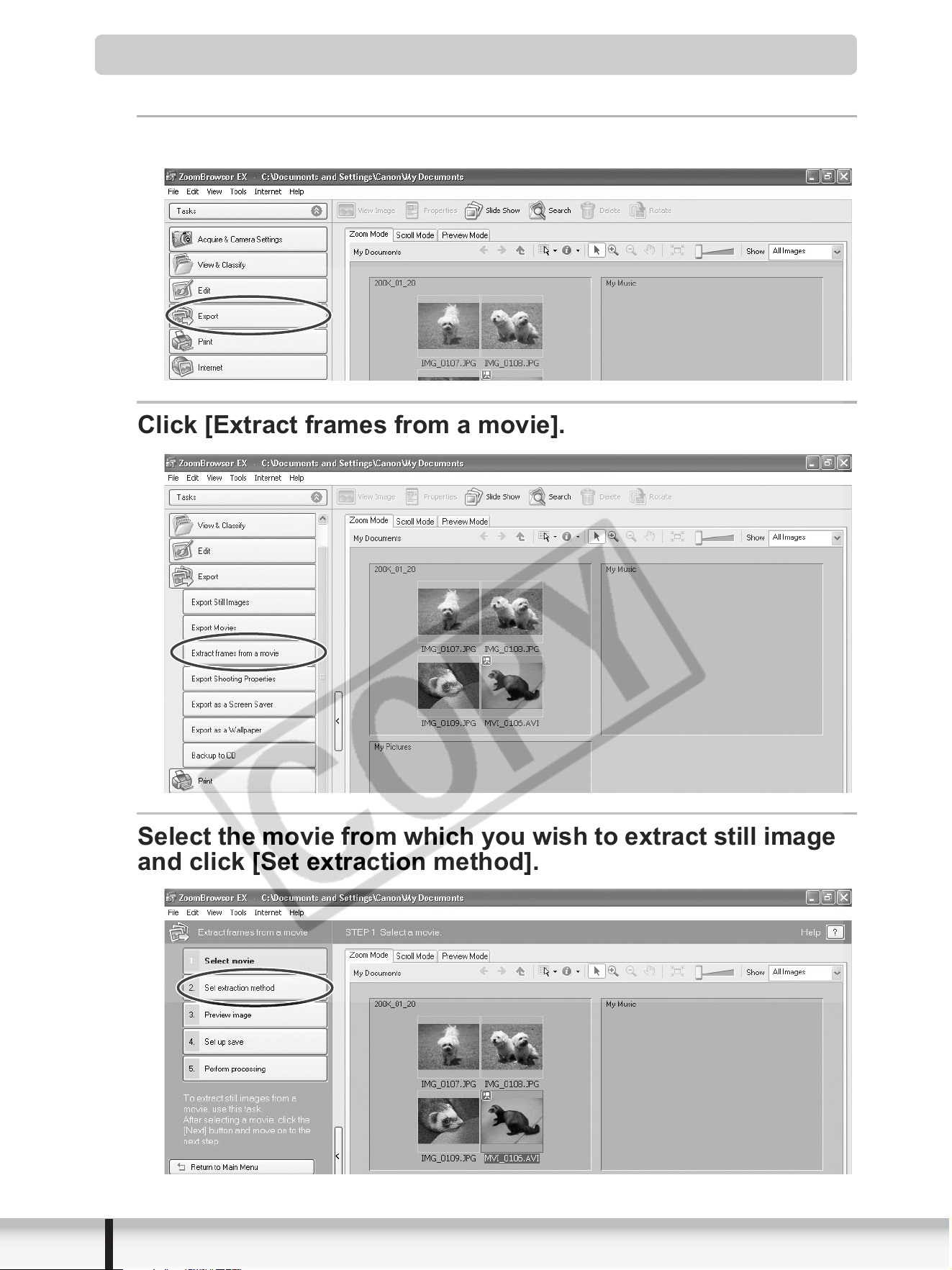
5
Specify the export settings and click [Specify name of file to
be saved].
6
Specify the file name and click [Start export].
In each case, specify the destination folder and file name of the movie to be
exported.
7
Click [OK].
The Main Window appears.
Destination Folder
74
Exporting Images
Extracting Still Images from Movies (Windows XP Only)
You can extract still images from movies and save them as image files.
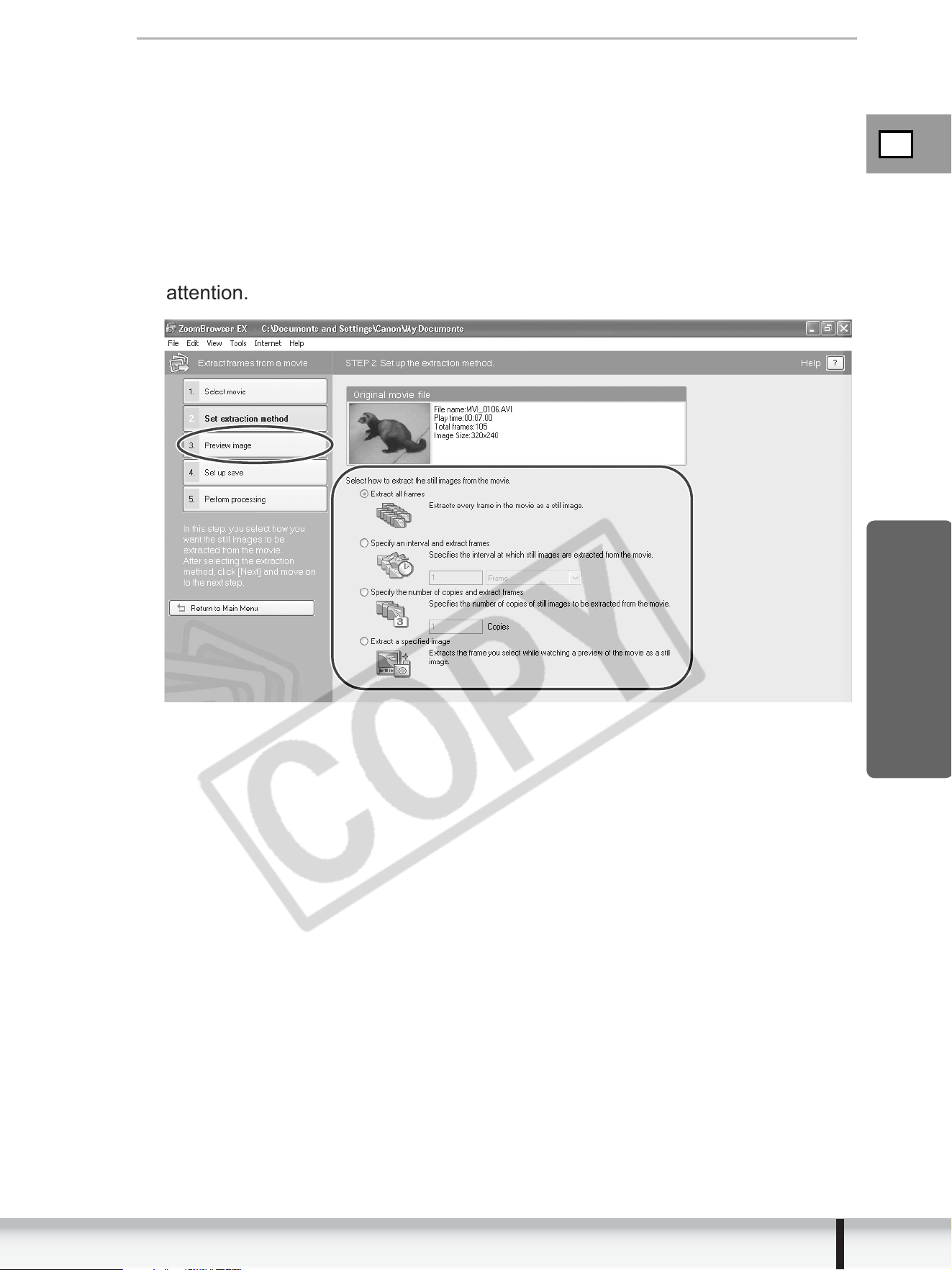
1
Click [Export] in the Main Window.
2
Click [Extract frames from a movie].
3
Select the movie from which you wish to extract still images
and click [Set extraction method].
E
75
Exporting Images
Windows
4
Select the still images extraction method and click [Preview
image].
• [Extract all frames]: Extracts all frames in the movie as still images.
• [Specify an interval and extract frames]: Extracts frames as still images from a
specified frame range or time interval.
• [Specify the number of copies and extract frames]: Extracts a specified
number of still images from the entire movie. The extraction interval is
calculated based on an equal distribution of the specified number of still
images.
• [Extract a specified image]: Extracts still images from scenes that catch your
attention.
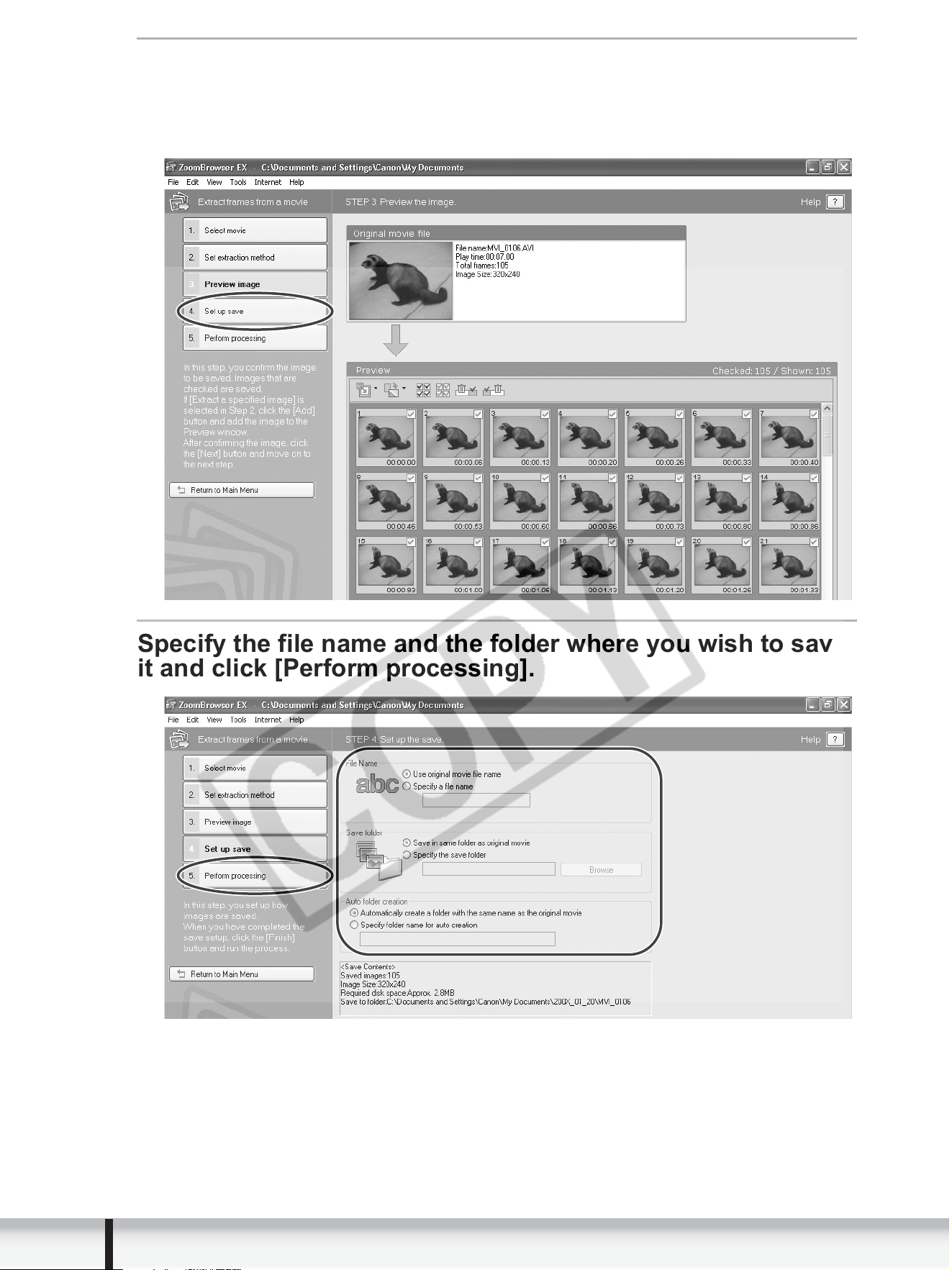
76
Exporting Images
5
Confirm the still images extracted and click [Set up save].
If you selected [Extract a specified image] in the previous window, the movie will
be displayed in the upper part of the window. Display the images you want and
click [Add].
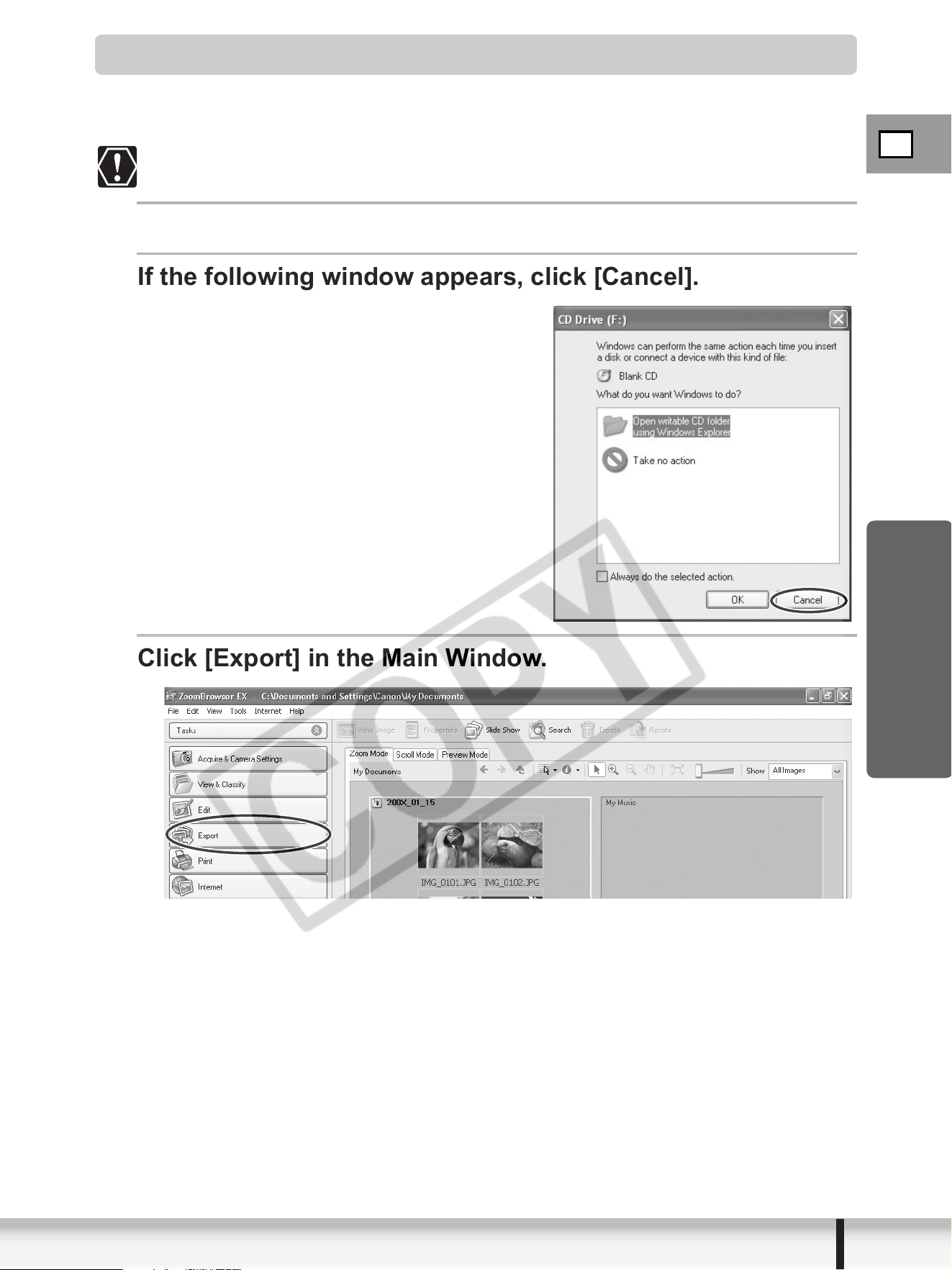
6
Specify the file name and the folder where you wish to save
it and click [Perform processing].
E
77
Exporting Images
Windows
Saving on CD-R/RW Disks (Windows XP Only)
You can copy and save images to CD-R or CD-RW disks. The shooting
information is copied along with the images.
This function can only be used on a computer that came with a CD-R/RW drive
as standard equipment.
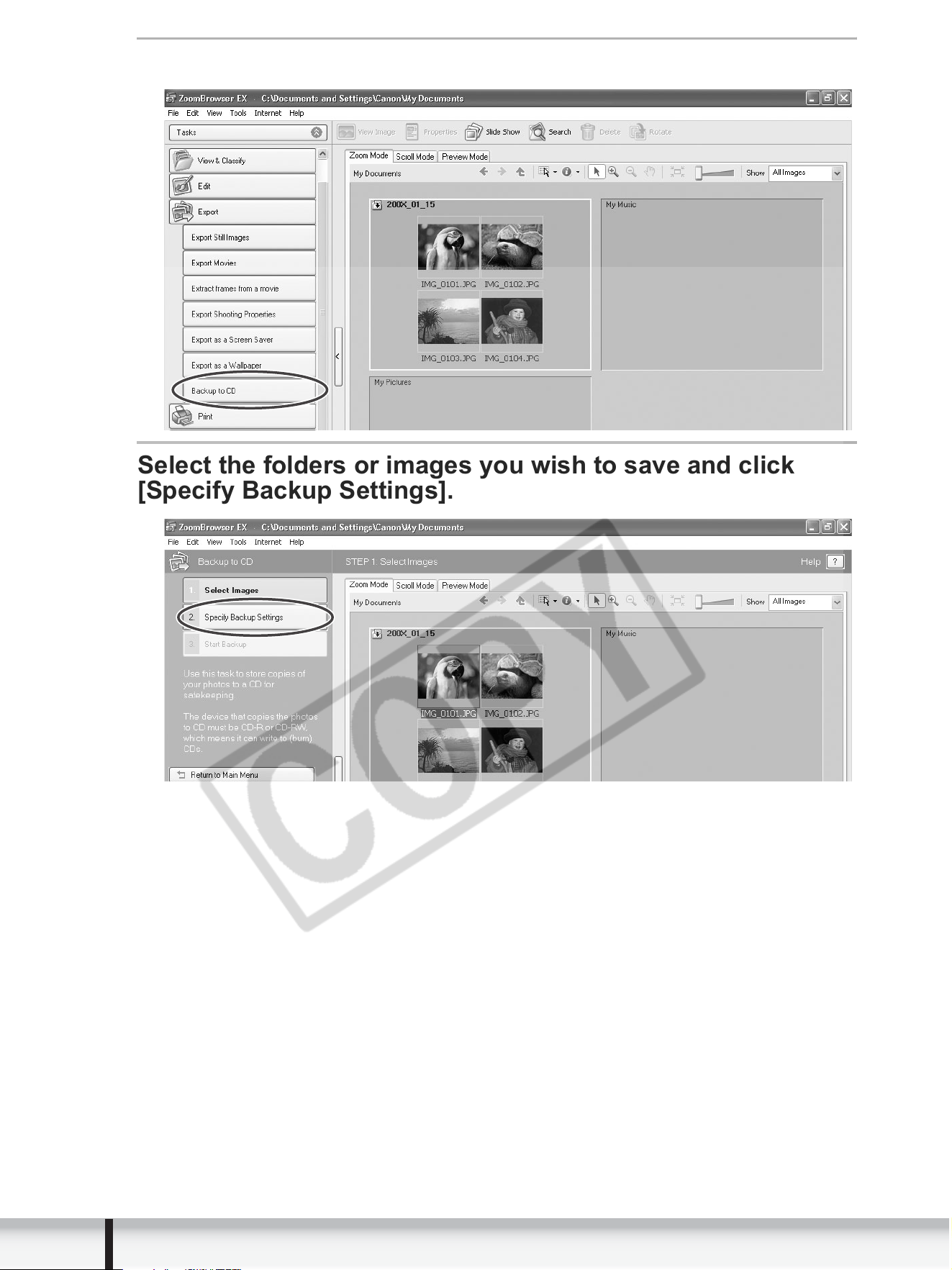
1
Place a CD-R/RW disk in the computer’s CD-ROM drive.
2
If the following window appears, click [Cancel].
3
Click [Export] in the Main Window.
78
Exporting Images
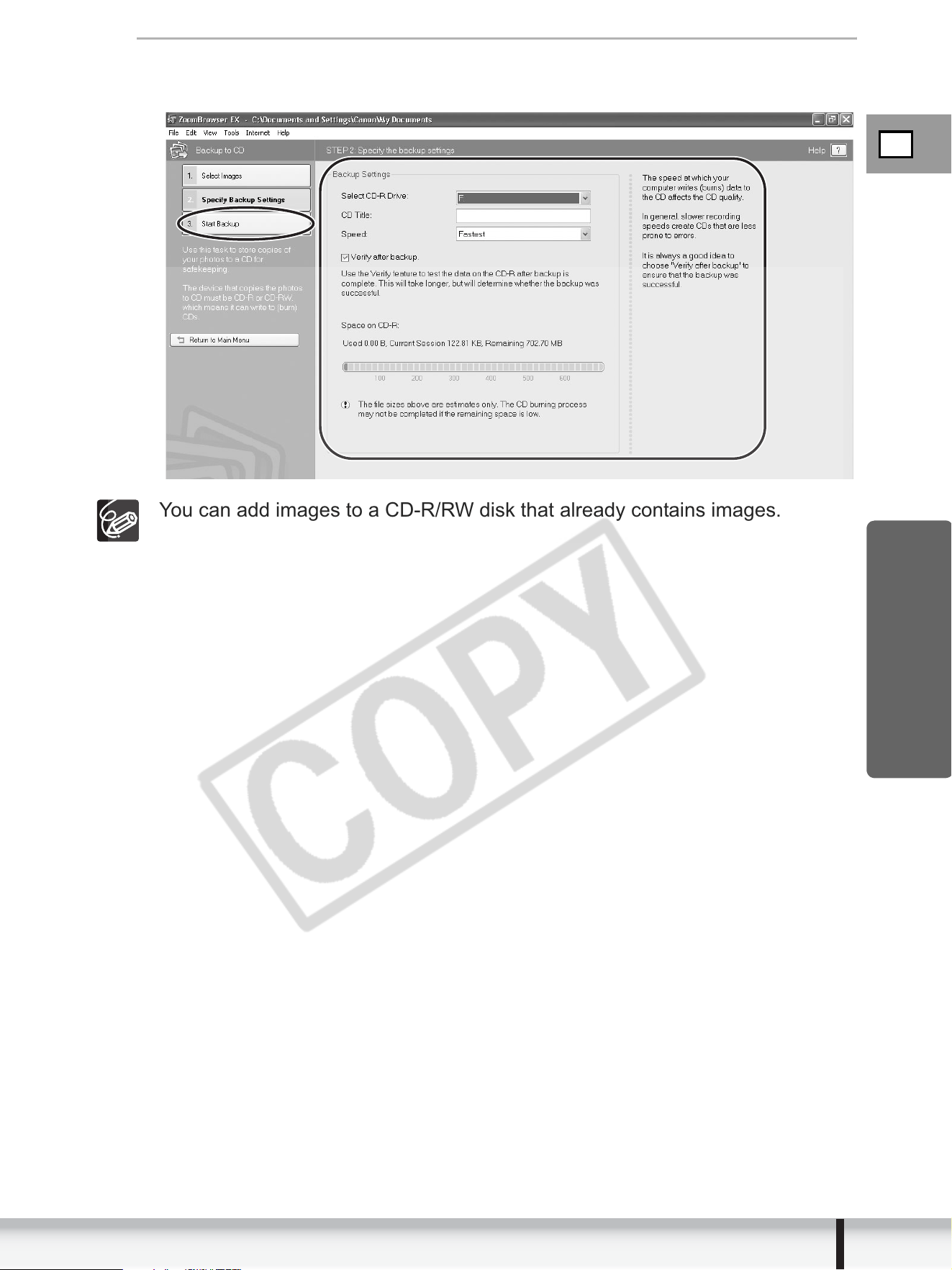
4
Click [Backup to CD].
5
Select the folders or images you wish to save and click
[Specify Backup Settings].
E
79
Exporting Images
Windows
6
Set the backup settings and click [Start Backup].
The disk will be ejected from the drive when copying is complete.
You can add images to a CD-R/RW disk that already contains images.
80
Exporting Images
Adding Still Images from Your Computer to the Memory Card
You can save still images (JPEG) from the computer to a memory card of the
camcorder and a card reader/writer. You can also save sample images for card
mix from the DIGITAL VIDEO SOLUTION DISK.
Adding Still Images to the Memory Card
1
Connect the camcorder to the computer ( 26).
2
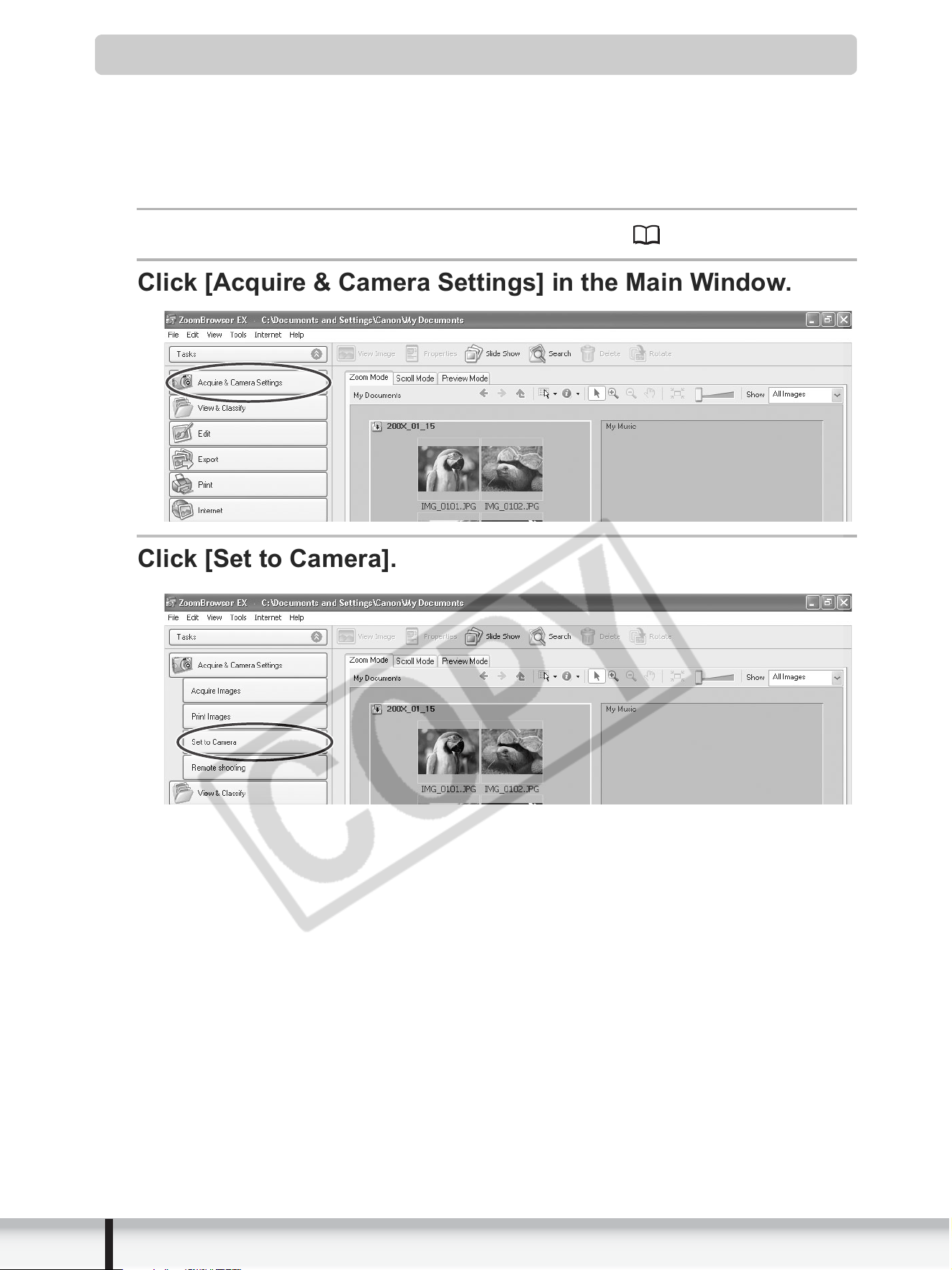
Click [Acquire & Camera Settings] in the Main Window.
3
Click [Set to Camera].
E
81
Exporting Images
Windows
4
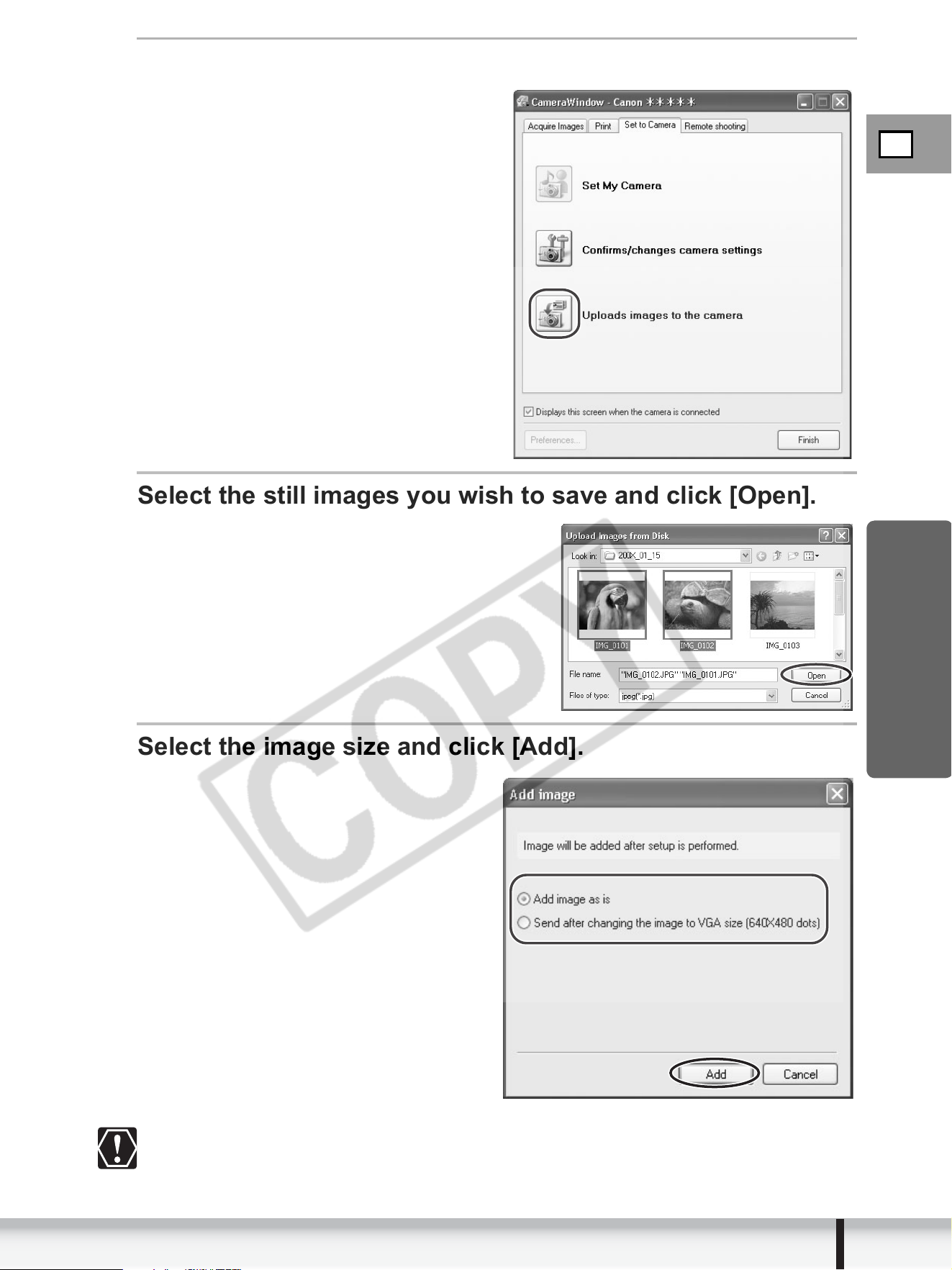
Click [Uploads images to the camera].
5
Select the still images you wish to save and click [Open].
6
Select the image size and click [Add].
When you upload images edited with another application, images properties
may be lost.
82
Exporting Images
Adding Sample Images to the Memory Card
You can save sample images to be used with the Card Mix function to the
memory card in the camcorder or in a card reader/writer. The sample images are
provided on the DIGITAL VIDEO SOLUTION DISK.
The sample images provided on the supplied DIGITAL VIDEO SOLUTION
DISK are intended only for personal use with this camcorder. Do not use these
sample images for other purposes.
1
Connect the camcorder to the computer ( 26).
2
Insert the DIGITAL VIDEO SOLUTION DISK to the
computer’s CD-ROM drive.
If the installer panel opens, click [Exit] to close it.
3
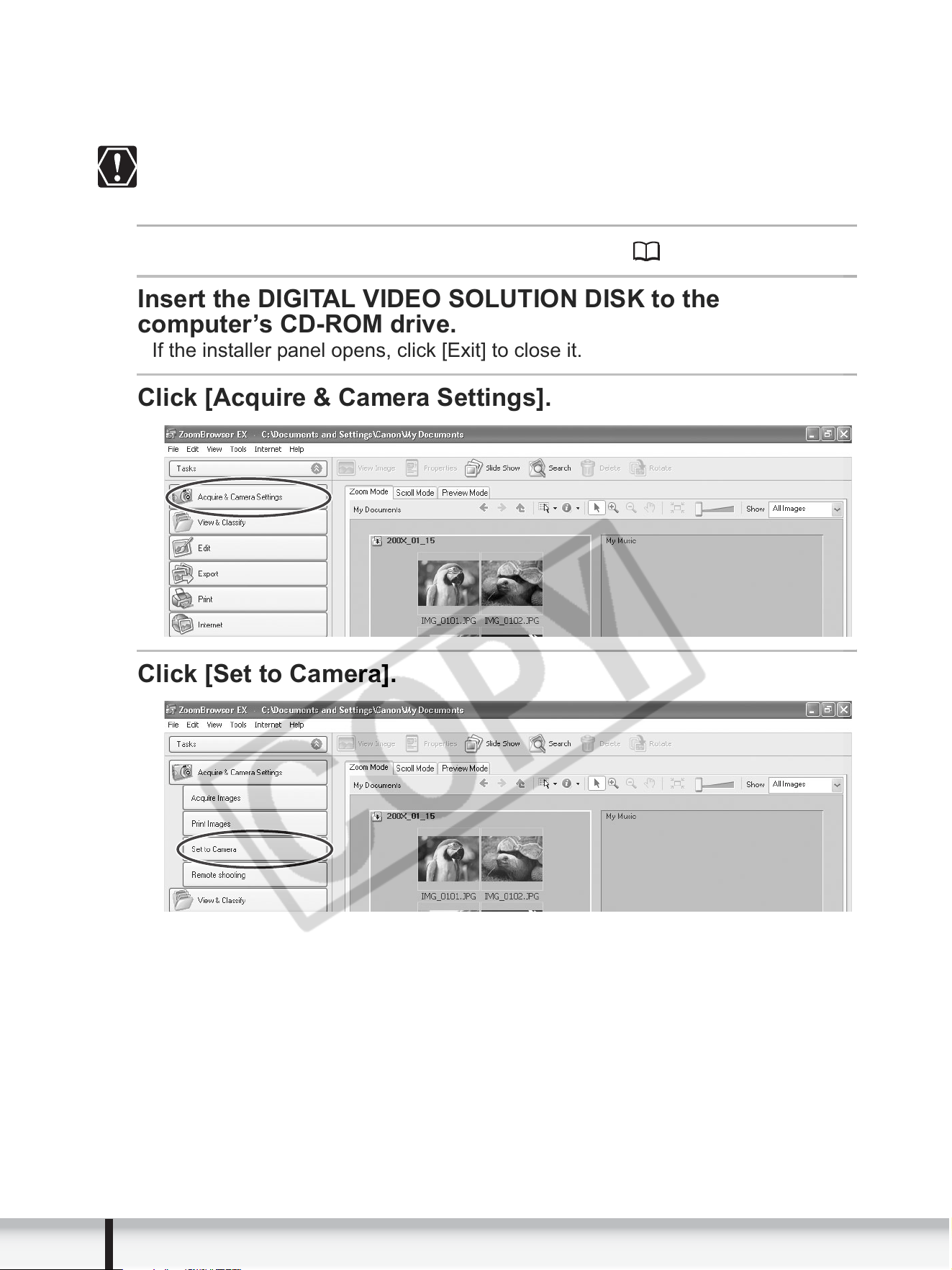
Click [Acquire & Camera Settings].
4
Click [Set to Camera].
E
83
Exporting Images
Windows
5
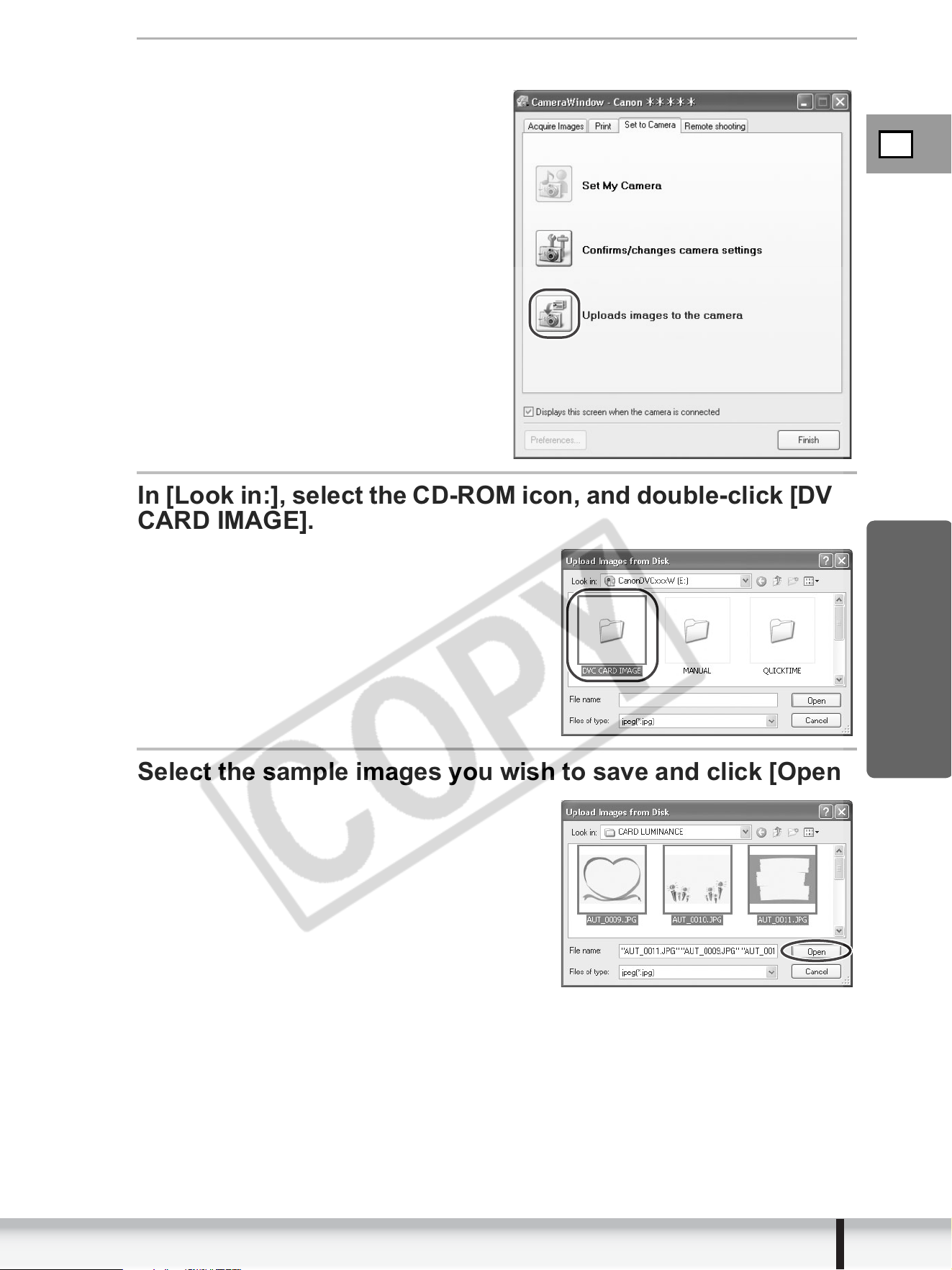
Click [Uploads images to the camera].
6
In [Look in:], select the CD-ROM icon, and double-click [DVC
CARD IMAGE].
7
Select the sample images you wish to save and click [Open].
84
Exporting Images
8
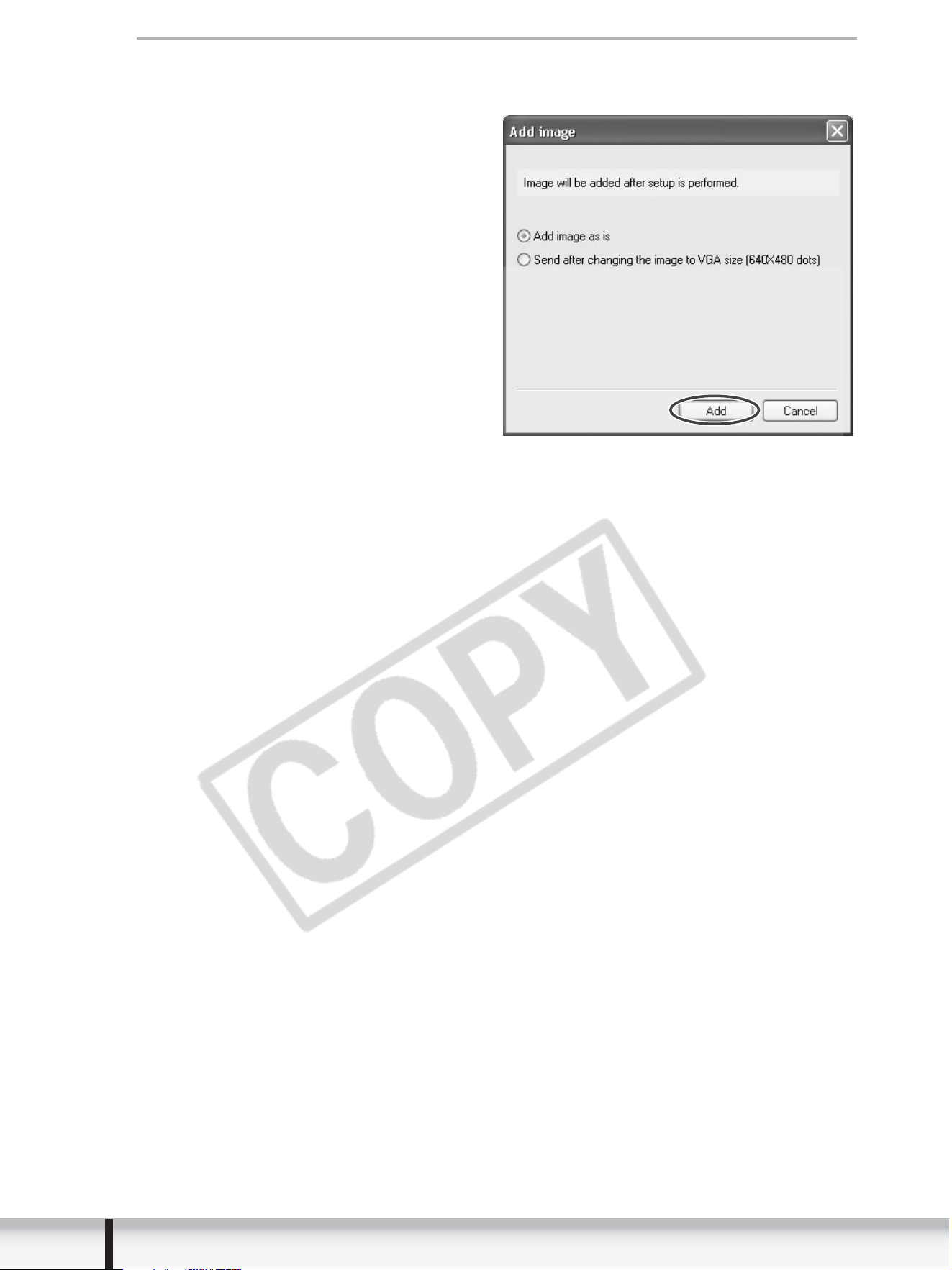
In the Add image window, click [Add].
The sample images are saved in the memory card.
E
85
Using Various Functions
Windows
Using Various Functions
Attaching Still Images to E-mail Messages
You can attach selected still images to an E-mail message.
To use this function, the e-mail software must be enabled as MAPI client. For
details, refer to the instruction manual of the e-mail software.
1
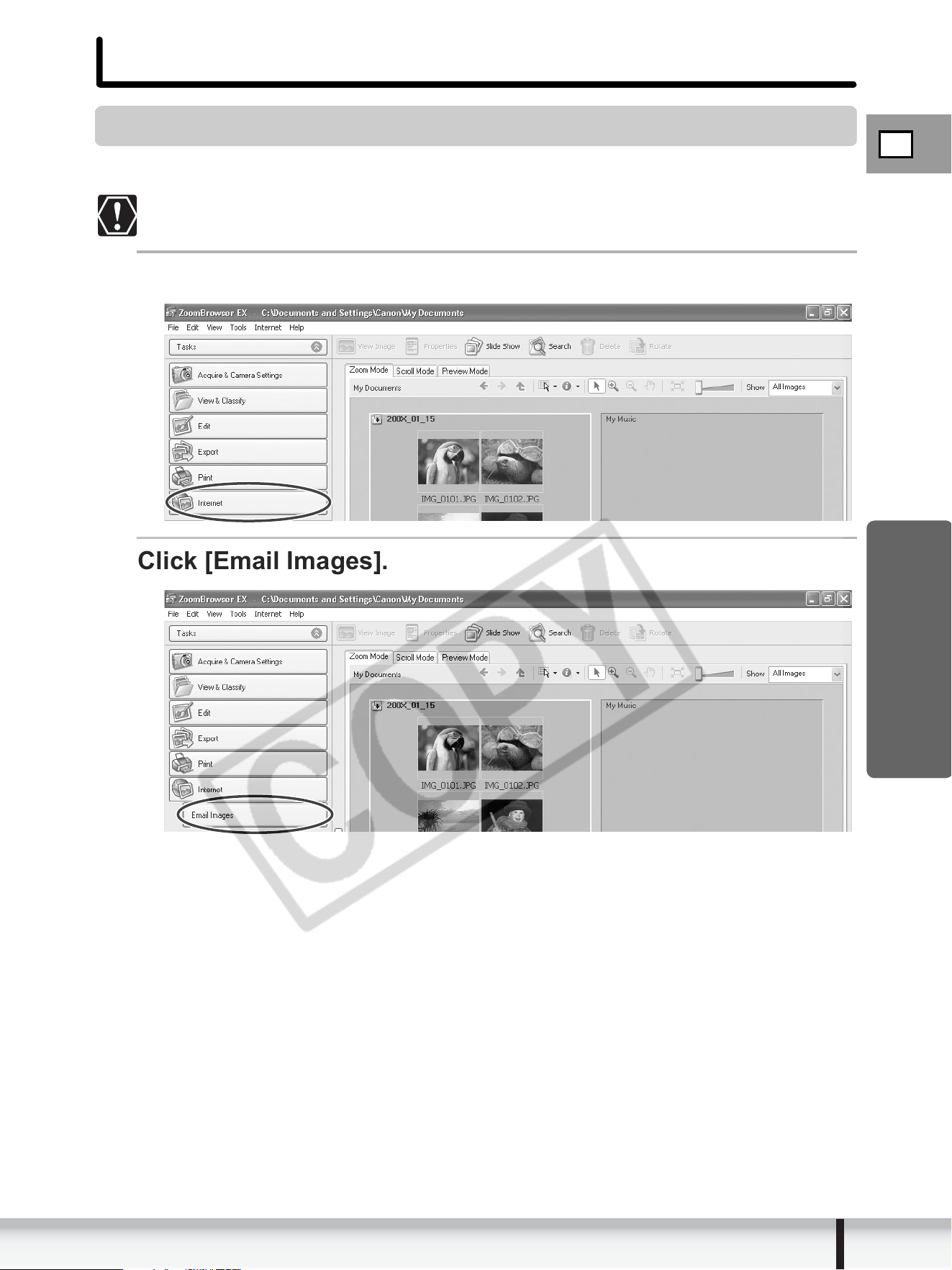
Click [Internet] in the Main Window.
2
Click [Email Images].
86
Using Various Functions
3
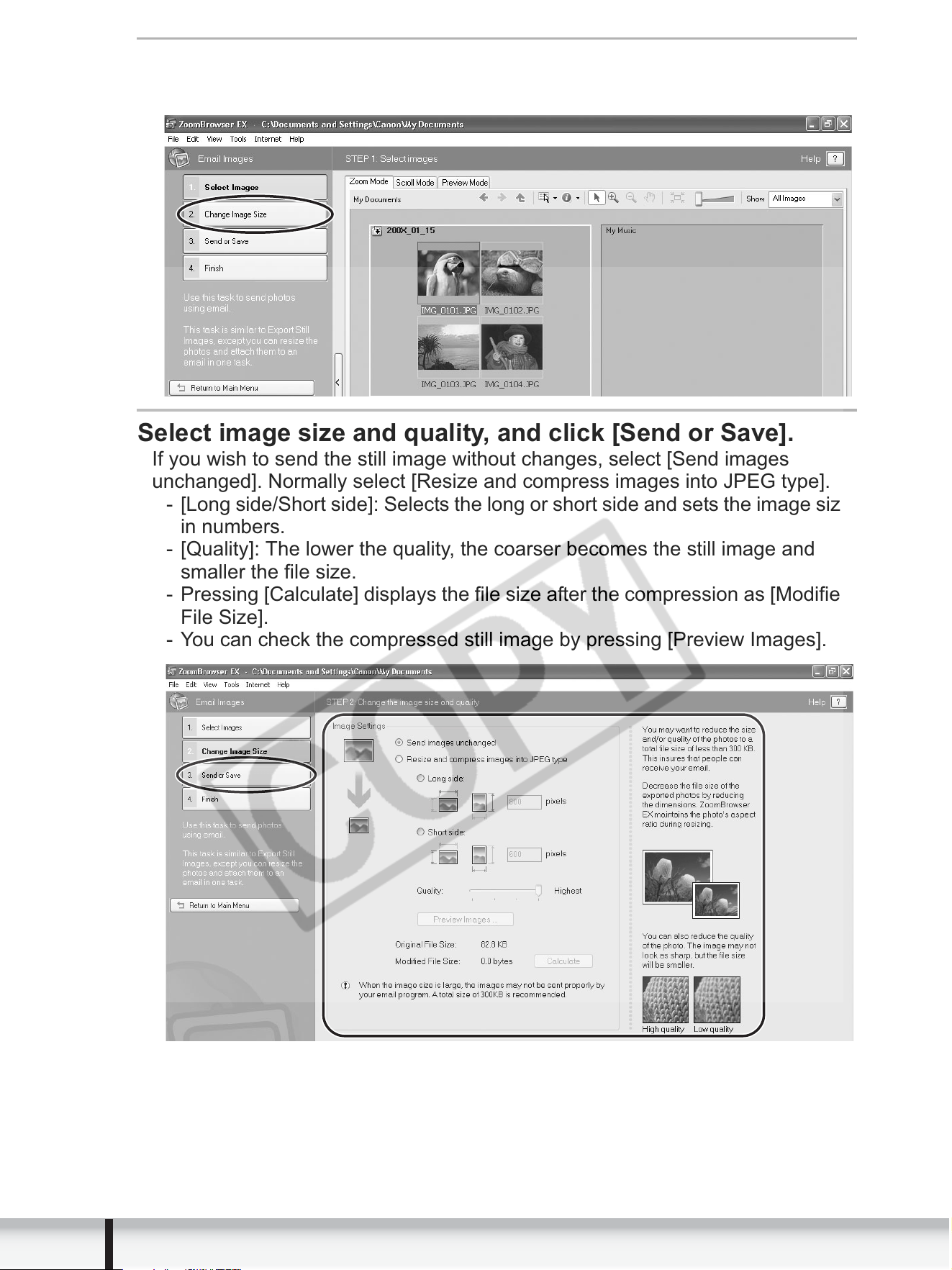
Select the still images you wish to send and click [Change
Image Size].
4
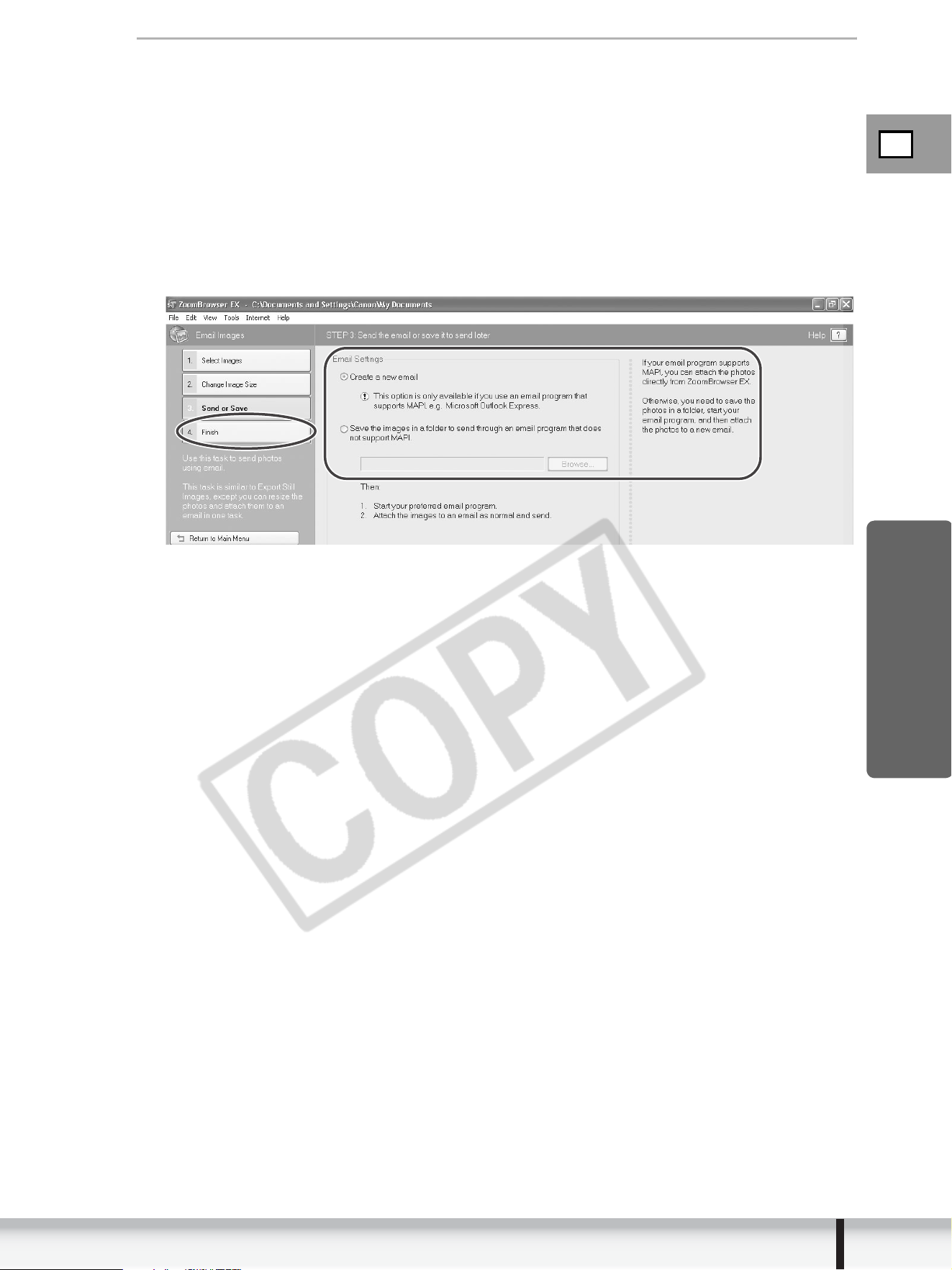
Select image size and quality, and click [Send or Save].
If you wish to send the still image without changes, select [Send images
unchanged]. Normally select [Resize and compress images into JPEG type].
- [Long side/Short side]: Selects the long or short side and sets the image size
in numbers.
- [Quality]: The lower the quality, the coarser becomes the still image and
smaller the file size.
- Pressing [Calculate] displays the file size after the compression as [Modified
File Size].
- You can check the compressed still image by pressing [Preview Images].
E
87
Using Various Functions
Windows
5
Select to send still images by e-mail or to save the still
images in a folder and click [Finish].
• If you selected [Create a new email], your e-mail software starts and the
selected still images appear as an attachment in the message window. Input
address, subject and your comments and send the message. E-mail software
not supporting MAPI does not start automatically. In this case, select [Save the
images in a folder...].
• If you select [Save the images in a folder...], click [Browse] and select the
destination folder. Start your e-mail software and attach the saved still image
to a message.
88
Using Various Functions
Running a Slide Show
You can view selected still images in a slide show. Movies cannot be selected for
a slide show.
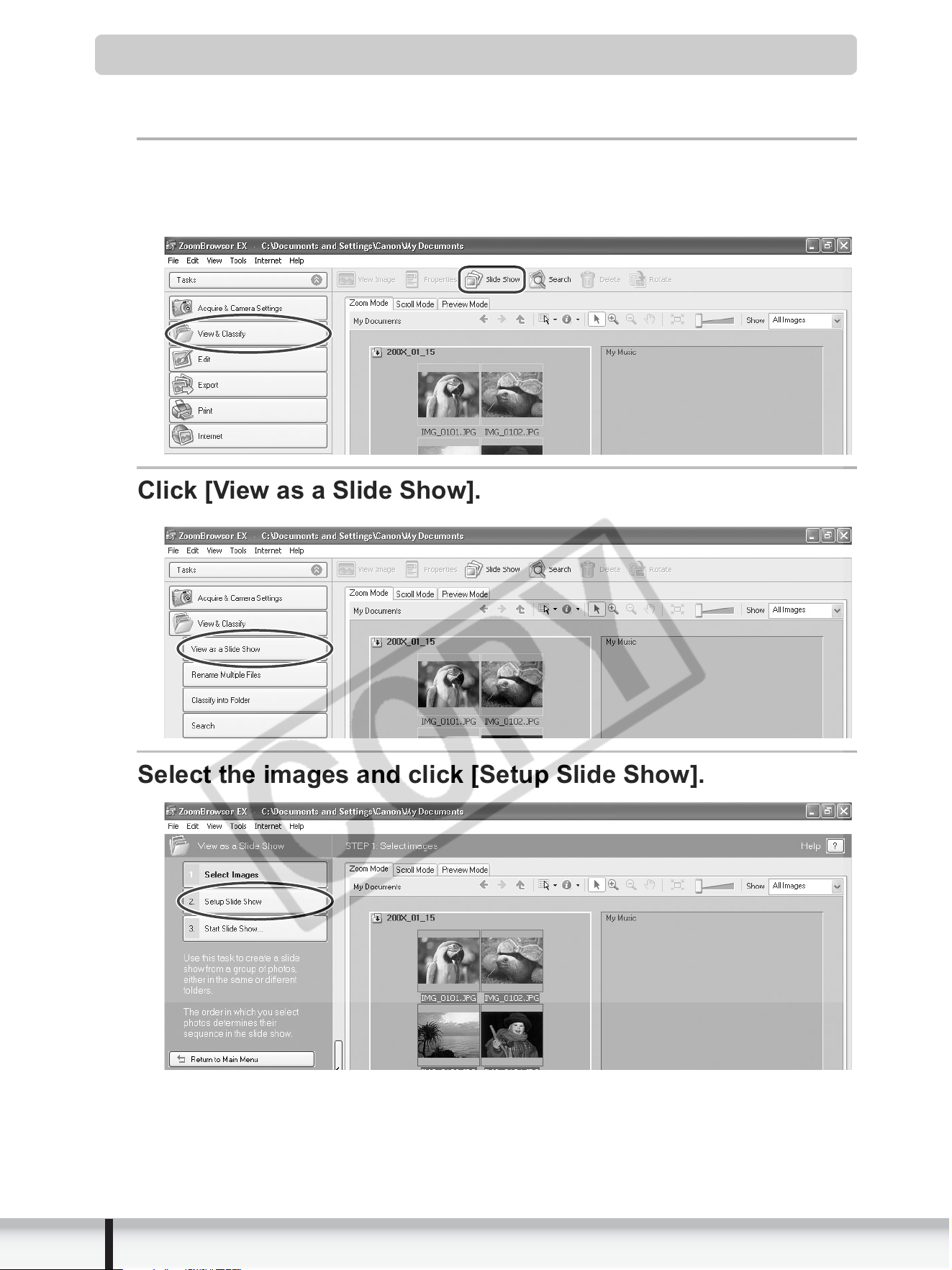
1
Click [View & Classify] in the Main Window.
You can also view a slide show by clicking [Slide Show] on Application Tool Bar.
Please skip forward to step 4.
2
Click [View as a Slide Show].
3
Select the images and click [Setup Slide Show].
E
89
Using Various Functions
Windows
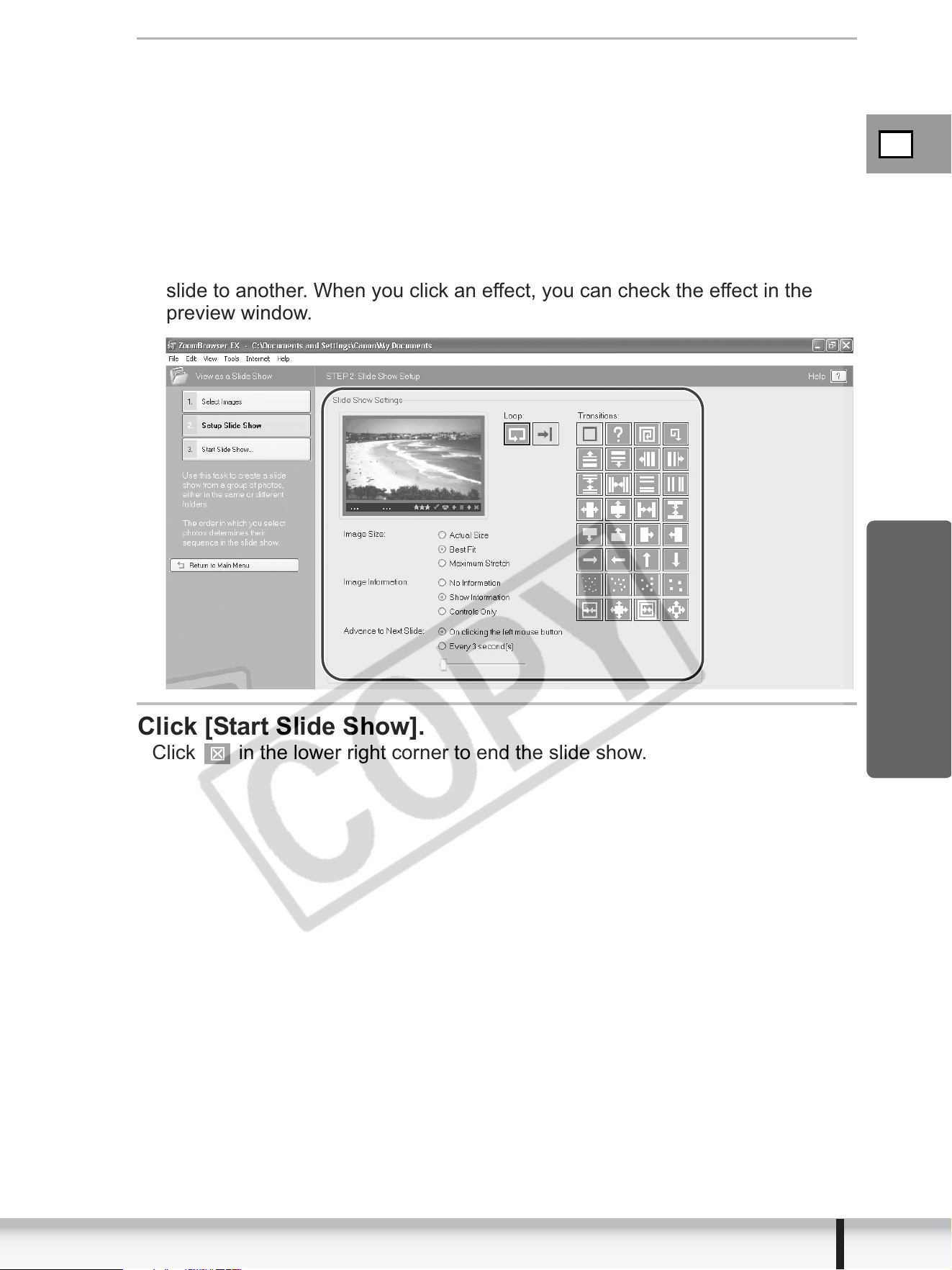
4
Select the slide show settings.
• [Image Size]: Select the size of the still images.
• [Image Information]: Select to show image information such as file name or
title.
• [Advance to Next Slide]: Select to advance manually or automatically. When
you select “Every 3 second(s)”, you can select the interval in the control below
(from 1 to 120 seconds).
• [Loop]: Select to stop the slide show after the last image or to continuously run
it in a loop.
• [Transitions]: Select the transition effect to be used when moving from one
slide to another. When you click an effect, you can check the effect in the
preview window.
5
Click [Start Slide Show].
Click in the lower right corner to end the slide show.
90
Using Various Functions
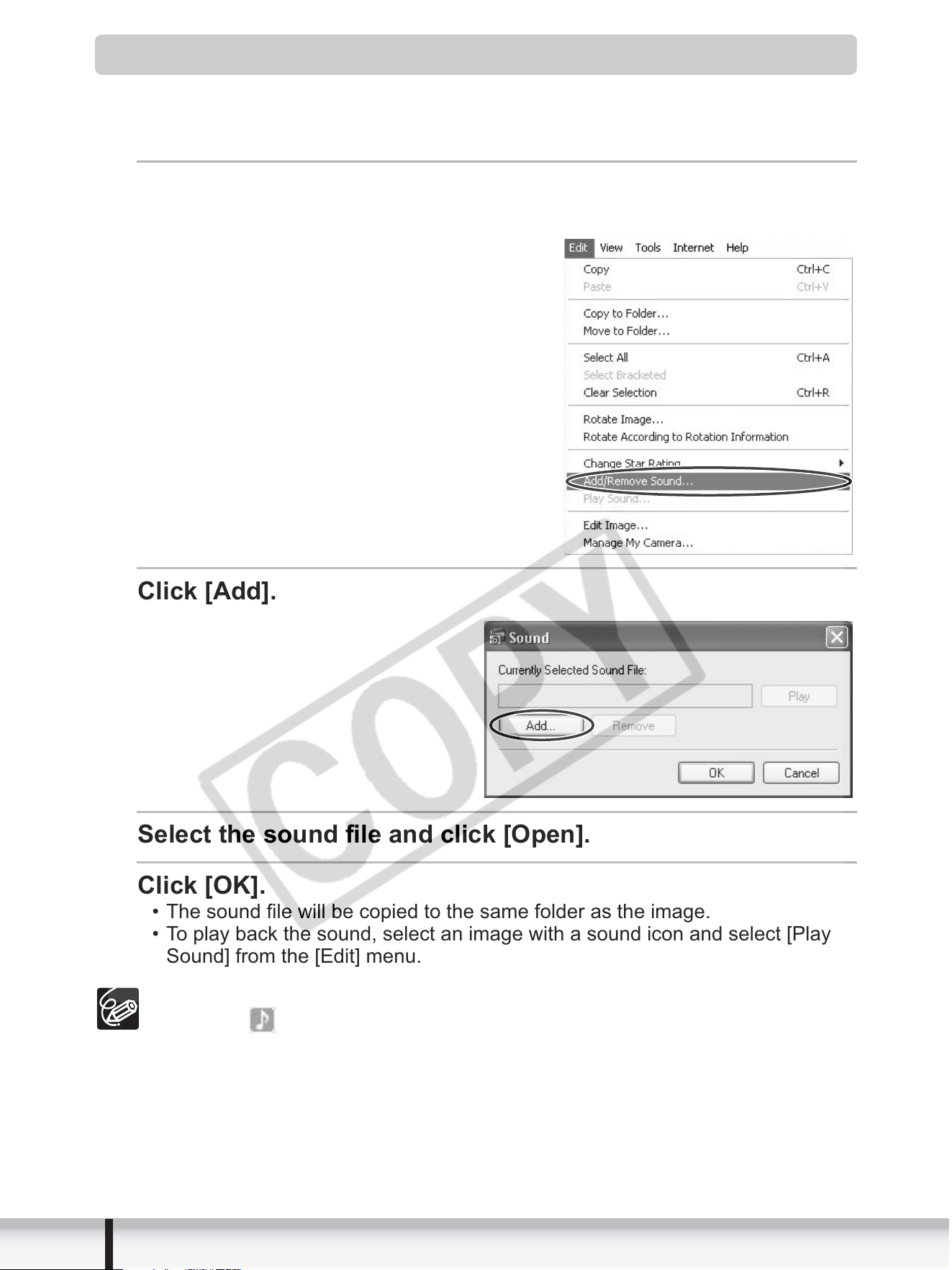
Adding Sound to an Image
• You can add a sound to an image. The sound file needs to be in WAVE type
(extension “.wav”) or in MIDI type (extension “.mid” or “.midi”).
• The sound cannot be played back on the camcorder.
1
In the Main Window, select an image and select [Add/
Remove Sound] from the [Edit] menu.
2
Click [Add].
3
Select the sound file and click [Open].
4
Click [OK].
• The sound file will be copied to the same folder as the image.
• To play back the sound, select an image with a sound icon and select [Play
Sound] from the [Edit] menu.
To remove sound from an image, select [Remove] on the Sound window in
step 2. disappears and the copied sound file will be deleted.
The [Play Sound] window appears and plays back the sound.
E
91
Using Various Functions
Windows
Reviewing and Changing the Owner Name of the
Camcorder
You can change and confirm the owner name of the camcorder.
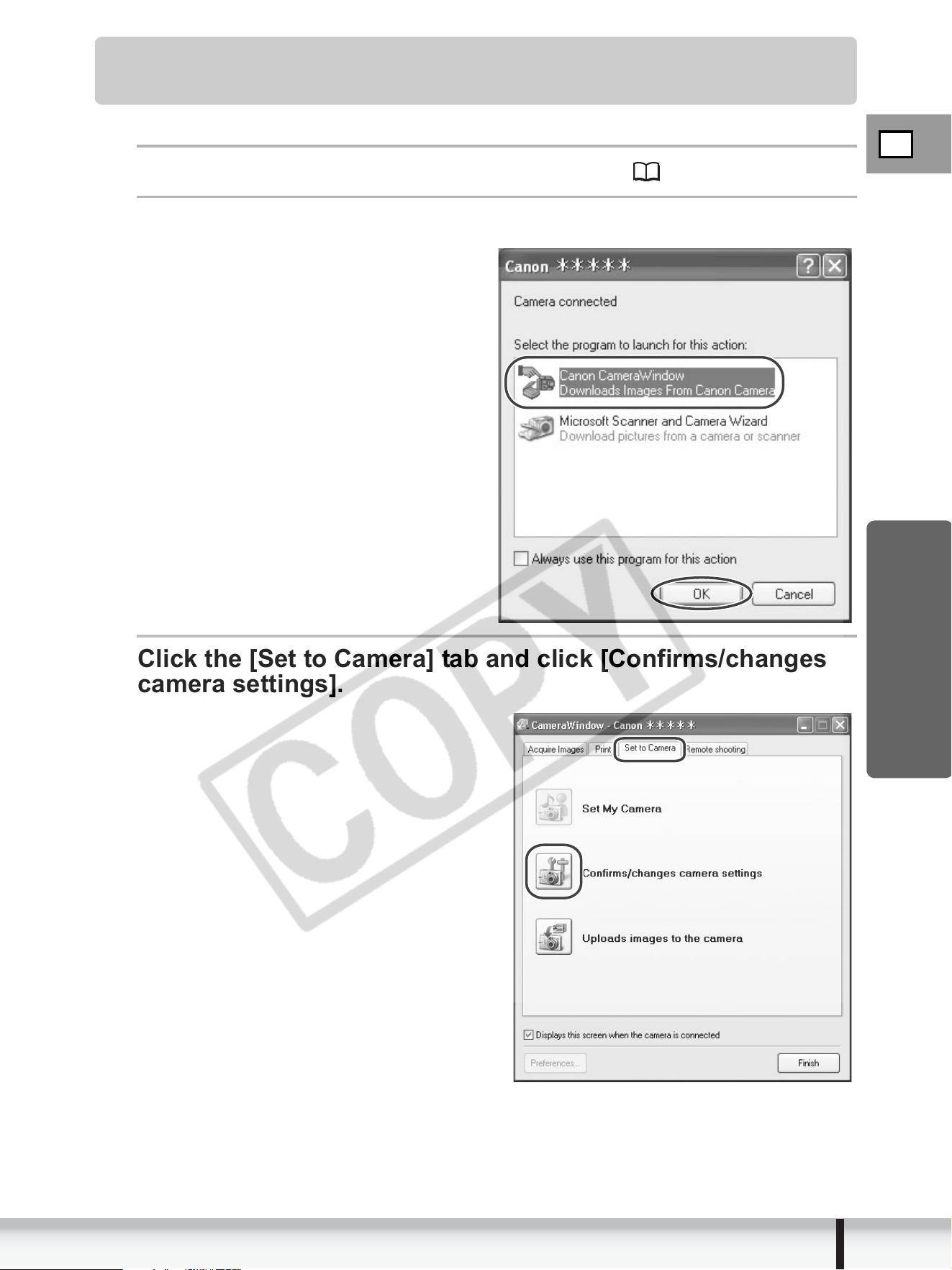
1
Connect the camcorder to the computer ( 26).
2
Select [Canon CameraWindow] and click [OK].
3
Click the [Set to Camera] tab and click [Confirms/changes
camera settings].
92
Using Various Functions
4
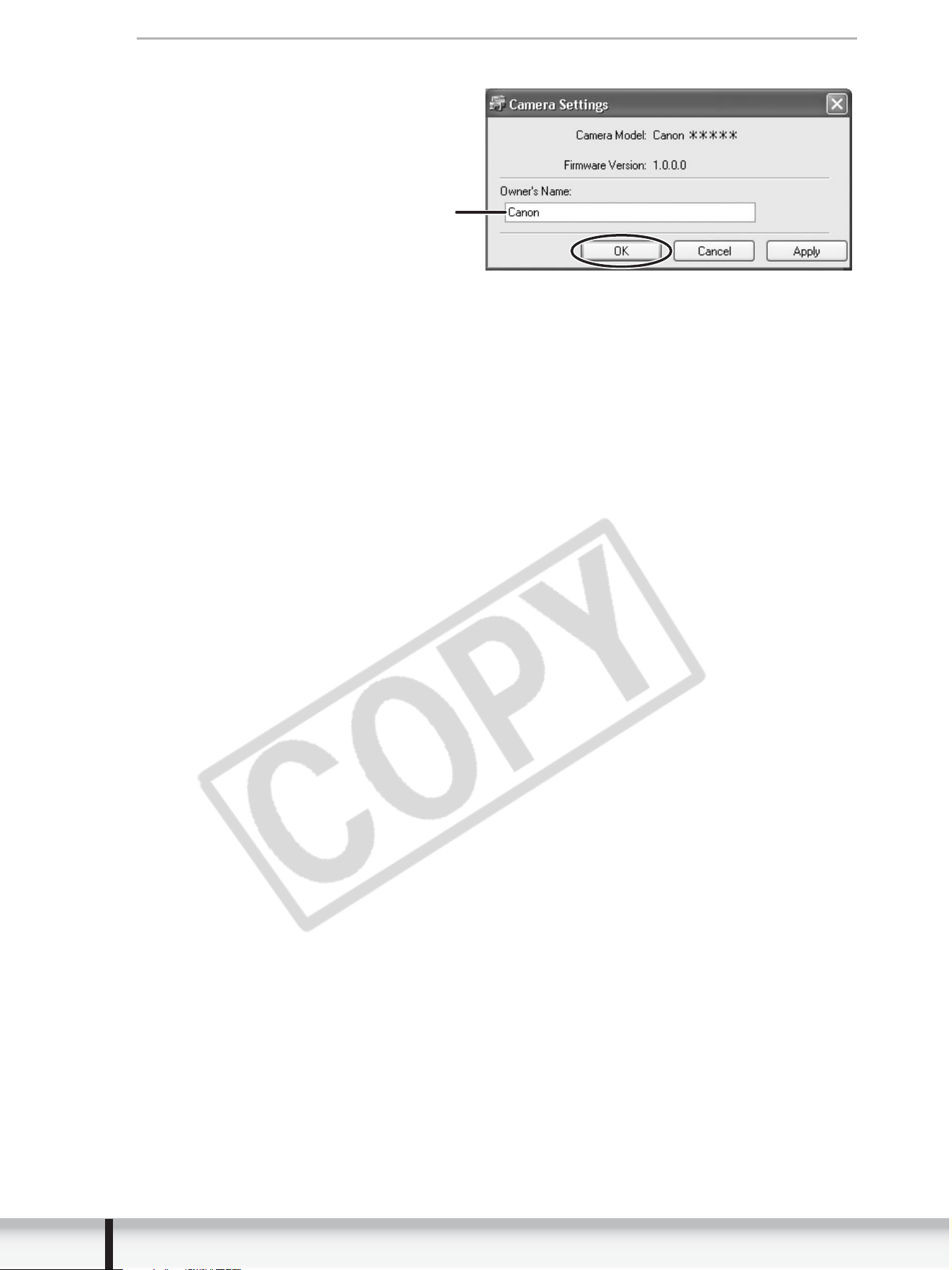
Change the settings of the camcorder and click [OK].
Input a camcorder owner name
here (up to 31 characters).
E
93
Uninstalling the Software
Windows
Uninstalling the Software
Uninstall the software when you wish to delete it from your computer or when
reinstallation is required to fix corrupted files.
Users of Windows 2000 and Windows XP must first log in as an Administrator
to uninstall the driver and other programs.
Uninstalling ZoomBrowser EX
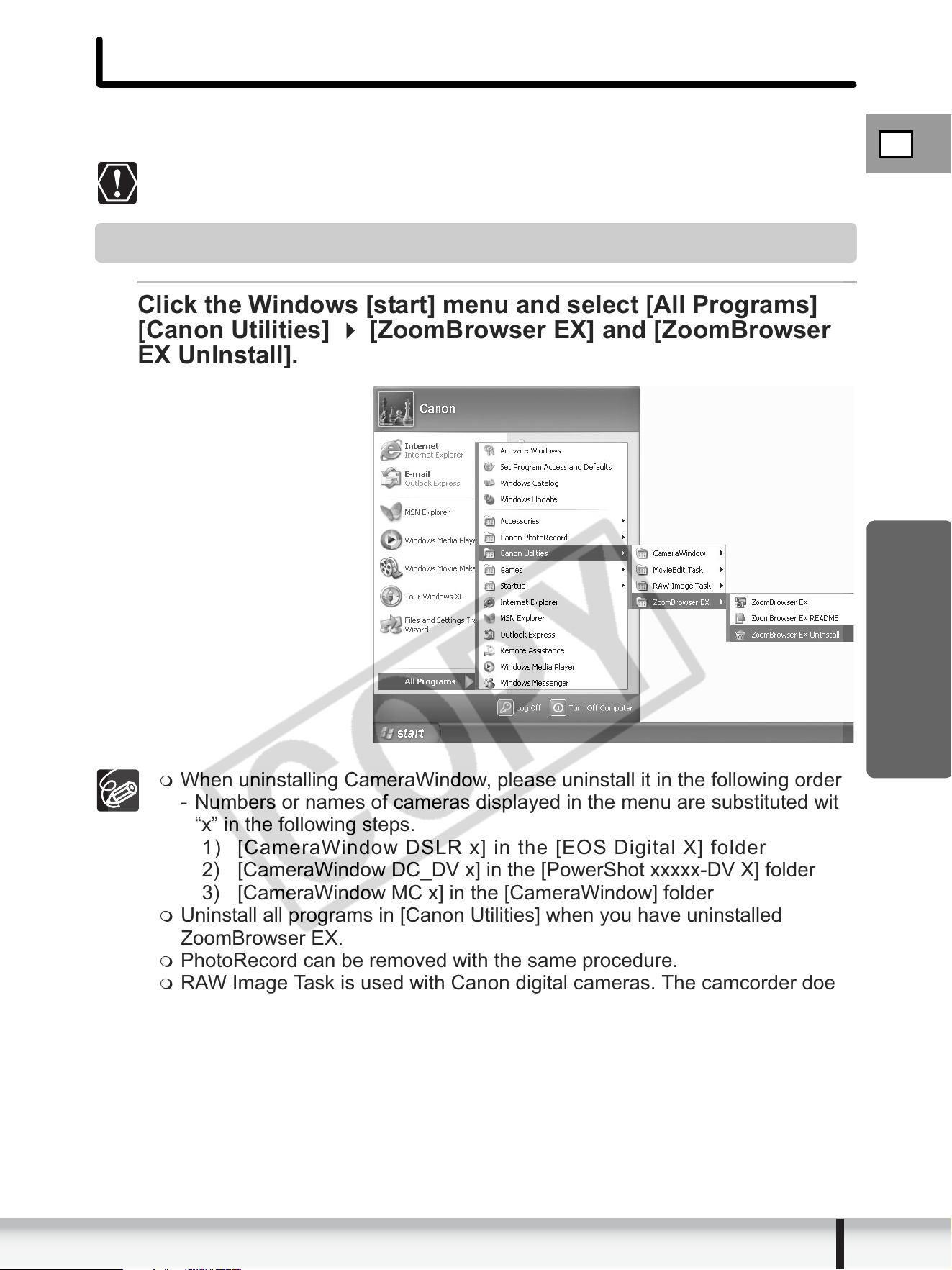
1
Click the Windows [start] menu and select [All Programs]
[Canon Utilities]
[ZoomBrowser EX] and [ZoomBrowser
EX UnInstall].
When uninstalling CameraWindow, please uninstall it in the following order:
- Numbers or names of cameras displayed in the menu are substituted with
“x” in the following steps.
1) [CameraWindow DSLR x] in the [EOS Digital X] folder
2) [CameraWindow DC_DV x] in the [PowerShot xxxxx-DV X] folder
3) [CameraWindow MC x] in the [CameraWindow] folder
Uninstall all programs in [Canon Utilities] when you have uninstalled
ZoomBrowser EX.
PhotoRecord can be removed with the same procedure.
RAW Image Task is used with Canon digital cameras. The camcorder does
not support the program.
94
Uninstalling the Software
Uninstalling the TWAIN Driver/WIA Driver
1
Connect the camcorder to the computer ( 26).
2
If a window for selecting an application program or the
Scanners and Cameras Wizard appears, click [Cancel]. If
ZoomBrowser EX started, close it.
3
Click the Windows [Start] menu and select [Settings] and
[Control Panel].
4
Double-click the [Scanners and Cameras] icon.
If you cannot find the [Scanners and Cameras] icon, see TWAIN Driver/WIA
Driver Uninstallation ( 96).
5
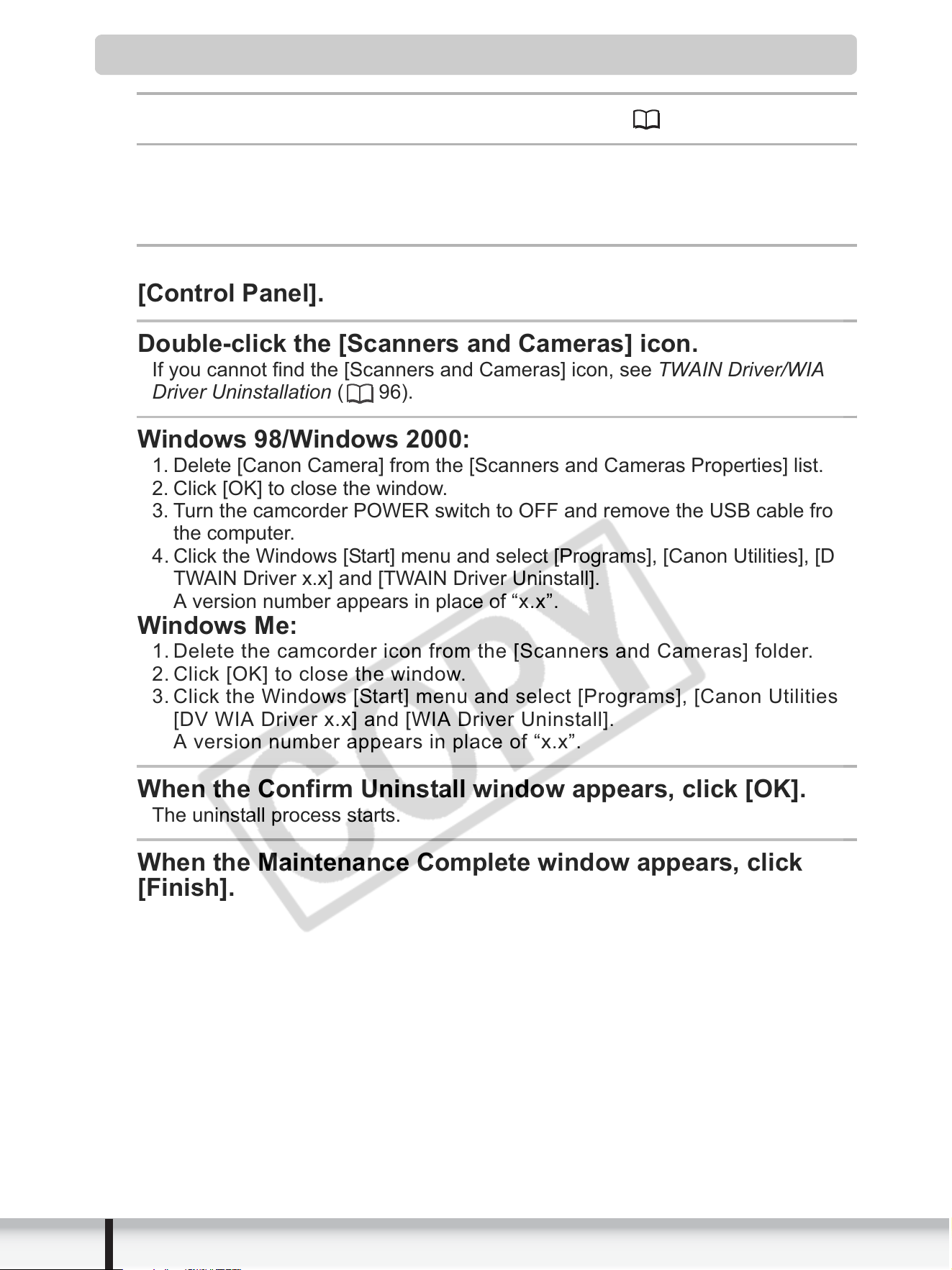
Windows 98/Windows 2000:
1. Delete [Canon Camera] from the [Scanners and Cameras Properties] list.
2. Click [OK] to close the window.
3. Turn the camcorder POWER switch to OFF and remove the USB cable from
the computer.
4. Click the Windows [Start] menu and select [Programs], [Canon Utilities], [DV
TWAIN Driver x.x] and [TWAIN Driver Uninstall].
A version number appears in place of “x.x”.
Windows Me:
1. Delete the camcorder icon from the [Scanners and Cameras] folder.
2. Click [OK] to close the window.
3. Click the Windows [Start] menu and select [Programs], [Canon Utilities],
[DV WIA Driver x.x] and [WIA Driver Uninstall].
A version number appears in place of “x.x”.
6
When the Confirm Uninstall window appears, click [OK].
The uninstall process starts.
7
When the Maintenance Complete window appears, click
[Finish].
E
95
Troubleshooting
Windows
Troubleshooting
Connection
Camcorder is not recognized when connected to the computer.
Î
Computer does not support the USB interface.
The USB interface is not supported for computer not in compliance with the
following requirements. Acquire the necessary system to use the USB
interface.
Requirements: Built-in USB port on a system pre-installed with Windows
98, Windows Me, Windows 2000, or Windows XP.
Î
There is no memory card in the camcorder.
Insert a memory card into the camcorder.
Î
The camcorder is not set to the correct mode.
Turn the POWER switch to PLAY (VCR)/PLAY and move the TAPE/CARD
switch to CARD.
Î
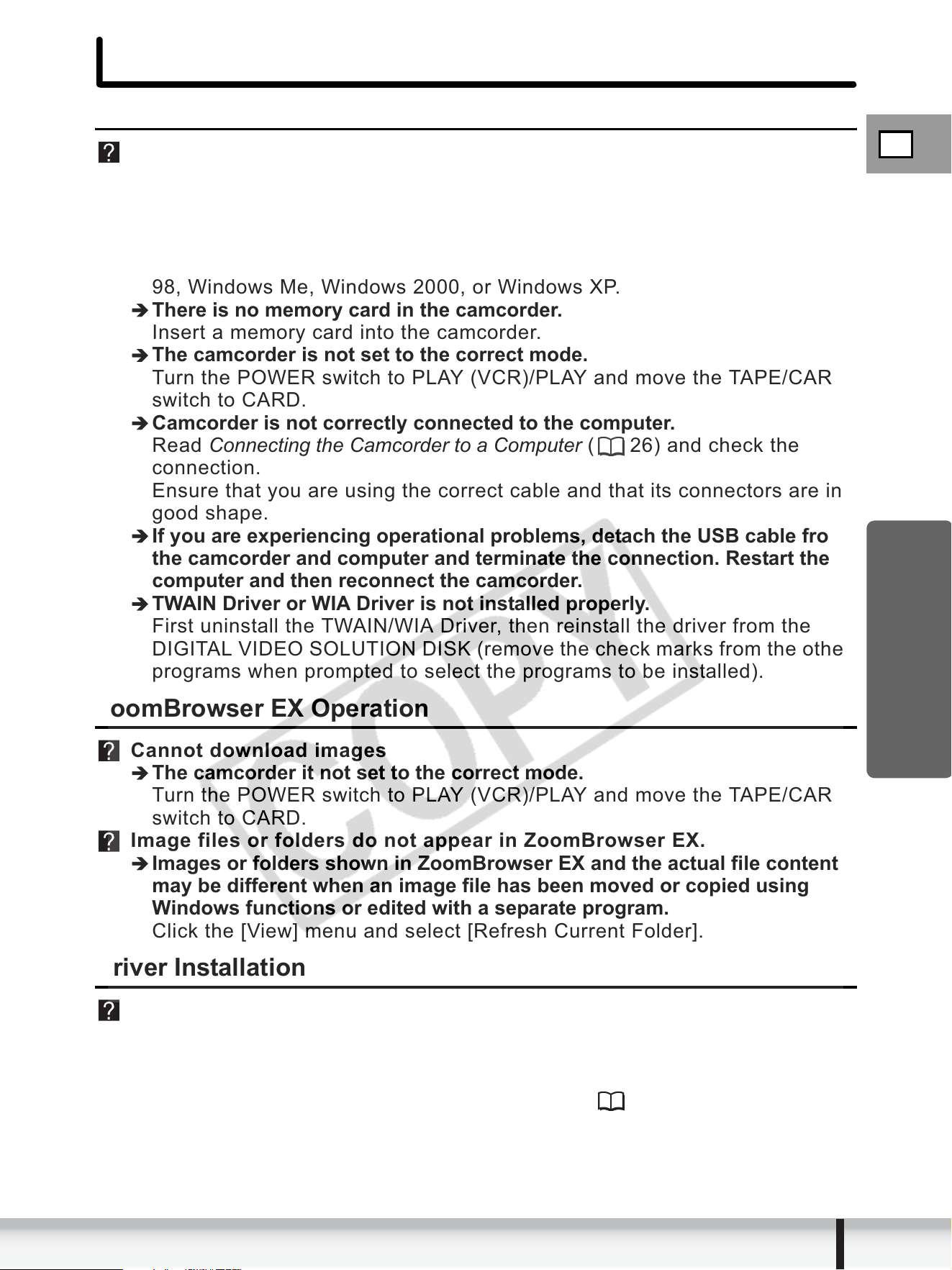
Camcorder is not correctly connected to the computer.
ReadConnecting the Camcorder to a Computer ( 26) and check the
connection.
Ensure that you are using the correct cable and that its connectors are in
good shape.
Î
If you are experiencing operational problems, detach the USB cable from
the camcorder and computer and terminate the connection. Restart the
computer and then reconnect the camcorder.
Î
TWAIN Driver or WIA Driver is not installed properly.
First uninstall the TWAIN/WIA Driver, then reinstall the driver from the
DIGITAL VIDEO SOLUTION DISK (remove the check marks from the other
programs when prompted to select the programs to be installed).
ZoomBrowser EX Operation
Cannot download images
Î
The camcorder it not set to the correct mode.
Turn the POWER switch to PLAY (VCR)/PLAY and move the TAPE/CARD
switch to CARD.
Image files or folders do not appear in ZoomBrowser EX.
Î
Images or folders shown in ZoomBrowser EX and the actual file contents
may be different when an image file has been moved or copied using
Windows functions or edited with a separate program.
Click the [View] menu and select [Refresh Current Folder].
Driver Installation
Cannot install the TWAIN Driver/WIA Driver correctly.
Î
Does the system have a built-in USB port and did it come with Windows
98/Windows Me/Windows 2000 preinstalled?
Î
Camcorder is not correctly connected to the computer.
ReadConnecting the Camcorder to a Computer ( 26) and check the
connection.
Ensure that you are using the correct cable and that its connectors are in
good shape.
96
Troubleshooting
Î
Are you using the power adapter to power the camcorder?
Î
If the problem is not mentioned above, the TWAIN Driver/WIA Driver may
not have been recognized by Windows.
Uninstall and reinstall the driver.
TWAIN Driver/WIA Driver Uninstallation
If you had problems uninstalling the driver, use the following procedures to
remove it.
The [Inf] folder contains numerous files that are critical to the computer’s
operation. Be extremely careful not to delete the wrong files. If you delete the
wrong file, you may be unable to restart Windows.
Use the procedures below for the following circumstances too.
- If you do not find [Scanners and Cameras] in the [Control Panel] or
[Printers and Other Hardware].
- If [Canon Camera] or your camcorder model name does not appear in the
[Scanners and Cameras Properties] or [Scanners and Cameras].
- If you connected the camcorder to the computer via the USB cable before
installing the Digital Video Software.
Leave the camcorder connected to the computer.
1
Click the Windows [Start] menu and select [Settings] and
[Control Panel].
2
Double-click the [System] icon.
The [System Properties] dialog appears.
3
Click the [Device Manager] tab.
4
If [Canon Camera] appears under the [Other Devices] and/or
[Imaging Devices] categories, use the following procedures
to delete it.
1. Select [Canon Camera] and click [Remove].
2. In the confirmation dialog, click [OK].
3. Click [OK] to close the [System Properties] dialog.
5
Double-click the [My Computer] icon on the desktop
followed by the [C:] drive and the [Windows] and [Inf]
folders.
If the [Inf] Folder Is Not Visible in the [Windows] Folder
1. Windows 98: Click the [View] menu and select [Folder Options].
Windows Me: Click the [Tools] menu and select [Folder Options].
2. Click the [View] tab.
E
97
Troubleshooting
Windows
3. Windows 98: Set the [Hidden files] section to [Show all files].
Windows Me: Set the [Hidden files and folders] section to [Show hidden
files and folders].
4. Click [OK].
This makes the [Inf] folder and files in the [Inf] folder visible.
6
Find and delete the [Drvdata.bin] and [Drvidx.bin] files.
7
In the [Inf] folder, double-click [Other] folder to open it.
8
Find and delete the [Canon.IncCAPxxx.inf] and
[Canon.IncCDVxxx.inf] file.
• The xxx represents numerals.
• If the above file is not contained in the [Other] folder, you do not need to delete
anything.
Leave the camcorder connected to the computer.
1
Click the Windows [Start] menu and select [Settings] and
[Control Panel].
2
Double-click the [System] icon.
3
Click the [Hardware] tab.
4
Click the [Device Manager] button.
5
If [Canon Camera] or your camcorder model name appears
under the [Other Devices] and/or [Imaging Devices]
categories, use the following procedures to delete it.
1. Select [Canon Camera] or the name of the camcorder model, right-click
the mouse button and select [Delete].
2. In the confirmation dialog, click [OK].
3. Click [OK] to close the [System Properties] dialog.
Remove all copies of [Canon Camera] or your camcorder model name
that appear in the [Other Devices] or [Imaging Devices] categories, or
that appear more than once in one category.
98
Troubleshooting
6
Double-click the [My Computer] icon on the desktop,
followed by the [C:] drive, and the [Winnt] and [Inf] folders.
If the [Inf] Folder Is Not Visible in the [Winnt] Folder
Use the following procedures to show all files and folders.
1. Click the [Tools] menu and select [Folder Options].
2. Click the [View] tab.
3. In the [Advanced setting] section, set the [Hidden files and folders]
category to the [Show hidden files and folders] option.
If [Hide extensions for known file types] is selected, remove its check
mark.
4. Click [OK] to close the dialog.
This makes the [Inf] folder and the files in the [Inf] folders visible.
7
Look for the file for Canon digital camcorders starting with
[Oem*].
• A number such as “0” or “1” will appear in place of the asterisk (*) above. You
will also find another file called [Oem*.pnf], which will have the same number
as the [Oem*.inf] file. The two constitute one set.
• There may be many file sets starting with “Oem”.
• If you double-click an [Oem*.inf] file, the Windows Notepad program will start
and show the file contents. Click each [Oem*inf] file until you find one that
contains “*** Canon Camera Driver Setup File***” in its first line. When you
find the correct file, note down its name and close the Notepad window.
8
Delete the [Oem*] file set.
Delete all [Oem*.inf] and [Oem*.pnf] files, taking great care to delete the correct
files.
If You Were Using ZoomBrowser EX Version 2 or 3
(This manual explains version 5.x)
Titles and comments added using a prior version than ZoomBrowser EX
version 4 do not appear in ZoomBrowser EX 4 or higher.
Î
Titles and comments added using a prior version of ZoomBrowser EX will
not be displayed. Use the following procedure to display them.
1. In Windows Explorer, open the [Program] folder under the folder in which
you installed ZoomBrowser EX 4 or higher (C:\Program Files\
Canon\ZoomBrowser EX\Program).
2. Double-click [dbconverter.exe].
3. Select the database you were using until now (C:\Program Files\Canon\
ZoomBrowser EX\Program) and click the [Start] button.
Please note that with ZoomBrowser EX 4 or higher, both titles and
comments appear in the comment list.
Cannot find the image folders saved with a prior version than
ZoomBrowser EX 5.x.
Î
Image folders saved under the [Program Files] folder (such as [Image
Library One]) cannot be displayed in the Main Window’s Folder Area of
ZoomBrowser EX 4 or higher. Use the following procedure to display
them.

E
99
Troubleshooting
Windows
1. In Windows Explorer, open the [Program Files] folder under the folder in
which you installed ZoomBrowser EX 4 or higher (C:\Program Files\
Canon\ZoomBrowser EX\Program\Image Library One).
2. Select the image folder you wish to display and copy the folder to a
different destination.
CANON INC.
U.S.A. ––––––––––– Canon U.S.A., Inc.
Canon Customer Care Center
Tel (US): 1-800-828-4040
(Mon.-Fri., 9 AM to 8 PM Eastern Time)
CANADA ––––––––– Canon CANADA Inc.
Tel (Canada): 1-800-OK-CANON (1-800-652-2666)
ASIA –––––––––––– Canon Hongkong Co., Ltd.
19/F., The Metropolis Tower, 10 Metropolis Drive,
Hunghom, Kowloon, Hong Kong
Phone: 852-2170-2828
Fax: 852-2723-9684
The information on this manual is verified as of January 1st, 2006.
DIE-255W © CANON INC. 2006