NOTICE:
Installer: Leave this guide with the homeowner.
Homeowner: Keep this guide for future reference.
IMPORTANT: Read and save these instructions.
User Manual
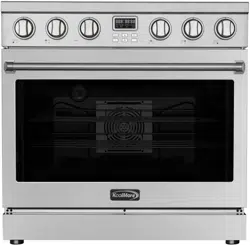
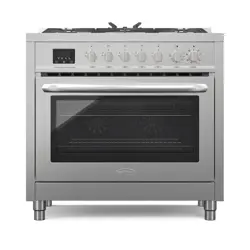
Professional Style Range
MODEL: KM-FR36DF-SS
User Manual
DUAL FUEL RANGE
kept clear of combustibles at all times.
For any service-related Issues, please contact us:
Phone Number: 718-576-6342
Email address: [email protected]
For any service-related Issues, please contact us:
Phone Number: 718-576-6342
Email address: [email protected]
For any service-related Issues, please contact us:
Phone Number: 718-576-6342
Email address: [email protected]
For any service-related Issues, please contact us:
Phone Number: 718-576-6342
Email address: [email protected]
For any service-related Issues, please contact us:
Phone Number: 718-576-6342
Email address: [email protected]
For any service-related Issues, please contact us:
Phone Number: 718-576-6342
Email address: [email protected]
For any service-related Issues, please contact us:
Phone Number: 718-576-6342
Email address: [email protected]
For any service-related Issues, please contact us:
Phone Number: 718-576-6342
Email address: [email protected]
For any service-related Issues, please contact us:
Phone Number: 718-576-6342
Email address: [email protected]
For any service-related Issues, please contact us:
Phone Number: 718-576-6342
Email address: [email protected]
For any service-related Issues, please contact us:
Phone Number: 718-576-6342
Email address: [email protected]

2
RANGE SAFETY ............................................................................................... 3
Anti-tip Device ........................................................................................................... 4
Important Safety Instructions ................................................................................. 6
OVERVIEW .................................................................................................... 10
Control Panel ............................................................................................................ 12
Clock & Timer ............................................................................................................ 12
Timed Cooking .......................................................................................................... 14
COOKTOP USE ............................................................................................... 16
Power Failure ............................................................................................................ 16
Cookware .................................................................................................................. 17
OVEN USE ...................................................................................................... 18
Oven Controls ........................................................................................................... 18
Oven Modes .............................................................................................................. 19
Tips and Techniques ................................................................................................ 21
Cooking with the Convection Oven ..................................................................... 25
RANGE CARE ................................................................................................ 27
Cleaning .................................................................................................................... 27
TROUBLESHOOTING .................................................................................... 30
Baking Problems ...................................................................................................... 30
Cooktop Problems .................................................................................................... 31
Oven Problems ........................................................................................................ 33
LIMITED WARRANTY .................................................................................... 34
TABLE OF CONTENTS
3
WARNING
Fire Hazard
If the information in this manual is not followed exactly, a fire or explosion
may result causing property damage, personal injury or death.
- Do not store or use gasoline or other flammable vapors and liquids in the
vicinity of this or any other appliance.
- WHAT TO DO IF YOU SMELL GAS
• Do not try to light any appliance.
• Do not touch any electrical switch.
• Do not use any phone in your building.
• Clear the room, building, or area of all occupants.
• Immediately call your gas supplier from a neighbor's phone. Follow the
gas supplier's instructions.
• If you cannot reach your gas supplier, call the fire department.
- Installation and service must be performed by a qualified installer,
service agency or the gas supplier.
WARNING
Never Operate the Top Surface Cooking Section of this Appliance
Unattended.
• Failure to follow this warning statement could result in fire, explosion, or
burn hazard that could cause property damage, personal injury, or
death.
• If a fire should occur, keep away from the appliance and immediately call
your fire department.
DO NOT ATTEMPT TO EXTINGUISH AN OIL/GREASE FIRE WITH WATER
RANGE SAFETY
4
WARNING
Tip Over Hazard
• A child or adult can tip the range and be killed.
• Install anti-tip bracket to floor or wall per installation instructions.
• Slide range back so rear range foot is engaged in the slow of the anti-
top bracket.
• Re-engage the anti-tip bracket if range is moved.
• Do not operate the range without anti-tip bracket installed and
engaged.
• Failure to follow these instructions can result in death or serious burns to
children and adults.
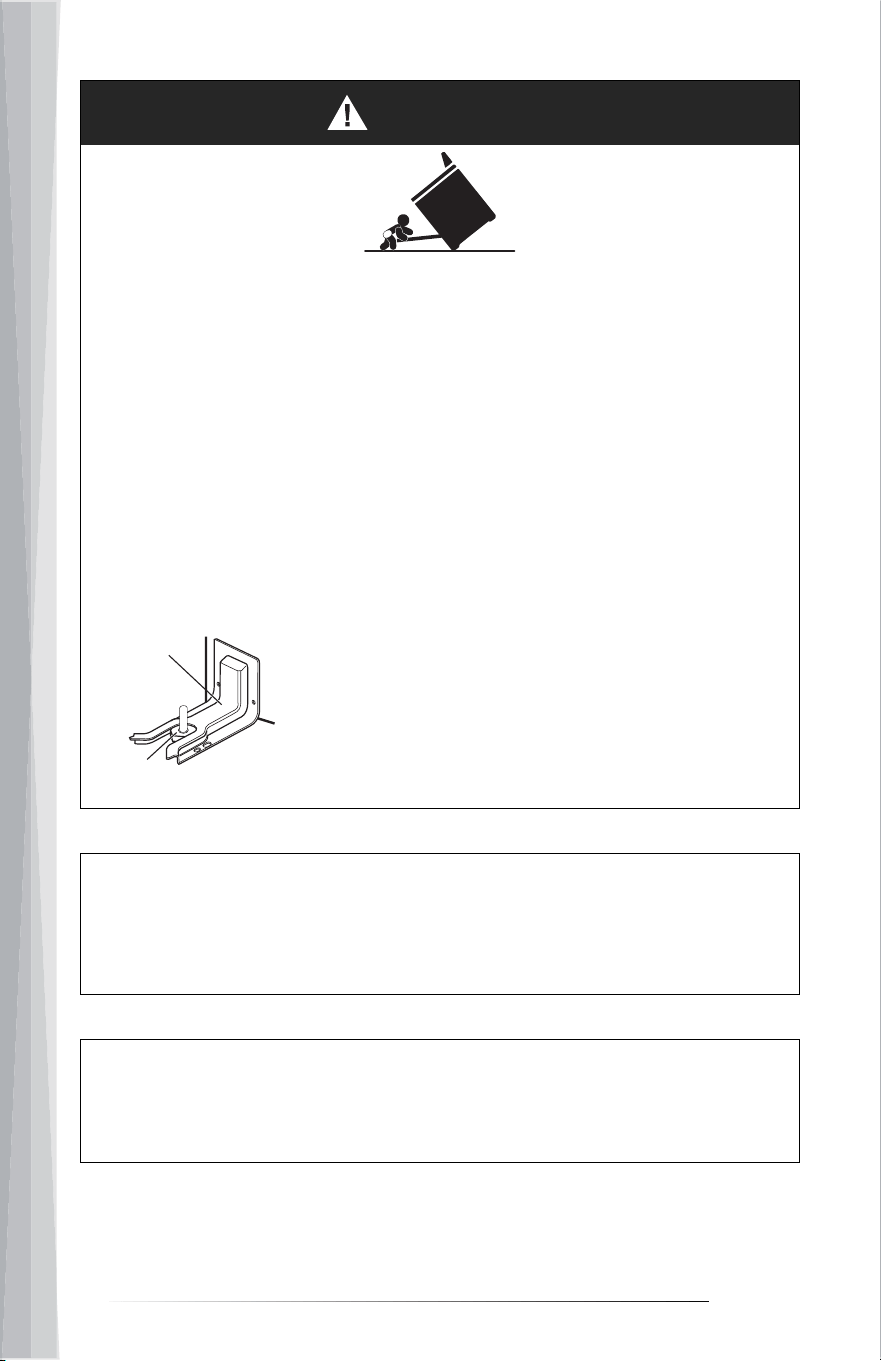
Making sure the anti-tip bracket is installed:
• Slide range forward.
• Look for the anti-tip bracket securely attached to
floor and wall.
• Slide range back so rear range foot is under anti-
tip bracket.
WARNING: Gas leaks cannot always be detected by smell.
Gas suppliers recommend that you use a gas detector approved by UL or
CSA.
For more information, contact your gas supplier.
WARNING: Do not install a ventilation system that blows air downward
toward this cooking appliance. This type of ventilation system may cause
ignition and combustion problems with this cooking appliance resulting in
personal injury or unintended operation.
Anti-Tip
Bracket
Range
Foot
5
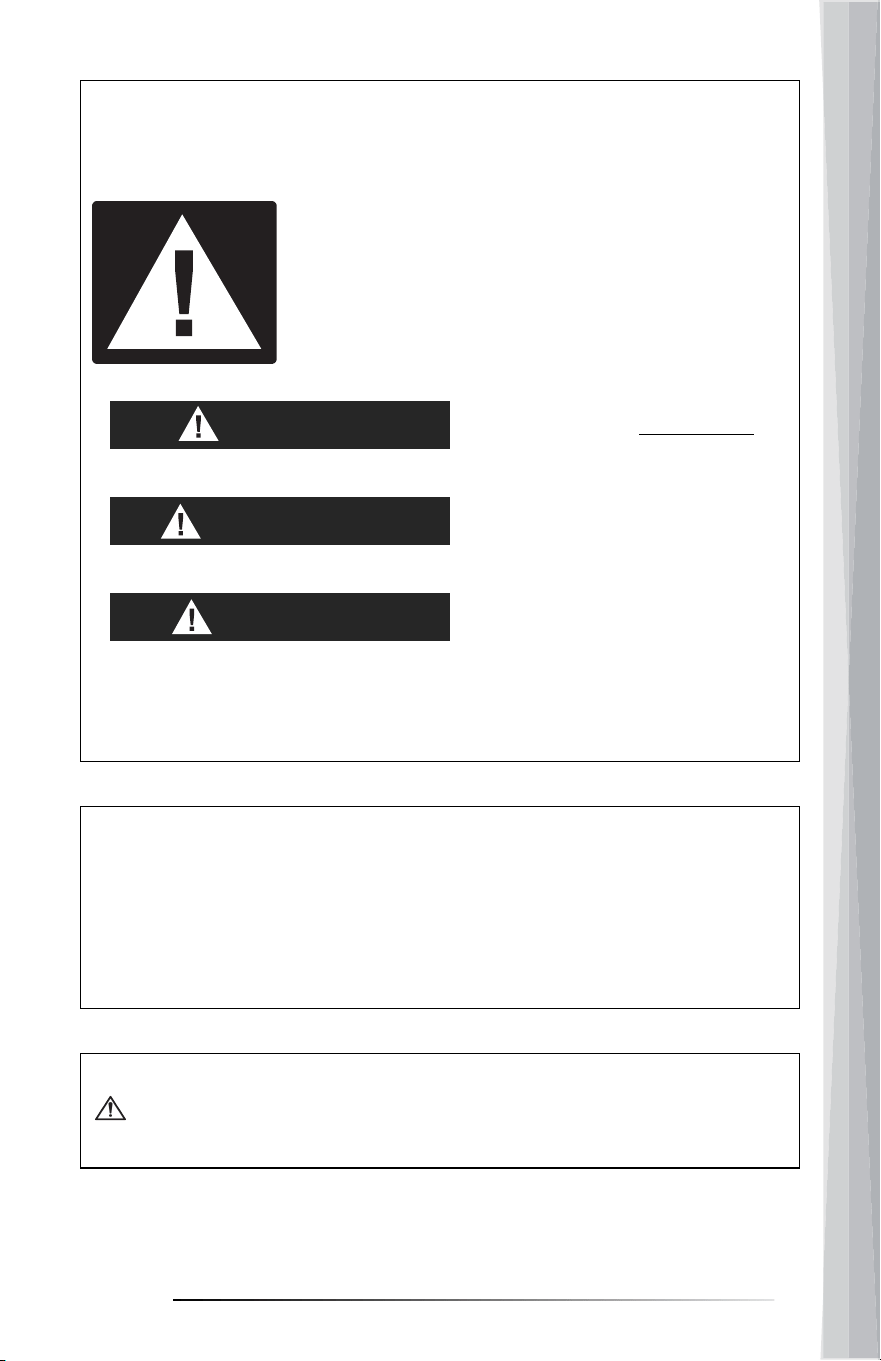
Your safety and the safety of others are very important.
We have provided many important safety messages in this manual and on
your appliance. Always read and obey all safety messages.
This is the safety alert symbol.
This symbol alerts you to potential hazards that can
kill or hurt you and others.
All safety messages will follow the safety alert symbol
and either the word "DANGER," "WARNING" or
"CAUTION." These words mean:
DANGER
WARNING
You can be killed or seriously
injured if you don't immediately
follow instructions.
You can be killed or seriously
injured if you don't follow
instructions.
A potentially hazardous situation
which, if not avoided, could result
in minor or moderate injury.
CAUTION
All safety messages will tell you what the potential hazard is, tell you how
to reduce the chance of injury, and tell you what can happen if the
instructions are not followed.
In the State of Massachusetts, the following installation instructions apply:
• Installations and repairs must be performed by a qualified or licensed
contractor, plumber, or gasfitter qualified or licensed by the State of
Massachusetts.
• If using a ball valve, it shall be a T-handle type.
• A flexible gas connector, when used, must not exceed 3 feet.
California Proposition 65 Warning
WARNING:
Cancer and Reproductive Harm - www.P65Warnings.ca.gov.

6
IMPORTANT SAFETY
INSTRUCTIONS
WARNING: To reduce the risk of fire, electrical shock, injury to persons, or
damage when using the range, follow basic precautions, including the
following:
• WARNING: TO REDUCE THE RISK
OF TIPPING OF THE RANGE, THE
RANGE MUST BE SECURED BY
PROPERLY INSTALLED ANTI-TIP
DEVICES. TO CHECK IF THE
DEVICES ARE INSTALLED
PROPERLY, SLIDE RANGE
COMPLETELY FORWARD, LOOK
FOR ANTI-TIP BRACKET SECURELY
ATTACHED TO THE FLOOR OR
WALL, AND SLIDE RANGE BACK
SO THE REAR RANGE FOOT IS
UNDER ANTI-TIP BRACKET.
• WARNING: NEVER use this
appliance as a space heater to
heat or warm the room. Doing so
may result in carbon monoxide
poisoning and overheating of the
oven.
• WARNING: NEVER cover any
slots, holes or passages in the
oven bottom or cover an entire
rack with materials such as
aluminum foil. Doing so blocks
airflow through the oven and
may cause carbon monoxide
poisoning. Aluminum foil linings
may also trap heat, causing a fire
hazard.
• CAUTION: Do not store items of
interest to children in cabinets
above a range or on the back
guard of a range – children
climbing on the range to reach
items could be seriously injured.
• Do Not Leave Children Alone –
Children should not be left alone
or unattended in area where
range is in use. They should never
be allowed to sit or stand on any
part of the range.
• Wear Proper Apparel – Loose-
fitting or hanging garments
should never be worn while using
the range.
• User Servicing – Do not repair or
replace any part of the range
unless specifically recommended
in the manual. All other servicing
should be referred to a qualified
technician.
• Storage in or on Range –
Flammable materials should not
be stored in an oven or near
surface units.
• This appliance is not intended for
storage.
READ AND SAVE THESE INSTRUCTIONS

7
IMPORTANT SAFETY
INSTRUCTIONS
• Do Not Use Water on Grease
Fires – Smother fire or flame or
use dry chemical or foam-type
extinguisher.
• Use Only Dry Potholders – Moist
or damp potholders on hot
surfaces may result in burns from
steam. Do not let potholder touch
hot heating elements. Do not use
a towel or other bulky cloth.
• Never Leave Surface Units
Unattended at High Heat
Settings – Boilover causes
smoking and greasy spillovers
that may ignite.
• Glazed Cooking Utensils – Only
certain types of glass,
glass/ceramic, ceramic,
earthenware, or other glazed
utensils are suitable for range-
top service without breaking due
to the sudden change in
temperature.
• Utensil Handles Should Be Turned
Inward and Not Extend Over
Adjacent Surface Units – To
reduce the risk of burns, ignition
of flammable materials, and
spillage due to unintentional
contact with the utensil, the
handle of a utensil should be
positioned so that it is turned
inward, and does not extend over
adjacent surface units.
• Disconnect power before
servicing.
• Proper Installation – The
appliance, when installed, must
be electrically grounded in
accordance with local codes, or
in the absence of local codes,
with the National Electrical Code,
ANSI/NFPA 70 or the Canadian
Electrical Code, CSA C22.1-02. In
Canada, the appliance must be
electrically grounded in
accordance with Canadian
Electrical Code. Be sure your
appliance is properly installed
and grounded by a qualified
technician.
• Injuries may result from misuse of
appliance doors or drawers such
as stepping, leaning, or sitting on
the doors or drawers.
• Maintenance – Keep range area
clear and free from combustible
materials, gasoline, and other
flammable vapors and liquids.
• Do not let cooking grease or
other flammable materials
accumulate in or near the range.
Grease in the oven or on the
cooktop may ignite.
• Top burner flame size should be
adjusted so it does not extend
beyond the edge of the cooking
utensil. This instruction is based
on safety considerations.
READ AND SAVE THESE INSTRUCTIONS

8
IMPORTANT SAFETY
INSTRUCTIONS
• Do not use replacement parts
that have not been
recommended by the
manufacturer (e.g. parts made at
home using a 3D printer).
• Clean Cooktop With Caution – If
a wet sponge or cloth is used to
wipe spills on a hot cooking area,
be careful to avoid steam burn.
Some cleaners can produce
noxious fumes if applied to a hot
surface.
• Use Care When Opening Door –
Let hot air or steam escape
before removing or replacing
food.
• Do Not Heat Unopened Food
Containers – Build-up of pressure
may cause container to burst and
result in injury.
• Keep Oven Vent Ducts
Unobstructed.
• Never broil with door open.
Open-door broiling is not
permitted due to overheating of
control knobs.
• Placement of Oven Racks –
Always place oven racks in
desired location while oven is
cool. If rack must be moved while
oven is hot, do not let potholder
contact hot heating element in
oven.
• Care must be taken to prevent
aluminum foil and meat probes
from contacting heating
elements.
• DO NOT TOUCH HEATING
ELEMENTS OR INTERIOR
SURFACES OF OVEN – Heating
elements may be hot even
though they are dark in color.
Interior surfaces of an oven
become hot enough to cause
burns. During and after use, do
not touch, or let clothing or other
flammable materials contact
heating elements or interior
surfaces of oven until they have
had sufficient time to cool. Other
surfaces of the appliance may
become hot enough to cause
burns – among these surfaces are
cooktop, burners, grates, oven
vent openings and surfaces near
these openings, oven doors,
windows of oven doors, and
crevices around the oven doors.
• Top burner flame size should be
adjusted so it does not extend
beyond the edge of the cooking
utensil.
• Have the installer show you the
location of the range gas shut-off
valve and how to turn it off if
necessary.
READ AND SAVE THESE INSTRUCTIONS

9
IMPORTANT SAFETY
INSTRUCTIONS
• Proper Disposal of Your
Appliance – Dispose of or recycle
your appliance in accordance
with Federal and Local
Regulations. Contact your local
authorities for the
environmentally safe disposal or
recycling of your appliance.
For units with ventilating hood –
• Clean Ventilating Hoods
Frequently – Grease should not
be allowed to accumulate on
hood or filter.
• When flambé cooking under the
vent hood, turn the fan on.
For self-cleaning ranges –
• Do Not Clean Door Gasket – The
door gasket is essential for a
good seal. Care should be taken
not to rub, damage, or move the
gasket.
• Do Not Use Oven Cleaners – No
commercial oven cleaner or oven
liner protective coating of any
kind should be used in or around
any part of the oven.
• Clean Only Parts Listed in
Manual.
• Before Self-Cleaning the Oven –
Remove broiler pan and other
utensils. Wipe off all excessive
spillage before initiating the
cleaning cycle.
READ AND SAVE THESE INSTRUCTIONS
10
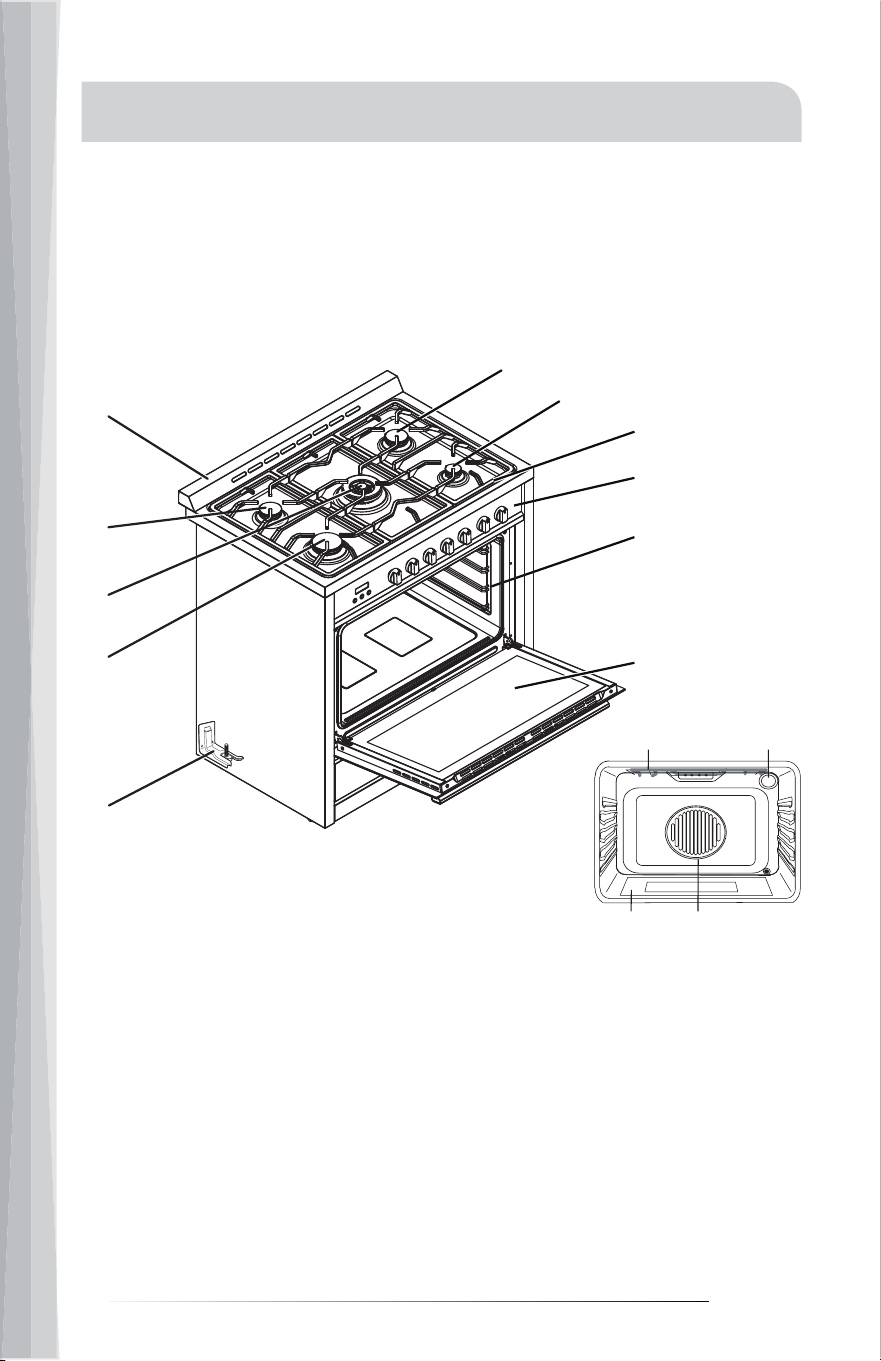
RANGE LAYOUT
This illustration covers several different models. The range you have
purchased may have some or all of the items listed. The locations and
appearances of the features shown here may not match those of your model.
OVERVIEW
d
a
b
c
e
f
k
i
j
b
a
c
d
k
e
f
g
h
i
j
n
l
m
o
Backsplash
Semi Rapid Burner
Triple Ring Burner
Rapid Burner
Semi Rapid Burner
Auxiliary Burner
Cast Iron Pan Rack
Control Panel
Oven Rack Positions
Oven Door Window
Anti-tip Bracket
Broil Element
Oven Light
Convection Fan and Element
Bake Element (hidden)
g
h
l
m
n
o
11
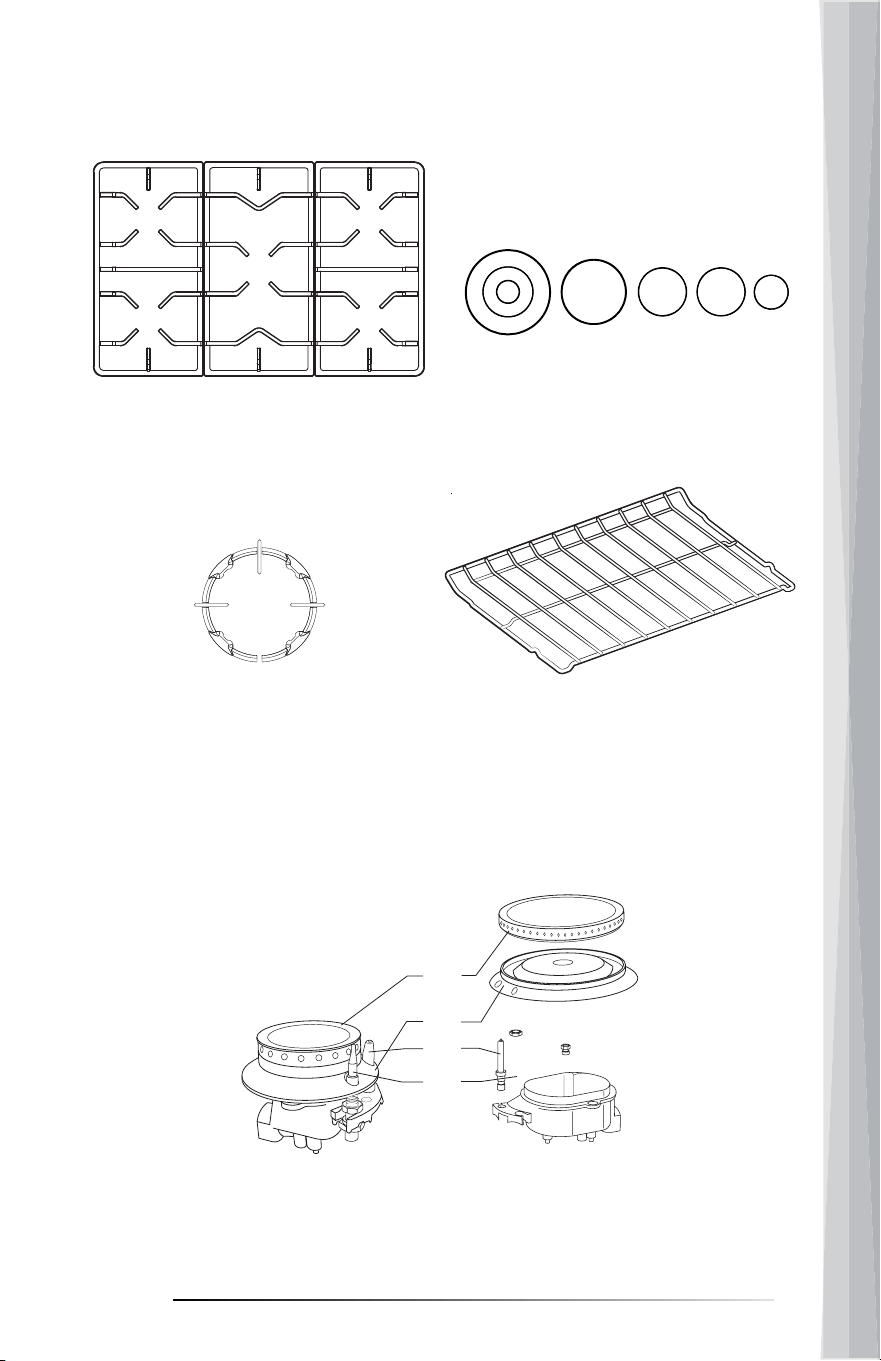
WHAT'S INCLUDED
Surface Bruner Grates (3) Surface Burners and Caps (5)
Wok Grate Oven Racks (2)
BURNER LAYOUT
Burner Cap
Burner Head
Electrode
a
b
c
d
a
b
c
12
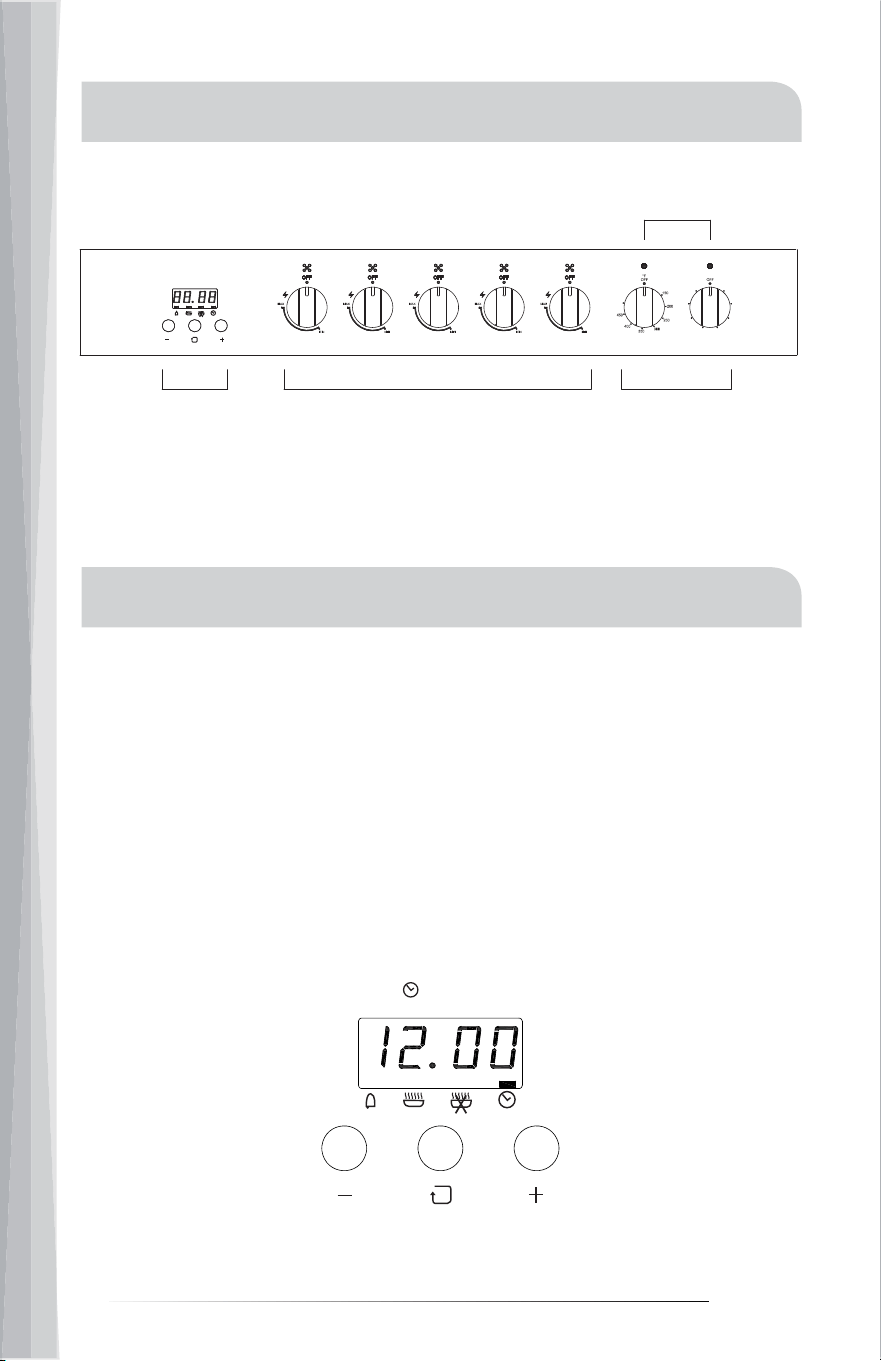
SETTING THE CLOCK AND TIMER
IMPORTANT: Clock must be set in order for the timed oven functions to
work.
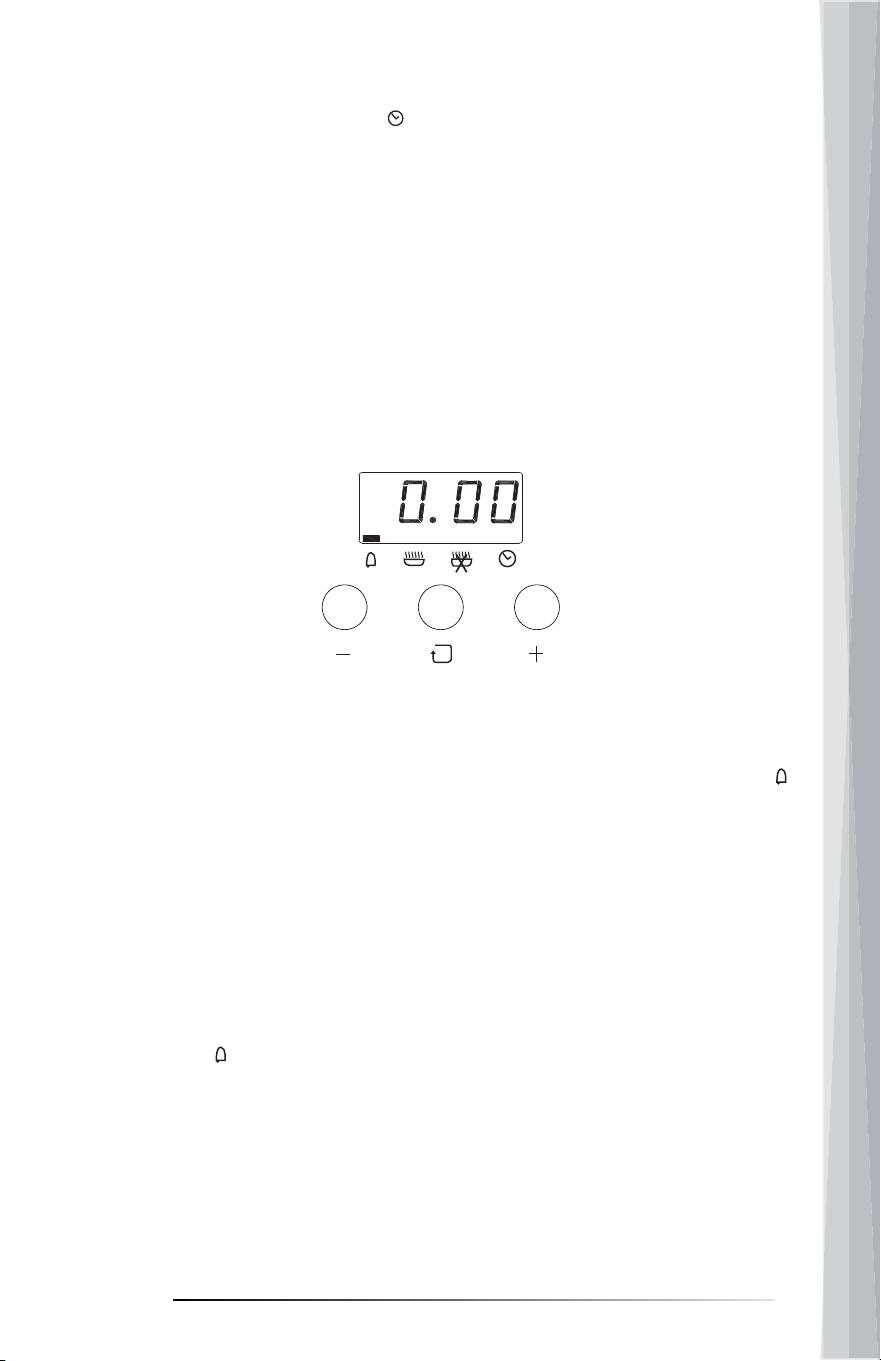
Your model has a digital display clock with 3 control buttons.
NOTE: In the event of a power failure, all settings including the clock time set
will be lost. When the power is returned, clock must be set again.
TO SET THE TIME OF DAY
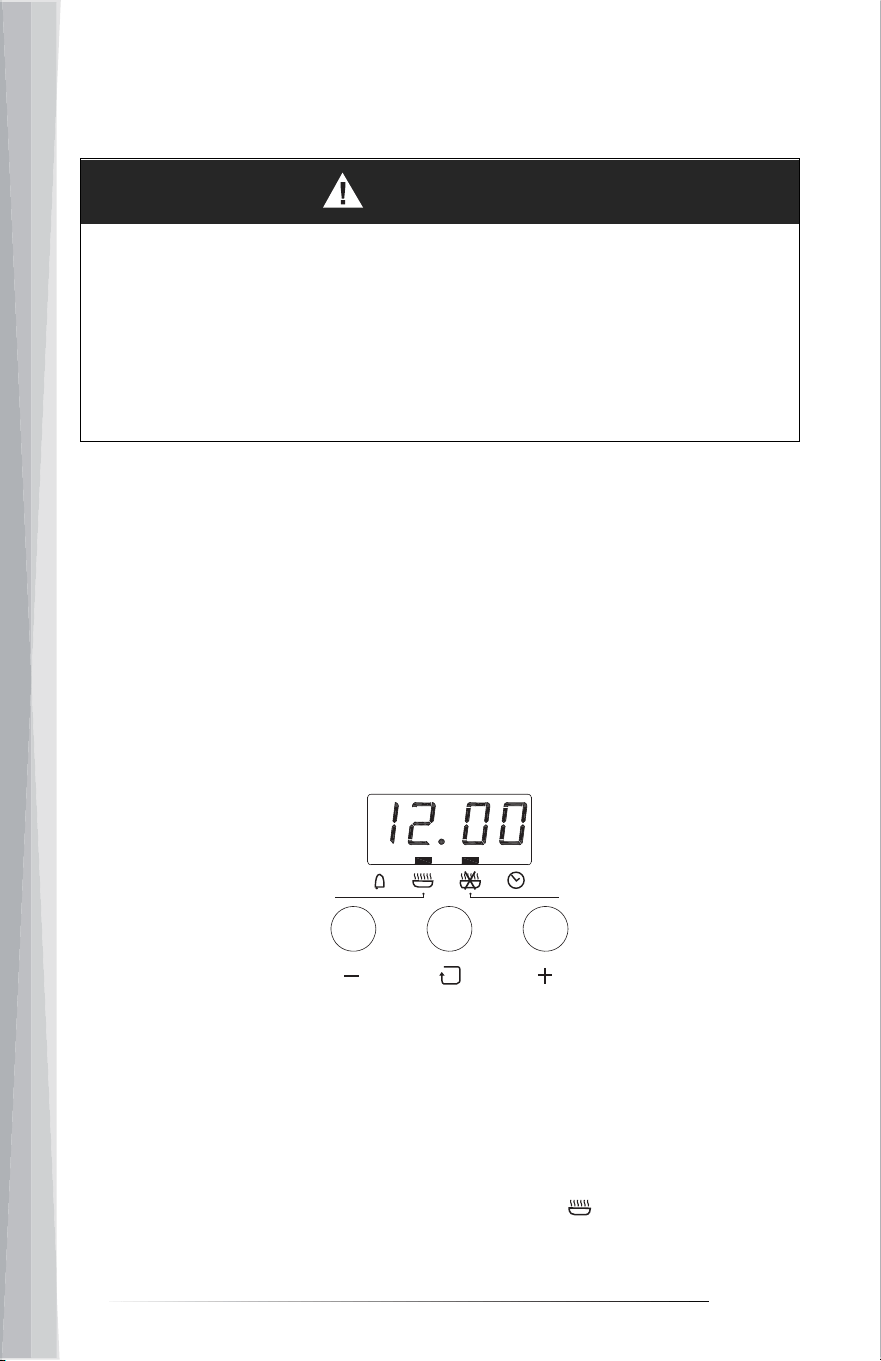
When the power is connected or after a power outage, the screen will display
12.00 and the indicator bar above "Set Clock" will blink.
CONTROL PANEL
CLOCK & TIMER
Defrost
Light
Conv
Bake
MAX Bake
Broil
Conv
Pizza
Broil
High
Low
Broil
Surface Burner
Controls
Oven
Controls
LED Indicators
Clock/Timer
Controls
IncreaseDecrease Function
13
1. If the clock was previously set, press the function button repeatedly until
the indicator bar blinks above "Set Clock".
2. Press or hold the + or - button to adjust the clock. The clock will be
confirmed automatically if you leave the correct time there for 5 seconds
without pressing any buttons, and the indicator bar will become solid. You
may also press the function button to confirm the clock manually while the
indicator bar is blinking.
TO SET THE TIMER
The digital countdown timer can be set up to 11 hours and 59 minutes
maximum.
1. Press the function button repeatedly until the indicator bar blinks above
"Timer Set".
2. Press or hold the + or – button to set the length of time, then press the
function button or wait for 5 seconds to confirm.
Once confirmed, the current time will be shown and the countdown will begin.
When the countdown is finished, press any button to stop the beeping.
To view and modify the countdown time remaining, press the function button
once to select "Timer Set" again and use the + or - button to adjust the
current timer as needed; To cancel the timer, follow the steps above to set the
length of time to 0.00.
NOTE: When adjusting the time, idling for 5 seconds without pressing any
buttons will automatically confirm the current time on the display.
IncreaseDecrease Function
14
TIMED COOKINGS
WARNING
Food Poisoning Hazard
Do not let food sit in oven more than one hour before or after cooking.
Doing so can result in food poisoning or sickness.
Foods that can easily spoil such as milk, eggs, fish, meat or poultry, should
be chilled in the refrigerator first. Even when chilled, they should not stand
in the oven for more than 1 hour before cooking begins, and should be
removed promptly when finished cooking.
• Set Cook Time only:
Cook for the set length of time from now, then shut off the oven
automatically.
• Set End Time only:
Shut off the oven automatically at the set time of day.
• Set both Cook Time and End Time:
Delayed start – Cook for the set length of time and shut off the oven
automatically at the set time of day.
IMPORTANT: Clock must be set in order for the timed oven functions to work.
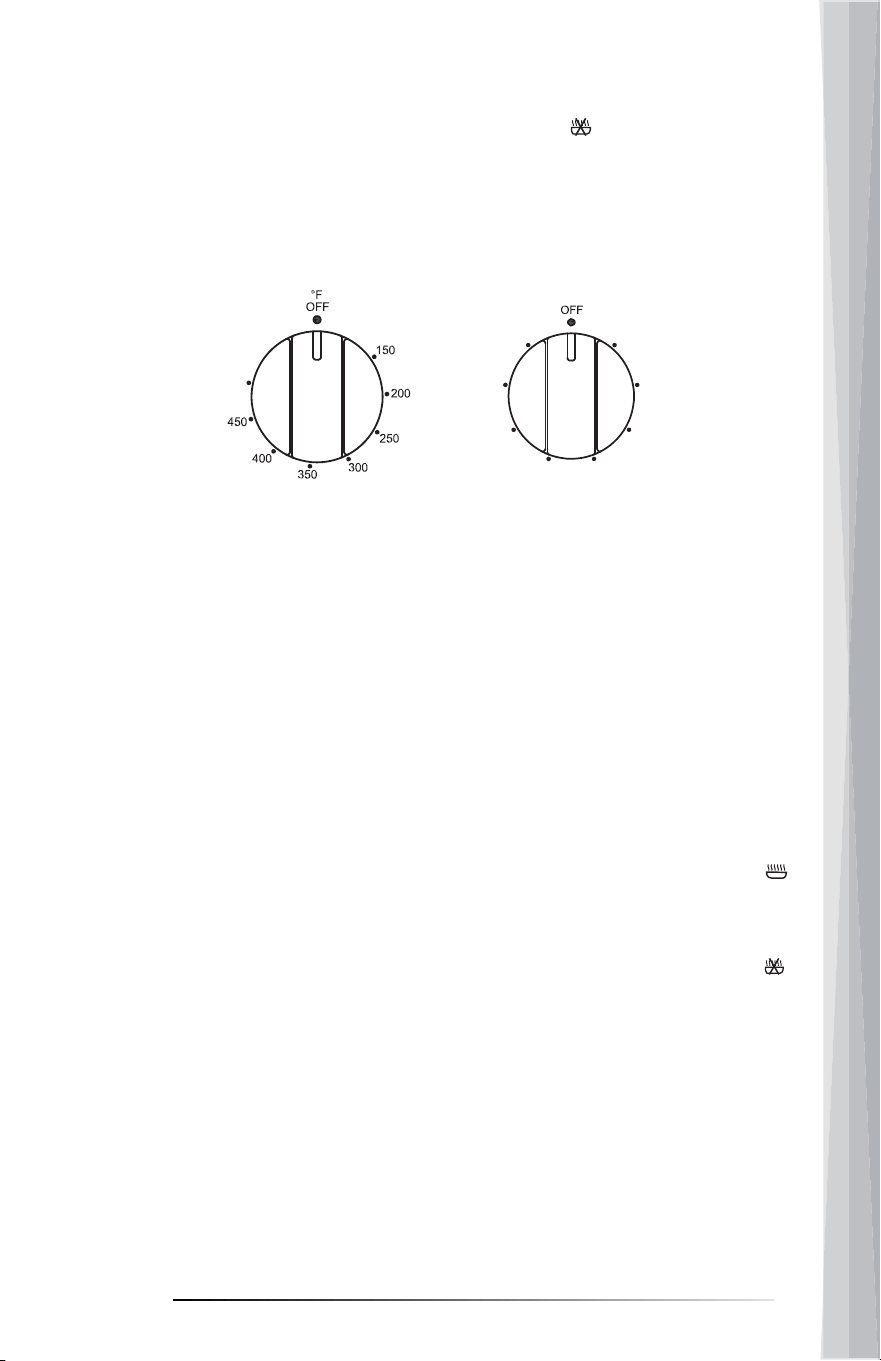
TO SET THE COOK TIME
Press the function button until the bar flashes above "Cook Time". Then
use the + or – button to set the length of cooking time (maximum of 10 hours),
and press the function button or wait for 5 seconds to confirm.
Cook Time End Time
IncreaseDecrease Function
15
TO SET THE END TIME
Press the function button until the bar flashes above "End Time". Then use
the + or – button to set the shut off time of day, and press the function button
or wait for 5 seconds to confirm.
SETTING THE COOKING METHODS
Thermostat (°F) Cooking Mode
Turn the oven Thermostat knob and Cooking-Mode knobs to set the
temperature and oven mode. The oven will turn on, and will automatically
shut off according to the time set. When the shut off time is reached, press
any button to stop the beeping and return the oven knobs to the OFF position.
Example:
To bake at 350°F for 50 minutes that will finish cooking and automatically
shut off the oven at 6:00.
1. Press the function button repeatedly until the indicator bar blink above
"Cook Time", then set the length of cooking time to 0.50 and confirm.
2. Press the function button repeatedly until the indicator bar blink above
"End Time", then set the shut off time of day to 6.00 and confirm.
3. Turn the thermostat knob to 350°. Once the clock time is returned on the
display, the indicator bar above "Cook Time" or "End Time" will be blinking,
indicating a schedule is set.
4. At 5:10 the oven will start preheating for baking at 350°F. At 6:00 when the
cooking is finished, the oven will shut off automatically. Press any button to
stop the beeping, and turn the oven knobs to the OFF position.
Defrost
Light
Conv
Bake
MAX
Bake
Conv
Broil
Pizza
Low
Broil
High
Broil

16
Read the instructions before installing or using this appliance.
1. This appliance shall be installed in accordance with the regulations in force
and only used in a well-ventilated space.
2. The use of a gas-cooking appliance results in the production of heat and
moisture in the room in which it is installed. Ensure that the kitchen is well
ventilated: keep natural ventilation holes open or install a mechanical
ventilation device (mechanical extractor hood).
3. Prolonged intensive use of the appliance may call for additional
ventilation, for example opening of a window, or more effective ventilation,
for example increasing the level of mechanical ventilation where present.
IGNITION AND OPERATION OF THE BURNERS
To ignite a burner, push down on the burner knob and rotate it
counterclockwise until the knob indicator is aligned with the ignite icon.
Release the knob and adjust the flame intensity by further rotating the knob
counterclockwise from MAX (maximum) to MIN (minimum).
NOTE: For models with a flame failure safety device - Once the flame is lit,
hold the knob depressed for about 3-4 seconds until the device keeps the
burner automatically lit. If the burner fails to ignite, wait one minute for the
gas to dissipate before attempting to reignite.
To turn off the burner, rotate the knob clockwise until the indicator on the
knob is aligned with OFF.
POWER FAILURE
In case of prolonged power failure, the surface burners can be lit manually.
Hold a lit match near a burner and turn knob counterclockwise until the
indicator is aligned with MAX. After the burner is lit, turn knob to desired
setting.
In the case of unintentional flame extinguishing, the safety valve intervenes
by shutting off the gas to the burners.
The electric igniter must not be actuated for longer than 15 seconds. Should
the burner not light, or should the burner be unintentionally turned off,
immediately close the burner, and wait at least 1 minute before repeating.
Once ignited, adjust the flame as desired.
COOKTOP USE
17
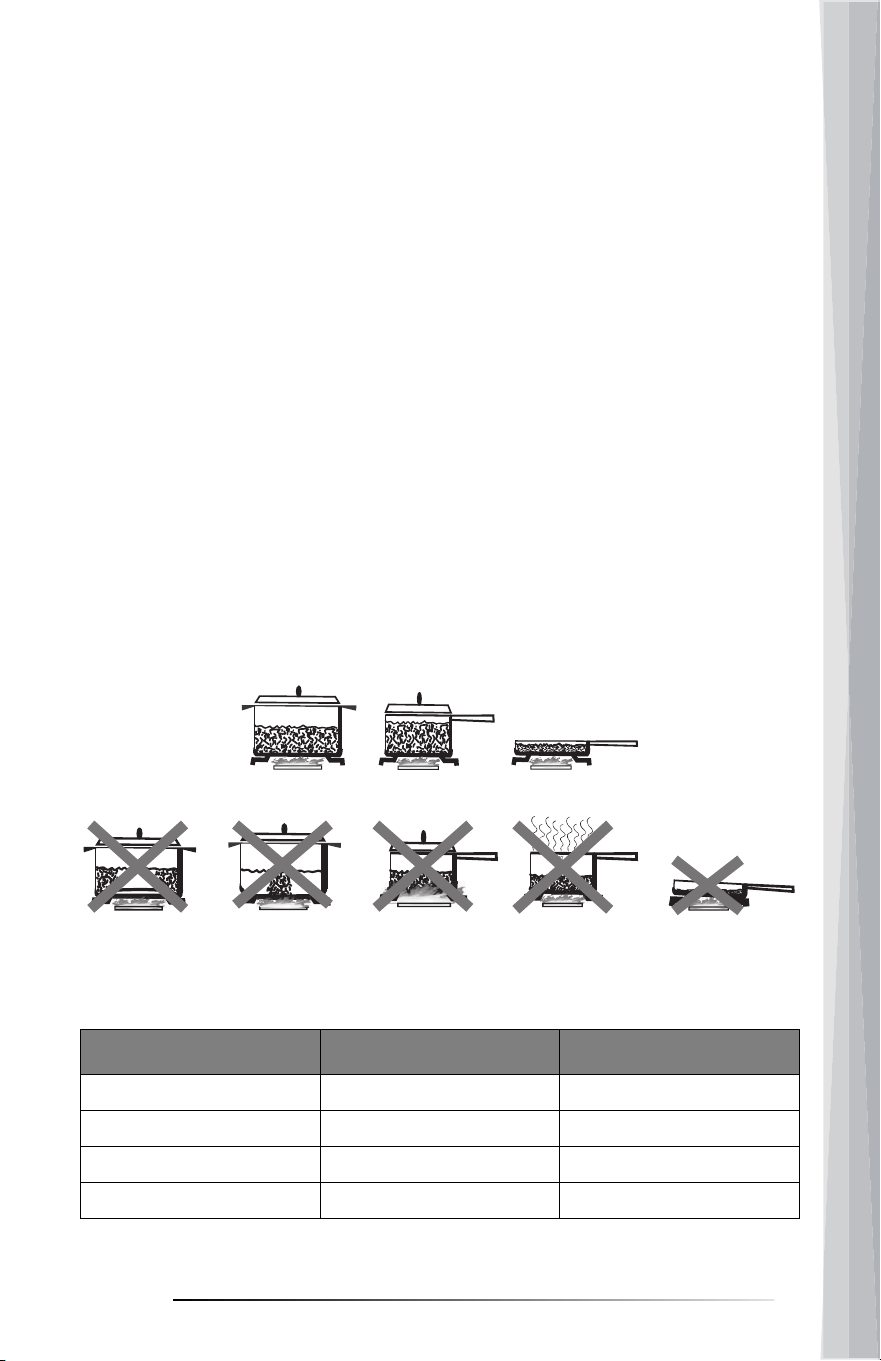
For lower gas consumption and a better result, use saucepans with a
diameter matching the diameter of the burner, to avoid the flame coming up
around the sides of the saucepan. See the Container Table. Use only flat-
bottomed pans.
As soon as liquid starts to boil, turn the flame down to a level sufficient to
maintain boiling.
COOKWARE
MATCH PAN DIAMETER TO FLAME SIZE
The flame should be the same size as the bottom of the pan or smaller. Do not
use small pans with high flame settings as the flames can lick up the sides of
the pan. Oversize pans that span two burners are placed front to rear, not
side to side.
USE BALANCED PANS
Pans must sit level on the cooktop grate without rocking. Center the pan over
the burner.
USE A LID THAT FITS PROPERLY
A well-fitting lid helps shorten the cooking time. Flat, heavy bottom pans
provide
CONTAINER TABLE
Burner Min Saucepan Max Saucepan
Auxiliary 3.5" (9.0 cm) 6.3" (16 cm)
Semi-rapid 5.1" (13 cm) 7.1" (18 cm)
Rapid 5.9" (15 cm) 10.2" (26 cm)
Triple ring 8.3" (21 cm) 10.2" (26 cm)
BALANCED PAN
UNBALANCED
PAN
CONVEX
(ROUNDED)
CONCAVE
(HOLLOW)
FLAME TOO LARGE
FOR
PAN SIZE
USE LIDS THAT
FIT PROPERLY
18
WARNING
NEVER cover any slots, holes or passages in the oven bottom or cover an
entire rack with materials such as aluminum foil. Doing so blocks airflow
through the oven and may cause carbon monoxide poisoning. Aluminum
foil linings may also trap heat, causing a fire hazard.
Reset all controls to the OFF position after using a programmable timing
operation. No attempt should be made to operate the appliance during
power failure.
An air curtain or other overhead range hood, which operates by blowing a
downward airflow onto a range shall not be used in conjunction with a gas
range.
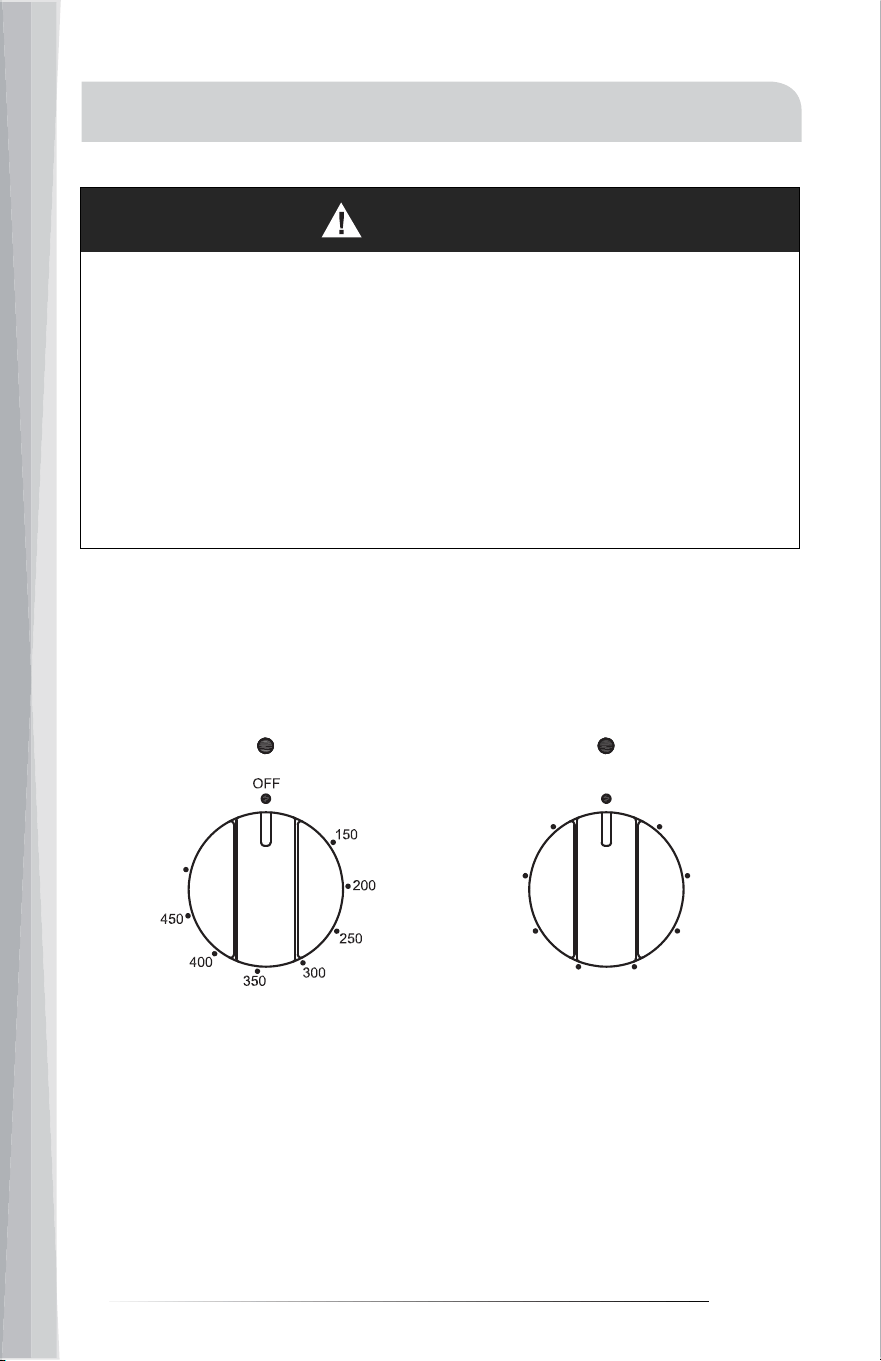
OVEN CONTROLS
The Thermostat knob and Cooking-mode knobs are used together to select
Oven Modes.
Thermostat (°F) Cooking Mode
OVEN USE
OFF
Defrost Light
Conv
Bake
Bake
Conv
Pizza
Broil
High
Low
Broil
Broil
MAX

19
THERMOSTAT KNOB
Select the cooking temperature by turning the knob to the required
temperature. The indicator light will come on when the oven is preheating.
Once the oven reaches desired temperature, the heating process will pause
and the indicator light will go out temporarily to maintain the current
temperature. When the temperature drops beyond the programmed
threshold, the heating process will resume and the indicator light will come on
again. Throughout the whole cooking process the indicator light will come on
and go out regularly, which is a normal operation of the unit.
COOKING-MODE KNOB
Selects the oven function. Each of the functions listed below can be used only
with the correct temperature.
OVEN MODES
Light
The Light mode turns on oven light without any heating of the oven. The oven
light will remain on for all other oven modes.
Bake
THERMOSTAT RANGE: 150°F (65.6°C) TO MAX 500°F (260°C)
The Bake mode uses heat from cycling between the upper elements and lower
elements to maintain temperature. When using this mode to prepare baked
goods such as cakes, cookies and pastries, always preheat the oven first and
place food centrally near the middle racks.
Pizza
THERMOSTAT RANGE: 150°F (65.6°C) TO MAX 450°F (260°C)
The Pizza mode uses heat only from the lower element and air movement
from the fans to circulate hot air inside the oven. Ideal for pastries and cakes
with wet covering and little sugar and damp desserts in moulds, or dishes
requiring more heat in the lower area. Always preheat the oven first and
place food near the lower racks.

20
Low Broil
THERMOSTAT RANGE: 150°F (65.6°C) TO MAX 450°F (232°C)
The Low Broil mode uses less intense heat from the upper inner and outer
elements to cook food while also browning the surface. It is also used to
brown selected dishes at the end of cooking. Food should be place near the
upper racks, and preheating is not necessary when using this mode.
High Broil
THERMOSTAT RANGE: 150°F (65.6°C) TO MAX 500°F (288°C)
The High Broil mode uses intense heat from the upper inner element to sear
goods. Ideal for toasting, melting cheese, browning and searing surface. Food
should be place near the upper racks, and should not be cooked for too long
on each side of the food. It is not necessary to preheat when using this mode.
Conv Broil (Convection Broil)
THERMOSTAT RANGE: 150°F (65.6°C) TO MAX 500°F (288°C)
The Convection Broil mode uses air movement from the fans to enhance
cooking evenness across multiple racks. Ideal for grilling meats, vegetables,
and poultry. It is recommended to preheat the oven first. Cooking times may
be slightly longer for multiple racks than what would be expected for a single
rack.
Conv Bake (Convection Bake)
THERMOSTAT RANGE: 150°F (65.6°C) TO MAX 500°F (260°C)
The Convection Bake mode uses hot air movement from the convection fans
to enhance cooking evenness across multiple racks. Always preheat the oven
first. Baking times may be slightly longer for multiple racks than what would
be expected for a single rack.
Defrost
THERMOSTAT RANGE: OFF
The Defrost mode circulates air inside the oven to defrost food at room
temperature.

21
TIPS AND TECHNIQUES
BAKE
Baking is cooking with heated air. Both upper and lower elements in the oven
are used to heat the air but no fan is used to circulate the heat.
Follow the recipe or convenience food directions for baking temperature, time
and rack position. Baking time will vary with the temperature of ingredients
and the size, shape and finish of the baking utensil.
General Guidelines
• For best results, bake food on a single rack with at least 1" - 1 ½" (2.5 - 3 cm)
space between utensils and oven walls.
• Use one rack when selecting the bake mode.
• Check for doneness at the minimum time.
• Use metal bake ware (with or without a non-stick finish), heatproof glass,
glass-ceramic, pottery or other utensils suitable for the oven.
• When using heatproof glass, reduce temperature by 25°F (15°C) from
recommended temperature.
• Use baking sheets with or without sides or jelly roll pans.
• Dark metal pans or nonstick coatings will cook faster with more browning.
Insulated bake ware will slightly lengthen the cooking time for most foods.
• Do not use aluminum foil or disposable aluminum trays to line any part of
the oven. Foil is an excellent heat insulator and heat will be trapped
beneath it. This will alter the cooking performance and can damage the
finish of the oven.
• Avoid using the opened door as a shelf to place pans.
• See Troubleshooting for tips to Solving Baking and Roasting Problems.
22
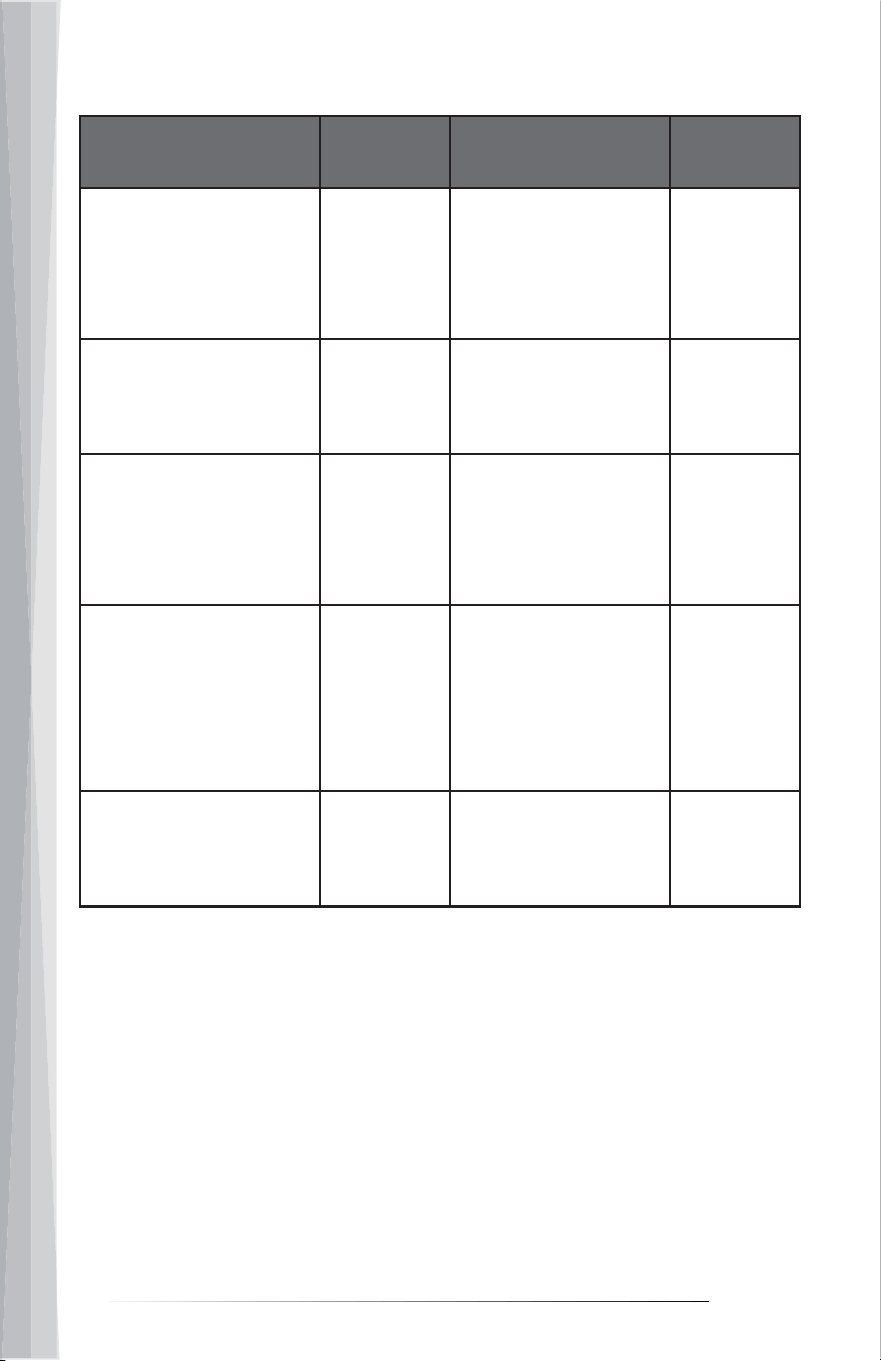
Bake Chart
FOOD ITEM RACK
POSITION
TEMP. °F (°C)
(PREHEATED OVEN)
TIME (MIN)
Cake
Cupcakes
Bundt Cake
Angel Food
2
1
1
350 (175)
350 (175)
350 (175)
19-22
40-45
35-39
Pie
2 crust, fresh, 9"
2 crust, frozen fruit, 9"
2
2
375-400 (190-205)
375 (190)
45-50
68-78
Cookies
Sugar
Chocolate Chip
Brownies
2
2
2
350-375 (175-190)
350-375 (175-190)
350 (175)
8-10
8-13
29-36
Breads
Yeast bread loaf, 9x5
Yeast rolls
Biscuits
Muffins
2
2
2
2
375 (190)
375-400 (190-205)
375-400 (190-205)
425 (220)
18-22
12-15
7-9
15-19
Pizza
Frozen
Fresh
2
2
400-450 (205-235)
475 (246)
23-26
15-18
CONVECTION BAKE
Reduce recipe baking temperatures by 25°F (15°C).
• For best results, foods should be cooked uncovered, in low-sided pans to
take advantage of the forced air circulation. Use shiny aluminum pans for
best results unless otherwise specified.
• Heatproof glass or ceramic can be used. Reduce temperature by another
25°F (15°C) when using heatproof glass dishes for a total reduction of 50°F
(30°C).
23
4
6
5
3
2
1
Rack 3
Rack 1
Foods recommended for convection bake mode:
Appetizers, Biscuits, Cakes, Casseroles, Coffee Beans, Cookies (2 to 4 racks),
Cream Puffs, Popovers, Yeast Breads, One-Dish Entrées, Oven Meals (rack
positions 1, 2, 3), and Air Leavened Foods (Soufflés, Meringue, Meringue-
Topped Desserts, Angel Food Cakes, Chiffon Cakes).
• Dark metal pans may be used. Note that food may brown faster when
using dark metal bake ware.
• The number of racks used is determined by the height of the food to be
cooked.
• Baked items, for the most part, cook extremely well in convection. Don’t try
to convert recipes such as custards, quiches, pumpkin pie, or cheesecakes,
which do not benefit from the convection-heating process. Use the regular
Bake mode for these foods.
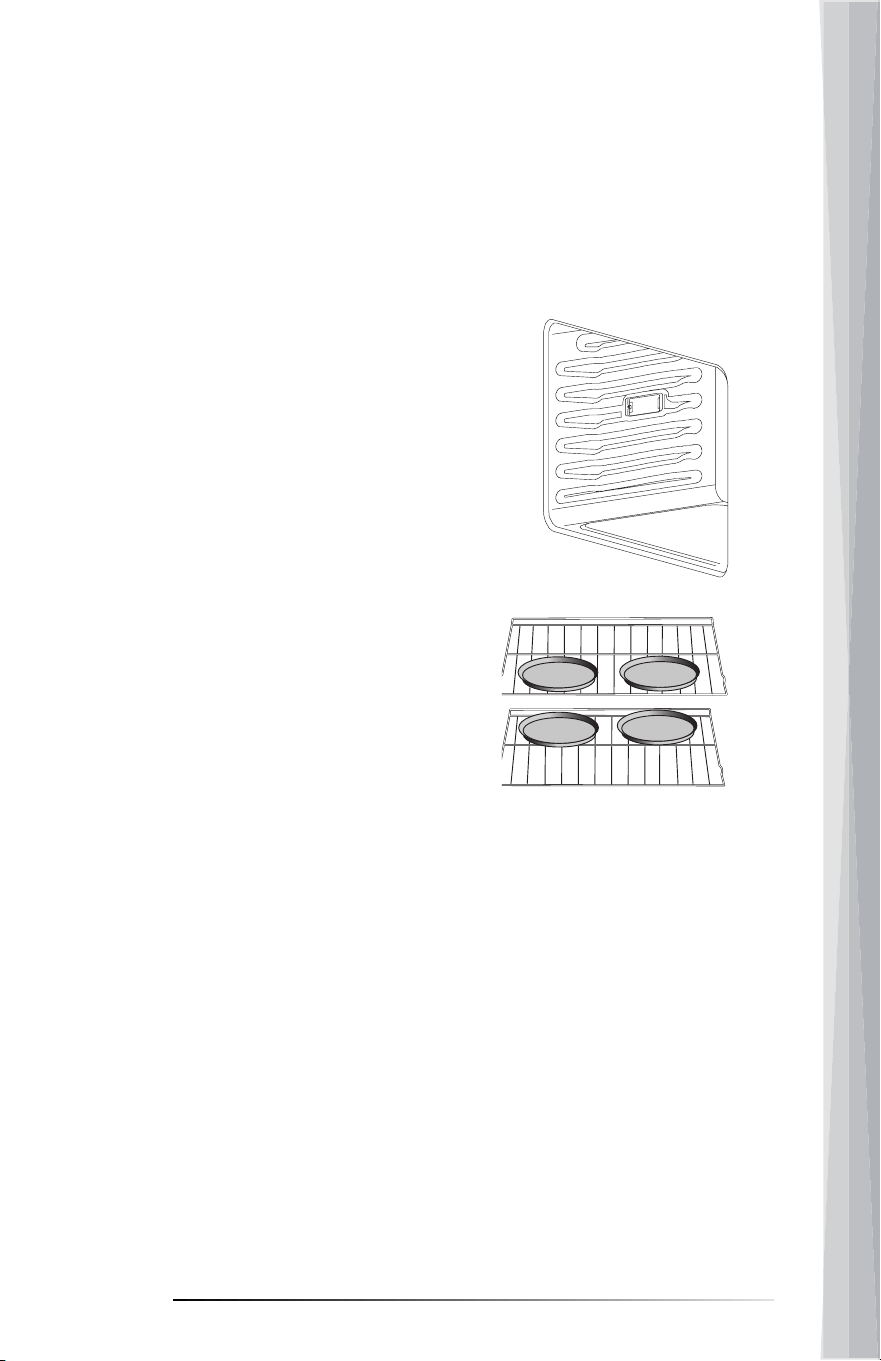
• Multiple rack cooking for oven
meals is done on rack positions 1,
2, 3, 4 and 5. All five racks can be
used for cookies, biscuits and
appetizers.
- 2 Rack baking: Use positions 1
and 3.
- 3 rack baking: Use positions 2, 3
and 4 or 1, 3 and 5.
- When baking four cake layers
at the same time, stagger pans
so that one pan is not directly
above another. For best results,
place cakes on front of upper
rack and back of lower rack
(See graphic at right). Allow 1" -
1 ½" (2.5 - 3cm) air space
around pans.
• Converting your own recipe can be easy. Choose a recipe that will work
well in convection.
• Reduce the temperature and cooking time if necessary. It may take some
trial and error to achieve a perfect result. Keep track of your technique for
the next time you want to prepare the recipe using convection.
• See Troubleshooting for tips to Solving Baking and Roasting Problems.
24
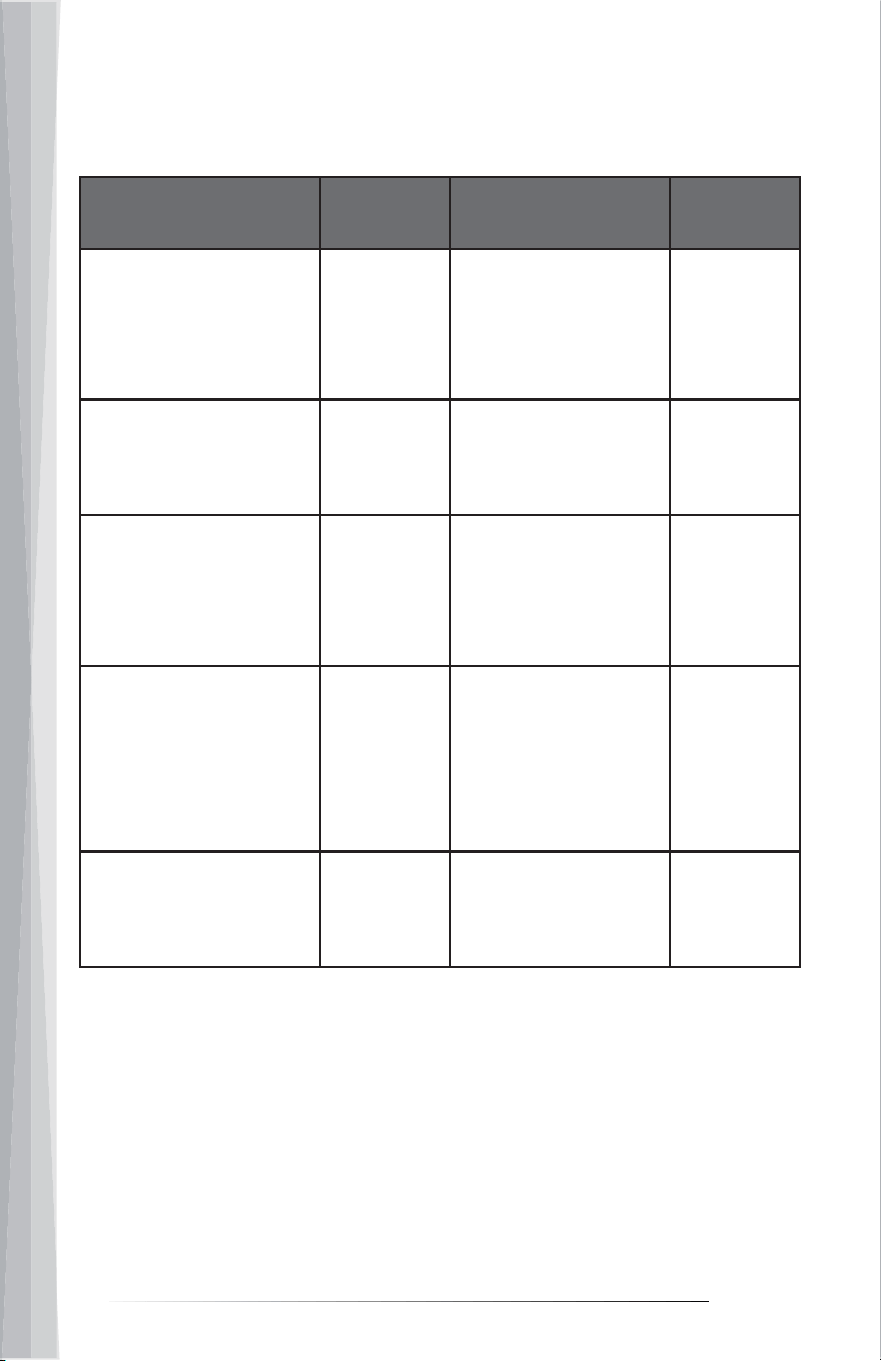
Convection Bake Chart
Reduce standard recipe temperature by 25 ºF (15 °C) for Convection Bake.
Temperatures have been reduced in this chart.
FOOD ITEM RACK
POSITION
TEMP. °F (°C)
(PREHEATED OVEN)
TIME (MIN)
Cake
Cupcakes
Bundt Cake
Angel Food
2
1
1
325 (160)
325 (160)
325 (160)
20-22
43-50
43-47
Pie
2 crust, fresh, 9"
2 crust, frozen fruit, 9"
2
2
350-400 (175-205)
350 (175)
40-52
68-78
Cookies
Sugar
Chocolate Chip
Brownies
2
2
2
325-350 (160-175)
325-350 (160-175)
325 (160)
9-12
8-13
29-36
Breads
Yeast bread loaf, 9x5
Yeast rolls
Biscuits
Muffins
2
2
2
2
350 (175)
350-375 (175-190)
375 (190)
400 (205)
18-22
12-15
8-10
17-21
Pizza
Frozen
Fresh
2
2
375-425 (190-220)
450 (232)
23-26
15-18
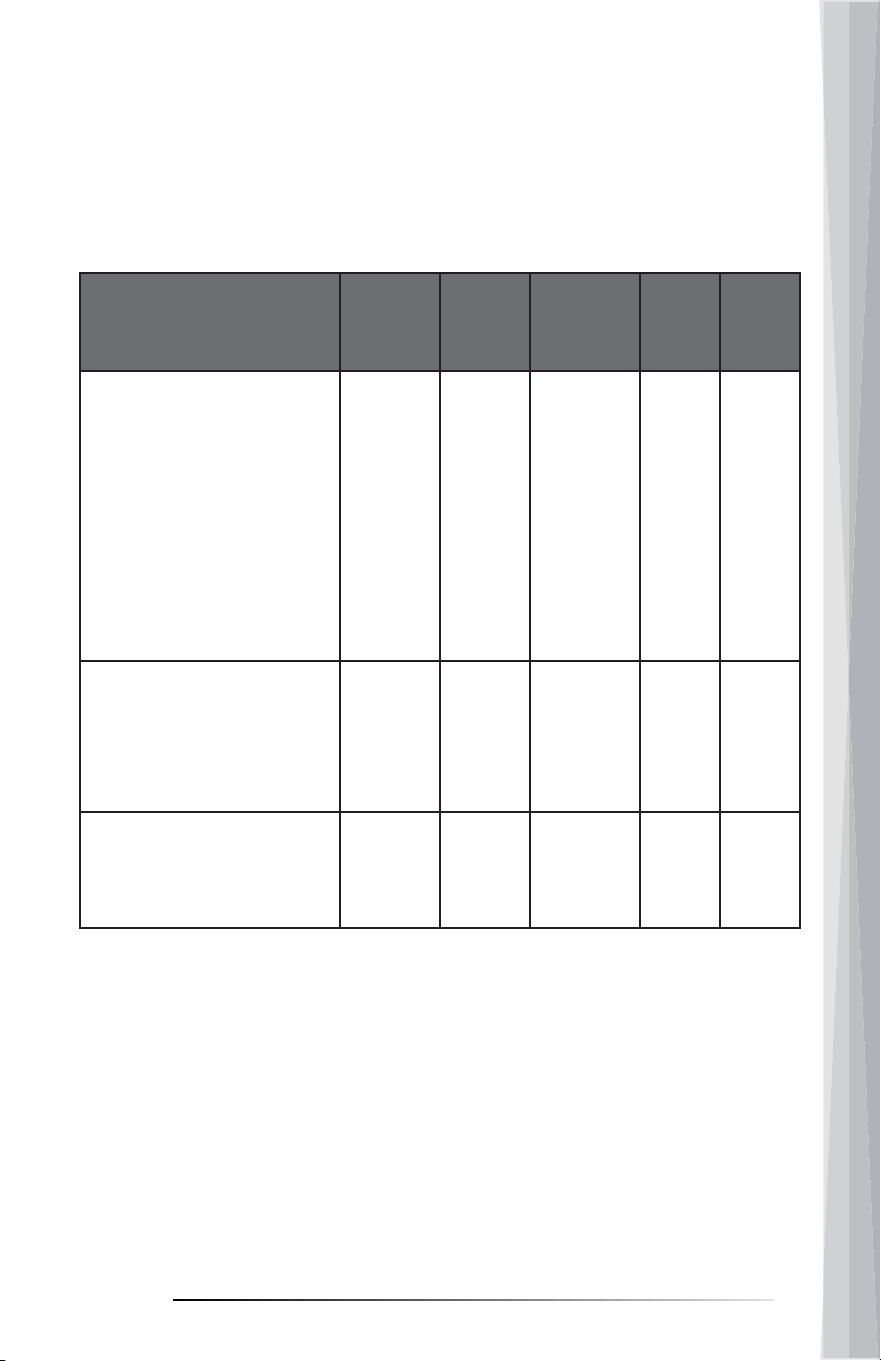
CONVECTION BROIL
• Place rack in the required position needed before turning on the oven.
• Use Convection Broil mode with the oven door closed.
• Do not preheat oven.
• Use the 2-piece broil pan.
25
• Turn meats once halfway through the cooking time (see convection broil
chart).
• Thicker cuts and unevenly shaped pieces of meat, fish and poultry may
cook better at lower broiling temperatures.
Convection Broil Chart
FOOD ITEM RACK
POSITION
BROIL
SETTING
INTERNAL
TEMP. °F
(°C)
TIME
SIDE-1
(MIN)
TIME
SIDE-2
(MIN)
Beef
Steak (1 ½" or more)
Medium Rare
Medium
Well
Hamburgers (more than 1”)
Medium
Well
4
4
4
4
4
Low
Low
Low
High
High
145 (65)
160 (71)
170 (77)
160 (71)
170 (77)
9-12
11-13
18-20
8-11
11-13
8-10
10-12
16-17
5-7
8-10
Poultry
Chicken Quarters
Chicken Halves
Chicken Breasts
4
3
4
Low
Low
Low
180 (82)
180 (82)
170 (77)
16-18
25-27
13-15
10-13
15-18
9-13
Pork
Pork Chops
(1 ¼" or more)
Sausage
- Fresh
4
4
Low
Low
160 (71)
160 (71)
12-14
4-6
11-13
3-5
COOKING WITH THE CONVECTION OVEN
In a conventional oven the heat sources cycle on and off to maintain an
average temperature in the oven cavity. As the temperature gradually rises
and falls, gentle air currents are produced within the oven. This natural
convection tends to be inefficient because the currents are irregular and slow.
In this convection system, the heat is "conveyed" by a fan that provides
continuous circulation of the hot air.

26
This European Convection system provides state-of-the-art engineering and
advanced design to create the finest convection oven. In standard convection
ovens, a fan simply circulates the hot air around the food. The system is
characterized by the combination of an additional heating element located
around the convection fan and the venting panel that distributes heated air
in three dimensions: along the sides, the top and the full depth of the oven
cavity. This European Convection system aids in maintaining a more even
oven temperature throughout the oven cavity.
The circulating air aids in speeding up the baking process and cooks the food
more evenly. By controlling the movement of heated air, convection cooking
produces evenly browned foods that are crispy on the outside yet moist
inside. Convection cooking works best for breads and pastries as well as
meats and poultry. Air- leavened foods like angel food cakes, soufflés and
cream puffs rise higher than in a conventional oven. Meats stay juicy and
tender while the outside is flavorful and crisp.
By using European Convection, foods can be cooked at a lower temperature
and cooking times can be shorter. When using this mode, the standard oven
temperature should be lowered by 25°F (15°C).
Foods requiring less cooking time should be checked slightly earlier than
normal. For best results, foods should be cooked uncovered, in low-sided pans
to take advantage of the forced air circulation. When using the Convection
Roast mode, the standard oven temperature does not need to be reduced.
ADVANTAGES OF CONVECTION COOKING
• Even baking, browning and crisping are achieved.
• During roasting, juices and flavors are sealed in while the exterior is crisp.
• Yeast breads are lighter, more evenly textured, more golden and crustier.
• Air-leavened foods such as cream puffs, soufflés and meringues are higher
and lighter.
• Baking on multiple racks at the same time is possible with even results.
• Multiple-rack baking saves time.
• Prepare whole meals at once with no flavor transfer.
• Dehydrates herbs, fruits and vegetables.
• Requires no specialized bake ware.
• Saves time and energy.
• Convection broiling allows for extraordinary grilling with thicker cuts of
food.

27
CLEANING
IMPORTANT: Before cleaning, make sure all controls are off and the oven and
cooktop are cool. Always follow label instructions on cleaning products. Soap,
water and a soft cloth or sponge are suggested first unless otherwise noted.
Do not use abrasive cleaning products.
EXTERIOR PORCELAIN ENAMEL SURFACES
Food spills containing acids, such as vinegar and tomato, should be cleaned
as soon as the entire appliance is cool. These spills may affect the finish.
Cleaning Method:
Glass cleaner, mild liquid cleaner or nonabrasive scrubbing pad: Gently clean
around the model and serial number plate because scrubbing may remove
numbers.
EXTERIOR STAINLESS STEEL
NOTE: Do not use soap-filled scouring pads, abrasive cleaners, Cooktop
Polishing Cream, steel-wool pads, gritty washcloths or some paper towels.
Damage may occur, even with one-time or limited use.
Rub in direction of grain to avoid damaging.
Cleaning Methods:
Liquid detergent or all-purpose cleaner: Rinse well with clean water and dry
with soft, lint-free cloth.
Stainless Steel Cleaner and Polish. Vinegar for hard water spots.
OVEN DOOR EXTERIOR
Cleaning Method:
Glass cleaner and paper towels or nonabrasive plastic scrubbing pad: Apply
glass cleaner to soft cloth or sponge, not directly on panel.
RANGE CARE

28
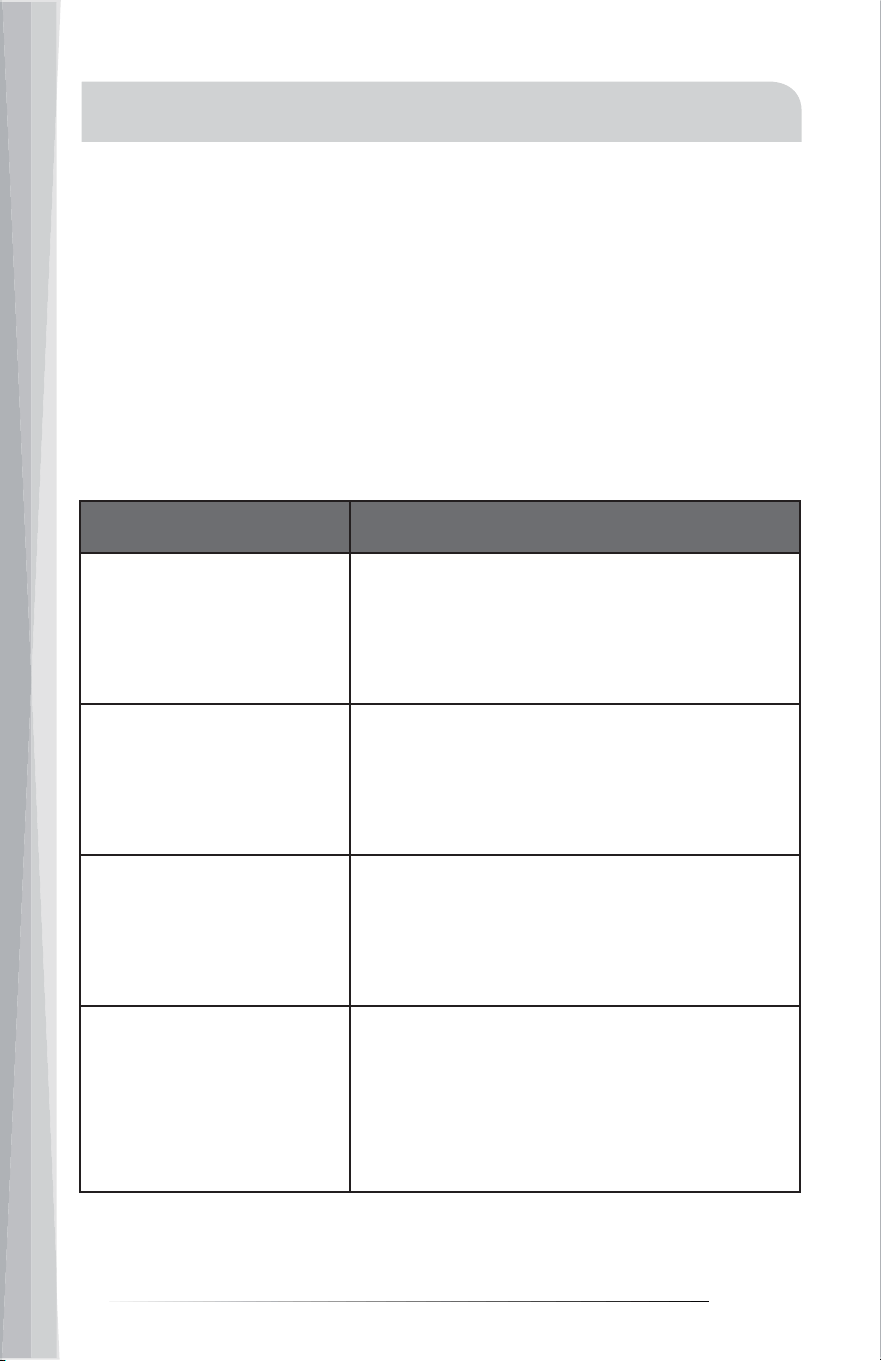
PORCELAIN-COATED GRATES AND CAPS
• Clean as soon as cooktop, grates and caps are cool.
• Food spills containing acids, such as vinegar and tomato, should be
cleaned as soon as the cooktop grates and caps are cool. These spills may
affect the finish.
• To avoid chipping, do not bang grates and caps against each other or hard
surfaces such as cast iron cookware.
• Do not reassemble caps on burners while wet.
Cleaning Method:
Nonabrasive plastic scrubbing pad and mildly abrasive cleanser.
BURNER SPREADER
Wash the burner spreader frequently with boiling water and detergent to
remove any deposits which could block the flame outlet.
Before reinstalling, dry the burner spreader thoroughly so the burner will
ignite properly.
COOKTOP CONTROL KNOBS
• Pull knobs straight away from control panel to remove.
• When replacing knobs, make sure knobs are in the Off position.
Cleaning Method:
Soap and water or dishwasher:
NOTE: Do not use steel wool, abrasive cleansers or oven cleaner. Do not soak
knobs.
CONTROL PANEL
Cleaning Method:
Glass cleaner and soft cloth or sponge: Apply glass cleaner to soft cloth or
sponge, not directly on panel.
NOTE: Do not use abrasive cleaners, steel-wool pads, gritty washcloths or
some paper towels. Damage may occur.

29
OVEN CAVITY
Food spills should be cleaned when oven cools. At high temperatures, foods
react with porcelain, so staining, etching, pitting or faint white spots can
result.
Cleaning Method:
Mild detergent and warm water.
NOTE: Do not use oven cleaners.
OVEN RACKS AND ROASTING RACKS
Cleaning Method:
Steel-wool pad
2-PIECE BROILER PAN
Cleaning Method:
Mildly abrasive cleanser: Scrub with wet scouring pad.
Solution of ½ cup (125 mL) ammonia to 1 gal. (3.75 L) water: Soak for 20
minutes, and then scrub with scouring or steel-wool pad.
Oven cleaner: Follow product label instructions. Porcelain enamel only, not
chrome Dishwasher
30
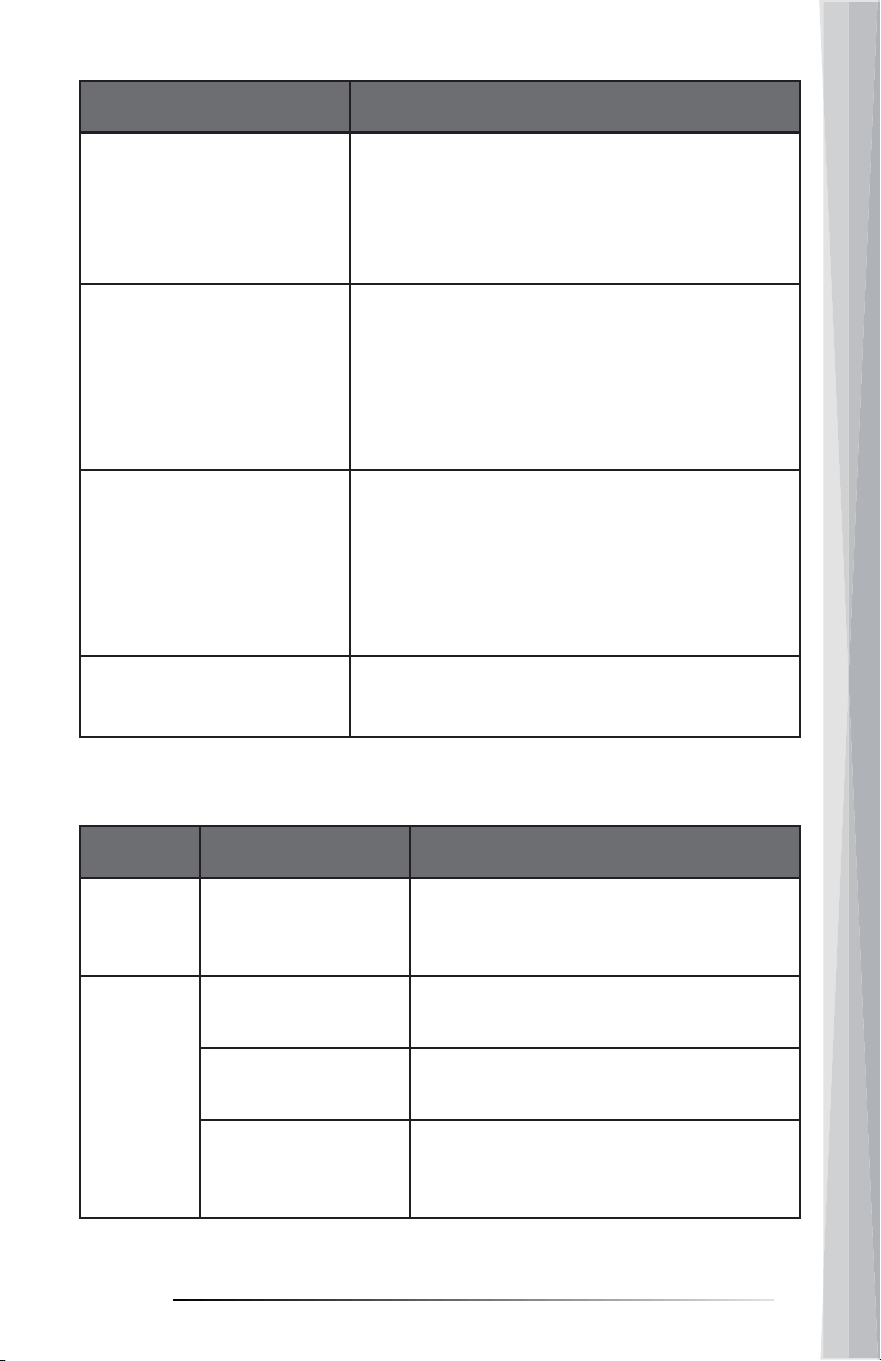
First try the solutions suggested here to possibly avoid the cost of a service
call.
BAKING PROBLEMS
With any oven setting poor results can occur for many reasons other than a
malfunction of the oven. Check the chart below for causes of the most
common problems. Since the size, shape and material of baking utensils
directly affect the baking results, the best solution may be to replace old
baking utensils that have darkened and warped with age and use.
PROBLEM CAUSE
Food browns unevenly
• Oven not preheated
• Aluminum foil on oven rack or oven bottom
• Baking utensil too large for recipe
• Pans touching each other or oven walls
Food too brown on
bottom
• Oven not preheated
• Using glass, dull or darkened metal pans
• Incorrect rack position
• Pans touching each other or oven walls
Food is dry or has shrunk
excessively
• Oven temperature too high
• Baking time too long
• Oven door opened frequently
• Pan size too large
Food is baking or roasting
too slowly
• Oven temperature too low
• Oven not preheated
• Oven door opened frequently
• Tightly sealed with aluminum foil
• Pan size too small
TROUBLESHOOTING
31
PROBLEM CAUSE
Piecrusts do not brown on
bottom or crust is soggy
• Baking time not long enough
• Using shiny steel pans
• Incorrect rack position
• Oven temperature is too low
Cakes pale, flat and may
not be done inside
• Oven temperature too low
• Incorrect baking time
• Cake tested too soon
• Oven door opened too often
• Pan size may be too large
Cakes high in middle with
crack on top
• Oven temperature too high
• Baking time too long
• Pans touching each other or oven walls
• Incorrect rack position
• Pan size too small
Piecrust edges too brown
• Oven temperature too high
• Edges of crust too thin
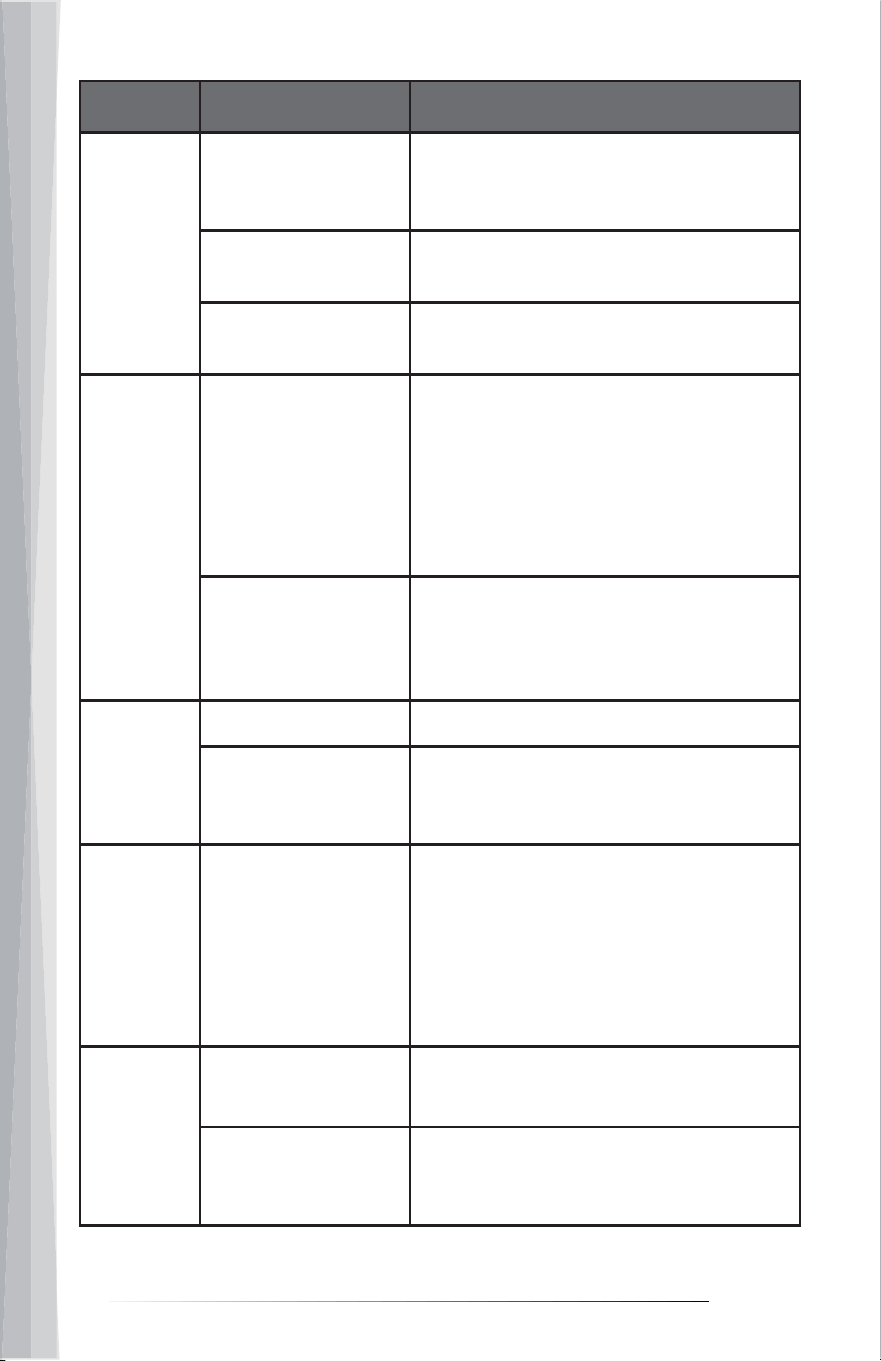
COOKTOP PROBLEMS
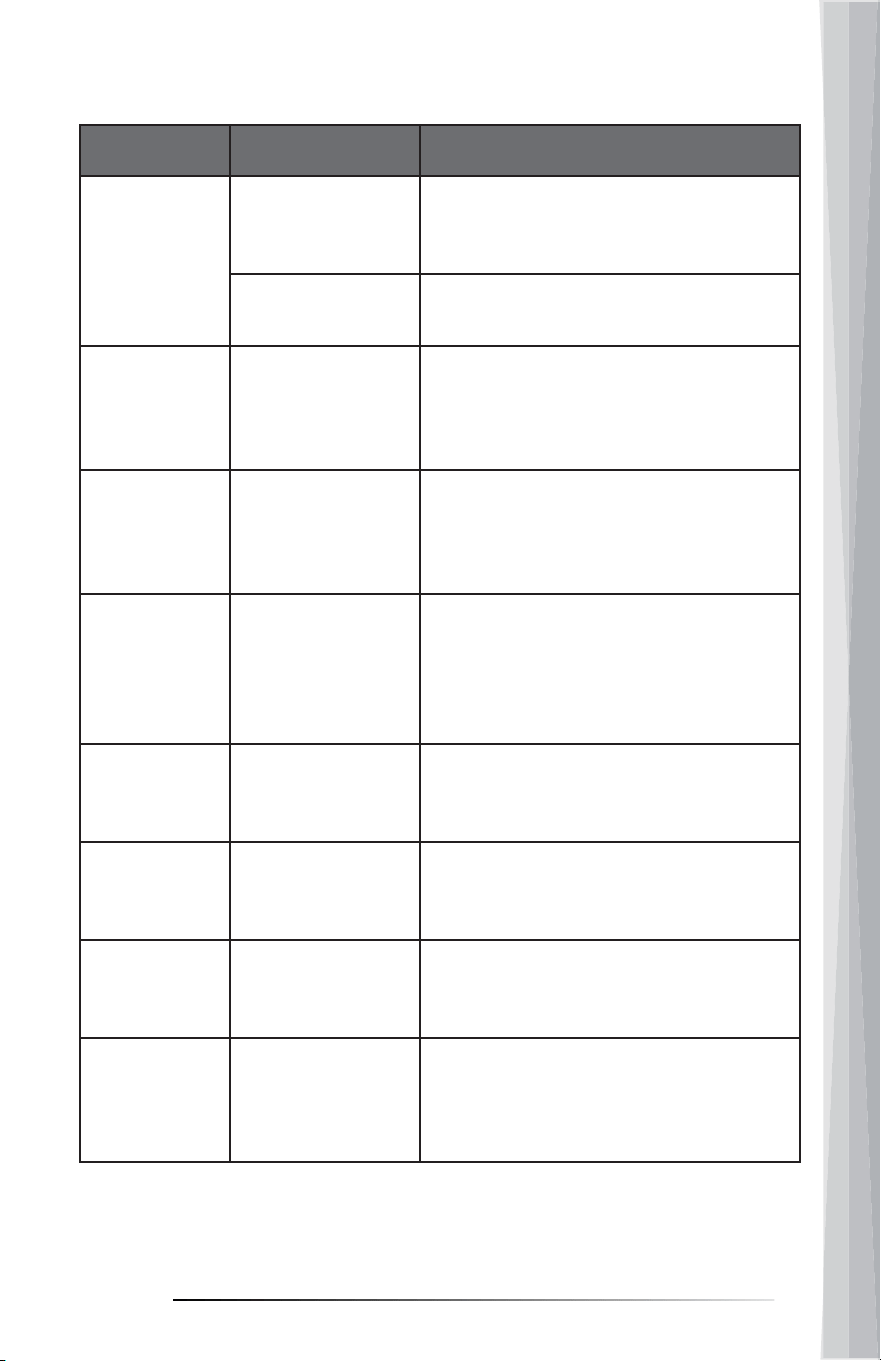
PROBLEM POSSIBLE CAUSE SOLUTION
Burner
will not
ignite
There is no power to
the range.
Check that range is properly connected
to 3- or 4-wire, 240V power supply.
Burner
will not
operate
First time use. Air
still in the gas line.
Turn on any one of the surface burner
knobs to release air from the gas lines.
Control knob is not
set correctly.
Push in knob before turning to a
setting.
The burner port is
clogged.
Clean burner port opening using a stiff,
nylon toothbrush or a straightened
paper clip.
32
PROBLEM POSSIBLE CAUSE SOLUTION
Burner
Flames
are
uneven,
yellow
and/ or
noisy
Burner port(s) are
clogged.
Clean burner port opening using a stiff,
nylon toothbrush or a straightened
paper clip.
Burner caps are not
positioned properly.
Place burner caps so that the alignment
pins are properly aligned with the slots.
Propane gas is
being used.
The range should be converted to LP
gas by a qualified technician.
Burner
flame is
too high
or too low
Cooktop gas supply
is not correct.
Ensure the range is set for the correct
gas type. It is factory set for natural
gas. If connecting to LP gas, the burners
should be converted to LP gas with the
orifice kit supplied and the pressure
regulator converted to the LP gas
setting by a qualified technician.
The gas pressure is
not correct.
Make sure the pressure regulator is
installed correctly and the gas line
pressure is correct. See Installation
Instructions.
Burner
makes
popping
noises
The burner is wet. Allow the burner to dry before using.
The burner cap or
gas spreader is not
positioned correctly.
Place burner caps so that the alignment
pins are properly aligned with the slots.
Excessive
heat
around
cookware
on
cooktop
The cookware is not
the proper size for
the burner.
Use cookware with a bottom surface
approximately the same size as the
cooking area and burner. Cookware
should not extend more than 1" (2.5 cm)
outside the cooking area. Adjust the
flame so that it does not come up
around the cookware.
Cooking
results
are not
what
expected
Using incorrect
Cookware.
See the “Cookware” section.
The control knob is
not set to the
proper heat level.
See the “Controls” section.
33
OVEN PROBLEMS
PROBLEM POSSIBLE CAUSE SOLUTION
Oven is not
heating
No power to the
range.
Check the circuit breaker or fuse box
to your house. Make sure there is
proper electrical power to the oven.
Oven control not
turned on.
Make sure the oven temperature has
been selected.
Oven is not
cooking
evenly
Not using the
correct bake ware
or oven rack
position.
Refer to cook charts for recommended
rack position. Always reduce recipe
temperature by 25 °F (15 °C) when
baking with Convention Bake mode.
Oven display
stays Off
Power
interruption.
Turn off power at the main power
supply (fuse or breaker box). Turn
breaker back on. If condition persists,
call for service.
Cooling fan
continues to
run after
oven is
turned off
The electronic
components have
not yet cooled
sufficiently.
The fan will turn off automatically
when the electronic components have
cooled sufficiently.
Oven light is
not working
properly
Light bulb loose
or burned-out.
Reinsert or replace the light bulb.
Touching the bulb with fingers may
cause the bulb to burn out.
Oven light
stays on
Door is not
closing
completely
Check for obstruction in oven door.
Check to see if hinge is bent or door
switch broken.
Cannot
remove lens
cover
Soil build-up
around the lens
cover.
Wipe lens cover area with a clean, dry
towel prior to attempting to remove
the lens cover.
Clock and
timer are not
working
properly
No power to the
range.
Check the circuit breaker or fuse box
to your house. Make sure there is
proper electrical power to the oven.
34
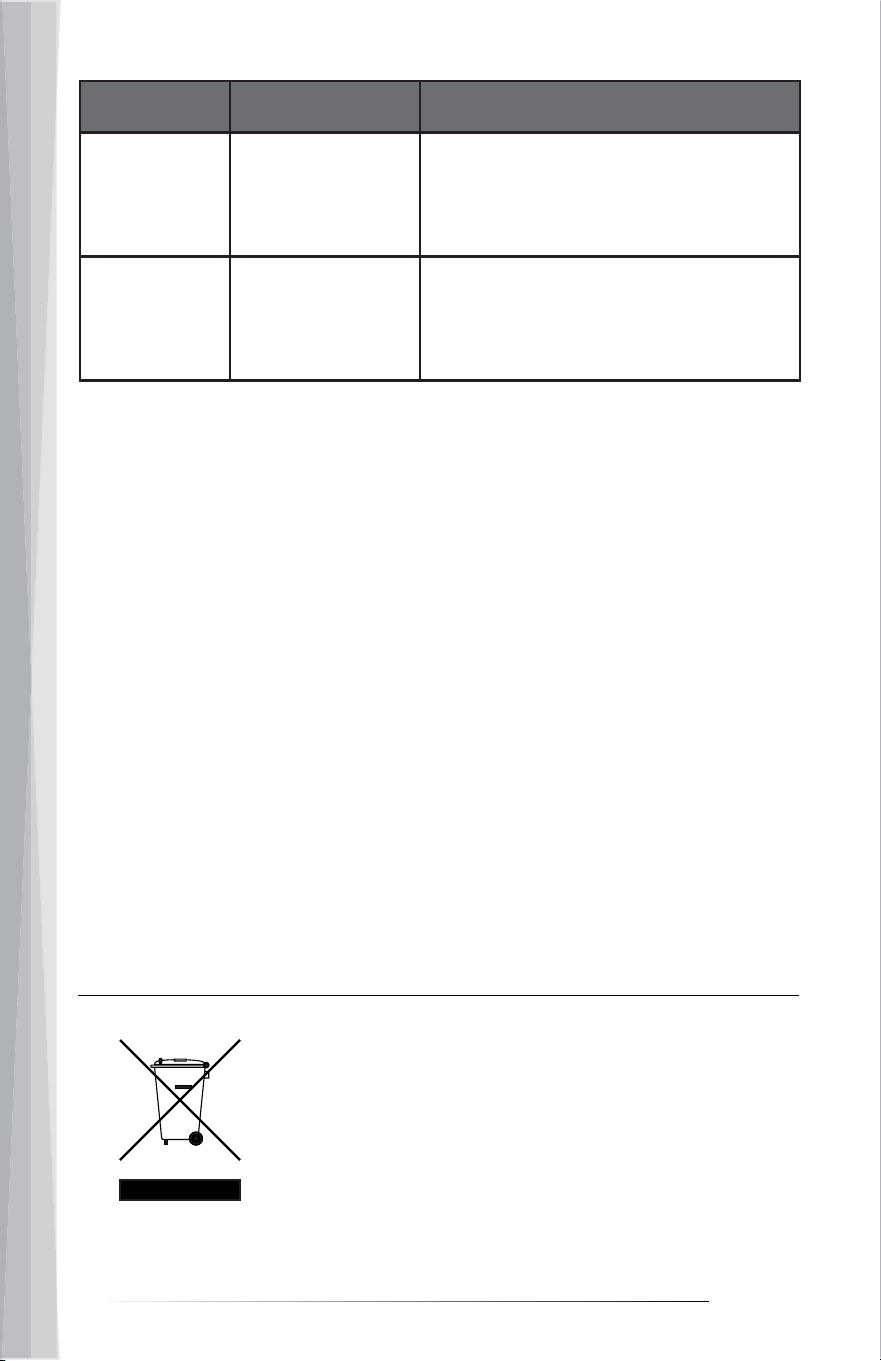
PROBLEM POSSIBLE CAUSE SOLUTION
Excessive
Moisture
When using bake mode, preheat the
oven first. Convection Bake and
Convection Roast will eliminate any
moisture in the oven.
Porcelain
Chips
Porcelain interior
is chipped by
oven racks
When removing and replacing oven
racks, always tilt racks upward and do
not force them to avoid chipping the
porcelain.
Correct Disposal of this product:
This marking indicates that this appliance should not
be disposed with other household wastes. To prevent
possible harm to the environment or human health
from uncontrolled waste disposal, recycle it responsibly
to promote the sustainable reuse of material resources.

35
LIMITED WARRANTY KOOLMORE SUPPLY, INC. warrants to the original consumer or purchaser this KOOLMORE
product is free from defects in material or workmanship for a period of One (1) year from the date of purchase. If
any such defect is discovered within the warranty period, KOOLMORE SUPPLY, INC., at its discretion, will repair
or replace the product at no cost or pay for replacement parts and repair labor to correct defects in materials or
workmanship that existed when this major appliance was purchased or that are the result of normal usage when
this major appliance is installed, operated and maintained according to instructions attached to or furnished with
the product,
At its sole discretion. Koolmore Supply Inc may determine to replace the product. In the event of product
replacement, your appliance will be warranted for the remaining term of the original unit's warranty period.
This limited warranty is good only to the original purchaser of the product and effective only when used in the
United States.
This limited warranty is effective from the date of original consumer purchase. Proof of original purchase date is
required to obtain service under this limited warranty.
YOU’RE SOLE AND EXCLUSIVE REMEDY UNDER THIS LIMITED WARRANTY SHALL BE PRODUCT REPAIR AS
PROVIDED HEREIN. Service must be provided by a Koolmore designated service company.
For warranty or repair service: Email us at [email protected] include your name, address, phone number,
warranty repair request, and a copy of your proof of purchase receipt.
You can also visit us at koolmore.com and use the contact us page.
KOOLMORE customer service will contact you and arrange prompt service for your appliance.
Thank you for choosing KOOLMORE.
THIS LIMITED WARRANTY DOES NOT APPLY TO
1.Failure of product to perform during power failures and interruptions or inadequate electrical service
2.Damage caused by transportation or handling.
3.Damage caused to the product by accident, vermin, lightnin winds, fire, floods, or acts of God.
4.Damage resulting from accident, alteration, misuse, abuse, or improper installation, repair, or maintenance.
Improper use includes using an external device that alters or converts the voltage or frequency of electricity
5.Any unauthorized product modification, repair by unauthorized repair center, or use of non-approved
replacement parts.
6.Abnormal cleaning and maintenance as described in the user's manual.
7.Use of accessories or components that are not compatible with this product.
The cost of repair or replacement under these excluded circumstances shall be borne by the consumer.
LIMITED WARRANTY
For any service-related Issues, please contact us:
Phone Number: 718-576-6342
Email address: [email protected]