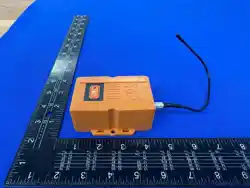

WCS Floor Call System
Product Specification
1. Product Overview
The WCS Floor Call System is a reliable, single-button wireless radio frequency (RF) signaling
device. Designed for paging and remote call applications, it broadcasts a secure digital code
to a paired receiver upon activation. Operating on a stable 315MHz frequency, this compact
system battery-powered and requires no complex wiring, making it ideal for quick
deployment in various calling scenarios.
2. Key Features
• Stable RF Transmission: Utilizes Surface Acoustic Wave (SAW) technology for highly
stable 315MHz frequency broadcasting.
• Secure Signal Encoding: Employs advanced learning code technology, providing
millions of unique address codes to prevent interference and unauthorized triggering.
• Instant Visual Feedback: Equipped with an integrated green LED indicator that
illuminates during transmission to provide immediate visual confirmation to the user.
• Wireless & Portable: Fully wireless operation powered by a standard consumer
battery.
• Plug-and-Play Simplicity: Single-button interface ensures zero learning curve for
end-users.
3. Technical Specifications
System Parameters
• Operating Frequency: 315 MHz
• Modulation Type: ASK (Amplitude Shift Keying)
• Encoding Format: Learning Code (Multi-bit serialization)
• Operation Mode: Push-to-Transmit (Simplex)
Antenna
•
•
•
•
Type: ¼λ Wire Antenna
Center Frequency: 315 MHz
Element Length: 238 mm
Gain: 2.0 dBi (typical)
Power & Electrical
• Power Supply: 9V DC
• Battery Type: Standard 9V Battery
• Standby Current: Ultra-low power consumption in idle state
• Transmission State: Active only while the button is pressed
User Interface (UI)
• Input: 1 x Tactile Push Button (Call Button)
• Visual Indicator: 1 x Emerald Green Status LED
4. Operational Guide
1. Standby Mode: The device remains in an ultra-low power standby state when not in
use to conserve battery life.
2. Triggering a Call: Press and hold the call button. The internal circuit wakes up
instantly and begins broadcasting the encoded RF signal.
3. Confirmation: The Emerald Green LED will light up simultaneously, indicating that
the transmission is active and the battery has sufficient power.
4. Completion: Release the button to stop the transmission. The LED will turn off, and
the device will immediately return to standby mode.
5. Typical Applications
•
•
•
•
Elevator/Hoist Paging: Calling systems for construction hoists or freight elevators.Hospitality & Health
care: Ward calling, service requests, or nurse call extensions.
Industrial & Logistics: Workstation material requests or supervisor paging.
General Access Control: Remote signaling for gates, doors, or alert systems.
This device complies with part 15 of the FCC Rules. Operation is subject to the following two conditions:
(1) This device may not cause harmful interference, and
(2) this device must accept any interference received, including interference that may cause undesired
operation.
Any Changes or modifications not expressly approved by the party responsible for compliance could void the
user's authority to operate the equipment.
Note: This equipment has been tested and found to comply with the limits for a Class B digital device,
pursuant to part 15 of the FCC Rules. These limits are designed to provide reasonable protection against
harmful interference in a residential installation. This equipment generates uses and can radiate radio
frequency energy and, if not installed and used in accordance with the instructions, may cause harmful
interference to radio communications. However, there is no guarantee that interference will not occur in a
particular installation. If this equipment does cause harmful interference to radio or television reception,
which can be determined by turning the equipment off and on, the user is encouraged to try to correct the
interference by one or more of the following measures:
-Reorient or relocate the receiving antenna.
-Increase the separation between the equipment and receiver.
-Connect the equipment into an outlet on a circuit different from that to which the receiver is connected.
-Consult the dealer or an experienced radio/TV technician for help.
The device has been evaluated to meet general RF exposure requirement. The device can be
used in portable exposure condition without restriction.