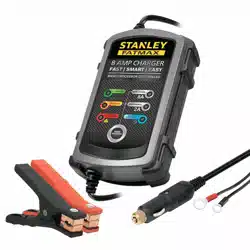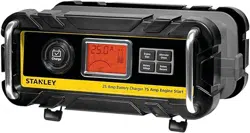
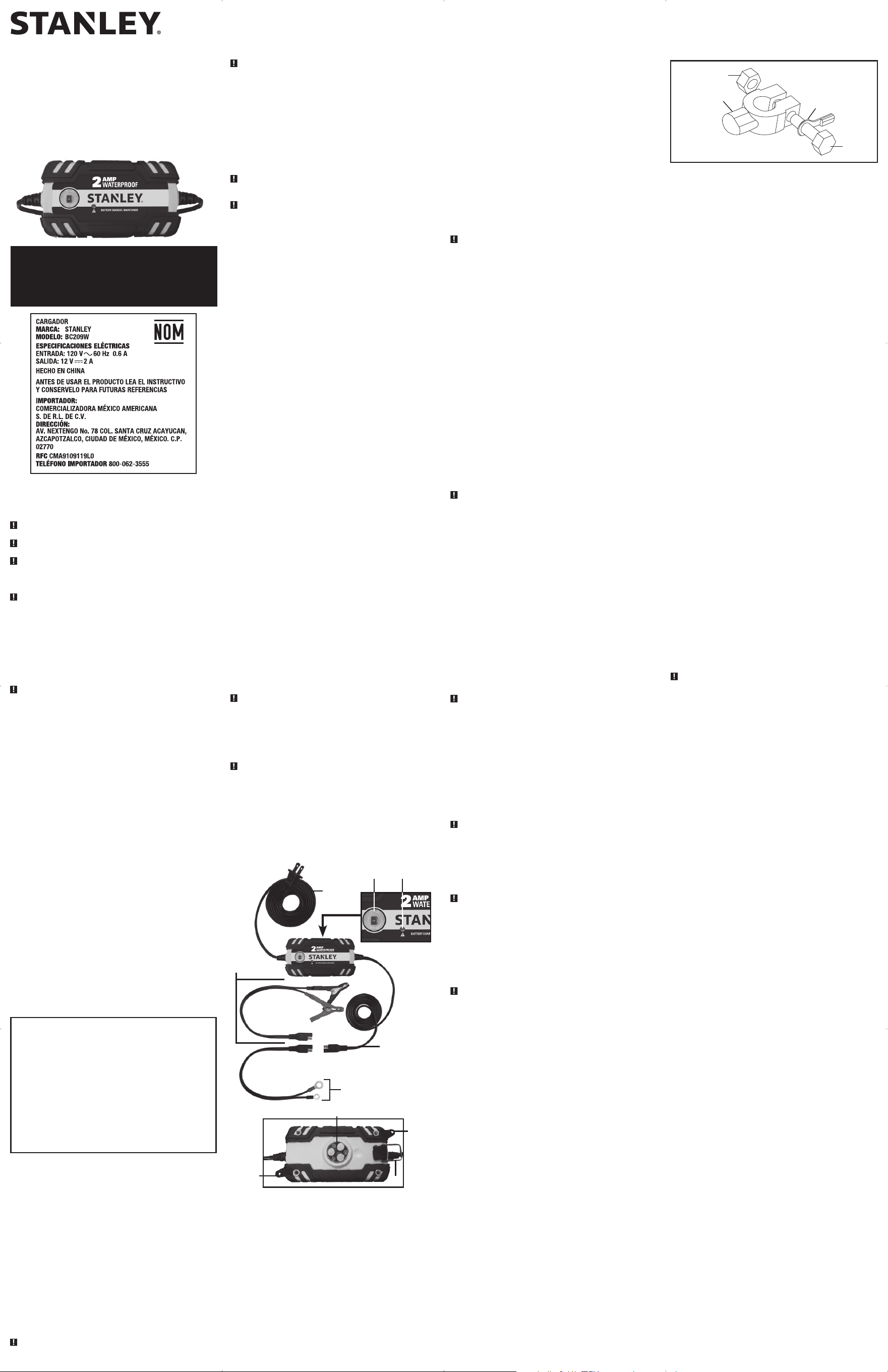
CARGADOR / MANTENEDOR
IMPERMEABLE DE 2A
MANUAL DE INSTRUCCIÓN
2A WATERPROOF
CHARGER/MAINTAINER
INSTRUCTION MANUAL
BC209W
x
CONSERVE ESTE MANUAL PARA FUTURAS CONSULTAS.
SAVE THIS INSTRUCTION MANUAL FOR FUTURE REFERENCE.
Derechos Reservados © 2023 Baccus Global LLC
Boca Raton, FL 33487 (877) 571-2391
NORMAS DE SEGURIDAD /
DEFINICIONES
PELIGRO: Indica una situación de peligro inminente que, si no se evita, provocará la
muerte o lesiones graves.
ADVERTENCIA: Indica una situación de peligro inminente que, si no se evita,
provocará la muerte o lesiones graves.
PRECAUCIÓN: Indica una situación de peligro potencial que, si no se evita, puede
resultar en lesiones menores o moderadas y / o daños a la propiedad.
PRECAUCIÓN: Utilizado sin el símbolo de alerta de seguridad indica una situación de
peligro potencial que, si no se evita, puede provocar daños a la propiedad.
RIESGO DE OPERACIÓN INSEGURA. Cuando se utilizan herramientas o equipos,
siempre se deben respetar las precauciones de seguridad para reducir el riesgo de lesiones
personales. La operación, el mantenimiento o la modificación incorrectos de herramientas
o equipos pueden provocar lesiones graves y daños a la propiedad. Las herramientas y los
equipos están diseñados para usos determinados. Fabricante recomienda encarecidamente
que NO se modifique este producto y que NO se utilice para ningún otro uso que aquél
para el que fue diseñado. Lea y comprenda todas las instrucciones operativas y las
advertencias antes de utilizar cualquier herramienta o equipo.
LEA TODAS LAS INSTRUCCIONES
ADVERTENCIA: Lea todas las instrucciones antes de operar el puente auxiliar de
arranque o compresor. El incumplimiento de todas las instrucciones enumeradas a
continuación puede provocar una descarga eléctrica, un incendio o lesiones graves.
INSTRUCCIONES IMPORTANTES DE
SEGURIDAD
ADVERTENCIAS E INSTRUCCIONES DE SEGURIDAD
GENERALES
• Mantenga a los niños alejados. Guarde lejos de niños. ¡Esto no es un juguete!
• Almacene adentro. Cuando son parados, los cargadores de batería deben ser
almacenados dentro en los lugares secos, y altos o bajo llave – fuera del alcance de
niños.
• Desenchufe el cargador de batería cuando no se está utilizando.
INSTRUCCIONES DE SEGURIDAD ESPECÍFICAS PARA LOS
CABLES ELÉCTRICOS
• No tire del cable. Nunca transporte el aparato por el cable ni lo jale para desconectarlo
del tomacorriente. Mantenga el cable alejado del calor, el aceite y los bordes afilados.
Tire del enchufe y no del cable al desconectar la unidad.
• La protección del interruptor de corte por falla a tierra (GFCI) debe aplicarse a los
circuitos o los tomacorrientes que se utilizarán. Hay tomacorrientes con protección GFCI
incorporada que pueden utilizarse para tomar esta medida de seguridad.
Cables de extensión
• Un cable de extensión no debe ser utilizada a menos que absolutamente sea necesario.
El uso de un cable de extensión incorrecta podía dar lugar a un riesgo de fuego y
descarga eléctrica. Si se utiliza un cable de extensión, cerciórese de que los pernos de la
cuerda de extensión sean el mismo número, tamaño y forma que ésos en el cargador.
• Asegúrese de que el cable de extensión esté en buenas condiciones. Cuando utilice
un cable de extensión, asegúrese de que tenga la capacidad para conducir la corriente
que su producto exige. Un cable de menor capacidad provocará una disminución en
el voltaje de la línea, lo cual producirá una pérdida de potencia y sobrecalentamiento.
La siguiente tabla muestra la medida correcta que debe utilizar según la longitud del
cable y la capacidad nominal en amperios indicada en la placa. En caso de duda, utilice
el calibre inmediatamente superior. Cuanto menor es el número de calibre, más grueso
es el cable.
Tamaño mínimo recomendado del AWG para los cables de extensión para
los cargadores de batería
Grado de la entrada de la CA Tamaño de las normas americanas
de cableado (AWG) del cable
Amperios Longitud del cable, pies (m)
Igual a o Pero menos 25 (7.6) 50 (15.2) 100 (30.5) 150 (45.6)
mayor que que
0 2 18 18 18 16
2 3 18 18 16 14
3 4 18 18 16 14
4 5 18 18 14 12
5 6 18 16 14 12
6 8 18 16 12 10
8 10 18 14 12 10
10 12 16 14 10 8
12 14 16 12 10 8
14 16 16 12 10 8
16 18 14 12 8 8
18 20 14 12 8 6
18 20 14 12 8 6
Seguridad del cable eléctrico
La unidad tiene un enchufe polarizado (una pata es más ancha que la otra) como
característica de seguridad. Este enchufe se ajustará en un tomacorriente polarizado de
una sola manera. Si el enchufe no se conecta totalmente en el tomacorriente, invierta el
enchufe. Si aún así no se conecta, comuníquese con un electricista calificado. No intente
anular esta característica de seguridad.
INSTRUCCIONES DE SEGURIDAD ESPECÍFICAS PARA
CARGADORES DE BATERÍA
• Esta unidad fue diseñada para el uso del hogar solamente.
• Uso de accesorios y dispositivos. El uso de accesorios o dispositivos no recomendados
para este aparato puede resultar peligroso.
• Manténgase alerta. Use el sentido común. No opere este equipo si está cansado o con
impedimentos.
• Compruebe si hay piezas dañadas. No utilice esta unidad si está dañada de alguna
manera.
• No opere el cargador de batería cerca de líquidos inflamables o en atmósferas gaseosas
o explosivas. Los motores pueden chispear, y las chispas pueden encender gases
inflamables.
• No opere el cargador de la batería si ha recibido un golpe brusco, se ha caído o se ha
dañado de otra manera de cualquier manera.
ADVERTENCIA – PELIGRO DE ESTALLIDO:
• No utilice la unidad para cargar las baterías secas que se usan normalmente con los
aparatos domésticos Estas baterías pueden estallar y provocar lesiones a las personas
y daños a la propiedad. Use la unidad para carga/refuerzo solamente de una batería
de PLOMO-ÁCIDO de 12 voltios. No está diseñada para proveer energía a un sistema
eléctrico de bajo voltaje que no sea para arrancar un motor.
• Nunca intente recargar pilas no recargables.
ADVERTENCIA – RIESGO DE GASES EXPLOSIVOS:
• Trabajar cerca de una batería de plomo ácido es peligroso. Las baterías generan gases
explosivos durante su funcionamiento normal. Por esta razón, es muy importante
que lea este manual siempre antes de utilizar la batería de urgencia y que siga las
instrucciones con exactitud.
• Para reducir el riesgo de explosión de la batería, siga estas instrucciones y las publicadas
por el fabricante de la batería y el fabricante de cualquier equipo que tenga la
intención de utilizar cerca de la batería. Revise las indicaciones sobre precauciones en
estos productos y en el motor.
• Este equipo emplea piezas (interruptores y relés) que producen arcos o chispas. Por lo
tanto, si utiliza la unidad en una cochera o un área cerrada, DEBE colocarla a no menos
de 46 cm (18 pulgadas) por encima del piso.
• PARA REDUCIR EL RIESGO DE LESIONES, ESTA UNIDAD SÓLO DEBE SER OPERADA POR
ADULTOS, NO FUE DISEÑADA PARA QUE LA UTILICEN LOS NIÑOS.
ADVERTENCIA – PARA REDUCIR EL RIESGO DE INCENDIO:
• No opere cerca de materiales, vapores o gases inflamables.
• No lo exponga al calor extremo o a llamas.
PRECAUCIÓN – PARA REDUCIR EL RIESGO DE LESIONES O DAÑO A LA PROPIEDAD:
• Este cargador no está diseñado para uso con cada marca, fabricación o modelo del
motor. Utilizar sólo con sistemas de 12 voltios.
• NUNCA INTENTE CARGAR UNA BATERÍA CONGELADA.
• No cargue la batería mientras el motor está en marcha.
• Manténgase alejado de las paletas de ventilador, correas, poleas y otras partes que
pueden provocar lesiones a las personas.
• Los vehículos que tienen sistemas computarizados incorporados pueden resultar dañados
si la batería del vehículo se arranca mediante puente. Antes de arrancar mediante
puente, lea el manual del cliente del vehículo para confirmar que la ayuda externa para
arrancar es adecuada.
• Nunca fume, ni permita que hayan chispas o llamas cerca de la batería del vehículo, del
motor o del conservador de energía.
• Quítese todos los artículos personales que sean de metal, como anillos, pulseras y relojes
cuando trabaje con una batería de ácido de plomo. Una batería de plomo puede
producir un cortocircuito lo suficientemente alto como para soldar un anillo o un objeto
metálico a la piel causando quemaduras graves.
• Sea extremadamente cuidadoso para evitar dejar caer una herramienta de metal sobre
la batería. Podría chispa o un cortocircuito en la batería o en otra parte eléctrica, y esto
puede provocar una explosión.
• Nunca permita que el ácido de la batería entre en contacto con esta unidad.
• No opere esta unidad en un área cerrada ni restrinja la ventilación de alguna forma.
• Apague siempre el cargador de batería desenchufándolo al no ser utilizado.
• No abra el cargador de batería: no hay piezas que el usuario pueda reparar en su
interior. Abrir el cargador de batería anulará la garantía del fabricante.
• Opere la unidad solamente como se describe en este manual de instrucciones.
• Revise el cargador de batería y sus componentes periódicamente por uso y desgaste.
INSTRUCCIONES DE SEGURIDAD ESPECÍFICAS PARA
UTILIZAR LA UNIDAD EN AMBIENTES MOJADOS
La cubierta de esta unidad está clasificada hasta los estándares IP67 como prueba de
polvo y resistente al agua. Sin embargo, se recomienda que usted observe los siguientes:
• Nunca sumerja la unidad en agua más allá de 1 metro, por tiempo superior a 30
minutos y / o temperaturas diferentes a entre 41 º F y 104 º F (5 º C y 40 º C), o la unidad
podría sufrir daños permanentes.
• Nunca sumerja la unidad en agua a menos que el buje (aislamiento) de cable de CA
está intacto.
• Nunca permita que las pinzas se expongan a los elementos durante largos períodos de
tiempo, y nunca sumerja.
PRIMEROS AUXILIOS
Cuando se trabaja con baterías de ácido de plomo, siempre asegúrese de que alguien es
suficientemente cerca como para proporcionar asistencia inmediata en caso de accidente
o emergencia.
Utilice siempre protección para los ojos al emplear este producto; el contacto con el ácido
de la batería puede producir ceguera o quemaduras graves. Conozca los procedimientos
de primeros auxilios para el caso de contacto accidental con el ácido de la batería.
Mantenga cerca suficiente agua fresca y jabón en caso que el ácido de la batería entre
en contacto con la piel.
Si el ácido de la batería entra en contacto con la piel o la ropa, enjuáguese
inmediatamente con agua y jabón durante por lo menos 10 minutos. Busque asistencia
médica de inmediato.
•
PIEL: Si el ácido de la batería entra en contacto con la piel, enjuáguese inmediatamente
con agua, luego lávese con agua y jabón. Si se presenta enrojecimiento, dolor o
irritación, busque asistencia médica de inmediato.
•
OJOS: Si el ácido de la batería entra en contacto con los ojos, lávese los ojos
inmediatamente durante 15 minutos como mínimo y busque asistencia médica de
inmediato.
ADVERTENCIA – PARA REDUCIR EL RIESGO DE LESIONES: Siga estas instrucciones y
ésas publicadas por el fabricante de cualquier motor que usted se preponga utilizar con
este cargador de batería. Repase las marcas preventivas en el cargador y el motor de
batería.
• Lea y comprenda este manual de instrucciones antes de utilizar esta unidad.
CONSERVE ESTAS INSTRUCCIONES
ADVERTENCIA – PARA REDUCIR EL RIESGO DE LESIONES:
Siga estas instrucciones y las publicadas por el fabricante de la batería y el fabricante
de cualquier equipo que tenga la intención de utilizar con esta unidad. Revise las
indicaciones sobre precauciones en estos productos y en el motor.
INTRODUCCIÓN
Felicitaciones por adquirir su nuevo Stanley
®
cargador / mantenedor de batería
impermeable de 2 Amp. Lea el manual de instrucción y siga las instrucciones
cuidadosamente antes de utilizar su cargador de batería.
CARACTERÍSTICAS
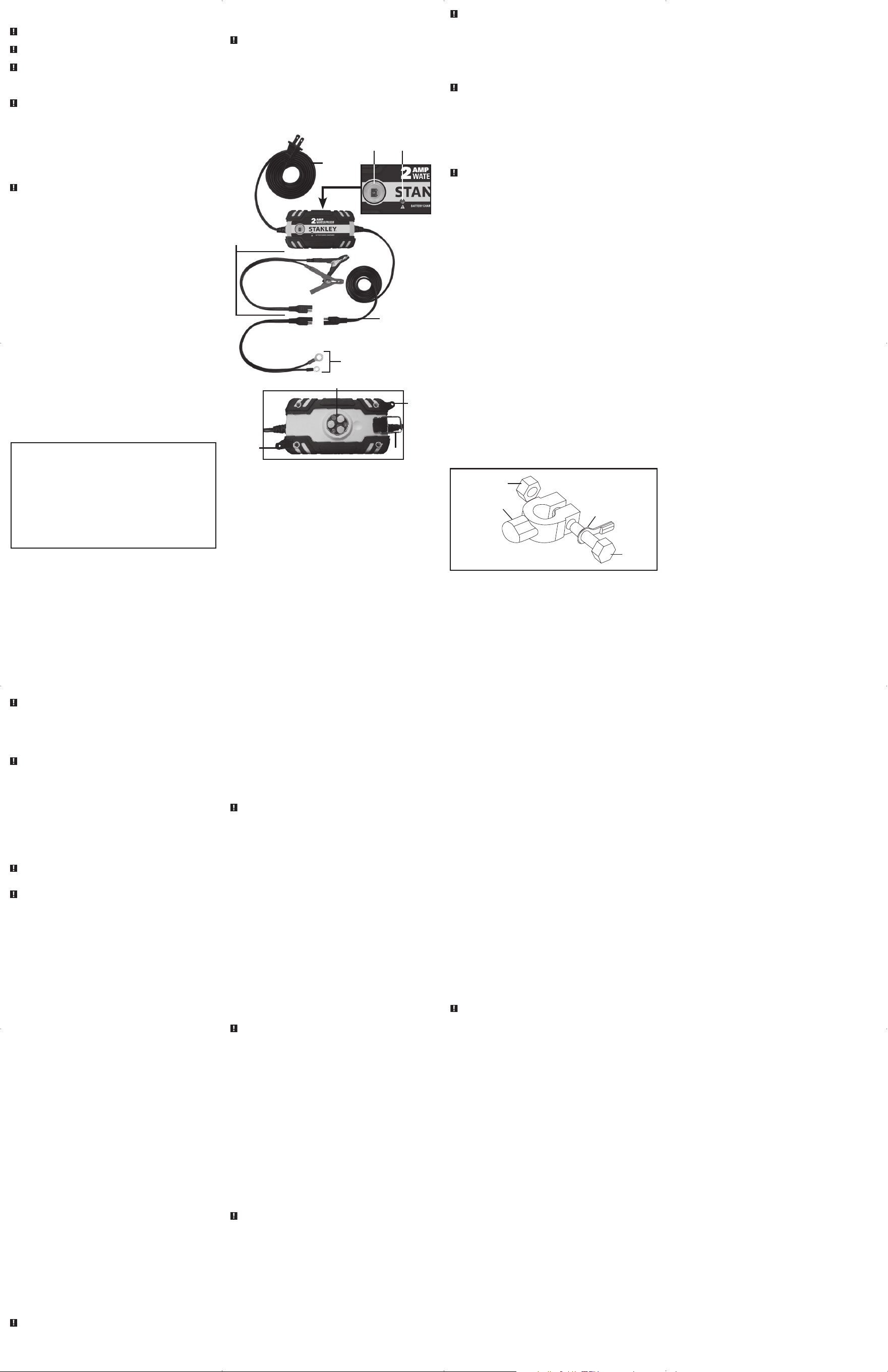
8
9
10
7
1
32
4
5
6
1. Cuerda de la CA
2. Indicador LED de carga / cargado
3. Indicador LED de polaridad reversa
4. Pinzas de batería
5. Conectador doble del cargador
del barril (conecta con los anillos
terminales o las pinzas)
6. Terminales de juntas tóricas del batería
7. Discos magnéticos (expuesto al detalle
de la demostración)
8. Soporte de montaje
9. Soporte de montaje
10. Gancho colgante
PREPARACIÓN PARA CARGAR
1. Asegure que el área alrededor de la batería es bien ventilada mientras la batería se
esta cargando.
2. Retire la batería totalmente del barco o del aeronave o cualquier espacio cerrado
antes de cargar.
3. Si es necesario retirar la batería del vehículo para cargarla, o para limpiar los
terminales, retire siempre primero de la batería el terminal puesto a tierra.
Asegúrese de que todos los accesorios del vehículo estén apagados, para no causar
un arco eléctrico.
4. Limpie las terminales de la batería, tenga cuidado y evite material corrosivo en los
ojos.
5. Agregue agua destilada en cada celda hasta que el ácido de la batería alcance el
nivel especifico en el manual del fabricante. Esto ayuda a purgar el exceso de gas de
las celdas. No llene en exceso. Para una batería sin tapas de celda (que no requiere
mantenimiento), siga cuidadosamente las instrucciones de carga del fabricante.
6. Estudie todas las precauciones específicas del fabricante de la batería, tales como
si retirar o no las tapas de las celdas mientras se carga, y la velocidad de carga
recomendada.
7. Compruebe el voltaje de la batería que se cargará refiriendo al manual del vehículo.
Esta unidad es para cargar una batería de 12 voltios solamente.
Ubicación del cargador
• Ubique el cargador tan lejos de la batería como lo permitan los cables.
• Nunca ubique el cargador directamente sobre la batería que se está cargando; los gases
de la batería producirán corrosión y daños al cargador.
• No coloque una batería sobre el cargador.
• Nunca permita que el ácido de la batería gotee sobre el cargador.
• Cargue a una temperatura ambiente de 40 ºC (104 ºF).
• Nunca opere el cargador en un área cerrada ni restrinja la ventilación de manera
alguna.
• Las baterías marinas se pueden retirar y cargar en tierra.
Precauciones con la conexión
• Nunca permita que las pinzas o juntas tóricas se toquen entre sí.
• Conecte las pinzas de la batería y el chasis, tal como se indica en la sección
correspondiente (“Cargando una batería instalada en un vehículo” o “Cargando una
batería que ha sido retirado de un vehículo”).
Cargando una batería instalada en un vehículo
ADVERTENCIA: Una chispa cerca de la batería puede causar una explosión. Para
reducir riesgo de una chispa cerca de la batería:
1. Mantenga los cables de CA y CC alejados del capó, la puerta y las partes moviles
del motor.
2. Manténgase alejado de las paletas del ventilador, correas, poleas y otras partes que
pueden provocar lesiones a las personas.
3. Controle la polaridad de los bornes de la batería. El borne positivo (POS, P, +) de la
batería generalmente tiene mayor diámetro que el borne negativo (NEG, N, –).
4. Determine qué borne de la batería está puesto a tierra (conectado) al bastidor. Si
el borne negativo está puesto a tierra en el bastidor (como en la mayoría de los
vehículos), vea 5. Si el borne positivo está puesto a tierra en el bastidor, vea 6.
5. Para un vehículo con tierra negativa, conecte la pinza del positiva (ROJA) del
cargador de batería al borne sin conexión a tierra positivo (POS, P, +) de la batería.
Conecte la pinza del negativa (NEGRA) al bastidor del vehículo o al bloque del
motor, lejos de la batería. No conecte la pinza al carburador, las cañerías de
combustible o a las partes de chapa de la carrocería. Conecte a una pieza de metal
sólida del bastidor o del bloque del motor.
6. Para un vehículo con tierra positivo, conecte la pinza del negativa (NEGRA) del
cargador de batería al borne sin conexión a tierra negativo (NEG, N, –) de la batería.
Conecte la pinza del positiva (ROJA) al bastidor del vehículo o al bloque del motor,
lejos de la batería. No conecte la pinza al carburador, las cañerías de combustible o a
las partes de chapa de la carrocería. Conecte a una pieza de metal sólida del bastidor
o del bloque del motor.
7. Vea las instrucciones de operación para obtener información sobre la duración de
la carga.
Cuando desconecte el cargador, desconecte el cable de CA, retire la pinza del bastidor del
vehículo, y luego retire la pinza del terminal de la batería.
Cargando una batería que ha sido retirado de un
vehículo
ADVERTENCIA: Una chispa cerca de la batería puede causar una explosión. Para
reducir riesgo de una chispa cerca de la batería:
1. Verifique la polaridad de los bornes de la batería. El borne positivo (marcado POS, P,
+) generalmente tiene mayor diámetro que el borne negativo de la batería (marcado
NEG, N, –).
2. Conecte un cable de 60 cm (24 pulgada, longitud mínima) Nº 6 AWG aislado, para
batería al borne negativo de la batería (marcado NEG, N, –).
3. Conecte la pinza positiva (ROJA) de la batería al borne positivo de la batería
(marcado POS, P, + o ROJA).
4. Conecte cuidadosamente la pinza negativa (NEGRA) del cargador al extremo libre
del cable de la batería conectado al terminal negativo.
5. Párese tan lejos de la batería como sea posible, y no se acerque a la batería hasta
que haya hecho la conexión final.
Nota:
Una batería marina (de bote) se debe retirar y cargar en tierra. Cargarla a bordo exige equipos
diseñados especialmente para uso marino. Esta unidad NO está diseñada para tal uso.
Cuando desconecta el cargador, hágalo siempre en la secuencia inversa del procedimiento
de conexión y romper la primera conexión estando tan lejos de la batería como resulte
posible.
INSTALACIÓN DE LA UNIDAD
Montaje del cargador de batería
Este cargador de batería está diseñada para que pueda ser montado sobre una superficie
plana. La unidad dispone de dos soportes de montaje en las esquinas de la unidad.
PRECAUCIÓN – PARA REDUCIR EL RIESGO DE DAÑO A LA PROPIEDAD:
• Asegúrese de que todas las instrucciones de instalación y funcionamiento y precauciones
de seguridad son entendidos y cuidadosamente seguidos por cualquier persona
montaje o mediante el cargador de la batería. Siga los pasos indicados en la sección
“Instrucciones de seguridad” de este manual.
• Siempre desconecte el cargador desde la fuente de alimentación CA y el borne de la
batería antes de montar la unidad.
• Cuando el cargador de la batería está montada, no cuelgue nada adicional al cargador
de la batería o un riesgo de rotura puede ocurrir.
1. Coloque la unidad como se desee sobre una superficie de pared plana cerca de una
tomacorriente CA en funcionamiento. Asegúrese de que la superficie sea plana y
libre de obstrucciones para que la unidad se siente a ras con la superficie.
2. Utilice un tornillo de madera de 8/32 pulgadas (6.35 mm) a través de cada uno de
los soportes de montaje para montar la unidad. No apriete en exceso, ya que esto
puede dañar el caso.
ADVERTENCIA: No ponga el tornillo a través de la carcasa de plástico de la unidad
ya que esto dañará permanentemente la unidad y causará un potencial peligro eléctrico.
Para montar la unidad usando los discos magnéticos:
Los discos magnéticos en la parte inferior de la unidad permiten que usted coloque el
cargador de batería en superficie metálica plana, segura.
Usando el gancho colgante:
El gancho colgante se puede también utilizar para colocar convenientemente la unidad.
PRECAUCIÓN – PARA REDUCIR EL RIESGO DE DAÑO A LA PROPIEDAD:
• Cuando el cargador es colgado por el gancho colgante o atado usando las discos
magnética, no sacuda el cargador o no se oponga que está colgando de o atado a. No
cuelgue el cargador de ni ate el cargador a ninguna alambres eléctrica o cualquier cosa
que no es seguro.
• Utilice solamente los discos colgantes del gancho o del imán para colgar o colocar el
cargador. El gancho colgante y los discos magnéticos no se piensan para apoyar el peso
adicional. No ate o colgar cualquier cosa adicional al cargador o al riesgo de fractura
puede ocurrir. .
INSTRUCCIONES DE OPERACIÓN
ADVERTENCIA – PARA REDUCIR EL RIESGO DE LESIONES O DAÑO A LA
PROPIEDAD:
• Desconecte siempre el enchufe de la CA del enchufe de la CA primero antes de
desconectar el cargador de la batería que se cargará.
• Asegúrese de que toda la instalación, instrucciones de funcionamiento y precauciones de
seguridad son comprendidos y respetados; a continuación, siga los pasos descritos en la
sección correspondiente (“la carga de una batería instalada en un vehículo” o “Cargar
una batería que ha sido extraída de un vehículo”).
Encargar la batería de las pinzas de la batería
Los conductores de salida del cargador tienen pinzas de batería codificadas por color
(Rojo: positivo y Negro: negativo).
1. Asegúrese de que el cargador de batería esté desenchufado de cualquier fuente de
alimentación y no esté conectado a una batería.
2. Conecte el conectador barril doble de las pinzas de batería con el conector del
cargador de barril doble de la unidad (conector macho al conector hembra y el
conector hembra al conector macho).
3. Conecte las pinzas de la batería a la batería y coloque la unidad lo más lejos de
la batería como sea posible, siguiendo las instrucciones apropiadas en la sección
“Preparación para la carga” de este manual.
4. Inserte el enchufe de CA del mantenedor de la batería en un tomacorriente estándar
(alimentado) de 120 voltios 60Hz de Norteamérica. El indicador LED de carga /
cargado parpadeará en verde para indicar que la unidad está en modo de carga.
Notas:
Si las pinzas están conectadas incorrectamente con respecto a polaridad, el LED de conexión
invertida se encenderá. Desenchufe el cargador; entonces quite las abrazaderas. Vuelva a
conectar las abrazaderas correctamente.
Si el indicador LED de carga / cargado no se ilumina, compruebe la conexión con la batería y
la toma de CA. Si las pinzas están conectados correctamente a la batería y una toma de CA
en funcionamiento, puede que la batería tenga algún defecto. Fabricante sugiere de tener la
batería probada por un técnico cualificado de la batería.
5. Cuando el indicador LED de carga / cargado se ilumina constantemente en verde, el
proceso de carga se ha completado.
Cuando desconecte el cargador de batería, desconecte el cable de CA, retire la pinza del
bastidor del vehículo, y luego retire la pinza de los terminale de la batería.
Conectando y encargando con los terminales de anillo
CONEXIÓN DEL CARGADOR CON LOS ANILLOS TERMINALES
Los terminales de anillo rizadas del cargador están codificados por colores (rojo:
positivo y negro: negativo). Estos anillos se conectan directamente con los conectores
correspondientes en los bornes de la batería.
TUERCA
PERNO
ANILLOS PARA
TERMINALES
CONECTOR
1. Retire las tuercas de los pernos de los conectores de los bornes de la batería.
2. Ubique el terminal ROJO sobre el perno del conector del borne POSITIVO de la
batería.
3. Ubique el terminal NEGRO sobre el conector del borne NEGATIVO; luego vuelva a
colocar las tuercas.
IMPORTANTE: Si hay algún problema al conectar los conductores de salida, verifique con
un proveedor de repuestos automotores o comuníquese con el Departamento de Servicio
al Cliente, a la línea gratuita 1-877-571-2391 para obtener ayuda para encontrar el
dispositivo de conexión apropiado para su aplicación particular.
CARGANDO CON LOS ANILLOS TERMINALES
1. Asegúrese de que el cargador de batería esté desenchufado de cualquier fuente de
alimentación y no esté conectado a una batería.
2. Con los anillos terminales correctamente conectados a los bornes de la batería,
conecte el conector de anillo terminal con el conector del cargador de barril doble
de la unidad (conector macho al conector hembra y el conector hembra al conector
macho) y posicionarlo lo más lejos posible de la batería.
3. Inserte el enchufe de CA del mantenedor de la batería en un tomacorriente estándar
(alimentado) de 120 voltios 60Hz de Norteamérica. El indicador LED de carga /
cargado parpadeará en verde para indicar que la unidad está en modo de carga.
Notas:
Si los terminales del anillo están conectadas incorrectamente con respecto a polaridad, el LED de
conexión inversa se encenderá. Desenchufe el cargador; entonces quite los terminales del anillo.
Vuelva a conectar lalos terminales del anillo correctamente.
Si el indicador LED de carga / cargado no se ilumina, compruebe la conexión con la batería y la
toma de CA. Si los terminales del anillo están están conectados correctamente a la batería y una
toma de CA en funcionamiento, puede que la batería tenga algún defecto. Fabricante sugiere
de tener la batería probada por un técnico cualificado de la batería.
4. Cuando el indicador LED de carga / cargado se ilumina constantemente en verde, el
proceso de carga se ha completado.
Cuando desconecte el cargador de batería, desconecte el cable de CA, y luego retire los
anillos terminales de los terminales de la batería.
CUIDADO Y MANTENIMIENTO
Limpieza y almacenamiento
Para reducir el riesgo de descarga eléctrica, desenchufe el cargador de batería de la toma
antes de realizar cualquier tarea de mantenimiento o limpieza. Apagando los controles
no reducirá este riesgo.
• Almacene la unidad en un lugar limpio, seco, fresco cuando no esté en uso.
• Limpie la cubierta y las cuerdas de la unidad (cuanto sea necesario) con un paño seco.
Asegúrese de que la unidad sea totalmente desconectada de la batería y de la fuente de
energía antes de limpiar.
• Para mantener la condición de funcionamiento y maximizar la vida de los cables del
cargador, arróllelas siempre libremente para el almacenaje. No las envuelva alrededor de
la unidad ni prénselas con una venda apretada.
DETECCIÓN DE PROBLEMAS
La unidad no carga
• Controle que el cargador/dispositivo automático para mantenimiento de la batería esté
conectado correctamente a un tomacorriente de 120 voltios CA que funcione.
• Confirme que las conexiones de salida estén seguras.
• Revise que la polaridad de las conexiones esté correcta.
• Si la batería que se debe cargando o recibir mantenimiento ha caído debajo de los 2
voltios, no se puede recargar con esta unidad.
• Si el dispositivo de mantenimiento no detecta voltaje de la batería, la unidad no
funcionará.
ACCESORIOS
Accesorios recomendados para uso con esta unidad puede ser disponibles a través del
fabricante. Si necesita ayuda con respecto a los accesorios, por favor póngase en contacto
con el fabricante al 1-877-571-2391.
ADVERTENCIA: El uso de cualquier accesorio no recomendado para el uso con esta
unidad podía ser peligroso.
ASISTENCIA TÉCNICA
Para servicio al cliente o asistencia técnica, comuníquese con el fabricante al 1-877-571-
2391.
GARANTÍA LIMITADA DEL FABRICANTE DE UN AÑO
El fabricante, Baccus Global LLC, ofrece garantía por este producto contra defectos de
materiales y de mano de obra por un período de UN (1) AÑO a partir de la fecha de
compra minorista por parte del comprador que sea el usuario final original o desde la
fecha de entrega del bien, cualquiera que sea la fecha que ocurra más tarde (“Período
de Garantía”).
Cuando haya un defecto y el fabricante reciba un reclamo válido dentro del Período
de Garantía, el producto defectuoso se podrá reemplazar de las siguientes maneras: (1)
Devolviendo el producto al fabricante para reemplazarlo. Es posible que el fabricante
solicite un comprobante de compra. (2) Devolviendo el producto al minorista donde se
compró para un cambio (siempre que la tienda sea una tienda minorista participante). Las
devoluciones al minorista deben realizarse dentro del período de tiempo de la política de
devolución del minorista para cambios únicamente. Es posible que se requiera prueba de
compra. Consulte con el minorista su política de devolución específica con respecto a las
devoluciones que superan el tiempo establecido para los cambios.
Esta garantía del fabricante no se aplicará a accesorios, bombillas, fusibles y baterías;
a defectos resultantes del desgaste normal, a accidentes; a daños sufridos durante el
envío; a alteraciones; a uso no autorizado; a negligencia, al mal uso, al abuso; y al
incumplimiento de las instrucciones de cuidado y mantenimiento del producto.
Esta garantía del fabricante le otorga a usted, el comprador minorista original, derechos
legales específicos y usted puede tener otros derechos que pueden variar de un estado a
otro o de una provincia a otra. Este producto no está diseñado para uso comercial. Para
registrar su producto con el fabricante, visite www.BaccusGlobal.com.
Las fotos de este manual pueden diferir de la unidad real.
ESPECIFICACIONES
Entrada: 120V CA, 60Hz, 0.6A
Salida: 12V CC, 2A
Importados por Baccus Global LLC,
Baccus Global LLC, 621 NW 53rd St., Suite 450, Boca Raton, FL 33487
www.Baccusglobal.com 1-877-571-2391
RD092023
SAFETY GUIDELINES / DEFINITIONS
DANGER: Indicates an imminently hazardous situation which, if not avoided, will
result in death or serious injury.
WARNING: Indicates a potentially hazardous situation which, if not avoided, could
result in death or serious injury.
CAUTION: Indicates a potentially hazardous situation which, if not avoided, may
result in minor or moderate injury and/or property damage.
CAUTION: Used without the safety alert symbol indicates potentially hazardous situation
which, if not avoided, may result in property damage.
RISK OF UNSAFE OPERATION. When using tools or equipment, basic safety
precautions should always be followed to reduce the risk of personal injury. Improper
operation, maintenance or modification of tools or equipment could result in serious
injury and property damage. There are certain applications for which tools and
equipment are designed. Manufacturer strongly recommends that this product NOT be
modified and/or used for any application other than for which it was designed. Read and
understand all warnings and operating instructions before using any tool or equipment.
READ ALL INSTRUCTIONS
WARNING: Read all instructions before operating the battery charger. Failure to
follow all instructions listed below may result in electric shock, fire and/or serious injury.
IMPORTANT SAFETY INSTRUCTIONS
GENERAL SAFETY WARNINGS AND INSTRUCTIONS
• Keep children away. Keep away from children. This is not a toy!
• Store indoors. When not in use, battery chargers should be stored indoors in dry, and
high or locked-up places – out of reach of children.
• Unplug the battery charger when not in use.
SPECIFIC SAFETY INSTRUCTIONS FOR POWER CORDS
• Don’t abuse cord. Never carry appliance by cord or yank it to disconnect from
receptacle. Keep cord from heat, oil, and sharp edges. Pull by plug rather than cord
when unplugging the unit.
• Ground Fault Circuit Interrupter (GFCI) protection should be provided on the circuits or
outlets to be used. Receptacles are available having built in GFCI protection and may be
used for this measure of safety.
Extension cords
• An extension cord should not be used unless absolutely necessary. Use of improper
extension cord could result in a risk of fire and electric shock. If an extension cord is
used, make sure that the pins of the extension cord are the same number, size and
shape as those in the charger.
• Make sure your extension cord is in good condition. When using an extension
cord, be sure to use one heavy enough to carry the current your product will draw.
An undersized cord will cause a drop in line voltage resulting in loss of power and
overheating. The following table shows the correct size to use depending on cord
length and nameplate ampere rating. If in doubt, use the next heavier gauge. The
smaller the gauge number, the heavier the cord.
Recommended Minimum AWG Size for Extension Cords for Battery Chargers
AC Input Rating American Wire Gage (AWG) Size of Cord
Amperes Length of Cord, feet (m)
Equal to or But less
25 (7.6) 50 (15.2) 100 (30.5) 150 (45.6)
greater than than
0 2 18 18 18 16
2 3 18 18 16 14
3 4 18 18 16 14
4 5 18 18 14 12
5 6 18 16 14 12
6 8 18 16 12 10
8 10 18 14 12 10
10 12 16 14 10 8
12 14 16 12 10 8
14 16 16 12 10 8
16 18 14 12 8 8
18 20 14 12 8 6
Power Cord Safety
The unit has a polarized plug (one blade is wider than the other) as a safety feature.
This plug will fit into a polarized outlet only one way. If the plug does not fit fully into
the outlet, reverse the plug. If it still does not fit, contact a qualified electrician. Do not
attempt to defeat this safety feature.
SPECIFIC SAFETY INSTRUCTIONS FOR BATTERY CHARGERS
• This unit was designed for household use only.
• Use of accessories and attachments: The use of any accessory or attachment not
recommended by manufacturer for use with this battery charger could be hazardous.
• Stay alert. Use common sense. Do not operate this equipment when you are tired or
impaired.
• Check for damaged parts. Do not use this unit if damaged in any way.
• Do not operate the battery charger near flammable liquids or in gaseous or explosive
atmospheres. Motors may spark, and the sparks might ignite fumes.
• Do not operate the battery charger if it has received a sharp blow, been dropped, or
has been otherwise damaged in any way.
WARNING – BURST HAZARD:
• Do not use the unit for charging dry-cell batteries that are commonly used with home
appliances. These batteries may burst and cause injury to persons and damage property.
Use the unit for charging/boosting a 12 volt LEAD-ACID battery only. It is not intended
to supply power to a low-voltage electrical system other than in a starter-motor
application.
• Never attempt to charge non-rechargeable batteries.
WARNING – RISK OF EXPLOSIVE GASES:
• Working in the vicinity of a lead acid battery is dangerous. Batteries generate explosive
gases during normal battery operation. For this reason, it is of the utmost importance
that each time before using the battery charger you read this manual and follow
instructions exactly.
• To reduce the risk of battery explosion, follow these instructions and those published
by the battery manufacturer and manufacturer of any equipment you intend to use
in the vicinity of the battery. Review cautionary markings on these products and on
the engine.
• This equipment employs parts (switches, relays, etc.) that produce arcs or sparks.
Therefore, if used in a garage or enclosed area, the unit MUST be placed not less than
18 inches above the floor.
• THIS UNIT IS NOT FOR USE BY CHILDREN AND SHOULD ONLY BE OPERATED BY ADULTS.
WARNING – TO REDUCE THE RISK OF FIRE:
• Do not operate near flammable materials, fumes or gases.
• Do not expose to extreme heat or flames.
CAUTION – TO REDUCE THE RISK OF INJURY OR PROPERTY DAMAGE:
• This charger is not designed for use with every make, manufacturer or model of engine.
Use only with 12 volt systems.
• NEVER ATTEMPT CHARGE A FROZEN BATTERY.
• Do not charge the battery while the engine is operating.
• Stay clear of fan blades, belts, pulleys, and other parts that can cause injury to persons.
• Vehicles that have on-board computerized systems may be damaged if vehicle battery
is jump-started. Before jump-starting, read the vehicle’s owner’s manual to confirm that
external-starting assistance is suitable.
• Never smoke or allow a spark or flame in vicinity of vehicle battery, engine or battery
maintainer.
• Remove personal metal items such as rings, bracelets, necklaces and watches when
working with a lead acid battery. A lead acid battery can produce a short circuit current
high enough to weld a ring, or similar metal object, to skin causing a severe burn.
• Be extra cautious to avoid dropping a metal tool onto the battery. It might spark or
short-circuit the battery or another electrical part, and that may cause an explosion.
• Never allow battery acid to come in contact with this unit.
• Do not operate this unit in a closed area or restrict ventilation in any way.
• Always turn the battery charger off by unplugging it when not in use.
• Do not open the battery charger — there are no user-serviceable parts inside. Opening
the battery charger will void manufacturer’s warranty.
• Operate battery charger only as described in this Instruction Manual.
• Check battery charger and components periodically for wear and tear.
SPECIFIC SAFETY INSTRUCTIONS FOR USING THE UNIT IN
WET ENVIRONMENTS
The housing of this unit is rated to IP67 dust-proof and waterproof standards. However,
it is recommended that you observe the following:
• Never submerge the unit in water deeper than 1 meter, for time longer than 30 minutes
and/or in temperatures other than between 41ºF and 104ºF (5ºC and 40ºC), or the unit
could sustain permanent damage.
• Never submerge the unit in water unless the bushing (insulation) of the AC cord is
intact.
• Do not allow the clamps to be exposed to the elements for long periods of time; and
never submerge them.
FIRST AID
When working with lead acid batteries, always make sure someone is close enough to
provide immediate assistance in case of accident or emergency.
Always have protective eyewear when using this product: contact with battery acid may
cause blindness and/or severe burns. Be aware of first aid procedures in case of accidental
contact with battery acid.
Have plenty of fresh water and soap nearby in case battery acid contacts skin.
If battery acid contacts skin or clothing, wash immediately with soap and water for at
least 10 minutes and get medical attention immediately.
•
SKIN: If battery acid comes in contact with skin, rinse immediately with water, then
wash thoroughly with soap and water. If redness, pain, or irritation occurs, seek
immediate medical attention.
•
EYES: If battery acid comes in contact with eyes, flush eyes immediately, for a minimum
of 15 minutes and seek immediate medical attention.
WARNING – TO REDUCE THE RISK OF INJURY OR PROPERTY DAMAGE: Follow these
instructions and those published by the manufacturer of any engine you intend to use
with this battery charger. Review cautionary markings on the battery charger and engine.
• Please read and understand this instruction manual before using this unit.
SAVE THESE INSTRUCTIONS
WARNING – TO REDUCE THE RISK OF INJURY:
Follow these instructions as well as those published by the battery manufacturer and the
manufacturer of any equipment you intend to use with this unit. Review all precautionary
statements on these products and on the engine.
INTRODUCTION
Congratulations on purchasing your new Stanley
®
2 Amp Waterproof Battery Charger/
Maintainer
. Read this Instruction Manual and follow the instructions carefully before
using your new battery charger.
FEATURES
8
9
10
7
1
32
4
5
6
1. AC Power Cord
2. Charging / Charged LED
3. Reverse Polarity LED
4. Battery Clamps
5. Double Barrel Charger Connector
(connects to terminal rings or clamps)
6. Battery Terminal Rings
7. Magnetic Discs (exposed to show
detail)
8. Mounting Bracket
9. Mounting Bracket
10. Hanging Hook
PREPARING TO CHARGE
1. Be sure area around battery is well ventilated while battery is being charged.
2. Remove battery completely from boat/airplane or any confined area before charging.
3. If it is necessary to remove battery from vehicle to charge, or to clean terminals,
always remove grounded terminal from battery first. Make sure all accessories in the
vehicle are off, so as not to cause an arc.
4. Clean battery terminals, taking care to avoid getting corrosive material in eyes.
5. Add distilled water in each cell until battery acid reaches level specified by battery
manufacturer. This helps purge excessive gas from cells. Do not overfill. For a battery
without cell caps (maintenance free), carefully follow manufacturer’s charging
instructions.
6. Study all battery manufacturer’s specific precautions, such as removing or not
removing cell caps while charging, and recommended rates of charge.
7. Determine voltage of battery to be charged by referring to the vehicle manual. The
unit is for charging a 12 volt battery only.
Charger Location
• Locate charger as far away from battery as cables permit.
• Never place charger directly above battery being charged; gases from battery will
corrode and damage charger.
• Do not set a battery on top of charger.
• Never allow battery acid to drip on charger.
• Charge above freezing temperature and below 40°C (104°F).
• Never operate charger in a closed-in area or restrict ventilation in any way.
• Marine batteries must be removed and charged on shore.
Connection Precautions
• Never allow clamps or ring terminals to touch each other.
• Attach clamps to battery and chassis as indicated in the appropriate section (“Charging
a battery installed in a vehicle” or “Charging a battery that has been removed from a
vehicle”).
Charging a battery installed in a vehicle
WARNING: A SPARK NEAR THE BATTERY MAY CAUSE AN EXPLOSION. TO REDUCE
RISK OF A SPARK NEAR THE BATTERY:
1. Position AC and clamp cords to reduce risk of damage by hood, door, or moving
engine part.
2. Stay clear of fan blades, belts, pulleys, and other parts that can cause injury to
persons.
3. Check polarity of battery posts. positive (POS, P, +) battery post usually has larger
diameter than negative (NEG, N, –) post.
4. Determine which post of the battery is grounded (connected) to the chassis. If the
negative post is grounded to chassis (as in most vehicles), see 5. If the positive post is
grounded to the chassis, see 6.
5. For negative-grounded vehicle, connect the positive (RED) clamp from battery
charger to the positive (POS, P, +) ungrounded post of the battery. Connect the
negative (BLACK) clamp to the vehicle chassis or engine block away from the battery.
Do not connect the clip to the carburetor, fuel lines, or sheet-metal body parts.
Connect to heavy gauge metal part of the frame or engine block.
6. For positive-grounded vehicle, connect the negative (BLACK) clamp from the battery
charger to the negative (NEG, N, –) ungrounded post of the battery. Connect the
positive (RED) clamp to the vehicle chassis or engine block away from battery. Do not
connect the clip to the carburetor, fuel lines or sheet-metal body parts. Connect to a
heavy gauge metal part of the frame or engine block.
7. See operating instructions for length of charge information.
When disconnecting charger, disconnect AC cord, remove the clip from the vehicle chassis,
and then remove the clip from the battery terminal.
Charging a battery that has been removed from a vehicle
WARNING – A spark near the battery may cause an explosion. To reduce risk of a
spark near the battery:
1. Check polarity of battery posts. The positive post (marked POS,P, +) usually has a
larger diameter than the negative battery post (marked NEG, N, –).
2. Attach a 24-inch (minimum length) AWG #6 insulated battery cable to the negative
battery post (marked NEG, N, –).
3. Connect the positive (RED) battery clamp to the positive battery post (marked POS,
P, + or RED).
4. Stand as far back from the battery as possible, and do not face the battery when
making final connection.
5. Carefully connect the negative (BLACK) charger clamp to the free end of the battery
cable connected to the negative terminal.
Note:
A marine (boat) battery must be removed and charged on shore. To charge it on board requires
equipment specifically designed for marine use. This unit is NOT designed for such use.
When disconnecting the charger, always do so in reverse sequence of connecting
procedure and break first connection while as far away from battery as practical.
SETTING UP THE UNIT
Mounting the Battery Charger
This battery charger is designed so that it can be mounted on a flat surface. The unit has
two mounting backets at the corners of the unit.
CAUTION – TO REDUCE THE RISK OF PRODUCT DAMAGE:
• Ensure that all installation and operating instructions and safety precautions are
understood and carefully followed by anyone mounting or using the battery charger.
Follow the steps outlined in the “Important Safety Instructions” section of this manual.
• Always disconnect the charger at AC power source and at battery terminal before
mounting the unit.
• When the battery charger is mounted, do not hang anything additional on the battery
charger or risk of breakage may occur.
1. Position the unit as desired on a flat wall surface near a functioning AC outlet. Make
sure the surface is flat and free of obstruction so the unit rests flush with the surface.
2. Use an 8/32-inch (6.35mm) wood screw through each of the mounting brackets to
mount the unit. Do not over-tighten as this will damage the housing.
WARNING: Do not put the screw through the plastic housing of the unit as this will
permanently damage the unit and cause a potential electrical hazard.
To mount the unit Using the Magnetic Discs:
The magnetic discs in the bottom of the unit allow you to position the battery charger on
any flat, secure metallic surface.
Using the Hanging Hook:
The hanging hook can also be used to conveniently position the unit.
CAUTION – TO REDUCE THE RISK OF PRODUCT DAMAGE:
• When the charger is hung by the hanging hook or attached using the magnetic discs,
do not shake the charger or object that it is hanging from or attached to. Do not hang
the charger from or attach the charger to any electrical wires or anything that it is not
secure.
• Only use the hanging hook or magnet discs for hanging or positioning the charger. The
hanging hook and magnetic discs are not intended to support additional weight. Do
not attach or hang anything additional to the charger or risk of breakage may occur.
OPERATING INSTRUCTIONS
WARNING – TO REDUCE THE RISK OF INJURY OR PROPERTY DAMAGE:
• Always disconnect the AC plug from the AC outlet first before disconnecting the charger
from the battery to be charged.
• Ensure that all installation, operating instructions and safety precautions are understood
and observed; then follow the steps outlined in the appropriate section (“Charging a
battery installed in a vehicle” or “Charging a battery that has been removed from a
vehicle”).
Charging Using the Supplied Battery Clips
The charger’s output leads have color-coded battery clamps (RED–POSITIVE and BLACK–
NEGATIVE).
1. Make sure the battery charger is unplugged from any power source and is not
connected to a battery.
2. Insert the double barrel tip of the battery clamp cable into the unit’s Double Barrel
Charger Connector (male-to-female and female-to-male).
3. Connect the battery clamps to the battery and position the unit as far away from
the battery as possible, following the appropriate directions in the “Preparing to
Charge” Section at the front of this manual.
4. Insert the AC plug of the battery charger into a (powered) standard North American
120 volt 60Hz outlet. The Charging/Charged LED will flash green to indicate the unit
is in charging mode.
Notes:
If the clamps are incorrectly connected with regard to polarity, the Reverse Connection LED will
light. Unplug the charger; then remove the clamps. Reconnect the clamps properly.
If the Charging/Charged LED did not come on, check the connection to the battery and the
AC outlet. If the clamps are properly connected to the battery and a functional AC outlet,
the battery may be in fault condition. Manufacturer suggests to have the battery tested by a
qualified battery service technician.
5. When the Charging/Charged LED lights solid, the charging process is complete.
When disconnecting the battery charger, first unplug the AC cord, remove the clamp from
the vehicle chassis, and then remove the clamp from the battery terminal.
Connecting and Charging with the Terminal Rings
CONNECTING THE CHARGER WITH TERMINAL RINGS
The charger’s output leads have crimped, color-coded terminal rings (RED-POSITIVE and
BLACK-NEGATIVE). These rings connect directly to the corresponding connectors on the
battery posts.
NUT
BOLT
TERMINAL RING
CONNECTOR
1. Remove the nuts from the bolts of the battery post’s connectors.
2. Position the RED terminal on the bolt of the POSITIVE battery post connector.
3. Position the BLACK terminal on the NEGATIVE post connector; then replace the nuts.
IMPORTANT: If there is any problem connecting the output leads, check with a reputable
autosupply store or contact the Customer Service Department toll-free at 1-877-571-2391
for assistance in finding an appropriate connection device for your particular application.
CHARGING WITH THE TERMINAL RINGS
1. Make sure the battery charger is unplugged from any power source and is not
connected to a battery.
2. With the Terminals Rings properly connected to the battery posts, connect the
Terminal Ring connector with the unit’s Double Barrel Charger Connector (male-to-
female and female-to-male) and position it as far away from the battery as possible.
3. Insert the AC plug of the battery charger into a (powered) standard North American
120 volt 60Hz outlet. The Charging/Charged LED will flash green to indicate the unit
is charging mode.
Notes:
If the Terminal Rings are incorrectly connected with regard to polarity, the reverse polarity LED
will light. Disconnect the charger, disconnect the Terminal Rings, then reconnect them properly.
If the Charging/Charged LED did not come on, check the connection to the battery posts
and the AC outlet. If the Terminal Rings are properly connected to the battery posts and a
functional AC outlet, the battery may be in fault condition. Manufacturer suggests to have the
battery tested by a qualified battery service technician.
4. When the Charging/Charged LED lights solid, the charging process is complete.
When disconnecting charger, disconnect AC cord, and then remove the Terminals Rings
from the battery posts.
CARE AND MAINTENANCE
Cleaning and Storage
To reduce the risk of electric shock, unplug the battery charger from the outlet before
attempting any maintenance or cleaning. Turning off the controls will not reduce this risk.
• Store the unit in a clean, dry, cool place when not in use.
• Clean the unit casing and cords (as necessary) with a dry cloth. Ensure that unit is
completely disconnected from battery and power source before cleaning.
• To maintain the operating condition and maximize the life of the charger cords, always
coil them loosely for storage. Do not wrap them around the unit or crimp them with
a tight band.
TROUBLESHOOTING
Unit not charging
• Check that the battery charger/maintainer is properly connected to a live 120 volt AC
outlet.
• Make sure all connections are secure.
• Check the connections for correct polarity.
• If the battery to be charged or maintained has fallen below 2 volts, the battery cannot
be recharged with this unit.
• If the maintainer does not detect battery voltage, the unit will not operate.
ACCESSORIES
Recommended accessories for use with this unit may be available from the manufacturer.
If you need assistance regarding accessories, please contact manufacturer at 1-877-571-
2391.
WARNING: The use of any accessory not recommended for use with this appliance
could be hazardous.
TECHNICAL ASSISTANCE
For Customer Service or Technical Assistance, contact the manufacturer at 1-877-571-2391.
ONE-YEAR LIMITED MANUFACTURER’S WARRANTY
The manufacturer, Baccus Global LLC, warrants this product against defects in materials
and workmanship for a period of ONE (1) YEAR commencing from the date of retail
purchase by the original end-user purchaser or from the date of delivery of the good,
whichever occurs later (“Warranty Period”).
If there is a defect and a valid claim is received by the manufacturer within the Warranty
Period, the defective product can be replaced in the following ways: (1) Return the
product to the manufacturer for replacement. Proof of purchase may be required by
manufacturer. (2) Return the product to the retailer where product was purchased for an
exchange (provided that the store is a participating retailer). Returns to retailer should
be made within the time period of the retailer’s return policy for exchanges only. Proof
of purchase may be required. Please check with the retailer for their specific return policy
regarding returns that are beyond the time set for exchanges.
This manufacturer’s warranty does not apply to accessories, bulbs, fuses and batteries;
defects resulting from normal wear and tear, accidents; damages sustained during
shipping; alterations; unauthorized use; neglect, misuse, abuse; and failure to follow
instructions for care and maintenance for the product.
This manufacturer’s warranty gives you, the original retail purchaser, specific legal rights
and you may have other rights which vary from state to state or province to province.
This product is not intended for commercial use. To register your product with the
manufacturer, please visit www.BaccusGlobal.com.
The photos in this manual may differ from the actual unit.
SPECIFICATIONS
Input: 120V AC, 60Hz, 0.6A
Output: 12V DC, 2A
Imported by Baccus Global LLC,
Baccus Global LLC, 621 NW 53rd St., Suite 450, Boca Raton, FL 33487
www.Baccusglobal.com 1-877-571-2391
RD092023