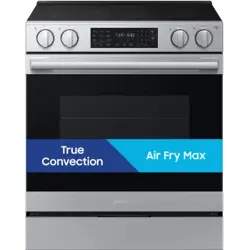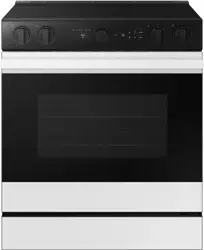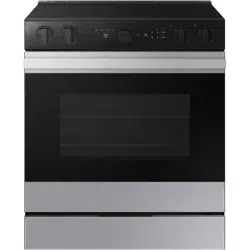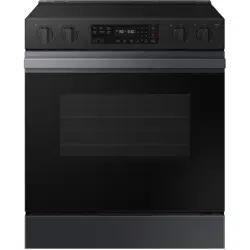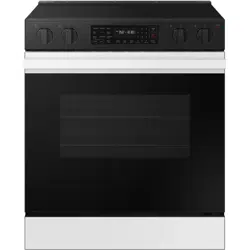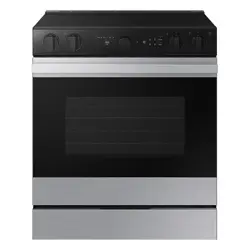
Electric Range
User manual
NSE6D
*
85
******
2 English
WARNING
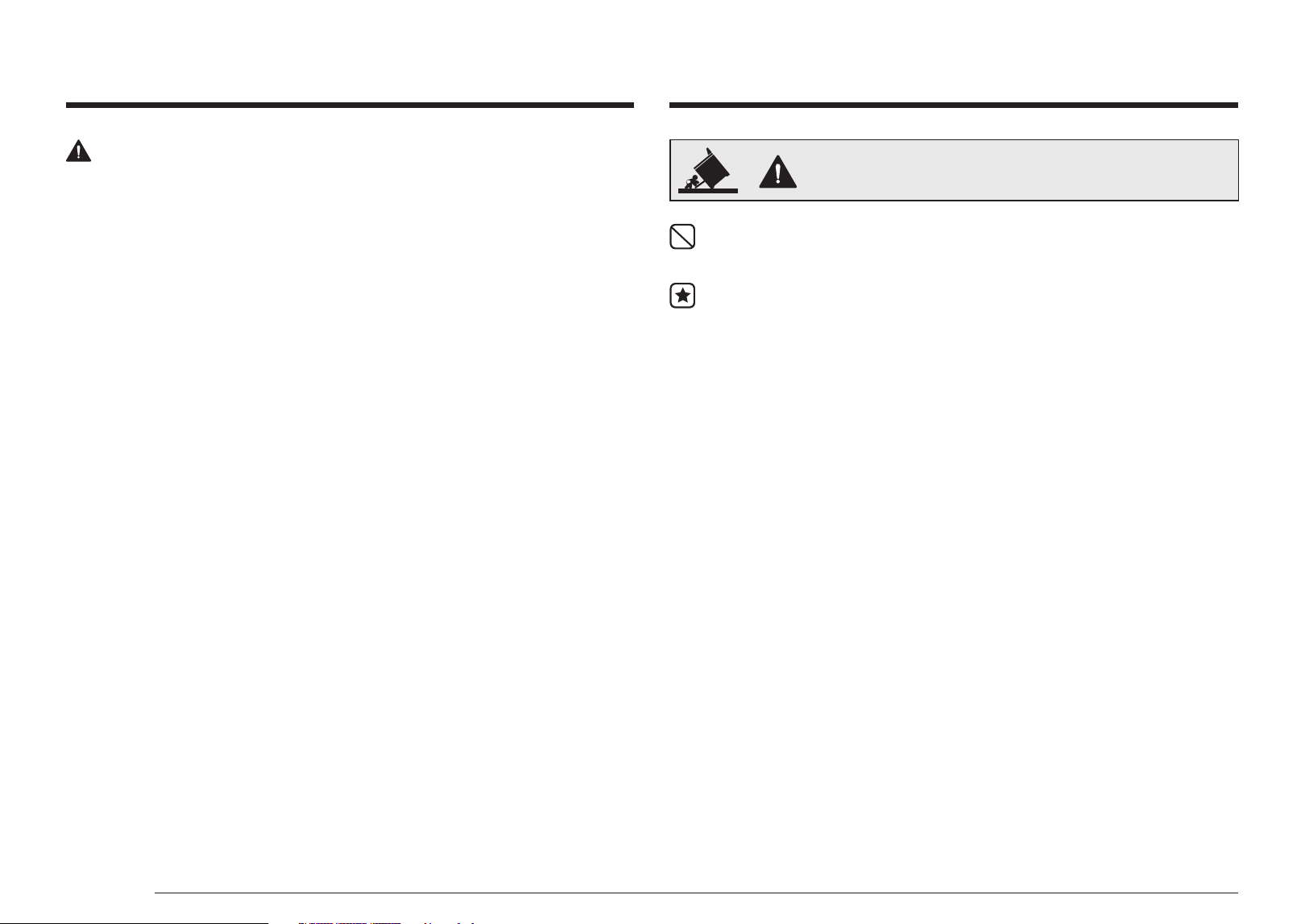
To reduce the risk of tipping the range, the range must be secured
by a properly installed Anti-Tip device. AFTER THE RANGE HAS
BEEN INSTALLED, CONFIRM THAT THE ANTI-TIP DEVICE HAS BEEN
PROPERLY INSTALLED AND VERIFY THAT THE ANTI-TIP DEVICE IS
PROPERLY ENGAGED. Refer to the installation manual for instructions.
a) If the Anti-Tip device is not installed, a child or adult can tip the
range and be killed.
b) Verify that the Anti-Tip device has been properly installed and
engaged at the rear right (or rear left) of the range bottom.
c) If you move the range and then move it back into place, ensure
the Anti-Tip device is re-engaged at the right or left rear of the
range bottom.
d) Do not operate the range without the Anti-Tip device in place and
engaged.
e) Failure to do so can result in death or serious burns to children or
adults.
WARNING
Do not step, lean, or sit on the doors of the range. You can cause the
range to tip, resulting in burns or serious injuries.
Conrm that the Anti-Tip device is installed properly. Then, to verify
that the Anti-Tip device is engaged, grasp the top rear edge of the
range and carefully attempt to tilt it forward. The Anti-Tip device
should prevent the range from tilting forward more than a few inches.
If you pull the range out from the wall for any reason, make sure the
Anti-Tip device is properly engaged when you push the range back
against the wall. If it is not, there is a risk of the range tipping over
and causing injury if you or a child stand, sit, or lean on the open door.
Never completely remove the leveling legs. If you remove the leveling
legs, the range will not be secured to the Anti-Tip device properly.
Anti-tip device

English 3
Contents
Important safety instructions 4
What you need to know about safety instructions 4
For your safety 5
Surface Cooking Units 7
Electrical Safety 8
Child safety 9
Oven 9
Remote Operation 10
Self-cleaning ovens 10
Ventilating hood 11
Glass/Ceramic cooking surfaces 11
Critical installation warnings 12
Critical usage warning 13
Usage cautions 15
Critical cleaning warnings 17
California Proposition 65 Warning 18
Introducing your new range 19
Overview 19
What’s included with your range 19
Before you begin 20
Energy saving tips 20
Surface cooking 20
About surface cooking 20
How to set the appliance for surface cooking 22
Using the proper cookware 24
Choosing the proper cookware 25
Protecting the cooktop 25
Operating the oven 26
The oven control panel 26
How to use dial knob 26
Display mode 27
Contents
Clock 27
Oven cooking 28
Cooking mode 28
Using the oven racks 29
Recipe guide 31
Cooking options 40
Smart control 41
Voice control 42
Special features 43
Settings 44
Maintaining your appliance 47
Self-cleaning 47
Steam-cleaning 49
Care and cleaning of the oven 50
Care and cleaning of the glass cooktop 52
Removing and reinstalling the oven door 54
Removing and reinstalling the storage drawer 55
Changing the oven light 56
Troubleshooting and information code 56
Troubleshooting 56
Information codes 61
Warranty (U.S.A) 62
Warranty (CANADA) 64
Appendix 65
Open Source Announcement 65
4 English
Important safety instructions
SAVE THESE INSTRUCTIONS
Read and follow all instructions before using your range to prevent
the risk of re, electric shock, personal injury, or damage when using
the range. This guide does not cover all possible conditions that may
occur. Always contact your service agent or the manufacturer about
problems that you do not understand.
WHAT YOU NEED TO KNOW ABOUT
SAFETY INSTRUCTIONS
Warnings and Important safety instructions in this manual do not
cover all possible conditions and situations that may occur. It is
your responsibility to use common sense, caution, and care when
installing, maintaining, and operating your oven.
Important safety symbols and precautions
What the icons and signs in this user manual mean:
WARNING
Hazards or unsafe practices that may result in severe personal injury
or death.
CAUTION
Hazards or unsafe practices that may result in minor personal injury
or property damage.
CAUTION
To reduce the risk of re, explosion, electric shock, or personal injury
when using your range, follow these basic safety precautions.
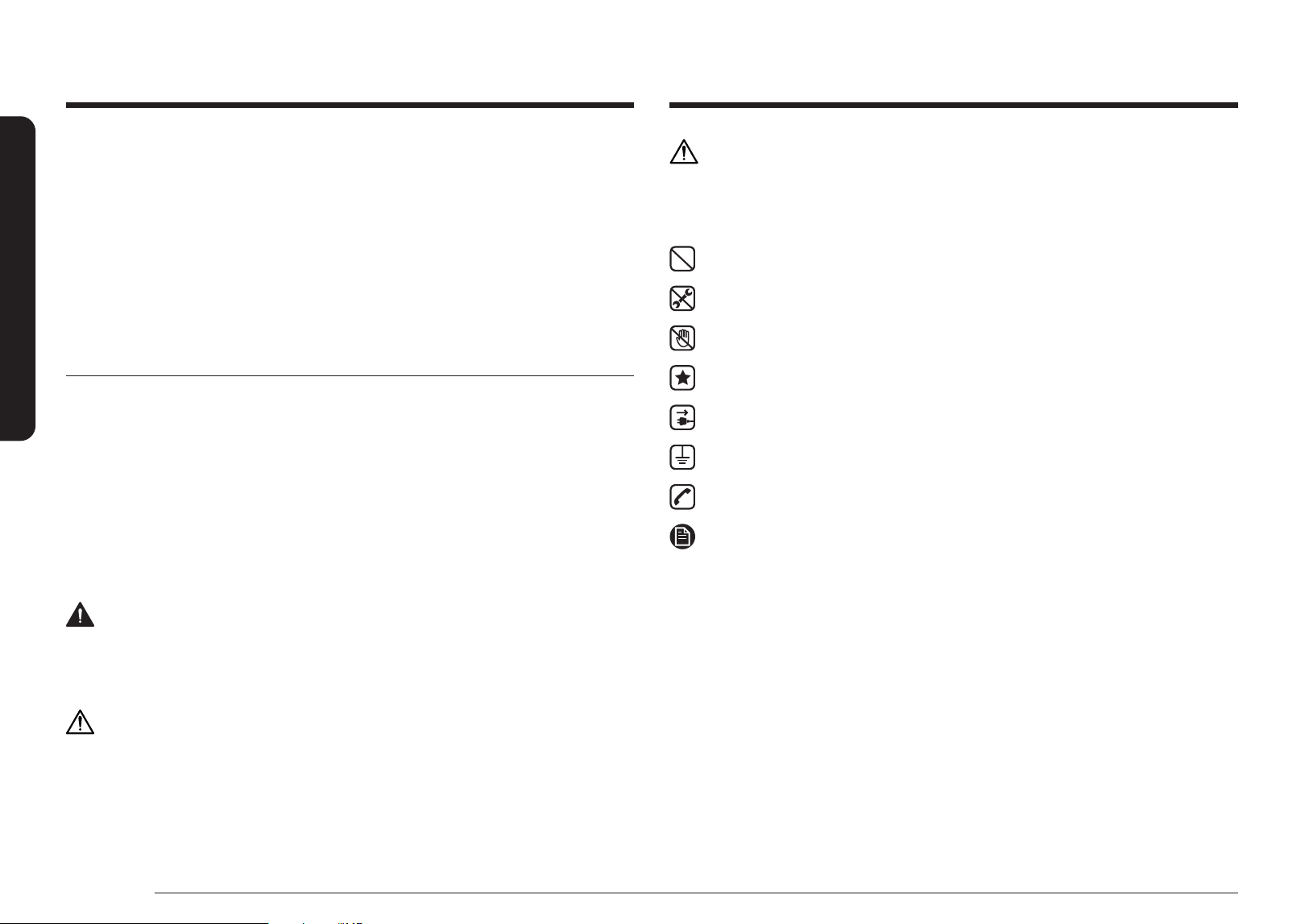
Do NOT attempt.
Do NOT disassemble.
Do NOT touch.
Follow directions explicitly.
Unplug the power plug from the wall socket.
Make sure the machine is grounded to prevent electric shock.
Call a Samsung service center for help.
Note
These warning signs are here to prevent injury to you and others.
Please follow them explicitly.
After reading this section, keep it in a safe place for future reference.
Important safety instructions
English 5
Important safety instructions
SAVE THESE INSTRUCTIONS
FOR YOUR SAFETY
When using electrical appliances, you should follow basic safety
precautions, including the following:
CAUTION
• Use this appliance only for its intended purpose as described in
this Owner’s Manual.
• Potentially hot surfaces include the cooktop, areas facing the
cooktop, the oven vent opening, surfaces near the opening, and
crevices around the oven door.
Be sure your appliance is properly installed and grounded by a
qualied technician.
User servicing - Do not repair or replace any part of the
appliance unless specically recommended in this manual. All
other servicing should be referred to a qualied technician.
Always disconnect the power to the appliance before servicing
by removing the fuse or switching off the circuit breaker.
• Do not enter the oven.
• Do not store items of interest to children in cabinets above
the range or on the back guard of the range. Children
climbing on the range to reach items could be seriously
injured.
• Do not leave children alone. Never leave children alone or
unattended in an area where this appliance is in use. They
should never be allowed to sit or stand on any part of the
appliance.
• Never use your appliance for warming or heating the room.
• Do not use water on grease res. Turn off the oven to avoid
spreading the ames. Smother the re or ames by closing
the door or use a dry chemical, baking soda, or foam-type
extinguisher.
• Avoid scratching or striking the glass doors, the cooktop, or
the control panel. Doing so may lead to glass breakage. Do
not cook on a product with broken glass. Shock, re, or cuts
may occur.
6 English
Important safety instructions
Important safety instructions
SAVE THESE INSTRUCTIONS
• Use only dry potholders. Placing moist or damp potholders
on hot surfaces may result in burns from steam. Do not let
the potholder touch hot heating elements. Do not use a towel
or other bulky cloth.
• Teach children not to play with the controls or any other part
of the range.
• For your safety, do not use high-pressure water cleaners or
steam jet cleaners to clean any part of the range.
• If the power cord is damaged, it must be replaced by the
manufacturer, its service agent, or similarly qualied persons
to avoid creating a hazard.
• The appliance is not intended for use by persons (including
children) with reduced physical, sensory or mental
capabilities, or lack of experience and knowledge, unless they
have been given supervision or instruction concerning use of
the appliance by a person responsible for their safety.
• Do not lean on the range as you may turn the control knobs
inattentively.
• If there is a re in the oven during self-cleaning, turn the
oven off and wait for the re to go out. Do not force the
door open. The introduction of fresh air at self-cleaning
temperatures may lead to a burst of ame from the oven.
Failure to follow these instructions may result in severe
burns.
• If the oven is heavily soiled with oil, self-clean the oven
before using the oven again. Leaving the oil in place creates
a risk of re.
• Wipe up heavy soil on the oven bottom with a paper towel or
rag before self-cleaning. Self-cleaning the oven when there
is heavy soil on the oven bottom requires longer cleaning
cycles and produces more smoke.
• Storage in or on the appliance. Do not store ammable
materials in the oven or near the surface units. Be sure all
packing materials are removed from the appliance before
operating it. Keep plastics, clothes, and paper away from
parts of the appliance that may become hot.
• Wear proper apparel. Never wear loose-tting or hanging
garments while using the appliance.
English 7
Important safety instructions
SAVE THESE INSTRUCTIONS
• Be careful when placing spoons or other stirring utensils on
the glass cooktop surface when it is in use. They may become
hot and could cause burns.
• Use proper pan sizes. This appliance is equipped with surface
units of different size. Select pots and pans that have at
bottoms large enough to cover the surface area of the
heating element. Using undersized cookware will expose a
portion of the heating element to direct contact and may
result in the ignition of clothing. Matching the size of the pot
or pan to the burner will also improve efciency.
• Cookware Handles Should Be Turned Inward and Not
Extend Over Adjacent Surface Units – To reduce the risk
of burns, ignition of ammable materials, or spillage due
to unintentional contact with cookware, position cookware
handles so that they are turned inward and do not extend
over adjacent surface units.
• Glazed cookware. Only certain types of glass, glass/ceramic,
ceramic, earthenware, or other glazed cookware can be used
for rangetop service without breaking due to sudden changes
in temperature.
• Cleaning. Read and follow all instructions and warnings on
the cleaning cream labels.
SURFACE COOKING UNITS
• Never leave surface units unattended at high heat settings.
Boilovers cause smoking and greasy spillovers that may
ignite.
• Protective Liners – Do not use aluminum foil to line surface
unit drip bowls or oven bottoms, except as suggested in the
manual. Improper installation of these liners may result in a
risk of electric shock or re.
• To avoid oil spillover and re, use a minimum amount of oil
when shallow pan-frying and avoid cooking frozen foods that
have excessive amounts of ice.
• Do not lift the cooktop. Lifting the cooktop can damage the
range and cause the range to malfunction.
• Do not operate the cooktop without cookware. If the cooktop
operates without cookware, the control knobs will become
hot.
• Never use the glass cooktop surface as a cutting board.
• Use care when touching the cooktop. The glass surface of the
cooktop will retain heat after the controls have been turned
off.
• Do not move the container and bowl in a horizontal position
on cooktop surface.
8 English8 English
Important safety instructions
Important safety instructions
SAVE THESE INSTRUCTIONSSAVE THESE INSTRUCTIONS
• Flush-mounted appliances may be operated only after they
have been installed in cabinets and workplaces that conform
to the relevant standards. This ensures that the appliances
are installed in compliance with the appropriate safety
standards.
• If your appliance malfunctions or if fractures, cracks, or splits
appear:
- switch off all cooking zones
- unplug the range from the AC wall outlet
- contact your local Samsung service center.
WARNING
If the surface is cracked, switch off and unplug the appliance to avoid
the possibility of electrical shock. Do not use your cooktop until the
glass surface has been replaced.
WARNING
• Ensure that the appliance is switched off before replacing the
lamp to avoid the possibility of electric shock.
• The range should not be placed on a base.
• Be sure you know which control knob operates each surface
unit. Make sure you turned on the correct surface unit.
• Always turn the surface units off before removing cookware.
• When preparing aming foods under the hood, turn the fan on.
• Keep an eye on foods being fried at high or medium high
heat settings.
• Do not store heavy items above the cooktop surface that
could fall and damage it.
• Do not use decorative surface element covers – If an element
is accidentally turned on, the decorative cover will become
hot and possibly melt. Burns will occur if the hot covers are
touched. Damage may also be done to the cooktop.
ELECTRICAL SAFETY
• Proper Installation - Be sure your appliance is properly
installed and grounded by a qualied technician.
• The appliance should be serviced only by qualied service
personnel. Repairs carried out by unqualied individuals may
cause injury or a serious malfunction. If your appliance is in
need of repair, contact a Samsung authorized service center.
Failure to follow these instructions may result in damage and
void the warranty.
English 9
Important safety instructions
SAVE THESE INSTRUCTIONS
OVEN
• DO NOT TOUCH THE HEATING ELEMENTS OR INTERIOR
SURFACES OF THE OVEN. Heating elements may be hot even
though they are dark in color. Interior surfaces of an oven
become hot enough to cause burns. During and after use, do
not touch or let clothing or other ammable materials contact
the heating elements or interior surfaces of the oven until
they have had sufcient time to cool. Other surfaces of the
appliance may become hot enough to cause burns. Among
these surfaces are oven vent openings and surfaces near
these openings, the oven door, and the window of the oven
door.
• Do not heat unopened food containers. The build-up of
pressure may cause the container to burst and result in
injury.
• Do not use the oven to dry newspapers. If overheated,
newspapers can catch on re.
• Do not use the oven for a storage area. Items stored in an
oven can ignite.
CHILD SAFETY
WARNING
• This appliance is not intended for use by young children or inrm
persons without the adequate supervision of a responsible adult.
• Young children should be supervised to ensure that they do not
play with the appliance.
• Keep children away from the door when opening or closing it as
they may bump themselves on the door or catch their ngers in
the door.
• The cooking zones will become hot when you cook. To keep small
children from being burned, always keep them away from the
appliance while you are cooking.
• During self-cleaning, the surfaces may get hotter than usual. Keep
small children away from the range when it is in the self-cleaning
mode.
WARNING
Accessible parts may become hot during use. To avoid burns, young
children should be kept away.
10 English
Important safety instructions
Important safety instructions
SAVE THESE INSTRUCTIONS
CAUTION
Do not attempt to operate the oven during a power failure. If the
power fails, always turn the oven off. If the oven is not turned off
and the power returns, the oven may begin to operate again. Food
left unattended could catch re or spoil.
REMOTE OPERATION
This appliance is congurable to allow remote operation at any time.
• Do not store any ammable materials or temperature
sensitive items inside, on top or near surface units of the
appliance.
SELF-CLEANING OVENS
Do not clean the door gasket. The door gasket is essential for
a good seal. Care should be taken not to rub, damage, or move
the gasket.
• Never keep pet birds in the kitchen. Birds are extremely
sensitive to the fumes released during an oven self-clean
cycle. Fumes may be harmful or fatal to birds. Move birds to
a well-ventilated room.
• Use care when opening the door. Let hot air or steam escape
before you remove food from or put food into the oven.
• Protective liners. Do not use aluminum foil to line the oven
bottoms, except as suggested in the manual. Improper
installation of these liners may result in a risk of electric
shock or re.
• Keep oven vent ducts unobstructed. The oven vent is located
above the right rear surface unit. This area could become hot
during oven use. Never block this vent or place plastic or
heat-sensitive items on it.
• Placement of oven racks. Always place oven racks in the
desired location while the oven is cool. If the rack must be
moved while the oven is hot, use potholders. Do not let the
potholders come in contact with the hot heating element in
the oven.
• Do not allow aluminum foil or a meat probe to contact the
heating elements.
• During use, the appliance becomes hot.
Care should be taken to avoid touching heating elements
inside the oven.
• Do not use harsh abrasive cleaners or sharp metal scrapers
to clean the oven door glass. They can scratch the surface,
which may result in the glass shattering.
English 11
Important safety instructions
SAVE THESE INSTRUCTIONS
GLASS/CERAMIC COOKING SURFACES
• DO NOT TOUCH SURFACE UNITS OR AREAS NEAR UNITS.
Surface units may be hot even though they are dark in color.
Areas near surface units may become hot enough to cause
burns. During and after use, do not touch, or let clothing or
other ammable materials contact the surface units or areas
near the units until they have had sufcient time to cool.
Among these areas are the cooktop and the facing of the
cooktop.
• Do not cook on a broken cooktop. If the cooktop should
break, cleaning solutions and spillovers may penetrate the
broken cooktop and create a risk of electric shock. Contact a
qualied technician immediately.
Clean the cooktop with caution. If a wet sponge or cloth is used
to wipe spills on a hot cooking area, be careful to avoid steam
burns. Some cleaners can produce noxious fumes if applied to a
hot surface.
• Clean only the parts listed in this manual in the self-clean
cycle. Before self-cleaning the oven, remove the partition,
rack, utensils, and any food.
• Before operating the self-clean cycle, wipe grease and food
soils from the oven. Excessive amounts of grease may ignite,
leading to smoke damage to your home.
• Do not use a protective coating to line the oven and do not
use commercial oven cleaner unless Certied for use in a self-
cleaning oven.
• Remove broiler pan, other utensils and excess spillage from
the oven before you begin the self-cleaning cycle, or they
may discolor.
• In the event the self-cleaning mode error signal, turn off or
disconnect appliance from power supply and have serviced
by a qualied technician.
• Excess spillage must be removed before you run the self-
cleaning cycle.
• Opening a window or turning on a ventilation fan or hood is
recommended during and after self-cleaning.
VENTILATING HOOD
• Clean ventilating hoods frequently. Do not let grease
accumulate on the hood or lter.
• When aming foods under the hood, turn the fan on.
12 English
Important safety instructions
Important safety instructions
SAVE THESE INSTRUCTIONS
• This appliance must be properly grounded.
• Do not ground the appliance to a gas pipe, plastic water pipe,
or telephone line.
- This may result in electric shock, re, an explosion, or
problems with the product.
• Do not cut or remove the ground prong from the power cord
under any circumstances.
• Connect the oven to a circuit that provides the correct
amperage.
• Do not install this appliance in a humid, oily or dusty location,
or in a location exposed to direct sunlight or water (rain
drops).
- This may result in electric shock or re.
• Do not use a damaged power cord or loose wall socket.
- This may result in electric shock or re.
• Do not pull or excessively bend the power cord.
• Do not twist or tie the power cord.
• Do not hook the power cord over a metal object, place a
heavy object on the power cord, or insert the power cord
between objects.
- This may result in electric shock or re.
If the power cord is damaged, contact your nearest Samsung
service center.
CRITICAL INSTALLATION WARNINGS
WARNING
• This appliance must be installed by a qualied technician or
service company.
- Failing to have a qualied technician install the range may
result in electric shock, re, an explosion, problems with
the product, or injury.
• Unpack the oven, remove all packaging material and examine
the oven for any damage, such as dents on the interior
or exterior of the oven, broken door latches, cracks in the
door, or a door that is not lined up correctly. If there is any
damage, do not operate the oven and notify your dealer
immediately.
• Plug the power cord into a properly grounded outlet with
the proper conguration. Your oven should be the only item
connected to this circuit.
• Keep all packaging materials out of the reach of children.
Children may use them for play and injure themselves.
• Install your appliance on a hard, level oor that can support
its weight.
- Failing to do so may result in abnormal vibrations, noise,
or problems with the product.
English 13
Important safety instructions
SAVE THESE INSTRUCTIONS
• Always observe safety precautions when using your
oven. Never try to repair the oven on your own - there is
dangerous voltage inside. If the oven needs to be repaired,
contact an authorized Samsung service center near you.
• If you use the appliance when it is contaminated by foreign
substance, such as food waste, it may result in a problem with
the appliance.
• Take care when removing the wrapping from food taken out
of the appliance.
- If the food is hot, hot steam may be emitted abruptly when
you remove the wrapping and this may result in burns.
• Do not attempt to repair, disassemble, or modify the
appliance yourself.
- Since a high voltage current enters the product chassis, it
may result in electric shock or re.
- When a repair is needed, contact your nearest Samsung
service center.
• If any foreign substance, such as water has entered the
appliance, contact your nearest Samsung service center.
- Failing to do so may result in electric shock or re.
CRITICAL USAGE WARNING
CAUTION
• If the appliance is ooded by any liquid, please contact your
nearest Samsung service center. Failing to do so may result in
electric shock or re.
• If the appliance produces a strange noise, a burning smell, or
smoke, unplug the power plug immediately and contact your
nearest Samsung service center.
- Failing to do so may result in electric shock or re
• In the event of a gas leak (such as propane gas, LP gas, etc.),
ventilate the area immediately. Do not touch the power cord.
Do not touch the appliance.
- A spark may result in an explosion or re.
• Take care not to contact the oven door, heating elements, or
any of the other hot parts with your body while cooking or
just after cooking.
- Failing to do so may result in burns.
• If materials inside the oven should ignite, keep the oven door
closed, turn the oven off and disconnect the power cord, or
shut off power at the fuse or circuit breaker panel. If the door
is opened, the re may spread.
14 English
Important safety instructions
Important safety instructions
SAVE THESE INSTRUCTIONS
• Do not tamper with or make any adjustments or repairs to the
door. Under no circumstances should you remove the door or
outer shell of the oven.
• Do not store or use the oven outdoors.
• Never use this appliance for purposes other than cooking.
- Using the appliance for any purpose other than cooking
may result in re.
• Open the cap or stopper of sealed containers (herb tonic tea
bottle, baby bottle, milk bottle and so on) before heating
them. Make a hole in food items that have shells (eggs,
chestnuts, etc) with a knife before cooking them.
- Failing to do so may result in burns or injury.
• Never heat plastic or paper containers and do not use them
for cooking.
- Failing to do so may result in re.
• Do not heat food wrapped in paper from magazines,
newspapers, etc.
- This may result in re.
• Do not open the door when the food in the oven is burning.
- If you open the door, it causes an inow of oxygen and
may cause the food to ignite.
• Do not touch the power cord with wet hands.
- This may result in electric shock.
• Do not turn the appliance off while an operation is in progress.
- This may cause a spark and result in electric shock or re.
• Keep all packaging materials well out of the reach of children,
as packaging materials can be dangerous to children.
- If a child places a plastic bag over its head, the child can
suffocate.
• Do not let children or any person with reduced physical,
sensory, or mental capabilities use this appliance unsupervised.
• Make sure that the appliance’s controls and cooking areas are
out of the reach of children.
- Failing to do so may result in electric shock, burns, or injury.
• Do not touch the inside of the appliance immediately after
cooking. The inside of the appliance will be hot.
- Failing to do so may result in burns.
• Do not use or place ammable sprays or objects near the oven.
- Flammable items or sprays can cause res or an explosion.
• Do not insert ngers, foreign substances, or metal objects,
such as pins or needles into inlets, outlets, or holes. If foreign
substances are inserted into any of these holes, contact your
product provider or nearest Samsung service center.
English 15
Important safety instructions
SAVE THESE INSTRUCTIONS
USAGE CAUTIONS
CAUTION
• If the surface is cracked, turn the appliance off.
- Failing to do so may result in electric shock.
• Dishes and containers can become hot. Handle with care.
• Hot foods and steam can cause burns. Carefully remove
container coverings, directing the steam away your hands
and face.
• Remove lids from baby food jars before heating. After
heating baby food, stir well to distribute the heat evenly.
Always test the temperature by tasting before feeding the
baby. The glass jar or the surface of the food may appear to
be cooler than the interior, which can be hot enough to burn
an infant’s mouth.
• Take care as beverages or food may be very hot after
heating.
- Especially when feeding a child. Check that it has cooled
sufciently.
• Do not apply excessive pressure to the door or the inside
of the appliance. Do not strike the door or the inside or the
appliance.
- Hanging on to the door may result in the product falling
and cause serious injury.
- If the door is damaged, do not use the appliance. Contact a
Samsung service center.
• Do not hold food in your bare hands during or immediately
after cooking.
- Use cooking gloves. The food may be very hot and you
could burn yourself.
- As the handle and oven surfaces may be hot enough to
cause burns after cooking, use cooking gloves to protect
your hands from burns.
16 English
Important safety instructions
Important safety instructions
SAVE THESE INSTRUCTIONS
• Do not put your face or body close to the appliance while
cooking or when opening the door just after cooking.
- Take care that children do not come too close to the
appliance.
- Failing to do so may result in children burning themselves.
• Do not place food or heavy objects over the edge of the oven
door.
- If you open the door, the food or object may fall and this
may result in burns or injury.
• Do not abruptly cool the door, the inside of the appliance, or
a dish by pouring water over it during or just after cooking.
- This may result in damage to the appliance. The steam or
water spray may result in burns or injury.
• Do not operate while empty except for self-cleaning.
• Do not defrost frozen beverages in narrow-necked bottles.
The bottles can break.
• Do not scratch the glass of the oven door with a sharp object.
- This may result in the glass being damaged or broken.
• Do not store anything directly on top of the appliance when
it is in operation.
• Do not use sealed containers. Remove seals and lids before
cooking. Sealed containers can explode due to the build up of
pressure even after the oven has been turned off.
• Take care that food you are cooking in the oven does not
come into contact with the heating element.
- This may result in re.
• Do not overheat food.
- Overheating food may result in re.
• Take care when heating liquids, such as water or other
beverages.
- Make sure to stir during or after cooking.
- Avoid using a slippery container with a narrow neck.
- Wait at least 30 seconds after heating before removing the
heated liquid.
- Failing to do so may result in an abrupt overow of the
contents and cause burns.
• Do not stand on top of the appliance or place objects (such
as laundry, an oven cover, lighted candles, lighted cigarettes,
dishes, chemicals, metal objects, etc.) on the appliance.
- Items, such as a cloth, may get caught in the door.
- This may result in electric shock, re, problems with the
product, or injury.
• Do not operate the appliance with wet hands.
- This may result in electric shock.
• Do not spray volatile substances, such as insecticide onto the
surface of the appliance.
- As well as being harmful to humans, it may also result in
electric shock, re, or problems with the product.

English 17
Important safety instructions
SAVE THESE INSTRUCTIONS
1. FCC Notice
FCC STATEMENT:
The manufacturer is not responsible for any radio of TV
interference caused by unauthorized modication to
this microwave oven. It is the responsibility of the user
to correct such interference.
This equipment has been tested and found to
comply with the limits for a Class B digital device,
pursuant to part 15 of the FCC Rules. These limits are
designed to provide reasonable protection against
harmful interference in a residential installation. This
equipment generates, uses and can radiate radio
frequency energy and, if not installed and used in
accordance with the instructions, may cause harmful
interference to radio communications. However, there
is no guarantee that interference will not occur in a
particular installation. If this equipment does cause
harmful interference to radio or television reception,
which can be determined by turning the equipment
off and on, the user is encouraged to try to correct the
interference by one or more of the following measures:
CRITICAL CLEANING WARNINGS
CAUTION
• Do not clean the appliance by spraying water directly on to it.
• Do not use benzene, thinner, or alcohol to clean the appliance.
- This may result in discoloration, deformation, damage,
electric shock, or re.
• Take care not to hurt yourself when cleaning the appliance
(externally or internally).
- You may hurt yourself on the sharp edges of the appliance.
• Do not clean the appliance with a steam cleaner.
- This may result in corrosion.
• Keep the inside of the oven clean. Food particles or spattered
oils stuck to the oven walls or oor can cause paint damage
and reduce the efciency of the oven.

18 English
Important safety instructions
Important safety instructions
SAVE THESE INSTRUCTIONS
2. IC Notice
This device contains licence-exempt transmitter(s)/
receiver(s) that comply with Innovation, Science and
Economic Development Canada’s licence-exempt RSS(s).
Operation is subject to the following two conditions:
1) This device may not cause interference.
2) This device must accept any interference, including
interference that may cause undesired operation of
the device.
• CAN ICES(B)/NMB(B)
IC RADIATION EXPOSURE STATEMENT:
This equipment complies with IC RSS-102 radiation
exposure limits set forth for an uncontrolled
environment. This equipment should be installed
and operated so there is at least 8 inches (20 cm)
between the radiator and your body. This device and
its antenna(s) must not be co-located or operated in
conjunction with any other antenna or transmitter.
CALIFORNIA PROPOSITION 65 WARNING
WARNING
Cancer and Reproductive Harm - www.P65Warnings.ca.gov
• Reorient or relocate the receiving antenna.
• Increase the separation between the equipment and
receiver.
• Connect the equipment into an outlet on a circuit
different from that to which the receiver is
connected.
• Consult the dealer or an experienced radio/TV
technician for help.
WARNING
Any changes or modications to this unit not expressly
approved by the party responsible for compliance
could void the user’s authority to operate the
equipment.
FCC RF Exposure Requirements
This device complies with FCC RF radiation exposure
limits set forth for an uncontrolled environment.
The antenna(s) used for this transmitter must not
be co-located or operating in conjunction with any
other antenna or transmitter and must be installed to
provide a separation distance of at least 20 cm from all
persons.
English 19
Introducing your new range
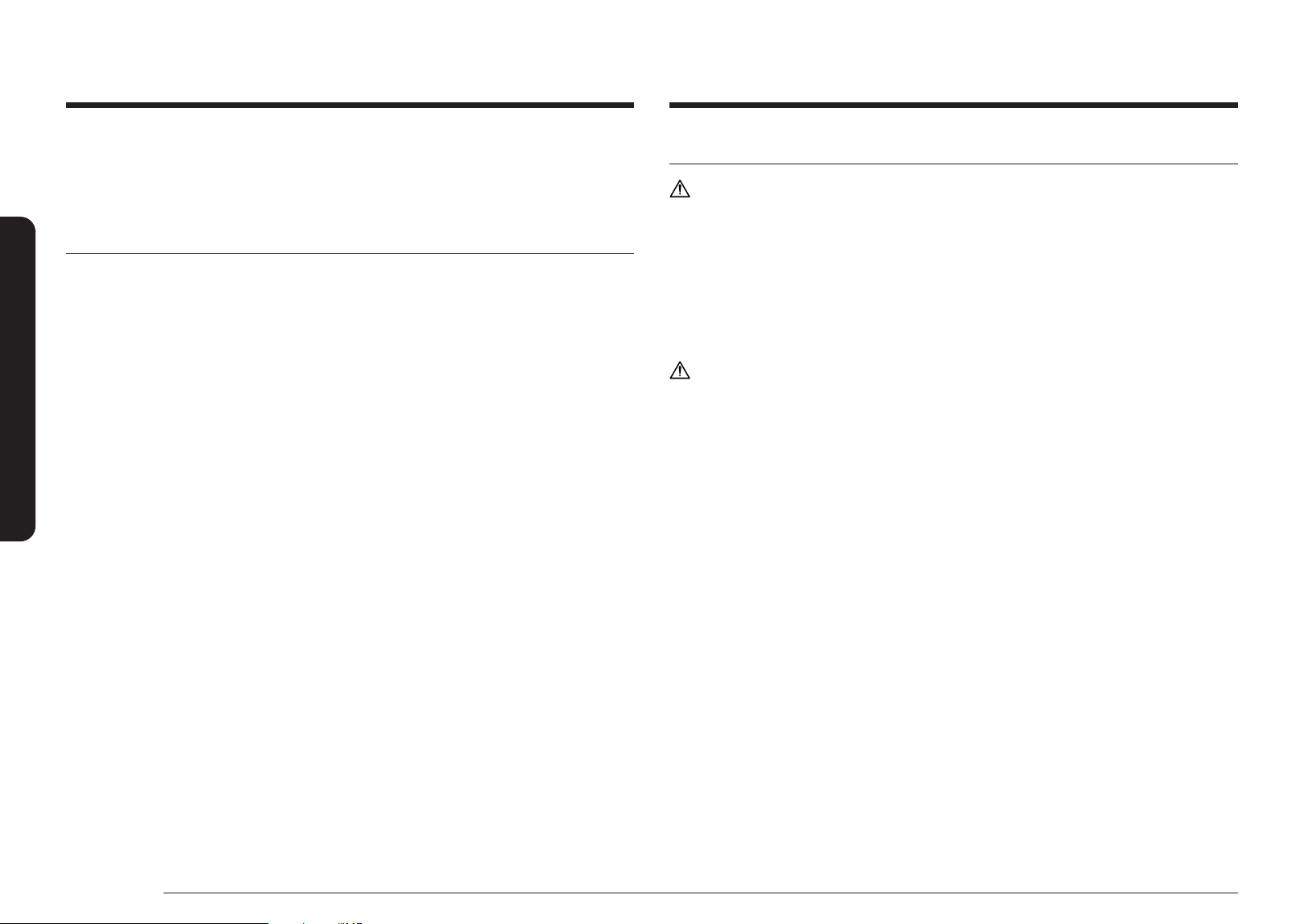
Overview
03
07
08
09
10
05
01
04
02
06
01 Control panel 02 Surface control knobs
(See page 21 for more
information.)
03 Dial knob
(See page 26 for more
information.)
04 Vent
05 Oven door 06 Storage drawer
07 Broil oven heater 08 Oven light
09 Convection system 10 Shelf position
What’s included with your range
Wire racks (2) * Air Fry tray (1) *
NOTE
If you need an extra accessory marked with a *, you can buy it from the Samsung
Contact Center (1-800-726-7864).
Introducing your new range
20 English
Before you begin
Clean the oven thoroughly before using it for the rst time. Then, remove the
accessories, set the oven to bake, and then run the oven at 400 °F for 1 hour.
There will be a distinctive odor. This is normal.
Ensure your kitchen is well ventilated during this conditioning period.
Energy saving tips
• During cooking, the oven door should remain closed except when you turn food
over.
• Do not open the door frequently during cooking to maintain the oven
temperature and to save energy.
• If cooking time is more than 30 minutes, you can switch the oven off
5 - 10 minutes before the end of the cooking time to save energy. The residual
heat will complete the cooking process.
• To save energy and reduce the time needed for reheating the oven, plan oven
use to avoid turning the oven off between cooking one item and the next.
• Whenever possible, cook more than one item at a time.
About surface cooking
CAUTION
BEFORE COOKING
• Do not use the glass cooktop surface as a cutting board.
• Do not place or store items that can melt or catch re on the glass cooktop,
even when it is not being used.
• Turn the surface units on only after placing cookware on them.
• Do not store heavy items above the cooktop surface. They could fall and get
damaged it.
CAUTION
DURING COOKING
• Do not place aluminum foil or plastic items, such as salt and pepper shakers,
spoon holders, or plastic wrappings on the range when it is in use. The hot air
from the vent could melt plastics or ignite ammable items.
• Make sure the correct surface unit is turned on.
• Never cook directly on the glass. Always use cookware.
• Always place the pan in the center of the surface unit you are cooking on.
• Never leave surface units unattended while using a high heat setting.
Boilovers cause smoking and greasy spillovers that may catch on re.
• Turn the surface units off before removing cookware.
• Do not use plastic wrap to cover food. Plastic may melt onto the surface and be
very difcult to remove.
• The cooling fan can be operated during cooktop cooking.
Surface cooking Before you begin
English 21
Surface cooking
CAUTION
AFTER COOKING
• Do not touch the surface units until they have cooled down.
• The surface may still be hot and burns may occur if you touch the glass surface
before it has cooled down sufciently.
• Immediately clean spills on the cooking area to prevent a tough cleaning chore
later.
• If cabinet storage is provided directly above the cooking surface, make sure
that the items are infrequently used and can be safely stored in an area
subjected to heat. Temperatures may be unsafe for items, such as volatile
liquids, cleaners, or aerosol sprays.
About the radiant surface elements
The temperature rises gradually and evenly. As the temperature rises, the radiant
element will glow red. To maintain the selected setting, the element will cycle
on and off. The heating element retains enough heat to provide a uniform and
consistent heat during the off cycle. For efcient cooking, turn off the element
several minutes before cooking is complete. This will allow residual heat to
complete the cooking process.
NOTE
Radiant elements have a limiter that allows the element to cycle ON and OFF, even
at the HI setting. This helps to prevent damage to the ceramic cooktop. Cycling at
the HI setting is normal and can occur if the cookware is too small for the radiant
element or if the cookware bottom is not at.
NOTE
When you operate the knob, beep sounds once.
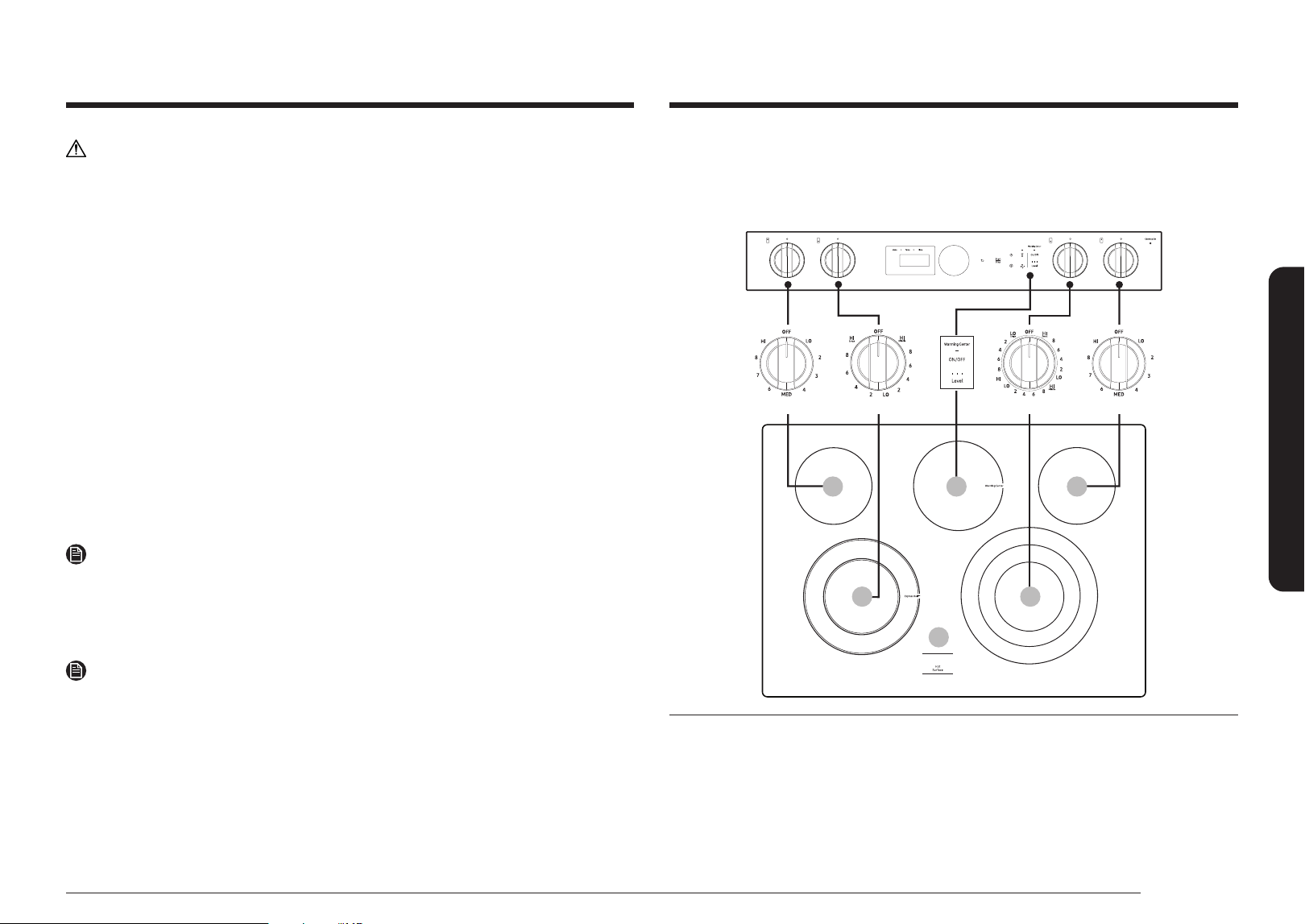
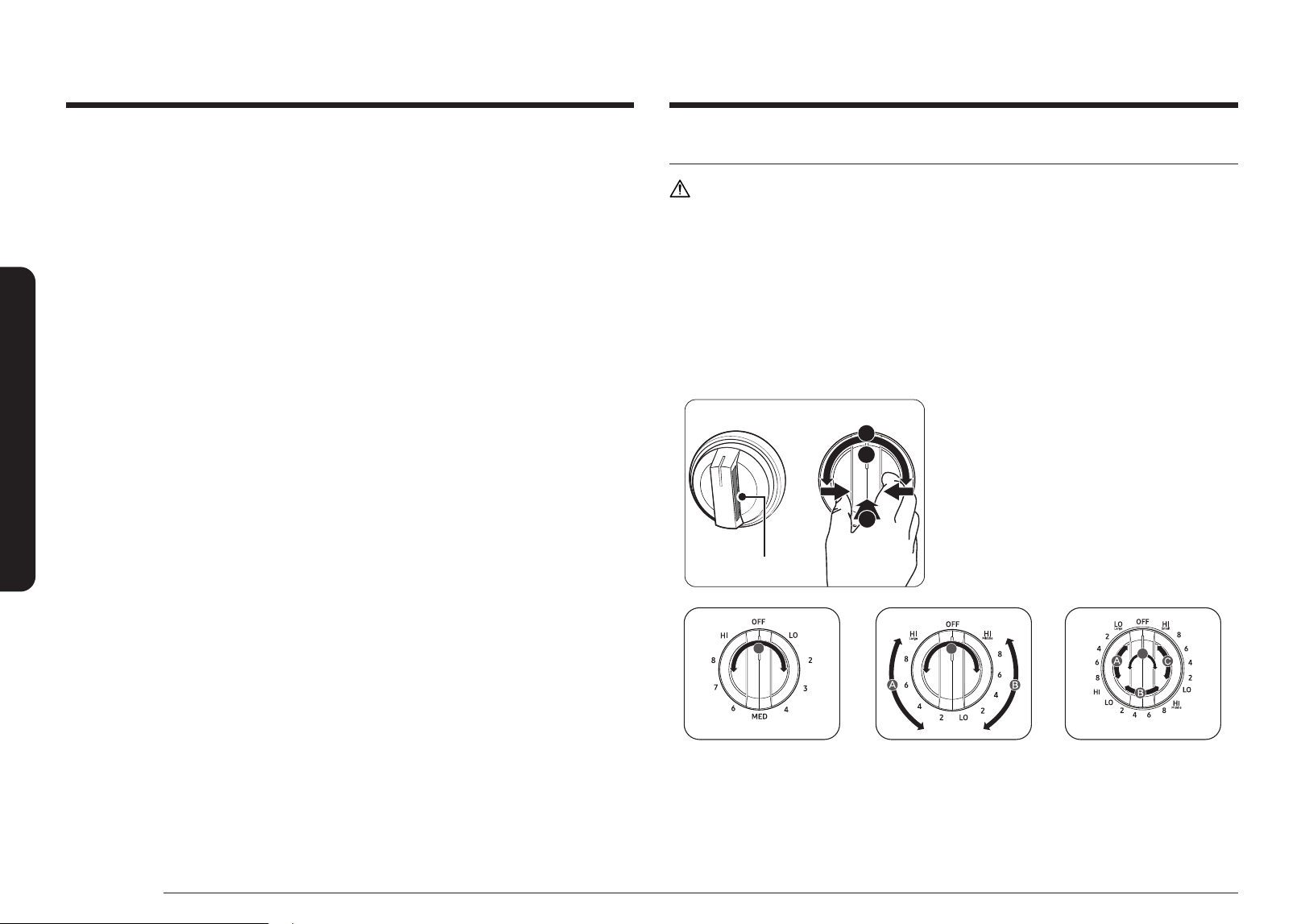
Location of the radiant surface elements and controls
The radiant control knobs operate the radiant surface elements on the cooktop as
shown below. When reassembling the knobs after cleaning, check the knob print
and assemble them in the correct position before using cooktop.
01 05
04
06
02
03
Single SingleDual Triple
01 Left Rear:
6", 1200 W
02 Left Front:
6"/9", 3600 W
03 Warming Center:
100 W
04 Right Front:
6"/9"/12", 3000 W
05 Right Rear:
6", 1200 W
06 Hot surface
indicator
22 English
Surface cooking
Surface cooking
Hot surface indicator
• Comes on when the unit is turned on or hot to the touch.
• Stays on even after the unit is turned off.
• Glows until the unit is cooled to approximately 150 °F.
Cooktop on/off lamp
• The lamp turns on when the surface control knobs are not in off position.
• The lamp turns off when the surface control knobs are in off position.
Cooking areas
• The cooking areas on your range are identied by permanent circles on the
glass cooking surface. For the most efcient cooking, t the pan size to the
element size.
• Pans should not extend more than ½" to 1" beyond the cooking area.
• When a control is turned on, you can see a glow through the glass cooking
surface. The element will cycle on and off to maintain the preset heat setting,
even at high settings.
• For more information on selecting proper types of cookware, refer to the
section Using the proper cookware on page 24.
How to set the appliance for surface cooking
CAUTION
• The surface elements may be hot even when off and burns can occur.
Do not touch the surface elements until they have cooled down sufciently.
• At high or medium-high settings, never leave food unattended.
Boilovers cause smoking and greasy spillovers may catch on re.
• Be sure you turn the control knob to OFF when you nish cooking.
• The intended safety functions will not work properly if you randomly x the
knob button of the Safety knob.
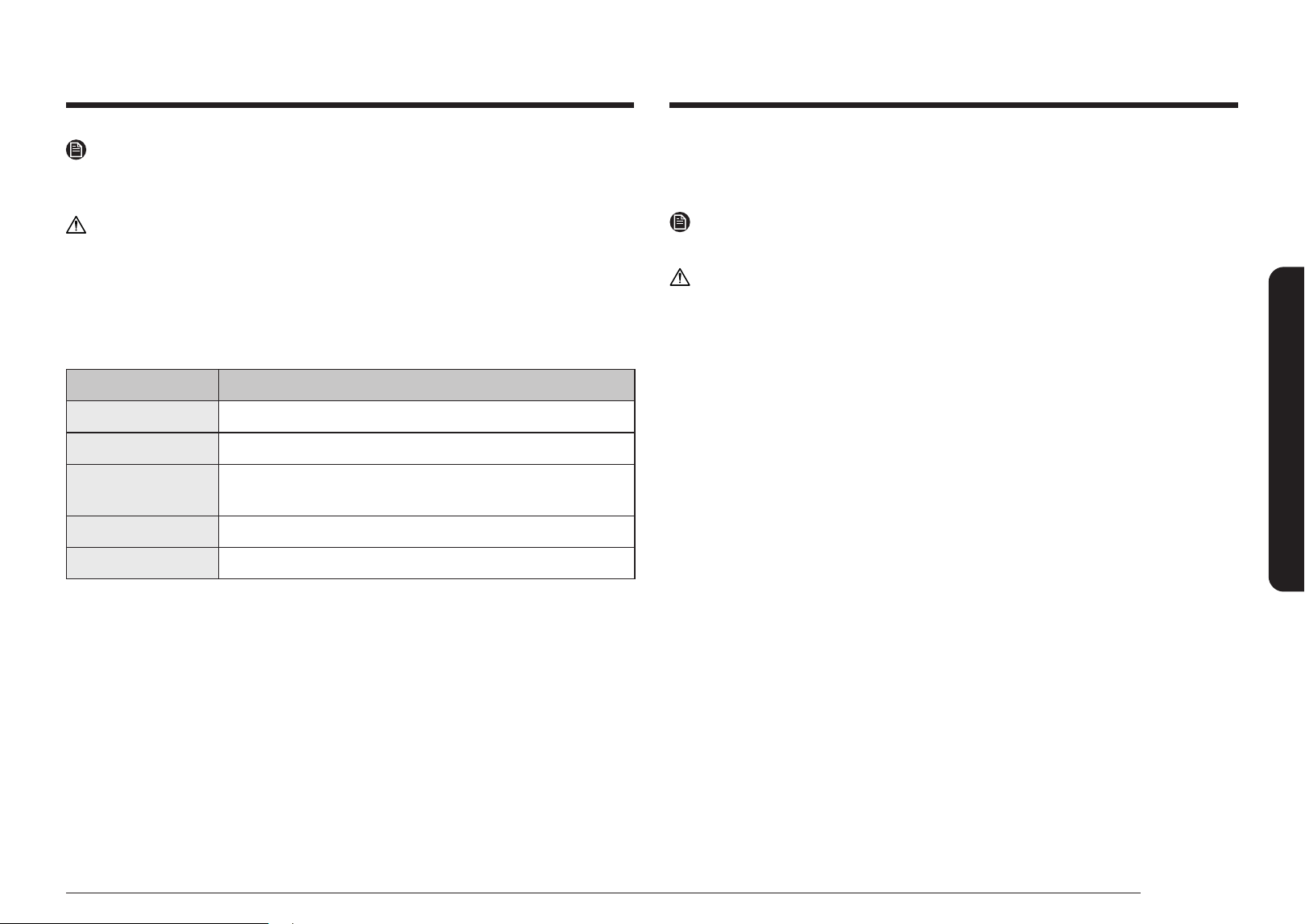
Surface unit control knob
1
2
3
Make sure all surface burners are properly
installed. To light a burner:
1. Pinch or Side-push the knob button.
2. Push the knob in.
3. Turn in either direction to the setting you
want.
3
3
3
Single surface unit Dual surface unit Triple surface unit
• (A) : Large burner setting
• (B) : Middle burner setting
• (C) : Small burner setting
Knob buttonKnob button
English 23
Surface cooking
NOTE
If you remove the knob for cleaning, make sure to reattach it in the correct
orientation. (Refer to the illustration above.)
CAUTION
• Please note, operation of lighting knob may not synchronize with the actual
operation of the radiant heater when there is a problem with the product.
• The area on the knob between the high and off settings is not appropriate for
cooking.
Recommended settings
SETTING TYPE OF COOKING
HIGH Starting most foods, bringing water to a boil, pan broiling
MEDIUM HIGH Continuing a rapid boil, frying, deep fat frying
MEDIUM
Maintaining a slow boil, thickening sauces and gravies,
steaming vegetables
MEDIUM LOW Keeping foods cooking, poaching, stewing
LOW Keeping foods warm, melting, simmering
Using the warming center
The warming center, located in the back center of the glass surface, will keep hot,
cooked food at serving temperature.
NOTE
The surface warmer will not glow red like the cooking elements.
CAUTION
• Do not warm food on the warming center for more than two hours.
• Use only cookware and dishes recommended as safe for oven and cooktop use.
• Always use potholders or oven mitts when removing food from the warming
center as cookware and plates will be hot.
• When warming pastries and breads, use covers that have an opening to allow
moisture to escape.
• Do not use plastic wrap to cover foods. Plastic may melt onto the surface and
be very difcult to clean off.
• Food should be kept in its container and covered with a lid or aluminum foil to
maintain food quality.
• Always start with hot food. Eating uncooked or cold food placed on the
warming center could result in illness.
24 English
Surface cooking
Surface cooking
1. To turn the warming center on, press the Warming Center On/Off pad.
2. Select the power setting you want. Press the Warming Center Level pad once
for Low, twice for Medium, or three times for High.
3. To turn the warming center off, press the Warming Center On/Off pad.
NOTE
• Pressing Stop does not turn the warming center off.
• For best results, all foods on the warming center should be covered with a lid
or aluminum foil. When warming pastries or breads, the lid or foil should be
vented to allow moisture to escape.
Recommended settings
LEVEL TYPE OF FOOD
Low Breads/pastries, casseroles, gravies, eggs
Medium
Dinner plate with foods, soups (cream), vegetables, sauces, stews,
meats
High Fried foods, soups (liquid), hot beverages
Using the proper cookware
Using the right cookware can prevent many problems, such as uneven cooking or
extended cooking times. Using the proper pots and pans will reduce cooking times
and cook food more evenly.
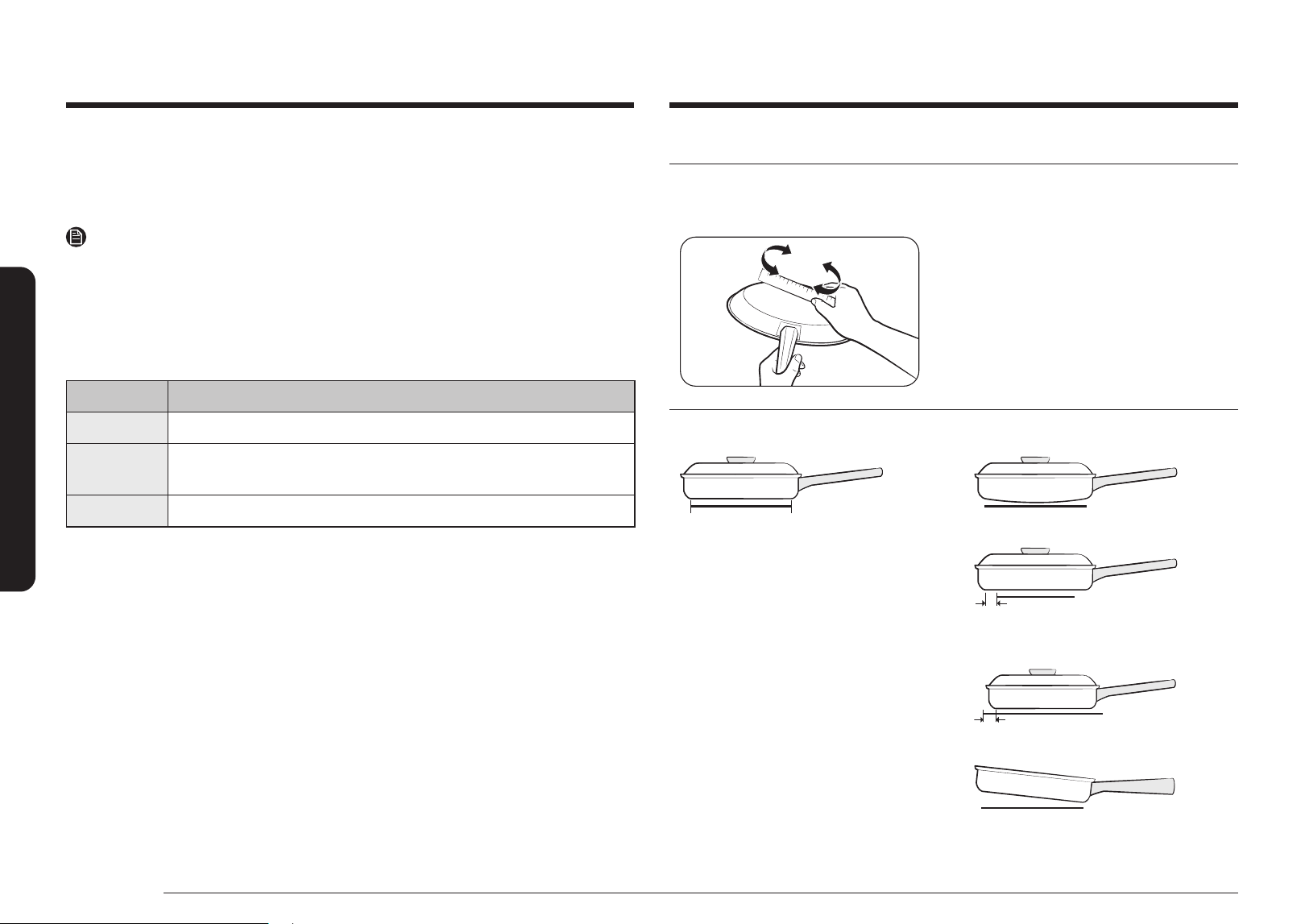
Check for atness by rotating a ruler across
the bottom of the cookware.
CORRECT INCORRECT
Flat and straight pan bottoms.
• Tight tting lids.
• Weight of handle does not tilt
pan.
• Pan is well balanced.
• Pan size matches the amount of
food to be prepared and the size
of the surface element.
• Made of a material that conducts
heat well.
• Always match pot diameter to
element surface diameter.
Curved and warped pan bottoms.
Pan overhangs element by more
than one-half inch.
Pan is smaller than element.
Heavy handle tilts pan.

English 25
Surface cooking
Protecting the cooktop
Cleaning
• Clean the cooktop before using it for the rst time.
• Clean your cooktop daily or after each use. This will keep your cooktop looking
good and can prevent damage.
• If a spillover occurs while you are cooking, immediately clean the spill from
the cooking area while it is hot to prevent a tough cleaning chore later.
Using extreme care, wipe the spill with a clean, dry towel.
• Do not allow spills to remain on the cooking area or the cooktop trim for a long
period of time.
• Do not use abrasive cleansing powders or scouring pads, which will scratch the
cooktop.
• Do not use chlorine bleach, ammonia, or other cleansers not specically
recommended for use on a glass-ceramic surface.
Preventing marks and scratches
• Do not use glass cookware. It may scratch the cooktop.
• Do not place a trivet or wok ring between the cooktop and the pan.
These items can mark or scratch the cooktop.
• Make sure the cooktop and the pan bottom are clean.
• Do not slide metal pans across the cooktop.
Preventing stains
• Do not use a soiled dish cloth or sponge to clean the cooktop surface. A lm will
remain, which may cause stains on the cooking surface after the area is heated.
• Continuously cooking on a soiled surface can result in a permanent stain.
Preventing other damage
• Do not allow plastic, sugar, or foods with high sugar content to melt onto the
hot cooktop. Should this happen, clean immediately.
• Do not let a pan boil dry as this will damage the cooktop and the pan.
• Do not use the cooktop as a work surface or cutting board.
• Do not cook food directly on the cooktop. Always use the proper cookware.
Choosing the proper cookware
What your cookware is made of determines how evenly and quickly heat is
transferred from the surface element to the pan bottom.
• ALUMINUM - Excellent heat conductor. Some types of food will cause the
aluminum to darken. (Anodized aluminum cookware resists staining & pitting).
If aluminum pans are slid across the ceramic cooktop, they may leave metal
marks that resemble scratches. Remove these marks as soon as the cooktop
cools down.
• COPPER - Excellent heat conductor but discolors easily. May leave metal marks
on ceramic glass(to remove, see above).
• STAINLESS STEEL - Slow heat conductor with uneven cooking results. Is durable,
easy to clean, and resists staining.
• CAST IRON - A poor conductor; retains heat very well. Cooks evenly once
cooking temperature is reached. Not recommended for use on ceramic cooktops.
• ENAMELWARE - Heating characteristics will vary depending on the base
material. Porcelain enamel coating must be smooth to avoid scratching ceramic
cooktops.
• GLASS - Slow heat conductor. Not recommended for ceramic cooktop surfaces
because it may scratch the surface.
26 English
Operating the oven
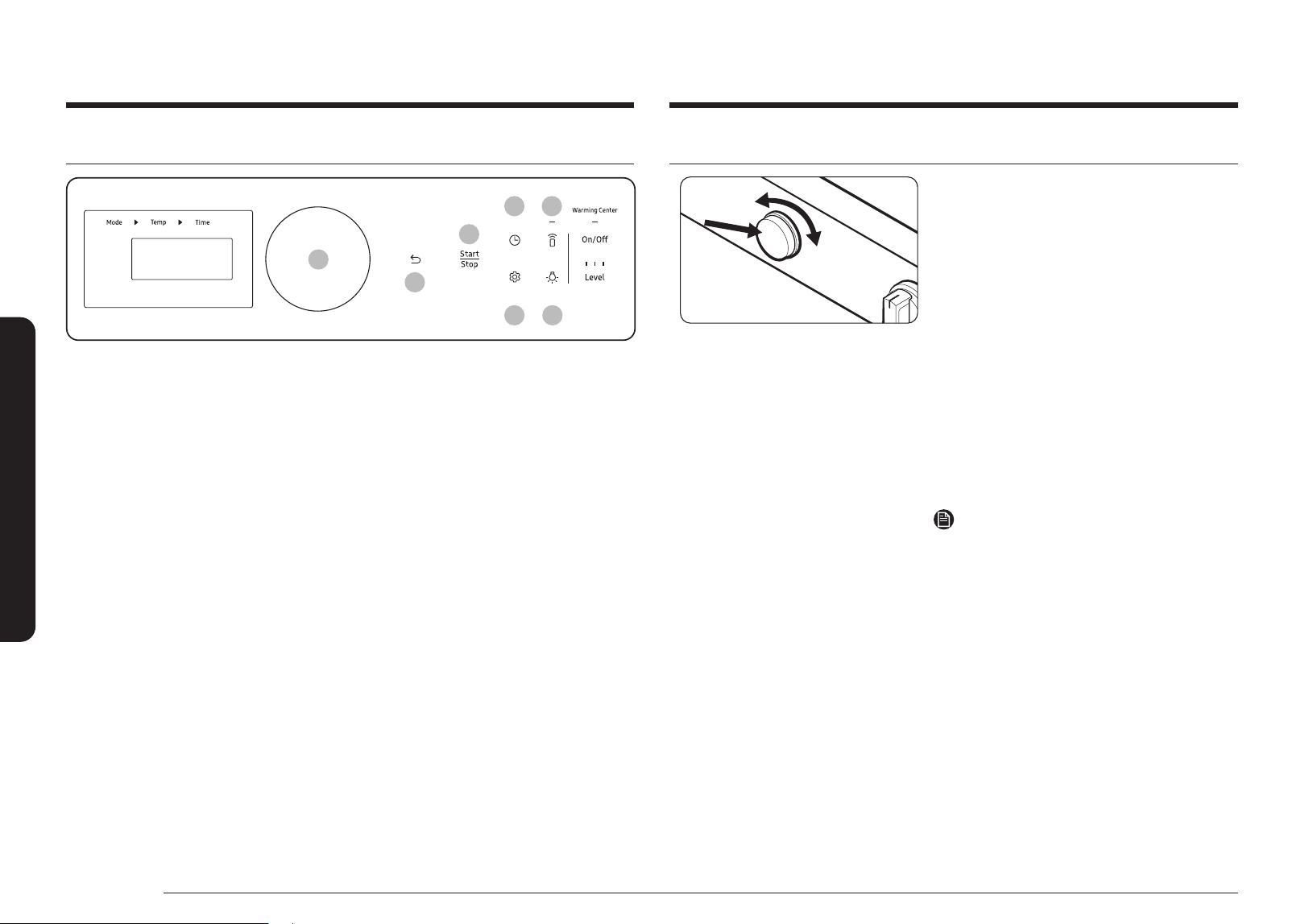
The oven control panel
01
03 05
02 04
06
07
01 Start: Long tap to start oven operation.
Stop: Delete all information entered, return to the rst step.
Stop the oven operation.
02 Time Option: Go to set time options.
03 Options: Go to set options.
04 Smart Control: Set Smart Control function On/Off.
05 Light: Tap to turn oven light On/Off.
06 Dial Knob: Turn Clockwise - Move focus to next / increase value.
Turn Counterclockwise - Move focus to previous / decrease value.
Push - Select the current value.
07 Back: Go to upper depth, previous page, etc.
How to use dial knob
PushingPushing
TurningTurning
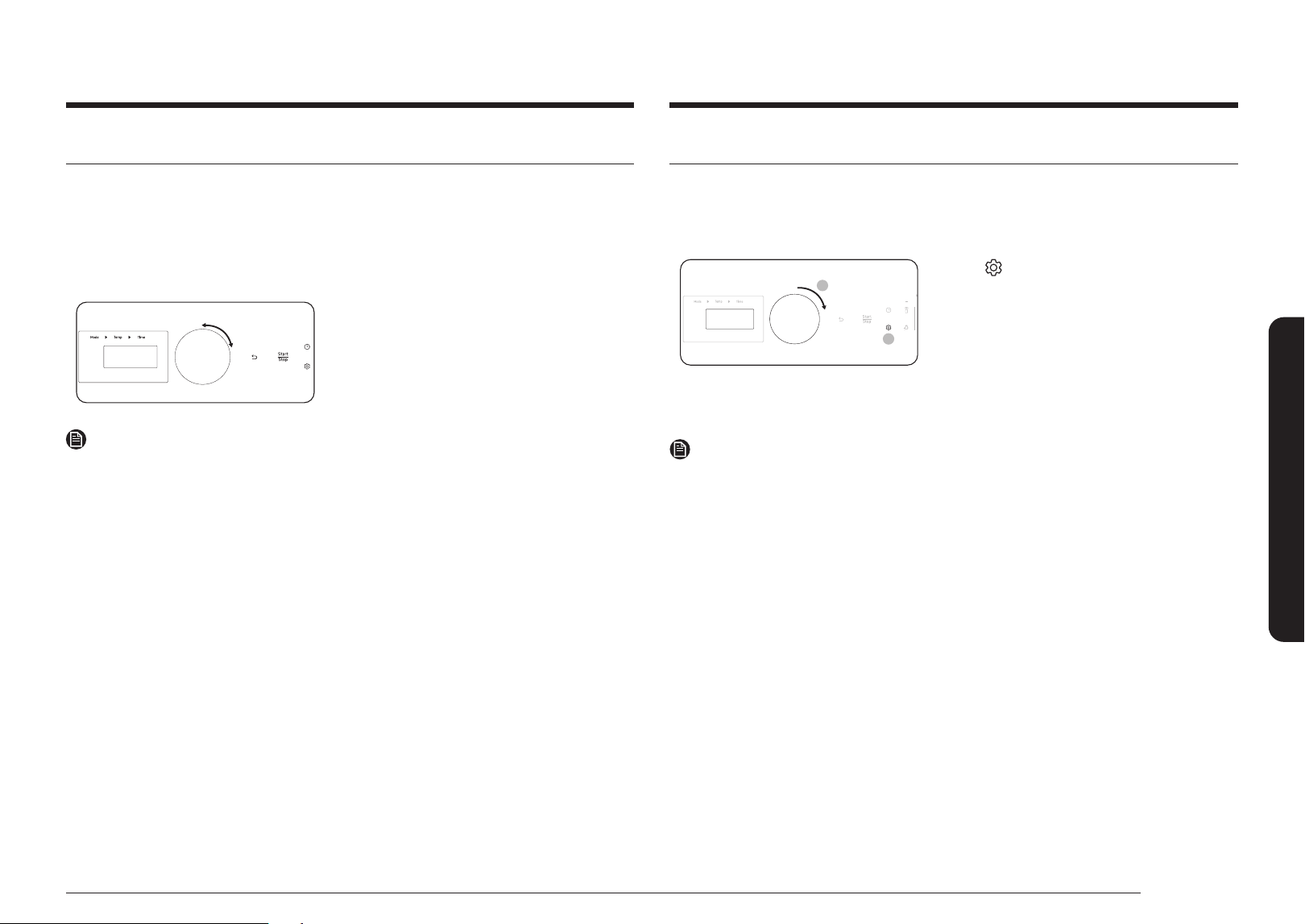
The dial knob can be used in the following
ways:
1. Turning
• Turning the dial knob clockwise or
counterclockwise will show next or
previous mode when selecting the
cooking mode.
• Turning the dial knob clockwise or
counterclockwise will increase or
decrease the value when selecting the
cooking temperature or time.
2. Pushing
By pushing the dial knob, current value will
be entered.
NOTE
Dial knob cannot be disassembled.
Do not pull it forcibly.
Operating the oven
English 27
Operating the oven
Display mode
Sleep mode
The control panel enters Sleep mode if the oven is not used for a while.
In Sleep mode, the control panel is inactive until it is reactivated by the user.
Wake-Up
To activate the control panel, turn or
Push the Dial Knob. User preferences are
available in this mode including the timer,
oven light, and/or control lock.
NOTE
If the Smart control funtion is ON while connected to Wi-Fi, the clock will always
display.
Clock
You must set the clock correctly to ensure the automatic features work properly.
This product supports two time formats: 12-hour (default) and 24-hour.
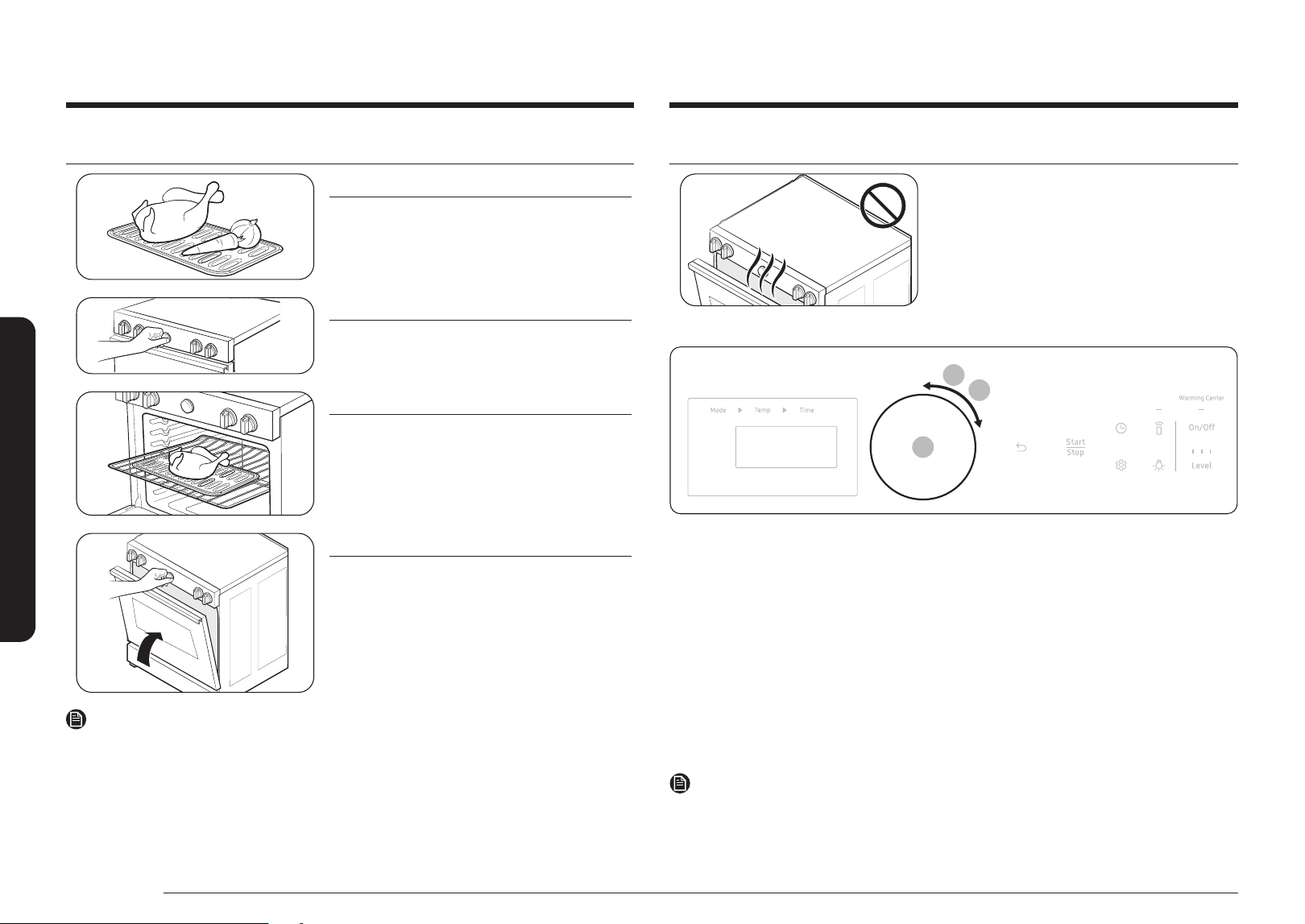
To set the clock
2
1
1. Tap , and then select Date & Time
using the dial knob.
2. Enter the current time using the dial
knob.
3. Push the dial knob to conrm the time.
4. Enter the current date using the dial
knob.
5. Push the dial knob to conrm the date.
NOTE
You can set/change the clock or the kitchen timer before you start a cooking mode
or while most cooking modes are operating. However, you cannot set or change
the time if a time based function is operating (Time Bake, for example) or the
Sabbath feature is enabled.
28 English
Operating the oven
Operating the oven
Oven cooking
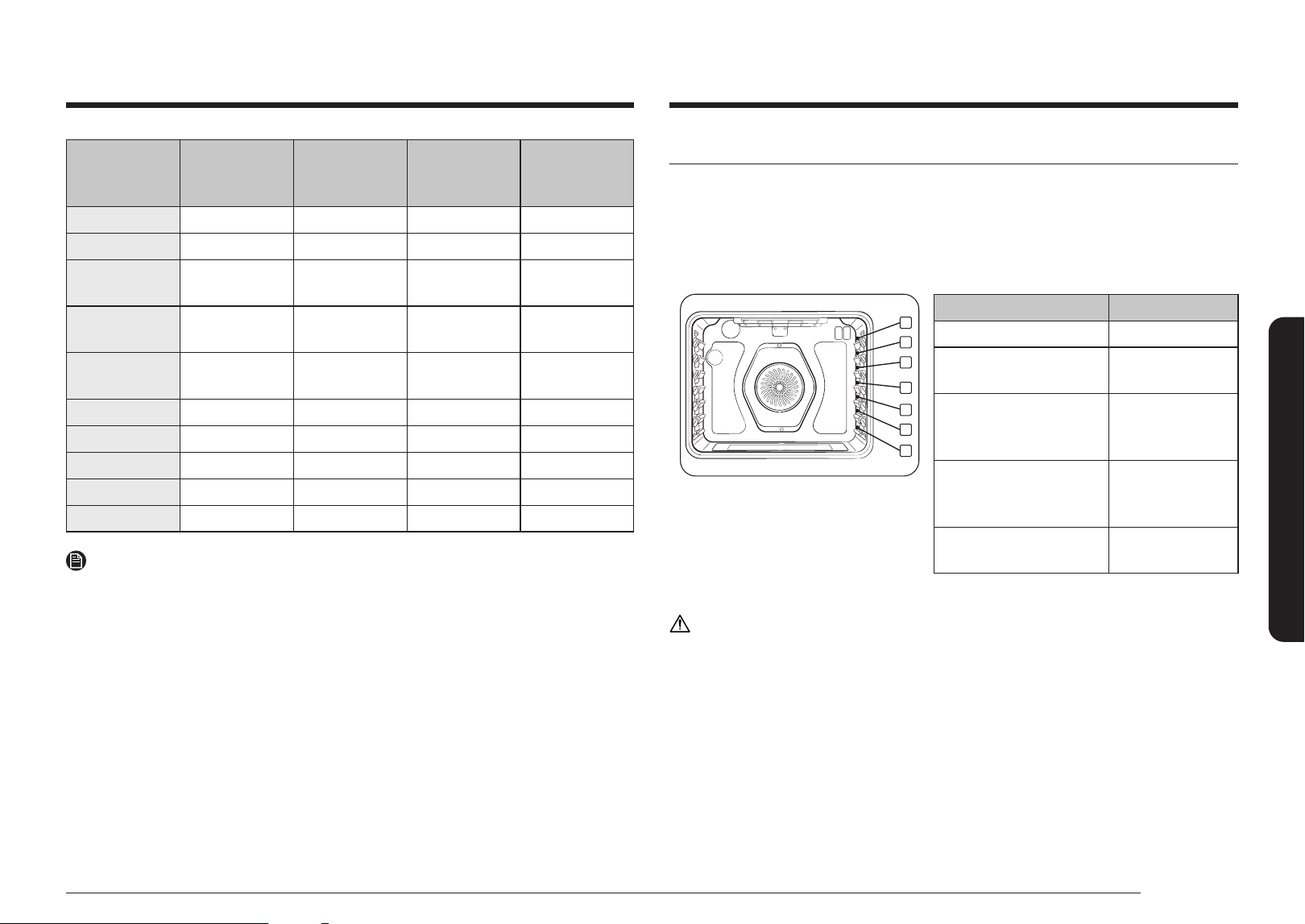
STEP 1
Put all ingredients in a heat-safe container.
STEP 2
Select a cooking mode, and then start
preheating.
STEP 3
Place the container on a rack.
STEP 4
Close the door and start cooking.
NOTE
The cooling fan automatically runs for a certain amount of time after cooking is
complete.
Cooking mode
• Make sure to close the door before you
start cooking.
• If you leave the door open for about
2 minutes
while the oven is in convection
baking/roasting, baking, or broiling
modes, the oven heating element will
shut off. To restart the heating element,
close the door.
2
1
3
1. Use the Dial Knob to select a mode (Bake, Convection Bake, Convection Roast,
Air Fry, Broil, etc.).
2. If necessary, use the dial knob to change the default temperature. You can set
the oven to any temperature.
3. Push the dial knob, if necessary, you can set the Cook Time and Delay Start
when the 'Start' Message displays.
Long tap to Start or push the dial knob.
• The oven preheats until it reaches the temperature you set.
• It beeps several times when it reaches the set temperature.
• When preheating is complete, place the food in the oven, and then close the
door.
4. When cooking is complete, turn off the oven and then take out the food.
NOTE
Oven modes and temperature will be reordered by frequency of use.
English 29
Operating the oven
Mode
Temperature
range (°F)
Default
temperature
(°F)
Set Cook Time Delay Start
Bake 175 - 550 350 O O
Broil Hi-Lo Hi X X
Convection
Bake
175 - 550 325 O O
Convection
Roast
175 - 550 325 O O
Convection
Vegetable
350 - 450 400 O O
Air Fry 350 - 500 425 O O
Air Sous Vide 100 - 205 150 O O
Dehydrate 100 - 225 150 O O
Keep Warm - 175 X X
Bread Proof - 95 X X
NOTE
To change the temperature during cooking, repeat steps 1 through 3 above.
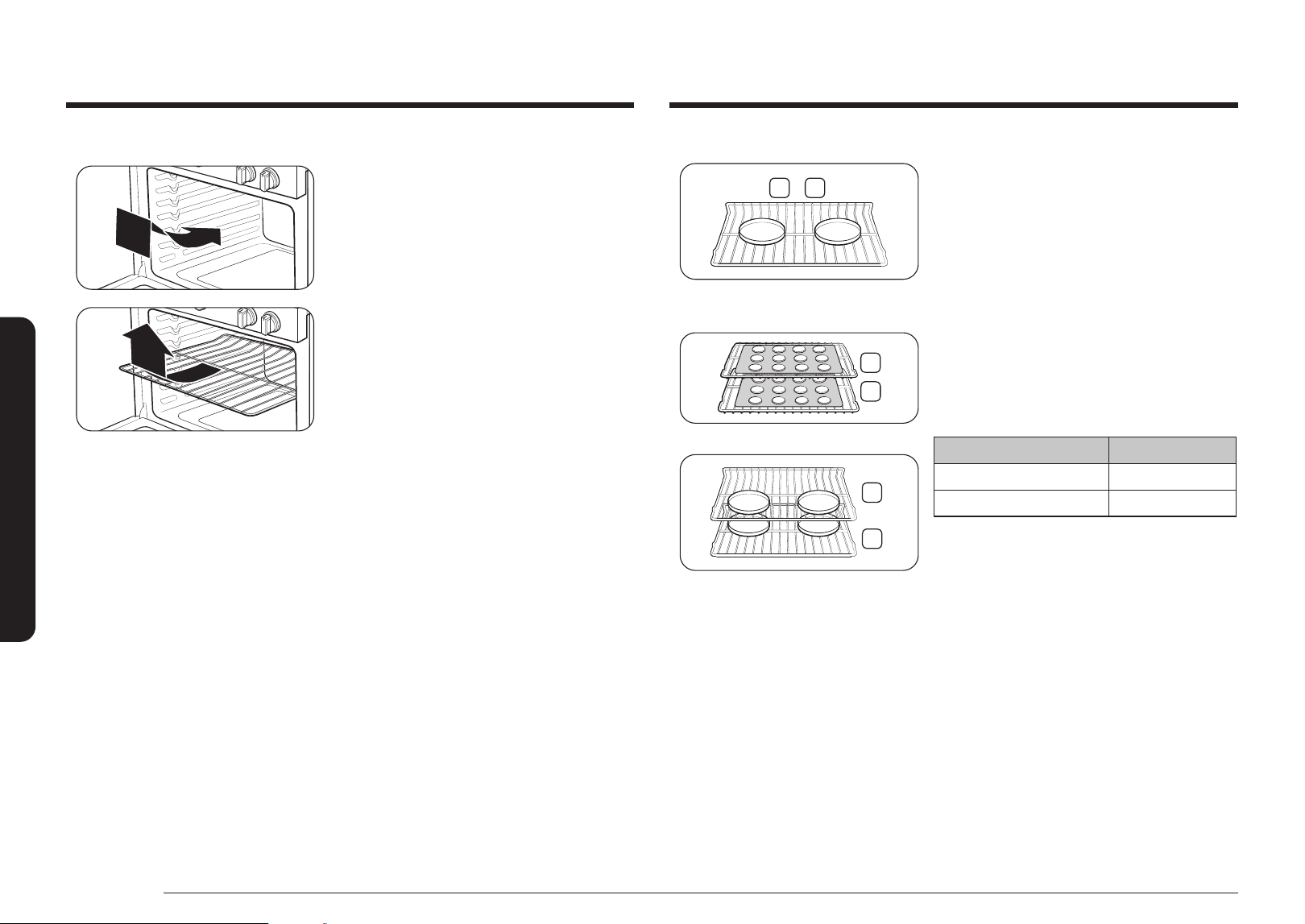
Using the oven racks
Your oven range comes with 2 racks and 7 rack positions. The rack positions are
delineated by rack guides which support the racks. Each rack guide has a stop
that prevents the rack from loosening during the oven's operation. Each rack has
stoppers that need to be placed correctly on the rack guides. The stoppers prevent
the racks from accidently coming out of the oven completely when you pull the
racks out.
1
2
3
4
5
6
7
Type of food Rack position
Broiling hamburgers 7
Broiling meats or small
cuts of poultry, sh
4 - 6
Bundt cakes, Pound
cakes, Frozen pies,
Casseroles
3 or 4
Angel food cakes,
Small roats, Fresh and
Frozen pizza
2
Turkey, Large roasts,
Hams
1
This table is for reference only.
CAUTION
• Do not cover an oven rack with aluminum foil. This will hamper heat circulation,
resulting in poor baking.
• Do not place aluminum foil on the oven bottom. The aluminum can melt and
damage the oven.
• Arrange the oven racks only when the oven is cool.
• When placing an oven rack in the top-most rack position (position 7), make sure
the rack is situated stably on the embossed stop.
30 English
Operating the oven
Operating the oven
Inserting and removing an oven rack
To insert an oven rack
1. Place the rear end of the rack on a rack
guide.
2. Slide the rack into the rack guide while
holding the front end of the rack.
To remove an oven rack
1. Pull out the rack until it stops.
2. Pull up the front end of the rack and
remove it from the rack guide.
Rack and Pan placement
3 4
Single Oven Rack
Centering the baking pans in the oven as
much as possible will produce better results.
If baking with more than one pan, place the
pans so each has at least 1" to 1 ½" of air
space around it.
When baking on a single oven rack, place
the oven rack in position 3 or 4.
See the gure on the left.
3
5
Multiple Oven Rack
3
5
For cakes, place the oven racks in positions
3 and 5. For cookies, place the racks in
positions 3 and 5.
Using Multiple Oven Racks
Type of Baking Rack Positions
Cookies 3 and 5
Cakes 3 and 5
English 31
Operating the oven
Before using the racks
The oven has two racks.
Each rack has stops that need to be placed correctly on the supports.
These stops will keep the rack from coming out completely.
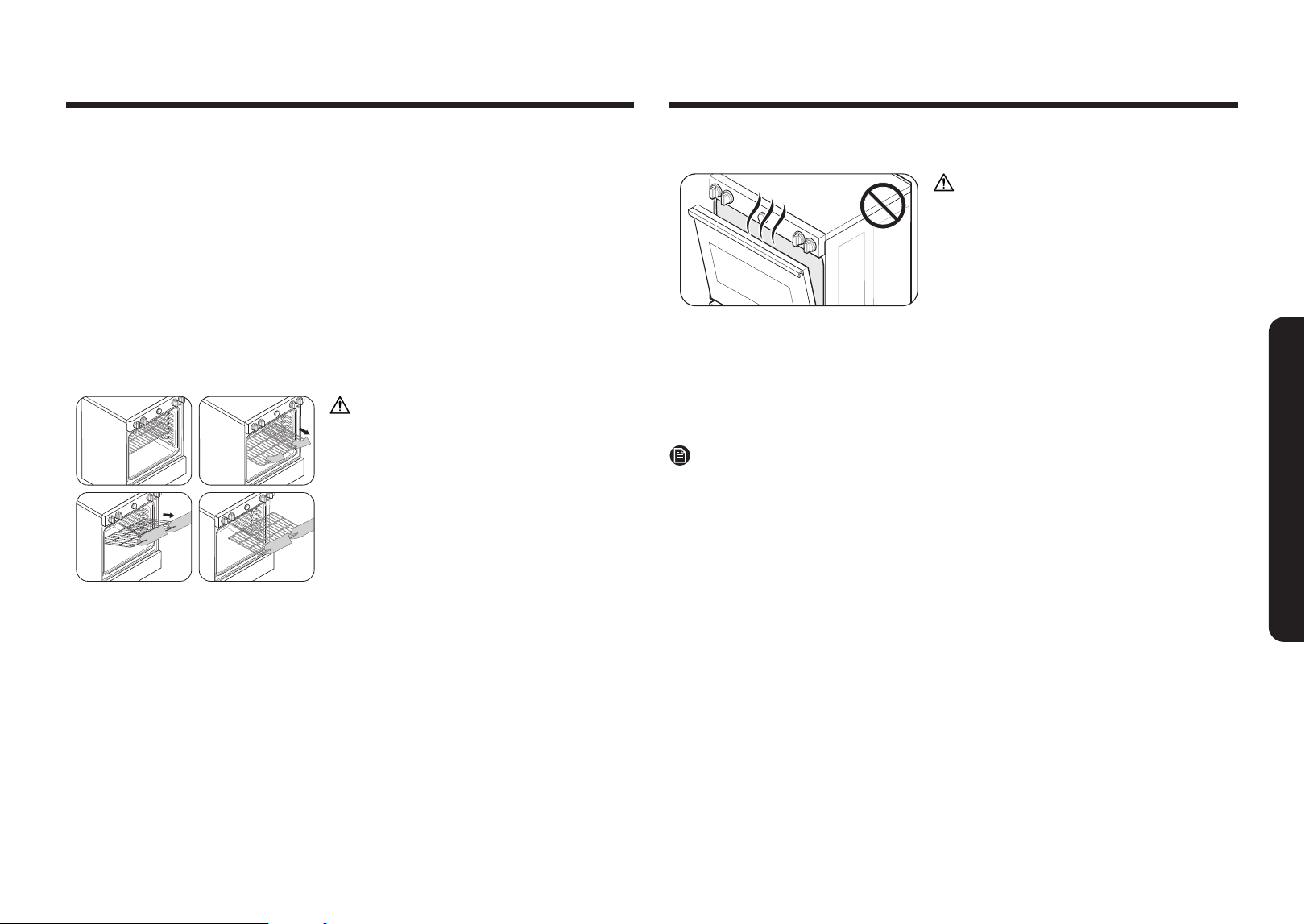
REMOVING THE RACKS
1. Pull the rack straight out until it stops.
2. Lift up the front of the rack, and then pull it out.
REPLACING THE RACKS
1. Place the end of the rack on the support.
2. Tilt the front end up and push the rack in.
CAUTION
• Do not cover a rack with aluminum
foil or place aluminum foil on the
oven bottom. This will hamper heat
circulation, resulting in poor baking, and
may damage the oven bottom.
• Arrange the oven racks only when the
oven is cool.
Recipe guide
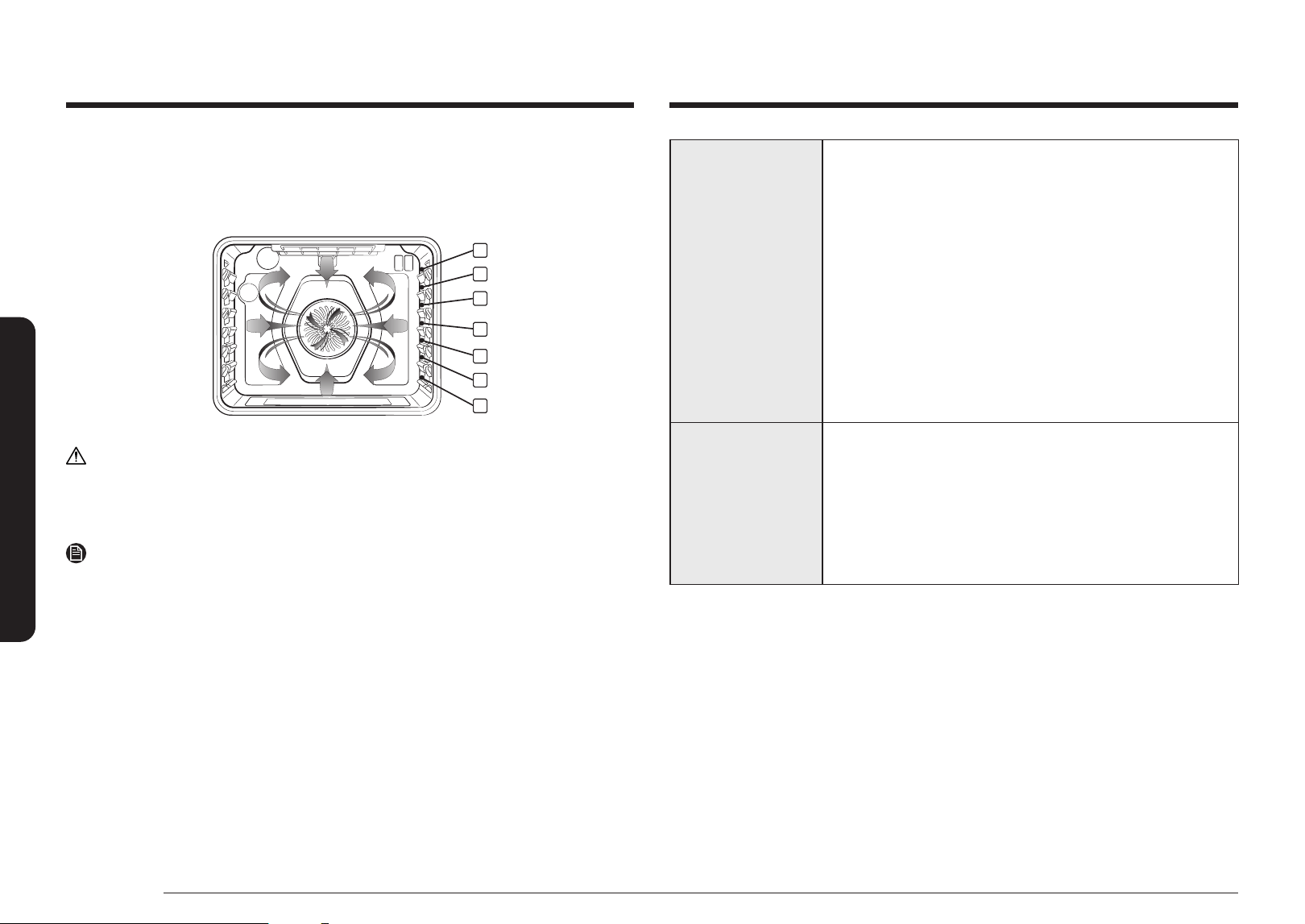
CAUTION
Always use this cooking mode with the
oven door closed.
Use care when opening the door. Let hot air
or steam escape before you remove food
from or put food into the oven.
Baking
Bake is used to cook cakes, cookies, and casseroles. Always preheat the oven rst.
Baking temperatures and times will vary depending on the ingredients and the
size and shape of the baking pan used. Dark or nonstick coatings may cook faster
with more browning.
NOTE
• Place food in the oven after preheating if the recipe calls for it.
• Preheating is very important for good results when baking cakes, cookies,
pastry, and breads. After the oven has reached the desired temperature, the
oven will beep several times.
• If you are using an oven thermometer in the oven cavity, the temperature
registered by the thermometer may differ from the actual set oven
temperature.
• For performance reasons, the convection fan may be turned on or off during
the operation.
32 English
Operating the oven
Operating the oven
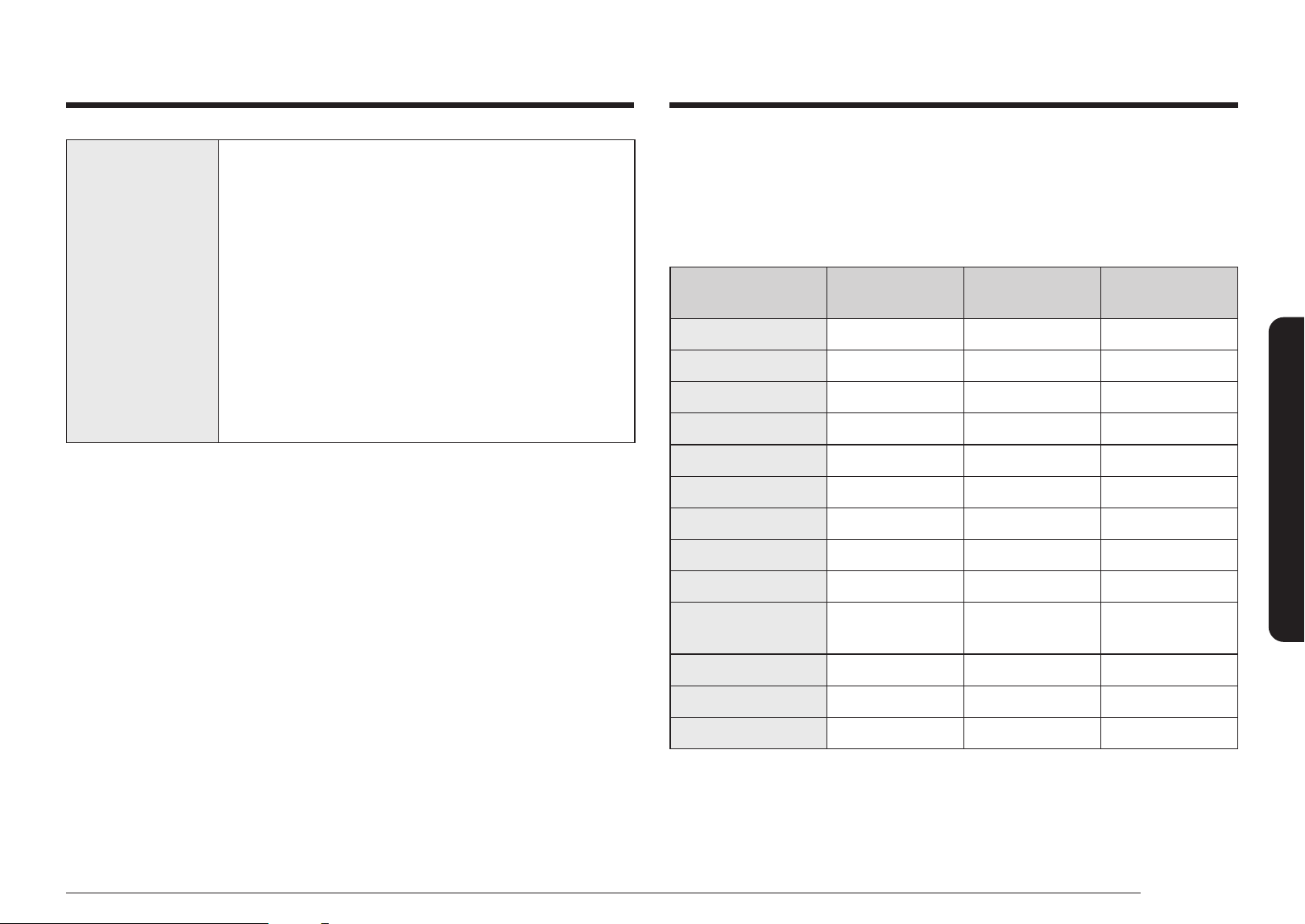
Convection cooking
The convection fan at the back of the oven circulates hot air evenly throughout the
oven cavities so that food is evenly cooked and browned in less time than with
regular heat.
1
2
3
4
5
6
7
CAUTION
• The convection oven fan shuts off when the oven door is opened.
• DO NOT leave the door open for long periods of time while using convection
cooking or you may shorten the life of the convection heating element.
NOTE
• When using convection cooking, always preheat the oven for the best results.
• If you leave the oven door open for more than 2 minutes when the oven is on,
all heating elements will shut off automatically.
• When you have nished cooking, the cooling fan will continue to run until the
oven has cooled down.
• For performance reasons, the convection fan may be turned on or off during
the operation.
Convection Bake • Ideal for foods being cooked using multiple racks.
• Good for large quantities of food.
• Provides the best performance for cookies, biscuits,
brownies, cupcakes, cream puffs, sweet rolls, angel
food cake, and bread.
• Cookies bake best when cooked on at cookie sheets.
• When convection baking using a single rack, place the
rack in rack position 3 or 4.
(In Twin mode, position A or 1.)
• When convection baking using two racks, place the
racks in positions 3 and 5 (Cakes, Cookies).
• The oven automatically adjusts the temperature for
convection baking.
Convection Roast • Good for larger, tender cuts of meat, uncovered.
• For best performance, place a broiler pan and grid
under the meat or poultry. The pan catches grease
spills and the grid prevents grease spatters.
• Heated air circulates over, under, and around the food.
Meat and poultry are browned on all sides as if they
were cooked on a rotisserie.
English 33
Operating the oven
Convection
Vegetable
• Convection Vegetable provides excellent cooking
conditions for vegetables such as potatoes, tomatoes,
onions, carrots, bell peppers, broccoli and It creates
optimal texture and taste for vegetable by increasing
moisture content when compared to general
convection.
• The uniform air circulation provided by Pure
Convection allows you to use more oven capacity at
once.
• For best results, use this mode in single oven mode and
place the cooking tray in position 3.
• Preheating is not necessary for this mode.
• See the Convection Vegetable recommendation guide
section starting on page 33.
Convection Vegetable recommendation guide
• Preheating is not necessary.
• For best results, use this mode on a single oven rack and place the dish on the
rack position 3.
• The temperature can be set between 350 °F - 450 °F.
The default temperature is 400 °F.
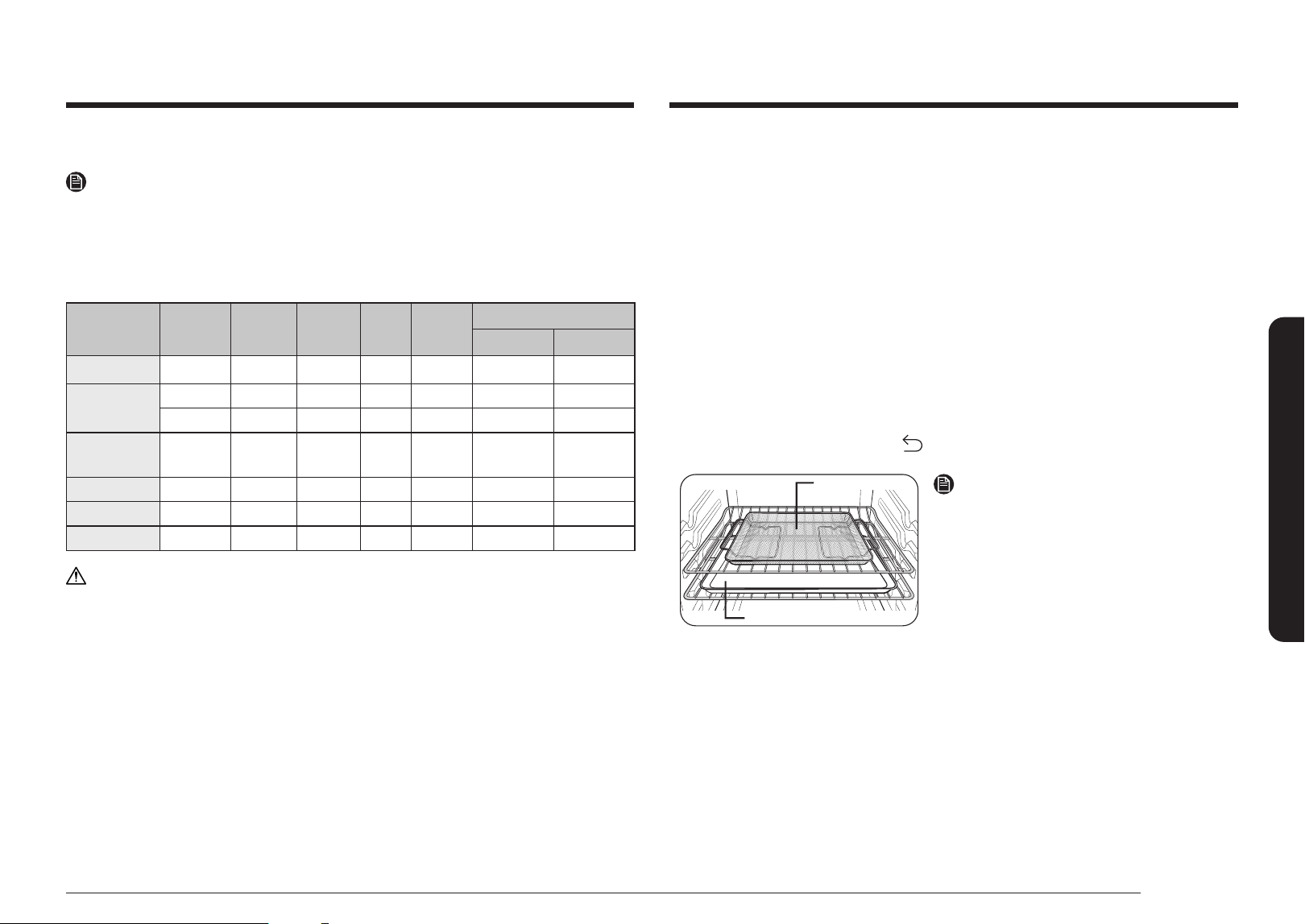
Items Temperature (°F) Rack position
Cooking time
(min)
Potatoes 375 - 425 3 45 - 65
Tomatoes, sliced 425 - 450 3 15 - 20
Onions, sliced 400 - 425 3 15 - 25
Carrots, sliced 375 - 425 3 30 - 45
Bell peppers, sliced 375 - 425 3 15 - 25
Broccoli, orets 400 - 425 3 15 - 20
Cauliower, orets 400 - 425 3 15 - 20
Asparagus 425 - 450 3 15 - 20
Mushroom 425 - 450 3 15 - 25
Zucchini, quartered
lengthwise
375 - 400 3 30 - 50
Squash, sliced 375 - 400 3 30 - 50
Eggplant, sliced 400 - 425 3 15 - 20
Green beans 400 - 425 3 15 - 20
* This table is for reference only

34 English
Operating the oven
Operating the oven
NOTE
• When cooking vegetables, place baking paper on a baking sheet or tray to catch
any drippings.
• It is recommended to use some oil such as olive oil or avocado oil and some salt
or pepper.
• It is recommended to serve with fresh herbs such as basil leaves, rosemary
leaves, and grated cheeses as your taste after cooking.
• Serve cooked vegetables with your favorite main dish.
• It is recommended to take cooked vegetables every day for your health.
• Vegetables not listed in the table are recommended to be cooked at the default
temperature at rst, and then cooked at a higher or lower temperature.
• For performance reasons, the convection fan may be turned on or off during
the operation automatically.
• For more information, the Samsung website offers special menus and recipes to
enjoy cooked vegetables on the guide table, you can download detailed recipes
for each feature from the our website. (www.samsung.com/us/support)
Broiling
Broiling uses the oven broil burner at the top of the oven to cook and brown food.
Meat or sh must be put on a broiling grid in a broiling pan. Preheating for
4 minutes before broiling is recommended.
NOTE
• This oven is designed for closed door broiling. While broiling, keep the door
closed.
Only open the door to put food in, turn food over, or take food out.
• Use the Broil Rack for the best results.
• Use the Broil Lo for poultry or thick cuts of meat to prevent overbroiling.
• Use caution when you open the oven door to turn over the food. The air
escaping from the oven will be very hot.
• If you leave the oven door open for more than 2 minutes when the oven is on,
all heating elements will shut off automatically.
• When you have nished cooking, the cooling fan will continue to run until the
oven has cooled down.
English 35
Operating the oven
Broiling guide
NOTE
For reference only.
• Preheating for 4 minutes before broiling is recommended.
• The size, weight, thickness, starting temperature, and your doneness preference
will affect broiling times.
• This guide is based on meats at refrigerator temperature.
Food Doneness Size
Thickness
Broil
setting
Rack
position
Cooking time
1st side
2nd side
Hamburgers
Medium 9 patties 1" Hi 7 3:20 - 3:40 2:20 - 2:40
Beef steak
Medium - 1" Hi 5 7:00 - 8:00 6:00 - 7:00
Medium - ¾" Hi 5 6:00 - 7:00 5:00 - 6:00
Chicken
pieces
Well done
2 - 2 ½ lbs.
¾"-1" Hi 4
15:00 - 16:00 13:00 - 14:00
Pork chops
Well done 1 lb. ½" Lo 5
15:00 - 16:00 13:00 - 14:00
Lamb chops
Well done 1 lb. ¾"-1" Hi 5 5:00 - 6:00 4:00 - 5:00
Salmon steak
Well done 3 pcs. ¾"-1" Hi 5 4:00 - 7:00 3:00 - 6:00
CAUTION
Make sure to close the door after turning over the food.
Air Fry
This feature uses hot air for crispier and healthier frozen or fresh foods without or
less oil than normal convection modes. For best results, use this mode on a single
oven rack and place the Air Fry tray on the position 3. The temperature can be
set between 350 °F and 500 °F. Preheating is not necessary for this mode. Follow
recipe or package directions for set temperature, time or quantity.
How to set the oven for Air Fry mode
1. Place the tray on rack position 3.
2. Select Air Fry mode using the dial knob.
3. Use the dial knob to change the default temperature. Enter the suggested
temperature for your food as recommended cooking guide. The default
temperature is 425 °F.
4. Push the dial knob and set the Cook Time or Delay Start, if necessary.
5. Long tap to Start or push the dial knob.
6. When cooking is complete, tap
and take out the food.
Tray or Baking sheetTray or Baking sheet
Air Fry trayAir Fry tray
Air Fry tray recommended
placement
NOTE
• Place a baking sheet or tray on the
rack below the Air Fry tray for getting
any drippings. This will help to reduce
splatter and smoke for high fat foods,
such as chicken wings.
• Air Fry is designed for baking on a single
oven rack. Place food on rack position 3
for best results. (Rack position number
counts from the bottom.)
• Before using a baking ware, check the maximum allowable temperature of
baking sheet.
• Place under a few sheets of paper like parchment paper to absorb the fat for
reducing splatter and smoke during the Air Fry.
• For cooking fresh or homemade foods, spread the oil over a larger area more
evenly, crisping up the food more effectively.
• Wet or thicken coating will not crisp or set to use with the Air Fry.
36 English
Operating the oven
Operating the oven
CAUTION
• Foods that are high in fat will smoke when using the Air Fry model, such as
chicken wings, bacon, sausage and turkey legs.
• Before you start Air Fry, turn on an exhaust hood at a high level fan setting.
• Open a window in your kitchen if it is possible to make sure the kitchen is well-
ventilated.
• Once the oven has cooled, wipe down the interior of the oven before and after
Air Fry cooking.
• Regularly, clean the grease lters of exhaust hood for preventing smoke during
cooking.
• Avoid opening the oven door, or else it is difcult to maintain the oven
temperature, prevent heat loss, and save energy.
NOTE
• Preheating is not necessary.
• Place the Air Fry tray on position 3.
• It is recommended to use avocado oil.
• Place a baking sheet or tray on the rack below the Air Fry tray to catch any
drippings. This will help to reduce splatter and smoke.
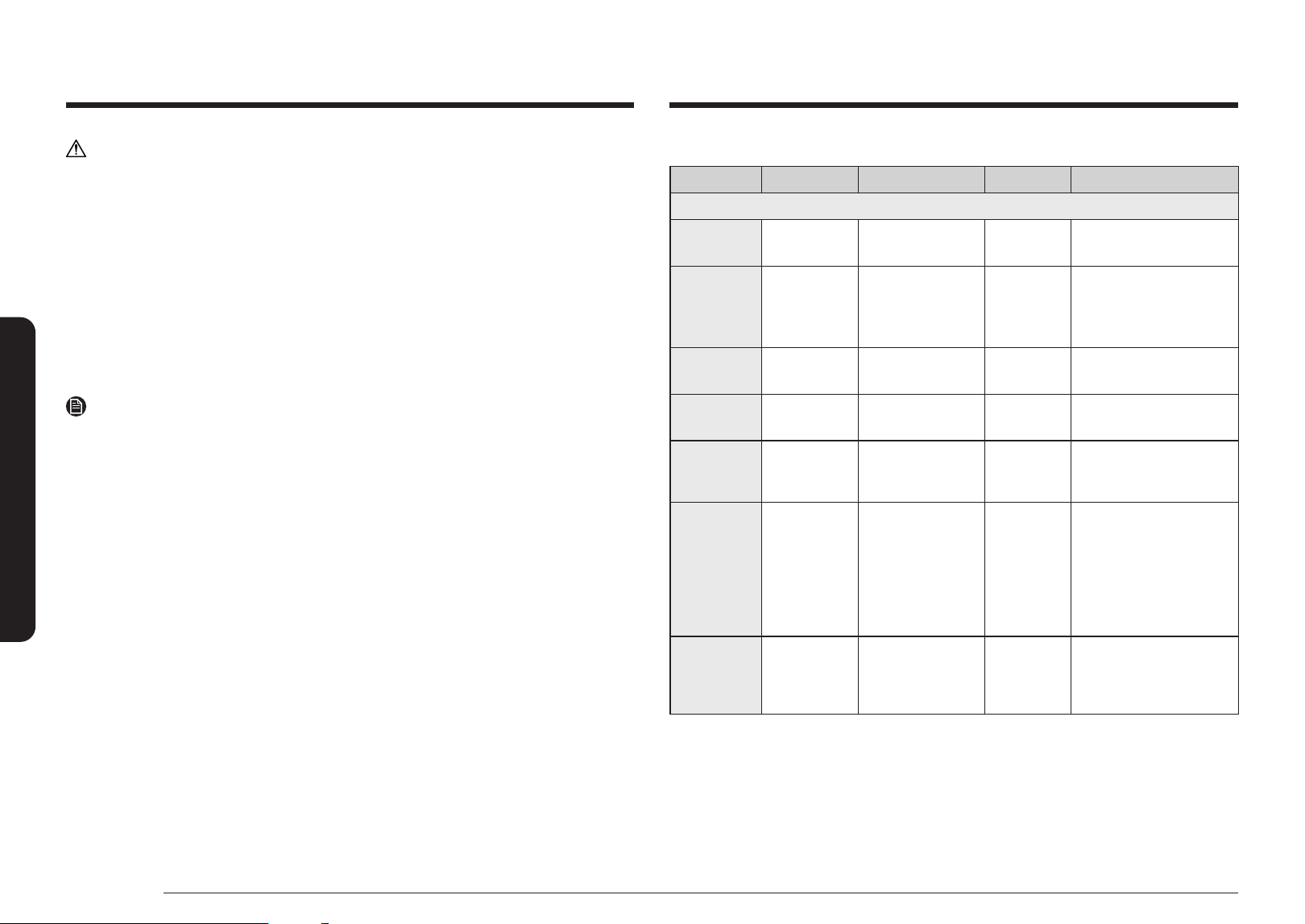
Air Fry recommendation guide
Item Amount (oz) Temperature (°F) Time (min) Tips
Potatoes
Frozen
French Fries
30 - 35 425 - 450 25 - 30 -
Frozen
French
Fries,
Seasoned
25 - 30 425 - 450 20 - 25 -
Frozen Tater
Tots
40 - 45 450 20 - 25 -
Frozen Hash
Brown
25 - 30 450 20 - 25 -
Frozen
Potato
Wedges
30 - 35 425 - 450 20 - 25 -
Homemade
French Fries
25 - 30 425 25 - 30
Peel potatoes and
cut into sticks with a
thickness of ⅓ inch.
Soak in cold water for
30 min. Brush with
3tbsp of oil. Add salt
and pepper to taste.
Homemade
Potato
Wedges
25 - 30 450 25 - 30
Cut them into wedges.
Brush with 3 tbsp
of oil. Add salt and
pepper to taste.
English 37
Operating the oven
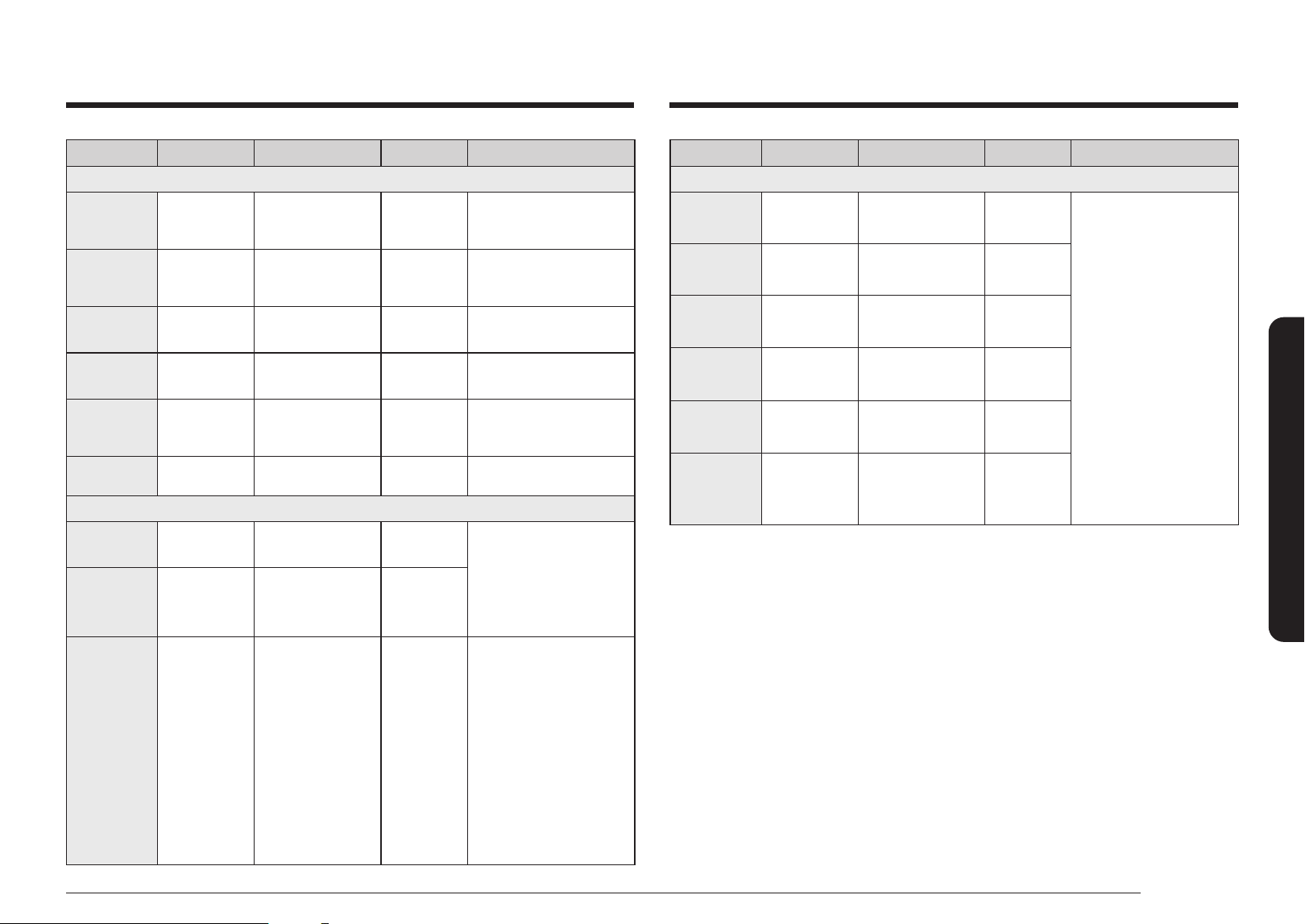
Item Amount (oz) Temperature (°F) Time (min) Tips
Frozen
Frozen
Chicken
Nuggets
24 - 28 400 - 425 15 - 25 -
Frozen
Chicken
Wings
30 - 35 425 20 - 30 -
Frozen
Onion Rings
20 - 25 425 °F 15 - 20 -
Frozen Fish
Fingers
20 - 25 425 °F 18 - 22 -
Frozen
Chicken
Strips
25 - 30 425 - 450 25 - 30 -
Frozen
Churros
20 - 25 425 18 - 22 -
Poultry
Fresh
Drumsticks
35 - 45 425 - 450 30 - 35
Brush with 3 tbsp
of oil. Add salt and
pepper to taste.
Air frying foods that
are high in fat can
create smoke.
Fresh
Chicken
Wings
30 - 35 425 - 450 25 - 30
Chicken
Breasts,
Breaded
30 - 35 400 - 425 25 - 30
Dip chicken breasts
into the our mixture.
Whisk the egg and
milk. Dip our coated
breasts into the egg
mixture. Place them
into breaded crumbs
and toss until items
are coated with
crumbs. Add salt and
pepper to taste. Brush
with 3 tbsp of oil.
Item Amount (oz) Temperature (°F) Time (min) Tips
Vegetables
Asparagus,
Breaded
15 - 20 425 20 - 25
Dip sliced vegetables
into the our mixture.
Whisk the egg and
milk. Dip our coated
vegetables into the
egg mixture. Place
them into breaded
crumbs and toss until
items are coated with
crumbs. Add salt and
pepper to taste. Brush
with 3 tbsp of oil.
Egg Plants,
Breaded
20 - 25 425 20 - 25
Mushroom,
Breaded
18 - 22 425 20 - 25
Onions,
Breaded
18 - 22 425 20 - 25
Cauliowers,
Breaded
18 - 22 400 - 425 20 - 25
Vegetable
Mix,
Breaded
30 - 35 400 - 425 20 - 25
38 English
Operating the oven
Operating the oven
Air Sous Vide
Air sous vide mode uses low-temperature hot air to implement Sous Vide method
without steam or the water tank. In this mode, the oven keeps constant low
temperatures, cooking food that can keep its original fragrance and nutrients while
offering enriched avor and soft texture.
How to set the oven for Air Sous Vide mode
1. Place the vacuum sealed bags of food on the rack in position 3.
2. Select Air Sous Vide mode using the dial knob.
3. Use the dial knob to change the default temperature. Enter the suggested
temperature for your food as recommended by its instructions. The default
temperature is 150 °F.
4. Push the dial knob and set the Cook Time or Delay Start, if necessary.
Air Sous Vide mode can set 99 hrs 59 mins.
5. Long tap to Start or push the dial knob.
6. When cooking is complete, tap
and take out the food.
NOTE
• It is not necessary to preheat the oven
when using Air Sous Vide mode.
• Place the vacuum sealed bags of food on
the rack 4 of the oven.
• Use it to cook meat, sh, seafood,
poultry or vegetables.
• Use fresh and quality ingredients only.
Trim them in clean conditions and store
in the refrigerator.
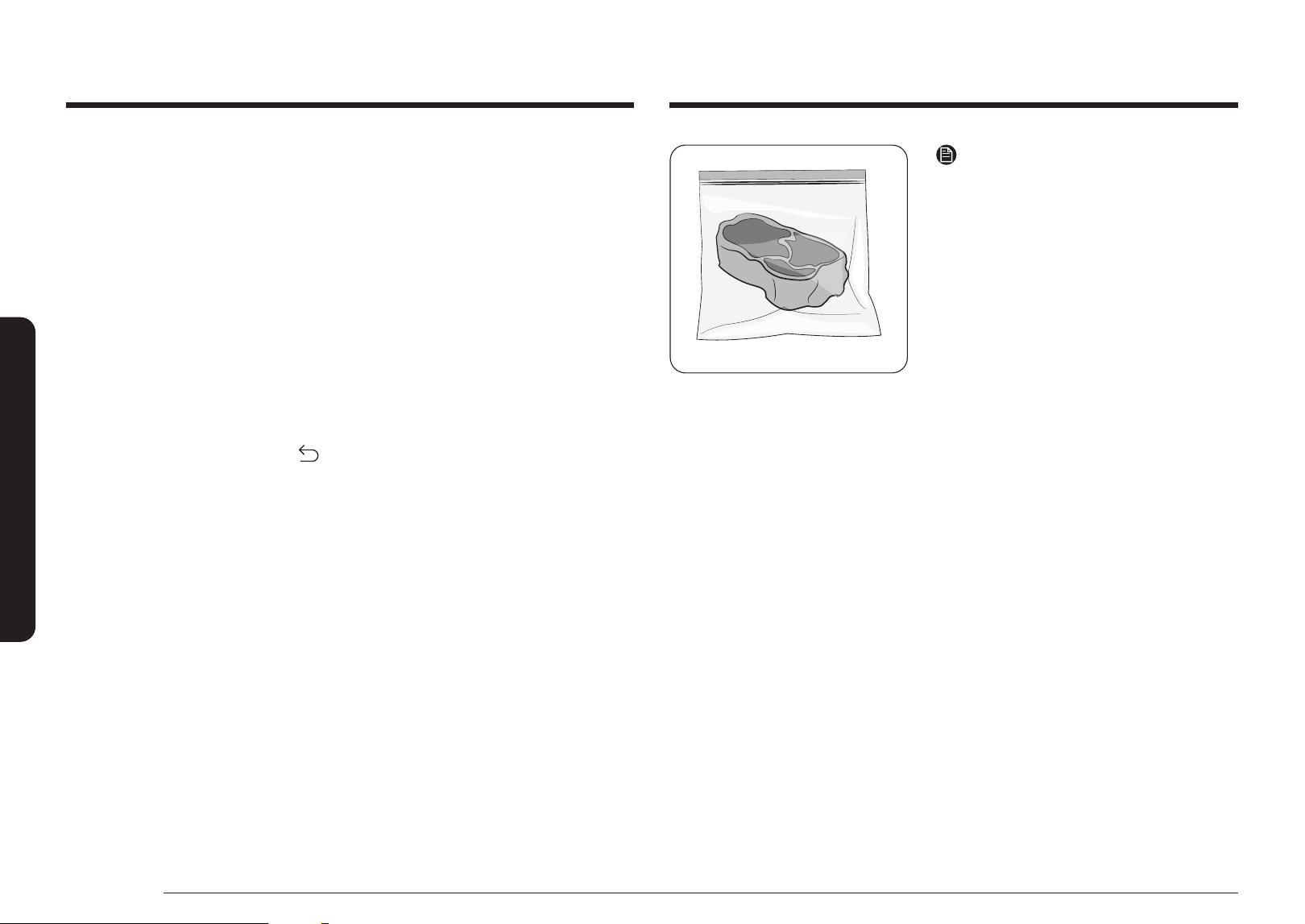
• Use heat-resistant vacuum bags for
moving and storing ingredients.
• Never reuse the heat-resistant vacuum
bags.
• The cooking time depends on the
thickness of food. Addition of salt or
sugar may shorten the cooking time.
• Use Air Sous Vide recommendation
guide to nd the recommended cooking
time and temperature for the food.
• Only use temperatures below 140 °F
(60 °C) to cook foods that can safely be
consumed raw.
Tips
• To keep the original taste, we recommend you use less herbs and spices than in
ordinary recipes.
• Meat and sh offer better avors when seared and served.
• Sous vide dishes are best served immedietly after cooking.
• If not served immediately after cooked, put the food in ice water and cool down
completely.
Then, store them under 40 °F (5 °C) to keep the fragrance and texture of food.
• Chicken, especially, is recommended to eat immediately after cooked.
English 39
Operating the oven
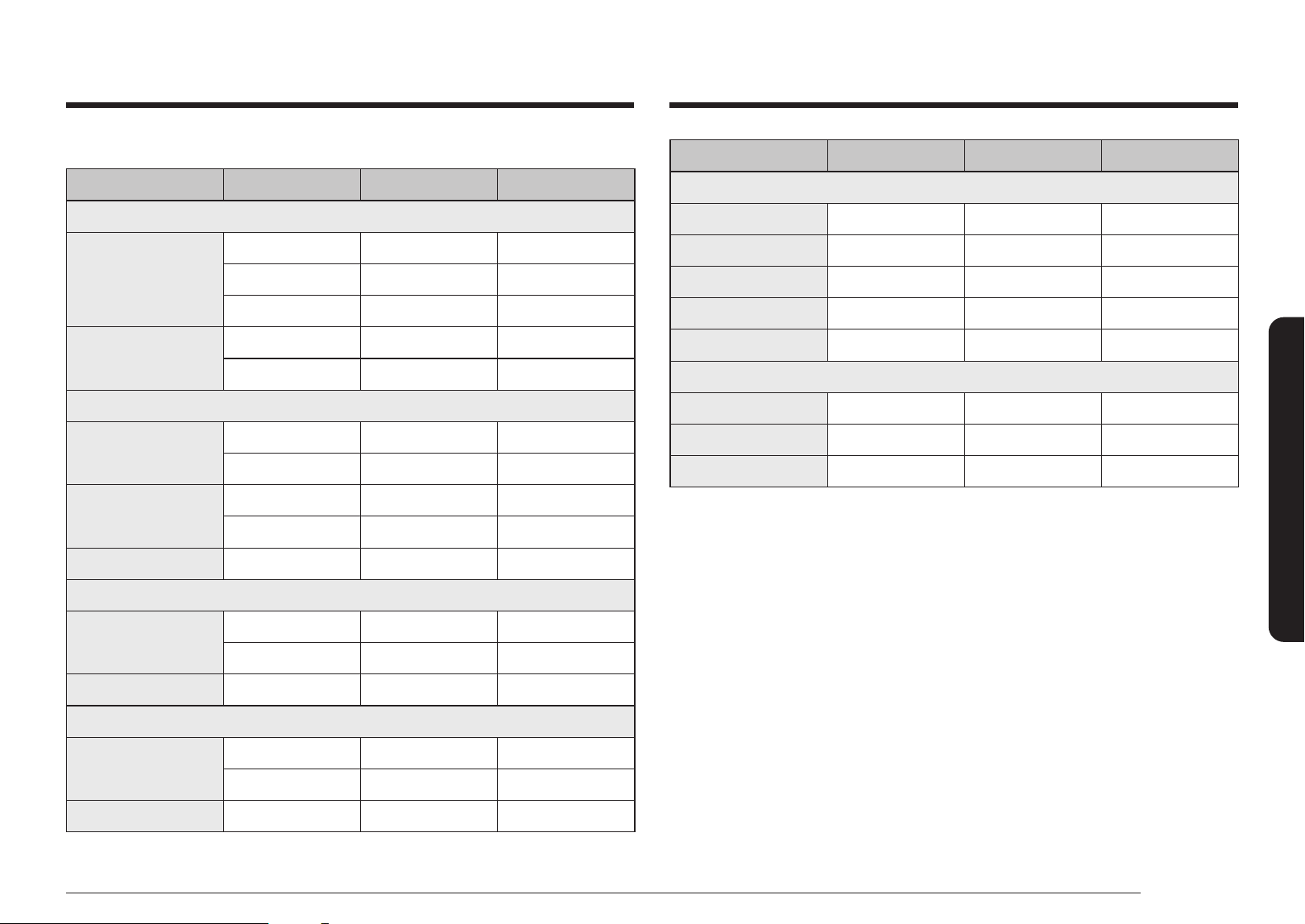
Air Sous Vide recommendation guide
Food Doneness Temperature (°F) Time (hrs.)
Beef
Steak, 1.5" thick
Rare 130 2.5 - 4
Medium 140 2.5 - 4
Well done 155 3 - 5
Roast
Medium 150 6 - 12
Well done 155 6 - 12
Pork
Chop, boneless
Tender 150 3 - 5
Firm 160 3 - 5
Roast
Medium 150 4 - 6
Well done 160 5 - 7
Pulled pork Well done 160 15 - 48
Poultry
Chicken, breast
Tender 145 3 - 4
Firm 160 3.5 - 4.5
Duck, breast Tender 145 3 - 4
Fish
Salmon steak
Tender 130 2 - 4
Well done 145 2 - 4
Cod llet Tender 130 2 - 4
Food Doneness Temperature (°F) Time (hrs.)
Vegetables
Asparagus - 180 0.5 - 2
Potato, sliced - 190 2 - 4
Sweet potato, sliced - 190 2 - 4
Carrot, sliced - 190 2 - 4
Squash, cubes - 180 2 - 3
Fruit
Apple, sliced - 180 2 - 3
Pineapple, sliced - 180 1 - 2
Pear, sliced - 180 2 - 3
40 English
Operating the oven
Operating the oven
Dehydrate
Dehydrate dries food or removes moisture from food via heat circulation.
After drying the food, keep it in a cool and dry place. For fruit, adding lemon (or
pineapple) juice or sprinkling sugar on the fruit helps the fruit retain sweetness.
NOTE
• There is no preheating before dehydrating.
• Place the rack in rack position 3 or 4.
Bread Proof
The Bread Proof function automatically provides the optimum temperature for the
bread proof process and, therefore does not have a temperature adjustment.
If you press Bread Proof when the oven temperature is above 95 °F, Hot will
appear in the display. Because these functions produce the best results when
started while the oven is cool, we recommend that you wait until the oven has
cooled down and Hot disappears from the display.
NOTE
• There is no preheating before bread proof.
• Place the rack in rack position 3.
Keep Warm
Keeps cooked food warm at a low temperature up to 3 hours.
NOTE
• Place the rack in rack position 3 or 4.
• If turn off the 12 hr energy saving feature, this modes will operate until
canceled. (12 hr energy saving's default setting : on)
CAUTION
You should not use this feature to reheat cold food.
Cooking options
CAUTION
Foods that can easily spoil, such as milk, eggs, sh, poultry, and meat, should be
chilled in a refrigerator before they are placed in the oven. Even when chilled,
they should not stand for more than 1 hour before cooking begins and should be
removed promptly when cooking is completed.
Cook Time
Timed cooking sets the oven to cook foods at a set temperature for a set length of
time. The oven automatically turns off when it nishes.
Mode: Bake / Convection Bake / Convection Roast / Convection Vegetable /
Air Fry / Air Sous Vide / Dehydrate
1. Start a desired cooking mode, such as Bake.
2. If necessary, change the temperature using the dial knob.
3. When 'Start' displays, select Set Cook Time using the dial knob.
4. Set the cooking time between 1 minute and 9 hours and 59 minutes (9:59)
using the dial knob.
5. Use the dial knob to select one of the following options you want to run at the
end of cooking.
• Oven Off: The oven turns off at the end of cooking. (Default setting)
• Keep temp: Keep running the oven at the current cooking temperature at the
end of cooking.
• Keep warm: Activate Keep warm function at the end of cooking.
6. Long tap to Start. The oven will automatically turn on and start preheating.
The temperature will increase until it reaches the temperature you set.
The oven starts cooking for the amount of time you set.
7. When preheating is complete, put the container with the food on a rack, and
then close the door.
8. When the cooking time has elapsed, the oven will automatically shut off and
then beep.
NOTE
To change the programmed cooking time, press the
or use the dial knob.
English 41
Operating the oven
Delay Start
The Delay Start function lets you use the kitchen timer to automatically start
and stop another cooking program. You can set Delay Start so that it delays the
automatic start of a cooking operation you select by up to 12 hours.
Mode: Bake / Convection Bake / Convection Roast / Convection Vegetable /
Air Fry / Air Sous Vide / Dehydrate / Self Clean
1. Place the container with the food on a rack, and then close the door.
2. Tap
, and select Delay Start using dial knob.
3. Turn the dial knob to select mode, and then push the dial knob.
4. Turn the dial knob to select temperature, and then push the dial knob.
5. Set the starting time using the dial knob.
6. Long tap to Start or push the dial knob to start.
7. The oven starts cooking at the set time.
NOTE
To change the starting time, press the
, or use the dial knob.
Smart control
How to connect the oven
1. Download and open the SmartThings app on your smart device.
2. Follow the app's on-screen instructions to connect your range.
3. Once the process is complete, the connected
icon located on your range
displays and the app will conrm you are connected.
4. If the connection icon does not turn on, follow the instruction on the app to
reconnect.
1
42 English
Operating the oven
Operating the oven
To control the oven remotely
1. Press
appears in the display. The oven can now be controlled remotely with a
connected remote device.
2. Select the oven icon on the SmartThings app to open the Oven Control app.
When the app is connected to the oven, you can perform the following
functions through the application:
Oven remote control using the SmartThings app
Oven/ Cooktop Monitoring
• Check the status of the oven with camera.
• Monitor the On/Off status of each cooktop
burner.
Oven Remote Control • Set or adjust oven settings remotely.
My Cooking
• Turn the oven off remotely.
• Once cooking starts, change the set cooking
time and temperature remotely.
Error Check • Automatically recognize errors.
If
is not shown in the display, you are still able to monitor the oven and
cooktop status and turn the oven off.
Voice control
To use the Range’s Voice Control function, you need Bixby / Amazon Alexa App /
Google Assistant App on your mobile device.
Bixby
• Bixby is the name of Samsung's articial intelligence solution that makes it
possible to control the product by voice.
• To use the voice recognition function, you need to connect the SmartThings app
and the product on your smartphone.
• For models that do not directly recognize voice input for the product after
connecting to the app, some functions can still be controlled through Bixby on
Samsung smartphones.
• SmartThings App Menu → Voice assistant → Bixby, you can refer to the Bixby
utterance of device.
Amazon Alexa & Google Assistant
Samsung smart home appliances are supported by SmartThings skill in Alexa and
Action in Google Assistant.
Installation Guide
Here’s how to link SmartThings account into Amazon Alexa or Google Assistant.
SmartThings App and Alexa App(or Google Assistant App) Should be installed on
your phone.
1. Setup the supported devices to SmartThings.
2. After device setup, tap + button on the screen.
3. Tap ‘Voice assistant’ and link your Samsung account to Amazon Alexa.
(or Google Assistant)
4. Check the devices are visible on Amazon Alexa app. Then account linking is
complete. (Check the devices are visible and set the location(home&room) of
devices in Google home app. Then account linking is complete.)
NOTE
On/Off spec of smart control is same as guided in SmartThings app.
English 43
Operating the oven
Special features
The Sabbath feature
K
(For use on the Jewish Sabbath and Holidays)
Use this option only for baking on the Jewish Sabbath and Holidays.
For more information, visit the website at http://www.star-k.org
With the Sabbath feature
• The oven temperature can be set higher or lower after you have set this option.
• The display doesn’t change and make no beep sound when you change the
temperature.
• Once the oven is properly set for baking with the Sabbath feature active, the
oven will remain continuously on until the Sabbath feature is cancelled.
This will override the factory preset 12 hour energy saving feature.
• If the oven light is needed during the Sabbath, press the
pad before
activating the Sabbath feature. Once the oven light is turned on and the
Sabbath feature is active, the oven light will remain on until the Sabbath feature
is turned off.
• If you want the oven light off, be sure to turn it off before activating the
Sabbath feature.
• Do not use the surface cooktop when the Sabbath feature is on.
To enable the Sabbath feature
2
3
4
1. Start a Bake Mode.
2. Tap
, and select the Sabbath feature.
3. Turn the dial knob to select On/Off.
4. Push the dial knob to save the changes.
NOTE
• You can change the oven temperature once baking starts, but the display will
not change or beep. After changing the temperature, it takes 15 seconds before
the oven recognizes the change.
• You can turn off the oven at any time by tapping Stop.
However, this doesn’t deactivate the Sabbath feature.
• To deactivate the Sabbath feature, hold down
for 3 seconds.
• You can set the cooking time before activating the Sabbath feature.
• After a power failure, the oven will not resume operation automatically.
'Sabbath' will appear in the control panel, but the oven will not go back on.
Food can be safely removed from the oven, but you should not turn off the
Sabbath feature and turn the oven back on until after the Sabbath/Holidays.
• After the Sabbath observance, turn off the Sabbath feature by pressing and
holding
for at least 3 seconds.
• To change oven temperature during Sabbath mode, turn the dial knob
(Clockwise to increase, counterclockwise to decrease). Each dial turn will change
the temperature by 5 °F.
CAUTION
• Do not attempt to activate any other functions except for Bake when the
Sabbath feature is on. Only the following functions will function properly: Bake,
Oven Start, and Oven Stop.
• Do not open the oven door or change the oven temperature for about
30 minutes after you have started the Sabbath feature. Let the oven reach
the set temperature. The oven fan operates only when the oven temperature
increases.
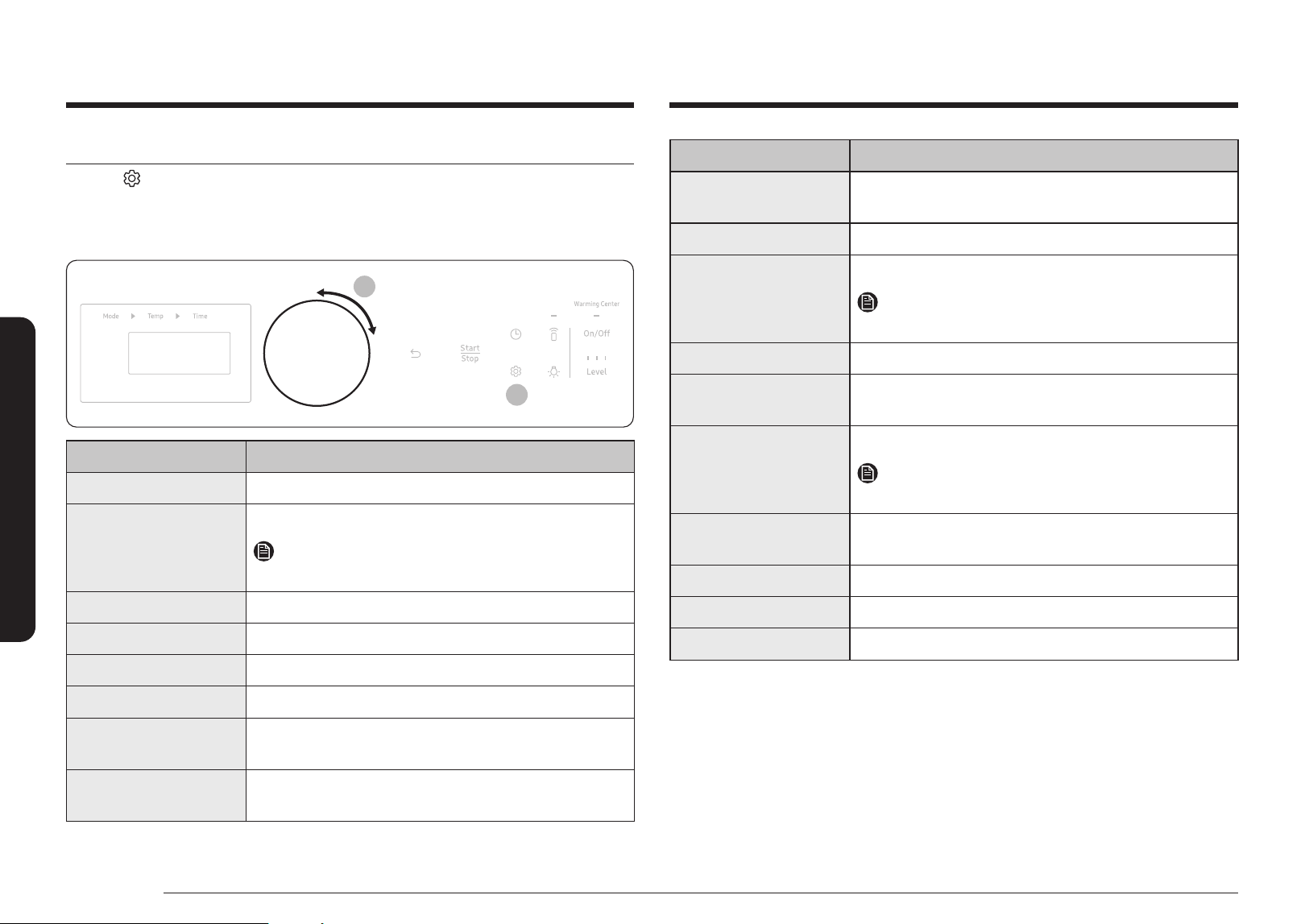
44 English
Operating the oven
Operating the oven
Settings
Tap the button on the control panel, and then turn the dial knob to change
various settings for your oven. Please refer to the following table for detailed
descriptions.
The Options menu is available only when the oven is off.
1
2
Setting Description
Timer Set the timer.
Delay Start
Set the delay start cooking.
NOTE
See page 41.
Lock Lock the control panel and the door.
Favorites Save the cooking mode and value frequently used.
My Modes Add or remove cooking modes.
My Pattern This function remembers and stores the cook settings.
Auto Conversion
Automatically lower the temperature by 25 °F (15 °C)
when using Convection Bake.
12hr Energy Saving
Automatically turns off the oven 12 hours after
baking starts or 3 hours after broiling starts.
Setting Description
Temp Unit
Set the oven control to display temperatures in
Fahrenheit or Centigrade.
Adjust Temp Recalibrate the oven temperature.
Sabbath
Setting Sabbath mode. On/Off.
NOTE
See page 41.
Sounds Turn the oven's sound (beeps) on or off.
Use 24-hr format
Set the clock to display the time in the 12-hour or
24-hour format.
Date & Time
Set the clock to display the current date and time.
NOTE
See page 27.
Language
Select a preferred language from English, French, or
Spanish.
Wi-Fi Set the Wi-Fi mode to On/Off.
Restart Restart the range.
Factory Reset Reset the your setting.
English 45
Operating the oven
Timer
The timer gives you an extra timer you can use to time cooking tasks, such as
boiling eggs. It does not, however, start or stop any cooking operation. You can set
the timer from 1 minute to 9 hours and 59 minutes.
1. Tap
. To select Timer using the dial knob.
2. Enter a desired time using the dial knob.
3. When done, push the dial knob.
4. To cancel the Timer settings, push or turn the dial knob. To select cancel using
the dial knob.
5. When the set time elapses, the oven beeps and displays the 'Time is up.'
message. Count up timer starts after nishing Timer, it lasts for only 10 mins.
Push the dial knob, count up timer will be disappeared.
Lock
Lock the control panel and the door to prevent accidental operations or product
tipping.
Tap
, and select Lock using the dial knob to lock both the control panel and the
door. When the Oven Lock is on, the oven panel does not operate and the oven
door is locked and cannot be opened. Tap and hold for 3 sec to unlock the
oven.
Favorites
You can add up to 10 frequently used cook settings to the Favorites list to easily
apply them in the future.
Adding the new cook settings to the Favorites
1. Tap
, and select Favorites using the dial knob.
2. Set the cook setting (Mode, Temperature, Cook Time, Probe Temp).
3. If necessary, select option (Cook Time and Probe Temp).
NOTE
Alternatively, you can simply tap Add to Favorite that appears when the oven
completes cooking.
Using the favorite cook settings
1. To select Favorite Mode using the dial knob.
2. Select the Favorite cook setting you want to start.
3. Tap Start.
My Modes
You can edit (add or remove) the cooking modes and create a custom list.
1. Tap
, and select My Modes using the dial knob.
2. Turn the dial knob to select or unselect modes.
3. Select Save to save the changes.
NOTE
You can download a new mode through the SmartThings App, and you can add it
to My Modes.
My Pattern
This function remembers and stores the cook settings frequently used by the user.
1. Tap and hold
for 3 sec.
2. Select My Pattern using the dial knob.
3. Turn the dial knob to select On/Off and push to save the changes.
Auto Conversion
Auto Conversion automatically converts regular baking temperatures to convection
baking temperatures. For example, if you enter a regular recipe temperature of
350 °F and tap Start, the oven displays the converted temperature of 325 °F.
1. Tap
, and select Auto Conversion using the dial knob.
2. Turn the dial knob to select On/Off. (Default setting is 'Off'.)
3. Push the dial knob to save the changes.
12 hr energy saving
This will automatically turn off the oven 12 hours after baking starts or 3 hours
after broiling starts.
1. Tap
, and select 12 hr energy saving using the dial knob.
2. Turn the dial knob to select On/Off.
3. Push the dial knob to save the changes.
46 English
Operating the oven
Operating the oven
Temp. Unit (°F / °C)
Change the temperature format of the oven to Fahrenheit or Centigrade.
The default is Fahrenheit.
1. Tap
.
2. Select Temp. Unit using the dial knob.
3. Turn the dial knob to select unit and push to save the changes.
Adjust Temp
The oven temperature has been calibrated at the factory. When rst using the
oven, follow the recommended recipe times and temperatures. If it appears that
the oven is too hot or too cool, you can recalibrate the oven temperature. Before
recalibrating, test a recipe by using a temperature setting that is higher or lower
than recommended. The baking results should help you decide how much of an
adjustment is needed. The oven temperature can be adjusted by ±35 °F (±19 °C).
1. Tap
.
2. Select Adjust Temp using the dial knob.
3. Turn the dial knob to adjust temperature value.
4. Push the dial knob to save the changes.
NOTE
This adjustment does not affect the broiling or the self-cleaning temperature, and
is retained in memory after a power failure.
Sounds
Turn sound (beeps) On/Off.
1. Tap
, and select Sounds using the dial knob.
2. Turn the dial knob to select Mute/Minimum/Normal/Maximum.
3. Push the dial knob to save the changes.
Use 24-hr format
Set the clock to display the time in the 12-hour or 24-hour format.
1. Tap
, and select Use 24-hr format using the dial knob.
2. Turn the dial knob to select 12hr or 24hr.
3. Push the dial knob to save the changes.
Language
Select a preferred language from English, French, or Spanish. You can not change
the language during cooking.
1. Tap
.
2. Select the Language using the dial knob.
3. Turn the dial knob to select the Language and push to save the changes.
Wi-Fi
If you set the Wi-Fi mode to Off, mobile devices cannot connect to the range.
1. Tap
.
2. Select Wi-Fi mode using the dial knob.
3. Turn the dial knob to select On/Off and push to save the changes.
NOTE
• Pressing
will delete from the display and prevent most of the remote
functions from operating.
• When oven cooking is nished or cancelled,
is removed from the display.
• For safety reasons, you must specify the cooking time to enable remote control.
• The oven continues operating even if the Wi-Fi connection is lost.
• Smart Control will not work properly if the Wi-Fi Connection is unstable.
• See the SmartThings app manual for detailed information.
English 47
Maintaining your appliance
Restart
You can restart your range.
1. Tap
.
2. Select Restart using the dial knob.
3. Turn the dial knob to select Cancel/Reset.
Factory Reset
You can reset your oven setting.
1. Tap
.
2. Select Factory Reset using the dial knob.
3. Turn the dial knob to select Cancel/Reset.
CAUTION
Before reset the oven settings, turn off all oven and cooktop functions.
Demo mode
This is used by retailers for display purposes only. In this mode, the heating
element does not operate.
1. Tap and hold
for 3 sec.
2. Set time to 12:34.
3. Tap and hold both and for 3 sec. Demo indicator will appear on display.
Maintaining your appliance
Self-cleaning
This self-cleaning oven uses high temperatures (well above cooking temperatures)
to burn off leftover grease and residue completely or reduce them to a nely
powdered ash that you can wipe away with a damp cloth.
CAUTION
• During the self-cleaning cycle, the outside surface of the range will become
very hot to the touch. Do not leave small children unattended near the
appliance.
• Some birds are extremely sensitive to the fumes given off during the self-
cleaning cycle of any range. Move birds to another well-ventilated room.
• Do not line the oven walls, racks, bottom, or any other part of the range with
aluminum foil. Doing so will result in poor heat distribution, poor baking results,
and cause permanent damage to the oven interior. Aluminum foil will melt and
adhere to the interior surface of the oven.
• Do not force the oven door open. This can damage the automatic door locking
system. Use care when opening the oven door after the self-cleaning cycle is
complete. Stand to the side of the oven when opening the door to allow hot air
or steam to escape. The oven may still be VERY HOT.
• Wear the glove during cleaning.
• Opening a window or turning on a ventilation fan or hood is recommended
during and after self-cleaning.
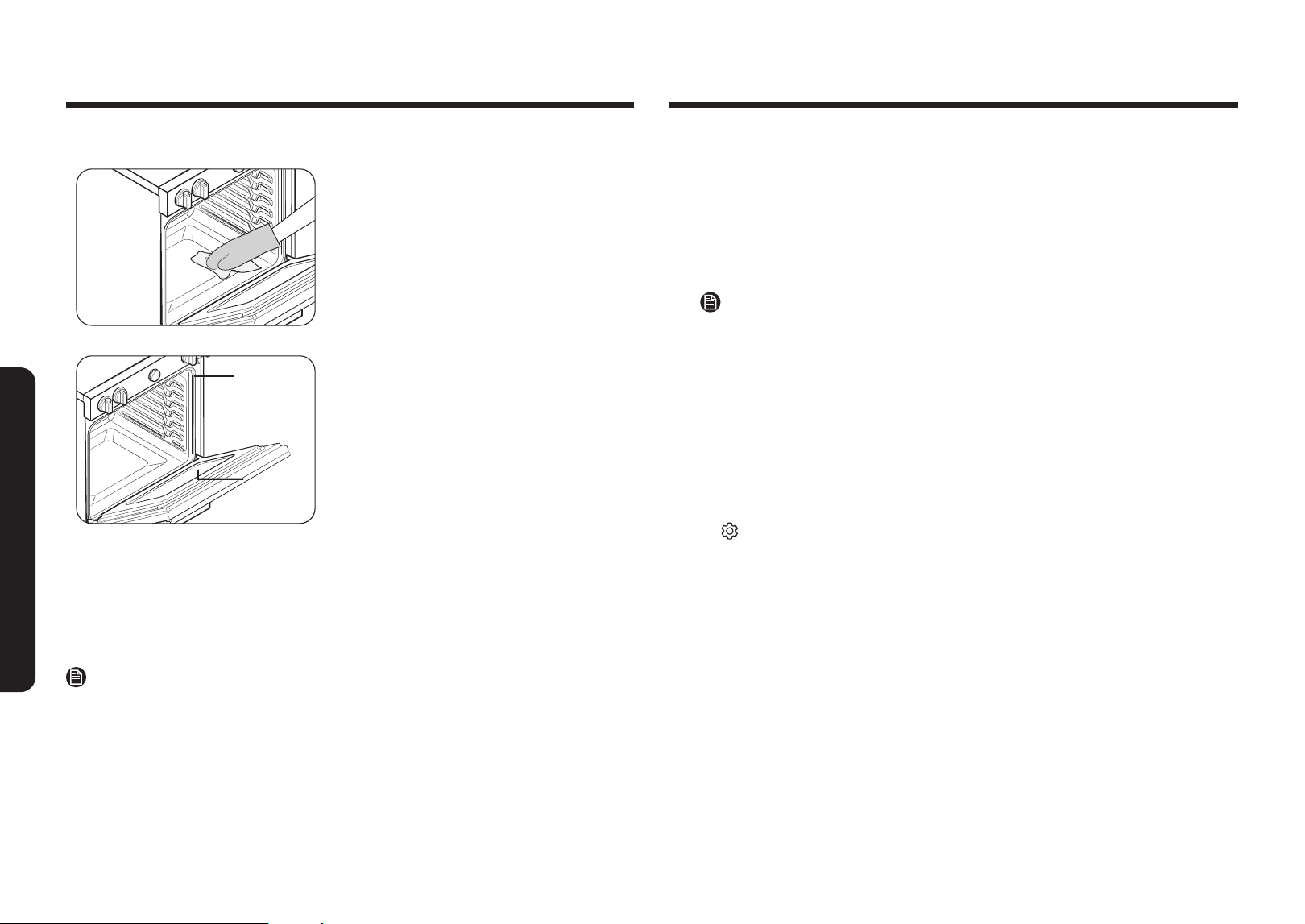
48 English
Maintaining your appliance
Maintaining your appliance
How to run a self-cleaning cycle
1. Make sure the oven door is closed completely and unlocked. And turn off all
oven and cooktop function.
2. Select Self Clean using the dial knob.
Then, select the cleaning time. (2 hour / 3 hour / 5 hour)
3. Long tap to Start.
The oven door is locked automatically and the oven begins to heat up.
NOTE
• You will not be able to start a self-cleaning cycle if the oven lock feature is
activated or if the oven’s temperature is too hot.
• The oven door locks automatically. The display will show the cleaning time
remaining. It is not be possible to open the oven door until the temperature
drops to a safe/cool temperature.
• The self-cleaning feature will not operate when the warming center is on.
4. When the self-cleaning cycle is done, End will appear in the display and the
range will beep several times.
How to delay the start of self-cleaning
1. Tap
, and then select Delay Start using the dial knob.
2. Select Self Clean mode using the dial knob.
3. Set the time you want the oven to start self-cleaning using the dial knob.
4. Long tap to Start.
The oven will start self-cleaning at your specied time.
Before a self-cleaning cycle
Fig. 1Fig. 1
Fig. 2Fig. 2
Don’t hand Don’t hand
clean the clean the
oven door oven door
gasket.gasket.
You may You may
hand clean hand clean
the door.the door.
• We recommend venting your kitchen
with an open window or using a
ventilation fan or hood during the self-
cleaning cycle.
• Remove the wire rack, broil pan, broil
pan insert, all cookware, and any
aluminum foil from the oven.
• Wipe up debris from the oven bottom.
(Fig. 1)
• Residue on the front frame of the range
and outside the gasket on the door will
need to be cleaned by hand. Clean these
areas with hot water, soap-lled steel-
wool pads, or cleansers, such as Soft
Scrub. Rinse well with clean water and
dry.
• Do not clean the gasket. The berglass
material of the oven door gasket cannot
withstand abrasion. It is essential for
the gasket to remain intact. If you notice
it becoming worn or frayed, have it
replaced. (Fig. 2)
• Make sure the oven light bulb cover is in
place and the oven light is off.
NOTE
Remove oven racks and accessories before starting the self-clean mode.
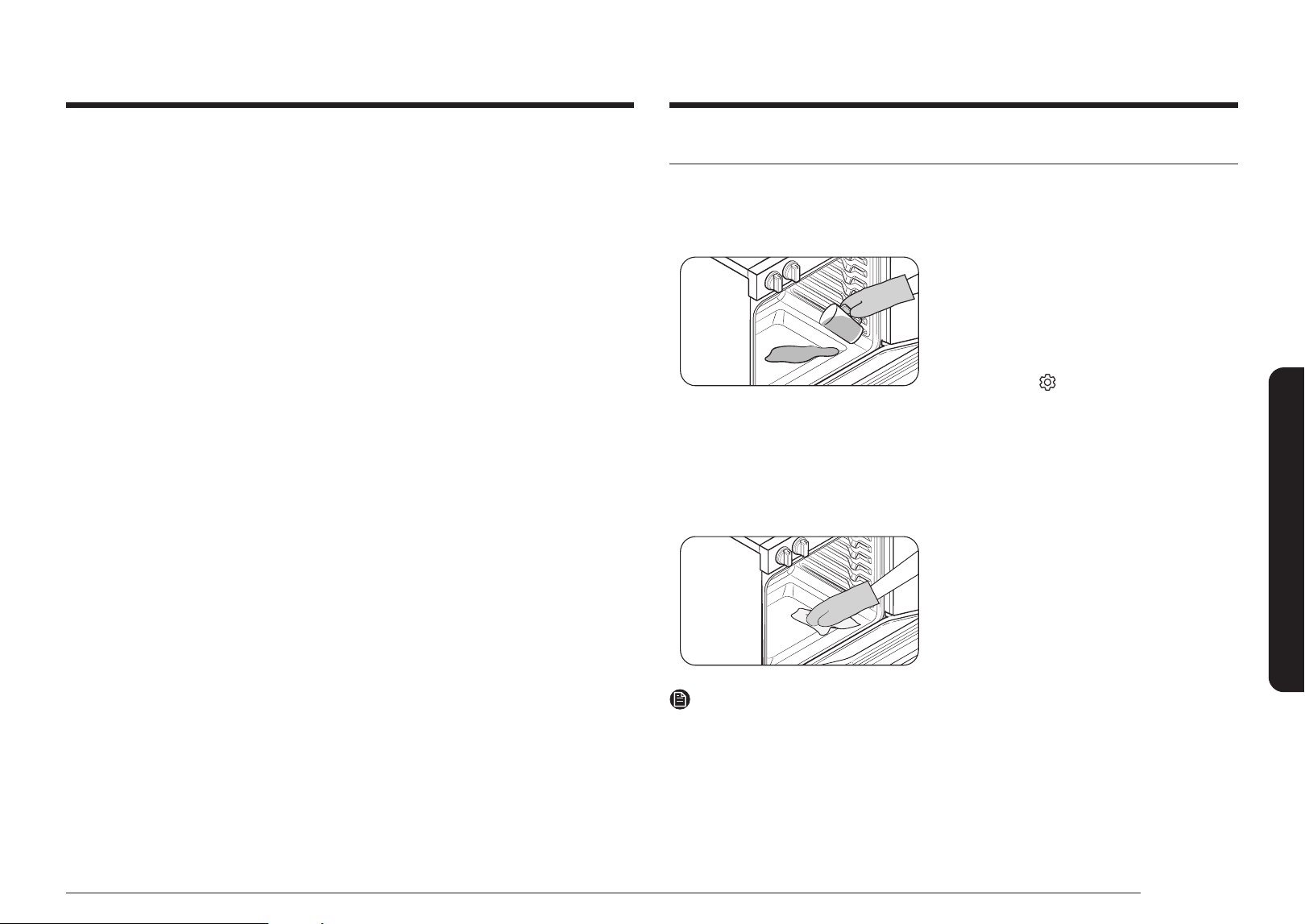
English 49
Maintaining your appliance
How to turn off the self-cleaning feature
You may nd it necessary to stop or interrupt a self-cleaning cycle due to smoke in
the oven.
1. Press Stop.
2. You will be able to open the oven door once the oven has cooled down for
approximately 1 hour.
After a self-cleaning cycle
• You may notice some white ash in the oven. Wipe it up with a damp cloth after
the oven cools. (If white spots remain, remove them with a soap-lled steel
wool pad and rinse thoroughly with a vinegar and water mixture.)
• If the oven is not clean after one cycle, repeat the cycle.
• You cannot set the oven for cooking until the oven is cool enough for the door
to unlock.
Steam-cleaning
How to set the oven for steam-cleaning
For light cleaning, the steam-cleaning function saves time and energy. For heavier-
duty cleaning, use the self-cleaning function.
1. Remove all accessories from the oven.
2. Pour approximately 10 oz. (300 ml) of
water onto the bottom of the empty
oven and then close the oven door.
Use normal water only, not distilled
water.
3. Long tap to , and select Cleaning >
Steam Clean using the dial knob.
4. Long tap to Start.
The oven door is locked automatically
and the oven begins to heat up.
When the operation is complete, the
display will blink and a beep will sound.
5. Press Stop.
6. Clean the oven’s interior.
There will be a signicant amount of
water remaining on the bottom of the
oven after a steam-cleaning cycle.
Remove the residual water with a sponge
or soft dry cloth.
NOTE
When steam-cleaning, use exactly 10 oz. of water since this produces the best
results.
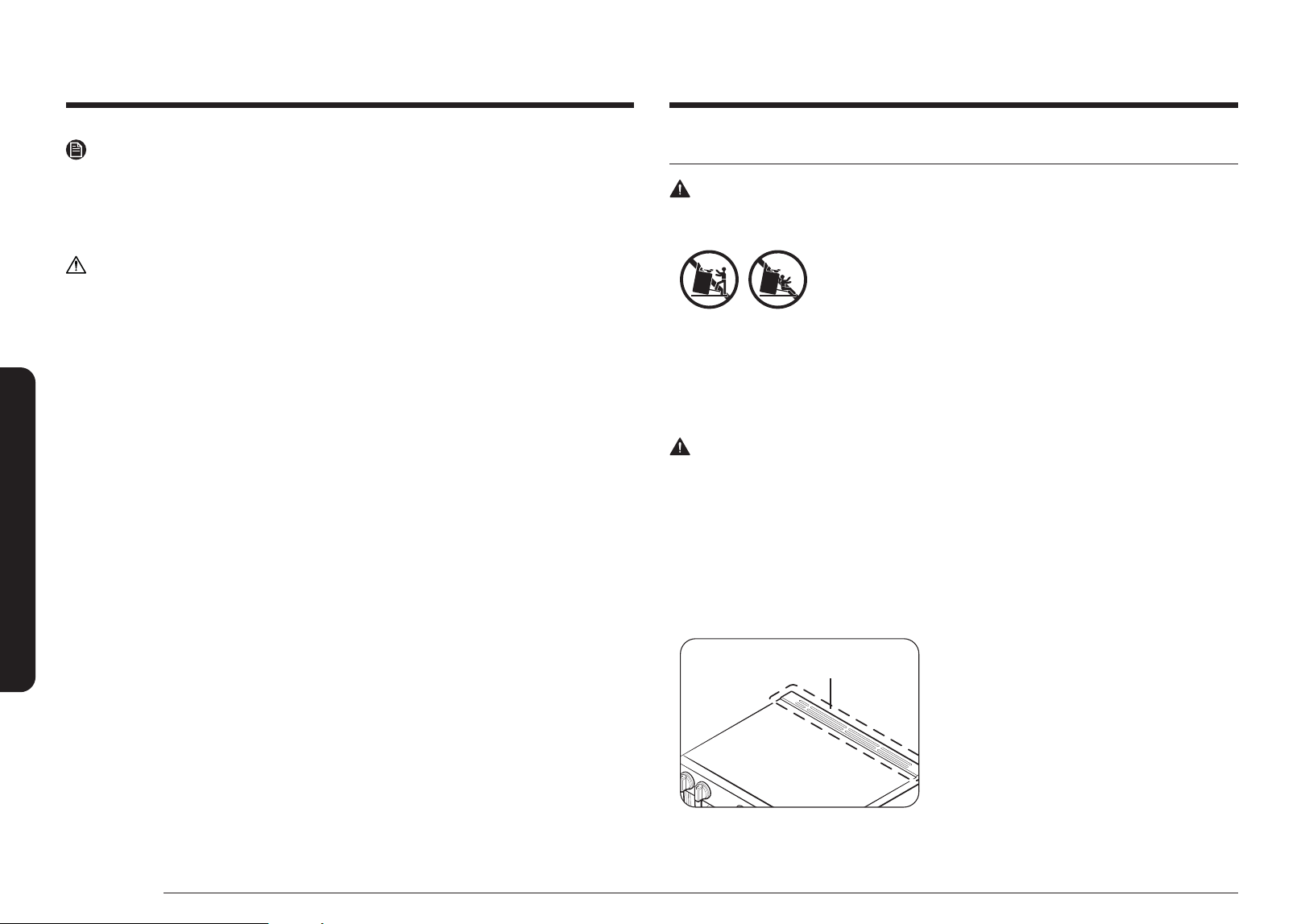
50 English
Maintaining your appliance
Maintaining your appliance
Care and cleaning of the oven
WARNING
• Be sure all controls are OFF and all surfaces are COOL before cleaning any part
of the range.
• If your range is moved for cleaning, servicing, or any
reason, be sure the Anti-Tip device is re-engaged properly
when the range is replaced. If you fail to re-engage the
Anti-Tip device, the range could tip and cause serious
injury.
Control panel
First, lock the control panel and the door to prevent accidental operations and/or
product tipping.
WARNING
• Make sure the control panel turns off and all surfaces of the range are cool
before cleaning. Otherwise, you can get burned.
• If the range has been moved away from the wall, make sure the Anti-Tip device
is reinstalled properly when the range has been put into place again. Otherwise,
the range may tip over, causing physical injuries.
• Do not use steel-wool or abrasive cleansers of any kind. These can scratch or
damage the surface.
Vent
VentVent
• The cooling vents are located at the back
of the oven range.
• This area could become hot during oven
use.
• It is normal for steam to come out of the
vent.
• The vent is important for proper air
circulation. Never block this vent.
NOTE
If you press Steam Clean when the oven temperature is above 100˚F, Hot will
appear in the display. Because this function produces the best results when started
while the oven is cool, we recommend that you wait until the oven has cooled
down and Hot disappears from the display.
CAUTION
Wear the glove during cleaning.
After a steam-cleaning cycle
• Take care when opening the door before a steam-cleaning procedure has ended.
The water on the bottom is hot.
• Open the oven door and remove the remaining water with a sponge. Do not
leave the residual water in the oven for any length of time. Wipe the oven clean
and dry with a soft cloth. Do not forget to wipe under the oven door seal.
• Use a detergent-soaked sponge, a soft brush, or a nylon scrubber to wipe the
oven interior. Remove stubborn residue with a nylon scourer. You can remove
lime deposits with a cloth soaked in vinegar.
• If the oven remains dirty, you can repeat the procedure once the oven has
cooled.
• For heavy residue, such as grease left over from roasting, we recommend
that you rub detergent into the residue before activating the steam-cleaning
function.
• After cleaning, leave the oven door ajar at a 15° angle to allow the interior
enamel surface to dry thoroughly.

English 51
Maintaining your appliance
Cleaning painted parts and decorative trim
• For general cleaning, use a cloth with hot, soapy water.
• For more difcult residue and built-up grease, apply a liquid detergent directly
onto the area and leave for 30 to 60 minutes. Wipe with a damp cloth and dry.
Do not use abrasive cleaners on any of these surfaces. They can scratch.
Cleaning stainless steel surfaces
1. Shake the bottle of Stainless Steel Appliance Cleaner or Polish well.
2. Place a small amount of stainless steel appliance cleaner or polish on a damp
cloth or damp paper towel.
3. Clean a small area, rubbing with the grain of the stainless steel if applicable.
4. Dry and buff with a clean, dry paper towel or soft cloth.
5. Repeat as necessary.
NOTE
• Do not use a steel-wool pad. It will scratch the surface.
• If a mineral oil-based stainless steel appliance cleaner has been used before to
clean the appliance, wash the surface with dishwashing liquid and water prior
to using the Stainless Steel Appliance Cleaner or Polish.
Oven racks
• If the racks are left in the oven during a self-cleaning cycle, their color will turn
slightly blue and the nish will be dull. After the self-cleaning cycle is complete
and the oven has cooled, rub the sides of the racks with wax paper or a cloth
containing a small amount of oil. This will help the racks glide more easily on
their tracks.
• Gliding racks may be cleaned by hand with an abrasive cleaner or steel wool.
During cleaning, be careful not to allow water or cleaner to enter the slides on
the sides of rack.
NOTE
• Do not clean in a dishwasher.
• If the rack becomes hard to remove or replace, lightly wipe the oven rack
guides with cooking oil. Do not wipe cooking oil on the slides.
• If the rack becomes difcult to slide, the rack may need to be lubricated using a
graphite lubricant.
Air Fry tray
To keep the Air Fry tray clean, remove them from the cavity, and soak them in
Lukewarm soapy water. Then, scour soil off of the Air Fry tray using a plastic
scouring pad.
NOTE
The air fry tray is dishwasher-safe.
CAUTION
Do not leave the Air Fy tray in the oven during the self-cleaning cycle.
The extreme heat generated in this cycle can permanently peel off the Air Fry
coating, their color will turn slightly blue and nish will be dull.
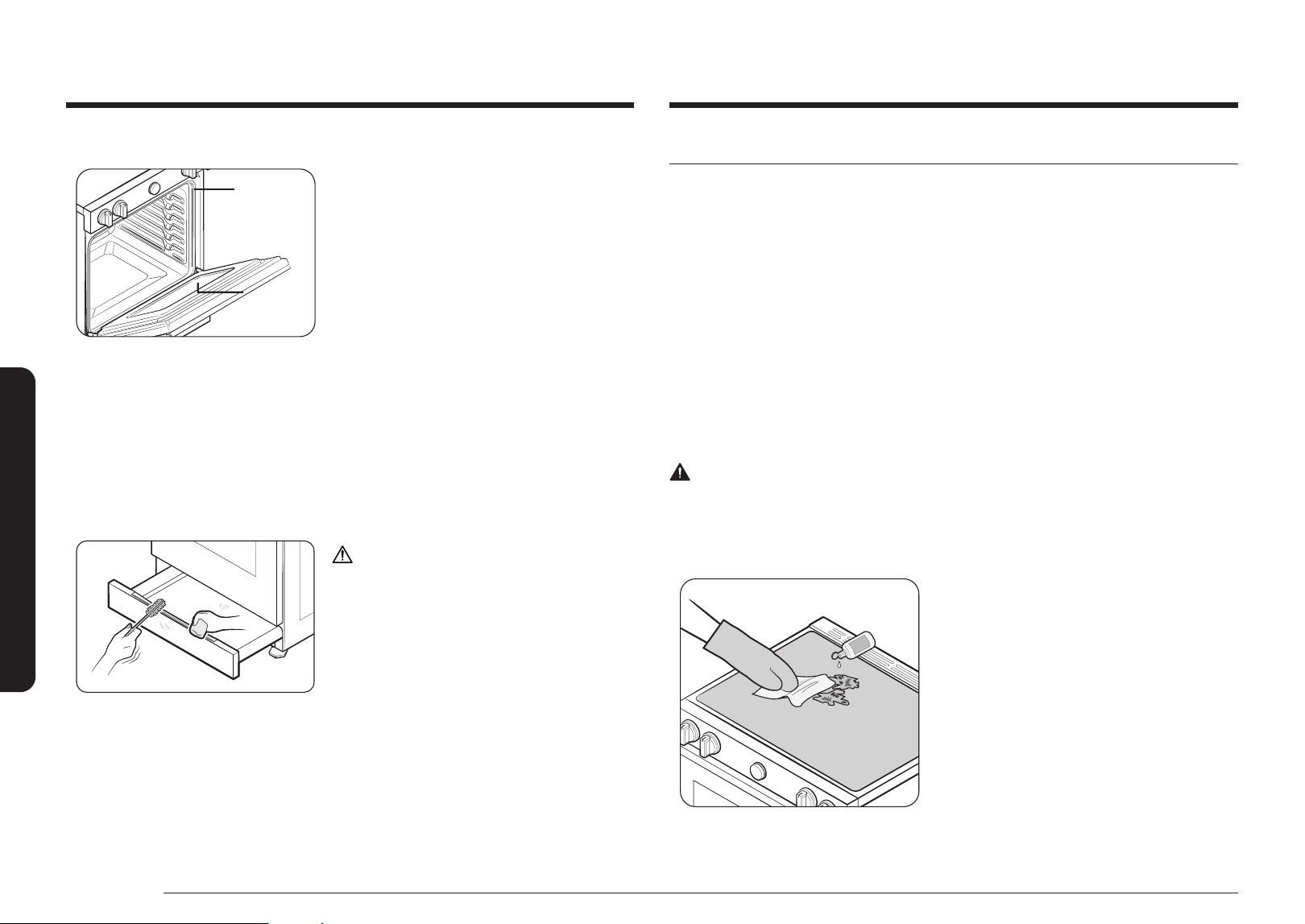
52 English
Maintaining your appliance
Maintaining your appliance
Care and cleaning of the glass cooktop
Normal daily use cleaning
Use only a ceramic cooktop cleaner. Other creams may not be as effective.
By following these steps, you can maintain and protect the surface of your glass
cooktop.
1. Before using the cooktop for the rst time, clean it with a ceramic cooktop
cleaner.
This helps protect the top and makes cleanup easier.
2. Daily use of a ceramic cooktop cleaner will help keep the cooktop looking new.
3. Shake the cleaning cream well. Apply a few drops of cleaner directly to the
cooktop.
4. Use a paper towel or a cleaning pad for ceramic cooktops to clean the entire
cooktop surface.
5. Use a dry cloth or paper towel to remove all cleaning residue. No need to rinse.
WARNING
DAMAGE to your glass surface may occur if you use scrub pads other than those
recommended.
Removing burned-on residue
1. Allow the cooktop to cool.
2. Spread a few drops of ceramic cooktop
cleaner on the entire burned residue
area.
3. Using a cleaning pad for ceramic
cooktops, rub the residue area, applying
pressure as needed.
4. If any residue remains, repeat the steps
listed above as needed.
5. For additional protection, after all residue
has been removed, polish the entire
surface by applying ceramic cooktop
cleaner with a paper towel.
Oven door
Don’t hand Don’t hand
clean the clean the
oven door oven door
gasket.gasket.
You may You may
hand clean hand clean
the door.the door.
• Use soap and water to thoroughly clean
the top, sides, and front of the oven door.
Rinse well. You may use a glass cleaner
on the outside glass of the oven door.
DO NOT immerse the door in water.
DO NOT spray or allow water or the glass
cleaner to enter the door vents. DO NOT
use oven cleaners, cleaning powders, or
any harsh abrasive cleaning materials on
the outside of the oven door.
• DO NOT clean the oven door gasket.
The oven door gasket is made of a
woven material which is essential for a
good seal. Care should be taken not to
rub, damage, or remove this gasket.
Drawer Handle
Remove dust with soft brush or soft cloth covered with water.
CAUTION
• Do not use alkaline detergents,
sulfuricacid, hydrochloric acid, organic
solvents, or disinfectants.
- Surface can be damaged.
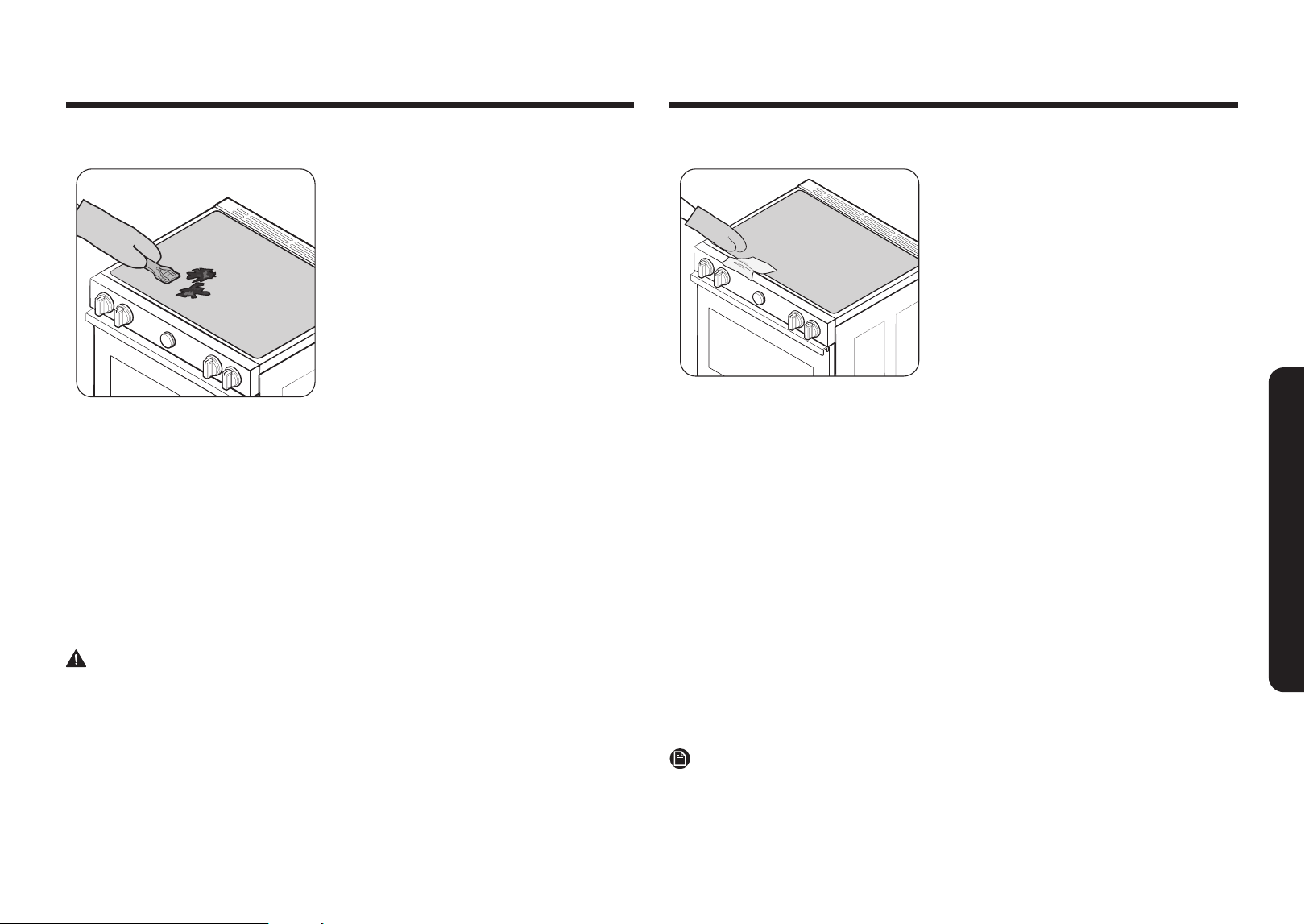
English 53
Maintaining your appliance
Removing heavy, burned-on residue
1. Allow the cooktop to cool.
2. Use a single-edge razor-blade scraper at
approximately a 45° angle against the
glass surface and scrape the soil.
It will be necessary to apply pressure to
remove the residue.
3. After scraping with the razor scraper, spread
a few drops of ceramic cooktop cleaner on
the entire burned residue area.
Use a cleaning pad to remove any remaining
residue. (Do not scrape the seal.)
4. For additional protection, after all residue
has been removed, polish the entire
surface by applying ceramic cooktop
cleaner with a paper towel.
Removing metal marks and scratches
1. Be careful not to slide pots and pans across your cooktop. It will leave marks on
the cooktop surface. You can remove these marks by applying ceramic cooktop
cleaner with a cleaning pad for ceramic cooktops.
2. If pots with a thin overlay of aluminum or copper are allowed to boil dry, the
overlay may leave black discoloration on the cooktop. You should remove this
discoloration immediately or it may become permanent.
WARNING
Carefully check the bottoms of pans for roughness that may scratch the cooktop.
Cleaning the cooktop seal
To clean the seal around the edges of
the glass, lay a wet cloth on it for a few
minutes, then wipe clean with a nonabrasive
cleaner.
Potential for permanent damage to the glass surface
• Sugary spillovers (such as jellies, fudge, candy, syrups) or melted plastics can
cause pitting of the surface of your cooktop. This is not covered under the
warranty. You should clean the spill while it is still hot. Take special care when
removing hot substances. Refer to the section below.
• When using a scraper, be sure it is new and the razor blade is still sharp.
Do not use a dull or nicked blade.
Cleaning sugary spills and melted plastic
1. Turn off all surface units. Remove hot pans.
2. Wearing an oven mitt, use a single-edge razor-blade scraper to move the spill
to a cool area of the cooktop. Remove the spill with paper towels.
3. Any remaining spillover should be left until the surface of the cooktop has
cooled.
4. Don’t use the surface units again until all of the residue has been completely
removed.
NOTE
If pitting or indentations in the glass surface have already occurred, the cooktop
glass will have to be replaced. In this case, service will be necessary.
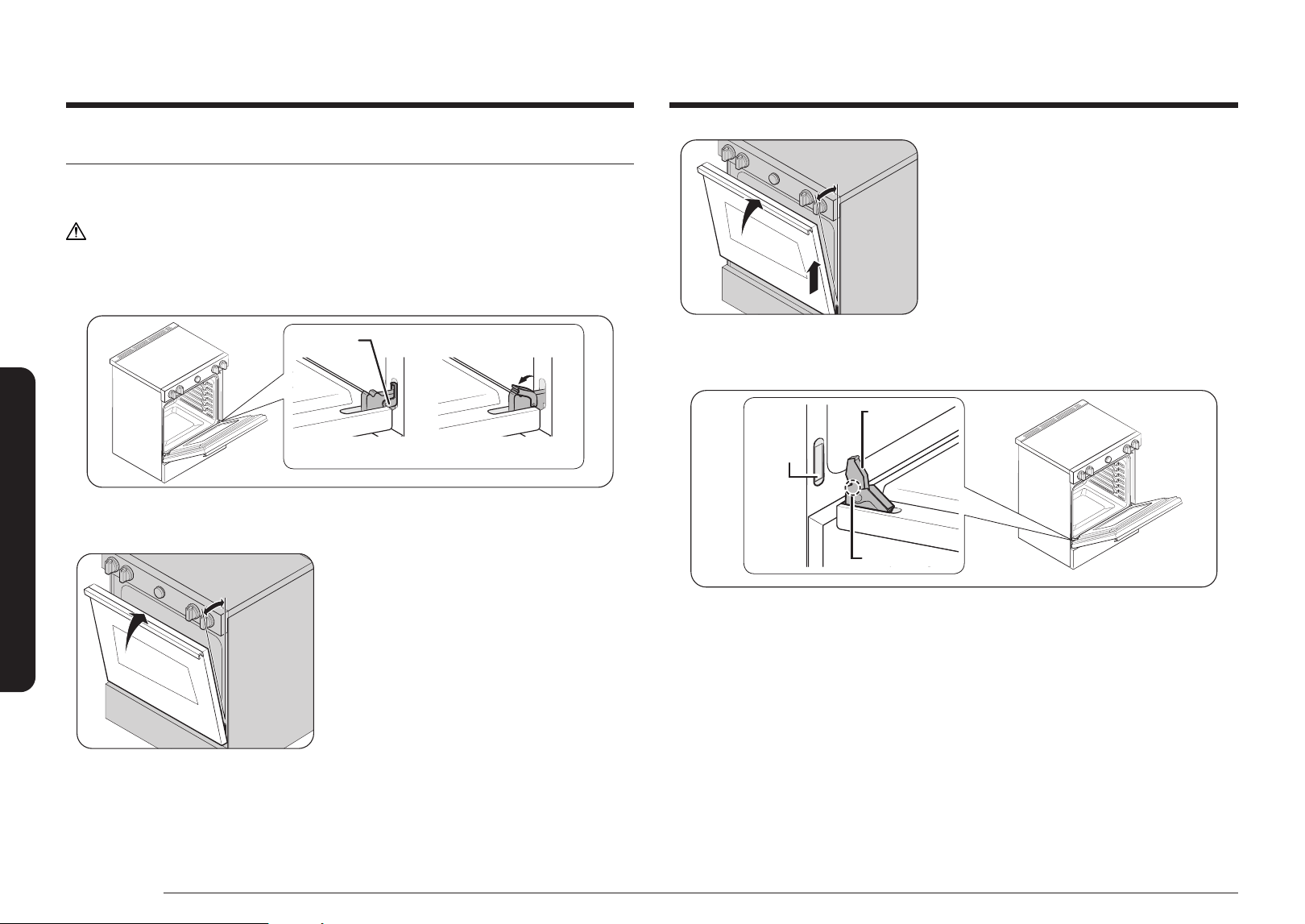
54 English
Maintaining your appliance
Maintaining your appliance
Fig. 2
5. Lift door up and out until the hinge arm
is clear of the slot (Fig. 2).
How to re-install the door
Hinge armHinge arm
Bottom Bottom
edge of edge of
slotslot
IndentationIndentation
1. Firmly grasp both sides of the door at the top.
2. With the door at the same angle as the removal position, slide the indentation
of the hinge arm into the bottom edge of the hinge slot. The notch in the hinge
arm must be fully inserted into the bottom of the slot.
Removing and reinstalling the oven door
How to remove the door
CAUTION
• The door is very heavy. Be careful when removing and lifting the door.
Do not lift the door by the handle.
• Turn the power OFF before removing the door.
Hinge lockHinge lock
Locked positionLocked position Unlocked positionUnlocked position
1. Open the door completely.
2. Pull the hinge locks down toward the door frame to the unlocked position.
about 5°about 5°
Fig. 1
3. Firmly grasp both sides of the door at
the top.
4. Close the door to the door removal
position, which is approximately
5 degrees from vertical (Fig. 1).
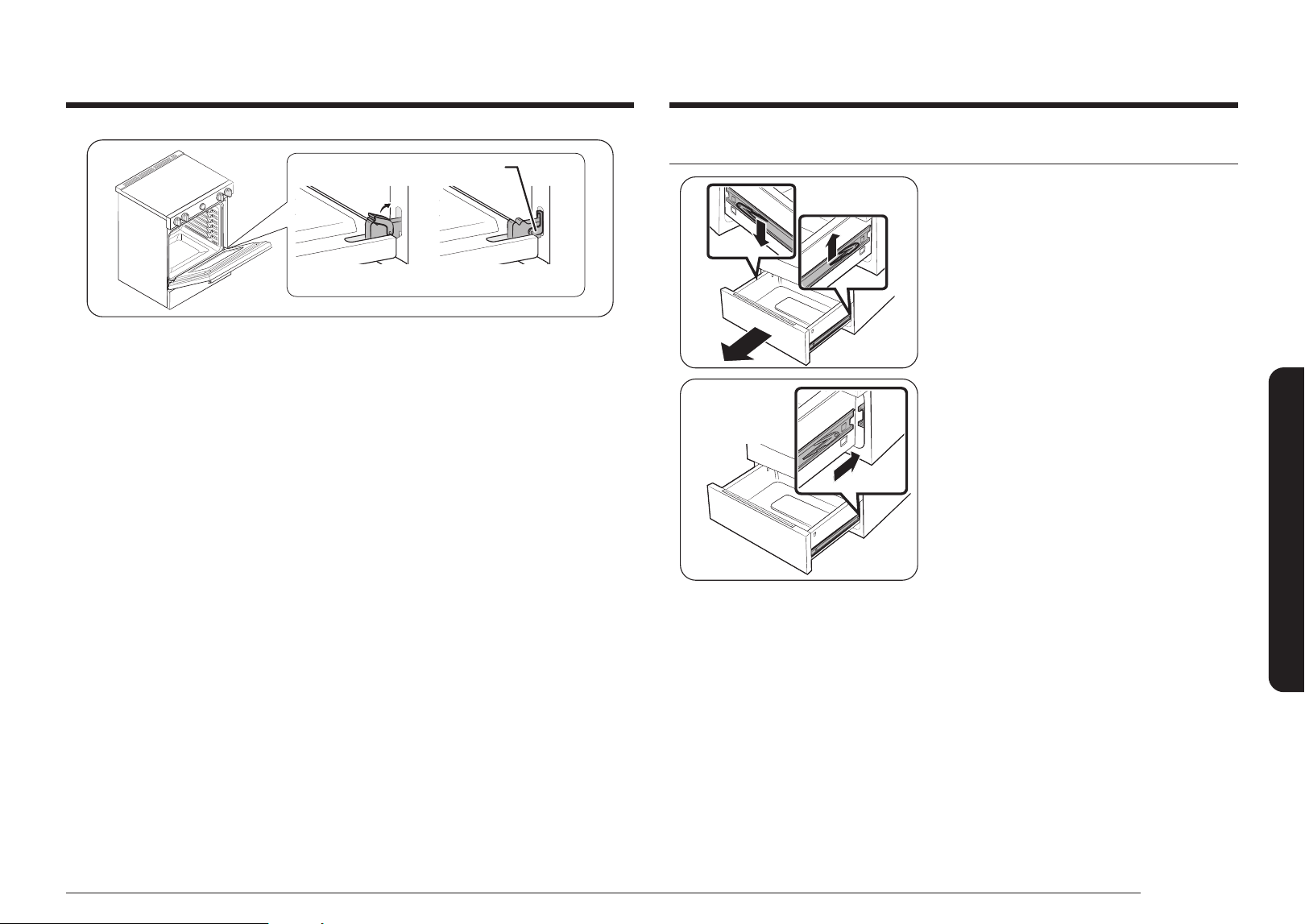
English 55
Maintaining your appliance
Hinge lockHinge lock
Locked positionLocked positionUnlocked positionUnlocked position
3. Open the door fully. If the door will not open fully, the indentation is not
inserted correctly in the bottom edge of the slot.
4. Push the hinge locks up against the front frame of the oven cavity to the locked
position.
5. Close the oven door.
Removing and reinstalling the storage drawer
1. Slide open the drawer until it stops.
2. Locate the roller guide clips on either
side. Using both hands, pull down the left
clip while lifting the right clip, and then
remove the drawer.
3. Clean the drawer in warm, soapy water
using a cloth or soft brush. Then, rinse
and dry it thoroughly.
4. Put the drawer in the roller guides on
either side, and then snap the clips into
place.
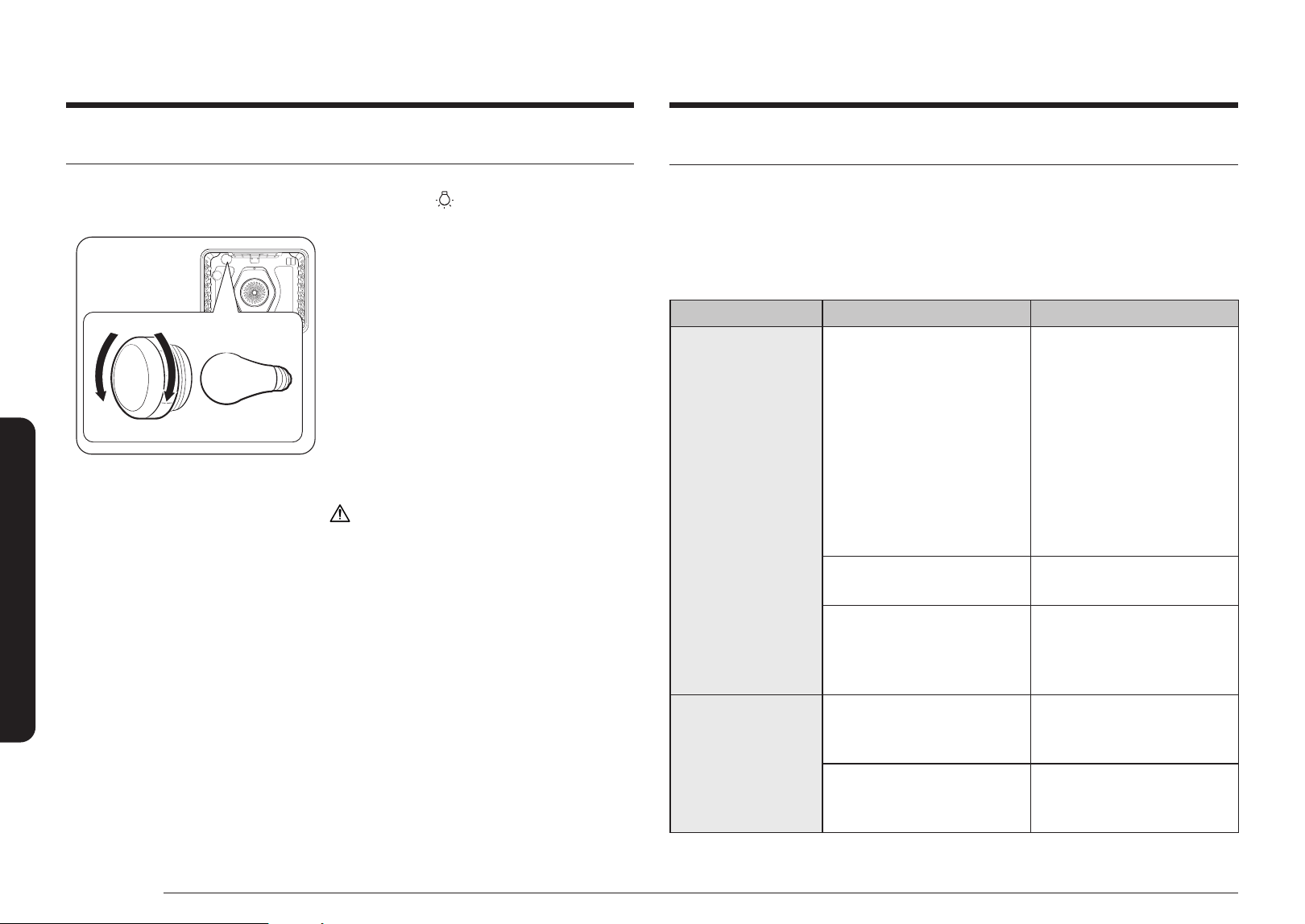
56 English
Troubleshooting and information code
Changing the oven light
The oven light is a standard 40-watt appliance bulb. It will come on when the oven
door is open. When the oven door is closed, press the pad to turn it on or off.
It will not work during a self-cleaning cycle.
RemoveRemove
Glass bulb coverGlass bulb cover BulbBulb
ReplaceReplace
1. Make sure the oven and the bulb are
cool.
2. Unplug the range or disconnect the
power.
3. Turn the glass bulb cover in the back of
the oven counterclockwise to remove.
4. Turn the bulb counterclockwise to
remove it from its socket.
5. Insert a new 40-watt appliance bulb, and
then turn it clockwise to tighten.
Replace the bulb cover by turning
clockwise.
6. Plug in the range or reconnect the power.
CAUTION
• To prevent electric shock, make sure
the oven is turned off and cool before
replacing the oven light.
• When replacing the oven light, be
careful not to damage the product due to
excessive force.
Troubleshooting and information code
Troubleshooting
Samsung works hard to ensure that you don’t have problems with your new
electric range. If you run into unexpected trouble, look rst for a solution in the
tables below. If you’re still having trouble after trying the suggested solution, call
Samsung at 1-800-SAMSUNG (1-800-726-7864).
INSTALLATION
Problem Possible cause Solution
The range is not
level.
The appliance has been
installed improperly.
• Place the oven rack in
the center of the oven.
Place a level on the oven
rack. Adjust the leveling
legs at the base of the
range until the oven rack
is level.
• Insure the oor is level
and strong and stable
enough to adequately
support the range.
The oor is sagging or
sloping.
Contact a carpenter to
correct the situation.
The kitchen cabinets are not
properly aligned and make
the range appear to be not
level.
Insure the cabinets are
square and provide
sufcient room for
installation.
The appliance
must be accessed
for servicing and
cannot be moved
easily.
The kitchen cabinets are not
square and too close to the
appliance.
Contact a builder or
installer to make the
appliance accessible.
Carpet is interfering with
movement of the range.
Provide sufcient space so
the range can be lifted over
the carpet.
Maintaining your appliance
English 57
Troubleshooting and information code
Problem Possible cause Solution
The surface unit
frequently cycles
on and off.
The element will cycle on
and off to maintain the
power setting.
This is normal operation, and
not a system failure. Use the
range as usual.
The surface unit
stops glowing when
changed to a lower
setting.
This is normal. The unit is still on and hot.
Scratches or
abrasions on the
cooktop surface.
The cooktop is being
cleaned improperly.
Scratches are not removable.
Tiny scratches will become
less visible in time as a result
of cleaning. Use ceramic glass
top cleaning cream. Do not
use chemical or corrosive
agents. These agents may
damage the surface of the
product.
Cookware with rough
bottoms was used on the
cooktop or there were
coarse particles (e.g., salt
or sand) present between
the cookware and the
surface of the cooktop.
To avoid scratches, follow
the recommended cleaning
procedures. Make sure
cookware bottoms are clean
before use, and use cookware
with smooth bottoms.
Cookware has been
slid across the cooktop
surface.
CONTROL DISPLAY
Problem Possible cause Solution
The display goes
blank.
A fuse in your home may
be blown or the circuit
breaker tripped.
Replace the fuse or reset
the circuit breaker.
The display ashes. There was a power failure. Reset the clock.
COOKTOP
Problem Possible cause Solution
The surface units
will not maintain
a rolling boil or
will not cook fast
enough.
You may be using
inappropriate cookware.
Use pans that are at and
match the diameter of the
surface unit selected.
In some areas, the power
(voltage) may be low.
Cover the pan with a lid until
the desired heat is obtained.
The surface units
will not turn on.
A fuse in your home
may be blown or a
circuit breaker may have
tripped.
Replace the fuse or reset the
circuit breaker.
The cooktop controls are
set improperly.
Check if the correct control is
set for the surface unit you
are using.
Areas of
discoloration on the
cooktop.
Food spillover was not
cleaned.
Refer to the section on the
care and cleaning of the glass
cooktop on page 52.
The surface is hot and
the model features a
light-colored cooktop.
This is normal. The surface
may appear discolored when
it is hot. This is temporary and
will disappear as the glass
cools.
58 English
Troubleshooting and information code
Troubleshooting and information code
Problem Possible cause Solution
Brown streaks or
specks.
Boilovers have been
cooked onto the surface.
• Wait until the surface cools
down. Then, use a single-
edge razor-blade scraper at
approximately a 45° angle
against the glass surface to
remove the soil.
• See the section on the care
and cleaning of the glass
cooktop on page 52.
Areas of
discoloration with
metallic sheen.
Mineral deposits from
water and food have
been left on the surface
of the cooktop.
• Remove using a ceramic-
glass cooktop cleaning
cream.
• Use cookware with clean,
dry bottoms. Clean the
cooktop with a ceramic
cleaning agent regularly
every week.
"Cracking" or
"popping" sound.
This is the sound of
the metal heating and
cooling during both the
cooking and self-cleaning
functions.
This is normal operation, and
not a system failure. Use the
range as usual.
OVEN
Problem Possible cause Solution
The oven will
not turn on.
The range is not completely
plugged into the electrical
outlet.
Make sure the electrical
plug is inserted into a live,
properly grounded outlet.
A fuse in your home may be
blown or a circuit breaker
may have tripped.
Replace the fuse or reset the
circuit breaker.
The oven controls have been
set improperly.
See the chapter on operating
the oven starting on page 26.
The oven is too hot. Allow the oven to cool.
Incomplete service wiring. Call for service.
Power outage. Check to see if the house
lights will turn on. If
necessary, call your local
electric company for service.
The oven light
will not turn
on.
The light bulb is loose or
defective.
Tighten or replace the bulb.
The switch operating the light
is broken.
Call for service.
The appliance
will not turn
on.
The appliance is not
completely plugged into the
electrical outlet or a fuse in
your home may be blown or
a circuit breaker may have
tripped.
Make sure the power cord is
plugged into a live, properly
grounded outlet. Check the
fuse and circuit breakers.
Incomplete service wiring. Call for service.
Power outage. Check to see if the house
lights will turn on. If
necessary, call your local
electric company for service.
English 59
Troubleshooting and information code
Problem Possible cause Solution
The oven
smokes
excessively
during broiling.
The oven controls have not
been set properly.
Refer to the section on
using the broiler starting on
page 33.
The meat has been placed too
close to the element.
Reposition the rack to provide
proper clearance between
the meat and the element.
Preheat the broil element for
searing.
The meat has not been
properly prepared.
Remove the excess fat from
the meat. Cut away fatty
edges that may curl, leaving
the lean intact.
Grease has built up on oven
surfaces.
Regular cleaning is necessary
when broiling frequently.
Food does not
bake or roast
properly.
The oven controls have not
been set correctly.
See the chapter on operating
the oven starting on page 26.
The oven rack has been
positioned incorrectly or is
not level.
See the section on using the
oven racks on page 29.
Incorrect cookware or
cookware of improper size is
being used.
The oven sensor needs to be
adjusted.
See the section on
Adjust temp on page 46.
Problem Possible cause Solution
Food does not
broil properly.
The serving size may not be
appropriate.
Refer to the cooking guide for
serving sizes on page 35, and
then try again.
The rack has not been
properly positioned.
See the broiling
recommendation guide on
page 35.
The cookware is not suited for
broiling.
Use suitable cookware.
In some areas, the power
(voltage) may be low.
• Preheat the broil element
for 10 minutes.
• See the broiling
recommendation guide on
page 35.
The oven
temperature is
too hot or too
cold.
The oven sensor needs to be
adjusted.
See the section on
Adjust temp on page 46.
The oven will
not self-clean.
The oven temperature is
too high to start a self-clean
operation.
Allow the range to cool and
then reset the controls.
The oven controls have been
set incorrectly.
See the section on self-
cleaning on page 47.
A self-cleaning cycle cannot
be started if the oven lock
feature has been activated or
if a radiant surface element
is on.
Deactivate the oven lock
(see page 45). Make sure all
surface elements are turned
off.
60 English
Troubleshooting and information code
Troubleshooting and information code
Problem Possible cause Solution
Excessive
smoking during
a self-cleaning
cycle.
There is excessive soiling in
the oven.
Press Stop. Open the windows
to rid the room of smoke.
Wait until the self-cleaning
cycle is cancelled. Wipe up the
excessive soil and then start
the self-cleaning cycle again.
The oven door
will not open
after a self-
cleaning cycle.
The oven is too hot. Allow the oven to cool.
The oven is not
clean after a
self-cleaning
cycle.
The oven controls were not
set correctly.
See the section on self-
cleaning on page 47.
The oven was heavily soiled. Wipe up heavy spillovers
before starting the self-
cleaning cycle. Heavily soiled
ovens may need to be self-
cleaned again or for a longer
period of time.
Steam is
coming out of
the vent.
When using the convection
feature, it is normal to see
steam coming out of the oven
vent.
This is normal operation and
not a system failure.
Use the range as usual.
As the number of racks or
amount of food being cooked
increases, the amount of
visible steam will increase.
A burning or
oily odor is
coming from
the vent.
This is normal in a new oven
and will disappear in time.
• To speed the process, set
a self-cleaning cycle for a
minimum of 3 hours.
• See the section on self-
cleaning on page 47.
Problem Possible cause Solution
Strong odor. An odor coming from the
insulation around the inside
of the oven is normal for the
rst few times the oven is
used.
Operate the oven empty on
the bake setting at 400 °F for
1 hour.
Fan noise. A convection fan may
automatically turn on and off.
This is not a system failure
but normal operation.
Oven racks
are difcult to
slide.
The shiny, silver-colored
racks were cleaned in a self-
cleaning cycle.
Apply a small amount of
vegetable oil to a paper towel,
and then wipe the edges of
the oven racks with the paper
towel.
DRAWER
Problem Possible cause Solution
The drawer
does not slide
smoothly or
drags.
The drawer is out of
alignment.
Fully extend the drawer and
push it all the way in.
See page 55.
The drawer is overloaded or
the load is unbalanced.
Reduce weight. Redistribute
drawer contents.
Excessive
condensation
in the drawer.
There is liquid present in the
drawer.
Remove the liquid.
Uncovered foods. Cover food with a lid.
English 61
Troubleshooting and information code
Information codes
OVEN
Displayed
code
Possible cause Solution
C-d0
There is a short in the control
key.
Press Stop, and then restart
the oven. If the problem
persists, disconnect all
power to the range for at
least 30 seconds and then
reconnect the power. If this
does not solve the problem,
call for service.
C-d1 The door lock is misaligned.
C-F0
This code occurs if
communication between
the Main and Sub PBA is
interrupted.
C-F2
This code occurs if
communication between the
Main and Touch is interrupted.
C-20
The oven sensor is open when
the oven is operating.
There is a short in the Oven
sensor.
C-21
This code occurs if the internal
temperature rises abnormally
high.
Displayed
code
Possible cause Solution
C-22
The sub PCB sensor is open
when the oven is operating.
Press Stop, and then restart
the oven. If the problem
persists, disconnect all
power to the range for at
least 30 seconds and then
reconnect the power. If this
does not solve the problem,
call for service.
There is a short in the sub PCB
sensor.
C-23
The temperature probe sensor
is short when the oven is
operating.
C-30
The main PCB sensor is open
when the oven is operating.
There is a short in the main PCB
sensor.
C-31
This code occurs if the PCB
temperature rises abnormally
high.
Call for service
-dC-
This code appears if the divider
is inserted or removed while the
oven is operating.
Make sure the divider is
inserted properly, and then
restart the oven.
If the problem persists,
disconnect all power to the
range for at least 30 seconds
and then reconnect the power.
If this does not solve the
problem, call for service.
62 English
Warranty (U.S.A)
Displayed
code
Possible cause Solution
Bad line
This error message appears
if the power cord is installed
improperly.
If the power connection is
plugged in improperly, that
code appears on the display.
Reconnect the power
connection properly, and the
message disappears.
C-A2
This code occurs if the sub PCB
temperature rises abnormanlly
high.
Press Stop.
Check the oven vent and
cooling vent. If the vent is
closed, never block the vent
by anything. After cooling the
oven, restart the oven.
If this does not solve the
problem, call for service.
Warranty (U.S.A)Troubleshooting and information code
PLEASE DO NOT DISCARD. THIS PAGE REPLACES THE WARRANTY PAGE IN THE USE
& CARE GUIDE
Samsung ELECTRIC RANGE
LIMITED WARRANTY TO ORIGINAL PURCHASER WITH PROOF OF PURCHASE
This Samsung brand product, as supplied and distributed by Samsung
ELECTRONICS AMERICA, INC. (Samsung) and delivered new, in the original carton to
the original consumer purchaser, is warranted by Samsung against manufacturing
defects in materials or workmanship for the limited warranty period, starting on
the date of delivery to the original consumer purchaser, of:
One (1) Year Parts and Labor
This limited warranty is valid only on products purchased and used in the United
States that have been installed, operated, and maintained according to the
instructions attached to or furnished with the product. To receive warranty service,
the purchaser must contact Samsung at the address or phone number provided
below for problem determination and service procedures. Warranty service can
only be performed by a Samsung authorized service center. The original dated
bill of sale and/or proof of delivery must be presented upon request as proof of
purchase to Samsung or Samsung’s authorized service center to receive warranty
service.
Samsung will provide in-home service within the contiguous United States during
the warranty period at no charge, subject to availability of Samsung authorized
servicers within the customer’s geographic area. If in-home service is not available,
Samsung may elect, at its option, to provide transportation of the product to
and from an authorized service center. If the product is located in an area where
service by a Samsung authorized servicer is not available, you may be responsible
for a trip charge or required to bring the product to a Samsung authorized service
center for service.
To receive in-home service, product must be unobstructed and accessible to the
service agent.

English 63
Warranty (U.S.A)
EXCLUSION OF IMPLIED WARRANTIES
IMPLIED WARRANTIES, INCLUDING THE IMPLIED WARRANTIES OF
MERCHANTABILITY OR FITNESS FOR A PARTICULAR PURPOSE, ARE LIMITED TO
ONE YEAR OR THE SHORTEST PERIOD ALLOWED BY LAW. Some states do not allow
limitations on how long an implied warranty lasts, so the above limitations or
exclusions may not apply to you. This warranty gives you specic rights, and you
may also have other rights, which vary from state to state.
LIMITATION OF REMEDIES
YOUR SOLE AND EXCLUSIVE REMEDY IS PRODUCT REPAIR, PRODUCT
REPLACEMENT, OR REFUND OF THE PURCHASE PRICE AT Samsung’S OPTION,
AS PROVIDED IN THIS LIMITED WARRANTY. Samsung SHALL NOT BE LIABLE
FOR SPECIAL, INCIDENTAL OR CONSEQUENTIAL DAMAGES, INCLUDING BUT NOT
LIMITED TO TIME WAY FROM WORK, HOTELS AND/OR RESTAURANT MEALS,
REMODELING EXPENSES, LOSS OF REVENUE OR PROFITS, FAILURE TO REALIZE
SAVINGS OR OTHER BENEFITS REGARDLESS OF THE LEGAL THEORY ON WHICH
THE CLAIM IS BASED, AND EVEN IF Samsung HAS BEEN ADVISED OF THE
POSSIBILITY OF SUCH DAMAGES. Some states do not allow exclusion or limitation
of incidental or consequential damages, so the above limitations or exclusions may
not apply to you. This warranty gives you specic rights, and you may also have
other rights, which vary from state to state.
Samsung does not warrant uninterrupted or error-free operation of the product.
No warranty or guarantee given by any other person, rm, or corporation with
respect to this product shall be binding on Samsung.
To obtain warranty service, please contact Samsung at:
Samsung Electronics America, Inc.
85 Challenger Road
Ridgeeld Park, NJ 07660
1-800-SAMSUNG (726-7864) and www.samsung.com/us/support
During the applicable warranty period, a product will be repaired, replaced, or
the purchase price refunded, at the sole option of Samsung. Samsung may use
new or reconditioned parts in repairing a product, or replace the product with
a new or reconditioned product. Replacement parts and products are warranted
for the remaining portion of the original product’s warranty or ninety (90) days,
whichever is longer. All replaced parts and products are the property of Samsung
and you must return them to Samsung.
This limited warranty covers manufacturing defects in materials or workmanship
encountered in normal household, noncommercial use of this product and shall
not cover the following: damage that occurs in shipment, delivery, installation, and
uses for which this product was not intended; damage caused by unauthorized
modication or alteration of the product; product where the original factory
serial numbers have been removed, defaced, changed in any way, or cannot
be readily determined; cosmetic damage including scratches, dents, chips, and
other damage to the product’s nishes; damage caused by abuse, misuse, pest
infestations, accident, re, oods, or other acts of nature or God; damage caused
by use of equipment, utilities, services, parts, supplies, accessories, applications,
installations, repairs, external wiring or connectors not supplied or authorized by
Samsung; damage caused by incorrect electrical line current, voltage, uctuations
and surges; damage caused by failure to operate and maintain the product
according to instructions; in-home instruction on how to use your product; and
service to correct installation not in accordance with electrical or plumbing codes
or correction of household electrical or plumbing (i.e., house wiring, fuses, or water
inlet hoses). In addition, damage to the glass cooktop caused by (i) use of cleaners
other than the recommended cleaners and pads or (ii) hardened spills of sugary
materials or melted plastic that are not cleaned according to the directions in the
use and care guide are not covered by this limited warranty.
The cost of repair or replacement under these excluded circumstances shall be the
customer’s responsibility.
Visits by an authorized servicer to explain product functions, maintenance or
installation are not covered by this limited warranty.Please contact Samsung at the
number below for assistance with any of these issues.

64 English
Warranty (CANADA)
PLEASE DO NOT DISCARD. THIS PAGE REPLACES THE WARRANTY PAGE IN THE
USE & CARE GUIDE
Samsung ELECTRIC RANGE
LIMITED WARRANTY TO ORIGINAL PURCHASER
This Samsung brand product, as supplied and distributed by Samsung ELECTRONICS
CANADA, INC. (Samsung) and delivered new, in the original carton to the original
consumer purchaser, is warranted by Samsung against manufacturing defects in
materials and workmanship for a limited warranty period of:
One (1) Year Parts and Labor, One (1) Year Parts Warranty
For Glass Cooktop and Radiant Heater
This limited warranty begins on the original date of purchase, and is valid only
on products purchased and used in the CANADA. To receive warranty service,
the purchaser must contact Samsung for problem determination and service
procedures. Warranty service can only be performed by a Samsung authorized
service center. The original dated bill of sale must be presented upon request as
proof of purchase to Samsung or Samsung’s authorized service center. Samsung
will provide in-home service during the warranty period at no charge subject to
availability within the contiguous CANADA. In home service is not available in all
areas. To receive in home service product must be unobstructed and accessible
to the service agent. If service is not available Samsung may elect to provide
transportation of the product to and from an authorized service center.
Warranty (CANADA)
Samsung will repair or replace this product, at our option and at no charge as
stipulated herein, with new or reconditioned parts or products if found to be
defective during the limited warranty period specied above. All replaced parts
and products become the property of Samsung and must be returned to Samsung.
Replacement parts and products assume the remaining original warranty, or
ninety (90) days, whichever is longer. This limited warranty covers manufacturing
defects in materials and workmanship encountered in normal, noncommercial
use of this product and shall not apply to the following: damage which occurs in
shipment; delivery and installation; applications and uses for which this product
was not intended; altered product or serial numbers; cosmetic damage or exterior
nish; accidents, abuse, neglect, re, water, lightning or other acts of nature; use
of products, equipment, systems, utilities, services, parts, supplies, accessories,
applications, installations, repairs, external wiring or connectors not supplied or
authorized by Samsung which damage this product or result in service problems;
incorrect electrical line voltage, uctuations and surges; customer adjustments
and failure to follow operating instructions, maintenance and environmental
instructions that are covered and prescribed in the instruction book; product
removal and reinstallation; problems caused by pest infestations, and overheating
or overcooking by user. This limited warranty shall not cover cases of incorrect
electric current, voltage or supply, light bulbs, house fuses, house wiring, cost of
a service call for instructions, or xing installation errors. Furthermore, damage
to the glass cooktop caused by the use of cleaners other than the recommended
cleaners and pads, damage to the glass cook top caused by hardened spills
of sugary materials or melted plastic that are not cleaned according to the
directions in the use and care guide are not covered. Samsung does not warrant
uninterrupted or error-free operation of the product.
English 65
Appendix
EXCEPT AS SET FORTH HEREIN THERE ARE NO WARRANTIES ON THIS
PRODUCT EITHER EXPRESS OR IMPLIED AND Samsung DISCLAIMS ALL
WARRANTIES INCLUDING, BUT NOT LIMITED TO, ANY IMPLIED WARRANTIES OF
MERCHANTABILITY, INFRINGEMENT OR FITNESS FOR A PARTICULAR PURPOSE. NO
WARRANTY OR GUARANTY GIVEN BY ANY PERSON, FIRM OR CORPORATION WITH
RESPECT TO THIS PRODUCT SHALL BE BINDING ON Samsung. Samsung SHALL NOT
BE LIABLE FOR LOSS OF REVENUE OR PROFITS, FAILURE TO REALIZE SAVINGS
OR OTHER BENEFITS, OR ANY OTHER SPECIAL, INCIDENTAL OR CONSEQUENTIAL
DAMAGES CAUSED BY THE USE, MISUSE OR INABILITY TO USE THIS PRODUCT,
REGARDLESS OF THE LEGAL THEORY ON WHICH THE CLAIM IS BASED, AND EVEN
IF Samsung HAS BEEN ADVISED OF THE POSSIBILITY OF SUCH DAMAGES. NOR
SHALL RECOVERY OF ANY KIND AGAINST Samsung BE GREATER IN AMOUNT THAN
THE PURCHASE PRICE OF THE PRODUCT SOLD BY Samsung AND CAUSING THE
ALLEGED DAMAGE. WITHOUT LIMITING THE FOREGOING, PURCHASER ASSUMES
ALL RISK AND LIABILITY FOR LOSS, DAMAGE OR INJURY TO PURCHASER AND
PURCHASER’S PROPERTY AND TO OTHERS AND THEIR PROPERTY ARISING OUT OF
THE USE, MISUSE OR INABILITY TO USE THIS PRODUCT. THIS LIMITED WARRANTY
SHALL NOT EXTEND TO ANYONE OTHER THAN THE ORIGINAL PURCHASER OF THIS
PRODUCT, IS NONTRANSFERABLE AND STATES YOUR EXCLUSIVE REMEDY.
Some states do not allow limitations on how long an implied warranty lasts, or
the exclusion or limitation of incidental or consequential damages, so the above
limitations or exclusions may not apply to you. This warranty gives you specic
legal rights, and you may also have other rights which vary from state to state.
To obtain warranty service, please contact Samsung at:
Samsung Electronics Canada Inc.
2050 Derry Road West, Mississauga, Ontario L5N 0B9 Canada
1-800-SAMSUNG (726-7864) and www.samsung.com/ca/support (English)
www.samsung.com/ca_fr/support (French)
Appendix
Open Source Announcement
The software included in this product contains open source software.
The following URL http://opensource.samsung.com/opensource/SMART_TP1_0/
seq/0 leads to open source license information as related to this product.
Please be advised that the Samsung warranty does NOT cover service calls to explain product operation, correct improper installation, or perform normal cleaning or
maintenance.
QUESTIONS OR COMMENTS?
COUNTRY CONTACT CENTER WEB SITE
U.S.A
Consumer Electronics
1-800-SAMSUNG (726-7864) www.samsung.com/us/support
CANADA 1-800-SAMSUNG (726-7864)
www.samsung.com/ca/support (English)
www.samsung.com/ca_fr/support (French)
NSE6D
*
85
******
-02
Scan the QR code* or visit
www.samsung.com/spsn
to view our helpful
How-to Videos and Live Shows
* Requires reader to be installed on your
smartphone
Scan this with your smartphone