
EE
EE
nn
nn
gg
gg
ll
ll
ii
ii
ss
ss
hh
hh
536LiP4 536LiPT5
Operator′s manual
Please read the operator’s manual carefully and make sure you understand the instructions
before using the machine.
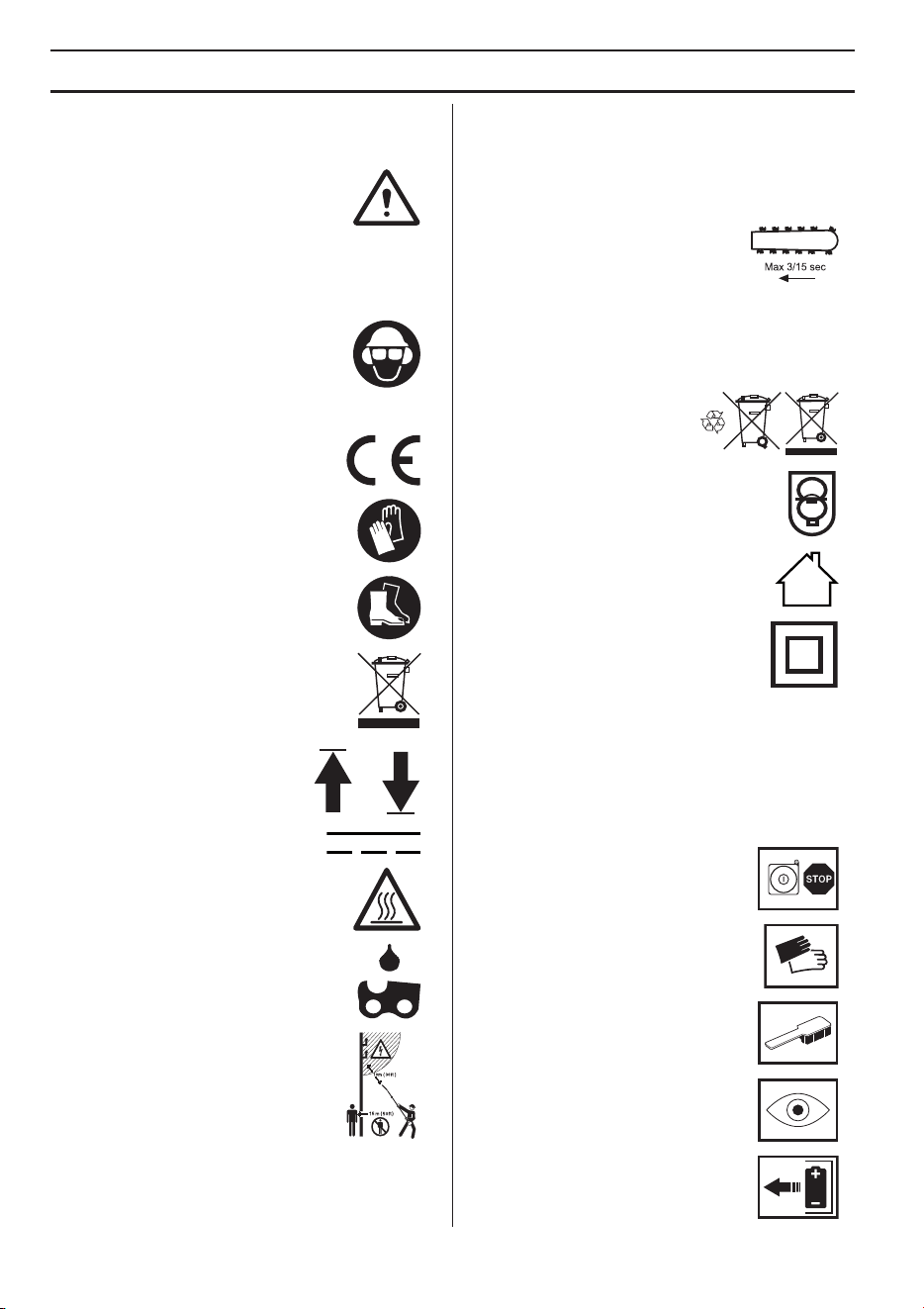
KEY TO SYMBOLS
2 – English
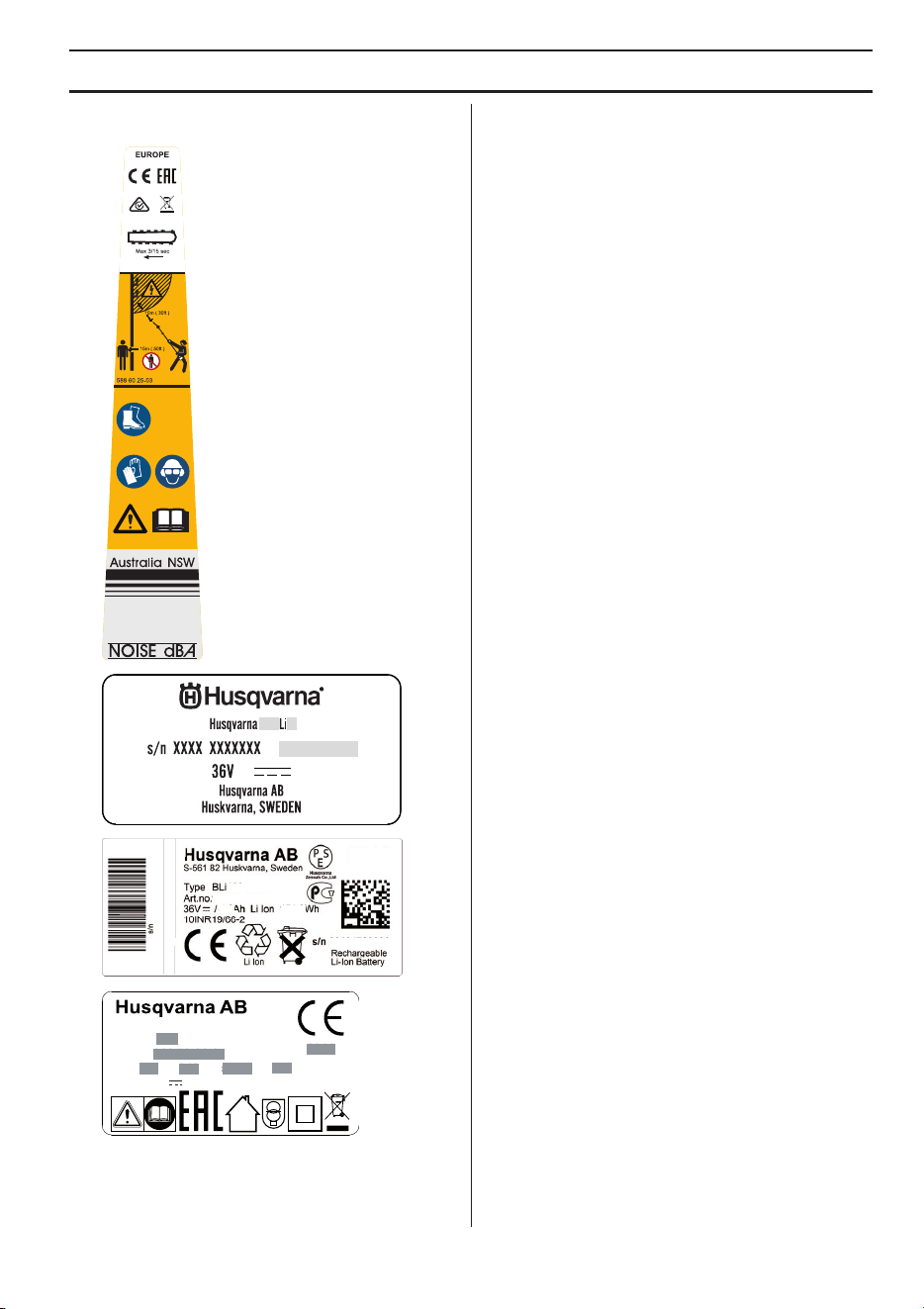
Symbols on the machine:
Translation of the original Swedish operating instruction.
WARNING! A pole saw is a dangerous
tool if used carelessly or incorrectly and
can cause serious, even fatal injuries. It is
extremely important that you read and
understand the contents of this Operator’s
Manual. Please read the operator’s manual carefully and
make sure you understand the instructions before using
the machine.
Always wear:
• A protective helmet where there is a
risk of falling objects
• Approved hearing protection
• Approved eye protection
This product is in accordance with
applicable EC directives.
Always wear approved protective gloves.
Wear sturdy, non-slip boots.
Symbols on the product or its packaging
indicate that this product cannot be
handled as domestic waste. This product
must be deposited at an appropriate
recycling facility. (Applies to Europe only)
Arrows which show limits for handle
positioning.
Direct current.
Keep all parts of your body away from the
hot surfaces.
Chain oil fill.
This machine is not electrically insulated.
If the machine touches or comes close to
high-voltage power lines it could lead to
death or serious bodily injury. Electricity
can jump from one point to another by
arcing. The higher the voltage, the
greater the distance electricity can jump.
Electricity can also travel through
branches and other objects, especially if they are wet.
Always keep a distance of at least 10 m between the
machine and high-voltage power lines and/or any objects
that are touching them. If have to work within this safe
distance you should always contact the relevant power
company to make sure the power is switched off before
you start work. This machine has a long reach. Make sure
that no people or animals come closer than 15 m when
the machine is running.
Direction of rotation of the saw chain,
running time/Idling.
Symbols on the battery and/or on
the battery charger:
This product must be deposited
at an appropriate recycling
facility. (Applies to Europe only)
Fail-safe transformer
Use and store battery charger only
indoors.
Double insulation
Other symbols/decals on the machine refer to
special certification requirements for certain
markets.
Symbols in the operator’s
manual:
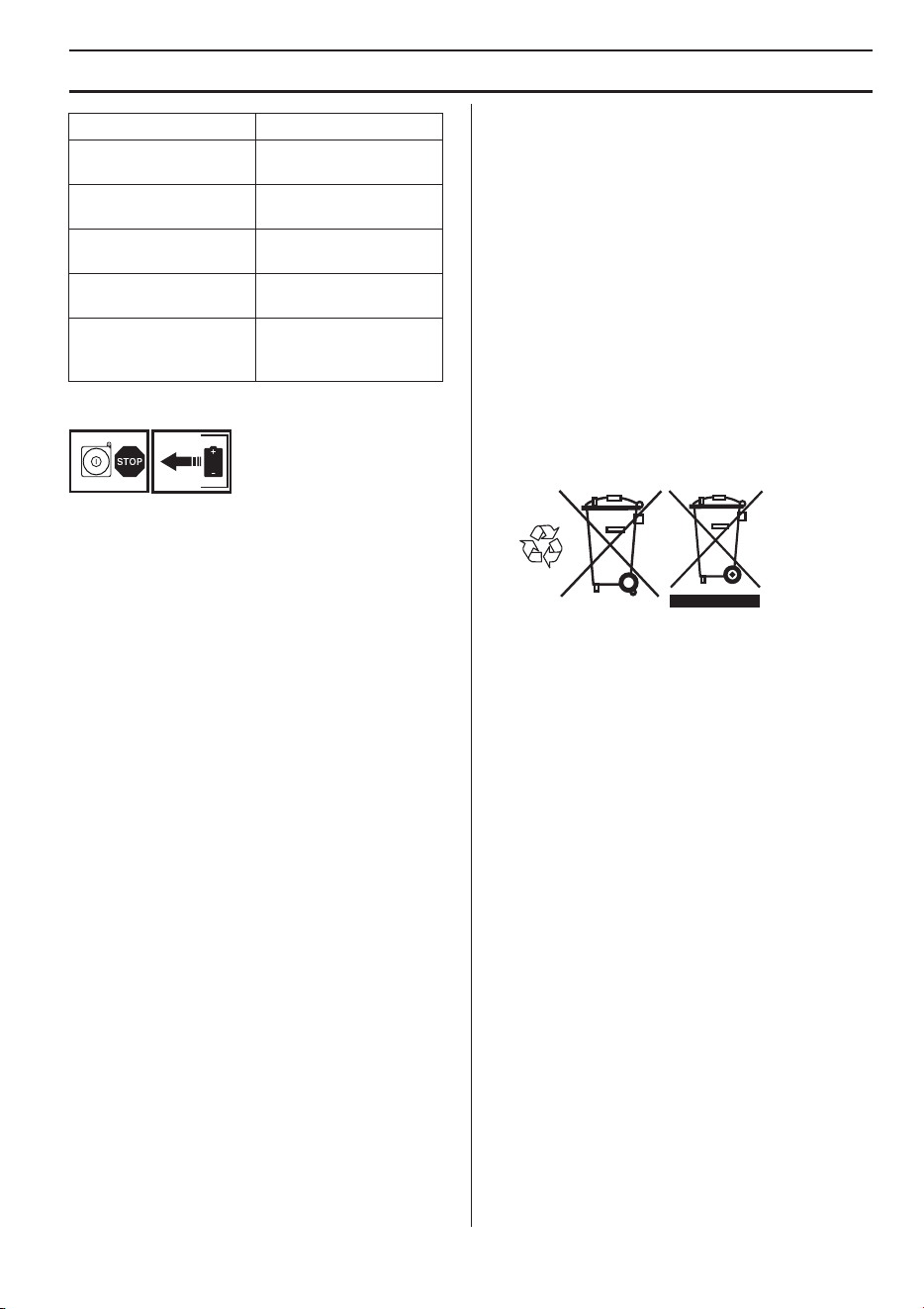
The machine is turned on and off by
pressing the on and stop button. Always
remove the battery to prevent the
machine being started by accident.
Always wear approved protective gloves.
Regular cleaning is required.
Visual check.
Remove the battery. IMPORTANT!
Always remove the battery to prevent
the machine being started by accident.
Li-ion
Li-ion
KEY TO SYMBOLS
English – 3
The following symbols and decals can be found on your
pole saw, battery and battery charger:
PRI: 100V - 240V ~ 50-60Hz 330W max.
S-561 82 Huskvarna, Sweden
Art.No. 966 73 06-01
/ 7A maxSEC: 36V
Typ QC 330
2014
WW/YY
CONTENTS
4 – English
Contents Note the following before
starting:
Please read the operator's manual carefully.
KEY TO SYMBOLS
Symbols on the machine: ...................................... 2
Symbols on the battery and/or on the battery
charger: .................................................................
2
Symbols in the operator’s manual: ........................ 2
CONTENTS
Contents ............................................................... 4
Note the following before starting: ........................ 4
INTRODUCTION
Dear Customer, ..................................................... 5
WHAT IS WHAT?
What is what? ....................................................... 6
GENERAL SAFETY PRECAUTIONS
General power tool safety warnings ...................... 7
Personal protective equipment ............................. 9
Battery and battery charger .................................. 10
Machine′s safety equipment ................................. 11
Cutting equipment ................................................. 12
ASSEMBLY
Fitting the bar and chain ....................................... 18
Rotating the saw head .......................................... 18
Assembling the branch hook ................................ 18
Dismantling the shock guard ................................ 18
Adjusting the harness ........................................... 19
BATTERY HANDLING
Battery .................................................................. 20
Battery charger ..................................................... 20
Transport and storage ........................................... 21
Disposal of the battery, battery charger and
machine ................................................................
21
STARTING AND STOPPING
Check before starting ............................................ 22
Connect battery to the machine ............................ 22
Starting and stopping ............................................ 22
WORKING TECHNIQUES
General working instructions ................................ 23
Stem limbing ......................................................... 24
MAINTENANCE
Inspection and maintenance ................................. 25
Troubleshooting schedule ..................................... 26
Maintenance schedule .......................................... 27
TECHNICAL DATA
Technical data ....................................................... 28
EC Declaration of Conformity ............................... 29
!
WARNING! Long-term exposure to noise
can result in permanent hearing
impairment. Always use hearing
protection.
!
WARNING! Under no circumstances may
the design of the machine be modified
without the permission of the
manufacturer. Always use original
accessories. Non-authorized
modifications and/or accessories can
result in serious personal injury or the
death of the operator or others.
!
WARNING! A pole saw is a dangerous
tool if used carelessly or incorrectly and
can cause serious, even fatal injuries. It
is extremely important that you read and
understand the contents of this
Operator’s Manual.

English – 5
INTRODUCTION
Dear Customer,
Congratulations on your choice to buy a Husqvarna product! Husqvarna is based on a tradition that dates back to 1689,
when the Swedish King Karl XI ordered the construction of a factory on the banks of the Husqvarna River, for production
of muskets. The location was logical, since water power was harnessed from the Huskvarna River to create the water-
powered plant. During the more than 300 years in existence, the Husqvarna factory has produced a lot of different
products, from wood stoves to modern kitchen appliances, sewing machines, bicycles, motorcycles etc. In 1956, the first
motor driven lawn mowers appeared, followed by chain saws in 1959, and it is within this area Husqvarna is working
today.
Today Husqvarna is one of the leading manufacturers in the world of forest and garden products, with quality as our
highest priority. The business concept is to develop, manufacture and market motor-driven products for forestry and
gardening, as well as for the building and construction industry. Husqvarna
′s aim is also to be at the front edge for
ergonomics, usability, security and environmental protection. That is the reason why we have developed many different
features to add to our products within these areas.
We are convinced that you will appreciate with great satisfaction the quality and performance of our product for a very
long time to come. The purchase of one of our products gives you access to professional help with repairs and service
whenever this may be necessary. If the retailer who sells your machine is not one of our authorised dealers, ask for the
address of your nearest service workshop.
It is our wish that you will be satisfied with your product and that it will be your companion for a long time. Think of this
operator
′s manual as a valuable document. By following its content (usage, service, maintenance, etc), the life span and
the second-hand value of the machine can be extended. If you sell this machine, make sure that the operator
′s manual
is passed on to the buyer.
Thank you for using a Husqvarna product.
Husqvarna AB has a policy of continuous product development and therefore reserves the right to modify the design and
appearance of products without prior notice.
6 – English
WHAT IS WHAT?
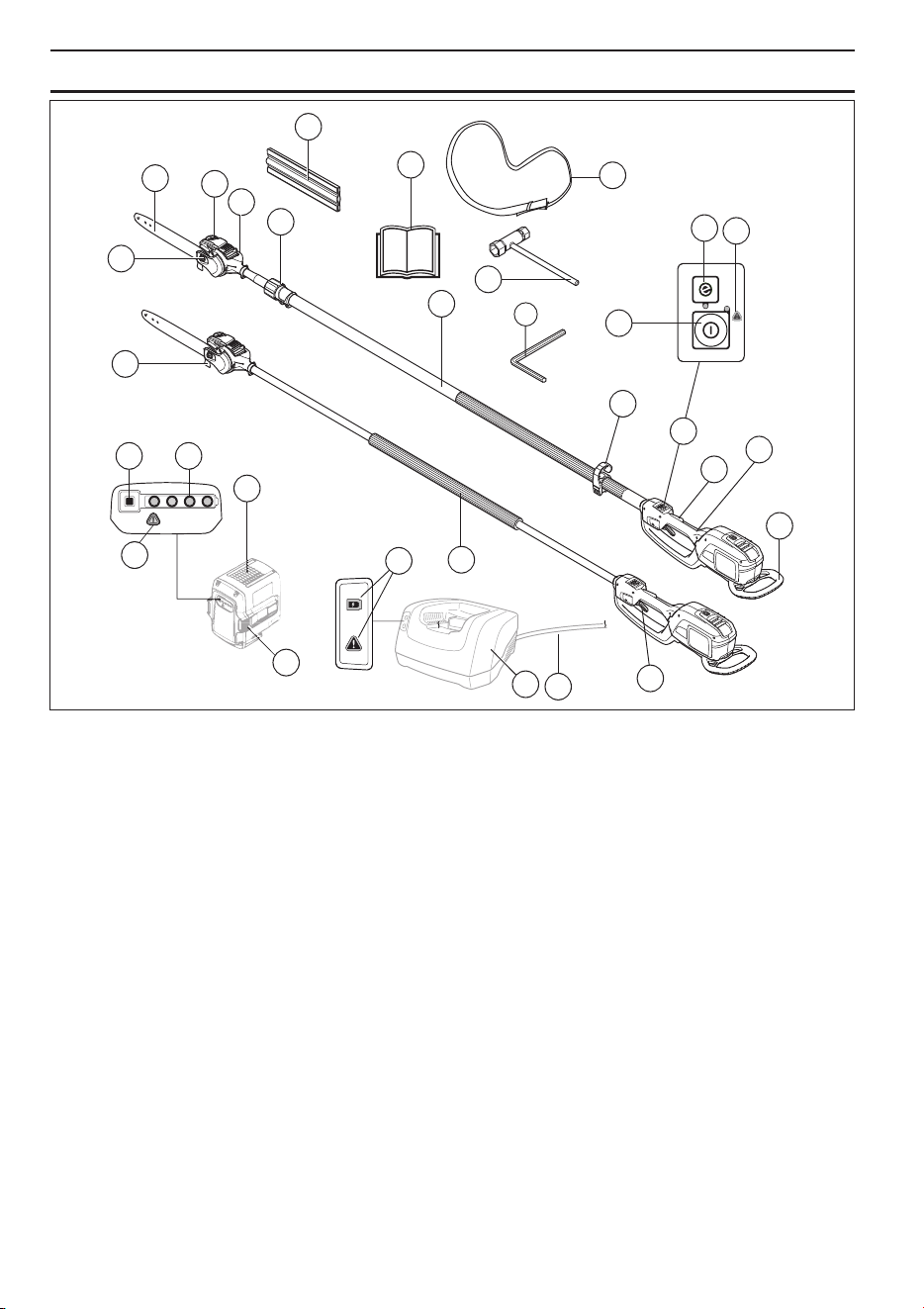
What is what?
5
6
9
8
13
25
16
12
18
17
19
15
24
1
11
20
21
17
14
7
3
2
26
23
4
10
27
22
28
29
1 Saw head
2 Chain oil tank
3 Guide bar
4 Bar nut
5 Shaft
6 Harness support hook
7 Keypad
8 Power trigger lockout
9 Power trigger
10 Rear handle
11 Front handle
12 Cord
13 Battery charger (Accessory)
14 Power on and warning indicator (ERROR LED)
15 Battery release buttons
16 Battery (Accessory)
17 Warning indicator (ERROR LED)
18 Battery indicator button
19 Battery status
20 Activate and deactivate button
21 SavE button
22 Harness
23 4 mm hex key
24 Combination spanner
25 Operator′s manual
26 Telescopic function
27 Branch hook
28 Transport guard, bar
29 Impact guard
GENERAL SAFETY PRECAUTIONS
English – 7
General power tool safety
warnings
Please read the operator’s manual carefully and make
sure you understand the instructions before using the
machine.
The machine is only designed for cutting branches and
twigs.
Always remove the battery to prevent the machine being
started by accident.
Work area safety
• Keep work area clean and well lit. Cluttered or dark
areas invite accidents.
• Do not operate power tools in explosive
atmospheres, such as in the presence of
flammable liquids, gases or dust.
Power tools
create sparks which may ignite the dust or fumes.
• Keep children and bystanders away while
operating a power tool.
Distractions can cause you
to lose control.
Personal safety
• Stay alert, watch what you are doing and use
common sense when operating a power tool. Do
not use a power tool while you are tired or under
the influence of drugs, alcohol or medication.
A
moment of inattention while operating power tools
may result in serious personal injury.
• Use personal protective equipment. Always wear
eye protection.
Protective equipment such as dust
mask, non-skid safety shoes, hard hat, or hearing
protection used for appropriate conditions will reduce
personal injuries.
• Prevent unintentional starting. Ensure the switch
is in the OFF-position before connecting to a
power source and/or battery pack, picking up or
carrying the tool.
Carrying power tools with your
finger on the switch or energising power tools that
have the switch on invites accidents.
• Remove any adjusting key or wrench before
turning the power tool on.
A wrench or a key left
attached to a rotating part of the power tool may result
in personal injury.
• Do not overreach. Keep proper footing and
balance at all times.
This enables better control of
the power tool in unexpected situations.
• Dress properly. Do not wear loose clothing or
jewellery. Keep your hair, clothing and gloves
away from moving parts.
Loose clothes, jewellery or
long hair can be caught in moving parts.
• If devices are provided for the connection of dust
extraction and collection facilities, ensure these
are connected and properly used.
Use of dust
collection can reduce dust-related hazards.
• The vibration emission during actual use of the power
tool can differ from the declared total value depending
on the ways in which the tool is used. Operators
should identify safety measures to protect themselves
that are based on an estimation of exposure in the
actual conditions of use (taking account of all parts of
the operating cycle such as the times when the tool is
switched off and when it is running idle in addition to
the trigger).
Power tool use and care
• Do not force the power tool. Use the correct power
tool for your application.
The correct power tool will
do the job better and safer at the rate for which it was
designed.
• Do not use the power tool if the switch does not
turn it on and off.
Any power tool that cannot be
controlled with the switch is dangerous and must be
repaired.
• Disconnect the plug from the power source and/or
the battery pack from the power tool before
making any adjustments, changing accessories,
or storing power tools.
Such preventive safety
measures reduce the risk of starting the power tool
accidentally.
• Store idle power tools out of the reach of children
and do not allow persons unfamiliar with the
power tool or these instructions to operate the
power tool.
Power tools are dangerous in the hands
of untrained users.
• Maintain power tools. Check for misalignment or
binding of moving parts, breakage of parts and
any other condition that may affect the power
tool´s operation. If damaged, have the power tool
repaired before use.
Many accidents are caused by
poorly maintained power tools.
• Keep cutting tools sharp and clean. Properly
maintained cutting tools with sharp cutting edges are
less likely to bind and are easier to control.
• Use the power tool, accessories and tool bits etc.
in accordance with these instructions, taking into
account the working conditions and the work to
be performed.
Use of the power tool for operations
different from those intended could result in a
hazardous situation.
!
WARNING! Read all safety warnings and
all instructions. Failure to follow the
warnings and instructions may result in
electric shock, fire and/or serious injury.
IMPORTANT!
Save all warnings and instructions for future reference.
The term ”power tool” in the warnings refers to your
mains-operated (corded) power tool or battery-operated
(cordless) power tool.

GENERAL SAFETY PRECAUTIONS
8 – English
Battery tool use and care
• Recharge only with the charger specified by the
manufacturer.
A charger that is suitable for one type
of battery pack may create a risk of fire when used
with another battery pack.
• Use power tools only with specifically designated
battery packs.
Use of any other battery packs may
create a risk of injury and fire.
• When battery pack is not in use, keep it away from
other metal objects, like paper clips, coins, keys,
nails, screws or other small metal objects, that
can make a connection from one terminal to
another.
Shorting the battery terminals together may
cause burns or a fire.
• Under abusive conditions, liquid may be ejected
from the battery; avoid contact. If contact
accidentally occurs, flush with water. If liquid
contacts eyes, additionally seek medical help.
Liquid ejected from the battery may cause irritations
or burns.
Service
• Have your power tool serviced by a qualified
repair person using only identical replacement
parts.
This will ensure that the safety of the power tool
is maintained.
Pole pruner safety warnings - personal
safety
• Keep all body parts away from the saw chain when
using the pole saw. Before starting the pole saw,
make sure the saw chain is not touching anything.
Just one moment of carelessness when in use can
lead to your clothes and parts of your body becoming
entangled in the saw chain.
• Always hold the pole saw in your right hand on the
rear handle and your left hand on the front handle.
Holding the pole saw with the opposite hand
configuration increases the risk of personal injury and
is forbidden.
• Hold the power tool by insulated gripping surface
only, because the saw chain may contact hidden
wiring or its own cord.
Saw chain contacting a ”live”
wire may make exposed metal parts of the power tool
” live” and could give the operator an electric shock.
• Do not use the pole saw in trees. Using the pole saw
while in a tree may result in personal injury.
• Wear safety glasses and hearing protection.
Further protective equipment for head, hands,
legs and feet is recommended.
Adequate protective
clothing will reduce personal injury by flying debris or
accidental contact with the saw chain.
• Always stand in a stable position and use the pole
saw only when standing on solid, safe and even
surfaces.
Slippery or instable surfaces such as
ladders can make you lose balance or control of the
pole saw.
• Look out for spring back when cutting branches
that are under tension.
Once the tension in the wood
fibers is released, the branch can hit the operator and/
or throw the pole saw out of control.
• Use extreme caution when cutting brush and
saplings.
The slender material may catch the saw
chain and be whipped forward toward you or pull you
off balance.
• Carry the pole saw by the front handle and with
the saw shut down and turned away from your
body. Always fit the bar guard during transport
and storage of the pole saw.
Correct handling of the
pole saw reduces the risk of inadvertent contact with
the saw chain.
• Follow instruction for lubricating, chain
tensioning and changing accessories.
Improperly
tensioned or lubricated saw chain may either brake or
increase the chance of kickback.
• Keep handles dry, clean and free from oil and
grease.
Greasy, oily handles are slippery causing
loss of control.
• Saw only in wood. Do not use the pole saw for
anything it is not intended for. For example, do not
use the pole saw to saw in plastic, brick or
building materials not made of wood.
Using the
pole saw for anything it is not intended for can result
in dangerous situations.
• We strongly recommend that first time users practice
sawing logs on a saw horse or cradle.
Causes and operator prevention of
kickback
Kickback can occur when the nose or tip of the bar
touches an object, or when the wood comes close and
jams the saw chain when sawing. Contact with the guide
bar tip can in some cases cause a sudden reverse
reaction and kickback of the guide bar towards the
operator. Jamming the saw chain along the top of the
guide bar can press it rapidly back towards the operator.
These reactions can make you lose control of the pole
saw that may result in serious personal injury. Do not rely
only on the safety functions that are integrated in the
brush saw. As a pole saw operator, you should take
several steps to maintain your saw job free from accidents
and injuries. Kickback is the result of incorrect use of the
tool and/or incorrect operator procedures and can be
avoided by taking the correct safety measure as
described below.
• Maintain a firm grip, with thumbs and fingers
around the pole saw handle, with both hands on
the handles. Position your body and your arms so
that you can stand against any kickbacks.
The
power of kickbacks can be controlled by the operator
if the correct precautions are taken. Do not let go of
the pole saw.
• Do not stretch too far and do not saw above
shoulder height.
This will help to prevent inadvertent
tip contact and give better control of the pole saw in
unexpected situations.
GENERAL SAFETY PRECAUTIONS
English – 9
• Only use replacement bars and chains specified
by the manufacturer.
Incorrect replacement bars
and chains may cause chain breakage and/or
kickback.
• Follow the manufacturer’s sharpening and
maintenance instructions for the saw chain.
Decreasing the depth gauge height can lead to
increased kickback.
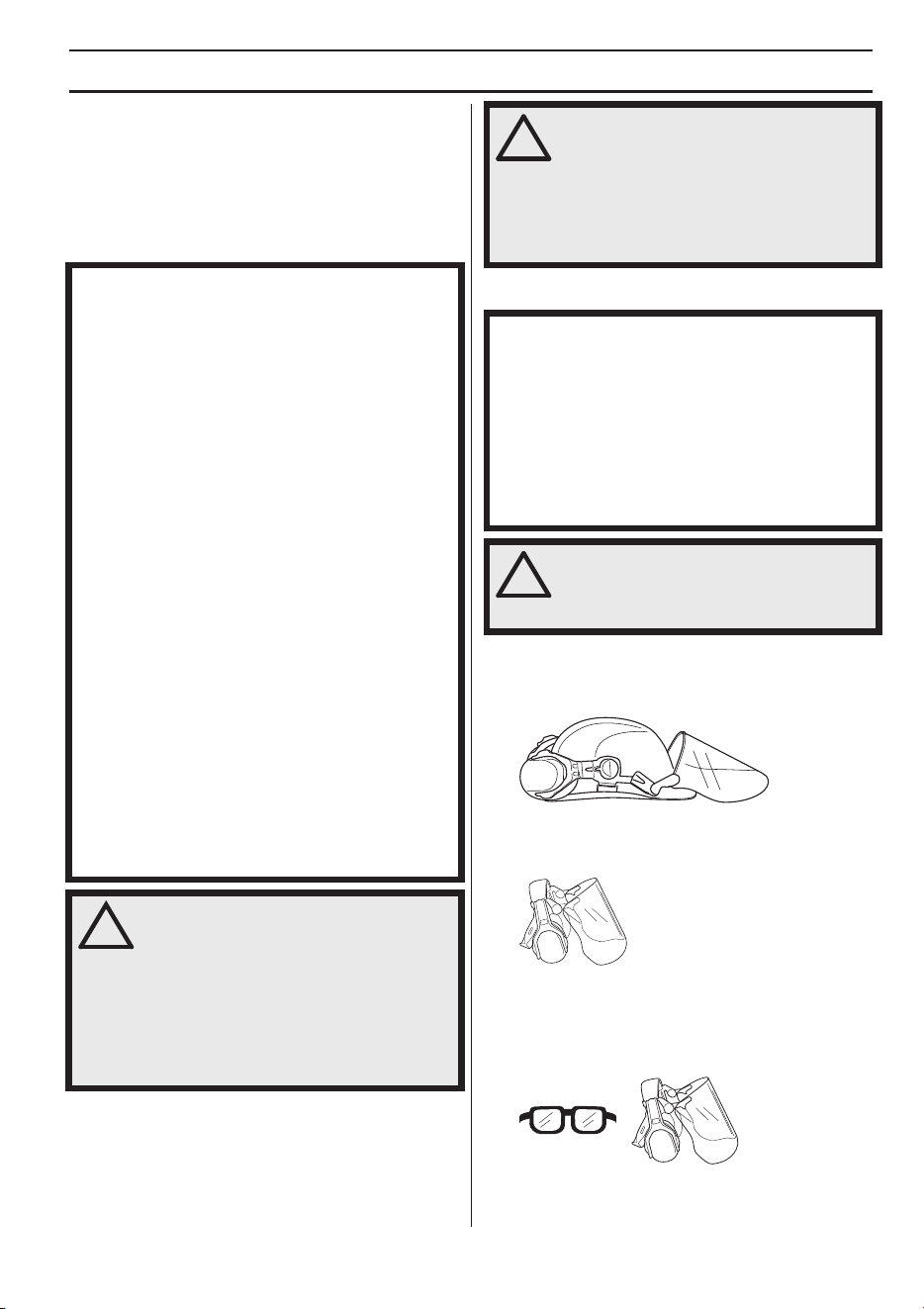
Personal protective equipment
PROTECTIVE HELMET AND VISOR
Wear a protective helmet where there is a risk of falling
objects
HEARING PROTECTION
Wear hearing protection that provides adequate noise
reduction.
EYE PROTECTION
Always wear approved eye protection. If you use a visor
then you must also wear approved protective goggles.
Approved protective goggles must comply with the ANSI
Z87.1 standard in the USA or EN 166 in EU countries.
IMPORTANT!
Always remove the battery before any maintenance on
the machine.
National or local regulations may regulate the use.
Comply to given regulations.
Children should be supervised to ensure that they do
not play with the appliance.
Store the machine out of reach of children. Never allow
children or other persons not trained in the use of the
machine and/or the battery to use or service it. Local
laws may regulate the age of the user.
Never use a machine that has been modified in any way
from its original specification.
Wear personal protective equipment. See instructions
under the ”Personal protective equipment” heading.
The operator of the machine must ensure, while
working, that no persons or animals come closer than
15 meters.
Never use the machine in bad weather, for instance in
fog, in rain, strong winds, intense cold, etc. Extremely
hot weather may cause overheating of the machine.
Never use a machine that is faulty. Carry out the safety
checks, maintenance and service instructions
described in this manual. Some maintenance and
service measures must be carried out by trained and
qualified specialists. See instructions under the
Maintenance heading.
Carry out an overall inspection of the machine before
use. See the maintenance schedule.
!
WARNING! This machine produces an
electromagnetic field during operation.
This field may under some
circumstances interfere with active or
passive medical implants. To reduce the
risk of serious or fatal injury, we
recommend persons with medical
implants to consult their physician and
the medical implant manufacturer before
operating this machine.
!
WARNING! Never allow children to use or
be in the vicinity of the machine. Since
the machine is easy to start, children
may be able to start it if they are not kept
under full surveillance. This can mean a
risk of serious personal injury. Therefore
disconnect the battery when the machine
is not under close supervision.
IMPORTANT!
A pole saw is a dangerous tool if used carelessly or
incorrectly and can cause serious, even fatal injuries. It
is extremely important that you read and understand the
contents of this Operator’s Manual.
You must use approved personal protective equipment
whenever you use the machine. Personal protective
equipment cannot eliminate the risk of injury but it will
reduce the degree of injury if an accident does happen.
Ask your dealer for help in choosing the right equipment.
!
WARNING! Listen out for warning signals
or shouts when you are wearing hearing
protection. Always remove your hearing
protection as soon as the engine stops.
GENERAL SAFETY PRECAUTIONS
10 – English
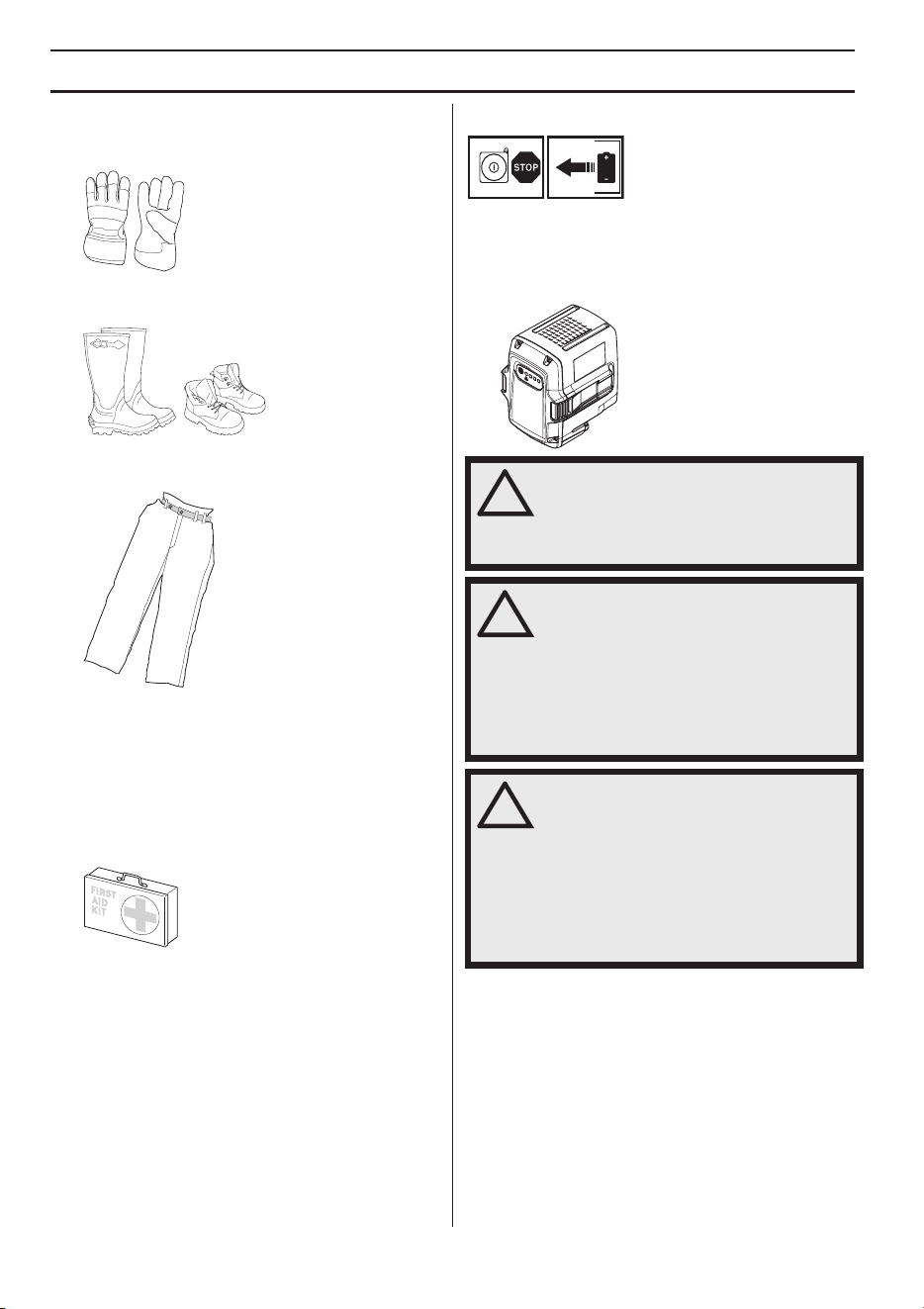
GLOVES
Gloves should be worn when necessary, e.g. when fitting
cutting attachments.
BOOTS
Wear sturdy, non-slip boots or shoes.
TROUSERS
Use trousers with saw protection.
CLOTHING
Wear clothes made of a strong fabric and avoid loose
clothing that can catch on twigs and branches. Always
wear heavy, long pants. Do not wear jewellery, shorts
sandals or go barefoot. Secure hair so it is above shoulder
level.
FIRST AID KIT
Always have a first aid kit nearby.
Battery and battery charger
This section describes the battery and battery charger
safety for your battery product.
Only use Husqvarna original batteries for Husqvarna
products and only charge them in an original battery QC
charger from Husqvarna. The batteries are software
encrypted.
Use only a Husqvarna original BLi battery in your
machine.
Battery safety
The rechargeable Husqvarna batteries, BLi, are
exclusively used as a power supply for the relevant
Husqvarna cordless appliances. To avoid injury, the
battery must not be used as a power source for other
devices.
• Use the battery in surroundings where temperatures
are between -10
°C and 40 °C.
• Do not expose the battery to microwaves or high
pressure.
• Never clean the battery or the battery charger with
water. See instructions under the Maintenance
heading.
• Store the battery out of reach of children.
• Protect the battery from rain and wet conditions.
!
WARNING! Protect the battery from
direct sunlight, heat or open flame. There
is a risk the battery may explode if it is
thrown into an open fire. There is a risk of
burns and/or chemical burns.
!
WARNING! Avoid all skin contact with
battery acid. Battery acid may cause skin
irritation, burns or corrosive injuries. If
you get acid in your eyes, do not rub but
flush your eyes with plenty of water for at
least 15 minutes. See a doctor. You must
wash any exposed skin with copious
amounts of water and soap in case of
incidental contact.
!
WARNING! Never connect the battery
terminals to keys, coins, screws or other
metal as this may short-circuit the
battery. Never insert objects into the
battery's air vents.
Unused batteries must be kept away from
metal objects such as nails, coins,
jewellery. Do not try to disassemble or
crush the battery
Li-ion
Li-ion
GENERAL SAFETY PRECAUTIONS
English – 11
Battery charger safety
Only use Chargers, Husqvarna QC, for charging the
Husqvarna replacement batteries, BLi.
• Regularly check that the battery charger connection
wire is intact and that there are no cracks in it.
• Never carry the battery charger using the cord and
never pull out the plug by pulling the cord.
• Keep all cables and extension leads away from water,
oil and sharp edges. Make sure the cable is not
jammed in doors, fences or the like. Otherwise it can
cause the charger to become live. Inspect extensions
cords periodically and replace if damaged.
Do not use:
• a faulty or damaged battery charger or never use a
faulty, damaged or deformed battery.
Do not charge:
• non-rechargeable batteries in the battery charger or
use them in the machine.
• the battery in the battery charger outdoors.
• the battery in the rain or in wet conditions.
• the battery in direct sunlight.
Use the battery charger only when the surrounding
temperature is between 5
°C and 40 °C. Use the charger
in an environment which is well ventilated, dry and free
from dust.
Machine′s safety equipment
This section describes the machine′s safety equipment,
its purpose, and how checks and maintenance should be
carried out to ensure that it operates correctly. See the
”What is what?” section to locate where this equipment is
positioned on your machine.
The life span or the runtime of the machine can be
reduced and the risk of accidents can increase if machine
maintenance is not carried out correctly and if service
and/or repairs are not carried out professionally. If you
need further information please contact your nearest
service workshop.
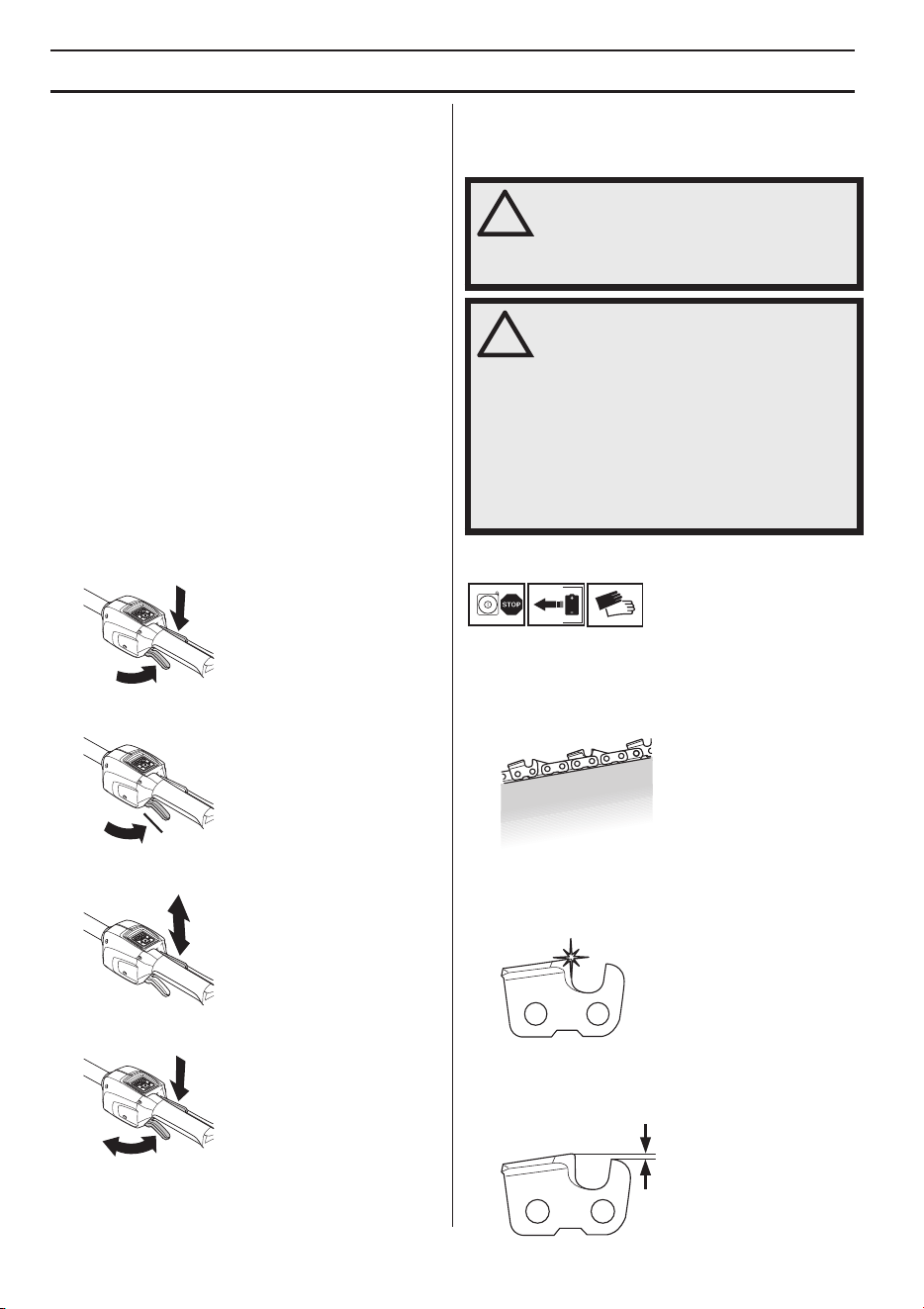
Control panel
Make sure the machine is switched on or off when the
activate/deactivate button (1) is pressed and held (>1
sec.). The green LED (2) is lit or turned off.
!
WARNING! Minimise the risk of electric
shock or short circuit as follows:
Never insert any object into the charger’s
cooling slots.
Do not try to dismantle the battery
charger.
Never connect the charger terminals to
metal objects as this can short circuit the
battery charger.
Use approved and intact wall sockets.
!
WARNING! Do not use the battery
charger close to corrosive or flammable
materials. Do not cover the battery
charger. Pull out the plug to the battery
charger in the event of smoke or fire.
Remember the risk of fire.
Li-ion
Li-ion
IMPORTANT!
All servicing and repair work on the machine requires
special training. This is especially true of the machine
′s
safety equipment. If your machine fails any of the
checks described below you must contact your service
agent. When you buy any of our products we guarantee
the availability of professional repairs and service. If the
retailer who sells your machine is not a servicing dealer,
ask him for the address of your nearest service agent.
!
WARNING! Never use a machine with
faulty safety equipment. The machine's
safety equipment must be checked and
maintained as described in this section.
If your machine fails any of these checks
contact your service agent to get it
repaired.
(1)
(2)
(3)
GENERAL SAFETY PRECAUTIONS
12 – English
Flashing warning indicator (3) and green LED (2) is lit
could indicate that:
• it is not possible to apply full power and, at the same
time, activate the machine. Release the power trigger
and the machine is active.
• the machine is blocked. Deactivate the machine.
Remove the battery from the machine. Pull the pole
saw away from the kerf while lifting the branch.
• the machine is overloaded due to heavy trimming.
Release the power trigger and the machine is active.
If the warning symbol (3) flashes, it indicates that the
machine is too hot and the machine deactivates. When
the machine is restored to normal temperature it is again
ready to run and you can activate the machine.
Solid red warning light (3) indicates service.
Power trigger lockout
The power trigger lockout is designed to prevent
accidental operation of the power trigger. When you press
the lock (1) (i.e. when you grasp the handle) it releases
the power trigger (2). When you release the handle the
power trigger and the power trigger lockout both move
back to their original positions. This movement is
controlled by two independent return springs.
Make sure the power trigger is locked when the power
trigger lock is in its original position.
Press the power trigger and make sure it returns to its
original position when you release it.
Check that the power trigger and the power trigger lockout
move freely and that the return spring works properly.
See instructions under the heading Start. Start the
machine and apply full power. Release the power trigger
and check that the cutting attachment stops and remain at
a standstill.
Cutting attachment guard
Always use the recommended guard for the cutting
attachment you are using. See chapter on Technical data.
Cutting equipment
This section describes how you can achieve maximum
clearing capacity and extend the life of the cutting
attachment through correct maintenance and using the
right type of cutting attachment.
• Only use cutting equipment recommended by us!
• Keep the chain’s cutting teeth properly
sharpened! Follow our instructions and use the
recommended file gauge.
A damaged or badly
sharpened chain increases the risk of accidents.
• Maintain the correct raker clearance! Follow our
instructions and use the recommended raker
gauge.
Too large a clearance increases the risk of
kickback.
1
2
!
WARNING! Never use a cutting
attachment without an approved guard.
See the chapter on Technical data. If an
incorrect or faulty guard is fitted this can
cause serious personal injury.
!
WARNING! This machine is renowned for
its low vibration load. Overexposure to
vibration can lead to circulatory damage
or nerve damage in people who have
impaired circulation. Contact your doctor
if you experience symptoms of
overexposure to vibration. These
symptoms include numbness, loss of
feeling, tingling, pricking, pain, loss of
strength, changes in skin colour or
condition. These symptoms normally
appear in the fingers, hands or wrists.
Li-ion
Li-ion
GENERAL SAFETY PRECAUTIONS
English – 13
• Keep the chain properly tensioned! If the chain is
slack it is more likely to jump off and lead to increased
wear on the bar, chain and drive sprocket.
• Keep cutting equipment well lubricated and
properly maintained! A poorly lubricated chain is
more likely to break and lead to increased wear on the
bar, chain and drive sprocket.
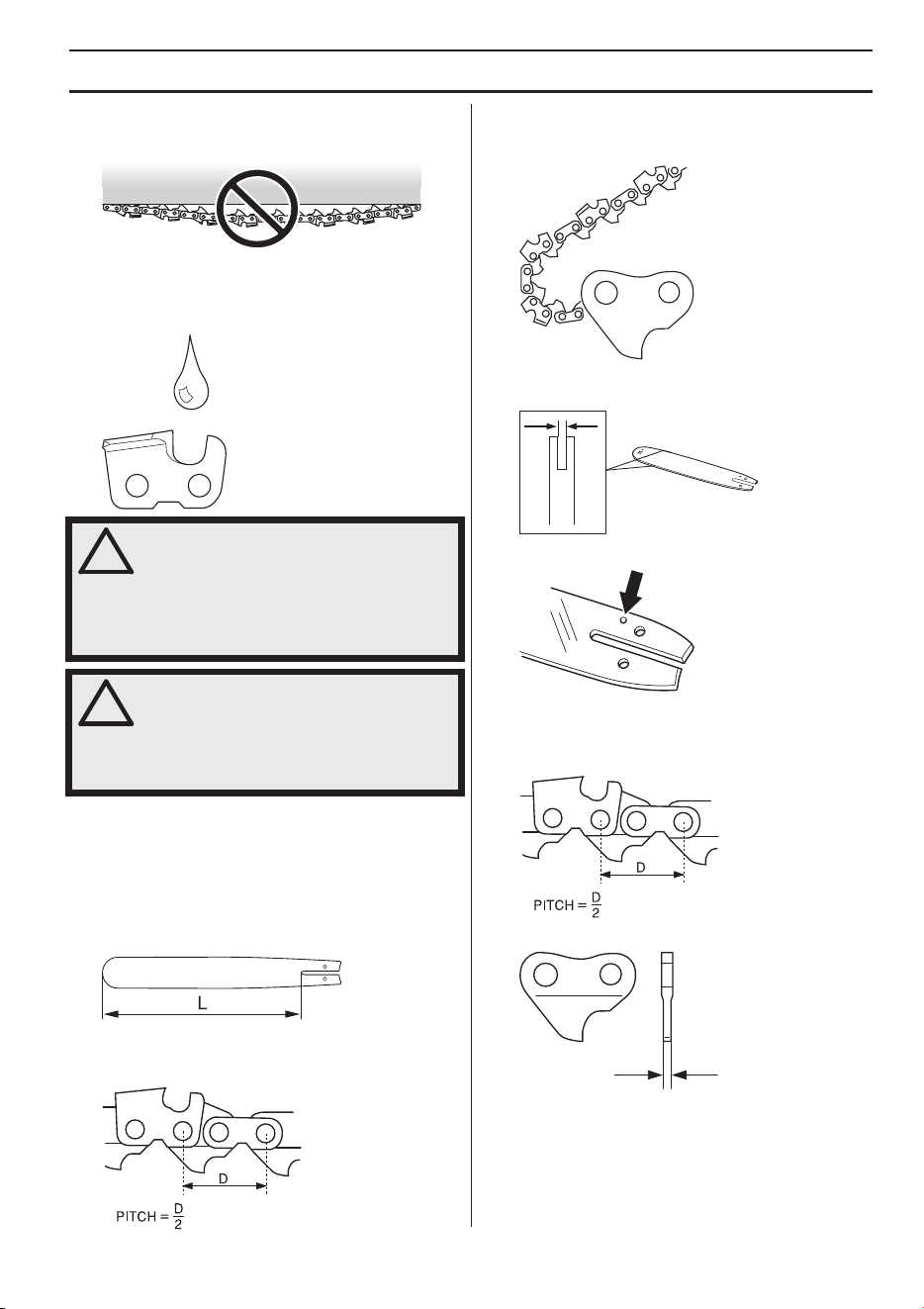
Specification of bar and saw chain
When the cutting attachment supplied with your machine
has to be replaced, because it is worn out or damaged,
you must only fit the types of bar and saw chain
recommended by us.
Guide bar
• Length (inches/cm)
• Chain pitch (inches). The spacing between the drive
links of the chain must match the spacing of the teeth
on the bar tip sprocket and drive sprocket.
• Number of drive links. The number of drive links is
determined by the length of the bar, the chain pitch
and the number of teeth on the bar tip sprocket.
• Bar groove width (inches/mm). The groove in the bar
must match the width of the chain drive links.
• Lubrication hole and hole for the chain tensioner.
Saw chain
• Saw chain pitch (inches). (The distance between
three drive links, divided by two.)
• Drive link width (mm/inches)
!
WARNING! Never use a machine with
faulty safety equipment. The machine's
safety equipment must be checked and
maintained as described in this section.
If your machine fails any of these checks
contact your service agent to get it
repaired.
!
WARNING! Always remove the battery to
prevent the machine being started by
accident. Make sure that the cutting
attachment has stopped completely
before you start to do any work on the
machine.
GENERAL SAFETY PRECAUTIONS
14 – English
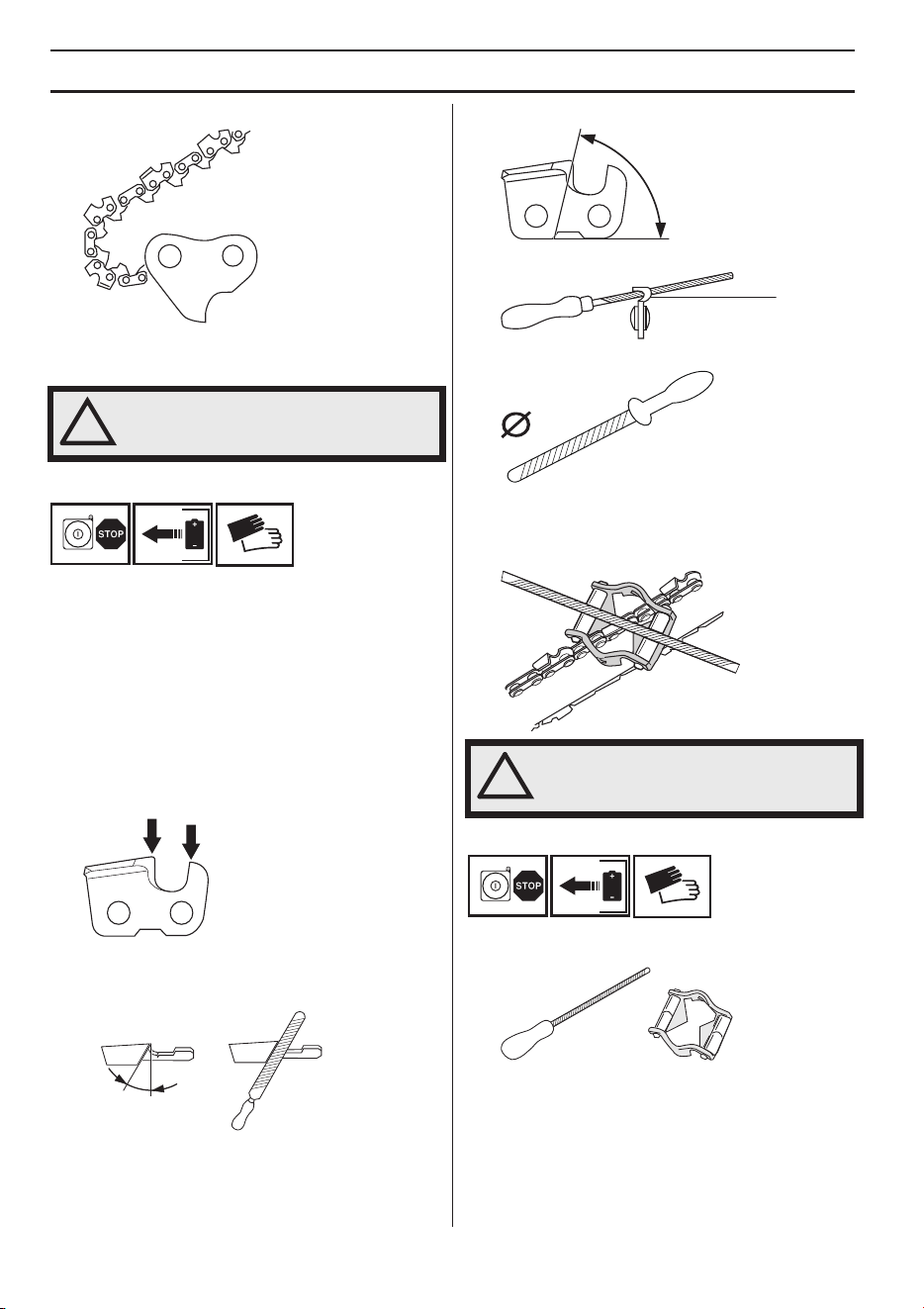
• Number of drive links.
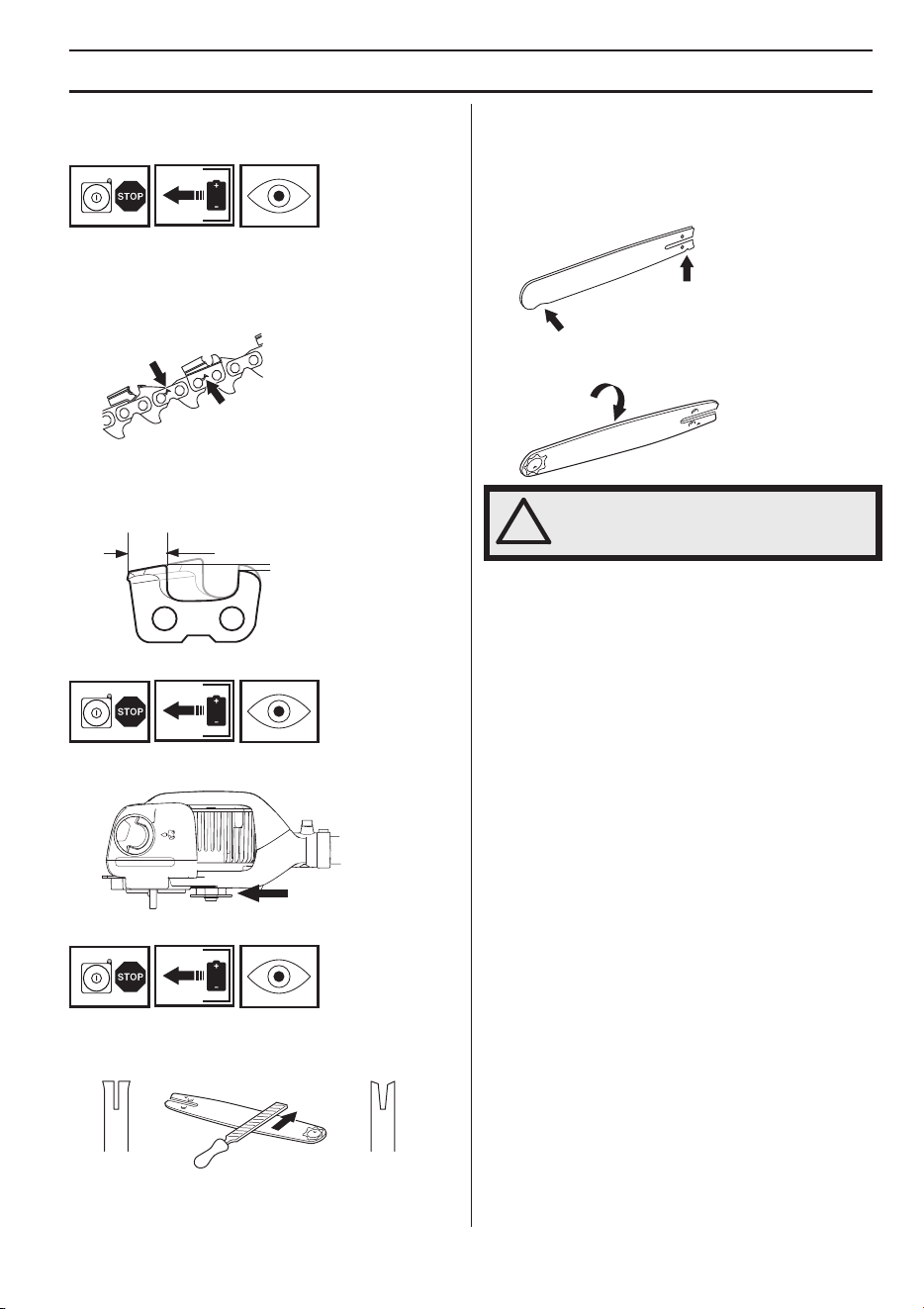
Sharpening your chain and adjusting
raker clearance
General information on sharpening cutting teeth
• Never use a blunt chain. When the chain is blunt you
have to exert more pressure to force the bar through
the wood and the cuttings will be very small. If the
chain is very blunt it will not produce any cuttings at
all. Wood powder would be the only result.
• A sharp chain eats its way through the wood and
produces long, thick cuttings.
• The cutting part of the chain is called the cutting link
and this consists of a cutting tooth (A) and the raker lip
(B). The cutting depth is determined by the difference
in height between the two.
• When you sharpen a cutting tooth there are four
important factors to remember.
- Filing angle
- Cutting angle
- File position
- Round file diameter
It is very difficult to sharpen a chain correctly without the
right equipment. We recommend that you use our file
gauge. This will help you obtain the maximum kickback
reduction and cutting performance from your chain.
Sharpening cutting teeth
To sharpen cutting teeth you will need a round file and a
file gauge.
• Check that the chain is correctly tensioned. A slack
chain will move sideways, making it more difficult to
sharpen correctly.
• Always file cutting teeth from the inside face outwards.
Reduce the pressure on the return stroke. File all the
!
WARNING! The risk of kickback is
increased with a badly sharpened chain!
Li-ion
Li-ion
A
B
!
WARNING! Departure from the
sharpening instructions considerably
increases the risk of kickback.
Li-ion
Li-ion
GENERAL SAFETY PRECAUTIONS
English – 15
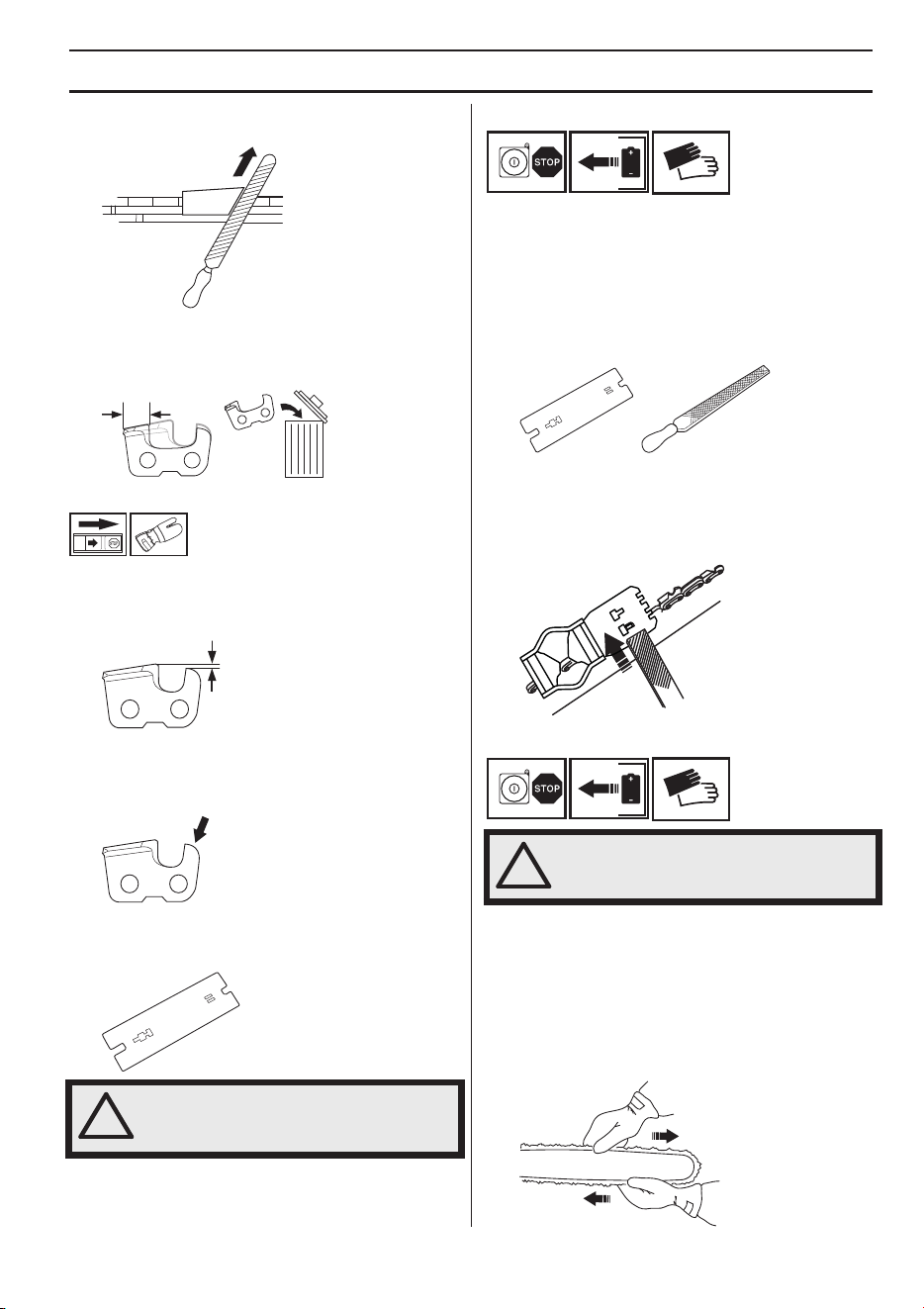
teeth on one side of the bar first. Then turn the saw
over and file the remaining teeth from the other side.
• File all the teeth to the same length. When the length
of the cutting teeth is reduced to 4 mm (5/32") the
chain is worn out and should be replaced.
General advice on setting raker clearance
• When you sharpen the cutting teeth you reduce the
raker clearance (=cutting depth). To maintain optimal
cutting performance you must file back the raker lip to
the recommended height.
• On a low-kickback cutting link the front edge of the
raker lip is rounded. It is very important that you
maintain this radius or bevel when you adjust the raker
clearance.
• We recommend that you use our raker gauge to
achieve the correct clearance and bevel on the raker
lip.
Setting the raker clearance
• Before setting the raker clearance the cutting teeth
should be newly sharpened.
We recommend that you adjust the raker clearance
every third time you sharpen the chain. NOTE! This
recommendation assumes that the length of the
cutting teeth is not reduced excessively.
• To adjust the raker clearance you will need a flat file
and a raker gauge.
• Place the gauge over the raker lip.
• Place the file over the part of the lip that protrudes
through the gauge and file off the excess. The
clearance is correct when you no longer feel any
resistance as you draw the file over the gauge.
Tensioning the chain
• The more you use a chain the longer it becomes. It is
therefore important to adjust the chain regularly to
take up the slack.
• Check the chain tension every time you refuel. NOTE!
A new chain has a running-in period during which you
should check the tension more frequently.
• Tension the chain as tightly as possible, but not so
tight that you cannot pull it round freely by hand.
!
WARNING! The risk of kickback is
increased if the raker clearance is too
large!
min 4 mm
(0,16”)
!
WARNING! A slack chain may jump off
and cause serious or even fatal injury.
Li-ion
Li-ion
Li-ion
Li-ion
GENERAL SAFETY PRECAUTIONS
16 – English
- Undo the bar nut.
- Tension the chain by turning the chain tensioning screw
clockwise using the combination spanner. The chain
should be tensioned until it does not sag from the
underside of the bar.
- Tighten the bar nut using the combination spanner.
Check that the chain can be pulled round easily by hand.
Lubricating cutting equipment
Chain oil
• Chain oil must demonstrate good adhesion to the
chain and also maintain its flow characteristics
regardless of whether it is warm summer or cold
winter weather.
• As a chain saw manufacturer we have developed an
optimal chain oil which, with its vegetable oil base, is
also biodegradable. We recommend the use of our
own oil for both maximum chain life and to minimise
environmental damage.
• If our own chain oil is not available, standard chain oil
is recommended.
• In areas where oil specifically for lubrication of saw
chains is unavailable, ordinary EP 90 transmission oil
may be used.
• Never use waste oil! This is dangerous for yourself,
the machine and the environment.
Filling with chain oil
Fill with oil once an hour or when the battery is dead.
Checking chain lubrication
• Check the chain lubrication each time you refuel. Aim
the tip of the bar at a light coloured surface about 20
cm (8 inches) away. After 1 minute running at 3/4
throttle you should see a distinct line of oil on the light
surface.
What to do if lubrication does not work:
• Check that the oil channels in the bar are not
obstructed. Clean if necessary.
• Check that the oil channel in the gear housing is
clean. Clean if necessary.
• Check that the bar tip sprocket turns freely. If the chain
lubrication system is still not working after carrying out
the above checks you should contact your service
workshop.
!
WARNING! Poor lubrication of cutting
equipment may cause the chain to snap,
which could lead to serious, even fatal
injuries.
GENERAL SAFETY PRECAUTIONS
English – 17
Checking wear on cutting equipment
Saw chain
Check the chain daily for:
• Visible cracks in rivets and links.
• Whether the chain is stiff.
• Whether rivets and links are badly worn.
We recommend you compare the existing chain with a
new chain to decide how badly the existing chain is worn.
When the length of the cutting teeth has worn down to
only 4 mm the chain must be replaced.
Chain drive sprocket
Regularly check the degree of wear on the drive sprocket.
Replace if wear is excessive.
Guide bar
Check regularly:
• Whether there are burrs on the edges of the bar.
Remove these with a file if necessary.
• If the guide bar is abnormally worn or can be turned
an abnormal amount back and forth on the shaft.
Replace the bar if necessary.
• Whether the tip of the bar is uneven or badly worn. If
a hollow forms on the underside of the bar tip this is
due to running with a slack chain.
• To prolong the life of the bar you should turn it over
daily.
Li-ion
Li-ion
Li-ion
Li-ion
Li-ion
Li-ion
!
WARNING! A faulty cutting attachment
may increase the risk of accidents.
ASSEMBLY
18 – English
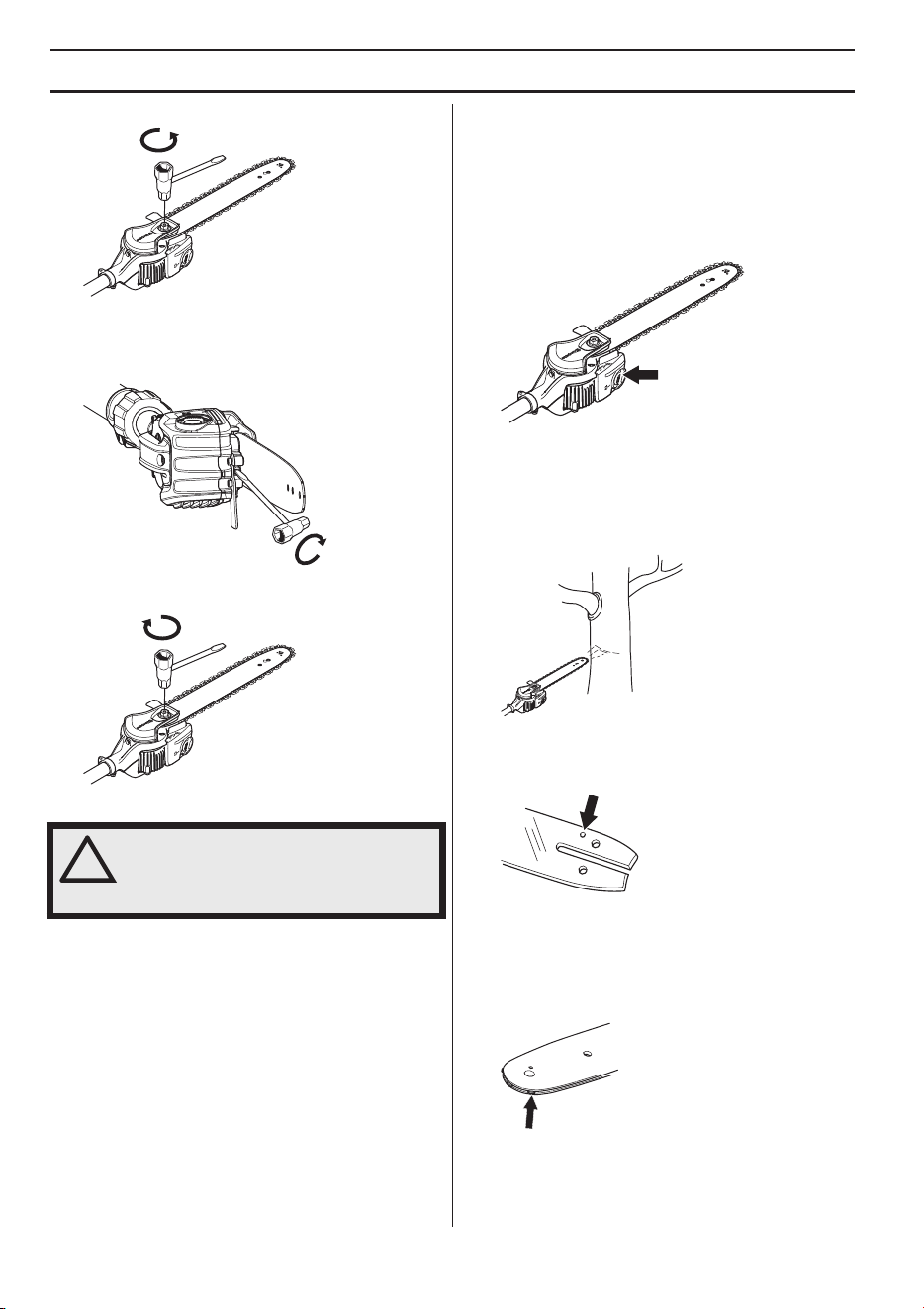
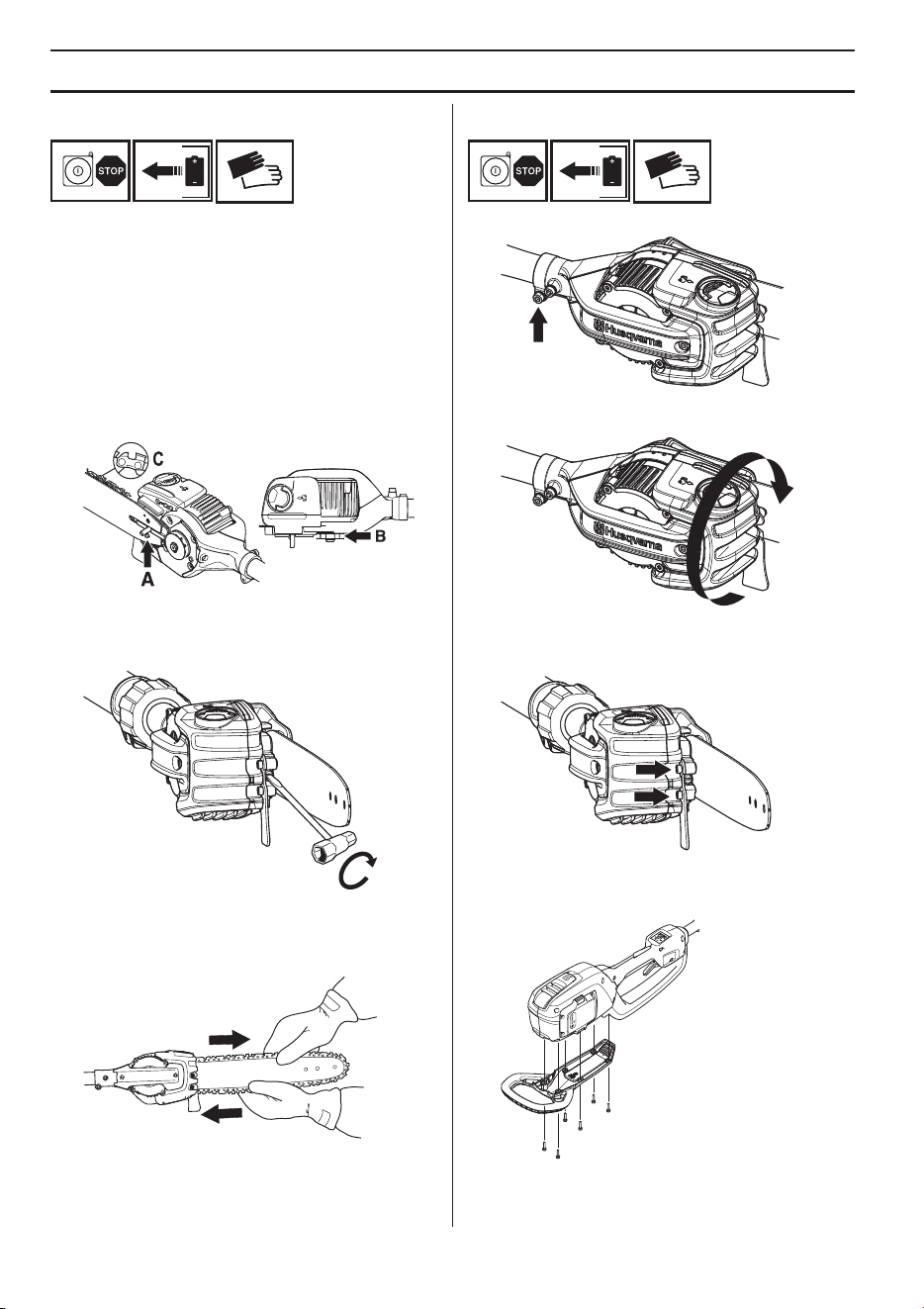
Fitting the bar and chain
• Unscrew the bar nut and remove the protective cover.
• Fit the bar over the bar bolt. Place the bar in its
rearmost position. Place the chain over the drive
sprocket and in the groove on the bar. Begin on the top
side of the bar.
• Make sure that the edges of the cutting links are facing
forward on the top edge of the bar.
• Fit the cover and locate the chain adjuster pin (A) in
the hole in the bar. Check that the drive links of the
chain fit correctly on the drive sprocket (B) and that the
chain is in the groove in the bar (C). Tighten the bar
nut finger-tight.
• Tension the chain by turning the chain tensioning
screw clockwise using the combination spanner. The
chain should be tensioned until it does not sag from
the underside of the bar.
• The chain is correctly tensioned when there is no slack
on the underside of the bar, and it can still be turned
easily by hand. Tighten the bar nut with the
combination spanner while holding up the tip of the bar.
When fitting a new chain, the chain tension has to be
checked frequently until the chain is run-in. Check the
chain tension regularly. A correctly tensioned chain
ensures good cutting performance and long life.
Rotating the saw head
• Loosen the lock screw.
• Turn the saw head 90° and secure the head with the
screw.
Assembling the branch hook
Assemble the twig guard with the two screws.
Dismantling the shock guard
• Dismantle the shock guard by unscrewing the screws.
• Assemble the shock guard using the screws.
Li-ion
Li-ion
Li-ion
Li-ion
ASSEMBLY
English – 19
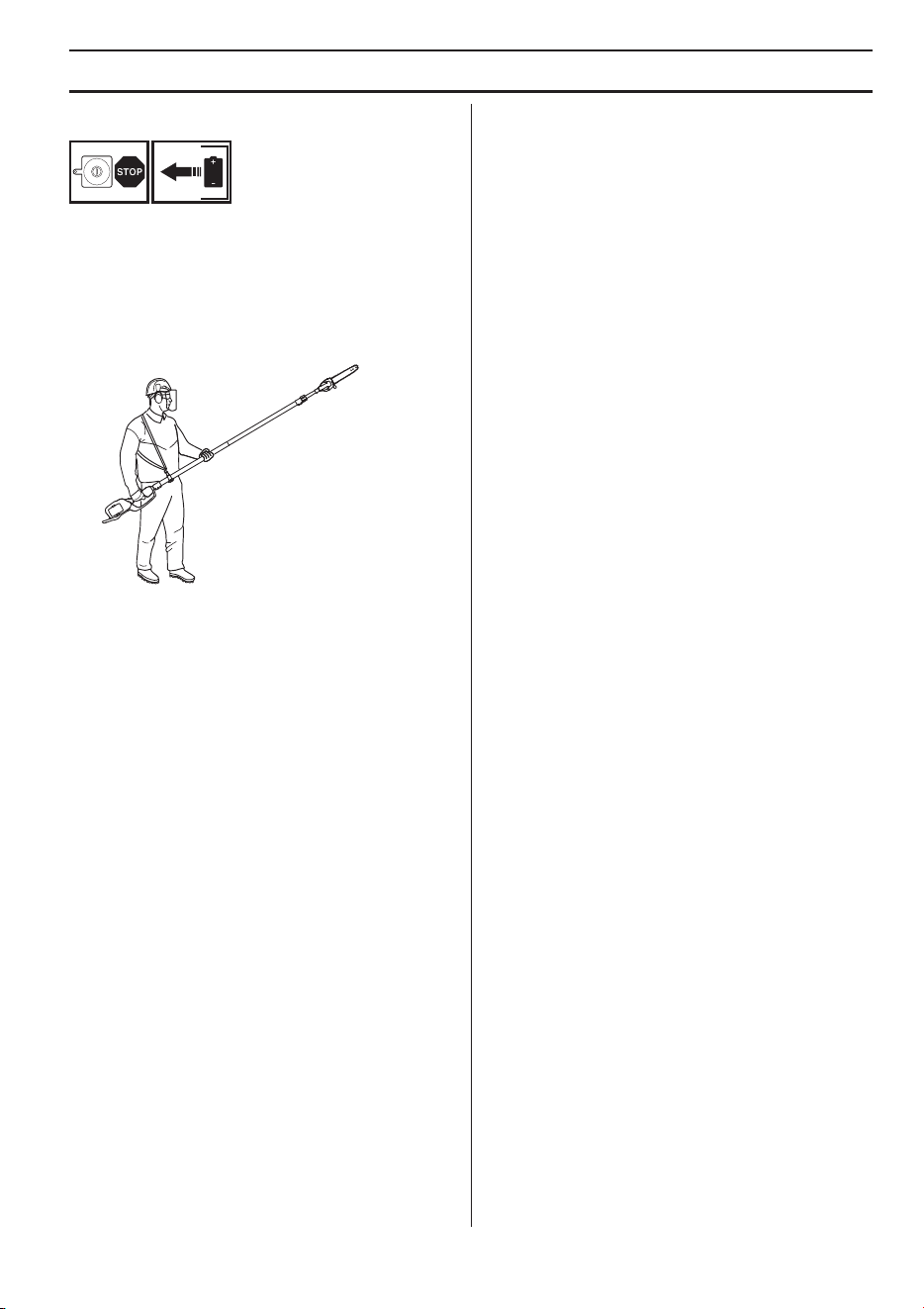
Adjusting the harness
You should always use the harness with the machine to
give maximum control over the machine and reduce the
risk of fatigue in your arms and back.
• Put on the harness.
• Hook the harness onto the suspension loop.
• Adjust the length of the harness so that the support
hook is roughly level with your right hip.
Li-ion
Li-ion
BATTERY HANDLING
20 – English
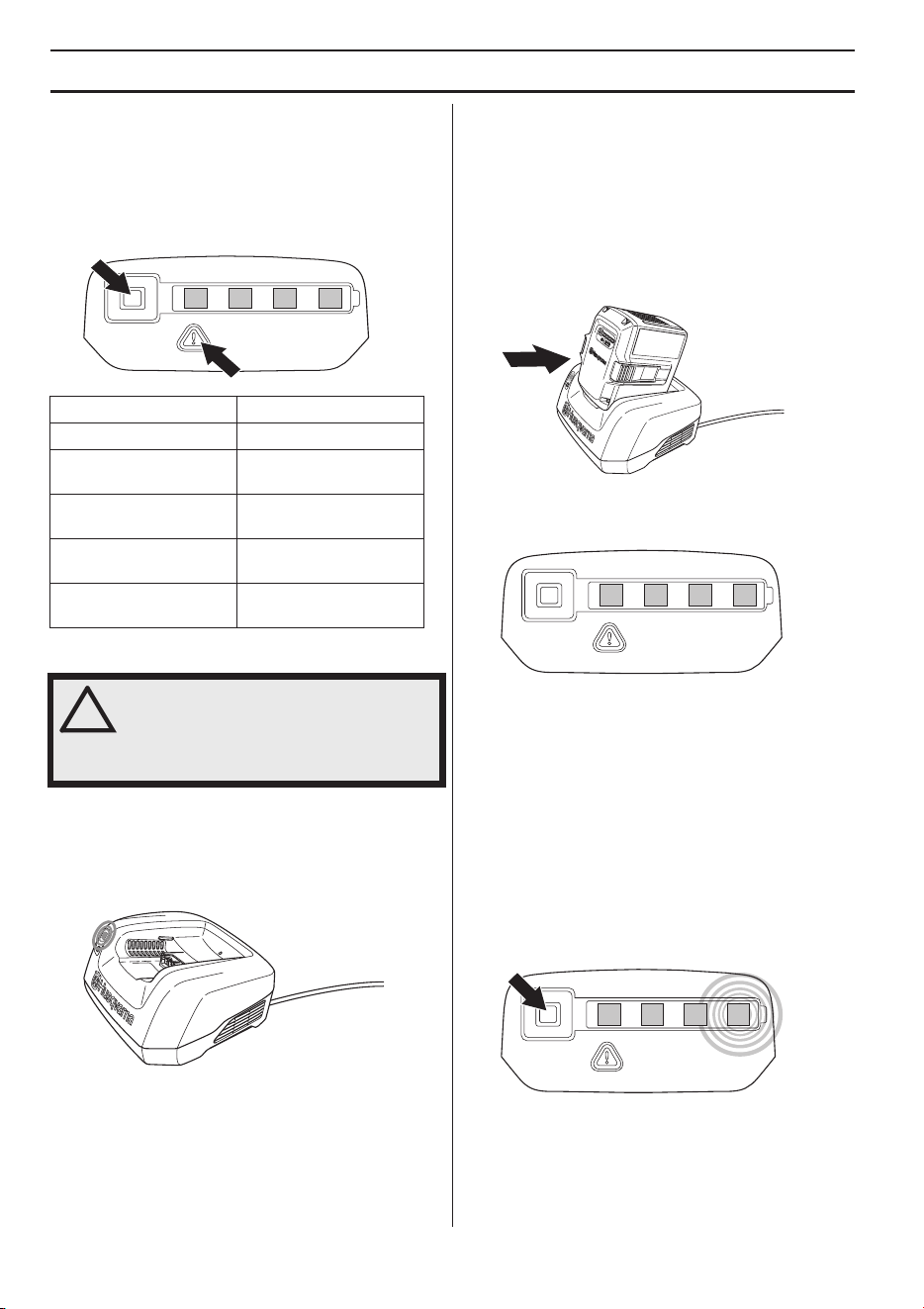
Battery
The display shows the battery capacity and if there are
any problems with the battery. The battery capacity is
displayed for 5 seconds after the machine is switched off
or the battery indicator button is pressed. The warning
symbol on the battery is lit when an error has occurred.
See fault codes.
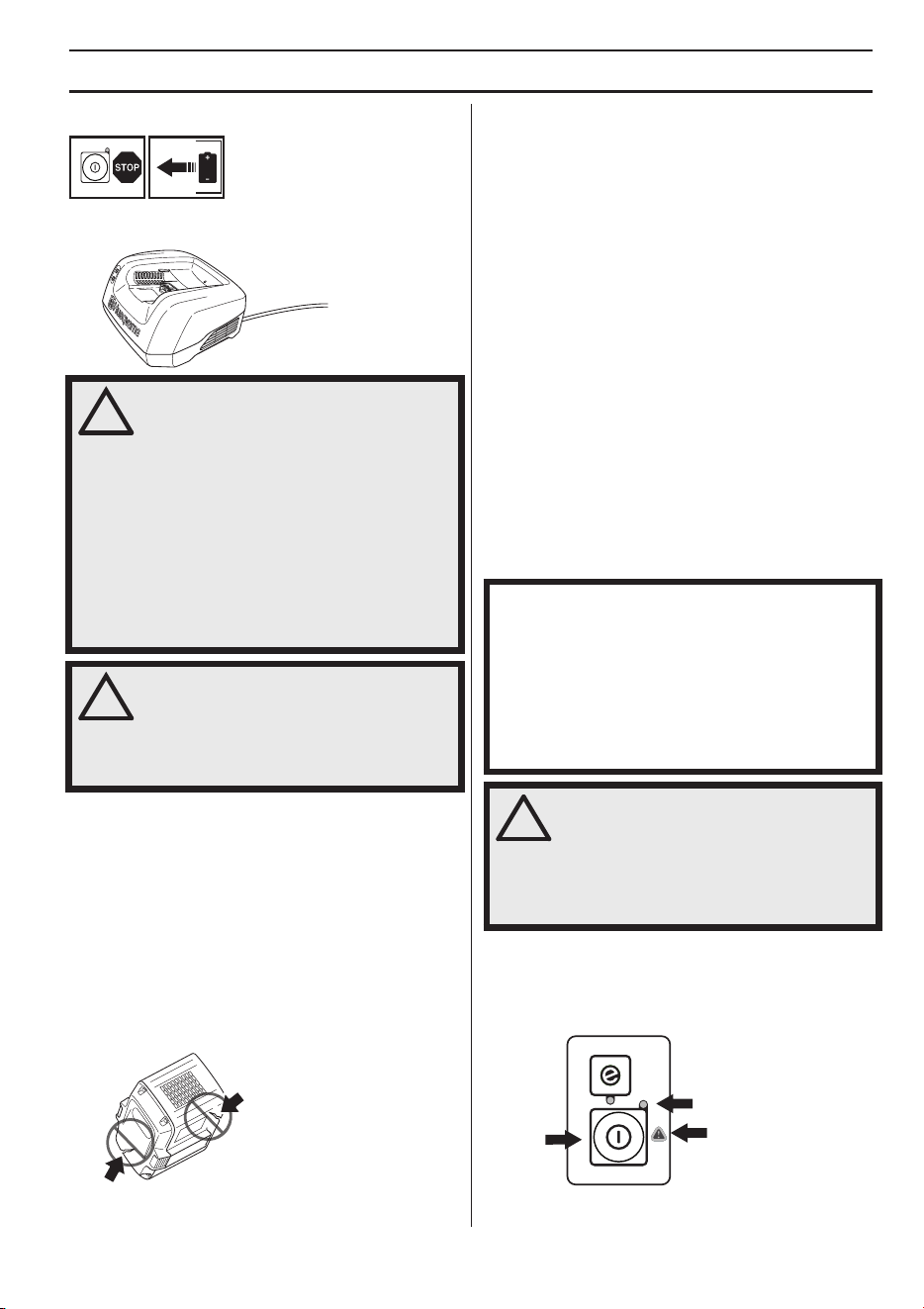
Battery charger
Connect the battery charger
• Connect the battery charger to the voltage and
frequency specified on the rating plate. Put the
electric plug in a earthed socket-outlet. The LED on
the battery charger flashes green once.
• The battery will not be charged if the battery
temperature is over 50
°C. In that case the battery
charger will actively cool down the battery.
Connect the battery to the battery
charger.
Regularly check that the battery charger and the battery
are intact. See instructions under the Maintenance
heading.
The battery must be charged before using it the first time.
The battery is only 30% charged when delivered.
• Put the battery in the battery charger. Make sure that
the battery is connected to the battery charger.
• The green charging light on the charger is lit when the
battery is connected to the battery charger.
• When all LEDs are lit the battery is fully charged.
• Pull out the plug. Never jerk the power supply cable to
disconnect it from the wall socket.
• Remove the battery from the battery charger.
See separate manual for instructions on how to charge
the backpack battery.
Charging status
Lithium-ion batteries can be charged at whatever
charging level. The charging process can be cancelled or
started whatever the battery’s charge level is. The battery
is not damaged. A fully charged battery will not lose its
charge even when the battery is left in the charger.
The battery will not be charged if the battery temperature
is over 50
°C.
LED lights Battery status
All LEDs are lit Fully charged (75-100%).
LED 1, LED 2, LED 3 are
lit.
The battery is 50%-75%
charged.
LED 1, LED 2 are lit.
The battery is 25%-50%
charged.
LED 1 is lit.
The battery is 0%-25%
charged.
LED 1 flashes.
The battery is empty.
Charge the battery.
!
WARNING! Risk of electric shock and
short circuiting. Use approved and intact
wall sockets. Make sure that the cable is
not damaged. Replace cable if it appears
to be damaged in any way.
1
2
34
1
2
3
4
1
2
3
4
BATTERY HANDLING
English – 21
Transport and storage
• The contained lithium-ion batteries are subject to the
Dangerous Goods Legislation requirements.
• For commercial transports e.g. by third parties,
forwarding agents, special requirement on packing
and labeling must be observed.
• For preparation of the item being shipped, consulting
an expert for hazardous material is required. Please
also observe possibly more detailed national
regulations.
• Tape or mask off open contacts and pack up the
batteriy in such a manner that it cannot move around
in the packing.
• Secure the machine during transport.
• Always remove the battery for storage or transport.
• Store the battery and the battery charger in a dry,
moisture-free and frost-free space.
• To prevent accidents, ensure that your battery is not
connected to the machine when stored.
• Do not store the battery in places where static
electricity can occur. Never store the battery in a metal
box.
• Store the battery where the temperature is between 5
°C and 25 °C and never in direct sunlight.
• Store the battery charger where the temperature is
between 5
°C and 45 °C and never in direct sunlight.
• Make sure the battery is charged to 30% - 50% before
storing for long periods.
• Store the battery charger only in an enclosed and dry
space.
• Be sure to store the battery separate from the battery
charger. Store the equipment in a lockable area so
that it is out of reach of children and unauthorized
persons.
• Ensure the machine is cleaned and that a complete
service is carried out before long-term storage.
• Transport guard must always be used for storage and
transport.
Disposal of the battery, battery
charger and machine
Symbols on the product or its packaging indicate that this
product cannot be handled as domestic waste. It must
instead be submitted to an appropriate recycling station
for the recovery of electrical and electronic equipment.
By ensuring that this product is taken care of correctly,
you can help to counteract the potential negative impact
on the environment and people that can otherwise result
through the incorrect waste management of this product.
For more detailed information about recycling this
product, contact your municipality, your domestic waste
service or the shop from where you purchased the
product.
LED display Charging status
LED 1 flashes.
The battery is 0%-25%
charged.
LED 1 is lit, LED 2
flashes.
The battery is 25%-50%
charged.
LED 1, LED 2 are lit, LED
3 flashes.
The battery is 50%-75%
charged.
LED 1, LED 2, LED 3 are
lit, LED 4 flashes.
Battery is 75%-100%
charged
LED 1, LED 2, LED 3,
LED 4 are lit.
When all the LEDs are lit
on the battery, it is fully
charged.
Li-ion
Li-ion
STARTING AND STOPPING
22 – English
Check before starting
• Check the motor for dirt and cracks. Clean off grass
and leaves from the engine using a brush. Gloves
should be worn when necessary.
• Check that the saw head is completely attached to the
shaft.
• Check that the machine is in perfect working order.
Check that all nuts and screws are tight.
• Ensure that saw head is undamaged and is not
cracked. Replace the saw head if it has been exposed
to impact or is cracked.
• Never use the machine without a guard nor with a
defective guard.
• All covers must be correctly fitted and undamaged
before you start the machine.
• Only use the machine for the purpose it was intended
for.
Connect battery to the machine
NOTE!
When using Husqvarna BLi batteries and depending on
the battery capacity, there may be deifferences in cutting
perfomance.
Make sure to use fully charged batteries. Use only a
Husqvarna original battery in your machine. See technical
data.
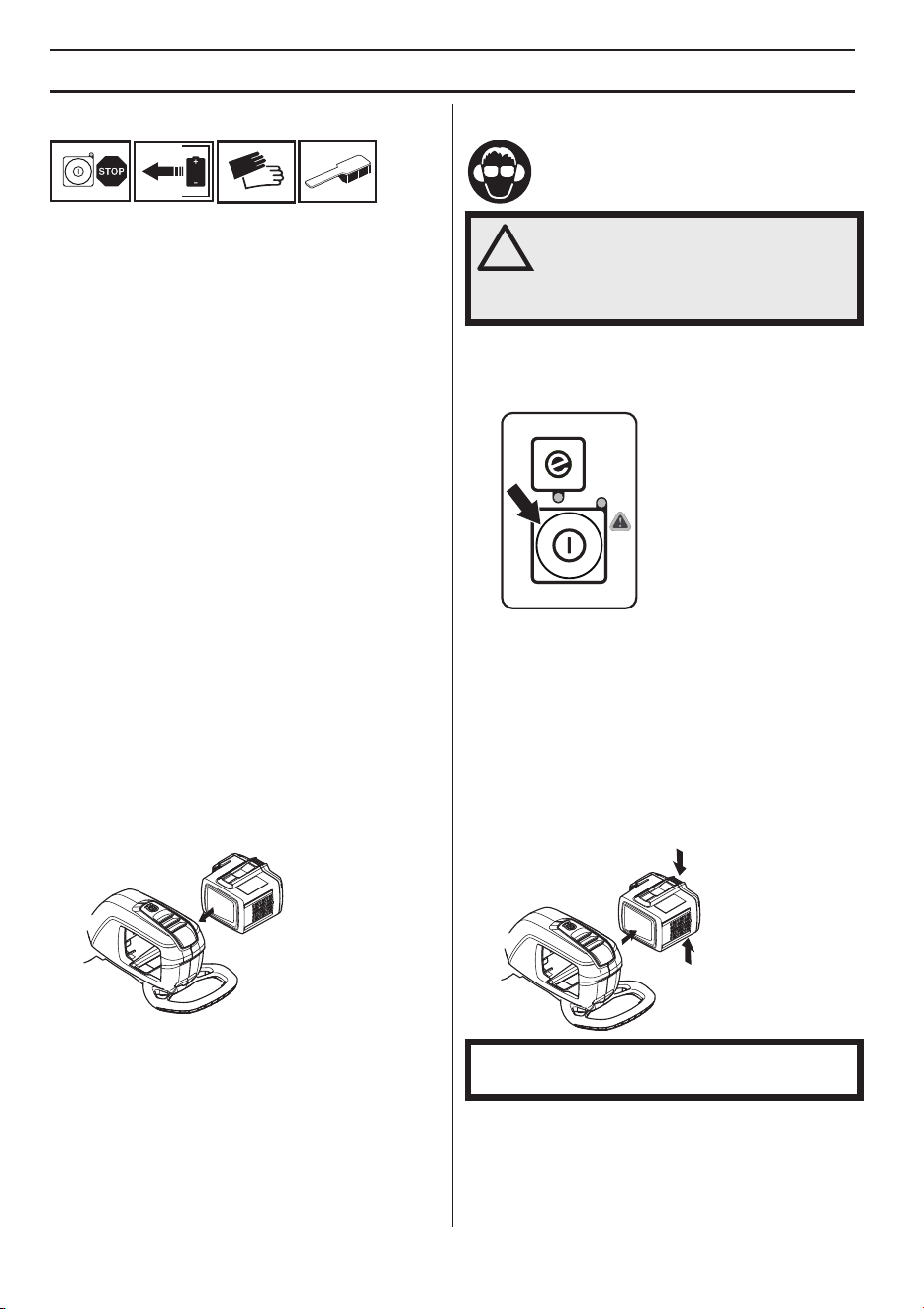
• Insert the battery in the machine. The battery should
slide easily into the battery holder on the machine. If
the battery does not slide in easily, it is not being
inserted correctly. The battery will lock itself into place
when you hear a click. Make sure the battery is fitted
correctly to the machine.
Starting and stopping
Starting
Turn on the machine. Press and hold the start button (>1
sec.) until the green LED is lit.
Use the power trigger to control the speed.
NOTE!
Start the pole saw and apply full throttle. Release the
throttle control and check that the chain stops and
remains stationary.
Stopping
Stop the machine by releasing the power trigger or the
power trigger lockout and deactivate the machine.
Remove the battery from the machine by pressing the two
release buttons and pulling out the battery.
Li-ion
Li-ion
!
WARNING! Make sure no unauthorised
persons are in the working area.
Otherwise there is a risk of serious
personal injury. The safety distance is 15
meters.
IMPORTANT! Always remove the battery to prevent the
machine being started by accident.
WORKING TECHNIQUES
English – 23
General working instructions
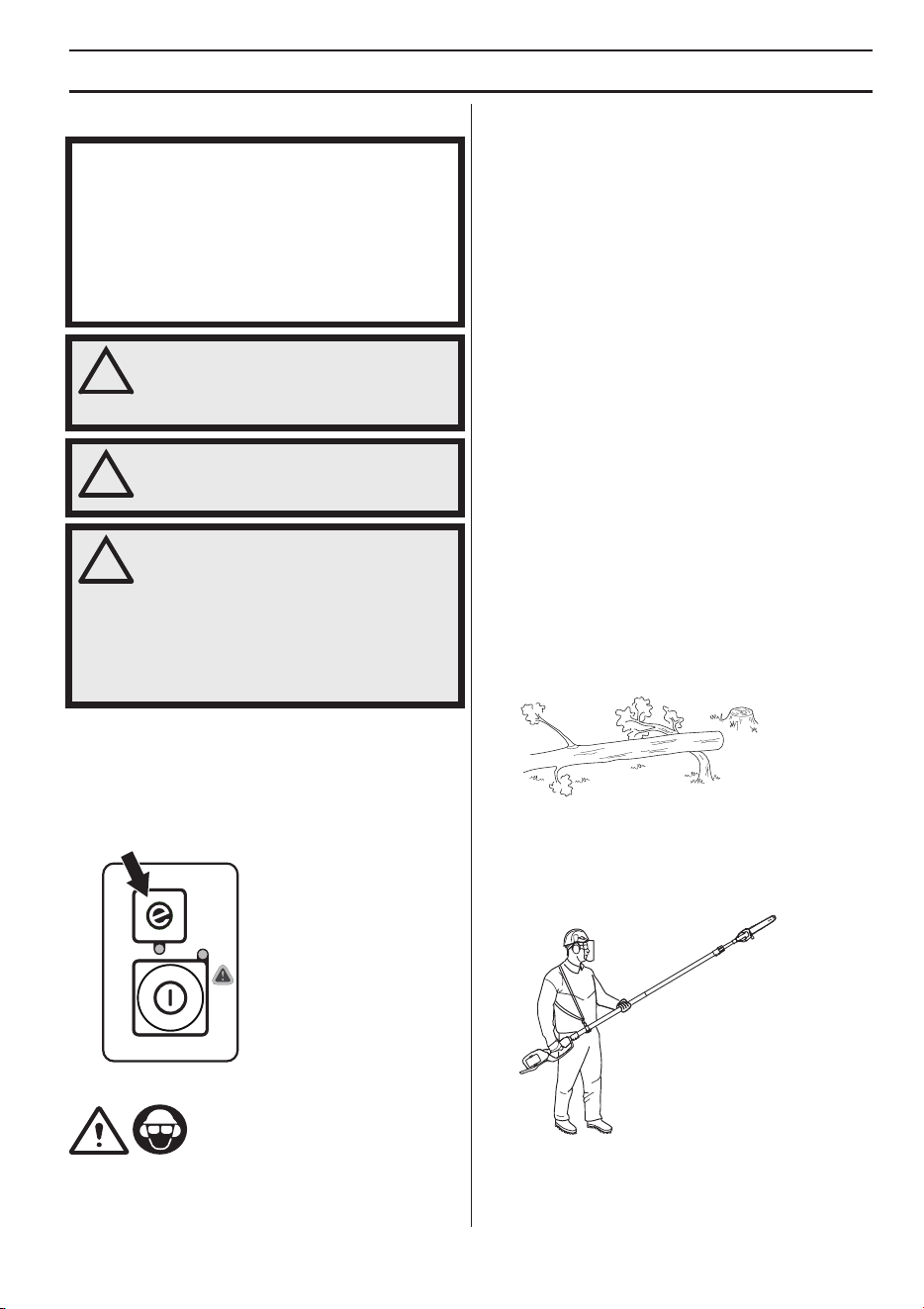
SavE mode
The machine has an energy-saving function (savE). This
function is activated by pressing the savE key on the
keypad. With the savE function activated, the machine
running time is extended as the speed of the saw chain
and the motor output is reduced.
Basic safety rules
1 Look around you:
• To ensure that people, animals or other things cannot
affect your control of the machine.
• To ensure that people, animals, etc., do not come into
contact with the cutting attachment or loose objects
that are thrown out by the cutting attachment.
• CAUTION! Do not use the machine unless you are
able to call for help in the event of an accident.
2 Do not use the machine in bad weather, such as
dense fog, heavy rain, strong wind, intense cold, etc.
Working in bad weather is tiring and often brings
added risks, such as icy ground, unpredictable felling
direction, etc.
3 Never use the machine if you are tired, if you are ill, if
you have consumed alcohol, or if you are taking other
drugs or medication that can affect your vision,
judgement or co-ordination.
4 Inspect the working area. Remove all loose objects,
such as stones, broken glass, nails, steel wire, string,
etc. that could be thrown out or become wrapped
around the cutting attachment.
5 Make sure you can move and stand safely. Check the
area around you for possible obstacles (roots, rocks,
branches, ditches, etc.) in case you have to move
suddenly. Take great care when working on sloping
ground.
6 Take great care when cutting a tree that is in tension.
A tree that is in tension may spring back to its normal
position before or after being cut. If you position
yourself incorrectly or make the cut in the wrong place
the tree may hit you or the machine and cause you to
lose control. Both situations can cause serious
personal injury.
7 Keep a good balance and a firm foothold.
8 Use the harness to support the weight of the machine
and make it easier to handle.
9 Always hold the machine with both hands. Hold the
machine on the right side of your body.
10 Switch off the engine before moving to another area.
Fit the transport guard before carrying or transporting
the equipment any distance.
11 Never put the machine down with the engine running
unless you have it in clear sight.
IMPORTANT!
This section takes up the basic safety precautions for
working with a pole saw.
If you encounter a situation where you are uncertain
how to proceed you should ask an expert. Contact your
dealer or your service workshop.
Avoid all usage which you consider to be beyond your
capability.
!
WARNING! The machine can cause
serious personal injury. Read the safety
instructions carefully. Learn how to use
the machine.
!
WARNING! Cutting tool. Do not touch the
tool without first switching off the
engine.
!
WARNING! The machines can be thrown
violently to the side when the tip of the
guide bar comes into contact with a fixed
object. This is called kickback. A
kickback can be violent enough to cause
the machine and/or operator to be
propelled in any direction, and possibly
lose control of the machine. Avoid
cutting with the guide bar tip.
WORKING TECHNIQUES
24 – English
If the machine is operated at temperatures below -10°, the
product and the battery must be stored in a heated space
for at least 24 hours before starting work.
Stem limbing
• Observe great care when working close to overhead
power lines. Falling branches can result in short-
circuiting.
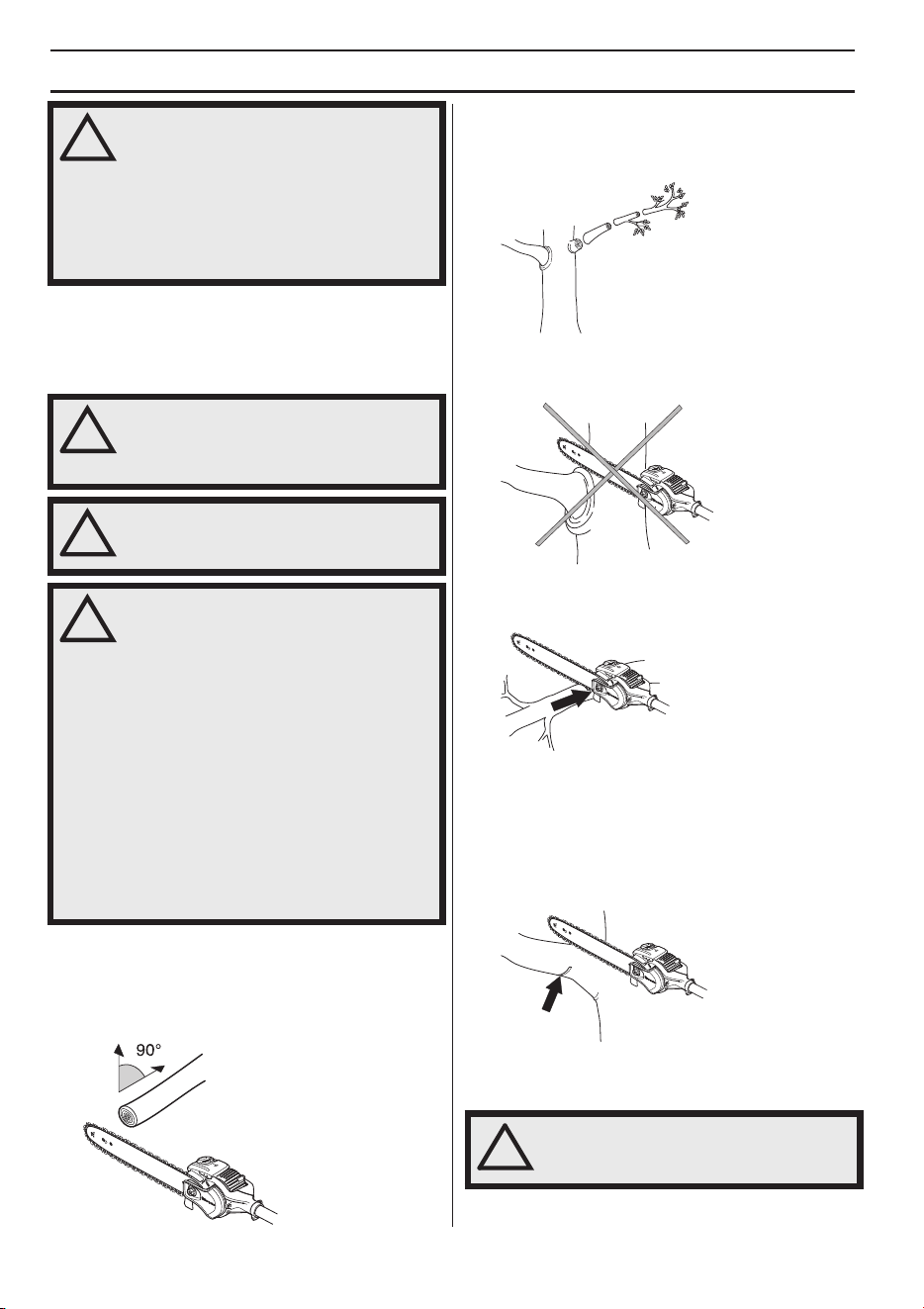
• Whenever possible position yourself so that you can
make the cut at right angles to the branch.
• Cut large branches in sections so that you have better
control over where they fall. You should also pay
attention to the fact that falling branches can bounce
in the direction of the user after hitting the ground.
• Never cut through the swelling at the root of the
branch as this will slow down healing and increase the
risk of fungal attack!
• Use the stop at the base of the cutting head to provide
support during cutting. This will help prevent the
cutting attachment from ”jumping” on the branch.
• Make an initial cut on the underside of the branch
before cutting through the branch. This will prevent
tearing of the bark, which could lead to slow healing
and cause permanent damage to the tree. The cut
should not be deeper than 1/3 of the branch thickness
to prevent jamming. Keep the chain running while you
withdraw the cutting attachment from the branch to
prevent it jamming.
• Make sure you have a firm footing and that you can
work without being hampered by branches, stones
and trees.
!
WARNING! Keep unauthorised persons
at a distance. Children, animals,
onlookers and helpers should be kept
outside the safety zone of 15 metres.
Stop the machine immediately if anyone
approaches. Never swing the machine
around without first checking behind you
to make sure no-one is within the safety
zone.
!
WARNING! Never stand directly
underneath a branch that is being cut.
This could lead to serious or even fatal
personal injury.
!
WARNING! Observe the applicable safety
regulations for work in the vicinity of
overhead power lines.
!
WARNING! This machine is not
electrically insulated. If the machine
touches or comes close to high-voltage
power lines it could lead to death or
serious bodily injury. Electricity can
jump from one point to another by
arcing. The higher the voltage, the
greater the distance electricity can jump.
Electricity can also travel through
branches and other objects, especially if
they are wet. Always keep a distance of
at least 10 m between the machine and
high-voltage power lines and/or any
objects that are touching them. If have to
work within this safe distance you
should always contact the relevant
power company to make sure the power
is switched off before you start work.
!
WARNING! Never activate the throttle
without having the cutting attachment in
full view.
MAINTENANCE
English – 25
Inspection and maintenance
All servicing and repair work on the machine requires
special training. This is especially true of the machine
′s
safety equipment. If your machine fails any of the checks
described below you must contact your service agent.
When you buy any of our products we guarantee the
availability of professional repairs and service. If the
retailer who sells your machine is not a servicing dealer,
ask him for the address of your nearest service agent.
Only use original spare parts.
Regularly check that the battery charger and the battery
are intact.
Changing chain drive gear
If you are the least unsure of how to change the drive
gear, you must first contact your retailer for help.
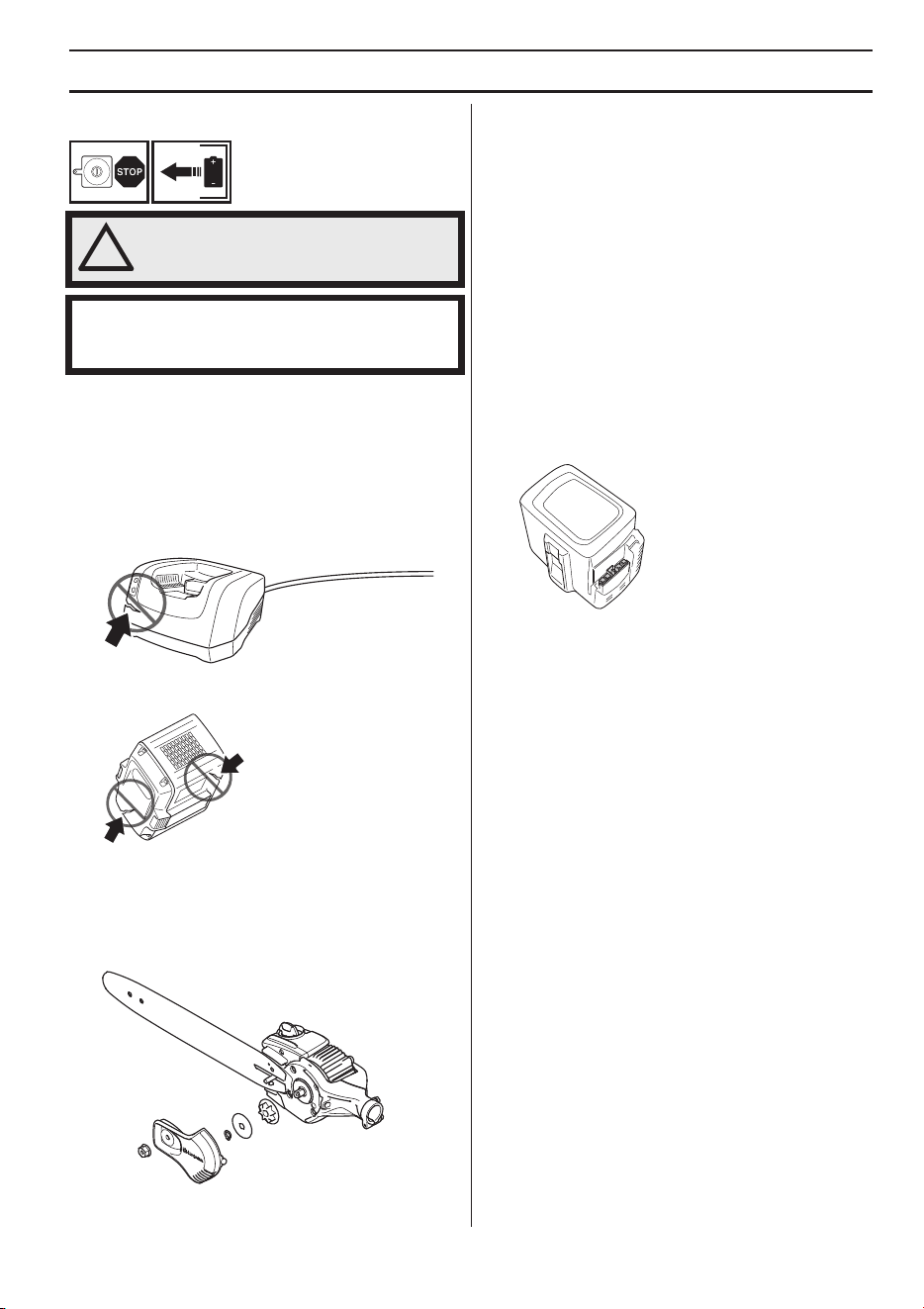
• Dismantle the nut for the chip guard and remove the
guard.
• Dismantle the clip holding the washer and the chain
drive gear.
• Remove the washer.
• Remove the chain drive gear and replace it with a new
one.
Cleaning
• Clean the machine after use.
• Clean the oil tank vent with a brush.
• Clean under the chip guard with a brush.
• If the battery connector on the machine is dirty, clean
it by blowing them with compressed air or use a soft
brush.
• Make sure the battery and battery charger are clean
and that the terminals on the battery and the battery
charger are always clean and dry before the battery is
placed in the battery charger.
• Keep the battery guide tracks clean.
• Clean plastic parts with a clean and dry cloth.
!
WARNING! Always remove the battery
before any maintenance on the machine.
IMPORTANT! Never clean the battery or the battery
charger with water. Strong cleaning agents can damage
the plastic.
Li-ion
Li-ion
26 – English
MAINTENANCE
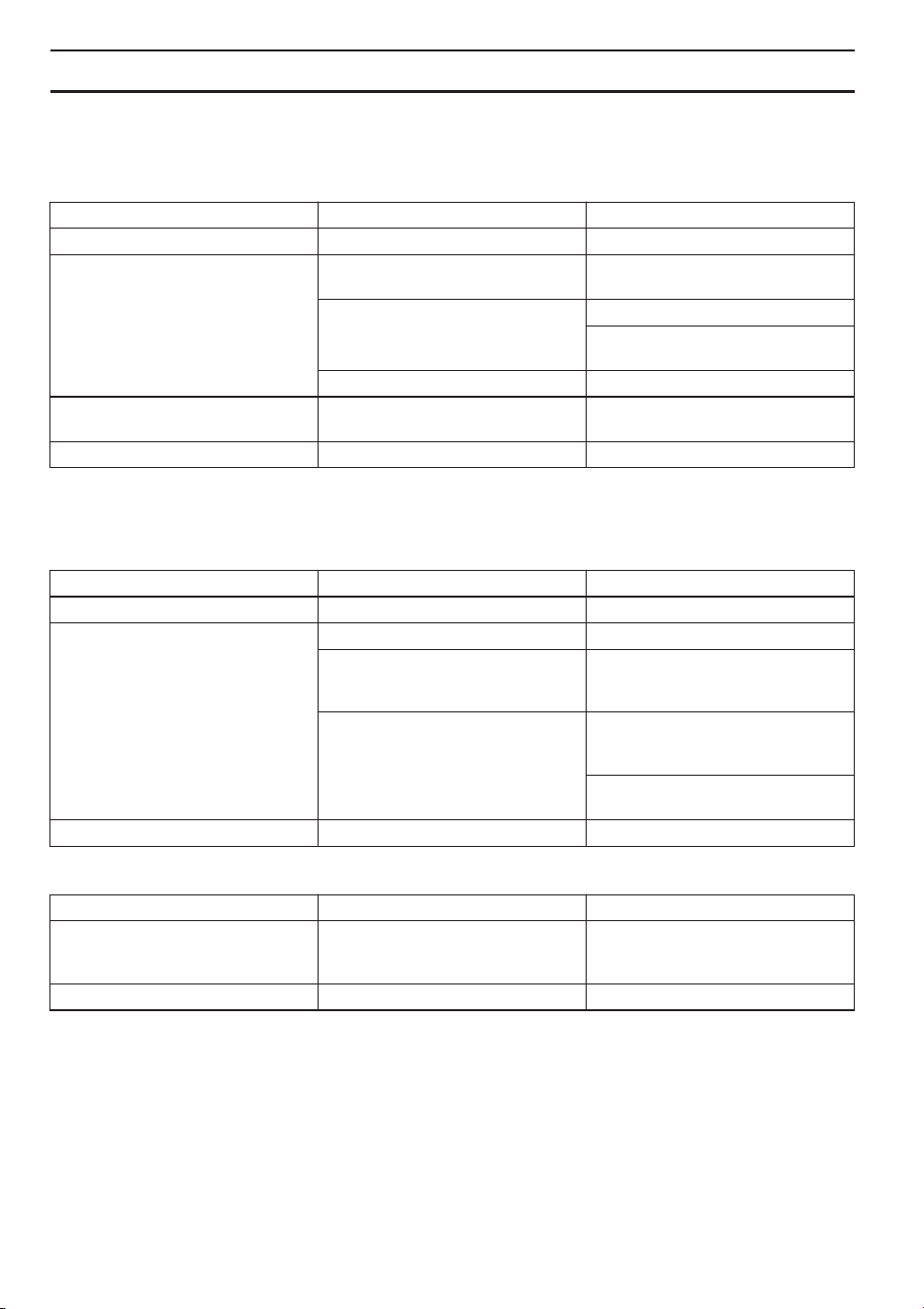
Troubleshooting schedule
Keypad
Troubleshooting takes place from the keypad.
Troubleshooting the battery and/or the battery charger during charging.
Battery
Battery charger
Control panel Possible faults Possible action
Green activate LED flashing. Low battery voltage. Charging the battery
Error LED flashes.
The power trigger and the activate
button are pressed at the same time.
Release the power trigger and the
machine is active.
Overload.
Chain jammed.
Remove the battery from the
machine. Release the chain.
Temperature deviation. Allow the machine to cool down.
The machine does not start Dirt in battery connectors.
Clean with compressed air or a soft
brush.
Error LED is lit with red light. Service Contact your service agent.
LED display Possible faults Possible action
Green activate LED flashing. Low battery voltage. Charge the battery.
Error LED flashing
The battery is discharged. Charge the battery.
Temperature deviation.
Use the battery in surroundings
where temperatures are between -10
°C and 40 °C.
Over voltage.
Check that the mains voltage
corresponds with that stated on the
rating plate on the machine.
Remove the battery from the battery
charger.
Error LED is lit Cell difference too much (1V). Contact your service agent.
LED display Possible faults Possible action
Error LED flashing Temperature deviation.
Use the battery charger only when the
surrounding temperature is between 5
°C and 40 °C.
Error LED is lit Contact your service agent.
English – 27
MAINTENANCE
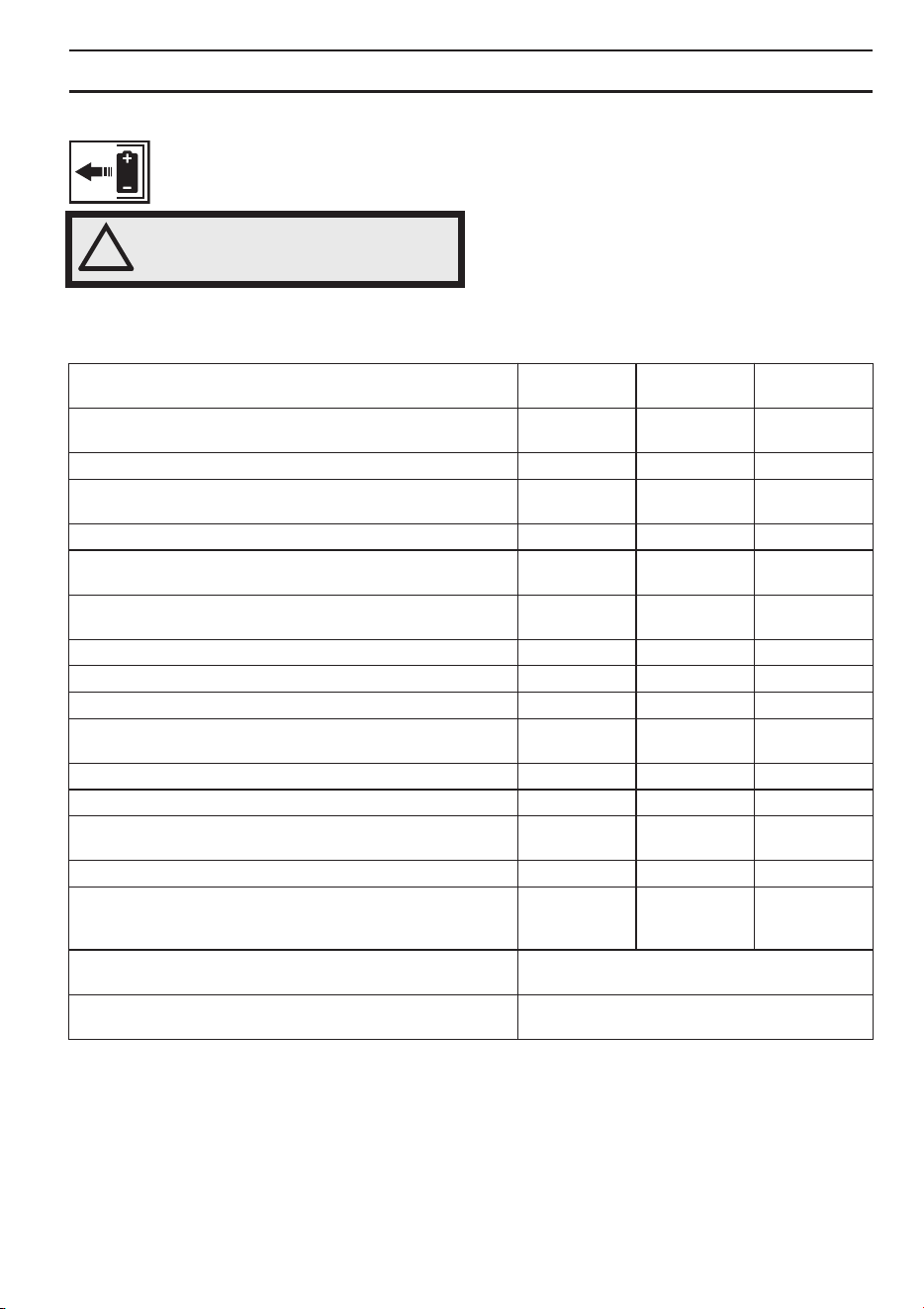
Maintenance schedule
The following is a list of the maintenance steps that must be performed on the machine. Most of the items are described
in the Maintenance section. The user must only carry out the maintenance and service work described in this Operator's
Manual. More extensive work must be carried out by an authorized service workshop.
!
WARNING! Always remove the battery
before any maintenance on the machine.
Maintenance
Daily
maintenance
Weekly
maintenance
Monthly
maintenance
Clean the outside of the machine with a clean and dry cloth.
Never use water.
X
Keep handles dry, clean and free from oil and grease. X
Make sure that the activate and deactivate button works correctly
and is not damaged.
X
Check that all controls are undamaged and in working order. X
Make sure that the power trigger lock and the power trigger
function works correctly from a safety point of view.
X
Ensure that the chip guard is undamaged and is not cracked.
Replace the guard if it has been exposed to impact or is cracked.
X
Check that nuts and screws are tight. X
Check that the battery is intact. X
Check the battery's charge. X
Check that the release buttons on the battery works and locks the
battery into the machine.
X
Check that the battery charger is intact and functional. X
Clean the oil tank vent X
Check that all couplings, connections and cables are intact and
free from dirt.
X
Clean the chip guard X
Check the connections between the battery and the machine and
also check the connection between battery and the battery
charger.
X
Check that the saw head is not damaged. Replace the saw head
if it is damaged.
All service on the saw head must be carried out by
an authorized Husqvarna dealer.
Check condition of Drive Sprocket.
Replace the chain drive gear after approx.: 100
hours use or if there is significant play on the shaft.
Li-ion
Li-ion
28 – English
TECHNICAL DATA
Technical data
Driving time and temperature are measured without load according to the operating cycle of 3 seconds
operating and 15 seconds of idling.
Use only a Husqvarna original BLi battery in your machine.
Note 1 Reported data for equivalent sound pressure level for the machine has a typical statistical dispersion (standard
deviation) of 1 dB (A).
Note 2: Reported data for equivalent vibration level has a typical statistical dispersion (standard deviation) of 2 m/s
2
.
536LiP4 536LiPT5
Motor
Motor type BLDC (brushless) 36V BLDC (brushless) 36V
Chain speed, m/sec
1/4 18 18
Oil tank capacity, litre/cm
3
0,15 0,15
Weight
Weight without battery, kg 3,4 5
Weight with battery, kg 4,6 6,2
BLi150
Battery runtime
Battery time, min., (up to) with SavE function activated. 60 60
BLi150
Battery time, min., (up to) with SavE function activated. approx. 6 hours
BLi940x
Noise levels
(see note 1)
Equivalent sound pressure level at the operator’s ear, measured
according to EN ISO 22868, dB(A), min./max.:
88 83
Vibration levels
(see note 2)
Equivalent vibration levels (a
hv,eq
) at handles, measured according to EN
ISO 22867, m/s
2
Extended shaft, front/rear handles 1,0/0,9 1,0/1,2
Short shaft front/rear handle - 1,4/1,2
Approved chargers for the specified batteries, BLi.
Battery charger QC330 QC80 QC80F
Mains Voltage, V 100-240 100-240 10-15
Frequency, Hz 50-60 50-60 50-60
Power,W 330 100 95
English – 29
TECHNICAL DATA
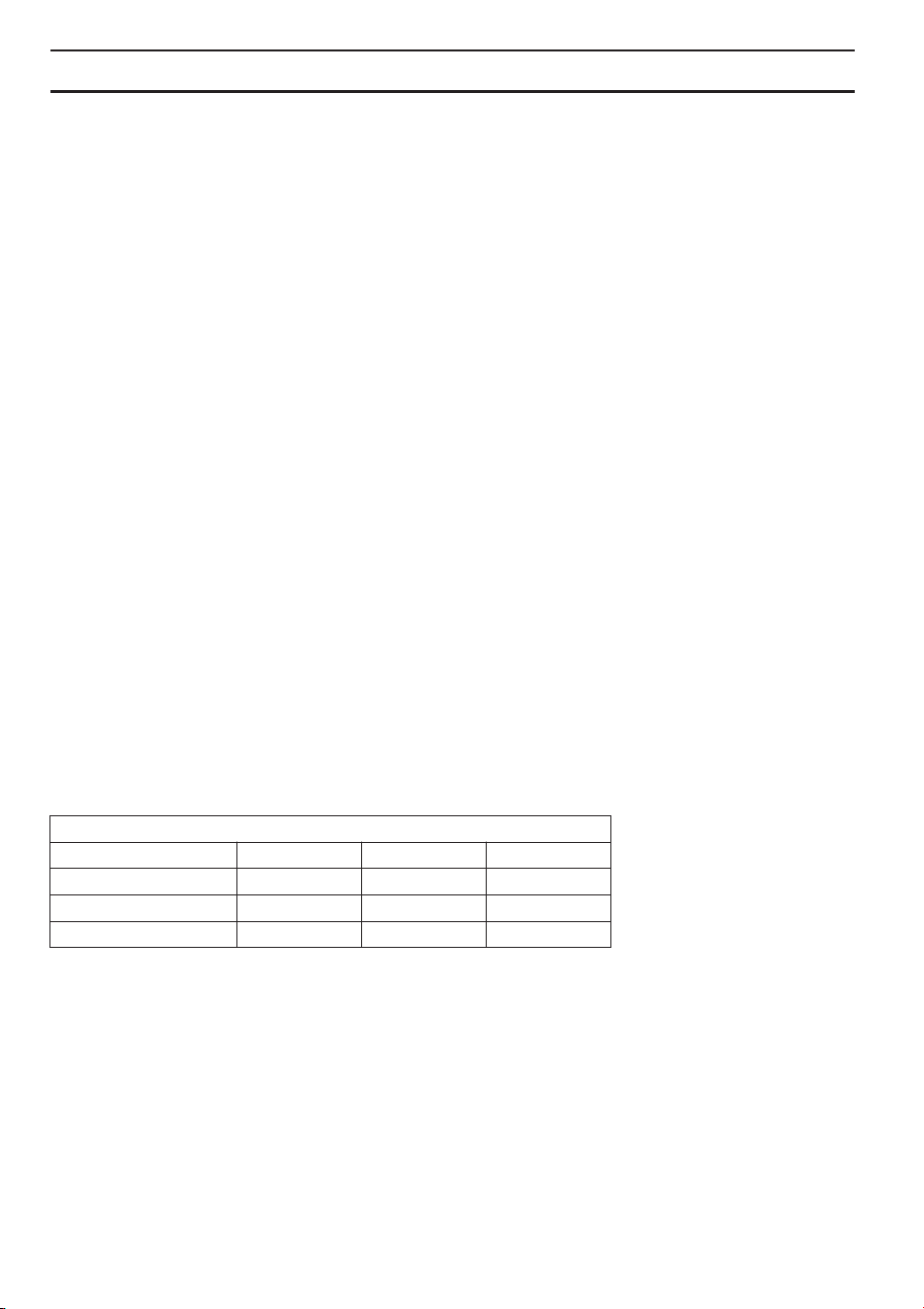
Guide bar and saw chain combinations
The following cutting attachments are approved for the models Husqvarna 536LiP4 and 536LiPT5. The A318 bar is used
on the 536LiP4 and 536LiPT5 only.
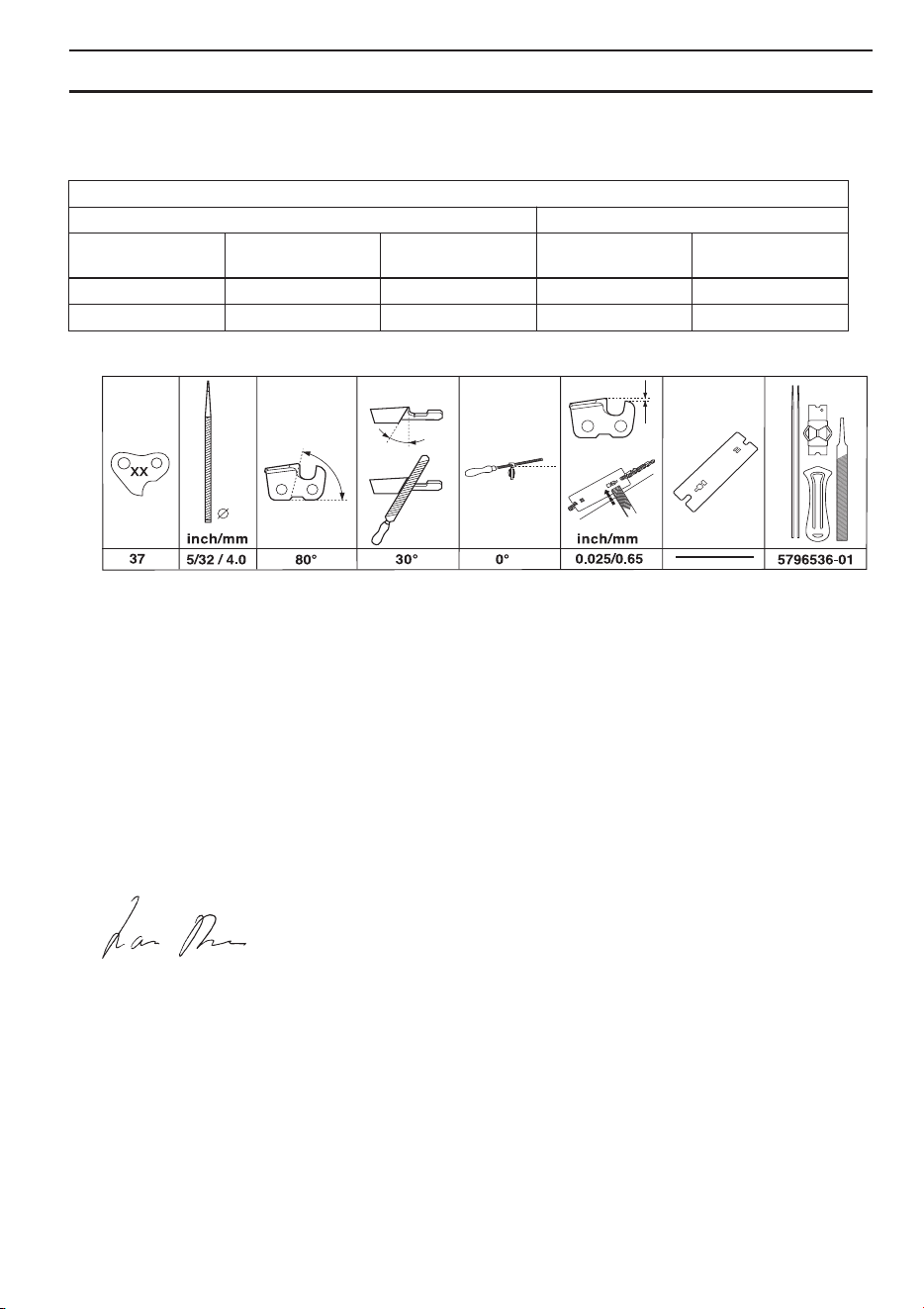
Saw chain filing and file gauges
EC Declaration of Conformity (Applies to Europe only)
Husqvarna AB, SE-561 82 Huskvarna, Sweden, tel +46-36-146500 declares that the battery-operated chain clearing
saw
Husqvarna 536LiP4 and 536LiPT5 with serial numbers dating 2016 and onwards (the year is clearly stated on the
rating plate, followed by the serial number) comply with the requirements of the COUNCIL’S DIRECTIVE:
- of May 17, 2006 ”relating to machinery” 2006/42/EC.
- of February 26, 2014 ”relating to electromagnetic compatibility” 2014/30/EU.
- of June 8, 2011 on the ”restriction of use of certain hazardous substances” 2011/65/EU.
The following standards have been applied:
EN 60745-1, EN 60335-1, EN ISO 11680-1:2011, EN 60335-2-29, EN 62133:2011
SMP Svensk Maskinprovning AB, Box 7035, SE-750 07 Uppsala, Sweden, has carried out EC type examination in
accordance with the machinery directive’s (2006/42/EC) article 12, point 3b.
Intertek Semko AB, Box 1103, SE-164 22 Kista, Sweden has issued a voluntary type approval for Husqvarna AB.
Huskvarna January 10, 2017
Lars Roos, Development manager (Authorized representative for Husqvarna AB and responsible for technical
documentation.)
The following combinations are CE approved.
Guide bar Saw chain
Length, inch Pitch, inch Gauge, mm Type
Length, drive links
(no.)
10 1/4 1,3 Husqvarna H00 58
12 1/4 1,3 Husqvarna H00 64

1140199-26
´®z+H3|¶6K¨
´®z+H3|¶6K¨
2017-01-04