8659405
enUS
12/22/25
Do not discard. This owner’s guide contains important product dangers, warnings, and cautions. For assembly
instructions, referto the assembly guide. Do not use the grill indoors!
Visit weber.com, select your country of origin, and register your grill today.
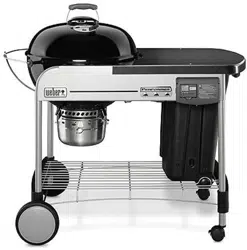
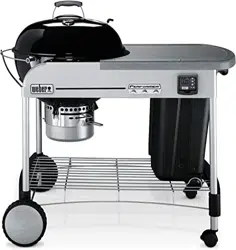
Performer Smart / Performer Premium Smart 22in/57cm
Failure to follow the DANGERS, WARNINGS, and CAUTIONS
contained in this Owner’s Guide may result in serious bodily
injury or death, or may result in a fire or an explosion causing
damage to property. Please read all safety information contained
in this Owner’s Guide before operating this barbecue.
DANGERS
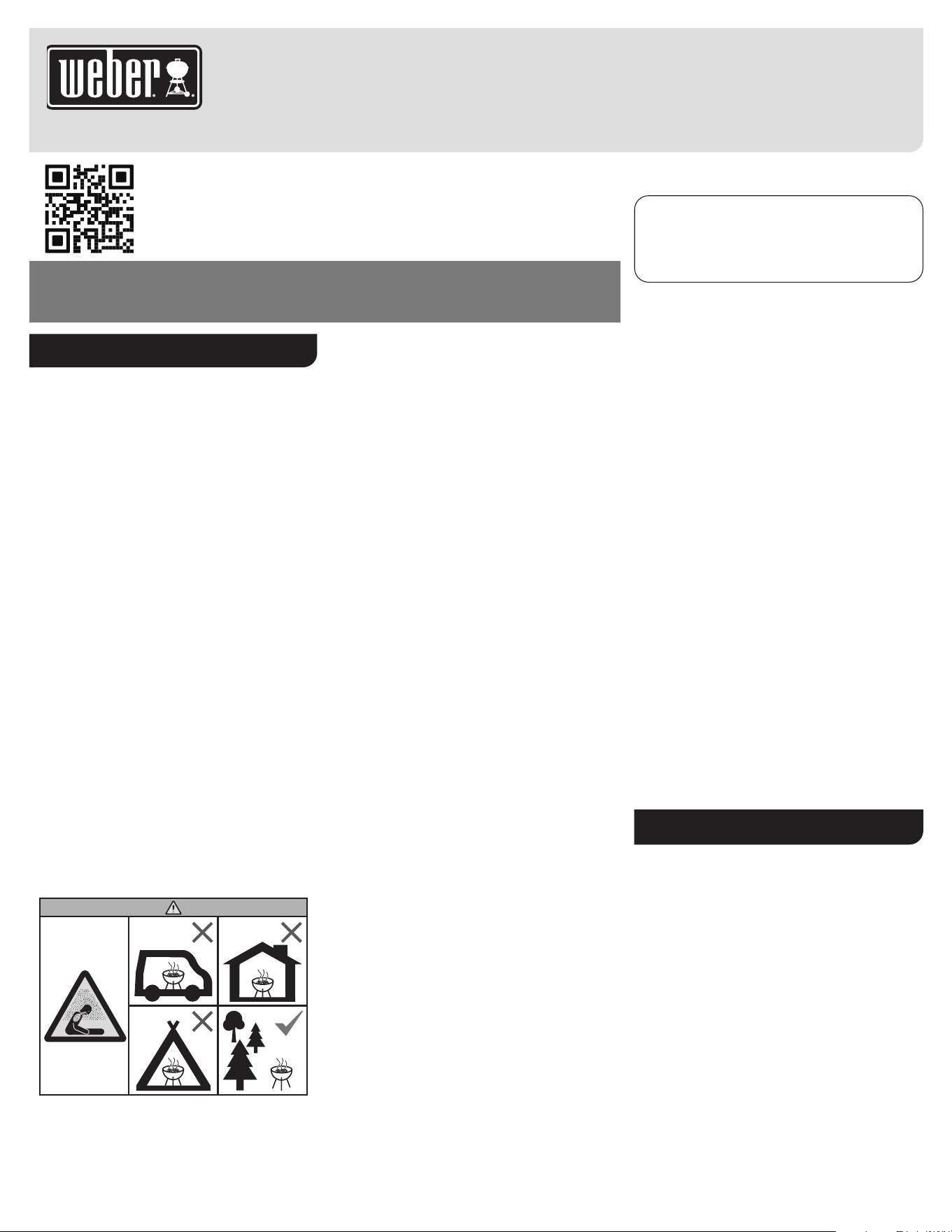
Do not use indoors! This grill is designed for outdoor use in a
well-ventilated area and is not intended for and should never be
used as a heater. If used indoors, toxic fumes will accumulate and
cause serious bodily injury or death.
Do not use in a garage, building, breezeway, or any other enclosed
area.
Do not use gasoline, alcohol, or other highly volatile fluids to
ignite charcoal. If using charcoal starter fluid (not recommended),
remove any fluid that may have drained through the bowl vents
before lighting thecharcoal.
Do not add charcoal starter fluid or charcoal impregnated with
charcoal lighter fluid to hot or warm charcoal. Cap starter fluid
after use, and place a safe distance away from the grill.
Keep the cooking area clear of flammable vapor and liquids, such
as gasoline, alcohol, etc., and combustible material.
WARNINGS
Do not use this grill unless all parts are in place. This grill must
be properly assembled according to the assembly instructions.
Improper assembly may be dangerous.
Never use grill without the ash catcher installed.
Do not use this grill under any overhead combustible
construction.
The use of alcohol, prescription, or non-prescription drugs may
impair the consumer’s ability to properly assemble or safely
operate thegrill.
Exercise caution when operating your grill. It will be hot during
cooking or cleaning, and should never be left unattended.
This grill will become very hot, do not move it during operation.
Keep children and pets away.
This WEBER grill is not intended to be installed in or on
recreational vehicles and/or boats.
Do not use this grill within two feet (60cm) of any combustible
material. Combustible materials include, but are not limited to,
wood or treated wood decks, patios, and porches.
Keep the grill on a secure, level surface at all times, clear of
combustible material.
SAFETY
ADDITIONAL WARNINGS
Do not use the TUCK-AWAY lid holder as a handle to lift or move the
grill.
Charcoal Grill Owners Guide
Serial Number
Write your barbecue's serial number in the box above for future reference.
The serial number is on the barbecue's data label.
Do not place grill on glass or a combustible surface.
Do not use grill in high winds.
Do not wear clothing with loose flowing sleeves while lighting or
using the grill.
Never touch the cooking or charcoal grate, ashes, charcoal, or the
grill to see if they arehot.
Extinguish charcoal when finished cooking. To extinguish, close
bowl vent and lid damper and place lid on bowl.
Use heat-resistant barbecue mitts or gloves while cooking,
adjusting air vents (dampers), adding charcoal, and handling
thermometer orlid.
Use proper tools, with long, heat-resistant handles.
Always put charcoal on top of the charcoal (lower) grate. Do not
put charcoal directly in the bottom of the bowl.
Do not lean on or overload the end of the table.
Do not use the TUCK-AWAY lid holder as a handle to lift or move
the grill.
Do not hang the lid on the bowlhandle.
Never dump hot charcoal where it might be stepped on or be a
fire hazard. Never dump ashes or charcoal before they are fully
extinguished.
Do not store grill until ashes and charcoal are fully extinguished.
Do not remove ashes until all charcoal is completely burned out
and fully extinguished and grill is cool.
Keep electrical wires and cords away from the hot surfaces of the
grill and away from high traffic areas.
Do not hang the lid on the bowlhandle.
Do not use the TUCK-AWAY lid holder as a handle to lift or move
the grill.
WARNING! Do not use the grill in a confined and/or habitable
space e.g. houses, tents, caravans, motor homes, boats. Danger of
carbon monoxide poisoning fatality.
This appliance is not intended for use by persons (including
children) with reduced physical, sensory or mental capabilities, or
lack of experience and knowledge, unless they have been given
supervision or instruction concerning use of the appliance by a
person responsible for their safety.
Keep electrical wires and cords away from the hot surfaces of the
grill and away from high trac areas so as not to cause a tripping
hazard.
Use this grill only as described in this manual. Misuse may cause
fire, electric shock or injury.
This appliance should only be connected to a grounded outlet.
Do not use plug adapters. If an extension cord is needed, only
use a 14-gauge cable with a grounded plug, suitable for use with
outdoor appliances. The maximum length for the extension cord is
4 meters (13 feet). Keep the extension cord as short as possible.
Examine the extension cord before use and replace if damaged. To
minimize the risk of property damage and/or personal injury, do
not use an extension power-supply cable unless it conforms to the
specifications listed in this manual.
Inspect the power cord and plug regularly for any signs of damage.
Do not operate appliance with damaged cord or plug.
Do not operate the unit if the electrical outlet is damaged.
Always unplug the grill by pulling from the plug. Do not pull from
the cord.
The food temperature probes are very sharp and can become hot
when in use. Use care when handling the probes to avoid the risk
of injury.
Keep this Owner’s Manual for future reference, thoroughly read through it, and if you have any questions please contact us today.
REGISTER TODAY
Register your grill and receive special content to make you the
ultimate backyard hero.
Scan the QR Code or register online at weber.com
If using the WEBER CONNECT app to monitor the operation of the
barbecue, make sure that all safety precautions otherwise applicable
to the operation of the grill have been observed prior to using the
grill. Someone familiar with the operation of the grill must be in
close proximity of the grill in order to address any emergencies that
could arise. Do not leave the grill unattended.
Make sure all electrical connections are kept dry and o of the
ground.
When connecting this appliance to a power supply, ensure that the
supply voltage corresponds with the voltage rating marked on the
appliance label.
Always unplug the grill from the outlet when not in use and before
cleaning. Allow the grill to cool before performing maintenance.
CAUTIONS
Do not use water to control flare-ups or to extinguish charcoal.
Lining the bowl with aluminum foil will obstruct the air flow.
Instead, use a drip pan to catch drippings from meat when cooking
using the indirect method.
Grill brushes should be checked for loose bristles and excessive
wear on a regular basis. Replace brush if any loose bristles are
found on cooking grate or brush. WEBER recommends purchasing
a new stainless steel bristle grill brush at the beginning of every
spring.
CALIFORNIA PROPOSITION 65
WARNING: Combustion byproducts produced when using this
product contain chemicals known to the state of California to cause
cancer, birth defects, or other reproductive harm.
WARNING: This product can expose you to chemicals including
nickel, which is known to the state of California to cause cancer.
For more information go to www.P65Warnings.ca.gov.
WARRANTY
Limited Warranty
Thank you for purchasing a WEBER product. Weber-Stephen Products
LLC, 1415 S. Roselle Road, Palatine, Illinois 60067 (“WEBER”) prides
itself on delivering a safe, durable, and reliableproduct.
This is WEBER’s Limited Warranty (“Warranty”) provided to you at no
extra charge. It contains the information you will need to have your
WEBER product repaired in the unlikely event of a failure or defect.
Pursuant to applicable laws, the customer has several rights in
case the product is defective. Those rights include supplementary
performance or replacement, abatement of the purchasing price,
and compensation. These and other statutory rights remain
unaected by this warranty provision. In fact, this warranty grants
additional rights to the Owner that are independent from statutory
warranty provisions.
2
COOKING SYSTEM
BA
Your WEBER charcoal grill is designed with a smart fan/temperature control
feature for the cooking system. This grill can be used with or without this feature
depending on your preference. Both cooking methods produce excellent results
and give you a choice of how you want to grill.
A
Fan control
Using the WEBER LCD Wi-Fi® Enabled Controller and fan adds an additional level of
controlled cooking. By closing the bowl vents and setting a target temperature you can
control and monitor the internal temperature of your grill.
Extensive thought was put into how your WEBER charcoal grill was designed. We
design our grills to perform so that you never have to worry about flare-ups, hot
and cold spots, or burnt food. Expect excellent performance, control, and results
every time.
B
Dampers and Vents
A big factor in charcoal grilling is air. The more air that you allow into the grill, the hotter
the internal temperature will be until the fuel has been maximized. During cooking, you
can control the internal grill temperature by easily adjusting the lid damper and bowl
vents. To ensure a high internal grill temperature for direct method cooking, be sure
that the bowl and lid vents are fully open. If your intention is to cook indirectly at lower
temperatures, you can close the lid and bowl dampers as much as halfway. Closing the
dampers completely will cut off oxygen flow and will eventually extinguish the coals.
C
ONE-TOUCH Cleaning System
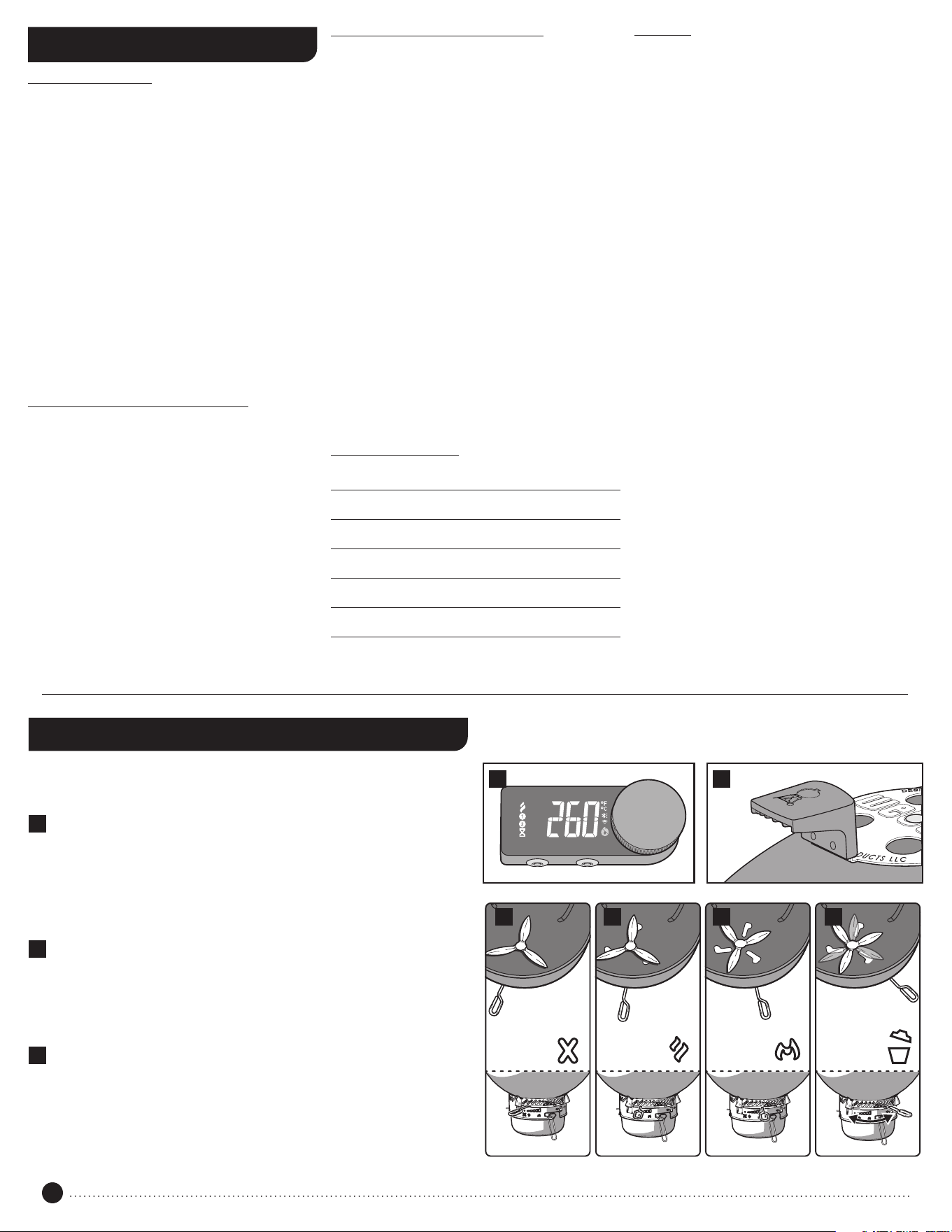
The ONE-TOUCH cleaning system makes cleanup hassle free. As you move the handle
back and forth, the three blades in the bowl move ash from the bottom of the grill into the
ash catcher. These same vents help bring oxygen up to the fire or to allow you to easily
extinguish the fire.
WARRANTY
WEBER’S LIMITED WARRANTY
WEBER warrants, to the purchaser of the WEBER product (or in the case
of a gift or promotional situation, the person for whom it was purchased
as a gift or promotional item) (“Owner”), that the WEBER product is free
from defects in material and workmanship for the period(s) of time
specified below when assembled and operated in accordance with the
accompanying Owner’s Manual, normal wear and tear excluded . (Note:
If you lose or misplace your WEBER Owner’s Manual, a replacement
is available online at www.weber.com.) WEBER agrees within the
framework of this warranty to repair or replace the part that is defective
in material or workmanship subject to the limitations, and exclusions
listed below. TO THE EXTENT ALLOWABLE BY APPLICABLE LAW, THIS
WARRANTY IS EXTENDED ONLY TO THE ORIGINAL PURCHASER AND IS
NOT TRANSFERABLE TO SUBSEQUENT OWNERS, EXCEPT IN THE CASE
OF GIFTS AND PROMOTIONAL ITEMS AS NOTED ABOVE.
WEBER stands by its products and is happy to provide you with the
Warranty described for material defects in the grill or its relevant
components, normal wear and tear excepted.
• ‘Normal wear and tear’ includes cosmetic and other immaterial
deterioration that may come with ownership of your grill over time,
such as surface rust, dents / scratches, etc.
However, WEBER will honor this Warranty for the grill or its relevant
components where damage or dysfunction results from a material
defect.
• ‘Material defect’ includes rust through or burn through of certain
parts, or other damage or failure inhibiting your ability to safely /
properly use your grill.
OWNER’S RESPONSIBILITIES UNDER THIS WARRANTY
To ensure trouble-free warranty coverage, it is important (but it
is not required) that you register your WEBER product online at
www.weber.com. Please also retain your original sales receipt and/
or invoice. Registering your WEBER product confirms your warranty
coverage and provides a direct link between you and WEBER in case we
need to contact you. If you have not had time to register your grill before
calling for Warranty service, please have the following information
available when you do call:
Name – Address – Phone Number – Email – Serial Number – Purchase
Date – Purchase Dealer – Model – Color – Primary Issue
The above warranty only applies if the Owner takes reasonable
care of the WEBER product by following all assembly instructions,
usage instructions, and preventative maintenance as outlined in the
accompanying Owner’s Manual, unless the Owner can prove that the
defect or failure is independent of non-compliance with the above
mentioned obligations. If you live in a coastal area, or have your product
located near a pool, maintenance includes regular washing and rinsing
of the exterior surfaces as outlined in the accompanying Owner’s
Manual.
WARRANTY HANDLING / EXCLUSION OF WARRANTY
If you believe that you have a part which is covered by this Warranty,
please contact WEBER Customer Service using the contact information
on our website (www.weber.com, or such country-specific website
to which Owner may be redirected). WEBER will, upon investigation,
repair or replace (at its option) a defective part that is covered by this
Warranty. In the event that repair or replacement are not possible,
WEBER may choose (at its option) to replace the grill in question with a
new grill of equal or greater value. WEBER may ask you to return parts
for inspection, shipping charges to be pre-paid by owner.
When you contact Customer Service, please have the following
information available:
Name – Address – Phone Number – Email – Serial Number – Purchase
Date – Purchase Dealer – Model – Color – Primary Issue
This WARRANTY lapses if there are damages, deteriorations,
discolorations, and/or rust for which WEBER is not responsible caused
by:
• Abuse, misuse, alteration, modification, misapplication, vandalism,
neglect, improper assembly or installation, and failure to properly
perform normal and routine maintenance;
• Insects (such as spiders) and rodents (such as squirrels), including
but not limited to damage to burner tubes and/or gas hoses;
• Exposure to salt air and/or chlorine sources such as swimming pools
and hot tubs/spas;
• Severe weather conditions such as hail, hurricanes, earthquakes,
tsunamis or surges, tornadoes or severe storms.
• Acid rain and other environmental factors.
Using third party parts will not void this Warranty. However, any parts
that are used and/or installed on your WEBER product that are not
genuine WEBER parts are not covered by this Warranty. In addition, any
damages that result from the use and/or installation of parts on your
WEBER product that are not genuine WEBER parts are not covered by
this Warranty. Any conversion of a gas grill not authorized by WEBER
and performed by a WEBER authorized service technician will void this
Warranty.
PRODUCT WARRANTY PERIODS
Bowl and Lid:
10 years, rust through/burn through
ONE-TOUCH cleaning system:
5 years, rust through/burn through
Stainless steel components:
5 years, rust through/burn through
Plastic components:
5 years, excluding fading or discoloration
Electrical components:
3 years
All remaining parts:
2 years
DISCLAIMERS
APART FROM THE WARRANTY AND DISCLAIMERS AS DESCRIBED IN
THIS WARRANTY STATEMENT, THERE ARE EXPLICITLY NO FURTHER
WARRANTY OR VOLUNTARY DECLARATIONS OF LIABILITY GIVEN HERE
WHICH GO BEYOND THE STATUTORY LIABILITY APPLYING TO WEBER.
THE PRESENT WARRANTY STATEMENT ALSO DOES NOT LIMIT OR
EXCLUDE SITUATIONS OR CLAIMS WHERE WEBER HAS MANDATORY
LIABILITY AS PRESCRIBED BY STATUTE.
NO WARRANTIES SHALL APPLY AFTER THE APPLICABLE PERIODS OF
THIS WARRANTY. NO OTHER WARRANTIES GIVEN BY ANY PERSON,
INCLUDING A DEALER OR RETAILER, WITH RESPECT TO ANY PRODUCT
(SUCH AS ANY “EXTENDED WARRANTIES”), SHALL BIND WEBER. THE
EXCLUSIVE REMEDY OF THIS WARRANTY IS REPAIR OR REPLACEMENT
OF THE PART OR PRODUCT.
IN NO EVENT UNDER THIS WARRANTY SHALL RECOVERY OF ANY KIND
BE GREATER THAN THE AMOUNT OF THE PURCHASE PRICE OF THE
WEBER PRODUCT SOLD.
YOU ASSUME THE RISK AND LIABILITY FOR LOSS, DAMAGE, OR
INJURY TO YOU AND YOUR PROPERTY AND/OR TO OTHERS AND THEIR
PROPERTY ARISING OUT OF THE MISUSE OR ABUSE OF THE PRODUCT
OR FAILURE TO FOLLOW INSTRUCTIONS PROVIDED BY WEBER IN THE
ACCOMPANYING OWNER’S MANUAL.
PARTS AND ACCESSORIES REPLACED UNDER THIS WARRANTY ARE
WARRANTED ONLY FOR THE BALANCE OF THE ABOVE MENTIONED
ORIGINAL WARRANTY PERIOD(S).
THIS WARRANTY APPLIES TO PRIVATE SINGLE FAMILY HOME OR
APARTMENT USE ONLY AND DOES NOT APPLY TO WEBER GRILLS USED
IN COMMERCIAL, COMMUNAL OR MULTI-UNIT SETTINGS SUCH AS
RESTAURANTS, HOTELS, RESORTS, OR RENTAL PROPERTIES.
WEBER MAY FROM TIME TO TIME CHANGE THE DESIGN OF ITS
PRODUCTS. NOTHING CONTAINED IN THIS WARRANTY SHALL BE
CONSTRUED AS OBLIGATING WEBER TO INCORPORATE SUCH DESIGN
CHANGES INTO PREVIOUSLY MANUFACTURED PRODUCTS, NOR SHALL
SUCH CHANGES BE CONSTRUED AS AN ADMISSION THAT PREVIOUS
DESIGNS WERE DEFECTIVE.
Weber-Stephen Products LLC
Customer Service Center
1415 S. Roselle Road
Palatine, IL 60067
U.S.A.
For replacement parts, call:
1-800-446-1071
CBBB
3
www.weber.com
M
SPECIAL FEATURES
Depending on the model you purchased, your grill may or
may not be equipped with the features described on this
page.
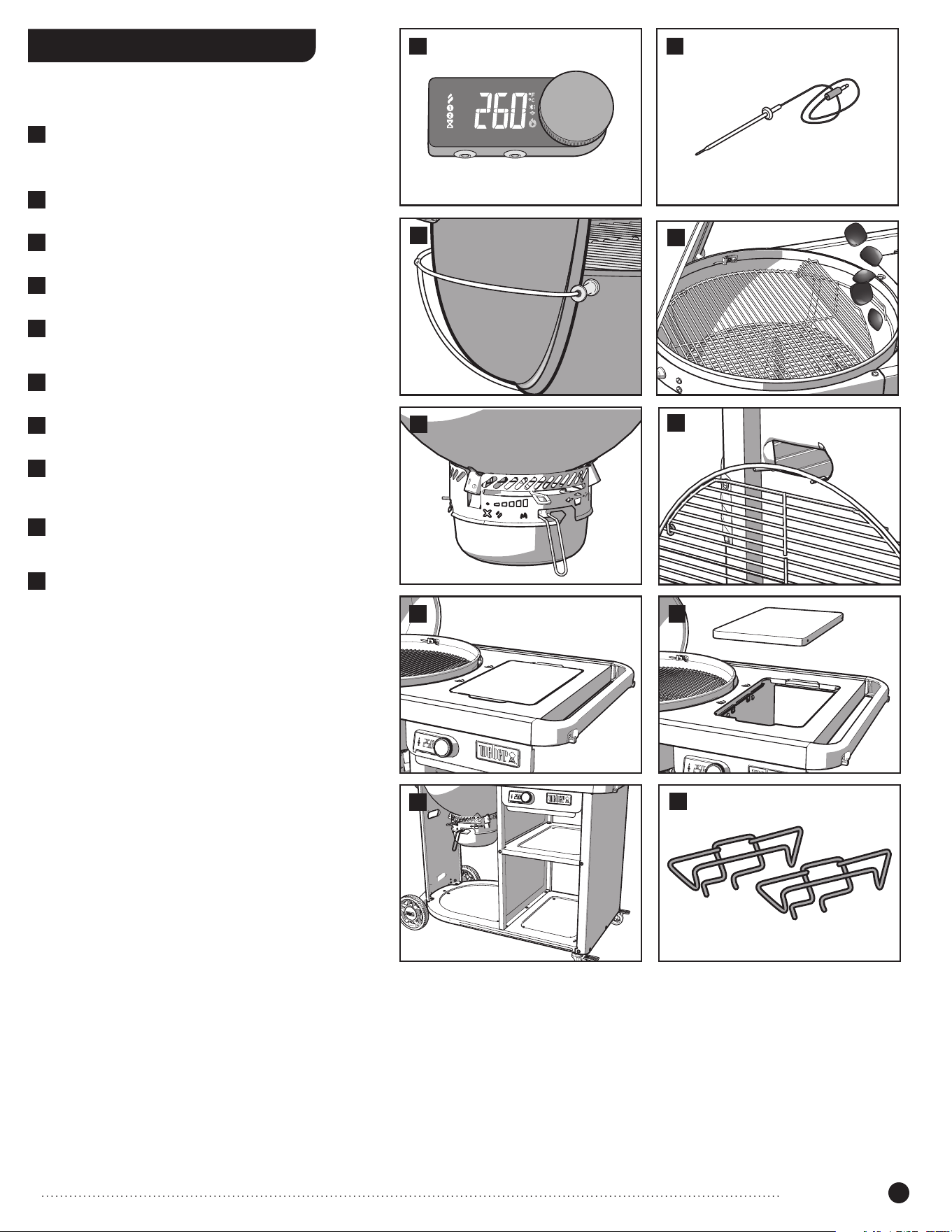
D
WEBER LCD Wi-Fi® Enabled Controller
The WEBER LCD Wi-Fi® Enabled Controller helps you monitor and
maintain a consistent temperature while grilling. The controller
display can be used to see the grill’s ambient temperature, timer,
food probe functions, and send alerts and notifications.
E
Food Probe
The included food probe/s allows for accurate temperature
reading and alerts on your controller and wireless device.
F
TUCK-AWAY Lid Holder
The TUCK-AWAY lid holder allows you to easily move your lid to
the side to check your meal or to add charcoal.
G
Hinged Cooking Grate
The hinged cooking grate has an area on both sides that lift up to
allow you to easily add fuel.
H
High Capacity Ash Catcher
The fully enclosed high capacity ash catcher keeps ashes from
blowing around and easily detaches for quick and clean ash
removal.
I
Curved Cooking Grate Handles
The curved handles of the cooking grate allow you to hang the
grate from the side panel of the grill.
J
Table Top
The table top provides a convenient work surface and food prep
area.
K
WEBER WORKS Table
This table top provides a removable insert to use with WEBER
WORKS accessory storage.
This feature is included on select models only.
L
Storage Shelving
Built-in storage shelving helps keep accessories and grilling
tools within reach.
Storage shelving is included on select models only.
M
Charcoal Rails
Arranges charcoal for indirect cooking.
F
G
D E
I
J K
L
H
4
WEBER CONNECT App
First things first.
Download the WEBER CONNECT app.
Open the app to receive:
• Precise temperature set-up
• Cooking modes, including: Roasting, smoking, and searing..
• Remote grill monitoring
• STEP-BY-STEP BARBECUING
• App-enabled food thermometers
• Recipes and instructions
• And more!
Connecting your grill to Bluetooth® or a Wi-Fi® network.
To connect your WEBER grill via Bluetooth® or your local Wi-Fi® network, follow these steps:
NOTE: WEBER recommends that your smart device runs the latest version of its operating system before
attempting to connect your grill to Bluetooth® or your Wi-Fi® network.
1) Turn the dial on the temperature controller to turn the display ON.
2) Verify that your smart device is connected to Bluetooth® or your local Wi-Fi® network.
3) From your smart device, download the new WEBER CONNECT app from the App Store on Apple
devices, or the Play Store on Android devices.
4) Open the WEBER CONNECT app and follow the in-app instructions for connecting to your WEBER grill.
5) Ensure that the temperature controller is plugged into a power source. The power cord must be
plugged into the controller module under the table top and a properly grounded outlet.
NOTE: To successfully connect your smart device to your grill via a local Wi-Fi® network, first make sure your grill
is paired via Bluetooth® and that your grill is within range of your Wi-Fi® router. If your attempts to connect have
been unsuccessful, try moving the grill within range of the Wi-Fi® router or adding a signal extender for a stronger
signal.
Scan the QR code to download the
WEBER CONNECT app.
GETTING STARTED
A
C
B
G
D
E
F
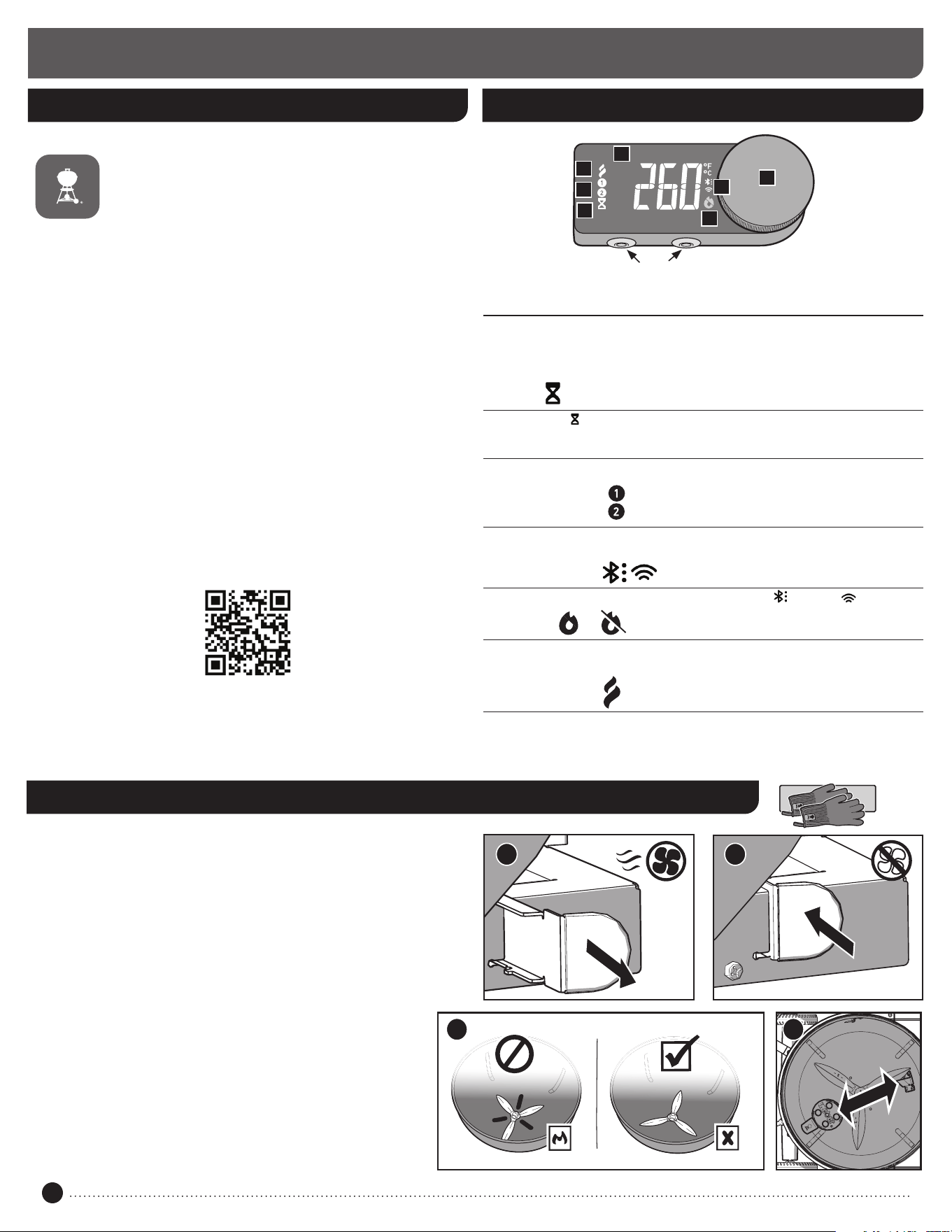
Food Probe Ports
WEBER LCD Wi-Fi® ENABLED CONTROLLER
A Dashboard
The LCD display dashboard on your controller is where you can visually check
temperatures, receive notifications, view connectivity status, and check the status of
your cook.
Note: Fahrenheit and Celsius is set through the WEBER CONNECT App.
B Timer
A timer icon indicates the timer function.
C Main Dial
Turn the Main Dial to adjust grill temperature, navigate through the icons, and set a
timer.
D Food Probe Icons
Your grill has two food temperature probe ports to gain superior control over your grill for
perfect results every time.
E Connectivity Icons
These icons indicates strength of your grill’s Bluetooth® and Wi-Fi® connection.
F Fire Icon
This icon indicates when the grill is in an active cook mode.
It will have a strike though when shutting down.
G Manual Mode
Navigate to this icon to activate the manual fan function.
GRILL SETUP USING THE WEBER LCD Wi-Fi® ENABLED CONTROLLER
D
BA
IMPORTANT:
Charcoal requires oxygen to burn, so be sure the fan door is in the proper position when
igniting and shutting o the grill.
• To allow oxygen to flow into the kettle when igniting the grill, pull the fan door toward you to
open it (A). Use heat-resistant barbecue mitts or gloves while adjusting fan door.
• To prevent oxygen flow into the kettle when shutting o the grill, push the fan door in to close
it (B). Use heat-resistant barbecue mitts or gloves while adjusting fan door.
1. Remove the lid and cooking grate (top grate) from your grill.
2. IMPORTANT: Fully close the (bottom) bowl vents on your grill (C).
3. C
hoose and follow your preferred cooking method from “RECOMMENDED
CHARCOAL SET-UPS WHEN USING THE WEBER LCD WI-FI® ENABLED
CONTROLLER”, Then, proceed to “SETTING TARGET TEMPERATURE”.
4. Be sure to position lid with lid damper on the opposite side of the fan tunnel (D).
5. Make final adjustments to LID DAMPER while cooking. Do not fully close.
• Use heat-resistant barbecue mitts or gloves while cooking, adjusting air vents (dampers),
adding charcoal, adjusting the fan door, and handling thermometer or lid.
USE AND SETUP USING THE WEBER LCD Wi-Fi® ENABLED CONTROLLER
C
5
www.weber.com
Fuel Quantity Temperature Lid Damper
Charcoal Setup
Instructions
Low and Slow
4 - 5 lbs - thin
row of briquettes
(75-95
briquettes)
180°-220°F
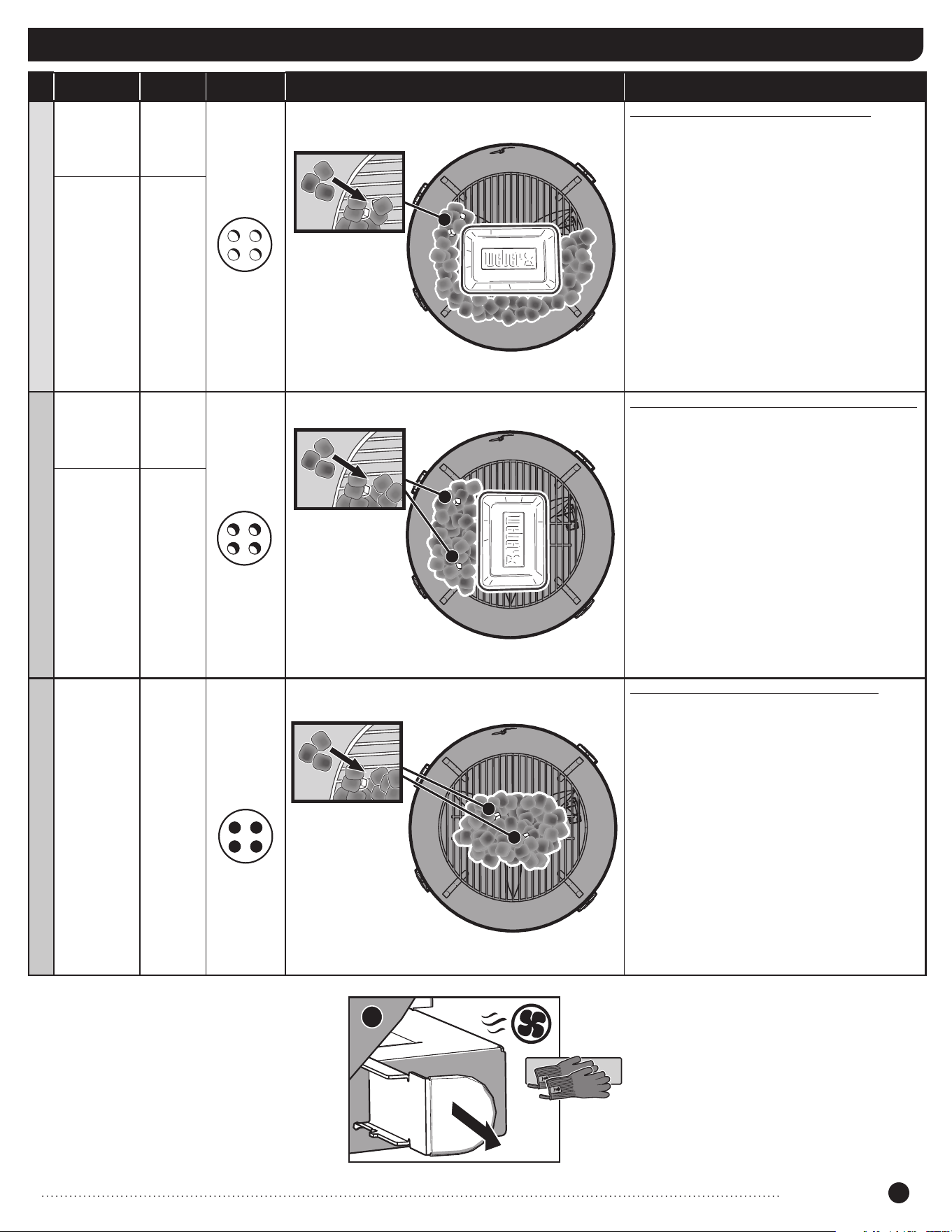
Low and Slow Temperature Cooking (180º - 295ºF)
The charcoal will be arranged in a ring around the outside perimeter
of the bowl. This setup creates a low and slow heat cooking method.
Note: The amount of charcoal and thickness of the briquette row will
help set the temperature of the cooking area during a long cook.
1. Place a large drip pan in the middle of the charcoal grate.
2. Add a row of briquettes around the drip pan starting 4-5” away
from the thermocouple and ending before the fan tunnel outlet.
3. Place 2 lighter cubes directly on the charcoal grate at the
starting point of your charcoal at the back left of the bowl,
making sure that they are not directly next to one another.
4. Ignite the lighter cubes.
5. Using long handled tongs, place the 3-4 reserved briquettes on
top of lit lighter cubes.
6. Turn the controller dial to set a target grill temperature. Press
the dial to confirm.
7. Using heat-resistant barbecue mitts or gloves, pull fan door
handle toward you to open position (A) to start air flow.
8. Using heat-resistant barbecue mitts or gloves, install the cooking
grate into the bowl.
9. Place the lid on the bowl.
10. Adjust the top lid damper to the ¼ open position.
See weber.com for more information.
5+ lbs - thicker
row of briquettes
(95+ briquettes)
225º - 295°F
¼ open
Roasting / Indirect Heat
4 lbs
(75 briquettes)
300°F -
420°F
Roasting / Indirect Heat Temperature Cooking (300º - 445ºF)
The charcoal will be arranged on the back corner of bowl opposite
the fan tunnel outlet. This setup creates an indirect heat cooking
area. An optional large drip pan can be used on the opposite side of
the bowl to catch food drippings.
1. Add the appropriate quantity of charcoal to the left side of the
bowl on the charcoal grate. Keep the briquettes at least 4-5”
away from the fan tunnel outlet and thermocouple. The included
Char-Rails can be used to hold the briquettes in place.
2. Place 2 lighter cubes directly on the charcoal grate on opposite
ends of your charcoal pile.
3. Ignite the lighter cubes.
4. Using long handled tongs, place the 3-4 reserved briquettes on
top of lit lighter cubes.
5. Turn the controller dial to set a target grill temperature. Press
the dial to confirm.
6. Using heat-resistant barbecue mitts or gloves, pull the fan door
handle toward you to open position (A) to start air flow.
7. Using heat-resistant barbecue mitts or gloves, install the cooking
grate into the bowl.
8. Place the lid on the bowl.
9. Adjust the top lid damper to the ½ open position.
See weber.com for more information.
~6 lbs
(~100 briquettes)
425°F to
445°F
½ open
Searing / Direct Heat
~6 lbs
(~100 briquettes)
450°F+
Fully open
Searing / Direct Heat Temperature Cooking (450ºF+)
The charcoal will be arranged in the center of the bowl. This set up
creates a direct heat cooking area.
1. Add the appropriate quantity of charcoal to the center of the bowl
on the charcoal grate. Keep the briquettes at least 4-5” away
from the fan tunnel outlet and thermocouple.
2. Place 2 lighter cubes directly on the charcoal grate making sure
that they are not directly next to one another.
3. Ignite the lighter cubes.
4. Using long handled tongs, place the 3-4 reserved briquettes on
top of lit lighter cubes.
5. Turn the controller dial to set a target grill temperature. Press
the dial to confirm.
6. Using heat-resistant barbecue mitts or gloves, pull the fan door
handle toward you to open position (A) to start air flow.
7. Using heat-resistant barbecue mitts or gloves, install the cooking
grate into the bowl.
8. Place the lid on the bowl.
9. Adjust the top lid damper to the fully open position.
See weber.com for more information.
RECOMMENDED CHARCOAL SETUPS WHEN USING THE WEBER LCD Wi-Fi® ENABLED CONTROLLER
A
6
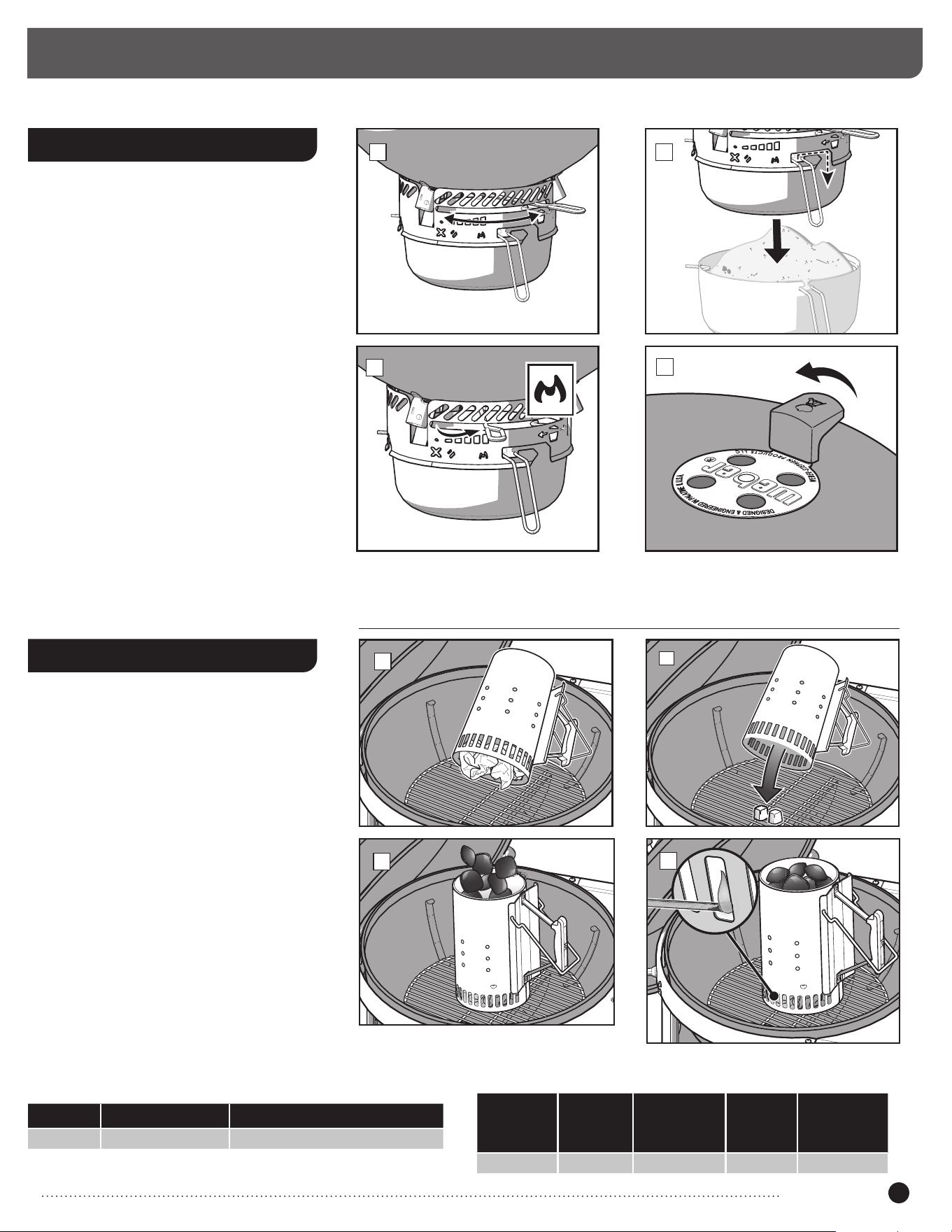
TO SET A COOK TIMER
1. Press the dial.
2. From the main menu screen, Rotate the dial anticlockwise until the hourglass icon
illuminates on the display(A).
3. Press the dial once for timer adjustment mode(B).
4. Rotate the dial to select a time. The default time starts at 5 minutes(C).
5. Press the dial to confirm the selection and start the timer.
Note: Cancel your set cook timer with the WEBER CONNECT app.
MANUAL MODE:
Manual mode is a setting that allows continual operation of the fan speed manually.
1. From the Main Menu, Rotate the dial all the way left or right until “FAN” is displayed on the
controller.
2. Press the dial and Rotate it to select the fan speed.
Fan speed settings: From 1 to 10 (Highest setting).
3. Press the dial to confirm the selection.
USING FOOD PROBES:
To set a target food probe temperature:
1) Plug in a food probe to the bottom of the controller. The controller can hold up to two food
probes at once.
2) To set a target food probe temperature from the main menu screen, Rotate the dial
anticlockwise until the (1) or (2) food probe indicator illuminates on the display (D).
3) Press the dial once for probe temperature adjustment mode.
4) Rotate the dial to select a target food probe temperature. The default temperature starts
at 165°F (74°C).
5) Press the dial to confirm the selection.
6) Alternatively, from the WEBER CONNECT app, select a desired food to cook or select a cook
program. You will receive a notification once your food has reached the set temperature(s)
and your cook has ended.
IMPORTANT OPERATING NOTES
• Do not overload charcoal. Using more than the recommended amount of fuel can cause
damage to electronics
• High Temperature Protection feature: Do not unplug power to the grill until the grill has
completely cooled. The electronics housing has an onboard temperature sensor. If too much
heat is detected, the fan will spin at a low speed to cool the housing even if a cook is active.
• When setting up your grill for direct searing or roasting you should follow the recommended
charcoal set-up on the previous page for safe cooking temperatures.
• Due to the fan rotating air around the kettle, it is not necessary to reposition your cooking
grate mid-cook for an even, indirect cook.
ERROR CODES
The controller uses advanced technology capable of troubleshooting your grill. If a problem is
detected with your grill, the controller will display the error code and send a notification through
your WEBER CONNECT app to notify you of the error. For quick reference, please see the list of
error codes. Contact WEBER customer service for assistance.
C
B
ADDITIONAL FUNCTIONS
A
E2 - Fan Error
E3 -Flame Out
E4 - Communication Error
E5 - Grill Too Hot
E8 - Thermocouple Error
E10 - Improper Shutdown Notification
E13 - Diagnostic Component Failure
E16 - Grill ID Error
Some error codes simply notify you of a potential critical error before
it happens. These notifications can be cleared from the controller by
pressing the dial.
E18 - Temperature Drop Notification
E34 - Fan Door Error
E36 - Internal Software Update Error
E37 - Probe is Overheating
SETTING TARGET TEMPERATURE
Start-Up with WEBER LCD Wi-Fi® Enabled Controller
Refer back to grill and fuel set-ups when using the controller to assist with charcoal ignition.
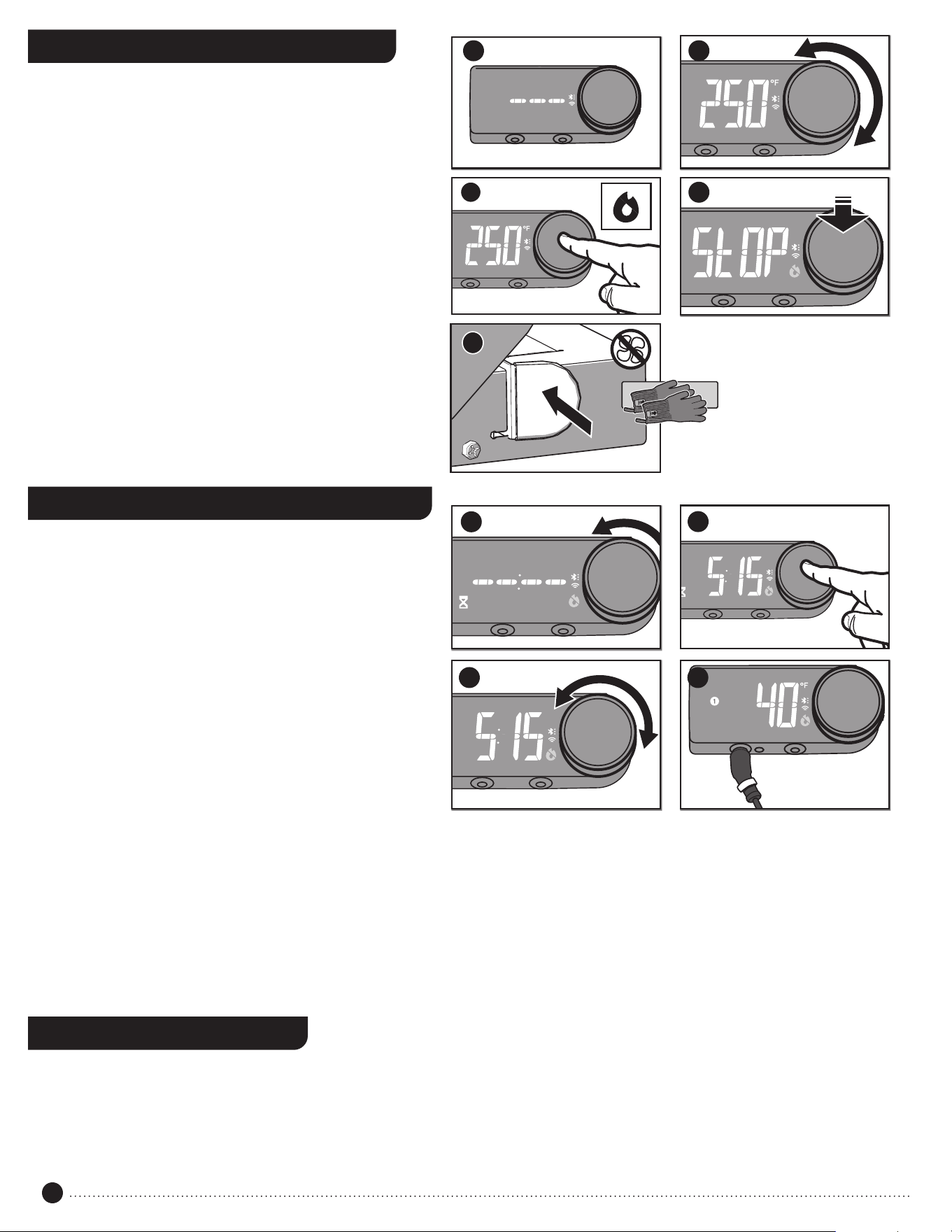
1. Ensure that the grill is properly plugged in to a power source. The controller display will
show three dashes(A). If your grill has been plugged in and the display is not lit, wake your
grill by turning the dial.
2. Choose your preferred method of charcoal setup and ignition from the previous section of
this manual and setup the grill accordingly.
3. Rotate the dial to select a target grill temperature(B).
4. Press the dial to confirm the selection. The red flame icon will illuminate and flash as the
grill heats(C).
5. Place the lid on the bowl.
6. Adjust the top lid damper to the appropriate position according to your cook setup.
7. Keep the grill lid closed and preheat the grillto the desired cooking temperature.
8. Once the grill has reached the desired temperature, open the lid and clean the cooking
grate using a grill brush or scraper.
9. Place the food on the cooking grate, then close the grill lid. Refer to your choice of recipe
for cooking times.
To turn o the controller and stop cooking:
1. Press and hold the dial for 3 seconds until the controller reads “StOP” on the display(D). - or
select OFF from your WEBER CONNECT app.
Press the dial once more to confirm “StOP”.
2. IMPORTANT! Using heat-resistant barbecue mitts or gloves, PUSH THE FAN DOOR TO THE
CLOSED/OFF POSITION (E).
3. Using heat-resistant barbecue mitts or gloves, rotate the lid damper vent closed. The lid
damper and fan door must be closed to properly shut down the grill.
4. Unplug the grill from the power source. DO NOT UNPLUG until the grill is cool.
WARNING: ALWAYS MAKE SURE THE GRILL IS COMPLETELY COOLED AND UNPLUGGED FROM A
POWER SOURCE BEFORE PERFORMING ANY MAINTENANCE OR CLEANING.
C
A B
D
E
D
7
www.weber.com
BEFORE LIGHTING
Charcoal Quantity for Direct Heat
Hamburgers, steaks, chops, kabobs, boneless chicken pieces, fish fillets, shellfish, sliced vegetables
Grill Diameter WEBER Briquettes Needed Charcoal Briquettes Needed
22" (57 cm) 40 50
LIGHTING CHARCOAL
Choose a Proper Location to Grill
• Only use this grill outdoors in a well-ventilated area. Do not use in
a garage, building, breezeway, or any other enclosed area.
• Keep the grill on a secure, level surface at all times.
• Do not use the grill within two feet (60cm) of any combustible
material. Combustible materials include, but are not limited to,
wood or treated wood decks, patios, and porches.
Choose How Much Charcoal to Use
Choosing charcoal quantity depends on what you are grilling and the
size of your grill. If you are grilling small, tender pieces of food that
take less than 20 minutes, refer to the Charcoal Quantity for Direct
Heat chart. If you are intending to grill larger joints of meat that
require 20 minutes or more of grilling time, or delicate foods, refer
to the Charcoal Quantity for Indirect Heat chart. For more details
about the difference between direct and indirect cooking, refer to the
GRILLING METHODS sections.
The Very First Time You Grill
It is recommended that the grill be heated up and the fuel kept red
hot, with the lid on, for at least 30 minutes prior to cooking for the first
time to burn off any manufacturing residue.
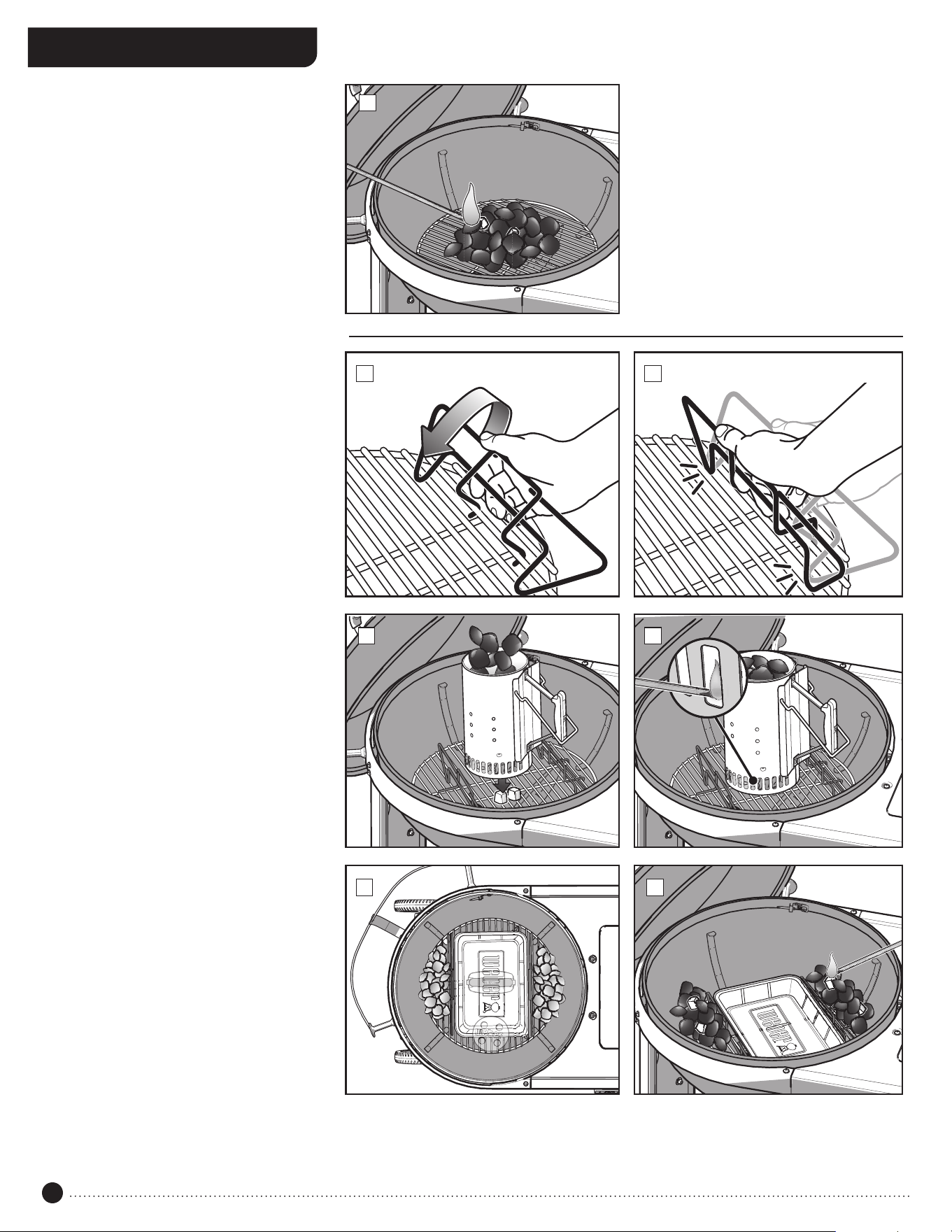
Preparing the Grill for Lighting
1. Slide the lid open into the TUCK-AWAY lid holder.
2. Remove the cooking grate from the grill.
3. Remove the charcoal (bottom) grate and clear ashes or chunks of
old charcoal from the bottom of the bowl using the ONE-TOUCH
cleaning system. Charcoal requires oxygen to burn, so be sure that
nothing clogs the vents. Move the handle back and forth to move
ash and debris from the bottom of the grill into the ash catcher (A).
4. To remove the high capacity ash catcher and dispose of the ashes,
lift and rotate the ash catcher handle to the right to release it from
the grill (B).
5. Open the bowl vents by moving the ONE-TOUCH damper blade
handle to the fully open position (C).
6. Reinstall the charcoal (bottom) grate.
7. Open the lid vents by moving the lid damper to the fully
open position (D).
Note: Instructions for using lighter fluid were purposely left
out of this owner’s guide. Lighter fluid is messy and can
transmit a chemical taste to your food, while lighter cubes
(sold separately) do not. If you choose to use lighter fluid,
follow the manufacturer’s instructions and NEVER add
lighter fluid to a burning fire.
Before lighting charcoal, determine which barbecuing
method you will be using. Depending on the model you
purchased, your grill may or may not be equipped with the
features described on the following pages.
Setting Up the Grill for Direct Grilling Method
Lighting the Charcoal Using a ChimneyStarter
The simplest, most thorough way to light any kind of charcoal is to use
a chimney starter; particularly, the WEBER RAPIDFIRE chimney starter
(sold separately). Refer to the cautions and warnings included with the
RAPIDFIRE chimney starter before lighting charcoal.
1. Put a few sheets of crumpled up newspaper in the bottom of
the chimney starter and set the chimney starter on the charcoal
(bottom) grate (A); or put a few lighter cubes (sold separately) in
the center of the charcoal grate and place the chimney starter over
them (B).
2. Fill the chimney starter with charcoal (C).
3. Using a long lighter or matchstick, light the lighter cubes or
newspaper through the holes on the bottom side of the chimney
starter(D).
4. Keep the chimney starter in place until the charcoal is fully lit. You
know the charcoal is fully lit when it is covered with a coating of
white ash.
Note: Lighter cubes must be completely consumed and the charcoal
ashed over before placing food on the cooking grate. Do not cook
before the charcoal has a coating of ash.
5. Once the charcoal is fully lit, continue to the following pages for
instructions on how to arrange your charcoal and begin cooking
according to your desired grilling method.
USE AND SETUP WITHOUT USING THE WEBER LCD Wi-Fi® ENABLED CONTROLLER
Your WEBER charcoal grill can be used without the WEBER LCD Wi-Fi® Enabled Controller. Simply use the preferred charcoal ignition method using charcoal lighter cubes. Control the
amount of oxygen by adjusting the bottom bowl vents and the lid damper. Follow the steps below for grill setup and ignition for direct and indirect grilling.
A
Charcoal Quantity for Indirect Heat
Roasts, bone-in poultry pieces, whole fish, delicate fish fillets, whole chickens or turkeys, ribs
Grill
Diameter
WEBER
Briquettes
Needed for
First Hour
WEBER
Briquettes
Added for Each
Additional Hour
Charcoal
Briquettes
Needed for
First Hour
Charcoal
Briquettes
Added for Each
Additional Hour
22" (57 cm) 15 per side 7 per side 25 per side 8 per side
B
C
D
A
B
C
D
8
E
LIGHTING CHARCOAL
Lighting the Charcoal Without a Chimney Starter
1. Build a pyramid of charcoal in the center of the charcoal (bottom)
grate and insert a couple of lighter cubes (sold separately) within
the pyramid.
2. Using a long lighter or matchstick, light the lighter cubes. The
lighter cubes will then ignite the charcoal (E).
3. Wait for the charcoal to fully light. You know the charcoal is fully lit
when it is covered with a coating of white ash.
Note: Lighter cubes must be completely consumed and the charcoal
ashed over before placing food on the cooking grate. Do not cook
before the charcoal has a coating of ash.
4. Once the charcoal is fully lit, continue to the following pages for
instructions on how to arrange your charcoal and begin cooking
according to your desired grilling method.
Setting Up the Grill for Indirect Grilling Method
When using the indirect grilling method, you have the option to spread
the coals directly on the charcoal (bottom) grate on opposite sides of
the bowl, or make use of WEBER CHAR-RAILS or CHAR-BASKETS (sold
separately).
Avoid positioning charcoal directly beneath the thermometer and
lid damper.
When using the CHAR-RAILS or CHAR-BASKETS, they must first be
placed into the bowl of the grill on the charcoal (bottom) grate before
lighting the charcoal.
To install the CHAR-RAILS, hook them on the outer charcoal grate
wires (A). and push the front of the rails down. The front of the CHAR-
RAILS should slip over the fourth charcoal grate wire and snap into
place (B).
Lighting the Charcoal Using a ChimneyStarter
The simplest, most thorough way to light any kind of charcoal is to use
a chimney starter; particularly, the WEBER RAPIDFIRE chimney starter
(sold separately). Refer to the cautions and warnings included with the
RAPIDFIRE chimney starter before lighting charcoal.
1. Put a few sheets of crumpled up newspaper in the bottom of
the chimney starter and set the chimney starter on the charcoal
(bottom) grate between the CHAR-RAILS or CHAR-BASKETS if they
are being used. Alternatively, you can put a few lighter cubes (sold
separately) in the center of the charcoal (bottom) grate. Place the
chimney starter over the lighter cubes and fill the chimney starter
with charcoal (C).
2. Using a long lighter or matchstick, light the lighter cubes or
newspaper through the holes on the bottom side of the chimney
starter(D).
3. Keep the chimney starter in place until the charcoal is fully lit. You
know the charcoal is fully lit when it is covered with a coating of
white ash.
Note: Lighter cubes must be completely consumed and the charcoal
ashed over before placing food on the cooking grate. Do not cook
before the charcoal has a coating of ash.
4. Once the charcoal is fully lit, continue to the following pages for
instructions on how to arrange your charcoal and begin cooking
according to your desired grilling method.
Lighting the Charcoal Without a Chimney Starter
Avoid positioning charcoal directly beneath the thermometer and
lid damper.
When using the CHAR-RAILS or CHAR-BASKETS, they must first be
placed into the bowl of the grill on the charcoal (bottom) grate before
lighting the charcoal.
1. Place CHAR-RAILS or CHAR-BASKETS on the charcoal (bottom)
grate on opposite sides of the bowl.
2. Fill each CHAR-RAIL or CHAR-BASKET with your choice of charcoal.
Avoid positioning charcoal directly beneath the thermometer and
lid damper (E). A drip pan may be placed between the charcoal to
collect food drippings.
3. Insert a couple of lighter cubes (sold separately) within the
charcoal.
Note: Be sure to slightly bury them at the top of the charcoal
briquettes.
4. Using a long lighter or matchstick, light the lighter cubes (F). The
lighter cubes will then ignite the charcoal.
5. Wait for the charcoal to fully light. You know the charcoal is fully lit
when it is covered with a coating of white ash.
Note: Lighter cubes must be completely consumed and the charcoal
ashed over before placing food on the cooking grate. Do not cook
before the charcoal has a coating of ash.
6. Once the charcoal is fully lit, continue to the following pages for
instructions on how to arrange your charcoal and begin cooking
according to your desired grilling method.
A
C D
E F
B
9
www.weber.com
GRILLING METHODS - DIRECT HEAT
GRILLING METHODS -
INDIRECT HEAT
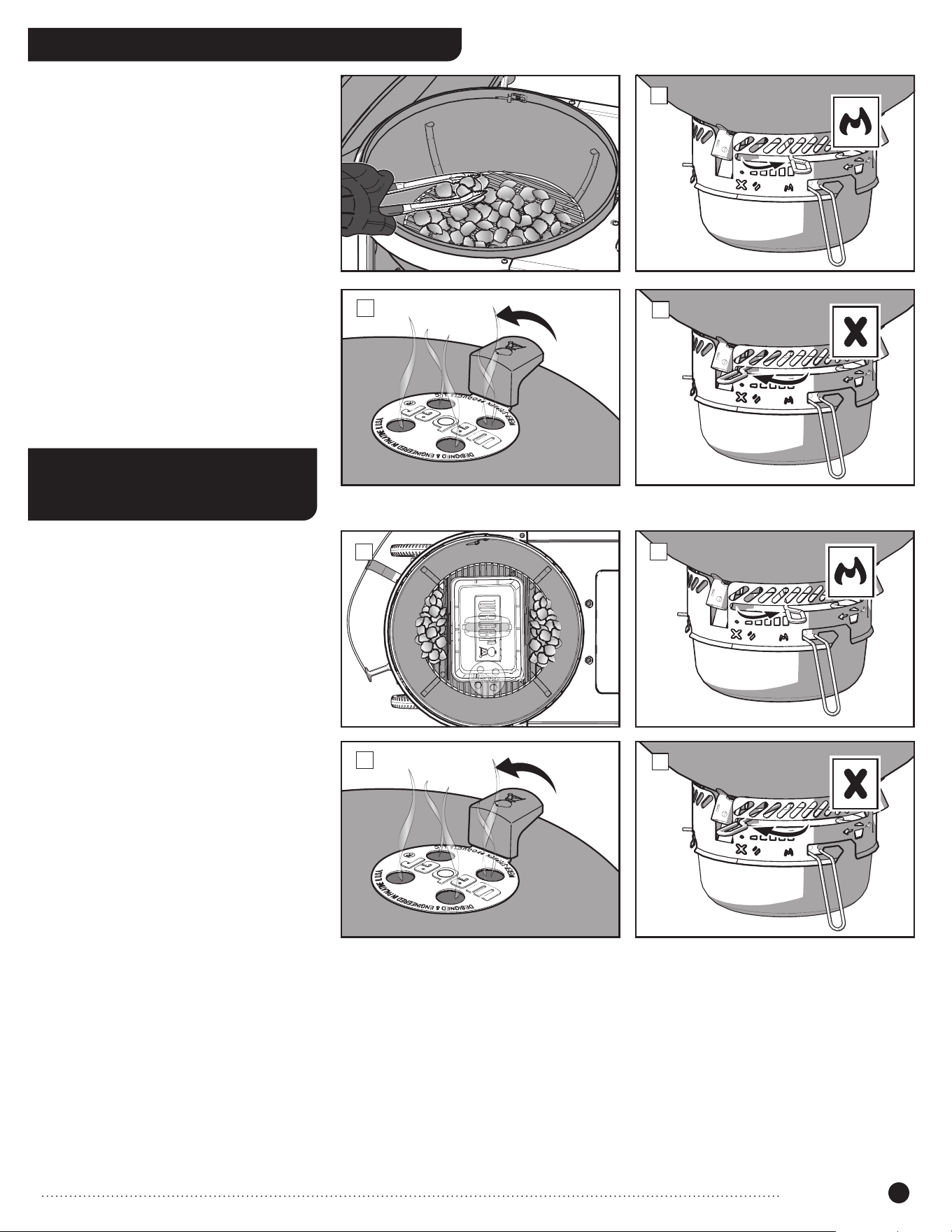
Arranging the Charcoal for Direct Heat
1. Put on barbecue mitts or gloves.
CAUTION: The grill, including the handle and damper/vent handles,
will become hot. Make sure that you are wearing barbecue mitts or
gloves to avoid burning your hands.
2. After the charcoal is fully lit, spread them evenly across the
charcoal grate with long handle tongs (A) or using a WEBER
charcoal rake (sold separately).
3. Make sure the ONE-TOUCH cleaning system handle and lid damper
are in the fully open position (B), (C).
4. Once the charcoal has ashed over, reinstall the cooking grate inside
the bowl.
5. Slide the lid closed on the grill.
6. Preheat the cooking grate for approximately 10 to15 minutes.
7. Once the cooking grate is preheated, slide the lid open. Using a grill
brush or scraper, scrub the cooking grate clean.
Note: When using a stainless steel bristle grill brush, replace the
brush if any loose bristles are found on the cooking grate or brush.
8. Place your food on the cooking grate.
Note: When removing the grill lid during cooking, slide itto the side,
rather than straight up. Lifting straight up may create suction, drawing
ashes up onto yourfood.
9. Slide the lid closed and consult recipe for recommended cooking
times.
When finished cooking...
Close the lid damper and bowl vents to extinguish the charcoal (D).
Arranging the Charcoal for Indirect Heat
1. Put on barbecue mitts or gloves.
CAUTION: The grill, including the handles, lid damper and bowl
vents, will become hot. Make sure that you are wearing barbecue
mitts or gloves to avoid burning your hands.
2. Once the charcoal is fully lit using your preferred indirect
grilling method (refer to “Lighting Charcoal” section), using
barbecue mitts or gloves and long handle tongs, be sure that
the charcoal is properly positioned on opposite sides of the
bowl. Avoid positioning the charcoal next to the bowl handles,
or directly beneath the thermometer and lid damper (A). A
drip pan may be placed between the charcoal to collect food
drippings.
3. Make sure the ONE-TOUCH cleaning system handle and lid
damper are in the fully open position (B), (C).
4. Once the charcoal has ashed over, reinstall the cooking grate
inside the bowl. If your cooking grate has hinged sides, make
sure that they are directly above the charcoal inside the bowl.
This will make it easy to add more charcoal if needed.
5. Slide the lid closed on the grill.
6. Preheat the grate for approximately 10 to 15 minutes.
7. Once the cooking grate is preheated, slide the lid open. Using a
grill brush or scraper, scrub the cooking grate clean.
Note: When using a stainless steel bristle grill brush, replace the
brush if any loose bristles are found on the cooking grate or brush.
8. Place your food in the center of the cooking grate, above a drip
pan if using one.
Note: When removing the grill lid during cooking, slide itto the
side, rather than straight up. Lifting straight up may create suction,
drawing ashes up onto yourfood.
9. Slide the lid closed. Always position the lid so that the
thermometer is not above the charcoal where it will be exposed
to direct heat. Consult recipe for recommended cooking times.
Adjust the lid damper and bowl vent positions to lower the
interior grill temperature if needed.
Note: Rotate the lid damper fully open to raise the grill temperature
and close it more to lower the grill temperature.
When finished cooking...
Close the lid damper and bowl vents to extinguish the charcoal (D).
A
B
D
C
A
B
D
C
10
Wear Gloves
Always wear a barbecue mitt or mitts when using your charcoal
grill. Vents, dampers, handles, and the bowl will all get hot during
the grilling process, so be sure to keep your hands and forearms
protected.
Skip the Lighter Fluid
Avoid using lighter fluid, as it can impart a chemical taste to your
food. Chimney starters (sold separately) and lighter cubes (sold
separately) are much cleaner and much more effective ways of
lighting charcoal.
Preheat the Grill
Preheating your grill with the lid closed for 10 to 15 minutes
prepares the cooking grate. With all of the charcoal glowing red,
the temperature under the lid should reach 500˚F. The heat loosens
any bits and pieces of food hanging onto the grate, making it easy to
brush them off with a stainless steel bristle grill brush. Preheating
your grill gets the grate hot enough to sear properly and also helps
prevent food from sticking to the grate.
Note: Use a stainless steel bristle grill brush. Replace brush if any
loose bristles are found on cooking grate or brush.
Oil the Food, Not the Grate
Oil prevents food from sticking and also adds flavor and moisture.
Lightly brushing or spraying the food with oil works better than
brushing the grate.
Keep the Air Flowing
A charcoal fire needs air. The lid should be closed as much as
possible, but keep the lid damper and bowl vent open. Remove the
ashes on the bottom of the grill regularly to prevent them from
blocking the vents.
Put a Lid on It
For four important reasons, the lid should be closed as much as
possible.
1. Keeps the grate hot enough to sear the food.
2. Speeds up the cooking time and prevents the food from drying
out.
3. Traps the smokiness that develops when fat and juices vaporize
in the grill.
4. Prevents flare-ups by limiting oxygen.
Tame the Flame
Flare-ups happen, which is good because they sear the surface of
what you are grilling; however, too many flare-ups can burn your
food. Keep the lid on as much as possible. This limits the amount
of oxygen inside the grill, which will help extinguish any flare-ups.
If the flames are getting out of control, move the food over indirect
heat temporarily, until they die down.
Frozen or Fresh
Whether you are grilling frozen or fresh food, follow the safety
guidelines on the package and always cook it to the recommended
internal temperature. Frozen food will take longer to grill and may
need more fuel to be added depending on the type of food.
Keeping it Clean
Follow a few basic maintenance instructions to keep your grill
looking and grilling better for years to come!
• For proper air flow and better grilling, remove accumulated
ashes and old charcoal from the bottom of the kettle and the ash
catcher before use. Make sure that all of the charcoal is fully
extinguished and the grill is cool before doingso.
• You may notice “paint-like” flakes on the inside of the lid. During
use, grease and smoke vapors slowly oxidize into carbon and
deposit on the inside of your lid. Brush the carbonized grease
from the inside of the lid with a stainless steel bristle grill brush.
To minimize further build-up, the inside of the lid can be wiped
with a paper towel after cooking while the grill is still warm
(not hot).
• Clean painted, porcelain-enameled, and plastic surfaces on
the outside of your grill with warm soapy water and a non-
abrasive cloth.
• If your grill is subject to a particularly harsh environment, you
will want to clean the outside more often. Acid rain, chemicals,
and salt water can cause surface rusting to appear. WEBER
recommends wiping down the outside of your grill with warm
soapy water. Follow up with a rinse and thorough drying.
• Do not use any of the following to clean your grill: abrasive
stainless steel polishes or paints, cleaners that contain acid,
mineral spirits or xylene, oven cleaner, abrasive cleansers
(kitchen cleansers), and abrasive cleaning pads.
TIPS AND TRICKS FOOD SAFETY
Food Safety Tips
• Do not defrost meat, fish, or poultry at room temperature. Defrost in the refrigerator.
• Wash your hands thoroughly with hot, soapy water before starting any meal preparation and after
handling fresh meat, fish, and poultry.
• Never place cooked food on the same plate raw food was on.
• Wash all plates and cooking utensils that have come into contact with raw meats or fish with hot,
soapy water and rinse.
Visit www.weber.com for recipes and grilling tips.
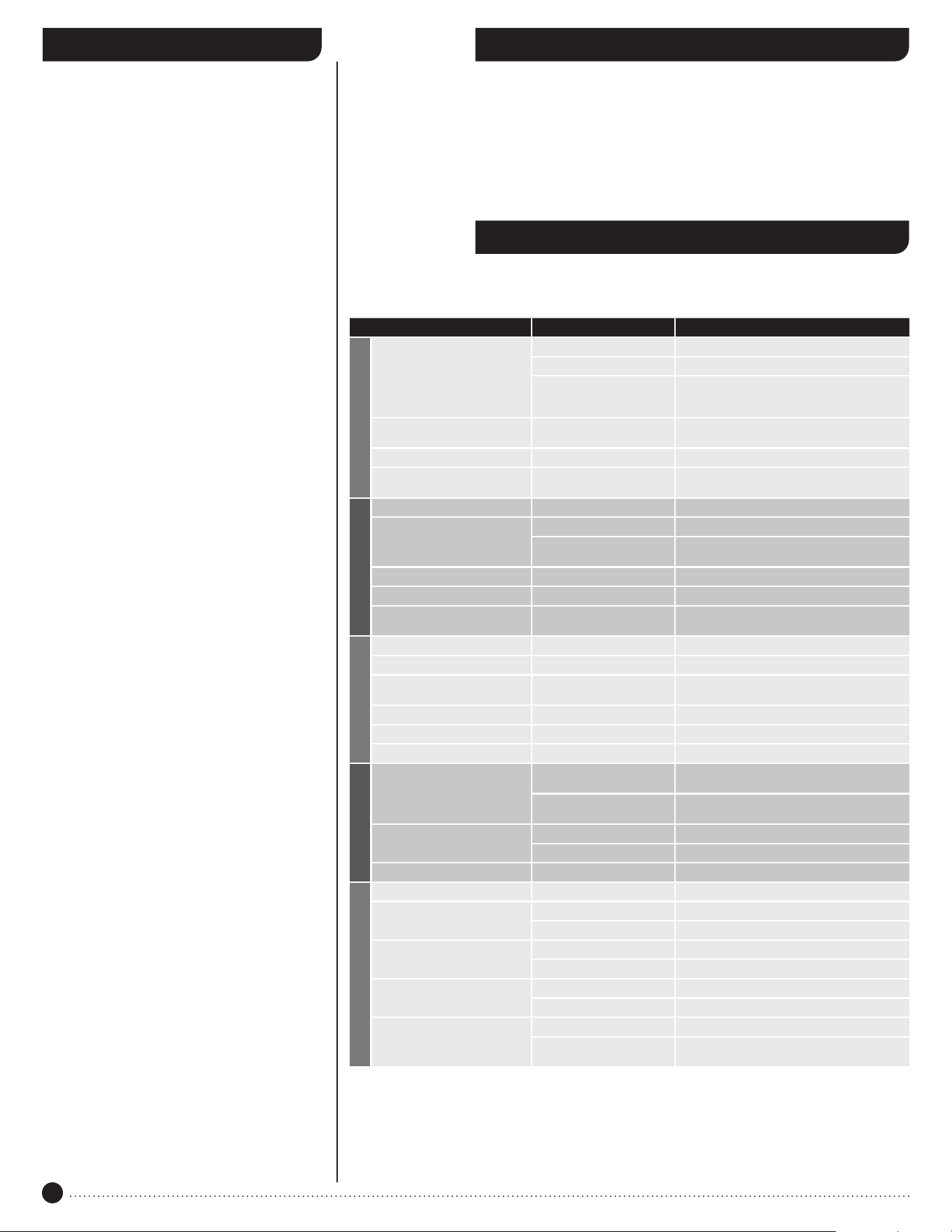
Cooking times for beef and lamb use the USDA’s definition of medium doneness, unless otherwise noted. The cuts, thicknesses, weights,
and grilling times are meant to be guidelines. Factors such as altitude, wind, and outside temperature can affect cooking times.
Visit www.weber.com for recipes and grilling tips.
Thickness / Weight Approximate Total Grilling Time
RED MEAT
Steak: New York strip,
porterhouse, rib-eye, T-bone,
and filet mignon (tenderloin)
¾ in (1.9 cm) thick 4 to 6 minutes direct high heat
1 in (2.5 cm) thick 6 to 8 minutes direct high heat
2 in (5 cm) thick
14 to 18 minutes
sear 6 to 8 minutes direct high heat,
and grill 8 to 10 minutes indirect high heat
Flank Steak
1½ lb to 2 lb (680 g to 907 g),
¾ in (1.9 cm) thick
8 to 10 minutes direct medium heat
Ground Beef Patty ¾ in (1.9 cm) thick 8 to 10 minutes direct medium heat
Tenderloin 3 lb to 4 lb (1.36 kg to 1.81 kg)
45 to 60 minutes 15 minutes direct medium heat,
and grill 30 to 45 minutes indirect medium heat
PORK
Bratwurst: fresh 3 oz (85 g) link 20 to 25 minutes direct low heat
Chop: boneless or bone in
¾ in (1.9 cm) thick 6 to 8 minutes direct high heat
1¼ in to 1½ in
(3.17 cm to 3.81 cm) thick
10 to 12 minutes sear 6 minutes direct high heat,
and grill 4 to 6 minutes indirect high heat
Ribs: baby back, spareribs 3 lb to 4 lb (1.36 kg to 1.81 kg) 1½ to 2 hours indirect medium heat
Ribs: country-style, bone in 3 lb to 4 lb (1.36 kg to 1.81 kg) 1½ to 2 hours indirect medium heat
Tenderloin 1 lb (453 g)
30 minutes sear 5 minutes direct high heat,
and grill 25 minutes indirect medium heat
POULTRY
Chicken Breast: boneless, skinless 6 oz to 8 oz (170 g to 226 g) 8 to 12 minutes direct medium heat
Chicken Thigh: boneless, skinless 4 oz (113 g) 8 to 10 minutes direct medium heat
Chicken Pieces: bone in, assorted 3 oz to 6 oz (85 g to 170 g)
36 to 40 minutes 6 to 10 minutes direct low heat,
30 minutes indirect medium heat
Chicken: whole 4 lb (1.81 kg) to 5 lb (2.26 kg) 1 to 1¼ hours indirect medium heat
Cornish Game Hen 1½ lb (680 g) to 2 lb (907 g) 60 to 70 minutes indirect medium heat
Turkey: whole, unstued 10 lb (4.53 kg) to 12 lb (5.44 kg) 2 to 2½ hours indirect medium heat
SEAFOOD
Fish, Fillet, or Steak:
halibut, red snapper, salmon,
sea bass, swordfish, tuna
¼ in to ½ in
(0.63 cm to 1.27 cm) thick
3 to 5 minutes direct medium heat
1 in to 1¼ in
(2.54 cm to 3.17 cm) thick
10 to 12 minutes direct medium heat
Fish: whole
1 lb (453 g) 15 to 20 minutes indirect medium heat
3 lb (1.36 kg) 30 to 45 minutes indirect medium heat
Shrimp 1½ oz (28 g) 2 to 4 minutes direct high heat
VEGETABLES
Asparagus ½ in (1.27 cm) diameter 6 to 8 minutes direct medium heat
Corn
in husk 25 to 30 minutes direct medium heat
husked 10 to 15 minutes direct medium heat
Mushroom
shiitake or button 8 to 10 minutes direct medium heat
portobello 10 to 15 minutes direct medium heat
Onion
halved 35 to 40 minutes indirect medium heat
½ in (1.27 cm) slices 8 to 12 minutes direct medium heat
Potato
whole 45 to 60 minutes indirect medium heat
½ in (1.27 cm) slices
9 to 11 minutes parboil 3 minutes,
and grill 6 to 8 minutes direct medium heat
Make sure food fits on the grill with the lid down, leaving approximately 1 inch (2.54 cm) of clearance between the food and lid.
GRILLING GUIDE
11
www.weber.com
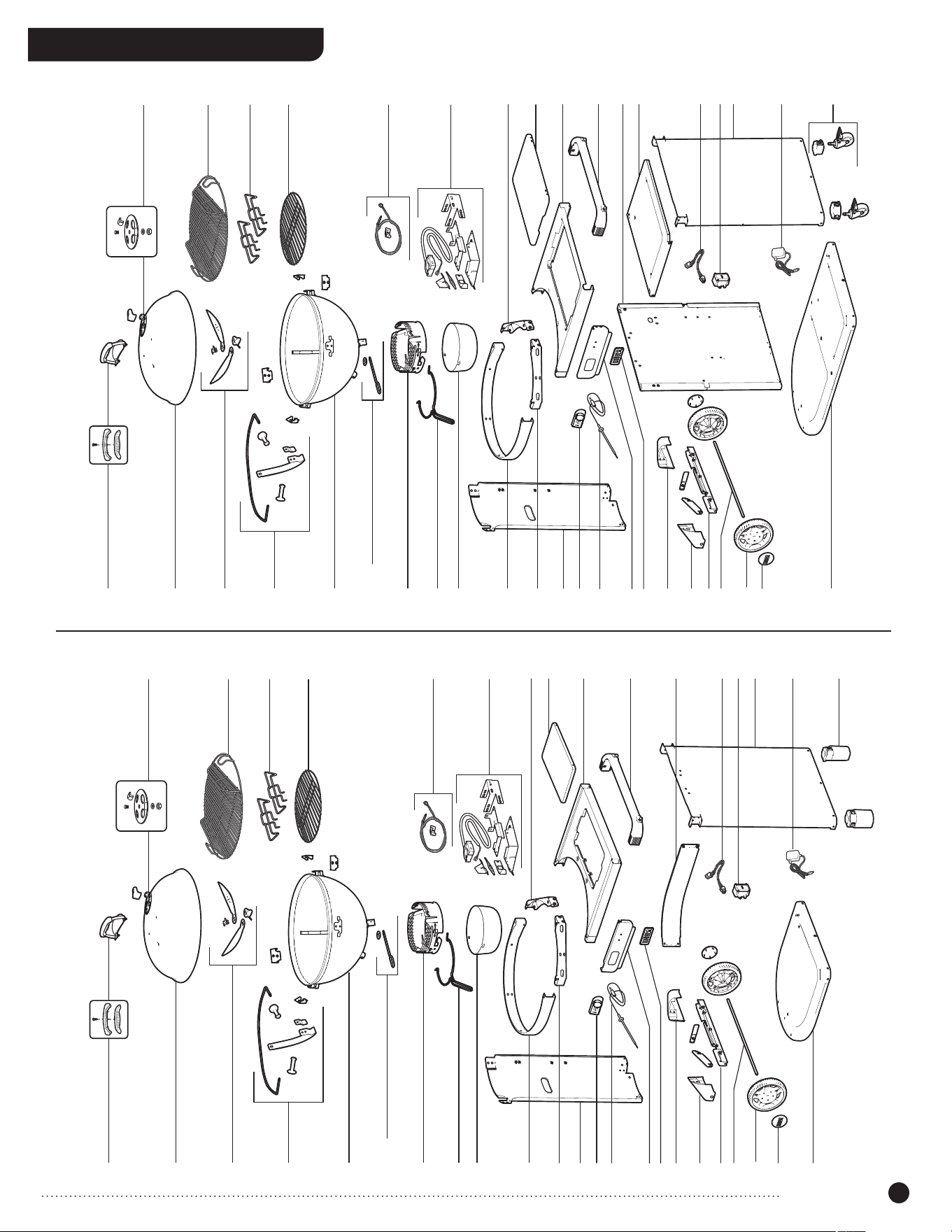
REPLACEMENT PARTS
1
2
3
4
5
3
6
8
7
9
10
11
12
13
14
15
22
23
24
25
26
29
30
32
38
36
34
31
35
37
33
16
18
19
20
21
17
Performer - SMART 22.5 (57cm) - US 102525
28
27
1
2
3
4
5
3
6
8
7
9
10
11
12
13
15
14
22
23
24
25
26
27
28
29
30
32
39
37
31
16
18
19
20
21
17
33
34
35
36
38
Performer Premium SMART - 22.5 (57cm) - US 102525

WEBER-STEPHEN PRODUCTS LLC
www.weber.com
© 2025 Designed and engineered by Weber-Stephen Products LLC,
1415 S. Roselle Road, Palatine, Illinois 60067 USA.
FCC Compliance: This equipment has been tested and found to comply with the limits for a Class B
digital device, pursuant to part 15 of the FCC rules. These limits are designed to provide reasonable
protection against harmful interference in a residential installation. This equipment generates,
uses and can radiate radio frequency energy and, if not installed and used in accordance with
the instructions, may cause harmful interference to radio communications. However, there is no
guarantee that interference will not occur in a particular installation. If this equipment does cause
harmful interference to radio or television reception, which can be determined by turning the
equipment o and on, the user is encouraged to try to correct the interference by one or more of
the following measures: (1) Reorient or relocate the receiving antenna. (2) Increase the separation
between the equipment and receiver. (3) Connect the equipment into an outlet on a circuit dierent
from that to which the receiver is connected. (4) Consult the manufacturer, dealer or an experienced
radio/TV technician for help. Changes or modifications not expressly approved by Weber could void
the user’s authority to operate this device.
FCC Radio Frequency (RF) Exposure: This equipment complies with FCC and ISED Canada radiation
exposure limits set forth for an uncontrolled environment. The user should avoid prolonged exposure
within 20cm of the antenna, which may exceed the FCC or RSS-102 radio frequency exposure limits.
IC Compliance: This device contains license-exempt transmitter(s)/receiver(s) that comply with
Innovation, Science and Economic Development Canada’s license-exempt RSS(s). Operation is subject
to the following two conditions: (1) This device may not cause interference; and (2) This device must
accept any interference, including interference that may cause undesired operation of the device.
IFETEL Compliance: Operation of this unit is subject to the following two conditions: (1) this unit or
device may not cause harmful interference, and (2) this unit or device must accept any interference,
including interference that may cause undesired operation.
ULC/ORD-C2728 2019
UL2728A 2019
Model: WCR001