Remote Control Transmitter
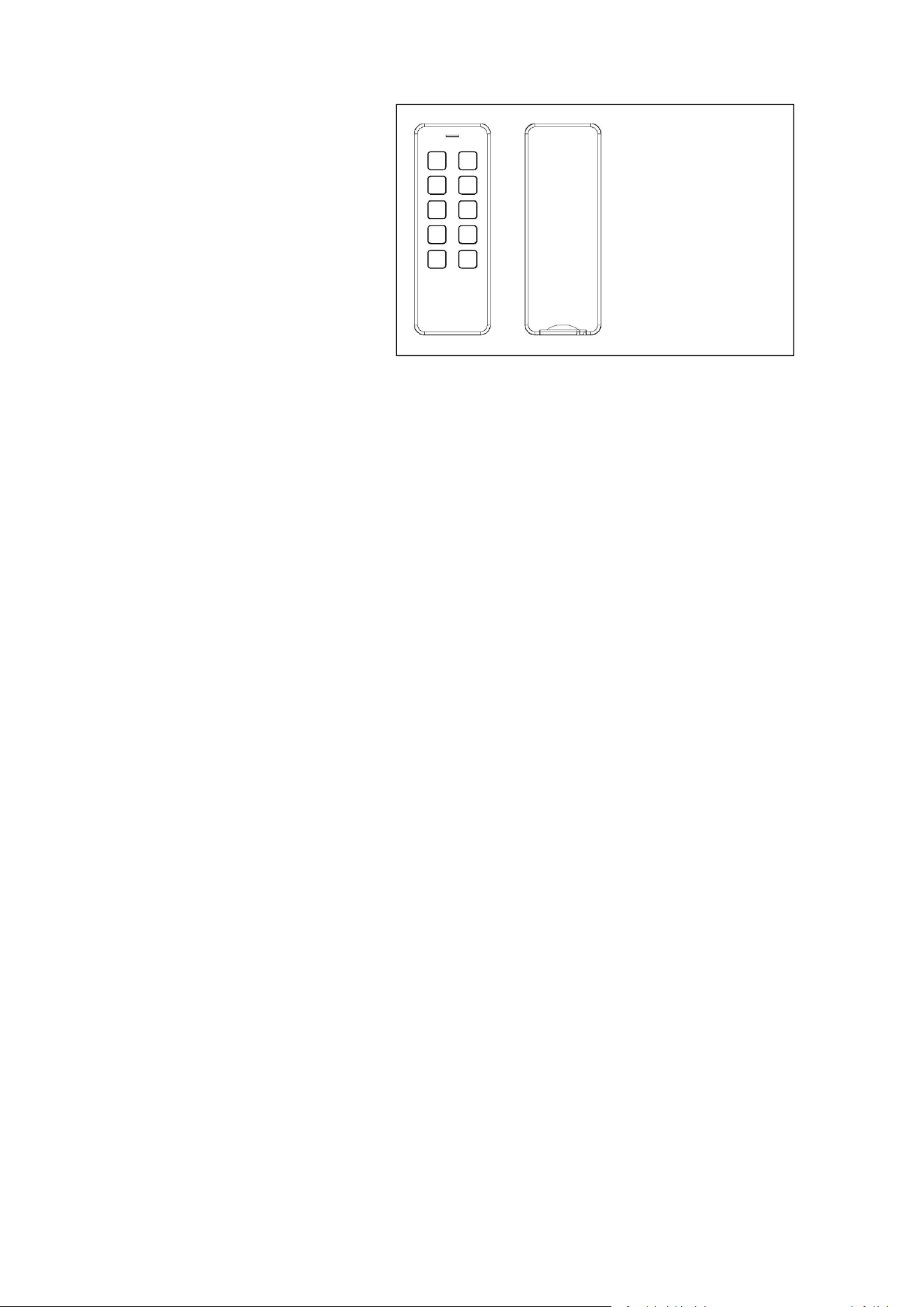
Operating elements
1. Indicator lamp
2. Control keys
3. ALL ON/ALL OFF key
4. Buckle of compartment
Inserting/replacing battery
1. Hold down both ends of the battery compartment (4) first, at the same time push it outward forcefully.
2. Remove the battery Insulating sheet or insert one round cell battery, type CR2032, into the battery
recess. The positive pole should face upward (see the “+” imprint on the battery). Push the battery all the
way into the battery recess.
3. Close the battery compartment. The battery must be replaced when the remote control’s range
decreases noticeably or when the indicator lamp (1) no longer lights when a button is pushed.
Key functions
• The control keys (2) are arranged in two columns: left column = ON/ right column = OFF.
• Use the keys on the left column to activate channels 1 to 4 individually.
• Use the keys on the right column to deactivate channels 1 to 4 individually.
• Use the ALL ON/OFF keys on the right/left column to activate/deactivate channels 1 to4 together.
The indicator lamp (1) lights up each time a key is pressed.
Operation
Configuration and the dimming function will depend on your radio-controlled power outlet. You can find
detailed information in the operating instructions of your radio-controlled power outlet.
The remote control can control an unlimited number of compatible radio-controlled power outlets
Technical data
Battery type ..............................3V CR2032
Number of channels .................4 individual channels+ All ON/OFF channels
Transmission frequency............433.92 MHz
Transmission range ..................max. 50 m (in open area)
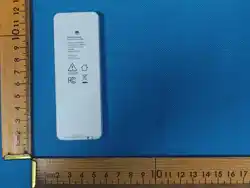
Dimensions (W x H x D) ........... 91x 37x 13 mm
Weight ......................................25 g
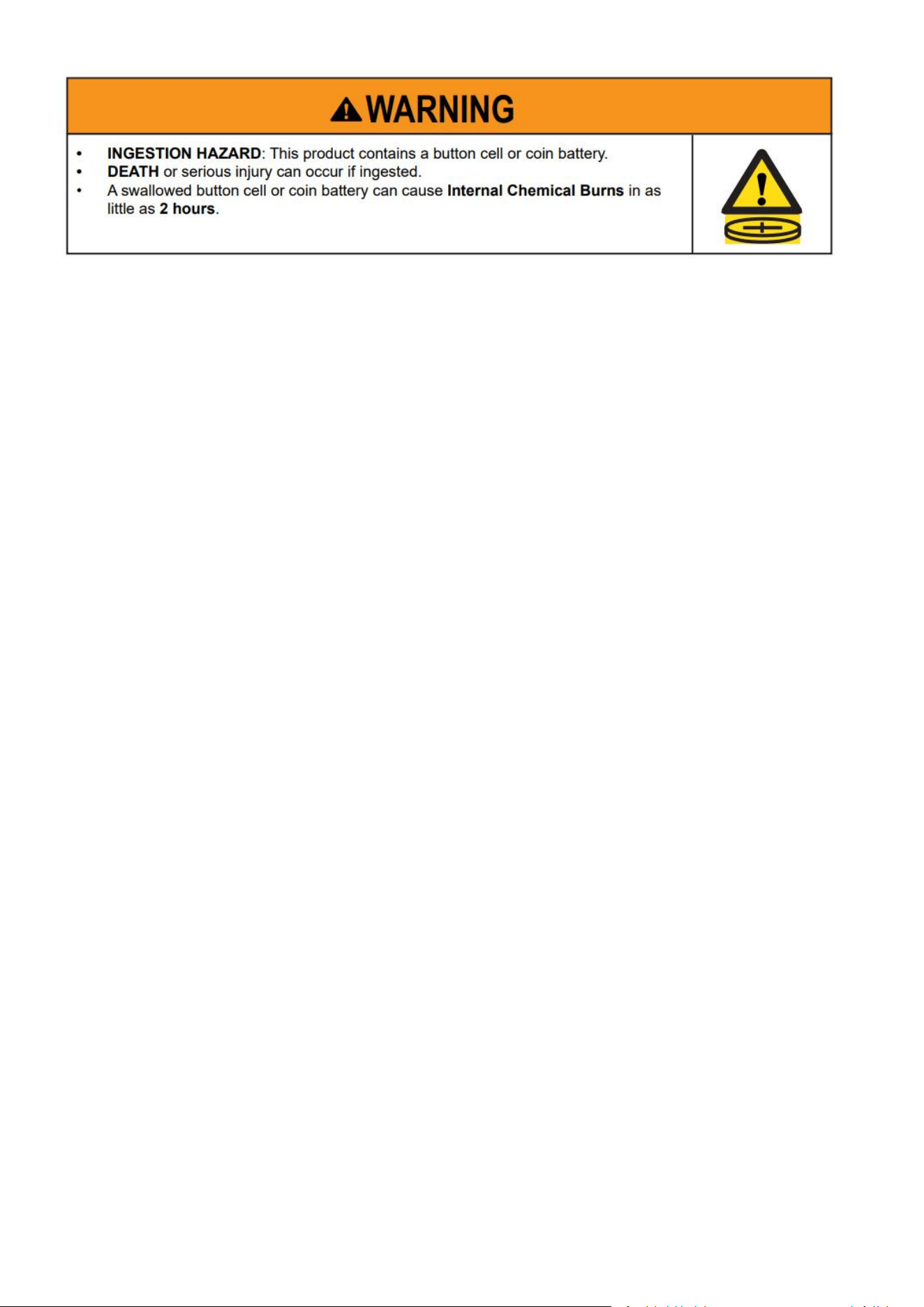
Battery statement
1. Ensure the batteries are installed correctly according to polarity (+ and -). Remove and immediately recycle or dispose
of used batteries according to local regulations and keep away from children. Do NOT dispose of batteries in
household trash or incinerate.
2. Even used batteries may cause severe injury or death. If any problems, please call a local poison control center for
treatment information.
3. The compatible battery type is non-rechargeable 3V CR2032, and it’s not to be recharged.
4. Do not force discharge, recharge, disassemble, heat above (manufacturer's specified temperature rating) or incinerate.
Doing so may result in injury due to venting, leakage or explosion in chemical burns.
5. Do not mix old and new batteries, different brands or types of batteries, such as alkaline, carbon-zinc, or rechargeable
batteries.
6. Always completely secure the battery compartment. If the battery compartment does not close securely, stop using
the product, remove the batteries, and keep them away from children.
FCC statement
This device complies with Part 15 of the FCC Rules. Operation is subject to the following two conditions: (1) this device may
not cause harmful interference, and (2) this device must accept any interference received, including interference that may
cause undesired operation
This device has been tested and found to comply with the limits for a Class B digital device, pursuant to Part 15 of the FCC
Rules. These limits are designed to provide reasonable protection against harmful interference in a residential installation.
This device generates, uses and can radiate radio frequency energy and, if not installed and used in accordance with the
instructions, may cause harmful interference to radio communications.
However, there is no guarantee that interference will not occur in a particular installation. If this device does cause harmful
interference to radio or television reception, which can be determined by turning the device off and on, the user is
encouraged to try to correct the interference by one or more of the following measures:
--Reorient or relocate the receiving antenna.
--Increase the separation between the device and receiver.
--Connect the device into an outlet on a circuit different from that to which the receiver is connected.
--Consult the dealer or an experienced radio/TV technician for help
Changes or modifications not expressly approved by the party responsible for compliance could void the user's authority
to operate the equipment
RF Exposure Information
The device has been evaluated to meet general RF exposure requirement.
The device can be used in 0mm exposure condition, compliance with exposure requirements.
Only in the stated conditions, the device is shown to fully comply with the FCC RF Exposure requirements of KDB 447498.