UM-RCP-0016-V1
Read Carefully Before Use
Keep for Future Reference
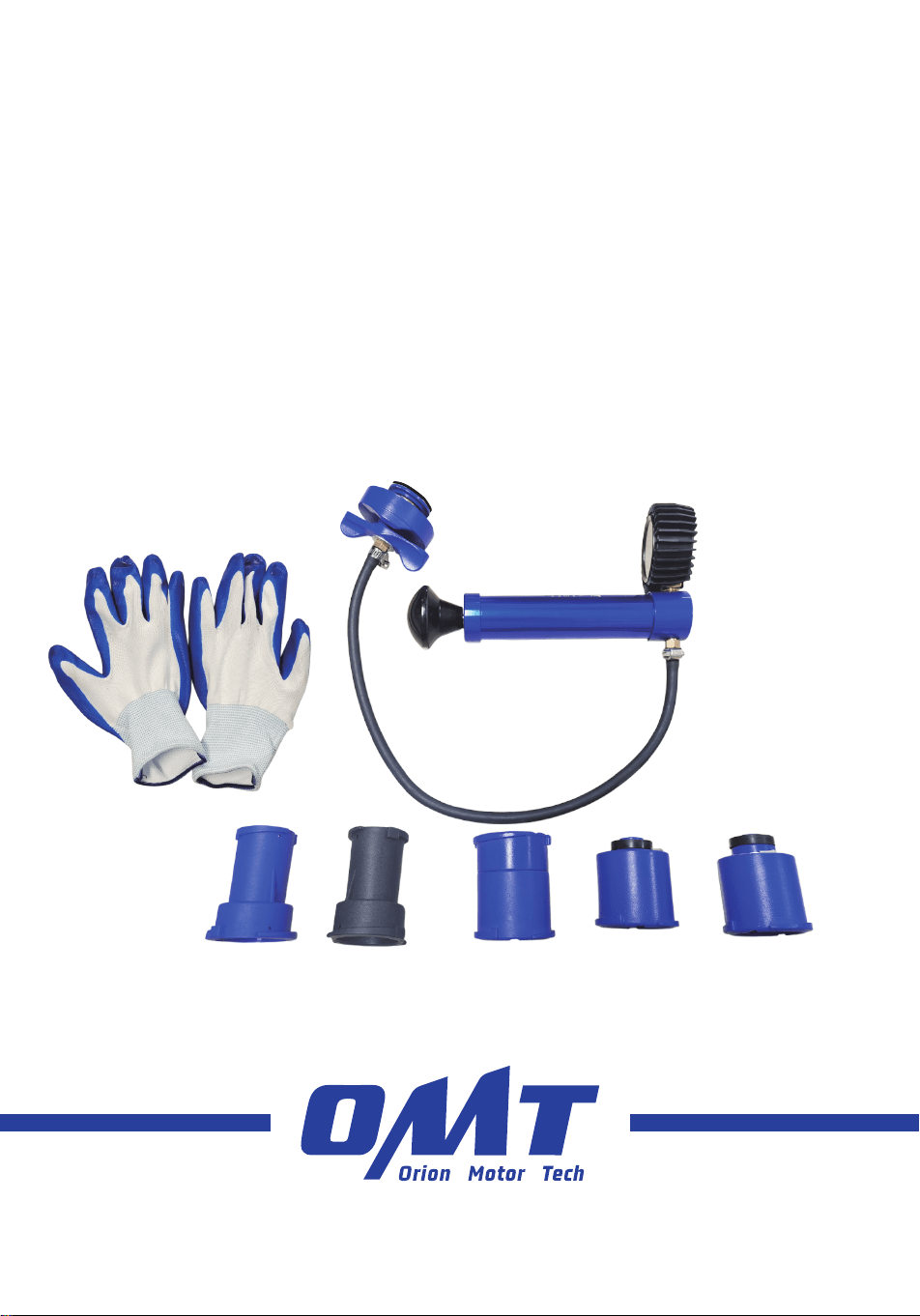
Cooling System
Pressure Tester Kit
User Manual


Contact Us
Thank you for choosing our products! If you have any questions or comments,
contact us and we'll address your issues ASAP!
https://orionmotortech.com/
@OrionMotorTech
Read this disclaimer completely and carefully before
proceeding with the rest of the manual content.
1. Product Modifications
Any modifications or alterations to Orion Motor Tech (OMT)
products void any warranties and may result in damage or
injury. OMT shall not be liable for any damages resulting
from such modifications or alterations.
2. Compliance with Laws
Customers shall be liable for ensuring that the use of
OMT products complies with all applicable laws and
regulations in their respective jurisdictions. OMT shall not
be responsible for any violations of laws or regulations
resulting from the use of OMT products.
3. Correct Use
Always use OMT products only as directed in the
accompanying manuals. Failure to follow instructions may
result in injury or damage.
Always ensure the assembly, installation, operation,
maintenance, or repair of OMT products is carried out by
a competent person.
Regular maintenance should be performed throughout
the lifecycle of OMT products. You are responsible for
ensuring the products operate as intended.
Always wear appropriate protective gear.
4. Third-Party Products
OMT shall not be liable for any damages or losses
resulting from the use of third-party products in
conjunction with OMT products. Customers shall refer to
the third-party's guidelines and/or warranties (if any) for
any third-party products used.
5. Limitation of Liability
OMT shall not be liable for any direct, indirect, punitive,
incidental, special, or consequential damages to property
or life, whatsoever arising out of or connected with the
use or misuse of OMT products. In no event shall OMT’s
liability exceed the value of the products sold.
6. Warranty
Refer to the sales page for warranty information.
This disclaimer states the entire obligation of OMT with
respect to OMT products. If any part of this disclaimer is
determined to be void, invalid, unenforceable, or illegal,
including but not limited to the warranty disclaimers, liability
disclaimers, and liability limitations set forth above, the invalid
or unenforceable provision will be deemed superseded by
a valid and enforceable provision that most closely matches
the intent of the original provision and the remainder of the
agreement shall remain in full force and effect.
Disclaimer
1
Safety Information
• The following instructions are for general guidance only. ALWAYS perform repairs in full compliance with your vehicle’s
service manual. After completing any repair, test your vehicle at a low speed in your workshop before resuming regular use.
Failure to do so may result in serious personal injury or property damage.
• DO NOT allow use by children, individuals with physical or mental conditions that could impair safe operation, or anyone
unfamiliar with this product and its compatible air conditioning, fuel, and transmission systems.
• ALWAYS use personal protective equipment (PPE) suitable for your task. While using this product, always wear ANSI-
approved eye and hand protection. Nonslip footwear is highly recommended. Other equipment, such as ear, head, and body
protection, may also be necessary depending on your work.
• ALWAYS read and understand your vehicle's specific safety warnings and instructions before using this kit. Use only the
correct fluids, pressures, adapters, and other necessary components for your vehicle. Ensure the parking brake is engaged
before beginning any work. Use a jack and jack stands rated to support the full weight of your vehicle. Never touch any
heated surface with exposed skin.
• DO NOT overreach. Keep proper footing and balance at all times.
• Keep this product in good working condition. Check for misalignment, binding, wear, or other damage before each use. If
any damage is found, repair or replace the affected components before further use. If this product is used in a commercial
or workshop setting, clearly label any damaged parts with "DO NOT USE" and ensure they are repaired or replaced before
being used again. ONLY use identical parts for any replacement.
• DO NOT use this product if you are tired or under the influence of drugs, alcohol, or strong medication.
• Keep the work area clean and well-lit. Cluttered or dark areas can increase the risk of accidents.
• For best results, keep the kit clean and dry. Remove any fluid, oil, or grease before and after use, particularly from the
handle and fittings.
• Dress appropriately for automotive servicing. Do not wear loose clothing or jewelry. Keep hair, clothing, gloves, hoses, and
tools away from moving parts during use.
• In case of an accident or injury, keep a first aid kit and a communication device (e.g., a phone) readily available. Be familiar
with the location of nearby emergency medical facilities.
• Automotive servicing involves inherent risks. This manual and your vehicle’s service manual cannot cover every possible
scenario. ALWAYS use sound judgment and caution. Seek proper training if you are unsure how to proceed.
Specifications
Manual Pump Range 0–30 psi (0–2.07 bar)
Case Dimensions (L × W × H) 14.17 × 11.22 × 3.35 in (36 × 28.5 × 8.5 cm)
Net Weight 4.43 lb (2.01 kg)
2
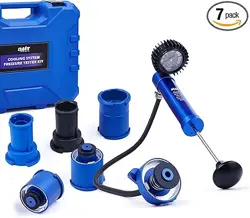
Parts List
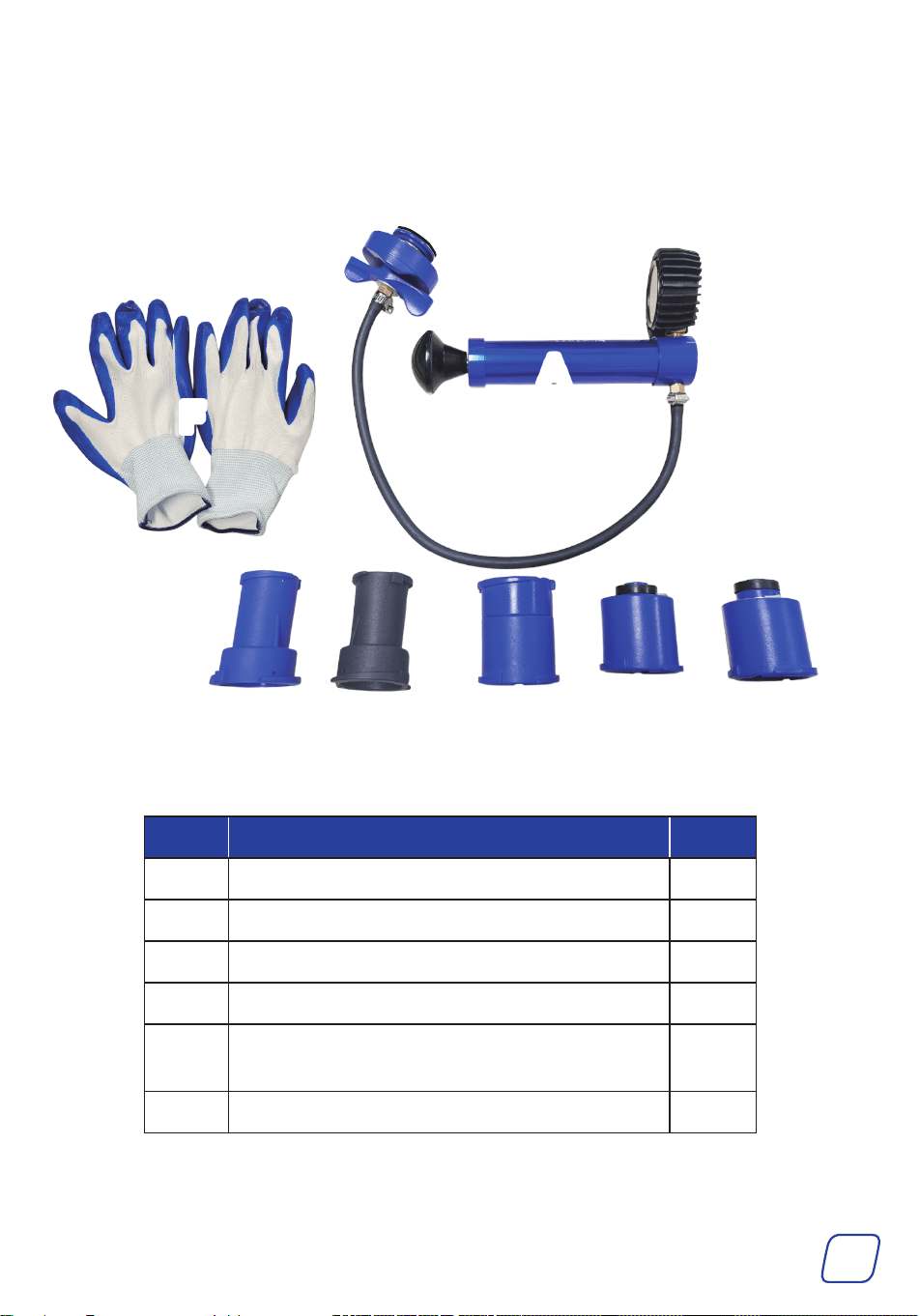
No. Item Qty.
A Manual Vacuum Pump 1
B Radiator Cap Adapter R125 (Blue) 1
C Radiator Cap Adapter R124 (Black) 1
D Radiator Cap Adapter 1
E
Radiator Adapters
(Depth: 0.37 in (9.5 mm) and 0.59 in (15 mm))
2
F Work Gloves 1 Pair
AA
FF
BB CC DD
EE
Depth: 0.37 in (9.5 mm) Depth: 0.59 in (15 mm)
3
Operation
• Shut off the engine before servicing. Ensure the vehicle is stationary and the engine has
cooled to room temperature before performing any maintenance or adjustments.
• DO NOT force the tool. Excessive force may result in serious personal injury or property
damage.
• Be extremely careful with possible pinching points, moving parts, or components that may
suddenly spring out during use.
• ENSURE your work area is stable, clean, and free of clutter or hazards that may cause
accidents.
• For your safety, proper training is strongly recommended before using the tool. Lack of
training can lead to serious injury.
• ALWAYS use the correct tools and personal protective equipment (PPE) before operation.
• The following steps are for reference only. The exact procedure may vary depending on the
vehicle model.
Note:
ALWAYS ensure the adapter and the quick connector are secured tightly to prevent leaks.
This tool kit is designed to detect leaks in pressurized cooling and radiator systems up to 30 psi (2.07
bar) on most American and imported vehicles. In this guide, this product will be demonstrated on a
radiator system.
Detecting Cap Leakage
1. Ensure the vehicle’s cooling system has cooled, then remove the radiator cap.
Note:
If you are unsure whether the cap is still hot, place a cold, wet towel over it or use protective
gloves to avoid burns.
2. Select the correct radiator cap adapter for your cap.
3. Attach the adapter to the cap. Turn the adapter until the tabs hold it firmly in place.
4. Set the quick connector to the open position by turning its valve clockwise, then secure the
connector to the cap adapter tightly.
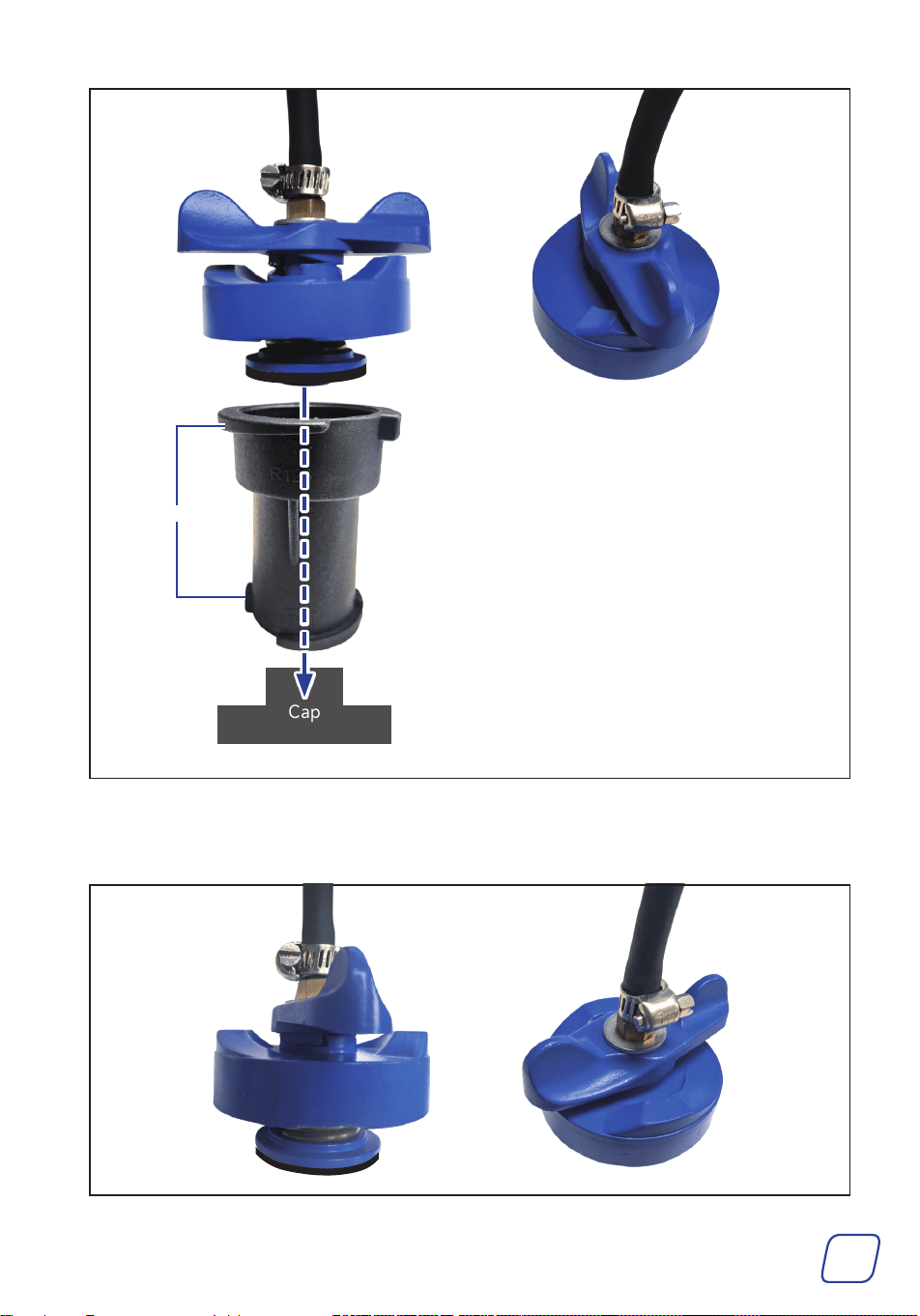
4
5. Rotate the valve until the connector reaches the closed position, either clockwise or
counterclockwise.
Open
Close
Cap
Tab
5
6. Check the rated pressure marked on the cap. If the marking is unreadable, refer to the vehicle
service manual.
7. Pump air into the cap until the gauge approaches the rated pressure.
8. Observe the gauge for 60–75 seconds:
• If the gauge holds steady near the rated pressure, the radiator cap is in good condition.
• If the gauge drops quickly after reaching the rated pressure, the cap is leaking and must
be repaired or replaced before further use.
9. Turn the quick connector to the open position. Remove the adapter and pump from the cap.
Detecting Coolant Leakage
1. Ensure the vehicle’s cooling system has cooled, then remove the radiator cap.
Note:
If you are unsure whether the cap is still hot, place a cold, wet towel over it or use protective
gloves to avoid burns.
2. Measure the coolant temperature using a probe thermometer (not included).
Note:
Wait until the coolant temperature drops below 100 ° F (38 ° C) before proceeding.
3. Select the correct radiator adapter and attach it to the radiator neck. Turn the adapter until
the tabs hold it firmly in place.
4. Set the quick connector clockwise to the open position by turning its valve clockwise, then
secure the adapter to the radiator adapter tightly.
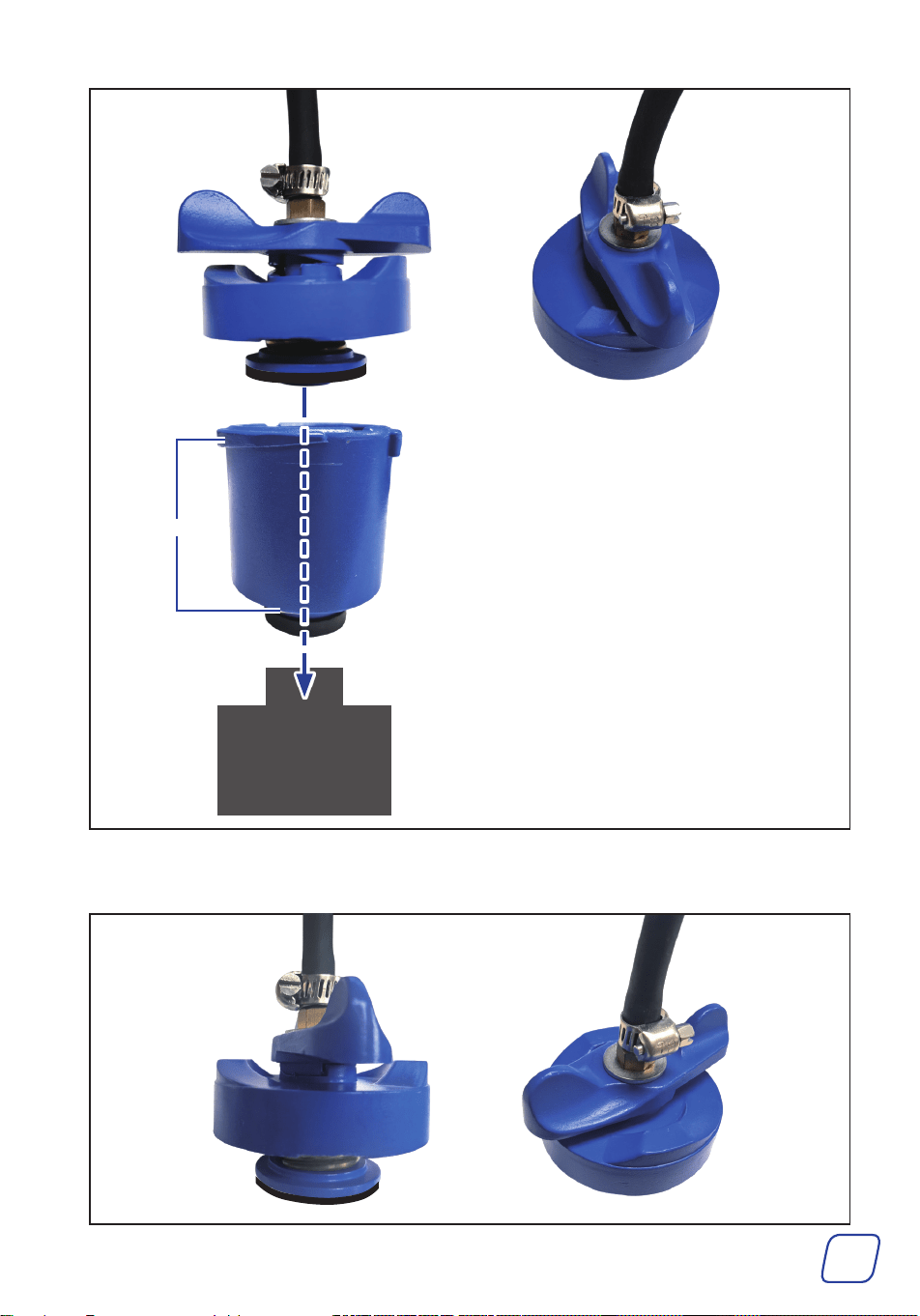
6
5. Rotate the valve until the connector reaches the closed position, either clockwise or
counterclockwise.
Open
Close
Radiator
Tab

7
6. Pump air into the radiator until the gauge reads 15–20 psi (or the pressure specified in the
vehicle manual).
DO NOT exceed the rated pressure to avoid damaging the radiator.
7. Observe the gauge for 3–5 minutes:
• If the gauge holds steady near the target pressure, the radiator system is in good
condition.
• If the gauge drops quickly after reaching the target pressure, the radiator is leaking and
must be repaired or replaced before further use.
8. Turn the quick connector to the open position. Remove the adapter and pump from the
radiator.
9. Reinstall the radiator cap.
Maintenance
• DO NOT scrape or abrade the hose, or drop the pump onto hard or rough surfaces.
• Clean the tools with a soft, damp cloth after use. DO NOT rinse them or use abrasive
cleaners or caustic chemicals.
• For best results, lubricate the tools with high-quality anti-corrosive oil between uses.
• Check the tools periodically for any wear or damage. Repair or replace any faulty parts before
further use.
• If the tools are not going to be used for a long time, clean and lubricate them before storage.
Keep them in a cool, dry place out of reach of children.

8
Troubleshooting
Problems Causes Resolutions
Poor sealing or air
leakage
There are leaks in the radiator
and water pipes.
Seek professional help to replace the
radiator or pipes.
The connection between
the adapter and the quick
connector on the pump hose
is poor.
Reconnect the adapter to the quick
connector on the pump hose.
Gauge pointer not
responding to applied
pressure
There are leaks in the radiator
and water pipes.
Seek professional help to replace the
radiator or pipes.
There is not much coolant
left in the radiator and pipes.
1. Check the coolant level in the
radiator and pipes. Add coolant if
necessary.
2. Ensure all adapters and quick
connectors are tightly sealed.
3. Pump the handle until the gauge
reaches 15 psi (1 bar). The pointer
should respond immediately.
4. Maintain the pressure for 2–3
minutes. If the pressure drops no
more than 1 psi (0.07 bar), the
cooling system has no significant
leakage.
5. If no leakage is detected, add the
appropriate amount of antifreeze
according to the vehicle manual,
bleed the system, and retest.
6. If leakage exists, seek professional
service to repair or replace the
radiator or pipes.
User Manual
Rev. 11 Sept. 2025