USER & INSTALLATION MANUAL
READ AND SAVE THESE INSTRUCTIONS.
FOR RESIDENTIAL USE ONLY.
PLEASE LEAVE THESE INSTRUCTIONS WITH THIS UNIT FOR
THE OWNER.
PLEASE RETAIN THESE INSTRUCTIONS FOR FUTURE
REFERENCE.
IMPORTANT:
INSTALLER:
OWNER:
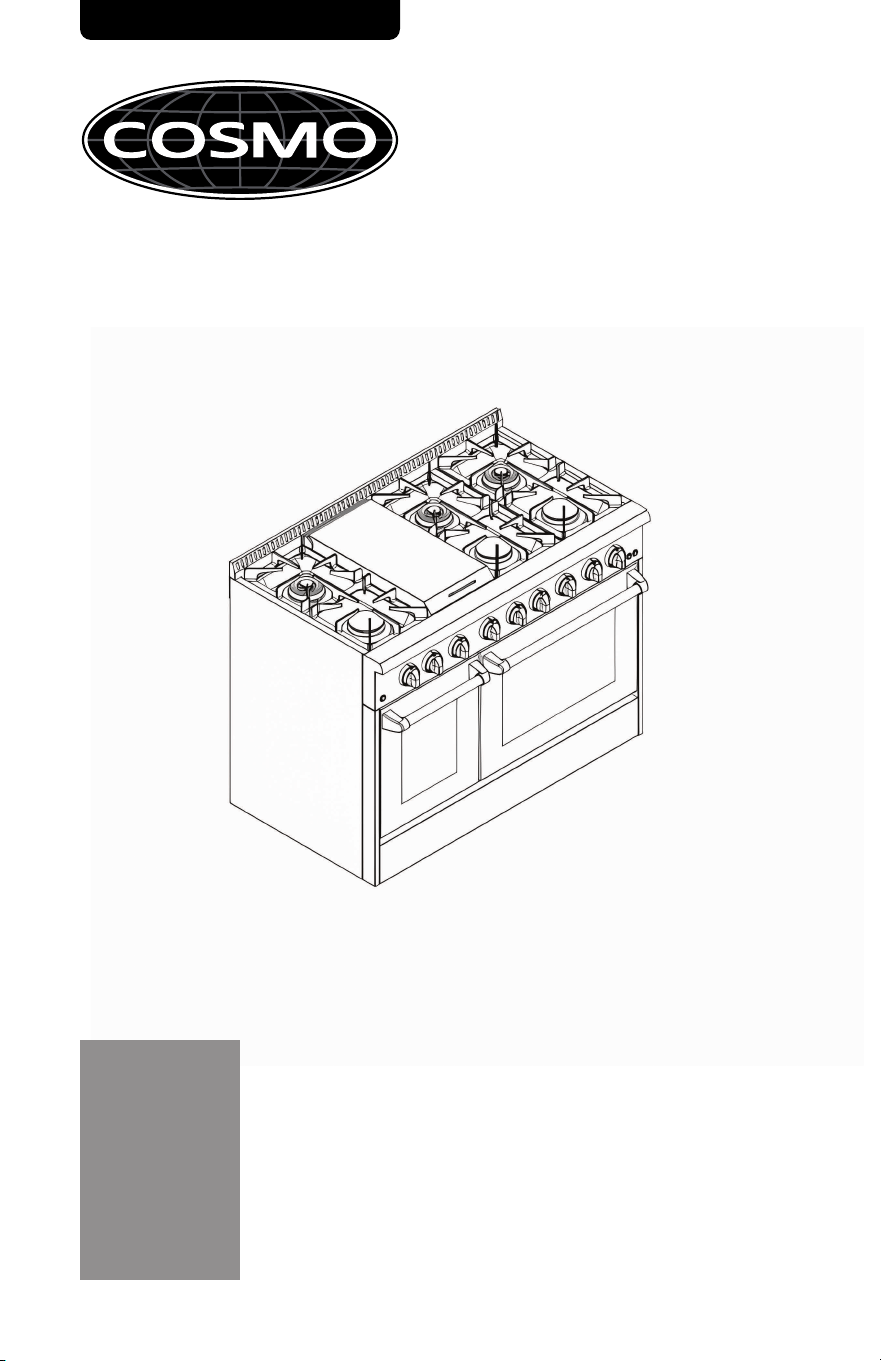
SLIDE-IN RANGE
DUAL FUEL RANGE
Rev.24.04
COS-DFRL486GK

2
THANK YOU FOR YOUR PURCHASE
Thank you for your purchase. We know that you have many brands and
products to choose from and we are honored to know that you have decided
to take one of our products into your home and hope that you enjoy it.
COSMO Appliances are designed according to the strictest safety and
performance standard for the North American market. We follow the most
advanced manufacturing philosophy. Each appliance leaves the factory after
thorough quality inspection and testing. Our distributors and our service
partners are ready to answer any questions you may have regarding how to
install, use and care for your products. We hope that this manual will help you
learn to use the product in the safest and most effective manner.
Before using this product, please read through this manual carefully. Keep
this user manual in a safe place for future reference. Please ensure that other
persons using this product are familiar with these instructions as well.
If you have any questions or concerns, please contact the dealer from whom you
purchased the product, or contact our Customer Support at:
1-888-784-3108
Reach us online at:
www.cosmoappliances.com

3
TABLE OF CONTENTS
RANGE SAFETY................................................................................................... 6
Anti-tip Device ......................................................................................................... 10
Important Safety Instructions ................................................................................ 11
OVERVIEW ......................................................................................................... 15
Range Layout ........................................................................................................... 15
INSTALLATION INSTRUCTIONS ....................................................................... 17
Positioning of Range ............................................................................................... 19
Dimensions and Clearance ................................................................................... 19
Top Hood and Cabinet Specifications ................................................................ 21
IMPORTANT NOTES TO THE INSTALLER ......................................................... 22
Important Note to the Consumer ........................................................................ 22
Important Safety Instructions to the Installer ................................................... 22
Model and Serial Number Location .................................................................... 23
ELECTRICAL INSTALLATION ............................................................................. 24
Power Supply Cord Kit ........................................................................................... 24
Access to Terminal Block ....................................................................................... 25
Electrical Connection ............................................................................................. 26
Electrical Power Supply Requirements ................................................................ 27
Electrical Grounding Instructions ......................................................................... 29
GAS SUPPLY REQUIREMENT ............................................................................ 30
Connect Range to Gas Supply ............................................................................. 31
After Installation ..................................................................................................... 31
FIRST USE .......................................................................................................... 32
Before You Start ...................................................................................................... 32
Conditioning the Oven .......................................................................................... 32
Positioning the Shelves .......................................................................................... 33
COOKTOP SAFETY GUIDELINES ....................................................................... 35
Surface Burner Ignition .......................................................................................... 36
Simmer and Boil ...................................................................................................... 36
Flame Size ................................................................................................................. 37

4
Power Failure ........................................................................................................... 37
Cooktop .................................................................................................................... 37
Burner Grates .......................................................................................................... 38
Oven Burner Use ..................................................................................................... 38
Broil Burner Use ...................................................................................................... 39
Oven Cooking Safety Guidelines ........................................................................ 40
OVEN FUNCTION .............................................................................................. 41
Natural Airflow Bake ............................................................................................. 41
Convection Bake .................................................................................................... 41
Convection Roast ................................................................................................... 42
Convection Defrost ................................................................................................ 42
Defrosting ................................................................................................................ 42
Convection Dehydration ....................................................................................... 42
BROILER OPERATION ....................................................................................... 43
Preheating ............................................................................................................... 43
To Broil ..................................................................................................................... 43
Setting Broil ............................................................................................................. 43
Broiling Guidelines ................................................................................................. 44
GRIDDLE OPERATION ...................................................................................... 45
Before Using the Griddle ...................................................................................... 45
Use of the Griddle .................................................................................................. 45
CLEANING INSTRUCTIONS .............................................................................. 46
Do's and Don'ts ........................................................................................................ 46
Cleaning Burner Caps and Brass Flame Spreaders ......................................... 46
Cleaning the Control Panel, Door Handle, Control Housing ......................... 47
Cleaning Side Racks .............................................................................................. 47
Cleaning Oven Shelves ......................................................................................... 47
Cleaning Broiling Pan and Grid ........................................................................... 47
Cleaning Bake and Broil Burners ......................................................................... 47
Cleaning Porcelain Surfaces ................................................................................ 47
Cleaning Oven Window ........................................................................................ 47
Cleaning Oven Door Gasket ................................................................................ 48
Cleaning Stainless Steel Surfaces ........................................................................ 48

5
REPLACING BURNER PARTS ............................................................................. 49
REMOVING AND REPLACING OVEN DOOR .................................................... 50
Removing Oven Door ............................................................................................ 50
Replacing Oven Door ............................................................................................ 51
Replacing Oven Light Bulb .................................................................................. 52
DUAL BURNER CLICKING PROBLEM ................................................................ 53
Step 1 ........................................................................................................................ 53
Step 2 ....................................................................................................................... 53
Step 3 ....................................................................................................................... 54
Step 4 ....................................................................................................................... 54
INSTALLING KNOBS AND HANDLE ................................................................ 55
TROUBLESHOOTING ....................................................................................... 59
Cooktop Problems .................................................................................................. 59
Oven Problems ....................................................................................................... 61
Baking Problems ..................................................................................................... 62
RUBBER PAD INSTALLATION ........................................................................... 64
LIMITED WARRANTY ....................................................................................... 65
RANGE SAFETY
READ ALL INSTRUCTIONS BEFORE USING THE APPLIANCE
Your safety and the safety of others are very important.
We have provided many important safety messages in this manual and on
your appliance. Always read and obey all safety messages.
This is the safety alert symbol.
This symbol alerts you to potential hazards
that can kill or hurt you and others.
All safety messages will follow the safety alert
symbol and either the word "WARNING" or
"CAUTION." These words mean:
You can be killed or seriously injured if you
don't follow instructions.
A potentially hazardous situation which, if not
avoided, could result in minor or moderate
injury.
WARNING
CAUTION
All safety messages will tell you what the potential hazard is, tell you how
to reduce the chance of injury, and tell you what can happen if the
instructions are not followed.
In the State of Massachusetts, the following installation instructions apply:
• Installations and repairs must be performed by a qualified or licensed
contractor, plumber, or gasfitter qualified or licensed by the State of
Massachusetts.
• If using a ball valve, it shall be a T-handle type.
• A flexible gas connector, when used, must not exceed 3 feet (91.5 cm).
6
7
WARNING
Electrical Shock Hazard
• Before removing a faulty oven light bulb, make sure you turn OFF the
power to the range at the main fuse or circuit breaker panel. If you
don't know how to do this , contact an electrician.
• Do not remove the kick strip grate due to electrical wires behind it.
The kick strap grate should only be removed by a qualified technician.
• This appliance is equipped with a three-prong grounding plug for
your protection against shock hazard and should be plugged directly
into a properly grounded power outlet. Do not under any
circumstances cut or remove the grounding prong from this plug.
Proper Installation - The range, when installed, must be electrically
grounded in accordance with local codes or, in the absence of local
codes, with the National Electrical Code ANSI/NFPA 70. In Canada, the
range must be electrically grounded in accordance with Canadian
Electrical Code. Be sure the range is properly installed and grounded by
a qualified technician.
Failure to follow this advice may result in death or electrical shock.
California Proposition 65 Warning
WARNING:
Cancer and Reproductive Harm - www.P65Warnings.ca.gov.
8
WARNING
FIRE AND EXPLOSION HAZARD
If the information in this manual is not followed exactly, a fire or explosion
may result causing property damage, personal injury or death.
WARNING
Never Operate the Top Surface Cooking Section of this Appliance
Unattended.
DO NOT ATTEMPT TO EXTINGUISH AN OIL/GREASE FIRE WITH WATER.
• Do not store or use gasoline or other flammable vapors and liquids in
the vicinity of this or any other appliance.
• WHAT TO DO IF YOU SMELL GAS
- Do not try to light any appliance.
- Do not touch any electrical switch.
- Do not use any phone in your building.
- Clear the room, building, or area of all occupants.
- Immediately call your gas supplier from a neighbor's phone. Follow
the gas supplier's instructions.
- If you cannot reach your gas supplier, call the fire department.
• Installation and service must be performed by a qualified installer,
service agency or the gas supplier.
• Failure to follow this warning statement could result in fire, explosion, or
burn hazard that could cause property damage, personal injury, or
death.
• If a fire should occur, keep away from the appliance and immediately
call your fire department.
9
WARNING
• Gas leaks cannot always be detected by smell. Gas suppliers
recommend that you use a gas detector approved by UL or CSA. For
more information, contact your gas supplier.
• Do not install a ventilation system that blows air downward toward this
cooking appliance. This type of ventilation system may cause ignition
and combustion problems with this cooking appliance resulting in
personal injury or unintended operation.
• This appliance is intended for normal residential use. It is not approved
for commercial use, outdoor installation, or any other application not
specifically allowed by this manual.
• Proper installation is the responsibility of the installer. Any adjustment
and service should be performed only by qualified range installers or
service technicians. The manufacturer is not responsible for any injury or
damage that may result from incorrect or defective installation by
unauthorized personnel.
• Product failure due to improper installation is not covered under
warranty.
• According to the United States Department of Agriculture: DO NOT
hold foods at temperatures between 40°F to 140°F more than 2 hours.
Cooking raw foods below 275°F is not recommended.
10
ANTI-TIP DEVICE
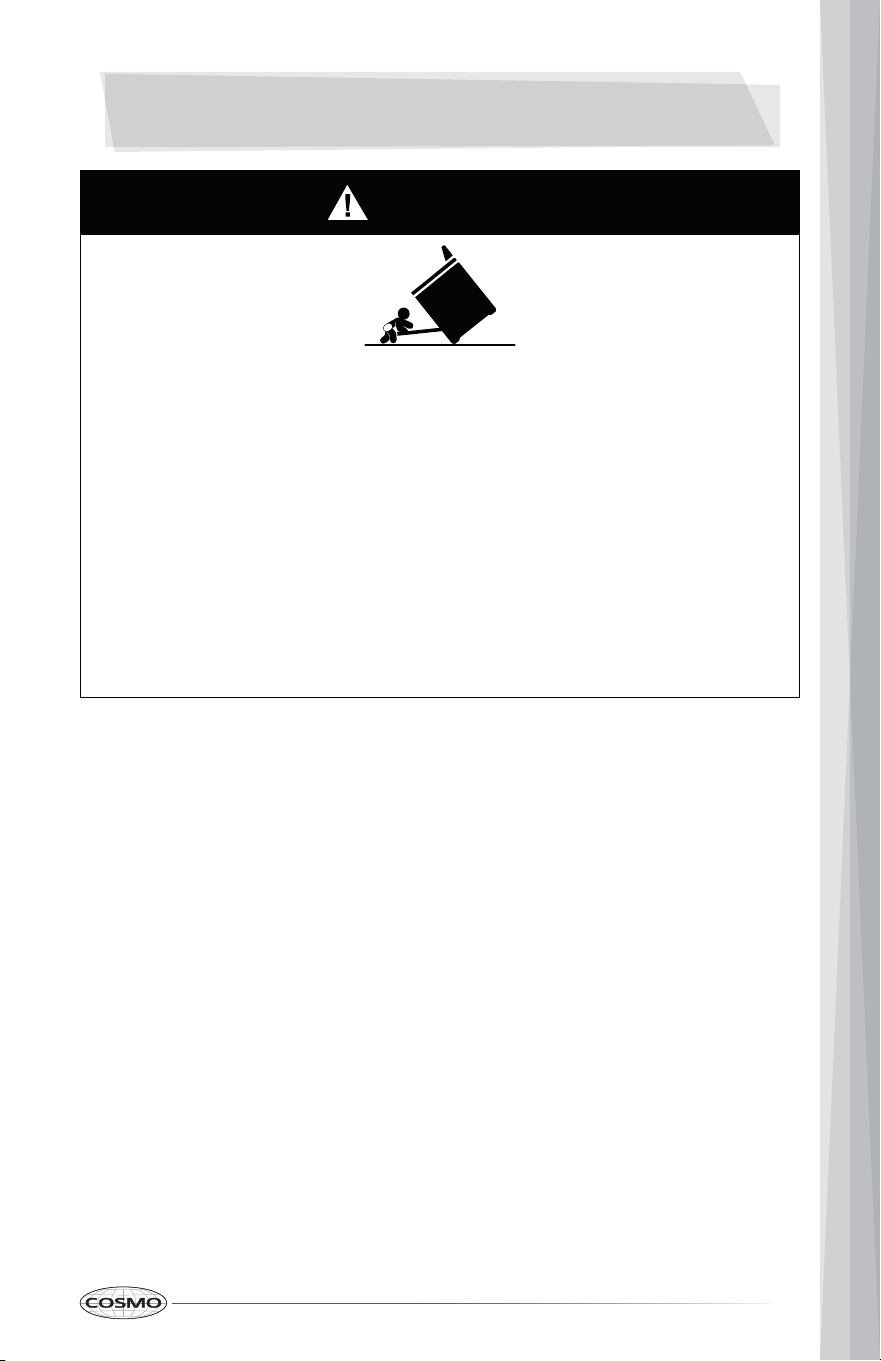
WARNING
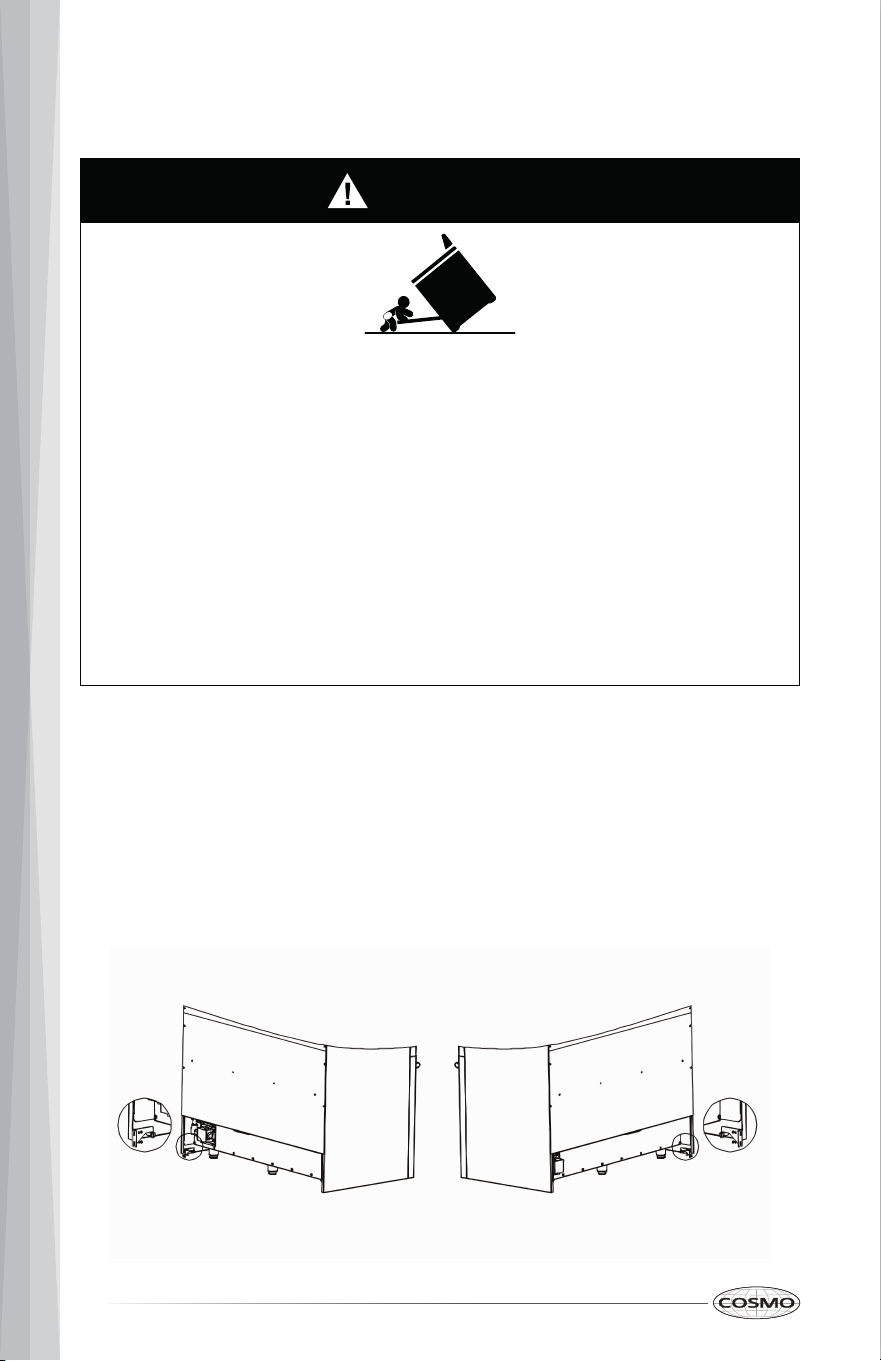
TIP OVER HAZARD
• A child or adult can tip the range and be killed.
• Install anti-tip bracket to floor or wall per installation instructions.
• Slide range back so rear range foot is engaged in the slot of the floor-
mounting anti-tip bracket or rear range pin is engaged under the wall-
mounting anti-tip bracket.
• Re-engage the anti-tip bracket if range is moved.
• Do not operate the range without anti-tip bracket installed and
engaged.
• Failure to follow these instructions can result in death or serious burns to
children and adults.
Making sure the anti-tip bracket is installed:
• Slide range forward.
• Look for the anti-tip bracket securely attached to floor or wall.
• Slide range back and make sure rear range foot is under floor-mounting
anti-tip bracket or rear range pin is under the wall-mounting anti-tip
bracket.
11
IMPORTANT SAFETY
INSTRUCTIONS
WARNING: To reduce the risk of fire, electrical shock, injury to persons, or
damage when using the range, follow basic precautions, including the
following:
• WARNING: TO REDUCE THE
RISK OF TIPPING OF THE RANGE,
THE RANGE MUST BE SECURED
BY PROPERLY INSTALLED ANTI-
TIP DEVICES. TO CHECK IF THE
DEVICES ARE INSTALLED
PROPERLY, SLIDE RANGE
COMPLETELY FORWARD, LOOK
FOR ANTI-TIP BRACKET
SECURELY ATTACHED TO THE
FLOOR OR WALL, AND SLIDE
RANGE BACK SO THE REAR
RANGE FOOT IS UNDER ANTI-
TIP BRACKET.
• WARNING: NEVER use this
appliance as a space heater to
heat or warm the room. Doing
so may result in carbon
monoxide poisoning and
overheating of the oven.
• WARNING: NEVER cover any
slots, holes or passages in the
oven bottom or cover an entire
rack with materials such as
aluminum foil. Doing so blocks
airflow through the oven and
may cause carbon monoxide
poisoning. Aluminum foil linings
may also trap heat, causing a
fire hazard.
• CAUTION: Do not store items of
interest to children in cabinets
above a range or on the back
guard of a range – children
climbing on the range to reach
items could be seriously injured.
• Do Not Leave Children Alone –
Children should not be left alone
or unattended in area where
range is in use. They should
never be allowed to sit or stand
on any part of the range.
• Wear Proper Apparel – Loose-
fitting or hanging garments
should never be worn while
using the range.
• User Servicing – Do not repair or
replace any part of the range
unless specifically recommended
in the manual. All other servicing
should be referred to a qualified
technician.
• Storage in or on Range –
Flammable materials should not
be stored in an oven or near
surface units.
• This appliance is not intended
for storage.
READ AND SAVE THESE INSTRUCTIONS
12
IMPORTANT SAFETY
INSTRUCTIONS
• Do Not Use Water on Grease
Fires – Smother fire or flame or
use dry chemical or foam-type
extinguisher.
• Use Only Dry Potholders – Moist
or damp potholders on hot
surfaces may result in burns
from steam. Do not let potholder
touch hot heating elements. Do
not use a towel or other bulky
cloth.
• Never Leave Surface Units
Unattended at High Heat
Settings – Boilover causes
smoking and greasy spillovers
that may ignite.
• Glazed Cooking Utensils – Only
certain types of glass,
glass/ceramic, ceramic,
earthenware, or other glazed
utensils are suitable for range-
top service without breaking due
to the sudden change in
temperature.
• Utensil Handles Should Be
Turned Inward and Not Extend
Over Adjacent Surface Units – To
reduce the risk of burns, ignition
of flammable materials, and
spillage due to unintentional
contact with the utensil, the
handle of a utensil should be
positioned so that it is turned
inward, and does not extend
over adjacent surface units.
• Disconnect power before
servicing.
• Proper Installation – The
appliance, when installed, must
be electrically grounded in
accordance with local codes, or
in the absence of local codes,
with the National Electrical
Code, ANSI/NFPA 70 or the
Canadian Electrical Code, CSA
C22.1-02. In Canada, the
appliance must be electrically
grounded in accordance with
Canadian Electrical Code. Be
sure your appliance is properly
installed and grounded by a
qualified technician.
• Injuries may result from misuse
of appliance doors or drawers
such as stepping, leaning, or
sitting on the doors or drawers.
• Maintenance – Keep range area
clear and free from combustible
materials, gasoline, and other
flammable vapors and liquids.
• Do not let cooking grease or
other flammable materials
accumulate in or near the range.
Grease in the oven or on the
cooktop may ignite.
• Top burner flame size should be
adjusted so it does not extend
beyond the edge of the cooking
utensil. This instruction is based
on safety considerations.
READ AND SAVE THESE INSTRUCTIONS
13
IMPORTANT SAFETY
INSTRUCTIONS
• Do not use replacement parts
that have not been
recommended by the
manufacturer (e.g. parts made
at home using a 3D printer).
• Clean Cooktop With Caution – If
a wet sponge or cloth is used to
wipe spills on a hot cooking
area, be careful to avoid steam
burn. Some cleaners can
produce noxious fumes if
applied to a hot surface.
• Use Care When Opening Door –
Let hot air or steam escape
before removing or replacing
food.
• Do Not Heat Unopened Food
Containers – Build-up of
pressure may cause container to
burst and result in injury.
• Keep Oven Vent Ducts
Unobstructed.
• Never broil with door open.
Open-door broiling is not
permitted due to overheating of
control knobs.
• Placement of Oven Racks –
Always place oven racks in
desired location while oven is
cool. If rack must be moved
while oven is hot, do not let
potholder contact hot heating
element in oven.
• Care must be taken to prevent
aluminum foil and meat probes
from contacting heating
elements.
• DO NOT TOUCH HEATING
ELEMENTS OR INTERIOR
SURFACES OF OVEN – Heating
elements may be hot even
though they are dark in color.
Interior surfaces of an oven
become hot enough to cause
burns. During and after use, do
not touch, or let clothing or other
flammable materials contact
heating elements or interior
surfaces of oven until they have
had sufficient time to cool. Other
surfaces of the appliance may
become hot enough to cause
burns – among these surfaces
are cooktop, burners, grates,
oven vent openings and surfaces
near these openings, oven
doors, windows of oven doors,
and crevices around the oven
doors.
• Top burner flame size should be
adjusted so it does not extend
beyond the edge of the cooking
utensil.
• Have the installer show you the
location of the range gas shut-
off valve and how to turn it off if
necessary.
READ AND SAVE THESE INSTRUCTIONS
14
IMPORTANT SAFETY
INSTRUCTIONS
• Proper Disposal of Your
Appliance – Dispose of or recycle
your appliance in accordance
with Federal and Local
Regulations. Contact your local
authorities for the
environmentally safe disposal or
recycling of your appliance.
• Do Not Clean Door Gasket – The
door gasket is essential for a
good seal. Care should be taken
not to rub, damage, or move the
gasket.
• Do Not Use Oven Cleaners – No
commercial oven cleaner or
oven liner protective coating of
any kind should be used in or
around any part of the oven.
• Clean Only Parts Listed in
Manual.
For units with ventilating hood –
• Clean Ventilating Hoods
Frequently – Grease should not
be allowed to accumulate on
hood or filter.
• When flambé cooking under the
vent hood, turn the fan on.
For self-cleaning ranges –
• Before Self-Cleaning the Oven –
Remove broiler pan and other
utensils. Wipe off all excessive
spillage before initiating the
cleaning cycle.
• Wait for the oven to cool before
removing contents and cleaning
the oven.
• In the event of ignition inside the
oven during self-clean, turn off
the oven and wait for the fire to
extinguish. DO NOT FORCE THE
DOOR OPEN.
• If the self-cleaning mode
malfunctions, keep door closed,
turn off the appliance,
disconnect the circuit at the
circuit breaker box, and contact
a qualified service provider for
repairs.
• Some birds are extremely
sensitive to the fumes produced
during a self-clean cycle. Move
birds to another well-ventilated
room.
READ AND SAVE THESE INSTRUCTIONS
15
OVERVIEW
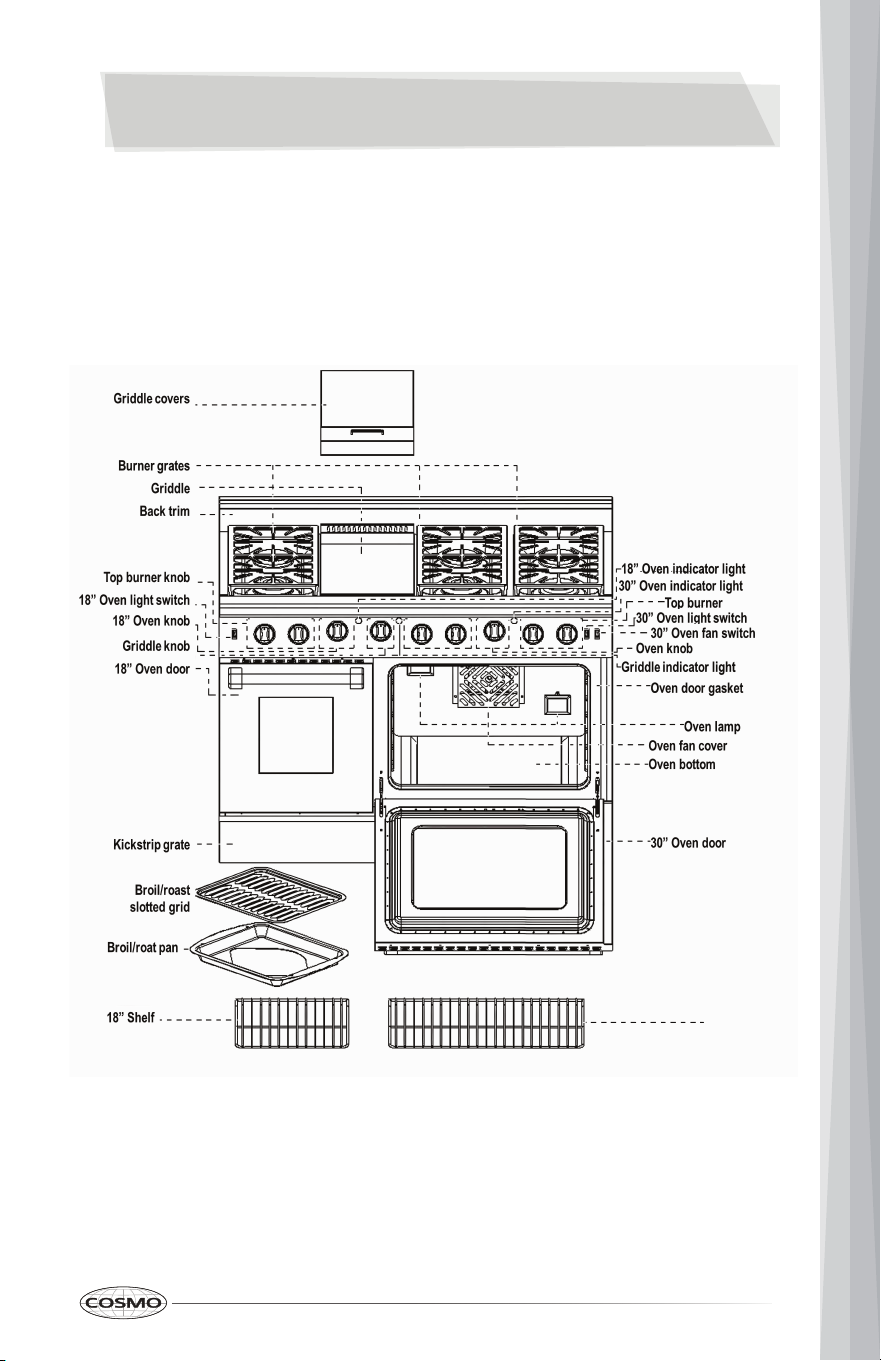
RANGE LAYOUT
The range you have purchased may have some or all of the items listed. The
locations and appearances of the features shown here may not match those
of your model.
16
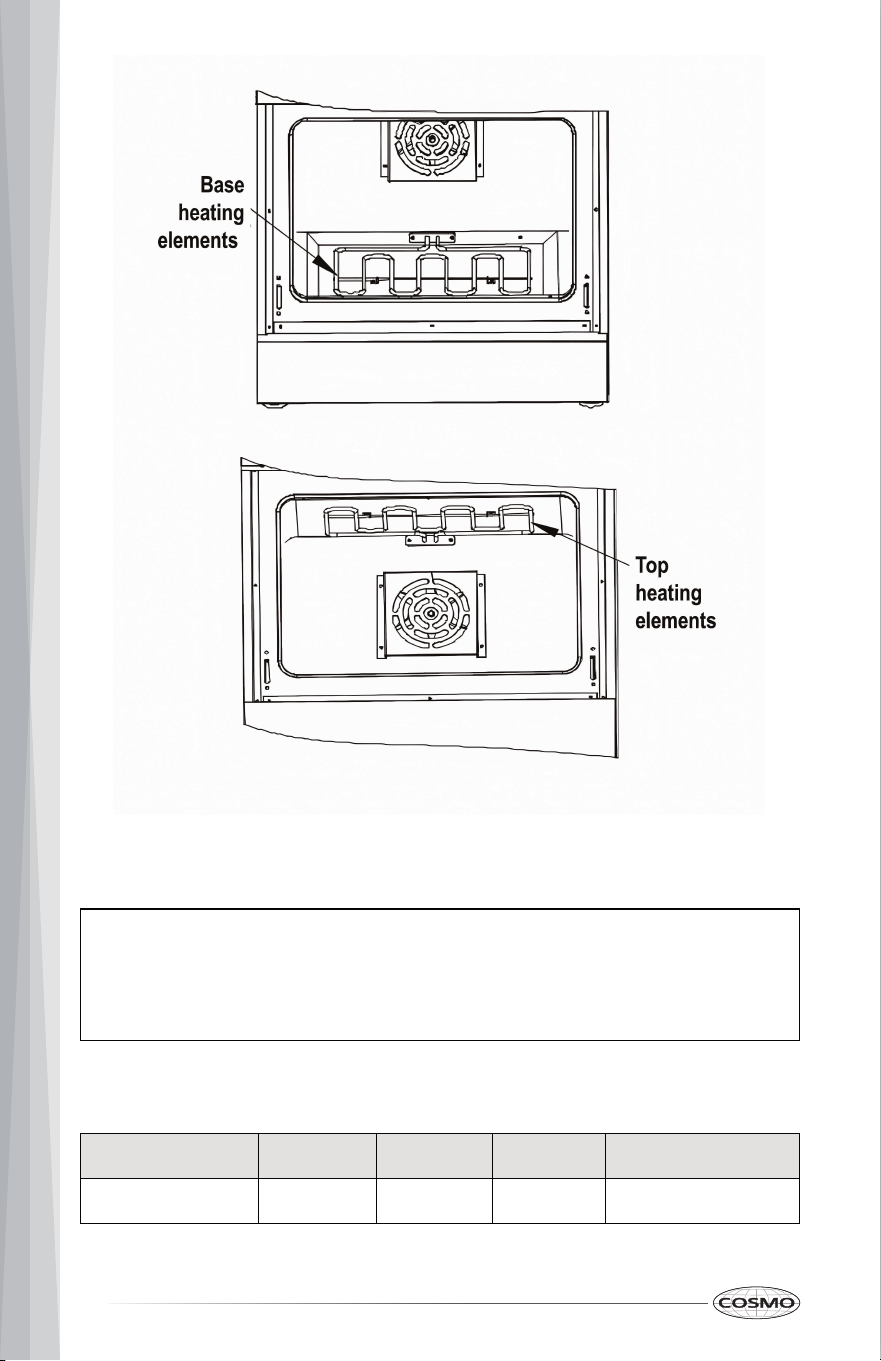
• Top Heating Element: 3500W
• Base Heating Element: 2500W
NOTE:
• To purchase replacement parts or any other accessories, please visit
www.cosmoappliances.com or reference the contact information at the
end of this manual.
COOKTOP EQUIPMENT
COS-DFRL486GK
Model 2000 BTU 5000 BTU 8000 BTU Griddle 5000 BTU
2 2 2
1
17
INSTALLATION INSTRUCTIONS
WARNING
TIP OVER HAZARD
• A child or adult can tip the range and be killed.
• Install anti-tip bracket to floor or wall per installation instructions.
• Slide range back so rear range foot is engaged in the slot of the floor-
mounting anti-tip bracket or rear range pin is engaged under the wall-
mounting anti-tip bracket.
• Re-engage the anti-tip bracket if range is moved.
• Do not operate the range without anti-tip bracket installed and
engaged.
• Failure to follow these instructions can result in death or serious burns to
children and adults.
• To eliminate the risk of burns or fire by reaching over heated surface
units, cabinet storage space located above the surface units should be
avoided. If cabinet storage is to be provided, the risk can be reduced by
installing a range hood or microwave hood combination that projects
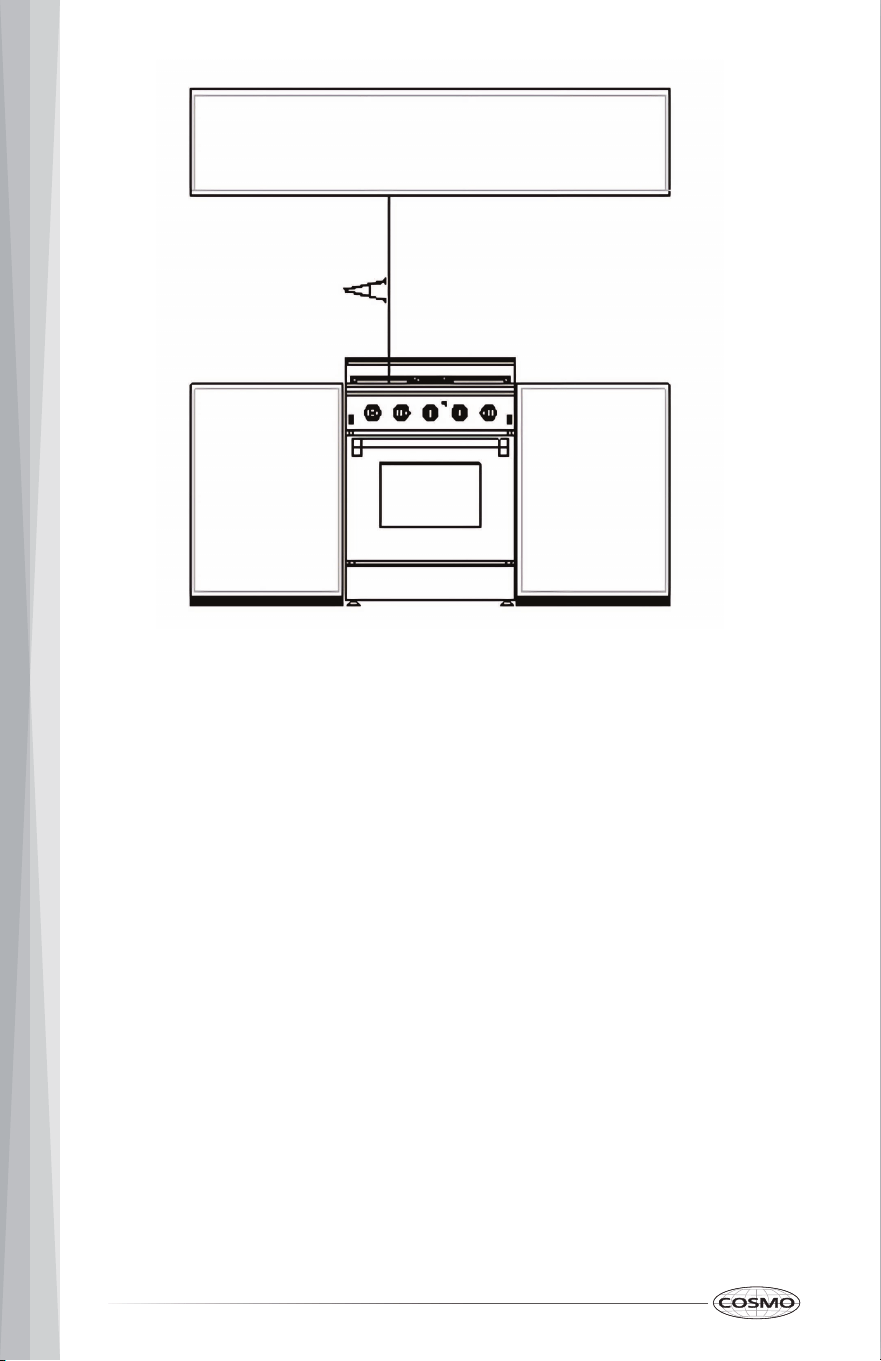
horizontally a minimum of 5" (12.7 cm) beyond the bottom of the cabinets.
18
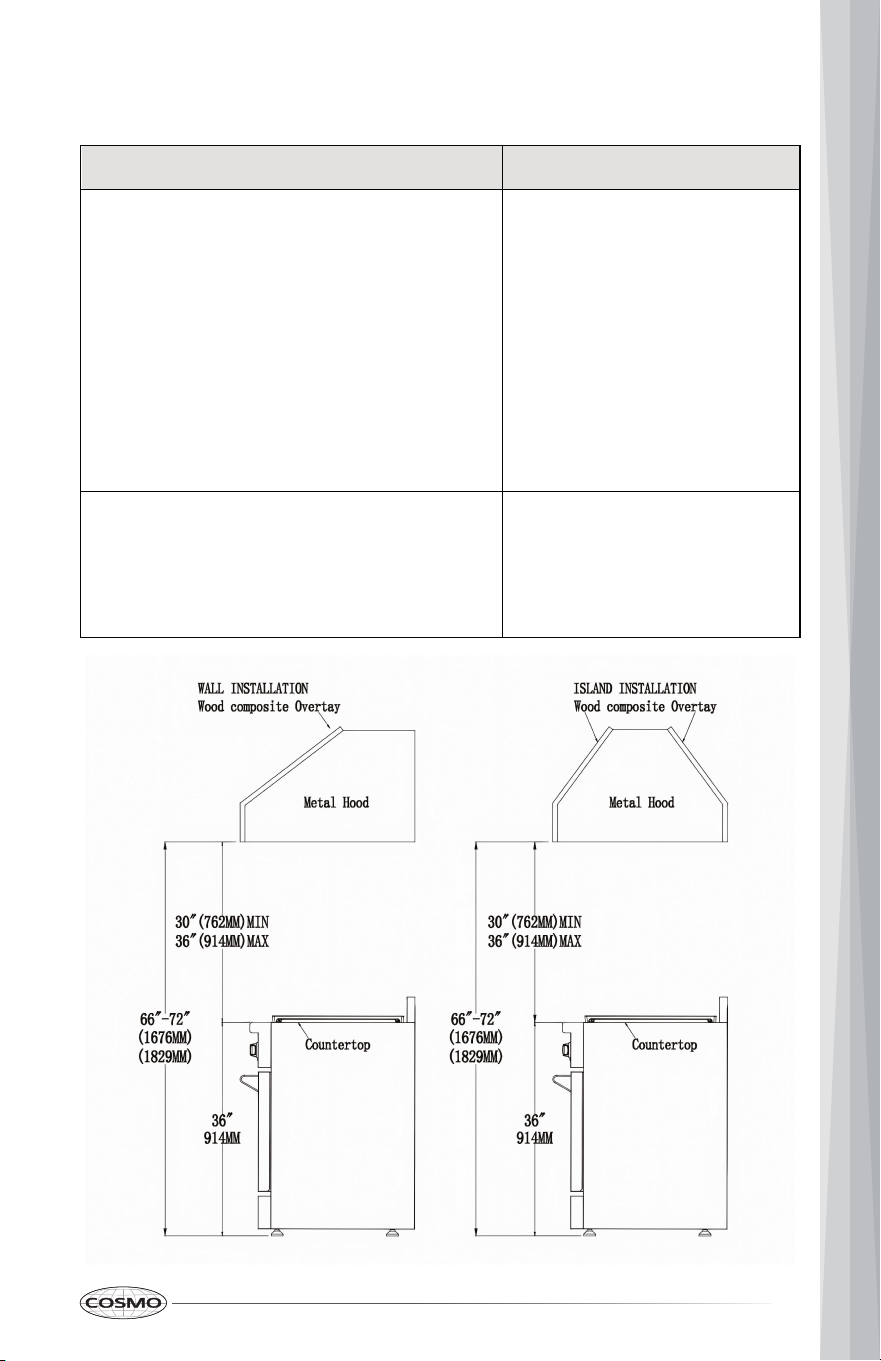
A= 30 inches minimum clearance between the top of the cooking surface and
the bottom of an unprotected wood or metal cabinet
A= 24 inches minimum when bottom of wood or metal cabinet is protected by
not less than 1/4-inch-thick flame-retardant millboard covered with not less
than No. 28 MSG sheet steel, 0.015-inch-thick stainless steel, 0.024-inch-thick
aluminum, or 0.020-inch-thick copper.
19
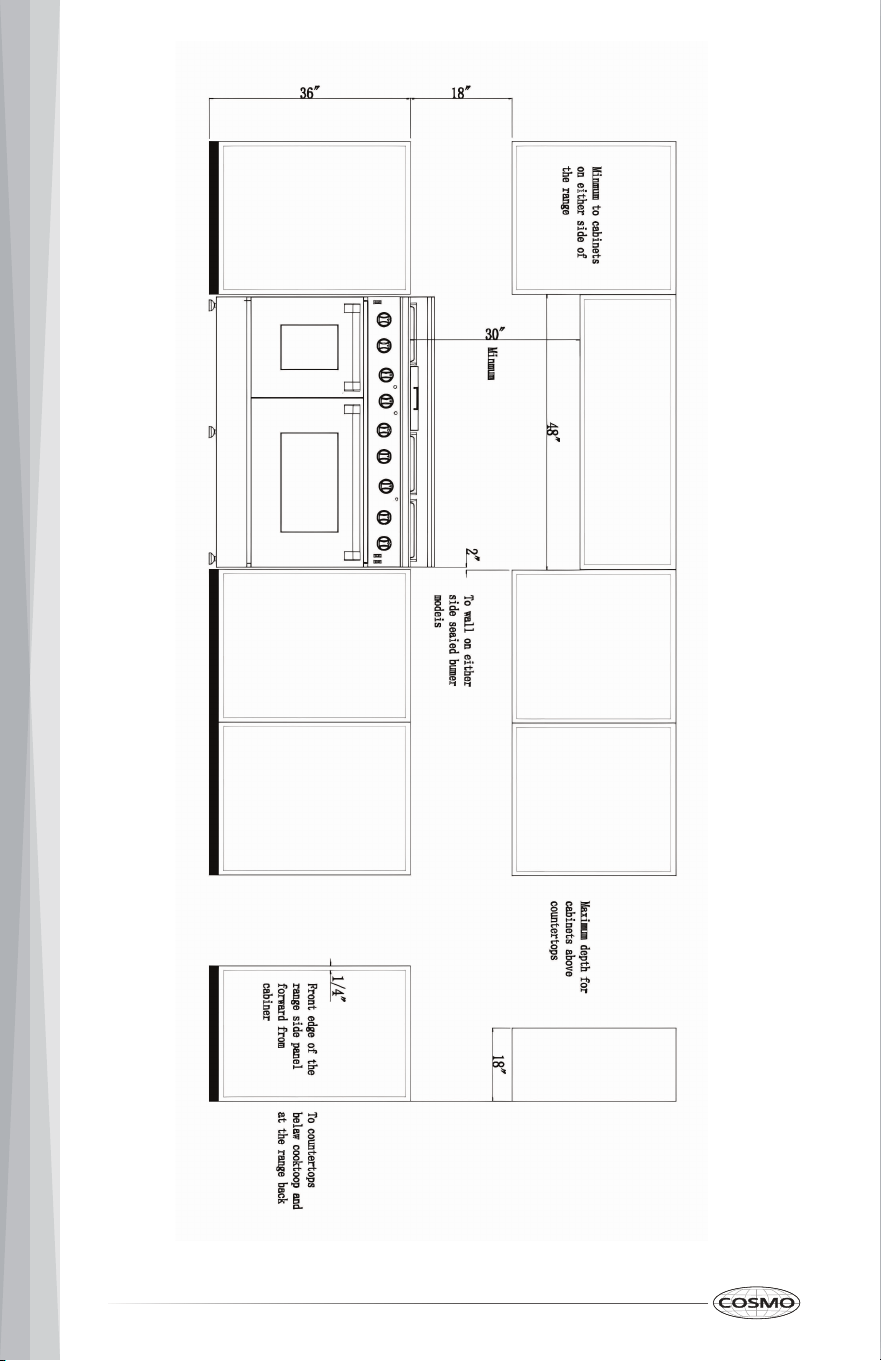
• You may install a non-combustible material, such as tile, on the rear wall
above the range and up the vent hood.
• It is not necessary to install non-combustible materials behind the range
below the counter top height.
• DO NOT INSTALL CLOSER THAN 12 MM FROM ANY ADJACENT SURFACE.
• The minimum distance from the side of the range above the counter top to
combustible sidewalls must beat least 18 inches.
• The maximum depth of cabinets installed above cooktops be 13 in (330mm).
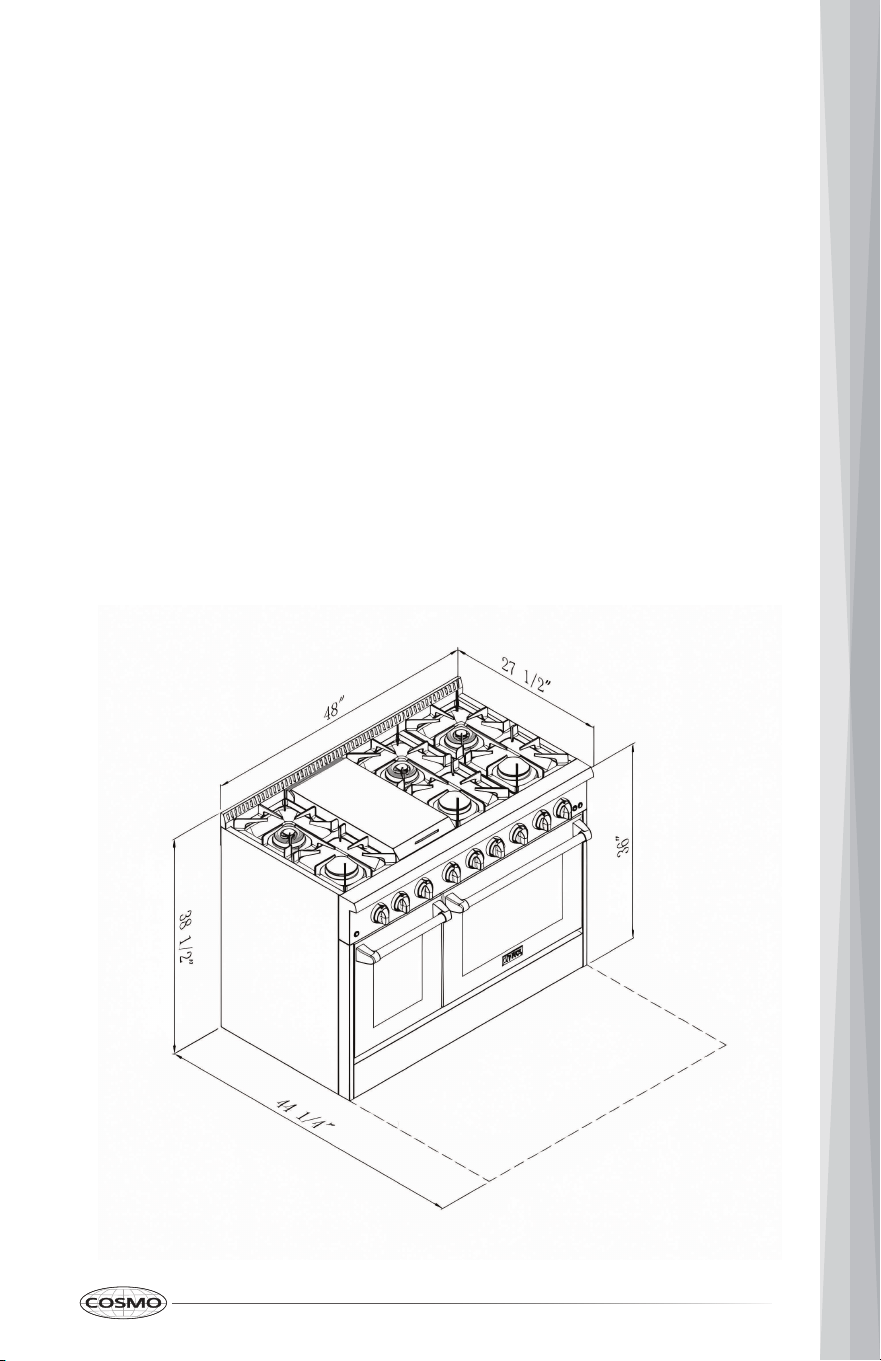
The depth of the range is 27 1/2" (69.8 cm) overall.
The range may be installed flush to the rear wall.
POSITIONING OF RANGE
DIMENSIONS AND CLEARANCE
20
21
TOP HOOD AND CABINET SPECIFICATIONS
Condition
24"
Clearance between the top of the cooking
surface and the bottom wood or metal
cabinet that is protected by not less than:
Minimum Clearance Allowed
1/4-inch-thick flame-retardant millboard
covered with not less than:
• No. 28 MSG sheet steel or
• 0.015-inch-thick stainless steel or
• 0.024-inch-thick aluminum or
• 0.020-inch-thick copper
Dual fuel range minimum clearance
between the top of the cooking surface
and the bottom of an unprotected wood
or metal cabinet.
36"

22
IMPORTANT NOTES TO THE INSTALLER
1. Read all instructions contained in these installations before installing range.
2. Remove all packing material from the oven compartments before
connecting the electrical supply to the range.
3. Anti-tip brackets MUST be installed.
4. Observe all governing codes and ordinances.
5. Be sure to leave these isntructions with the consumer.
IMPORTANT NOTE TO CONSUMER
Keep these instructions with your owner's guide for future reference.
IMPORTANT SAFETY INSTRUCTIONS TO INSTALLER
Keep these instructions with your owner's guide for future reference.
1. Installation of this range must conform with local codes or, in the absence of
local codes, with the National Fuel Gas Code ANSI Z223.1-latest edition.
2. This range has been designed certified by the American Gas Association. As
with any appliance using gas and generating heat, there are certain safety
precautions you should follow. You will find them in the Use and Care
Guide, read it carefully.
3. Air curtain or other overhead hoods, which operate by blowing a
downward air flow onto a range, shall not be used in conjunction with gas
ranges other than when the hood and range have designed, tested and
listed by an independent test laboratory for use in combination with each
other.
4. Be sure your range is installed and grounded properly by a qualified
installer or service technician.
5. This range must be electrically grounded in accordance with local codes or,
in their absence, with the National Electrical Code ANSI/NFPA No. 70-latest
edition.
6. The installation of appliances designed for manufactured (mobile) home
installation must conform with Manufactured Home Construction and
Safety Standard, title 24CFR, part3280 [Formerly the Federal Standard for
Mobile Home Construction and Safety, title 24, HUD (part 280)] or when
such standard is not applicable, the Standard for Manufactured Home
Installation 1982 (Manufactured Home Sites, Communities and Setups),
ANSI Z225.1/NFPA 501A latest edition, or with local codes.
7. Make sure the wall coverings around the range can withstand the heat
generated by the range.
8. Before installing the range in an area covered with linoleum or any other
synthetic floor covering, make sure the floor covering can withstand heat at
least 90°F / 32°C above room temperature without shrinking, warping or
discoloring. Do no install the range cover carpeting unless you place an
insulating pad or sheet of 1/4" (6.4 mm) thick plywood between the range
and carpeting.

23
9. Do not obstruct the flow of combustion air at the oven vent nor around
the base or beneath the lower front panel of the range. Avoid touching
the vent openings or nearby surfaces as they may become hot while the
oven is in operation. This range requires fresh air for proper burner
combustion.
10. Never leave children alone or unattended in the area where an
appliance is in use. As children grow teach them the proper, safe use of
all appliances. Never leave the oven door open when the range is
unattended.
11. Stepping, leaning or sitting on the door(s) or drawer of this range can
result in serious injuries and can also cause damage to the range.
12. Do not store items of interest to children in the cabinets above the
range. Children could be seriously burned climbing on the range to
reach items.
13. To eliminate the need to reach over the surface units, cabinet storage
space above the units should be avoided.
14. Adjust surface burner flame size so it does not extend beyond the edge
of the cooking utensil.
15. Excessive flame is hazardous.
16. Do not use the oven as a storage space. this creates a potentially
hazardous situation.
17. Never use your range for warming or heating the room. Prolonged use
of the range without adequate ventilation can be dangerous.
18. Do not store or use gasoline or other flammable vapors and liquids near
this or any other appliance. Explosions or fires could result.
19. In the event of an electrical power outage, the surface burners can be
lit manually. To light a surface burner, hold a lit match to the burner
head and slowly turn the Surface control knob to Lite. Use caution when
lighting surface burners manually.
MODEL AND SERIAL NUMBER LOCATION
Find the model and serial numbers on the CSA label in the bottom right-hand
corner of the backboard. Note these numbers down for future reference in the
space provided in section "Warranty and Service".
24
POWER SUPPLY CORD KIT
Electrical Requirements, Connection & Grounding Guidelines
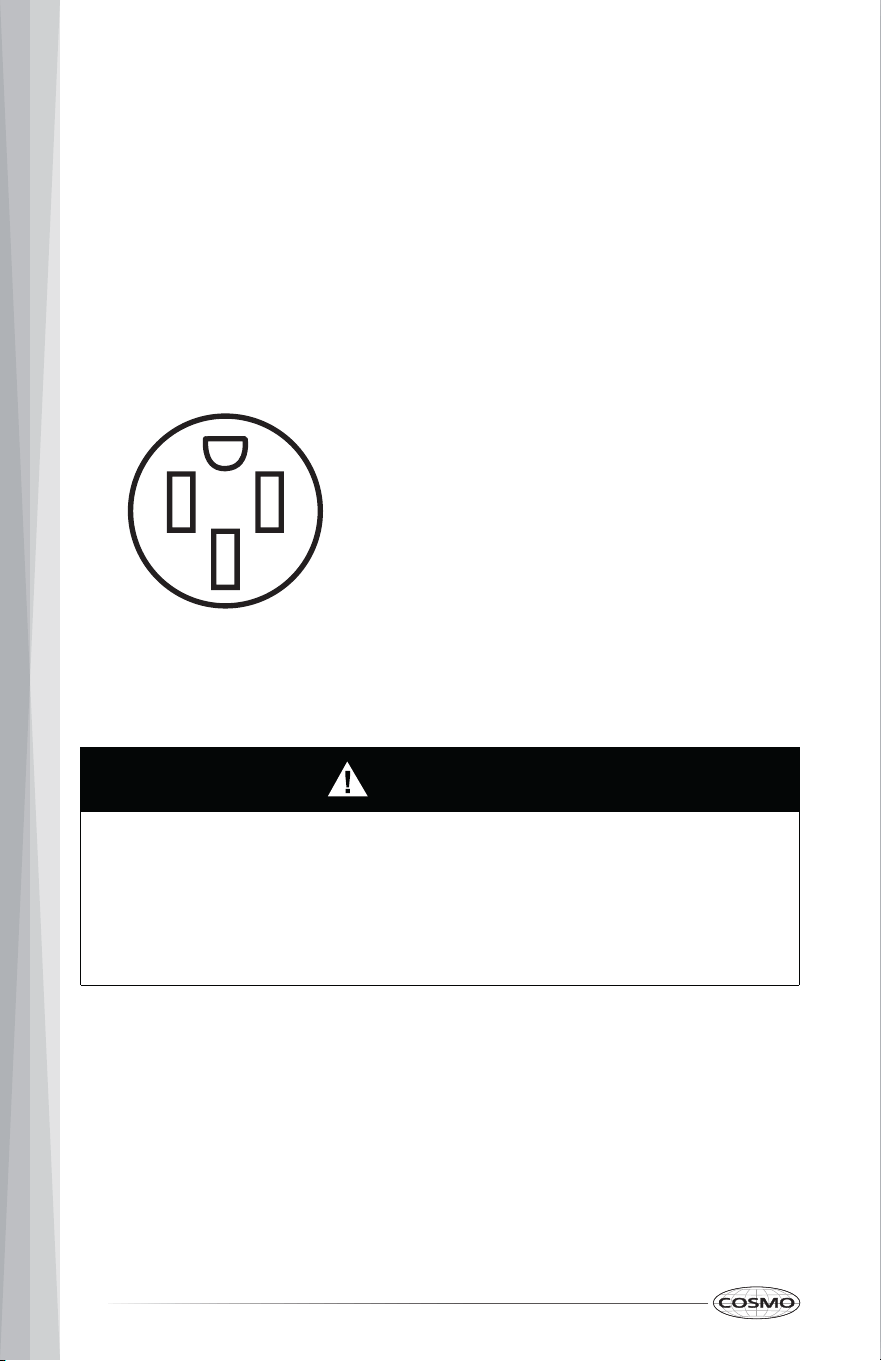
**The plug is not included in the package. Please purchase this plug from
your local appliance store.**
This appliance is manufactured ready to be installed with a 4-wire cord set.
A 3-Pole, 4-Conductor Cord Kit with NEMA Type 14-50R, 50 Amperes
dedicated circuit and marked for use with ranges is recommended by the
manufacturer for Cosmo Ranges.
ELECTRICAL INSTALLATION
WARNING
Risk of fire or electrical shock exists if an incorrect size range cord kit is
used, the installation instructions are not followed, or the strain relief
bracket is discarded.
Terminal
on end of wires must be either closed loop or open spade lug
with upturned ends. Cord must have strain-relief clamp.
4-wire receptacle (14-50R)
Requires a minimum of 50 Amperes with 220 Volts.
We recommend A 3-Pole, 4-Conductor Cord Kit with NEMA Type 14-50R.
25
WARNING
ACCESS TO TERMINAL BLOCK
CAUTION
Do not loosen the nuts which secure the factory-installed range wiring to
terminal block while connecting range. Electrical failure or loss of
electrical connection may occur.
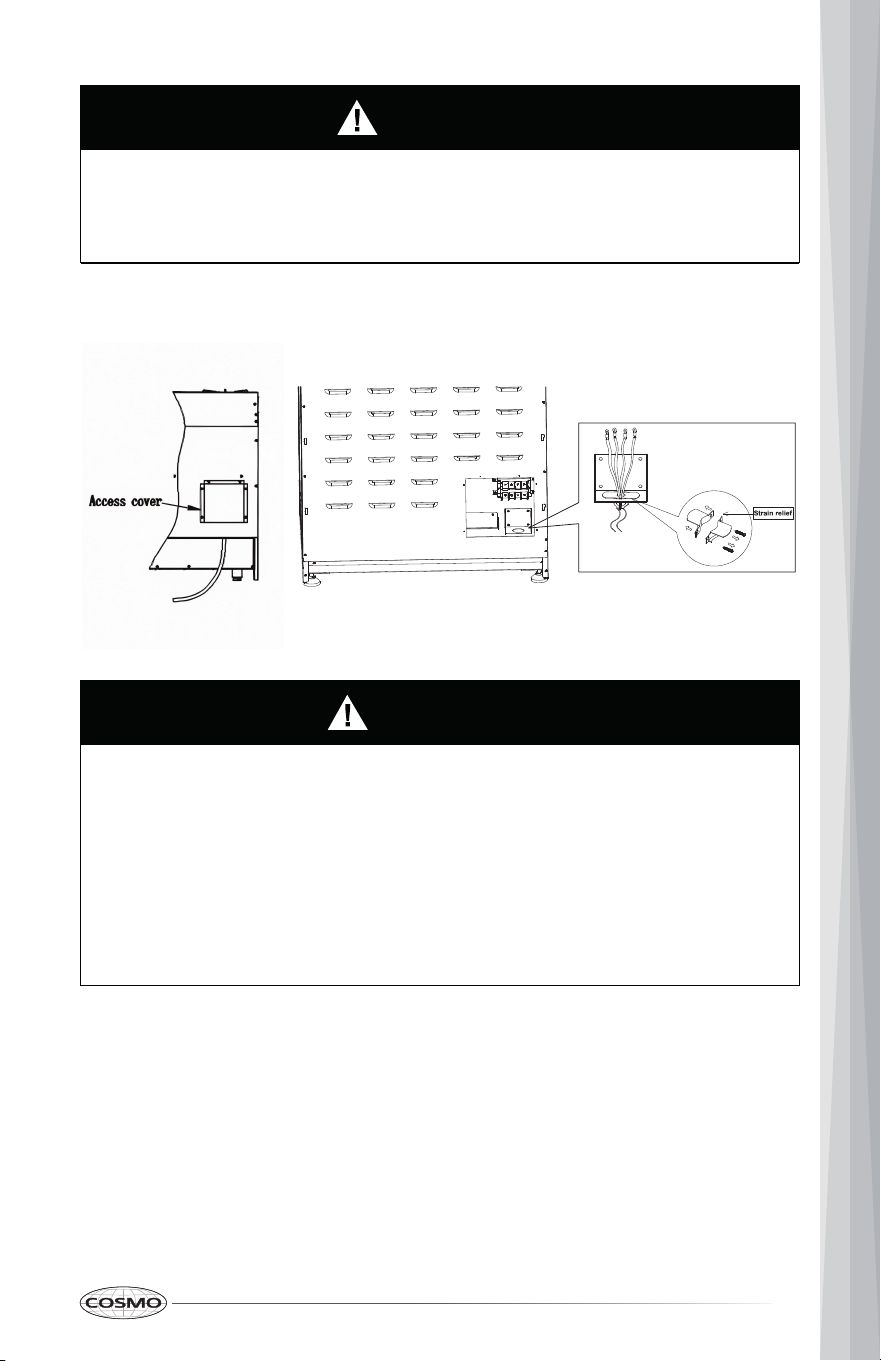
• Electrical ground is required on this appliance.
• Do not connect the electrical supply until appliance is permanently
grounded.
• This appliance must be connected to a grounded, metallic, permanent
wiring system, or a grounding connector should be connected to the
grounding terminal or wire lead on the appliance. Failure to do any of
the above could result in a fire, personal injury or electrical shock. See
below for more information on electrical grounding.
26
ELECTRICAL CONNECTION
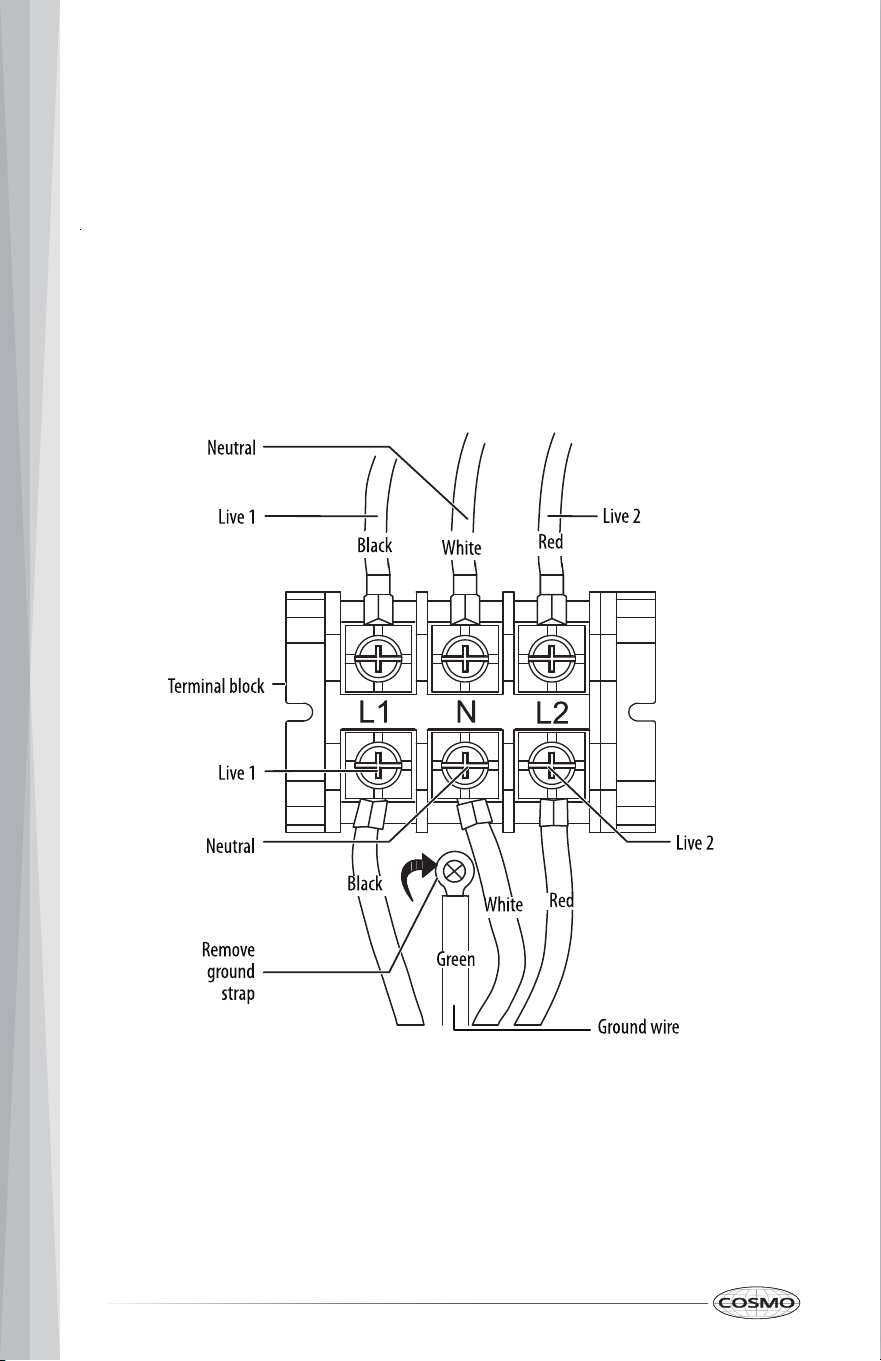
Four Conductor Wire Connection to Range
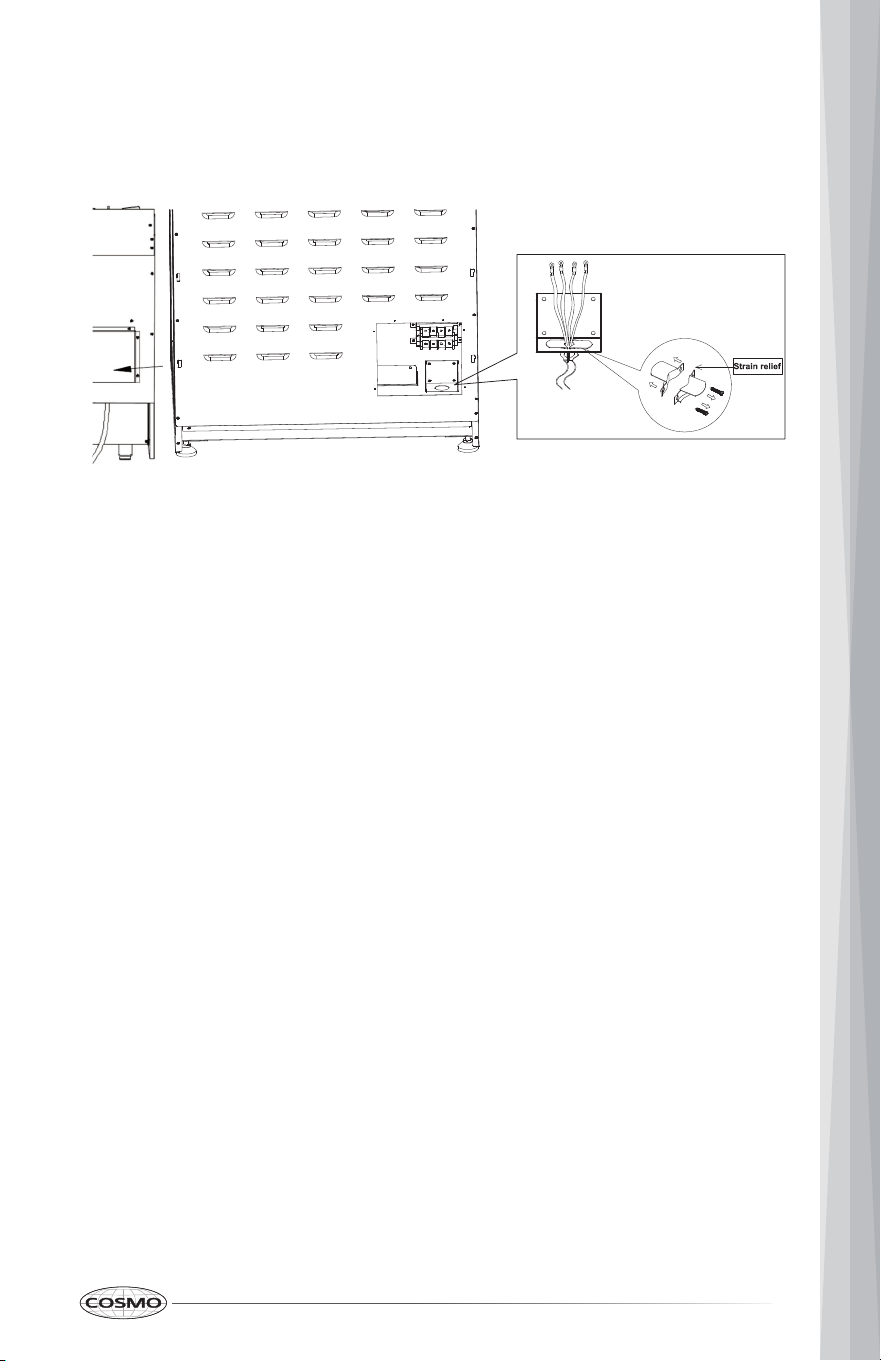
1. Remove the screws at the lower end of the rear access cover and take it
down to expose range terminal connection block.
2. Remove the screws to loosen the cable clamp and pass through the four-
conductor wire from the bottom of the range.
3. Loosen the screws on the terminal block and connect the wire to the
terminals, then tighten the screws of the cable clamp and terminal block,
Make sure to match the wire and terminals by color.
4. Put back the terminal cover and tighten the screws.
27
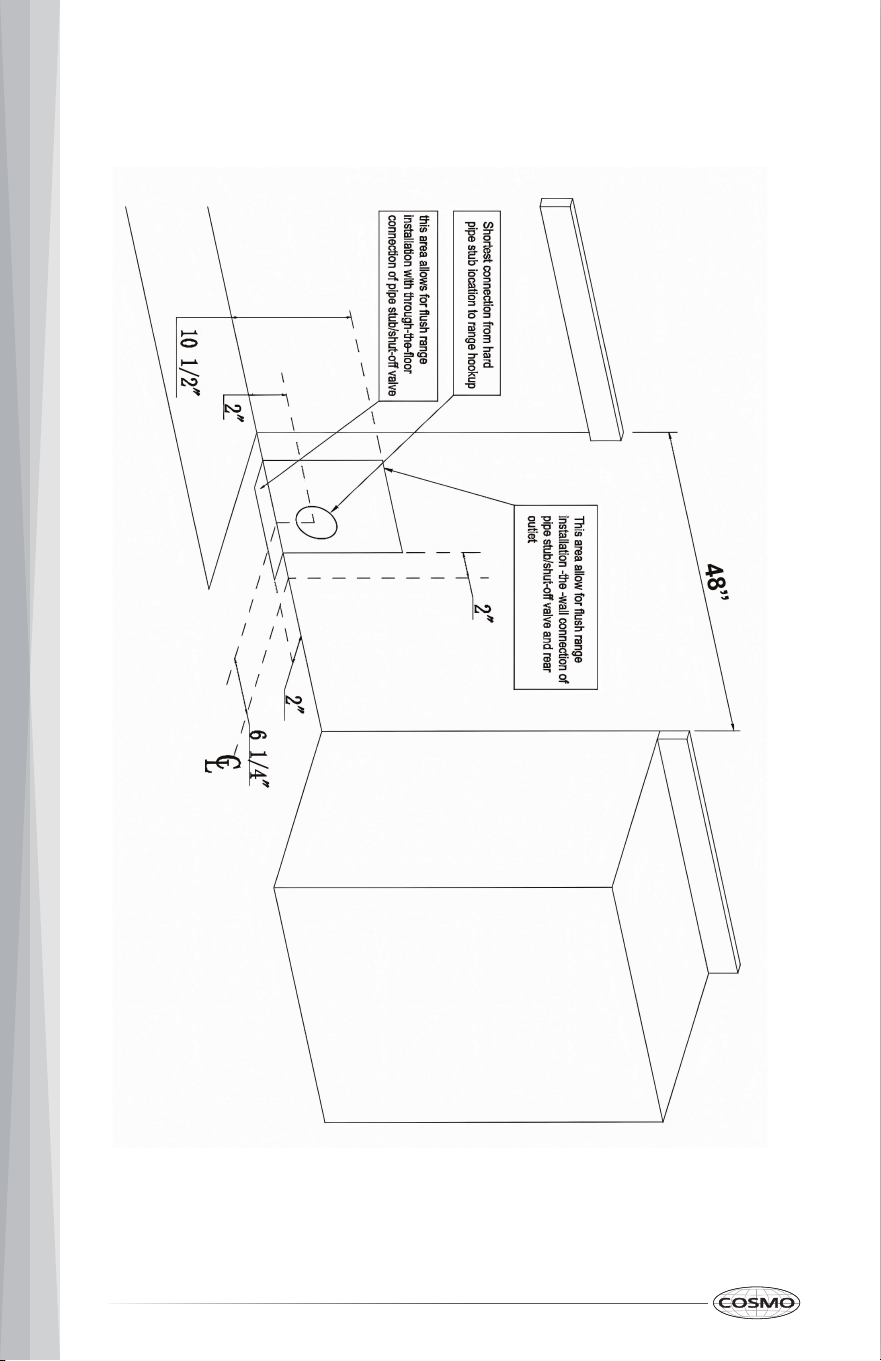
The wiring diagram
sticker is located here.
The wiring diagram for the terminal connection block is on the access cover.
ELECTRICAL POWER SUPPLY REQUIREMENTS
Your range must be electrically grounded in accordance with local codes or
in the absence of local codes, in accordance with the National Electrical
Code (ANSI/NFPA 70, latest edition).
In Canada, electrical grounding must be in accordance with the current CSA
C22.1 Canadian Electrical Code Part 1 and/or local codes. A copy of this
standard may be obtained from: National Fire Protection Association, 1
Batterymarch Park, Quincy, Massachusetts 02269-9101.
The power supply must be the correct polarity. Reverse polarity will result in
continuous sparking of the electrodes, even after flame ignition. If there is
any doubt as to whether the supply has the correct polarity or grounded,
have it checked by a qualified technician.
This appliance must be supplied with the proper voltage and frequency, and
connected to an individual (dedicated to the appliance), properly grounded,
40 amp (minimum) branch circuit protected by a circuit breaker or time-delay
fuse.
A 4-wire, 220 VAC or 240 VAC, 60 hertz electrical system must be used. It is
the personal responsibility of the range owner to provide the correct electrical
service for this range.
28
29
WARNING
ELECTRICAL GROUNDING INSTRUCTIONS
CAUTION
Label all wires prior to disconnecting when servicing controls.
This indoor gas and electric cooking appliance is to be equipped with a
4-4-prong grounding plug for your protection against shock hazard a
should be plugged directly into a properly grounded receptacle.
Improper connection of the equipment-grounding conductor can result in
a risk of electric shock. Check with a qualified electrician or service
technician if you are in doubt as to whether the appliance is properly
grounded. Do no modify the power supply cord plug. If it will not fit the
outlet, have a proper outlet installed by a qualified electrician.

30
GAS SUPPLY REQUIREMENT
Installation of this range must conform with local codes, or in the absence
of local codes, with national Fuel Gas Code, ANSIZ223.1 / NFPA 54. In
Canada, installation must conform to the current natural Gas Installation /
code, CAN 1-1.1-M81 and with local does where applicable. This range has
been designed-certified according to ANSIZ21.1a, latest edition.
• Keep appliance area clear and free from combustible materials, gasoline
and other flammable vapors.
• Do not obstruct the flow of combustion air into the range and ventilation
air away from the range.
• Ventilation:
it is recommended that the unit be set under a powered,
vented exhaust hood of sufficient size and capacity.
• Before installing the range, you must locate and secure the included anti-
tip bracket to the wall for your range.
• The use of cabinets for storage above the appliance may result in a
potential burn hazard. Combustible items may ignite; metallic items may
be become hot and cause burns. If a cabinet storage is to be provided, the
risk can be reduced by installing a range hood that projects horizontally a
minimum of 5" (12.7cm) beyond the bottom of the cabinets.
Maximum gas supply pressure
Appliance regular is set at
13.0
10.0
10.0
5.0
LP Gas
in.w.c.
Natural Gas
in.w.c.

31
AFTER INSTALLATION:
1. Check ignition of cooktop burners.
2. Check ignition of oven burner.
3. Visually check tubular burner (oven burner) re-ignition to be sure both
rows of burner ports are relighting each time.
4. Check for gas leaks at all gas connections (using a gas detector, never a
flame).
5. Check oven bake, and convection bake function.
than 1/2 psig(3.5kPa).
CONNECT RANGE TO GAS SUPPLY
1. Install a manual gas line shut-off valve in the gas line in an easily
accessed location outside the range in the gas piping external to the
appliance for the purpose of turning on or shutting off gas to the
appliance.
Install male 1/2-inch flare union adapter to 1/2-inch NPT internal thread
elbow at inlet of regulator. On models equipped with standard twin
burners, install the male pipe thread end of the 1/2-inch flare union adapter
to the 1/2-inch NPT internal thread at inlet of pressure regulator. Use a
wrench on the regulator fitting to avoid damage.
2. Install male 1/2-inch or 3/4-inch flare union adapter to the NPT internal
thread of the manual shut-off valve, be careful when securing the shut-
off valve to keep it from turning.
3. The gas supply pressure for checking the regulator setting is 6 in.w.c.
(Natural Gas) and 11 inch.w.c. (LP Gas) connect flexible gas line connector
to the regulator on the range. Position range to permit connection at the
shut-off valve.
4. When all connections have been made, make sure all range controls are
in the position and turn on main gas supply valve.
5. Leak testing of the appliance shall be conducted according to the
manufacturer's instructions. Use some soap water (50% water and 50%
soap) or a leak detector at all joints and connections to check for leaks in
the system. Do not use a flame to check for gas leaks.
6. The appliance must be isolated from the building's gas supply piping
system by closing its individual manual shut-off valve during any pressure
testing of the gas supply piping system at test pressure equal to or less
than 1/2 psig(3.5kPa).

32
FIRST USE
BEFORE YOU START
1. Make sure that the anti-tip of the range has been properly installed.
2. Find the model and serial numbers on the CSA label. Note these numbers
down for future reference in the space provided in section "Warranty and
Service".
3. Read this guide, taking special note of the "Safety and Warnings" section.
4. Remove all the packaging from the oven(s) and cooktop. Recycle items
that you can. If any adhesive residue is left on surfaces, remove this using
dish washing liquid on a soft cloth. Do not use any harsh or abrasive
cleaners.
5. Make sure you follow the instructions under "First Use" before using your
range for cooking.
CONDITIONING THE OVEN
Conditioning will burn off any manufacturing residues and ensure that you
get the best results right from the start.
Follow these steps to condition your new stove's oven:
1. Insert all the shelves. See "Positioning the Shelves" for instructions.
2. Turn on the ventilation hood above your range on high.
3. Heat the empty oven at the highest temperature for:
30 minutes using BAKE
30 minutes using BROIL (some ovens only).
There will be a distinctive smell while you are conditioning the oven. This
is normal, but make sure the kitchen is well ventilated during the
conditioning.
Once cooled, wipe out the oven with a damp cloth and mild detergent,
and dry thoroughly.
4. Position the shelves.
33
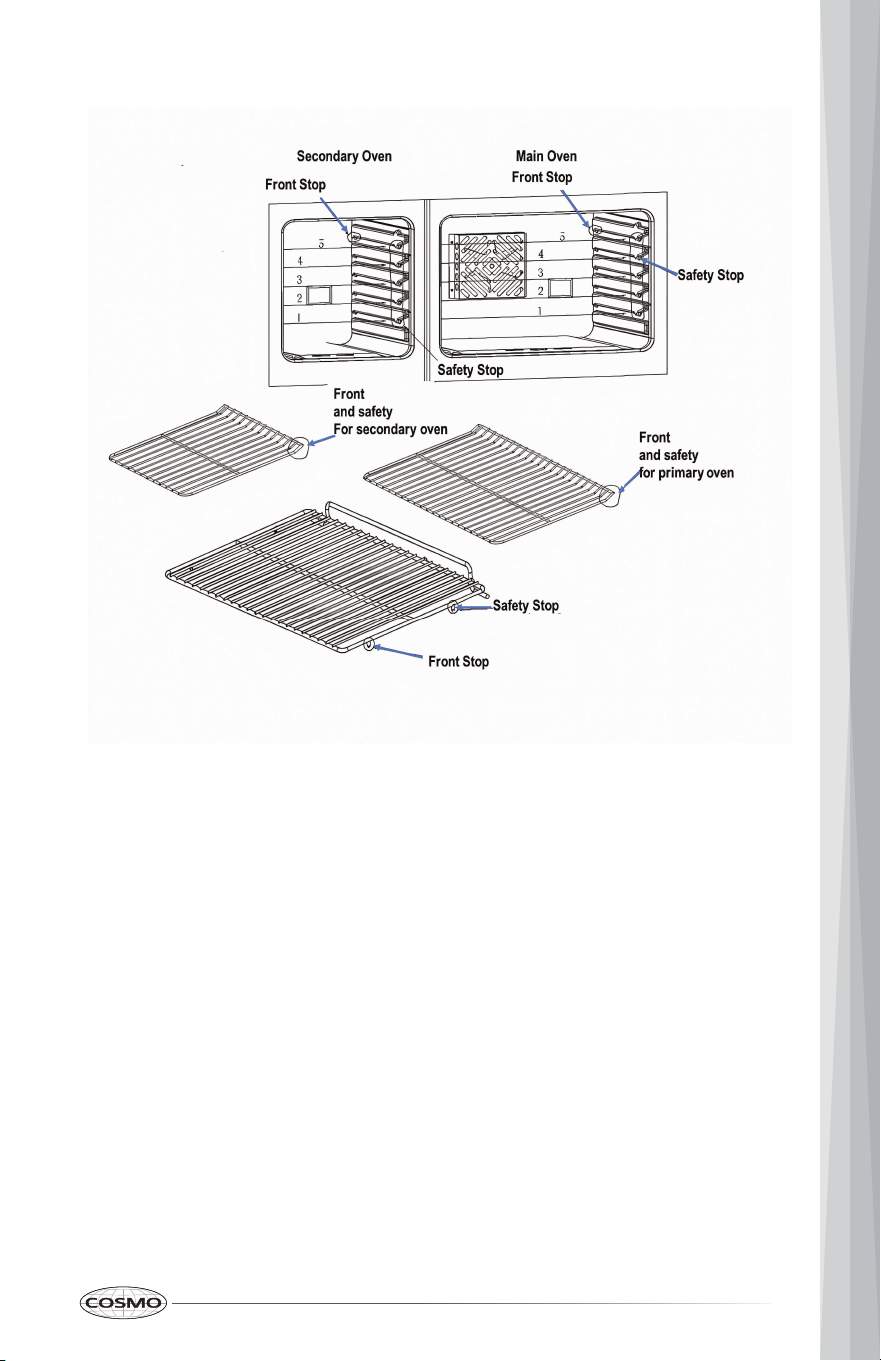
Positioning the Shelves
Both side panels and shelves have safety stops to keep them from sliding
out of the oven when pulled forward.
Shelves also have a stop that prevents the shelves from hitting the back of
the oven.
34
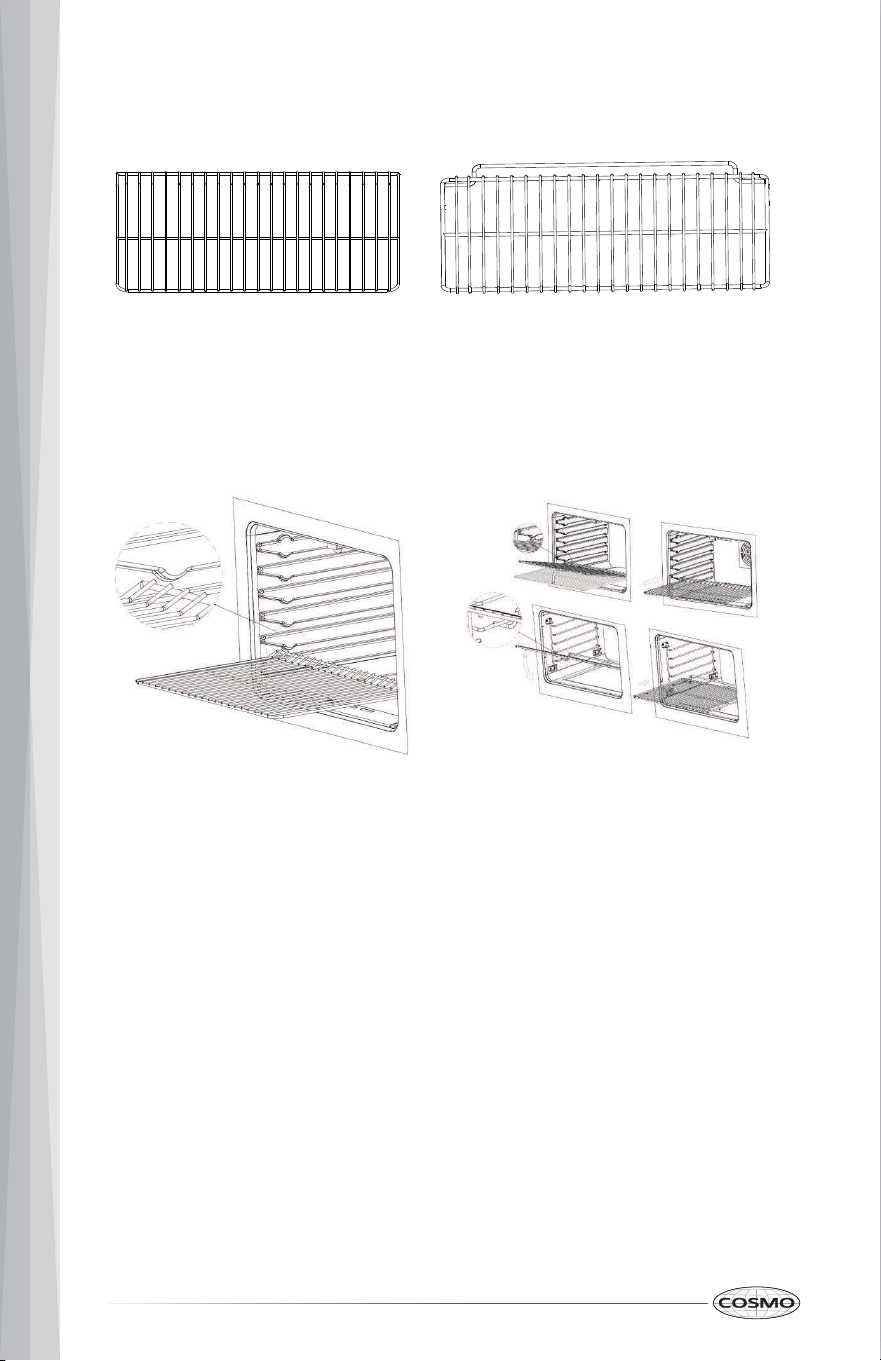
How to properly position the shelves:
1. Hold the front of both sides of the
shelf firmly to keep it in horizontal
position.
2. Put the shelf on the slot horizontally.
3. Lift the front about 15 degrees upward until the tag of the shelf clears the
safety stop of the side rack. Then lower the shelf horizontally and slide all
the way into the oven. Other shelves can be installed this way.
35
There are dual ring burners that have the same low turn-down setting (SIM)
for gentle simmering (680 BTU/hr). Use the SIM setting for melting
chocolate and butter, cooking rice and delicate sauces, simmering soups
and stews, and keeping cooked food hot.
• Never leave the cooktop unattended when in use. Boil over causes
smoking and greasy spills that may ignite.
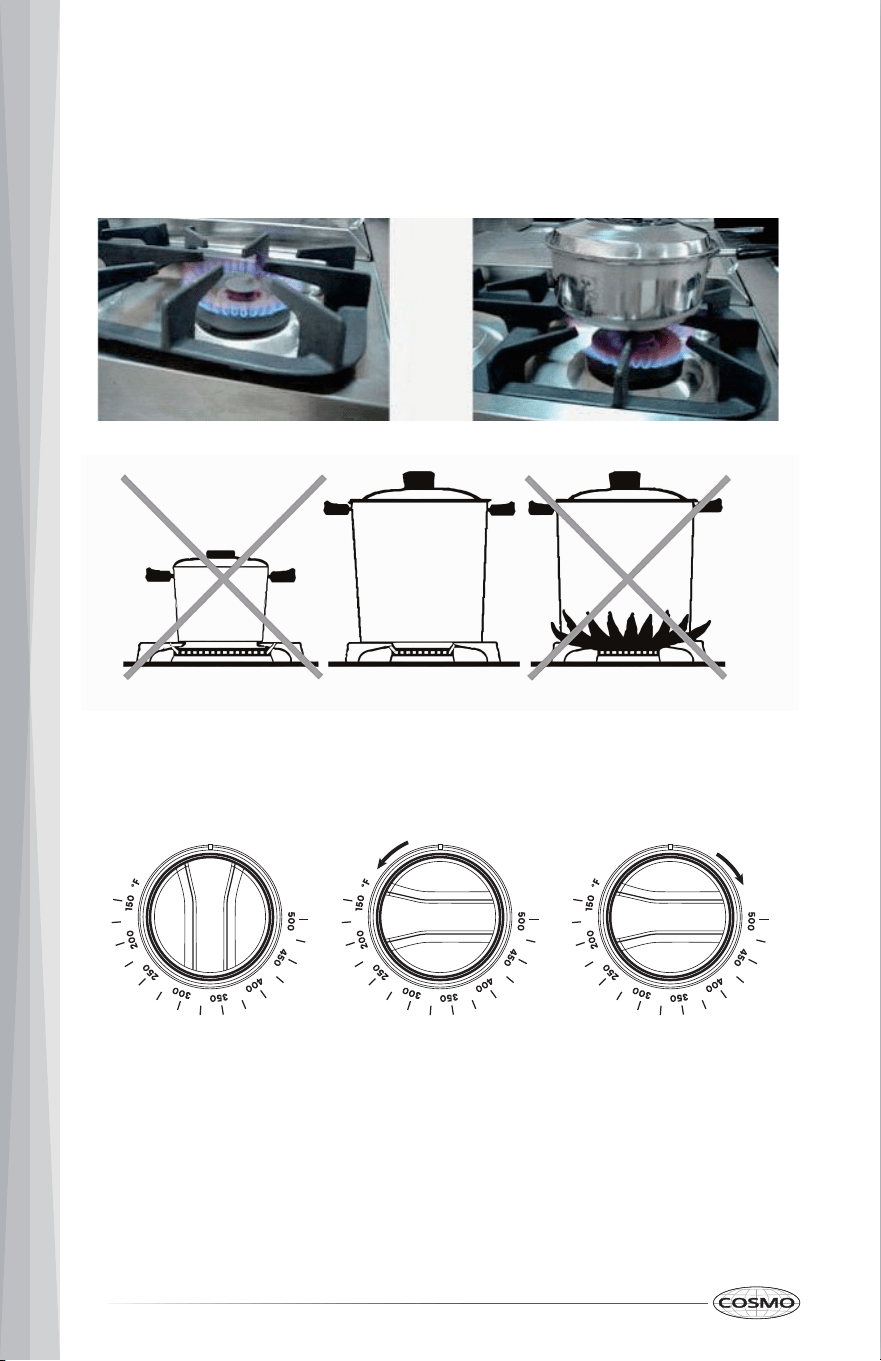
• Never allow flames to extend beyond cookware or curl up on sides. This
could discolor and damage the pot and you may get burned touching the
pot handle.
• Turn handles so that they don't extend over the edge of the range or on a
burner that is on.
• Be careful when deep-frying. Oil or fat can overheat very quickly,
particularly on a high setting.
• Make sure that all burner parts are properly in place. Incorrectly or
incompletely assembled burners may produce dangerous flames. See
"Replacing the Burner Parts" in "Cleaning Instructions".
• Keep the burners clean, especially after a spill or boil over, make sure you
clean the affected burners before using them again. Food residue may
clog the igniter and the notches of the flame spreader, stopping the
burner from functioning correctly. See "Cleaning Instructions" for
instructions.
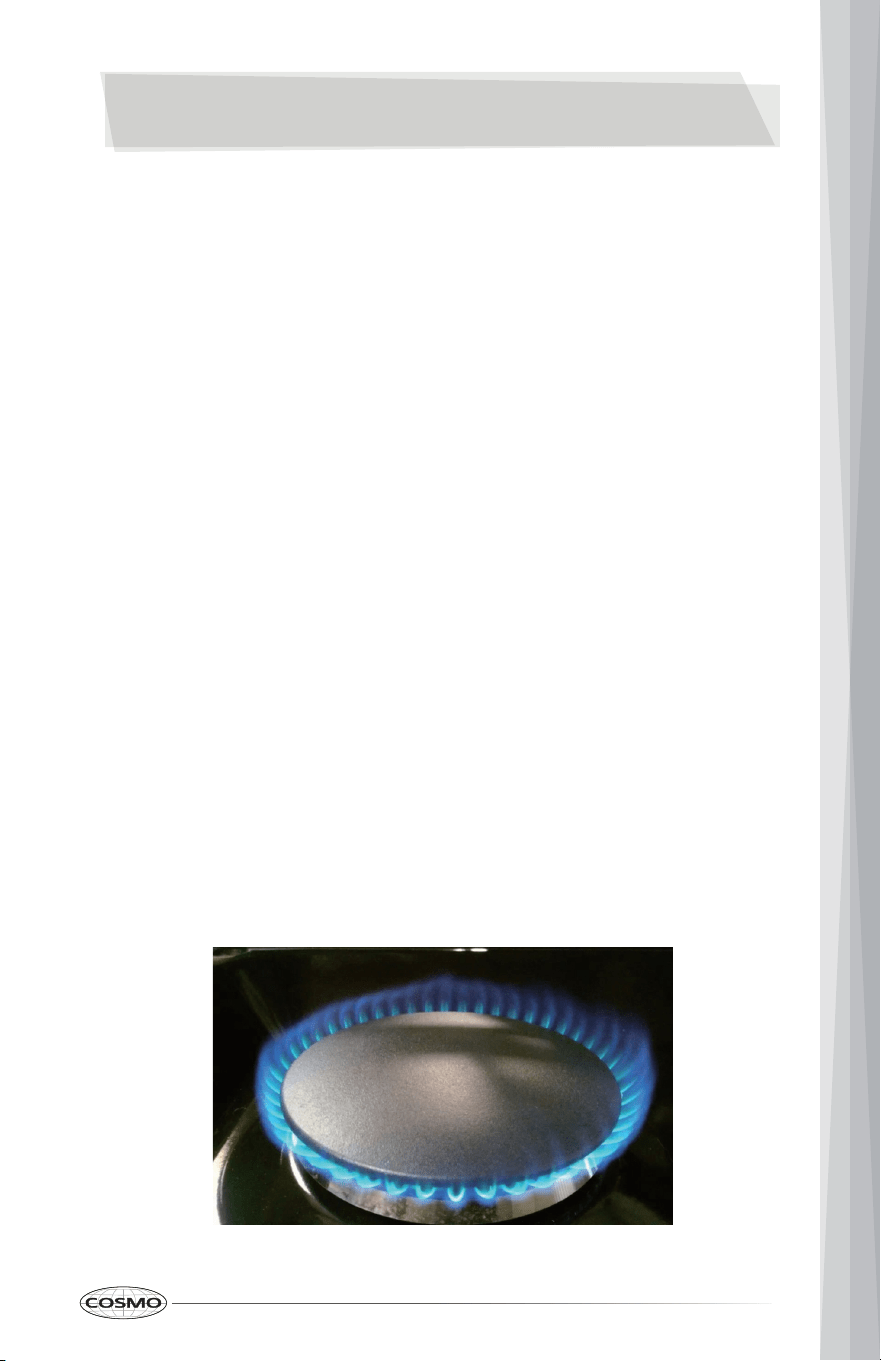
• Burner flames should be blue with no yellow tipping and burn without
fluttering all around the burner cap. If not, see "Troubleshooting" for
advice.
COOKTOP SAFETY GUIDELINES
36
SURFACE BURNER IGNITION
HI
OFF
LO
SIM
HI
OFF
LO
SIM
HI
OFF
LO
SIM
Turn On
Turn Off
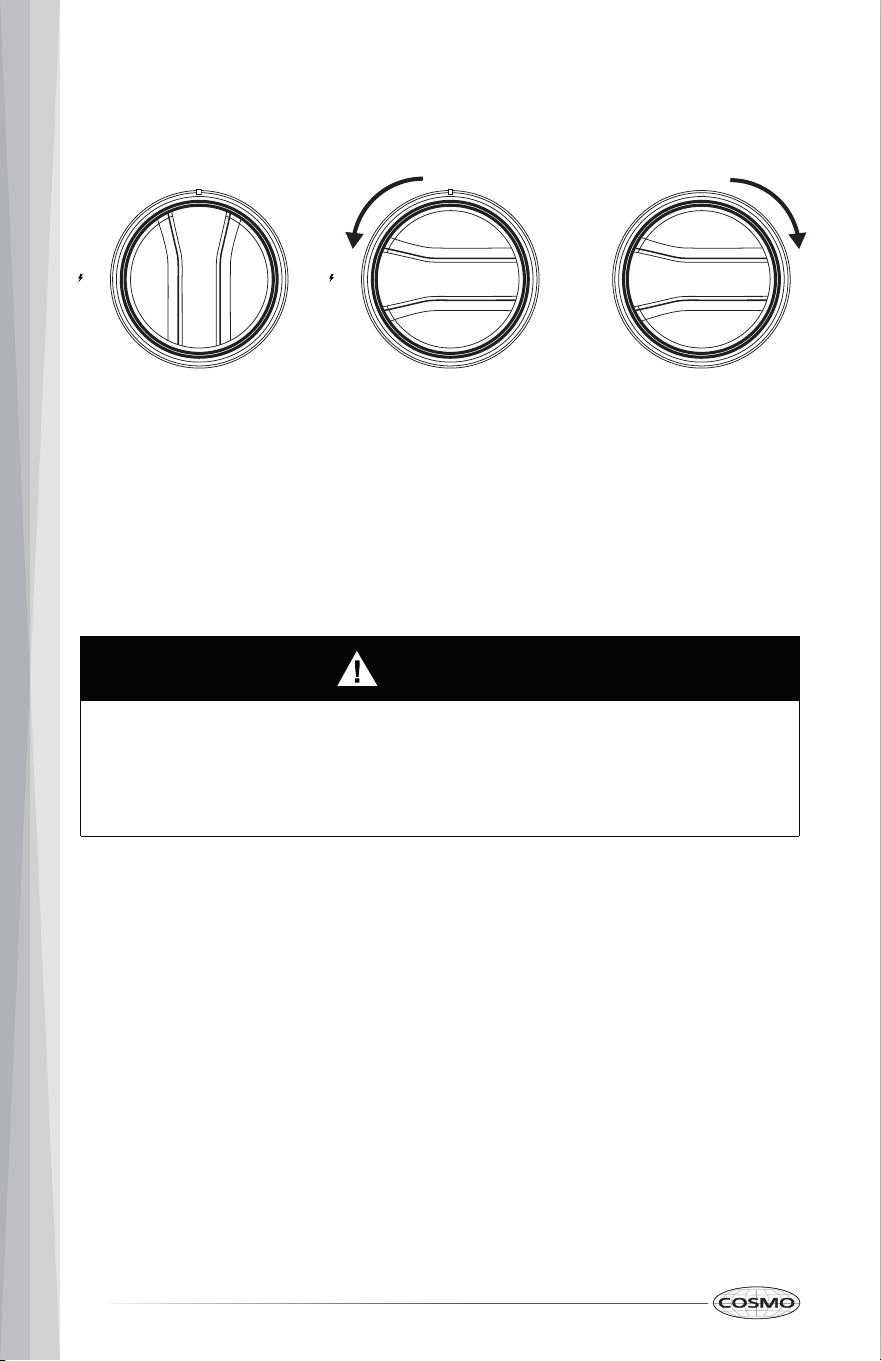
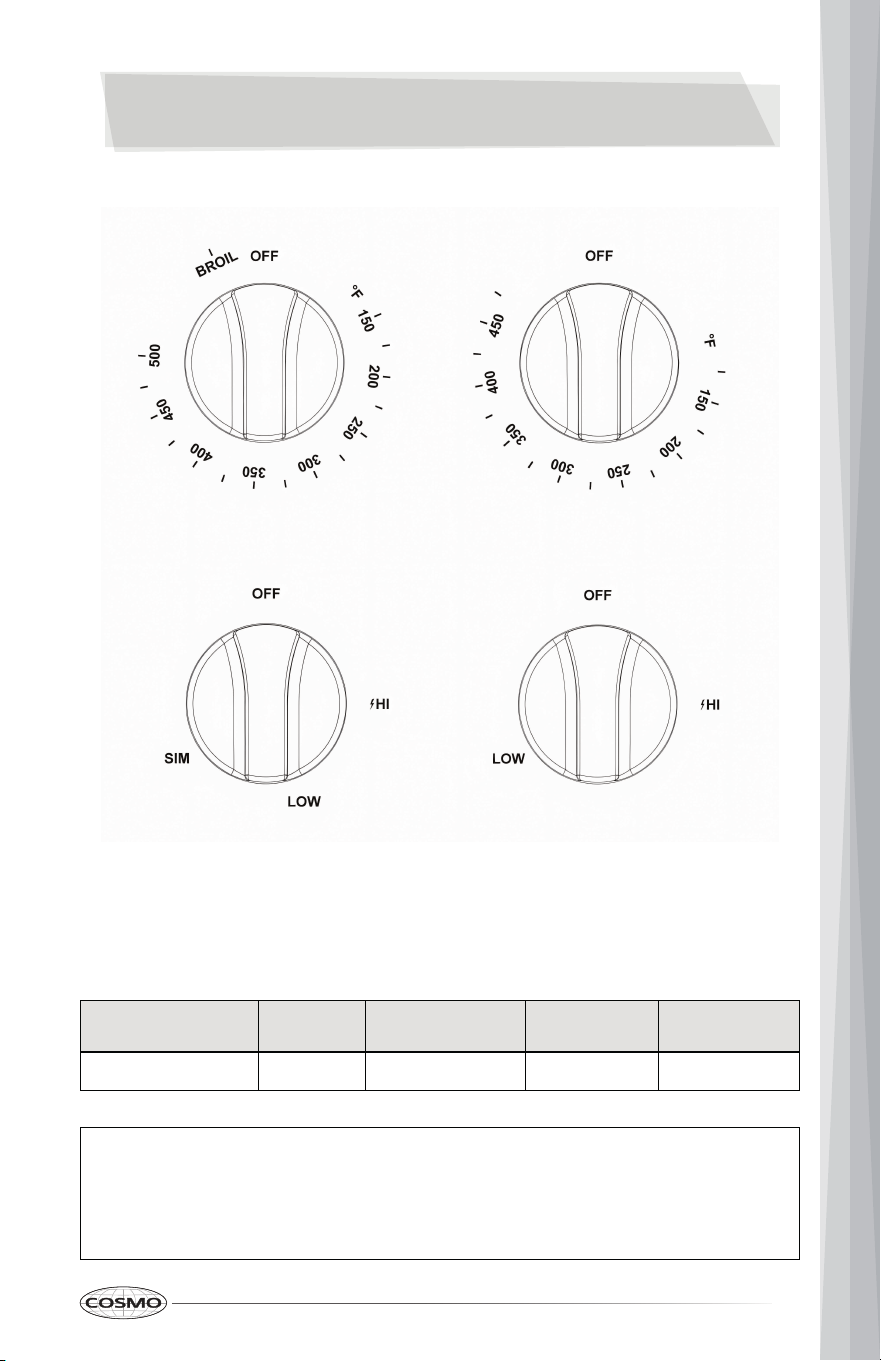
To light the top burners, push and turn the appropriate control knob counter
clockwise to the "HI" position. You will hear a clicking noise - the sound of the
electric spark igniting the burner. Once burner ignition has been achieved, turn
the burner control knob to adjust the desired heat setting.
CAUTION
When one burner is turned to the "HI" position, the burner igniters will
spark. Do not attempt to disassemble or clean around any burner while
another burner is on. Do not touch any burner cap, burner base, or
igniter while the igniters are sparking.
SIMMER AND BOIL
A smaller flame will give the best simmer results. Small flames offer precise
cooking performance for delicate foods, keeping food warm, melting
chocolate or butter and other foods that need to cook over low heat for a
long time.
Dual burners have SIM low turn-down setting for gentle simmering and have
a capacity of 620 BTU/hr. Use the SIM setting for melting chocolate and
butter, cooking rice and delicate sauces, simmering soups and stews and
keeping cooked food hot.
The highest flame settings provide the maximum heat that is available on
your range. This setting should be used for heavy cooking loads such as water
boiling or pasta cooking.
37
FLAME SIZE
When you select the flame size, watch the flame when you turn the knob.
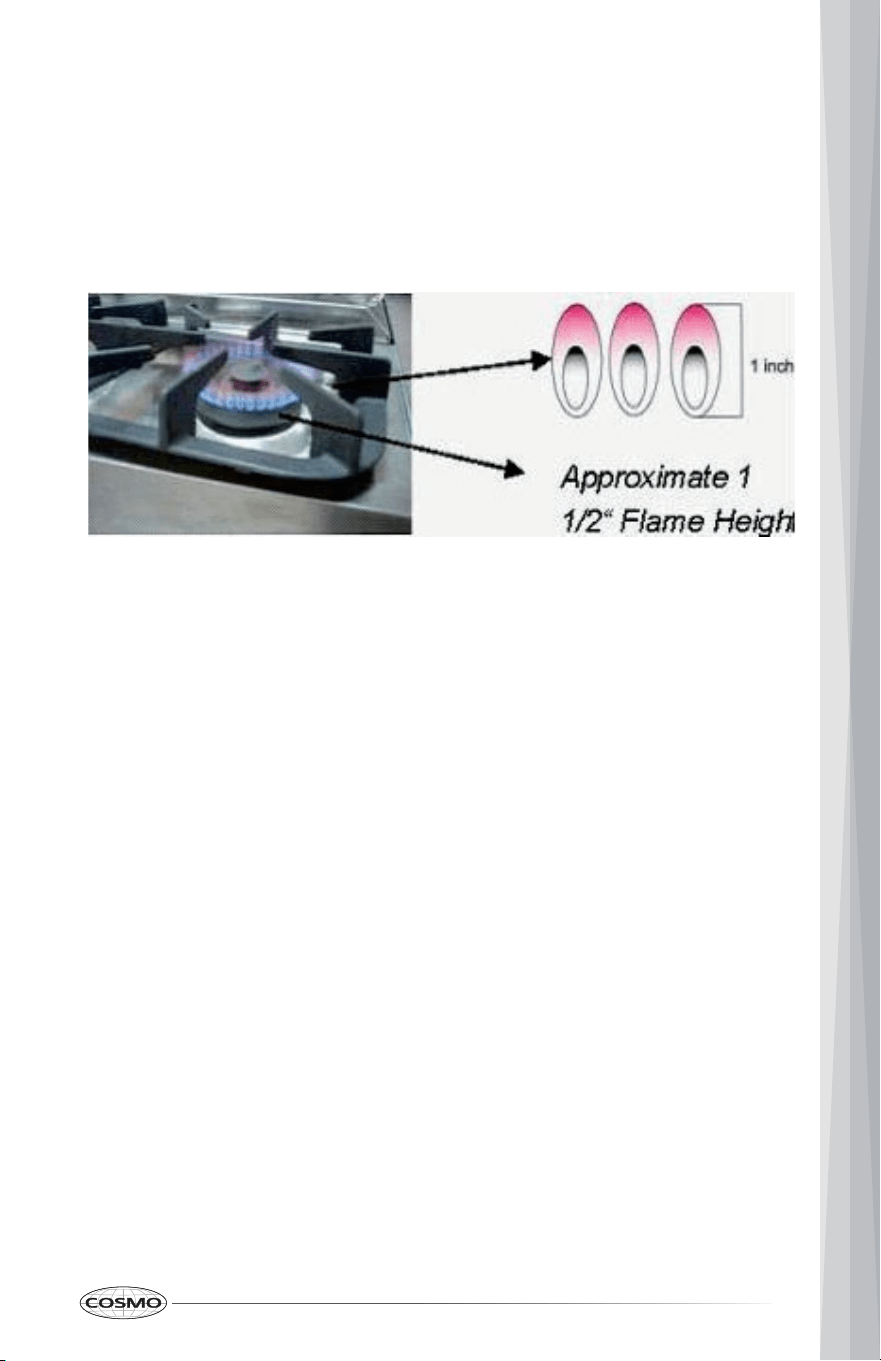
Any flame larger than the bottom of the cookware is wasted.
The flame should be steady and blue in color. Foreign material in the gas line
may cause an orange flame during initial operation.
POWER FAILURE
If the gas does not ignite within four seconds, turn off the valve and allow at
least five minutes for any gas to dissipate. Repeat the lighting procedure.
Do not attempt to during power failure.
COOKTOP
The burners should be cleaned after each use. To prevent the cooktop from
discoloring or staining, wipe up acidic or sugary spills as soon as the cooktop
has cooled.
The sealed burners of your range are not connected to your cooktop and are
designed to be removed. Boil overs or spills will not seep underneath the
cooktop.
38
BURNER GRATES
The grates must be properly positioned before cooking. Improper installation
of the grates may result in scratching of the cooktop and/or poor combustion.
Turn On
Turn Off
OFF
Broil
OFF
Broil
OFF
Broil
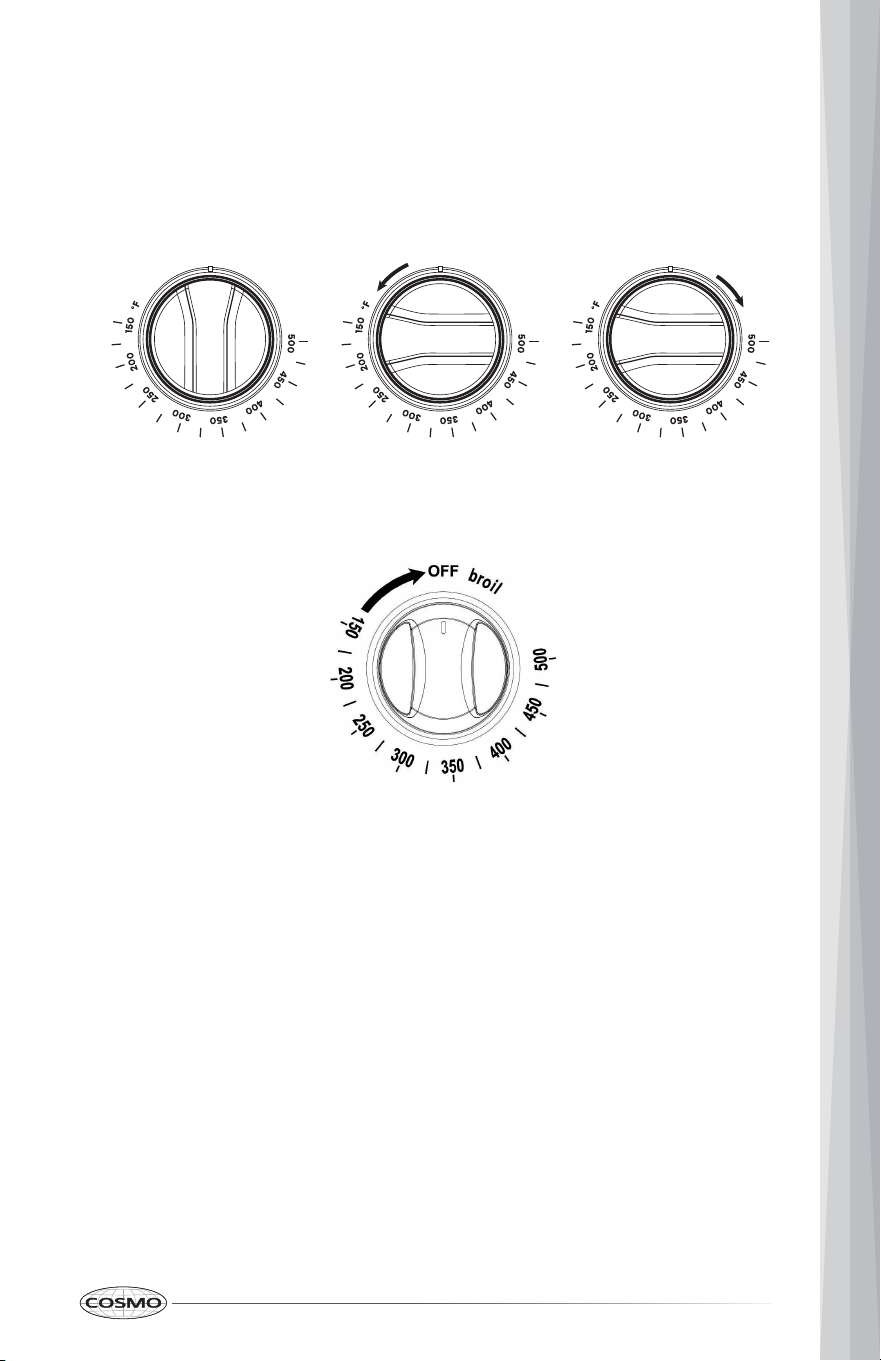
OVEN BURNER USE
To light the oven burner, push and turn the appropriate control knob counter
clockwise to the (150°F-500°F) position. You will hear a clicking noise, which is
the sound of the electric spark igniting the burner. Once burner ignition has
been achieved, turn the burner control knob to adjust the desired heat
setting.
39
BROIL BURNER USE
To light the broiler burner, push and turn the appropriate control knob
counterclockwise to the broil position.
Turn On
Turn Off
OFF
Broil
OFF
Broil
OFF
Broil
40
COOKTOP SAFETY GUIDELINES
WARNING
• According to the United States Department of Agriculture: DO NOT
hold foods at temperatures between 40 °F to 140°F more than 2 hours.
Cooking raw foods below 275°F is not recommended.
• Never cover any slots, holes or passages in the oven bottom or cover
an entire rack with materials such as aluminum foil. Doing so blocks air
flow through the oven and may cause carbon monoxide poisoning.
Aluminum foil lining may also trap heat, causing a fire hazard.
• Do not block the ducts on the rear of the range when cooking in the oven. It is
important that the flow of moist warm air from the oven and fresh air into the
oven burner never be interrupted. Avoid touching the vent opening or nearby
surfaces during oven or broiler operation because they are hot. Do not place
plastics, paper or other items that could melt or burn near the oven vent.
• Use all the oven modes with the oven door closed.
• Never use aluminum foil to cover the oven shelves or to line the floor of the
oven. The trapped heat can irreversibly damage the enamel and may even
cause a fire.
• Do not place water, ice or any dish or tray directly on the oven floor, as this
will irreversibly damage the enamel.
• Do not cover the slotted grid of the broil/roast pan with aluminum foil. This
will catch the grease and could cause fire.
• Do not use plastic wrap or wax paper in the oven.
• For food safety reason, do not leave food in the oven for longer than two
hours before and after cooking or defrosting. This is to avoid contamination
by organisms which may cause food poisoning. Be careful during warmer
weather.

41
NATURAL AIRFLOW BAKE
Natural airflow bake occurs when heat is transferred into the oven from
the bake burners in the bottom of the oven cavity. Heat is then circulated
by natural airflow. This is a traditional bake setting.
OVEN FUNCTION
CONVECTION BAKE
The oven convection fan circulates and distributes the heat in the oven for
faster even cooking. Convection cooking allows you to bake more items on
multiple racks.
To bake using the convection fan:
1. Position the oven bottom cover and the oven shelves before using oven.
2. Remove any unused shelves and baking utensils from the oven.
3. Preheat the oven to the temperature stated in the recipe. Depending on
the temperature and the size of the oven, preheating will take around
15-20 minutes.
4. Arrange pans and food items evenly on the shelves. Make sure pans do
not touch each other or the sides of the oven. When baking a single
item, always center the item on the oven shelf. If baking on multiple
shelves, make sure you stagger items on the shelves so that one is never
directly above another.
5. When baking using convection, either reduce the temperature stated in
the recipe and leave the baking time unchanged, or reduce the baking
time by several minutes and leave the temperature unchanged. For
foods with a baking time of over an hour, reducing both the
temperature and time slightly may give the best results.
6. Dark metal baking pans or those with a dull finish absorb heat faster
than shiny pans, and are excellent for pies and breads, or anything that
needs browning or a crisper crust.
7. A shiny finish may work best for foods that require lighter, delicate
browning (e.g. cakes and cookies), as it reflects some heat and gives a
less intense baking surface.
8. Avoid opening the oven door frequently during baking.

42
CONVECTION ROAST
For best results use the broiler pan. The pan is used to catch grease spills and
has a cover to prevent grease splatter.
The convection fan circulates heated air over and around the food being
roasted, sealing juices quickly for a moist and tender product while at the
same time, creating a rich golden-brown exterior.
Use the broil/roast pan and slotted grid supplied with the range when
roasting to elevate the meat on a metal roasting rack. This allows hot air to
circulate around the meat, browning it more evenly like a rotisserie. A suitable
roasting rack can be purchased through your HRG distributor or by calling
Customer Care.
When roasting larger items like a whole turkey, use only the pan and grid for
greater stability.
CONVECTION DEFROST
With temperature control off, a motorized fan in the rear of the oven
circulates air. The fan accelerates natural defrosting of the food without heat.
To avoid illness and food waste, do not allow defrost food to remain in the
oven for more than two hours without being cooked.
DEFROSTING
To thaw uncooked frozen food, set the oven temperature to 100-150°F. Once
thawed, cook the food immediately and do not refreeze.
To prevent liquid from thawing food dripping on the oven floor, be sure any
uncooked food is tightly wrapped in foil and/or placed in a heat proof
container.
CONVECTION DEHYDRATION
With the temperature control on 175°F, warm air is radiated from the bake
burners on the bottom of the oven cavity and is circulated by a motorized
fan in the rear of the oven.
The food dries by evaporation. Drying foods inhibits microbial growth and
retains certain enzymes.
43
CAUTION
Door must be closed during broiler operation.
Broiling is a method of cooking tender cuts of meat directly under the
infrared broiler in the oven. Broiling in the oven is accomplished with the
oven door closed. It is normal and necessary for some smoke to be
present to give the food a broiled flavor.
If you open the oven door to check the food, have it open for as short a
time as possible. This is to prevent the control panel from overheating
and prevents melted knobs.
Use both the broil/roast pan and slotted grid supplied. The grid helps to
reduce smoking and splatter by letting grease drip into the bottom of
the pan, away from intense heat. To prevent food sticking, spray the grid
with a light coating of non-stick cooking spray.
BROILER OPERATION
PREHEATING
Preheating is suggested when searing rare steaks (Remove the broiler pan
before preheating with the infrared broiler. Foods will stick to hot metal). to
preheat, turn the "Oven" selector knob to the "Broil" position. Wait for the
burner to become hot, approximately 2 minutes. Preheating is not necessary
when broiling meat well-done.
TO BROIL
Broil one side until the food is browned; turn and cook on the second side.
Season and serve. Always pull the rack out to the "stop" position before
turning or removing food.
SETTING BROIL
The "Oven" selector knob controls the Broil feature. When broiling, heat
radiates downward from the oven broiler for even coverage. The Broil
feature temperature is 500°F (260°C).
The broil pan and insert used together allow dripping grease to drain and
be kept away from the high heat of the oven broiler. DO NOT use the broil
pan without the insert.
DO NOT cover the broil pan insert with foil. The exposed grease could
catch fire.

44
To set the oven to Broil:
1. Place the broiler pan insert on the broiler pan. Then place the food on the
broiler pan insert.
2. Arrange the interior oven rack and place the broiler pan on the rack. B
e
sure to center the broiler pan and position directly under the broil burner. If
preheating the broil burner first, position the broiler pan after the broil
burner is preheated.
3. Turn selector knob to Broil.
The oven indicator light will remain on until the selector knob is turned to the
off position or the temperature control cycles off.
BROILING GUIDELINES
Choose a suitable shelf position. To ensure that meat is cooked through
rather than just browned on the outside, broil thick pieces of meat and
poultry on shelf positions 2 or 3. Use shelf position 4 for thinner items that
need less cooking time like steaks, chops or hamburger patties.
When finishing off meals by browning the top under the broiler, use metal or
glass-ceramic bakeware. Do not use heatproof glass or earthenware, as
these cannot withstand the intense heat of the broiler.
Center the item in the oven, sot hat it is directly under the broiler.
45
GRIDDLE OPERATION
BEFORE USING THE GRIDDLE
1. Clean the griddle thoroughly with warm, soapy water to remove dust or
any protective coating.
2. Rinse with clean water and wipe off to try with soft, clean, lint-free cloth.
3. A stainless-
steel cover when the griddle is not being used is provided.
Please note that the cover must be removed before turning the griddle on.
4
. Make sure the grease tray is under the front edge of the griddle. Position
the tray under the griddle overhang to catch grease or food residue.
USE OF THE GRIDDLE
1. Push and turn the control knob counterclockwise to the preferred cooking
temperature.
2. Preheat the griddle for 10-12 minutes.
3. When the griddle is preheated to the desired temperature, the indicator
light will turn on.
4
. Butter or cooking oil may be added.
CAUTION
• The surface of the griddle is hot after use. Please allow sufficient time
for the griddle to cool prior to cleaning.
• When using the appliance or the first time. The oven and broiler
burners should be turned on to burn off the manufacturing oils. Turn
the oven on to 450°F (230°C) for 20 to 30 minutes. Then turn the oven
control knob to "Broil" for the same length of time. It is recommended
to run on the ventilator above the range at this time.
• Must disconnect the electrical supply before servicing or cleaning the
appliance. Failure to follow this advice may result in injury or death.
46
CLEANING INSTRUCTIONS
DO'S
• Read these cleaning instructions and the "Range Safety
" section before you
start cleaning your range.
• Before cleaning or removing any part, make sure that everything on the
range has been turned off.
• Unless suggested otherwise in the following chart, allow any part to cool to
safe temperature before cleaning. If you do need to handle a warm or hot
part (e.g.
grill or griddle), take extreme care. Wear long protective mitts to
avoid burns from steam or hot surfaces.
• Try using any cleaner on a small area first, to ensure it does not stain.
• See the pages following this chart for instructions on removing and replacing
various parts of the range for cleaning or maintenance.
• To help you identify any parts, see illustrations in section "Introduction" and
after this cleaning chart.
DONT'S
• Do not use aerosol cleaners until the range has completely cooled. The
propellant substance in these cleaners could catch fire in the presence of
heat.
• Do not let soiling or grease accumulate anywhere in or on the range. This will
make future cleaning more difficult and may present a fire hazard.
• Do not use any abrasive or harsh cleaners, cloths, scouring pads or steel
wool. These will scratch your range and damage its appearance.
• Do not use a steam cleaner to clean any part of the range.
• Do not lift the black grill and griddle frames off the cooktop.
CLEANING BURNER CAPS AND BRASS FLAME SPREADERS
CAUTION
• Check that the burner is turned OFF and allow it to cool before
cleaning any part of the range.
• To avoid electrical shock or burns, turn off controls before cleaning.
1. Lift off the burner cap and brass flame spreader. Wash them in hot soapy
water, rinse and dry.
2. Use a stiff nylon brush or straight-ended paper clip to clear the notches of
a flame spreader. Replace the flame spreader and burner cap correctly.
3. Do not use harsh or abrasive cleaning detergents, waxes, polishes, or
commercial cooktop cleaners to clean the cooktop.
4. Use only a sponge, soft cloth, fibrous or plastic brush, and nylon pad for
cleaning.
5. Always dry components completely before using the cooktop.

47
CLEANING THE CONTROL PANEL, DOOR HANDLE,
CONTROL HOUSING
1. Clean the control panel, door handle and control housing with a solution of
mild detergent and warm water.
2. Do not use abrasive cleaners or scrubbers; they may permanently damage
the finish.
3. Dry the components with a soft, lint-free cloth.
CLEANING SIDE RACKS
1. Pre-soak any stubborn, burnt-on soiling, then clean with a solution of mild
detergent and hot water and wipe dry with a microfiber cloth.
2. Alternatively, clean these in the dishwasher.
CLEANING OVEN SHELVES
1. To remove stubborn or "baked-on" material, scrub with a dampened, soap-
filled, non-metal, non-abrasive pad, then wipe dry.
2. Apply a chrome cleaner with a damp sponge or cloth following
manufacturer's instructions.
3. Wipe and dry.
CLEANING BROILING PAN AND GRID
1. Pre-soak any stubborn soiling in a solution of mild detergent and hot water.
2. Wash by hand or in a dishwasher.
CLEANING BAKE AND BROIL BURNERS
Do not clean these parts. They self-clean during normal use.
CLEANING PORCELAIN SURFACES
Clean oven interior and inner door liners with a solution of mild detergents
and hot water. Rinse and dry with a soft, lint-free cloth. Do not use abrasives
of commercial oven cleaners.
CLEANING OVEN WINDOW
1. Clean all glass surfaces with a solution of mild detergent and hot water. Use
a mild glass cleaner to remove fingerprints or smears.
2. Dry completely with a soft, lint-free cloth.
48
CLEANING OVEN DOOR GASKET
Avoid cleaning this part. If you need to remove large food particles off it,
proceed as follows:
1. Dampen a sponge with clean hot water.
2. Gently wipe off the soiling, but do not rub.
3. Press a dry towel gently on the gasket to dry.
Do not use any cleaning detergents on the gasket. The gasket is essential for a
good seal.
CAUTION: Do not scratch, displace, or damage it.
CLEANING STAINLESS STEEL SURFACES
• Do not use any cleaning product with chlorine bleach.
• Do not use a steel wood pad; it will scratch the surface.
1. Use a hot, damp cloth with a mild detergent.
2. Use a clean, hot, damp cloth to remove soap. Dry with a dry, clean cloth.
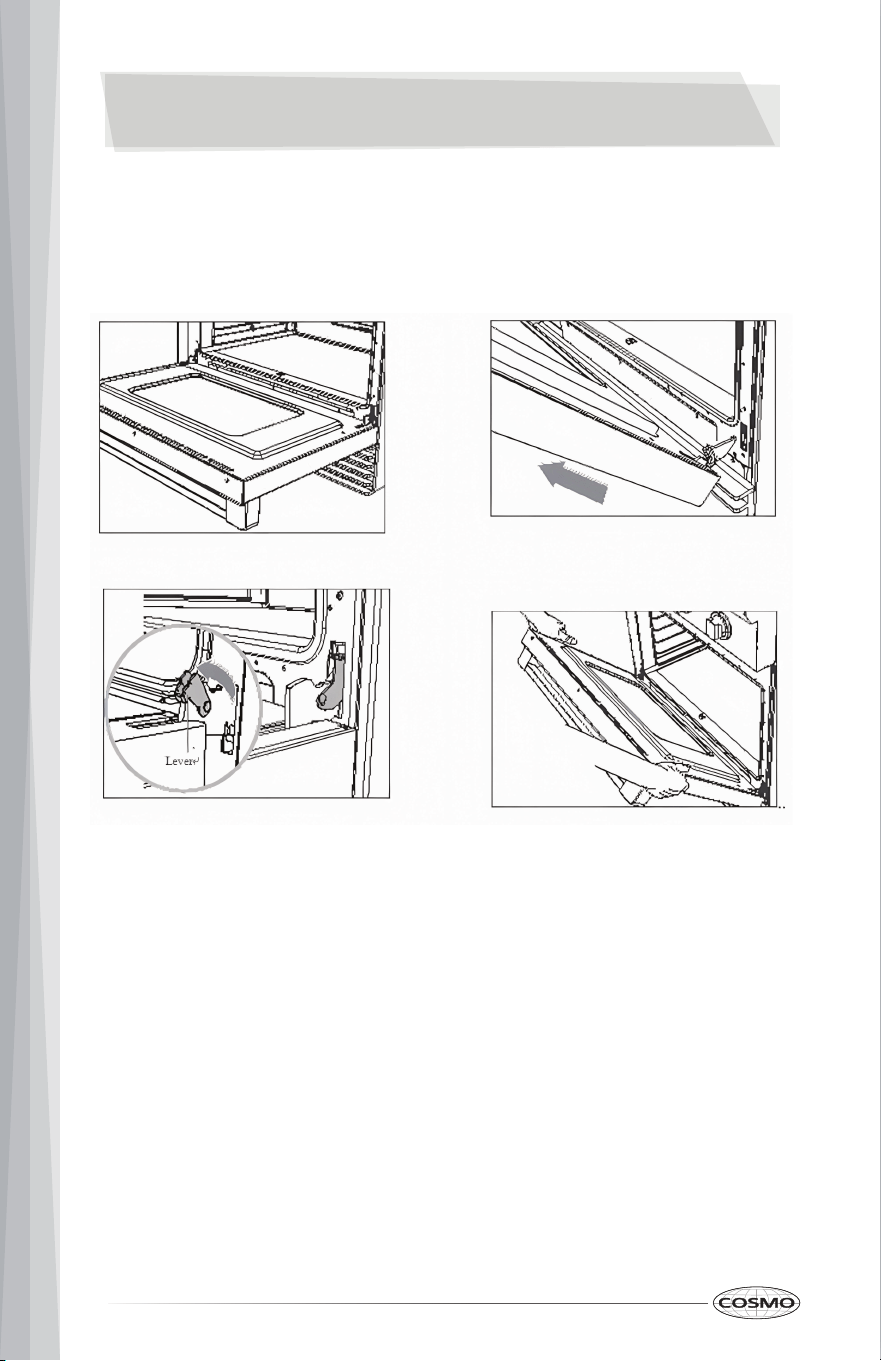
REMOVING AND REPLACING OVEN DOOR
CAUTION
Do not lift the oven door by its handle. Doing so many damage the door.
Make sure the oven and the door are cool before you begin to remove
the door.
IMPORTANT:
Before removing the door, make sure there is a large enough clear,
protected surface in the kitchen to rest the door on.
The oven door is heavy!
49
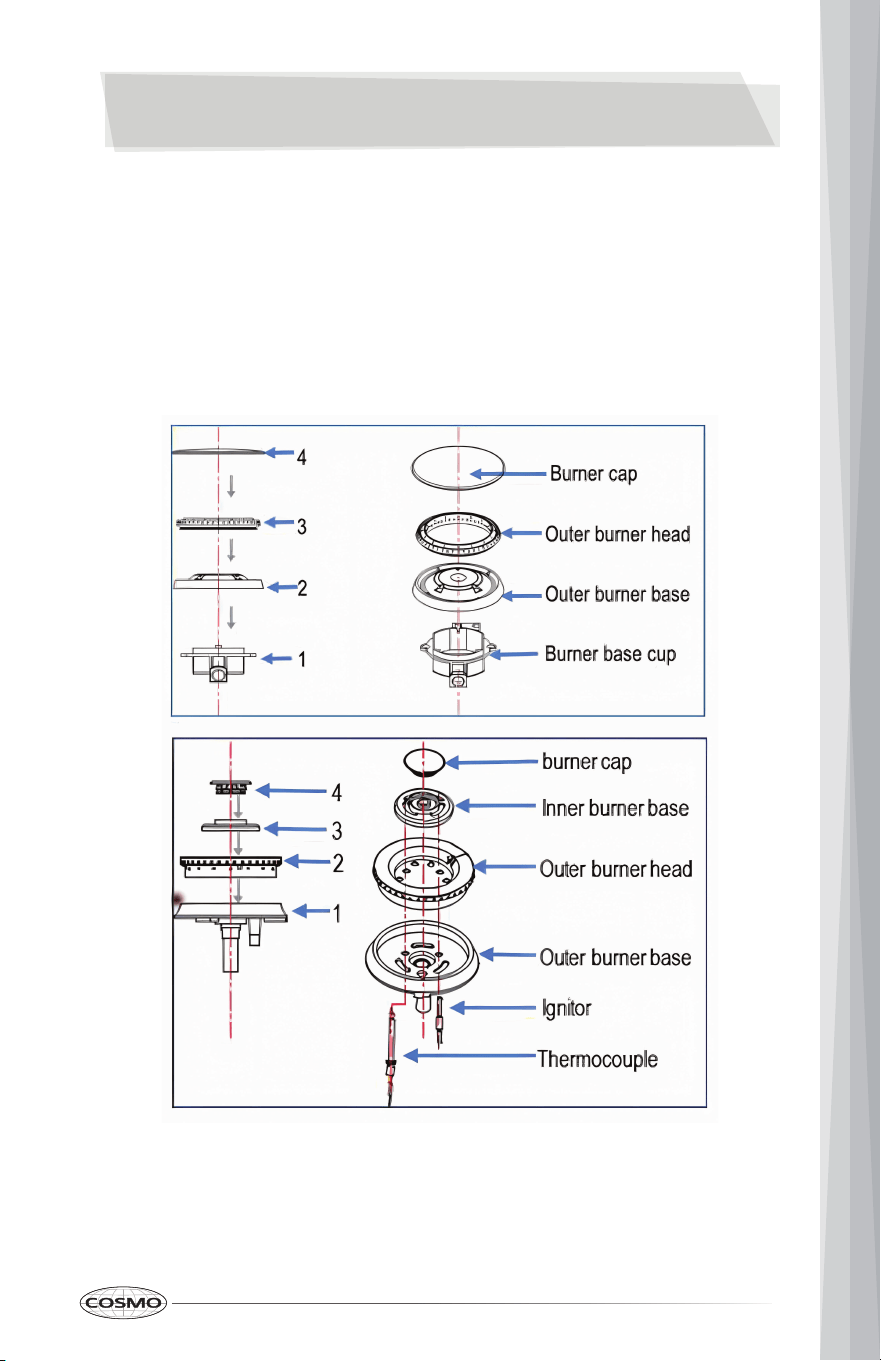
REPLACING BURNER PARTS
This diagram shows how to replace the burner parts. When replacing the
burners, make sure that the two locating pins on the bottom of the brass
flame spreader are properly aligned with the locating pin holes on the top of
the simmer ring.
Incorrect alignment will produce a potentially dangerous flame and poor
burner performance such as sparking/clicking
50
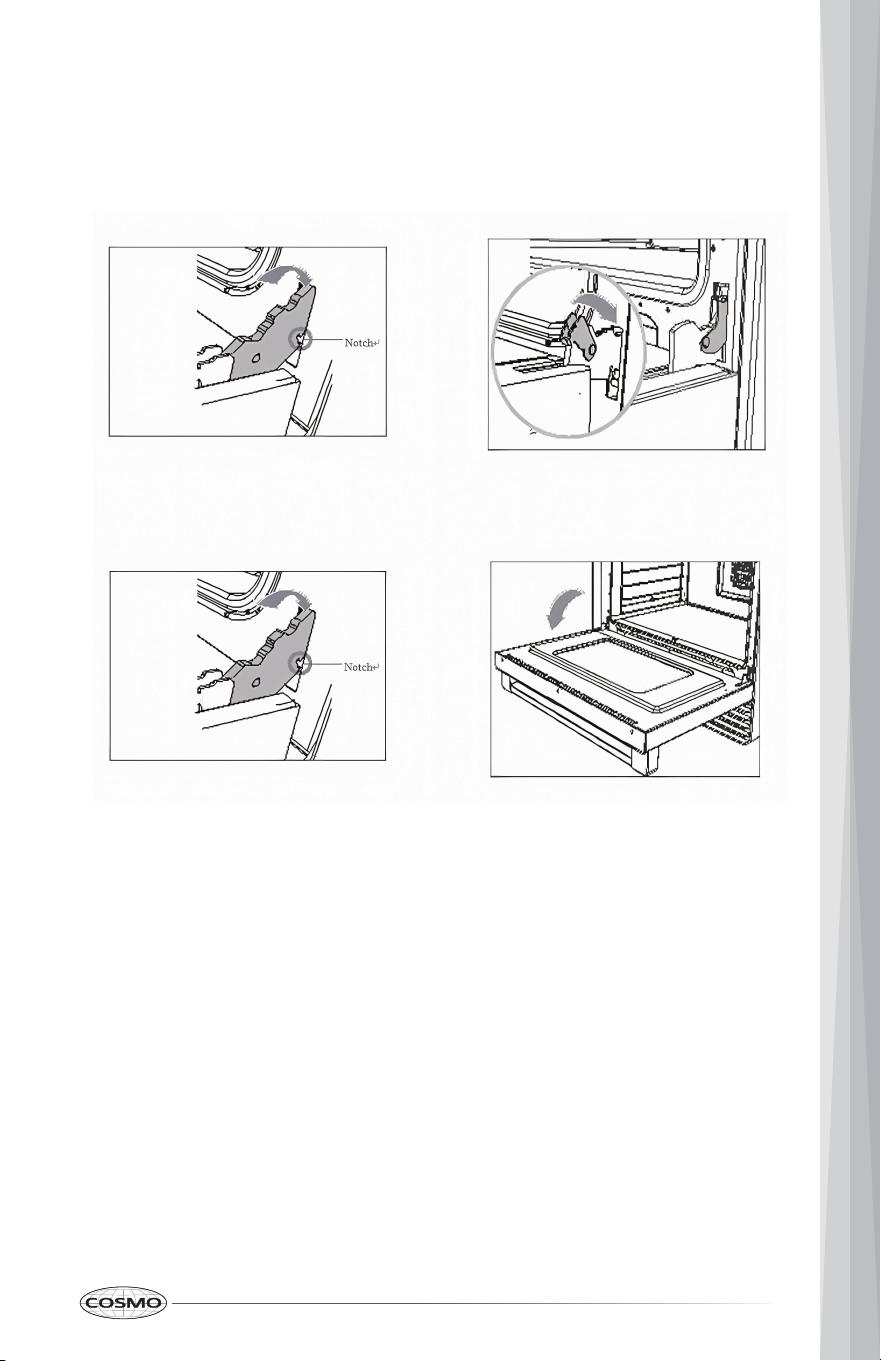
REMOVING OVEN DOOR
1. Open the door very carefully
2. Open the levers fully on
both sides
3. Hold the door firmly on
both sides
4. Close the door about halfway
then gently, disengage the hinges.
Place on a protected surface.
REPLACING OVEN DOOR
51
REPLACING OVEN DOOR
1. Hold the door firmly at an
approximately open position
2. Insert the hinge tongues
into the slots making sure that
the notches on both sides
drop into place as shown
3. Open the door fully as shown
4. Fully close the levers on the
left and right hinges as shown,
then close the door.
52
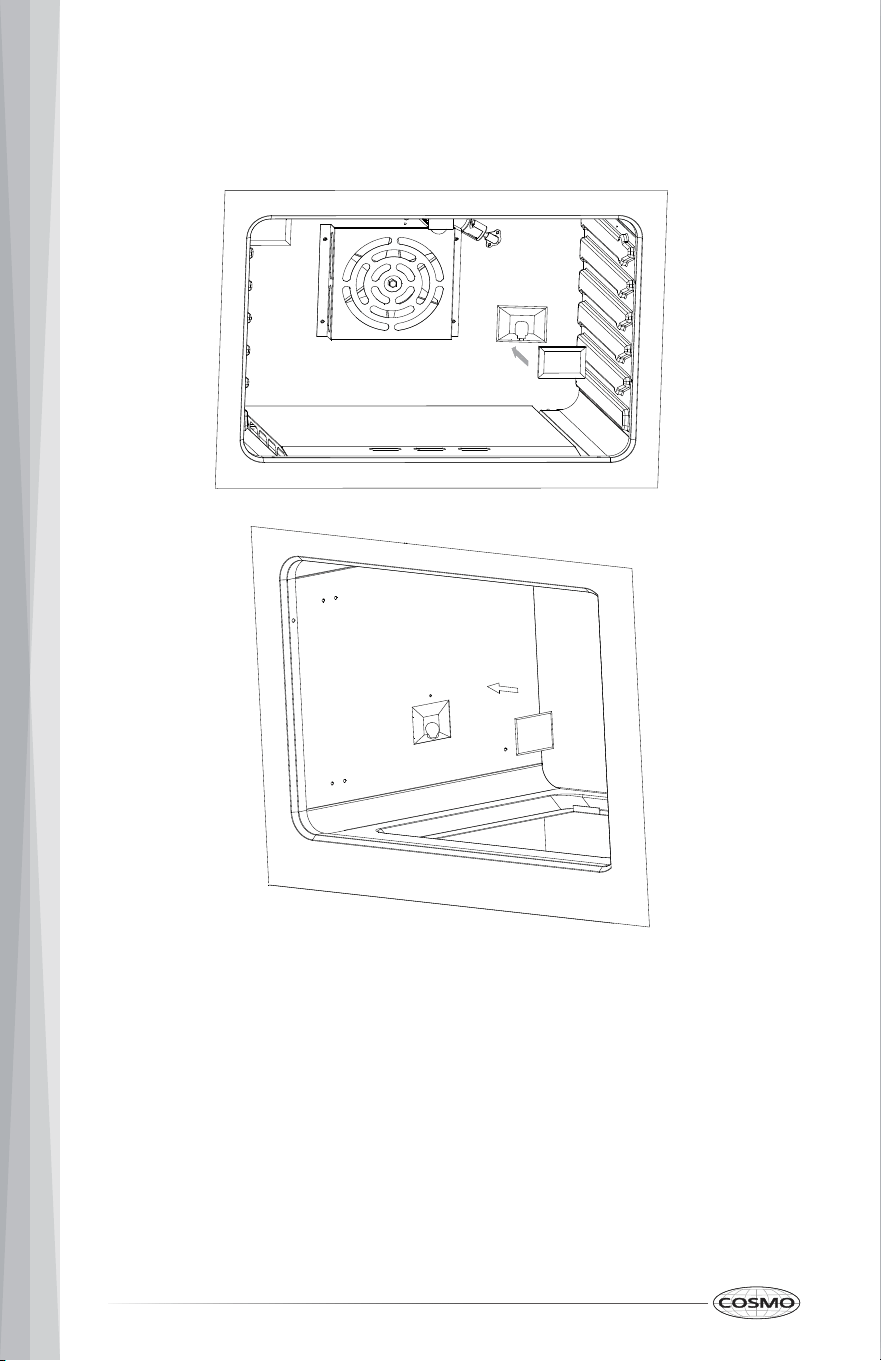
REPLACING OVEN LIGHT BULB
When replacing bulbs, release the glass cover on the lamp holder first. Then,
remove the bulb to replace new light bulb.
53
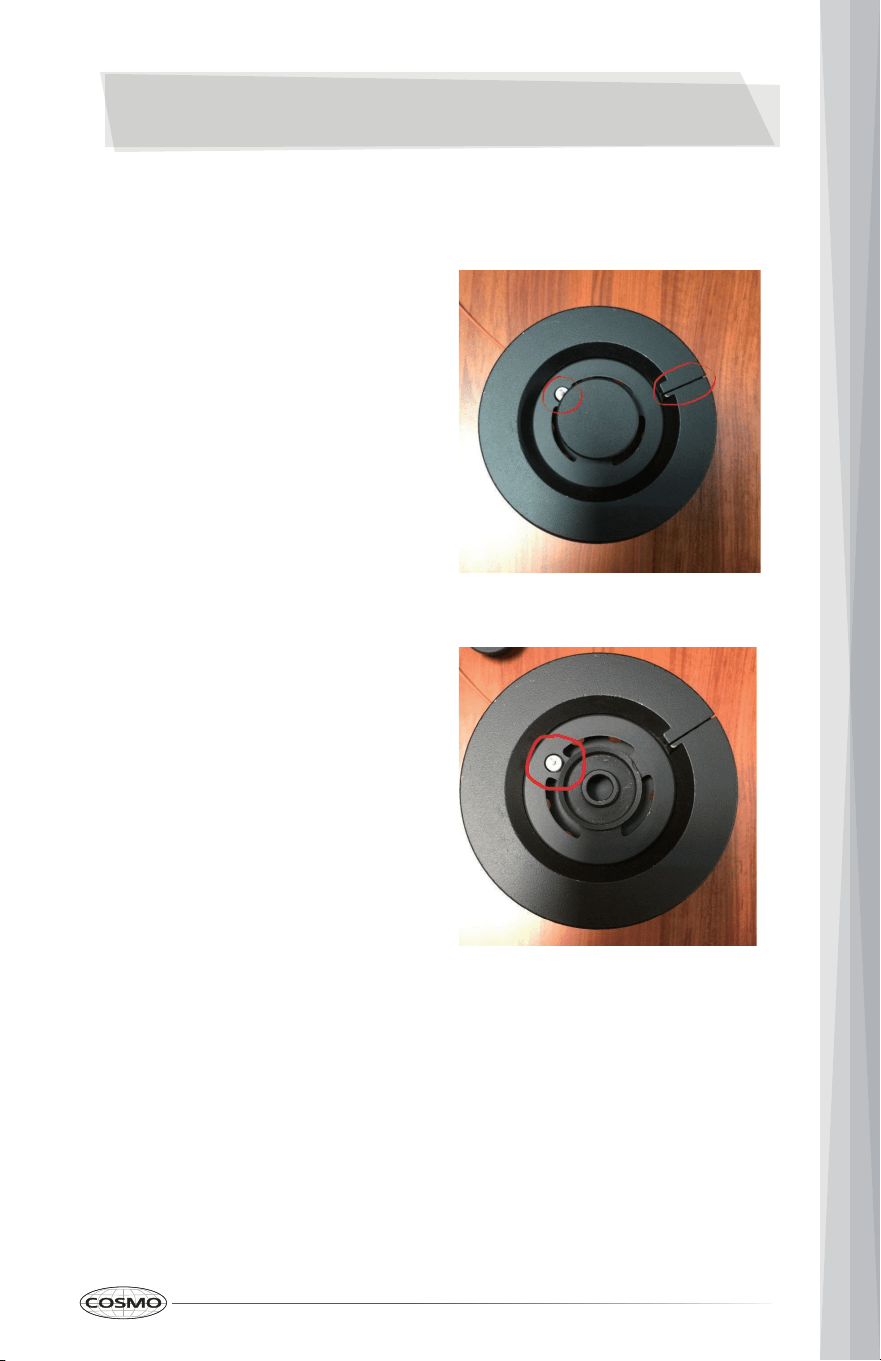
DUAL BURNER CLICKING PROBLEM
STEP 1
Make sure the burner design is correct.
Our current design for the burner has
the electrode on the left side (10
o'clock) and cross-over on the right
side (2 o'clock).
There are four parts for the dual
burners.
They are burner cap, blame ring base,
flame ring and burner.
STEP 2
Make sure the electrode is going
through the hole on the flame ring
and is vertical to the surface of the
flame ring base.
54
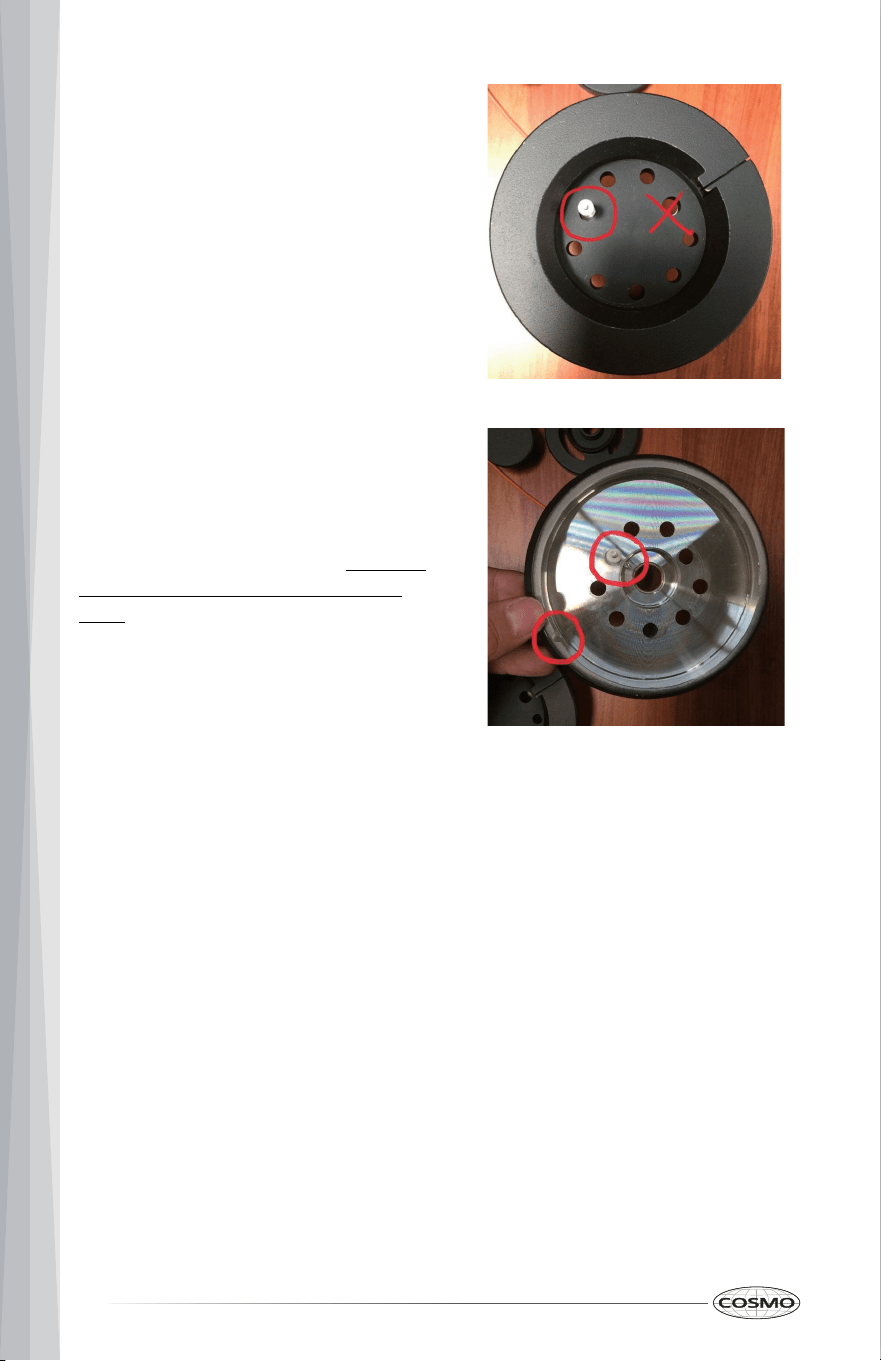
STEP 3
For the flame ring base, make sure
that the electrode will go through the
hole on the 10 o'clock position. Make
sure the electrode is not going
through the hole next to the cross-
over.
STEP 4
Make sure the electrode is vertical to
the surface of the burner base.
Please be aware that there's a slot at
the 8 o'clock position of the burner
base. This slot helps to locate the
burner base.
55
INSTALLING KNOBS AND HANDLES
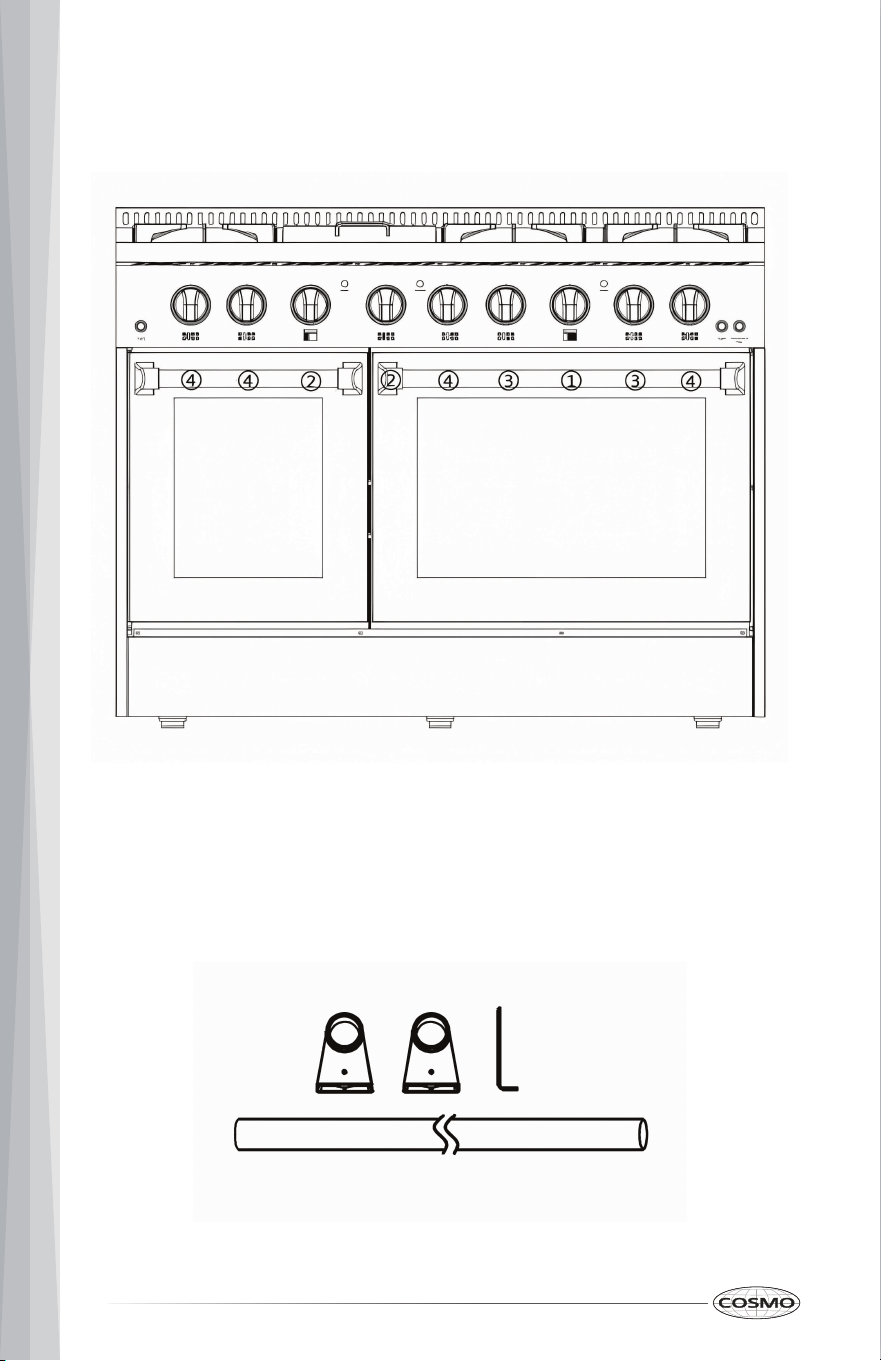
1. Check the knobs
1. Big Oven Knob
3. Dual Burner Knob
2. Griddle/Small Oven Knob
4. Single Burner Knob
2. See the sheet for the number of each knobs
COS-DFRL486GK
Model
Big Oven
Knob
Griddle/Small
Oven Knob
Dual Burner
Knob
1 2 2
Single Burner
Knob
4
NOTE:
• To purchase these or any other accessories or replacement parts,
please visit www.cosmoappliances.com or reference the contact
information at the end of this manual.
56
3. Find the right knobs for each shaft on the range. Push the knob in to fully
attach the shaft and make sure there's no friction between knobs and bezels
4. Your Cosmo range might have a KD handle that needs to be installed.
Please use the following procedures for the oven door handle installation
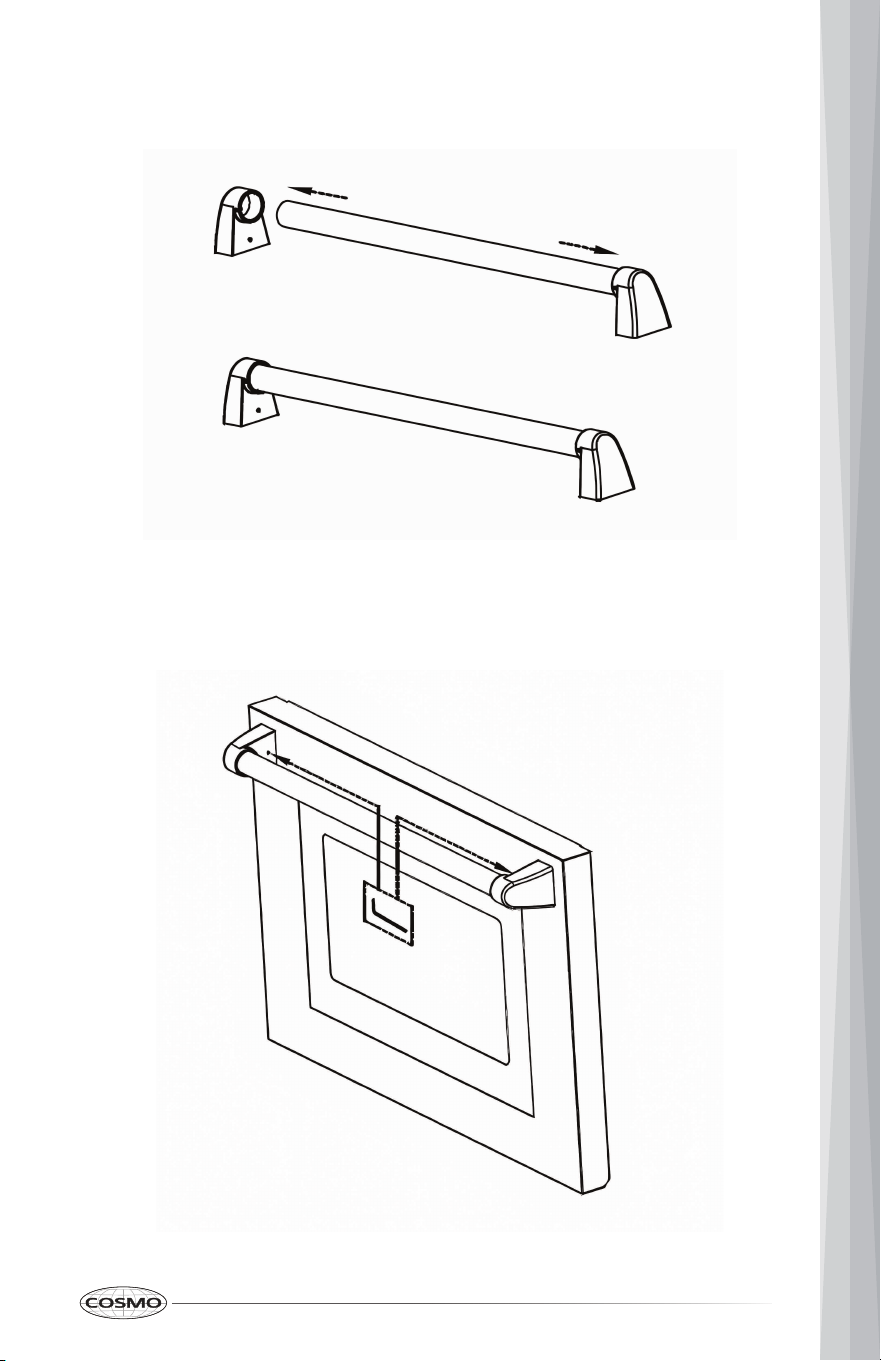
5. Check your Installation Kits for Door Handles
(4) Handle Holders, (1) Installation Wrench, (2) Handles
57
6. Connect door handle holders to each side of the handle
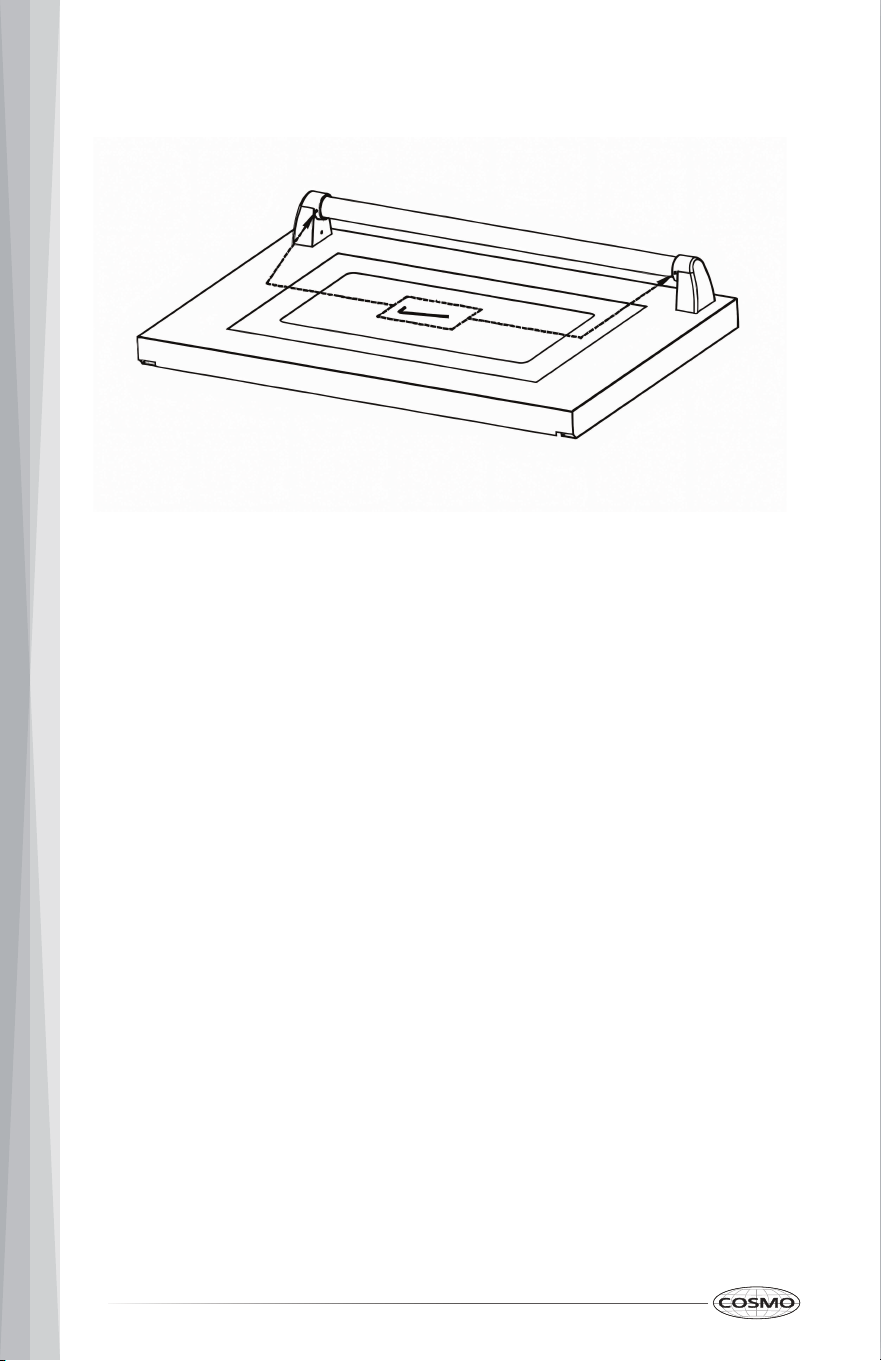
7. Lay the door handle against to the oven door and fit it on the connection
part, use the wrench to get the door handle holder tight
58
8. use the wrench to tighten the door handle holders
9. Check if the oven door handle is level and stable
59
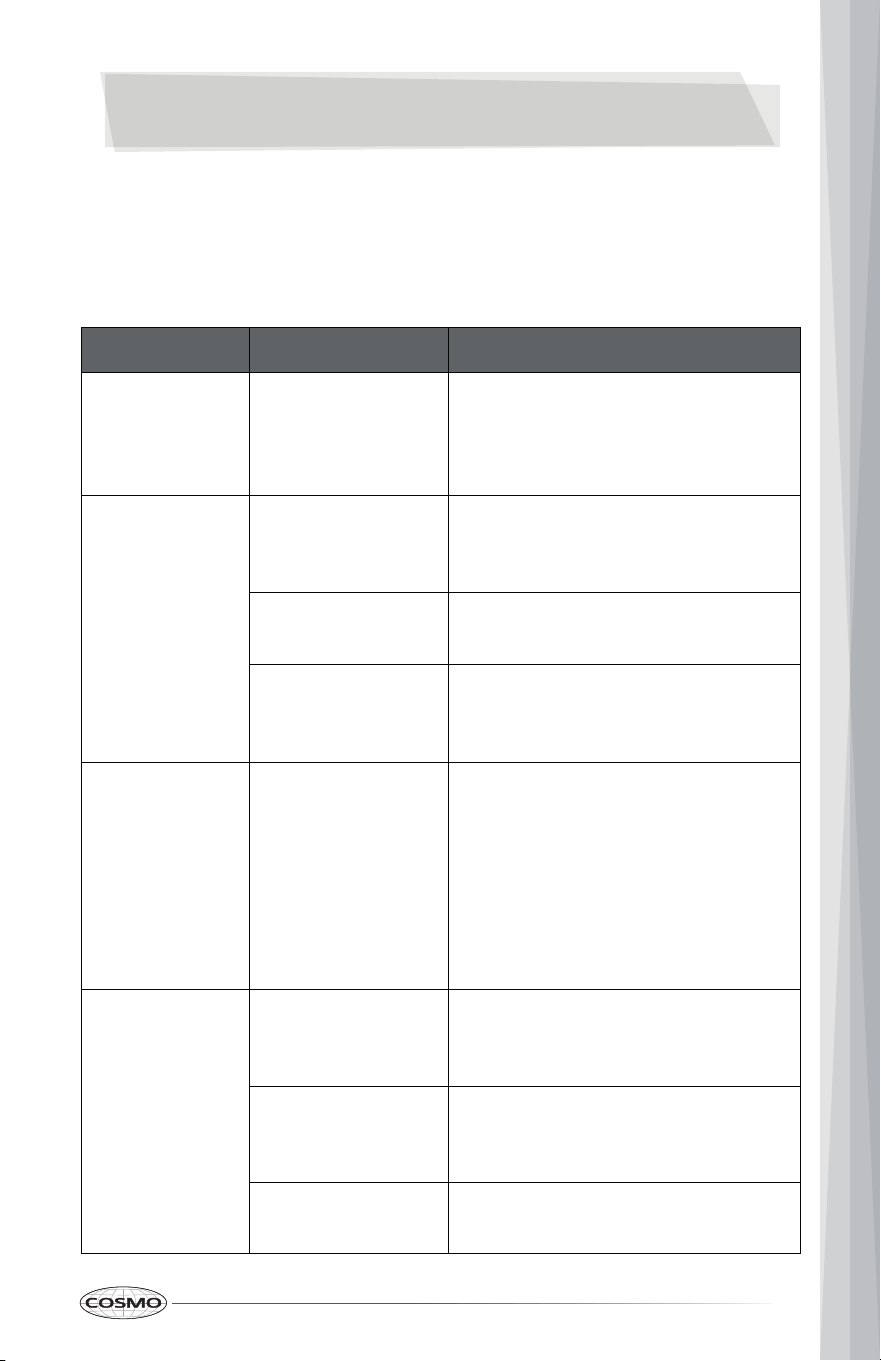
TROUBLESHOOTING
First try the solutions suggested here to possibly avoid the cost of a service
call.
COOKTOP PROBLEMS
PROBLEM POSSIBLE CAUSE SOLUTION
Burner will not
ignite
There is no power
to the range.
Make sure electrical plug is plugged
into a live, properly grounded
outlet. Replace the fuse or reset the
circuit breaker.
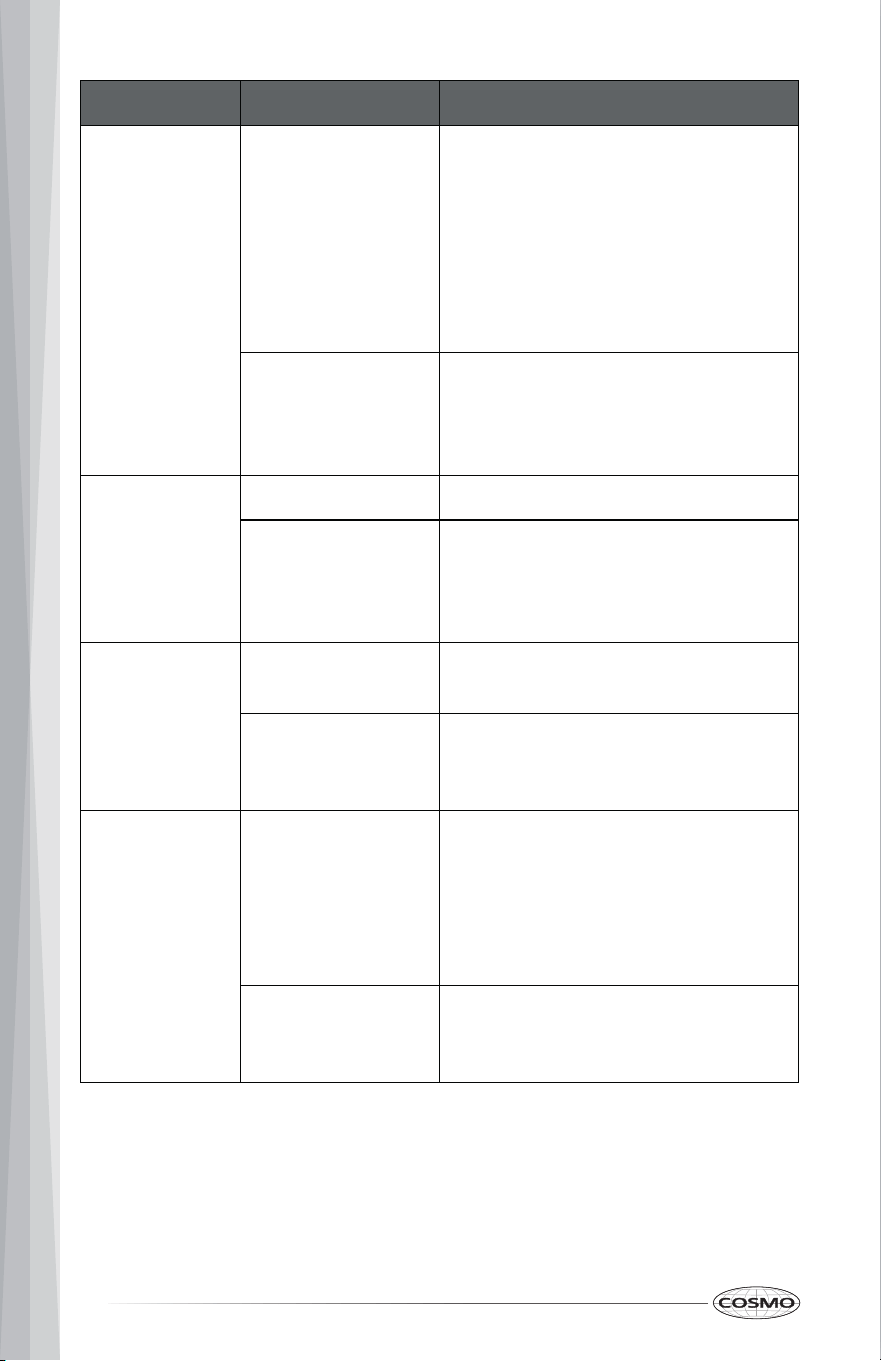
Burner will not
operate
First time use. Air
still in the gas line.
Turn on any one of the surface
burner knobs to release air from the
gas lines.
Control knob is not
set correctly.
Push in knob before turning to a
setting.
The burner port is
clogged.
Clean burner port opening using a
stiff, nylon toothbrush or a
straightened paper clip.
Excessive heat
around
cookware on
cooktop
The cookware is not
the proper size for
the surface burner
or element.
Use cookware with a bottom
surface approximately the same
size as the cooking area and the
surface burner or element.
Cookware should not extend more
than 1" (2.5 cm) outside the cooking
area. Adjust the power level or
burner flame appropriately.
Burner
Flames are
uneven,
yellow
and/or noisy
Burner port(s) are
clogged.
Clean burner port opening using
a stiff, nylon toothbrush or a
straightened paper clip.
Burner caps are
not positioned
properly.
Place burner caps so that the
alignment pins are properly
aligned with the slots.
Propane gas is
being used.
The range should be converted to
LP gas by a qualified technician.
60
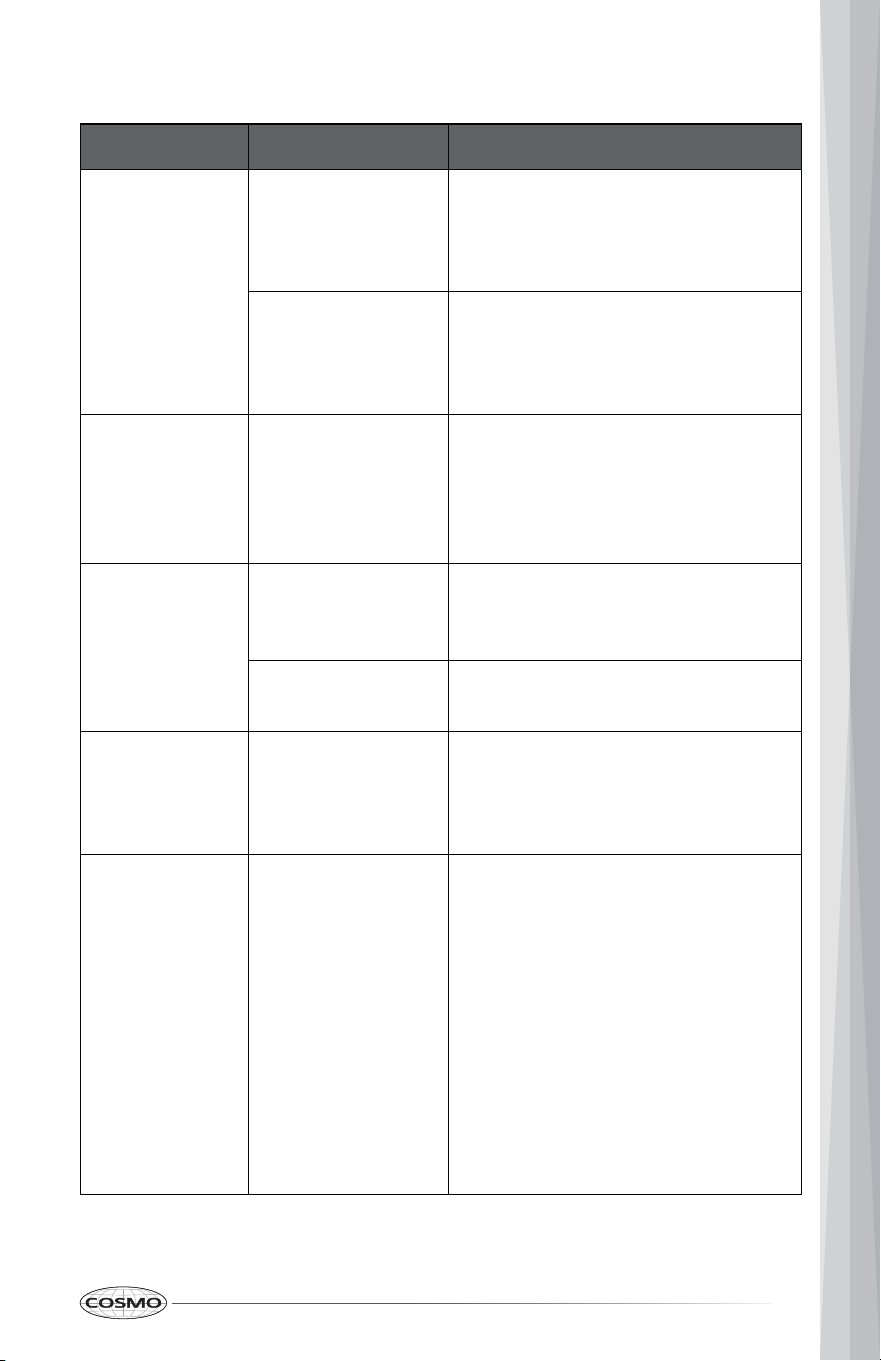
PROBLEM POSSIBLE CAUSE SOLUTION
Burner flame is
too high or too
low
Cooktop gas supply
is not correct.
Ensure the range is set for the correct
gas type. It is factory set for natural
gas. If connecting to LP gas, the
burners should be converted to LP
gas with the orifice kit supplied and
the pressure regulator converted to
the LP gas setting by a qualified
technician.
The gas pressure is
not correct.
Make sure the pressure regulator is
installed correctly and the gas line
pressure is correct. See Installation
Instructions.
Burner makes
popping
noises
The burner is wet. Allow the burner to dry before using.
The burner cap or
gas spreader is not
positioned
correctly.
Place burner caps so that the
alignment pins are properly aligned
with the slots.
Cooking
results are not
what expected
Using incorrect
cookware.
Use pans with flat bottoms and that
match cooktop burner diameter.
The control knob is
not set to the
proper heat level.
See the "Surface Burner Ignition"
section.
Unable to
maintain a
rolling boil or
will not cook
fast enough
Using improper
cookware.
Use pans with flat bottoms and that
match the diameter of the cooktop
burner selected. Adjust flame so that
flame does not extend beyond edge
of pot. See the "Using The Proper
Cookware" section.
Using large
cookware without
lid.
Large pots and pans can lose a lot of
heat from the top. Cover pot or pan
with a lid to retain heat better.
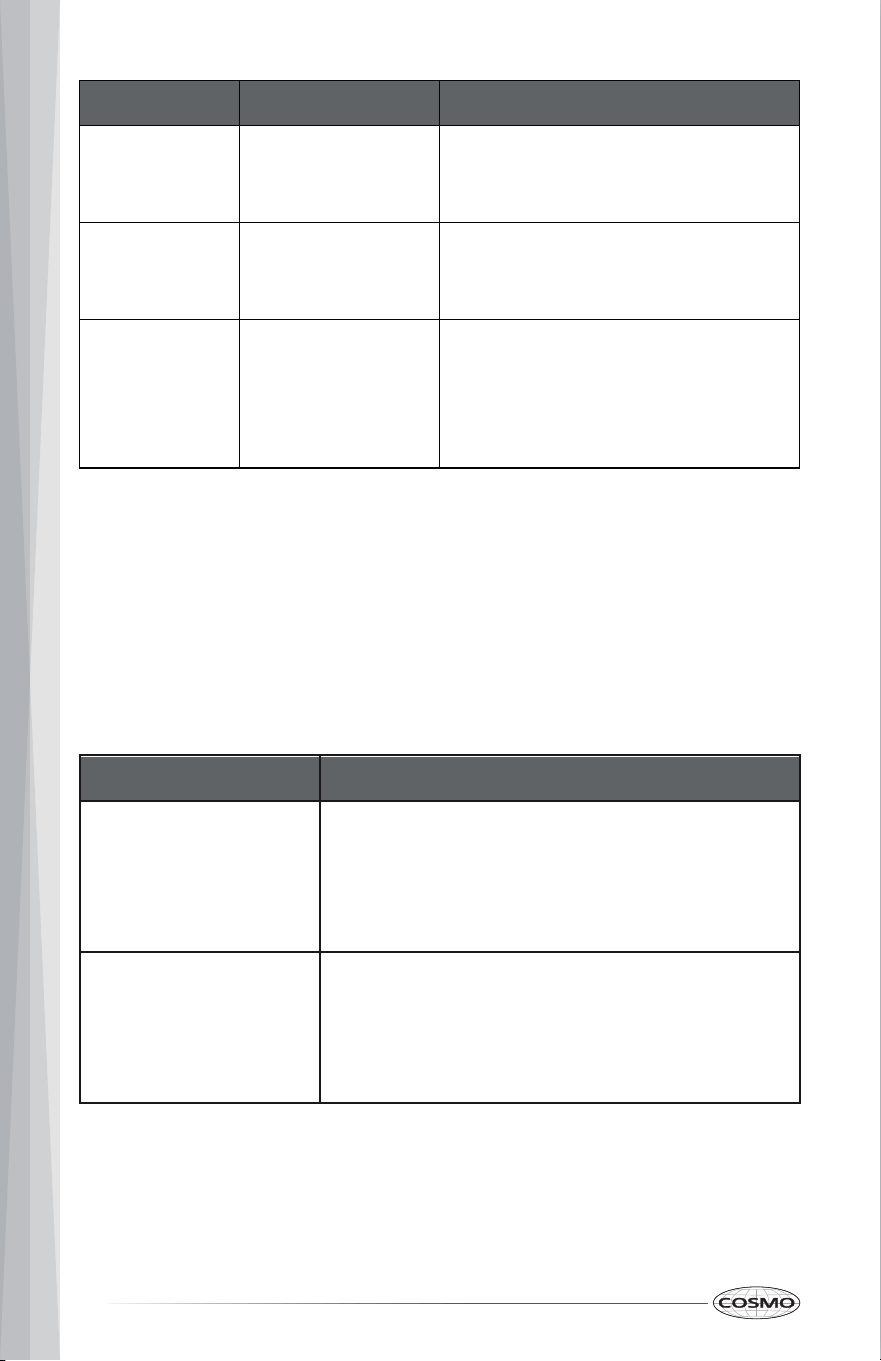
OVEN PROBLEMS
PROBLEM POSSIBLE CAUSE SOLUTION
Strong odor
when using new
oven
Manufacturing
protective coating
on the oven
surfaces.
This is normal with a new range and
will disappear after a few uses.
Packaging
materials exist.
Double-check that all packaging
has been removed from the
appliance - check around door sides
and inside drawer.
Clicking noise
can be heard
when oven is
operating
The oven burner
cycles on and off to
maintain the oven
temperatur
e
selected.
When burner turns on, the electric
spark ignition may be heard
periodically. It is normal to spark for
only a few seconds, followed by the
sound of the burner igniting.
Oven is not
heating
No power to the
range.
Check the circuit breaker or fuse box
to your house. Make sure there is
proper electrical power to the oven.
Oven control not
turned on.
Make sure the oven temperature
has been selected.
Oven is taking
too long to
cook
All ovens operate
slightly differently
from each other.
Adjust time, temperature or rack
position.
Oven is not
cooking evenly
Not using the
correct bakeware
or oven rack
position.
Refer to "Positioning the Oven
Racks" for recommended rack
position. Always reduce recipe
temperature by 25°F (15°C) when
baking with Convention Bake
mode.
Recipe may perform better at a
different rack position. Try moving
the food down a rack position to
make the bottom darker. Try
moving food up a rack position to
make the top darker.
61
PROBLEM POSSIBLE CAUSE SOLUTION
Oven light is
not working
properly
Light bulb loose
or burned-out.
Reinsert or replace the light bulb.
Touching the bulb with fingers
may cause the bulb to burn out.
Oven light
stays on
Door is not
closing
completely
Check for obstruction in oven door.
Check to see if hinge is bent or
door switch broken.
Excessive
Moisture on
door glass
Condensation
from cooking
foods with high
moisture content.
This is normal. Condensation will
evaporate as oven heats up.
Convection Bake and Convection
Roast will eliminate any moisture in
the oven.
62
BAKING PROBLEMS
With any oven setting poor results can occur for many reasons other than a
malfunction of the oven. Check the chart below for causes of the most
common problems. Since the size, shape and material of baking utensils
directly affect the baking results, the best solution may be to replace old
baking utensils that have darkened and warped with age and use.
PROBLEM CAUSE
Food browns
unevenly
• Oven not preheated
• Aluminum foil on oven rack or oven bottom
• Baking utensil too large for recipe
• Pans touching each other or oven walls
Food too brown on
bottom
• Oven not preheated
• Using glass, dull or darkened metal pans
• Incorrect rack position
• Pans touching each other or oven walls
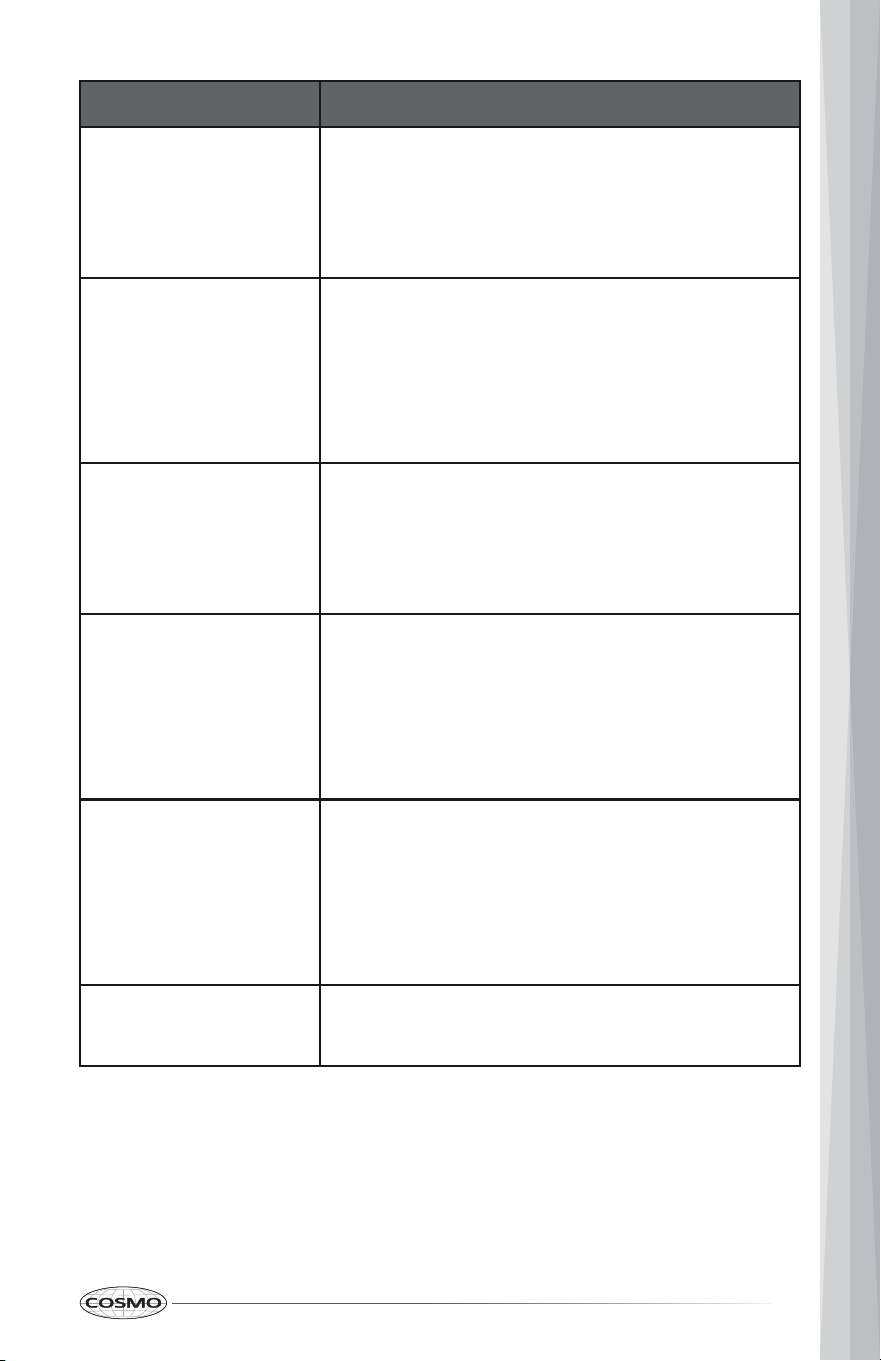
PROBLEM CAUSE
Food is dry or has
shrunk excessively
• Oven temperature too high
• Baking time too long
• Oven door opened frequently
• Pan size too large
Food is baking or
roasting too slowly
• Oven temperature too low
• Oven not preheated
• Oven door opened frequently
• Tightly sealed with aluminum foil
• Pan size too small
Pie crusts do not
brown on bottom or
crust is soggy
• Baking time not long enough
• Using shiny steel pans
• Incorrect rack position
• Oven temperature is too low
Cakes pale, flat and
may not be done
inside
• Oven temperature too low
• Incorrect baking time
• Cake tested too soon
• Oven door opened too often
• Pan size may be too large
Cakes high in middle
with crack on top
• Oven temperature too high
• Baking time too long
• Pans touching each other or oven walls
• Incorrect rack position
• Pan size too small
Pie crust edges too
brown
• Oven temperature too high
• Edges of crust too thin
63
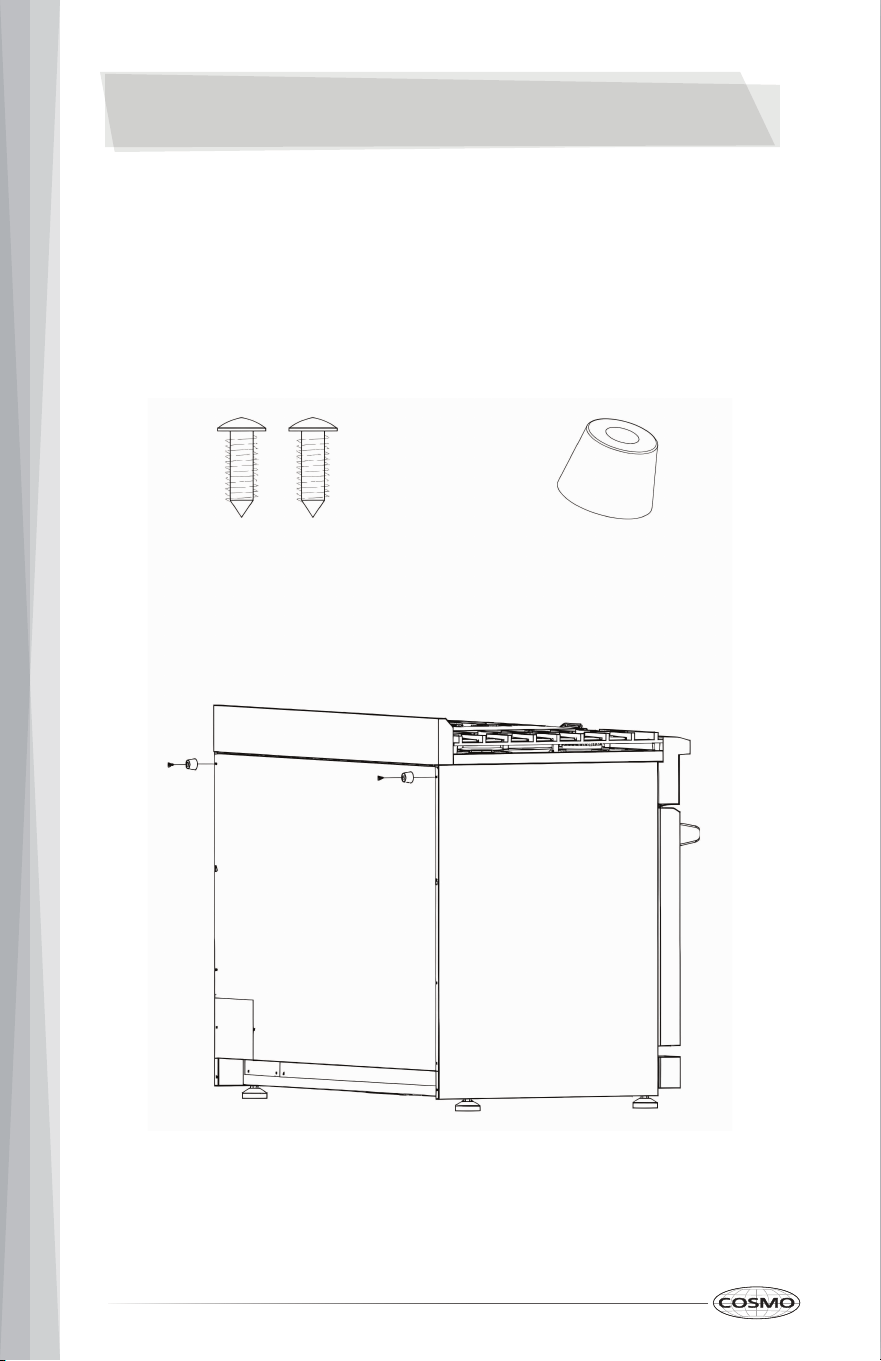
RUBBER PAD INSTALLATION
Rubber Pad Installation on Back Panel
To prevent the range from being too close to the wall, there are 2 plastic
pads. Follow the steps below to install.
1. Check the installation kit packed with this manual.
2. Install the 2 rubber pads as shown above.
64
(2) Screws (2) Rubber Pads
LIMITED WARRANTY
WARRANTY AND SERVICE
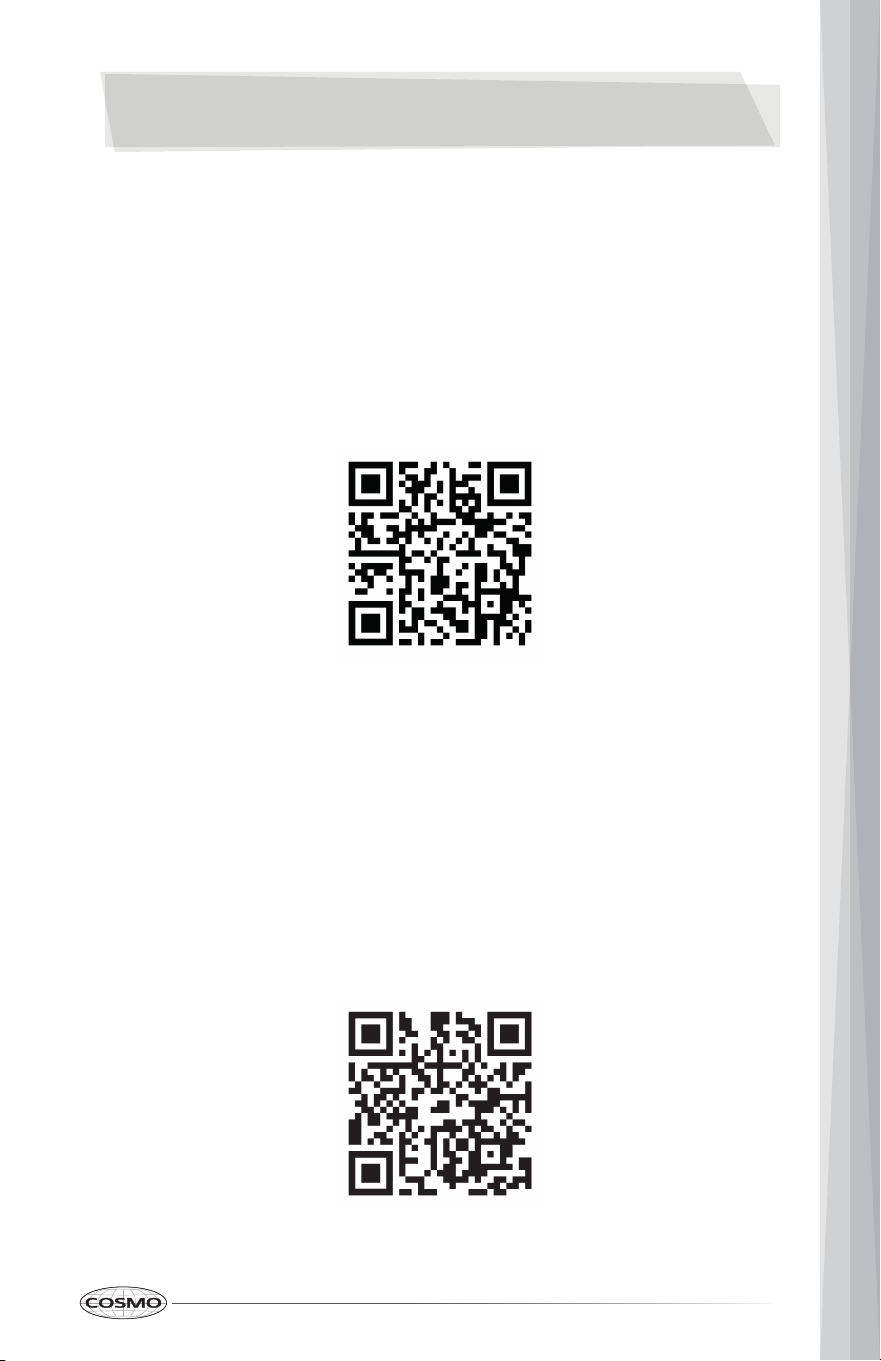
TO RECEIVE WARRANTY SERVICE, YOUR PRODUCT MUST BE REGISTERED.
TO REGISTER AND REVIEW FULL WARRANTY DETAILS, VISIT:
WWW.COSMOAPPLIANCES.COM/WARRANTY
SCAN TO REGISTER
CUSTOMER SUPPORT
TO CHAT WITH US LIVE FOR ASSISTANCE, VISIT:
WWW.COSMOAPPLIANCES.COM/CHAT
SCAN TO CHAT
65
Correct disposal of this product:
This marking indicates that this appliance should not be
disposed with other household wastes. To prevent
possible harm to the environment or human health from
uncontrolled waste disposal, recycle it responsibly to
promote the sustainable reuse of material resources.
IMPORTANT
Do Not Return This Product To The Store
If you have a problem with this product, please contact COSMO Customer
Support at
+1 (888) 784-3108
DATED PROOF OF PURCHASE, MODEL #, AND SERIAL # REQUIRED FOR
WARRANTY SERVICE.
IMPORTANT
Ne pas Réexpédier ce Produit au Magasin
Pour tout problème concernant ce produit, veuillez contacter le service des
consommateurs Cosmo Customer Support au
+1 (888) 784-3108
UNE PREUVE D’ACHAT DATEE EST REQUISE POUR BENEFICIER DE LA GARANTIE.
IMPORTANTE
No regrese este producto a la tienda
Si tiene algún problema con este producto, por favor contacte el ayuda al
cliente COSMO al
+1 (888) 784-3108
(Válido solo en E.U.A.)
NECESITA UNA PRUEBA DE DE COMPRA FECHADA, NÚMERO DE MODELO Y DE
SERIE PARA EL SERVICIO DE LA GARANTÍA.
66

Cosmo is constantly making efforts to improve the quality and
performance of our products, so we may make changes to our
appliances without updating this manual.
Electronic version of this manual is available at:
www.cosmoappliances.com
APPLIANCES