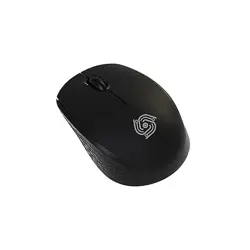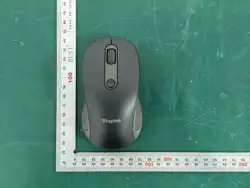
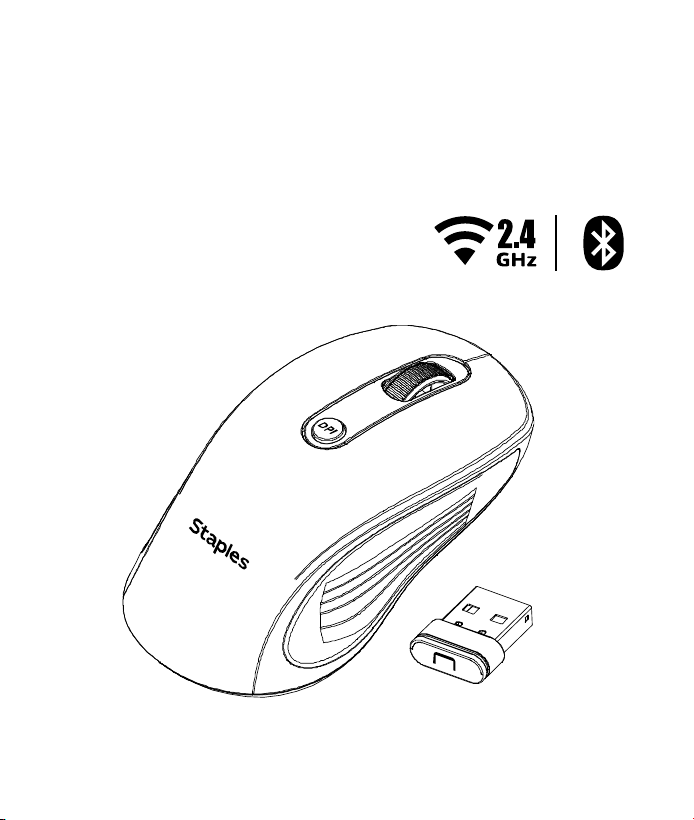
Silent Bluetooth Mouse
OWNER'S GUIDE
Ver.1.0
FCC ID:PRDMU146
CAUTION: To use this product properly, please read the user's guide before installing.

1
Federal Communication Commission Interference Statement
This equipment has been tested and found to comply with the limits for a
Class B digital device, pursuant to Part 15 of the FCC Rules. These limits
are designed to provide reasonable protection against harmful interference in
a residential installation. This equipment generates, uses and can radiate
radio frequency energy and, if not installed and used in accordance with the
instructions, may cause harmful interference to radio communications.
However, there is no guarantee that interference will not occur in a particular
installation. If this equipment does cause harmful interference to radio or
television reception, which can be determined by turning the equipment off
and on, the user is encouraged to try to correct the interference by one of the
following measures:
- Reorient or relocate the receiving antenna.
- Increase the separation between the equipment and receiver.
- Connect the equipment into an outlet on a circuit different from
that to which the receiver is connected.
- Consult the dealer or an experienced radio/TV technician for help.
FCC Caution: Any changes or modifications not expressly approved by the
party responsible for compliance could void the user's authority to operate
this equipment.
This device complies with Part 15 of the FCC Rules. Operation is subject to
the following two conditions: (1) This device may not cause harmful
interference, and (2) this device must accept any interference received,
including interference that may cause undesired operation.
Radiation Exposure Statement:
The product comply with the FCC portable RF exposure limit set forth for an
uncontrolled environment and are safe for intended operation as described in
this manual. The further RF exposure reduction can be achieved if the
product can be kept as far as possible from the user body or set the device to
lower output power if such function is available.
2
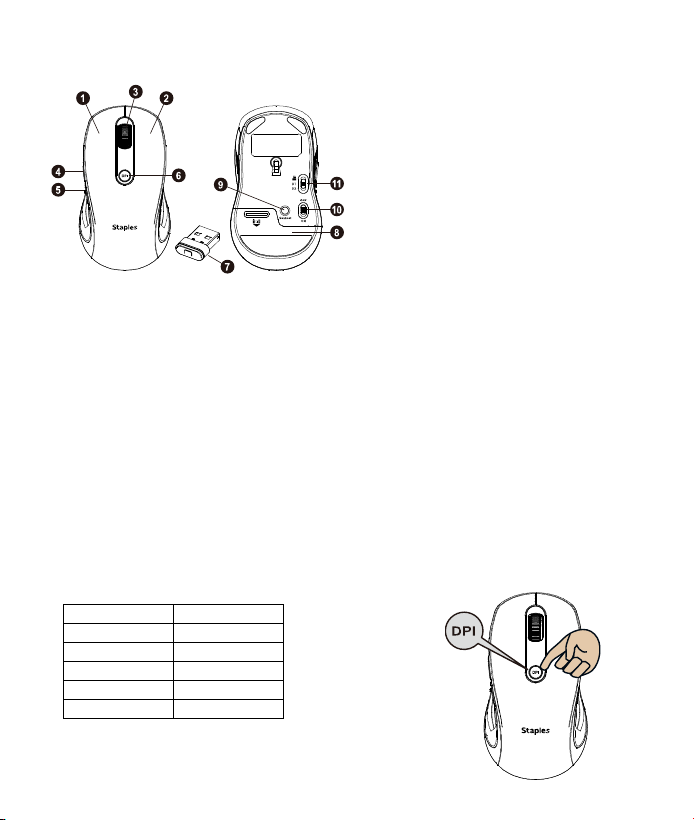
Functional Introduction
1.
Left button
7.
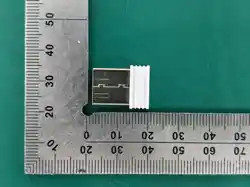
Nano Receiver
2.
Right button
8.
Battery Cover
3.
Scrolling Wheel
9.
Connect Button
4.
Forward
10
ON / OFF Switch
5.
Backward
11
2.4G / BT1 / BT2 Switch
6.
DPI Switch button & LED Indicator
Forward
Press this button to view the next page in your Internet browser
Backward
Press this button to view the previous page in your Internet browser
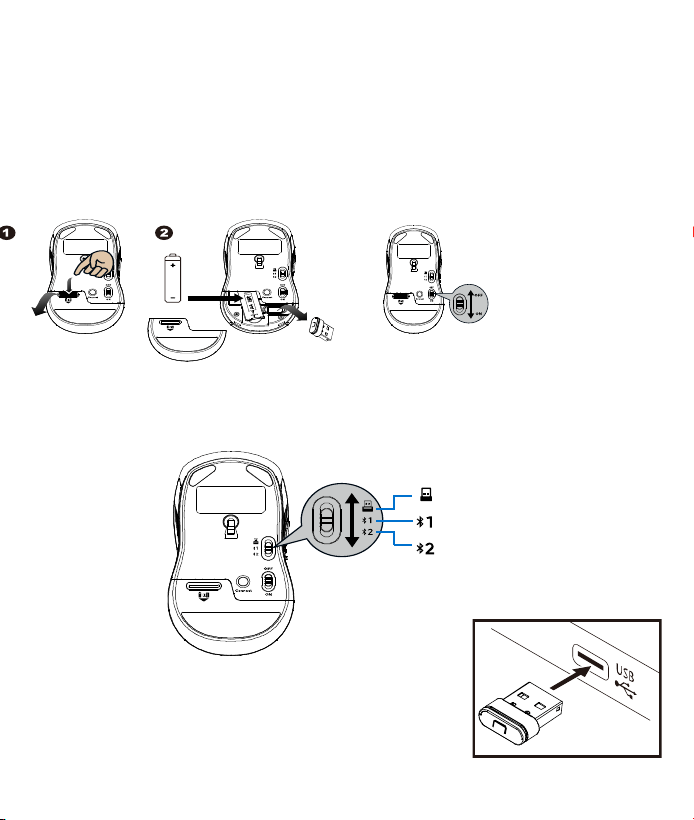
DPI Switch
The LED indicator will light up when you plug the mouse into the USB port. The
brightness of the indicator indicates the DPI setting in use.
a) 5 adjustable DPI settings.
The number of blinks indicates the DPI setting in use
DPI
# of Blinks
800 dpi
1
1000 dpi
2
1600 dpi
3
2400 dpi
4
3600 dpi
5
3
b) The default setting is 1600 DPI.
You can easily switch between DPI settings.
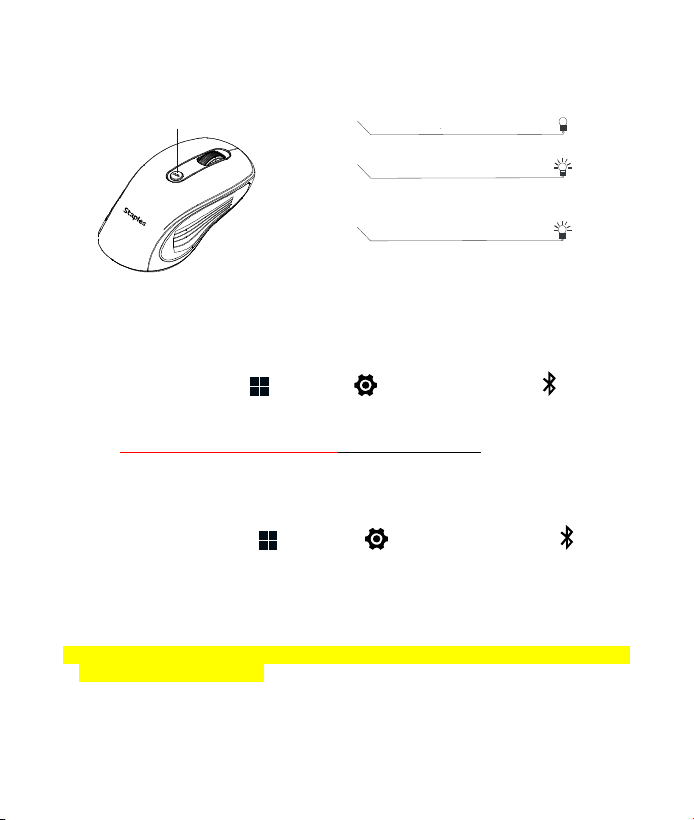
Battery and Power Management:
Step 1: Take the battery cover off.
Step 2: Insert the battery as shown inside the battery compartment.
Step 3: Replace the cover.
Step 4: Turn on power switch
**Warning:
*Please insert the battery with the correct position according to the instruction
labeled on the mouse.
Switch Connection Channel
Connect via USB nano receiver
1.Plug nano receiver into the USB A port on
your computer
2.Mouse switch to 2.4G mode and press Connect Button
P
u
ll
AA
Batte
ry
USB
BT1
BT2
4
3. In 2.4G mode, the indicator light turns off once pairing is successful. If pairing is
not established, the light will blink for 10 seconds and then turn off.”
Connect via Bluetooth in windows
1.On your PC, select Start > Settings > Bluetooth & devices > Turn on
Bluetooth > Add device > Bluetooth.
2.Mouse switch to BT mode and press Connect Button.
3.Find ” ST-MOUSE-1 or ST-MOUSE-2” and press connect.
4.In Bluetooth mode, the indicator light turns off once pairing is successful. If
pairing is not established, the light will blink for 10 seconds and then turn off.”
Swift pair
1.On your PC, select Start > Settings > Bluetooth & devices > View
more devices > Turn on the Show notifications to connect using Swift Pair.
2. Mouse switch to BT mode and press Connect Button.
3. Windows will show a notification ” ST-MOUSE-1 or ST-MOUSE-2” and Selecting
“Connect” starts pairing.
Remark: Each time the mode is switched, the indicator light will turn on for 2
seconds and then turn off.”
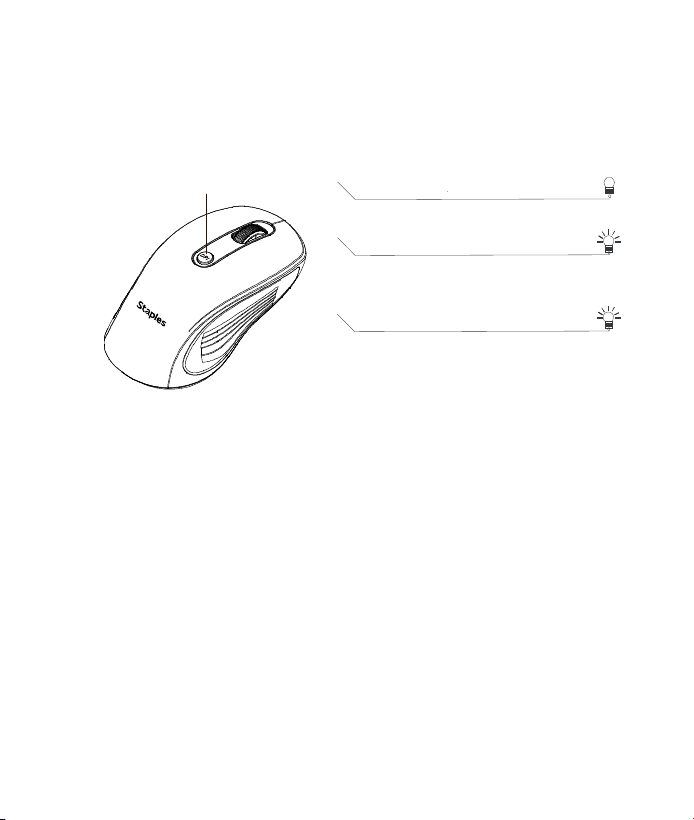
*2.4G Mode
Red LED is on for 10
Sec.
Power ON
Red LED Blinking
Pairing(LED OFF when paired or
failed after 10 Sec
Red LED Blinking for 10 Sec
Low battery Warning
LED
Indicator
5
Connect via Bluetooth in Mac
1.Click on “Apple menu” (top left corner of your screen).
2.Go to System Preferences-> Bluetooth-> Turn Bluetooth on to set up Bluetooth
device and find ” ST-MOUSE-1 or ST-MOUSE-2” press connect.
Power saving features:
To conserve the battery power, the mouse offers power management functions as
below:
The mouse goes into “Saving Mode” after inactivity. There may be a slight delay
while the mouse re-establishes Bluetooth connection from
power saving or sleeping mode.
*Low Battery Warning: At startup, the light blinks for 10 seconds (once per
second) and then turns off. During operation, it continues blinking. When the
device stops working, the light turns off after 10 seconds.”
Establishing a Bluetooth Connection
The Bluetooth mouse can work in any Bluetooth environment. Before connecting
your Bluetooth mouse with your computer, make sure your computer has a working
Bluetooth configuration with Human Interface Device (HID) profile. If your
computer does not support Bluetooth, you need to obtain and install a
commercially available Bluetooth dongle which converts your computer to a
Bluetooth environment.
* Bluetooth Mode
Red LED is on for 10 sec.
Power ON
Red LED Blinking
Pairing(LED OFF when paired or failed after
10 min
Red LED Blinking for 10 Sec
Low battery Warning
LED Indicator

6
Troubleshooting
A. Mouse does not work upon installation or is not detected
Try one or more of the following:
Make sure the batteries are installed correctly and turn the switch on.
Replace a fresh set of batteries if it still does not work.
Verify that the computer is Bluetooth enabled.
Press the connection button to reset the Bluetooth connection between your
mouse and your computer. Make sure it has been detected by the Operating
Systems properly.
B. The screen cursor does not move properly
If your screen cursor lags behind the movement, then your Bluetooth
connection may not be able to transmit all of the data from the mouse
with the necessary speed. This may be caused by interference from
other radio sources, obstructions in the radio wave path, excessive
distance from the computer, or a combination of the above.
※ Try the following actions to improve your Bluetooth
connection and optimize your mouse performance:
Remove any metallic objects from the line of sight between your computer
and the Bluetooth mouse.
If you are using a computer with a built-in Bluetooth antenna, try
reorienting the computer until you get a better data rate.
If you are using a Bluetooth dongle, use a USB extension cable and place
the Bluetooth dongle onto your desktop or somewhere in sight of your
Bluetooth mouse.
Move the mouse closer to your Bluetooth dongle.
Turn off the mouse and turn it on again for better connection.
Disconnect any Bluetooth audio devices, such as headsets, that may be
connected to your computer.
Switch off any other devices operating in the 2.4 GHz radio spectrum,
such as Wi-Fi network, mobile telephones, etc., or move their antennas
further away from your computer.