
Company Name:M5Stack Technology Co.,Ltd
Address: Block A10, Expo Bay South Coast, Fuhai Street, Bao'an District,
Shenzhen,Guangdong,China
StackChan
2026
V0.01

2
TABLE OF CONTENTS
TABLE OF CONTENTS............................................................................................... 2
1. OUTLINE................................................................................................................ 3
1.1
Hardware Composition................................................................................................... 3
2. PIN DESCRIPTION................................................................................................ 4
2.1. USB INTERFACE..................................................................................................................4
2.2. GROVE INTERFACE........................................................................................................... 4
3. FUNCTIONAL DESCRIPTION...............................................................................5
3.1. CPU AND MEMORY..........................................................................................................5
3.2. STORAGE DESCRIPTION................................................................................................. 5
3.2.1.
External Flash and SRAM.............................................................................................5
3.3. CPU CLOCK..........................................................................................................................6
3.4. RTC AND LOWPOWER MANAGEMENT....................................................................6
4. ELECTRICAL CHARACTERISTICS.........................................................................7
4.1.
ABSOLUTE MAXIMUM RATINGS.................................................................................7
4.2.
WIFI RADIO AND BASEBAND....................................................................................... 7
5. FCC Warning ......................................................................................................... 8
3
1.OUTLINE
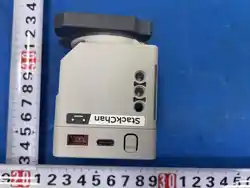
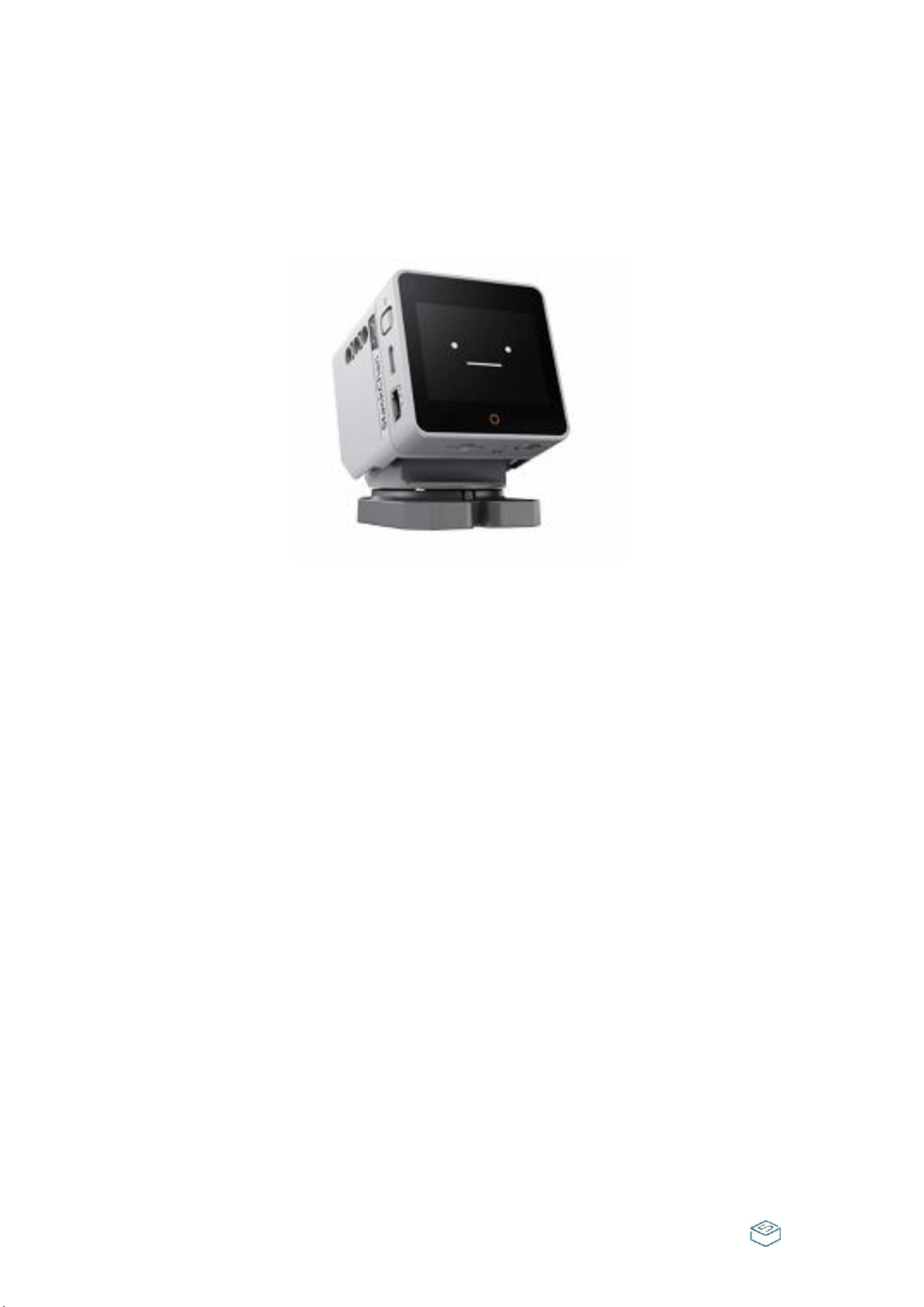
StackChan is ESP32 board which based on ESP32-S3 chip, contained 2-inch TFT
screen. The board is made of PC+ABC.
1.1
Hardware Composition
The hardware of CORES3: ESP32-S3 chip, TFT screen, Green LED, Button, GROVE
interface, TypeC-to-USB interface, Power Management chip and battery.
ESP32-S3 The ESP32 is a dual-core system with two Harvard Architecture Xtensa LX6
CPUs. All embedded memory,external memory and peripherals are located on the
data bus and/or the instruction bus of these CPUs.With some minor exceptions (see
below), the address mapping of two CPUs is symmetric, meaning that they usethe
same addresses to access the same memory. Multiple peripherals in the system can
access embeddedmemory via DMA.
TFT Screen is a 2-inch color screen driven ILI9342C with a resolution of 320 x 240.
Operating voltage range is 2.6~3.3V, working temperature range is -25~55°C.
Power Management chip is X-Powers's AXP2101. The operating voltage range is
2.9V~6.3V and the charging current is 1.4A.
StackChan equips ESP32 with everything needed for programming, everything
needed for operation and development
4
GPIO
2.PIN DESCRIPTION
2.1.USB INTERFACE
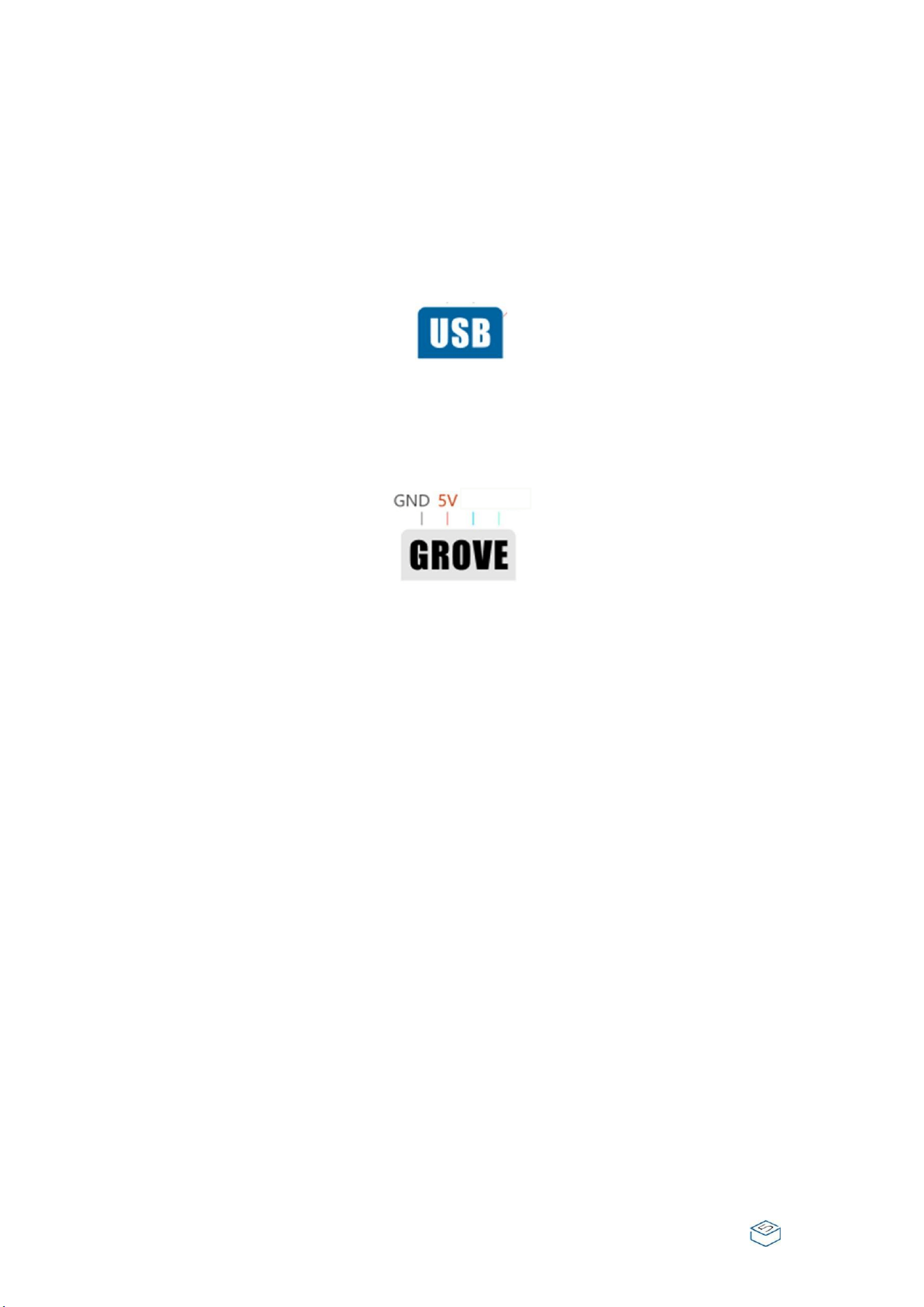
M5CAMREA Configuration Type-C type USB interface, support USB2.0
standard communication protocol.
2.2.GROVE INTERFACE
4p spacing 2.0mm M5CAMREA GROVE Ports.A, Port.B, and Port.C, the internal
cables are connected to GND, 5V, GPIO1, GPIO2, GPIO8, GPIO9, GPIO17, and GPIO18.

5
3.FUNCTIONAL DESCRIPTION
This chapter describes the ESP32-S3 various modules and functions.
3.1.CPU AND MEMORY
Xtensa® dual-core 32-bit LX7 microprocessor,up to 240 MHz
384 KB ROM
512 KB SRAM
16 KB SRAM in RTC
SPI, Dual SPI, Quad SPI, Octal SPI, QPI and OPI interfaces that allow connection to
multiple flash and external RAM
Flash controller with cache is supported
Flash in-Circuit Programming (ICP) is supported
3.2.STORAGE DESCRIPTION
3.2.1.
External Flash and SRAM
ESP32-S3 supports SPI, Dual SPI, Quad SPI, Octal SPI, QPI and OPI interfaces that allow
connection to multiple external flash and RAM.
The external flash and RAM can be mapped into the CPU instruction memory space
and read-only data memory space. The external RAM can also be mapped into the
CPU data memory space. ESP32-S3 supports up to 1GB of external flash and RAM, and
hardware encryption/decryption based on XTS-AES to protect users’programs and
data in flash and external RAM.
Through high-speed caches, ESP32-S3 can support at a time up to:
External flash or RAM mapped into 32 MB instruction space as
individual blocks of 64 KB
External RAM mapped into 32 MB data space as individual blocks of
64 KB. 8-bit, 16-bit, 32-bit, and 128-bit reads and writes are
supported. External flash can also be mapped into 32 MB data space
as individual blocks of 64 KB, but only supporting 8-bit, 16-bit, 32-
bit and 128-bit reads.
6
3.3.CPU CLOCK
The CPU clock has three possible sources:
External main crystal clock
Internal fast RC oscillator (typically about 17.5 MHz, and adjustable)
PLL clock
The application can select the clock source from the three clocks above.
The selected clock source drives the
CPU clock directly, or after division, depending on the application. Once
the CPU is reset, the default clock
source would be the external main crystal clock divided by 2.
3.4.RTC AND LOWPOWER MANAGEMENT
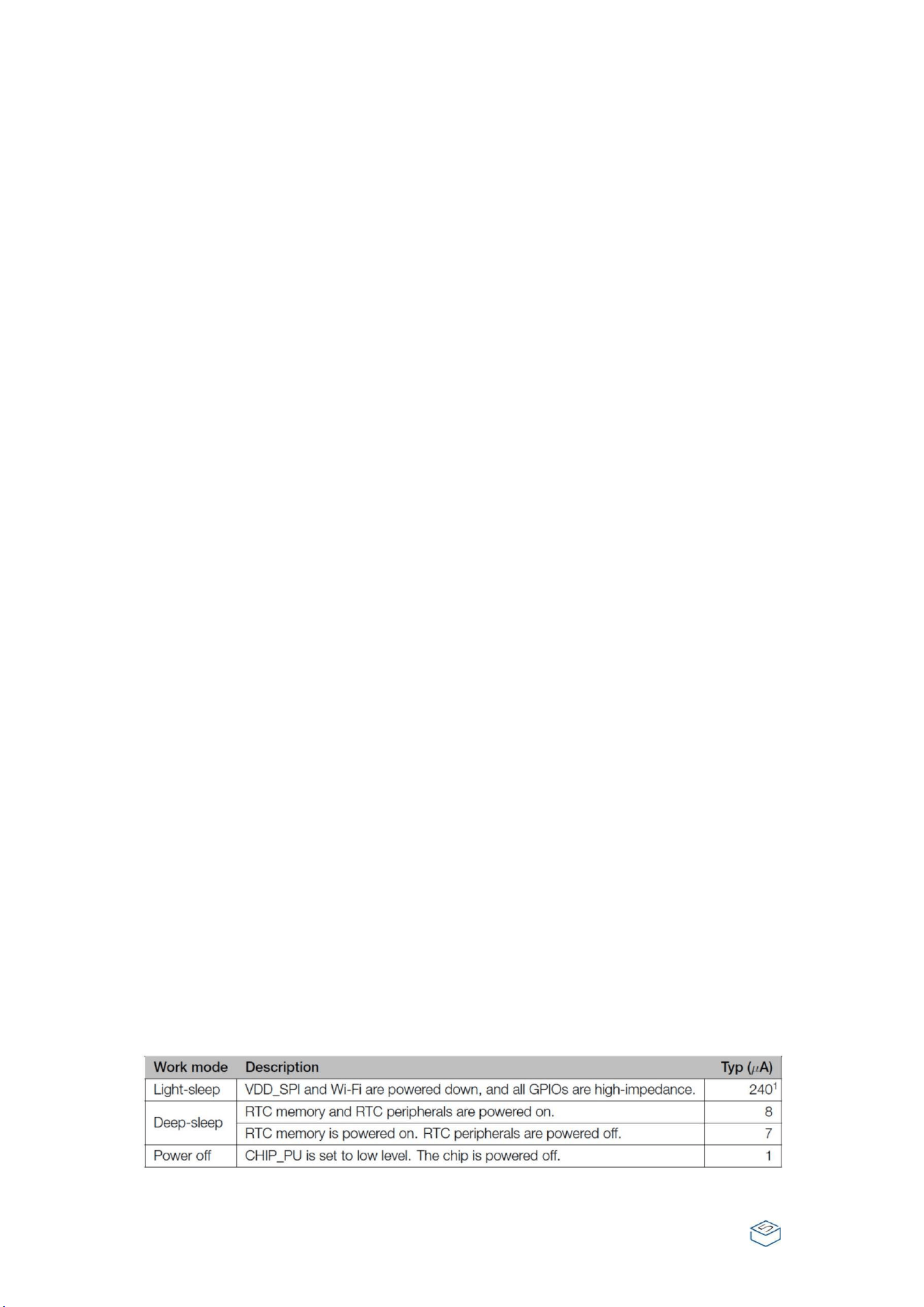
With the use of advanced power-management technologies, ESP32-S3 can switch
between different power modes. (see table1)。
Active mode: CPU and chip radio are powered on. The chip can
receive, transmit, or listen.
Modemsleep mode: The CPU is operational and the clock speed can
be reduced. The wireless baseband and radio are disabled, but
wireless connection can remain active.
Lightsleep mode: The CPU is paused. The RTC peripherals, as well as
the ULP coprocessor can be woken up periodically by the timer.
Any wake-up events (MAC, host, RTC timer, or external interrupts)
will wake up the chip. Wireless connection can remain active. Users
can optionally decide what peripherals to shut down/keep on (refer
to Figure 1), for power-saving purpose.
Deepsleep mode: CPU and most peripherals are powered down.
Only the RTC memory is powered on and RTC peripherals are
optional. Wi-Fi connection data are stored in the RTC memory. The
ULP coprocessor is functional.
Current Consumption in LowPower Modes: TABLE 1
7
4.ELECTRICAL CHARACTERISTICS
4.1.
ABSOLUTE MAXIMUM RATINGS
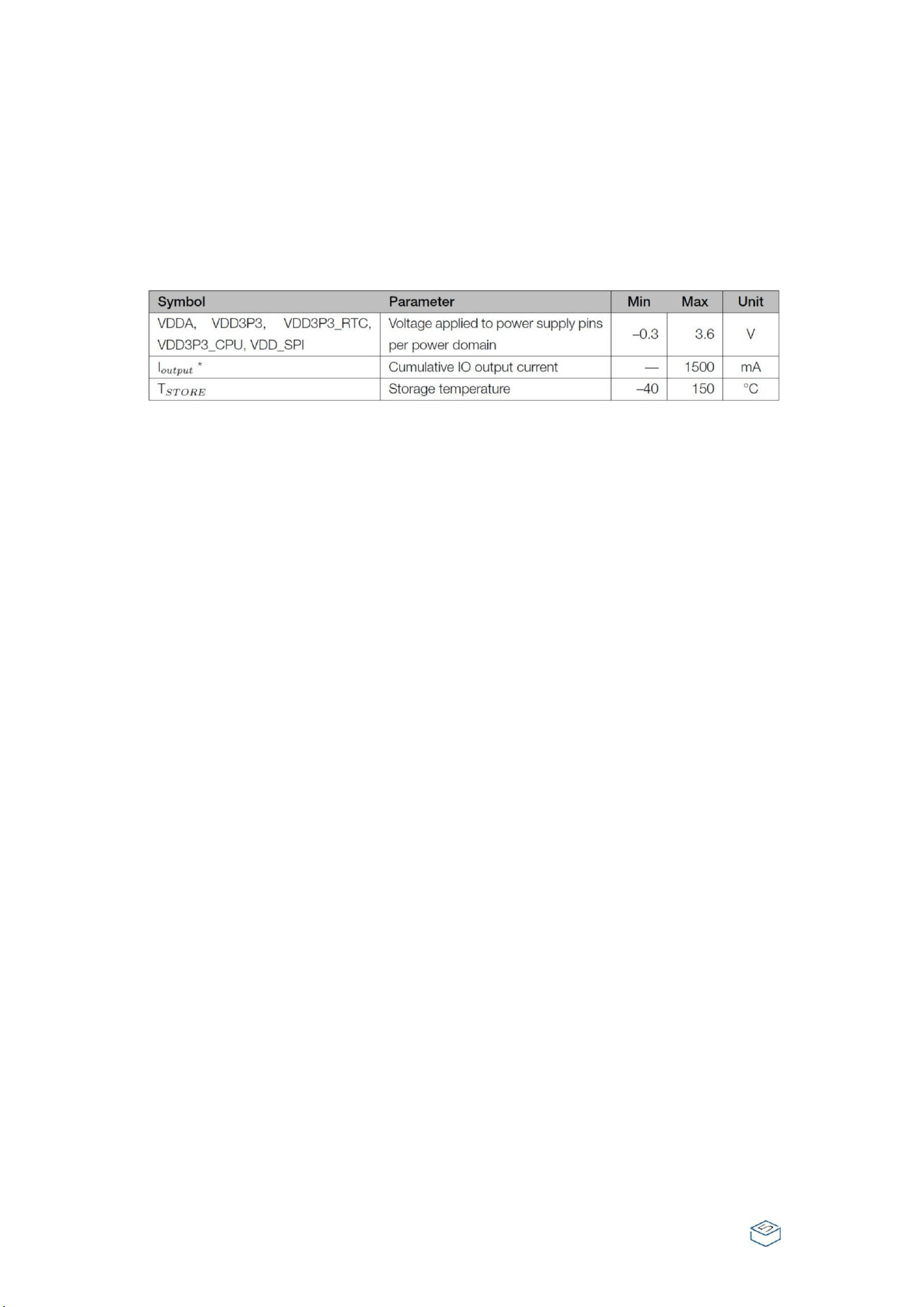
Table 2: Absolute Maximum Ratings
1. VIO to the power supply pad, Refer ESP32 Technical Specification Appendix
IO_MUX, as SD_CLK of Power supply for VDD_SDIO.
4.2.
WIFI RADIO AND BASEBAND
The ESP32-S3 Wi-Fi radio and baseband support the following features:
802.11b/g/n
802.11n MCS0-7 that supports 20 MHz and 40 MHz bandwidth
802.11n MCS32
802.11n 0.4 μs guard-interval
Data rate up to 150 Mbps
RX STBC (single spatial stream)
Adjustable transmitting power
Antenna diversity:
ESP32-S3 supports antenna diversity with an external RF switch. This switch is
controlled by one or more
GPIOs, and used to select the best antenna to minimize the effects of channel
imperfections.
8
4.3.
BLUETOOTH LE RF TRANSMITTER (TX)
SPECIFICATIONS
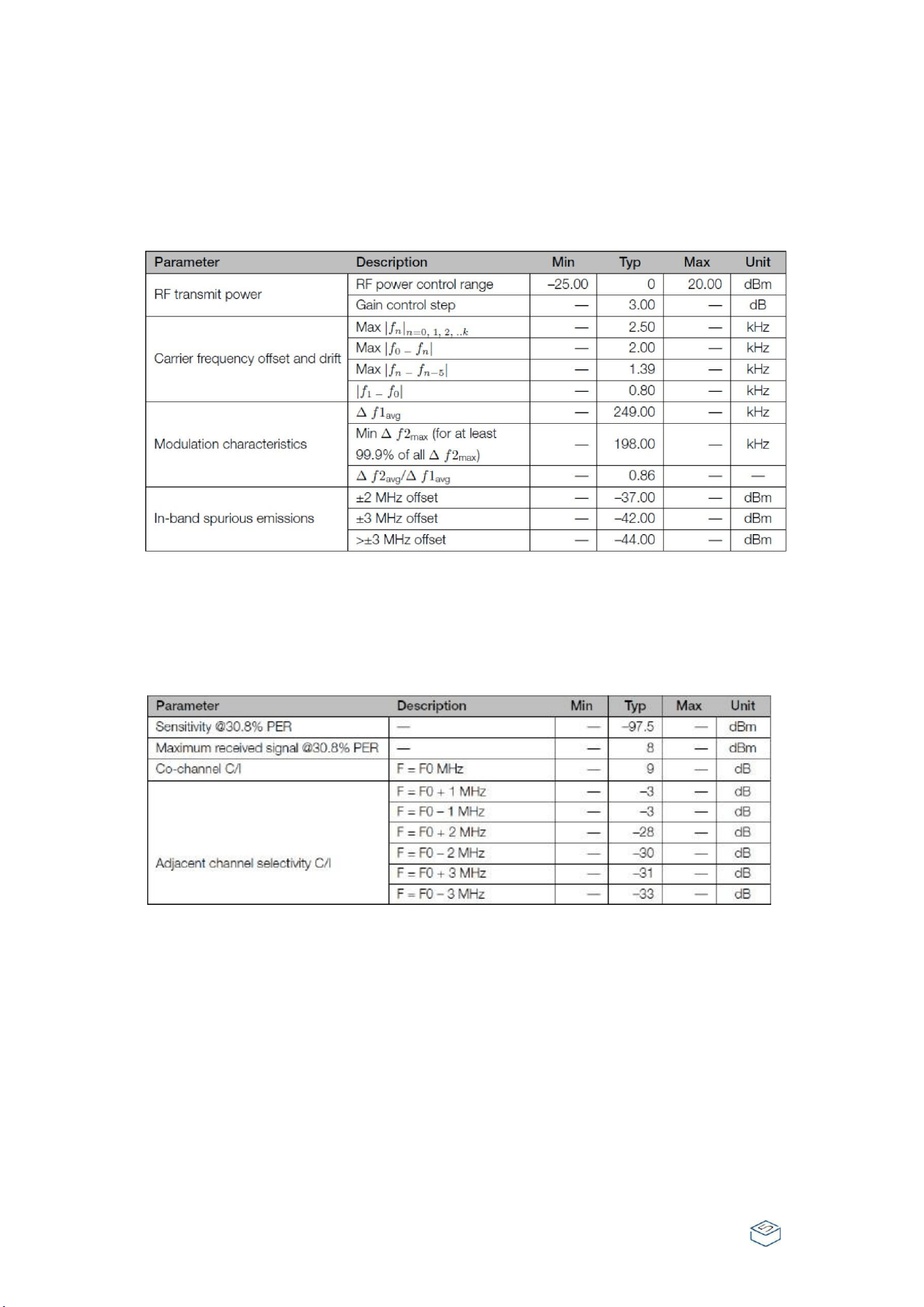
Table 3: Transmitter Characteristics Bluetooth LE 1 Mbps
4.4.
BLUETOOTH LE RF RECEIVER (RX)
SPECIFICATIONS
Table 4: Receiver Characteristics Bluetooth LE 1 Mbps
5. FCC Warning
FCC Caution:
Any Changes or modifications not expressly approved by the party responsible
for compliance could void the user's authority to operate the equipment.
This device complies with part 15 of the FCC Rules. Operation is subject to the
following two conditions: (1) This device may not cause harmful interference, and (2)
this device must accept any interference received, including interference that may
cause undesired operation.
IMPORTANT NOTE:

9
Note: This equipment has been tested and found to comply with the limits for a Class B
digital device, pursuant to part 15 of the FCC Rules. These limits are designed to
provide reasonable protection against harmful interference in a residential installation.
This equipment generates, uses and can radiate radio frequency energy and, if not
installed and used in accordance with the instructions, may cause harmful interference
to radio communications. However, there is no guarantee that interference will not
occur in a particular installation. If this equipment does -cause harmful interference to
radio or television reception, which can be determined by
turning the equipment off and on, the user is encouraged to try to correct the
interference by one or more of the following measures:
— Reorient or relocate the receiving antenna. — Increase the separation between
the equipment and receiver. — Connect the equipment into an outlet on a circuit
different from that to which the receiver is connected.
— Consult the dealer or an experienced radio/TV technician for help.
FCC Radiation Exposure Statement: This equipment complies with FCC radiation
exposure limits set forth for an uncontrolled environment.