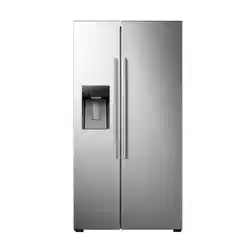
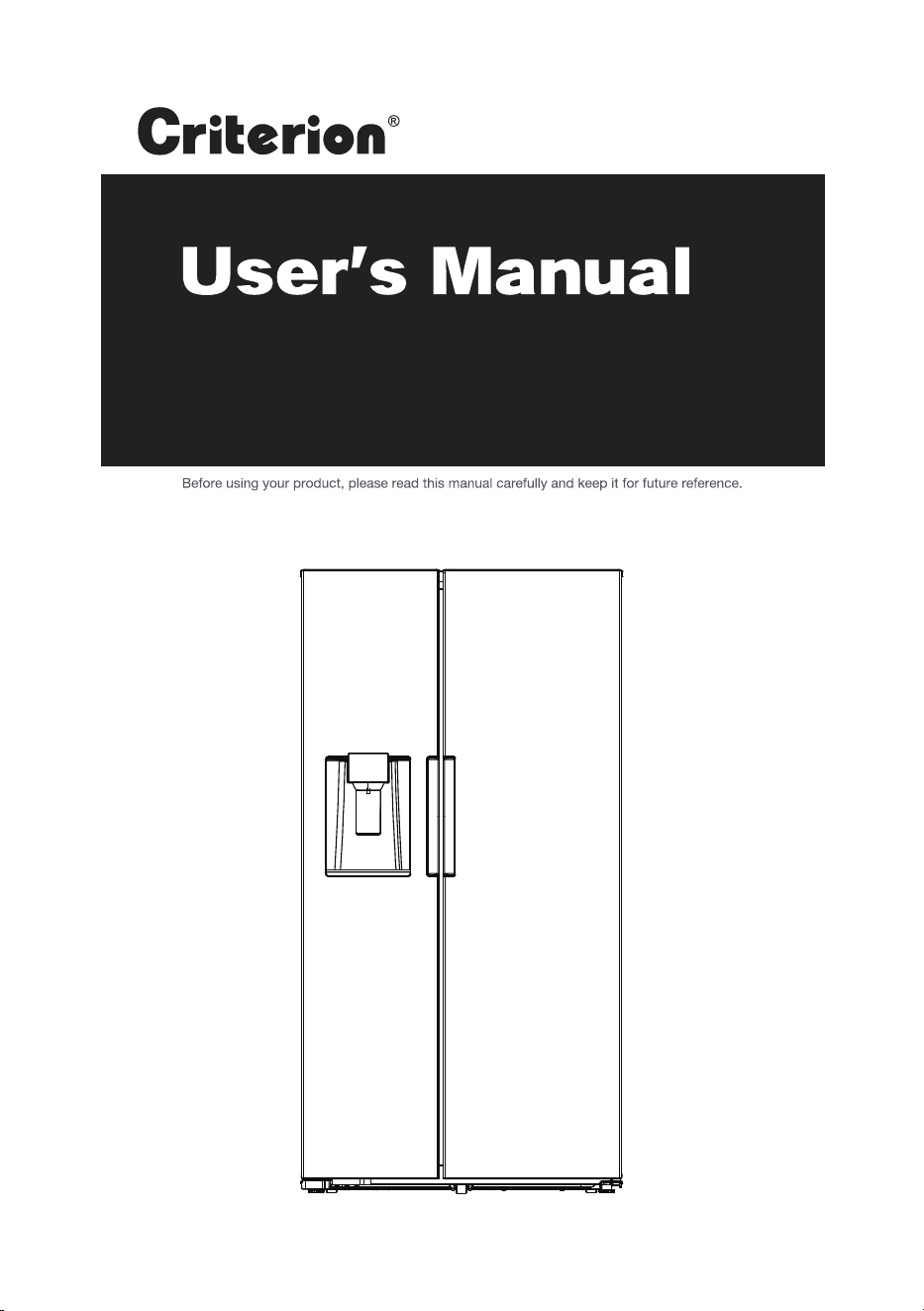
MODEL: CSBR260M4S
Refrigerator-Freezer


1. SAFETY INFORMATION ................................................................1
2. PROPER USE OF REFRIGERATOR ............................................8
2.1 Placement ...........................................................................................8
2.2 Energy Saving Tips ........................................................................ 9
2.3 Changing The Light ..................................................................... 9
2.4 Start To Use ..................................................................................... 9
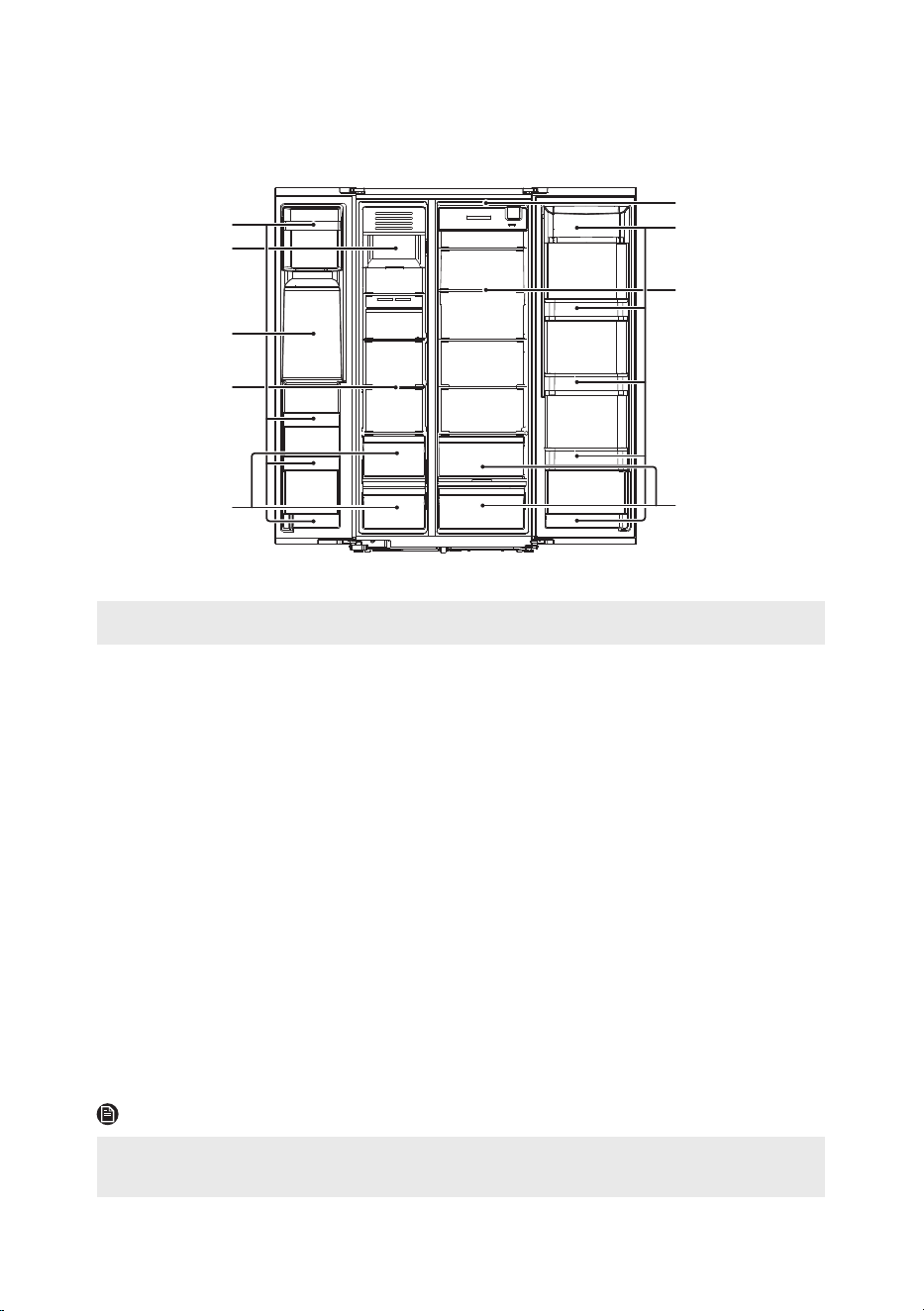
2.5 Names Of Components ............................................................... 10
2.6 Functions .......................................................................................... 11
2.7 Fetching Water And Ice .............................................................. 15
2.8 Leveling Feet ................................................................................... 17
2.9 Leveling Door .................................................................................. 17
2.10 Connect To Water ......................................................................... 18
3. MAINTENANCE OF REFRIGERATOR ....................................... 20
3.1 Overall Cleaning .............................................................................. 20
3.2 Defrosting ......................................................................................... 21
3.3 Out Of Operation ........................................................................... 21
3.4 Cleaning Of Glass Shelf ............................................................... 21
3.5 Cleaning Of Door Tray ................................................................ 22
3.6 Clean The Ice Container ............................................................. 22
4. TROUBLE SHOOTING ................................................................. 23
CONTENTS
EN-1
1. SAFETY INFORMATION
YOUR SAFETY AND THE SAFETY OF OTHERS ARE VERY IMPORTANT
To prevent injury to the user or other people and property damage, the
instructions shown here must be followed. Incorrect operation due to
ignoring of instructions may cause harm or damage, including death.
The level of risk is shown by the following indications.
Cautioning
symbol
Prohibition
symbol
Warning
symbol
This is a prohibition symbol.
Any incompliance with instructions marked with this symbol may result in damage
to the product or endanger the personal safety of the user.
This is a warning symbol.
It is required to operate in strict observance of instructions marked with this
symbol; or otherwise damage to the product or personal injury may be caused.
This is a cautioning symbol.
Instructions marked with this symbol require special caution. I
may result in slight or moderate injury, or damage to the product.
IMPORTANT SAFETY INSTRUCTIONS
Risk Of Fire / Flammable Materials
WARNING
• This appliance is intended to be used in household and similar
ther working
environments; farm houses and by clients in hotels, motels and other
residential type environments; bed and breakfast type environments;
catering and similar non-retail applications.
• This appliance is not intended for use by persons (including children) with
reduced physical, sensory or mental capabilities, or lack of experience
and knowledge, unless they have been given supervision or instruction
concerning use of the appliance by a person responsible for their safety.
EN-2
• Children should be supervised to ensure that they do not play with the
appliance.
• If the supply cord is damaged, it must be replaced by the manufacturer,
id a hazard.
• ammable
propellant in this appliance.
• The appliance has to be unplugged after use and before carrying out
user maintenance on the appliance.
• WARNING: Keep ventilation openings, in the appliance enclosure or
in the built-in structure,clear of obstruction.
• WARNING: Do not use mechanical devices or other means to
accelerate the defrosting process, other than those recommended by
the manufacturer.
• WARNING: Do not damage the refrigerant circuit.
• WARNING: Do not use electrical appliances inside the food
storage compartments of the appliance, unless they are of the type
recommended by the manufacturer.
• WARNING: Please abandon the refrigerator according to local
• WARNING: When positioning the appliance, ensure the supply cord
is not trapped or damaged.
• WARNING: Do not locate multiple portable socket-outlets or
portable power supplies at the rear of the appliance.
• Do not use extension cords or ungrounded two prong adapters.
• WARNING: Connect to potable water supply only. (suitable for ice
cube maker)
EN-3
DANGER
• The refrigerator must be disconnected from the source of electrical supply
before attempting the installation of accessory.
• Rerigerant and cyclopentane foaming material used for the appliance
ll be
overing
by
combustion, so as to prevent damage to the environment or any other
harm.
WARNING
• Risk of child entrapment.Before you throw away your old refrigerator or
freezer:
-Take off the doors.
-Leave the shelves in place so that children may not easily climb inside.
EN-
4
SAVE THESE INSTRUCTIONS
THIS APPLIANCE IS FOR HOUSEHOLD USE ONLY
State of California Proposition 65 Warnings:
WARNING: Cancer and Reproductive Harm
-www.P65Warnings.ca.gov.
PROPER DISPOSAL
WARNING
Suffocation Hazard
Before you throw away your old freezer or refrigerator:
• Remove the door or lid so that children cannot hide or get trapped inside
your old appliance.
• Leave any shelves in place so that children may not easily climb inside.
• Failure to follow these instructions can result in death or brain damage.
IMPORTANT:
Flammable gas and refrigerant used. It is the consumer’s responsibility to comply
with Federal and Local regulations when disposing of this product. Refrigerants must
be evacuated by a licensed, EPA certied refrigerant technician in accordance with
established procedures.
EN-5
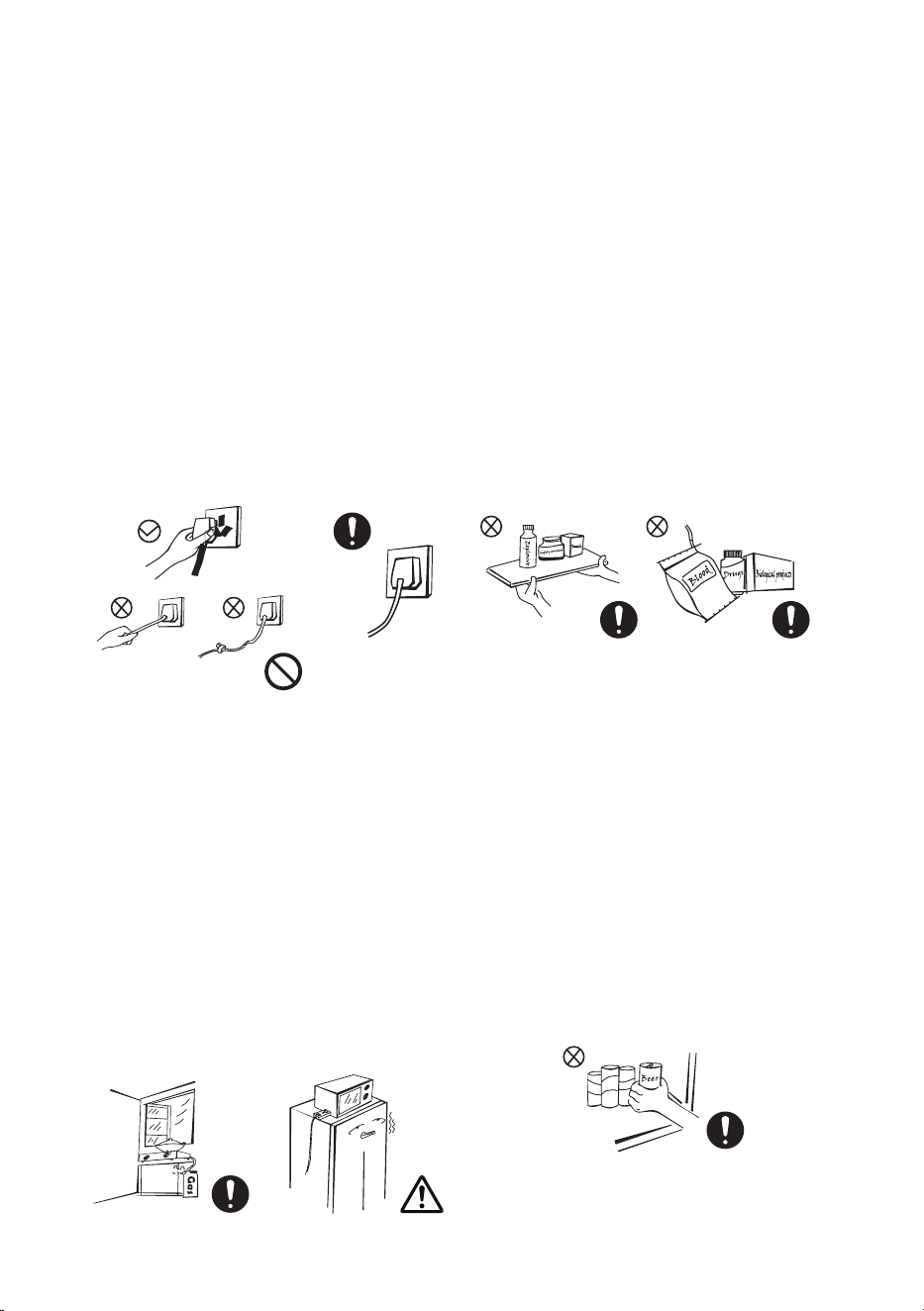
ELECTRICITY RELATED
WARNINGS
• Do not pull the power cord when
pulling the power plug of the
refrigerator. Please rmly grasp
the plug and pull out from the
socket.
• To ensure safe use, do not
damage the power cord or
use the power cord when it is
damaged or worn.
• Please use a dedicated power
socket; the power socket shall
not be shared with other electrical
appliances.
• The power cord should be rmly
contacted with the socket,
otherwise re may be caused.
• Please ensure that the grounding
electrode of the power socket
is equipped with a reliable
grounding line .
• Please turn off the valve of leaking
gas and then open doors and
windows in case of leakage of gas
and other ammable substances.
Do not unplug the refrigerator
and other electrical appliances
considering that spark may cause
a re.
• Do not use electrical
appliances on top of the
appliance,unless they are of
the type recommended by the
manufacturer.
WARNINGS RELATED
TO PLACING ITEMS
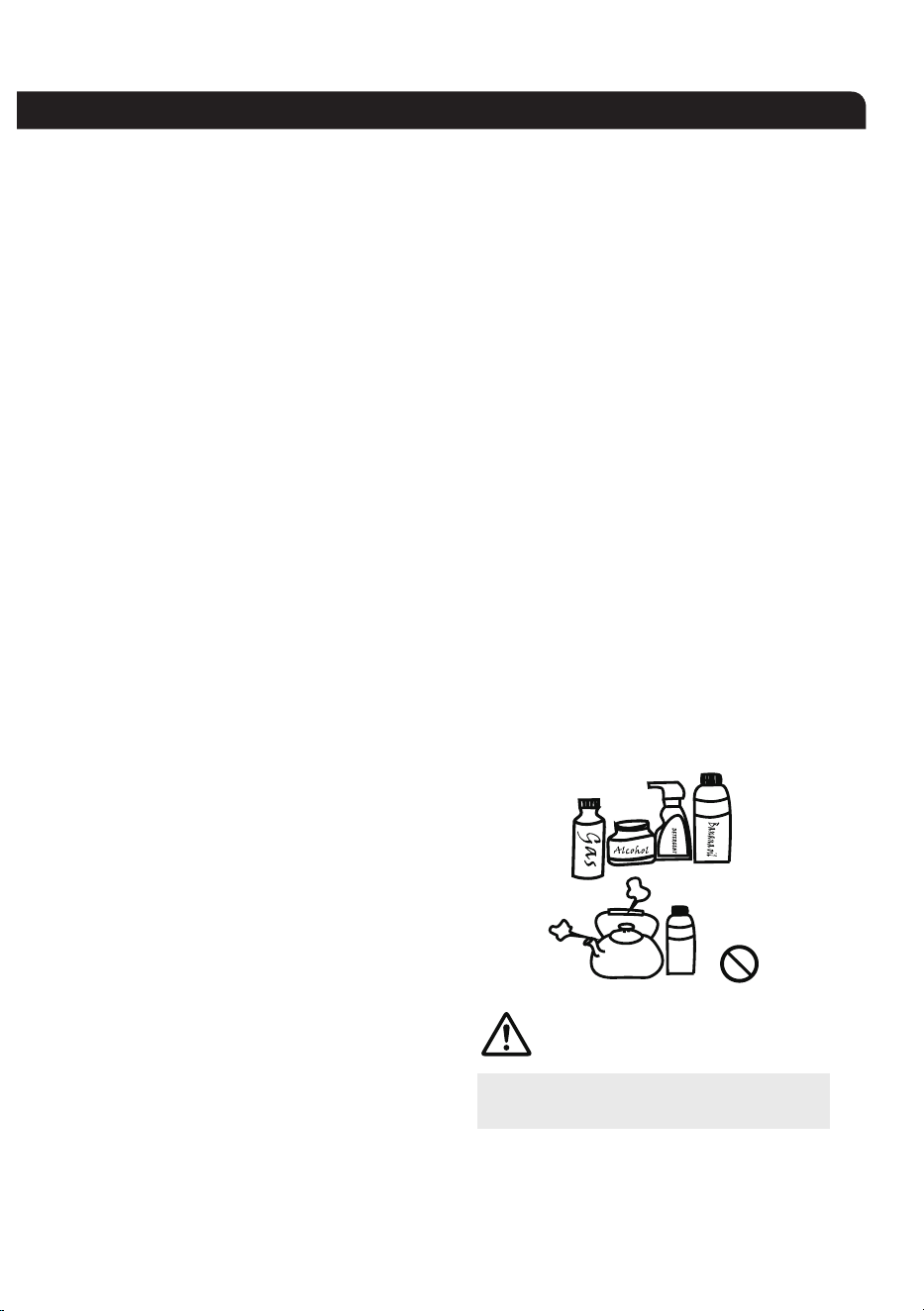
• Do not place ammable,
explosive, volatile and highly
corrosive items in the refrigerator
to prevent damages to the
product or re accidents.
• Do not place ammable items
near the refrigerator to avoid res.
• This product is a household
refrigerator and is only suitable for
the storage of foods. According
to national standards, a household
refrigerator shall not be used for
other purposes, such as storage
of blood, drugs or biological
products.
• Do not store beer, beverages
or other uids contained in
bottles or enclosed containers
in the freezing chamber of the
refrigerator, otherwise the bottles
or enclosed containers may
crack due to freezing and cause
damages.
E
N-6
WARNINGS FOR USE
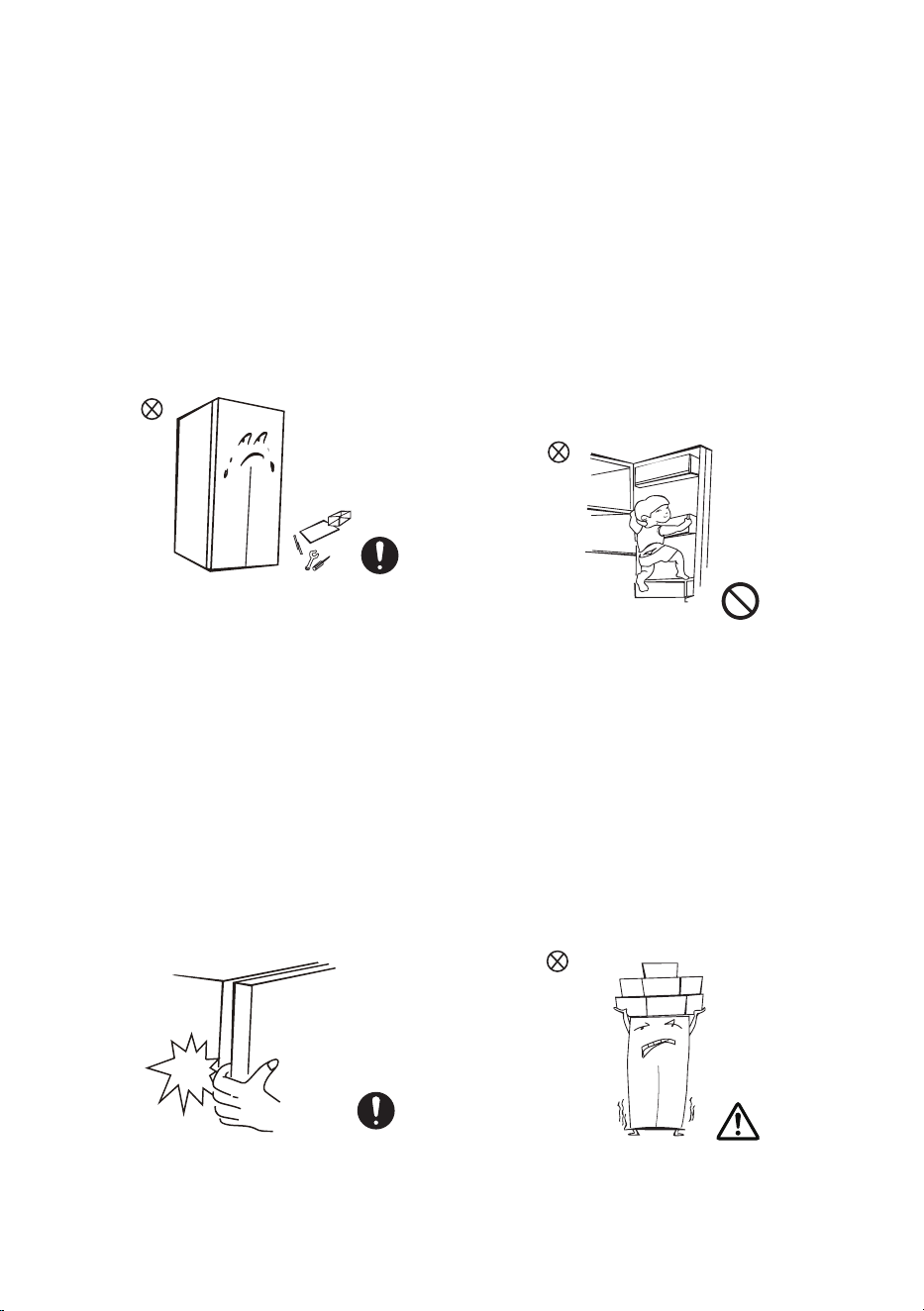
• Do not arbitrarily disassemble or
reconstruct the refrigerator, nor
damage the refrigerant circuit;
maintenance of the appliance
must be conducted by a specialist.
• A damaged power cord must be
replaced by the manufacturer,
its maintenance department or
related professionals in order to
avoid danger.
• The gaps between refrigerator
doors and between doors and
refrigerator body are small, do not
place your hands in these areas to
prevent squeezing your ngers.
Please be gentle when opening
the refrigerator door to avoid
articles falling out.
• Do not pick up food or containers
with wet hands in the freezing
chamber when the refrigerator
is running, especially metal
containers in order to avoid
frostbite.
• Do not allow children to enter or
climb inside the refrigerator to
prevent that children are sealed in
the refrigerator or injured by the
falling refrigerator.
• Do not spray or wash the
refrigerator; do not place the
refrigerator in moist places easy
to be splashed with water so
as not to affect the electrical
insulation properties of the
refrigerator.
• Do not place heavy objects on
top of the refrigerator considering
that objects may fall when
opening the door, and accidental
injuries might be caused.
• Please pull out the plug in case
of power failure or cleaning. Do
not connect the refrigerator to
power supply within ve minutes
to prevent damages to the
compressor due to successive
starts.
E
N-7
Refrigerant and cyclopentane foaming material used for the
refrigerator are flammable. Therefore, when the refrigerator is
scrapped, it shall be kept away from any fire source and be
recovered by a special recovering company with corresponding
qualification other than be disposed by combustion, so as to
prevent damage to the environment or any other harm.
When the refrigerator is scrapped, disassemble the doors, and
remove gasket of door and shelves; put the doors and shelves in
a proper place, so as to prevent trapping of any child.
Correct Disposal of this product:
This marking indicates that this product should not be disposed
with other household waste. To prevent possible harm to
the environment or human health from uncontrolled waste
disposal, recycle it responsibly to promote the sustainable
reuse of material resources. To return your used device, please
use the return and collection systems or contact the retailer
where the product was purchased. They take this product in for
environmental safe recycling.
ENERGY WARNINGS
1. Refrigerating appliances
might not operate consistently
(possibility of defrosting of
contents or temperature
becoming too warm in the
frozen food compartment) when
set for an extended period of
time below the cold end of the
temperature range for which
the refrigerating appliance is
designed.
2. Effervescent drinks should
not be stored in food freezer
compartments or cabinets or in
low-temperature compartments
or cabinets because some
products such as water ice
should not be consumed too
cold;
3. Do not exceed the storage
time(s) recommended by the
food manufacturers for any
kind of food and particularly
for commercially quick-frozen
food in food-freezer and frozen-
food storage compartments or
cabinets
4. Prevent an undue rise in
temperature of frozen food
while defrosting the refrigerating
appliance, such as wrapping the
frozen food in several layers of
newspaper.
5. A rise in temperature of frozen
food during manual defrosting,
maintenance or cleaning can
shorten the storage life
DISPOSAL
EN-8
2. PROPER USE OF REFRIGERATOR
2.1 PLACEMENT
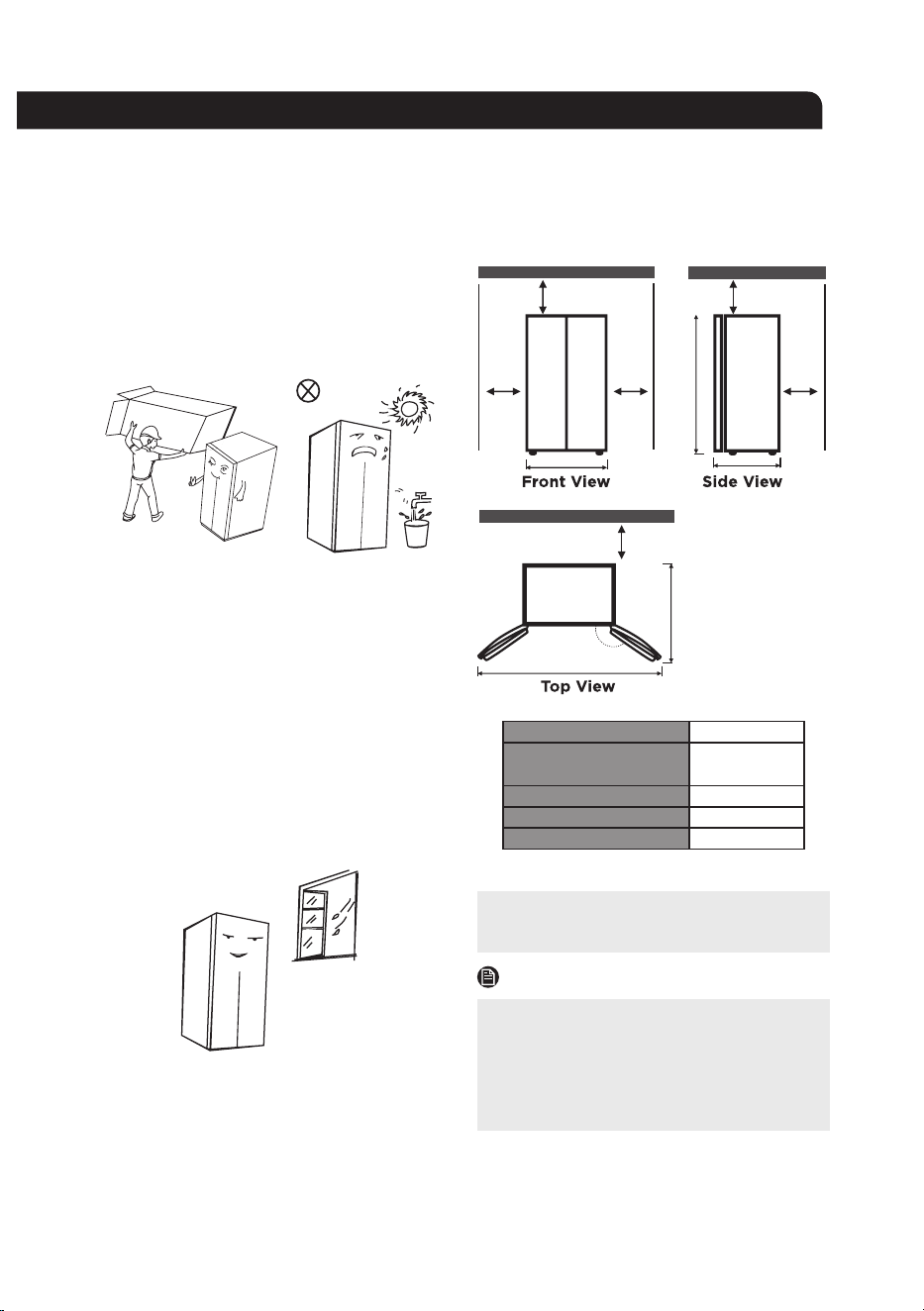
• Before use, remove all packing
materials, including bottom pads,
foam pads and tapes inside of
the refrigerator; tear off the
protective lm on the doors and
the refrigerator body.
• Keep away from heat and avoid
direct sunlight. Do not place the
freezer in moist or wet places to
prevent rust or reduction of the
insulating effect.
• Do not spray or wash the
refrigerator; do not put the
refrigerator in moist places easy
to be splashed with water so
as not to affect the electrical
insulation properties of the
refrigerator.
• The space on top of the
refrigerator shall be greater than
10cm, and the refrigerator should
be placed against a wall with a
distance of more than 10cm to
facilitate heat dissipation.
Spare enough space for convenient
opening of the doors and drawers or
statement by the distributor.
10cm
10cm
10cm 10cm
10cm
10cm
W
B
A
D
H
135°
Width “w”
911
Depth “D” (without
handle)
860
Height “H”
1775
A
1560
B
1226
(unit: mm)
The measurements in the above table
may differ, depending on the measuring
method.
NOTE
This refrigerator needs to be installed
independently and cannot be used as a
built-in. Otherwise, it will cause problems
such as failure to install into the cabinet,
the performance and life of the product
are reduced. And the manufacturer does
not provide basic product warranty.
EN-9
2.2 ENERGY SAVING TIPS
• The appliance should be located
in the coolest area of the room,
away from heat producing
appliances or heating ducts, and
out of the direct sunlight.
• Let hot foods cool down to
room temperature before
placing it in the appliance.
Overloading the appliance
forces the compressor to run
longer. Foods that freezes too
slowly may lose quality, or spoil.
• Be sure to wrap foods properly,
and wipe containers dry before
placing them in the appliance.
This cuts down on frost build-up
inside the appliance.
• Appliance storage bins should not
be lined with tin foil, wax paper,
or paper toweling. Liners interfere
with cold air circulation, making
the appliance less efcient.
• Organize and label food to reduce
door openings and extended
searches. Remove as many items
as needed at one time, and close
the door as soon as possible
2.3 CHANGING THE LIGHT
• Any replacement or maintenance
of the LED lamps is intended to
be made by the manufacturer, its
service agent or similar qualied
person.
2.4 START TO USE
• Before initial start, keep the
refrigerator still for two hours
before connecting it to power
supply.
• Before placing any fresh or frozen
foods, the refrigerator should
have run for 2 - 3 hours, or for
above 4 hours in summer when
the ambient temperature is high.
NOTE
This product is not recommended for use
with sockets or main switch with the A/
GFCI function, otherwise it may cause
false tripping.
1. it’s not pose a safety risk when tripped.
2. If tripping persists, it is recommended
to replace the sockets or main switch
without A/GFCI function.
E
N-10
2.5 NAMES OF COMPONENTS
LED lighting
(Freezing chamber)
(Filter built-out)
(Refrigerating chamber)
Door tray
Door tray
Drawer
Ice / Water
dispenser
Ice Container
(Removeable)
Fruits and
vegetables box
Glass shelf
Glass shelf
The picture above is only for reference. The actual conguration will depend on the
physical product or statement by the distributor
Refrigerating chamber
• The Refrigerating Chamber is
suitable for storage of a variety of
fruits, vegetables, beverages and
other food consumed in the short
term,suggested storage time 3days
to 5days.
• Cooking foods shall not be put
in the refrigerating chamber until
cooled to room temperature.
• Foods are recommended to be
sealed up before putting into the
refrigerator.
• The glass shelves can be adjusted
up or down for a proper storage
space and easy use.
Freezing chamber
• The low temperature freezing
chamber may keep food fresh for
a long time and it is mainly used to
store frozen foods and making ice.
• The freezing chamber is suitable
for storage of meat, sh, rice
balls and other foods not to be
consumed in short term.
• Chunks of meat are preferably to
be divided into small pieces for
quick freezing and easy access.
Please be noted food shall be
consumed within the shelf time.
• The temperature shall be set at
“quick freezing” in the process of
quick-freezing food
NOTE
Storage of too much food during operation after the initial connection to power may
adversely affect the freezing effect of the refrigerator. Foods stored shall not block the
air outlet; or otherwise the freezing effect will also be adversely affected.
E
N-11
2.6 FUNCTIONS
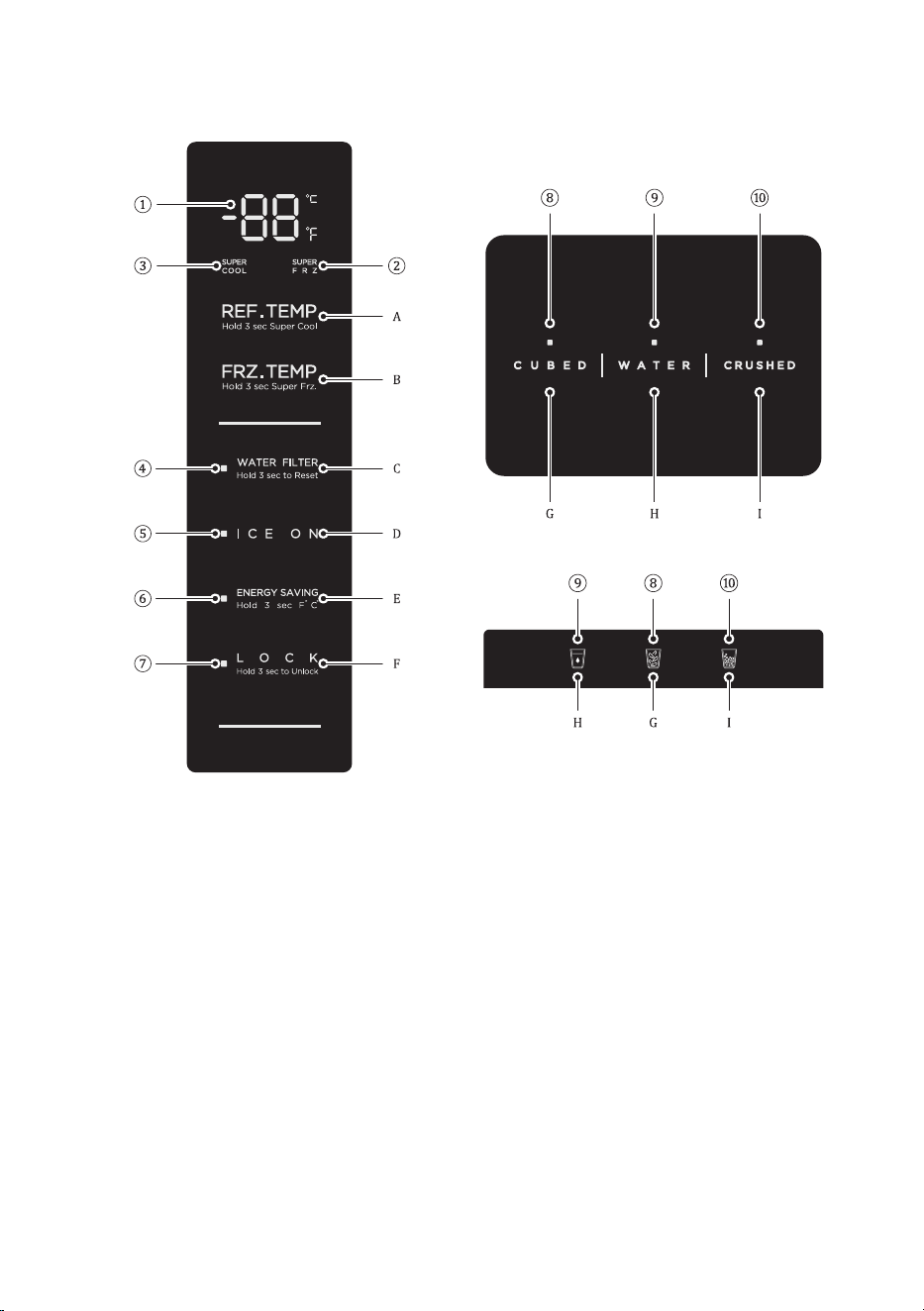
TYPE A
TYPE B
Display Button operation
① Refrigerating/freezing temperature
diagram
A. Refrigerating temperature adjustment
② Quick freezing B. Freezing temperature adjustment
③ Quick refrigerating C. Filter time reset button
④ Filter time reset icon D. Ice machine on/off control button
⑤ Ice machine on/off icon E. ENERGY SAVING mode button
⑥ ENERGY SAVING mode icon F. Lock/unlock button
⑦ Lock/unlock icon G. Whole ice mode
⑧ Whole ice mode icon H. Water outlet mode
⑨ Water outlet mode icon I. Crushed ice mode
⑩ Crushed ice mode icon
E
N-12
Operating instructions
• Display
Display control on the door
When the power is on for the rst
time, full display shall last for 3
seconds, the start-up tone shall
sound at the same time and then
enter into the normal operation
display;
(When the power is on for the
rst time, the set temperature for
the refrigerating chamber and
freezing chamber is 39 Fahrenheit
degree and 0 Fahrenheit degrees
respectively, ice maker opens
by default and the default
temperature of the rst power on
is Fahrenheit).
The fault code shall be displayed
when there is a fault (cyclic
display); the set temperature of
the refrigerating chamber shall be
displayed when there is no fault.
Under normal circumstances, the
display shall be locked after 30
seconds without door opening
and button operation, and the
display screen shall go off after
30 seconds in the locking state;
when the display screen does not
light up, the display screen shall
normally light up when there is a
button operation; When there is
a fault of “fault code visible” type,
the display shall light up and shall
go out after 30 seconds.
Ice making display control
When the power is on for the rst
time, full display shall last for 3
seconds, then enter the normal
operation display;
(when the power is on for the rst
time, water outlet function is the
default.)
When the communication
between the distributor board and
the ice machine board fails, the
indicator light of whole ice mode,
the indicator light of water outlet
mode and the indicator light of
crushed ice mode shall ash at the
same time. When there is no fault,
the current state of distributor
board shall be displayed;
• Lock / unlock
In the non-lock state, keep
pressing the
for 3
seconds to enter the lock state,
the buzzer for lock shall sound
and then the lock icon shall light
up.
In the lock state, keep pressing
the
for 3 seconds to
enter the lock state, the buzzer for
unlock shall sound and then the
lock icon shall go out.
It shall automatically enter the
lock state when there is no button
operation after 30 seconds.
The alarm sound release operation
can be carried out in the lock
state while all other button
operations must be carried out in
the non-lock state. An error beep
prompt shall be given in case of
operation in the lock state.
• Mode setting
Long press the
3S to
set/cancel the quick refrigerating
mode; long press the
3S
to set/cancel the quick freezing
mode; short press the
to
set/cancel the mode.
When the quick refrigerating
mode is set, the refrigerating shall
be automatically set to 1°C/34°F;
when the quick freezing mode
is exited, the set temperature in
the refrigerating chamber shall
be automatically restored to the
set temperature before the quick
refrigerating mode.
E
N-13
When the quick freezing mode
is set, the freezing shall be
automatically set to -22T°C/-7°F;
when the quick freezing mode
is exited, the set temperature in
the freezing chamber shall be
automatically restored to the set
temperature before the quick
freezing mode.
When the
mode is
set, the refrigerating shall be
automatically set to 7°C/44°F
while the freezing shall be
automatically set to -14°C/7°F;
when the
mode is
exited, the set temperature in
the refrigerating and freezing
chamber shall be automatically
restored to the set temperature
before the
mode.
when the
mode setting is
valid, the indicator shall
light up otherwise it shall go out.
* If the refrigerator is powered
on, it shall remember the quick
refrigerating/quick freezing, the
chambers shall be restored to the
default temperature after exiting;
• Refrigerating chamber
temperature setting
Press the
to select the
refrigerating temperature zone,
and then press the
to
adjust the refrigerating chamber
temperature. Each time the
refrigerating chamber button
is pressed, the temperature
shall drop 1°C / 1°F; after the
temperature reaches 1°C / 34°F,
press the
again and the
refrigerating chamber setting
range is 1~7°C / 34~44°F; the
setting is valid after locking;
• Freezing chamber temperature
setting
Press the
to select the
freezing temperature zone,
and then press the
to
adjust the freezing chamber
temperature. Each time the
freezing chamber button is
pressed, the temperature
shall drop 1°C / 1°F; after the
temperature reaches 1°C / 34°F,
press the
again and the
freezing chamber setting range
is 1~7°C / 34~44°F; the setting is
valid after locking;
• Distributor state setting
Soft touch the button of
corresponding mode to select
whole ice mode/water outlet
mode/crushed ice mode, and the
corresponding mode indicator
light shall light up after selecting
the corresponding function;
the setting shall take effect
immediately with no locking
required:
• Distributor light control
When the distributor switch is
pressed, the distributor light is lit;
and when the distributor switch
is disconnected, the distributor
light is delayed by 3 seconds to
extinguish.
• Conversion between Celsius and
Fahrenheit
Long press
for 3 seconds
to achieve the conversion
between Celsius and Fahrenheit.
• Filter time reset
The working time of the power-on
lter accumulates. When the lter
works for 150 days, the lter icon
shall light up to prompt the user
to replace the lter and shall ash
to prompt the user to replace the
lter after 180 days. Long press
the
for 3 seconds to
perform the function of “FILTER
RESET”. At this time the lter
timing shall be reset;
E
N-14
NOTE
The accumulative timing unit of lter
working time is every 24 hours, and
stored in EEPROM with power off
memory function.
• Ice machine mode
Short press the
of the
ice machine to set/cancel the
function of ice machine; When the
function setting of ice machine is
effective, the indicator light of ice
machine shall light up, otherwise it
shall go off;
• Power off storage
When the power is cut off, the
instantaneous working state
shall be locked, which can be
maintained to power-on;
• Operation of door opening
prompt and alarm control
When the refrigerator door is
open, a prompt tone shall sound.
If it is not closed after 2 minutes,
the buzzer shall sound, and shall
sound once every second until the
door is closed.
• Fault indicator
When the following prompt
appears on the display screen,
it indicates that the refrigerator
is out of order. Although the
refrigerating / freezing function
of the refrigerator can still work
in the following fault conditions,
the user should contact the
maintenance personnel to ensure
the normal use of the refrigerator.
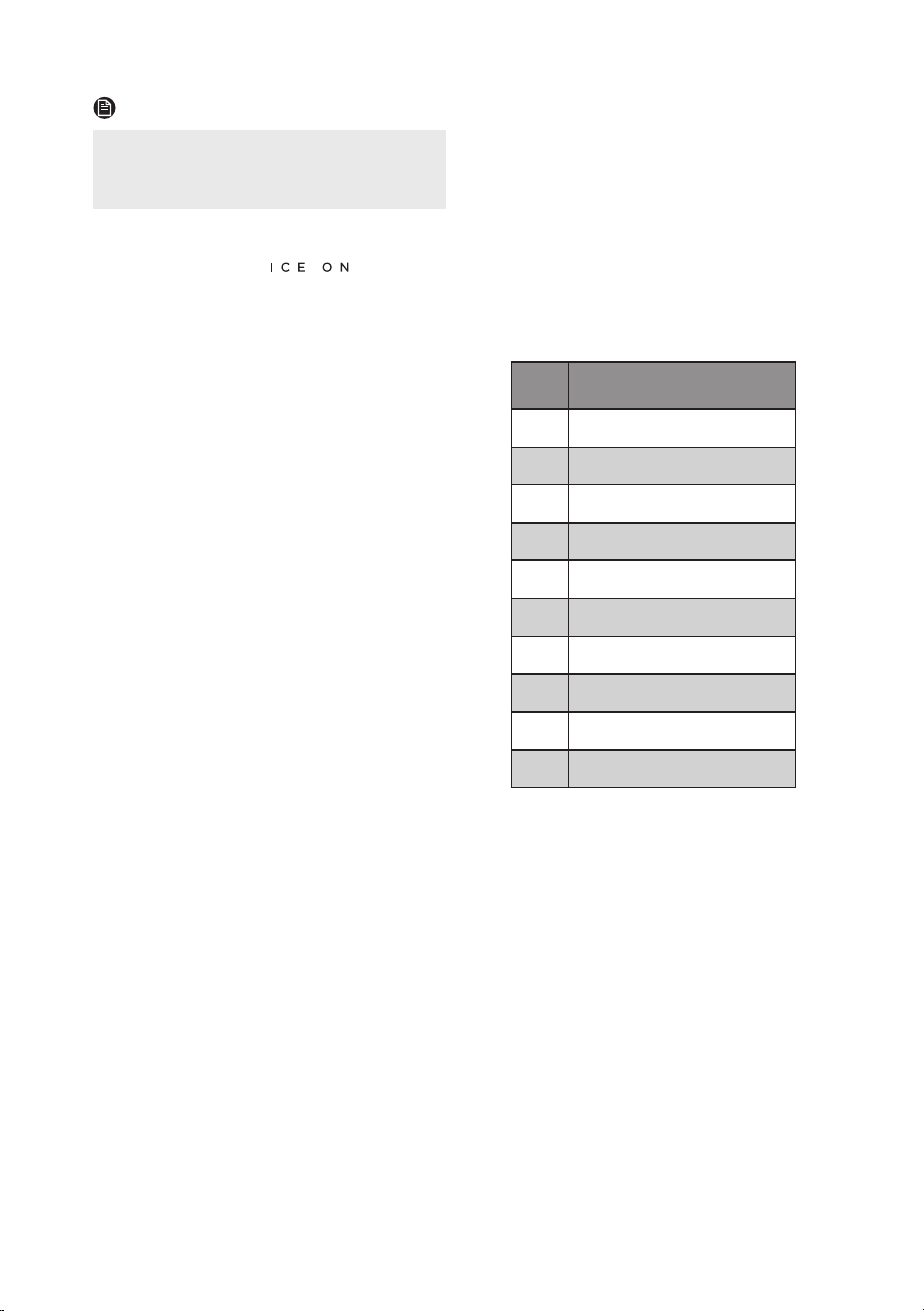
Fault
Code
Fault Description
E0 Ice machine fault
E1
Fault of temperature sensor
in refrigerating chamber
E2
Fault of temperature sensor
in freezing chamber
E5
Fault of defrosting sensor in
freezing chamber
E6
Communication fault of
display board of main board
E7 Ambient temperature fault
EH Temperature sensor fault
EE Ice machine sensor fault
CA
Communication fault of ice
making board of mainboard
EP
Ice making machine off-ice
fault

E
N-15
2.7 FETCHING WATER AND ICE
• Sounds will be produced during
making ice cubes and crushed ice:
Water valve will produce buzzing
sounds; water’s owing into
ice vessel will produce sounds;
grinding machine’s grinding ice
into small pieces or product ice’s
falling into the container will
produce sounds. The sounds are
normal.
• Scratching noises may be
produced when taking out the ice
cubes. Nothing to worry about
this. The ice in the container may
be stuck together. In such cases,
please take out the ice container
and separate stuck ice into pieces
by means of, for instance, using
plastic or wooden spoons to push
hard on the ice carefully.
• Other possibilities are illustrated
in the chapter “ice container
cleaning”To avoid overheating
of the ice-making machine’s
engine, please fetch ice about 1
minute after the stopping. Please
wait for a while until the engine’s
temperature reaches working
temperature. Please fetch the ice
from the ice container if you need
a lot of ice.
• The chapter “ice container
cleaning” explains how to remove
ice container from freezer
compartment. If there is no
enough ice in the ice container,
the ice cannot be taken out.Please
wait for a while until new ice is
made.To prevent ice smell or bad
taste of the ice, please clean the
ice container regularly.
• Ice and water can only be
fetched when the door of freezer
compartment is closed. In the
process of fetching water and ice,
if you open the freezer door, that
process will automatically end.
• When it displays or goes
out, you click the buttons of water
dispenser again.
E
N-16
TYPE A
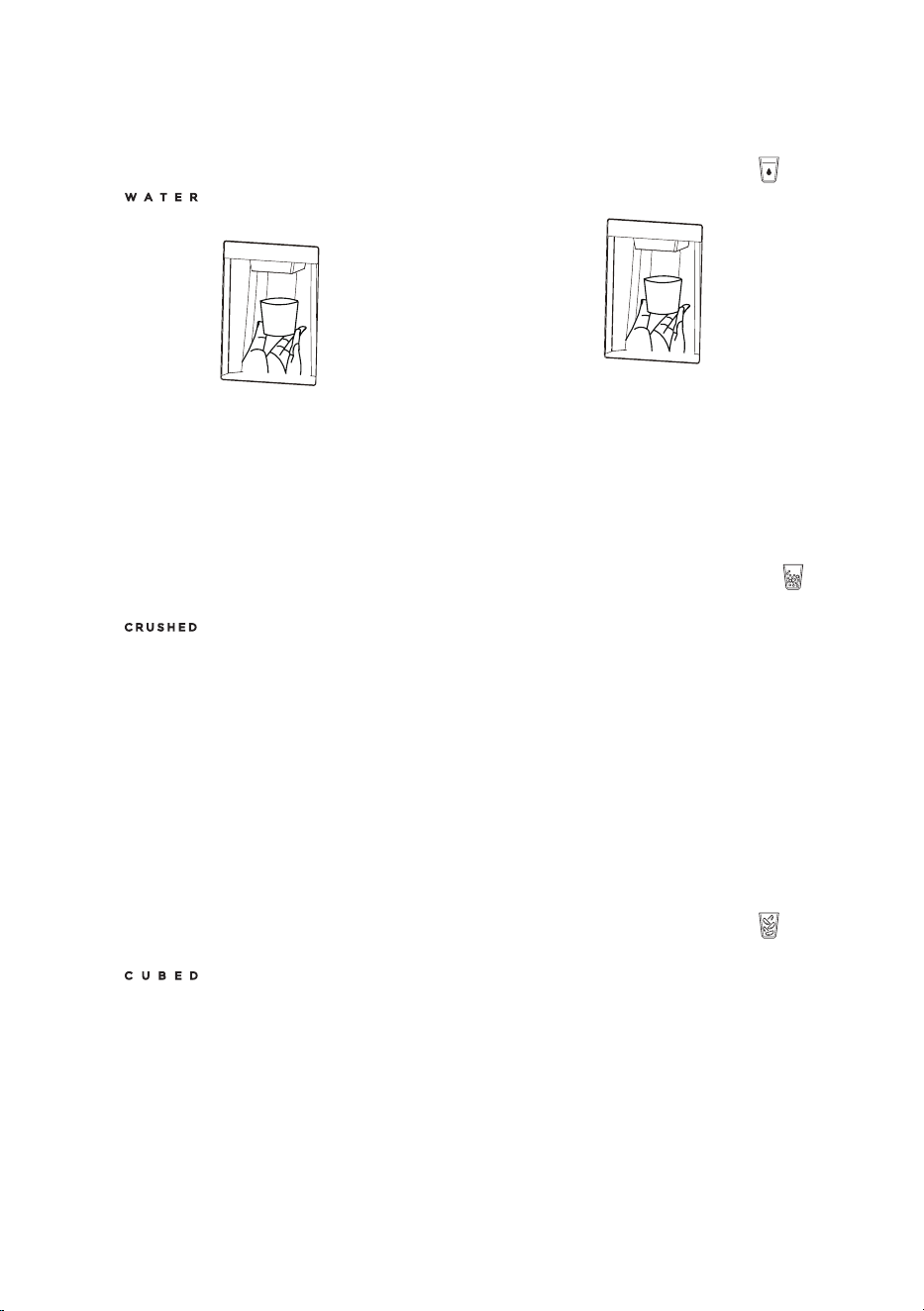
• Fetching cold water
Keep pressing the buttons
until the indicator turns
on.
Push the container in the direction
of fetching water cushion, Cold
water starts to ow into the
container, remove the container
from fetching water cushion and
end the exporting of water.
• Fetching crushed ice
Keep pressing the buttons of
until the signal turns up.
Make the container tight with
mouth of water dispenser to
prevent the side jet.
Press the container in the
direction of fetching water
cushion . Fill the container with
crushed ice.
Remove the container from
fetching water cushion and end
the exporting of water.
• Fetching ice cubes
Keep pressing the buttons
until the signal lights up.
Push the container in the direction
of fetching water cushion.
Ice cubes start to fall into the
container.
Remove the container from
fetching water cushion and end
the exporting of ice.
TYPE B
• Fetching cold water
Keep pressing the buttons
until
the indicator turns on.
Push the container in the direction
of fetching water cushion,Cold
water starts to ow into the
container, remove the container
from fetching water cushion and
end the exporting of water.
• Fetching crushed ice
Keep pressing the buttons of
until the signal turns up.
Make the container tight with
mouth of water dispenser to
prevent the side jet.
Press the container in the
direction of fetching water
cushion . Fill the container with
crushed ice.
Remove the container from
fetching water cushion and end
the exporting of water.
• Fetching ice cubes
Keep pressing the buttons
until
the signal lights up.
Push the container in the direction
of fetching water cushion.
Ice cubes start to fall into the
container.
Remove the container from
fetching water cushion and end
the exporting of ice.
EN-17
2.8 LEVELING FEET
• Precautions before operation:
Before operation of accessories,
it shall be ensured that the
refrigerator is disconnected from
power.
Before adjusting the leveling feet,
precautions shall be taken to
prevent any personal injury.
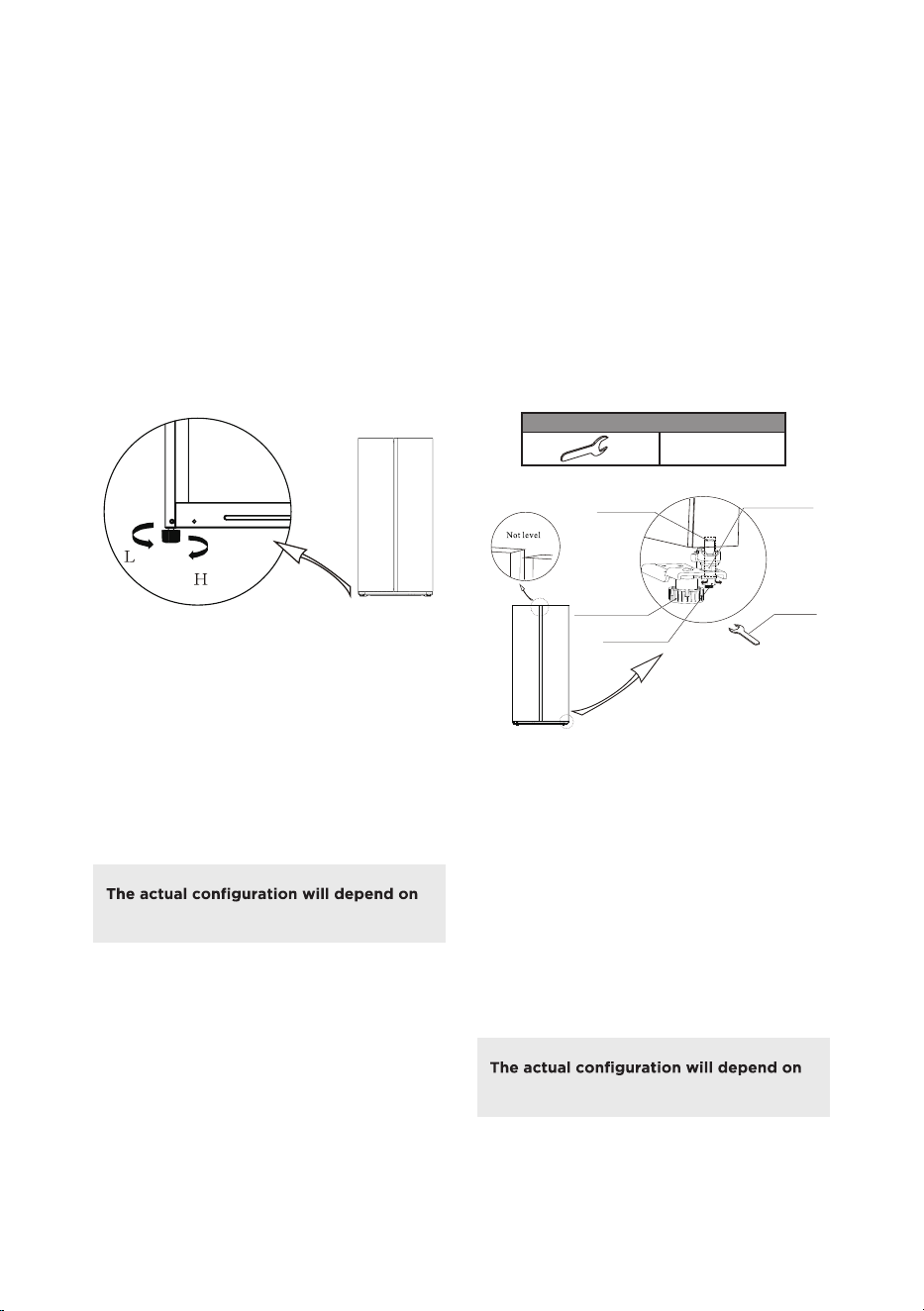
• Schematic diagram of the leveling
feet
• Adjusting procedures:
a. Turn the feet clockwise to raise
the refrigerator;
b. Turn the feet counterclockwise
to lower the refrigerator;
c. Adjust the right and left feet
based on the procedures above to
a horizontal level.
The picture above is only for reference.
the physical product or statement by the
distributor
2.9 LEVELING DOOR
• Precautions before operation:
Before operation of accessories,
it shall be ensured that the
refrigerator is disconnected from
power.
Before adjusting the door,
precautions shall be taken to
prevent any personal injury.
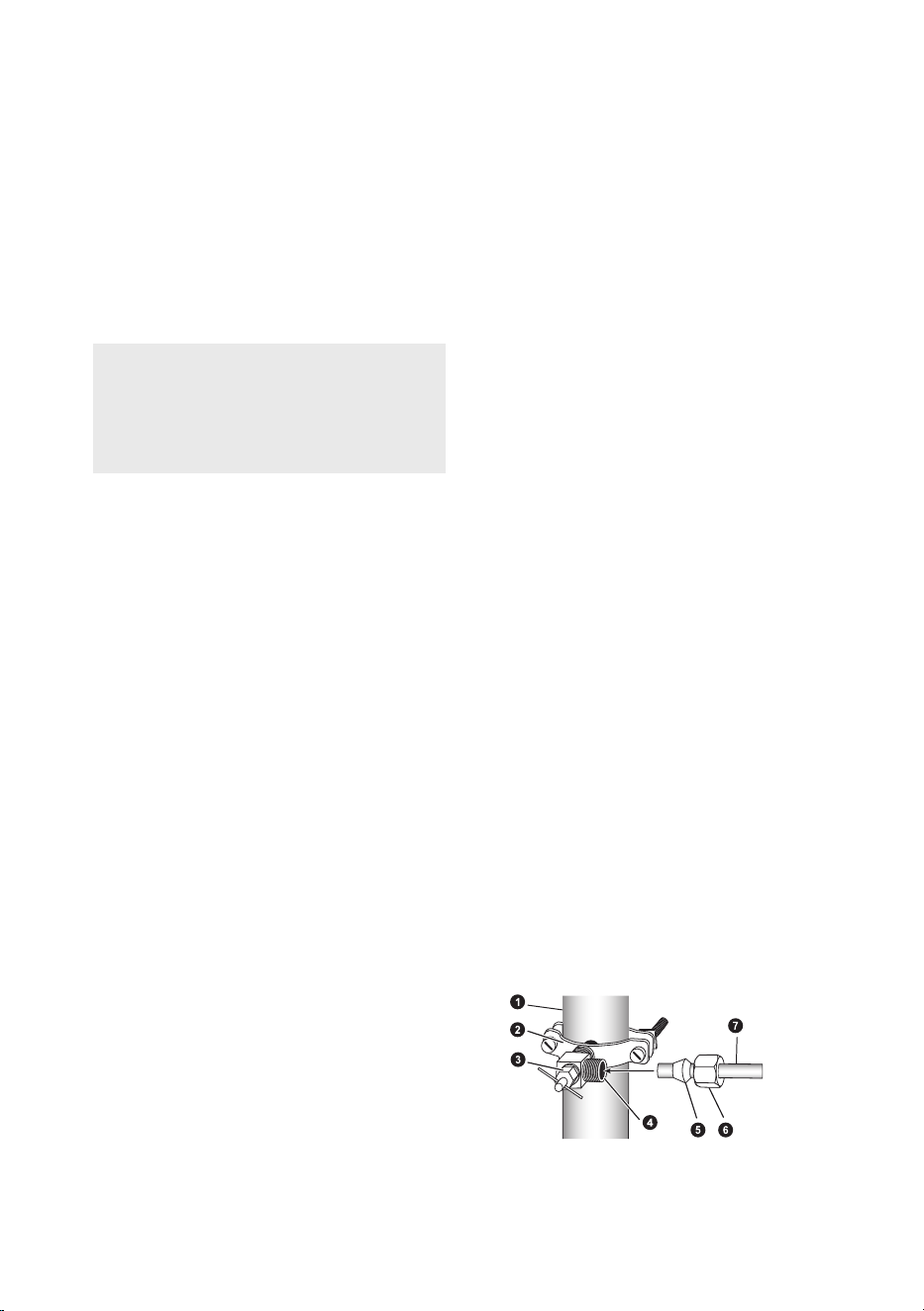
• Schematic diagram of leveling the
door
List of tools to be provided by the user
wrench
Right
left
Fixed shaft
Levelling feet
Locking nut
Adjusting nut
Wrench
• Adjusting procedures:
Low refrigerating door:
First, turn the locking nut
clockwise and loose, then turn the
adjusting nut counter-clockwise
to adjust, and lock the locking nut
after adjusting;
High refrigerating door:
Turn the adjusting nut clockwise
to adjust, adjust the locking nut
counterclockwise and then lock.
The picture above is only for reference.
the physical product or statement by the
distributor
EN-18
2.10 CONNECT TO WATER
•
•
A cold water supply with water
pressure of between 30 and
100 psi (207 and 689 kPa) is
required to operate the water
dispenser and ice maker. If you
have questions about your water
pressure, call a licensed, qualified
plumber.
Connect to Water Line
Gather the required tools and parts
before starting installation.
• Determine the length of copper
tubing you need. Measure from
the connection on the back of
the refrigerator to the water pipe.
Add 7 ft(2.1 m) to allow for
cleaning.
• Find a ½” to 1¼” (12.7 mm to 31.8 m
m) vertical cold water pipe near the
refrigerator.
IMPORTANT: Make sure it is a cold
water pipe.
NOTE: Horizontal pipe will work;
however, you must drill on the top
side of the pipe, not the bottom.
Drilling on the top side will keep
water away from the drill and keep
normal sediment from collecting in
the valve.
· Flat-blade screwdriver
· ½”Wrench or 2 Adjustable wrenches
· Cordless drill
· ¼”saddle-type shutoff valve(1)
· ¼”Drill bit
· ¼”Compression nut (2)
· Ferrule (sleeve) (2)
· ¼”Copper tube
•
Use ¼"(6.35 mm) O.D. (outside
diameter) copper tubing. Be sure
both ends of copper tubing are
cut square.
Using a cordless drill, drill a ¼"
(6.35 mm) hole in the cold water
pipe.
1. Household supply line
2. Saddle valve
3. Packing nut
4. Shutoff valve
5. Ferrule (sleeve)
6. Compression nut
7. ¼”Copper tube
• Fasten the shutoff valve to the
cold water pipe with the pipe
clamp.Be sure the outlet end is
solidly in the ¼" (6.35 mm) drilled
hole in the water pipe and that the
washer is under the pipe clamp.
• Tighten the packing nut. Tighten
the pipe clamp screws slowly and
evenly so the washer makes a
watertight seal.
Do not overtighten.
• Place the free end of the tubing in
a container or sink, and then turn
ON the main water supply. Flush
the tubing until water is clear. Turn
OFF the shutoff valve on the
water pipe.
• Slip the compression sleeve and
compression nut on the copper
tubing as shown. Insert the end of
the tubing into the outlet end
squarely as far as it will go. Screw
compression nut onto outlet end
with adjustable wrench. Do not
overtighten or you may crush the
water line.
IMPORTANT:
• Connect only to a drinking (potable)
water supply.
• Plumbing shall be installed in accordance
with the International Plumbing Code and
any local codes and ordinances.
EN-19
Connect to Refrigerator
•
•
1. Unplug refrigerator or disconnect
power.
2. Close shut-off valve.
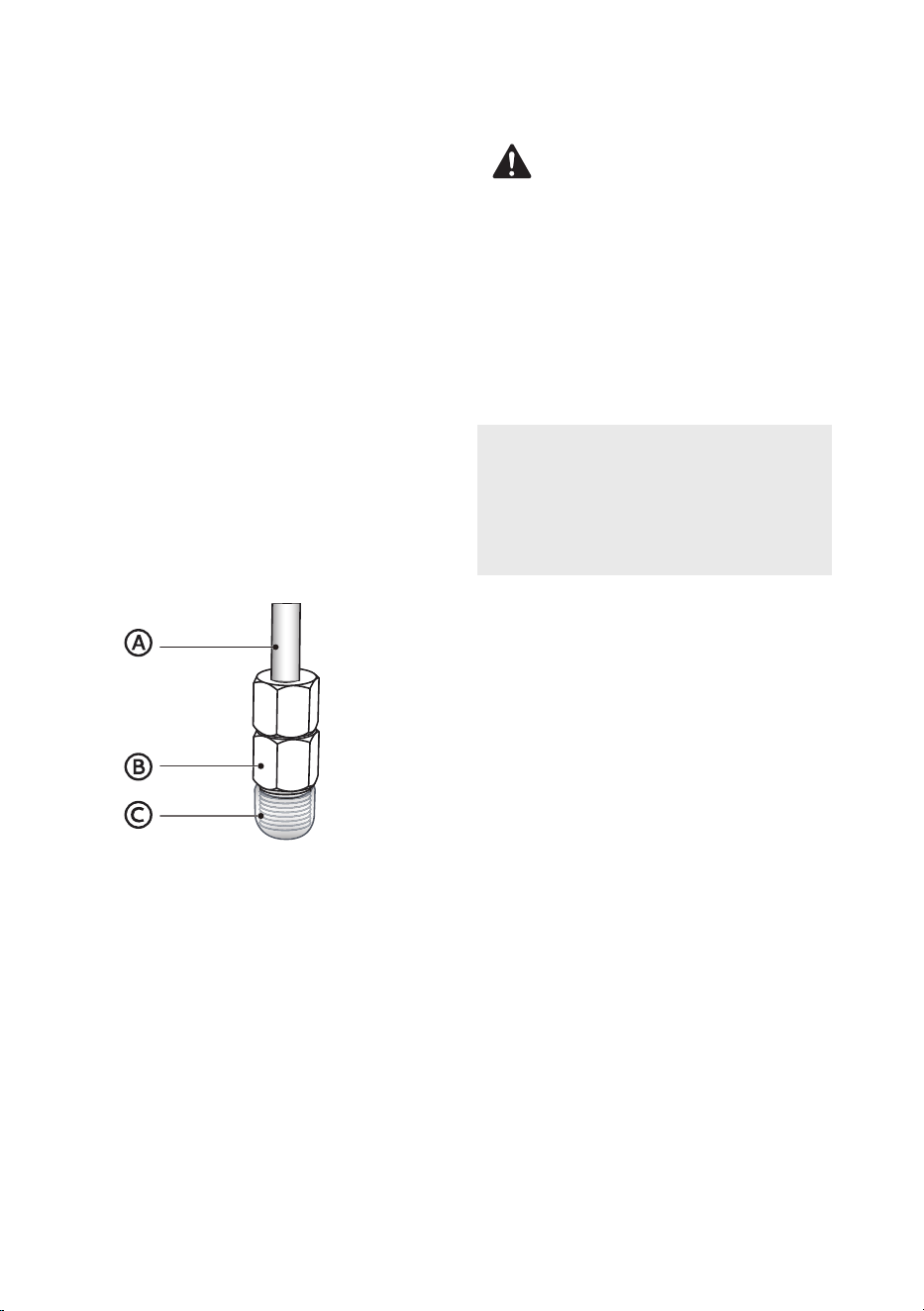
3. Thread a brass compression nut
and ferrule (sleeve) onto the free
end of the copper tube.
4. Remove the plastic cap from the
end of the refrigerator water line.
5. Insert the water line directly into
the fitting on the end of the
refrigerator water line. Tighten the
compression nut. Do not
overtighten.
6. Confirm connection is secure by
gently pulling on the water line.
7. Turn on the water supply to
refrigerat
or and check for leaks.
Correct any leaks.
Complete the installation
Electrical shock hazard
Plug into a grounded 3 prong
outlet.
· Do not use an adapter.
· Do not use an extension cord.
· Failure to do so can result in
death,fire or electrical shock.
· Do not remove the ground prong
from the power cord plug.
Plug into a grounded 3 prong outlet.
NOTE: This refrigerator begins operating
as soon as it is connected to the power
supply.
Move the refrigerator into its final
location, making sure to maintain the
recommended clearance.
WARNING
A. Refrigerator water line
B. Compression nut
C. Plastic cap
EN-20
3. MAINTENANCE OF REFRIGERATOR
3.1 OVERALL CLEANING
• Dust behind the refrigerator and
on the oor must be cleaned to
improve the cooling effect and
energy saving.
• Check the door gasket regularly
to make sure there is no debris.
Clean the door gasket with a soft
cloth dampened with soapy water
or diluted detergent.
• The interior of the refrigerator
should be cleaned regularly to
avoid odors.
• Please turn off the power before
cleaning the interior, remove all
foods, drinks ,shelves, drawers,
etc.
• Use a soft cloth or sponge to
clean the inside of the refrigerator,
with two tablespoons of baking
soda and a quart of warm water.
Then rinse with water and wipe
clean. After cleaning, open the
door and let it dry naturally before
turning on the power.
• For areas that are difcult to clean
inside the refrigerator (such as
narrow places, gaps or corners),
we recommend to wipe them
regularly with a soft rag, soft
brush, etc. and when necessary,
with some tools (such as thin
sticks) to ensure no contaminants
or bacterial accumulation in these
areas.
• Do not use soap, detergent, scrub
powder, spray cleaner, etc., as
these may cause odors inside the
refrigerator or contaminat food.
• Clean the door tray, shelves
and drawers with a soft cloth
dampened with soapy water or
diluted detergent. Dry with a soft
cloth or dry naturally.
• Wipe the outer surface of the
refrigerator with a soft cloth
dampened with soapy water,
detergent, etc., and then wipe dry.
• Do not use hard brushes, scouring
pads, wire brushes, abrasives
(such as toothpaste), organic
solvents (such as alcohol, acetone,
banana oil, etc.), boiling water,
acid or alkaline items, which may
damage the fridge surface and
interior. Boiling water and organic
solvents such as benzene may
deform or damage plastic parts..
• Do not rinse directly with
water or other liquids during
cleaning to avoid short circuit or
affect electrical insulation after
immersion.
Please unplug the freezer for defrost and
cleaning.
EN-21
3.2 DEFROSTING
• The refrigerator is made based
on the air-cooling principle and
thus has automatic defrosting
function. Frost formed due to
change of season or temperature
may also be manually removed
by disconnection of the appliance
from power supply or by wiping
with a dry towel.
3.3 OUT OF OPERATION
• Power failure: In case of power
failure, even if it is in summer,
foods inside the appliance can be
kept for several hours; during the
power failure, the times of door
opening shall be reduced, and no
more fresh food shall be put into
the appliance.
• Long-time nonuse: The appliance
shall be unplugged and then
cleaned; then the doors are left
open to prevent odor.
• Moving: Before the refrigerator is
moved, take all objects inside out,
holder, freezing chamber drawers
and etc. with tape, and tighten
the leveling feet; close the doors
and seal them with tape. During
moving, the appliance shall not be
laid upside down or horizontally,
or be vibrated; the inclination
during movement shall be no
more than 45°.
IMPORTANT:
The appliance shall run continuously once
it is started. Generally, the operation of
the appliance shall not be nterrupted;
otherwise the service life may be
impaired
3.4 CLEANING OF GLASS
SHELF
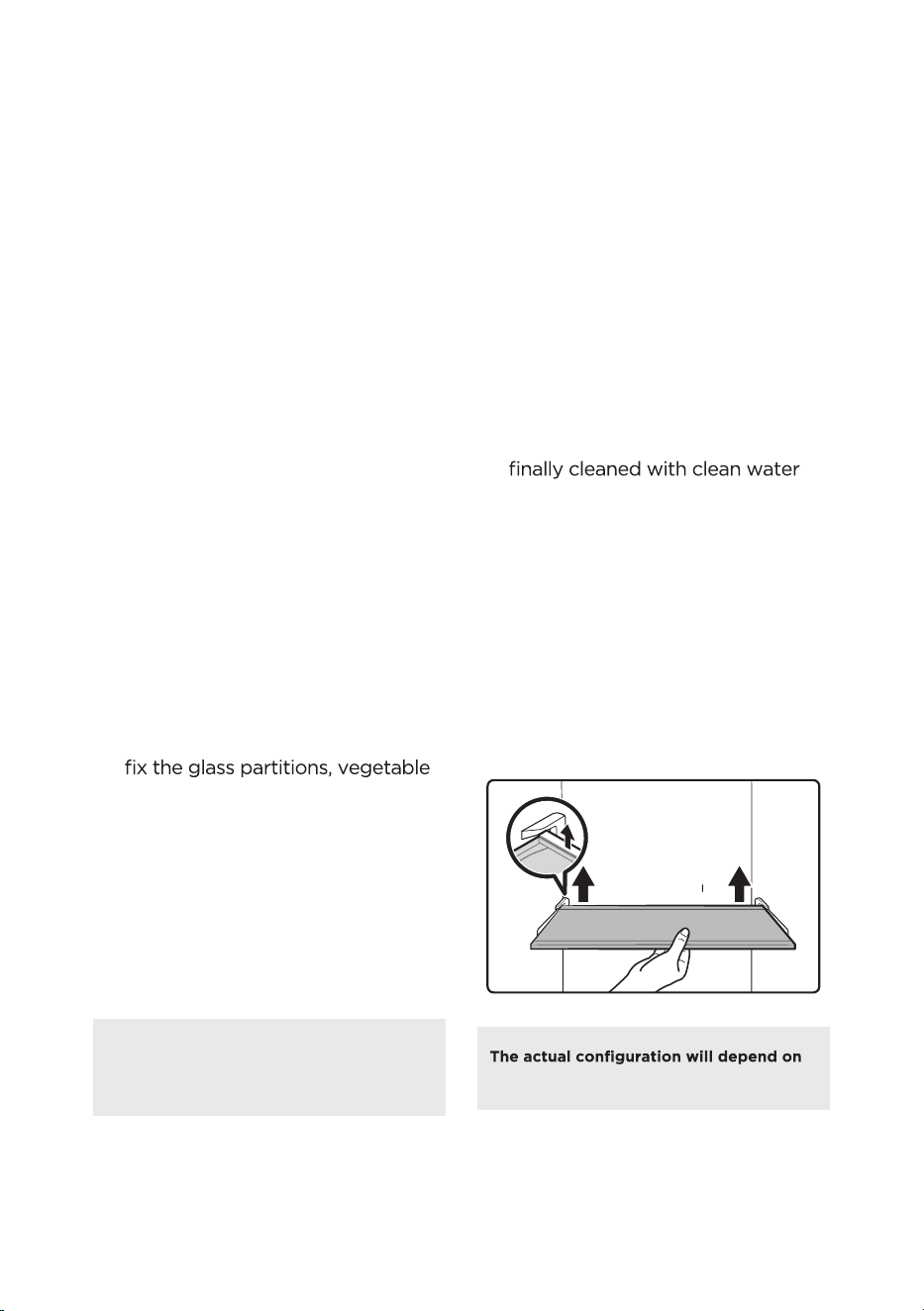
• As the innermost part of the
refrigerator liner where contacting
the shelves has a backstop, you
shall raise the shelves upward,
then you can be able to take it
out.
• Adjust or clean the shelves
according to your requirement.
Soft towels or sponge dipped in
water and non-corrosive neutral
detergents are suggested for
cleaning. The freezer of shall be
and dry cloth. Open the door for
natural drying before the power is
turned on.
Do not use hard brushes, clean
steel balls, wire brushes, abrasives,
such as toothpastes, organic
solvents (such as alcohol, acetone,
banana oil, etc.), boiling water,
acid or alkaline items clean
refrigerator considering that this
may damage the fridge surface
and interior.
The picture above is only for reference.
the physical product or statement by the
distributor
EN-22
3.5 CLEANING OF DOOR
TRAY
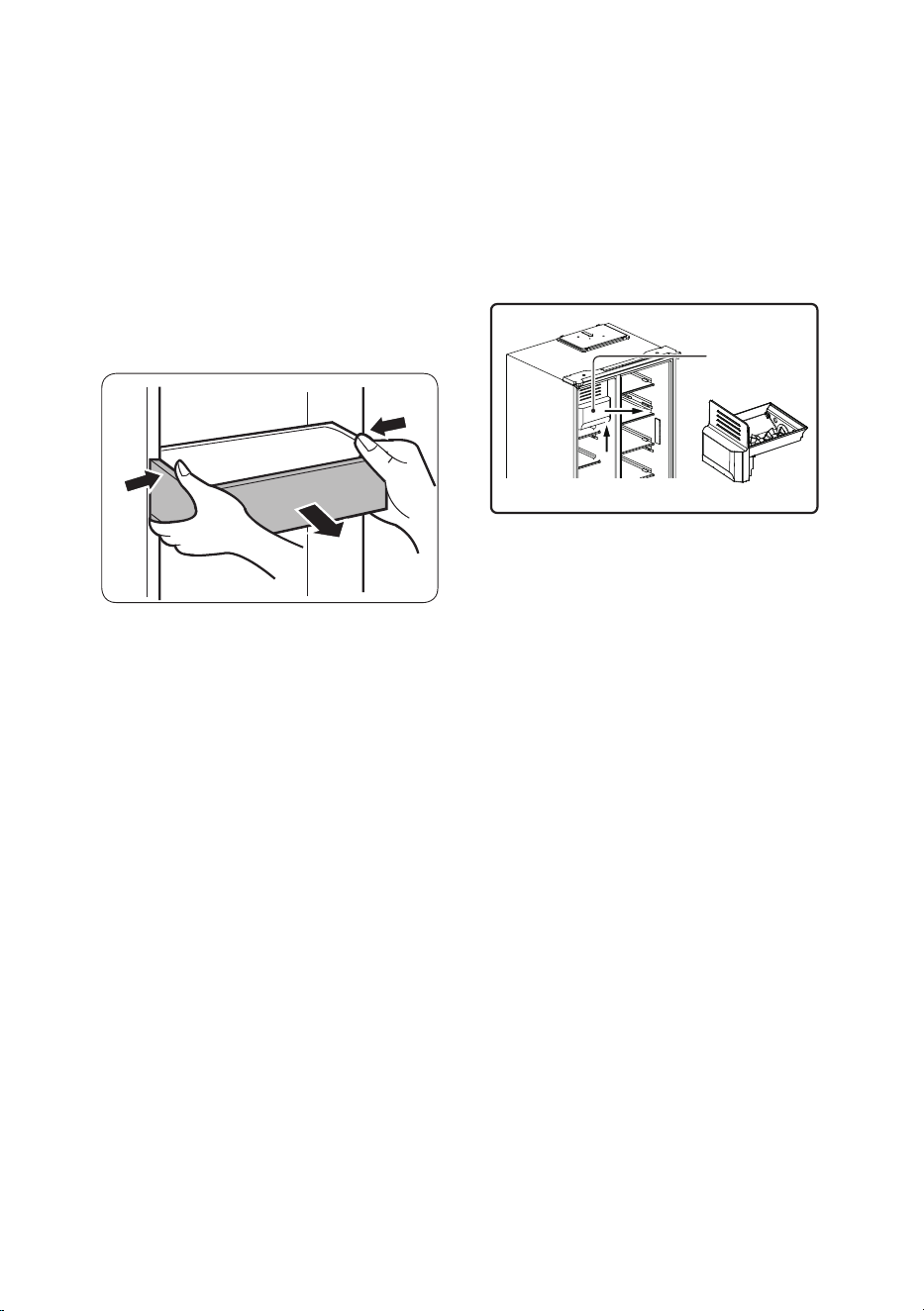
• In order to conveniently take off
tray, punch the bottom of right
part of tray for several times and
again punch the bottom of left
part of tray for several times, as
shown in the gure;
• Tray can be smoothly taken off
after it has been loosened.
3.6 CLEAN THE ICE
CONTAINER
• Ice in the ice container may block
the outlet because of lumping
or other reasons. In this case the
ice container needs cleaning or
eliminating block.
Ice Container
• Ice on lights go out, hold the ice
storage box in both hands and
pull it upwards and ouwards
thorizontally.
• Clean as needed, and install it in
the opposite direction that the ice
storage box was taken down.
• Close the freezing chamber door
EN-23
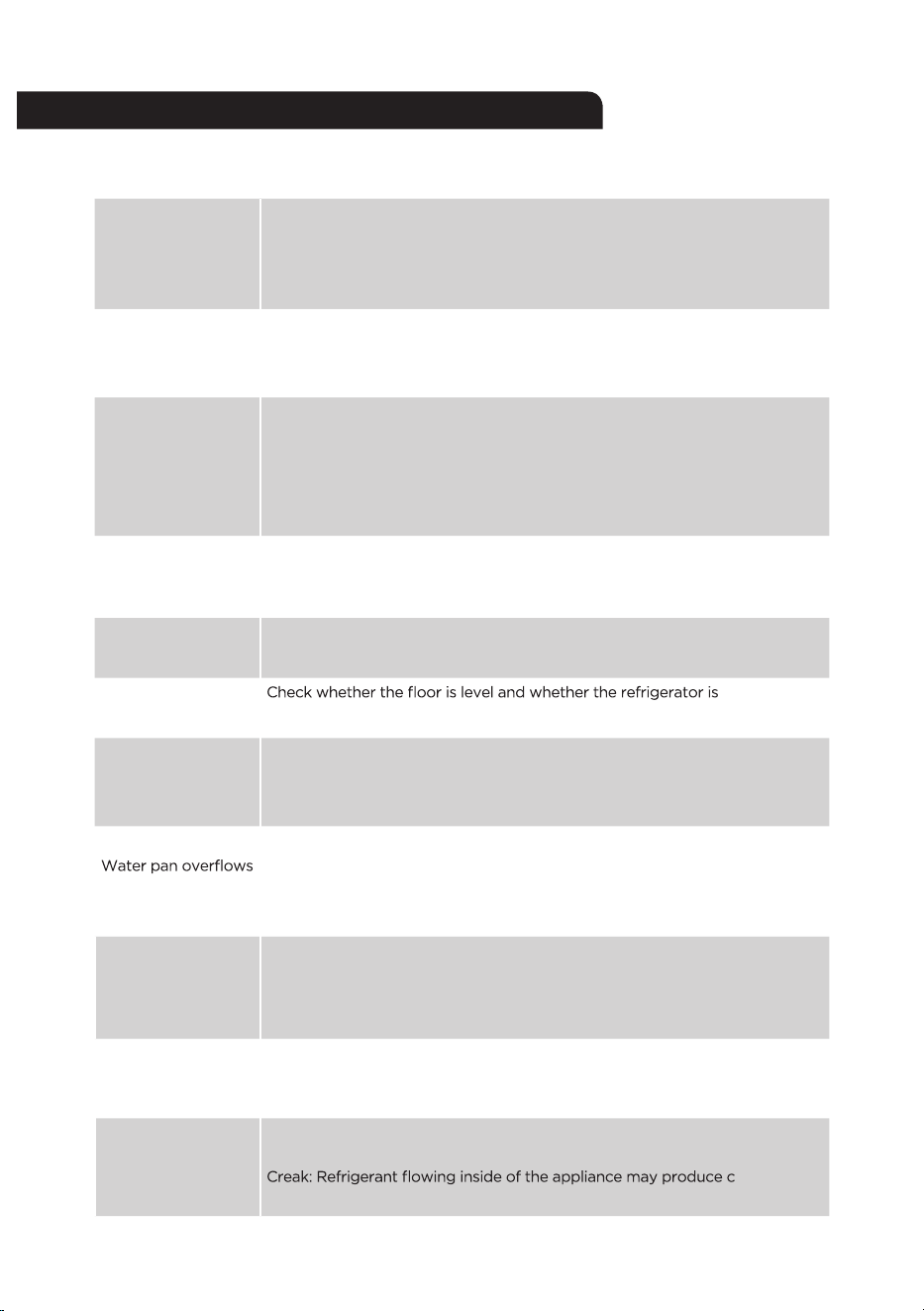
4. TROUBLE SHOOTING
The following simple issues can be handled by the user. Please call the after-
sale service department if the issues are not solved.
Failed operation
Check whether the appliance is connected to power or whether the plug is
in well contact
Check whether the voltage is too low
Check whether there is a power failure or partial circuits have tripped
Odor
Odorous foods shall be tightly wrapped
Check whether there is any rotten food
Clean the inside of the refrigerator
Long-time operation
of the compressor
Long operation of the refrigerator is normal in summer
when the ambient temperature is high It is not suggestible having too much
food in the appliance at the same time
Food shall get cool before being put into the appliance
The doors are opened too frequently
Light fails to get lit
Check whether the refrigerator is connected to power supply and whether
the illuminating light is damaged
Have the light replaced by a specialist
Door can not be
properly closed
The door is stuck by food packages Too much food is placed
The refrigerator is tiltedr.
Loud noises
placed stably
Check whether accessories are placed at proper locations
Door seal fails to
be tight
Remove foreign matters on the door seal
Heat the door seal and then cool it for restoration
(or blow it with an electrical drier or use a hot towel for heating)
There is too much food in the chamber or food stored contains
too much water,resulting in heavy defrosting
The doors are not closed properly, resulting in frosting due to entry of air
and increased water due to defrosting
Hot housing
Heat dissipation of the built-in condenser via the housing, which is normal
When housing becomes hot due to high ambient temperature, storage of
too much food or shutdown of the compressor is shut down, provide sound
ventilation to facilitate heat dissipation
Surface
condensation
Condensation on the exterior surface and door seals of the refrigerator is
normal when the ambient humidity is too high. Just wipe the condensate
with a clean towel.
Abnormal noise
Buzz: The compressor may produce buzzes during operation, and the
buzzes are loud particularly upon start or stop. This is normal.
reak, which
is normal.
24
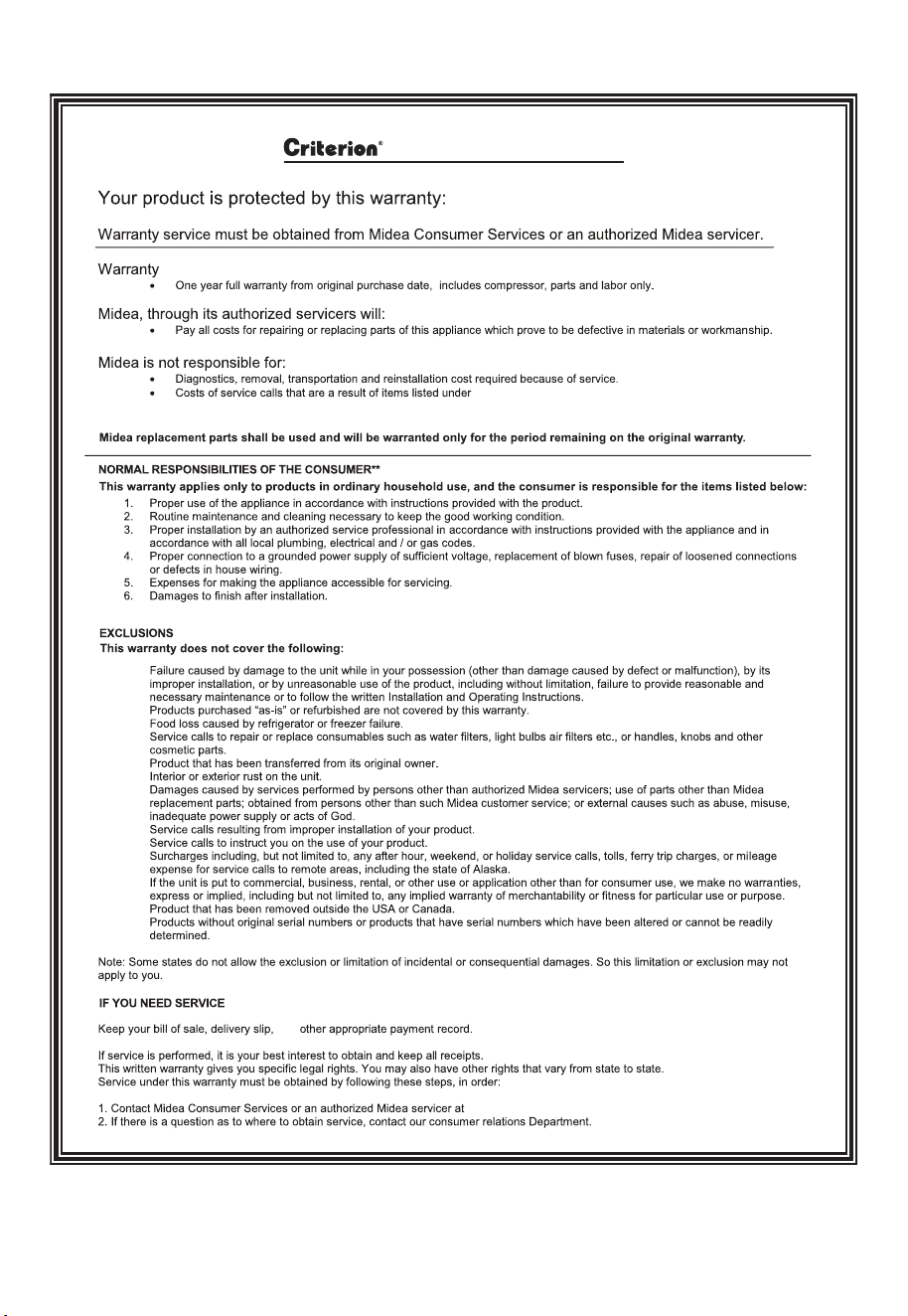
WARRANTY
Refrigerator Warranty
1.
2.
3.
4.
5.
6.
7.
8.
9.
10.
11.
12.
13.
1-866-646-4332
NORMAL RESPONSIBILITIES OF THE CONSUMER**
The date on the bill established the warranty period should service be required.
and
Es sencillo! Complete y envie su Tarjeta de Registracion de Producto hoy!
25
Es sencillo! Complete y envie su Tarjeta de Registracion de Producto hoy!
26
Midea America Corp.
759 Bloomfield Ave. # 386
West Caldwell, NJ 07006
Call


CSBR260M4S