© 2025 GeoVision, Inc. All rights reserved.
Under the copyright laws, this manual may not be copied, in whole or in part, without the
written consent of GeoVision.
Every effort has been made to ensure that the information in this manual is accurate. GeoVision,
Inc. makes no expressed or implied warranty of any kind and assumes no responsibility for
errors or omissions. No liability is assumed for incidental or consequential damages arising from
the use of the information or products contained herein. Features and specifications are subject
to change without notice.
GeoVision, Inc.
9F, No. 246, Sec. 1, Neihu Rd.,
Neihu District, Taipei, Taiwan
Tel: +886-2-8797-8377
Fax: +886-2-8797-8335
http://www.geovision.com.tw
Trademarks used in this manual: GeoVision, the GeoVision logo and GV series products are
trademarks of GeoVision, Inc. Windows is the registered trademark of Microsoft Corporation.
June 2025
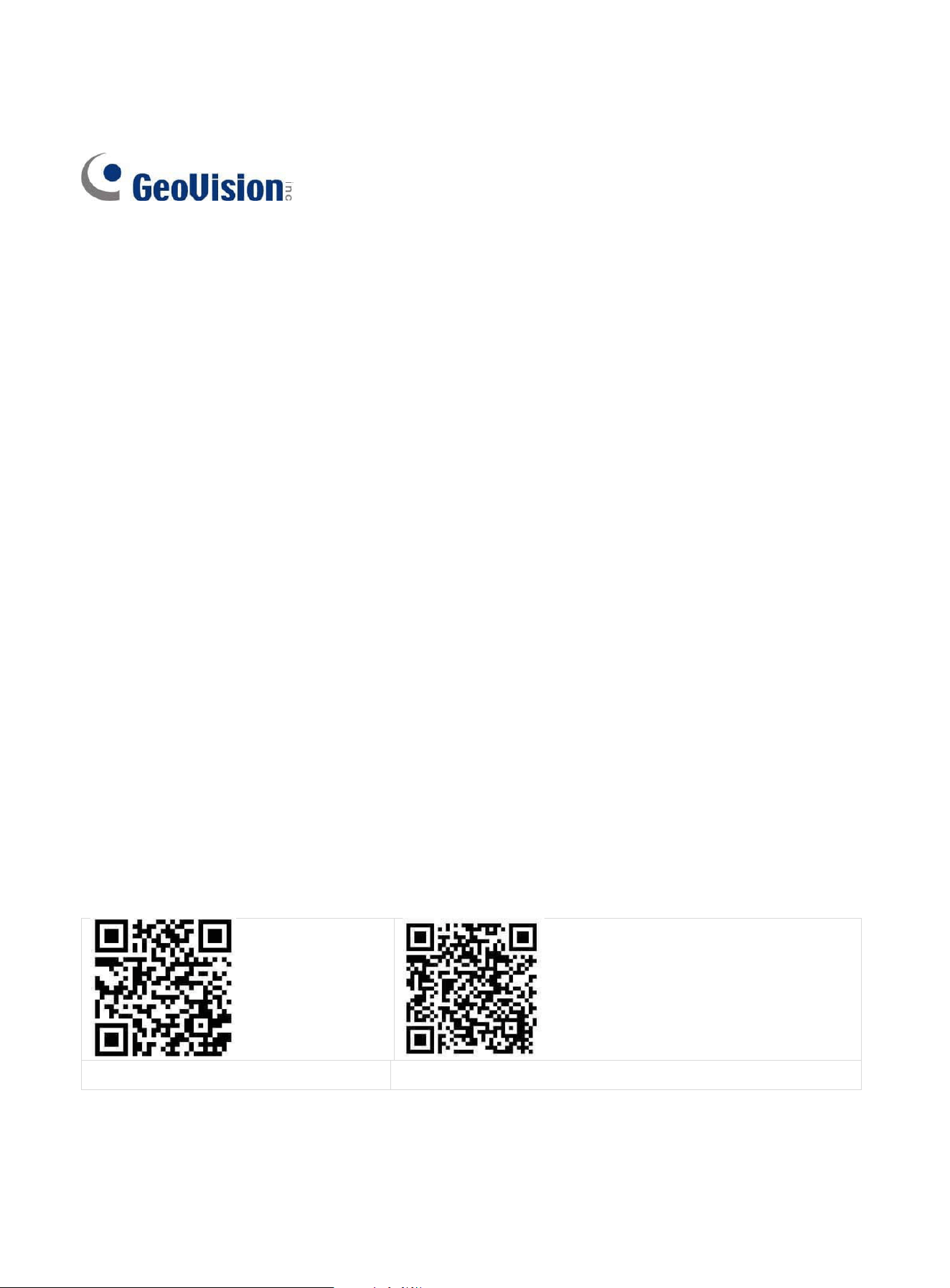
Scan the following QR codes for product warranty and technical support policy:
[Warranty]
[Technical Support Policy]
i
Contents
About this Manual ...................................................................................................................................1
1 Local Operations .................................................................................................................................2
1.1 Before You Begin ............................................................................................................................................... 2
1.2 Local Operations .............................................................................................................................................. 2
2 Initial Configuration .............................................................................................................................2
2.1 Preparation ...................................................................................................................................................... 2
2.2 Login 3
2.3 Wizard .............................................................................................................................................................. 7
3 Live View ............................................................................................................................................9
3.1 Live View Status ............................................................................................................................................... 9
3.2 Window Toolbar ............................................................................................................................................... 9
3.3 Screen Toolbar ............................................................................................................................................... 11
3.4 Shortcut Menu ............................................................................................................................................... 15
4 Channel Configuration ....................................................................................................................... 18
4.1 Channel Management .................................................................................................................................... 18
4.1.1 IPC Configuration ................................................................................................................................... 18
4.1.2 Fisheye Configuration ............................................................................................................................ 26
4.1.3 Advanced Functions .............................................................................................................................. 30
4.2 Audio & Video ................................................................................................................................................ 31
4.2.1 Encoding Settings .................................................................................................................................. 31
4.2.2 Audio Configuration .............................................................................................................................. 33
4.3 Display Configuration ..................................................................................................................................... 34
4.3.1 OSD Configuration ................................................................................................................................. 34
4.3.2 OSD Content .......................................................................................................................................... 36
4.3.3 Image Settings ....................................................................................................................................... 37
4.3.4 Privacy Mask .......................................................................................................................................... 43
4.4 PTZ Configuration ........................................................................................................................................... 44
5 Search .............................................................................................................................................. 50
5.1 Recording Backup ........................................................................................................................................... 50
5.2 Image Backup ................................................................................................................................................. 52
5.3 Event. ............................................................................................................................................................. 54
5.4 Object ............................................................................................................................................................. 55
5.4.1 Person Search ........................................................................................................................................ 55
5.4.2 Motor Vehicle Search ............................................................................................................................ 60
5.4.3 Non-Motor Vehicle Search .................................................................................................................... 61
5.5 Statistics ......................................................................................................................................................... 63
5.5.1 People Counting Report ........................................................................................................................ 63
5.5.2 Heat Map ............................................................................................................................................... 64
5.6 Others ............................................................................................................................................................ 66
ii
6 VCA .................................................................................................................................................. 67
6.1 VCA Configuration .......................................................................................................................................... 67
6.1.1 Face Recognition ................................................................................................................................... 68
6.1.2 Smart Intrusion Prevention ................................................................................................................... 73
6.1.3 Exception Detection & Statistics ............................................................................................................ 82
6.1.4 People Counting .................................................................................................................................... 87
6.1.5 Alarm-triggered Actions ........................................................................................................................ 91
6.1.6 Arming Schedule ................................................................................................................................... 96
6.2 Analyzer Configuration ................................................................................................................................... 97
6.3 Library Management ...................................................................................................................................... 98
6.3.1 Face List ................................................................................................................................................. 98
6.4 Smart Preview .............................................................................................................................................. 101
6.5.1 Face Recognition ................................................................................................................................. 102
6.5.2 Smart Intrusion Prevention ................................................................................................................. 103
6.5.3 People Flow Counting .......................................................................................................................... 104
7 Peripheral Management .................................................................................................................. 105
7.1 POS Configuration ........................................................................................................................................ 105
7.2.1 POS OSD Configuration........................................................................................................................ 105
7.2.2 POS Configuration ............................................................................................................................... 106
8 System Configuration....................................................................................................................... 109
8.1 General Configuration .................................................................................................................................. 109
8.1.1 Basic Configuration .............................................................................................................................. 109
8.1.2 Time Configuration .............................................................................................................................. 111
8.1.3 DST 111
8.1.4 Camera Time Synchronization ............................................................................................................. 112
8.1.5 Holiday Configuration .......................................................................................................................... 112
8.2 Preview Configuration .................................................................................................................................. 114
8.2.1 Preview Configuration ......................................................................................................................... 114
8.2.2 Advanced Configuration ...................................................................................................................... 116
8.3 Network Configuration ................................................................................................................................. 117
8.3.1 Basic Configuration .............................................................................................................................. 117
8.3.2 Platform Configuration ........................................................................................................................ 122
8.3.3 Advanced Configuration ...................................................................................................................... 125
8.3.4 GV-VPN ............................................................................................................................................... 132
8.4 User Configuration ....................................................................................................................................... 133
8.5 Security Configuration .................................................................................................................................. 136
8.5.1 IP Address Filtering .............................................................................................................................. 136
8.5.2 ONVIF Authentication.......................................................................................................................... 136
8.5.3 802.1x .................................................................................................................................................. 137
8.5.4 ARP Protection .................................................................................................................................... 138
9 Storage ........................................................................................................................................... 139
iii
9.1 Recording Schedule ...................................................................................................................................... 139
9.2 Snapshot Schedule ....................................................................................................................................... 143
9.2.1 Configure Snapshot Schedule .............................................................................................................. 143
9.2.2 Snapshot Type ..................................................................................................................................... 144
9.3 Disk Management ........................................................................................................................................ 145
9.4 Disk Group .................................................................................................................................................... 148
9.5 Space Allocation ........................................................................................................................................... 149
9.6 Advanced Settings ........................................................................................................................................ 150
10 Alarm Configuration ........................................................................................................................ 151
10.1 Motion Detection ................................................................................................................................ 151
10.2 Tampering Detection ........................................................................................................................... 154
10.3 Human Body Detection ....................................................................................................................... 154
10.4 Video Loss ........................................................................................................................................... 155
10.5 Alarm Input and Output ...................................................................................................................... 156
10.5.1 Alarm Input ................................................................................................................................... 156
10.5.2 Alarm Output ................................................................................................................................ 158
10.6 Alert .................................................................................................................................................... 160
10.7 Audio Detection .................................................................................................................................. 161
10.8 Buzzer .................................................................................................................................................. 162
10.9 People Present Alarm .......................................................................................................................... 162
10.10 One-Key Disarming .............................................................................................................................. 165
10.11 Manual Alarm ...................................................................................................................................... 167
11 System Maintenance ....................................................................................................................... 168
11.1 System Info .......................................................................................................................................... 168
11.1.1 Basic Info ....................................................................................................................................... 168
11.1.2 Camera Status ............................................................................................................................... 169
11.1.3 Recording Status ............................................................................................................................ 169
11.1.4 Online User .................................................................................................................................... 170
11.1.5 HDD Status .................................................................................................................................... 170
11.2 Network Information ........................................................................................................................... 171
11.2.1 Network Traffic .............................................................................................................................. 171
11.2.2 Packet Capture .............................................................................................................................. 172
11.2.3 Network Check .............................................................................................................................. 173
11.2.4 Network Status .............................................................................................................................. 175
11.2.5 Network Resource Statistics .......................................................................................................... 176
11.2.6 PoE and Network Port Status ........................................................................................................ 176
11.3 Log Search ........................................................................................................................................... 176
11.4 Maintenance ....................................................................................................................................... 179
11.4.1 Maintenance ................................................................................................................................. 179
11.4.2 Diagnosis Info ................................................................................................................................ 180
11.4.3 One-Click Collection ...................................................................................................................... 182
11.5 System Upgrade .................................................................................................................................. 182
iv
11.5.1 NVR Upgrade ................................................................................................................................. 183
11.5.2 IPC Upgrade ................................................................................................................................... 184
11.6 HDD Check .......................................................................................................................................... 185
11.6.1 Run S.M.A.R.T. Test ........................................................................................................................ 185
11.6.2 Bad Sector Detection ..................................................................................................................... 186
12 Playback ......................................................................................................................................... 187
12.1 Instant Playback .................................................................................................................................. 187
12.2 Recording Playback.............................................................................................................................. 187
13 Startup and Shutdown ..................................................................................................................... 192
14 Web-Based Operations .................................................................................................................... 193
14.1 Preparation ......................................................................................................................................... 193
14.2 Login .................................................................................................................................................... 193
14.3 Live View ............................................................................................................................................. 195
14.4 Playback .............................................................................................................................................. 197
14.5 Configuration ....................................................................................................................................... 198
14.6 Smart ................................................................................................................................................... 198
15 Appendix FAQ ................................................................................................................................. 199
1
About this Manual
Disclaimer
Due to such reasons as product version upgrade or regulatory requirement of relevant regions, this manual will
be periodically updated.
This manual is only for informational purpose, and all statements, information, and recommendations in this
manual are presented without warranty.
The illustrations in this manual are for reference only and may vary depending on the version or model. The
screenshots in this manual may have been customized to meet specific requirements and user preferences. As a
result, some of the examples and functions featured may differ from those displayed on your monitor.
2
1 Local Operations
This chapter introduces operation methods and matters needing attention on the local interface.
1.1 Before You Begin
• Please be aware that functions may vary with NVR model.
• The figures in this manual are for illustration purpose only and may vary with NVR model.
• The parameters that are grayed out on the local interface cannot be edited. The parameters and values
displayed may vary with NVR model and version.
1.2 Local Operations
This section introduces mouse operations and front panel buttons.
You can refer to Initial Configuration and complete a quick configuration.
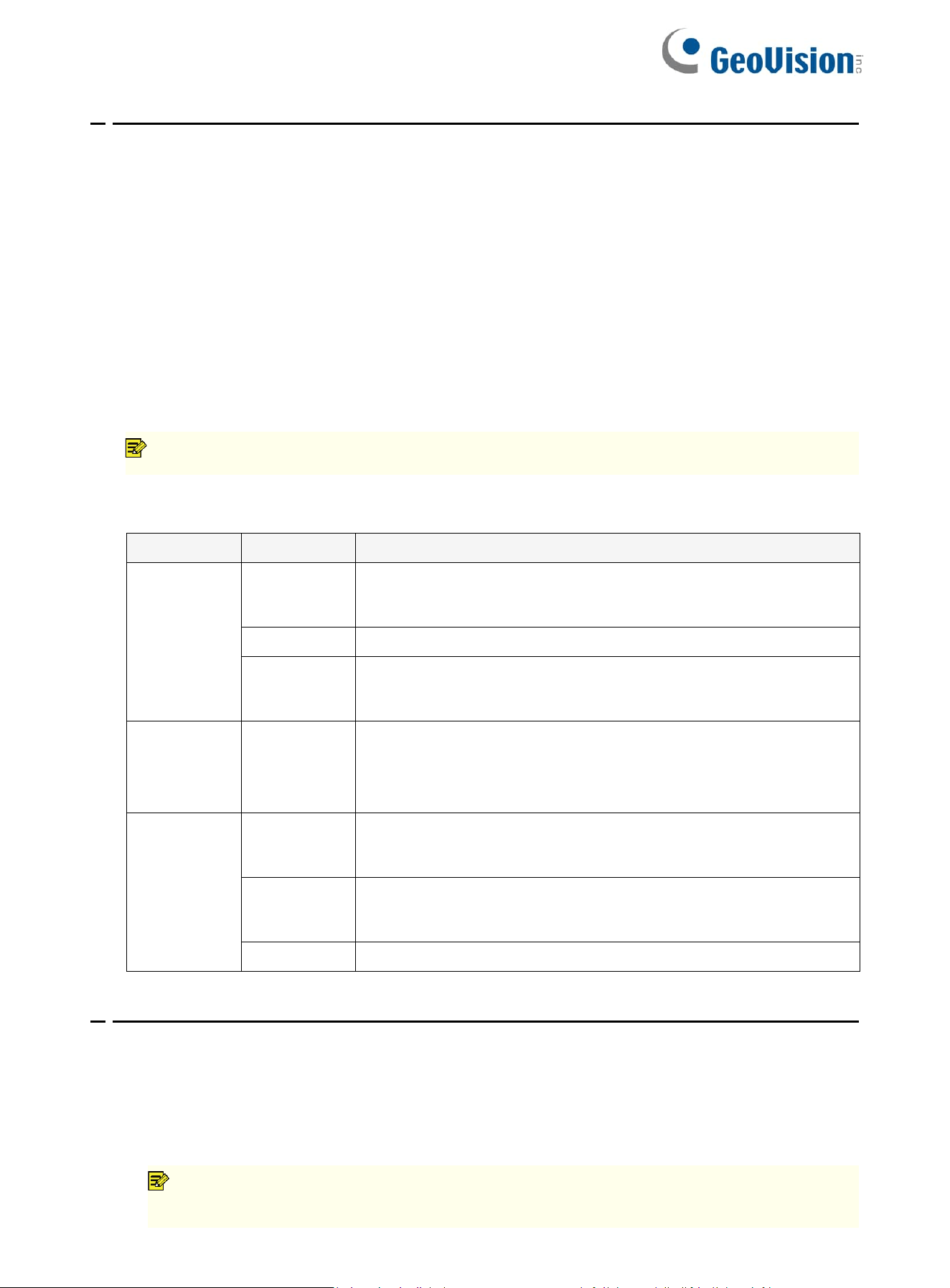
Mouse Operations
Name
Operation
Description
Left button
Click
• Select or confirm an item.
• Select to edit digits, symbols, uppercase or lowercase letters in a field.
Double-click
Switch single window or multi-window in live view.
Drag
• Draw or move a rectangle on the screen.
• Sort windows in a multi-window layout.
Right button
Click
• Show the shortcut menu.
• Exit digital zoom.
• Exit the current window when Cancel or Exit is displayed.
Scroll wheel
Scroll up
• Scroll up a list, window, or scroll bar.
• Zoom in on the screen when digital zoom is enabled.
Scroll down
• Scroll down a list, window, or scroll bar.
• Zoom out on the screen when digital zoom is enabled.
Long press
Restore to the lowest resolution.
2 Initial Configuration
This chapter describes the initial configuration of the NVR.
2.1 Preparation
• Make sure that at least one monitor is correctly connected to the VGA or HDMI interface on the rear panel of
the NVR, otherwise, you cannot view the local interface.
Note: Unless otherwise specified, all operations described in this manual are performed with a mouse by the
right hand.
Note: If no images are displayed after the NVR is powered on, it may be because the monitor does not
support the current output resolution of the NVR. Please press and hold the scroll wheel of the mouse to
restore to the lowest resolution.
3
• Make sure that the hard disk(s) are correctly installed. For detailed installation steps, please refer to the quick
guide shipped with the NVR.
2.2 Login
Device Login
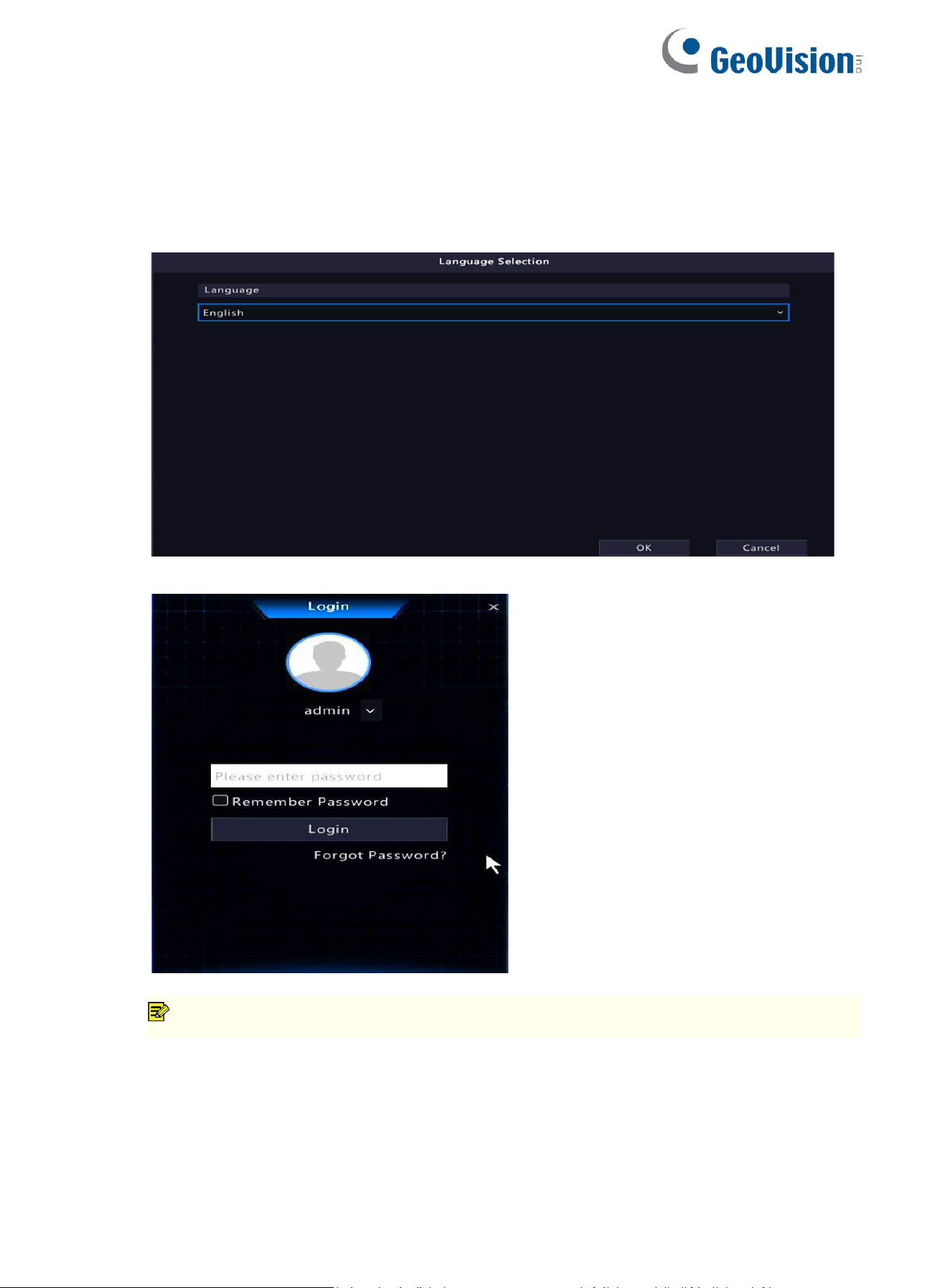
1. The Language Selection page appears after the NVR starts up. Set the area, and language.
2. On the Login page, select the default user (admin), enter the default password (admin), and then click Login.
Note: If you enable Remember Password, the username and password will be automatically filled in the
next time.
4
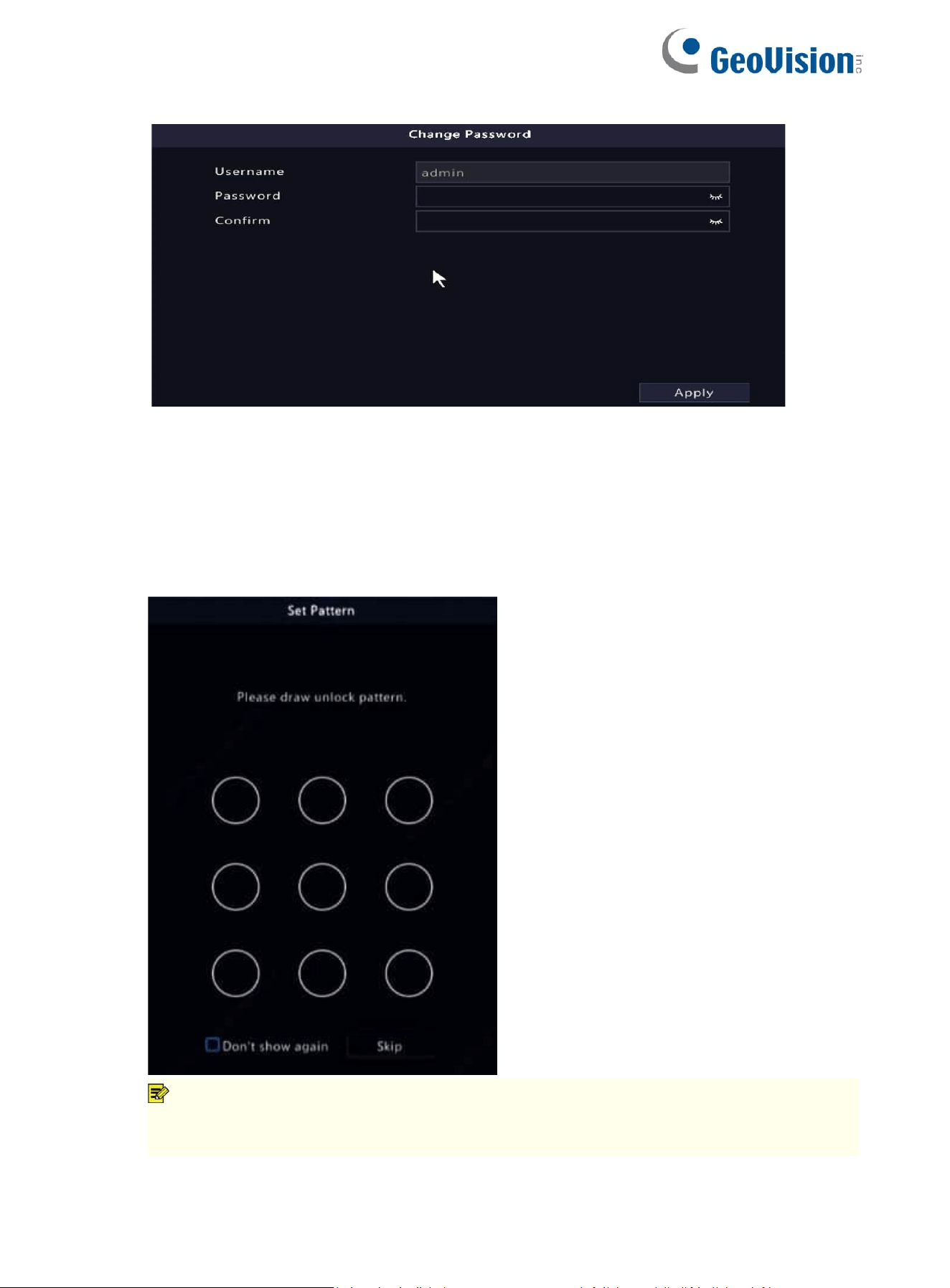
3. On the Change Password page, enter the new password, and confirm it. Click Apply.
Note:
• Use the default username and password (admin/admin) to log in for the first time. After login, you
must change the password, and use the new password to log in the next time.
• For security, you are strongly recommended to set a strong password with at least 9 characters
including all three elements: letter, digit, and special character.
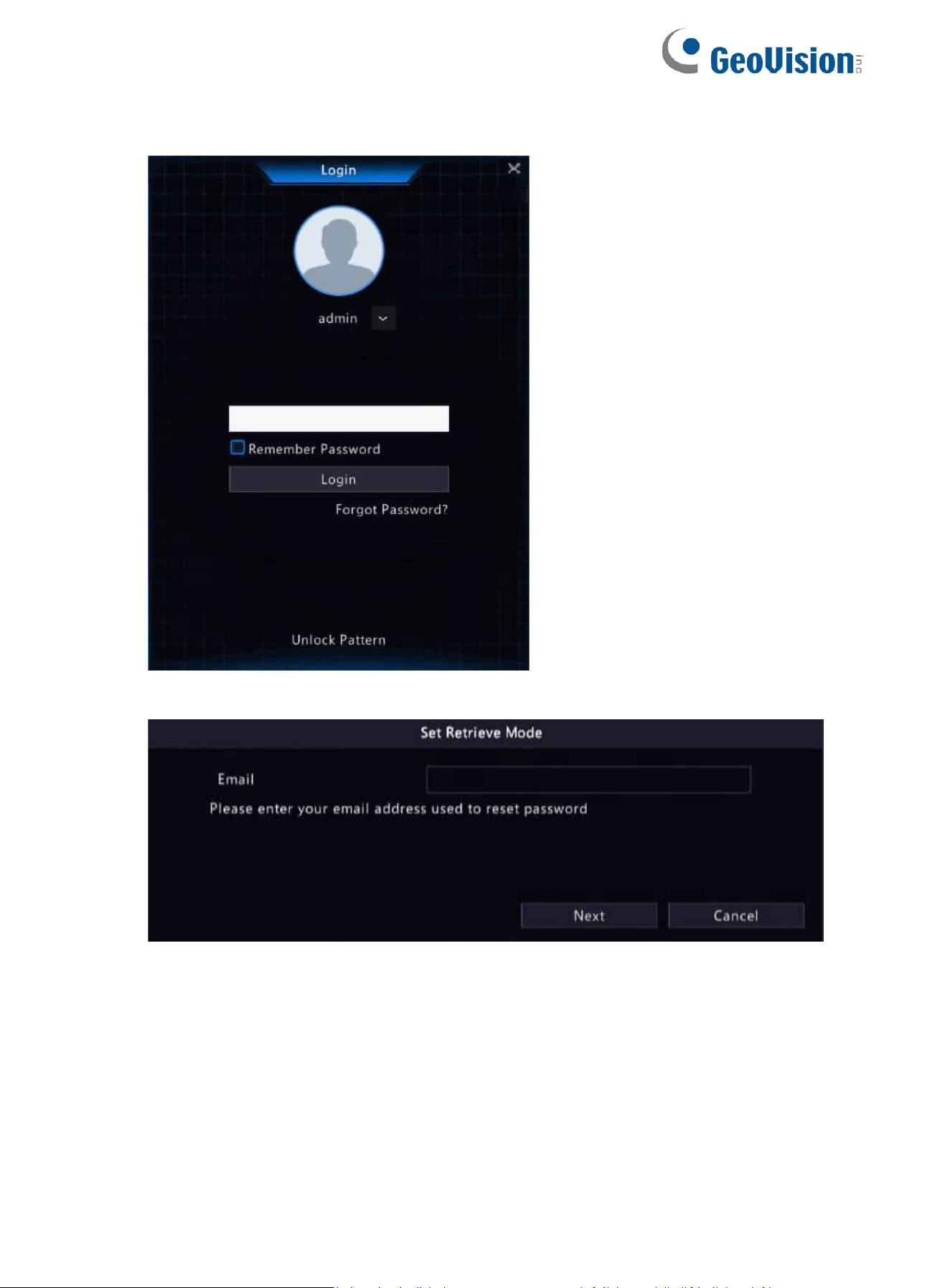
4. (Optional) Set an unlock pattern, or click Skip to proceed.
Note:
• You can set the unlock pattern later at anytime or disable it under Menu > System > User.
• If an unlock pattern is set, it will replace the password at login.
5
Reset Password
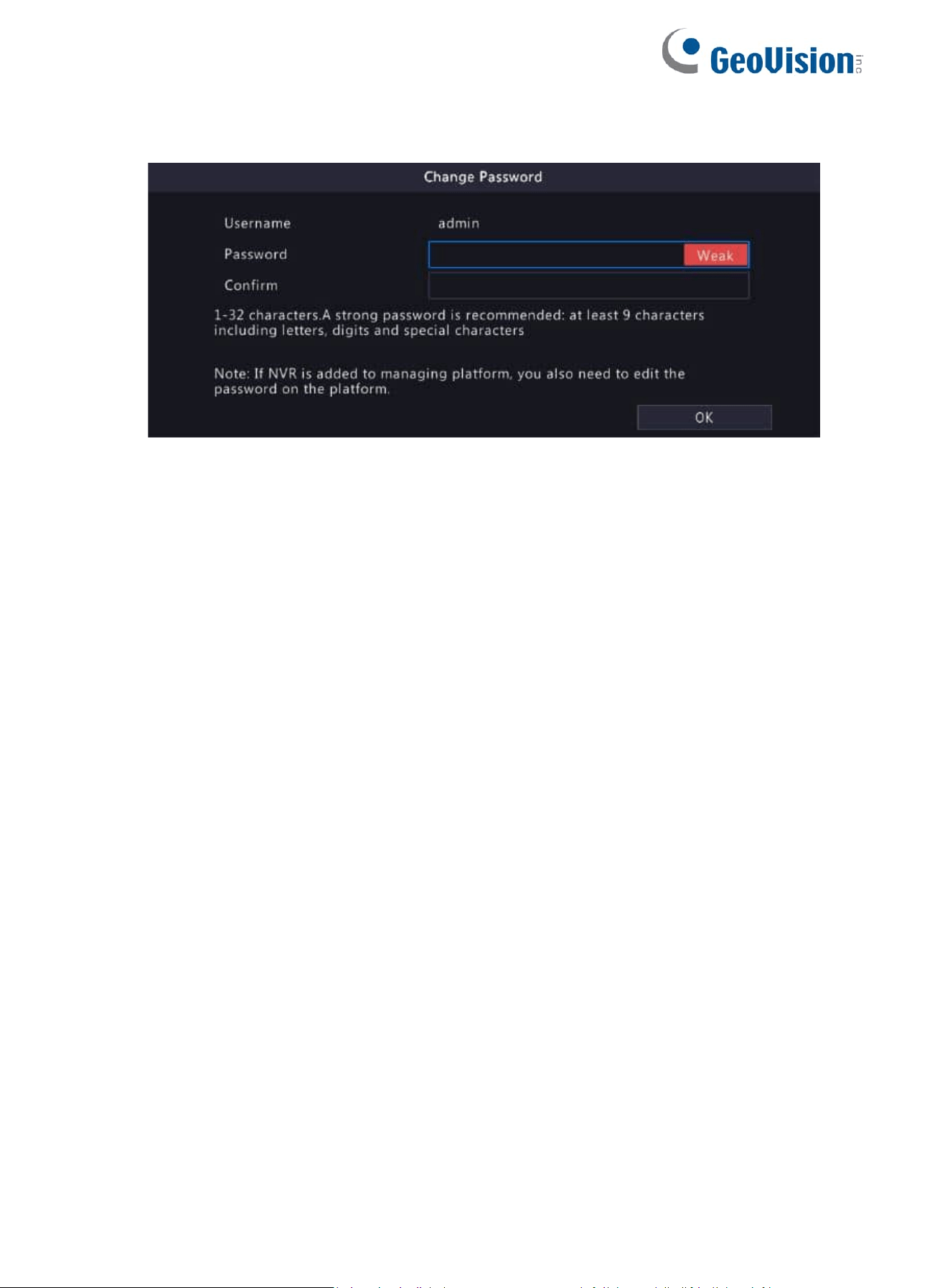
1. If you forgot the admin password or want to reset the password, click Forgot Password on the login page.
2. (Skip this step if you have already entered your email address) Enter your email address to receive the
security code, that is, the temporary password.
3. Follow the instructions on the screen to obtain the security code.
6
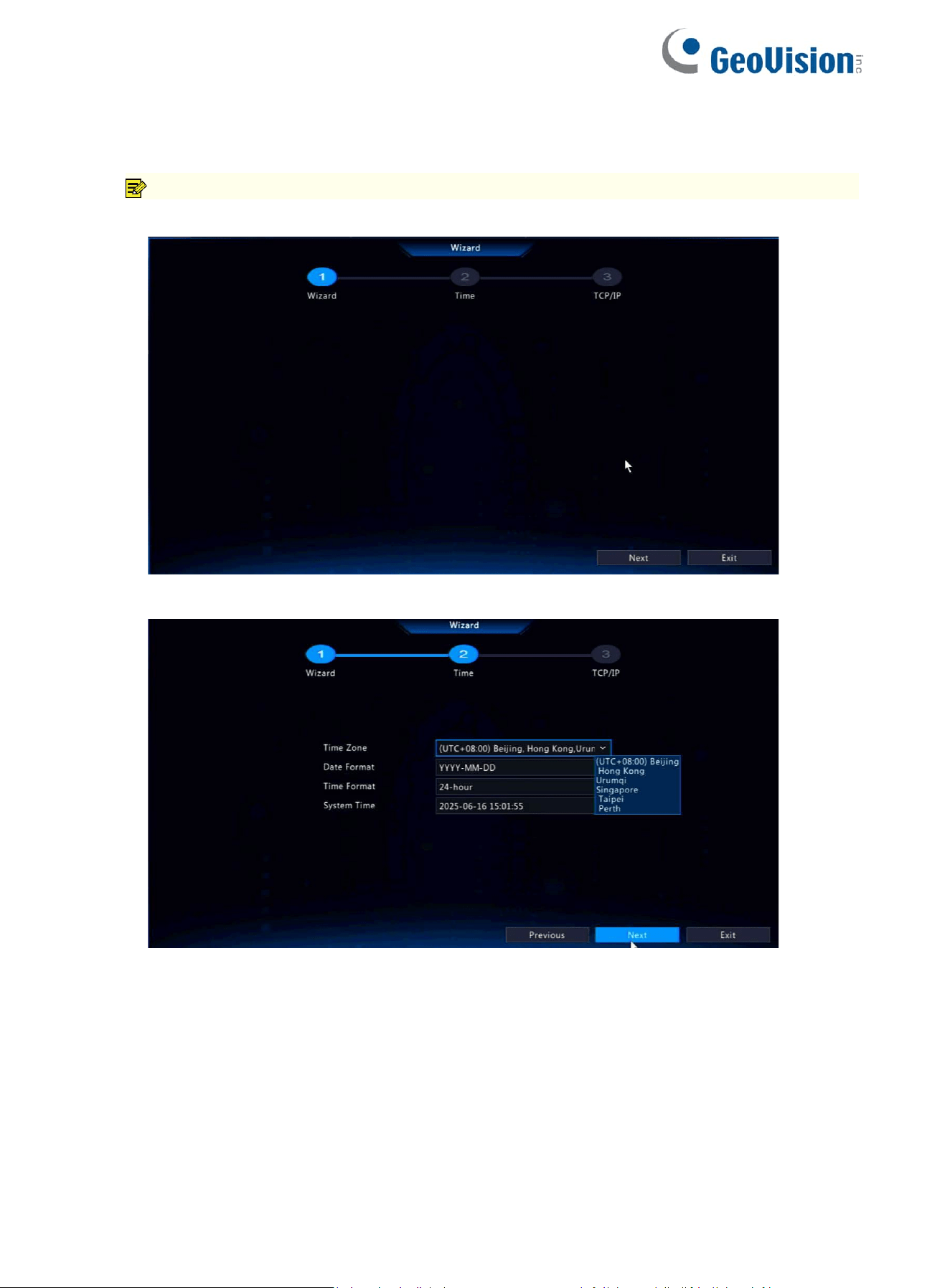
4. Enter the security code received from the email address, and click OK.
5. Enter the password, confirm the password, and then click OK to reset the password.
6. Use the new password to log in again.
7
2.3 Wizard
The wizard page appears after you login. Follow the wizard to complete the most basic setup, or click Exit to skip
this step.
1. Select Next.
2. Set the time parameters, including time zone, date format, time format, and system time, and then click Next.
Note: You can also go to Menu > System > General > Basic Setup to set the basic parameters.
8
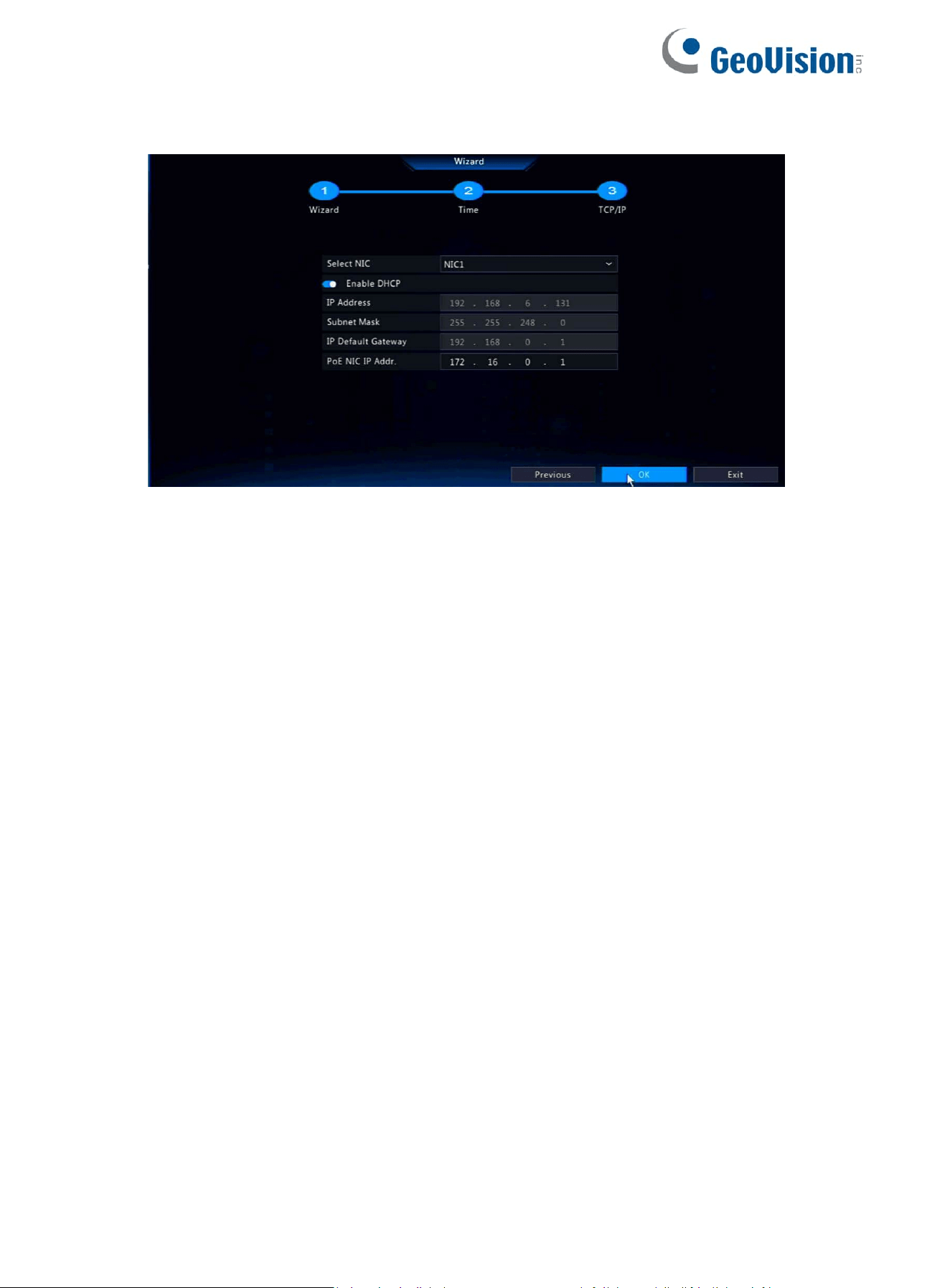
3. Configure TCP/IP. Check Enable DHCP to automatically obtain an IP address, subnet mask and IP default
gateway. You can also enter the information manually. Then, click OK.
9
3 Live View
This chapter introduces the live view page, including window toolbar, screen toolbar, shortcut menu, digital
zoom, sequence operation, etc.
3.1 Live View Status
The following icons are used to indicate alarms, recording status, and audio status in a live view window.
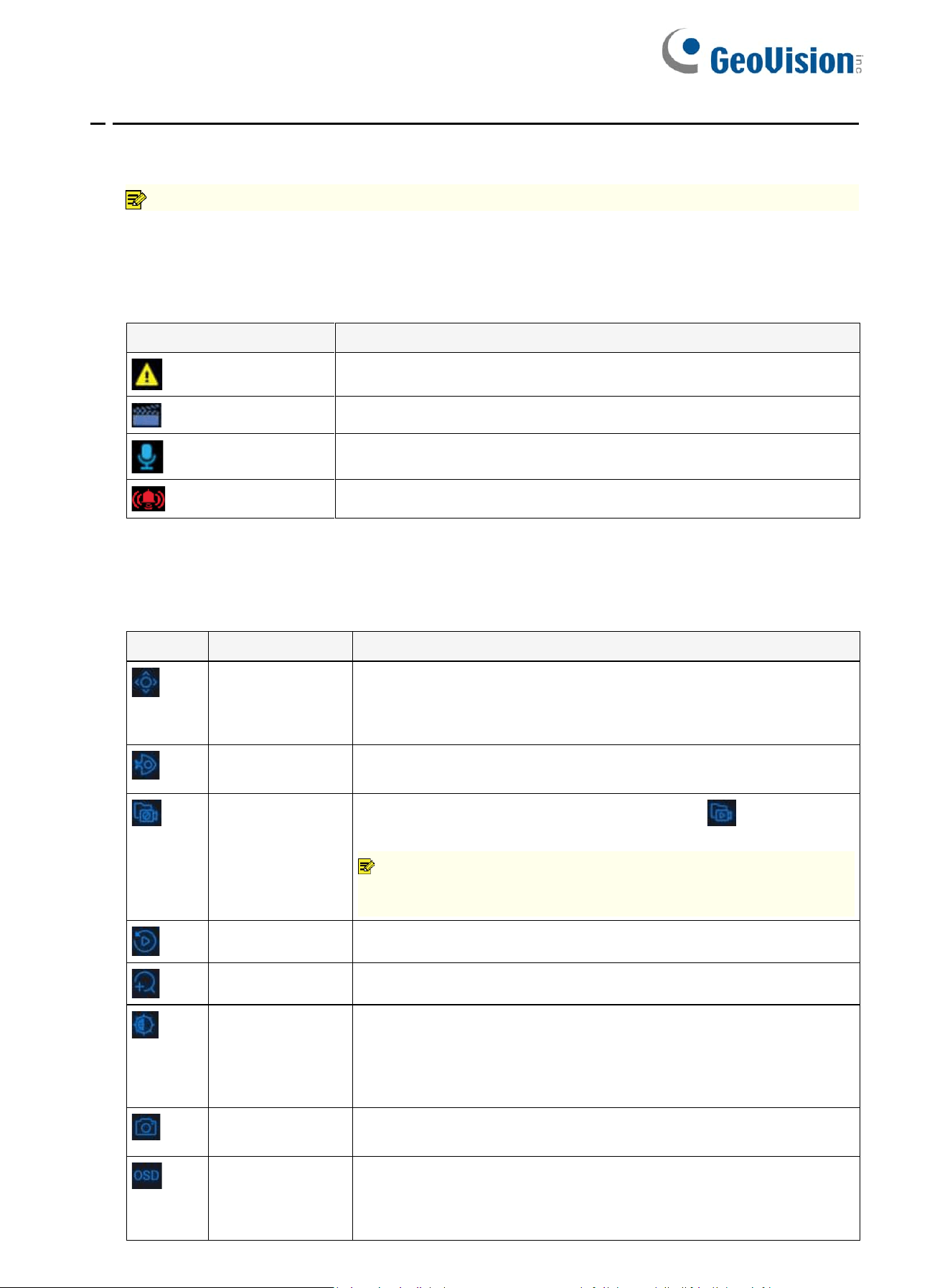
Table 3-1: Live View Window Icons
Icon
Description
Tampering
Recording
Two-way audio
Alarm
3.2 Window Toolbar
Click a window to display the window toolbar for quick configuration.
Table 3-2: Window Toolbar
Button
Name
Description
PTZ Control
• Available for PTZ cameras only. Click to display the PTZ control window.
• You can also configure PTZ under Menu > Camera > PTZ. See PTZ
Configuration for details.
Fisheye Mode
Set the mount mode and display mode for fisheye cameras. This button
appears only for fisheye cameras.
Local Recording
Record live video in the window to the hard disk. Click to stop
recording.
Note: Similar to manual recording, local recording is a scheduled
recording and has higher priority over other video recording schedules.
You can play the local recording in normal mode.
Instant Playback
Click to play the video recorded during the past 5 minutes.
Digital Zoom
Zoom in on an area of interest in the window. See Digital Zoom for details.
Image Settings
• Click to set the image mode and parameters so as to get optimal images
in the window.
• You can also edit image settings under Menu > Camera > Image > Image
Settings. See Image Enhancement for details.
Take Snapshot
Click to take a snapshot. The window borders will flash white. You may view
and back up snapshots under Menu > Backup > Image.
OSD
• Click to set OSD.
• You can also set OSD under Menu > Camera > OSD. See Display
Configuration for details.
Note: The operations may vary with NVR model.
10
Button
Name
Description
Two-way Audio
Start two-way audio with the camera. The sound volume is adjustable. Click
to stop.
Note: Correct audio input and output (AUDIO IN/OUT) connections
between NVR and IPC are required.
Turn Audio On
Click to turn on audio. The sound volume is adjustable. Click to turn off
audio.
Note: When you turn on audio in the current window, audio of the
previous window is turned off.
Quick IPC Disarming
The icon appears when an alarm occurs. If the alarm comes from a
connected IPC, you can click to cancel the action(s) configured for the
IPC.
Camera Info
Hover over the button to view the bit rate of the current window; click the
button to view the camera information, change the user name or password.
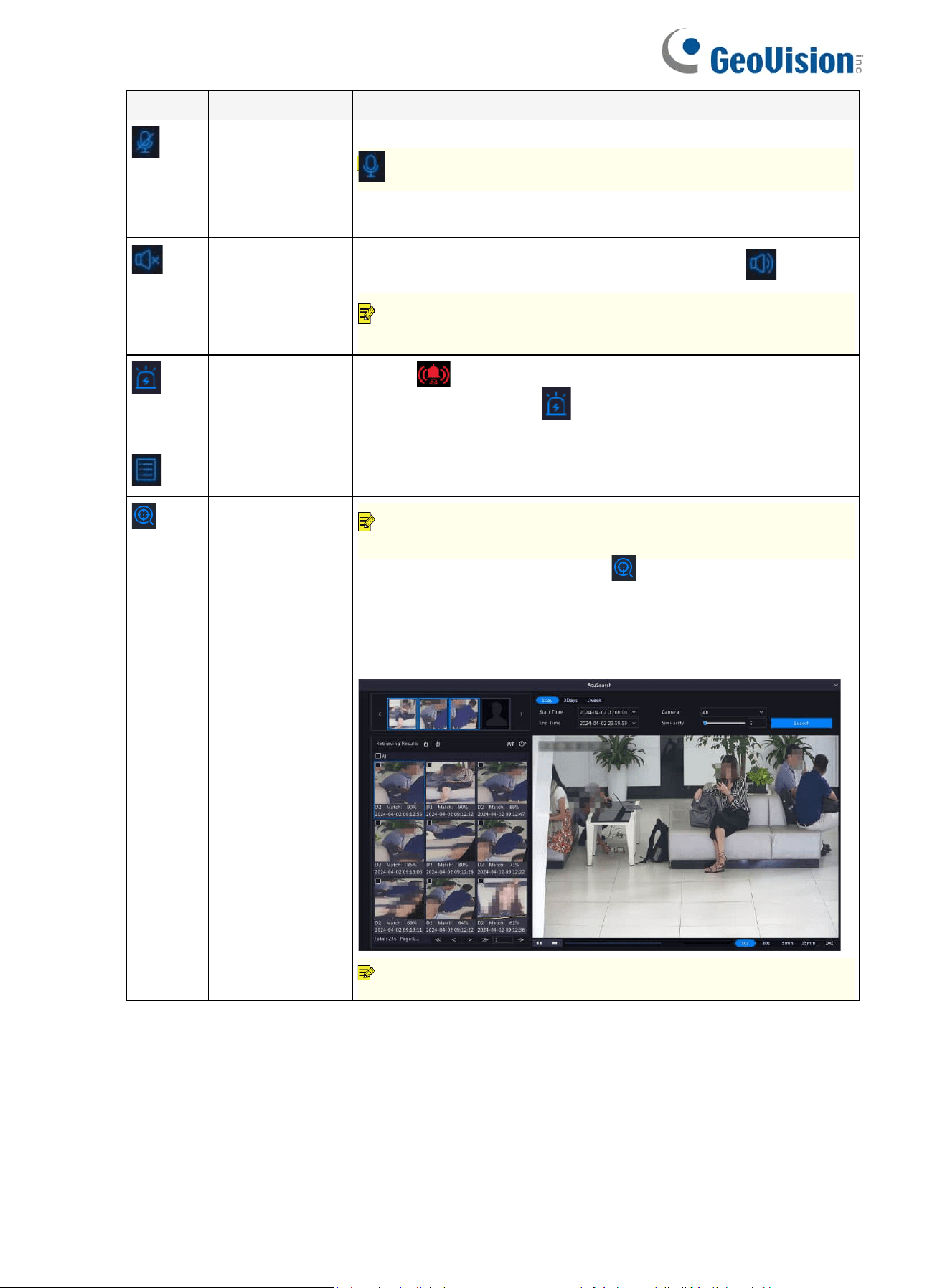
AcuSearch
Note: Before use, go to Menu > VCA > Analyzer Config, and set the
analyzer mode to AcuSearch/AcuTrack.
On the live view or playback page, click , drag to select the target (motor
vehicle/non-motor vehicle/human body), and click AcuSearch to view
the accurate search results. By default, the NVR searches for images of all
cameras of the current day and with the similarity of 60%. You can reset the
search conditions as needed, and the set similarity will be the default value
the next time you perform the accurate search.
Note: Up to 8 targets of the selected area can be analyzed and searched
at the same time.
11
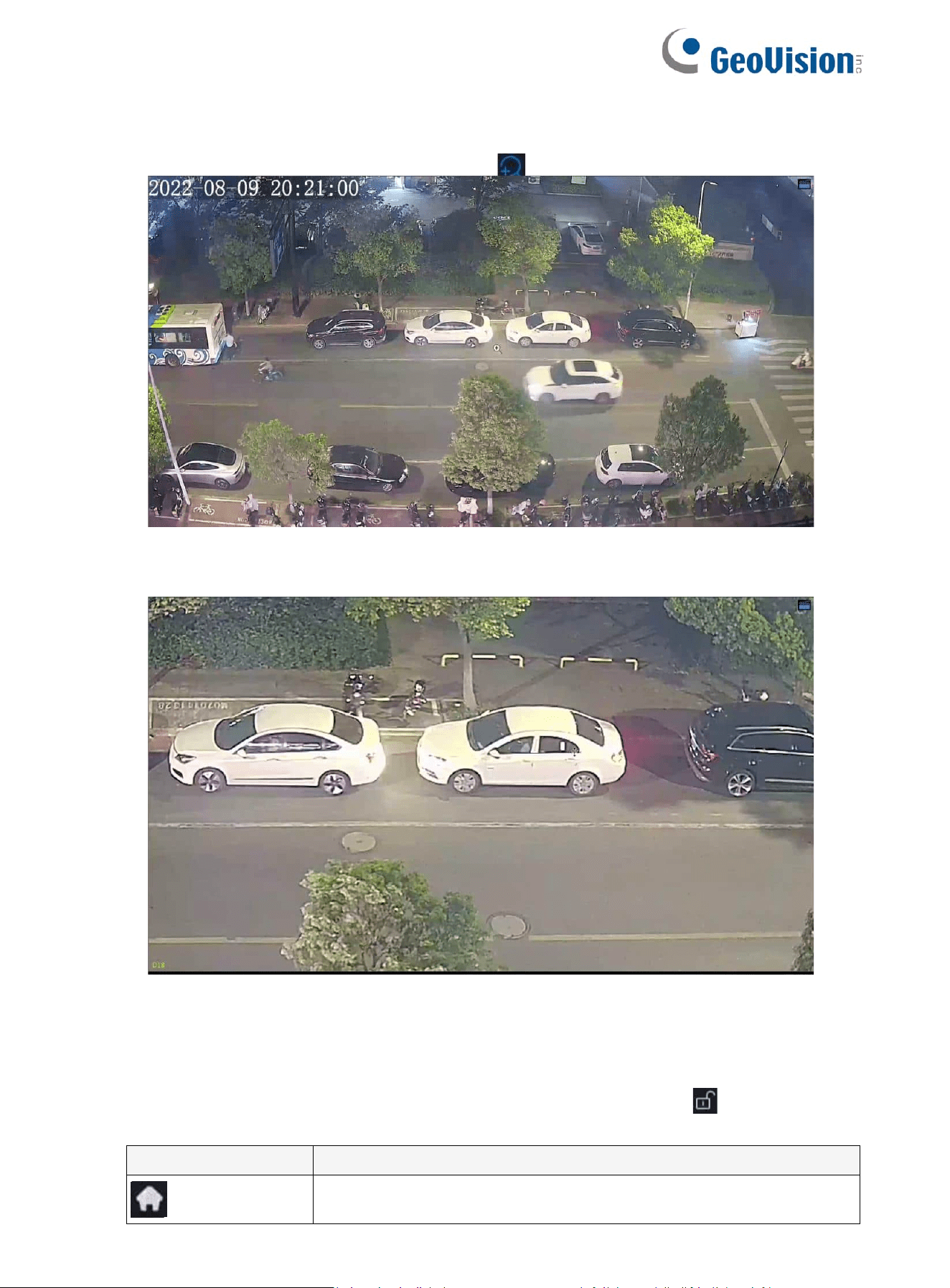
Digital Zoom
Zoom in on an area of images in a window for details.
1.
On the preview page, click the window, and then click on the window toolbar.
2.
Move your mouse to the area you want to zoom in on, then use your scroll wheel to zoom in. The enlarged
image is as follows.
3.
Right-click to exit zoom.
3.3 Screen Toolbar
Move your mouse to the bottom of the preview page to display the screen toolbar. Click to lock the toolbar.
Table 3-3: Screen Toolbar
Button
Description
Click to select menu, playback, logout, restart, shutdown.
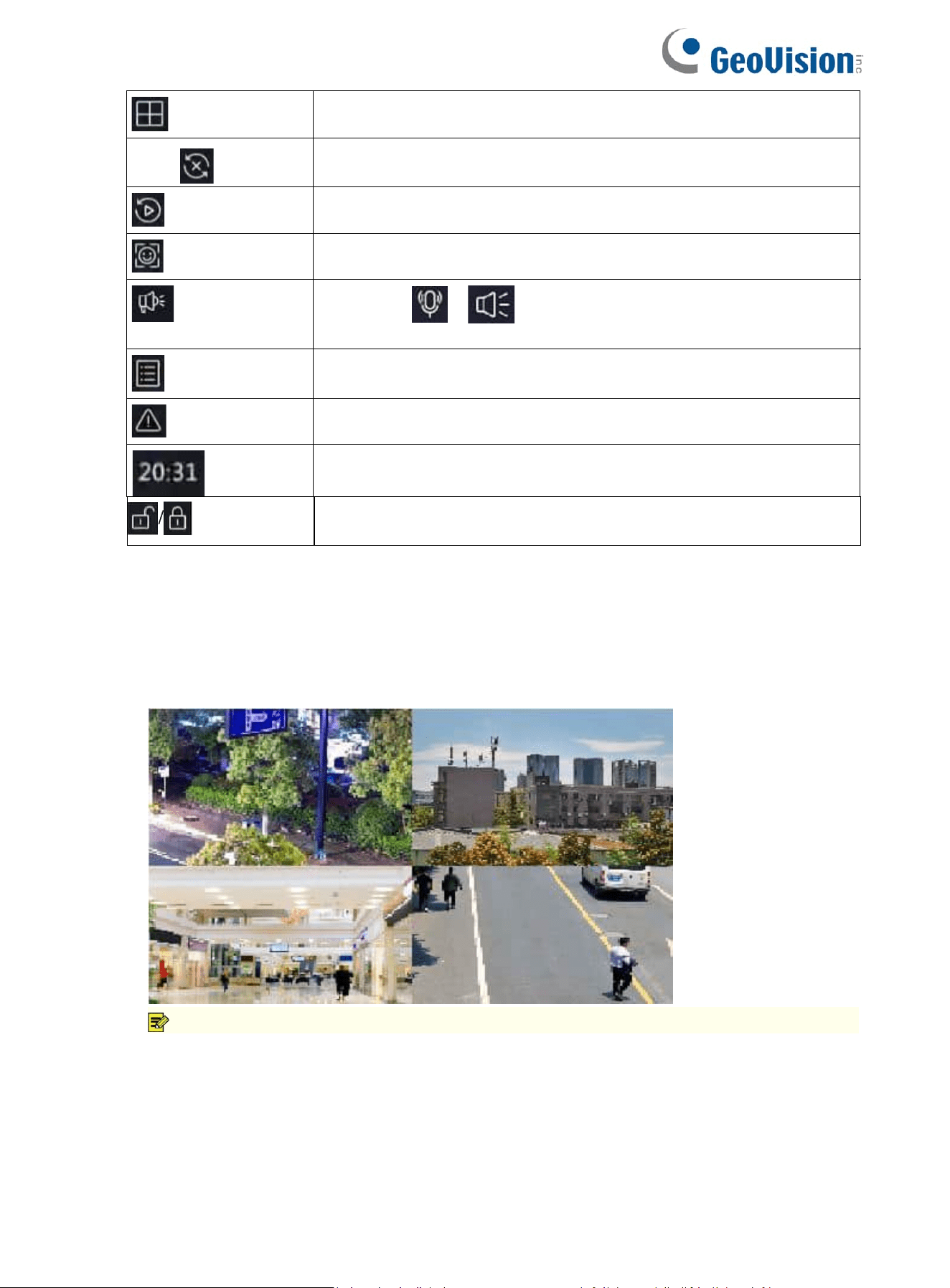
12
Click to go to the Playback page.
Click to go to the Face Recognition page.
Tap to choose or for two-way audio.
Click to view camera information, including camera status and alarm status.
Click to view NVR alarm and camera alarm.
Show device time. Hover over the button to view the date; click to edit time
settings.
Lock/hide the screen toolbar.
Sequence
Use sequence when you want to view live videos from different cameras at the same time and ensure the image
clarity. The function requires you to configure the screen layout, windows, linked cameras, and the sequence
interval.
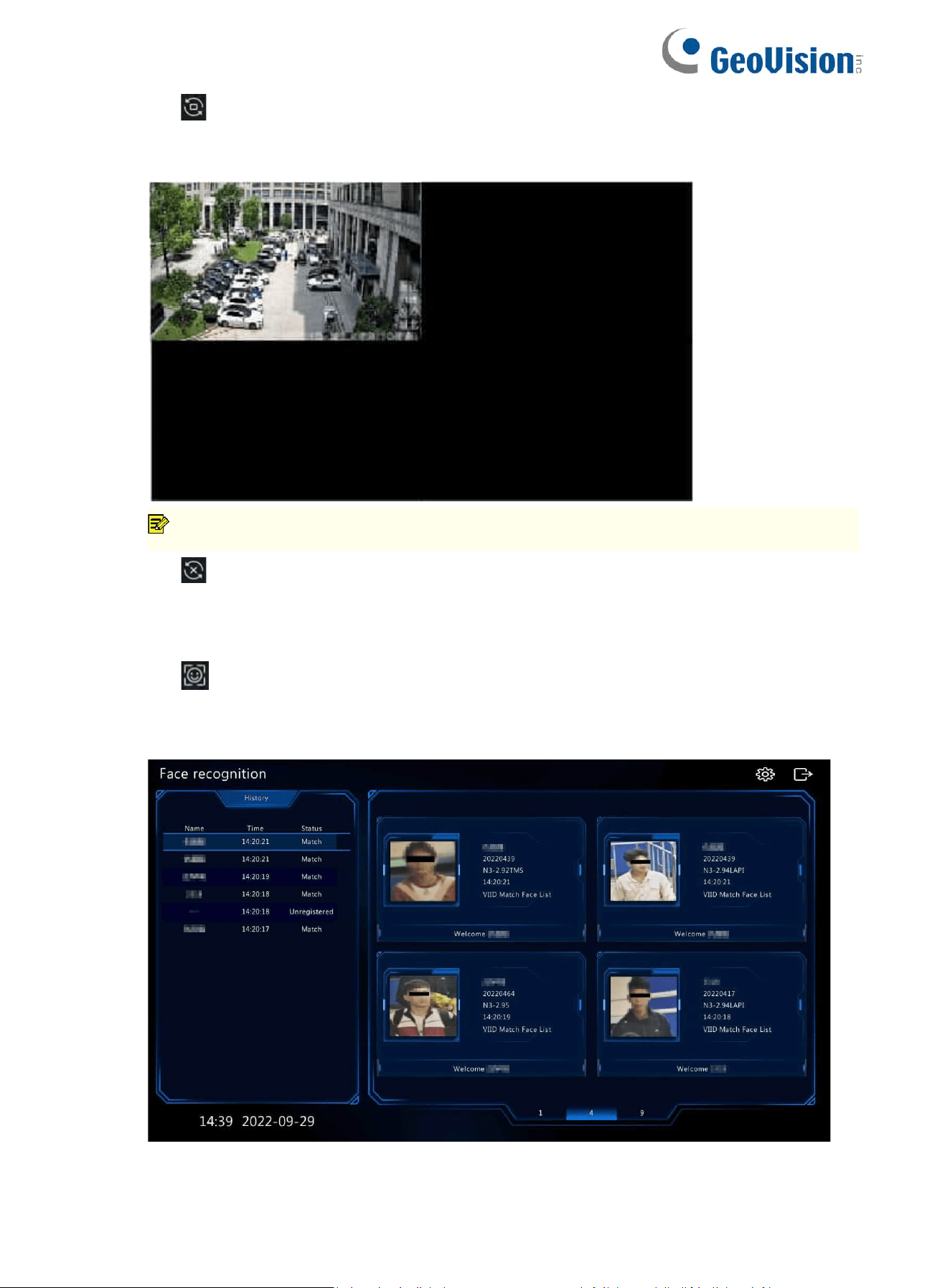
The following example describes how to configure sequence for five cameras based on a 4-window screen layout.
1. On the preview page, right-click and select Multi-Window > 4 Windows.
Select the screen layout, including single window and 4/6/8/9/16/25/36 windows.
/
Start or stop sequence. See Sequence for details.
Note: The number of windows that can be displayed may vary with NVR model.
13
2. Click on the screen toolbar to start sequence.
The system starts to display images of four cameras in four windows on the first screen, and then display the
fifth camera’s image on the second screen after the set interval.
3. Click to stop sequence.
Face Recognition
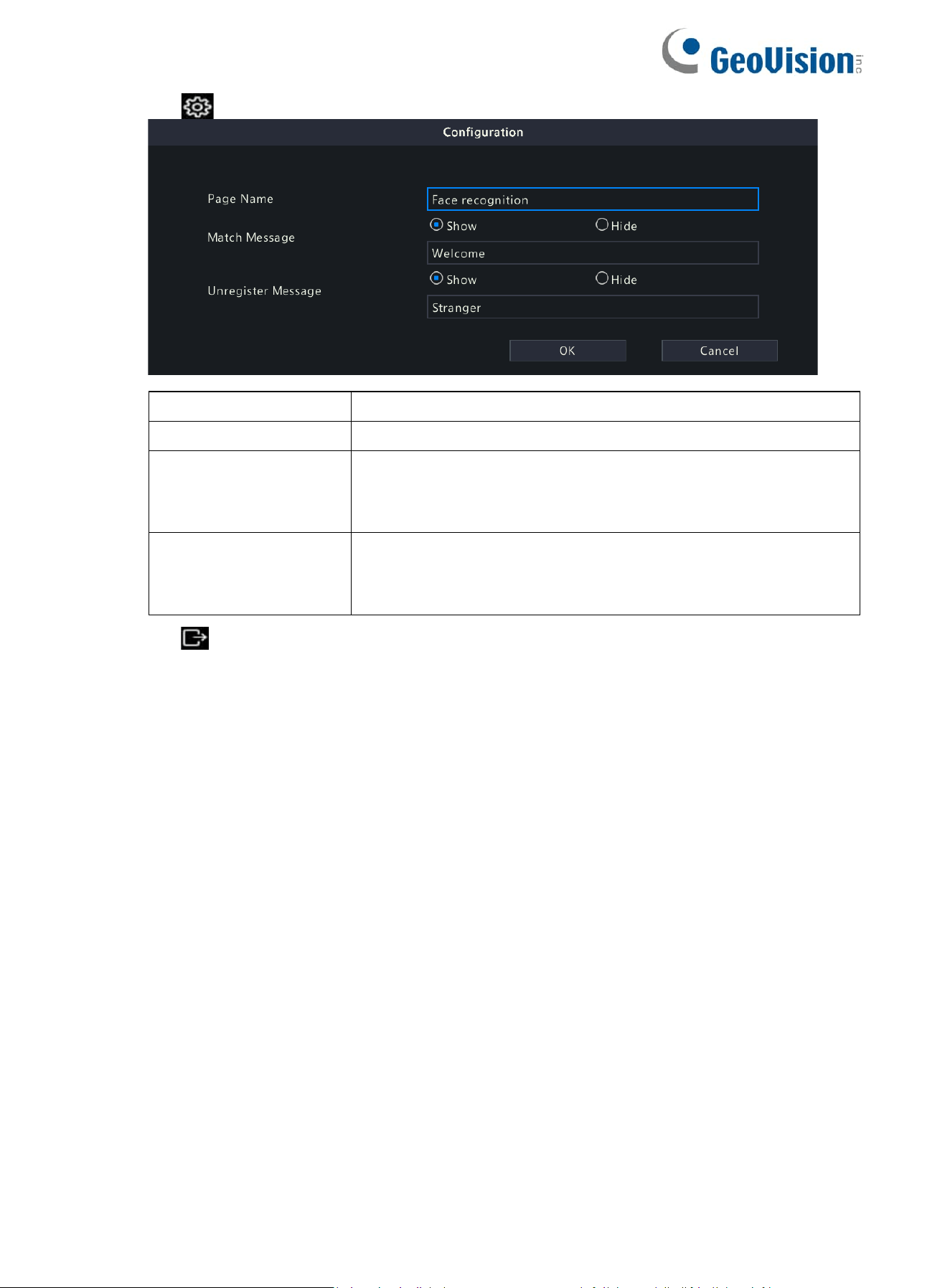
To view face snapshot records, you need to configure Face List, Face Comparison, and Face Detection first.
1.
Click on the screen toolbar.
On this page, you can view the historical face comparison records on the left, and view face snapshots,
snapshot details, and prompt message on the right. 1 view is displayed by default, and you can switch to 4 or
9 views to view more face snapshots.
Note: The default sequence interval is 8 seconds. You can set it under Menu > System > Preview. See
Preview Configuration for details.
14
2.
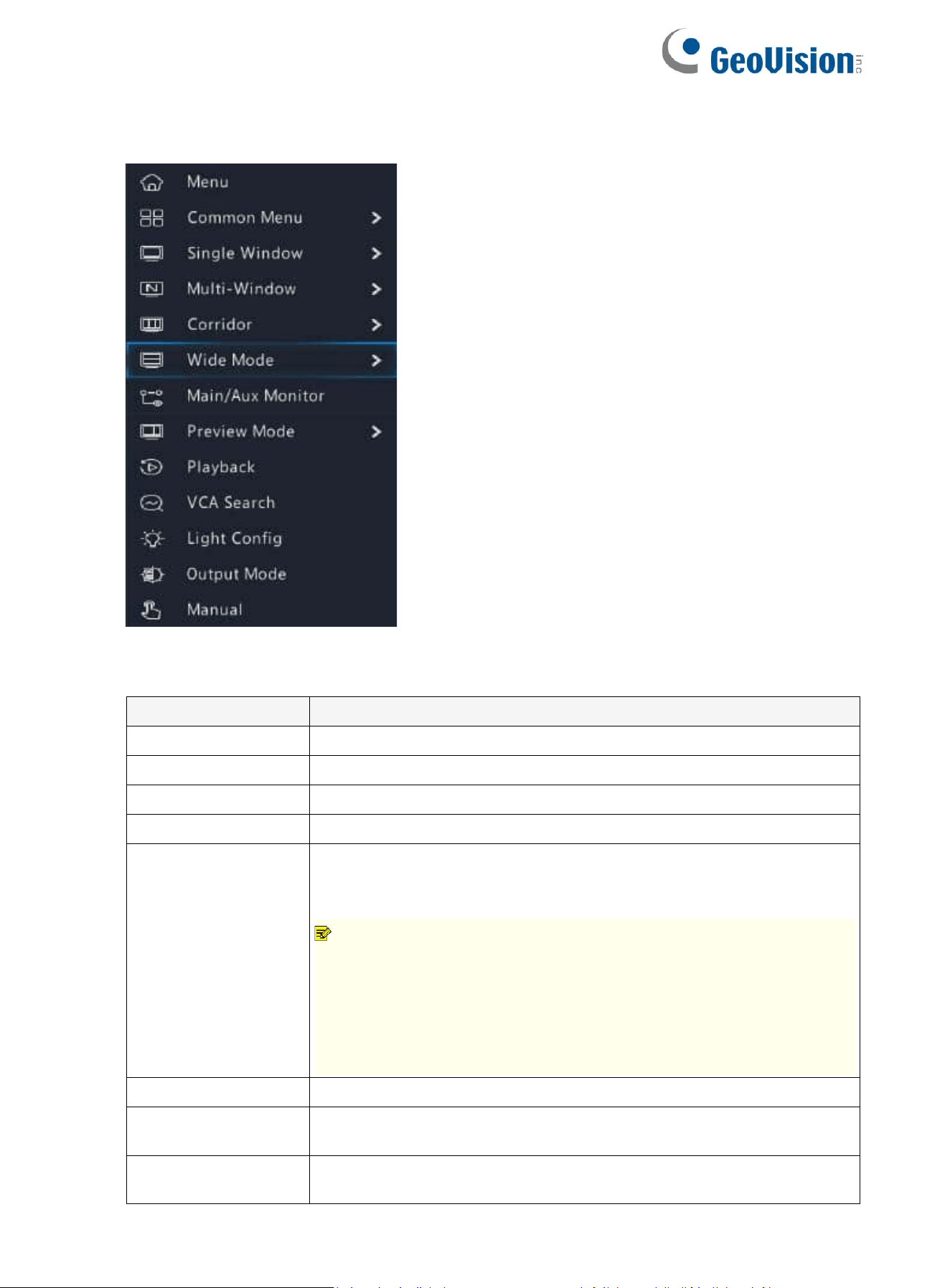
Click , configure face recognition parameters, and then click OK.
Item
Description
Page Name
The default is face recognition. Set it as needed.
Match Message
If the face has a match in the face library, the default match message
Welcome appears. You can customize the message as needed.
Click Hide, the page will not show the match message.
Unregister Message
If the face does not have a match in the face library, the default message
Stranger appears. You can customize the message as needed.
Click Hide, the page will not show the message.
3.
Click to exit the face recognition page.
15
3.4 Shortcut Menu
A shortcut menu as shown below appears when you right-click in a window.
Shortcut Menu
Table 3-4: Shortcut Menu
Item
Description
Menu
Display the main menu.
Common Menu
Go to the Camera, Network Config, and Backup page.
Single Window
Switch to single window.
Multi-Window
Select the screen layout, including 4/6/8/9/16/25/36 windows.
Corridor
Display video images in corridor mode. You can set the number of windows from
the Preview Windows drop-down list under Menu > System > Preview. See
Preview Configuration for details.
Note:
• To display images in corridor mode, make sure the camera is installed
correctly (rotated 90° clockwise or counterclockwise), and then set the
Image Rotation parameter under Menu > Camera > Image to rotate images
accordingly.
• When a channel is in corridor mode, all the operations (such as digital zoom
and drawing motion detection area) are performed in corridor mode.
Wide mode
Switch to the wide mode. Support the screen layout of 2/3/6/7/8/9/12 windows.
Main/Aux Monitor
Switch live video from different video outputs. Press and hold the right mouse
button to switch between main monitor and auxiliary monitor.
Playback
Play the video of the current day for the camera linked to the current window. You
can also choose to play videos from other days as needed.
16
Note: Similar to local recording
on the screen toolbar, manual recording is a scheduled recording and
has higher priority over other recording schedules. You can play manual recordings in normal mode.
Preview Mode
Switch between Normal and Smart. The default is Normal mode.
VCA Search
Search the VCA snapshots and recordings on the Search page.
Light Config
Set image parameters for the selected camera, including image enhancement,
smart illumination, exposure, white balance, and advanced configuration. See
Image Settings for details.
Output Mode
Choose a video output mode, including standard, soft, bright, vivid, and custom.
Brightness, saturation, and other parameters are also configurable.
Manual
Manual settings include manual recording, manual snapshot, manual alarm, buzzer,
and let through manually. See Manual Operations for details.
Manual Operations
Manual operations include manual recording, manual snapshot, manual alarm, buzzer, and let through manually.
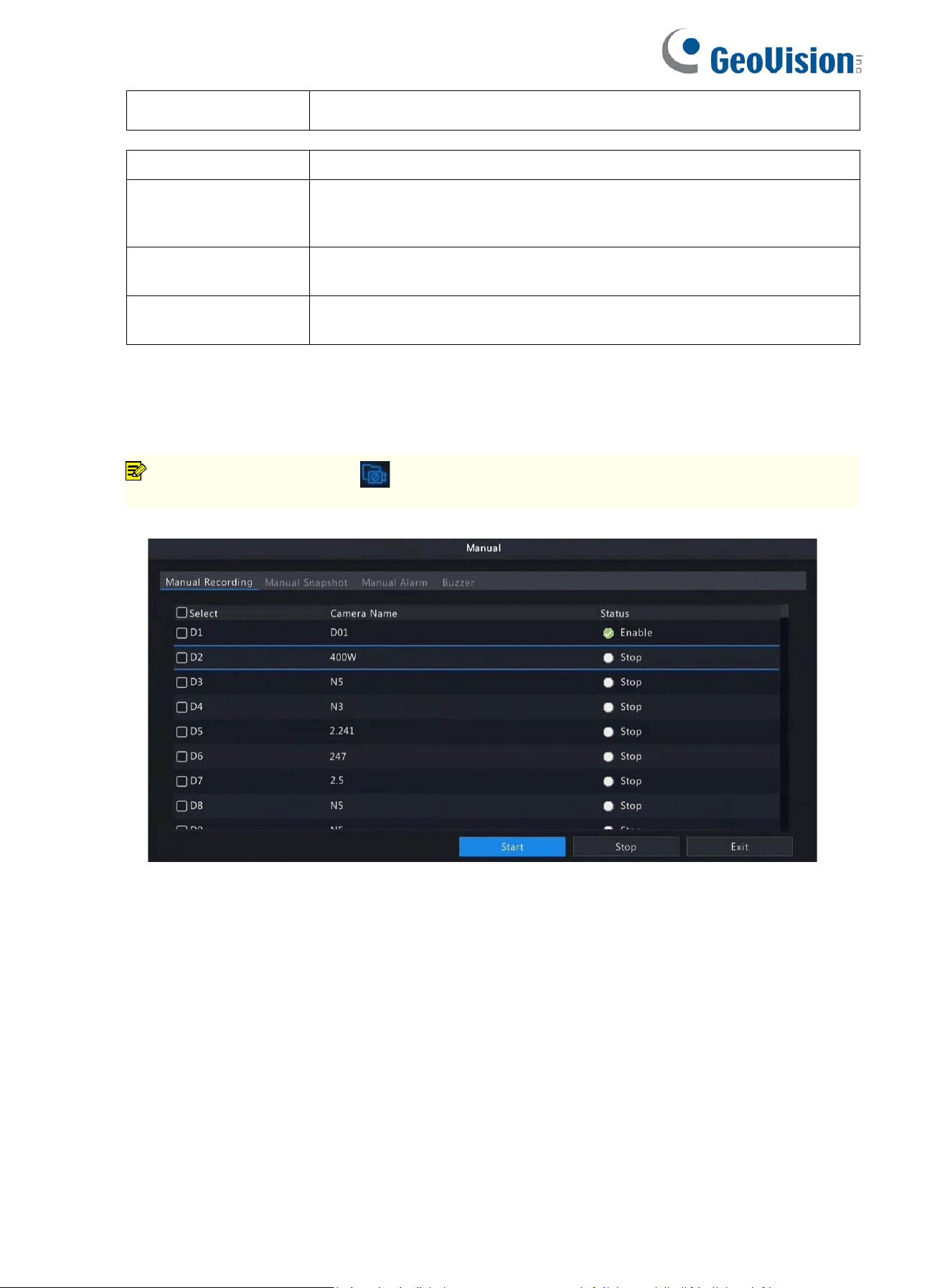
Manual Recording
1. Right-click and select Manual > Manual Recording.
2. Start or stop manual recording.
• Start recording: Select the desired camera(s) and then click Start.
• Stop recording: Select the camera(s) being recorded and then click Stop.
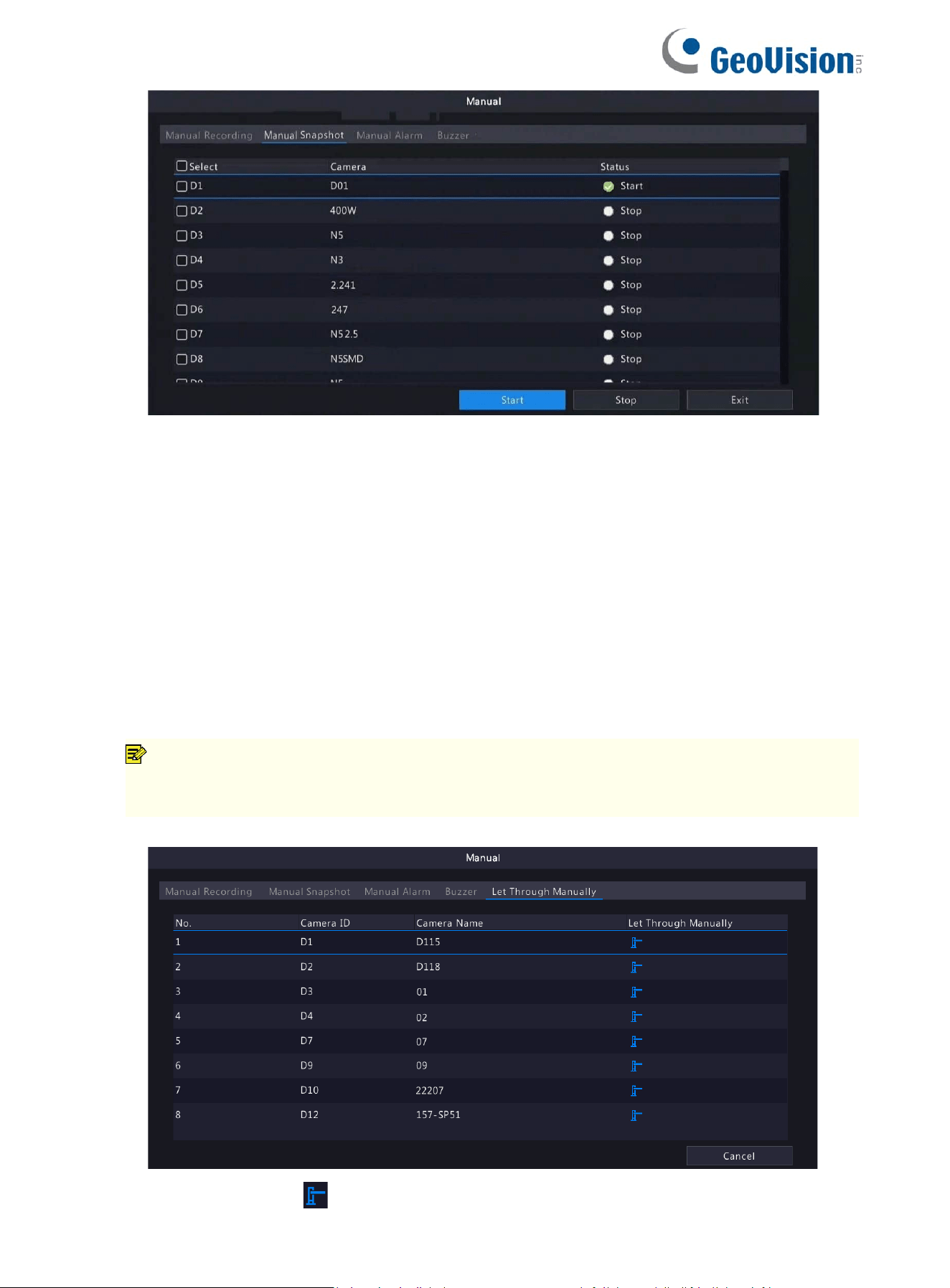
Manual Snapshot
1. Right-click and select Manual > Manual Snapshot.
17
2. Start or stop manual snapshot.
• Start snapshot: Select the desired camera(s) and then click Start.
• Stop snapshot: Select the camera(s) that has enabled snapshot, and click Stop.
Manual Alarm
Right-click and select Manual > Manual Alarm. You can trigger or clear an alarm output manually. See Manual
Alarm for details.
Buzzer
Right-click and select Manual > Buzzer. You can stop the buzzer manually. See Buzzer for details.
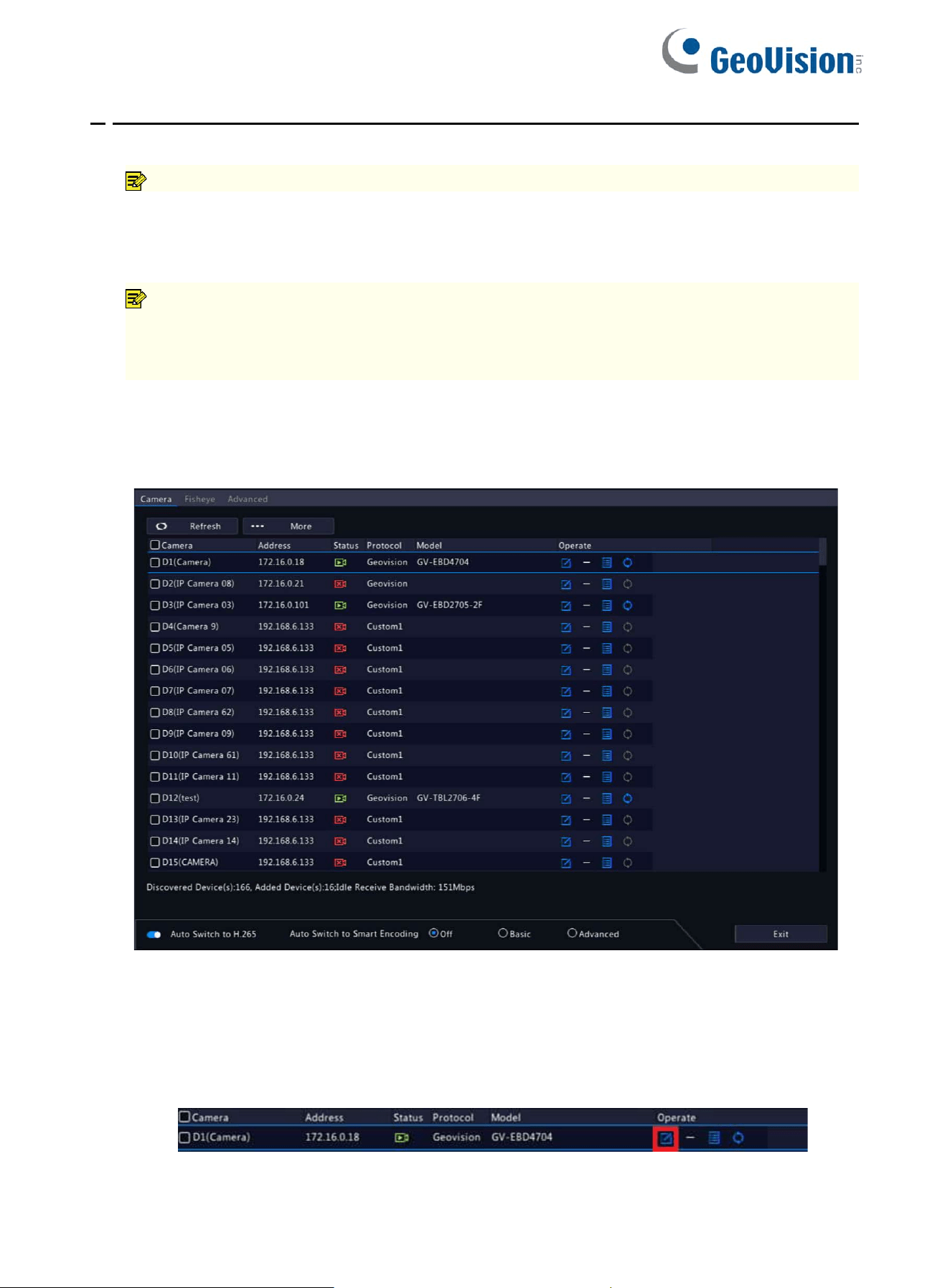
Let Through Manually
If a license plate not match alarm occurs and the IPC cannot lift the barrier automatically, you can trigger the IPC
to lift the barrier manually on the NVR side as needed.
1. Right-click and select Manual > Let Through Manually.
2. Click the corresponding and trigger the camera to lift the barrier.
Note:
• This function requires you to configure plate not match alarm first. See Plate Comparison for details.
• This function is available to cameras that support controlling barrier gates.
18
4 Channel Configuration
Configure IPC, encoding, audio, snapshot, OSD, image, privacy mask, and PTZ parameters.
4.1 Channel Management
Manage IP cameras.
4.1.1 IPC Configuration
Add and manage IP cameras.
Go to Menu > Camera > Camera > Camera.
Add IPC
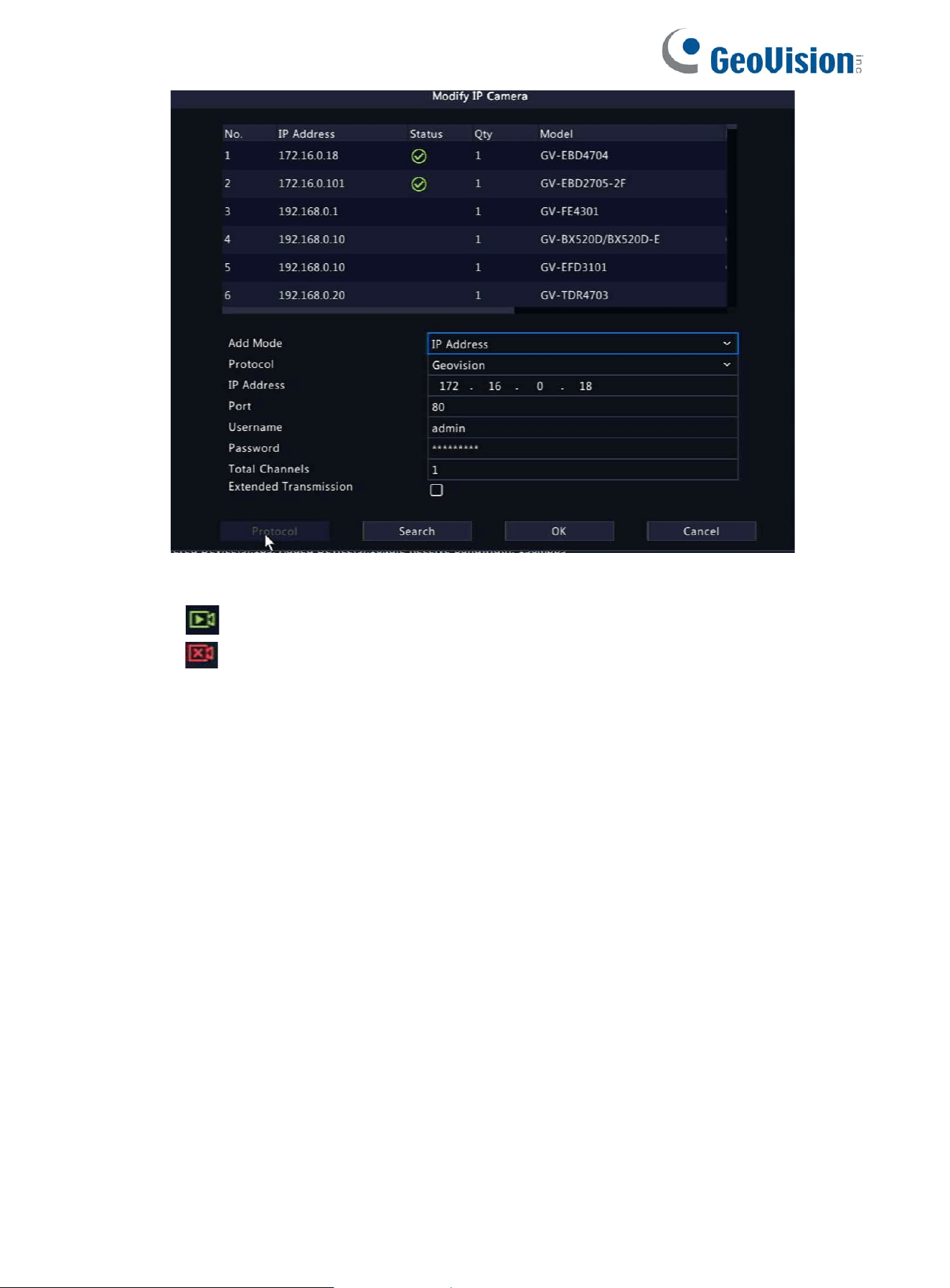
The system automatically searches for IP cameras and lists the discovered. Click Refresh, the system refreshes the
list and IPC status. Choose a way to add IPCs.
• Option 1: Custom Add
1. Click Cam Config.
Note: The IP devices mentioned in this manual mainly refer to IP cameras (or network cameras).
Note:
• Before you start, make sure the IP cameras are connected to your NVR via network.
• An IP camera should be connected to one NVR only. An IP camera managed by multiple NVRs may cause
unwanted issues.
19
2. In the Modify IP Camera window, enter the IPC’s IP address and complete other settings, and then click
OK. You may check the camera’s status.
•
: Camera online.
•
: Camera offline. Point to the icon to view the failure information.
3. Repeat the above steps to add other IPCs.
Note: In the Protocol dropdown list, select Geovision for the following cameras, otherwise, select ONVIF.
⚫ GV-BLFC5800, EBD4813, EBFC5800, TBL4810, TDR4803, TFD4800, TVD4810
⚫ GV-EBD8813, EBD8800, TBL8804, TBL8810, TDR8805, TVD8810
⚫ GV-SD4825-IR, SD4834-IR
⚫ GV-PTZ5810-IR
⚫ GV-TBL4807, TVD4810
⚫ GV-TMS8800, TMS20811
20
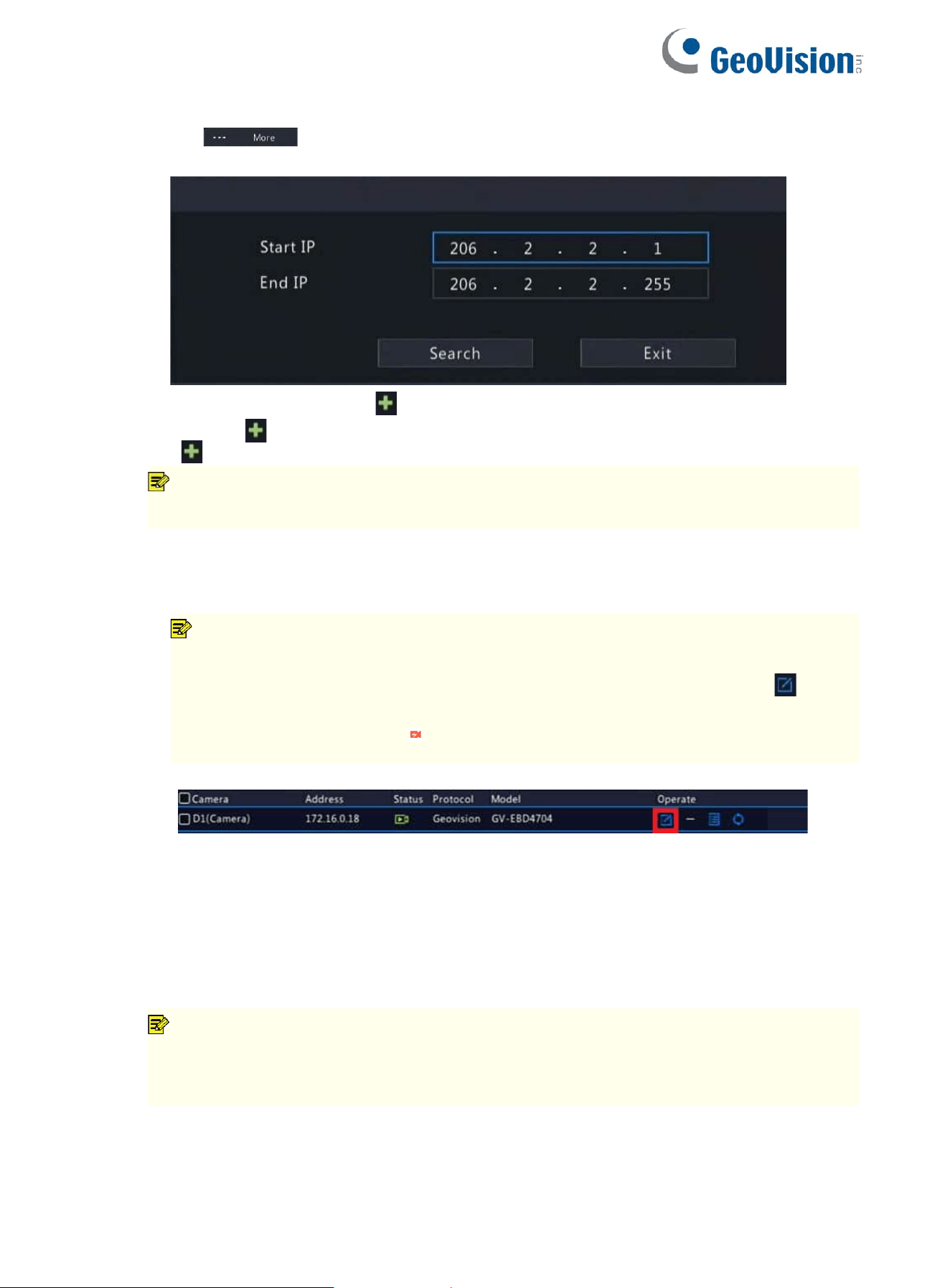
• Option 2: Search Segment
1.
Click , and select Search Segment.
2.
Enter the start and end IP addresses, and click Search. The discovered IP devices are listed.
3.
Select the desired camera, click to add it to the NVR.
• Option 3: Click
• Option 4: Connect via Cable
1. Connect an IP camera to a PoE port of the NVR with a network cable.
2. Go to Menu > Camera > Camera > Camera.
3. Click Cam Config.
4. In the Modify IP Camera window, the default Add Mode is Plug-and-Play. Enter the camera’s
username and password.
5. Click OK to return to the Camera window. Wait approximately 1 minute, and the camera status will
appear online.
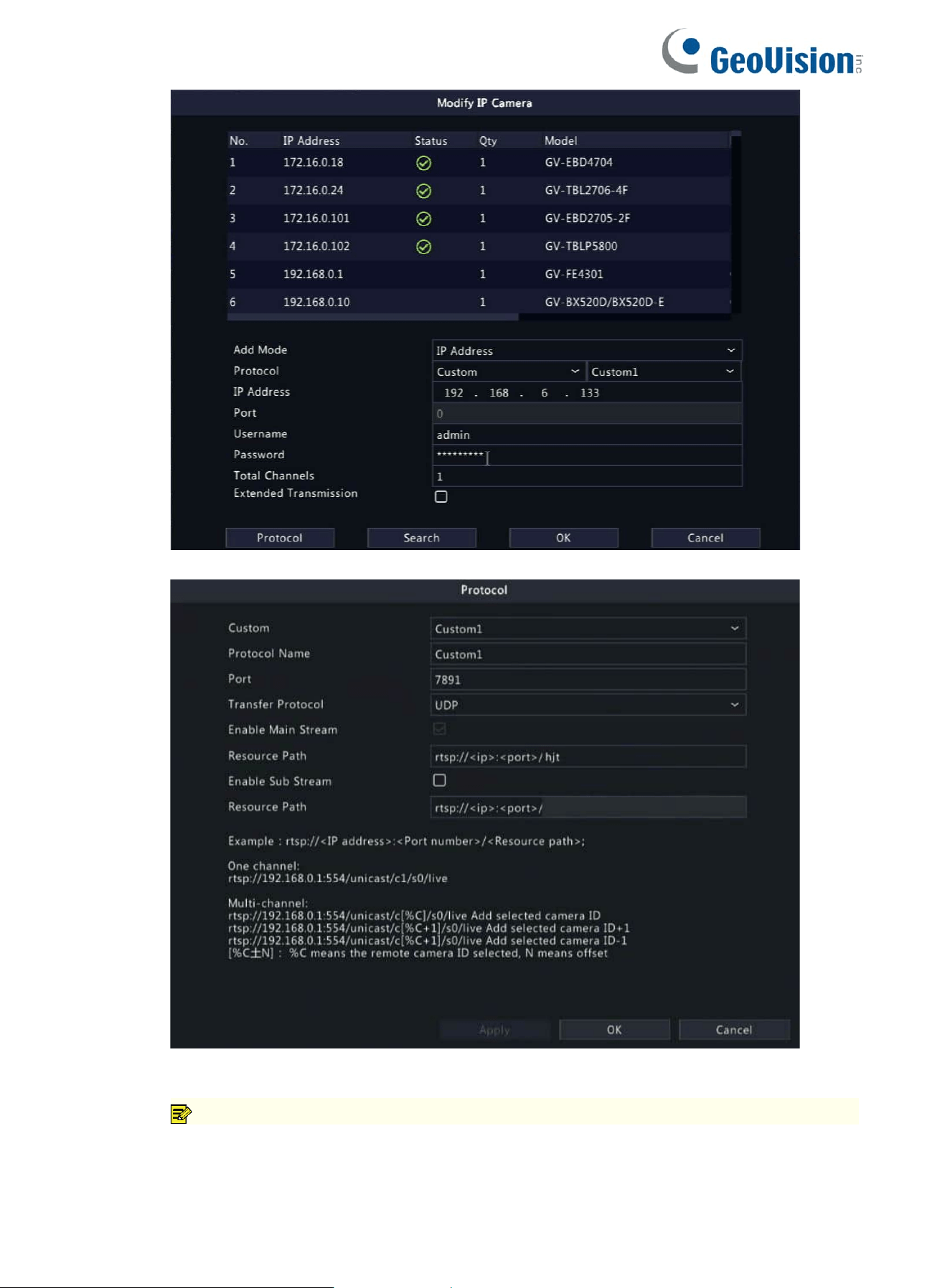
• Option 5: Use Custom Protocol
1. Go to Menu > Camera > Camera > Camera.
2. Click Custom Add. Select Custom from the Protocol drop-down list.
Click to add the camera directly.
Note: If the camera's login password has been changed and it not its default password, you can change
the default password to be the same as the current login password, and then the camera can go online.
See Default Password for details.
Note:
•
•
This option is only applicable to NVRs with PoE ports, and the added camera cannot be deleted.
If you want to add an IPC that is not connected to the NVR with a network cable, click
Plug-and-Play to Manual, and complete other parameters.
, change
• For NVR with PoE ports only, appears under Status if the power output from a PoE port is below
or above the rated power of the connected camera.
Note:
• Use this option when the IP camera supports the standard RTSP.
• Only live and recorded video streams are available from the camera added in this way. Configuration
operations are not supported.
21
3. Click Protocol.
4. Set the protocol name, enter the RTSP port number, transmission protocol, resource paths, etc., and then
click OK.
5. Enter the IP address, username, and password, and then click OK. Check status in the camera list.
Note: Contact the camera manufacturer for resource paths of main stream and sub stream.
22
• Option 7: Add by Importing File
• For first-time NVR users: Please insert a USB drive (purchased separately) into the device first.
1.
Click and choose Export. Select an export path in the directory list and click Backup.
A .CSV file will be then generated in the selected directory.
2.
Remove the USB drive from the device and insert it into the PC. Open the exported .CSV file, enter or
edit the information as needed, and then save it.
• Add Mode: Plug-and-Play/IP Address/Domain Name
• Protocol: ONVIF/Geovision/Custom
• Transport Protocol: UDP/TCP
• PTZ: Auto/Support/Not Support
3.
Insert the USB drive back into the device. Click and choose Import. Select the .CSV
file in the directory list.
• When transferring data from an old NVR to a new one: Click and choose Import. Select
the .CSV file exported from the old NVR in the directory list, and click Import.
Export IP Camera List
Click and choose Export. Select the export path in the directory list and click Backup. A .CSV file
will be then generated in the selected directory, indicating that the IP camera list has been successfully exported.
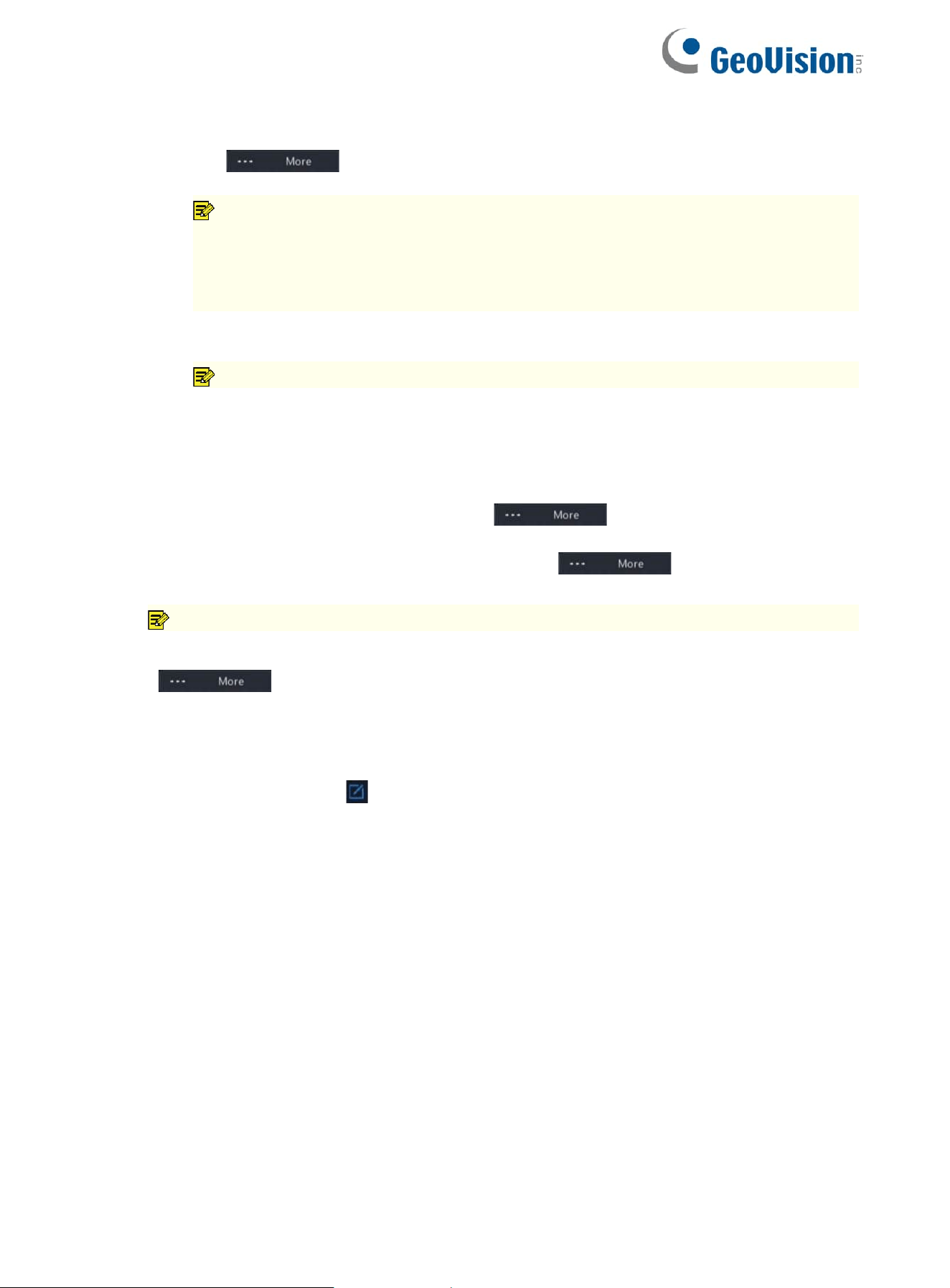
Edit IP Camera
Option 1
Select the target camera and click . Edit the settings as needed, and then click OK.
Note: The contents for some fields are as follows:
Note:
• For the PoE NVR: The default information of each channel is displayed in the file. You may edit
the information as needed.
• For the non-PoE NVR: There are only table headers in the file. You need to manually fill in the
channel information.
Note: If the IPC fails to get online, please check whether the information in the .CSV file is correct.
23
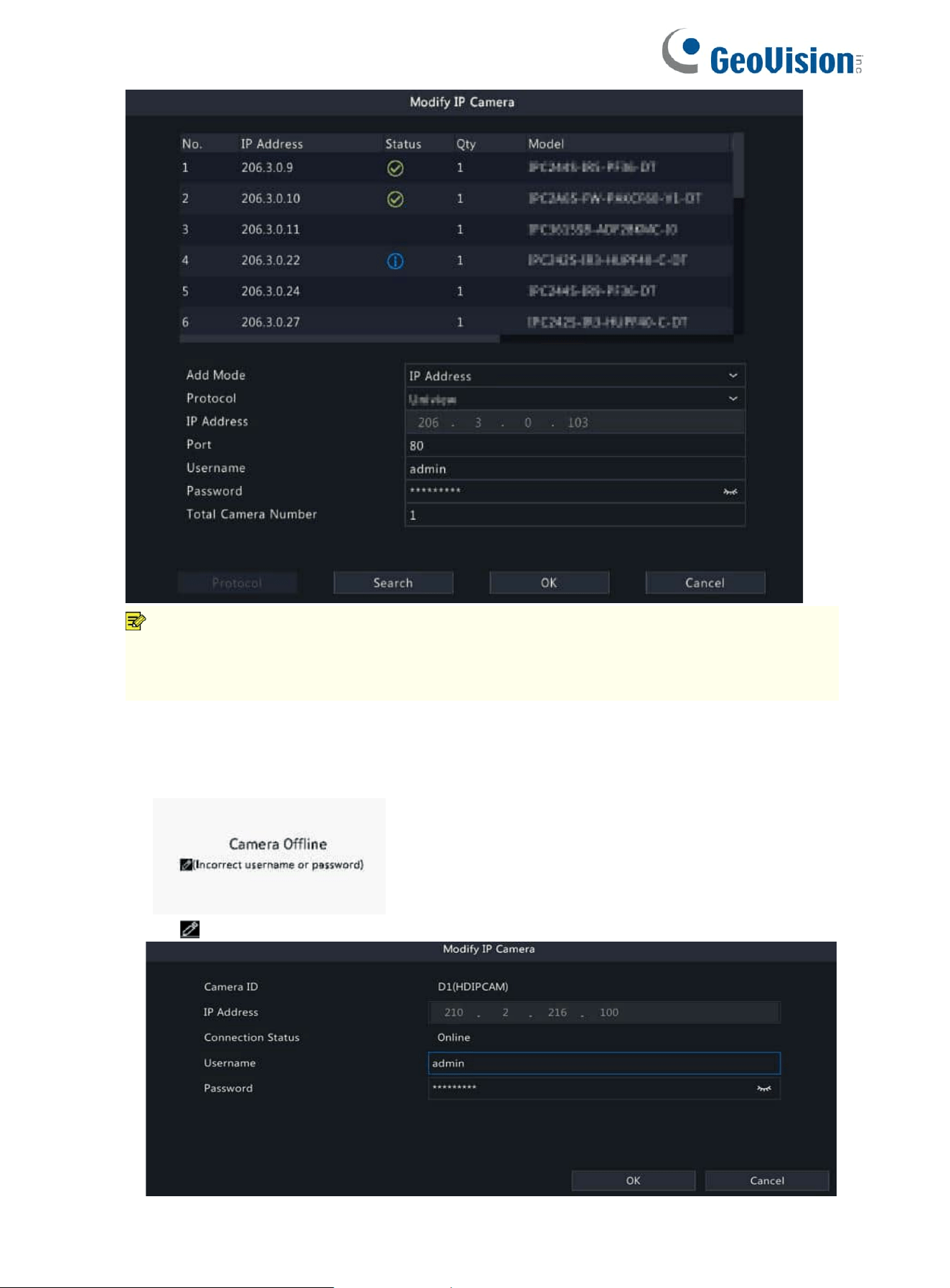
Click , and modify username or password.
Option 2
1. If the username and password input for an IPC is incorrect, the live view window will show the cause, and you
can change the username and password in the live view window.
2.
Note:
• To change the IP camera connected to the channel, you can edit the IP channel related
parameters (except IP address), or directly click another camera in the list above.
• The configuration items may vary with IPC model.
24
3.
Click OK and then check the status of camera. means the camera is online.
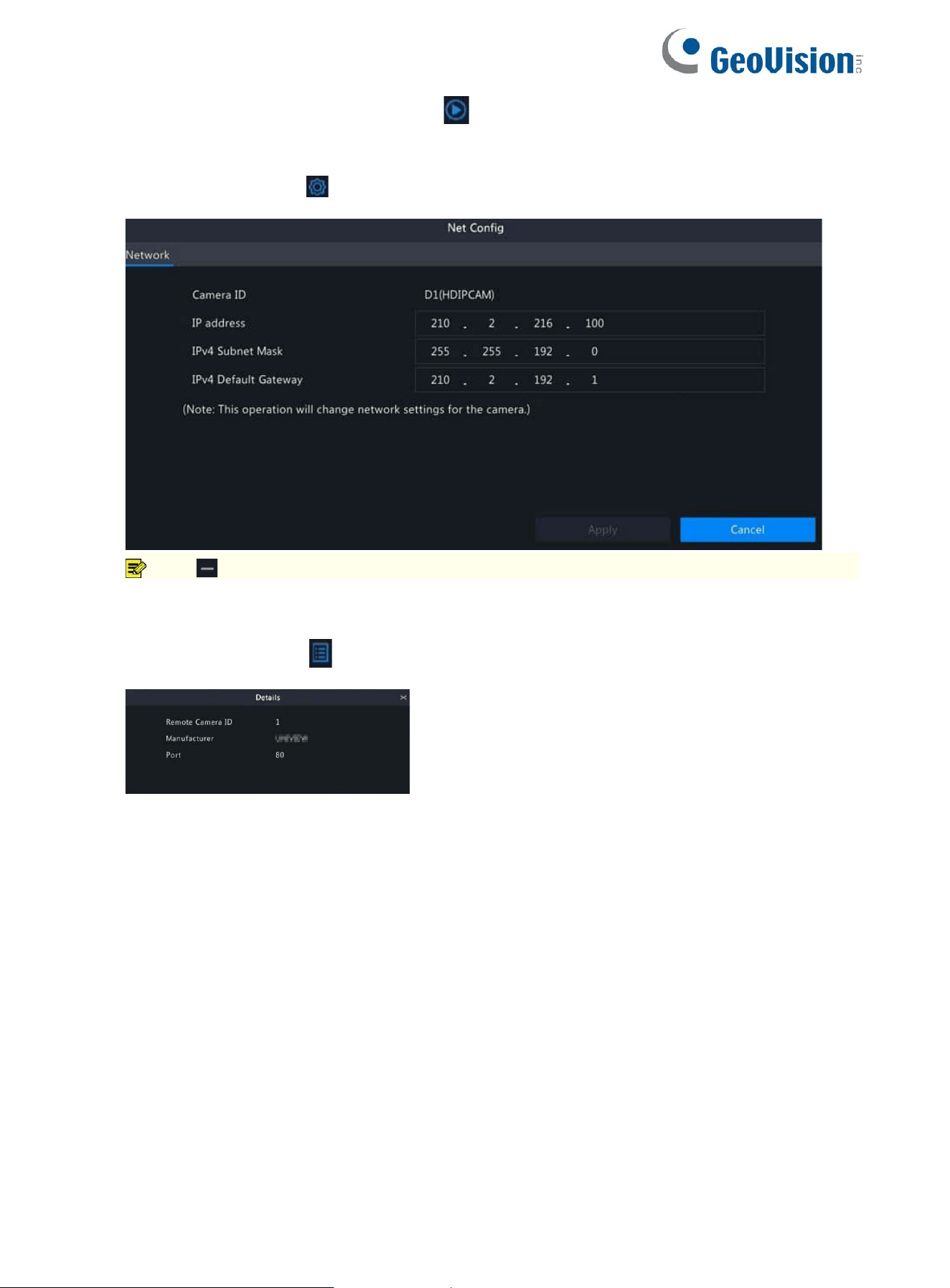
Network Configuration
Select the camera, and click . Edit the IP address, IPv4 subnet mask, IPv4 default gateway for the camera. Click
Apply.
More Info
Select the channel, and click to view the detailed information, including remote camera ID, manufacturer, and
port number.
Change Window Position
Use this function to change window position of channels on the preview page, without changing the channel ID,
IP address, and display order in the channel list. Choose a way to change window position.
• On the multi-window preview page, drag a window to another window to swap their positions.
• On the Preview Configuration page under Menu > System > Preview, change window positions on the
preview page. See Preview Configuration for details.
Note: indicates the camera does not support changing network settings.
25
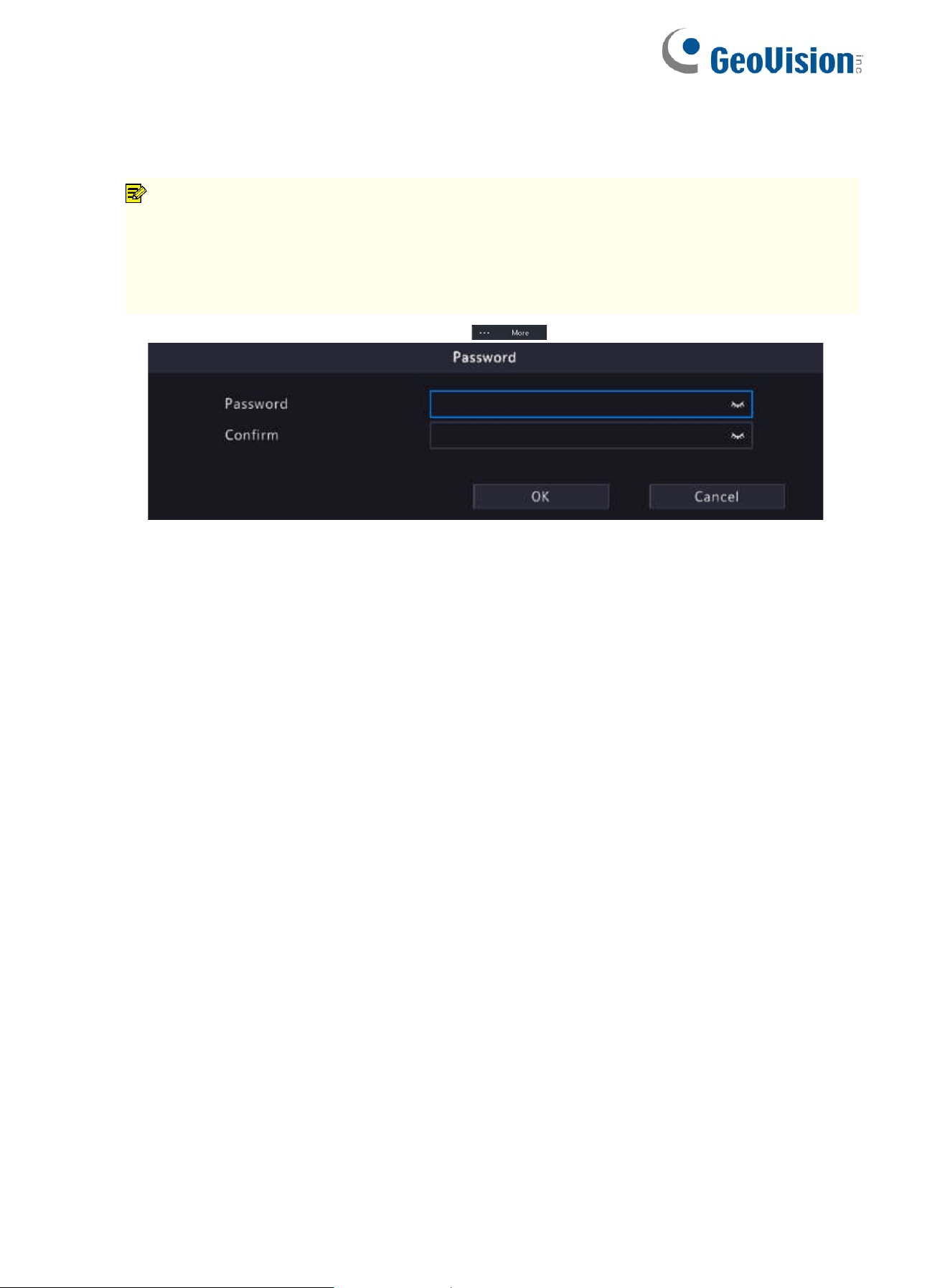
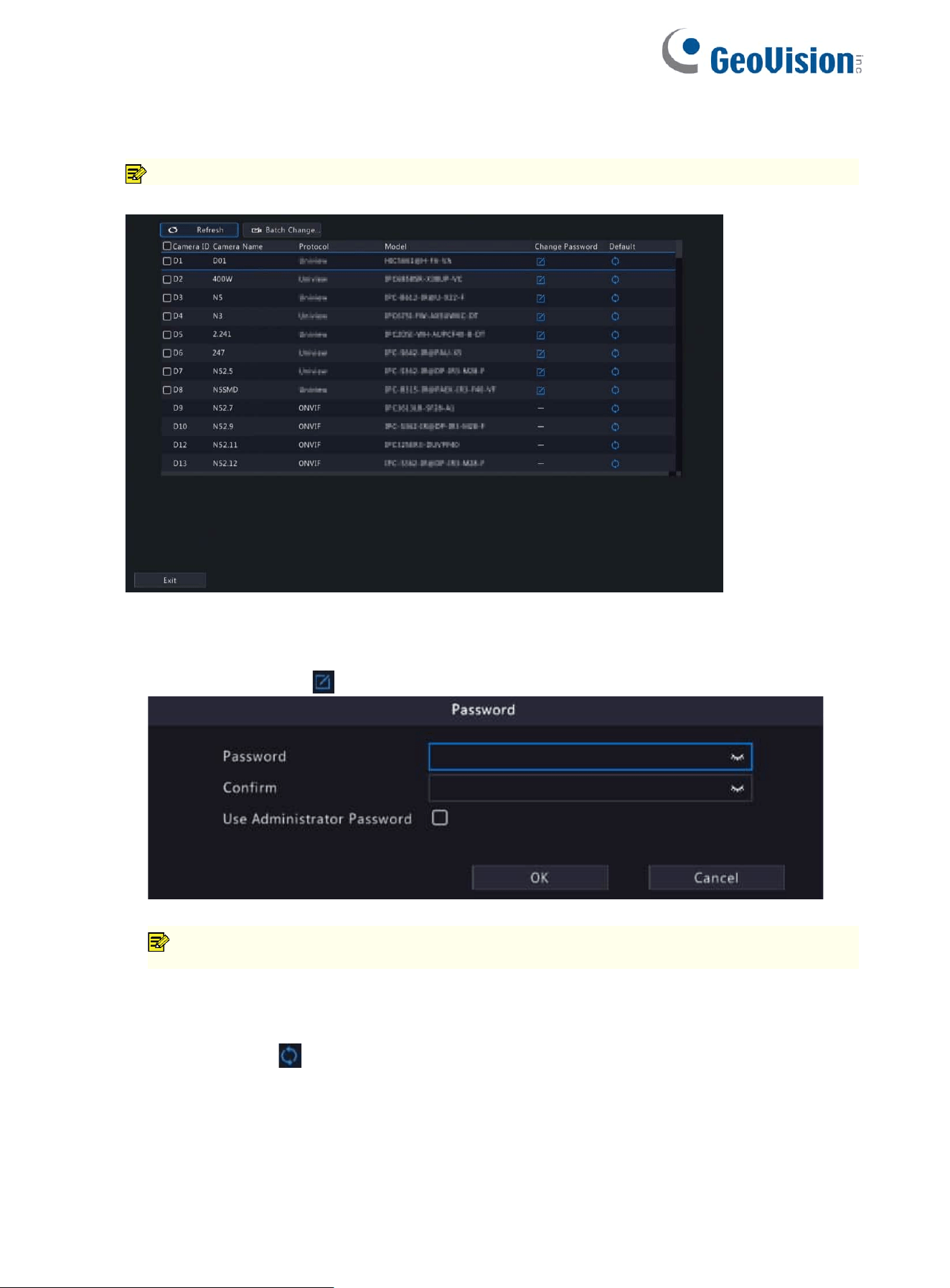
Batch Change Password
When multiple IPCs are not added successfully due to incorrect password, and if the login passwords of these
cameras are the same, use this function to change the passwords in batches.
1.
2. Enter the new password and confirm the password.
3. Click OK.
Select the cameras with the same password. Click
, and select Batch Edit Password.
Note:
• This function only changes the password used to add cameras. It does not change the cameras' login
password.
• This function is only applicable for IPCs with the same login password. If one of the cameras still fails to
be added after you change the password, it means the camera's login password is different, and you need
to change the password separately.
26
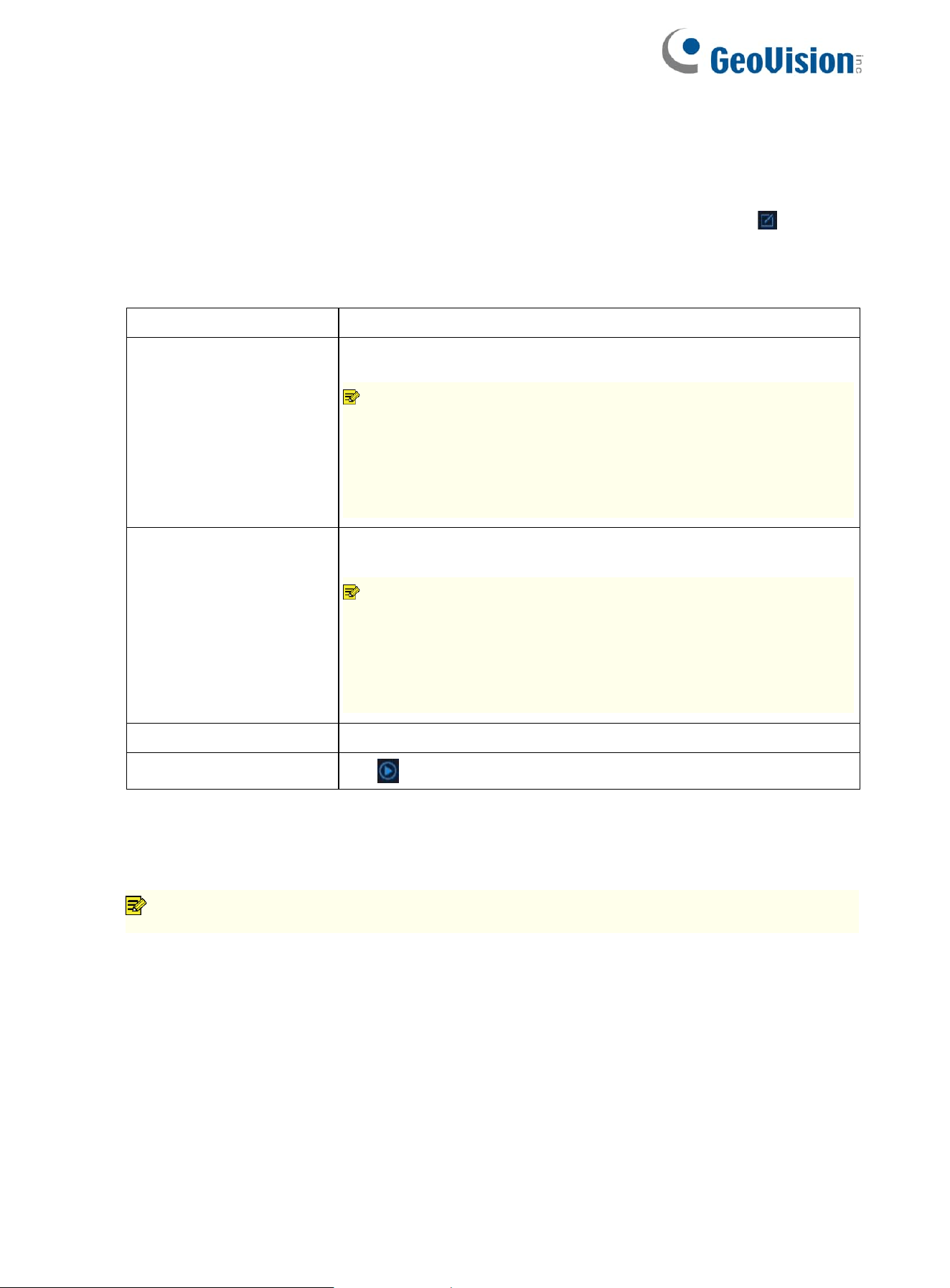
Default Password
The default password is used to add the camera. The original default password is the same as the camera's
default login password.
If the camera's login password has been changed and is not its default password, the camera will not be able to
go online after being added to the NVR. You can enable Default Password, and change the default password to
be the same as the camera's current login password before adding the camera. You may also click to change
the password to the camera's current login password after adding the camera.
Other Operations
Item
Description
Auto Switch to H.265
When enabled, the NVR automatically chooses H.265 for a newly added
camera.
Note:
• Every time a camera is added to the NVR, it is considered a newly
added camera. This function is not effective to cameras that are
already added or added cameras that go back online after being
offline.
• This function is enabled by default on some NVR models.
Auto Switch to U-Code
Select Basic or Advanced, then the NVR automatically chooses basic U-code
mode or advanced U-code mode for a newly added camera.
Note:
• Every time a camera is added to the NVR, it is considered a newly
added camera. This function is not effective to cameras that are
already added or added cameras that go back online after being
offline.
• This function is enabled by default on some NVR models.
Refresh
Click Refresh to check the camera status.
Live View
Click to play live video of the camera.
4.1.2 Fisheye Configuration
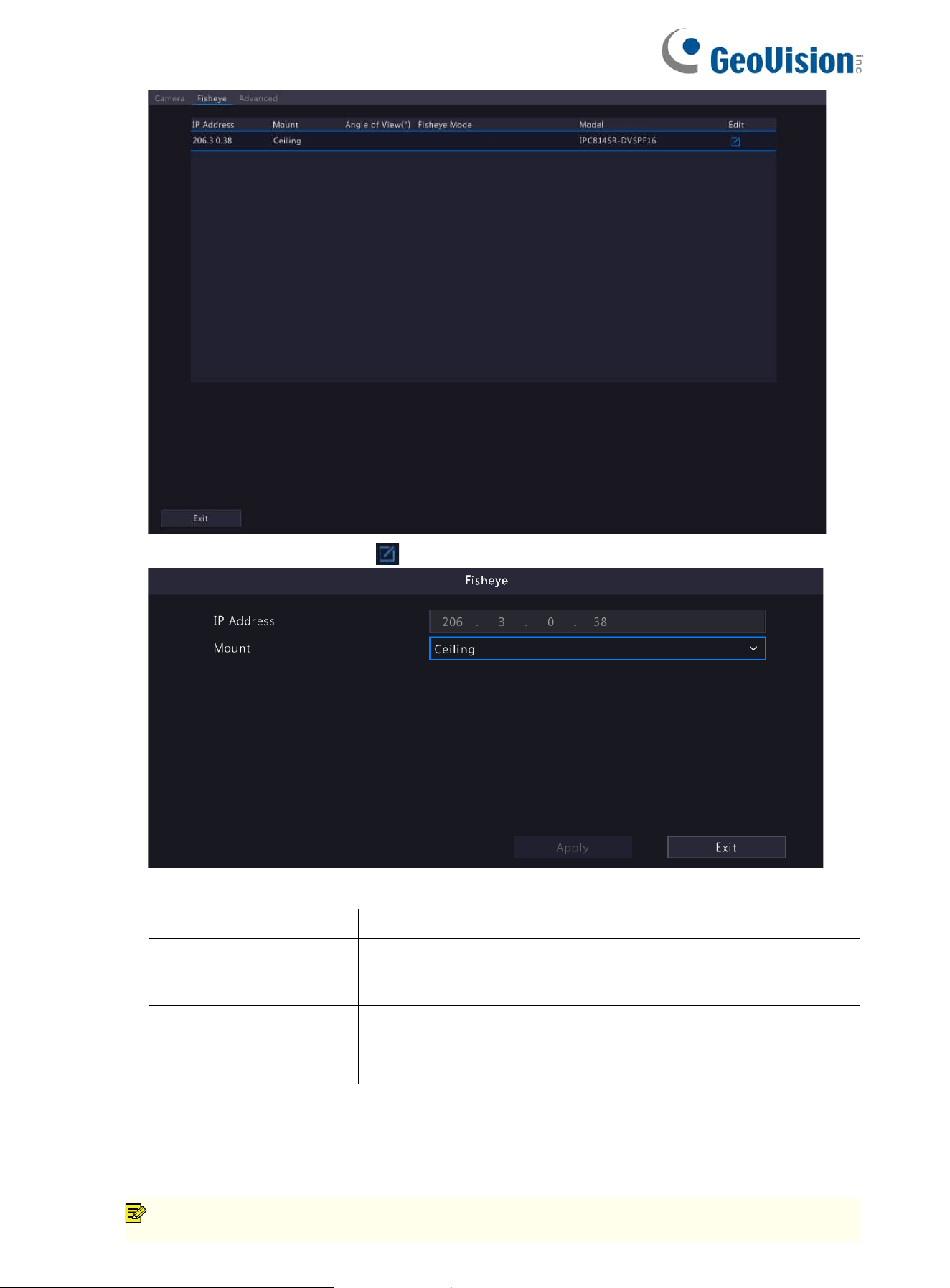
Set the mounting mode and display mode for fisheye cameras. Fisheye configuration is supported only by certain
fisheye cameras.
Configuration
Configure the following parameters after the fisheye camera is installed.
1. Go to Menu > Camera > Camera > Fisheye.
Note: Before using this function, make sure that a fisheye camera has been mounted and that the camera
has been added to your NVR.
27
2.
3. Set the parameters as needed.
Item
Description
Mount
Select the mounting mode, including ceiling mount, wall mount, and
desktop mount. If you change how the fisheye camera is installed, change
its mounting mode so as to display proper images.
Angle of View (°)
Set the viewing angle of the fisheye camera.
Fisheye Mode
The display mode of the current camera in the live view window. Set it as
needed.
4. Click Apply.
Dewarping
Fisheye cameras provide large wide-angle views, but the image captured is distorted. You may adjust the output
image by correcting the shooting angle of the fisheye.
Select the fisheye camera and click .
Note: Dewarping is available in live view and playback (in normal and corridor playback modes). The
operations are similar. The following describes dewarping in live view.
28
1.
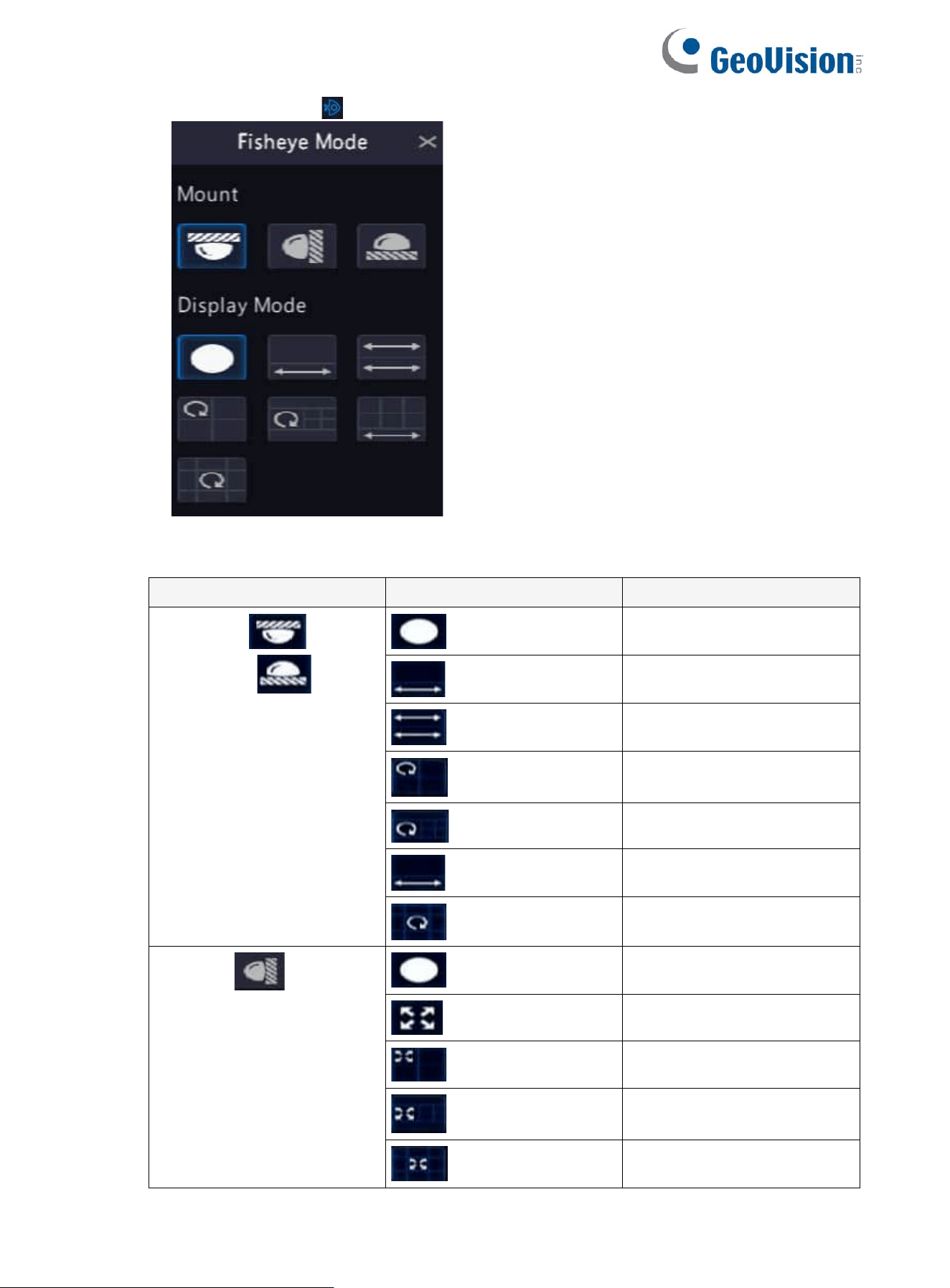
On the preview page, click on the window. The figure as shown below appears.
2.
Set the mounting mode and display mode.
Mount
Display Mode
Description
Ceiling Mount
Desktop Mount
360° panoramic original image
360° panoramic+1PTZ
180° panoramic
Fisheye + 3PTZ
Fisheye + 4PTZ
360° panoramic+6PTZ
Fisheye + 8PTZ
Wall Mount
360° panoramic original image
Panoramic
Panoramic+3PTZ
Panoramic+4PTZ
Panoramic+8PTZ
29
3.
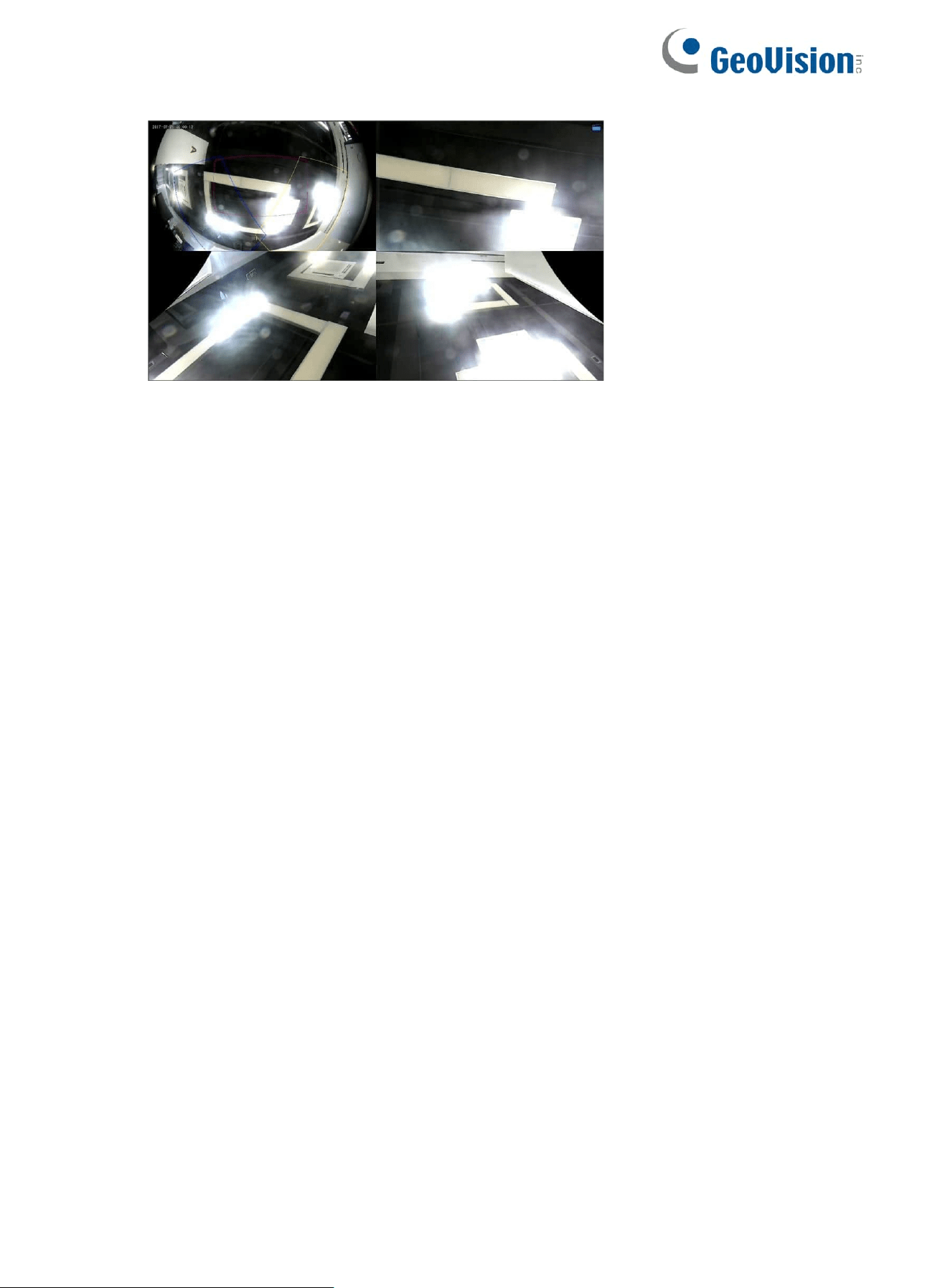
Dewarping operations: Take Ceiling Mount and Fisheye+3PTZ as an example.
• Drag the mouse to rotate the image or use the scroll wheel to zoom in or out on a PTZ image. A box
appears on the fisheye image as the image rotates, and as you drag the box or move the scroll wheel on
the fisheye image, the corresponding PTZ image rotates or zooms in or out as well.
30
Select a camera and click , or select the target cameras and click Batch Change Password.
4.1.3 Advanced Functions
Change the password of online IP cameras or restore factory default settings for cameras.
Go to Menu > Camera > Camera > Advanced.
Change Camera Password
You can change password of camera(s) one by one or in batches.
1.
2. Enter the new password and confirm the password.
3. Click OK. Check if the password is successfully changed.
Restore Default Settings
Select the camera, click . A message indicating camera restart appears, click OK and then the camera’s default
settings will be restored.
Note: Select Use Admin Password, the camera’s password is changed to the admin password of the NVR,
and cannot be edited.
Note: Changing camera password is available for cameras connected via the Geovision protocol.
31
4.2 Audio & Video
Configure encoding and audio parameters.
4.2.1 Encoding Settings
Configure storage mode, capture mode, stream type, etc.
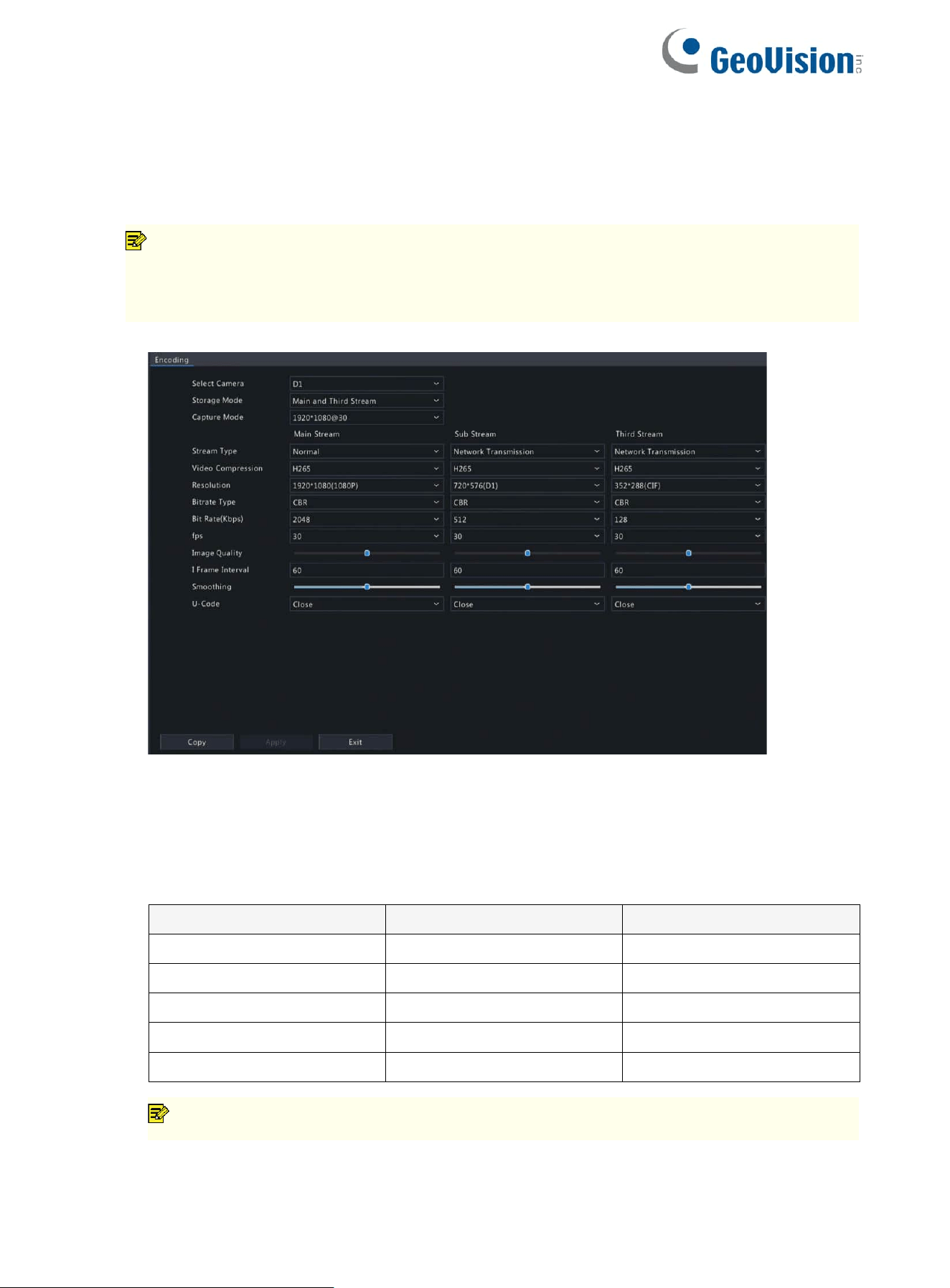
1. Go to Menu > Camera > Audio & Video > Encoding.
2. Select the camera from the drop-down list.
3. Choose a storage mode, including main stream, sub stream, main and sub stream, main and third stream, sub
and third stream. The default is main and third stream. Only certain NVR models support all the five modes.
The storage mode determines the recording format (HD or SD). It may affect the clarity and output mode of
the recording. Set the storage mode as needed by referring to the table below.
Table 4-1: Storage Mode
Storage Mode
HD Streaming
SD Streaming
Main stream
Main stream
No video or image
Sub stream
Sub stream
No video or image
Main + sub stream
Main stream
Sub stream
Main + third stream
Main stream
Third stream
Sub + third stream
Sub stream
Third stream
4. Set the capture mode, that is, combinations of resolution and frame rate. This parameter is configurable only
when the camera is connected to the NVR via the Geovision protocol.
5. Set the encoding parameters for different streams.
Note:
• The configuration items may vary with IPC models or versions.
•
Some functions may be unavailable if the IPC version is too low. In this case, you need to upgrade the IPC
first.
Note: This configuration item only changes the storage stream of the NVR, and does not change the
video stream sent from IPC. The IPC sends the main stream by default.
32
Item
Description
Stream Type
• Main stream: Select Schedule or Event.
• Schedule: Set encoding parameters for scheduled recordings.
• Event: Set encoding parameters for events such as motion detection and
alarm input.
• Sub stream: Set encoding parameters for low resolution videos intended for
network transmission.
Video Compression
Choose H264 or H265. The supported video compression may vary with IPC
model.
Resolution
The number of pixels in a frame.
Bitrate Type
• VBR: Variable Bit Rate (VBR) is used to keep the quality of video streams as
constant as possible by varying the bit rate.
• CBR: Constant Bit Rate (CBR) is used to keep a specific bit rate by varying the
quality of video streams.
Bit Rate(Kbps)
The number of bits transferred per second. Select a value from the drop-down
list, or select Custom to set a value as needed.
Frame Rate(fps)
The number of frames per second.
Image Quality
This parameter is configurable when Bitrate Type is set to VBR. 1 to 9 levels are
available.
I Frame Interval
The number of frames between two adjacent I frames.
Smoothing
Use the slider to control the sudden change of bit rate.
U-Code
Select the U-Code mode, including basic mode and advanced mode. The
advanced mode achieves higher compression ratios. You can also turn off the U-
Code.
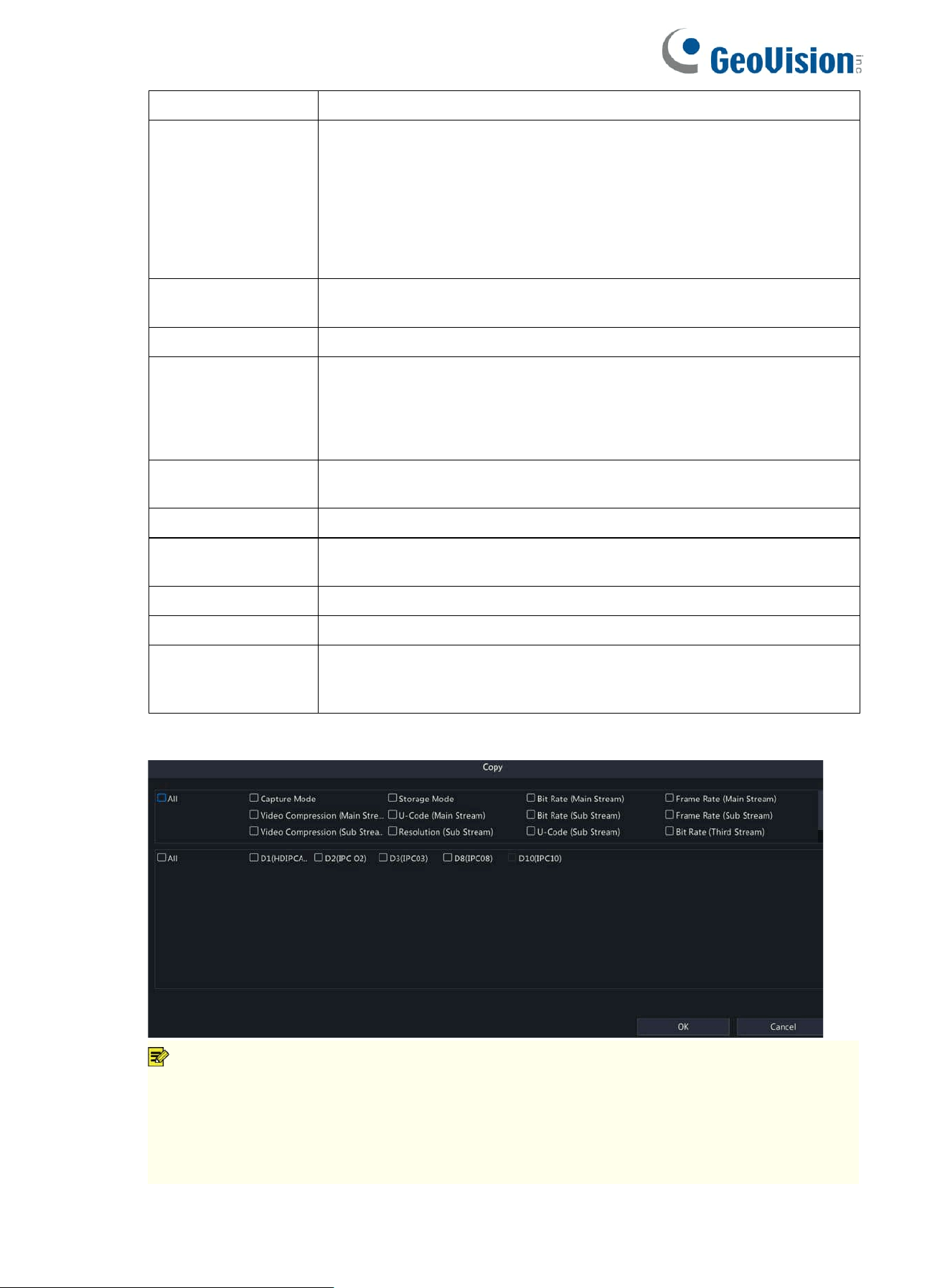
6. (Optional) To apply the settings to other camera(s), click Copy and select the desired parameter(s) and
camera(s), and then click OK.
7. Click Apply.
Note:
• When you copy Storage Mode to other camera(s), if the target camera does not support the storage
mode, the operation will fail.
• When you copy Video Compression and U-Code to other camera(s), Bit Rate will be selected
automatically because video compression adjusts bit rate automatically.
• Some parameters cannot be selected at the same time.
33
4.2.2 Audio Configuration
Configure audio input and audio output of the IPCs.
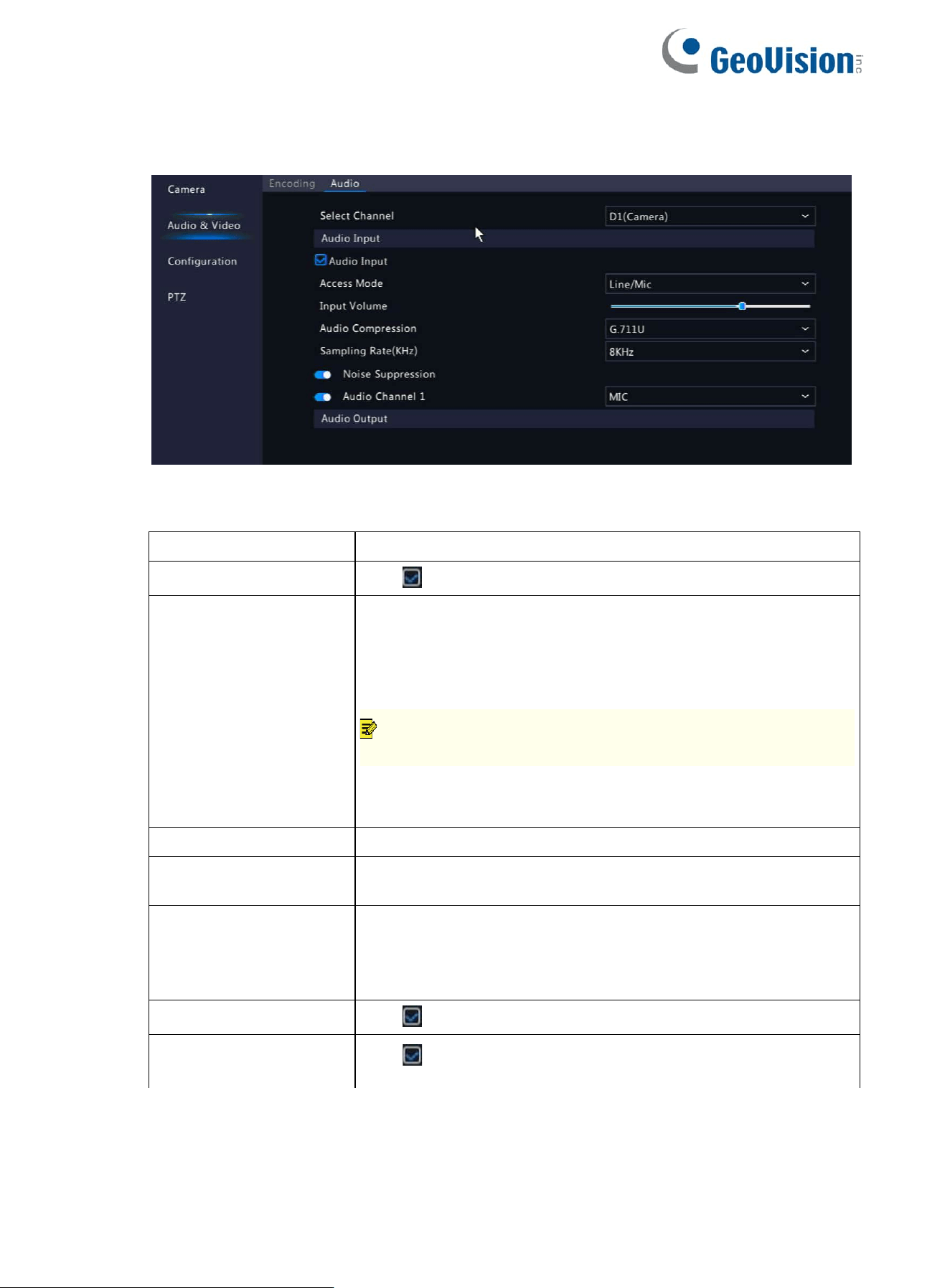
1. Go to Menu > Camera > Audio & Video > Audio.
2. Select the desired camera from the drop-down list.
3. Configure audio input parameters.
Item
Description
Audio Input
Check to enable audio input.
Access Mode
Select the access method according to the IPC’s audio interface, including
Line and Mic.
• Line-in: The IPC is connected to a sound pickup by a 3.5mm audio cable.
• Mic-in: The IPC is connected to a microphone.
•
Note: Only certain brands of sound pickups are supported by IPCs.
Contact technical support for details.
Input Volume
Drag the slider to adjust the audio input volume.
Audio Compression
Select the audio compression, including G.711A, G.711U, AAC-LC. The
supported audio compression may vary with IPC model.
Sampling Rate(KHz)
Select the sampling rate based on the audio compression.
• For AAC-LC, select 8 KHz, 16 KHz, or 48KHz.
• For G.711A or G.711U, select 8KHz or 16KHz.
Noise Suppression
Select to enable noise suppression.
Audio Channel 1/Audio
Channel 2
Select to enable audio channel 1 or audio channel 2, and then select the
access mode from the drop-down list.
34
Item
Description
Note: Only certain dual-channel IPCs support two audio channels, but
the two audio channels cannot be enabled at the same time.
4. Configure audio output parameters. Only certain IPC models support audio output.
Item
Description
Audio Output
Select the audio output mode.
• Speaker: The default mode.
• Line: An external speaker or earphone is required.
Output Volume
Drag the slider to adjust the audio output volume.
5. (Optional) To apply the audio settings to other camera(s), click Copy and select the desired parameter(s) and
camera(s), and then click OK.
6. Click Apply.
4.3 Display Configuration
Configure OSD characters, image parameters, and privacy mask.
4.3.1 OSD Configuration
Configure the characters overlaid on the preview (live view) window.
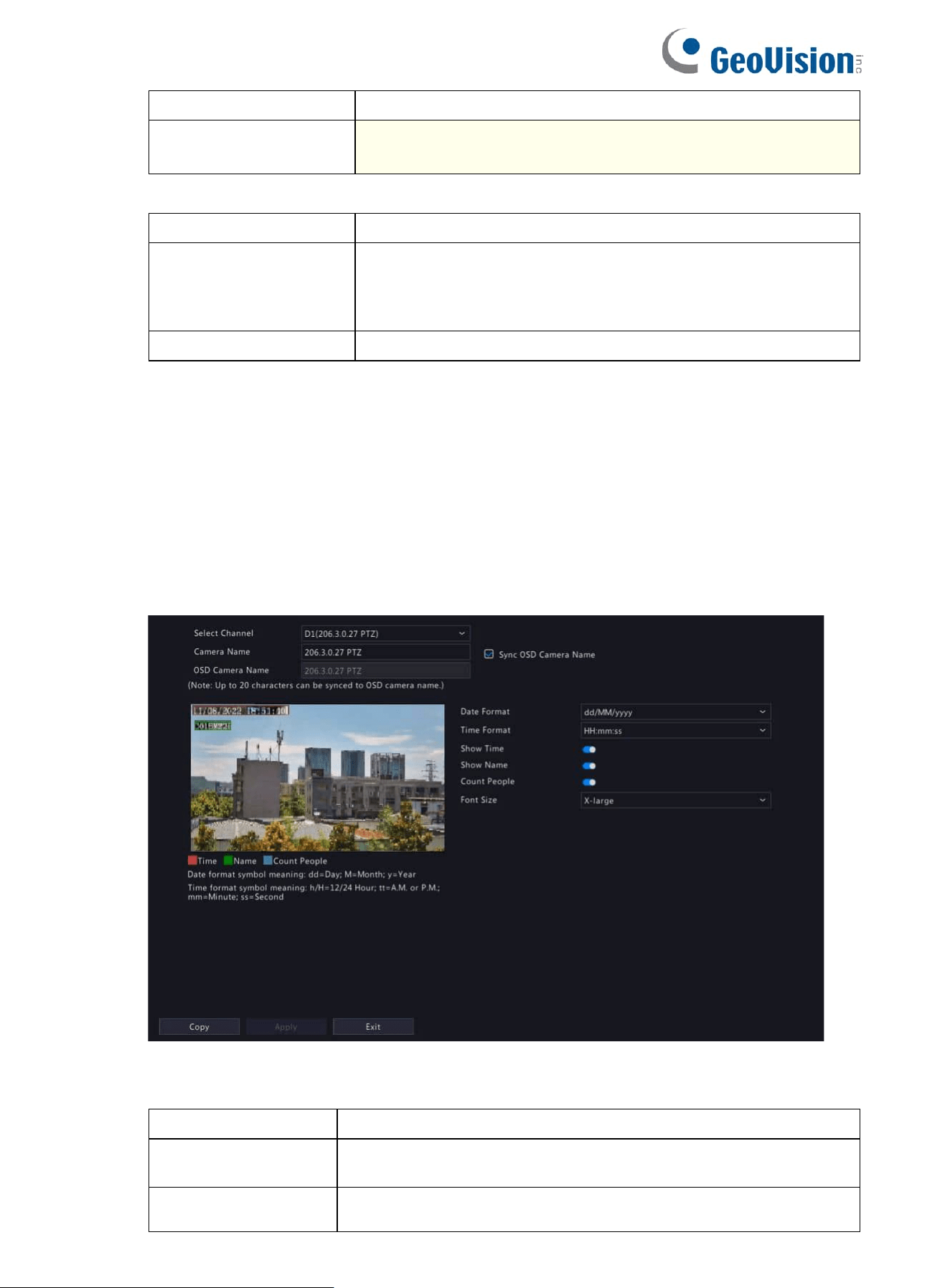
1. Go to Menu > Camera > Configuration > OSD.
2. Select the desired channel from the drop-down list.
3. Set the OSD parameters.
Item
Description
Camera Name
The name of the selected camera. You may customize the camera name as
needed.
Sync OSD Camera Name
Sync OSD Camera Name is enabled by default, thus the OSD camera name is
synchronized with the camera name automatically.
35
Item
Description
Note:
• Up to 20 characters can be synced to OSD camera name. If the camera
name exceeds 20 characters, only the first 20 characters will be
displayed.
• If Sync OSD Camera Name is disabled, after the camera name is
changed, the new name will not be synced to OSD camera name.
OSD Camera Name
The camera name displayed on the video image. OSD camera name is same as
the camera name by default. You can customize the OSD camera name after
disabling Sync OSD Camera Name. Up to 20 characters are allowed.
Date Format
Select the date format from the drop-down list.
Time Format
Select the time format from the drop-down list.
Show Time
When enabled, the camera time is displayed on the left side of video image.
Show Name
When enabled, the OSD camera name is displayed on the video image.
Count People
When enabled, people counting statistics are displayed on the video image,
including the number of people entered and exited. This function requires you
to configure People Flow Counting first.
Font Size
Select the front size from the drop-down list, including X-large, large, medium,
and small.
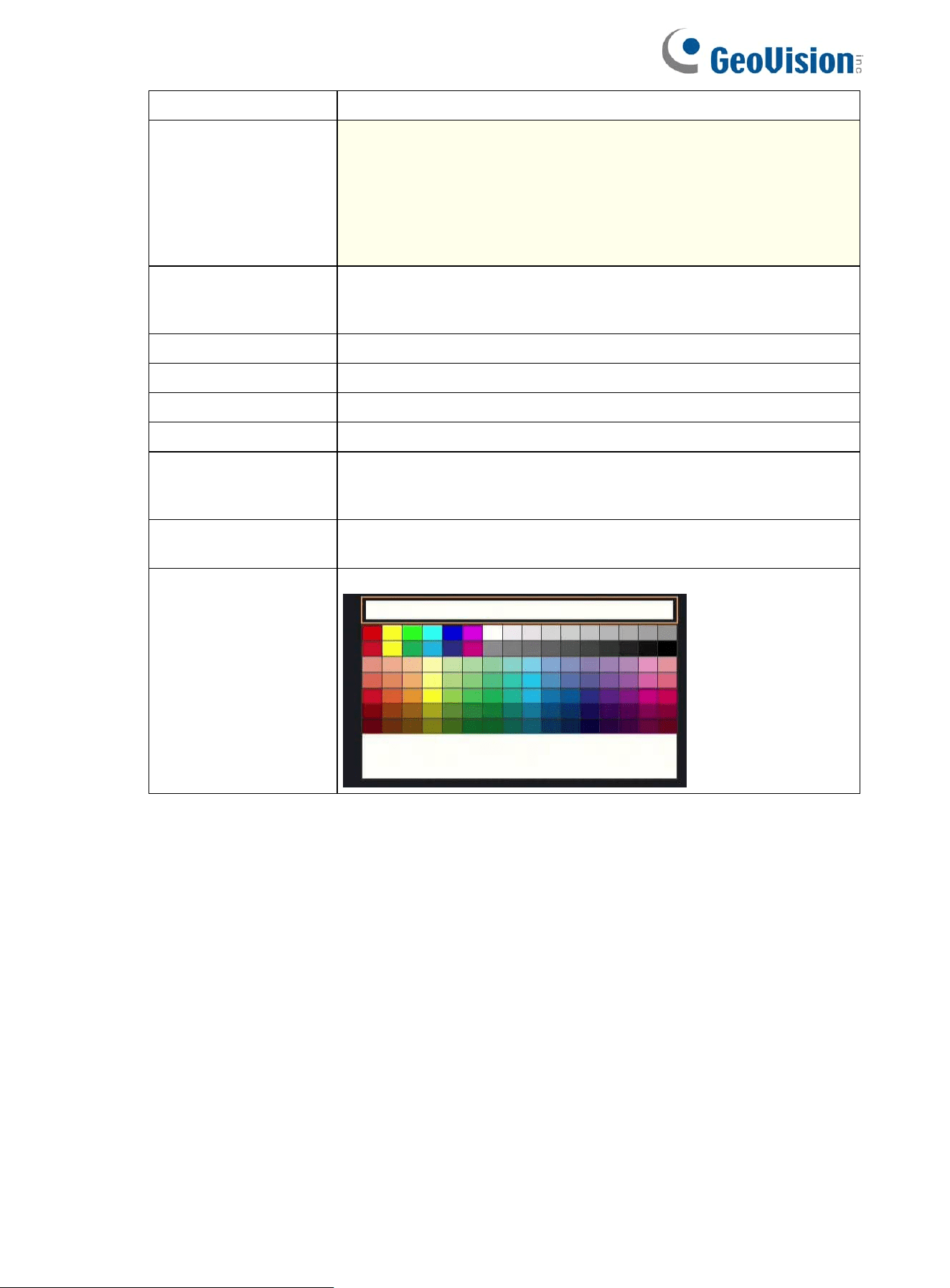
Font Color
Select the front color from the drop-down list.
4. (Optional) To apply the same OSD settings to other cameras, click Copy and select the desired camera(s).
5. Click Apply.
36
4.3.2 OSD Content
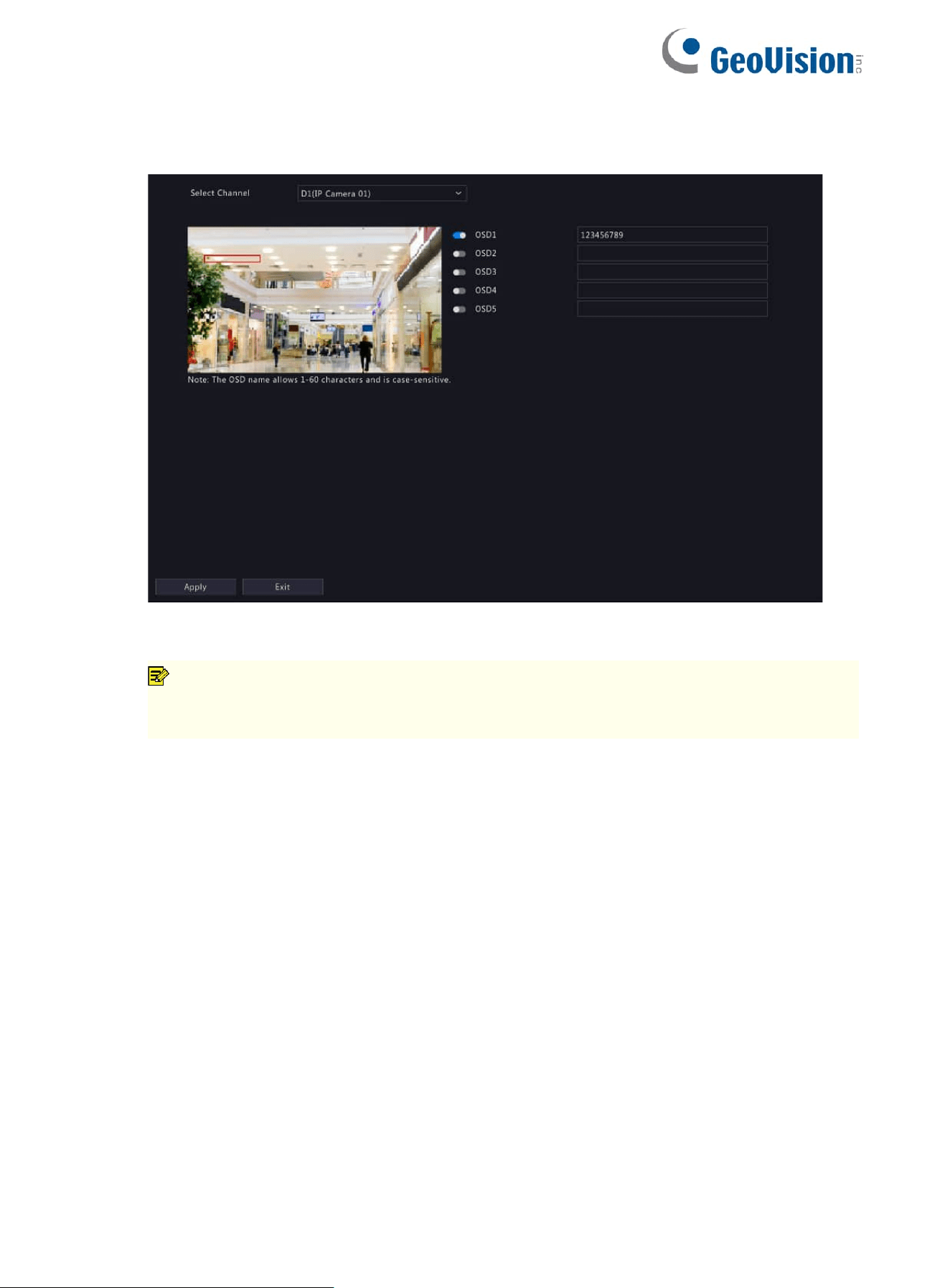
Configure other characters overlaid on the preview (live view) window.
1. Go to Menu > Camera > Configuration > Content.
2. Select a channel.
3. Enable OSD(s), and configure OSD name.
4. Click Apply
5. (Optional) To adjust the font size and color, go to OSD Configuration.
Note:
• The number of OSDs may vary with IPC model.
• The OSD name allows 60 characters and is case-sensitive.
37
4.3.3 Image Settings
Adjust image settings to get optimal images.
1. Go to Menu > Camera > Configuration > Image.
2. Select the desired channel.
3. Select the image scene you want to use.
The IP camera provides several predefined scene modes for different application scenarios. When you select a
scene, the parameters will be automatically set, you can also adjust the parameters as needed.
• Indoor: Recommended for indoor scenes.
• Common: Recommended for outdoor scenes.
• Starlight: Recommended for low light conditions.
• Test: Recommended for test scenes.
• Road Highlight Compensation/Park Highlight Compensation: Recommended for capturing vehicle license
plates on roads or in parks.
• WDR: Recommended for scenes with high-contrast lighting, such as window, corridor, front door or other
scenes that are bright outside but dim inside.
• Custom: Set a scene as needed.
4. Configure the parameters under the tabs in this page.
Note:
• Only certain IPCs support scene selection, and the image parameters may vary with IPC model.
• The default settings are scene-adaptive. Use default settings unless modification is necessary. To
restore default settings under all the tabs, click Default in the lower left corner. This function is
available only when the camera is connected to the NVR via the Geovision protocol.
• Image settings apply to both live and recorded videos.
38
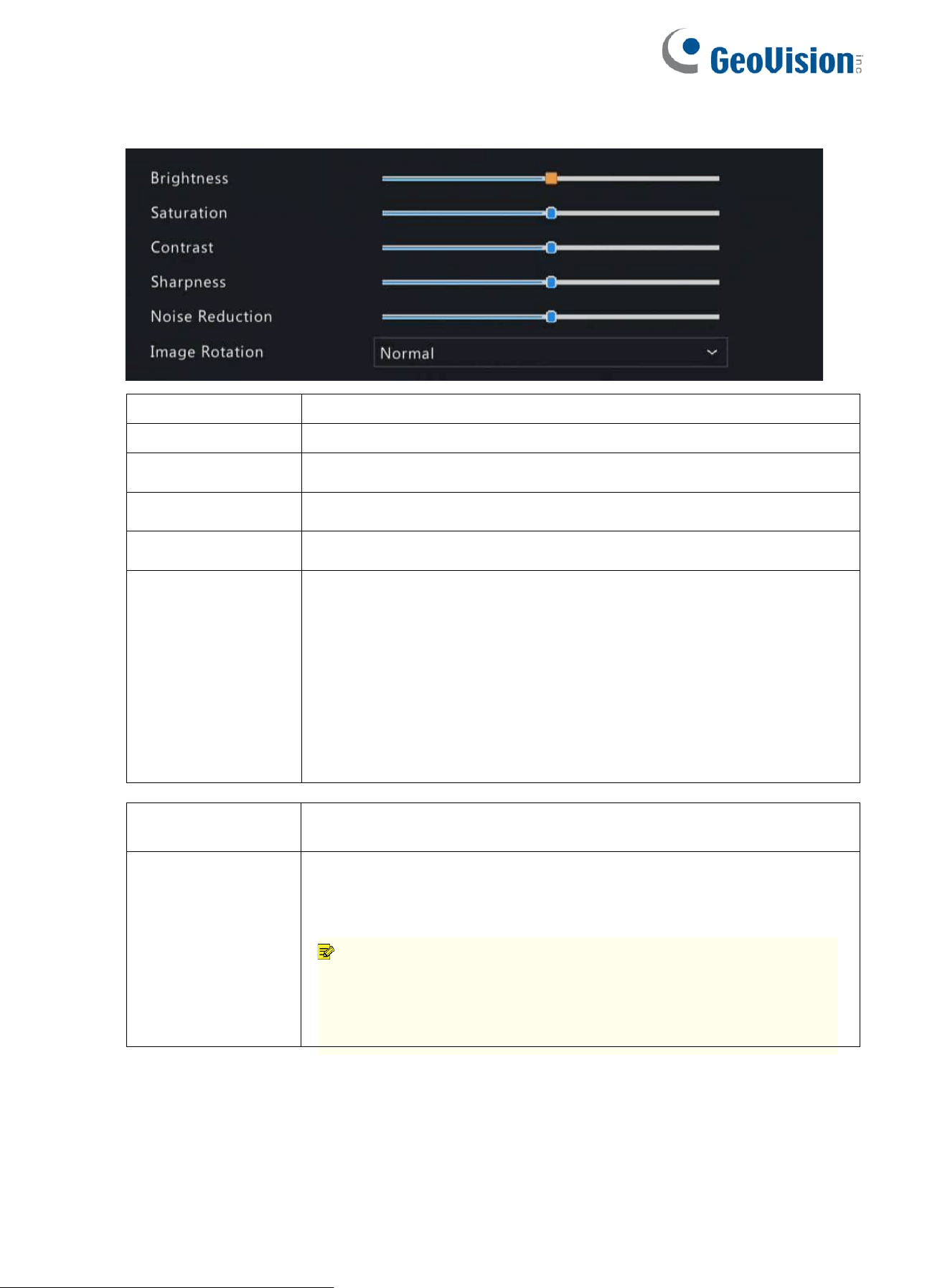
Image Enhancement
Click the Image Enhancement tab, and set the parameters.
Item
Description
Brightness
The overall lightness or darkness of the image.
Saturation
The intensity or vividness of colors in the image.
Contrast
The difference between the lightest and darkest tones in the image.
Sharpness
The contrast between the edges of an object in the image.
Noise Reduction
Reduce noises in images, while it may cause image blur or smearing.
Image Rotation
The rotation of the image.
• Normal: Displays images without rotation.
• Flip Horizontal: Displays images flipped horizontally.
• Flip Vertical: Displays images flipped vertically.
• 180°: Displays images flipped vertically and horizontally.
• 90° CW: Displays images in corridor format. The camera must be installed
correctly (rotated 90° clockwise).
• 90° CCW: Displays images in corridor format. The camera must be installed
correctly (rotated 90° counterclockwise).
Splice Distance
Adjust splice distance to display splicing image for the dual-lens camera with single
channel. The larger the distance, the more natural the splicing effect, thus avoiding
video stuttering or image ghosting. The NVR can obtain the current splice distance
automatically. Drag the slider to set it as needed.
Note:
• This item appears only for dual-lens cameras that support this function.
• Configure the splice distance for the dual-lens camera according to the
installation scene so as to achieve the best splicing effect.
39
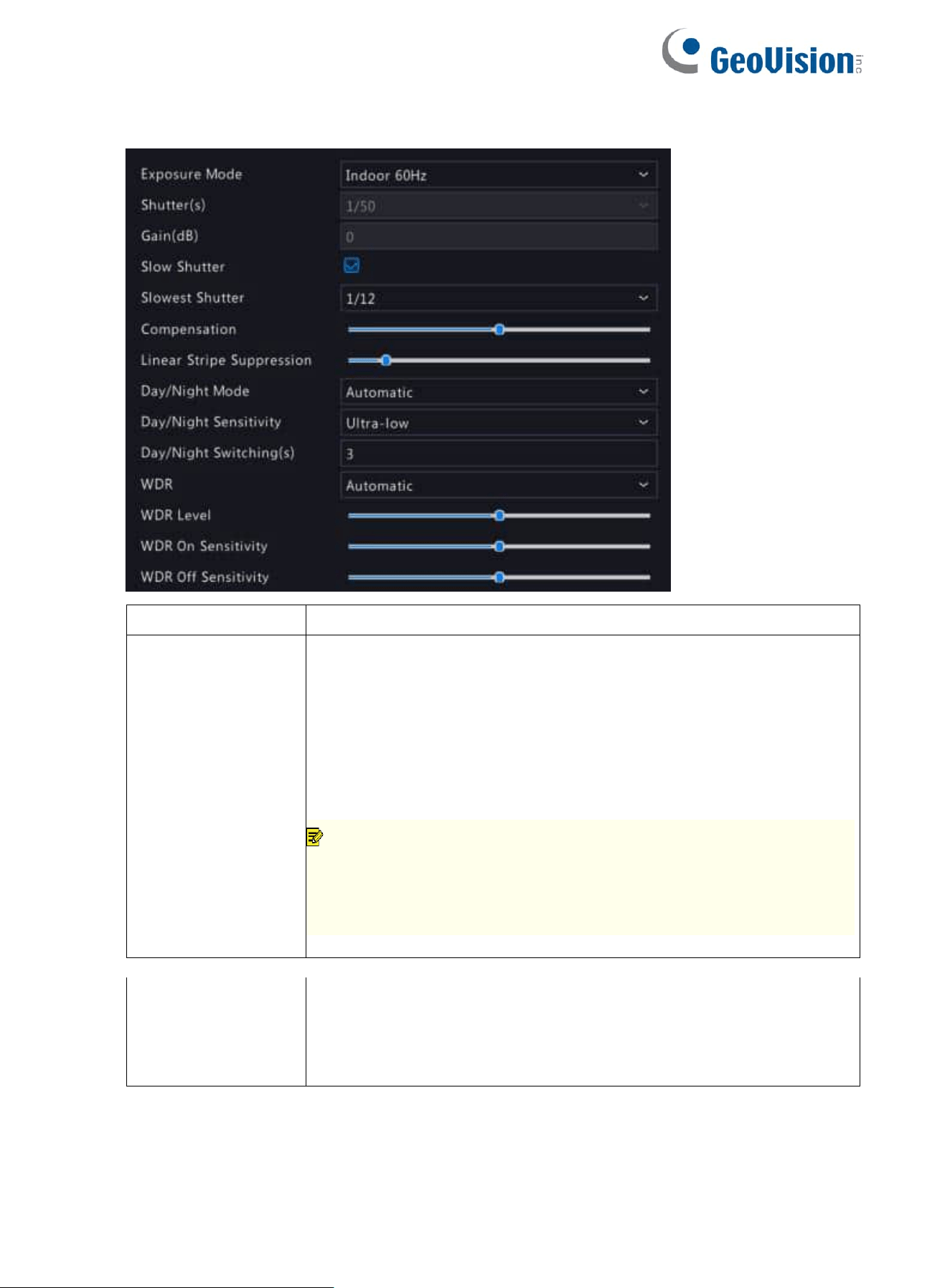
Exposure
Click the Exposure tab, and set the parameters.
Item
Description
Exposure Mode
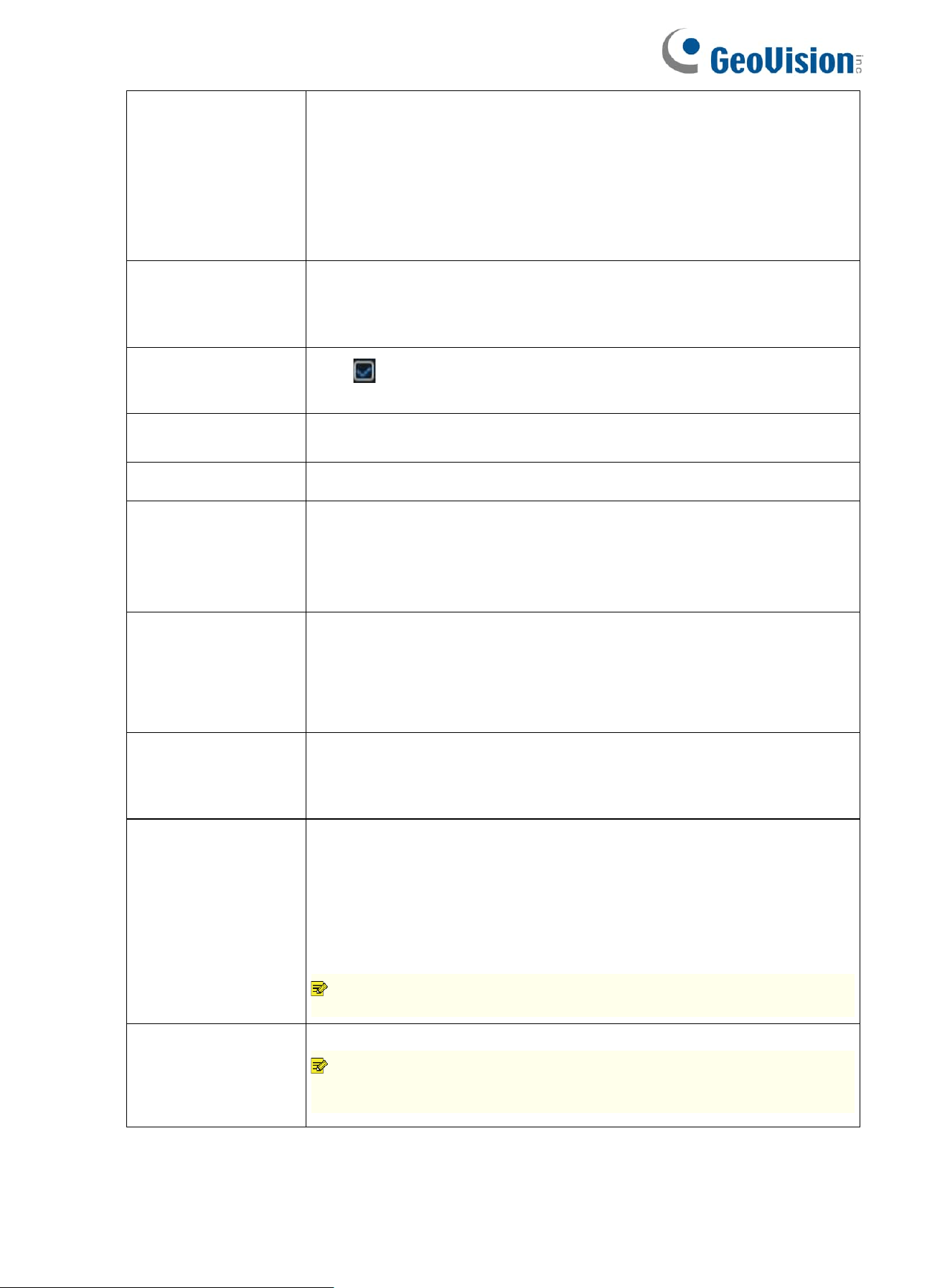
Select the correct exposure mode to achieve the desired exposure effect.
• Automatic: The camera automatically sets the exposure parameters according to
the scene.
• Custom: User can set exposure parameters as needed.
• Shutter Priority: The camera adjusts shutter as priority to adjust the image
quality.
• Indoor 50Hz: Reduce stripes by adjusting the exposure time.
Note:
• Stripe effect: The high-contrast condition in an image caused by uneven
light energy received by the sensor.
• Using this mode in brighter environments aids in adjusting the stripe
effect in the image with linear stripe suppression.
• Indoor 60Hz: Reduce stripes by adjusting the exposure time.
Note: Using this mode in brighter environments aids in adjusting the stripe
effect in the image with linear stripe suppression.
• Manual: Fine-tune image quality by setting shutter, gain, and iris manually.
• Low Motion Blur: Control the minimum shutter to reduce motion blur.
40
Shutter(s)
Shutter is used to control the amount of light that comes into the lens. A fast
shutter speed is ideal for scenes in quick motion. A slow shutter speed is ideal for
scenes that change slowly.
This parameter is configurable when Exposure Mode is set to Manual, Shutter
Priority, or Custom.
Note: If Slow Shutter is disabled, the reciprocal of the shutter speed must be
greater than the frame rate.
Gain(dB)
Control image signals so that the camera can output standard video signals in
different light conditions.
This parameter is configurable when Exposure Mode is set to Manual or Custom.
Slow Shutter
Select to enable slow shutter. When enabled, the camera improves image
brightness in low light conditions.
Slowest Shutter
When enabled, you can set the slowest shutter speed for the camera during
exposure.
Compensation
Adjust the compensation value as required to achieve the desired image effect.
Day/Night Mode
• Automatic: The camera automatically switches between night mode and day
mode according to the ambient lighting condition to output optimum images.
• Day: The camera outputs high-quality images in daylight conditions.
• Night: The camera outputs high-quality images in low light conditions.
Day/Night Sensitivity
Light threshold for switching between day mode and night mode. Ultra-low, low,
medium, and high are available. A higher sensitivity level means that the camera is
more sensitive to the change of light and is therefore more easily to switch between
day mode and night mode.
This parameter is configurable when Day/Night Mode is set to Automatic.
Day/Night Switching(s)
Set the length of time before the camera switches between day mode and night
mode after the switching conditions are met.
This parameter is configurable when Day/Night Mode is set to Automatic.
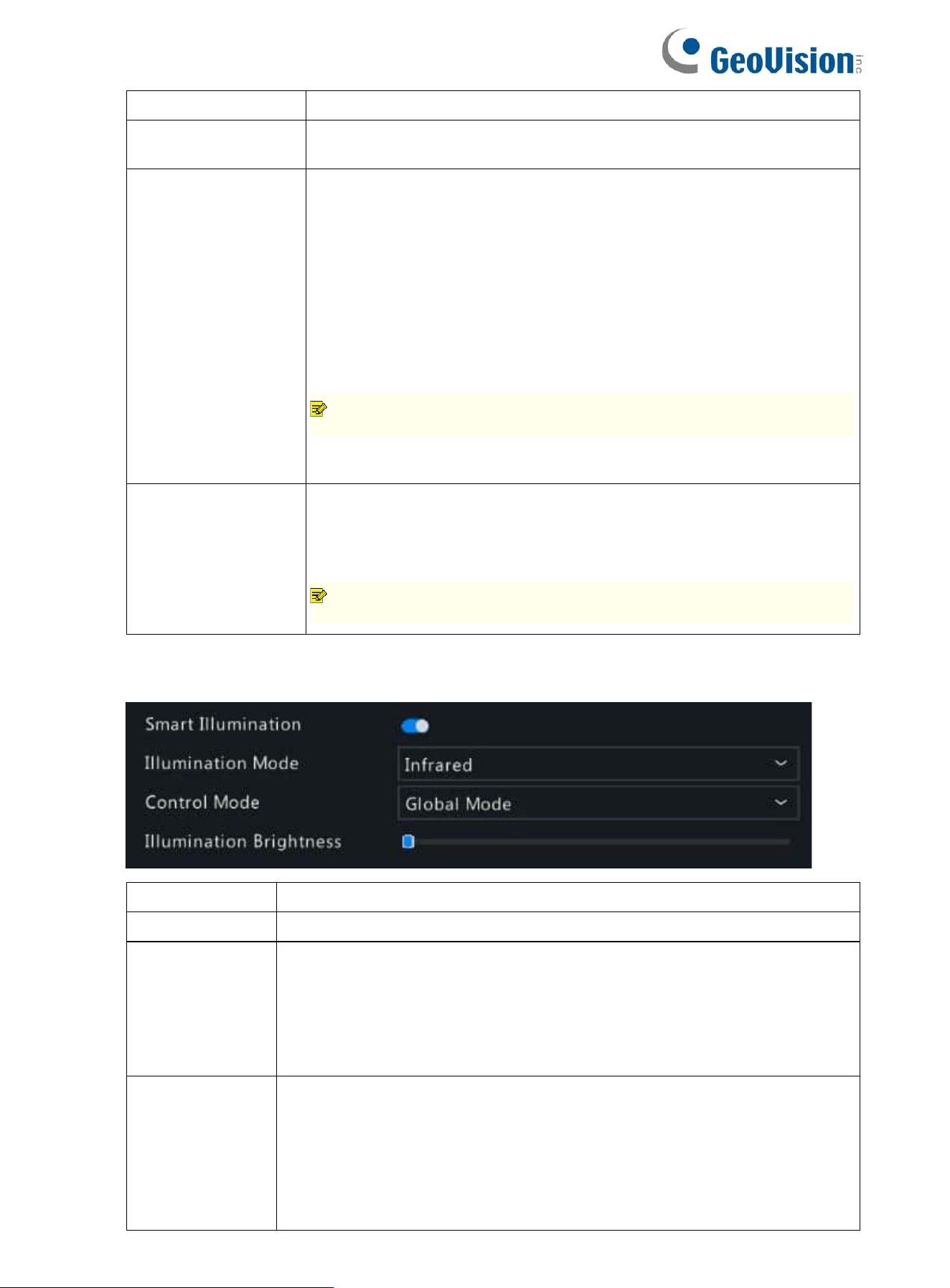
WDR
Suitable for high-contract scenes. WDR can balance the brightness in the bright area
and dark area, and provide clear image with more details.
• On/Off: User needs to identify WDR scenes, and manually enable or disable
WDR as needed.
• Smart (Automatic): The device can automatically identify typical WDR scenes,
and then enable or disable WDR.
Note: When WDR is enabled, some other functions may not be supported.
Refer to the actual interface for details.
WDR Level
Adjust the WDR level to improve image quality when WDR is enabled.
Note: In the case of low contrast, it is recommended to disable WDR or
use level 1 to 6. Level 7 or higher is recommended if there is a high contrast
between the bright and dark areas in the scene.
41
Item
Description
WDR On/Off Sensitivity
When WDR is set to Automatic, adjust the parameter to change the WDR switching
sensitivity.
Metering Control
Perform luminance statistics on the images captured by the device, automatically
adjust the exposure value, and output properly exposed images with optimal
brightness. The default is the Center-Weighted Average Metering, you may
configure this according to the actual scene.
• Center-Weighted Average Metering: Measure light mainly in the central part of
the image.
• Evaluative Metering: Measure light in the specified area of the image,
• Face Metering: Adjust image quality in poor lighting or back lighting conditions
by controlling the brightness of captured faces in face scenes.
• Spot Metering: Similar to the evaluative metering. However, it cannot increase
the brightness of the image.
Note: This parameter is configurable when Exposure Mode is not set to
Manual.
Linear Stripe Suppression
Adjust the linear stripes in the image.
Range: 1 to 9, the default is 5. The greater the value, the more obvious the linear
stripe suppression effect is, but it may cause overexposure in the image. Please
configure this according to the actual scene.
Note: This parameter is configurable when Exposure Mode is set to Indoor
50Hz or Indoor 60Hz.
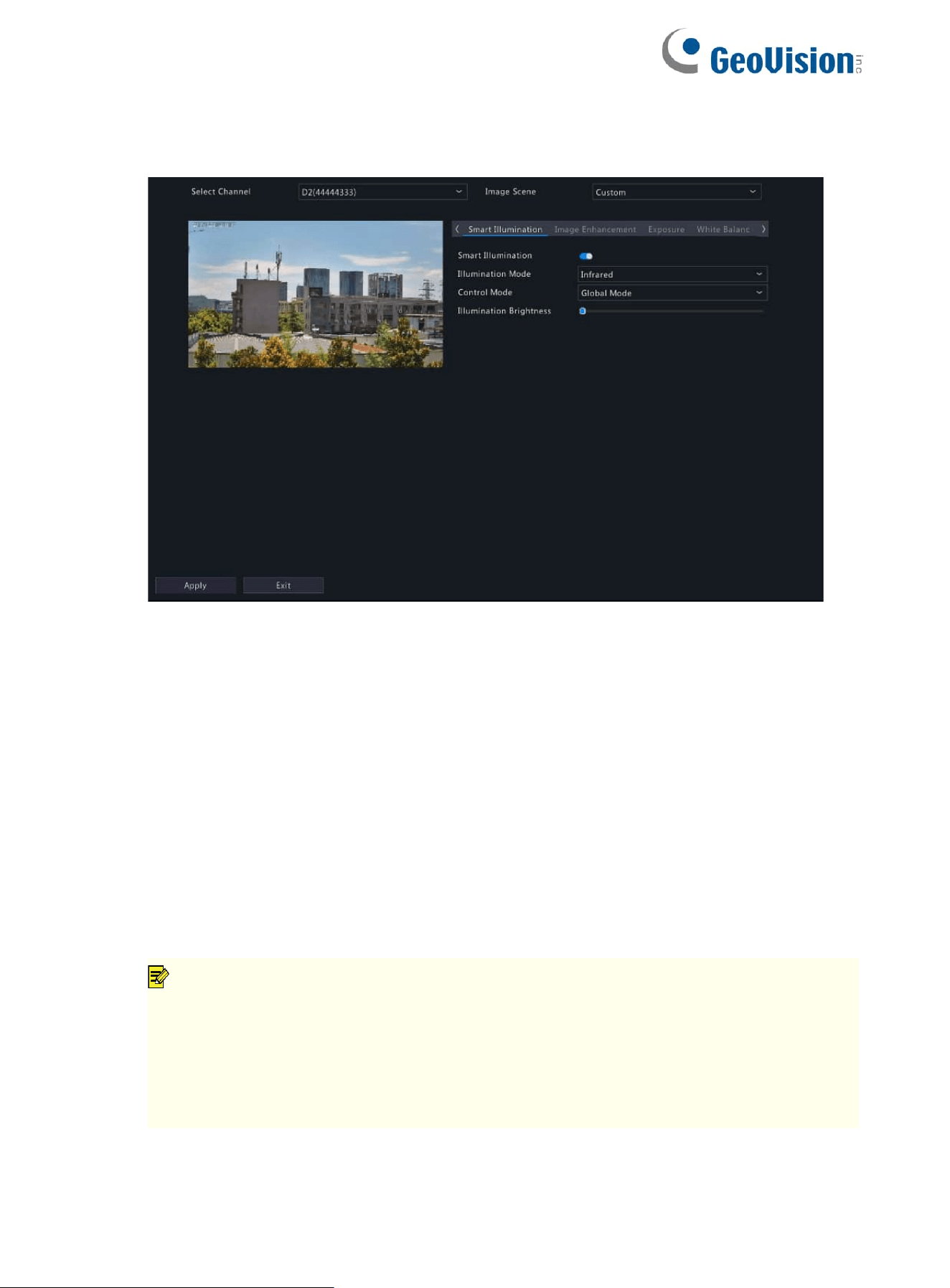
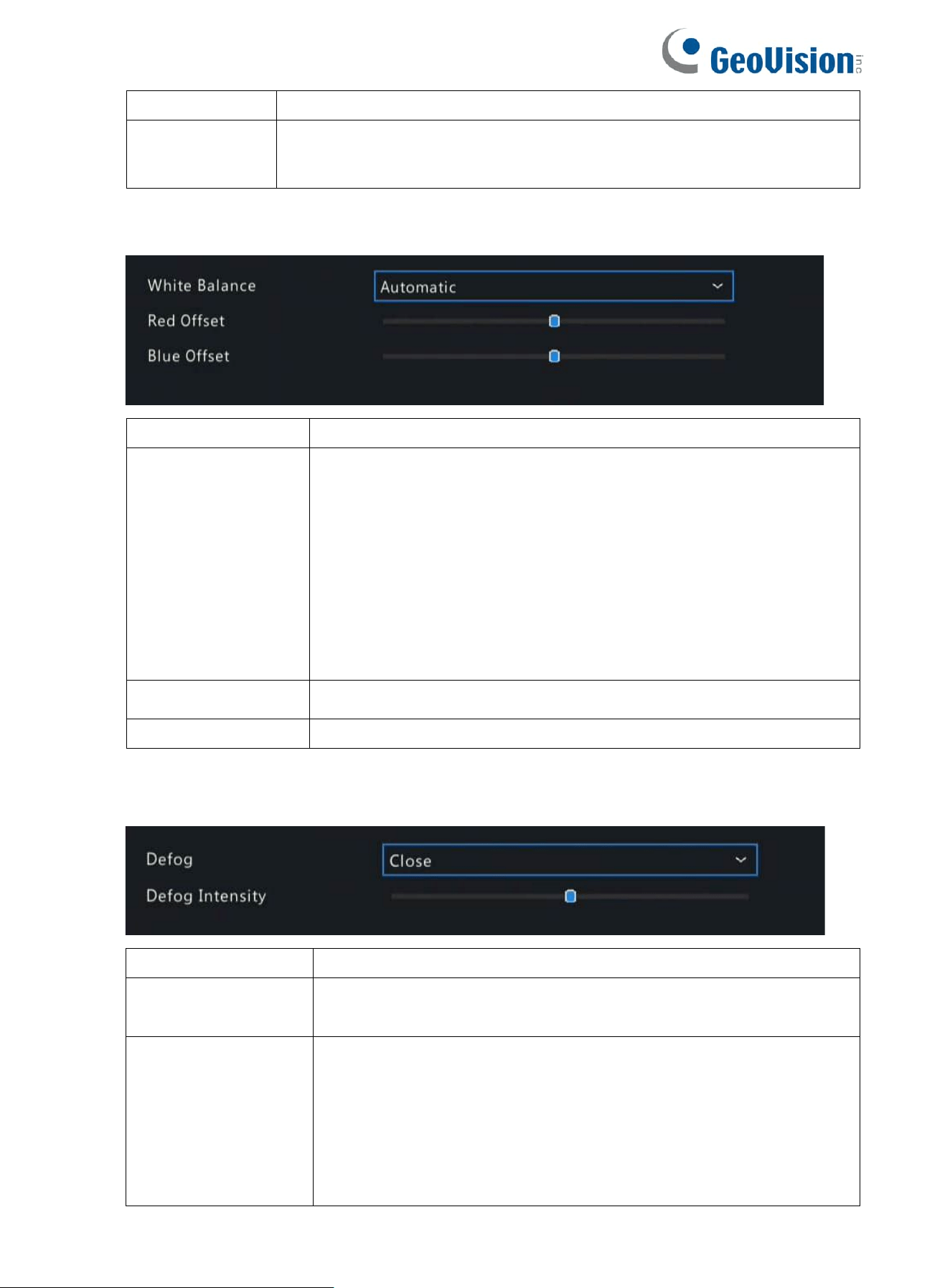
Smart Illumination
Click the Smart Illumination tab, and set the parameters.
Item
Description
Smart Illumination
Enable Smart Illumination.
Illumination Mode
Select the illumination mode from the drop-down list.
• Infrared: The camera uses infrared light illumination.
• White Light: The camera uses white light illumination.
• Dual Light: The camera adjusts the white light or infrared automatically according to
the current lighting condition.
Control Mode
Select the control mode from the drop-down list.
• Global Mode: The camera automatically adjusts illumination brightness and
exposure to achieve the balanced image effect.
• Overexposure Restrain: The camera automatically adjusts illumination brightness and
exposure to avoid regional overexposure.
• Manual: Control the brightness of illumination manually.
42
Item
Description
Illumination
Brightness
Drag the slider to adjust the illumination brightness. This parameter is configurable
when Control Mode is set to Manual. The greater the value, the higher the intensity (0
is off).
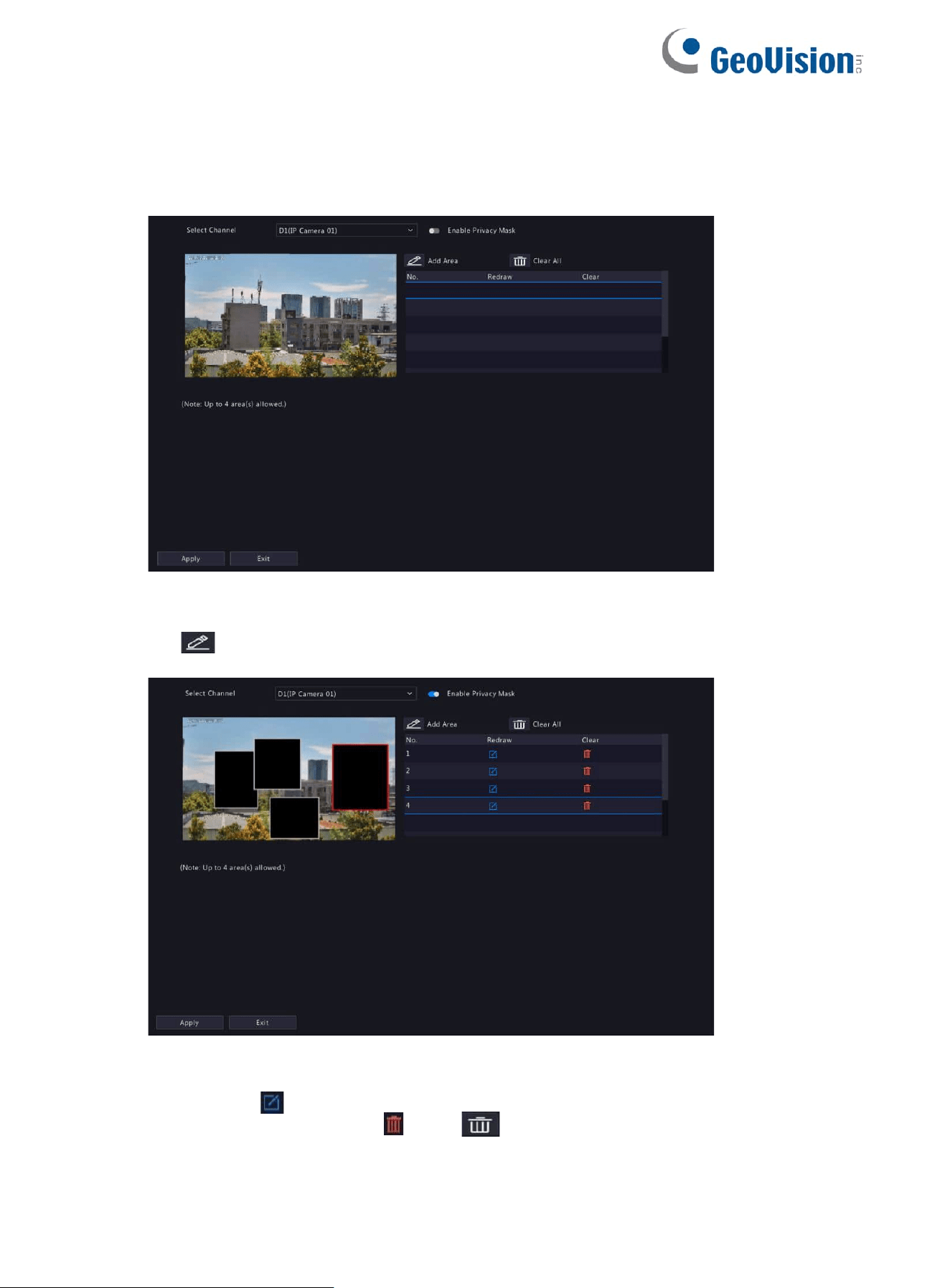
White Balance
Click the White Balance tab, and set the parameters.
Item
Description
White Balance
Adjust the red and blue gains of the image to remove unrealistic color casts.
• Auto: The camera automatically adjusts the red and blue gains according to the
lighting condition (the color tends to be blue).
• Fine Tune: Adjust the red or blue offsets manually.
• Outdoor: Suitable for outdoor scenes where the color temperature varies
widely.
• Sodium Lamp: The camera automatically adjusts red and blue gains according to
the lighting condition (the color tends to be red).
• Locked: Lock the current color temperature to avoid change.
Red Offset
Adjust the red offset manually.
Blue Offset
Adjust the blue offset manually.
Advanced Settings
Click the Advanced tab, and set the parameters.
Item
Description
Defog
Enable/disable defog from the drop-down list. Defog is used to improve image
visibility in foggy, hazy and other low-visibility scenes.
Defog Intensity
When defog is enabled, you can adjust the defog intensity.
In a heavy-fog environment, the higher the defog level, the clearer the image. In a
fog-free or light-fog environment, there is not much difference between levels 1 to
9.
Note: Optical defog is available only for certain IPC models. When the defog
intensity is set to 6 or higher, optical defog automatically turns on in thick fog,
and images change to black and white.
43
4.3.4 Privacy Mask
Privacy mask is used to cover certain areas on the image for privacy, for example, ATM keyboard. When a PTZ
camera rotates and zooms, the privacy mask moves and zooms with the camera and the masked area is always
covered.
1. Go to Menu > Camera > Configuration > Privacy Mask.
2. Select the desired channel from the drop-down list.
3. Enable privacy mask.
4. Click , and then use the mouse to specify a rectangle area on the left-side image. The number of areas
supported varies with NVR model. Some NVRs support 4 areas and some support 8 areas.
• Adjust the size and position of the mask: Point to a handle of the mask and drag to resize it. Point to any
position of the mask and drag it to the desired position.
• Redraw: Click to clear all the existing area(s) and draw an area again.
• Delete: Select the mask and click ; Or click to delete all the masks.
5. Click Apply.
44
4.4 PTZ Configuration
Configure and control PTZ cameras.
PTZ Control Mode
DVRs support two control modes, including Coaxial or Serial Port. Choose the control mode before using PTZ
function.
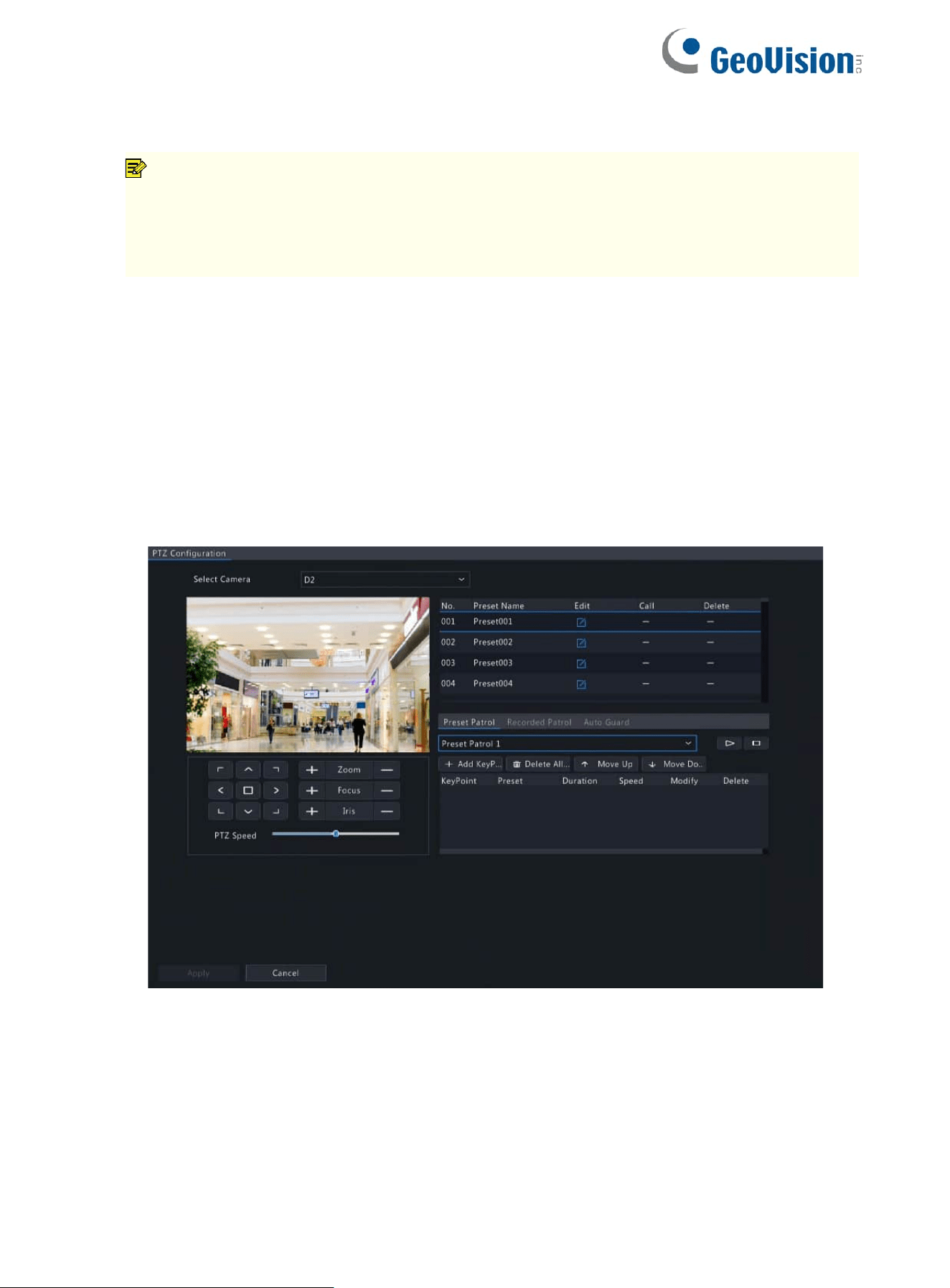
1. Go to Menu > Camera > PTZ.
2. Choose a control mode according to camera connection method, and complete other settings.
Configure PTZ
Option 1: Enter Menu
1. Go to Menu > Camera > PTZ.
2. Select the target PTZ camera.
3. Set the parameters. See below for details.
Note:
• This function is only available for PTZ cameras.
• The PTZ parameters may vary with IPC model.
• PTZ (pan, tilt and zoom) control is applicable to PTZ cameras only and may vary depending on the
functions and protocols supported by the PTZ cameras. Refer to PTZ camera specifications for details.
45
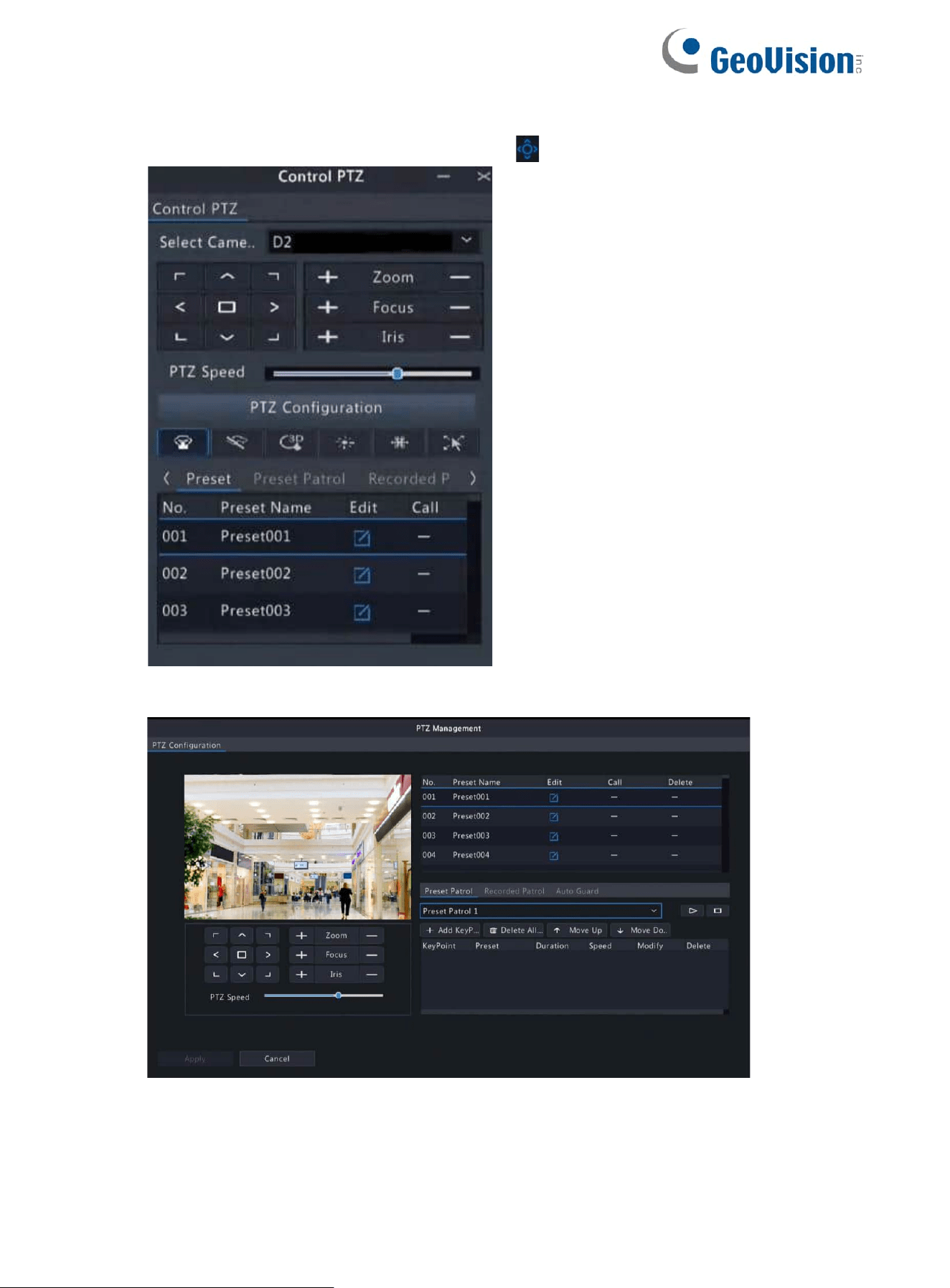
Option 2: Use PTZ Toolbar
1.
On the preview page, select the target window, and click on the window toolbar.
2.
The PTZ control window appears. You can control the PTZ camera as needed.
3.
Click PTZ Configuration, and set the parameters.
46
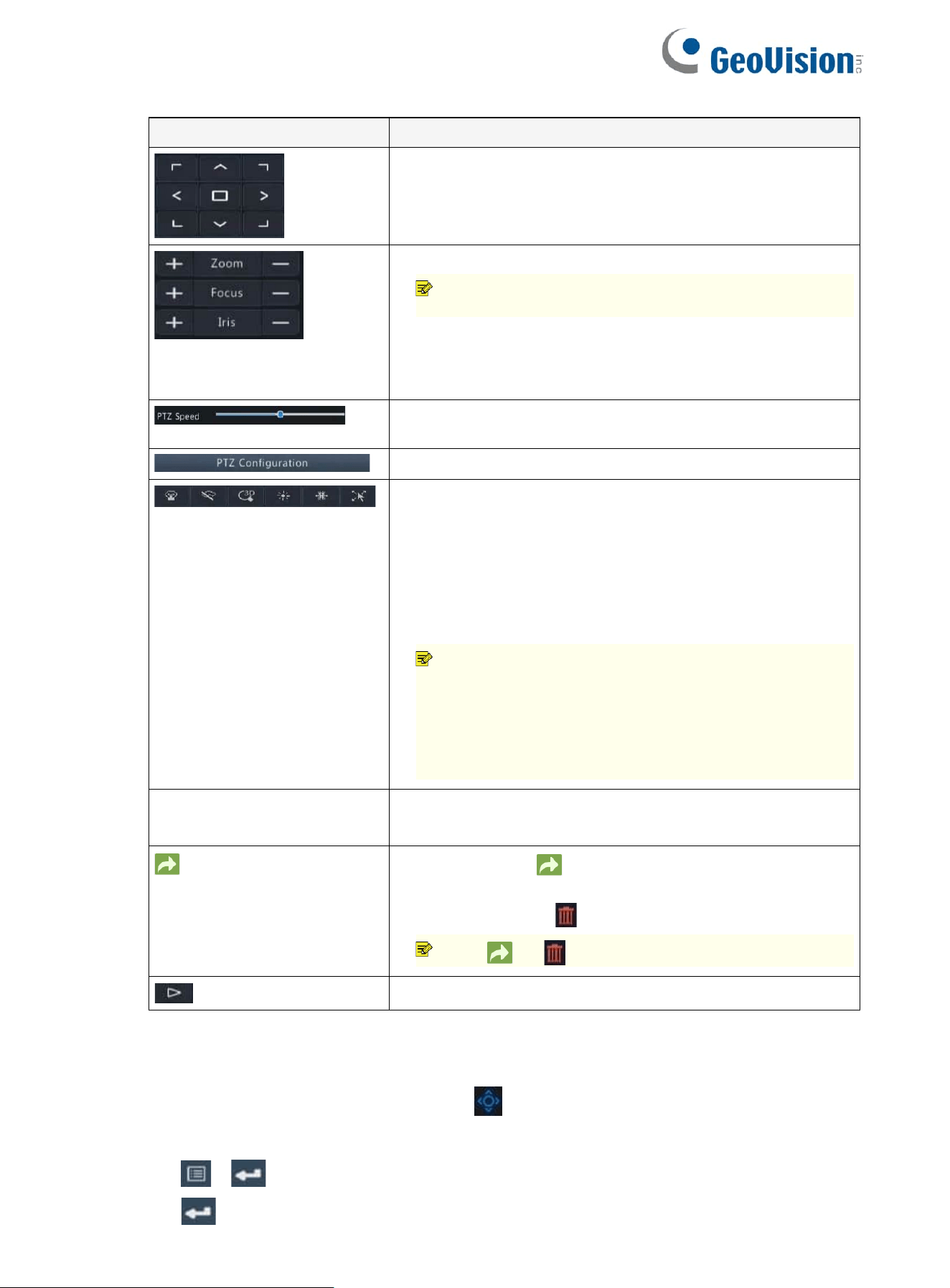
Table 4-2: PTZ Control Window Buttons
Button
Description
Control the rotation direction of the PTZ camera; release PTZ control.
• Zoom in or out on images.
Note: You can also zoom in or out using the scroll wheel on
your mouse.
• Focus far or near for clear images.
• Increase or reduce the amount of light that enters the lens of the
camera.
Control the rotation speed of the camera. 1-9 are available. 1 means
the slowest, and 9 means the fastest.
Click to display the PTZ Configuration page.
• Turn on/off the light.
• Turn on/off the wiper.
• Turn on 3D positioning.
• Turn on/off the heater.
• Turn on/off the snow removal.
• Turn on/off PTZ shortcut operations.
Note:
• Make sure that the 3D positioning, heater and snow
removal functions are supported by the camera before
using.
• Use 3D positioning to zoom in or out. Dragging from top
down zooms in. Dragging the other way zooms out.
Preset/ Preset Patrol/Recorded
Patrol/ Auto Guard
• For detailed information, see Preset, Preset Patrol, Recorded Patrol,
and Auto Guard respectively.
/
•
Call a preset: Click , and the PTZ camera goes to the preset
position.
•
Delete a preset: Click to delete the preset.
Note: and are displayed for saved presets only.
/
Start or stop preset patrol.
OSD Menu
Configure analog cameras on DVRs. This function is only available for DVRs.
1.
On the preview window of an analog camera, click on the window toolbar.
2.
Click OSD Menu.
3.
Click or to open camera settings window, and set the parameters.
4.
Click to save the settings, and then choose Exit button to close the window.
47
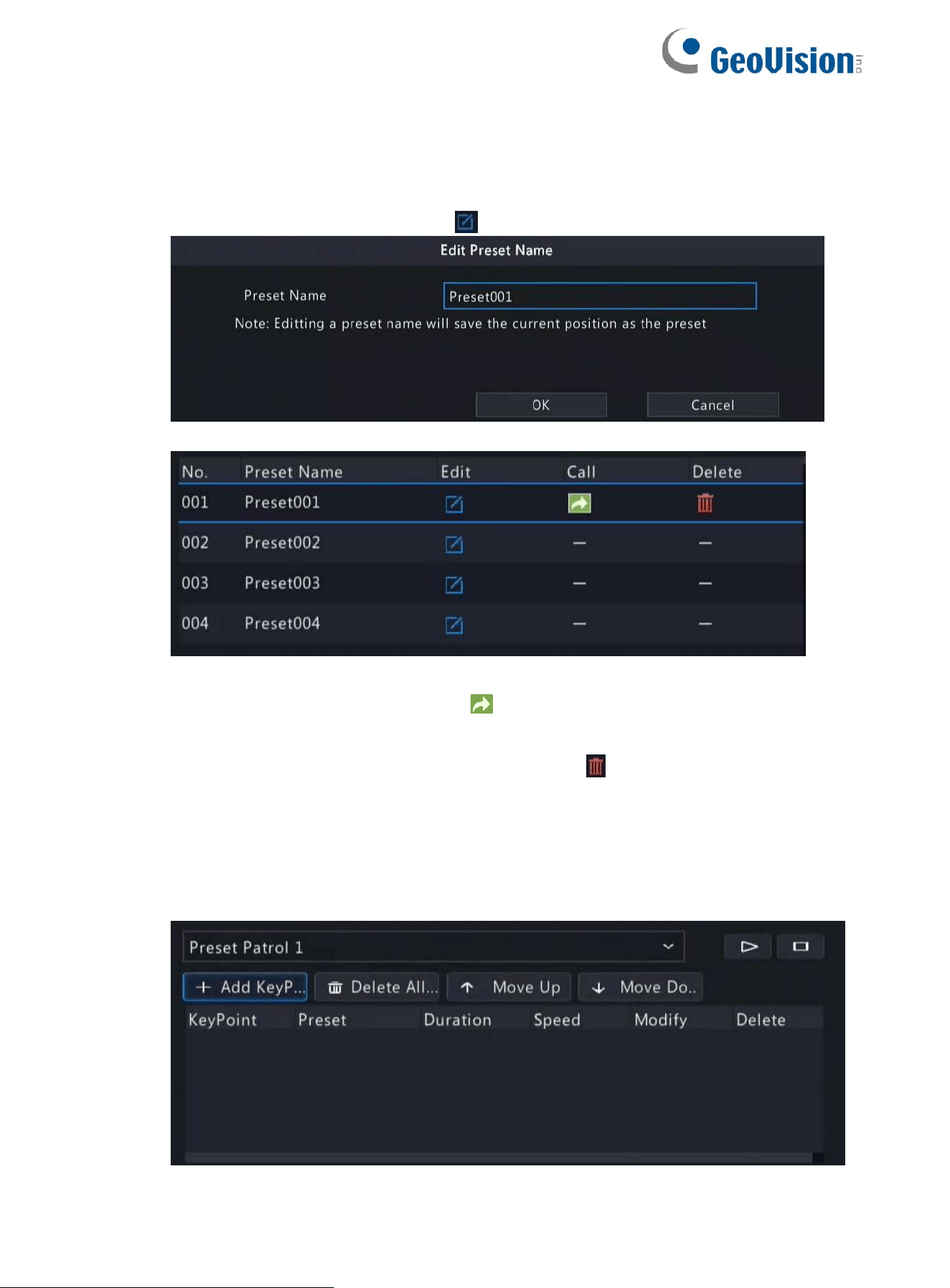
Select a preset number not in use, and click to edit the preset name.
Preset
A preset position (preset for short) is a saved view used to quickly steer the PTZ camera to a specific position.
• Add a Preset
1. Use the PTZ direction buttons to steer the PTZ camera to the desired position.
2.
3. Click OK to save. Repeat the above steps to add all the presets.
• Call a Preset
In the preset list, select the preset to call and click . Then the camera rotates to the preset position.
• Delete a Preset
In the preset list, select the preset you want to delete, and then click .
Preset Patrol
Set a preset patrol route so the PTZ camera can patrol by presets (go from one preset to the next in the specified
order).
• Add Preset Route
1. Click Preset Patrol, and select a patrol route.
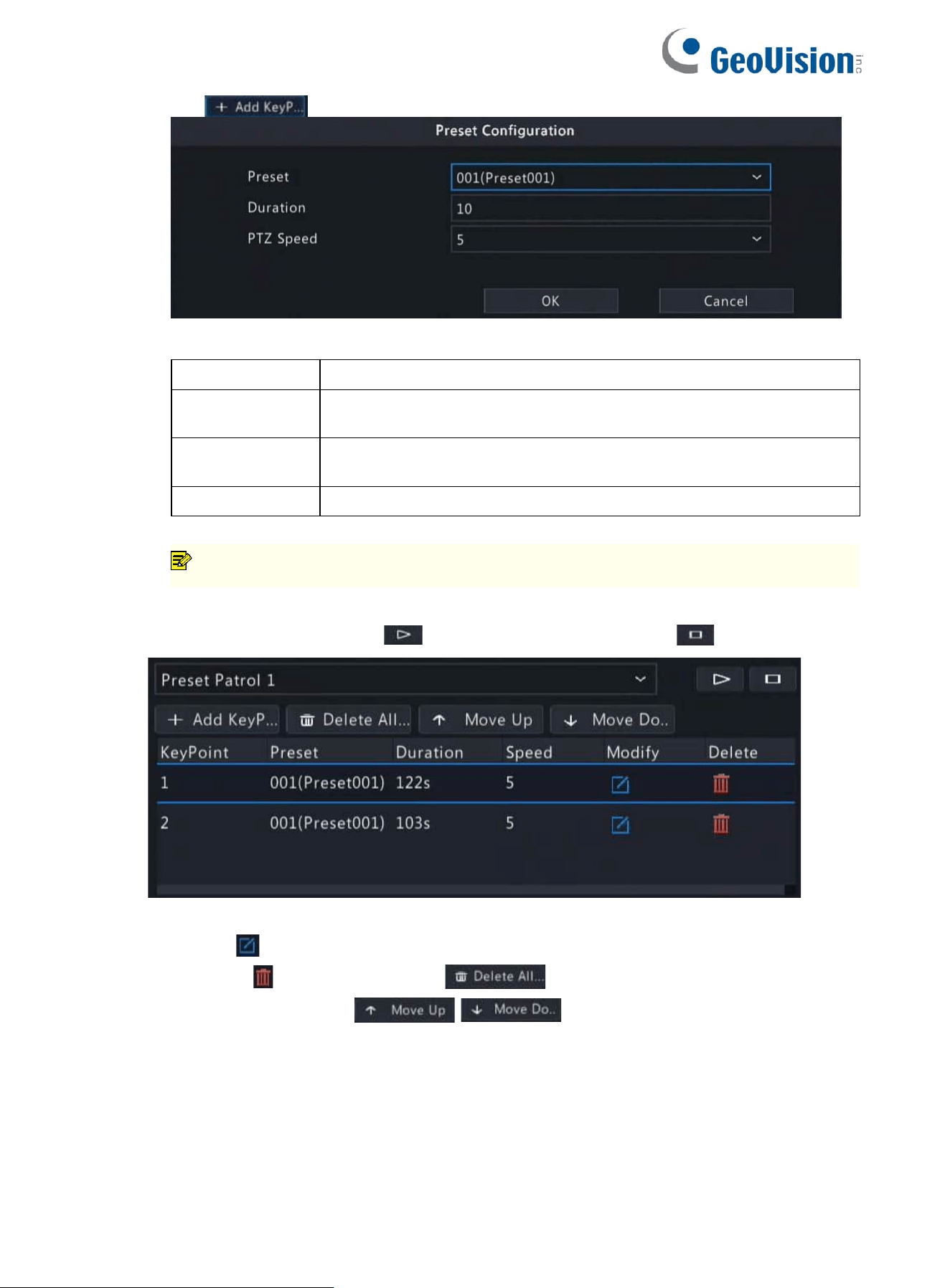
48
2. Click . The figure as shown below appears.
3. Complete the parameters, and click OK.
Item
Description
Preset
Set the length of time the camera stays at the preset after performing the patrol.
See Preset for setting preset.
Duration(s)
Set the time the camera stays at the preset after the patrol is performed. The
valid range is from 120 to 1800 seconds. The default is 10s.
Speed
Set the rotation speed. 1 means the slowest, 9 means the fastest. The default is 5.
4. Repeat the above steps to add more routes.
• Call a Preset
Select a preset patrol in the list, click to start the preset patrol. To stop, click .
• Other Operations
•
Edit: Click to edit the preset patrol parameters.
•
Delete: Click to delete a keypoint; Click to delete all keypoints.
•
Move Up/Move Down: Click / to adjust the sequence of these presets.
Note: Up to 4 patrol routes are allowed for each PTZ camera. Up to 8 presets (keypoints) are allowed
for each patrol route.
49
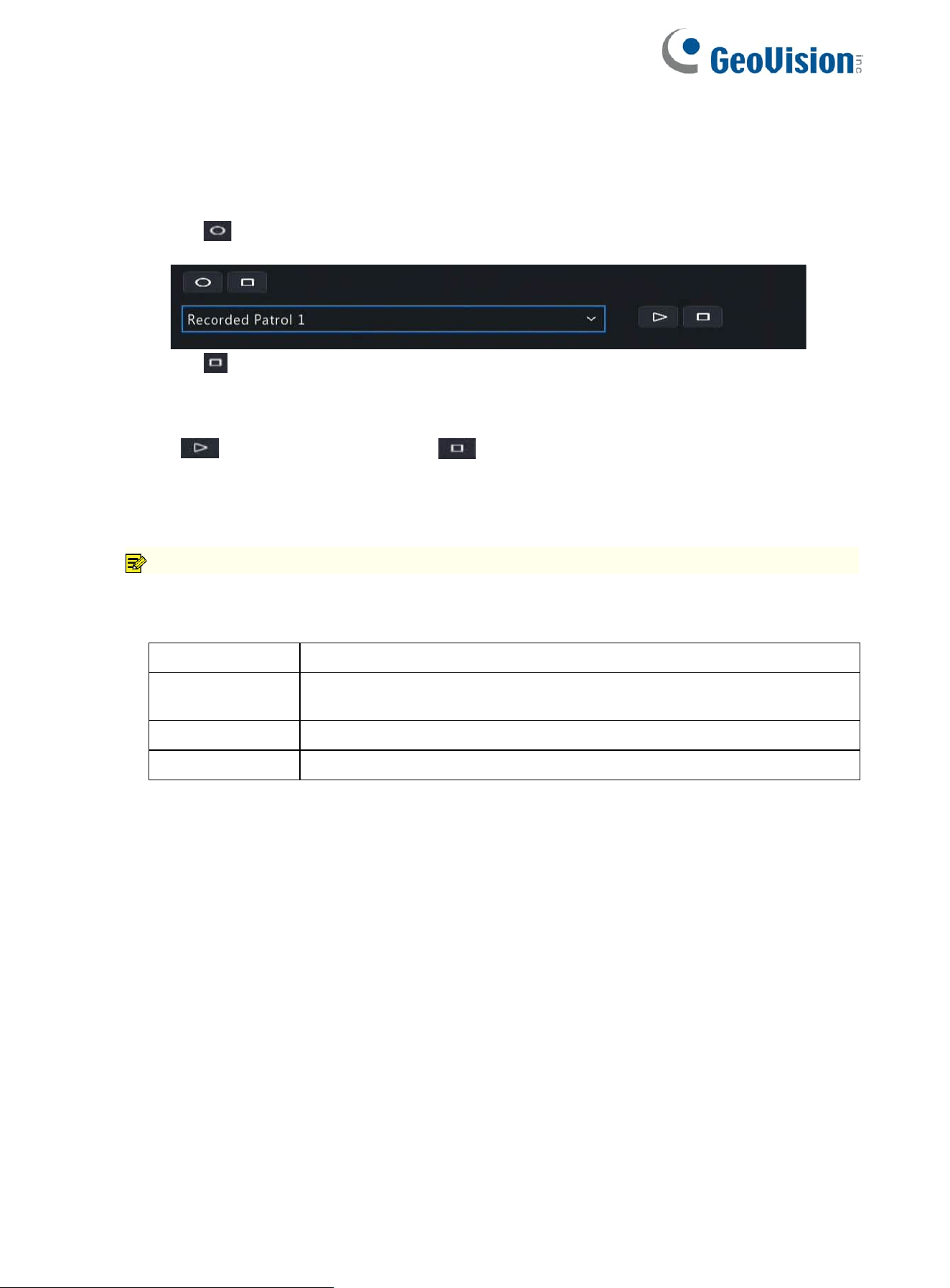
Recorded Patrol
Record a patrol route so the PTZ camera can patrol according to the recorded patrol.
• Add a Recorded Patrol
1. On the Recorded Patrol tab, select a patrol route.
2. Click to start recording. Steer the camera to the desired direction, adjust the zoom, focus, iris as
needed during the process.
3. Click to stop recording.
4. Click Apply.
• Call a Recorded Patrol
Click to start the recorded patrol. Click to stop the recorded patrol.
Auto Guard
Configure auto guard so the PTZ camera automatically performs the specified action (e.g., going to a preset or
starting a patrol) after being idle (no user operation) for a certain length of time.
1. On the Auto Guard tab, select the Enable check box to enable auto guard.
2. Set the parameters.
Item
Description
Idle State(s)
Set the idle duration for the camera to start auto guard. 1 to 3600 seconds are
available. The default is 60s.
Mode
Select preset or patrol route.
Preset/Patrol
Select a preset number or patrol route number.
3. Click Apply.
Note: Before use, you need to add a preset or a patrol route.
50
5 Search
Search for and back up recordings and snapshots based on event, object, and statistical funcitons.
5.1 Recording Backup
Recording backup refers to backing up videos stored on the NVR’s hard disk to a USB storage device. It has the
following conditions:
• The USB storage device has been formatted to FAT32 or NTFS.
• Backup permission is required.
• The recording to back up is stored on a hard disk of the NVR.
• The storage device is connected correctly to the NVR.
Normal Video Backup
Normal video backup refers to backing up scheduled recording, manual recording, and event-triggered recording.
1. Go to Menu > Search > Video > Recording.
Note: The search and backup functions may vary with device models.
Note:
• Recordings are backed up as .mp4 files by default.
• You can back up recordings in HD or SD mode.
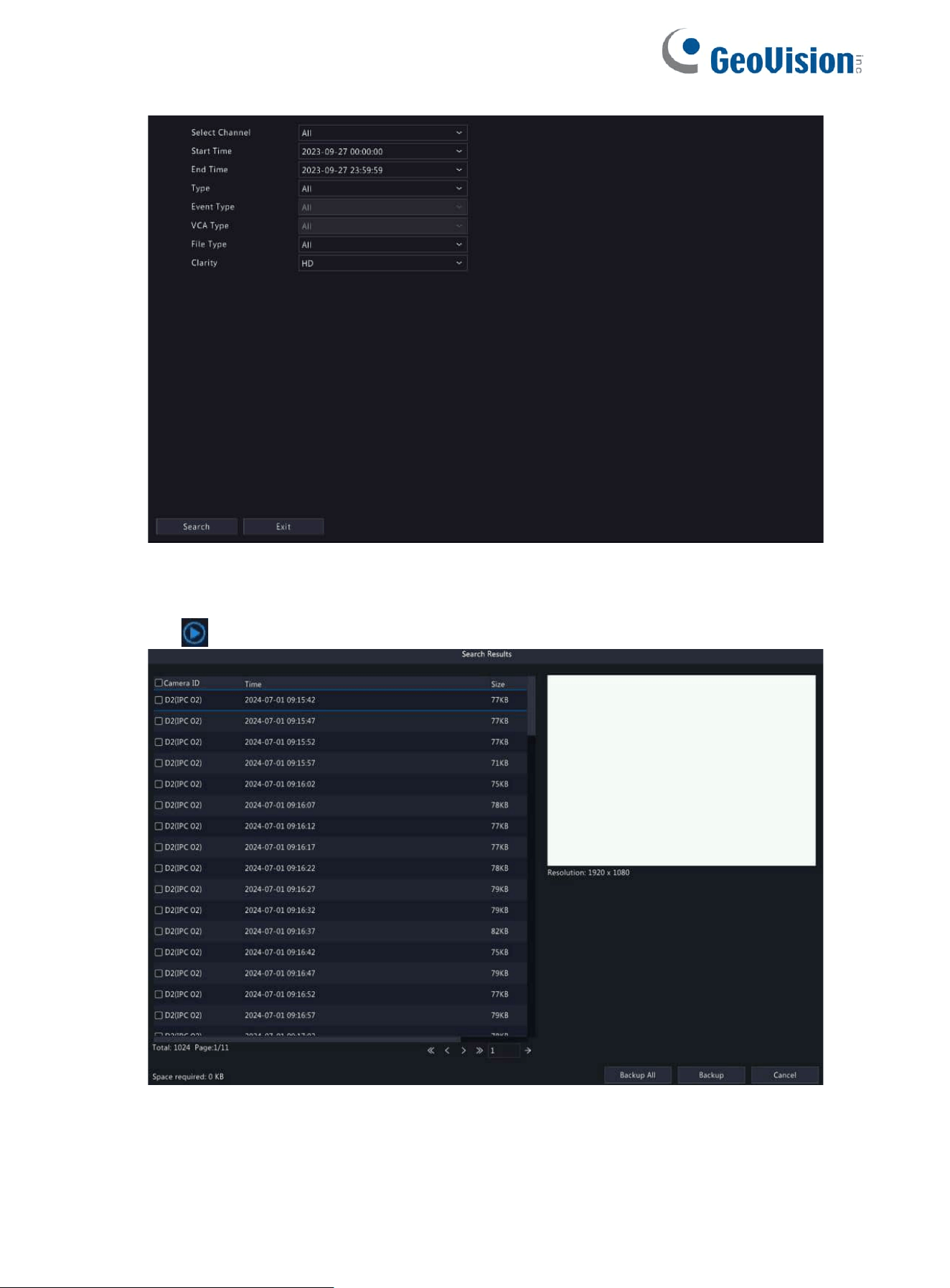
51
2. Select the desired camera(s). All cameras are selected by default.
3. Set search conditions, including the start time, end time, recording type, event type, VCA type, file type, and
clarity (HD or SD).
4. Click Search. Search results are displayed. The image from the first search result is displayed on the right side.
5. Choose a way to back up recording(s) as needed.
• Select the recording(s) you want to back up, and then click Backup.
• Or click Backup All to back up all the recordings in the list.
Click
to play the video.
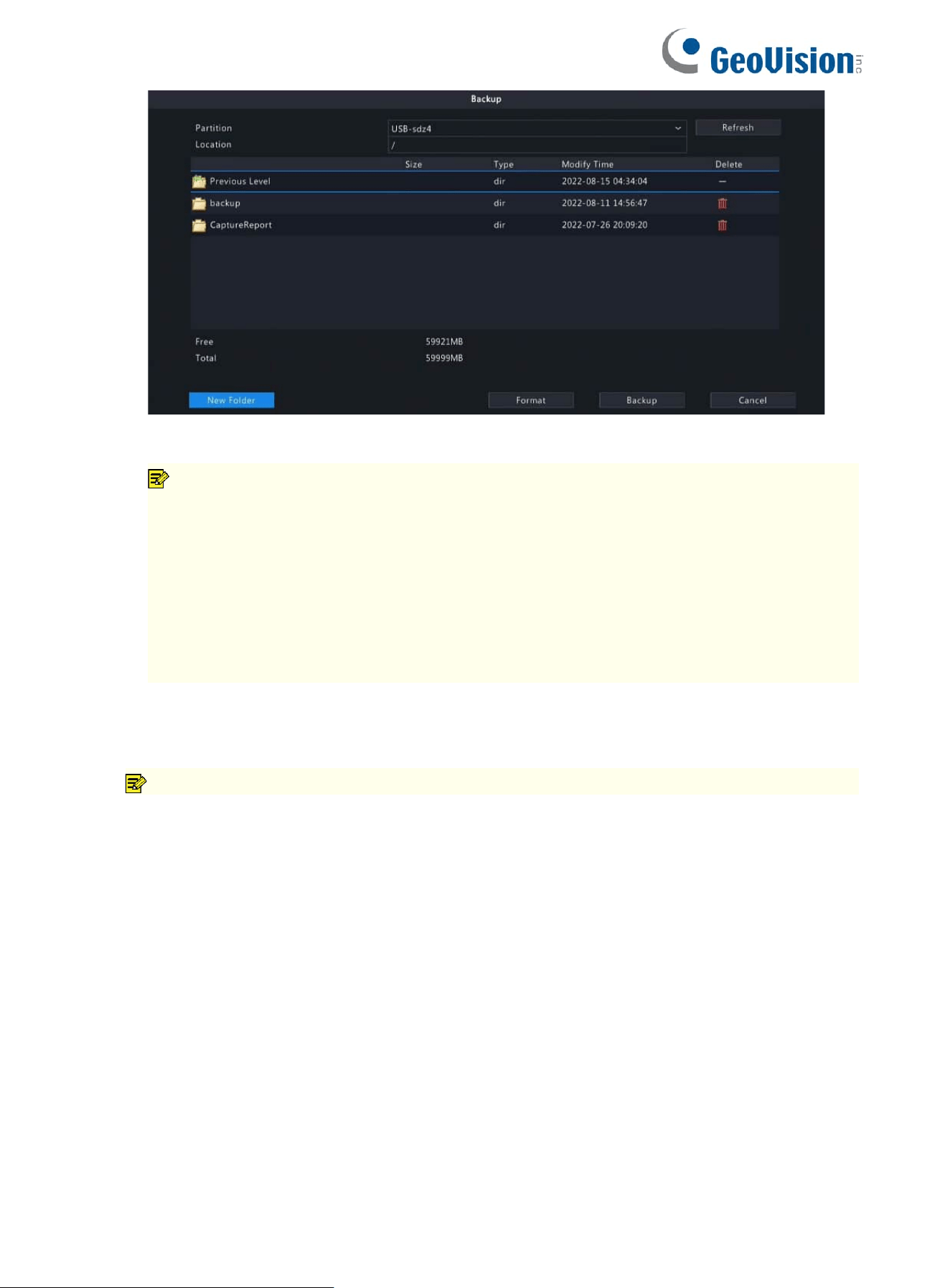
52
6. Select the partition and storage path, and then click Backup. You can also create a new folder for the
recording(s) by clicking New Folder.
5.2 Image Backup
Image backup refers to backing up images stored on the NVR’s hard disk to a USB storage device.
Normal Snapshot Backup
Normal snapshot backup refers to backing up scheduled snapshot, manual snapshot, and event-triggered
snapshot.
1. Go to Menu > Search > Picture > Snapshot Backup.
Note:
• Click Format to format the USB device. A USB device with more than 2TB capacity can only be
formatted to NTFS, with 2TB or less capacity can be formatted to NTFS or FAT32. Only certain NVRs
can format a USB device with more than 2TB capacity.
• During backup, a progress bar is displayed to indicate the progress (e.g., Exporting X/Y) , where X
indicates the current number being backed up, and Y indicates the total number of recordings. To stop
the backup, click Cancel.
• A backup file is named in this format: Camera ID_S recording start time_E recording end time.file
extension. For example, D1-S20220823000400_E20220823003148.mp4, where S means the start
time, and E means the end time.
Note: The default format of image backup is *.JPG.
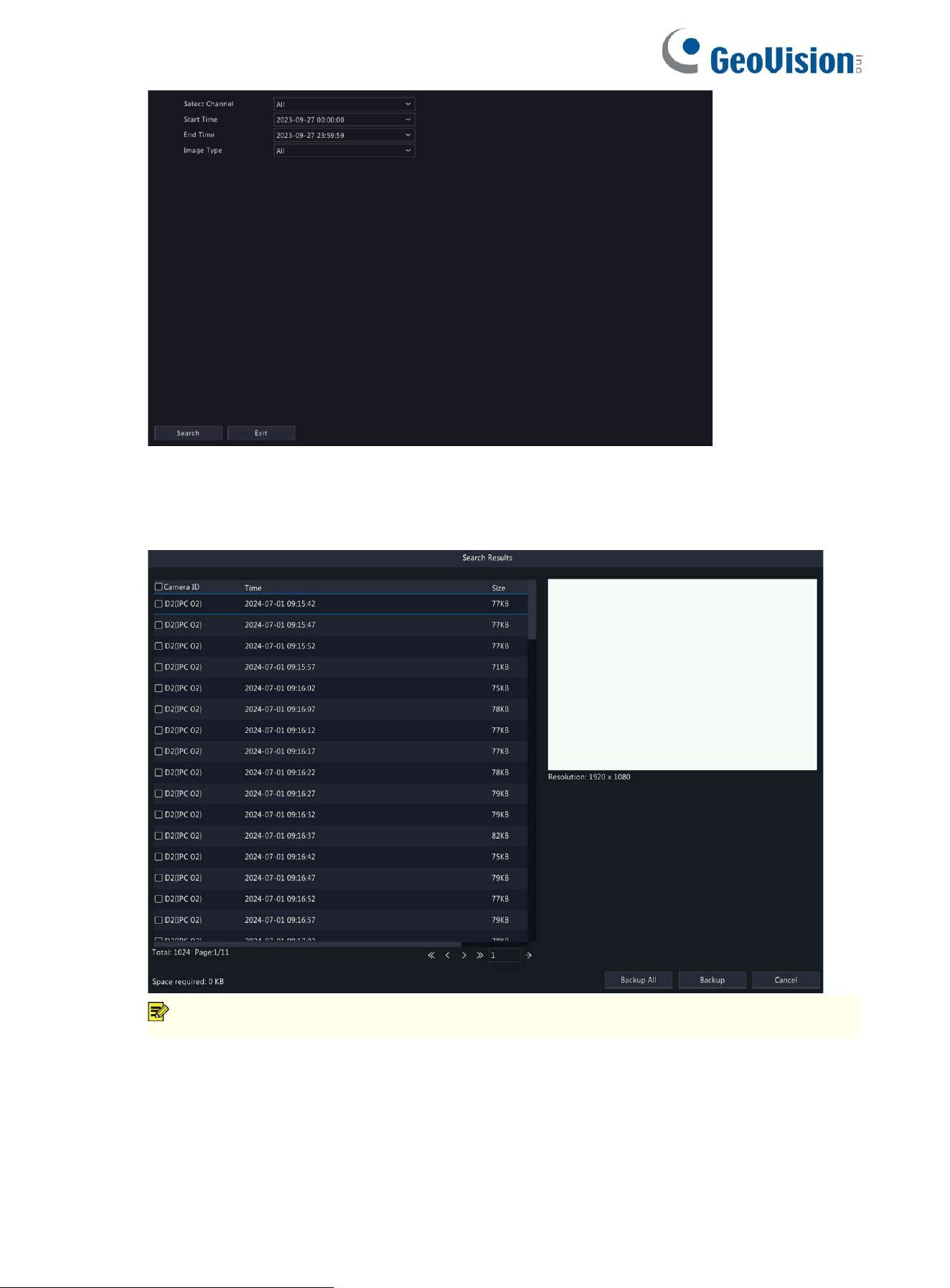
53
2. Select the desired camera(s). All cameras are selected by default.
3. Set search conditions, including the image type, start time, and end time.
4. Click Search. Search results are displayed. The image displayed on the right is from the first result in the list by
default.
5. Choose a way to back up image(s) as needed.
• Select the desired image(s) you want to back up, and then click Backup.
• Or click Backup All to back up all the images in the list.
6. Select the partition and storage path, click Backup. Then the images are backed up to the specified path on
the storage device. You can also create a new folder for the image(s) by clicking New Folder.
Note: The image resolution depends on the resolution from the output interface and the number of
windows displayed when the snapshot is taken.
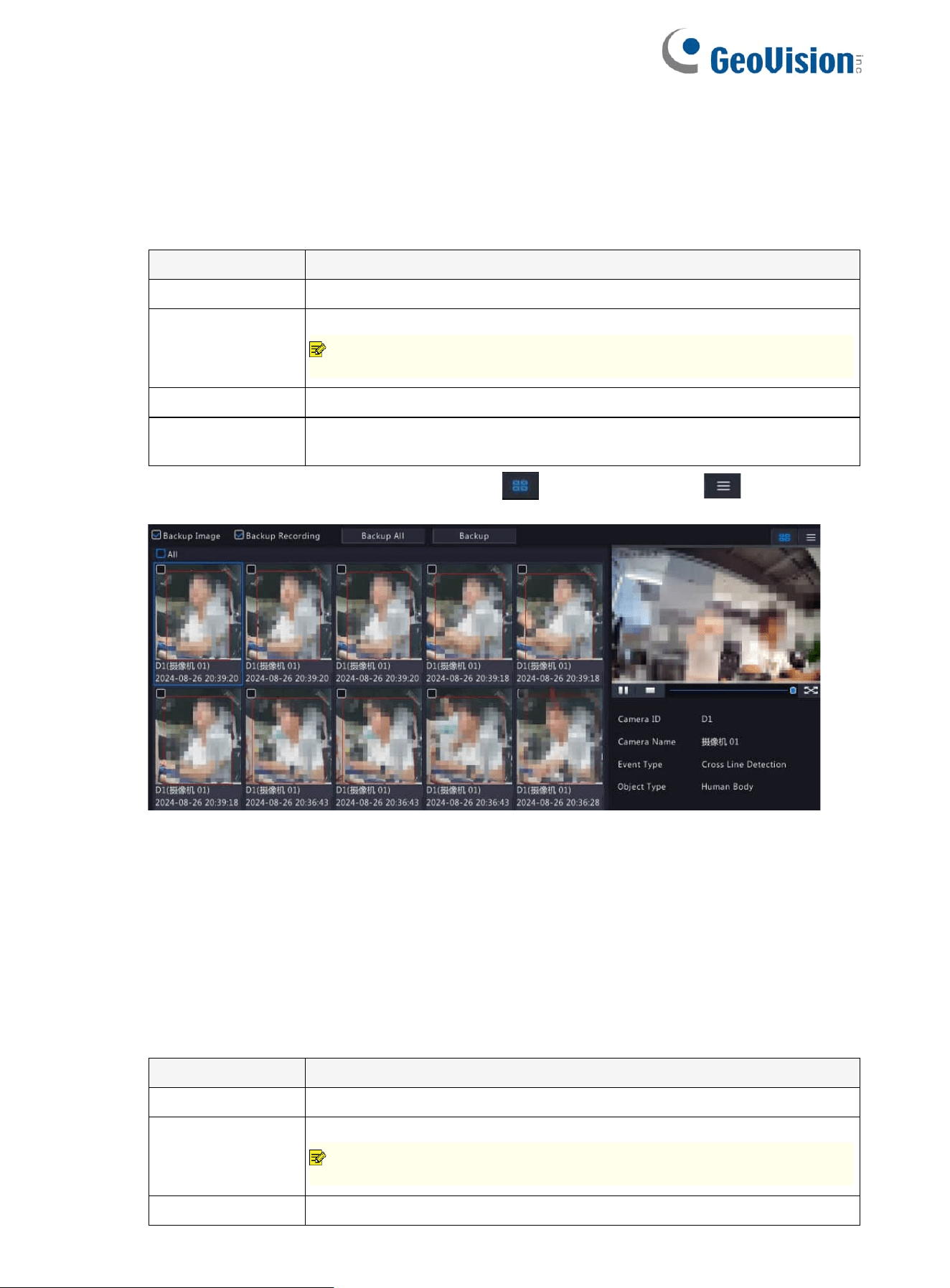
54
5.3 Event
Smart Event
Back up images and recordings triggered by smart event alarms.
1. Go to Menu > Search > Event > Event Search.
2. Set search conditions.
Parameter
Description
Select Channel
Select the channel(s) to search.
Start/End Time
Specify the time period to search.
Note: A search range smaller than five months is recommended, because
earlier snapshots and recordings may have been overwritten due to full storage.
Event Type
Select Smart Event.
Smart Event Type
Select the smart event type: All, Cross Line Detection, Intrusion Detection, Enter
Area, Leave Area, and Ultra Motion Detection.
3. Click Search. The search results are shown in tile mode by default. You may click to switch to list
mode.
• Click any image to view the 15s video (10s before and 5s after the snapshot time) and detailed information
about it.
• Double-click an image on the left to magnify it; double-click the recording on the right to play it in full
screen. See search results of Motor Vehicle Search for details.
4. Select Backup or Backup All. See for details.
Basic Event
Back up images and recordings triggered by basic event alarms.
1. Go to Menu > Search > Event > Event Search.
2. Set search conditions.
Parameter
Description
Select Channel
Select the channel(s) to search.
Start/End Time
Specify the time period to search.
Note: A search range smaller than five months is recommended, because
earlier snapshots and recordings may have been overwritten due to full storage.
Event Type
Select Basic Event.
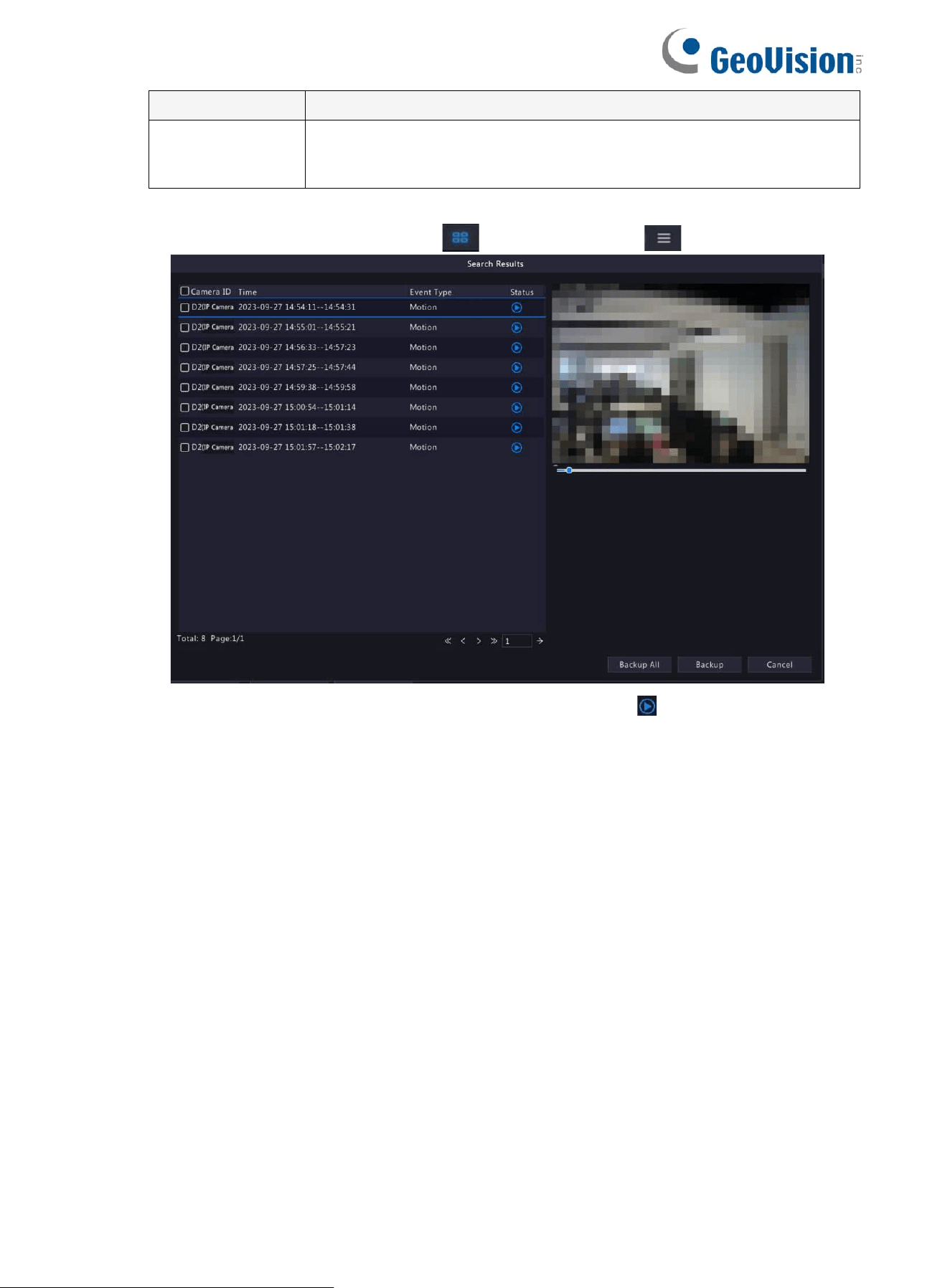
55
Parameter
Description
Basic Event Type
Select the basic event type: All, Motion Detection, Video Loss, Audio Detection,
People Present Alarm, Human Body Detection, People Present Minor Alarm,
People Present Major Alarm, and People Present Critical Alarm.
3. Click Search.
•
The image from the first search result is displayed on the right side. Click to play the video.
4. Back up search results. See Back up search results for details.
5.4 Object
Search for images based on various objects, including person, motor vehicle, and non-motor vehicle.
5.4.1 Person Search
Search for images based on human body events, face snapshots and face comparison results.
5.4.1.1 Human Body Search
Search for images based on human body events.
1. Go to Menu > Search > Object > Person > Human Body Search.
•
The search results are shown in tile mode
by default. You may click
to switch to list mode.
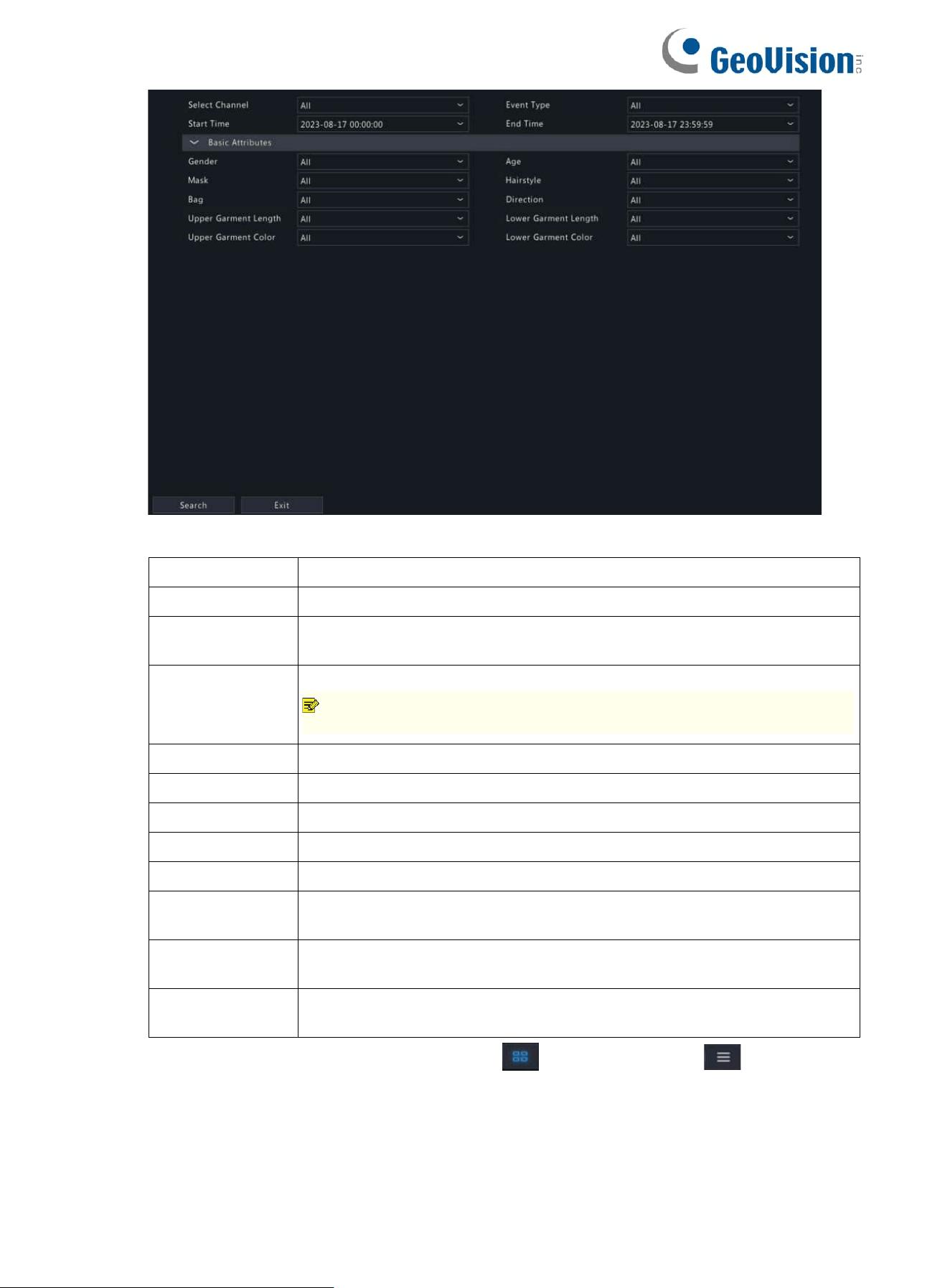
56
2. Set search conditions.
Parameter
Description
Select Channel
Select the channel(s) to search.
Event Type
Select the event type: All, Cross Line Detection, Intrusion Detection, Enter Area,
Leave Area, and Ultra Motion Detection.
Start/End Time
Specify the time period to search.
Note: A search range smaller than five months is recommended, because earlier
snapshots and recordings may have been overwritten due to full storage.
Gender
Select the gender: All, Male, or Female.
Age
Select the age: All, Childhood, Teenager, Youth, Middle Age, or Senior.
Mask
Select the mask: All, No Mask, or With Mask.
Hairstyle
Select the hairstyle: All, Long Hair, or Short Hair.
Bag
Select the bag: All, No Bag, Handbag, or Backpack.
Direction
Select the direction: All, Motionless, Upward, Downward, Leftward, Rightward, Top
Left, Bottom Left, Top Right, or Bottom Right.
Upper Garment
Length
Select the upper garment length: All, Short Sleeve, or Long Sleeve.
Lower Garment
Length
Select the lower garment length: All, Shorts, or Trousers.
3. Click Search. The search results are shown in tile mode by default. You may click to switch to list
mode.
• Click any image to view the 15s video (10s before and 5s after the snapshot time) and detailed information
about it.
• Double-click an image on the left to magnify it; double-click the recording on the right to play it in full
screen.
• You can click All Attributes to view detailed human body attributes.
4. Back up search results. See Back up search results for details.
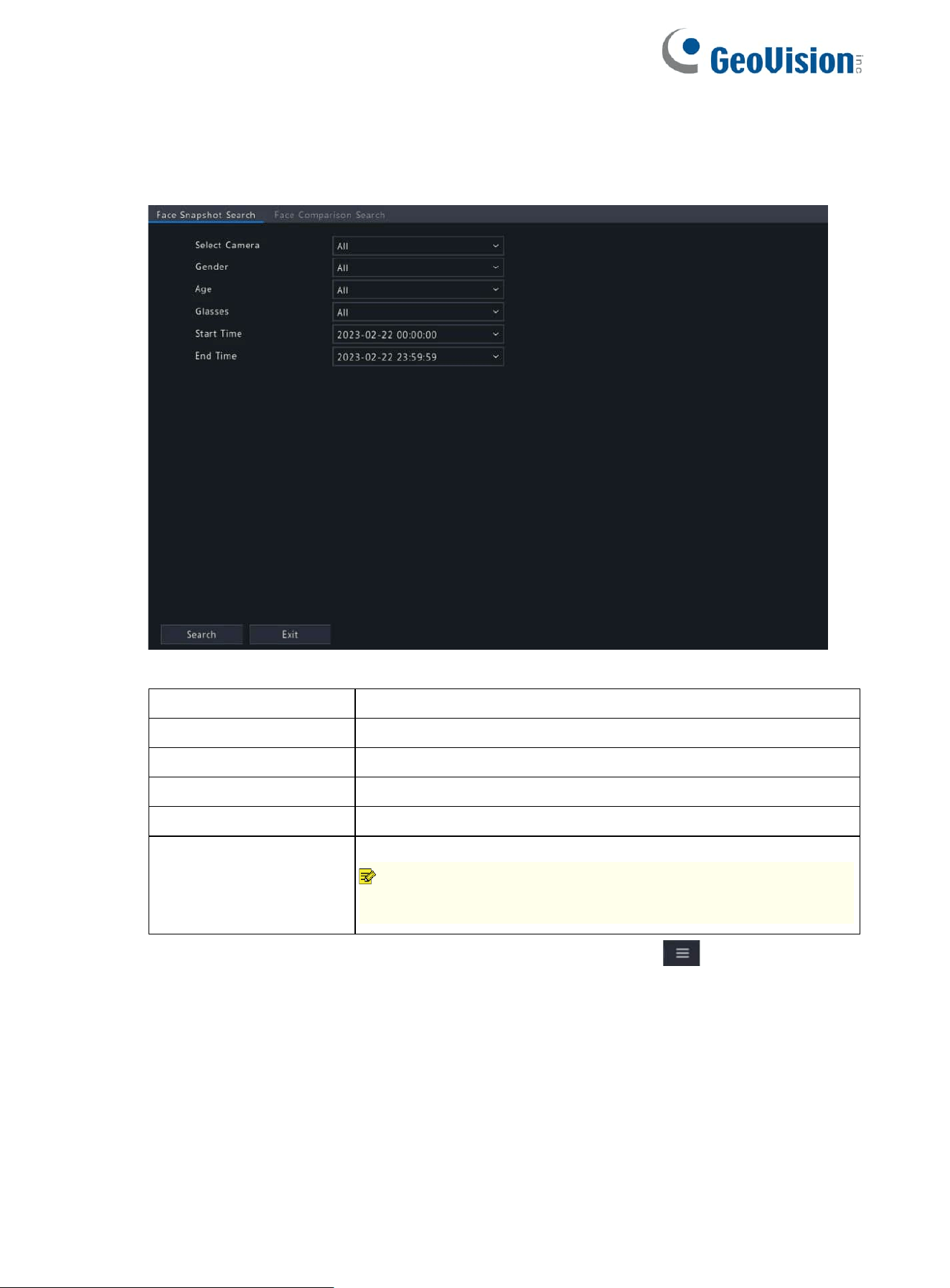
57
5.4.1.2 Face Snapshot Search
Search for face snapshots.
Search Face Snapshots
1. Go to Menu > Search > Object > Person > Face Snapshot Search.
2. Set search conditions.
Parameter
Description
Select Camera
Select the camera(s) to search.
Gender
Select the gender: All, Male, or Female.
Age
Select the age: All, Childhood, Teenager, Youth, Middle Age, or Senior.
Glasses
Select the glasses status: All, No Glasses, or With Glasses.
Start/End Time
Specify the time period to search for face snapshots.
Note: A search range smaller than five months is recommended,
because earlier snapshots and recordings may have been overwritten
due to full storage.
3. Click Search. The search results are shown in tile mode by default. You may click to switch to list mode.
• Click any image to view the 15s video (10s before and 5s after the snapshot time) and detailed information
about it.
• Double-click an image on the left to magnify it; double-click the recording on the right to play it in full
screen.
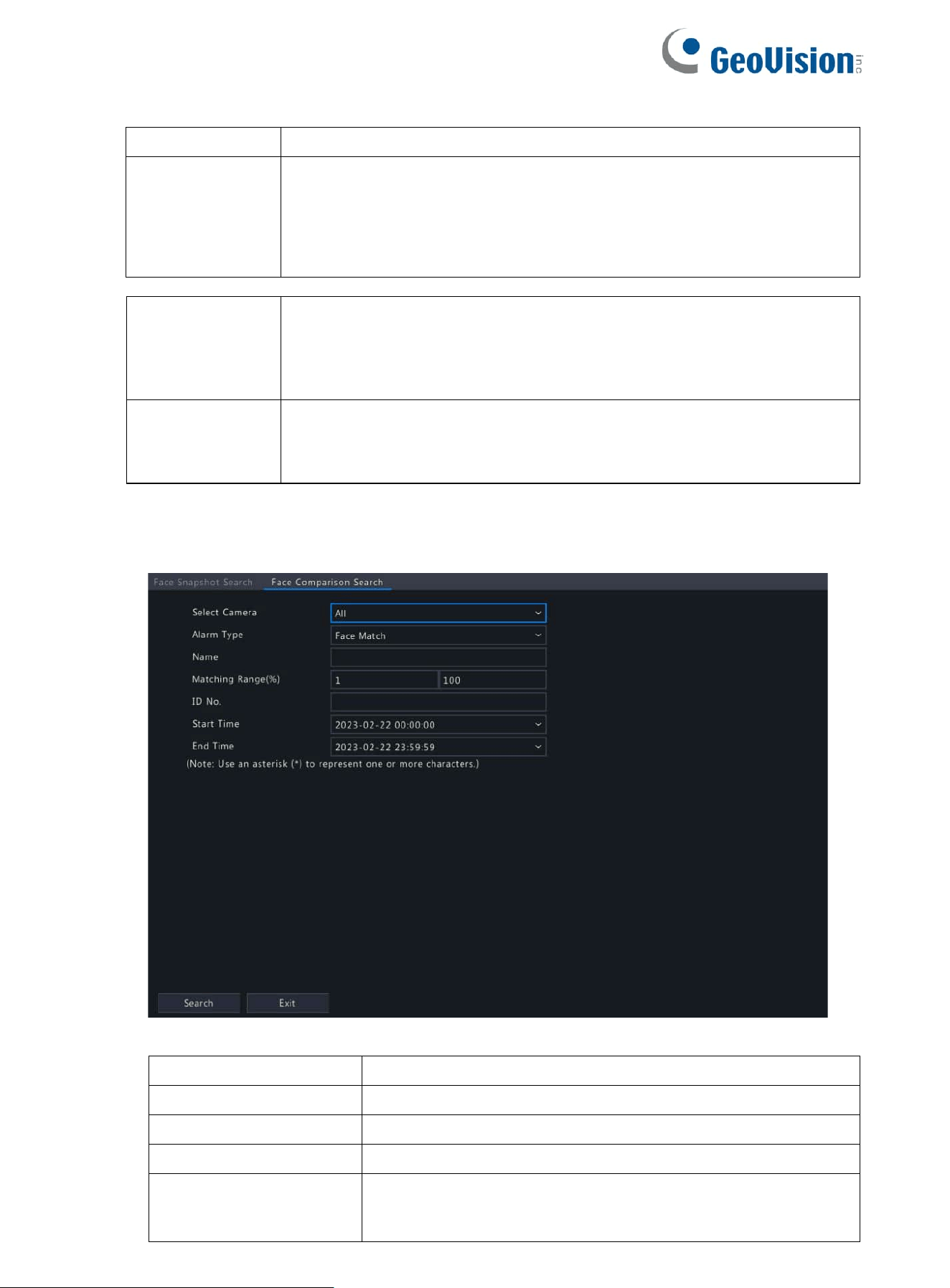
58
Other Operations
Operation
Description
Backup/Backup All
1. Enable Backup Image or/and Backup Recording as needed. By default, they are
both enabled.
• Backup Image: Back up the selected image(s) to an external device.
• Backup Recording: Back up the 15s video of the selected image(s) to an external
device.
2. Select Backup or Backup All.
• Backup: Back up specified search results. Select the search result(s) you want to
back up and click Backup.
• Backup All: Back up all search results. Click Backup All.
Export Results
1. Enable Backup Image or/and Backup Recording as needed, and click Export Results.
2. Select the export partition and click Export Results to export the search results to an
external storage device.
5.4.1.3 Face Comparison Search
Search for face comparison results.
1. Go to Menu > Search > Object > Person > Face Comparison Search.
2. Set search conditions.
Parameter
Description
Select Camera
Select the camera(s) to search.
Alarm Type
Select the alarm type: Face Match or Face Not Match.
Name
Enter the name you want to search.
Matching Range (%)
The similarity between the captured faces and the face images in face lists,
ranging from 1% to 100%. The higher the similarity, the more accurate the
face comparison. Set it as needed.
59
ID No.
Enter the ID number you want to search.
Start/End Time
Specify the time period to search for face snapshots.
Note: A search range smaller than five months is recommended,
because earlier snapshots and recordings may have been overwritten
due to full storage.
3. Click Search. The search results are shown in tile mode by default. You may click to switch to list mode.
• Click any image to view the 15s video (10s before and 5s after the snapshot time) and detailed information
about it.
• Double-click an image on the left to magnify it; double-click the recording on the right to play it in full
screen.
4. Back up search results.
(1) Enable Backup Image or/and Backup Recording as needed. By default, they are both enabled.
• Backup Image: Back up the selected image(s) to an external device.
• Backup Recording: Back up the 15s video of the selected image(s) to an external device.
(2) Select Backup or Backup All.
• Backup: Back up specified search results. Select the search result(s) you want to back up and click
Backup.
• Backup All: Back up all search results. Click Backup All.
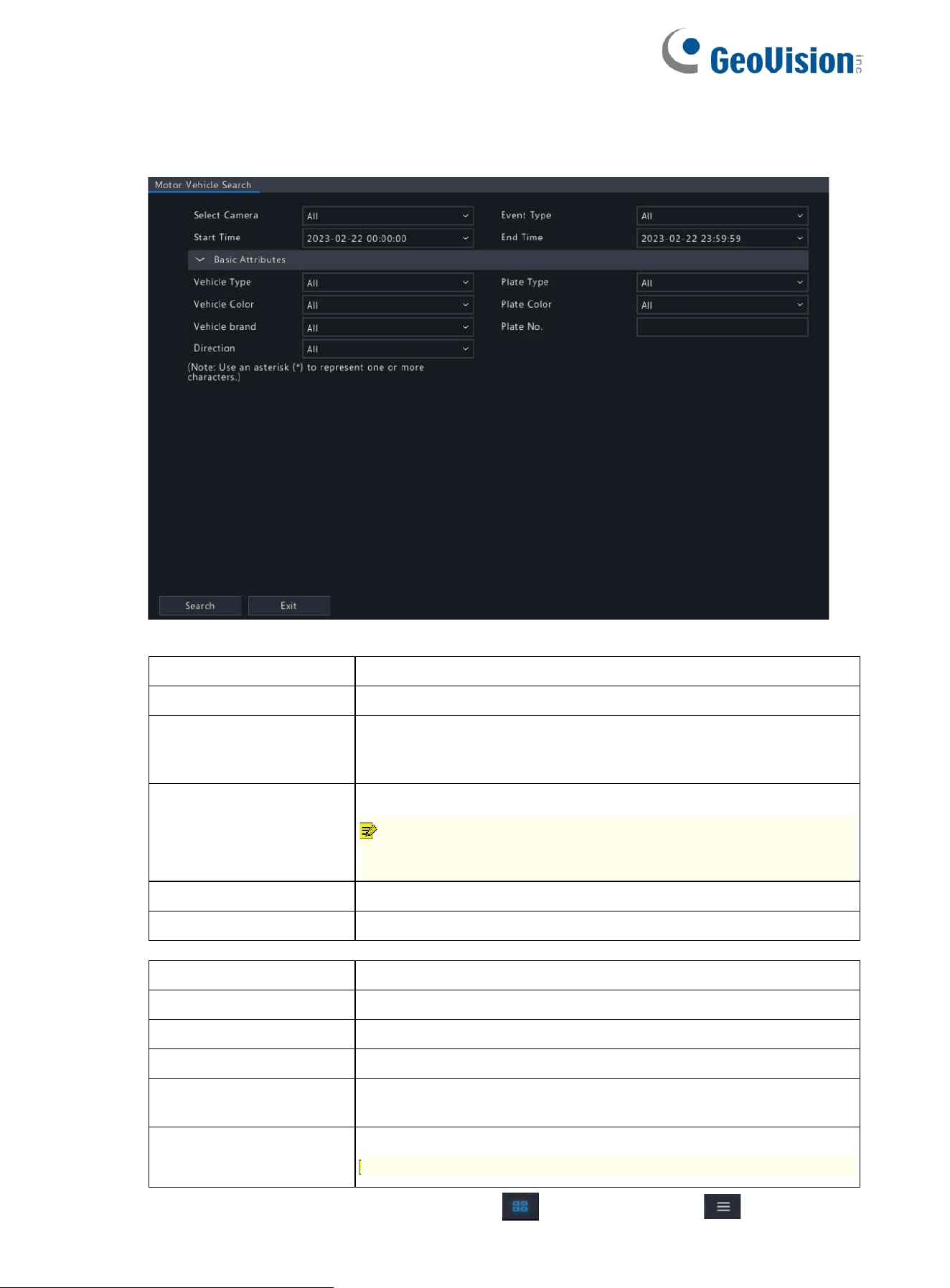
60
5.4.2 Motor Vehicle Search
Search for images based on motor vehicle monitoring events.
1. Go to Menu > Search > Object > Motor Vehicle > Motor Vehicle Search.
2. Set search conditions.
Parameter
Description
Select Camera
Select the camera(s) to search.
Event Type
Select the event type: All, Cross Line Detection, Intrusion Detection, Enter
Area, Leave Area, and Ultra Motion Detection.
Start/End Time
Specify the time period to search.
Note: A search range smaller than five months is recommended,
because earlier snapshots and recordings may have been overwritten
due to full storage.
Vehicle Type
Select the vehicle type to search.
Plate Type
Select the plate type to search.
Vehicle Color
Select the vehicle color to search.
Plate Color
Select the plate color to search.
Vehicle Brand
Select the vehicle brand to search.
Plate No.
Enter the plate number to search.
Direction
Select the direction: All, Motionless, Upward, Downward, Leftward,
Rightward, Top Left, Bottom Left, Top Right, or Bottom Right.
Plate Comparison
Select the plate comparison type: All, Match, or Not Match.
Note: This parameter appears when Event Type is Plate Comparison.
3. Click Search. The search results are shown in tile mode by default. You may click to switch to list
mode.
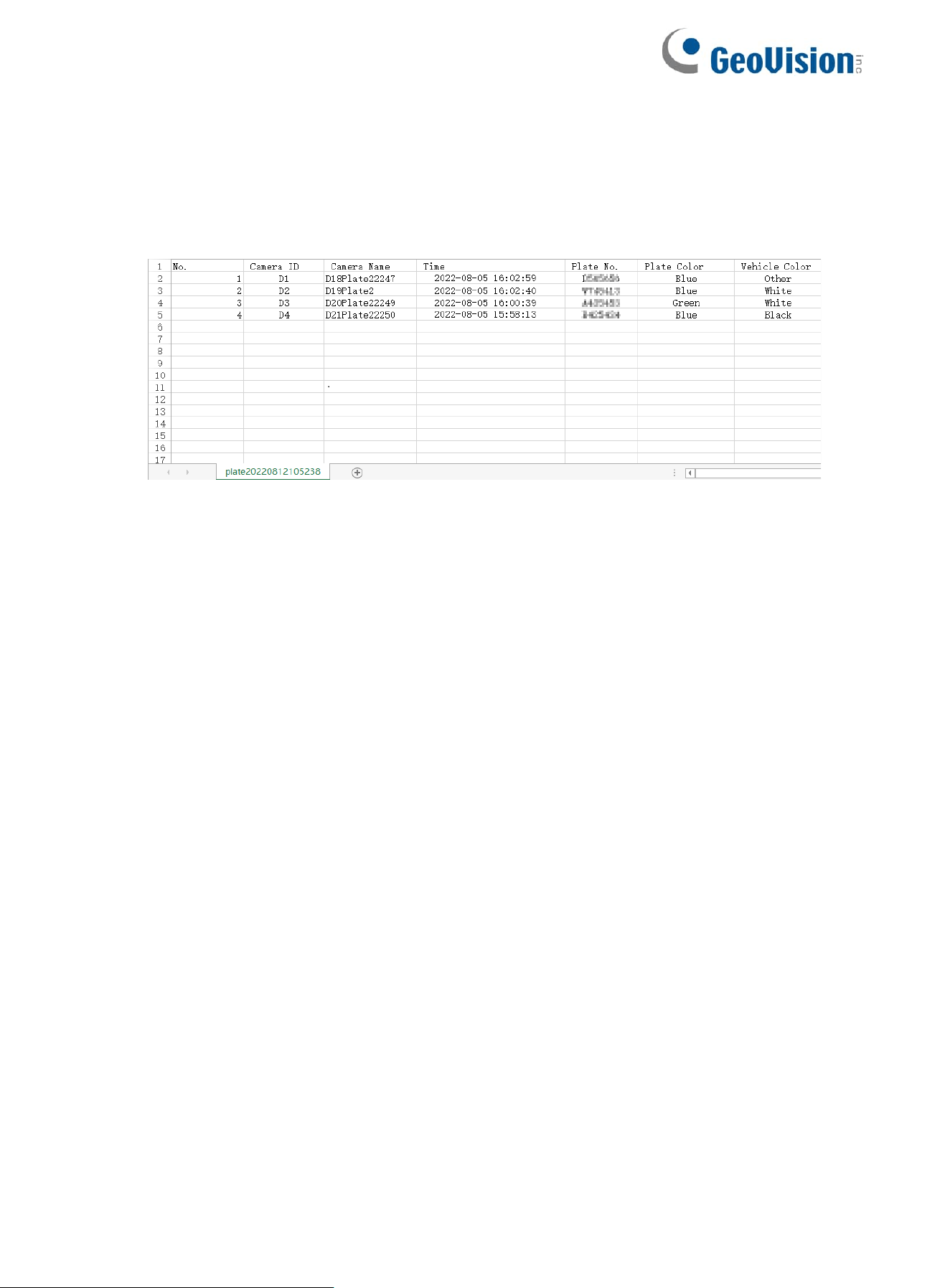
61
• Click any image to view the 15s video (10s before and 5s after the snapshot time) and detailed information
about it.
• Double-click an image on the left to magnify it; double-click the recording on the right to play it in full
screen.
• You can click All Attributes to view detailed motor vehicle attributes.
4. Back up search results. See Back up search results for details.
5. To export the search results as a .CSV file, click Export Results.
5.4.3 Non-Motor Vehicle Search
Search for images based on non-motor vehicle events.
1. Go to Menu > Search > Object > Non-Motor Vehicle > Non-Motor Vehicle Search.
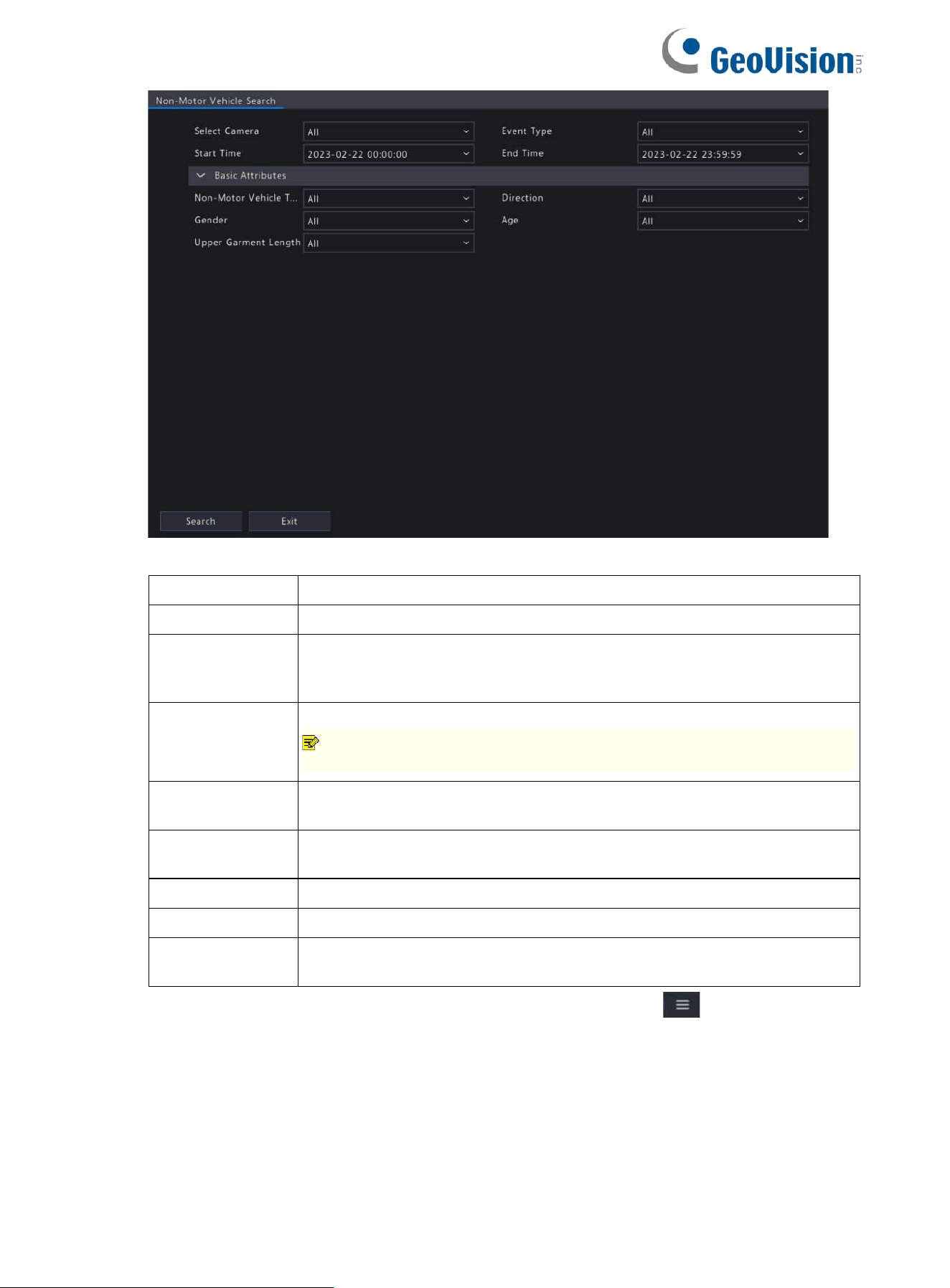
62
2. Set search conditions.
Parameter
Description
Select Camera
Select the camera(s) to search.
Event Type
Select the event type: All, Cross Line Detection, Intrusion Detection, Enter Area,
Leave Area, and Ultra Motion Detection.
Start/End Time
Specify the time period to search.
Note: A search range smaller than five months is recommended, because earlier
snapshots and recordings may have been overwritten due to full storage.
Non-Motor Vehicle
Type
Select the non-motor vehicle type: All, Bicycle, 3-wheel Vehicle, Motorcycle, Electric
Moped, or 2-wheel Vehicle.
Direction
Select the direction: All, Motionless, Upward, Downward, Leftward, Rightward, Top
Left, Bottom Left, Top Right, or Bottom Right.
Gender
Select the gender: All, Male or Female.
Age
Select the age: All, Childhood, Teenager, Youth, Middle Age, or Senior.
Upper Garment
Length
Select the upper garment length worn by drivers: All, Short Sleeve, or Long Sleeve.
3. Click Search. The search results are shown in tile mode by default. You may click to switch to list mode.
• Click any image to view the 15s video (10s before and 5s after the snapshot time) and detailed information
about it.
• Double-click an image on the left to magnify it; double-click the recording on the right to play it in full
screen.
• You can click All Attributes to view detailed non-motor vehicle attributes (human body attributes will be
shown when event type is multi-target detection).
4. Select Backup or Backup All. See Backup or Backup All for details.
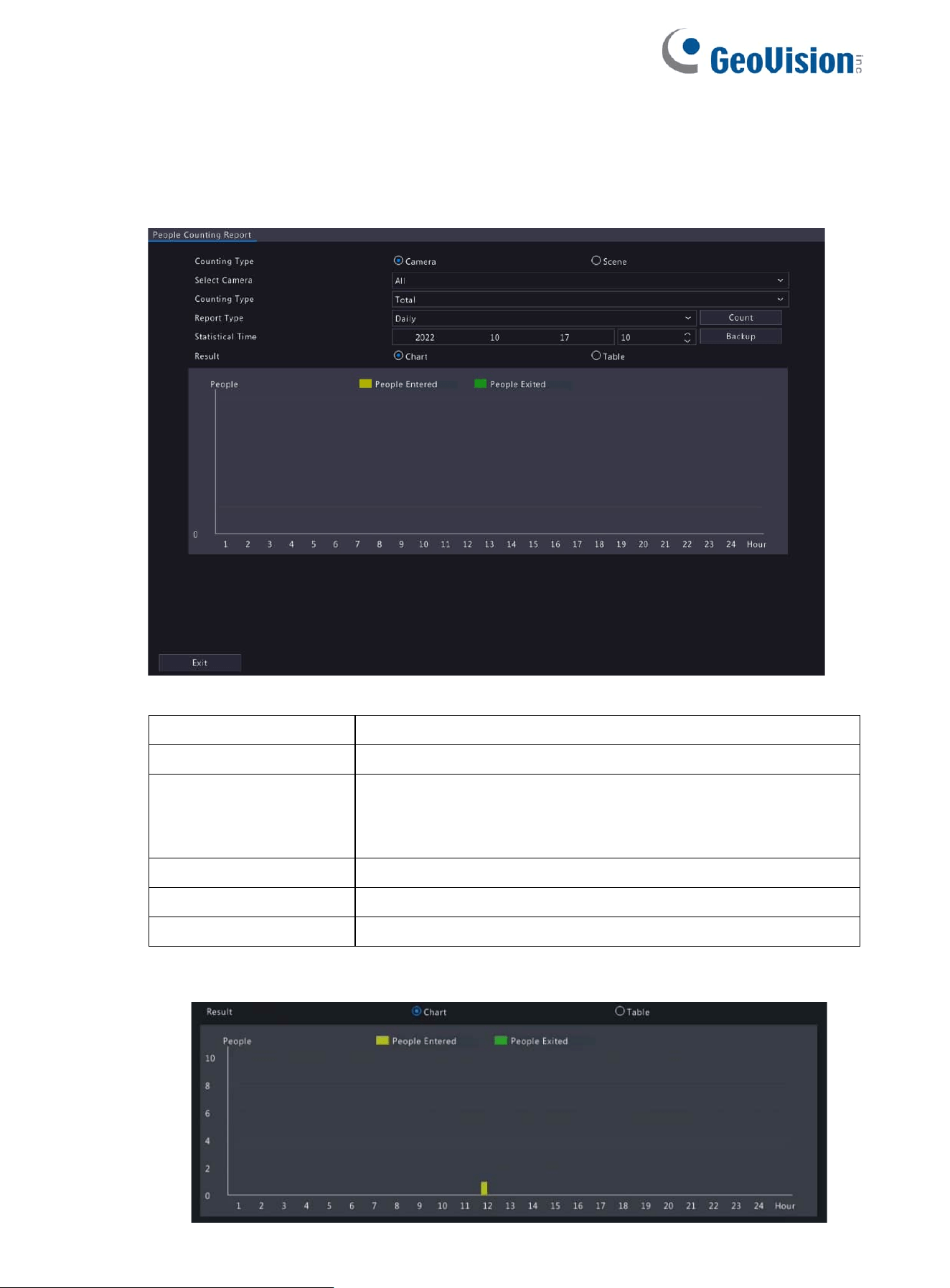
63
5.5 Statistics
5.5.1 People Counting Report
Search for people counting data. You can view daily/weekly/monthly/yearly people counting reports, the number
of people entering and/or leaving a certain area or scene during a specified time period.
1. Go to Menu > Search > Statistics > People Counting Report.
2. Set search conditions.
Parameter
Description
Counting Type
Count people flow data according to the camera or scene.
Select Camera/Scene Select
• Camera: Select the camera(s) to search.
• Scene: Select the scene to search. Please configure scene information
first, see People Present Alarm for details.
Counting Type
Select the counting type to search: Total, People Entered, or People Exited.
Report Type
Select the report type to view: Hourly, Daily, Weekly, Monthly, or Yearly.
Statistical Time
Select the time to count.
3. Select to create the report as a chart or a table.
• Chart
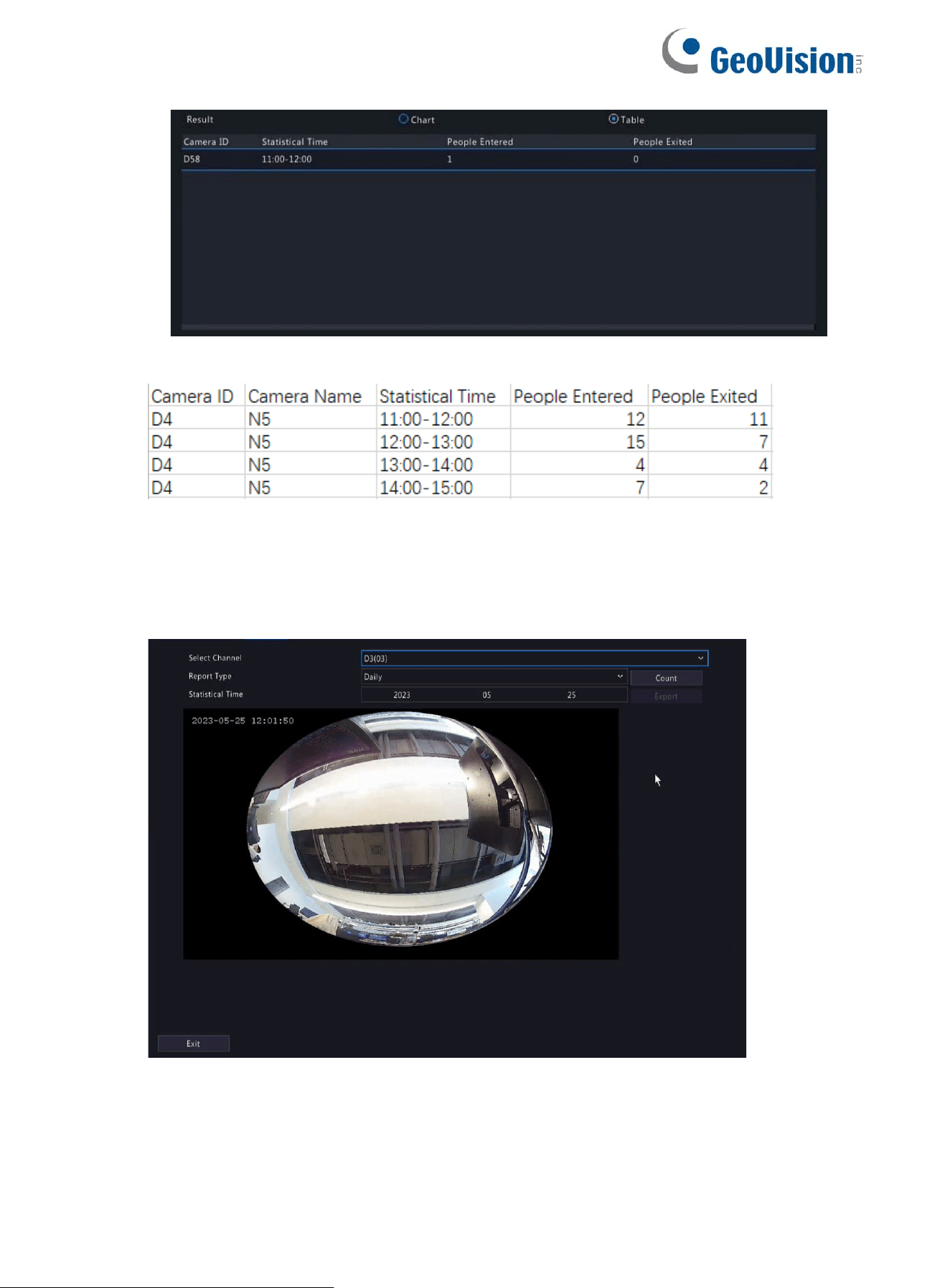
64
• Table
4. Click Backup to export the report to an external storage device as a .CSV file. The content of the file exported
from a report in chart or table format is the same. Take the exported results of daily report as an example:
5.5.2 Heat Map
The heat map function is used with a fisheye camera to monitor people counting in supermarkets or shops. You
can view the heat map formed by the people flow statistics of a specified channel during a specified time period,
which can help you plan accordingly, and improve service, operational efficiency and profitability.
1. Go to Menu > Search > Statistics > Heat Map.
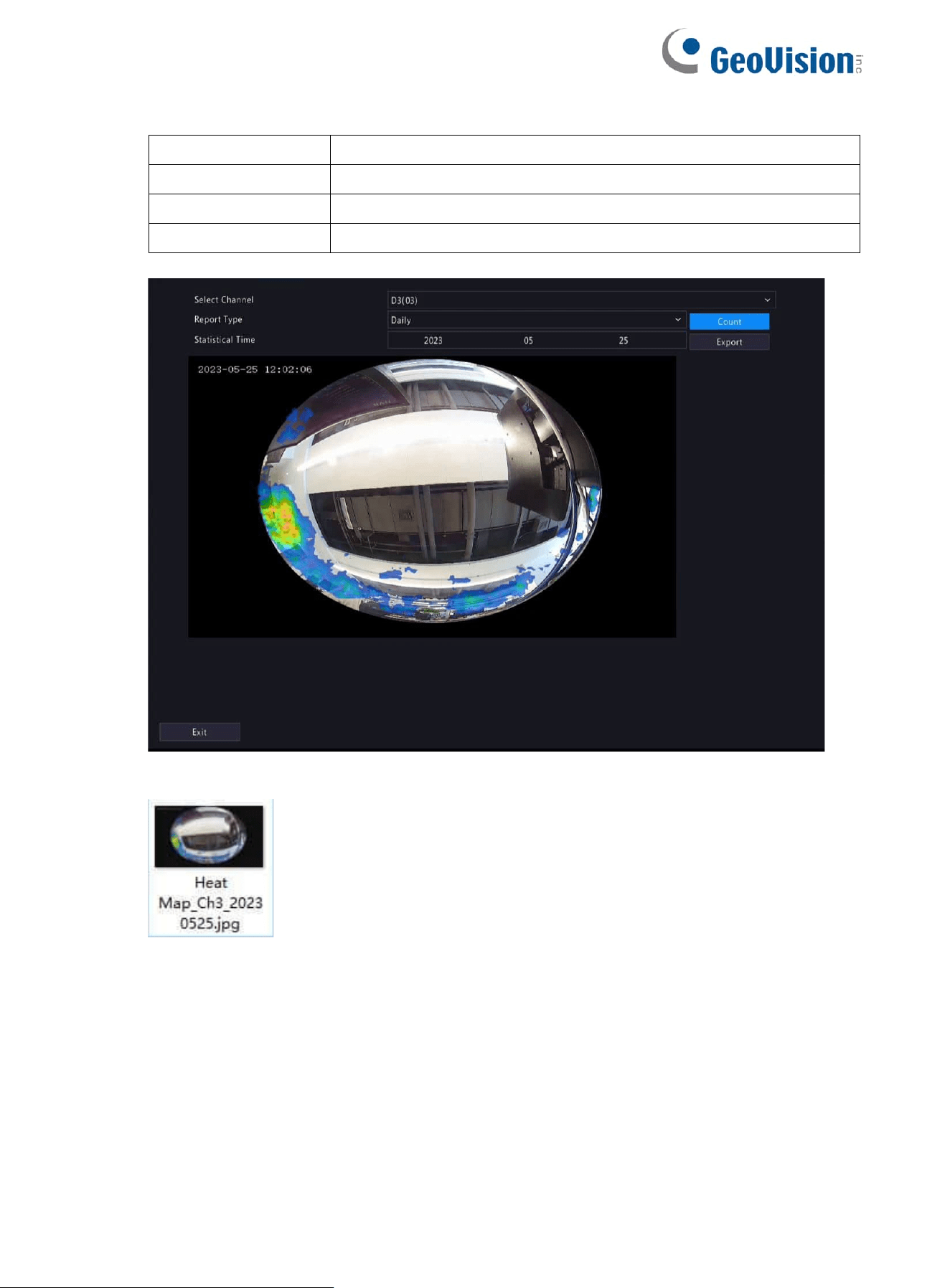
65
2. Set search conditions.
Parameter
Description
Select Channel
Select the channel to count heat data.
Report Type
Select the report type to view: Daily, Weekly, Monthly, or Yearly.
Statistical Time
Select a statistical period.
3. Click Count to view the result.
4. Click Export to export the heat map image to an external storage device as a .jpg file. The exported file is an
image, regardless of the report type. Take the exported result of daily report as an example:
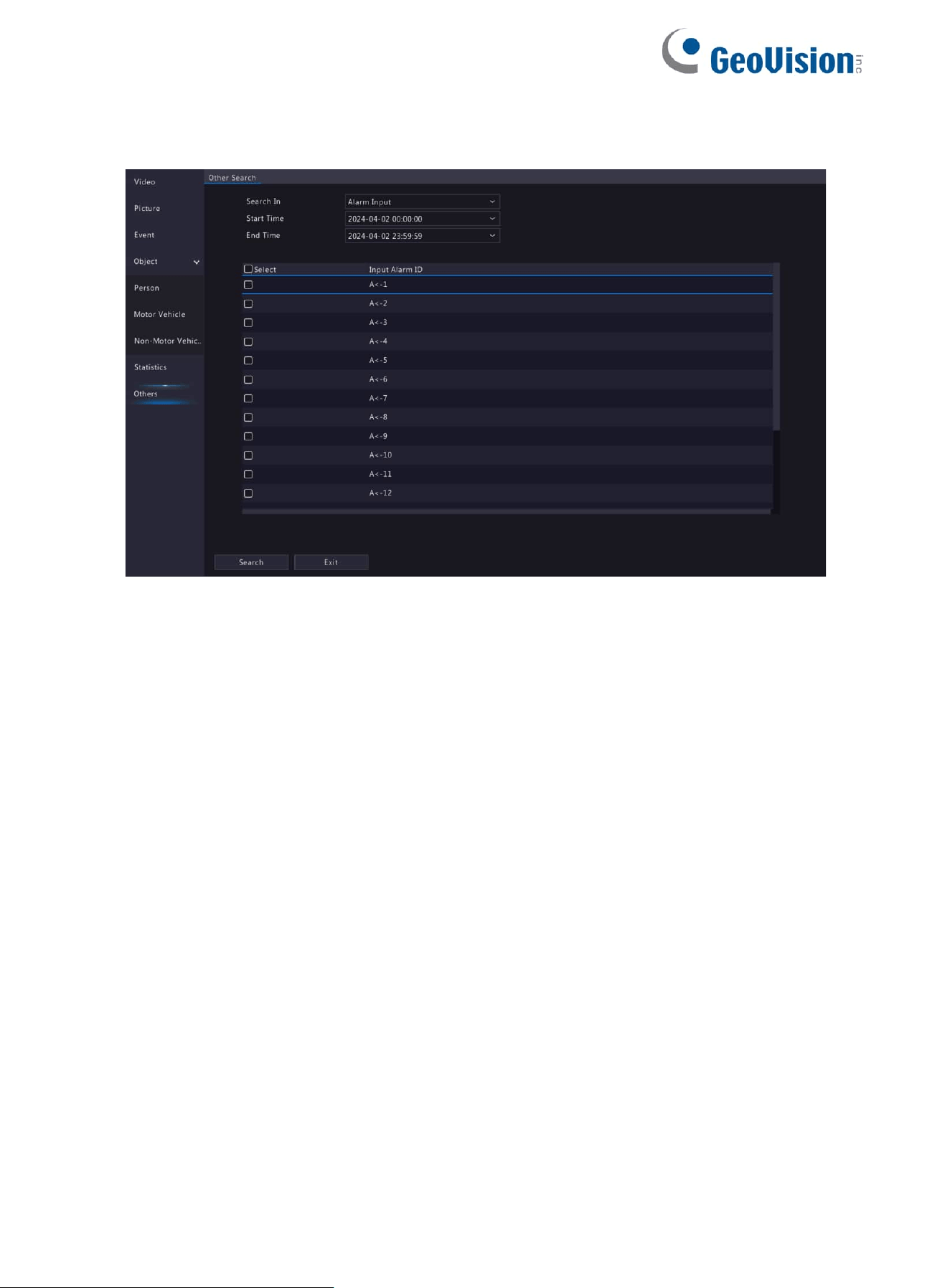
66
5.6 Others
Search for recordings based on alarm input, tags search, POS search, people present alarm, people present minor
alarm, people present major alarm, and people present critical alarm.
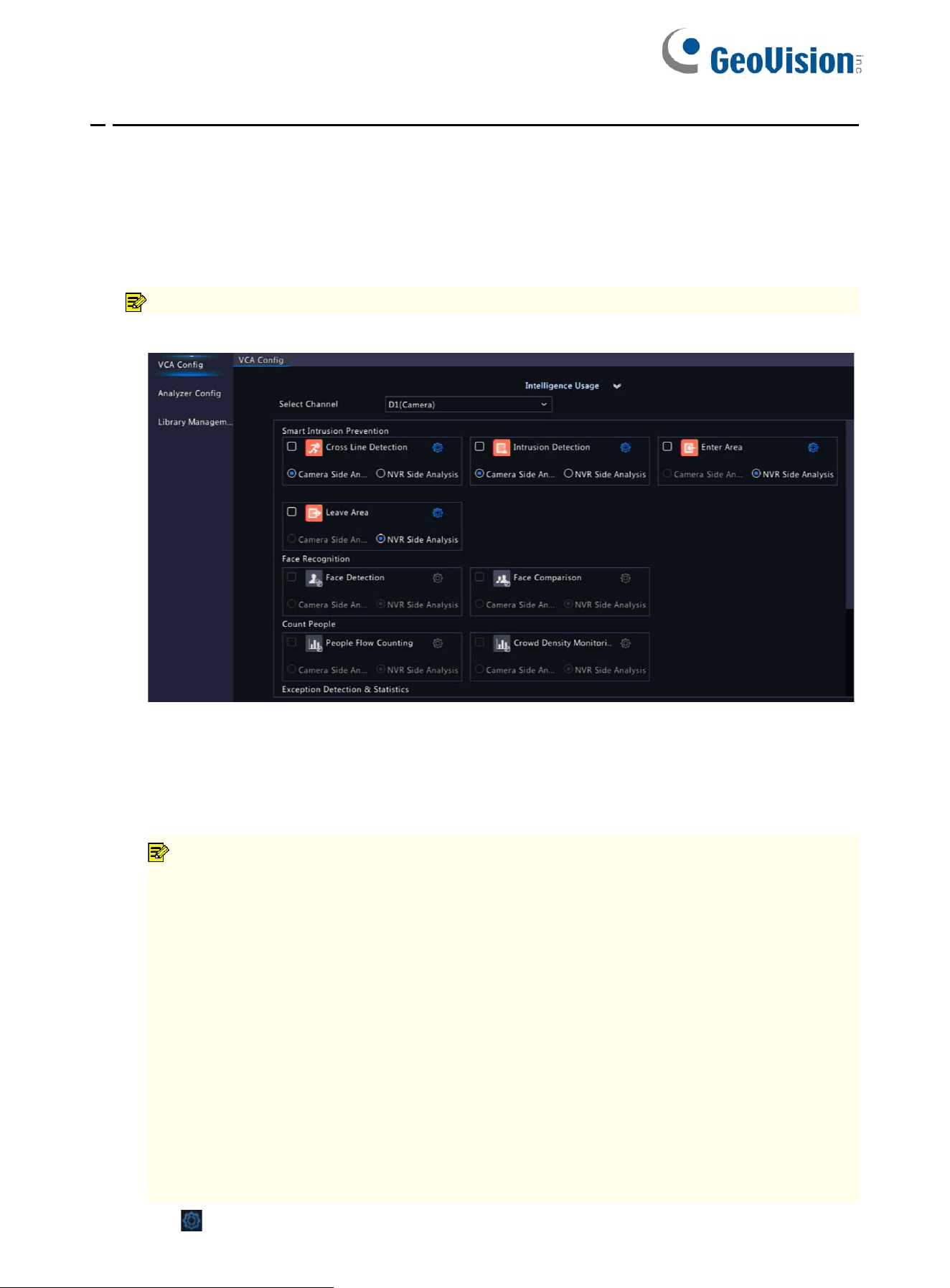
67
6 VCA
Configure VCA (Video Content Analysis), analyzer, face library, work clothes library, plate list, and VCA search.
6.1 VCA Configuration
VCA includes face recognition, smart intrusion prevention, behavior analysis, object detection, exception
detection & statistics, temperature detection, and people counting. You can monitor people flow, roads, and
moving objects by configuring VCA. The VCA functions and parameters may vary with NVR model.
1. Go to Menu > VCA > VCA Config.
2. Select a channel.
3. Select the check box for the VCA function to be enabled, and choose to implement this function on the
camera side or the NVR side.
• Camera Side Analysis: The VCA function is implemented by the camera.
• NVR Side Analysis: The VCA function is implemented by the NVR.
4. Click to configure the function.
Note: VCA functions are not available if there is no disk in slot 1.
Note:
• For some VCA functions, the camera side supports more parameters than the NVR side.
•
Before you enable camera side analysis, make sure the camera is connected via the Geovision protocol.
• VCA functions that are not supported by the camera or NVR are grayed out.
• VCA functions on the NVR side is subject to device capabilities. For more information, go to Menu >
VCA > Analyzer Config.
• VCA function is grayed out when the NVR-side analyzer capability reaches the upper limit. You can
hover over the function to view the details, and disable certain types of functions to free up some of
the analyzer's capacity.
• When the camera goes online for the first time, the system will automatically sync camera-side
configuration and enabled/disabled state to the NVR side; When the camera goes online again, the
system will automatically sync camera-side configuration to the NVR side, however, the enabled/
disabled state will not be synced.
• When the camera goes online, if the channel enabled/disabled state on the IPC is not consistent
with the NVR, and the NVR-side analysis is enabled while the camera-side analysis is disabled, then a
prompt will appear and ask if you want to sync NVR enabled/disabled state to the IPC.
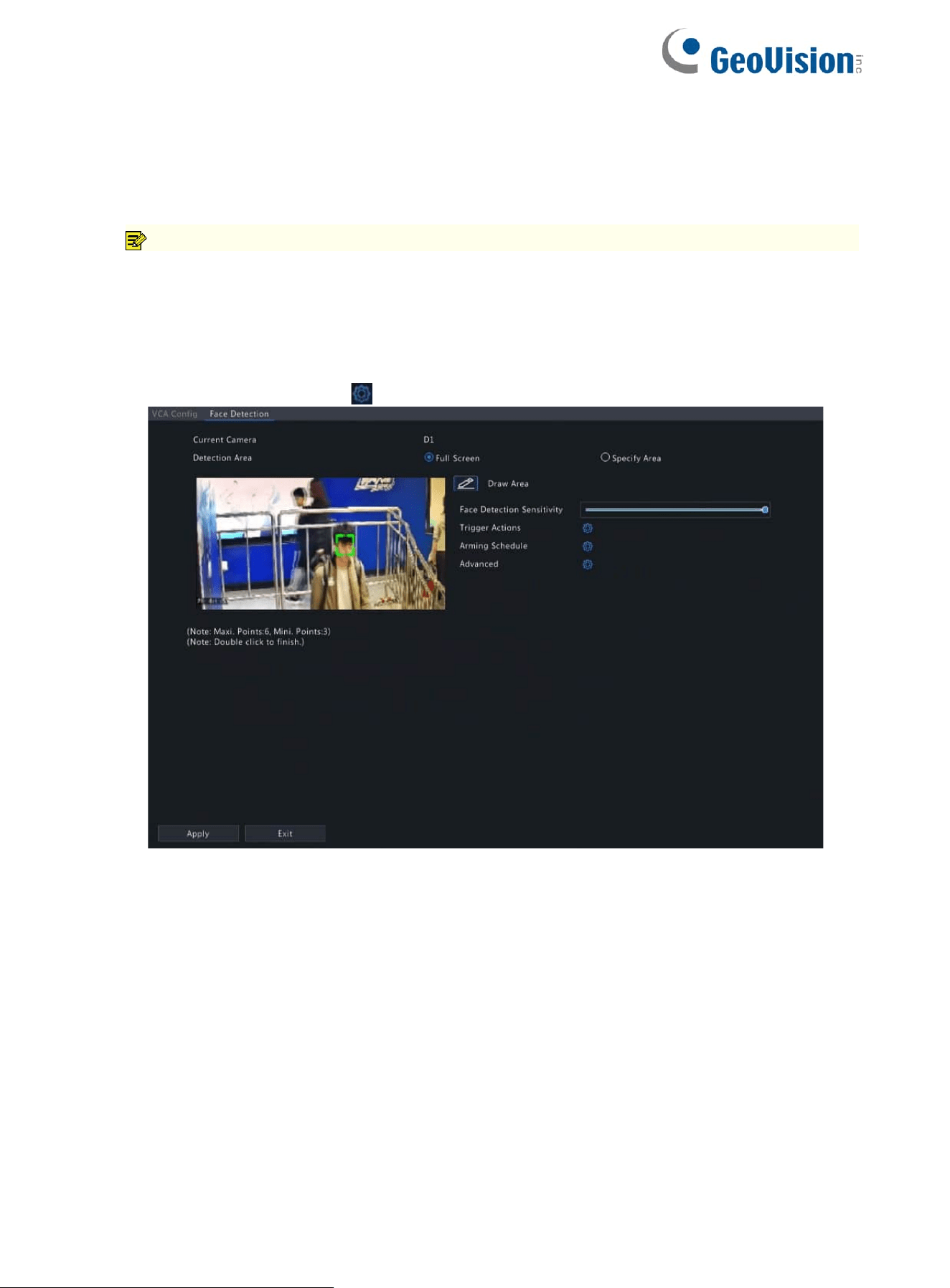
68
Select Face Detection and click to configure it.
6.1.1 Face Recognition
Face recognition includes face detection and face comparison.
6.1.1.1 Face Detection
Face detection detects and captures faces in a specified detection area.
Note: Before configuring the Face Detection, you must first enable Face Recognition in Analyzer (VCA > Analyzer
Config).
1. Go to Menu > VCA > VCA Config.
2. Select a camera.
3.
Note: The functions and parameters supported by camera side analysis and NVR side analysis are different.
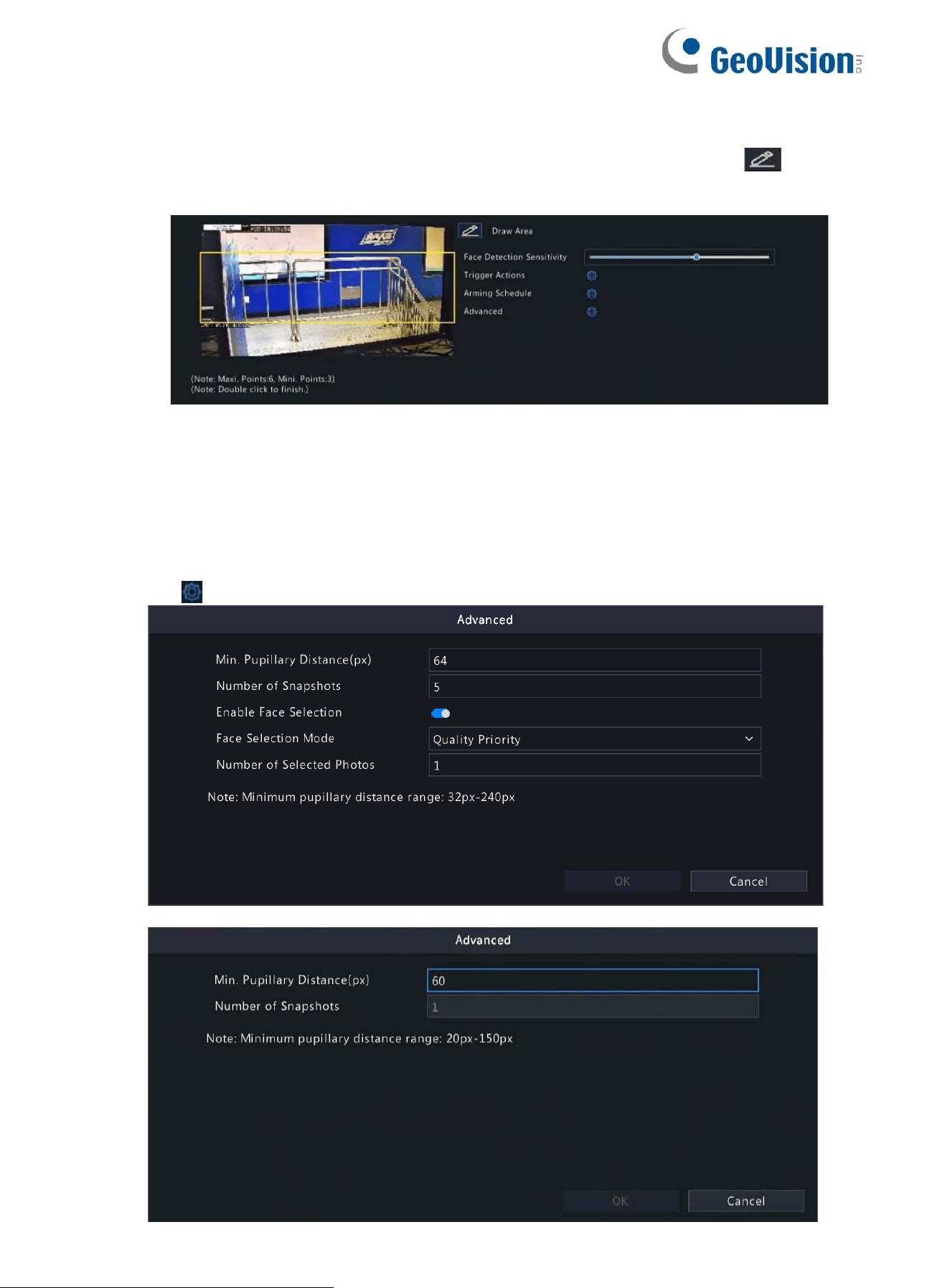
69
4. Set the detection area. Only 1 detection area is allowed.
• Full Screen: Detects all faces in the live video.
• Specify Area: Detects faces in a specified area of the live video. Select Specify Area, click , then the
full screen will be displayed and a default detection box appears. You can adjust the position of the area or
draw an area as needed. Right-click to exit the full screen.
• Adjust the position of the area. Point to a border of the area and drag it to the desired position.
• Draw an area. Click on the image and drag to draw a line. Repeat the action to draw more lines to form
an enclosed shape as needed. Up to 6 lines are allowed.
5. Set the face detection sensitivity by dragging the slider. The higher the sensitivity, the more likely a face will
be detected. The lower the sensitivity, the less likely a side face or blurring face will be detected.
6. Set the alarm-triggered actions and arming schedule. See Alarm-triggered Actions and Arming Schedule for
details.
7.
On certain NVRs, the Advanced page shows as follows:
Click right to Advanced, configure the parameters as needed, and then click OK.
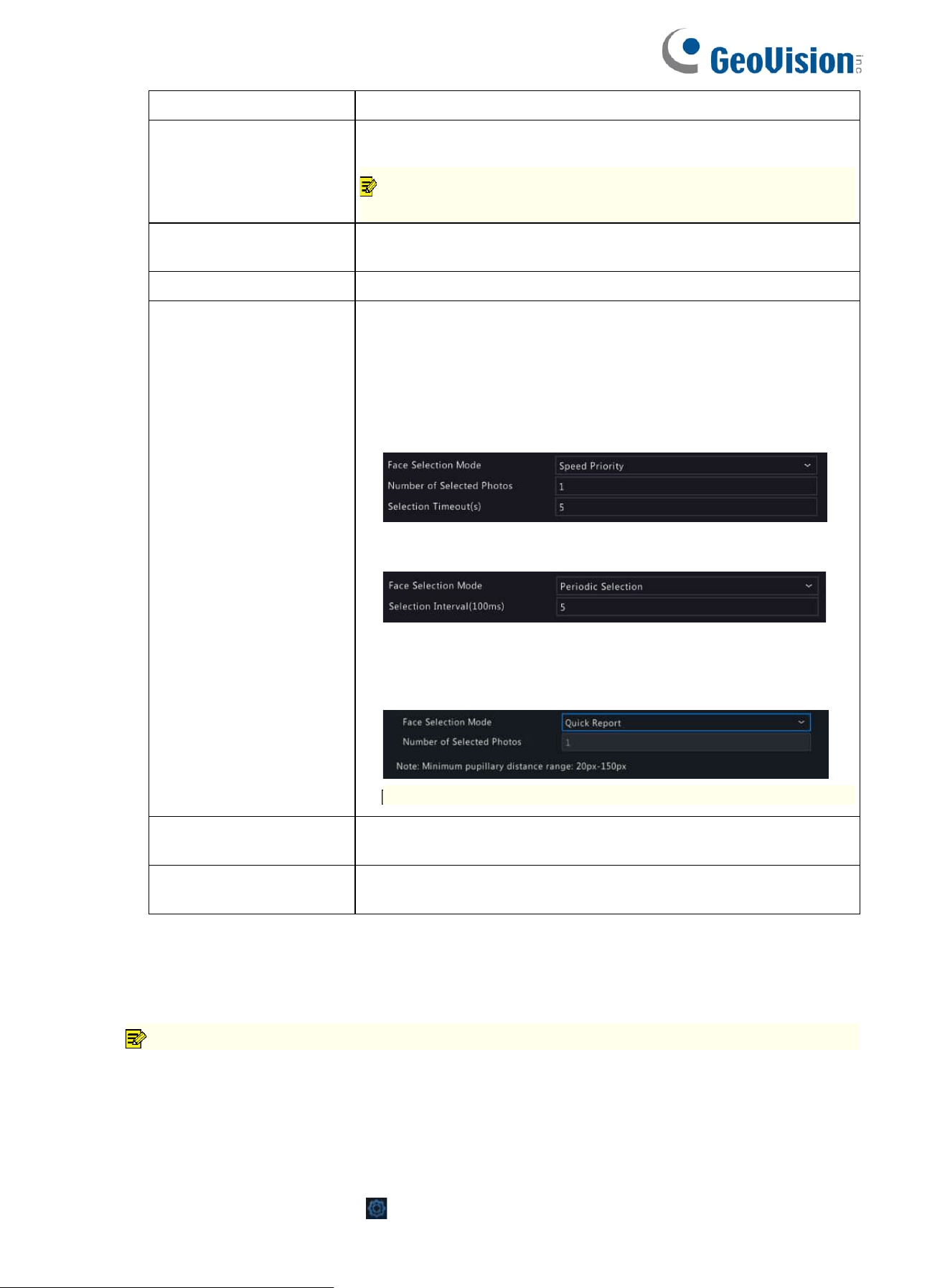
70
Parameter
Description
Min. Pupillary Distance(px)
The minimum distance (measured in pixels) between two pupils. Faces with
pupillary distance smaller than the value will not be captured.
Note: The default value varies by image resolution, and the valid range
varies by NVR model.
Number of Snapshots
The number of snapshots to be captured when the detection rule is
triggered. Range: 1 to 30. Default: 5.
Enable Face Selection
Select whether to select face snapshots to report.
Face Selection Mode
• Quality Priority: Set the Number of Selected Photos, then the NVR
selects the specified number of snapshots with the best quality from all
the snapshots captured when a face is detected to report.
• Speed Priority: Set the Number of Selected Photos and Selection
Timeout, then the NVR selects the specified number of snapshots from
the moment that a face is detected till Selection Timeout is up to report.
Range: 1 to 1800.
• Periodic Selection: Set the Selection Interval, for example, 600ms, then
the NVR selects a face snapshot every 600ms to report.
• Quick Report: A face snapshot that exceeds the set score will be
reported, and a higher quality snapshot will be reported to replace the
previous one. The number of face snapshots is 1 by default and cannot
be modified.
Note: Only the NVR-side face detection supports quick report.
Number of Selected Photos
The number of face snapshots to be selected. Range: 1 to 3. This parameter
is set to 1 by default and cannot be modified on certain models.
Max/Min Face Width(px)
The NVR only captures faces within Min. Face Width and Max. Face Width.
Range: 20 to 500.
8.
Click Apply.
6.1.1.2 Face Comparison
Face comparison compares captured faces with face images in face libraries (also called face list). To use face
comparison, you need to enable face detection first.
Note: Before configuring the Face Comparison, you must first enable Face Recognition in Analyzer (VCA > Analyzer
Config).
Configure Monitoring Task
1. Go to Menu > VCA > VCA Config.
2. Select a camera.
3. Select Face Comparison and click to configure it.
Note: The functions and parameters supported by camera side analysis and NVR side analysis are different.
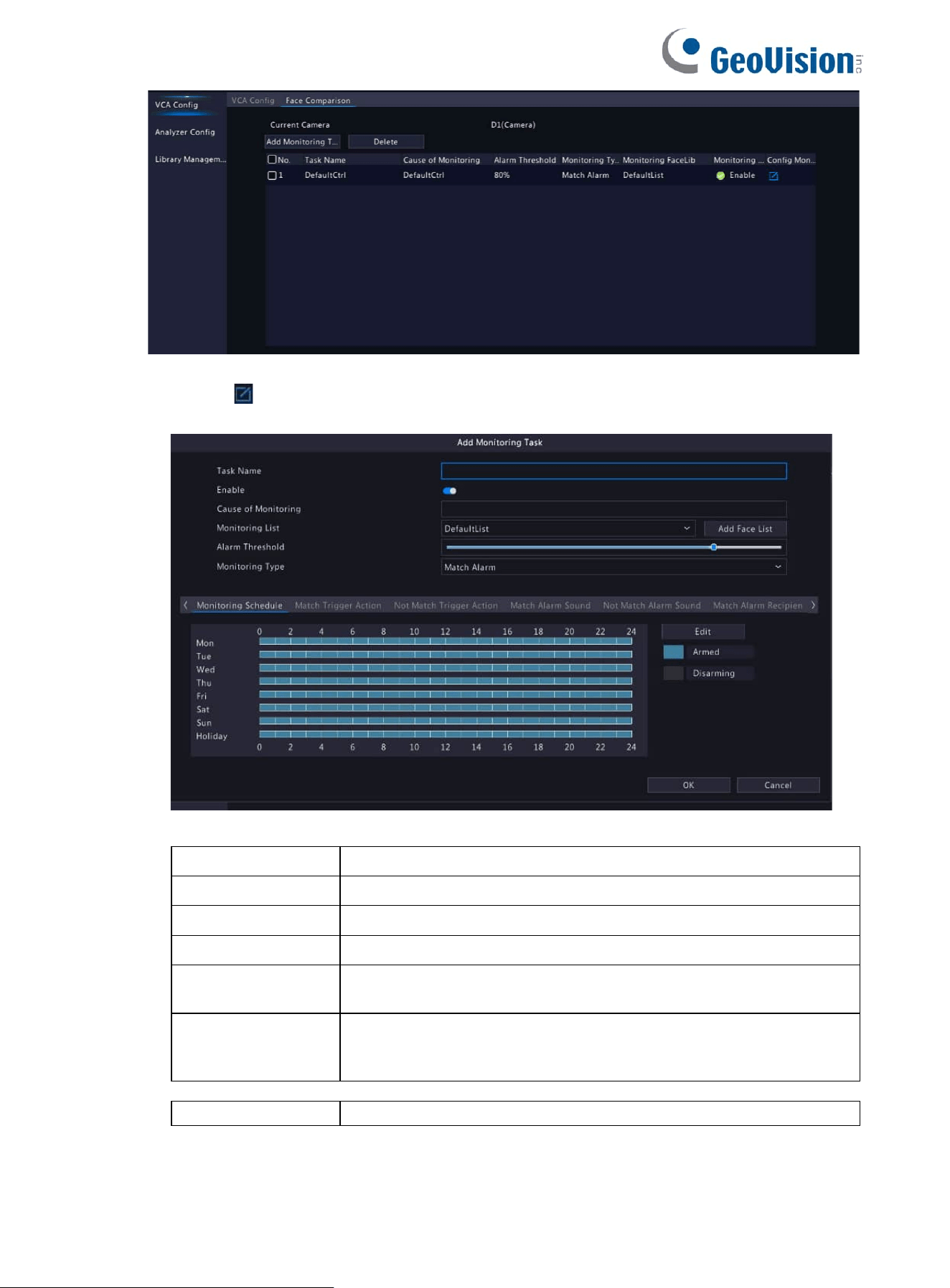
71
4. Configure monitoring tasks. A monitoring task of "Default List 80% Match Alarm" is enabled by default.
You can click to modify it, or click Add Monitoring Task to add more.
(1) Click Add Monitoring Task.
(2) Complete the monitoring task settings.
Parameter
Description
Task Name
Enter a name for the monitoring task.
Enable
Enable/disable the monitoring task.
Cause of Monitoring
Enter the cause of the monitoring task.
Monitoring List
Select a face list from the Monitoring List drop-down list or click Add Face List
to create a face list to monitor.
Alarm Threshold
Set the alarm threshold by dragging the slider. The NVR takes snapshots when
the similarity between a detected face and a face image in the monitoring list
reaches the threshold. Default: 80.
The higher the alarm threshold, the more accurate the matching result.
72
Monitoring Type
Select the monitoring type.
• Match Alarm: A match alarm occurs when the similarity between a
detected face and a face image in the monitoring list reaches the alarm
threshold.
• Not Match Alarm: A not match alarm occurs when the similarity between
a detected face and a face image in the monitoring list fails to reach the
alarm threshold.
• All: An alarm occurs when a face is detected.
Monitoring Schedule
Set the monitoring schedule. See Recording Schedule for details.
Match Trigger Action
Set the actions to be triggered by a match alarm. See Alarm-triggered Actions
for details.
Not Match Trigger
Action
Set the actions to be triggered by a not match alarm. See Alarm-triggered
Actions for details.
Match Alarm Recipient
Choose the recipient(s), and then the NVR sends an email with alarm
information to the selected email address(es) when a captured face matches a
face image in the monitoring list. Please set the recipient information in Email.
Up to 6 recipients are allowed.
Not Match Alarm
Recipient
Choose the recipient(s), and then the NVR sends an email with alarm
information to the selected email address(es) when a captured face does
not match any face image in the monitoring list. Please set the recipient
information in Email. Up to 6 recipients are allowed.
(3) Click OK.
5. (Optional) To apply the monitoring tasks to other cameras, click Copy, select the desired monitoring task(s)
and camera(s), and then click OK.
6. Click Apply.
View Library Sync Status
This function is only available to cameras with face recognition support and camera side analysis enabled. Library
sync indicates the sync of face libraries from NVR to IPC. After IPC receives a face list, it can compare the captured
faces with the face images in the face list and upload the comparison results to NVR.
Click Library sync state to view the sync status of face lists and faces in the face lists from NVR to IPC. You may
manually synchronize the face lists in Not Started state.
• View faces by status: Select a state from the Sync Status drop-down list to view faces in this state.
• Manually sync face lists: Select the face list to be synced and click Manual sync. If a face in a face list is not
synced successfully, you can manually sync the face list.
Other Operations
Operation
Description
Delete
Delete the selected monitoring task(s).
/
Enable/disable the monitoring task.
Edit the monitoring task.
View Real-time Snapshots
1. Right-click on the live view page and select Preview Mode > Smart, then the real-time snapshots are shown
on the right.
2. Click a snapshot to view detailed information. See Face Recognition for details.
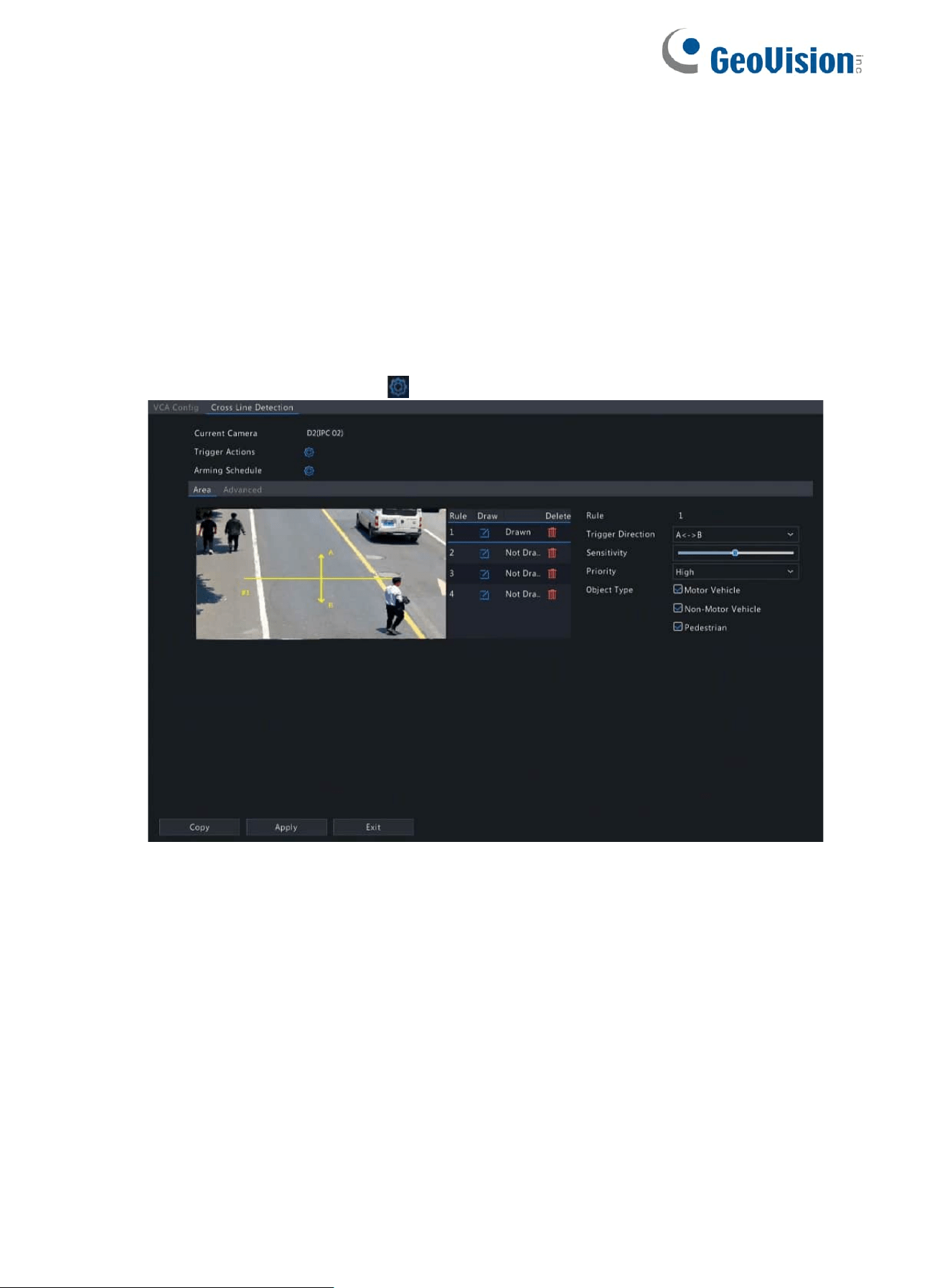
73
Select Cross Line Detection and click to configure it.
6.1.2 Smart Intrusion Prevention
Smart intrusion prevention includes cross line detection, intrusion detection, enter area, and leave area.
Note: Before configuring the following Smart Intrusion Prevention functions, you must first enable Smart Intrusion
Prevention in Analyzer (VCA > Analyzer Config).
6.1.2.1 Cross Line Detection
Cross line detection detects objects crossing a user-specified virtual line in a specified direction. The NVR takes
snapshots and reports an alarm when the detection rule is triggered.
Configure Cross Line Detection
1. Go to Menu > VCA > VCA Config.
2. Select a camera.
3.
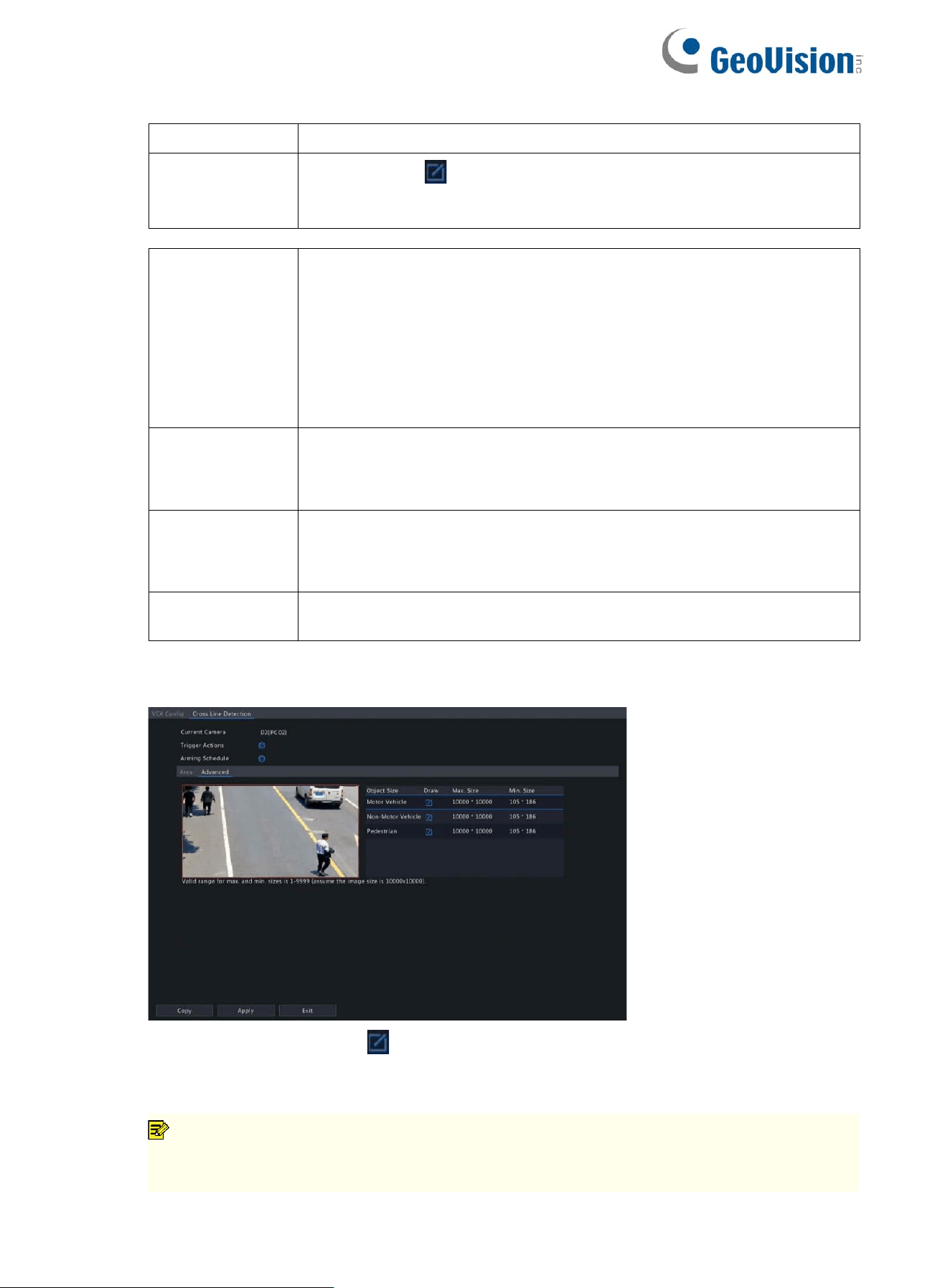
74
4. Set detection rules. The 4 detection rules shall be set separately. The following takes Rule 1 as an example.
Parameter
Description
Detection Line
Select Rule 1, click , and the full screen is displayed. Click on the image and drag
to draw a detection line. The line defaults to A<->B direction. You can modify it as
needed. Right-click to exit the full screen.
Trigger Direction
Select the direction from which the object crosses the line to trigger an alarm.
• A->B: A cross line alarm occurs when an object crossing the line from A to B is
detected.
• B->A: A cross line alarm occurs when an object crossing the line from B to A is
detected.
• A<->B (default): A cross line alarm occurs when an object crossing the line from A
to B or from B to A is detected.
Sensitivity
Set the sensitivity by dragging the slider.
The higher the sensitivity, the more likely cross line behaviors will be detected, but
the false alarm rate will increase.
Priority
Select the priority of the detection rule, including High, Medium, and Low.
The NVR detects the rule that is triggered first by default. If multiple rules are
triggered at the same time, the NVR detects the rule with higher priority.
Object Type
Select the object(s) to be detected, including Motor Vehicle, Non-Motor Vehicle, and
Pedestrian.
5. Under the Advanced tab, you can filter objects by size. For example, if you have selected Motor Vehicle as a
detection object, after you set the Max. Size and Min. Size for it, motor vehicles larger than the max. size and
smaller than the min. size will not be detected.
(1)
Select an object type and click . A Max. Size box and a Min. Size box appear in the left preview window.
(2)
Modify the max./min. size by adjusting the size of the box as follows: Point to a handle of the box and drag
to resize it.
6. Set the alarm-triggered actions and arming schedule. See Alarm-triggered Actions and Arming Schedule for
details.
Note:
• The Max. Size and Min. Size settings take effect after you select the object as a detection object.
• The width and height of the maximum size must be greater than that of the minimum size.
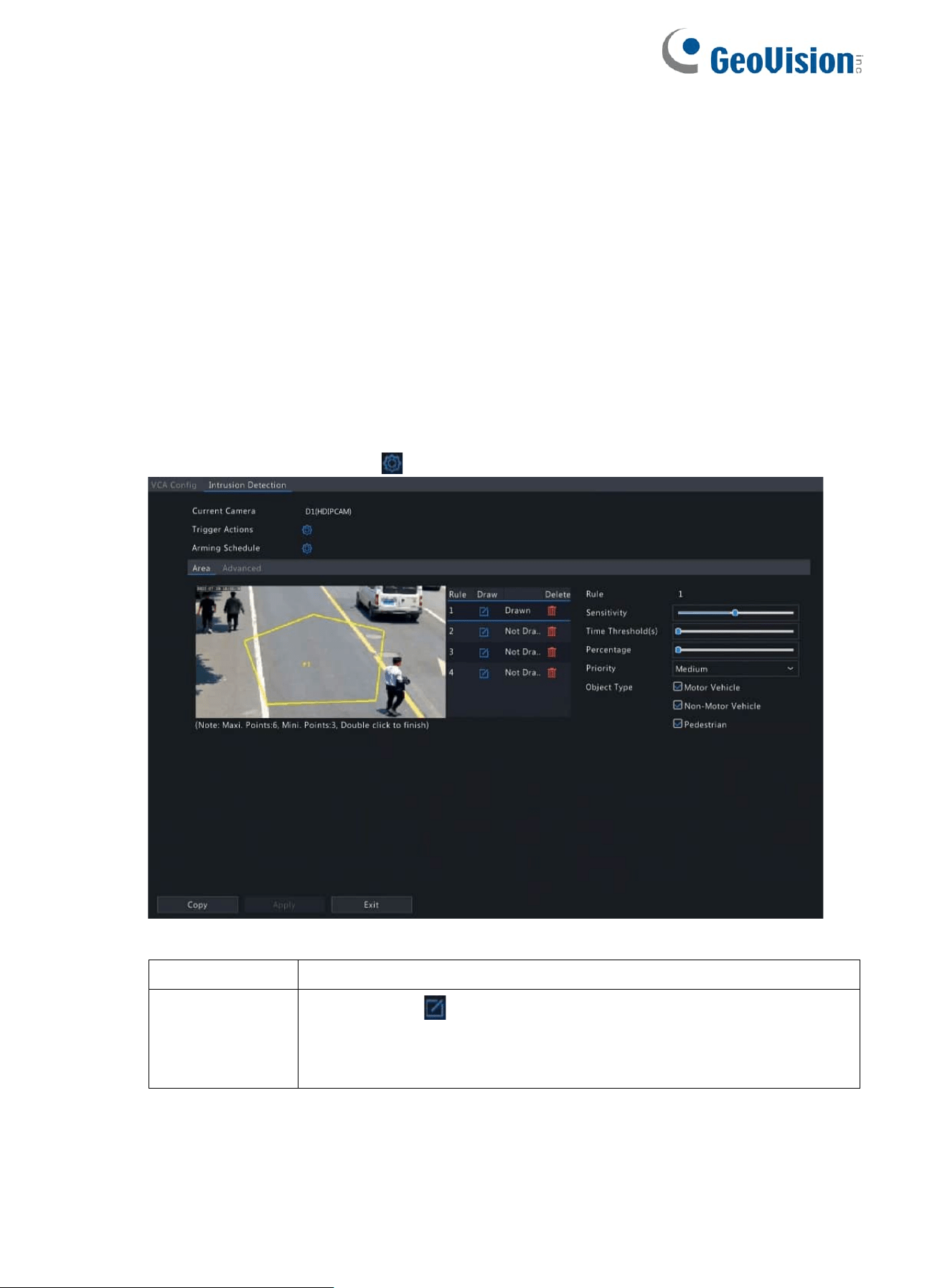
75
Select Intrusion Detection and click to configure it.
7. (Optional) To apply the same settings to other cameras, click Copy, select the desired setting(s) and
camera(s), and then click OK.
8. Click Apply.
View Real-time Snapshots
1. Right-click on the live view page and select Preview Mode > Smart, then the real-time snapshots are shown
on the right.
2. Click a snapshot to view detailed information. See Smart Intrusion Prevention for details.
6.1.2.2 Intrusion Detection
Intrusion detection detects objects entering a user-specified area and staying for a preset time. The NVR takes
snapshots and reports an alarm when the detection rule is triggered.
Configure Intrusion Detection
1. Go to Menu > VCA > VCA Config.
2. Select a camera.
3.
4. Set detection rules. The 4 detection rules shall be set separately. The following takes Rule 1 as an example.
Parameter
Description
Detection Area
Select Rule 1, click , and the full screen is displayed, then draw a detection area.
Click on the image and drag to draw a line. Repeat the action to draw more lines to
form an enclosed shape as needed. Up to 6 lines are allowed. Right-click to exit the
full screen.
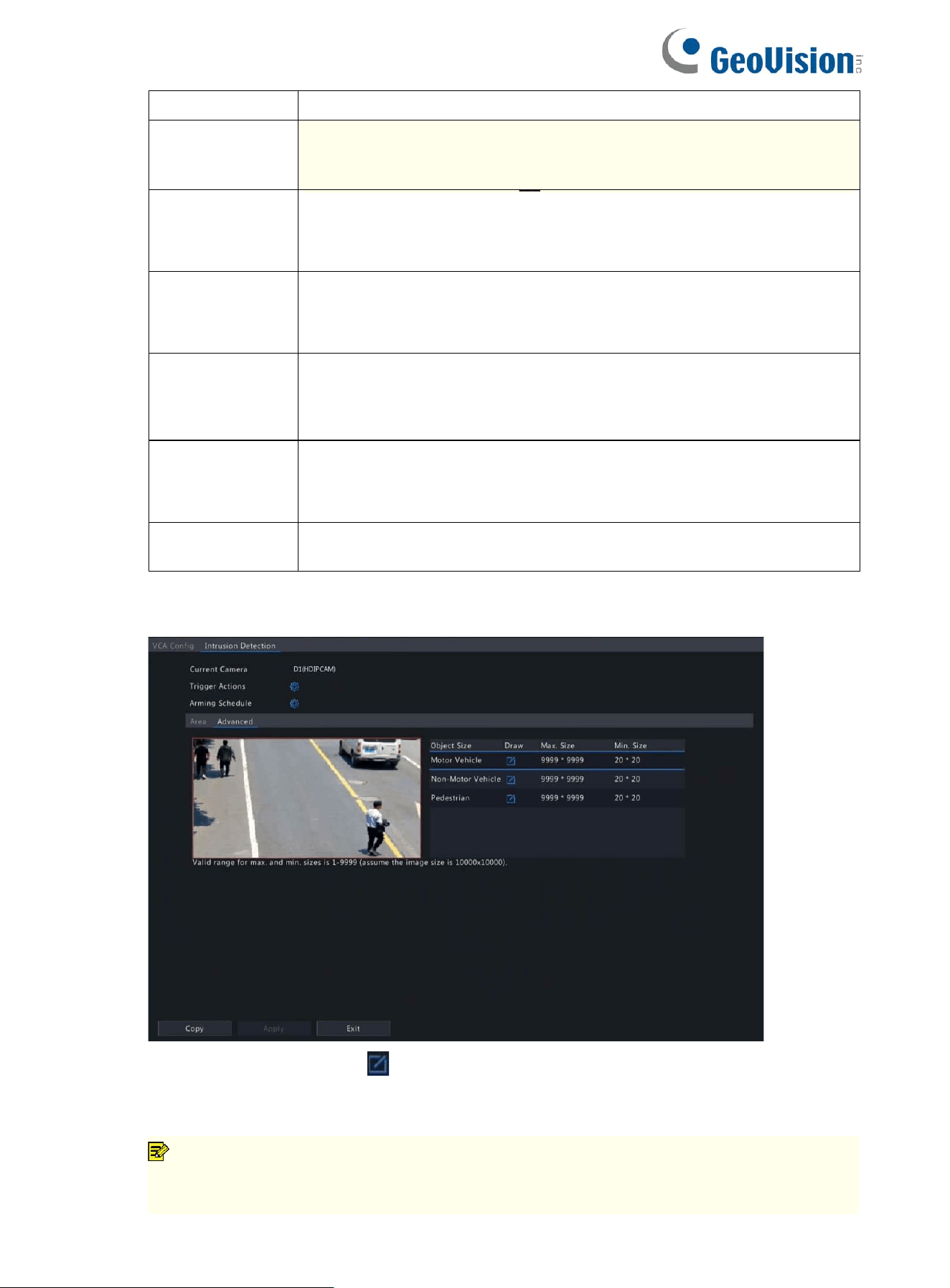
76
Parameter
Description
Note: For a rule in Drawn state, you can click to redraw a detection area. To
delete a detection area, click .
Sensitivity
Set the sensitivity by dragging the slider.
The higher the sensitivity, the more likely intrusion behaviors will be detected, but
the false alarm rate will increase.
Time Threshold(s)
Set the time threshold by dragging the slider.
If an object stays in the detection area for the set time, an intrusion alarm will be
triggered.
Percentage
Set the percentage by dragging the slider.
If the proportion of the object size to the detection area size reaches the set value,
an intrusion alarm will be triggered.
Priority
Select the priority of the detection rule, including High, Medium, and Low.
The NVR detects the rule that is triggered first by default. If multiple rules are
triggered at the same time, the NVR detects the rule with higher priority.
Object Type
Select the object(s) to be detected, including Motor Vehicle, Non-Motor Vehicle, and
Pedestrian.
5. Under the Advanced tab, you can filter objects by size. For example, if you have selected Motor Vehicle as a
detection object, after you set the Max. Size and Min. Size for it, motor vehicles larger than the max. size and
smaller than the min. size will not be detected.
(1)
Select an object type and click . A Max. Size box and a Min. Size box appear in the left preview window.
(2)
Modify the max./min. size by adjusting the size of the box as follows: Point to a handle of the box and drag
to resize it.
Note:
• The Max. Size and Min. Size settings take effect after you select the object as a detection object.
• The width and height of the maximum size must be greater than that of the minimum size.
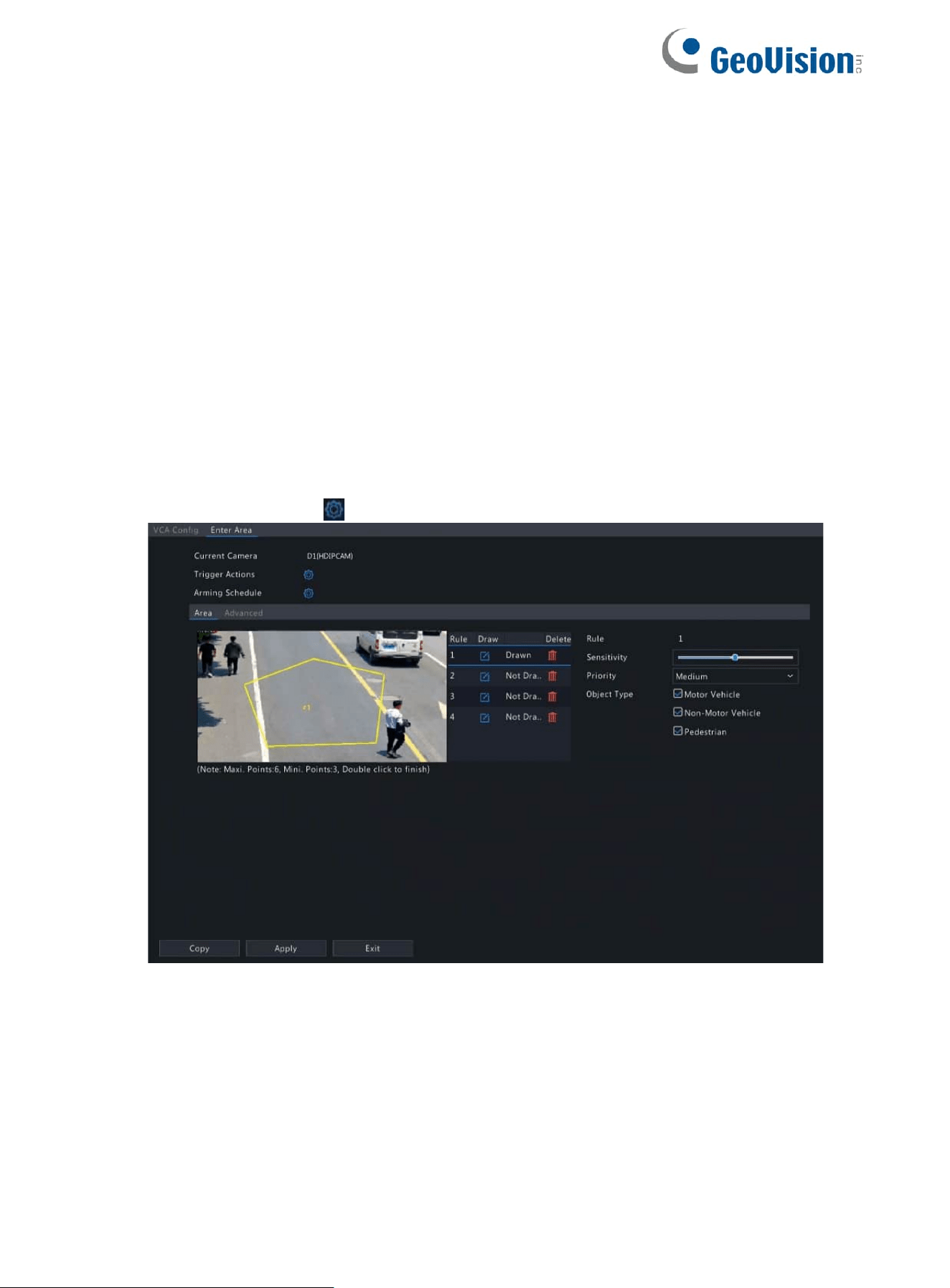
77
Select Enter Area and click to configure it.
6. Set the alarm-triggered actions and arming schedule. See Alarm-triggered Actions and Arming Schedule for
details.
7. (Optional) To apply the same settings to other cameras, click Copy, select the desired setting(s) and
camera(s), and then click OK.
8. Click Apply.
View Real-time Snapshots
1. Right-click on the live view page and select Preview Mode > Smart, then the real-time snapshots are shown
on the right.
2. Click a snapshot to view detailed information. See Smart Intrusion Prevention for details.
6.1.2.3 Enter Area Detection
Enter area detection detects objects entering a user-specified area. The NVR takes snapshots and reports an
alarm when the detection rule is triggered.
Configure Enter Area Detection
1. Go to Menu > VCA > VCA Config.
2. Select a camera.
3.
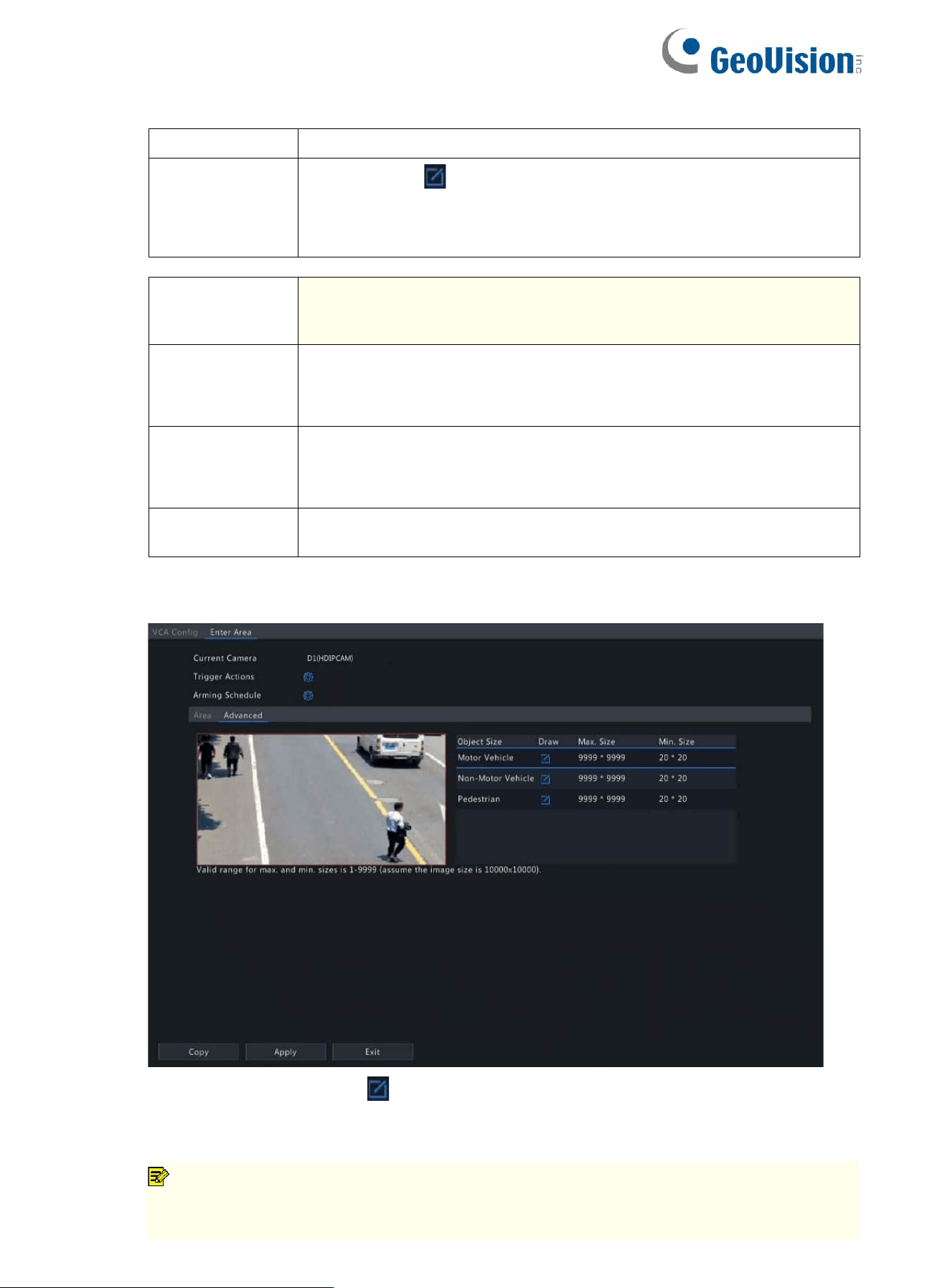
78
4. Set detection rules. The 4 detection rules shall be set separately. The following takes Rule 1 as an example.
Parameter
Description
Detection Area
Select Rule 1, click , and the full screen is displayed, then draw a detection area.
Click on the image and drag to draw a line. Repeat the action to draw more lines to
form an enclosed shape as needed. Up to 6 lines are allowed. Right-click to exit the
full screen.
Note: For a rule in Drawn state, you can click to redraw a detection area. To
delete a detection area, click .
Sensitivity
Set the sensitivity by dragging the slider.
The higher the sensitivity, the more likely entry behaviors will be detected, but the
false alarm rate will increase.
Priority
Select the priority of the detection rule, including High, Medium, and Low.
The NVR detects the rule that is triggered first by default. If multiple rules are
triggered at the same time, the NVR detects the rule with higher priority.
Object Type
Select the object(s) to be detected, including Motor Vehicle, Non-Motor Vehicle, and
Pedestrian.
5. Under the Advanced tab, you can filter objects by size. For example, if you have selected Motor Vehicle as a
detection object, after you set the Max. Size and Min. Size for it, motor vehicles larger than the max. size and
smaller than the min. size will not be detected.
(1)
Select an object type and click . A Max. Size box and a Min. Size box appear in the left preview window.
(2)
Modify the max./min. size by adjusting the size of the box as follows: Point to a handle of the box and drag
to resize it.
Note:
• The Max. Size and Min. Size settings take effect after you select the object as a detection object.
• The width and height of the maximum size must be greater than that of the minimum size.
79
6. Set the alarm-triggered actions and arming schedule. See Alarm-triggered Actions and Arming Schedule for
details.
7. (Optional) To apply the same settings to other cameras, click Copy, select the desired setting(s) and
camera(s), and then click OK.
8. Click Apply.
View Real-time Snapshots
1. Right-click on the live view page and select Preview Mode > Smart, then the real-time snapshots are shown
on the right.
2. Click a snapshot to view detailed information. See Smart Intrusion Prevention for details.
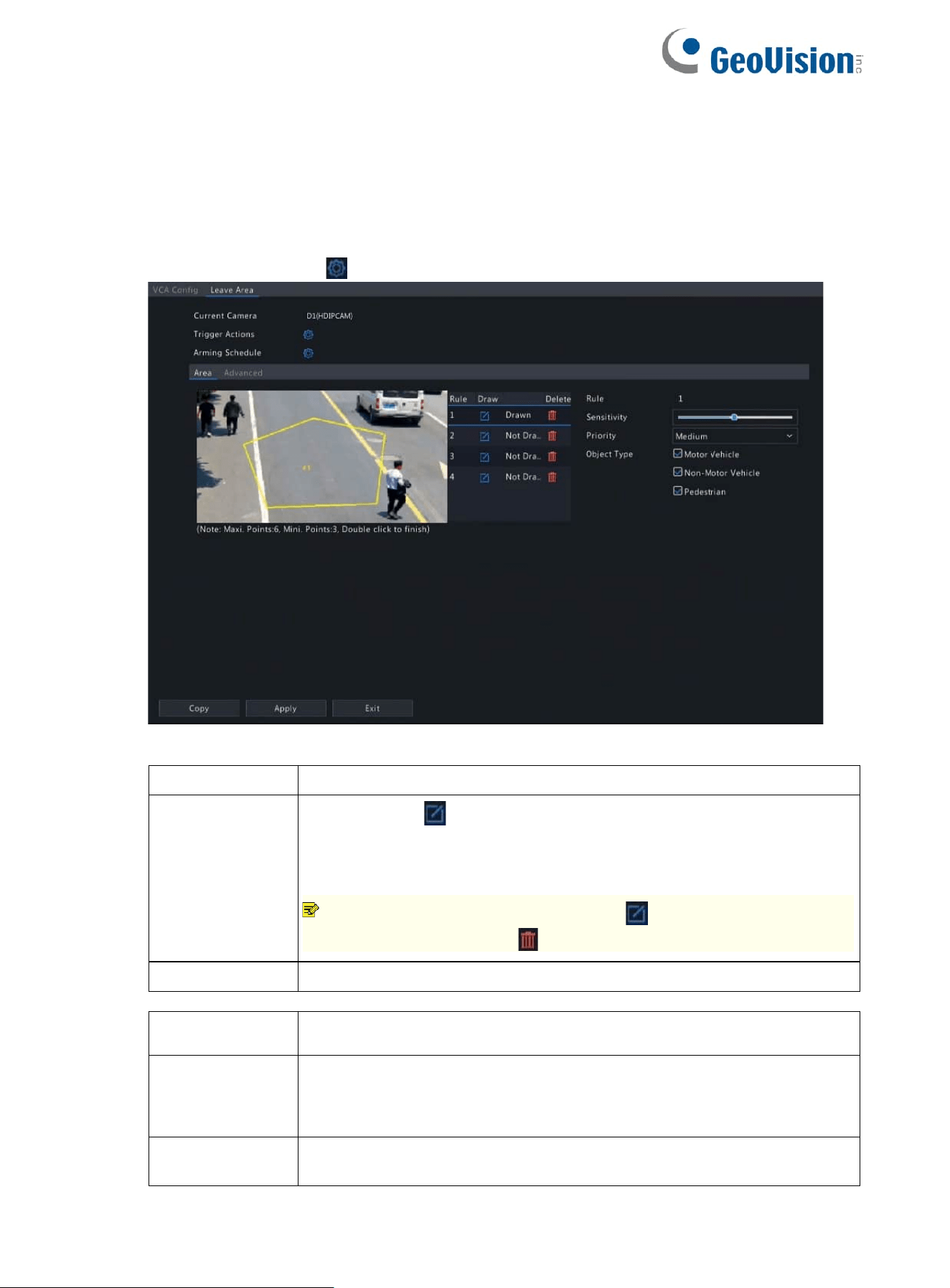
80
Select Leave Area and click to configure it.
6.1.2.4 Leave Area Detection
Leave area detection detects objects leaving a user-specified area. The NVR takes snapshots and reports an alarm
when the detection rule is triggered.
Configure Leave Area Detection
1. Go to Menu > VCA > VCA Config.
2. Select a camera.
3.
4. Set detection rules. The 4 detection rules shall be set separately. The following takes Rule 1 as an example.
Parameter
Description
Detection Area
Select Rule 1, click , and the full screen is displayed, then draw a detection area.
Click on the image and drag to draw a line. Repeat the action to draw more lines to
form an enclosed shape as needed. Up to 6 lines are allowed. Right-click to exit the
full screen.
Note: For a rule in Drawn state, you can click to redraw a detection area. To
delete a detection area, click .
Sensitivity
Set the sensitivity by dragging the slider.
The higher the sensitivity, the more likely leaving behaviors will be detected, but the
false alarm rate will increase.
Priority
Select the priority of the detection rule, including High, Medium, and Low.
The NVR detects the rule that is triggered first by default. If multiple rules are
triggered at the same time, the NVR detects the rule with higher priority.
Object Type
Select the object(s) to be detected, including Motor Vehicle, Non-Motor Vehicle, and
Pedestrian.
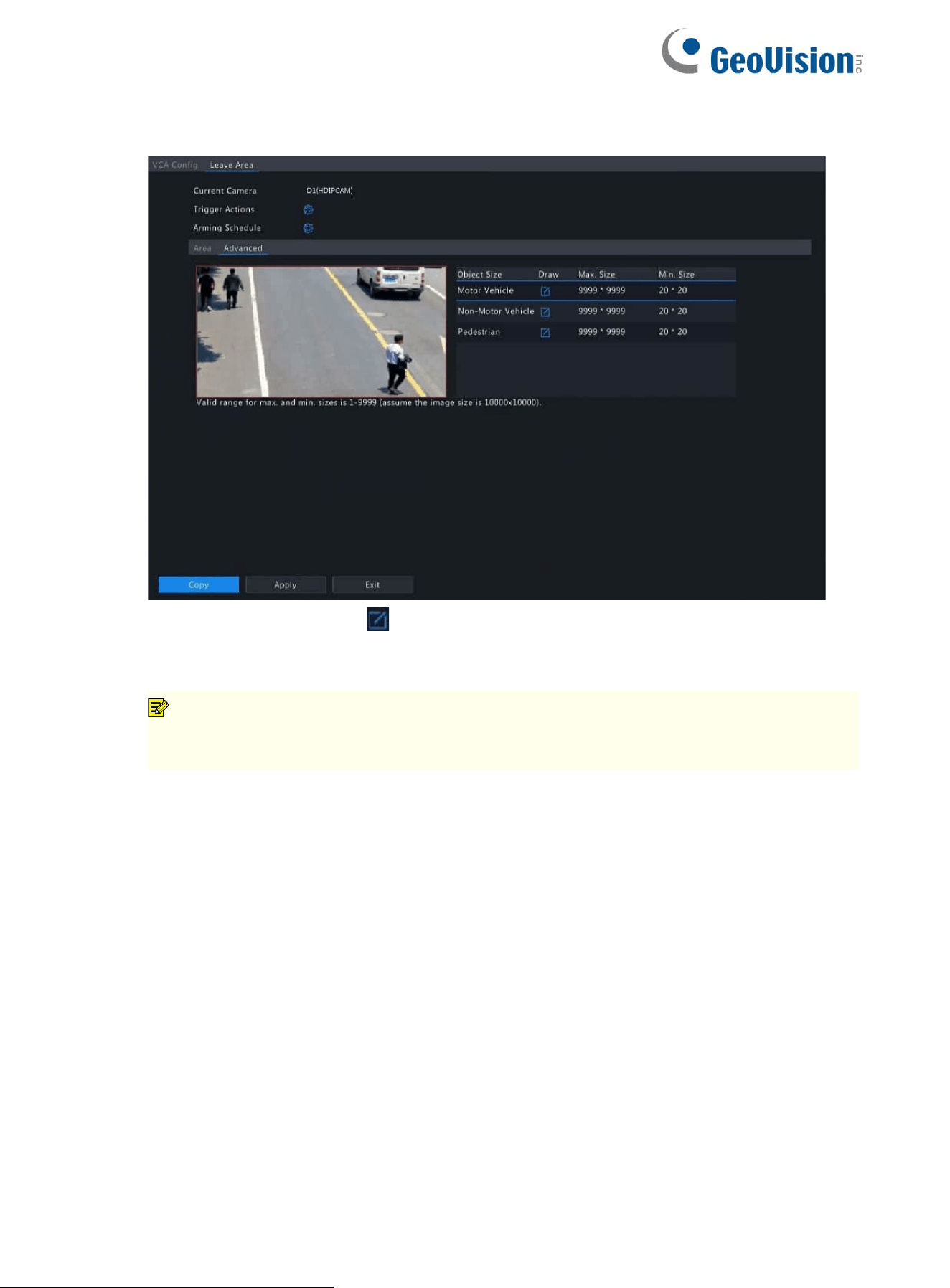
81
5. Under the Advanced tab, you can filter objects by size. For example, if you have selected Motor Vehicle as a
detection object, after you set the Max. Size and Min. Size for it, motor vehicles larger than the max. size and
smaller than the min. size will not be detected.
(1)
Select an object type and click . A Max. Size box and a Min. Size box appear in the left preview window.
(2)
Modify the max./min. size by adjusting the size of the box as follows: Point to a handle of the box and drag
to resize it.
6. Set the alarm-triggered actions and arming schedule. See Alarm-triggered Actions and Arming Schedule for
details.
7. (Optional) To apply the same settings to other cameras, click Copy, select the desired setting(s) and
camera(s), and then click OK.
8. Click Apply.
View Real-time Snapshots
1. Right-click on the live view page and select Preview Mode > Smart, then the real-time snapshots are shown
on the right.
2. Click a snapshot to view detailed information. See Smart Intrusion Prevention for details.
Note:
• The Max. Size and Min. Size settings take effect after you select the object as a detection object.
• The width and height of the maximum size must be greater than that of the minimum size.
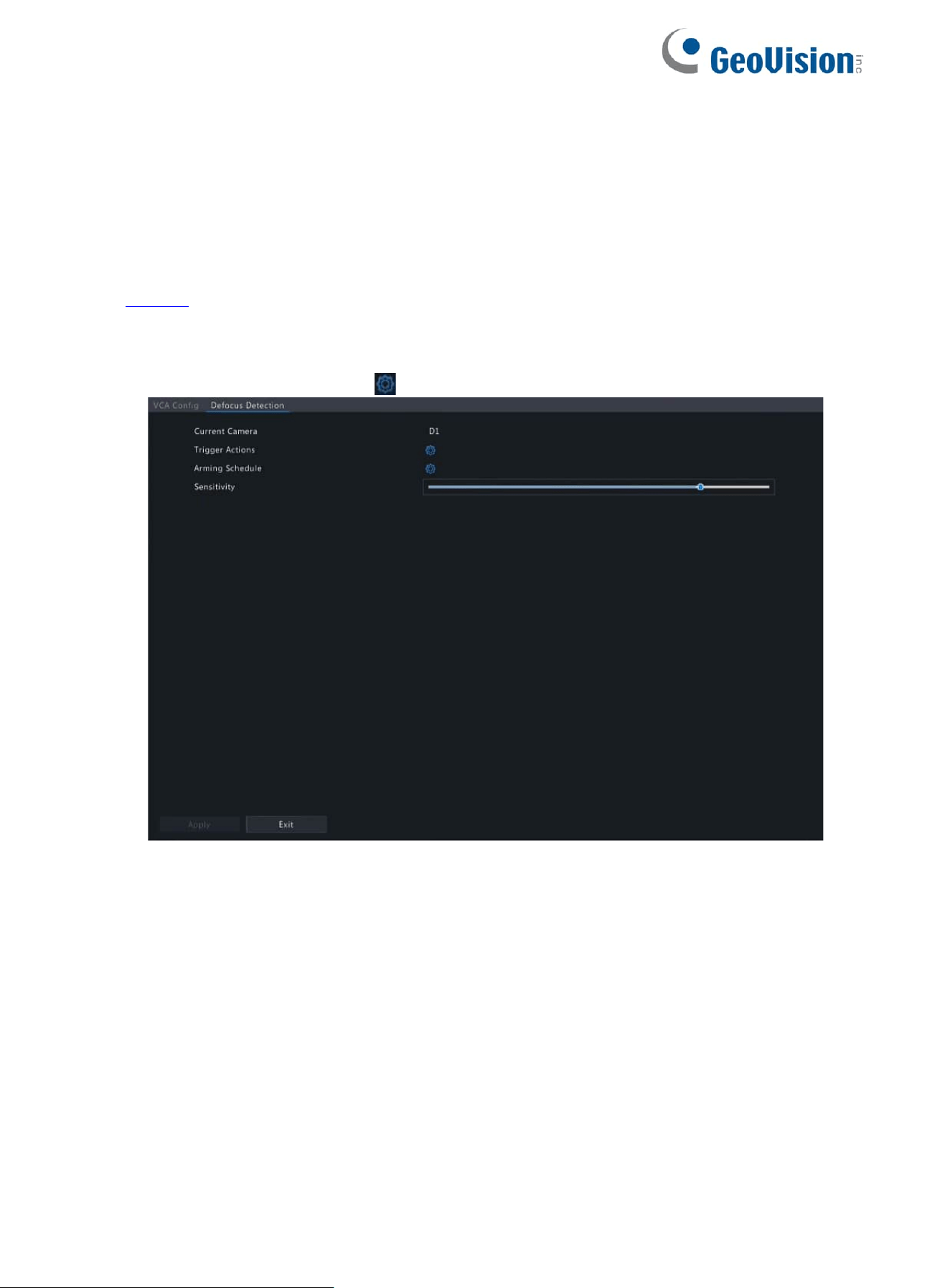
82
Select Defocus Detection and click to configure it.
6.1.3 Exception Detection & Statistics
Exception detection and statistics includes defocus detection, scene change, object removed, and object left
behind detection.
6.1.3.1 Defocus Detection
Defocus detection detects lens defocus. The NVR takes snapshots and reports an alarm when the detection rule
is triggered.
Note: Defocus Detection only works with compatible AI GV-IP Cameras that support this feature (see the
datasheet for compatible AI cameras).
1. Go to Menu > VCA > VCA Config.
2. Select a camera.
3.
4. Set the alarm-triggered actions and arming schedule. See Alarm-triggered Actions and Arming Schedule for
details.
5. Set the sensitivity by dragging the slider. The higher the sensitivity, the more likely defocus will be detected,
but the false alarm rate will increase.
6. Click Apply.
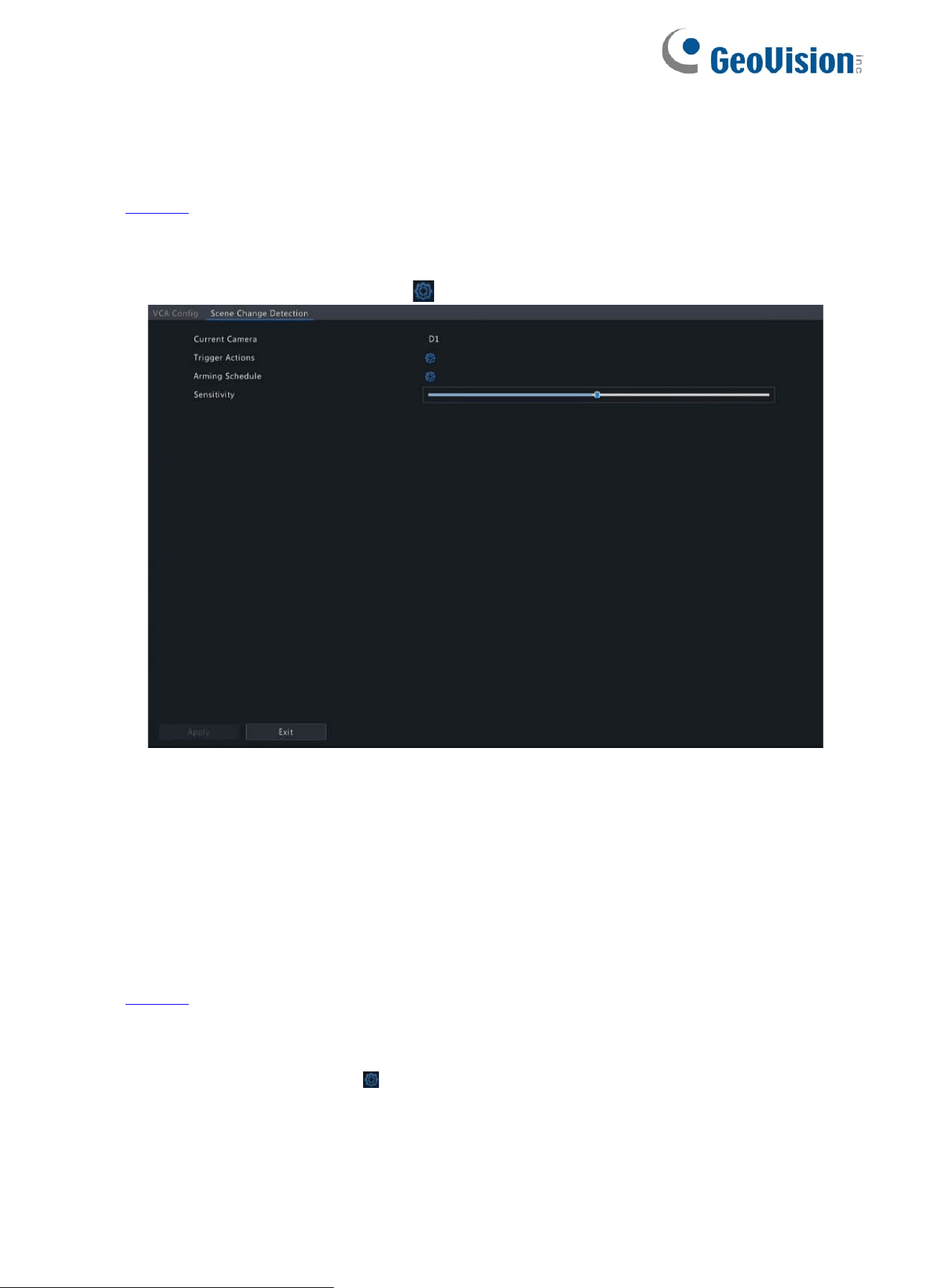
83
Select Scene Change Detection and click to configure it.
6.1.3.2 Scene Change Detection
Scene change detection detects the change of surveillance scene caused by external factors such as intentional
camera movement. The NVR takes snapshots and reports an alarm when the detection rule is triggered.
Note: Scene Change Detection only works with compatible AI GV-IP Cameras that support this feature (see the
datasheet for compatible AI cameras).
1. Go to Menu > VCA > VCA Config.
2. Select a camera.
3.
4. Set the alarm-triggered actions and arming schedule. See Alarm-triggered Actions and Arming Schedule for
details.
5. Set the sensitivity by dragging the slider. The higher the sensitivity, the more likely scene change behaviors
will be detected, but the false alarm rate will increase.
6. Click Apply.
6.1.3.3 Object Removed Detection
Object removed detection detects objects removed from a user-specified area for a preset time. The NVR takes
snapshots and reports an alarm when the detection rule is triggered.
Note: Object Removed Detection only works with compatible AI GV-IP Cameras that support this feature (see the
datasheet for compatible AI cameras).
1. Go to Menu > VCA > VCA Config.
2. Select a camera.
3. Select Object Removed and click to configure it.
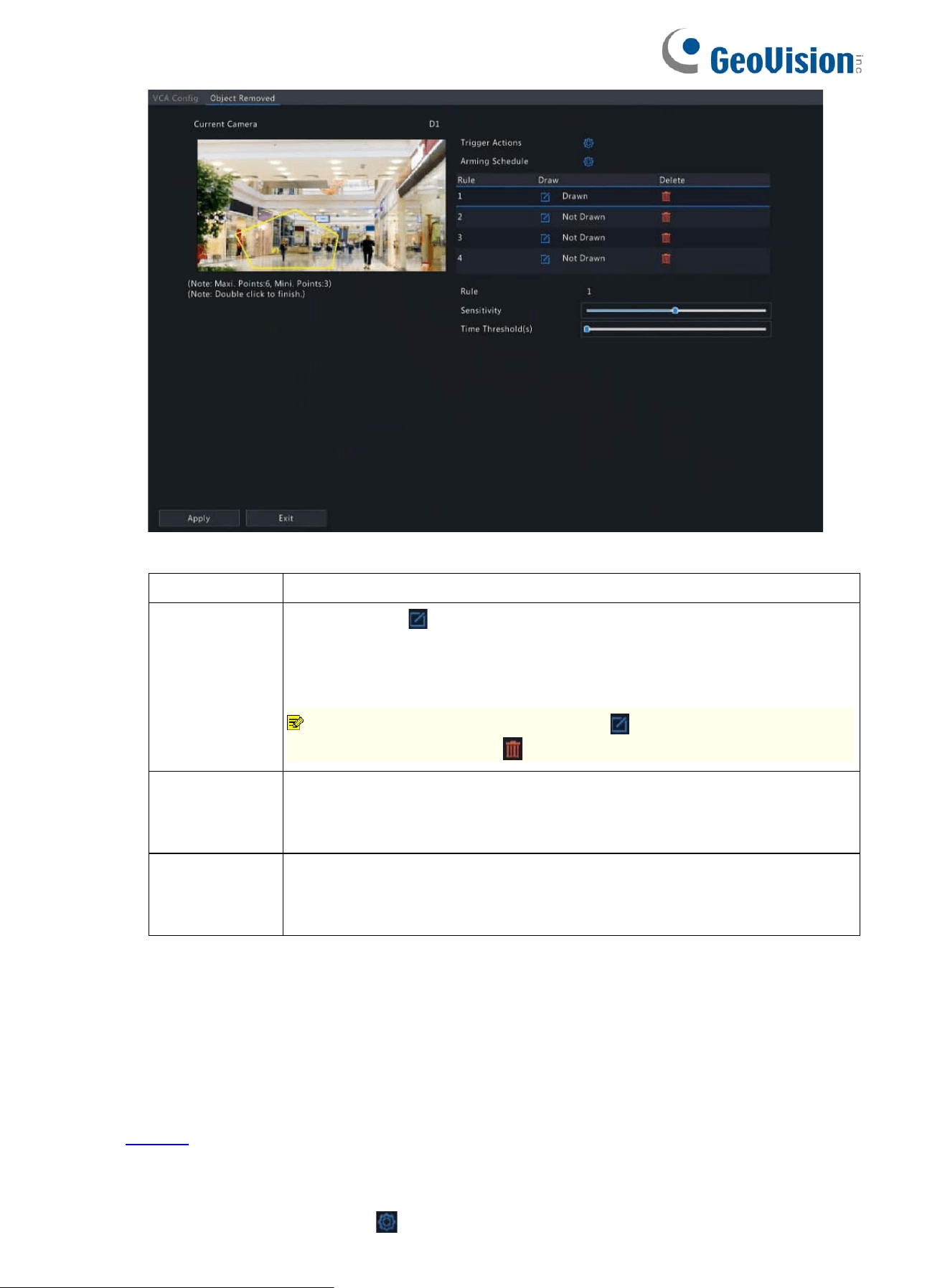
84
4. Set detection rules. The 4 detection rules shall be set separately. The following takes Rule 1 as an example.
Parameter
Description
Detection Area
Select Rule 1, click , and the full screen is displayed, then draw a detection area.
Click on the image and drag to draw a line. Repeat the action to draw more lines to
form an enclosed shape as needed. Up to 6 lines are allowed. Right-click to exit the full
screen.
Note: For a rule in Drawn state, you can click to redraw a detection area. To
delete a detection area, click .
Sensitivity
Set the sensitivity by dragging the slider.
The higher the sensitivity, the more likely object removal behaviors will be detected,
but the false alarm rate will increase.
Time Threshold(s)
Set the time threshold by dragging the slider.
If an object is removed from the detection area for the set time, an alarm will be
triggered.
5. Set the alarm-triggered actions and arming schedule. See Alarm-triggered Actions and Arming Schedule for
details.
6. Click Apply.
6.1.3.4 Object Left Behind Detection
Object left behind detection detects objects left behind in a user-specified area for a preset time. The NVR takes
snapshots and reports an alarm when the detection rule is triggered.
Note: Object Left Behind Detection only works with compatible AI GV-IP Cameras that support this feature (see the
datasheet for compatible AI cameras).
1. Go to Menu > VCA > VCA Config.
2. Select a camera.
3. Select Object Left Behind and click to configure it.
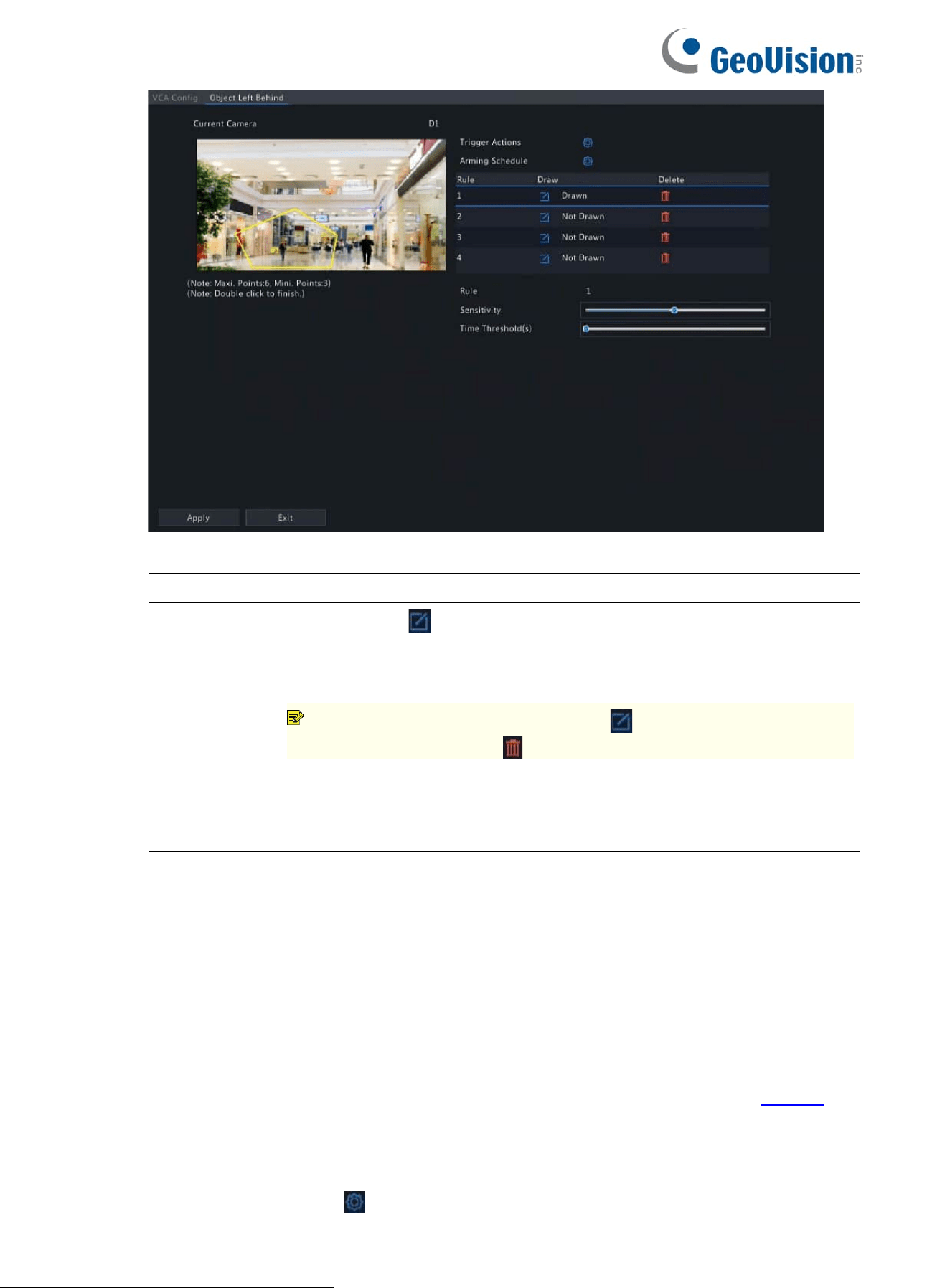
85
4. Set detection rules. The 4 detection rules shall be set separately. The following takes Rule 1 as an example.
Parameter
Description
Detection Area
Select Rule 1, click , and the full screen is displayed, then draw a detection area.
Click on the image and drag to draw a line. Repeat the action to draw more lines to
form an enclosed shape as needed. Up to 6 lines are allowed. Right-click to exit the full
screen.
Note: For a rule in Drawn state, you can click to redraw a detection area. To
delete a detection area, click .
Sensitivity
Set the sensitivity by dragging the slider.
The higher the sensitivity, the more likely object left behind behaviors will be detected,
but the false alarm rate will increase.
Time Threshold(s)
Set the time threshold by dragging the slider.
If an object is left behind in the detection area for the set time, an alarm will be
triggered.
5. Set the alarm-triggered actions and arming schedule. See Alarm-triggered Actions and Arming Schedule for
details.
6. Click Apply.
6.1.3.5 Auto Tracking
Auto tracking detects moving objects in the live video and tracks the first object detected.
Note: Auto Tracking only works with compatible AI GV-IP Cameras that support this feature (see the datasheet for
compatible AI cameras).
1. Go to Menu > VCA > VCA Config.
2. Select a camera.
3. Select Auto Tracking and click to configure it.
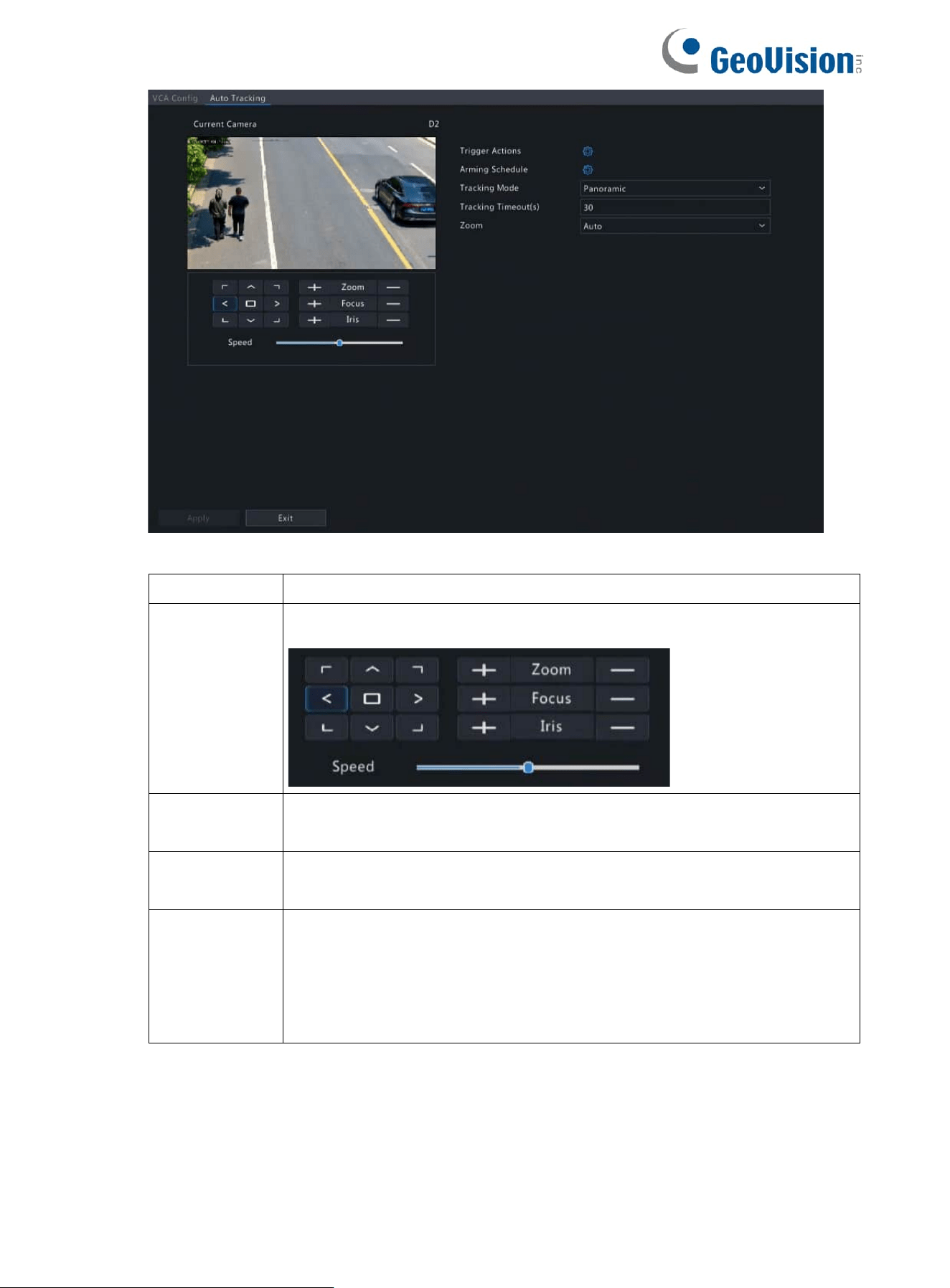
86
4. Set the tracking parameters.
Parameter
Description
Tracking Area
In the PTZ operation area, use the PTZ control buttons to adjust the tracking area,
including shooting angle, zoom, focus, iris and rotation speed.
Tracking Mode
Panoramic: Continuously tracks objects that appear in the tracking area until they
disappear from the tracking area.
Tracking
Timeout(s)
Set the maximum tracking time. The device stops tracking when the object disappears
or the set time is up. Range: 1 to 300. Default: 30.
Zoom
Select the tracking zoom ratio: Auto or Current Zoom. The default is Auto.
• Auto: Automatically adjusts the zoom ratio according to the tracking distance,
focusing more on the object behavior.
• Current Zoom: Keeps the zoom ratio when the object is tracked, focusing more on
the whole monitoring scene.
5. Set the alarm-triggered actions and arming schedule. See Alarm-triggered Actions and Arming Schedule for
details.
6. Click Apply.
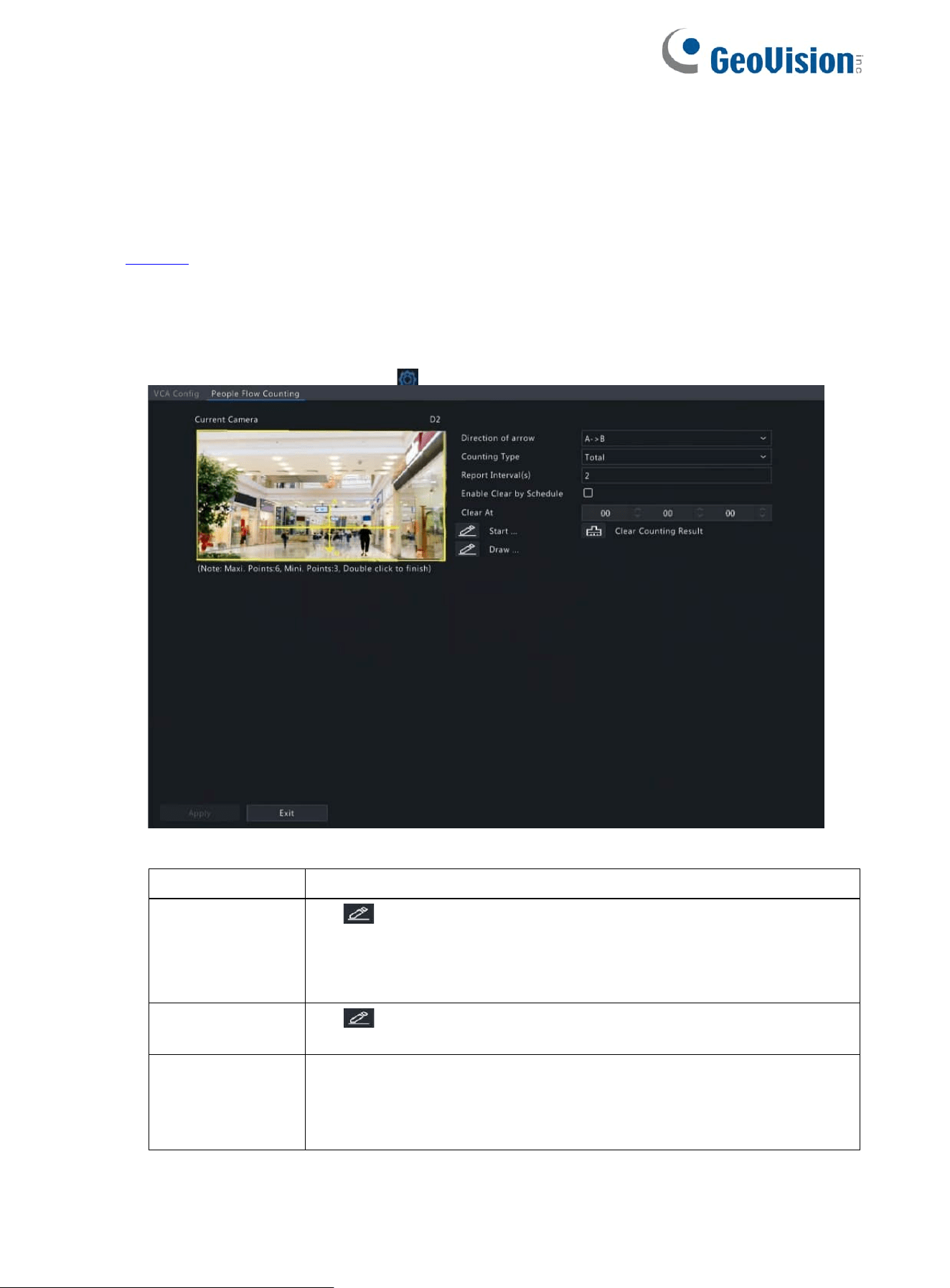
87
6.1.4 People Counting
People counting includes people flow counting and crowd density monitoring.
6.1.4.1 People Flow Counting
People flow counting counts people passing a specified tripwire in a user-defined area.
Note: People Flow Counting only works with compatible AI GV-IP Cameras that support this feature (see the
datasheet for compatible AI cameras).
Configure People Flow Counting
1. Go to Menu > VCA > VCA Config.
2. Select a camera.
3. Select People Flow Counting and click to configure it.
4. Set the people flow counting rule.
Parameter
Description
Draw Area
Click to enter the full screen and then draw a detection area.
Click on the image and drag to draw a line. Repeat the action to draw more lines to
form an enclosed shape as needed. Up to 6 lines are allowed. Right-click to exit the
full screen.
Draw Tripwire
Click to enter the full screen and then draw a tripwire. Only 1 tripwire is
allowed. Right-click to exit the full screen.
Direction of arrow
Set the entry direction.
• A- >B: A to B is entry, B to A is exit.
• B- >A: B to A is entry, A to B is exit.
88
Counting Type
Select the counting type: Total, People Entered, or People Exited. Total is the
default counting type.
• Total: Displays the number of people entering and leaving the detection area.
• People Entered: Displays the number of people entering the detection area. An
entry is counted as a person crosses the tripwire in the direction of the arrow
and passes through the detection area.
• People Exited: Displays the number of people leaving the detection area. An
exit is counted as an object crosses the tripwire in the opposite direction of the
arrow and passes through the detection area.
Note:
• Before use, you need to enable people counting OSD under Menu > Camera
> OSD.
• People that loiter in the detection area, cross the tripwire only, or cross the
detection area only are not counted.
Report Interval(s)
Set the time interval for reporting people flow statistics. Default: 60. Range: 1 to 60.
The NVR reports people flow statistics to the uplink platform at set intervals. The
uplink platform must subscribe to the function to receive the statistics.
Enable Clear by
Schedule
Select the Enable Clear by Schedule check box and set the time to clear people
counting statistics.
Clear At
The clearing time defaults to 00:00:00. You can modify it as needed. The NVR will
clear people counting statistics on the OSD at the set time everyday. This operation
does not affect statistics and data reporting.
Clear Counting Result
Click to clear people counting statistics displayed on the live video
immediately. This operation only affect the people counting OSD and does not
affect statistics and data reporting.
5. To be alerted when the number of people in the detection area exceeds a certain number, you can enable and
configure People Present Alarm under Menu > Alarm > People Present Alarm. See People Present Alarm for
details.
6. Click Apply.
View Real-time Statistics
Right-click on the live view page and select Preview Mode > Smart, then the real-time people statistics are
shown on the right. See People Flow Counting for details.
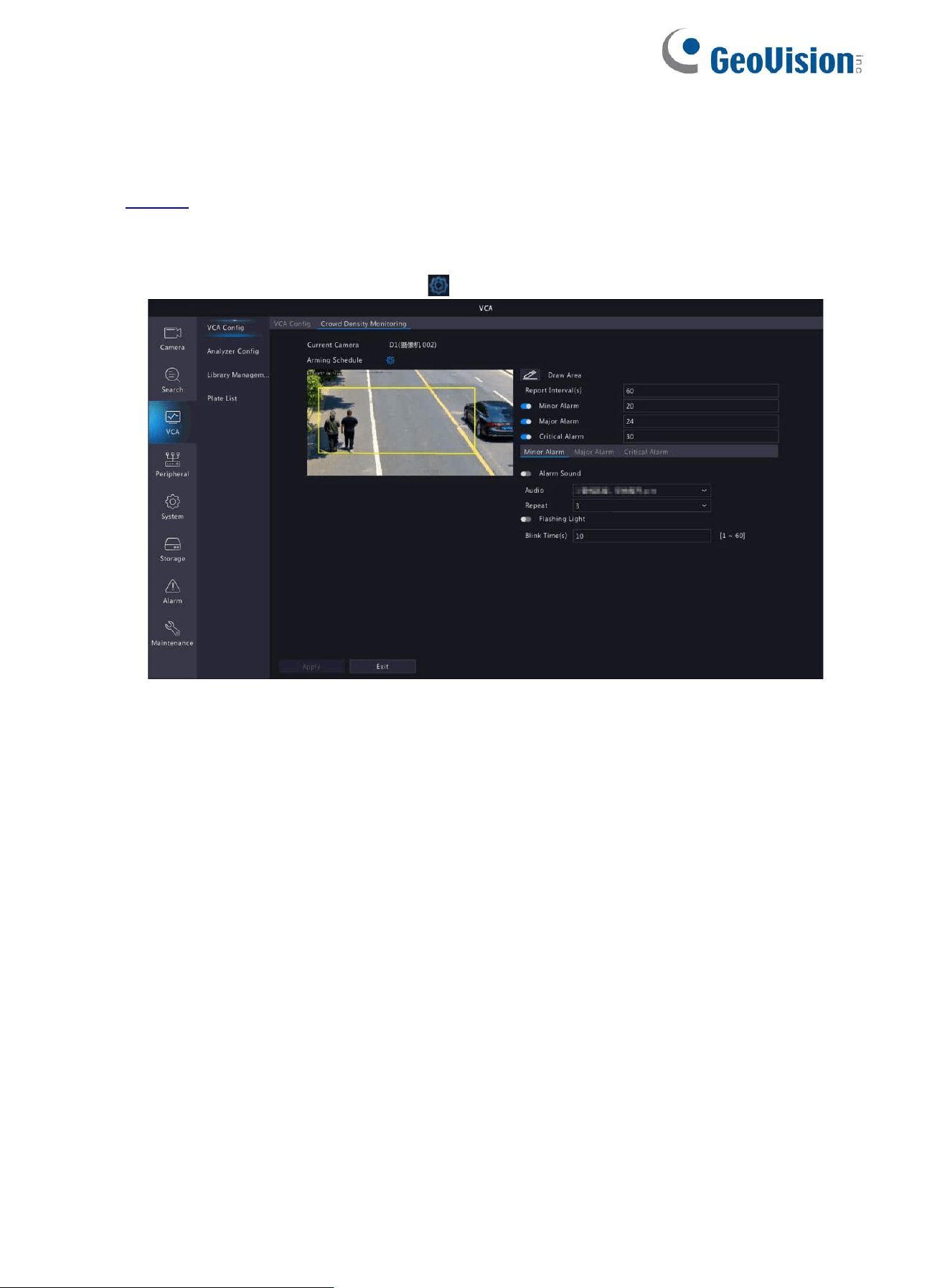
89
Select Crowd Density Monitoring and click to configure it.
6.1.4.2 Crowd Density Monitoring
Crowd density monitoring monitors the number of people in a specified area and triggers an alarm if the number
exceeds the set alarm threshold.
Note: Crowd Density Monitoring only works with compatible AI GV-IP Cameras that support this feature (see the
datasheet for compatible AI cameras).
1. Go to Menu > VCA > VCA Config.
2. Select a camera.
3.
90
4. Set the crowd density monitoring rule.
Parameter
Description
Detection Area
A detection box is displayed in the left preview window by default. You can
adjust the position of it or draw an area as needed. Only 1 detection area is
allowed.
• Adjust the position of the default detection area: Point to a border of the
area and drag it to the desired position.
•
Draw an area: Click , and the full screen is displayed. Click on the
image and drag to draw a line. Repeat the action to draw more lines to
form an enclosed shape as needed. Up to 6 lines are allowed. Right-click
to exit the full screen.
Report Interval(s)
Set the time interval for reporting crowd density statistics. Default: 60.
Range: 1 to 60.
The device reports crowd density statistics to the uplink platform at set
intervals. The uplink platform must subscribe to the function to receive the
statistics.
Minor Alarm
A minor alarm is triggered when the number of people in the specified area
reaches the set value.
Select the Minor Alarm check box and set the number of people to trigger
minor alarms. Range: 1 to 40.
Major Alarm
A major alarm is triggered when the number of people in the specified area
reaches the set value. The value of major alarm must be greater than that of
minor alarm.
Select the Major Alarm check box and set the number of people to trigger
major alarms. Range: 1 to 40.
Critical Alarm
A critical alarm is triggered when the number of people in the specified area
reaches the set value. The value of critical alarm must be greater than that of
major alarm.
Select the Critical Alarm check box and set the number of people to trigger
critical alarms. Range: 1 to 40.
5. Enter the Minor Alarm, Major Alarm, and Critical Alarm tabs, and set the alarm sound and flashing light
respectively.
• Alarm Sound: Enable Alarm Sound, and set the audio file and the number of times the audio file to be
played by the camera when an alarm occurs.
• Flashing Light: Enable Flashing Light, and set the duration that the illuminator flashes when an alarm
occurs.
6. Set the arming schedule. See Arming Schedule for details.
7. Click Apply.
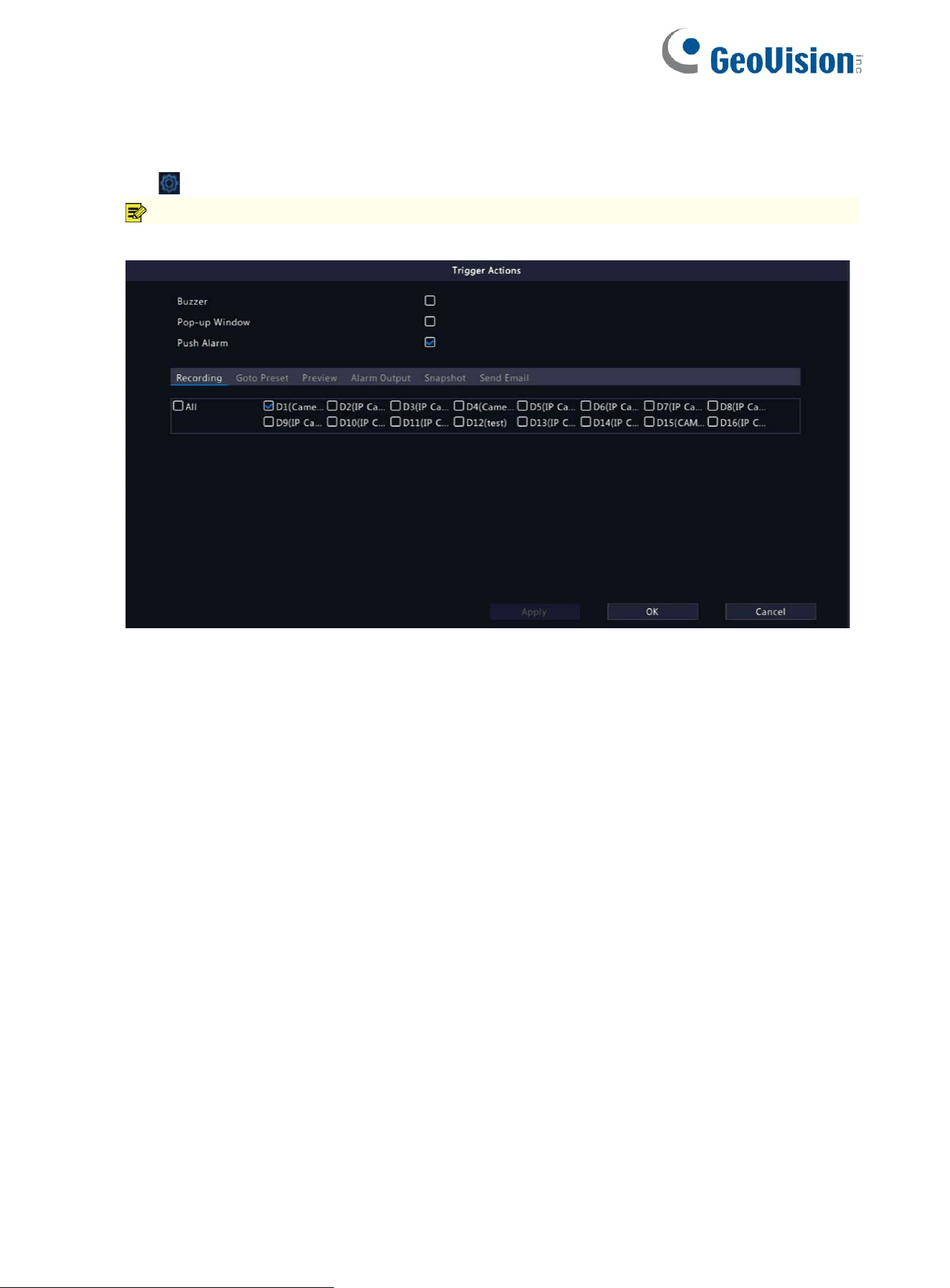
91
6.1.5 Alarm-triggered Actions
Configure actions to be triggered when an alarm occurs to alert user or the specified people.
Some actions are detailed below.
Buzzer
The NVR makes a buzzing sound when an alarm occurs.
Pop-up Window
An alarm message pops up when an alarm occurs.
Push Alarm
An alarm information will be pushed to the upper platform when an alarm occurs.
Recording
The NVR records video from the selected camera when an alarm occurs.
Click right to Trigger Actions, set the actions, and then click OK.
Note: The actions supported may vary with NVR model and VCA function.
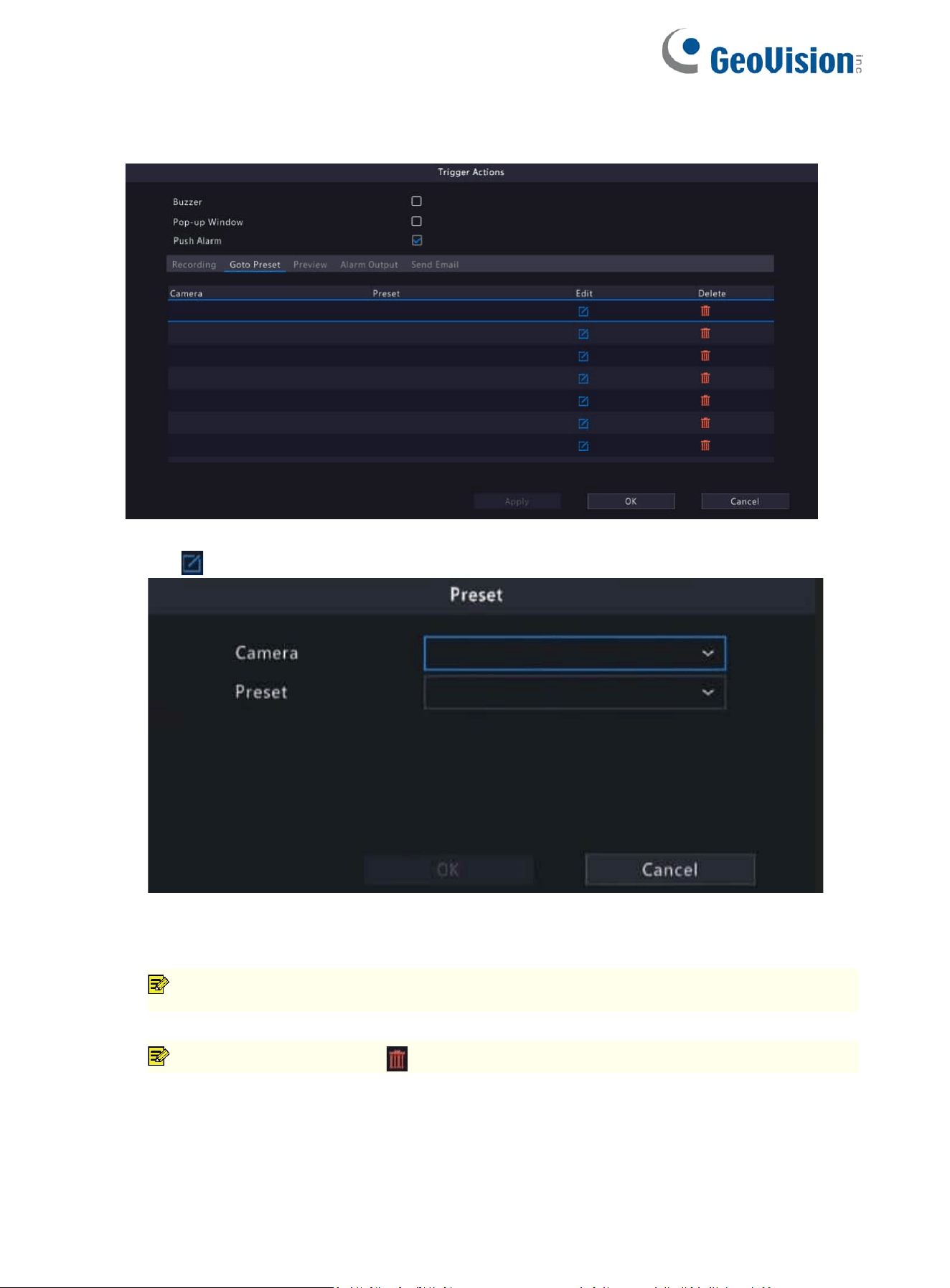
92
Click .
Goto Preset
A PTZ camera moves to a preset position when an alarm occurs.
Configure this action as follows:
1.
2. Select the camera to perform this action and select the preset you want the camera to go to when an alarm
occurs.
3. Click OK.
Note: To delete the action, click .
Note: Before use, you need to configure presets on the PTZ camera. See Network Camera User Manual
for details.
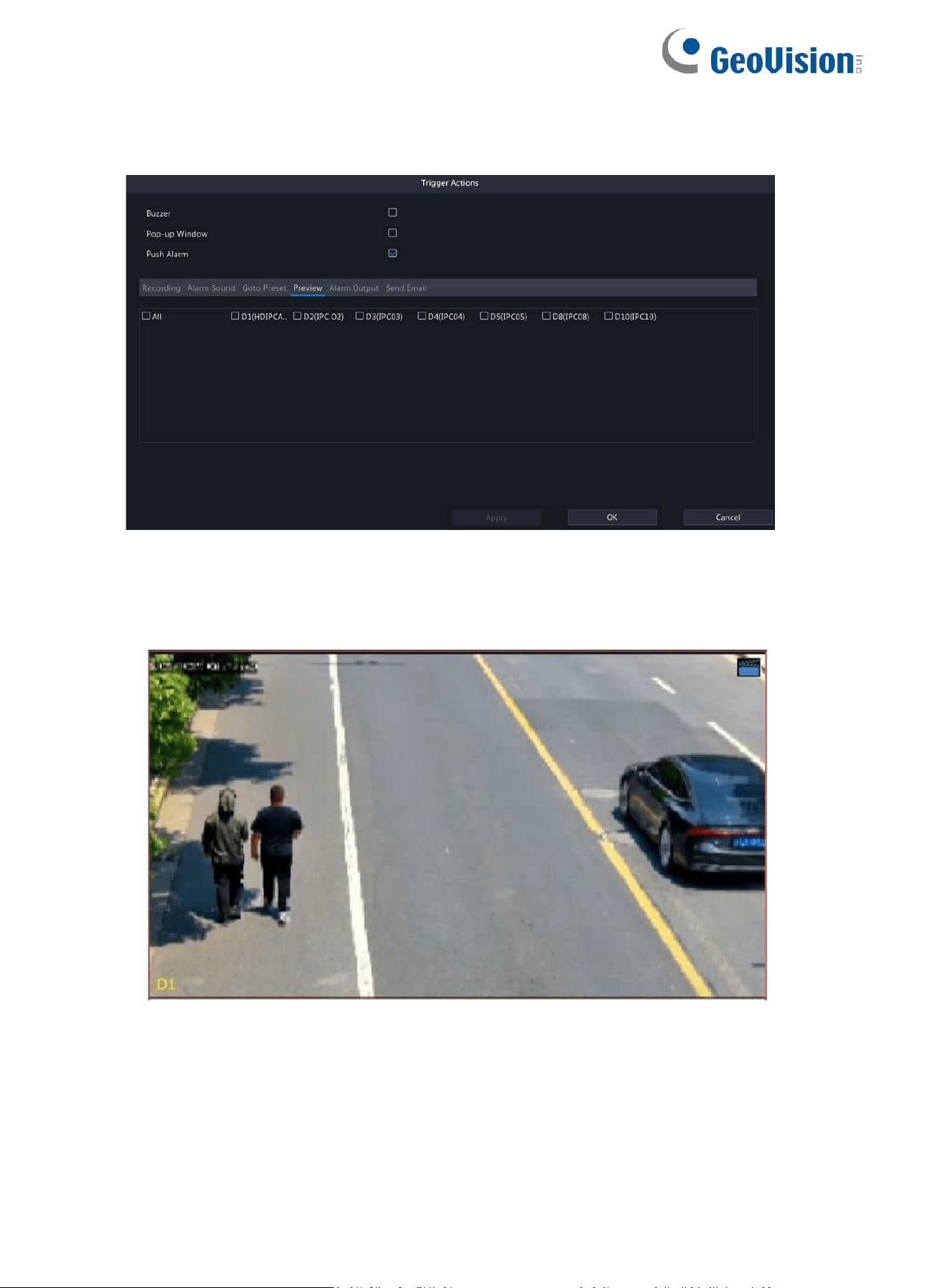
93
Preview
The NVR plays the live video of the specified camera(s) when an alarm occurs. To perform this action, you need to
configure Max. Alarm-Triggered Live View Windows (1/4/9 available) under Menu > System > Preview.
The live view page displayed in the event of alarms varies depending on the number of linked cameras and the
number of alarm-triggered live view windows. When an alarm occurs, the live view page shows the live video
from the linked camera(s) with a red frame; when the alarm ends, the live view page returns to the original state.
• When Max. Alarm-Triggered Live View Windows is set to 1 Window, the live view page plays live video in
one window. If more than one camera is linked, the live video switches at 5s.
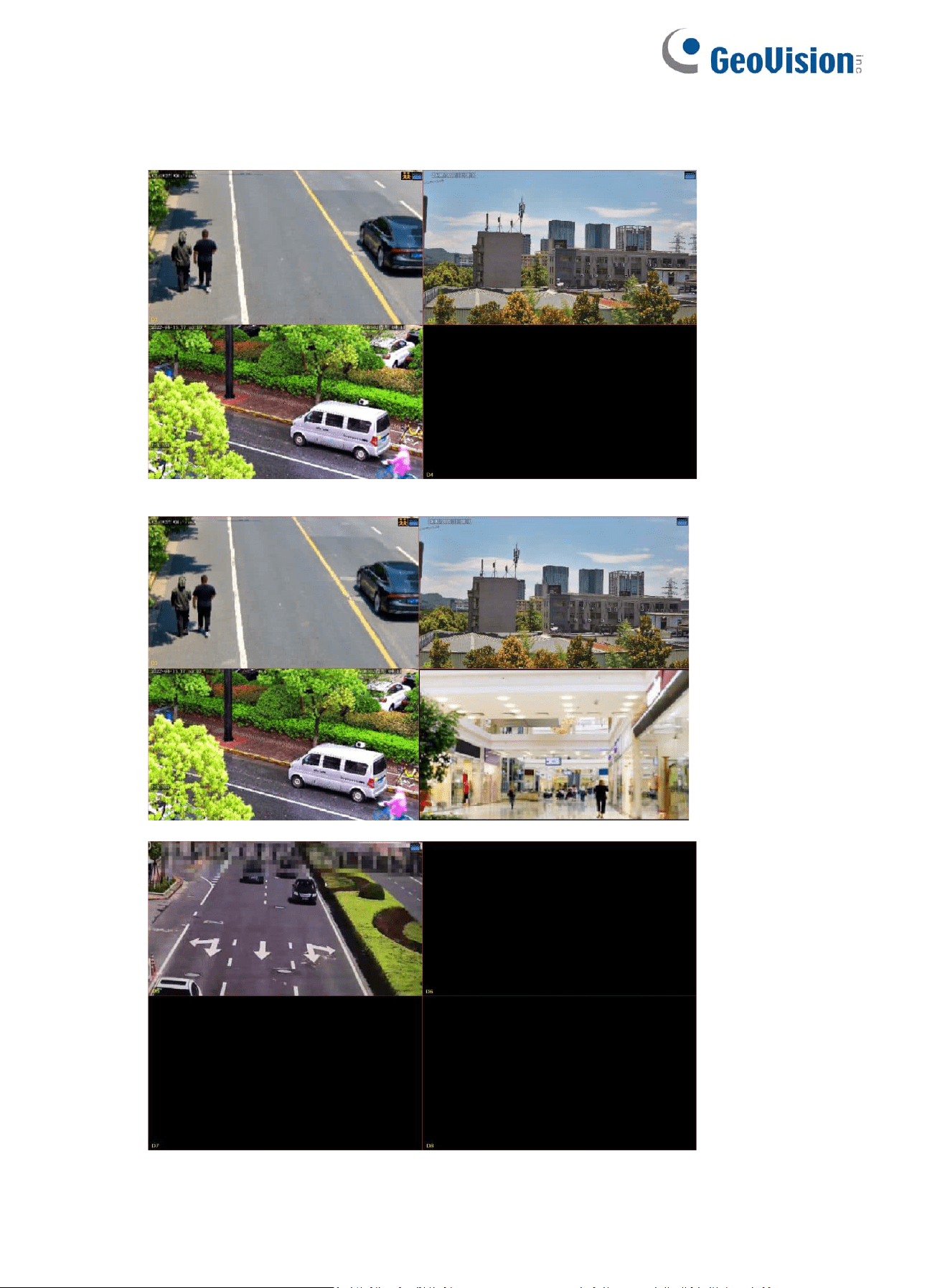
94
• When Max. Alarm-Triggered Live View Windows is set to 4 Windows, the live view page plays the live video
of each camera in 4-split mode. If more than 4 cameras are linked, the live video switches at 5s.
Live view page with 3 cameras linked:
Live view page with 5 cameras linked:
• When Max. Alarm-Triggered Live View Windows is set to 9 Windows, the live view page plays the live video
of each camera in 9-split mode. If more than 9 cameras are linked, the live video switches at 5s.
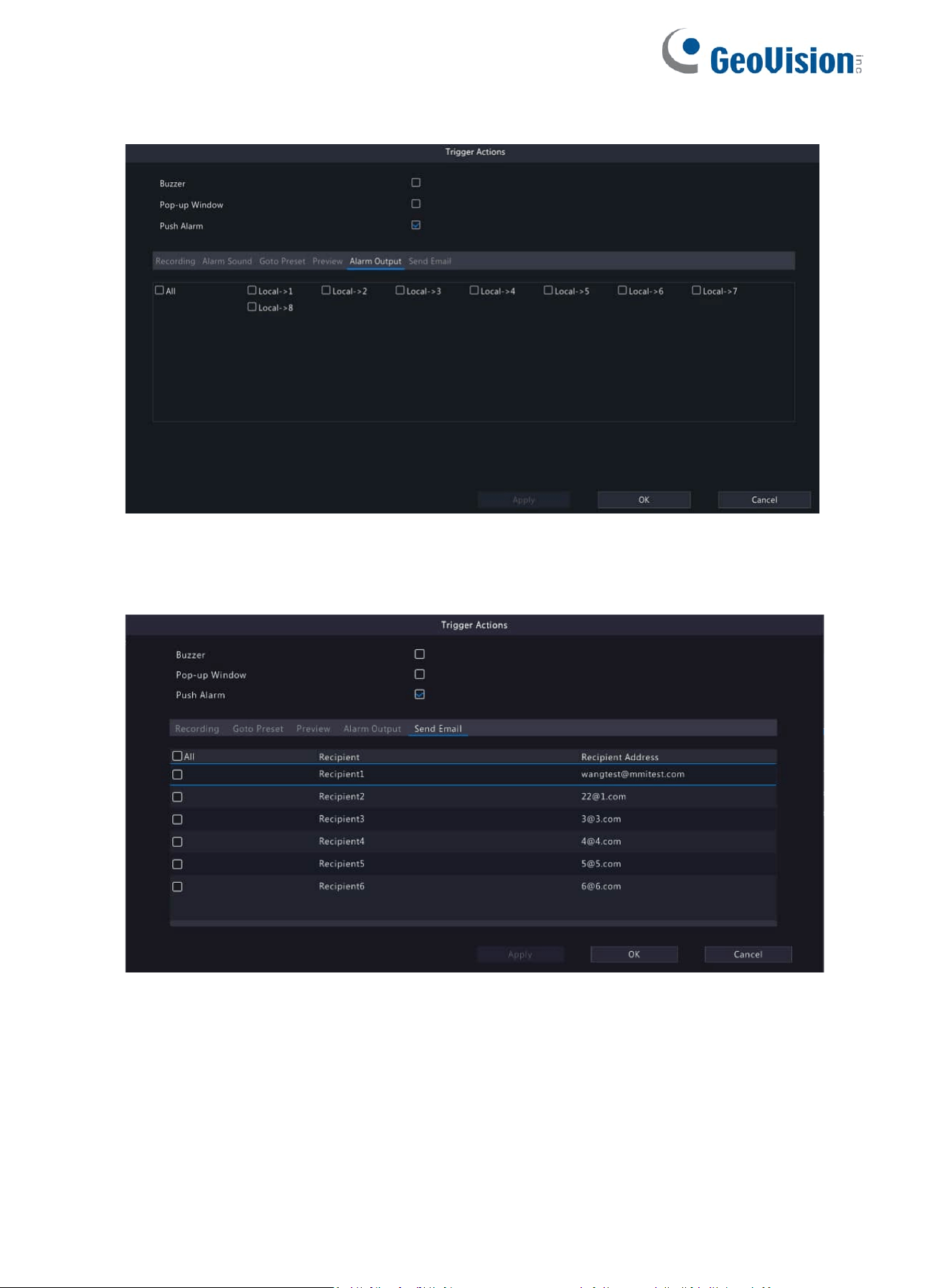
95
Alarm Output
A third-party device is triggered to raise an alarm when it receives an alarm output by the NVR.
Send Email
The NVR sends an email with alarm information to the specified email address(es) when an alarm occurs. Please
set the recipient information in Email. Up to 6 recipients are allowed.
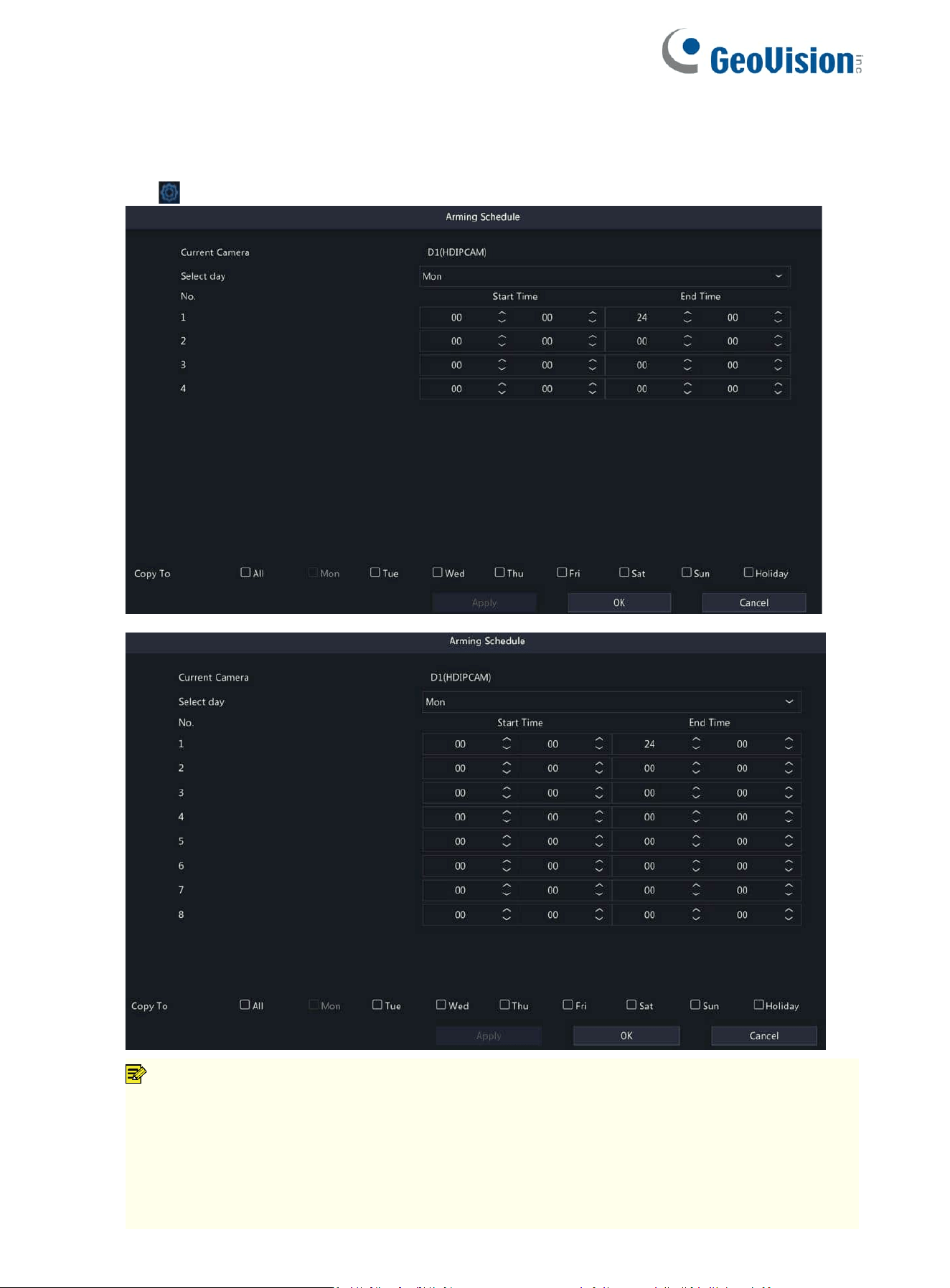
96
6.1.6 Arming Schedule
Configure an arming schedule to determine when the NVR receives alarms and performs predefined alarm-
triggered actions.
On certain NVRs, the Arming Schedule page shows as follows:
Click right to Arming Schedule, configure the schedule as needed, and then click OK.
Note:
• Up to 4 or 8 time periods are allowed per day, and the time periods cannot overlap.
• (Optional) To apply the same schedule to other days, select the desired day(s) after Copy To.
• The number of arming time periods available varies by function.
•
If a SIP camera is connected to the NVR and configured with camera side analysis of Intrusion Detection,
Cross Line Detection, Enter Area, Leave Area, or Human Body Detection, the arming schedule configured
for these functions on the NVR will be synchronized to the camera.
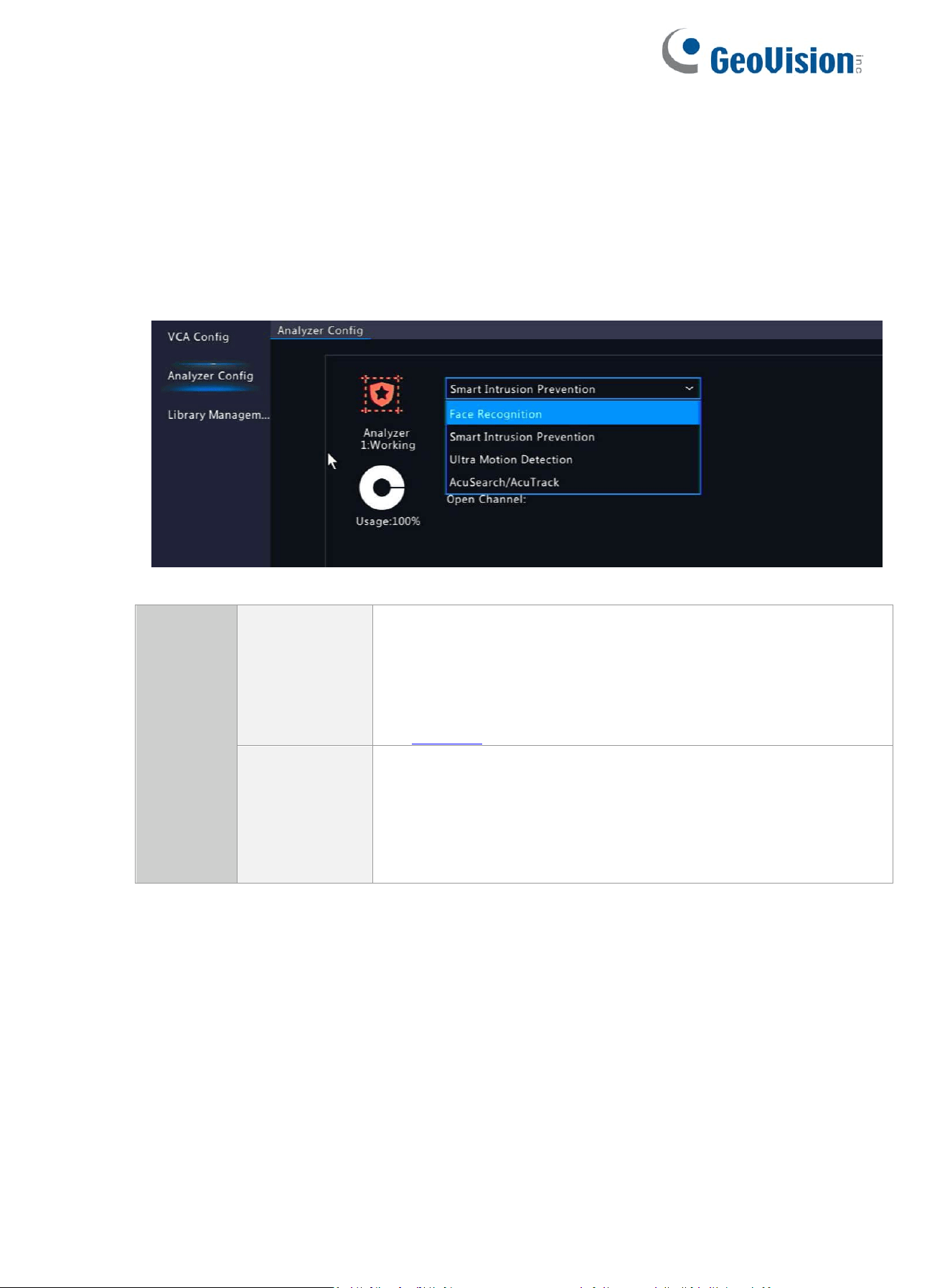
97
6.2 Analyzer Configuration
View the analyzer usage and change the analysis mode.
Analyzer is a smart chip used to process face recognition, smart intrusion prevention, behavior analysis, ultra
motion detection, people counting, AcuSearch/Track, etc. The analyzer capacity varies by NVR model, which
requires you to allocate channels appropriately.
1. Go to Menu > VCA > Analyzer Config.
2. View the analyzer's capacity usage. The analyzer's capacity can be represented by the number of video
streams or image streams it can analyze.
Note: Only one analyzer setup (Camera-Side Analysis or NVR-Side Analysis) can be enabled at a time.
AI Analytics
Camera-Side
Analysis
Intrusion Detection, Cross Line Detection, Enter Area, Face Detection, Leave
Area, People Flow Counting, Crowd Density Monitoring
* All channels (up to 8 images per second in total)
*These functions are only applicable when the NVR is connected to AI GV-IP
cameras, as listed in the Compatible AI-Capable GV-IP Cameras section in
the datasheet.
NVR-Side Analysis
- Face Recognition (Face Detection, Face Comparison): max. 1 CH
- Smart Intrusion Protection (Cross Line Detection, Intrusion Detection,
Enter Area, Leave Area): max. 2 CHs
- Ultra Motion Detection (only to AI-capable GV-IP cameras, as listed in
the Compatible AI-Capable GV-IP Cameras section below): max. 4 CHs
- AcuSearch: max. 1 CH
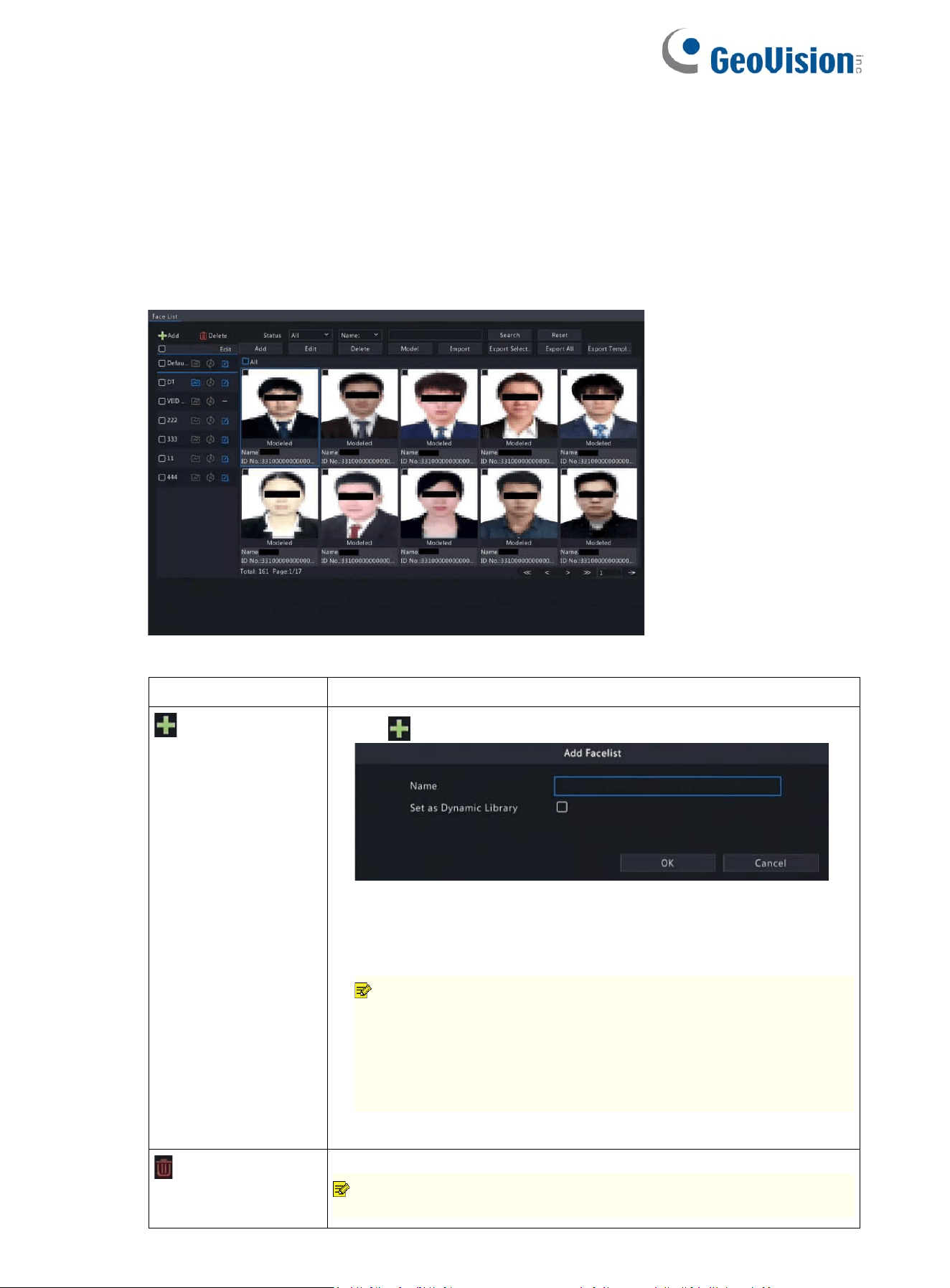
98
6.3 Library Management
Manage face library.
6.3.1 Face List
Configure face lists for face comparison.
Configure Face List
1. Go to Menu > VCA > Library Management > Face List.
2. Configure face lists. A face list is created by default. Up to 128 face lists are allowed.
Parameter
Description
(1)
Click to add a face list.
(2)
Enter the list name.
(3)
(Optional) Select the Set as Dynamic Library check box to set the face list as
a dynamic list. The captured face images that do not match any face image in
face lists will be automatically added to the dynamic list.
Note:
• If there is no dynamic face list, you can add a new face list and set it
as a dynamic list. You can only configure a dynamic list while adding a
face list.
• Only 1 dynamic list is allowed. To change the dynamic list, you need
to delete the original dynamic list and add a new one.
(4)
Click OK.
Delete the selected face list(s).
Note: Deleting a face list will also delete its related historical alarm records.
Please handle with caution.
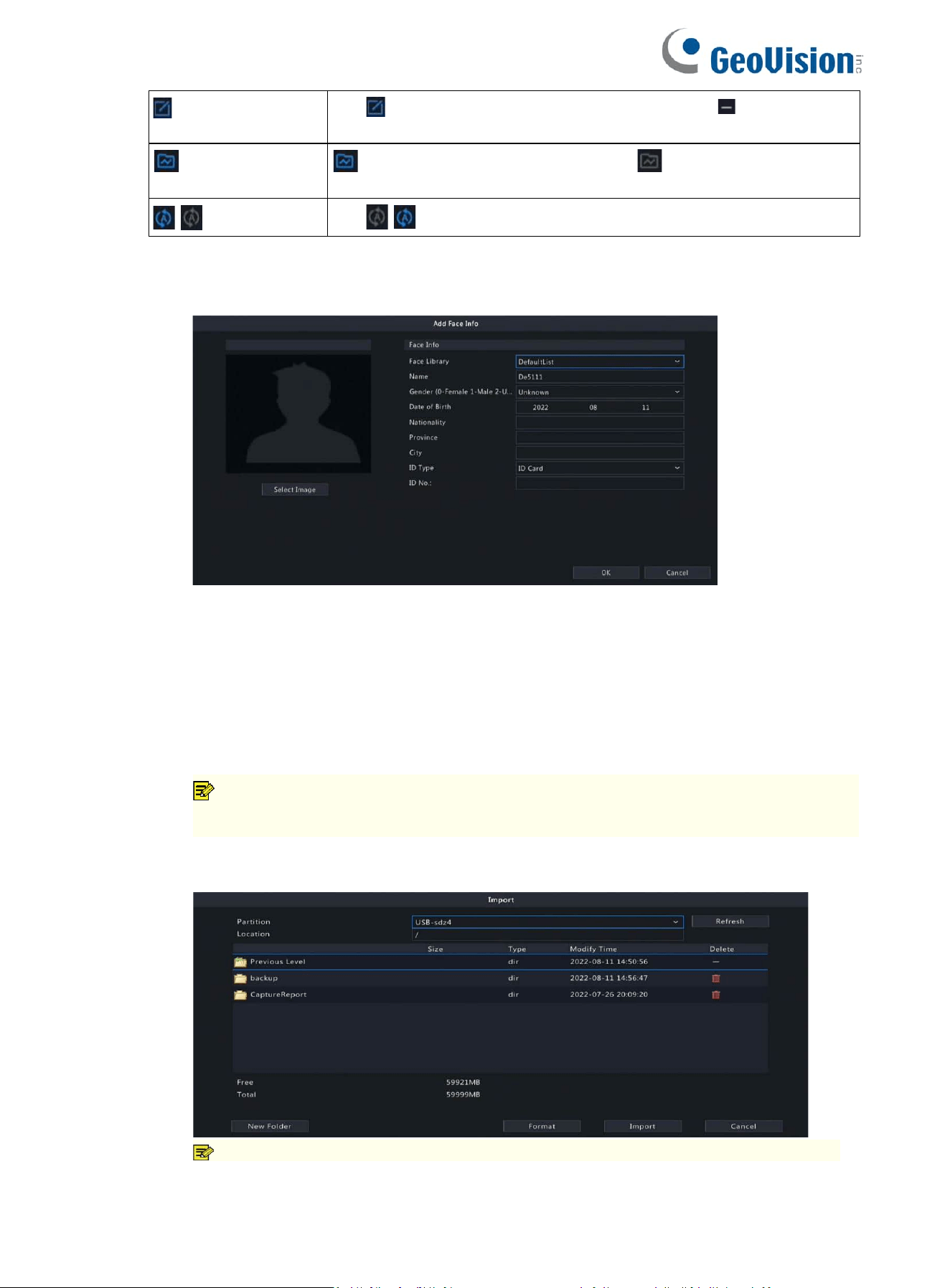
99
/
Click to edit the face list. You can only edit the list name. indicates that
the face list cannot be edited.
/
indicates that the face list is a dynamic list. indicates that the face list is
not a dynamic list.
/
Click / to enable/disable Auto Snapshot to Library.
3. Import face images. You can import one by one or in batches.
• Import one by one
(1) Click Add.
(2) Click Select Image to import the desired face image.
(3) Complete the face information including face library, name, gender, date of birth, nationality, province,
city, ID type, and ID number.
(4) Click OK.
• Import in batches
(1) Click Export Template.
(2) Select the location to save the template and click Backup.
(3) Complete the template with reference to the import guide.
(4) Click Import, select the template, and click Import.
Note: You can export the template to an external storage device (connect a storage device to the
NVR) or a PC (log in to the NVR's web interface, go to Smart > List Management > Face List, click
DefaultList, and then click Export Template).
Note: The number of images allowed for a file depends on the library capacity of the device.
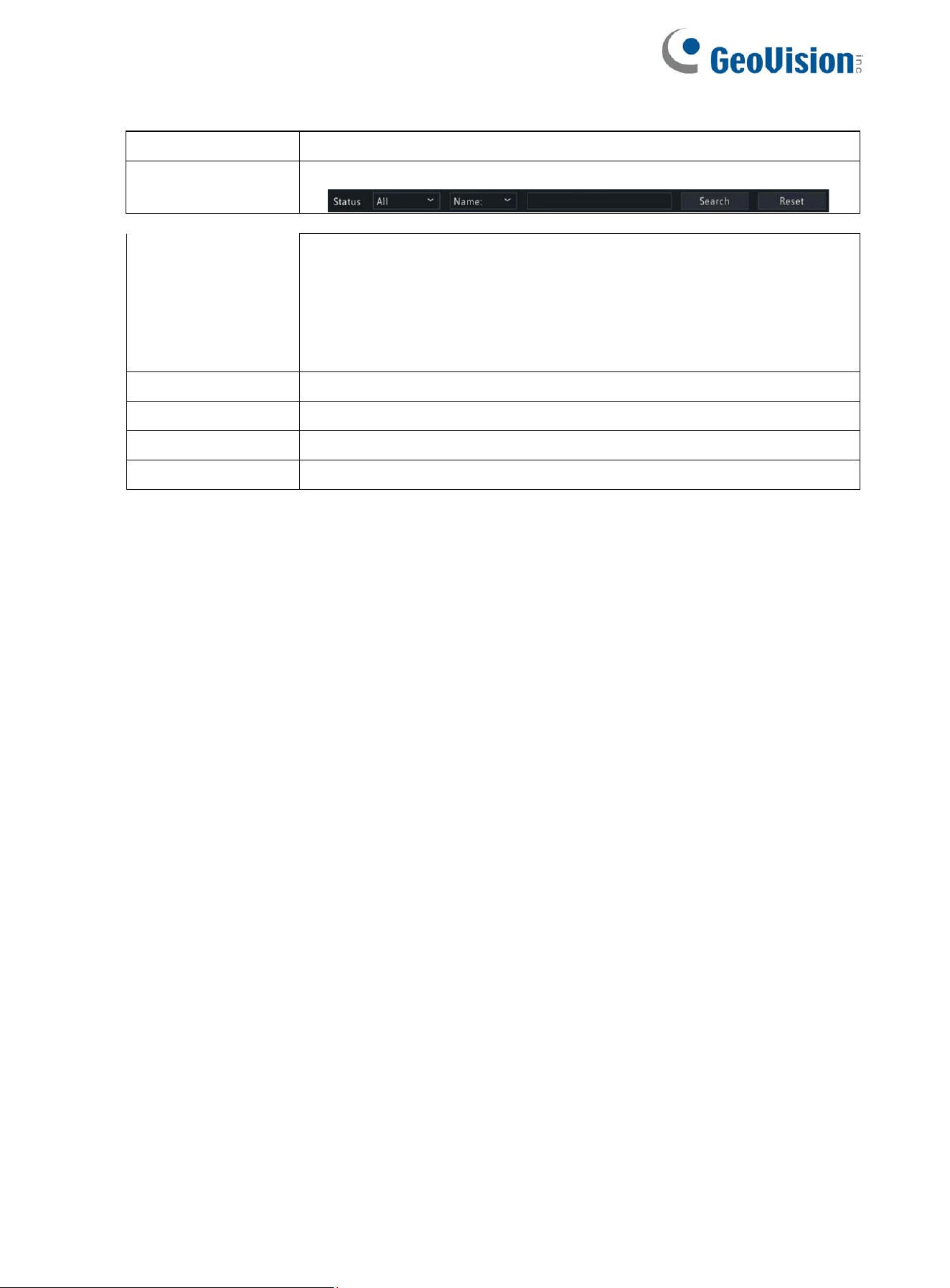
100
Other Operations
Parameter
Description
Search
1.
Set search conditions.
• Select the modeling state: All, Modeled, Modeling Failed, Modeling, or Not
Modeled.
• Select Name or ID No. and enter the name or ID number to search.
2. Click Search.
3. To clear the search conditions, click Reset.
Edit
Select a face image and click Edit to modify its information.
Model
Model face images in Not Modeled or Modeling Failed status.
Export Selected
Export the selected face image(s).
Export All
Export all face images in the selected face list.
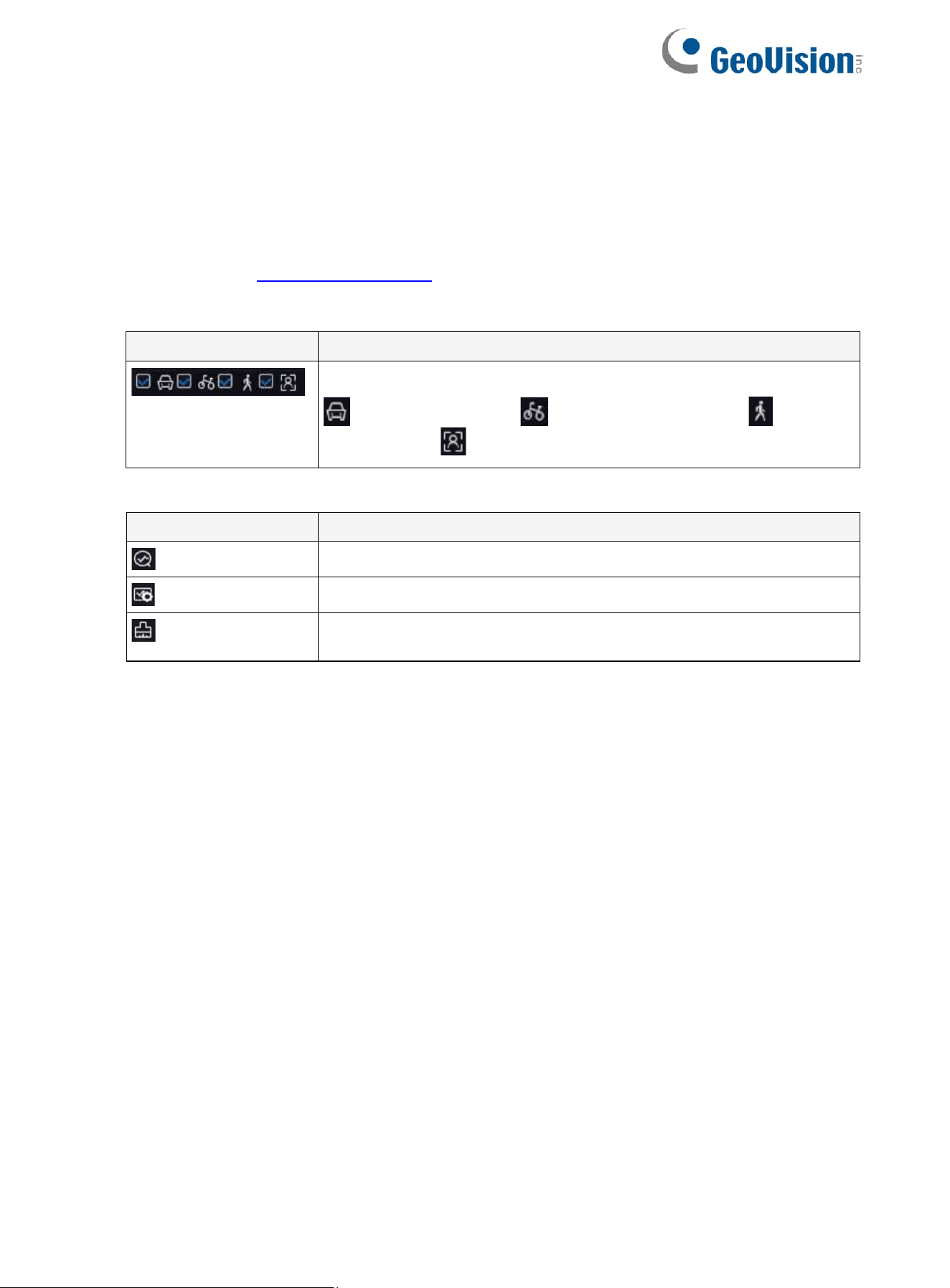
101
6.4 Smart Preview
View real-time snapshots and statistics of VCA functions on the live view page, including motor vehicle, non-
motor vehicle, human body, face and people flow counting.
Right-click on the live view page and select Preview Mode > Smart, then the real-time snapshots are displayed
on the right.
Note: To have real-time face detection in Preview, ensure to set up Face Detection or Face Comparison (see
Face Recognition). To have real-time vehicle detection in Preview, ensure to set up Intrusion Detection (see
Intrusion Detection, Smart Intrusion Prevention).
Preview Interface
Icon
Description
Select the object type(s) for which you want to view real-time snapshots.
means the motor vehicle, means the non-motor vehicle, means the
human body, and means the face.
Icon
Description
Open the Event page.
Open the VCA Config page.
Clear real-time snapshots displayed on the live view page. Search records and
statistics are not affected.
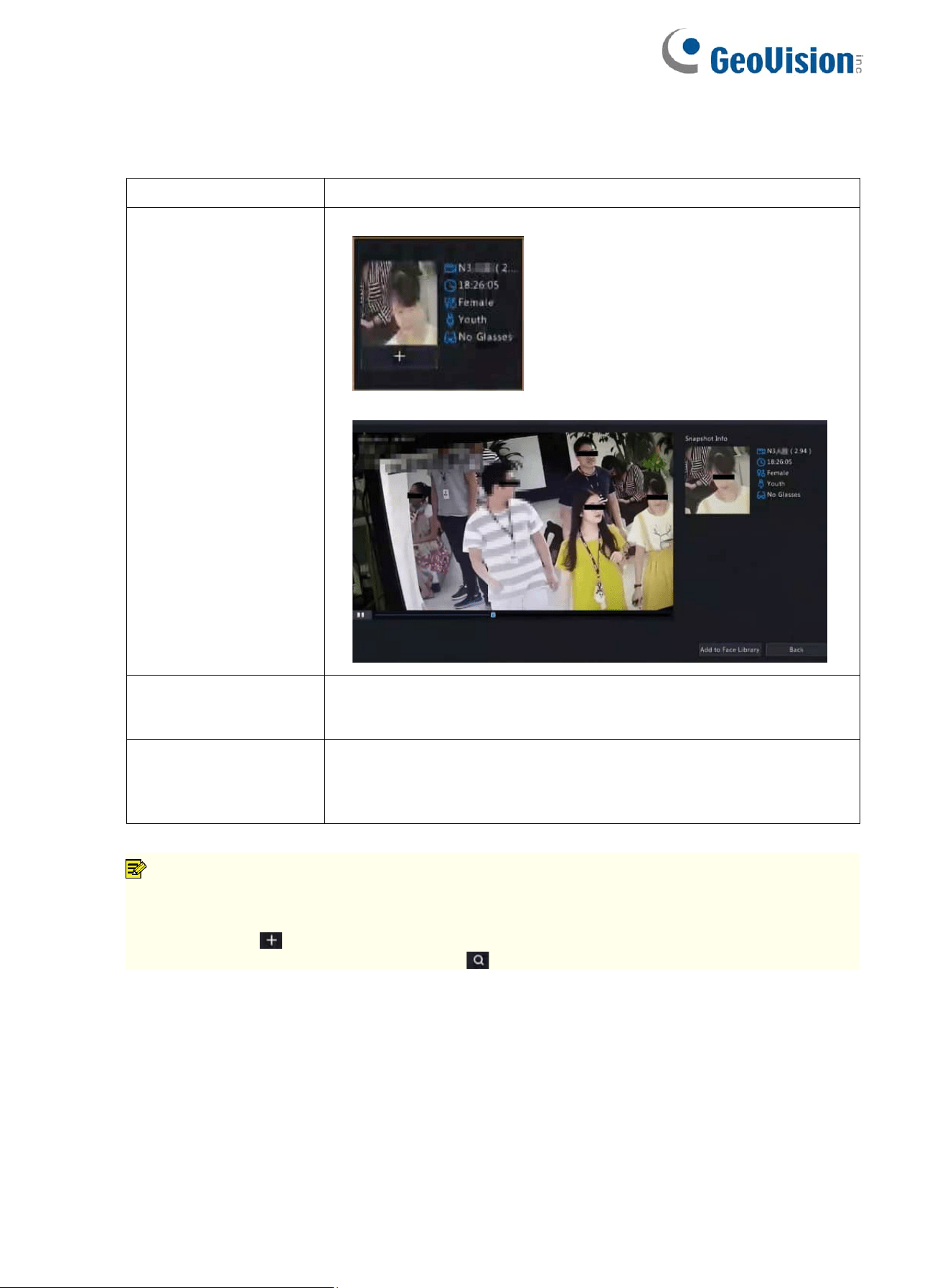
102
6.5.1 Face Recognition
View face snapshots, face snapshot information, and face matching/mismatching information.
Type
Description
Not Match Face Info
1. Select a mismatched face snapshot.
2. Click on the snapshot to view more details.
Face Snapshot Info
1. Select a face snapshot.
2. Click on the snapshot to view more details.
Match Face Info
1. Select a matched face snapshot. The left image is the captured image, and
the right image is the face image in the face list.
2. Click on the snapshot to view more details.
Note:
• In the View Details dialog box, a 15s video (10s before and 5s after the snapshot time) is automatically
played on the left, and the snapshot and its detailed information are displayed on the right.
•
You can click under a face snapshot or click Add to Face Library in the details page of a face snapshot
to add the snapshot to the face list, and click to search face images in face lists by this snapshot.
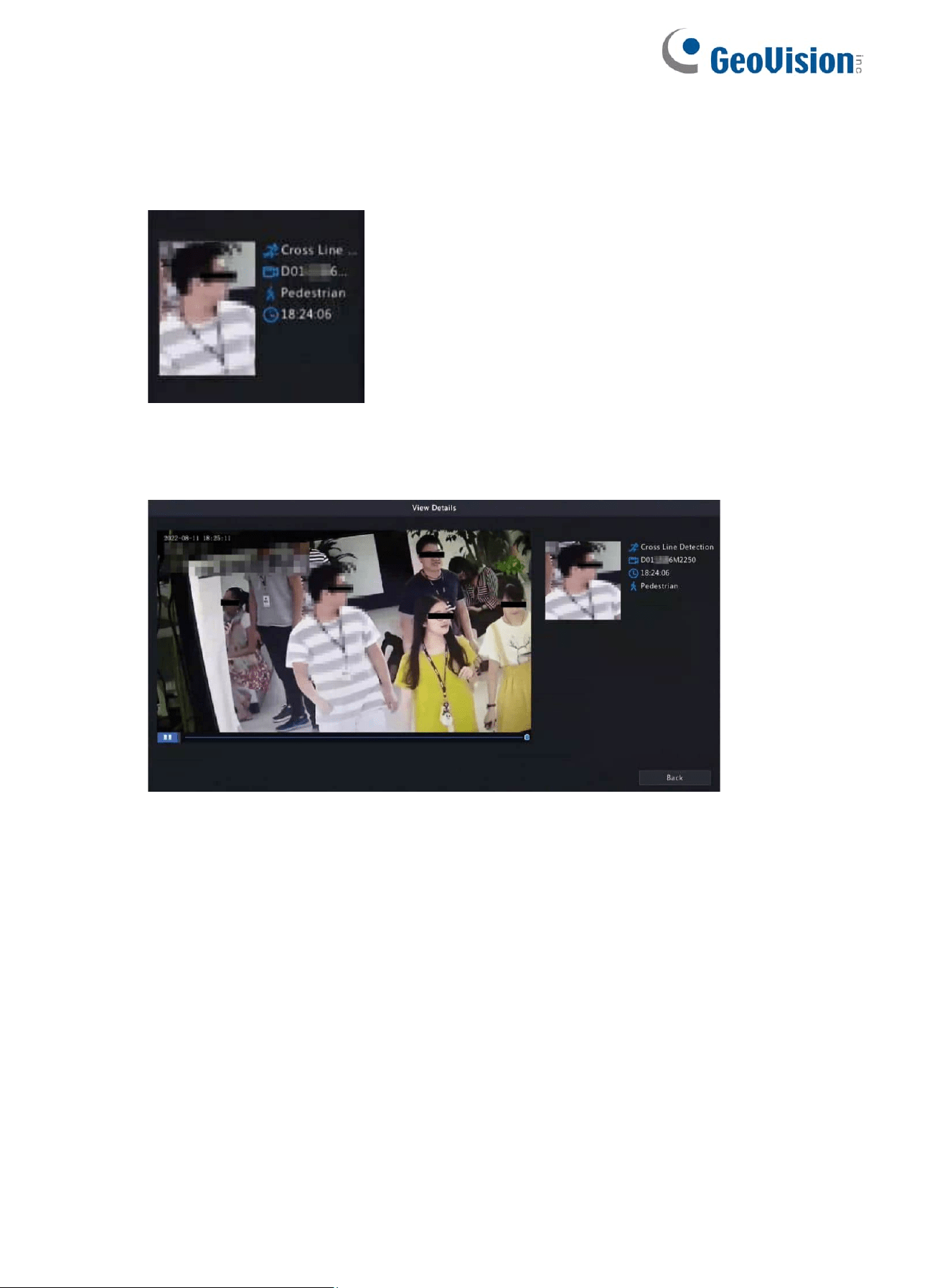
103
6.5.2 Smart Intrusion Prevention
View real-time snapshots of smart intrusion prevention functions including cross line detection, intrusion
detection, enter area detection, and leave area detection.
1. Select a snapshot.
2. Click on the snapshot to view more details.
In the View Details dialog box, a 15s video (10s before and 5s after the snapshot time) is automatically played
on the left, and the snapshot and its detailed information including event type, camera name, time, and
object type are displayed on the right.
In the View Details dialog box, a 15s video (10s before and 5s after the snapshot time) is automatically played
on the left, and the snapshot and its detailed information including camera name, time, license plate number,
vehicle color, and plate color are displayed on the right.
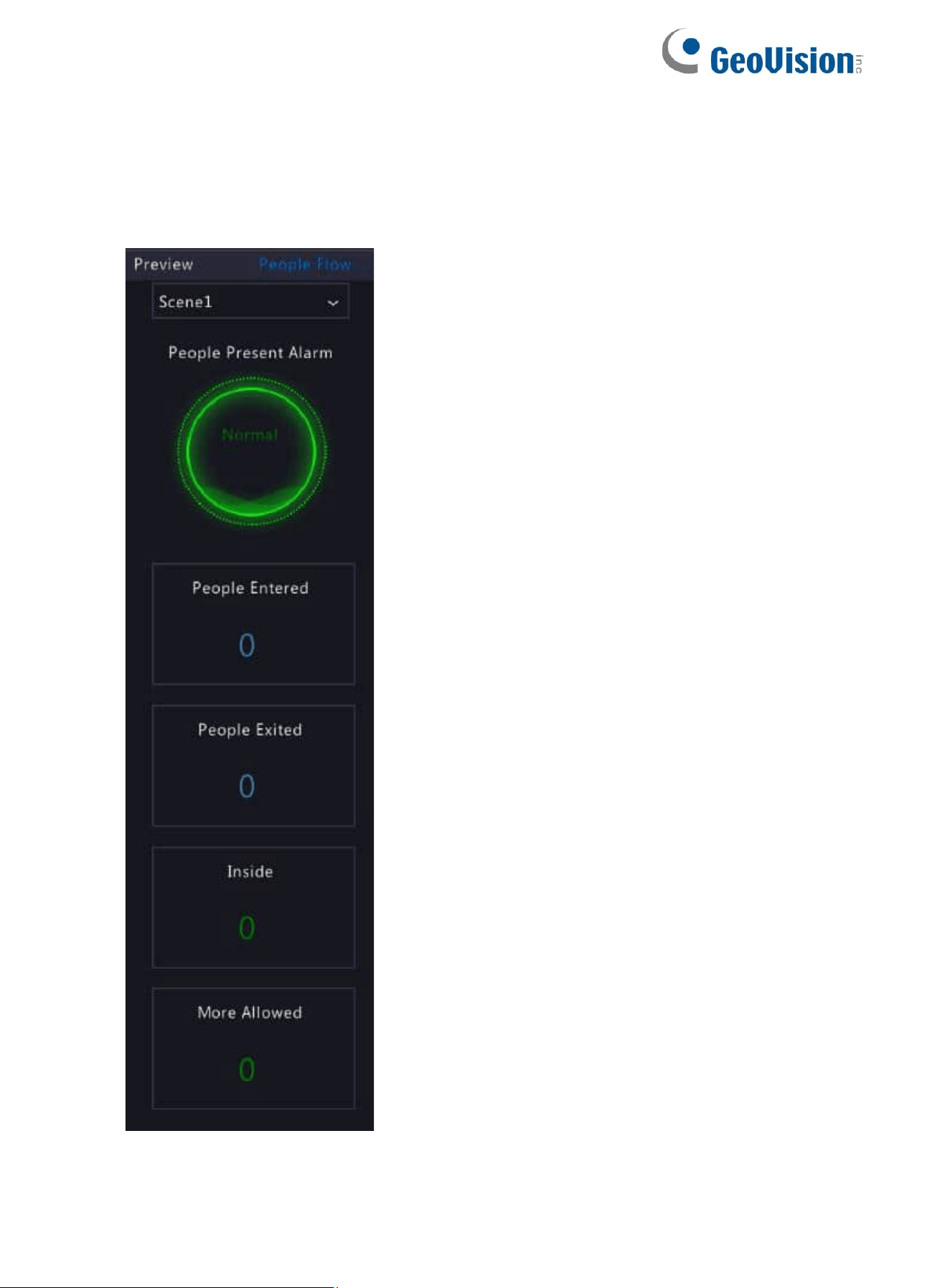
104
6.5.3 People Flow Counting
Select a scene and view real-time people flow statistics including the number of people entering/leaving/
currently allowed/present.
The green icon under People Present Alarm means the number of people present in the detection area does not
exceed the set threshold. If the icon is red, it means the number of people present in the detection area exceeds
the set threshold.
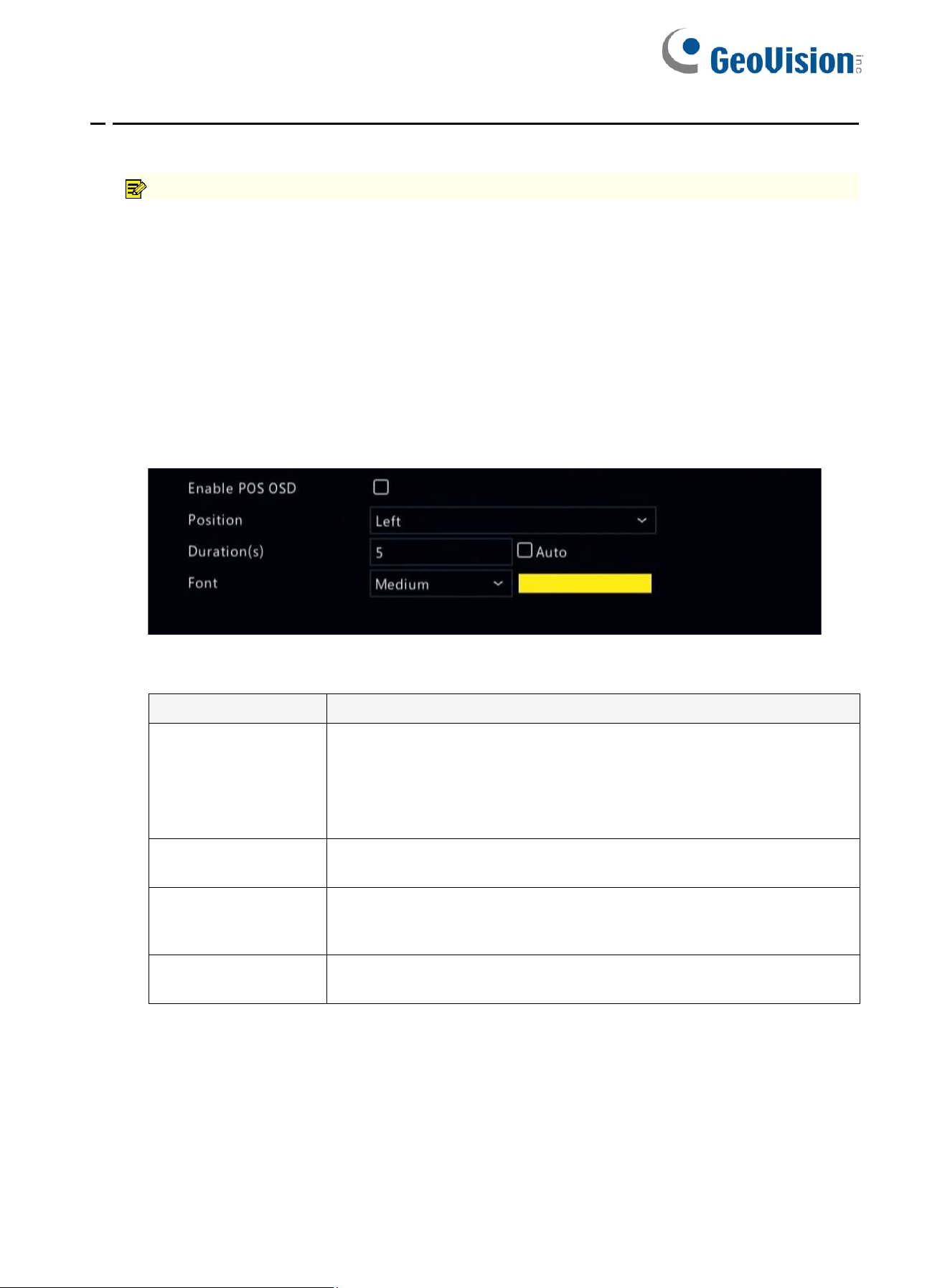
105
7 Peripheral Management
Manage the external devices connected to the NVR.
7.1 POS Configuration
Overlay transaction information to live and recorded videos for check and audit.
POS configuration includes POS OSD Configuration and POS Configuration. After the configuration is completed,
POS information will be displayed on both live and recorded videos, and POS recordings can be retrieved for
playback.
7.2.1 POS OSD Configuration
Configure POS OSD parameters.
1. Go to Menu > Peripheral > POS > POS OSD.
2. Select Enable POS OSD.
3. Configure the parameters.
Parameter
Description
Position
POS OSD position.
• Left: In the upper-left corner of the image.
• Center: In the middle of the image.
• Right: In the upper-right corner of the image.
Duration(s)
Length of time that POS OSD is displayed on live and recorded video images.
Default: 5s. Max. 120s.
Auto
Displays POS OSD according to the POS data duration obtained based on Time
Start Identifier and Time End Identifier. For Time Start Identifier and Time End
Identifier, see also POS Configuration.
Font
Font size and color of POS OSD. Font sizes include X-large, Large, Medium, and
Small.
4. Click OK.
Note: This function is only available to certain NVR models.
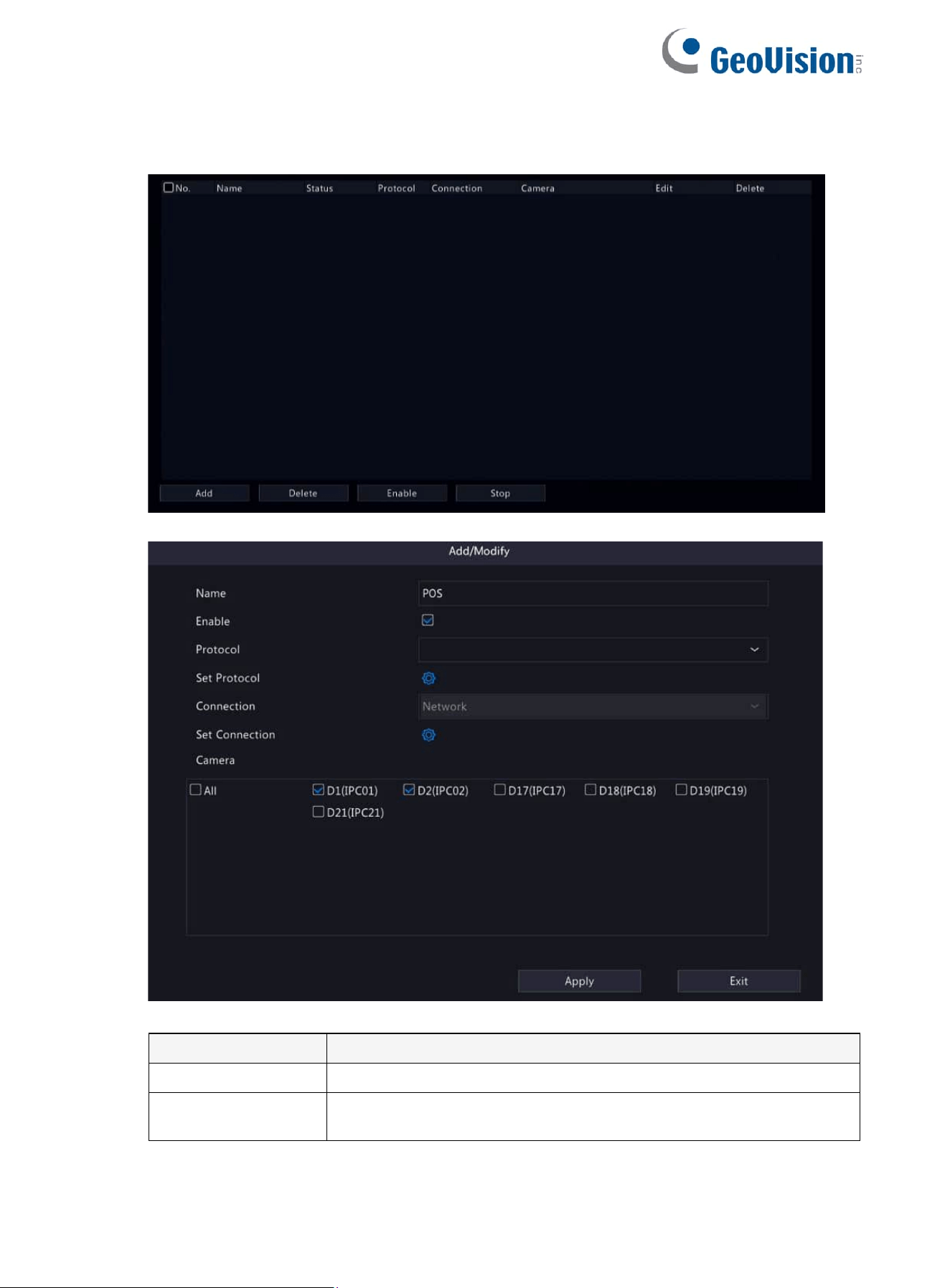
106
7.2.2 POS Configuration
Add POS and configure POS protocols.
1. Go to Menu > Peripheral > POS > POS.
2. Click Add.
3. Configure the parameters.
Parameter
Description
Name
Set a name that is easy to recognize. The POS name must be unique.
Enable
The new POS is enabled by default. You may clear the checkbox to disable the
POS, and enable it on the POS page at any time.
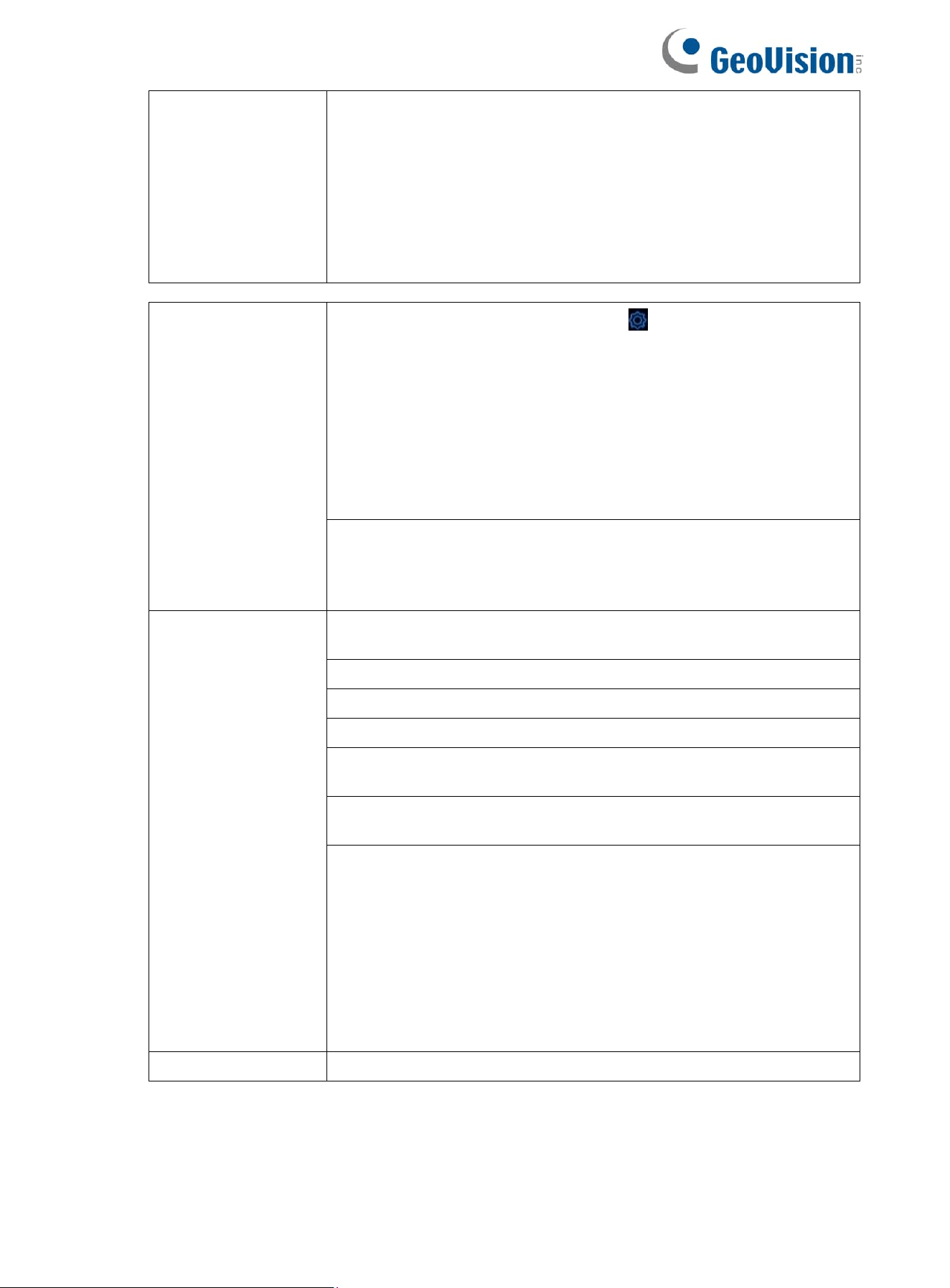
107
Protocol
• General: The POS is directly connected to the NVR.
Note: Choose this option with caution. POS connection may fail due to
different protocols of different POS machine vendors.
• AVE: The POS machine transmits data to the AVE device, and the AVE device
connects to the NVR.
Note: AVE is a device that supports multiple POS protocols. It integrates
POS data in different formats and converts them into data transmittable
via TCP/UDP.
Only applicable to the General protocol. Click . The start identifier, end
identifier, and line delimiter must be converted into hexadecimal values using
Notepad+ before being entered.
• Start Identifier: (Optional) The NVR starts receiving POS data from the start
identifier.
• Stop Identifier: (Optional) The NVR stops receiving POS data at the received
stop identifier.
• Line Delimiter: (Optional) The NVR inserts a line break into POS data at the
line delimiter.
• Ignore Characters: (Optional) The NVR displays ignored POS data as *.
• Time Start Identifier: (Optional) Start time of POS data.
• Time End Identifier: (Optional) End time of POS data.
Set Connection
Transmission protocols include TCP and UDP. Transaction data are sent to the
NVR via TCP or UDP.
Local Receiving Port: Port that the NVR uses to receive data. Set an unused port.
Source IPv4 Address: IP address that the POS machine uses to send data.
Source Port: Port that the POS machine uses to send data.
Destination IPv4 Address: Not required. Address that the NVR uses to forward
the received POS data.
Destination Port: Not required. Port that the NVR uses to forward the received
POS data.
Timeout: Time that the NVR receives POS data before it stops.
Default: 5s. Range: 1-3600s.
If a stop identifier is configured, the NVR stops receiving POS data at the stop
identifier; if no stop identifier is configured, the NVR stops receiving POS data
when the timeout expires. The AVE protocol does not involve start and stop
identifiers. Therefore, it is necessary to configure a timeout for the NVR to stop
receiving POS data and to display POS information. If no timeout is configured,
the NVR does not stop receiving POS data, and POS information cannot be
displayed.
Camera
Choose the camera to which you want to overlay POS data.
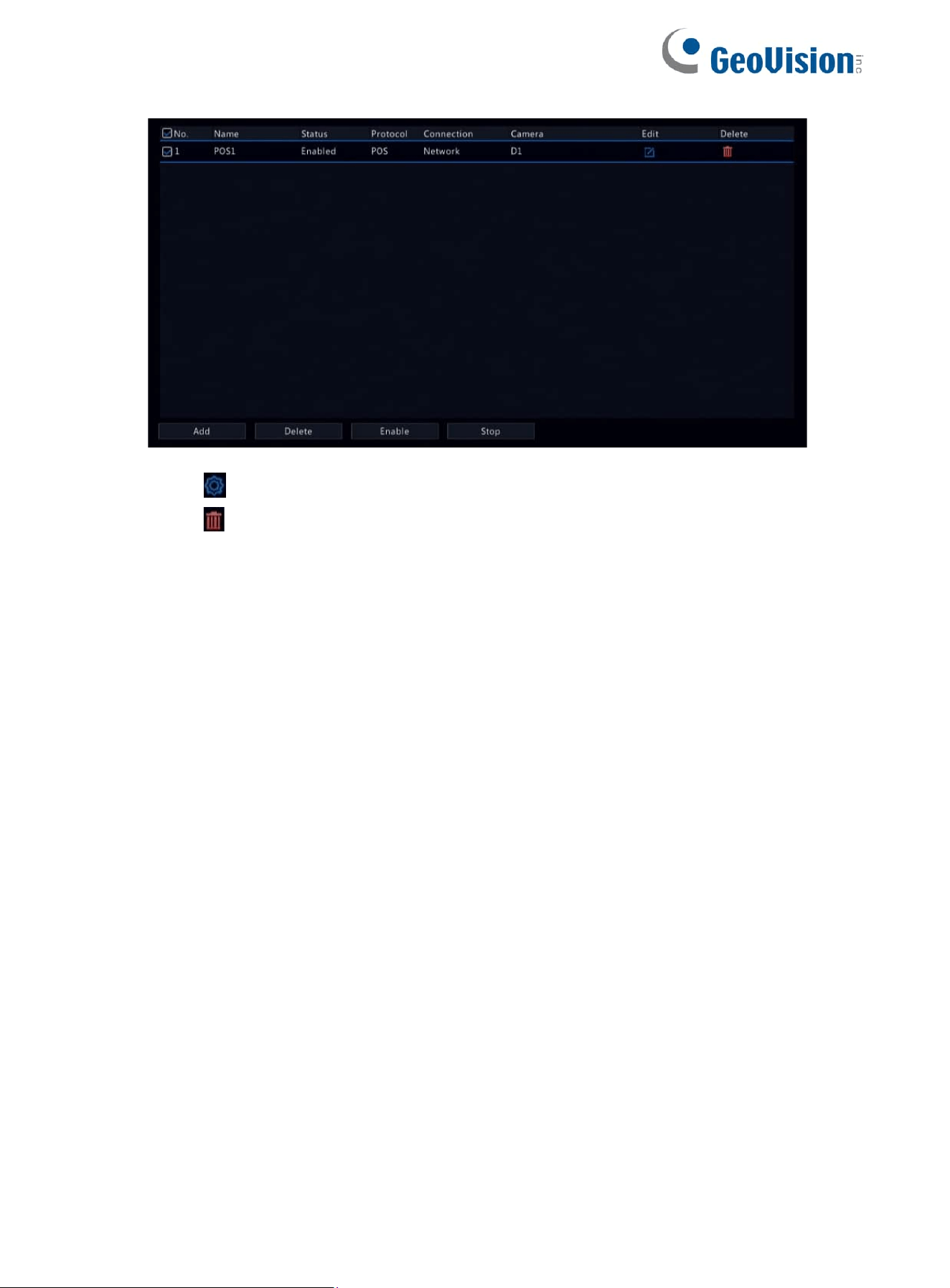
108
4. Click OK.
•
Click to edit the POS.
•
Click to delete the POS.
•
Click Disable to disable the POS.
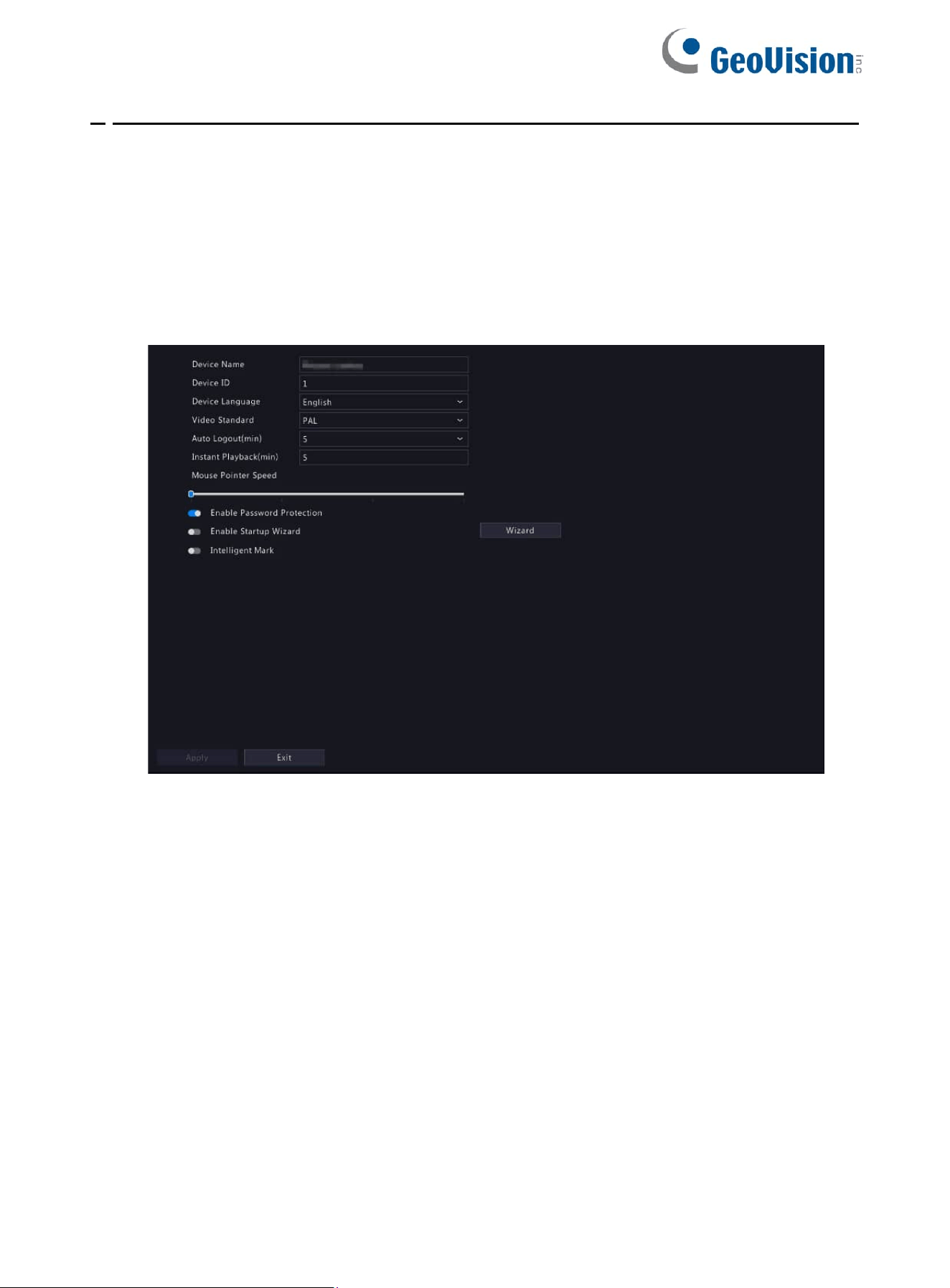
109
8 System Configuration
This chapter describes how to configure the system parameters.
8.1 General Configuration
Configure device basic information, time display mode, DST, time synchronization mode, and holidays.
8.1.1 Basic Configuration
Configure the basic information of the system.
1. Go to Menu > System > General > Basic Setup.
2. Configure the basic parameters.
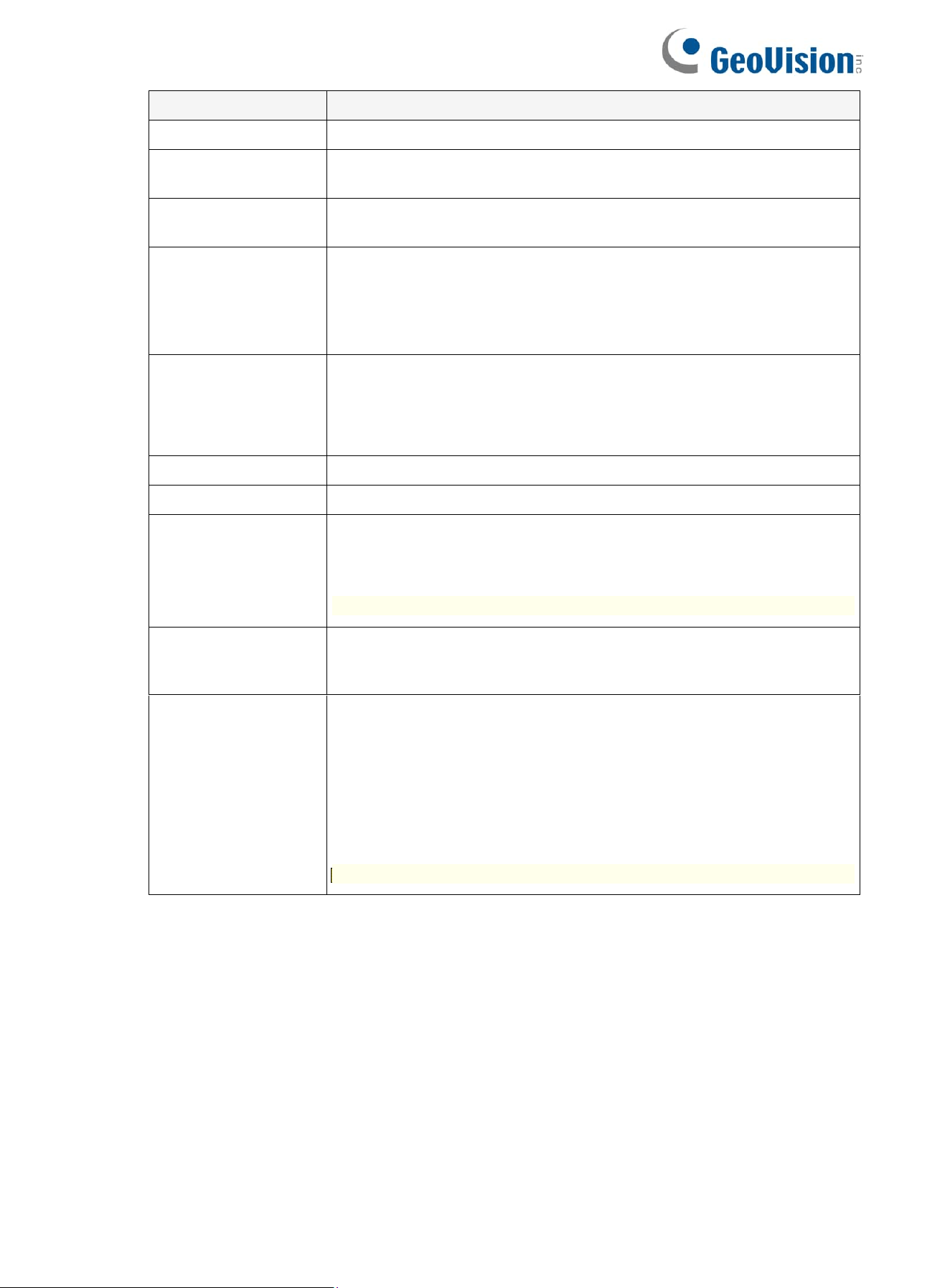
110
Parameter
Description
Device Name
The default name is the NVR model. You can change it as needed.
Device ID
Used to distinguish devices if you have more than one device. You can change it
as needed.
Device Language
Choose the system language. The system will restart after you change the system
language.
Video Standard
Choose a video standard, and then the device may automatically adjust the
capture mode of the connected cameras.
• PAL: 50Hz
• NTSC: 60Hz
Auto Logout(min)
If you are not on the live view page and don't perform any operation, you will
log out automatically when the set time is over, and the live view page will be
displayed.
Default: 5 minutes. You can change it as needed.
Instant Playback (min)
Set the instant playback time. Default: 5 minutes.
Mouse Pointer Speed
Drag the slider to adjust the speed (left to right: slow to fast).
Enable Password
Protection
When the auto logout time is over, the user needs to enter the login password in
order to access the main menu.
This feature is enabled by default.
Note: Only admin can change the setting.
Enable Startup Wizard
Startup wizard appears when the NVR starts up for the first time. When enabled,
the startup wizard appears every time the device starts up. You may click Wizard
to set wizard on the Menu page.
Intelligent Mark
When enabled, smart detection rules will be displayed on the live video, or
smart detection objects will be marked, and the corresponding smart data
will be displayed. Smart rules are yellow detection boxes or detection lines.
Detection boxes have two colors with different meaning as described below:
• Green: Data have changed but didn’t trigger the rules.
• Red: Data in the area have triggered the rules configured for the VCA alarm
and a VCA alarm has occurred.
Note: Some smart functions do not support this feature.
3. Click Apply.
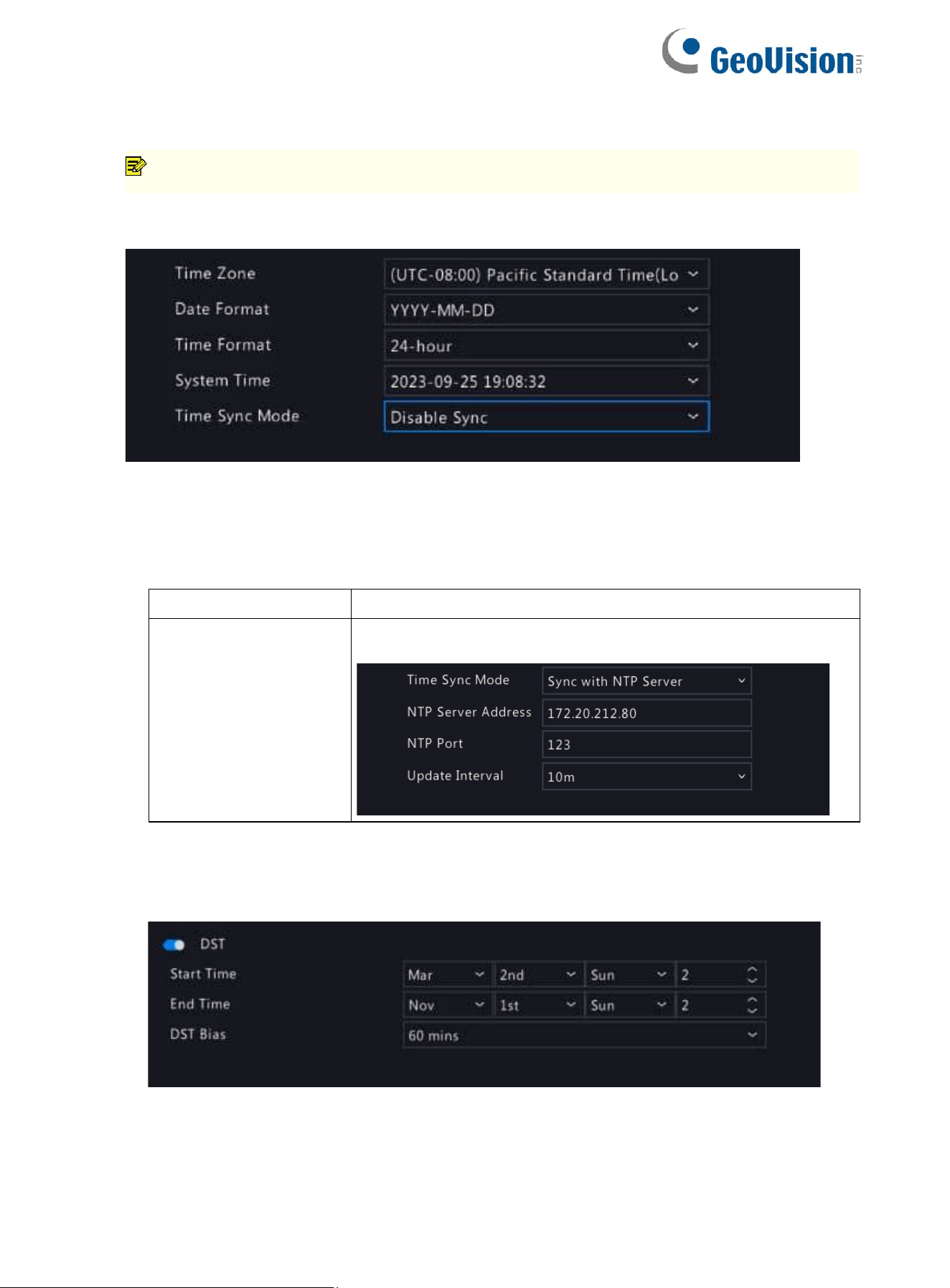
111
8.1.2 Time Configuration
Configure the time format and update method.
Basic Time Config
Go to Menu > System > General > Time. Choose the time zone, date, and time format as needed.
System Time
• Set the system time manually.
• Select the sync mode from the drop-down list, and then the system time will be updated based on the set
mode. It is Disable Sync by default.
Sync Mode
Description
Sync with NTP Server
The system time will be synced from the NTP server. Configure parameters
below as needed.
8.1.3 DST
Configure DST.
1. Go to Menu > System > General > DST.
2. Enable DST.
3. Configure the parameters.
4. Click Apply.
Note: If the device's battery is low, the following message will appear on the screen: Device time error.
Please replace the button battery on the motherboard and reset the time.
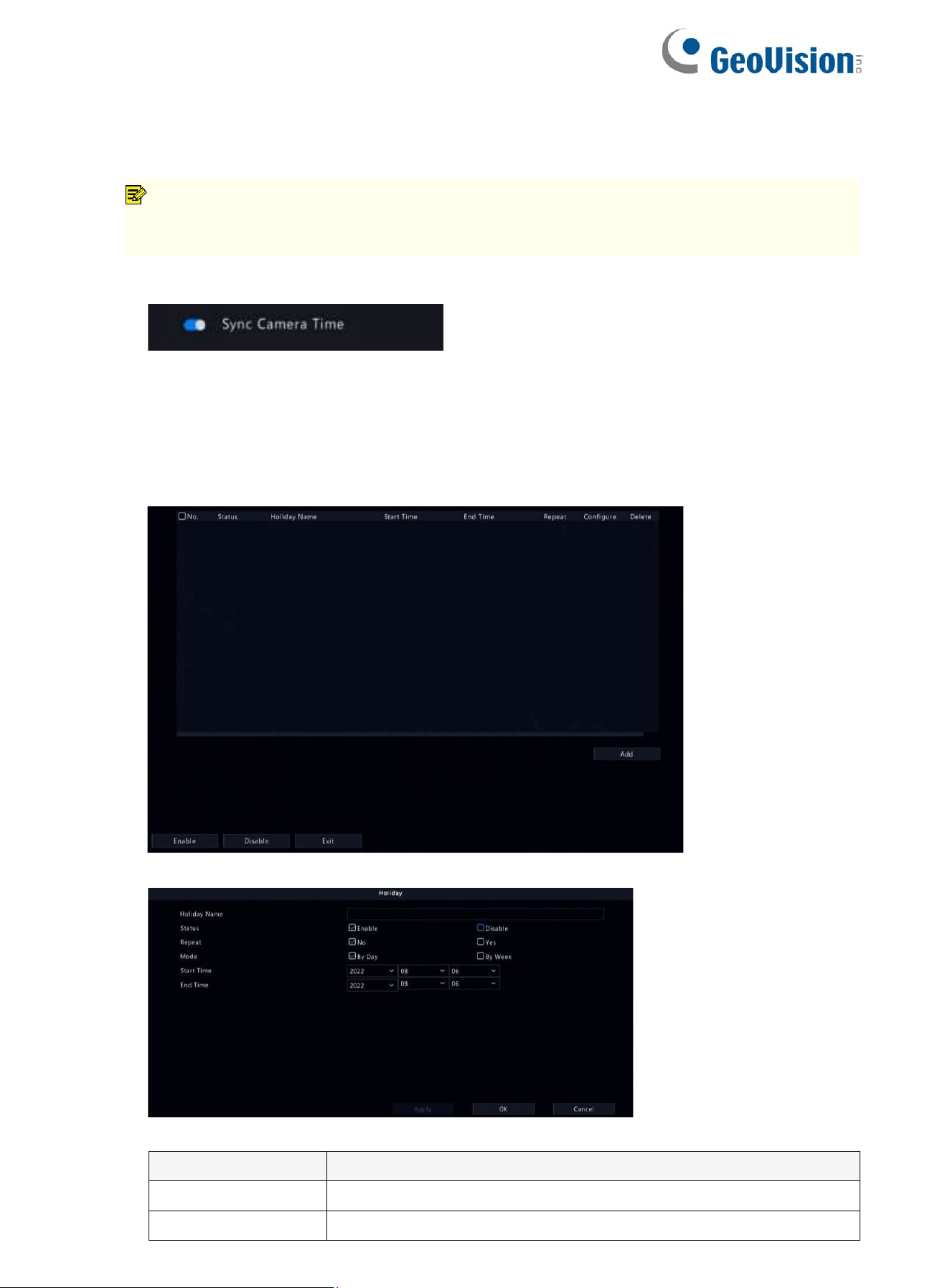
112
Note:
• Time sync occurs when a camera goes online for the first time.
• If Sync Camera Time is enabled, time sync occurs every 30 minutes.
8.1.4 Camera Time Synchronization
When Sync Camera Time is enabled, the NVR syncs time to the connected cameras regularly.
This feature is enabled by default.
1. Go to Menu > System > General > Time Sync.
2. Enable/disable this feature as needed.
3. Click Apply.
8.1.5 Holiday Configuration
Configure special time periods as holidays for use in recording schedules.
1. Go to Menu > System > General > Holiday.
2. Click Add in the lower-right corner.
3. Configure the parameters.
Parameter
Description
Holiday Name
Set a meaningful and easy-to-remember holiday name.
Status
The new holiday is enabled by default. If you want to disable it, select Disable.
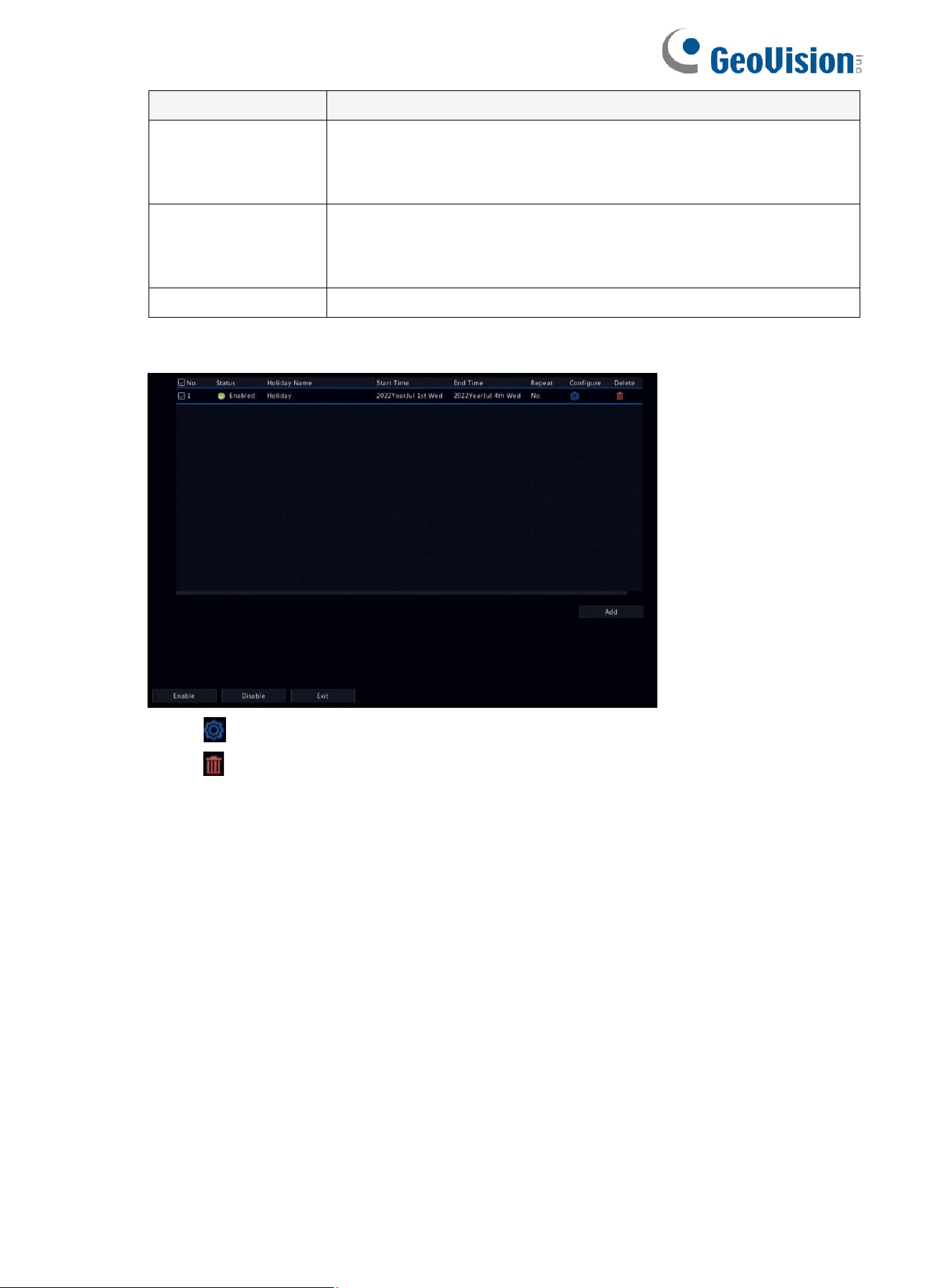
113
Parameter
Description
Repeat
• No: The holiday is effective once only in the specified year. Specify a year for
the holiday.
• Yes: The holiday is effective every year.
Mode
• By Day: Set the holiday in the specified format: year/month/day.
• By Week: Set the holiday in the specified format: year/month/week/day of
the week.
Start Time/End Time
Set according to the specified format.
4. Click Apply.
5. Click OK.
•
Click to edit the current holiday.
•
Click to delete a holiday. Deleting a holiday will not delete the relevant recordings.
•
Click Disable to disable the holiday.
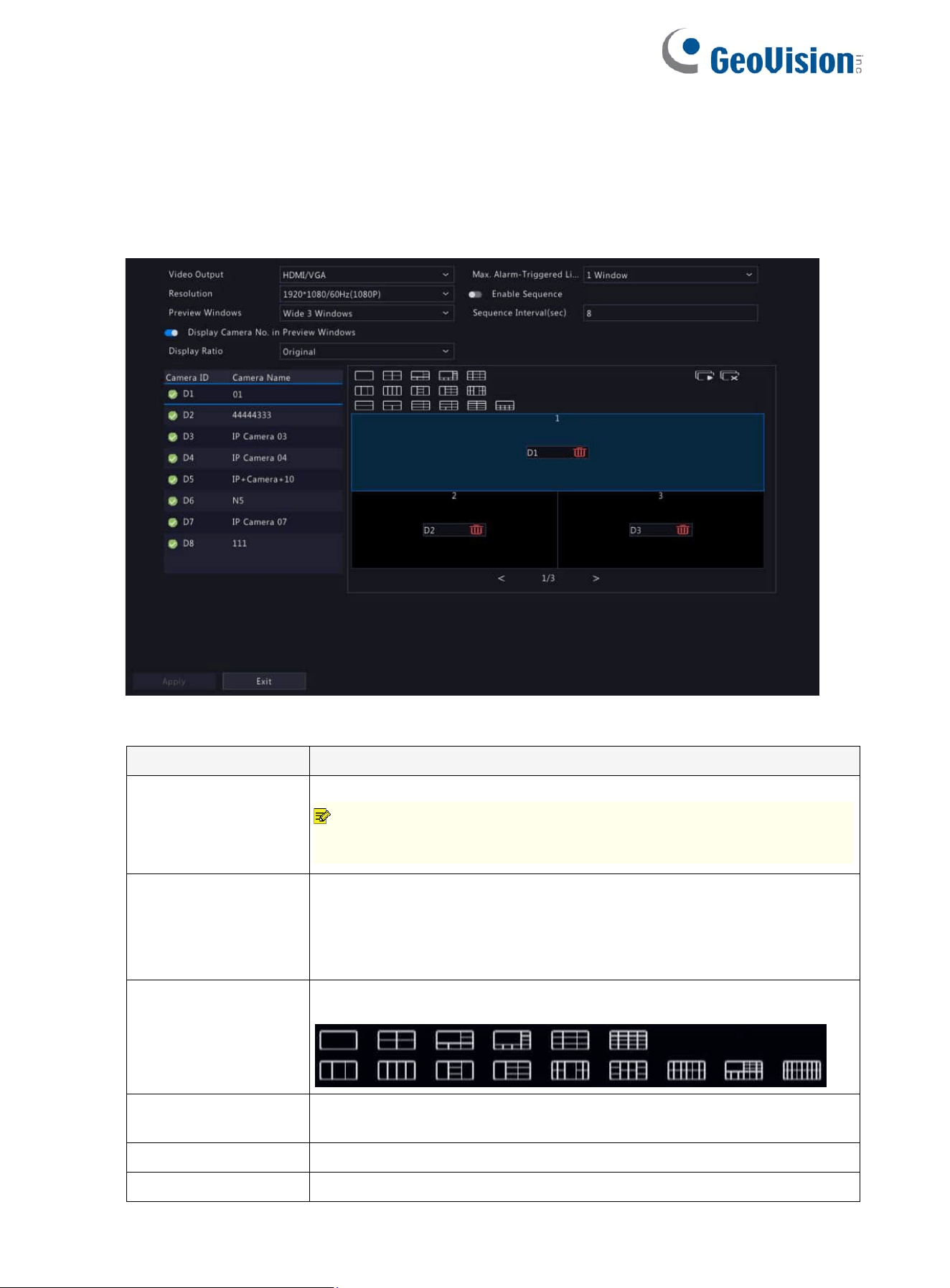
114
8.2 Preview Configuration
Configure the screen display and preferred stream type for preview.
8.2.1 Preview Configuration
Configure the basic preview parameters and display mode.
Go to Menu > System > Preview > Preview.
Basic Preview Configuration
Parameter
Description
Video Output
Outputs the system display to an external display device. Choose an output port.
Note: The NVR provides three output ports (VGA, HDMI1/HDMI2, BNC) and
can output the system display to three displays simultaneously for independent
operations. The actual port types available may vary with device.
Resolution
The resolution includes the display format and refresh rate. The display format
refers to the number of pixels that can be displayed on the screen, for example,
1920x1080, 1280x720, 1280x1024, etc. More pixels displayed means higher image
quality. The refresh rate can be 60Hz, 50Hz, 25Hz, etc. Choose an option that best
fits your needs.
Preview Windows
Displays images in the desired window layout. Choose an option from the list, or
click an icon to choose the layout.
Max. Alarm-Triggered Live
View Windows
Three options: 1/4/9 windows. See Preview for more information.
Enable Sequence
Enable sequence. See Sequence for more information.
Sequence Interval(sec)
Set the sequence interval time. Default: 8 seconds.
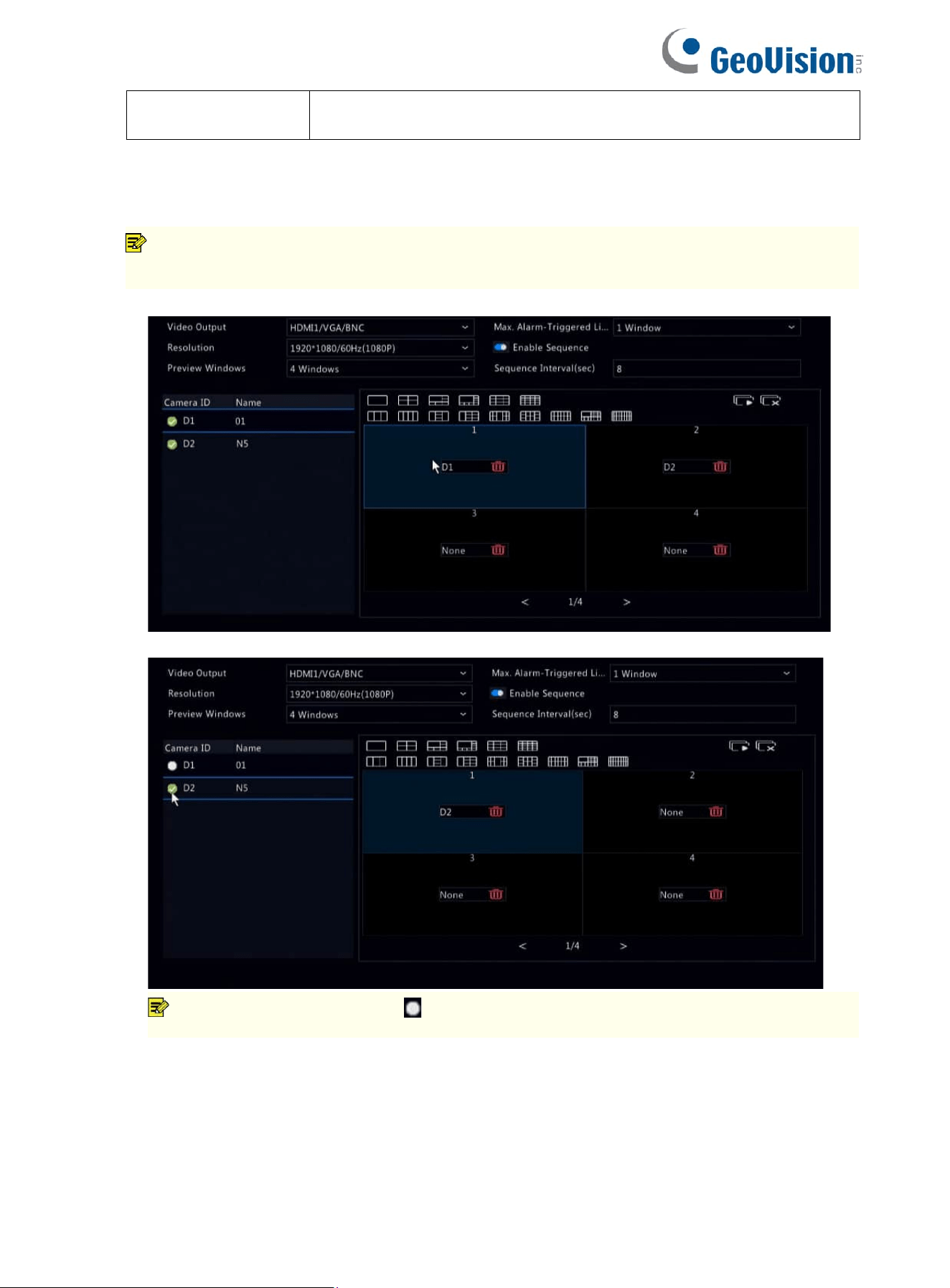
115
Display Camera No. in
Preview Windows
When enabled, camera IDs will be displayed in live view windows. This feature is
enabled by default.
Screen Configuration
By default, camera IDs correspond to live view windows: D1 to window 1, D2 to window 2, and so on. You can
change the correspondence relationship as follows. The example below shows how to switch D1 and D2.
1. Click window 1 on the right side. Window 1 is selected.
2. Click D2 on the left-side channel list. Now window 1 shows D2, and window 2 shows None.
3. Click window 2 on the right side. Window 2 is selected.
Note: You may also drag an image on the live view page to swap windows, and then view the changed
window-channel binding relationship on this page. But this method requires the Configure permission, and it
cannot switch windows that are not on the same screen.
Note: On the left-side channel list, is empty for D1, which means the channel is not bound to any
window.
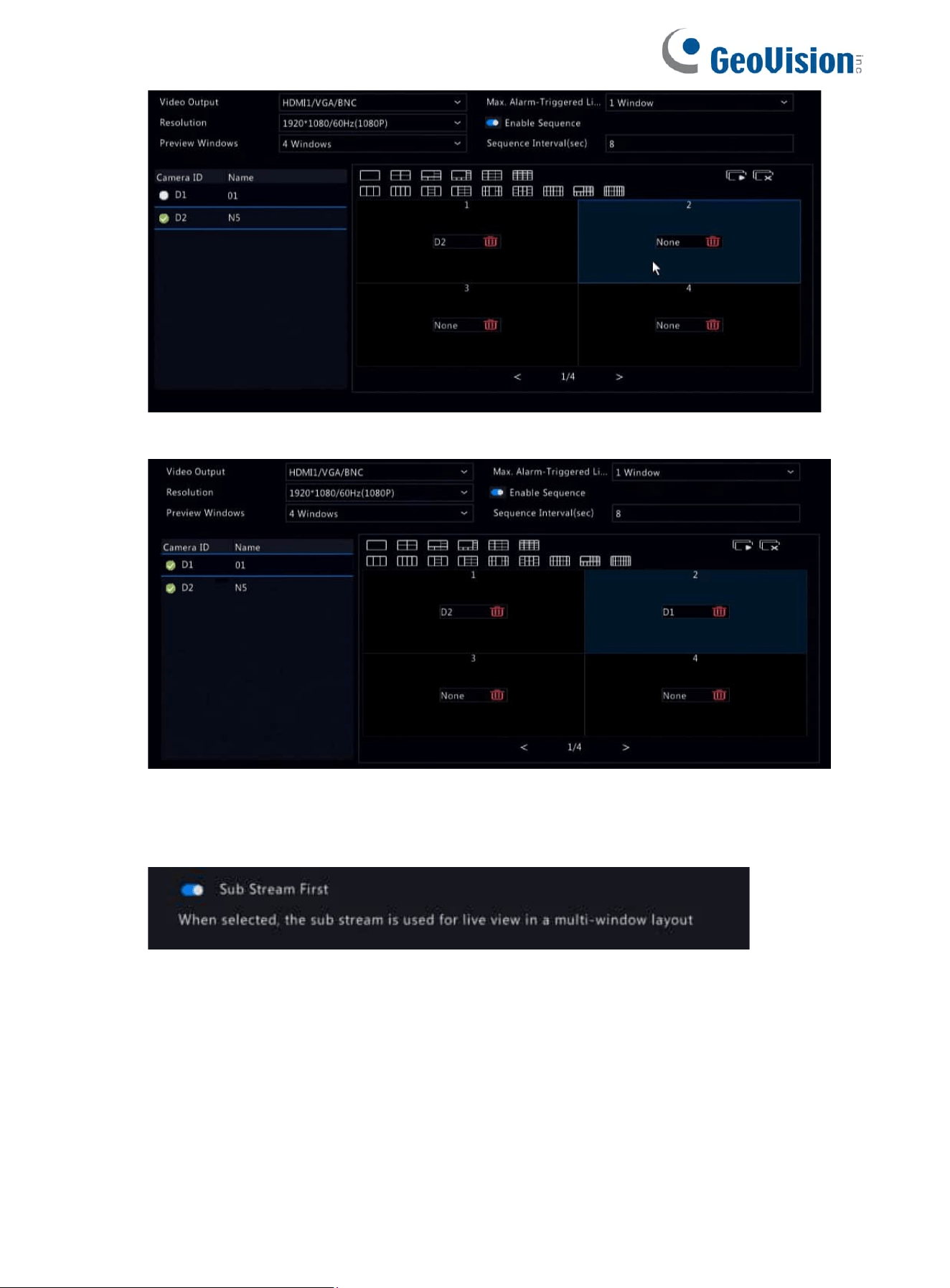
116
4. Click D1 on the left-side channel list. Now window 2 shows D1, which means D1 and D2 have switched
windows with each other.
5. Click Apply.
8.2.2 Advanced Configuration
1. Go to Menu > System > Preview > Advanced.
2. Enable Sub Stream First.
3. Click Apply.
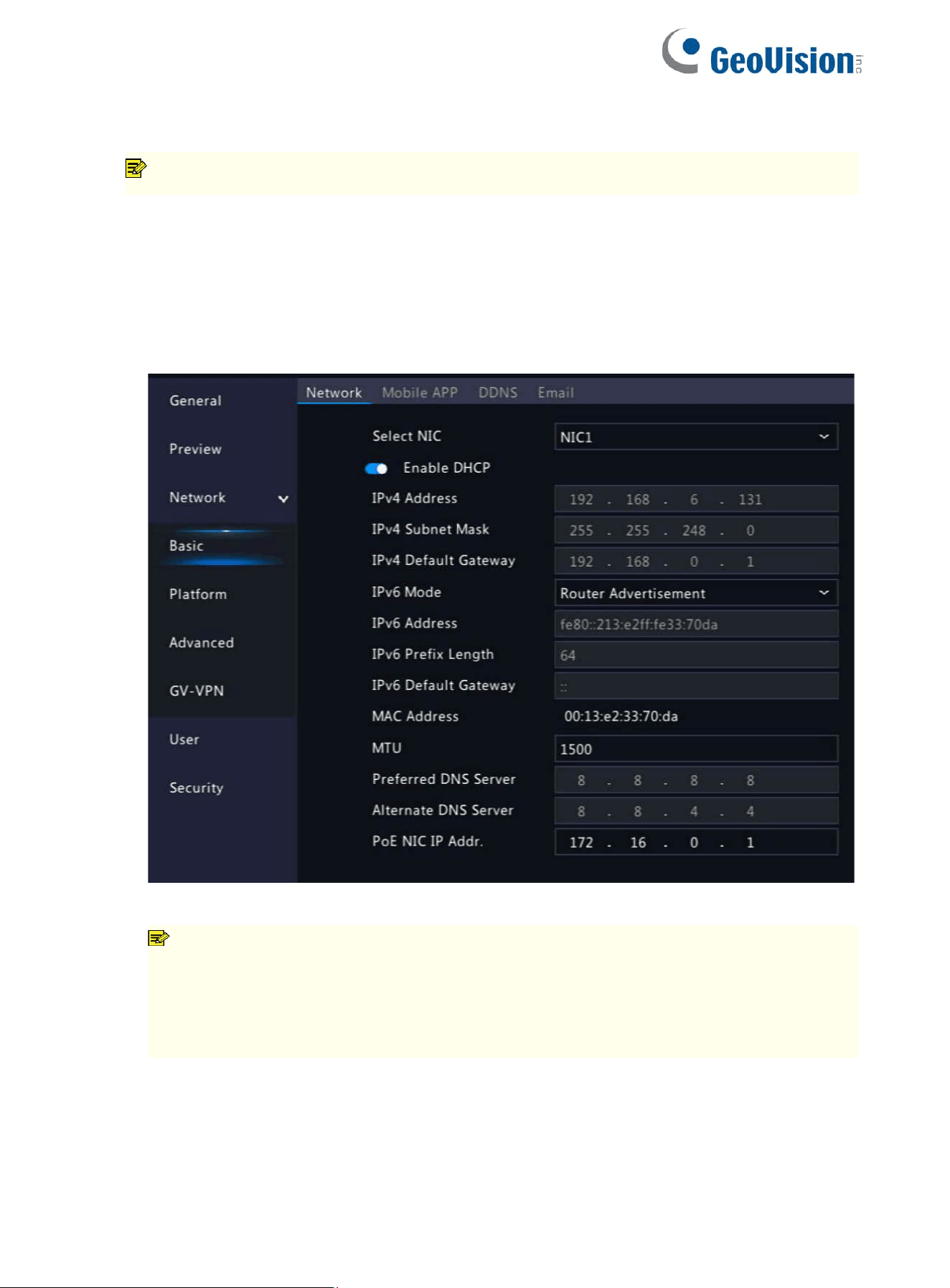
117
8.3 Network Configuration
Configure the network parameters of the NVR, such as IP address.
8.3.1 Basic Configuration
Configure the network, mobile app, DDNS, email, etc.
8.3.1.1 Network Configuration
Configure IP address and other network parameters of the NVR.
1. Go to Menu > System > Network > Basic > Network.
2. Configure the network parameters according to the actual network environment.
3. Click Apply.
Note:
• For an NVR with PoE ports, you can configure an IPv4 address for the internal NIC.
•
The MTU must be in the range of [576-1500]. To use IPv6, you must set MTU within [1280-1500], and
make sure the IPv6 addresses of the NVR and PC are connected. To use functions such as live view,
playback, make sure IPv4 addresses of the NVR and PC are also connected.
Note: The default IP address of network interface is 192.168.0.100.
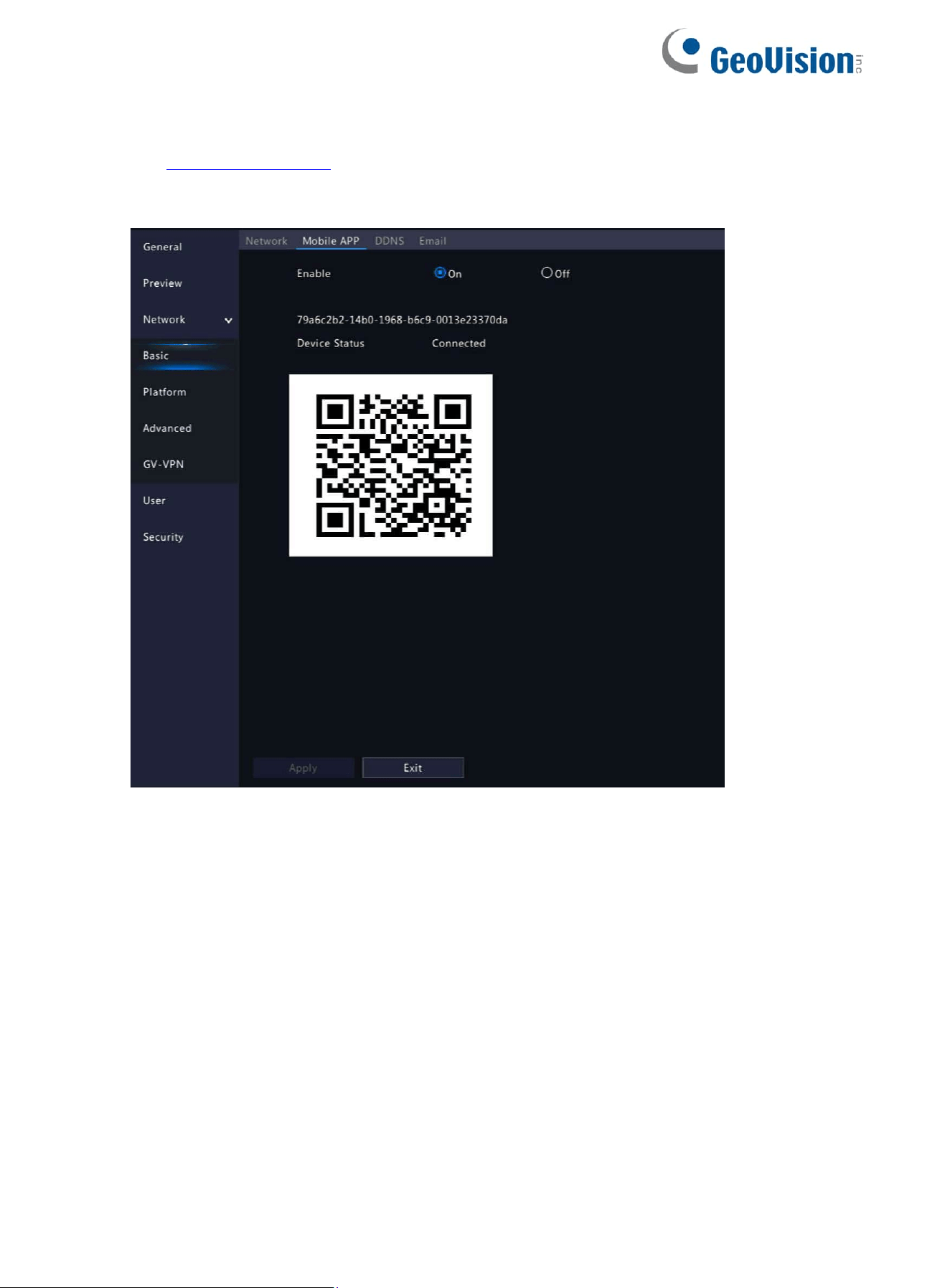
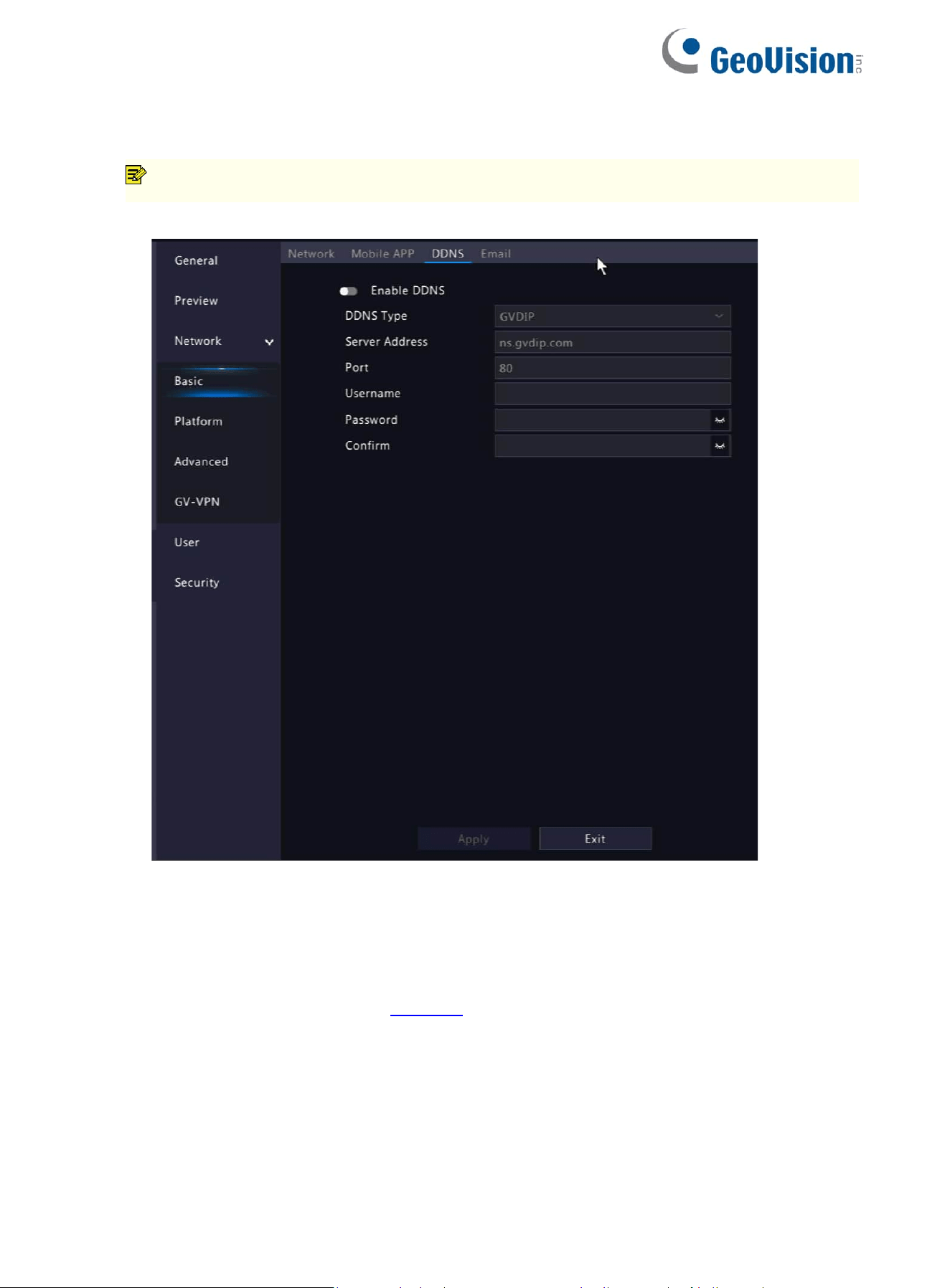
119
8.3.1.3 DDNS
Configure DDNS so you can access the NVR on the LAN from the Internet by visiting a fixed domain name instead
of the changing IP addresses.
1. Go to Menu > System > Network > Basic > DDNS.
2. Enable DDNS, choose a DDNS type, and configure the parameters.
• DynDNS/No-IP: Third-party DDNS service provider. Enter the domain name and username/password that
you acquired from your DDNS service provider.
• Domain name: Domain name assigned by your DDNS service provider.
• Username and password: The corresponding username/password for your DDNS account.
• GVDIP: DDNS service provided by GeoVision.
3. Click Apply.
Note: You can open the NVR's Web page by visiting http://server address/NVR's domain name using a Web
browser.
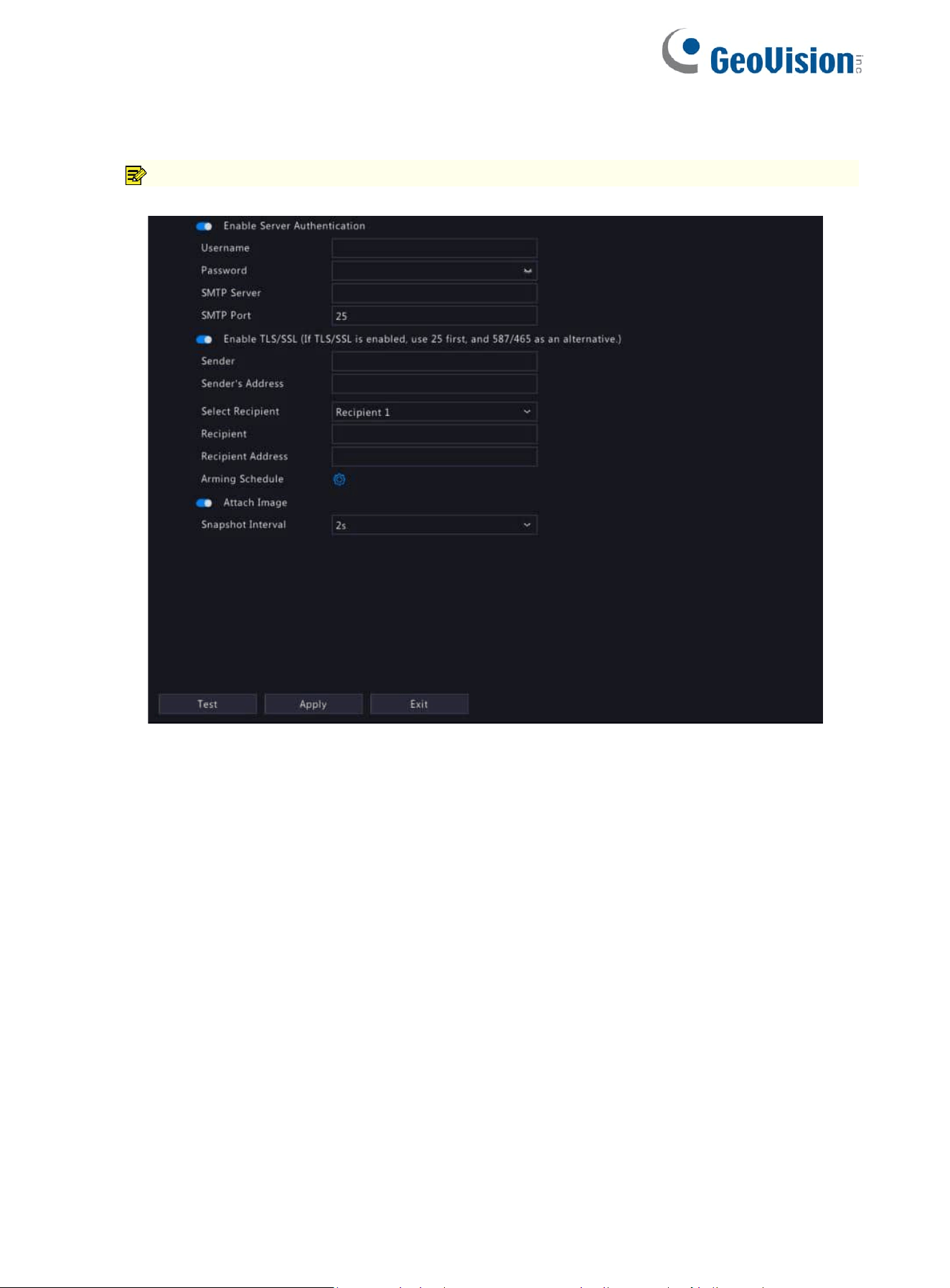
120
8.3.1.4 Email
Configure email so the NVR can send alarm information to specified users through email when an alarm occurs.
1. Go to Menu > System > Network > Basic > Email.
2. Configure the parameters.
Note: Select the Send Email checkbox on the Trigger Actions page before you start configuration.
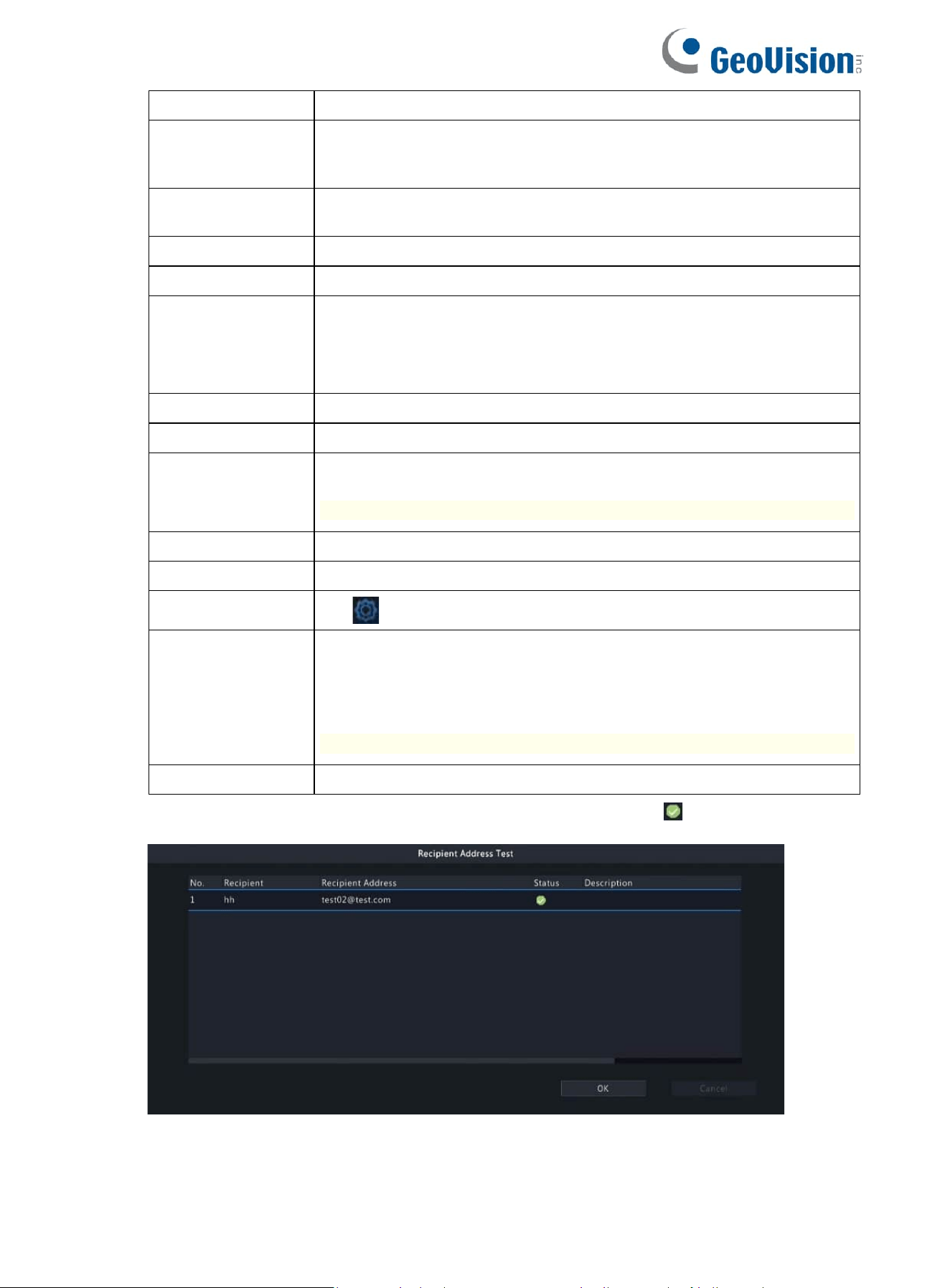
121
Parameter
Description
Enable Server
Authentication
SMTP server authentication, when enabled, can enhance email security. This
feature is disabled by default. To enable it, you need to enter the correct
username and password.
Username/Password
Username and password of the SMTP server. Usually it is the username and
password of the email box.
SMTP Server
SMTP server address.
SMTP Port
Default: 25. Range: [1-65535].
Enable TLS/SSL
When enabled, communication security will be improved by encrypting emails via
TLS or SSL. This feature requires the SMTP server to support TLS/SSL.
Note: After TLS/SSL is enabled, if email sending via port 25 failed, try 587 or
465.
Sender
Sender's name.
Sender's Address
Sender's email address, which can the same as the recipient's address.
Select Recipient
Choose a recipient from the list and then complete the recipient information. Up
to 6 recipients are allowed.
Note: Select Send Email, user can receive the corresponding alarm.
Recipient
Recipient's name.
Recipient Address
Recipient's email address.
Arming Schedule
Click to configure an arming schedule. See Arming Schedule.
Attach Image
When enabled, the NVR will send an email attached with alarm information and
snapshot(s) every a snapshot interval when an alarm occurs.
When disabled, the NVR will send only an email with alarm information when an
alarm occurs.
Note: This function is only available to certain devices.
Snapshot Interval
Options are 2s (default), 3s, 4s, and 5s.
3. Click Test. The system will check the recipient address by sending it a test email. in the Status column
means the test succeeded and the email address is valid.
4. Click Apply.
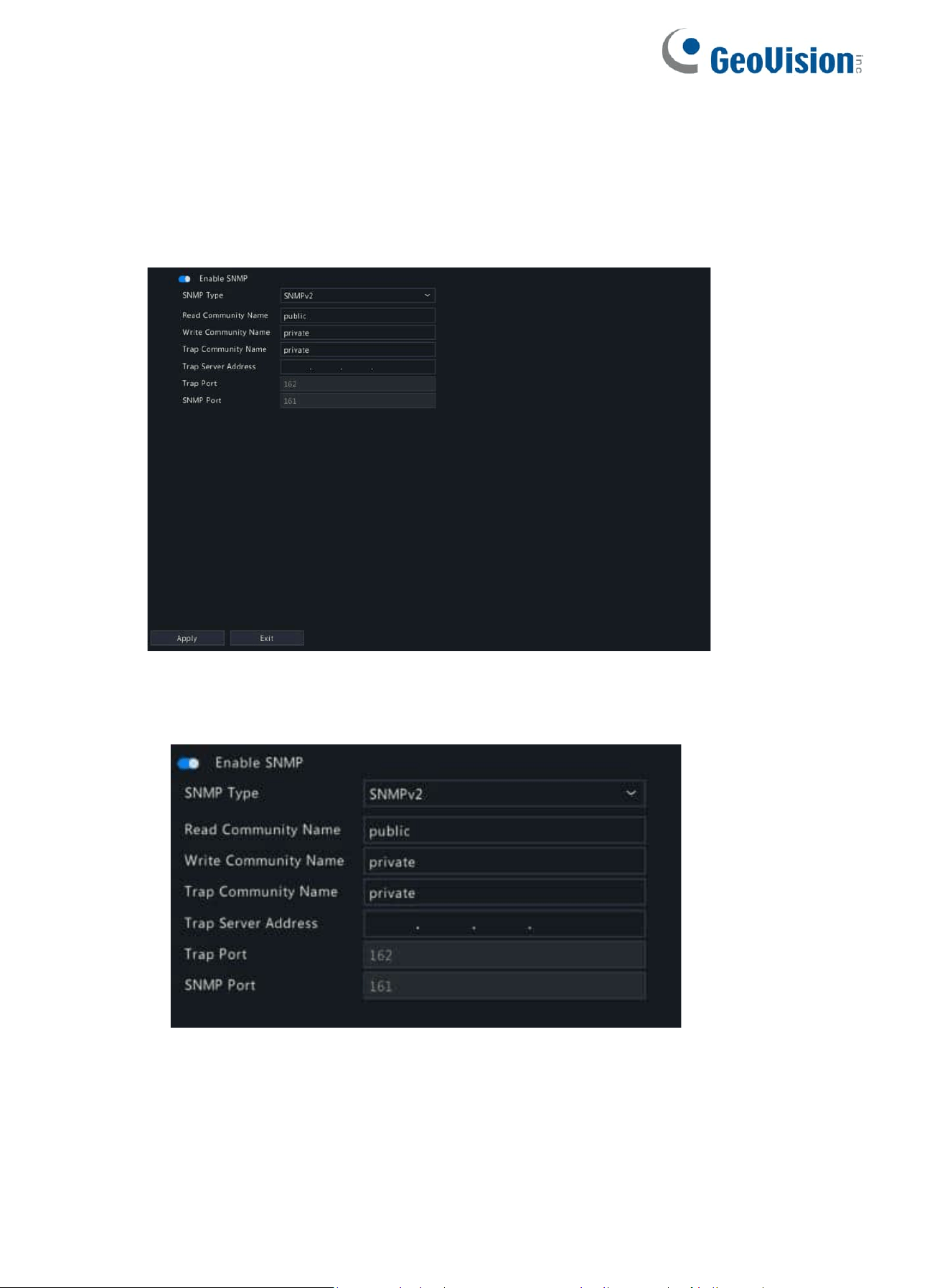
122
8.3.2 Platform Configuration
Configure an upper platform for the NVR.
8.3.2.1 SNMP
The NVR can use SNMP to interconnect with the upper platform and transfer certain configuration information.
1. Go to Menu > System > Network > Platform > SNMP.
2. Enable SNMP.
3. Choose an SNMP type and configure the parameters.
• SNMPv2:
Set the read community’s name and write community name for the platform to read NVR data.
• SNMPv3:
Set authentication password and encryption password. The authentication password is used by the
platform to access the NVR. The encryption password is used to encrypt data sent from the NVR to the
platform.
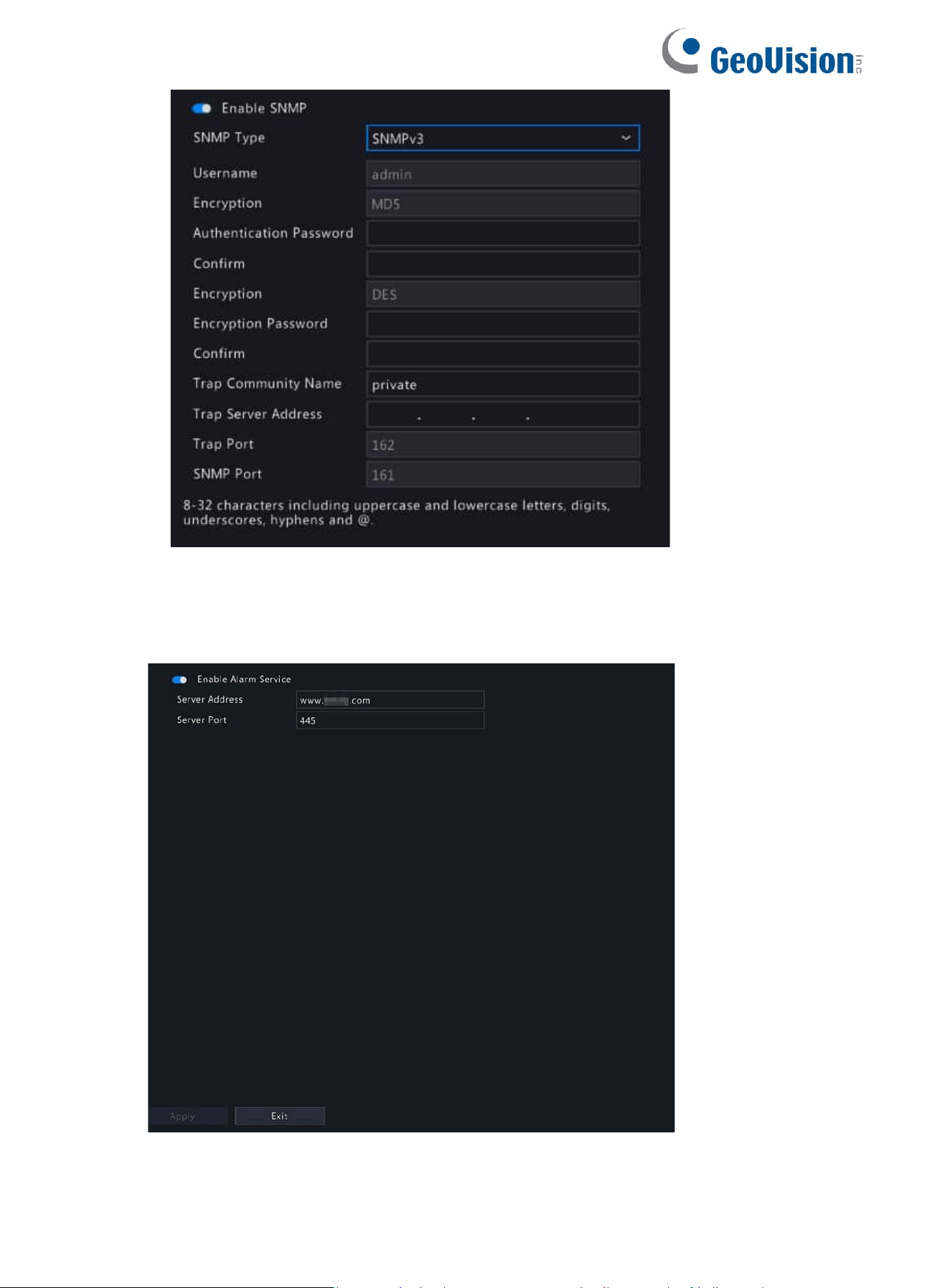
123
4. Click Apply.
8.3.2.2 Alarm Service
Configure an upper server to receive alarms and images from the NVR.
1. Go to Menu > System > Network > Platform > Alarm Service.
2. Enable alarm service.
124
3. Configure the parameters.
Parameter
Description
Server Address
Upper server's IP address or domain name.
Server Port
Upper server's port number.
4. Click Apply.
Note: This configuration only enables the sending of alarm-related packets to the alarm host. The specific
alarm methods on the alarm host need to be configured separately.
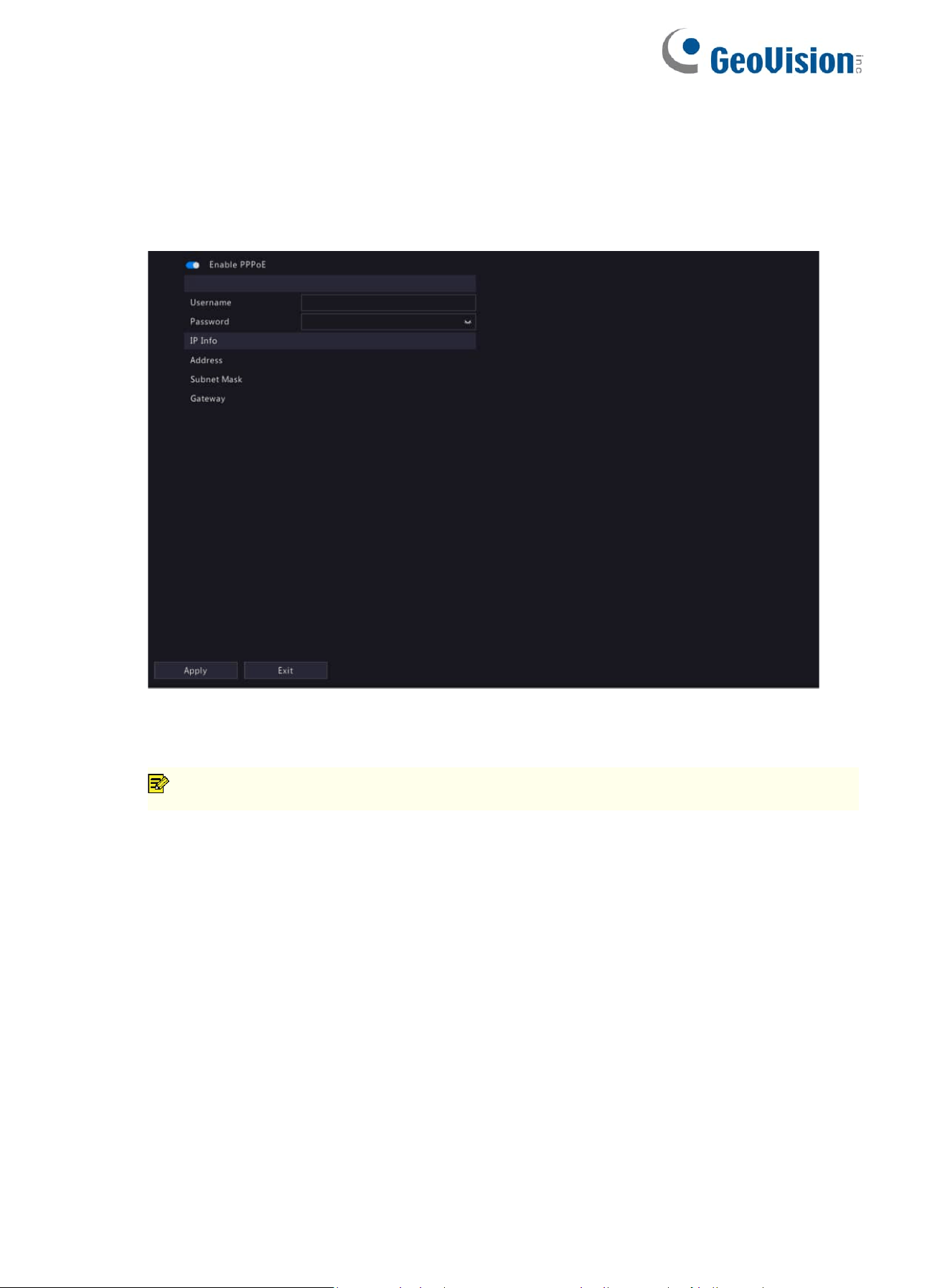
125
8.3.3 Advanced Configuration
Configure PPPoE, ports, port mapping, multicast, and FTP.
8.3.3.1 PPPoE
Use Point to Point Protocol over Ethernet (PPPoE) to connect the NVR to network.
1. Go to Menu > System > Network > Advanced > PPPoE.
2. Enable PPPoE.
3. Enter the username and password provided by the Internet Service Provider (ISP). IP information is displayed
when dial-up succeeds.
4. Click Apply.
Note: For a multi-NIC device, dial-up shall be performed on the NIC that is configured as the default
route.
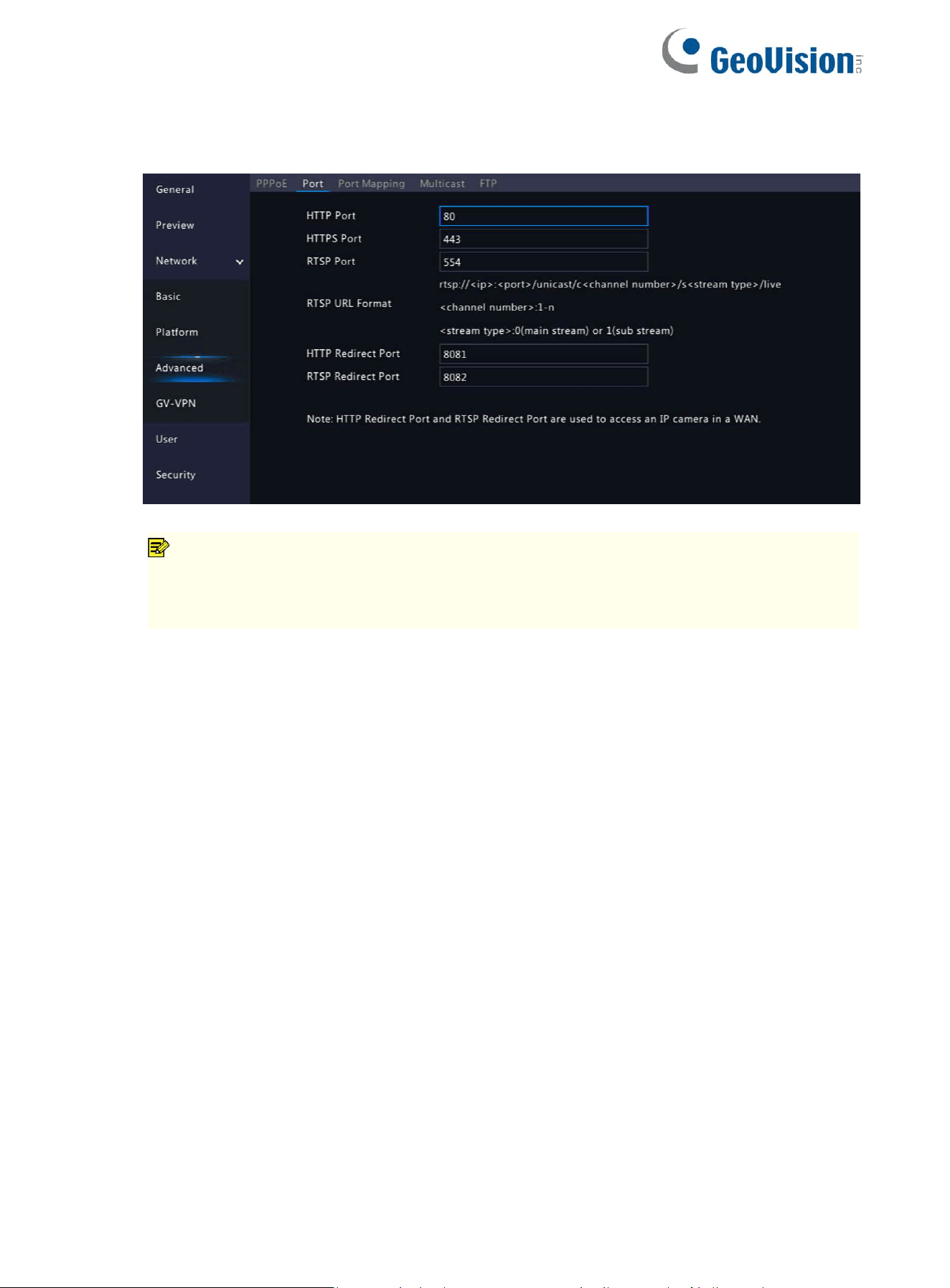
126
8.3.3.2 Port
Configure HTTP, HTTPS, RTSP, HTTP redirect port, and RTSP redirect port.
1. Go to Menu > System > Network > Advanced > Port.
2. Configure the ports.
3. Click Apply.
Note:
• The port range is 1-65535, among which, ports 21, 23, 2000, 3702 and 60000 are reserved for other
purposes. Duplicate ports are not allowed.
• The upper platform can access the live video of a camera using the displayed RTSP URL.
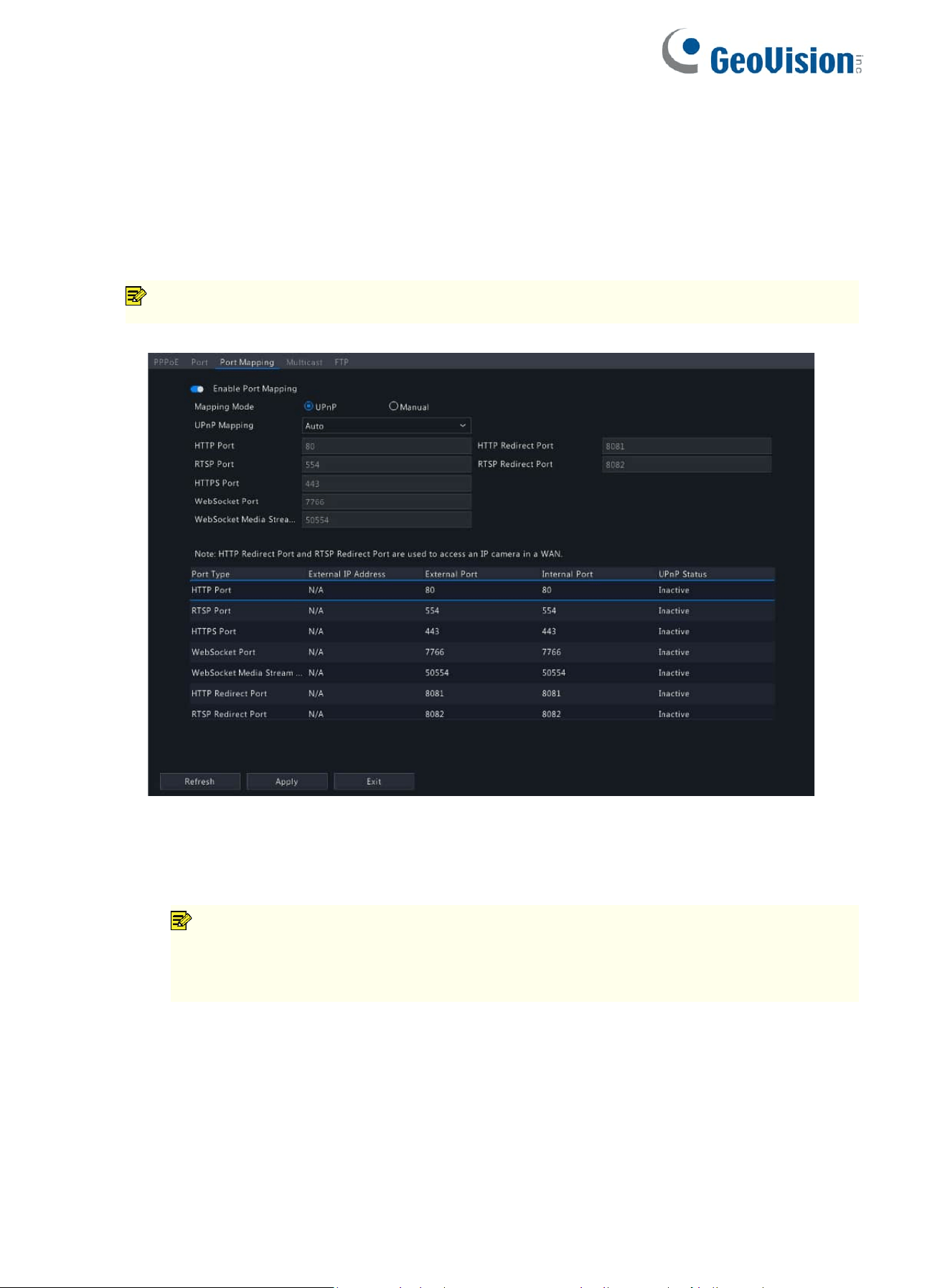
127
8.3.3.3 Port Mapping
Configure port mapping so client computers can access the NVR on the LAN across the Internet.
1. Go to Menu > System > Network > Advanced > Port Mapping.
2. Port mapping is enabled by default. You can choose a mapping mode, UPnP or manual port mapping.
UPnP
UPnP is short for Universal Plug and Play. UPnP-enabled network address translation (NAT) can perform
automatic port mapping to enable client computers to access the NVR on the LAN from the Internet.
1. Choose the UPnP mapping mode.
2. Choose a mode from the UPnP Mapping list:
• Auto: The NVR automatically assigns external port numbers, which are usually the same as the internal
port numbers.
• Specify ports: User specifies ports within the range of [1-65535].
3. Click Refresh, and check whether Active is displayed in the UPnP Status column.
4. Click Apply.
Note: This function requires router support. You need to enable UPnP on the router before starting
configuration on the NVR.
Note:
• Auto is recommended. Port conflict may occur when external ports are specified manually.
•
For a multi-NIC NVR, port mapping shall be performed on the NIC that is configured as the default
route.
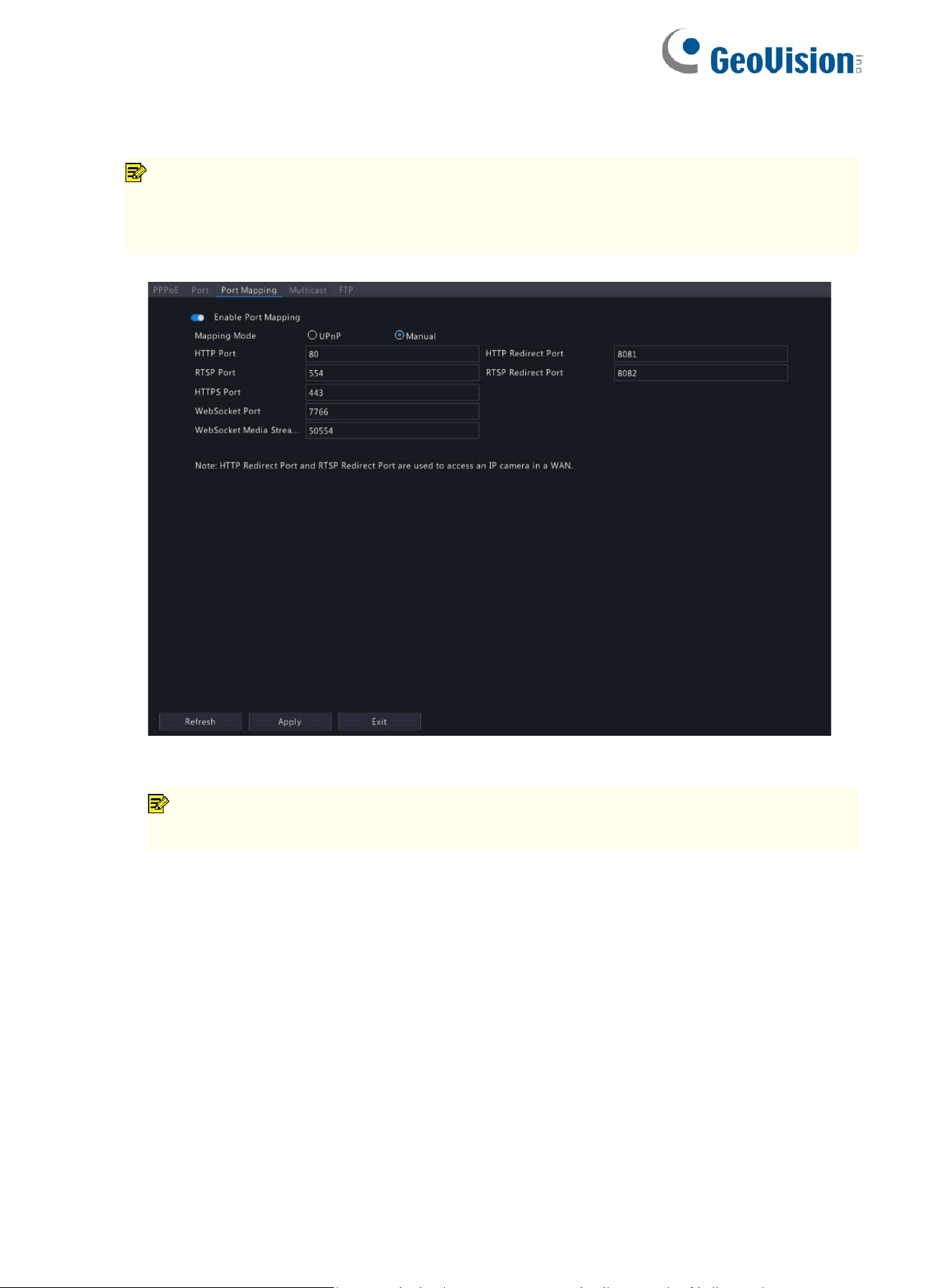
128
Manual
If the router does not support UPnP, you must configure internal and external ports manually.
1. Choose the Manual mapping mode.
2. Set the external ports manually.
3. Click Apply.
Note:
• Make sure the ports configured on the NVR are consistent with that configured on the router.
• For some routers, the NVR's external and internal ports must be the same, and they also must be the
same as the ports on the router.
Note: After port mapping is configured, you can open the Web interface using the following address:
Router's WAN IP:external HTTP port. For example, the router's external IP address is 10.2.2.10, and the
external HTTP port is 82, then enter http://10.2.2.10:82 in the Web browser's address bar.
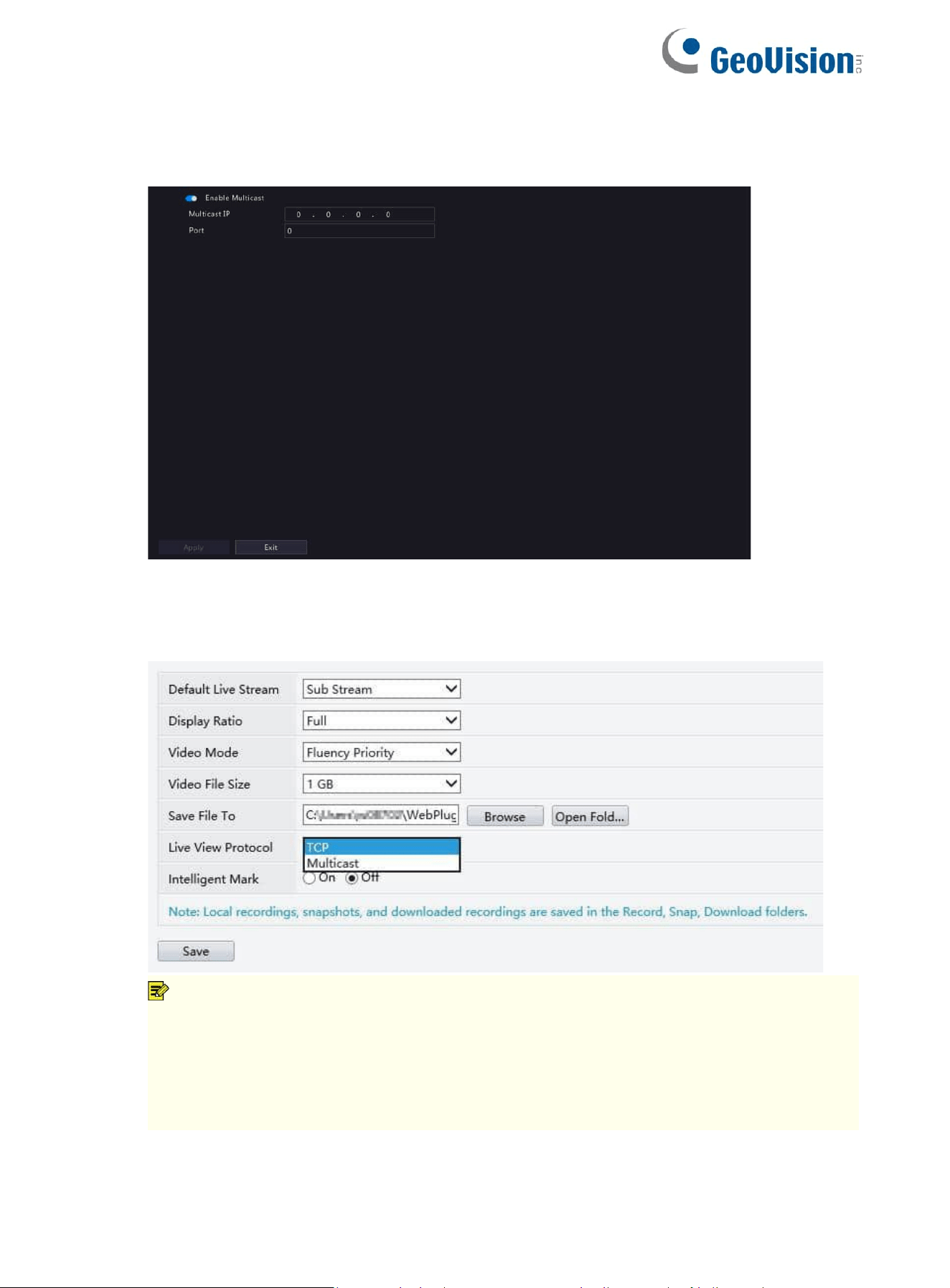
129
8.3.3.4 Multicast
When the number of users accessing the Web client has reached the upper limit and live video is unavailable, you
can use multicast to solve this issue.
1. Go to Menu > System > Network > Advanced > Multicast.
2. Enable multicast, enter the multicast IP address and port number.
3. Click Apply.
4. Log in to the Web interface, go to Setup > Client, set Live View Protocol to Multicast. Now live view is
available through multicast.
Note:
•
IP multicast addresses are class-D addresses. 224.0.1.0 - 238.255.255.255 can be used on the Internet.
• In the range of 224.0.0.0 - 239.255.255.255, some are reserved for special uses, for example,
224.0.0.0 - 244.0.0.255 can only be used on the LAN, where packets with these addresses will not be
forwarded by a router; 224.0.0.1 is used by all the hosts on the subnet; 224.0.0.2 is used by all the
routers on the subnet; 224.0.0.5 is used by OSPF routers; 224.0.0.13 is used by PIMv2 routers; and
239.0.0.0 - 239.255.255.255 are private addresses (e.g., 192.168.x.x).
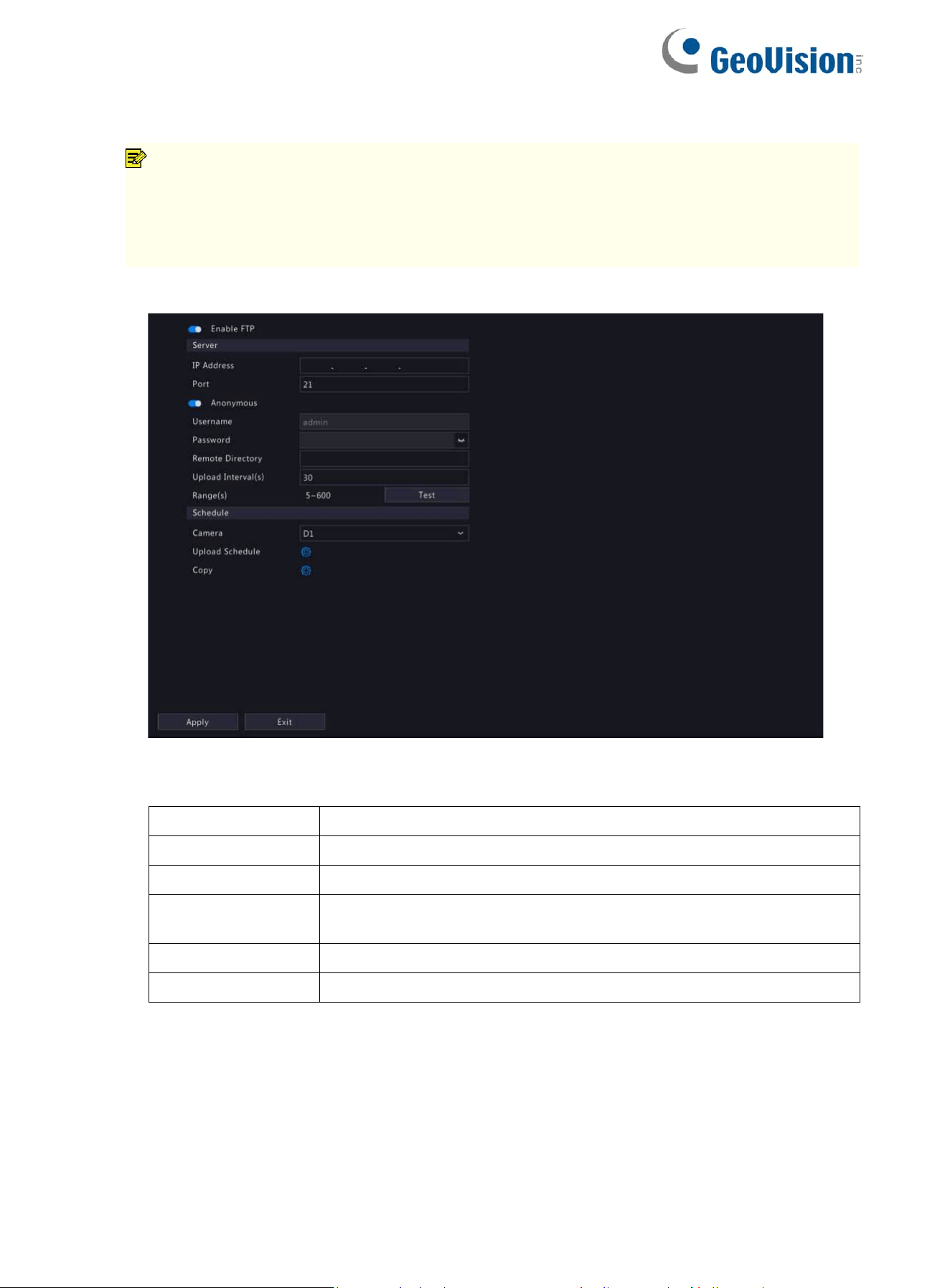
130
8.3.3.5 FTP
Configure FTP so the NVR can upload images to the FTP server.
1. Go to Menu > System > Network > Advanced > FTP.
2. Enable FTP.
3. Configure server parameters. Click Test to test the connection between the NVR and the FTP server.
Parameter
Description
IP Address
FTP server address.
Port
The default is 21. You can set a different port as needed.
Anonymous
When enabled, the NVR will connect to the FTP server as anonymous user
without username/password required.
Username
Username used to access the FTP server.
Password
Password used to access the FTP server.
Note:
• This feature is only available to certain NVRs.
• To use this feature, you need to deploy an FTP server first.
• After the FTP server is enabled and connected, the NVR can automatically upload images to the FTP
server.
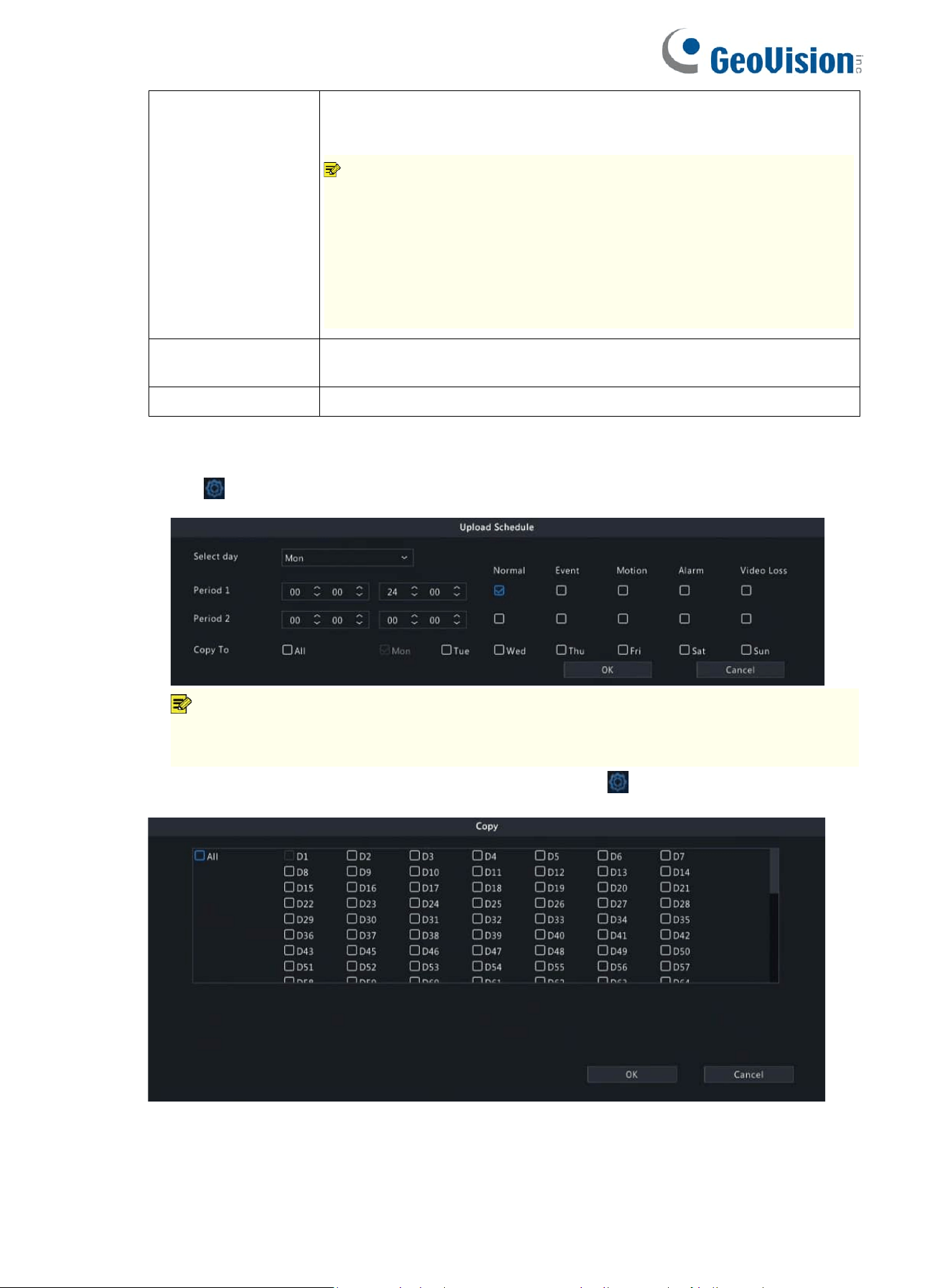
131
Remote Directory
Input the remote directory in the correct format (abc/efg/xyz), and the system
will create folders level by level accordingly under the root directory, and then
create different folders based on IP, time, and channel.
Note:
• For example, if the remote directory is abc, then the created folder is FTP
> abc > 206.2.5.8 > 2022-10-08 > D5. If the remote directory is abc/efg/
xyz, then the created folder is FTP > abc efg > xyz > 206.2.5.8 > 2022-10-08
> D5.
• If the remote directory is empty, the system will create folders under
the root directory based on IP, time, and channel, for example, FTP >
206.2.5.8 > 2022-10-08 > D5.
Upload Interval(s)
The NVR uploads images captured within the set periods to the FTP server at the
set interval. The default is 30s. You can alter the setting as needed.
Range(s)
Show the range of image upload interval: [5-600]s
4. Set an upload schedule.
(1) Choose a camera from the list.
(2) Click behind Upload Schedule, configure time periods during which the camera will upload images of
the desired type(s). Click OK.
5. (Optional) To apply the current upload schedule to other cameras, click behind Copy, select cameras, and
then click OK.
6. Click Apply.
Note:
• Two image upload periods are allowed each day, and the periods must not overlap.
• To apply the schedule to other days, select All or days and then click OK.
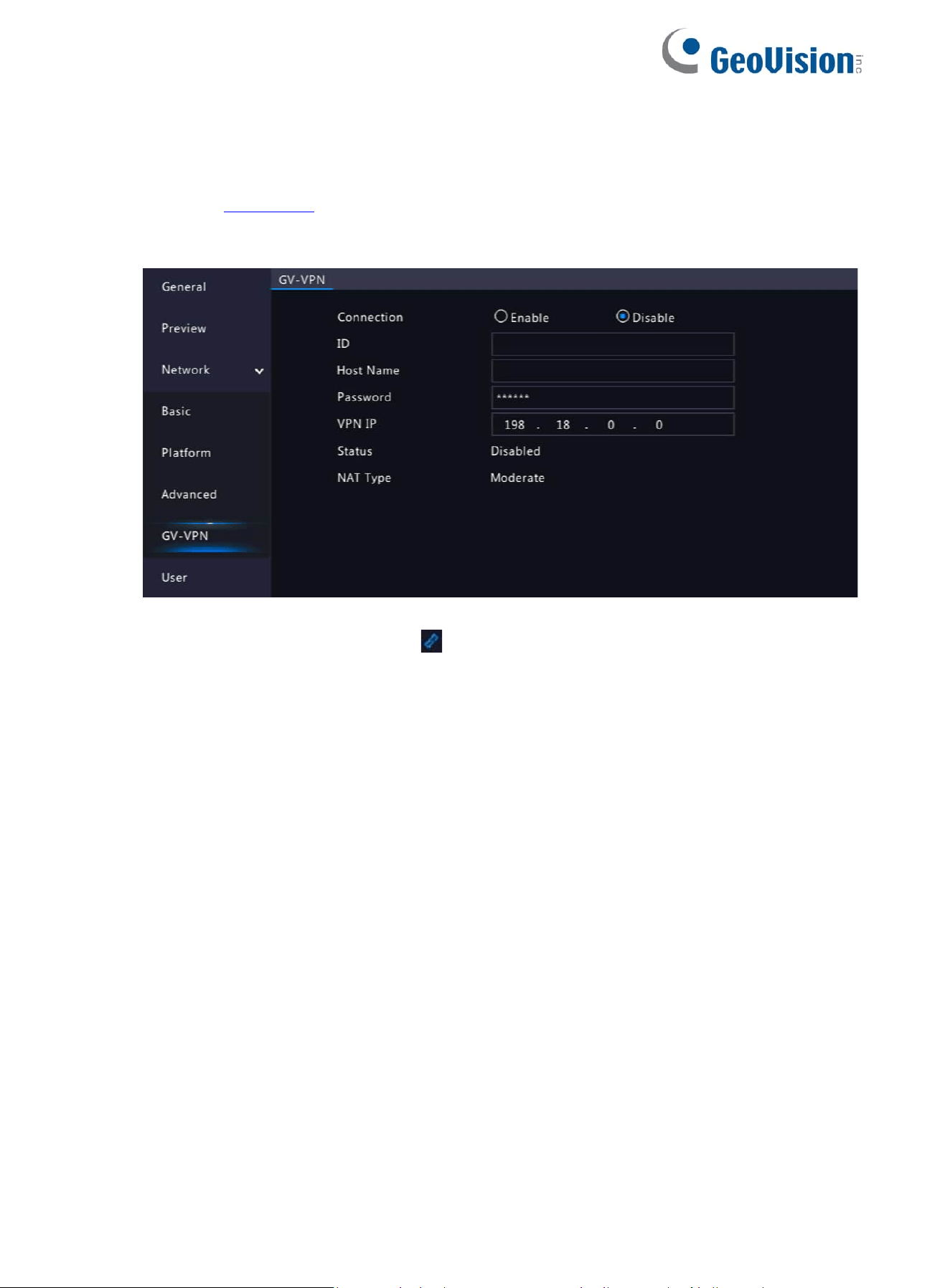
132
8.3.4 GV-VPN
GV-VPN is an application powered by P2P VPN technology and the cloud-based GV-Cloud platform. It enables users
to create a secure virtual private network (VPN) environment that connects multiple NVRs. With GV-VPN, there is no
need for complex router configurations — the NVRs are seamlessly linked within the same virtual network.
For details, see GV-VPN Guide.
1. Go to Menu > System > Network > GV-VPN.
2. Click Refresh to refresh the wireless hotspot list.
3. Choose the desired hotspot and then click to connect it.
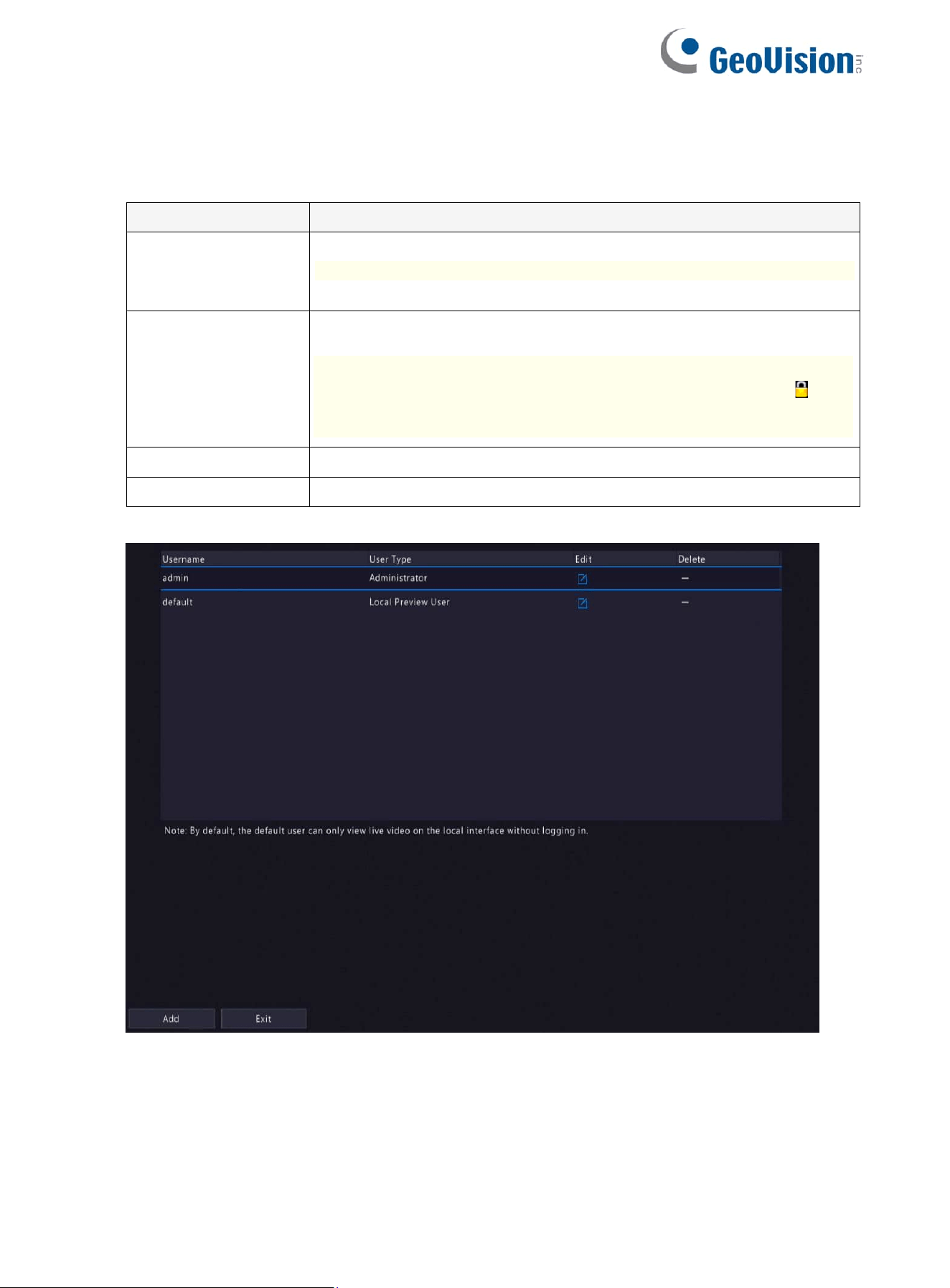
133
8.4 User Configuration
Users are entities that manage and operate the system. A user type is a set of operation permissions. After a user
type is assigned to a user, the user has all the permissions defined in the type.
The system supports four user types:
User Type
Description
admin
The default super administrator, which has the maximum permissions.
Note: Only admin can add or delete users and edit other users’ permissions.
default
The default reserved user, which cannot be added or deleted, only has live view
and two-way audio permissions by default, and can be configured by admin only.
Note: If the default user is forbidden to use live view and two-way audio
on a camera, the camera will be locked when no user is logged in, and is
displayed in the corresponding window. By default, the default user can only
view live video on the local interface without logging in.
Operator
By default, an operator has basic permissions and camera permissions.
Guest
By default, a guest only has camera permissions.
Go to Menu > System > User.
Add User
1. Click Add.
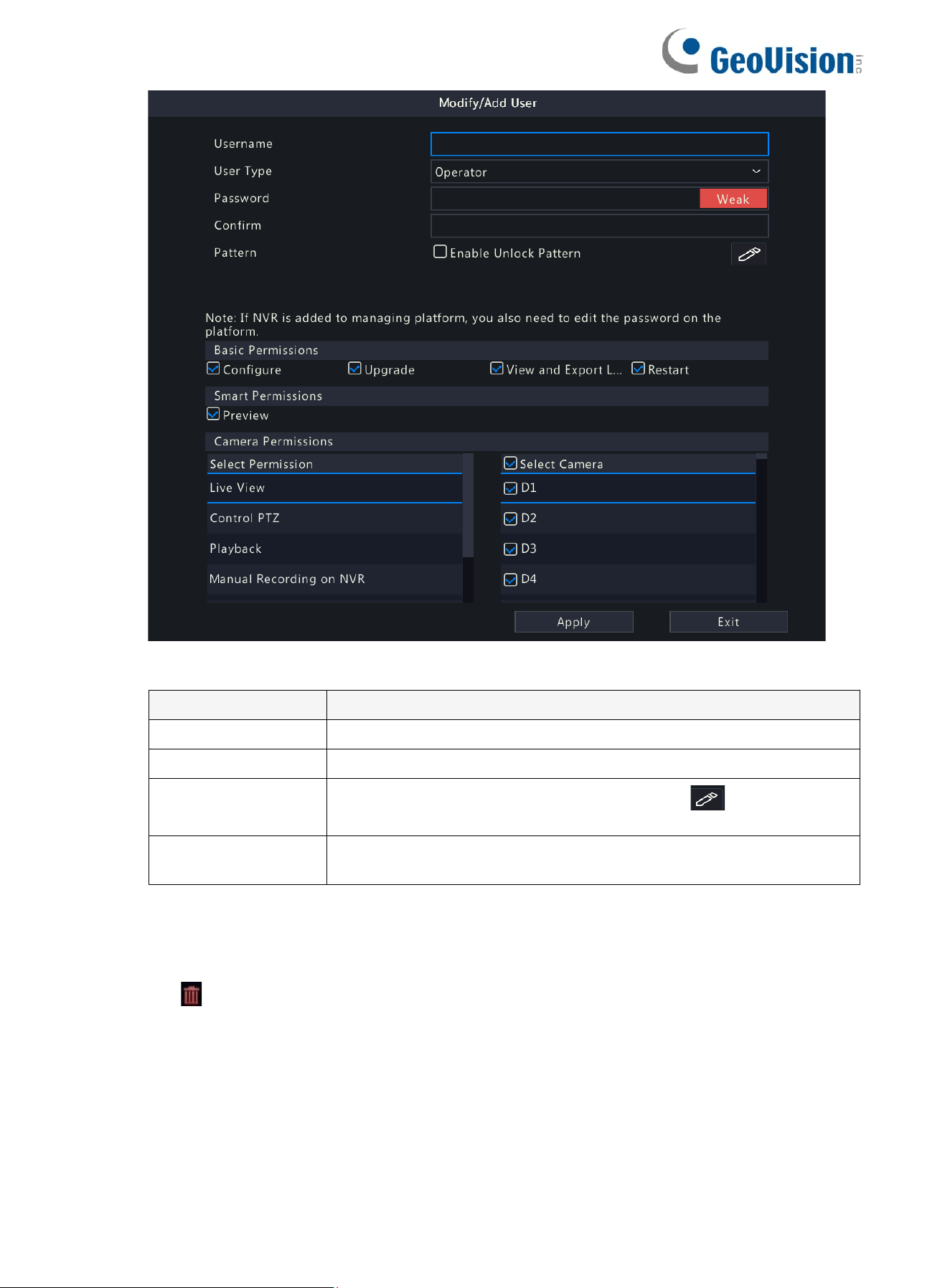
134
2. Configure the parameters. Enter the username, password, choose a user type, enable/disable unlock pattern,
and choose permissions.
Item
Description
Username
Set a username as you need. Cannot be empty or include Chinese characters.
Password/Confirm
Set a strong password.
Pattern
To enable the unlock pattern, select the checkbox. Click , and then follow
on-screen instructions to set a pattern.
Basic Permissions/Smart
Permissions
Select the permissions you want to assign to the user.
3. Click OK.
Delete User
1. On the User page, select the user you want to delete.
2. Click . A confirmation message appears.
3. Click Yes.
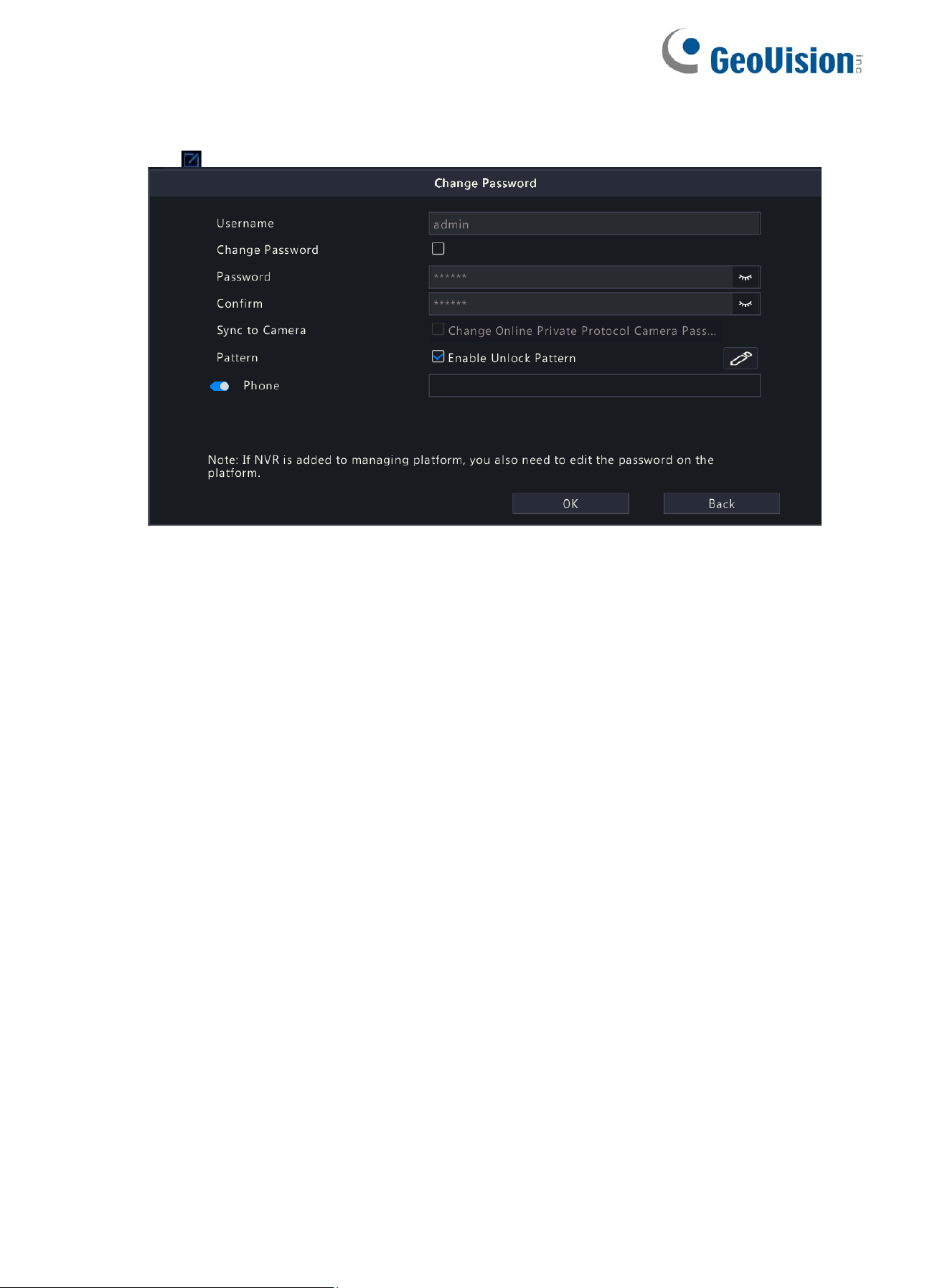
135
Edit User
1. On the User page, select the user you want to edit.
2. Click , enter the password.
3. Edit the user type, password, or permissions.
4. Click OK.
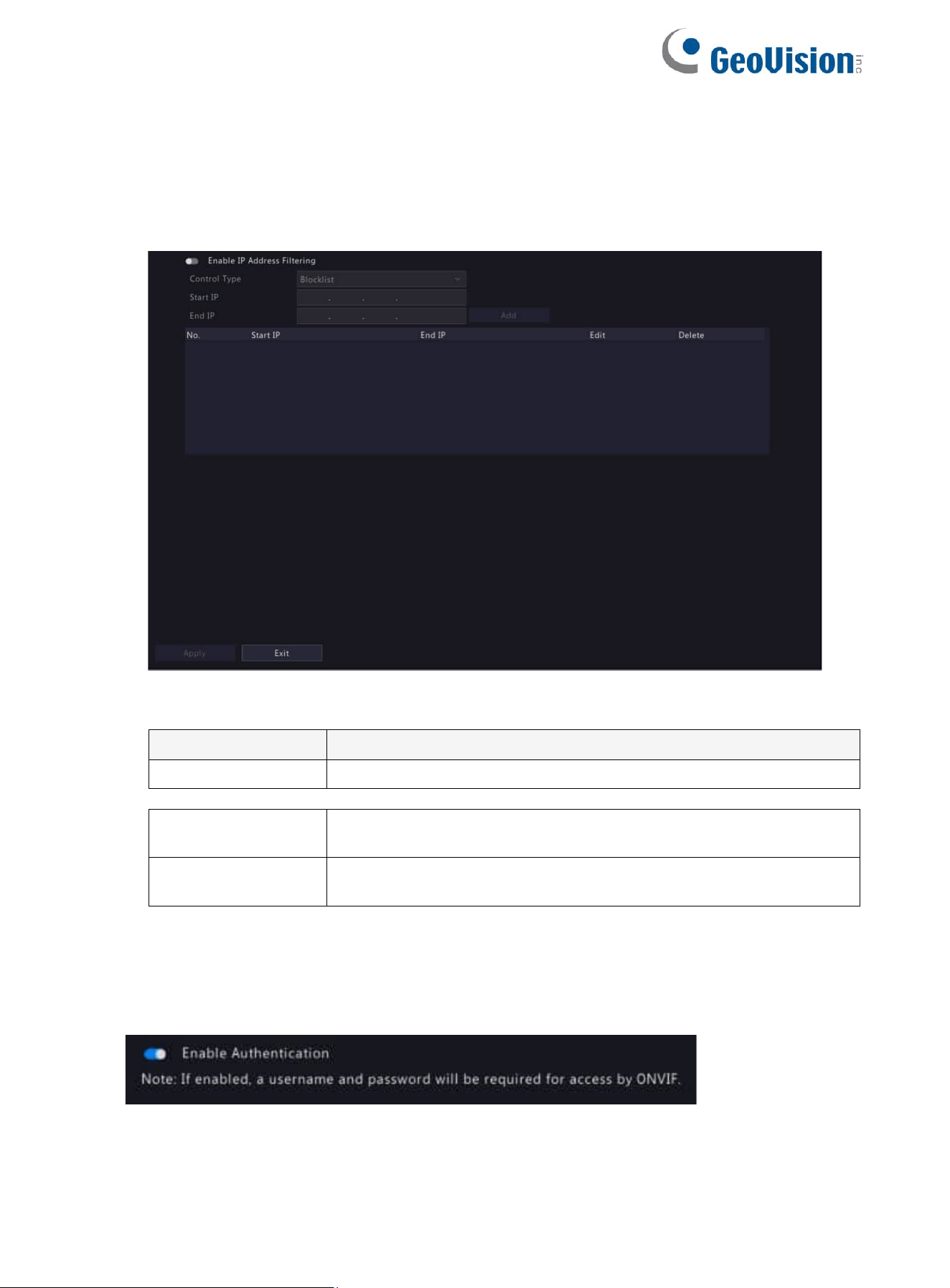
136
8.5 Security Configuration
Security configuration includes IP address filtering, Onvif authentication, 802.1x, and ARP protection.
8.5.1 IP Address Filtering
IP address filtering can ensure only certain source IP addresses can be used to access the NVR’s web interface.
1. Go to Menu > System > Security > IP Address Filtering.
2. Enable IP address filtering.
3. Configure the parameters.
Parameter
Description
Control Type
Blocklist: Access is forbidden if the IP is on the blocklist.
Allowlist: Access is allowed only when the IP is on the allowlist. If Allowlist is
selected but is empty, remote access will be forbidden.
Start IP/End IP
Enter the start and end IP addresses. If you want to add only one IP address,
enter it in the Start IP field.
4. Click Add.
8.5.2 ONVIF Authentication
When Onvif authentication is enabled, a username and password will be required to access the NVR via Onvif.
This feature is enabled by default. Go to Menu > System > Security > ONVIF Auth.
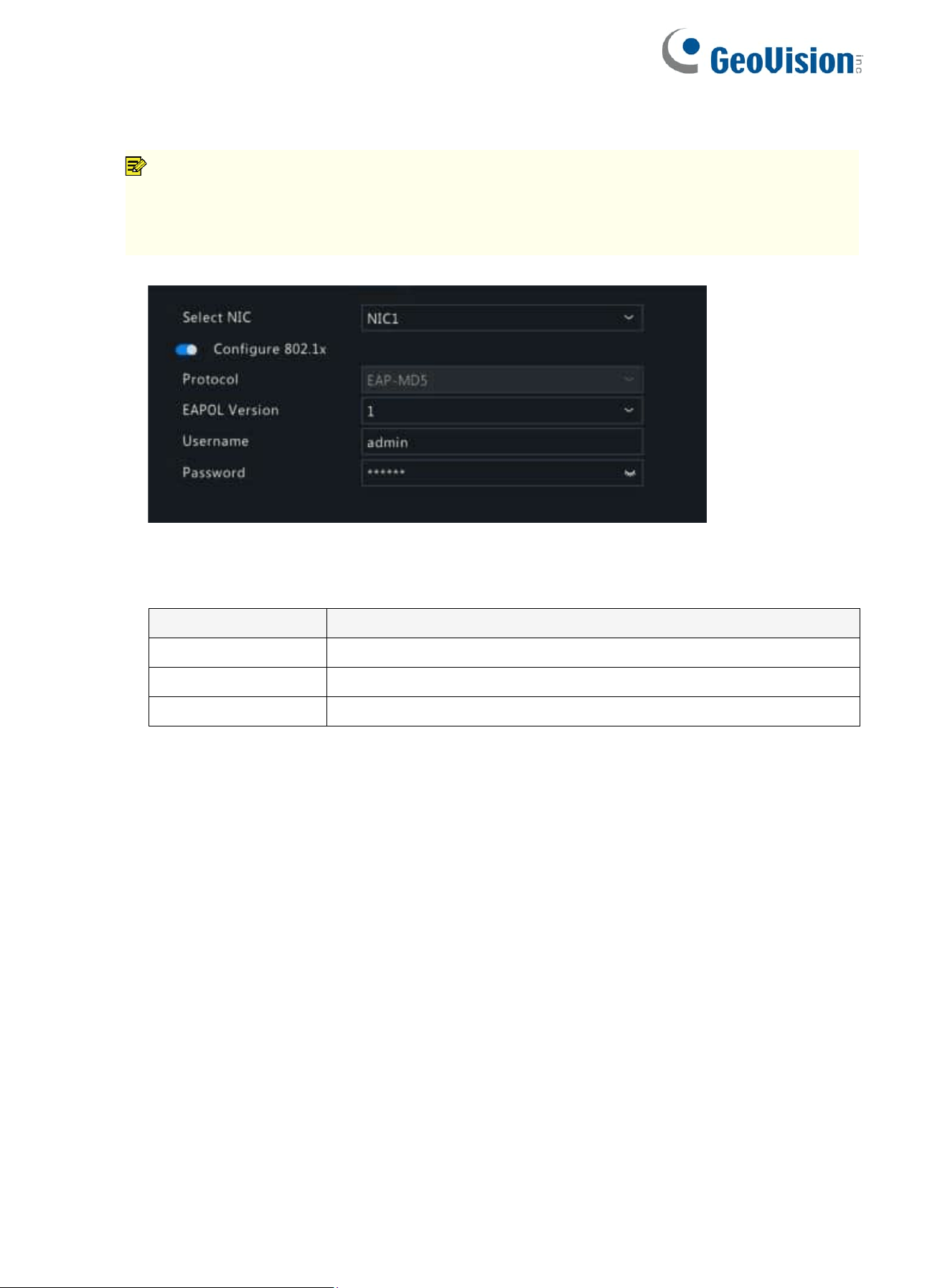
137
8.5.3 802.1x
802.1X can prevent unauthenticated devices from accessing the local area network.
1. Go to Menu > System > Security > 802.1x.
2. Choose the NIC. Skip this step if the device has only one NIC.
3. Enable Configure 802.1x.
4. Configure the parameters.
Parameter
Description
Protocol
Default: EAP-MD5.
EAPOL Version
Choose 1 or 2. It must be the same version configured on the network switch.
Username/Password
Must be the username and password configured on the network switch.
5. Click Apply.
Note:
• Only some NVRs support this function.
• You need to configure and enable this function on the network switch first.
• For multi-NIC devices, this feature will be disabled automatically if you change the NIC's working mode.
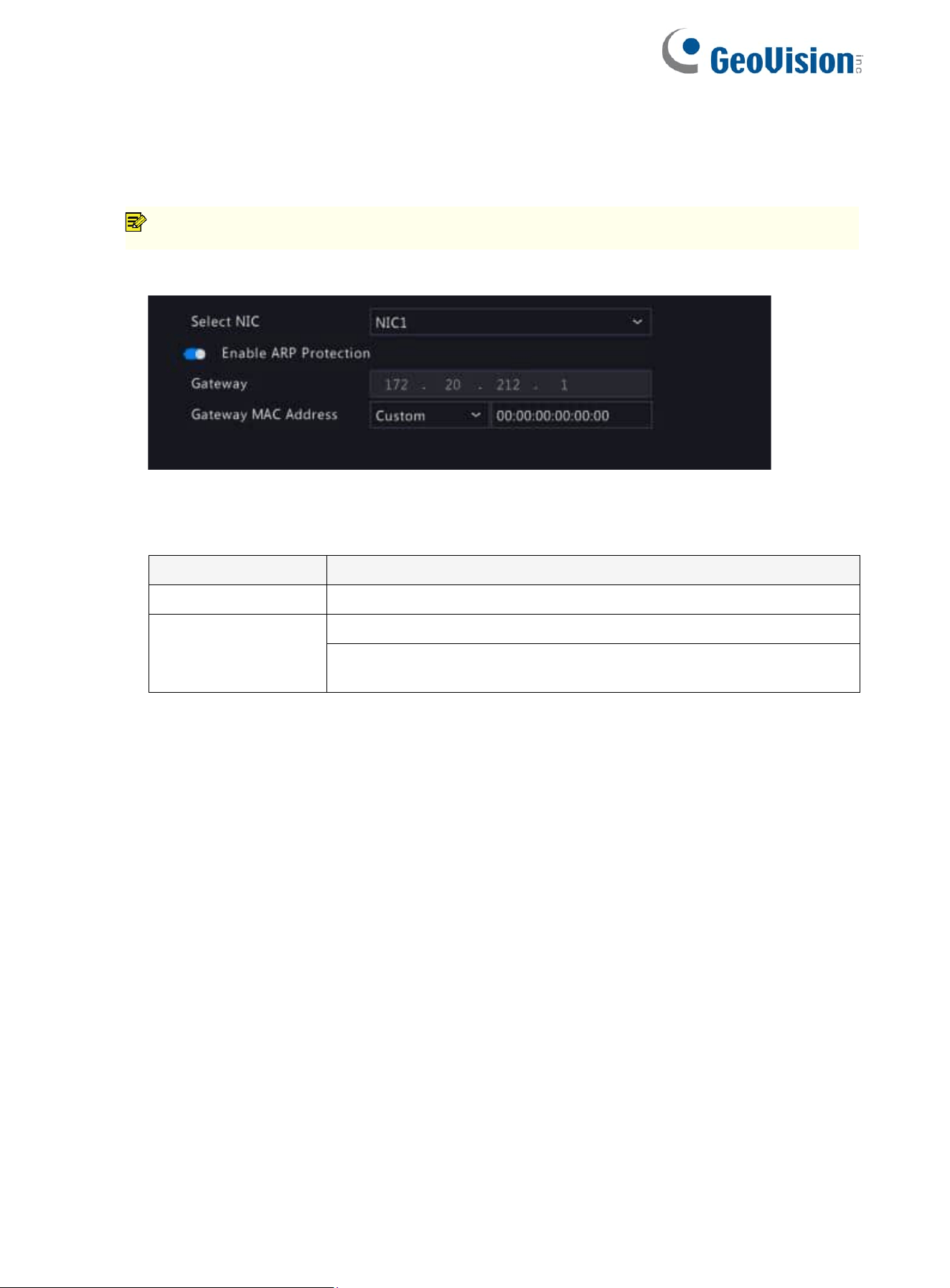
138
8.5.4 ARP Protection
The Address Resolution Protocol (ARP) dynamically maps an IP address to a MAC address. In a local area network,
ARP is necessary for devices to communicate with each other through MAC addresses. ARP attacks exploit ARP
vulnerabilities to forge IP addresses and MAC addresses. ARP protection can bind the gateway's IP address and an
MAC address to prevent ARP spoofing.
1. Go to Menu > System > Security > ARP Protection.
2. Choose the NIC. Skip this step if the device only has one NIC.
3. Enable ARP protection.
4. Configure the parameters.
Parameter
Description
Gateway
Gateway you have configured in Menu > Network > Basic > Network.
Gateway MAC Address
Custom: Enter the gateway's physical address in the network switch.
Auto: Automatically obtains the gateway's physical address in the network
switch.
5. Click Apply.
Note: For multi-NIC devices, this feature will be disabled automatically if you change the NIC's working
mode. For information about changing the working mode, see Network Configuration.
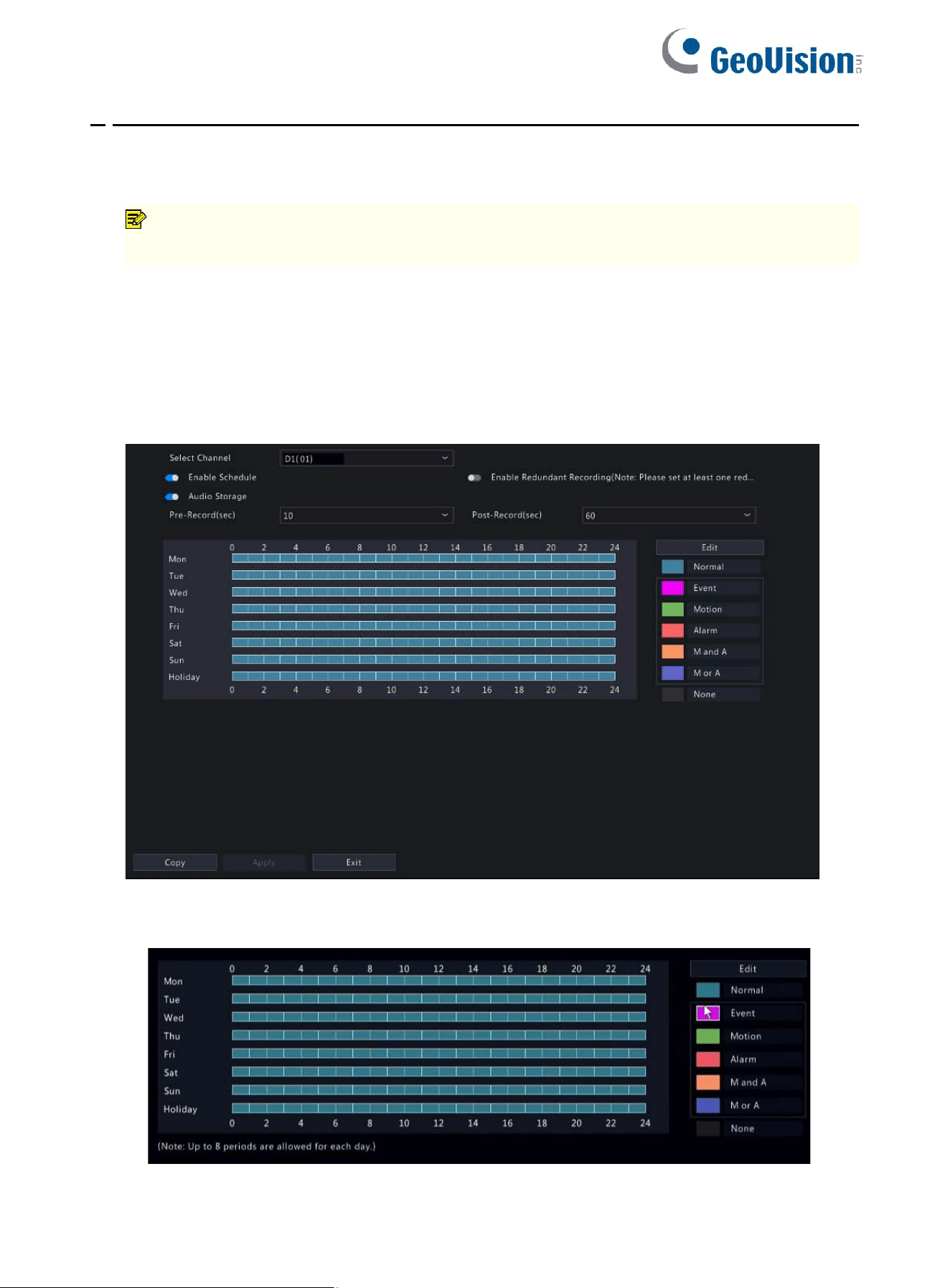
139
9 Storage
Configure disk storage parameters.
You can configure the storage mode under Camera > Audio & Video > Encoding.
9.1 Recording Schedule
Make a recording schedule.
A 24/7 normal recording schedule is enabled by default. You can modify the schedule by drawing or editing as
needed.
Go to Menu > Storage > Recording Schedule. Select the camera for which you want to make a recording
schedule.
Draw a Schedule
1. Select a recording type.
Note: The device uses hard disks to store data, and the hard disks need to be formatted; otherwise, data
storage function will be unavailable or affected. A message will alert you if there is no hard disk or any hard
disk unformatted.
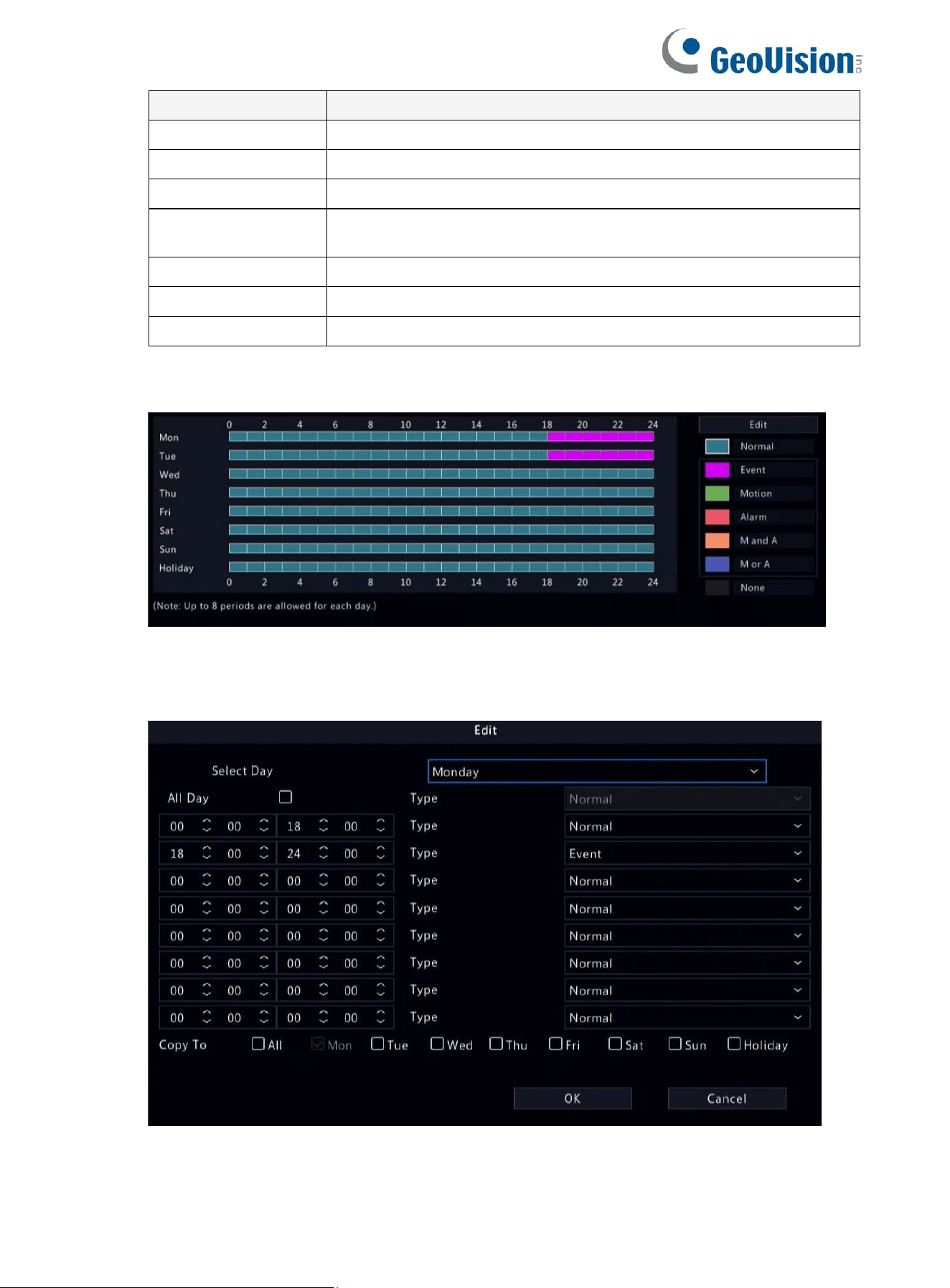
140
Recording Type
Description
Normal
Records video during specified time periods.
Event
Records video in the event of an event-triggered alarm.
Motion
Records video in the event of motion.
Alarm
Records video in the event of alarm input. Configure Alarm Input first before
making an alarm schedule.
M and A
Records video when motion and alarm input occur simultaneously.
M or A
Records video when motion or alarm input occurs.
None
No recording schedule.
2. Drag on the time schedule to specify time periods for the recording type. The figure below shows a recording
schedule with event recording from 18:00 to 24:00 on Monday and Tuesday, and normal recording during the
rest of the time.
3. Click Apply.
Edit a Schedule
1. Click Edit.
2. Select a day.
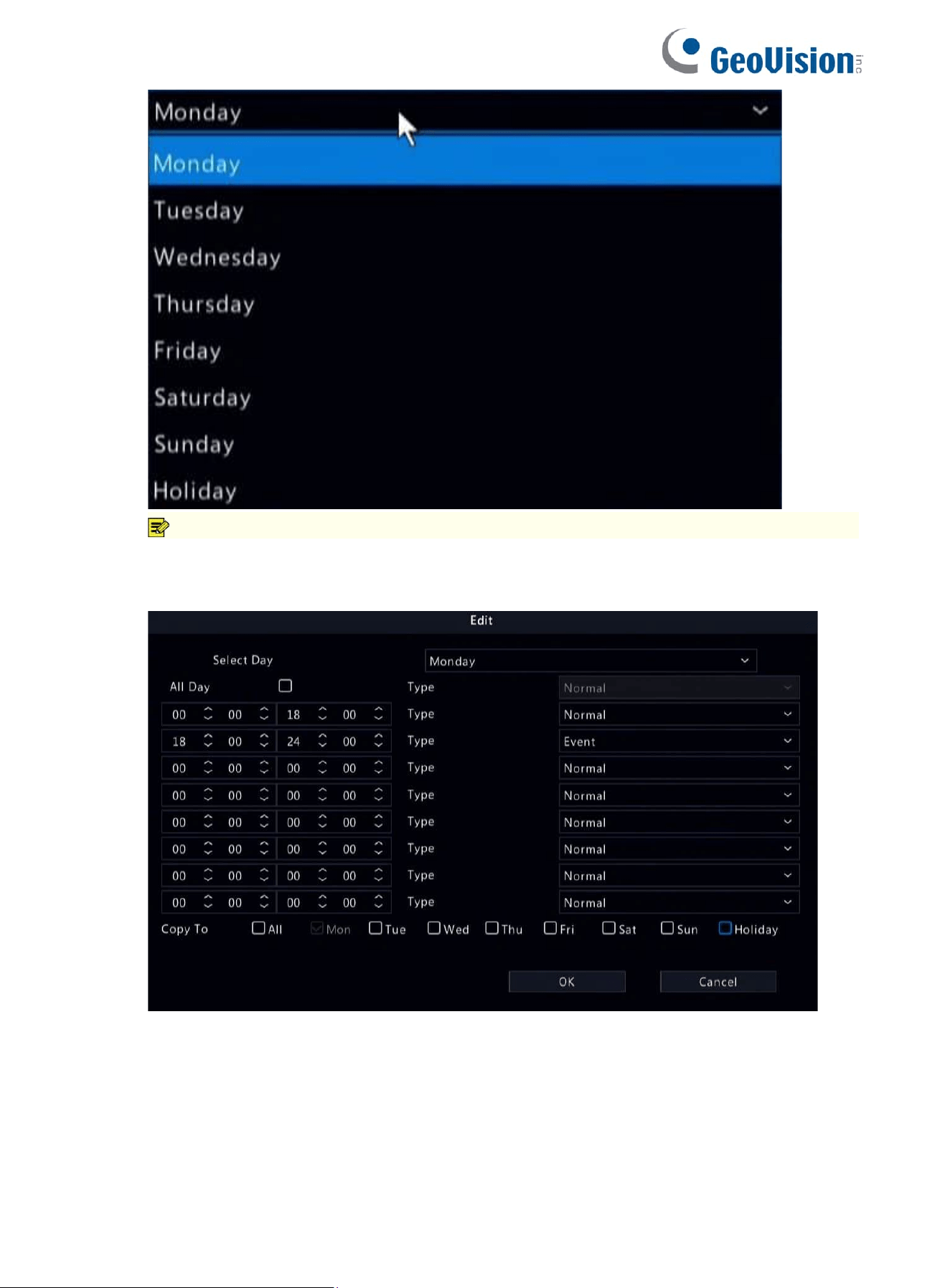
141
3. Clear the All Day check box. As a 24/7 normal recording schedule is enabled by default, you cannot modify
the schedule unless All Day is unchecked.
4. Set time periods and the corresponding recording types.
5. To apply the same settings to other days, select the desired day(s) after Copy To.
6. Click OK.
Note: Before you select Holiday, go to System > Time > Holiday and complete the holiday settings.
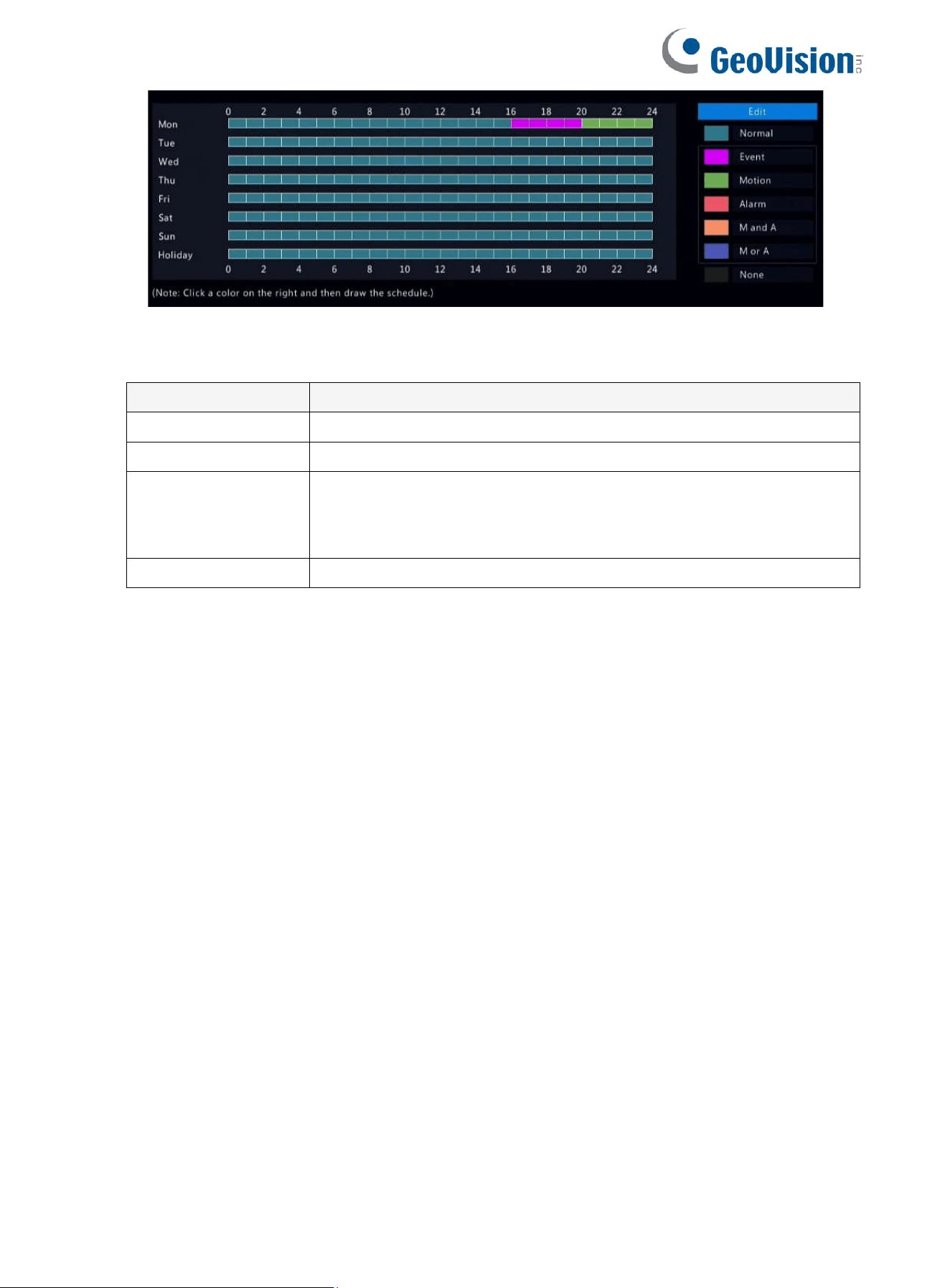
142
7. Click Apply.
Other Settings
Item
Description
Pre-Record
The duration of video to be recorded before an alarm. The default value is 10s.
Post-Record
The duration of video to be recorded after an alarm. The default value is 60s.
Enable Redundant
Recording
Recording backup, stores recorded videos to redundant disks synchronously to
prevent video loss in case of read/write disk failure. You need to configure at least
one redundant disk before enabling redundant recording. See Disk Management
for details.
Audio Storage
Set whether to record audio. Audio is not recorded by default.
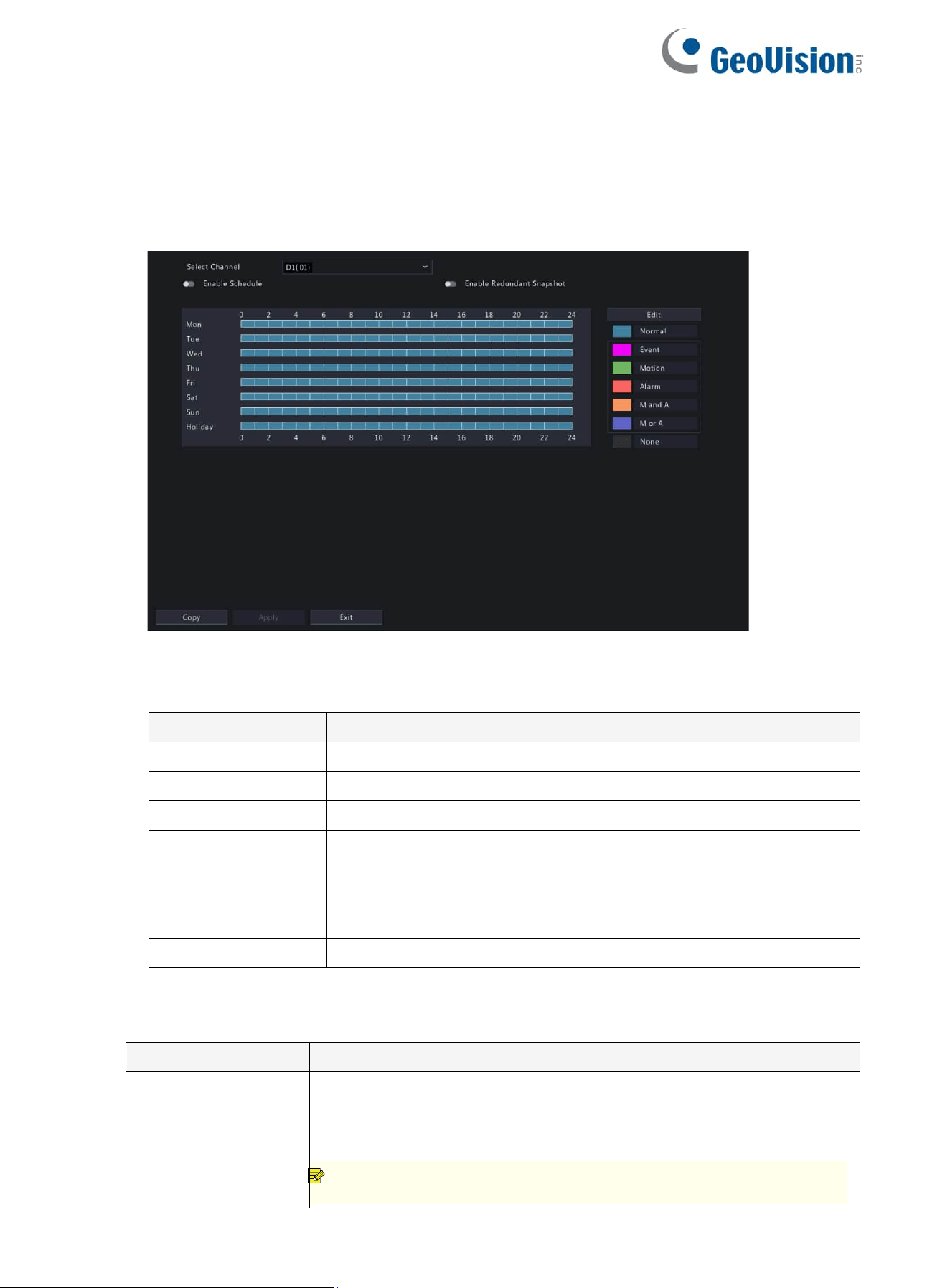
143
9.2 Snapshot Schedule
Configure snapshot schedule and snapshot type.
9.2.1 Configure Snapshot Schedule
Make a snapshot schedule.
1. Go to Menu > Storage > Snapshot Schedule > Configure Snapshot Schedule.
2. Select the camera for which you want to make a snapshot schedule.
3. Enable schedule.
4. Set the snapshot schedule. See Draw a Schedule and Edit a Schedule.
Snapshot Type
Description
Normal
Captures images during specified time periods.
Event
Captures images in the event of an event-triggered alarm.
Motion
Captures images in the event of motion.
Alarm
Captures images in the event of alarm input. Configure Alarm Input first before
making an alarm schedule.
M and A
Captures images when motion and alarm input occur simultaneously.
M or A
Captures images when motion or alarm input occurs.
None
No snapshot schedule.
5. Click Apply.
Other Settings
Item
Description
Enable Redundant
Snapshot
Snapshot backup, stores snapshots to redundant disks synchronously to prevent
snapshot loss in case of read/write disk failure. You need to configure at least one
redundant disk before enabling redundant snapshot. See Disk Management for
details.
Note: A redundant disk can be used for both recording backup and snapshot
backup.
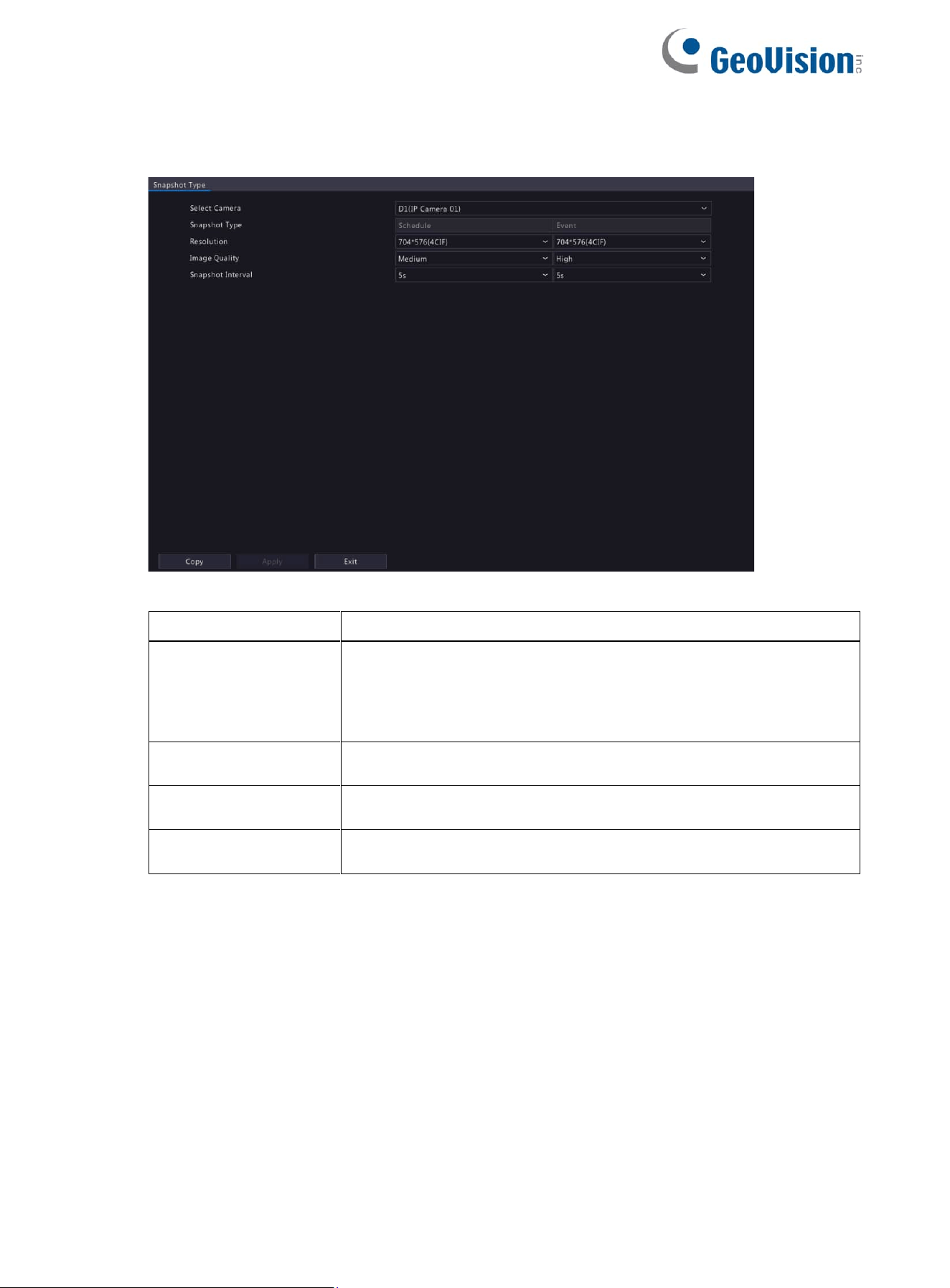
144
9.2.2 Snapshot Type
Configure snapshot parameters.
1. Go to Menu > Storage > Snapshot Schedule > Snapshot Type.
2. Select the camera and set the parameters as needed.
Item
Description
Snapshot Type
Supports scheduled snapshot and event-triggered snapshot. You need set
image quality and snapshot interval for them respectively.
• Schedule: A snapshot is taken according to the set schedule.
• Event: A snapshot is triggered by an event such as alarm input and motion
detection alarm. Manual snapshots are event-triggered snapshots.
Resolution
The number of pixels in a frame. Only certain NVRs support setting resolution.
Image Quality
Set the snapshot quality. High, medium, or low are available.
Snapshot Interval
Select the time interval between two snapshots from the drop-down list.
3. (Optional) To apply the same settings to other cameras, click Copy and select the desired camera(s).
4. Click Apply.
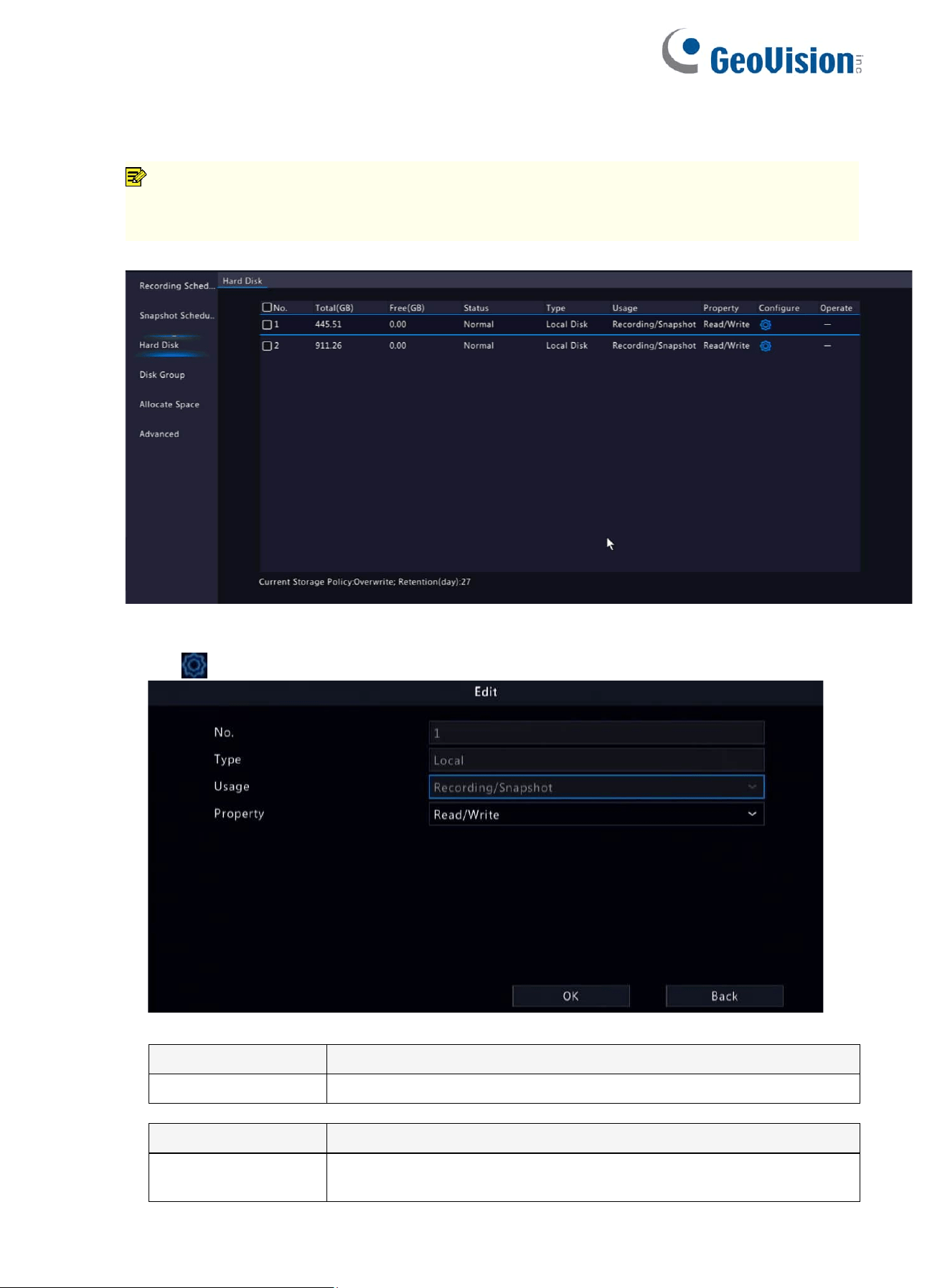
145
9.3 Disk Management
Configure disk usage and property, add external disks, and format disks.
Go to Menu > Storage > Hard Disk.
Configure the Disk Usage and Property
1.
2. Select the usage and property. You can only configure the usage of NAS and eSATA.
Usage
Description
Recording/Snapshot
Used to automatically store recordings or snapshots.
Usage
Description
Backup
Used to manually back up device related files, such as recordings/snapshots,
logs, configuration information, etc.
Click
for the disk to edit.
Note:
• Before you start, make sure all disks are installed properly.
• Only admin can format disks and configure the disk property.
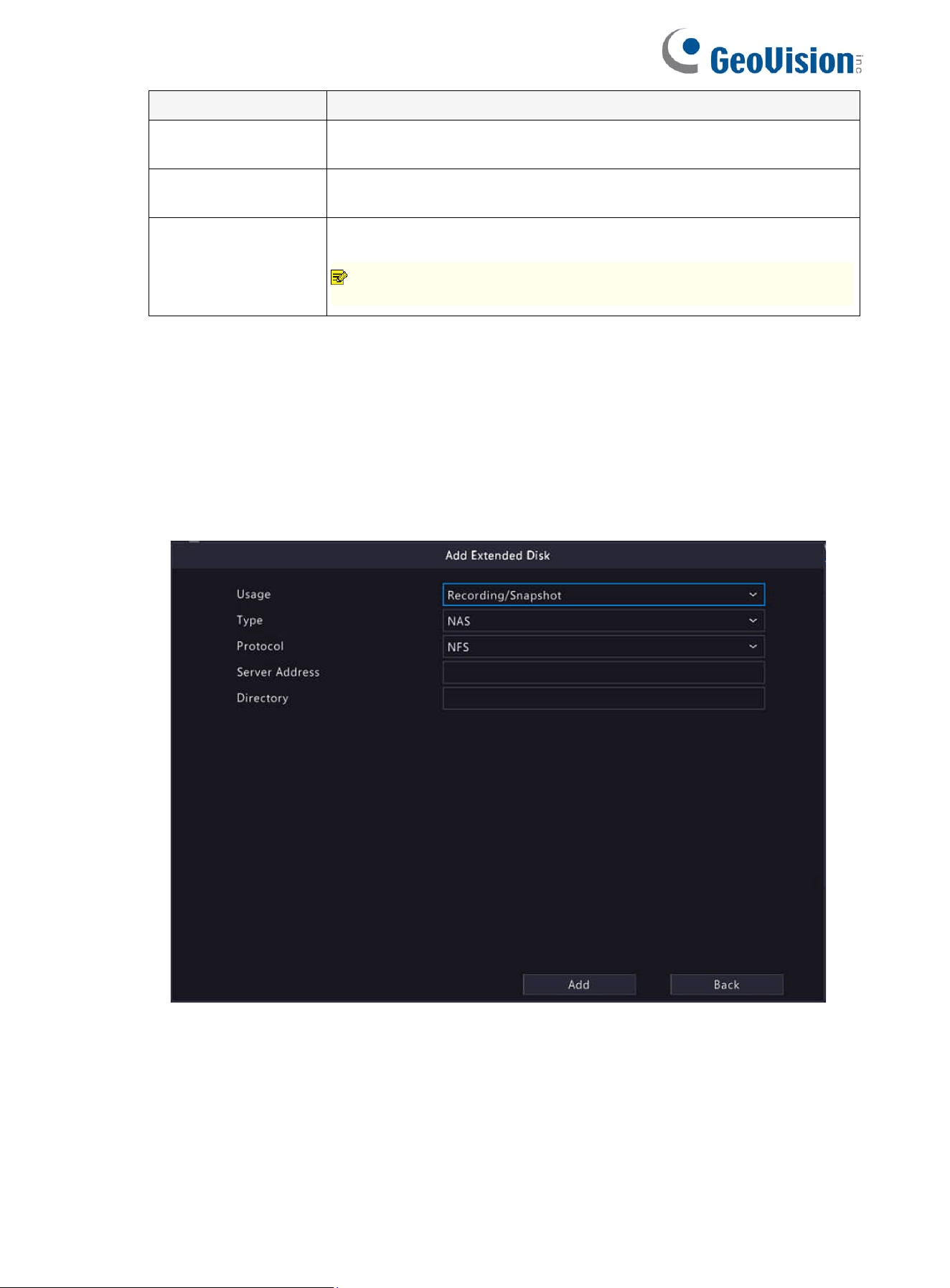
146
Property
Description
Read/Write
The disk supports recording/snapshot storage, recording playback and snapshot
retrieval.
Read Only
The disk only supports recording playback and snapshot retrieval, and does not
support recording/snapshot storage.
Redundant
Recordings and snapshots are saved to read/write disks and redundant disks
simultaneously.
Note: To view recordings and snapshots on a redundant disk, you need to
change the disk property to Read Only.
3. Click OK.
Add an External Disk
You can add external disks to the device, including NAS, eSATA, and disk enclosure. eSATA disks and disk
enclosures are automatically added when connected to the device. The following describes how to add a NAS.
1. Click Add. The Add Extended Disk page appears.
2. Select a protocol, and configure parameters.
• NFS: Used to add NAS servers to the LAN.
Enter the NAS server address and directory (a folder path where the NAS server store videos and images).
• SMB/CIFS: Used to add NAS servers to the public network for security.
Enter the NAS server address, directory, username, and password.
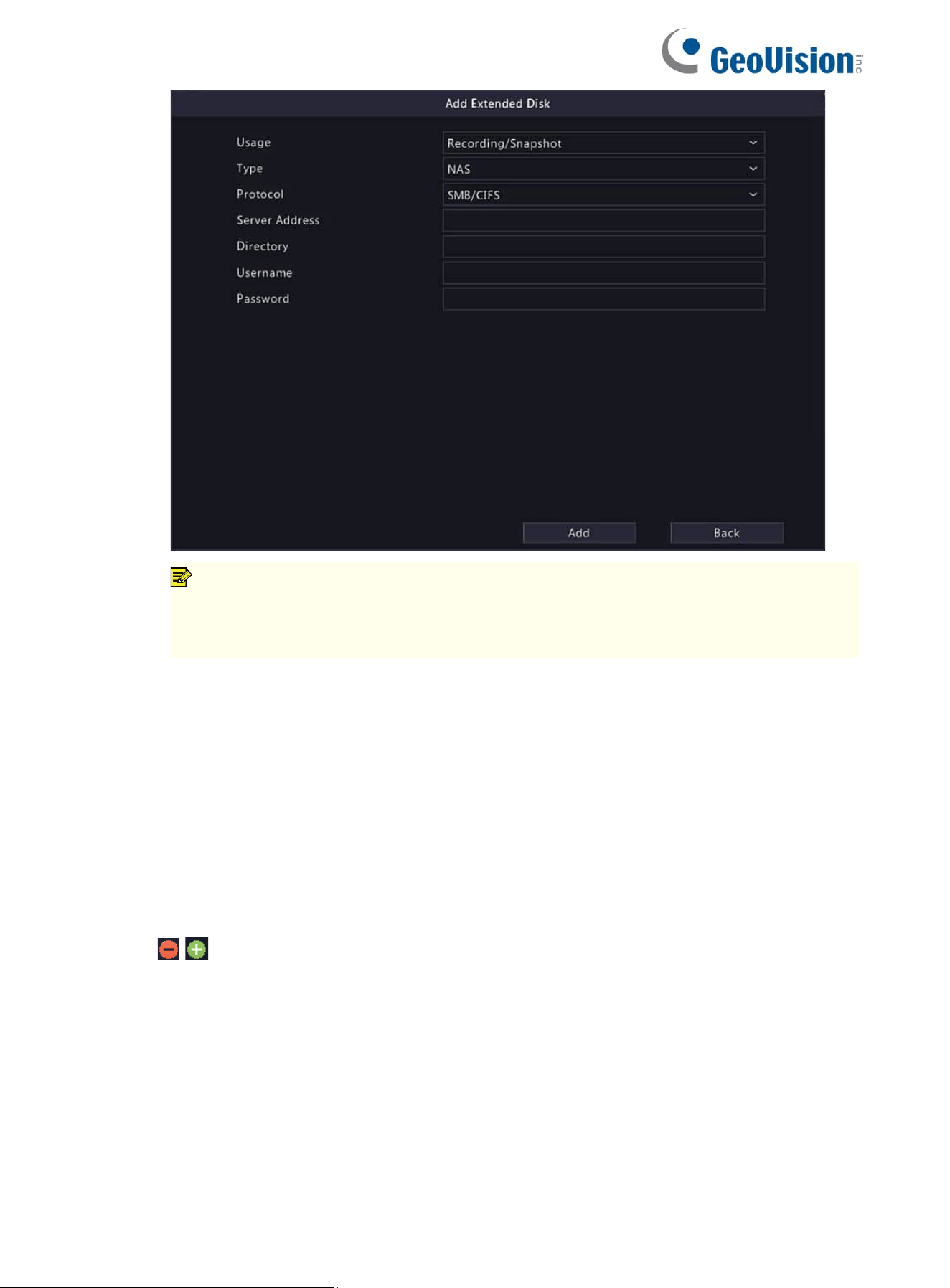
147
3. Click Add.
Format a Disk
Formatting a disk will erase all data stored on it. Please handle with caution.
1. Select the disk you want to format.
2. Click Format.
3. A confirmation message appears.
• Local disk: Click Yes.
• External disk: Select the files you want to format.
Other Operations
Click / to unmount/mount an eSATA disk.
Note:
• Before use, make sure that the NAS server supports SMB/CIFS protocol and has enabled UPnP, or
the ports 445 and 139 have been mapped manually on the router.
• A domain name is allowed for the server address if the NAS domain name resolution is available.
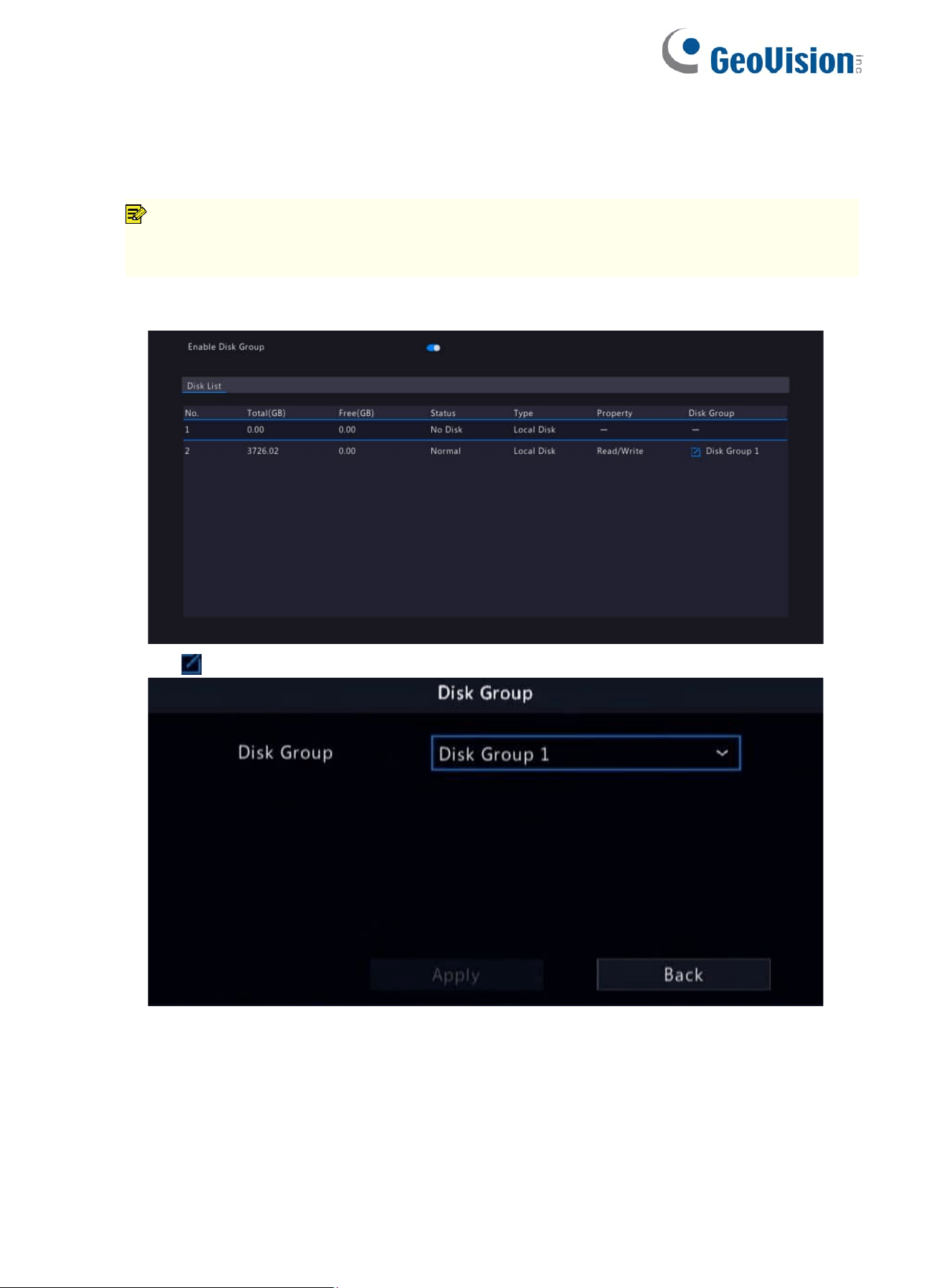
148
9.4 Disk Group
You can group disks and allocate a disk group for videos and images from a specified camera to meet the different
storage duration requirements of cameras. Different arrays can be assigned to different disk groups. See Space
Allocation for details.
1. Go to Menu > Storage > Disk Group.
2. Enable disk group.
3.
4. Select a disk group for the disk.
5. Click Apply.
Click .
Note:
• Redundant disks cannot be assigned to any disk group.
• Disk group information will be initialized if any disk in the group is formatted.
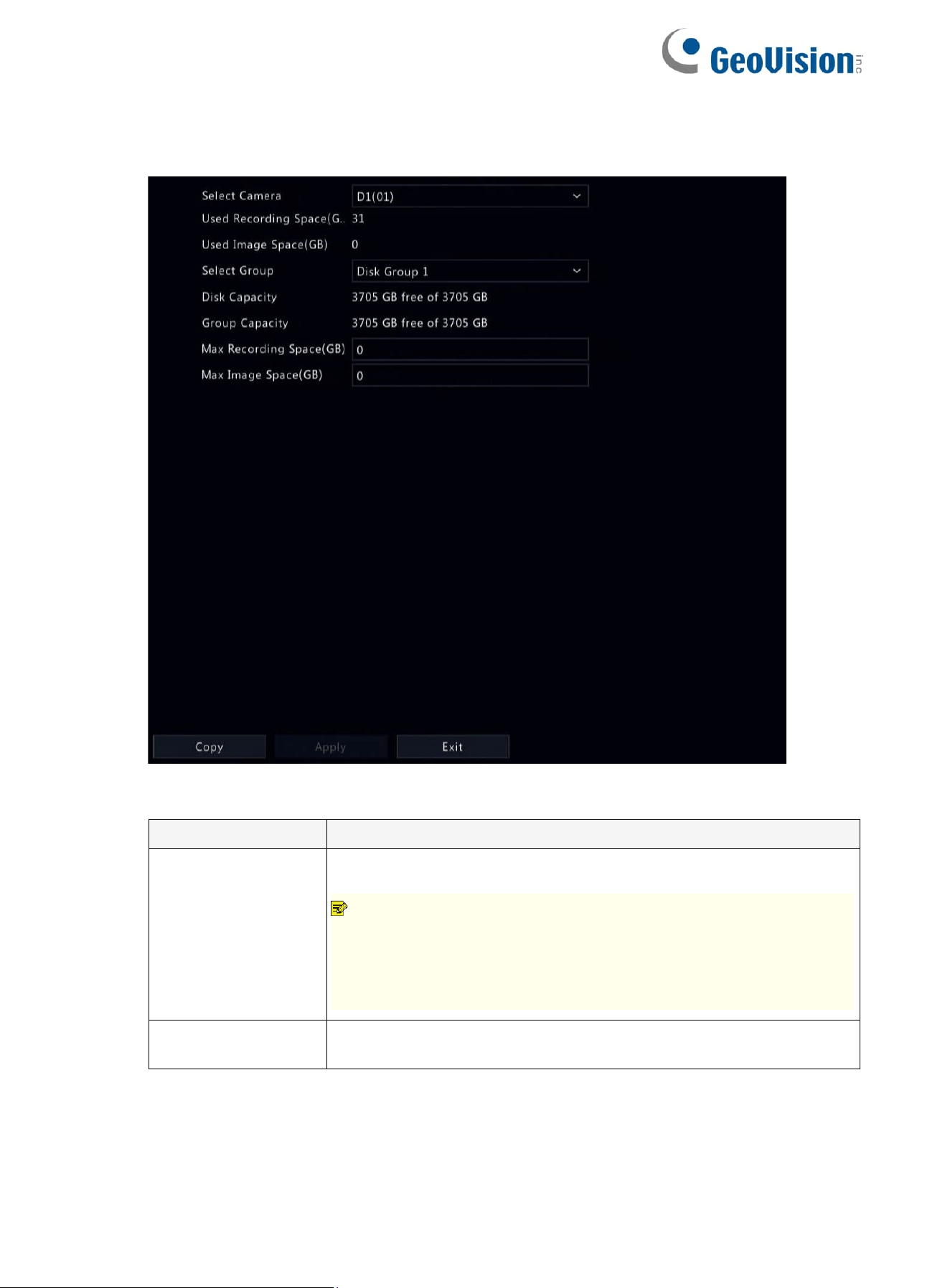
149
9.5 Space Allocation
Allocate storage space for videos and images from a specified camera.
1. Go to Menu > Storage > Allocate Space.
2. Select a camera, select a disk group for storage by the camera, and allocate storage space for videos and
images from this camera on the disk group.
Space Type
Description
Recording Space
Used to store first stream videos, smart snapshots, POS data, people flow data,
and heat map images.
Note: First stream video:
• If the Storage Mode is set to Main and Sub Stream or Main and Third
Stream, the first stream is the main stream.
• If the Storage Mode is set to Sub and Third Stream, the first stream is
the sub stream.
Image Space
Used to store common snapshots, such as snapshots captured by schedule or
manually.
3. Click Apply.
4. (Optional) Click Copy to apply the same settings to other camera(s).
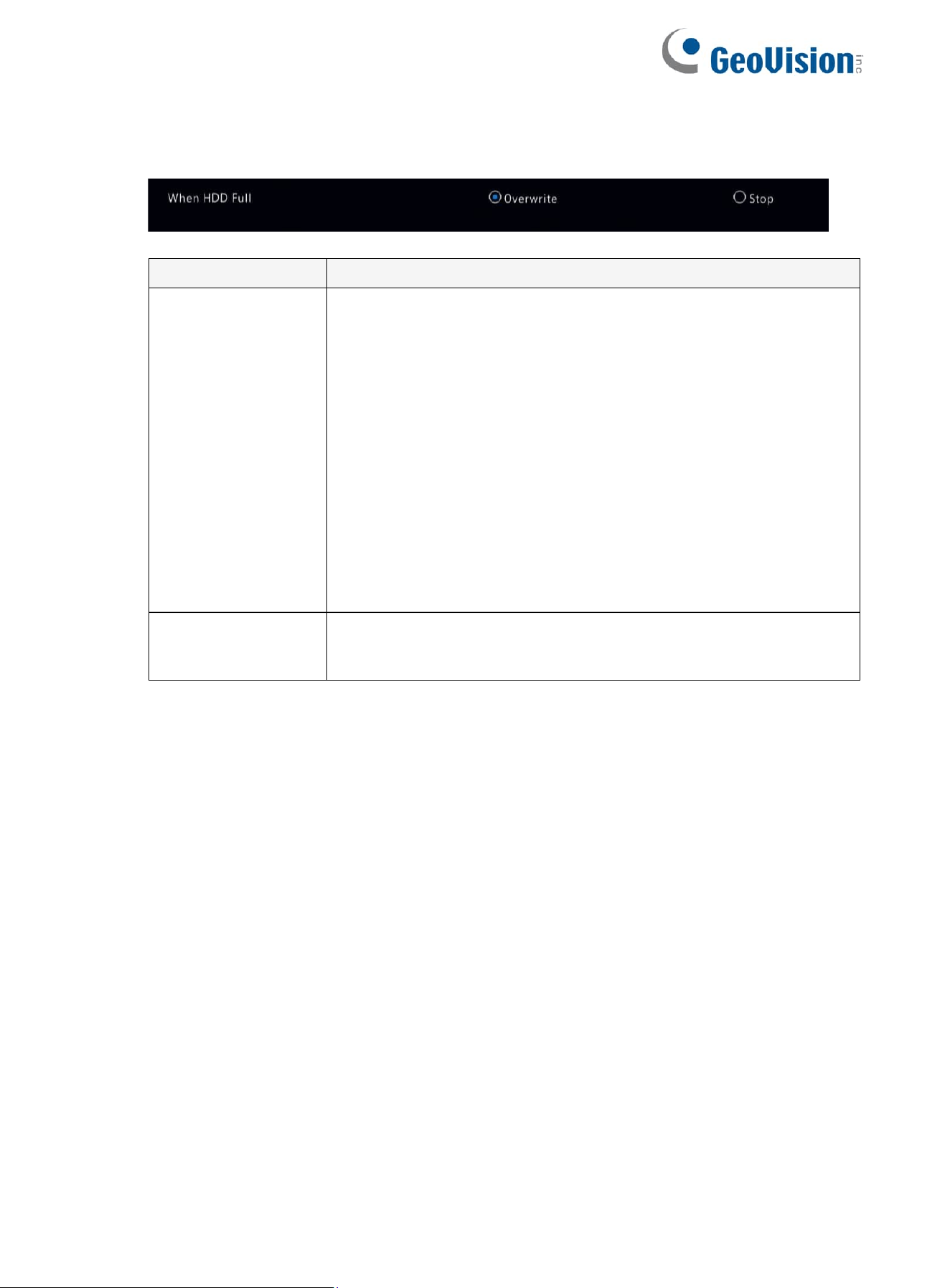
150
9.6 Advanced Settings
Configure the storage policy when the storage is full.
1. Go to Menu > Storage > Advanced.
2. Select whether to overwrite the existing data or stop storage when the storage is full.
hen HDD Full
Description
Overwrite
The disk space is divided into allocated space and remaining space according to
whether the disk is used for storage by cameras.
• If a camera is not allocated storage space, it will use the remaining disk
space, and its oldest data will be overwritten when the remaining space is
used up.
Note: As the remaining disk space is variable and older recordings may
be overwritten due to insufficient storage space, please allocate storage
space with caution. For example, on a device with 20G disk capacity
and two cameras, if camera 1 is allocated 10G, camera 2 will use the
remaining 10G if it is not allocated storage space. In this case, you can
view the last 5 days of recordings from camera 2. However, if you add a
new camera to the device, there will be less storage space available to
camera 2, and fewer days of recordings can be viewed.
• If a camera is allocated storage space, its oldest data will be overwritten
when the allocated space is used up.
Stop
This option is only effective to cameras that have been allocated storage space.
When enabled, if the allocated space of a camera is used up, new recordings/
snapshots will not be saved.
151
10 Alarm Configuration
Set alarm rules and alarm-triggered actions so as to alert users when an alarm occurs.
10.1 Motion Detection
Motion detection detects motions in specified grids on the image. An alarm is reported when detection rules are
triggered.
1. Go to Menu > Alarm > Motion > Motion Detection.
2. Select the desired camera, and enable motion detection.
3. Select the detection mode: Motion or Ultra Motion Detection.
Motion Alarm
Motion detection detects motions in specified grids on the image. An alarm is reported when detection rules are
triggered.
1. Select the detection mode as Motion.
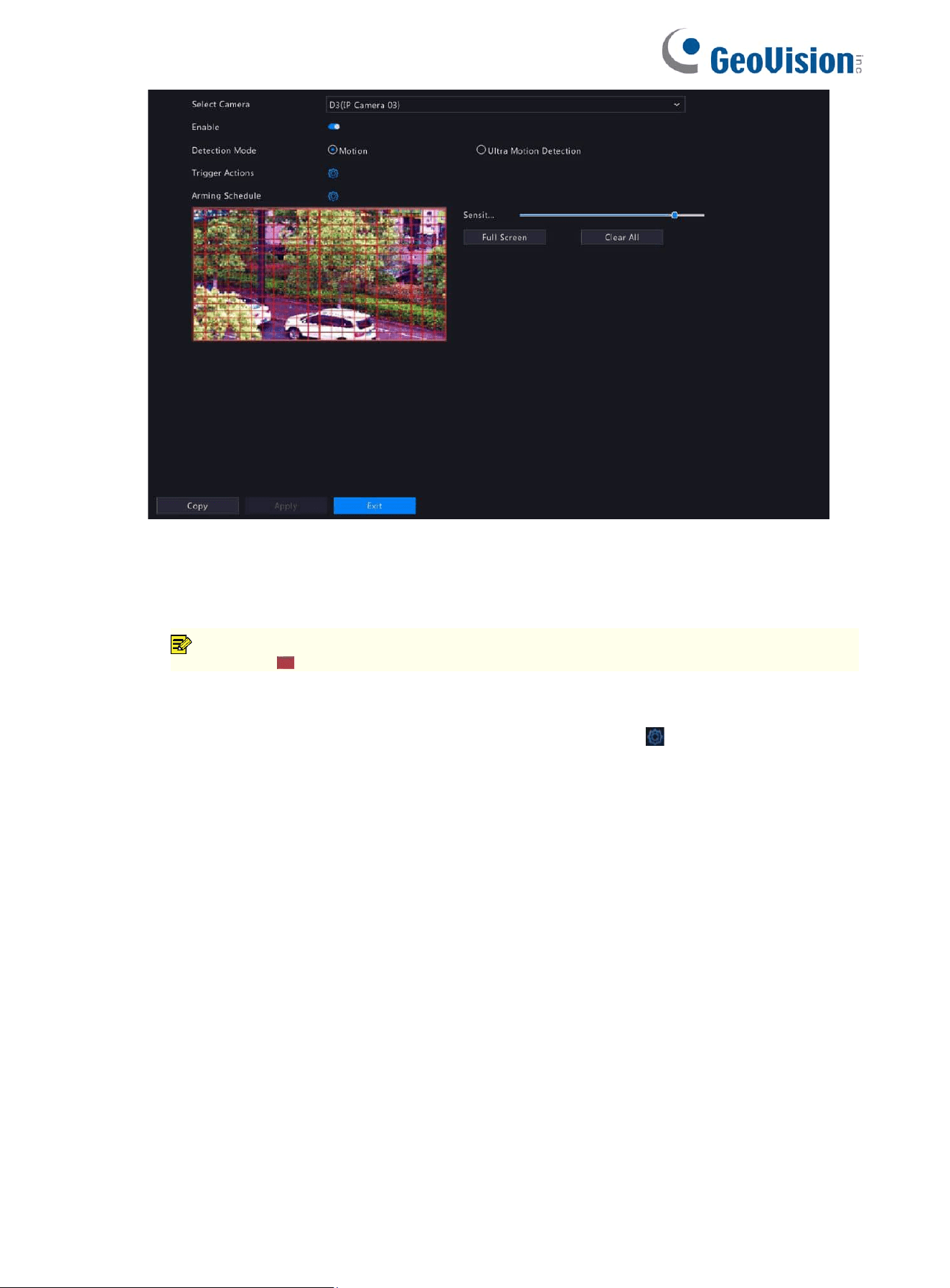
152
2. Set the detection area. The default is the full screen. You can adjust grid detection areas as needed.
• To erase grids, click or drag on grid areas.
• To redraw grids, click Clear All, and then click or drag on blank areas to draw grids.
• To detect the full screen, click Full Screen.
3. Drag the slider to adjust detection sensitivity. The higher the sensitivity, the more likely small motions will be
detected, and the more likely false alarms will occur. Set based on the scene and your actual needs.
4. Set the alarm-triggered actions and arming schedule. Click the corresponding to go to the Trigger Actions
page and Arming Schedule page respectively. See Alarm-triggered Actions and Arming Schedule for details.
5. (Optional) To apply the same settings to other cameras, click Copy and select the desired parameter(s) and
camera(s).
6. Click Apply.
Note: When a moving object is detected, the grids where the object appears on the left-side image
are filled by .
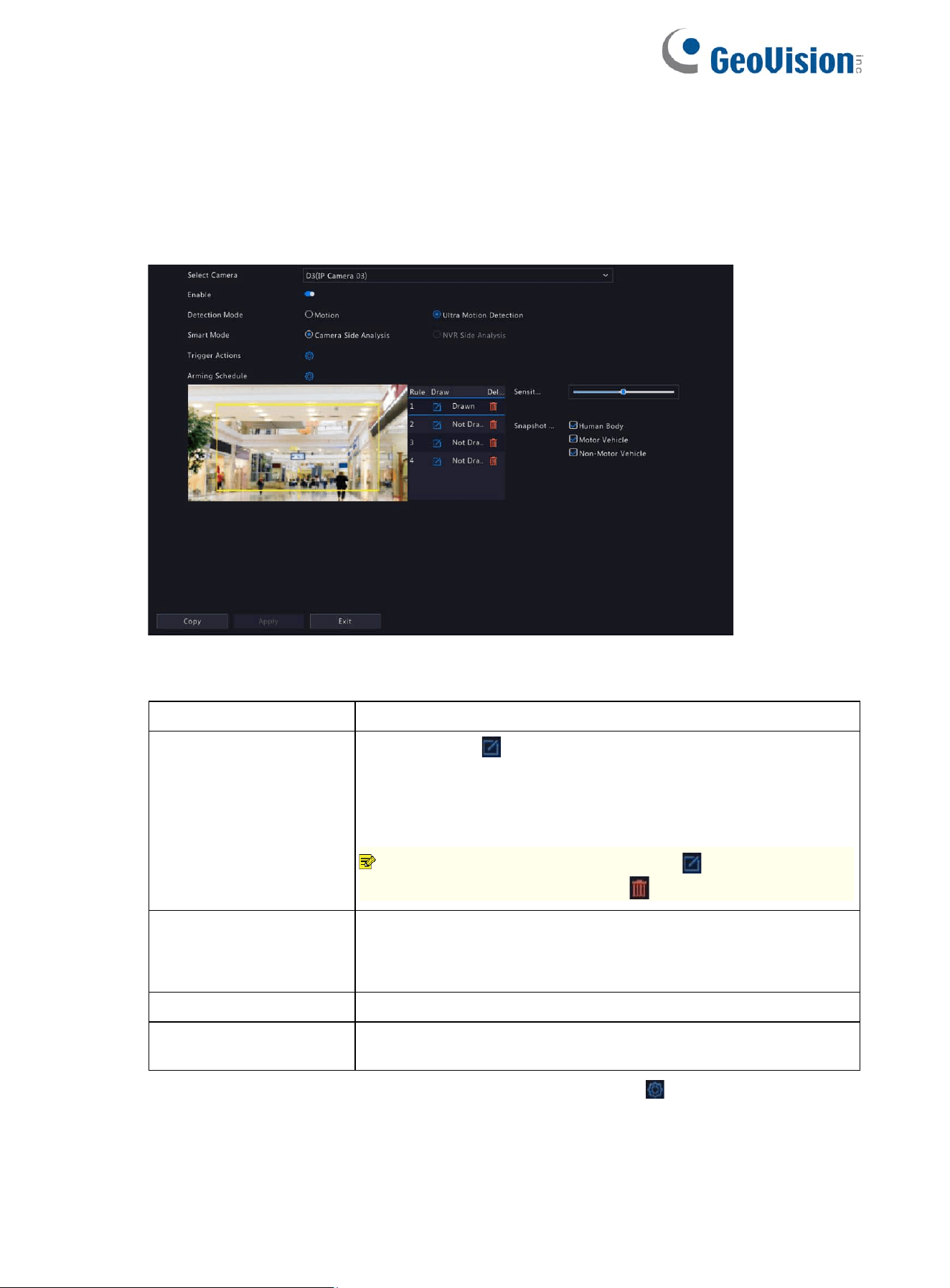
153
Ultra Motion Detection
Ultra motion detection detects motions in specified grids on the image, and judges that the motion object is
human body, motor vehicle or non-motor vehicle. An alarm is reported when detection rules are triggered.
Note: To use Ultra Motion Detection, you must first enable the Ultra Motion Detection in Analyzer (VCA > Analyzer
Config).
1. Select the detection mode as Ultra Motion Detection.
2. Select the smart mode, and choose whether to implement this function on the camera side or the NVR side.
3. Set detection rules. The 4 detection rules shall be set separately. The following takes Rule 1 as an example.
Parameter
Description
Detection Area
Select Rule 1, click , and the full screen is displayed, then draw a
detection area.
Click on the image and drag to draw a line. Repeat the action to draw more
lines to form an enclosed shape as needed. Up to 6 lines are allowed. Right-
click to exit the full screen.
Note: For a rule in Drawn state, you can click to redraw a detection
area. To delete a detection area, click .
Sensitivity
Set the sensitivity by dragging the slider.
The higher the sensitivity, the more likely motion behaviors will be detected,
but the false alarm rate will increase.
Min. Alarm Interval(s)
Set the minimum alarm intervals by dragging the slider.
Snapshot Type
Select the object(s) to be detected, including Human Body, Motor Vehicle
and Non-Motor Vehicle.
4. Set the alarm-triggered actions and arming schedule. Click the corresponding to go to the Trigger Actions
page and Arming Schedule page respectively. See Alarm-triggered Actions and Arming Schedule for details.
5. (Optional) To apply the same settings to other cameras, click Copy and select the desired parameter(s) and
camera(s).
6. Click Apply.
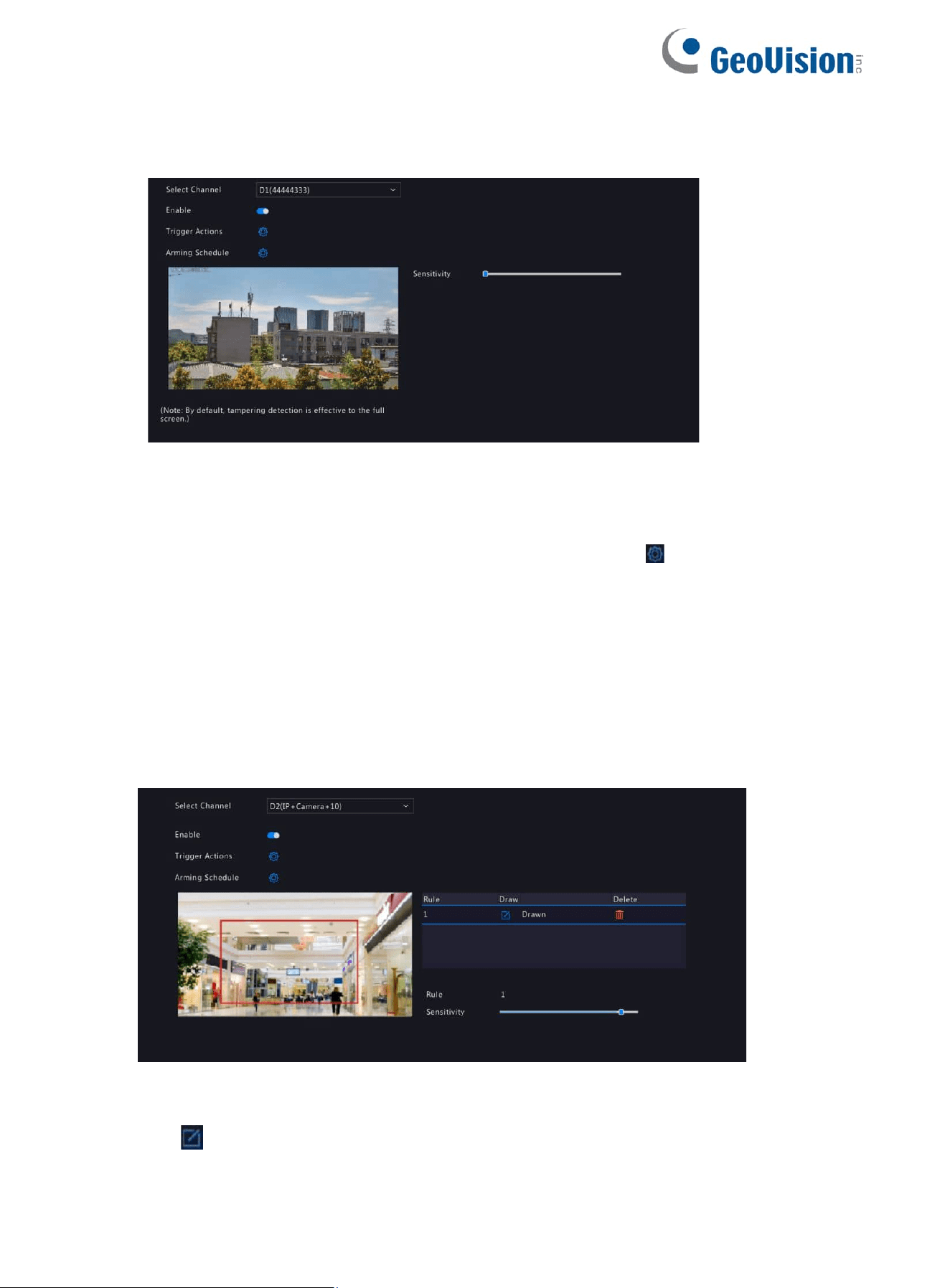
154
10.2 Tampering Detection
Tampering detection detects live video tampering. An alarm is reported when detection rules are triggered.
1. Go to Menu > Alarm > Tampering.
2. Select the desired channel, and enable tampering detection. The tampering detection area is the full screen
by default and cannot be edited.
3. Drag the slider to adjust detection sensitivity. The higher the sensitivity, the higher the detection rate, and the
higher the false alarm rate. Set based on the scene and your actual needs.
4. Set the alarm-triggered actions and arming schedule. Click the corresponding to go to the Trigger Actions
page and Arming Schedule page respectively. See Alarm-triggered Actions and Arming Schedule for details.
5. (Optional) To apply the same settings to other cameras, click Copy and select the desired parameter(s) and
camera(s).
6. Click Apply.
10.3 Human Body Detection
Human body detection detects humans in a specified area. An alarm is reported when the detection rule is
triggered.
1. Go to Menu > Alarm > Human Body Detection.
2. Select the desired channel, and enable human body detection.
3. Set the detection rule. Only 1 detection rule is allowed.
Click , and the full screen is displayed. Drag in the preview window to draw a rectangular detection area.
Only 1 detection area is allowed. Right-click to exit the full screen.
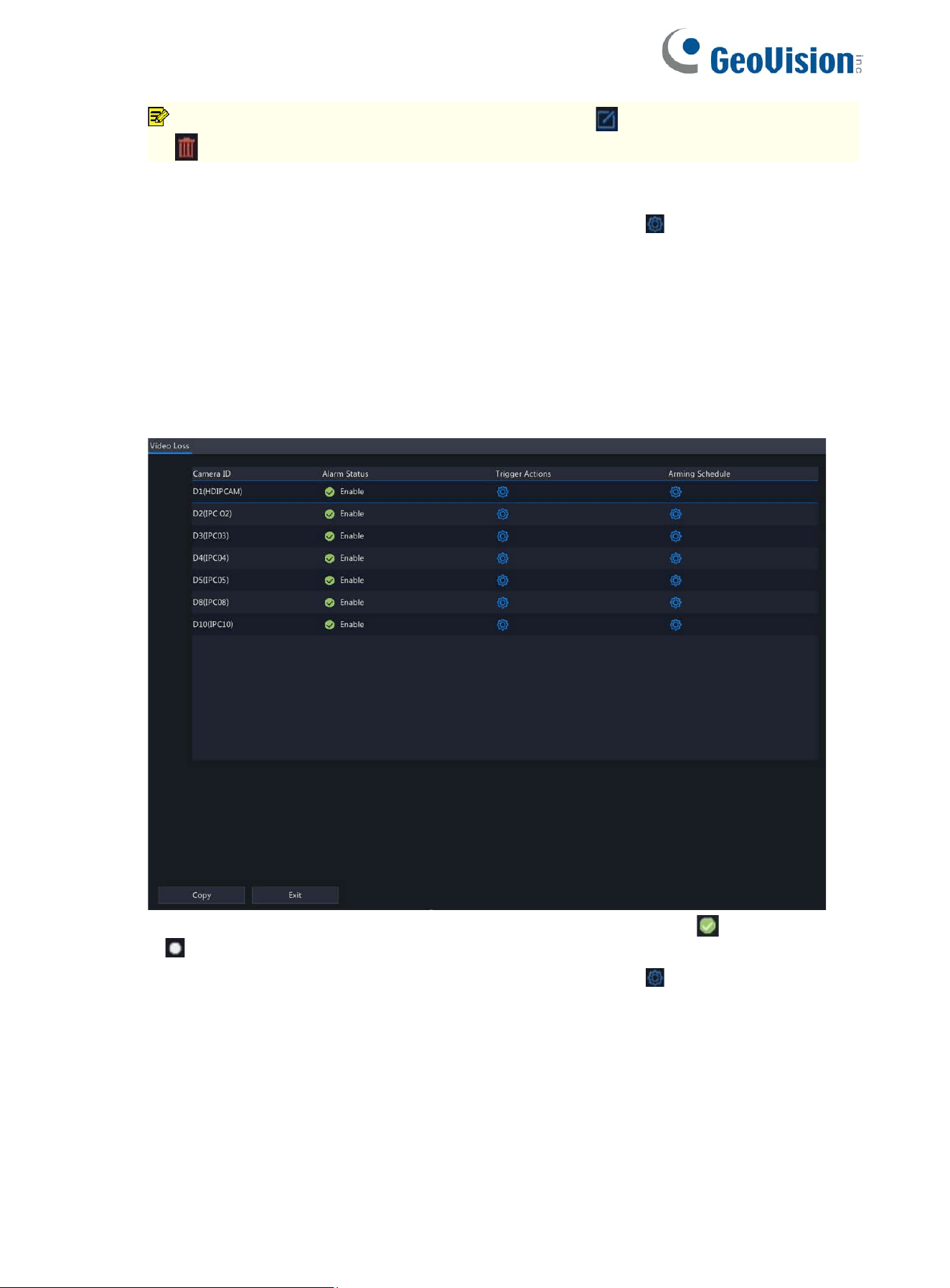
155
4. Drag the slider to adjust detection sensitivity. The higher the sensitivity, the more likely humans will be
detected, and the more likely false alarms will occur. Set based on the scene and your actual needs.
5. Set the alarm-triggered actions and arming schedule. Click the corresponding to go to the Trigger Actions
page and Arming Schedule page respectively. See Alarm-triggered Actions and Arming Schedule for details.
6. (Optional) To apply the same settings to other cameras, click Copy and select the desired parameter(s) and
camera(s).
7. Click Apply.
10.4 Video Loss
A video loss alarm is reported when the NVR loses video signals from a camera.
1. Go to Menu > Alarm > Video Loss.
2. Video loss alarm is enabled by default. To disable video loss alarm for a channel, click , which then changes
to .
3. Set the alarm-triggered actions and arming schedule. Click the corresponding to go to the Trigger Actions
page and Arming Schedule page respectively. See Alarm-triggered Actions and Arming Schedule for details.
4. (Optional) To apply the same settings to other cameras, click Copy and select the desired parameter(s) and
camera(s), and then click OK.
Note: To redraw the detection area, select the set rule, and click . To delete the detection area, click
.
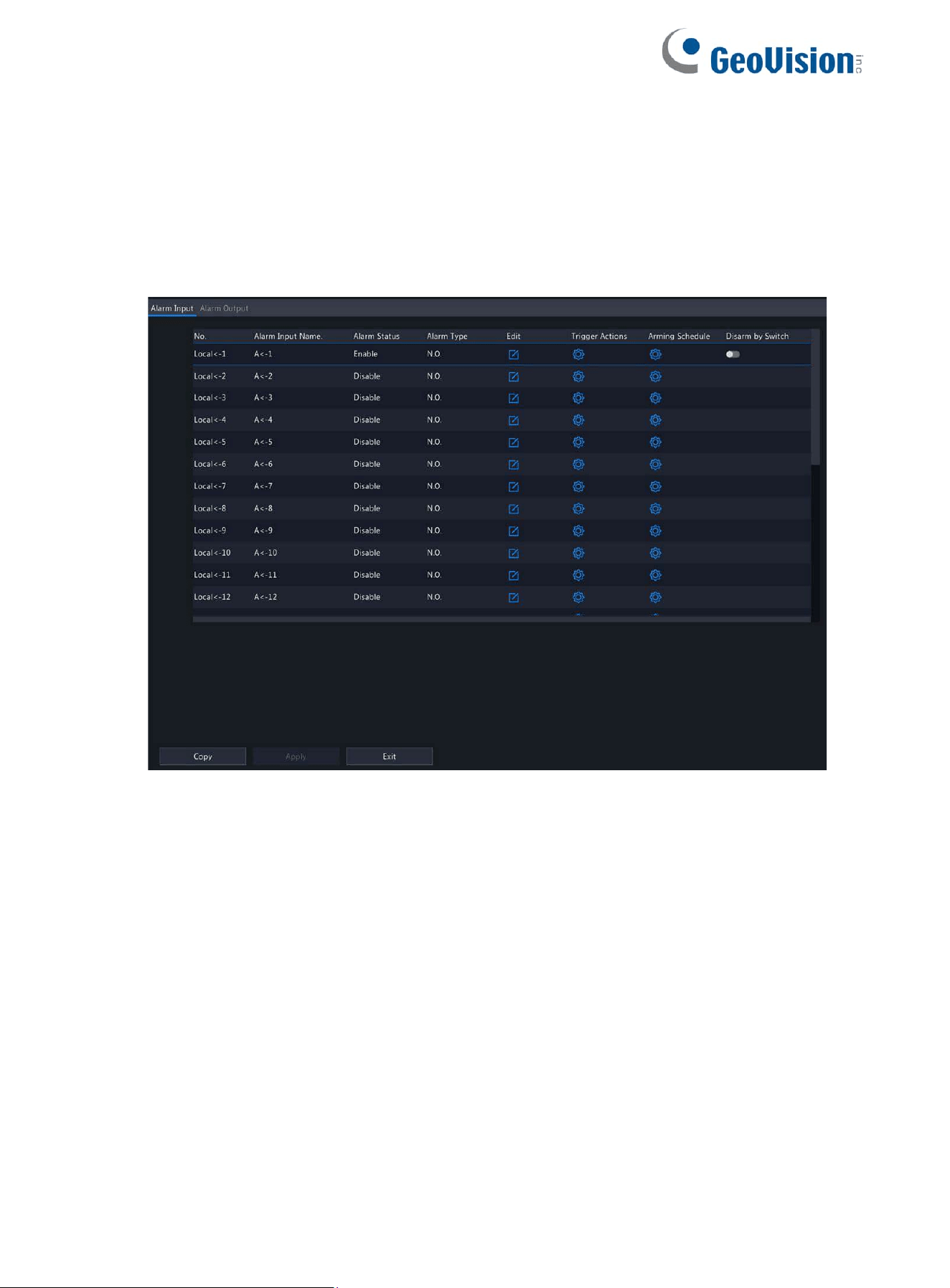
156
10.5 Alarm Input and Output
Configure alarm input and alarm output.
10.5.1 Alarm Input
Configure the alarm mode, arming schedule, and alarm-triggered actions for external alarm input devices.
The external alarm input devices include devices connected to the ALARM IN interfaces on the NVR and the
ALARM IN interfaces on the cameras. For example, access control devices.
1. Go to Menu > Alarm > Input/Output > Alarm Input.
2. Select the alarm input channel to be set.
• Local < -1: Local refers to the ALARM IN interfaces on the NVR, 1 means the first ALARM IN interface.
Likewise, Local <-2 means the second ALARM IN interface on the NVR. The number of ALARM IN interfaces
may vary with NVR model. See the device datasheet for specifications.
• D < -1: D refers to channels, the number means channel ID. D< -1 means the alarm input device is
connected to the ALARM IN interface of the camera whose channel ID is 1. Likewise, D < -2 means the
alarm input device is connected to the ALARM IN interface of the camera whose channel ID is 2. The
number is not displayed if the camera has no ALARM IN interface.
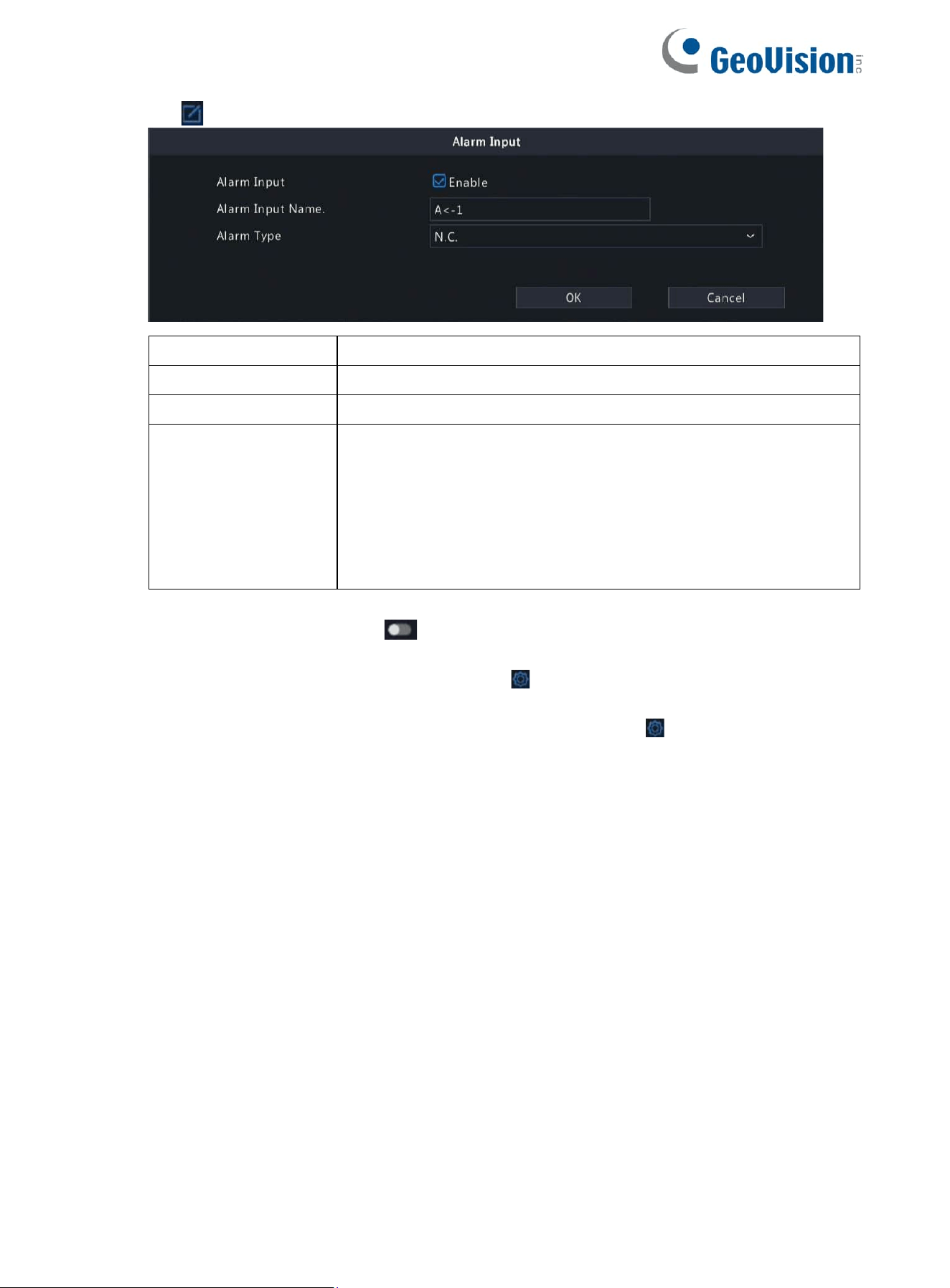
157
3.
Item
Description
Alarm Input
Select Enable to enable the alarm input.
Alarm Input Name
The default name is the alarm input number. You may rename it as needed.
Alarm Type
This item is applicable when Alarm Input is enabled. The default is N.O..
• N.O.: Choose this option if the alarm input device is normally closed. The
device opens the circuit to input an alarm, triggers the NVR to open the
alarm circuit and report an alarm.
• N.C.: Choose this option if the alarm input device is normally opened. The
device closes the circuit to input an alarm, triggers the NVR to close the
alarm circuit and report an alarm.
4. (Optional) Set one-key disarming.
(1)
To enable one-key disarm, select in the Disarm by Switch column. When enabled, the configured
actions will not be triggered when Local < -1 reports alarms.
(2)
To apply one-key disarming to other channel(s), click in the Linked Channel column, select the desired
channel(s) or All, and then click Apply.
5. Set the alarm-triggered actions and arming schedule. Click the corresponding to go to the Trigger Actions
page and Arming Schedule page respectively. See Alarm-triggered Actions and Arming Schedule for details.
6. (Optional) To apply the alarm input parameters to other cameras, click Copy, and select the desired
channel(s) or Copy To, and then click OK.
7. Click Apply.
Click to configure alarm input parameters. After configuration, click OK.
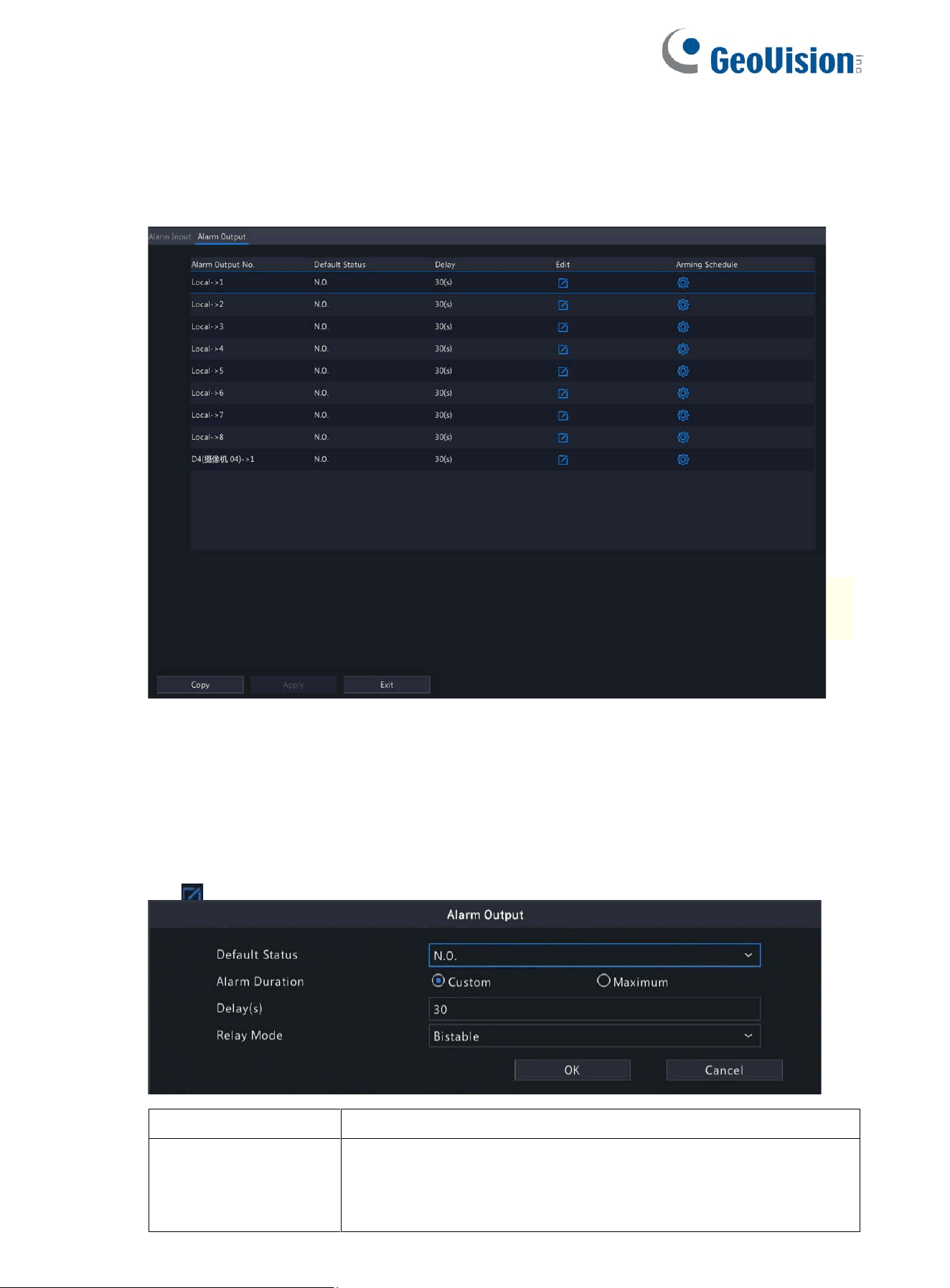
158
10.5.2 Alarm Output
Configure the alarm mode and arming schedule for external alarm output devices.
The external alarm output devices include devices connected to the ALARM OUT interfaces on the NVR and the
ALARM OUT interfaces on the cameras, such as alarm light and alarm bell.
1. Go to Menu > Alarm > Input/Output > Alarm Output.
2. Select the alarm output channel to be set.
• Local- >1: A refers to the ALARM OUT interfaces on the NVR, 1 means the first ALARM OUT interface.
Local->2 means the second ALARM OUT interface on the NVR, and so on. The number of ALARM OUT
interfaces may vary with NVR model. See the device datasheet for specifications.
• D- >1: D refers to channels, the number means channel ID. D- >1 means the alarm output device is
connected to the ALARM OUT interface of the camera whose channel ID is 1. Likewise, D- >2 means the
alarm output device is connected to the ALARM OUT interface of the camera whose channel ID is 2. The
number is not displayed if the camera has no ALARM OUT interface.
3. Click to configure alarm output parameters. After configuration, Click OK.
Item
Description
Default Status
Select the default status from the drop-down list. The default is N.O..
• N.O.: Choose this option if the external device is normally open.
• N.C.: Choose this option if the external device is normally closed.
159
Alarm Duration/Delay(s)
Set the alarm duration, that is, the length of time that an output alarm lasts
after the alarm is ended.
• Custom: When enabled, you can set the length of time as needed. After an
alarm is cleared on the NVR, the third-party alarm device continues alarm
till the end of the set duration.
• Maximum: When enabled, you cannot set the delay period. The third-party
alarm device continues alarm until you clear it manually.
Relay Mode
Set the relay mode, including monostable and bistable. The default is bistable.
Note: Set relay mode to better adapt to third-party alarm devices such as
alarm lights. Please set the relay mode according to the trigger mode of
the third-party alarm device.
• Monostable: The circuit can only remain in one stable state. When a
trigger pulse is applied, the circuit switches to another state, and then
automatically switches back to the original stable state. The circuit will
repeat the same actions when the next trigger pulse arrives.
• Bistable: The circuit can remain in two stable states. When a trigger pulse
is applied, the circuit switches to another state, and remains in this state
after the trigger pulse is removed. When the next trigger pulse is applied,
the circuit switches back to the other stable state and remains in that
state.
4. Set the alarm-triggered actions and arming schedule. Click the corresponding to go to the Trigger Actions
page and Arming Schedule page respectively. See Alarm-triggered Actions and Arming Schedule for details.
5. (Optional) To apply the alarm output parameters to other cameras, click Copy, and select the desired
channel(s) or Copy To, and then click OK.
6. Click Apply.
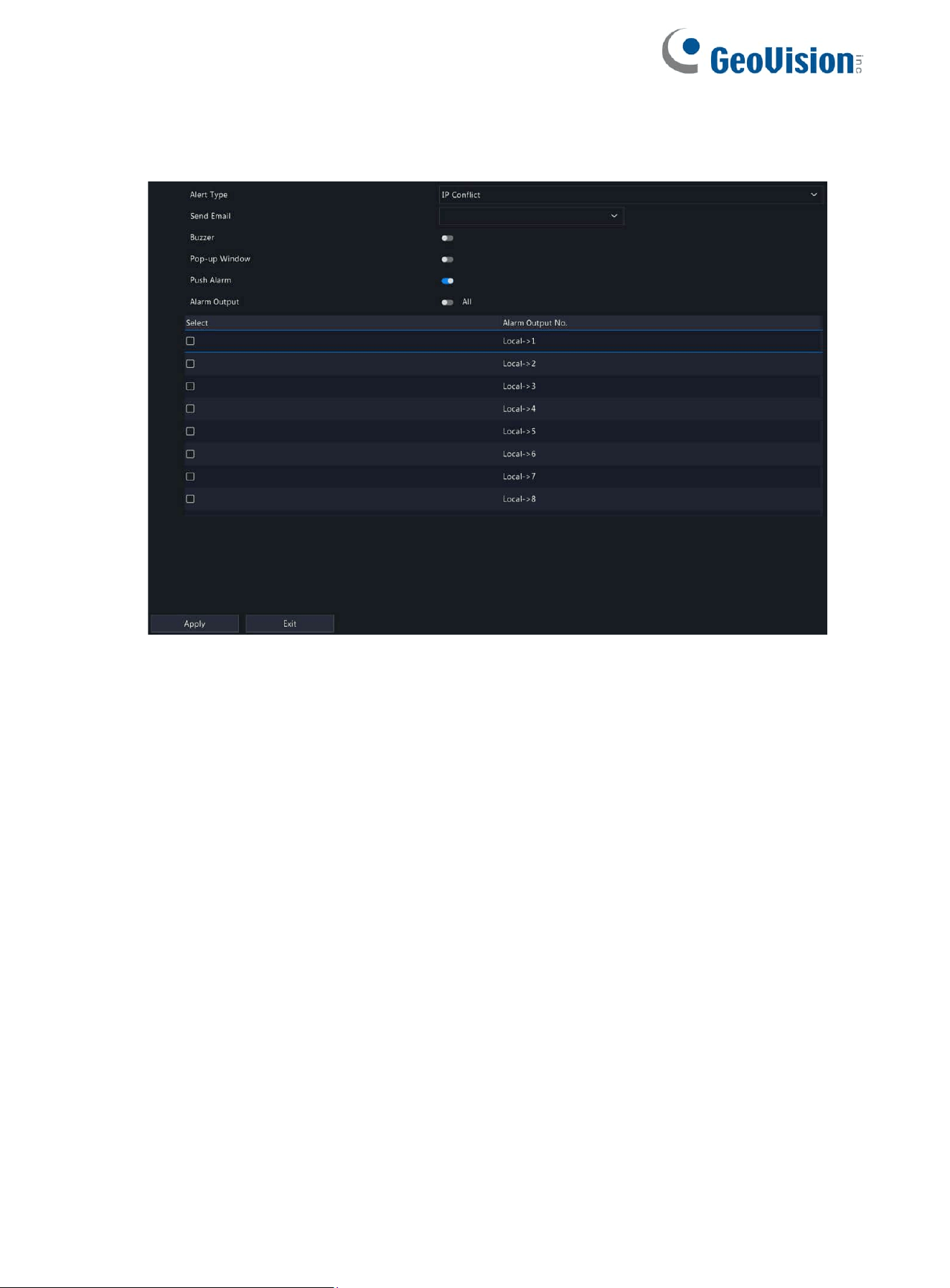
160
10.6 Alert
Configure alert actions for device abnormal events. The NVR reports an alarm when an event occurs.
1. Go to Menu > Alarm > Alert.
2. Select an alert type from the drop-down list.
• IP Conflict: IP cameras use the same IP address on the network.
• Network Disconnected: The NVR is disconnected from the network.
• Disk Offline: No disk or a disk is not properly connected.
• Disk Abnormal: A disk is in position but cannot work normally.
• Illegal Access: Incorrect username/password.
• Hard Disk Space Low: The disk space is about to use up.
• Hard Disk Full: The disk space has been used up.
• Recording/Snapshot Abnormal: Videos/snapshots cannot be stored normally because the disk is offline or
abnormal.
3. Set the alert actions, including buzzer, sending email, and pop-up window. See Alarm-triggered Actions for
details.
4. Set the alarm output channel(s). You may enable All, or select specified alarm output channel(s).
5. Click Apply.
6. Repeat the above operations to configure alert actions for other events.
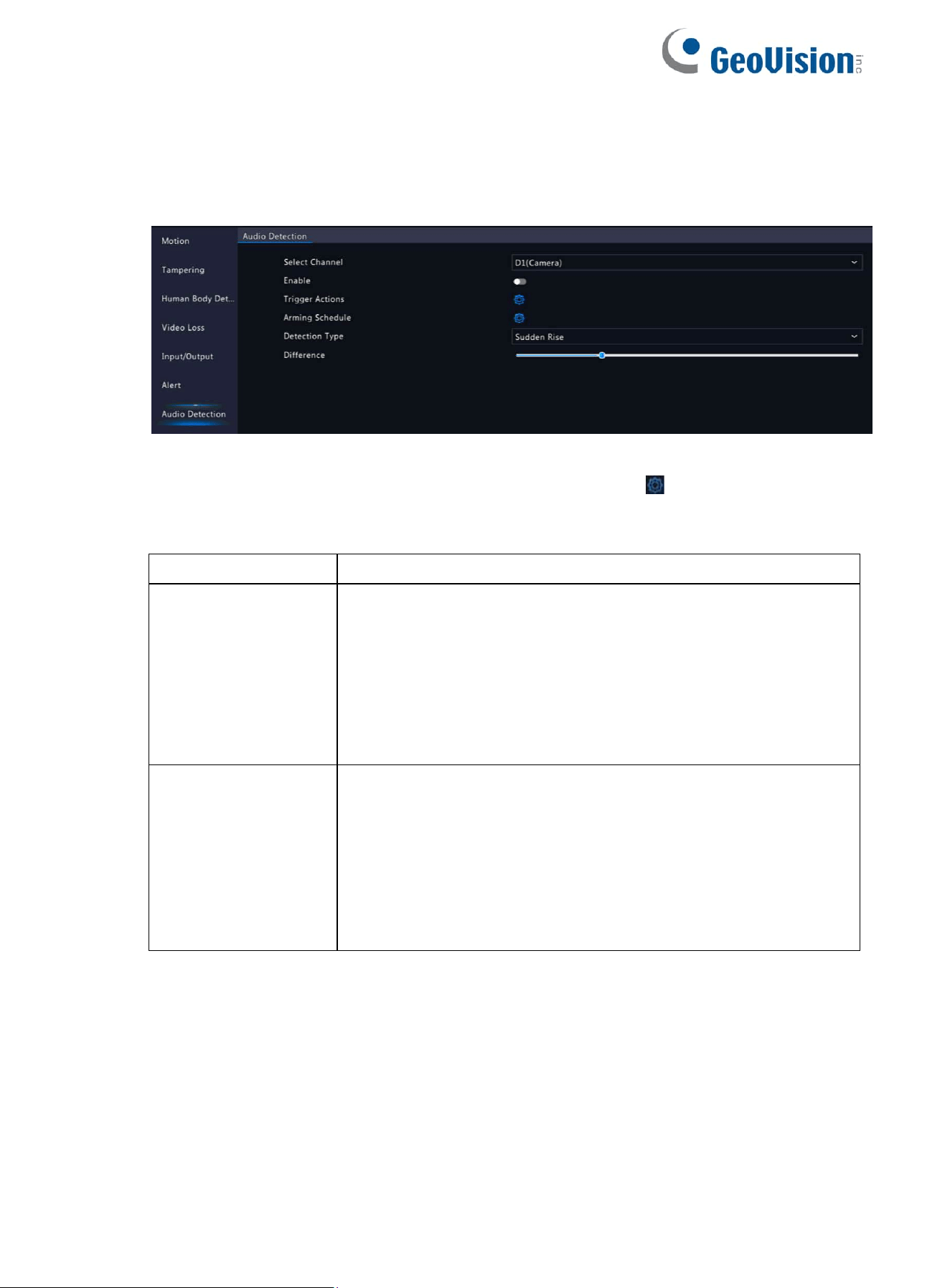
161
10.7 Audio Detection
Audio detection detects input audio signals. An alarm is reported when an exception is detected. Make sure an
audio collection device (e.g. sound pickup) is connected, and audio detection is enabled. See Audio Configuration
for details.
1. Go to Menu > Alarm > Audio Detection.
2. Select the desired channel, and enable audio detection.
3. Set the alarm-triggered actions and arming schedule. Click the corresponding to go to the Trigger Actions
page and Arming Schedule page respectively. See Alarm-triggered Actions and Arming Schedule for details.
4. Set audio detection rules.
Item
Description
Detection Type
Select an audio detection type from the drop-down list.
• Sudden Rise: An alarm occurs when the rise of volume exceeds the set
value.
• Sudden Fall: An alarm occurs when the fall of volume exceeds the set value.
• Sudden Change: An alarm occurs when the rise or fall of volume exceeds
the set value.
• Threshold: An alarm occurs when the volume exceeds the set threshold.
Difference/Threshold
Drag the slider to adjust the difference and threshold.
• The difference between two sound volumes. An alarm occurs when the
rise or fall of volume exceeds the difference (range: 0-400). This item is
applicable when the detection type is Sudden Rise, Sudden Fall, or Sudden
Change.
• Threshold: The limit value of volume. An alarm occurs when the detected
volume exceeds the set value (range: 0-400). This item is applicable when
the detection type is Threshold.
5. Click Apply.
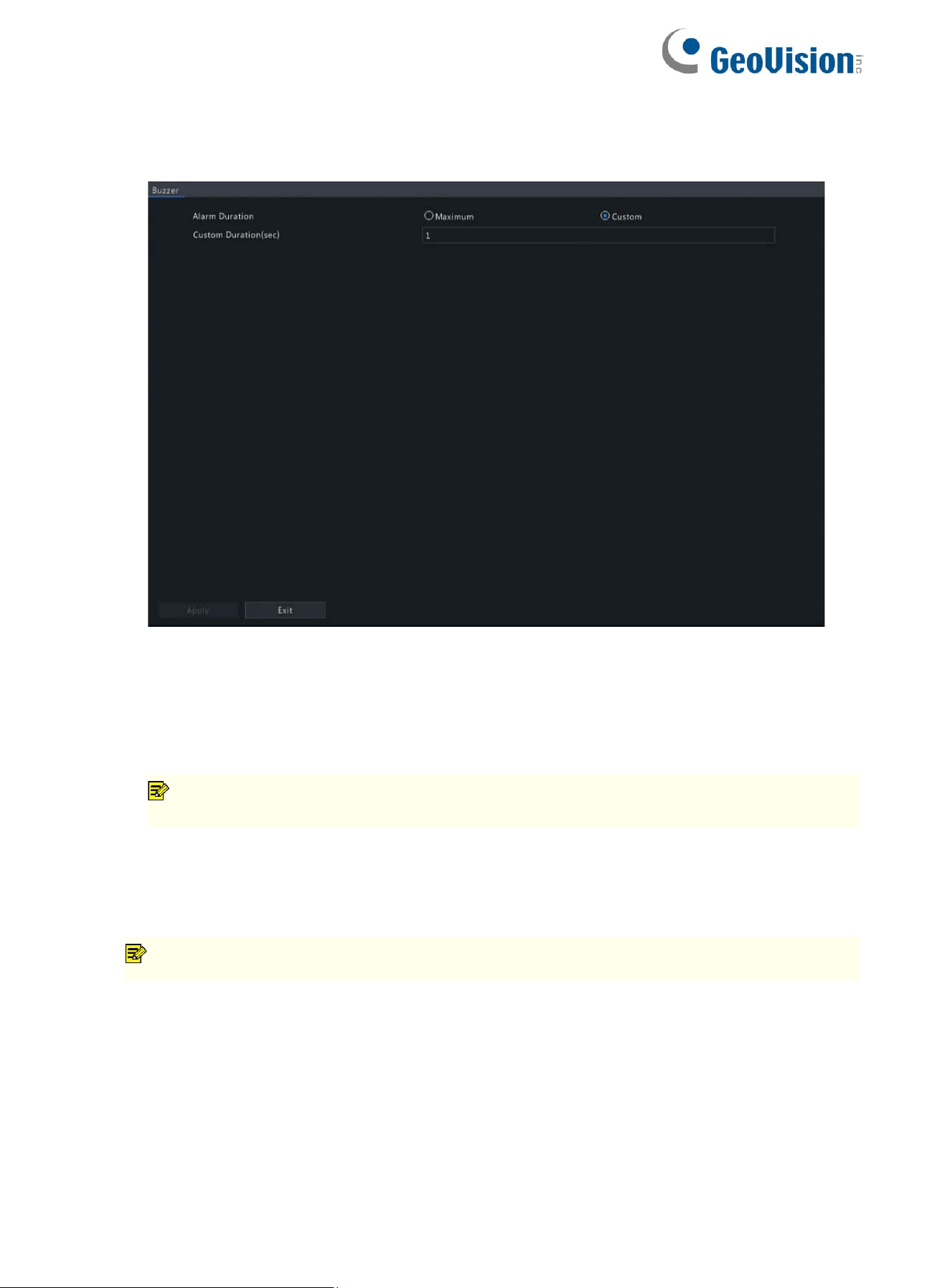
162
10.8 Buzzer
Configure the alarm duration of the buzzer on the NVR.
1. Go to Menu > Alarm > Buzzer.
2. Set the alarm duration. The default is 30s.
• Maximum: When enabled, you cannot set the alarm duration. When an alarm occurs, the buzzer will
alarm continuously until the alarm ends.
• Custom: When enabled, you can set how long the buzzer will alarm after it is triggered. The valid range is
from 1 to 600(s). When an alarm occurs, the buzzer will alarm continuously within the alarm duration, and
stop automatically if the alarm ends first within the duration.
3. Click Apply.
10.9 People Present Alarm
An alarm occurs when the number of people present in a specified area exceeds the set threshold.
Configure People Present Alarm
1. Go to Menu > Alarm > People Present Alarm.
Note: To stop a buzzer alarm manually, right-click in the preview window, select Manual > Buzzer. See
Buzzer for details.
Note: To use this function, make sure that people flow counting is supported by the camera and is enabled
on the VCA page. See People Flow Counting for details.
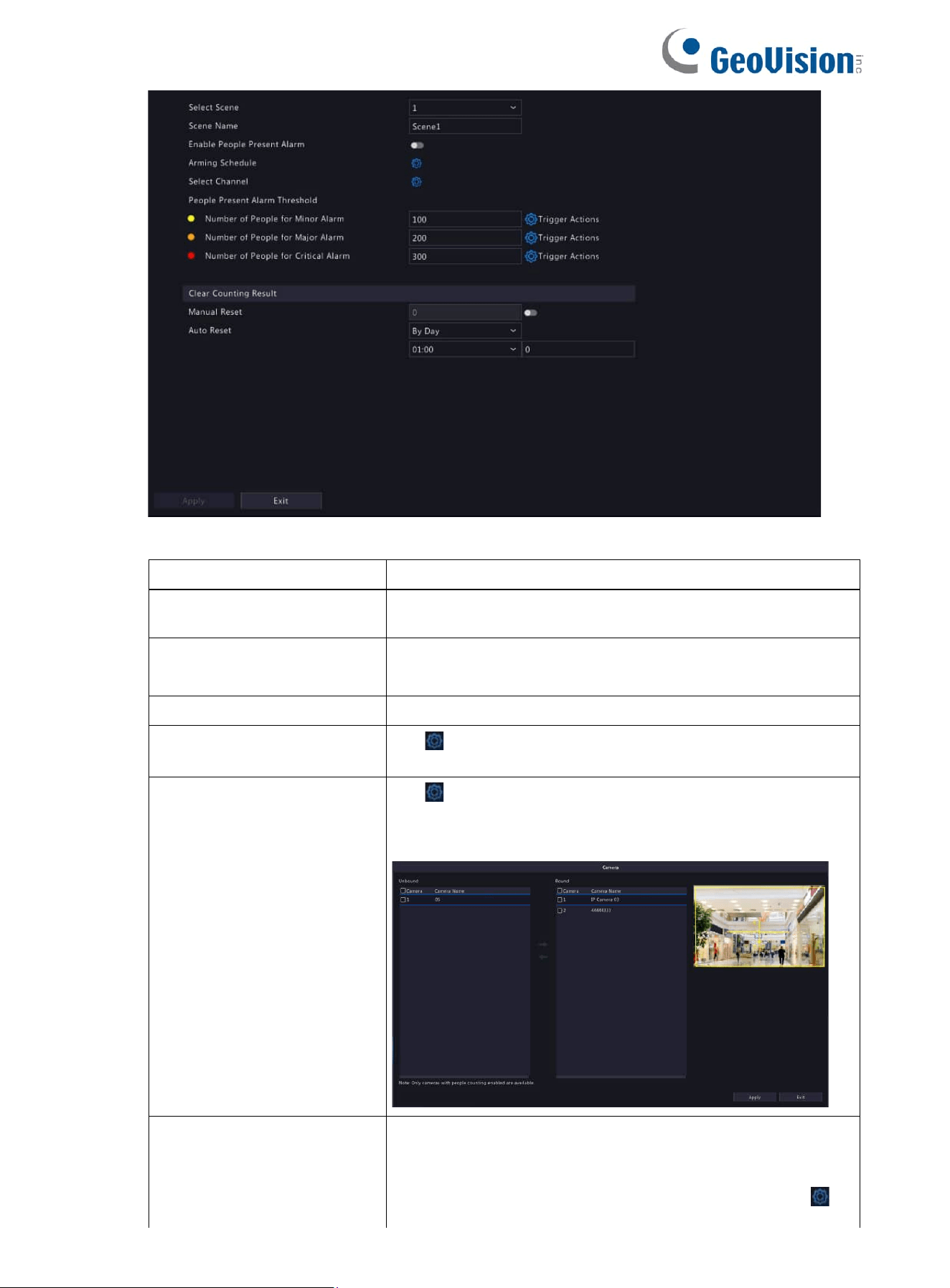
163
2. Configure parameters.
Parameter
Description
Select Scene
Select a scene and set scene information respectively. Up to 4 scenes
are allowed.
Scene Name
The 4 scenes are named as Scene 1, Scene 2, Scene 3, and Scene 4 by
default. You can also customize scene name.
Enable People Present Alarm
Enable people present alarm.
Arming Schedule
Click right to Arming Schedule and configure it as needed. See
Arming Schedule for details.
Select Channel
Click to select desired channel(s) to bind to the scene. The number
of people present is calculated from the number of people entering
and leaving the bound channels. It is recommended to bind all the
channels to ensure the accuracy of the alarm.
People Present Alarm Threshold
The maximum number of people allowed in the monitored area.
An alarm occurs when the number of people present exceeds the
threshold. The valid range is from 1 to 100,000.
•
Number of People for Minor Alarm: Set the number, and click to
set Alarm-triggered Actions.
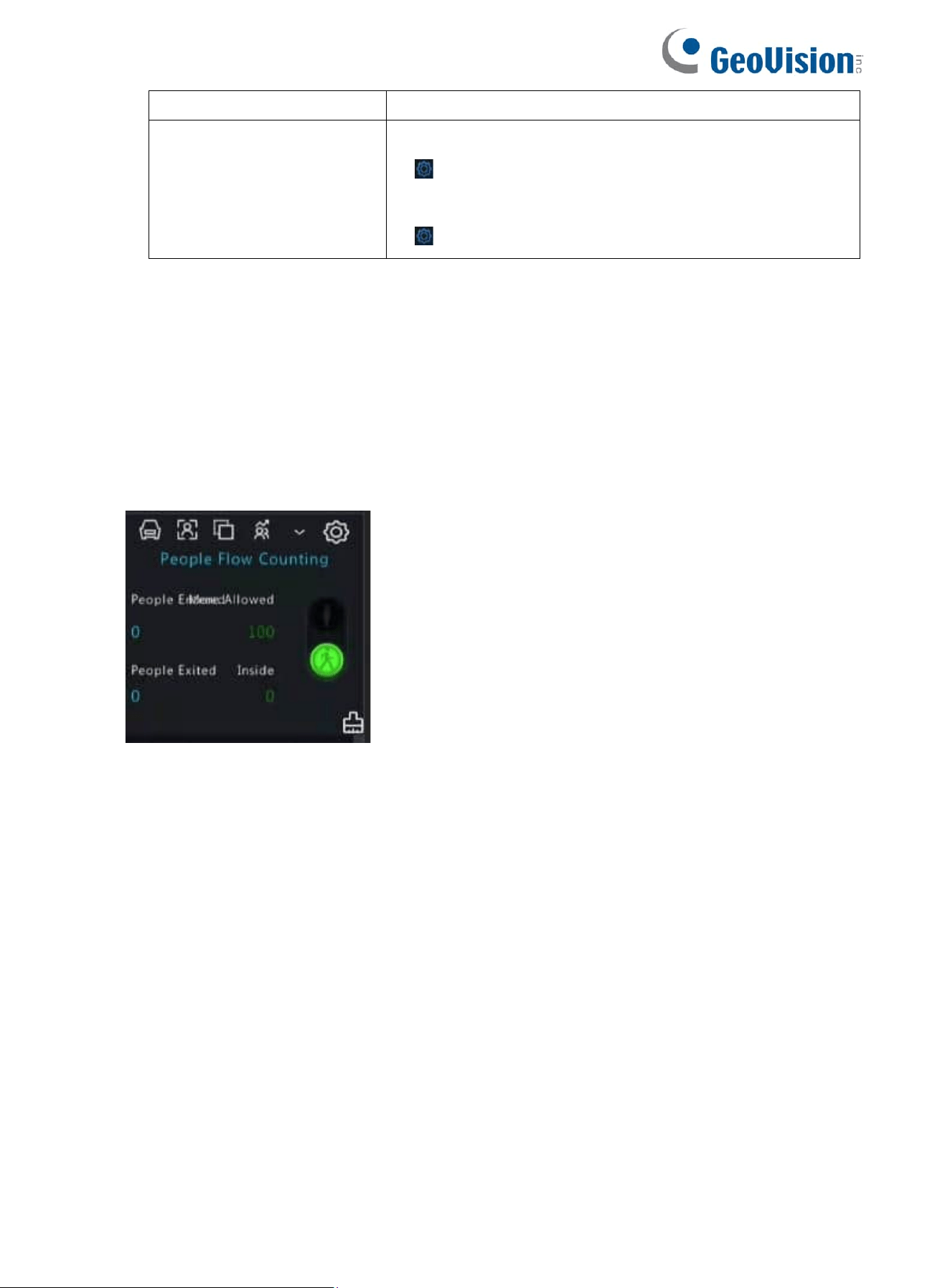
164
Parameter
Description
• Number of People for Major Alarm: Set the number, which must be
greater than the number of people for minor alarm, and then click
to set Alarm-triggered Actions.
• Number of People for Critical Alarm: Set the number, which must be
greater than the number of people for major alarm, and then click
to set Alarm-triggered Actions.
3. Set the time to clear people counting data. The NVR will clear people counting statistics on the OSD at the set
time. This operation does not affect statistics and data reporting.
(1) The initial number of people in scene is 0 by default. You can enable Manual Reset, and set the number as
needed.
(2) When Manual Reset is disabled, you can set the auto reset strategy. It can be set by day, week, and
month.
4. Click Apply.
View Data
On the preview page, select People Flow Counting from the drop-down list in the upper right corner, then you
can view the number of people entered, exited, and present.
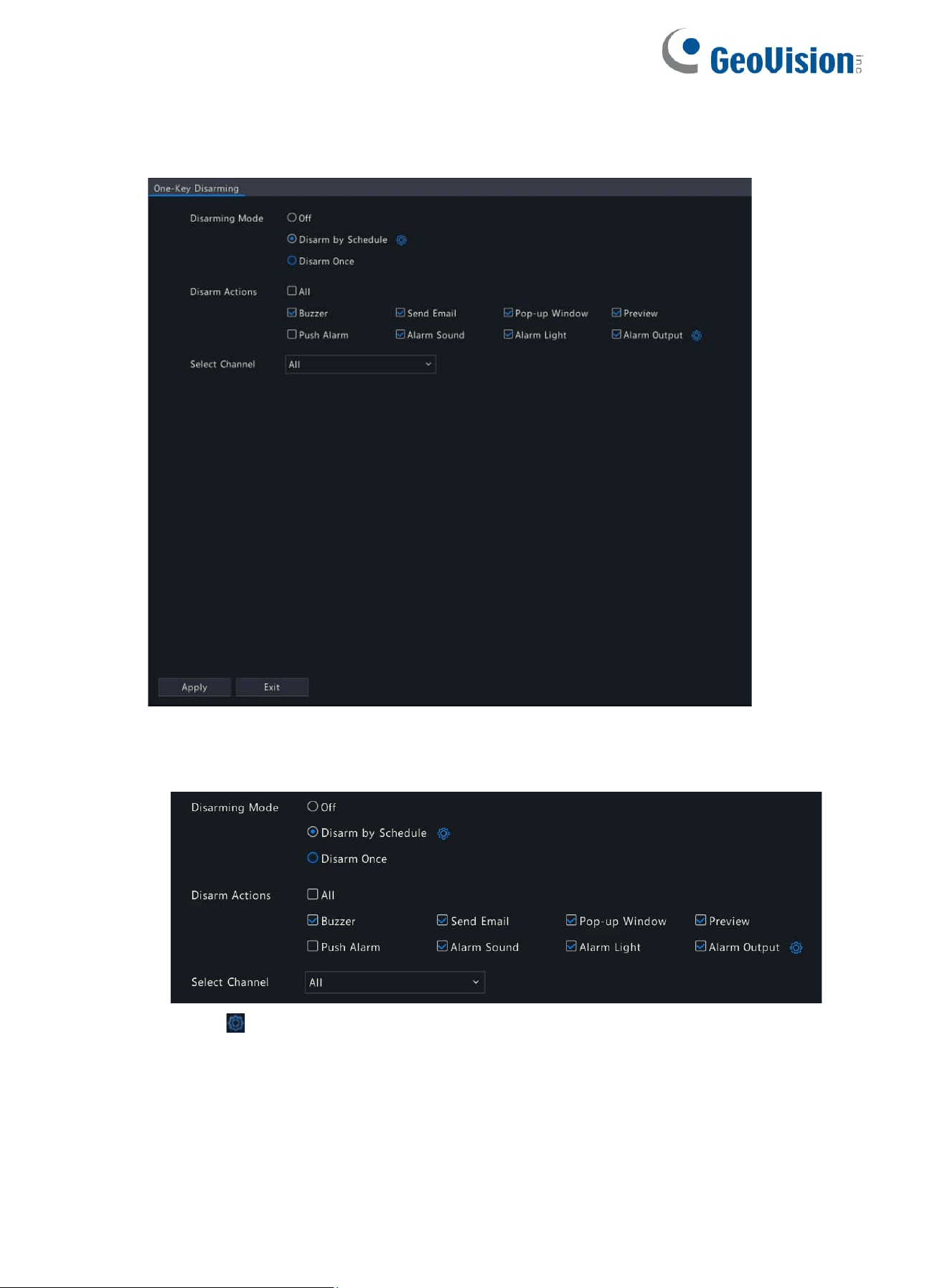
165
10.10 One-Key Disarming
Cancel alarm-triggered actions of NVRs or IPCs with one click.
1. Go to Menu > Alarm > One-Key Disarming.
2. Select a disarming mode and configure parameters.
• Off: Disarming is disabled.
• Disarm by Schedule: The device is disarmed during specific time periods per week.
(1)
Click right to Disarm by Schedule, and set the disarming periods. Click OK to return to the One-Key
Disarming page.
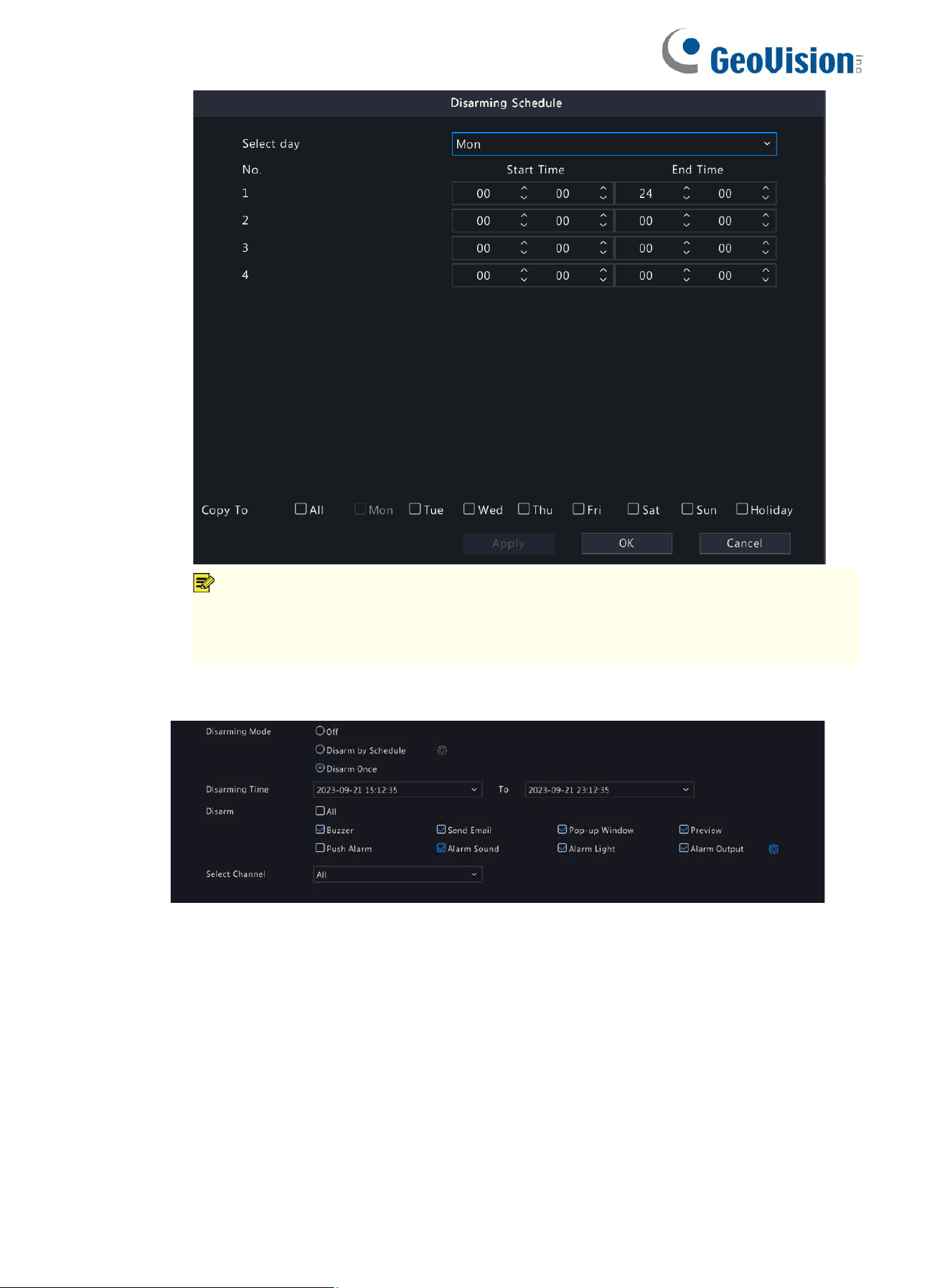
166
(2)
Select actions to be disarmed. The default is all actions. See Alarm-triggered Actions for details.
• Disarm Once: The device is disarmed during a specified time period.
(1) Select Disarm Once, and set the disarming start time and end time.
(2) Select actions to be disarmed. The default is all actions. See Alarm-triggered Actions for details.
3. Click Apply.
Note:
• Up to 4 disarming periods during one day are allowed.
•
To apply the same disarming schedule to other days, select All or the intended day(s), and click
OK.
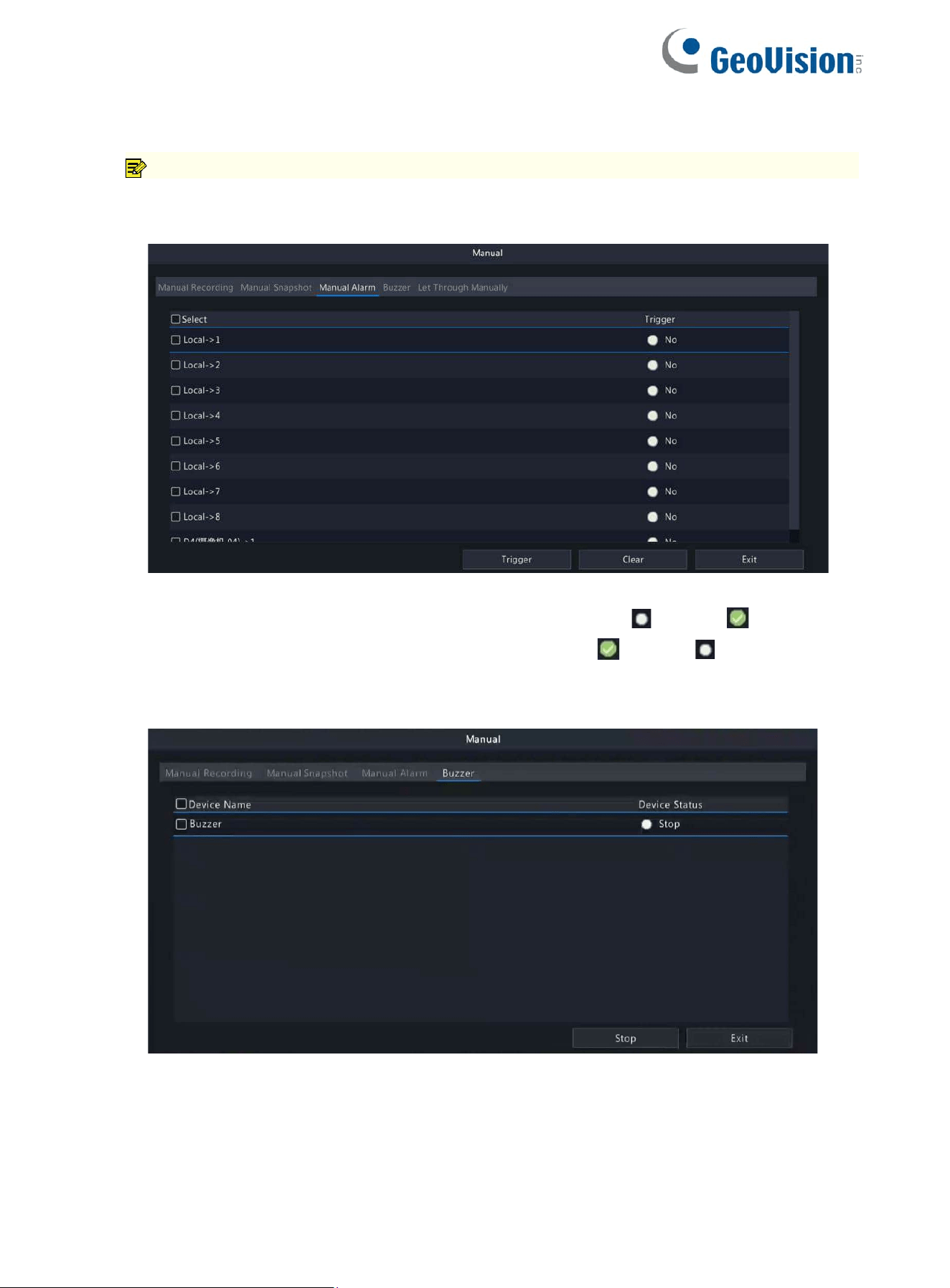
167
10.11 Manual Alarm
Trigger or clear an alarm output manually.
Manual Alarm
1. Right-click and select Manual > Manual Alarm.
2. Trigger or clear alarm(s) manually.
•
Trigger: Select the channel(s) to be triggered and click Trigger, and then changes to .
•
Clear: Select the channel(s) to be cleared and click Clear, and then changes to .
Buzzer
1. Right-click and select Manual > Buzzer.
2. To stop the buzzer, select the buzzer (in Started status) and then click Stop.
Note: Manual alarm has the highest priority.
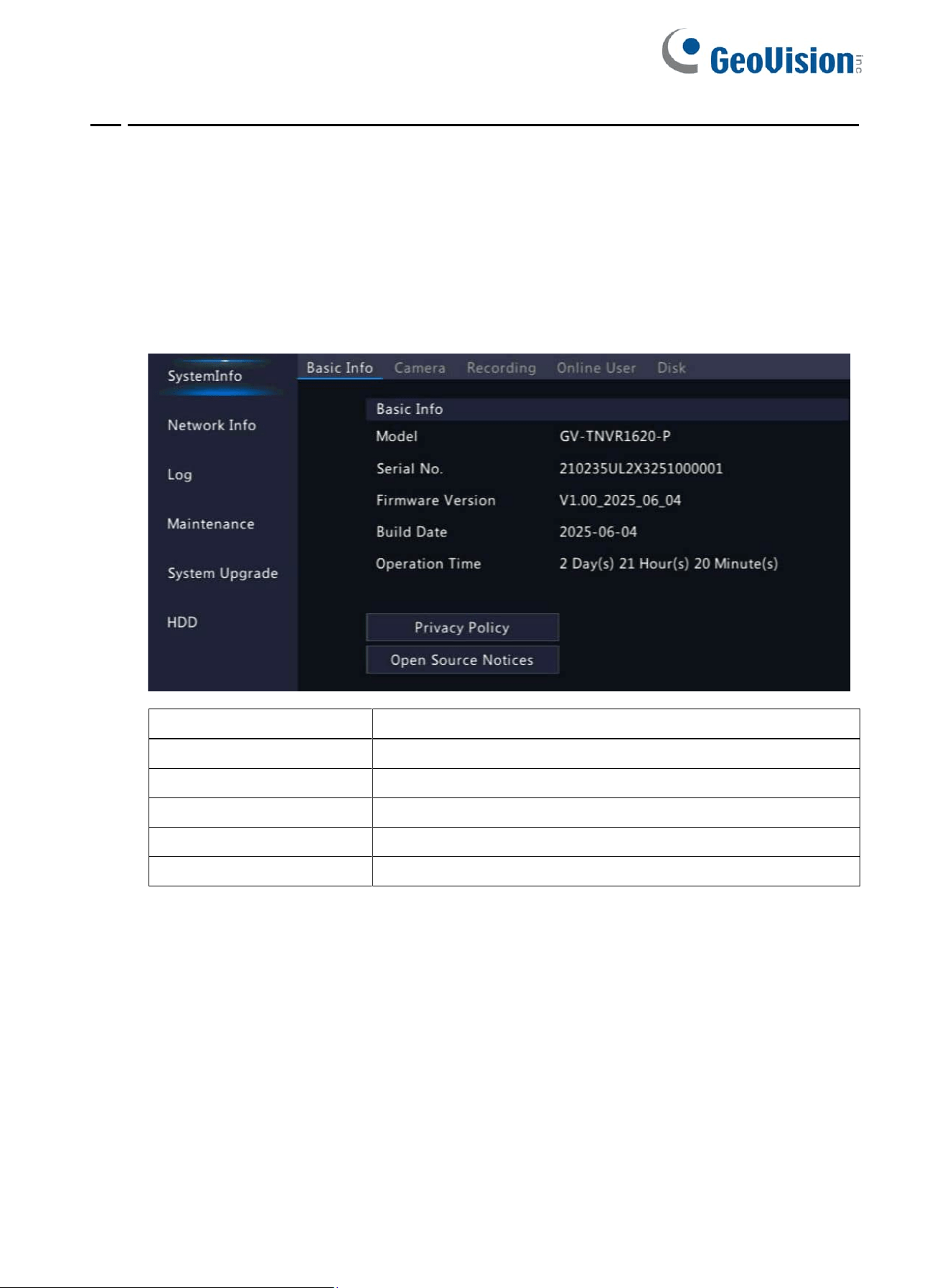
168
11 System Maintenance
View system operation status to ensure stable system operation.
11.1 System Info
View the basic information and operation status of the device.
11.1.1 Basic Info
View the basic information of the device, including NVR model, firmware version, build date, etc.
1. Go to Menu > Maintenance > System Info > Basic Info. View the basic information of the device.
Parameter
Description
Model
NVR model.
Serial No.
Serial number.
Firmware Version
Firmware version of the NVR.
Build Date
Release date of the current firmware version.
Operation Time
Length of time the NVR has been operating since the latest startup.
2. Click Privacy Policy to view our privacy policy as needed.
3. Click Open Source Notices to view our open source notices as needed.
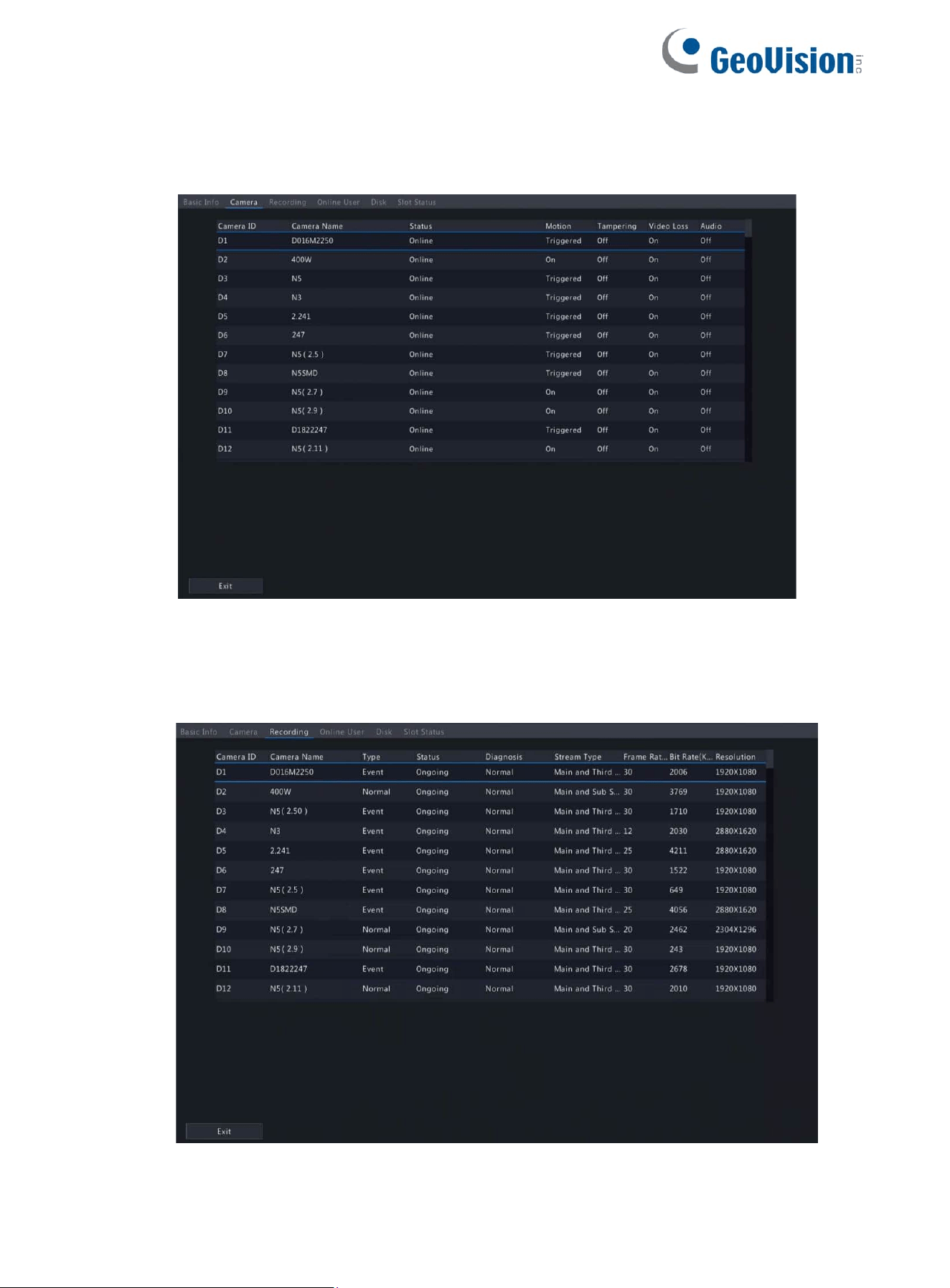
169
11.1.2 Camera Status
View camera status information.
Go to Menu > Maintenance > System Info > Camera. View camera information including name, online/offline
status, event type and status.
11.1.3 Recording Status
View the recording status and encoding parameters of the connected cameras.
Go to Menu > Maintenance > System Info > Recording. View recording information including recording type,
recording status, diagnosis, and encoding parameters.
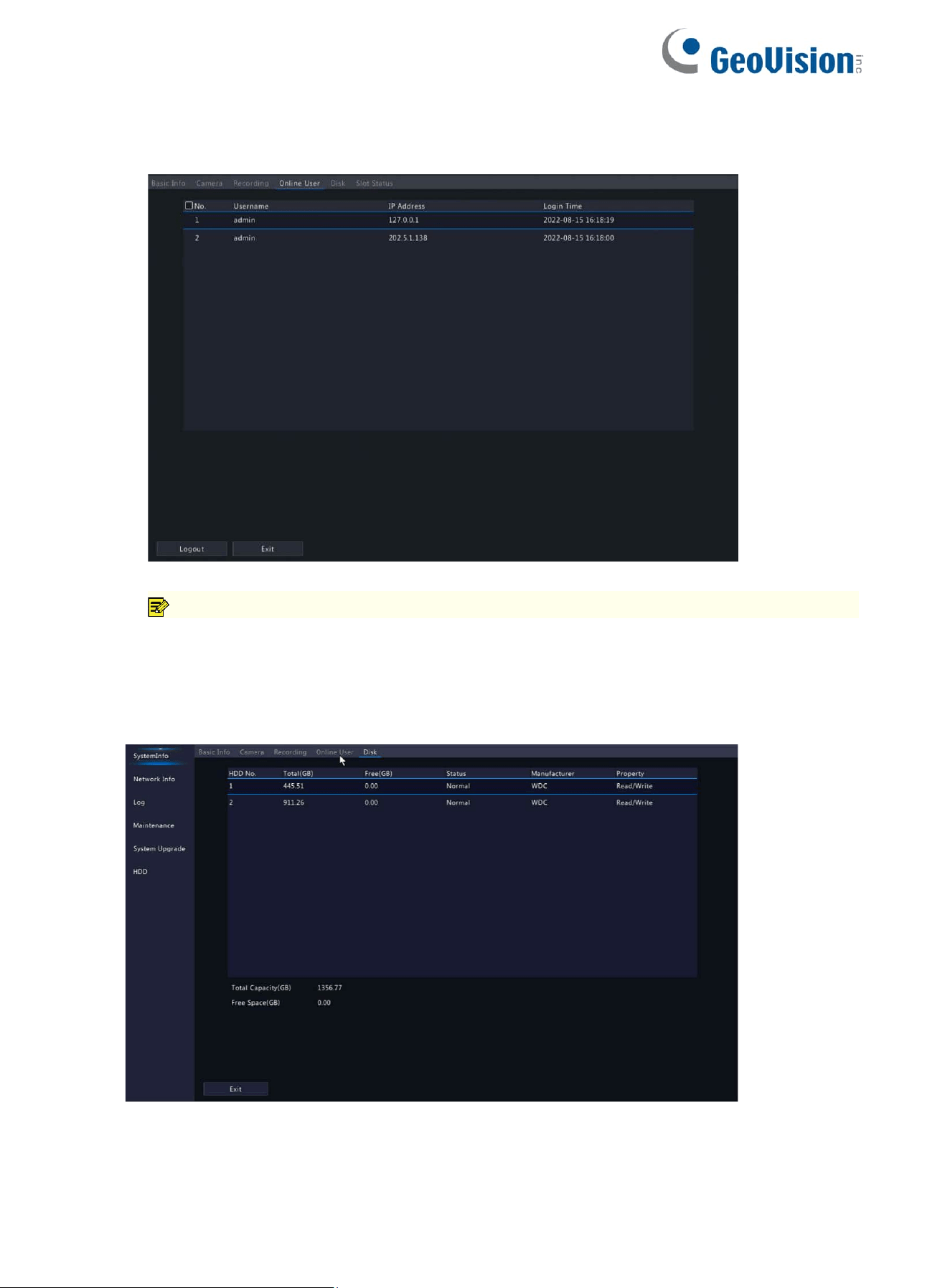
170
11.1.4 Online User
View the logged-in users, and force non-admin users to log out of the NVR when necessary.
1. Go to Menu > Maintenance > System Info > Online User.
2. Choose a non-admin user and then click Logout.
11.1.5 HDD Status
View the status and property of HDDs on the NVR.
Go to Menu > Maintenance > System Info > Disk. View hard disk information including the total capacity, free
space, status, manufacturer, and property.
Note: Only admin can manage user permissions.
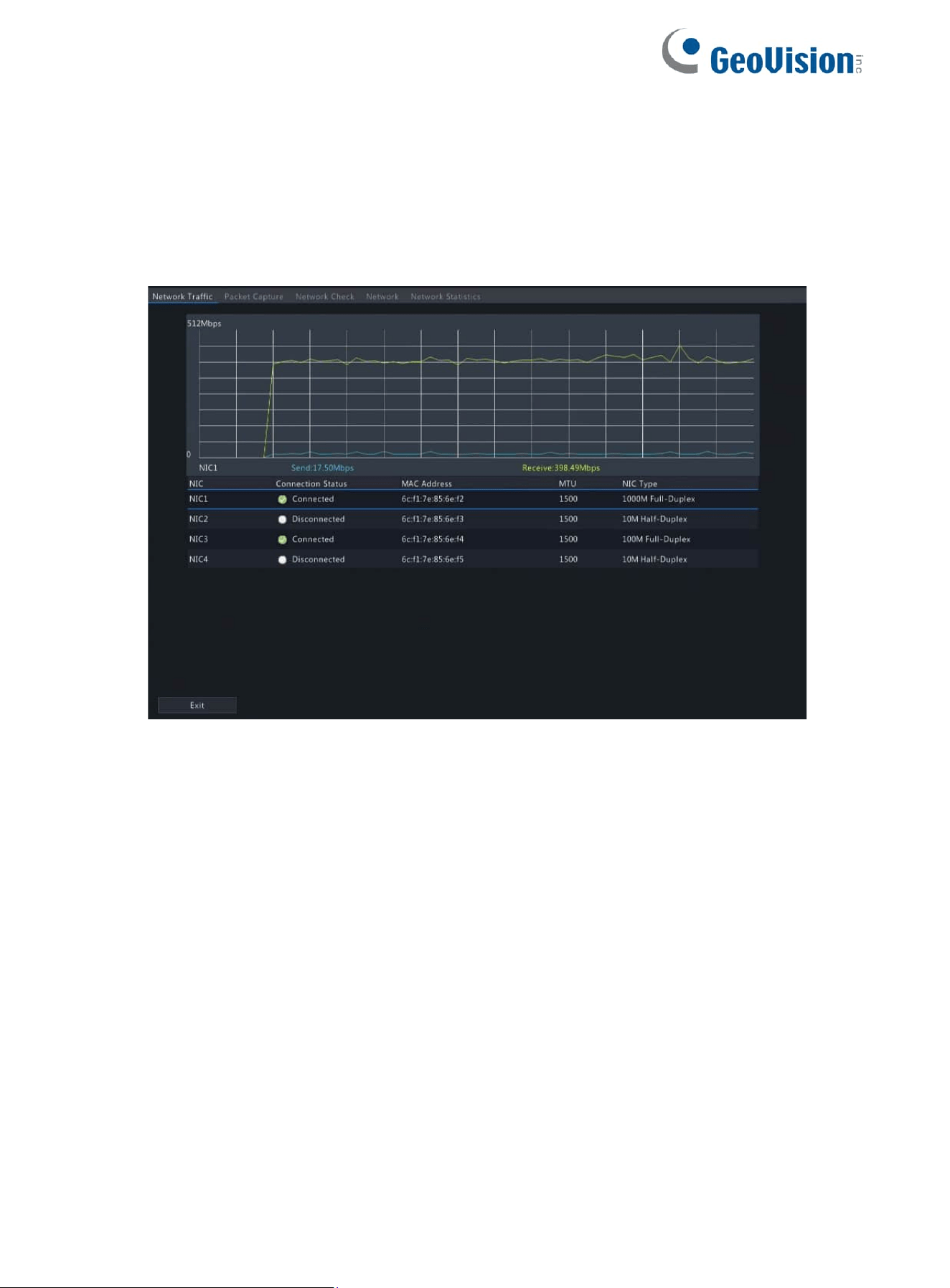
171
11.2 Network Information
View network information including network traffic, network latency, packet loss rate, and network status.
11.2.1 Network Traffic
View network interface card (NIC) information including connection status, physical address, MTU, NIC type, and
real-time traffic.
1. Go to Menu > Maintenance > Network Info > Network Traffic.
2. Choose an NIC to view the real-time network traffic.
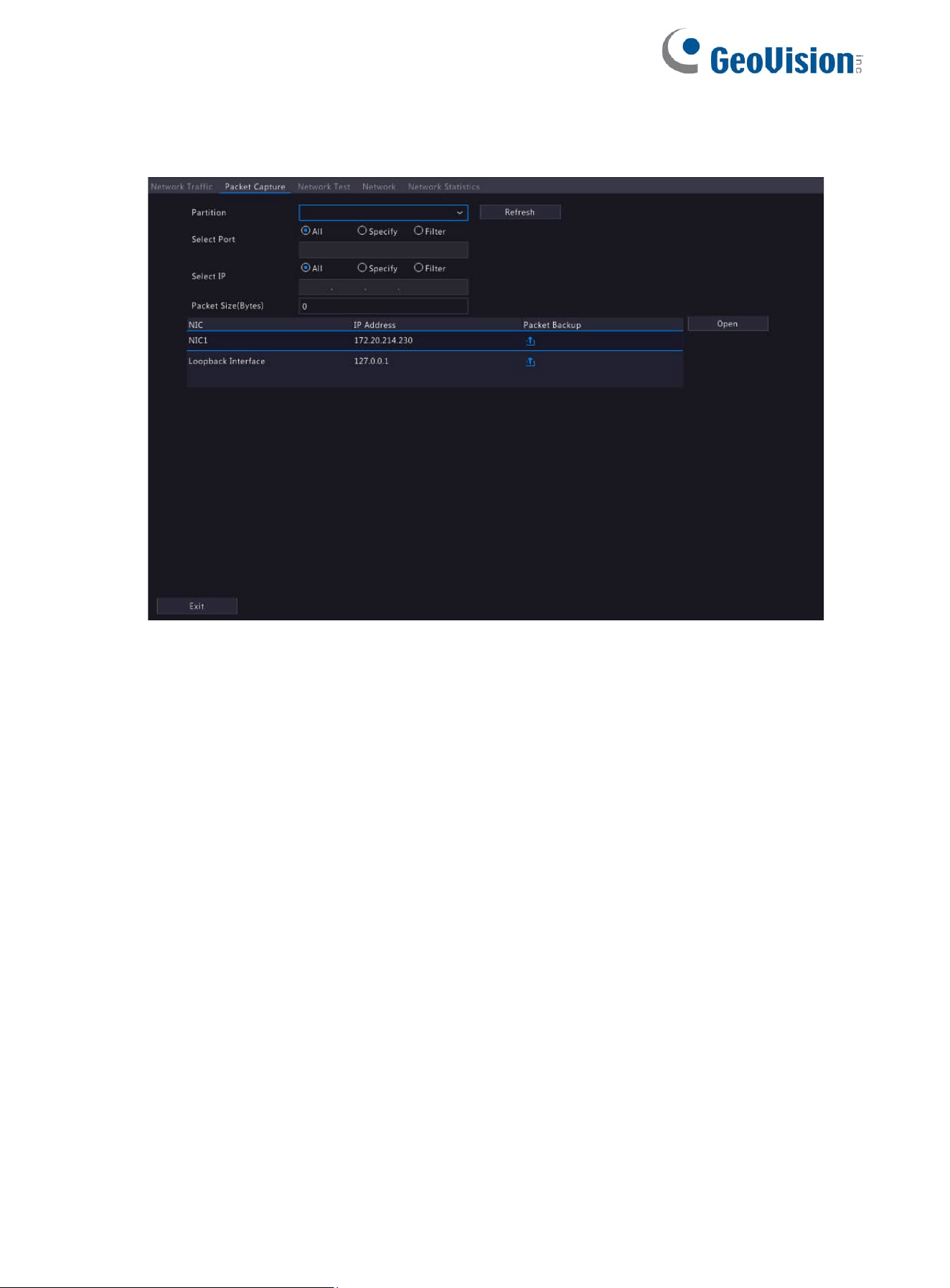
172
11.2.2 Packet Capture
Capture, view, and save network packets for network security and troubleshooting.
1. Go to Menu > Maintenance > Network Info > Packet Capture.
2. Choose a partition to save the captured packets.
3. Specify ports and IPs.
• All: Capture packets of all the ports and IPs connected to the device.
• Specify: Capture packets of the specified ports and IPs.
• Filter: Capture packets except that of the specified ports and IPs.
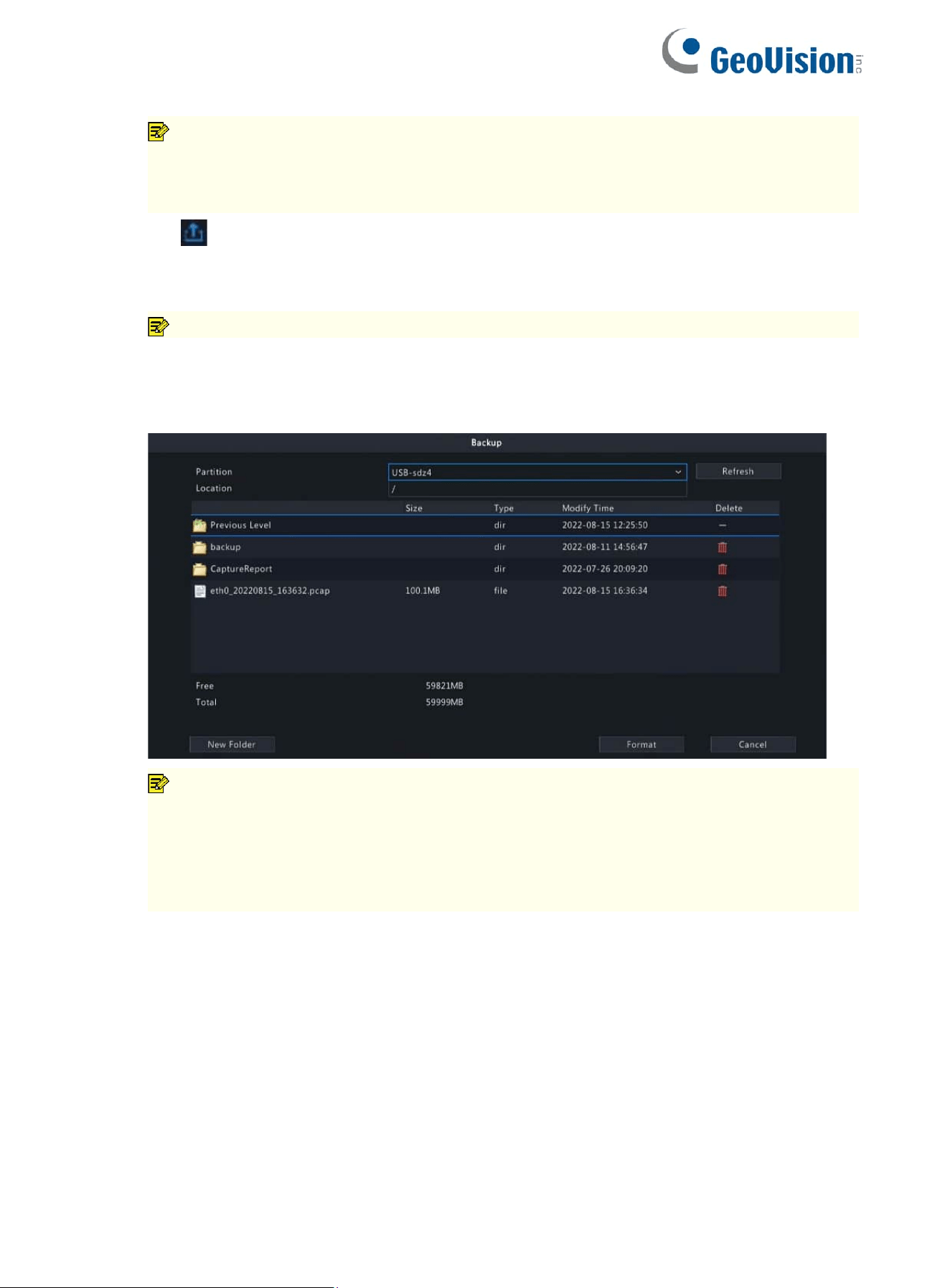
173
4. Set the packet size.
5. Click for the NIC or loopback interface to start capturing packets.
• NIC 1/2/3...: Capture transmission packets of the NIC.
• Loopback interface: Capture operation packets of the NVR.
6. View the captured data.
When the task is completed, the captured data are saved to the root directory of the USB storage device, and
the Backup page appears, showing the file containing the captured packets. You may also click Open to open
the Backup page.
11.2.3 Network Check
Monitor the network traffic, network latency, packet loss rate, etc.
Configure Network Check
1. Go to Menu > Maintenance > Network Info > Network Check.
2. Select the Select Channel checkbox, select the channel(s) you want to monitor. Up to 5 channels are allowed.
3. Select the Test Address checkbox, and then enter the address you want to test. You may enter an IP address
or a domain name. Up to 2 IP addresses (separated with a semicolon) are allowed.
4. Choose the test duration. The system will test the network status during this time. Options are 30s (default), 1
min, 5 min, 10 min, 30 min, and 1 hour.
5. Set the size of test packets. The default is 1500 Bytes. The range is [64-4000]. Set according to the actual
network condition.
Note:
•
The packet size is 0 by default, which indicates that there is no size limit for the captured packet data.
The larger the size, the lower the risk of data loss, and the more complete the information.
• Too large packet size may occupy too much storage space.
Note: A progress bar appears. To cancel the task, click Cancel.
Note:
• The device cannot capture packets if a capturing task is already started on the Web client.
• The file containing the captured packets is named in this format: NIC_YYYYMMDD_hhmmss.pcap, for
example, eth0_20220815_163632.pcap.
• When PPPoE dial-up succeeded, a virtual NIC appears in the NIC list. You can also capture packets of
the NIC.
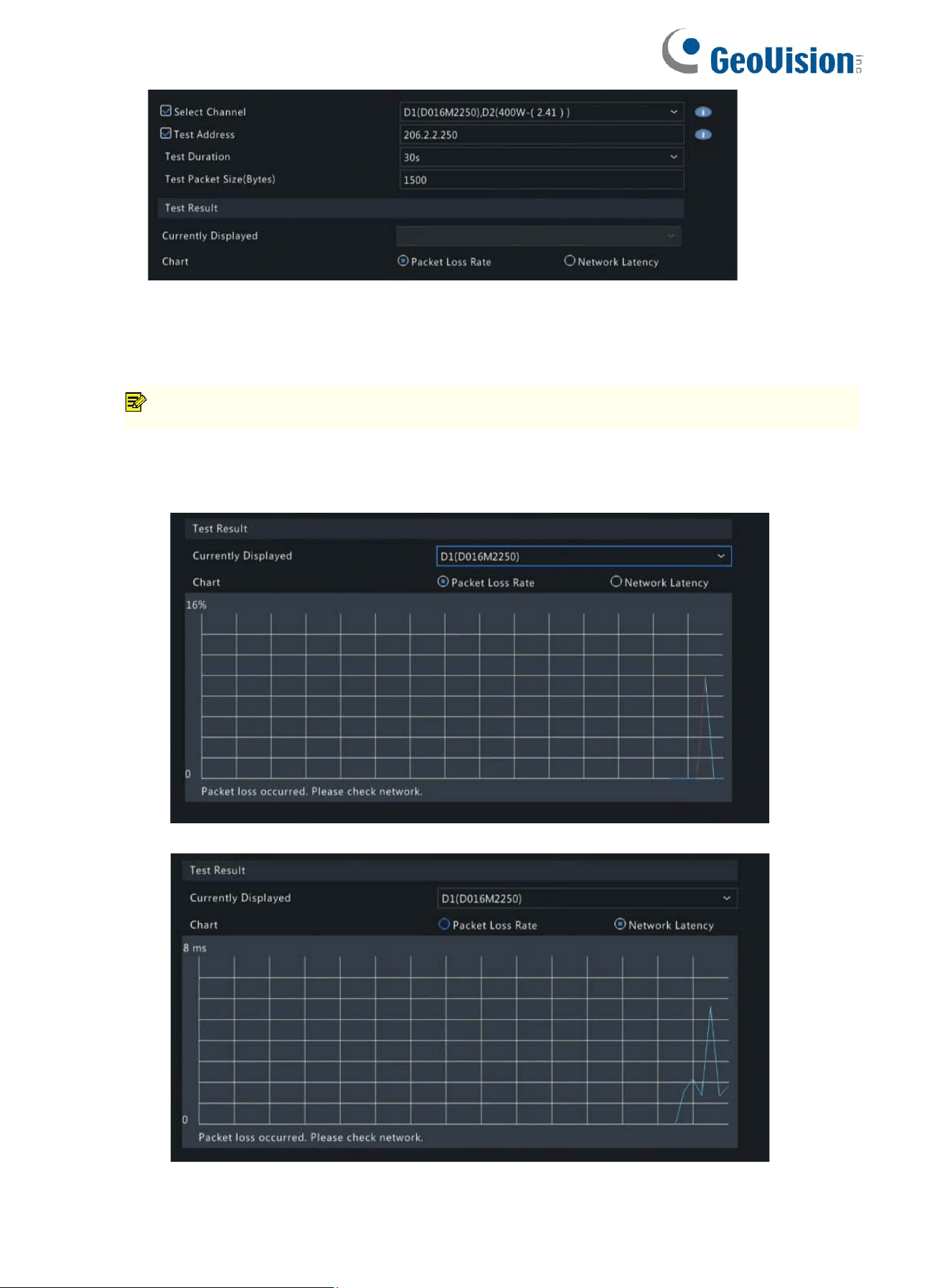
174
6. Click Test to test the packet loss rate and network latency.
View Test Results
If the test is successful, the system saves test data and shows the packet loss rate and network latency. If the test
failed, the test result shows “The destination is unreachable”.
1. You can click the Currently Displayed drop-down list to choose the channel or address to be tested.
2. Click Packet Loss Rate or Network Latency to view the test result.
• Packet loss rate
• Network latency
Note: If you click Stop Test before the test is completed, the system will save the existing test data and show
the test result.
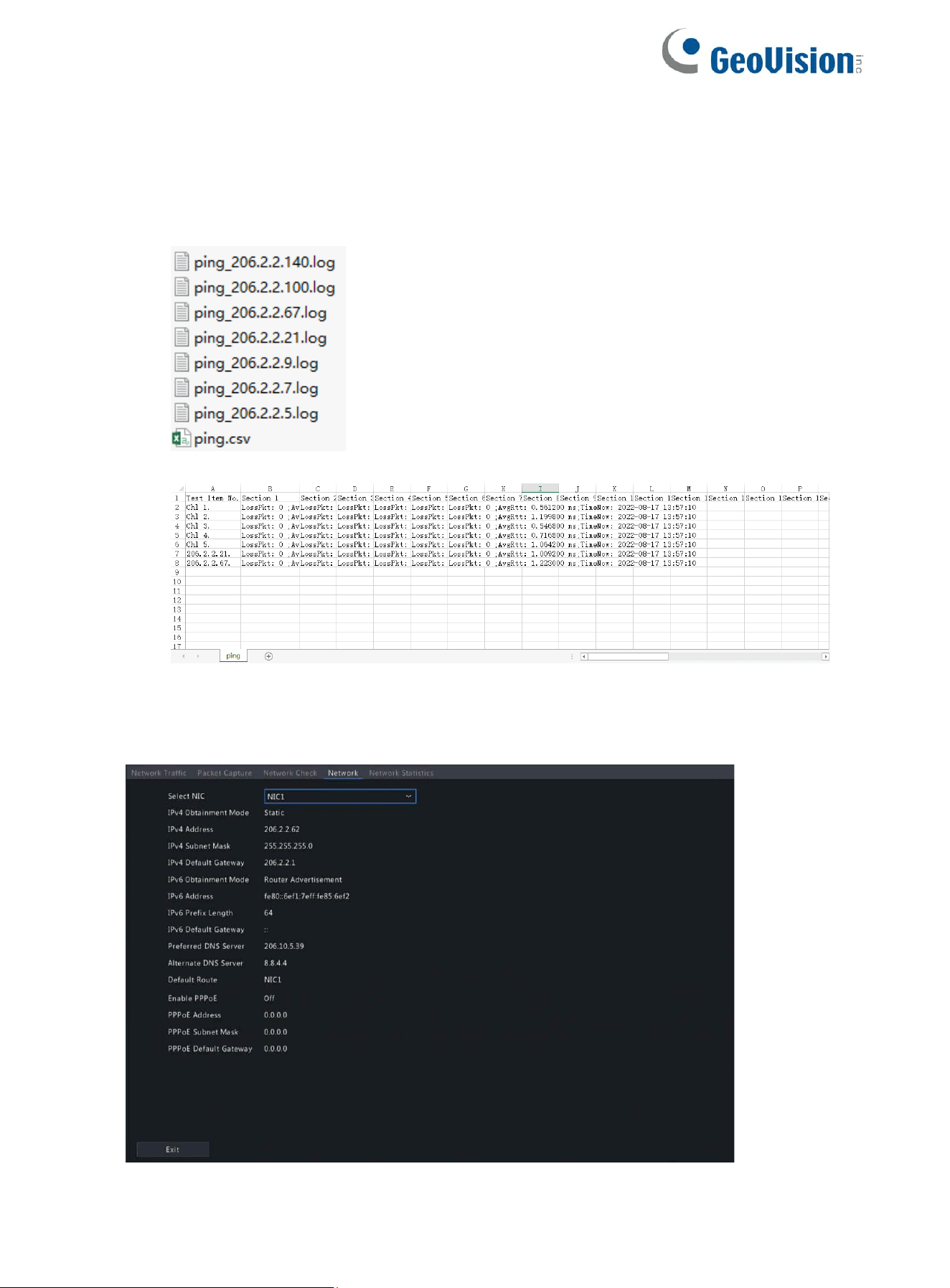
175
Export Test Results
1. Click Export. The Backup page appears.
2. Choose the destination path, click Backup to export test results to the external storage device.
3. The exported file is a .tgz package, including ping logs of all the test objects and one summary file. See the
examples below.
• Exported files
• Exported report
11.2.4 Network Status
View network parameters of an NIC.
Go to Menu > Maintenance > Network Info > Network. Choose an NIC to view its network parameters.
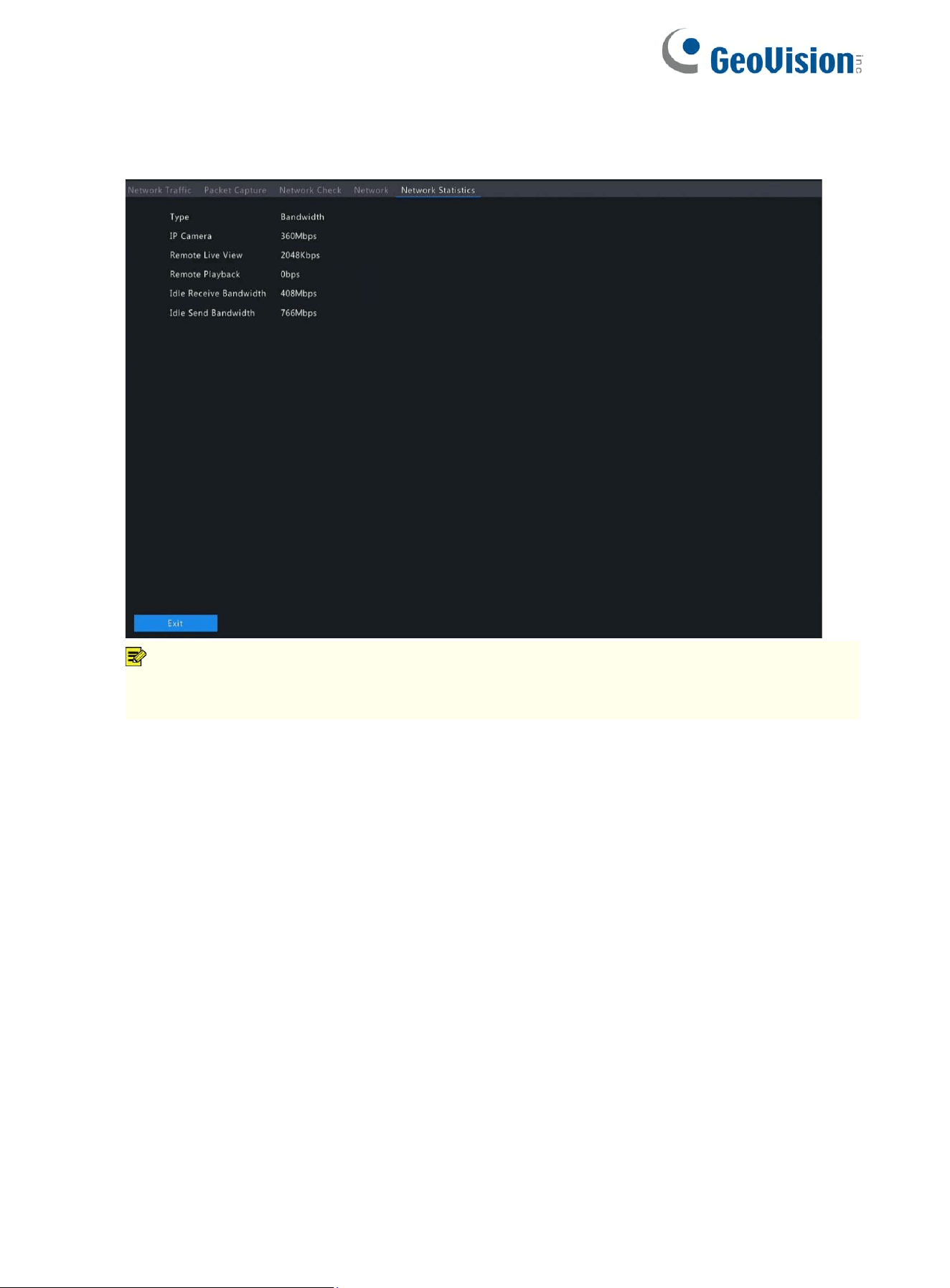
176
11.2.5 Network Resource Statistics
View bandwidth usage.
Go to Menu > Maintenance > Network Info > Network Statistics. Bandwidth usage is displayed.
11.2.6 PoE and Network Port Status
View connection status of PoE ports or network ports. This function is applicable to NVRs with PoE ports or
network ports.
Go to Menu > Maintenance > Network Info > PoE Port Status or Network Port Status. The port connection
status is displayed. Blue means the port is in use. For PoE device, you may also view power information.
11.3 Log Search
Logs contain information about user operation and device status. You can use logs to keep track of device
operation status and view detailed alarm information.
Log Search
1. Go to Menu > Maintenance > Log.
Note:
• When idle receive bandwidth is low, cameras cannot get online.
• When idle send bandwidth is low, live view, playback, and recording download will fail.
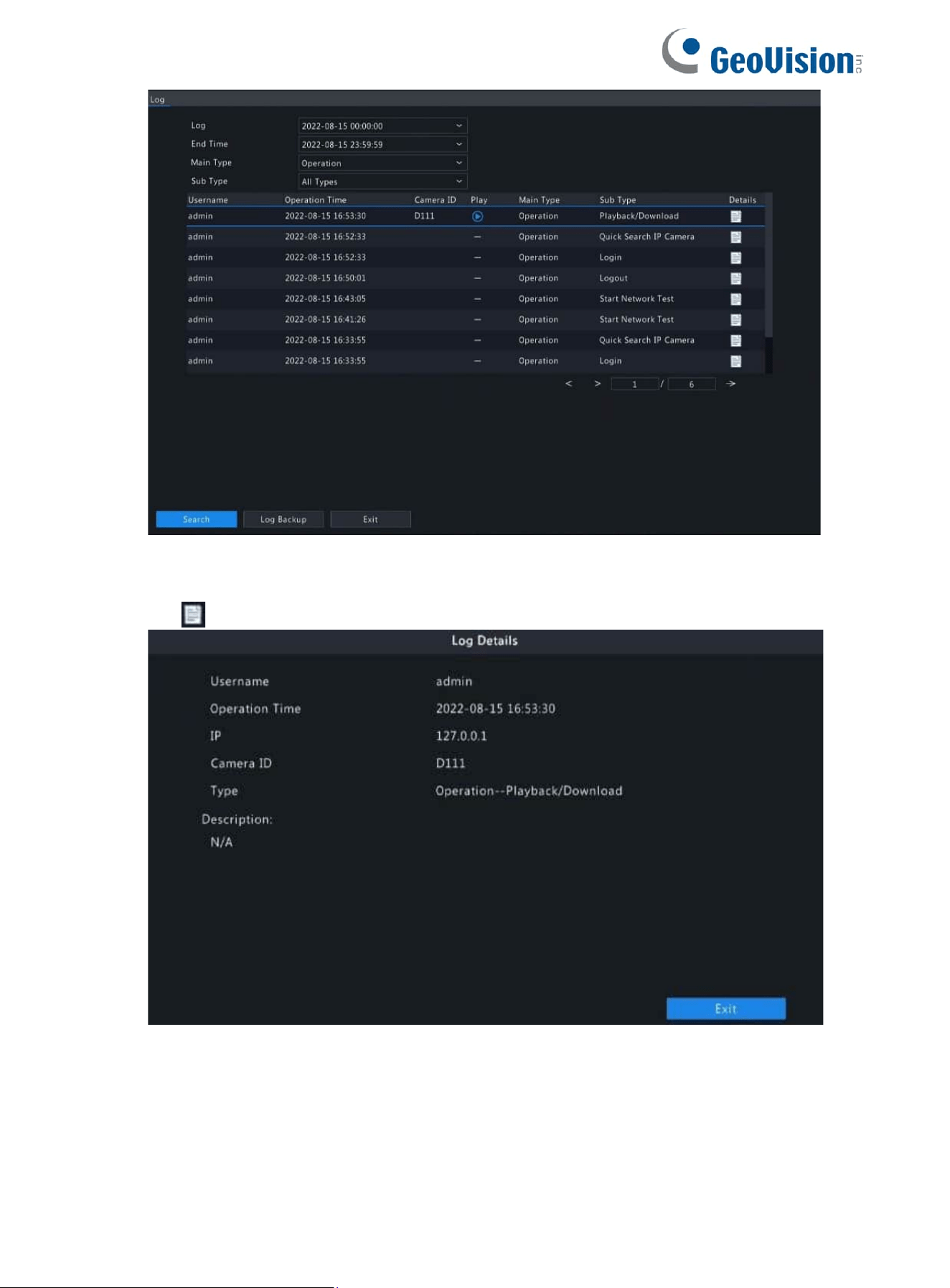
177
Click to view log details.
2. Set the start time, end time, main type and sub type.
3. Click Search.
4.
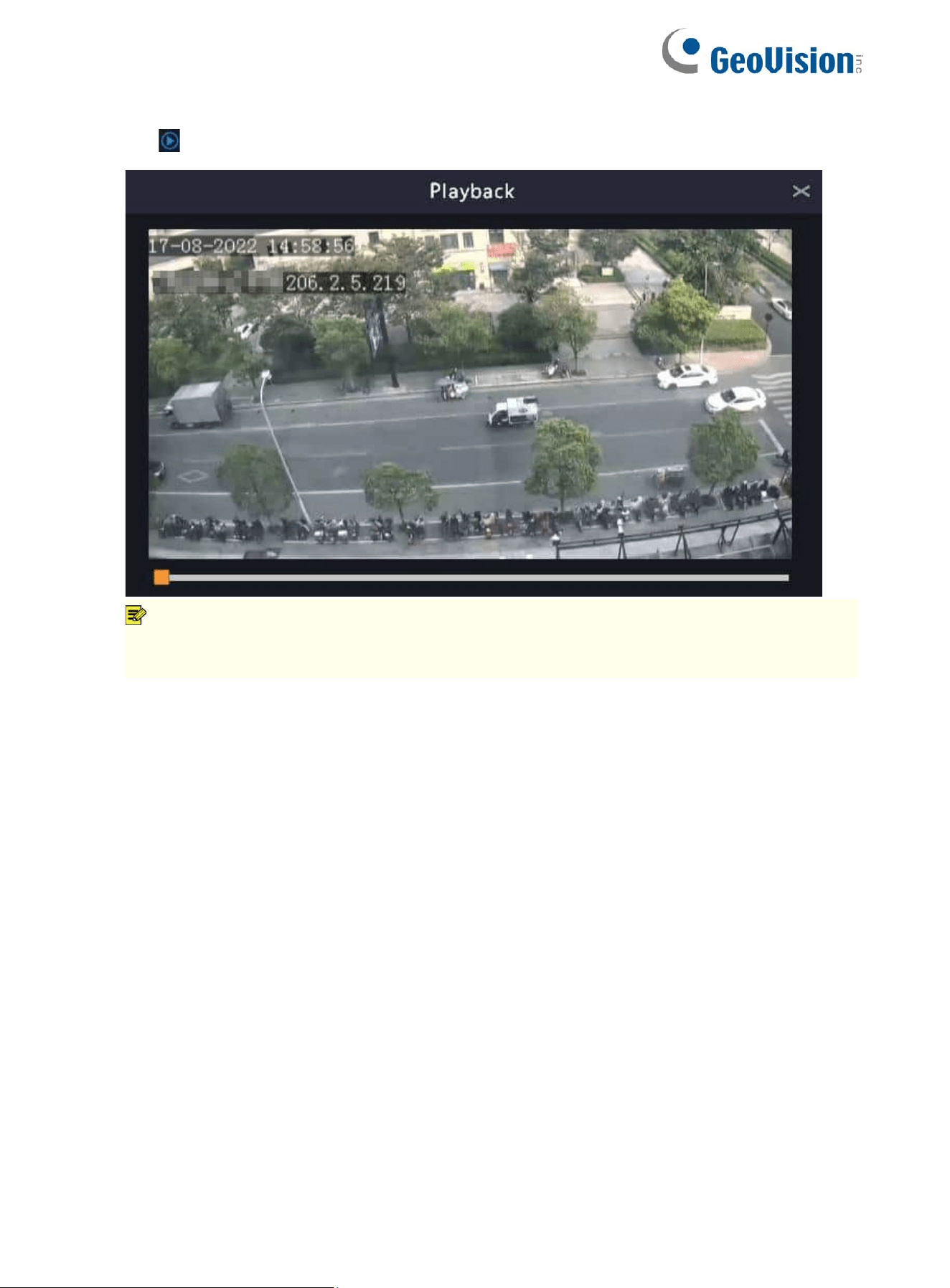
178
Playback
Click to view the video recorded at the current log time.
Log Backup
Click Backup. The Backup page appears. Choose the destination path, click Backup to save the logs to the
external storage device.
Note:
• This feature is not available to certain log types.
• The video is 11 minutes long (1m before and 10m after alarm).
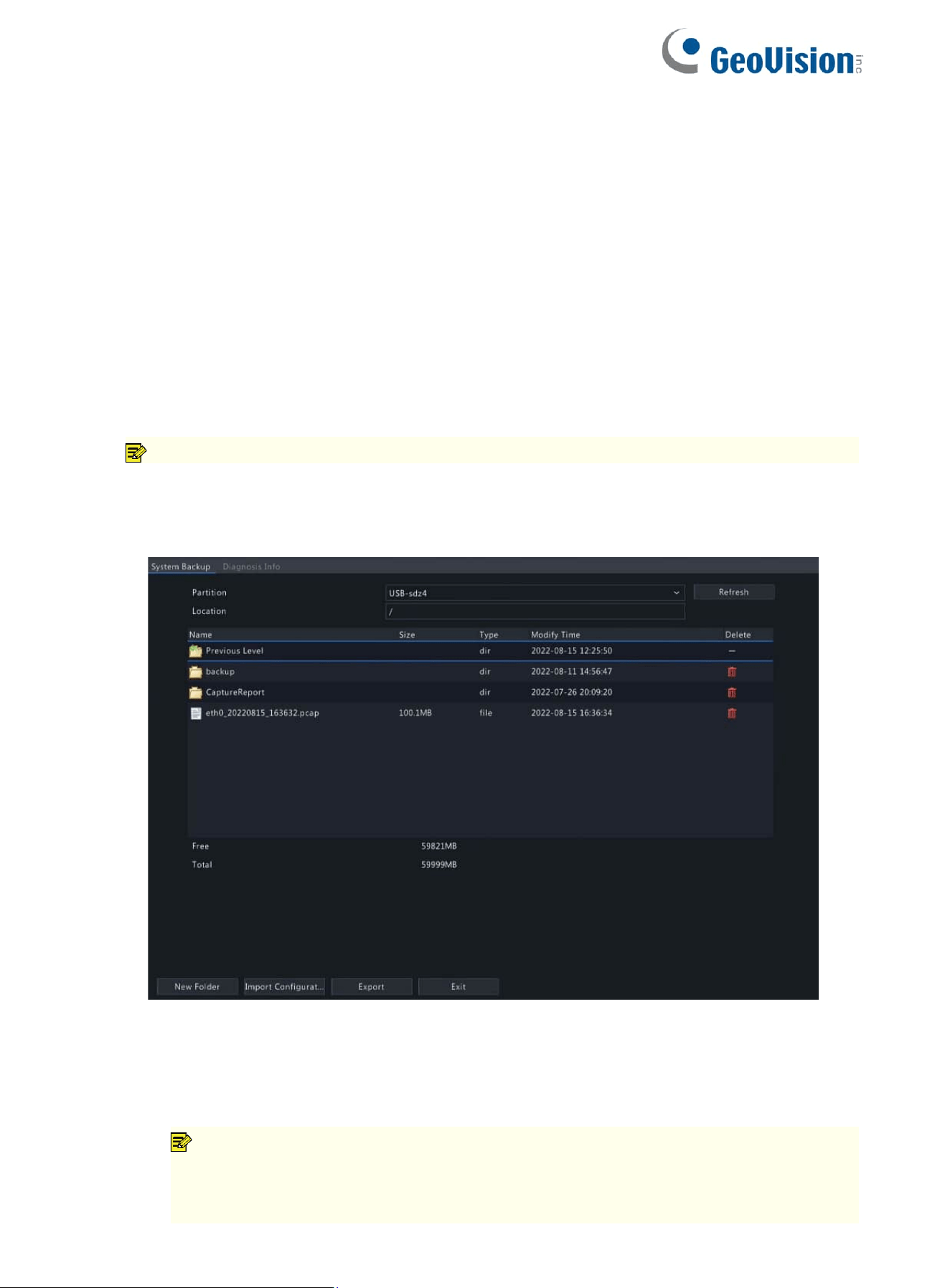
179
11.4 Maintenance
11.4.1 Maintenance
Maintenance includes restore system, system backup, and auto-function.
Go to Menu > Maintenance > Maintenance > Maintenance.
Restore System
Restore default system settings.
1. Choose Default or Factory Default as needed. A message appears. The NVR will restart and restore the
default settings after you confirm. Choose a method according to your actual needs:
• Restore: Restore default settings except network settings, user settings, and time settings.
• Factory Default: Restore all default settings.
2. Click Apply.
System Backup
Import, export, and delete system configurations.
1. Click System Backup.
2. Perform the following operations as needed:
• Import configurations: Choose the *.xml file in the directory list, click Import Configuration, and then
confirm to import the configuration file.
• Export configurations: Choose the destination in the directory list, click Export Configuration. Then a *.xml
file containing the exported configurations is generated in the specified folder later.
Note: Either option will not delete the recorded videos and operation logs.
Note:
• Caution: The device will restart after you import configurations. If power is disconnected during
the process, the system will be unusable.
• Only admin can import or export configurations.
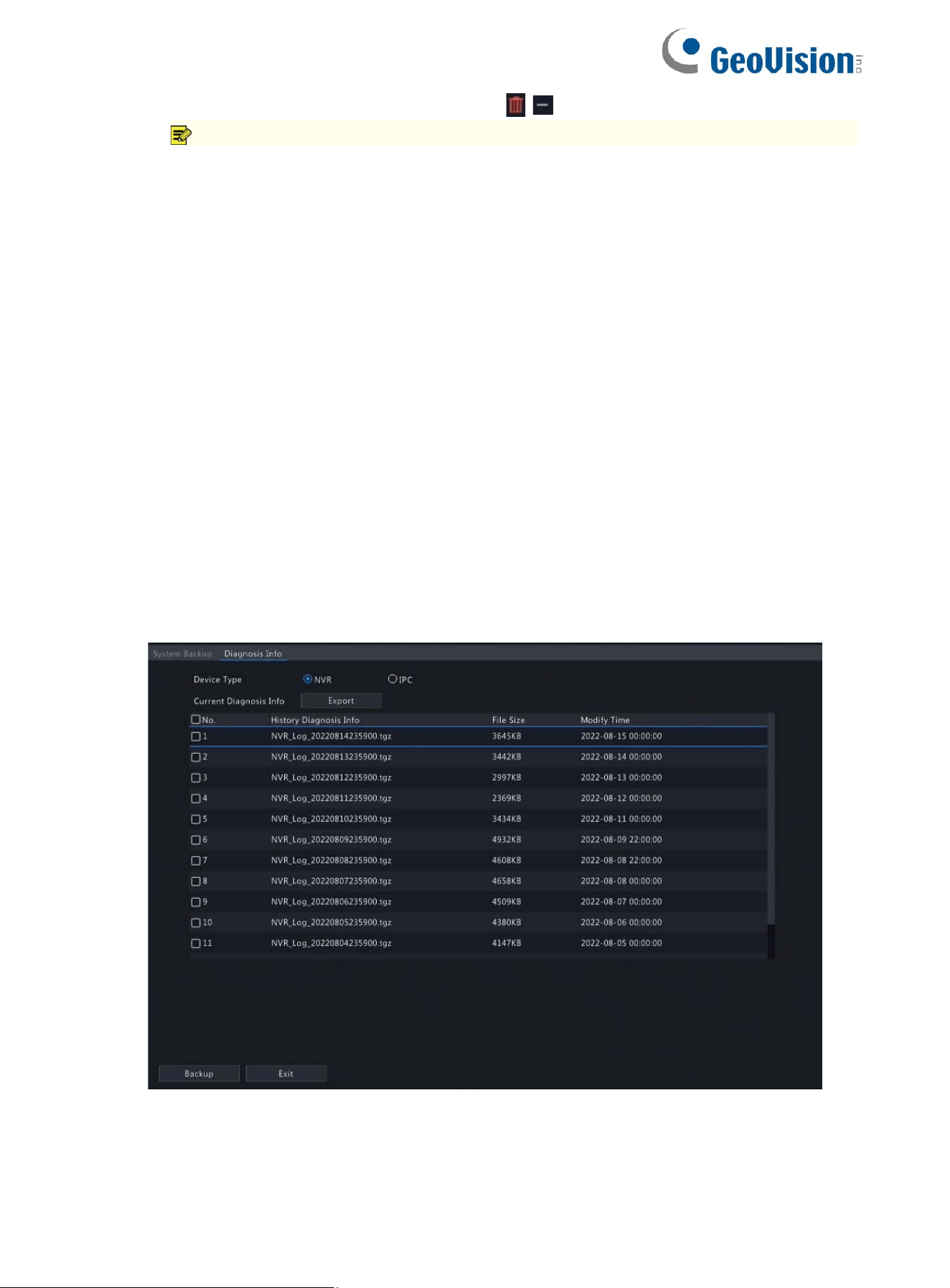
180
•
• Create folder: Choose the destination path in the directory list, click New Folder, enter a folder name to
create the folder.
• Refresh: Click the Refresh button to refresh the list.
3. Click Apply.
Auto-Function
The device can restart or delete files automatically at the present time. Only admin can perform this operation.
1. Find the Maintenance area.
2. Configure the parameters.
• Auto-Restart System: The system restarts automatically at the set time.
• Auto-Delete File(s): The system automatically deletes videos and images saved on the hard disk. Range:
1-240.
3. Click Apply.
11.4.2 Diagnosis Info
View and back up diagnosis information of the NVR and the connected cameras. The NVR keeps 14 days of
diagnosis information and overwrites the earliest when the storage is full.
Go to Menu > Maintenance > Maintenance > Diagnosis Info.
NVR Diagnosis Info
1. Choose NVR as the device type.
2. Export NVR diagnosis information.
• Current Diagnosis Info: Diagnosis information since the latest startup. Click Export to export diagnosis
information to the external storage device.
• History Diagnosis Info: All the history diagnosis information in the list. Select the desired item(s), click
Backup. On the Backup page, choose the destination path, click Backup.
Delete: Choose the folder or file to be deleted, click . means the folder or file cannot be deleted.
Note: Caution: Deleted files cannot be recovered.
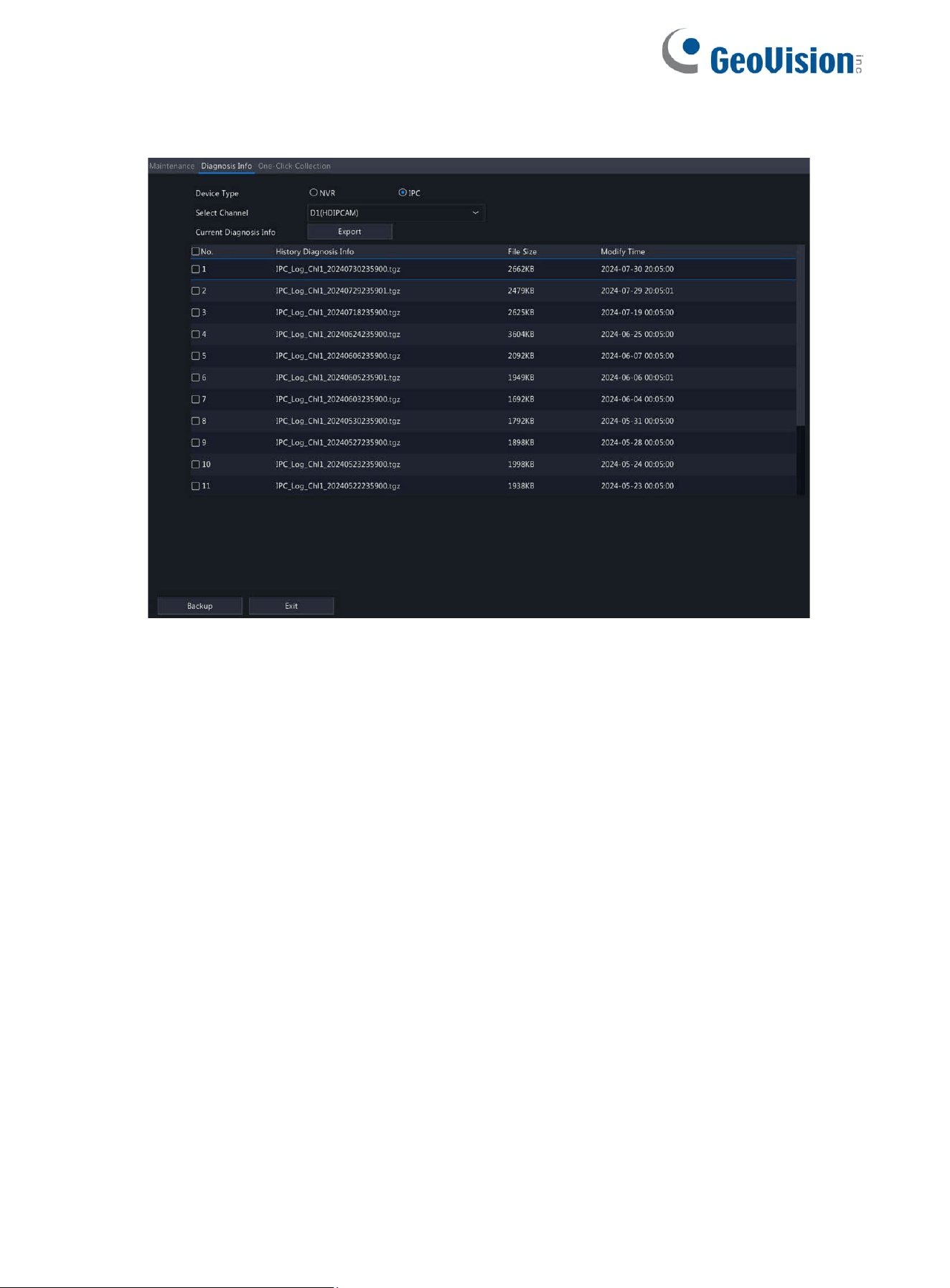
181
Camera Diagnosis Info
1. Choose IPC as the device type.
2. Choose the desired camera from the list.
3. Export diagnosis information of the selected camera.
• Current Diagnosis Info: Diagnosis information since the latest startup. Click Export to export diagnosis
information to the external storage device.
• History Diagnosis Info: All the history diagnosis information in the list. Select the desired item(s), click
Backup. On the Backup page, choose the destination path, click Backup.
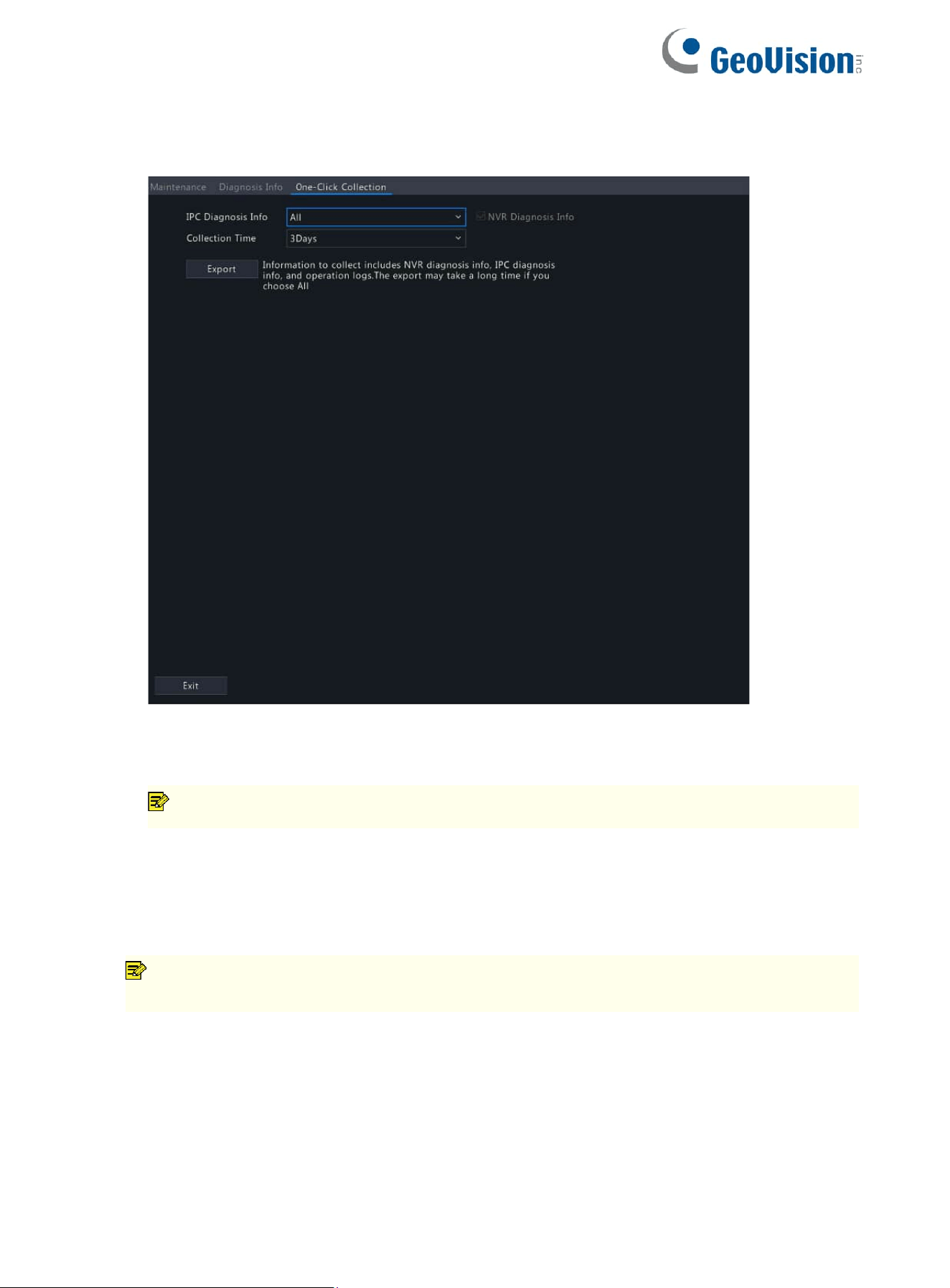
182
11.4.3 One-Click Collection
Collect NVR and camera diagnosis information.
1. Go to Menu > Maintenance > Maintenance > One-Click Collection.
2. Choose the camera and select a number of days of diagnosis information to be collected. NVR diagnosis
information is always collected.
3. Click Export to collect camera diagnosis information, NVR diagnosis info, and operation logs.
11.5 System Upgrade
Upgrade the firmware of the NVR and the connected cameras.
• Local upgrade: Upgrade using the upgrade files saved in a USB storage device.
Note:
Make sure the device is always connected to power and network during the upgrade. Use an
Uninterrupted Power Supplies (UPS) if necessary.
Note: Choose the days according to the actual requirements. The export process may take a long time if
you choose All.
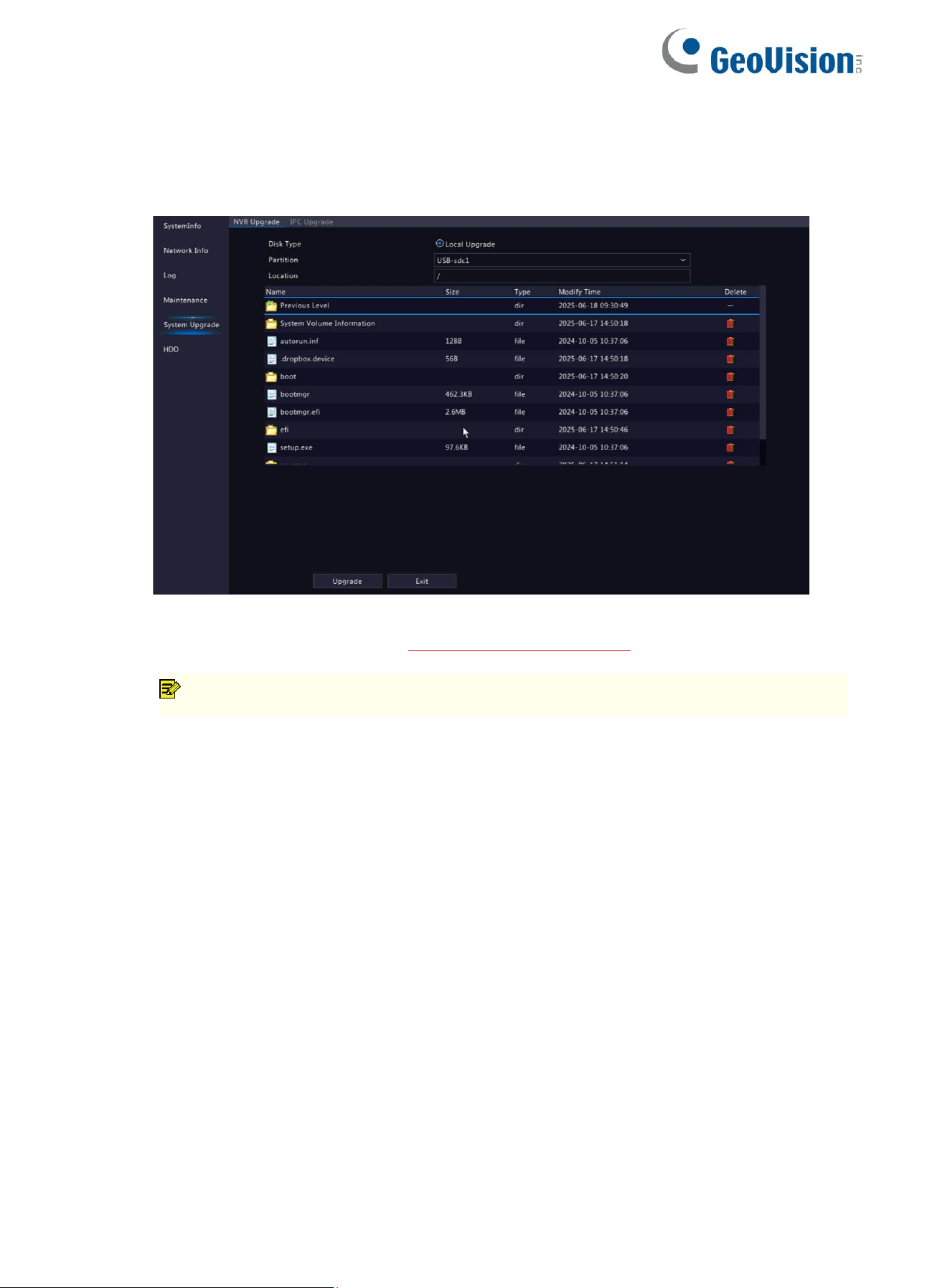
183
11.5.1 NVR Upgrade
Upgrade the firmware of the NVR.
1. Go to Menu > Maintenance > System Upgrade > NVR Upgrade.
2. Choose Local Upgrade. Select the upgrade file in the USB storage device, click Upgrade to start.
Note: The NVR firmware can be upgraded via its Web interface or GV-IP Device Utility. See 5.2 Upgrading
Firmware Using GV-IP Device Utility, GV-TNVR1620-P Quick Start Guide, to upgrade firmware.
Note: If the upgrade failed, the failure cause will be displayed, and the device will restart
automatically. Fix the problem and then try again.
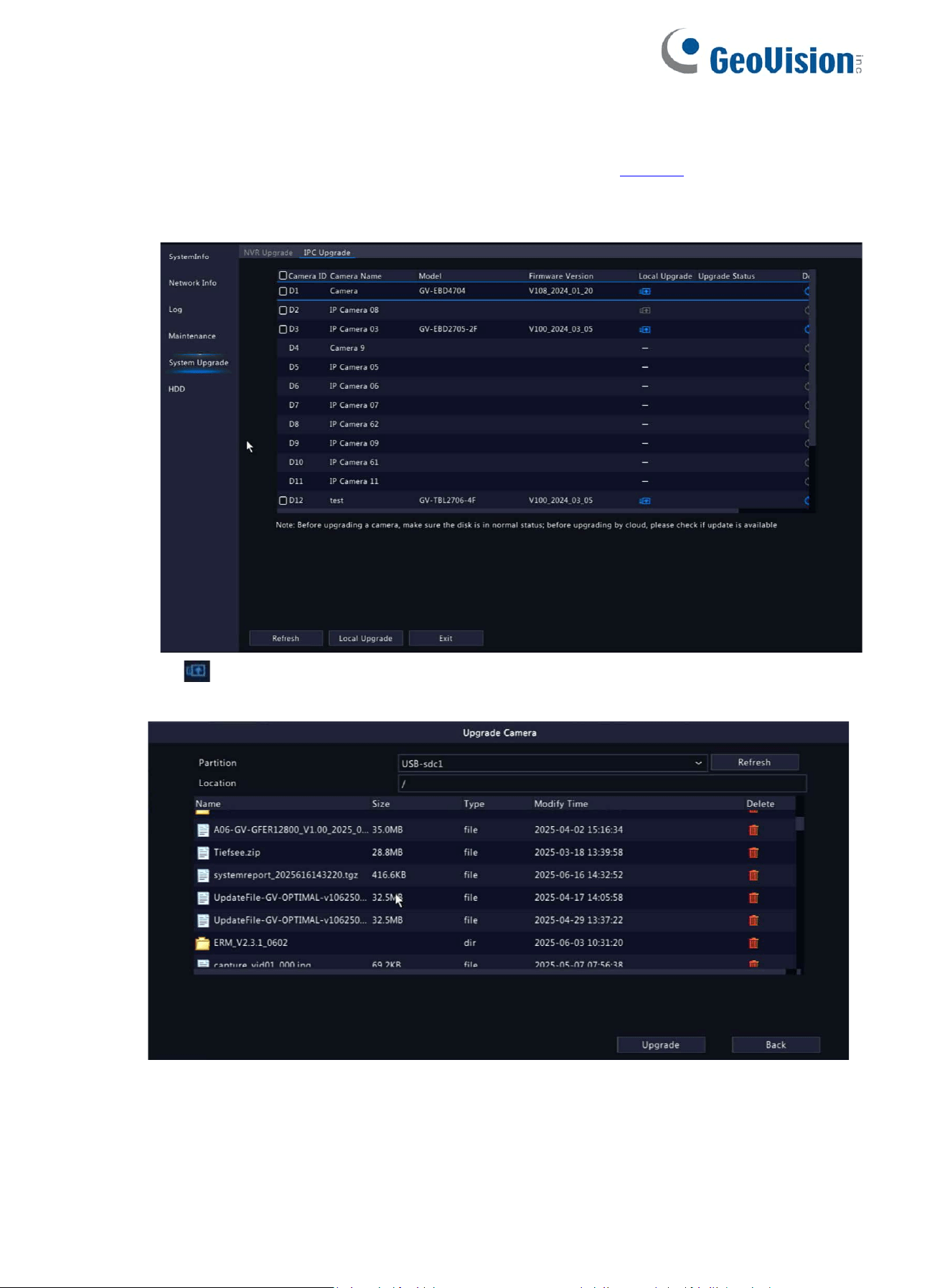
184
11.5.2 IPC Upgrade
Upgrade the firmware of the IPC.
Note: The IPC Upgrade only works with compatible AI GV-IP Cameras (see the datasheet for compatible AI cameras).
1. Go to Menu > Maintenance > System Upgrade > IPC Upgrade.
2. Click to upgrade a camera, or select multiple cameras and then click Local Upgrade.
3. On the Upgrade Camera page, select the upgrade file in the USB storage device, and then click Upgrade.
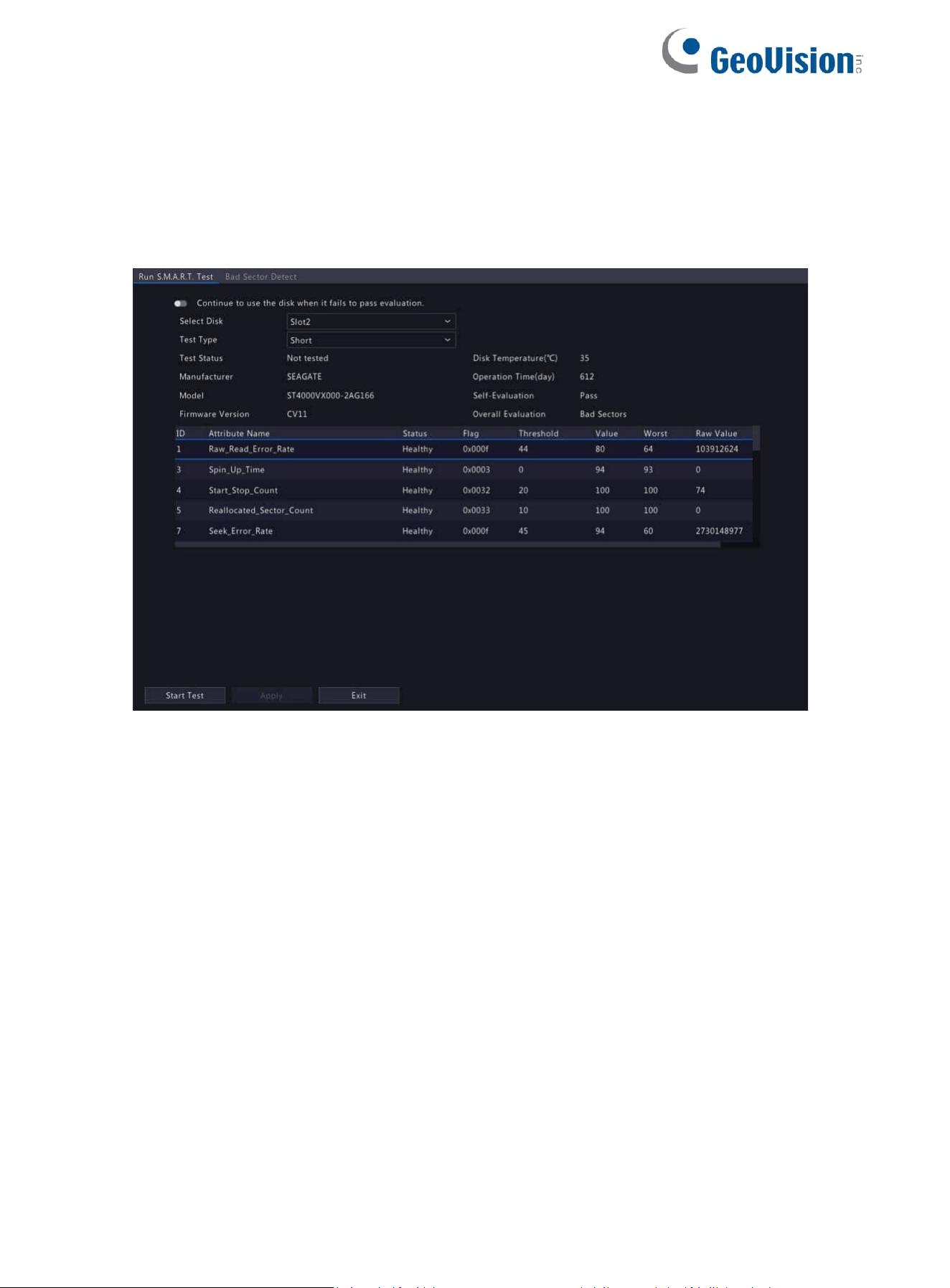
185
11.6 HDD Check
Perform S.M.A.R.T. test and bad sector detection. The actual functions available may vary with device.
11.6.1 Run S.M.A.R.T. Test
S.M.A.R.T. tests the hard disk including its head, platter, motor, circuit, etc. and evaluates the disk health status.
1. Go to Menu > Maintenance > HDD > Run S.M.A.R.T. Test.
2. (Optional) Enable Continue to use the disk when it fails to pass evaluation, so the device can continue using
the hard disk even if the disk fails in the self-assessment. However, this may incur great risks. Please choose
carefully.
3. Choose the disk slot and test type.
• Short: Less test contents, faster speed.
• Extended: More comprehensive and thorough, longer time.
• Conveyance: Detects problems in data transmission.
4. Click Start Test. The Status column shows the real-time progress, for example, Testing: 10%. View test results
after the test is completed.
The overall evaluation provides three kind of status: Healthy, Failure, Bad Sectors. It is recommended to
replace faulty disks immediately. Contact our technical support for more information.
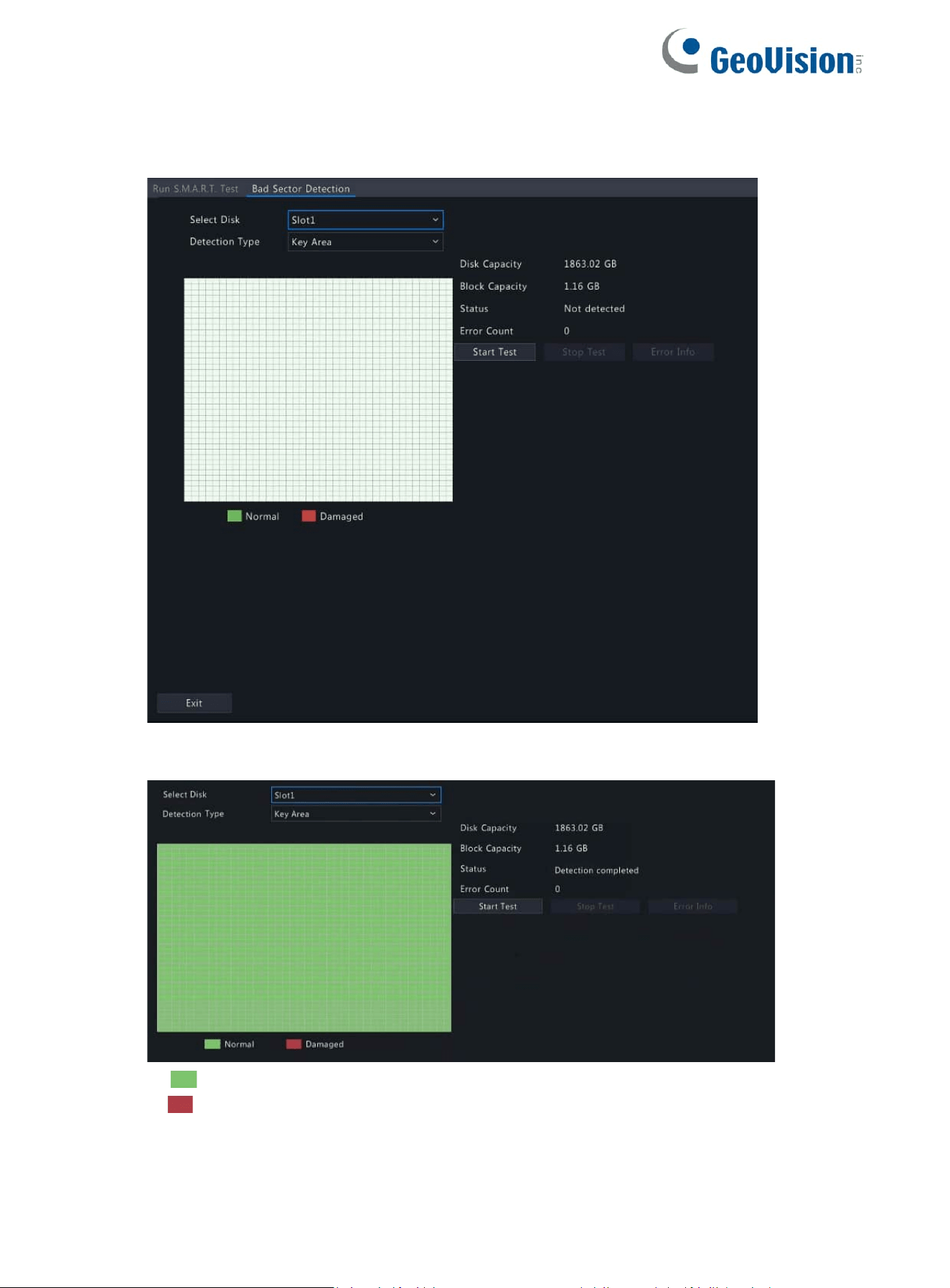
186
11.6.2 Bad Sector Detection
The device system detects bad sectors in hard disks in a read-only manner.
1. Go to Menu > Maintenance > HDD > Bad Sector Detection.
2. Choose the disk slot and detection type.
3. Click Start Test. To stop the detection, click Stop Test.
• means the detected area is in good condition.
•
means the detected area is damaged. The detection stops automatically when the error count
reaches 100.
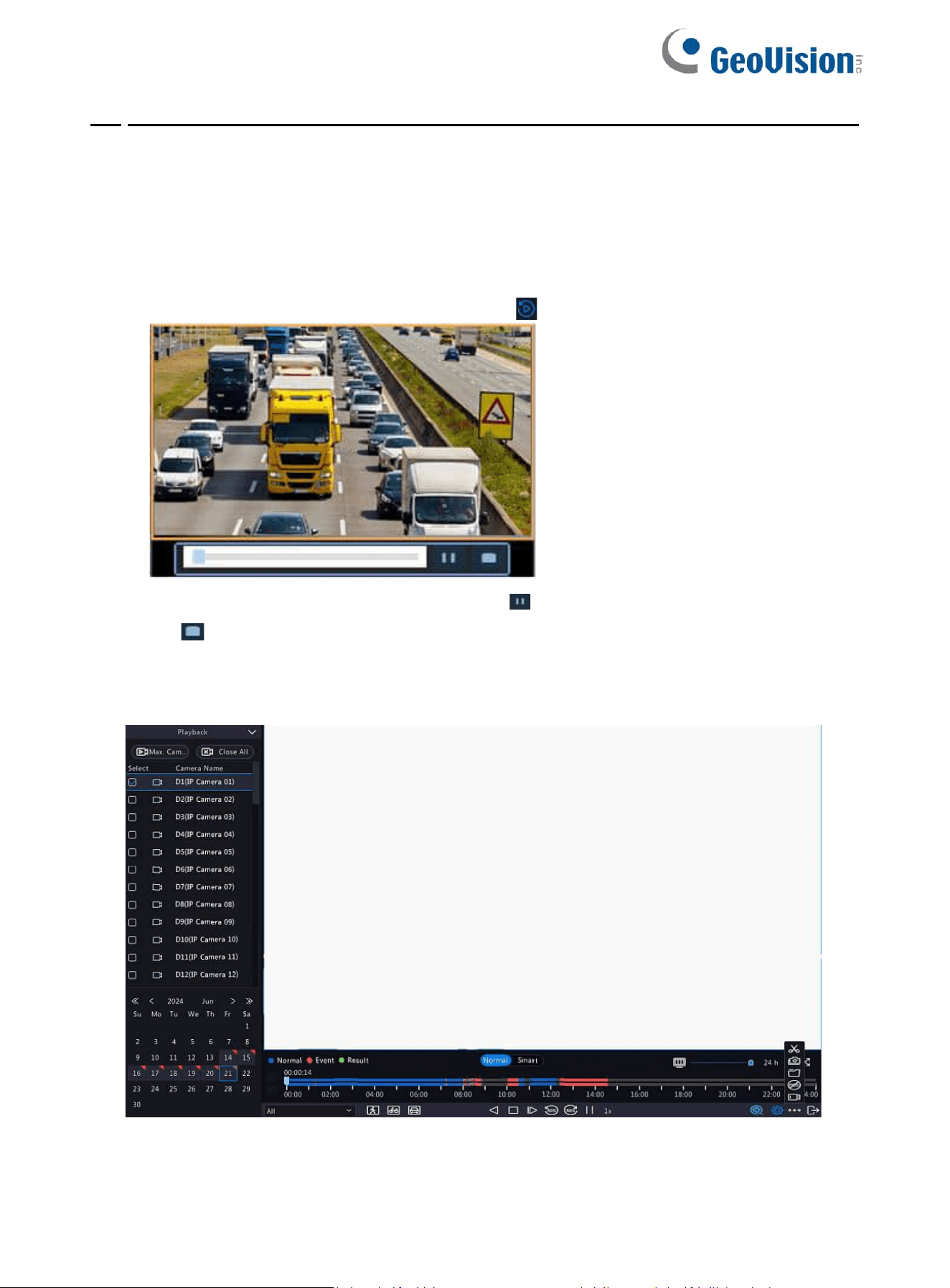
187
On the preview page, select the target window, and click
12 Playback
12.1 Instant Playback
Instant playback plays the video recorded during the last 5 minutes.
Make sure that the video is recorded during the last 5 minutes. Instant playback does not work if there's no
recording during this time.
1.
on the window toolbar.
2.
Drag the slider on the progress bar to fast forward. Click to pause.
3.
Click to exit the playback.
12.2 Recording Playback
On the preview page, right-click the desired window and select Playback.
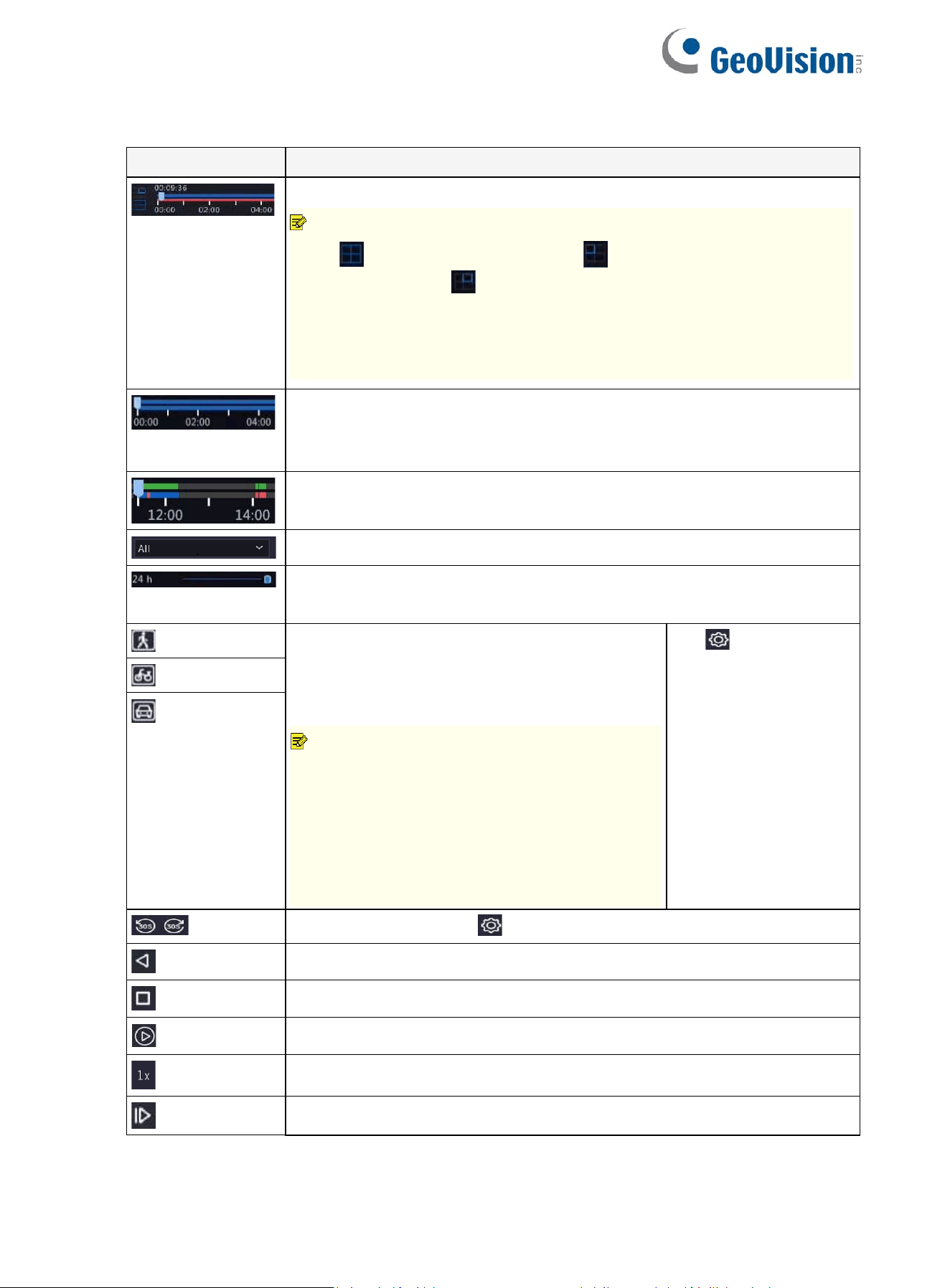
188
Playback Interface Introduction
Table 12-1: Playback Toolbar
Icon
Description
Show playback progress.
Note:
•
indicates 4 cameras are selected. indicates the playback progress in
the first window, indicates the playback progress in the second window,
and so on.
•
Different colors on the progress bar mean different recording types: blue for
normal recording, red for event-triggered recording, green for smart event
recording.
Normal playback timeline. Blue for normal recording, and red for event-triggered
recording.
Hover over the timeline to view a thumbnail image to quickly pinpoint an event.
Smart playback timeline. Green for recording of smart search; red for event-triggered
recording; blue for normal recording,
Select an event playback type.
Zoom in or out on the timeline. Alternatively, click on the timeline and use the scroll
wheel to zoom in or out.
Normal playback: Show the progress bar including event
recordings triggered by human/motor vehicle/non-motor
vehicle.
Smart playback: Show the progress bar including
recordings of human/motor vehicle/non-motor vehicle.
Note:
• The smart playback recordings of targets are
larger than the normal playback recordings of
targets.
• The target recording search is only available
to the single-channel playback, and the
corresponding recordings will be shown green on
the progress bar.
Click to enable/diable
Skip Normal Recordings
and set the playback speed
as needed.
Rewind/forward 30s, or click and choose from the Interval drop-down list.
Reverse.
Stop playback and return to the start point.
/
Play/pause.
Set the playback speed.
Forward by frame.
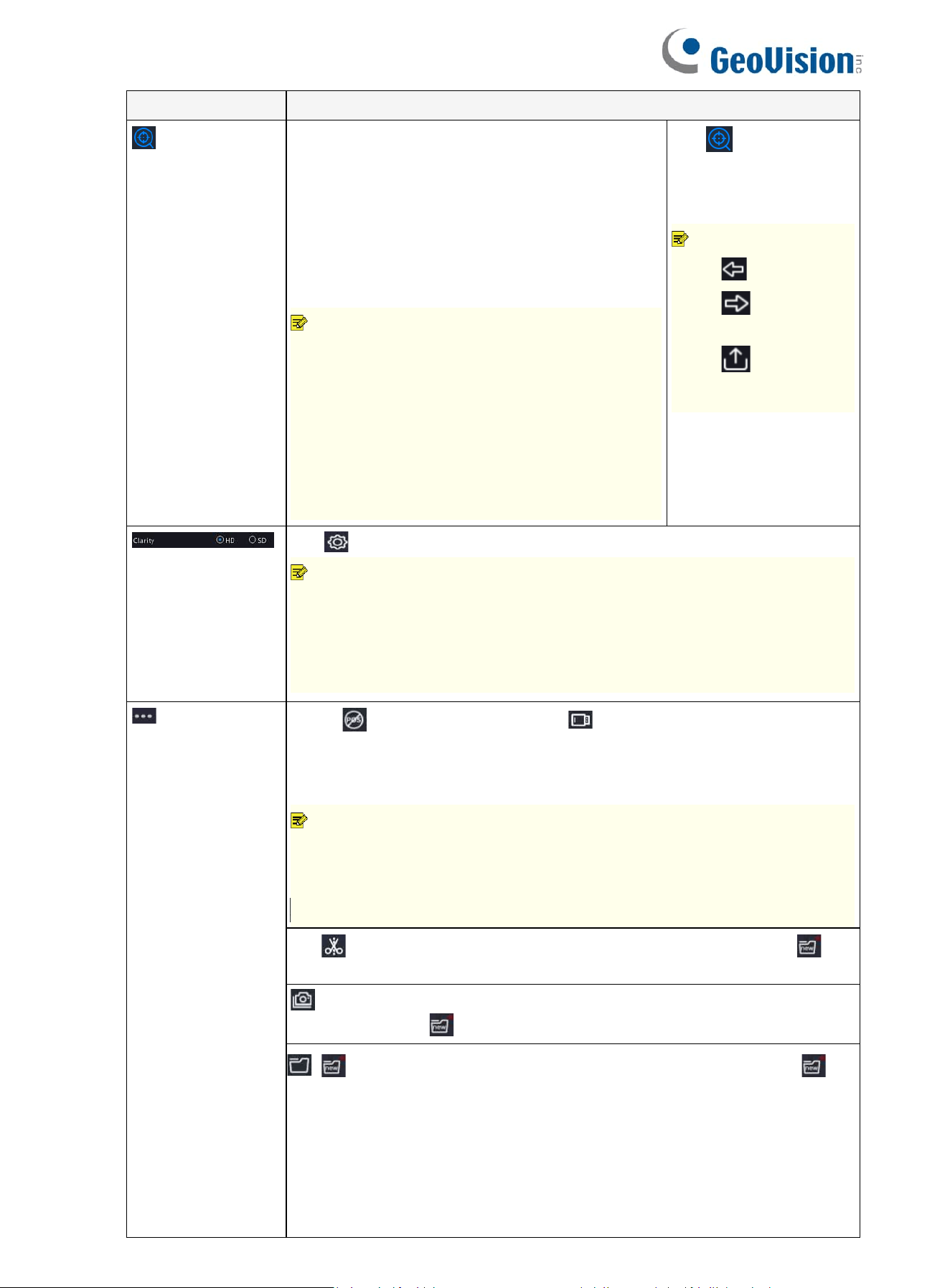
189
Icon
Description
Search images or recordings of targets by AcuSearch or
AcuTrack.
AcuSearch: Search for images of the motor vehicle, non-
motor vehicle, or human body.
AcuTrack: Search for recordings of the motor vehicle,
non-motor vehicle, or human body during a specified
period of a day and display the search results on the
timeline.
Note:
• Before use, go to Menu > VCA > Analyzer
Config, and set the analyzer mode to
AcuSearch/AcuTrack.
• By default, the NVR searches for images/
recordings of all cameras of the current day
and with the similarity of 60%. You can reset
the search conditions as needed, and the set
similarity will be the default value the next time
you perform the accurate search or tracking.
Click , drag to select
the target, and choose
AcuSearch or AcuTrack to
view the accurate search
results.
Note:
•
: Last Recording.
•
: Next
Recording.
•
: Back up the
current recording to
the storage device.
Click to set the video clarity, including HD or SD.
Note:
• If no images are displayed on the preview page in SD mode, it indicates SD
videos are not stored.
• If SD video is available in SD playback mode, SD video is played by default;
it switches to HD video automatically when you double-click the window to
maximize it in a multi-window layout.
Choose to enable/disable POS; choose to play recordings stored in an external
storage device.
When POS is enabled, POS OSD appears on the playback screen, and some toolbar
buttons are deactivated.
Note:
• This function is available for certain NVRs.
• The button only appears in normal playback mode and POS playback mode. In
normal playback mode, POS OSD is displayed for 5s. In POS playback mode, the
time is configurable.
/ : Start/stop clipping video. The video clips will be temporarily saved to ,
and will be deleted if you exit the playback page.
: Take a snapshot. The window borders will flash white. The snapshots will be
temporarily saved to , and will be deleted if you exit the playback page.
/ : File management, including files of clips, snapshots, locked files, tags;
indicates there is a newly saved file.
• Video Clip: The video clips can be saved to an external storage device.
• Playback Snapshot: The playback snapshots can be saved to an external storage
device.
• Lock File: The locked recordings can be saved to an external storage device.
• Tag: Tag management.
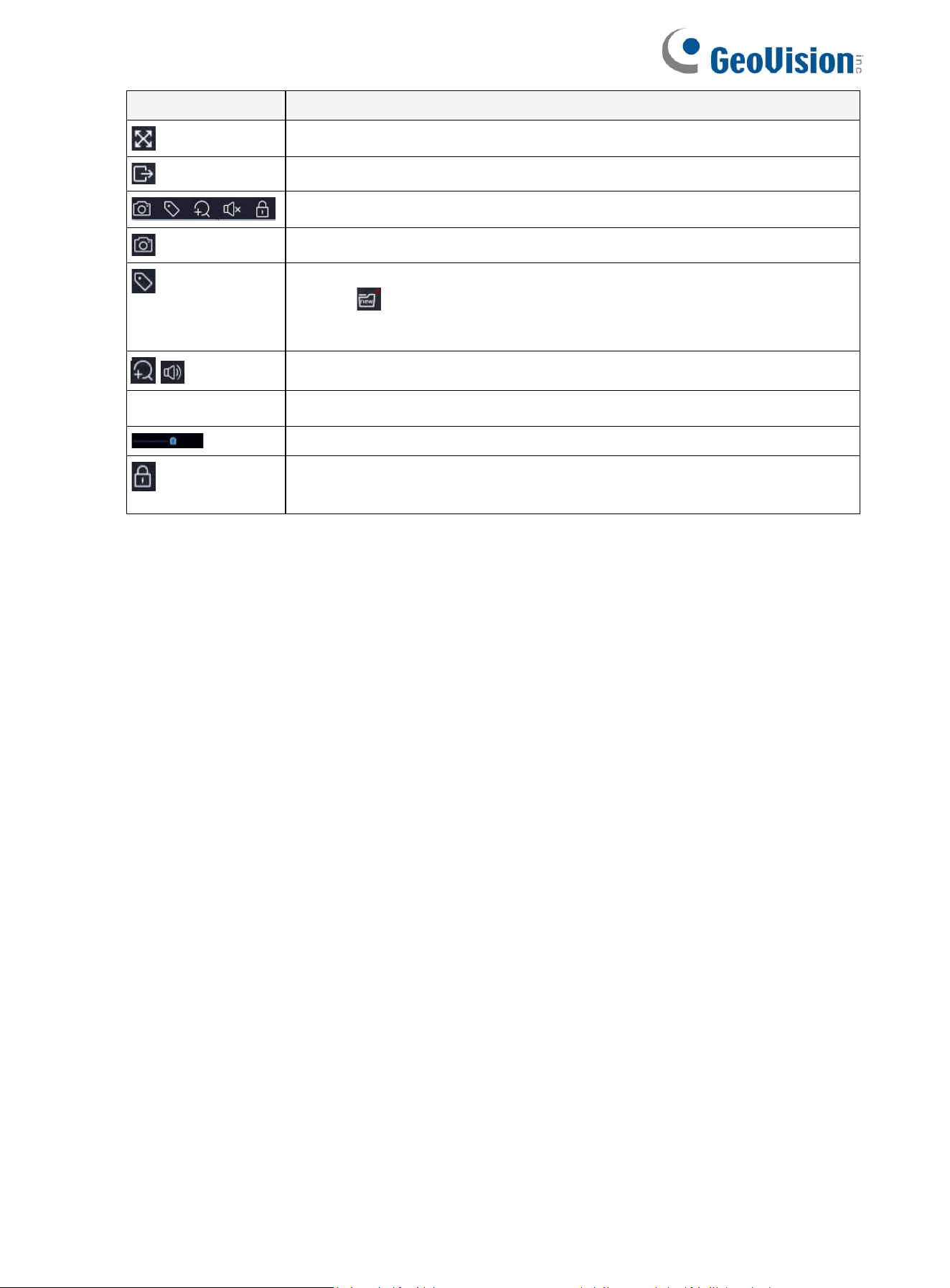
190
Icon
Description
Full screen.
Exit the playback screen.
Click a playback window to show the window toolbar.
Take a snapshot.
Add a tag at the current time point to record the current video. The added tags can be
viewed in .
User can search for recordings based on the tag keywords. For tag search, see Others.
Digital zoom. See Digital Zoom for details.
/
Turn on/off audio.
Adjust the sound volume.
Lock the playback recording. Locking a recording file will prevent all the files stored in
the same disk partition (254.4MB in size) from being overwritten.
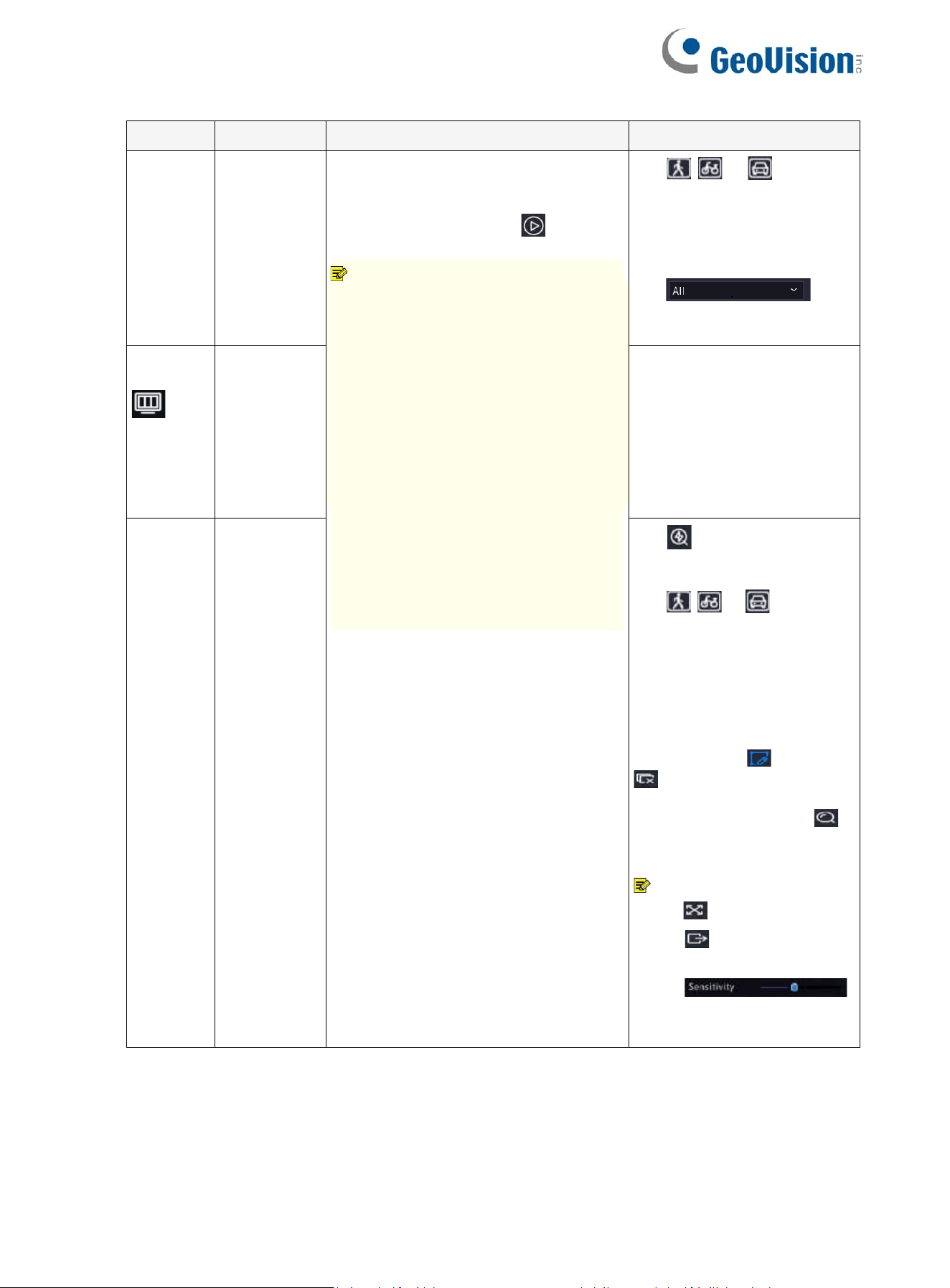
191
Playback Operations
Type
Description
Step 1
(Optional) Step 2
Normal
playback
Play all
recordings of
the selected
camera(s)
Select camera(s) in normal/corridor playback
mode or select a camera in smart playback
mode, double-click the desired date; or
select the date and then click to start
playback.
Note:
Click , , or to specify
the target type(s), and then the
corresponding event recordings
triggered by human body, non-
motor vehicle, or motor vehicle
will be displayed.
• In normal playback mode, click Max.
Cameras to select the maximum
number of cameras allowed. The
performance may vary with NVR
model.
• In normal playback mode, click Close
All to stop playback for all cameras.
• The calendar uses different flags to
indicate different recording types:
blue for normal recording,
Click and
choose an event type to play the
corresponding recordings.
Corridor
playback
Play recordings
in corridor
mode in
multiple
windows.
Up to 3
cameras can be
selected.
/
red for event-triggered recording,
and no flag for none.
• The NVR plays HD videos by default.
You can switch to SD mode if SD
videos are stored. For SD video
storage, see Encoding Settings.
Smart
playback
search for
recordings
triggered
by motion
detection
or targets
including
motor vehicle/
non-motor
vehicle/human
body
Click to play the event
recordings triggered by motion
detection.
Click , , or to specify
the target type(s), and then
the corresponding recordings
including human body, non-motor
vehicle, or motor vehicle will be
displayed.
The default smart search area is
the full screen. To specify a smart
search area, click , and choose
to clear the existing areas.
Then, click and drag on the image
to specify an area, and click
to start search smart playback of
the specified area.
Note:
•
: Full screen.
•
: Exit the smart search
page.
•
:
Adjust the smart search
sensitivity.
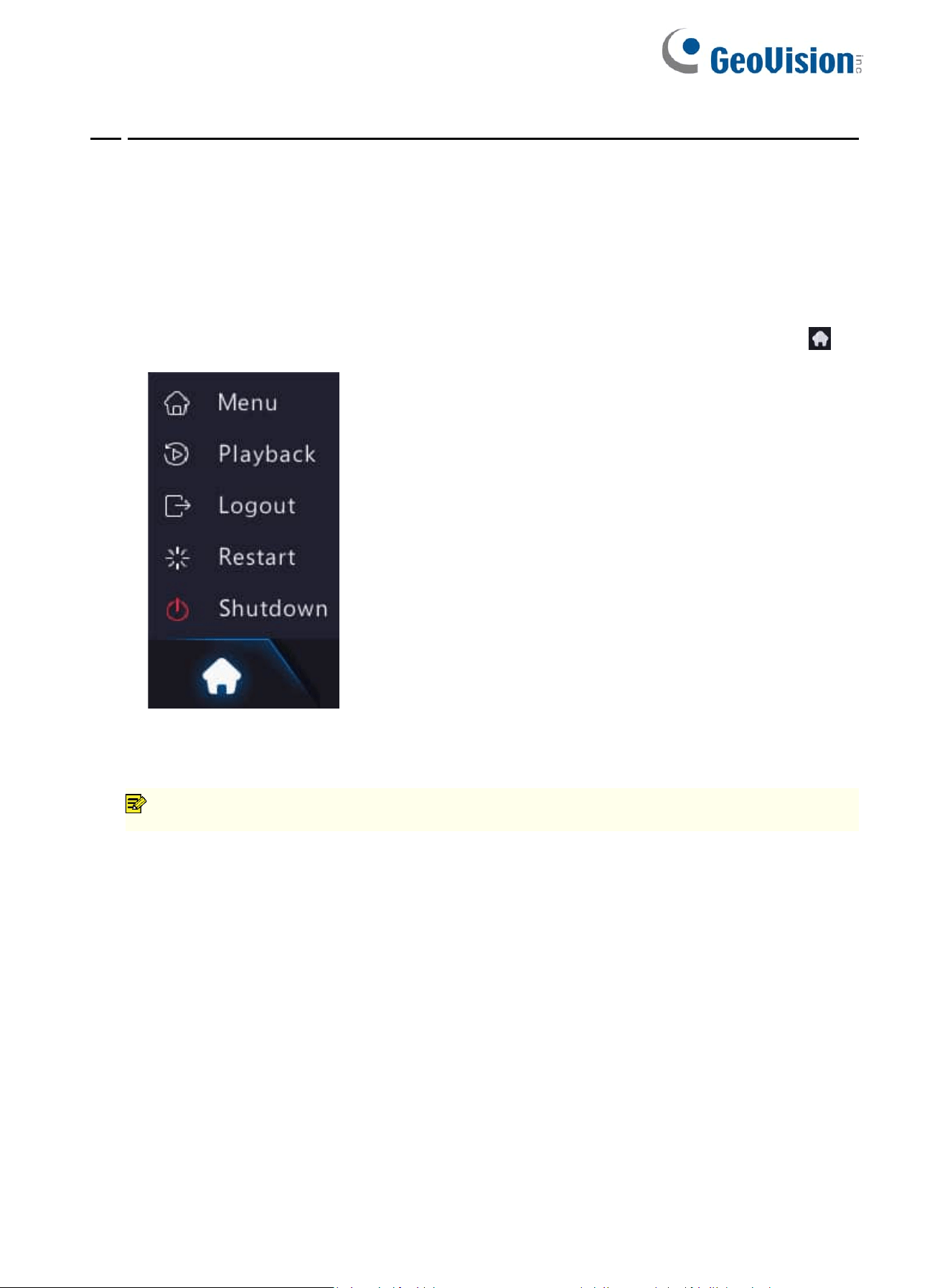
192
13 Startup and Shutdown
This chapter describes device startup, shutdown, logout, and restart.
Startup
Start up the device. Use the Power switch at the back panel.
Shutdown
Shutdown refers to turn off the operating system of the device with power supply connected. Please disconnect
the power supply if the device will be shut down for a long time.
•
Local interface: Hover the mouse at the bottom of the preview page to display the screen toolbar, click ,
and then select shutdown, logout, or restart as needed.
•
Front panel: Press and hold the power button on the front panel (if available) for 3 seconds until you hear
a beep, then hold for 2 seconds until an on-screen message appears, and then click Yes to shut down the
device.
Note: Unsaved settings will be lost if the NVR is shut down unexpectedly, for example, due to a power
failure. A shutdown during a system upgrade may cause startup failures. Please handle with caution.
193
14 Web-Based Operations
You may access and manage the NVR remotely using a web browser on your PC (through the Web interface).
14.1 Preparation
Check the following before you begin:
• Access will be authenticated during login, and operation permissions will be required.
• The NVR is operating properly and has a network connection to the PC.
• A Web browser is installed on the PC. Chrome 60 or later is recommended. Firefox 60 or later, Microsoft
Internet Explorer 10.0 or later, Edge 79 or later are also supported.
• The PC uses an operating system of Windows 7 or later.
• A 32-bit or 64-bit Web browser is required if you are using a 64-bit operating system.
14.2 Login
Follow these steps to log in to the Web interface (The login page may vary with browser type).
1. Open a Web browser on your PC, enter the IP address of the NVR in the address bar (192.168.0.100
by default), and then press Enter.
Note:
• The parameters that are grayed out on the Web interface cannot be edited. The parameters and values
displayed may vary with NVR model.
• The figures below are for illustration purpose only and may vary with NVR model.
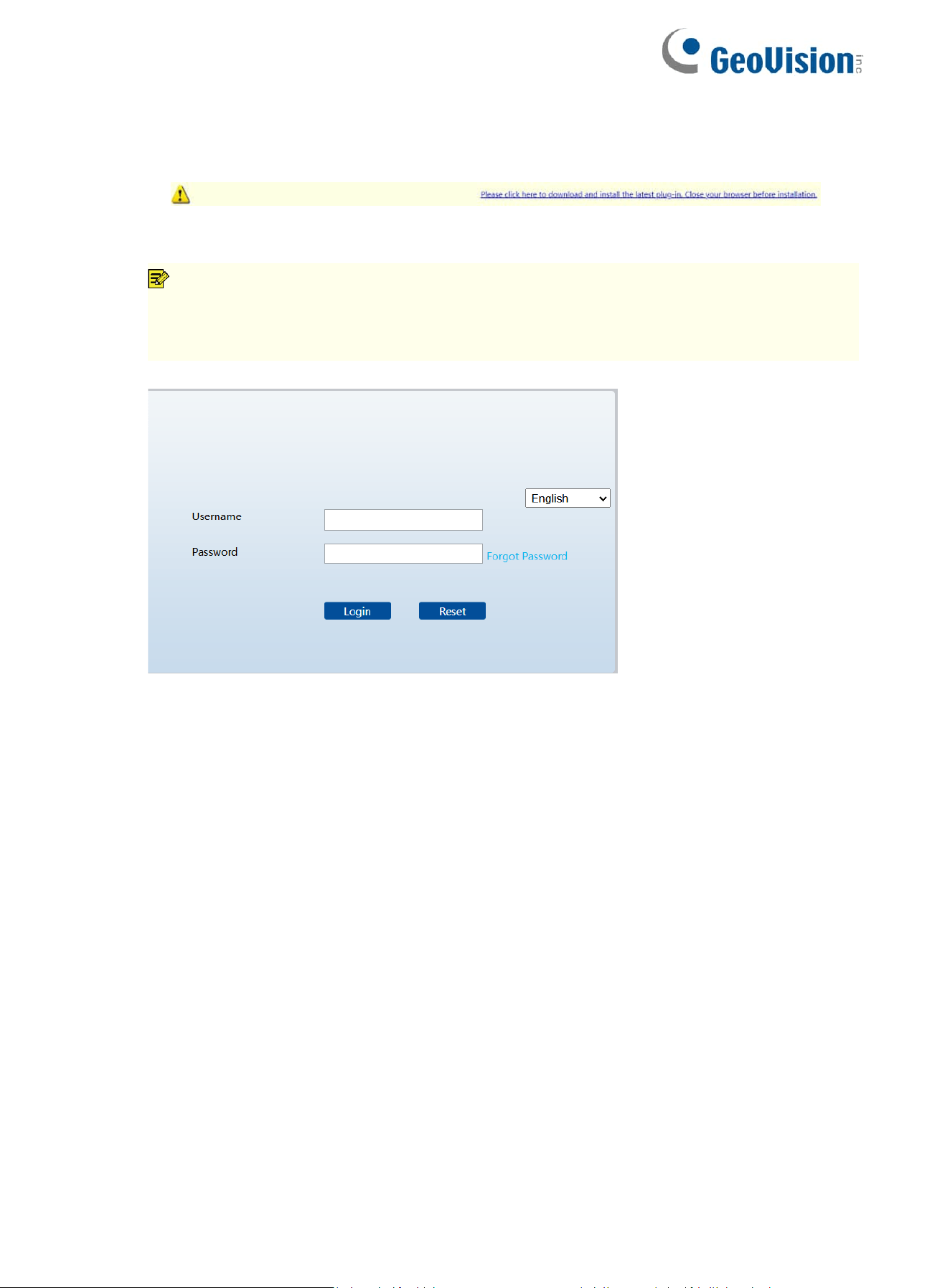
194
2. Install the plug-in.
• You need to install the plug-in as prompted at your first login, which is mainly used for processing media
streams. Close all the Web browsers when the installation starts. Follow the on-screen instructions to
complete the installation and then open the browser again to log in.
• You may also find the plug-in manually by entering http://IP address/ActiveX/WebPlayer.exe in the
address bar, and press Enter.
3. On the login page, enter the username and password, and then click Login.
Note:
For non-IE browsers, you can log in to the Web interface without installing the plug-in, but some
functions on the live view, playback, and setup pages are unavailable.
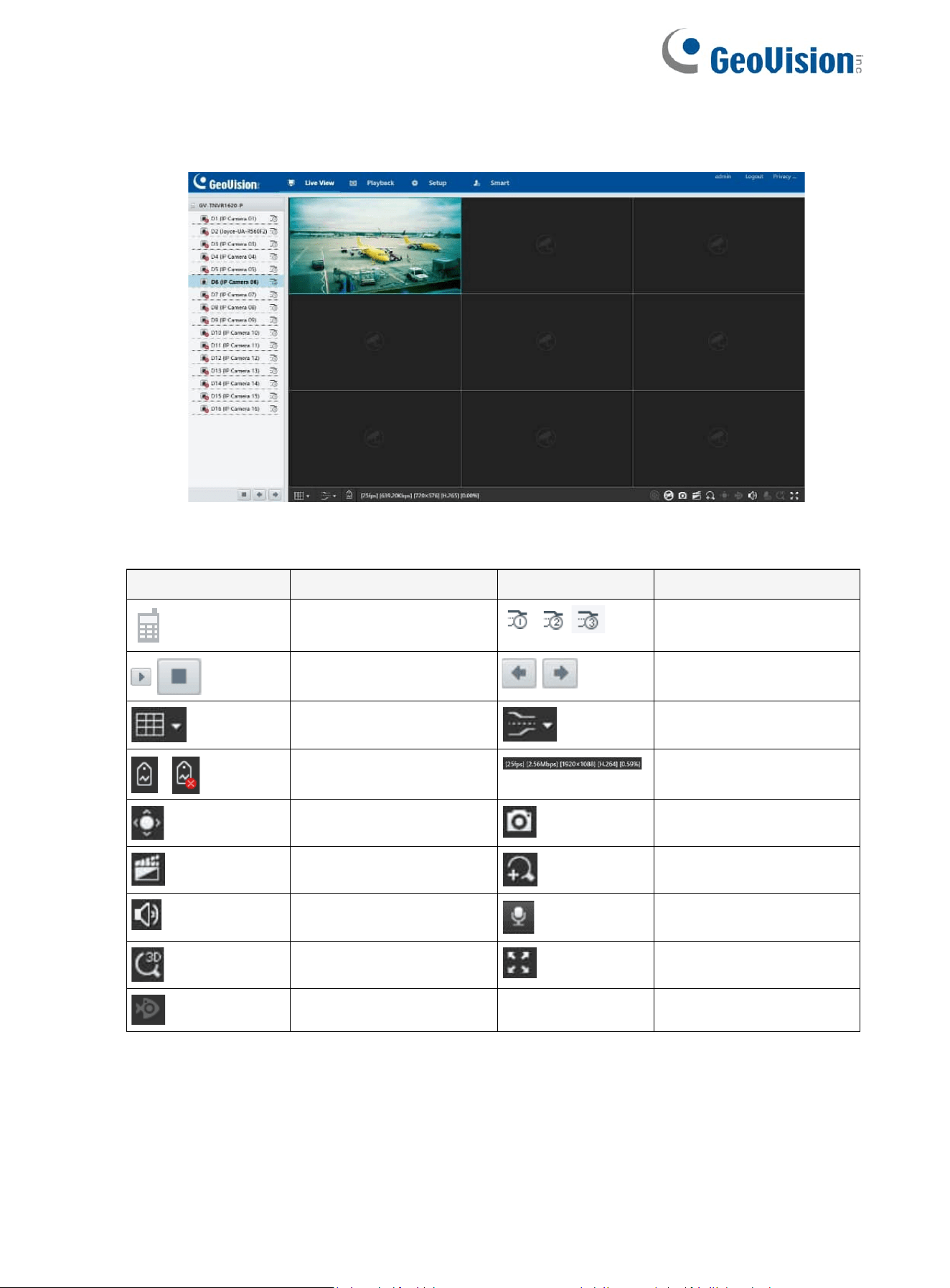
195
14.3 Live View
The Live View page is displayed when you are logged in. Select the desired channel on the left, and view the live
video.
The operations may vary with NVR model.
Table 14-1: Live View Window Control Buttons
Button
Description
Button
Description
Two-way audio
/ /
Main/sub/third stream
/
Start/stop live video in all
windows
/
Previous/next screen
Switch screen layout
Select stream type
/
Enable/disable intelligent
mark
Frame rate/bit rate/
resolution/packet loss
Open/close the control panel
Take a snapshot
Local recording
Digital zoom
/
Turn on/off audio
/
Start/stop two-way audio
3D positioning
Full screen
Fisheye mode
196
Note:
•
right to device name means two-way audio with the NVR.
way audio with the camera.
right to channel name means two-
•
Only the main stream
is displayed when the camera is offline or it supports only one stream.
• Snapshots are saved in a snapshot file folder named with the IP address, and snapshot files are named
in Camera ID_ time format and saved in this directory: \Snap\IP\Camera ID_time. The time is in
YYYYMMDDHHMMSSMS format.
•
Local recordings are saved in a recording file folder named with the IP address, and recording files are
named in Camera ID_S recording start time_E recording end time format and saved in this directory:
\Record\IP\Camera ID_S recording start time_E recording end time. The recording start and end times are
in YYYYMMDDHHMMSSMS format.
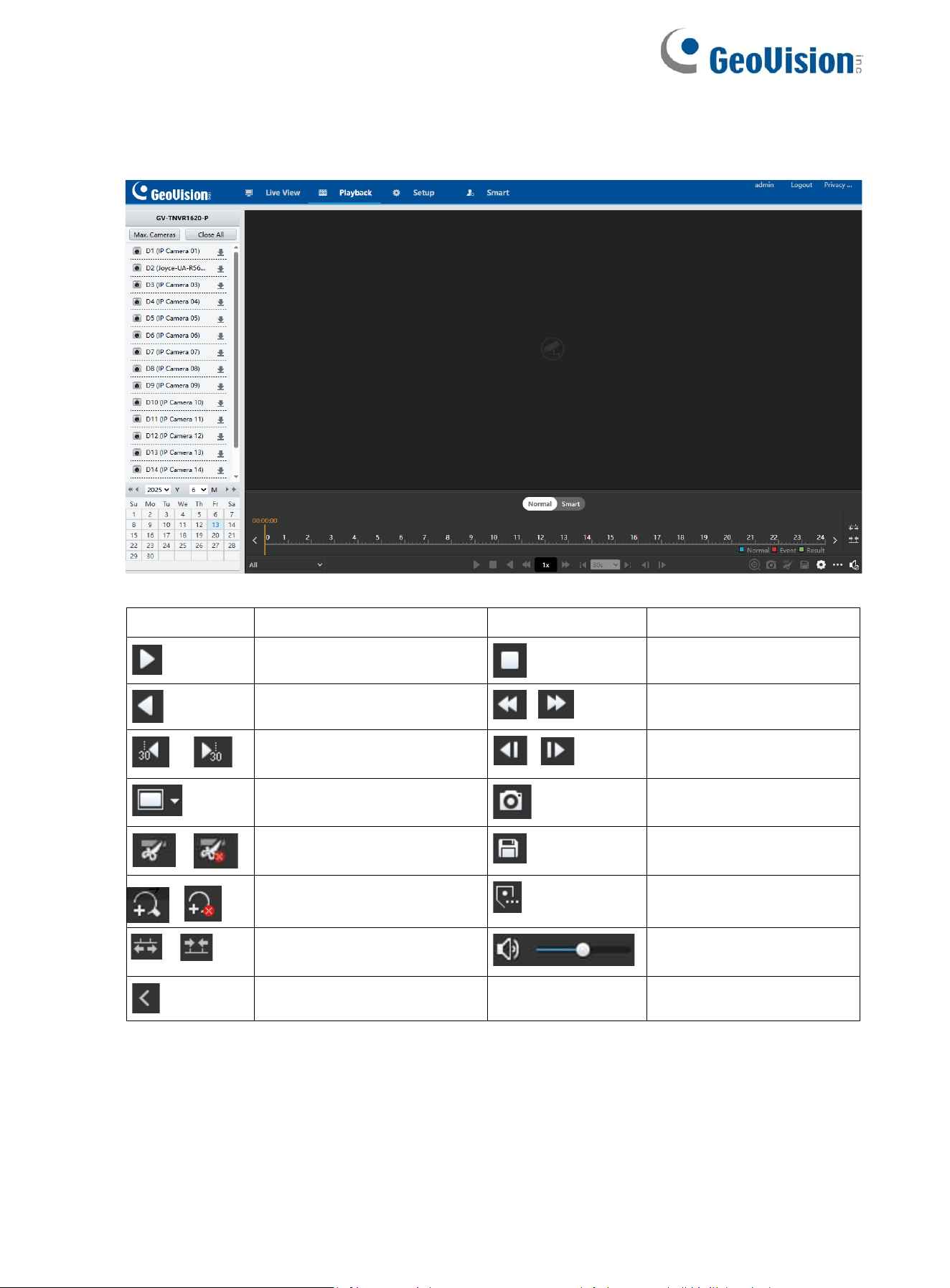
197
14.4 Playback
Click Playback to go to the Playback page. You can select the playback type, clarity, and camera to view recorded
videos.
Table 14-2: Playback Control Buttons
Button
Description
Button
Description
/
Play/pause
Stop
Reverse
/
Slow down/speed up
/
Rewind/forward 30s. You can
change the time as needed.
/
Rewind/forward by frame
Set the display ratio, including full
or original
Take a snapshot
/
Start/stop clipping video
Save video clip
/
Enable/disable digital zoom
Add a custom tag
/
Zoom in/out on the timeline
Adjust sound volume; turn on/
off sound
/
Previous/next period
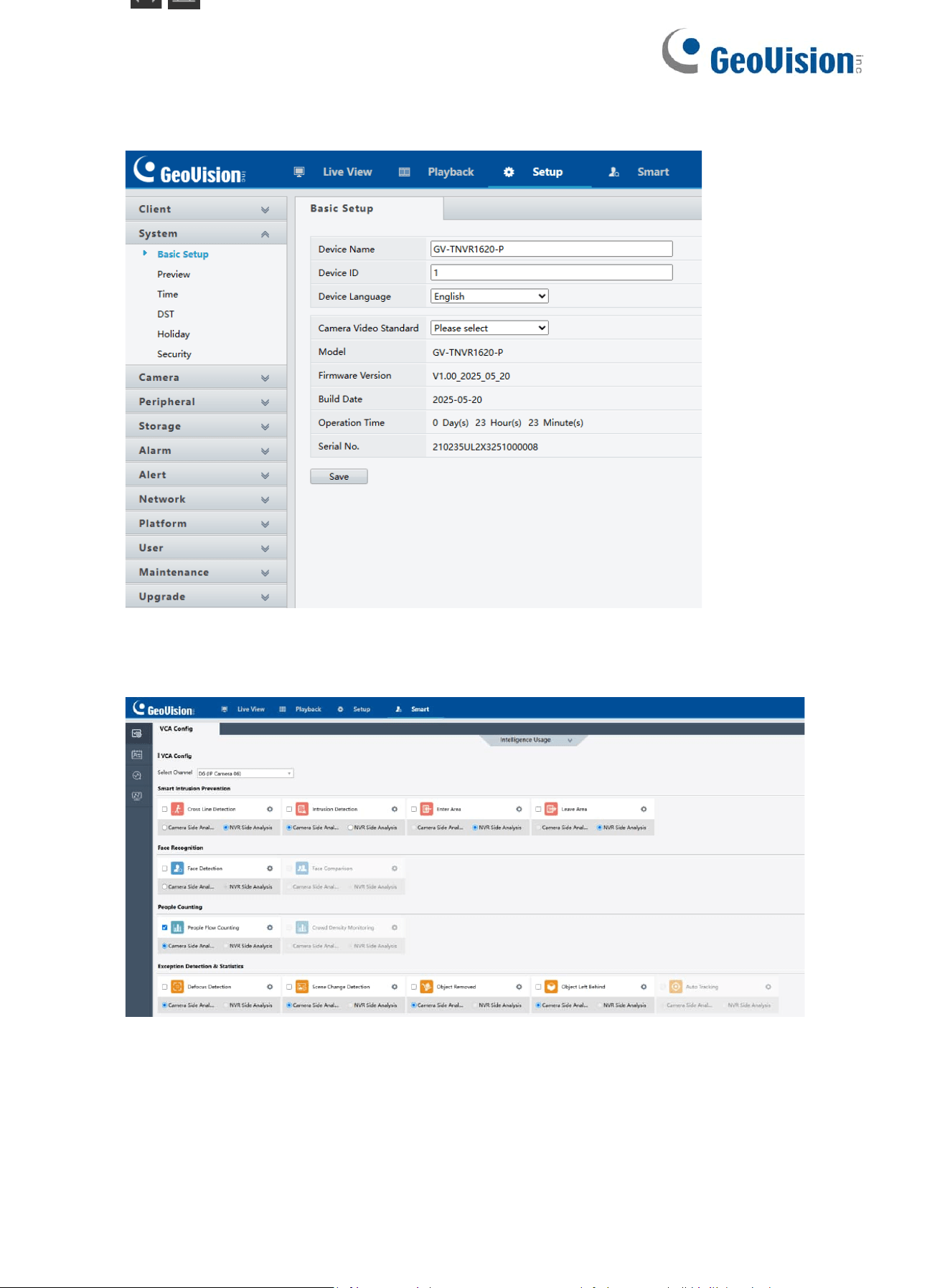
198
14.5 Configuration
Click Setup on the top, and set the relevant parameters.
14.6 Smart
Click Smart on the top, and configure the relevant parameters. See VCA Configuration for details.
199
15 Appendix FAQ
Problem
Possible Cause and Solution
Forgot the login password.
Click Forgot Password on the login page as admin, then follow the on-screen
instructions to retrieve password.
Cannot load the Web plugin.
• Close your web browsers when the installation starts.
• Disable the firewall and close the anti-virus program on your PC.
• Enable your Internet Explorer (IE) to check for newer versions of the
stored pages every time you visit the webpage (Tools > Internet Options >
General > Settings).
• Add your NVR's IP address to the trusted sites in your IE (Tools > Internet
Options > Security).
• Add your NVR's IP address to the Compatibility View list in your IE (Tools >
Compatibility View Settings).
• Clear your IE's cache.
No images are displayed in live
view on the Web interface.
Check if the bit rate is 0Mbps in the live view window.
• If yes, check if the firewall/anti-virus program is disabled on your PC.
• If not, check if the graphics card driver on your PC is working properly. Try
installing the driver again.
A camera is offline, and No Link
is displayed.
Click Menu > Maintenance > System Info > Camera. The cause is displayed
under Status. Common causes include disconnected network, incorrect
username or password, weak password, and insufficient bandwidth.
• Check network connection and other configuration.
• If it indicates incorrect username or password, check that the camera
password set in the NVR is the one used to access the camera's Web
interface.
• If it indicates denied access for weak password, log in to the camera's
Web interface and set a strong password.
• If it indicates insufficient bandwidth, delete other online IP devices on the
NVR.
The NVR displays live video for
some cameras and No Resource
for others.
•
Click to Encoding Settings, set the camera to encode the sub stream
and decrease its resolution to D1.
•
Set the NVR to use the sub stream first for live view.
A camera goes online and
offline repeatedly.
• Check if network connection is stable.
• Upgrade the software version of the camera and NVR. Contact your dealer
for the latest versions.
Live view is normal, but the
recording cannot be found.
• Check if a recording schedule is properly configured.
• Check if the time and time zone configured in the NVR are correct.
• Check if the hard disk storing the recording is damaged.
• Check if the desired recording has been overwritten.
200
Motion detection is not
effective.
• Check that motion detection is enabled, and the motion detection area is
properly configured.
• Check that detection sensitivity is properly set.
• Check that the arming schedule is properly configured.
A hard disk cannot be identified
by the NVR.
• Use the power adapter delivered with the NVR.
• Disconnect the power supply of the NVR, and then mount the hard disk
again.
• Try another disk slot.
• The disk is not compatible with your NVR. Contact your dealer for a list of
compatible disk models.
The mouse does not work.
• Use the mouse delivered with your NVR.
• Make sure no cable is extended.