THANK YOU
USE AND CARE GUIDE
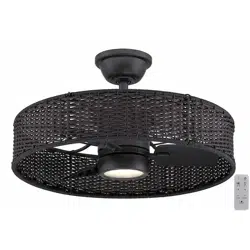
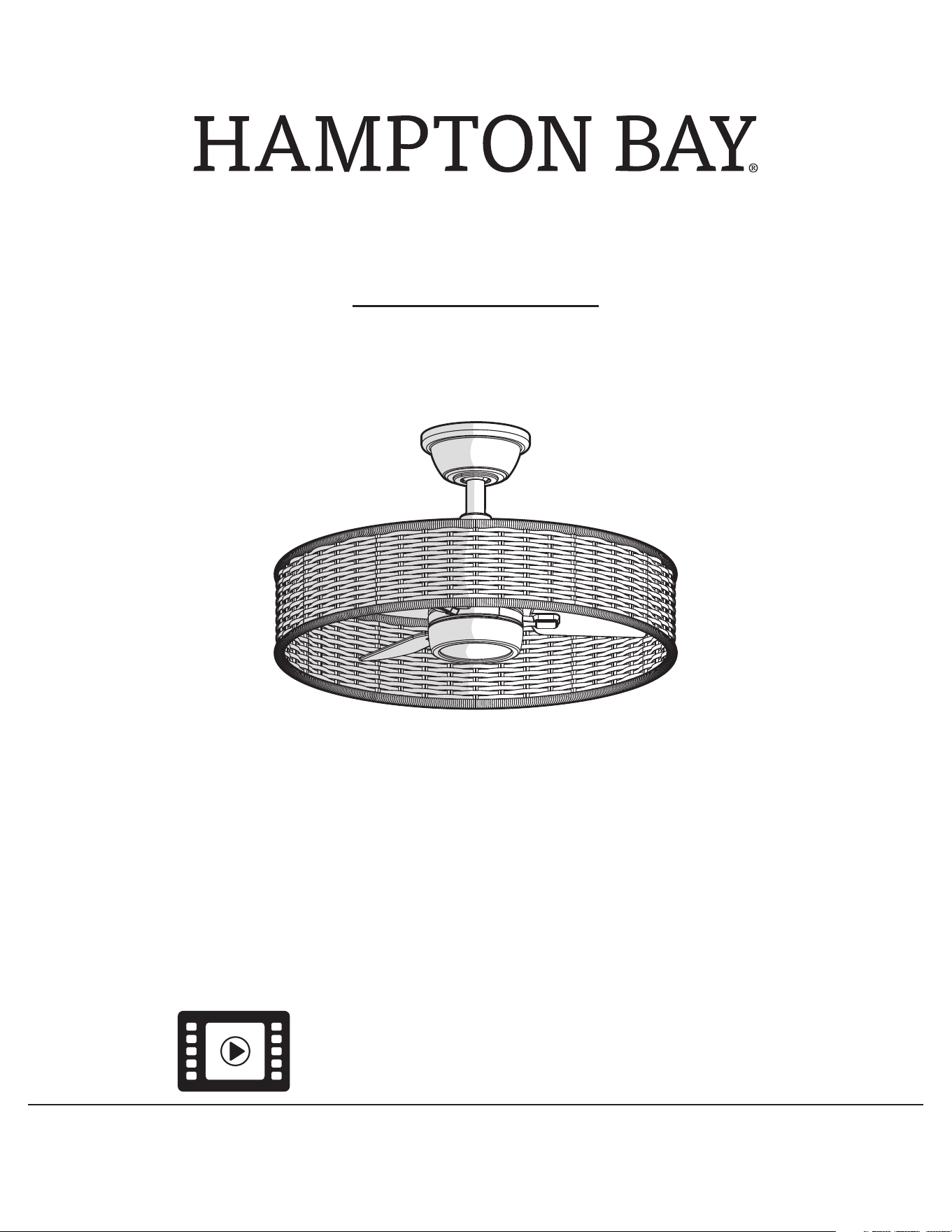
24 IN. DARYA
INDOOR/COVERED OUTDOOR CEILING FAN
We appreciate the trust and condence you have placed in Hampton Bay through the purchase of this ceiling fan. We strive to
continually create quality products designed to enhance your home. Visit us online to see our full line of products available for
your home improvement needs. Thank you for choosing Hampton Bay!
1-855-HD-HAMPTON
HAMPTONBAY.COM
Questions, problems, missing parts? Before returning to the store,
8 a.m. - 7 p.m., EST, Monday-Friday, 9 a.m. - 6 p.m., EST Saturday
call Hampton Bay Customer Service
Visual instruction of how to install this fan:
Visit www.homedepot.com and enter either the Item or Model number to nd
this fan and click the link of visual instruction in the product overview section.
Item #1008 772 709
1008 771 327
1008 772 677
Model #RD5106-BN
RD5106-MBK+BR
RD5106-MBK+GR
Table of Contents ..................................
Safety Information .................................
Warranty .........................................
Pre-installation ....................................
Installation .......................................
Assembly ........................................
Operation ........................................
Care and Cleaning .................................
Troubleshooting ...................................
2
Table of Contents
2
2
3
3
6
7
14
18
18
READ AND SAVE THESE INSTRUCTIONS
Safety Information
NOTE: Suitable for use in DAMP locations.
To reduce the risk of electric shock, ensure electricity has been
turned off at the circuit breaker or fuse box before beginning.
All wiring must be in accordance with the National Electrical
Code “ANSI/NFPA 70” and local electrical codes. Electrical
installation should be performed by a qualied licensed
electrician.
The outlet box and support structure must be securely mounted
and capable of reliably supporting a minimum of 35 lb (15.9 kg)
or less. Use only UL Listed outlet boxes marked “FOR FAN
SUPPORT.”
The fan must be mounted with a minimum of 7 ft (2.1 m)
clearance from the trailing edge of the blades to the oor.
Avoid placing objects in the path of the blades.
To avoid personal injury or damage to the fan and other items,
be cautious when working around or cleaning the fan.
Do not use water or detergents when cleaning the fan or fan
blades. A dry dust cloth or lightly dampened cloth will be
suitable for most cleaning.
After making electrical connections, spliced conductors should
be turned upward and pushed carefully up into the outlet box.
The wires should be spread apart with the grounded conductor
and the equipment-grounding conductor on one side of the
outlet box and ungrounded conductor on the other side of the
outlet box.
All set screws must be checked and retightened where
necessary before installation.
Suitable for use with solid-state speed control (UC7312RE only).
1.
2.
3.
4.
5.
6.
7.
8.
9.
10.
The following responsible party designated in FCC §2.909 is
responsible for this declaration:
Model Number: RD5106-BN, RD5106-MBK+BR, RD5106-MBK+GR
Company Name: TAL INTERNATIONAL CORPORATION
Company Address: 2919 E. Philadelphia St., Ontario, CA 91761, U.S.A.
Telephone Number: (909) 923-2888 Fax: (909) 923-8337
WARNING: To reduce the risk of personal injury, do not bend
the blade arms (also referred to as anges), when installing
the brackets, balancing the blades or cleaning the fan.
WARNING: Do not insert foreign objects between rotating
fan blades.
WARNING: To reduce the risk of re, electric shock or
personal injury, mount the fan to an outlet box marked
acceptable for fan support with the screws provided with the
outlet box.
CAUTION: To reduce the risk of personal injury, use only
the screws provided with the outlet box.
WARNING: To reduce the risk of electric shock, this fan
must be installed with an isolating wall control/switch.
Pre-Installation
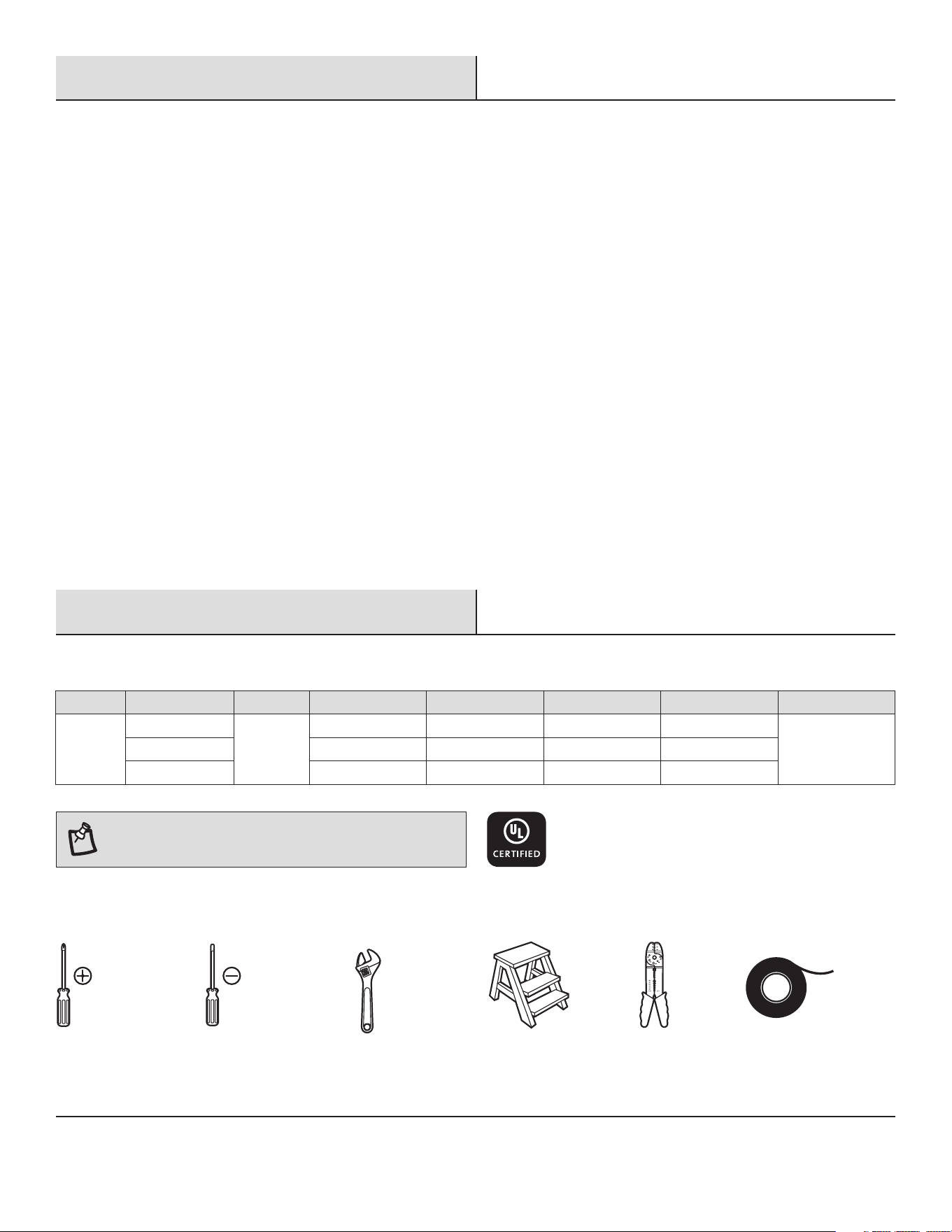
SPECIFICATIONS
TOOLS REQUIRED
Warranty
Phillips
screwdriver
Flat blade
screwdriver
Step
ladder
Wire
stripper
Electrical
tape
Adjustable
wrench
NOTE: These are approximate measures. They do not
include amps and wattage used by the light kit.
3
24 in.
Low
Medium
High
120
Fan size Watts RPM CFMSpeed Volts Amps N.W.
0.23
0.27
0.32
15
24
36.05
282
407
519
1151
1595
1967
7.1 kg
(15.62 lb)
The manufacturer warrants the fan motor to be free from defects in workmanship and material present at time of shipment from the
factory for a period of lifetime after the date of purchase by the original purchaser. The manufacturer warrants the light kit (excluding any
glass), to be free from defects in workmanship and material at the time of shipment from the factory for a period of three years after the
date of purchase by the original purchaser. The manufacturer also warrants that all other fan parts, excluding any glass or acrylic blades,
to be free from defects in workmanship and material at the time of shipment from the factory for a period of one year after the date of
purchase by the original purchaser. We agree to correct such defects without charge or at our option replace with a comparable or
superior model if the product is returned. To obtain warranty service, you must present a copy of the receipt as proof of purchase. All
costs of removing and reinstalling the product are your responsibility. Damage to any part such as by accident, misuse, improper
installation or by afxing any accessories, is not covered by this warranty. Because of varying climatic conditions this warranty does not
cover any changes in brass nish, including rusting, pitting, corroding, tarnishing or peeling. Brass nishes of this type give the longest
useful life when protected from varying weather conditions. A certain amount of “wobble” is normal and should not be considered a
defect. Servicing performed by unauthorized persons shall render the warranty invalid. There is no other express warranty. We hereby
disclaim any and all warranties, including but not limited to those of merchantability and tness for a particular purpose to the extent
permitted by law. The duration of any implied warranty which cannot be disclaimed is limited to the time period as specied in the
express warranty. Some states do not allow limitation on how long an implied warranty lasts, so the above limitation may not apply to
you. The retailer shall not be liable for incidental, consequential, or special damages arising out of or in connection with product use or
performance except as may otherwise be accorded by law. Some states do not allow the exclusion of incidental or consequential
damages, so the above exclusion or limitation may not apply to you. This warranty gives specic legal rights, and you may also have other
rights which vary from state to state. This warranty supersedes all prior warranties. Shipping costs for any return of product as part of a
claim on the warranty must be paid by the customer.
Contact the Customer Service Team at 1-855-HD-HAMPTON or visit www.hamptonbay.com.
HAMPTONBAY.COM
Please contact 1-855-HD-HAMPTON for further assistance.
4
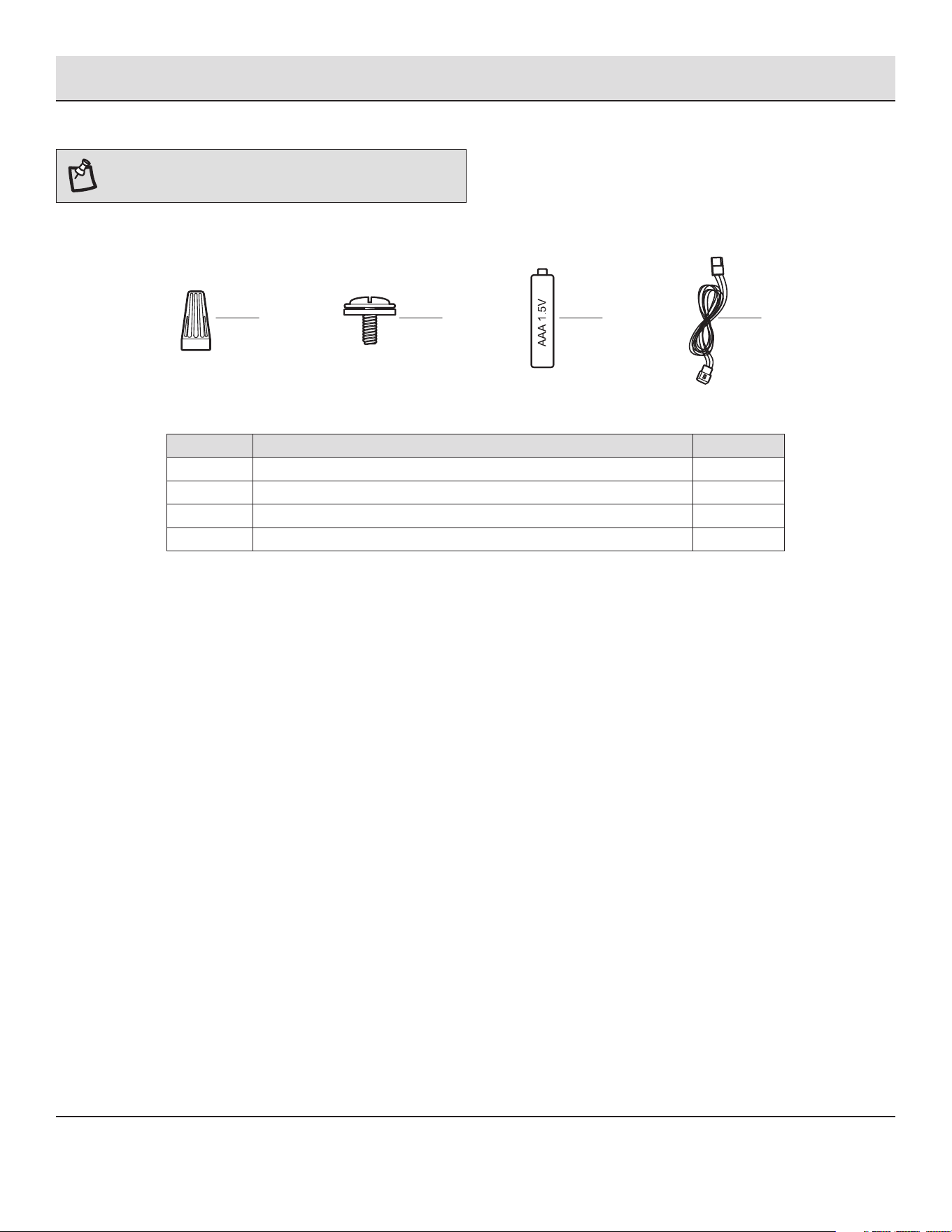
NOTE: Hardware not shown to actual size.
AA
BB
CC
DD
Plastic wire nut
Blade attachment screw and ber washer
1.5V AAA battery
Extension cord
Part Description
3
10
2
1
Quantity
HARDWARE INCLUDED
Pre-Installation (continued)
AA BB CC DD
5
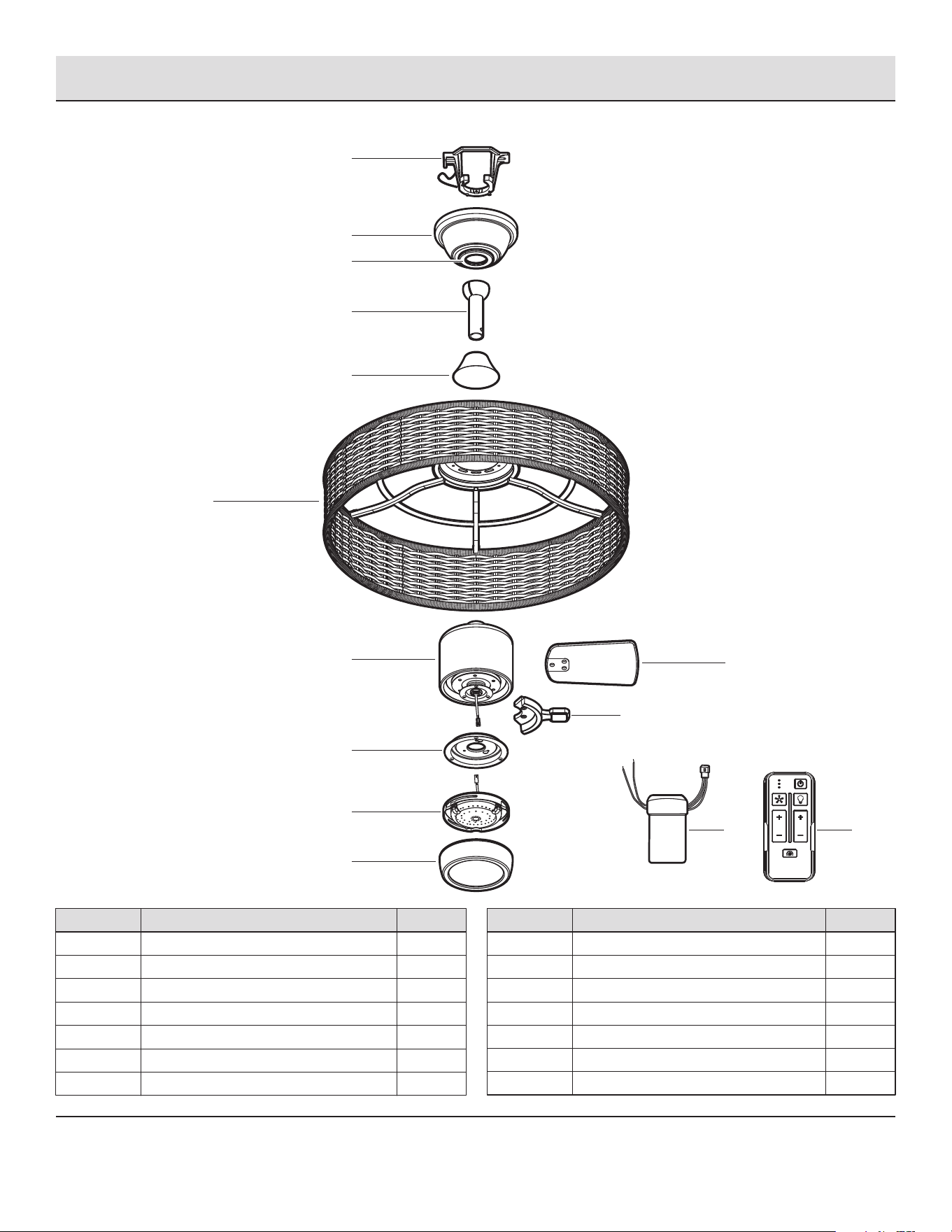
Part
H
I
J
K
L
M
N
Description
Blade
Blade arm
Light kit mounting plate
20 watt LED light kit
Glass shade
Receiver
Remote control
Quantity
3
3
1
1
1
1
1
Part
A
B
C
D
E
F
G
Quantity
1
1
1
1
1
1
1
Description
Mounting bracket (preassembled)
Canopy
Canopy bottom cover (preassembled)
Hanger ball/downrod assembly
Coupling cover
Motor housing
Fan motor assembly
PACKAGE CONTENTS
Pre-Installation (continued)
HAMPTONBAY.COM
Please contact 1-855-HD-HAMPTON for further assistance.
C
A
B
D
E
F
G
H
I
M N
J
K
L
3 SPEED
BRIGHTNESS
COLOR TEMP.
ON / OFF ON / OFF
ALL
6
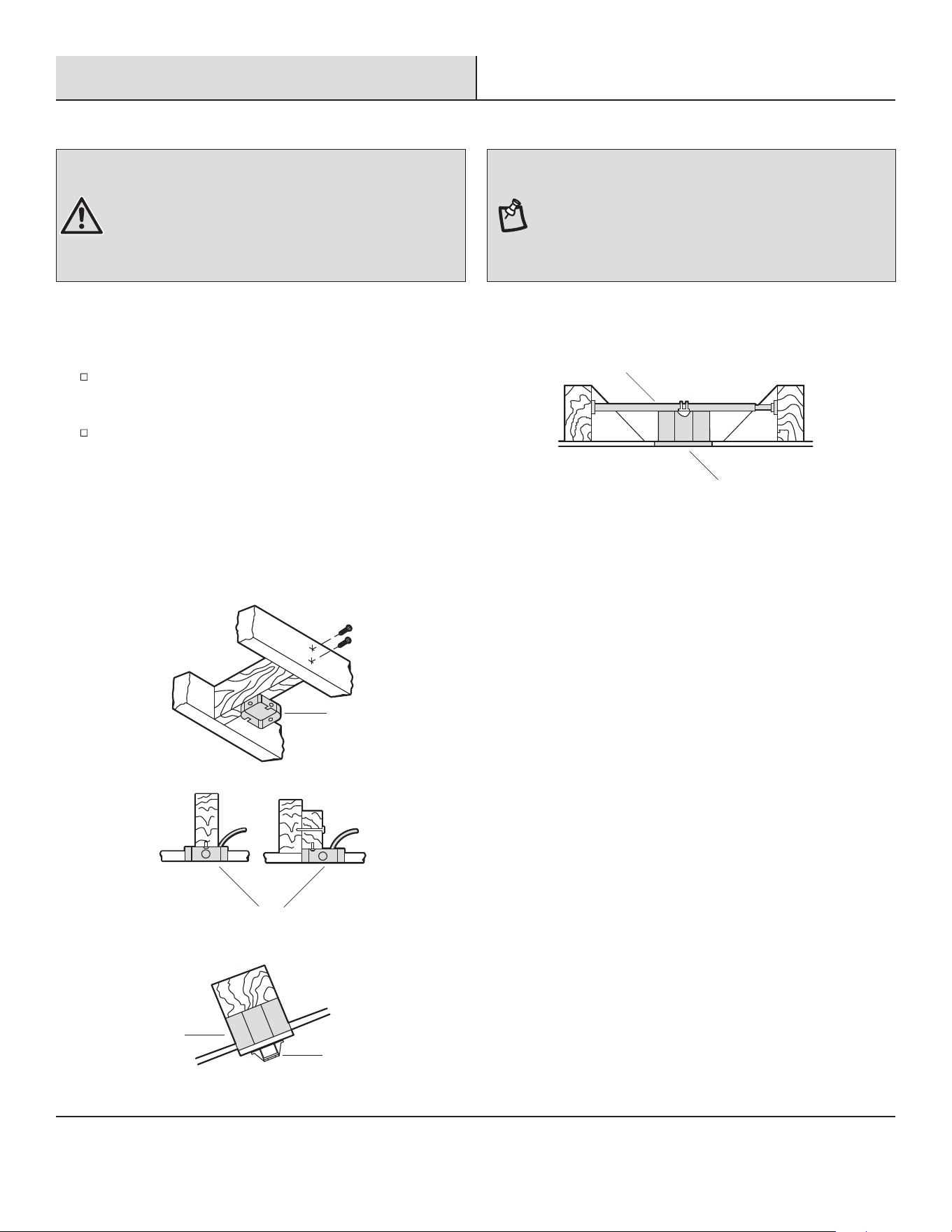
If your ceiling fan does not have an existing UL Listed mounting
box, then install one using the following instructions:
Disconnect the power by removing the fuses or turning off
the circuit breakers.
Secure the outlet box (not included) directly to the building
structure. Use appropriate fasteners and materials (not
included). The outlet box and its bracing must be able to fully
support the weight of the moving fan (at least 35 lb). Do not
use a plastic outlet box.
The illustrations below show three different ways to mount the
outlet box (not included).
To hang your fan where there is an existing xture but no ceiling
joist, you may need an installation hanger bar (not included) as
shown above.
Outlet Box
Outlet Box
Hanger Bar
Outlet Box
Recessed
Outlet
Box
A
WARNING: To reduce the risk of re, electric shock, or
personal injury, mount the fan to an outlet box marked
acceptable for fan support using the screws provided with the
outlet box. An outlet box commonly used for the support of
lighting xtures may not be acceptable for fan support and
may need to be replaced. If in doubt, consult a qualied
electrician.
MOUNTING OPTIONS
Installation
NOTE: You may need a longer downrod to maintain proper
blade clearance when installing on a steep, sloped ceiling.
The maximum angle allowable is 18° away from horizontal. If
the canopy (B) touches the hanger ball/downrod assembly (D),
remove the decorative canopy bottom cover (C) and turn the
canopy (B) 180° before attaching the canopy (B) to the mounting
bracket (A).
7
Assembly
G
EE
F
1
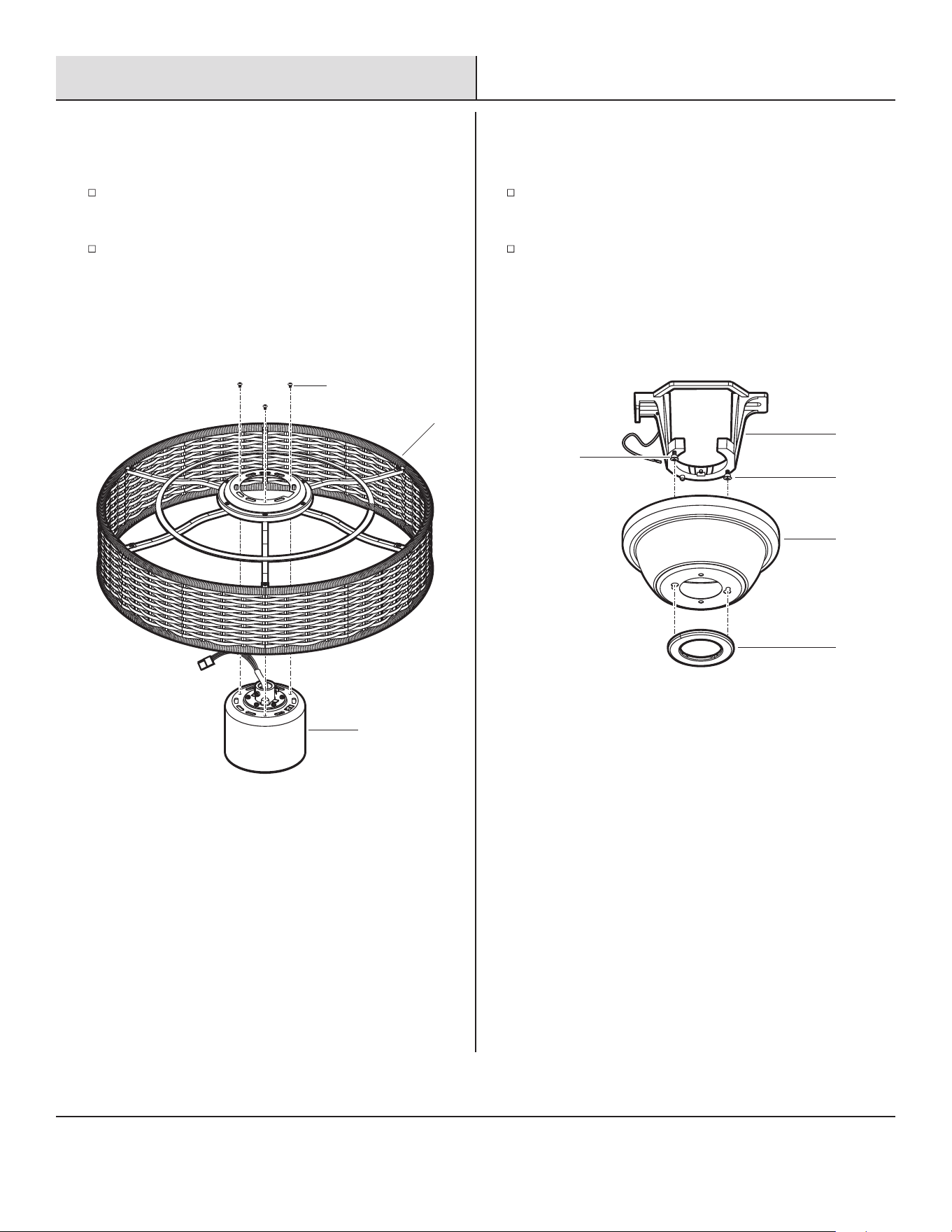
Attaching the motor housing to the
motor
Remove the three motor housing mounting screws (EE) from
top of the motor housing (F) and keep these screws.
Align the mounting holes in the motor housing (F) with the
holes in the top of the fan motor assembly (G). Fasten using
the three motor housing mounting screws (EE) previously
removed. Be sure to tighten all screws.
HAMPTONBAY.COM
Please contact 1-855-HD-HAMPTON for further assistance.
2
Preparing the canopy
FF
A
B
C
FF
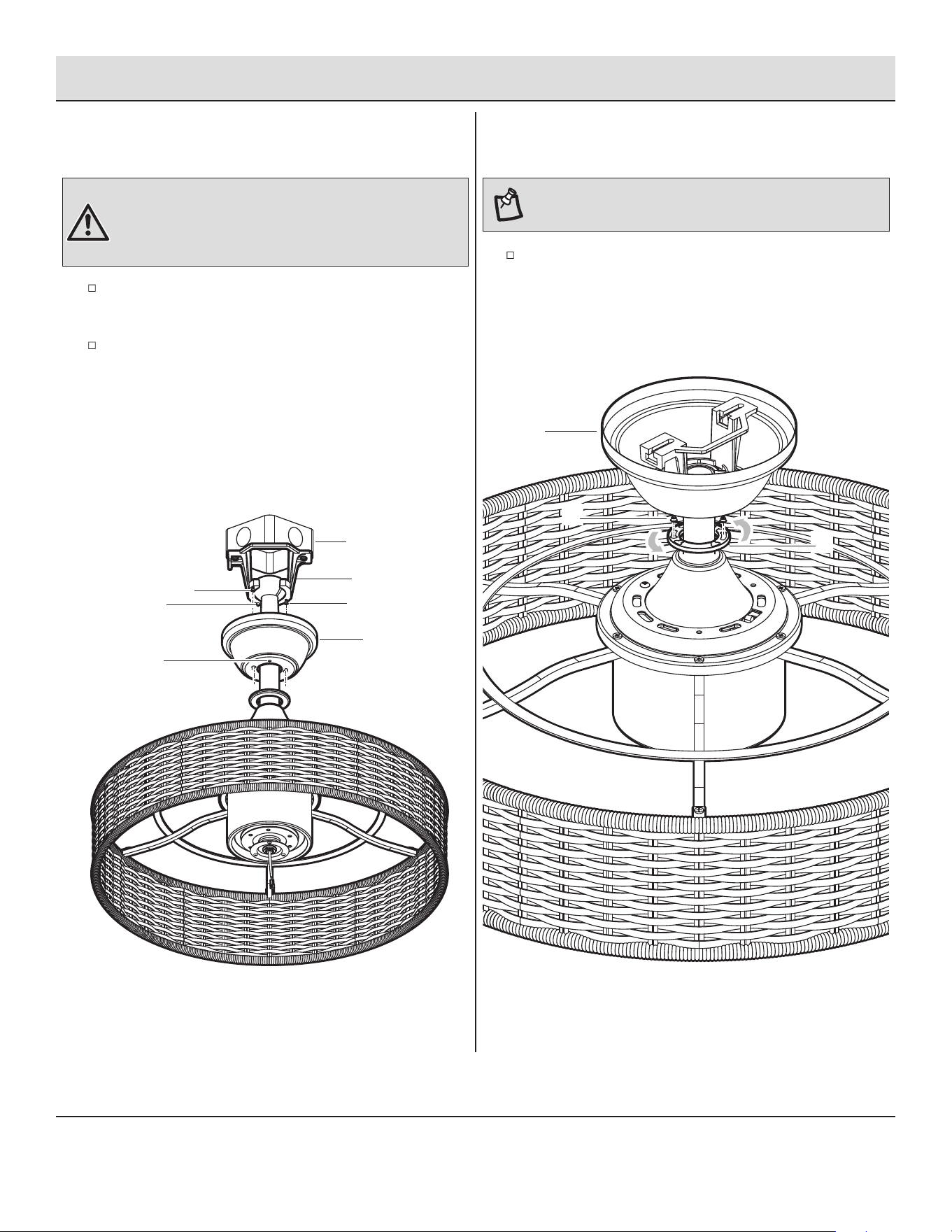
Remove the canopy bottom cover (C) from the canopy (B) by
turning the canopy bottom cover (C) counterclockwise.
Remove the mounting bracket (A) from the canopy (B) by
loosening canopy mounting screws (FF) a half turn from the
screw head. Next, turn the canopy (B) counterclockwise to
remove the mounting bracket (A) from the canopy (B).
Assembly (continued)
Preparing the motor
3
F
G
HH
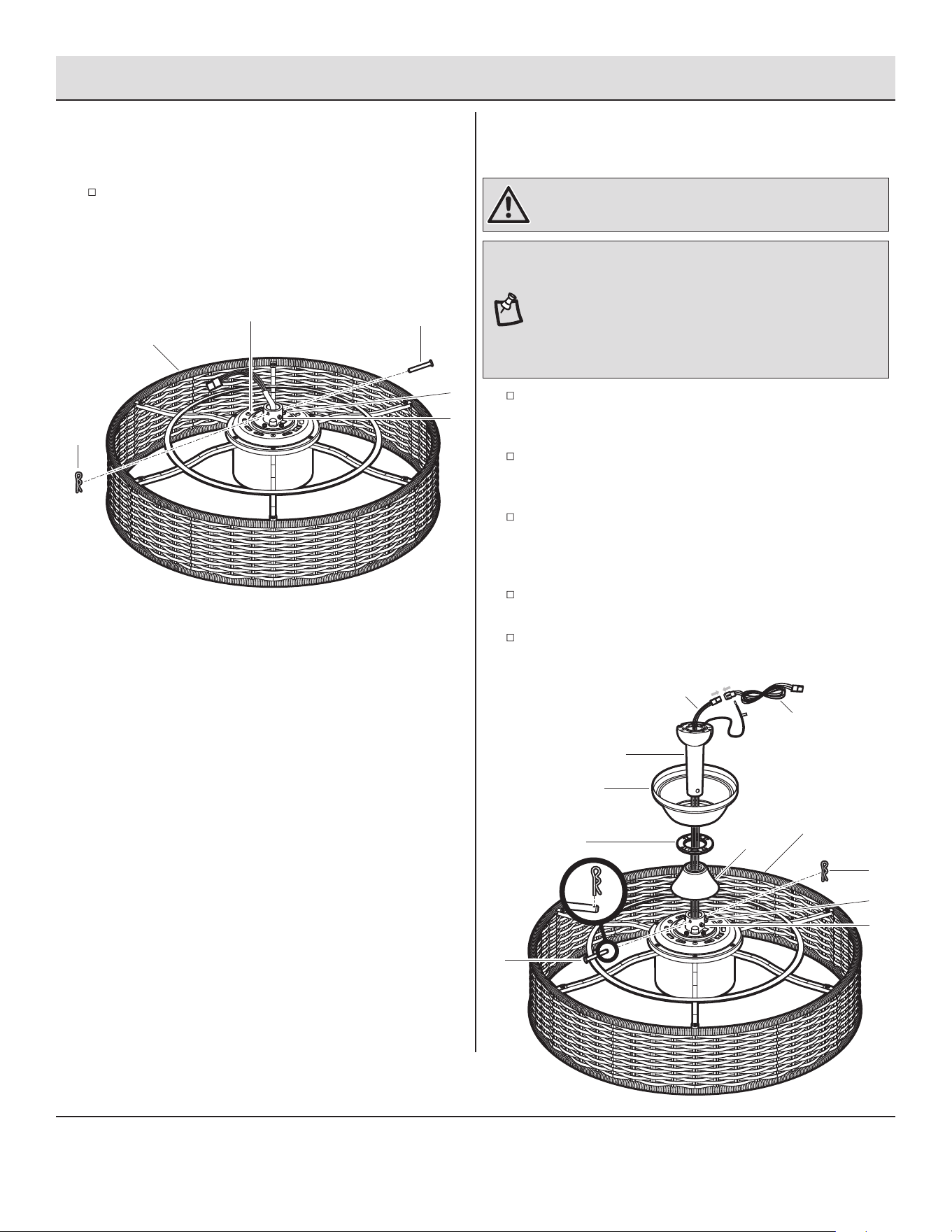
Remove the cotter pin (GG) and clevis pin (HH), and loosen
the two collar set screws (II) from the fan motor assembly (G)
collar.
GG
II
II
II
G
II
8
Assembling the fan
4
WARNING: Failure to properly install the cotter pin (GG) could
result in the fan loosening and possibly falling.
NOTE: If a longer downrod is needed (not included), take out
the screw located in the hanger ball, lower the hanger ball and
remove the pin. Remove all three pieces from the downrod, and
assemble them onto the new longer downrod before proceeding
to the downrod installation. Be sure to snap together the 3-pin
connectors, the male plug (JJ) from the fan and female plug
from the extension cord (DD).
Route the wires through the coupling cover (E), the canopy
bottom cover (C) and the canopy (B) and then through the
hanger ball/downrod assembly (D).
Align the holes at the bottom of the hanger ball/downrod
assembly (D) with the holes in the collar on top of the fan
motor assembly (G).
Carefully insert the clevis pin (HH) through the holes in the
collar and the hanger ball/downrod assembly (D). Be careful
not to jam the clevis pin (HH) against the wiring inside the
hanger ball/downrod assembly (D).
Insert the cotter pin (GG) through the hole near the end of
the clevis pin (HH) until it snaps into the locked position.
Firmly tighten the two collar set screws (II) on top of the fan
motor assembly (G).
C
B
GG
D
DD
JJ
E
HH
Assembly — Hanging the Fan
5
Attaching the mounting bracket to the
electrical box
Hanging the fan on the mounting
bracket
6
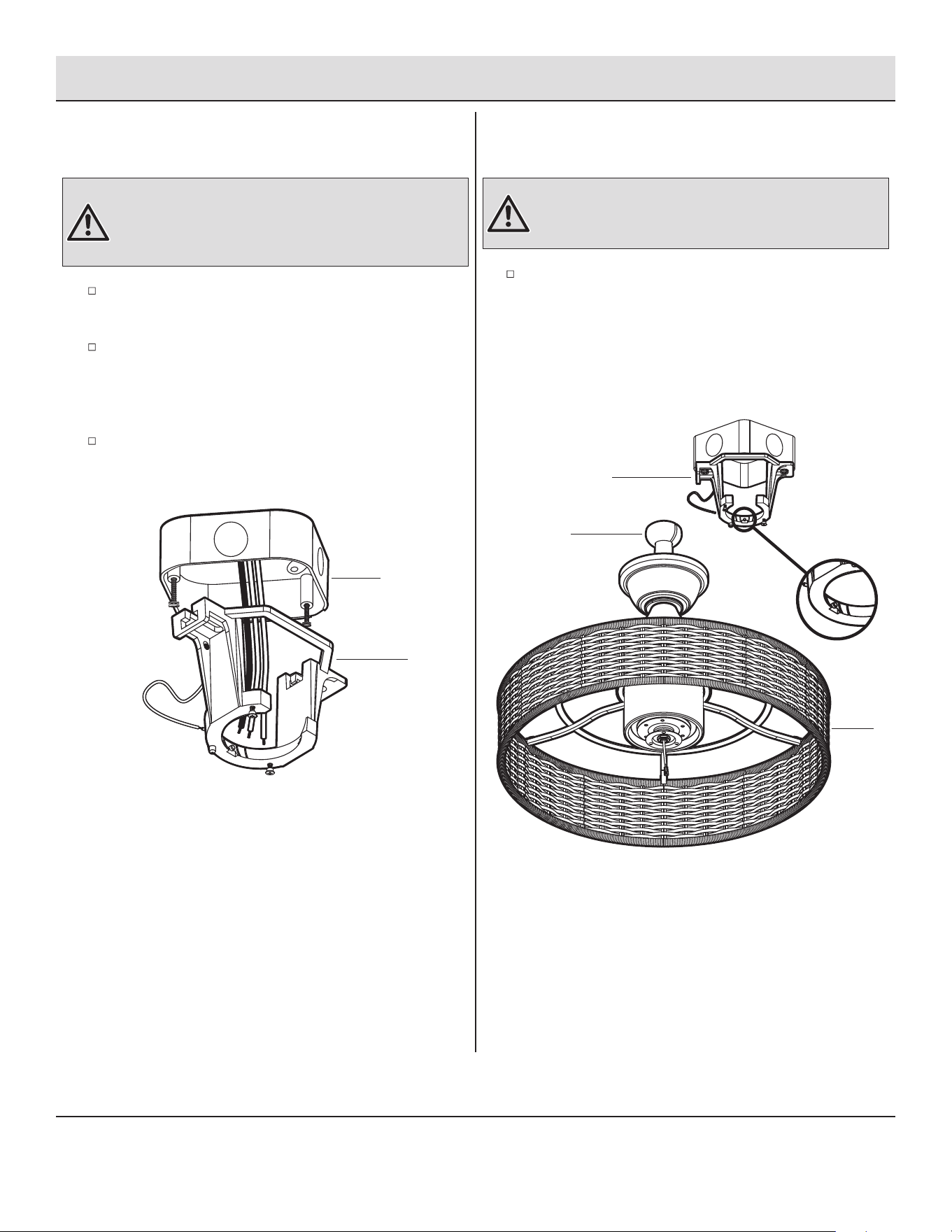
Carefully lift the fan motor assembly (G) up to the mounting
bracket (A) and seat the hanger ball/downrod assembly (D)
in the mounting bracket (A) socket. Make sure the tab on the
mounting bracket (A) socket is properly seated in the groove
in the hanger ball/downrod assembly (D). This will help to
balance the ceiling fan.
WARNING: To reduce the risk of re, electric shock or other
personal injury, mount the fan only to an outlet box or supporting
system marked acceptable for fan support and use the mounting
screws provided with the outlet box.
WARNING: The tab in the ring must rest in the groove of
the hanger ball/downrod assembly (D). Failure to properly
seat the tab in the groove could cause damage to the wiring.
Pass the 120-volt supply wires through the center hole in
the mounting bracket (A).
Attach the mounting bracket (A) on the outlet box by sliding
the mounting bracket (A) over the screws provided with the
outlet box. Note that the at side of the mounting bracket
(A) is toward the outlet box.
Securely tighten the two mounting screws.
D
G
A
9 HAMPTONBAY.COM
Please contact 1-855-HD-HAMPTON for further assistance.
Outlet Box
A
Assembly — Hanging the Fan (continued)
10
3-pin connector
AA
A
Green
Black
Ground
conductorWhite
Outlet Box
M
D
White
Black
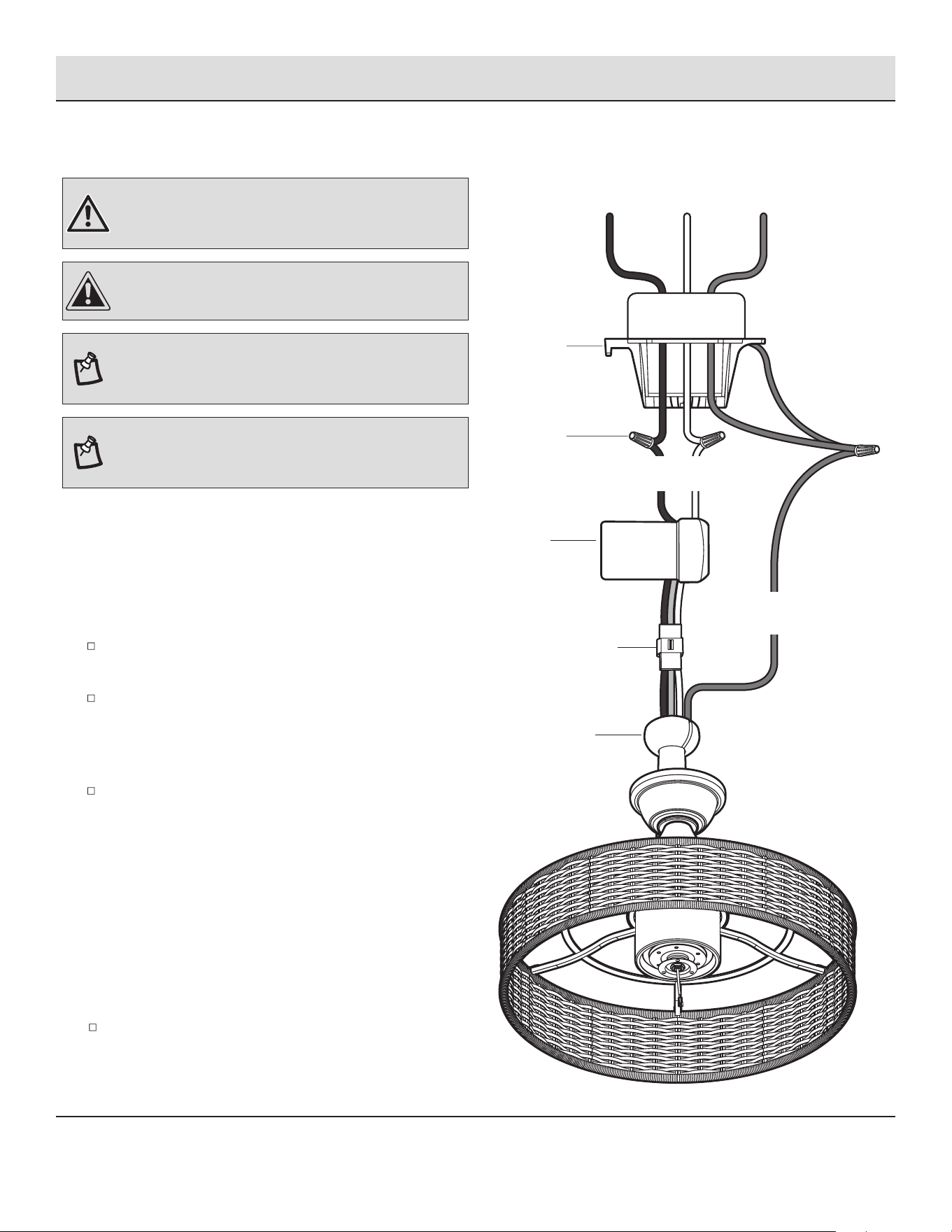
7
Making the electrical connections
WARNING: Check to see that all connections are tight,
including ground, and that no bare wire is visible at the wire
nuts, except for the ground wire.
NOTE: The fan must be installed at a maximum distance of
20 ft. from the remote control for proper signal transmission
between the remote control and the fan's receiving unit.
NOTE: If a longer downrod (not included) is needed, use the
extension cord (DD) to connect with the motor wires and
receiver.
CAUTION: Do not use with a wall light dimmer switch.
If you feel you do not have enough electrical wiring knowledge
or experience, have your fan installed by a licensed electrician.
Follow the steps below to connect the fan to your household
wiring. Use the plastic wire nuts (AA) with your fan. Secure the
plastic wire nuts (AA) with electrical tape. Make sure there are
no loose strands or connections.
Insert the receiver (M) into the mounting bracket (A) with
the at side of the receiver (M) facing the ceiling.
Make wire connections from the fan to the receiver (M).
From fan To receiver
3-pin connector--------------- 3-pin connector
Make wire connections from the receiver (M) and fan to the
outlet box as follows, using the wire nuts (AA).
From receiver To outlet box
Black wire "AC in L" --------- Black wire (Hot)
White wire "AC in N" --------- White wire (Neutral)
From fan To outlet box
Green wires* ----------------- Green or bare wire (Ground)
* There are two green grounding leads: one from the mounting
bracket (A) and one from the hanger ball/downrod assembly (D).
Turn the wire nut connections upward, spreading them
apart so the green (ground) and white wires will be on one
side of the outlet box and the black wire will be on the other
side. Carefully tuck the connections up into the outlet box.
11 HAMPTONBAY.COM
Please contact 1-855-HD-HAMPTON for further assistance.
Outlet Box
FF
A
FF
Assembly — Hanging the Fan (continued)
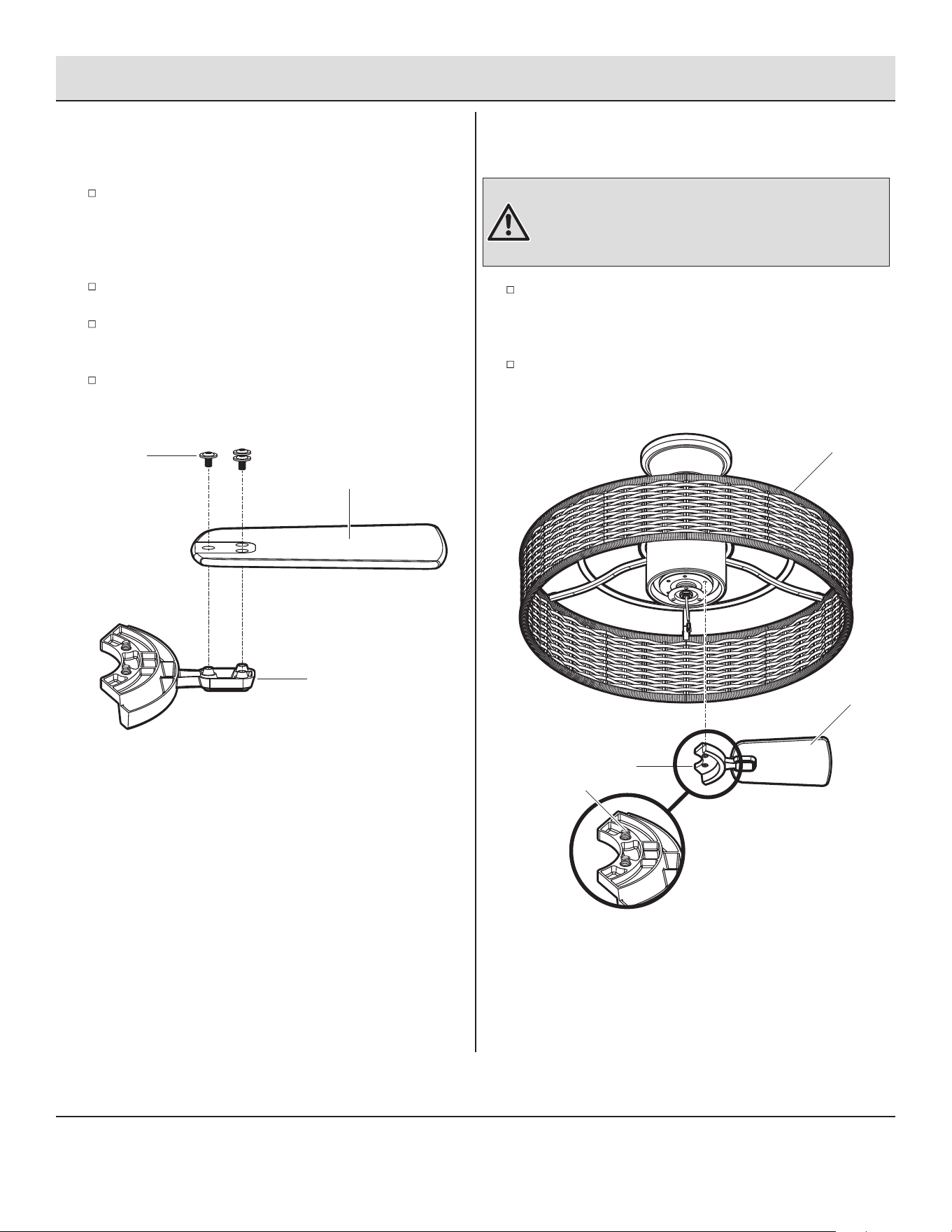
8
Installing the canopy
WARNING: Make sure the tab on the mounting bracket (A)
properly sits in the groove in the hanger ball (D) before attaching
the canopy (B) to the mounting bracket (A) by turning the canopy
housing until it drops into place.
Make sure connections are neatly tucked into the ceiling
outlet box.
Slide the canopy (B) up to the mounting bracket (A) and
place the key holes on the canopy (B) over the loose canopy
mounting screws (FF) on the mounting bracket (A). Turn the
canopy (B) clockwise until it locks in place at the narrow
section of the key holes. Make sure the positioning pin (KK)
on the mounting bracket falls into one of two holes (LL) on
the canopy, and then tighten the two canopy mounting
screws (FF).
Attach the canopy bottom cover (C) to the canopy (B) by
inserting the screw heads into the key slots in the canopy
bottom cover (C) and rotating it clockwise.
NOTE: Adjust the canopy mounting screws (FF) as necessary
until the canopy (B) and canopy bottom cover (C) are snug.
B
Attaching the canopy bottom cover
9
B
FF
C
KK
LL
12
BB
I
G
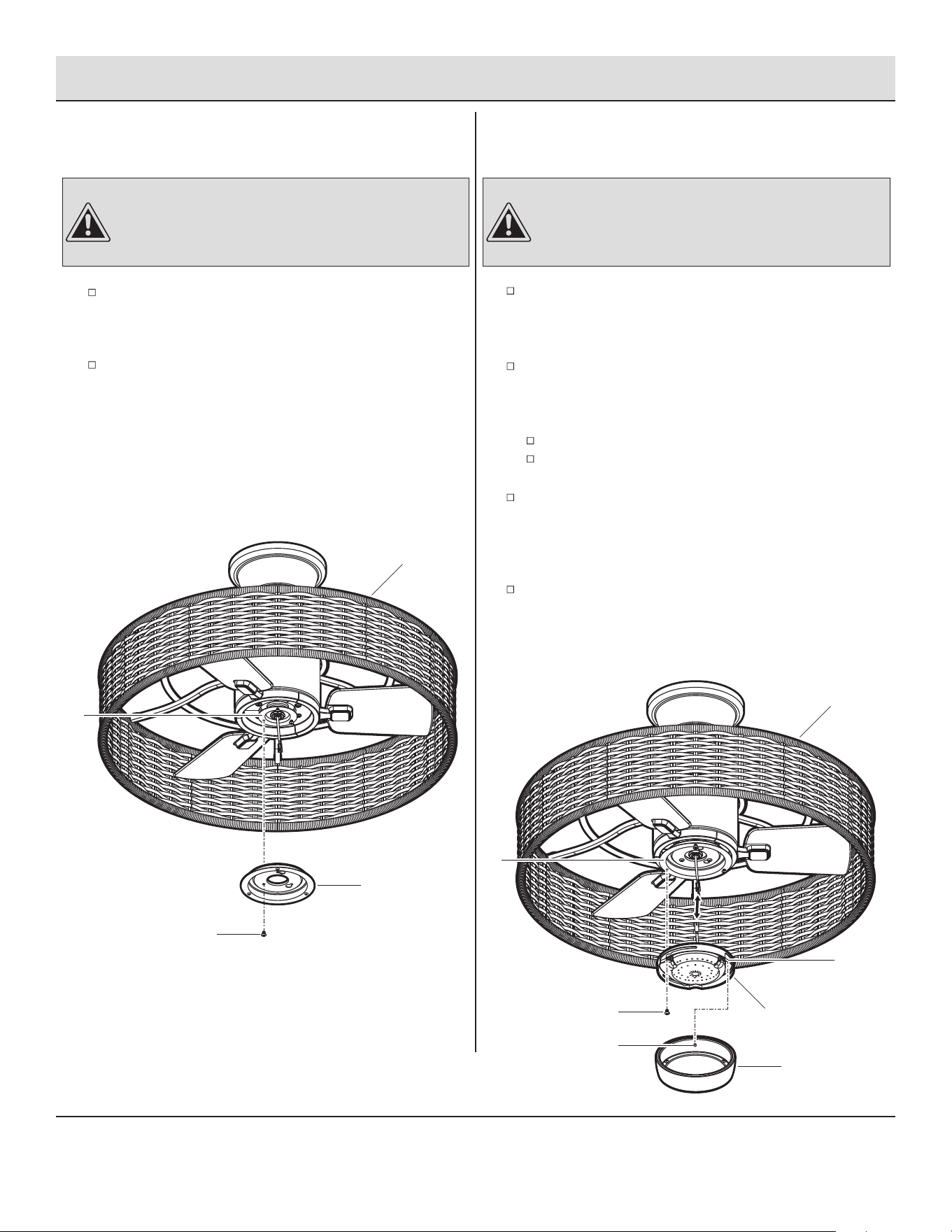
Assembly — Attaching the Fan Blades
Attaching the blades to the blade
arms
Attach the blades (H) to the blade arms (I) using the three
blade attachment screws and ber washers (BB). Insert a
blade attachment screw and ber washer (BB) into the blade
arm (I), but do not tighten.
Repeat for the two remaining screws and ber washers (BB).
Tighten each screw securely starting with the center screw.
Make sure the blade (H) is straight.
Repeat these steps for the remaining blades.
Fastening the blade assemblies to
the motor
Fasten the blade assemblies to the fan motor assembly (G),
tighten the two blade arm screws with lock washers (MM)
already installed in the blade arms (I).
Repeat this procedure for the remaining blade arms (I).
WARNING: To reduce the risk of personal injury, do not bend
the blade arms (I) while installing, balancing the blades (H), or
cleaning the fan. Do not insert foreign objects between
rotating fan blades (H).
10 11
H
MM
I
H
13 HAMPTONBAY.COM
Please contact 1-855-HD-HAMPTON for further assistance.
Remove one of the two light kit mounting screws (PP) from
the light kit mounting plate (J) and loosen the other one screw
(PP). (Do not remove.)
While holding the light kit (K) under your fan motor assembly
(G), locate two single white and blue wires in the fan motor
assembly (G) labeled "FOR LIGHT". Make the polarized plug
connections:
White to white
Black to black
Carefully push all wires back into the light kit mounting plate
(J). Install the light kit (K) onto the light kit mounting plate (J)
with the two light kit mounting screws (PP) provided. Be sure
to tighten all screws.
Position the notches (QQ) on the outer edge of the light kit (K)
so they line up with the tabs (RR) in the inner of the rim of
the glass shade (L). Secure it to the fan by turning the glass
shade (L) clockwise until snug. DO NOT OVERTIGHTEN.
Assembly — Installing the Light Kit
12
Attaching the light kit mounting
plate
Attaching the LED light kit and
glass shade
13
CAUTION: Before starting the installation, disconnect the
power by turning off the circuit breaker or removing the fuse
at the fuse box. Turning power off using the fan switch is not
sufcient to prevent electric shock.
Remove one of the three light kit mounting plate screws (NN)
from the mounting ring (OO) and loosen the other two screws
(NN). (Do not remove.)
While holding the light kit mounting plate (J) under the fan
motor assembly (G), place the key holes in the light kit mounting
plate (J) over the two screws (NN) previously loosened from
the mounting ring (OO). Turn the light kit mounting plate (J)
until the light kit mounting plate (J) locks in place at the narrow
section of the key holes. Secure by tightening the two mounting
screws (NN) previously loosened and the one (NN) previously
removed.
J
G
L
PP
QQ
RR
K
G
NN
OO
CAUTION: Before starting the installation, disconnect the
power by turning off the circuit breaker or removing the fuse
at the fuse box. Turning power off using the fan switch is not
sufcient to prevent electric shock.
J
14
Operation
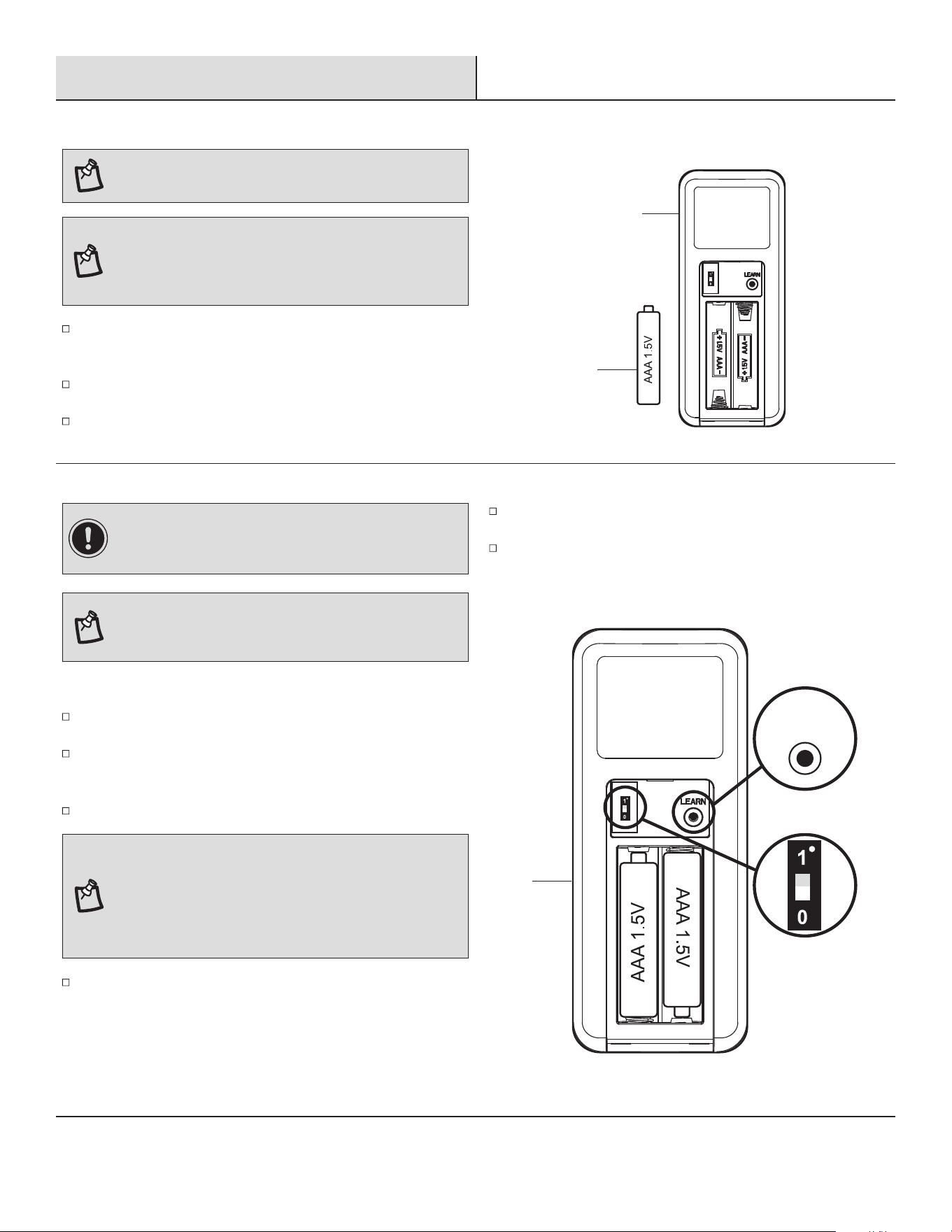
SETTING THE TRANSMITTER
NOTE: Batteries will weaken with age and should be replaced
before leaking takes place as this will damage the remote
control. Dispose of used batteries properly and keep them out
of the reach of children.
LEARNING PROCESS
CC
N
Remove the battery cover by pressing rmly on the arrow and
sliding the cover off.
Install two 1.5V AAA batteries (CC) (included).
Replace the battery cover on the remote control (N).
Ensure AC power to the fan is OFF to begin the learning process.
Slide the dip switch in the battery compartment to the "1"
position.
Turn the fan’s AC power ON.
Within 30 seconds of turning AC power on, press and release the
"LEARN" button located in the remote's battery compartment to
enter the learning function. The down light of your fan, if
applicable, will blink, and the fan blades will start to spin.
The fan will now accept commands from the added remote.
If you would like to set the dip switch back to the "0" position
after a learning, please re-pair the remote by following the
learning process again.
To add a remote to your fan’s memory, use the steps below:
NOTE: The remote has been pre-paired in the factory for your
convenience.
IMPORTANT: If you have two or more fans, please follow
steps below to control each fan independently. Also follow
steps below to re-pair the remote and the receiver when needed.
N
LEARN
NOTE: The dip switch in the battery compartment has been
set on “0” position for your convenience. If you want to
re-pair the remote, please set the dip switch on “1” position.
NOTE: If installing multiple fans on separate remotes, only
the fan being programmed should have AC power turned ON.
All other fans, even if they have already been programmed,
should have AC power OFF so they do not memorize other
remotes during the learning process. Separate the fan power
switches by approximately 2 meters.
15 HAMPTONBAY.COM
Please contact 1-855-HD-HAMPTON for further assistance.
Operation (continued)
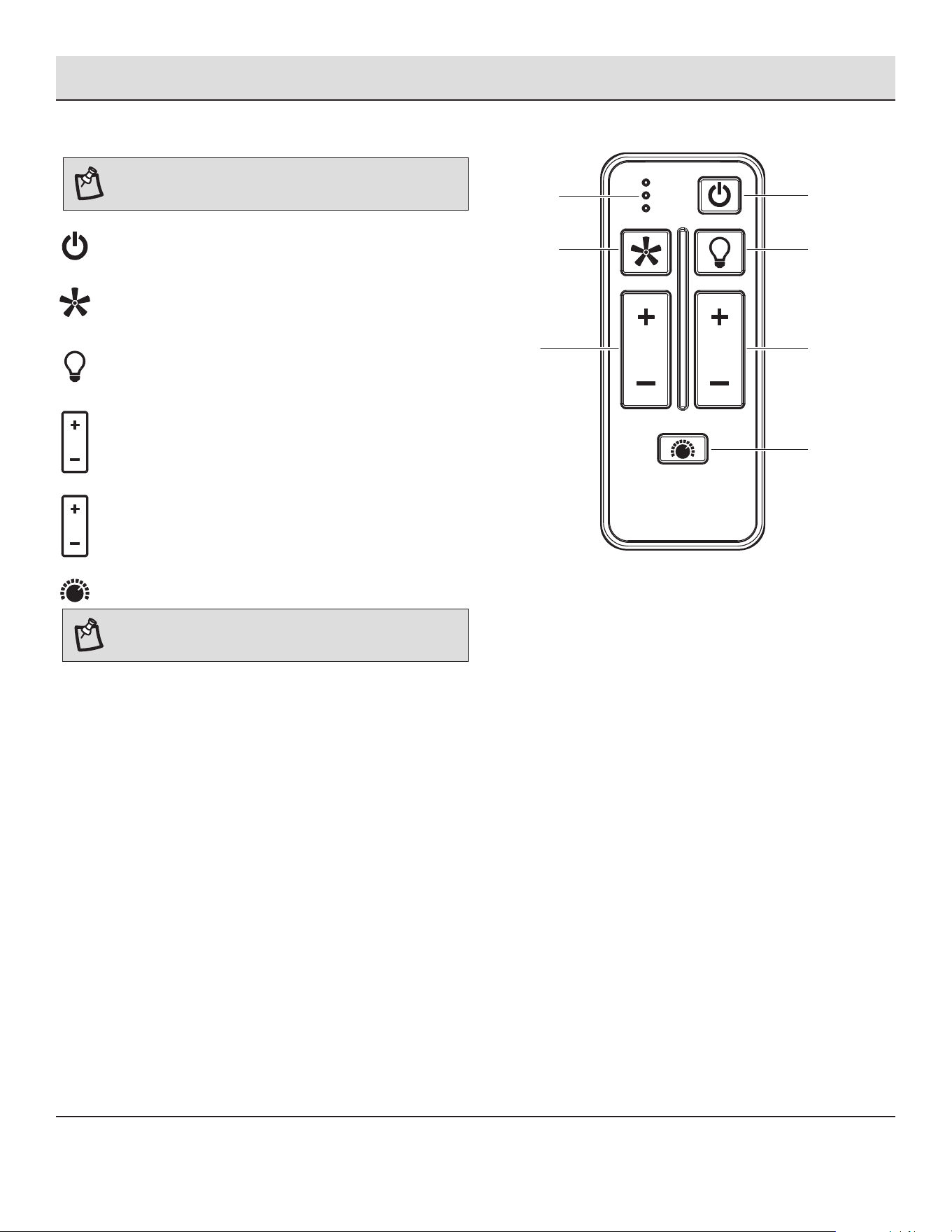
OPERATING YOUR FAN AND REMOTE CONTROL
3 SPEED
BRIGHTNESS
COLOR TEMP.
ON / OFF ON / OFF
ALL
Fan ON/OFF button: Press and release this button to turn the
fan on or off.
Light ON/OFF button: Press and release this button to turn the
light on or off.
NOTE: The default temperature of the ceiling fan light is
3000K (Soft White).
Correlated Color Temperature (CCT) changing.
Push and release the button to cycle through the three color
temperature options.
Option 1: 3000K (Soft White).
Option 2: 4000K (Bright White).
Option 3: 5000K (Daylight).
Fan 3 SPEED button: Press and release the “+” button to
increases the fan speed. Press and release the “-” button to
decreases the fan speed.
Light BRIGHTNESS button: Press and hold the “+” button to
increase the desired light level. Press and hold the “-” button
to decrease the desired light level.
Power ALL button: Press and release the power button to turn
the fan and light on or off.
Power on/off
Light on/off
Fan on/off
Fan on/
Increases /
decreases
fan speed
Light on/
light dimming
Signal light
Light color
temperature
NOTE: The fan will store the last used speed setting for the
next time it is turned on.
16
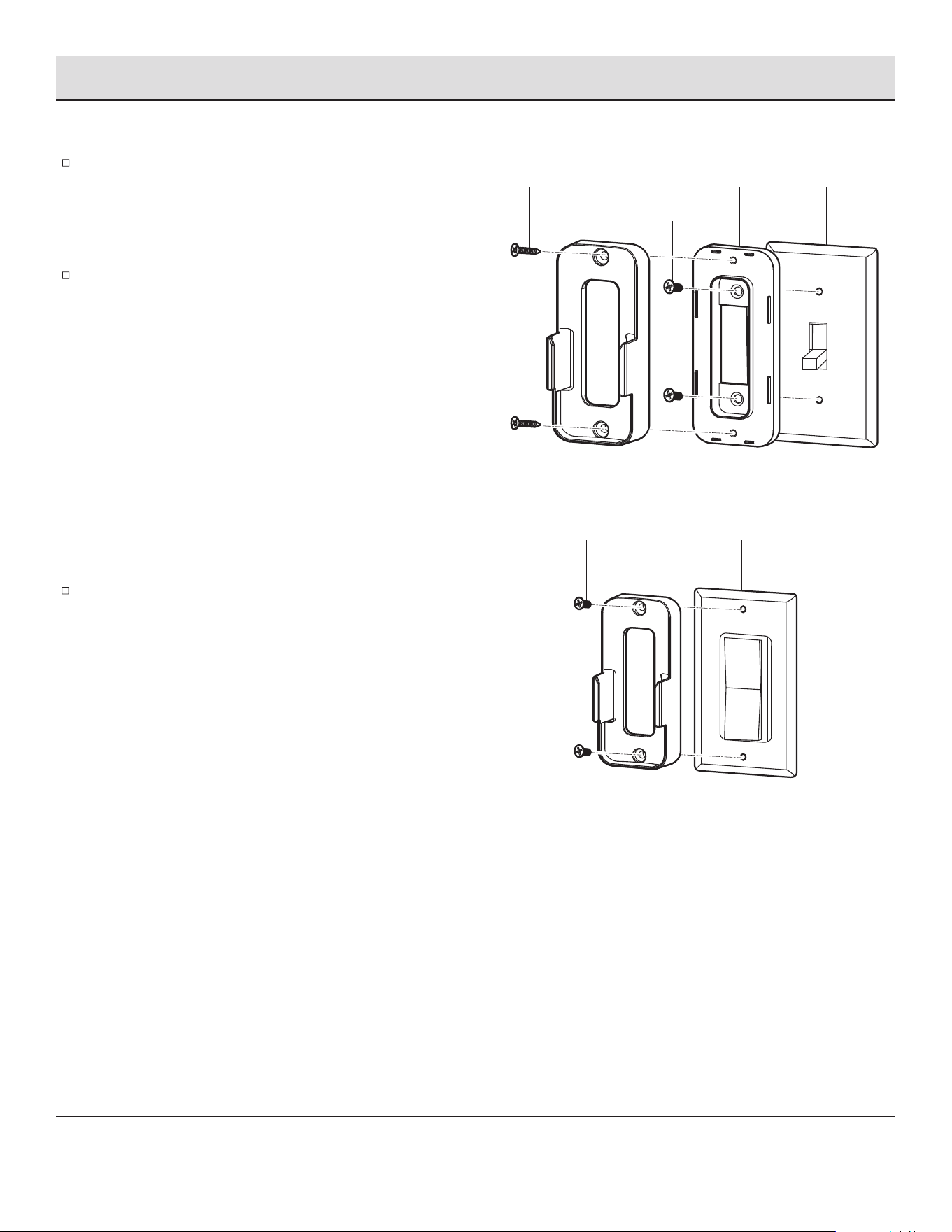
To install the remote control bracket (SS), remove the two
screws holding the switch cover plate (TT). Do not remove the
cover plate (TT). Orient the bracket (SS) by lining up the two
mounting holes with those on the cover plate (TT). Insert and
tighten the screws (UU).
Then install the remote control holder (VV), orient the remote
control holder (VV) by lining up the two mounting holes with
those on the remote control bracket (SS). Insert and tighten the
screws (WW).
Operation (continued)
INSTALLING THE REMOTE CONTROL HOLDER
To install the remote control holder (VV), orient the remote control
holder (VV) by lining up the two mounting holes with those on the
cover plate (XX). Insert and tighten the screws (YY).
FOR ROCKER-STYLE STYLE COVER PLATE
TTSS
UU
VVWW
VVYY XX
17
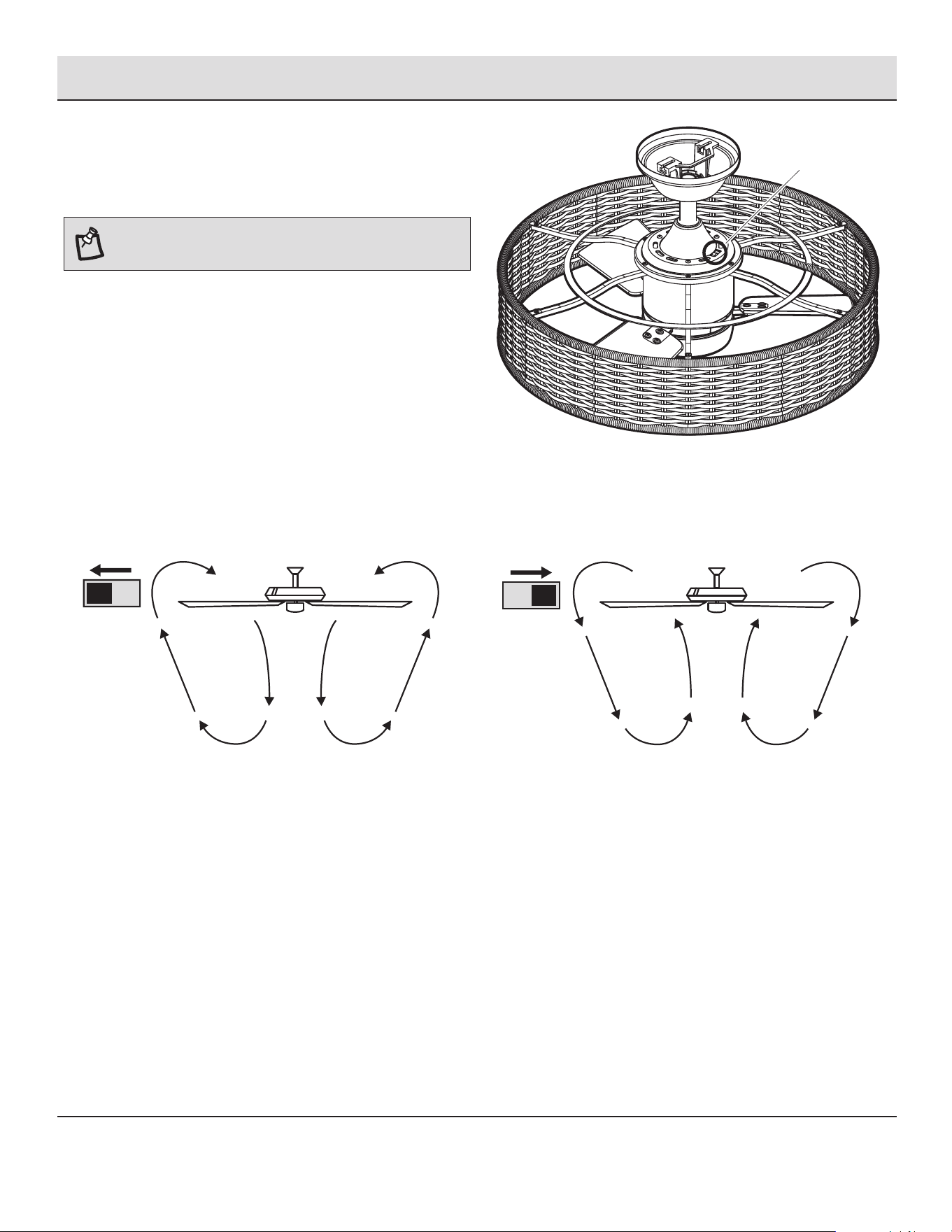
The reverse switch is located on the top of the motor housing. Slide
the switch to the left for warm weather operation. Slide the switch
to the right for cool weather operation.
REVERSE SWITCH OPERATING INSTRUCTIONS
NOTE: Wait for the fan to stop before reversing the direction
of the blade rotation.
Operation (continued)
Reverse switch
Warm weather - (Counterclockwise Direction) A downward air ow
creates a cooling effect. This allows you to set your air conditioner
on a warmer setting without affecting your comfort.
Cool weather - (Clockwise Direction) An upward air ow moves
warm air off the ceiling. This allows you to set your heating unit on
a cooler setting without affecting your comfort.
Verify that all blades and blade bracket screws are secure (most fan wobble problems are caused by loose
parts). Once the fan is properly installed, run the ceiling fan for 10 minutes to let the fan self-adjust.
If wobble occurs after running the fan for 10 minutes, verify blade level using the following process:
Select a point on the ceiling above the tip of one of the blades, then select any fan blade and measure
from the center of the selected blade to the point on the ceiling. Rotate the fan until the next blade is
positioned and repeat the measurement using the same point from the ceiling for every blade.
Measurement deviations should be within 1/8 in.
If all deviations are less than 1/8 in. and the fan continues to wobble, please call Customer Service
(1-855-HD-HAMPTON) to order a complimentary Blade Balancing Kit.
If deviation is greater than 1/8 in., please call Customer Service (1-855-HD-HAMPTON) to order
complimentary replacements of your brackets.
18
Do not connect the fan with wall mounted variable speed control(s).
Make sure the frequency switches are set correctly.
The fan wobbles.
The remote control is
not working.
Problem Solution
Check the main and branch circuit fuses or breakers.
Check the line wire connections to the fan and switch wire connections in the switch housing.
Check to make sure the frequency switches from the remote control and receiver are set to the same
frequency.
Make sure all motor housing screws are snug.
Make sure the screws that attach the fan blade to the motor hub are tight.
Make sure the wire nut connections are not rattling against each other or the interior wall of the switch
housing.
Allow a 24-hour "breaking-in" period. Most noises associated with a new fan disappear during this time.
If using the ceiling light kit, make sure the glassware is secured tightly.
Make sure there is a short distance from the ceiling to the canopy. It should not touch the ceiling.
Make sure your ceiling box is secure and that rubber isolator pads are used between the mounting
bracket and outlet box.
The fan will not start.
The fan sounds noisy.
Troubleshooting
Care and Cleaning
Check the support connections, brackets, and blade attachments twice a year. Make sure they are secure. Because of the fan’s
natural movement, some connections may become loose over time. It is not necessary to remove the fan from the ceiling.
Clean your fan periodically. Use only a soft brush or lint-free cloth to avoid scratching the nish. The plating is sealed with a lacquer to
minimize discoloration or tarnishing.
(Optional) Apply a light coat of furniture polish to the wood blades.
(Optional) Cover small scratches with a light application of shoe polish.
Do
Use water when cleaning. Water could damage the motor, or the wood, or possibly cause an electrical shock.
Apply oil to your fan or motor. The motor has permanently-lubricated sealed ball bearings.
Do not

Questions, problems, missing parts? Before returning to the store,
call Hampton Bay Customer Service
8 a.m. – 7 p.m., EST, Monday – Friday, 9 a.m. – 6 p.m., EST, Saturday
1-855-HD-HAMPTON
HAMPTONBAY.COM
Retain this manual for future use.
This device complies with part 15 of the FCC Rules. Operation is subject to the following two conditions: (1) This device may not cause
harmful interference, and (2) this device must accept any interference received, including interference that may cause undesired operation.
WARNING: Changes or modications to this unit not expressly approved by the party responsible for compliance could void the user's
authority to operate the equipment.
NOTE: This equipment has been tested and found to comply with the limits for a Class B digital device, pursuant to Part 15 of the FCC Rules.
These limits are designed to provide reasonable protection against harmful interference in a residential installation. This equipment generates,
uses and can radiate radio frequency energy and, if not installed and used in accordance with the instructions, may cause harmful interference
to radio communications.
However, there is no guarantee that interference will not occur in a particular installation. If this equipment does cause harmful interference
to radio or television reception, which can be determined by turning the equipment off and on, the user is encouraged to try to correct the
interference by one or more of the following measures:
- Reorient or relocate the receiving antenna.
- Increase the separation between the equipment and receiver.
- Connect the equipment into an outlet on a circuit different from that to which the receiver is connected.
- Consult the dealer or an experienced radio/TV technician for help.