Form No. 3460-951 Rev B
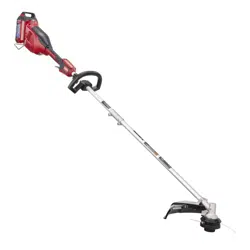
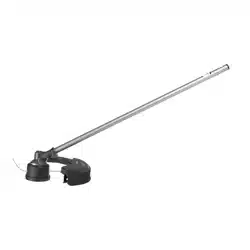
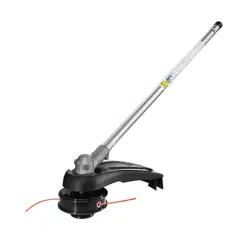
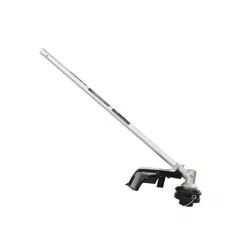
14in or 16in 60V MAX String
T rimmer
Flex-Force Power System
®
60V MAX
Attachment
Model No. 88716 —Serial No. 323000001 and Up
Register at www .T oro.com.
Original Instructions (EN)
*3460-951*
For assistance, please see
www .T oro.com/support
for instructional videos or
contact your Authorized
Service Dealer before
returning this product.
W ARNING
CALIFORNIA
Proposition 65 W arning
The power cord on this product contains lead, a chemical
known to the State of California to cause birth defects or
other reproductive harm. W ash hands after handling.
Use of this product may cause exposure to chemicals
known to the State of California to cause cancer , birth
defects, or other reproductive harm.
Introduction
This trimmer is intended to be used by residential homeowners to trim
grass as needed outdoors. It is to be used only by adults. It is designed
to be used in combination with the T oro Flex-Force Power System 60V
MAX Attachment-Capable Power Head Model 51810T . Using this product
for purposes other than its intended use could prove dangerous to you
and bystanders.
Read this information carefully to learn how to operate and maintain
your product properly and to avoid injury and product damage. Y ou are
responsible for operating the product properly and safely .
V isit www .T oro.com for product safety and operation training materials,
accessory information, help nding a dealer , or to register your product.
© 2024—The T oro®
Company
81 1 1 L yndale A venue
South
Bloomington, MN
55420
Register at
www .T oro.com.
Original Instructions
(EN)
Printed in China
All Rights Reserved
*3460-951*
Whenever you need service, genuine the manufacturer parts, or additional
information, contact an Authorized Service Dealer or the manufacturer
Customer Service and have the model and serial numbers of your product
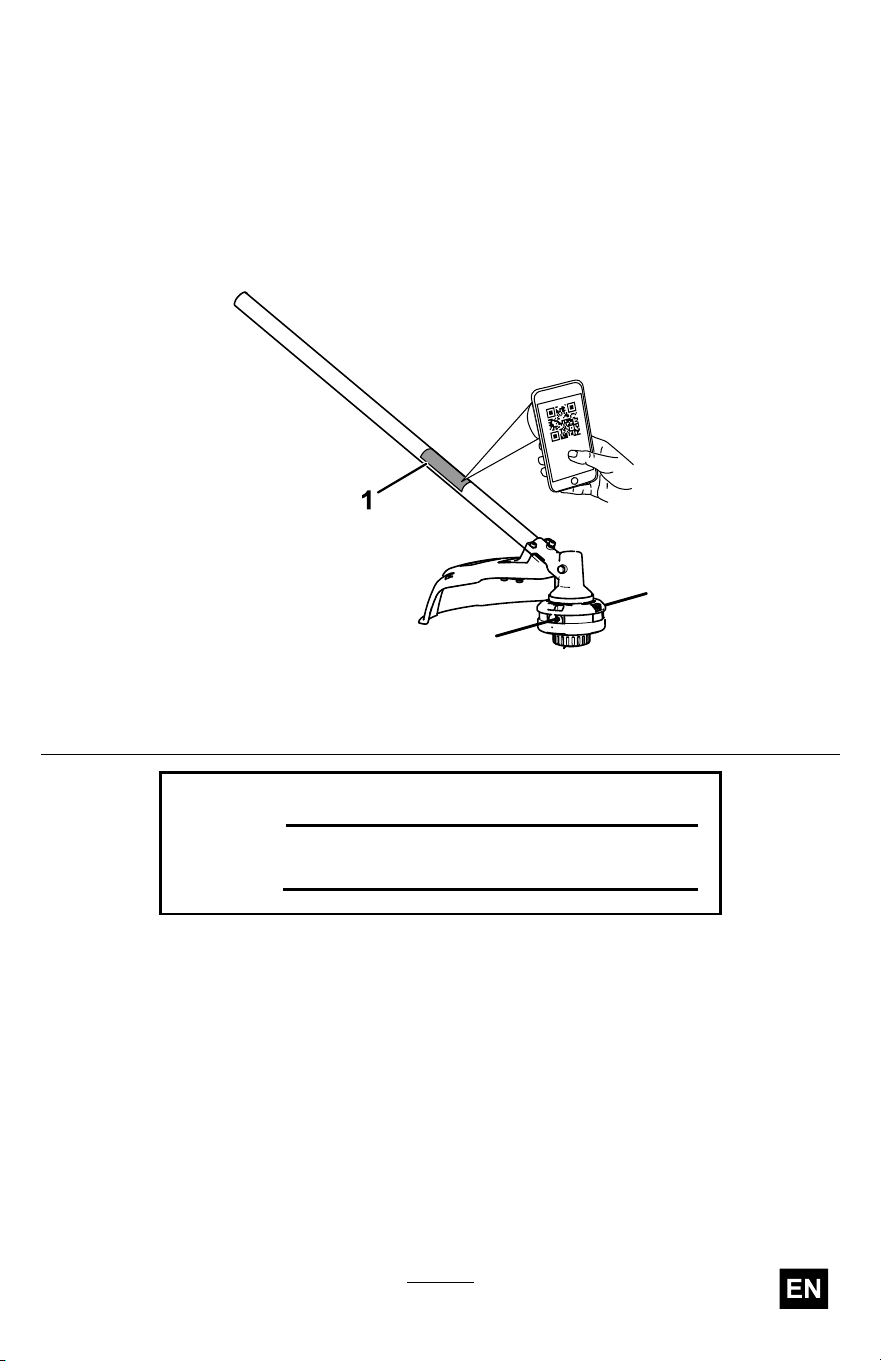
ready . Figure 1 identies the location of the model and serial numbers on
the product. W rite the numbers in the space provided.
Important: W ith your mobile device, you can scan the QR code on
the serial number decal (if equipped) to access warranty , parts, and
other product information.
g426370
Figure 1
1. Model and serial number location
Model No.
Serial No.
3

Safety-Alert Symbol
The safety-alert symbol ( Figure 2 ) shown in this manual and on the
machine identies important safety messages that you must follow to
prevent accidents.
g000502
Figure 2
Safety-alert symbol
The safety-alert symbol appears above information that alerts you to
unsafe actions or situations and is followed by the word DANGER ,
W ARNING , or CAUTION .
DANGER indicates an imminently hazardous situation which, if not
avoided, will result in death or serious injury .
W ARNING indicates a potentially hazardous situation which, if not
avoided, could result in death or serious injury .
CAUTION indicates a potentially hazardous situation which, if not avoided,
may result in minor or moderate injury .
This manual uses two other words to highlight information. Important calls
attention to special mechanical information and Note emphasizes general
information worthy of special attention.
4

The Model 51810T Power Head is compatible with a variety of
T oro-approved attachments that, when combined, comply with specic
standards; see the following table for more detail.
Combination
Power Head
Model
Attachment
Model
Standard
String T rimmer
51810T 88716
Conforms to UL STD 82
Certied to CSA STD C22.2
No. 147
Edger 51810T 88710
Conforms to UL STD 82
Certied to CSA STD C22.2
No. 147
Pole Saw
51810T 88714
Conforms to UL STD 82
Certied to CSA STD C22.2
No. 147
Cultivator
51810T 88715
Conforms to UL STD 82
Certied to CSA STD C22.2
No. 147
Hedge T rimmer 51810T 88713
Conforms to UL
STD 62841-4-2
Certied to CSA STD C22.2
62841-4-2
5

Safety
IMPORT ANT SAFETY
INSTRUCTIONS
W ARNING
When using electric gardening tools, always read and follow
basic safety warnings and instructions to reduce the risk of
re, electric shock, and personal injury , including the following:
Read All Instructions
I. T raining
1. The operator of the tool is responsible for any accidents or hazards
occurring to others or their property .
2. Do not allow children to use or play with the tool, battery pack, or the
battery charger; local regulations may restrict the age of the operator .
3. Do not allow children or untrained people to operate or service this
device. Allow only people who are responsible, trained, familiar with
the instructions, and physically capable to operate or service the
device.
4. Before using the tool, battery pack, and battery charger , read all the
instructions and cautionary markings on these products.
5. Become familiar with the controls and proper use of the tool, battery
pack, and battery charger .
II. Preparation
1. Keep bystanders and children away from the operating area.
2. Use only the battery pack specied by T oro. Using other accessories
and attachments may increase the risk of injury and re.
3. Plugging the battery charger into an outlet that is not 120 V can
cause a re or electric shock. Do not plug the battery charger into an
outlet other than 120 V . For a dif ferent style of connection, use an
attachment plug adapter of the proper conguration for the power
outlet if needed.
4. Do not use a damaged or modied battery pack or battery charger ,
which may exhibit unpredictable behavior that results in re,
explosion, or risk of injury .
6

5. If the supply cord to the battery charger is damaged, contact an
Authorized Service Dealer to replace it.
6. Charge the battery pack with only the battery charger specied by
T oro. A charger suitable for 1 type of battery pack may create a risk
of re when used with another battery pack.
7. Charge the battery pack in a well-ventilated area only .
8. Follow all charging instructions and do not charge the battery pack
outside of the temperature range specied in the instructions.
Otherwise, you may damage the battery pack and increase the risk
of re.
9. Do not operate the tool without all guards and other safety protective
devices in place and functioning properly on the tool.
10. Dress properly—W ear appropriate clothing, including eye protection;
long pants; substantial, slip-resistant footwear; rubber gloves; and
hearing protection. T ie back long hair and do not wear loose clothing
or loose jewelry that can get caught in moving parts. W ear a dust
mask in dusty operating conditions.
III. Operation
1. A void dangerous environments—Do not use the tool in rain or in
damp or wet locations.
2. Use the proper tool for your application—Using the tool for purposes
other an its intended use could prove dangerous to you and
bystanders.
3. Prevent unintentional starting—Ensure that the switch is in the O FF
position before connecting to the battery pack and handling the tool.
Do not carry the tool with your nger on the switch or energize the
tool with the switch in the O N position.
4. Operate the tool only in daylight or good articial light.
5. If the tool strikes an object or starts to vibrate, immediately shut of f
the tool, wait for all moving parts to stop, and disconnect the battery
before examining the tool for damage. Make all necessary repairs
before resuming operation
6. Remove the battery pack from the tool before adjusting it or changing
accessories.
7. Keep your hands and feet away from the cutting area and all moving
parts.
8. Shut of f the tool, remove the battery pack from the tool, and wait
for all movement to stop before adjusting, servicing, cleaning, or
storing the tool.
7

9. Remove the battery pack from the tool whenever you leave it
unattended.
10. Do not force the tool—Allow the tool to do the job better and safer at
the rate for which it was designed.
1 1. Do not overreach—Keep proper footing and balance at all times,
especially on slopes. W alk, never run with the tool.
12. Stay alert—W atch what you are doing and use common sense when
operating the tool. Do not use the tool while ill, tired, or under the
inuence of alcohol or drugs.
13. Ensure that the ventilation openings are kept clear of debris.
14. Under abusive conditions, the battery pack may eject liquid; avoid
contact. If you accidently come into contact with the liquid, ush with
water . If the liquid contacts your eyes, seek medical help. Liquid
ejected from the battery pack may cause irritation or burns.
15. Do not expose a battery pack or tool to re or excessive temperature.
Exposure to re or temperature above 130°C (265°F) may cause
explosion.
16. CAUTION—A mistreated battery pack may present a risk of re,
explosion, or chemical burn.
• Do not disassemble the battery pack.
• Replace the battery pack with a genuine T oro battery pack only;
using another type of battery pack may cause a re or risk of
injury .
• Keep battery packs out of the reach of children and in the original
packaging until you are ready to use them.
IV . Maintenance and Storage
1. Maintain the tool with care—Keep it clean and in good repair for best
performance and to reduce the risk of injury . Follow the instructions
for lubricating and changing accessories. Keep handles dry , clean,
and free from oil and grease.
2. When the battery pack is not in use, keep it away from metal objects
such as paper clips, coins, keys, nails, and screws that can make a
connection from 1 terminal to another . Shorting the battery terminals
may cause burns or a re.
3. Keep your hands and feet away from moving parts.
4. Shut of f the tool, remove the battery pack from the tool, and wait
for all movement to stop before adjusting, servicing, cleaning, or
storing the tool.
8

5. Check the tool for damaged parts—If there are damaged guards or
other parts, determine whether it will operate properly . Check for
misaligned and binding moving parts, broken parts, mounting, and
any other condition that may af fect its operation. Unless indicated in
the instructions, have an Authorized Service Dealer repair or replace
a damaged guard or part.
6. Do not replace the existing non-metallic cutting means on the tool
with a metallic cutting means.
7. Do not attempt to service or repair the tool, battery pack, or battery
charger except as indicated in the instructions. Have an Authorized
Service Dealer perform service using identical replacement parts to
ensure that the product is safely maintained.
8. Store an idle tool indoors in a place that is dry , secure, and out of
the reach of children.
9. Do not dispose of the battery in a re. The cell may explode. Check
with local codes for possible special disposal instructions.
SA VE THESE
INSTRUCTIONS
9
Safety and Instructional Decals
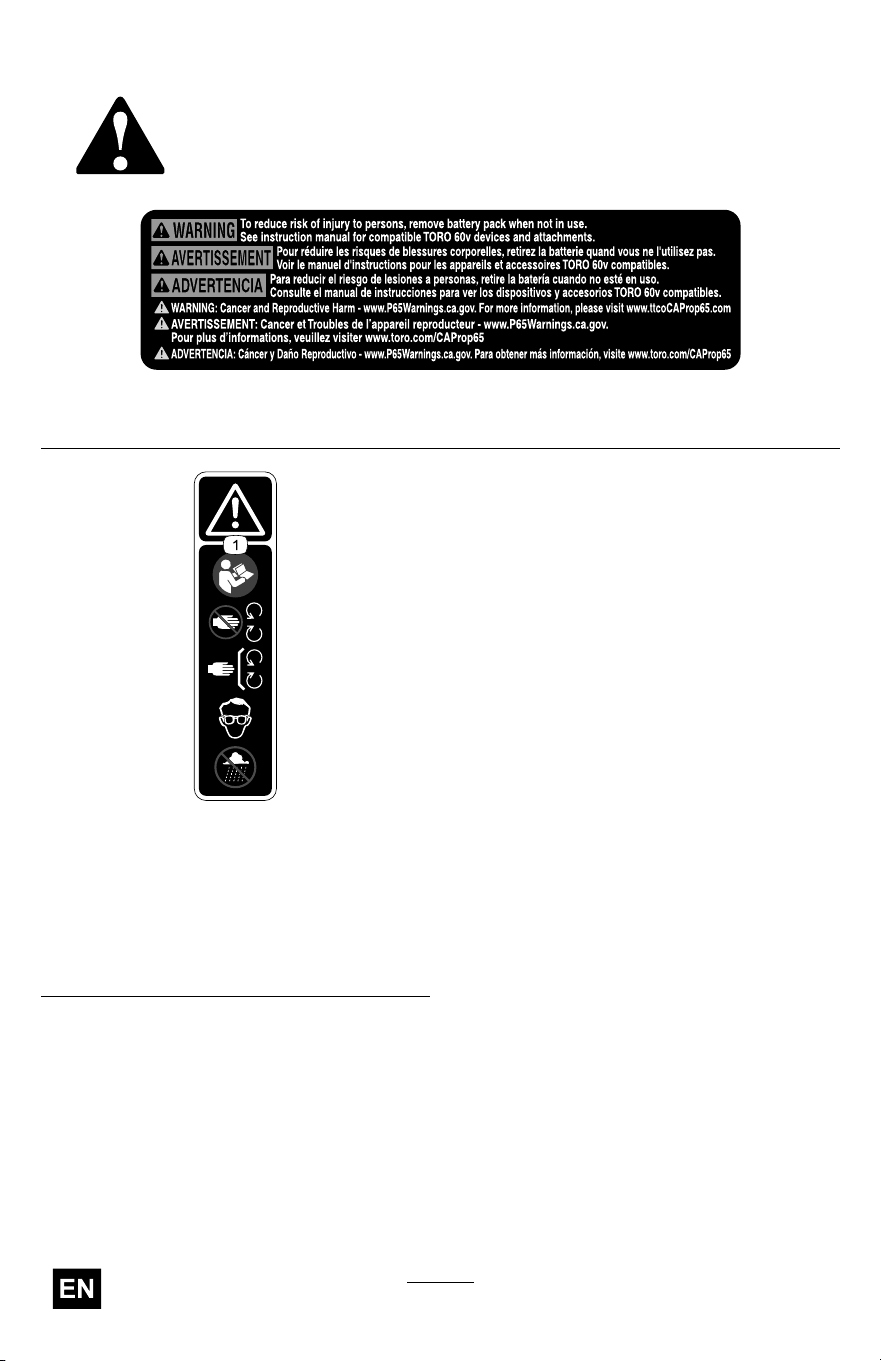
Safety decals and instructions are easily visible to the
operator and are located near any area of potential
danger . Replace any decal that is damaged or missing.
decal139-5346
139-5346
decal139-5210
139-5210
1. W arning—read the Operator ’ s
Manual ; stay away from moving parts;
keep all guards in place; wear eye
protection; do not operate in wet
conditions.
10

Setup
1
Connecting the Attachment to the Power Head
No Parts Required
Procedure
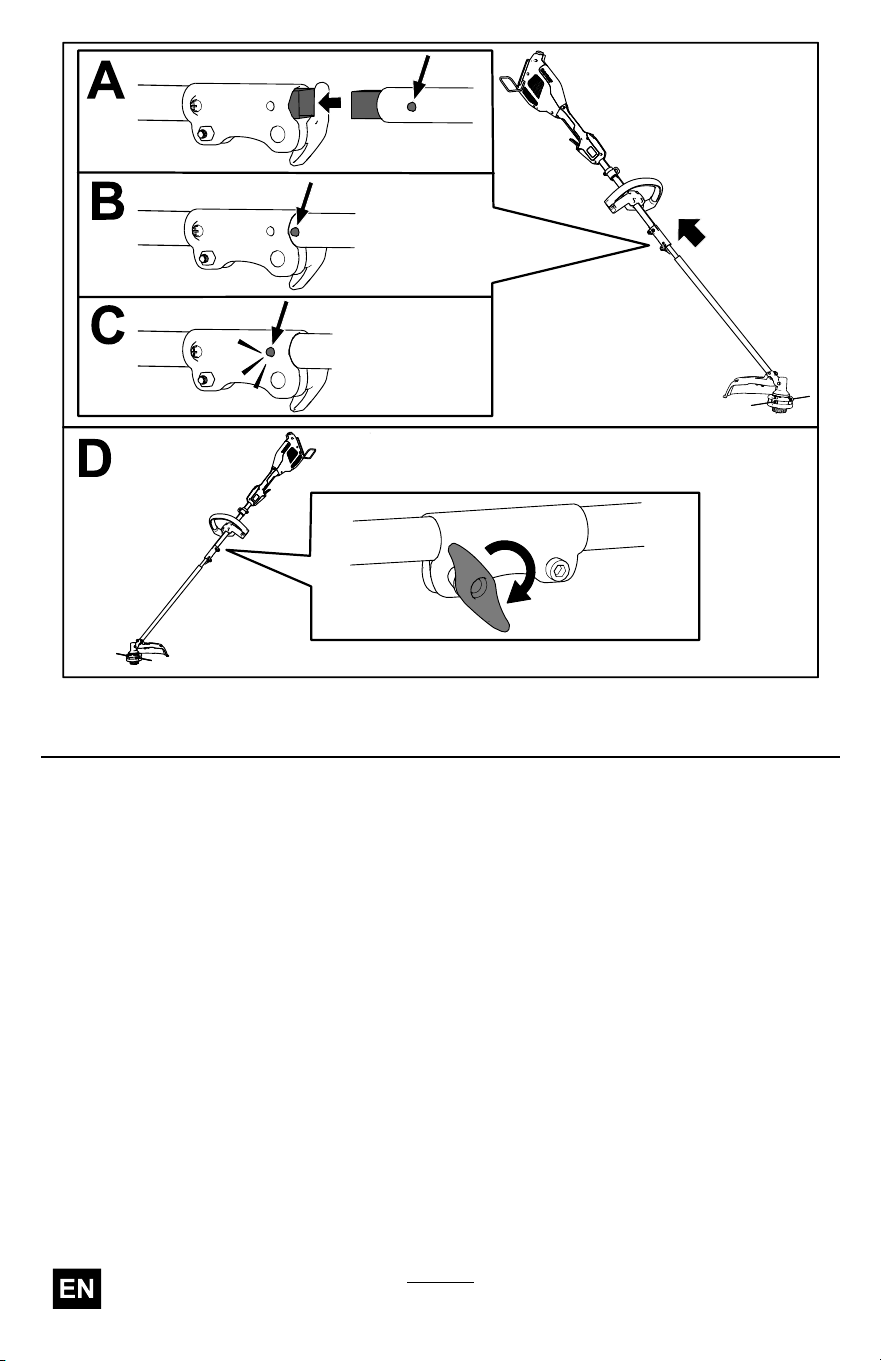
1. Install the square shaft of the attachment into the square shaft of
the power head (A of Figure 3 ).
2. Align the locking button on the lower shaft with the slotted hole on
the upper shaft and slide the 2 shafts together (B and C of Figure 3 ).
3. The locking button clicks into the slotted hole when the shafts are
secured (C of Figure 3 ).
4. Using the screw-handle, tighten the screw on the shaft connector
until it is secure (D of Figure 3 ).
1 1
g524929
Figure 3
12
2
Installing the Guard
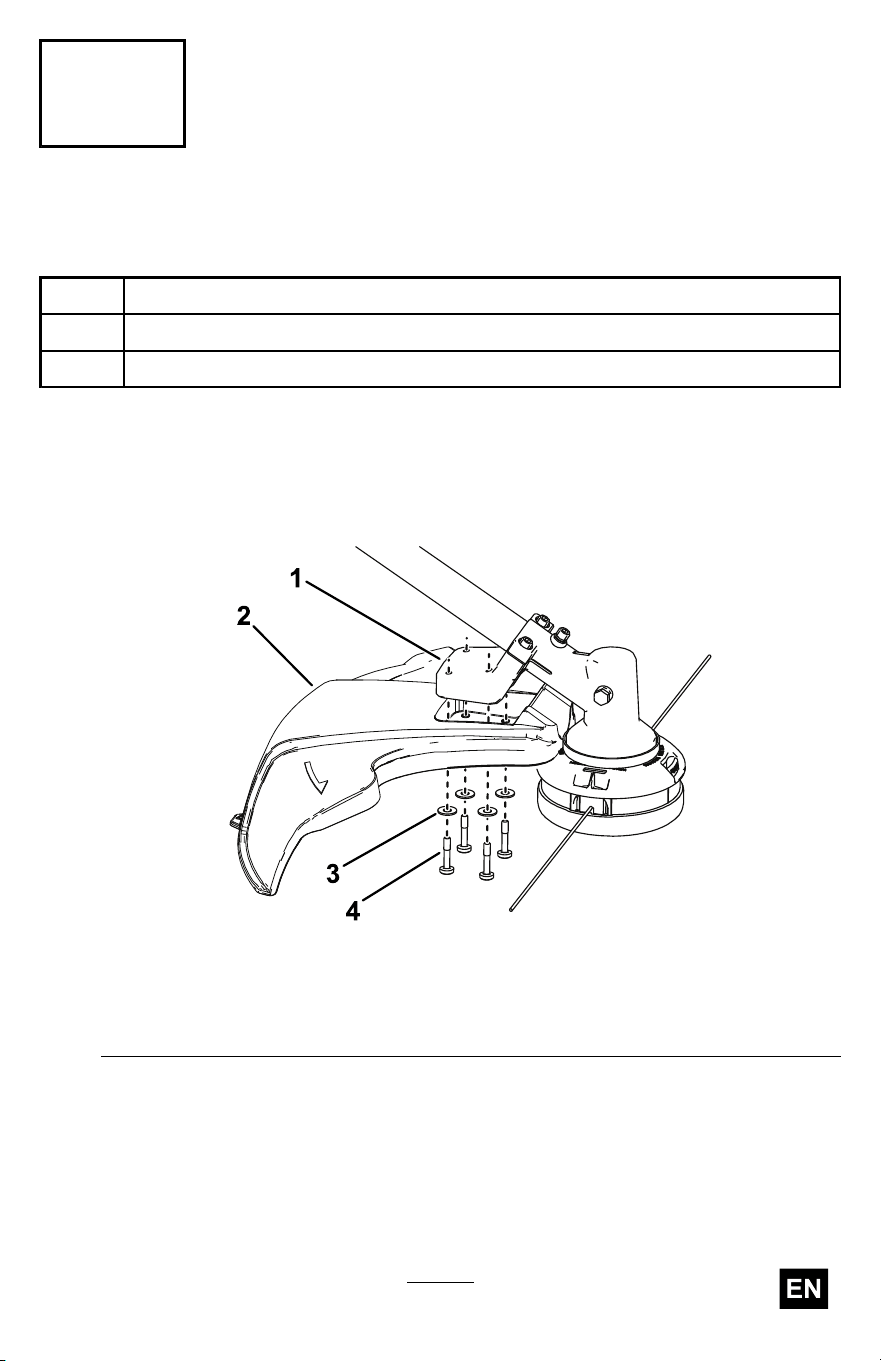
Parts needed for this procedure:
1
Guard
4 W asher
4 Bolt
Procedure
1. Align the trimmer guard beneath the guard mount as shown in Figure
4 .
g333216
Figure 4
1. Guard mount
3. W asher
2. T rimmer guard 4. Bolt
2. Secure the guard to the trimmer using the 4 washers and 4 bolts as
shown in Figure 4 .
13
Product Overview
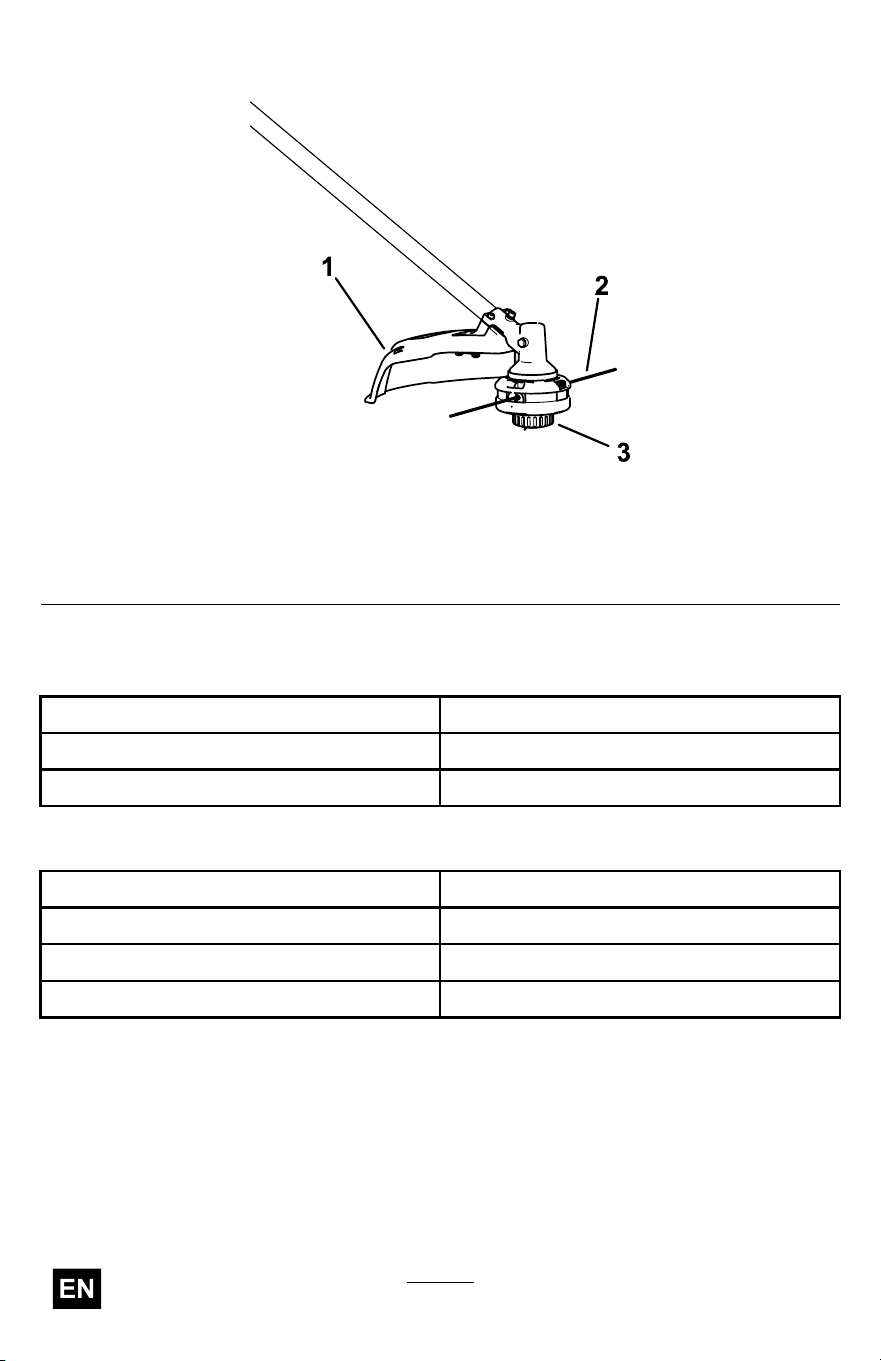
g372306
Figure 5
1. Guard
3. Bump button
2. String
Specications
Model 88716, attaches to 51810T
Charger T ype
Flex-Force 60V lithium-ion chargers
Battery T ype Flex-Force 60V lithum-ion batteries
Appropriate T emperature Ranges
Charge/store the battery pack at 5°C (41°F) to 40°C (104°F)*
Use the battery pack at
-30°C (-22°F) to 49°C (120°F)
Use the trimmer at
0°C (32°F) to 49°C (120°F)
Store the trimmer at 0°C (32°F) to 49°C (120°F)*
*Charging time will increase if you do not charge the battery within this
range.
Store the tool, battery pack, and battery charger in an enclosed clean,
dry area.
14
Attachments/Accessories
A selection of T oro approved attachments and accessories is available for
use with the machine to enhance and expand its capabilities. Contact
your Authorized Service Dealer or authorized T oro distributor or go to
www .T oro.com for a list of all approved attachments and accessories.
T o ensure optimum performance and continued safety certication of the
machine, use only genuine T oro replacement parts and accessories.
Replacement parts and accessories made by other manufacturers could
be dangerous.
Operation
Starting the Attachment
1. Ensure that the vents on the attachment, power head, and battery
are clear of any dust and debris.
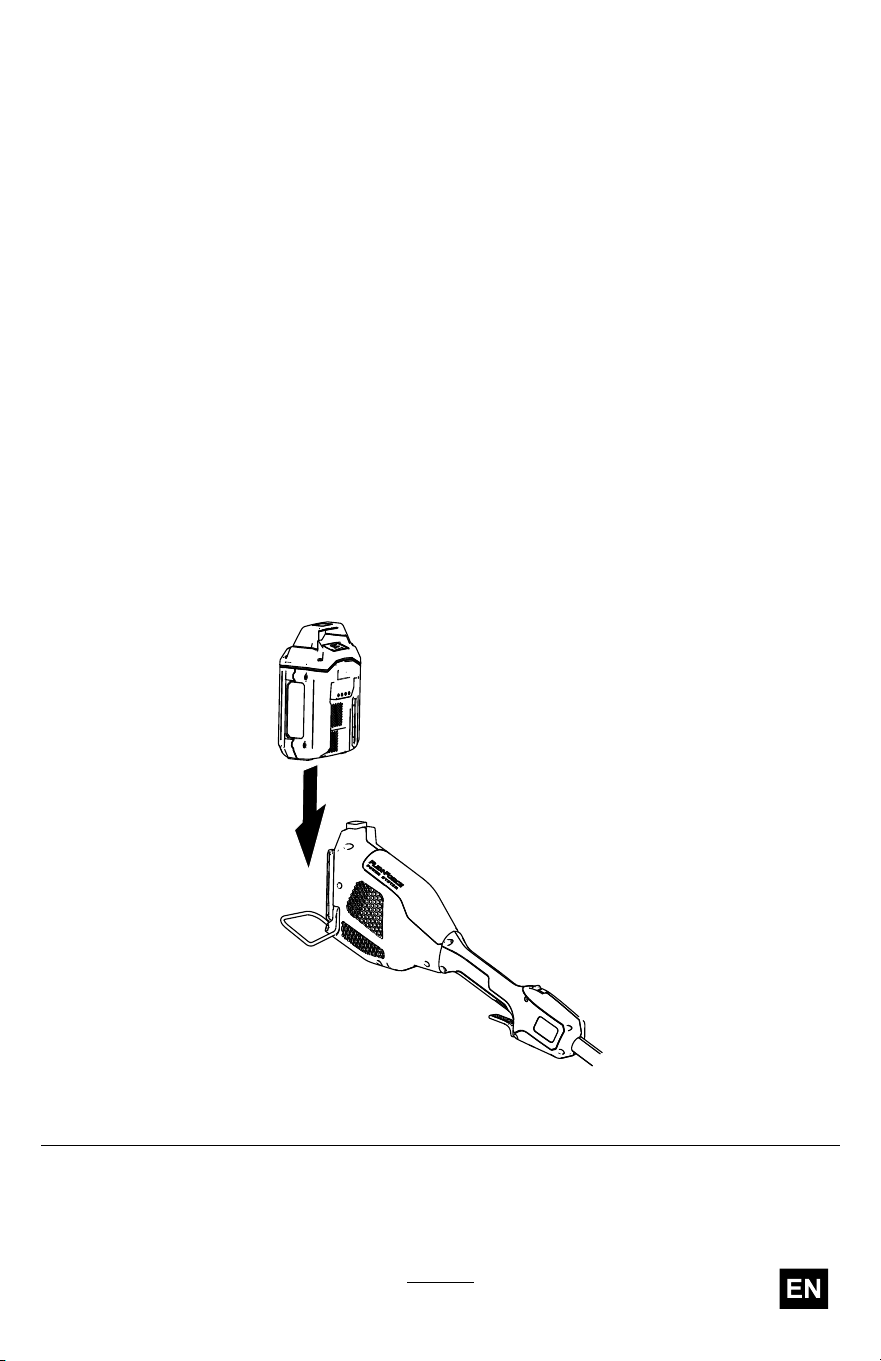
2. Align the cavity in the battery pack with the tongue on the handle
housing ( Figure 6 ).
g357444
Figure 6
3. Push the battery pack into the handle until the battery locks into the
latch.
15
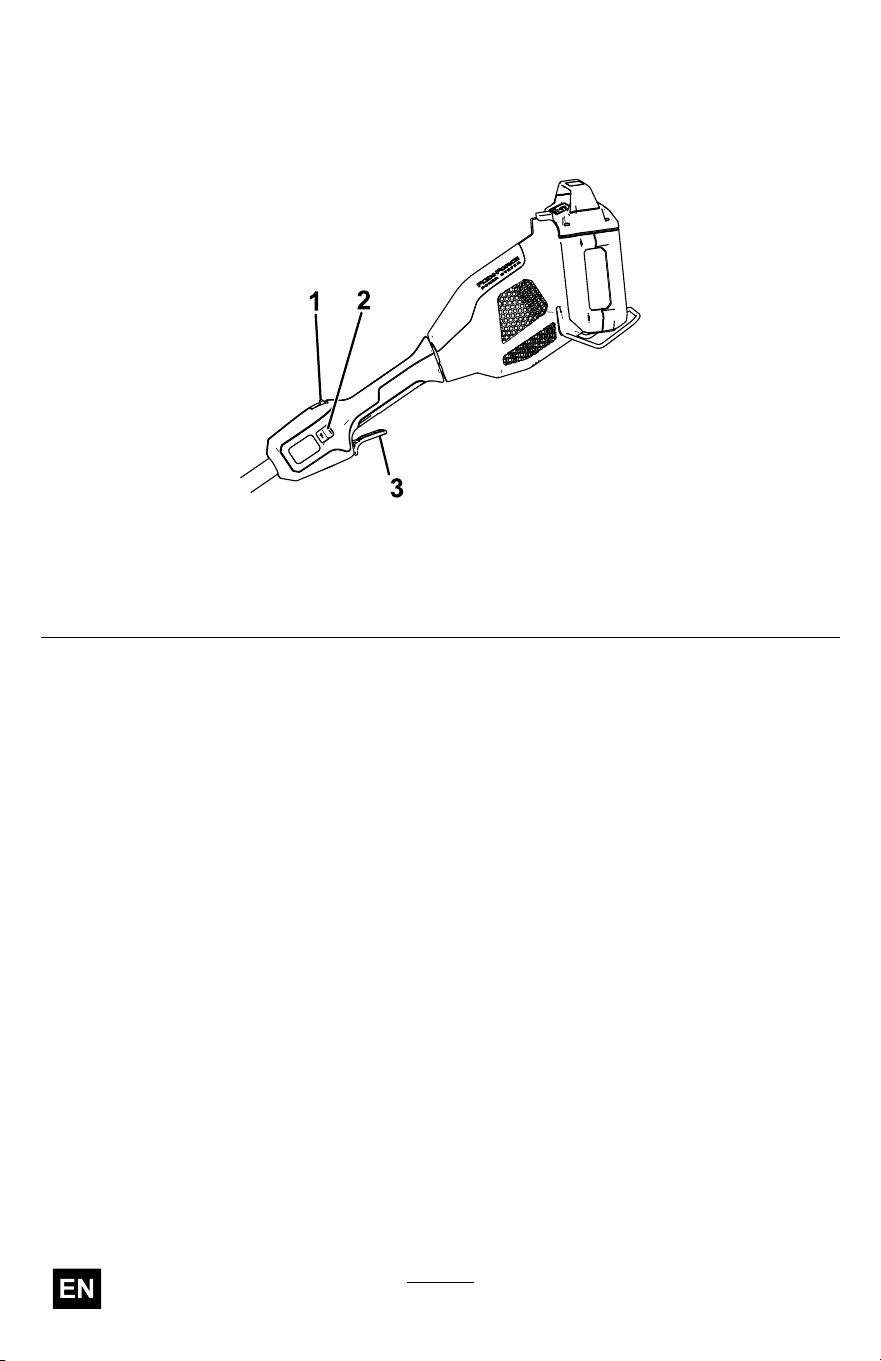
Shutting Off the T rimmer
T o shut of f the trimmer , release the trigger .
Whenever you are not using the trimmer or are transporting the trimmer to
or from the work area, remove the battery pack.
Removing the Battery Pack from the Power
Head
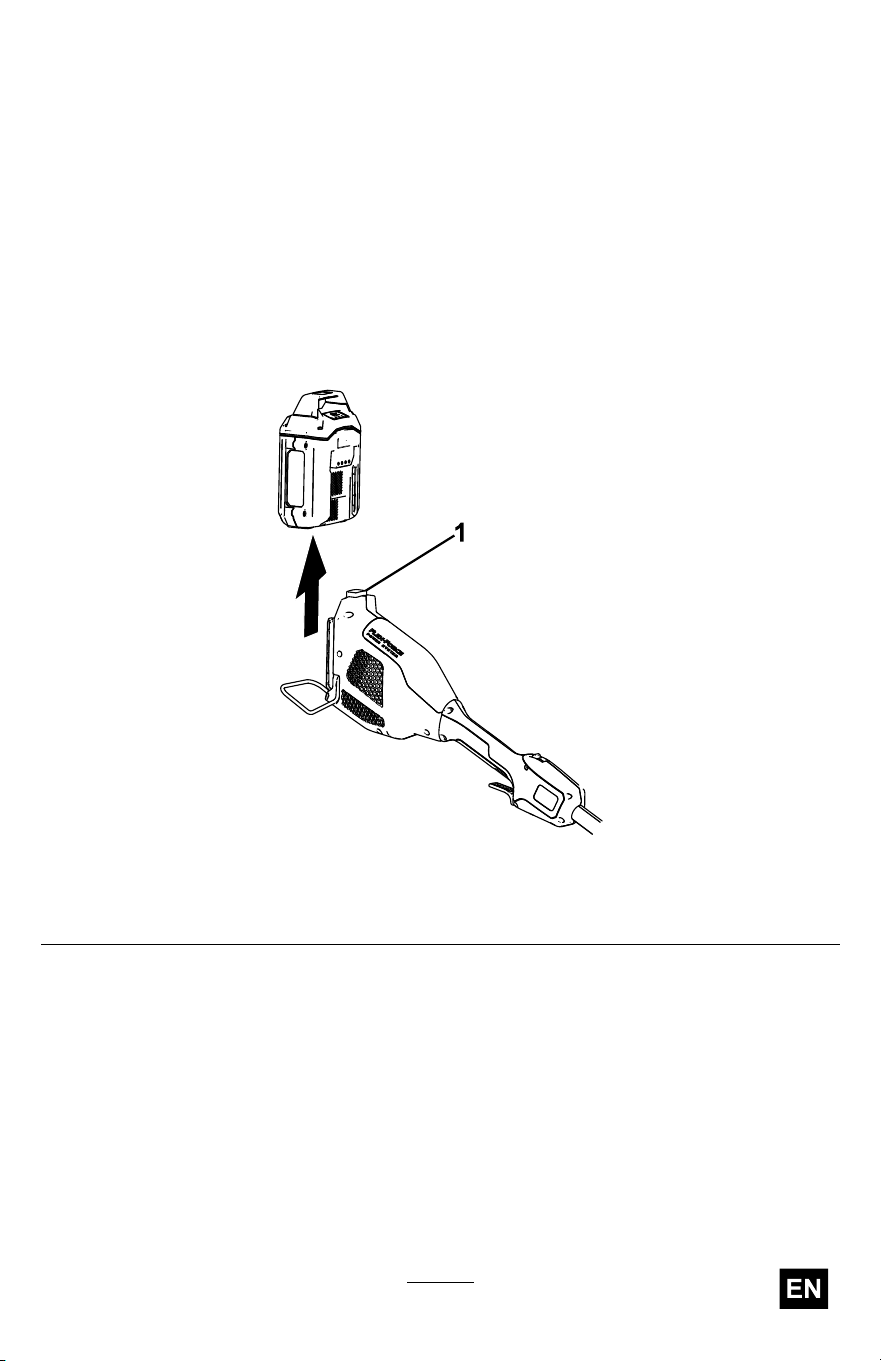
Press the battery latch on the machine to release the battery pack and
slide the battery pack out of the machine ( Figure 8 ).
g357457
Figure 8
1. Battery latch
Removing the Attachment from the Power Head
1. Ensure that the battery pack is removed from the power head; refer
to Removing the Battery Pack from the Power Head ( page 17 ) .
2. Loosen the screw-handle on the shaft connector ( Figure 3 ).
3. Press the locking button down while pulling the 2 shafts apart ( Figure
3 ).
17
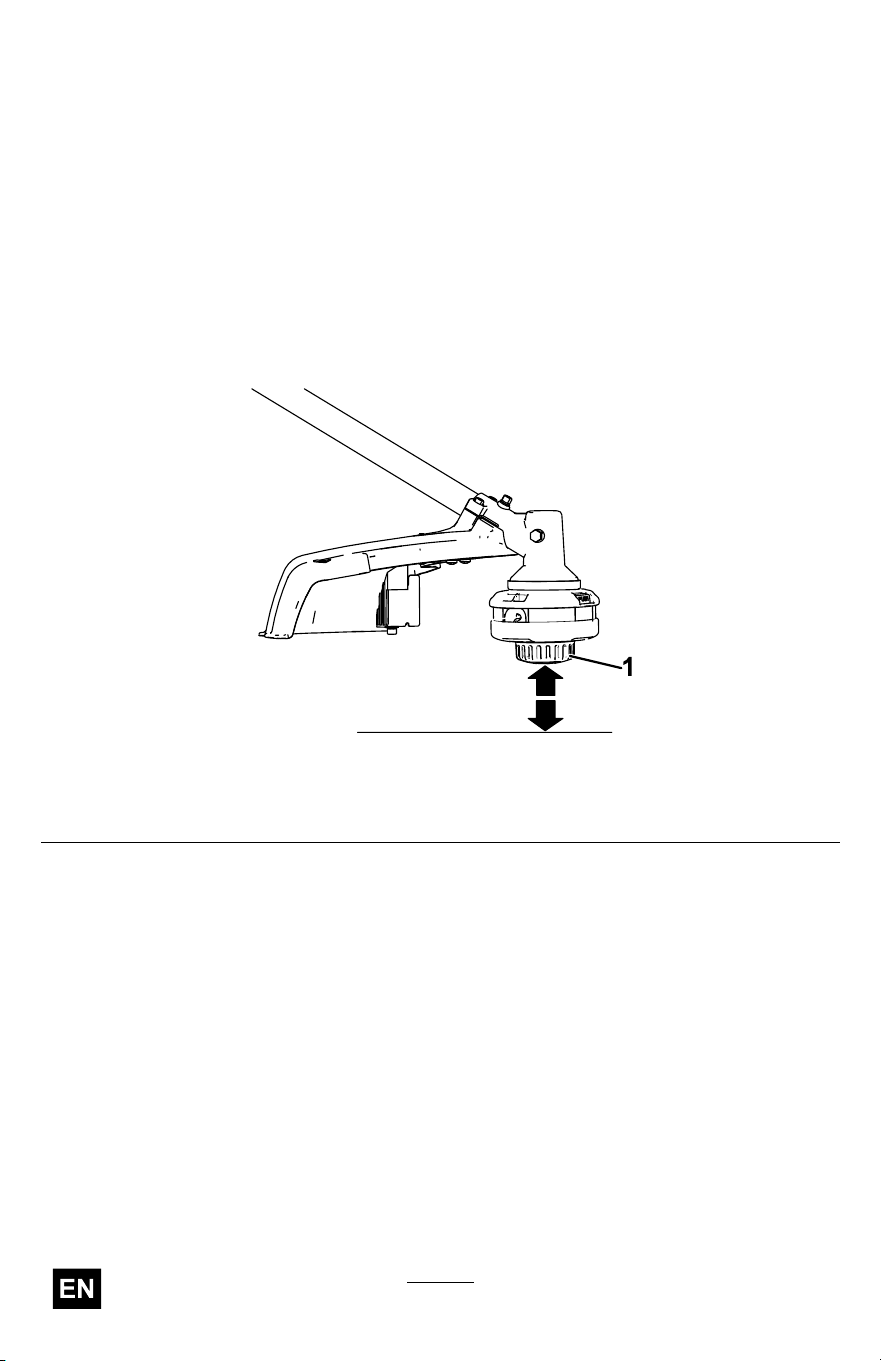
Advancing the Line Using the Bump Feed
1. Run the trimmer at full throttle.
2. T ap the bump button on the ground to advance the line. The line
advances each time the bump button is tapped. Do not hold the
bump button on the ground.
Note: The line trimming cut-of f blade on the grass deector cuts the
line to the correct length.
Note: If the line is worn too short, you may not be able to advance
the line by tapping it on the ground. If so, release the trigger and
refer to Advancing the Line Manually ( page 18 ) .
g331007
Figure 9
1. Bump button
Advancing the Line Manually
Remove the battery pack from the trimmer , then push the bump button at
the base of the spool retainer while pulling on the trimmer line to manually
advance the line.
18
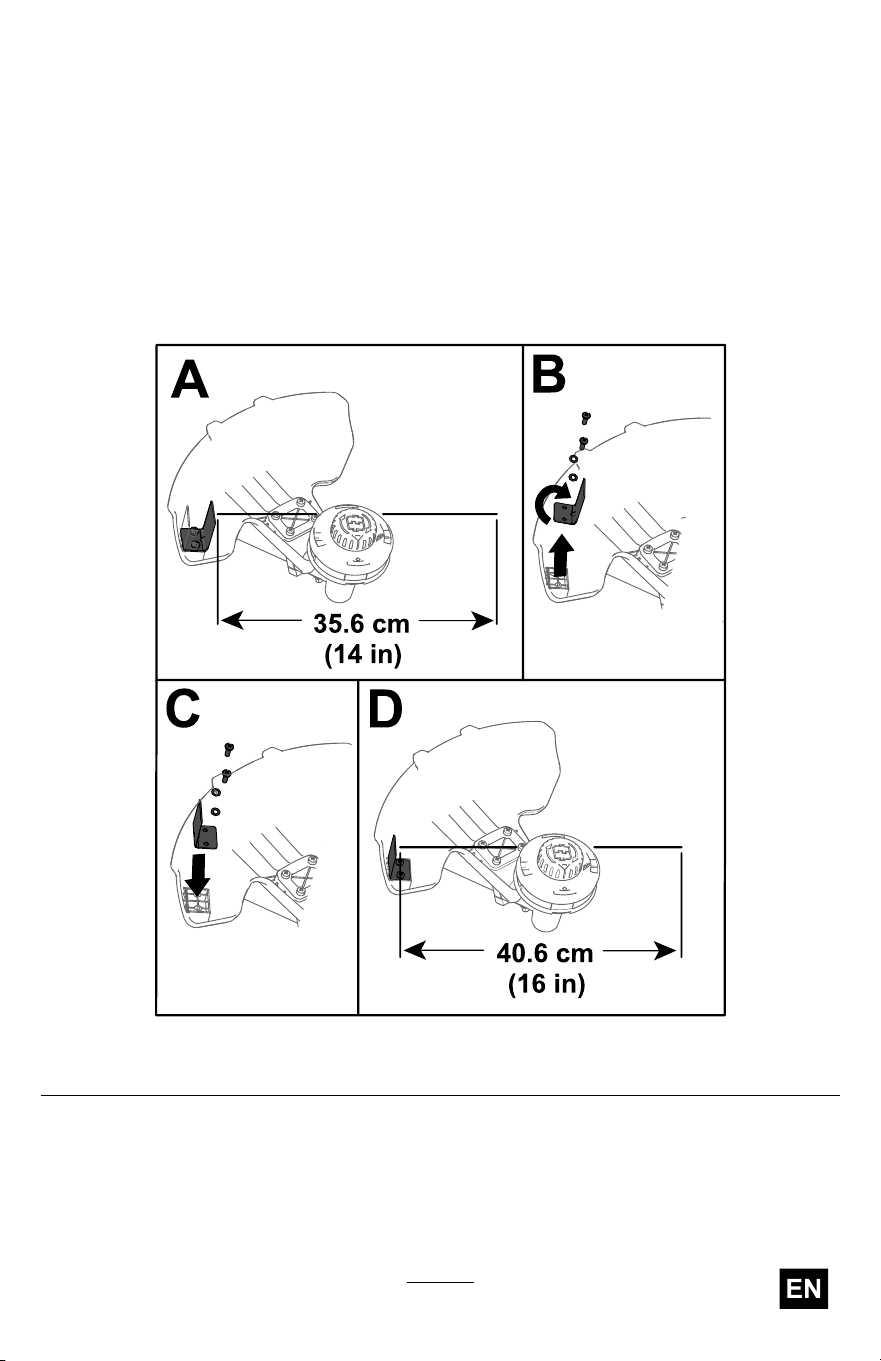
Adjusting the Cutting Swath
The trimmer comes from the factory with a cutting swath of 36.6 cm (14
inches) as shown in A of Figure 10 . Refer to the following instructions to
adjust the swath to 40.6 cm (16 inches) as shown in D of Figure 10 .
1. Remove the swath blade from the bottom of the guard by removing
the 2 screws holding it in place using the provided Allen wrench (B of
Figure 10 ) and rotate the swath blade 180°.
2. Once the swath blade is rotated, install it onto the guard using the 2
screws previously removed (C of Figure 10 ).
g524941
Figure 10
19
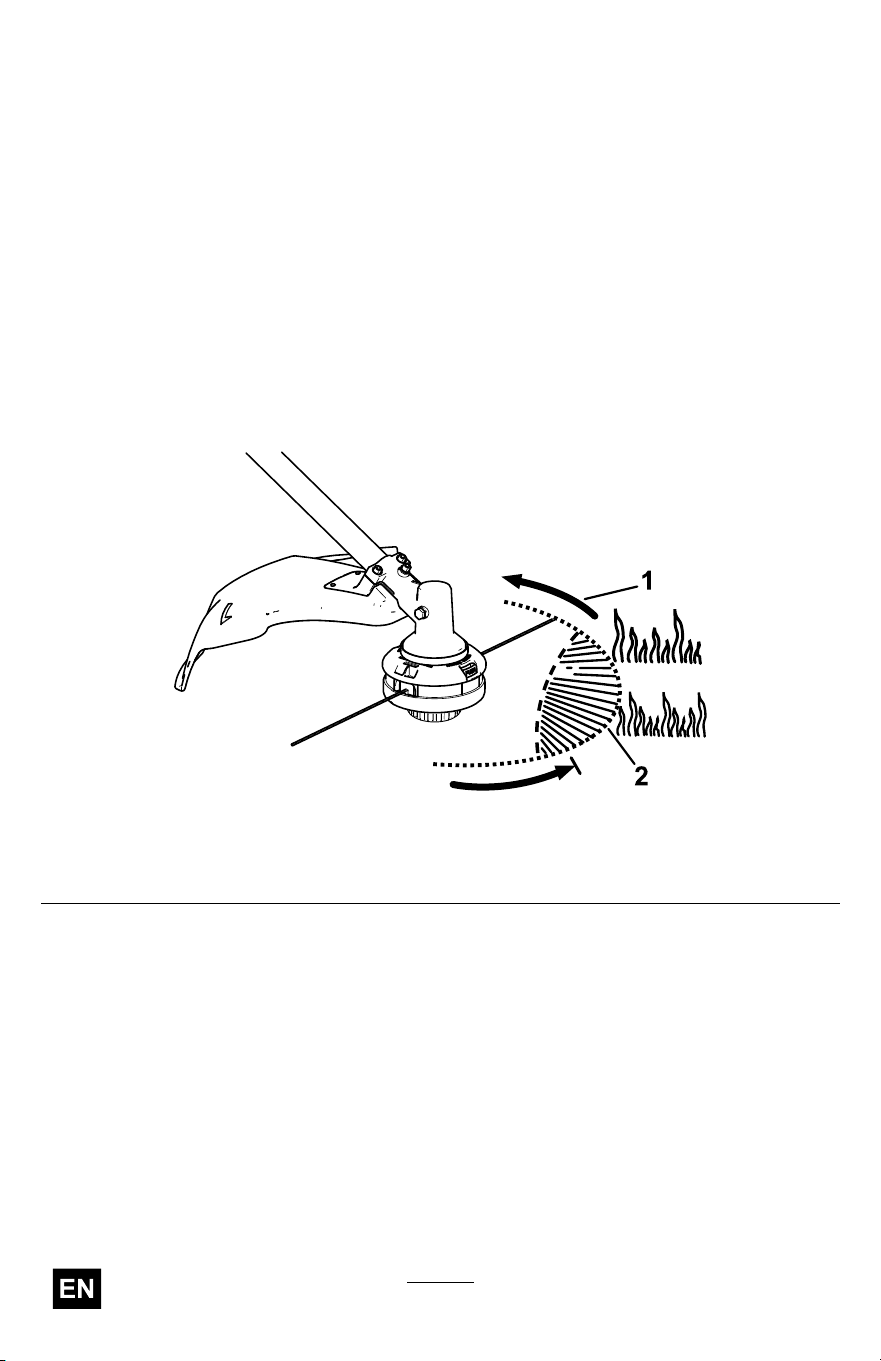
Operating T ips
• Keep the trimmer tilted toward the area being cut; this is the best
cutting area.
• The string trimmer cuts when you move it from right to left. This
prevents the trimmer from throwing debris at you.
• Use the tip of the string to do the cutting; do not force the string head
into uncut grass.
• Wire and picket fences can cause the string to wear rapidly and even
break. Stone and brick walls, curbs, and wood can also cause the
string to wear rapidly .
• A void trees and shrubs. The string can easily damage tree bark, wood
moldings, siding, and fence posts.
g330996
Figure 1 1
1. Direction of rotation 2. String path
20

Maintenance
After each use of the trimmer , complete the following:
1. Remove the battery from the power head.
2. Wipe the trimmer clean with a damp cloth. Do not hose the trimmer
down or submerge it in water .
CAUTION
The line cutoff blade on the deector is sharp and can cut
you.
Do not use your hands to clean the deector shield and
blade.
3. Wipe or scrape clean the cutting head area any time there is an
accumulation of debris.
4. Check and tighten all fasteners. If any part is damaged or lost, repair
or replace it.
5. Brush debris away from air intake vents and exhaust on motor
housing to prevent the motor from overheating.
21

Replacing the String
Important: Use only 2 mm (0.080 inch) diameter monolament string
(the manufacturer Part No. 8861 1) or 2.4 mm (0.095 inch) diameter
twisted monolament string (the manufacturer Part No. 88202).
1. Remove the battery pack and clean any debris from the trimmer
head.
2. Remove any old string on the spool by repetitively pressing the bump
button while pulling the line out equally from both sides of the trimmer .
3. Cut a piece of string according to the following specications.
• If you are using 2 mm (0.080 inch) string, cut one piece of line
approximately 4.9 m (16 ft).
• If you are using 2.4 mm (0.095 inch) twisted string, cut one piece
of line approximately 3 m (10 ft).
Important: Do not use any other gauge or type of string, and
do not exceed the recommended length as this could damage
the trimmer .
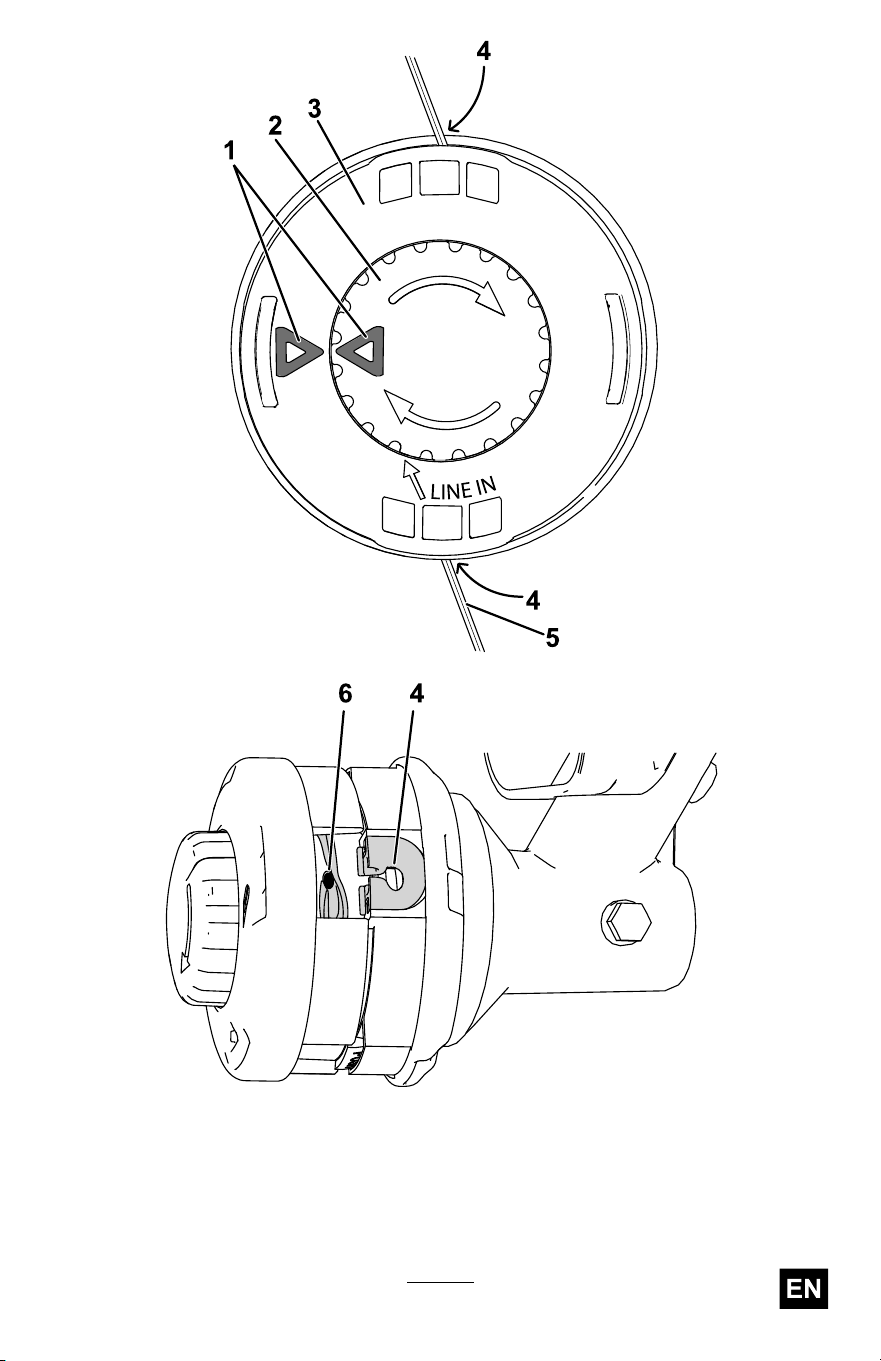
4. Press and turn the knob on the string head until arrow on the knob
aligns with arrow on the string head ( Figure 12 ).
5. Insert 1 end of the line at an angle into the LINE IN eyelet and push
the line through the string head track until it comes out through the
eyelet on the other side. Pull the line though the string head until the
line outside the string is evenly divided on each side.
Important: Do not disassemble the trimmer head;
disassembled view shown for clarity .
6. Hold the string head in place with one hand. With your other hand,
rotate the knob in the direction shown by the arrows (clockwise).
7. Wind the line, leaving about 102 mm (4 inches) extending beyond
the eyelet on each side.
22
g330983
g330985
Figure 12
1. Arrows 4. Eyelet
2. Knob
5. String
3. String head
6. T rack
23
Lubricating the Gearbox
Service Interval : Every 25 hours or monthly , whichever comes rst
1. Shut of f the trimmer , remove the battery pack, and clean any debris
from the trimmer head.
2. Set the trimmer so the gearbox is upright.
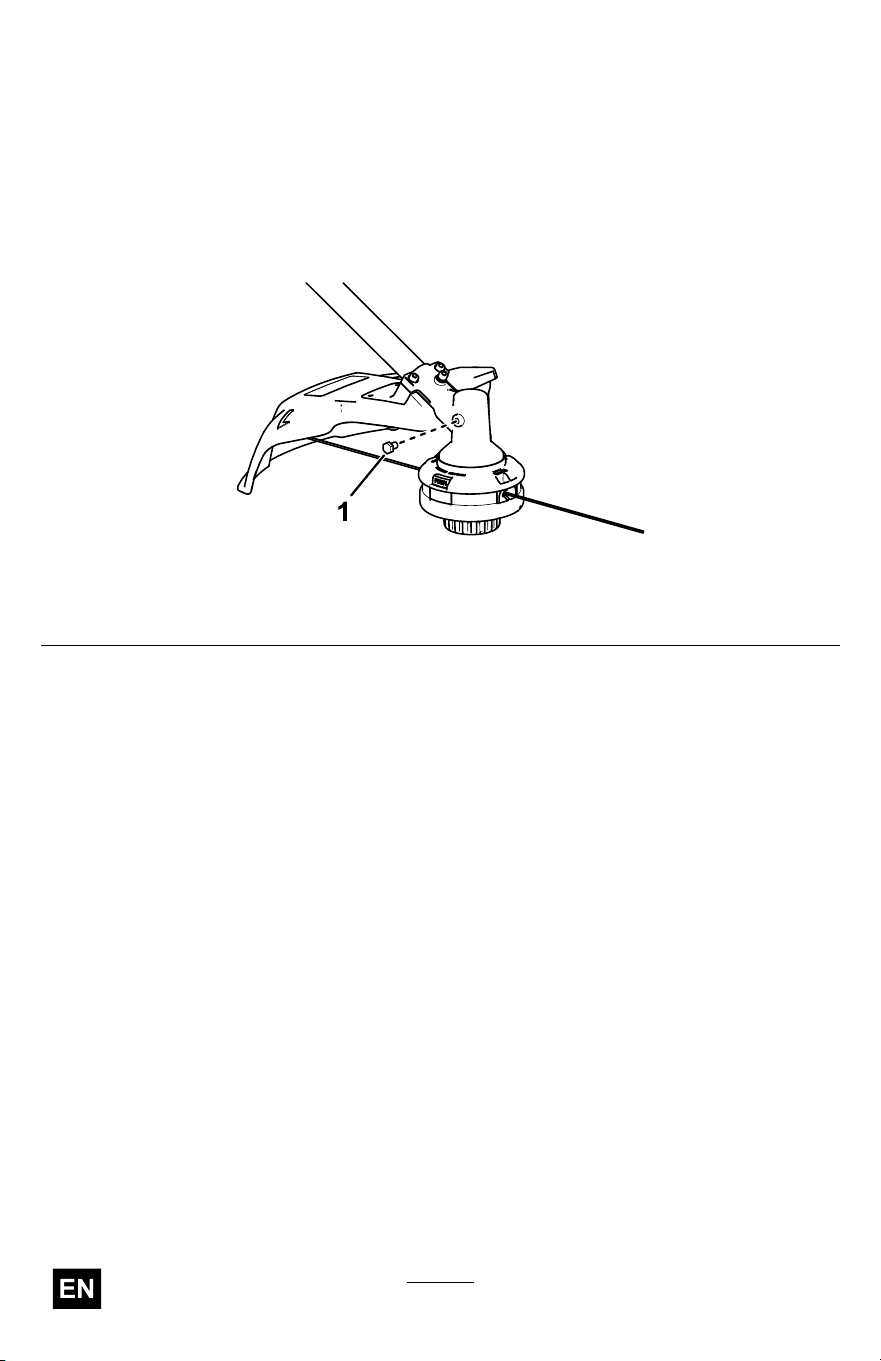
3. Remove the plug from the side of the trimmer ( Figure 13 ).
g524953
Figure 13
1. Gearbox plug
4. Apply a small amount of grease into the gearbox using a grease gun.
Note: Use No. 2 lithium grease.
5. Install the gearbox plug.
24

Storage
Important: Store the machine, battery pack, and charger only
in temperatures that are within the appropriate range; refer to
Specications ( page 14 ) .
Important: If you are storing the machine for a year or longer ,
remove the battery pack from the machine and charge the battery
pack until 1 or 2 LED indicators turn green on the battery . Do not
store a fully charged or fully depleted battery . When you are ready to
use the machine again, charge the battery pack until the left indicator
light turns green on the charger or all 4 LED indicators turn green
on the battery .
• Disconnect the machine from the power supply (i.e., remove the
battery pack) and check for damage after use.
• Clean all foreign material from the machine.
• Do not store the machine or charger with the battery pack installed.
• When not in use, store the machine, battery pack, and battery charger
out of the reach of children.
• Keep the machine, battery pack, and battery charger away from
corrosive agents such as garden chemicals and de-icing salts.
• T o reduce the risk of serious personal injury , do not store the battery
pack outside or in vehicles.
• Store the machine, battery pack, and battery charger in an enclosed
clean, dry area.
25
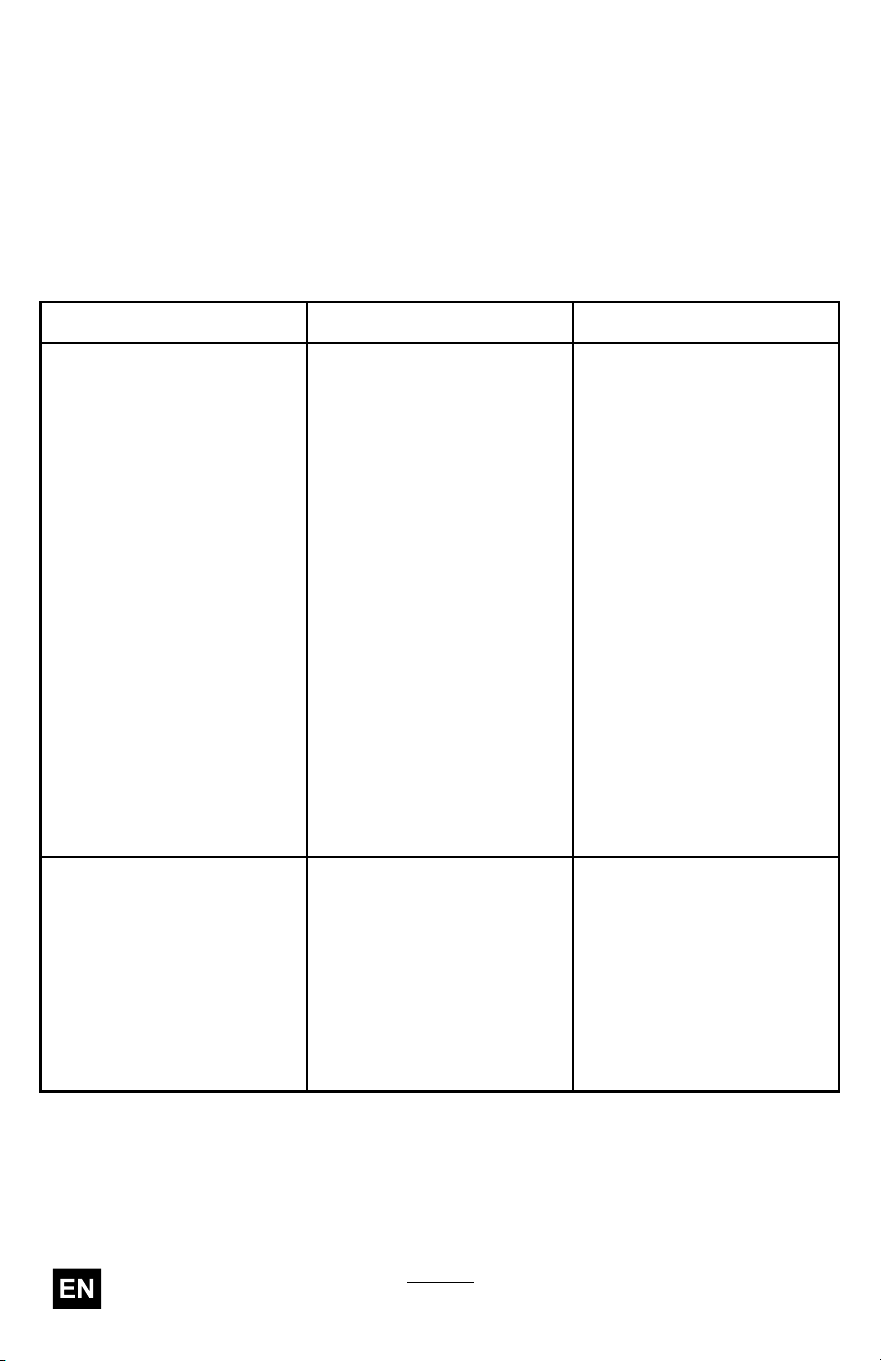
T roubleshooting
Perform only the steps described in these instructions. All further
inspection, maintenance, and repair work must be performed by an
authorized service center or a similarly qualied specialist if you cannot
solve the problem yourself.
Always remove the battery from the tool when troubleshooting, inspecting,
maintaining, or cleaning the tool.
Problem
Possible Cause Corrective Action
1. The battery is not fully
installed in the tool.
1. Remove and then
replace the battery into
the tool, making sure
that it is fully installed
and latched.
2. The battery pack is not
charged.
2. Remove the battery
pack from the tool and
charge it.
3. The battery pack is over
or under the appropriate
temperature range.
3. Move the battery pack
to a place where it is
dry and the temperature
is between 5°C (41°F)
and 40°C (104°F).
4. There is moisture on
the leads of the battery
pack.
4. Allow the battery pack
to dry or wipe it dry .
5. The battery pack is
damaged.
5. Replace the battery
pack.
The tool does not run or
does not run continuously .
6. There is another
electrical problem with
the tool.
6. Contact an Authorized
Service Dealer .
1. The battery pack charge
capacity is too low .
1. Remove the battery
pack from the tool and
fully charge the battery
pack.
2. The air vents are
blocked.
2. Clean the air vents.
The tool does not reach
full power or the gearbox is
getting hot.
3. The gearbox is not
being lubricated
properly .
3. Lubricate the gearbox.
26
Problem
Possible Cause Corrective Action
1. The gearbox is not
being lubricated
properly .
1. Lubricate the gearbox.
2. There is debris under
the grass shield or in
the bump head housing
on the trimmer .
2. Clean any debris from
under the grass shield
or in the bump head
housing.
The tool is producing
excessive vibration or
noise.
3. The spool is not
properly wound.
3. Advance the line using
the bump head and/or
remove the line on the
spool and wind the
spool again.
1. The trimmer is out of
line.
1. Add more line to the
bump head.
2. The line is tangled in the
bump head housing.
2. Remove the bump head
cover and untangle the
line.
The bump head does not
advance the line.
3. There is debris under
the grass shield or in
the bump head housing
on the trimmer .
3. Clean any debris from
under the grass shield
or in the bump head
housing.
1. The battery pack is over
or under the appropriate
temperature range.
1. Move the battery pack
to a place where it is
dry and the temperature
is between 5°C (41°F)
and 40°C (104°F).
The battery pack loses
charge quickly .
2. The trimmer is
overloaded.
2. T rim at a slower pace.
27

California Proposition 65 W arning Information
What is this warning?
Y ou may see a product for sale that has a warning label like the following:
W ARNING: Cancer and Reproductive
Harm—www .p65W arnings.ca.gov .
What is Prop 65?
Prop 65 applies to any company operating in California, selling products in California, or manufacturing products
that may be sold in or brought into California. It mandates that the Governor of California maintain and publish a
list of chemicals known to cause cancer , birth defects, and/or other reproductive harm. The list, which is updated
annually , includes hundreds of chemicals found in many everyday items. The purpose of Prop 65 is to inform the
public about exposure to these chemicals.
Prop 65 does not ban the sale of products containing these chemicals but instead requires warnings on any product,
product packaging, or literature with the product. Moreover , a Prop 65 warning does not mean that a product is in
violation of any product safety standards or requirements. In fact, the California government has claried that
a Prop 65 warning “is not the same as a regulatory decision that a product is ‘safe’ or ‘unsafe.’” Many of these
chemicals have been used in everyday products for years without documented harm. For more information, go
to https://oag.ca.gov/prop65/faqs-view-all .
A Prop 65 warning means that a company has either (1) evaluated the exposure and has concluded that it exceeds
the “no signicant risk level”; or (2) has chosen to provide a warning based on its understanding about the presence
of a listed chemical without attempting to evaluate the exposure.
Does this law apply everywhere?
Prop 65 warnings are required under California law only . These warnings are seen throughout California in a wide
range of settings, including but not limited to restaurants, grocery stores, hotels, schools, and hospitals, and on a
wide variety of products. Additionally , some online and mail order retailers provide Prop 65 warnings on their
websites or in catalogs.
How do the California warnings compare to federal limits?
Prop 65 standards are often more stringent than federal and international standards. There are various substances
that require a Prop 65 warning at levels that are far lower than federal action limits. For example, the Prop 65
standard for warnings for lead is 0.5 μg/day , which is well below the federal and international standards.
Why don’t all similar products carry the warning?
• Products sold in California require Prop 65 labelling while similar products sold elsewhere do not.
• A company involved in a Prop 65 lawsuit reaching a settlement may be required to use Prop 65 warnings for its
products, but other companies making similar products may have no such requirement.
• The enforcement of Prop 65 is inconsistent.
• Companies may elect not to provide warnings because they conclude that they are not required to do so
under Prop 65; a lack of warnings for a product does not mean that the product is free of listed chemicals
at similar levels.
Why does T oro include this warning?
T oro has chosen to provide consumers with as much information as possible so that they can make informed
decisions about the products they buy and use. T oro provides warnings in certain cases based on its knowledge of
the presence of one or more listed chemicals without evaluating the level of exposure, as not all the listed chemicals
provide exposure limit requirements. While the exposure from T oro products may be negligible or well within the “no
signicant risk” range, out of an abundance of caution, T oro has elected to provide the Prop 65 warnings. Moreover , if
T oro does not provide these warnings, it could be sued by the State of California or by private parties seeking to
enforce Prop 65 and subject to substantial penalties.
Rev