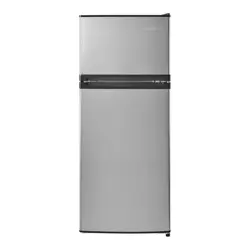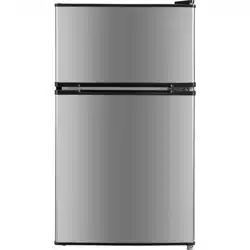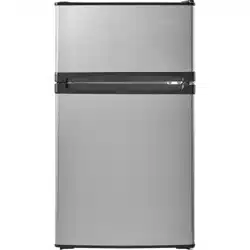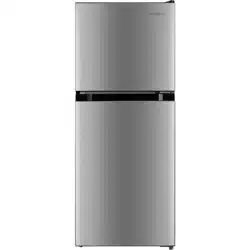
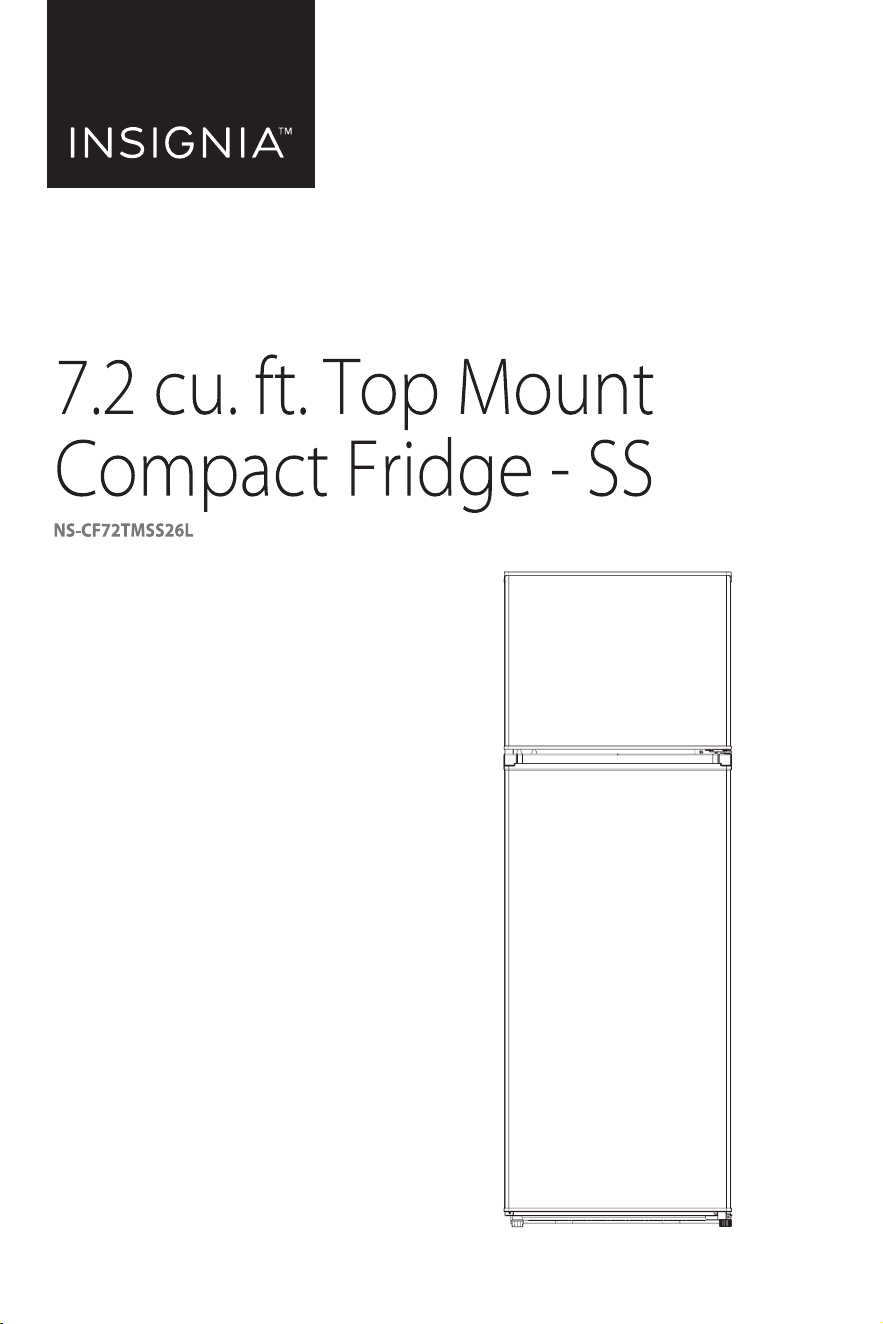
Before using your new product, please read these instructions to prevent any damage.
USER GUIDE
www.insigniaproducts.com
2
Contents
Introduction . . . . . . . . . . . . . . . . . . . . . . . . . . . . . . . . . . . . . . . . . . . . . . . . . . . . . . . . . . . . . . . . . . . . . . . . . . . . . . . . . . . . . . . . . . 2
IMPORTANT SAFEGUARDS . . . . . . . . . . . . . . . . . . . . . . . . . . . . . . . . . . . . . . . . . . . . . . . . . . . . . . . . . . . . . . . . . . . . . . . . . . . . 3
Grounding requirement . . . . . . . . . . . . . . . . . . . . . . . . . . . . . . . . . . . . . . . . . . . . . . . . . . . . . . . . . . . . . . . . . . . . . . . . . . . . . . . . . . . . . . . . . . 4
Features . . . . . . . . . . . . . . . . . . . . . . . . . . . . . . . . . . . . . . . . . . . . . . . . . . . . . . . . . . . . . . . . . . . . . . . . . . . . . . . . . . . . . . . . . . . . . . 5
Package contents . . . . . . . . . . . . . . . . . . . . . . . . . . . . . . . . . . . . . . . . . . . . . . . . . . . . . . . . . . . . . . . . . . . . . . . . . . . . . . . . . . . . . . . . . . . . . . . . . 5
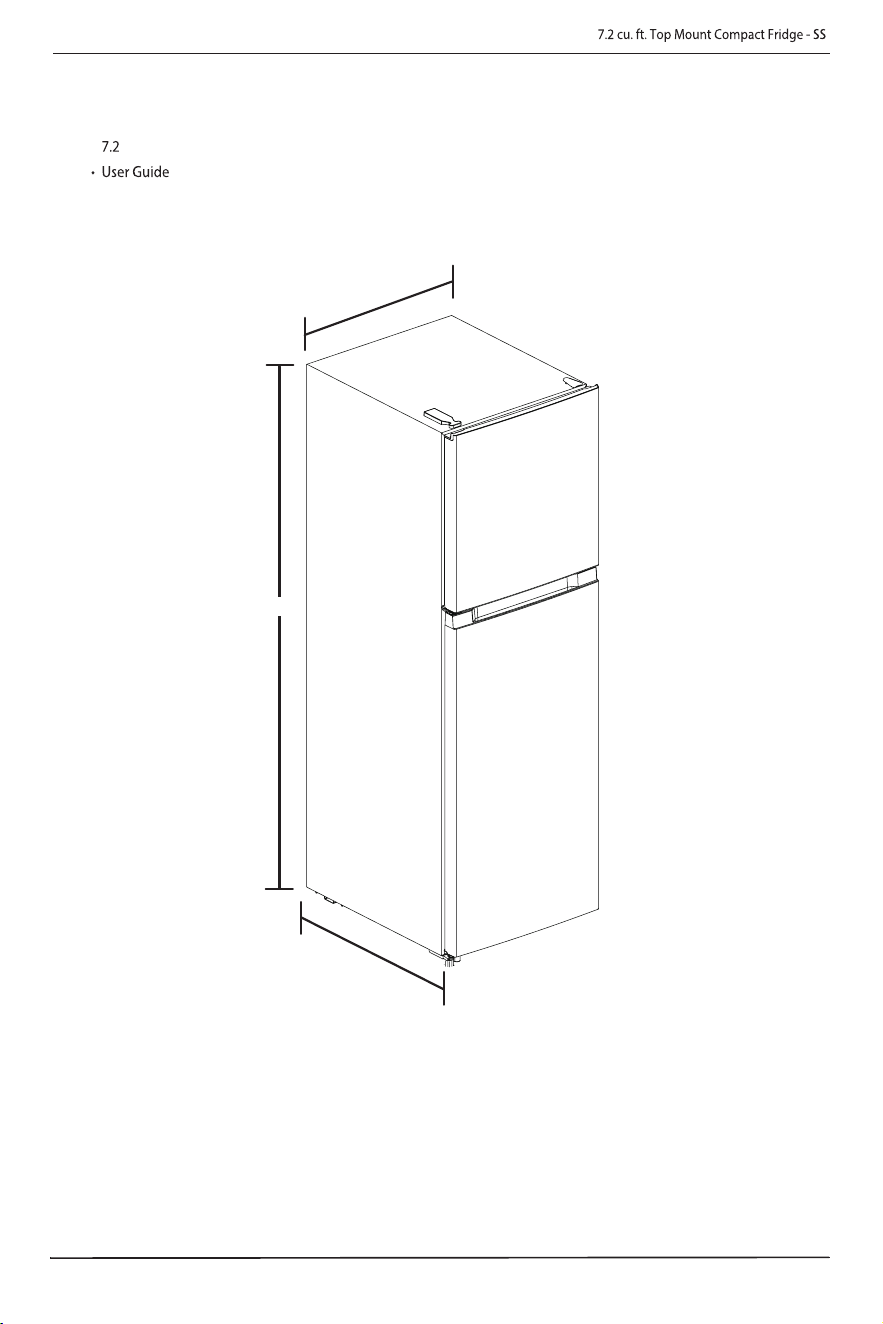
Dimensions. . . . . . . . . . . . . . . . . . . . . . . . . . . . . . . . . . . . . . . . . . . . . . . . . . . . . . . . . . . . . . . . . . . . . . . . . . . . . . . . . . . . . . . . . . . . . . . . . . . . . . . 5
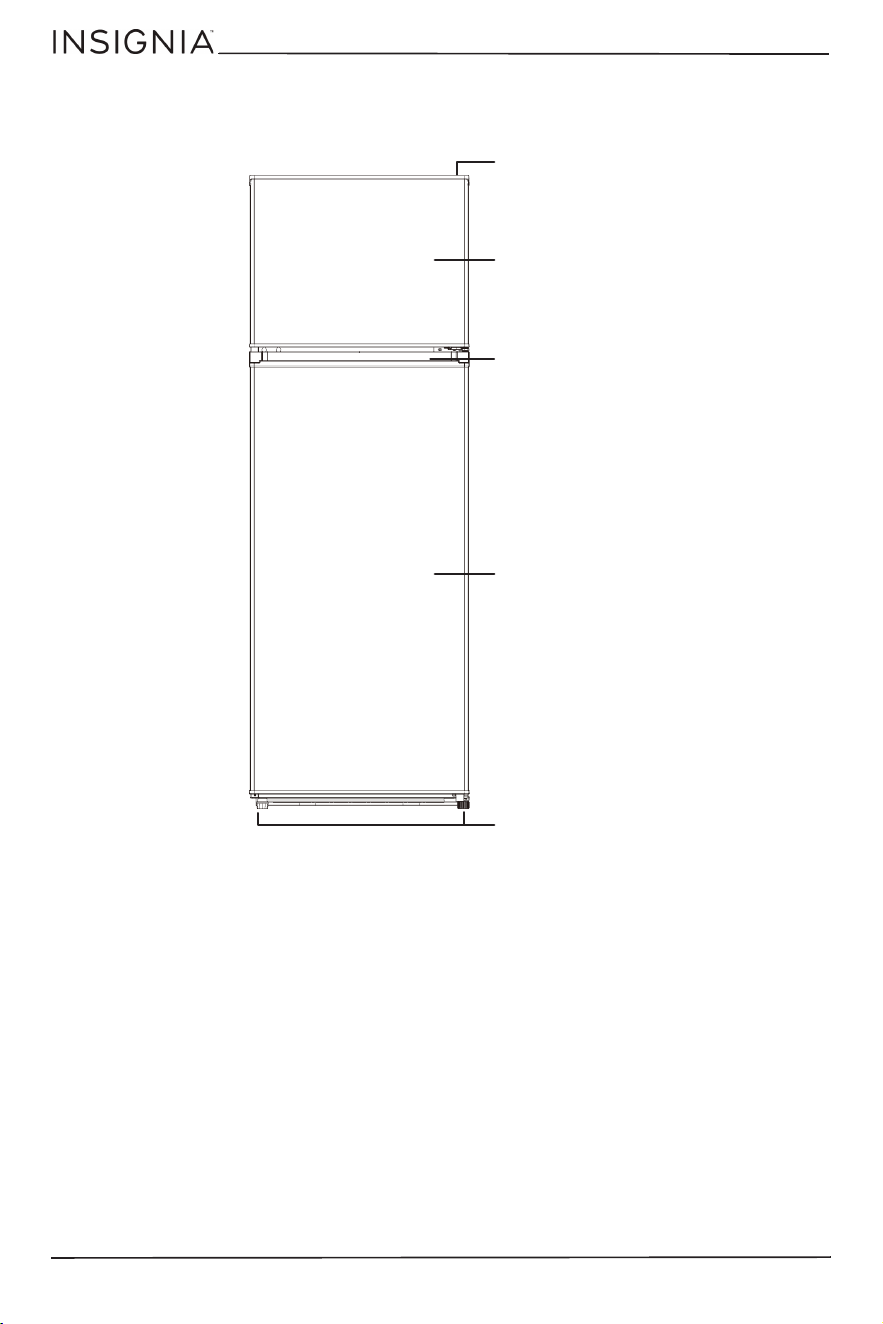
Exterior. . . . . . . . . . . . . . . . . . . . . . . . . . . . . . . . . . . . . . . . . . . . . . . . . . . . . . . . . . . . . . . . . . . . . . . . . . . . . . . . . . . . . . . . . . . . . . . . . . .
. . . . . . . . 6
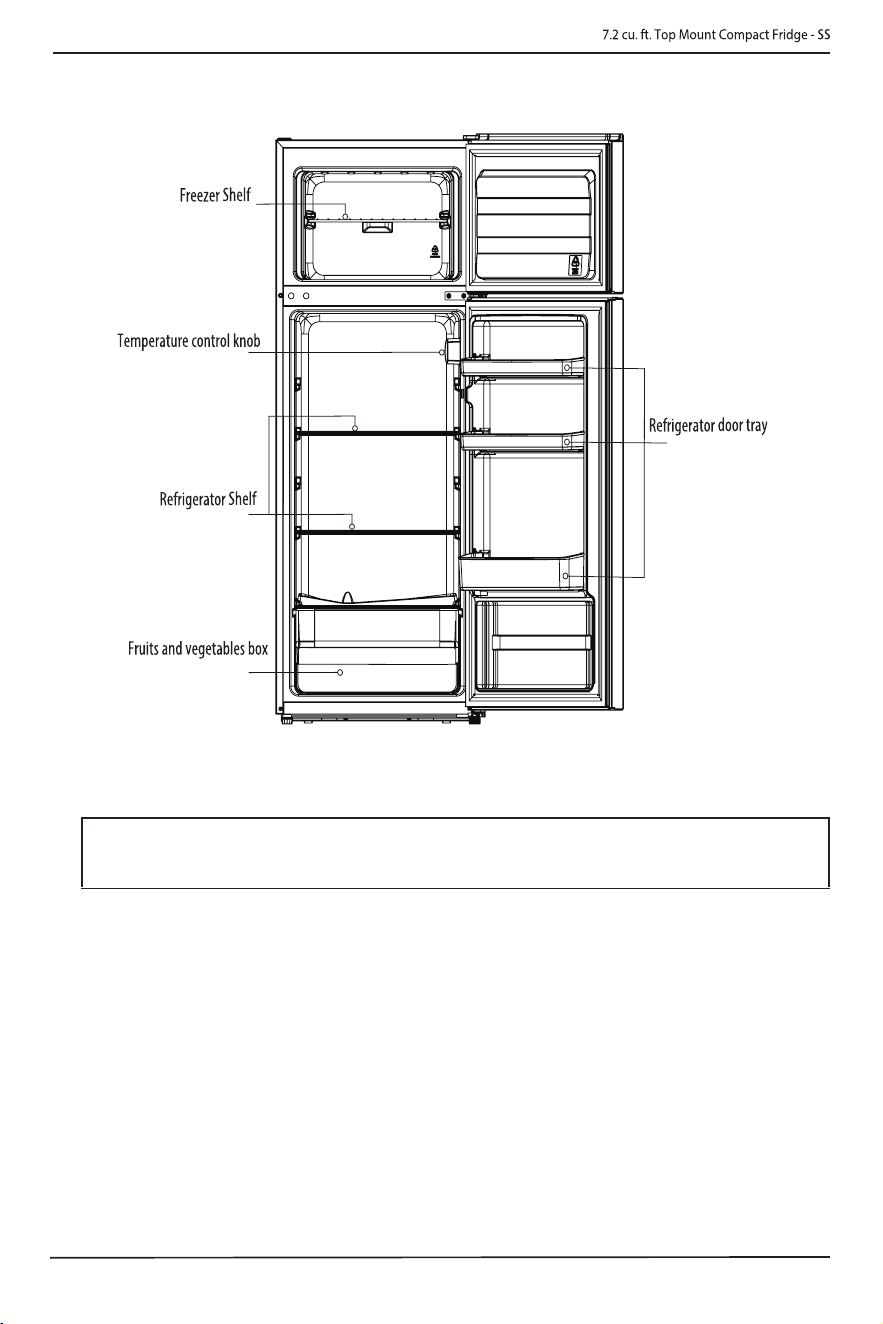
Interior . . . . . . . . . . . . . . . . . . . . . . . . . . . . . . . . . . . . . . . . . . . . . . . . . . . . . . . . . . . . . . . . . . . . . . . . . . . . . . . . . . . . . . . . . . . . . . . . . . . . . . . . . . . 7
Setting up your refrigerator . . . . . . . . . . . . . . . . . . . . . . . . . . . . . . . . . . . . . . . . . . . . . . . . . . . . . . . . . . . . . . . . . . . . . . . . . . . 7
Before using your refrigerator . . . . . . . . . . . . . . . . . . . . . . . . . . . . . . . . . . . . . . . . . . . . . . . . . . . . . . . . . . . . . . . . . . . . . . . . . . . . . . . . . . . . . 7
Finding a suitable location . . . . . . . . . . . . . . . . . . . . . . . . . . . . . . . . . . . . . . . . . . . . . . . . . . . . . . . . . . . . . . . . . . . . . . . . . . . . . . . . . . . . . . . . 7
Providing correct ventilation . . . . . . . . . . . . . . . . . . . . . . . . . . . . . . . . . . . . . . . . . . . . . . . . . . . . . . . . . . . . . . . . . . . . . . . . . . . . . . . . . . . . . . 8
Providing the correc
t power source . . . . . . . . . . . . . . . . . . . . . . . . . . . . . . . . . . . . . . . . . . . . . . . . . . . . . . . . . . . . . . . . . . . . . . . . . . . . . . . 9
Leveling your refrigerator . . . . . . . . . . . . . . . . . . . . . . . . . . . . . . . . . . . . . . . . . . . . . . . . . . . . . . . . . . . . . . . . . . . . . . . . . . . . . . . . . . . . . . . . . 9
Reversing the refrigerator door. . . . . . . . . . . . . . . . . . . . . . . . . . . . .
. . . . . . . . . . . . . . . . . . . . . . . . . . . . . . . . . . . . . . . . . . . . . . . . . . . . . . 10
Using your refrigerator. . . . . . . . . . . . . . . . . . . . . . . . . . . . . . . . . . . . . . . . . . . . . . . . . . . . . . . . . . . . . . . . . . . . . . . . . . . . . . . 1
Setting the refrigerator temperature . . . . . . . . . . . . . . . . . . . . . . . . . . . . . . . . . . . . . . . . . . . . . . . . . . . . . . . . . . . . . . . . . . . . . . . . . . . . . 1
Setting the freezer temperature . . . . . . . . . . . . . . . . . . . . . . . . . . . . . . . . . . . . . . . . . . . . . . . . . . . . . . . . . . . . . . . . . . . . . . . . . . . . . . . . . . 1
Setting the humidity in the crisper . . . . . . . . . . . . . . . . . . . . . . . . . . . . . . . . . . . . . . . . . . . . . . . . . . . . . . . . . . . . . . . . . . . . . . . . . . . . . . . 1
Adjusting the refrigerator shelves . . . . . . . . . . . . . . . . . . . . . . . . . . . . . . . . . . . . . . . . . . . . . . . . . . . . . . . . . . . . . . . . . . . . . . . . . . . . . . . . 1
Adjusting the door racks . . . . . . . . . . . . . . . . . . . . . . . . . . . . . . . . . . . . . . . . . . . . . . . . . . . . . . . . . . . . . . . . . . . . . . . . . . . . . . . . . . . . . . . . . 1
Removing the crisper . . . . . . . . . . . . . . . . . . . . . . . . . . . . . . . . . . . . . . . . . . . . . . . . . . . . . . . . . . . . . . . . . . . . . . . . . . . . . . . . . . . . . . . . . . . . 1
Maintaining your refrigerator . . . . . . . . . . . . . . . . . . . . . . . . . . . . . . . . . . . . . . . . . . . . . . . . . . . . . . . . . . . . . . . . . . . . . . . . 1
Cleaning your refrigerator. . . . . . . . . . . . . . . . . . . . . . . . . . . . . . . . . . . . . . . . . . . . . . . . . . . . . . . . . . . . . . . . . . . . . . . . . . . . . . . . . . . . . . . . 1
Defrosting your refrigerator . . . . . . . . . . . . . . . . . . . . . . . . . . . . . . . . . . . . . . . . . . . . . . . . . . . . . . . . . . . . . . . . . . . . . . . . . . . . . . . . . . . . . . 1
Shutting down your refrigerator for a long time (several months). . . . . . . . . . . . . . . . . . . . . . . . . . . . . . . . . . . . . . 1
Moving your refrigerator . . . . . . . . . . . . . . . . . . . . . . . . . . . . . . . . . . . . . . . . . . . . . . . . . . . . . . . . . . . . . . . . . . . . . . . . . . . . . 1
Disposing of your refrigerator . . . . . . . . . . . . . . . . . . . . . . . . . . . . . . . . . . . . . . . . . . . . . . . . . . . . . . . . . . . . . . . . . . . . . . . . 1
Tips on saving energy. . . . . . . . . . . . . . . . . . . . . . . . . . . . . . . . . . . . . . . . . . . . . . . . . . . . . . . . . . . . . . . . . . . . . . . . . . . . . . . . 1
Tips on storing food . . . . . . . . . . . . . . . . . . . . . . . . . . . . . . . . . . . . . . . . . . . . . . . . . . . . . . . . . . . . . . . . . . . . . . . . . . . . . . . . . 1
Tips for shopping for frozen foods. . . . . . . . . . . . . . . . . . . . . . . . . . . . . . . . . . . . . . . . . . . . . . . . . . . . . . . . . . . . . . . . . . . . 1
Troubleshooting. . . . . . . . . . . . . . . . . . . . . . . . . . . . . . . . . . . . . . . . . . . . . . . . . . . . . . . . . . . . . . . . . . . . . . . . . . . . . . . . . . . . . 1
Specications. . . . . . . . . . . . . . . . . . . . . . . . . . . . . . . . . . . . . . . . . . . . . . . . . . . . . . . . . . . . . . . . . . . . . . . . . . . . . . . . . . . . . . . .
ONE-YEAR LIMITED WARRANTY . . . . . . . . . . . . . . . . . . . . . . . . . . . . . . . . . . . . . . . . . . . . . . . . . . . . . . . . . . . . . . . . . . . . . . 2
Introduction
Congratulations on your purchase of a high-quality Insignia product. Your represents the state of
the art in top mount refrigerator design and is designed for reliable and trouble-free performance.
www.insigniaproducts.com
3
IMPORTANT SAFEGUARDS
WARNING
1 Read these instructions.
2 Keep these instructions.
3 Heed all warnings.
4 Follow all instructions.
5 Do not use your refrigerator near water.
6 Clean only with a damp cloth.
7 Do not block any ventilation openings. Install in accordance with the manufacturer’s instructions.
8 Do not install near any heat sources, such as radiators, heat registers, stoves, or other apparatus (including ampliers)
that produce heat.
9 Do not defeat the safety purpose of the polarized or grounding-type plug. A polarized plug has two blades with one
wider than the other. A grounding type plug has two blades and a third groundi
ng prong. The wide blade or the third
prong are provided for your safety. If the provided plug does not t into your outlet, consult an electrician for
replacement of the obsolete outlet.
10 Protect the power cord from being walked on or pinched, particularly at plugs, convenience receptacles, and the point
where it exits from your refrigerator.
11 Do not attempt to modify or extend the power cord of your refrigerator.
12 Unplug your refrigerator during lightning storms or when it will not be used for long periods of time.
13 Make sure that the availab
le AC power matches the voltage requirements of your refrigerator.
14 Do not handle the plug with wet hands. This could result in an electric shock.
15 Unplug the power cord by holding the plug, never by pulling the cord.
16 Turn o your refrigerator before unplugging it.
17 Refer all servicing to qualied service personnel. Servicing is required when your refrigerator has been damaged in any
way, such as the power-supply cord or plug is damaged, liquid has been spilled or objects have fallen into your
refrigerator, your refrigerator has been exposed to rain or moisture, does not operate normally, or has been
dropped.
18 To reduce the risk of re or electric shock, do not expose your refrigerator to rain, moisture, dripping, or splashing, and
no objects lled with liquids should be placed on top of it.
19 Do not use extension cords or ungrounded (two prong) adapters. If the power cord is too short, have a qualied
electrician install an outlet near your refrigerator. Use of an extension cord can negatively aect your refrigerator’s
performance.
20 Your refrigerator is not intended for use by persons (including children) with reduced physical, sensory, or mental
capabilities, o
r lack of experience and knowledge, unless they have been given supervision or instruction concerning
use of your refrigerator by a person responsible for their safety.
21 Children should be supervised to ensure that they do not play with your refrigerator.
22 If the power cord is damaged, it must be replaced by the manufacturer, its service agent, or similarly qualied person, in
order to avoid a hazard.
CAUTION
RISK OF ELECTRIC SHOCK
DO NOT OPEN
This symbol indicates that dangerous voltage constituting a risk of
electric shock is present within your refrigerator.
This symbol indicates that there are important operating and
maintenance instructions in the literature accompanying your
refrigerator.
www.insigniaproducts.com
4
WARNING
Electric Shock Hazard
Failure to follow these instructions can result in electric shock, re, or death.
1 WARNING–Keep ventilation openings, in both your refrigerator and the built-in structure, clear of
obstruction.
2 WARNING–Do not touch the interior of your refrigerator with wet hands. This could result in
frostbite.
3 WARNING–Do not use mechanical devices or other means to accelerate the defrosting process,
other than those recommended by the manufacturer.
4 WARNING–Do not damage the refrigerant circuit.
5 WARNING–Do not damage the refrigerant tubing when handling, moving,
or using your refrigerator.
6 WARNING–DANGER—Never allow children to play with, operate, or crawl inside your refrigerator.
Risk of child entrapment. Before you throw away your old refrigerator:
• Take o the door.
• Leave the shelves in place so that children may not easily climb inside.
7 WARNING-Do not use electrical appliances inside the food storage compartments of the appliance unless they are of
the type recommended by the manufacturer.
8 Unplug your refrigerator before carrying out user maintena
nce on it.
9 If a component part is damaged, it must be replaced by the manufacturer, its service agent, or similar qualied persons
in order to avoid a hazard.
10 Follow local regulations regarding disposal of your refrigerator due to ammable refrigerant and gas. All refrigeration
products contain refrigerants, which under the guidelines of federal law must be removed before disposal. It is the
consumer's responsibility to comply with federal and local regulations when disposing of this product.
11 Do not store explosive substances such as aerosol cans with a ammable propellant in this appliance.
12 This appli
ance is intended to be used in household and similar applications such as
• Sta kitchen areas in shops, oces, and other working environments
• Farm houses and by clients in hotels, motels, and other residential type environments
• Bed and breakfast type environments
• Catering and similar non-retail applications
Grounding requirement
Your refrigerator must be grounded. Your refrigerator is equipped with a cord having a grounding wire with a grounding
plug. The plug must be inserted into an outlet that is correctly installed and grounded.
Incorrect use of the grounding
plug can result in a risk of electric shock. Consult a qualied electrician or service person if
the grounding instructions are not completely understood, or if doubt exists as to whether your refrigerator is correctly
grounded.
SAVE THESE INSTRUCTIONS
www.insigniaproducts.com
5
Features
Package contents
• Cu. Ft. Refrigerator
Dimensions
2
1.6
i
n
.
(
5
5.
0
c
m
)
21.6
i
n
.
(
55.
0
c
m
)
56.3 in. (143.0 cm)
www.insigniaproducts.com
6
Exterior
Top hinge
Refrigerator door handle
Freezer door
Leveling feet
Refrigerator door
www.insigniaproducts.com
7
Interior
Setting up your refrigerator
Before using your refrigerator
• Remove the exterior and interior packaging.
• Wash the inside with a damp, warm cloth and a baking soda solution (two tablespoons in a quart [.94 l] of water), then
wipe dry with a dry cloth. Do this periodically to keep your refrigerator looking new.
• Level your refrigerator using the leveling feet. If you do not level your refrigerator, the door may not close or seal
correctly, causing cooling, frost, and moisture problems. Turn the leveling feet clockwise to raise or counterclockwise to
low
er a side.
Finding a suitable location
• Place your refrigerator on a oor that is strong enough to support it when fully loaded.
• Do not install your refrigerator on carpeting or a rug.
• Your refrigerator is designed to be free standing and should not be recessed or built-in.
• Do not install your refrigerator in a garage or any other outside installation.
• Adjust the feet to keep your refrigerator level.
• If you locate your refrigerator next to a xed wall, allow sucient space on the hinge side for the door to swing open.
• Position your refrigerat
or away from direct sunlight and sources of heat, such as a stove, heater, or radiator. Direct
sunlight may aect the acrylic coating and heat sources may increase electrical consumption. Extremely co
ld
temperatures may also prevent your refrigerator from performing correctly.
CAUTION:
• Before connecting this refrigerator to a power source, let it stand for approximately six hours to reduce the possibility of a
malfunction in the cooling system.
www.insigniaproducts.com
8
• Avoid locating your refrigerator in moist areas.
• Your refrigerator is intended for household use only. It is not designed for outside installation, including anywhere that
is not temperature controlled, such as a garage or porch.
Your refrigerator is designed to operate in a temperature range of 50° F (10° C) and 109° F (43° C). If you operate your
refrigerator outside this temperature range, your refrigerator may not work correctly.
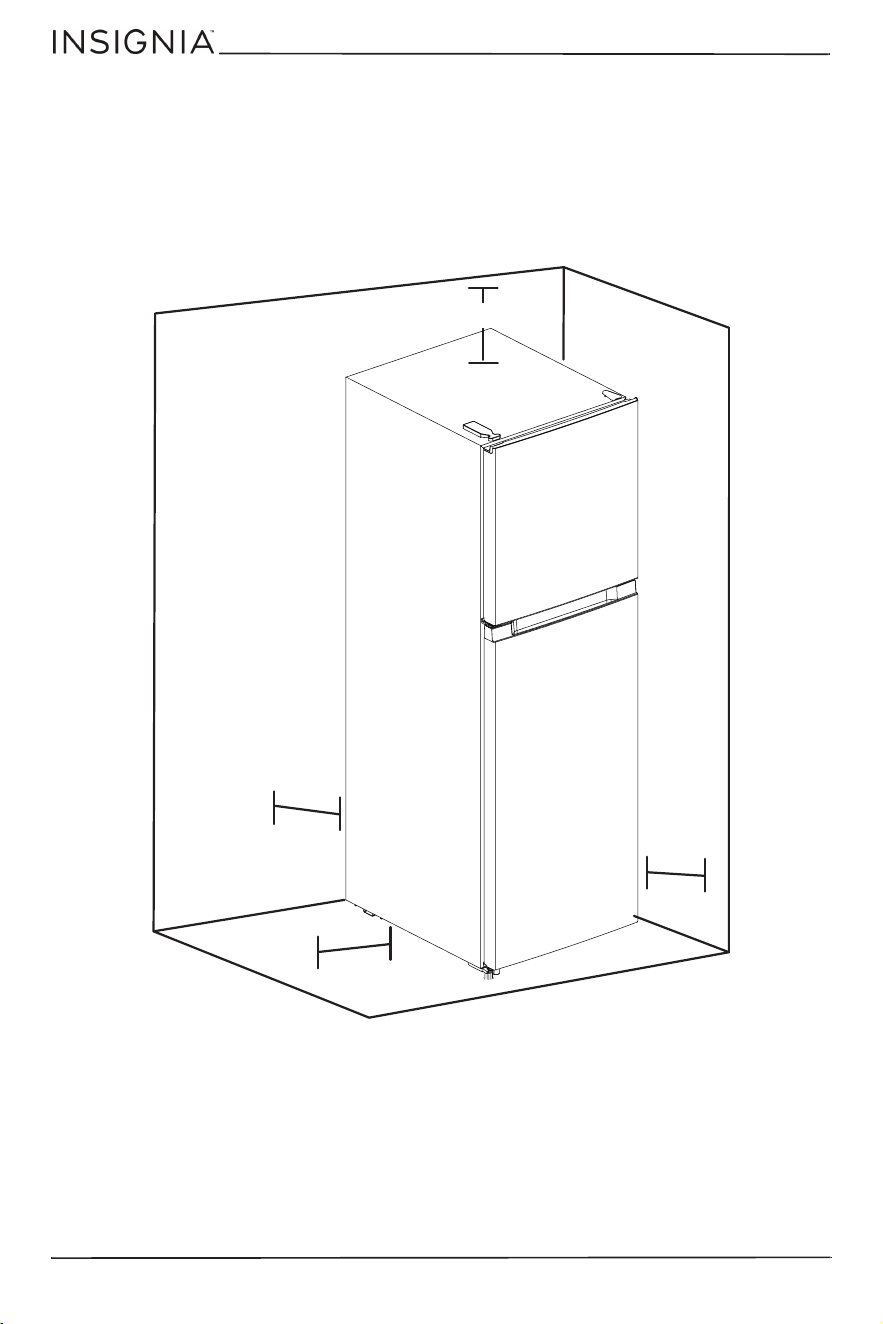
Providing correct ventilation
Allow at least 2 in. (5.1 cm) between the left and right sides and top of your refrigerator and surrounding walls and at least
5 in. (12.7 cm) between the back of your refrigerator and the back wall.
2
i
n
.
(
5
.
1
c
m
)
2 in. (5.1 cm)
2
in
.
(
5
.
1
c
m
)
5
in
.
(
1
2
.
7
c
m
)
www.insigniaproducts.com
9
Providing the correct power source
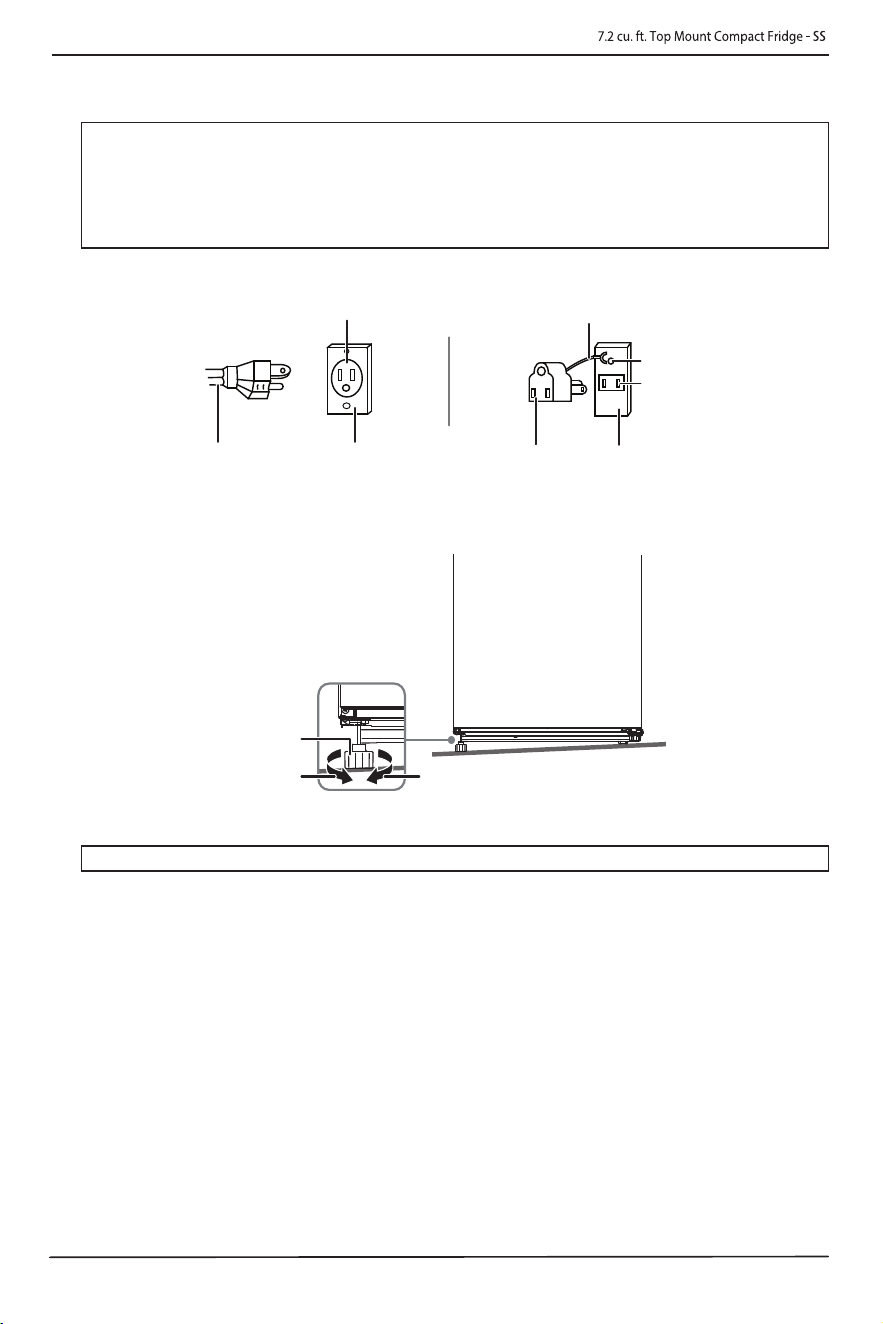
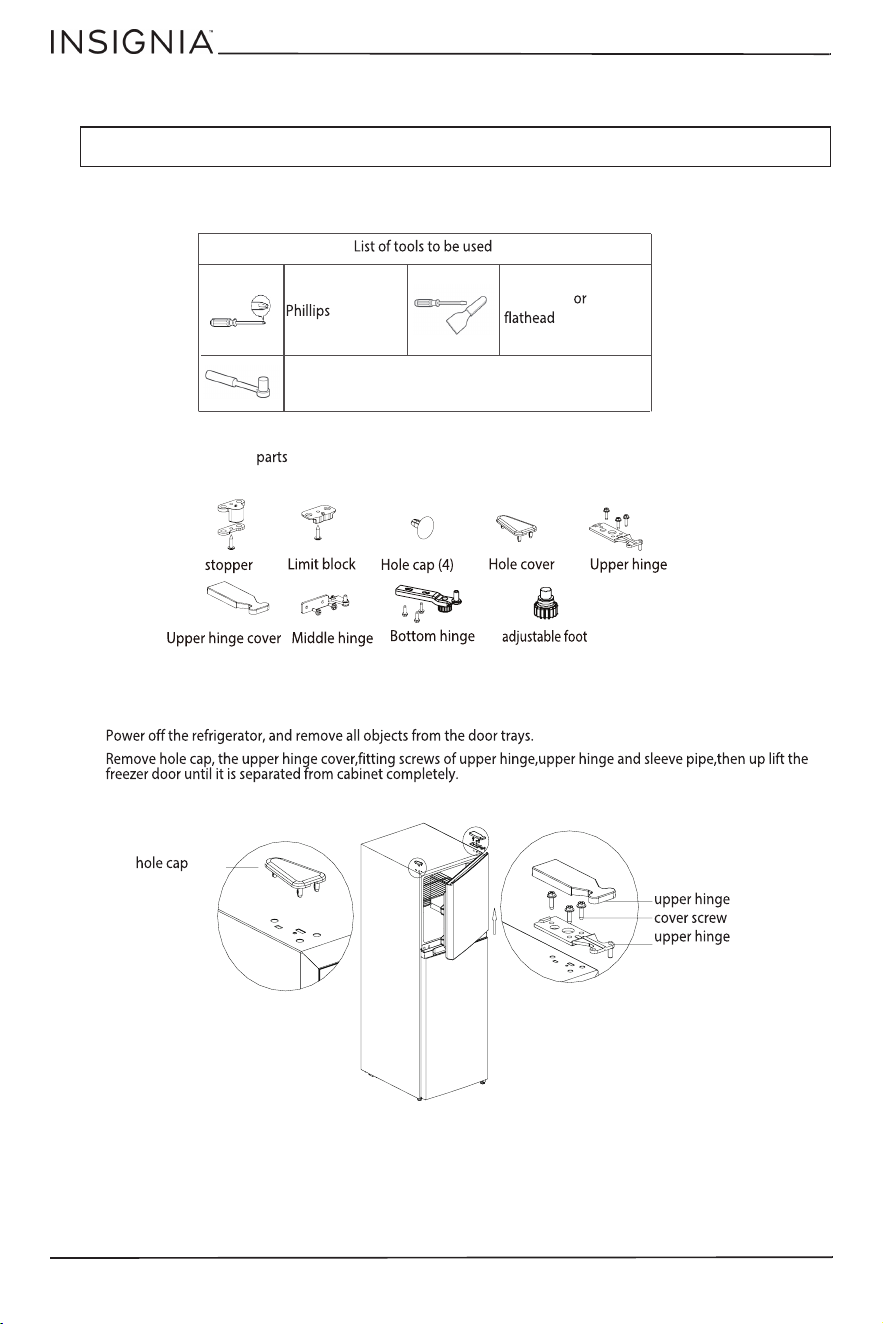
Check your local power source. Your refrigerator requires a 115V, 60Hz power supply.
Leveling your refrigerator
Leveling your refrigerator is important. If you do not level your refrigerator during installation, the doors may not close or
seal correctly which can cause cooling, frost, or moisture problems.
• Rotate the leveling feet clockwise (to raise) your refrigerator or counter-clockwise (to lower).
WARNINGS:
Make sure that:
• The power outlet accepts a 3-prong grounding plug. The third prong on t
he power cord plug grounds your refrigerator to minimize
the possibility of electric shock. Do not modify the power plug.
• You do NOT plug anything else into the same power outlet as your refrigerator. You may overload the circuit which can cause a re.
• You do NOT use an extension cord. If your refrigerator is too far from the power outlet, move your refrigerator or have a electrician
install a plug closer to your refrigerator.
• The power outlet cannot be turned o with a switch or pull string.
Note: To make it easier to adjust the feet, have someone push against the top of y
our refrigerator to tilt it slightly.
3-prong outlet
Outlet cover3-prong plug
Grounding lead
Grounding adapter
Outlet cover
Screw
Outlet
Using a 3-prong plug and outlet Using a grounding adapter
Leveling foot
Lower Raise
www.insigniaproducts.com
10
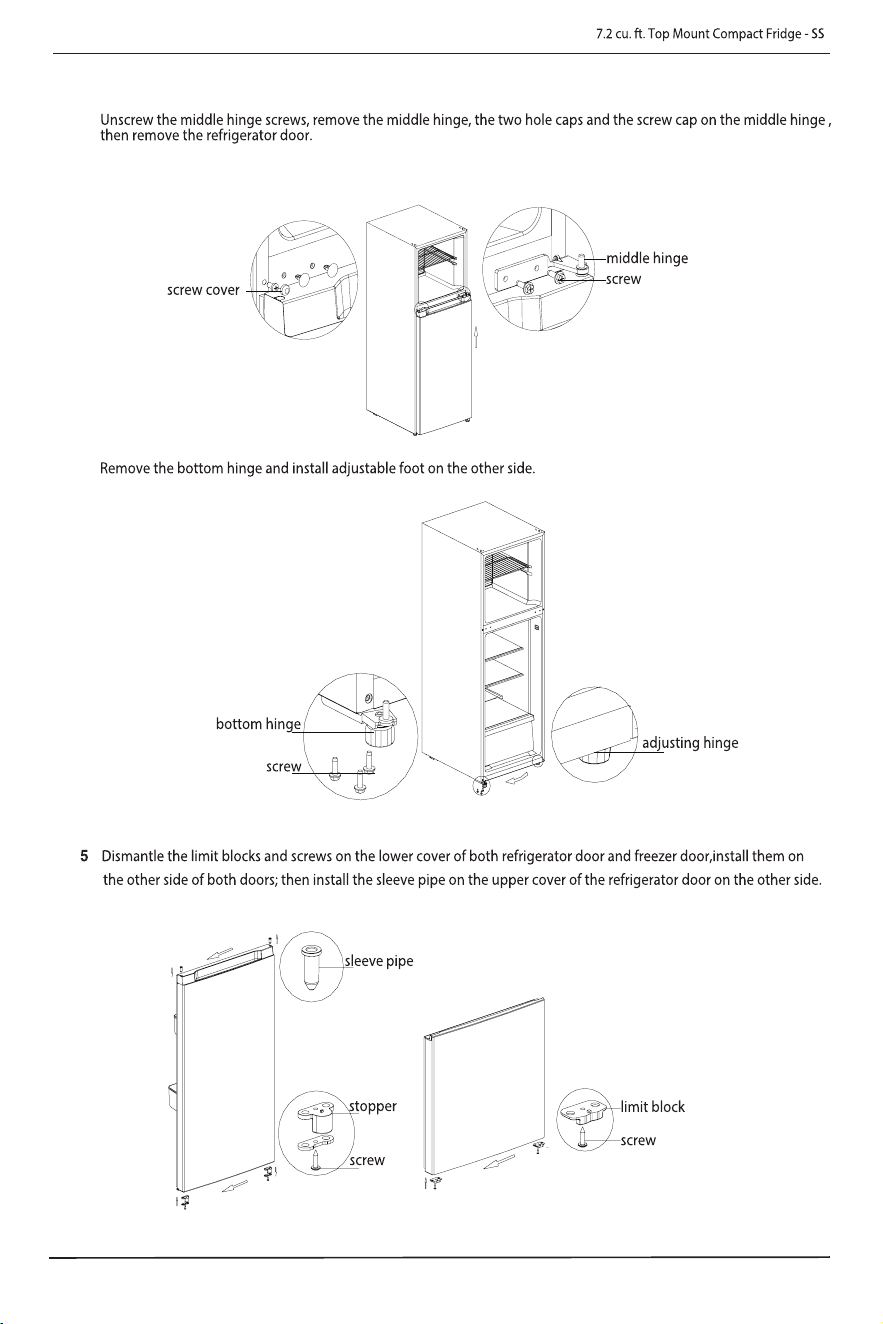
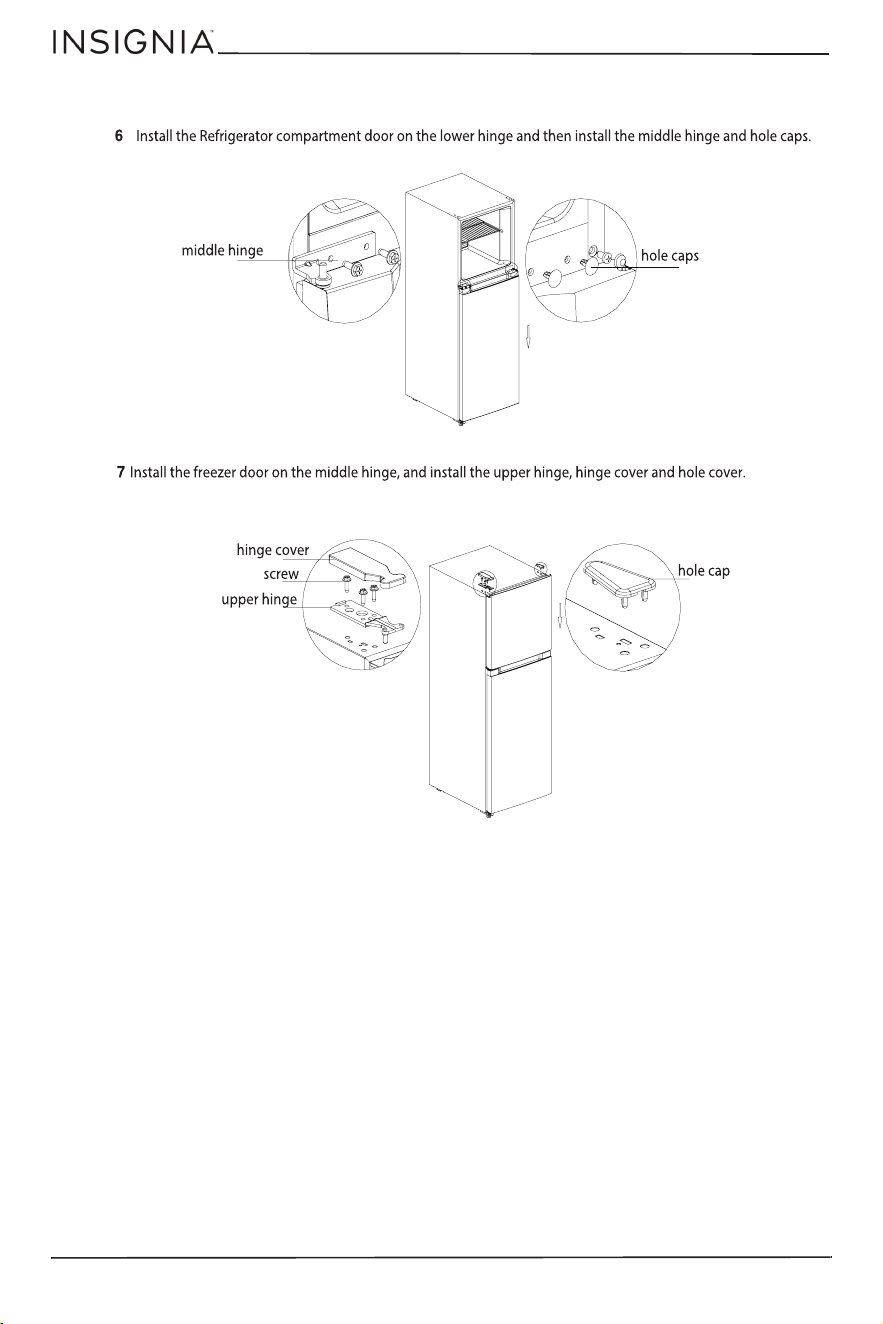
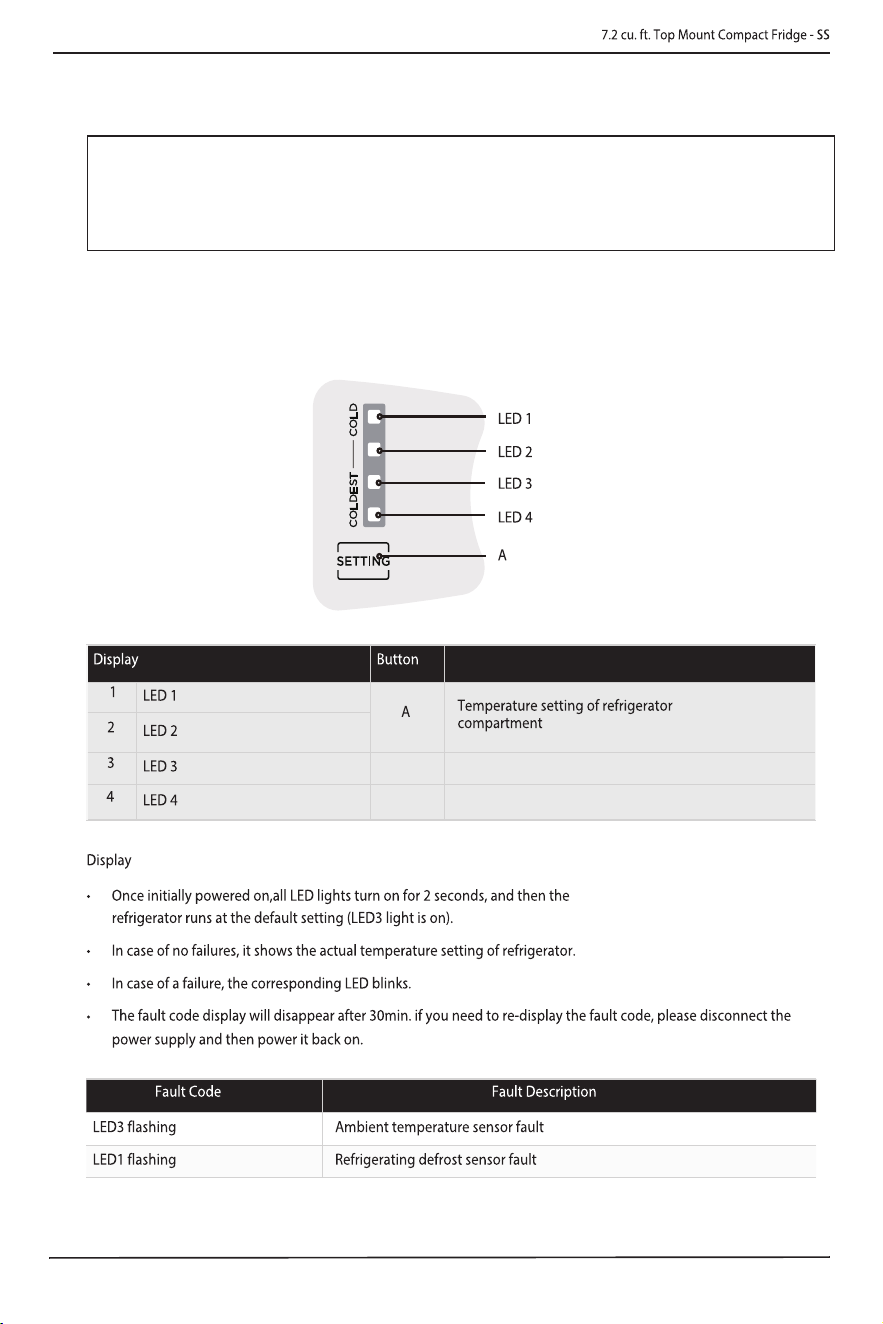
Reversing the refrigerator door
CAUTION: If you lay your refrigerator on its back or side for any length of time, wait for six hours after you stand it up again before you
plug it in. Otherwise, you may damage internal components.
You will need the following to reverse the refrigerator door:
1
2
screwdriver
5/16" socket and ratchet
Putty knife
screwdriver
www.insigniaproducts.com
11
4
3
www.insigniaproducts.com
12
www.insigniaproducts.com
13
Using your refrigerator
Before storing foods in your refrigerator, turn on the refrigerator and freezer compartments, then wait for 24 hours to make
sure that they are working correctly and to let both compartments reach the correct temperatures.
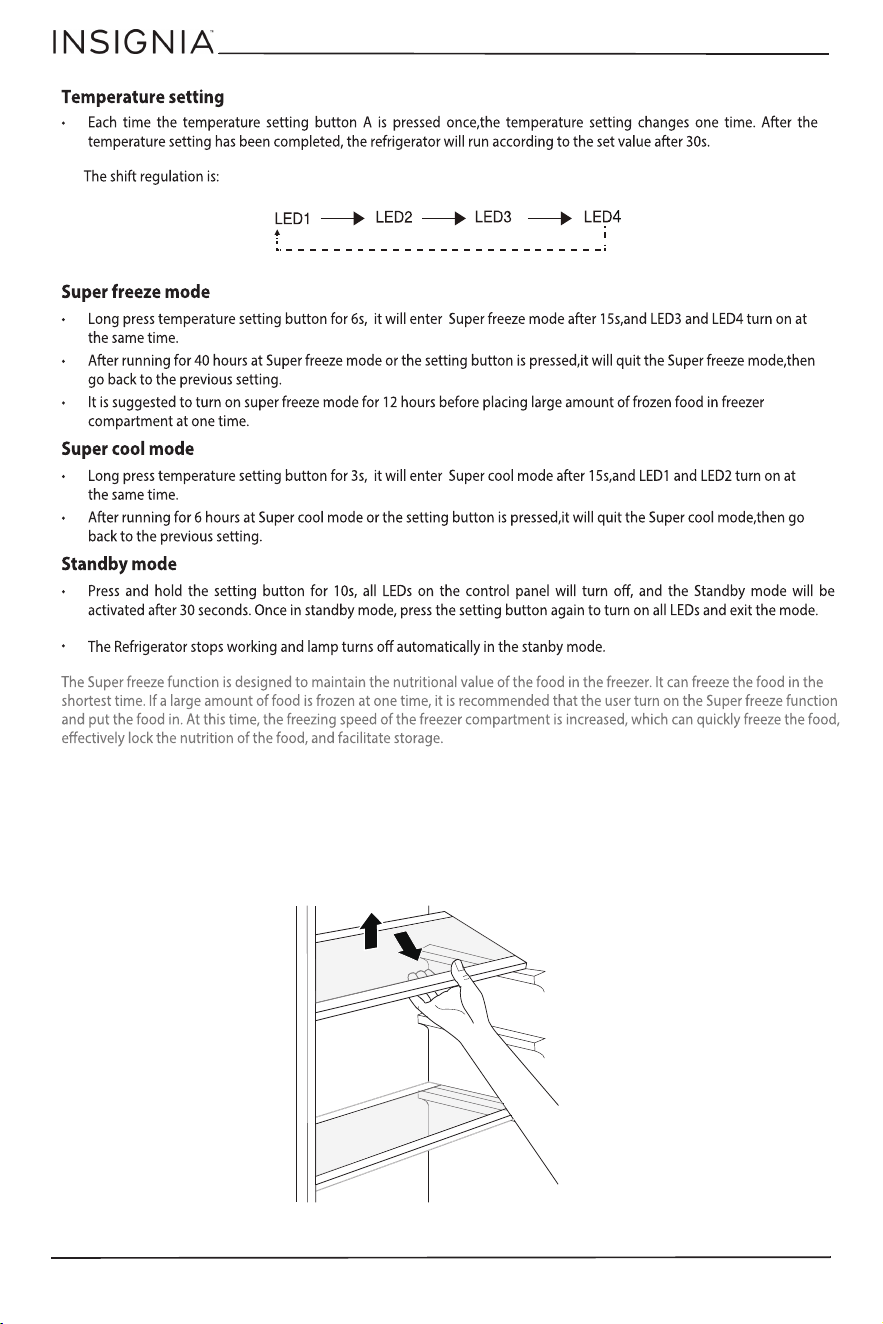
Setting the refrigerator temperature
CAUTIONS:
• If you run your refrigerator in an ambient temperature below 50° F, it may not operate consistently.
For example, the freezer temperature may become too warm and the contents may defrost.
• Internal temperatures can vary based on the location of your refrigerator, the ambient room temperature, and how often you o
pen
the doors.
• Do not store carbonated drinks in the freezer compartment. They may break and damage your refrigerator.
• Do not exceed the storage times recommended by the food manufacturers for any kind of food.
Adjusting the refrigerator shelves
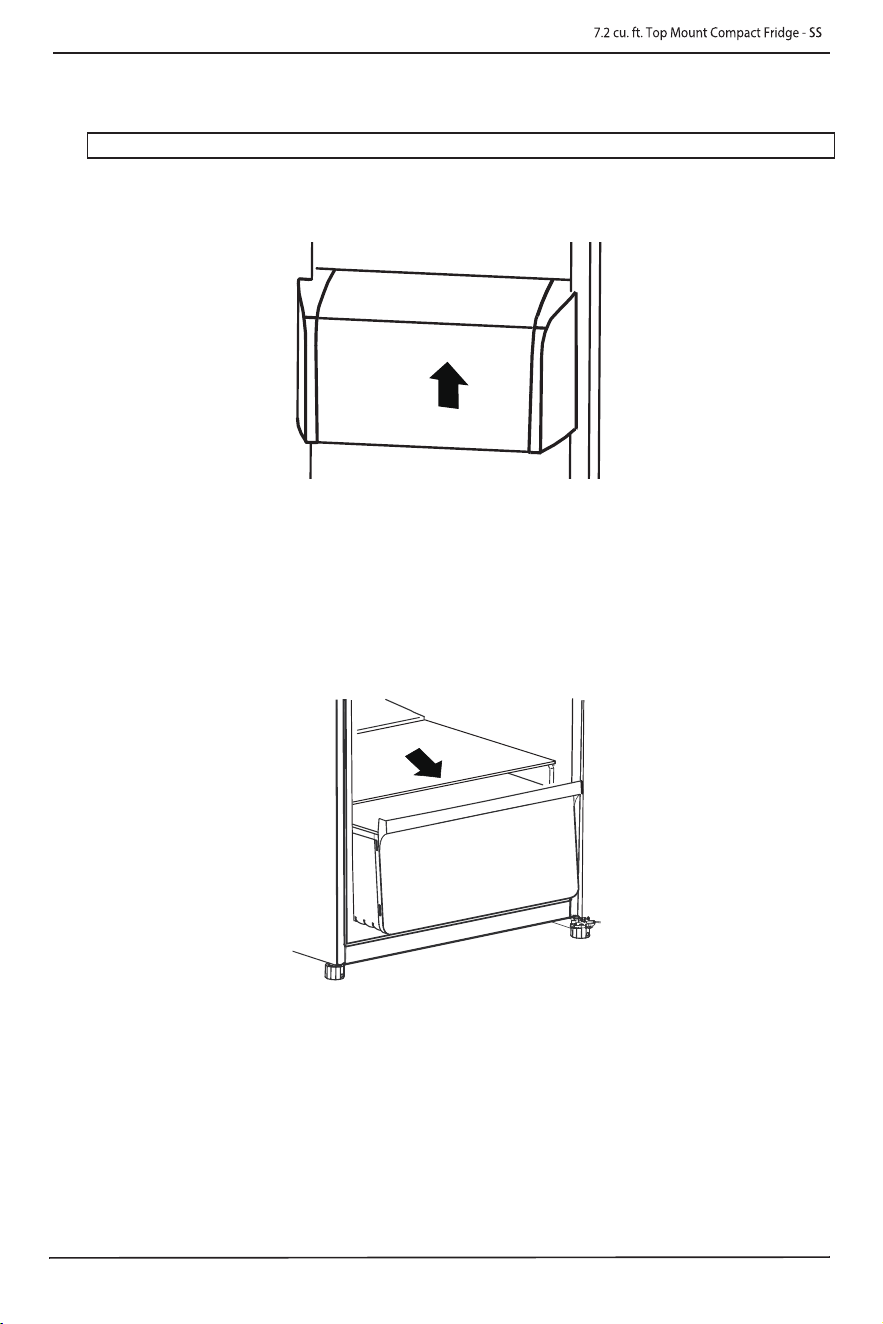
The shelves inside the refrigerator and freezer compartments are adjustable.
1 Open the refrigerator or freezer compartment door all the way.
2 Lift a shelf, then pull it out.
14
www.insigniaproducts.com
15
Adjusting the door racks
The refrigerator and freezer compartments have door racks. You can adjust a rack to t the items you want to store.
1 Remove all items from a rack.
2 Hold the door rack with one hand, then use the other hand to tap the bottom of the rack up several inches.
3 Remove the rack from the door.
4 To replace the rack, align the rack in the door, then press down to lock the rack in place. When the rack is locked in
place, you hear a click.
Removing the crisper
The crisper is designed to store fruits and vegetables. Putting fruits and vegetables inside the crisper helps avoid losing
moisture and prevents avor from getting into other foods.
1 Open the refrigerator compartment door all the way.
2 Lift the crisper basket with its glass cover up, then pull the crisper out.
3 To replace the crisper, slide it into the compartment, then lower it into position.
CAUTION: Do not put too many heavy items in the door racks. You may break the racks.
www.insigniaproducts.com
16
Maintaining your refrigerator
Cleaning your refrigerator
We recommend that you do the following every time you clean your refrigerator to keep it running odor-free and
eciently:
1 Unplug your refrigerator from the power outlet.
2 Remove all food.
3 If you want to remove the door racks, shelves, crisper, freezer shelf, or freezer door racks, see:
• Adjusting the door racks on page 1
• Adjusting the refrigerator shelves on page 1
• Removing the crisper on page 1
4 Clean the doors, handles, and cabinet surfaces with a mild detergent, then rinse with warm water using a wrung-out
sponge or cloth.
5 Wash the inside with a damp warm cloth soaked in a solution of one quart (
) of lukewarm water to one tablespoon
of baking soda solution, then rinse with warm water using a wrung-out sponge or cloth.
6 Clean the racks, shelves, and drawers with a mild detergent and soft cloth, then rinse with warm water.
7 Make sure that you keep the door gaskets (seals) clean so that the door seals tightly. This helps your refrigerator run
eciently.
8 Dry all surfaces and removable parts before putting them back into place.
9 Plug your refrigerator into the power outlet.
Defrosting your refrigerator
Your refrigerator is “frost-free” and does not require defrosting.
Shutting down your refrigerator for a long time (several months)
1 Turn o your refrigerator and unplug it from the wall outlet.
2 Remove all food.
3 Clean your refrigerator.
4 Leave the door open slightly to avoid possible formation of condensation, mold, or odor.
Moving your refrigerator
1 Turn o your refrigerator and unplug it from the wall outlet.
2 Remove all food.
3 Securely tape down all loose items inside your refrigerator.
4 Tape the doors shut.
5 Protect the exterior with moving blankets or pads.
6 Make sure that your refrigerator stays in the upright position during transportation.
Disposing of your refrigerator
This appliance should not be treated as regular household waste. It should be taken to the appropriate waste collection
point for recycling of electrical components. For information on where to take it, contact your local waste removal agency
or government oce.
CAUTIONS:
To prevent damage to the nish:
• Do not use gasoline, benzine, thinner, or other similar solvents.
• Do not use abrasive cleaners.
• Do not use sharp objects because they are likely to scratch the surface.
CAUTION: Make sure that the door gaskets are completely dry before you plug your refrigerator into the power outlet.
CAUTION: Use extreme caution with childre
n. Do not let children play with your refrigerator.
www.insigniaproducts.com
17
Tips on saving energy
• Locate your refrigerator in the coolest area of the room, away from heat producing appliances or heating ducts and out
of direct sunlight.
• Let hot foods cool to room temperature before placing them in your refrigerator. Overloading your refrigerator forces
the compressor to run longer.
• Wrap foods correctly and wipe containers dry before placing them in your refrigerator. This cuts down on frost build-up
inside your refrigerator.
• Organize and label food to reduce door openings and extended searches.
• Do not use aluminum foil, wax pap
er, or paper toweling to line shelves. Liners interfere with cold air circulation and
make your refrigerator less ecient.
Tips on storing food
• Always store cooked meats on a refrigerator shelf above raw meats to avoid bacterial transfer. Keep raw meat on a plate
which is large enough to collect juices, and cover the plate with cling lm or foil. Leave space around food. This allows
cold air to circulate around your refrigerator so that all parts of your refrigerator are kept cool.
• To prevent
transfer of avors and food drying out, wrap or cover each food item separately. Fruit and vegetables need
not be wrapped.
• Let hot food cool down before placing it in the refrigerator or freezer compartment. Placing hot food in the
fridge-freezer could spoil other food and lead to higher temperatures.
• To prevent cold air from escaping, try to limit the number of times you open the doors. When retuning from shopping,
sort foods to be kept in the refrigerator compartment before opening the doors. Only open the door to put food in or
take
it out.
• Do not store food which goes bad easily at low temperature, such as bananas and melons.
• When storing food in the refrigerator compartment, use a container with a lid whenever possible. This prevents
moisture from evaporating, and helps food keep its taste and nutrients.
• When storing food in the freezer compartment, wrap the food in polyethylene lm, aluminum foil, or other types of
freezer storage products
• Do not block air vents inside either compartment with food. Smooth circulation of cold air keeps
the refrigerator and
freezer temperatures even.
• Do not open the doors frequently. Opening the doors lets warm air enter the compartments and can cause the
temperature to rise.
• To adjust the temperature control easily, do not store food near the temperature controls.
• Never keep too many foods in the door rack, because this may stop the door from fully closing.
• Do not store bottles in the freezer compartment. They may break when frozen.
• Do not refreeze food that has been thawed. This causes a loss of taste and
nutrition.
• Store fruits and vegetables in the crisper to prevent excessive evaporation of water and freshness.
• Leave a small amount of “air space” when freezing liquids to allow for expansion.
• To make the best use of freezer space, freeze liquids (or solids with liquids, such as stew) in square blocks. Pour the
liquid into a freezer bag placed inside a square-sided container and freeze it. When the liquid is frozen, remove the bag
from the container and seal the bag.
Tips for shopping for frozen foods
• When you are buying frozen food, look at the storage guidelines on the packaging. Check the “Best Before” date. Do
not use food that is past this date.
• Check the temperature of the frozen food cabinet in the shop where you buy your frozen foods.
• Make sure that the frozen food package is in perfect condition.
• Always buy frozen products last to avoid thawing while you shop.
• Keep frozen food together while shopping, and on the journey home to help to keep the food cooler.
• Don't buy frozen food unless you can freeze it quickly.
• When
transporting frozen food, use special insulated bags that you can buy from most supermarkets and hardware
shops. These keep frozen food cold longer.
• Freeze food in small quantities. It freezes faster and takes less time to thaw.
• If you are freezing large amounts of fresh food, select a low temperature range. This will lower the temperature in the
freezer so your food freezes faster. When the food is frozen, adjust the temperature back to its normal mode.
www.insigniaproducts.com
18
Troubleshooting
If any temperature indicator lights ash continuously, it indicates a possible malfunction. Unplug the refrigerator for one
min and then plug it back in. If the ashing light condition recurs, contact customer service.
CAUTION: Do not try to repair your refrigerator yourself. Doing so invalidates the warranty.
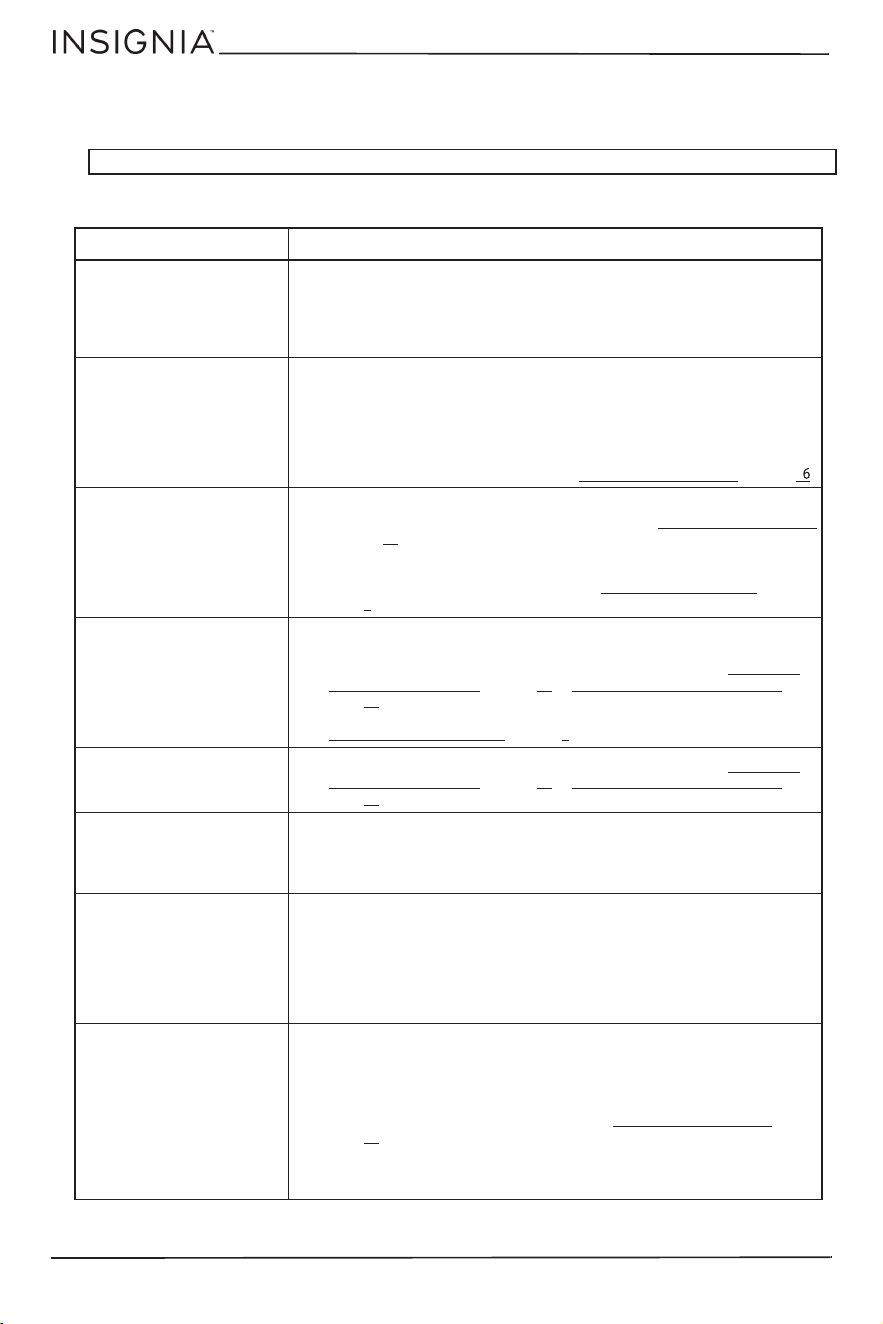
PROBLEM SOLUTION
My refrigerator does not work.
• Make sure that your refrigerator is securely plugged into a working outlet.
• Make sure that your power source has the correct voltage. Your refrigerator’s
voltage rating is on a label
on the back of your refrigerator.
• Check the house fuse or circuit breaker box and replace the fuse or reset the
circuit breaker.
The refrigerator compartment
has a bad odor.
• Make sure that all food with a strong odor (like onions) is wrapped or stored
in
ai
rtight packaging.
• Certain containers and wrapping materials (such as paper, foil, or plastic) can
cause
odors. If you think this might be the case, try using dierent containers or
a dierent brand of wrapping material
.
•
Check for spoiled food and remove it.
• Clean the inside of your refrigerator. See
Cleaning your refrigerator on page 1 .
The refrigerator doors do not
close completely.
• Make sure that no food packages are in the way.
• Make sure that the door gaskets (seals) are clean. See Cleaning your refrigerator
on page 17.
• If the door gasket does not seal, try heating then cooling the seal. You can use an
electric hair dryer to heat the seal.
• Make sure that your refrigerator is level. See Leveling your refrigerator on
page 9.
The temperature is too hot.
• You may have left the doors open too long or opened them too frequently.
• Make sure that no obstacle is keeping the doors from closing correctly.
• Adjust the refrigerator or freezer compartment temperature. See Setting the
refrigerator temperature on page 14 or Setting the humidity in the crisper on
page 15.
• Your refrigerator may not have enough clearance from walls or the ceiling. See
Providing correct ventilation on page 8.
The temperature is too cold.
• Adjust the refrigerator or freezer compartment temperature. See Setting the
refrigerator temperature on page 14 or Setting the humidity in the crisper on
page 15.
A layer of frost occurs in one of
the compartments.
• A layer of frost may occur on the compartment’s interior walls if the freezer is
opened frequently or kept open too long.
• Make sure that the air outlets are not blocked by food.
• Make sure that the doors are fully closed.
The refrigerator door is hard to
open or close.
• When you open the refrigerator door, warm air rushes inside. When you close
the door, the warm air rushes to the condenser which causes a vacuum. This
causes the door to be hard to open for about 10 to
15 seconds after closing.
• If the door is hard to open at other times, try rubbing paran wax or petroleum
jelly along the edges of the entire gasket. Paran wax is used for canning and is
safe for use around food.
• If the door is hard to close, try slightly loosening the tension on the door hinges.
The compressor runs for a long
time or turns on and o
frequently.
The compressor runs longer if:
• The room temperature is high.
• You just added a large amount of food. Wait for the food to freeze, then check
again.
• You open
and close the door frequently.
• The door gasket is dirty. Clean the gasket. See Cleaning your refrigerator on
page 17.
• Your refrigerator has been disconnected for a period of time. Wait for your
refrigerator to cool (about four hours) before adding food.
• You have the temperature set too low.
www.insigniaproducts.com
19
Specications
The refrigerator makes unusual
noises or vibrations.
The following sounds are normal:
• Compressor running noises.
• Air movement noise from the small fan motor in the freezer compartment or
other compartments.
• Popping noise during automatic defrosting.
• Clicking noise before the compressor starts.
Other unusual noises or vibrations may occur:
• If you have items on the top of your refrigerator. Remove the items.
• If your refrigerator is not level. See Leveling your refrigerator on page 9.
• If your refrigerator is touching walls. Move it away from the walls.
• If the shelves or drawers are installed incorrectly.
The outside of the refrigerator is
hot.
Heat dissipation from the condenser may make the outside feel hot. This is normal and
happens if:
• The room temperature is high.
• You have too much food in your refrigerator.
• You open and close the doors excessively.
Water condenses on the outside
of the refrigerator.
• Condensation on the exterior surface and door seal is normal when the room
humidity is high.
• When you open the door, warm, moist
outside air meets the cold dry air inside
your refrigerator. This is normal.
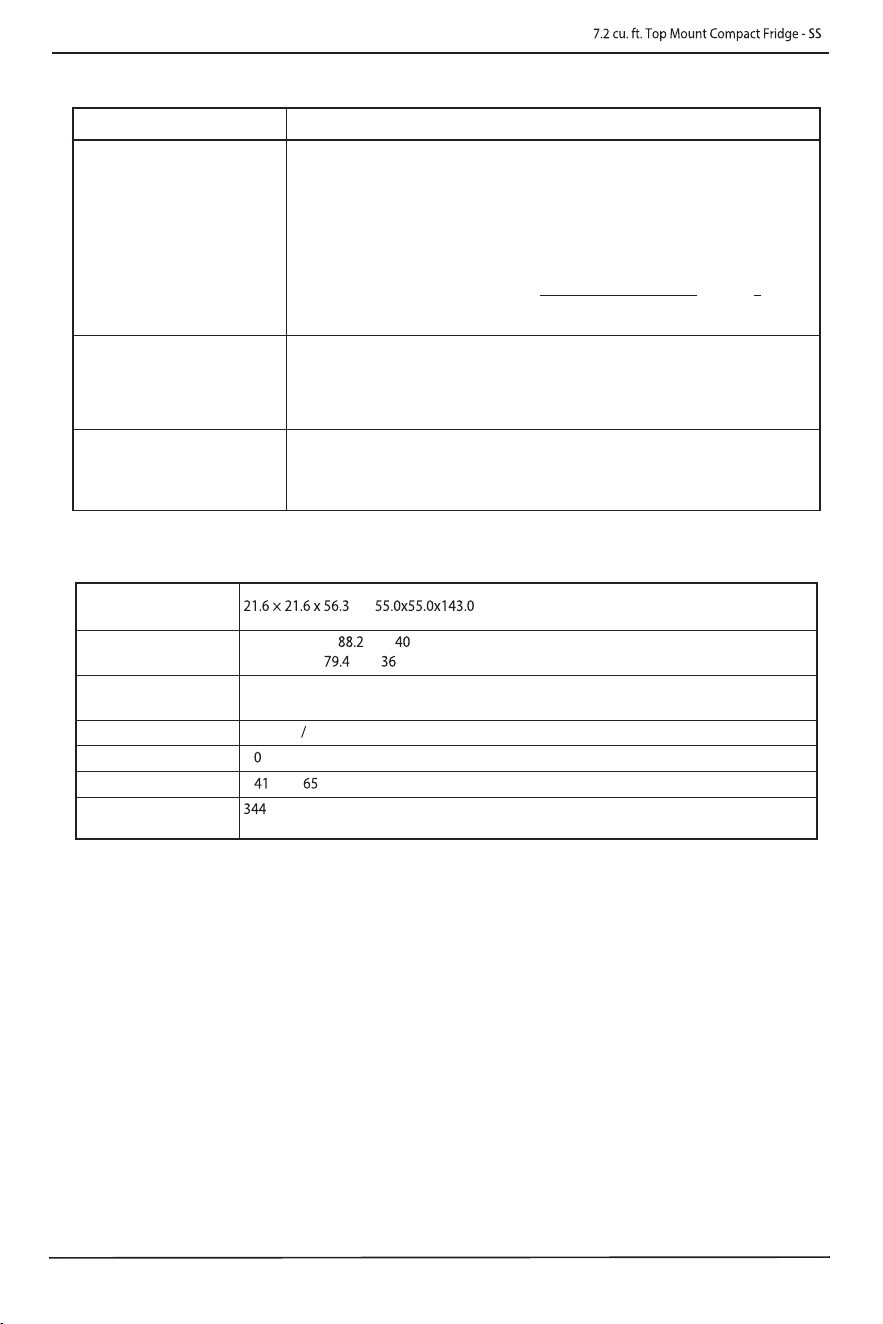
External dimensions
(H × W× D)
in. ( cm)
Weight
Gross Weight:
lbs. ( kg)
Net Weight:
lbs. ( kg)
Temperature ranges Refrigerator: 32° to 45° F (0° to 7° C)
Freezer: -7.6° to 10.4° F (-22° to - 12° C)
Power requirements AC115V~
60Hz
Current 1.
A
Power cord length 5.
ft. (1. m)
Power consumption per
year
kWh
PROBLEM SOLUTION
www.insigniaproducts.com
20
ONE-YEAR LIMITED WARRANTY
Denitions:
The Distributor* of Insignia branded products warrants to you, the original purchaser of this new Insignia-branded product (“Product”), that the Product
shall be free of defects in the original manufacturer of the material or workmanship for a period of one (1) year from the date of your purchase of the
Product (“Warranty Period”).
For this warranty to apply, your Product must be purchased in the United States or Canada from a Best Buy branded retail store or online at
www.bestbuy.com
or www.bestbuy.ca and is packaged with this warranty statement.
How long does the coverage last?
What does this warranty cover?
During the Warranty Period, if the original manufacture of the material or workmanship of the Product is determined to be defective by an authorized
Insignia repair center or store personnel, Insignia will (at its sole option): (1) repair the Product with new or rebuilt parts; or (2) replace the Product at no
charge with new or rebuilt comparable products or parts. Products and parts replaced under this warranty become the property of Insignia and are not
returned to you. If service of Products or parts are required after
the Warranty Period expires, you must pay all labor and parts charges. This warranty lasts
as long as you own your Insignia Product during the Warranty Period. Warranty coverage terminates if you sell or otherwise transfer the Product.
How to obtain warranty service?
If you purchased the Product at a Best Buy retail store location or from a Best Buy online website (www.bestbuy.com or www.bestbuy.ca), please take your
original receipt and the Product to any Best Buy store. Make sure that you place the Product in its original packaging or packaging that pr
ovides the same
amount of protection as the original packaging.
To obtain warranty service, in the United States and Canada call 1-877-467-4289. Call agents may diagnose and correct the issue over the phone.
Where is the warranty valid?
This warranty is valid only in the United States and Canada at Best Buy branded retail stores or websites to the original purchaser of the product in the
country where the original purchase was made.
What does the warranty not cover?
This warranty does not cover:
• Food, beverage, and/or medicine loss/spoilage.
• Customer instruction/education
• Installation
• Set up adjustments
• Cosmetic damage
• Damage due to weather, lightning, and other acts of God, such
as power surges
• Accidental damage
• Misuse
• Abuse
• Negligence
• Commercial purposes/use, including but not limited to use in a place of business or in communal areas of a multiple dwelling condominium or
apartment complex, or otherwise used in a place of other than a private home.
• Modication of any part of the Product, including the antenna
• Display panel damaged by static (non-moving) images applied for lengthy periods (burn-in).
• Damage due to incorrect operation or maintenance
• Connection to an incorrect voltage or power supply
• Attempted repair by any person not authorized by Insignia to service the Product
• Products sold
“as is” or “with all faults”
• Consumables, including but not limited to batteries (i.e. AA, AAA, C etc.)
• Products where the factory applied serial number has been altered or removed
• Loss or Theft of this product or any part of the product
• Display panels containing up to three (3) pixel failures (dots that are dark or incorrectly illuminated) grouped in an area smaller than one tenth (1/10)
of the display size or up to ve (5) pixel failures throughout the display. (Pixel based displays may contain a limited number of pixe
ls that may not
function normally.)
• Failures or Damage caused by any contact including but not limited to liquids, gels or pastes.
REPAIR REPLACEMENT AS PROVIDED UNDER THIS WARRANTY IS YOUR EXCLUSIVE REMEDY FOR BREACH OF WARRANTY. INSIGNIA SHALL NOT BE LIABLE
FOR ANY INCIDENTAL OR CONSEQUENTIAL DAMAGES FOR THE BREACH OF ANY EXPRESS OR IMPLIED WARRANTY ON THIS PRODUCT, INCLUDING, BUT
NOT LIMITED TO, LOST DATA, LOSS OF USE OF YOUR PRODUCT, LOST BUSINESS OR LOST PROFITS. INSIGNIA PRODUCTS MAKES NO OTHER EXPRESS
WARRANTIES WITH RESPECT TO THE PRODUCT, ALL EXPRESS AND IMPLIED WARRANTIES FOR THE PRODUCT, INCLUDING BUT NOT LIMITED TO ANY
IMPLIED WARRANTIES OF AND CONDITIONS OF MERCHANTABILITY AND FITNESS FOR A PARTICULAR PURPOSE, ARE LIMITED IN DURATION TO THE
WARRANTY PERIOD SET FORTH ABOVE AND NO WARRANTIES, WHETHER EXPRESS OR IMPLIED, WILL APPLY AFTER THE WARRANTY PERIOD. SOME STATES,
PROVINCES AND JURISDICTIONS DO NOT ALLOW LIMITATIONS ON HOW LONG AN IMPLIED WARRANTY LASTS, SO THE ABOVE LIMITATION MAY NOT
APPLY TO YOU. THIS WARRAN
TY GIVES YOU SPECIFIC LEGAL RIGHTS, AND YOU MAY ALSO HAVE OTHER RIGHTS, WHICH VARY FROM STATE TO STATE OR
PROVINCE TO PROVINCE.
Contac
t Insignia:
1-877-467-4289
www.insigniaproducts.com
*Distributed by Best Buy Purchasing, LLC
7601 Penn Ave South, Rich
55423 U.S.A
©2025 Best Buy. All rights reserved.
www.insigniaproducts.com
1-877-467-4289 (U.S. and Canada)
INSIGNIA is a trademark of Best Buy and its
liated companies.
Distributed by Best Buy Purchasing, LLC
7601 Penn Ave Sout
S.A.
©2025 Best Buy. All rights reserved.
V1 ENGLISH
25-0052
Before using your new product, please read these instructions to prevent any damage.
USER GUIDE