Firmware Manual
GV-IP Camera
Before attempting to connect or operate this product,
please read these instructions carefully and save this manual for future use.
ICH265-FW-B
© 2021 GeoVision, Inc. All rights reserved.
Under the copyright laws, this manual may not be copied, in whole or in part,
without the written consent of GeoVision.
Every effort has been made to ensure that the information in this manual is
accurate. GeoVision, Inc. makes no expressed or implied warranty of any kind and
assumes no responsibility for errors or omissions. No liability is assumed for
incidental or consequential damages arising from the use of the information or
products contained herein. Features and specifications are subject to change
without notice.
GeoVision, Inc.
9F, No. 246, Sec. 1, Neihu Rd.,
Neihu District, Taipei, Taiwan
Tel: +886-2-8797-8377
Fax: +886-2-8797-8335
http://www.geovision.com.tw
Trademarks used in this manual: GeoVision, the GeoVision logo and GV series
products are trademarks of GeoVision, Inc. Windows is the registered trademark of
Microsoft Corporation.
October 2021
Scan the following QR codes for product warranty and technical support policy:
[Warranty] [Technical Support Policy]

Contents
Notice ................................................................................ vi
Creating GV-IP Camera’s Login Credentials................ vii
Note for Connecting to GV-DVR / NVR / VMS ............. viii
Note for Recording ...........................................................ix
Note for GV-EVD5100 / EFD5101 / EBL5101....................x
Chapter 1 Introduction .....................................................1
1.1 System Requirement..............................................................1
Chapter 2 Getting Started ................................................2
2.1 Accessing the Live View ........................................................2
2.1.1 Checking the Dynamic IP Address ...............................3
2.1.2 Configuring the IP Address ..........................................5
2.1.3 Configuring the Wireless Connection ...........................7
2.2 Adjusting Image Clarity........................................................11
2.2.1 Using Focus Adjustment Cap.....................................14
2.2.2 Locations of Adjustment Screws ................................15
2.3 Configuring the Basics.........................................................18
Chapter 3 Accessing the Camera..................................19
3.1 Accessing Your Surveillance Images..................................19
3.2 Functions Featured on the Main Page.................................21
3.2.1 The Live View Window...............................................22
3.2.2 The Control Panel of the Live View Window...............28
3.2.3 Snapshot of Live Video ..............................................35
3.2.4 Video Recording ........................................................35
3.2.5 Picture-in-Picture and Picture-and-Picture View .........36
3.2.6 Alarm Notification.......................................................39
3.2.7 Video and Audio Configuration...................................41
3.2.8 Remote Configuration ................................................43
i

3.2.9 Camera Name Display...............................................43
3.2.10 Image Enhancement ................................................43
3.2.11 Visual PTZ ...............................................................44
3.2.12 Digital PTZ ...............................................................47
3.2.13 I/O Control ...............................................................49
3.2.14 Visual Automation ....................................................50
3.2.15 Network Status.........................................................51
Chapter 4 Administrator Mode ......................................52
4.1 Video and Motion ...................................................................55
4.1.1 Video Settings..................................................................... 56
4.1.2 Motion Detection .................................................................68
4.1.3 Privacy Mask.......................................................................70
4.1.4 Text Overlay ....................................................................... 71
4.1.5 Tampering Alarm.................................................................73
4.1.6 Visual Automation ...............................................................76
4.1.7 Face Detection.................................................................... 78
4.2 I/O Settings.............................................................................80
4.2.1 Input Settings...................................................................... 81
4.2.2 Output Settings ...................................................................83
4.2.3 PTZ Settings .......................................................................84
4.3 Events and Alerts...................................................................85
4.3.1 E-mail .................................................................................86
4.3.2 FTP.....................................................................................88
4.3.3 Center V2............................................................................91
4.3.4 Vital Sign Monitor................................................................93
4.3.5 Backup Center ....................................................................95
4.3.6 Video Gateway / Recording Server...................................... 98
4.3.7 ViewLog Server................................................................. 100
4.3.8 RTSP/ONVIF .................................................................... 101
4.3.9 Speaker ............................................................................104
ii

4.4 Monitoring.............................................................................105
4.4.1 Monitoring Settings for GV-EBL2101 / 2111 / 3101............ 108
4.5 Recording Schedule.............................................................109
4.5.1 Recording Schedule Settings ............................................ 109
4.5.2 I/O Monitoring Settings...................................................... 110
4.6 Remote ViewLog ..................................................................111
4.7 Network.................................................................................112
4.7.1 LAN Configuration.............................................................112
4.7.2 Wireless Client Mode ........................................................ 115
4.7.3 Advanced TCP/IP..............................................................117
4.7.4 HTTPS.............................................................................. 121
4.7.5 IEEE 802.1X ..................................................................... 122
4.7.6 UMTS Settings.................................................................. 124
4.7.7 IP Filter Settings................................................................ 127
4.7.8 SNMP Settings..................................................................129
4.8 Management.........................................................................131
4.8.1 Date & Time Settings ........................................................ 131
4.8.2 Storage Settings ............................................................... 133
4.8.3 User Account .................................................................... 140
4.8.4 Security.............................................................................141
4.8.5 Privacy.............................................................................. 142
4.8.6 Log Information................................................................. 142
4.8.7 Tools................................................................................. 143
4.8.8 Language.......................................................................... 145
iii

Chapter 5 Recording and Playback ............................146
5.1 Recording .............................................................................146
5.2 Playback ...............................................................................147
5.2.1 Playback from the Memory Card ....................................... 147
5.2.2 Playback over Network...................................................... 153
5.2.3 Access to the Recorded Files through FTP Server.............154
5.2.4 Playback of Daylight Saving Time Events..........................155
Chapter 6 Advanced Applications ..............................157
6.1 Upgrading System Firmware...............................................158
6.1.1 Using the Web Configuration Interface .............................. 158
6.1.2 Using the IP Device Utility ................................................. 159
6.2 Backing Up and Restoring Settings....................................161
6.3 Changing Password.............................................................163
6.4 Verifying Watermark.............................................................164
6.4.1 Accessing AVI Files ..........................................................164
6.4.2 Running Watermark Proof................................................. 165
6.4.3 The Watermark Proof Window...........................................166
6.5 Downloading Videos from the Micro SD Card....................168
6.5.1 Installing the GV-SDCardSync Utility................................. 169
6.5.2 The GV-SDCardSync Utility Window ................................. 173
Chapter 7 DVR / NVR / VMS .........................................175
7.1 Setting up an IP Camera on GV-DVR / NVR........................177
7.1.1 Customizing IP Camera Settings on GV-DVR / NVR ......... 180
7.2 Setting Up IP Cameras on GV-VMS.....................................182
7.3 Remote Monitoring with Multi View.....................................185
7.3.1 Connecting to the IP Camera ............................................ 185
7.4 Remote Monitoring with E-Map ...........................................186
7.4.1 Creating an E-Map for the IP Camera................................186
7.4.2 Connecting to the IP Camera ............................................ 188
iv

Chapter 8 CMS Configurations....................................189
8.1 Center V2 ..............................................................................189
8.2 Vital Sign Monitor.................................................................192
8.3 Dispatch Server....................................................................193
Chapter 9 Smart Device Connection...........................195
Appendix.........................................................................196
A. Settings for Internet Explorer 8.................................................196
B. RTSP Protocol Command........................................................197
C. Supported UMTS Protocol (3G Modem) ..................................198
D. The CGI Command..................................................................199
E. Power Supply Support List.......................................................200
F. Supported Firmware for Flash Memory ....................................202
G. Compatible Version of GV-DVR / NVR / GV-VMS for Each Camera
Model.......................................................................................203
H. Notice for Using the IR Arctic Box Camera ..............................210
v

vi
Notice
The GV-IPCAM has a variety of models designed to meet different needs.
The features described in the manual vary among camera models and
versions. Some features may not be available in your camera.
Note:
1. To upgrade the camera firmware from V2.07 or earlier to the latest
version, back up the files in the camera’s storage device first before
upgrading and it is required to reformat the memory card after the
upgrade.
2. The following models are not supported by firmware V3.10 or later:
GV-BX120D / 130D / 140DW / 220D / 320D / 520D
GV-CB120 / 220
GV-CBW120 / 220
Models installed with a 32 MB NAND flash
Creating GV-IP Camera’s Login
Credentials
The default Administrator and Guest accounts are not supported by
GV-IPCAM H.265 Firmware V1.14 or later. When purchasing new
cameras or after resetting them, you need to set up a login username and
password for the cameras.
1 Download and install GV-IP Device Utility from the company website
.
2 On the GV-IP Device Utility window, click
to search for your GV-IP
camera.
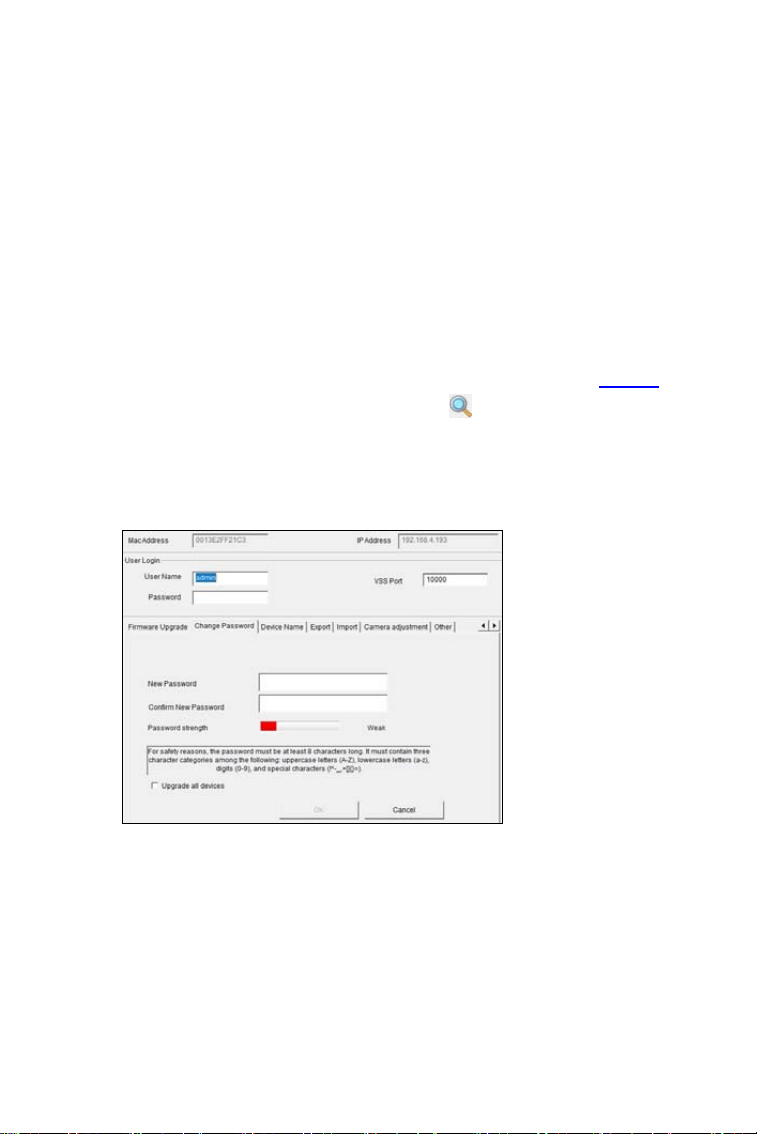
3 Double-click your GV-IP camera in the GV-IP Device Utility list. This
dialog box appears.
4 Click the Change Password tab to type a new username and
password. Note that the new password must meet the password
strength requirements.
5 Optionally, click Upgrade all devices to use the same username and
password on all other devices of the same model.
vii

Note for Connecting to GV-DVR /
NVR / VMS
The GV-IPCAM is designed to work with GV-DVR / NVR / VMS, a video
management system. Note the following when the camera is connected to
GV-DVR / NVR / VMS:
1. By default, the images are recorded to the memory card inserted in
the GV-IPCAM (except for GV-IR Arctic Box Camera, which is not
equipped with a memory card slot).
2. Once the camera is connected to the GV-DVR / NVR / VMS, the
resolution set on the GV-DVR / NVR / VMS will override the
resolution set on the camera’s Web interface. You can only change
the resolution settings through the Web interface when the
connection to the GV-DVR / NVR / VMS is interrupted.
viii

Note for Recording
1 By default, the images are recorded to the memory card inserted in the
GV-IP Camera (except for GV-IR Arctic Box Camera, which is not
equipped with a memory card slot). Make sure the Write recording
data into local storage option (see 3.1.1 Video Settings) is enabled. If
this option is disabled, the camera will stop recording to the memory
card while the live view is accessed through Web browsers or other
applications.
2 Mind the following when using a memory card for recording:
Recorded data on the memory card can be damaged or lost if the
data are accessed while the camera is under physical shock,
power interruption, memory card detachment or when the
memory card reaches the end of its lifespan. No guarantee is
provided for such causes.
The stored data can be lost if the memory card is not accessed
for a long period of time. Back up your data periodically if you
seldom access the memory card.
Memory cards are expendable and their durability varies
according to the conditions of the installed site and how they are
used. Back up your data regularly and replace the memory card
annually.
Replace the memory card when its read/write speed is lower than
6 MB/s or when the memory card is frequently undetected by the
camera.
3 It is recommended to use memory cards of the following setting and
specifications:
Apply a battery backup (UPS) to avoid power outage.
Use Micro SD card of MLC NAND flash, Class 10 for better
performance.
ix

x
Note for GV-EVD5100 / EFD5101 /
EBL5101
When the resolution is set at 2592 x 1944:
1 If the camera is switched to single stream (while stream two is
deselected) and Noise Reduction is disabled, the frame rate can reach
up to 30 FPS.
2 If the camera is switched to dual streams and Noise Reduction is
disabled, the frame rate can reach up to 25 FPS.
3 As long as Noise Reduction is enabled, whether the camera is
switched to single stream or dual streams, the frame rate will be 15
FPS.

Introduction
1
Chapter 1 Introduction
The GV-IPCAM series offers a comprehensive range of IP cameras for
IP surveillance in various environmental conditions.
1.1 System Requirement
To perform the cameras’ operations through Web browser, ensure your
PC is in good network connection, and use one of the following Web
rowsers: b
Microsoft Internet Explorer 8.0 or later
Google Chrome
Mozilla Firefox
Safari
Note:
1 For users of Internet Explorer 8, additional settings are required.
For details, see Appendix A.
2 With non-IE browsers,
A. Motion Detection, Tampering Alarm, Visual Automation, Text
Overlay and two-way audio are not supported.
B. only the Play function is available on the live view window
(Figure 19-3)
C. RTSP streaming must be kept as enabled. For more details,
see 3.3.8 RTSP.
To access GV-BX12201 images, the following PC specs should be met:
CPU Intel Core i5-4670, 3.40 GHz
Memory DDR3 8 GB RAM
On Board Graphics
Intel HD Graphics 4600 (Versions of driver
from year 2014 or later required)
1

2
Chapter 2 Getting Started
This section provides the basic configurations of the GV-IPCAM.
2.1 Accessing the Live View
When the camera is connected to a network with a DHCP server, it will
be automatically assigned with a dynamic IP address. See 2.1.1
Checking the Dynamic IP Address to look up this IP address.
However, if you do not have a DHCP server on your network, access the
camera by its default IP address 192.168.0.10 and see 2.1.2 Configuring
the IP Address for more details.
Note: By default, GV-PTZ010D is assigned with the fixed IP address
192.168.0.10.
Getting Started
2
2.1.1 Checking the Dynamic IP Address
Follow the steps below to look up the IP address and access the Web
interface.
1. Install the GV-IP Device Utility program from the company website
.
Note: The PC installed with GV-IP Device Utility must be as the same
LAN with the camera you wish to configure.
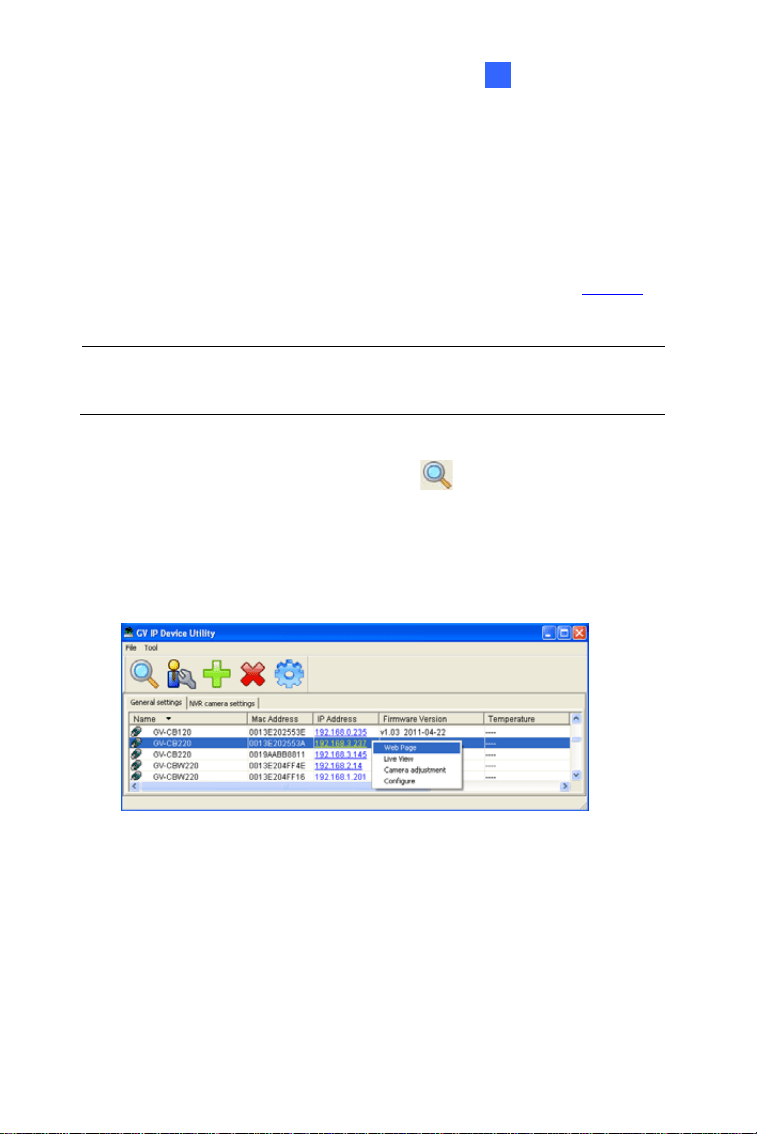
2. On the GV-IP Utility window, click the
button to search for the
IP devices connected in the same LAN. Click the Name or Mac
Address column to sort.
3. Find the camera with its Mac Address, click on its IP address and
select Web Page.
Figure 2-1
3
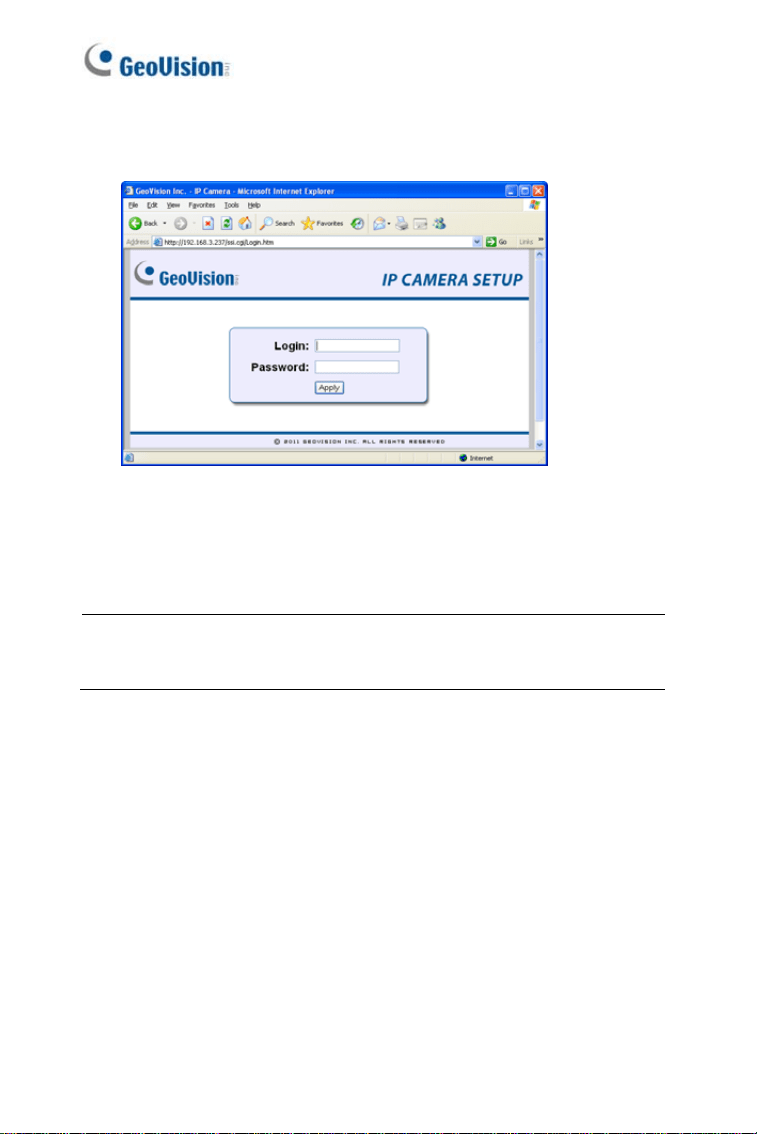
4. The login page appears.
Figure 2-2
5. Type the default ID and password admin and click Apply to log in.
Note: For GV-IPCAM H.265 firmware V1.14 or later, the default
Administrator and Guest accounts are no longer supported.
4
Getting Started
2
2.1.2 Configuring the IP Address
Follow the steps below to configure the IP address.
1. Open your Web browser, and type the default IP address
http://192.168.0.10
.
2. In both Login and Password fields, type the default value admin.
Click Apply.
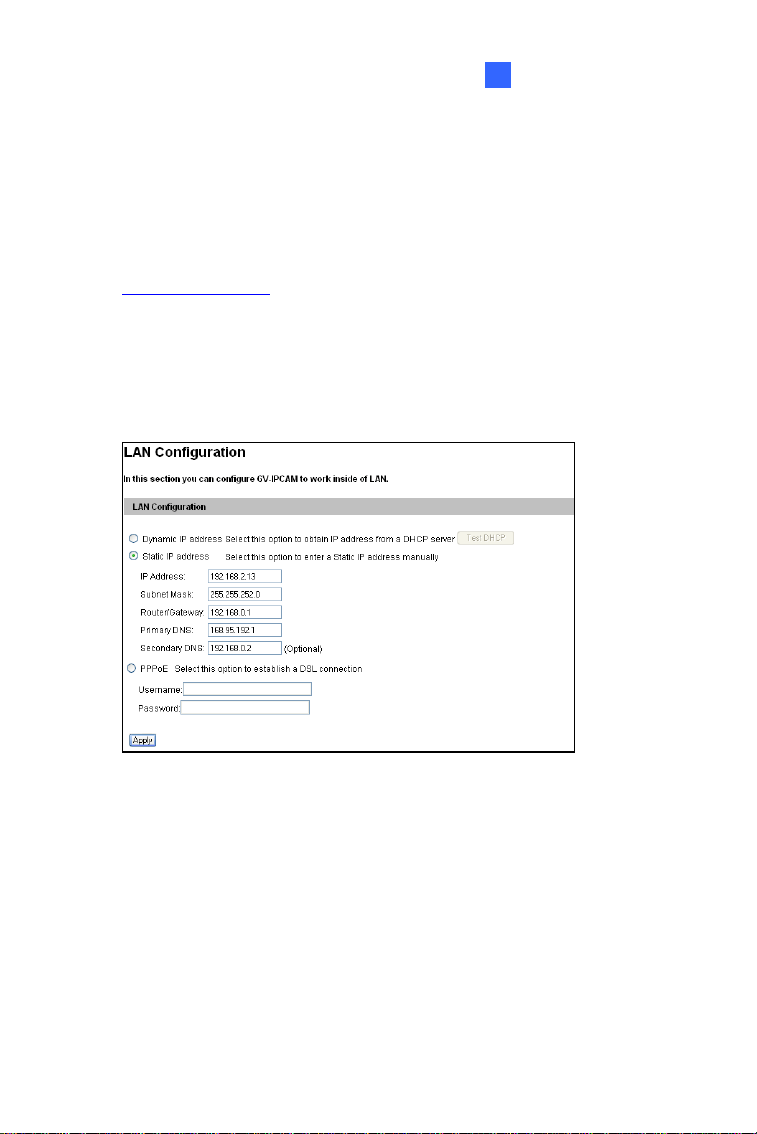
3. In the left menu, select Network and then LAN to begin the
network settings. This page appears.
Figure 2-3
4. Select Dynamic IP address, Static IP address or PPPoE and
type the required network information.
5. Click Apply.
5

IMPORTANT:
1. If Dynamic IP Address or PPPoE is enabled, you need to know
which IP address the camera will get from DHCP server or ISP to
log in. If your camera is installed in the LAN, use the GV-IP
Device Utility to look up its current dynamic IP address. See 2.1.1
Checking the Dynamic IP Address. If your camera uses a public
dynamic IP address via PPPoE, use the dynamic DNS Service to
obtain a domain name that is linked to the camera’s changing IP
address first. For details on Dynamic IP Address and PPPoE, see
4.7.1 LAN Configuration and 4.7.3 Advanced TCP/IP.
2. If Dynamic IP Address or PPPoE is enabled and you cannot
access the camera, you may have to reset it to the factory default
and then perform the network settings again.
To restore your camera to default settings, see Loading Factory
Default in the corresponding Quick Guide.
6
Getting Started
2
2.1.3 Configuring the Wireless Connection
All models supporting wireless connection require GV-WiFi Adaptor
except for GV-CAW and GV-CBW models, which come with built-in
wireless modules.
1. To set up the wireless LAN for the first time, power on and connect
a standard network cable to the camera.
2. An IP address will be automatically assigned to the camera. Use
GV IP Device Utility to search for the device. For details, see 2.1.1
Checking the Dynamic IP Address.
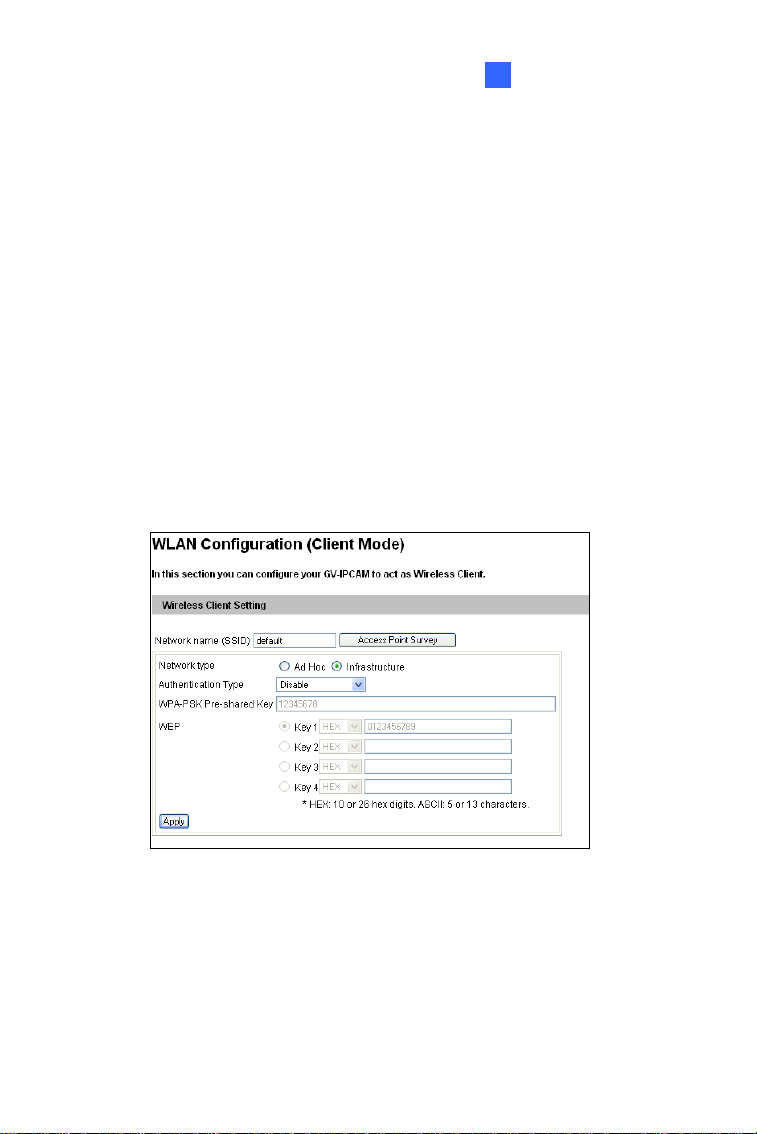
3. Configure the wireless settings.
A. On the Web interface, select Network, select Wireless and
Client Mode. This dialog box appears.
Figure 2-4
B. Type the Network Name (SSID) or click the Access Point
Survey button to search and select for the available Access
Points/wireless stations.
C. Select Ad-Hoc or Infrastructure for the Network type.
7

D. Select the Authentication Type using the drop-down list. You
can also obtain this information by clicking the Access Point
Survey button.
E. Type the WPA-PSK Pre-shared Key or WEP depending on the
encryption setting for the Access Point.
F. Click Apply to save the configuration.
Note:
1. Your encryption settings must match those used by the Access
Points or wireless stations with which you want to associate.
2. When Ad Hoc is used, only WEP encryption is supported.
3. When you lose the wireless access, you can still access the unit by
connecting it to a LAN and using the GV IP Device Utility to search
for the device.
4. For detailed information on configuring the wireless LAN, see 4.7.2
Wireless Client Mode.
8
Getting Started
2
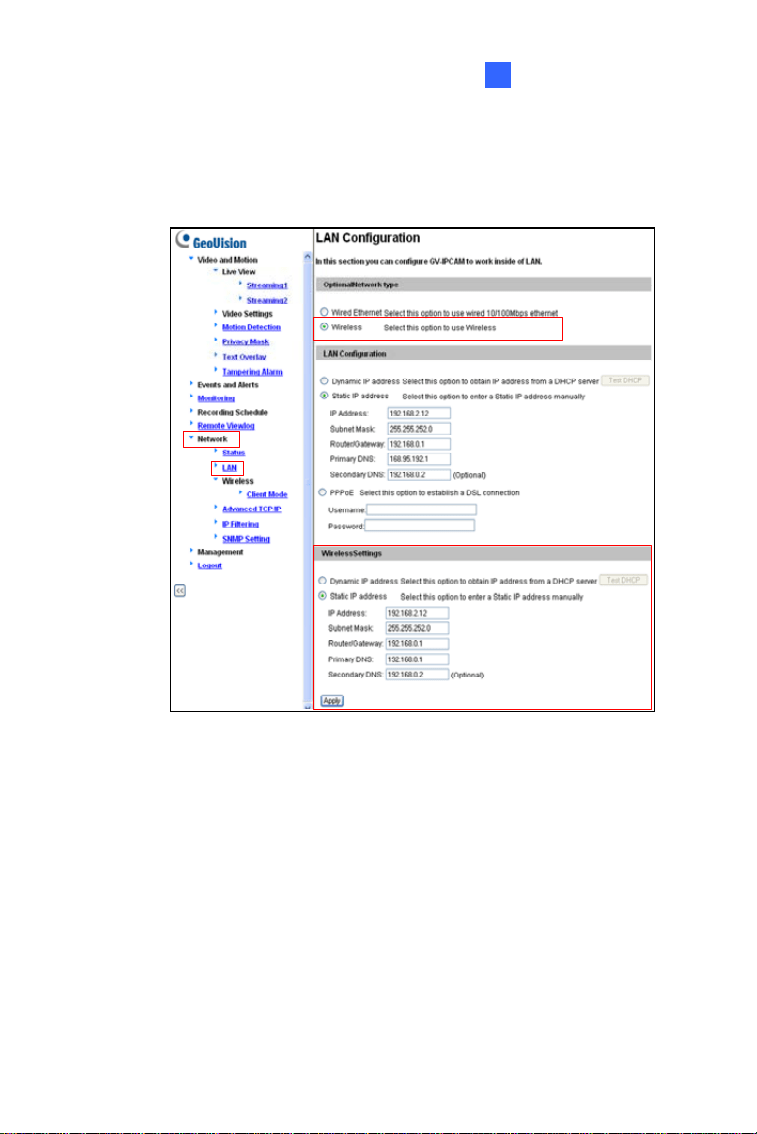
4.
Enable wireless LAN.
A. On the Web interface, select Network and LAN. This page
appears.
Figure 2-5
B. Select Wireless for Optional Network Type.
C. To use a dynamic IP address assigned by the DHCP server,
select Dynamic IP address. To use a fixed IP address,
select Static IP address and type the IP address information.
9

5. Click Apply. The Camera will start creating a wireless connection
to the access point.
Note: For GV-CAW120/220, the LAN LED turns blue when the
connection is established.
6. Unplug the Ethernet cable.
10
Getting Started
2
2.2 Adjusting Image Clarity
Note the procedures described in this section only apply to the cameras
that allow manual focus adjustment. To adjust focus of a PTZ camera,
refer to Focus Adjustment in corresponding Quick Guide; for Cube
Camera and Advanced Cube Camera, refer to Camera Adjustment in
3.2.2 The Control Panel on the Live View Window.
After you have connected your camera to the network, follow the steps
below to adjust image clarity.
1. Make sure you have installed the GV-IP Device Utility program
from the company website
.
Note: The PC installed with GV-IP Device Utility must be under the
same LAN with the camera you wish to configure.
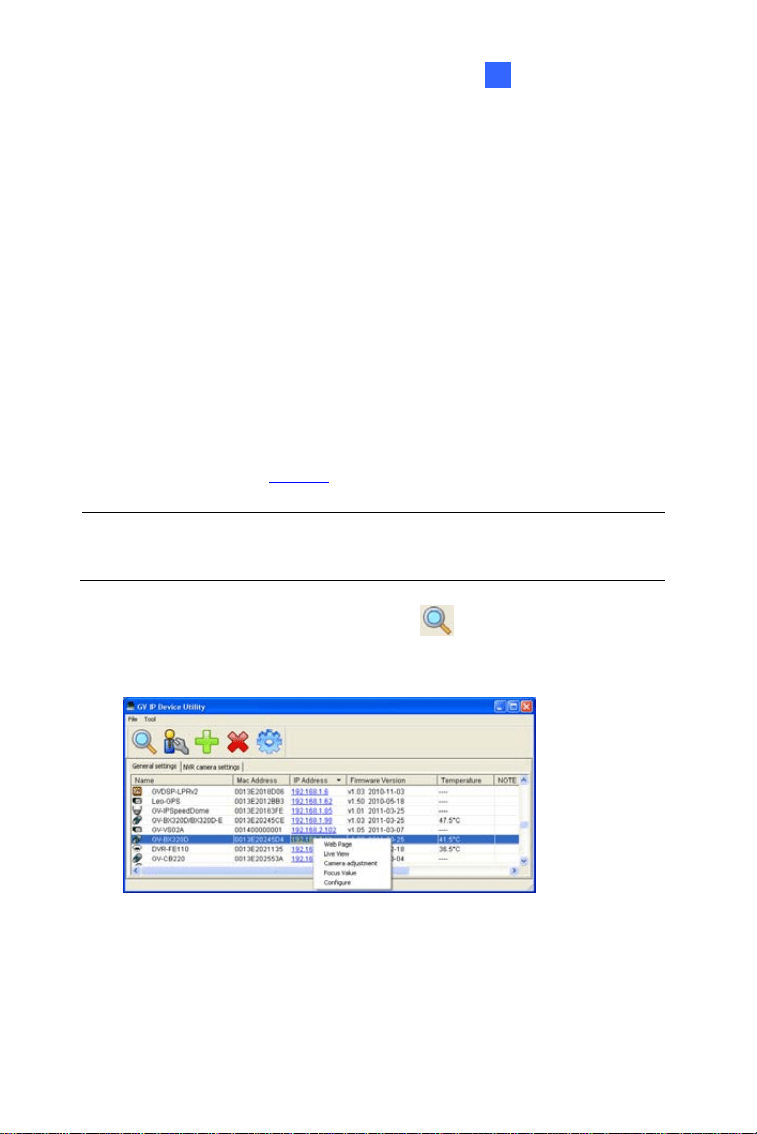
2. On the GV-IP Utility window, click the
button to search for the
IP devices connected in the same LAN. Click the IP Address of the
camera you desire. A drop-down list appears.
Figure 2-6
11
3. Select Focus Value. The Login dialog box appears.
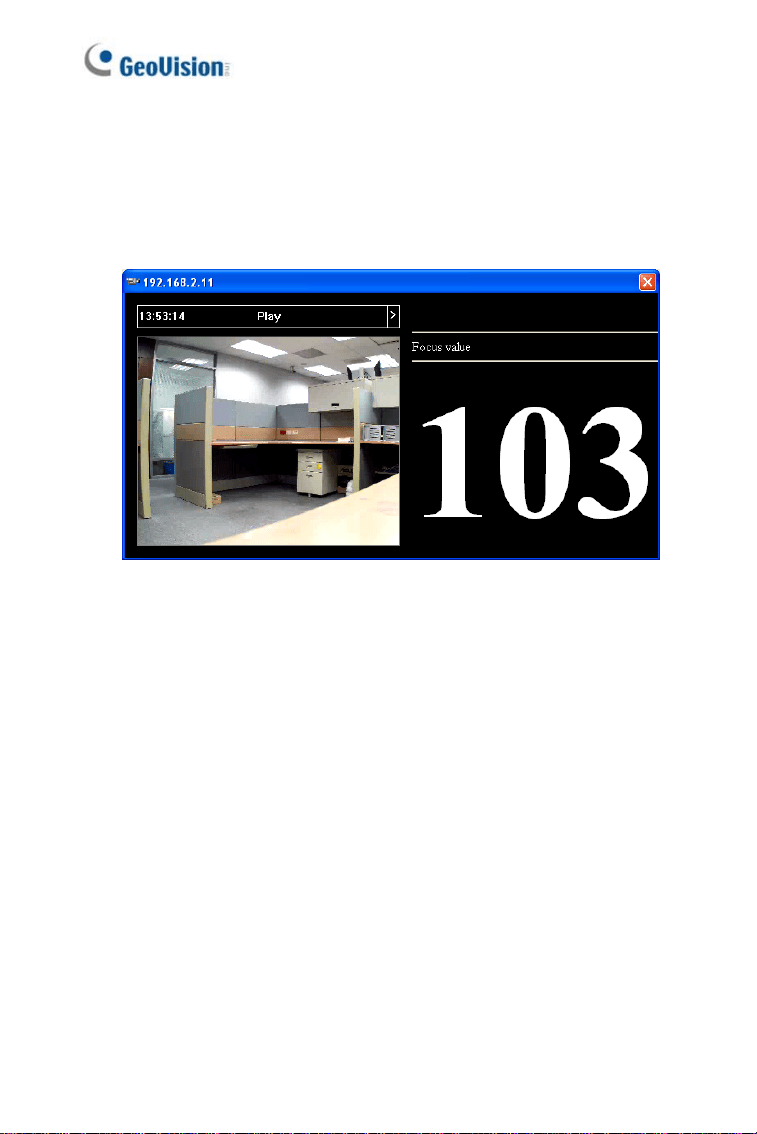
4. Type the user name and password of the camera selected. The
default is admin for both user name and password. This window
appears.
Figure 2-7
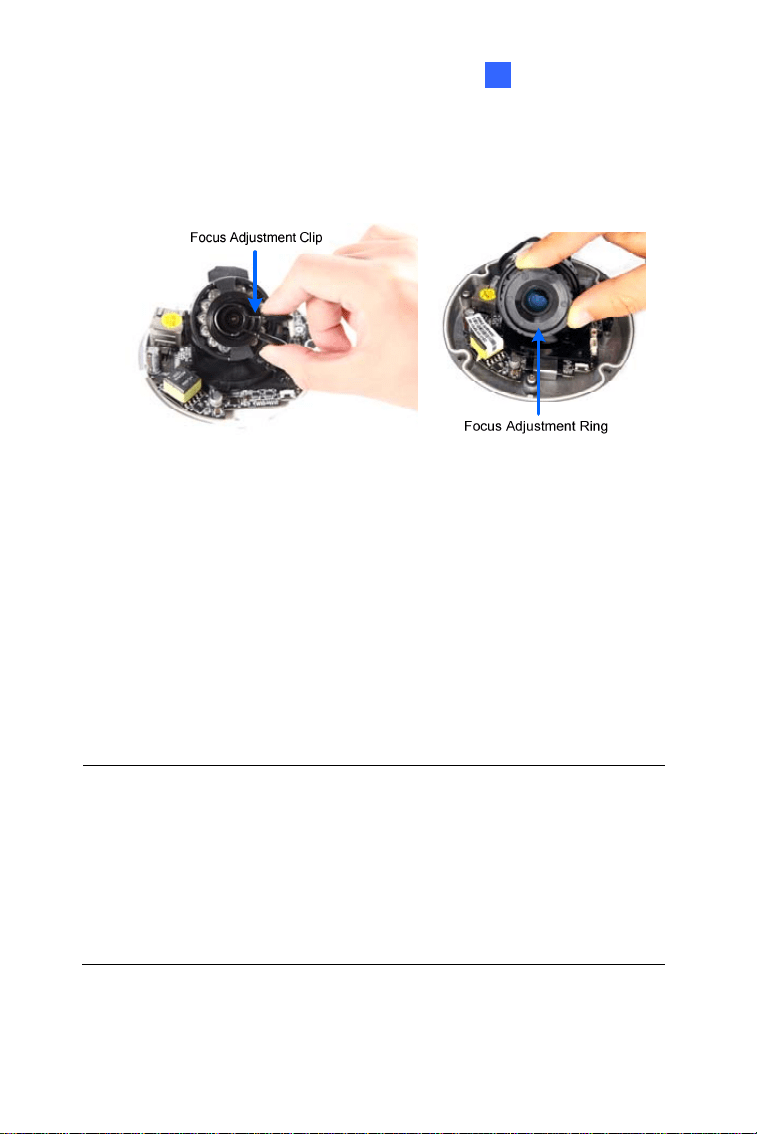
5. For IK10+ models (GV-VD120D / 121D / 220D / 221D / 320D /
321D / 1500 / 2400 / 2500 / 3400 / 1530 / 2430 / 2530 / 3430 /
4711 / 5711), hold the supplied Focus Adjustment Cap over the
camera view. For details, see 2.2.1 Using Focus Adjustment Cap
for details.
12
Getting Started
2
6.
For Target Mini Fixed Dome and Target Mini Fixed Rugged
Dome, hold the camera cover close to the lens and use the
supplied focus adjustment tool for precise focus adjustment.
Figure 2-8
7. For Mini Fixed Dome and Mini Fixed Rugged Dome, hold the
camera cover close to the lens for precise focus adjustment. For
locations of adjustment screws and rings in each model, see 2.2.2
Locations of Adjustment Screws.
8. Adjust the Focus Screw and the Zoom Screw of the camera slowly
until the focus value reaches the maximum. For example, the
maximum focus value in Step 4 is 103. For locations of adjustment
screws in each model, see 2.2.2 Locations of Adjustment Screws.
Note:
1. Do not over tighten the screws. The screws only need to be as
tight as your fingers can get them to be. Do not bother using any
tool to get them tighter. Doing so can damage the structure of
lens.
2. The maximum focus value may vary when the environment
changes.
13
2.2.1 Using Focus Adjustment Cap
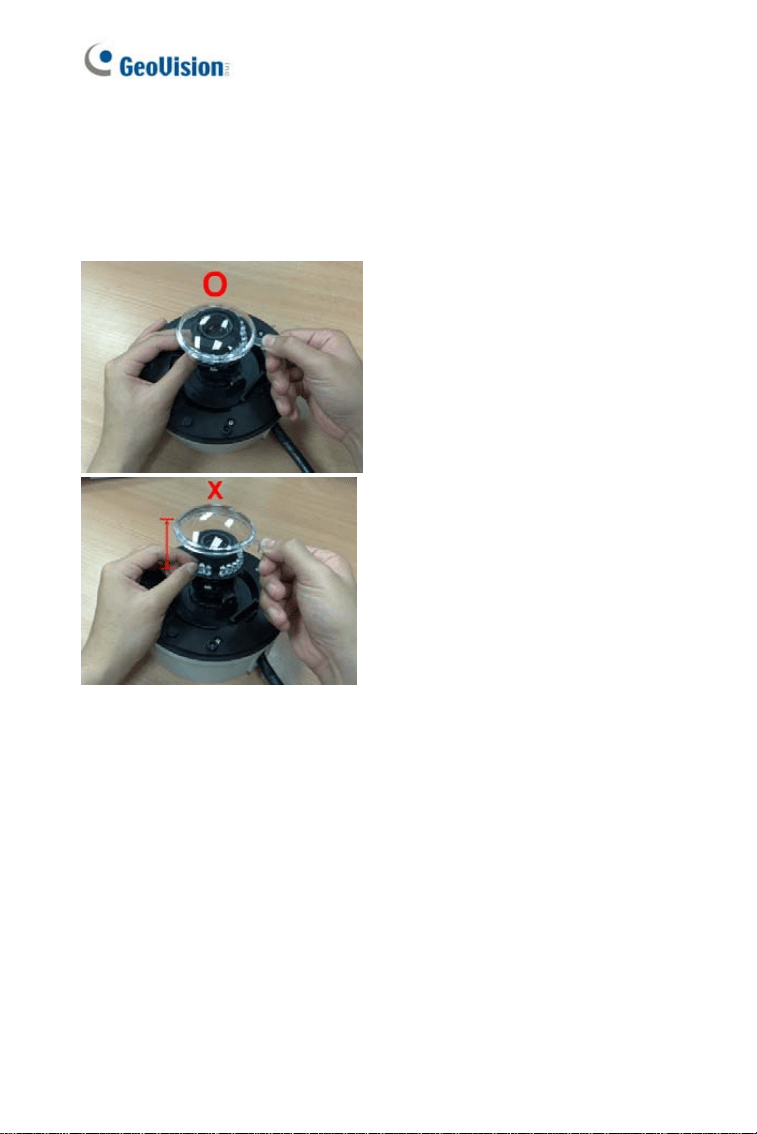
The Focus Adjustment Cap is only supplied for IK10+ models (GV-
VD120D / 121D / 220D / 221D / 320D / 321D / 1500 / 2400 / 2500 / 3400
/ 1530 / 2430 / 2530 / 3430 / 4711 / 5711).
Hold the Focus Adjustment
Cap on top of the camera view
and keep it close to the
camera.
Do not leave a distance
between the Focus
Adjustment Cap and the
camera.
Figure 2-9
14
Getting Started
2
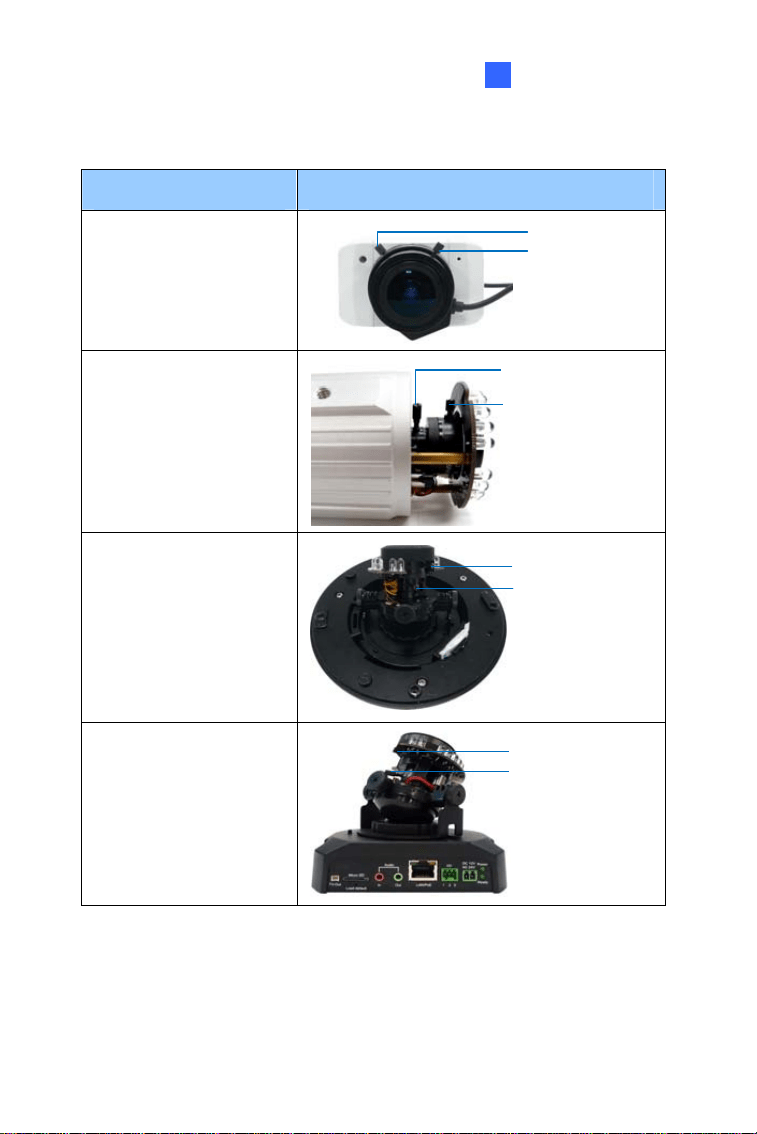
2.2.2 Locations of Adjustment Screws
Models Adjustment Screws
Box Camera
Zoom Screw
Focus Screw
Bullet Camera
Zoom Screw
Focus Screw
Vandal Proof IP Dome
Focus Screw
Zoom Screw
Fixed IP Dome
Focus Screw
Zoom Screw
15
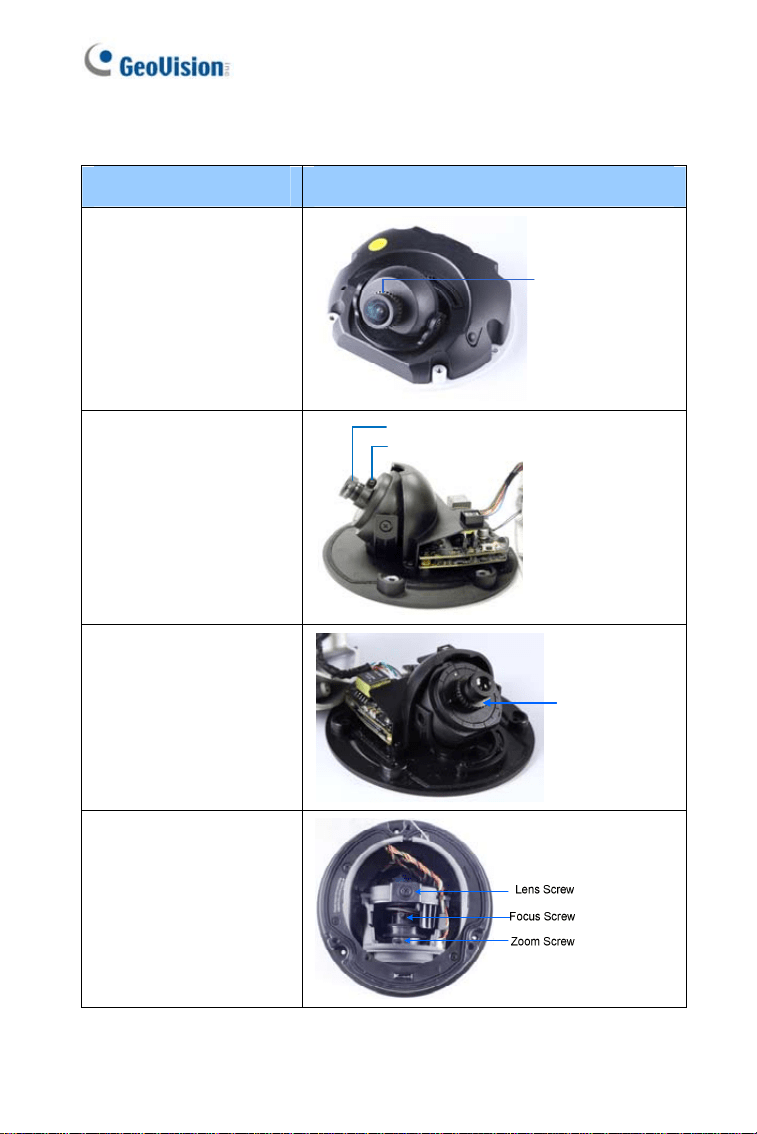
Models Adjustment Screws
GV-MFD3401 / 5301
Focus Ring
GV-MDR320
Lens Screw
Focus Ring
GV-MDR1500 / 3400
Focus Ring
GV-VD3700 / 5700
16

Getting Started
2
Note:
1. The adjustment screws of Box Camera may vary for different
models.
2. To focus GV-MFD and GV-MDR, loosen the lens screw first and
slowly adjust the focus ring. Some models may need a T6 screw
driver to loosen the camera lens. If you have a problem of
obtaining this type of screw driver, please contact our overseas
offices for further assistance.
17

18
2.3 Configuring the Basics
Once the camera is properly installed, the following important features
can be configured using the browser-based configuration pages and are
discussed in the following sections in this manual:
Date and time adjustment: see 4.8.1 Date & Time Settings.
Login and privileged passwords: see 4.8.3 User Account.
Network gateway: see 4.7 Network.
Camera image adjustment: see 3.2.2 The Control Panel of the Live
View Window
.
Video format, resolution and frame rate: see 4.1.1 Video Settings.
Accessing the Camera
3
Chapter 3 Accessing the Camera
Two types of users are allowed to log on to the GV-IPCAM:
Administrator and Guest. The Administrator has full access to all
system configurations, while the Guest can only access the live view
(except the Camera Adjustment settings) and network status.
3.1 Accessing Your Surveillance Images
Once installed, your camera is accessible on a network. Follow these
steps to access your surveillance images:
1. Start your Web browser.
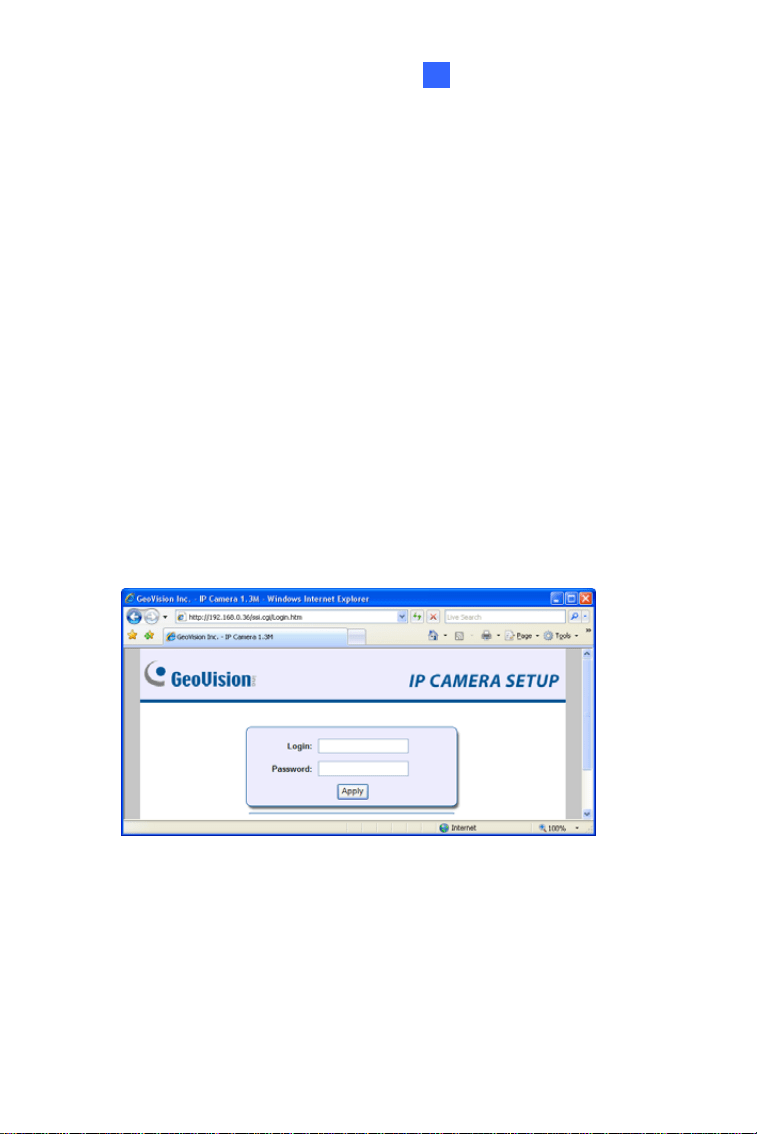
2. Enter the IP address or the domain name of the camera in the
Location/Address field of your browser.
Figure 3-1
3. Enter the login name and password.
The default login name and password for Administrator are
admin.
The default login name and password for Guest are guest.
19
4. Click Apply. A video image, similar to the example on Figure 3-2,
is now displayed in your browser.
Note:
1. To enable the updating of images in Internet Explorer, you must
set your browser to allow ActiveX Controls and perform a once-
only installation of GeoVision’s ActiveX component onto your
computer.
2. The default Administrator and Guest accounts are no longer
supported by GV-IPCAM H.265 Firmware V1.14 or later.
20
Accessing the Camera
3
3.2 Functions Featured on the Main Page
This section introduces the features of the Live View window and
Network Status on the main page. The two features are accessible by
both Administrator and Guest.
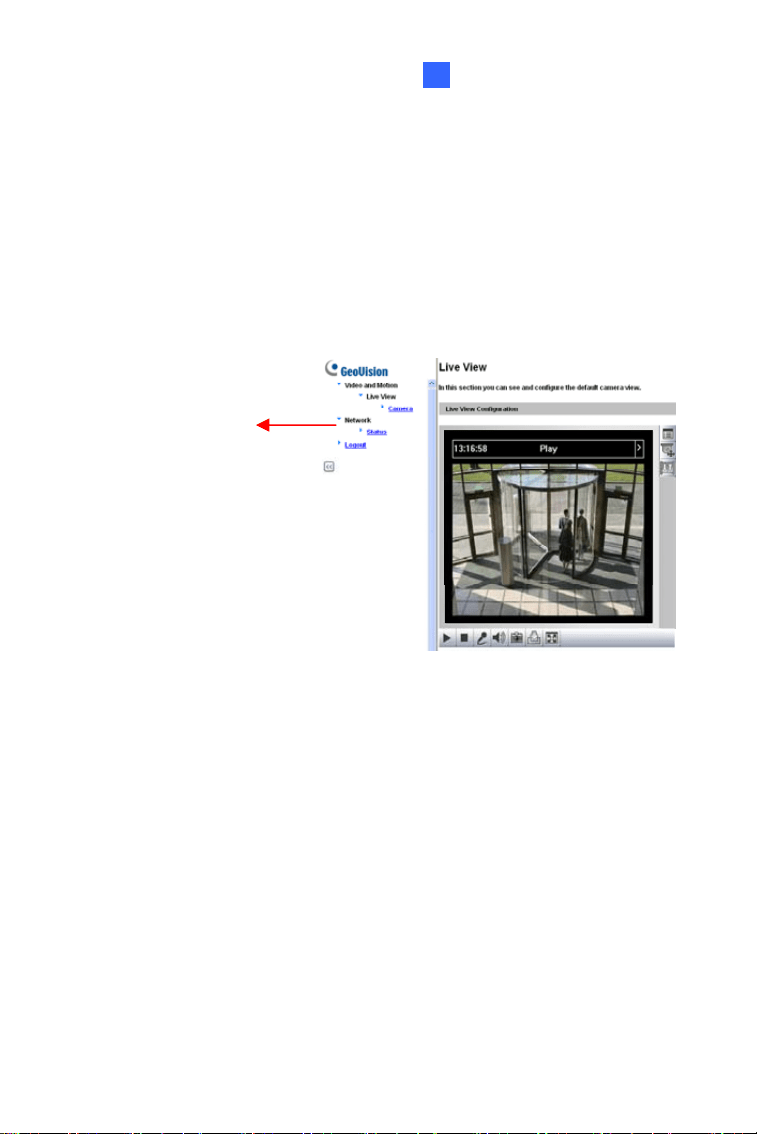
Main Page of Guest Mode
▼ Video and Motion
► Live View
► Camera
▼ Network
► Status
Figure 3-2
The GV-IPCAM can process one video stream in two different codec
and image settings. In the Administrator mode, both streams are
available. Click Streaming 1 or Streaming 2 in the left menu to access
the live view. In the Guest mode, only one stream is available, as shown
in Figure 3-2.
21
3.2.1 The Live View Window
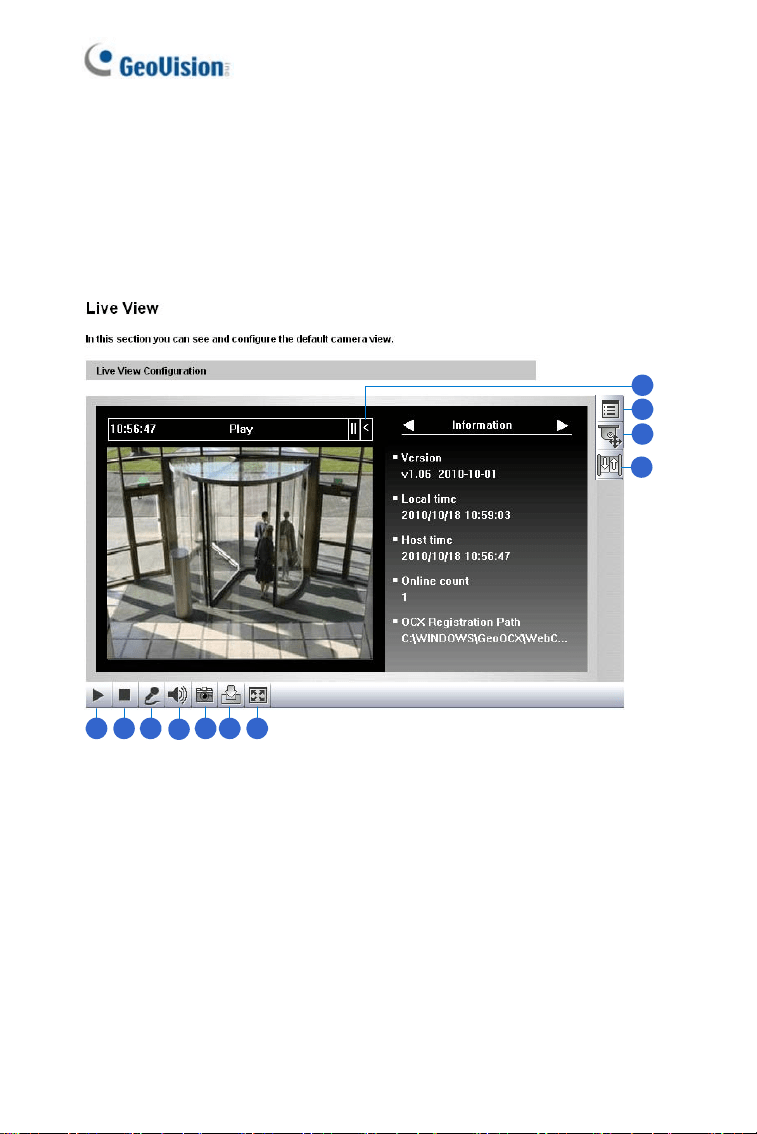
Internet Explorer
When accessing the live view using Internet Explorer, the following
window appears.
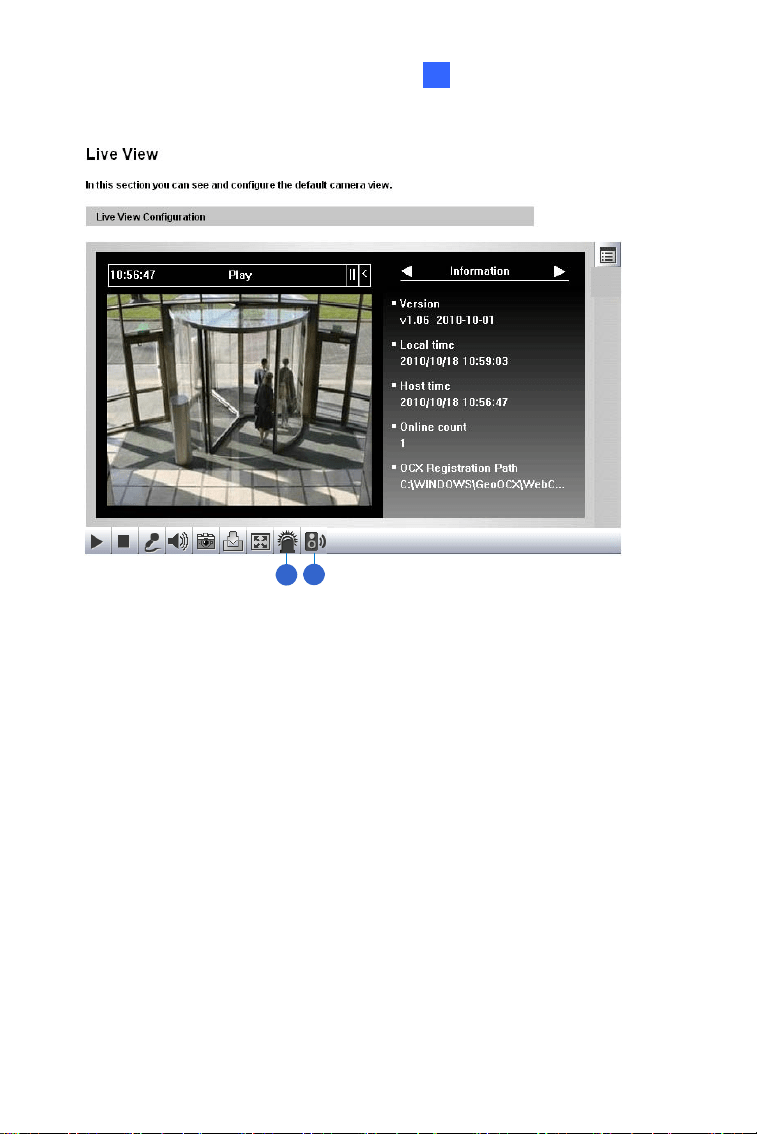
1 2 3
4
5 6 7
8
9
10
11
Figure 3-3A
22
Accessing the Camera
3
12
13
Figure 3-3B
23
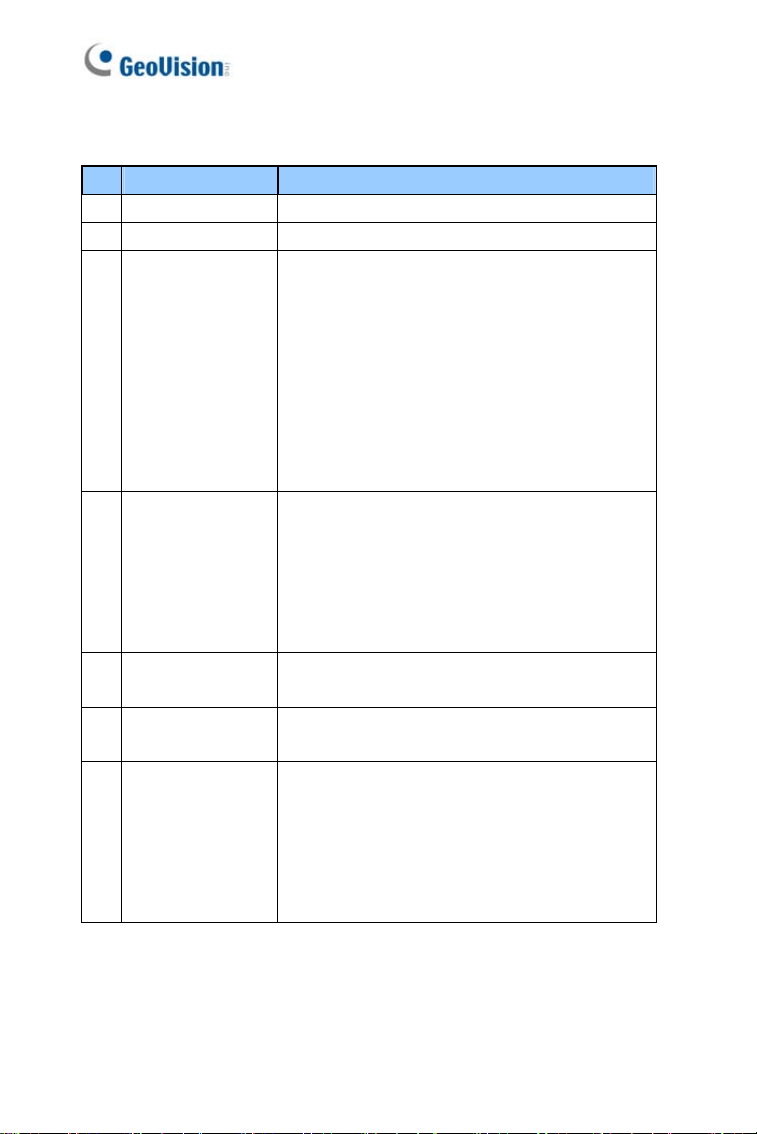
No. Name Function
1 Play Plays live video.
2 Stop Stops playing video.
3 Microphone
Broadcasts to the surveillance site from a
remote PC. Note this function is not available
for Ultra Bullet Camera and Target Series.
For Cube Camera and Advanced Cube
Camera, you can click the Push to talk button
(from the pop-up menu) for the camera to
switch between audio transmission and
reception, where only one party can speak at a
time.
4 Speaker
Transfers sounds of the surveillance site to a
remote PC. Note this function is not available
for Mini Fixed Rugged Dome, Ultra Bullet
Camera, Target Bullet Camera, and Target
Mini Fixed Rugged Dome, and Pinhole
Camera.
5 Snapshot
Takes a snapshot of live video.
--- See 3.2.3 Snapshot of Live Video.
6 File Save
Records live video to the local computer.
--- See 3.2.4 Video Recording.
7 Full Screen
Switches to full screen view. Right-click the
image to have these options: Snapshot, Full
Screen, Resolution, Zoom In, Zoom Out, PIP
and PAP.
--- See 3.2.5 Picture-in-Picture and Picture-
and-Picture View for PIP and PAP views
24

Accessing the Camera
3
No. Name Function
8 Control Panel
Displays the camera information, video
settings, audio data rate, I/O device status,
images captured upon alarm, and GPS
location of the camera. Also allows you to
adjust image quality and install the program
from the hard drive.
9
Show System
Menu
Brings up these functions: Alarm Notify, Video
and Audio Configuration, Remote Config,
Show Camera Name and Image Enhance.
--- See 3.2.6 Alarm Notification,
3.2.7 Video and Audio Configuration,
3.2.8 Remote Configuration,
3.2.9 Camera Name Display, and
3.2.11. Image Enhancement.
10 PTZ Control Panel
Enables the PTZ Control Panel or the Visual
PTZ. Note this function is supported by PTZ
Camera and PT Camera, and only partially
supported by GV-IP Cameras with motorized
varifocal lens.
--- See The PTZ Control Panel (Hardware
Manual)
--- See 3.2.11 Visual PTZ
11 I/O Control
Enables the I/O Control Panel or the Visual
Automation. Note this function is only
supported by cameras with I/O function.
--- See 3.2.13 I/O Control.
12 LED Control
Click to turn the Alarm LED on and/or adjust
the brightness sensitivity. Note this function is
only available for Advanced Cube Camera.
25
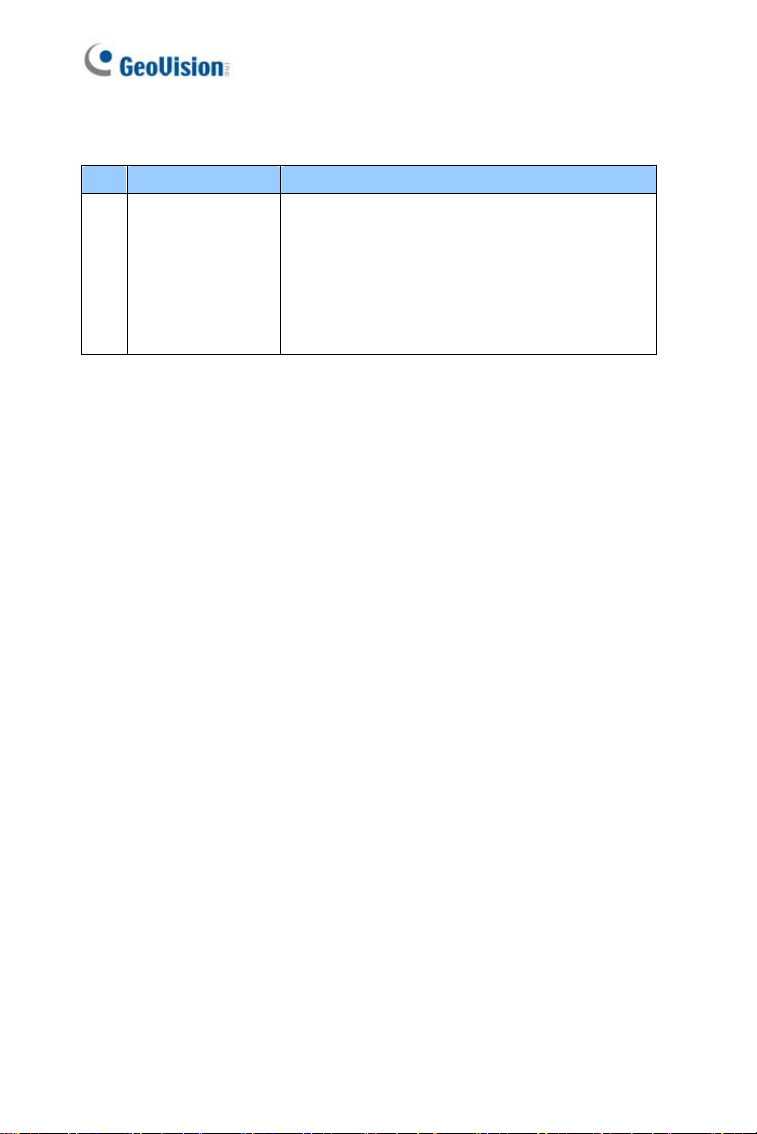
No. Name Function
13 Alarm Speaker
Click to sound the alarm and/or adjust its
volume.
To sound the alarm upon motion or tampering
events, see 4.3.9 Speaker for setup steps.
Note this function is only available for
Advanced Cube Camera.
26

Accessing the Camera
3
Non-IE Browsers
When accessing the live view using Google Chrome, Firefox or Safari,
this window appears. Note the following functions are not supported on
non-IE browsers: Motion Detection, Tampering Alarm, Visual
Automation, Text Overlay and Two-Way Audio.
Note: Non-IE browsers do not support OCX plugin, so the
smoothness of the live view is obstructed. For users of non-IE
browsers, to enjoy smooth live view, download GV-WebViewer right
after you log on and you can also have access to the features of
Motion Detection, Tampering Alarm, Visual Automation, Text Overlay
and Two-Way Audio.
27
3.2.2 The Control Panel of the Live View Window
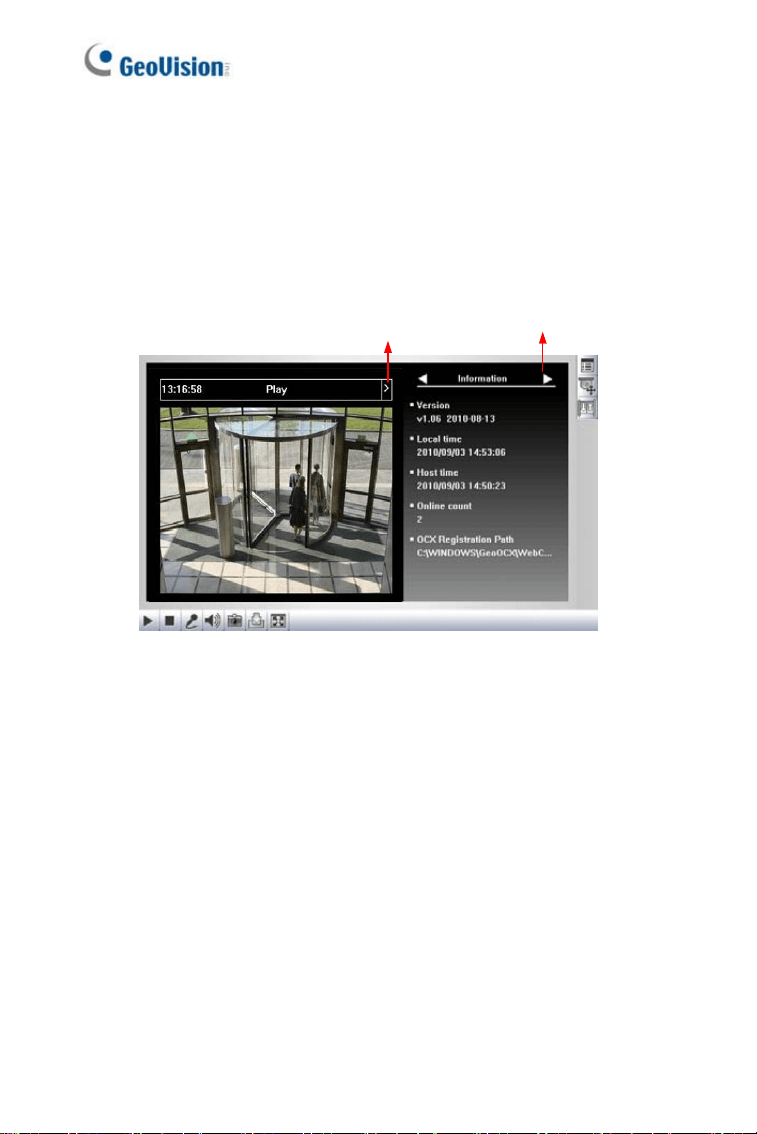
To open the control panel of the Live View window, click the arrow
button on top of the window. You can access the following functions by
using the right and left arrow buttons on the control panel.
Click the arrow button to
display the control panel.
Click the right and left
arrow buttons to change
the page of the control
panel.
Figure 3-4
[Information] Displays the version of the camera, time of the local
computer, time of the camera (host time), the number of users logging in
the camera and the OCX registration path.
[Video] Displays the current video codec, resolution and data rate.
[Audio] Displays the audio data rates when the microphone and
speaker devices are enabled.
[I/O Control] Note this function is only supported by cameras with I/O
function. Provides a real-time graphic display of the input and output
status. You can force the output to be triggered by double-clicking its
icon.
28

Accessing the Camera
3
[A
larm Notify] Displays the captured images by sensor triggers and
motion detection. For this function to work, you have to configure the
Alarm Notification settings first. See 3.2.6 Alarm Notification.
[Camera Adjustment] Allows you to adjust the image quality settings.
Click Save to store the changes to the settings. Note that this function is
only accessible for Administrator.
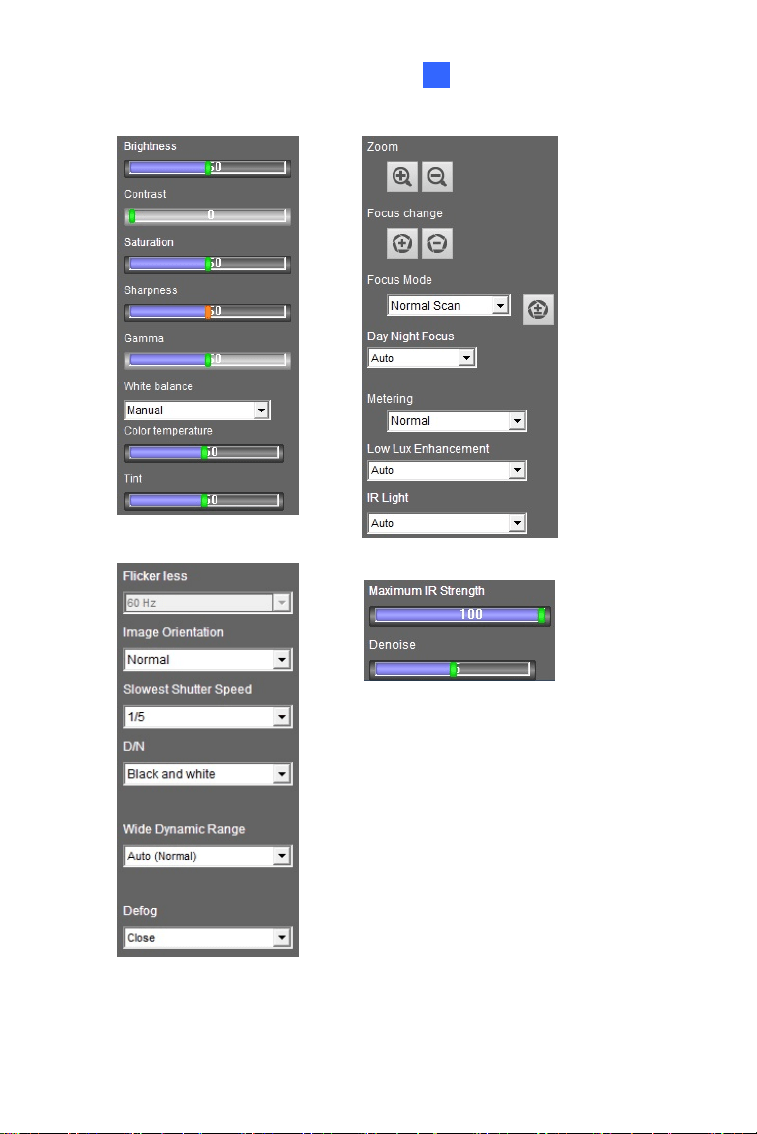
Brightness: Adjusts the brightness of the image.
Contrast: Adjusts the relative differences between one pixel and the
next.
Saturation: Adjusts the saturation of the image.
Sharpness: Adjusts the sharpness of the image
Gamma: Adjusts the relative proportions of bright and dark areas
White balance: The camera automatically adjusts the color to be
closest to the image you are viewing. You can choose one of the four
presets: Auto, Outdoor, Fluorescent, and Tungsten Lamp. You
can also choose Manual to adjust the white balance manually.
Color Temperature: Adjust the camera image to have a warmer or
cooler color tone. Note this function is only available for GV-IPCAM
H.265 Firmware V1.14 or later, and only appears when you choose
Manual for White Balance.
Tint: Move the slider to remove undesired color cast for a more
neutral color. Note this function is only available for GV-IPCAM
H.265 Firmware V1.14 or later, and only appears when you choose
Manual for White Balance.
Flicker less: The camera automatically matches the frequency of
your camera’s image to the frequency of indoor light sources, e.g.
fluorescent lighting. You can also select 50 Hz or 60 Hz manually. If
these don’t match, faint light and dark bars may appear in your
images. Check the power utility to determine which frequency is
used.
29
Note: For GV-IPCAM H.265 firmware V1.14 or later, the function
of Flicker is listed in Video Signal Type, 4.1.1 Video Settings.
Image Orientation: Changes the image orientation on the Live
View window.
Slowest Shutter Speed: Shutter speed controls the amount of the
lights enters the image sensor and directly impacts the quality of
image presentation. A slow shutter speed allows higher light
exposure that creates a brighter overall image by blurring moving
objects and bringing out background details, and a faster shutter
speed lowers color and image clarity in order to capture motions.
The minimum shutter speed ranges from 1/5 to 1/8000 sec. In low
light conditions, a fast shutter speed will lower color quality and
image clarity. In this case, select the Auto option for automatic
shutter control or select Auto (High Speed Mode) for a faster
automatic shutter control.
D/N: Sets the sensitivity of day-night mode switch. The lower the
value, the earlier the camera switches to Day mode. The higher the
value, the earlier the camera switches to Night mode. Select Auto
for automatic switch between day mode and night mode depending
on the amount of light detected. Select Black and white to switch
the camera to night mode. Select Color to switch the camera to day
mode. Sets the light sensor’s sensitivity of switching between day
mode and night mode. The value 10 is the most light-sensitive.
Select Trigger by Input to switch between day mode and night
mode once an input device (e.g. sensor or button) is triggered.
Select Schedule to configure specific period(s) of time when day
mode is activated.
3D Noise Reduction: Denoise / Space Domain Strength / Time
Domain Strength are all used to reduce the noise of the image
depending on the surveillance environment
30
Accessing the Camera
3
W
ide Dynamic Range: adjusts and generates clear live view when
the scene contains very bright and very dark areas at the same time.
Select Auto (Strong) to bring out details of the dark areas of the
scene, select Auto (Weak) to bring out fewer details of the dark
areas and at the same time keep the bright areas from overexposure,
or select Auto (Normal) for a balanced effect. Select Close to
disable the function.
Defog: Select Auto to automatically enhance the visibility of images.
Select Close to disable the function.
Zoom: Click Zoom In
and Zoom Out
to adjust the
apparent distance of the scene. After zooming the camera, re-focus
the camera manually or automatically. For details, see Focus
Change and Focus Mode below.
Focus Change: Click Focus In
and Focus Out
to adjust
the focus. To focus automatically, click Auto Focus
.
Focus Mode: Select Normal Scan, Regional Scan or Full Scan
and then click Start
to automatically adjust the camera focus.
The Normal Scan mode focuses the camera the fastest. The
Regional Scan mode focuses the area selected on the live view.
The Full Scan mode performs a detailed checkup and applies the
best focus.
Day Night Focus: Saves focus settings for day mode and night
mode. Select Auto to automatically focus, or Close to disable the
function. To configure fixed settings for day mode and night mode,
select Manual and follow the steps below:
1. Make sure the D/N is in Auto mode for the best effect. The
following focus setting will be applied to the current D/N mode.
2. Adjust the focus using Focus In
and Focus Out
and/or
Focus Mode.
3. Click Day Mode Save
or Night Mode Save
depending
on the current D/N mode.
31

Metering: Controls the camera’s exposure. Select Normal for the
camera to adjust exposure based on the full live view. Select
Regional Metering for the camera to adjust exposure of specified
zones. Draw directly on the live view and a block marked with “AE
(automatic exposure)” appears. You can establish up to 4 zones. To
remove the block, right-click the block and select Delete.
Low Lux Enhancement: Select Auto for the camera to
automatically enhance the live view under insufficient light, or Close
to disable the function. The default setting for cameras without Super
Low Lux is Close. The default setting for cameras with Super Low
Lux is Auto.
IR Light: Select Auto for automatic switch between day mode and
night mode depending on the amount of light detected. Select Off to
completely disable IR LEDs
Maximum IR Strength: Adjusts the intensity of the IR Light.
Denoise: Reduces image noise especially under low-light conditions.
The higher the denoise value, the stronger the effect.
Note: For GV-EVD5100, GV-EFD5101 and GV-EBL5101, refer to the
description of Noise Reduction in 4.1.1 Video Settings.
32
Accessing the Camera
3
Figure 3-5A
Figure 3-5B
Figure 3-5C
Figure 3-5D
33

Note:
1. For GV-PTZ010D, Brightness, Contrast, Saturation,
Sharpness, D/N, Slowest Shutter Speed, Wide Dynamic
Range and Defog are not available.
2. Zoom, Focus Change, Focus Mode and Day Night Focus
settings are only available for models with motorized varifocal
lens.
3. All Target Series support Denoise and Metering; for other
cameras, Denoise and Metering settings are only available for
firmware V2.14 or later.
4. 3D Noise Reduction are only supported by GV-BX2600-FD /
BX2700-FD / BX4700-FD / BX8700 / BX8700-FD / MD8710 /
MD8710-FD.
5. Maximum IR Strength is not available for GV-BX Series.
34

Accessing the Camera
3
3.2.3 Snapshot of Live Video
To take a snapshot of live video, follow these steps:
1. Click the Snapshot button (No. 5, Figure 3-3). The Save As dialog
box appears.
2. Specify Save in, type the File name, and select JPEG or BMP as
Save as Type. You may also choose whether to display the name
and date stamps on the image.
3. Click the Save button to save the image in the local computer.
3.2.4 Video Recording
You can record live video for a certain period of time to your local
computer.
1. Click the File Save button (No. 6, Figure 3-3). The Save As dialog
box appears.
2. Specify Save in, type the File name, and move the Time Period
slider to specify the time length of the video clip from 1 to 5 minutes.
3. Click the Save button to start recording.
4. To stop recording, click the Stop button (No. 2, Figure 3-3).
35
3.2.5 Picture-in-Picture and Picture-and-Picture View
The full screen mode provides two types of close-up views: Picture-in-
Picture (PIP) and Picture-and Picture (PAP). The two views are useful
to provide clear and detailed images of the surveillance area.
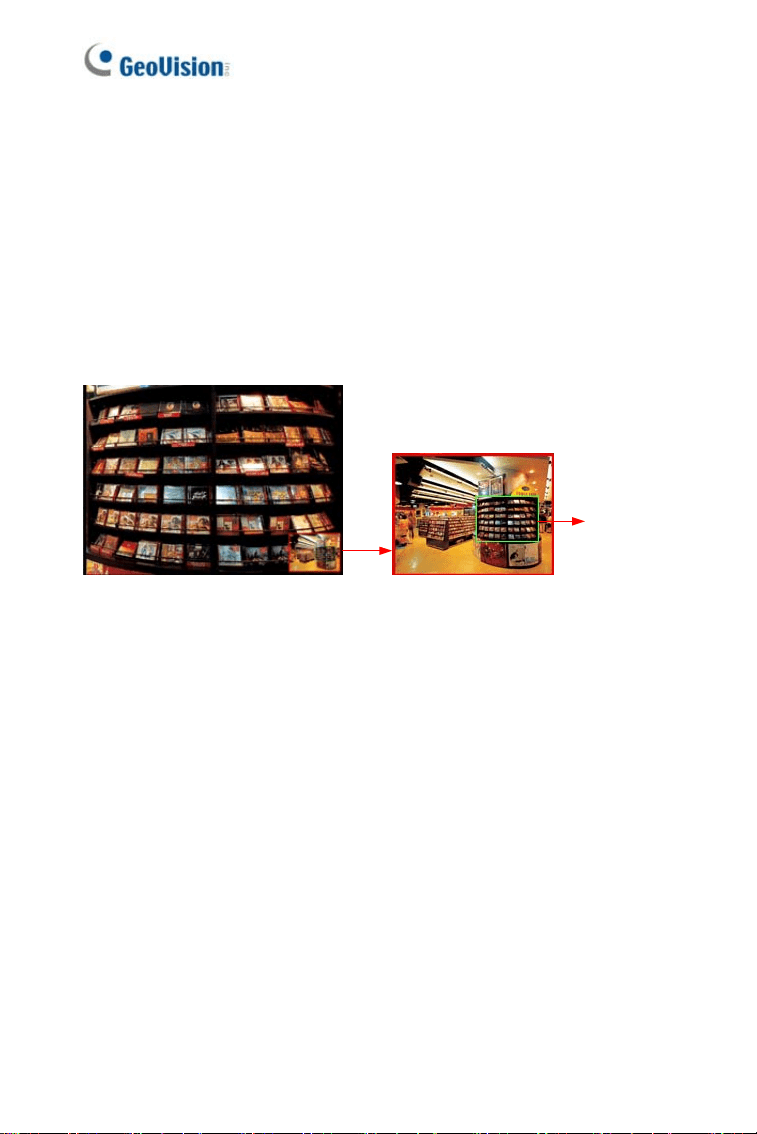
Picture-in-Picture View
With the Picture in Picture (PIP) view, you can crop the video to get a
close-up view or zoom in on the video.
Inset window
Navigation box
Figure 3-6
1. Right-click the live view and select PIP. An inset window appears.
2. Click the insert window. A navigation box appears.
3. Move the navigation box around in the inset window to have a
close-up view of the selected area.
4. To adjust the navigation box size, move the cursor to any of the
box corners, and enlarge or diminish the box.
5. To exit the PIP view, right-click the image and click PIP again.
36
Accessing the Camera
3
Picture-and-Picture View
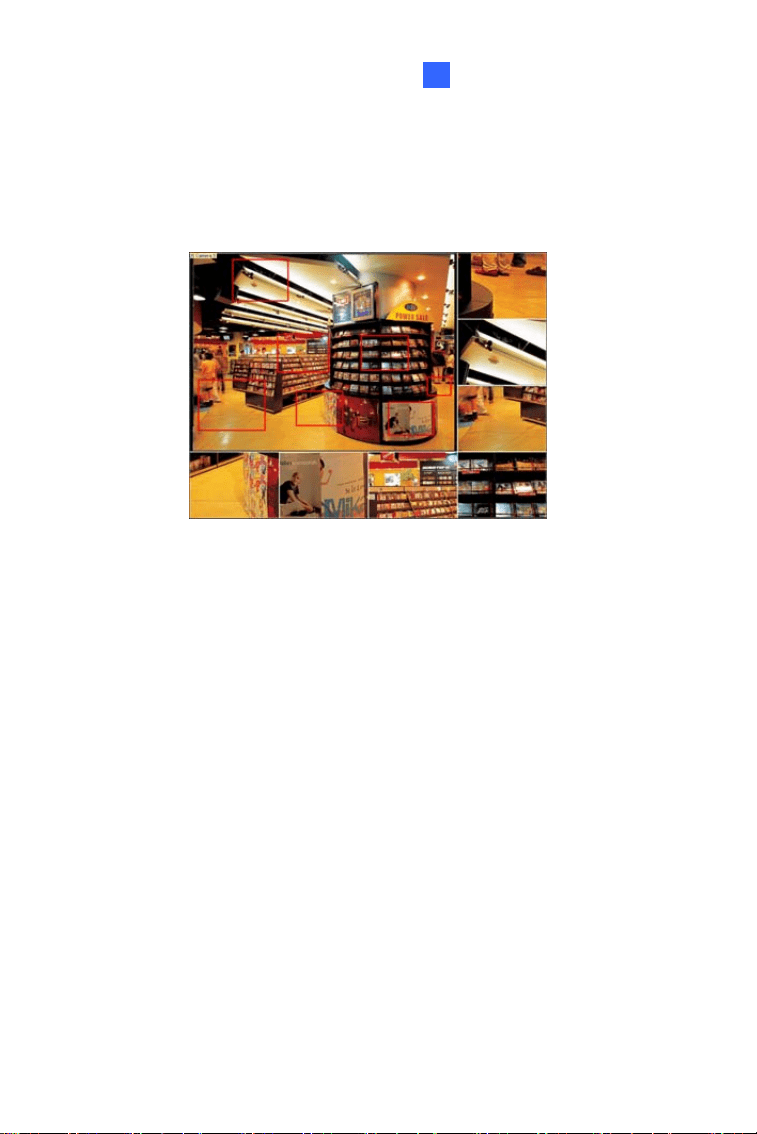
With the Picture and Picture (PAP) view, you can create a split video
effect with multiple close-up views on the image. A total of 7 close-up
views can be defined.
Figure 3-7
1. Right-click the live view and select PAP. A row of three inset
windows appears at the bottom.
2. Draw a navigation box on the image, and this selected area is
immediately reflected in one inset window. Up to seven navigation
boxes can be drawn on the image.
3. To adjust a navigation box size, move the cursor to any of the box
corners, and enlarge or diminish the box.
4. To move a navigation box to another area on the image, drag it to
that area.
5. To add more navigation boxes, to show or hide navigation boxes or
to change the frame color of the navigation boxes, right-click the
image, select Mega Pixel Setting and click one of these options:
Enable Add-Focus-Area Mode: Allows the user to add more
navigation boxes on the image. This option is not available
when 7 navigation boxes have been drawn.
Display Focus Area of PAP Mode: Displays or hides the
navigation boxes on the image
37

Set Color of Focus Area: Changes the color of the box
frames.
6. To delete a navigation box, right-click the desired box, select
Focus Area of PAP Mode and click Delete.
7. To exit the PAP view, right-click the image and click PAP again.
38
Accessing the Camera
3
3.2.6 Alarm Notification
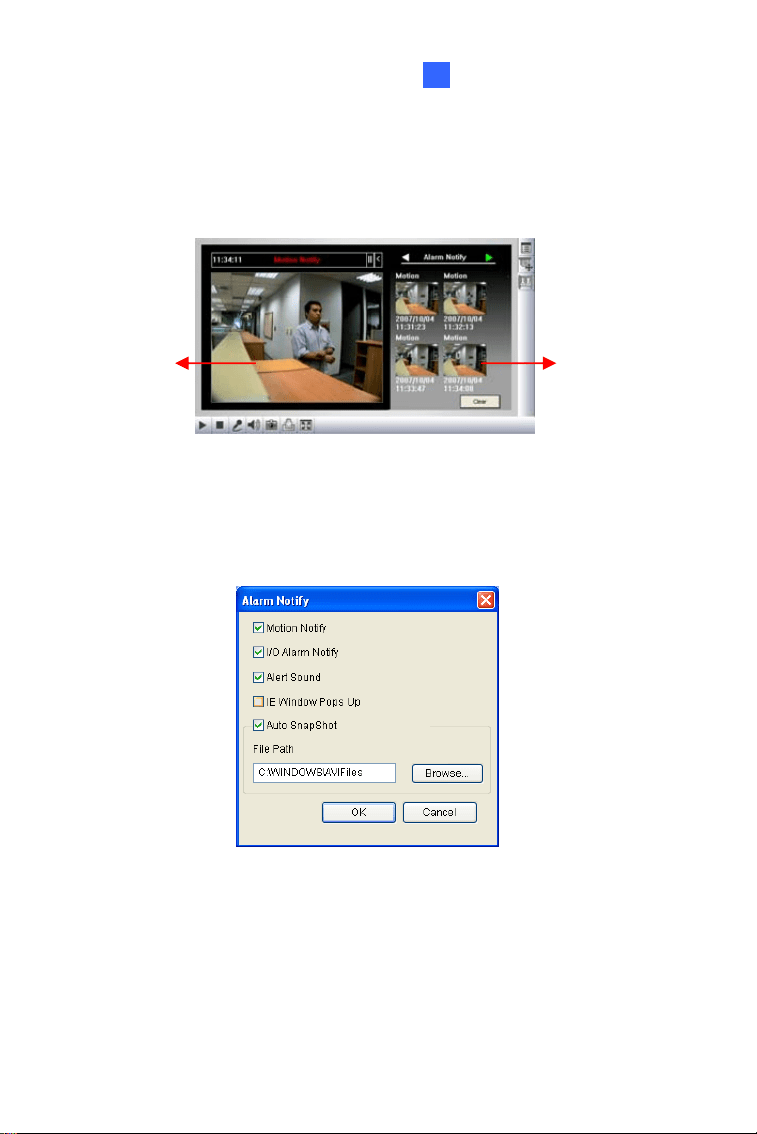
After input triggers and motion detection, you can be alerted by a pop-up
live video and view up to four captured images.
Figure 3-8
To configure this function, click the Show System Menu button (No. 9,
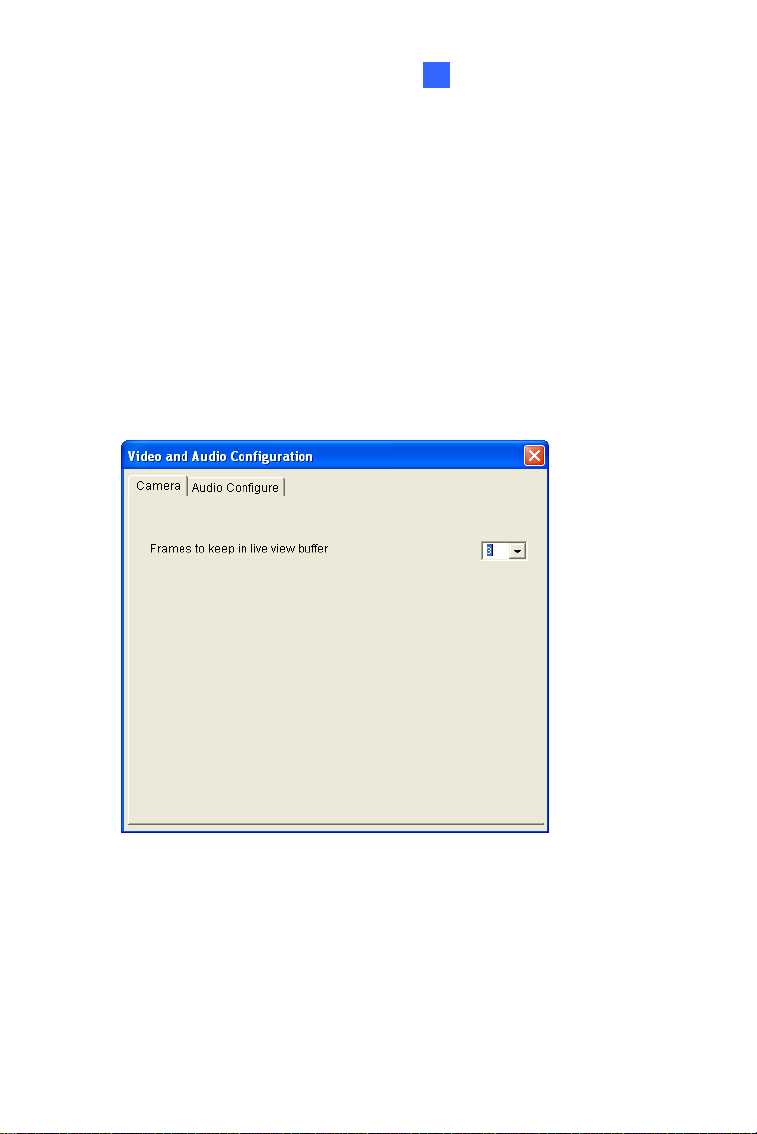
Figure 3-3), and select Alarm Notify. This dialog box appears.
Figure 3-9
Motion Notify: Once motion is detected, the captured images are
displayed on the control panel of the Live View window.
39

I/O Alarm Notify: Once the input device is triggered, the captured
images are displayed on the control panel of the Live View window.
For this function to work, the Administrator needs to install the input
device properly. See 4.2.1 Input Setting.
Alert Sound: Activates the computer alarm on motion and input-
triggered detection.
IE Window Pops up: The minimized Live View window pops up on
motion and input-triggered detection.
Auto Snapshot: The snapshot of live video is taken every 5
seconds on motion and input-triggered detection.
File Path: Assigns a file path to save the snapshots.
40
Accessing the Camera
3
3.2.7 Video and Audio Configuration
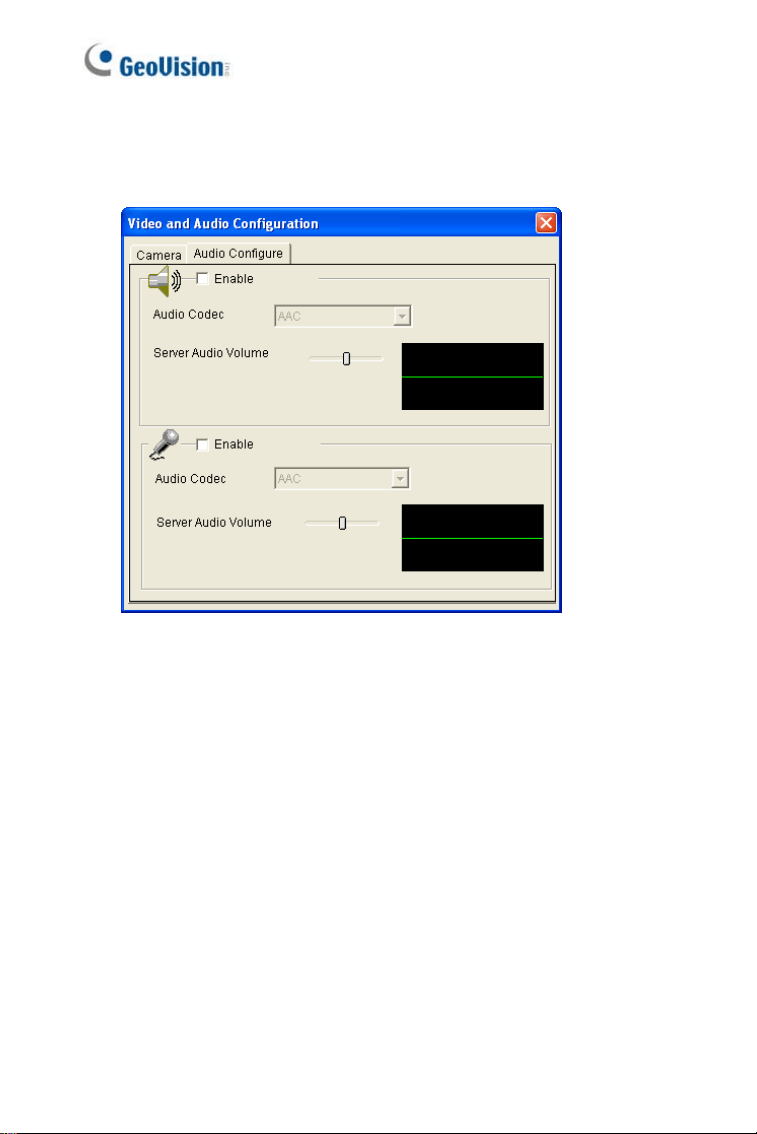
You can enable the microphone and speaker for two-way audio
communication and adjust the audio volume. To change audio
configuration, click the Show System Menu button (No. 9, Figure 3-3),
and select Video and Audio Configuration.
Camera: Sets the number of frames to keep in live view buffer.
Keeping more frames for live view buffer can ensure a smooth live
view, but the live view will be delayed for the number of frames
specified.
Figure 3-10
41
Audio Configure: You can enable the microphone and speaker,
and adjust the audio volume.
Figure 3-11
42
Accessing the Camera
3
3.2.8 Remote Configuration
You can upgrade firmware over the network. Click the Show System
Menu button (No. 9, Figure 3-3), and select Remote Config. The
Remote Config dialog box will appear.
[Firmware Upgrade] In this tab, you can upgrade the firmware over the
Internet. For details, see Advanced Applications, Chapter 5.
3.2.9 Camera Name Display
To display the streaming name on the image, click the Show System
Menu button (No. 9, Figure 3-3), and select Show Camera Name. Note
this function is not available for GV-VD3700 / 5700.
3.2.10 Image Enhancement
To enhance the image quality of live video, click the Show System
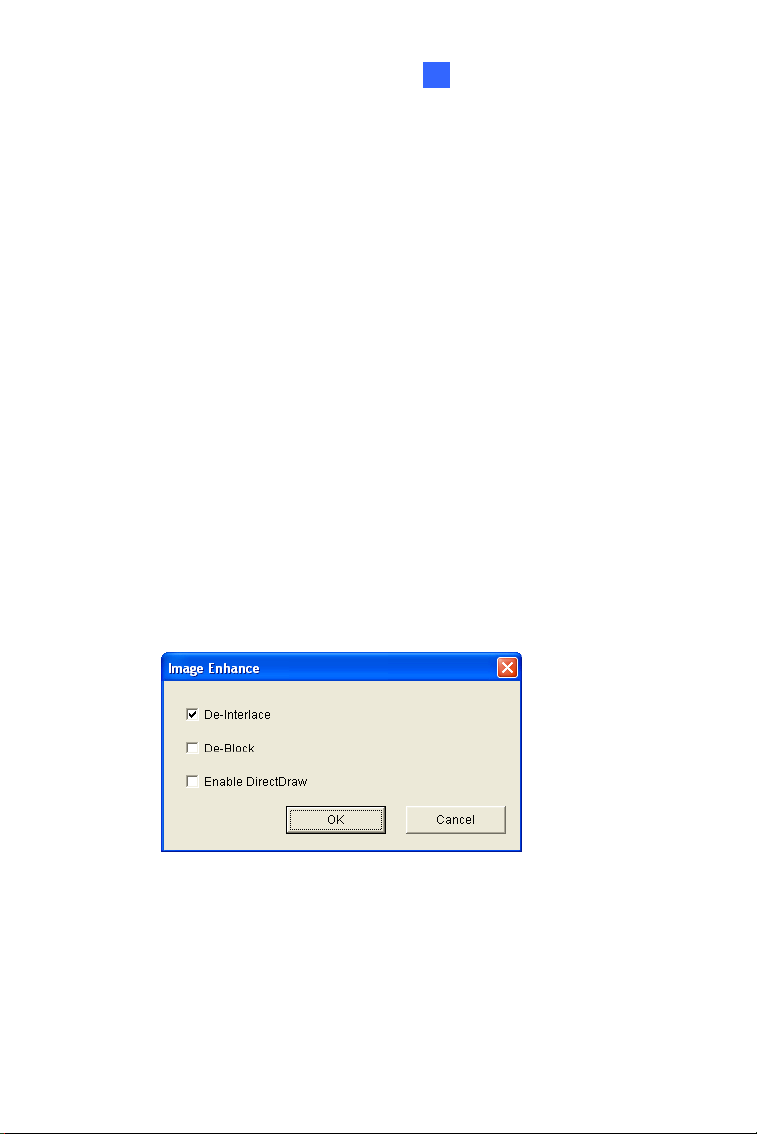
Menu button (No. 9, Figure 3-3), and select Image Enhance. This
dialog box appears.
Figure 3-12
De-Interlace: Converts the interlaced video into non-interlaced
video.
De-Block: Removes the block-like artifacts from low-quality and
highly compressed video.
Enable DirectDraw: Activates the DirectDraw function.
43
3.2.11 Visual PTZ
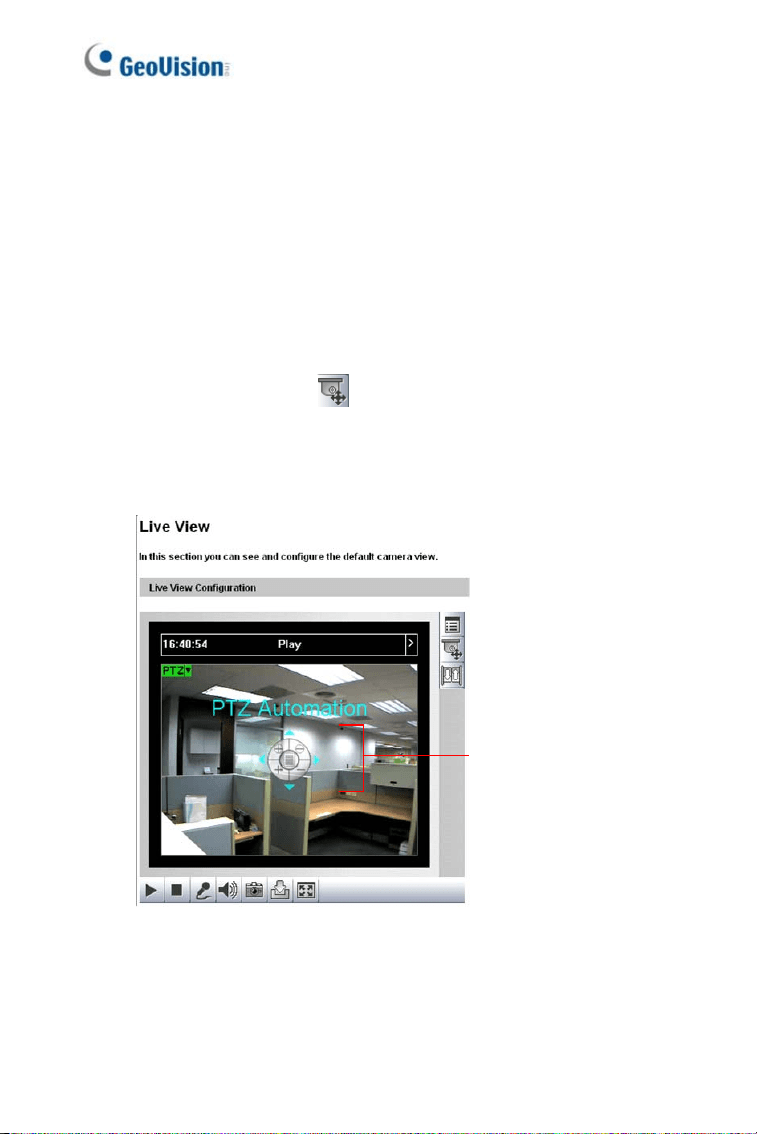
Note this feature is only available in PTZ Camera and PT Camera.
The Visual PTZ provides two types of PTZ control panels on live images
for easy and direct PTZ operation.
Activating Visual PTZ
Click the PTZ Control button (No. 10, Figure 3-3) and select Visual
PTZ. Alternatively right-click anywhere on the live view and select
Visual PTZ.
Visual PTZ
Control Panel
Figure 3-13
44
Accessing the Camera
3
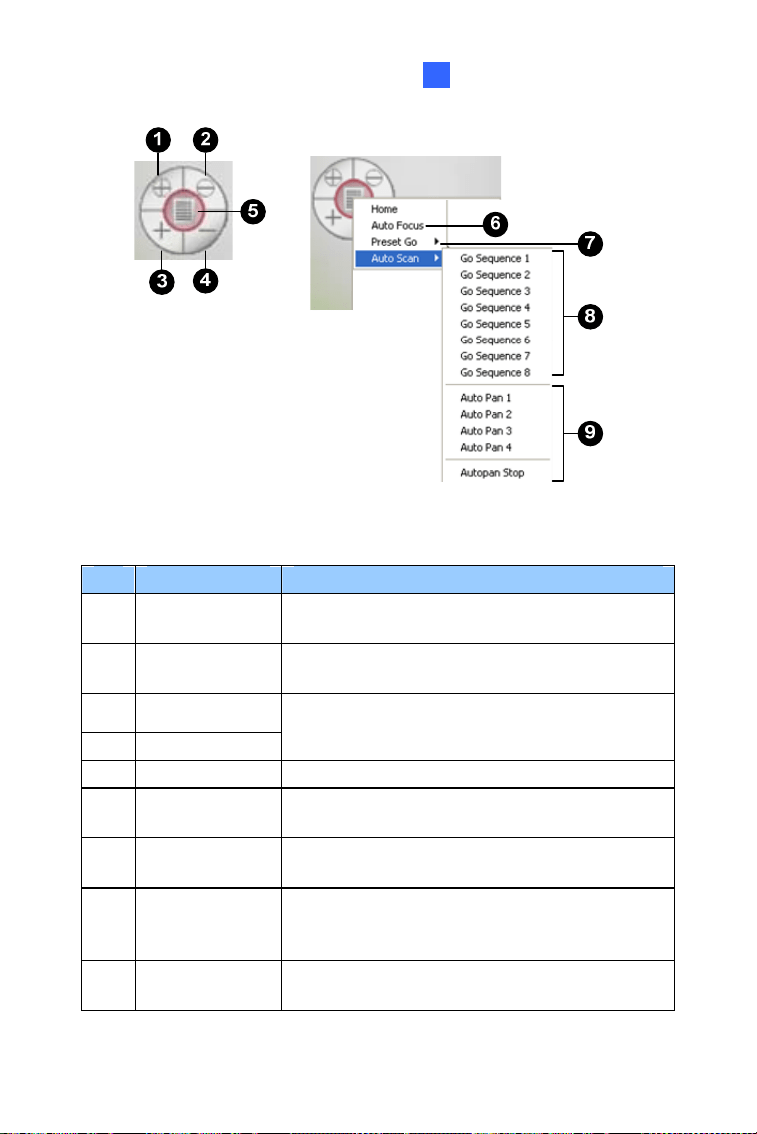
Figure 3-14
The Visual PTZ Panel provides the following features:
No. Name Description
1 Zoom In
Shortens the apparent distance between the
camera and the view.
2 Zoom Out
Lengthens the apparent distance between the
camera and the view.
3 Focus In
4 Focus Out
Adjusts the sharpness of the camera view.
5 Home Brings the camera to the home point.
6 Auto Focus
Automatically adjusts the sharpness of the
camera view.
7 Preset Go
Starts a single movement in which the PTZ
Camera moves towards a point in live view.
8 Go Sequence
Starts a series of movements in which the PTZ
Camera moves towards at least two Preset
points in live view.
9 Auto Pan
Starts a horizontal movement of the PTZ
Camera in live view.
45
Setting Visual PTZ Panel
Click the .button on the top left corner and select Visual PTZ, the
following options will appear.
PTZ Control Type: Two types of visual PTZ control panels are
available.
Type 1: Appears only when a movement of the cursor is
detected and disappears when it is static. When you place the
cursor in one of the eight directions, i.e. up, down, left, right, left
up, left down, right up and right down, a 5-level arrow appears.
Click and hold onto the required level to move the camera. The
speed level is indicated at the top right corner of the live view.
Type 2: Appears with a click on the live view and disappears
with the second click. As the cursor points to one of the eight
directions, a 5-level arrow head appears. The further the arrow
is away from the visual PTZ control panel, the faster the
movement and vice versa. The speed level is indicated at the
top right corner of the live view.
Set Color: Changes the color of the arrow line and the speed
indicated at the top right corner of the live view. Alternatively, you
can right-click the live view (with Visual PTZ enabled). Three colors
are available: Red, Green and Blue.
Transparency: Changes the transparency level of the Visual PTZ
Control Panel. Ten levels range from 10% (fully transparent) to
100% (fully opaque).
46
Accessing the Camera
3
3.2.12 Digital PTZ
Note this function is only supported by GV-IPCAM H.264 firmware
V2.06 and the GV-IPCAM H.265.
This function allows non-PTZ cameras to simulate PTZ movements on
live view.
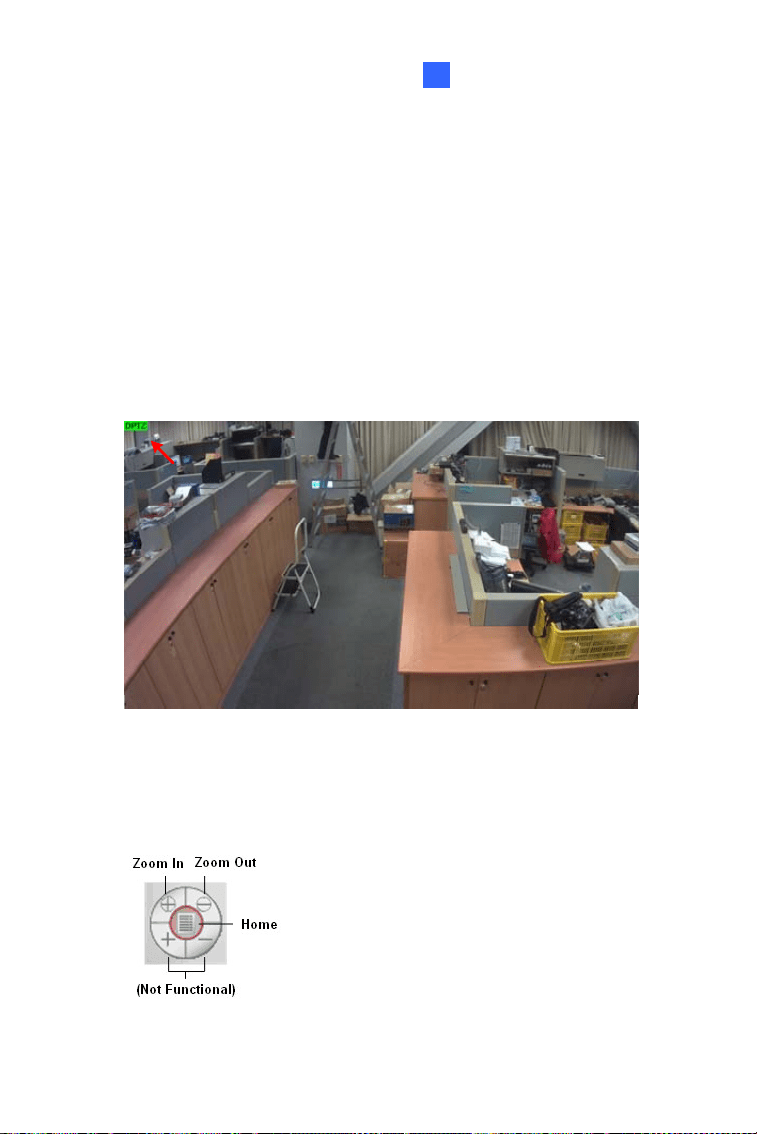
1. Right-click the live view and select Digital PTZ. The live view is
labeled with “DPTZ” at the top left corner.
Figure 3-15
2. To zoom in / out, move the cursor to the live view and click the
corresponding buttons. To bring the view back to its default image,
click Home.
Figure 3-16
47
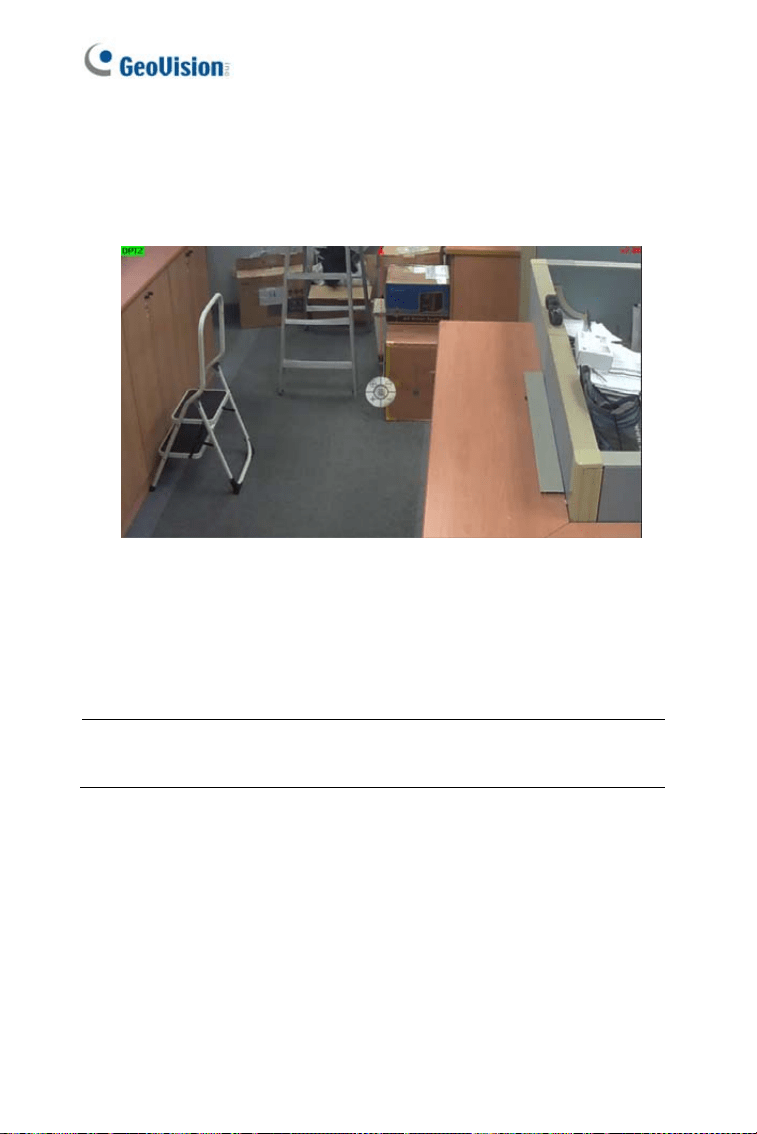
3. To pan and tilt the view, zoom the image first and then click and
hold the arrow on the image. The arrow appears when you place
the cursor in one of the eight directions, i.e. up, down, left, right, left
up, left down, right up and right down.
Figure 3-17
4. To adjust the transparency level of the control panel, click the
green DPTZ button and select Transparency. Ten levels range
from 10% (fully transparent) to 100% (fully opaque) are available.
Note: The Focus In / Out and the speed level are not functional for
Digital PTZ.
48
Accessing the Camera
3
3.2.13 I/O Control
Note this function is only supported by cameras with I/O function.
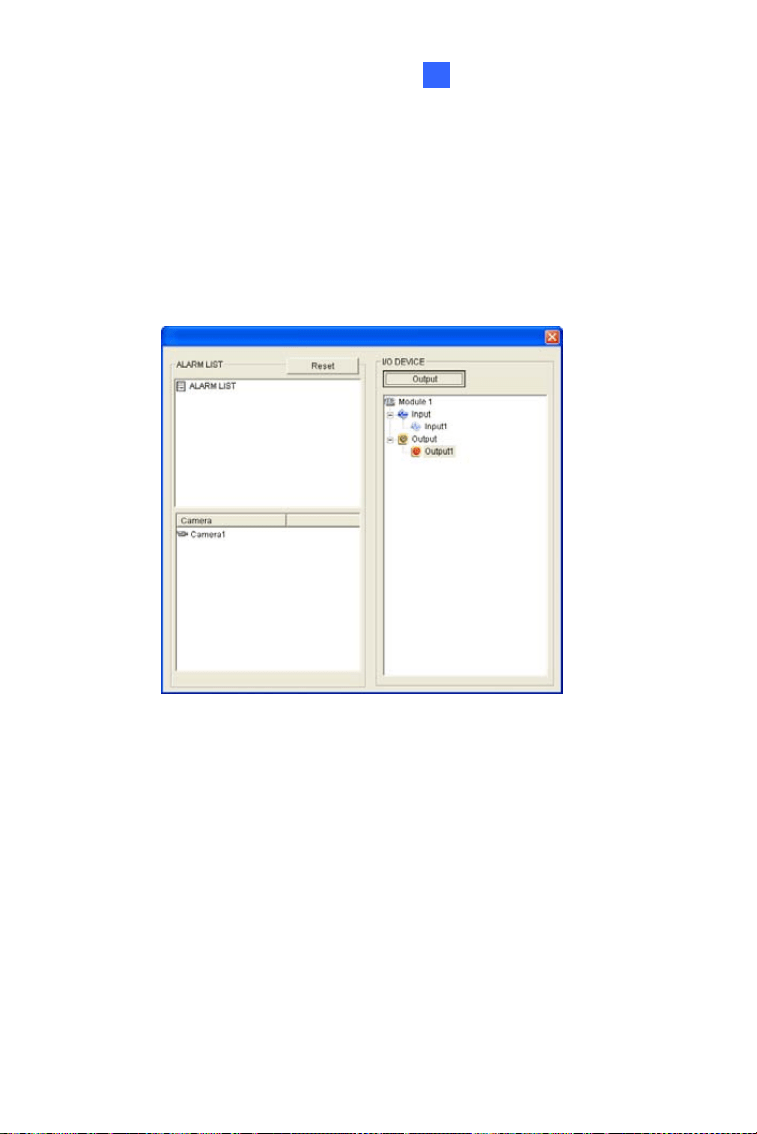
The I/O Control window provides a real-time graphic display of camera
status, I/O status, and alarm events. Additionally, you can remotely force
output to be triggered.
Figure 3-18
To display the I/O control window, click the I/O Control button (No.
11, Figure 3-3) and select I/O Control.
The Alarm List is displayed in three levels. The first level indicates
date, the second indicates time, and the third indicates alarm ID.
Clicking the Reset button will clear the list.
To trigger an output device, highlight an output and then click the
Output button.
49
3.2.14 Visual Automation
Note this function is only supported by cameras with I/O function.
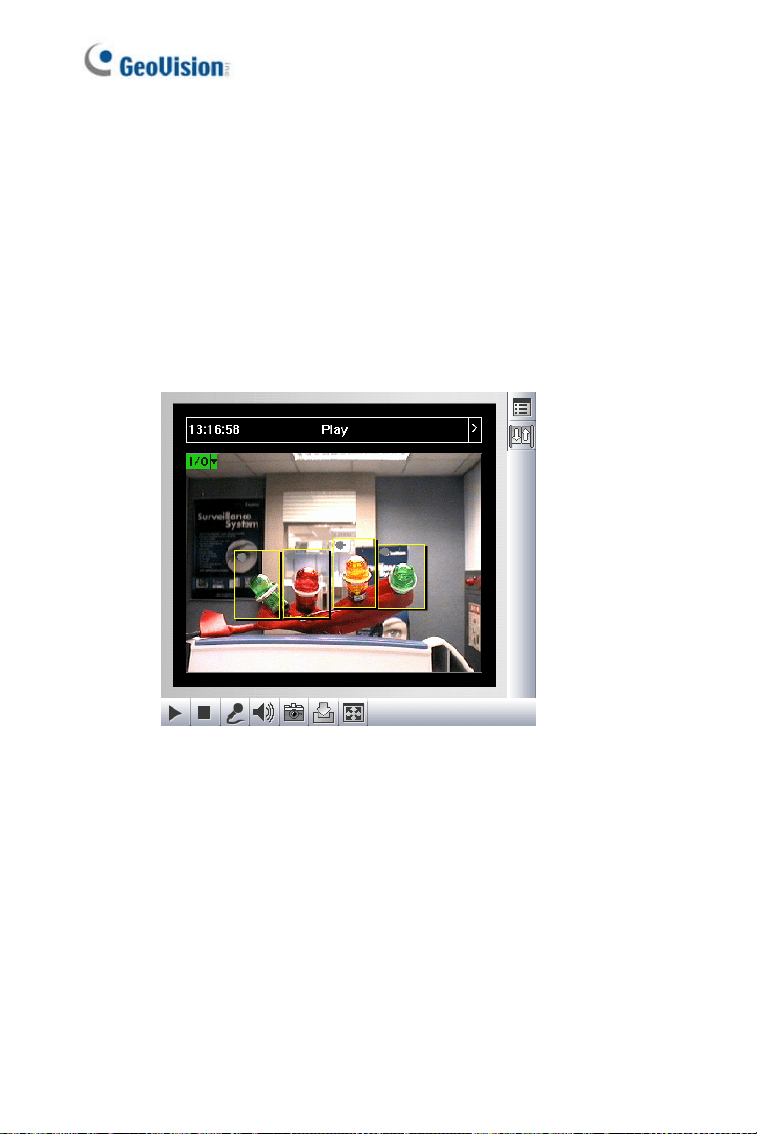
The Visual Automation allows you to change the current state of the
electronic device by simply clicking on its image, e.g. turning the light
ON. This feature is only available when the Visual Automation is set
ahead by the Administrator. For details, see 4.1.6 Visual Automation.
Figure 3-19
To access this feature, click the I/O Control button (No. 11, Figure 3-
3) and select Visual Automation.
To change the style of the set areas, click the green I/O button on the
top left corner. You will have these options:
Show All: Displays all set areas.
Rect Float: Embosses all set areas.
Set Color: Changes the frame color of all set areas
50
Accessing the Camera
51
3
3.2.15 Network Status
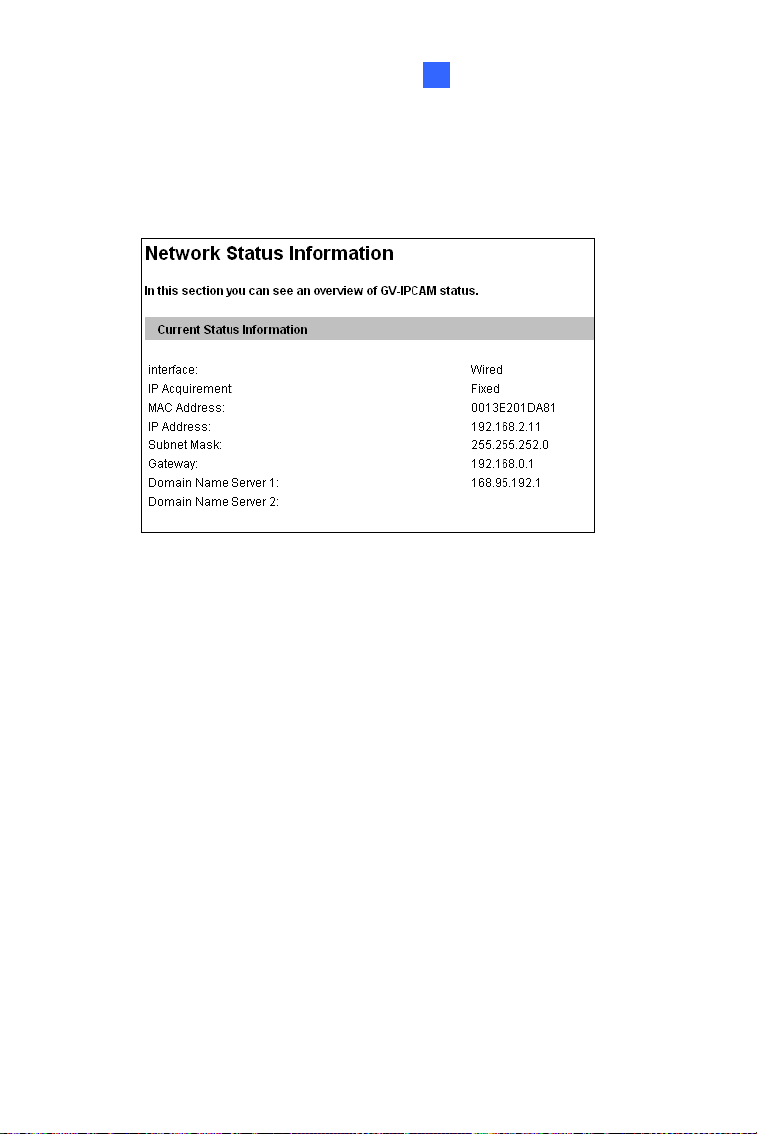
To view the network status, in the left menu, click Network and select
Status.
Figure 3-20
Chapter 4 Administrator Mode
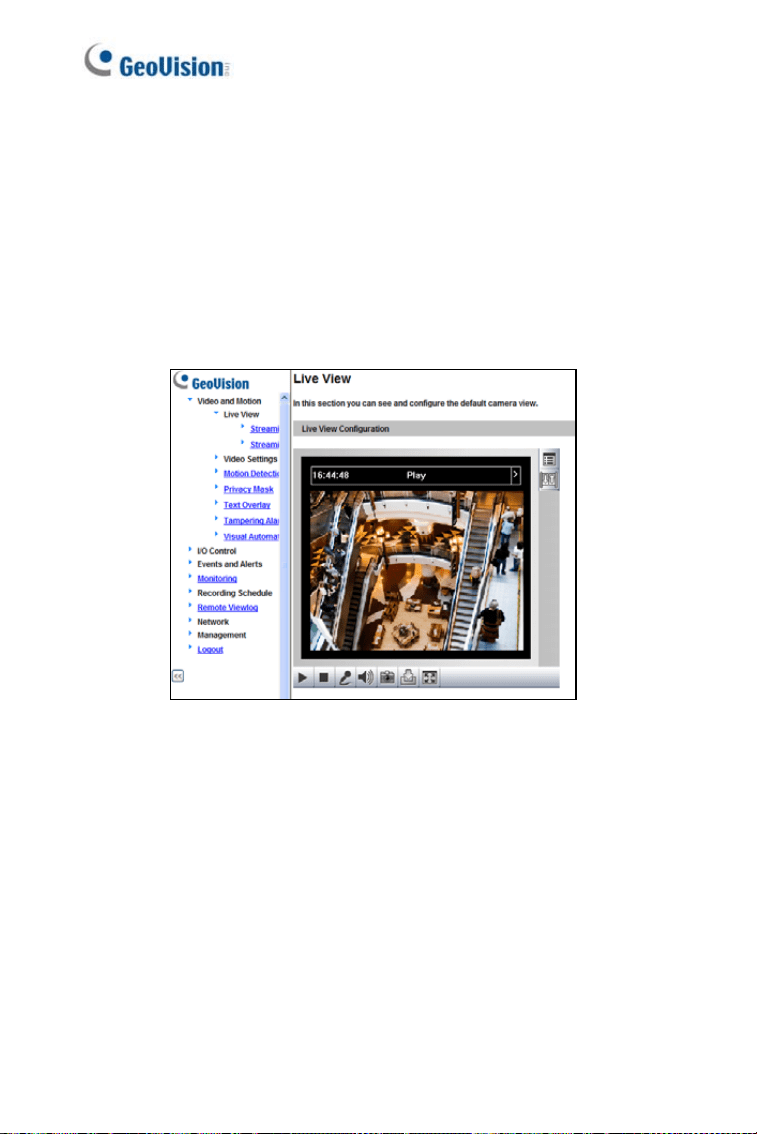
The Administrator can access the system configuration through the
network. Eight categories of configurations are involved: Video and
Motion, I/O Control or Digital I/O and PTZ, Events and Alerts,
Monitoring, Recording Schedule, Remote ViewLog, Network and
Management.
Figure 4-1
52
Administrator Mode
4 4
List
of Menu Options
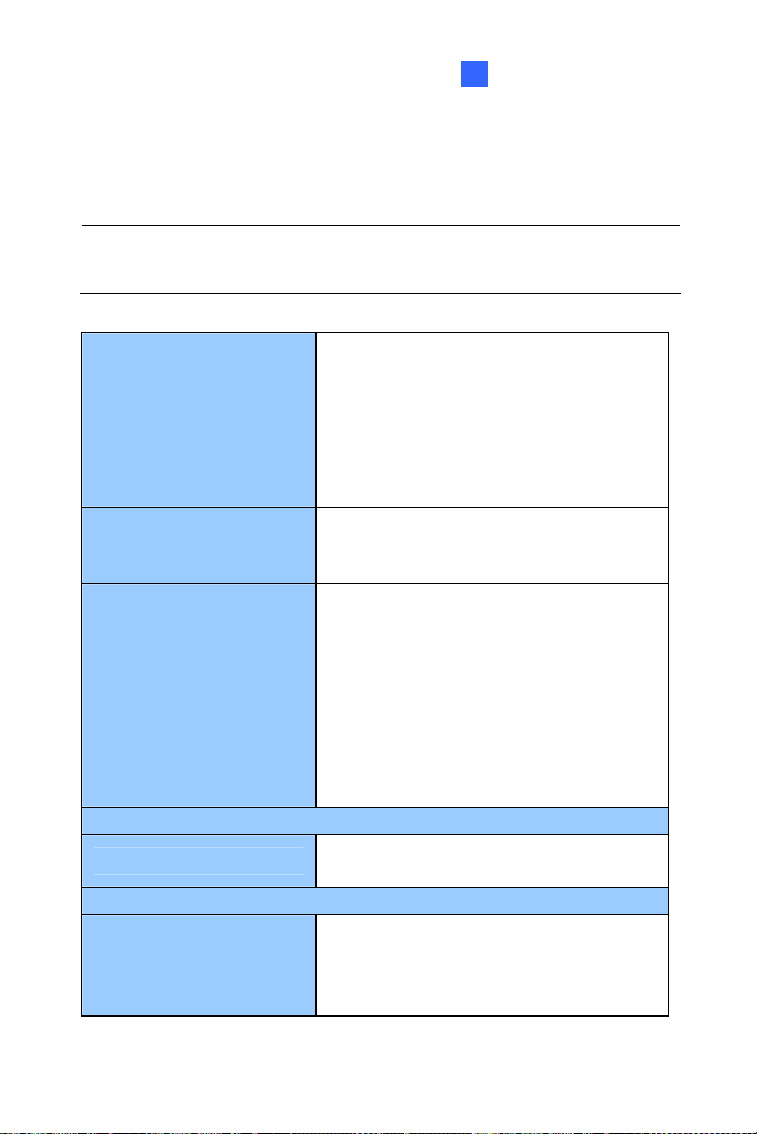
Find the topic of interest by referring to the corresponding section listed
below.
Note: The available options may vary among camera models and
firmware versions.
4.1 Video and Motion
4.1.1 Video Settings
4.1.2 Motion Detection
4.1.3 Privacy Mask
4.1.4 Text Overlay
4.1.5 Tampering Alarm
4.1.6 Visual Automation
4.1.7 Face Detection
4.2 Digital I/O and PTZ
4.2.1 Input Settings
4.2.2 Output Settings
4.2.3 PTZ Settings
4.3 Events and Alerts
4.3.1 Email
4.3.2 FTP
4.3.3 Center V2
4.3.4 Vital Sign Monitor
4.3.5 Backup Center
4.3.6 Video Gateway/Recording Server
4.3.7 ViewLog Server
4.3.8 RTSP/ONVIF
4.3.9 Speaker
4.4 Monitoring
4.5 Recording Schedule
4.5.1 Camera
4.5.2 I/O Monitor
4.6 Remote ViewLog
4.7 Network
4.7.1 LAN
4.7.2 Wireless-Client Mode
4.7.3 Advanced TCP/IP
4.7.4 HTTPS
53
4.7.5 IEEE 802.1x
4.7.6 UMTS Settings
4.7.7 IP Filtering
4.7.8 SNMP Settings
4.8 Management
4.8.1 Date and Time Settings
4.8.2 Storage Settings
4.8.3 User Account
4.8.4 Security
4.8.5 Privacy
4.8.4 Log Information
4.8.5 Tools
4.8.6 Language
54
Administrator Mode
4 4
4.1 Video and Motion
The GV-IPCAM can simultaneously process one video source in multiple
codec and resolutions. The dual / triple-stream design benefits for lower
bandwidth environment, allowing Streaming 2 / 3 to be set with lower
resolution and codec for live streaming, and Streaming 1 set with higher
resolution and H.264 / H.265 for optimal recording quality. Streaming 1,
Streaming 2 and Streaming 3 each have its own setting pages for
separate setup.
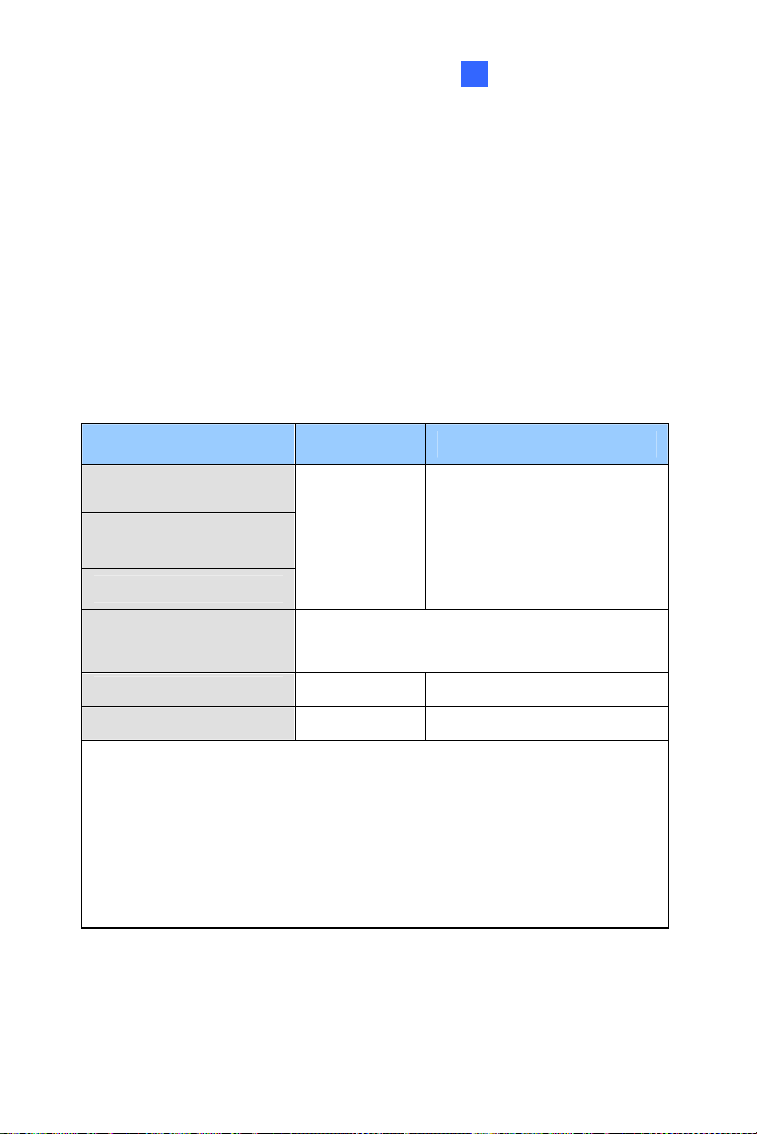
Comparison between Streaming 1, Streaming 2 and Streaming 3
Video Setting Options Streaming 1 Streaming 2 / 3
Watermark Setting
Audio in Source
Special View Setting
Yes
Not open for configuration.
But settings in Streaming 1
are automatically applied to
Streaming 2 / 3
Video Resolution
Yes. Different resolutions can be applied to
Streaming 1 and Streaming 2 / 3.
Audio Settings Yes No
TV Out Yes No
Note:
1. Streaming 3 is only supported by GV-IPCAM H.265 firmware
V1.14 or later. By default, Streaming 3 is disabled.
2. Audio In Source is only available in GV-PTZ010D.
3. Audio Settings are not available for GV-PTZ010D.
4. TV Out is only available for Box Camera, IR Arctic Box Camera,
Vandal Proof IP Dome and Fixed IP Dome.
This section includes the video image settings and how the images can be
managed through Motion Detection, Privacy Mask, Text Overlay,
Tampering Alarm, and Visual Automation.
55
4.1.1 Video Settings
Figure 4-2A
56
Administrator Mode
4 4
Figure 4-2B
57

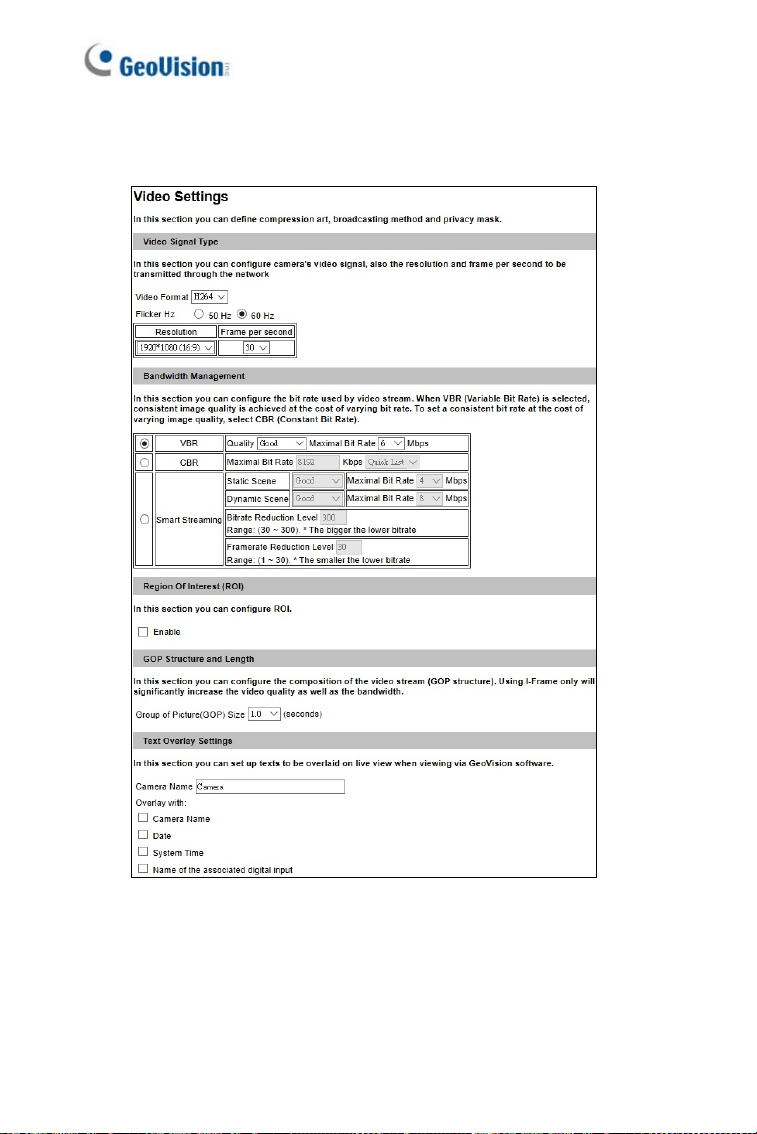
[Name] Rename the video stream. To display the name of video stream on
the Live View window, see 3.2.9 Camera Name Display.
[Connection Template] Select the type of your network connection.
Unless you select Customized, this option will automatically bring up the
recommended video resolution, frame rate, bandwidth and GOP size.
[Video Signal Type] Select the video signal type, resolution and frame
rate. Select among H.265, H.264 or MJPEG as the codec type.
Note that for all the cameras (except GV-PTZ010D), the resolution options
available for sub stream vary with the resolution selected for its main
stream. For example, if a 4:3 resolution is selected for the main stream in
GV-EVD5100, three options, 960 x 720, 640 x 480 and 320 x 240 will be
available for its sub stream.
Flicker: Choose the Flicker Hz value between 60 Hz or 50 Hz. This
function is only supported by GV-BX4700 Series / 5700 Series.
Note:
1. For GV-BX4700 series, to reach 25 fps at 2560 x 1440, Flicker Hz
value must be set at 50 Hz.
2. For WDR Pro or WDR option of other cameras, see Camera
Adjustment in 3.2.2 The Control Panel on the Live View Window to
adjust the setting.
[Bandwidth Management] When using the H.264 / H.265 codec, it is
possible to control the bitrate, which in turn allows the amount of bandwidth
usage to be controlled.
58
Administrator Mode
4 4
VBR (Variable Bitrate): The quality of the video stream is kept as
constant as possible at the cost of a varying bitrate. The bandwidth is
much more efficiently used than a comparable CBR.
Set the image quality to one of the 5 standards: Standard, Fair,
Good, Great and Excellent.
Maximal Bit Rate: When the actual bitrate exceeds the specified
Maximal Bit Rate, the system will automatically lower its bitrate so as
not to exceed it. Select one of the bitrates from the drop-down list or
select Auto if you do not want to enable this function. The default
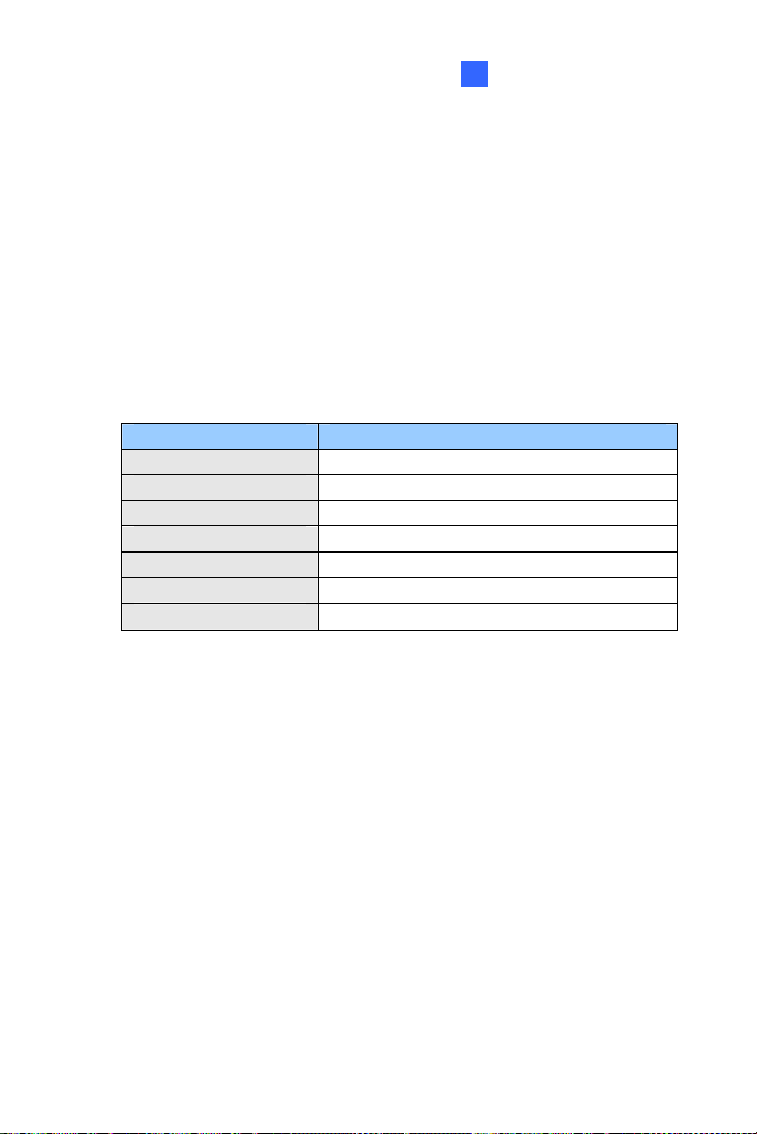
maximal bitrate values are detailed as follows:
Camera Type Default Max. Bitrate of VBR
1.3 MP 6 Mbps
2 MP 5 Mbps / 6 Mbps (Face Detection models)
3 MP 6 Mbps
4 MP 5 Mbps / 7 Mbps (Face Detection models)
5 MP 5 Mbps
8 MP 6 Mbps / 6 Mbps (Face Detection models)
12 MP 16 Mbps
CBR (Constant Bitrate): CBR is used to achieve a specific bitrate by
varying the quality of the H.264 / H.265 stream. Type the bitrate or
select one of the bitrates from the drop-down list.
Smart Streaming: When the option is enabled, the bitrates will be
automatically reduced in static scenes, significantly maximizing
bandwidth and lowering file size.
You can choose the image quality of Static Scene and Dynamic
Scene to one of the 5 standards: Standard, Fair, Good, Great and
Excellent. You can even choose the maximum bitrate to optimize the
bandwidth.
Bitrate Reduction Level: The default value is 254. The bigger the
value the more bitrates can be reduced in static scenes, thus saving
the recording size.
59
Note: It takes either GV-NVR V8.7 or GV-VMS V16.10.3.0 or later to
enable Smart Streaming. Refer to the technical notice
for the models
supporting the feature:
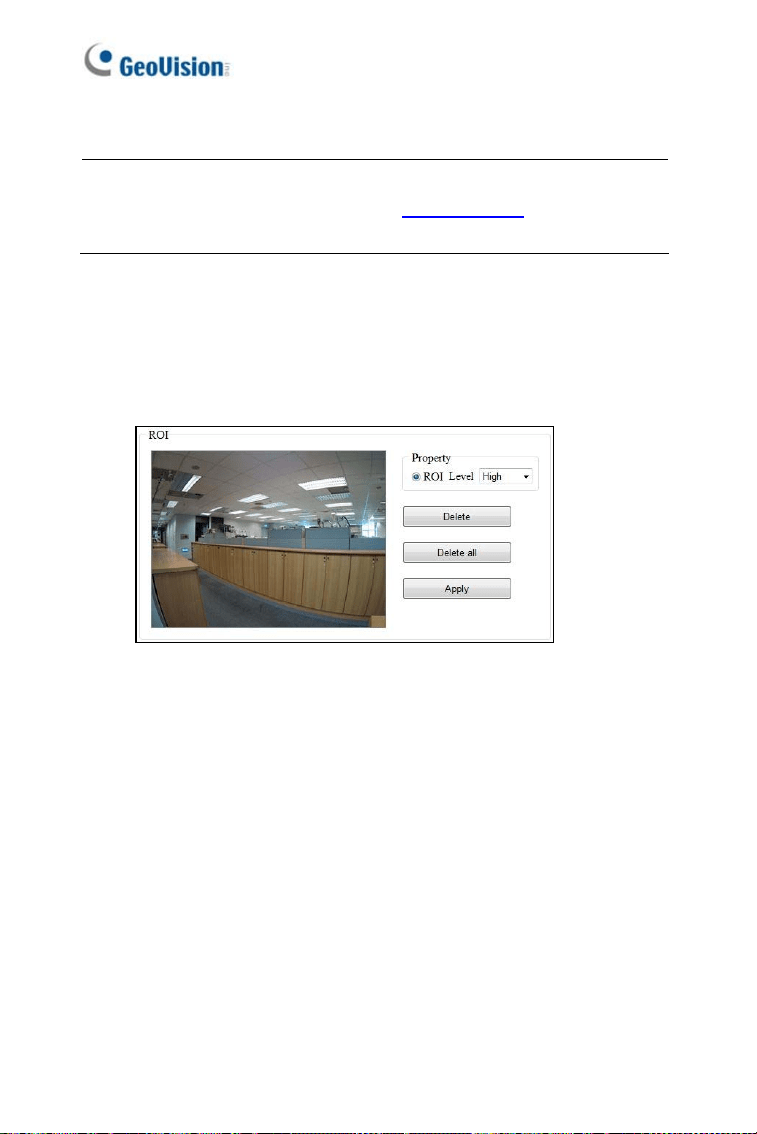
[Region of Interest (ROI) ] Enhance image clarity to your defined regions
with level High to Low . A total of 5 ROI can be set. This function is
disabled by default and is not supported by Target Series.
Figure 4-3
60

Administrator Mode
4 4
[
GOP Structure and Length] Set the maximum number of seconds
between every key frame.
[Video Slice Mode] Note this function is only supported by firmware V2.12
or earlier and is not supported by Target Series and GV-IPCAM H.265.
Corrects the display mode of the camera when it is displayed on third-party
NVR/DVR software and the live view is incomplete or broken. Select
Single Slice or Multi Slice to display the live view. The default is Auto.
[H.264 Video Entropy Coding Setting] Note this function is not supported
by GV-IPCAM H.265, GV-BX12201 and Target Series. By default, the
entropy coding is set to CAVLC. To change it to CABAC, click and select
from the drop-down list.
[Record Settings] Note for GV-BX12201 firmware V1.02 or later and GV-
IPCAM H.265, see Recording Settings in 4.4 Monitoring Settings to adjust
the setting.
The alarm settings allow you to capture images before and/or after the
motion or I/O events happen.
Pre-alarm recording time: Activates video recording before an event
occurs. Set the recording time to 1 or 2 seconds. The recording is
saved in the buffer of the camera.
Post-alarm recording time: Activates video recording onto the
inserted memory card after an event occurs. Set the recording time
from 1 to 30 seconds.
Split-interval (Max. Video Clip): Sets the maximum time length of
each recorded file from 1 to 5 minutes.
Record Profile: Note this function is only available for firmware V2.14
or later. This setting is only applicable for recording to the camera’s
memory card. Select Performance to maximize the lifespan of the
memory card by restricting the maximum bit rate to 4 Mbps and
Sharpness value to 30. Select Quality to adopt your current settings.
Record audio: Activates audio recording when an event occurs.
61

Write recording data into local storage: Select this function for
uninterrupted recording to the memory card while the live view is
accessed through the Web interface or other applications. This option
is enabled by default.
IMPORTANT: To ensure the quality of simultaneous recording and live
view access, make sure you connect no more than two connections to
the camera using Web interface or any other applications.
[Text Overlay Settings] Displays camera name, date, time and/or the
triggered input’s name on the live view and recorded videos when viewing
through GeoVision software.
[Text Overlay Settings (OSD)]
Displays camera name, date, and/or time on the live view and recorded
videos when viewing through GeoVision software and third-party software
through ONVIF and RTSP.
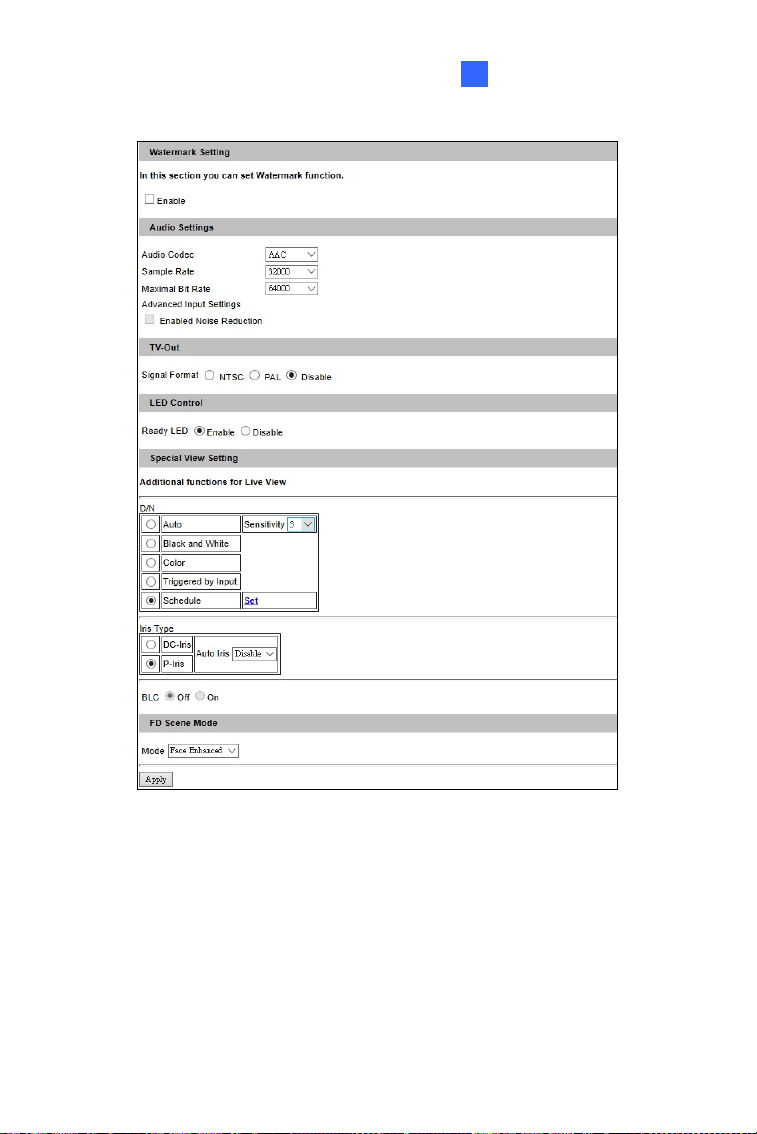
[Watermark Setting] Note this function is not supported for Target Series.
Enable this option to watermark all recordings. The watermark allows you
to verify whether the video has been tampered while it was recorded. See
6.4 Verifying Watermark.
[Audio In Source] Note this function is only available in GV-PTZ010D
which contain a built-in microphone and also allow you to install an external
microphone. By default, the built-in microphone is enabled to record
sounds.
[TV Out] Note this function is only available for the camera with TV-out
connector. Select the signal format of the Video Output on the camera as
either NTSC or PAL.
62

Administrator Mode
4 4
[
Audio Settings] Enable Noise Reduction to reduce the background
noise in the audio file. All H.265 cameras applying firmware V1.02 or later
support this function.
[LED Control] Note this function is not available for GV-PTZ010D.
Ready LED: Select Disable if you do not wish to use the Status LED.
LAN LED, WAN LED, Monitoring LED: Note this option is only
available in Advanced Cube Camera. Select Disable if you do not
wish to use the LEDs. For details on LED status, see Overview in the
corresponding Hardware Manual.
Alarm LED: Sets the white illumination LED in Advanced Cube
Camera. The LED is enabled by default.
Auto: Select Auto for the white illumination LED to illuminate the
scene automatically when the PIR sensor detects any motion
within 5 meters.
Sensitivity: Set the sensitivity for low light detection. The higher
the value, the easier the white illumination LED is to be triggered.
The default value is 5.
The Interval between triggering: Select the duration for the white
illumination LED to light up at full intensity. If a motion persists
over the specified period, the white illumination LED will light up
with less intensity. This option is designed to keep the camera
temperature within its precautious range. The default value is 60
seconds.
Off: Select to disable the white illumination LED.
63
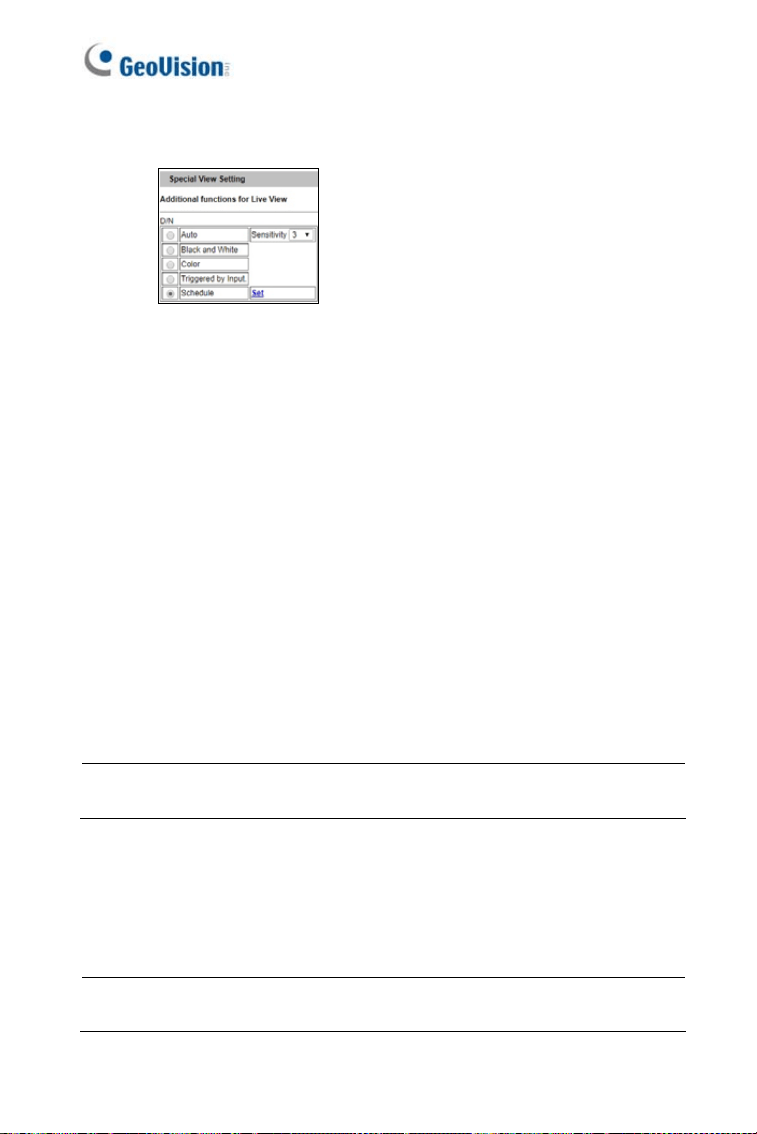
[Special View Setting]
Figure 4-4
D/N: Sets the sensitivity of day-night mode switch. The lower the
value, the earlier the camera switches to Day mode. The higher the
value, the earlier the camera switches to Night mode. The default
value is 5.
Auto: Select Auto for the camera to detect the amount of light
present and automatically switch to monochrome in a poorly-lit
scene. Move the slider to adjust the sensitivity level from 0 to 10.
Black and White: Select this option for the live view to be in
monochrome.
Color: Select this option for the live view to be in color.
Triggered by Input: Select this option to switch between day
mode and night mode once an input device (e.g. sensor or button)
is triggered.
Note: If you select Triggered by Input, make sure you enable Trigger
Day/Night Mode in 4.2.1 Input Settings.
Schedule: Select this option to determine specific period(s) of
time when day mode is activated. See 4.5.1 Recording Schedule
Settings for the details on the setting of the schedule.
Note: If you select Schedule, make sure you start Schedule monitoring
in 4.4 Monitoring.
64

Administrator Mode
4 4
IR Check Function: Note this option is only available for Box
Camera. This function determines whether the surveillance area is
illuminated by an externally installed infrared illuminator.
Off: The default setting. The infrared illuminator will be constantly
off. It is advisable to enable this option when the color temperature
of outdoor lighting is 6000 K or above.
On: The infrared illuminator will be constantly on.
Trigger by Input / Trigger IR by D/N: Select this option for the
infrared illuminator to turn on under low light and turn off under
sufficient light.
Note:
1. If an infrared illuminator is installed for outdoor surveillance, it is
suggested to use the Trigger by Input or the Trigger IR by D/N
function to avoid incorrect judgment of lighting and hence the action
of the IR cut filter. See Infrared Illuminators in the Hardware
Manual.
2. If you select Trigger by Input / Trigger IR by D/N option, make
sure you have set D/N as Auto and configured its sensitivity level.
Iris Type: Note this function is not supported for the camera with fixed
lens or iris. This field shows the iris type (DC-Iris or P-Iris) of your GV-
IP Camera.
Auto Iris: The option is designed for auto iris lens (DC-Iris or P-
Iris). Enable the auto iris function when the scene appears fuzzy
and the Flicker Less function does not help to improve the
situation.
BLC: Select On to enable Backlight Compensation (BLC). This
function is used to adjust the color intensity of scenes with strong light
at the background.
65

Note: To access the BLC function in PTZ camera, see Other, Image
Settings in the Hardware Manual.
IR Light: Note this function is only available for Target Series, Ultra
Box Camera, IR Arctic Box Camera, Bullet Camera, Ultra Bullet
Camera, PT Camera, Vandal Proof IP Dome and Fixed IP Dome.
Select Auto for automatic switch between day mode and night mode
depending on the amount of light detected. Select Off to completely
disable IR LEDs.
Noise Reduction: Note this function is only supported by GV-
EVD5100, GV-EFD5101 and GV-EBL5101. Reduces image noise
especially under low-light conditions.
Note: When the Noise Reduction is enabled, the frame rate will be
affected. For details see Note for GV-EVD5100 / EFD5101 / EBL5101 at
the beginning of the manual.
[FD Scene Mode]
Note this function is only supported by GV-BX2700 / GV-BX2700-FD / GV-
BX4700 / GV-BX4700-FD / GV-BX8700-FD / GV-MD8710-FD. For
applying face detection, select Face Enhanced. If not, select Normal.
66
Administrator Mode
4 4
[
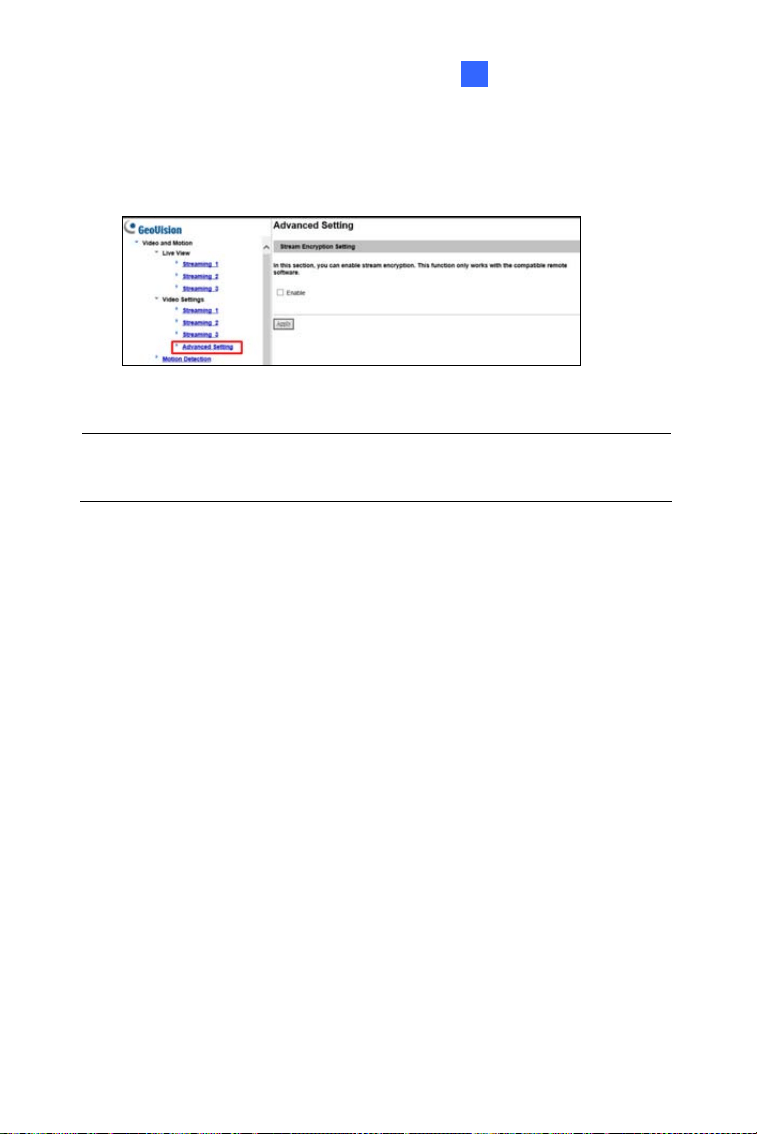
Advanced Setting] Note this function is only supported by GV-IPCAM
H.265 firmware V1.14 or later. You can enable AES encryption for
enhanced security of the contents streamed.
Figure 4-5
Note: This function only works with GV-VMS V18.1, GV-DVR / NVR
V8.8 or later versions.
67
4.1.2 Motion Detection
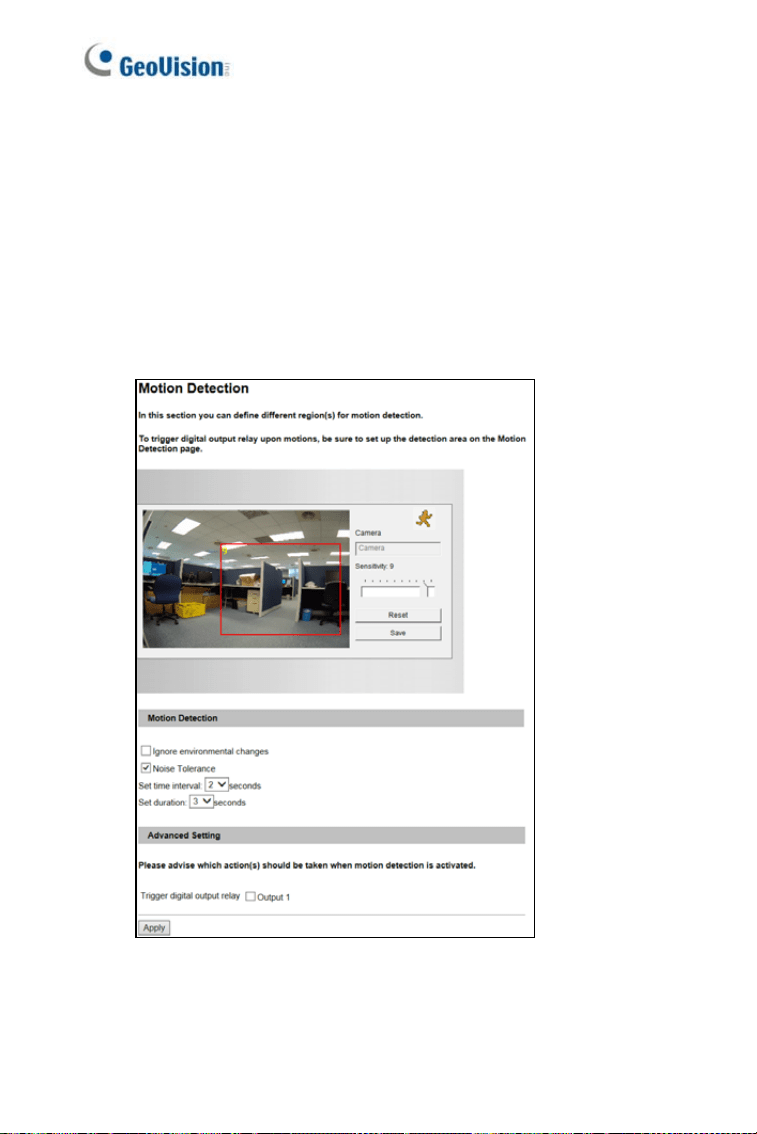
Motion detection is disabled by default except for GV-PTZ010D.
Motion detection is used to generate an alarm whenever movement occurs
in the video image. You can configure up to 8 areas with different
sensitivity values for motion detection. Set up at least one area to enable
this function.
Figure 4-6
68

Administrator Mode
4 4
1.
Select the desired sensitivity by moving the slider. There are ten
values. The higher the value, the more sensitive the camera is to
motion.
2. Drag an area on the image. Click Add when you are prompted to
confirm the setting.
3. To create several areas with different sensitivity values, repeat steps
1 and 2.
4. Click Save to save the above settings.
5. Click Reset to delete all the selected areas.
6. If you want to detect motion using the PIR sensor (for Advanced
Cube Camera only), select Use PIR to detect motion.
7. If you want to ignore environmental changes such as rain or snow,
select Ignore environmental changes.
8. The Noise Tolerance function is enabled by default. It ignores video
noise when the light intensity changes.
9. To set a period of time before a motion is to be detected, select Set
time interval. The choices available range from 0-3 second(s).
10. To set a period of time for a motion to last, select Set duration. The
choices available range from 1-5 second(s).
11. If you want to trigger the alarm output when motion is detected, select
Output 1 and click the Apply button. To activate the output settings,
you must also start Input monitoring manually or by schedule. For
related settings, see 4.4 Monitoring.
Note: Set time interval and Set duration are only supported by GV-
BX12201 firmware V1.02 or later.
69
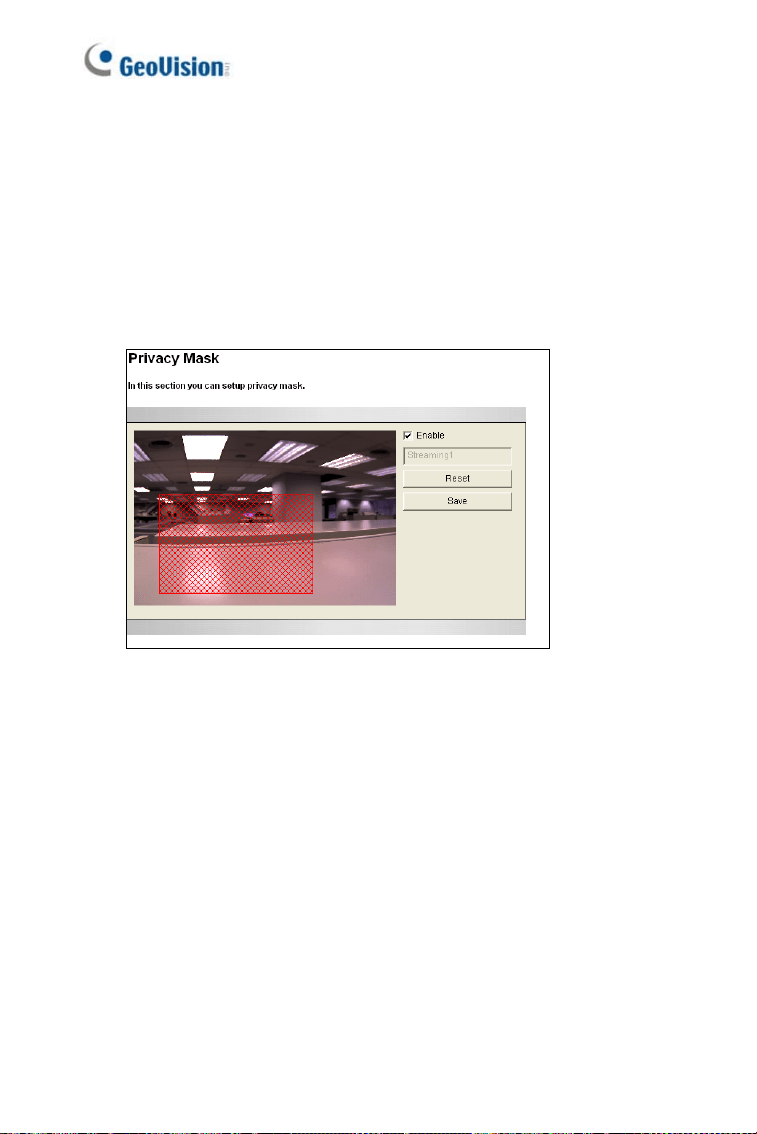
4.1.3 Privacy Mask
The Privacy Mask function is used to block out sensitive areas on live view
and recorded clips for cameras connecting to GeoVision software. This
feature is ideal for locations with displays, keyboard sequences (e.g.
passwords), and for anywhere else you don’t want sensitive information
visible.
Figure 4-7
1. Select the Enable option.
2. Drag the area(s) where you want to block out on the image. Click Add
when you are prompted to confirm the setting.
3. Click the Save button to save all the settings.
70
Administrator Mode
4 4
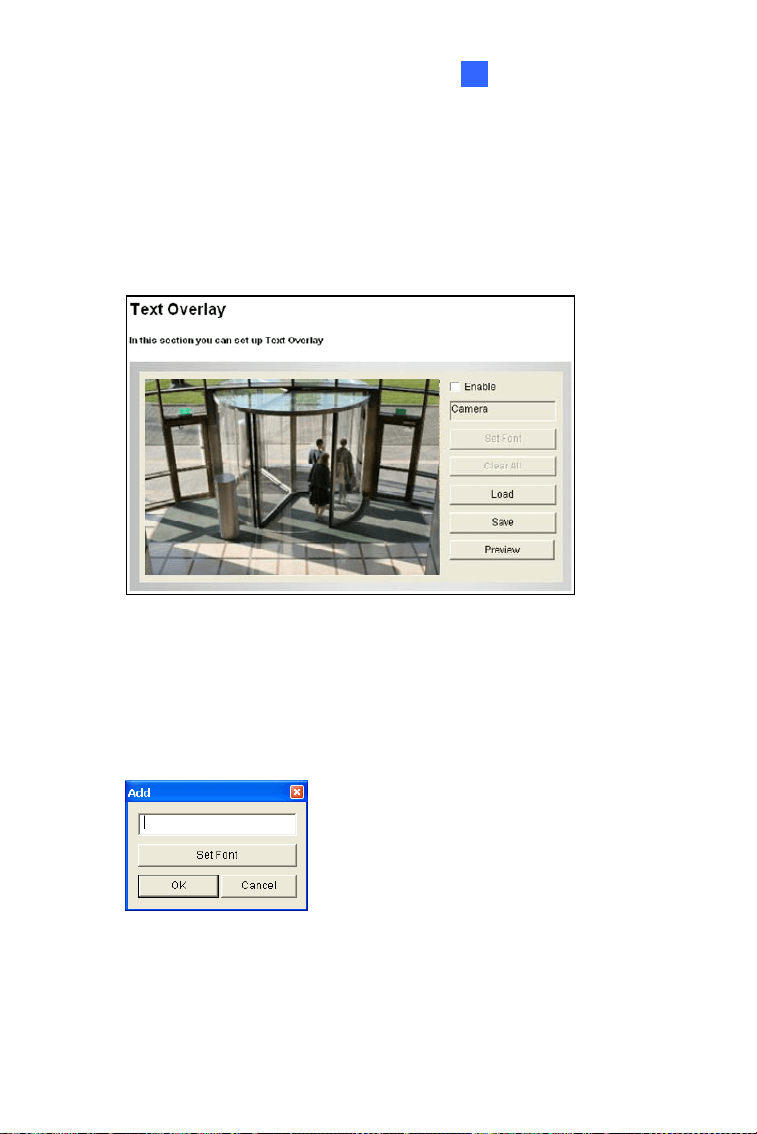
4.1.4 Text Overlay
The Text Overlay allows you to overlay any text in any place on the camera
view. Up to 16 text messages can be created on one camera view. The
overlaid text will be saved in the recordings.
Figure 4-8
1. Select the font, font style and font size in a pop-up window.
2. Select the Enable option.
3. Click any place on the image. This dialog box appears.
Figure 4-9
4. Type the desired text, and click OK. The text is overlaid on the image.
5. Drag the overlaid text to a desired place on the image.
71

6. Click Set Font to modify the font settings.
7. Click Save to apply the settings, or click Load (Undo) to revert to the
last saved setting.
8. Click Preview to see how the text will appear on the image. Click
Close to end the preview.
72

Administrator Mode
4 4
4.1.5 Tampering Alarm
Note this function is not available for PTZ Camera and PT Camera.
Tampering Alarm is used to detect whether a camera is being physically
tampered. An alarm can be generated when the camera is moved, covered
up, or out of focus. The alarm types include triggered the output device, e-
mail alert and notifying the connected GV-Center V2, GV-Vital Sign Monitor
and GV-DVR / NVR / VMS.
Note: This function is not available for PTZ Camera and PT Camera.
To establish the tampering alarm, set up at lest one alarm type:
To trigger the output device when a tampering event occurs, enable
the output setting and select Tampering Alarm. See 4.2.2 Output
Settings.
To trigger the e-mail alert when a tampering event occurs, enable the
e-mail setting and select Tampering Alarm. See 4.3.1 E-Mail.
To notify GV-Center V2, GV-Vital Sign Monitor and GV-DVR / NVR /
VMS when a tampering event occurs, enable the connection to these
systems. See 4.3.3 Center V2, 4.3.4 Vital Sign Monitor, 7.1 Setting up
an IP Camera on GV-DVR / NVR, and 7.2 Setting Up IP Cameras on
GV-VMS.
73
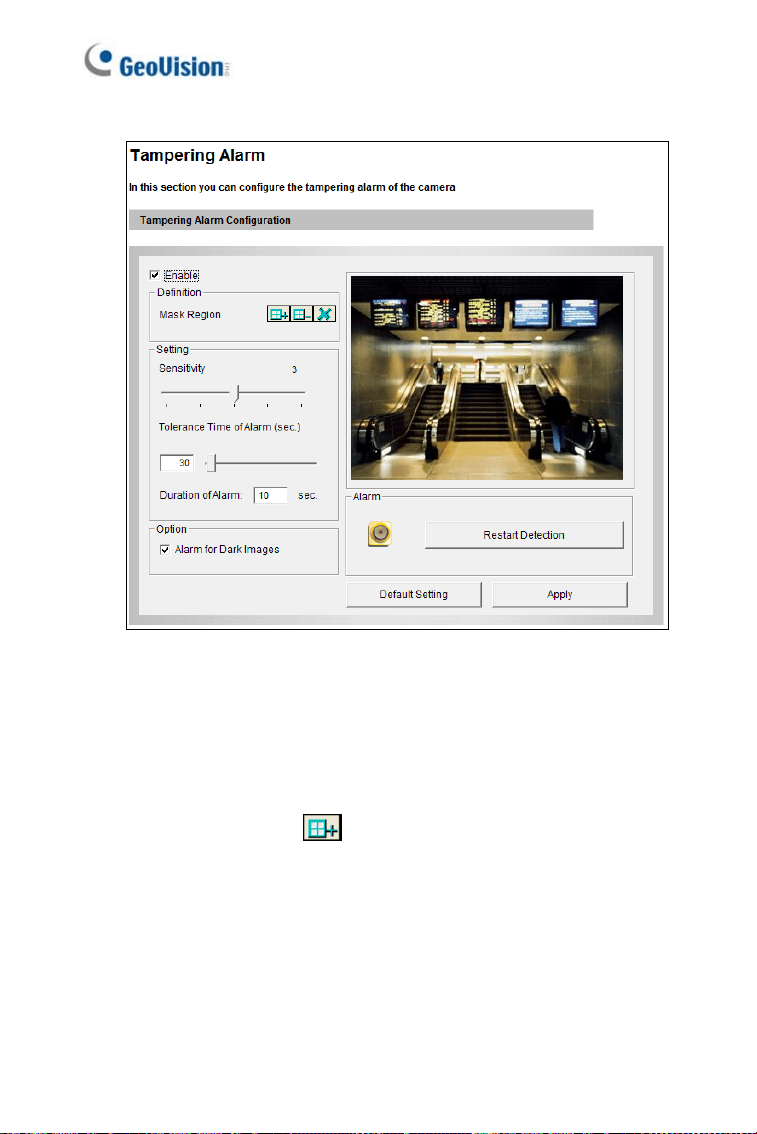
Figure 4-10
To configure the tampering alarm:
1. Select the Enable option.
2. If you want the camera to ignore any movement or scene change in
certain areas, click the
button to drag areas on the camera view.
3. Select the desired detection sensitivity by moving the slider. The
higher the value, the more sensitive the camera is to scene changes.
4. In the Tolerance Time of Alarm field, specify the time length allowed
for scene changes before an alarm is generated.
5. In the Duration of Alarm field, specify the duration of the alarm after
which the triggered output device will be turned off.
74

Administrator Mode
4 4
6.
To trigger an alarm when the scene turns dark, e.g. when the lens of
camera is covered, make sure the Alarm for Dark Images option is
enabled. By default, this function is enabled.
7. Click Apply to save all the settings.
8. Start monitoring to enable the function. To have output alarm, it is
required to start Input monitoring. See 4.4 Monitoring.
When the camera has been tampered, the output device can be activated.
To turn off the output device immediately, return to this setting page, and
click Restart Detection.
75
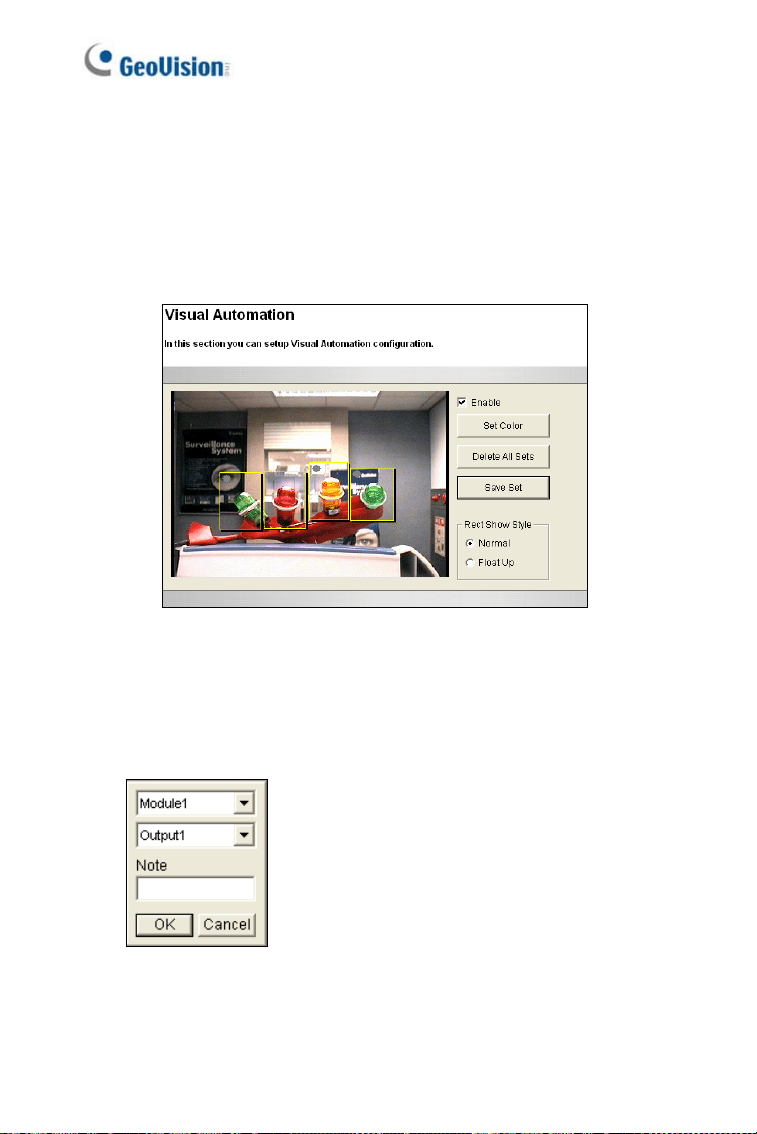
4.1.6 Visual Automation
Note this function is only supported by cameras with I/O function.
This intuitive feature helps you automate any electronic device by
triggering the connected output device. When you click on the image of the
electronic device, you can simply change its current state, e.g. light ON.
Figure 4-11
1. Select the Enable option.
2. Drag an area on the image of the electronic device. This dialog box
appears.
Figure 4-12
76

Administrator Mode
4 4
3.
Assign the connected module and output device. In the Note field,
type a note to help you manage the device. Click OK to save the
settings.
4. To change the frame color of the set area, click the Set Color button.
5. To emboss the set area, select Float Up; or keep it flat by selecting
Normal.
6. Click the Save Set button to apply the settings.
7. To perform the function, see 3.2.14 Visual Automation.
77
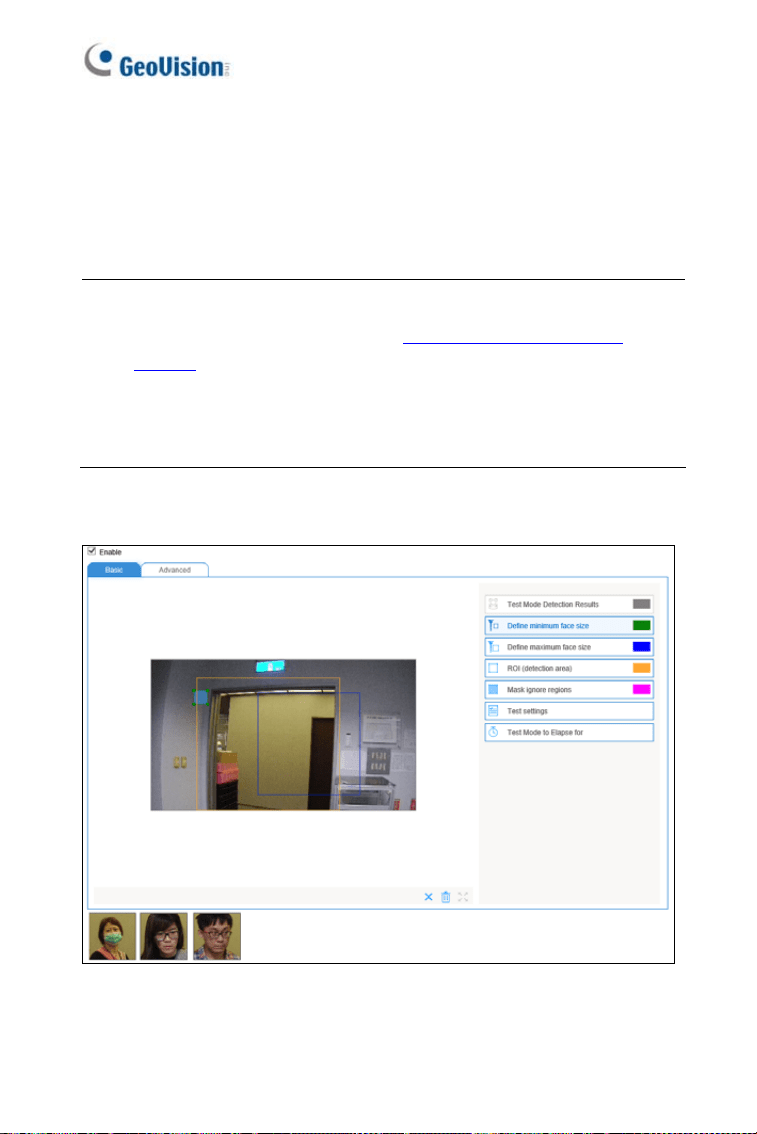
4.1.7 Face Detection
Face Detection is used to record events when human faces appear in the
image, which can work with GV-VMS to generate alarms and/or trigger
other actions on the server site.
Note:
1. This function is only supported by cameras with face detection
function and GV-VMS 18.1 or later.
2. To receive the optimal quality of the captured face image, ensure to
disable the smart streaming option when using the face detection
feature
[Basic]
Figure 4-13
78
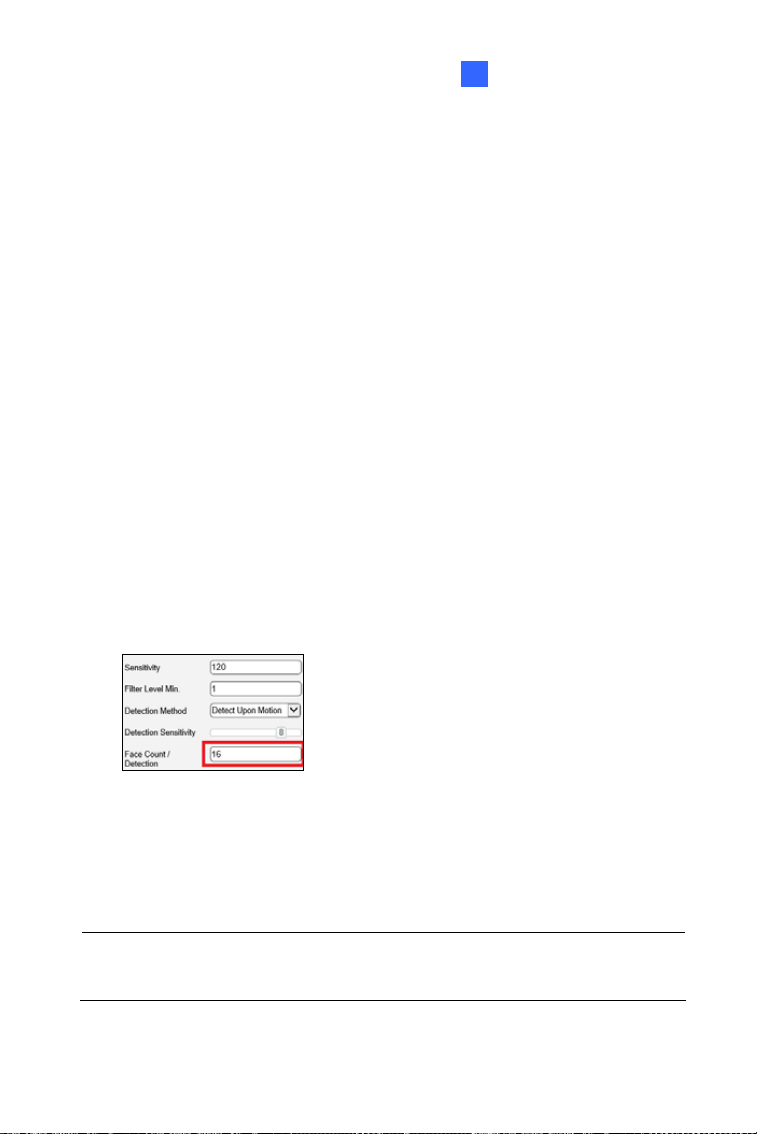
Administrator Mode
4 4
1.
Select Enable to adjust the face detection settings. If you want the
minimum face size, maximum face size and ROI settings to be
automatically configured, click Apply and skip to step 4.
2. Draw areas to define the minimum face size and maximum face
size so the system can detect faces within that size range.
3. Draw at least one ROI (region of interest) to specify the detection
area(s).
4. If necessary, click Mask ignore regions to specify the area(s) where
you do not wish the faces to be detected.
5. Click Test settings to test if a face can be detected or otherwise click
Apply to initiate the settings. The detected face(s) will be highlighted
with a red box and appear below the test screen.
6. If you want to adjust the test duration for the current face detection
settings, click Test Mode to Elapse for.
[Advanced]
Face Count / Detection: Specify the maximum number of faces that can
be detected at a time.
Figure 4-14
Face Count Max (1~16): GV-BX2700 / 2700-FD / 4700 / 4700-FD.
Face Count Max (1~32): GV-BX2600-FD / 8700-FD, GV-MD8710-
FD.
Note: To achieve the optimal face detection results, avoid modifying other
advanced settings.
79
4.2 I/O Settings
Note the I/O settings are only available for Box Camera, Bullet Camera,
Ultra Bullet Camera, PTZ Camera, PT Camera, Vandal Proof IP Dome,
and Fixed IP Dome.
After installing the I/O device, you need to enable the I/O settings on the
camera. For how to install the I/O device on the camera, see the following
reference sections in the corresponding Hardware Manual:
GV-IPCAM Reference section
Box Camera I/O Terminal Block
Bullet Camera
Connecting the Camera
Connecting the Camera
PTZ Camera I/O Terminal Block
PT Camera I/O Terminal Block
Vandal Proof IP Dome Connecting the Camera
Fixed IP Dome I/O Terminal Block
80
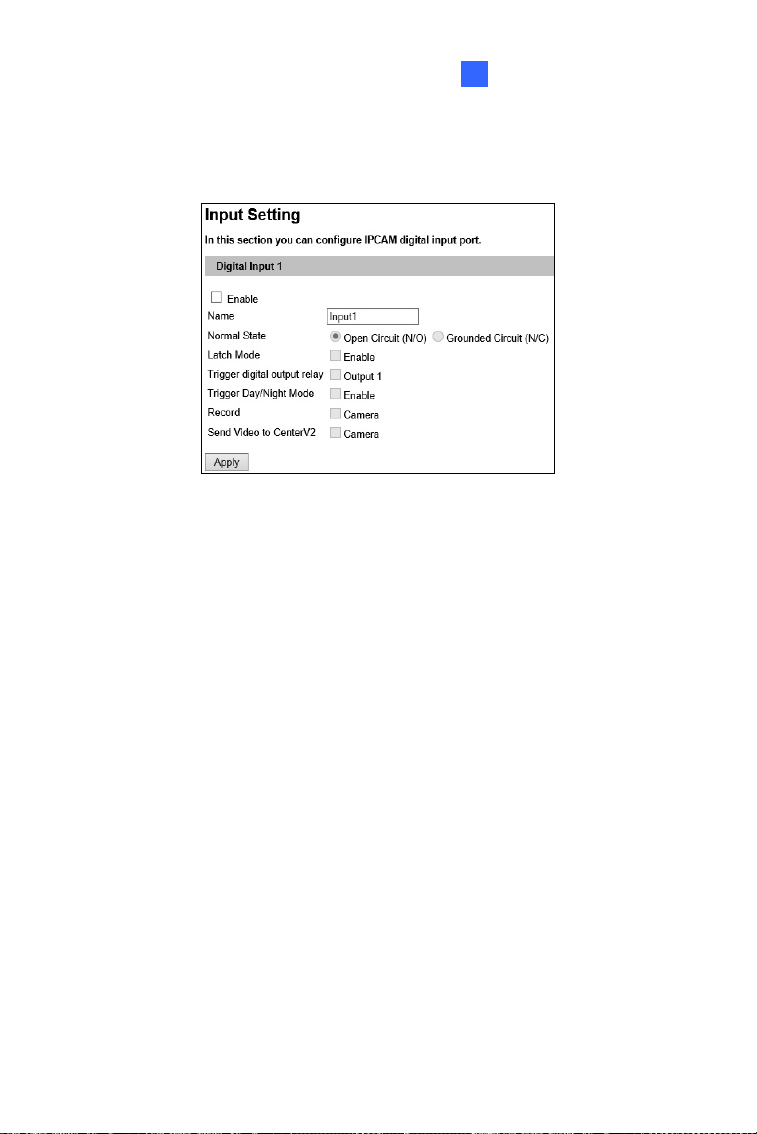
Administrator Mode
4 4
4.2.1 Input Settings
To activate the sensor input, select Enable.
Figure 4-15
Normal State: You can set the input state to trigger actions by
selecting Open Circuit (N/O) or Grounded Circuit (N/C).
Latch Mode: Enable this option to have a momentary output alarm.
Trigger digital output relay: When this option is enabled, the output
will be triggered once the input is activated.
Trigger Day/Night Mode: Enable this option when Triggered by
Input of D/N function is selected in 4.1.1 Video Settings
Record: Enable this option to start recording when the input is
triggered.
Send Video to Center V2: Enable this option to send the images to
Center V2 when the input is triggered.
81
PTZ Settings: Note this function is only available for PTZ Camera
and PT Camera.
Input On: Select a preset point to which the camera turns when an
input is triggered.
Input Off: Select a preset point to which the camera returns when
the input triggering is off.
Duration to set preset after input off: Specify the duration that
the camera stays at the Input On point before returning to the Input
Off point.
Note:
1. The GV-IP Cameras support dry-contact input device.
2. The functions “triggering the output”, “starting the recording when
the input is triggered” and “sending video to Center V2” only work
after you start Input monitoring manually or by schedule. To
configure the input monitoring, see 4.4 Monitoring.
82
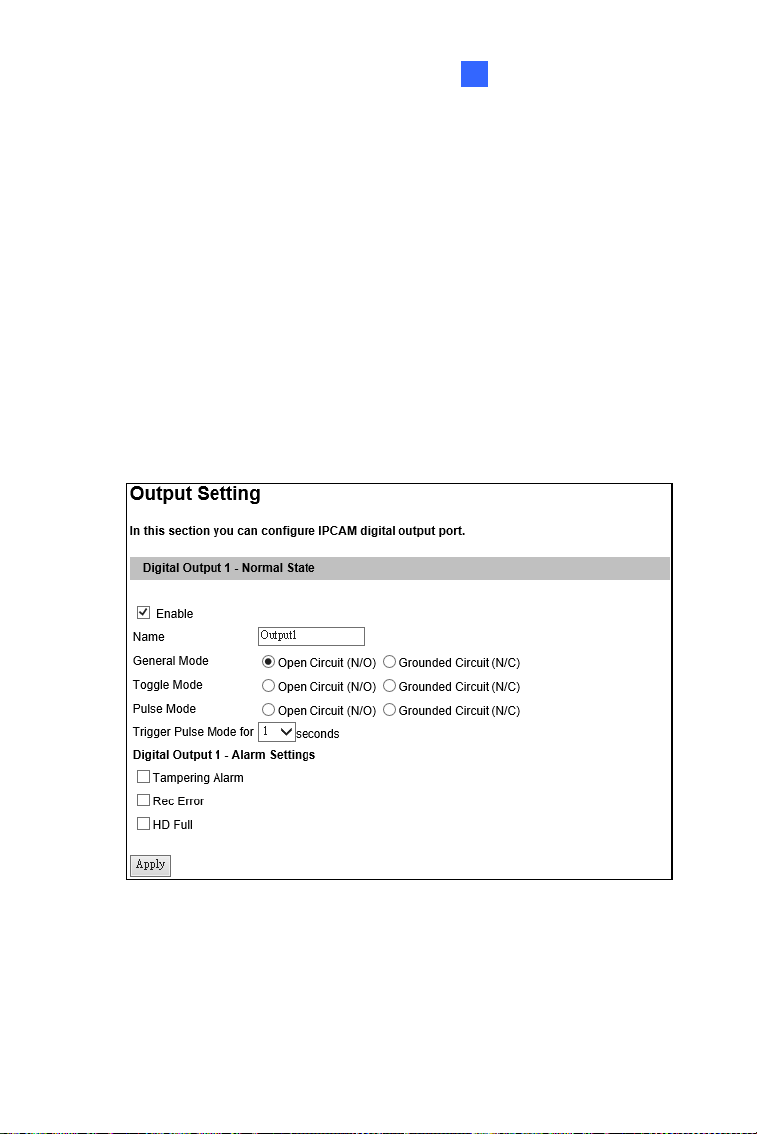
Administrator Mode
4 4
4.2.2 Output Settings
Select Enable to start the output device. Choose the output signal that
mostly suits the device you are using: N/O (Open Circuit), N/C (Grounded
Circuit), N/O Toggle, N/C Toggle, N/O Pulse or N/C Pulse. For Toggle
output type, the output continues to be triggered until a new input trigger
ends the output. For Pulse output type, the output is triggered for the
amount of time you specify in the Trigger Pulse Mode for x Seconds field.
[Alarm Settings] You can choose to automatically trigger the digital output
under these conditions: tampering alarm (not available for PTZ Camera),
disk write error (Rec Error) and full memory card (HD Full).
Figure 4-16
83
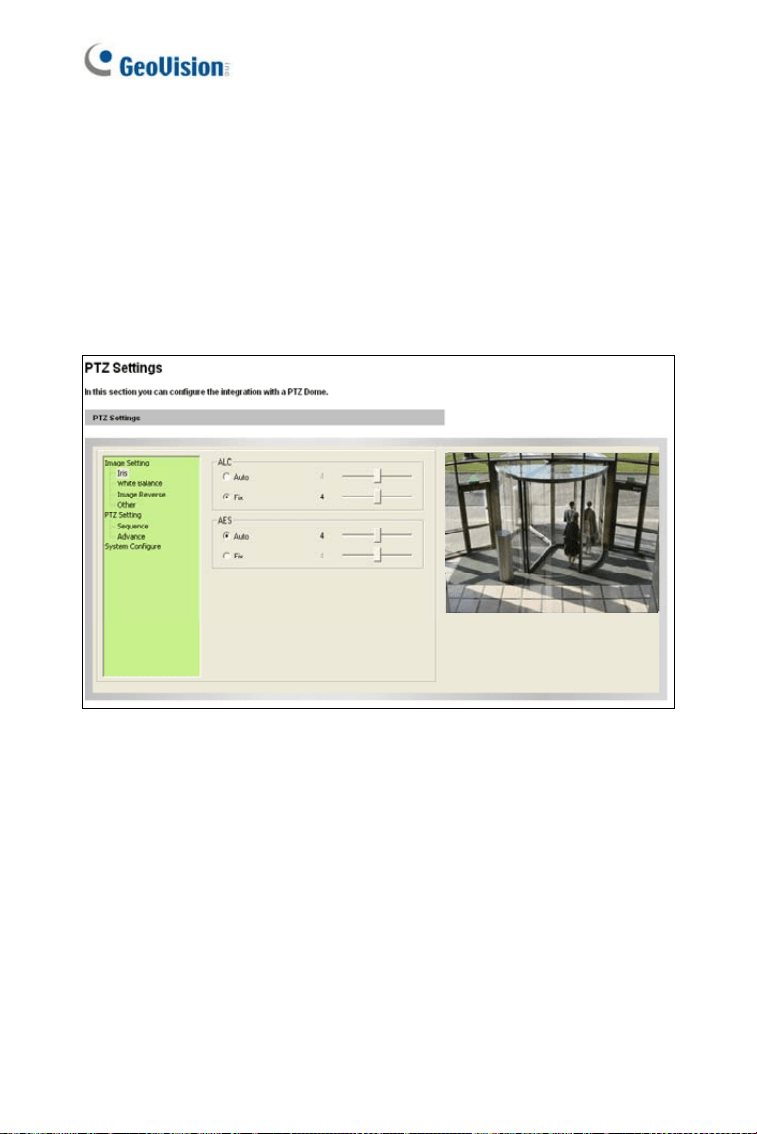
4.2.3 PTZ Settings
Note this function is only available in PTZ Camera and PT Camera.
You can change the image settings, configure sequences, and access
settings including autopan speed, motor reset, digital zoom and system
default loading. For details, see Accessing the VISCA OSD Configuration
in the Hardware Manual.
Figure 4-17
84

Administrator Mode
4 4
4.3 Events and Alerts
For the events of motion detection or I/O trigger, the Administrator can set
up two trigger actions:
1. Send a captured still image by E-mail or FTP.
2. Notify Center Monitoring Station, Center V2 or Vital Sign Monitor, by
video or text alerts.
To have the above trigger actions, you must set the following functions in
advance:
Motion Detection (See 4.1.2 Motion Detection)
Input Setting (See 4.2.1 Input Setting)
For e-mail and FTP alerts, it is required to start monitoring (See 4.4
Monitoring).
85
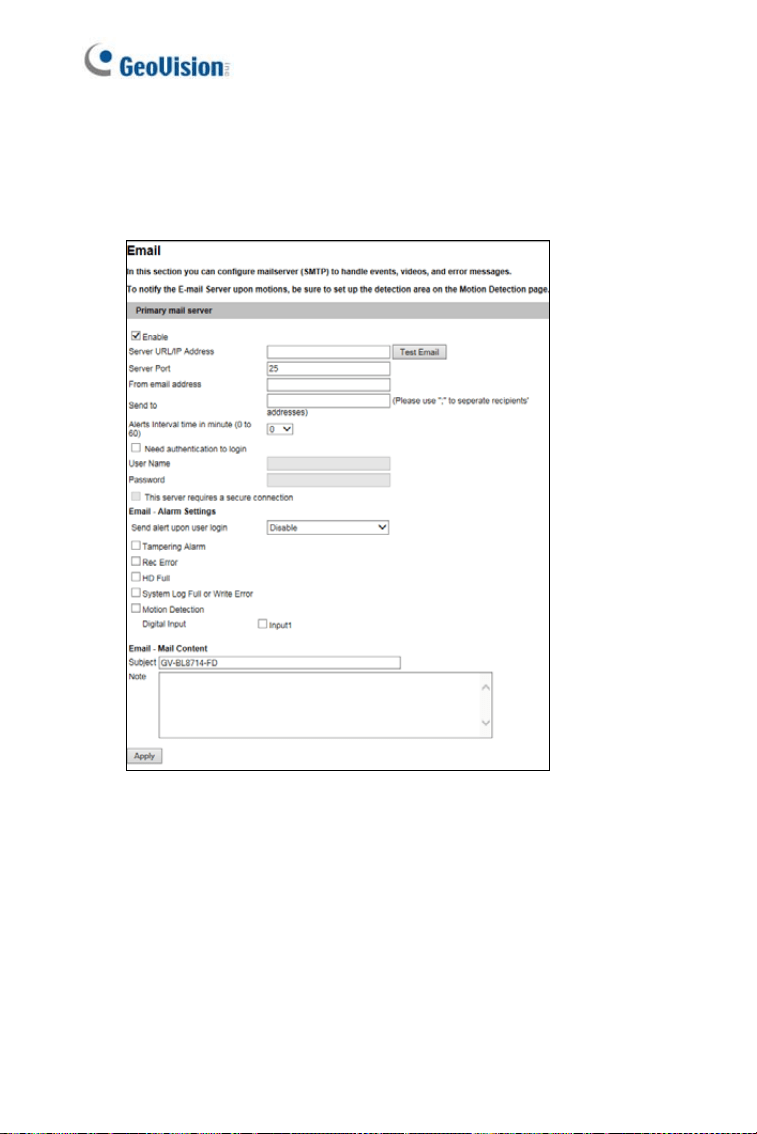
4.3.1 E-mail
After a trigger event, the camera can send the e-mail to a remote user
containing a captured still image.
Figure 4-18
[Enable] Select to enable the e-mail function.
Sever URL/IP Address: Type the URL address or IP address of the
SMTP Server.
Server Port: Modify the port number of the SMTP Server. Or keep
the default value 25.
From email address: Type the sender’s e-mail address.
86

Administrator Mode
4 4
Send to: Type the e-mail address(s) you want to send alerts to.
Alerts Interval Time: Specify the interval between e-mail alerts. The
interval is between 0 and 60 minutes. The option is useful for the
frequent event occurrence, by which any event triggers during the
interval period will be ignored.
[Need authentication to login] If the SMTP Server needs authentication,
enable this option and type a valid username and password to log in the
SMTP server.
[E-Mail Alarm Settings] You can choose to automatically send an e-mail
alert under these conditions: Login success / failure, tampering alarm, disk
write error (Rec Error), full memory card (HD Full), System Log Full or
Write Error, motion detection and input trigger. Note that the alert condition
is only supported if the corresponding function is supported in that camera
model.
IMPORTANT: To send e-mail alerts upon motions, be sure to set up
detection area on the Motion Detection’s page.
For the related settings to send e-mail alerts, see 4.1.2 Motion Detection,
4.2.1 Input Setting and 4.4 Monitoring.
Note: For GV-BX12201, the maximum resolution of the captured still
image sent by E-mail alert is 1 MP.
[E-Mail Mail Content] You can type the mail subject and mail content in
the Subject and Note columns. The default mail subject is the camera
model name.
87
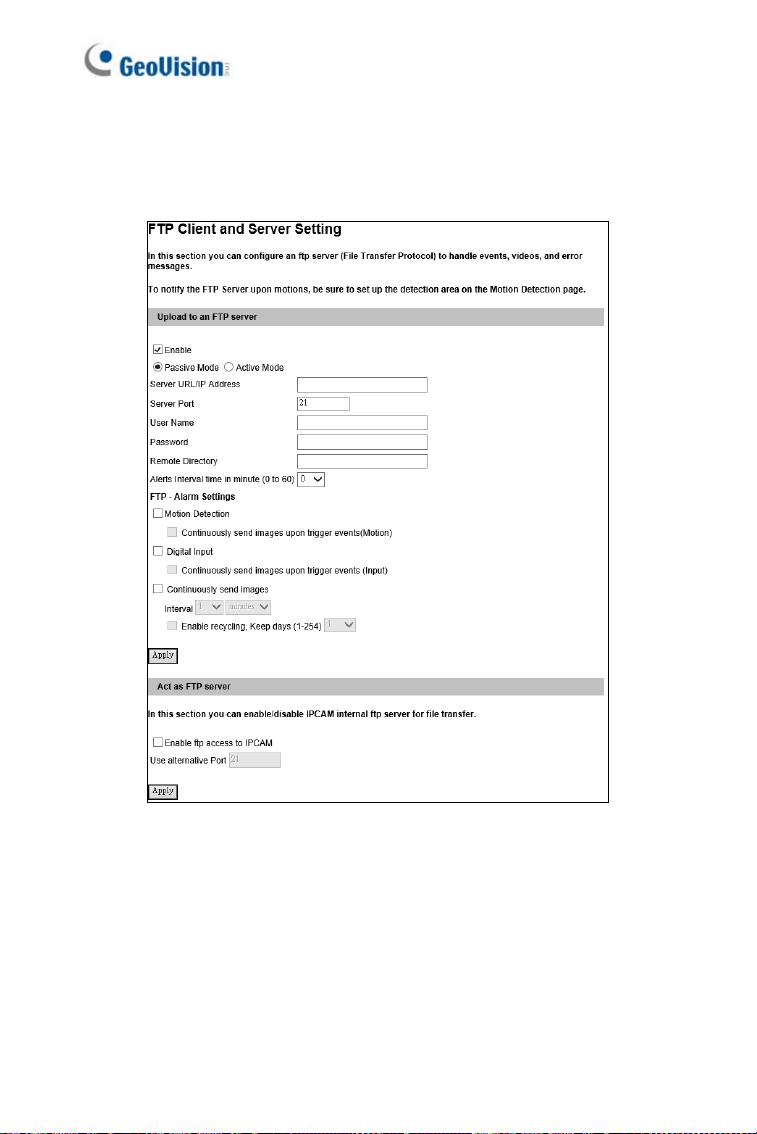
4.3.2 FTP
You can also send the captured images to a remote FTP server as alerts.
Figure 4-19
[Upload to an FTP Server]
Enable: Select to enable the FTP function and then select Active
Mode or Passive Mode, depending on the setting of your FTP server.
Server URL/IP Address: Type the URL address or IP address of the
FTP Server.
88

Administrator Mode
4 4
Server Port: Type the port number of the FTP Server. Or keep the
default value 21.
User Name: Type a valid username to log into the FTP Server.
Password: Type a valid password to log into the FTP Server.
Remote Directory: Type the name of the storage folder on the FTP
Server.
Alerts Interval time in minute: Specify the interval between FTP
alerts. The interval can be between 0 and 60 minutes. The option is
useful for the frequent event occurrence by which any event triggers
during the interval period will be ignored.
[Alarm Settings]
Motion Detection: When a motion is detected on the camera, a still
image will be sent to the FTP Server.
Continuously send images upon trigger events (motion): A
sequence of snapshots is uploaded to the FTP Server when a
motion is detected. This stops as soon as no motion is detected.
Digital Input: Note this function is only supported by cameras with
I/O function. Once the input is triggered, a still image will be sent to
the FTP Server.
Continuously send images upon trigger events (input): A
sequence of snapshots is uploaded to the FTP Server when the
input is triggered.
Continuously send images: Sends images to the FTP server at the
specified interval.
Interval: Use the drop-down list to specify how frequent the
images are sent to the FTP server.
89

FTP Schedule: Select this option to define specific period(s) of
time for images to be sent to the FTP Server. For details on the
schedule option, see 4.5.1 Recording Schedule Settings. Note
this function is only supported by GV-IPCAM H.265 firmware
V1.14 or later.
Enable Recycling: Select this option to recycle the FTP storage
at the specified Keep Day.
Keep Days: Specify how frequent the images saved at the FTP
server are recycled. By default, the Keep Day is set to 1.
IMPORTANT: To send FTP alerts upon motions, be sure to set up
detection area on the Motion Detection’s page.
[Act as FTP Server] Note this function is not available for Target Series.
Enable FTP access to the GV-IP Cam: The camera acts as an FTP
server, enabling users to download AVI files.
Use alternative port: The default port is set to 21.
To access the internal FTP server through a Web browser, enter the IP
address or the domain name of the camera in your browser like this:
ftp://192.168.0.10
When you are prompted for Username and Password, enter the default
value username ftpuser and password 123456. Then you should find the
AVI files recorded after trigger events.
To change login information of the internal FTP server, see 4.8.3 User
Account. For related settings to send FTP alerts, see 4.1.2 Motion
Detection, 4.2.1 Input Settings, and 4.4 Monitoring.
Note: For GV-BX12201, the maximum resolution of the captured still
image sent by FTP alert is 1 MP.
90
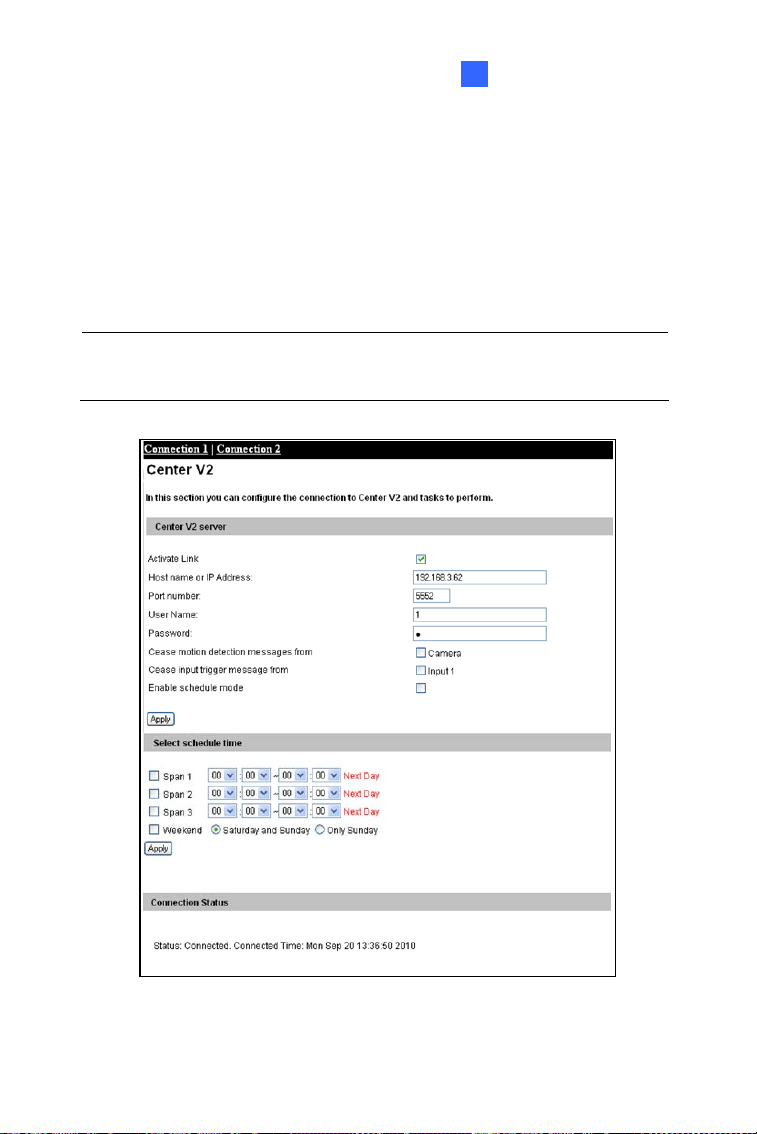
Administrator Mode
4 4
4.3.3 Center V2
After a motion or an I/O triggered event, the central monitoring station
Center V2 can be notified by live videos and text alerts. For the live
monitoring through Center V2, you must already have a subscriber account
on Center V2. A camera can connect to up to 2 Center V2 stations
simultaneously.
IMPORTANT: To notify Center V2 server upon motions, be sure to set
up detection areas on the Motion Detection’s page,
Figure 4-20
91

To enable the Center V2 connection:
1. Activate Link: Enable the monitoring through Center V2.
2. Host Name or IP Address: Type the host name or IP address of
Center V2.
3. Port Number: match the port to the Port 2 value on Center V2 or
keep the default value 5551.
4. User Name: type a valid username to log into Center V2.
5. Password: Type a valid password to log into Center V2
6. Click Apply. The Connection Status should display “Connected” and
connected time.
7. To establish connection to the second Center V2 server, click the
Connection 2 tab and repeat the above steps for setup.
You can also find the following options on this Center V2 setting page:
Cease motion detection messages from: Stops notifying Center V2
of motion-triggered events.
Cease input trigger messages from: Note this function is only
supported by cameras with I/O function. Stops notifying Center V2 of
input-triggered events.
Enable schedule mode: Starts the monitoring through Center V2
based on the schedule you set in the Select Schedule Time section.
Refer to 4.5 Recording Schedule for the same settings.
For related settings to activate the monitoring through Center V2, see 4.1.2
Motion Detection, 4.2.1 Input Setting and 8.1 Center V2.
92
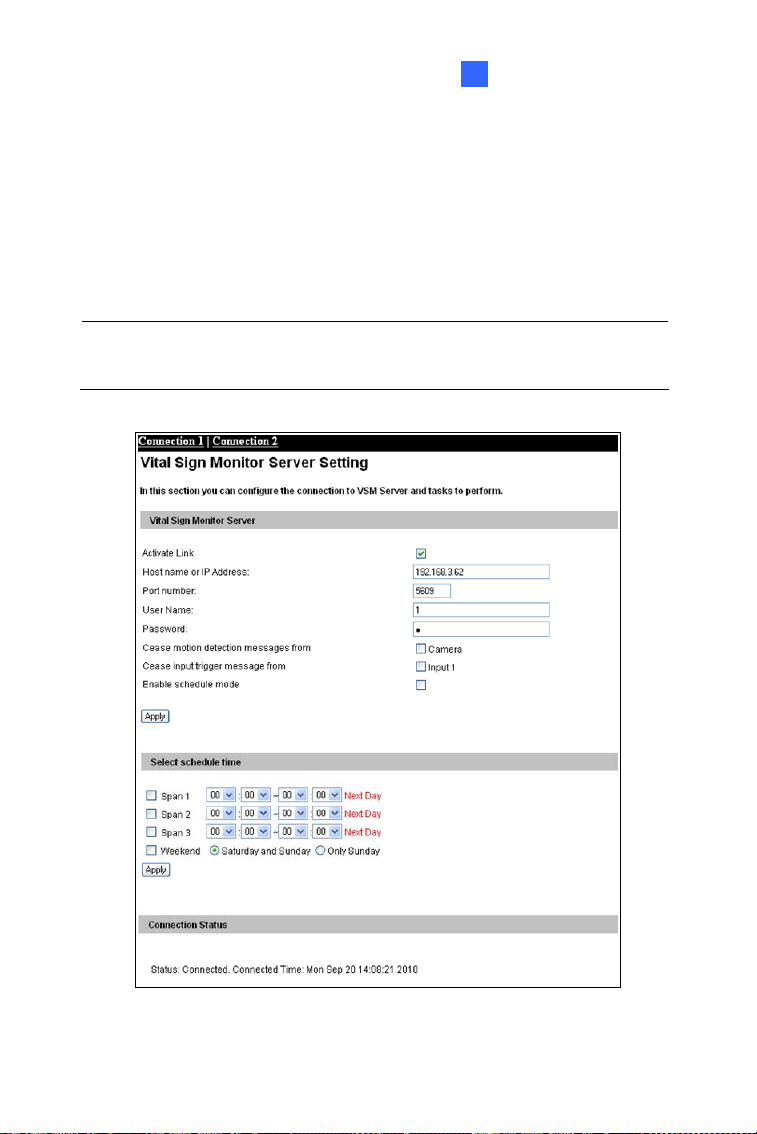
Administrator Mode
4 4
4.3.4 Vital Sign Monitor
After a motion or an I/O triggered event, the central monitoring station Vital
Sign Monitor can get notified by text alerts. For the monitoring through Vital
Sign Monitor, you must already have a subscriber account on Vital Sign
Monitor. A camera can connect up to 2 Vital Sign Monitors simultaneously.
IMPORTANT: To notify GV-Vital Sign Monitor server upon motions, be
sure to set up detection areas on the Motion Detection’s page.
Figure 4-21
93

To enable the Vital Sign Monitor connection:
1. Activate Link: Enable the monitoring through Vital Sign Monitor.
2. Host Name or IP Address: Type the host name or IP address of Vital
Sign Monitor.
3. Port Number: Match the port to the Port 2 value on Vital Sign Monitor.
Or keep the default value 5609.
4. User Name: Type a valid username to log into Vital Sign Monitor.
5. Password: Type a valid password to log into Vital Sign Monitor.
6. Click Apply. The Connection Status should display “Connected” and
connected time.
7. To establish connection to the second Vital Sign Monitor , click the
Connection 2 tab and repeat the above steps for setup.
These options you can also find on this Vital Sign Monitor setting page:
Cease motion detection messages from: Stops notifying Vital Sign
Monitor of motion-triggered events.
Cease input trigger messages from: Note this function is only
supported by cameras with I/O function. Stops notifying Vital Sign
Monitor of input-triggered events.
Enable schedule mode: Starts the monitoring through Vital Sign
Monitor based on the schedule you set in the Select Schedule Time
section. Refer to 4.5 Recording Schedule for the same settings.
For related settings to activate the monitoring through Vital Sign Monitor,
see 4.1.2 Motion Detection and 4.2.1 Input Settings, and 8.2 Vital Sign
Monitor.
94
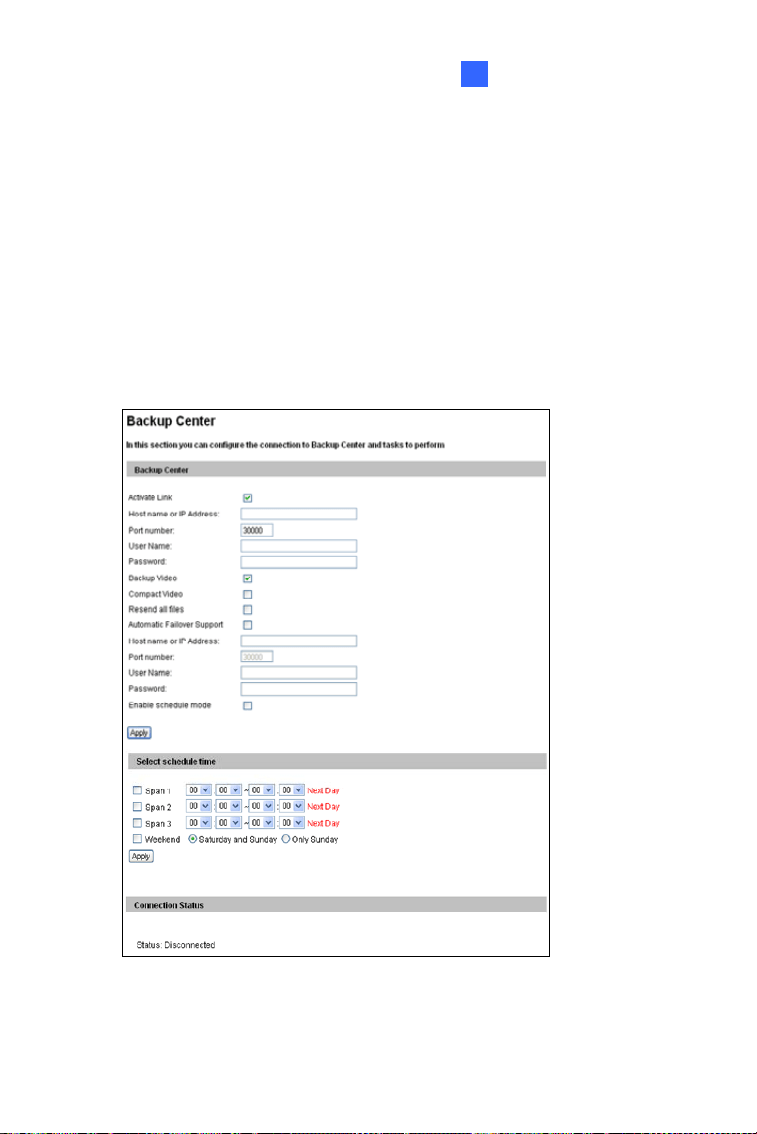
Administrator Mode
4 4
4.3.5 Backup Center
Note that Backup Center is not supported for Target Series.
The connection to the GV-Backup Center allows you to back up another
copy of recordings and system log to the GV-Backup Center on an offsite
location while the camera is saving these data to the memory card. The
GV-Backup Center provides a PC-based storage and backup solution. For
details on the GV-Backup Center, see GV-Backup Center User’s Manual.
Figure 4-22
95

To enable connection to GV-Backup Center:
1. Activate Link: Enable the connection to the GV-Backup Center.
2. Host Name or IP Address: Type the host name or IP address of the
GV-Backup Center.
3. Port Number: Match the communication port on the GV-Backup
Center or keep the default value 30000.
4. User Name: Type a valid user name to log into the GV-Backup
Center.
5. Password: Type a valid password to log into the GV-Backup Center.
6. Backup Video: Select the streams to back up their recordings to the
GV-Backup Center.
7. Compact Video: Select the streams to only back up their Key Frames
to the GV-Backup Center, instead of full recordings. This option is
useful to save the backup time.
8. Resend all files: Select this option to send all the recorded files that
have received by the Backup Center again.
9. Enable Schedule Mode: Enable the GV-Backup Center connection
on the schedule you set in the Select Schedule Time section. Refer to
4.5 Recording Schedule for the same settings.
10. Click Apply. The Connection Status should display “Connected” and
connected time.
If you have a failover GV-Backup Center server which provides
uninterrupted backup services in case the first GV-Backup Center failed,
configure the failover GV-Backup Center as below.
1. Automatic Failover Support: Enable the automatic connection to the
failover GV-Backup Center once the connection between camera and
the first GV-Backup Center is interrupted.
96

Administrator Mode
4 4
2.
Host Name or IP Address: Type the host name or IP address of the
failover GV-Backup Center.
3. Port Number: Match the communication port on the failover GV-
Backup Center or keep the default value 30000.
4. User Name: Type a valid user name to log into the failover GV-
Backup Center.
5. Password: Type a valid password to log into the failover GV-Backup
Center.
6. Click Apply.
97
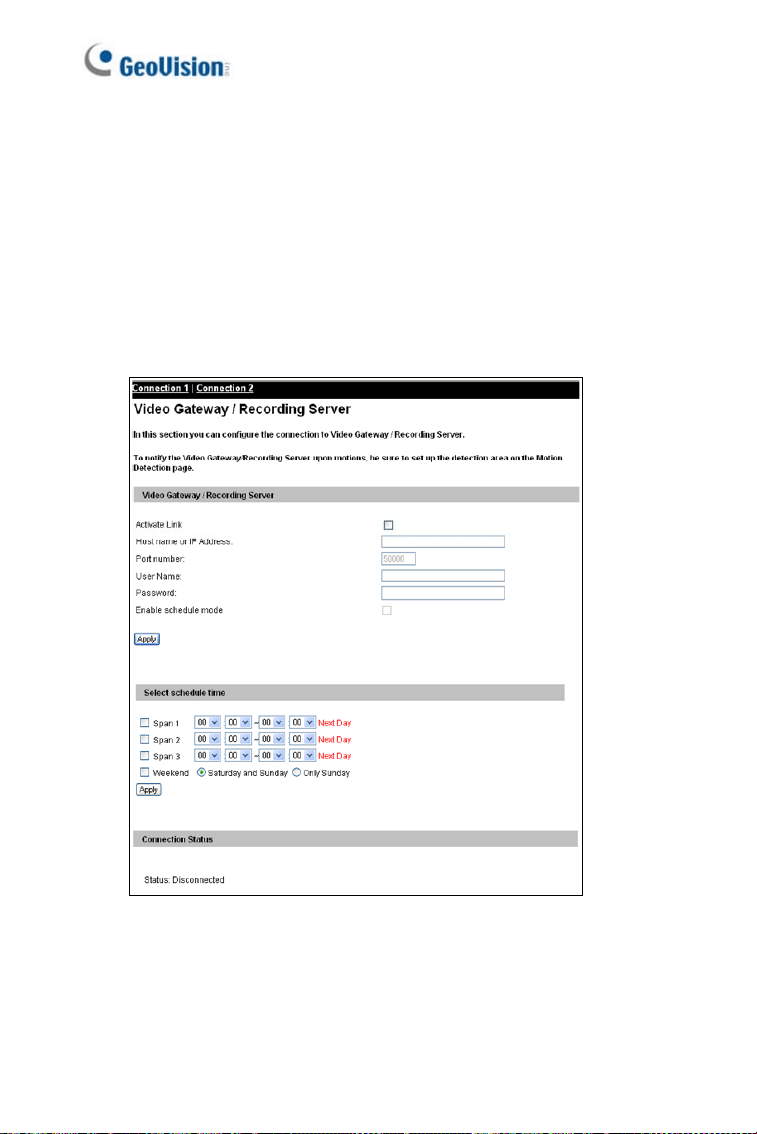
4.3.6 Video Gateway / Recording Server
The GV-Video Gateway / GV-Recording Server is a video streaming server
designed for large-scale video surveillance deployments. The GV-Video
Gateway / GV-Recording Server (with recording capability) can receive up
to 128 channels from various IP video devices, and distribute up to 300
channels to its clients. With the GV-Video Gateway / GV-Recording Server,
the desired frame rate can be ensured while the CPU loading and
bandwidth usage of the IP video devices are significantly reduced.
Figure 4-23
98

Administrator Mode
4 4
The s
upported GV-IPCAM can connect up to two GV-Video Gateway / GV-
Recording Server. To send the video images to the GV-Video Gateway or
GV-Recording Server, follow the steps below.
1. Activate Link: Enable the connection to the GV-Video Gateway / GV-
Recording Server.
2. Host Name or IP Address: Type the host name or IP address of the
GV-Video Gateway / GV-Recording Server.
3. Port Number: Match the communication port on the GV-Video
Gateway / GV-Recording Server or keep the default value 50000.
4. User Name: Type a valid user name to log into the GV-Video
Gateway / GV-Recording Server.
5. Password: Type a valid password to log into the GV-Video Gateway /
GV-Recording Server.
6. Enable Schedule mode: Enable the GV-Video Gateway / GV-
Recording Server on the schedule you set in the Select Schedule
Time section. Refer to 4.5 Recording Schedule for the same settings.
7. Click Apply. The Connection Status should display “Connected” and
the connected time.
8. To establish connection to the second GV-Video Gateway / GV-
Recording Server, click the Connection 2 tab and repeat the above
steps for setup.
99
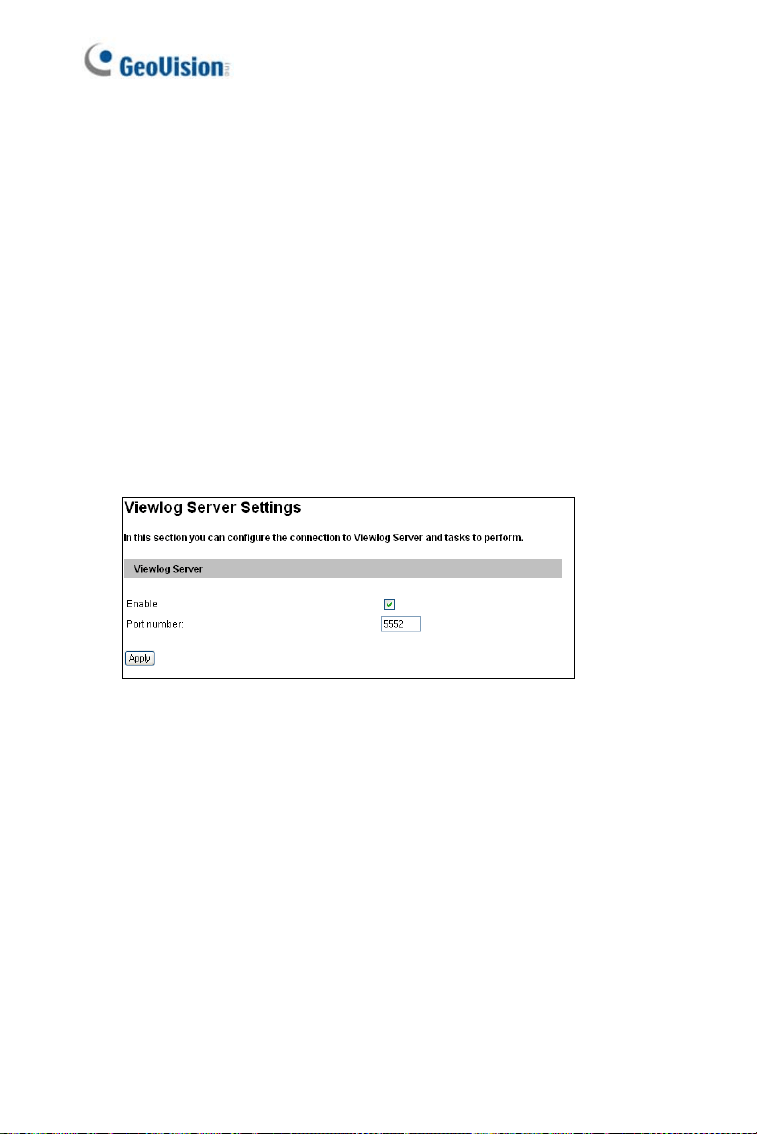
4.3.7 ViewLog Server
Note that ViewLog Server is not supported for Target Series.
The ViewLog Server is designed for remote playback function. This server
allows you to remotely access the recorded files saved at the GV-IPCAM
and play back video with the ViewLog player.
This function is enabled by default using port 5552. Keep the default
setting and only modify it when necessary. For details on the remote
playback, see 5.2.2 Playback over Network.
Figure 4-24
100
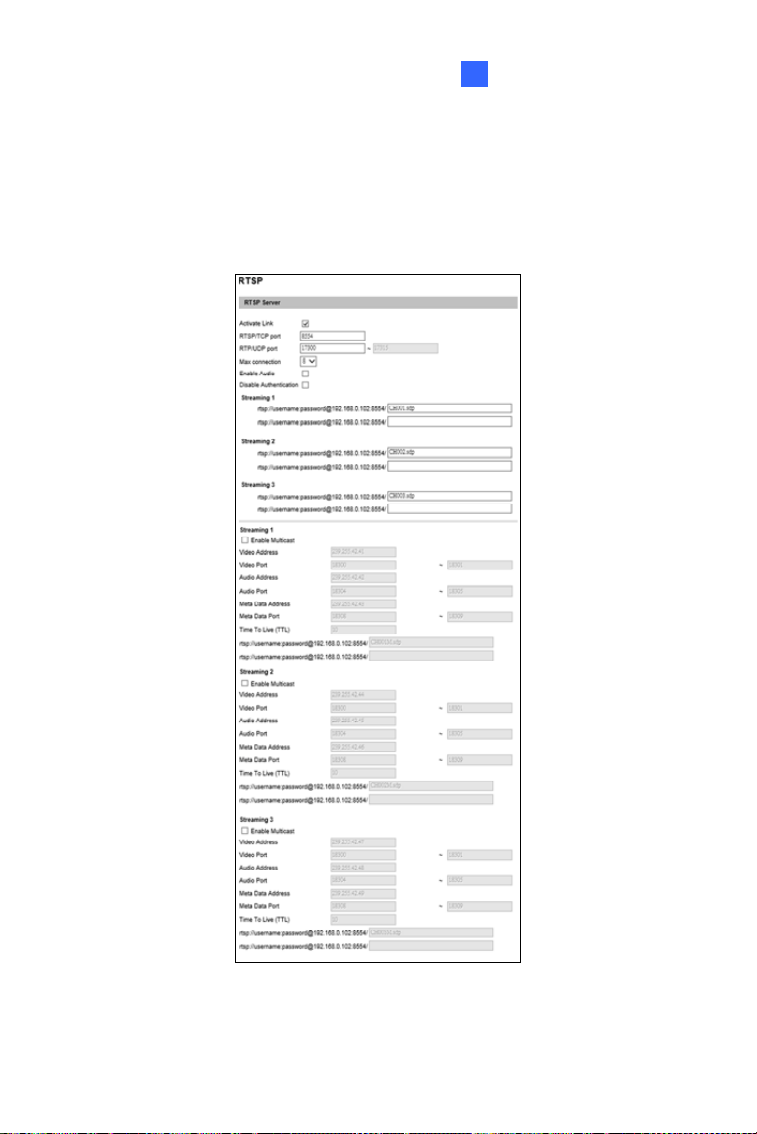
Administrator Mode
4 4
4.3.8 RTSP/ONVIF
The RTSP and ONVIF settings enable video and audio streaming to your
3G-enabled mobile phone or the third-party software. The RTSP and
ONVIF streaming is enabled by default.
Figure 4-25
101

[RTSP]
Activate Link: Enable the RTSP service.
RTSP/TCP Port: Keep the default value 8554, or modify it if
necessary.
RTP/UDP Port: Keep the default range from 17300 to 17319, or
modify it if necessary. The number of ports for use is limited to 20.
Max Connection: Select the maximum number of RTSP and 3GPP
connections to the camera. The maximum value is 8.
Enable Audio: Note this function is not available for Target Bullet
Camera, Target Mini Fixed Rugged Dome and Ultra Bullet Camera.
Turns audio streaming on or off.
Disable Authentication: By default, when accessing live view
through RTSP command, the ID and password of the camera are
required. Select this option to disable the authentication prompt.
[Streaming 1/2/3]
Set up the Multicast function through RTSP.
Note:
1. The RTSP Multicasting function is only supported by GV-EFD2101
/ 3101 / 5101, GV-EVD2100 / 3100 / 5100, GV-EBL5101 firmware
V1.04 or later, and Target cameras firmware V1.09 or later.
2. The Multicast streaming name is customizable on GV-IPCAM
H.265 firmware V1.14 or later.
For details on remote monitoring with mobile phones, see Mobile Phone
Connection, Chapter 26. For details on RTSP / Multicast command, see
Appendix B.
102
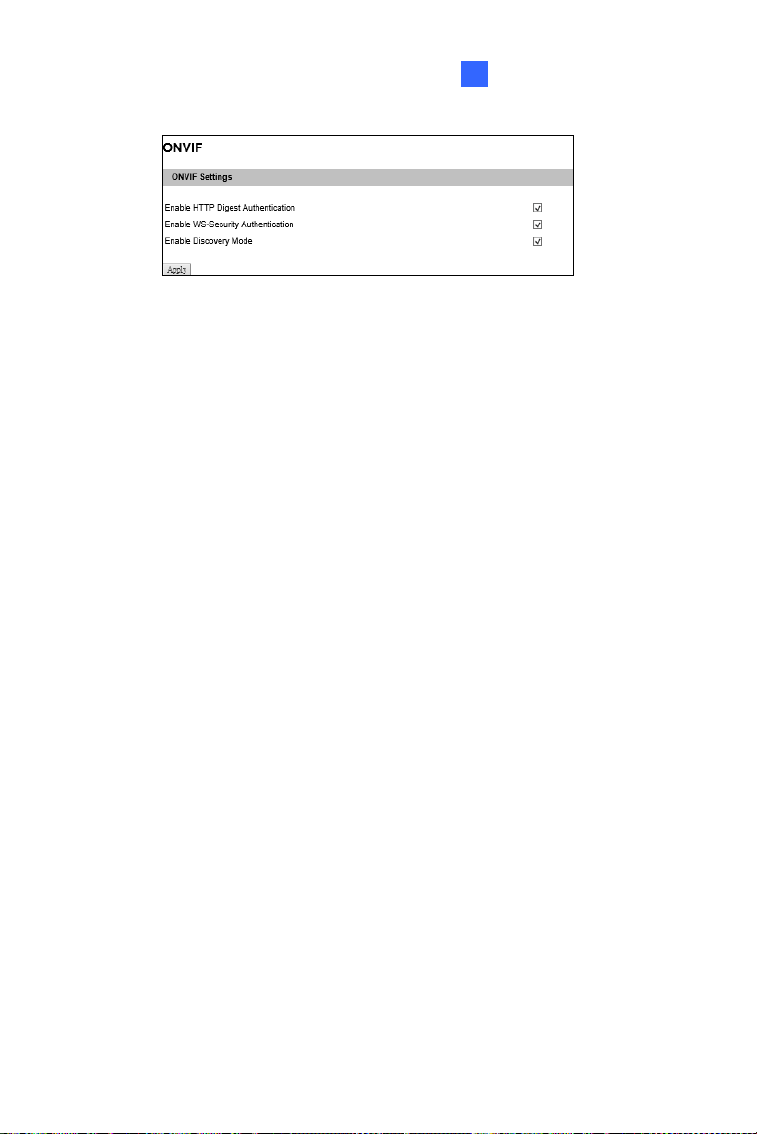
Administrator Mode
4 4
Figure 4-26
[ONVIF]
Enable HTTP Digest Authentication: The compatibility with HTTP
Digest Authentication is required to access the camera by a third-
party DVR through ONVIF. This function is disabled by default. Note
this function is only supported by GV-IPCAM H.265 fiirmware V1.14
or later.
Enable WS-Security Authentication: The ID and password of the
camera are required to access the camera by a third-party DVR
through ONVIF. This function is enabled by default.
Enable Discovery Mode: Allows the third-party DVR to browse this
camera. This function is enabled by default.
103
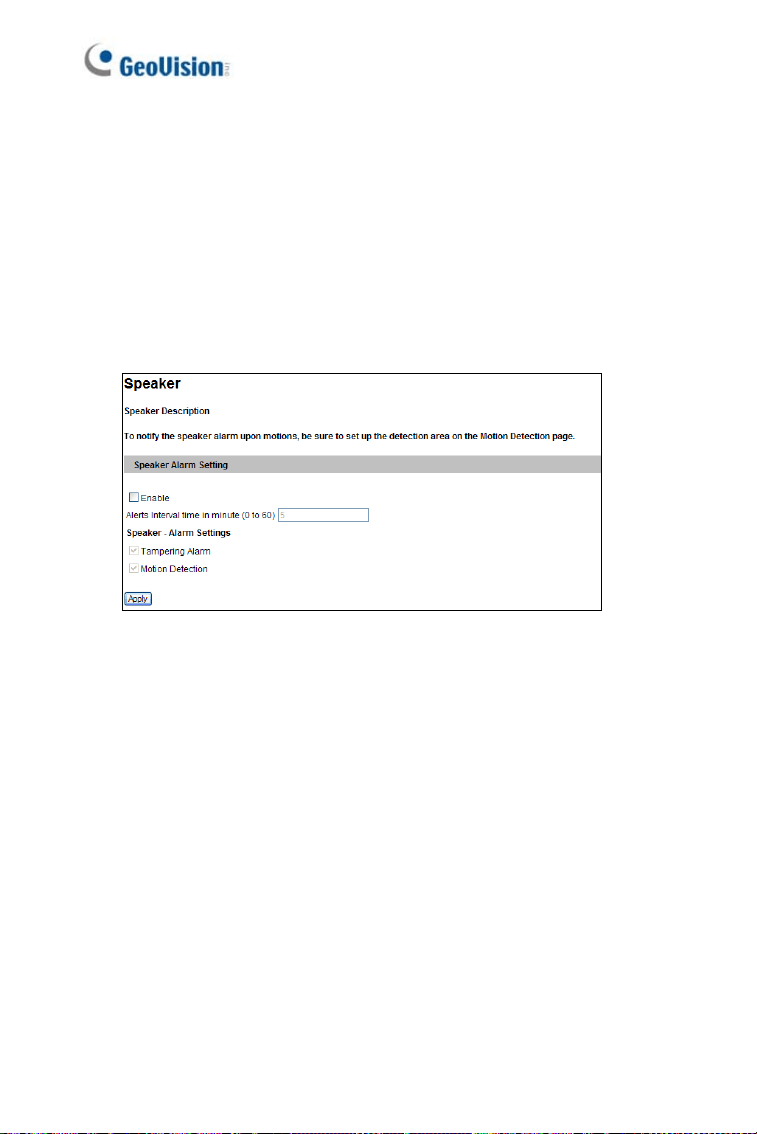
4.3.9 Speaker
Note this function is only available for Advanced Cube Camera.
The Advanced Cube camera is equipped with an alarm. With the Speaker
settings, your camera can sound the speaker when the camera is being
tampered or when motions are detected. This function is disabled by
default.
Figure 4-27
1. Select Enable.
2. Type the duration time in the Alerts Interval time field. The default
value is 5 (minutes). When a motion is detected, the alarm will be on
for the specified amount of time.
3. Select Tampering Alarm and/or Motion Detection under Alarm
Settings.
To sound the alarm upon motion events, make sure you have enabled
motion detection. For details, see 4.1.2 Motion Detection.
104
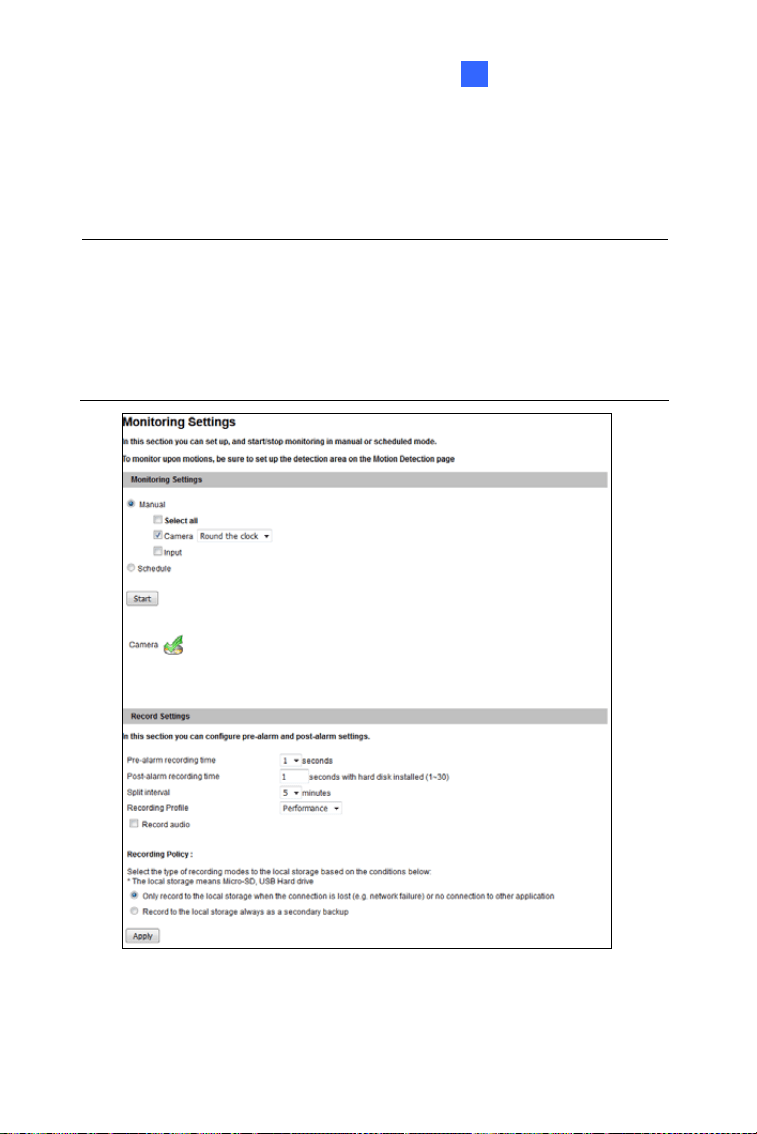
Administrator Mode
4 4
4.4 Monitoring
You can start monitoring manually, by schedule or by input trigger.
Note:
1. See Note for Connecting to GV-DVR / NVR / VMS at the beginning
of the manual.
2. For GV-EBL2101 / 2111 / 3101, see 4.4.1 Monitoring Settings for
GV-EBL2101 / 2111 / 3101 for corresponding page.
Figure 4-28-1
105
[Manual] Manually activates motion detection and I/O monitoring. Select
one of the following options and then click the Start button.
Select all: Manually starts both motion detection and I/O monitoring.
Camera: Manually starts recording. Select the desired recording
mode for recording.
Input: Note this function is only supported by cameras with I/O
function. Manually starts I/O monitoring. When the sensor input is
triggered, its associated camera and output will be activated for
recording and alerting. For this setting, see 4.2.1 Input Setting.
[Schedule] The system starts motion detection and I/O monitoring
according to the schedule you have set. For schedule settings, see 4.5
Recording Schedule.
[Camera Status Icon]
: On standby
: Enabled for motion detection and input trigger
: Recording is on.
[Recording Settings] Note this function is only supported by GV-BX12201
firmware V1.02 or later and GV-IPCAM H.265. Configure recording
settings for motion and I/O events, and the condition to record.
Pre-alarm recording time: Activates video recording before an event
occurs. Set the recording time to 1 or 2 seconds. The recording is
saved in the buffer of the camera.
Post-alarm recording time: Activates video recording onto the
inserted memory card after an event occurs. Set the recording time
from 1 to 30 seconds.
106

Administrator Mode
4 4
S
plit-interval: Sets the time length between each event file from 1 to
5 minutes.
Recording Profile: This setting is only applicable for recording to the
camera’s memory card. Select Performance to maximize the lifespan
of the memory card by restricting the frame rate to 30 fps and
maximum bit rate to 4 Mbps. Select Quality to adopt your current
settings. The default setting is Performance.
Record audio: Activates audio recording when an event occurs.
Recording Policy: By default, the camera will only record to the
memory card when the camera is not streaming live view to other
applications (e.g. GV-VMS) or Web browser. Alternatively, you can
set the camera to always record to the memory card as a secondary
backup.
Note: When the camera is recording to the memory card, it is
recommended to connect no more than two connections to the camera
using Web interface or other applications.
Encryption: Stores the recordings as encrypted files that can only be
played back by GV-Remote ViewLog player. For details on playback,
see 5.2.2 Playback over Network.
Figure 4-28-2
107
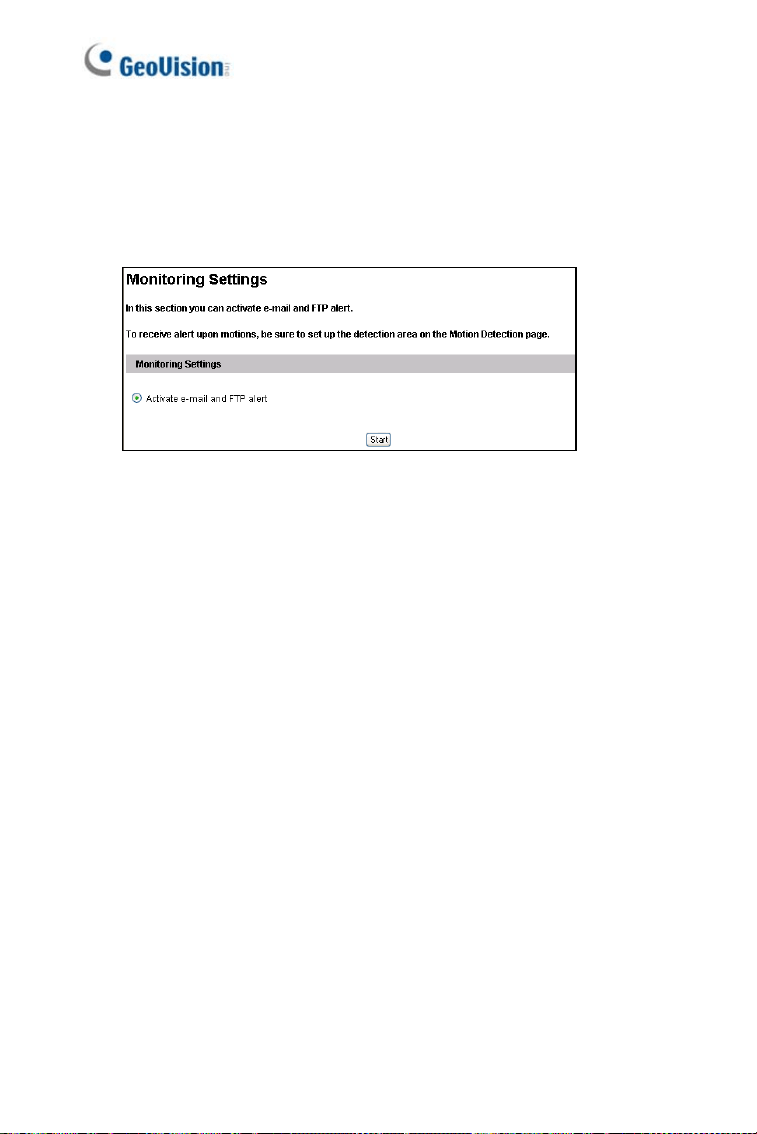
4.4.1 Monitoring Settings for GV-EBL2101 / 2111 / 3101
In the Monitoring Settings page for GV-EBL2101 / 2111 / 3101, click Start
to activate e-mail and FTP alert functions. Be sure to complete related
settings on the Motion Detection, email and FTP pages.
Figure 4-29
108
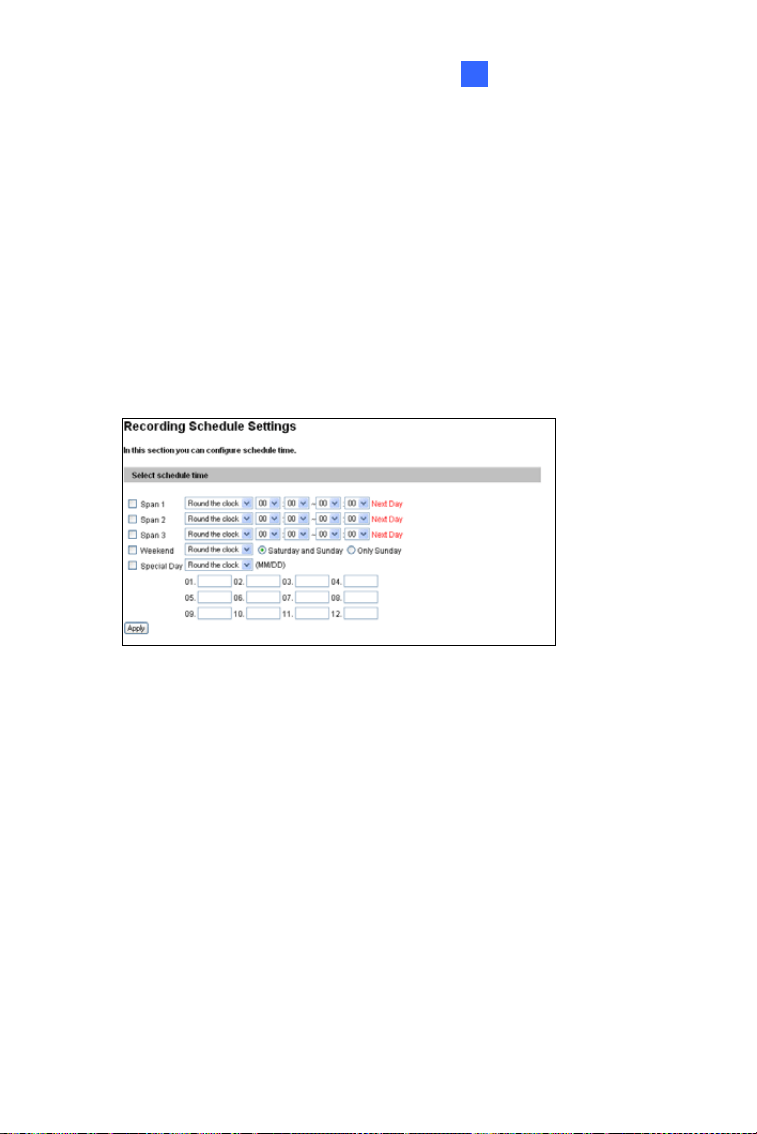
Administrator Mode
4 4
4.5 Recording Schedule
Note this function is not available for GV-EBL2101 / 2111 / 3101.
The schedule is provided to activate recording and I/O monitoring on a
specific time each day.
4.5.1 Recording Schedule Settings
You can set the schedule for recording.
Figure 4-30
Span 1- Span 3: Set a different recording mode for each time frame
during the day. Each day can be divided into 3 time frames,
represented by Span 1 to Span 3.
Weekend: Enable this option to start monitoring all day on the
weekend and select the recording mode to be used. Define whether
your weekend includes Saturday and Sunday or Only Sunday.
Special Day: Set the recording mode on a specified day.
109
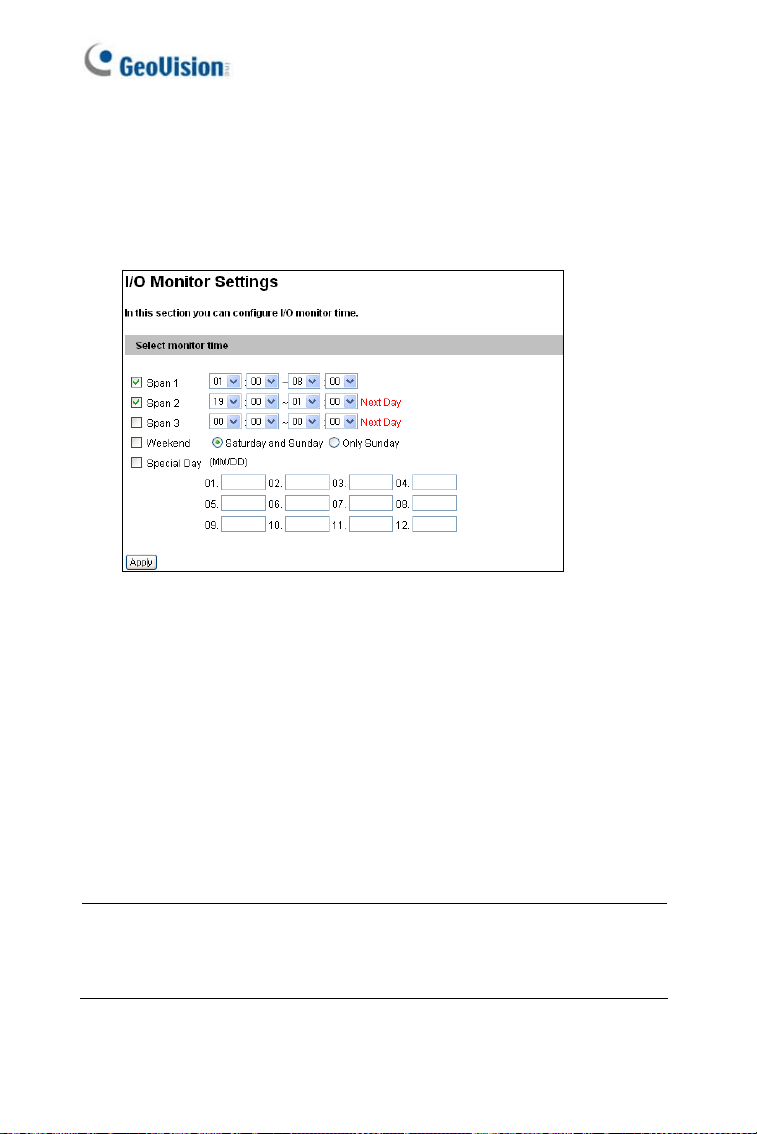
4.5.2 I/O Monitoring Settings
Note this function is only supported by cameras with I/O function.
You can set the schedule for I/O monitoring to start.
Figure 4-31
Span 1- Span 3: Set different time frames during the day to enable
I/O monitoring. Each day can be divided into 3 time frames,
represented by Span 1 to Span 3.
Weekend: Enable this option to start I/O monitoring all day on the
weekend and define whether your weekend includes Saturday and
Sunday or Only Sunday.
Special Day: Enable I/O monitoring on a specified day.
Note: In Recording Schedule and I/O Monitoring Schedule, if the
settings for Special Day conflict with those for Span 1-3 or Weekend,
the Special Day settings will get the priority.
110

Administrator Mode
4 4
4.6 Remote ViewLog
Note this function is not available for Target Series.
With the Remote ViewLog player, you can play back the files recorded at
the camera over TCP/IP network.
For the first-time user, you need to download and install the Remote
ViewLog program from the company website
. To allow remote access to
the camera, make sure the ViewLog Server function is enabled. See 4.3.7
ViewLog Server.
For details on connecting to the camera for playback, see 5.2.2 Playback
over Network.
111
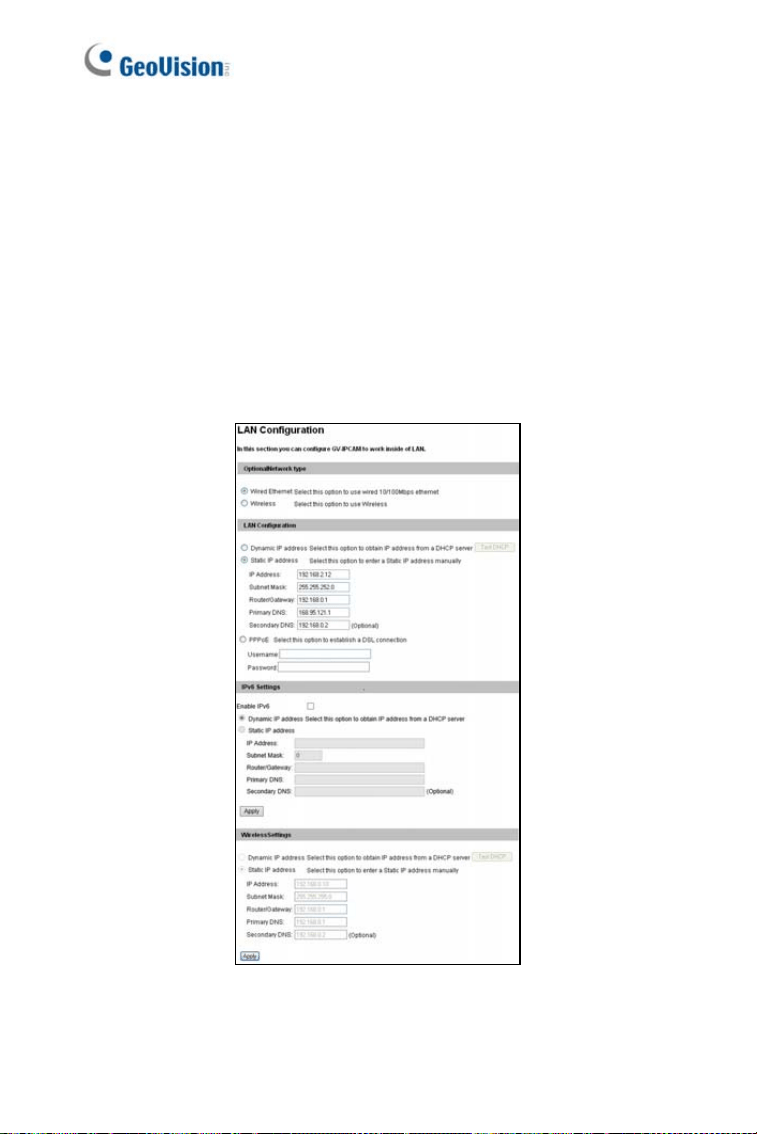
4.7 Network
The Network section includes some basic but important network
configurations that enable the camera to be connected to a TCP/IP
network.
4.7.1 LAN Configuration
According to your network environment, select among Static IP, DHCP and
PPPoE.
Figure 4-32
112
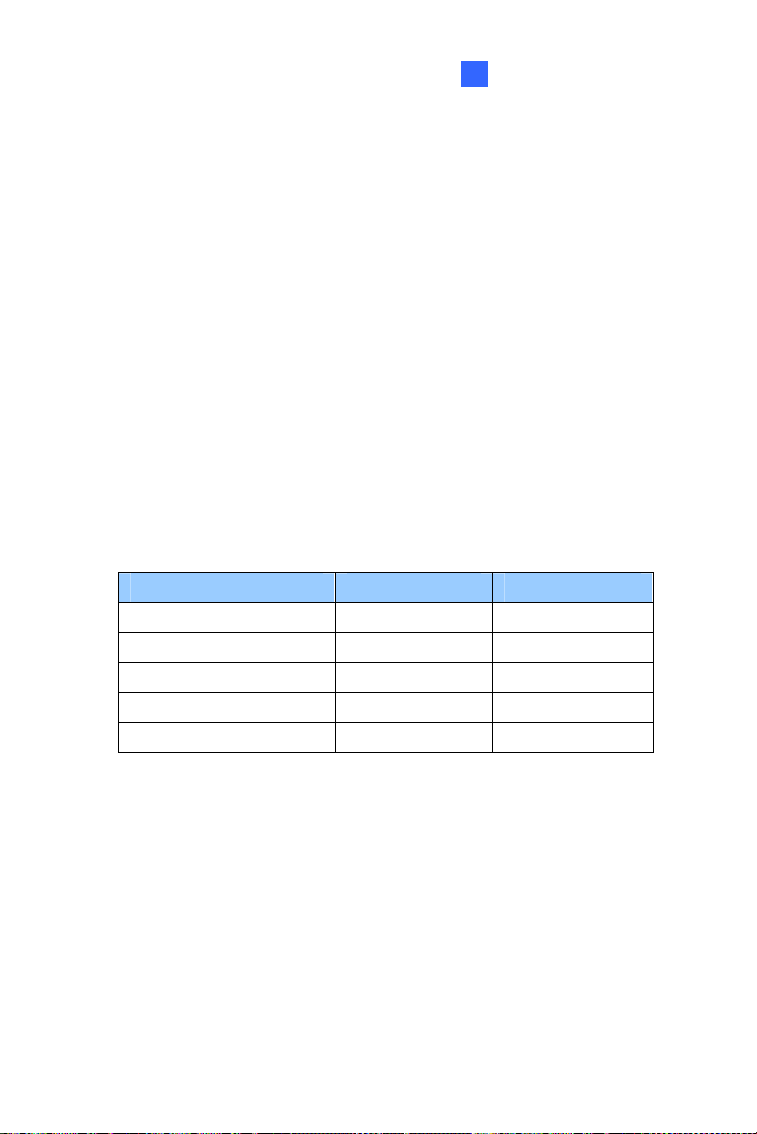
Administrator Mode
4 4
[
Optional Network Type]
Note the Wireless Settings are only available in GV-BX1200 Series / 2400
Series / 2700 Series / 4700 Series / 5700 Series, GV-CAW120 / 220, GV-
FER5700 and GV-MFD3401 Series / 5301 Series. According to the
network environment, select Wired Ethernet or Wireless. Before enabling
the Wireless option, follow the steps in 2.1.3 Configuring the Wireless
Connection to configure the wireless settings first.
[LAN Configuration]
Dynamic IP address: The network environment has a DHCP server
which will automatically assign a dynamic IP address to the camera.
Click the Test DHCP button to see the currently assigned IP address
or look up the dynamic IP address using GV-IP Device Utility.
Static IP address: Assign a static IP or fixed IP to the camera and fill
out the required settings. The default values are as below.
Wired Ethernet Wireless
IP address 192.168.0.10 192.168.100.10
Subnet Mask 255.255.255.0 255.255.255.0
Router/Gateway 192.168.0.1 192.168.0.1
Primary DNS server 192.168.0.1 192.168.0.1
Secondary DNS server 192.168.0.2 192.168.0.2
PPPoE: The network environment is xDSL connection. Type the
Username and Password provided by ISP to establish the connection.
If you use the xDSL connection with dynamic IP addresses, first use
the DDNS function to obtain a domain name linking to the camera’s
changing IP address.
113
[IPv6 Settings]
Select Enable IPv6 and click Apply to enable this function.
Note this function is only available for Target firmware V1.07, Target
firmware V1.03, and GV-IPCAM H.265 firmware V1.14 or later versions.
Dynamic IP address: The network environment has a DHCP server
which will automatically assign a dynamic IP address to the camera.
Static IP address: Assign a static IP or fixed IP to the camera and fill
out the required settings.
Note: To enable this function, make sure your network environment
and hardware specifications support IPv6.
For details on Dynamic DNS Server Settings, see 4.7.3 Advanced TCP/IP.
114
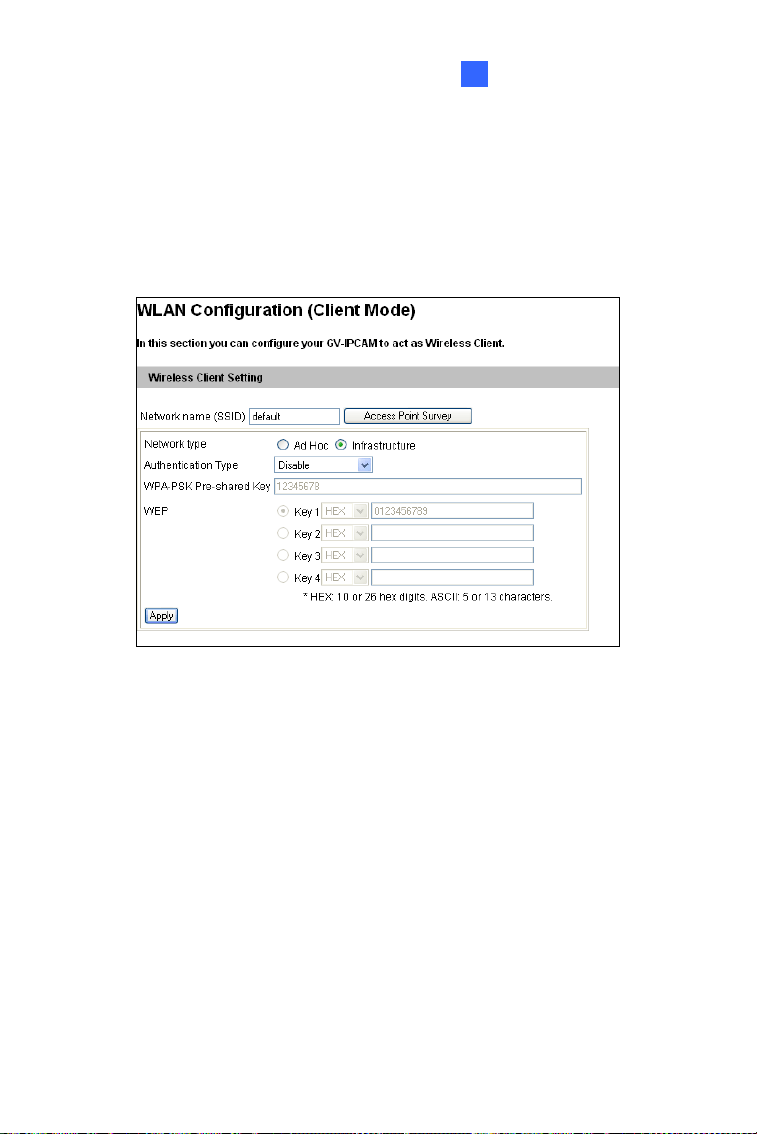
Administrator Mode
4 4
4.7.2 Wireless Client Mode
Note this function is only supported in the models supporting wireless
connection, and when GV-WiFi Adapter is installed. Set up the client mode
before enabling the wireless function.
Figure 4-33
Network type: Select the network mode Ad Hoc or Infrastructure.
Infrastructure: Connect to the Internet via the Access Point. This
mode further gives wireless access to the Internet or data sharing
under a previously wired environment.
Ad-Hoc: A Peer-to-Peer mode. This mode connects to other
computer with the WLAN card, and does not need the Access
Point to connect to each other.
Network name (SSID): The SSID (Service Set Identify) is a unique
name that identifies a particular wireless network. Type SSID of the
Wireless LAN group or Access Point you are going to connect to.
115
Access Point Survey: Click this button to search all the available
Access Points (Infrastructure mode) and wireless stations (AD-Hoc
mode) within the LAN.
Authentication Type: Select one of these network authentication and
data encryption: Disable, WEP, WPAPSK-TKIP, WPAPSK-AES,
WPA2PSK-TKIP or WPA2PSK-AES.
Disabled: No authentication is needed within the wireless network.
WEP (Wired Equivalent Privacy): A type of data encryption.
Type up to four WEP Keys in HEX or ASCII format. Note that if
you use HEX format, only digits 0-9 and letters A-F, a-f are valid.
WPAPSK-TKIP and WPA2PSK-TKIP: Type WPA-PSK (Pre-
Shared Key) for data encryption.
WPAPSK-AES and WPA2PSK-AES: Type WPA-PSK (Pre-
Shared Key) for data encryption.
For step-by-step instruction on wireless connection, see 2.1.3 Configuring
the Wireless Connection.
Note:
1. Your encryption settings must match those used by the Access Points
or wireless stations with which you want to associate.
2. When you lose the wireless access, you can still access the unit by
connecting it to a LAN and search for the camera using GV IP Device
Utility.
3. When Ad Hoc is used, only WEP encryption is supported.
116
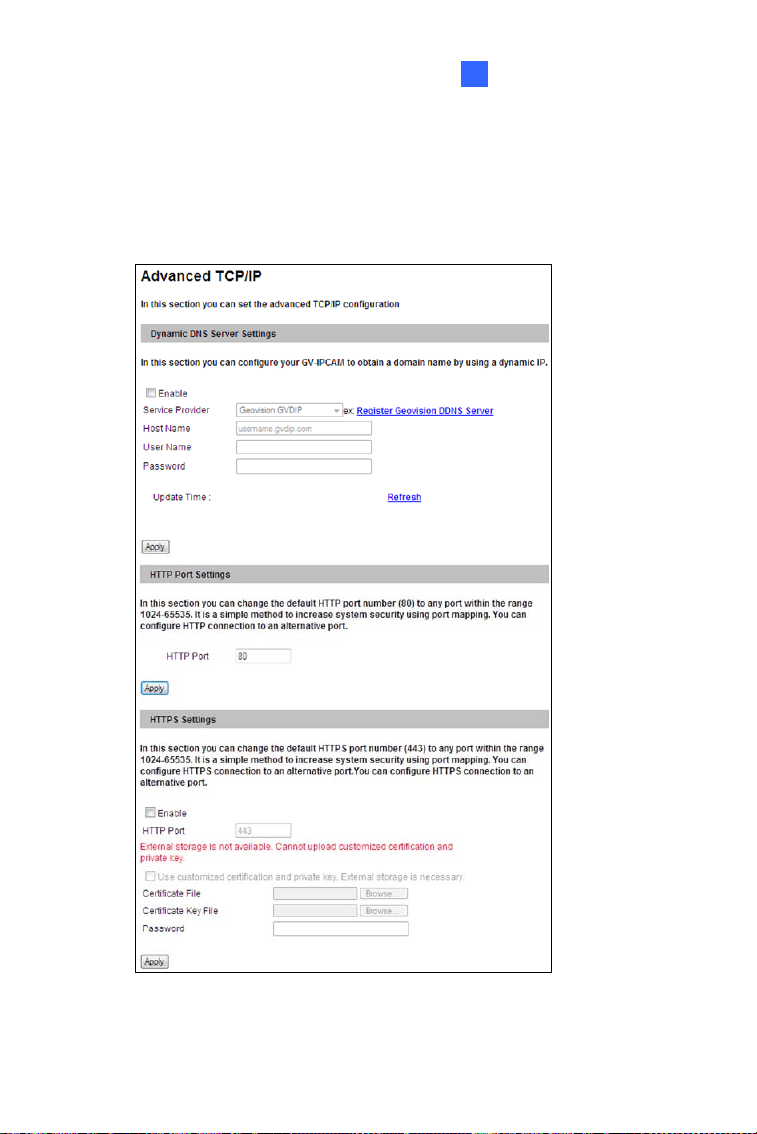
Administrator Mode
4 4
4.7.3 Advanced TCP/IP
This section provides the advanced TCP/IP settings, including DDNS
Server, HTTP port, HTTPS, streaming port, UPnP, QoS and network
connection check.
Figure 4-34-1
117
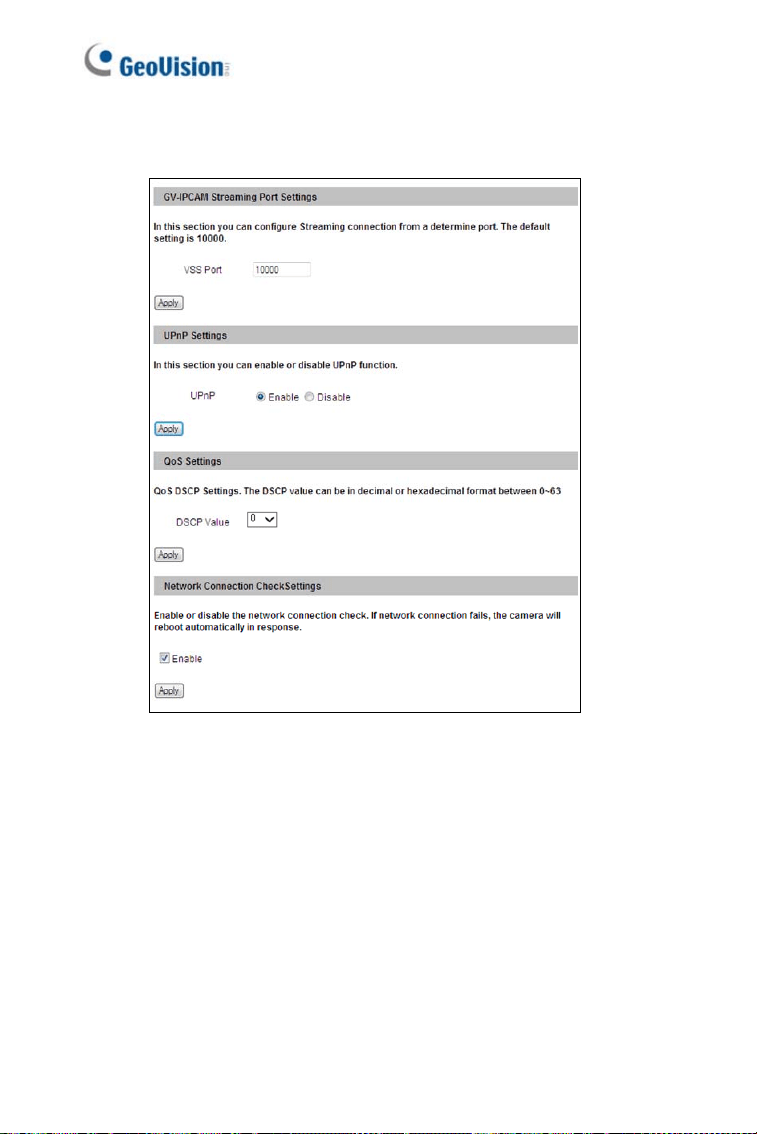
Figure 4-34-2
[Dynamic DNS Server Settings] DDNS (Dynamic Domain Name System)
provides a convenient way of accessing the camera when using a dynamic
IP. DDNS assigns a domain name to the camera, so that the Administrator
does not need to go through the trouble of checking if the IP address
assigned by DHCP Server or ISP (in xDSL connection) has changed.
Before enabling the following DDNS function, the Administrator should
have applied for a Host Name from the DDNS service provider’s website.
There are 3 providers listed in the camera: GeoVision GVDIP, GeoVision
DDNS Server and DynDNS.org.
118

Administrator Mode
4 4
T
o enable the DDNS function:
1. Enable: Enable the DDNS function.
2. Service Provider: Select the DDNS service provider you have
registered with.
3. Host Name: Type the host name used to link to the camera. For the
users of GeoVision DDNS Server, it is unnecessary to fill the field
because the host name will be detected and brought up automatically.
4. User Name: Type the username used to enable the service from the
DDNS. The username should look similar to your host name.
Depending on your service provider, you should add domain name
(.dipmap.com, .gvdip.com or .org) after your user name, for example,
alice.dipmap.com
5. Password: Type the password used to enable the service from the
DDNS.
6. Click Apply.
[HTTPS Settings] For face detection camera models, see 4.7.4 HTTPS for
similar HTTPS settings. By enabling the HTTPS settings, you can access
the camera through a secure protocol. The default HTTPS port is 443. You
can use your own generated Certificate and Private Key or ones verified by
the SSL authority. Click Browse to locate the Certificate file and
Certificate Key file, and type the password if the .pem files are protected
by a password. Click Apply. The Web interface will be restarted
automatically and you will need to log in again.
Note: The .pem file format is supported by Certificate and Private Key.
[HTTP Port Settings] The HTTP port enables connection of the camera to
the Web. For security integration, the Administrator can hide the server
from the general HTTP port by changing the default HTTP port of 80 to a
different port number within the range of 1024 through 65535.
119

[GV-IPCAM Streaming Port Settings] The VSS port enables connecting
the camera to the GV-DVR / NVR / VMS. The default setting is 10000.
[UPnP Settings] UPnP (Universal Plug & Play) is a networking
architecture that provides compatibility among networking equipment,
software and peripherals of the 400+ vendors that are part of the Universal
Plug and Play Forum. It means that they are listed in the network devices
table for the operating system (such as Windows XP) supported by this
function. Enabling this function means you can connect to the camera
directly by clicking on the camera listed in the network devices table.
[QoS Settings]
The Quality of Service (QoS) is a bandwidth control
mechanism that guarantees delay-sensitive data flows such as voice and
video streams, obtain a certain amount of bandwidth to keep the streaming
smooth.
To apply QoS to the camera, all network routers must support QoS and
QoS must be enabled on these devices. To enable the QoS on the camera,
select a Differentiated Services Code Point (DSCP) value. This value is a
field in an IP packet that enables different levels of services for the network
traffic. When the video stream from the camera reaches a router, the
DSCP value will tell the router what service level to be applied, e.g. the
bandwidth amount. This value ranges from 0 to 63 in decimal format. The
default value is 0, meaning QoS is disabled.
[Network Connection Check Settings] The camera checks for Internet
connection, and reboots when it is disconnected from the Internet. This
function is enabled by default.
Note: If you do not intend to connect the camera to the network,
disable this function to prevent automatic reboot.
120
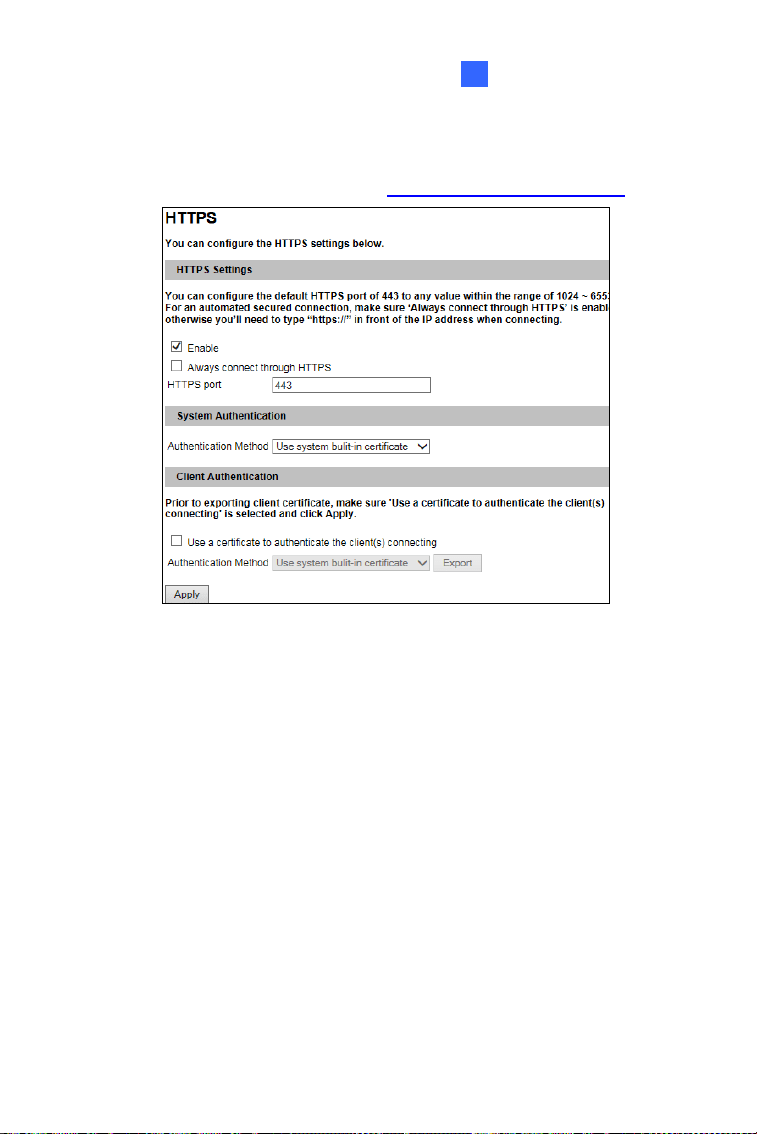
Administrator Mode
4 4
4.7.4 HTTPS
Note this function is only supported by face detection camera models
.
Figure 4-35
[HTTPS Settings] By enabling the HTTPS settings, you can access the
camera through a secure protocol. The default HTTPS port is 443.
[System Authentication] You can use the operating system’s built-in
certificate or import a certificate verified by the SSL authority. To import,
select Import a certificate, click Browse to locate the Certificate file and
Certificate Key file, and type the password if the .pem files are protected
by a password.
[Client Authentication] Select to use the certificate to authenticate the
client connection.
121
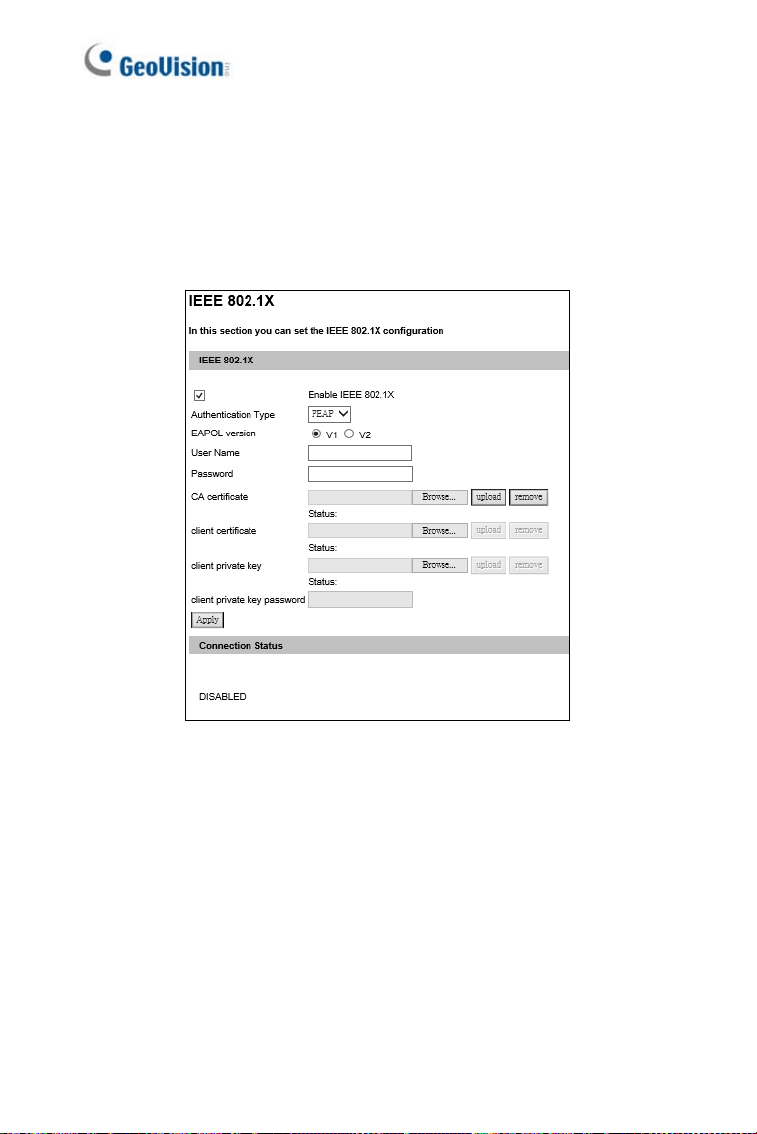
4.7.5 IEEE 802.1X
IEEE 802.1x is an IEEE standard for port-based Network Access Control. It
provides an authentication mechanism to devices wishing to attach to a
LAN or WLAN. Note this function is only supported by GV-IPCAM H.265
firmware V1.14 or later. This function is disabled by default.
Figure 4-36
1. Enable IEEE 802.1x.
2. Select the Authentication Type from the dropdown list for your IP
devices. If you select PEAP, go to Step 3. If you select TLS, go to
Step 4.
3. Select the EAPOL version, type a valid User Name and Password
for the authentication server. Note these options are only available if
you select PEAP.
122

Administrator Mode
4 4
4
. Click Browse to locate the CA Certificate, Client Certificate, Client
Private Key, and Client Private Key Password at your local
computer and click Upload to upload the credentials to the
authentication server. Note these options are only available if you
select TLS.
5. Click Apply. The Connection Status will show Authentication
Success when the authentication is successful.
123

4.7.6 UMTS Settings
Not this function is not supported by GV-IPCAM H.265.
UMTS stands for Universal Mobile Telephone System. UMTS is a third-
generation (3G) broadband, packet-based transmission of text, digitized
voice, video, and multimedia at data rates up to 2 megabits per second.
UMTS offers a consistent set of services to mobile computer and phone
users, no matter where they are located in the world.
With a mobile broadband device (supporting UMTS, HSDPA, etc.) attached
to the USB port on the rear panel, and with this UMTS function enabled,
GV-Fisheye Camera can be accessed through wireless broadband. For
supported mobile broadband devices, see Appendix C.
The Virtual Private Network (VPN) over a UMTS connection is also
configurable on the setting page.
124
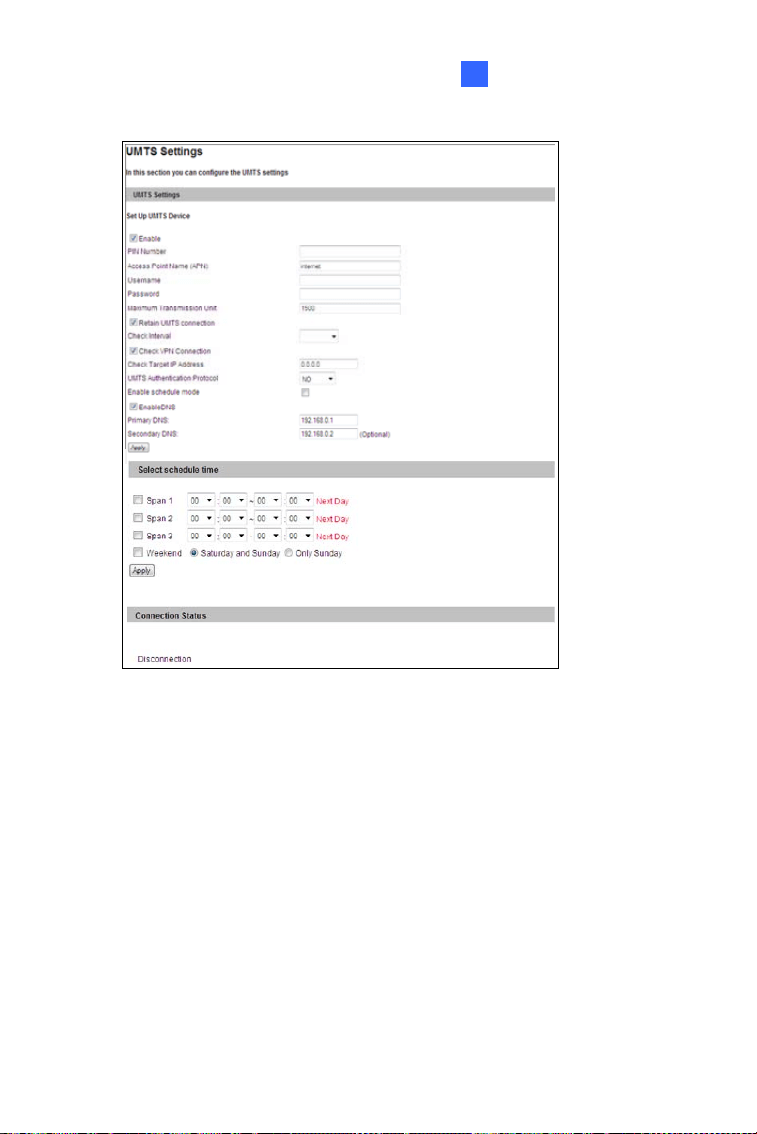
Administrator Mode
4 4
Figure 4-37
PIN number: Type the PIN number that is provided by your network
operator.
Access Point Name (APN): Type Access Point Name that is
provided by your network operator.
Username: Type a valid username to enable the UMTS service from
your network operator.
Password: Type a valid password to enable the UMTS service from
your network operator.
Maximum Transmission Unit: Type the Maximum Transfer Unit
(MTU). The default value is 1500.
125

Retain UMTS Connection: Select this option to check the UMTS
connection status and use the drop-down list to specify the desired
time length for check frequency. The GV-Video Server will rebuild the
connection if disconnection is detected.
Enable VPN Connection: Select this option to enable the VPN
(Virtual Private Network) connection. Type the target IP address in the
Check Target IP Address field.
UMTS Authentication Protocol: Use the drop-down list to select the
UMTS Authentication Protocol provided by your network operator.
Enable Schedule Mode: Starts the UMTS connection automatically
based on the schedule you set in the Select Schedule Time section.
Refer to 4.5 Recording Schedule for the same settings.
Enable DNS: Optional type up to two DNS servers of your network
operator.
3G Connection Status: Indicates the connection status of UMTS or
VPN.
Note:
1. When both WiFi and 3G signals are detected, the camera will
connect to the network through WiFi.
2. UMTS Settings are not supported by GV-EBL2101 / 2111 / 3101 /
5101.
126
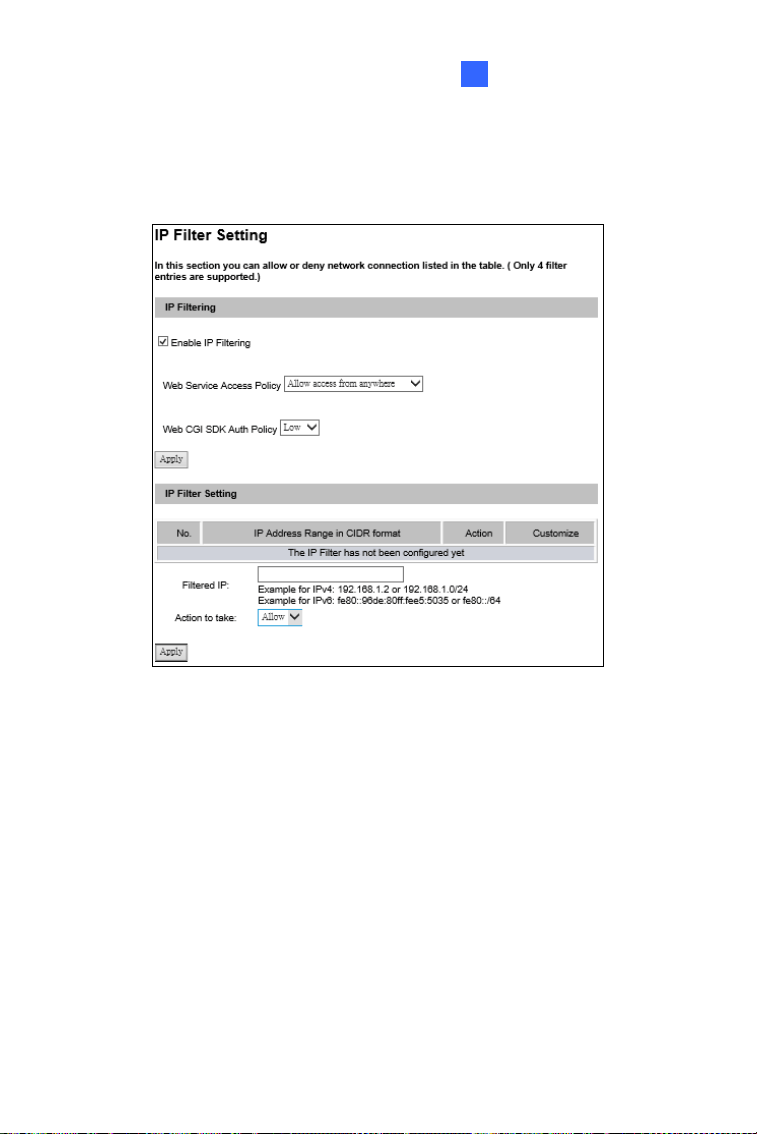
Administrator Mode
4 4
4.7.7 IP Filter Settings
The Administrator can set IP filtering to restrict access to the camera.
Figure 4-38
To enable the IP Filter function:
1. Enable IP Filtering: Enable the IP Filter function.
2. Web Service Access Policy: Select Allow access from anywhere
(Default), Allow access from local LAN or Disallow access from
anywhere.
3. Web CGI SDK Auth Policy: Select Low (Default) or High, which
enhances the data transmission security, from the drop-down list.
Note this function is designed for customers with the need to develop
their own SDK, and is only supported by GV-IPCAM H.265 firmware
V1.14 or later.
127

4. Click Apply.
Note:
1. Some models do not have the function of Web Service Access
Policy.
2. If you select Disallow access from anywhere, before clicking
Apply, remember to set one IP address for which access to the
camera is allowed.
5. Filtered IP: Type one IP address or a range of IP addresses you want
to restrict the access.
6. Action to take: Select the action of Allow or Deny to be taken for
the IP address(es) you have specified.
7. Click Apply.
128
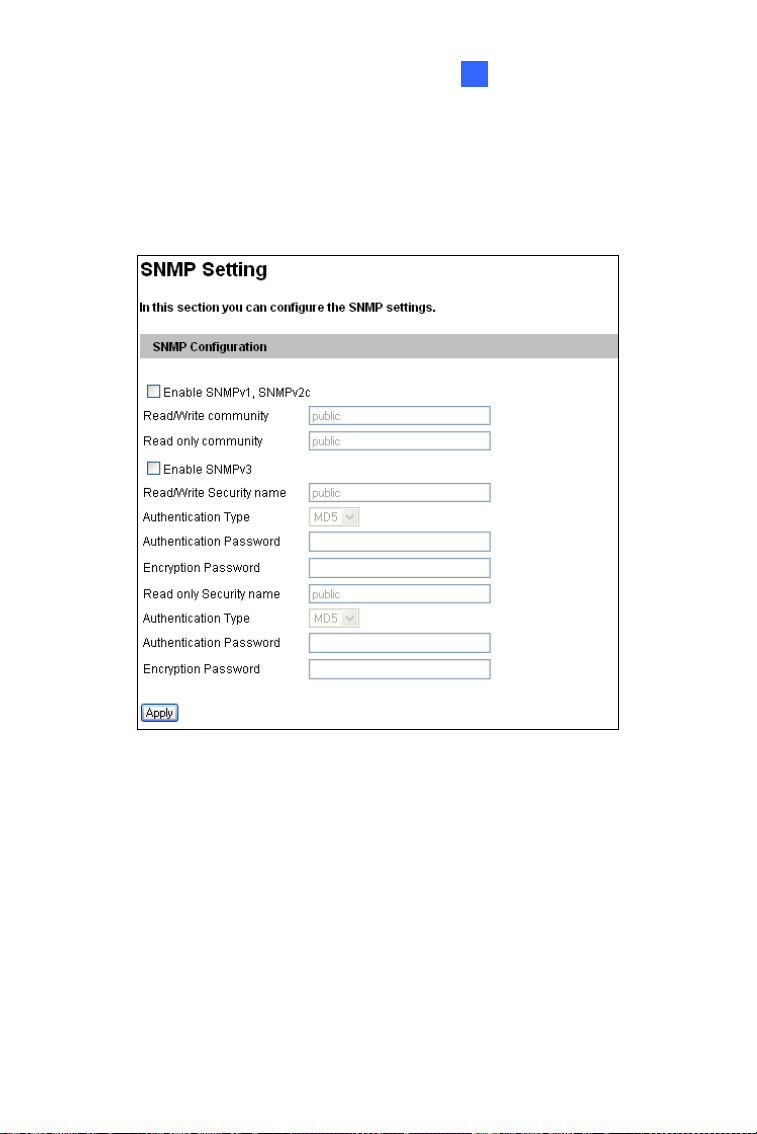
Administrator Mode
4 4
4.7.8 SNMP Settings
The Simple Network Management Protocol (SNMP) allows you to monitor
the status of the camera through SNMP network management software.
Figure 4-39
129

1. Select Enable SNMPv1 SNMPv2c to enable the function.
2. To enable access to Read/Write community, type a community
string. This will serve as a password to allow read and write access to
the camera from the SNMP software.
3. To enable Read only community, type a community string to allow
read-only access to the camera from the SNMP software.
4. For a more secured connection, select Enable SNMPv3 to enable
SNMP version 3.
5. To enable access to SNMPv3 Read/Write community, type a
community string.
6. Select an Authentication Type to use for SNMP requests.
7. Type the Authentication Password and Encryption Password. You
will need to type these passwords in the SNMP software to be able to
access the camera.
8. To enable access to SNMPv3 Read only community, follow steps
5 ~ 7.
9. Click Apply to save the settings.
130
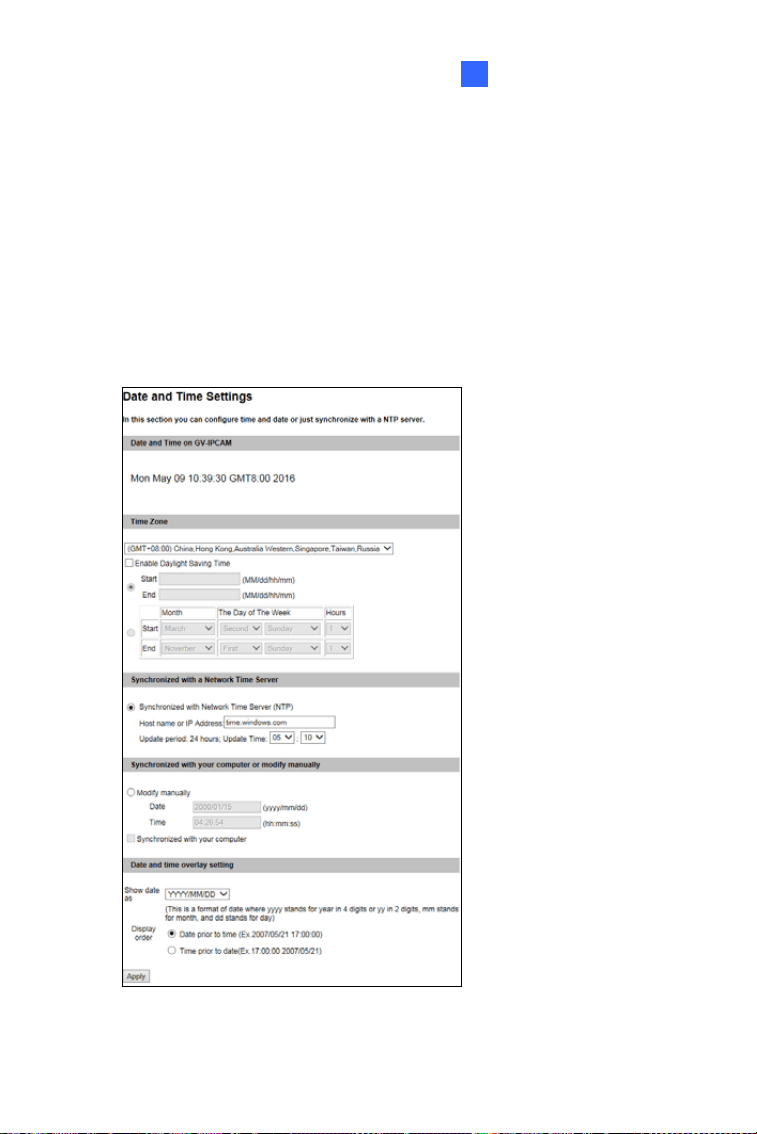
Administrator Mode
4 4
4.8 Management
The Management section includes the settings of data and time and user
account. You can also view the firmware version and execute certain
system operations.
4.8.1 Date & Time Settings
The date and time settings are used for date and time stamps on the image.
Figure 4-40
131

[Date & T e on G Displays the current date and time on
the camera.
[Time Zone] Sets the time zone for local settings. Select Enable Daylight
Saving Time to automatically adjust the camera for daylight saving time.
Define the Start Time and End Time to enable the daylight saving function.
You can also select which day of a week within a month to apply the DST
setting.
To play back, see 5.2.4 Playback of Daylight Saving Time Events. To
automatically synchronize the Daylight Saving Time with the GV-DVR /
NVR, see 7.1.1 Customizing IP Camera Settings on GV-DVR / NVR.
[Synchronized with a Network Time Server] By default, the camera
automatically update its internal clock every 24 hours. You can change the
host name or IP setting to the timeserver of interest, and specify a time for
time update.
[Synchronized with your computer or modify manually] Manually
changes the camera’s date and time. Or, synchronize the camera’s date
and time with those of the local computer.
[Date and Time Overlay Setting] Select the display format of date and
time stamps on the image. For this function to work, you must also enable
the Overlaid with date stamps and Overlaid with time stamps options in
Figure 4-2.
im V-IP Camera]
132
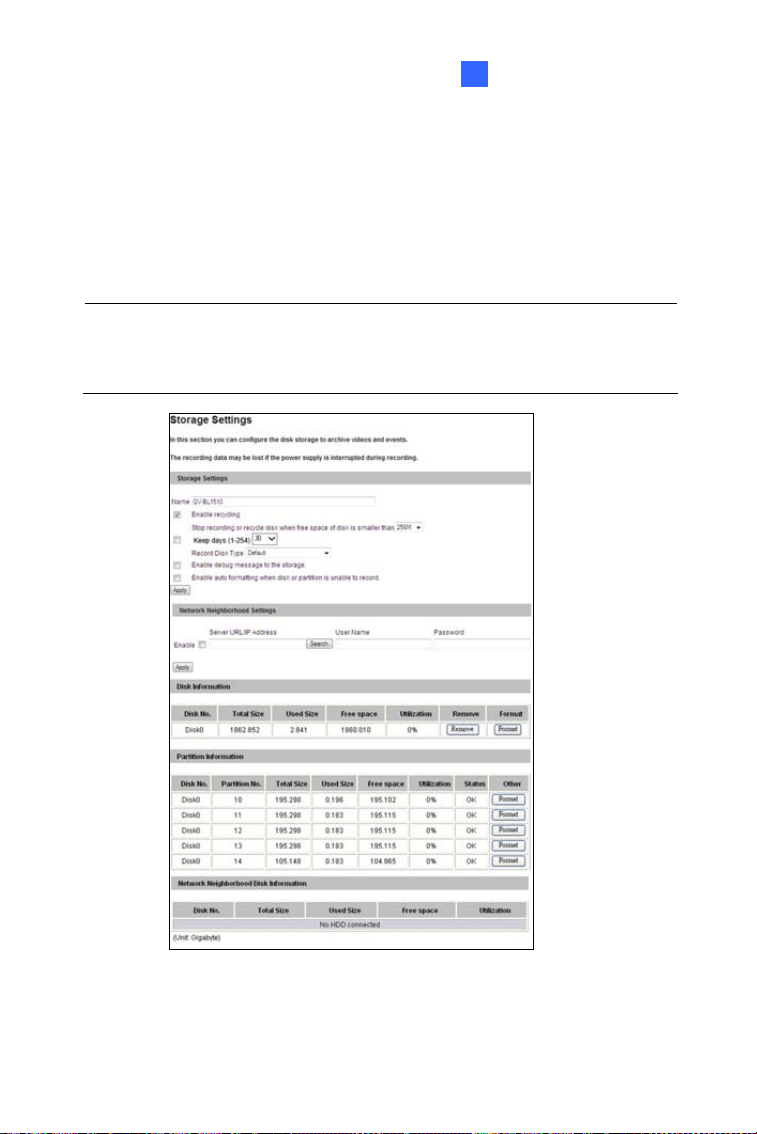
Administrator Mode
4 4
4.8.2 Storage Settings
ased on LinuxB file system, the camera supports memory cards for video
Target Series does not support memory cards. You can store
recordings to a connected NAS server instead. Refer to Network
and audi
o recordings. You need to format the storage device by using the
following Storage Settings. After being formatted, the storage device will be
ready to use by Linux OS of the camera.
Note: The
Neighborhood Settings below.
Figure 4-41
133

[Storage Settings]
Name: Type the name of the storage device. The name can only
contain English letters (of upper or lower cases), numerals, slashes,
and hyphens.
Note: The setting of the device name is for GV-NAS System only.
pace of
han the specified space, the system will
overwrite the oldest recorded files. If Enable recycling is not selected,
the system will stop recording when the specified space is reached.
Keep days (1-254): Select the number of days to keep the files from
1 day to 254 days. When both Keep days and Enable recycling are
selected, the system applies whichever condition comes first. For
example, if the specified smallest amount of storage space comes
earlier than the designated keep days, then recycle is applied first.
Enable debug message to the storage: Note this function is not
supported for Target Series. Debug message (see 4.8.4 Log
Information) is deleted after reboot. Select this option to store log
information to an inserted storage device.
Enable auto formatting when disk or partition is enabled to
record: Note this function is not supported for Target Series. Select
this option for the camera to automatically format the storage device
when there is error during recording.
[Network Neighborhood Settings]
You can record to a connected NAS server.
Enable recycling: If Enable recycling is selected, when the s
the storage device is lower t
134
Administrator Mode
4 4
Note:
1. Make sure your camera’s video settings adhere to the following:
VBR is set to Good
Maximal Bit Rate is set to the following:
Camera Type Max. Bit Rate
1.3 M 6 Mbps or lower
2 MP / 3 MP / 4 MP / 5 MP 8 Mbps or lower
2. For optimal performance and compatibility, it is highly
recommended to use a GV-NAS System.
3. It is highly recommended to use a NAS server that supports a
quota function, with which a separate quota is allocated to each
camera.
4. GV-NAS System is not supported by GV-BX12201, GV-EBL2101 /
o
FD3101 / GV-EVD3100 ,
to
s in VBR setting.
2111 / 3101 and GV-IPCAM H.265.
5. GV-IP Camera and GV-Target Series do not support recording t
shared folders of a Windows-based server.
6. To avoid dropping frame rate, when GV-E
GV-EFD5101 / GV-EVD5100 and GV-EBL5101 are connected
GeoVision software, and recording to NAS with the resolution of
2048 x 1536 and 2592 x 1944 at 30 fps, it is highly recommended
to change its Max. Bit Rate to 6 Mbp
135
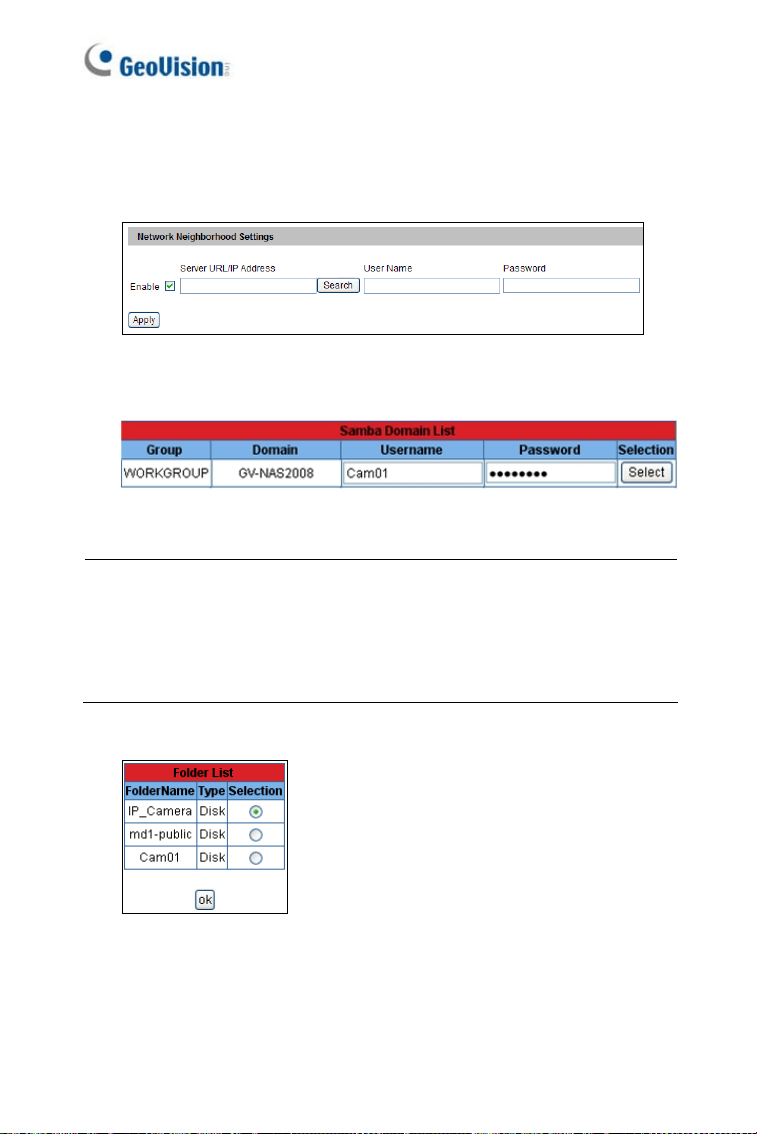
To ct record to GV-NAS Systems, follow the steps below.
1. r Network Neighborhood Settings, select Enable and click the
conne
Unde
Search button to search for available NAS servers.
Figure 4-42
2. Type the username and password, and click Select.
Figure 4-43
S System, up to 16 default
plied on a user basis.
Note: Depending on the models of GV-NA
user accounts (username: Cam01 – Cam16; password: 12345678) are
available. The storage limitation and recycle is ap
It is recommended to use one user account exclusively for recording of
one GV-IP Camera to avoid uneven data recycle.
3. Select a folder to store recordings, and click OK.
Figure 4-44
136
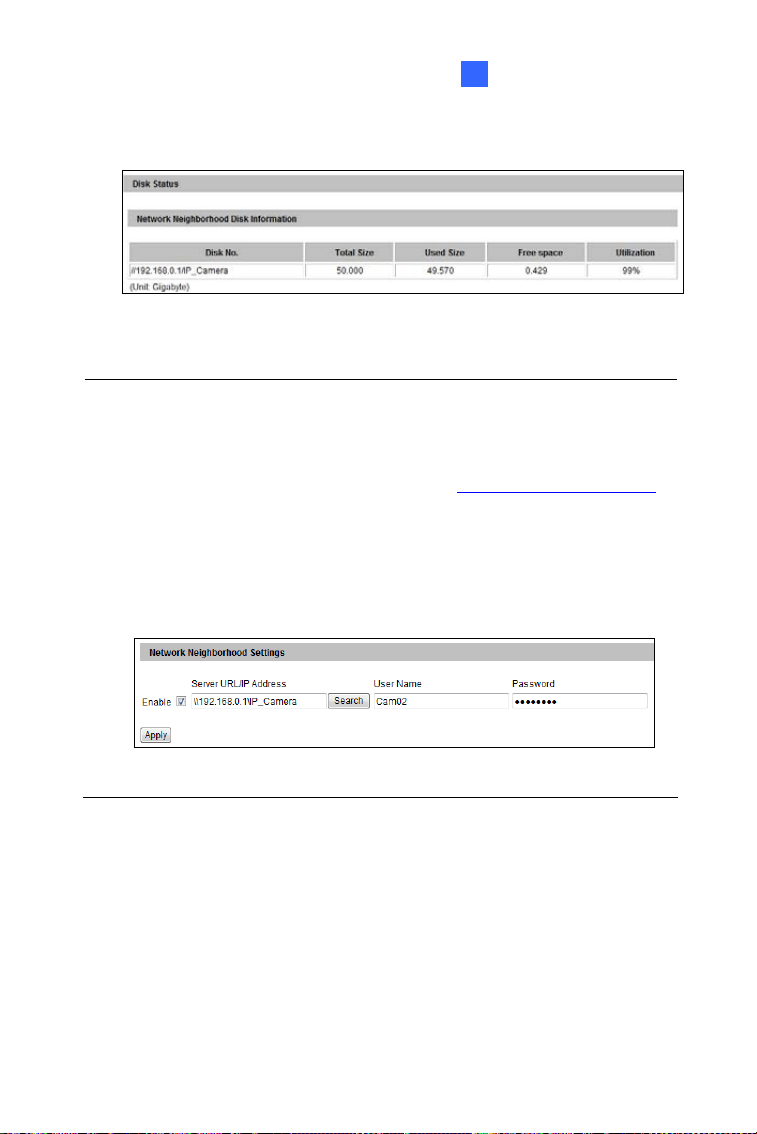
Administrator Mode
4 4
4
. Click Apply. Once connected, the disk status will display.
Figure 4-45
an also type
the storage path directly.
1. Type the Server URL/ IP Address in this format: \\NAS IP
Address\Storage Folder. For example, \\192.168.0.1\IP_Camera
Tip: Instead of searching for available NAS servers, you c
.
This GV-IP Camera wil a default shared folder
named “IP_Camera” in the GV-NAS System.
l be recorded to
2. Type the username and password. For GV-NAS System, you can
type any of default usernames Can01 to Cam16, and password is
12345678.
Figure 4-46
For details on GV-NAS System, refer to GV-NAS System Quick Start
Guide.
137
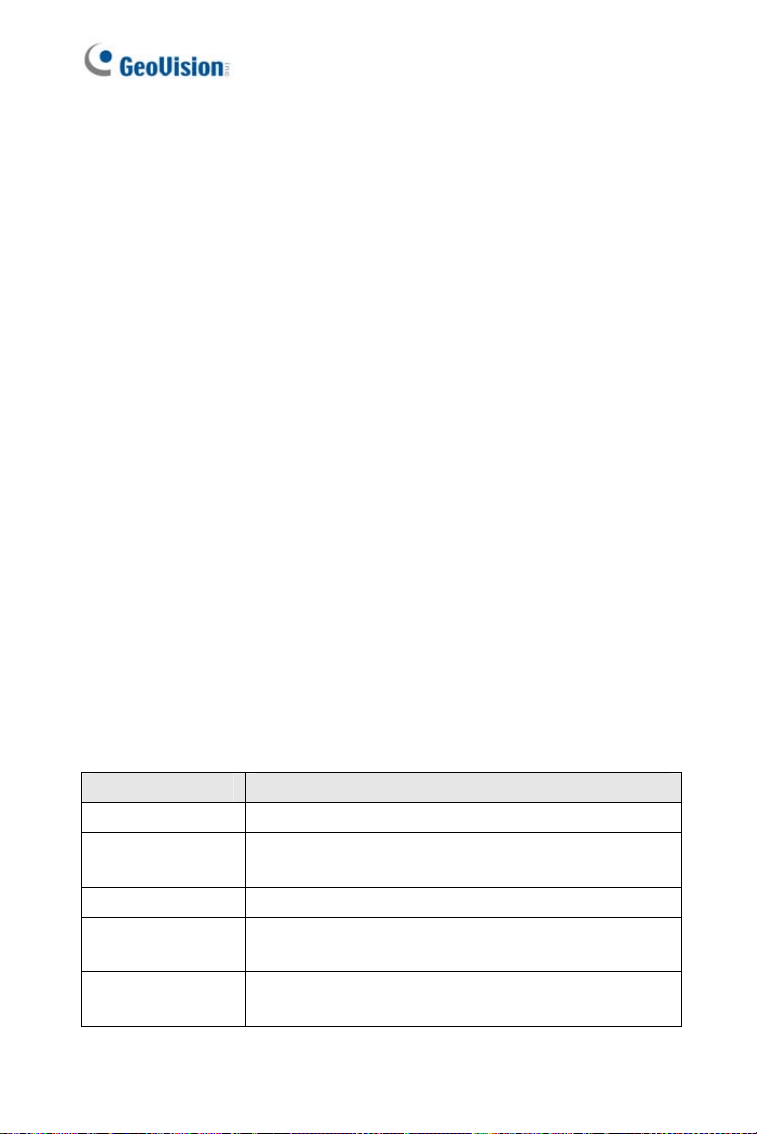
[Disk Information]
Note this function is not supported for Target Series. This section shows
the details of the attached storage device. Use the Format/Remove button
to format or unload a storage device. For detail steps, see Partition
Information below.
[Partition Information]
ote this function is not supported for Target Series. This section shows
the partition details of the attached storage device.
T
The
o
ve button.
2. When you are prompted to ensure the action, click Yes. The page will
be refreshed and the partition information will be cleaned.
3. Remove the storage device from the camera.
The storage device status is indica atus column:
N
o add a storage device:
1.
Insert the storage device to the camera.
2. Click the Format button.
3. After the format is complete, the partition information will display.
maximum space for one partition is 200 GB.
To remove a storage device:
1. Click the Rem
ted in the st
Status Description
Formatting The storage device is being formatted.
Unknown
The camera can not recognize the format of the
storage device or the device can not be found.
OK Storage formatting is successful.
Try Mount
The camera is attempting to connect to the storage
device.
Error File System
There is a recording error in the storage device. All
the recording data is inaccessible under the status.
138
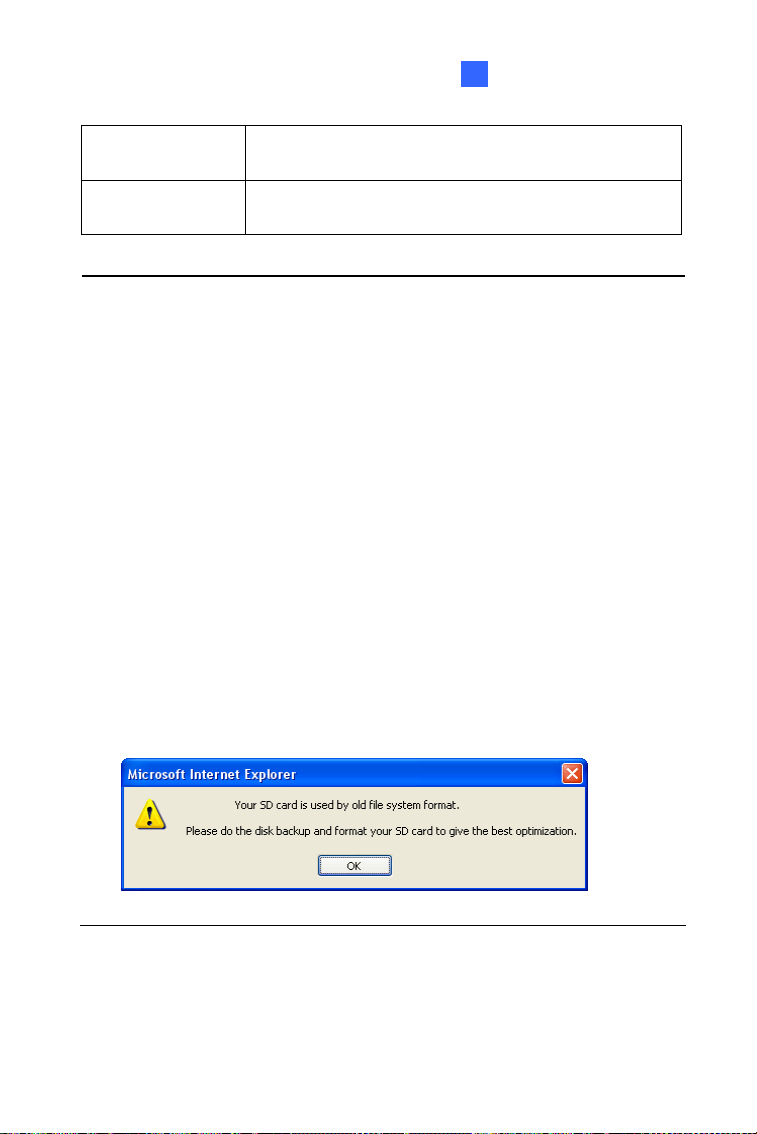
Administrator Mode
4 4
The st
orage device cannot be written due to
Read Only
abnormal power disruption.
Repairing
The system is attempting to repair the recording
data.
Note:
selected, the available space of the storage
f disk is smaller than
x option. Otherwise no video will be recoded.
ove the storage device
e data automatically.
iring the data, the Remove field will display
storage
emory card after the
upgrade. If you have not done so, this warning message appears
interface:
1. If Enable Recycle is
device must be higher than the space you specified at the Stop
recording or recycle disk when free space o
2. The recording data may be lost if you rem
during recording.
3. If you do not remove the storage device properly, the data cannot be
read in another computer. In this case, re-plug the storage device
back to the camera. The system will repair th
When the system is repa
“Repairing”.
4. To upgrade the firmware from versions earlier than V2.07 to the latest
version, be sure to back up the recordings on the camera’s
device before the upgrade, and re-format the m
when you view the Monitoring or Storage Settings’ Web
Figure 4-47
139
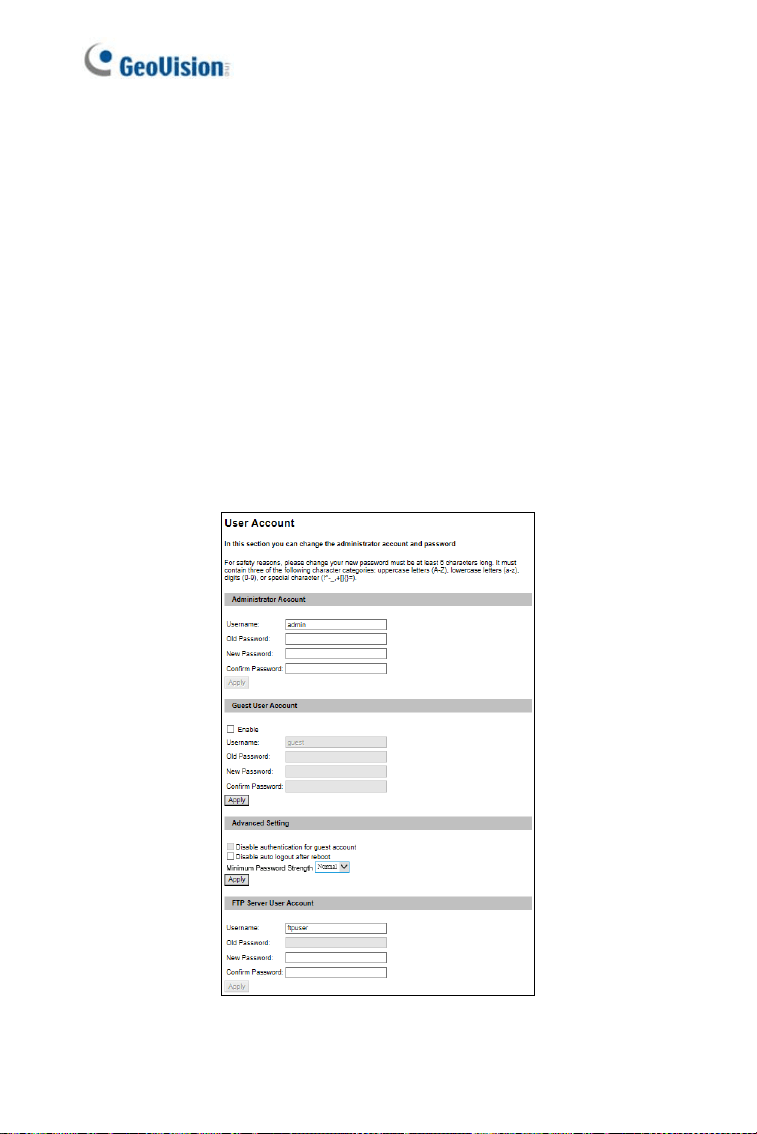
4 Acco
You can change the logi t.
T dministr t
t login name and pa ord are guest; the default FTP Server login
ame is ftpuser and the password is 123456. To allow a Guest user log in
w tering name and password, select Disable authentication for
t
.8.3 User unt
n name and password of Administrator and Gues
ator login name and password are admin; the defaul
ssw
he default A
Gues
n
ithout en
guest account. To prevent automatic logout of an Administrator / Gues
account user after reboot, select Disable auto logout when reboot.
For GV-IPCAM H.265 firmware V1.14 or later, the default Administrator
account is no longer supported. To adjust the minimum strength
requirement for login password, select Normal or Great from Minimum
Password Strength.
Figure 4-48
140
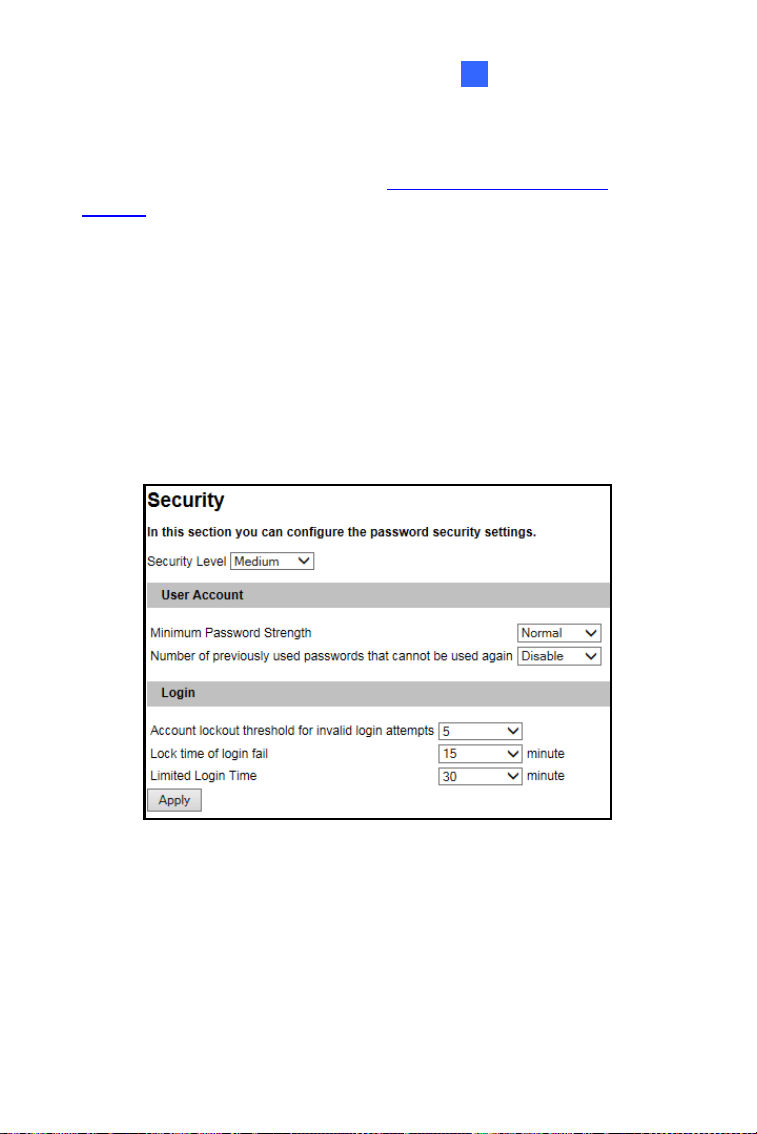
Administrator Mode
4 4
4.8.4 Security
Note this function is only supported by cameras with face detection
features.
You can change the password security settings with 3 levels: Low, Medium
(default value) and High. Each level differs from one another in the
password strength required to log into the Web interface.
To customize the password security level based on your specified
requirements, select one Security Level and configure the releva
account and logon settings.
nt user
Figure 4-49
141
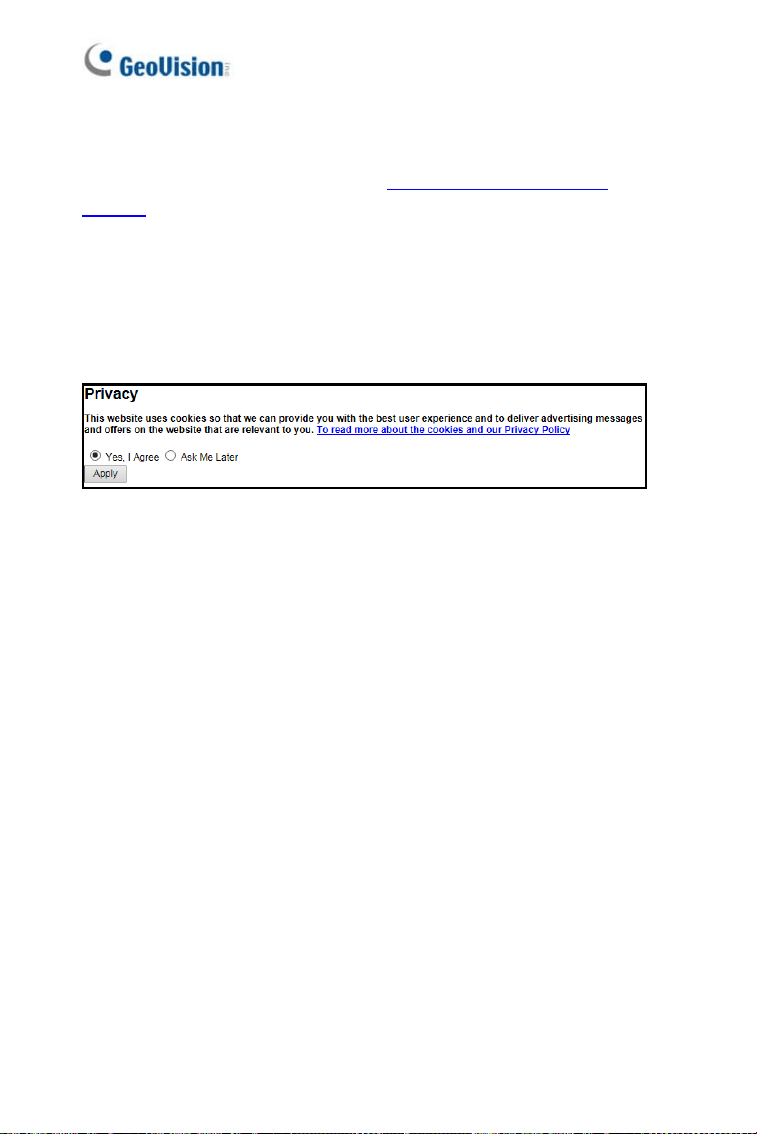
4.8.5 Privacy
Note this function is only supported by cameras with face detection
features.
In order to provide you with the best user experience and deliver
appropriate advertising messages and website content, GV-IP Came
Web interface uses cookies. Select to agree with our priva
ra’s
cy policy or
elay in accepting our privacy policies. d
Figure 4-50
4.8.6 Log Information
The log information contains dump data that is used by service personnel
for analyzing problems. The logs available may vary depending on the
camera model.
142
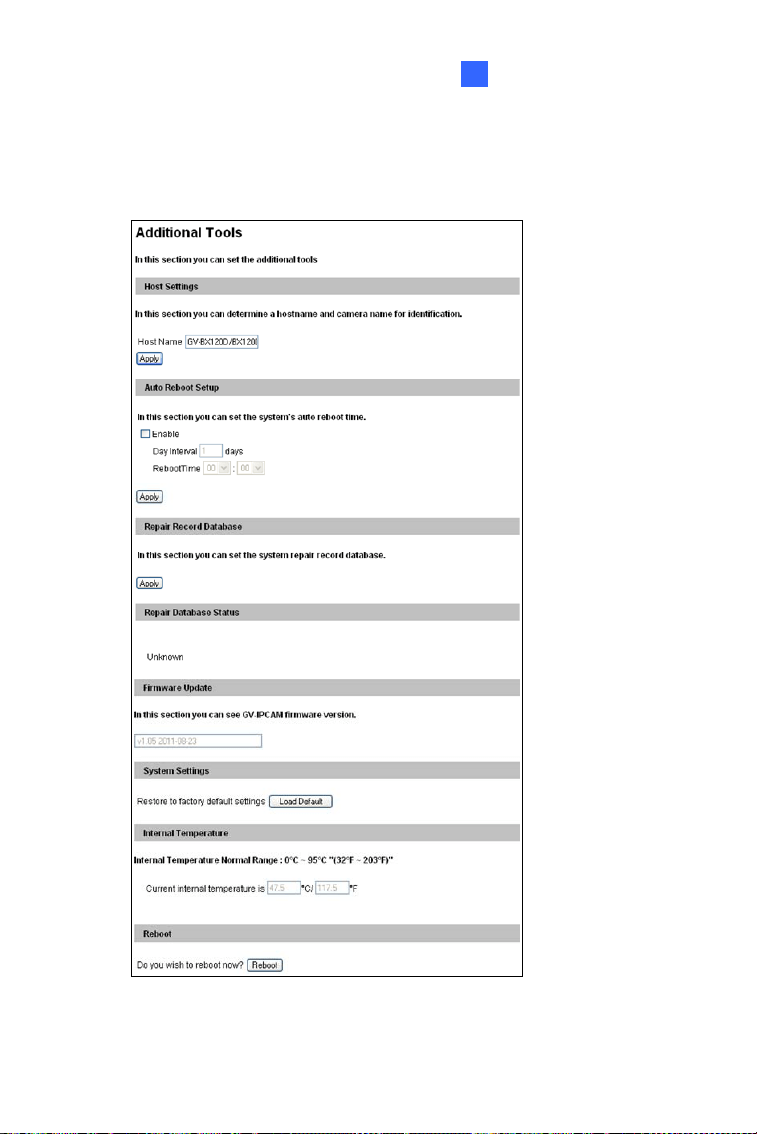
Administrator Mode
4 4
4.8.7 Tools
You can execute certain system operations and view the firmware version.
Figure 4-51
143

[Host Settings] E
nter a descriptive name for the camera.
specify the time for reboot in the sub fields.
Day Interval: Type the day interval between each reboot.
Reboot Time: Use the drop-down lists to specify the time for
automatic reboot.
[Repair Record Database] Note this function is not available for Target
Series. Click Apply to repair the database when errors occur while playing
back the recordings with the Remote ViewLog player. Problems can occur
when there are errors in firmware or damages to the micro SD card.
[Database Status] Note this function is not available for Target Series.
Displays the repairing status of database.
[Firmware Update] This field displays the firmware version of the camera.
[System Settings]
Load Default: Clicking the Load Default button to restore factory
default settings. After applying the default settings configure the
camera’s network setting again.
Load Default Without Network: Clicking the Load Default without
Network button to restore factory default settings without changing
the camera’s network settings.
[Temperature Status] Note this function is not available for Target Series
(except for GV-EFD2101/3101/5101, GV-EVD2100/3100/5100 and GV-
EBL5101), Cube Camera and Advanced Cube Camera. Displays the
current chipset temperature inside the camera.
[Reboot] Clicking the n will make the cam a perform
software reset.
[
Auto Reboot Setup] Select Enable to activate automatic reboot and
R
eboot butto er
144
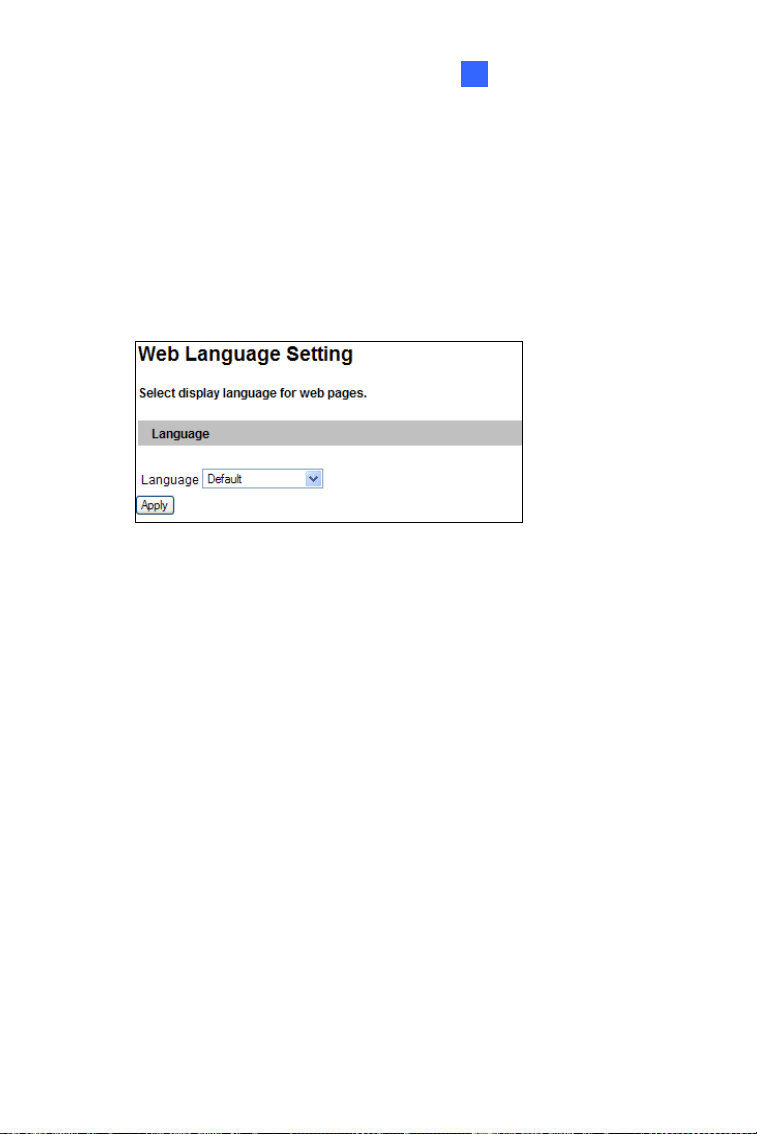
Administrator Mode
145
4 4
or the
4.8.8 Language
Note this function is not available in GV-PTZ010D.
You can select the language for the Web interface. By default, the
language on the Web interface will be the same with the one used f
operating system.
Figure 4-52

Chapter 5 Recording and Playback
ote that Recording and Playback function is not available for Target
orded files on the GV-DVR / NVR / VMS over the
TCP/IP network.
Note: See Note for Recording at the beginning of the manual.
N
Series.
The camera can record video and audio directly to the memory card. You
can play back the rec
5.1 Recording
To enable the recordin
. Insert the memory card to the camera. See “To add a memory card”,
4.8.2 Storage Settings.
2. If you like to set up the pre-recording, post-recording or audio
recording, see 4.1.1 Video Settings.
3. If you like to set up the schedule for video recording or I/O monitoring,
see 4.5 Recording Schedule.
4. If you like to configure the areas and sensitivity values for motion
detection, see 4.1.2 Motion Detection.
5. If you want the recording to be triggered by input device, configure the
operation of input device. See 4.2.1 Input Settings.
6. To start recording and I/O monitoring, see 4.4 Monitoring.
The camera will start recording in case of motion detection, I/O trigger, or
during the scheduled time.
g function:
1
146

Recording and Playback
5
5.2 Playback
These methods are available to play back the video files recorded at the
camera:
Playback from the memory card by connecting it directly to the
GV-DVR / NVR / VMS through a card reader
sing the recorded files downloaded from built-in FTP
Se
rver
5.2.1
s recorded at the GV-IP Camera by connecting
VR / NVR / VMS through a card reader. However,
corded in the Linux format and GV-DVR
install and execute the Ext2Fsd program.
orks on Windows 2000, XP, 2003,
nder term/condition of The
Playback by using the Remote ViewLog function over the TCP/IP
network
Playback by u
Playback from the Memory Card
You can play back the file
the memory card to GV-D
the videos on GV-IP devices are re
/ NVR / VMS runs on a Windows-based computer. For Linux files to be
readable and accessible on Windows, we use the Ext2Fsd program. Follow
the steps below to download,
IMPORTANT:
1. The Ext2Fsd program only w
vista, 7, 8 and Server 2012 (32-bit and 64-bit).
2. The Ext2Fsd program is subject and u
GNU General Public License version 2 (GPLv2). Please read
http://www.gnu.org/licenses/gpl-2.0.html
before installation.
147
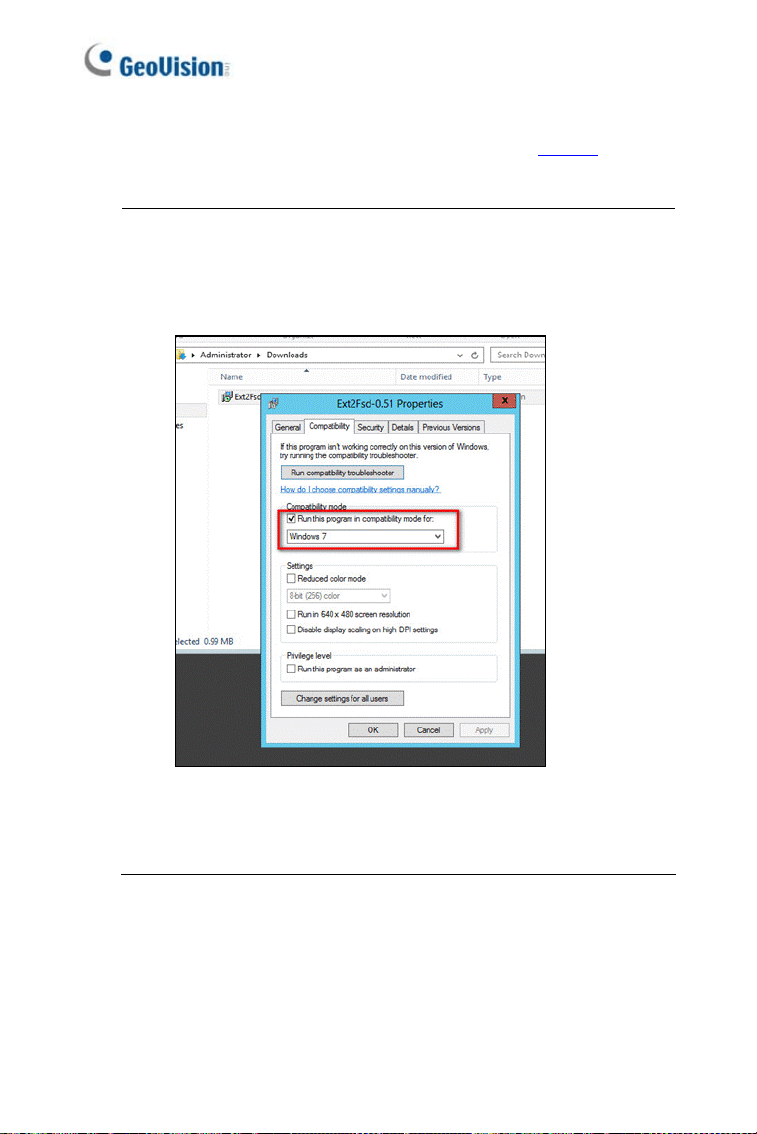
1. Download and install the Ext2Fsd from the company website.
Note: If you are using Windows 8 or Windows Server 2012,
change its compatibility before installing the Ext2Fsd program:
A. Right-click the Ext2Fsd program and select Properties. This
dialog box appears.
Figure 5-1
B. Select the Compatibility tab.
C. Select Windows 7 using the drop-down list.
148
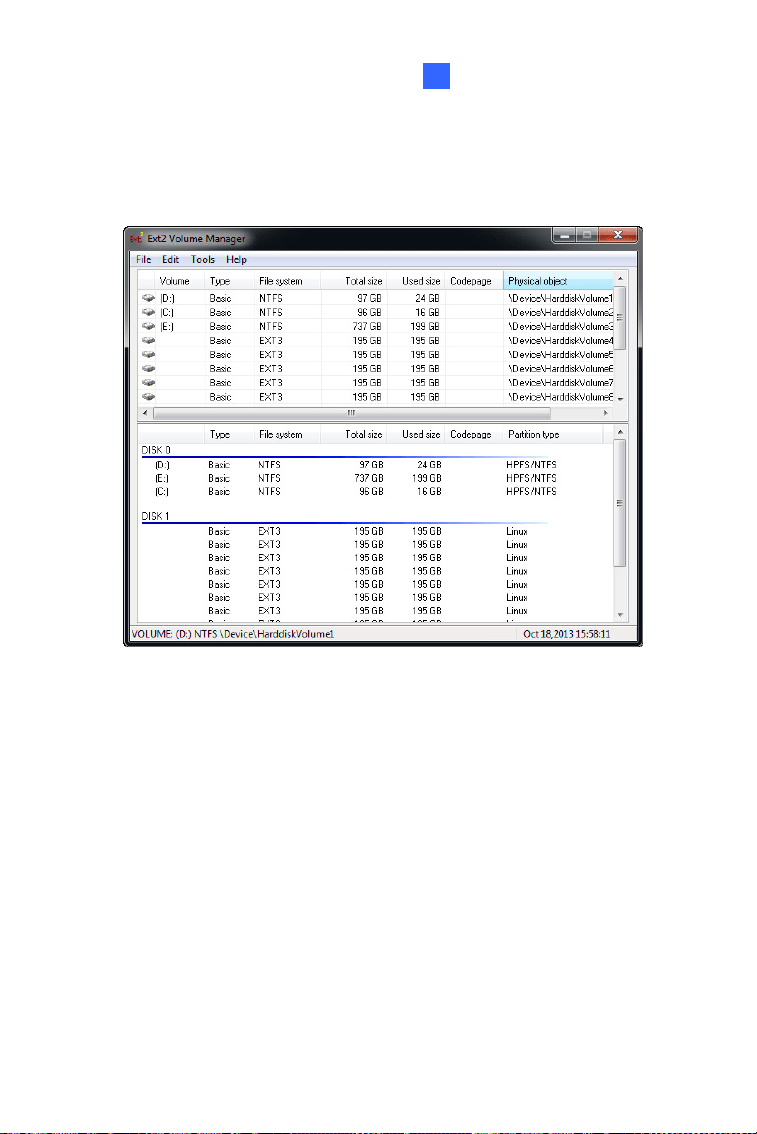
Recording and Playback
5
2.
On Your desktop, click Start, select Programs, locate the Ext2Fsd
folder and select Ext2 Volume Manager. All the connected drives are
shown.
Figure 5-2
149
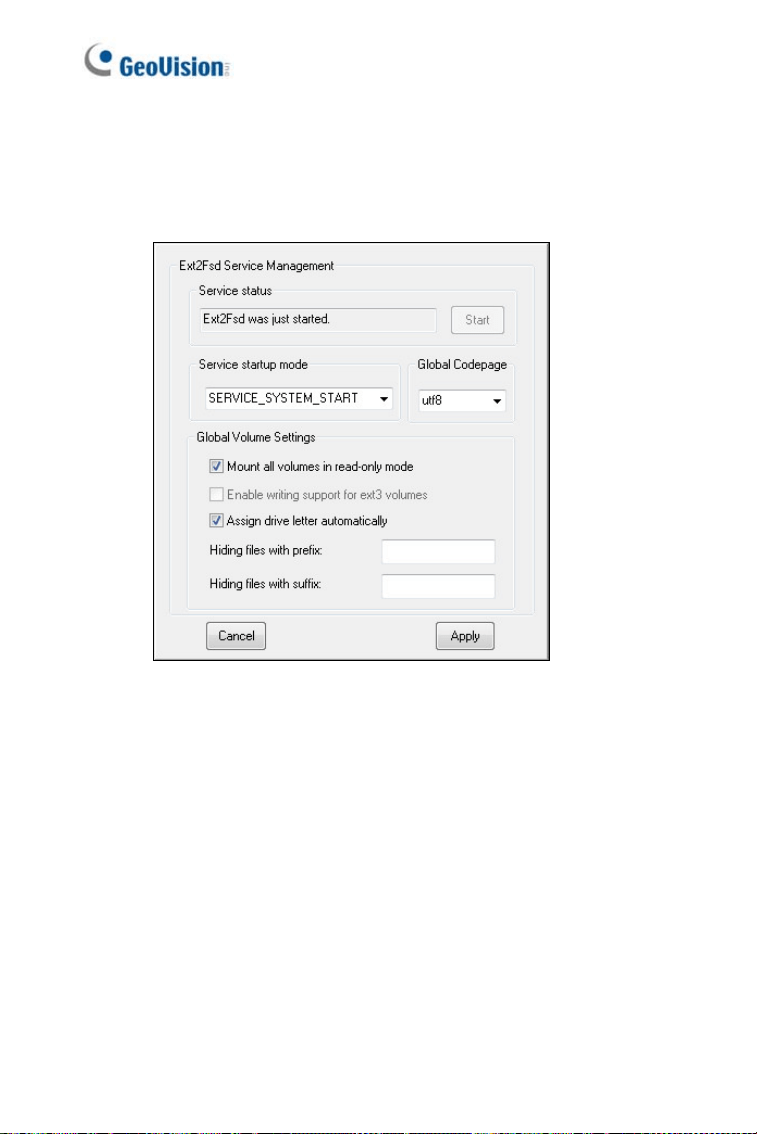
3. For the first-installation, execute the Ext2Fsd Service.
A. From the Ext2 Volume Manager window, select Tools and select
Service Management. This dialog box appears.
Figure 5-3
B. Click Apply.
150
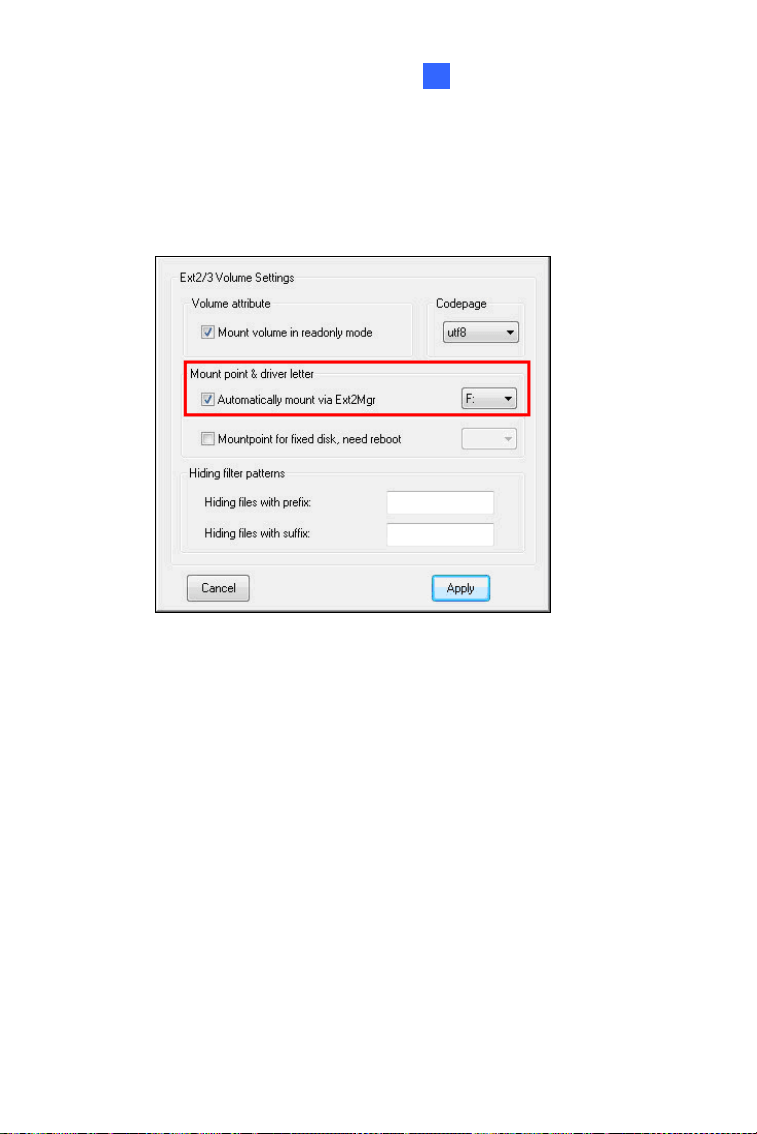
Recording and Playback
5
4.
Mount the storage drive to your computer.
A. From the Ext2Fsd Volume Manager window, right-click the
storage drive and select Ext2 Management. This dialog box
appears.
Figure 5-4
B. Under the Mount point & driver letter section, select
Automatically m t2Mgr, specify a disk drive using the
and click Apply.
ount via Ex
drop-down list
151
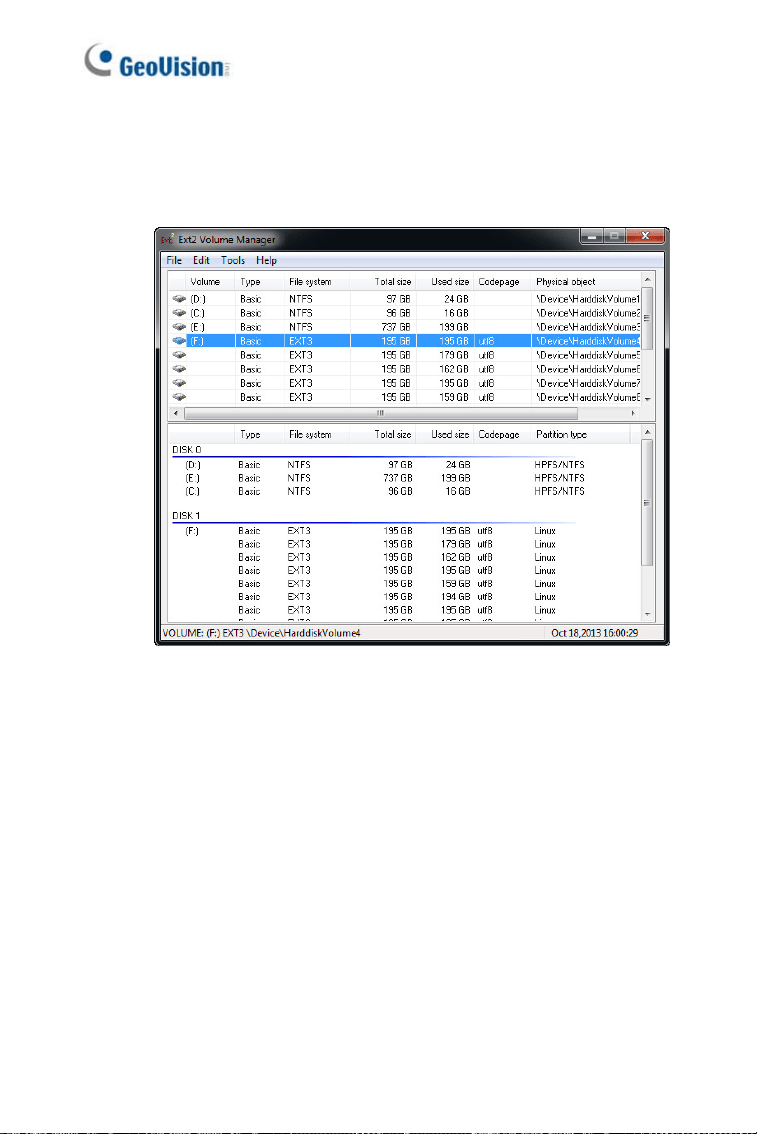
C. On the Ext2 Volume Manager window, the storage drive is
ith successfully mounted to your computer when it is indicated w
the disk drive you specified.
Figure 5-5
5. Access the recording files from the specified drive of your computer.
152
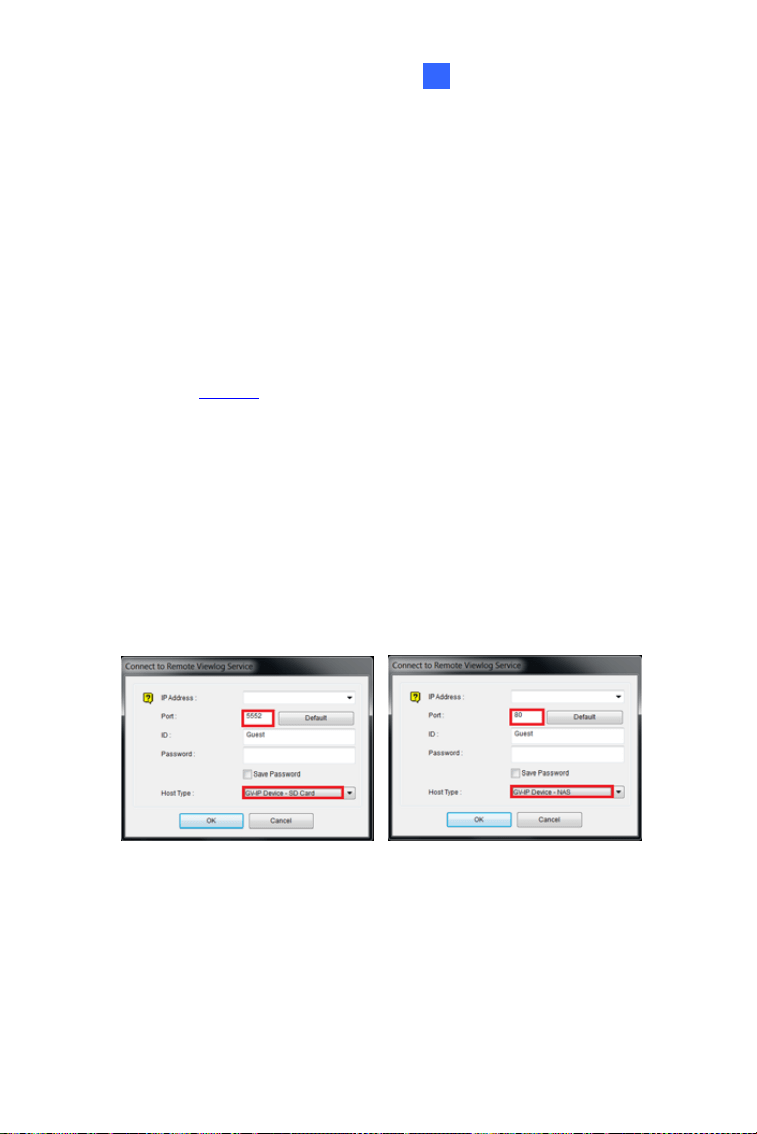
Recording and Playback
5
5.2.2 Playback over Network
With the Remote ViewLog function, you can play back the files recorded at
the camera over TCP/IP network. You
can also play back the files recorded
at the camera over GV-NAS System.
1. The camera needs to allow the remote access with ViewLog Server
activated. See 4.3.7 ViewLog Server.
2. For the first-time user, install the Remote ViewLog program from the
company website
. Next time whenever you like to use this remote
playback function, access this option from the camera’s Web interface.
3. When the Remote ViewLog player is enabled, you will be prompted to
select Remote ViewLog Service or Remote Storage System. Select
Remote ViewLog Service.
4. When this dialog box appears, type the camera’s IP address, login ID
and password. In the Host Type field, select GV-IP Device-SD Card.
and the default port is 5552. To retrieve recordings from GV-NAS
System, select GV-IP Device-NAS and the default http port is 80.
Figure 5-6
4. Click Connect to access the files of the camera for playback.
153

5.2.3 Access to the Recorded Files through FTP Server
oad files, see [Act as FTP Server],
.3.2 FTP.
The built-in FTP Server allows you to download the recorded files saved on
the memory card. You can play back the downloaded files of AVI format
with Media Player. For details to downl
4
Note: To play back videos, ensure you have installed Geovision codec
on the computer. The codec is available on the company
website. If you
have installed the Remote Playback player on the computer, it is not
required to install the codec.
154

Recording and Playback
5
5.2.4 Playback of Daylight Saving Time Events
On GV-DVR / NVR, you can retrieve the events recorded during the
Daylight Saving Time (DST) period from the camera for playback. You ca
also connect the memory card to GV-DVR / NVR for playback.
n
he following instructions describe how to retrieve the recorded files from
t
fir
lo ay
b
1. The camera must allow the remote access with ViewLog Server
activated. See 5.3.7 ViewLog Server.
2. To remotely connect to the camera from GV-DVR / NVR, click the
Tools button and select Remote ViewLog Service. The Connect to
Remote ViewLog Service dialog box appears.
3. Enter the connection information of the camera, and click Connect.
Once the connection is established, the video events will be displayed
on the Video Event list.
4. On the Date Tree, select the date of Daylight Saving Time. A separate
DST subfolder will be displayed as illustrated below.
T
he camera over network. If you like to use the memory card for playback,
st follow the instructions in 5.2.1 Playback Using the Memory Card to
ad the recorded files to ViewLog, and then follow Steps 4-5 below to pl
ack DST events.
Figure 5-7
155
156
Play
button to start.
1. The playback function is only compatible with the GV-DVR / NVR
81022xxxxxxxxx.avi.
5. On the Video Event list, select desired events, and click the
Note:
of version 8.3 and later.
2. The AVI file recorded during the DST period is named with the
prefix “GvDST”, e.g. GvDST20081022xxxxxxxxx.avi, to
differentiate from the regular AVI file named with the prefix “Event”,
e.g. Event200

Advanced Applications
6
Chapter 6 Advanced Applications
This chapter introduces more advanced applications.
ply
rface or
6.1 Upgrading System Firmware
GeoVision periodically releases updated firmware on the website. Sim
download the new firmware into the camera using the Web inte
GV-IP Device Utility available on the company website
.
Important Notes before You Start
Before you start updating the firmware, please read these important notes:
1. If you use the IP Device Utility for firmware upgrade, the computer
used to upgrade firmware must be under the same network as the
camera.
2. Stop monitoring of the camera.
3. Stop all the remote connections, such as GV-VMS.
4. While the firmware is being updated,
A) the power supply must not be interrupted, and
B) do not unplug the Ethernet cable if the cable is the source of
power supply (Power over Ethernet or PoE supported).
WARNING: The interruption of power supply during updating causes not
only update failures but also damages to the camera. In this case,
please contact our sales representatives and send your device back to
GeoVision for repair.
157
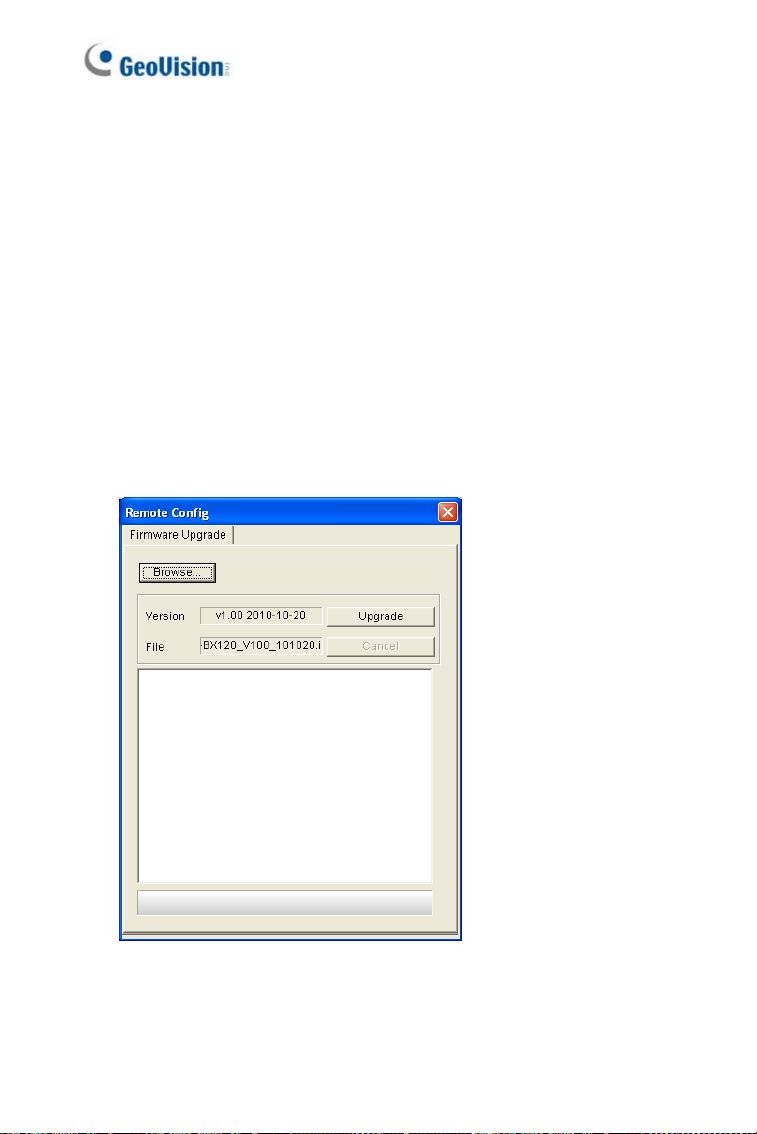
5. Do not turn the power off within 10 minutes after the firmware is
updated.
If firmware upgrade fails, manually restore the camera to its default settings.
or details, see Loading Factory Default in the corresponding Hardware
e
Show System Menu button (No. 9,
F
M
anual.
6.1.1 Using the Web Configuration Interfac
1. In the Live View window, click the
Figure 3-3) and select Remote Config. This dialog box appears.
Figure 6-1
158
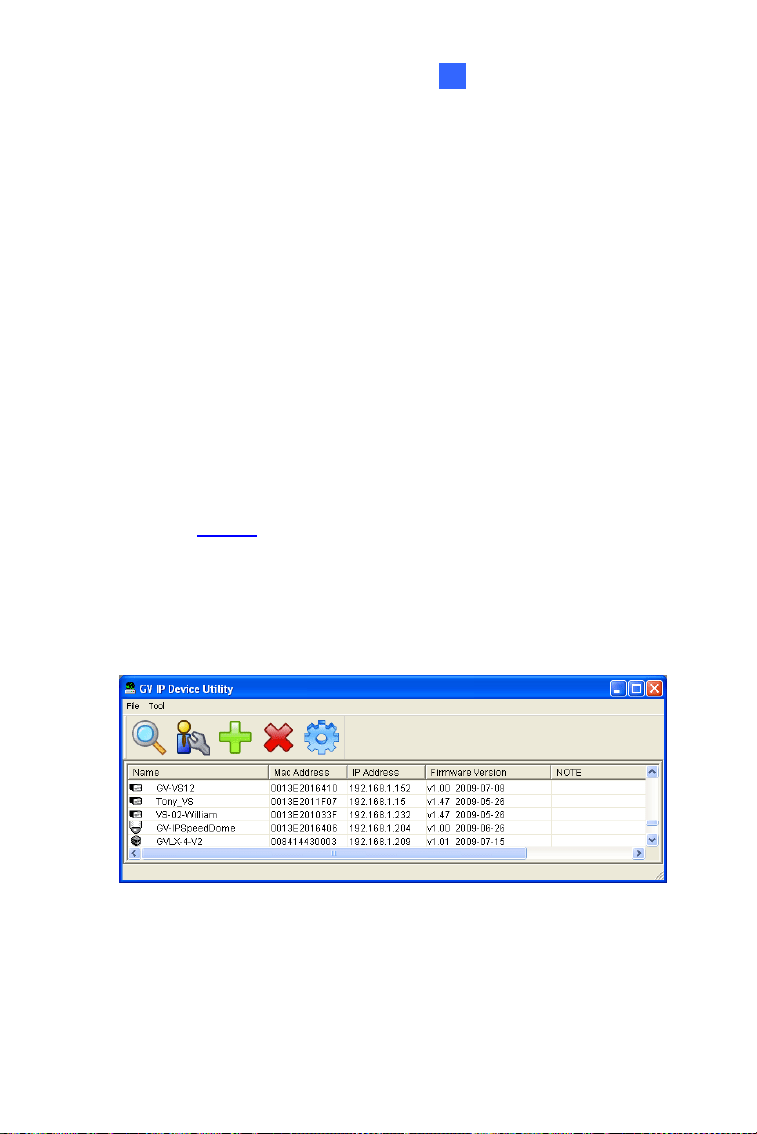
Advanced Applications
6
2
. Click the Browse button to locate the firmware file (.img) saved a
your local
t
computer.
. Click the Upgrade button to start the upgrade.
Using the IP Device Utility
ware to
pgrade
1. Download and install the GV-IP Device Utility program from the
company website
3
6.1.2
The I
P Device Utility provides a direct way to upgrade the firm
multiple units of the GV-IPCAM. Note the computer used to u
firmware must be under the same network as the camera.
.
2. Double-click the IP Device Utility icon created on your desktop. This
dialog box appears and lists the IP devices detected on the same LAN.
You can click the titles of Mac Address and IP Address to sort the
devices in the list.
Figure 6-2
159
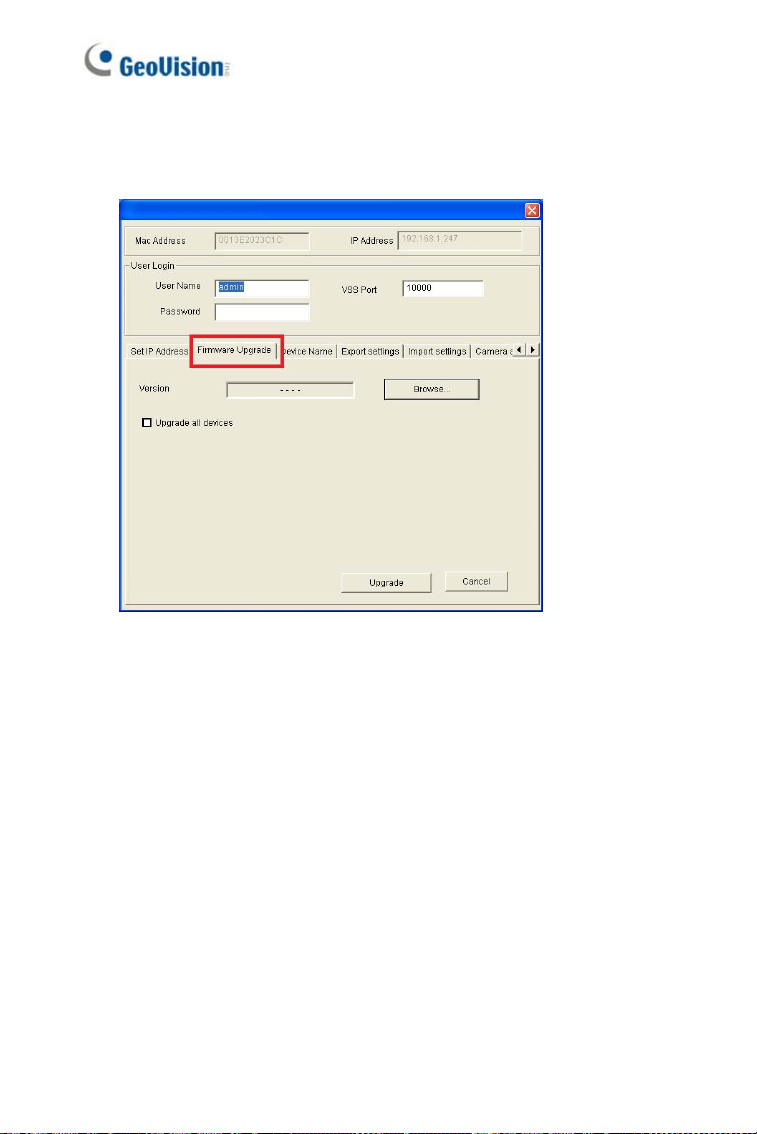
3. Double-click one camera in the list, and click the Firmware Upgrad
tab on the pop-up dial
e
og box.
Figure 6-3
4. Click the Browse button to locate the firmware file (.img) saved at
your local computer.
5. If you like to upgrade all the cameras in the list, select Upgrade all
devices.
6. Type Password, and click Upgrade to start the upgrade.
160
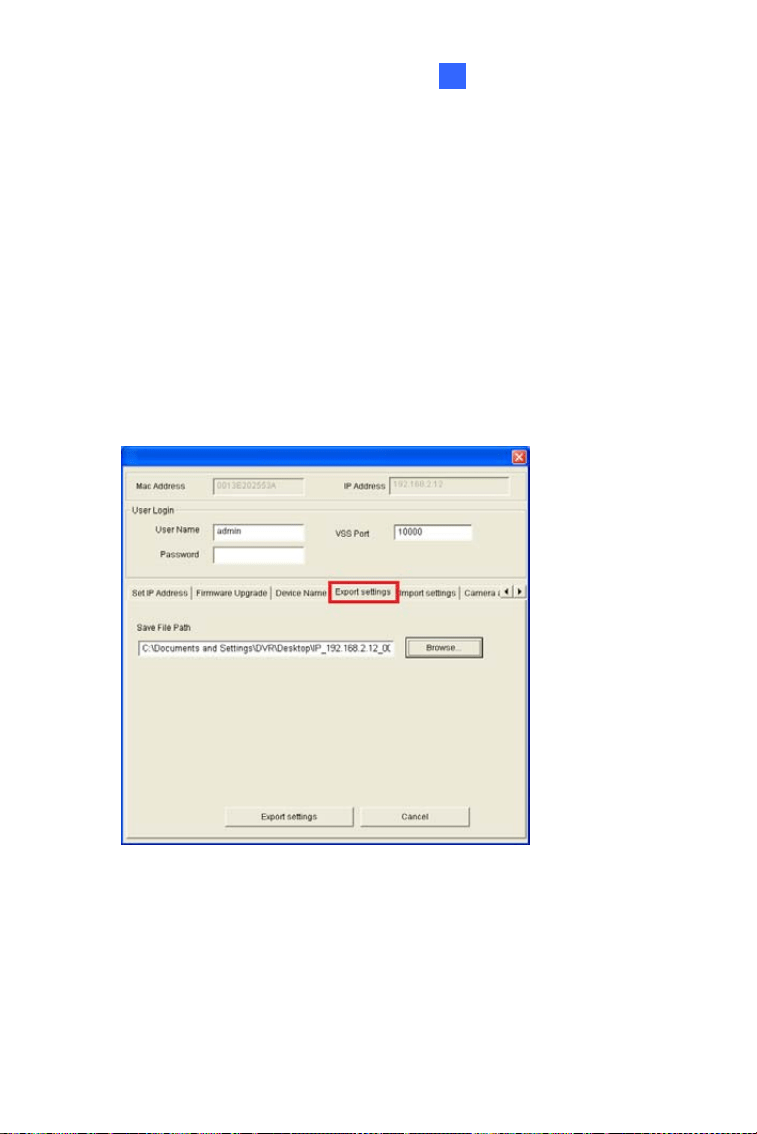
Advanced Applications
6
6.2 Backing Up and Restoring Settings
With the IP Device Utility, you can back up the configurations in the camera,
and restore the backup data to the current camera or import it to another
camera.
To back up the settings:
1. Run IP Device Utility and locate the desired camera. See Steps 1-2
in 6.1.2 Using the IP Device Utility.
2. Double-click the camera in the list, and click the Export Setting
button on the pop-up dialog box.
Figure 6-4
3. Click the Browse button to assign a file path.
4. Type Password, and click the Export settings button to save the
backup file.
161
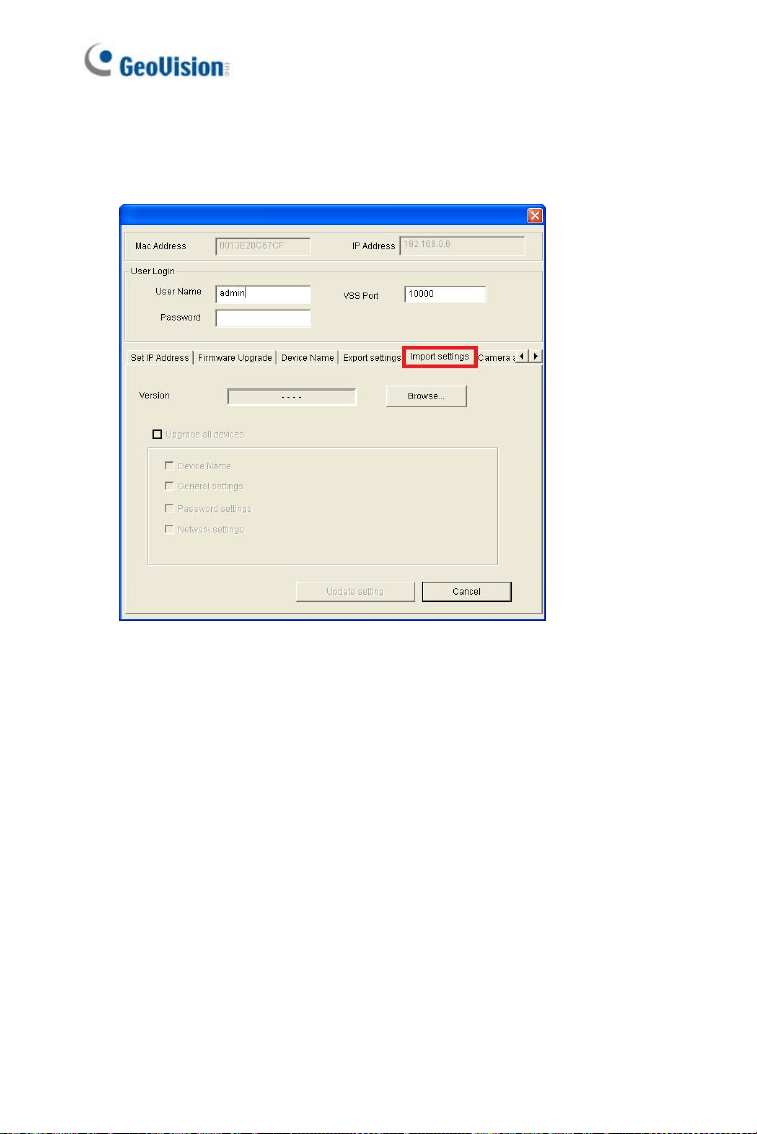
To restore the settings:
1. In Figure 6-4, click the Import Settings tab. This dialog box appears.
Figure 6-5
2. Click the Browse button to locate the backup file (.dat).
3. Select Upgrade all devices to import the settings into devices of the
same type in the same LAN.
4. To import device name, password settings and/or network settings,
select Device Name, Password settings and/or Network settings.
5. Type Password and click the Update settings butt to start
restoring.
on
162
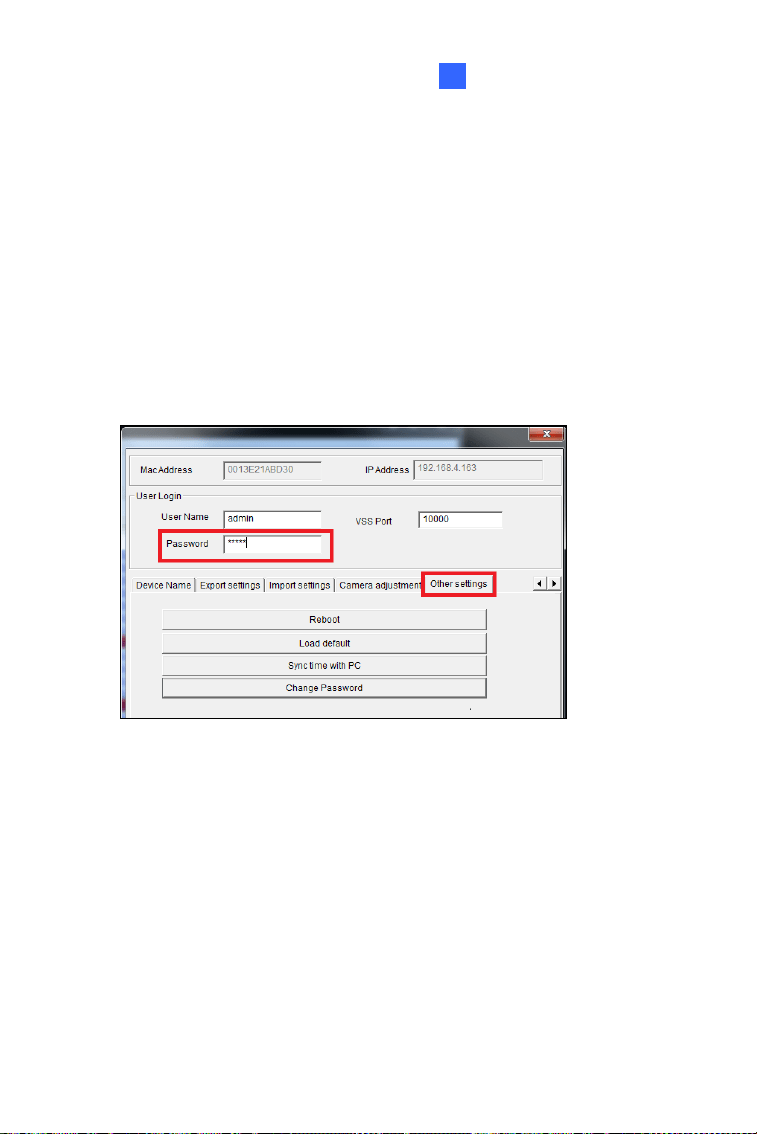
Advanced Applications
6
6.3 Changing Password
D
evice Utility.
1. Run IP Device Utility and locate the desired camera. See Steps 1-2
in 6.1.2 Using the IP Device Utility.
2. Double-click the camera in the list, select the Other Settings tab on
the pop-up window and type Password of the camera under User
Login.
You can change the login password of your GV-IP Camera using GV-IP
Figure 6-6
3. Select Change Password to set up a new password.
4. To change devices of the same type to the same password, sel
Sync all d
ect
evices.
5. Click OK to apply the change.
163

6.4 Verifying Watermark
The watermark is an encrypted and digital signature embedded in the
video stream during the compression stage, protecting the video from the
oment of creation. Watermarking ensures that an image is not edited or
e
f the recording before you present it in court.
6.4.1 Accessing AVI Files
To verify watermark, first you have to access the recorded AVI files by one
of these methods:
1. Use the File Save function (No.6, Figure 3-3) to start recording on the
local computer.
2. Use the Act as FTP Server function to download AVI files from the
camera. See 4.3.2 FTP.
3. Use the files recorded on the memory card. Since the files saved on
the memory card are of Linux file system, remember to run Ext2Fsd
program for Windows-based system to read and access Linux-based
files. For the instruct 1 Playback from the Memory Card.
m
dam
aged after it is recorded. To enable the watermark function, see
[Watermark Setting], 4.1.1 Video Settings.
The Watermark Proof is a watermark-checking program. It can verify th
authenticity o
ions, see 5.2.
164

Advanced Applications
6
6.4.2 Running Watermark Proof
n, a
.
ng
sted on the window.
Alternatively, you can drag the recording directly from the storage
r in the Pass
column. On the contrary, if the recording is modified or does not
ng, a check mark would appear in the
cording, double-click the listed file on
1. Install Watermark Proof from GeoVision Website. After installatio
WMProof icon is created on your desktop.
2. Double-click the created icon. The Water Mark Proof window appears
3. Click File from the menu bar, select Open and locate the recordi
(.avi). The selected recording is then li
folder to the window.
4. If the recording is unmodified, a check mark will appea
contain watermark during recordi
Failed column. To review the re
the window.
165
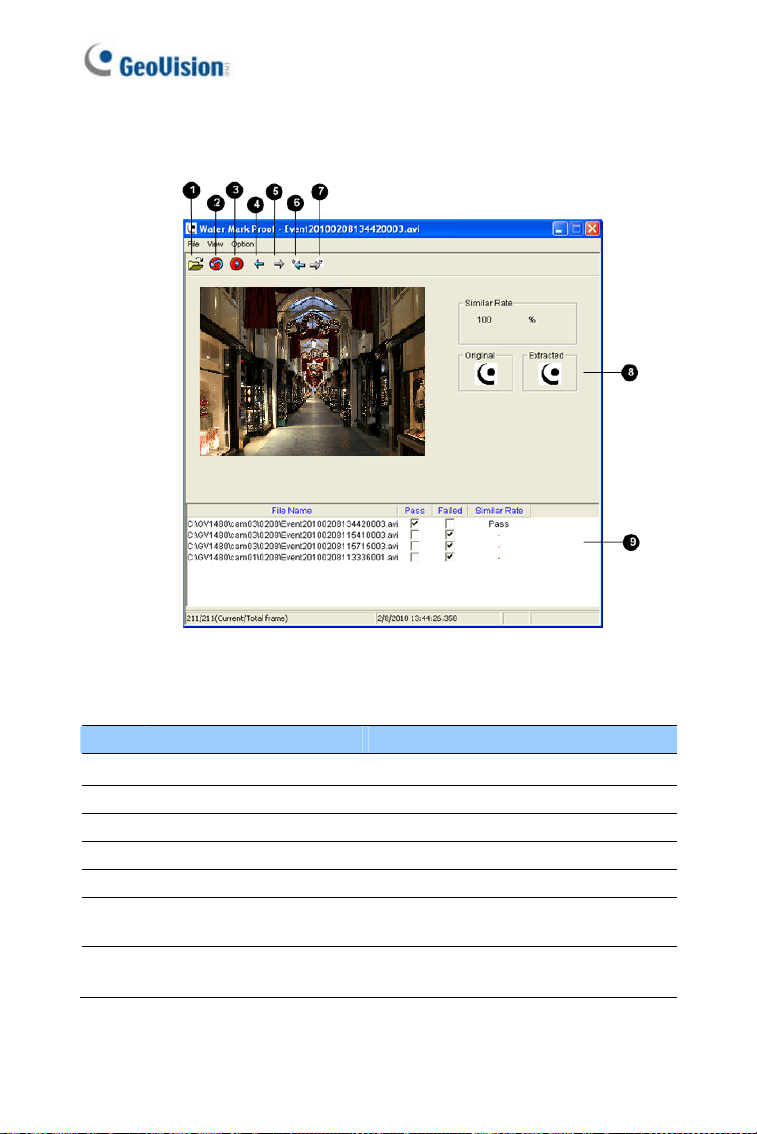
6.4.3 The Watermark Proof Window
Figure 6-7
The controls in the window:
No. Name Description
1 Open File Opens the recording.
2 First Frame Goes to the first frame of the file.
3 Play Plays the file.
4 Previous Frame Goes to the previous frame of the file.
5 Next Frame Goes to the next frame of the file.
6
Previous Watermarked
Frame
Goes to the previous frame that
contains watermark.
7 Next Watermarked Frame
Goes
to the next frame that contains
watermark.
166

Advanced Applications
6
No. Name Description
8 Original vs. Extracted
The Extracted icon should be identical
with the Original icon. If not, it
indicates the recording has been
tampered.
9 File List Displays the proof results.
167
6.5 Downloading Videos from the Micro SD
d
When connect mer are lost,
ordin ved t
GV-IP Cameras. To automatically s nd download recordings
m th cards to a local fo
V-SDCardSync Utility program.
Note:
1. GV-SDSyncCard Utility is only supported in GV-DVR / NVR
V8.5.4 or later, GV-VMS V14.10 or later and in GV-IPCam H.264
V1.11 or later.
2. Target Series do not support Micro SD Card.
Car
ions of GV-IP Ca
gs are automatically sa
as to the GV-DVR / NVR / VMS
o the memory cards inserted in the
ynchronize a
rec
fro e micro SD lder, install and execute the
G
168
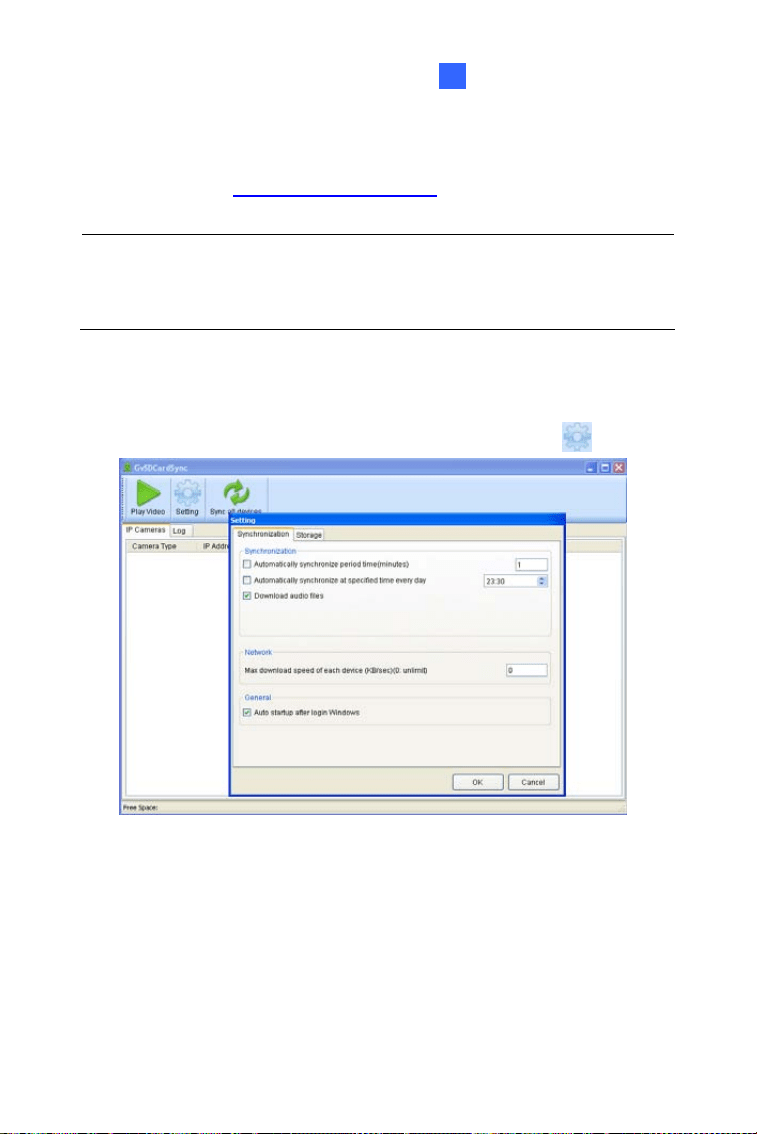
Advanced Applications
6
6.5.1 Installing the GV-SDCardSync Utility
1. Download the GV-SD Card Sync Utility program.
Note: The GV-SD Card Sync Utility must be installed on the computer
installed with GV-DVR / NVR V8.5.4, GV-VMS V14.10 or later software
versions.
2. Execute the GV-SDCard Sync Utility program. The main window and
etting window appear. The Setting window pops up automatically the S
upon first execution. Otherwise, click the Setting button
.
Figure 6-8
169
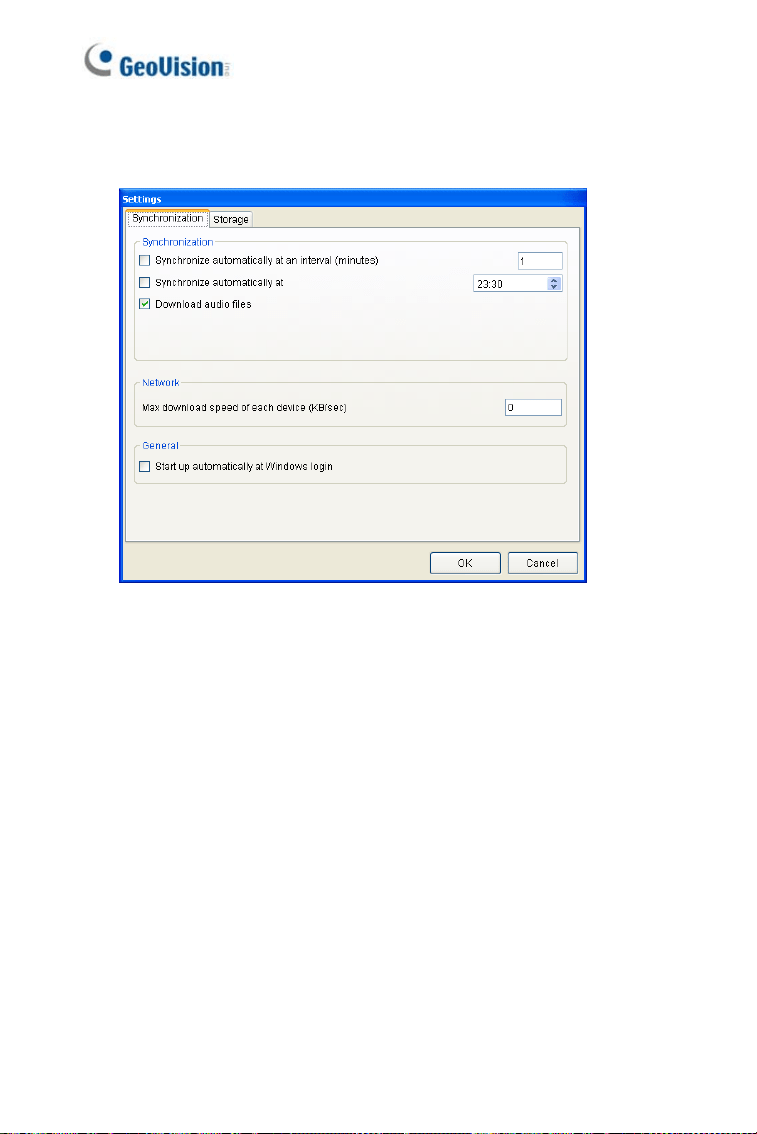
3. To configure synchronization, network and startup settings, see the
steps below.
Figure 6-9
[Synchronization]
Synchronize automatically at an interval: Automatically
synchronize videos from micro SD cards to a local folder at the
specified interval.
Synchronize automatically at: Automatically synchronize videos
from micro SD cards to a local folder at the specified time.
Download Audio Fil hoose to download audio files
along with the video files. This option is enabled by default.
es: You may c
170
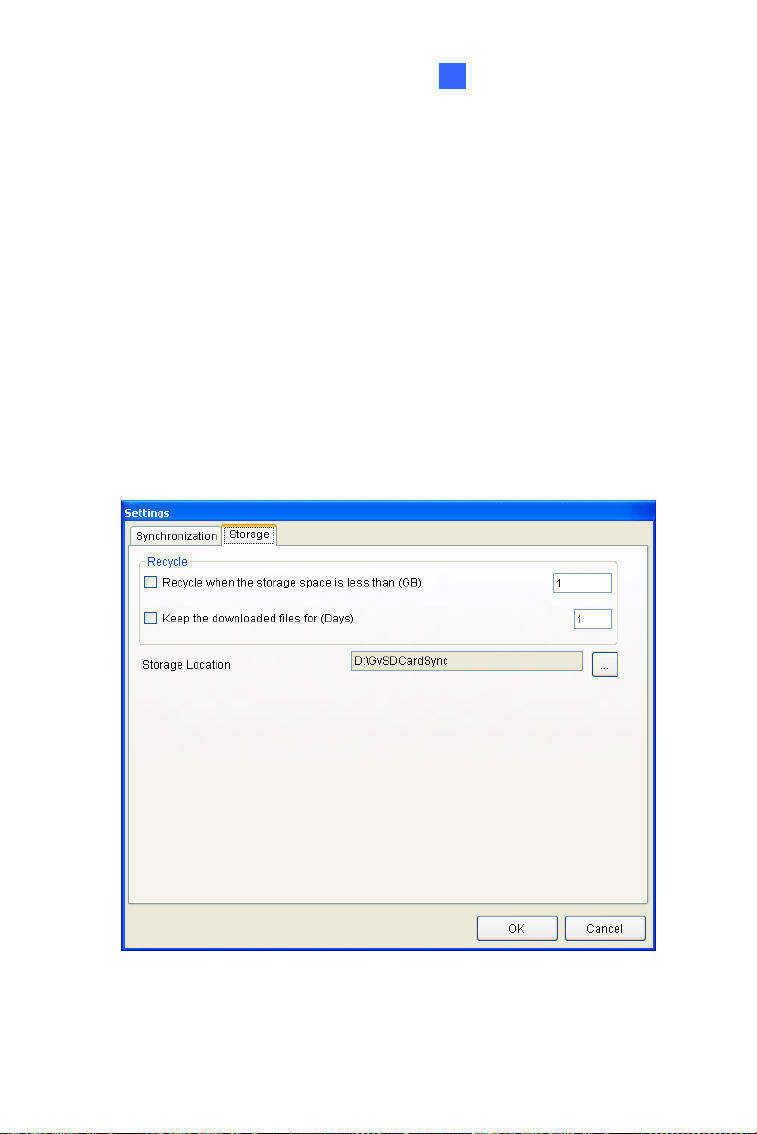
Advanced Applications
6
[Netw
ork]
Max. download speed of each device (Kb/sec): To make sure
the bandwidth is not completely taken up while downloading files
from the memory card, specify a maximum download speed. If you
do not want to set a bandwidth limit, type 0.
[General]
Start up automatically at Windows login: GV-SDSync Utility
launches automatically when Windows starts up.
4. By default, downloads are saved to :\GvSDCardSync and are not
recycled automatically. To configure the storage and recycling settings,
select the Storage tab on the Setting window. This page appears.
Figure 6-10
171

[Recycle]
Recycle when the storage space is less than (GB): Specify a
minimum free space of your local storage for file recycling.
Keep the downloaded files for (Days): Specify the number of
days to keep the download files at the local hard drive.
ocation]
Note: Keep the GV-SDCardSync Utility running in the background to
automatically synchronize and download videos.
[Storage L
To configure the storage path, click the button next to the location
field and specify a storage location.
5. Click OK to save the configuration or exit the Setting window.
172
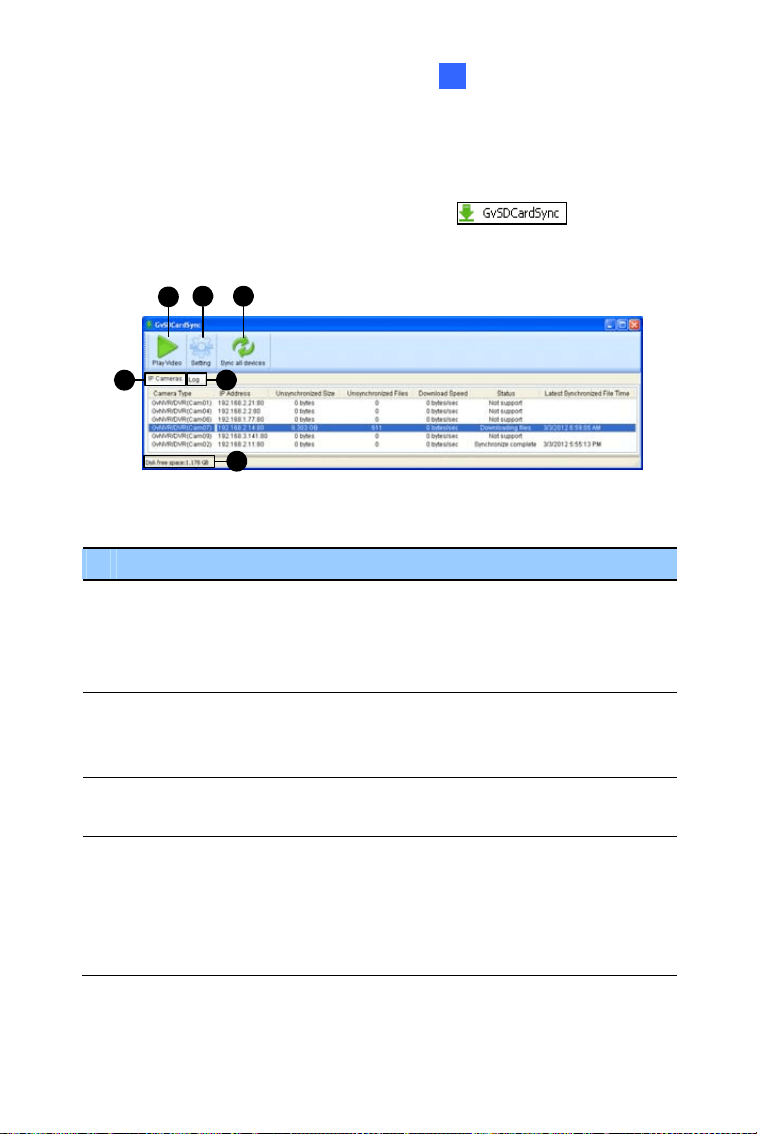
Advanced Applications
6
6.5 V-SDCardSync Utility Window
.2 The G
After you have installed the GV-SDCardSync Utility, point to Start, select
Programs, select GV-SDCardSync and select
to launch the
program. This window appears.
1
2 3
4 5
6
Figure 6-11
No Name Description
1 Play Video
Plays downloaded recordings of the selected GV-IP
Cameras using the ViewLog player. For details, see
Chapter 4, DVR User’s Manual on GeoVision
Website.
2 Setting
Contains settings on synchronization, network,
storage location and recycling criteria. See step 4 in
6.6.1 Installing the GV-SDCardSync Utility.
3 Sync all devices
Manually synchronizes and downloads the recording
files stored at GV-IP Cameras.
4 IP Camera Tab
S
hows information of GV-IP Cameras connected to
the GV-DVR / NVR / VMS, including channel
number, IP address, size and number of
unsynchronized files, download speed, status and
the last synchronization time.
173
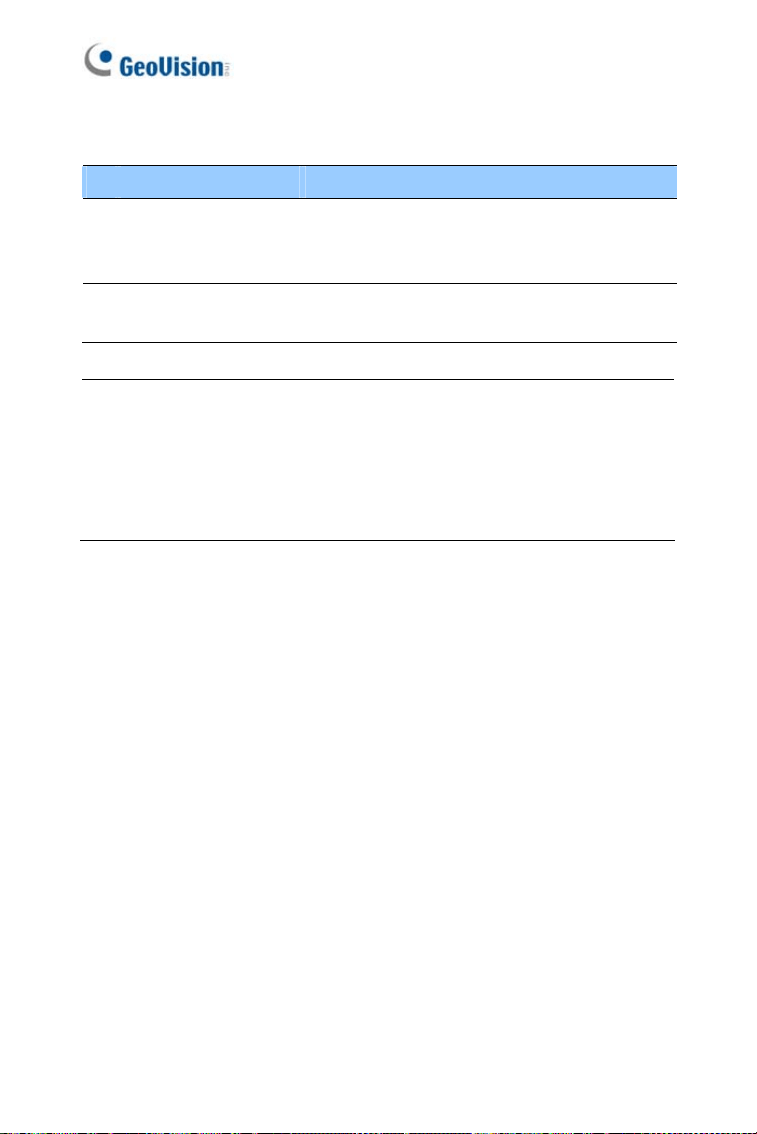
174
No Name Description
5 Log Tab
Displays up to 100 e of the GV-
SDC
vent entries
ardSync Utility. Once the entries are full,
recycling will start from the oldest file.
6 Storage Space
Shows the storage space of the designated
hard drive.
Note:
1. The synchronization time is recorded according to the system time
of the GV-IP Camera.
2. The logs are deleted once ardSync Utility is re-
activated.
the GV-SDC
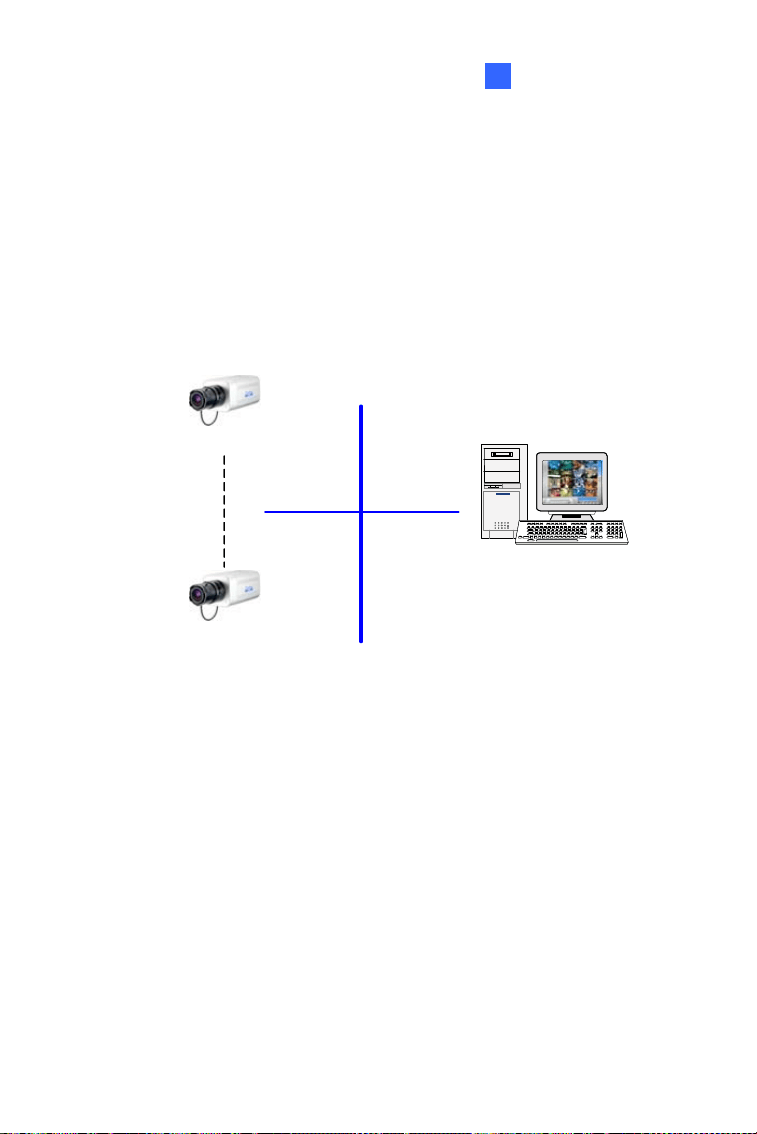
DVR / NVR / VMS
7
Chapter 7 DVR / NVR / VMS
The GV-DVR / NVR / VMS provide a total video management solution, with
features such as video viewing, recording, playback, alert settings and
more. Compatible GV-DVR / NVR / VMS version is required to integrate
with your IP camera. For details, see Appendix G.
IP Camera
IP Camera
TCP/ IP
GV-DVR / NVR / VMS
Figure 7-1
175
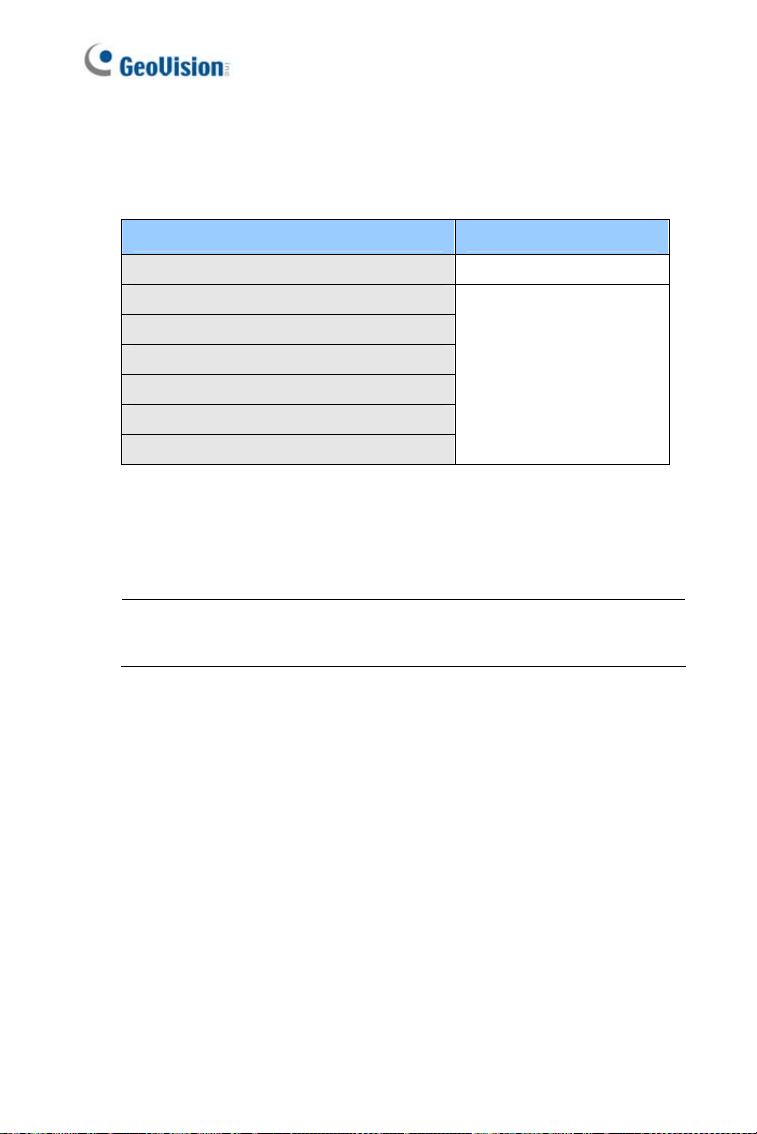
The maximum number of streams which the camera allows varies
according to its resolution:
Camera Models Max. No. of Streams
GV-PTZ010D 3
1.3 M models except GV-PTZ010D
2 M models
3 M models
5 M models
8 M models
12 M models
8
When the camera is connected to IE browser or any other
applications, it takes up 1 stream; when the camera is connected to
GV-DVR / NVR / VMS, it takes up 2 streams.
Note: By default, the camera is in dual streams and will take up 2
streams when connected to GV-DVR / NVR / VMS.
The hardware compression and the “Pre-Recording Using RAM”
feature cannot work on the videos from the camera.
176
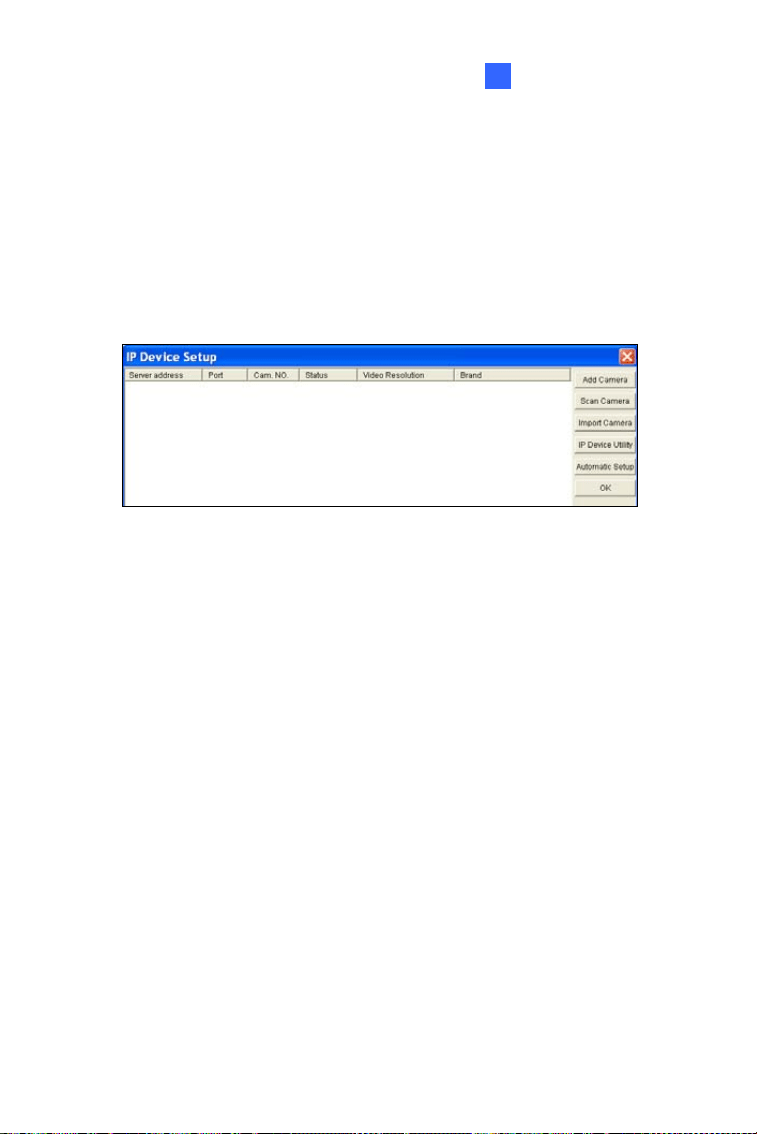
DVR / NVR / VMS
7
7.1 Setting up an IP Camera on GV-DVR / NVR
To set up the camera on the GV-DVR / NVR, follow these steps:
1. On the main screen, click the Configure button, select System
Configure, select Camera Install and click IP Camera Install. This
dialog box appears.
Figure 7-2
To add an IP camera from a list of the IP cameras on the LAN,
click Scan Camera.
To manually set up an IP camera, follow steps 2 to 7
177
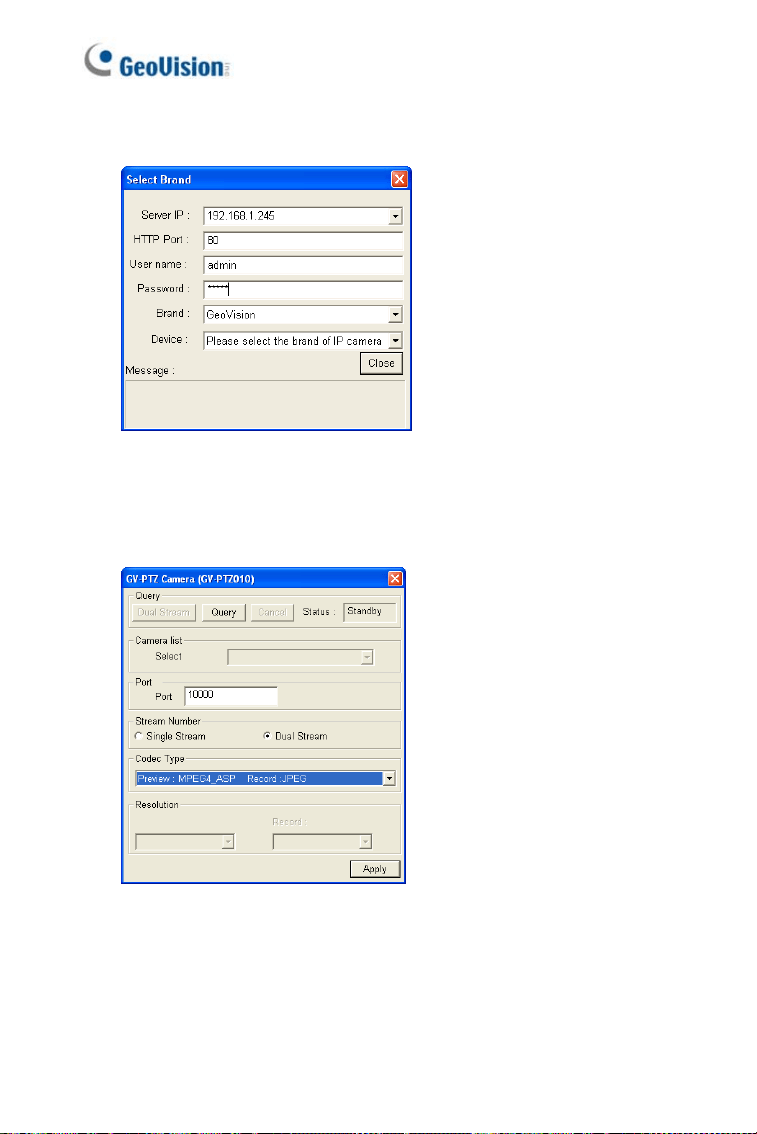
2. Click Add Camera. The dialog box appears.
Figure 7-3
3. Type the IP address, username and password of the IP camera.
Select the camera brand and device from the drop-down lists. This
dialog box appears.
Figure 7-4
4. The GV-DVR / NVR will automatically query for the IP camera, and
the status will be indicated as “Standby”. If not, modify the HTTP port
(Figure 7-3) and streaming port (Figure 7-4) to match those of the IP
camera, and click the Query button to detect the IP camera again.
178
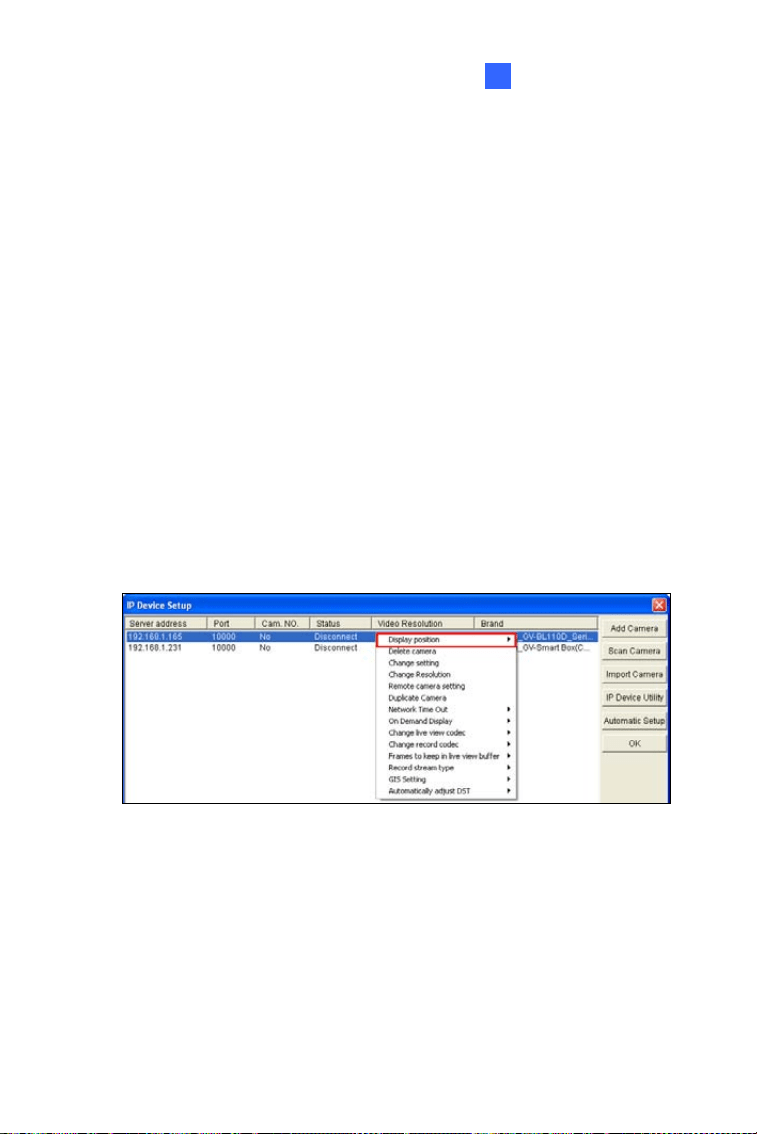
DVR / NVR / VMS
7
5.
The options in the setup dialog box may vary depending on the
camera model.
Dual Stream: Click this button to set the codec type to H.264 in
the main stream and to MJPEG in the sub stream, and each
stream with a different resolution.
Port: Video streaming port number.
Stream Number: You have the option of single streaming only
or both single and dual streaming.
Codec type: You have the options of JPEG and H.264. If the
selected camera supports dual streaming, the preview codec
and recording codec can be set differently.
Resolution: Select resolutions for preview and recording.
6. Click Apply. The IP camera is added to the list.
7. Click the listed camera, and select Display position to map the IP
camera to a channel on the GV-DVR / NVR.
Figure 7-5
8. The Status column now should display “Connected”. Click OK.
179
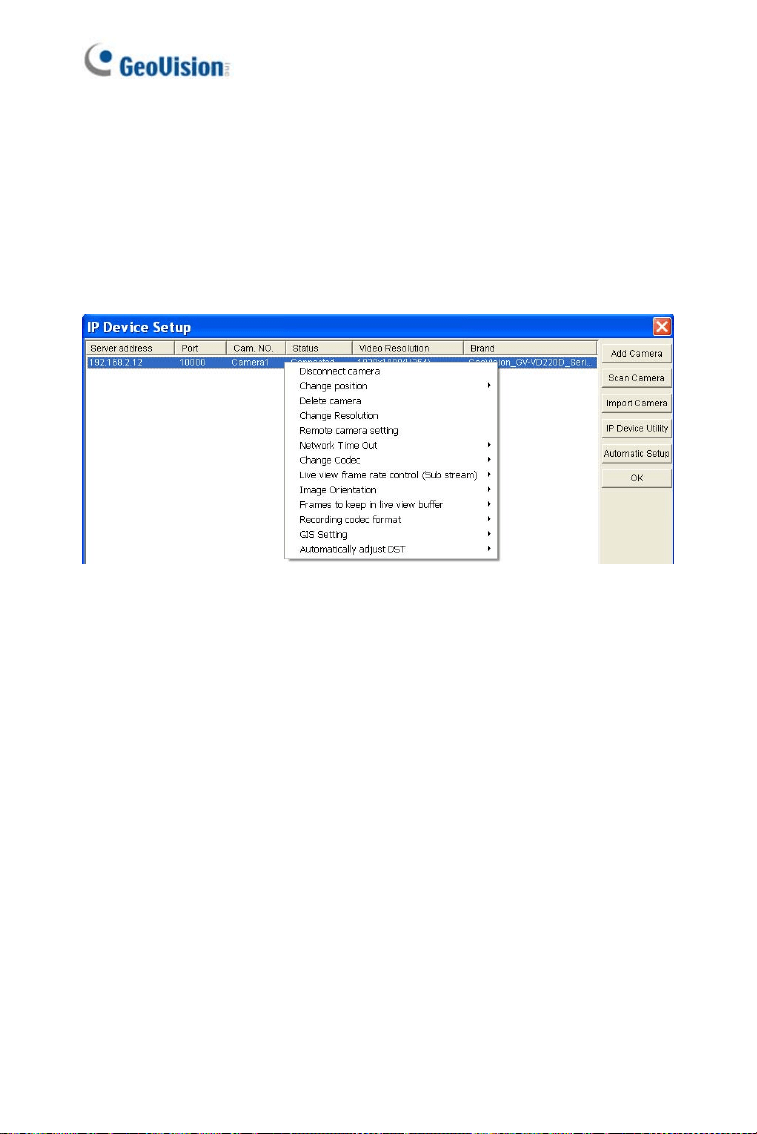
7.1.1 Customizing IP Camera Settings on GV-DVR /
NVR
After the IP camera is connected and assigned with a display position, you
can configure the camera’s settings such as frame rate, codec type and
resolution. Right-click the desired camera to see the following list of options:
Figure 7-6
Change Resolution: Changes the display ratio, live view resolution
and record resolution
Network Time Out: When network disconnection exceeds the
specified time period, the camera status will be displayed as
Connection Lost.
Change Live View Codec: Changes the live view codec.
Change Record Codec: Changes the recording codec.
Live-view frame rate control (Sub stream): Sets the live view frame
rate of the sub stream to help reduce the CPU usage. If you have set
the live view codec to be JPEG, select the number of frames to allow
in a second. If you chose the H.264 codec, select one of the following
options:
Maximum Live-view Frame Rate: View the video at the
maximum frame rate possible.
180

DVR / NVR / VMS
7
Live-view Key Frame only: You can choose to view the key
frames of the videos only instead of all frames on the live view.
This option is related to the GOP setting of the IP camera. For
example, if the GOP value is set to 30, there is only one key
frame among 30 frames.
Live-view frame rate control (Main stream): Sets the live view
frame rate of the main stream with higher resolution when On
Demand function is enabled. Refer to Live-view frame rate control
above to see the options available.
Image Orientation: You can adjust the image orientation by selecting
Normal, Horizontal Mirror, Vertical Flip or Rotate 180.
Frames to keep in live view buffer: Specifies the number of frames
to keep in the live view buffer.
Recording Codec Format: Specifies whether to record in standard
or GeoVision type of JPEG or H.264 codec.
GIS Setting: Records the video with the GPS data. To record the
GPS data, remember to also enable the GIS function of the GV-DVR /
NVR (Configure button < Accessories < Enable Local GIS).
Automatically Adjust DST: If enabled, the time on the GV-IP device
Web interface will be synchronized with the time of the GV-DVR /
NVR when DST period starts or ends on the GV-DVR / NVR.
181
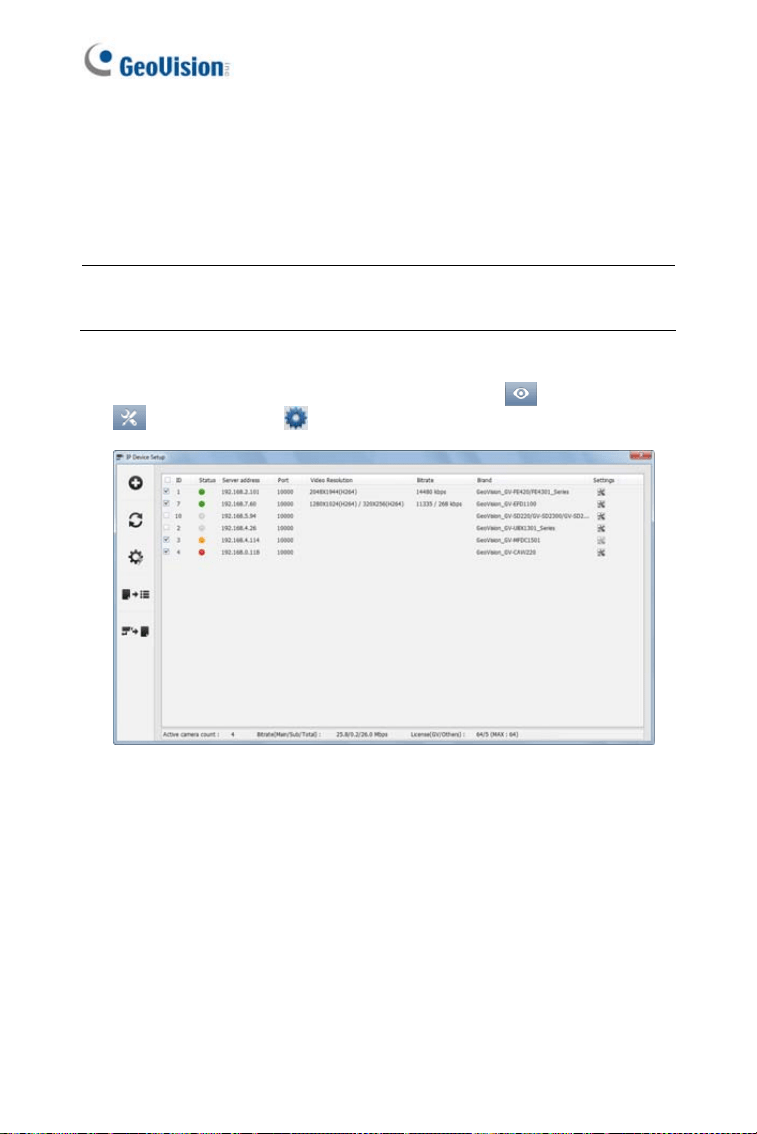
7.2 Setting Up IP Cameras on GV-VMS
Follow the steps below to manually connect your GV-IP Camera to GV-
VMS.
Note: The following instructions are based on V14.10 software and user
interfaces.
1. To access the IP Device Setup page, click Home
, select Toolbar
, click Configure and select Camera Install.
Figure 7-7
182
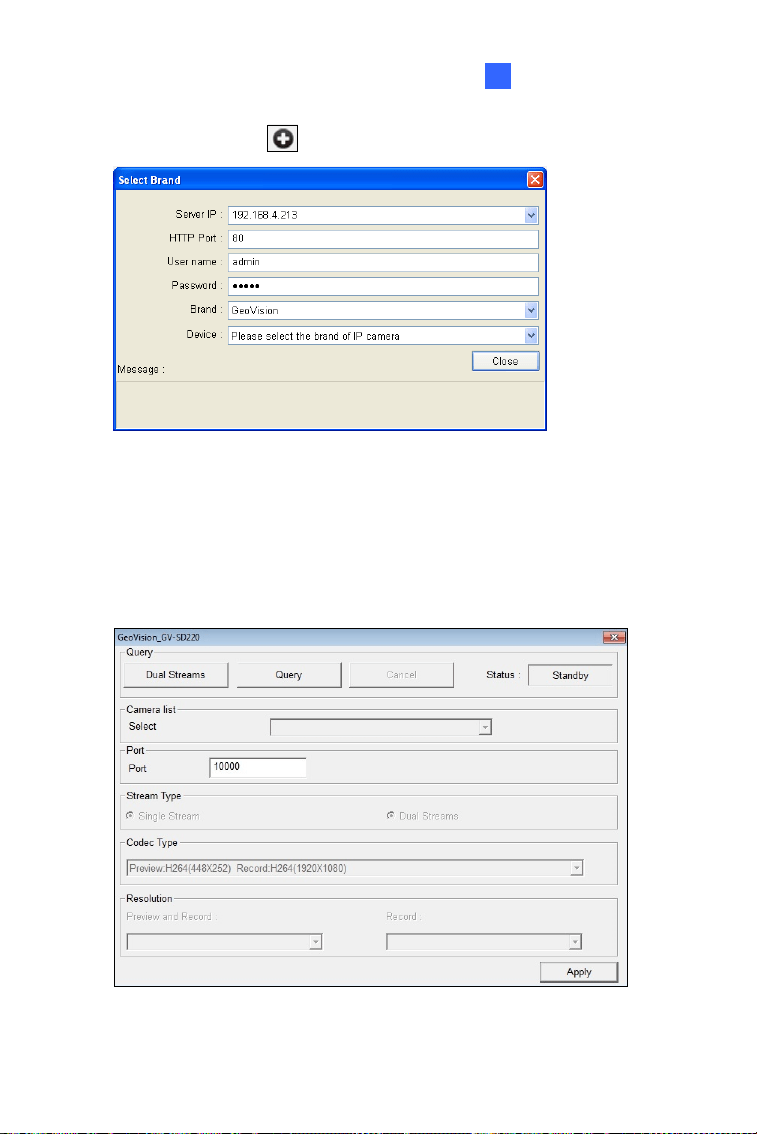
DVR / NVR / VMS
7
2
. Click Add Camera
. This dialog box appears.
Figure 7-8
3. Type the IP address, username and password of the GV-IP Camera.
Modify the default HTTP port 80 if necessary.
4. Select GeoVision and model name from the Brand drop-down list and
select the GV-IP Camera from the Device drop-down lists. This dialog
box appears.
Figure 7-9
183
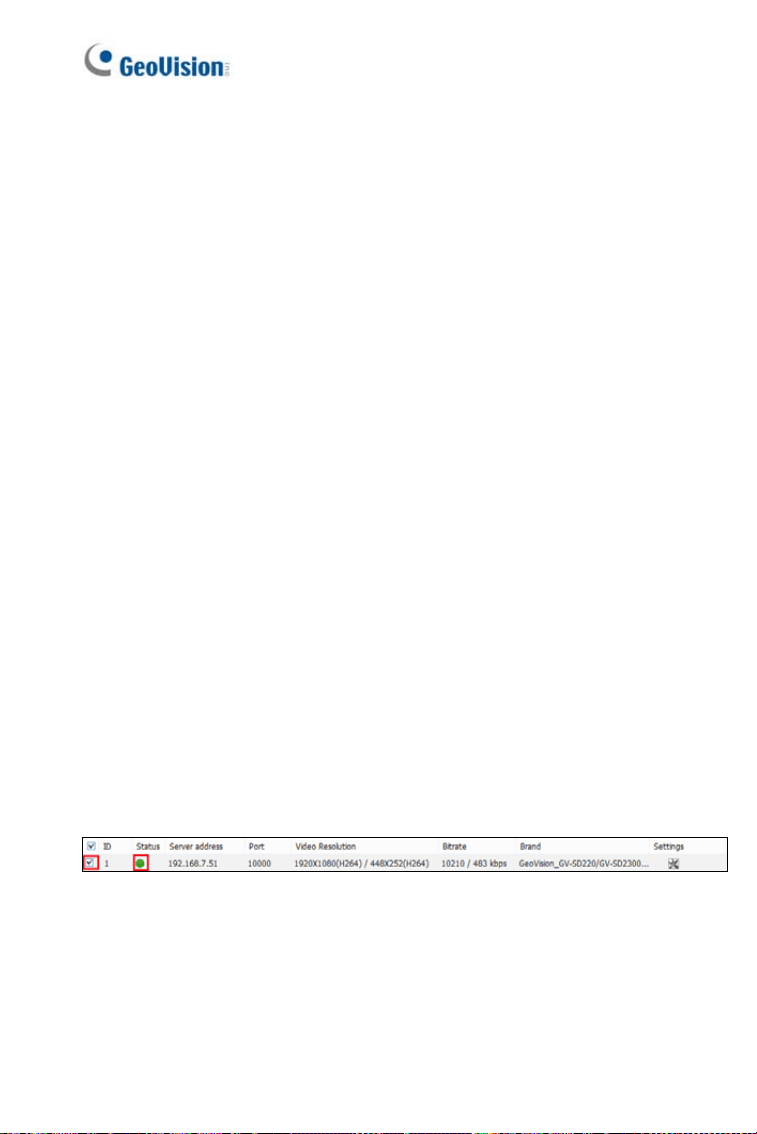
5. In the dialog box, configure the options which may vary depending on
camera brands.
Dual Streams: It is set to dual streams by default. Select this
option to apply the dual-streaming settings (lower resolution for
live view and higher resolution for recording) if the camera
supports dual streams.
Query: Detect and apply the current codec and resolution setting
on the camera. This function may not be available for some third-
party cameras.
Camera list: Select a camera number.
Port: Modify the video streaming port number if necessary.
Stream Type: You may have the option of Single Stream or
Dual Streams depending on camera models.
Codec Type: You may have different codec options depending
on camera models. If the selected camera supports dual
streaming, the live view codec and recording codec can be set
differently.
Resolution: You may select the different resolutions for live view
and recording.
6. Click Apply to add the GV-IP Camera to the list.
7. To connect the added camera, click the box besides the ID column.
Upon successful connection, the Status icon shows green, with the
video resolution and bit rate being displayed in the correspondent
columns.
Figure 7-10
184
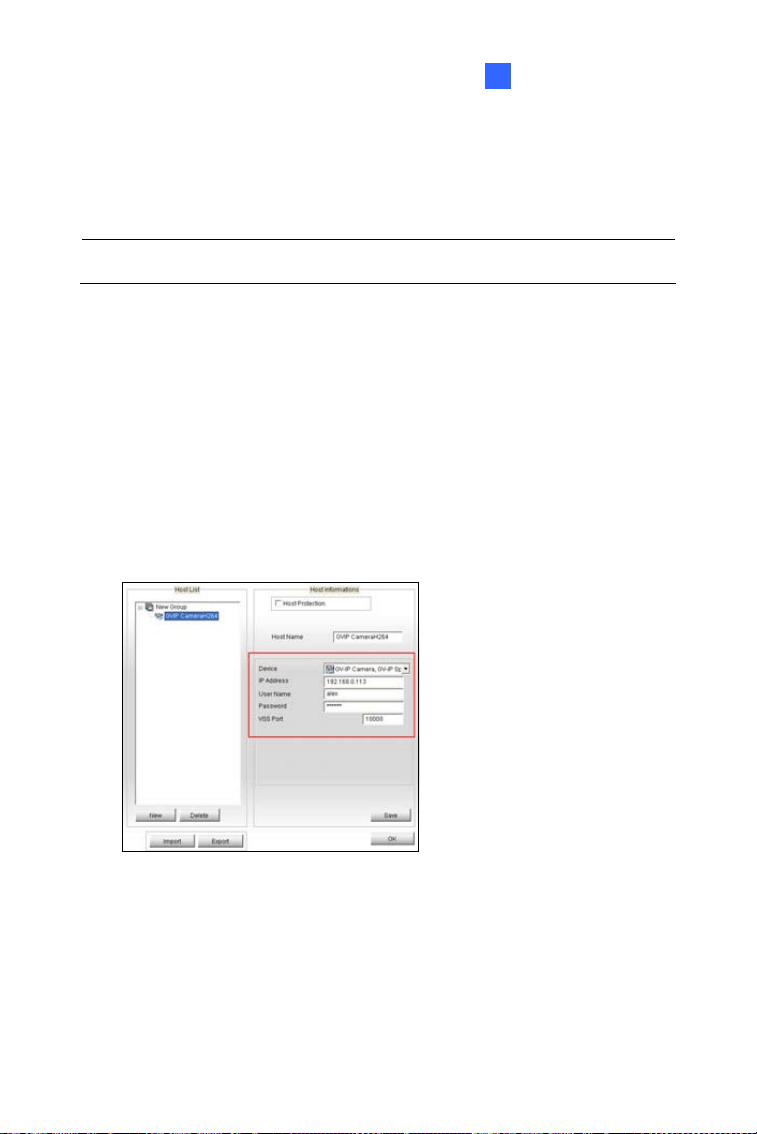
DVR / NVR / VMS
7
7.3 Remote Monitoring with Multi View
You can use the Multi View to monitor and manage the camera.
Note: Multi View is not supported by GV-VMS.
7.3.1 Connecting to the IP Camera
1. On the Multi View window, click the Edit Host button. The Edit Host
window appears.
2. To create a host, click the New button. You need to create a group
before creating a host.
3. Select GV-IP Camera, GV-IP Speed Dome from the Device drop-
down list. Type the host name, IP address, user name and password
of the camera. Modify the default VSS port 10000 if necessary.
Figure 7-11
4. Click Save to establish connection.
For details on the Multi View functions, see “Multi View Viewer”, Remote
Viewing, DVR User’s Manual.
185
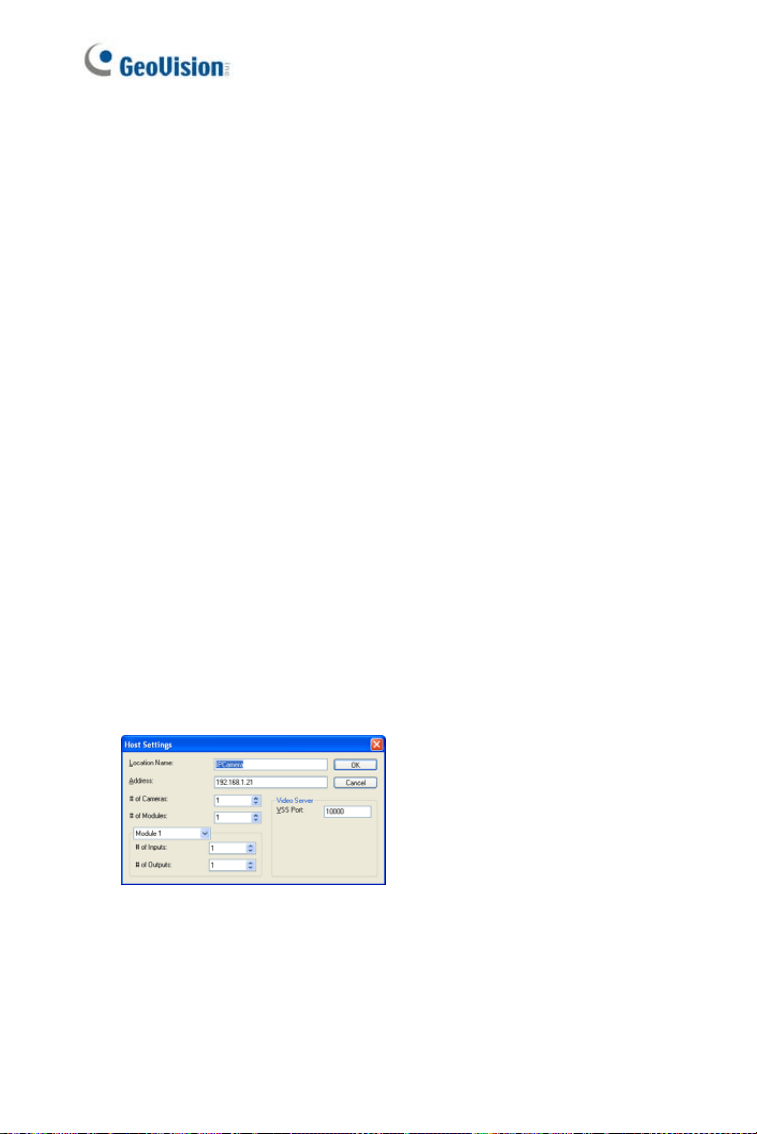
7.4 Remote Monitoring with E-Map
You can use the Remote E-Map to monitor and manage the camera.
7.4.1 Creating an E-Map for the IP Camera
With the E-Map Editor, you can create an E-Map for the camera. The E-
Map Editor is available in the two applications: Main System and E-Map
Server. The following is an example of running the E-Map Editor included
in the Main System.
1. Go to Windows Start menu, point to Programs, select GV folder and
click E-Map Editor.
2. To create an E-Map, click the Add Map button on the toolbar. A New
Map file appears.
3. Double-click the New Map file, and click the Load Map button on the
toolbar to import a graphic file
4. To create a host, click the Add Host button on the toolbar and select
Add IPCam.
5. Right-click the created New Host in the Host View, and select Host
Settings. This dialog box appears.
Figure 7-12
6. Give the camera a location name, and type its IP address (or domain
name). Modify the default VSS port 10000 if necessary.
186

DVR / NVR / VMS
7
7
. Click OK to save the settings.
8. Expand the created host folder. Drag and drop the icons of camera
and I/O devices onto the imported E-Map.
9. Close the E-Map Editor. Click Yes when you are promoted to save
the file.
For details on creating an E-Map file on the E-Map Server, see “E-Map
Applications”, GV-DVR User’s Manual or GV-VMS User’s Manual.
187

188
7.4.2 Connecting to the IP Camera
Depending on where you save the created E-Map file (DVR, E-Map Server
or Control Center), the steps to open the Remote E-Map window for
monitoring may vary slightly. The following is the connection example when
you store the E-Map file on the DVR.
1. To enable the remote access to the DVR, click the Network button,
select WebCam Server to display the Server Setup dialog box, and
click OK to start the WebCam Server.
2. At the local computer, open the Web browser and type the address of
the DVR. The Single View page appears.
3. Select Emap. A valid user name and password are required for login.
For the first-time user, you will be directed to the Download page.
Install the E-Map program before you can run it.
4. On the Remote E-Map window, click the Login button and select the
camera host to access its videos and I/O devices. A valid user name
and password are required to log in the camera.
For details on the Remote E-Map functions, see “E-Map Applications”,
GV-DVR User’s Manual or GV-VMS User’s Manual.
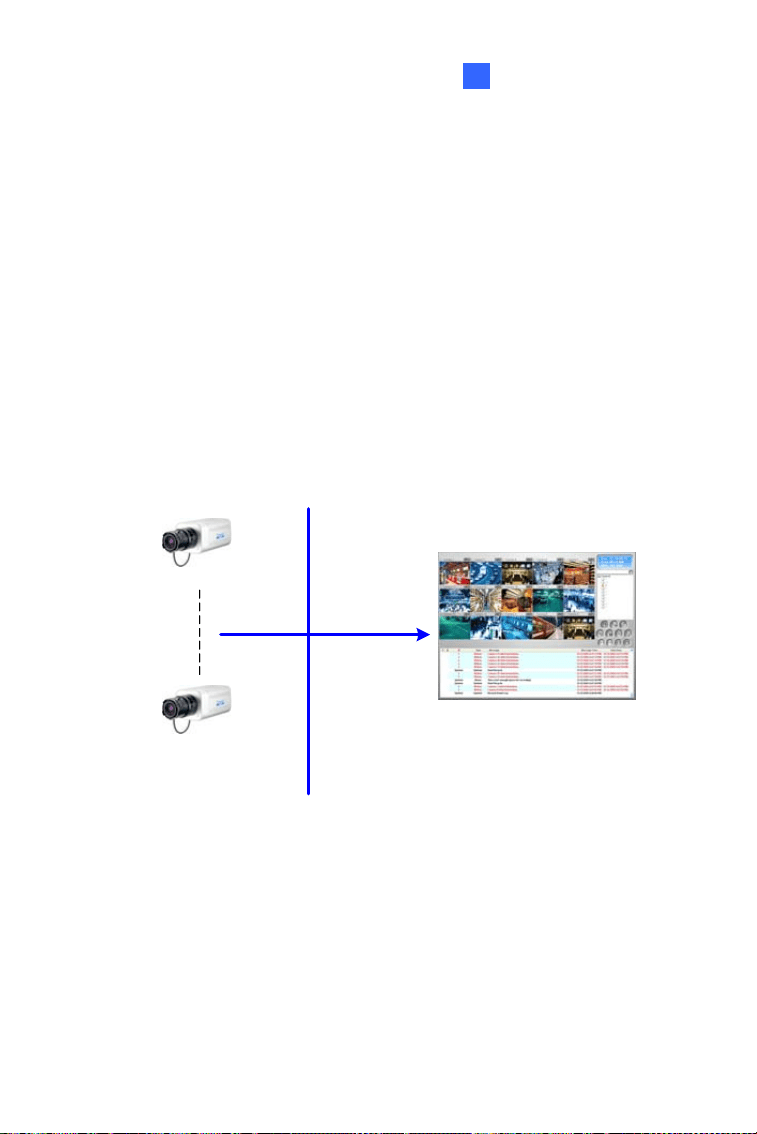
CMS Configurations
8
Chapter 8 CMS Configurations
This section introduces the related settings to enable connecting to the
camera in the central monitoring stations Center V2, Vital Sign Monitor and
Dispatch Server.
8.1 Center V2
The Center V2 can monitor and manage the camera and I/O devices
connected to the camera.
TCP/ IP
Center V2
Video Data
Text Data
IP Camera
IP Camera
Figure 8-1
189
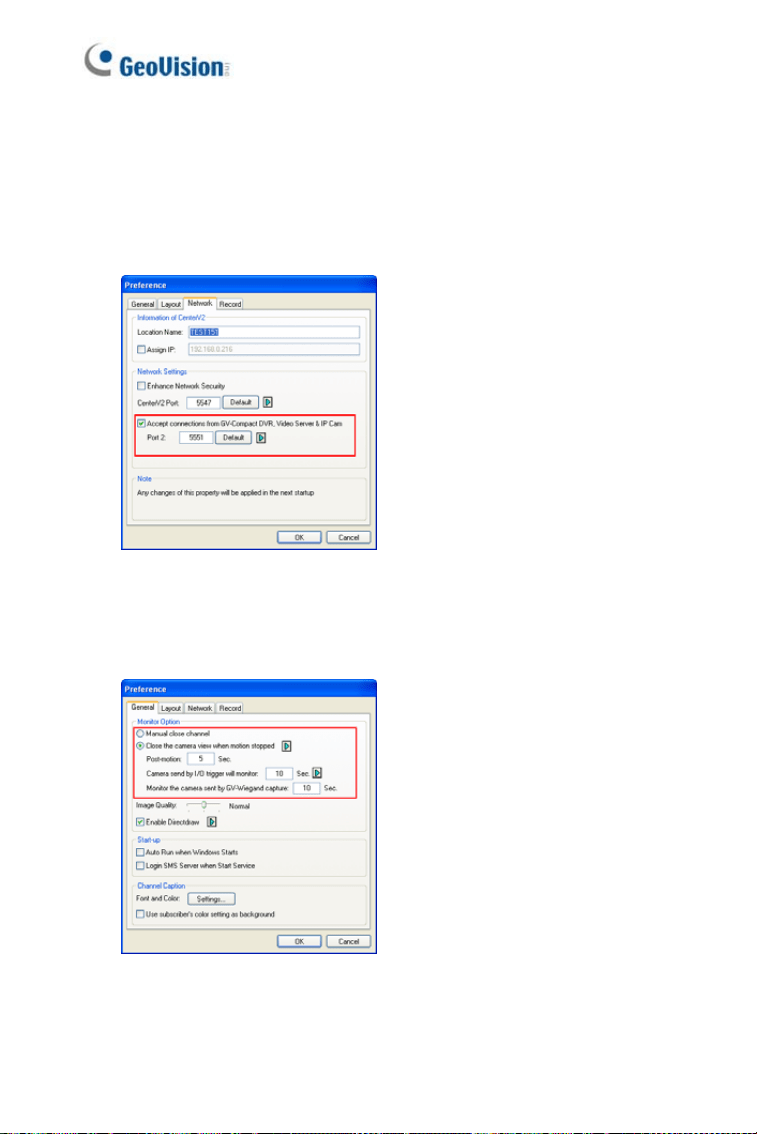
To set the appropriate port for IP camera connection, click the
Preference Settings button, select System Configure, click the
Network tab, and select Accept connections from GV-Compact
DVR, Video Server & IP Cam. Keep default port 5551, or modify it to
match the Center V2 port on the IP camera.
Figure 8-2
To define how to display the received video on motion detection and
input trigger from the IP camera, click the Preference Settings button
and select System Configure. This dialog box appears.
Figure 8-3
190

CMS Configurations
8
Manual close channel: Closes the triggered camera view
manually.
Close the camera view when motion stopped: Closes the
triggered camera view automatically when motion stops.
Post Motion: Specify the duration of the camera view remaining
on the monitoring window after a motion stops.
Camera send by I/O trigger will monitor: Specify the duration
of the camera view remaining on the monitoring window when an
I/O device is triggered.
To keep the camera view remaining on the monitoring window
even after the alarm is finished, click the right-arrow button, and
uncheck Latch Trigger. Then the camera view will remain on
the monitoring window for the specified time. For example, if the
alarm is triggered for 5 minutes and you set 10 minutes, the
camera view will be displayed for 15 minutes.
For further information on how to mange the video received from the IP
camera, see GV-CMS Series User’s Manual.
191
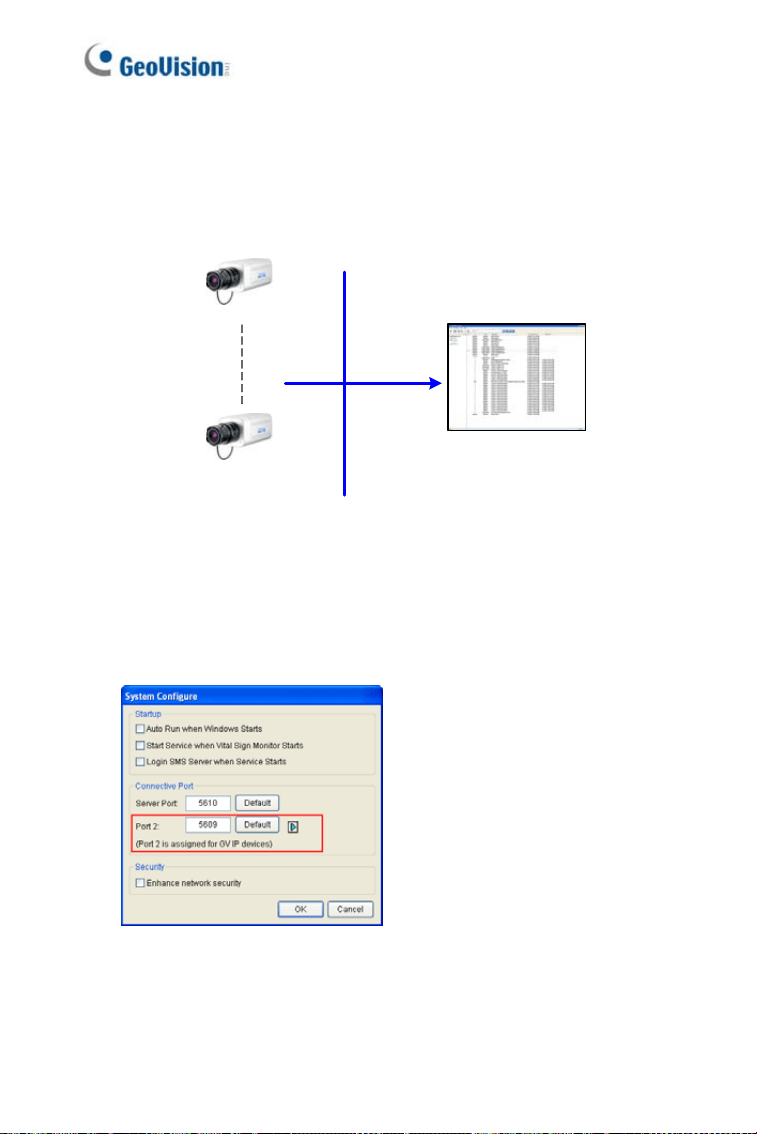
8.2 Vital Sign Monitor
The Vital Sign Monitor is designed to monitor and manage the camera and
I/O devices connected to the camera under low bandwidth network.
IP Camera
IP Camera
TCP/ IP
VSM
Text Data
Figure 8-4
To set the appropriate port connecting to the IP camera, click
Configure on the window menu, and select System Configure to
display this dialog box. In the Connective Port field, keep the default
port 5609, or modify it to match the Vital Sign Monitor port on the IP
camera.
Figure 8-5
For further information on how to mange the video received from the IP
camera, see GV-CMS Series User’s Manual.
192
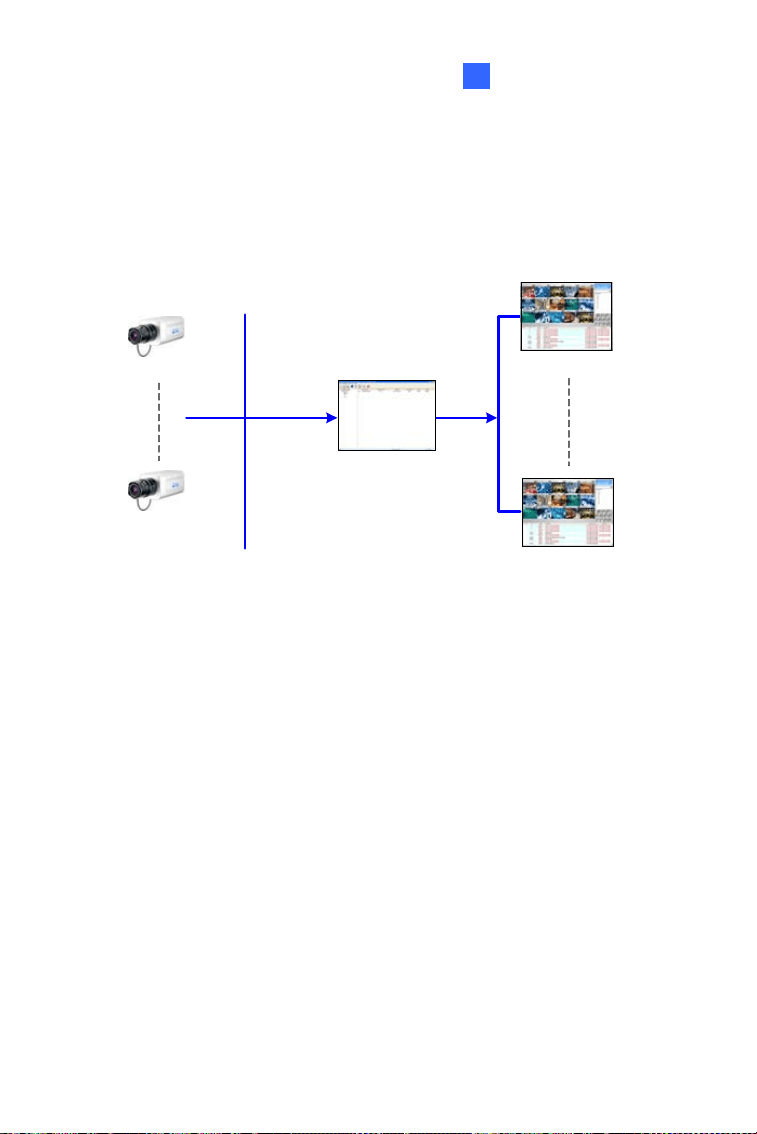
CMS Configurations
8
8.3 Dispatch Server
The Dispatch Server minimizes overloading of Center V2 Servers by re-
distributing the GV-IPCAM subscribers to the least busy Center V2 Server.
IP Camera
IP Camera
TCP/ IP
Video Data
Center V2
Center V2
Dispatch Server
Text Data
Figure 8-6
193
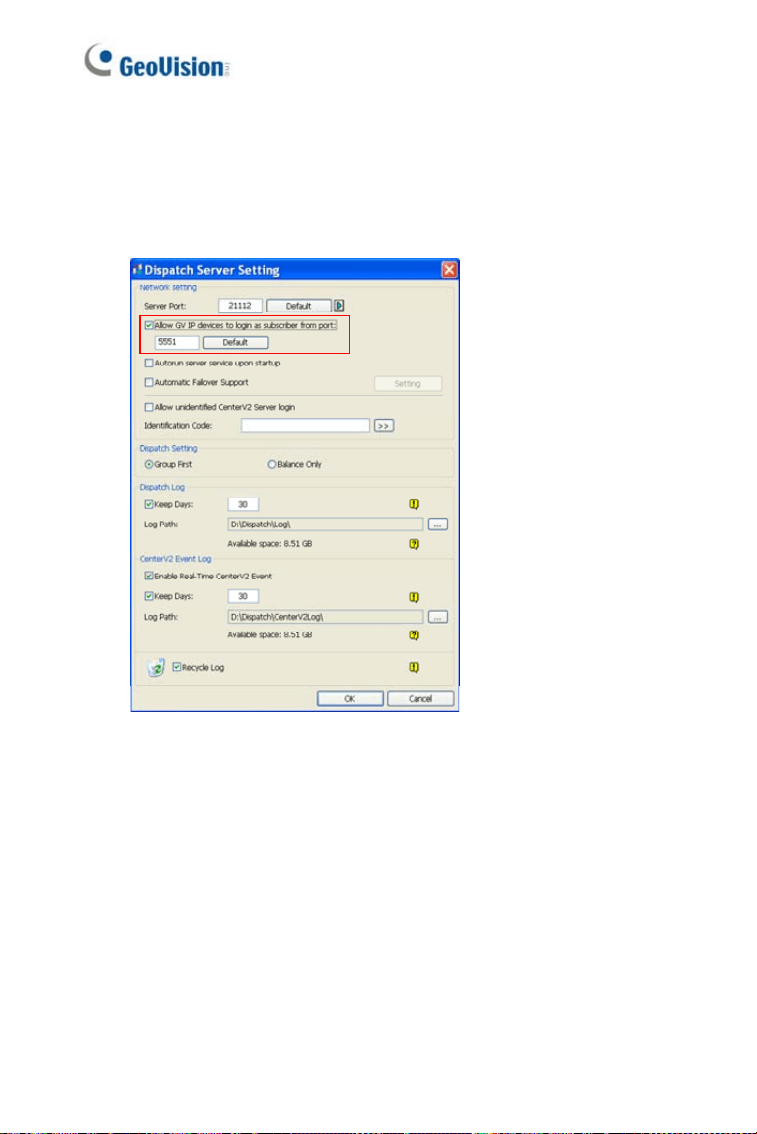
194
To set the appropriate port connecting to the IP camera, click the
Server Setting button on the toolbar, and select Allow GV IP
devices to login as subscriber from port. Keep the default port as
5551, or modify it to match the Center V2 port on the IP camera.
Figure 8-7
For further information on how to mange the video received from the IP
camera, see GV-CMS Series User’s Manual.

Smart Device Connection
9
Chapter 9 Smart Device Connection
You can access the live view and play back recordings on your mobile
devices using the mobile application GV-Eye. Android Smartphone, tablet,
iPad, iPhone and iPod Touch are supported.
For details on system requirements, installation and setup, visit the
company website
.
Note: To receive the live video from the camera, enter the TCP/IP port
on your mobile phone. To play video back, enable ViewLog Server on
the camera and enter the RPB Port on your mobile phone.
195
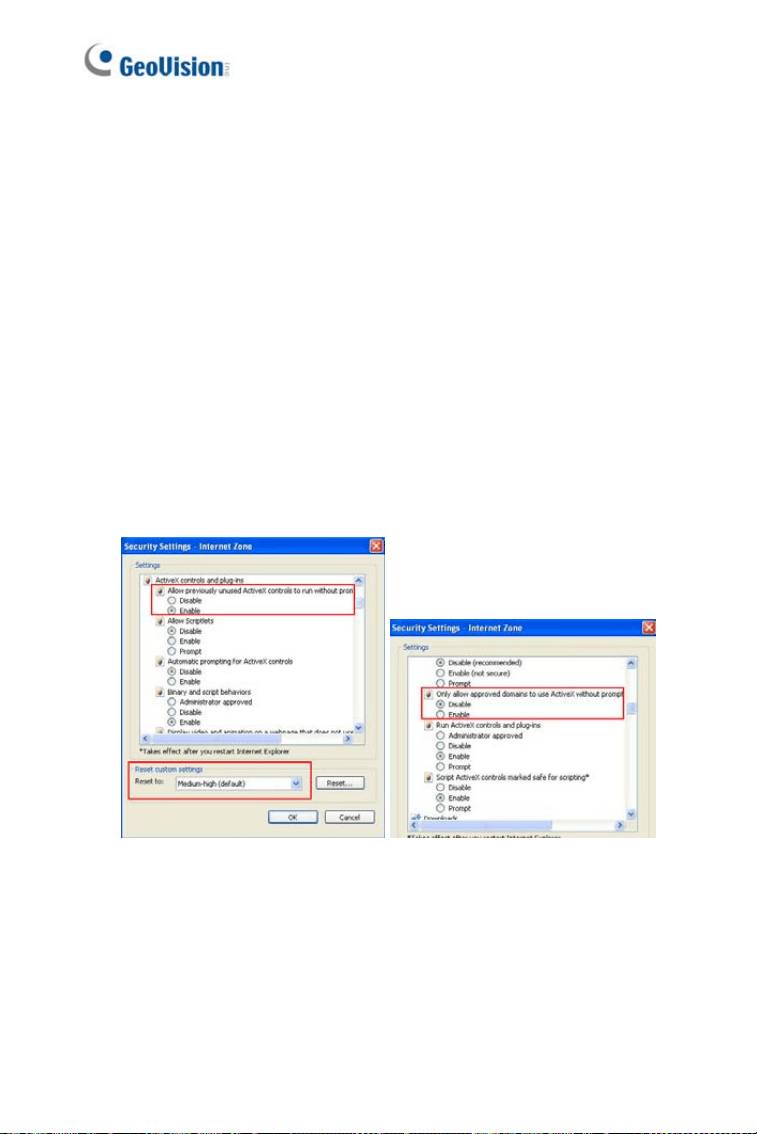
Appendix
A. Settings for Internet Explorer 8
If you use Internet Explorer 8, it is required to complete the following
setting.
1. Set the Security to Medium-high (default).
2. Enable Allow previously unused ActiveX controls to run without
prompt.
3. Disable Only allow approved domains to use ActiveX without
prompt.
196

Appendix
B. RTSP Protocol Command
The GV-IPCAM H.264 can support RTSP protocol for both audio and video
streaming.
If you use the QuickTime player, enter:
rtsp://<IP of the GV-IPCAM H.264:8554/<CH No.>.sdp
For example, rtsp://192.168.3.111:8554/CH001.sdp
If you use the VLC, and if authentication is required, enter:
rtsp://username:password@<IP of the GV-IPCAM H.264:8554/<CH
No.>.sdp
For example, rtsp://admin:admin@192.168.3.111:8554/CH001.sdp
If you use the VLC, and if authentication is not required, enter:
rtsp://@<IP of the GV-IPCAM H.264:8554/<CH No.>.sdp
For example, rtsp://@192.168.3.111:8554/CH001.sdp
For RTSP Multicast, add “M” after the channel number.
For example, rtsp://@192.168.3.111:8554/CH001M.sdp or
rtsp://admin: admin@192.168.3.111:8554/CH001M.sdp
Note:
1. The RTSP streaming is supported over HTTP, UTP and TCP port.
2. The RTSP server must be enabled on the Web interface. See
Figure 21-20.
3. Only VLC and QuickTime players are supported for streaming
video via RTSP protocol.
4. For GV-PTZ010D, the RTSP streaming provides source video
images of 352 x 240 / 352 x 288 only.
197
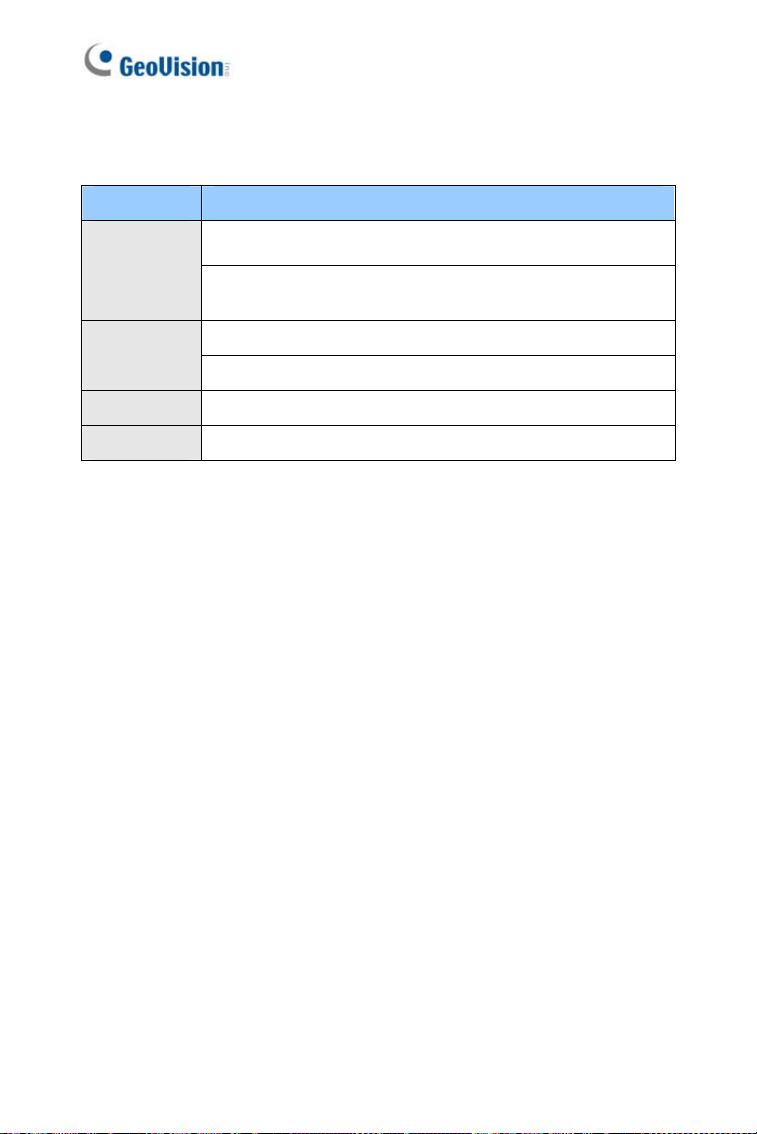
C. Supported UMTS Protocol (3G Modem)
Brand Model
E220, E392 Huawei
E169, E1692, E156, EC189, E1752, E1756, E1756C,
E169C
MC998D Novatel
USB760, USB727, MC950D
ONDA MSA523HS
ZTE MF100
198

Appendix
D. The CGI Command
You can use the CGI command to obtain a snapshot of the live view or
access the User Account Web interface. For a GV-IPCAM H.264 with the
following details:
IP address: 192.168.2.11
Username: admin
Password: admin
Desired stream: 1
To obtain a snapshot of the live view, type the following into your Web
browser:
http://192.168.2.11/PictureCatch.cgi?username=admin&password=admin&
channel=1
To access the User Account Web interface, type the following into your
Web browser:
http://192.168.2.11/ConfigPage.cgi?username=admin&password=admin&p
age=UserSetting
Note: For GV-BX12201, if you use the CGI command to obtain a
snapshot, the images stem from the live view of Stream 2 with the
maximum resolution of 1 MP.
199
E. Power Supply Support List
The supported power type is indicated with a tick () and the unsupported
power type with a cross ().
GV-IP Camera DC Power AC Power PoE
Box Camera (H.264 and H.265)
Ultra Box Camera
Target Box Camera
GV-BX1500-E
GV-BX2400-E
GV-BX3400-E
GV-BX5300-E
IR Arctic Box
Camera
GV-BX2510-E
GV-BX5310-E
Mini Fixed Dome
Mini Fixed Rugged Dome
Target Mini Fixed Dome
Target Mini Fixed Rugged Dome
200
Appendix
GV-IP Camera DC Power AC Power PoE
All except
GV-BL2510-E
GV-BL5310-E
Bullet Camera
GV-BL2510-E
GV-BL5310-E
Bullet Camera (H.265)
Ultra Bullet Camera
Target Bullet Camera
PTZ Camera
PT Camera
Vandal Proof IP Dome
Vandal Proof IP Dome (H.265)
Fixed IP Dome
Cube Camera
GV-CA120/220
Advanced
Cube Camera
GV-CAW120/220
Uni Pinhole Camera
201
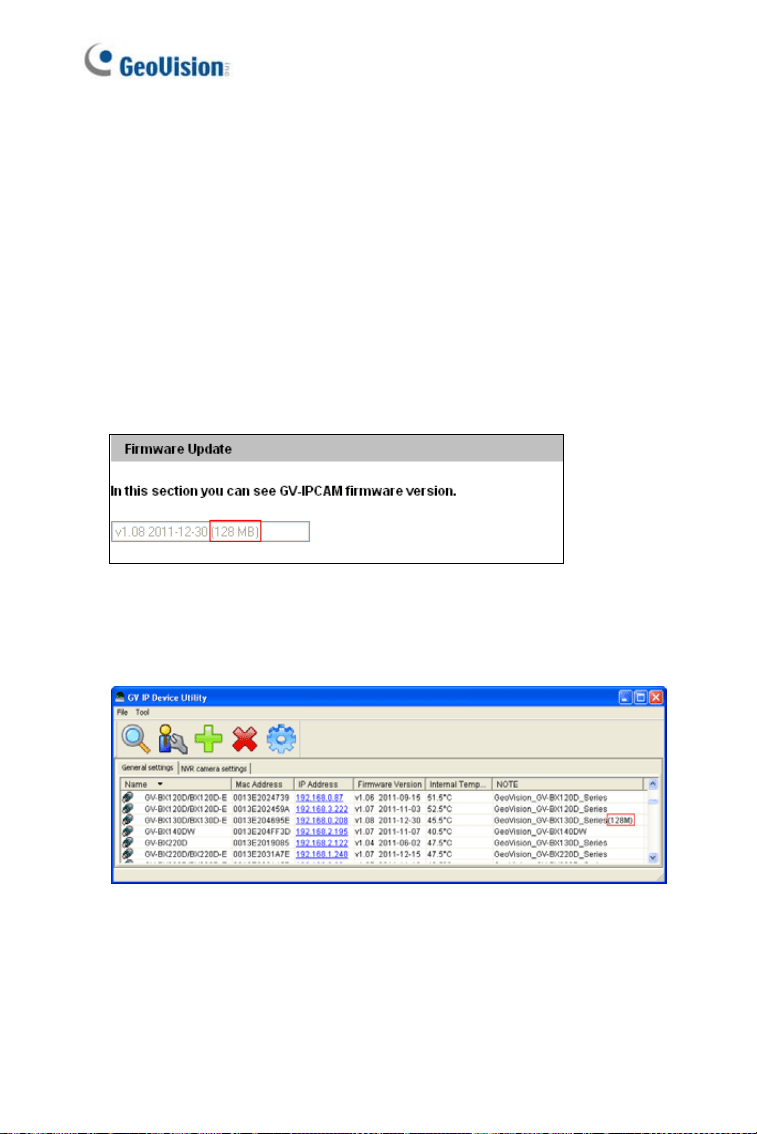
F. Supported Firmware for Flash Memory
The 128 MB flash memory is supported in V1.09 or later in all models of
GV-IPCam H.264 Series except GV-PTZ010D.
To look up if the camera contains a 128 MB type flash memory, access the
Web interface or the GV IP Device Utility:
Web Interface
Click Management and click Tools. The “128 MB” should be noted
after the firmware version.
GV IP Device Utility
The “128 M” should appear under the NOTE column.
202

Appendix
G. Compatible Version of GV-DVR / NVR / GV-
VMS for Each Camera Model
Camera Models
Compatible version of GV-
DVR / NVR / GV-VMS
GV-BX2400-1F ~ 2F
V8.5.5 or later /
V14.10 or later
GV-BX2700 Series
V8.7.1.0 (with patch files) or
later /
V15.11.1.0 (with patch files)
or later
GV-BX4700 Series /
5700 Series
V8.7.0 (with patch files) or
later /
V15.11 (with patch files) or
later
Box Camera
*Video Analysis only works with GV-VMS V15.10 or
later
203
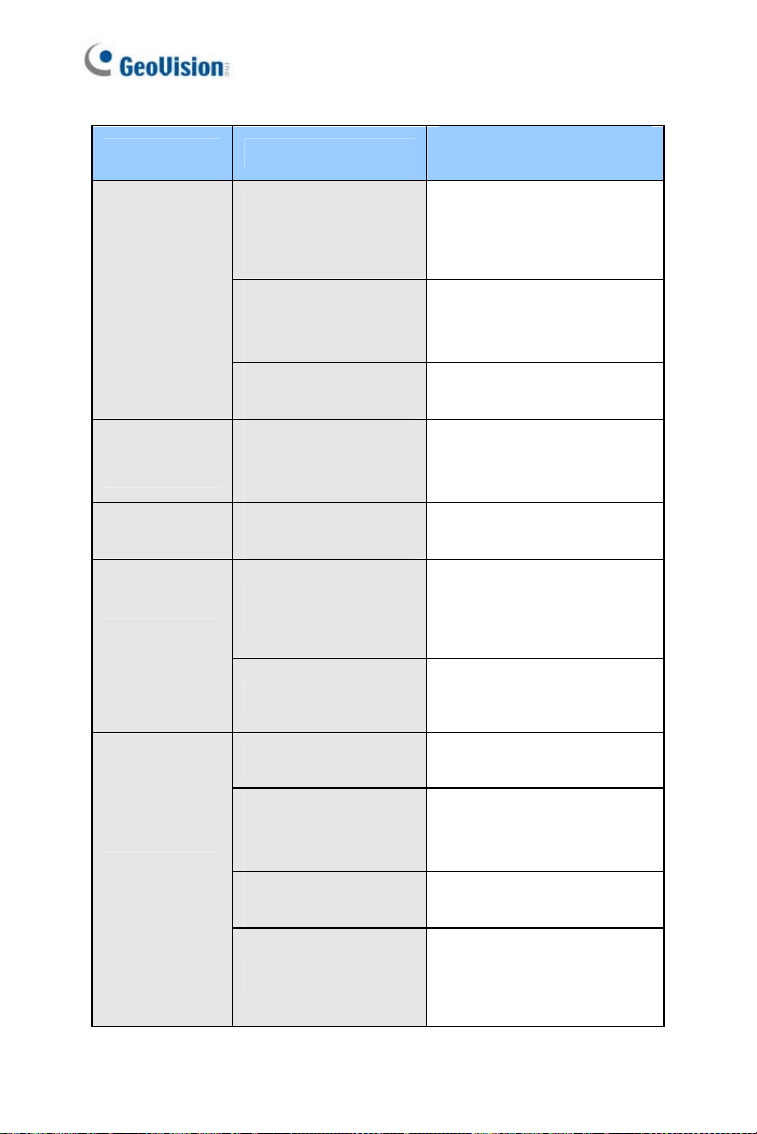
Camera Models
Compatible version of
GV-DVR / NVR / GV-VMS
GV-BX12201
V8.6.2 (with patch files) or
later /
V14.10.1 (with patch files)
or later
GV-BX2700-FD
GV-BX4700-FD
GV-BX8700-FD
V8.7.6.0 or later (with
patch files) / V18.1 or later
(with patch files)
Box Camera
GV-BX2600-FD
GV-BX8700
V8.8.0 or alter (with patch
files) / V17.2.1 or later
Ultra Box
Camera
GV-UBX1301 Series
GV-UBX2301 Series
GV-UBX3301 Series
V8.5.6 or later /
V14.10 or later
Target Box
Camera
GV-EBX1100 Series
GV-EBX2100 Series
V8.5.9 or later /
V14.10 or later
GV-EFD2101
GV-EFD3101
V8.6.2 (with patch files) or
later /
V14.10.1 (with patch files)
or later
Target Fixed
Dome
GV-EFD5101
V8.6.2.0 (with patch files)
or later /
V15.10.1.0 or later
GV-BX1500-E
V8.5.8 or later /
V14.10 or later
GV-BX2400-E
GV-BX3400-E
GV-BX5300-E
V8.5.7 or later /
V14.10 or later
GV-BX2510-E
GV-BX5310-E
V8.5.9 (with patch files) /
V14.10 or later
IR Arctic
Camera
GV-BX4700-E
V8.7.1.0 (with patch files)
or later /
V15.11.1.0 (with patch
files) or later
204
Appendix
Camera Models
Compatible version of
GV-DVR / NVR / GV-
VMS
GV-MFD3401 Series
GV-MFD5301 Series
V8.5.8 or later /
V14.10 or later
Mini Fixed
Dome
GV-MFD2700 Series
GV-MFD4700 Series
V8.7.1.0 (with patch files)
or later /
V15.11.3.0 (with patch
files) or later
GV-MDR320
GV-MDR520
V8.5 or later /
V14.10 or later
Mini Fixed
Rugged Dome
GV-MDR1500 Series
GV-MDR3400 Series
V8.5.9 or later /
V14.10 or later
GV-EFD1100 Series
V8.5.9 or later /
V14.10 or later
GV-EFD4700 Series
V8.7.1.0 (with patch files)
or later / V15.11.1.0 (with
patch files) or later
Target Mini
Fixed Dome
GV-EFD2700 Series
V8.7.3.0 (with patch files)
or later / V16.11.0.0 (with
patch files) or later
GV-EDR1100 Series
GV-EDR2100 Series
V8.5.9 or later /
V14.10 or later
GV-EDR4700 Series
V8.7.1.0 (with patch files)
or later / V15.11.3.0 (with
patch files) or later
Target Mini
Fixed Rugged
Dome
GV-EDR2700 Series
V8.7.3.0 (with patch files)
or later / V16.11.0.0 (with
patch files) or later
205
Camera Models
Compatible version of
GV-DVR / NVR / GV-VMS
GV-BL2400
GV-BL3400
GV-BL1210
GV-BL2410
GV-BL3410
GV-BL5310
V8.5.6 or later /
V14.10 or later
GV-BL3700
GV-BL5700
V8.7.0 (with patch files) or
later / V15.10.1 (with
patch files) or later
GV-BL1500
V8.5.7 (with patch files) or
later / V14.10 or later
GV-BL2500
GV-BL2510-E
GV-BL5310-E
V8.7.4.0 or later /
V16.11.0.0 or later
GV-BL2702
GV-BL4702
GV-BL4713
GV-BL5713
V8.7.4.0 (with patch files)
or later / V16.11.0.0 (with
patch files) or later
Bullet Camera
GV-BL8714
V8.8.0 (with patch files) or
later / V17.2.1 or later
GV-UBL1211
GV-UBL2411
GV-UBL3411
GV-UBL1301 Series
GV-UBL2401 Series
GV-UBL3401 Series
V8.5.6 or later /
V14.10 or later
GV-UBL1511
V8.5.8 or later /
V14.10 or later
Ultra Bullet
Camera
GV-UBL2511
V8.5.9 or later /
V14.10 or later
206
Appendix
Camera Models
Compatible version of GV-DVR
/ NVR / GV-VMS
GV-EBL1100
Series
GV-EBL2100
Series
V8.5.9 or later /
V14.10 or later
GV-EBL2101
V8.6.2.0 or later / V14.10.1 or
later
GV-EBL2111
GV-EBL3101
V8.7.0.0 (with patch files) or later
/ V15.10.1.0 (with patch files) or
later
GV-EBL5101
V8.7.3.0 (with patch files) or later
/ V16.10.3.0 (with patch files) or
later
GV-EBL4702
V8.7.3.0 (with patch files) or later
/ V16.10.3.0 (with patch files) or
later
GV-EBL2702
Series
V8.7.3.0 (with patch files) or later
/ V16.11.0.0 (with patch files) or
later
Target Bullet
Camera
GV-EBL4711
V8.7.4.0 (with patch files) or later
/ V16.11.0.0 (with patch files) or
later
PTZ Camera GV-PTZ010D
V8.4 or later /
V14.10 or later
PT Camera
GV-PT130D
GV-PT220D
GV-PT320D
V8.5.7 or later /
V14.10 or later
207
Camera Models
Compatible version of GV-
DVR / NVR / GV-VMS
GV-EVD2100
GV-EVD3100
V8.6.2 (with patch files) or
later /
V14.10.1 (with patch files) or
later
Target Vandal
Proof IP Dome
GV-EVD5100
V8.6.2.0 (with patch files) or
later / V15.10.1.0 or later
GV-VD120D Series
GV-VD220D Series
GV-VD320D Series
V8.4 (with patch files) or later
/ V14.10 or later
GV-VD1500
V8.5.8 or later /
V14.10 or later
GV-VD2400
GV-VD3400
V8.5.6 or later /
V14.10 or later
GV-VD1530/1540
GV-VD2430/2440
GV-
VD2500/2530/2540
GV-VD2540-E
GV-VD3430/3440
GV-VD5340
GV-VD5340-E
V8.5.9 or later /
V14.10 or later
GV-VD2702/2712
V8.7.1.0 (with patch files) or
later / V15.11.3.0 (with patch
files) or later
GV-VD4702/5702
V8.7.3.0 (with patch files) or
later / V16.10.3.0 (with patch
files) or later
Vandal Proof IP
Dome
GV-VD4712
V8.7.4.0 (with patch files) or
later / V16.11.0.0 (with patch
files) or later
208
Appendix
Camera Models
Compatible version of
GV-DVR / NVR / GV-
VMS
GV-VD4711
GV-VD5711
V8.7.1.0 (with patch files)
or later / V15.11.1.0 (with
patch files) or later
Vandal Proof IP
Dome
GV-VD3700
GV-VD5700
V8.7.0 (with patch files)
or later /
V15.10.1 (with patch
files) or later
GV-MD8710-FD
V8.7.6.0 or later (with
patch files) / V18.1 or
later (with patch files)
Motorized IP
Dome
GV-MD8710
V8.8.0 (with patch files)
or later / V17.2.1 or later
Cube Camera
GV-CB120
GV-CB220
V8.4.3 (with patch files)
or later / V14.10 or later
Advanced Cube
Camera
GV-CA120
GV-CA220
GV-CAW120
GV-CAW220
V8.5.5 or later / V14.10
or later
Pinhole Camera GV-UNP2500
V8.6.0 or later / V14.10.1
(with patch files) or later
209
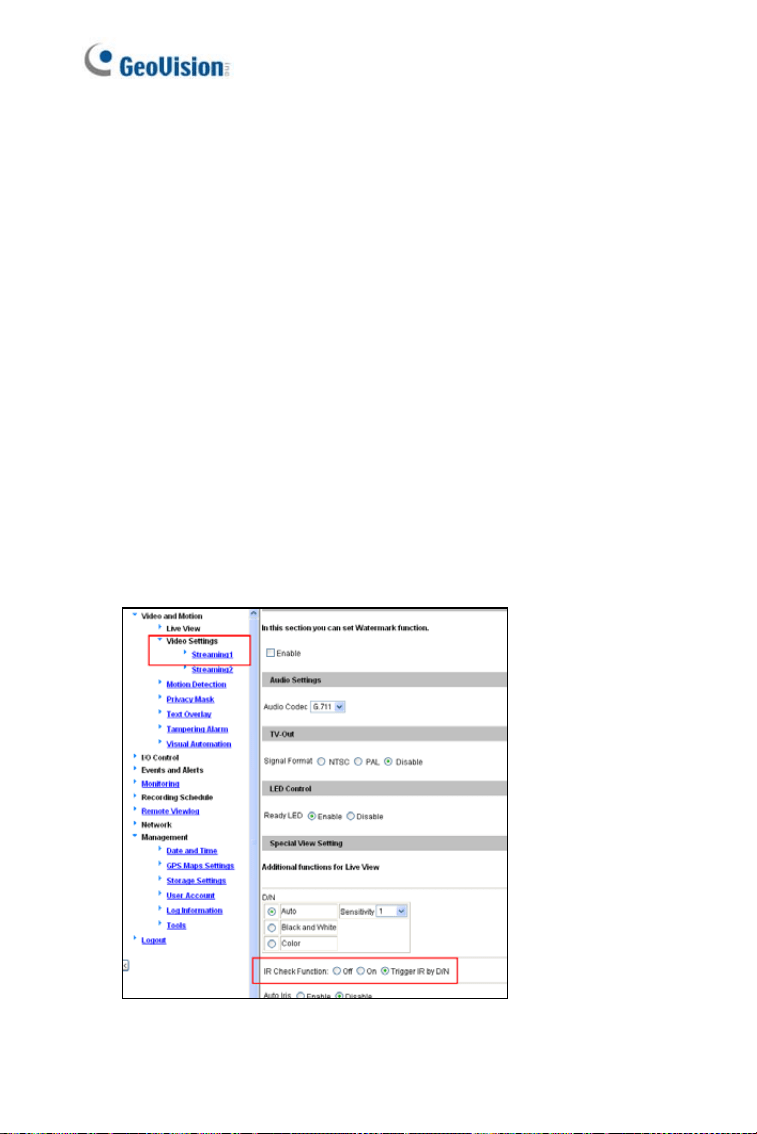
H. Notice for Using the IR Arctic Box Camera
Make sure sure that you:
enable IR LED function on the Web interface after loading the default
settings.
disable the status LED to reduce reflection when a green light spot
appears on the live view.
Enabling IR LED after Loading Default
Each GV-IR Arctic Box Camera is equipped with 4 IR LEDs to provide
infrared illumination at night. The factory-loaded setting for the IR LED
function is enabled. If you have restored the camera to default settings,
please follow the steps below to enable the IR LED function.
1. In the left menu of Web interface, select Video Settings and then
Streaming 1.
2. Enable Trigger IR by D/N in IR Check Function. Click Apply.
210
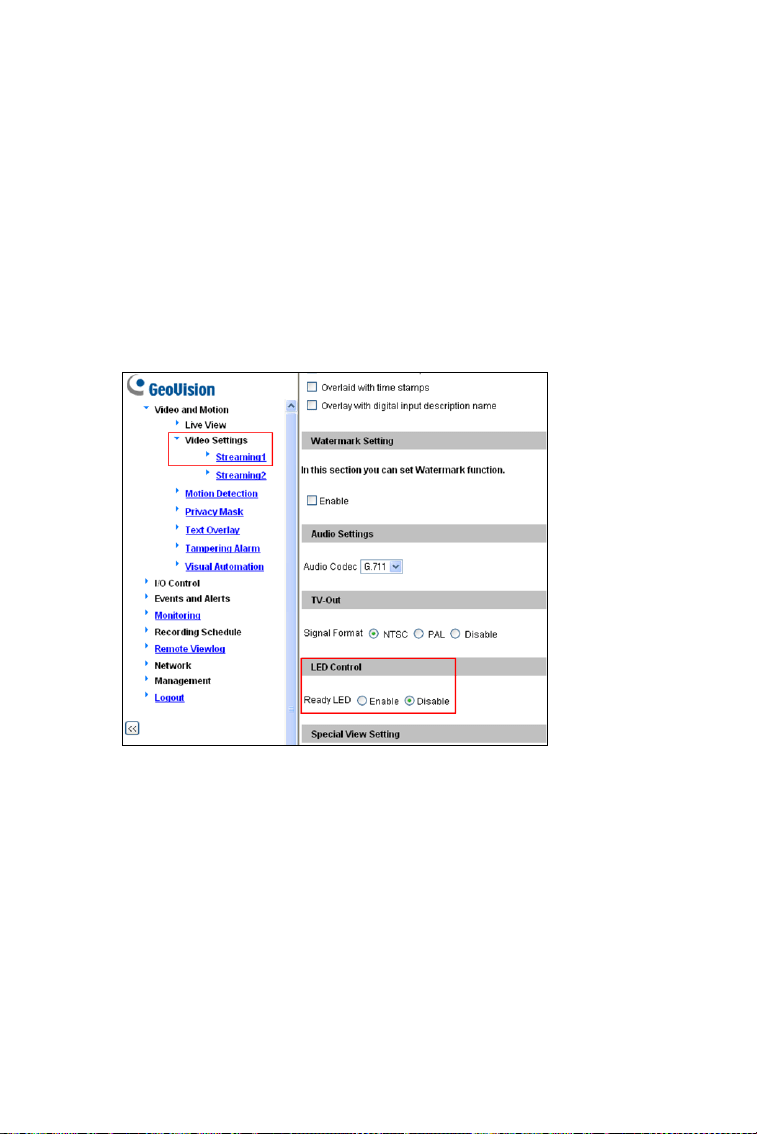
Appendix
211
Disabling Status LED under Low Light Conditions
A green light spot on the live view is likely caused by the insufficient light at
the installation site, which leads to the status LED to reflect on the camera
cover. Disable the status LED to prevent this.
1. In the left menu of Web interface, select Video Settings and then
Streaming 1.
2. Select Disable in LED Control. Click Apply.